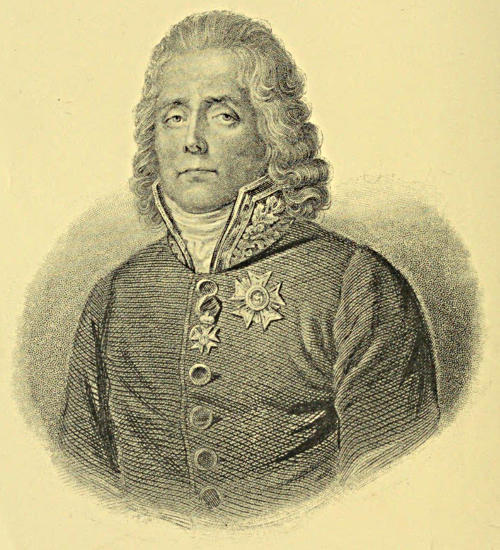
Different types of men.—M. de Talleyrand, the politic man.—Character of
the eighteenth century, which had formed him.—Birth, personal description,
entry into church.—Causes of revolution.—States-General.—Talleyrand’s influence
over clergy; over the decision as to the instructions of members, and
the drawing up of the rights of man.—Courage in times of danger.—Financial
knowledge.—Propositions relative to church property.—Discredit with the
Court party.—Popularity with the Assembly.—Charged to draw up its
manifesto to the nation.—Project about uniformity of weights and measures.
There are many men in all times who employ themselves
actively in public affairs; but very few amongst these
deserve the title of “Men of action.”
The rare individuals who justly claim this designation,
and whose existence exercises so important an influence
over the age in which they appear, must possess, in no
ordinary degree, intelligence, energy, and judgment; but
these qualities are found blended in different degrees in
the different classes or types of men who, as soldiers,
sovereigns, or statesmen, command the destiny of their
times.
They in whom superior intelligence, energy, and judgment
are equally united, mount with firm and rapid pace
the loftiest steeps of ambition, and establish themselves
permanently on the heights to which they have safely
ascended. Such men usually pursue some fixed plan or
predominant idea with stern caution and indomitable perseverance,
adapting their means to their end, but always
keeping their end clearly in view, and never, in the pursuit
of it, overstepping that line by which difficulties are separated
from impossibilities. Cardinal de Richelieu in
France, and William III. in England, are types of this
heroic race.
On the other hand, they in whom the judgment, however
great, is not sufficient to curb the energy and govern
the intellect which over-stimulates their nature, blaze out,
meteor-like, in history, but rather excite temporary admiration
than leave behind them permanent results. Their
exploits far surpass those of other men, and assume for a
moment an almost supernatural appearance: but, as their
rise is usually sudden and prodigious, their ruin is also
frequently abrupt and total. Carried on by a force over
which they gradually lose all control, from one act of
audacity to another more daring, their genius sails before
the wind, like a vessel with overcrowded canvas, and
perishes at last in some violent and sudden squall.
Charles XII. of Sweden was an example of this kind in
the last century, and Napoleon Bonaparte, if we regard
him merely as a conqueror, a more striking one in our
own days.
Thirdly, there are men whose energy though constant
is never violent, and whose intellect, rather subtle than
bold, is attracted by the useful, and careless of the sublime.
Shrewd and wary, these men rather take advantage of
circumstances than make them. To turn an obstacle, to
foresee an event, to seize an opportunity, is their peculiar
talent. They are without passions, but self-interest and
sagacity combined give them a force like that of passion.
The success they obtain is procured by efforts no greater
than those of other candidates for public honours, who
with an appearance of equal talent vainly struggle after
fortune; but all their exertions are made at the most
fitting moment, and in the happiest manner.
A nice tact and a far-sighted judgment are the predominant
qualities of these “politic” persons. They think
rarely of what is right in the abstract: they do usually
what is best at the moment. They never play the greatest
part amongst their contemporaries: they almost always play
a great one; and, without arriving at those extraordinary
positions to which a more adventurous race aspires, generally
retain considerable importance, even during the most
changeful circumstances, and most commonly preserve in
retirement or disgrace much of the consideration they
acquired in power. During the intriguing and agitated
years which preceded the fall of the Stuarts, there was
seen in England a remarkable statesman of the character
I have just been describing; and a comparison might not
inappropriately be drawn between the plausible and
trimming Halifax and the adroit and accomplished personage
whose name is inscribed on these pages.
But although these two renowned advocates of expediency
had many qualities in common—the temper, the
wit, the knowledge, the acuteness which distinguished the
one equally distinguishing the other—nevertheless the
Englishman, although a more dexterous debater in public
assemblies, had not in action the calm courage, nor in
council the prompt decision, for which the Frenchman
was remarkable; neither is his name stamped on the
annals of his country in such indelible characters, nor connected
with such great and marvellous events.
And yet, notwithstanding the vastness of the stage on
which M. de Talleyrand acted, and the importance of the
parts which for more than half a century he played, I
venture to doubt whether his character has ever been
fairly given, or is at this moment justly appreciated; nor
is this altogether surprising. In a life so long, brilliant,
and varied, we must expect to find a diversity of impressions
succeeding and effacing each other; and not a few
who admired the captivating companion, and reverenced
the skilful minister of foreign affairs, were ignorant that
the celebrated wit and sagacious diplomatist had exhibited
an exquisite taste in letters, and a profound knowledge in
legislation and finance. Moreover, though it may appear
singular, it will be found true, that it is precisely those
public men who are the most tolerant to adverse opinions,
and the least prone to personal enmities, who oftentimes
gather round their own reputation, at least during a time,
the darkest obloquy and the most terrible reproaches.
The reason for this is simple: such men are themselves
neither subject to any predominant affection, nor devoted
to any favourite theory. Calm and impartial, they are
lenient and forgiving. On the other hand, men who
love things passionately, or venerate things deeply,
despise those who forsake—and detest those who oppose—the
objects of their adoration or respect. Thus,
the royalist, ready to lay down his life for his legitimate
sovereign; the republican, bent upon glorious imitations
of old Rome and Greece; the soldier, devoted to the chief
who had led him from victory to victory, could not but
speak with bitterness and indignation of one who commenced
the Revolution against Louis XVI., aided in the
overthrow of the French Republic, and dictated the proscription
of the great captain whose armies had marched
for a while triumphant over Europe.
The most ardent and violent of the men of M. de
Talleyrand’s time were consequently the most ardent and
violent condemners of his conduct; and he who turns
over the various works in which that conduct is spoken of
by insignificant critics,[1] will be tempted to coincide with
the remark of the great wit of the eighteenth century:
“C’est un terrible avantage de n’avoir rien fait; mais il
ne faut pas en abuser.”[2]
How far such writers were justified will be seen more
or less in the following pages, which are written with
no intention to paint a character deserving of eulogy or
inviting to imitation, but simply with the view of illustrating
a remarkable class of men by a very remarkable man, who
happened to live at a period which will never cease to
occupy and interest posterity.
Charles Maurice Talleyrand de Périgord was born
February 2, 1754.[3] The House of Périgord was one of
the noblest in France, and in the earliest ages of the
French monarchy possessed sovereign power. The
principality of Chalais, the only one which existed, I
believe, in the time of Louis XIV. (for the other personages
called princes at the French court took their titles
as princes of the Roman States or the German Empire,
and ranked after French dukes), is said to have been eight
centuries in this family. Talleyrand, a name usually
attached to that of Périgord, and anciently written
Tailleran, is supposed to have been a sort of sobriquet,
or nickname, and derived from the words, “tailler les
rangs” (cut through the ranks). It was borne by
Helie V., one of the sovereign counts of Périgord, who
lived in 1118; and from this prince (Helie V.) descended
two branches of the Talleyrand-Périgords; the one was
extinct before the time of Louis XVI., the other, being
the younger branch, was then represented by a Comte de
Périgord, Captain of the Guards, and Governor of the
States of Languedoc. A brother of this Comte de Périgord
was the father of Charles Maurice Talleyrand de Périgord
(the subject of this memoir), whose mother, Eléonore de
Damas, daughter of the Marquis de Damas, was also of a
highly noble family, and a lady alike remarkable for her
beauty and her virtue.[4]
The seal which marks our destiny has usually been
stamped on our childhood; and most men, as they look
back to their early youth, can remember the accident, the
book, the conversation, which gave that shape to their
character which events have subsequently developed.
M. de Talleyrand was in infancy an exile from his
home; the fortune of his parents did not correspond with
their rank: his father,[5] a soldier, was always at the court
or the camp; his mother held a situation in the household
at Versailles. To both a child was an incumbrance, and
Maurice immediately at his birth was put out to nurse (as
was indeed at that time frequently the custom) in the
country, where, either by chance or neglect, he met with
a fall which occasioned lameness. This infirmity, when
the almost forgotten child at the age of twelve or thirteen
was brought up to Paris for the purpose of receiving rather
a tardy education, had become incurable; and by a conseil
de famille, it was decided that the younger brother, the
Comte d’Archambaud—subsequently known as one of
the handsomest and most elegant of the courtiers of
Louis XVI., and whom I can remember under the title
of Duc de Périgord—(a title given by Louis XVIII.),
should be considered the elder brother, and enter the army,
whilst the elder son should be pronounced the younger
son, and devoted to the clerical profession, into which the
Périgords knew they had sufficient influence to procure
his admission, notwithstanding the infirmity which, under
ordinary circumstances, would have been a reason for excluding
him from the service of the church. From this
moment the boy—hitherto lively, idle, and reckless—became
taciturn, studious, and calculating. His early
propensities remained, for nature admits of no radical
change; but they were coloured by disappointment, or
combated by ambition. We see traces of gaiety in the
companion who, though rarely smiling himself, could
always elicit a laugh from others; we see traces of indolence
in the statesman who, though always occupied,
never did more than the necessity of the case exacted; we
see traces of recklessness in the gambler and politician
who, after a shrewd glance at the chances, was often disposed
to risk his fortune, or his career, on a speculation
for money or power: but the mind had been darkened and
the heart hardened; and the youth who might easily and
carelessly have accepted a prosperous fate, was ushered
into the world with a determination to wrestle with an
adverse one.
Nor did any paternal advice or maternal care regulate
or soften the dispositions which were thus being formed.
From the nurse in the country, the lame young Périgord—for
Périgord was the name which at this time he
bore—was transplanted to the “Collége d’Harcourt,”
since called that of St. Louis. He entered it more
ignorant, perhaps, than any boy of his years; but he
soon gained its first prizes, and became one of its most
distinguished scholars.
At the “Séminaire de St. Sulpice,” to which he was
removed in 1770, his talent for disputation attracted
attention, and even some of his compositions were long
remembered and quoted by contemporaries. Whilst at
the Sorbonne, where he subsequently completed his studies,
this scion of one of the most illustrious French houses was
often pointed out as a remarkably clever, silent, and profligate
young man: who made no secret of his dislike to
the profession that had been chosen for him, but was
certain to arrive at its highest honours.
With such prospects and such dispositions, M. de Talleyrand
entered, in 1773, the Gallican Church.
At this time we have to fancy the young ecclesiastic—a
gentleman about twenty years of age, very smart in his
clerical attire, and with a countenance which, without
being handsome, was singularly attractive from the triple
expression of softness, impudence, and wit. If we are to
credit the chronicles of that day, his first advance in his
profession was owing to one of those bon mots by which
so many of the subsequent steps of his varied career were
distinguished.
There were assembled at Madame Dubarry’s a number
of young gentlemen, rather free in their conversation and
prodigal in their boasts: no beauty had been veiled to
their desires, no virtue had been able to resist their attacks.
The subject of this memoir alone said nothing. “And
what makes you so sad and silent?” asked the hostess.
“Hélas! madame, je faisais une réflexion bien triste.”
“Et laquelle?” “Ah, madame, que Paris est une ville
dans laquelle il est bien plus aisé d’avoir des femmes que
des abbayes.”
The saying, so goes the story, was considered charming,
and being reported to Louis XV., was rewarded by that
monarch with the benefice desired. The Abbé de Périgord’s
career, thus commenced, did not long linger.
Within a few years after entering the church, aided by
his birth and abilities, he obtained (in 1780) the distinguished
position of “Agent-General” of the French
clergy—this title designating an important personage who
administered the ecclesiastical revenues, which were then
immense, under the control of regular assemblies.
It is a curious trait in the manners of these times that,
whilst holding this high post as a priest, the Abbé de
Périgord fitted out a vessel as a privateer; and, it being his
intention to plunder the English, received from the French
government the cannon he required for so pious a purpose.[6]
I am unable to say what success attended M. de Talleyrand’s
naval enterprise; but when, in 1785, he had to
give an account of his clerical administration, the very
clear and statesmanlike manner in which he did so, raised
him, in the opinion of the public, from the position of a
clever man, into that of an able one. Nor was this all.
The peculiar nature of the first public duties which he
thus exercised, directed his mind towards those questions
which the increasing deficit in the French treasury, and
the acknowledged necessity of supplying it, made the
fashion: for every one at that time in Paris—ladies,
philosophers, wits, and men of fashion—talked finance.
Few, however, troubled themselves with acquiring any
real insight into so dry a subject. But M. de Talleyrand,
although constitutionally averse to hard or continued
study, supplied this defect by always seeking and living
with men who were the best informed on those subjects
with which he wished to become acquainted. In this
manner his own information became essentially practical,
and the knowledge he obtained of details (furnishing him
with a variety of facts, which he always knew how to
quote opportunely), attracted the attention and patronage
of M. de Calonne, then at the head of the French government,
and who, being himself as much addicted to pleasure
as to affairs, was not sorry to sanction the doctrine that a
man of the world might also be a man of business.
Still, though thus early marked out as a person who,
after the example of his great ecclesiastical predecessors,
might rise to the highest dignities in the Church and
State, the Abbé de Périgord showed an almost ostentatious
disregard for the duties and decorum of the profession
which he had been forced to embrace. Indeed, he seemed
to make in this sort of conduct a kind of protest against
the decree by which his birthright had been set aside,
and almost to glory in the publication of profane epigrams
and amorous adventures which amused the world but
scandalised the Church. Thus, each year, which increased
his reputation for ability, added to the stories by
which public rumour exaggerated his immorality; and in
1788, when the bishopric of Autun, to which he had for
some time been looking forward, became vacant, Louis XVI.
was unwilling to confer the dignity of prelate on so irregular
an ecclesiastic. For four months the appointment
was not filled up. But the Abbé de Périgord’s father
lay at that time on his death-bed: he was visited by the
kind-hearted Louis in this condition, and he begged the
monarch, as the last request of a dying and faithful
servant, to grant the bishopric in question to his son.
The King could not withstand such a prayer at such a
moment, and the Abbé de Périgord was consecrated Bishop
of Autun on the 17th of January, 1789—four months
before the assembling of the States-General.
The period which had elapsed between the time at
which M. de Talleyrand had entered the Church, and that
at which he attained the episcopal dignity, is, perhaps,
the most interesting in modern civilization. At no epoch
did society ever present so bright and polished a surface
as it did in the French capital during these fourteen or
fifteen years. The still great fortunes of the grand
seigneur, the profuse expenditure of the financier, the
splendour of a court embellished by that love for the arts
and for letters which the Medici had imported from Italy,
and which Louis XIV. had made a part of his royal magnificence,
all contributed to surround life with a taste in
luxury which has never been surpassed. Rich manufactures
of silk, exquisite chiseling in bronze, china equally
beautiful in form and decoration, and paintings somewhat
effeminate, but graceful, and which still give celebrity to
the names of Watteau, Boucher, and Greuze, mark the
elegant refinement that presided over those days.
Nothing, however, in those courtly times had been
carried to such perfection as the art of living, and the
habits of social intercourse. People did not then shut up
their houses from their friends if they were poor, nor
merely open them in order to give gorgeous and pompous
entertainments if they were rich. Persons who suited
and sympathised, assembled in small circles, which permitted
the access of new members cautiously, but received
all who had once been admitted without preference or
distinction.
In these circles, the courtier, though confident of the
fixed superiority of his birth, paid homage to the accident
of genius in the man of letters; and the literary man,
however proud of his works, or conscious of his talents,
rendered the customary tribute of respect to high rank
and station.
Thus poets and princes, ministers of state, and members
of learned academies—men of wit, and men of the world—met
on a footing of apparent equality, and real familiarity,
on a stage where Beauty, ambitious of universal admiration,
cultivated her mind as much as her person, and established
one presiding theory—“that all had to make themselves
agreeable.”
The evening parties of Madame de Brignole, and of
Madame du Deffand, the little suppers of Madame Geoffrin,
the dinners of Baron Holbach and Helvetius, the musical
receptions of the Abbé Morelet, and the breakfasts of
Madame Necker, were only specimens of the sort of
assemblies which existed amongst different classes, and
throughout every street and corner of Paris and Versailles.
Here, all orders mingled with suitable deference towards
each other. But beneath this brilliant show of actual
gaiety and apparent unity there lay brooding a spirit of
dissatisfaction and expectation, which a variety of peculiar
circumstances tended, at that time, to exaggerate in France,
but which is in fact the usual characteristic of every
intellectual community, when neither over-enervated by
luxury and peace, nor over-wearied by war and civil commotion.
Its natural consequence was a desire for change,
which diffused its influence over all things—great and
small. Léonard revolutionized the head-dress of the
French lady: Diderot and Beaumarchais, the principles
of the French stage: Turgot and Necker, the political
economy and financial system of the French state: and
just at this moment, when the imagination was on the
stretch for novelty, as if Providence designed for some
mysterious end to encourage the aspiring genius of the
epoch, the balloon of Montgolfier took its flight from the
Tuileries, and the most romantic dreams were surpassed by
a reality.
It was not, however, a mere discontent with the present,
a mere hope in the future, a mere passion after things
new, however violent that passion might be, which
constituted the peril, nor, indeed, the peculiarity of the
hour.
In other seasons of this kind, the wishes and views
of men have frequently taken some fixed form—have had
some fixed tendency—and in this way their progress has
been regulated, and their result, even from a distance,
foreseen.
But at the period to which I am referring, there was
no general conception or aim which cast a decisive shadow
over coming events, and promised any specific future in
exchange for the present, evidently passing away.
There still lived, though on the verge of the tomb, an
individual to whom this distinguishing misfortune of the
eighteenth century was in no small degree attributable.
The keen sagacity of Voltaire, his piercing raillery, his
brilliant and epigrammatic eloquence, had ridiculed and
destroyed all faith in old abuses, but had never attempted
to give even a sketch of what was to come in their room.
“Magis habuit quod fugeret quam quod sequeretur.”
The effect of his genius, therefore, had been to create
around him a sort of luminous mist, produced by the
blending of curiosity and doubt; an atmosphere favourable
to scepticism, favourable to credulity; and, above all
things, generative of enthusiasts and empirics. St.
Germain the alchymist, Cagliostro the conjurer, Condorcet
the publicist, Marat the politician, were the successive
produce of this marvellous and singular epoch. And thus
it was,—amidst a general possession of privileges, and a
general equality of customs and ideas—amidst a great
generosity of sentiment, and an almost entire absence of
principle in a society unequalled in its charms, unbounded
in its hopes, and altogether ignorant of its destiny,—that
the flower of M. de Talleyrand’s manhood was passed.
I have dwelt at some length upon the characteristics—
“Of those gay times of elegance and ease,
When Pleasure learnt so gracefully to please:
When wits and courtiers held the same resorts,
The courtiers wits, and all wits fit for courts:
When woman, perfect in her siren art,
Subdued the mind, and trifled with the heart;
When Wisdom’s lights in fanes fantastic shone,
And Taste had principles, and Virtue none:
When schools disdained the morals understood,
And sceptics boasted of some better good:
When all was Fairyland which met the view,
No truth untheorized, and no theory true.”
I have dwelt, I say, at some length upon the characteristics
of those times; because it is never to be forgotten
that the personage I have to speak of was their child.
To the latest hour of his existence he fondly cherished
their memory; to them he owed many of those graces
which his friends still delight to recall: to them, most
of those faults which his enemies have so frequently
portrayed.
The great test of his understanding was that he totally
escaped all their grosser delusions. Of this I am able
to give a striking proof. It has been said that M. de
Talleyrand was raised to the episcopal dignity in January,
1789, four months previous to the assembling of the
States-General. To that great Assembly he was immediately
named by the baillage of his own diocese; and
perhaps there is hardly to be found on record a more remarkable
example of human sagacity and foresight than
in the new bishop’s address to the body which had chosen
him its representative.
In this address, which I have now before me, he
separates all the reforms which were practicable and
expedient, from all the schemes which were visionary and
dangerous—the one and the other being at that time
confused and jumbled together in the half-frenzied brains
of his countrymen: he omits none of those advantages in
government, legislation, finance—for he embraces all these—which
fifty years have gradually given to France: he
mentions none of those projects of which time, experience,
and reason have shown the absurdity and futility.
A charter giving to all equal rights: a great code
embodying and simplifying all existing and necessary
laws: a due provision for prompt justice: the abolition of
arbitrary arrest: the mitigation of the laws between
debtor and creditor: the institution of trial by jury:
the liberty of the press, and the inviolability of private
correspondence: the destruction of those interior imposts
which cut up France into provinces, and of those restrictions
by which all but members of guilds were excluded
from particular trades: the introduction of order into the
finances under a well-regulated system of public accounts:
the suppression of all feudal privileges: and the organization
of a well-considered general plan of taxation: such
were the changes which the Bishop of Autun suggested in
the year 1789. He said nothing of the perfectibility of
the human race: of a total reorganization of society
under a new system of capital and labour: he did not
promise an eternal peace, nor preach a general fraternity
amongst all races and creeds. The ameliorations he proposed
were plain and simple; they affiliated with ideas
already received, and could be grafted on the roots of a
society already existing. They have stood the test of
eighty years—now advanced by fortunate events, now
retarded by adverse ones—some of them have been disdained
by demagogues, others denounced by despots;—they
have passed through the ordeal of successive revolutions;
and they furnish at this instant the foundations
on which all wise and enlightened Frenchmen desire to
establish the condition of government and society in their
great and noble country. Let us do honour to an intelligence
that could trace these limits for a rising generation;
to a discretion that resisted the temptation to
stray beyond them!
About the time of the assembling of the States-General,
there appeared a work which it is now curious to refer to—it
was by the pen of Laclos—entitled Galerie des États-Généraux.
This work gave a sketch under assumed
names of the principal personages likely to figure in the
States-General. Amongst a variety of portraits, are to
be found those of General Lafayette and the Bishop of
Autun; the first under the name of Philarète, the second
under that of Amène; and, assuredly, the author
startles us by his nice perception of the character and by
his prophetic sagacity as to the career of these two men.
It is well, however, to remember that Laclos frequented
the Palais Royal, which the moral and punctilious soldier
of Washington scrupulously avoided. The criticism I
give, therefore, is not an impartial one. For, if General
Lafayette was neither a hero nor a statesman, he was, take
him all in all, one of the most eminent personages of his
time, and occupied, at two or three periods, one of the
most prominent positions in his country.
“Philarète,” says M. Laclos, “having found it easy
to become a hero, fancies it will be as easy to become a
statesman. The misfortune of Philarète is that he has
great pretensions and ordinary conceptions. He has
persuaded himself that he was the author of the revolution
in America; he is arranging himself so as to become one
of the principal actors in a revolution in France.
“He mistakes notoriety for glory, an event for a
success, a sword for a monument, a compliment for immortality.
He does not like the court, because he is
not at his ease in it; nor the world, because there he is
confounded with the many; nor women, because they
injure the reputation of a man, while they do not add to
his position. But he is fond of clubs, because he there
picks up the ideas of others; of strangers, because they
only examine a foreigner superficially; of mediocrity,
because it listens and admires.
“Philarète will be faithful to whatever party he adopts,
without being able to assign, even to himself, any good
reasons for being so. He has no very accurate ideas of
constitutional authority, but the word ‘liberty’ has a
charm for him, because it rouses an ambition which he
scarcely knows what to do with. Such is Philarète. He
merits attention, because, after all, he is better than most
of his rivals. That the world has been more favourable
to him than he deserves, is owing to the fact that he has
done a great deal in it, considering the poverty of his
ability; and people have been grateful to him, rather on
account of what he seemed desirous to be, than on account
of what he was. Besides, his exterior is modest, and
only a few know that the heart of the man is not mirrored
on the surface.
“He will never be much more than we see him, for he
has little genius, little nerve, little voice, little art, and is
greedy of small successes.”
Such was the portrait which was drawn of Lafayette;
we now come to that of M. de Talleyrand.
“Amène has charming manners, which embellish virtue.
His first title to success is a sound understanding.
Judging men with indulgence, events with calmness, he
has in all things that moderation which is the characteristic
of true philosophy.
“There is a degree of perfection which the intelligence
can comprehend rather than realise, and which there is,
undoubtedly, a certain degree of greatness in endeavouring
to attain; but such brilliant efforts, though they give
momentary fame to those who make them, are never of
any real utility. Common sense disdains glitter and noise,
and, measuring the bounds of human capacity, has not the
wild hope of extending them beyond what experience has
proved their just limit.
“Amène has no idea of making a great reputation in a
day: such reputations, made too quickly, soon begin to
decline, and are followed by envy, disappointment, and
sorrow. But Amène will arrive at everything, because
he will always profit by those occasions which present
themselves to such as do not attempt to ravish Fortune.
Each step will be marked by the development of some
talent, and thus he will at last acquire that general high
opinion which summons a statesman to every great post
that is vacant. Envy, which will always deny something
to a person generally praised, will reply to what we have
said, that Amène has not that force and energy of character
which is necessary to break through the obstacles that
impede the course of a public man. It is true he will
yield to circumstances, to reason, and will deem that he
can make sacrifices to peace without descending from
principle; but firmness and constancy may exist without
violent ardour, or vapid enthusiasm.
“Amène has against him his pleasing countenance and
seductive manner. I know people whom these advantages
displease, and who are also prejudiced against a man who
happens to unite the useful chance of birth with the
essential qualities of the mind.
“But what are we really to expect from Amène in the
States-General? Nothing, if he is inspired with the spirit
of class; much, if he acts after his own conceptions, and remembers
that a national assembly only contains citizens.”
Few who read the above sketch will deny to the author
of the “Liaisons Dangereuses” the merit of discernment.
Indeed, to describe M. de Talleyrand at this time seems to
have been more appropriate to the pen of the novelist than
to that of the historian. Let us picture to ourselves a
man of about thirty-five, and appearing somewhat older:
his countenance of a long oval; his eyes blue, with an
expression at once deep and variable; his lips usually
impressed with a smile, which was that of mockery, but
not of ill-nature; his nose slightly turned up, but delicate,
and remarkable for a constant play in the clearly chiseled
nostrils. “He dressed,” says one of his many biographers,
“like a coxcomb, he thought like a deist, he preached like
a saint.” At once active and irregular, he found time for
everything: the church, the court, the opera. In bed
one day from indolence or debauch, up the whole of the
following night to prepare a memoir or a speech. Gentle
with the humble, haughty with the high; not very exact
in paying his debts, but very scrupulous with respect to
giving and breaking promises to pay them.
A droll story is related with respect to this last peculiarity.
The new Bishop had ordered and received a very
handsome carriage, becoming his recent ecclesiastical elevation.
He had not, however, settled the coachmaker’s
“small account.” After long waiting and frequent letters,
the civil but impatient tradesman determined upon presenting
himself every day at the Bishop of Autun’s door, at the
same time as his equipage.
For several days, M. de Talleyrand saw, without recognising,
a well-dressed individual, with his hat in his hand,
and bowing very low as he mounted the steps of his coach.
“Et qui êtes vous, mon ami?” he said at last. “Je suis
votre carrossier, Monseigneur.” “Ah! vous êtes mon carrossier;
et que voulez-vous, mon carrossier?” “Je veux
être payé, Monseigneur,” said the coachmaker, humbly.
“Ah! vous êtes mon carrossier, et vous voulez être payé;
vous serez payé, mon carrossier.” “Et quand,
Monseigneur?”[7] “Hum!” murmured the Bishop, looking at
his coachmaker very attentively, and at the same time
settling himself in his new carriage: “Vous êtes bien
curieux!” Such was the Talleyrand of 1789, embodying
in himself the ability and the frivolity, the ideas and the
habits of a large portion of his class. At once the associate
of the Abbé Sieyès, and of Mademoiselle Guimard: a
profligate fine gentleman, a deep and wary thinker; and,
above all things, the delight and ornament of that gay and
graceful society, which, crowned with flowers, was about to
be the first victim to its own philosophy. As yet, however,
the sky, though troubled, gave no evidence of storm; and
never, perhaps, did a great assembly meet with less gloomy
anticipations than that which in the pomp and gallantry of
feudal show, swept, on the 1st of May, through the royal
city of Versailles.
Still, there was even at that moment visible the sign
and symbol of the approaching crisis; for dark behind the
waving plumes and violet robes of the great dignitaries of
Church and State, moved on the black mass, in sable cloak
and garb, of the Commons, or tiers-état, the body which
had, as yet, been nothing, but which had just been told by
one of its most illustrious members,[8] that it ought to be
everything.
The history of the mighty revolution which at this
moment was commencing, is still so stirring amongst us,—the
breath of the tempest which then struck down tower
and temple, is still so frequently fancied to be rustling
about our own dwellings,—that when the mind even now
wanders back, around and about this time, it is always
with a certain interest and curiosity, and we pause once
again to muse, even though we have often before meditated,
upon that memorable event which opened a new chapter in
the history of the world. And the more we reflect, the
more does it seem surprising that in so civilised an age,
and under so well-meaning a sovereign, an august throne
and a great society should have been wholly swept away;
nor does it appear less astonishing that a monarch with
arbitrary sway, that a magistracy with extraordinary privileges,
each wishing to retain their authority, should have
voluntarily invoked another power, long slumbering in an
almost forgotten constitution, and which, when roused into
activity, was so immediately omnipotent over parliament
and king.
The outline of Louis XVI.’s reign is easily, though I do
not remember where it is briefly, and clearly traced. At
its commencement, the influence of new opinions was confined
to the library and drawing-room. The modern
notions of constitutional liberty and political economy
prevalent amongst men of letters, and fashionable amongst
men of the world, had not been professed by men in power,
and were consequently disdained by that large class which
wishes in all countries to pass for the practical portion of
the community. At this time, an old minister, himself a
courtier, and jealous lest other courtiers should acquire
that influence over his master which he possessed, introduced
into affairs a set of persons hitherto unknown at
court, the most eminent of whom were Turgot, Malesherbes,
and Necker; and no sooner had these three
eminent reformers obtained a serious political position, than
their views acquired a political consideration which had
not before belonged to them, and the idea that some great
and general reform was shortly to take place entered
seriously into the public mind. Each of these ministers
would have wished to make the reforms that were most
necessary with the aid of the royal authority; and, had
they been able to do so, it is probable that they would have
preserved the heart and strength of the old monarchy,
which was yet only superficially decayed. But the
moderate changes which they desired to introduce with the
assent of all parties, were opposed by all parties, in spite of—or,
perhaps, on account of—their very moderation:
for losers are rarely satisfied because their losses are
small, and winners are never contented but when their
gains are great.
In the meantime, Maurepas, who would have supported
the policy of his colleagues, if it had brought him popularity,
was by no means disposed to do so when it gave
him trouble. Thus, Malesherbes, Turgot, and Necker
were successively forced to resign their offices, without
having done anything to establish their own policy, but
much to render any other discreditable and difficult.
The publication of the famous “Compte Rendu,” or
balance-sheet of state expenses and receipts, more especially,
rendered it impossible to continue to govern as
heretofore. And now Maurepas died, and a youthful
queen inherited the influence of an old favourite. M. de
Calonne, a plausible, clever, but superficial gentleman,
was the first minister of any importance chosen by the
influence of Marie-Antoinette’s friends. He saw that the
expenses and receipts of the government must bear some
proportion to each other. He trembled at suddenly reducing
old charges; new taxes were the only alternative;
and yet it was almost impossible to get such taxes
from the lower and middle classes, if the clergy and
nobility, who conjointly possessed about two-thirds of the
soil, were exempted from all contributions to the public
wants. The minister, nevertheless, shrunk from despoiling
the privileged classes of their immunities, without some
authorization from themselves. He called together, therefore,
the considerable personages, or “notables,” as they
were styled, of the realm, and solicited their sanction to
new measures and new imposts, some of the former of
which would limit their authority, and some of the latter
affect their purses.
The “notables” were divided into two factions: the
one of which was opposed to M. de Calonne, the other to
the changes which he wished to introduce. These two
parties united and became irresistible. Amongst their
ranks was a personage of great ambition and small
capacity—Brienne, Archbishop of Toulouse. This man
was the most violent of M. de Calonne’s opponents. The
court turned round suddenly and chose him as M. de
Calonne’s successor. This measure, at first, was successful,
for conflicting opinions end by creating personal antipathies,
and the “notables,” in a moment of exultation
over the defeated minister, granted everything with
facility to the minister who had supplanted him. A new
embarrassment, however, now arose. The notables were,
after all, only an advising body: they could say what
they deemed right to be done, but they could not do it.
This was the business of the sovereign; but his edicts,
in order to acquire regularly the force of law, had to be
registered by the Parliament of Paris; and it is easy to
understand how such a power of registration became,
under particular circumstances, the power of refusal. The
influence of that great magisterial corporation, called the
“Parliament of Paris,” had, indeed, acquired, since it had
been found necessary to set aside Louis XIV.’s will by
the sanction of its authority, a more clear and positive
character than at former periods. This judicial court, or
legislative assembly, had thus become a constituent part
of the State, and had also become—as all political assemblies,
however composed, which have not others for their
rivals, will become—the representative of popular opinion.
It had seen, with a certain degree of jealousy, the convocation,
however temporarily, of another chamber (for such
the assembly of notables might be called), and was,
moreover, as belonging to the aristocracy, not very well
disposed to the surrender of aristocratical privileges. It
refused, therefore, to register the new taxes proposed to
it: thus thwarting the consent of the notables, avoiding,
for a time, the imposts with which its own class was
threatened, and acquiring, nevertheless, some increase of
popularity with the people who are usually disposed to
resist all taxation, and were pleased with the invectives
against the extravagance of the court, with which the
resistance of the parliament was accompanied.
The government cajoled and threatened the parliament,
recalled it, again quarrelled with it, attempted to suppress
it—and failed.
Disturbances broke out, famine appeared at hand, a
bankruptcy was imminent; there was no constituted
authority with sufficient power or sufficient confidence
in itself to act decisively. People looked out for some
new authority: they found it in an antique form. “The
States-General!” (that is, an assembly chosen from
the different classes, which, in critical periods of the
French nation had been heretofore summoned) became
the unanimous cry. The court, which wanted money
and could not get it, expected to find more sympathy in a
body drawn from all the orders of the State than from a
special and privileged body which represented but one
order.
The parliament, on the other hand, imagined that,
having acquired the reputation of defending the nation’s
rights, it would have its powers maintained and extended
by any collection of men representing the nation. This
is why both parliament and court came by common
accord to one conclusion.
The great bulk of the nobility, though divided in their
previous discussions, here, also, at last agreed: one portion
because it participated in the views of the court, and the
other because it participated in those of the parliament.
In the meantime, the unfortunate Archbishop, who
had tried every plan for filling the coffers of the court
without the aid of the great council now called together,
was dismissed as soon as that council was definitively
summoned: and, according to the almost invariable policy
of restoring to power the statesman who has increased
his popularity by losing office, M. Necker was again
placed at the head of the finances and presented to the
public as the most influential organ of the crown.
It will be apparent, from what I have said, that the
court expected to find in the States-General an ally
against the parliament, whilst the parliament expected to
find in the States-General an ally against the court.
Both were deceived.
The nobility, or notables, the government, and the
parliament, had all hitherto been impotent, because they
had all felt that there was another power around them
and about them, by which their actions were controlled,
but with which, as it had no visible representation, they
had no means of dealing.
That power was “public opinion.” In the Commons
of France, in the Deputies from the most numerous,
thoughtful, and stirring classes of the community, a spirit—hitherto
impalpable and invisible—found at once a
corporate existence.
Monsieur d’Espremenil, and those parliamentary patricians
who a year before were in almost open rebellion
against the sovereign, at last saw that they had a more
potent enemy to cope with, and rallied suddenly round the
throne. Its royal possessor stood at that moment in a
position which no doubt was perilous, but which, nevertheless,
I believe, a moderate degree of sagacity and firmness
might have made secure. The majority of the
aristocracy of all grades, from a feudal sentiment of
honour, was with the King. The middle classes also had
still for the monarch and his rank considerable respect;
and were desirous to find out and sanction some just and
reasonable compromise between the institutions that were
disappearing, and the ideas that had come into vogue. It
was necessary to calm the apprehensions of those who had
anything to lose, to fix the views of those who thought
they had something to gain, and to come at once to a
settlement with the various classes—here agitated by fear,
there by expectation. But however evident the necessity
of this policy, it was not adopted. Suspicions that should
have been dissipated were excited; notions that should
have been rendered definite were further disturbed; all
efforts at arrangement were postponed; and thus the
revolution rushed onwards, its tide swelling, and its
rapidity being increased by the blunders of those who had
the greatest interest and desire to arrest it. The fortune
of M. de Talleyrand was embarked upon that great stream,
of which few could trace the source, and none foresaw the
direction.
I have just said that none foresaw the direction in
which the great events now commencing were likely to
run. That direction was mainly to be influenced by the
conduct and character of the sovereign, but it was also, in
some degree, to be affected by the conduct and character
of the statesman to whom the destinies of France were for
the moment confided.
M. Necker belonged to a class of men not uncommon
in our own time. His abilities, though good, were not of
the first order; his mind had been directed to one
particular branch of business; and, as is common with
persons who have no great genius and one specialty, he
took the whole of government to be that part which he
best understood. Accordingly, what he now looked to,
and that exclusively, was balancing the receipts and
expenditure of the State. To do this, it was necessary to
tax the nobility and clergy; and the class through whose
aid he could best hope to achieve such a task was the
middle-class, or “tiers-état.” For this reason, when it
had been decided to convoke the States-General, and it
became necessary to fix the proportionate numbers by
which each of the three orders (viz. the nobility, clergy,
middle-class, or “tiers-état,”) which composed the States-General,
was to be represented, M. Necker determined
that the sole order of the “tiers-état” should have as
many representatives as the two other orders conjointly;
thinking in this way to give the middle-class a greater authority,
and to counterbalance the want of rank in its individual
members, by their aggregate superiority in numbers.
But when M. Necker went thus far he should have
gone farther, and defined in what manner the three orders
should vote, and what power they should separately
exercise. This precaution, however, he did not take; and
therefore, as soon as the States-General assembled, there
instantly arose the question as to whether the three orders
were to prove the validity of their elections together as
members of one assembly, or separately as members of
three distinct assemblies. This question, in point of fact,
determined whether the three orders were to sit and vote
together, or whether each order was to sit and vote apart;
and after M. Necker’s first regulation it was clear that, in
one case, the order of the Commons would predominate
over all opposition; and that, in the other, it would be
subordinate to the two rival orders. A struggle then
naturally commenced.
The members of the “tiers-état,” who, as the largest of
the three bodies forming the States-General, had been left
in possession of the chamber where all the orders had been
first collected to meet the sovereign—an accident much in
their favour—invited the members of the two other orders
to join them there. The clergy hesitated; the nobles
refused. Days and weeks passed away, and the minister,
seeing his original error, would willingly have remedied it
by now proposing that which he might originally have
fixed, namely, that the three orders should vote together on
questions of finance, and separately on all other questions.
This idea was brought forward late; but, even thus late,
it might have prevailed if the court had been earnest in its
favour. The King, however, and those who immediately
influenced him, had begun to think that a deficit was less
troublesome than the means adopted to get rid of it; and
fancying that the States-General, if left to themselves,
might ere long dissolve amidst the dissensions which were
discrediting them, were desirous that these dissensions
should continue. Nor would this policy have failed in its
object if negotiation had been much further prolonged.
But it is at great moments like these that a great man
suddenly steps forth, and whilst the crowd is discussing
what is best to be done, does it. Such a man was the
Comte de Mirabeau; and on the 15th of June, this
marvellous personage, whose audacity was often prudence,
having instigated the Abbé Sieyès (whose authority was
at that time great with the Assembly) to bring the subject
under discussion, called on the tiers-état, still doubting
and deliberating, to constitute themselves at once, and
without further waiting for the nobility, “The Representatives
of the French people.” They did so in reality,
though not in words, declaring themselves duly elected,
and taking as their title “The National Assembly.” The
government thought to stop their proceedings by simply
shutting up the chamber where they had hitherto met, but
so paltry a device was insufficient to arrest the resolutions
of men whose minds were now prepared for important
events. Encouraging each other, the Commons rushed
unhesitatingly to a tennis-court, and in that spot,
singularly destined to witness so solemn a ceremony,
swore, with but one dissentient voice, to stand by each
other till France had a constitution. After such an oath,
the alternative was clearly between the old monarchy, with
all its abuses, and a new constitution, whatever its
dangers. On this ground, two orders in the State stood
hostilely confronted. But another order remained, whose
conduct at such a juncture was all-decisive. That order
was the clergy,—which, still respected if not venerated,—wealthy,
connected by various links with each portion of
society, and especially looked up to by that great and
sluggish mass of quiet men who always stand long wavering
between extremes—had been endeavouring to effect
some compromise between the privileged classes and their
opponents, but had as yet taken no prominent part with
either. The moment was come at which it could no
longer hesitate.
M. de Talleyrand, though but a new dignitary in the
church, was already one of its most influential members.
He had been excluded by a prejudice of the nobility from
the situation to which his birth had entitled him amongst
them. He had long resolved to obtain another position
at least as elevated through his own exertions. His views,
as we have seen, at the time of his election, were liberal,
though moderate, whilst he was sufficiently acquainted
with the character of Louis XVI. to know that that
monarch would never sincerely yield, nor ever sturdily
resist, any concession demanded with persistency. Partly,
therefore, from a conviction that he was doing what was
best for the public, and partly, also, from the persuasion
that he was doing what was best for himself, he separated
boldly from the rest of his family (who were amongst the
most devoted to the Comte d’Artois and Marie-Antoinette),
and laboured with unwearied energy to enlist the body he
belonged to on the popular side.
To succeed in this object he had the talents and advantages
most essential. His natural courtesy flattered the
curates; his various acquirements captivated his more
learned brethren; his high birth gave him the ear of the
great ecclesiastical dignitaries; and, finally, a majority of
his order, instigated by his exertions and address, joined
the Third Estate, on the 22nd of June, in the Church of
Saint-Louis.
From that moment the question hitherto doubtful was
determined; for at no time have the clergy and the
commons stood side by side without being victorious. It
was in vain, therefore, that even so early as the day
following, the descendant of Louis XIV., in all the pomp
of royalty, and in the presence of the three orders—whom
he had for that day summoned to assemble—denounced
the conduct which the tiers-état had pursued, annulled
their decisions, and threatened them with his sovereign
displeasure.
The tiers-état resisted; the King repented—retracted,—and
showing that he had no will, lost all authority. Thus,
on the 27th of June, the States-General, henceforth
designated by the title which had been already assumed
by the Commons (the National Assembly), held their
deliberations together, and the three orders were confounded.
But one step now remained in order to legalise the
revolution in progress. Each deputy had received a sort
of mandate or instruction from those who named him at
the moment of his election. Such instructions or mandates,
which had been given at a time when people could
hardly anticipate the state of things which had since
arisen, limited, or seemed to limit, the action of a deputy
to particular points which had especially attracted the
attention of his constituents.
The conservative party contended that these mandates
were imperative, the liberal party that they were not.
According to the first supposition, the States-General
could do no more than redress a few grievances; according
to the other, they could create a perfectly new system of
government.
The Bishop of Autun, in the first speech he delivered
in the National Assembly—a speech which produced considerable
effect—argued in favour of his own liberty and
that of his colleagues, and his views were naturally enough
adopted by a body which, feeling its own force, had to
determine its own power. Hence, on the record of two
great decisions—the one solving the States-General into
the “National Assembly;” the other extending and fixing
that Assembly’s authority—decisions which, whatever their
other results, were at least fatal to the power and influence
of the class to which he belonged by birth, but from which
he had, in spite of himself, been severed in childhood—was
indelibly inscribed the name of the once despised
and still disinherited cripple of the princely house of
Périgord.
There was nothing henceforth to impede the labours of
the National Assembly, and it commenced those labours
with earnestness and zeal, if not with discretion. One of
its first acts was to choose by ballot a committee of eight
members, charged to draw up the project of a constitution,
which was subsequently to be submitted to the Assembly.
The Bishop of Autun was immediately placed upon this
select and important committee. It had for its task to
render practical the political speculations of the eighteenth
century. Things, however, had commenced too violently
for them to proceed thus peaceably; and as the success of
the popular party had been hitherto obtained by braving
the crown, it was to be expected that the crown would
seize the first opportunity that presented itself for boldly
recovering its authority. A well-timed effort of this kind
might have been successful. But neither Louis XVI., nor
any of the counsellors in whom he confided, possessed that
instinct in political affairs which is the soul of action,
inspiring men with the resolve to do the right thing at
the right moment. It has often been found easy to crush
a revolution at its commencement, for the most ardent
of its supporters at such a time act feebly, and doubt about
the policy they are pursuing. It has often been found
possible to arrest a revolution at that subsequent stage of
its progress when the moderate are shocked by some excess,
or the sanguine checked by some disappointment; but a
revolution is invincible at that crisis, when its progress,
begun with boldness, has neither been checked by misfortune,
nor disgraced by violence.
Nevertheless, it was just at such a crisis that the
unfortunate Louis XVI., guided in a great degree by the
fatal influence of his brother, after having gradually surrounded
Versailles and the capital with troops, suddenly
banished M. Necker (July 10th), whose disgrace was
instantly considered the defeat of those who advised the
King to renovate his authority by concessions, and the
triumph of those who counselled him to recover and re-establish
it by force. But the measures which were to
follow this act were still in suspense, when a formidable
insurrection broke out at Paris. A portion of the soldiery
sided with the people. The Bastille was taken, and its
commandant put to death, the populace got possession of
arms, the prevôt or mayor of the city was assassinated,
whilst the army which had been so ostentatiously collected
in the Champ de Mars and at St. Denis was left an
inactive witness of the insurrection which its array had
provoked. The results were those which usually follow
the strong acts of weak men: Louis XVI. submitted;
M. Necker was recalled; the Comte d’Artois emigrated.
It was M. de Talleyrand’s fortune not merely at all
times to quit a falling party at the commencement of its
decline, but to stand firm by a rising party at the moment
of its struggle for success. This was seen during the
contest we have just been describing. Throughout that
contest the Bishop of Autun was amongst the most
determined for maintaining the rights of the nation
against the designs of the court. His decision and
courage added not a little to the reputation which had
been already gained by his ability. We find his name,
therefore, first in the list of a small number of eminent
men,[9] whom the Assembly, when surrounded by hostile
preparations for restoring the despotism which had been
abolished, charged, in a bold but not imprudent spirit of
defiance, with the task of at once completing and establishing
the constitution which had been promised, and
which it had become evident there was no intention to
accord. The labour of these statesmen, however, was not
easy, even after their cause was triumphant, for political
victories often leave the conquerors—in the excess of their
own passions, and the exaggeration of their own principles—worse
enemies than those whom they have vanquished.
Such was the case now.
In the exultation of the moment all moderate notions
were laid aside, and succeeded by a blind excitement in
favour of the most sweeping changes. Nor was this
excitement the mere desire of vulgar and selfish interest
stirring the minds of those who hoped to better their own
condition: nobler and loftier emotions lit up the breasts
of men who had only sacrifices to make with a generous
enthusiasm. “Nos âmes,” says the elder Ségur, “étaient
alors enivrées d’une douce philanthropie, qui nous portait
à chercher avec passion les moyens d’être utiles à
l’humanité, et de rendre le sort des hommes plus heureux.”[10]
On the 4th of August, “a day memorable with one party,”
observes M. Mignet, “as the St. Bartholomew of property,
and with the other as the St. Bartholomew of abuses,”—personal
service, feudal obligations, pecuniary immunities,
trade corporations, seignorial privileges, and courts of
law,—all municipal and provincial rights,—the whole
system of judicature,—based on the purchase and sale of
judicial charges, and which, singular to state, had, however
absurd in theory, hitherto produced in practice
learned, able, and independent magistrates,—in short,
almost all the institutions and peculiarities which constituted
the framework of government and society throughout
France, were unhesitatingly swept away, at the instigation
and demand of the first magistrates and nobles of
the land, who did not sufficiently consider that they who
destroy at once all existing laws (whatever those laws may
be), destroy at the same time all established habits of
thought;—that is, all customs of obedience, all spontaneous
feelings of respect and affection, without which
a form of government is merely an idea on paper.
In after times, M. de Talleyrand, when speaking of
this period, said, in one of his characteristic phrases,
“La Révolution a désossé la France.” But it is easier
to be a witty critic of by-gone history, than a cool and
impartial actor in passing events; and at the time to
which I am alluding the Bishop of Autun was, undoubtedly,
amongst the foremost in destroying the traditions
which constitute a community, and proclaiming the
theories which captivate a mob. The wholesale abolition
of institutions, which must have had something worth
preserving or they would never have produced a great
and polished society honourably anxious to reform its own
defects, was sanctioned by his vote; and the “rights of
man,” the acknowledgment of which did so little to secure
the property or life of the citizen, were proclaimed in the
words that he suggested.
It is difficult to conceive how so cool and sagacious a
statesman could have imagined that an old society was to
be well governed by entirely new laws, or that practical
liberty could be founded on a declaration of abstract principles.
A sane mind, however, does not always escape an
epidemic folly; any more than a sound body escapes an
epidemic disease. Moreover, in times when to censure
unnecessary changes is to pass for being the patron, and
often in reality to be the supporter, of inveterate abuses,
no one carries out, or can hope to carry out, precisely his
own ideas. Men act in masses: the onward pressure of
one party is regulated by the opposing resistance of
another: to pursue a policy, it may be expedient for
those who do not feel, to feign, a passion; and a wise
man may excuse his participation in an absurd enthusiasm
by observing it was the only means to vanquish still more
absurd prejudices.
Still, if M. de Talleyrand was at this moment an exaggerated
reformer, he at least did not exhibit one
frequent characteristic of exaggerated reformers, by being
so wholly occupied in establishing some delusive scheme
of future perfection, as to despise the present absolute
necessities. He saw from the first that, if the new organization
of the State was really to be effected, it could
only be so by re-establishing confidence in its resources,
and that a national bankruptcy would be a social dissolution.
When, therefore, M. Necker (on the 25th of August)
presented to the Assembly a memoir on the situation of
the finances, asking for a loan of eighty millions of francs,
the Bishop of Autun supported this loan without hesitation;
demonstrating the importance of sustaining the
public credit; and shortly afterwards (in September),
when the loan thus granted was found insufficient to
satisfy the obligations of the State, he again aided the
minister in obtaining from the Assembly a tax of twenty-five
per cent. on the income of every individual throughout
France. A greater national sacrifice has rarely been
made in a moment of national distress, and has never
been made for a more honourable object. It is impossible,
indeed, not to feel an interest in the exertions of men
animated, amidst all their errors, by so noble a spirit, and not
to regret that with aspirations so elevated, and abilities so
distinguished, they should have failed so deplorably in their
efforts to unite liberty with order—vigour with moderation.
But Providence seems to have prescribed as an almost
universal rule that everything which is to have a long
duration must be of slow growth. Nor is this all: we
must expect that, in times of revolution, contending parties
will constantly be hurried into collisions contrary to their
reason, and fatal to their interests, but inevitably suggested
by their anger or suspicions. Hence the wisest
intentions are at the mercy of the most foolish incidents.
Such an incident now occurred.
A military festival at Versailles, which the royal family
imprudently attended, and in which it perhaps idly delighted
to excite a profitless enthusiasm amongst its guards
and adherents, alarmed the multitude at Paris, already
irritated by an increasing scarcity of food, and dreading
an appeal to the army on the part of the sovereign, as the
sovereign dreaded an appeal to the people on the part of
the popular leaders. The men of the Faubourg Saint-Antoine,
and the women of the market-place, either impelled
by their own pressing wants and indefinite fears,
or guided (as it was then—I believe falsely—reported) by
the secret influence of the Duc d’Orléans, were soon seen
pouring from the dark corners of the capital, and covering
the broad and stately road which leads to the long-venerated
palace, where, since the time of the “Great
Monarch,” his descendants had held their court. In the
midst of an accidental tumult, this lawless rabble entered
the royal residence, massacreing its defenders.
The King was rescued from actual violence, though not
from insult, and escorted with a sort of decorum to the
Tuileries, which he henceforth inhabited, nominally as the
supreme magistrate of the State, but in reality as a
prisoner. The National Assembly followed him to Paris.
The events of which I have been speaking took place
on the 5th and 6th of October; and were, to the advocates
of constitutional monarchy, what the previous insurrection,
in July, had been to the advocates of absolute power.
Moderate men began to fear that it was no longer possible
to ally the dignity and independence of the crown
with the rights and liberties of the people: and MM.
Mounier and Lally-Tollendal, considered the leaders of
that party which from the first had declared the desire to
establish in France a mixed constitutional government,
similar to that which prevailed in England—disheartened
and disgusted—quitted the Assembly. Hitherto, M. de
Talleyrand had appeared disposed to act with these statesmen,
but he did not now imitate their conduct: on the
contrary, it was precisely at the moment when they
separated themselves from the Revolution, that he brought
forward a motion which connected him irrevocably with
it.
Had affairs worn a different aspect, it is probable that
he would not have compromised himself so decidedly in
favour of a scheme which was certain to encounter a
determined and violent opposition: still it is but just to
observe that his conduct in this instance was in perfect
conformity with the course he had previously pursued, and
the sentiments he had previously expressed, both with
respect to the exigencies of the State and the property of
the Church. I have shown, indeed, the interest he had manifested
in maintaining the public credit, first by supporting
a loan of eighty millions of francs, and secondly by voting
a property tax of twenty-five per cent. But the one had
proved merely a temporary relief, and the other had not
given an adequate return; for, as the whole administration
of the country had been disorganized, so the collection
of taxes was precarious and difficult. Some new
resource had to be sought for. There was but one left.
The clergy had already resigned their tithes, which at
first had only been declared purchasable, and had also
given up their plate. When M. de Juisné, Archbishop
of Paris, made the two first donations in the name of his
brethren, he had been seconded by the Bishop of Autun;
and it was the Bishop of Autun who now proposed (on
the 10th of October) that all that remained to the clergy—their
land—should, on certain conditions, be placed at
the disposal of the nation.
M. Pozzo di Borgo, a man in no wise inferior to M. de
Talleyrand, though somewhat jealous of him, once said to
me, “Cet homme s’est fait grand en se rangeant toujours
parmi les petits, et en aidant ceux qui avaient le plus
besoin de lui.”[11]
The propensity which M. Pozzo di Borgo somewhat
bitterly but not inaccurately described, and which perhaps
was in a certain degree the consequence of that nice
perception of his own interests which guided the person
whom I designate as “politic” through life almost like
an instinct, was especially visible in the present instance.
No one can doubt that, at the moment when
every other institution was overturned in France, a great
change in the condition of the French church, against
which the spirit of the eighteenth century had been particularly
directed, was an event not to be avoided. Alone
amidst the general prodigality, this corporation by its
peculiar condition had been able to preserve all its wealth,
whilst it had lost almost all its power.
The feeble and the rich in times of commotion are the
natural prey of the strong and the needy; and, therefore,
directly the nation commenced a revolution to avoid a
bankruptcy, the ecclesiastical property was pretty sure, a
little sooner or a little later, to be appropriated to the
public exigencies. Such an appropriation, nevertheless, was
not without difficulties; and what the laity most wanted
was a churchman of position and consideration who would
sanction a plan for surrendering the property of the church.
The opinions expressed by a man of so high a rank amongst
the nobility and the clergy as the Bishop of Autun, were
therefore of considerable importance, and likely to give him—those
opinions being popular—an important position, which
was almost certain (M. Necker’s influence being already undermined)
to lead—should a new ministry be formed on the
liberal side—to office. Mirabeau, in fact, in a note written
in October, which proposes a new ministerial combination,
leaves M. Necker as the nominal head of the government
“in order to discredit him,” proposes himself as a member
of the royal council without a department, and gives the
post of minister of finance to the Bishop of Autun, saying,
“His motion on the clergy has won him that place.”[12]
The argument with which the Bishop introduced the
motion here alluded to has been so often repeated since
the period to which I am referring, and has so influenced
the condition of the clergy throughout a great portion of
Europe, that it cannot be read without interest. “The
State,” said M. de Talleyrand, “has been for a long time
struggling with the most urgent wants. This is known
to all of us. Some adequate means must be found to
supply those wants. All ordinary sources are exhausted.
The people are ground down. The slightest additional
impost would be justly insupportable to them. Such a
thing is not to be thought of. Extraordinary means for
supplying the necessities of the State have been resorted
to: but these were destined to the extraordinary wants of
this year. Extraordinary resources of some kind are now
wanted for the future; without them, order cannot be
established. There is one such resource, immense and
decisive: and which, in my opinion (or otherwise I should
reject it), can be made compatible with the strictest respect
for property. I mean the landed estate of the church.
…
“Already a great operation with regard to this estate is
inevitable, in order to provide suitably for those whom the
relinquishment of tithes has left destitute.
…
“I think it unnecessary to discuss at length the question
of church property. What appears to me certain is,
that the clergy is not a proprietor like other proprietors,
inasmuch as that the property which it enjoys (and of
which it cannot dispose) was given to it—not for its own
benefit, but for the performance of duties which are to
benefit the community. What appears to me also certain
is, that the nation, exercising an almost unlimited power
over all the bodies within its bosom, possesses—not the
right to destroy the whole body of the clergy, because that
body is required for the service of religion—but the right
to destroy any particular aggregations of such body whenever
they are either prejudicial or simply useless; and if
the State possesses this right over the existence of prejudicial
or useless aggregations of the clergy, it evidently
possesses a similar right over the property of such aggregations.
“It appears to me also clear that as the nation is bound
to see that the purpose for which foundations or endowments
were made is fulfilled, and that those who endowed
the church meant that the clergy should perform
certain functions: so, if there be any benefices where
such functions are not performed, the nation has a right
to suppress those benefices, and to grant the funds,
therefrom derived, to any members of the clergy who can
employ them according to the object with which they
were given.
…
“But although it is just to destroy aggregations of
the clergy which are either prejudicial or useless, and to
confiscate their property—although it is just to suppress
benefices which are no longer useful for the object for
which such benefices were endowed—is it just to confiscate
or reduce the revenue of those dignitaries and members
of the church, who are now actually living and performing
the services which belong to their sacred calling?
…
“For my own part, I confess the arguments employed
to support the contrary opinion appear to me to admit of
several answers. I shall submit one very simple answer
to the Assembly.
“However the possession of a property may be guaranteed
and made inviolable by law, it is evident that the
law cannot change the nature of such property in
guaranteeing it.
“Thus, in a question of ecclesiastical property, it can
only assure to each titulary the enjoyment of the actual
donation of the founder. But every one is aware that,
according to the titles of church property, as well as
according to the various laws of the church, which explain
the spirit and meaning of these titles, the only part of
church property to which the ecclesiastic has any individual
right is that necessary for his honest subsistence:
the remainder has to be applied to the relief of the poor,
or to the maintenance of places of worship. If then the
nation assures to the holder of a benefice, whatever that
benefice may be, his necessary subsistence, it does not
violate his individual property; and if at the same time
that it takes possession of that portion of his revenue
which is not required for his subsistence, it assumes the
other obligations attached to the benefice in question,
such as the maintenance of hospitals, the performance of
works of charity, the repairing of churches, the expenses
of public education, &c.; and, above all, if it does this in
a moment of general distress, I cannot but believe that
the intentions of the donors will be fully carried out, and
that justice will still be maintained.
“I think, then, that the nation in a period of general
distress may appropriate the property of those religious
establishments which it deems it necessary to suppress,
by securing to their dependants their necessary subsistence;
that it may also profit by all benefices to which
no duties are attached, and assure to itself the reversion of
all such benefices as may hereafter fall into that condition;
and lastly, that it may reduce all extravagant salaries now
enjoyed by the clergy if it take to itself all the obligations—apart
from the decent maintenance of the clergy—which
originally attached to church property according to
the founder’s bequest. Such are the principles according
to which the State may, in my opinion, legitimately
appropriate the whole of the ecclesiastical property, on
assuring to the clergy therefrom what would be sufficient
for their decent support.”
Thus M. de Talleyrand contended:—
1st. That the members of the clergy were not like
other proprietors, inasmuch as they held their property
not for their own enjoyment but for the performance of
certain duties, and that it was only intended that they
should have out of the proceeds of that property a decent
subsistence, the residue being destined for the support of
the poor and the maintenance of religious edifices.
2nd. That the State could alter the distribution of
church property, or rather the payment of the clergy,
and also totally suppress such ecclesiastical institutions
as it deemed injurious or not requisite; as well as such
useless benefices as were then vacant, or might become
vacant; and, as a matter of course, employ the revenue
which was thereto attached, in the manner which might
seem best adapted to the general advantage.
3rd. That in a moment of great and national distress
it might altogether take possession of the whole property
held by the clergy, and appropriate the same to public
purposes; if at the same time it took upon itself those
charges with which the clergy were intrusted, and also
provided for the clergy themselves a fixed and adequate
support. He did not, however, propose, as some may
have idly imagined, and have unjustly stated, to reduce
his order to a state of indigence; on the contrary, presuming
the revenue of the church property, including the
tithes (which he would still have had collected as national
revenue), to be about a hundred and fifty millions of
francs, he advised the government to make a yearly grant
of no less than a hundred millions—never to be reduced
below eighty-five millions—for the support of the clergy,
no member of it receiving less than twelve hundred
francs, to which was added a dwelling; and when we
consider that the tithes having been surrendered, the
ecclesiastical revenue was at that time reduced to seventy-five
millions, the rent of the land; and when we consider
also that the ecclesiastical budget, including the payment
of all religions, has never, since that period, amounted
to the sum which M. de Talleyrand was disposed to allow,
I think it must be acknowledged that the proposals I
have been describing, looking at all the difficulties of the
times, were not to be despised, and that the French clergy
would have acted more prudently if they had at once
accepted them, although it must be confessed that any
bargain made in changeful times between a power which
is sinking in the State and a power which is rising, is
rarely kept faithfully by the latter.
But the clergy, at all events, and the high clergy
especially, would not accept this bargain. They complained
not so much of the insufficiency of the provision
which was to be made for them, as of the grievance of
having an income as proprietors changed into a salary as
functionaries. They contended, in short, that they were
proprietors like other proprietors, and that the Bishop of
Autun had misstated their case and justified their robbery.
In this state of things—whatever the real nature of
the title under which the church held its possessions—whatever
the imprudence of the clergy themselves in
resisting the compromise that was proposed to them as an
equivalent for the surrender of those possessions—it was
impossible forcibly to confiscate a property which a great
corporation had held indisputedly for ages and which it
declared itself unwilling to resign, without weakening the
respect for property in general, and weakening also, by
the questions and discussions to which such a measure
was certain to give rise, the respect for religion: thus
enfeebling and undermining—at a moment when (amidst
the falling ruins of an old government and society) it was
most essential to strengthen and preserve—those foundations
on which every society that pretends to be civilized,
and every government that intends to be honest, has to
establish its existence.
“The wise,” says a great reformer, “should be cautious
about making great changes when the foolish are clamorous
for dangerous innovations.” But although the
maxim may be a good one, I suspect that it is more likely
to be professed by the speculative philosopher than followed
by the ambitious statesman.
There are, in fact, moments in the history of nations
when certain events are, by the multiplied force of converging
circumstances, inevitably foredoomed; and in
such moments, whilst the ignorant man is obstinate, the
proud man firm, the religious man resigned, the “politic
man” accommodates himself to fate, and only attempts to
mix up as much good as he can with the evil which has
to be accepted.
It is easy to conceive, therefore, that when M. de Talleyrand
proposed the appropriation of the church property
by the State, he did so because he saw that at all events
it would be appropriated; because he thought that he
might as well obtain the popularity which was to be got
by the proposition; and likewise because he could thus
bargain for such conditions as, if they had been frankly
accepted by one party and fairly carried out by the other,
would have secured an honourable existence to the clergy
and an immense relief to the State. I say an immense
relief to the State, since, according to the calculations
which the Bishop of Autun submitted to the Assembly—and
these seem to have been made with consideration—had
the immense property, valued at two milliards of
francs, been properly sold, and the proceeds properly
applied, these, by paying off money borrowed at enormous
interest and life annuities which were granted at an extravagant
loss, might with tolerable economy have converted
a deficit of some millions of francs into a surplus
of about the same amount.
But it happened at this time, as it not unfrequently
happens when passion and prudence unite in some great
enterprise, the part which passion counselled was consummated
completely and at once; the part which prudence
suggested was transformed and spoilt in the execution.
To this subject I shall by-and-by have to return.
The motion of M. de Talleyrand with respect to the
property of the church was carried on the 2nd of November,
1789, after some stormy debates; and the party he
had defeated now classed him amongst its bitterest
opponents. But, on the 4th of December, he gained
more than a party triumph by the singular lucidity with
which, on the question of establishing a bank at Paris
and restoring order generally to the French finances, he
explained the principles of banking and public credit,
which the public at that time enveloped in the mystery
with which ignorance surrounds those subjects which are
detailed in figures, and involve such vast interests as the
resources and necessities of a nation.
The admirable talent which M. de Talleyrand displayed
on this occasion consisted in rendering clear what appeared
obscure, and simple what seemed abstract. After showing
that a bank could only exist with benefit to itself and to
others by its credit—and that this credit could not be the
effect of a paper money with a forced currency, on which
some persons were disposed to form one, inasmuch as that
a currency which was forced was nothing more or less
than an exhibition of the insolvency of the institution
which it was intended to protect—he turned to the general
condition and credit of the State, and said: “The time,
gentlemen, is gone by for complicated fiscal plans, learnedly
and artfully combined, which are merely invented to delay
by temporary resources the crisis which is inevitably
arriving. All the contrivances of wit and cunning are
exhausted. For the future, honesty must replace genius.
Side by side with the evidence of our calamities must be
placed the evidence of their remedy. All must be reduced
to the simplicity of an account-book—drawn up by good
sense, kept by good faith.”
This speech obtained for its author general encomiums:
it was praised in the boudoir of the fine lady, for the
elegance of its style; in the country house of the banker,
for the soundness of its views; even the Faubourg St.
Germain acknowledged that M. de Talleyrand, though a
scélérat (a rascal), was a statesman, and that in those
iniquitous times a scélérat, a man of quality, and a statesman,
might be useful to his country. Such universal
popularity did not last long. In the following month
(January 31, 1790), the liberal bishop declared himself
in favour of conferring upon a Jew the rights of a French
citizen. This opinion—considered by many as a double
outrage against the distinctions hitherto maintained
between castes and between creeds—admitted of no
pardon from a large portion of that society which M. de
Talleyrand had formerly frequented; and I have read, in
some tale of the time, that the Marquis de Travanet, a
famous player of “tric-trac,” used subsequently to say, in
making what is called “la case du diable,” “je fais la
case de l’évêque d’Autun.”
A man’s reputation, however, when parties run high,
is not unfrequently made by his opponents; and the
name of M. de Talleyrand now rose in the country and
the Assembly just in proportion as it sank in the circles
of the court and amongst the extreme partisans of priestly
intolerance and royal prerogative.
Few persons had, in fact, rendered such important services
to the cause which he had espoused. To his endeavours,
as we have seen, it was mainly owing that the
clergy joined the commons in the church of St. Louis, and
thus constituted the States-General. Shortly afterwards,
by contending against the imperative nature of those orders
which the members of the States-General had received
from their constituents, he had aided in no small degree
in releasing the National Assembly from the instructions
which would otherwise have fettered its progress. Elected
a member of the committee, appointed to prepare the new
constitution which was to be given to France, his labours
had been amongst the most valuable of that body, and the
future rights of Frenchmen had been proclaimed in the
words which he had suggested as most appropriate.
Evincing on all questions of finance that knowledge of
principles which produces clearness of statement, he had
ably assisted M. Necker in the measures by which that
statesman had sought to reassure public credit and raise
the revenue; and, finally, he had delivered up the wealth
and power of his own order, as a sacrifice (such, at least,
was his pretension) to the public weal.
The part which he had taken in the proceedings of the
Assembly was, indeed, so considerable, that it was thought
that no one could be better qualified to explain and defend
its conduct. With such an explanation or defence he was
charged; and he executed his task in a sort of memoir or
manifesto to the French nation. This manifesto was read
in the National Assembly on the 10th of February, 1790,
and subsequently published and circulated throughout
France. It has long since been forgotten amongst the
many papers of a similar kind which have marked and
justified the successive changes that France has for the
last eighty years undergone.
But the skill and address of its composition was the
subject of universal praise at the time of its appearance,
and it still remains a remarkable exhibition of the ideas,
and a skilful and able attempt to vindicate the actions, of
an epoch which is yet awaiting the final judgment of
posterity.
The memoir or manifesto, to which I have been alluding,
announced the abolition of privileges, the reform of the
church, the institution of a representative chamber and a
citizen guard; and promised a new system of taxation,
and a general plan of education. It was read, as I have
said, on the 10th of February, in the National Assembly,
and on the 16th of the same month its author was named
president of that assembly[13] by a majority of three
hundred and seventy-five votes to one hundred and
twenty-five, although the Abbé Sieyès—no mean rival—was
his competitor.
This honour received additional solidity from a most
able report in favour of the uniformity of weights and
measures, which M. de Talleyrand made to the Assembly
on the 30th April, 1790: a report which, carrying out
the idea that Turgot had been anxious to establish, and
furnishing a method for destroying the inconvenient
distinctions which separated province from province, laid
the foundation for that uniform system which now prevails
throughout the French dominions. Nor would M. de
Talleyrand have applied this project merely to France; he
at the same time suggested that commissions from the
Academy of Sciences in Paris and the Royal Society in
London should be appointed to fix on some natural unity
for measure and weight, which should be alike applicable
to England and France. “Chacune des deux nations,”
he added, “formerait sur cette mesure ses étalons, qu’elle
conserverait avec le plus grand soin, de telle sorte que si,
au bout de plusieurs siècles, on s’apercevait, de quelque
variation dans l’année sidérale, les étalons pussent servir
à l’évaluer, et par là à lier ce point important du système
du monde à une grande époque—celle de l’Assemblée
Nationale. Peut-être même est-il permis de voir dans ce
concours de deux nations interrogeant ensemble la nature,
pour en obtenir un résultat important, le principe d’une
union politique, operée par l’entremise des sciences.”[14]
It is impossible not to sympathise with a conception at
once so elevated and so practical as that which is here
expressed; and rejoice at thus finding an example of
what Bacon—himself no less a statesman than a philosopher—claims
as the attribute of men of science and
letters, viz.: that when they do give themselves up to
public affairs, they carry thereunto a spirit more lofty
and comprehensive than that which animates the mere
politician.
The greater part of the work which the Assembly had
proposed to itself, was now terminated. The old monarchy
and aristocracy were destroyed; the new powers of the
crown and the people were defined; the new divisions of
the country into departments, districts, and communes,
were marked out; the new organisation of the tribunals
of justice was decreed. No one entirely approved of the
constitution thus to be created, but there was an almost
universal satisfaction at its being so nearly completed.
Blesses the standard of France at festival of the 14th of July.—Increasing
financial distress.—M. de Talleyrand’s views.—Civil constitution of the clergy.—M.
de Talleyrand’s conduct.—Refuses archbishopric of Paris.—Letter to
editors of Chronicle.—Mirabeau’s death.—Sketch of his career, and relations
with M. de Talleyrand, who attends his death-bed.—Probabilities as to his
having initiated M. de Talleyrand into plots of court.—Leaves M. de Talleyrand
his intended speech on the law of succession, which regulated the present
state of the law in France, and which M. de Talleyrand read in the National
Assembly.—M. de Talleyrand suspended from his episcopal functions, and
quits the Church.—The King’s flight.—Conduct and views of M. de Talleyrand.—Wishes
to aid the King.—Foolish conduct of court party.—Fatal
decree of National Assembly, forbidding the re-election of its members.—M. de
Talleyrand’s project of education.—Assembly closes the 13th of September,
1791.—M. de Talleyrand goes to England, January 1792.
We are arrived at the festival of the 14th of July, held to
celebrate the destruction of the Bastille, and to do honour
to the new government which had risen on its ruins: let
us pause for a moment on that day of joy!
An immense and magnificent amphitheatre is erected
on the Champ de Mars: there the hereditary sovereign of
France, and the temporary president of an elected assembly—the
joint symbols of two ideas and of two epochs—are
seated on two equal thrones, resplendent with the arms
which the nation has taken from its ancient kings;
and there is the infant prince, on whom an exulting
people look kindly as the inheritor of his father’s engagements,
and who is to perpetuate the race of Saint Louis:
and there is that queen, “decorating and cheering the
sphere she moves in, glittering like the morning star, full
of life, and splendour, and joy;” and there that royal
maiden, beauteous with the charms of the palace, blessed
with the virtues of the cloister—a princess, a saint—destined
to be a martyr! And there is the vain but honest
Lafayette, leaning on his citizen sword: and there the
terrible Mirabeau—his long hair streaming to the wind:
and there that well-known and still memorable Assembly,
prematurely proud of its vaunted work, which, alas! like
the spectacle we are assisting at, is to be the mere pageant
of a day. And, behold, in yonder balcony, the most
graceful and splendid court in Europe, for such even at
that time was still the court of France; and lo! in the
open space, yon confederated bands, bearing their respective
banners, and representing every portion of that great
family which at this moment is rejoicing over the triumph
it has achieved. On a sudden the sky—the light of which
mingles so well with the joy of men, but which had
hitherto been dark and sullen—on a sudden the sky clears
up, and the sun blends his pomp with that of this noble
ceremony! And now, robed in his pontifical garments,
and standing on an altar thronged by three hundred
priests, in long white robes and tricoloured girdles, the
Bishop of Autun blesses the great standard, the oriflamme
of France, no longer the ensign of war, but the sign and
token of peace between the past and the future—between
the old recollections and the new aspirations of the French
people.
Who, that had been present that day in Paris, could
have believed that those who wept tenderly with the
children of Bearne, at the foot of the statue of Henry IV.,
would so soon laugh horribly round the scaffold of his
descendant? that the gay multitude, wandering in the
Champs Elysées, amidst garlands of light, and breathing
sounds of gentle happiness and affection, would so soon be
the ferocious mob, massacreing in the prisons, murdering
in the public streets, dancing round the guillotine dripping
with innocent blood? that the monarch, the court, the
deputies, every popular and princely image of this august
pageant, the very forms of the religion with which it was
consecrated, would in two or three brief years be scoffingly
cast away: and that even the high priest of that gorgeous
solemnity, no longer attached to his sacred calling, would
be wandering a miserable exile on foreign shores, banished
as a traitor to the liberty for which he had sacrificed the
prejudices of his caste, the predilections of his family, the
honours and wealth of his profession?
From the 14th of July, 1789, to the 14th of July,
1790, the scenes which were comprehended in this, which
may be called the first act in the great drama then
agitating France, were upon the whole such as rather to
excite the hopes than the fears of mankind; but from the
latter period the aspect of things greatly changed, and
almost each day became marked by some disappointment
as to the success of a favourite scheme, or the fortune of a
popular statesman.
On the 4th of September, 1790, M. Necker left almost
unnoticed, and altogether unregretted, that Paris to which
but a year before he had returned amidst unanimous
acclamation. About the same time, Mirabeau began to
be suspected; and the shouts of “Vive Lafayette!” were
not unfrequently changed into “à bas Lafayette!”[15] by the
ever fickle multitude. At this period also it became
apparent that the sale of the church property, which,
properly managed, might have restored order to the
finances, was likely, on the contrary, to render the national
bankruptcy more complete.
In order to give a just idea of the conduct of M. de
Talleyrand, it is necessary that I should explain rapidly
how this calamity occurred. The Assembly, desiring to
secure the irrevocability of its decrees by disposing as soon
as possible of the vast estate which it had declared was to
be sold, and desiring also to increase its financial resources
without delay, looked out for some means by which this
double end could be accomplished. After two or three
projects, for a moment taken up and then abandoned, the
idea finally adopted was that of issuing State notes, representing
a certain value of national property, and giving
them a forced currency, so that they would have an
immediate value independent of that which they acquired
as the representatives of property.
These notes or bonds, in short, thus became money;
and they had this advantage over ordinary paper money,
that they represented something which had a positive
value; and as the first issue of four hundred millions of
francs took place at a time when some substitute was
really required for the coin which every one, from alarm
and want of confidence, had then begun to hoard, its
effects were rather beneficial than the reverse. The
Assembly instantly thought it had an inexhaustible fund
at its disposal; consequently a new issue of eight hundred
million bonds followed shortly after the first issue of four
hundred millions, as a matter of course; and it became
evident that this mode of meeting the current wants of the
State was to be adopted to a greater and greater extent,
thereby increasing the currency in a manner not in any
way called for by the increased wealth or business of the
community, and altering the value of money in all the
transactions of life. M. de Talleyrand at once foresaw the
evils to which this system would naturally lead; and
saying, “Je serais inconsolable si de la rigueur de nos
décrets sur le clergé il ne résultait pas le salut de la chose
publique,”[16] demonstrated, with a singular clearness and
sagacity, that the course on which the Assembly had
entered must inevitably cause the total disappearance of
bullion, an enormous rise in provisions, a daily depreciation
of State paper and of land (such State paper representing
land), a rapid variation of exchanges, an impossibility of
all regular commerce.
But men in desperate times disregard ultimate results.
The Assembly wanted funds at the moment: forced
assignats created those funds; and when Mirabeau
shrewdly observed that to multiply assignats was, at all
events, to multiply the opponents to reaction, since no
man who had an assignat could wish the property on which
its value depended to be restored to its former possessors,
this political argument settled the financial one.
The great characteristic of modern legislation is the
principle of representation by election. It by no means
follows, however, that because it has been an invaluable
discovery to make a portion of government depend upon a
particular principle, that every portion of a government
should be deduced from that principle. On the contrary,
the mobility given to a government by any system that
introduces into it the popular passions and variations of
opinion, requires some counteracting element of fixity and
stability to give permanence to its duration, and steadiness
to its action. But the National Assembly—like those
invalids who, having found a remedy for their disease,
fancy that if a little of such remedy does some good, a
great deal must do much more—made the whole of their
institutions, with one exception, depend upon the same
basis; and as their chamber was elective, their municipalities
elective—so their judges were to be elective, and their
clergy and bishops elective also.
Here commenced the first serious schism in the nation,
for that which had hitherto existed had been between the
nation and the court. I have said that the clergy, and
more especially the higher clergy, had not willingly abandoned
the property which they had been accustomed to
consider theirs. This loss, however, furnished them with
but a worldly cause of feud; it neither affected their consciences,
nor the consciences of their flocks. But the new
regulations, whatever their intrinsic merits, entirely
changed the existing condition of the Roman church, and
struck at the root of its discipline. These regulations,
consequently, were denounced by the Pope, and could not
be solemnly accepted by the more zealous of the priesthood.
In such circumstances it would have been far wiser to
have left the spiritual condition of the clergy untouched.
To oblige all ecclesiastics either to give up their benefices,
or to swear to uphold the “Civil Constitution of the
Clergy” (such being the title given to the new system),
was to provoke many who might otherwise have been
silent to declare hostility to the Revolution; and at the
same time gave to the Revolution itself that persecuting
bias by which it was finally disgraced and ruined. Such a
measure, besides, divided the clergy into two classes—one
of which excited the veneration of the people by its sacrifices,
and the indignation of the government by its
complaints: the other satisfied the government by its
obedience, but lost the respect of the people by its servility.
A Catholic clergy disowned by the Pope was useless to
those professing the Catholic religion; no clergy at all was
wanted for those who professed no religion whatsoever.
The course which M. de Talleyrand observed in this business
was wary and cautious up to the moment at which it was
bold and decided.
The Assembly had determined upon the “Civil Constitution
of the Clergy,” prior to the 14th of July. The
King, however, had requested a delay, with the intention of
referring to Rome, and the law did not finally pass the
Legislature till the 27th of November.
The struggle during this period was between the
Sovereign and the Pope on the one side, and the philosophers
and the church reformers—for both took a part in
the matter—on the other.
It was disagreeable for a bishop, still looking to ecclesiastical
preferment, to venture to quarrel with one party
in the dispute, and equally disagreeable for a statesman
aspiring to popular authority to separate himself from the
other. The result of the contest, also, was for a while
uncertain; and as there was no absolute necessity for the
Bishop of Autun to express any opinion upon its merits, he
was silent. But when the Assembly had pronounced its
final decree, and that decree had received the formal
though reluctant assent of the King, the case was different.
A law had been regularly passed, and the question was,
not whether it was a good law, but whether, being a law,
it was to be obeyed. A battle had been fought, and the
question was, not whether the victors were in the right,
but whether it was better to join with those who had conquered,
or with those who had been conquered.
In such a condition of things M. de Talleyrand rarely
hesitated. He took his side with the law against the
church, and with those who were daily becoming more
powerful, against those who were daily becoming more
feeble; and having once taken a step of this kind, it was
never his custom to do so timidly.
He at once took the required oath, which all his
episcopal brethren—with the notorious and not very
creditable exceptions of the Bishops of Babylon and Lydia,
whose titles were purely honorary—refused to take. He
also justified this course in a letter to the clergy of his own
department, and ultimately undertook to consecrate the
new bishops who were elected to supply the place of those
whom the Assembly had deprived of their dioceses.
We shall presently see the results of this conduct. But
it may be as well at once to state, that although M. de
Talleyrand accepted for himself those new regulations for
his church which the State, in spite of the head of his
church, had established, and took an oath to obey them
without unwillingness, and although he even maintained
that the State, considering the clergy as public functionaries
enjoying a salary in return for the performance of
public duties, might deprive any members of the clergy of
such salary if they would not submit to the laws of the
government which paid and employed them; he nevertheless
contended, boldly and consistently and at all times,
that all ecclesiastics thus dispossessed would have a right
to the pension which, at the time of confiscating the church
property, had been granted to any ecclesiastic whom the
suppression of religious establishments or of useless benefices
left without income or employment; a principle at
first accepted as just, but soon condemned as inexpedient;
for there is no compromise between parties when one is
conscientiously disposed to resist what it deems an act of
injustice, and the other resolutely determined to crush what
it deems a selfish opposition.
Amidst the various vacancies which were occasioned by
the refusal of the high dignitaries of the church to take the
oath which the Constitution now exacted from them, was
that of the archbishopric of Paris; and as it was known
that M. de Talleyrand could be elected for this post if he
so desired it, the public imagined that he intended to take
advantage of his popularity and obtain what, up to that
period, had been so honourable and important a position.
In consequence of this belief a portion of the press extolled
his virtues; whilst another painted and, as usual in such
cases, exaggerated his vices.
M. de Talleyrand was, up to the last hour of his life,
almost indifferent to praise, but singularly enough (considering
his long and varied career), exquisitely sensitive to
censure; and his susceptibility on this occasion so far got
the better of his caution, as to induce him to write and
publish a letter in the Moniteur, of Paris, February 8th,
1791.
Letter of M. de Talleyrand to the editors of the
“Chronicle,” respecting his candidature for the diocese
of Paris.
“Gentlemen,
“I have just read in your paper that you have been
good enough to name me as a candidate for the archbishopric
of Paris. I cannot but feel myself highly
flattered by this nomination: some of the electors have in
fact given me to understand that they would be happy to
see me occupy the post to which you have alluded, and I,
therefore, consider that I ought to publish my reply. No,
gentlemen, I shall not accept the honour of which my
fellow-citizens are so obliging as to think me worthy.
“Since the existence of the National Assembly, I may
have appeared indifferent to the innumerable calumnies in
which different parties have indulged themselves at my
expense. Never have I made, nor ever shall I make, to
my calumniators the sacrifice of one single opinion or one
single action which seems to me beneficial to the commonwealth:
but I can and will make the sacrifice of my
personal advantage, and on this occasion alone my enemies
will have influenced my conduct. I will not give them the
power to say that a secret motive caused me to take the
oath I have recently sworn. I will not allow them the
opportunity of weakening the good which I have endeavoured
to effect.
“That publicity which I give to the determination I now
announce, I gave to my wishes when I stated how much I
should be flattered at becoming one of the administrators
of the department of Paris. In a free state, the people of
which have repossessed themselves of the right of election—i.e.
the true exercise of their sovereignty—I deem that
to declare openly the post to which we aspire, is to invite
our fellow-citizens to examine our claims before deciding
upon them, and to deprive our pretensions of all possibility
of benefiting by intrigue. We present ourselves in
this way to the observations of the impartial, and give even
the prejudiced and the hostile the opportunity to do their
worst.
“I beg then to assure those who, dreading what they
term my ambition, never cease their slanders against my
reputation, that I will never disguise the object to which
I have the ambition to pretend.
“Owing, I presume, to the false alarm caused by my
supposed pretensions to the see of Paris, stories have
been circulated of my having lately won in gambling
houses the sum of sixty or seventy thousand francs. Now
that all fear of seeing me elevated to the dignity in
question is at an end, I shall doubtless be believed in
what I am about to say. The truth is, that, in the
course of two months, I gained the sum of about thirty
thousand francs, not at gambling houses, but in private
society, or at the chess-club, which has always been
regarded, from the nature of its institution, as a private
house.
“I here state the facts without attempting to justify
them. The passion for play has spread to a troublesome
extent. I never had a taste for it, and reproach myself
the more for not having resisted its allurements. I blame
myself as a private individual, and still more as a legislator
who believes that the virtues of liberty are as severe as
her principles: that a regenerated people ought to regain
all the austerity of morality, and that the National Assembly
ought to be directed towards this vice as one
prejudicial to society, inasmuch as it contributes towards
that inequality of fortune which the laws should endeavour
to prevent by every means which do not interfere with the
eternal basis of social justice, viz., the respect for property.
“You see I condemn myself. I feel a pleasure in
confessing it; for since the reign of truth has arrived,
in renouncing the impossible honour of being faultless,
the most noble manner we can adopt of repairing our
errors is to have the courage to acknowledge them.
“Talleyrand A. E. d’Autun.”
From this document we learn that the Bishop of Autun,
notwithstanding his labours in the Assembly, was still a
gay frequenter of the world: to be found pretty frequently
at the chess-club, as well as in private society;
and, though he lamented over the fact, a winner at such
places of thirty thousand francs within two months. We
also learn that he abandoned at this moment the idea of
professional advancement, in order to maintain unimpeached
the motives of his political conduct; and we may
divine that he looked for the future rather to civil than to
ecclesiastical preferment.
The most striking portion of this document, however,
is the tone and style—I may almost say the cant—which
prevails towards its conclusion. But every epoch has its
pretensions: and that of the period which intervened
between May, 1789, and August, 1792, was to decorate
the easy life of a dissolute man of fashion with the pure
language of a saint, or the stern precepts of a philosopher.
“Le dire,” says old Montaigne, “est autre chose que le
faire: il faut considérer le prêche à part, et le prêcheur
à part.”[17]
And now, or but a little after this time, might have
been seen an agitated crowd, weeping, questioning, and
rushing towards a house in the Rue de la Chaussée d’Antin.
It was in the first days of April, and in that house—receiving
through the open windows the balmy air which
for a moment refreshed his burning forehead, and welcoming
yet more gratefully the anxious voice of the
inquiring multitude—lay the dying Mirabeau, about to
carry into the tomb all the remaining wisdom and
moderation of the people; and, as he himself sadly and
proudly added, all the remaining fragments of that
monarchy which he had shown the power to pull down
and had flattered himself he might have the power to
reconstruct. By his death-bed stood the Bishop of Autun.
It was a curious combination of circumstances which thus
brought together these two personages, whose characters
were essentially different, but whose position was in some
respects the same. The one was eloquent, passionate,
overbearing, imprudent; the other cool, urbane, logical,
and cautious. But both were of illustrious families, endowed
with great abilities, ejected from their legitimate
place in society. Both also were liberal in their politics,
and this from vengeance and ambition, as well as from
principle and opinion. Aristocrats allied with a democratic
faction; monarchists in desperate conflict with those by
whom monarchy was most held in reverence; they had
engaged in a battle for moderation with extreme auxiliaries
and extreme opponents. Mirabeau, the fifth child,
but who became, by a brother’s death, the eldest son of
the Marquis de Mirabeau (a rich proprietor of a noble
house in Provence), had been, when very young, married
to a wealthy heiress, and intended for the profession of
arms. Nevertheless, quitting his profession, separated
from his wife, constantly involved in scrapes—now for
money, now for love—he had led a bachelor’s life of intrigue,
indigence, and adventure, up to the age of forty,
alternately the victim of his own wild nature and of the
unwise and absurd severity of his father, whose two
pursuits in life were persecuting his family and publishing
pamphlets for the benefit of mankind. Thus, frequently
in confinement—always in difficulties (the first and last
means of correction with the old marquis being to procure
a “lettre de cachet,” and to stop his son’s allowance), the
Comte de Mirabeau had supported himself almost entirely
by his talents, which could apply themselves to letters,
though action was their proper sphere.
During a short interval in his various calamities—an
interval which he had passed at Paris in a desperate effort
to better his condition—he had become acquainted with
M. de Talleyrand, who, struck by his abilities and affected
by his misfortunes, recommended him to M. de Calonne,
at whose suggestion he was sent by M. de Vergennes,
then minister of foreign affairs, on a sort of secret mission
into Germany, just prior to the Great Frederick’s death.
From this mission he returned when France was being
agitated by the convocation of the “notables,” speedily
succeeded by that of the States-General. He saw at a
glance that an era was now approaching, suited to his
eminent talents, and in which his haughty but flexible
character was likely to force or insinuate its way: his
whole soul, therefore, was bent upon being one of that
assembly, which he from the first predicted would soon
command the destinies of his country.
Certain expenses were necessary to obtain this object, and,
as usual, Mirabeau had not a farthing. The means which
he adopted for procuring the money he required were the
least creditable he could have devised. He published a
work called “The Secret History of the Court of Berlin,”
a work full of scandal, public and private, and betraying
the mission with which he had recently been intrusted.[18]
The government was naturally indignant; a prosecution
was instituted against him before the Parliament of
Paris; M. de Montmorin, and others, by whom he had
previously been patronised, told him plainly they wished to
drop his acquaintance.
Through all these disgraceful difficulties Mirabeau
scrambled. He denied that the work was published by
his authority.
Rejected from their sittings by the nobility of Provence,
who decreed that, having no fiefs of his own, and being
merely invested with his father’s voice, he had no right to
sit among the nobles, he became the successful candidate
of the tiers-état for Aix; and at the meeting of the States-General
stood before the ministry which had accused, and
the aristocracy which had repudiated him, a daring and
formidable enemy.
But, though made a desperate man by circumstances,
he was not so either by inclination or by ideas.
His views for France were limited to the procuring it a
representative government; and his views for himself
were those which frequently lead ambitious men under
such a government to adopt opposition as a road to power.
“Tribun par calcul,” as was justly said of him by a contemporary,[19]
“aristocrat par goût.” He aimed at obtaining
for his country a constitution, and being minister of
the crown under that constitution.
M. de Talleyrand had the same wish, and probably the
same ambition. These two statesmen, therefore, would
naturally, at the meeting of the States-General, have
acted together as two private friends who thought the
same on public matters. But the publication of “The
Secret History of the Court of Berlin,” offensive to the
minister who had employed Mirabeau, could not be otherwise
than painful and disagreeable to M. de Talleyrand,
at whose intercession Mirabeau had been employed, and
to whom, indeed, Mirabeau’s correspondence had been
principally addressed. This circumstance had, therefore,
produced a cessation of all private intimacy between these
two personages who were about to exercise so great an
influence over approaching events. It is difficult, however,
for two men to act a prominent part on the same
side for any length of time in a popular assembly, and
this at a great national crisis, without relapsing into an
old acquaintance, or forming a new one. To what extent
the old relations between Mirabeau and M. de Talleyrand
were thus renewed, it is difficult to say, but that on the
21st of October, 1789, they already talked together with
some degree of intimacy is evident from a letter of
Mirabeau to the Comte de la Marck, in which letter
Mirabeau states that he had been told the history of a
secret political intrigue by the Bishop of Autun.[20]
About this time, too, it is now known that Mirabeau
projected a ministry to which I have already alluded, and
in which he and M. de Talleyrand were to be united.
Had this ministry been formed, it is very possible that
the history of France during the next sixty years would
have been different.
But the most fatal measure adopted by the Assembly
was that (November 9, 1789) which prevented any of its
members from being minister during its continuance, and
from entering the service of the crown for two years after
its dissolution. The consequences of this resolution, aimed
at those who, like Mirabeau and Talleyrand, were hoping
to erect a constitutional government, and to have the
direction of it, were incalculable. The persons at that
time who had most influence in the Assembly were men
with moderate opinions, great talents, and great ambition.
Had such men been placed as the head of affairs they
might have controlled them and established a government
at once popular and safe. But this new regulation prevented
those who were powerful as representatives of the
people from using their influence in supporting the
executive power of the crown. It drove them, moreover,
if their passions were violent and their positions desperate,
to seek for power by means hostile to the constitution
which annihilated their hopes.
It had this effect upon Mirabeau; and his sentiments
becoming known to the court, a sort of alliance established
itself between them in the spring of 1790;—an alliance
entered into too late (since most of the great questions on
which Mirabeau’s influence might have been useful were
already decided) and most absurdly carried on; for whilst
the King opened to Mirabeau his purse, he shut from him
his confidence, and at first, and for a long time, exacted
that the compact he had entered into with the great orator
for the defence of his throne should be kept altogether
secret, even from his own ministers.[21]
Mirabeau was to advise the King in secret, to help him
indirectly in public; but he was not to have the King’s
countenance, and he was to be thwarted and opposed by
the King’s friends.
The error which both parties to this arrangement committed
was the result of the feeble and irresolute character
of the one, who never did anything wholly and sincerely,
and of the over-bold and over-confident character of the
other, who never doubted that whatever he attempted
must succeed, and who now easily persuaded himself that
having vanquished the difficulty of opening a communication
with the court, he should promptly vanquish that of
governing it. Indeed, the desire of Mirabeau to serve the
crown being sincere, and his ability to do so evident, he
(not unnaturally perhaps) felt convinced that his sincerity
would be trusted, and his talents given fair play.
But it is clear that the King thought of buying off a
dangerous enemy, and not of gaining a determined ally.
Thus he went on supplying Mirabeau’s wants, receiving
Mirabeau’s reports, attending little to Mirabeau’s counsels,
until matters got so bad that even the irresolution of
Louis XVI. was vanquished (this was about the end of
1790), and then, for the first time, was seriously entertained
a plan which the daring orator had long ago
advised, but which the King had never, up to that period,
rejected nor yet sanctioned.
This plan consisted in withdrawing the King from Paris;
surrounding him with troops still faithful, and by the aid
of a new assembly, for which public opinion was to be
prepared, reforming the constitution—now on the point of
being completed—a constitution which, while it pretended
to be monarchical, not only prevented the monarch from
practically exercising any power without the express
permission of a popular assembly, but established, as its
fundamental theory, that the King was merely the
executor of that assembly’s sovereign authority: an addition
which, at first sight, may seem of small importance,
but which, as it was calculated daily to influence the spirit
of men’s actions, could not but have an immense effect on
the daily working of their institutions. Nor was this all.
Nations, like individuals, have, so to speak, two wills: that
of the moment—the result of passion, caprice, and
impulse; and that of leisure and deliberation—the result
of foresight, prudence, and reason. All free governments
possessing any solidity (whatever their appellation) have,
for this reason, contained a power of some kind calculated
to represent the maturer judgment of the people and to
check the spontaneous, violent, and changeful ebullitions of
popular excitement. Even this barrier, however, was not
here interposed between a chamber which was to have all
the influence in the State, and a chief magistrate who was
to have none.
The constitution about to be passed was, in short, an
impracticable one, and no person saw this more clearly
than Mirabeau; but, whilst ready and desirous to destroy
it, he by no means lent himself to the ideas, though he
was somewhat subjugated by the charms of Marie-Antoinette.
“Je serai ce que j’ai été toujours,” he says in a letter
to the King, 15th December, 1790, “défenseur du pouvoir
monarchique réglé par les lois; apôtre de la liberté garantie
par le pouvoir monarchique.”[22]
Thus he undertook the difficult and almost impossible
enterprise of rescuing liberty at the same time from a
monarch in the hands of courtiers enthusiastic for absolute
power, and from a mob under the influence of clubs,
which intended to trample constitutional monarchy under
the feet of a democratical despotism.
I have narrated what had undoubtedly been Mirabeau’s
projects; for we have to consider what were probably his
thoughts when, in acute suffering but with an unclouded
mind and a clear prescience of his approaching dissolution,
he summoned his former friend, with whom, it is said, he
was never till that instant completely reconciled, to the
couch from which he was no more to rise.
Must we not suppose that Mirabeau in this, his last
conversation with M. de Talleyrand, spoke of the schemes
which then filled his mind? And does it not seem probable
that he at that hour conceived the Bishop of Autun
to be the person best fitted to fill the difficult position
which he himself was about to leave vacant, and amidst
the various intrigues and combinations of which it required
so much skill to steer?
For this supposition there are many plausible reasons.
M. de Talleyrand, like Mirabeau, was an aristocrat by
birth, a liberal by circumstances and opinion; he was also
one of the members of the Assembly, who possessed the
greatest authority over that portion of it which Mirabeau
himself influenced; and likewise one of a very small number
of members upon whom M. de Montmorin, the minister
with whom Louis XVI. at last consented that Mirabeau
should confidentially communicate, had told Mirabeau he
most relied. Lastly, he was acquainted with all the
classes and almost all the individuals then seeking to
disturb, or hoping to compose, the disordered elements of
society. He knew the court, the clergy, the Orleanists.
He had been one of the founders of the Jacobins; he was
a member of its moderate rival, the Feuillans; and
although, undoubtedly, he wanted the fire and eloquence
necessary to command in great assemblies, he was pre-eminent
in the tact and address which enable a man to
manage those by whom such assemblies are led.
In short, though Mirabeau left no Mirabeau behind
him, M. de Talleyrand was, perhaps, the person best
qualified to supply his loss, and the one whom Mirabeau
himself was most likely to have pointed out for a successor.
I have no clue, however, beyond conjecture, to guide me
on this subject, unless the public trust which Mirabeau
confided to M. de Talleyrand in his last hours may be
cited as a testimony of his other and more secret intentions.
What this trust was, we may learn from the statement of
M. de Talleyrand himself, who, on the following day,
amidst a silence and a sorrow which pervaded all parties
(for a man of superior genius, whatever his faults, rarely
dies unlamented), ascending the tribune of the National
Assembly, said in a voice which appeared unfeignedly
affected:
“I went yesterday to the house of M. de Mirabeau.
An immense crowd filled that mansion, to which I carried
a sentiment more sorrowful than the public grief. The
spectacle of woe before me filled the imagination with the
image of death; it was everywhere but in the mind of
him whom the most imminent danger menaced. He had
asked to see me. It is needless to relate the emotion
which many things he said caused me. But M. de Mirabeau
was at that time above all things the man of the
public; and in this respect we may regard as a precious
relic the last words which could be saved from that mighty
prey, on which death was about to seize. Concentrating
all his interest on the labours that still remain to this
Assembly, he remembered that the law of succession was
the order of the day, and lamented he could not assist at
the discussion of the question, regretting death, because it
deprived him of the power of performing a public duty.
But, as his opinion was committed to writing, he confided
the manuscript to me, in order that I might in his name
communicate it to you. I am going to execute this duty.
The author of the manuscript is now no more; and so
intimately were his wishes and thoughts connected with
the public weal, that you may imagine yourselves catching
his last breath, as you listen to the sentiments which I am
about to read to you.”
Such were the words with which M. de Talleyrand prefaced
the memorable discourse which, in establishing the
principles on which the law of inheritance has since rested
in France, laid the foundations of a new French society,
on a basis which no circumstance that can now happen
seems likely to alter.
“There is as much difference,” said Mirabeau, “between
what a man does during his life, and what he does after
his death, as between death and life. What is a testament?
It is the expression of the will of a man who has no longer
any will respecting property which is no longer his property;
it is the action of a man no longer accountable for
his actions to mankind; it is an absurdity, and an absurdity
ought not to have the force of law.”
Such is the argument set forth in this celebrated and
singular speech. Ingenious rather than profound, it does
not seem, as we turn to it coolly now, worthy of the reputation
it attained, nor of the effect which it has undoubtedly
produced. But, read in M. de Talleyrand’s
deep voice, and read as the last thoughts upon testamentary
dispositions of a man who was making his own will when
he composed it, and who since then was with his luminous
intellect and marvellous eloquence about to be consigned
to the obscure silence of the grave, it could hardly fail to
make a deep impression. It was, moreover, the mantle of
the departed prophet; and the world, whether wrong or
right in the supposition, fancied that it saw in this political
legacy the intention to designate a political successor.
Thus, M. de Talleyrand, already, as we have seen, a
member of the department of Paris, was immediately
chosen to fill the place in the directorship of that department,
an appointment which Mirabeau’s death left vacant.
In this municipal council, considerable influence still
existed; nor did it want various means for exercising
that influence over the middle classes of the capital; so
that a man of resolution and tact could have made it one
of the most useful instruments for restoring the royal
authority and consolidating it on new foundations.
It seems not unlikely, indeed, that M. de Talleyrand had
the design of making it popular as the organ of good
advice to the King, and of making the King popular by
engaging him to listen to this advice, since we find that
it drew up an address to him on the 18th April (about
a fortnight after Mirabeau’s death), urging him to put
aside from his councils those whom the nation distrusted,
and to confide frankly in the men who were yet popular:
whilst there is reason to believe, as I shall by-and-by
have occasion to show, that M. de Talleyrand entered
about this time into secret negotiations with the King, or,
at least, offered him, through M. de Laporte, his best
assistance.
But Louis XVI. was more likely to trust a bold and
passionate man like Mirabeau, whom, notwithstanding
his birth, he looked upon—considering the situation in
which the Revolution had found him—as an adventurer
who had been almost naturally his opponent, until he had
purchased his support, rather than a man like M. de
Talleyrand; a philosopher, a wit, who might be said to
have been bred a courtier; and, on the other hand,
M. de Talleyrand himself was too cautious to commit
himself boldly and entirely to the daring and doubtful
schemes which Mirabeau had prepared, until he saw a
tolerable chance of their being successful.
Other circumstances, moreover, occurred at this time,
which could not but have an unfavourable influence as to
the establishment of any serious concert between the
scrupulous and mistrustful monarch, and the chess-playing,
constitutional bishop.
When M. de Talleyrand rejected the archbishopric of
Paris, it was clear that he expected nothing further from
the church; and he no doubt from that moment conceived
the idea of freeing himself from its trammels on the first
decent opportunity: nor did he long wait for this opportunity,
for, on the 26th of April, one day after his
consecration of the Curé Expelles, the newly-elected
Bishop of Finisterre, arrived a brief thus announced in
the Moniteur of the 1st of May, 1791:
“Le bref du Pape est arrivé jeudi dernier. De
Talleyrand-Périgord, ancien évêque d’Autun, y est suspendu
de toutes fonctions et excommunié, après quarante
jours s’il ne revient pas a résipiscence.”[23]
The moment had now come for that decisive measure
which the unwilling ecclesiastic had for some time contemplated;
for he had too much tact to think of continuing
his clerical office under the interdiction of the head of his
church, and was by no means prepared to abandon his
political career, and to reconcile himself with Rome, on
the condition of separating himself from wealth and
ambition. But one alternative remained—that of abandoning
the profession into which he had been forced to
enter. This he did at once, and without hesitation;
appearing in the world henceforth (though sometimes
styled in public documents the Abbé de Périgord, or the
ancien évêque d’Autun) under the plain designation of
M. de Talleyrand, a designation which I have already
frequently applied to him, and by which, though he was
destined to be raised to far higher titles, he has by
universal consent descended to posterity. The act was a
bold one; but, like most bold acts in difficult circumstances,
it was not (I speak of it as a matter of worldly calculation)
an imprudent one: for it released an indifferent priest
from a position which he could only fill with decency by a
constant hypocrisy, for which he was too indolent; and it
delivered up an able statesman to a career for which, by
the nature of his talents, he was peculiarly fitted. Neither
was M. de Talleyrand’s withdrawal from the church so
remarkable a fact at that moment as it would have been
at any other; for France, and even Europe, were then
overrun by French ex-ecclesiastics of all grades, who were
prohibited from assuming their rank and unable to fulfil
their duties, and who, in many cases, were obliged to
conceal their real calling under that from which they
earned a daily subsistence.
Nevertheless, the Bishop of Autun’s particular case
excited and merited attention. It had been as an organ
and representative of the French church, that this prelate
had contributed in no slight degree to alienate its property
and change its constitution; and now, his brethren in the
French clergy being what he had made them, he voluntarily
threw their habit from his shoulders and renounced
all participation in their fate.
It might, it is true, be urged that none had lost more
by the destruction of the ancient church and its institutions
than himself, that he had originally become a priest
against his inclinations, and that he was compelled to
decide either against his convictions as a citizen or against
his obligations as a churchman. Still, this desertion from
his order by one who had been so conspicuous a member
of it, was undoubtedly a scandal, and though the world
usually pardons those whom it has an interest to forgive,
and though M. de Talleyrand, if he erred, had the consolation
of living to see his errors forgiven or overlooked
by many very rigid Catholics, who enjoyed his society, by
many very pious princes, who wanted his services, and
even by the Pope himself, when his holiness was in a
situation to fear his enmity and require his goodwill—he
himself never felt entirely at his ease as to his early
profession, and was so sensitive on the subject that the
surest way to offend him was to allude to it. I was told
by a lady, long intimate with M. de Talleyrand, that
even the mention of the word “lawn” annoyed him.
As to Louis XVI., although making perpetual compromises
with his conscience, he was of all persons the one
most likely to be shocked by a bishop thus coolly converting
himself into a layman; whilst it must be added that
M. de Talleyrand was of all persons the one least likely
to respect Louis XVI.’s scruples.
We may, therefore, reasonably suppose that whatever
relations were indirectly kept up between them at this
time, such relations were neither intimate nor cordial,
but rather those which men not unfrequently maintain
with persons whom they neither like nor trust, but are
ready to serve under or be served by, should circumstances
arrive to render a closer connection mutually advantageous.
The King, however, had become more and more puzzled
by the opposing advice of his various and never-trusted
counsellors, and more and more dissatisfied with the prospect
of having shortly to assent to a constitution which,
in reality, he looked upon as an abdication. It was not
surprising, therefore, that, on the morning of the 21st of
June, it was discovered that he had, with his family,
quitted Paris; and it was shortly afterwards ascertained
that the fugitives had directed their course towards the
north of France and the camp of M. de Bouillé.
It will be remembered that, to withdraw from the
capital to the camp of this officer, in whose judgment,
ability, and fidelity Louis XVI. most relied, was part of
Mirabeau’s old scheme.
But this was not all: the King, in a paper which he
left behind him, stated that it was his intention to retire
to some portion of his “kingdom where he could freely
exercise his judgment, and there to make such changes
in the proposed constitution” (it was on the point of
being terminated) “as were necessary to maintain the
sanctity of religion, to strengthen the royal authority,
and to consolidate a system of true liberty.” A declaration
of this kind (though the words I have cited were
rather ambiguous) was also comprised in the scheme of
Mirabeau.
Now, M. de Montmorin, the minister of foreign affairs—with
one of whose passports the King had actually
made his escape as a servant of a Madame de Korff—had
been initiated, as we know, into Mirabeau’s secrets, and
M. de Talleyrand was one of M. de Montmorin’s friends,
and had been, as we have recently seen, by Mirabeau’s
bedside during his last hours. Hence it might be inferred,
notwithstanding the causes which prevented any
real sympathy or cordial understanding between the
King and the ex-Bishop of Autun, that the latter was
privy to the flight of the former, and prepared to take
part in the plans of which that flight was to be the commencement.
Rumours, indeed, to this effect, concerning both M. de
Montmorin and M. de Talleyrand, were for a moment
circulated in Paris.
But M. de Montmorin proved to the satisfaction of the
Assembly that he was innocent of all participation in the
King’s evasion; and the reports respecting M. de Talleyrand
never went further than to one or two of those
journals which at that time disgraced the liberty of the
press by their total indifference as to whether they published
truth or falsehood.
It is also to be remarked that M. de Lafayette, whom
on that subject one must accept as a good authority,
expressly charges the King with having left M. de
Montmorin and his most intimate friends ignorant of his
intentions.
“Il était ignoré,” says M. de Lafayette, “de ses
ministres, des royalistes de l’Assemblée, tous laissés exposés
à un grand peril. Telle était la situation non
seulement des gardes nationaux de service, de leurs
officiers, mais des amis les plus dévoués du roi, du duc
de Brissac, commandant des cent-suisses, et de M. de
Montmorin qui avait très-innocemment donné un passeport
sous le nom de la baronne de Korff.”[24]
It is difficult to account for the inconsistency in Louis
XVI.’s conduct, except by referring to the inconsistency
of his character: I am, however, disposed to surmise that,
after Mirabeau’s death, he considered it would be impossible
to unite a considerable portion of the Assembly and
the army in one common plan; and that he then began
carrying on at the same time two plans: the one relative
to the policy he should pursue in the event of his stay in
the capital, which he probably conducted through M. de
Montmorin, who was intimate with the leading members
of the constitutional party in the Assembly; the other
relative to his flight, which he only entrusted to the
general whose camp he was about to seek, and to those
private friends and adherents who took little part in public
affairs. It is further to be presumed that, according to
his constant incertitude and indolence, never long or
firmly fixed on any one project, he was scared by apprehensions
of the mob at the moment when most disposed
to remain quietly in his palace, and alarmed at the risk
and trouble of moving when actually pressing the preparations
for his journey.
In this manner we may best reconcile his writing to
M. de Bouillé, to expect him at Montmedy within a week
of his declaring to the sovereigns of Europe (23rd April)
that he was satisfied with his condition at Paris: in this
manner, likewise, we may explain his solemnly assuring
the general of the National Guard that he would not
quit the Tuileries, only two or three days before he
actually did so.[25]
He rarely did what he intended to do; and belied himself
more frequently from change of intentions, than from
intentional insincerity.
At all events, it seems probable (returning to the fact
with which we are in the present instance most concerned)
that Louis XVI.’s departure took place without
M. de Talleyrand’s active assistance, but I do not think
it probable that it was altogether without his knowledge.
The ex-Bishop had such a varied and extensive acquaintance
that he was pretty certain to know what he
wished to know; and it was according to his usual practice
to contrive that he should not be compromised if the
King’s projects failed, and yet that he should be in a
situation to show that the King was indebted to him if
those projects succeeded. It is useless to speculate on
what might have occurred had the unfortunate monarch
reached his destination; for travelling in a carriage peculiarly
heavy and peculiarly conspicuous at the rate of
three miles an hour, walking up the hills, putting his
head out of the windows at the post-houses, Louis XVI.
arrived at the place where he was to have met his escort
twenty hours later than the appointed time, and was finally
stopped at the bridge of Varennes by a few resolute men,
and reconducted leisurely to the capital, amidst the
insults of the provinces and the silence of Paris.
The important question then arose, What was to be
done respecting him?
Was he to be deposed in favour of a republic? All
contemporary writers agree that, at this moment, the idea
of a republic was only in a few visionary minds. Was
he to be deposed in favour of a new monarch, which,
considering the emigration of his brothers and the infancy
of his child, could only be in favour of a new dynasty?
or, was he to be reinstated in the position he had quitted?
The views and conduct of M. de Talleyrand are at this
crisis interesting. We have been told by contemporaries,
that he and Sieyès were of opinion that there was a
better chance of making the Revolution successful with
a limited monarchy under a new chief, elected by the
nation, than under the old one, who claimed his throne in
virtue of hereditary right; and we can easily understand
their reasoning.
A king who had succeeded to a throne from which his
ancestors had been accustomed for centuries to dictate
absolutely to their people, could hardly be sincerely satisfied
with possessing on sufferance a remnant of his ancestors’
former authority; nor could a people be ever wholly
without suspicion of a prince who had to forget the ideas
with which he had received the sceptre before he could
respect those which restricted the use of it.
Louis XVI., moreover, had attempted to escape from
his palace, as a prisoner escaping from his gaol, and as a
prisoner thus escaping he had been caught and brought
back to his place of confinement.
It was difficult to make anything of a sovereign in this
condition save a puppet, to be for a while the tool, and ere
long the victim, of contending parties.
Now, M. de Talleyrand had always a leaning to the
Orleans branch of the House of Bourbon: neither did he
think so ill of the notorious personage who was then the
representative of the Orleans family, as the contemporaries
from whose report posterity has traced his portrait.
Of this prince he once said, in his own pithy manner,
“Le duc d’Orléans est le vase dans lequel on a jeté toutes
les ordures de la Révolution;”[26] and this was not untrue.
Philippe d’Orléans, indeed, who has figured in history
under the nickname or sobriquet of “Egalité,” was neither
fitted for the part of a great sovereign in turbulent times
nor for that of a quiet and obscure citizen at any more
tranquil period. Nevertheless, he was not so bad a man
as he has been represented; for both Legitimists and
Republicans have been obliged to blacken his character in
order to excuse their conduct to him.
His character has, furthermore, been mystified and exaggerated,
as we have looked at it by the lurid glare of
that unnatural vote which brings the later period of his
life always prominently and horribly before us. Still, in
reality, he was rather a weak man, led into villainous
deeds by want of principle, than a man of a strong and
villainous nature, who did not scruple at crimes when
they seemed likely to advance his ambition. His only one
strong passion was a desire to be talked about.
It is possible that the King, by skilful management,
might have turned this ruling wish of his most powerful
subject to the profit of his monarchy: for the young Duc de
Chartres was at one time anxious to shine as an aspirant
to military fame. The government, however, denied his
request to be employed as became his rank; and when,
despite of this denial, he engaged in a naval combat as a
volunteer, the court unjustly and impoliticly spread reports
against his courage. To risk his life in a balloon, to run
riot in every extravagance of debauch, to profess the
opinions of a republican though the first prince of the
blood royal, were demonstrations of the same disposition
which might have made him a gallant soldier, a furious
bigot, a zealous royalist, and even a very tolerable constitutional
monarch.
As to the various stories of his incessant schemes and
complicated manœuvres for exciting the populace, debauching
the soldiery, and seizing the crown, they are, in my
opinion, no more worthy of credit than the tales which at
the same period were equally circulated of Louis XVI.’s
drunkenness, and Marie-Antoinette’s debaucheries. Belonging
to those whom Tacitus has described as “men
loving idleness—though hating quiet,” seeking popularity
more than power, and with a character easily modelled by
circumstances, I am by no means certain, that if M. de
Talleyrand did think of bestowing on him what was afterwards
called a “citizen crown,” (it must be remembered
that he had not then been lowered and disgraced by the
follies or crimes into which he was subsequently led),
the plan was not the best which could have been
adopted. But there was one great and insurmountable
obstacle to this design.
General Lafayette commanded the National Guard of
Paris, and although his popularity was already on the
wane, he was still—Mirabeau being dead—the most
powerful citizen that had been raised up by the Revolution.
He did not want to run new risks, nor to acquire
greater power, nor to have a monarch with more popularity
or more authority than the runaway king.
Courageous rather than audacious, more avid of popularity
than of power, a chivalric knight-errant, an amiable
enthusiast, rather than a great captain, or a practical
politician, the part which suited him was that of parading
himself before the people as the guardian of the constitution,
and before the sovereign as the idol of the nation.
To this part he wished to confine himself; and the
monarch under whom he could play it most easily was
Louis XVI. Nor was this all.
Ambitious men may agree as to sharing the attributes
of office; vain men will not agree as to sharing the
pleasure of applause: and it is said that Lafayette never
forgot that there was another bust, that of the Duc
d’Orléans, carried about the streets of Paris together with
his own, on the memorable day which saw the destruction
of the Bastille. To any idea, therefore, of the Duc d’Orléans
as King of France, he was decidedly opposed.
Thus, after making just that sort of effort in favour of
the younger branch of the Bourbons which left him free
to support the elder one, if such effort proved abortive, M.
de Talleyrand finally declared for Louis XVI., as the only
person who could be monarch, if a monarchy could be
preserved; and was also for giving this prince such a
position as he might honourably accept, with functions that
he might really fulfil.
The King himself, it must be added, was now in a
better disposition than he had hitherto been for frankly
accepting the conditions of the new existence proposed to
him.
A hero, or rather a saint, when it was required of his
fortitude to meet danger or to undergo suffering, his nature
was one of those which shrink from exertion, and prefer
endurance to a struggle for either victory or escape.
It was with difficulty that he had been so far roused
into action as to attempt his recent expedition; he had
been disgusted with its trouble, more than awed by its
peril. Death itself seemed preferable to another such effort.
He had seen, likewise, from the feeling of the provinces,
and even from the infidelity of the troops, who, sent to
escort him, might have attempted his rescue; but who,
when told to cry, “Vive le Roi!” cried, “Vive la Nation!”
that, even if he had reached M. de Bouillé’s camp, it
would have been difficult for that general, notwithstanding
his firmness of character and military ability, to have
placed the sovereign of France in any position within the
French territory from which he might have dictated to,
or even treated with, the French people. To quit Paris,
therefore, a second time was evidently to quit France and
to unite himself with, and to be subordinate to, that party
of émigrés which had always preferred his younger
brother, whose presumption had become insulting to his
authority and offensive to Marie-Antoinette’s pride.
On the other hand, many persons of note in the
Assembly who had hitherto employed their talents and
their popularity towards the weakening of the monarchical
power, were at this juncture disposed to strengthen it.
Amongst the commissioners sent to conduct Louis XVI.
from Varennes to Paris, was Barnave, an eloquent young
lawyer, who, from a desire to distinguish himself in a
glorious rivalry with Mirabeau, had adopted that party in
the Assembly which, whilst declaring itself against a
republic, contended in all discussions, and especially in the
famous discussion on the veto, for abridging and in fact
annihilating the royal authority. Struck by the misfortunes
of Marie-Antoinette,—beauty never appearing so
attractive to a generous heart as in the hour of distress,—and
convinced, perhaps, by his own personal observations
that Louis XVI. had in many respects been grossly
calumniated, Barnave had at last adopted the views which
had previously been formed by his great rival, whose
ashes then slept in the Pantheon.
The two Lameths also, officers of noble birth, possessing
some talent and more spirit, perceiving that by the course
they had hitherto pursued they had raised up at each step
more formidable rivals amongst the lower classes of society
than any they would otherwise have had to encounter
amongst the leaders of the nobility or the favourites of the
court, were now as anxious to restrain the democracy
which they hated, as Barnave was to assist the queen
whom he loved; whilst many of all ranks, conscientiously
in favour of liberty, but as justly alarmed at anarchy,
beginning to consider it more important to curb the
license of the mob and the clubs than that of the King
and the government, were for rallying round the tottering
throne and trying to give it a tolerable foundation of
security.
For these reasons, then, there was a combination of
interests, desires, and abilities, in favour of establishing
Louis XVI. at the head of such a constitution, as, if not
the best possible, would have been the best possible at that
time; and, every other rational project seeming out of the
question, M. de Talleyrand entered, as I have said, into
this one, although with less faith in its practicability than
some of his coadjutors.
There were, however, at this moment circumstances
which favoured it. An assemblage, collected together by
the influence and exhortations of the most violent of the
Jacobins for the purpose of signing a petition to the
Assembly against the continuance of the monarchy, having
given a sufficient pretext by its tumultuous character and
excesses to justify the act, was dispersed by Lafayette at
the head of the National Guard, and with the authority
of Bailly, mayor of Paris;—that is, with the force and authority
of the whole mass of the bourgeoisie, or middle class.
The Republicans were daunted. A revision of the constitution,
moreover, was required; for the desultory and
inconsistent manner in which many of the measures of the
Assembly had been voted, rendered it necessary to distinguish
between those which were temporary in their
character and those that were to remain fundamental laws
of the State. This revision offered the opportunity of introducing
changes of importance into the constitution itself,
and amongst these a second chamber or senate.
To this addition even Lafayette consented; although
his opinion was that such second chamber should be
elective, as in the United States (his constant model), and
not hereditary as in England, which another section of
public men—anxious to maintain an aristocracy as well as
a monarchy—desired.
The moderate party, still powerful in the departments,
in Paris, and in the National Guard, as well as in the
army, had not, nevertheless, by itself a majority in the
Assembly; and a mere majority could not have undertaken
so great a plan as that contemplated. With the aid of
the Royalists, however, the execution of this plan was
easy. But the Royalists, consisting of two hundred and
ninety members, with the Abbé Maury at their head
(Cazales, the other leader of the Royalist party, at this
time emigrated), retaining their seats in the Assembly,
declined to take any part in its proceedings;—and in this
manner the only hope of safety for the King was destroyed
by the very persons who arrogated to themselves the title
of “the King’s friends;” nor was this course, though
foolish and unpatriotic, altogether unnatural.
What a party can least bear is the triumph of its opponents:
the consolidation of a constitutional government
was the triumph of that party, which from the beginning
of the Revolution had advocated such a government and
declared it possible. The triumph of the opposite party,
on the contrary, was, that there should be an absolute
monarchy, or no monarchy; a government of “lettres de
cachet,” or no government. This party had to prove that
to diminish the sovereign’s power was to conduct him to
the scaffold; that to give the people freedom was to overthrow
society. Thus, if they did not hope for the worst,
they would do nothing to secure the best that was
practicable. It is conjunctures like these which confound
the calculations of those who fancy that men will act
according to their interests.
Left to themselves, the Constitutionalists had not sufficient
power to give battle to the democrats in the
Assembly and the clubs out of it. They voted the King
a body-guard and a privy purse—measures better calculated
to excite the envy than to curb the license of the populace;
and then, betrayed by the same wish to show their disinterestedness,
which had made them parties, in November,
1789, to the stupid declaration that no member of the
National Assembly should be the King’s minister, they
committed the still greater folly of declaring that no
member of the National Assembly should sit in the next
legislature, nor hold any office under the Crown during its
continuance; a decree decapitating France, and delivering
an untried constitution into the hands of inexperienced
legislators.
This decree left the future too obscure for any man of
calmness and judgment to flatter himself that there was
more than a faint probability of fixing its destinies for
some years to come; but whatever these destinies might
be, the reputation of the statesman whose views formed
the mind of a rising generation, would survive the errors
and passions of a past one.
It was with this thought before him that M. de Talleyrand,
just previous to the dissolution of the National
Assembly, or, as it is sometimes called, l’Assemblée constituante,
brought under its notice a vast project of
education, then too late to be decided upon, but which,
printed and recommended to the attention of the coming
legislature, and having at one extremity the communal
school and at the other the Institute, exists with but
slight alterations at this very day.
The Assembly now separated (on the 13th of September)
amidst that usual exhibition of fireworks and fêtes which
mark the history of the animated and variable people,
who, never contented and never despairing, exhibit the
same joy when they crown their heroes or break their
idols.
Such was the end of that great Assembly which passed
away rapidly from the face of affairs at the moment, but
which left its foot-print on the world for generations that
have not yet effaced it.
In this Assembly, M. de Talleyrand was the most
conspicuous figure after Mirabeau, as he was hereafter in
the Empire the most conspicuous personage after Napoleon;
and I have dwelt more on this portion of his career than I
may do upon others, because it is the one least known,
and for which he has been least appreciated.
The reputation, however, which he obtained and justly
earned in those violent and turbulent times, was not of a
violent or turbulent character. A member of the two
famous clubs of the day (Jacobins and Feuillans), he
frequented them occasionally, not to take part in their
debates, but to be acquainted with and influence those
who did. In the National Assembly he had always sided
with the most moderate who could hope for power, and
who did not abjure the Revolution.
Necker, Mounier, Mirabeau, had successively his support
so long as they took an active part in public affairs. In
the same manner he acted, when they disappeared, with
Barnave and the two Lameths; and even with Lafayette,
though he and that personage disliked and despised each
other. No personal feeling altered his course; it was
never marked by personal prejudices, nor can I say that it
was ever illumined by extraordinary eloquence. His
influence arose from his proposing great and reasonable
measures at appropriate times, in singularly clear and
elegant language; and this from the height of a great
social position. He did not pretend to be guided by
sentiment or emotion; neither hatred, nor devotion, nor
apprehension, ever seemed to affect his conduct. He
avowed that he wished for a constitutional monarchy, and
was willing to do all he could to obtain one. But he
never said he would sacrifice himself to this idea if it
proved impossible to make it successful.
Many have attacked his honour because, being a noble
and a churchman, he sided against the two orders he
belonged to; but in reality he rather wished to make
ancient things live amongst new ideas than to sweep
ancient things away. Others have denied his sagacity in
promoting a revolution which drove him from affluence
and power into poverty and exile. But, in spite of what
has been said to the contrary, I by no means believe that
the end of the Revolution of 1789 was the natural consequence
of its commencement. The more we examine the
history of that period, the more we are struck by the
incessant and unaccountable follies of those who wished to
arrest it. There was no want of occasions when the most
ordinary courage and good sense on the part of the King
and his friends would have given the one all the power it
was advisable he should exercise, and preserved the other
in as influential a position as was compatible with the
abolition of intolerable abuses. No man can calculate
with accuracy on all the faults that may be committed by
his opponents. It is probable that M. de Talleyrand did
not calculate on the utter subversion of the society he
undertook to reform; but it appears that at each crisis he
foresaw the dangers that were approaching, and counselled
the measures most likely to prevent their marring his
country’s prospects and his own fortunes.
At the actual moment, he perceived that the new
legislature would be a new world, which could neither
have the same notions, nor belong to the same society, nor
be subject to the same influences, as the last; and that
the wisest thing to do was to withdraw himself from the
Paris horizon until the clouds that obscured it had, in
some direction or other, passed away.
In England, he was sufficiently near not to be forgotten,
and sufficiently distant not to be compromised. England,
moreover, was the natural field of observation at that
moment for a French statesman. To England, therefore,
he went, accompanied by M. de Biron, and arrived in
London on the 25th of January, 1792.
M. de Talleyrand in London.—Manner and appearance.—Witticisms.—Visit
to England.—Lord Grenville refuses to discuss business with him.—Goes to
Paris; returns with letter from King.—State of affairs in France prevents
success of any mission in England.—Arrives in Paris just prior to the 10th of
August.—Escapes and returns to England, the 16th of September, 1792.—Writes
to Lord Grenville, declaring he has no mission.—Sent away the 28th of
January, 1794.—Goes to America.—Waits until the death of Robespierre.—Gets
then permission to return to France.—Chénier declares that he was
employed by Provisional Government in 1792, when he had told Lord Grenville
he was not.—Successful reception.—Description of Directory and of
society at that time.—Chosen Secretary of Institute, and read two remarkable
memoirs to it.—Named Minister of Foreign Affairs.—Sides with Barras and
Executive against the Assemblies.—Negotiations at Lille broken off.—Address
to diplomatic agents.—Peace of Campo Formio.—Bonaparte goes to Egypt.—Democrats
triumph in the Directory.—M. de Talleyrand quits office, and
publishes an answer to accusations made against him.—Paris tired with the
Directory.—Bonaparte returns from Egypt.—Talleyrand unites with Sieyès to
overturn the Government, and place power in Bonaparte’s hands.
When M. de Talleyrand made his first appearance in our
country, many persons in it still continued favourable to
the French Revolution, and viewed with esteem those who
had rather sought to destroy crying abuses than to put
fantastical theories into practice. Thus, although naturally
preceded by the calumnies which were certain to be circulated
about a man who had played so remarkable a part
on so eventful a scene as that which he had just quitted,
the ex-Bishop of Autun was, on the whole, well received
by a large portion of our aristocracy, and became particularly
intimate at Lansdowne House. The father of the
late marquis mentioned to me that he remembered him
dining there frequently, and being particularly silent and
particularly pale. A contemporary, indeed, describes
M. de Talleyrand at this time as aiming to impose on the
world by an air of extreme reserve:—
“His manner was cold, he spoke little, his countenance,
which in early youth had been distinguished for its grace
and delicacy, had become somewhat puffed and rounded,
and to a certain degree effeminate, being in singular
contrast with a deep and serious voice which no one
expected to accompany such a physiognomy. Rather
avoiding than making advances, neither indiscreet, nor
gay, nor familiar, but sententious, formal, and scrutinizing,—the
English hardly knew what to make of a Frenchman
who so little represented the national character.
“But this exterior was a mask, which he threw off in
the circles in which he was at his ease, talking in these
freely, taking the greatest pains to please, and being
remarkable for the choice of his expressions and a certain
epigrammatic wit, which had a singular charm for those
who were accustomed to his society. His was the saying
cited by Chamfort, à propos of Rulhières,[27] who—on
observing that he did not know why he was called ill-natured,
for in all his life he had never done but one
ill-natured action—was replied to by M. de Talleyrand’s
drily observing, ‘Et quand finira-t-elle?’—‘when will it
end?’
“One evening, playing at long whist, the conversation
turned on an old lady who had married her footman; some
people expressed their surprise, when M. de Talleyrand,
counting his points, drawled out in a slow voice, ‘At nine,
one does not count honours.’
“Another time,” says the person from whom I am
quoting, “we were speaking of the infamy of a colleague,
when I burst out by exclaiming, ‘That man is capable of
assassinating any one!’ ‘Assassinating, no!’ said M. de
Talleyrand, coolly; ‘poisoning, yes!’
“His manner of narrating was full of grace; he was a
model of good taste in conversation. Indolent, voluptuous,
born for wealth and grandeur, he accustomed himself in
exile to a life simple and full of privations, sharing with
his friends the produce of his magnificent library, which he
sold very ill, the spirit of party preventing many from becoming
purchasers.”
This description, from Dumont (pp. 361, 362), is
interesting as a personal sketch at one of the most critical
periods of M. de Talleyrand’s life; that is, at the commencement
of his career as a diplomatist; for the voyage to
England which he was now making, first suggested to
Louis XVI. by M. de Montmorin, and subsequently
realized by the minister who succeeded him, was (though
this could not be officially avowed on account of the self-denying
ordinance of the National Assembly) of an official
character; a fact suspected if not known at the time.
Lord Gower, indeed (our ambassador at Paris), speaks of it
in January as a mission of peace. Lord Grenville, in a
communication to Lord Gower, in February, says M. de
Talleyrand had brought him a letter from M. Delessart,
then Minister of Foreign Affairs, and in March again he
thus writes:[28]
“I have seen Monsieur de Talleyrand twice since his
arrival on the business of his mission to this country.
“The first time he explained to me very much at large
the disposition of the French government and nation to
enter into the closest connection with Great Britain, and
proposed that this should be done by a mutual guarantee,
or in such other manner as the government of this country
should propose. Having stated this, he earnestly requested
that he might not receive any answer at the time, but that
he might see me again for that purpose. I told him that,
in compliance with his request, I would see him again for
the object he wished, though I thought it fair to apprise
him that, in all probability, my answer would be confined
to the absolute impossibility of entering into any kind of
discussion or negotiation on points of so delicate a nature
with a person having no official authority to treat upon
them. When I did see him again I repeated this to him,
telling him it was the only answer I could give to any
proposal that he might make to me, although I had no
difficulty in saying to him individually, as I had to every
Frenchman with whom I had conversed on the present
state of France, that it was very far from being the disposition
of H. M. Government to foment or prolong any disturbances
there with a view of any profit to be derived
from them to this country.”
The coyness of Lord Grenville to enter into political
discussions at this moment with M. de Talleyrand might
arise in some degree from the position of the French
ministry, for though M. de Talleyrand had brought a
letter, as has been said, from M. Delessart, who belonged
to the more moderate section of the French ministry, his
intimate friend in it was the Comte de Narbonne; named,
just previous to M. de Talleyrand’s departure, minister of
war, and who, being the youngest and most ardent member
of the government, was all for an immediate war with
Austria, as the only means of saving France from the
internal agitation that was preying on her, and the only
means of definitively separating the King from the French
émigrés and the court of Vienna, whose counsels rendered
it impossible to count on his conduct.
M. de Talleyrand shared these ideas. Narbonne’s
colleagues, however, soon began to think the young
soldier’s views, to which they had at one time half
assented, were too adventurous; and M. de Talleyrand’s
position becoming more and more difficult, was, after Lord
Grenville’s conversation in March, untenable. He returned,
therefore, to Paris, and on arriving at its gates, learnt that
M. de Narbonne was out of office.
But the moderate Constitutionalists who thought of
governing without M. de Narbonne had not been employed
till their party had lost its influence, and were unable to
stem the opposition to which the removal of their popular
colleague had given a new impulse. They soon, therefore,
gave way to the celebrated Gironde, a band which, though
rigid in its own principles of conduct, was not indisposed
to profit by the assistance of able men less scrupulous;
and General Dumouriez, a clever and bold adventurer,
became minister of foreign affairs. He had precisely the
same views as Narbonne with respect to a war with
Austria, and thought that it was of the utmost importance
to make sure of the neutrality of England.
M. de Talleyrand had, as we learn from Lord Gower,
the address to speak satisfactorily of the sentiments of the
British Government after returning from his late expedition,
and to attribute whatever was unfriendly in its
language to the irregularity of the character he had
appeared in. He was again chosen, then, as the French
negotiator; and though, as in the former instance, he could
not be named ambassador, everything that the law permitted
was done to give weight to his character;—Louis
XVI. giving him a letter to George III. expressive of his
confidence in the bearer. In the meantime, M. de
Chauvelin, a gentleman of fashion, professing popular
principles, but who would never have been placed in so
important a post had not M. de Talleyrand been his counsellor,
was named minister plenipotentiary.
M. Dumouriez announces this double appointment to
Lord Grenville on the 21st of April, that is, the day after
the declaration of war with Austria, saying—
“That M. de Talleyrand, in his recent voyage to London,
had stated to Lord Grenville the desire of the French
government to contract the most intimate relations with
Great Britain. That it was particularly desirable at that
moment, when France was on the eve of a war that she
had not been able to avoid, to assure herself of the friendship
of that government which could most aid in bringing
about a peace; that for this object M. de Chauvelin had
been named minister plenipotentiary, a gentleman chosen
on account of the knowledge which his Majesty had of his
person, sentiments, and talents; and that to him had been
adjoined, in consequence of the extreme importance of the
negotiation, M. de Talleyrand (whose abilities were well
known to Lord Grenville), and M. de Roveray,[29] formerly
procureur-général in Geneva—a gentleman known in
Switzerland as well as in France; and the King hoped
that the efforts of three persons, understanding the situation
of France, and enjoying great confidence with the
French people, would not be without result.”
This letter was dated, as we have said, on the 21st April,
but the embassy did not reach its destination till the
month of May: M. de Chauvelin having been at first
displeased with the adjunction of M. de Talleyrand, and
not indisposed to prolong his dissatisfaction, had not the
minister, fatigued with quarrels about trifles at so critical
a moment, terminated them by saying, “M. de Talleyrand
s’amuse, M. de Chauvelin fronde, M. de Roveray marchande:[30]
if these gentlemen are not off by to-morrow
night they will be superseded.”
The story (told by Dumont) is worth notice, as showing
the careless indolence which the ci-devant bishop often
affected in the affairs which he had most at heart—an
indolence which he afterwards justified by the well-known
maxim, “Point de zèle, Monsieur!”[31]
It was not for want of zeal, however, that this second
mission, notwithstanding the King’s letter, was even more
unsuccessful than the first; but for another very good
reason: viz., that whatever MM. de Chauvelin or Talleyrand
might say and do in London, the turn which affairs
were taking more and more decidedly at Paris was such
as could not but destroy the credit of any agent of the
French government.
The Legislative Assembly had been especially framed
to place power in the hands of the middle classes, and
was intended to be alike hostile to the nobles and the mob.
But the middle class, the most weighty auxiliary that a
government can have, is rarely found capable of directing
a government. Vergniaud and Roland, who were on this
occasion its organs, lost week by week their prestige; the
rabble, which forced the palace on the 20th of June,
began day by day to be more convinced of its power.
What authority remained to the representative of a sovereign
whose habitation was not secure and whose person
was insulted?
Amidst such events the Revolution lost in England
most of its early patrons. Fox, Sheridan, and a few of
their particular clique, formed the sole associates of the
French embassy; and Dumont, whom I again quote as a
trustworthy witness, describes a scene at Ranelagh which
testifies the general unpopularity in England of every
Frenchman having an official position.
“At our arrival we perceived a buzzing sound of voices
saying, ‘Here comes the French embassy!’ Regards,
evincing curiosity but not amity, were directed at once
towards our battalion, for we were eight or ten, and we
soon ascertained that we should not want space for our
promenade, every one retreated to the right and left at
our approach, as if they were afraid that there was contagion
in our very atmosphere.”
M. de Talleyrand, seeing that all attempt to negotiate
under such circumstances was vain, returned to Paris just
previous to the 10th August, and was there when the
wavering and unfortunate Louis XVI. lost his crown by a
combination between the Girondins and the Jacobins: the
first wishing to have the appearance of a victory, the latter
aiming at the reality. M. de Talleyrand had been the
object of attack when the united Republicans were mustering
their forces for the combat, and he felt himself by no
means secure after their triumph. The popular movement
had now in truth swept over all the ideas and all the
individuals it had commenced with; its next excesses were
likely to be still more terrible than the last, and the wary
diplomatist thought that the best thing he could do was to
get back to England as soon as possible.
He got his passport from Danton, then in the provisional
government, and whom he knew as an early partisan of
the Duc d’Orléans; and he used, when last in London, to
tell a story as to the manner in which he obtained it by a
timely smile at a joke, which the jocular and truculent
tribune had just passed on another petitioner. But I
shall have presently to allude further to this passport.
The bearer of it but just escaped in time.
Among the papers found in the famous iron cupboard,
discovered at the Tuileries, was the following letter from
M. de Laporte, the intendant of the King’s household, to
whom I have already alluded as having communicated the
wishes of the King as to M. de Talleyrand’s first mission,
and dated the 22nd of April, 1791:
“Sire,
“J’adresse à Votre Majesté une lettre écrite
avant-hier, et que je n’ai reçue qu’hier après-midi; elle est
de l’évêque d’Autun qui paraît désirer servir Votre Majesté.
Il m’a fait dire qu’elle pouvait faire l’essai de son zèle, et
de son crédit, et lui désigner les points où elle désirait
l’employer.”[32]
The original communication, however, here alluded to,
was not discovered: and M. de Talleyrand himself boldly
denied that it had ever been written. It is possible that
he knew it was destroyed (it is said that he purchased it
from Danton), but at all events, various concomitant circumstances
seemed to prove that he had been more in the
interest and confidence of the Court than he could now
safely avow; and the Convention issuing and maintaining
a decree of accusation against him, he was unable to
return to France on the 8th April, 1793, which he ought
to have done in order not to be comprised in the general
list of émigrés, and was thus forced to remain in England.
The first thing he had done on arriving there was to
address the following letter to Lord Grenville:—
“18th September, Kensington Square.[33]
“My Lord,
“I have the honour of informing you that I arrived
in England two days ago. The relations which I
had the advantage of having with you, during my stay in
London, make this a duty to me.
“I should reproach myself for not promptly performing
it, and for not offering my first homage to the minister
whose mind has shown itself on a level with the great
events of the present times, and who has always manifested
views so pure, and a love of liberty so enlightened.
“On my first voyages, the King had intrusted me with
a mission to which I attached the greatest value. I
wished to hasten the moment of the prosperity of France,
and consequently connect her, if possible, with England.
“I hardly, indeed, dared to hope for such a blessing in
our circumstances, but I could not resolve not to make
exertions for attaining it.
“The assurance you vouchsafed to give us of the
neutrality of your government at the epoch of the war,
appeared to me most auspicious.
“Since that moment, everything has cruelly changed
amongst us; and although nothing can ever unrivet my
heart or my wishes from France, and though I live in the
hope of returning thither as soon as the laws shall have
resumed their reign, I must tell you, my Lord, and I am
desirous that you should know, that I have at this time
absolutely no kind of mission in England, that I have
come here solely for the purpose of seeking repose, and the
enjoyment of liberty in the midst of its true friends.
“If, however, my Lord Grenville should wish to know
what France is at this moment, what are the different
parties that disturb her, and what is the new provisional
executive power, and lastly, what is permitted to conjecture
of the terrible and frightful events of which I have almost
been an eye-witness, I shall be happy to give such information,
and to avail myself of the occasion to renew the
expression of the respectful sentiments with which I am,
my Lord, your most humble and obedient servant,
“Talleyrand-Périgord.”
There is no trace of Lord Grenville’s having taken any
notice of this communication.
Nothing, however, was done for some time to disturb
the fugitive’s residence amongst us.
M. de Chauvelin was sent away by the British government
after the execution of Louis XVI. on the 24th of
January, 1793, and it was not till the 28th of January,
1794 that M. de Talleyrand received an order, under the
powers conferred by the Alien Bill, to quit England. He
wrote a letter, dated 30th, to Lord Grenville, in which he
begs to be allowed to justify himself from any false
accusation, declares that if his thoughts have been often
turned to France, it has only been to deplore its disasters,
repeats that he has no correspondence with the French
government, represents the calamitous condition he should
be reduced to if driven from our shores, and finally
appeals to the British minister’s humanity as well as
justice.
M. DE TALLEYRAND’S DECLARATION.[34]
“My respect for the King’s Council, and my confidence
in its justice, induce me to lay before it a personal declaration
more detailed than that which, as a stranger, I am
bound to lay before a magistrate.
“I came to London towards the end of January, 1792,
intrusted by the French government with a mission to the
government of England. The object of this mission, at a
moment when all Europe seemed to declare itself against
France, was to induce the government of England not to
renounce the sentiments of friendship and good neighbourhood
of which it had given constant proofs towards France
during the course of the Revolution. The King, especially,
whose most ardent wishes were the preservation of a peace
which seemed to him as useful to Europe in general as to
France particularly, attached great value to the neutrality,
and to the friendship of England, and he had ordered
M. de Montmorin, who retained his confidence, and M. de
Laporte, to acquaint me with his wishes on this subject.
I was, moreover, instructed by the King’s ministers to
make to the government of England proposals referring to
the commercial interests of both nations. The constitution
had not allowed the King, while honouring me with his
commands, to invest me with a public capacity. This
want of an official title was held by my Lord Grenville to
be an obstacle to any political conference. I demanded,
in consequence, my recall, and I returned to France. A
minister plenipotentiary was sent some time after; the
King commanded me to assist in the negotiations, and
informed his Britannic Majesty of this by a private letter.
I remained attached to the duty the King had imposed
upon me until the epoch of the 10th of August, 1792.
At that time I was in Paris, where I had been called by
the minister of foreign affairs. After having been for
more than a month without being able to obtain a passport,
and having remained exposed during all this time, both as
an administrator of the department of Paris, and as a
member of the Constituent Assembly, to all the dangers
which can threaten life and liberty, I was at length able
to leave the French capital about the middle of September,
and I have reached England to enjoy peace and personal
safety under the shelter of a constitution protecting
liberty and property. There I have been living, as I
always have done, a stranger to all discussions and all
interests of party, and having nothing to fear before just
men from the publicity of any of my political opinions, or
from the knowledge of any of my actions. Besides the
motives of safety and liberty which brought me back to
England, there existed another reason, doubtless a very
legitimate one, which was some personal business, and the
early sale of a rather considerable library which I possessed
in Paris, and which I had brought over to London.
“I must add, that having become in some measure a
stranger to France, where I have maintained no other
relations than those connected with my personal affairs,
and an ancient friendship, I cannot approach my own
country save by those ardent wishes which I form for the
revival of its liberty and of its happiness.
“I thought that in circumstances where ill-will may
avail itself of various prejudices in order to turn them to
the profit of those enmities due to the first periods of our
revolution, it was carrying out the views of the King’s
Council, to offer it a precise exposition of the motives for
my stay in England, and an assured and irrevocable
guarantee of my respect for its constitution and its laws.
“Talleyrand.
“January 1, 1793.”
Nothing can be more clear and precise than this declaration,
but it was ineffectual, and its writer now sailed for
the United States, carrying with him letters of recommendation
from different members of the Opposition, and,
amongst others, from the Marquis of Lansdowne, with
whose intimacy, as I have said, he had been especially
honoured. Washington replied:
“30th August, 1794.
“My Lord,
“I had the pleasure to receive the introduction from
your Lordship delivered to me by M. de Talleyrand-Périgord.
I regret very much that considerations of a
political nature, and which you will easily understand, have
not permitted me as yet to testify all the esteem I entertain
for his personal character and your recommendation.
“I hear that the general reception he has met with is
such as to console him, as far as the state of our society
will permit, for what he abandoned on quitting Europe.
Time will naturally be favourable to him wherever he may
be, and one must believe that it will elevate a man of his
talents and merit above the transitory disadvantages which
result from differences as to politics in revolutionary times.
“Washington.”
It will be seen from the foregoing communication that
M. de Talleyrand was spoken of with some respect, and
that his reception in the United States had been rather
flattering than otherwise. But the French name generally
had lost its popularity; for Lafayette was an exile in the
prisons of Olmütz, and the bloodthirsty violence of the
Convention and the intrigues of its agents were in nowise
congenial with American feelings. The moment, however,
was one of considerable excitement; the able men who
had hitherto formed round their venerable president a
united government were splitting up into opposing parties;
the treaty with England was under dispute; and M. de
Talleyrand, intimate with Jefferson, was active, it is said,
in adding to the prevailing agitation, and endeavouring to
thwart the policy of the government which had lately
banished him from its shores. His endeavours, however,
were unsuccessful; and becoming heartily wearied with
his new place of exile, he employed what capital he had
been able to save from his varied career in fitting out a
ship, in which, accompanied by M. de Beaumetz, like
himself a former member of the National Assembly, he
was about to sail for the East Indies.
But during the years that had elapsed since his quitting
Paris, events which had been rushing on with a demoniacal
rapidity through almost every horror and every crime
(each phase in this terrible history being marked by the
murder of one set of assassins and the momentary rule of
another), had arrived at a new crisis.
The Gironde, whom I left trembling and triumphant
on the 10th of August, had been soon after strangled in
the giant grasp of Danton. Danton, too indolent and
self-confident to be a match for his more cool and ambitious
coadjutor, had bent his lofty head beneath the guillotine,
to which he had delivered so many victims; and, finally,
Robespierre himself had just perished by the hands of men
whom fear had rendered bold, and experience brought
in some degree to reason, inasmuch as that they at last
felt the necessity of re-establishing some of those laws by
which alone society can be preserved.
M. de Talleyrand on learning these occurrences determined
on abandoning his commercial enterprises and
striving once more for power and fortune amidst the
shifting scenes of public affairs.
And here, as often, Fortune favoured him; for the
vessel in which he was about to embark, sailing with his
friend, was never afterwards seen or heard of. All his
efforts were now bent on returning to his native country,
where he had many active in his behalf. Amongst the
most influential of these was a remarkable woman, of
whose talents we have but a faint idea from her works,
which—though bearing witness to an ardent imagination
and a powerful intellect—hardly give evidence of that
natural and startling eloquence which sparkled in her
conversation. The daughter of Necker, of whom I speak,
just awakening from the horrors of a nightmare that had
absorbed almost every sentiment but fear, was at this
period the centre of a circle, in which figured the most
captivating women and the ablest men, rushing with a
kind of wild joy back to those charms of society which of
late years had been banished from all places, except
perhaps the prisons, wherein alone, during what has been
emphatically called the “Reign of Terror,” any records of
the national gaiety seem to have been preserved.
Amongst the intimates at Madame de Staël’s house
was the surviving Chénier (Joseph-Marie), who on the
18th of Fructidor addressed the Convention, after the
return of M. de Montesquieu had just been allowed, in the
following characteristic terms:
“I have a similar permission to demand for one of the
most distinguished members of the Constituent Assembly—M.
de Talleyrand-Périgord, the famous Bishop of Autun.
Our different ministers of Paris bear witness to his services.
I have in my hands a memoir of which the duplicate
exists in the papers of Danton; the date of this memoir
is 25th of November, 1792, and it proves that M. de
Talleyrand was actually occupied in the affairs of the
Republic when he was proscribed by it. Thus, persecuted
by Marat and Robespierre, he was also banished by Pitt
from England; but the place of exile that he chose was
the country of Franklin, where, in contemplating the
imposing spectacle of a free people, he might await the
time when France should have judges and not murderers;
a Republic, and not anarchy called laws!”
How are we to reconcile this declaration with M. de
Talleyrand’s solemn protestations to Lord Grenville?
How could M. de Talleyrand have been writing memoirs
to Danton and yet have come over to England, “solely
for the purpose of seeking repose?”
That the passport to which we have drawn attention
bore out M. Chénier’s affirmation allant à Londres par
nos ordres—“going to London by our orders”—is certain,
for M. de Talleyrand afterwards confirmed this fact in a
pamphlet which we shall have by-and-by to notice. But
of the memoir we can learn nothing further.
The friends of M. de Talleyrand say that probably it
never existed, or that, if it did, it could only be a paper of
no importance, and not such a one as the English government
would have objected to. They add that the form
given to the passport was the only one Danton could have
ventured to give without danger from the provisional
council; that the English government must have been
acquainted with it; and that M. de Talleyrand merely
availed himself of it, and pretended that it placed him in
the position of a French agent, when this was necessary to
procure his return to France or to defend himself against
the charge of emigration.
I must leave it to his autobiography to clear up whatever
is obscure in this transaction; but at present it seems
to justify the French lady, who, when the conversation
once turned on the agreeable qualities of the Abbé de
Périgord, acknowledged it would be difficult to refuse him
her favours, but that it would be impossible to give him
her confidence.
At all events, Chénier’s pleading was successful. The
permission to return was granted; and, accordingly, M. de
Talleyrand retraversed the Atlantic, and, having been
driven on the English coast by stress of weather, arrived
in the month of July, 1795, at Hamburg, then the place
of refuge for almost all émigrés, especially Orleanists, as
well as of Irish malcontents: Madame de Genlis, Madame
de Flahaut, Lord Edward FitzGerald, &c.
The condition of Europe may be briefly described at
this time by saying that the French arms had been
generally successful. Belgium was taken; the expedition
under the Duke of York beaten and repulsed; Holland
had become an allied and submissive Republic; on most
of the towns of the Rhine floated the tricolour flag; Spain
had sued for and obtained peace; Prussia was neutral.
The expedition to Quiberon had been a complete failure;
and although the French generals, Pichegru and Jourdan,
began to experience some reverses, the Directory was
powerful enough, both abroad and at home, to justify the
support of prudent adherents.
M. de Talleyrand consequently saw no objection to
serving it. But before appearing at Paris, he judged it
well to stay a short time at Berlin, which, being then the
central point of observation, would make his arrival in
France more interesting.
After this brief preparation, he appeared in the French
capital, and found his name one of the most popular in
the drawing-rooms (he never had the popularity of the
streets), in that capricious city. The ladies formerly in
fashion spoke of his wit and address from memory; those
of more recent vogue, from curiosity; the great mass of
the Convention were well disposed to have a “grand
seigneur” in their suite; the “grands seigneurs” who
still remained in France, to have one of their own body in
power; all the political leaders recognised his ability, and
were anxious to know to what particular section he would
attach himself. Even among the “savants” he had a
party; for he had been named, though absent, member of
the Institute, which had recently been formed on the basis
that he had laid down for it. Above all things, he was
well known as a liberal, and undefiled by the bloody orgies
of freedom. Under such circumstances, he again appeared
on the stage of pleasure and affairs.
The first movement of all parties after the death of
Robespierre had been, as I have said, against the continuance
of the murderous system connected with his
name; but it was difficult to combine into any one
government or policy the various parties that were
triumphant; that is, the violent Democrats, who had
risen against their chief;—the more moderate Republicans,
who had been rather spectators than actors during the
domination of the Convention;—and the Constitutionalists
of the National and Legislative Assemblies. The reaction
once begun, extended by degrees, until it provoked conflicts
between extremes; and it was only after a series of
struggles, now against the Jacobins and now against the
disguised Royalists, that a sort of middle party formed the
Constitution of year III., which was founded on the
principle of universal tolerance; assuring, however, to the
Conventionalists a supremacy, by exacting that two-thirds
of the new assemblies should be chosen from amongst
them. These new assemblies were of two kinds, both
elected: the one called “the ancients,” a sort of senate,
which had the power of refusing laws; the second, the
Five Hundred, which had the power of initiating laws.
The executive was entrusted to a Directory, which, in
order to guard against a despot, consisted of five members:
Carnot, with whose republican severity M. de Talleyrand
had little sympathy; Laréveillère-Lepaux, whose religious
reveries he had turned into ridicule by christening the
“Théophilantropes” (a sect of deists whom Laréveillère
patronised) Les filoux en troupe; Letourneur, an engineer
officer, who had little or no influence; Rewbell, a lawyer,
and a man of character and ability, not ill-disposed to
him; and Barras.
This last man, at the time I am speaking of the most
powerful member of the Directory, was the sort of person
who frequently rises to a greater height in civil commotions
than any apparent merit seems to warrant. Clever, without
great ability; intriguing, without great address; bold
and resolute on any critical occasions, but incapable of any
sustained energy; of gentle birth, though not of any
great historical family,—he had acquired his influence by
two or three acts of courage and decision; and was forgiven
the crime of being a noble, in consideration of the virtue
of being a regicide. Having been chosen by his colleagues,
as the man best acquainted with and accustomed to the
world, to represent the government with society,—he
sustained this position by easy manners and a sort of court
with which he contrived to surround himself; a court
containing all the fragments of the old society that were
yet to be found mingled with affairs.
In the south of Europe, and in the East, many such
adventurers have risen to great fortunes and retained
them. In the north, and (strange to say) especially
among the changing and brilliant people of France, more
solid qualities, and a more stern and equable character,
seem essentially necessary for command. Richelieu,
Mazarin, Louis XI., Louis XIV., even Robespierre, differing
in everything else, were all remarkable for a kind of
resolute, every-day energy, for a spirit of order and system
which the voluptuary of the Luxembourg wanted. His
drawing-room, however, was a theatre where the accomplished
gentleman of former times was still able to shine,
and his prejudices, though he affected democratic principles
in order to shield himself from the charge of being born
an aristocrat, were all in favour of the ex-noble. To
Barras, therefore, M. de Talleyrand attached himself.
The society of Paris was never more “piquante,” if I
may borrow an expression from the language of the
country of which I am speaking, than at this moment.
Nobody was rich. Pomp and ceremony were banished;
few private houses were open: a great desire for amusement
existed; there were no pretensions to rank, for who
would have ventured to boast of his birth? There was
no drawing into sets or cliques, for such would still have
been considered as conspiracies. People lived together in
public fêtes, in public gardens, at theatres, at subscription-balls,
like those of Marbeuf, where the grocer’s wife and
the monseigneur’s danced in the same quadrille; each
being simply qualified by the title of “citoyenne.” The
only real distinction was that of manners. An active,
artful, popular man of the world, amidst such a confused
assemblage of all orders, bent on being amused, had full
play for his social and political qualities. But this was
not all; with the taste for gaiety had also returned the
taste for letters. Here, again, M. de Talleyrand found
means to excite attention. I have said that, during his
absence from France he had been elected a member of the
National Institute, which owed its origin, as I have
noticed, to the propositions he had laid before the National
Assembly just previous to its dissolution. He had also
been chosen its secretary; and it was in this capacity that
he now addressed to the moral and scientific class, to
which he belonged, two memoirs: the one on the commercial
relations between England and the United States,
and the other on colonies generally. There are few
writings of this kind that contain so many just ideas in so
small a compass. In the first, the author gives a general
description of the state of American society, the calm
character, the various and peculiar habits, the Saxon laws,
and religious feelings of that rising community. He then
shows, what was at that time little understood, that the
mother country had gained more than she had lost by the
separation; and that the wants of Americans connected
them with English interests, while their language, education,
history, and laws, gave them feelings, which, if
properly cultivated, would be—English.
The memoir on colonisation, however, is even superior
to the preceding one; it is in this memoir on colonisation
that M. de Talleyrand points out—for he even then perceived
what has since been gradually taking place—the
impossibility of long continuing slave labour or of maintaining
those colonies which required it. He foresaw that
such colonies existed in the face of sentiments which must,
whether rightly or wrongly, in a few years sweep them
away. He looked out for other settlements to supply
their place; and Egypt and the African coast are the spots
to which, with a singular prescience, he directed the attention
of his country; whose inhabitants he describes, from
their sense of fatigue, from their desire of excitement, and
in many instances, from their disappointment and discontent,
to be peculiarly in want of new regions of rest, of
enterprise, and of change.
“The art of putting the right men in the right places”
(the phrase is not, I may observe en passant, of to-day’s
invention), he observes profoundly, “is perhaps the first
in the science of government; but,” he adds, “the art of
finding a satisfactory position for the discontented is the
most difficult.
“To present distant scenes to their imaginations, views
agreeable to their thoughts and desires, is,” he says, “I
think, one of the solutions of this social problem.”[35]
In three weeks after the reading of this memoir, M. de
Talleyrand accepted the office of minister of foreign affairs.
The immediate cause of his being named to replace
Charles Delacroix in this post, used to be thus related by
himself:—“I had gone to dine at a friend’s on the banks
of the Seine, with Madame de Staël, Barras, and a small
party which frequently met. A young friend of Barras,
who was with us, went out to bathe before dinner, and
was drowned. The director, tenderly attached to him,
was in the greatest affliction. I consoled him (I was used
to that sort of thing in early life), and accompanied him
in his carriage back to Paris. The ministry of foreign
affairs immediately after this became vacant; Barras
knew I wanted it, and through his interest I procured it.”
But this was not the sole cause of his selection. The
state of affairs was at this time critical; the reaction,
produced by the horrors of the democrats, became stronger
and stronger under a government of indulgence.
In proportion as the ordinary relations of society recommenced,
the feeling against those who had disturbed and
for a time destroyed them, became more and more bitter.
At last the hatred of the Robespierreans verged towards
an inclination for the Royalists; and Pichegru, the
president of the Assembly of the Five Hundred, and a
general at that time in great repute, was already in correspondence
with Louis XVIII.
The Directory itself was divided. Carnot, an impracticable
man of genius and a violent Republican, sided with
the opposition from personal dislike to his colleagues and
from a belief that any new convulsion would end by the
triumph of his own principles. He carried with him
Barthélemy, the successor to Letourneur, who had lost his
place in the Directory by the ballot, which was periodically
to eliminate it. Rewbell and Laréveillère-Lepaux ranged
themselves with Barras, who, satisfied with his position,
and having to keep it against the two extreme parties, was
glad to get into the ministry, as attached to him, a man of
well-known ability and resolution.
Besides, the negotiation with Great Britain at Lille,
which not unnaturally followed the defeat of all her continental
allies, suggested the appointment of a more distinguished
diplomatist than M. Delacroix, who presided
at that time over the department to which M. de Talleyrand
was appointed.
The new minister soon justified the choice that had been
made of him. His eye took in at once the situation in
which Barras found himself,—a situation that singularly
resembled one in our own times. The majority of the
executive was on one side, and the majority of the legislative
bodies on the other.
The question was agitated by the Assembly as to
whether it should not take the first step, and, without
regard for the constitution, obtain possession by any means
of the executive power. General Pichegru hesitated, as
did General Changarnier after him.
Talleyrand advised Barras not to hesitate. He did not;
and, taking the command of the troops in virtue of his
office, seized the chief men amongst his opponents, to
whatever party they belonged. Carnot, Barthélemy, and
Pichegru were amongst the number, and, though Carnot
escaped by flight, M. de Talleyrand equally got rid of an
enemy, and the ardent Republicans lost a leader.
The worst effect of this coup-d’état was the interruption
of the negotiations at Lille, and of the arrangements which
Monsieur Maret was on the point of concluding, which
Talleyrand had himself favoured, but which were impossible
to a government that had now to seek popularity as
a protection to usurpation.
The idea of peace with England being thus abandoned,
M. de Talleyrand addressed a circular to his agents, which,
considering the time at which it was written and the
position which its writer held at that moment, is a model
of tact and ability.
He describes England as the sole enemy of France.
He dates her power and prestige from the times of
Cromwell and the spirit and energy which liberty inspires.
He bases the power and prestige which France ought then
to hold on that same liberty, and invokes the victories
which she had just gained. He describes in a way that
suited his purpose the manner in which Great Britain had
acquired her influence, and accuses her of having abused it.
He shows to his agents the immense importance of an
intelligent diplomacy. He warns them against shocking
the habits and ideas of the nations to which they are sent;
he tells them to be active without being agitators. He
instils into them the conviction of the greatness of France
and the necessity of making that greatness acknowledged
and sympathised with.
He counsels them to avoid little tricks, and to evince
that confidence in the strength and continuance of the
Republic, which would inspire such confidence in others.
He points out how all the misfortunes and changes in
the government of France had been brought about by the
feeble and apathetic position which she had held abroad
during the reign of the later princes of the House of
Bourbon; and, finally, he assures them of his support, and
adds that he appreciates highly the services which their
talents may render to their country.
It is in this manner that great ministers form able agents.
In the meantime the treaty of Campo Formio had
established peace in Italy and Germany on conditions
advantageous to France, though, by the cession of Venice
to Austria, she abdicated the cause for which she had
hitherto pretended to fight.
Bonaparte, to whom this peace was due, now visited
Paris, and saw much of M. de Talleyrand, who courted
him with assiduity, as if foreseeing his approaching
destiny. But the time for a closer alliance was not yet
arrived: Napoleon, indeed, was not himself prepared for
the serious meditation of the design which he subsequently
executed. Vague ideas of conquest and greatness floated
before his eyes, and the gigantic empires that courage and
genius have frequently founded in the East, were probably
more familiar with his thoughts than any tyranny to be
established in his own country (May, 1798). He set out
for Egypt, then, where he thought of realising his splendid
dreams, and where the Directory, following a traditional
policy not yet abandoned, thought of striking a desperate
blow against the ancient enemy and rival with whom alone
she had now to maintain a conflict. With him seemed to
depart the fortunes of his country. A new European
coalition broke out with the murder of the French plenipotentiaries
at Rastadt, and divisions of all kinds manifested
themselves in France. The victories of the allies on the
Upper Rhine and in Italy increased these divisions, and
added to the strength of the democratic party, to which the
overthrow of Pichegru and his associates had already—contrary
to the intention of Barras, who, as I have said,
had wished to maintain a middle course—given an
increased influence. The loss of Rewbell, whose energy
the Democrats dreaded, and whose seat in the Directory
became legitimately vacant, gave strength to their desires,
the more especially as Sieyès, who replaced Rewbell,
entered the executive with his usual mania of propounding
some new constitution.
M. de Talleyrand, attacked as a noble and an émigré,
resigned his department, and published a defence of his
conduct, which is remarkable, and of which I venture to
give, in an abbreviated and free translation, some of the
most salient points:—
“… I am accused of creating the league of kings against
our Republic! I! If I have been known for one thing
more than another, it has been for my constant desire
for an honourable peace; the great result that will alone
give solidity to our institutions! So it is I, then, who
seek to augment our enemies, exasperate our friends, break
our treaties, indispose neutrals, and menace other states
with principles they do not wish to accept—and who
make this accusation? They who are always stirring
up discord, invoking the horrors of war; they, whose aim
it is to produce revolutions throughout the world, who
address to every power by turn the most injurious, absurd,
and impolitic reproaches; who employ the press to circulate
the assertion that monarchies and republics are
natural enemies; and who left to me the task of calming
the governments whom they kept in a state of constant
disquietude and alarm.
…
“It is true that Austria, after the treaty of Campo
Formio, though that treaty was favourable to her, began
new combinations and alliances against us—and that
England and Russia engaged her in their designs. If
I had been ignorant of their intrigues or hostile preparations,
if I had not informed the government of them,
then, indeed, I might justly be accused. But, not only
do I defy any one to show that I ever neglected my duty
for a single day, it so happens that five months before
the entry of the Russians into Italy, I procured a copy of
the combined plans of Russia and Austria, and delivered
them to General Joubert, who has frequently declared that
they were of the utmost utility in his operations.
…
“But I am a Constitutionalist of 1791 (a title I glory
in), and, consequently, I offer no guarantee to the Republic.
“If it were not true that a patriot of 1789, who has
not hesitated to take his oath to the Republic, and frequently
repeated it, has no favour to expect from a French
government that is not republican;—it is certain either
that the Republic will establish itself, or that it will
perish in a general confusion, or that it will be again
submitted to a royalty furious and revengeful. From
the Confusionists and the Royalists it appears to me that
I have little to expect. Is this no guarantee?
“But—I am an émigré! an émigré! When the first
republican authority—the National Convention—declared
with unanimity, at the period of its greatest independence
and its greatest force, that my name should be effaced from
the list of émigrés, I was sent to London on the 7th of
September, 1792, by the executive government. My
passport, delivered to me by the provisional council, is
signed by its six members, Lebrun, Servan, Danton,
Clavière, Roland, Monge. It was in these terms:
“‘Laissez passer Ch. Maurice Talleyrand, allant à
Londres par nos ordres.’
[M. de Talleyrand here repeats what was said by
Chénier.]
“Thus I was authorised to quit France, and to remain
out of it until the orders I received were revoked, which
they never were. But not wishing to prolong my
absence, I asked, the instant that the Convention recovered
the liberty which had been for a time suppressed,
to return to my native land, or to be judged if I had
committed any offence that merited exile. My request
was granted. I left France then by orders which I received
from the confidence of the French government. I
re-entered it directly it was possible for me to do so with
the consent of the French government. What trace is
there here of emigration?
…
“Well, then, it was I ‘who made Malmesbury, who
had been sent about his business by Charles Delacroix,
return—not, it is true, to Paris, but—to Lille, the centre
of our military Boulevards.’
“What is the truth? On the 13th Prairial, year V.,
Lord Grenville proposed to enter into negotiation; on the
16th the proposal was accepted; on the 25th Charles
Delacroix sent passports to England, and fixed on Lille as
the place of negotiation.
“On the 29th Lord Grenville accepts Lille as the place
of negotiation, and announces the choice of Lord Malmesbury
as the English negotiator. On the 2nd Messidor,
the Directory sanctions this arrangement. On the 28th
the conferences commence at Lille, and it was not till the
28th I was named minister.
…
“I am attacked for all the acts of the ex-Directors.
My accusers know that, if my opinion differed from theirs,
I should not have charged them with errors when they
were in place, and still less should I do so now, when
they are stripped of power, and that all I desire to remember
is their kindness and confidence.
“It is for this reason that in my report to the legislative
body I only glanced rapidly over the fact that all
that was to be decided relative to Italy and Switzerland,
during my ministry, was decided without my knowledge
and concurrence. I could have added that, to the changes
operated in the Cisalpine Republic, I was entirely a
stranger; that, when the citizen Rivaud was sent to that
Republic as ambassador, I was asked for letters of
credence in blank, and that I only learnt of his mission
after it had been in activity. But my enemies do not
pause here.
“Ignorance and hatred seem to dispute as to which
should accumulate the most falsehoods and absurdities
against my reputation.
“I am reproached for not having invaded Hanover:
but if I had advocated carrying the war into that country
in spite of the neutral line which protects it, how much
more just and more violent would have been the attacks
on me for having violated that neutrality, and thereby
roused Prussia against us!
“Then it is said I should have assailed Portugal!
And if I had done so and been opposed by Spain, and thus
lost an alliance so useful to us, what reproaches should I
not have encountered!
“But I did not sufficiently encourage letters of marque
against England. Five hundred and forty-five privateers
fell into the hands of the English, from the commencement
of the war till the year VI. of the Republic. The number
of prisoners in England amounts to thirty-five thousand;
these cost fifteen millions to support on an enemy’s
territory, and it is principally owing to letters of marque
that we owe this result.
“I will say no more; but surely I have said enough to
inspire the most discouraging reflections as to that moral
disorganization—as to that aberration of mind—as to that
overthrow of all reasonable ideas—as to that want of good
faith, of the love of truth, of justice, of esteem for oneself
and others—which are the distinguishing characteristics of
those publications which it is difficult to leave unanswered,
and humiliating to reply to.”[36]
We find, from the above, that the ex-minister did not
scruple to make his defence an attack, and to treat with
sarcasm and disdain the party by which he had been
ejected; but at the same time that he denounces the follies
of the over-zealous Republicans, he declares himself unequivocally
for a republic: and justifying what he had
done, ridiculing what he had been condemned for not doing,
he throws with some address the blame of much that had
been done against his opinion on those Directors still in
power.
What he says as to the negotiations at Lille shows
sufficiently the difficulties, after the 18th of Fructidor,
of any peace with England; and a passage that I have
quoted, and to which I had previously alluded, bears
out what had been said by Chénier as to the famous passport.
In these “Eclaircissements,” however, the ex-minister
aimed more at putting himself in a good position for future
events, than at referring to past ones.
He would hardly, indeed, have fixed his signature
to so bold a publication if his enemies had been firm in
their places: but already the Directory was tottering to its
fall.
The great evil of any constitution, formed for a particular
time and not the result of continual adaptation to
the wants of various epochs, is that it is altogether of one
character and is almost immediately out of date. The constitution
of the Directory, framed after a period of great
popular violence and individual despotism, was framed upon
the principle of so nicely checking every action in the
State, that there should be no honest means for any individual
gaining great power or distinction. But when the
influence of individuals in a government is over-zealously
kept down, the influence of government collapses, and
becomes unequal to restrain the agitation of a society more
ardent and ambitious than itself.
Thus, during four years, the Constitution of the year
III. was preserved in name by a series of actual infringements
of it. Now, the Directory checked the councils
by transporting the opposition; now, the opposition put
down the Directory by compelling an unpopular director to
resign his office; and now again, the absence of all laws
against the license of the press was compensated for by
declaring hostile journalists enemies of the State, and
punishing a clever article as an insurrection.
Nor was this all: where civil ability can create no great
career a civilian can excite no great enthusiasm. The
persons in civil employment had their prestige limited by
the same contrivances that limited their power; the nation
was fatigued with talkers, for talking had no result: a
general alone could strike its imagination, for a general
alone was in the situation to do anything remarkable.
Each party saw this. The patriots or democrats, represented
in the Directory by Laréveillère and Gohier (who had
become a Director instead of Treillard); Barras, of no
particular opinion, who might be said to represent those
generally who were intriguing for place; and Sieyès, the
most capable of the executive, at the head of a moderate
section, still for maintaining the Republic and establishing
order, though under some new form. Sieyès had with him
a majority in the Council of Ancients, a powerful minority
in the Council of the Five Hundred, and some of the
most eminent and capable men in France, amongst whom
was M. de Talleyrand.
He sought then a General like the rest, but the choice
was not so easy to make. Hoche was no more; Joubert
had just perished; Moreau was irresolute; Massena,
though crowned by the victory of Zurich, too much of the
mere soldier; Augereau, a Jacobin; Bernadotte, unreliable.
At this moment (on the 9th October, 1799), Bonaparte
landed from Egypt. He broke the quarantine laws, he
had deserted his army, but the country felt that he was
wanted; and through his progress to Paris, as well as on
his arrival there, he was hailed by acclamations.
His object at this time, if he had any distinct one, was
the Directory, for which, however, he wanted a dispensation
as to age. But he found that the majority of the
Directory would not hear of this dispensation. Something
else was to be tried, and that something else could only be
combined with Barras or Sieyès. Now Barras, Bonaparte
hated: for Barras had been his protector, without having
been his friend. In regard to Sieyès, M. Thiers has said,
not untruly, that two superior Frenchmen, until they have
had the opportunity of flattering one another, are natural
enemies. Moreover, Bonaparte and Sieyès had met at
Gohier’s without exchanging a syllable, and had separated,
disliking each other more than ever. M. de Talleyrand
undertook to reconcile these two men, whose rivalry had to
be conquered by their interests,—and he succeeded. But,
with Sieyès, a total subversion of the existing state of
things was a matter of course, because the only ambition
he ever fostered was that of inventing institutions, which
he did with a rare intelligence as to the combination of
ideas, forgetting that societies have something in them
besides ideas.
A revolution therefore was decided upon; it was to be
brought about by the Ancients, of whom Sieyès was sure,
and who were to declare that the chambers were in danger
at Paris, and should be assembled at St. Cloud; the safety
of these assemblies was then to be confided to the guardianship
of Bonaparte; and the dissolution of the Directory by
the resignation of a majority of its members was to follow.
After this, it was supposed that the majority of the Five
Hundred, overawed by a large military force, opposed by
the other branch of the Legislature, and having no government
to support it, would, in some way or other, be overcome.
The first two measures accordingly were taken on
the 18th Brumaire, but the third remained. Sieyès and
Ducos, who acted together and who resigned, were balanced
by Gohier and Moulins, who would not give in their resignation;
while Barras had the casting vote; and it was
M. de Talleyrand again, who, in conjunction with Admiral
Bruix, was charged with the task of coaxing this
once important man into accepting insignificance and
retreat. In this task he succeeded, and the vanquished
director, conquered as much, perhaps, by his own indolence,
as by his politic friend’s arguments, stepped out of the
bath, reposing in which his two visitors had found him,
into the carriage which bore him from the Luxembourg,
and thus the Directory being no longer in existence, a
charge of grenadiers in the Orangery of St. Cloud settled
the affair on the day following.
In glancing over the narrative of these events, we shall
see that, if a similar result could have been otherwise
arrived at (which is doubtful), it certainly could not have
been arrived at in the same peaceful and easy way, but
for the assistance of M. de Talleyrand. The legal part of
the recent change was effected by Sieyès, whom he had
united with Bonaparte; and accomplished through Barras,
whose abdication he also procured. The time for rewarding
these services was come, and when Napoleon became
first consul, M. de Talleyrand was made minister of foreign
affairs.
In following him through the period which intervened
between the 10th of August, 1792, and the 18th Brumaire,
we find him a fugitive to England under doubtful auspices,
an exile in America dabbling in politics, projecting commercial
adventures, and, above all, waiting on events
which proved fortunate to him.
Having quitted France as the partisan of a constitutional
monarchy, he returns to it when the feverish passions and
opinions which had so long convulsed it were settled down
under a republic—too strong to be overturned by Royalists—too
weak to promise a long existence.
He takes office under the government which he finds,
a government that, compared with its immediate predecessors,
offered in a remarkable manner the security of
property and life.
He sides, amidst the conflicts which still continue, with
those who are for a middle course, between bringing back
the Bourbons with all their prejudices, or re-establishing
the Robespierreans with all their horrors. In these political
struggles he exhibits moderation and resolution: in
the department which he fills, he shows tact and capacity.
His two memoirs, read before the Institute, are remarkable
for the elegance of their style and the comprehensiveness
of their views.[37] Defending himself against the two parties
who assailed him—the one for being too much, the other
for being too little, of a republican—he uses language
which is at once bold, dignified, and moderate, and the
only question that can arise is as to whether it was
sincere.
Finally, he throws a government—which is at once
feeble, profligate, divided, and conscious of its own incapacity,—into
the hands of a man of great genius, by
whom he expected to be rewarded, and who, upon the
whole, seemed the one most capable of steadying the
course, promoting the prosperity, and elevating the destiny
of his country.
Talleyrand supports the extension of the First Consul’s power, based on a
principle of toleration and oblivion of the past.—Napoleon attempts peace with
England; fails.—Battle of Marengo.—Treaty of Lunéville and peace of Amiens.—Society
at Paris during the peace.—Rupture.—M. de Talleyrand supports
Consulate for life, Legion of Honour, and Concordat.—Gets permission from the
Pope to wear the secular costume and to administer civil affairs.—Marries.—Execution
of Duc d’Enghien.—New coalition.—Battle of Austerlitz.—Treaty
of Presburg.—Fox comes into power; attempts a peace unsuccessfully.—Prussia
declares against France, and is vanquished at Jena.—Peace of Tilsit.—M.
de Talleyrand resigns Ministry of Foreign Affairs.—Differences about policy
in Spain.—Talleyrand and Fouché now at the head of a quiet opposition.—Russian
campaign; idea of employing M. de Talleyrand.—Napoleon’s defeats
commence.—Offers M. de Talleyrand the Ministry of Foreign Affairs after the
battle of Leipsic, but on unacceptable conditions.—In the continued series of
disasters that ensue, Talleyrand always advises peace.—Tries to persuade Marie-Louise
not to quit Paris.—Doubtful then between a regency with her and the
Bourbons.—When, however, her departure suspends the constituted authority,
and the Emperor of Russia takes up his residence at the Hôtel Talleyrand, and
asks M. de Talleyrand what government should be established, he says that of
the Bourbons.—Efforts to obtain a Constitution with the Restoration.—Napoleon
arrives at Fontainebleau.—Negotiates, but finally abandons the
French throne, and accepts the island of Elba, under the title of Emperor, as a
retreat.
One of M. de Talleyrand’s striking phrases (a phrase I
have already quoted) was that the great Revolution “avait
désossé la France”—“had disboned France!” There
had ceased, in fact, to be any great principles in that
country, holding affairs together, and keeping them in
form and order. He said, then, “What principles cannot
do, a man must. When society cannot create a government,
a government must create society.” It was with
this idea that he was willing to centre in Napoleon all the
power which that wonderful man’s commanding genius
required. But he wanted, in return, two things: one,
that he should himself profit by the power he aided in
establishing; the other, that that power should be exercised,
on the whole, for the benefit of the French nation. Relying,
for the moment, on the fulfilment of these conditions,
he delivered himself up to a dictatorship which should
quietly and gradually absorb all the used-up opinions and
institutions.
Sieyès, who, with a more profound, had a less sagacious
intellect, imagined that after he, a man of letters, had
handed over the State to a daring, unscrupulous man of
the world, he could govern that man. But M. de Talleyrand
rather despised and underrated Sieyès, whom he
looked on as a tailor who was always making coats that
never fitted—a skilful combiner of theories, but without
any tact as to their application; and when some one,
à propos of the new constitution, which Sieyès had undertaken
to frame, said, “Après tout ce Sieyès a un esprit
bien profond,” he replied, “Profond! Hem! Vous
voulez dire peut-être creux.”[38]
Bonaparte’s conduct justified this witticism; for when
the first project of the constitution alluded to was presented
to him, he treated it with ridicule, in the well-known
phrase: “A man must have little honour or intellect who
would consent to be a pig, put up in a stye to fatten on
so many millions a year.”
The hero of the 18th Brumaire was not, in truth, a
man who would accept the robes without the reality of
power; and having taken out of the plan proposed for his
acceptance what suited his views, and discarded the rest,
he endowed himself with as much authority as he thought
would be tolerated; for though France was wearied with
perpetual changes and convulsions, she was not at that
time prepared to end them by a new sovereignty.
One of the causes, indeed, which facilitated Napoleon’s
early steps towards the great object of his ambition, was
the general incredulity as to the possibility of his attaining
it.
M. de Talleyrand himself did not, in all probability,
imagine that he was making a military empire, when he
was aiming at concentrating authority in the hands of the
chief of the Republic; but he thought that the first care
was to steady a community which had so long lost its
balance; and on one occasion, shortly after the formation
of the new government, and when the part which the first
consul was to play was not yet altogether decided, he is
said by a contemporary[39] to have held, at a private interview
with the first consul, the following language:[40]—
“Citizen consul, you have entrusted to me the ministry
of foreign affairs, and I will justify your confidence; but I
think I must declare to you that henceforth I will communicate
with you alone. This is no vain presumption
on my part. I say that, in the interest of France—in
order that it may be well governed—in order that there
may be unity of action in its conduct—you must be the
first consul; and the first consul must have in his hands
all the political part of the government; i.e., the ministry
of the interior and of the police, for internal affairs; and
my ministry for foreign; and also the two great ministries
of execution, the war and the marine. It would be proper
that these five departments should communicate with you
alone. The administrations of justice and finance are, no
doubt, connected with the policy of the State by many
ties, but these ties are less inseparable from that policy
than the departments I have mentioned. If you will
allow me to say so, then, general, I would add that it
would be convenient to give to the second consul, a very
clever jurisconsult, the department of justice; and to the
third consul, also very able as a financier, the direction of
the finances. These matters will occupy and amuse them.
And you, general, having at your disposal all the mainsprings
of government, will be able to give it that fitting
direction for arriving at the noble aim which you have in
view—the regeneration of France.”
The minister of foreign affairs, in advising a willing
listener thus to take possession of all important affairs,
merely echoed, it must be allowed, a general sentiment;
for all the different parties then in presence saw the new
dictator through glasses coloured by their own particular
illusions. The Royalists imagined that General Bonaparte
would turn out a General Monk; the moderate
Republicans, a General Washington! M. de Talleyrand
knew that Bonaparte was neither a Monk nor a Washington;
and that he would neither hand over the power he
had acquired to the exiled dynasty, nor lay it down at the
feet of the French people. He was aware, on the contrary,
that he would keep it as long as he could keep it;
and he wished him to keep it with a system which should
have at its head the men of the Revolution, without excluding
men of the ancient régime who would accept the principles
that the Revolution had founded. This was precisely,
at that moment, the view of Napoleon himself; and the
appointment of Fouché, a regicide, as minister of police,
and the permission for the Royalist émigrés and the proscribed
priests to return to France, gave the exact expression
of the policy that was thenceforth to be pursued.
But none knew better than the first consul that it was
necessary, having gained power by war, to show that he
wished to consolidate it by peace. He addressed, therefore,
his famous letter to George III.,[41] on the effect of
which he counted little, and his minister of foreign
affairs less. But it was always something in the eyes of
his nation to have evinced his own inclination for an
interval of repose, and to have placed himself on a level
with kings when he spoke to them as the popular chief of
the French people.
The refusal of England to treat was the signal of a new
coalition, and the renewal of a general war; at the commencement
of which Bonaparte, by a stroke of genius,
defeated the Austrians in Italy when they were marching
as they conceived without opposition into France.
But although the hopes of the cabinet of Vienna were
struck down at the battle of Marengo, it did not yet submit
to despair, even when the Emperor Paul, flattered by
the attentions of the first consul (who had returned him
his prisoners newly clothed), had withdrawn from the
coalition. The policy of France, under these circumstances,
was to create divisions amongst the remaining
allies (Austria and England) by opening negotiations with
each. This was tried by M. de Talleyrand with the
cabinet of Vienna, through the means of the Comte St.
Julien, who (sent to settle some particulars relative to the
convention which took place after the Italian war) actually
signed a treaty which his government disowned; and with
that of St. James, through the means of an agent employed
in the exchange of prisoners, but whose attempts
as a negotiator also failed. The success of Moreau, in
Germany, however, at last obtained the treaty of Lunéville;
and shortly afterwards M. Otto concluded in London
the preliminaries of a similar treaty, which was received
with equal joy by the French and English nations.
The skill with which these affairs were conducted was
generally acknowledged; but M. de Talleyrand had nevertheless
to undergo the mortification of seeing Joseph
Bonaparte named the negotiator with Lord Cornwallis
instead of himself. He accepted, however, this arrangement
with a good grace, for he had this great advantage
over most men,—his vanity submitted itself easily to his
interest or his ambition; and seeing the impolicy of a
rivalry with the first consul’s eldest brother, he saw also
that, having already obtained the signature of the preliminaries
of a treaty, he should have with the public all the merits
of that treaty if it took place, and Joseph Bonaparte all the
blame, if any failure in the further negotiations occurred.
In the meantime, the seas were opened at once to France,
and the English government, having made this immediate
concession, was almost bound to give way in any subsequent
discussions; for to have yielded what France most desired
in order to obtain peace, and then not to have obtained
it, would have been ridiculous. Thus, a definitive treaty was
shortly afterwards signed at Amiens, and Paris re-opened its
gates to the excited curiosity of the English traveller.
During this period M. de Talleyrand’s house became
necessarily one of the great resorts of foreign visitors. He
lived in the Hôtel Galifet, then the official residence of
the minister of foreign affairs, a large hotel in the Rue St.
Dominique (Faubourg St. Germain), which had been built
by a rich colonist of St. Domingo, who gave no other
order to his architect than to erect an hotel with ninety-nine
columns—a monument of the skill of the builder, and
of the singularity of the proprietor—which yet remains.
The principal habitués of the ministry were M. de
Montrond, Duc de Laval, M. de Saint-Foix, General
Duroc, Colonel Beauharnais, afterwards Prince Eugène,
Fox, Erskine, &c., &c.
Some few yet remember the easy nonchalance with
which, reclining on his sofa by the side of the fire, the
minister of foreign affairs welcomed those whom he wished
to make at home, the extreme and formal civility which
marked his reception of his colleagues and the senators
with whom he was not intimate, and the careless and
pleasing familiarity that he used towards the favourite
officers of the first consul, and the ladies and diplomatists
to whom he was partial.
The enmity which for the last few years had been so
violent between the French and English people was
beginning to subside amidst their intercourse; but,
unhappily for them and for the world, the peace, or rather
truce, which they had concluded could only be maintained
by acknowledging a galling inferiority to the French
ruler, who, it was evident, regarded our retirement from
the contest we had long waged without dishonour as a
means for relieving St. Domingo, confirming his dominion
over Italy, and invading Switzerland, circumstances which
rendered it justifiable for England to retain Malta, even
though she had foolishly and inconsiderately engaged to
resign it.
I need hardly observe that the conduct of Napoleon
throughout the whole of this affair was overbearing; but
that of his minister of foreign affairs was the reverse; and
I should add that that minister had the credit of having
obtained, just as Lord Whitworth was departing, the first
consul’s permission to propose an arrangement which
would have left us Malta for such a compensation as,
under all the circumstances, might perhaps have been
accepted. But this compromise being haughtily rejected,
war somewhat abruptly recommenced.
The respite, however, thus secured, had served Napoleon’s
purposes, and enabled him, by the popularity it
brought, to lay the first stones of the Empire,—in the
Legion of Honour, out of which grew the nobility of the
Empire;—in the consulship for life, which was a step
towards the hereditary rank he soon assumed; and in the
Concordat, which preluded his coronation by the Pope.
It is not to be presumed that these great innovations
on the principles which had so long been dominant took
place without a struggle. All the ardent republicans
combated them as a matter of course, designating the
tyrant who proposed them as a second Cæsar, who evoked
the patriotism of a second Brutus. But a more serious
party also attacked them in the legislative bodies, nor was
it without an illegal act of authority that this party was
vanquished.
The measures in question were not in fact popular, and
the Concordat at one time seemed not unlikely to provoke
an insurrection in the army.
M. de Talleyrand, nevertheless, supported these measures
warmly; and, with the aid of Cambacérès, softened
and conciliated many of their opponents.
“We have,” he constantly repeated, “to consolidate a
government and reorganize a society. Governments are
only consolidated by a continued policy, and it is not only
necessary that this policy should be continued,—people
should have the conviction that it will be so.
“I look upon the consulship for life as the only means
of inspiring this conviction.”
So again, he said, with respect to the Legion of Honour
and the Concordat, “In reorganizing any human society,
you must give it those elements which you find in every
human society.
“Where did you ever see one flourish without honours
or religion? The present age has created a great many
new things, but it has not created a new mankind; and if
you mean to legislate practically for men, you must treat
men as what they always have been and always are.”
For the Concordat he had a peculiar reason to plead;
no one gained so much by it: for he now legitimately
entered into civil life on the authority of his spiritual
master, and by a brief which I here cite:—
“To our very dear son, Charles Maurice Talleyrand.[42]
“We were touched with joy at learning your ardent
desire to be reconciled with us and the Catholic Church:
loosening then on your account the bowels of our fatherly
charity, we discharge you by the plenitude of our power
from the effect of all excommunications. We impose on you,
as the consequence of your reconciliation with us and the
Church, the distribution of alms, more especially for the
poor of the church of Autun, which you formerly governed:
we grant you, moreover, the liberty to wear the secular
costume and to administer all civil affairs, whether in the
office you now fill, or in others to which your government
may call you.”
This brief was taken by M. de Talleyrand as a permission
to become a layman, and even to take a wife. The
lady he married, born in the East Indies, divorced from a
M. Grand, and mentioned, in connection with a scandalous
story, in the life of Sir Philip Francis, was as remarkable
for being a beauty as for not being a wit. Every one has
heard the story (whether true or invented) of her asking
Sir George Robinson after his man “Friday.” But M. de
Talleyrand vindicated his choice, saying, “A clever wife
often compromises her husband; a stupid one only compromises
herself.”
It was shortly after the renewal of hostilities that the
event occurred which has given rise to the most controversy
concerning Napoleon, and to the bitterest attacks
upon M. de Talleyrand. I speak of the execution of the
Duc d’Enghien. Many details attending this transaction
are still in dispute; but the broad outline of it is as
follows:—
The pure Republicans (as they were then called) had,
on the one hand, at this period become desperate; on the
other hand, the latitude that had for a time been allowed
to the Royalists, had given that party courage. The
renewal of an European war increased this courage. The
power and prestige of the marvellous person at the head
of the consular government had made both parties consider
that nothing was possible to them as long as he lived.
A variety of attempts had consequently been made
against his life. The popular belief—that of Bonaparte
himself—was that these attempts proceeded mainly from
the émigrés, aided by the money of England, a belief
which the foolish correspondence of the British minister
at Munich, Mr. Drake, with a pretended émigré—in fact,
however, an agent of the French government (Mahée),—might
unfortunately have encouraged.
George Cadoudal, the daring leader of the Chouans,
who had already been implicated in plots of this kind, was
known to be in Paris and engaged in some new enterprise,
with which Pichegru, certainly—Moreau, apparently—was
connected. But in the reports of the police it was
also stated that the conspirators awaited the arrival at
Paris of a prince of the house of Bourbon.
The Duc d’Enghien, then residing at Ettenheim, in the
Duchy of Baden, seemed the most likely of the Bourbon
princes to be the one alluded to: and spies were sent to
watch his movements.
The reports of such agents are rarely correct in the
really important particulars. But they were particularly
unfortunate in this instance, for they mistook, owing to
the German pronunciation, a Marquis de Thumery, staying
with the Bourbon Prince, for Dumouriez: and the
presence of that general on the Rhenan frontier, and with
a Condé, strongly corroborated all other suspicions.
A council was summoned, composed of the three
consuls,—Bonaparte, Cambacérès, Lebrun,—the minister
of justice and police, Régnier,—and Talleyrand, minister
of foreign affairs.[43]
At this council (10th March 1804) it was discussed
whether it would not be advisable to seize the Duc
d’Enghien, though out of France, and bring him to Paris;
and the result was the immediate expedition of a small
force, under Colonel Caulaincourt, which seized the prince
on the Baden territory (15th March); M. de Talleyrand,
in a letter to the Grand Duke, explaining and justifying
the outrage. Having been kept two days at Strasburg,
the royal victim was sent from that city, on the 18th, in a
post chariot, arrived on the 20th at the gates of Paris at
eleven in the morning; was kept there till four in the
afternoon; was then conducted by the boulevards to
Vincennes, which he reached at nine o’clock in the evening;
and was shot at six o’clock on the following morning,
having been condemned by a military commission—composed
of a general of brigade (General Hullin), six colonels,
and two captains—according to a decree of the governor
of Paris (Murat) of that day (20th March), which decree
(dictated by Napoleon) ordered the unfortunate captive to
be tried on the charge of having borne arms against the
Republic: of having been and being in the pay of England,
and of having been engaged in plots, conducted by the
English in and out of France, against the French government.
The concluding order was, that, if found guilty,
he should be at once executed.
The whole of this proceeding is atrocious. A prince of
the dethroned family is arrested in a neutral state, without
a shadow of legality;[44] he is brought to Paris and
tried for his life on accusations which, considering his
birth and position, no generous enemy could have considered
crimes; he is found guilty without a witness being
called, without a proof of the charges against him being
adduced, and without a person to defend him being
allowed.[45]
This trial takes place at midnight, in a dungeon;
and the prisoner is shot, before the break of day, in a
ditch!
It is natural enough that all persons connected with
such a transaction should have endeavoured to escape from
its ignominy. General Hullin has charged Savary (afterwards
Duc de Rovigo), who, as commander of the gendarmerie,
was present at the execution, with having
hurried the trial, and prevented an appeal to Napoleon,
which the condemned prince demanded. The Duc de
Rovigo denies with much plausibility these particulars,
and indeed, all concern in the affair beyond his mere
presence, and the strict fulfilment of the orders he had
received; and accuses M. de Talleyrand—against whom
it must be observed he had on other accounts a special
grudge—of having led to the prince’s seizure by a report
read at the Council on the 10th March; of having
intercepted a letter written to the first consul by the
illustrious captive at Strasburg, and of having hastened
and provoked the execution, of which he offers no other
proof than that he met Talleyrand, at five o’clock, coming
out of Murat’s, who was then, as I have said, governor of
Paris, and who had just given orders for the formation of
the military commission. It must be observed also, that,
for the report of what passed in the council, M. de Rovigo
only quotes a conversation which he had some years
afterwards with Cambacérès, who was anxious to prove
that he himself had opposed the violation of the German
territory.
As to the supposed letter written by the Duc d’Enghien,
the persons about the Duc declared that he never wrote a
letter at Strasburg; and in the prince’s diary, which
speaks of a letter to the Princesse de Rohan, there is no
mention of a letter to the first consul. With respect to
another letter, written, the Duc de Rovigo seems to suppose,
by M. Massias, French minister at Baden, there is no
trace of it in the French archives; whilst the mere fact
of M. de Talleyrand having been at Murat’s proves nothing
(if it be true that he was there) beyond the visit. Indeed,
as Murat himself blamed the execution, and did what he
could to avert it (see Thiers’ Consulate and Empire,
vol. v. p. 4), there is some probability that, if M. de
Talleyrand sought Murat, it was with a view of seeing
what could be done to save the prince, and not with the
view of destroying him. On the other hand, Bourrienne,
who had opportunities of knowing the truth, asserts that
M. de Talleyrand, so far from favouring this murder,
warned the Duc d’Enghien, through the Princesse de
Rohan, of the danger in which he stood.
The Duc Dalberg, minister of Baden at Paris in 1804,
also speaks of M. de Talleyrand as opposed to all that was
done in this affair.[46]
Louis XVIII., to whom M. de Talleyrand wrote when
the Duc de Rovigo’s statement appeared, ordered that
personage to appear no more at his court. Fouché declared
the act to be entirely that of the first consul; and lastly,
Napoleon himself always maintained that the act was his
own, and justified it.
For myself, after weighing all the evidence that has
come before me (none of it, I must admit, quite conclusive),
my persuasion is that the first consul had determined
either to put the prince in his power to death, or to
humiliate him by a pardon granted at his request; and it
seems to me not improbable that he hesitated, though
rather disposed, perhaps, to punish than to spare, till all
was over.
For this supposition there is the declaration of his
brother Joseph, who says that a pardon had been promised
to Josephine; of Madame de Rémusat, who, playing at
chess that evening with Napoleon, states that he was
muttering all the night to himself lines from the great
French poets in favour of clemency; and, lastly, there is
an order given to M. Real, minister of police, who was
charged to see the Duc d’Enghien, and to report to
Bonaparte the result of the interview, which evidently
implied that no execution was intended till the minister’s
report had reached the terrible disposer of life or death,
who might then finally take his resolve.
But the opportunity of coming to a decision, after
receiving the report of the minister of police, never
occurred. By one of those unforeseen accidents which
sometimes frustrate intentions, M. Real, to whose house
the written instructions I have been speaking of were
carried by Savary himself, had gone to bed with the
injunction not to be disturbed, and did not wake till the
prince was no more:—so that Napoleon had not the
chance of clemency, which he undoubtedly expected, presented
to him. At all events, whatever may have been
the intentions of this extraordinary man, whose policy was
generally guided by calculations in which human life was
considered of small importance, I believe, as far as regards
the person I am principally occupied with: first, that
M. de Talleyrand did read at the Council on the 10th of
March a memoir containing the information that had
reached his office, and which he was naturally obliged to
report; secondly, that when M. de Cambacérès spoke
against the original arrest, M. de Talleyrand remained
silent, which may be accounted for either by a wish not to
compromise himself, or, as persons well acquainted with
Napoleon have assured me, by a knowledge that this was
the best way to give efficacy to M. de Cambacérès’
arguments; thirdly, that when M. de Talleyrand wrote to
the Grand Duke of Baden, excusing the intended violation
of his territory, he did endeavour to convey such a warning
to the Duc d’Enghien as would prevent his being captured;
finally, that when the Duc was brought up to Vincennes
he gave no advice (which he thought would be useless) to
Bonaparte, but approved of the efforts made by Josephine
and Joseph, who were the best mediators in the prince’s
behalf, and that, being also aware of the instructions
sent to M. Real, he did not think the execution probable.
As to taking an active part in this tragedy, such
conduct would not be in harmony with his character;
nor have the accusations, to which his position not unnaturally
exposed him, been supported by any trustworthy
testimony. To have lent himself, however, even in appearance,
to so dark a deed, and to have remained an
instrument in Napoleon’s hands after its committal, evinces
a far stronger sense of the benefits attached to office, than
of the obloquy attached to injustice.
This, it is said, he did not deny; and, when a friend
advised him to resign, is reported to have replied: “If
Bonaparte has been guilty, as you say, of a crime, that is
no reason why I should be guilty of a folly.”
The execution of the Duc d’Enghien took place during
the night of the 20th March. On the 7th of April,
Pichegru, who had been arrested, was found strangled in
his room, as some thought, by the police—as the government
declared, by his own hands; George Cadoudal, who
had also been captured, suffered on the scaffold; and
Moreau, after being brought before a tribunal which
condemned him to two years’ imprisonment, had this
absurd sentence commuted into exile. Bonaparte having
thus struck terror into the partisans of the ancient dynasty,
and having rid himself of his most powerful military rival,
placed on his head, amidst the servile approbation of the
Legislature and the apparent acquiescence of the nation,
a crown which was solemnly consecrated by Pius VII.
(2nd December, 1804).
The assumption of the imperial title was an epoch in
the struggle which had for some time been going on
between the two statesmen who contributed the most,
first, to raise the power of Napoleon, and finally to overthrow
it. Talleyrand and Fouché are these two statesmen;
and they may be taken as the representatives of
the classes whose adhesion marked Bonaparte’s force, and
whose defection marked his decline. The one, a great
nobleman, an enlightened member of the Constituent
Assembly, a liberal, such as the fashion, the theories, and
the abuses of the old régime had created him. The other
a plebeian and conventionalist of the mountain, a democrat
and regicide by circumstances, position, and the fury of
the time. From the 18th Brumaire they both attached
themselves to the first consul’s fortunes. Cool, unprejudiced,
without hatred, without partialities, each, notwithstanding,
had the feelings of his caste; and, in
moderating the passion and influencing the views of
Napoleon, the one never forgot that he was born in the
aristocracy, the other that he was the offspring of the
people.
Fouché, then, was for employing the republican forms,
and entrusting authority exclusively to what may be
called new men. Talleyrand was rather for returning
to the fashions of a monarchy, ridiculed, to use his own
expression, the “parvenus” who had never walked on a
“parquet,”[47] and endeavoured to introduce into the employment
of the State the aspirants whose principles
were liberal, but whose names were ancient and historical.
The Empire which was the natural consequence of the
tendency which Talleyrand had favoured and Fouché
opposed, nevertheless united and wanted these two politicians;
for while it sanctioned the advantages and titles
of the old nobility, it established on a firm and equal
basis a new nobility, and brought both to a central point,
under the rule of a man of genius.
Fouché, once the Empire decided upon, renounced all
further attempts to limit Napoleon’s will, and only sought
to regain his favour.
Talleyrand, conceiving that all the hopes of the enlightened
men of his youth who had sought to obtain a
constitutional monarchy were at that moment visionary,
abandoned them for a new order of things, which, while
it pressed upon the energy and intellect of the individual
Frenchman, gave a concentrated expression to the energy
and intellect of the French nation, and made it ready to
accept a glorious tyranny without enthusiasm, but without
dissatisfaction. Nor was the French nation wholly
wrong.
A great deluge had swept just recently over all that
previous centuries had established; society was still on a
narrow and shaking plank which required widening,
strengthening, but, above all, fixing over the still turbulent
and agitated waters. Everything of ancient manners, of
those habits of thought, without which no community of
men can march long or steadily together, was gone. No
received notions on essential subjects anywhere existed;
and a nation which has no such notions cannot have that
sort of public morality which is, to the position and respectability
of a state, what private morality is to the
respectability and position of an individual. The first
essential to a community is order, for under order received
notions establish themselves. Order combined with
liberty is the highest degree of order. But order without
liberty is preferable to disorder and license. Now,
Napoleon’s internal government, with all its faults, was
the personification of order, as that of the convention had
been of disorder; and what was the consequence? a spirit
of freedom grew up amidst the despotism of the latter, as
a submission to tyranny had been engendered under the
wild violence of the former. The phrase, that Bonaparte
“refaisait le lit des Bourbons,”[48] was a criticism on his
own policy, but it might be an eulogium on that of his
followers.
In the meantime a change of forms and titles at Paris
was the sign of a similar change throughout Europe.
Republics became kingdoms: the Emperor’s family,
sovereigns: his marshals and favourites, princes and grand
dignitaries of the Empire. Those who had shared the
conqueror’s fortunes had a share allotted to them in his
conquests, and for a moment the theory of the nineteenth
century brought back the realities of the middle ages.
Yet, and notwithstanding these signs and tokens of
ambition, had it not been for the rupture with England
and the cruel deed at Vincennes, Napoleon’s new dignity,
that gave a splendid decoration to his new power and an
apparent close to his adventurous career, would probably
have induced the continent, without absolutely prostrating
itself at his feet, to have acknowledged and submitted to
his superiority. But the fortitude with which England
had braved his menaces, and the act which had sullied
his renown, produced a new coalition, and led to a treaty
between England and Russia and Austria, the one signed
on 11th of April, and the other the 9th of August, 1805.
So formidable a combination served to disturb Bonaparte
from the project of an invasion, with which he was then
threatening our shores. But his star, though somewhat
clouded, was still in the ascendant. The battle of Austerlitz
sanctioned the title of Imperator, as the battle of
Marengo had done that of Consul.
M. Mignet has given us a curious instance, extracted
from the French archives, of the comprehensive views of
the minister of foreign affairs at this period.[49] Immediately
after the victory of Ulm, M. de Talleyrand wrote to
Napoleon in something like these terms:
“While your Majesty is gaining the victories which
will lead to a glorious peace, I am considering how that
peace can best be established. There are four great
States in Europe—France, Russia, England, and Austria.
England and France, from their juxtaposition, their spirit,
and consequent rivality, may be considered natural
enemies; that is to say, no great war will take place in
Europe without these powers coming into collision. In
such case, Russia cannot cordially be with France as long
as she retains her projects over the Ottoman empire,
which it would be madness in us to encourage. Austria,
on the other hand, is sure to side with England as long
as her frontiers join ours, and her natural objects of ambition
are the same. A great policy, therefore, would be
to deprive Russia of her Turkish dreams, and Austria of
the possessions neighbouring to those states which we
protect, and which, in fact, are ours. I would take from
Austria, then, Suabia, in Southern Germany, the Tyrol,
adjoining Switzerland; and I would make Venice an
independent Republic, and thus a barrier to both parties
in Italy. To this plan, however, Austria herself must
consent with satisfaction, or it cannot be permanent; and
I would obtain that consent by giving her, in exchange
for what we take, Wallachia, Moldavia, Bessarabia, and
the northern portion of Bulgaria. By this plan, your
Majesty will remark, the Germans are for ever shut out
of Italy, Austria made the rival of Russia and guardian
of the Ottoman empire, and the Russians excluded from
Europe, and thus directed upon the kingdoms of Central
Asia, where they will naturally come into conflict with
the rulers of Hindostan.”
“This project,” says M. Mignet, “being conceived at a
time when nothing was impossible, might, after the battle
of Austerlitz, have been accomplished, and would doubtless
have given another destiny to Europe, and established the
grandeur of France on solid foundations.”
Napoleon, however, was not inclined to adopt so great a
plan on the suggestion of another; nor, indeed, is it
impossible but that the secret instinct of his peculiar
genius, which was for war, opposed itself to a permanent
system of tranquillity. He advanced, then, in the false
policy which ultimately proved his ruin; neither gaining
the affection nor utterly destroying the power of the vanquished:
and the cabinet of Vienna, subdued in Italy,
humbled, by the confederation of the Rhine and the elevation
of the secondary states, in Germany, but with its
power not annihilated, and its goodwill not conciliated,
signed the treaty of Presburg. This treaty, which severed
the relations between the Russian and Austrian empires,
and a change which now took place in the British councils,
afforded another chance of giving to the new empire a
peaceful and durable existence.
Mr. Fox had succeeded to Mr. Pitt, and Mr. Fox was
an advocate of peace and an admirer of the warrior who
guided the destinies of France. He was also a personal
friend of M. de Talleyrand. The Emperor Alexander
shared in some degree Mr. Fox’s admiration. The hopes
which he had founded on an alliance with Austria were
now, moreover, at an end, and no one at that time relied
on the shuffling, grasping, and timid policy of Prussia.
Both the Russian and English cabinets were willing
then to treat. M. d’Oubril was sent to Paris by the
cabinet of St. Petersburg, and negotiations begun through
Lord Yarmouth, the late Marquis of Hertford (then a
“détenu”[50]), between the cabinets of St. James and the
Tuileries.
M. de Talleyrand, in these double negotiations, succeeded
in getting the Russian negotiator to sign a separate treaty,
which, however, the Russian government disavowed; and
acquired such an influence over Lord Yarmouth, that the
English government deemed it necessary to replace him
by Lord Lauderdale, who was empowered to negotiate for
the two allied governments. It is but just to observe
that M. de Talleyrand, though thwarted by a variety of
intrigues, laboured with the utmost assiduity in favour of
a peaceful termination of this negotiation; for he already
saw, and at this time almost alone saw, that without peace
all was yet a problem, and that, to use the words of a contemporary,
“a succession of battles was a series of figures,
of which the first might be ‘A,’ and the last ‘zero.’”[51]
The position of Malta and Sicily, both at this time in
our hands, the natural reluctance that we felt at resigning
them without solid guarantees for European tranquillity;
and the impossibility of getting such guarantees from the
pride and ambition of an aspirant to universal empire,
were nevertheless difficulties too great for diplomacy to
overcome; and when Prussia, which had lost the golden
opportunity of fighting France with Austria by her side,
had become so involved by secret engagements with Russia
and by public engagements with France—and so restless
in the dishonourable and dangerous position in which she
found herself, as to be determined on the desperate experiment
of escaping from her diplomacy by her arms,
another great European struggle commenced.
Throughout the new campaigns to which this new
coalition led—campaigns beginning with the victory of
Jena and closing with the peace of Tilsit—M. de Talleyrand
accompanied his imperial master; and though he
could hardly be said to exercise a predominant influence
over those events, which a more violent character and a
more military genius decided, his calmness and good sense
(qualities rarely, if ever, abdicated by him) produced a
moderating effect upon the imperious warrior, that tended
generally to consolidate his successes. The sort of cool
way in which he brought to ground many of this extraordinary
man’s flights, testing them by their practical
results, is well enough displayed in a reply which he
made to Savary, who, after the battle of Friedland, said,
“If peace is not signed in a fortnight, Napoleon will cross
the Niemen.”
“Et à quoi bon,” replied M. de Talleyrand, “passer le
Niemen?”[52] “Why pass the Niemen?”
The Niemen, then, partly owing to M. de Talleyrand’s
counsels, was for this once not passed; and, at last, France,
pretending to sacrifice Turkey, and Russia abandoning
England, the two combatants signed a treaty, which
anticipated that the domination of Europe was for the
future to be shared between them.
At this period M. de Talleyrand, who had been more
struck in the recent war by the temerity than by the
triumph of the conqueror, thought that Napoleon’s military
and his own diplomatic career should cease. Fortune,
indeed, had carried both the one and the other to the
highest point, which, according to their separate characters
and the circumstances of the times, they were likely to
attain. To Napoleon’s marvellous successes seemed now
to belong a supernatural prestige, which the slightest misfortune
was capable of destroying, and which a new victory
could hardly augment. So also the reputation of M. de
Talleyrand was at its height, and many were disposed to
consider him as great a master in the science of politics as
his sovereign was in that of war. He had acquired, moreover,
immense wealth, as it is said, by extorted gifts from
the Powers with which he had been treating, and more
especially from the small princes of Germany, whom in
the general division of their territory he could either save
or destroy, and also by successful speculations on the
stock exchange:[53]—means of acquiring riches highly discreditable
to his character, but thought lightly of in a
country that teaches the philosophy of indulgence, and
had recently seen wealth so rudely scrambled for, that the
“Res si possis recte” had become as much a French as
ever it was a Roman proverb. His health, moreover, was
broken, and unequal to the constant attendance on the
Emperor’s person, which had become almost inseparable
from his office; while the elevation of Berthier to the
rank of vice-constable established a precedency exceedingly
galling to his pride. Under these circumstances, he
solicited and obtained permission to retire, and already
Prince de Benevent received the title of “vice-grand
electeur,” raising him to the rank of one of the great
dignitaries of the Empire; a position which it appears—so
small are even the greatest of us—he desired.
This change in his situation, however, was by no means
as yet what it has sometimes been represented—a “disgrace.”
He still retained great influence in the Emperor’s
councils, was consulted on all matters relative to foreign
affairs, and even appointed with M. de Champagny, his
successor, to conduct the negotiations with the court of
Spain, which, owing to the invasion of Portugal and the
quarrels which had already broken out in the family of
Charles IV., were beginning to assume a peculiar character.[54]
It has been said, indeed, on the one side, that M. de
Talleyrand was opposed to any interference with Spain;
and, on the other, that it was actually he who first
counselled Bonaparte’s proceedings in that country. It is
probable that he did so far compromise himself in this
matter as to advise an arrangement which would have
given the territory north of the Ebro to France, and
yielded Portugal as a compensation to the Spanish monarch.
It is not impossible, moreover, that he knew as early as
1805—for Joseph Bonaparte was then told to learn the
Spanish language—that Napoleon had vague dreams of
replacing the Bourbon by the Bonaparte dynasty in the
Peninsula. But when the French armies, without notice,
took possession of Burgos and Barcelona; when an insurrection
deposed Charles IV., and the Emperor was about
to adopt the policy, not of peaceably aggrandizing France
and strengthening Spain against Great Britain, but of
kidnapping the Spanish princes and obtaining by a sort of
trick the Spanish crown, he was resolutely and bitterly
opposed to it, saying: “On s’empare des couronnes, mais
on ne les escamote pas” (“one takes a crown from a
sovereign’s head, but one does not pick his pocket of it”).
“Besides, Spain is a farm which it is better to allow
another to cultivate for you, than to cultivate yourself.”
Comte de Beugnot, in his memoirs recently published,
speaks thus of these transactions:[55]
“The Prince de Benevent was acquainted, in all its
details, with what had passed (at Bayonne). He appeared
indignant. ‘Victories,’ he said, ‘do not suffice to efface
such things as these, because there is something in them
which it is impossible to describe, that is vile, deceitful,
cheating! I cannot tell what will happen, but you will see
that no one will pardon him (the Emperor) for this.’ The
Duc Decrès, indeed,” M. de Beugnot continues, “has told
me more than once that the Emperor had in his presence
reproached M. de Talleyrand for having counselled what
took place at Bayonne, without M. de Talleyrand seeking
to excuse himself. This has always astonished me. It is
sufficient to have known M. de Talleyrand to be sure that,
if he had been favourable to dispossessing the princes of
the House of Bourbon of the Spanish throne, he would not
have resorted to the means that were employed. Besides,
when he spoke to me, it was with a sort of passion that he
never displayed but on subjects which strongly excited him.”
There can be no doubt, indeed, that what took place as
to Spain was a subject of great difference between M. de
Talleyrand and Napoleon. M. de Talleyrand would never
afterwards during the reign of Louis XVIII. have publicly
affirmed this, surrounded as he was by contemporaries and
enemies, if it had not been true. Moreover, the general
voice of the time, which is more in such cases to be trusted
than any individual testimony, loudly proclaimed it; and
as to not answering Napoleon when he was pouring forth
in violent and insulting language the accusations which
he sometimes levelled at those who displeased him, it
is well known that M. de Talleyrand never replied to
such attacks but by an impassible face and a dignified
silence.
Nor were the affairs of the Peninsula the only ones on
which M. de Talleyrand and the Emperor at this time
disagreed. The French troops entered Rome and Spain
(for Napoleon was now for despoiling the Pope as a prince,
after courting him as a Pontiff) about the same epoch; and
the Prince of Benevent was as opposed to one violence as
to the other.
It was not, however, out of this affair, or that affair in
particular, that the enmity between the emperor and his
former minister—an enmity so important in the history of
both—took its rise.
M. de Talleyrand, the Empire once established and
fortunate, had attached himself to it with a sort of enthusiasm.
The poesy of victory, and the eloquence of an
exalted imagination, subdued for a time the usual nonchalance
and moderation of his character. He entered into all
Napoleon’s plans for reconstituting “An Empire of the
Francs,” and reviving the system of fiefs and feudal dignitaries;
by which it is, however, true, that the followers
and favourites of the conqueror had nothing to lose.
“Any other system,” he said, “but a military one, is in
our circumstances at present impossible. I am, then, for
making that system splendid, and compensating France for
her liberty by her grandeur.”
The principality he enjoyed, though it by no means
satisfied him, was a link between him and the policy under
which he held it. He wished to keep it, and to safeguard
the prosperity of a man, whose adversity would cause him
to lose it. But he had a strong instinct for the practical;
all governments, according to his theory, might be made
good, except an impossible one. A government depending
on constant success in difficult undertakings, at home and
abroad, was, according to his notions, impossible. This
idea, after the Peace of Tilsit, more or less haunted him.
It made him, in spite of himself, bitter against his chief—bitter
at first, more because he liked him than because he
disliked him. He would still have aided to save the
Empire, but he was irritated because he thought he saw
the Empire drifting into a system which would not admit
of its being saved. A sentiment of this kind, however, is as
little likely to be pardoned by one who is accustomed to
consider that his will must be law, as a sentiment of a more
hostile nature.
Napoleon began little by little to hate the man for
whom he had felt at one time a predilection, and if he disliked
any one, he did that which it is most dangerous to
do, and most useless; that is, he wounded his pride without
diminishing his importance. It is true that M. de
Talleyrand never gave any visible sign of being irritated.
But few, whatever the philosophy with which they forgive
an injury, pardon a humiliation; and thus, stronger and
stronger grew by degrees that mutual dissatisfaction
which the one vented at times in furious reproaches,
and the other disguised under a studiously respectful
indifference.
This carelessness as to the feelings of those whom it
would have been wiser not to offend, was one of the most
fatal errors of the conqueror, who could not learn to subdue
his own passions: but he had become at this time equally
indifferent to the hatred and affection of his adherents;
and, under the ordinary conviction of persons over-satisfied
with themselves, fancied that everything depended on his
own merits, and nothing on the merits of his agents. The
victory of Wagram, and the marriage with Marie Louise,
commenced, indeed, a new era in his history. Fouché was
dismissed, though not without meriting a reprimand for his
intrigues; and Talleyrand fell into unequivocal disgrace, in
some degree provoked by his witticisms; whilst round
these two men gathered a quiet and observant opposition,
descending with the clever adventurer to the lowest
classes, and ascending with the dissatisfied noble to the
highest.
The scion of the princely house of Périgord was, indeed,
from his birth, quite as much as from his position in the
Empire, at the head of the discontented of the aristocracy;
M. de Talleyrand’s house then (the only place, perhaps,
open to all persons, where the government of the day was
treated without reserve) became a sort of “rendezvous” for
a circle which replied to a victory by a bon mot, and confronted
the borrowed ceremonies of a new court by the
natural graces and acknowledged fashions of an old one.
All who remember society at this time, will remember that
the ex-minister was the sole person who had a sort of
existence and reputation, separate and distinct from the
chief of the State, whose policy he now affected to consider,
and probably did consider, as verging towards the passion
of a desperate gambler, who would continue to tempt
Fortune until she grew wearied and deserted him.
Nor did the Austrian alliance, which the Emperor had
lately formed, meet with M. de Talleyrand’s approval,
although he had at one period advised it, and been also
mixed up in the question of a marriage with the imperial
family of Russia. This change might have proceeded
from his now seeing that such an union as he had at one
time favoured, in the hope that it would calm the restless
energy of Napoleon, would only stimulate his ambition:
or it might have been because, having had nothing to do
with the resolutions adopted at Vienna, he had gained
nothing by them. At all events, what he said with
apparent sincerity, was—“Nothing is ever got by a
policy which you merely carry out by halves.” “If the
Emperor wants an alliance with Austria, he should satisfy
Austria: does he think that the House of Hapsburg
considers it an honour to ally itself with the House of
Bonaparte? What the Emperor of Austria desires, is to
have his provinces restored, and his empire raised and
revived: if the government of France does not do this, it
disappoints him; and the worst enemies we can have are
those we disappoint.”
These sentiments, however, found as yet no echo out of
the circle of a few independent and enlightened politicians.
I remember two of these—both high in the service of
the Empire—M. de Barante and M. Molé, referring in
my hearing to a conversation they had had at the period
I am speaking of, and one saying to the other, “Do you
call to mind how we both regarded what was passing
before us as a magnificent scene in an opera, which, whilst
it satisfied the eye with its splendour, did not fill the
mind with a sense of its reality?”
But the masses were still dazzled by the splendid
achievements of a man who, of all others, in ancient or
modern history, would have been the greatest if he had
joined the instincts of humanity with those of genius:
but now each day that passed added to the fatal disposition
which separated his future from his past; each hour he
became more haughty and self-confident, and more inclined
to an isolated career, which neither tolerated counsel nor
clung to affection. Josephine, the wife of his youth—Pauline,
his favourite sister—Louis, his youngest brother—Massena,
his ablest general—were added to the list on
which his two ablest ministers were inscribed. He had
no longer even the idea of conciliating mankind to his
arbitrary authority. His mighty intellect, subdued by his
still mightier ambition, submitted itself to adopt a system
of despotism and oppression which interfered not only
with the political opinions, but with the daily wants, of
all his subjects and all his allies.
War with him had become an effort to exterminate
those who still opposed him, by oppressing those who had
hitherto aided him. Thus, he had seized the Roman
pontiff, kidnapped the Spanish king, taken violent possession
of the Hanseatic towns and the North of Germany;
and even those countries which were free from his armies,
were bound, as he contended, to obey his decrees. In
this state of things commenced the last and fatal struggle
between the two potentates, who a short time before had
projected partitioning the empire of the world as friendly
confederates, and were now prepared to contend for it as
deadly foes. Nor was the justice of M. de Talleyrand’s
views ever more conspicuous! The destruction of Prussia,
by making Russia and France neighbours, had in itself
tended to make them enemies. Moreover, the proud and
offended, but dissimulating Czar, though redoubling his
courtesy towards the court of France after the choice of
an Austrian archduchess, lest he might be supposed hurt
by the rejection of a marriage with a princess of his own
family, had begun to feel that, with the rest of continental
Europe subdued and Austria apparently gained, he was
alone in his independence; and to fret under the rein,
which his imperious rider pulled, with superb indifference,
somewhat too tightly.
Besides, though invested with unbounded authority
over his people by law and custom, there was the example
of his father to teach him that he could not wholly disregard
their interests or wishes; yet this was what the
Emperor of the French exacted from him. His subjects
were not to sell their produce to the only purchaser who
was ready and desirous to buy it;—and being thus harshly
and foolishly placed between revolution and war, Alexander
chose the latter.
On the other hand, Napoleon, in determining on a
conflict of which he did not disguise from himself the
importance, awoke for a moment to his former sense of the
necessity of using able men in great affairs, and was
disposed, notwithstanding his disagreements with M. de
Talleyrand, to send him to Warsaw to organise a kingdom
of Poland; nor was it surprising that, confident in the
sagacity and tact of the agent he thought of employing,
he was also satisfied that, in the event of that agent’s
accepting employment, he might count perfectly on his
fidelity; for throughout M. de Talleyrand’s long career
and frequent changes there is not any instance of his
having betrayed any one from whom he accepted a trust.
The difficulty of reconciling the Prince de Benevent’s
position with that of the Duc de Bassano, who accompanied
the Emperor on this campaign as minister of foreign
affairs, prevented, it is said, the projected arrangement.
But neither during this transient gleam of returning
favour, nor after it, did M. de Talleyrand’s opinion against
the chances which Napoleon was unnecessarily (as he
thought) running, ever vary; neither were they disguised.
He insisted principally on the chance of war, which often
decides against the ablest general and the most skilful
combinations; on the great loss which would result from
a defeat, and the small gain that would follow a victory.
The whole of Europe that the reckless general left behind
him was, he knew, kept down merely by fear and constraint,
and though ready to assist an advancing army,
certain to fall on a retreating one. Besides, supposing
defeat was almost impossible, what had France to gain by
success?
Alexander might reiterate his promise of preventing all
commercial interchange between Great Britain and his
dominions; but would he be able to keep that promise?
He could not. The mind of Napoleon, however, had now
been trained by Fortune to consider wars mere military
parades, shortly after the commencement of which he
entered the capital of his conquered enemy and returned
to Paris to be greeted by enthusiastic acclamations at the
theatre. He required this sort of excitement, and like
most men similarly influenced, convinced himself that
what was pleasing to his vanity was demanded by his
interests.
There were three epochs, indeed, in Napoleon’s career:
the first, when he fought for glory abroad to gain empire
at home; the second, when, being master of the government
of France, he fought to extend the limits of France,
and to make himself the most powerful individual in his
nation, and his nation the most powerful nation in the
world; the third, when France being but a secondary
consideration, his ambition was bent on becoming master
of the universe, and acquiring a dominion of which France
would be almost an insignificant portion.
It is necessary to bear this in mind, since it explains
Napoleon’s Russian campaign; it explains the difficulties
he raised against withdrawing his troops from Germany
after that campaign had ended in defeat; and his constant
dislike to accept any conditions that put a positive extinguisher
on his gigantic projects. To support his own
confidence in such projects he persuaded himself that a
charm attached to his existence, that supernatural means
would arrive to him when natural means failed. He did
not, however, neglect on this occasion the natural means.
When Fouché expressed his apprehensions at so vast an
enterprise, the soldier’s answer is said to have been, “I
wanted 800,000 men, and I have them.”[56] But France
had begun to be at this period wearied even with his
successes; and the affair of Mallet, which happened just
previously to the arrival of the bad intelligence from
Russia, showed pretty clearly that her Emperor’s fall or
defeat left an open space for any new system that circumstances
might favour or impose.
No sooner, then, had the news that Moscow was burnt
reached Paris than M. de Talleyrand considered the
Bonapartist cause as lost. Not that Bonaparte might not
yet have saved himself by prudence, but he was not
prudent; not but that the French government might not
yet have brought as many men in uniform into the field
as the allies, but that nations fought on one side, and
merely soldiers on the other.
The sagacious statesman, therefore, who now began
again to be consulted, advised a conclusion of the war,
promptly, at once, and on almost all conditions. So,
again, when the defection of the Prussians was known,
and Napoleon summoned a council to determine what
should be done under such circumstances, he said: “Negotiate:
you have now in your hands effects which you can
give away; to-morrow they may be gone, and then the
power to negotiate advantageously will be gone also.”[57]
During the armistice at Prague (June, 1813), when
the prestige of two or three recent victories coloured the
negotiations, and France might have had Holland, Italy,
and her natural frontiers, both Talleyrand and Fouché,
who was also asked for his advice, repeated constantly,
“The Emperor has but one thing to do—to make peace;
and the more quickly he makes it, the better he will make
it.” So also, when M. de St. Aignan, after the battle of
Leipsic, brought propositions from Frankfort, which might
even yet have given France her frontier of the Rhine
(November), M. de Talleyrand urged their acceptance
with the least delay, and told the Emperor that a bad
peace was better than the continuation of a war that could
not end favourably.[58]
Napoleon himself at this time wavered, and with a
momentary doubt as to his own judgment, and a remembrance
very possibly of happier times, offered the portfolio
of foreign affairs to his ancient minister, but on the condition
that he should lay down the rank and emoluments
of vice-grand-elector.
The object of the Emperor was thus to make M. de
Talleyrand entirely dependent on his place; but M. de
Talleyrand, who would have accepted the office, refused
the condition, saying, “If the Emperor trusts me, he
should not degrade me; and if he does not trust me, he
should not employ me; the times are too difficult for half
measures.”
The state of affairs at this period was assuredly most
critical. In looking towards Spain, there was to be seen
an English army, crowned by victory, and about to descend
from the Pyrenees. In looking towards Germany, there
was a whole population, whom former defeat had exasperated,
and recent success encouraged, burning to cross
the Rhine in search of the trophies of which an enemy
still boasted. In Italy, a defection in the Emperor’s
family was about to display the full extent of his misfortunes.
In Holland, the colours of the exiled family
(the House of Orange) were displayed with rapture amidst
shouts for national independence; even the King of
Denmark had left the French alliance; while in France a
people unanimated by liberty, an army decimated by
defeat, generals that had lost their hopes, and arsenals
which were empty, were the sole resources with which its
ruler had to encounter all Europe in arms.
The refusal of M. de Talleyrand, then, to accept office
at such a time, unless with all the confidence and splendour
that could give it authority, was natural enough; but it is
also not surprising that the sovereign who had made that
offer should have been irritated by its rejection, whilst
many urged that the vice-grand-elector, if not employed,
should be arrested. All proof, however, of treason was
wanting; and the chief of the Empire justly dreaded the
effect which, both at home and abroad, any violent act
might produce; for it was far more difficult, than many
have supposed, for him to strike, when his power was once
on the decline, any strong blow against an eminent
functionary. His government was a government of
functionaries, throughout whom there reigned a sort of
fraternity that could not safely be braved.
This stern man had, moreover,—and this was one of the
most remarkable and amiable portions of his character—a
sort of tenderness, which he never overcame, for those who
had once been attached to his person, or had done eminent
service to his authority.[59] He resolved, then, not to take
any violent measure against M. de Talleyrand; but though
he could restrain his anger from acts, he could not from
expressions.
A variety of scenes was the consequence. Savary
relates one which happened in his presence and that of the
arch-chancellor. I have also read of one in which
Napoleon, having said that if he thought his own death
likely he would take care that the vice-grand-elector should
not survive him, was answered by M. de Talleyrand
rejoining, quietly and respectfully, that he did not require
that reason for desiring that his Majesty’s life might be
long preserved. M. Molé recounted to me another, in the
following terms: “At the end of the Council of State,
which took place just before the Emperor started for the
campaign of 1814, he burst out into some violent exclamations
of his being surrounded by treachery and traitors;
and then turning to M. de Talleyrand, abused him for ten
minutes in the most violent and outrageous manner.
Talleyrand was standing by the fire all this time, guarding
himself from the heat of the flame by his hat; he never
moved a limb or a feature; any one who had seen him
would have supposed that he was the last man in the room
to whom the Emperor could be speaking; and finally,
when Napoleon, slamming the door violently, departed,
Talleyrand quietly took the arm of M. Mollien, and
limped with apparent unconsciousness downstairs. But
on getting home, he wrote a dignified letter to the
Emperor, saying, that if he retained his present dignity,
he should be by right one of the regency, and that
as he could not think of holding such a charge after
the opinion his Majesty had expressed of him, he begged
to resign his post, and to be allowed to retire into the
country. He was informed, however, that his resignation
would not be accepted, and that he might stay where he was.”
It is to be presumed that insults like that I have been
relating went a great way towards alienating and disgusting
the person they were meant to humiliate; but though
at the head of a considerable party which were dissatisfied,
M. de Talleyrand did little more than watch the proceedings
of 1814, and endeavour to make the fall of Napoleon,
should it take place, as little injurious to France and to
himself as possible.[60]
During the conferences at Chatillon, he told those
whom the Emperor most trusted, that he would be lost if
he did not take peace on any terms; when, however,
towards the end of these conferences, peace seemed impossible
with Napoleon, he permitted the Duc Dalberg to
send M. de Vitrolles to the allied camp with the information,
that, if the allies did not make war against France,
but simply against its present ruler, they would find
friends in Paris ready to help them. M. de Vitrolles
carried a slip of paper from the Duc in his boot as his
credentials, and was allowed to name M. de Talleyrand;
but he had nothing from that personage himself which
could compromise him irrevocably with this mission.
M. de Talleyrand saw, nevertheless, at that moment,
that a new chief must, as a matter of course, be given to
France, and he wished to be the person to decide who
that chief should be, and under what sort of institutions
the government should be assigned to him.
Still, his communications with the Bourbons were, I
believe, merely indirect. Many of their partisans were his
relatives and friends. He said obliging things of Louis
XVIII. to them, and he received obliging messages in
return: but he did not positively adopt their cause; in
fact, it seems doubtful whether he did not for a certain
time hesitate between the ancient race, and the King of
Rome with a council of regency, in which he was to have
had a place. At all events, he kept the minister of
police, according to Savary’s own account, alive to the
Royalist movements in the south. It may even be said
that he did not desert the Bonaparte dynasty till it
deserted itself: for at the Council, assembled when the
allies were approaching Paris to determine whether the
Empress should remain in the capital or quit it, he advised
her stay in the strongest manner, saying it was the best,
if not the only, means of preserving the dynasty, and he
did not cease urging this opinion until Joseph Bonaparte
produced a letter from his brother, stating that in such a
case as that under consideration Marie-Louise should
retire into the provinces. It was then that, on leaving
the council chamber, he said to Savary:[61]
“Here, then, is the end of all this. Is not that also
your opinion? we lose the rubber with a fair game. Just
see where the stupidity of a few ignorant men, who
perseveringly work on the influence acquired by daily
intercourse, ends by carrying one. In truth, the Emperor
is much to be pitied, and yet nobody will pity him; for
his obstinacy in holding to those who surround him, has
no reasonable motive; it is only a weakness which cannot
be conceived in such a man. What a fall in history! To
give his name to adventures, instead of giving it to his
age! When I think of this I cannot help being grieved.
And now what is to be done? It does not suit every one
to be crushed under the ruins of the edifice that is to be
overthrown. Well, we shall see what will happen!
“The Emperor, instead of abusing me, would have
done better in estimating at their first value those who set
him against me. He should have seen that friends of
that kind are to be more dreaded than enemies. What
would he say to another who let himself be reduced to the
state in which he is now?”
The observation that it did not suit every one to be
overwhelmed under the ruins of the government about to
fall, applied, as it was intended to do by M. de Talleyrand,
to himself. The part, however, he had to play was still a
difficult one; desirous to remain in Paris in order to treat
with the allies, he was ordered, as a member of the
regency, to Blois. Nor was it merely because he feared
that Napoleon might yet conquer, and punish his disobedience,
that he disliked to resist his command; there
is a sense of decency in public men which sometimes
supplies the place of principle, and the vice-grand-elector
wished to avoid the appearance of deserting the cause
which notwithstanding he had resolved to abandon.
The expedient he adopted was a singular and characteristic
one. His state carriage was ordered and packed
for the journey: he set out in it with great pomp and
ceremony, and found, according to an arrangement previously
made with Madame de Rémusat, her husband at
the head of a body of the National Guard at the barrier,
who stopped him, and, declaring he should remain in the
capital, conducted him back to his hotel, in the Rue St.
Florentin, in which he had soon the honour of receiving
the Emperor Alexander.
The success of the campaign had been so rapid, the
march to Paris so bold, the name of Napoleon and the
valour of the French army were still so formidable, that
the Emperor of the Russias was almost surprised at the
situation in which he found himself, and desirous to escape
from it by any peace that could be made safely, quickly,
and with some chance of duration. Beyond this, he had
no fixed idea. The re-establishment of the Bourbons, to
which the English Government inclined, seemed to him in
some respects dangerous, as well on account of the long
absence of these princes from France, as from their individual
character and the prejudices of their personal
adherents. To a treaty with Napoleon he had also
reasonable objection. Some intermediate plan was the
one perhaps most present to his mind; a regency with
Marie-Louise,—a substitution of Bernadotte for Bonaparte;
but all plans of this sort were vague, and to be
tested by the principle of establishing things in the
manner most satisfactory to Europe, and least hateful to
France.
Universal opinion pointed out M. de Talleyrand as the
person not only most able to form, but most able to carry
out at once whatever plan was best suited to the emergency.
This is why, on arriving at Paris, the Emperor
took up his abode at M. de Talleyrand’s house, Rue St.
Florentin, where he held, under the auspices of his host, a
sort of meeting or council which determined the destiny
of France.
Among various relations concerning this council is that
of M. Bourrienne, and if we are to believe this witness of
the proceedings he recounts, M. de Talleyrand thus
answered the Emperor’s suggestion as to the crown prince
of Sweden, and pronounced on the various pretensions
that had been successively brought forward:
“Sire, you may depend upon it, there are but two
things possible, Bonaparte or Louis XVIII. I say
Bonaparte; but here the choice will not depend wholly
on your Majesty, for you are not alone. If we are to
have a soldier, however, let it be Napoleon; he is the first
in the world. I repeat it, sire: Bonaparte or Louis
XVIII.; each represents a party, any other merely an
intrigue.”
It was a positive opinion thus forcibly expressed that,
according to all accounts, decided the conqueror, who is
said to have declared subsequently:
“When I arrived at Paris, I had no plan. I referred
everything to Talleyrand; he had the family of Napoleon
in one hand, and that of the Bourbons in the other; I
took what he gave me.”
The resolution not to treat with Napoleon or his family
being thus taken, M. de Talleyrand engaged the Emperor
of Russia to make it known by a proclamation placarded
on the walls of Paris, and the public read in every street
that “Les souverains alliés ne traiteront plus ni avec
Napoléon Bonaparte ni avec aucun membre de sa famille.”
But this was not all. M. de Talleyrand did not wish
to escape from the despotism of Napoleon to fall under
that of Louis XVIII. He counted little on royal gratitude,
and it was as necessary for his own security, as for
that of his country, that the passions of the emigration
and the pride of the House of Bourbon should be kept in
check by a constitution. Hence, at his instigation, the
famous proclamation I refer to contained the following
sentence: “Ils reconnaîtront et garantiront la constitution
que la nation française se donnera, et invitent par conséquent
le Sénat à désigner un gouvernement provisoire
qui puisse pourvoir aux besoins de l’administration; il
préparera la constitution qui conviendra au peuple français.
Alexandre. 31 mars 1814.”
In this manner the allies recognised the Senate as the
representative of the French nation, and, as M. de Talleyrand
had a predominant influence with the Senate, his
victory seemed secure.
This was on the 31st March. But on the 30th, late
towards the night, and as Marmont and Mortier, having
defended the heights of Paris valiantly during the day,
were quitting that city in virtue of a capitulation they had
been compelled by the circumstances in which they found
themselves to sign, Napoleon, who had taken the advance
of his army, arrived at the environs of his capital, and
learnt from General Belliard, who was leaving it, what
had occurred. With the view of collecting his troops,
still on their march, at Fontainebleau, and gaining time
for this purpose, he sent Caulincourt, who had represented
him at Chatillon, to the sovereigns, who were then masters
of the situation, with orders to enter into feigned negotiations
with them, on almost any terms.
Now, though the Czar and the King of Prussia had
pretty well resolved to have nothing further to do with
Napoleon, and had stated that resolution in a pretty
decided manner, there was disquietude in the neighbourhood
of the great captain, who could rely on a military
force, amounting, it was said, to 50,000, exclusive of the
forces of Marmont and Mortier. The armies of Augereau
and Soult also still existed at no immense distance. The
lower class in Paris, who had more national sentiments
and less personal interests in jeopardy than the upper,
were, as it had been remarked in the passage of the
Russian and Prussian troops through Paris, moody and
discontented; a shadow of the former terror of Napoleon’s
power still remained on the minds of many who had so
long bowed to his will, and were only half disposed to
overthrow his authority. Negotiations, as Caulincourt’s
presence at Paris proved, would be attempted.
There was no time, then, to be lost. On the 1st April,
M. de Talleyrand assembled the Senate under his presidence
(for, as vice-president and grand dignitary of the
Empire, this function legitimately belonged to him).
That body, surprised at its own power, and placing it
readily in its president’s hands, who (alluding to Marie-Louise’s
retreat) called on them to come to the aid of a
state without any constituted authority, named, “séance
tenante,” “a provisional government,” consisting, with
M. de Talleyrand at its head, of five members. These
persons had all played an honourable and distinguished
part under the Empire or in the National Assembly, but
the only one representing Legitimist opinions was the
Abbé Montesquieu.
At the same time the Senate, entirely partaking M. de
Talleyrand’s ideas as to a constitution, engaged itself to
form one within a few days.
Nothing, however, was as yet said of the intended exclusion
of Napoleon and his family, nor of the approaching
reign of the Bourbons.
Many of the partisans of the latter were as much
astonished as vexed at this omission.
Still entertaining ideas which they had carried into a
long exile, they could not even conceive what France, or
the French Senate, or the allies, had to do with the disposal
of the French government. Was not Louis XVIII.
the next in blood to Louis XVI.? Could there be a doubt
that he was the only possible king, the unholy and audacious
usurper having been defeated?
Did not the Comte d’Artois, said the ladies of the
Faubourg St. Germain, long to embrace his early associate,
the Bishop of Autun?
M. de Talleyrand, with a smile slightly cynical, acknowledged
the extreme happiness that this embrace would give
him; but begged, half mysteriously, that it might be
deferred for the present. He did not, however, think it
expedient that the Senate should delay any longer confirming
the act of the coalition as to Napoleon’s deposition;
and that assembly (exposing, as the motives of its conduct,
a thousand grievances which it had been its previous duty
to prevent), declared, as the Emperor Alexander had
already declared, that neither Napoleon nor his family
should reign in France, and relieved the nation from its
oath of allegiance.
It named also a ministry composed of men suited for
the occasion, and thus assumed provisionally all the
attributes of government.
In the meantime the deposed Emperor, still at Fontainebleau,
with an energy which misfortune had not abated,
was counting his gathering forces, studying the position of
his foes, and forming the plan for a final and desperate
effort, which consisted in defeating one of the three
divisions of the enemy, which was on the left bank of the
Seine, and following it in its flight into the streets of Paris,
where, amidst the general confusion, he felt certain of an
easy victory, even if amongst the blazing ruins of the
imperial city.
With him losses that led to success were not calculated:
and though he would have preferred victory on other terms,
he was perfectly willing to take it as he could get it. At
least, this was said; and the intention attributed to him,
and which he did not deny, having being promulgated
before it was executed, shattered the remaining fidelity of
his superior officers. He could not understand their
timorous scruples; nor they his desperate resolves. An
altercation ensued, and, rendered bold by despair, the
marshals ventured to urge his abdication in favour of his
son. He foresaw the futility of this proposition, but was
nevertheless induced to accede to it, partly in order to
show the idleness of the hopes which his unwelcome
counsellors affected to cherish, partly in order to get rid of
their presence, and thus to find himself free, as he thought,
to execute his original projects, should he determine on
doing so.
Ney, Macdonald, together with Caulincourt, who had
rejoined the Emperor on the 2nd of April, and communicated
the inefficacy of his previous mission, were sent then
to the allied sovereigns; they were to enumerate their
remaining forces, protest as to their unwavering fidelity to
that family, the fortunes of which they had so long
followed—declare resolutely against the legitimate princes,
whom they considered strangers to their epoch; and state,
with firmness, their resolve to conquer or perish by the
side of their ancient master, if this, the last proposal they
could make in his name, were rejected.
They carried with them Marmont, at the head of the
important division of Bonaparte’s army stationed on the
Essonne, and commanding the position of Fontainebleau.
This general, though the one most favoured by Napoleon,
had nevertheless already entered into a capitulation with the
Austrian general; but, urged by his brother marshals, to
whom he confessed his treason, to retract his engagements,
he did so; and ordering those officers under his command,
and who had been acquainted with his designs, to remain
quiet till his return, accompanied Ney and Macdonald to
Paris. The haughty hearing, the bold and vehement
language, of men accustomed to command and conquer,
and representing an army which had marched victoriously
from Paris to Moscow, made an impression on the somewhat
flexible Alexander. He did not accord nor deny their
petition, and granted them another interview on the
morrow, at which the King of Prussia was to be present.
This one took place on the 5th of April, at two in the
morning, with himself alone.
The struggle was yet undecided; for the Emperor of
Russia was never very favourable, as I have said, to the
Legitimists, and quite alive to the consideration of settling
matters quietly with Bonaparte, who had arms in his
hands, rather than with the Bourbons, who had not.
M. de Talleyrand had again to exert himself, and with his
easy, respectful, but self-confident manner, to point out
the feebleness and dishonour of which (though acting
under feelings of the noblest generosity) the Czar would be
accused, if, after having compromised himself and his allies
by what he had been doing during the last few days, he
was at last to undo it. He added, as it is said, that he did
not, in holding this language, consult his own interests,
for it was probable that he should have a more durable
position under the regency of Marie-Louise, if such a
regency could be durable, than under that of the emigration,
which, it was much to be feared, from what was then
passing (he wished to call the Emperor’s attention to the
efforts which this party was at that very moment making
against the publication of a constitution), would, ere long,
become more powerful and more forgetful than could be
desired. “Pardon my observations, sire,” he continued—“others
are uneasy, but I am not—for I know full well
that a sovereign at the head of a valorous army is not
likely to admit the dictation of a few officers of a hostile
force, more particularly when they represent the very
principle of constant war which the French nation repudiates,
and which has armed the allies.”
Both the Emperor Alexander (whose transitory emotion
soon passed away) and the King of Prussia received the
marshals on the following day, under the impressions that
M. de Talleyrand’s remarks and their own considerate
judgment produced; and the refusal to treat on any basis
that gave the government of France to Napoleon or his
family, was clearly but courteously pronounced. The
marshals were persisting in their representations, when a
Russian officer, who had just entered the room, whispered
something into Alexander’s ear: it was the intelligence
that the division of Marshal Marmont had quitted its
post; an accident produced by the officers, to whom he
had confided his troops, having fancied that their intended
treachery was discovered, and would be punished, unless
immediately consummated. After such a defection, the
moral power of the deputation, which could no longer
speak in the name of the army, was gone; and all it
attempted to procure was an honourable provision for the
Emperor and the Empress, if the former tendered an
immediate abdication. The advice of his generals, who
accepted these poor conditions, left their commander no
alternative but submission, for his government was a
military machine, of which the main instrument now broke
in his hands.
On the 6th, the Senate framed a constitution, which, on
the 8th, was published, creating a constitutional monarchy,
with two chambers, and conferring the throne of France
on Louis XVIII. if he accepted that constitution. On
the 11th was signed a treaty by which Marie-Louise and
her son received the principality of Parma, and Napoleon
the sovereignty of Elba, a small island on the coast of
Italy, where it was presumed that a man, still in the
prime of life, and with the most restless spirit that ever
beat in human bosom, would remain quiet and contented
in the sight of empires he had won and lost.
Comte d’Artois, Lieutenant-General of France.—Treaty of the 23rd of
April for the evacuation of France.—Louis XVIII., contrary to M. de Talleyrand’s
advice, refuses to accept the crown with a constitution as the gift of the
nation; but, agreeing to the first as a right, grants the second.—Forms his
government of discordant materials, naming M. de Talleyrand, of whom his
distrust and jealousy soon appear, Minister of Foreign Affairs.—Reactionary
spirit of the Émigré party and Comte d’Artois.—Treaty of Paris.—M. de
Talleyrand then goes to Vienna, and, in the course of negotiations there,
contrives to make a separate treaty with Austria and Great Britain, and thus
to break up solidarity of the alliance against France.—Bonaparte escapes from
Elba.—New treaty against Napoleon; not clear as to its intentions, but appearing
as renewal of Treaty of Paris.—Bourbons go to Ghent.—Bonaparte installed
at the Tuileries.—M. de Talleyrand goes to Carlsbad.—Prince Metternich
intrigues with Fouché for Napoleon’s deposition in favour of the regency
of his wife; does not succeed.—The Allies again take up Louis XVIII.—M. de
Talleyrand goes to Ghent.—At first ill received.—Lectures the Bourbons.—Is
again made Minister.—Opposed by Royalist party and the Emperor of Russia;
feebly supported by us; abandoned by Louis XVIII.—Resigns.
Such for the moment was the end of the long struggle
which M. de Talleyrand had maintained with a man
superior to all others in the power of his faculties; but
who, owing to certain faults, which were perhaps inseparable
from the haughty and imaginative nature of those
faculties, was finally vanquished by the patience, moderation,
and tact of an adversary of far inferior genius, whose
hostility he had, by a singular instinct, dreaded, and, by
an unaccountable carelessness, provoked.
I have said that when M. de Talleyrand first attached
himself to the destinies of Napoleon, he expected from
him—first, his own advancement; secondly, the advancement
of French interests.
He followed Napoleon, then, obsequiously up to the
period at which he foresaw clearly that the policy of that
personage was beginning to be such as would neither
profit an intelligent adherent nor establish a durable
empire.
It cannot be said, however, that in separating himself
from this policy, after the treaty of Tilsit, he left his
sovereign in a moment of adversity. France never appeared
to people in general so great, nor its ruler so stable,
as at that epoch. It was not at the moment of any
evident decline in either, but at a moment when to a keen
observer there was visible a tendency which if pursued
would, a little sooner or a little later, plunge both into
inextricable calamities, that the Prince de Benevent
detached himself quietly from the chariot that bore the
great soldier’s fortunes.
Even then he did little more than express with moderation
the convictions he felt; and indeed his opposition
when most provoked was never against the individual
whom he had served, but against the system that individual
was blindly pursuing. As the horizon grew darker,
he neither shrank from giving his advice, which events
proved invariably to be just, nor refused his services, if
they were allowed the necessary means of being useful.
His infidelity up to the last consisted in giving counsel
that was rejected, and taking measures with much reserve
for preserving himself and his country in some degree
from the fate that was preparing for its ruler. Nor was
it until Napoleon and the nation became two distinct
things, and it appeared necessary to destroy the one in
order to save the other, that it can be said that M. de
Talleyrand conspired against the man, who, it must be
added, never asked for heartfelt devotion in exacting blind
obedience.
There was nothing on earth, in fact, which Napoleon
himself would not have sacrificed, and did not unscrupulously
sacrifice, to promote his own objects. He said,
and I believe thought, that these were the happiness and
glory of France. Behind his selfishness there was, all
must admit, a great and noble idea; but those who felt
sure that he was mistaken were not bound to subject their
notions of patriotism to his: M. de Talleyrand had not
been his creature, nor raised up from the dust by him.
He had been a distinguished and eminent man before
General Bonaparte’s career had commenced, and it is
hardly fair to talk of his treachery to a man, who had of
late years wearied him with affronts,—when the most
intimate of that man’s favourites (Marshal Berthier) told
Louis XVIII. at the commencement of the Restoration,
“that France had groaned for twenty-five years under
the weight of misfortunes that only disappeared at the
sight of its legitimate sovereign.”
The principal if not the only question at issue concerning
M. de Talleyrand in these affairs is, Whether
the advice to place Louis XVIII. on the French throne
was good or bad advice? What other candidates were
there? Bonaparte vanquished was out of the question.
He had not only become odious to M. de Talleyrand; he
was equally so to all Europe and to all France,—the
broken fragments of his army excepted.
There was something to say in favour of a regency
with Marie-Louise; but her husband himself declared at
Fontainebleau that she was incapable of acting for herself.
If Napoleon was in a situation to direct her, the government
was evidently still Napoleon’s. If she was placed
in the hands of the marshals, the exchange was that of a
military empire with order and a redoubtable chief, for a
military empire with confusion and without a chief;
Marie-Louise was, moreover, out of Paris.
Had she remained at Paris, had Bonaparte perished
on the field of battle, or been placed anywhere in secure
guardianship, the daughter of the Emperor of Austria,
assisted and controlled by four or five men of eminence,
moderation, and capacity, whom the allies could have
joined to her, might have been a possibility more compatible
perhaps with the epoch than the half-forgotten inheritor
of the crown of Louis XVI.; but when the choice was to
be made, this combination had gone by.
Then there was the House of Orleans. But this
younger branch of the Bourbon family was personally
almost as unknown to France as the elder one. The name
that connected it with the Revolution was not popular, on
the other hand, even with the revolutionists. A mere
soldier put on Napoleon’s throne by foreigners was an
evident humiliation to the French people. Louis XVIII.,
therefore, really seems the only person at the moment who
could carry with him to the vacant place any dignity, and
represent there, as M. de Talleyrand said, any principle.
This prince in early life had been supposed favourable
to constitutional government. His residence of late years
had been in a constitutional country. He had never been
remarkable for the strength of his personal attachments,
and he had, moreover, in his character, or at least in his
manner, a certain authority, which rendered it probable
that he would keep in order the more zealous of his
partisans.
Thus, it seemed likely that he would frankly accept
such a government as England possessed and France had
desired in 1789, to the opinions of which period the more
thinking portions of the French nation still looked back
with respect.
Risks had to be run, whatever resolution might be
taken; but risks in critical times have always to be run,
and a man of action can only choose the least dangerous.
At all events, having deliberately adopted the legitimate
monarchy with a constitution, there can be no doubt as to
M. de Talleyrand having followed up this idea, amidst
immense difficulties, with great boldness and dexterity.
The task, however, so far as it depended on his skill, tact,
and activity, was now nearly over; and its ultimate success
was about to be confided to those who were to reap the
fruits of his efforts. It will have been seen, by what I
have said of the constitution voted by the Senate, that
Louis XVIII. was named King conditionally on his
accepting a constitution; a clause against which the
Royalists had revolted.
The Comte d’Artois, at that time out of Paris and in no
recognised position, insisted on appearing in the capital;
and, Napoleon having abdicated on the 11th, he executed
his intention on the 12th, assuming the title of “Lieutenant-general
of the Kingdom,” a title which he pretended
to have received from his brother, but which his brother, it
appears, had never given him.
Nothing could be more awkward than the position
thus created: Louis XVIII. was not yet sovereign
by any national act; and yet the Comte d’Artois
pretended that he was invested with royal authority by
Louis XVIII.
To establish as a right the Bourbon monarchy, was by
no means the intention of those who had called back the
Bourbon family; and yet they had so compromised themselves
to the Bourbon cause, that it was no easy matter to
recede from the ground they stood upon. The resolution
to be taken had to be immediate. Should the existing
authorities assist at the Comte d’Artois’ entry or not?
M. de Talleyrand and the provisional government did
assist, for their abstinence would have been a scandal; the
Senate did not assist, for its presence would have stultified
its previous decisions.
I am led to insert an animated account of this entry, not
only because it is painted with the colouring of an eye-witness;
but because it gives an amusing description of the
concoction of a celebrated bon mot, which was not without
its effect on the early popularity of the prince to whom it
was attributed.[62]
“Next morning (12th of April), we marched out to
meet the prince. It was one of those lovely days of early
spring which are so delightful in the climate of Paris.
The sun was shining with all its splendour, and on every
side the tender buds were sprouting under the influence of
its subdued and genial warmth. There were flowers
already half blown, and the soft green was just beginning
to peep from the trees, while the spring notes of birds, the
joyous expression of every face, our march enlivened by
the dear old tune of good King Henry, all served to mark
out this day as a festival of Hope. There was little order
in our ranks, but many shed tears. As soon as Monsieur
was in sight, M. de Talleyrand advanced to welcome him,
and, leaning against the prince’s horse with that indolent
grace, which the weakness of his legs excused, he paid him
a short compliment, remarkable for its delicacy and good
taste. Feeling that Frenchmen were pressing him on all
sides, the prince was too affected to make him a reply, but
said with a voice stifled by sobs, ‘Monsieur de Talleyrand,
gentlemen.—Thank you—I am too happy—Let us proceed,
let us proceed—I am too happy!’
“Since then, we have heard the same prince reply to
speeches with presence of mind and effect: but, to those
who saw and heard him the day of his entry into Paris, he
has never been so eloquent as on that occasion. We now
proceeded in the direction of Notre-Dame, according to the
old custom of going, after every joyful event, to the most
venerable church of Paris, in order to offer solemnly to God
the grateful homage of the French nation. The procession
was principally composed of National Guards, but it also
contained Russian, Prussian, Austrian, Spanish, and Portuguese
officers, and the prince at their head appeared like an
angel of peace descended into the midst of the great
European family. From the Barrière de Bondy to the
Parvis Notre-Dame, faces beaming with joy were seen at
every window. The streets were crowded with people who
pressed round the prince with shouts of applause. It was
difficult for him to advance in the midst of such general
enthusiasm, but when some one attempted to clear the way
by removing this pleasing impediment, he exclaimed,
‘Never mind, sir, never mind, we have plenty of time
before us.’ Thus was the prince borne along to Notre-Dame,
if I may be allowed the expression, on the hearts of
Frenchmen. After entering the sanctuary, when he cast
himself down before the altar, which had received during
so many centuries the prayers of his fathers, a vivid ray of
light fell upon his countenance, and made it appear almost
heavenly. He prayed fervently, and we all did the same.
The tears trickled down our cheeks, and they escaped from
the eyes even of the foreigners. Oh! how sincerely, how
fervently was each verse of the hymn of gratitude upraised
to Heaven! When the ceremony was concluded, several of
the prince’s old servants, who had bewailed his absence
during thirty years, came to embrace his knees, and he
raised them up with that heart-sprung grace so touching
and so natural to him. The return from Notre-Dame to
the Tuileries was no less animated and happy; and when
he had reached the court of the palace, the prince dismounted,
and turning to the National Guard, addressed
them in a speech perfectly suited to the occasion. He
shook hands with several of the officers and men, begging
them to remember this happy day, and protesting that he
himself would never forget it. I ordered the palace doors
to be opened for the prince, and had the honour of showing
him into the wing which he was to inhabit.
“I asked him to give me his orders for the rest of the
day, and to tell me the hour at which I should present
myself the next morning. He seemed to hesitate
whether he would dismiss or retain me. I thought I
could perceive that this arose from kindly feeling, so I
told him that I should be afraid of troubling him an
instant longer, as he must be fatigued, and it was to me
that he replied, ‘How can I possibly be fatigued? This
is the only happy day I have enjoyed for thirty years.
Ah! sir, what a delightful day! Say that I am pleased
and satisfied with everybody. These are my orders for
to-day. To-morrow morning, at nine o’clock.’
“After leaving the prince, I resumed my usual occupation,
and quitted it at about eleven o’clock in the
evening, to go to M. de Talleyrand’s. I found him discussing
the events of the past day with MM. Pasquier,
Dupont de Némours, and Anglès. They all agreed that
it had been a complete success. M. de Talleyrand reminded
us that an article would have to be written for
the Moniteur. Dupont offered to do it. ‘No, no,’ replied
M. de Talleyrand, ‘you would make it too poetical;
I know you well: Beugnot will do for that; I dare say
that he will step into the library, and knock us off an
article in a moment.’
“I sat down to my work, which was not very difficult:
but when the prince’s answer to M. de Talleyrand had
to be mentioned, I did not know what to do. A few
words, springing from a deep emotion, make effect by
the manner in which they are spoken, and by the presence
of the objects which have suggested them; but, when
they have to be reproduced on paper, stripped of these
accompaniments, they remain cold, and it is very lucky
if they are not ridiculous. I returned to M. de Talleyrand,
and informed him of the difficulty. ‘Let us see,’
he answered, ‘what Monsieur did say; I did not catch
much; he appeared to me to be affected, and very anxious
to continue his journey; but, if what he said does not
suit you, invent an answer for him.’ ‘But how can I
make a speech that Monsieur never pronounced?’ ‘There
is no difficulty about that; make it good, suitable to the
person and to the occasion, and I promise you that
Monsieur will accept it, and so well, that in two days he
will believe he made it himself; and he will have made
it himself; you will no longer have had anything to do
with it.’ Capital! I returned and attempted my first
version, and brought it to be approved. ‘That won’t
do,’ said M. de Talleyrand, ‘Monsieur never makes antitheses,
nor does he use the slightest rhetorical flourish.
Be brief, be plain, and say what is best suited to the
speaker and to his audience: that’s all.’ ‘It seems to
me,’ replied M. Pasquier, ‘that what is troubling a good
many minds, is the fear of changes, which would be
brought about by the return of the princes of the house
of Bourbon; that point would perhaps have to be touched,
but delicately.’ ‘Good! and I also recommend it to you,’
said M. de Talleyrand. I attempt a new version, and
am sent back a second time, for having made it too long
and too elaborate. At last I am delivered of the one
inserted in the Moniteur, in which I make the prince say,
‘No more discord; Peace and France; at last I revisit
my native land; nothing is changed, except it be that
there is one Frenchman the more.’ ‘This time I give
in!’ exclaimed the great censor. ‘That is what Monsieur
said, and I answer for it having been pronounced by
him; you need not trouble yourself any longer.’ And
in fact the speech turned out a regular success: the
newspapers took it up as a lucky hit; it was also repeated
as an engagement taken by the prince; and the expression,
‘One Frenchman more!’ became the necessary
password of the harangues, which began to pour in from
all quarters. The prince did not disdain commenting upon
it in his answers: and M. de Talleyrand’s prophecy was
fully accomplished.”
The just described spectacle was gay, but its gaiety was
merely superficial. Deeper seated was the danger I have
referred to. The Senate had neither gone to meet the
Comte d’Artois nor attended the Te Deum. It might
be said that the members of the provisional government
had done so; but the absence of the Senate was, notwithstanding,
remarked. It was determined not to leave
things uncertain, and to have a clear understanding as
to whether the Comte d’Artois meant to despise the
national authorities, or to submit to them. This question
had to be brought to issue with the least possible delay.
The 13th and 14th of April were spent in negotiations.
Napoleon was still in France. Two armies had not
yet given in their adhesion to the new order of things.
The allies had solemnly declared that the French
government should be one chosen by the Senate, and not
one chosen by Louis XVIII.
It took, nevertheless, all M. de Talleyrand’s tact and
patience to get the Comte d’Artois and the zealots of his
party to act with ordinary prudence. An arrangement
was at last arrived at in this manner:
The Senate, professing to know that constitutional
principles animated the heart of the Comte d’Artois, offered
him the Lieutenant-generalship of France.
The Comte d’Artois accepted the post, saying that
though he could not take upon himself to sanction the
constitution of the Senate, with which he was acquainted,
but which had to be considered by the King, he nevertheless
felt sure that he could safely affirm that his
Majesty would accept the principal features in it.[63]
The government was thus installed until the arrival
of Louis XVIII.; and on the 23rd, M. de Talleyrand
signed, under his royal highness’s authority, the treaty
which obliged the foreign armies to quit France, and the
French troops to quit the fortresses out of France which
they still held.
The most urgent foreign question was thus settled;
but the permanent condition of internal affairs, though the
temporary arrangement I have been describing established
something like a principle in favour of a constitution, still
depended on the arrangements that might finally be made
with Louis XVIII.
M. de Talleyrand, exceedingly anxious on this subject,
had sent M. de Liancourt to the King, in the hope that
his Majesty would listen and speak to his messenger
confidentially. It was true that M. de Talleyrand was
warned that the Duc de Liancourt, who had belonged to
the Revolution, would not be well received by the monarch
of the Restoration, if a certain nobleman, M. de Blacas,
was by his side. But the Prince de Benevent treated this
idea du haut de sa grandeur.
What! the sovereign who owed him (M. de Talleyrand)
his throne; who was at once indolent and ambitious; who
knew nothing of the country in which he was to appear,
a country in which he had no partisans who could guide
him by their counsels or aid him by their influence, and
in which were still the sovereigns with whom M. de Talleyrand
had been the confederate—would decline to
receive a man of the first respectability and the highest
birth, universally beloved, because he had taken the same
part that M. de Talleyrand himself had taken in the public
affairs of former times, and this when the new sovereignty
was to be founded on all parties and opinions, and have,
moreover, a constitution for its basis; the thing was impossible.
M. de Talleyrand replied to the person who gave
him this warning—
“The King, you say, will look back on the past, but
Nature has placed the eyes of men in the front of their
heads, in order that they may look forward.”
Undoubtedly, the warning referred to seemed absurd,
but it was correctly given. M. de Liancourt saw “the
certain M. de Blacas,” but came back without having seen
Louis XVIII.[64]
In sending the particular person he had selected to
Louis XVIII., M. de Talleyrand had the idea of engaging
the King at once with the party to which that person
belonged, viz., the moderate men of the early Revolution:
men who were, by opinion, in favour of constitutional
monarchy, but who had been so mixed up with persons of
all parties and opinions, as to know all and have friends
amongst all. In such a party he saw a centre at which
divergent lines might meet—a backbone, to which might
be attached the scattered members of the great and varied
society out of which a new government had to be constructed.
The project was not a bad one, and it is probable
that during the first days of an uncertain triumph
it would have succeeded.
But the unexpected popularity of his family, the general
acceptance of the “white cockade,” the reports of his
brother and the ardent Royalists, which did not fail to
reach him with suitable exaggerations, and the positive
abdication of Napoleon, created a new phase in Louis’s
affairs, and hesitating what to do, he determined on doing
nothing till he arrived in France.
This was sufficient to show M. de Talleyrand, who did
not subsequently forget M. de Blacas, that there would
be a court circle in the new reign from which he should
be excluded; that the King neither meant to confide in
him nor to offend him; that a system was not to be
formed; that if he did not break with the sovereign on
whose head he had a few days previously placed a crown,
he must compromise with that sovereign’s prejudices and
favourites. There were not as yet sufficient motives for a
rupture. Circumstances would shortly develop themselves,
and give many opportunities for a decided course.
In the meantime a policy of principle was to be sacrificed
to a policy of dexterity.
Had he been consulted, he would certainly not have
counselled Louis XVIII., who made a sort of triumphal
entry into London on the 20th, to have said he owed his
crown to the Prince Regent; putting aside the Emperor
Alexander, who was still in Paris, and the Senate and the
Assembly, which were the only constituted organs at that
time of the nation’s wishes, and the only authority which
the French army and the French people would so easily
have obeyed. But he met his Majesty at Compiègne,
where Louis had determined to stay three or four days
before entering Paris and fixing his ultimate resolves.
The meeting would have been curious to witness.
Both personages were perfect actors in their way, and
each with a pretension to superiority, was determined not
to be subalternised by the other. Louis had acted the
part of king for some years with the more care and
punctiliousness because he was only king in name. Talleyrand
had been accustomed from his youth to the highest
positions in society; in later years he had been admitted
into the intimacy of sovereigns, and been treated by them,
if not on a footing of equality, with the highest respect;
and he had just disposed of the fortunes of France. The
descendant of kings meant to impose the sovereign on his
powerful subject at once, with the airs of royalty, for
which he was famous. The bishop, noble, and diplomatist
was prepared to encounter these airs with the respectful
well-bred nonchalance of a man of the world, who knew
his own value; and the natural but not obsequious deference
of a great minister to a constitutional monarch. It
is probable that neither said what he intended to say, or
what contemporaries have said for them; but it is reported
that Louis gave M. de Talleyrand to understand
that, in remaining tranquil and contented until Providence
had placed the crown on his head, he had played the
proper part of the prince and the philosopher, acting with
far more dignity and wisdom than the bustling men of
action who had been occupied during this time with their
own advancement.
On the other hand, when his Majesty, wishing perhaps
to efface the impression of observations that were not
altogether complimentary, spoke in admiration of M. de
Talleyrand’s abilities, and asked him how he had contrived,
first to overturn the Directory, and finally Bonaparte,
M. de Talleyrand has the credit of having replied with a
sort of naïveté which, when it suited him, he could well
assume:
“Really, sire, I have done nothing for this: there is
something inexplicable about me which brings ill luck on
the governments that neglect me.”[65]
Finally, as to essentials, the King appears, without
entering much into details, to have given M. de Talleyrand
to understand that France would have a constitution,
and M. de Talleyrand the administration of foreign affairs.
This was all that M. de Talleyrand now expected.
Nevertheless he tried, on a subsequent occasion, to
persuade the legitimate monarch that his throne would
acquire increased solidity by being accepted as the spontaneous
gift of the nation.
A really great man in Louis’s place would probably
have provoked a vote by universal suffrage; the mere fact
of appealing to such a vote would have attained a universal
assent, springing from a universal enthusiasm; and, in
fact, such a vote for a king who had legitimacy in his
favour would at the same time have renewed the vigour of
the legitimist principle.
A very prudent man would not have run this risk; he
would have made the most of the vote of the Senate, since
it was given, and taken for granted that it was a vote in
favour of his race as well as of himself.
A vain and proud man, however, could not so easily
divest himself of a peculiar quality which only he possessed.
Any man might be chosen king of the French, but Louis
XVIII. alone could be the legitimate King of France.
This hereditary right to the throne was a personal property.
He had claimed it in exile: he was resolved to
assert it in power, and when M. de Talleyrand was for
continuing the argument, he cut him short, according to
contemporaneous authorities, by observing with a courteous
but somewhat cynical smile:
“You wish me to accept a constitution from you, and
you don’t wish to accept a constitution from me. This is
very natural; mais, mon cher M. de Talleyrand, alors moi
je serai debout, et vous assis.”[66]
The observation just quoted admitted of no reply. Still
Louis had the good sense to see that he could not enter
Paris without some explanations, and the promise, more or
less explicitly given, of a representative government.
Unlike the Comte d’Artois, he felt no sort of difficulty
about giving this promise, and was even willing to concert
with his minister as to the most popular manner in which
he could give the guarantees he intended to offer without
abandoning the point on which he resolved to insist.
The first thing, however, to provide for, was a meeting
between the sovereign who had taken the crown as a
right, and the Senate who had offered it on conditions.
This meeting took place on the 1st of May, at Saint-Ouen,
a small village near Paris, where the King invited
the Senate to meet him. M. de Talleyrand, on presenting
this body, pronounced a speech, composed with much art,
and spoke for both parties. He said that the nation,
enlightened by experience, rushed forward to salute the
sovereign returning to the throne of his ancestors; that
the Senate, participating in the sentiments of the nation,
did the same; that, on the other hand, the monarch,
guided by his wisdom, was about to give France institutions
in conformity with its intelligence, and the ideas of
the epoch: that a constitutional “Charter” (a title the
King had selected) would unite every interest to that of
the throne, and fortify the royal will by the concurrence
of all wills; that no one knew better than his Majesty
the value of institutions for a long time tried happily by a
neighbouring people, and furnishing aid and not opposition
to all kings who loved the laws, and were the fathers of
their people.
A few words from the King, confirming what M. de
Talleyrand had said, left nothing to be desired; and on
the 3rd of May was published the famous declaration of
Saint-Ouen, which, after stating that much that was good
in the constitution proposed by the Senate on the 6th of
April would be preserved, added that some articles in it
bore signs, notwithstanding, of the haste with which they
had necessarily been written, and must consequently be
reformed; but that his Majesty had the full intention to
give to France a constitution that should contain all the
liberties that Frenchmen could desire, and that the project
of such a constitution would ere long be presented to the
chambers.
Louis XVIII., thus preceded, entered Paris amidst a
tolerable degree of enthusiasm, and, seating himself in the
palace of his ancestors, began to prepare his existence there.
His first thought was to reconstitute his household, and,
in doing this, M. de Talleyrand-Périgord was named grand
aumonier. The new ministry was next to be formed, and
M. de Talleyrand figured as minister of foreign affairs;
and was honoured with the title of prince, though he could
no longer add to it—of Benevent.
The other persons named in the new ministry, and who
afterwards attracted notice, were the Abbé de Montesquieu,
minister of the interior, a gentleman of learning and
talent, but wholly unused to affairs, and a Royalist as
much from prejudice as from principle (M. Guizot, by the
way, commenced his career under M. de Montesquieu);
and the Abbé Louis, minister of finance, whose financial
abilities were universally acknowledged.
But the most important minister for the moment was
the minister of the household, “that certain M. de Blacas,”
of whose influence over Louis XVIII. M. de Talleyrand
had been early informed.
M. de Blacas was one of those gentlemen of the second
order of nobility, who often produce on the vulgar a
stronger effect as a grand seigneur than nobles of the first
class, because they add a little acting to the natural
dignity usually attendant upon persons who have been
treated from their infancy with distinction. He was
middle-aged, good-looking, courteous, a good scholar, a
great collector of medals, very vain of his court favour,
which was based on his long knowledge of all the moral
and physical weaknesses of his master, and with an entire
confidence in the indestructibility of an edifice which he
had seen, notwithstanding, raised on the ruins of its own
foundation.
He had, also, such a confidence in his own capacity that
he conceived it impossible for any one but an egregious
fool, or a malignant personal enemy, to doubt it.
He concentrated in his hands the King’s resolutions on
all affairs, except foreign affairs, which M. de Talleyrand
managed directly with his Majesty.
A government was thus formed, and the first duty of
that government was to make a treaty of peace with the
victorious powers. M. de Talleyrand had, necessarily, the
conduct of this negotiation. There were two questions at
issue: the one, the arrangements between the European
potentates who had to give possessors to the territories
they had taken from France; and the other, the
arrangements to be made between France and these
potentates.
Some persons thought it would be possible to deal with
the two questions together, and that France could be
admitted into a congress where the special questions of
France with Europe, and the questions that had to be
decided by the European sovereigns between themselves,
could be settled simultaneously.[67]
But a little consideration will, I think, show that the
questions between France and Europe, and the questions
between the different States of Europe, which had been in
hostility with France, were perfectly distinct.
It would also have been absurd, and consequently impossible,
for France to have exacted, that all the matters
that had to be arranged as resulting from the late war
with France, should be treated in France.
The capital of France was the proper place for treating
as to French interests.
The capital of one of the allies was the place where the
affairs between the allies were naturally to be discussed.
Paris was chosen in the first case, Vienna in the second.
The allies, however, had undoubtedly placed themselves
in a false position towards the French nation, and this was
felt when a peace with it had to be concluded.
They had declared that they separated Napoleon from
France, that they only made war against the French
ruler, and that they would give the country better conditions
than they would give the Emperor. M. de Talleyrand,
therefore, came forward, saying, “Well, you were
going to give Napoleon the old limits of the French
monarchy, what will you give France?”
The allies replied, as it was certain they would reply,
that the promises alluded to were vague, they could not
dispose of the property of others; that France had nothing
legitimate but that which she held before a predatory
succession of conquests; that the allies held, it was true,
the conquered territories recovered from the French, but
that they could not give them back to wrongful acquirers;
that the general understanding was, that France should
have its ancient limits, and that when the allies had
agreed on the 23rd of April to withdraw their troops from
the French territory, it had been understood that this was
the territory of ancient France. Anything more was out
of the question. M. de Talleyrand, however, obtained the
frontier of 1792, and not that of 1790, and in rounding
that frontier, added some fortresses and inhabitants to the
kingdom of Louis XVI. Moreover, Paris remained the
mistress, and was permitted to boast of remaining the
mistress, of all the works of art ravished from other
nations, being thus, in fact, constituted the artistic capital
of the world.
Such a limited result, however, did not satisfy the
French people with peace when the horrors of war were
over; and we find in various works concerning these times
comments on the inconceivable légèreté of M. de Talleyrand,
in not procuring more advantageous conditions.
I confess that I think that Europe should never have
made compromising promises; and that she should have
fulfilled generously whatever promises she had made; but
upon the whole France, which in her conquests had despoiled
every power, ought to have been satisfied when, in
the returning tide of victory, those powers left her what
she had originally possessed.
Poor M. de Talleyrand! he carried off all the absurd
reproaches he had to encounter with a dignified indifference:
even the accusation which was now made against
him, of having signed the treaty of April, in which the
provisional government, not being able to hold the fortresses
still occupied by French troops out of France, with
a foreign army demanding them in the heart of Paris,
resigned them on the condition that France itself should
be evacuated. “You seem to have been in a great hurry,
M. de Talleyrand,” said the Duc de Berry, “to sign that
unhappy treaty.” “Alas, yes, monseigneur; I was in a
great hurry. There are senators who say I was in a great
hurry to get the crown offered to your Royal house; a
crown which it might otherwise not have got. You
observe, monseigneur, that I was in a great hurry to give
up fortresses which we could not possibly have kept.
Alas, yes, monseigneur, I was in a great hurry. But do
you know, monseigneur, what would have happened if I
had waited to propose Louis XVIII. to the allies, and had
refused to sign the treaty of the 23rd of April with them?
No; you don’t know what would have happened! No
more do I. But at all events you may rest assured, we
should not now be disputing as to an act of the prince,
your father.”
Again, when a little after this the son of Charles X. was
boasting of what France would do when she got the three
hundred thousand troops that had been locked up in Germany,
Talleyrand, who had been seated at some little distance
and apparently not listening, got up, and approaching
slowly the Duc de Berry, said, with half-shut eyes and a
doubtful look of inquiry, “And do you really think,
monseigneur, that these three hundred thousand men can
be of any use to us?” “Of use to us! to be sure they
will.” “Hem!” said M. de Talleyrand, fixing the Duc,
“you really think so, monseigneur? I did not know;
for we shall get them from that unfortunate treaty of the
23rd of April!”
The best of it was that Charles X. had thought this
treaty the great act of his life, until his son said it was
a great mistake; and he did not know then whether he
should defend it in his own glorification, or throw all the
blame of it on M. de Talleyrand.
The next link in the chain of events,—a final treaty
of peace between France and Europe having been concluded
(on the 30th of May),—was the promulgation of
the long-promised constitution; for the sovereigns who
were still in Paris, and with whom the Restoration had
commenced, were anxious to leave it; and they said that
they could not do so until the promises they had made to
the French nation were fulfilled.
The 4th of June, therefore, was fixed for this national
act.
The King had promised, as it has been seen, that the
frame of a constitution should be submitted to the Senate
and the legislative body.
He appointed the Abbé Montesquieu, whom we have
already named, and a M. Ferrand, a person of some consideration
with the Royalist party, to sketch the outline
of this great work, assisted by M. de Beugnot, an accomplished
gentleman, not very particular in his principles,
but very adroit in his phraseology; when done, such sketch
was submitted to and approved by the King, and passed
on to two commissions, one chosen from the Senate and
the other from the legislative body, the king reserving to
himself the right of settling disputed points.
The result was generally satisfactory, for though the
constitution was so framed as to give it the air of being
a grant from the royal authority, it contained the most
essential principles of a representative government,
namely:—
Equality before the law, and in the distribution of
taxation,—the admissibility of all to public employments,—the
inviolability of the monarch,—the responsibility of
ministers,—the freedom of religion,—the necessity of annual
budgets;—and, finally, the permission to express in print
and by publication all opinions—such permission being controlled
by laws, which were to repress or punish its abuse.
There was to be a lower chamber with the qualification
for the electors of the payment of three hundred francs,
direct taxes; and, for the eligible, of one thousand
francs.
The upper chamber was not then made hereditary,
though the King might give an hereditary peerage. A
great portion of the Senate, the dukes and peers before
the Revolution, and other persons of distinction, formed
the house of peers. The legislative body was to act as
the lower chamber until the time for which the members
had been chosen was expired. The senators, not carried
on into the peerage, were given as a pension the payment
that formerly attached to their function.
The King bargained that the new constitution should
be called “La Charte Constitutionnelle;” “Charte” being
an old word that the kings had formerly employed,
and that it should be dated in the nineteenth year of his
reign.
The preamble also stated that “the King, in entire
possession of his full rights over this beautiful kingdom,
only desires to exercise the authority he holds from God
and his ancestors, in determining the bounds of his own
power.” A phrase which somewhat resembles one of
Bolingbroke’s, who says: “The infinite power of God is
limited by His infinite wisdom.”
It cannot be affirmed that M. de Talleyrand had anything
to do with the framing of “the Charter,” since
Louis XVIII.’s instruction to the commissioners was to
keep everything secret from M. de Talleyrand; but it was
the sort of constitution he had insisted upon: and thus the
Restoration was accomplished according to the plan which
he had undertaken to give to it, when he obtained the
decrees which deposed the Bonapartes and recalled the
Bourbons.
I have said that when M. de Talleyrand created the
government of Louis XVIII., he wanted to give it a backbone,
consisting of a party of able, practical, and popular
men of moderate opinions. But Louis XVIII., as a principle,
distrusted all men in proportion to their popularity
and ability, his ministers especially. M. de Talleyrand,
therefore, was, in his eyes, a person who should be constantly
watched, and constantly suspected. Louis XVIII.
had also in horror the idea of his cabinet being a ministry,
i.e., a compact body agreeing together. His notion as
to driving was that horses who were always kicking at
each other, were less likely to kick at the carriage;
furthermore, he considered that everything which was
not as it had been thirty years back was really wrong,
though he did not mean to take the trouble of changing
it, and that all this new set of persons he had to deal
with were coquins—not a gentleman amongst them.
That it was proper manners, since they existed, to treat
them courteously, and proper policy, since they had a
certain power in their hands, to temporise with them;
but in his heart of hearts he looked upon them as yahoos,
who had got into the stalls of horses, and were to be
kicked out directly the horses, strengthened by plentiful
feeds of corn, were up to the enterprise. In the meantime
nothing was to be risked, so that he sat himself down
as comfortably as he could in his arm-chair, received all
visitors with an air which an actor, about to play Louis
XIV., might have done well to study; wrote pretty
billets, said sharp and acute things, and felt that he was
every inch—a king.
Such was the sovereign of France; but there was also
another demi-sovereign, who was to be found in the
Pavillon Marsan, inhabited by the Comte d’Artois.
I esteem that prince, whom it has been the fashion to
decry, more in some respects than I do his brother; for
though he had not a superior intelligence, he had a heart.
He really wished well to his country: he would have
laid down his life for it, at least he thought he would:
his intentions were excellent; but he relied on his old
notions and education for the means of carrying them out.
Louis XVIII. was more cultivated, more cynical, more
false: he loved France vaguely, as connected with his own
pride and the pride of his race: he thought ill of the
world, but was disposed to extract the most he could
from it towards his own comfort, dignity, and prosperity.
This character was not amiable, but its coldness and hardness
rendered its possessor more secure against being
duped, though not against being flattered.
The Comte d’Artois was both flattered and duped; but
it was by addressing themselves to his better qualities that
his flatterers duped him. They depicted the French
people as eminently and naturally loyal: full of sympathy
and respect for the descendants of Henry IV. and Louis
XIV. “Poor children! they had been led away by having
bad men placed over them in the different functions of the
State: all that was necessary was to place good men, loyal
men, men who had served the royal family even in exile—men,
in short, who could be relied upon, in the public
employments. The church, too—that great instrument of
government, and that great source of comfort and contentment
to men—that guardian of the mind which prevents
its emotions from wandering into the regions of false
theories and hopes—had been treated with contempt and
indifference. The church and the throne were required to
aid each other—the Bourbons had to bring them into
harmony. On these conditions, and on these conditions
alone—conditions (so said all whom the Comte d’Artois
consulted) so clear, so simple, so pious, and so just—the
safety and prosperity of the monarchy depended.”
The whole mistake consisted in considering the French
a people that they were not, and ignoring what they were,
and in fancying that a few prefects and priests could
suddenly convert a whole generation from one set of ideas
to another. But the Comte d’Artois’ doctrines were
pleasing to Louis XVIII., though he did not quite believe
in them, and still more pleasing to all the friends or
favourites who enjoyed his intimacy.
Thus, though they had not the support of his convictions,
they influenced his conduct; which, however, never
being altogether what Monsieur and his party required,
was always watched by them with suspicion, and frequently
opposed with obstinacy.
Where, then, could M. de Talleyrand turn for aid to
maintain the government at the head of which he figured?
To the King? he had not his confidence. To his
colleagues? they did not confide in each other. To the
Comte d’Artois? he was in opposition to his brother. To
the Royalists? they wanted absolute possession of power.
The Imperialists and Republicans were out of the question.
Moreover, he was not a man who could create, stimulate,
command. To understand a situation and to bring to bear
not unwilling assistants on its immediate solution, to
collect the scattered influences about him, and direct them
to a point at which it was their own interest to arrive;
this was his peculiar talent. But to sustain a long and
protracted conflict, to overawe and govern opposing parties;
this was beyond the colder temperament of his faculties.
His only parliamentary effort then was an exposition in
the chamber of peers of the state of the finances, which
exposition was as clear and able as his financial statements
always were. For the rest, he trusted partly to chance,
partly to the ordinary and natural workings of a constitutional
system, which was sure in time to produce parties
with opinions, and even ministers, who, in their common
defence, would be obliged to adopt a common policy and
line of conduct. Thus, shrugging up his shoulders at M.
de Fontanes’ declaration that he could not feel free where
the press was so, and smiling at Madame de Simiane’s
notions as to a minister, who, according to her and the
ladies of the Faubourg St. Germain, should be a grand
seigneur, with perfect manners and a great name, who had
hard-working men with spectacles under them, called
bouleux,[68] to do their business—he hastened his preparations
for joining the congress at Vienna, which was to have
commenced its sittings two months after the treaty of Paris,
that is, on the 30th of July, but which had not met in the
middle of September.
I have said that the congress was to commence on the
30th of July, but it was not till the 25th of September
that the Emperor of Russia, the King of Prussia, and the
other kings and ministers of the different courts who were
expected there, began to assemble. M. de Metternich,
Lord Castlereagh, afterwards succeeded by the Duke of
Wellington, the Prince Hardenberg, the Count Nesselrode,
though only as second to the Emperor Alexander himself,
who was his own negotiator, were the principal persons
with whom M. de Talleyrand was associated.
His task was not an easy one. His sovereign owed his
crown to those whose interests had now to be decided; he
might himself be considered under obligations to them. It
required a strong sense of a high position not to sink into
a subordinate one. M. de Talleyrand had this, and sat
himself down at Vienna with the air of being the ambassador
of the greatest king in the world.
He was accompanied by persons with names more
or less distinguished. The Duc Dalberg, the Comte
Alexis de Noailles, M. de la Bernadière, and M. de Latour
du Pin.
The first, M. de Talleyrand said, would let out secrets
which he wished to be known; the second would report
all he saw to the Comte d’Artois, and thus save that
prince the trouble of having any one else to do so.
As to M. de la Bernadière, he would keep the Chancellerie
going, and M. de Latour du Pin would sign the
passports.
The ideas he himself took under these circumstances to
Vienna were,—to get France admitted into the congress
on the same footing as other powers; to break up in some
way or other the compactness of the confederation recently
formed against her, and to procure friends from the body
which was now a united enemy; to procure the expulsion
of Murat from the throne of Naples, and lastly, to remove
the Emperor of Elba to a more distant location (Bermuda,
or the Azores, were spoken of).
The dissolution of the alliance was the independence of
France, however brought about. As for the expulsion
of Murat from Naples, or the removal of Napoleon from
Elba, these, no doubt, were great objects to the Bourbons
in France; but it is possible that there were other
grounds also which induced M. de Talleyrand to pursue
them.
If Murat were removed from Naples, and Napoleon were
in some place of security, and the elder branch of the
Bourbons compromised itself in France, two other governments,
according to circumstances, were still on the cards.
The regency with Napoleon’s son, or a limited monarchy
with the Duc d’Orléans.
M. de Talleyrand had seen enough before he went to
Vienna, and probably heard enough since he had been
there, to make him doubtful of the success of his first experiment:
but his position was such that in any combination
in France that had not the late Emperor Napoleon at
its head, he would still be the person to whom a large party
in and out of his own country would look for the solution
of the difficulty which the downfall of Louis XVIII. would
provoke.
The basis of the congress of Vienna was necessarily
that furnished by the engagements which had already
taken place between the allies at Breslau, Töplitz, Chaumont,
and Paris; engagements which concerned the reconstruction
of Prussia according to its proportions in
1806, the dissolution of the Confederation of the Rhine;
the re-establishment of the House of Brunswick in
Hanover; and arrangements, to which I shall presently
allude, concerning the future position of the Grand
Duchy of Warsaw.
As all that was to be distributed was a common spoil
in the hands of the allies, they suggested that a committee
of four, representing England, Austria, Prussia, and
Russia, should first agree amongst themselves as to the
partition; and that an understanding having been established
between these—the principal parties—this understanding
should be communicated to the others; to
France and Spain in particular;—whose objections would
be heard.
Such an arrangement excluded France from any active
part in the first decisions, which would evidently be sustained
when the four allies had agreed upon them.
The tact and talent of M. de Talleyrand were displayed
in getting this sentence reversed.
Taking advantage of the treaty of peace which France
had already signed, he contended that there were no longer
allies, but simply powers who were called upon, after a
war which had created a new order of things in Europe, to
consider and decide in what manner this new order of
things could best be established for the common good, and
with the best regard to the old rights existing before
1792, and the new rights which certain states had legitimately
acquired in the long struggle which, with more or
less continuity, had existed since that epoch.
With some difficulty he at last made these ideas prevail,
and the committee of four was changed into a committee
of eight, comprising all the signatories to the treaty of
Paris: Austria, England, Russia, Prussia, France, Spain,
Portugal, and Sweden.
This first point gained, the second,—viz., a division
amongst the allies, was to be brought about. Any precipitate
effort to do this would have prevented its success.
M. de Talleyrand waited to work for it himself until rival
interests began to work with him.
Now Austria’s great pre-occupation was to regain her
old position in Italy, without diminishing the importance
of that to which she pretended in Germany.
The views of Russia, or rather of the Emperor Alexander,
were more complicated, and formed with a certain
greatness of mind and generosity of sentiment, though
always with that craft which mingled with the imperial
chivalry.
I have just said that I should speak of the arrangements
respecting the Duchy of Warsaw, which were contemplated
during the war in the event of the allies being
successful. It had been settled that this duchy—once
delivered from the pretensions of Napoleon—should be
divided between the three military powers, Austria, Prussia,
and Russia.
But the Emperor of Russia now took a higher tone.
The annihilation of Poland, he said, had been a disgrace
to Europe: he proposed to himself the task of collecting its
scattered members, and reconstituting it with its own laws,
religion, and constitution. It would be a pleasure to him
to add to what he could otherwise re-assemble, the ancient
Polish provinces under his dominion. Poland should live
again with the Czar of Russia for its king. I doubt
whether the Emperor Alexander did not over-rate the
gratitude he expected to awaken, and under-rate the feeling
existing among the Poles, not merely as to nationality,
but as to national independence.
But his notion most assuredly was, that he should thus
create as an avant-garde into Europe a powerful kingdom,
capable of rapid improvement, and combining with a complete
devotion to his family, all the enthusiasm of a people
who again stood up amidst the nations of the world.
He argued, moreover, and not without reason, that a
kingdom of Poland thus existing would inevitably ere
long draw back to itself all those portions of alienated
territory which were in the hands of the other co-partitioning
powers, and that thus Russia would ere long
dominate the whole of that kingdom which she had at one
time condescended to divide.
This project was of course easily seen through in Prussia
as well as in Austria; but Russia presumed that
Austria would be satisfied with her Italian acquisitions.
He saw, however, that Prussia required no common bribe.
The bribe proposed was Saxony, and thus a secret engagement
was entered into between the two northern courts:
Russia promising to stand by Prussia’s claims as to
Saxony, and Prussia promising to support Russia’s plans
as to Poland.
With respect to England, she seemed more especially
occupied with the idea of forming a united kingdom of
Holland and Belgium, and beguiled by the delusion that
you could unite by treaties populations which were disunited
by sympathies, fancied she could, by the union
proposed, create a barrier against French ambition where
England was most concerned; and thus save us in future
from those dangers by which we were menaced when the
Scheldt was in Napoleon’s possession, and the British
coast was menaced by maritime arsenals, which confronted
it from Brest to Antwerp.
The conflict which at once commenced had reference to
the ambitious claims of Prussia and Russia.
The King of Saxony, though an ally of Napoleon, had
been faithful to France, and there was a feeling in the
French nation favourable to him. As to Poland, France,
which has always taken a lively interest in Polish independence
as a barrier against Russian aggrandisement,
could not see with satisfaction an arrangement which was
to make Poland an instrument of Russian power.
Our disposition as to Prussia was at first somewhat
undecided. We did not approve of the destruction of
Saxony, still we were not unwilling to see a strong state
established in the north of Germany, if it was an independent
state: and would therefore at first have allowed
the addition of Saxony to the Prussian dominions, if
Prussia would have joined with Great Britain and Austria
against the Russian projects in Poland. Austria, on the
other hand, was quite as much against the Prussian project
as the Russian one; but Prince Metternich, being
perfectly aware that Prussia would not separate herself
from Russia, affected to fall into Lord Castlereagh’s views,
and agreed to sacrifice Saxony if Prussia would insist with
ourselves on Polish independence.
Prussia, as Prince Metternich foresaw, refused this;
and indeed took possession of Saxony, as Russia did of the
Grand Duchy of Warsaw, assuming towards the other
powers an attitude of defiance.
In the meantime the question of Saxony became popular
with the English parliament and the English court: with
the English parliament, which is always against the
oppressor; and with the English court, which began to
think that, when Prussia had once got Saxony, she might
take a fancy to Hanover. Austria gladly perceived this
change, and it was agreed that England and Austria
should oppose themselves conjointly and distinctly to the
intentions haughtily manifested by the two northern
courts.
Thus England, Austria, and France found themselves
linked together by common opinions. Still there were
reasons why the first two powers hesitated as to connecting
themselves with the third.
These reasons were—the connection which M. de Talleyrand
desired, would be a rupture of that league by which
the peace of Europe had been obtained; it was uncertain
whether France could give Austria and England any
practical aid; and also it was doubtful whether she would
not exact more for such aid, if she did give it, than it was
worth, and aim at renewing all the ambitious designs
which the overthrow of Napoleon and the treaty of Paris
had set at rest.
The principal objection wore away as it became more
and more evident that Prussia and Russia had already
entered, into separate and particular engagements, which
rendered it not only justifiable but necessary for England
and Austria, if they did not mean to submit servilely to
the results of these engagements, to guard against them
by counter-engagements between themselves.
With respect to the power of France as an auxiliary,
M. de Talleyrand, by an able exposition of the state of
affairs at Vienna, induced the French government to
display its military capacity by raising the French army
from 130,000 to 200,000, and creating the facility for
increasing it to a far more formidable amount—a measure
which the extraordinary recovery of French finances
under the able administration of M. Louis rendered easy,
and which produced a considerable moral effect, both in
France and out of it. At the same time the ambassador
of France, in his numerous conversations with Lord
Castlereagh and M. de Metternich, held this language:
“A government to last must be faithful to its origin.
Bonaparte’s was founded by conquest: he was forced to
continue conquering; that of the present sovereign of
France is based on principle. To this principle it must
adhere; it is the principle of legitimate right, which
conquest, until confirmed by treaty, cannot effect. We
support the King of Saxony on this principle: we do not
want then to be paid for doing so. In supporting his
throne, we guarantee our own. Do you doubt my
sincerity? I will sign any paper you wish to tranquillize
all suspicion as to our ambition.”
It was in this manner that he led by degrees to the
signing of the secret treaty of 3rd of January, 1815, a
treaty by which Austria, England, and France bound
themselves to furnish each 150,000 men, to support any
one of the three powers which might be attacked by other
powers attempting forcibly to alter the equilibrium of
Europe for their own advantage. The names of the
powers suspected were not mentioned, and the compact
entered into was essentially of a defensive character; but
it was in sympathy with French feelings; it broke up the
anti-French alliance, and gave to France the two most
important allies she could hope to gain; for England
alone had formed the late coalition, and without her a
coalition could not be again formed.
M. Thiers, who is too prone to consider that all statesmanship
consists in acquiring extensions of territory,
objects to everything done by M. de Talleyrand, and
considers that this diplomatist should have waited quietly,
rather favouring Prussia and Russia, and that then these
powers would have offered France Belgium or the frontiers
of the Rhine, in which case Prussia and Russia would, he
considers, have been more advantageous allies to France
than England and Austria.
Now, of all ideas the one that seems the most extravagant
to me is that Prussia, or even Russia, would have
reseated France on the Rhine, or brought her back in any
way nearer to Germany. I feel certain that under no
circumstances was this likely. But, at all events, Prussia
and Russia would only have made the strange proposal on
which M. Thiers counts, at the last extremity.
They would have previously carried their negotiations
with their late allies to the utmost limit; and as we were
prepared to make many concessions, and did indeed finally
give up one-third of Saxony to Prussia, and as much of
Poland as she could well digest to Russia, there is not the
slightest probability that, for the remaining differences,
Prussia and Russia would have purchased the aid of
France by a large increase of frontier and a deadly quarrel
with Great Britain and Austria.
M. de Talleyrand then, in following the policy suggested
by M. Thiers, would, in the first place, have lost the
opportunity which he more wisely seized of separating the
great powers; he would also have ungenerously abandoned
Saxony, and at the same time so disgusted England, that
it would afterwards have been impossible to get an English
parliament to vote a sixpence for sustaining the Bourbon
cause. Waterloo would never have been fought; Russia
and Prussia could have done little without English subsidies;
and France would have been again delivered into
the hands of Napoleon, whose triumph would have been
M. de Talleyrand’s own ruin; and the ruin of the master
he then served.
As it is not my intention to enter into the general
subject of the treaty of Vienna, which I have always
considered alike defective in principle and policy, I shall
not follow the negotiations I have been alluding to further;
though it may be as well, since I have spoken of Naples,
to observe that M. de Talleyrand never obtained Prince
Metternich’s attention to the dethronement of Murat until
the Prussian and Russian questions had been settled by
suitable arrangements; for Prince Metternich was too
wise to have Germany and Italy on his back at once;
when, however, these arrangements were completed, and
the brother-in-law of Napoleon had compromised himself
by intrigues, which had been watched but allowed to
ripen, the Austrian statesman then gave the French
ambassador a private but positive assurance that the
Kingdom of Naples should shortly be restored to its old
possessors.
As to the question of a change of residence for Napoleon,
that was decided, just as the congress was closing, by
Napoleon himself; who, not ignorant of the plans that
were maturing for his removal from a position wherein
nothing but the most absurd want of consideration could
ever have placed him, engaged in that audacious enterprise,
the most glorious, though the most fatal, in his meteor-like
career.
It was in the midst of the gaieties of a ball on the 5th
of March,[69] and just as the congress was about to separate,
that from a small group of sovereigns collected together
and betraying the seriousness of their conversation by the
gloom of their countenances, there came forth as a sort of
general murmur:—
“Bonaparte has escaped from Elba.” Prince Metternich,
it is said, was the only person who at once divined that
the ex-Emperor’s intentions were to march at once on
Paris. The success of so bold an adventure was, of course,
doubtful; but in the hope there might still be time to
influence public opinion, a proclamation, proposed (at the
instigation of the Duke of Wellington) by Austria, and
signed 13th March by France and the four great powers,
denounced the Emperor of Elba in language only applicable
to a pirate or a freebooter: a language that Louis XVIII.
had used at Paris on the 6th of March, and might use
with some propriety, but which came far less decorously
from princes who had not very long previously treated this
pirate and freebooter as “the king of kings,” and which
was unsuitable to the lips of a sovereign who was speaking
of the husband of his favourite daughter.
People, however, often cover a hesitation in their
decisions by an extravagance in their attitude.
The idea of a new war was popular with no one; the
different powers, moreover, represented at Vienna, were no
longer on the same cordial terms of fraternity that had
distinguished their relations at Paris; they felt notwithstanding,
that, in the face of a common danger they must
consider as extinguished their several rivalries and
animosities, and show themselves united and determined
on the deadly combat, which alone could, if successful,
repair the effects of their imprudence and save the honour
of their arms.
Shortly after this came the news of that glorious and
soul-stirring march through legions who, when commanded
to point their bayonets at the breast of their old commander
as a traitor, wept at his knees as a father; but this great
historical romance rather strengthened than weakened the
resolves that had previously been formed; and the proclamation
of the 13th of March was soon succeeded by the
treaty of the 25th.
This treaty, to which the four allied powers were the only
principal parties, was a revival of the treaty of Chaumont and
the treaty of Paris. The position of the Bourbons was not
clearly defined; for though Louis XVIII. was invited to be a
party to it, the allies, and England in particular, expressly
declared that they did not attempt to impose a government
on France, nor bind themselves to support the claims of
the fugitive monarch. I say “fugitive monarch” because
Louis XVIII. had by this time tested the value of his
adherents, and was settling down quietly at Ghent; Napoleon
being as quietly re-established in the Tuileries.
The secret of all that had occurred is to be stated in a
few words.
Louis XVIII. had not gained the affections of the
French nation; his predecessor had retained the affections
of the French army. There was little mystery in the
intrigues of the Bonapartes. The Queen Hortense
(Comtesse de St. Leu) resided at Paris, and the conversation
of her drawing-room was a constant conspiracy,
whilst the correspondence she received was the confidence
of half the capital. Barras and Fouché both informed
M. de Blacas of much that was going on, and offered to
give him more detailed information; but that gentleman’s
horizon was limited, and what he did not see he did not
believe. Moreover, the Royalists conceived that the
most Christian king had gained the consciences of
the military by naming an aumonier, with the rank
of captain, to each regiment, and had the provinces
in his hands, because he had placed them in those of
functionaries who professed hatred to “the usurper.”
“What had they to fear?” Thus, the country which had
been fatigued with the soldier and the drum, was teased
by the mass and the émigré. And, in the meantime, the
veterans of the great army, who saw themselves replaced
by a guard of young gentlemen with good names and
splendid uniforms; and the beauties of the Empire, who
found themselves out of fashion amongst the great ladies
of the legitimate court, were at the two ends of the
electric wire, which had only to be touched by the little
man in the grey great-coat, in order to vibrate through
the heart of every soldier who had ever followed the
imperial eagle, and still kept the tricolour cockade in his
writing-desk or his knapsack.
The conduct of M. de Talleyrand at Vienna had been
that which he always followed to any government that
employed him—zealous and faithful. He had, in short,
been an active and able agent, carrying out the policy
which Louis XVIII., with whom he kept up a private
correspondence, thought the best for his dynasty and
for France; and he had succeeded in giving both dignity
and influence to a government which in reality wanted
both. He had not during his foreign mission meddled
with the internal policy of the court, nor relaxed in his
endeavours to serve it on account of the faults it committed:
but to his intimate friends he had made no secret
of his belief that it was taking a road which would
probably lead to ruin. When it had arrived at that goal
the case was different. He did not separate himself from
it—but he did not link himself indissolubly with it. He
showed no hesitation, however, as to declaring against
its opponent. Concentrating himself indeed on the one
idea of getting rid of Napoleon, he repeated constantly to
those who expatiated on the deficiency of the Restoration,
“I don’t know what government may be the best for
France, but I do know that Napoleon’s is the worst.”
His old master would willingly have softened this
animosity; and Fouché, who was intriguing with all
parties, with the intention of choosing the most powerful,
sent M. de Montrond to Vienna to learn what he could,
as to the real intentions of the alliance, and more especially
as to the intentions of M. de Talleyrand, whose services
M. de Montrond was to endeavour, by any assurances he
might judge necessary, to obtain.
This M. de Montrond was a specialty of his epoch: a
type of that French roué whom Faublas, and more particularly
the “liaisons dangereuses,” had produced. He
had ruled the world of fashion by his loves, his duels, and
his wit, which was superior to any man’s, for nearly forty
years. He was one of M. de Talleyrand’s pets, as M. de
Talleyrand was one of his admirations. Each spoke ill of
the other, for each said he loved the other for his vices.
But no one could speak to M. de Talleyrand with so much
intimacy as M. de Montrond, nor obtain from him so clear
an answer. For they trusted each other, though M. de
Montrond would never have told any one else to trust M.
de Talleyrand, nor M. de Talleyrand told any one else to
trust M. de Montrond.
This latter gentleman, the soul of Queen Hortense’s
circle, and at the same time the friend of the Duc
d’Orléans, whom he had known in Sicily, to which island
he had exiled himself in one of Napoleon’s fits of ill-humour—not,
as it was thought, without an object—first
tried to see if any consideration could bring the diplomatist,
once known as Prince de Benevent, to his old allegiance:
and, on finding this impossible, sounded him, it is said,
as to his feelings towards the son of that prince, with
whose celebrated society in the Palais Royal his early
remembrances must have been familiar. The answer he
obtained was “that the door was not then open, but,
should it ever be open, there was no necessity for shutting
it with vehemence.”
This lukewarm fidelity was not precisely of the temperature
that suited the loyalty of Ghent, where some
people thought that it would not have been difficult to
have induced the allies to have been more positive and
explicit in favour of the legitimate monarch, if his representative
had been more zealous as to his rights and less
sensible as to his errors. The party of the Comte d’Artois,
also, instead of repenting of the excess to which it had
carried its principles, and recognizing that this excess had
been the cause of its overthrow—thought, or at least said,
as is usual in such cases, that its failure was caused, not
by the policy it had pursued, but by the checks which
that policy had encountered.
M. de Talleyrand, then, was more or less in disgrace
with the politicians, who were already disputing about
the redistribution of the places that their mistakes had
just lost; and, bearing this disgrace with his usual supercilious
negligence, declared that his health required the
waters of Carlsbad, observing that a diplomatist’s first
duty after a congress was to take care of his liver.
In the meantime the hundred days which concentrated
so much of the past, present, and future, were rushing
rapidly on. I know no example that teaches us more
clearly that our intellect is governed by our character,
than that which is to be found in the conduct of Napoleon
during these hundred days. None saw more clearly than
himself that prudence and policy advised that he should
either appear before the French as the great captain who
came to free them from a yoke imposed by the foreigner;
and refuse any other title than that of their general until
a peace was established or a victory gained: or that he
should seize the full powers of dictator, and sustain them
by his prestige over the military and the masses, arming
and revolutionizing France, and being himself the representative
of that armed revolution. But he loved the
title and decorations of sovereignty, and could not induce
himself to descend from the emperor to the soldier.
Neither could he persuade himself to call to life those
elements of force in which he saw the elements of disorder,
nor condescend to be the chief of the mob even with the
title of majesty. He temporised, therefore, for the moment
with those with whom he had the least sympathy, and
from whom he could get the least assistance; I mean the
Constitutionalists, who, representing the middle order and
the thinking portion of the French people, formed a party,
that with a regular government, and at an ordinary time,
and under a sovereign they could have trusted, might have
possessed considerable influence, but such a party, with a
government created by the sword, at the moment of a
crisis, under a ruler of whom they were suspicious, could
only embarrass Napoleon’s action, and could not add to
his authority.
The conditions, then, under which this marvellous being
fought for the last time for empire were impossible. He
had not in his character the elements of a revolutionary
leader; and he was not allowed to use the qualities, with
which nature had endowed him, of a great captain and
despotic chief.
His cool head, his incomparable energy, gave something
like character and system to his own military proceedings,
but all beyond them was confusion. A great battle was
to be safety or ruin. He fought it, and was vanquished;
but he had fought it with skill and courage against foreign
invaders; and I confess that my heart, though an English
one, beats in sympathy for him, as he quitted the field
where he left so many of his devoted followers, and, prescient
of the fate which awaited him, sought a city which
never tolerates the unfortunate. Would for England’s
honour that his destiny had closed on that memorable
field, and that we had not to inscribe on the same page of
our history the captivity of St. Helena and the victory of
Waterloo!
To return to Ghent; the ex-King, irritated and perplexed
by the prolonged absence of his minister, not
satisfied with that of the Duc d’Orléans, who had retired
to England, and harassed by the zeal of Monsieur, had
conducted himself, notwithstanding, with dignity and
ability; and, by a sort of representation about his person,
a continued correspondence with France, and a confident
attachment on the part of his adherents, kept up a certain
prestige in his favour.
Nothing, however, had at first been positively decided
concerning him, for M. de Metternich carried on, for a
time, a secret negotiation with Fouché, in which he offered—if
that false and wily man could procure Napoleon’s
abdication or deposition—to support the claims of either
the Duc d’Orléans or Marie-Louise: a proposition which,
as long as its success was uncertain, could not but affect
considerably the state of M. de Talleyrand’s liver.
This negotiation once broken off, Louis’ claims made a
great advance, since the allied sovereigns were strongly
persuaded that on entering France they must have some
national party in their favour.
There were certain indications likewise in France itself,
serving to show men who watched the inclination of the
many straws that were then in the air, that these were
being blown back towards the old monarchy; and when
Louis XVIII. saw that the list of Bonaparte’s senators did
not contain the name of M. de Semonville, he considered
his return pretty secure.
The same conviction arrived about the same time at
Carlsbad, where the distinguished invalid began to think
that he ought no longer to delay a personal account of
the services he had rendered at Vienna.
His arrival at Ghent was not, however, particularly
agreeable there, since he came as the decided enemy of
the now celebrated M. de Blacas, to whom he was determined
to attribute nearly all the errors which the King
had committed.
In fact, M. de Talleyrand’s disgrace was resolved upon;
and, as he was rarely the last to know what concerned
himself, when he waited on Louis XVIII. the day after
the battle of Waterloo, it was to request his gracious permission
to continue his cure at Carlsbad; nor was his
Majesty so ill-natured as to reply otherwise than by
saying: “Certainly, M. de Talleyrand; I hear those waters
are excellent.”
Nothing could equal the amiable and contented mien
with which M. de Talleyrand limped from his most
Christian Majesty’s presence after this considerate reply;
and, eating an excellent dinner that evening with the
mayor of Mons, he was never known, says one of the
guests, to be more gay, witty, or agreeable;—dilating to
one or two of his intimate friends on the immense pleasure
it was to find that he had no longer to disturb himself
about the affairs of a clique which it was impossible to
serve and to please.
But, as it happened, the Comte d’Artois, who hated
M. de Talleyrand as a liberal, hated M. de Blacas still
more as a favourite; and Louis XVIII. finding that, whatever
happened to M. de Talleyrand, M. de Blacas could
not be kept, and that he (the king) must either be the
tool of his brother, or obtain a protector in his minister,
preferred, on the whole, the latter situation.
The Duke of Wellington, moreover, who, since the
secret treaty at Vienna, considered the French negotiator
there as linked with the policy of England, told Louis
that if he wished for the influence of our government, he
must have a man at the head of his own in whom he could
confide.
M. Guizot, likewise, who, though young in affairs had
acquired, even thus early, much consideration, and who
spoke in the name of the constitutional Legitimists, had
already said that, to have the support of this small but
respectable party, a cabinet must be formed with M. de
Talleyrand at its head; and thus, on those second thoughts
which come to us often when we have been a little too
hasty and bold in listening to our first, M. de Talleyrand
received the order to join the King at Cambrai the day
after he had been allowed to proceed to Carlsbad.
M. de Talleyrand was, however, not only mortified by
the treatment he had received, but foresaw that he had
only such treatment eventually to expect, and was determined
to prefer the first recommendation to the subsequent
command.
There are many, however, anxious that a statesman
from whom they expect favours should not abjure office;
and, finally, the man of the first Restoration, his pride
being satisfied by a general appeal to his patriotism, agreed
to appear again as the minister of a second.
Still, in coming to this determination, M. de Talleyrand
adopted another. He had frequently, it is said, blamed
himself for having in 1814 allowed the sovereign, who
could not have done without him, to assume too absolute
an authority over him. He did not now expect to be at
the head of the French Government long, but he deemed
that his only chance of remaining there, or of doing any
good whilst he was there, was to show an indifference to
office, and a consciousness of power.
He appeared, then, when summoned to his Majesty’s
council, with a sketch of a proclamation which he called
upon the King to sign, and which was, in fact, a recognition
of the errors of his Majesty’s late reign.
As the conversation that took place on the reading of
this proclamation is related by a witness, I give it as
narrated, the more especially as it shows the position which
M. de Talleyrand assumed, and the cool self-confidence
with which he confronted the indignation of the whole
Bourbon family.[70]
“The Council assembles: it was composed of MM. de
Talleyrand, Dambray, de Feltre, de Fancourt, Beurnonville,
and myself” (M. de Beugnot is speaking).
“After a few words from M. de Talleyrand, explanatory
of the subject which was to be brought before the Council,
I commenced reading the proclamation, such as it remained
after the corrections made in it; the King permitted me to
read it to the end, and then, though not without some
emotion that his face betrayed, told me to read it once
more.
“Monsieur then spoke, and complained bitterly of the
terms in which the proclamation was drawn up. ‘The
King,’ he said, ‘is made to ask pardon for the faults he
committed. He is made to say that he allowed himself to
be carried away by his affections, and that for the future
he will conduct himself differently. Such expressions can
only do this mischief—lower royalty; for in all other
respects they say too much or too little.’
“M. de Talleyrand replied: ‘Monsieur will pardon me
if I differ from him; I find these expressions necessary, and
appropriately placed. The King has had faults, his affections
have misled him. There is nothing too much in
this paper.’ ‘Is it I?’ said Monsieur, ‘whom it is intended
indirectly to point out?’ ‘Why, yes, since Monsieur has
placed the discussion on that ground, Monsieur has done a
great deal of harm.’ ‘The Prince de Talleyrand forgets
himself.’ ‘I fear so, but truth carries me away.’ The
Duc de Berry, with the accent of anger painfully
restrained: ‘Nothing but the presence of the King would
permit me to tolerate this treatment of my father before
me, and I would like to know——’ At these words, pronounced
in a higher tone than the rest, the King made a
sign to the Duc de Berry, and said, ‘Enough, my nephew;
I am the only person to judge of the propriety of what is
said in my presence, and in my Council. Gentlemen, I
neither approve of the terms of this proclamation, nor of
the conversation to which it has given rise. The framer
must retouch his work, not forgetting that when I speak,
it must be with a due sense of my dignity and high position.’
The Duc de Berry, pointing at me: ‘But it is not he who
has strung all this nonsense together.’ The King:
‘Forbear interrupting, nephew, if you please. I repeat,
gentlemen, that I have listened to this discussion with
much regret. Let us turn to another subject.’”
The proclamation with some slight alterations was
published, and M. de Talleyrand finally carried his point,
and formed his ministry. It is difficult to place oneself so
completely in the troubled scene of Paris at this time,
amidst the confused society composed of a defeated army,
disappointed Republicans, triumphant Royalists, all uneasy
and agitated in their actual position, and without the
possibility of a common attachment to what was to be
their government—it is difficult, I say, to take into a
comprehensive glance the confused and troubled state of
the French capital, disturbed by a thousand plots which
might at any moment concentrate into one—and, therefore,
it is difficult to appreciate the possible necessity of employing
an able and dexterous adventurer, who had pulled
many of the cords of the machine which had now to be
brought into harmonious working. Still, I venture to
consider that the Duke of Wellington committed an error
in recommending, and M. de Talleyrand an error in
accepting, M. Fouché as a member of the cabinet about to
be formed.
The late minister of police was, in fact, at this time,
an acknowledged scoundrel; he had gained our favour by
betraying his master’s secrets to our general; he had
gained the favour of the extreme Royalists by concealing
their plots, and keeping safe their persons when he was
serving the government they were attempting to overthrow.
He had betrayed the Republicans of France to
the Emperor of France, and he had subsequently betrayed
the Emperor of France to the foreigner; and he had voted
for the death of the brother of the monarch who was now
to sit upon the throne. It was impossible for a man of
this sort, whatever his abilities, not to bring ultimate
disgrace on the government that enrolled him in its
ranks; and, in fact, by his successive efforts, first to gain
one party, and then to gain the other, by his personal
ambition, by his constant intrigues, and by the general
distrust he inspired, he deprived his colleagues of the
consideration of all honest men, and exposed them consequently
to the attacks of all violent factions.
But if England committed a fault in approving of the
appointment of the Duc d’Otrante, she committed another
fault still more important.
In designating M. de Talleyrand as the man best
calculated to establish a government in France, and to
consolidate an alliance between France and England, we
ought to have been prepared to render the position of that
minister tenable and honourable. Whether rightly or
wrongly, we, in common with the other four powers, had
made war, for a second time, on precisely the same principles
on which we had made it for the first; since we had
made it with the same declaration, that our conflict was
with a man, and not with a nation. Our second peace,
therefore, ought to have been in strict conformity with
our first, or, rather, our first treaty of peace should have
been maintained. We were dealing with the same monarch
under the same circumstances, and we ought to have done
so, preserving the same conditions.
If new circumstances of importance,—circumstances we
had not foreseen,—rendered a change of policy necessary,
that change should have been a large one, based on large
considerations, and its necessity should have been clearly
explained.
To take a few strips of territory, and a few pictures and
statues, was the spite of the pigmy, not the anger of
the giant.
Unfortunately, the power which rendered itself conspicuous
for its animosity, was one which had been conspicuous
for its valour. The descendant of all the Capets
was insulted by the dirty linen of the Prussian soldier
hung up to dry on the railing of his palace; and the
intention of the Prussian army to blow up the bridge of
Jena was only averted by M. de Talleyrand’s timely
precautions.
The story is recounted in rather an amusing manner
by a gentleman I have frequently cited, and is characteristic
of the subject of this memoir.
M. de Talleyrand, on hearing what the Prussians were
about to do, and knowing in these occasions no time was
to be lost, ordered M. de Beugnot to find Marshal Blücher
wherever he might be, and to use the strongest language
in his vocabulary on the part of the King and his government
in order to induce the marshal to give such peremptory
orders as would prevent the threatened outrage.
“Shall I say,” said M. de Beugnot, “that the King will
have himself carried to the bridge, and be blown up
with it?” “Not precisely; people will not believe us quite
so heroic, but say something strong, very strong.”
Off went M. de Beugnot to discover the marshal, who was
easily to be found in a certain gambling house in the Palais
Royal. Though by no means delighted at being disturbed
in his only amusement, the marshal, on being assured that
the name of the bridge was to be altered, gave the orders
for stopping its destruction.
When M. de Beugnot returned, and gave an account of
his mission, M. de Talleyrand said, good-humouredly,
“Well, now I think that we may profit by your idea of
this morning. You remember the King threatened to be
carried to the bridge, and was prepared to be blown up
with it. It will make a good newspaper article.” “I
profited,” says Beugnot, “by the hint.” The anecdote
appeared in all the papers, and the King received the
compliments made to him upon it with his accustomed
affability and assurance.[71]
But this was not all. The violent seizure of the works
of art which France had till then retained, and which
might justifiably have been taken away at the first capture
of Paris, was this time an unwarranted robbery, against
which the King and his ministers could only protest in a
manner which seemed offensive to the conquerors and
feeble to the French people.
The payment of a large indemnity, the maintenance
of a large foreign army, to be supported by France for
seven years for the suppression of its own action and
independence, were conditions that no French minister
could sign with dignity, and least of all the minister who
had taken so active a part with the coalition.
Having assisted at the appointment of a French government
which was friendly to good relations with England,
and it being our predominant interest to be on good
terms with the French nation, we should have firmly
resisted the imposition of such disgraceful conditions.
The natural consequence of our not doing so was that
the Emperor Alexander, who had never forgiven M. de
Talleyrand for his conduct at the recent congress, did not
now disguise his personal antipathy to him, and told
Louis XVIII. that he had nothing to expect from the
cabinet of St. Petersburg as long as M. de Talleyrand
was at the head of that of the Tuileries; but that, if his
Majesty gave M. de Talleyrand’s place to M. de Richelieu,
he (the Emperor) would then do what he could to mitigate
the severity of the conditions that all the allies now
peremptorily demanded.
The Duc de Richelieu, illustrious by his name, and
with a character which did honour to that name, was one
of those nobles who, when the state of France rendered
it impossible as they thought to take an active part in
their own country, could not, nevertheless, submit themselves
to the useless inactivity of an émigré’s life in the
suburbs of London. He sought his fortune then in
Russia, and found it in the Emperor Alexander’s favour,
at whose desire he undertook the government of the
Crimea, and marked his administration by an immense
progress in the condition of that country.
The new order of things made him again a Frenchman;
but, diffident of his own powers, he was far from
being ambitious of office, and even declined it at the first
Restoration. But the public has frequently a tendency
to give people what it is thought they don’t want, and
there was a pretty general feeling that M. de Richelieu
was a man destined to figure politically in his native land.
His air was noble, his manners were polished and courteous,
his honesty and straightforwardness proverbial, his
habits of business regular, his abilities moderate; but
there was that about him which is felt and cannot be
defined, and which points out persons for the first places,
if they are to have any places at all. Every one acknowledged
then that if the Duc de Richelieu was to be a
minister, he should be the first minister.
The King was delighted to get rid of M. de Talleyrand,
whose presence reminded him of an obligation, and whose
easy air of superiority was disagreeable to his pride.
But it was deemed prudent to wait the result of the
elections that were then pending.
They were decidedly unfavourable to the existing administration.
A government, in fact, can only be moderate
when it is strong, and the government of M. de Talleyrand
was weak, for the only efficient support it could
have had against the court party, was that of the King’s
favour, and this support it had not got.
Thus, the Royalists, emboldened by the foreign armies
which were, so to speak, holding a rod over their opponents,
acted with the force of a party which considered
it must be victorious,—and carried all before it.
For a moment, M. de Talleyrand seemed disposed to
resist the coming reaction, and even obtained the creation
of some peers, whom the King unwillingly consented to
name for that purpose. But, exposed to the violent
hostility of the Emperor of Russia, and not having the
active friendship of Great Britain, he saw that the
struggle could not succeed; and, whilst foreseeing and
foretelling that his retirement would be the commencement
of a policy that would eventually link France with
the despotic governments of the continent in a war against
liberal opinions, he resigned on the national ground that
he could not sign such a treaty as the allies now proposed;
and on the 24th of September ceased to be prime minister
of France.
Louis XVIII. rewarded his retirement with an annual
pension of one hundred thousand francs, and the high
court charge of great chamberlain, the functions of which,
by the way, the ex-minister, who might be seen coolly
and impassively standing behind the King’s chair on all
state occasions, notwithstanding the cold looks of the
sovereign and the sagacious sneers of his courtiers, always
scrupulously fulfilled.
In their last official interview, his Majesty observed:
“You see to what circumstances oblige me: I have to
thank you for your zeal, you are without reproach, and
may remain unmolested at Paris.”[72]
This phrase pierced through the usual coolness of the
person it was addressed to. He replied with some vehemence:
“I have had the happiness of rendering sufficiently important
services to the King, to believe that they are not
forgotten. I cannot understand then what could oblige
me to quit Paris. I shall remain there, and shall be too
happy to find that the counsels which the King receives
will not be such as to compromise his dynasty and
France.”[73]
As these remarks were made on either side before the
cabinet, and subsequently repeated, they may be considered
authentic.
M. de Talleyrand’s retirement from public affairs during the period which
closed with the dethronement of Charles X.—Appearance in the House of
Peers on two occasions, to protest against the Spanish war and to defend the
liberty of the press.—Reasons for the course he pursued.—Share in the advent
of Louis Philippe.—Accepts the embassy to London.—Conduct and policy
when there.—Retires after the Quadruple Alliance.—Discourse in the Institute
on M. Reinhard.—Death.—Summary of character.
M. de Talleyrand gave a proof of his sagacity when he
foresaw that, with the violent Royalists entering into
power under a minister named by the Autocrat of the
North, a state of things was preparing that would lead to
a war of opinion throughout Europe, and unite the
governments that could not support liberal institutions
with that party in the French nation which repudiated
them. He was equally sagacious in retiring voluntarily
from affairs, and doing so on national and not on party
grounds. But at the same time he could not long have
remained at the head of a parliamentary government,
even had he been free from the peculiar difficulty which
then surrounded him. To direct affairs with such a
government, in critical times, one must have some of the
passions of those times. M. de Talleyrand, as I have
said at the beginning of this sketch, had no passions.
He represented the power of reason; but that power,
which predominates at the end of every crisis, has its
voice drowned at the commencement. His administration
then was necessarily doomed: but he had at least the
credit of having endeavoured, first to prevent and then to
moderate those acts of vengeance which a minority that
obtains the supremacy always wishes to inflict on an adverse
majority: for he furnished passports and even money
(the budget of foreign affairs was charged with four
hundred and fifty-nine thousand francs for this purpose)
to all who felt desirous to quit France—Ney, though he
did not profit by the indulgence, might have done so.
The list of proscriptions at first contained one hundred
persons, M. de Talleyrand reduced that number to fifty-seven.[74]
Labédoyère—and this owing entirely to his own
imprudence, in obliging the government either to release
him publicly or to bring him to trial—was the only
victim of an administration which wished to be moderate
when every one was violent.
A most memorable epoch in French history now commenced—the
constitutional education of the French nation.
It went through a variety of vicissitudes. For a time
the Royalist reaction, headed by the Comte d’Artois,
prevailed. It was then for a moment stopped by the
jealousy of Louis XVIII., who felt that France was in
reality being governed by his brother, who could ride on
horseback. After a short struggle the conflict between
the two princes ceased, and M. de Villelle with more or
less adroitness governed them both. The elder at last
was deprived by death of the sceptre he had ceased to
wield independently, and with the ardent desire he had
ever felt to be loved by his countrymen, Charles X. legitimately
commenced his right of ruling them. But a
hesitating policy of conciliation producing after a short
effort but a doubtful result, another policy was resolved
upon. The King would show that he was king, and he
selected a ministry ready to be his soldiers in a battle
against popular ideas. The battle was fought: the King
was vanquished. So passed the time from 1815 to
1830.
Within this epoch of fifteen years, during which it must
be said that France, however agitated and divided, made
an immense progress under the institutions that she owed
in no small degree to M. de Talleyrand, that statesman
was little more than a spectator of passing events. The
new patriots, orators, journalists, generals of the day,
occupied public attention, and he ceased to be considered
except as one of those characters of history that have been
too interesting in their day to be consigned quietly to
posterity. Moreover, the judgment passed on him from
time to time by contemporaneous writers was usually
superficial and sometimes supercilious.
As to the deputies whom local influence and the zeal of
parties returned to the lower chamber, they were for the
most part unknown to him by their antecedents, and not
worth knowing for their merits.
In the upper chamber, where men of high rank and
intellectual eminence were certainly to be found, his personal
influence was not great; the sympathies and recollections
of that chamber, whether amongst the old
Royalists or most distinguished Bonapartists, were
against him. There was no one consequently to press
him to take part in its debates, nor were there many
subjects of discussion sufficiently important to arouse his
indolence, and call forth with dignity the exertions of a
statesman who had played so great a part amidst the
great events of that marvellous period through which his
career had run.
On one memorable occasion, however, he stepped boldly
forward to claim—if affairs took the course which many
thought most probable—the first place in a new system:
this was when war, in 1823, was declared against Spain.
That war was commenced by M. de Châteaubriand, who
had always been M. de Talleyrand’s antipathy, not merely
as a war against the Spanish people, or in support of the
Spanish monarch, but as a war which was to be considered
an armed declaration in favour of ultra-monarchical principles,
thus justifying all the previsions with which M. de
Talleyrand had quitted office. A victory was certain to
deliver France into the hands of the ultra-Royalist party;
defeat or difficulty was as certain to give power to more
moderate men and more moderate opinions. In the one
case, M. de Talleyrand had nothing to hope; in the other,
it was necessary to fix attention on the fact that he had
predicated misfortune. The struggle in Spain, moreover,
depended greatly on the state of public opinion; and this
alone made it advisable to endeavour to create as strong a
belief as possible that men of weight and consideration
looked upon it with apprehension and disfavour. It was
under these circumstances that M. de Talleyrand expressed
the following opinion:[75]
“Messieurs,” this impressive discourse commences, “il
y a aujourd’hui seize ans qu’appellé par celui qui gouvernait
alors le monde à lui dire mon avis sur une lutte à
engager avec le peuple espagnol, j’eus le malheur de lui
déplaire, en lui dévoilant l’avenir, en révélant tous les
dangers qui allaient naître en foule d’une aggression non
moins injuste que téméraire. La disgrâce fut le prix de
ma sincérité. Etrange destinée, que celle qui me ramène
après ce long espace de temps à renouveler auprès du
souverain légitime les mêmes efforts, les mêmes conseils.
Le discours de la couronne a fait disparaître les dernières
espérances de amis de la paix, et, menaçant pour l’Espagne,
il est, je dois le dire, alarmant pour la France.…
Oui, j’aurai le courage de dire toute la vérité. Ces mêmes
sentiments chevaleresques qui, en 1789, entraînaient les
cœurs généreux, n’ont pu sauver la monarchie légitime, ils
peuvent encore la perdre en 1823.”
The Spanish war, in spite of these alarming prognostications,
was successful; and courtiers sneered not unnaturally
at the statesman who had denounced it. But if M.
de Talleyrand had not shown his usual foresight, he had
not acted contrary to his usual prudence. People, in deciding
on the conduct they should adopt, can only calculate
upon probabilities, and must, after all, as Machiavelli
with his worldly experience observes, “leave much to
chance.” This sort of prophecy, contained in the speech
I have just quoted from, had a good deal in its favour;
M. de Châteaubriand himself had, as I once heard from
the lips of a person to whom he spoke confidentially, the
most serious doubts as to the issue of the approaching
campaign; though he considered that its happy termination
would firmly establish the Bourbons as sovereigns in
France, and himself as their prime minister: in both
of which conclusions he was wrong, though it seemed
likely he would be right. The contemplated enterprise
was, in fact, unpopular; the prince at its head was without
capacity, the generals around him were on ill terms
with each other, the soldiers themselves of doubtful
allegiance. A considerable body of Frenchmen and some
French soldiers were in the enemies’ ranks, and were about,
in the name of liberty and Napoleon II., to make an
appeal, from the opposite shore of the Bidassoa, to their
advancing comrades.
The courage of the nation now attacked had on many
occasions been remarkable; the discipline of its armies had
been lately improved; the policy of England was uncertain;
the credit of France was far from good. These
were all fair elements out of which it was by no means
unreasonable to concoct a disastrous presage, which, like
many presages, had a tendency to realise itself. But more
especially it should be observed that the predictions of M.
de Talleyrand, if unfortunate, would do him no harm, and
if fortunate, would replace him on the pinnacle of power.
The ex-minister of Louis XVIII. thus revived the
recollections of the ex-minister of Napoleon le Grand; as
already the member of the Chamber of Peers had vindicated
the principles of the veteran of the National
Assembly; for on the 24th of July, 1821, we find him
expressing the same sentiments in favour of the liberty of
the press after practical experience, which at the commencement
of his career he had proclaimed with theoretical
anticipations.
As the question at issue is not yet solved in the country
he was addressing, it may not be without interest to hear
what he says:[76]
“Without the liberty of the press there can be no
representative government; it is one of its essential
instruments—its chief instrument, in fact: every government
has its principles, and we cannot remember too often
that frequently those principles which are excellent for
one government are detestable for another. It has been
abundantly demonstrated by several members of this
House, both in this and the preceding session, that
without the liberty of the press representative government
does not exist. I will not, then, repeat what you have
already heard or read, and which is no doubt the frequent
subject of your reflections.
“But there are two points of view in which it appears
to me the question has not been sufficiently treated, and
which I resolve into two propositions:
“1st. The liberty of the press is a necessity of the
time.
“2nd. A government exposes itself when it obstinately
refuses, and that for a lengthened period, what the time
proclaims as necessary.
“The mind is never completely stationary. The discovery
of yesterday is only a means to arrive at a fresh
discovery to-morrow. One is nevertheless justified in
affirming that it appears to act by impulses, because there
are moments when it appears particularly desirous of
bringing forth—of producing; at others, on the contrary,
when, satisfied by its conquests, it appears to rest itself,
and is occupied in putting the treasures it has acquired
in order, rather than in seeking after new ones. The
seventeenth century was one of these fortunate epochs.
The human intellect, dazzled by the immense riches which
the art of printing had put at its disposal, paused to gaze
in admiration on the wondrous sight. Giving itself up
entirely to the enjoyment of letters, science, and art, its
glory and happiness became concentrated in the production
of masterpieces. All the great men of the time of Louis
XIV. vied with each other in embellishing a social order,
beyond which they saw nothing, and desired nothing, and
which appeared to them made to last as long as the glory
of the great king, the object alike of their respect and of
their enthusiasm. But when they had exhausted the
fertile mine of antiquity, their intelligent activity found
itself almost compelled to search elsewhere, and discovered
nothing new, except in speculative studies that embrace
all the future, and of which the limits are unknown. It
was amidst these dispositions that the eighteenth century
dawned—a century so little resembling the preceding one.
To the poetical lessons of Telemachus succeeded the
theories of ‘the Esprit des Lois,’ and Port Royal was
replaced by the Encyclopædia.
“I pray you to observe, gentlemen, that I neither
censure nor approve: I simply relate.
“In calling to mind all the calamities poured out upon
France during the Revolution, we must not be altogether
unjust towards those superior men that brought it about;
and we ought not to forget, that if in their writings they
have not always been able to avoid falling into error, we
owe to them the revelation of some great truths. Above
all, let us not forget that we ought not to make them
responsible for the precipitation with which France rushed
practically into a career which her philosophers merely
indicated. Thoughts were turned at once into action, and
one might well say, ‘Woe to him who in his foolish pride
would go beyond the necessities of his epoch! Some
abyss or revolution awaits him.’ But when we simply
follow the necessity of an epoch, we are certain not to go
astray.
“Now, gentlemen, do you wish to know what were in
1789 the real necessities of that epoch? Turn to the
mandates of the different orders represented in the
National Assembly. All that were then the reflected
wishes of enlightened men are what I call necessities.
The Constituent Assembly was only their interpreter
when it proclaimed liberty of worship, equality before the
law, individual liberty, the right of jurisdiction (that no
one should be deprived of his natural judges), the liberty
of the press.
“It was little in accordance with its epoch when it
instituted a single chamber, when it destroyed the royal
sanction, when it tortured the conscience, &c. &c. And,
nevertheless, in spite of its faults, of which I have only
cited a small number—faults followed by such great
calamities—posterity which has begun for it accords to it
the glory of establishing the foundation of our new public
rights.
“Let us hold, then, for certain, that all that is desired,
that all that is proclaimed good and useful by all the
enlightened men of a country, without variation, during
a series of years diversely occupied, is a necessity of the
times. Such, gentlemen, is the liberty of the press. I
address myself to all those amongst you who are more
particularly my contemporaries—was it not the dear
object and wish of all those excellent men whom we so
admired in our youth—the Malesherbes, the Trudaines—who
surely were well worth the statesmen we have had
since? The place which the men I have named occupy
in our memories amply proves that the liberty of the
press consolidates legitimate renown; and if it destroys
usurped reputations, where is the harm?
“Having proved my first proposition, that the liberty
of the press is in France the necessary result of the state
of its society, it remains for me to establish my second
proposition—that a government is in danger when it obstinately
refuses what the state or spirit of its society requires.
“The most tranquil societies, and those which ought to
be the most happy, always number amongst them a certain
class of men who hope to acquire by the means of disorder
those riches which they do not possess, and that importance
which they ought never to have. Is it prudent to furnish
the enemies of social order with pretexts for discontent,
without which their individual efforts to promote disturbance
would be impotent?
“Society in its progressive march is destined to experience
new wants. I can perfectly understand that
governments ought not to be in any hurry to recognise
them; but when it has once recognised them, to take back
what it has given, or, what comes to the same thing, to
be always suspending its exercise, is a temerity of which
I more than any one desire that those who conceived the
convenient and fatal thought may not have to repent.
The good faith of a government should never be compromised.
Now-a-days, it is not easy to deceive for long.
There is some one who has more intelligence than Voltaire;
more intelligence than Bonaparte; more intelligence than
each of the Directors—than each of the ministers, past,
present, and to come. That some one is everybody. To
engage in, or at least to persist in, a struggle against
what according to general belief is a public interest, is a
political fault,—and at this day all political faults are
dangerous.
“When the press is free—when each one knows that
his interests are or will be defended—all wait with patience
a justice more or less tardy. Hope supports, and with
reason, for this hope cannot be deceived for long; but
when the press is enslaved, when no voice can be raised,
discontent will soon exact, on the part of the government,
either too much concession or too much repression.”
On the 26th of February, 1822, M. de Talleyrand spoke
on the same subject, commenting on the rights accorded
by, and the intentions which had presided over, the
charter. Such efforts on such subjects preserved for his
name a national character, and connected the most memorable
acts of his own career with the most ardent aspirations
of his country.
Still, notwithstanding these occasional appearances on
the public stage, it is certain that the easy though momentary
triumph of a cause of which he had somewhat
solemnly announced the almost certain defeat, disgusted
him from further meddling in affairs, and much of his
time was afterwards passed out of Paris, at Valençay, the
estate which he meant should be ancestral, in Touraine.
His fortune, moreover, was much affected by the bankruptcy
of a commercial house in which he had engaged
himself as what we call a “sleeping partner.” Nevertheless
he held, when in the capital, a great existence:—his
drawing-room becoming to the Restoration what it
had been to the best days of the Empire—a rival court,
and a court which gathered to itself all the eminences of
the old times, and all the rising young men of the new.
There, from his easy-chair, drawn up to the window
which looks upon the Tuileries, and surrounded by those
who had acted in the past with him, or who might make
a future for him, he read with pleased composure the fall
of ministry after ministry on the flushed countenance of
the eager deputy rushing to or from the fatal vote; until,
at the nomination of M. de Polignac, he repeated calmly
to those about him, the phrase he is said to have pronounced
after the Russian campaign: “C’est le commencement
de la fin.” Indeed, ever since the dismissal of the
National Guard, and the failure of M. de Martignac’s
ministry, which, tried as it was and at the time it was,
could not but fail, he spoke without reserve, though
always with expressions of regret, to those in his intimacy,
of the extreme peril to which the legitimate monarchy
was hurrying; and he could do this with the more
certainty, from the knowledge he possessed of Charles X.’s
character, the good and bad qualities of which he considered
equally dangerous.
The following account of the share which M. de Talleyrand
took in the new Revolution, that, after many ominous
preludes, at last took place, was given me by an actor in
the history he relates.
For the first two days of the insurrection, viz., the
27th and 28th of July, M. de Talleyrand said little or
nothing, remaining quietly at home and refusing himself
to all inquirers. On the third day he called to him his
private secretary, and with that winning manner he knew
so well how to adopt when he had any object to gain, said
to him: “M. C——, I have a favour to request of you;
go for me to St. Cloud” (the service was one of some
danger and difficulty), “see if the royal family are still
there, or what they are doing.” The secretary went and
found Charles X. just departing for Rambouillet. M. de
Talleyrand, who had during his messenger’s absence seen
General Sebastiani, General Gerard, and two or three
other influential persons of the same party and opinions,
on hearing that the King had quitted St. Cloud, retired
to his room and remained there alone for about two hours,
when he again sent for the same gentleman, and this time
his manners were, if possible, more persuasive than before.
“I have yet another and greater favour to ask, M. C——.
Go for me to Neuilly; get by some means or other to
Madame Adelaide;[77] give her this piece of paper, and
when she has read it, either see it burnt or bring it back
to me.” The piece of paper contained merely these
words: “Madame peut avoir toute confiance dans le
porteur, qui est mon secrétaire.” “When madame has
read this, you will tell her that there is not a moment to
lose. The Duc d’Orléans must be here to-morrow; he
must take no other title than that of Lieutenant-general
of the Kingdom, which has been accorded to him—‘le reste
viendra.’”
With this confidential message, M. C—— started.
With great difficulty—for the gates of Neuilly were closed
to every one—he got to the château and to Madame. On
saying that he brought a message from M. de Talleyrand,
“Ah, ce bon prince, j’étais sûre qu’il ne nous oublierait
pas!”[78] The messenger then delivered his credentials and
his message. “Tell the prince that I will pledge my
word for my brother’s following his advice. He shall be
in Paris to-morrow,” was the reply; after which M. C——
had the courage to ask, though with some hesitation, that
the piece of paper should be destroyed or returned. It
was given back to him, and he restored it to M. de Talleyrand,
who did not, by the way, forget to ask for it. It
only remains to say that the Duc d’Orléans did come to
Paris the following day; did only take the title of Lieutenant-general;
and that the rest did, as M. de Talleyrand
had predicted, follow. Thus ended the last Revolution
with which this singular man was blended.
When the message he sent arrived, the future king of
the French was concealed, the conduct he seemed likely
to pursue uncertain; and those who know anything of
revolutions will be aware of the value of a day and an
hour. Moreover, this prince got to the throne by the
very door which M. de Talleyrand had warned Louis XVIII.
to close, viz., a constitution proceeding from the people.
Nor is this all: the knowledge that M. de Talleyrand
had recognised, and even been concerned in establishing,
the new dynasty, had no slight influence on the opinion
formed of it in other courts, and might be said more
especially to have decided our own important and immediate
recognition of it. He himself was then offered the
post of minister of foreign affairs, but he saw it was more
difficult and less important than that of ambassador to
St. James’, and while he refused the first position he accepted
the last.
The choice was a fortunate one. No one else could
have supplied the place of M. de Talleyrand in England
at that juncture; he knew well and personally both the
Duke of Wellington and Lord Grey, the chiefs of the
opposing parties, and it was perhaps his presence at the
British court, more than any other circumstance of
the time, which preserved, in a crisis when all the
elements of war were struggling to get loose, that
universal peace which for so many years remained unbroken.
With a firm conviction, indeed, of the necessity of this
peace, he took the best and only course for maintaining
it. An ordinary diplomatist is occupied with the thousand
small affairs passing through his hands, and the thousand
ideas of more or less importance connected with them.
M. de Talleyrand’s great talent, as I have more than once
said, was in selecting at once in every affair the most
important question of the moment, and in sacrificing,
without delay or scruple, whatever was necessary to attain
his object with respect to that question.
He saw that the peaceful acceptance of the Orleans’
dynasty could be obtained, and could only be obtained, by
being on good terms with England. A quarrel with us
was an European war; a good understanding with us
rendered such a war unlikely, almost impossible. Belgium
was the especial question on which all earlier negotiations
turned, and on which the amity of our government
depended. That country, smarting under many real, and
irritated by the thought of many fancied, grievances, had
thrown off the Dutch yoke. The Dutch troops, who with
a little more vigour might have been victorious, had
retreated, beaten, from Brussels; the frontier fortresses
were in the hands of the insurgents, and it is no use disguising
the fact that there was, is, and ever will be, a
considerable party in France in favour of extending the
French frontier, and comprising Antwerp within the
French dominions. England, however, was not then disposed,
and probably will not at any time be disposed, with
statesmen caring for the safety of their country, to submit
to this. She had, in fact, as I have said at the peace of
1814, provided especially, as she thought, for the safety of
the Netherlands, by the amalgamation of the Belgian
and Dutch provinces into one kingdom, and by the
fortresses which she had built or repaired for protecting
that kingdom.
This policy was now overthrown, and could not be reconstructed
without exciting the warlike and excited spirit
of the French people. On the other hand, we could only
make a limited sacrifice to French susceptibility and
ambition. Much skill then was necessary on the part of
all persons, but more especially on the part of the French
negotiator, to avoid any serious wound to the interests of
the one nation, or to the feelings of the other. There was
a call, in short, for the steadiest discretion without any
change of purpose; and all through the various phases of
those long negotiations, by which jarring questions were
finally composed, M. de Talleyrand warily persevered in his
plan of planting the new government of France amongst
the established governments of Europe through its alliance
with Great Britain.
The establishment of conferences in London was one of
the most artful of the measures adopted with this end.
Here the ambassador of Louis Philippe was brought at
once, and in union with the Cabinet of St. James’, into
almost daily and intimate communication with the representatives
of the other great powers. A variety of misrepresentations
were removed, and a variety of statements
made, not merely useful for the questions which were
especially under discussion, but for the general position
and policy of the State which the veteran diplomatist represented.
The quadruple alliance—an alliance of the western and
constitutional governments of Europe—was, in fact, a mere
extension of the alliance between France and England,
and a great moral exhibition of the trust placed by the
parties themselves in that alliance. With this remarkable
and popular compact—a compact which embodied the best
principles on which an Anglo-French alliance can be
formed—the diplomatic career of M. de Talleyrand closed.
He felt, as he himself said, that there “is a sort of space
between death and life, which should be employed in dying
decently.”
The retirement of Lord Grey removed from the scene of
public affairs in England that generation which, long
accustomed to the reputation of a man who had filled half
a century with his name, treated both himself and his
opinions with the flattering respect due to old remembrances.
To the men of the new government he was,
comparatively speaking, a stranger. The busy time of
their career he had passed in seclusion from affairs. They
considered him, in a certain degree, as antiquated and gone
by: a sentiment which he was keen enough to detect, and
sensitive enough to feel deeply.
His opinions, indeed, became somewhat embittered by
certain affronts or negligences of which, during the latter
part of his embassy, he thought he had to complain; and,
after his retirement, it is said that he rather counselled
his royal master to consider that the advantages sought
for in an alliance with England were obtained, and that
the future policy of France should be to conciliate other
powers.
At all events M. de Talleyrand, during his mission in
England, not only sustained his previous reputation, but
added very considerably to it. What struck the vulgar,
and many, indeed, above the vulgar, who did not remember
that the really crafty man disguises his craft, was the
plain, open, and straightforward way in which he spoke of
and dealt with all public matters, without any of those
mysterious devices which distinguish the simpleton in the
diplomacy from the statesman who is a diplomatist. In
fact, having made up his mind to consider the English
alliance at this time essential to his country, he was well
aware that the best and only way of obtaining it was by
such frank and fair dealing as would win the confidence of
British statesmen.
Lord Palmerston told me that his manner in diplomatic
conferences was remarkable for its extreme absence of pretension,
without any derogation of authority. He sat, for
the most part, quiet, as if approving: sometimes, however,
stating his opinion, but never arguing or discussing;—a
habit foreign to the natural indolence which accompanied
him throughout his active career, and which he also condemned
on such occasions, as fruitless and impolitic: “I
argue before a public assembly,” he used to say, “not
because I hope to convince any one there, but because I
wish my opinions to be known to the world. But, in a
room beyond which my voice is not to extend, the attempt
to enforce my opinion against that which another is
engaged to adopt, obliges him to be more formal and
positive in expressing his hostility, and often leads him,
from a desire to shine in the sense of his instructions, to go
beyond them.”
Whatever M. de Talleyrand did, therefore, in the way of
argument, he usually did beforehand, and alone, with the
parties whom he was afterwards to encounter, and here he
tried to avoid controversy. His manner was to bring out
the principal point in his own opinion, and present it to
the best advantage in every possible position.
Napoleon complained of this, saying, he could not
conceive how people found M. de Talleyrand eloquent.
“Il tournait toujours sur la même idée.”[79] But this was a
system with him, as with Fox, who laid it down as the
great principle for an orator who wished to leave an
impression.
He was apt, however, to ask to have a particular word
or sentence, of which he had generally studied the bearing
and calculated the effect, introduced into a paper under discussion,
and from the carelessness with which he made the
request it was usually complied with. There was something
in this silent way of doing business, which disappointed
those who expected a more frequent use of the
brilliant weapons which it was well known that the great
wit of the day had at his command. But in the social
circle which he wished to charm, or with the single
individual whom he wished to gain, the effect of his peculiar
eloquence generally overran the expectation.
M. de Bacourt, who was secretary to his embassy in
London, informed me “that M. de Talleyrand rarely wrote
a whole despatch,” but that a variety of little notes and
phrases were usually to be found in his portfolio. When
the question which these notes referred to had to be
treated, they were produced, and confided to him (M. de
Bacourt), who was told the general sense of the document
he was to write, and how such memoranda were to be
introduced. Finally, a revisal took place, and the general
colouring, which proved that the despatch came from the
ambassador, and not from his chancery, was fused over the
composition. As a general rule in business, M. de Talleyrand
held to the rule, that a chief should never do anything
that a subaltern could do for him.
“You should always,” he used to say, “have time to
spare, and rather put off till to-morrow what you cannot do
well and easily to-day, than get into that hurry and flurry
which is the necessary consequence of feeling one has too
much to do.”
I have painted the subject of this sketch personally in
his early life. Towards the close of his existence, the likenesses
of him that are common are sufficiently resembling.
His head, with a superfluity of hair, looked large, and was
sunk deep into an expanded chest. His countenance was
pale and grave, with a mouth, the under-lip rather protruding,
which formed itself instantly and almost instinctively
into a smile that was sarcastic without being ill-natured.
He talked little in general society, merely expressing
at intervals some opinion that had the air of an
epigram, and which produced its effect as much from the
manner with which it was brought out, as from its intrinsic
merit. He was, in fact, an actor, but an actor with such
ease and nonchalance that he never seemed more natural
than when he was acting.
His recorded bon mots, of which I have given some,
have become hackneyed, especially the best. But I will
venture to mention a few that occur to me, as I am writing,
and which are remarkable as expressing an opinion concerning
an individual or a situation.
When the Comte d’Artois wished to be present at the
councils of Louis XVIII., M. de Talleyrand opposed the
project. The Comte d’Artois was offended, and reproached
the minister. “Un jour,” said M. de Talleyrand, “Votre
Majesté me remerciera pour ce qui déplaît a Votre Altesse
Royale.”
M. de Châteaubriand was no favourite with M. de Talleyrand.
He condemned him as an affected writer, and
an impossible politician. When the “Martyrs” first
appeared, and was run after by the public with an appetite
that the booksellers could not satisfy, M. de Fontanes,
after speaking of it with an exaggerated eulogium, finished
his explanation of the narrative by saying that Eudore and
Cymodocée were thrown into the circus and devoured “par
les bêtes.” “Comme l’ouvrage,” said M. de Talleyrand.
Some person saying that Fouché had a great contempt
for mankind, “C’est vrai,” said M. de Talleyrand, “cet
homme s’est beaucoup étudié.”
There is a certain instinct which most persons have as
to their successor; and when some one asked M. de Talleyrand
a little before the Duc de Richelieu, governor of
Odessa, was appointed prime minister in his own country,
whether he, M. de Talleyrand, really thought that the
Duc was fit to govern France, he replied, to the surprise
of the questioner, “Most assuredly;” adding, after a
slight pause, “No one knows the Crimea better.”
A lady, using the privilege of her sex, was speaking
with violence of the defection of the Duc de Raguse.
“Mon Dieu, madame,” said M. de Talleyrand, “tout cela
ne prouve qu’une chose. C’est que sa montre avançait et
tout le monde était à l’heure.”
A strong supporter of the chamber of peers, when there
was much question as to its merits, said, “At least you
there find consciences.” “Ah, oui,” said M. de Talleyrand,
“beaucoup, beaucoup de consciences. Semonville,
par exemple, en a au moins deux.”
Louis XVIII., speaking of M. de Blacas before M. de
Talleyrand had expressed any opinion concerning him,
said, “Ce pauvre Blacas, il aime la France, il m’aime,
mais on dit qu’il est suffisant.” “Ah oui, Sire, suffisant
et insuffisant.”
As Madame de Staël was praising the British Constitution,
M. de Talleyrand, turning round, said in a low,
explanatory tone, “Elle admire surtout l’habeas corpus.”
One evening at Holland House the company had got
into groups, talking over some question of the moment in
the House of Commons; and thus M. de Talleyrand, left
alone, got up to go away, when Lord Holland, with his
usual urbanity, following him to the door, asked where
he was going so early. “Je vais aux Travellers, pour
entendre ce que vous dites ici.”
We could prolong almost indefinitely this record of
sayings from which M. de Talleyrand, notwithstanding
his many services and great abilities, derives his popular
and traditional reputation: but, in reality, they belong
as much to the conversational epoch at which he entered
the world, as to himself.
On quitting England, he quitted not only diplomacy,
as I have said, but public life, and passed the remainder
of his days in the enjoyment of the highest situation, and
the most agreeable and cultivated society, that his country
could afford.
His fortune and ability might now, according to the
Grecian sage, be estimated; for his career was closed;
and, as the old sought his saloon as the hearth on which
their brighter recollections could be revived, so the young
were glad to test their opinions by the experience of “the
politic man,” who had passed through so many vicissitudes,
and walked with a careless and haughty ease over the
ruins of so many governments, at the fall of which he had
assisted. He himself, with that cool presence of mind for
which he was so remarkable, aware that he had but a few
years between the grave and himself, employed them in
one of his great and constant objects, that of prepossessing
the age about to succeed him in his favour, and explaining
to those whom he thought likely to influence the coming
generation, the darker passages of his brilliant career.
To one distinguished person, M. Montalivet, who related
to me the fact, he once said: “You have a prejudice
against me, because your father was an Imperialist, and
you think I deserted the Emperor. I have never kept
fealty to any one longer than he has himself been obedient
to common sense. But, if you judge all my actions by
this rule, you will find that I have been eminently consistent;
and where is there so degraded a human being,
or so bad a citizen, as to submit his intelligence, or
sacrifice his country, to any individual, however born, or
however endowed?”
This, indeed, in a few words, was M. de Talleyrand’s
theory; a theory which has formed the school, that without
strictly adhering to the principle that common sense
should be the test of obedience, bows to every authority
with a smile and shrug of the shoulders, and the well-known
phrase of “La France avant tout.”
Shortly previous to his last illness he appeared (evidently
with the intention of bidding the world a sort of dignified
adieu) in the tribune of the Institute. The subject which
he chose for his essay was M. Reinhard, who had long
served under him, and was just dead, and between whom
and himself, even in the circumstance of their both having
received an ecclesiastical education, there was some sort
of resemblance. The discourse is interesting on this
ground, and also as a review of the different branches of
the diplomatic service, and the duties attached to each—forming
a kind of legacy to that profession of which the
speaker had so long been the ornament.
“Gentlemen,—[80]
“I was in America when I was named a member
of the Institute, and placed in the department of moral
and political sciences, to which I have had the honour of
being attached ever since it was first established.
“On my return to France, I made it my principal
object to attend its meetings, and to express to my new
colleagues, many of whom we now so justly regret, the
pleasure it gave me to find myself one of their number.
At the first sitting I attended, the bureau was being
renewed, and I had the honour of being named secretary.
During six months, I drew up, to the best of my ability,
the minutes of the proceedings, but my labours betrayed
perhaps a little too plainly my diffidence, for I had to
report on a work, the subject of which was new to me.
That work, which had cost one of our most learned colleagues
many researches, many sleepless nights, was ‘A
Dissertation on the Riparian Laws.’ It was about the
same period that I read at our public meetings several
papers, which were received with such indulgence as to
be thought worthy of being inserted in the memoirs of
the Institute. But forty years have now elapsed, during
which I have been a stranger to this tribune; first, in
consequence of frequent absence; then from duties, to
which I felt bound to devote my whole time and attention;
I must also add, from that discretion, which, in times of
difficulty, is required of a man employed in public affairs;
and finally, at a later period, from the infirmities, usually
brought on, or at least aggravated, by age.
“At the present moment, I feel myself called upon to
perform a duty, and to make a last appearance before this
Assembly, in order that the memory of a man, known to
the whole of Europe;—of a man whom I loved, and who,
from the very foundation of the Institute, has been our
colleague, should receive here a public testimony of our
esteem and regret. His position with respect to my own
furnishes me with the means of speaking with authority
of several of his merits. His principal, but I do not say
his only, claim to distinction, consists of a correspondence
of forty years, necessarily unknown to the public, and
likely to remain so for ever. I asked myself, ‘Who will
mention this fact within these walls? who, especially, will
consider himself under the obligation of directing your
attention to it, if the task be not undertaken by me, to
whom the greater part of this correspondence was addressed,
to whom it always gave so much pleasure, and often so
much assistance in those ministerial duties, which I had
to perform during three reigns … so very different in
character?’
“The first time I saw M. Reinhard, he was thirty, and
I thirty-seven, years of age. He entered public life with
the advantage of a large stock of acquired knowledge. He
knew thoroughly five or six languages, and was familiar
with their literature. He could have made himself remarkable
as an historian, as a poet, or as a geographer;
and it was in this last capacity that he became a member
of the Institute, from the day it was founded.
“Already at this time he was a member of the Academy
of Sciences of Göttingen. Born and educated in Germany,
he had published in his youth several pieces of poetry,
which had brought him under the notice of Gesner,
Wieland, and Schiller. He was obliged at a later period
to take the waters of Carlsbad, where he was so fortunate
as to find himself frequently in the society of the celebrated
Goethe, who appreciated his taste and acquirements
sufficiently to request to be informed by him of everything
that was creating a sensation in the French literary world.
M. Reinhard promised to do so; engagements of this kind
between men of a superior order are always reciprocal, and
soon become ties of friendship; those formed between
M. Reinhard and Goethe gave rise to a correspondence,
which is now published in Germany.
“We learn from these letters that when he had arrived
at that time of life, when it is necessary to select definitively
the profession for which one feels most aptitude,
M. Reinhard, before making his final decision, reflected
seriously upon his natural disposition, his tastes, his own
circumstances and those of his family; and then made a
choice singular at that time, for instead of choosing a
career that promised independence, he gave the preference
to one in which it is impossible to secure it. The diplomatic
career was selected by him, nor is it possible to
blame him; qualified for all the duties of this profession,
he has successively fulfilled them all, and each with
distinction.
“And I would here venture to assert that he had been
successfully prepared for the course he adopted by his early
studies. He had been remarked as a proficient in theology
at the Seminary of Denkendorf, and at that of the Protestant
faculty of Tübingen, and it was to this science
especially that he owed the power, and at the same time
the subtlety, of reasoning, that abounds in all his writings.
And to divest myself of the fear of yielding to an idea
which might appear paradoxical, I feel obliged to bring
before you the names of several of our greatest diplomatists,
who were at once theologians and celebrated in history
for having conducted the most important political negotiations
of their day. There was the chancellor, Cardinal
Duprat, equally skilled in canon and civil law, who
established with Leo X. the basis of the Concordat, of
which several articles are still retained. Cardinal d’Ossat,
who, in spite of the efforts made by several great powers,
succeeded in effecting a reconciliation between Henry IV.
and the Court of Rome. The study of his letters is still
recommended at the present day to young men who are
destined for political life. Cardinal de Polignac, a theologian,
poet and diplomatist, who, after so many disastrous
campaigns, was able to preserve, by the treaty of Utrecht,
the conquests of Louis XIV. for France.
“The names I have just mentioned appear to me
sufficient to justify my opinion that M. Reinhard’s habits
of thought were considerably influenced by the early studies
to which his education had been directed by his father.
“On account of his solid, and, at the same time, various
acquirements, he was called to Bordeaux, in order to
discharge the honourable but modest duties of a tutor in a
Protestant family of that city. There he naturally became
acquainted with several of those men whose talents, errors,
and death have given so much celebrity to our first
legislative assembly. M. Reinhard was easily persuaded
by them to devote himself to the service of France.
“It is not necessary to follow him step by step through
all the vicissitudes of his long career. In the succession
of offices confided to him, now of a higher, now of a lower
order, there seems to be a sort of inconsistency and absence
of regularity, which, at the present day, we should have
some difficulty in conceiving. But, at that time, people
were as free from prejudice with respect to places as to
persons. At other periods, favour, and sometimes discernment,
used to confer situations of importance. But, in
the days of which I speak, every place had to be won.
Such a state of things very quickly leads to confusion.
“Thus, we find M. Reinhard first secretary of legation
at London; occupying the same post at Naples; minister
plenipotentiary to the Hanseatic towns of Hamburg,
Bremen, and Lübeck; chief clerk of the third division in
the department of foreign affairs; minister plenipotentiary
at Florence; minister of foreign affairs; minister plenipotentiary
to the Helvetian Republic; consul-general at
Milan; minister plenipotentiary to the Circle of Lower
Saxony; president in the Turkish provinces beyond the
Danube, and commissary-general of commercial relations
in Moldavia; minister plenipotentiary to the King of
Westphalia; director of the Chancellerie in the department
of foreign affairs; minister plenipotentiary to the
Germanic Diet and the free city of Frankfort; and,
finally, minister plenipotentiary at Dresden.
“What a number of places, of charges, and of interests,
all confided to one man, and this at a time when it seemed
likely that his civil talents would be less justly appreciated,
inasmuch as that war appeared to decide every question.
“You do not expect me, gentlemen, to give here a
detailed account of all M. Reinhard’s labours in the various
employments, which I have just enumerated. This would
require a volume.
“I have only to call your attention to the manner in
which he regarded the duties he had to perform, whether
as chief clerk, minister, or consul.
“Although M. Reinhard did not possess at that time
the advantage which he might have had a few years later
of being able to study excellent examples, he was already
perfectly aware of the numerous and various qualities that
ought to distinguish a chief clerk in the foreign office. A
delicate tact had made him feel that the habits of a chief
clerk ought to be simple, regular, and retired; that, a
stranger to the bustle of the world, he ought to live solely
for his duty, and devote to it an impenetrable secrecy;
that, always prepared to give an answer respecting facts
or men, he must have every treaty fresh in his memory,
know its historical date, appreciate its strong and weak
points, its antecedents and consequences, and finally be
acquainted with the names of its principal negotiators, and
even with their family connections; that, in making use
of this knowledge, he ought, at the same time, to be
cautious not to offend a minister’s self-esteem, always so
sensitive, and, even when he should have influenced the
opinion of his chief, to leave his success in the shade; for
he knew that he was to shine only by a reflected light.
Still, he was aware that much consideration would be the
reward of so pure and modest a life.
“M. Reinhard’s power of observation did not stop here;
it had taught him to understand how rare is the union of
qualities necessary to make a minister of foreign affairs.
Indeed, a minister of foreign affairs ought to be gifted
with a sort of instinct, which should be always prompting
him, and thus guarding him, when entering into any
discussion, from the danger of committing himself. It is
requisite that he should possess the faculty of appearing
open, while remaining impenetrable; of masking reserve
with the manner of frankness; of showing talent even in
the choice of his amusements. His conversation should be
simple, varied, unexpected, always natural, and at times
naïve; in a word, he should never cease for an instant during
the twenty-four hours to be a minister of foreign affairs.
“Yet all these qualities, however rare, might not suffice,
if they did not find in sincerity a guarantee which they
almost always require. I must not omit to notice here
this fact, in order to destroy a prejudice, into which people
are very apt to fall. No! diplomacy is not a science of
craft and duplicity. If sincerity be anywhere requisite, it
is especially so in political transactions; for it is that
which makes them solid and durable. It has pleased
people to confound reserve with cunning. Sincerity never
authorizes cunning, but it admits of reserve; and reserve
has this peculiarity, that it increases confidence.
“If he be governed by the honour and interests of his
country, by the honour and interests of his sovereign, by
the love of a liberty based upon order and the rights of all
men, a minister of foreign affairs, who knows how to fill
his post, finds himself thus in the noblest position to
which a superior mind can aspire.
“After having been a distinguished minister, how many
things more must be known to make a good consul! For
there is no end to the variety of a consul’s attributions;
and they are perfectly distinct from those of the other
persons employed in foreign affairs. They demand a vast
amount of practical knowledge which can only be acquired
by a peculiar education. Consuls are called upon to discharge,
for the advantage of their countrymen, and over
the extent of their jurisdiction, the functions of judges,
arbitrators, and promoters of reconciliation; it frequently
happens that they are employed in other civil capacities;
they perform the duties of notaries, sometimes those of
naval administrators; they examine and pronounce upon
sanitary questions; it is they who are enabled, by their
numerous professional connections, to give correct and
perfect notions respecting the state of commerce or navigation,
or of the manufactures peculiar to the country where
they reside. Accordingly, as M. Reinhard never neglected
anything which might confirm the accuracy of the information
required by his government, or the justice of
the decisions which he had to pronounce as a political
agent, as a consular agent, or as a naval administrator, he
made a profound study of international and maritime law.
It was owing to this study, that he became persuaded that
the day would come when, by skilful political combinations,
a universal system of commerce and navigation
would be inaugurated, which would respect the interests of
all nations, and be established on such foundations that
war itself would be powerless to assail its principles, even
were it able to suspend some of its effects.
“He had also learned to resolve, with accuracy and
promptitude, every question connected with exchange,
arbitration, valuation of money, weights and measures;
and all this without a single dispute ever having arisen
from the information he had supplied, or the judgments
he had pronounced. But it is also true that the personal
consideration, which accompanied him during his whole
career, gave a weight to his interference, in every question
that required his assistance, and in all arbitrations where
he had to give a decision.
“But, however extensive may be a man’s information,
however vast his capacity, there is nothing so rare as a
complete diplomatist. We should perhaps have found one
in M. Reinhard if he had possessed but one qualification
more. He observed well, and understood well; when he
took up his pen, he could give an admirable account of
what he had seen and heard. His written language was
ready, abundant, witty, and pointed. Thus we find that,
of all the diplomatic correspondence of my time, none was
preferred to that of Count Reinhard by the Emperor
Napoleon, who had the right, and was under the necessity,
of being difficult to please. But this eloquent writer was
embarrassed when he had to speak. To carry out his
intentions, his mind required more time than ordinary
conversation affords. To express his thoughts with facility,
it was necessary for him to be alone, and not interfered
with.
“In spite of this serious difficulty, M. Reinhard always
succeeded in doing, and doing well, whatever was intrusted
to him. How, then, did he find the means of
succeeding? whence did he derive his inspirations?
“He received them, gentlemen, from a deep and true
feeling, which guided all his actions—from the sense of
duty. People are not sufficiently aware of the power
derived from this feeling. A life wholly devoted to duty
is very easily diverted from ambition; and that of M. Reinhard
was entirely taken up by his professional avocations,
while he never was influenced in the slightest degree by an
interested motive or a pretension to premature advancement.
“This worship of duty, to which M. Reinhard continued
faithful to the end of his days, comprised entire acquiescence
in the orders of his superiors—indefatigable vigilance,
which, joined to much penetration, never suffered them to
remain ignorant of anything which it was expedient for
them to know—strict truthfulness in all his reports, however
unpleasing their contents—impenetrable discretion—regular
habits, which inspired esteem and confidence—a
style of living suited to his position—and finally, constant
attention in giving to the acts of his government the colour
and lucidity which their importance demanded.
“Although age seemed to invite M. Reinhard to seek
the repose of private life, he would never have asked permission
to retire from active employment, so much did he
fear to be thought lukewarm in the duties of a profession
which had occupied the greater part of his days.
“It was necessary that his Majesty’s ever-thoughtful
benevolence should have providently intervened to place
this great servant of France in a most honourable position,
by calling him to the Chamber of Peers.
“Count Reinhard enjoyed this honour during too short a
time. He died suddenly on the 25th of December, 1837.
“M. Reinhard was twice married. By his first wife he
has left a son who is now following a political career. For
the son of such a man the best wish that we can form is
that he may resemble his father.”
The force of nature, which a long life had exhausted in
a variety of ways, seemed now unequal to any further
struggle.
A disease, which at Prince Talleyrand’s age was almost
certain to be fatal, and which had already made its appearance,
assumed a more formidable character.
An operation was advised. The prince submitted to it,
and bore it with a fortitude that surprised even those who
most knew the stoicism which he on all occasions affected
and usually practised. Dangerous symptoms, however,
soon followed, and his physician judged it an act of duty to
warn him that his disorder might be fatal.
He was urged indeed to do so by the noble patient’s
relations, who were especially anxious that he should die
in peace with the church; and when convinced that he
could not recover, he assented to all that was asked of him,
in this respect, as a favour that could not hurt himself, and
was agreeable to those about him.
The following account of his last moments is given by
a person who was present at them: “When I entered the
chamber where reposed the veteran statesman, he had
fallen into a profound slumber, from which some amendment
was augured by his physicians. The slumber, or
rather lethargy, had continued for about an hour after my
arrival, when it became curious to observe the uneasiness
which was manifested, as time drew on, even by those
dearest and nearest, lest this repose, however salutary,
should endure beyond the hour fixed for the King’s visit,
for the sovereign intended to pay M. de Talleyrand this
last homage.
“With some difficulty he was at last aroused and made
to comprehend the approaching ceremony, and hardly was
he lifted from his reclining position and placed at the edge
of the bed, when Louis Philippe, accompanied by Madame
Adelaide, entered the apartment. ‘I am sorry, Prince, to
see you suffering so much,’ said the King, in a low
tremulous voice, rendered almost inaudible by apparent
emotion. ‘Sire, you have come to witness the sufferings
of a dying man; and those who love him can have but
one wish, that of seeing them shortly at an end.’ This
was uttered by M. de Talleyrand in that deep strong voice
so peculiar to himself, and which the approach of death
had not the power to weaken.
“The royal visit, like all royal visits of a disagreeable
nature, was of the shortest duration possible. Indeed, the
position was to all parties embarrassing and painful.
Louis Philippe rose, after an effort and some few words
of consolation, to take his leave; and not even at this last
moment did the old prince lose his wonted presence of
mind, or forget a duty which the etiquette he had been
bred in dictated—that of introducing those formally to the
sovereign who found themselves in his presence. Slightly
raising himself, then, he mentioned by name his physician,
his secretary, his principal valet, and his own private
doctor, and then observed slowly: ‘Sire, our house has
received this day an honour worthy to be inscribed in our
annals, and which my successors will remember with pride
and gratitude.’ It was shortly afterwards that the first
symptoms of dissolution were observed, and a few persons
were then admitted to his chamber; but the adjoining
room was crowded, and exhibited a strange scene for a
room so near the bed of death.
“The flower of the society of Paris was there. On one
side old and young politicians, grey-headed statesmen,
were gathered round the blazing fire, and engaged in eager
conversation; on another was to be seen a coterie of
younger gentlemen and ladies, whose sidelong looks and
low pleasant whispers formed a sad contrast to the dying
groans of the neighbouring sufferer.
“Presently, the conversation stopped; the hum of voices
was at an end. There was a solemn pause, and every
eye turned towards the slowly opening door of the prince’s
chamber. A domestic entered, with downcast looks and
swollen eyes, and advancing towards Dr. C——, who like
myself had just then sought an instant’s relief in the drawing-room,
whispered a few words in his ear. He arose
instantly, and entered the prince’s chamber. The natural
precipitation with which this movement was executed but
too plainly revealed its cause. There was an instantaneous
rush to the door of the apartment within which M. de
Talleyrand was seated on the side of his bed, supported in
the arms of his secretary. It was evident that Death had
set his seal upon that marble brow; yet I was struck with
the still existing vigour of the countenance. It seemed as
if all the life which had once sufficed to furnish the
whole being was now contained in the brain. From time
to time he raised up his head, throwing back with a
sudden movement the long grey locks which impeded his
sight, and gazed around; and then, as if satisfied with the
result of his examination, a smile would pass across his
features, and his head would again fall upon his bosom.
He saw the approach of death without shrinking or fear,
and also without any affectation of scorn or defiance.
“If there be truth in the assertion, that it is a satisfaction
to die amidst friends and relations, then, indeed, must
his last feeling towards the world he was for ever quitting
have been one of entire approbation and content, for he
expired (on the 17th of May, 1838) amidst regal pomp
and reverence; and of all those whom he, perhaps, would
have himself called together, none were wanting.
“The friend of his maturity, the fair young idol of his
age, were gathered on bended knee beside his bed, and if
the words of comfort whispered by the murmuring priest
failed to reach his ear, it was because the sound was stifled
by the wailings of those he had loved so well. Scarcely,
however, had those eyes, whose every glance had been
watched so long, and with such deep interest, for ever
closed, when a sudden change came over the scene.
“One would have thought that a flight of crows had
suddenly taken wing, so great was the precipitation with
which each one hurried from the hotel, in the hope of
being first to spread the news amongst the particular set
or coterie of which he or she happened to be the oracle.
Ere nightfall, that chamber, which all the day had been
crowded to excess, was abandoned to the servants of the
tomb; and when I entered in the evening, I found the
very arm-chair, whence I had so often heard the prince
launch the courtly jest or stinging epigram, occupied by a
hired priest, whispering prayers for the repose of the
departed soul.”
M. de Talleyrand was buried at Valençay, in the chapel
of the Sisters of St. André, which he had founded, and
in which he had expressed a desire that the family vault
should be placed.
His career and character have been gradually developed
in this sketch, so that there remains little to say of them
here. They were both, as I have elsewhere observed,
coloured by their times, and must be regarded in connection
with an epoch of social immorality and constant
political change. Many of his faults were so inherent in
that epoch, that, although they justly merit blame (for
vice and virtue should be independent of custom and
example), they also admit of excuse.
As to the variety of political parts which he played in
the different scenes of the great drama which lasted half
a century, one is daily seeing changes so extraordinary
and so rapid amongst the most respectable public men of
our own day, and even of our own country, that it would
be absurd not to acknowledge that, when years run
rapidly through changeful events, we must expect to find
those whose career is embarked on so unsteady a current,
uncertain and variable in their opinions. The stiff consistent
character is of the middle ages.
At the commencement of the great Revolution of 1789,
M. de Talleyrand took the liberal side in politics; a strong
party of his own rank and profession did not do so, but
many of the most illustrious did; and with the best
motives. A certain interval elapsed; the monarchy was
overthrown; a reign of madness and terror succeeded it;
and, emerging from this sanguinary obscurity, men were
just beginning to adopt some principles of order, which
they brought together under the name of a Republic.
It is hardly for us (who have with our own eyes seen
Frenchmen of high rank and generally acknowledged
honour, even the personal friends of a deposed sovereign,
become, within a few days after his fall, Republicans; and
within a few years the confidential leaders of another
dynasty)—it is hardly for us, I say, to judge with any
great severity a Frenchman, who, returning to France at
the time at which M. de Talleyrand revisited it, consented
to serve the Directory. Neither can we be surprised,
when it appeared evident that under the Directory things
were again approaching the state of terror and confusion,
of which so horrible a recollection still existed, that M. de
Talleyrand preferred the government of one man to the
want of any government at all—the organization of
society under a temporary despotism, to its utter and radical
decomposition. By and by, license and disorder being
vanquished, moderate and regular notions as to liberty
grew up; the dictator then appeared the tyrant,—and the
fortunate soldier, the military gambler after fortune.
This soldier converted the nation into an army, and his
army was beaten: and M. de Talleyrand aided in reviving
that nation, and giving it the framework of a constitutional
system, under a legitimate monarchy;—almost,
in fact, that very system which thirty-five years before he
had wished to see established. Years rolled on and
seemed to bring with them the renewal of the old maxim,
that “Restorations are impossible.” The royal émigré,
pointedly described as having forgotten nothing and
learned nothing during his misfortunes, had not sufficiently
imbibed the spirit of a new society which had
risen up since his youth—a society which had neither the
customs nor inclinations on which he considered that a
monarchy should be maintained.
Charles X.’s views created suspicions which his acts,
greatly exaggerated by those suspicions, hardly justified.
But the knowledge that he thought that public liberty
depended solely on his will, made the slightest movement
towards controlling that liberty—dangerous.
The crown fell into the gutters of Paris. The government
which most resembled the one which was overturned
was still a monarchy with a monarch taken from the same
family as the one deposed, but who was willing to accept
his throne as a gift of the French nation and could not
pretend to it as a legitimate right. M. de Talleyrand
helped to form such a government.
It cannot be said that he departed in this case from his
principles, though he changed his allegiance.
In fact, I hardly think, looking calmly and dispassionately
at each of the epochs I have thus rapidly
passed over, that any sensible and moderate man will deny
that the side taken by M. de Talleyrand was the one on
which, in every instance, lay good sense and moderation.
It cannot be said that in the various changes that marked
his career, he ever acted disinterestedly; but at the same
time it may be urged that every time he accepted office
he did thereby a real service to the cause he espoused, and
even to the country to which he belonged.
There can be no doubt that at the first establishment
of something like order and government under the
Republic, the relations of France with foreign powers
were considerably strengthened by a man of M. de
Talleyrand’s birth and well-known acquirements and
abilities being selected as minister of foreign affairs. It is
also undeniable that, during the Consulate and early part
of the Empire, the experience, sagacity, and tact of the
accomplished diplomatist were eminently useful to the
young, half-educated, and impetuous warrior whose fiery
genius had placed him at the head of the State. To
Louis XVIII. M. de Talleyrand’s assistance, when that
sovereign recovered his throne, was invaluable, and Louis
Philippe derived in no small degree, as I have already
noticed, the respect which foreign governments paid so
promptly to his suddenly-acquired authority from the fact
that M. de Talleyrand had consented to undertake the
embassy to London. I must likewise here repeat that to
which I have already called attention. No party had to
complain of treachery or ingratitude from this statesman
so frequently stigmatised as fickle. The course he took
at the different periods of his eventful life was that which
seemed natural to the position in which he found himself,
and the course which both friend and foe expected from
him. His defections were from those whose policy he had
been previously opposing, and whose views the higher
order of intellects in his country condemned at the time
that his own hostility commenced. Indeed, the rule of
his conduct and the cause of his success may be pretty
generally found in his well-known and wise maxim, that
“The thoughts of the greatest number of intelligent
persons in any country, are sure, with a few more or
less fluctuations to become in the end that public opinion
which influences the State.”
It must, however, be confessed that there is something
to an honest nature displeasing in the history of a
statesman who has served various masters and various
systems, and appeared as the champion of each cause at
the moment of its triumph. Reason may excuse, explain,
or defend such versatility, but no generous sympathy calls
upon us to applaud or recommend it.
The particular and especial talent of M. de Talleyrand
was, as I have more than once exemplified, his tact; the
art of seizing the important point in an affair—the peculiar
characteristic of an individual, the genius and
tendency of an epoch! His other qualities were accessories
to this dominant quality, but of an inferior order
and in an inferior degree.
His great good fortune was to have been absent from
France during the horrors of the Committee of Public
Safety; his great merit, to have served governments when
in serving them he served the public interests. His great
defect, a love of money, or rather a want of scruple as to
how he obtained it. I never heard any clear justification
of his great wealth, though that which, it is said, he gave
to Bonaparte, “I bought stock before the 18th Brumaire,
and sold it the day afterwards,” has wit and à propos to
recommend it. His great calamity was to have been
minister of foreign affairs at the moment of the execution
of the Duc d’Enghien; and the part of his conduct
most difficult to explain justifiably, is to be found in the
contradiction between his declaration to Lord Grenville,
when he came over to England after the 10th of August
in 1792, that he had nothing to do with the provisional
government then established in France, and the declaration
of M. de Chénier to the convention in 1795—a declaration
which he himself subsequently repeated—that he went to
England at the time alluded to as Danton’s agent.
An extract from the Moniteur, the 27th of May, 1838,
page 1412, quoting from the Gazette des Tribunaux, is
worth preserving:[81]
“We have already said that in the sequel to the will of
Prince Talleyrand was found a sort of manifesto, in which
the celebrated diplomatist asserted the principles which
had guided him in his political life, and explained his way
of looking at certain events.
“According to various facts we have collected, the
following is the substance of that declaration, which is
dated in 1836, and which, in accordance with the wish of
the testator, has been read to the family and assembled
friends.
“The prince declares that before all things, and to all
things, he had preferred the true interests of France.
“Explaining himself on the part he had taken in the
return of the Bourbons in 1814, he says that, in his
opinion, the Bourbons did not re-ascend the throne in
virtue of a pre-existing and hereditary right; and he
gives us, moreover, to understand that his counsels and
advice were never wanting to enlighten them on their true
position, and on the conduct which they ought to have
followed in consequence.
“He repels the reproach of having betrayed Napoleon;
if he abandoned him, it was when he discovered that he
could no longer blend, as he had up to that time done,
France and the Emperor in the same affection. This was
not without a lively feeling of sorrow, for he owed to
Napoleon nearly all his fortune. He enjoins his heirs
never to forget these obligations, to tell them to their
children, and to instruct these, again, to tell them to their
offspring; so that if some day a man of the name of
Bonaparte should be found in want of assistance, he
should always find it in the family of Talleyrand.
“Replying to those who reproached him for having
served successively all governments, he observes that he
had done so without the least scruple, guided by the idea
that, in whatever situation the country might be, there
were always means of doing it some good, and that to do
this good was the business of a statesman.”
Supposing the testament thus spoken of to exist, it is
curious; and the expression of gratitude to the Bonaparte
family is the more creditable from the fact that it could
not have been made with any idea that it would be rewarded.
As to the defence set up for serving all dynasties and
all causes, it cannot apply to any country where public
men have the power, out of office, to put down a bad
government, as they have in office the power to uphold a
good one.
I will conclude with the appreciation of a French friend,
who thus summed up many of my own remarks:—
“Enfin, chez M. de Talleyrand, l’aménité et la raison
remplaçaient le cœur, et la conscience. Avec bien des
défauts qui ont terni sa réputation, il avait toutes les
qualités qui devaient faire prospérer son ambition. Ses
talents qu’il a employés constamment pour son propre
avantage, il les a employés presque aussi constamment
pour le bien public. Beaucoup attaqué et peu défendu
par ses contemporains, il n’en restera pas moins pour la
postérité un des hommes les plus aimables de son temps et
un des citoyens les plus illustres de son pays.”