Horncastle is pleasantly situated
at the foot of that bold and even range of Hills, which, from
their openness, have been termed the wolds. It is nearly in
the centre of the Lindsey division of the county of Lincoln, and
is the chief of a soke of fifteen parishes to which it gives
name.
The principal part of the town is built within an angle formed
by the confluence of two rivers, the Bane and the Waring, where
an ancient fortification formerly stood, the scite of which is
still visible, denoting it in early times to have been a station
of importance.
The
character of the place however is now completely changed.
From a military station it has become a situation of trade; and
owing to its being surrounded by a considerable number of
villages, possesses one of the largest markets in the county.
Its distance from the city of Lincoln is twenty-one miles, and
eighteen from the town of Boston.
Before the invasion of Britain by
the Romans, whilst yet the island was divided into independent
states, the present scite of Horncastle with its immediate
neighbourhood was doubtless appropriated, like the rest of the
country of the Coritani, to the pasturing of herds and
flocks. In the formation of settlements no other
circumstances influenced the Britons than the conveniences which
might be afforded them in their accustomed occupations.
Vallies fertilized by streams, and the contiguous hills would
supply food for their cattle and sheep, whilst the neighbourhood
of forests invited to the pursuits of the chase. The rich
tracts of open grass land stretching along the banks of the river
Bane, and its tributary stream, would be populously occupied by
the pastoral inhabitants of this district. Hence it may be
presumed, that when the weak efforts of the Coritani for
independence had left them vanquished by the victorious arms of
the Romans, under Ostorius Scapula, and finally a tributary state
by the more efficient achievements of Suetonius Paulinus, this
portion of the country was soon secured by fixing on the present
scite of Horncastle a military station. From the almost
imperishable masses of the ancient wall which still remain, and
by the numerous coins, urns, and other vestiges of the Roman
people which have been found in this place, and are still met
with in turning up the soil, it evidently became in process of
time a station of considerable importance. It is difficult
however to make any definite suggestions as to the period at
which the fortifications were erected, no inscription having been
found to throw light upon the subject.
To secure by effectual barriers against insurrections, the
conquests which had already been made, whilst yet the bordering
people to the north, the fierce and powerful Brigantes, remained
unsubdued, might be deemed by the Romans a sufficient inducement
for raising frequent and effectual military works among the
inhabitants of this state: for it was not until Petillius
Cerealis was appointed by the emperor Vespasian to the command in
the province of Britain, that this hitherto unbridled
nation were either conquered or involved in all the calamities of
warfare. Though there be no precise data by which the
decision may be guided, as to the time of the earlier military
erections which were formed at this place; yet it cannot be
ascribed to a much later period than the above occurrences so
intimately connected. At all events, it may not be
considered posterior to the effects which resulted from the wise
policy of Agricola. Immediately on his arrival to assume
the command, he placed along the frontiers of the several
subjugated districts, a chain of fortresses: these were
constructed with so much care and judgment, that the inhabitants
of those parts where the Roman arms had not then penetrated,
could never consider themselves secure from the vigor of the
conqueror. [4a] The people, soon after this,
completed their submission to the yoke by yielding to the
allurements of Roman manners. Their ferocity was tamed:
from a savage people running wild in woods, they became
cultivated, acquiring knowledge, and dwelling in towns; and
finally sweetened their slavery, by indulging in the pleasures of
polished life.
From the circumstances of this station being situated on the
river Bane, several antiquaries have concurred in fixing here the
Banovallum of the Roman geographer
Ravennas. This opinion has been the more readily adopted
from the etymology of the name; the latter part of the word being
Latin, and the whole collectively signifying a fortification on
the Bane. It is indeed probable that the Romans were
induced at first to make a station at this place, from its
convenient situation, easily rendered defensible by a
vallum, or temporary barrier, drawn across the aperture of
the two rivers from one bank to the other, and thence came its
designation. Afterwards they built the indissoluble stone
wall, whose vestiges after the lapse of ages are manifest nearly
the whole compass round. [4b] It is to be
regretted that Ravennas gives no distances: he merely places
Banovallum next after Lindum, so that nothing decidedly certain
can be gained from his work.
But, though it cannot be positively ascertained that this spot
was the Roman Banovallum; yet, as the
name most evidently points out a fortification on the river Bane,
there appears little reason to question it; both from its
contiguity to the colony of Lindum,
with which place it had communication by means of a military road; as also
from its situation; particularly as no other remains of the
Romans have been discovered on that river, nor yet any near to
it, except some coins at the village of Ludford, where the Bane
has its source; and traces of an encampment at Tattershall, more
than a mile distant from its banks. [5a]
In what circumstances this station was involved from the final
subjugation of the Britons by Agricola, under whose paternal
government the province felt some portion of enjoyment in
cultivating the arts of peace, is not known: but, from the
evidence of antiquities, it is perceptible that it continued a
place of importance down to the period when the Romans in the
decline of their empire had withdrawn from Britain; though
probably, in the security of a long abstraction from war, its
military strength was somewhat disregarded. No sooner
however had the necessities and the mistaken policy of the
enervated inhabitants, again left to themselves, called to their
assistance the warlike Saxons, against the eruptions of the
northern barbarians, than we find this place agitated, in common
with the rest of the country, by all the calamities which were
connected with the desperate contests which ensued: the Britons
having to struggle for liberty, against the eagerness for
dominion on the part of the victorious Saxons. These
people, according to the practice which prevailed amongst them of
changing the names of Roman stations, gave to this place the
appellation of Hyrncastre or Hornecastre, from its situation in an angle
formed by the junction of the two rivers, which denotes a
fortification in a corner, of which the present name Horncastle is evidently a corruption.
The Roman fortress was at that time either destroyed, or in a
very dilapidated state: for Horsa, the Saxon general and brother
of Hengist is stated to have enstrengthened the fortress of
Horncastle. This fortification however did not continue
long; for Horsa being defeated in an engagement with the Britons,
under the command of Raengeires, at the neighbouring village of
Tetford, Vortimer king of the Britons caused it to be beaten down
and rendered defenceless. [5b]
By the record called Domesday,
compiled towards the latter end of the reign of William the
Conqueror, it appears that the manor of Horncastle, previous to
the close of the Saxon Government, belonged to Editha the queen
of Edward the Confessor; but at the time of making that survey,
it formed, together with the soke, part of the possessions of the
king. [6a]
When the manor was separated from the crown does not appear;
but in the reign of Stephen it was the demesne of Alice or
Adelias de Cundi, who resided at her castle here, which leaves it
to be concluded that she held it by inheritance from her father.
[6b] As she took part against the king
in his contention with the Empress Maud, he seized her lands, but
restored them again on condition that she should demolish her
castle, the means which had served to render her political
alliance formidable to his interest. [6c] What may have
been the extent and nature of the structure possessed as the
mansion of Adelias is not now discoverable, no traces being to be
found; but its strength most probably consisted in a restoration
of the walls of the Roman fortress, which encircling some
convenient and less durable edifice, gave to the place of her
residence the security of a castle.
The restitution by Stephen of these lands to Adelias de Cundi,
seems to have been only for life, as her heir did not succeed
thereto; for this manor came again to the crown, and was
afterwards given by Henry the second to Gerbald le Escald, a
Fleming, who held it for one knight’s fee, and who was
succeeded by his grandson or nephew and heir Gerrard de
Rhodes. [6d] Gerrard was succeeded by his son
and heir Ralph de Rhodes, who, in the reign of Henry the third,
sold the manor to Walter Mauclerke, the third Bishop of Carlisle, who also
held the office of Treasurer of the Exchequer. This sale
being made in the spirit of these times when the feodal system
prevailed, the bishop and his successors were to hold the estate
by the performance of suit and service to Ralph de Rhodes and his
heirs. In the fourteenth year of the same reign, the
transfer to Walter Mauclerke was confirmed by the king, who in
the same year also granted to him three several charters,
conferring those immunities upon the manor and soke, which served
to raise the town of Horncastle from the dependence of a village,
to become in some degree the mart of the surrounding country.
The first of these charters gave to the bishop free warren
over the manor and the soke: the second the liberty of holding an
annual fair at this place, which was to commence two days before
the eve of the feast of St. Barnabas, and to continue eight days:
the third had for its objects the empowering of the bishop to try
felons, and to hold a court leet; also the exemption of the
inhabitants of the manor and the soke from toll, and several
other payments and services, beside protecting them from arrest
by the officers of the king and the sheriff. [7a] An additional charter was granted
in the following year enabling the bishop to hold a weekly market
here every Wednesday; and also another annual fair to commence on
the eve of the feast of St. Lawrence, and to continue seven days.
[7b] The custom of holding a fair on
the anniversary of this festival appears to have prevailed at an
earlier period, it being alluded to in the charter granting the
former fair.
In the same reign, Gerrard, the son and heir of Ralph de
Rhodes, appears to have preferred his claim to this manor, which
had been sold by his father; perhaps in consequence of some
omission in the performance of those services by which the estate
was to be held. [7c] His claim does not appear to have
been successful; for in the seventeenth year of the same king,
the bishop fined to hold the manor in fee, but not to alienate
without licence. [7d]
Walter Mauclerke resigned the see of Carlisle in 1246, and as
the manor devolved to his ecclesiastical successors, it may be
inferred that it had been purchased to increase the revenues of
the bishoprick, and not to be appropriated as his private property. The
privileges of such essential interest to the estate, which had
already been conferred by the preceding charters, were in part
strengthened by fresh acknowledgments to the Bishops of Carlisle,
in the reigns of the two succeeding kings; Edward the first
confirming the grant of free warren, and Edward the second that
which exempts the inhabitants of the manor and soke from certain
payments and services. [8a]
At the period of Richard the second, Roger le Scrop and
Margaret his wife, with Robert Tibetot and Eve his wife, heirs
and descendants of Gerbald le Escald, appear to have advanced a
claim to this manor, and to have succeeded in obtaining letters
patent, confirming to them homage and service from the
ecclesiastical possessor. [8b] At that time
also when the border contests had laid waste the see of Carlisle,
and divested the bishops of their seat of Rose Castle in
Cumberland, they were necessitated to take up their residence at
Horncastle, which continued for some time to be their principal
place of abode.
In the twenty-fifth year of Henry the sixth, that monarch
confirmed the several charters granted to the bishops as lords of
this manor, by Henry the third, and also conferred on them
numerous other privileges. [8c]
The manor continued in the possession of the Bishops of
Carlisle, until the reign of Edward the sixth, when under the
authority of a licence from the crown, it was sold by Bishop
Aldrich to Edward Lord Clinton, who, during the time he held it,
compounded with the copyhold tenants, and enfranchised their
estates; but after Mary had ascended the throne, he was compelled
to re-convey his purchase to the see of Carlisle, to which, since
that time, it has continued to belong. [8d] Bishop Aldrich died at this place
in March, 1555, the second year of the reign of Queen Mary: from
which it appears, that the estate had either been restored
previous to his decease; or, in the conditions of the sale he had
reserved to himself the privilege of residing in the manor house.
[8e]
In the
sixteenth year of the reign of Charles the second, the several
charters which had before been granted to the possessors of this
manor were again acknowledged, and the privileges further
extended. [9a]
Queen Elizabeth had a lease of this manor from the then
possessing bishop, in which she was succeeded by James the first,
who assigned it to Sir Edward Clinton, knight; but owing to a
neglect of enrollment, it proved void. [9b] For nearly a century the lease
was held by the late Right Honorable Sir Joseph Banks, Baronet,
and his ancestors, and it is now held in trust for the benefit of
his devisees.
The large tract of fen land, situated between this place and
Boston, at a very early period belonged to the lords of this
manor, in conjunction with the lords of the manors of Bolingbroke
and Scrivelsby; but by the grants which they gave to the
neighbouring abbies at Revesby and Kirkstead, their right therein
became comparatively small. [9c] On the
enclosure of these fens, pursuant to Act of Parliament, in 1801,
about six hundred acres were annexed to the parish of Horncastle,
eighty-one acres of which were allotted to the lord of the manor;
the remainder to the owners of common-right houses.
The parochial extent of Horncastle, exclusive of the fen
allotment, is about one thousand three hundred acres, two hundred
and fifty of which are contained in the manorial estates.
The house where the bishops used to reside, a spacious
structure, but destitute of architectural merit, was situated at
the north-west corner of the ancient fortress. It was
demolished about the year 1770, when the present manor house was
erected on its scite.
Notwithstanding that in this part
was born that individual of the family of Plantagenet, whose
assumption of the throne plunged the country, for half a century,
into the civil wars which nearly exterminated the ancient
nobility; yet had the soil here been unstained by the blood so
profusely shed. Partaking, in common with all, the miseries
of the land, it seemed peculiarly exempted from beholding those
contentions of the houses of York and Lancaster, which sprung
from the elevation of Henry of Bolingbroke to the sovereignty of
England. It was however otherwise when the usurpation of
unlimited power on the part of Charles the first had urged a war
between the people and the king. As peculiar circumstances
of policy and interest had brought the military operations into
these parts, it will be necessary in their detail to revert to
the conduct of the parties opposed in the opening of the war.
No sooner had the commons demanded concessions from the royal
prerogative, as the only security against the repeated
encroachments which had been made on the privileges of the
people, than they were impelled, by the insincerity of the
monarch, to protect the interest of the subject by every possible
means. The right of the sword was looked upon as the
exalted claim of the patriot alone; but as either party
considered themselves influenced by the sacred love of their
country, both made gradual advances to an appeal: the one to
protect the liberties of the people; the other, those general
interests which seemed connected with upholding the authority of
the king. As the commons were sensible that the monarch
would seize the first favorable opportunity to reinstate himself
in the former excess of his power, the earliest precautions were
taken in regard to the military establishments of the
country. Amongst these was secured the important fortress
of Hull, containing the arms of all the forces which had been
levied against the Scots: with these the parliament also assumed
to themselves the disposal of the militia, a force indeed
collected, but totally untried in the conduct of war.
The king, on erecting his standard, opposed to this, as a
resource of strength, his Commission of Array. The call of
the monarch was obeyed by each county, as the political
inclinations of individuals led them, or in submission to the
influence and example of those men of fortune, with whose
interests that of their tenantry was intimately connected. [11a]
The contest carried on in the south and in the west with
vigor, already appeared favorable to the royal cause. In
the north, however, it sustained a decided check, by the strong
hold which the parliament possessed in the garrison of Hull, then
commanded by Lord Fairfax, who, unable to maintain the field
against the Marquis of Newcastle, had there retired, determined
to repel a siege with courage and ability; and to diminish the
strength of his enemy by sudden incursions.
The disposable forces of the parliament, not immediately
required for the defence of Hull, were too inconsiderable to
oppose the march into the south. Notwithstanding this, the
affairs of the king were ruined by confining the efforts of a
powerful army to investing this fortress; while the active enemy,
though few in number, acquired by their boldness and intrepidity,
an effective strength in the field. When Oliver Cromwell,
then beginning to signalize himself as the companion in arms of
the young and gallant Sir Thomas Fairfax, had by a signal victory
at Gainsborough, routed the royal troops; the Marquis of
Newcastle, beholding his brother Cavendish dead, amid the noblest
and bravest of his soldiers, seemed as if awakened by the calls
of vengeance to the necessity of more extensive exertions.
He therefore suddenly decided on harassing his opponents, while
weak and inefficient, by dispatching a competent force into the
heart of Lincolnshire. Cromwell, though a conqueror, was
obliged to make a precipitate retreat; and as Lincoln was not
defensible, he hastened on the day succeeding his victory to
Boston; intending there, with the young Sir Thomas Fairfax, who
was proceeding with additional horse from Hull, to concentrate
their forces with those of the Earl of Manchester. [11b]
The division of the royal army, destined for these parts, was
entrusted to the command of Sir John Henderson, an old and
valiant soldier, and to Sir William Widdrington, who was
appointed governor of Lincoln. As these leaders were
anxious to requite themselves for the defeat which had so recently
crowned the conquerors with the applause of heroism, they
determined to draw the enemy to an engagement before their
reinforcements should arrive: ere this however could be effected,
Manchester, upon advice of their intention, after possessing
himself of the strong fortress of Lynn, had advanced with the
disposable part of the army of the associated counties.
Such appeared to be the mutual disposition of affairs in the
north, at the beginning of October, 1643, in the first year of
the civil war.
The army of the parliament, about six thousand foot, and
thirty-seven troop of horse, being concentrated at Boston, it was
determined that companies should be distributed into such parts
as might secure their early co-operation whensoever occasion
should require. Bolingbroke, defended by a castle held by
the partizans of the king, called forth into exertion their vigor
and the alacrity of their courage. [12] This they
decided upon as the place of military operation; whilst as the
neighbourhood promised the most favorable circumstances for a
field, they would there invite the enemy on to battle.
Accordingly ten companies commanded by Major Knight, an officer
under Sir Miles Hobart, were disposed of at this place. A
regiment commanded by Colonel Russel, was quartered at Stickford,
about two miles distant; and three companies of the Earl of
Manchester’s own at the village of Stickney. The
cavalry were all distributed into the country round, for about
eight or ten miles distance.
In the evening after their arrival, the castle of Bolingbroke
was summoned. The answer in effect was, that “the
commander need not expect that the demands of arrogance alone
should win the castle.” From this determined reply
promising a strenuous defence, dispositions were immediately
taken to acquire it by a regular siege. The church and a
neighbouring house were occupied by the assailants, earth works
were thrown up, and the assault commenced, but without much
effect.
During this time, the royalists, bold, eager, and trusting
that a generous heroism would nerve them for victory, waited only
the opportunity for attack. Upon learning the arrival of
the Earl of Manchester, they lost no time in drawing out all
their military from the several garrisons of Lincoln, Newark, and
Gainsborough, still stimulated by an undaunted resolution to find out the
enemy, and advance to the combat. Hastening on, they
arrived, early on the day previous to the battle, at the
out-posts of the parliamentary forces.
No sooner had a detachment from the king’s army,
advancing on the western road, been observed at Edlington,
reconnoitring the lines of their enemy, than word came to Sir
Thomas Fairfax, the commandant of the cavalry at Horncastle, that
a surprize was expected. Information was accordingly
dispatched to the Earl of Manchester: it found him at East Kirkby
hill, with Colonel Cromwell, and the Lord Willoughby of Parham,
intently observing the progress which the besiegers made against
the castle of Bolingbroke, and assiduously ordering the
dispositions of attack. Roused at this communication,
Cromwell immediately hurried to collect the troops dispersed
around. Fairfax was still every where distributing horsemen
for the purpose of enquiry, cautious to ascertain and forward
such accounts as might be obtained of the progress and number of
the royal forces; who though eager for battle, were careful to
deliberate on the promises of success. As the party who
caused the alarm, suspecting themselves seen, had drawn off with
such intelligence as they gathered, there seemed reason to
suppose that the main body of the royalists were yet at a
considerable distance: Fairfax therefore about sun set, learning
nothing additional, proceeded to the quarters at East Kirkby, to
confer on the measures proposed for the expected conflict.
In the mean time, the Earl of Manchester, with Lord Willoughby
and some other officers, had with the like object hastened to
Horncastle, previously appointing that at that place the forces
should be immediately collected; where, being drawn together, the
most effective resolutions might be taken for ensuring a victory,
or lessening the calamities of a defeat.
It was not until the dusk of the evening that the royal army,
under Sir John Henderson, moved rapidly on to the station of
their enemy. They had judged that the dubious light would
serve to conceal their true numbers; and that as nothing was
known of them with certainty, but their anxious readiness for the
encounter; so their opponents, whether few or many, deeming them
prepared for every casualty, might, by their indecision, leave an
easy conquest to their arms.
The out-posts were surprized by the precipitate advance of
these hostile forces; and in the unprepared circumstances of
those who maintained them, and the disparity of their numbers,
there was afforded them no means of encountering their
difficulties, but the hardihood of a cool intrepidity. This
indeed was a stern calmness which always pervaded the breast of a
Puritan who was a soldier. He did not untremblingly bare
his bosom to the steel because, like a Roman, he abstractedly
considered fear inconsistent with the nobler qualities of human
nature; but because the factitious enthusiasm of his religion had
taught him to look with indifference on temporal things. If
the general good required the sacrifice of his life, the
particular calamities of his family were dismissed with scarce a
thought beyond a pious supplication. It was this feeling
which finally rendered the parliament victorious in the
contest. However in this unlooked-for state the soldiers at
the out-posts were exposed to much perplexity, and many were the
dangers recited amongst them on the morning of the gathering of
their strength for the field of battle. Some finding
themselves surrounded, out-numbered, and in all the perilous
circumstances of desperate warfare, were obliged to supply by
politic conduct the helplessness of their condition. These
therefore, hastily mounting their horses, agreed with much
resolution to break through the opposing ranks, sword in hand,
with the words of mutual encouragement, “Come on! come on!
all is our own,” thinking that the royalists, by these
ambiguous shouts, fearing an ambuscade, would leave to them an
easy passage by the sudden confusion of their alarm. In
this manner about four companies encountered two thousand
cavalry, with the loss of only three men.
Though these warriors, taking the advantage of the darkness of
the evening, were enabled by their resolute conduct to overcome
these difficulties; yet as the royal army had already advanced
onward to Horncastle, in strong and numerous detachments, they
were exposed in their retreat thither to fresh and obstinate
encounters. Perceiving, as they approached the town, that
they had come up to another party of the royalist’s horse,
they determined, after saluting them as friends, to hurry onward
as if destined for some urgent duty. They had, however,
scarce passed them, when flushed with the success of their
stratagem, and feeling the pride and bravado of soldiers, who
deemed their individual preservation as of little value to their
common strength, if purchased without the blood of their enemy,
they turned to the attack of the unwary royalists.
“For whom are ye?” said they. “For the
king.” “We are for the king and
parliament.” Scarcely had these declarations
been interchanged, when rushing precipitately on the unsuspecting
royalists and throwing them into disorder, the assailants fled
towards the town, deeming themselves secure in the quarters of
their comrades, and considering their valour rewarded in the
acclamations that would greet them from their friends. But
Horncastle, surprized at the approach of numerous hostile forces,
had been evacuated by the detachment of horse which possessed it;
and the inhabitants as soon as the town was seized by the troops
of the king, having secured the entrances and roads through it,
by forming barriers with carts and timber; the cavalry found
themselves again obliged to exert their unyielding valor in
turning upon their pursuers. Desperately therefore they
burst through them with the full energy of their courage,
sustaining the loss of some few men, among whom was a cornet; but
bringing away prisoners as the evidence of their perils and their
triumph. [15a]
At this period of hurried confusion, and the setting in of the
night, the Earl of Manchester reached the town. He heard
the rejoicings of the troops, thus victorious in the dangers of
their retreat; taunting the royalists with their shouts, as they
drew off undefeated from their toils. Finding now that the
place designed for the assembling of his forces was already
possessed by the enemy, he hastily recalled the orders for the
general rendezvous at Horncastle, and appointed Bolingbroke in
its stead. Thither at night repaired the dispersed soldiery
of the parliament, except three or four troops of horse, who, in
the difficulties of retreating before superior forces, had been
obliged to proceed by the circuit of Tattershall, and did not
arrive until the next morning.
At Bolingbroke, Manchester designed to wait for the royalists;
but Cromwell, actuated by prudence, urged the delaying of the
battle, since the troops, upon whose prowess and exertion success
depended, were wearied, and little able to sustain the ardour of
the fight. [15b] The royal army were however too
eager to secure the promises of a victory, to permit their
adversaries to renew their strength by avoiding the
contest. As soon as the morning had dawned and the silence
of the surrounding country assured them that their enemies were
withdrawn from near them, and were assembling together at
Bolingbroke, they arrayed themselves for the encounter.
Before the middle of the day they marched out, in strength about
seventy-five troops of horse, and five thousand foot, to meet the
soldiers of the parliament. Foreboding with certainty that
this would be their determination, Manchester was constrained to
the resolution of giving them battle, and immediately advanced
towards them.
The spot upon which the contending armies engaged was a gently
rising and broadly extended eminence, at a village called
Winceby, midway between Horncastle and Bolingbroke. It
commands an extensive prospect of the far stretched fen-lands of
the county; whilst to the westward is seen those cliffs, on the
summit of one of which magnificently rises the cathedral of
Lincoln. This the royal army had contemplated as a
district, which by victory was either to be restored to the
authority of the king; or by defeat to afford an effectual check
to the military operations in the north, and to be ensured as a
further resource to the parliament. The noon was already
passed when the armies came in sight of each other. The
royalists trusting with confidence to their mutual ardor,
rejoiced when they beheld the adverse soldiers advancing to meet
them, though amid the wild chant of hymns for mercy and for
victory. In the fields immediately before them they fixed
the order of their battle: formed into closely compacted lines,
the cavalry was placed in the advance, and covered the
infantry. The left wing of this array, was commanded by the
general Sir John Henderson. [16a]
The Earl of Manchester, pressed for ground in the marshalling
of his forces, presented alone his cavalry to the fight; the
infantry, headed by himself, being stationed so far in the rear
that they were unable to second the exertions of their horsemen.
[16b] The disadvantages arising from
fatigue, with the closeness of ground, and inequality of numbers,
were apparent to the warriors of the parliament. In the
doubtful promises of the contest, their leaders sought to
replenish their strength, and supply their situation by words and
by actions, infusing into them an energy and martial ardour
rivalling their own. Fairfax, who knew by experience that
the undaunted intrepidity of a few was more efficient in its
achievements than the impetuosity of those who relied for
security on their numbers, pointed to his men the imposing array
of his adversaries, exclaiming “Come let us fall on; I
never prospered better than when I fought with my enemies three
or four to one.” Cromwell, by the apparent bravery
with which he was animated, promised them that examples of
heroism should not be wanted, whilst life was given him to lead
them. [17a]
On the other hand, the commander of the royal forces did not
lose the opportunity which was afforded him of reminding his
fellow soldiers that vengeance was yet due for the defeat at
Gainsborough; and that now was supplied them a time to requite
themselves for the blood of the illustrious brother of
Newcastle. He set before them the necessity of strenuous
exertions and important sacrifices, by pointing to the example of
one, who exalted amidst the mighty of the land, lately fighting
among them, did not hesitate to devote himself to death for the
cause of his sovereign. At the moment therefore when the
armies were ready to engage, the royalists raised the cry of
“Cavendish! on for Cavendish!” which was as loudly
answered by the enthusiastic shout of “Religion!” the
zeal which animated those who proclaimed it, by inspiring them
with hopes of immortality, rendered death less to be dreaded than
the misfortunes of a defeat. [17b]
Scarce had the words of onset been given, when the divisions
of cavalry, under the command of Cromwell and Fairfax, were led
to the charge by Vermeydun, a soldier of valour, who headed the
first detachment as a forlorn hope, aspiring to the honor of
directing his comrades on to victory. Already the horsemen
of the royalists, with a well directed precision, had vigorously
poured into their ranks the second discharge of their fire
arms. These did some execution among them; and Cromwell
thus early had his horse shot under him. A minute had
elapsed before the parties fiercely met in the close encounter,
arm to arm. Cromwell for a time was compelled to grapple on
foot with his enemies, entangled amid the trappings of his dying
charger. Though felled to the ground as he attempted to
extricate himself from this perilous situation, he rose
uninjured. This singular man, bold and intrepid, animated
by zeal, foremost in the fight, struggling with disasters, seemed
peculiarly preserved in all his dangers to fill that situation in
the page of history, where, though elevated by violence, he powerfully
commands our admiration by his success, his prudence, and the
daring of his genius. Sir Ingram Hopton, who at this moment
had attempted to seize him, was killed. [18] Cromwell, now recovering a horse
from a soldier near him, bravely led on his companions to the
combat, strengthening their stern courage by the most signal
proofs of his personal bravery.
Not with less valor was the conflict sustained on the part of
the royalists. Sir John Henderson, the hardy veteran of
former battles, firm as a rock amid the rushing of the waves,
resisted every impetuous assault. His adversaries were
driven back in disorder; but these men, not readily to be
repulsed, returned, with a cool bravery and redoubled vigor to
the attack. For half an hour, firm and undecided, continued
the contest, sword against sword, and fortitude repelling
courage. The resolute warriors, who sustained the furious
charges of Fairfax and Cromwell, for the whole were not engaged,
relinquished not a portion of their ground. At last, a
division commanded by Sir William Saville wavering, though
reluctant to give way, became routed and completely
disordered. Yielding, they struck confusion into the other
bodies of their own horse; and these again were hurled with
precipitance upon the mass of their infantry. All being
alike borne down in this part of the field, none were left to
second the broken and disordered, in again advancing to the
combat. The division of Sir John Henderson and Lord Ething
alone maintained itself unyielding and unsubdued. The
exulting army of the parliament, now taking advantage of the
discomfiture of the other troops, and the tumult of the infantry,
assailed with a desperate charge the yet unrepulsed. In
vain did the royalist commander exhort his men to be resolute and
undismayed; but no prudence could uphold the advantages which
valor must lose. Their fortitude was giving way to despair;
and the successful, elated with the promises of victory, found no
equal disputants in men dismayed by the certainty of a
defeat. Perplexed amid the various and ineffectual efforts
of the other bodies of the royal troops, the disheartened
defenders of the field yielded beneath the shock of the adverse
weapons. The victorious soldiers now fiercely plunging in
amidst the routed dragoons, many of whom at this time were on
foot and in the most appalling confusion, saw them quickly
disappearing beneath the havoc of their swords and the fury of
their horses. The infantry were for the most part
destroyed; for being intercepted by a body of cavalry, scarce a
man survived the carnage. [19a] There was
now no safety but in a dishonorable flight. The pursuit
continued beyond Horncastle with unremitting fury; and along the
road were strewed the horse and the rider, the dead and the
dying. [19b]
The soldiers under the command of Manchester, who as yet had
partaken in no respect in the glory of the blood-shed, reserved
their efforts for securing the prisoners, and assisting the
scarce breathing wounded of the royal army, who were scattered
about the field in groups. Such partizans as had recently
been embodied by the commission of array, were pitiably
supplicating the mercy of their conquerors. Cursing with
deep execration that little regard which had hurried them to the
fight, without a feeling of interest in its issue, they cried out
that the commission of array had brought them thither against
their wills, and blessing the cause of liberty and religion,
added “We die as true servants of the parliament as any in
England, and woe be to those who were the cause that Lincoln and
York became the prey of such a war.” [19c]
Though the battle was fought with determined obstinacy; yet,
whilst the parties maintained their ground, the loss was
comparatively small: the havoc that ensued was among the routed
and the flying. There were killed but few on the side of
the parliament. Those of rank who were slain of the royal
forces, were Sir George Bolles, and Sir Ingram Hopton. The
prisoners, about one thousand in number, were the wounded on the
field, and those parties of the dispersed fugitives, who to avoid
the overwhelming carnage of their pursuers, had secreted
themselves amongst the rugged and winding banks of a neighbouring
river: many indeed were taken whilst seeking refuge in the very
waters, where some had already perished, bleeding and wearied in
their armour, overcome in their inability to recover themselves
from the
deeper parts of the stream. The trophies which the
conquerors obtained in the fight of Winceby field, were arms for
fifteen hundred men, and thirty-five standards. [20a]
Returning from the pursuit, the exhausted cavalry rested for
the night in the villages around Horncastle. The infantry
occupied quarters in the town, where they found two hundred
horses left by their fugitive enemy. Of the wounded, the
Earl of Manchester ordered especial care to be taken, whilst the
dead were hastily consigned to the nearest graves. The body
of Sir Ingram Hopton was brought to Horncastle and buried in the
church: for Cromwell, who did not permit his political resentment
to render him callous or insensible to the generous feelings of a
soldier, experienced some sympathy for the individual whose ardor
in attempting his destruction, for what was deemed the welfare of
his country, had cost the sacrifice of his own life: he
therefore, upon his arrival in the town, commanded the
inhabitants to fetch the body of Sir Ingram Hopton, and inter it
with the honors due to his rank; observing, that though an enemy,
he was a gentleman and a soldier. [20b]
Of those royalists who escaped the slaughter, there were
scarce a thousand efficient for the field; and these were
destined to sustain another overthrow at the battle of Lincoln
close, which completed the warfare in this county.
Bolingbroke castle had already yielded; and this with
Tattershall, the principal places of defence in this
neighbourhood, were soon after devoted to the dismantling policy
of the parliament, which doomed them with the noble edifices of
the country, to that destruction which left them but ruins in
silent and lingering decay.
Although this victory afforded a cause for so much rejoicing
to the friends of the parliament; yet were its consequences
mightier for the interests which it strengthened, by the defeat,
on the same day, [20c] of the Marquis of Newcastle before the
fortress of Hull. The Lord Fairfax and Sir John Meldrum,
making a desperate sortie, had completely overthrown the
royalists with much slaughter; forcing them, though protected
behind strong entrenchments, to abandon the siege with the loss
of all their cannon. The impolicy of the royalist commander
was now perceptible too late. This ruin of the affairs of
the king seemed at once to have obliterated all the generous
services which the faithful Newcastle had made in the cause of
his sovereign; and shortly after these disasters, he retired to
the continent, [21] where he spent a life of indigence,
until the restoration gave again the royal authority to
Britain. These actions, though inconsiderable in
themselves, were yet great in their effects. The
expectations of the royalists in Yorkshire were now nearly
blasted: Lincolnshire, after the occupation of its city, escaped
the further deluge of blood; and the defeats served to assist in
hastening the fight of Marston Moor, where the hopes of Charles
were reduced to that one gleam, which was finally extinguished at
the battle of Naseby.
Amongst the remains of antiquity at
this place, the vestiges of the Roman fortress are the most
worthy of attention; and although they are too small to give an
adequate idea of the original structure, are yet sufficient to
show the form and extent of the space enclosed, which appears to
have been nearly a parallelogram, of about six hundred feet in
length, and in breadth three hundred and fifty on the east, and
three hundred on the west. [22] The wall by
which this area was surrounded was fifteen or sixteen feet in
thickness, and composed of small blocks of a loosely aggregated
sand stone, dug from the neighbouring hills. It was formed
with casing stones on the outside, the internal parts being
filled up with courses laid diagonally, which according to the
customary and substantial mode of building among the Romans, were
run together by mortar disseminated through the interstices in a
fluid state, forming a cement which has acquired by time an
imperishable induration. Of the casing stones none are now
to be seen, except in cellars which have been formed by the side
of the wall. Where the fragments are sufficiently high,
those portions of the Roman masonry, which remained after the
destruction of the fortress, may be perceived rising to about six
or seven feet above the ground, the diagonal courses of stone
then ceasing. Above this the construction is marked by
masses of larger dimensions than the lower parts; a circumstance
evincing that another structure of a different period has been
erected on the original foundation: this was probably a
reparation which was made in the time of the Anglo-Saxons.
At the north-east corner of the enclosure the remains of a
circular turret are still visible; but of the towers or gateways
no traces are left.
Near the junction of the two rivers, on the south-west of the
town, was formerly one of those mazes common to Roman stations,
called the Julian Bower. In these the youth were exercised
in a martial game, called Troy Town, which in after years, though
divested of its martial character, continued to be amongst the
healthy pastimes of the young, in their evening assemblies of
pleasure and sport. [23] Cultivation
has long since effaced every vestige of the maze; but the piece
of land on which it stood still retains the name of the Julian
Bower Close.
A peculiar rustic ceremony, which used annually to be observed
at this place, doubtless derived its origin from the Floral games
of antiquity. On the morning of May-day, when the young of
the neighbourhood assembled to partake in the amusements which
ushered in the festivals of the month of flowers, a train of youths
collected themselves at a place to this day called the May
Bank. From thence, with wands enwreathed with cowslips,
they walked in procession to the may-pole, situated at the west
end of the town, and adorned on that morning with every variety
in the gifts of Flora. Here, uniting in the wild joy of
young enthusiasm, they struck together their wands, and
scattering around the cowslips, testified their thankfulness for
that bounty, which widely diffusing its riches, enabled them to
return home rejoicing at the promises of the opening year.
That innovation in the manners and customs of the country, which
has swept away the ancient pastimes of rustic simplicity,
obliterated about the year 1780 this peculiar vestige of the
Roman Floralia.
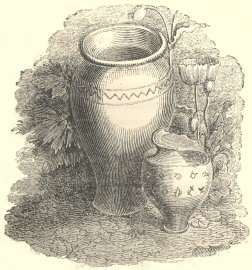
In the fields on the south side of the town, the ground
abounds with fragments of cinerary urns, and several perfect ones
have also there been discovered. From these circumstances,
together with the appearance of the soil, it seems certain that
in this part the Romans used to burn their dead on the funeral
pile. Of the urns found, only two are known to exist in the
neighbourhood; one being in the collection of the late Right
Honorable Sir Joseph Banks, at Revesby Abbey, the other in the
possession of Mr. Crowder, an inhabitant of the town.
It is much to be regretted for the advancement of researches
into local antiquities that the chief part of the urns, coins,
fibulæ, and other Roman vestiges discovered at Horncastle,
have been sold to strangers who have visited the town, or to
dealers elsewhere. The coins which have been found here are
numerous, and though chiefly of small brass and denarii
ærei of the lower empire, yet they include many extremely
fine and varied specimens of the earlier imperial coins, both of
a larger size and of other metals, several of which are in the
possession of different individuals of the town. Amongst
these may be particularized the silver coins of Vespasian, L.
Septimius Severus, Alexander Severus, and Volusianus; the large
brass of Trajan; and the middle brass of Caligula, Claudius,
Nero, Trajan, Hadrian, Domitian, Antoninus Pius, Faustina the
elder, Marcus Aurelius Antoninus, and Faustina the younger.
The small brass and denarii ærei form nearly a complete
series of the emperors from Gallienus to Valentinianus the
second, and include also within that period, coins of some of the
tyrants of Britain and Gaul. Beside these are some others
in the collection of the late Reverend Charles
L’Oste, now possessed by his son, but unfortunately no
memoranda exist by which they are to be distinguished from those
obtained at other places. This gentleman also had in his
collection several fibulæ and stiles which had been
discovered here.
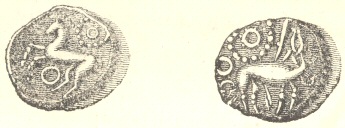
A British coin found at this place has on its concave side the
horse and symbolic circles; on the convex is the representation
of an animal apparently intended for a stag, with similar
ornaments around it, to those the other side possesses.
Many of the early English silver currency have been found here,
and also a specimen of the Scottish coinage of David the
second.
In deepening the bed of the river Bane, to complete the
navigation, in 1802, an ornamental brass spur, part of a brass
crucifix, and a dagger, were found together at a short distance
from the north bason of the navigation. The spur is now
lost; the part of the crucifix and the dagger are in the
possession of the author.
From the silence of the Domesday
Book respecting a church at this place, it may be concluded that
there was not one erected when that survey was made; there
however appears to have been one in the reign of Richard the
first. [26a]
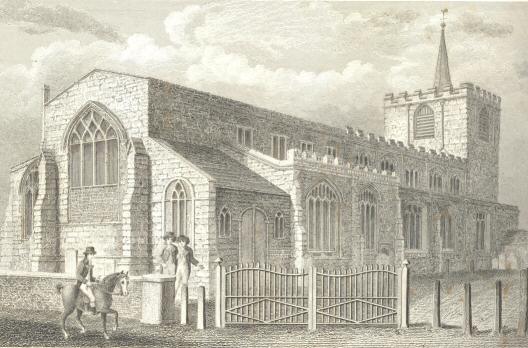
The present structure, which is dedicated to Saint Mary,
stands in the centre of the town, and possesses but few
attractions for the antiquary or the architect. It consists
of a square tower, a nave and chancel, with north and south
aisles. Being for the most part built with the soft and
imperfectly aggregated sand-stone of the neighbourhood, which
yields easily to the moisture of the atmosphere, it has suffered
much from the effects of time; and the decayed parts being
repaired with brick, gives to the building a motley and
unprepossessing appearance.
The few portions of the original architecture which have
escaped the silent ravages of years and the hands of the
innovator, bespeak the building of no higher antiquity than the
period of Henry the seventh. The aisle on the north side of
the chancel is ornamented with embattlements, on which
quatrefoils and blank shields are sculptured. It was
probably used as a chantry, one of the windows having formerly
contained an inscription justifying such a supposition. [26b] This aisle does not extend the
whole length of the chancel, and in the space so left, the
remains of an oratory and confessional are still visible; this
space formerly appropriated as a depository for coals to
distribute among the poor, is now occupied by a building to
contain the fire engines; a corresponding part of the south aisle
being used as a vestry. The aisle on the south side of the
chancel was rebuilt in 1820; but the original windows were
restored and again inserted. Part of the aisle on the south
of the nave was rebuilt in the following year.
The
interior of the church is remarkably neat and well pewed. A
gallery at the west end of the nave contains an organ which was
purchased by subscription in 1810. Galleries are also
erected in each aisle of the nave.
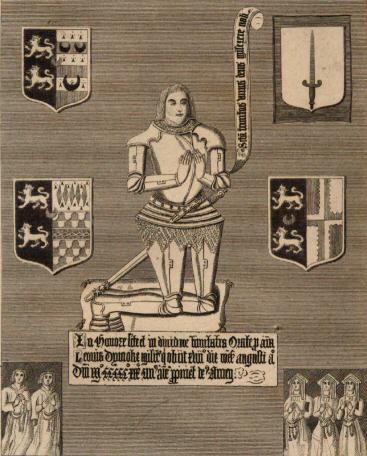
In the wall of the north aisle is a stone, containing the
figure in brass of Sir Lionel Dymoke, in armour, kneeling on a
cushion, and holding in his hand a label, on which is written, in
black letter,
“Sc’ta
trinitas unus deus miserere nob.”
On each side of him are two shields containing arms, at one of
the lower corners are the figures of his two sons, and at the
other those of his three daughters, and under him this
inscription in black letter:
“In honore sc’te et individue
trinitatis Orate p’ a’ia Leonis Dymoke milit’
q’ obijt xvij die me’se augusti aº D’ni
mº ccccc xix cuj’ a’ie p’piciet’
de’ Amen.”
The shields contain these arms:—1. Dymoke, sable, two lions passant argent in
pale, ducally crowned or; empaling Waterton, Barry of six ermine and gules,
three crescents sable; a crescent for difference. 2. Dymoke; empaling Marmyon, Vairè, on a fesse gules
frettè or; in chief, Hebden,
Ermine, five fusils in fess; a crescent for difference. 3.
Argent, a sword erect azure, hilt and pomel gules. [27a] 4. Dymoke; empaling Haydon, Quarterly gules and argent, a cross
engrailed counterchanged; a crescent for difference.
On the floor beneath this monument is a brass, on which is the
following inscription in black letter, nearly obliterated:
“Leonis fossa nunc haec Dymoke capit ossa
Miles erat Regis cui parce Deus prece matris
Es testis Christe quod non jacet hic lapis iste
Corpus ut ornetur sed spiritus ut memoretur
Hinc tu qui transis senex medius puer an sis
Pro me funde preces quia sic mihi fit venie spes.” [27b]
On the
floor of the vestry is a stone, with this inscription, in black
letter, around the verge:
“Here lyeth the Boyddes of Thomas Raithbeck
& Ame his wyf ye founders of the Beidhous Departed
thys world in ye fayth of Christ ye last
day of October in ye yere or lord mdlxxv.”
On the wall over the door of the vestry is a shield containing
three storks proper, on an azure field; the crest a stork; and
under the arms this inscription:
“Sacred to the Memory of the Rev. Mr. THO:
GIBSON, A.M. Forty four years Vicar of this Parish. He
liv’d in such times when Truth to the Church, and
Loyalty to the King, met with Punishment due only to the Worst of
Crimes. He was by the Rebellious Powers carried away
Prisoner, four times, from his congregation, once exchanged into
the Garrison of Newark, for a Dissenting Teacher: afterwards
Sequester’d, and his family driven out by the then Earl of
Manchester. He survived the Restoration, and was brought
back at the head of several hundreds of his Friends, and made a
Prebendary in the Cathedral Church of Lincoln. As his
Enemies never forgave his Zeal to the Church and Crown: so
nothing but the height of Christian Charity could forgive the
insults he met with from them. He Died April the 22d,
1678.”
Against the wall on the south side of the chancel is a lozenge
shaped piece of canvas, on which are painted these arms: Argent,
two bars sable, each charged with three mullets of six points or,
pierced gules; and under them the following inscription:
“Here lieth the worthy and memorable Kt. Sir
INGRAM HOPTON, who paid his debt to nature and duty to his King
and Country in the attempt of seizing the Arch-rebel in the
bloody skirmish near Winceby, October the 6th, A.D. 1643. [29]
“—nec tumultum
Nec mori per vim metuit, tenente
Cæsare terras.
“Paulum sepultæ distat inertiæ
Celata virtus.”
On a stone in the floor of the chancel is this inscription, in
capital letters:
“M. S.
THOMÆ LODINGTON, LL. D.
Qui Vicarii jure usus
Sacra apud Paganos de Horncastle
De More Ecclesiæ Anglicanæ
Annos perpetuos XLV peregit
Annorumque LXXIII Curriculo
Confecto Morti cessit
Mar. XXI A.D. MDCCXXIII.
Posuit Pientissima Conjux
Prudentia Lodington.”
Beside the sepulchral memorials already detailed, are a number
of others on the floor, and a few of recent date, on marble
tablets, against the walls.
At the
end of the north aisle of the chancel, is the following
table:
The BENEFACTORS to the CHURCH and POOR of this
Town, the Clauses of whose Wills may be seen at large in a Book
in the Town Chest. Note these Tables were erected 1724.
William
Everitt and Joseph Brown
Churchwardens.
Anno 1611, October. Mr. Robert Clark of Woodhall gave to
the Poor of this town . . . Shillings a year, to be paid to
vicar on St Thomas’s, and by him to be distributed every
Christmas-day for ever, out of his lands in Thimbleby, now
belonging to John Hutchinson, Gent.
Mrs Ann Smith gave to the poor of Horncastle twenty shillings
a year out of her lands there, now in the possession of Mr.
Thomas Coats: it is given in brown bread every Good Friday.
George Acham of Asterby, Gent. gave also one hundred and forty
pounds, to purchase lands, the rents thereof to be disposed off
yearly to the poor of Horncastle, at the discretion of the
governors of the free-school (for the time being,) which lands
are in the parish of Burgh in the Marsh.
Anno 1629 May the 2d. Mr. William Hurtscroft gave one
house the yearly rent of fifty-two shillings; to be given weekly
(viz.) twelve pence in bread every Lord’s day to poor
fatherless and motherless children in Horncastle, by the
Overseers for the poor; the said house now in the possession of
widow Scamon.
The same year. Andrew Kent, gent. gave six pounds
thirteen shillings and fourpence, to be a stock for the poor of
Horncastle, which is applied accordingly in coals for their
use.
Anno 1661, June the 6th. Thomas Bromley of Conesby gent,
left to the poor of this town forty shillings per annum (viz.)
twenty shillings every good Friday, and twenty every St.
Thomas’s day, to be paid out of his lands in Haltham super
Bane; now the said lands belong to Thomas Hammerton gent.
Rutland Snowden, gent. gave to the poor of Horncastle one
house of the yearly rent of twenty-six shillings; but being
decayed is now reduced to thirteen, paid in bread sixpence every
other Sunday: the said house belongs now to Mr. William
Dawson.
Anno 1673, December the 5th. Thomas James, gent. gave to
the poor of Horncastle twenty shillings yearly in white bread on
every Christmas day for ever payable out of his lands there,
which lands are now the estate of Thomas Howgrave, Esquire.
Anno 1702, December the 20th. Captain John Francis gave
two chaldern of coals yearly to be given to the poor, appointed
by the governors of the school, out of lands in this town now the
Rev. Mr. John Francis’s of Sibsey.
Anno 1703, December the 14th. Mrs Douglass Tyrwhitt of
Gaiton on the would gave ten shillings yearly to the poor of
Horncastle on St. Thomas’s day, out of her lands in
Belshford, now the lands of Joseph Sutton of the same.
Anno 1696, May the 26th. Nicholas Shipley, gent. gave to
this church one brass candlestick of twenty-four sockets, and
Fox’s three books of martyrs. He gave also to the
poor five pounds, which was immediately given amongst them, and
thirty shillings yearly for ever, (viz.) twenty on St.
Thomas’s day, and ten every good Friday, in brown bread, to
be paid out of his lands adjoining to this church yard, now
purchased by Mr. Thomas Hammerton. He gave also to the
governors of the school one hundred pounds the interest thereof
to put out poor boys apprentices to trades; but their then
treasurer dying insolvent, that money was lost. We mention
this here because this misfortune doth not lessen the charity of
that well disposed gentleman.
Anno 1719. Mrs. Mary Hussey, widdow, gave one silver
plate to the communion table for ever.
Anno 1721. Mrs. Dorothy Parker of Boston, gave to this
church one brass candlestick of sixteen sockits, and to the poor
widdows and widdowers of this town she gave sixty pounds, the
interest or rents thereof to be given amongst them on St.
John’s day, in Christmas, and St. James’s in July,
yearly for ever.
Anno 1724. Mrs Mary Waters, widdow, gave to the
overseers of the poor, five pounds, to be by them put out at
interest, and the said interest to be given to the poor yearly on
Christmas day for ever.
Against the wall over the north entrance are several scythes
and hay knives, some of which are yet remaining in the shafts to
which they have been affixed, in order to render them instruments
of warfare. The occasion for which they were so prepared is
unknown, the traditionary accounts of them being both vague and
contradictory.
In the steeple are six bells, bearing the following
inscriptions in capital letters:
1. Lectum fuge discute somnum.
G. S. I. W. H. Penn Fusor 1717.
2. In templo venerare Deum. Hen.
Penn nos fudit Cornucastri.
3. Supplicem Deusi audit. Daniel
Hedderly cast me 1727.
4. Tho. Osborn fecit Downham Norfolk
1801. Tho. Bryan and D. Brown Churchwardens.
5. Dum spiras spera. H. Penn
Fusor 1717. Tho. et Sam. Hamerton Æditivi.
6. Exeate busto auspice Christo.
Tho Lodington LL.D. Vic. H. P. 1717.
The fourth bell previous to being recast bore this
inscription:
Fac et spe. Henri
Penn Fusor Peterburgensis.
The benefice is a vicarage, in the presentation of the Bishop
of Carlisle, valued in the King’s books at £14.
4s. 2d.
The registers commence in the year 1559. In them are
contained the following singular entries:
“On the vth daie of October one thousand six
hundrete & three, in the first yere of our Souvraine Lord
King James was holden in Horncastle Church a solemnn fast from
eight in the morning until foure a clock in the afternoone by
five preachers vidz. Mr Hollinhedge vicar of Horncastle, Mr
Turner of Edlington, Mr Downes of Lusbye, Mr Phillipe of
Salmonbye, Mr Tanzey of Hagworthingha’, occasioned by a
general and most feareful plague yt yeare in sundrie places of
this Land, but especially upon the Cytie of London.
Pr. me Clementem
Whitelock.”
“Thomas Gibson Clerk Master of the Free Schoole of
Newcastle uppon Tine one of the Chapleines of the Right Reverend
Father in God Barnabas by Divine P’vidence Lo. Bpp. of
Carliol, presented by the said Lo. Bpp. was inducted into the
Vicarage of Horncastle, April the xiiij 1643.”
“The said Mr. Thomas Gibson being outed of Horncastle by
Cromwell Commissiner removed to Nether Toynton, lived ther one
yeare. After returne again taught some gentlemen sonnes in
his owne house, was afterwards called to ye schoole at Newark
where he continued one yeare, then was importuned to Sleeford
whether he went the week after Easter 1650, continued there until
May ye first 1661 then the King being restored he returned to his
vicaridge and was by Doctor Robet Sandeson Bishop of Linkcoln
made Preban of Sant Marie Crake Poule in the Church of
Linkcoln,”
“Septr. 28, 1662.
“Memorandum the Day and yeere above written that the
Booke of Common Prayer lately set forth by the Authority of the
King’s Majestie and his court was read in the Parish Church
of Horncastle by me Thomas Gibson Vicar there, and freely and
willingly assented unto according to an act of Parliament in that
case made and provided. In witness whereof the said Mr.
Gibson with other of the inhabitants whose names are hereunto
subscribed have sette their hands.
Tho:
Gibson, Vicar.
John Harding, Parrish Clerk”

The Grammar School is situated at
the south-east corner of the church yard, and is a spacious and
well-constructed edifice of brick. It was founded and
endowed by Edward Lord Clinton and Saye, the Lord High Admiral of
England, under the authority of letters patent, dated the 25th of
June, 1652. By these letters it was ordained, that this
institution should be denominated “The Free Grammar School
of Queen Elizabeth, in the Town or Soke of Horncastle, of the
foundation of Edward Lord Clinton and Saye,” for the
education, training, and instruction of boys and youths in
grammar, and to be appropriated to this object for ever.
The school was to be conducted by a master, and a sub-master,
or usher: ten governors were also appointed and incorporated,
with perpetual succession, and a common seal. These
governors were empowered on the death of any of their body, to
elect others in their places; also to nominate the master and
usher on any vacancy; and to make such statutes concerning the
preservation and disposal of the revenues, as circumstances at
any time might dictate. Besides holding the endowments,
they were authorized to purchase and receive lands and other
possessions, not exceeding £40. per annum.
The estates by which the establishment is maintained, consist
of houses and land situated at Horncastle, Hemingby, Sutton,
Huttoft, and Winthorpe. The lands in the last three named
parishes being subject to inundations from the sea, the annual
revenue is rendered precarious; but in the more favorable years
it amounts to about £200.
The salaries for a long time were £40. per annum to the
master, and £30. to the sub-master or usher: but on the
appointment of the present master, in 1818, the salary was
advanced to £80. per annum, to which was also added a house
for his residence; the salary of the sub-master remaining as
heretofore, at £30. The sum of £2. 2s.
per annum is charged for those scholars who are instructed in
writing and arithmetic. There are at this period about
twenty boys on the foundation.
The governors of this School have also the management of
another school in the town, for the instruction of poor children
in reading, sewing, and knitting. A house, with a salary to
the teacher of £17. per annum, charged upon certain estates
in Horncastle, having been bequeathed to them in trust, for that
purpose, by Mr. Richard Watson, a native of this place, who died
in 1784.
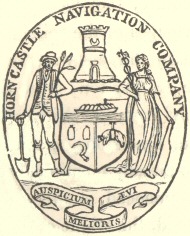
The river Bane, rising at the
village of Ludford, takes its course in a direction nearly south
to join its waters with those of the Witham. After
meandering through an extent of country about fourteen miles, it
receives at Horncastle, the tributary stream of the Waring, and
abundantly supplies the town, conveniently situated at the
confluence of the two rivers. From hence continuing a
gently winding course, it washes Tattershall and its moorlands,
before it falls into the larger river to increase its waters to
the sea.
In the year 1792, an act of parliament was obtained for making
the Bane navigable from the river Witham, through Tattershall to
Horncastle. [35] The act, after reciting the names
of the original subscribers, incorporates them by the name of
“The Company of Proprietors of the Horncastle Navigation in
the County of Lincoln,” giving them perpetual succession
and a common seal, and empowering them to raise £15,000. in
three hundred shares of £50. each. The interest of
these was not to exceed £8. per cent. No person was
to be the possessor of less than one share, nor to hold more than
twenty. As circumstances might require, they were
authorized to raise £1,000. more, by shares or mortgages of
the tolls.
The tollage allowed by this act was, for goods passing the
whole length of the navigation, 2s. per ton; from the
Witham to the seventh lock, 1s. 9d. per ton; and
from the Witham to the fourth lock, 1s. 3d. per
ton; excepting lime, lime-stone, manure, or materials for roads,
for which, only half the already mentioned tolls were to be
taken.
The works were commenced in the year 1793; but, when about two
thirds were completed, the whole of the funds to be appropriated
to their execution were already expended. After suffering
the canal to remain several years in this unfinished state, the
company applied again to Parliament, and in the year 1800 another
act was obtained, enabling them to raise £20,000. more by
subscription amongst themselves, by admission of new subscribers
in shares of £50. each, by mortgage, or by granting
annuities. The limitation of shares and interest were
repealed by this act; and the tonnage rates advanced to
3s. 3d. per ton for the whole length of the
navigation, 2s. 7d. to the seventh lock, and
1s. 8d. to the fourth; lime, lime-stone, manure,
and materials for roads excepted as before from the payment of
full rates.
Shortly after the works were recommenced, the plan of
completing them by an entirely new canal was adopted in
preference to that which they had before pursued of rendering the
Bane navigable. It was therefore at the village of Dalderby
diverted from the course of the natural stream, and carried on in
a less varied track to the point of junction between the waters
of the Bane and Waring: from hence it was continued in the
divergent courses of these two rivers, to the more extreme parts
of the town of Horncastle. It was completed in September,
1802, and on Friday the seventeenth of that month the vessels
entered the town. The canal is sufficiently deep to
navigate vessels of fifty tons burthen.
From this town to the river Witham the distance is about
eleven miles, in which the stream has a fall of eighty-four
feet.
Although this place was favored at
an early period with a charter for a market, which in the time of
Henry the eighth appears to have been well frequented, yet it
remained for many years little more than a considerable village.
[37] From the earliest accounts it
seems to have been gradually encreasing; but it was not until
later years, when a new impulse was given to the agricultural
interests of the country, that it began to exhibit material
evidences of extention and improvement.
From a plan of the town drawn by Dr. Stukeley, in the year
1722, it appears at that period of time, now the lapse of a
century, to have been little more than half its present
extent. This plan, not having been made from actual survey,
cannot be considered as an accurate representation: nevertheless
it is calculated to give a tolerable idea of the state of the
town at the time it was executed. It is traditionally
asserted that at that period scarcely a brick house was to be
found in the parish; the early erected dwellings being all
constructed with clay walls and covered with thatch; thus
evidencing that common character which Leland the antiquary
assigns to the towns of this part. The clay buildings have
for the most part disappeared, and brick structures are now
erected in their stead; and from the spirit of improvement which
has lately been evinced, they will doubtless in a few years be
entirely removed. The rebuilding of many houses in the
principal streets in a handsome manner, within the last twenty
years, has given to the town an air of respectability; but the
effect which would be produced by these buildings in its general
appearance, is materially diminished by the narrowness and
irregularity of the streets. At this time the number of
houses may be computed at about seven hundred, and of
inhabitants, about three thousand five hundred.
The entrances to the town, as well as its general aspect, have
also been improved by the inclosure of the fields by which it is
surrounded. To accomplish this an act of parliament was
obtained in 1803, and carried into effect the following year.
In no respect has the town changed more than in its trade; a
large proportion of its inhabitants having formerly been employed
in the tanning of leather, in which manufacture the yards on the
south side of the Far-street were almost exclusively
occupied. About fifty years ago the number of these
establishments began rapidly to decline, and are at this time
reduced to two. Since the completion of the canal in 1801,
a considerable trade in corn and wool has been carried on here;
about thirty thousand quarters of the former, and three thousand
sheets of the latter being annually sent from this place.
The town also from its situation in a well inhabited district
enjoys a large retail trade.
There are now three fairs for horses, cattle and sheep, held
here annually. The first, which concludes on the
twenty-second of June, has of late years declined very much, and
though chartered for eight days seldom continues more than
three. The second, which terminates on the twenty-first of
August, has long been celebrated as the largest fair for horses
in the kingdom, perhaps it may be said in the world; it continues
about ten days, being three days more than the time expressed in
the charter. To this fair are brought for sale horses of
all descriptions from every part of the kingdom, to the number of
many thousands; and beside the most extensive dealers of this
country, there are to be found in the fair purchasers and dealers
from different parts of the continent of Europe, and even from
America. The third fair, which is held on the twenty-eighth
and twenty-ninth days of October, was removed to this place in
1768, from Market-Stainton, a decayed market town, about eight
miles distant, two hundred pounds being given to the lord of the
manor of that place, to permit the removal, one half of this sum
was raised by subscription amongst the inhabitants of this town,
the other by William Banks, Esquire, the then lessee of the
manor. The market is now held every Saturday, to which it
was changed from Wednesday, the day mentioned in the charter,
probably in consequence of the markets at Boston and Louth being
also on that day; but the time at which the alteration took place
cannot now be ascertained.
On the south side of the church-yard is a building
appropriated for the purposes of a Dispensary, which is supported
by public subscription. Those to whom medical aid is
administered are such of the sick poor, in the town and
neighbourhood of Horncastle, as are recommended by subscribers;
and the many to whom assistance has been afforded, evince its
utility in a striking degree. The Dispensary is attended
every Tuesday and Saturday morning by a physician, whose service
is gratuitous, and by an apothecary who receives a salary.
These gentlemen visit such patients as are unable to attend at
the Dispensary. A female accoucheur also belongs to the
establishment. The number of patients admitted from the
commencement of the institution in September 1789, to September
1821, was 9389.
In the year 1790 a Literary Society was established in this
town, and which since its commencement has occupied a room at the
Dispensary as a library. The property of this society is
permanent and unalienable; excepting that books considered
unworthy of being preserved are disposed of at the next
anniversary but one after their purchase. The library
contains about eleven hundred volumes, and is open to the members
two days in the week. For several years the subscription
was only ten shillings and sixpence per annum; it was afterwards
advanced to fourteen shillings, and subsequently to one
pound. Subscribers are now also required to pay one pound
on their admission. The society at present consists of
about forty members.
In the year 1807 the inhabitants of this town in conjunction
with several other towns and villages, in the county of Lincoln,
made application to parliament, and obtained an act for the
recovery of debts not exceeding the sum of five pounds. The
commissioners hold their courts at this place every fourth
Thursday.
The education of the poor which has lately excited so much
attention in various parts of the kingdom, has not been neglected
here. A school on the Lancasterian or British system was
established at a public meeting held in October, 1813; and but a
few days subsequently a meeting was held at the church, when it
was resolved to establish also a school on the plan of Dr.
Bell. Early in the ensuing year, buildings were erected, and
each system began to be acted upon. Both schools are
supported by voluntary contributions, and each contains about two
hundred children.
Beside the established church, there are in this town a
society of Wesleyan Methodists; a small congregation of
Calvinistic Baptists; a society of Primitive Methodists, or
ranters; and a congregation of Independents.


