Edited by Lyman P. Powell. With Introduction
by George P. Morris. Fully illustrated.
Large 8o, $3.50.
Historic Towns of the Middle States
Edited by Lyman P. Powell. With Introduction
by Albert Shaw. Fully illustrated.
Large 8o, $3.50.
Historic Towns of the Southern States
Edited by Lyman P. Powell. With Introduction
by W. P. Trent. Fully illustrated.
Large 8o, $3.50.
G. P. PUTNAM’S SONS, New York and London
HISTORIC TOWNS OF THE SOUTHERN STATES
American Historic Towns
Edited by
LYMAN P. POWELL
Illustrated
G. P. PUTNAM’S SONS
NEW YORK & LONDON
The Knickerbocker Press
1900
Copyright, 1900
by
G. P. PUTNAM’S SONS
The Knickerbocker Press, New York
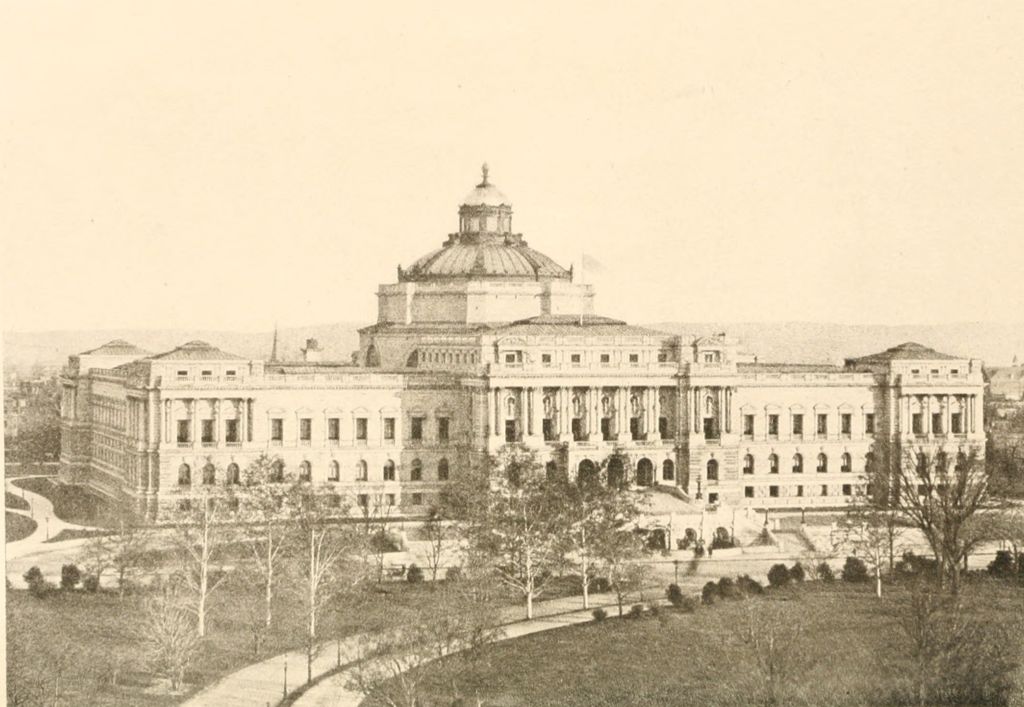
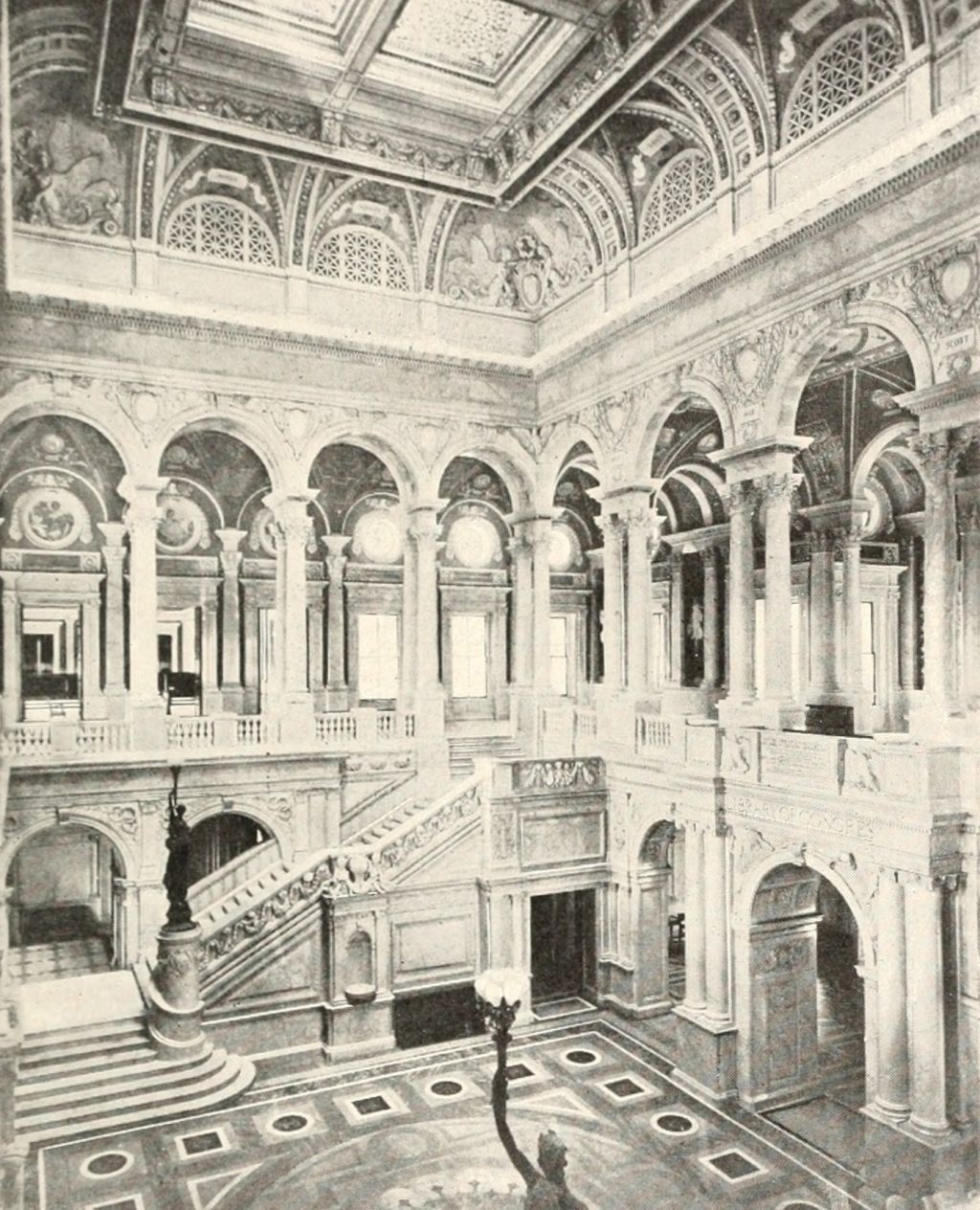
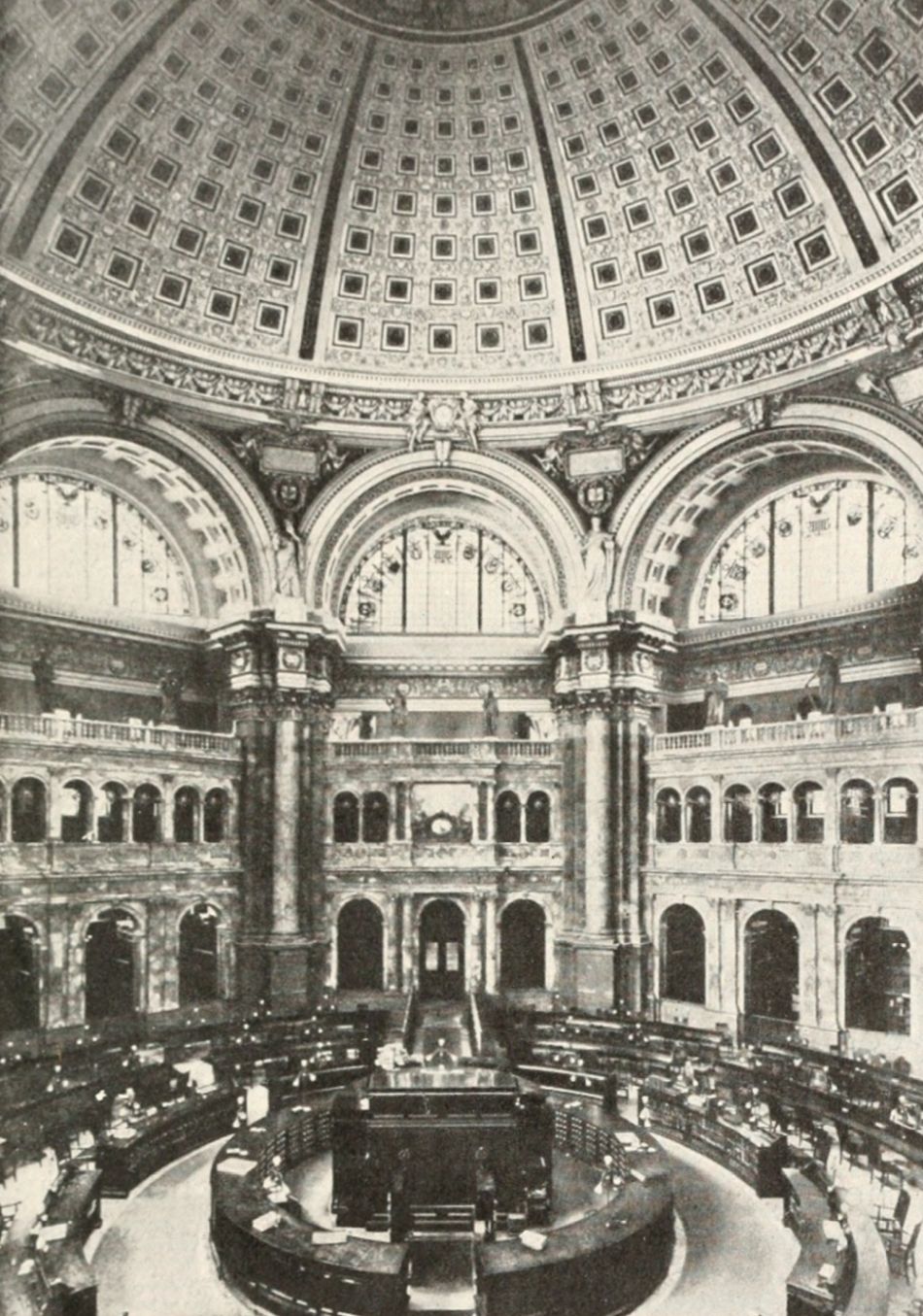
The Library of Congress, Washington, D. C.
PREFACE
The triad of volumes dealing with the older
American Historic Towns along or near
the eastern coast is now complete. The three
volumes, like the chapters of which they are
composed, have their inevitable limitations.
While neither in historical value nor in literary
quality has it proved practicable to secure a
uniformity of standard, editor and contributors
have done the best they could, and they now
feel assured that the series has proved its
right to exist. It is quickening interest in our
historic towns, bringing to light important
facts, picturing for the patriotic reader who
may not be free to make personal visits the
places he would visit if he could, and making
clear to him many things he would not be
likely to learn in the towns themselves, however
long a stay he might be free to make.
Like the preceding issues, this volume has
a patriotic and educational purpose, but it goes
forth also on an irenic mission. The editor’s
father, dead almost a quarter of a century, lived
in a little border town where in war times love
and hate alike were hot. An avowed and
fearless Unionist, he was also a true and faithful
pacificator. As Mr. Rule has said of Louisville,
James B. R. Powell “occupied a position
similar to that of Tennyson’s sweet little heroine,
Annie, who, sitting between Enoch and
Philip, with a hand of each in her own, would
weep,
“‘And pray them not to quarrel for her sake.’”
In planning and in shaping this volume, the
editor hopes that he is proving himself worthy
of an honored father, whose name he would
connect in this way with the work and with the
series.
His special acknowledgments are due to
his wife, Gertrude Wilson Powell, for discriminating
and invaluable assistance at every stage,
and to Professor W. P. Trent, who, in addition
to the preparation of a comprehensive Introduction,
has ever been ready with such counsel
and suggestions as enhance in many ways the
value of the volume.
Lyman P. Powell.
St. John’s Rectory,
Lansdowne, Pennsylvania.
August 10, 1900.
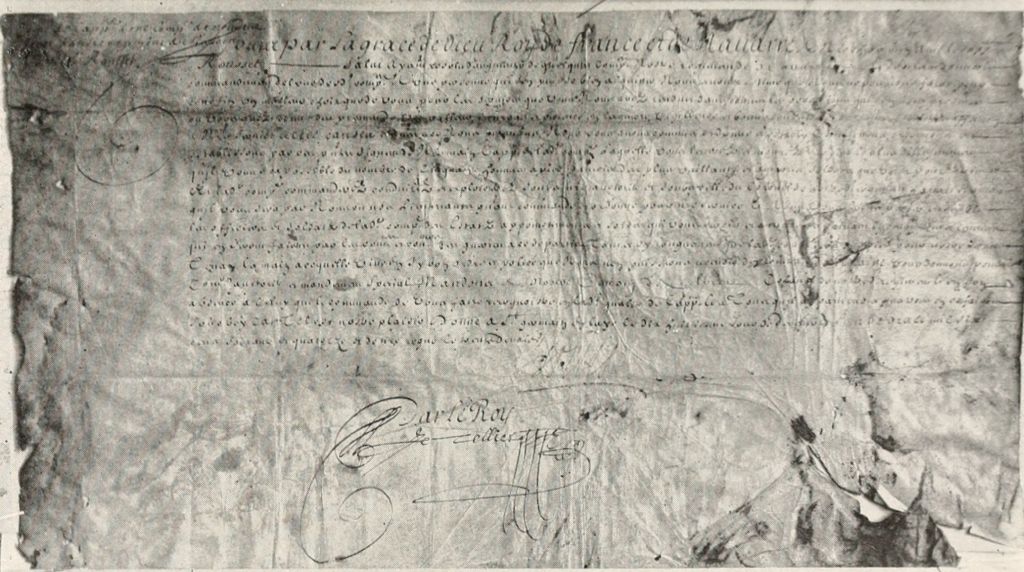
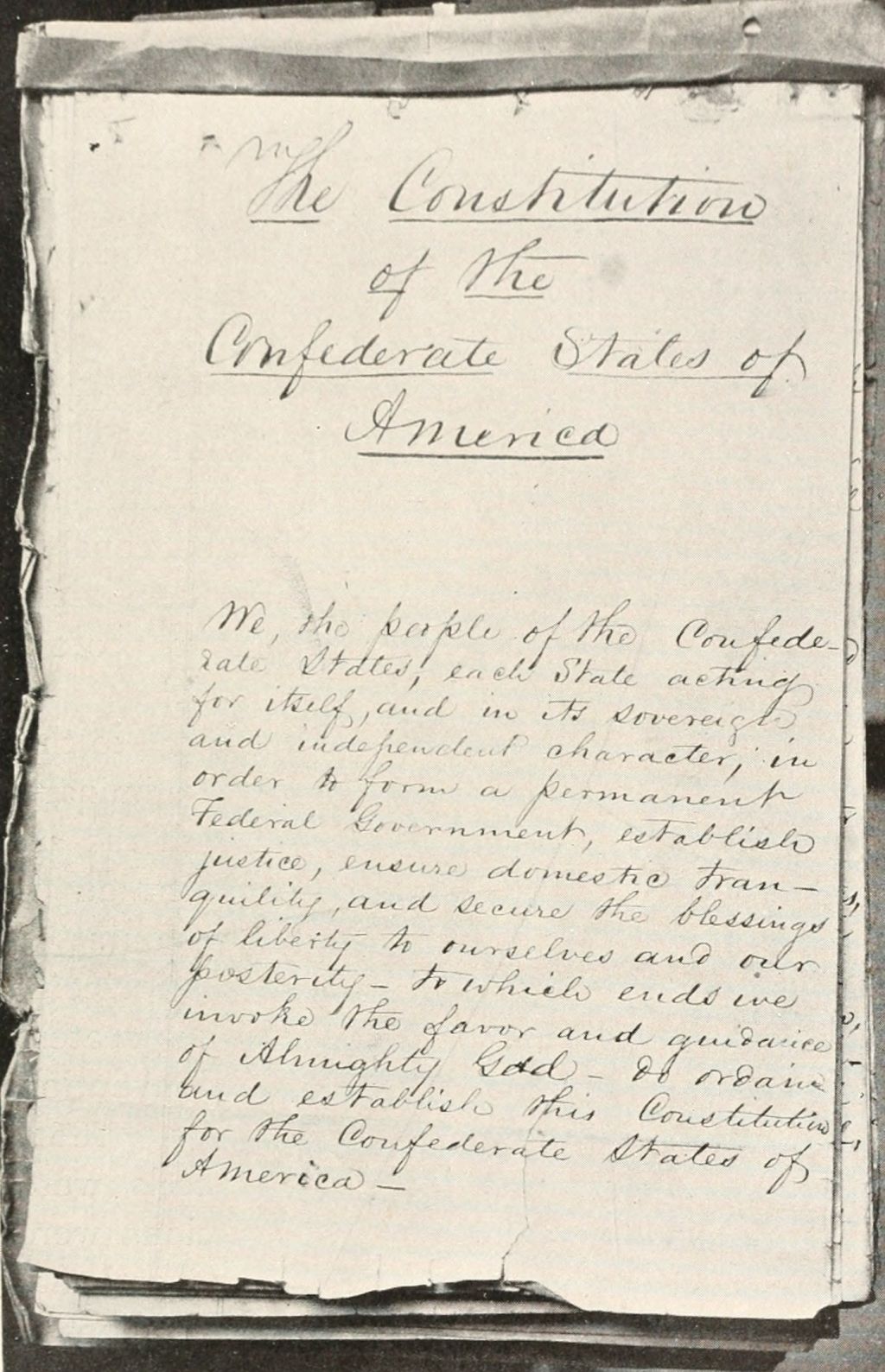
This is in the handwriting of Gen. Thos. R. R. Cobb, who was a member of the committee. Taken from the original, which is in the possession of Mr. A. L. Hull, Athens, Ga.
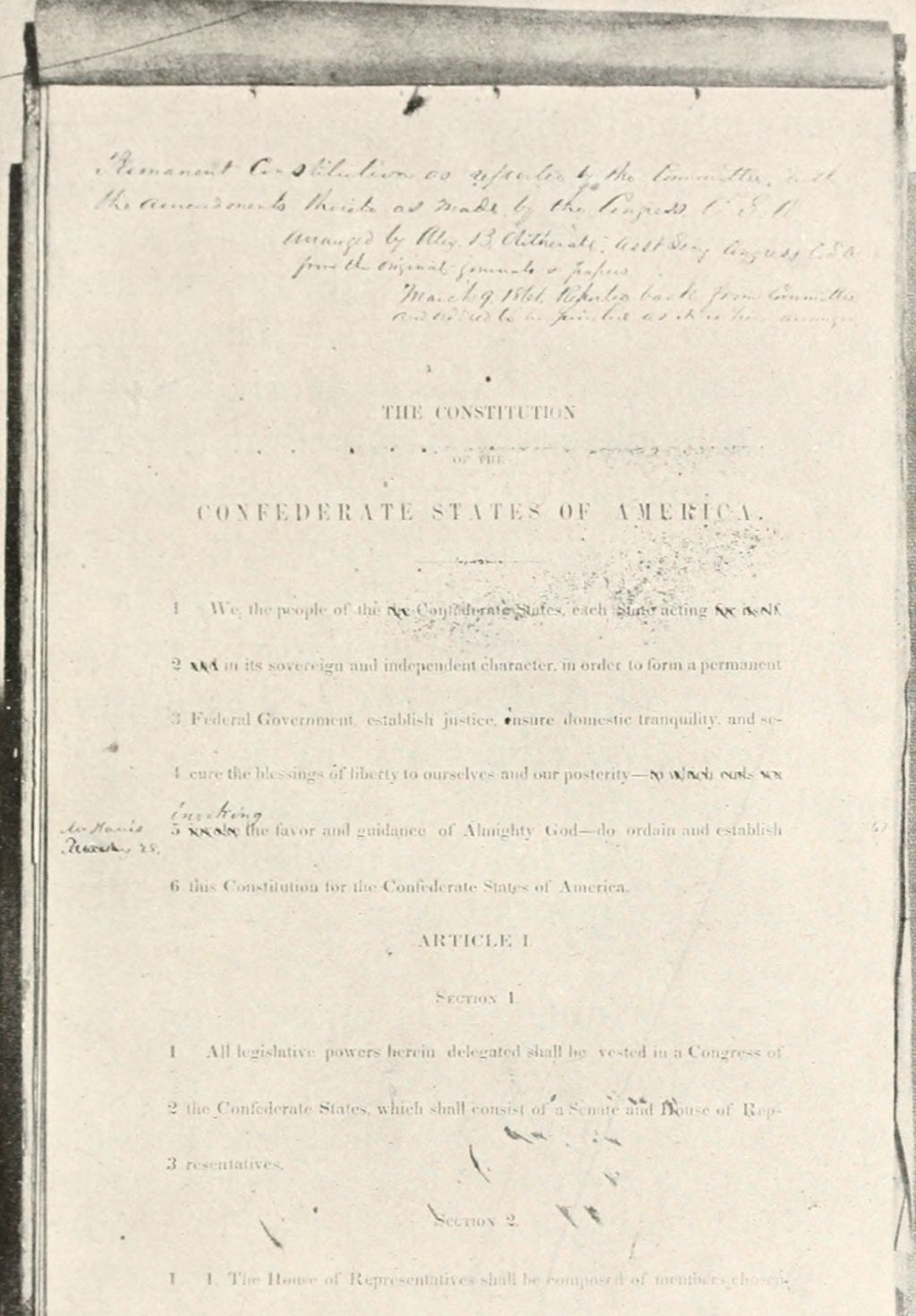
The Permanent Constitution of the Confederate States
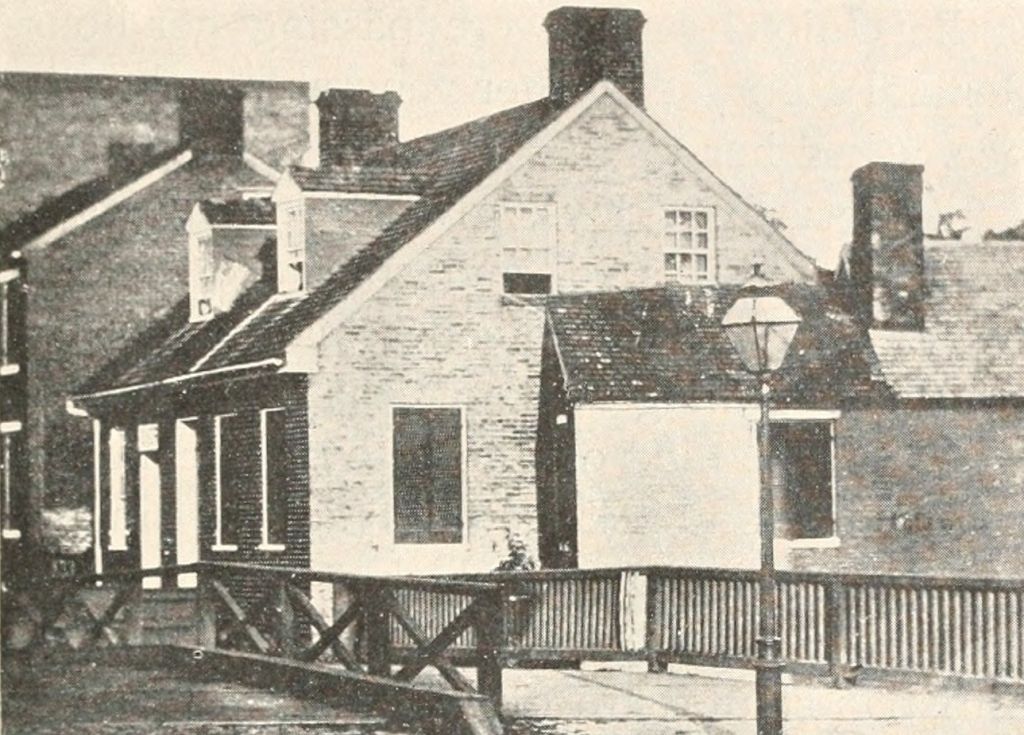
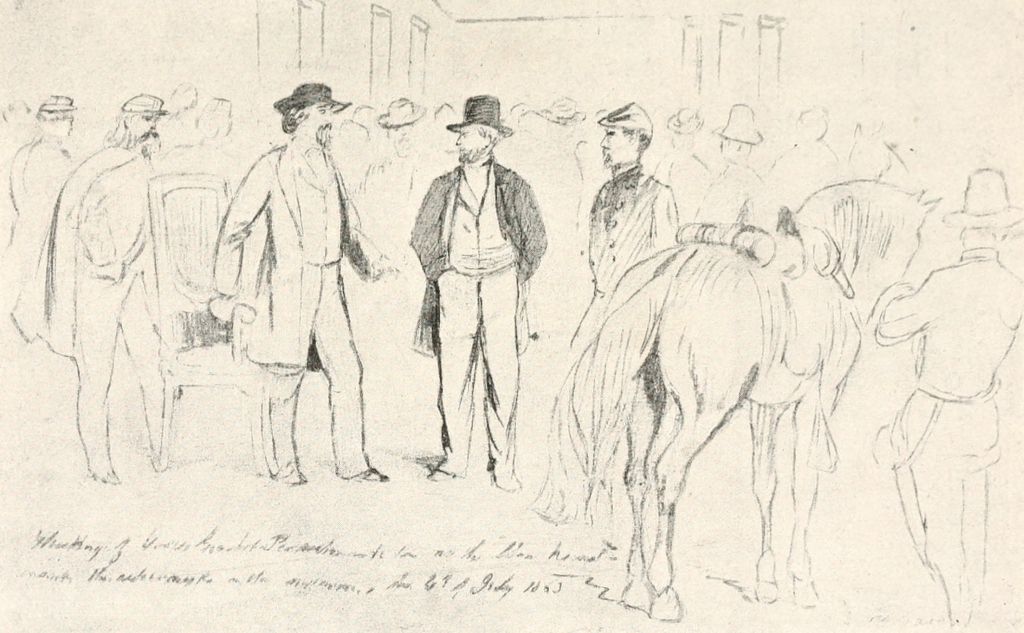
(From an actual sketch made on the spot by one of the special artists of Frank Leslie’s Illustrated Newspaper, now in the collection of Major George Haven Putnam.)
Probably the first feeling of the reader
who glances over the table of contents of
this volume will be one of surprise at the number
of Southern towns of historical importance
that the editor has seen fit and been able to
include. Neither from our study of American
history nor from our study of geography have
we been led to look upon the Southern States
as a region characterized by urban development.
Those of us who took the pains to
examine the statistics of the census of 1890
remember that the South stood far behind the
other sections in this respect. We remember,
too, to have seen in our histories the thickly
settled New England township contrasted with
the large, sparsely settled Southern county.
In literature the South has figured as a region
of plantations and manor houses inhabited by
cavaliers and chatelaines and old family slaves,
possessors of all the feudal virtues, or else as
the home of a curious race, presumably Caucasian,
known as “crackers,” and of equally
curious mountaineers known as “moonshiners.”
An exception is made, of course, in favor of
New Orleans, the home of the Creole and the
carnival; of Charleston, the home of secession;
of Richmond, the home of the Confederate
government; and of St. Augustine, the home
of hotels; but on the whole it is probable that
the average American of other sections, unless
he be a drummer or a valetudinarian tourist,
rarely thinks of the South from the point of
view of its towns, historic or unhistoric.
For this state of affairs no one is to blame.
The great growth of municipalities in the
North, East and West—the colossal development
of New York, Chicago and Philadelphia,
of Boston and Baltimore and a dozen other
great cities—has naturally cast in the shade
the urban status of a section that contains no
city of three hundred thousand inhabitants. It
is true that much is heard of the New South
with its commercial future; but probably the
pushing Atlanta is almost the only Southern
city that has in the last few decades impressed
itself to any marked degree upon the nation’s
consciousness.
Nor is it surprising that it is only since the
Civil War that the urban development of the
South has begun to be of importance even to
close students of the past and present of the
section. From the time of the earliest settlements
to the present day agriculture has been
the dominant industry. Virginia tobacco, Carolina
indigo and rice, far Southern and Southwestern
cotton—these staples have meant
more to the South than manufacturing or commerce.
She developed seaports, which gradually
lost their relative standing among the
ports of the country and administrative and
distributing centers; but there was no crowding
of operatives into manufacturing towns, no
haste on the part of country-bred youths to
leave their native fields for the shops and warehouses
and offices of the city. The gentleman’s
son looked forward in most cases to
being a planter; the small farmer’s son grew up
in an environment that did not stimulate ambition.
Cotton was king, and his court was
bound to be a rural one.
It is not to be supposed, however, that
during the period from 1820 to 1860, which
witnessed the amazing growth of manufacturing
and commercial centers in the North and East
and the still more wonderful rural and urban
development of the West, the South was entirely
content with the spread of her cotton-fields
and oblivious to the stagnation or the
slow growth of her towns. Her country-gentleman
class was doubtless content with this
state of affairs, and her politicians actually
boasted of it, being put on the defensive in
all respects on account of the attacks made
upon slavery; but the leading inhabitants of
the towns regretted the backwardness of their
section and devised various schemes for remedying
it, while the merchant class openly complained
of the fact that young men were taught
to look down upon every pursuit other than
planting. This is but to say that the people
of the South were not so different at bottom
from their hopeful, energetic fellow citizens of
other sections as has sometimes been imagined.
They were Americans tied down to one occupation
and rendered unprogressive by the hampering
influences of a belated institution.
This fact does not appear on the surface; indeed
it becomes apparent only to the careful student
of sources of which the Southern historian
has not yet made full use. These sources
are the local newspapers and the fairly numerous
magazines—particularly the financial and
commercial De Bow’s Review published at New
Orleans. The Southern historian, like his
brothers of the North and East until recently,
has laid disproportionate stress upon the colonial
history of his section or else upon its political
history, and thus has failed to bring out
the interesting struggle between the old and
the new economic orders of things that took
place in the South down to the time of the
Civil War. Hence it is that in the present
volume we find in many chapters the gap between
the surrender at Yorktown and the firing
upon Sumter covered by only a few paragraphs.
Some of the towns had a most interesting
history during these years,—as we
may judge from Dr. Petrie’s chapter on Montgomery,—but
it has not yet been written.
When it is, we shall get abundant evidence
of a heroic if, on the whole, unsuccessful struggle
for urban development. Charleston in
particular made a most gallant fight to recover
the importance as a port which she had lost
through the rivalry of Baltimore and New
Orleans. Her leading citizens, some of whom
labored for the cause of public education and
of literary and scientific development with an
earnestness that should not be forgotten in
spite of the paucity of results, saw clearly that
something must be done to enhance the city’s
wealth and growth if the State herself, or, indeed,
the section, was to maintain an important
place in the union of rapidly developing commonwealths.
They saw, furthermore, what
this something must be. The cotton of the
South and the agricultural and other products
of the great West must be drawn away from
Northern ports to ships lying in the harbor of
Charleston. The distance to be traversed and
the mountain barriers made all thought of a
canal similar to the one that had brought fortune
to New York out of the question, and the hopes
of enterprising citizens centered on the newly
invented railway. As early as 1831 the first
steam locomotive used successfully on rails in
this country was put on its tracks at Charleston
by the South Carolina Railroad Company,
and, as Mr. Snowden tells us in his chapter, the
longest railway in the world was at one time
contained within the borders of what is not
familiarly known as a progressive State. It
was but a short time before ambitious plans
were set on foot to connect Charleston with
Cincinnati and the West.
The full story of these plans—of the faithful
labor expended upon them, and of their
ultimate failure, through no fault of the unselfish
promoters—belongs to another place; but
a few words upon the subject may be pardoned
here on account of the light that will be thrown
upon the difficulties encountered by every
ante-bellum Southern city in its efforts at progress.
The first steps taken by the friends
of the Louisville, Cincinnati and Charleston
Railroad Company were comparatively easy.
Charters were obtained from several States,
enthusiastic conventions of promoters were
held, engineers were put into the field to decide
between competing routes, and popular
subscriptions to the stock were opened in most
of the towns and villages. By November,
1836, South Carolina alone had subscribed for
nearly $2,775,000 of the $4,000,000 needed to
start the enterprise. Within a few days this
latter amount was made up, and everything
looked bright. But Governor McDuffie in his
annual message pointed out unforeseen obstacles.
Kentucky had subscribed only $200,000,
and yet claimed six directors out of twenty-four;
Ohio had subscribed almost nothing. Why
should South Carolina cover Kentucky with
railroads? Why, again, should the promoters
of the enterprise wish for banking privileges
when the whole country was crowded
with banks already? He urged the legislature
to withhold the desired subscription of
$1,000,000 until the success of the road was
more fully assured. His advice was not followed,
but we may learn two important facts
from his remarks: first, that the South suffered
from the crude financial methods and the
fever for speculation that afflicted the rest of
the country. Second, that State jealousy was
a rock upon which any great Southern scheme
was liable to split. The theory of States-rights
united the Southern commonwealths politically
against the other sections, but in internal matters
it was a disintegrating agent of great potency.
The promoters of the road were not discouraged,
however, by Governor McDuffie’s
pessimism. They organized their bank, purchased
the road which already connected
Charleston and Augusta, known as “The
Charleston and Hamburg,” began a branch to
connect the State capital, Columbia, with this
road, and commenced to realize on the popular
subscriptions to the stock. But they had not
counted on the panic of 1837 and the continuing
financial depression, in the midst of which
their bank was forced to suspend, nor had they
expected to lose by death their efficient president,
Robert Y. Hayne, Webster’s famous
opponent. The great interstate scheme soon
shrank to state proportions; and by 1842 people
were congratulating themselves that they
had at least a gratifying extent of railway mileage
within the borders of South Carolina itself.
This seems a small return for a large outlay of
energy, yet after a careful study of the complicated
history of the road it can scarcely be said
that General Hayne and his associates made
as bad a compromise with their magnificent
dreams as the majority of our more recent railway
promoters have done. Certainly the way
in which the public responded to their efforts
spoke well for the energy and the civic intelligence
of a people of planters. The effects of
the panic and of Western indifference could
hardly have been foreseen; the banking attachment
was natural enough in an era of wild
banking to which the lessons of experience
were wanting; and, finally, the method of
securing capital by instalments of subscription,
crude as it may seem, was almost the only
available one among a people whose capital
was in the main locked up in land and negroes.
We are warranted, therefore, in concluding,
from these early efforts to connect Charleston
with the West, and from later railroad enterprises
of other Southern cities that cannot be
treated here, that the failure of the ante-bellum
South to show a marked urban development
was due not to the backwardness and inertia
of its influential citizens, but rather to unfavorable
economic conditions that could not be
speedily overcome.
The student of Southern history will reach
this conclusion by following other lines of investigation.
It is a well-known fact that in the decade
before the Civil War annual commercial
conventions were held in the leading Southern
cities. These conventions tended also to become
political in character and furnished an
opportunity for the exploitation of some rather
extreme propositions, such, for example, as that
looking to the reopening of the foreign slave-trade.
They serve to illustrate the important
part played by the ante-bellum towns in developing
and intensifying the movement toward
secession; but it is more to the point here to
observe that they were preceded by a series of
conventions more strictly commercial in character—gatherings
that did all they could to stir
up the people of the South to the need of urban
development and to open their eyes to the fact
that their section was yearly falling behind in
wealth and political power.[1]
This first series seems to have begun with a
gathering in Augusta, Georgia, in October,
1837, the object of the meeting being to allow
merchants the opportunity to discuss projects
for developing a direct trade between the
South and Europe. As the only speeches
that caused comment were made by two
“Colonels” and a “General,” it is easy to
perceive that even in such a convention the
commercial classes were overshadowed. The
delegates met twice, however, the next year,
and afterwards at Charleston and Macon, the
presence of delegates from all the Southern
States being solicited and in part obtained.
These meetings did what they could to arouse
the South to commercial activity, on one
occasion viewing “with deep regret the neglect
of all commercial pursuits” that had thitherto
prevailed among the youth of the section.
That their efforts were no more successful than
those of the contemporary railway promoters
proves only that the failure of urban development
in the South was due not to the supineness
of the entire population but to the
presence of an institution during the existence
of which agriculture was bound to be the paramount
industry. It is interesting to notice
that these efforts toward urban development
were contemporaneous with and in answer to
the agitation of the early abolitionists; that
they practically ceased during the movement
for territorial aggrandizement in Texas and the
Far West; and that they began in full force
when it became apparent that the South had
gained less of the new territory than she
thought she would. So true is it that all
Southern history has a political background!
It is not, however, desirable that the present
Introduction should degenerate into a dry
historical essay devoted to certain obscure
points in the economic history of the South,
although it does seem important that the
reader should realize that the citizens of
Southern towns between the years 1800 and
1860 were not altogether lacking in enterprise
and foresight. Yet the period mentioned is so
interesting in many ways that it is hard to leave
it. It would be pleasant to sketch briefly the
efforts made to develop literary centers—especially
at Richmond and Charleston: the
establishment at the former place of the
Southern Literary Messenger, forever connected
with the fame of Poe; at the latter,
of the earlier and the later Southern Review
and of Russell’s Magazine, connected, respectively,
with the names of Hugh S. Legaré, William
Gilmore Simms and the ill-fated Henry
Timrod, whose genuine poetical genius is
slowly being recognized. It would be interesting,
too, to discuss the political influence
wielded by such newspapers as the Richmond
Enquirer and the Charleston Mercury. A
topic no less important is the effect of the
classical culture undoubtedly possessed to a
considerable degree by the leading citizens of
the older towns upon the problem, only now
being solved by the New South, of affording
every child a free and sound education. A
discussion of this topic would naturally lead
one to inquire into the status of the lower and
middle classes in the ante-bellum Southern
towns, and this would necessarily carry us very
far afield. Perhaps the best way to break the
train of these suggestions and reflections is to
ask the reader whether he would ever have
thought it possible for a German immigrant to
become a day-laborer in a Southern town, to
save enough money in six years to build an
important bridge and wharf, to found a town
of his own which soon became a flourishing
cotton market and actually, as its leading personage,
to enter into quasi-diplomatic relations
with the government of Hamburg, Germany!
Yet all this actually happened in the “unprogressive”
ante-bellum South. The man’s name
was Henry Schultz; the town in which he
made his fortune, and, sad to relate, subsequently
lost it, was Augusta, Georgia; the
town he founded was Hamburg, South Carolina,
which it must be confessed has not
become a metropolis and is chiefly known in
connection with certain important riots.[2]
Next to the large number of towns worthy
to be included in the volume, perhaps the most
striking feature is the fact that nearly every
town described has experienced the vicissitudes
of war. No walls of long standing or traces of
them may be pointed out to the curious visitor
of to-day, but battlefields there are, and in
more than one instance stories may be told of
long-sustained sieges and heroic defences.
The Sunny South ought naturally to be a land
of languorous peace, but over no other section
have the clouds of war rolled so heavily. Its
oldest town, St. Augustine, was born of war.
Baltimore and Washington suffered during the
War of 1812, and the latter was seriously
threatened during the War for the Union.
Frederick Town lives in our memories along
with Stonewall Jackson and Barbara Fritchie.
Before Richmond Lee foiled the troops of McClellan,
and the gallant capital, after four years
filled with high hopes and reckless gayety and
solemn mourning, surrendered when the same
undaunted Lee had but a few thousand starving
veterans to oppose to the splendid and
puissant hosts of Grant. The ghosts of long-dead
cavaliers must have shivered when the
streets of Williamsburg echoed to the tramp of
soldiers from Puritan New England. The
name of Wilmington brings to mind the daring
exploits of the blockade-runners; that of
Charleston recalls the heroic defence of Fort
Moultrie, the occupation by the British, the
threatened bloodshed of the Nullification crisis,
the capture of Sumter and the magnificent
resistance offered the Federal arms throughout
the Civil War. Like Charleston, Savannah
can tell of encounters with Spaniards
and British undergone gloriously by her sons,
although she doubtless does not yet relish having
been Sherman’s Christmas gift to the nation.
Mobile and New Orleans are forever
associated with the illustrious name of Farragut,
and the latter can boast of being the
scene of the most splendid victory in our annals,
that won by Jackson and his backwoodsmen
over the picked troops of Wellington.
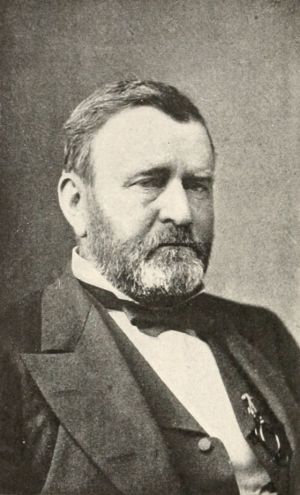
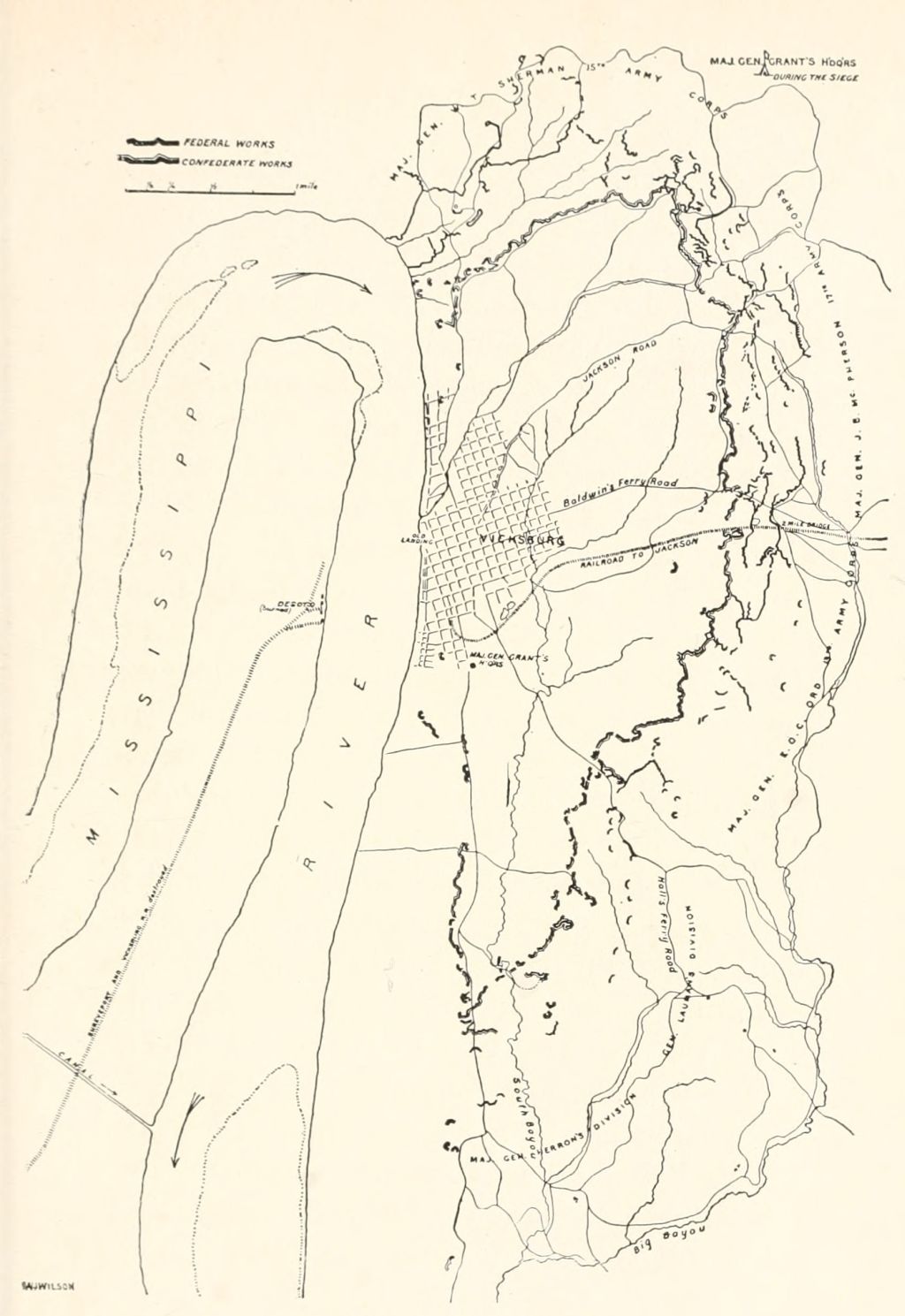
As for the great siege of Vicksburg that set the
seal upon Grant’s fame, or for the battle of
Nashville that gave almost equal renown to
Thomas, men will not forget them even when
Tolstoy’s dreams of universal peace have become
a blessed reality.
But peace hath her victories no less renowned
than war, as these chapters all tell us in
language as convincing if not so noble as that
of Milton. The history of the brave and successful
efforts made by the South to recover
from the losses of the war and from the still
more disastrous effects of the worst-devised
legislation ever inflicted upon a conquered
people cannot yet be fully written, but when it
is, the part played by the Southern towns will
surely be paramount. Population and business
have greatly increased in the urban centers;
the cause of truly public education has
been fostered to a remarkable extent; political
prejudices have waned; respect for human life
has increased; and, finally, a true national spirit
has been developed. Much remains to be
done in the way of municipal improvements,—for
example in the founding of public libraries,—but
the history of the past thirty-five years
warrants us in believing that the citizens of
the Southern towns will be able to work out
their own salvation. The outlook for the rural
districts, where the commission merchant
has his liens and mortgages, where ignorance
and lack of thrift foster political unrest, where
race hatred is partly extenuated by its causes
and wholly discredited by its results, is less
hopeful but still by no means hopeless.
The present volume, however, deals with
what has been rather than with what is or will
be, and, as has been already remarked, mainly
with what took place before even our great-grandfathers
were born. To some of us the
history of our fathers’ times is more interesting
than the story of what remoter ancestors did,
even though the costumes and the furniture of
the former are by no means so picturesque as
those of the latter. But tot homines, tot sententiæ.
To Colonial Dames, and Sons and
Daughters of the American Revolution, and
readers of the Colonial and Revolutionary romances
that are in such vogue, many pages of
this book ought to prove both interesting and
instructive. Nor are devotees of the modern
wholly unprovided for, and the special student
finds matter for reflection. He can speculate,
for example, upon how far the South’s comparative
freedom from French and Indian attacks
rendered early urban development less
urgent. He can notice how few great Southern
statesmen and generals were of the urban
type. He can contrast Charleston and New
Orleans, in their relations with their outlying
districts, as a miniature London and a miniature
Paris, respectively. He can wonder
whether any subtly psychological cause was at
work to prevent the various writers dwelling
upon slavery, duelling and other features of
the past that are not especially relished by the
present, yet assuredly had much to do with
making Southern towns as picturesque and interesting
as occasional travelers used to find
them and as the investigator finds them to-day.
Yet, if what is omitted reminds the student of
the immense opportunity for original and important
research that lies before the rising generation
of Southern historical scholars, neither
he nor the general reader should forget the
gratitude due to the editor, the various writers
and the publishers of this volume for first giving
the public in an attractive form adequate
proof of the interest and charm attaching to
the towns of the ante-bellum South. In more
than one important series of books relating to
our national history the South is but scantily
represented, but such a reproach cannot attach
to this series of American Historic Towns.
For weal or woe the South is now an integral
part of the nation, and the attractive and inspiring,
no less than the warning features of its
history, should be a portion of the intellectual
inheritance of every American.
[1] The later series of conventions is well described by Mr. Edward
Ingle in his interesting and valuable volume, based mainly upon
magazine and newspaper research, entitled Southern Sidelights
(pp. 220-261). Mr. Ingle pays but slight attention to the earlier
series, which seems nowhere to have been fully described.
[2] Schultz was a party for years to a very important case known as
“John W. Yarborough and others vs. The Bank of the State of
Georgia,” etc., for documents relating to which I am indebted to
William K. Miller, Esq., of the Augusta bar. The interesting
career of the man became known to me some years since through researches
undertaken in the early volumes of the Edgefield (S. C.)
Advertiser.
HISTORIC TOWNS OF THE SOUTHERN STATES — FOOTNOTES:
BALTIMORE
THE MONUMENTAL CITY
By ST. GEORGE L. SIOUSSAT
For many a year after the weary passengers
of the Ark and the Dove had disembarked
at St. Mary’s, there to make the first settlement
under the proprietary government of the
Lords Baltimore, the rivers of Maryland ran,
like Mr. George Alfred Townsend’s Rappahannock,
“All townless from the mountains to the sea.”
The Chesapeake and its almost numberless
tributaries made every plantation accessible to
shipping, and so precluded that concentration
of trade and population at points of vantage
which is the essential condition of municipal
growth. As Charles Calvert, third Baron Baltimore,
wrote, in 1678:
“The principall place or Towne is called St. Maryes
... other places wee have none, that are called or
cann be called Townes. The people there not affecting
to build nere each other but soe as to have their [houses]
nere the watters for conveniencye of trade and their
Lands on each side of and behynde their houses, by
which it happens that in most places there are not ffifty
houses in the space of thirty myles. And for this reason
it is that they have been hitherto only able to divide this
Provynce into Countyes without being able to make any
subdivision into Parishes or Precincts which is a worke
not to be effected untill it shall please God to encrease
the number of the People and soe to alter their trade as
to make it necessary to build more close and to Lyve in
Townes.”
When Lord Baltimore offered to the Lords
of Trade this explanation of the dearth of
municipal life in Maryland, he emphasized
precisely those facts which have distinguished
the political development of the South from
that of the North, and unwittingly explained
the late appearance upon the map of America
of the city which now perpetuates his family
name.
Boston had lived and grown for nearly a
century, New Amsterdam had been New York
one half that time, and a whole generation of
Philadelphians had passed away before the
future metropolis of the South came into being.
A half-century passed, and the Revolution
found the town upon the Patapsco about
the size of Salem or Providence; in another
half-century it had become the third city in
the United States. The pre-eminence which
Baltimore thus attained was many years ago
termed “an unsolved problem in the philosophy
of cities.” Now, when one views this
phenomenon in a longer perspective, it is possible,
perhaps, to discern more clearly some of
the elements which combined to give rise to
it. Certainly, late years have brought to light
much which one is enabled to add to the story
of historic Baltimore that the fathers have
handed down.
As Lord Baltimore’s letter to the Lords of
Trade indicates, the economic disadvantage of
the absence of town life in Maryland was appreciated
by the Government of the Colony at
a very early period in its history. It was not
due to the lack of desire or of effort upon the
part of the Proprietaries that in Maryland
“towns there were none.” For, first by proclamations,
then by Acts of Assembly, towns
were “erected” in a great number of places
situated upon the water and selected, apparently,
with little reference to any previous
exhibition of a tendency to municipal growth,
and with equally little reference to any expressions
of desire upon the part of the inhabitants.
That the success of this policy was hardly proportionate
to the efforts made in its behalf is
indicated by the statement made at a later
time, that “the settlers, and now the Government
call town any place where as many
houses are as are individuals required to make
a riot, that is twenty, as fixed by the Riot Act.”
Indeed, these “fiat” towns were in nearly
every case total failures. Harvy-town, Herrington
and many similar creations have
passed into oblivion, and now only serve as
institutional fossils for the political palæontologist.
As Jefferson said of Virginia, “there
are other places at which the laws have said
there shall be towns: but nature has said there
shall not.”
Among these shadow-towns of early Maryland
were some of particular interest to the
history of Baltimore. The settlement upon
the Patapsco was not the first in Maryland to
bear the proprietary name.
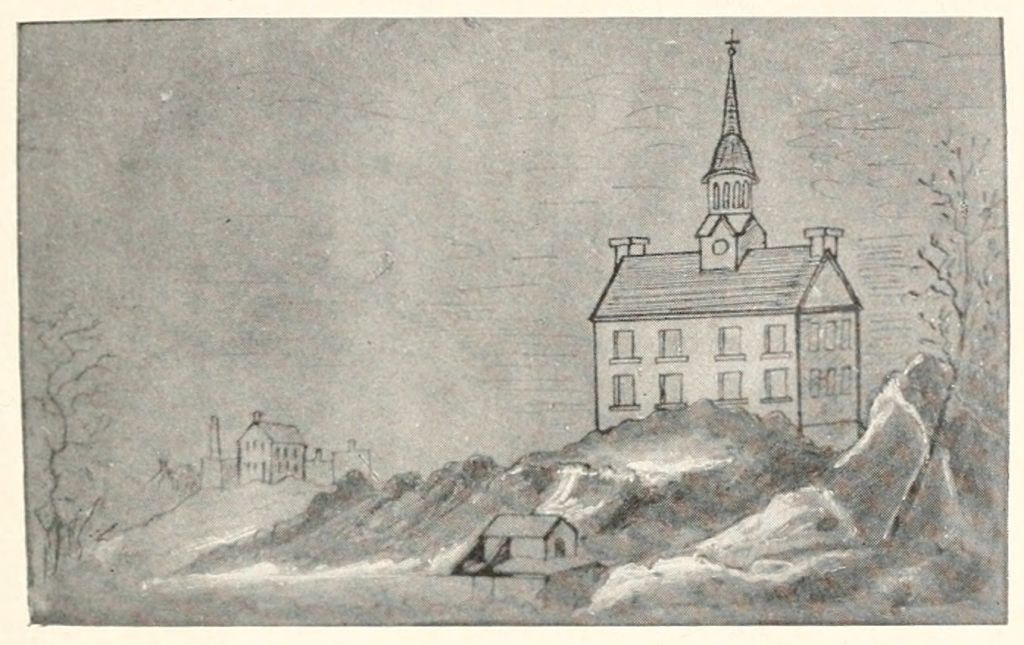
OLD COURT-HOUSE (1768) AND POWDER MAGAZINE.
FROM AN OLD PRINT IN THE POSSESSION OF THE MARYLAND HISTORICAL SOCIETY.
The first Baltimore
seems to have been a point of land in St.
Mary’s County, spoken of only once in the
early records, and never again mentioned. A
more important predecessor of the Baltimore
of to-day was Baltimore upon the Bush, a small
river emptying into the head of Chesapeake
Bay, not far south of the Susquehanna. “The
town-land on Bush River” is mentioned as
early as 1669, and, some years later, it was
made the seat of the court and court-house
of Baltimore County. Though the court-house
was removed before long to Joppa,
upon the Gunpowder, farther to the south,
many of the eighteenth-century maps of Maryland
show Baltimore as still upon the Bush.
Of the history of this early settlement no details
have been preserved; only lately has its
site been determined.
Meanwhile, in the course of this general
“towning,” the Patapsco had not been
neglected. In the town acts were included
provisions for towns upon Humphreys Creek,
and upon Whetstone Point in that river. Of
the actual existence of any corporate life at
these points there is, however, no record; and
it is probable that King George’s accession
found the Patapsco watering the same broad
plantations as of yore. But a new era in the
town history of Maryland was dawning. Governmental
stimulation was being supplanted by
private enterprise. Certain progressive individuals
conceived the idea of erecting a town
upon a point of land which runs out into the
main stream of the Patapsco and to-day is included
within the limits of Baltimore city. At
that time, this land was the property of a Mr.
John Moale, and was known as Moale’s Point;
but if it is Baltimore now, Mr. Moale was
resolved that it should not be Baltimore then,
and taking his seat in the Assembly, to which
he was a delegate, he prevented the location of
the town upon his property. Tradition has
censured this worthy for preferring the excavation
of iron ore to the development of a
municipality, but colonial experience in town
lots had doubtless been such as to yield him
ample justification for his determination.
“The rejected of Mr. John Moale” was not,
however, to wander far, for slightly to the
north lay property belonging to Charles and
Daniel Carroll, sons of the former agent of
the Lord Proprietary. Here the Patapsco
formed a basin, a safe harbor for vessels of
light draft; and near by a stream, known to this
day as Jones’s Falls, after the name of an early
settler, running from the hills near by, through
lowland and marsh, poured a muddy torrent into
the river. In 1709, was passed an act “for
erecting a town on the north side of Patapsco
in Baltimore County and for laying out into
lots sixty acres of land in and about the place
where one John Fleming now lives.”[3]
The owners of the land, the Carrolls, were
more complaisant than Mr. John Moale: they
readily parted with sixty acres of land at the
rate of forty shillings per acre, payable in
tobacco at one penny per pound. The town
was then surveyed and laid out into lots, after
the most approved “boomer” fashion of to-day.
To secure an estate in fee simple, “takers-up”
of lots were required to erect thereon, within
eighteen months, a building covering at least
four hundred square feet: failure to comply
with this condition laid the lots open for other
takers-up.
Baltimore’s boom seems to have started well,
for after Mr. Carroll, as former owner, had
selected the first lot, no less than fifteen other
persons invested the same year. This success
was so much appreciated that two years later
another town was established, consisting of two
acres laid out into twenty lots, just east of the
Falls, “where Edward Fell keeps store.”
Communication between the new town, known
as Jones or Jonastown, and Baltimore was
soon improved by a bridge across the Falls,
and a few years later the two towns were
by Act of Assembly formally made into one.
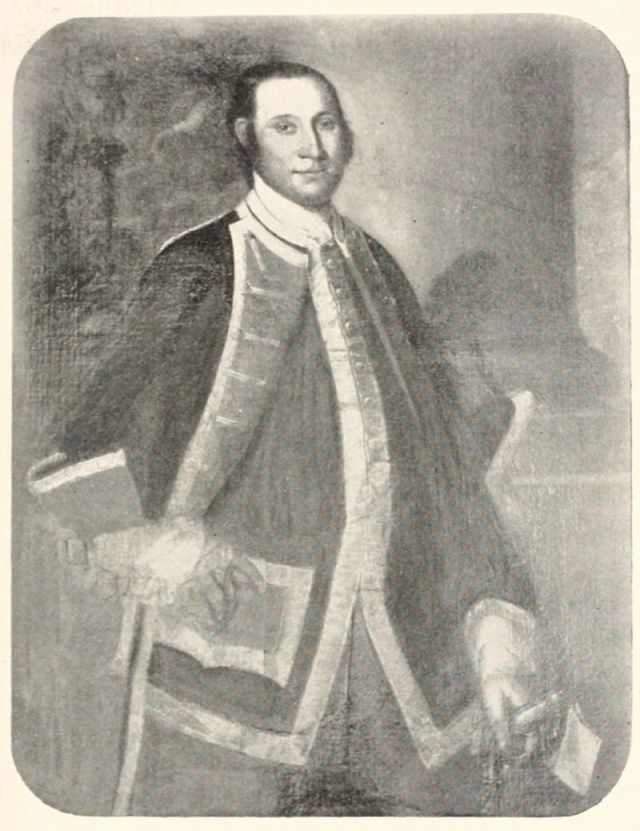
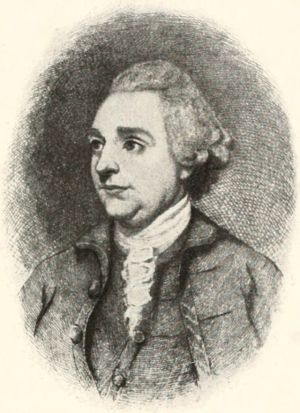
EDWARD FELL, IN UNIFORM OF PROVINCIAL FORCES.
FROM ORIGINAL PAINTING IN POSSESSION OF WILLIAM FELL JOHNSON.
A third distinct element in the early growth
of Baltimore was a settlement somewhat farther
to the east, known as Fell’s Point. In
1730, Mr. William Fell, a Lancastrian Quaker,
purchased a tract of land known as Copus’s
Harbor and erected thereon a mansion. A
little to the south, a point jutting out into the
Patapsco offered wharfage facilities to vessels
of large draft that were denied entrance to the
shallow basin of Baltimore town. This fact
was soon appreciated, and at a later time
Edward Fell, who was the son of William, and
an officer in the Provincial army, laid out Fell’s
Point into lots, thereby reaping a fortune
magnificent for those times.
During the first half of the eighteenth century
little of note happened in Baltimore.
Within a few years, however, some of the
most important influences in its later development
began to make themselves felt. In
Northern Maryland, particularly near the
Pennsylvania border, settlement was going on
rapidly, and denser settlement meant the extension
of commercial intercourse. In 1736,
communication was established between the
settlement on the Conewago—Hanover, in
Pennsylvania—and the Patapsco. Seven
years later, the people of York, also, “have
opened a road to Patapsco. Some trading
gentlemen there are desirous of opening a
trade to York and the country adjacent.” “In
October, 1751, no less than sixty waggons
loaded with flaxseed, came down to Baltimore
from the back country.”
Baltimore, though vigorous in action, was
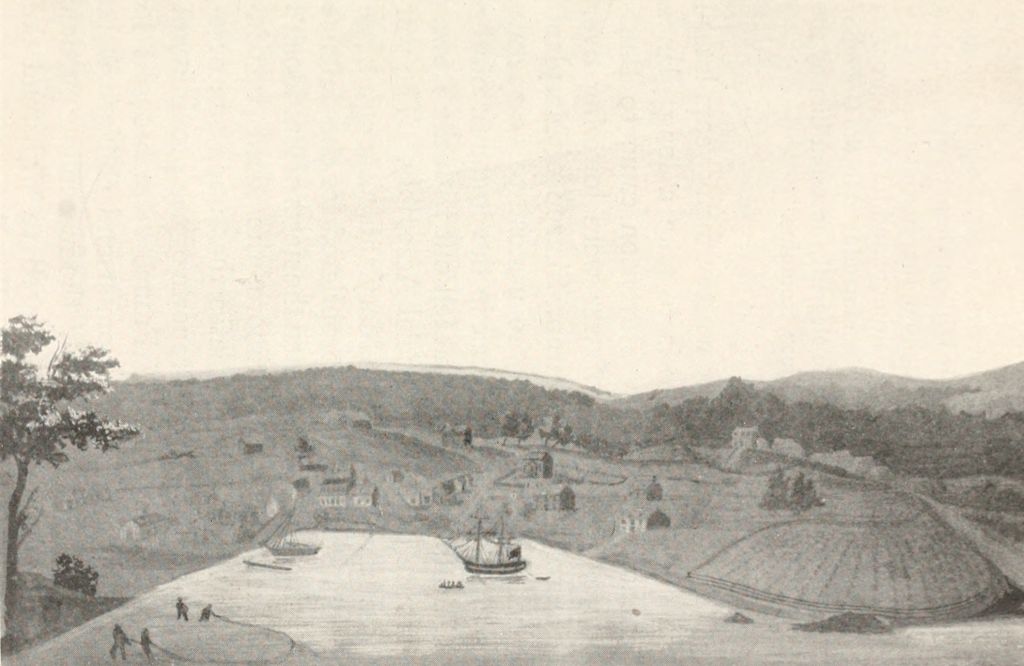
as yet but mean in appearance. In the rooms
of the Maryland Historical Society hangs a
sketch of the town, drawn in 1752, by John
Moale, the son of him that would have none
of towns or town lots. Rude in perspective as
this youthful effort is, it is treasured as one of
the oldest and most interesting of the city’s
heirlooms. Twenty-five houses—four of
them built of brick—and two hundred inhabitants
were then to be found in Baltimore.
Upon the hill we see perched the first of four
St. Paul’s churches successively erected upon
the same lot, though not all upon the same site.
At anchor in the harbor are the brig Philip
and Charles and the sloop The Baltimore. The
merchant navy of Baltimore was still small:
the large vessels of foreign trade still waited
at Whetstone Point to receive their freight,
transported in large lighters from the plantation
landings on both branches of the river.
More flattering than this early artistic attempt
is Governor Sharpe’s description of
Baltimore, two years later, as having
“the appearance of the most increasing town in the
Province,” though “hardly as yet rivalling Annapolis in
number of Buildings or inhabitants: its situation as to
Pleasantness, Air and Prospect is inferior to Annapolis,
but if one considers it with respect to Trade, the extensive
country beyond it leaves us room for comparison:
were a few Gentlemen of fortune to settle there and encourage
the Trade, it might soon become a flourishing
place, but while few besides the Germans (who are in general
masters of small fortunes) build and inhabit there, I
apprehend it Cannot make any considerable Figure.”
The requisite “gentlemen of fortune” were
not long lacking. One soon appeared in the
person of Dr. John Stevenson, who, in 1754,
came from Ireland, accompanied by his brother,
Dr. Henry Stevenson, a man also noteworthy
among the founders of Baltimore. Dr. John
Stevenson turned his attention to commerce,
and began the systematic development of Baltimore’s
foreign trade. He contracted for
large quantities of wheat, which he shipped to
Scotland with such profitable results that general
attention was attracted to the development
of a more extended commerce.
MOALE’S SKETCH OF BALTIMORE IN 1752.
FROM THE ORIGINAL IN THE POSSESSION OF THE MARYLAND HISTORICAL SOCIETY.
“Soon after, the appointment of Mr. Eden to the government
of Maryland, Sir William Draper arrived in that
Province on a tour throughout the continent. He contemplated
the origin of Baltimore and its rapid progress
with astonishment, and when introduced by the Governor
to the worthy founder, he elegantly accosted him by the
appellation of the American Romulus.”
These words were written many years later:
to quote them here is to take a long glance
ahead. When Dr. Stevenson came to Baltimore,
the clouds of war were lowering over
the colonies. Governor Sharpe of Maryland
exerted himself to the utmost to co-operate
with General Braddock in the conquest of the
Ohio for England, but fell out with the Lower
House of the Provincial Assembly. The war
was never popular in Maryland, although large
sums were finally appropriated for the defence
of the Province. When the news of Braddock’s
defeat reached Baltimore, the alarm was intense.
Tradition relates that upon one occasion
such terrifying reports of the proximity of
the Indian allies of France were brought to
Baltimore that the women and children were
put aboard ships, while the masculine portion
of the inhabitants prepared to withstand the
attack of the savages. But the attack never
came; instead, many settlers in Western Maryland
and Western Pennsylvania hurried back
to the East, impressed with the necessity of
closer settlement for defensive purposes. This
powerful incentive to unity was one that had
never been felt by the early colonists of Maryland,
who, unlike their brethren in the North,
for the most part dwelt in peace with the
natives.
During the war, several companies of royal
troops were quartered in Baltimore. Among
the officers in command, Captain Samuel Gardner,
of his Majesty’s Forty-seventh Regiment,
was engaged in recruiting for his Majesty’s
service. His recruiting sergeant displayed
such great zeal in the pursuit of his duty that
strenuous opposition was aroused among the
gentry of Baltimore, who found their indentured
servants disappearing one day, to appear the
next in his Majesty’s uniform. Upon one
occasion, Mr. Charles Ridgely and others
rescued—or recaptured—six recruits, claiming
that they were indentured servants, which
proved, Captain Gardner said, “not to be the
truth as to all of them.” The irate Captain
appealed to the civil authorities, with a long
story about a conspiracy of “some of the
better sort at the Church in the Forest [St.
Thomas’s]—to raise a body of about two hundred
men, and take all my Recruits from me.”
The plan of the conspirators, if such existed,
never materialized, but Captain Gardner received
cold comfort from Mr. Bordley, the
Attorney-General. “He put a case,” laments
Captain Gardner to Governor Sharpe, “not
very much to the Honour of the Recruiting
Service—Suppose a man steals a horse, etc.”
While the French and Indian War was in
progress, Baltimore received a large addition
to its population. When the “French Neutrals”
were removed from Acadia by the British
Government, many came to Baltimore, and
were hospitably quartered in the mansion of
Mr. Edward Fottrell, which stood upon the
square now covered by the stately court-house
recently completed. When the Abbé Robin
visited Baltimore during the Revolutionary
War, these unfortunate people and their
descendants filled about one quarter of the
town, a quarter mean and poor in appearance.
They still spoke their native dialect, and
treasured the altar vessels given them, with
his parting benediction, by their old curé, M.
Le Clerc, who had been the loving guardian
of their souls.
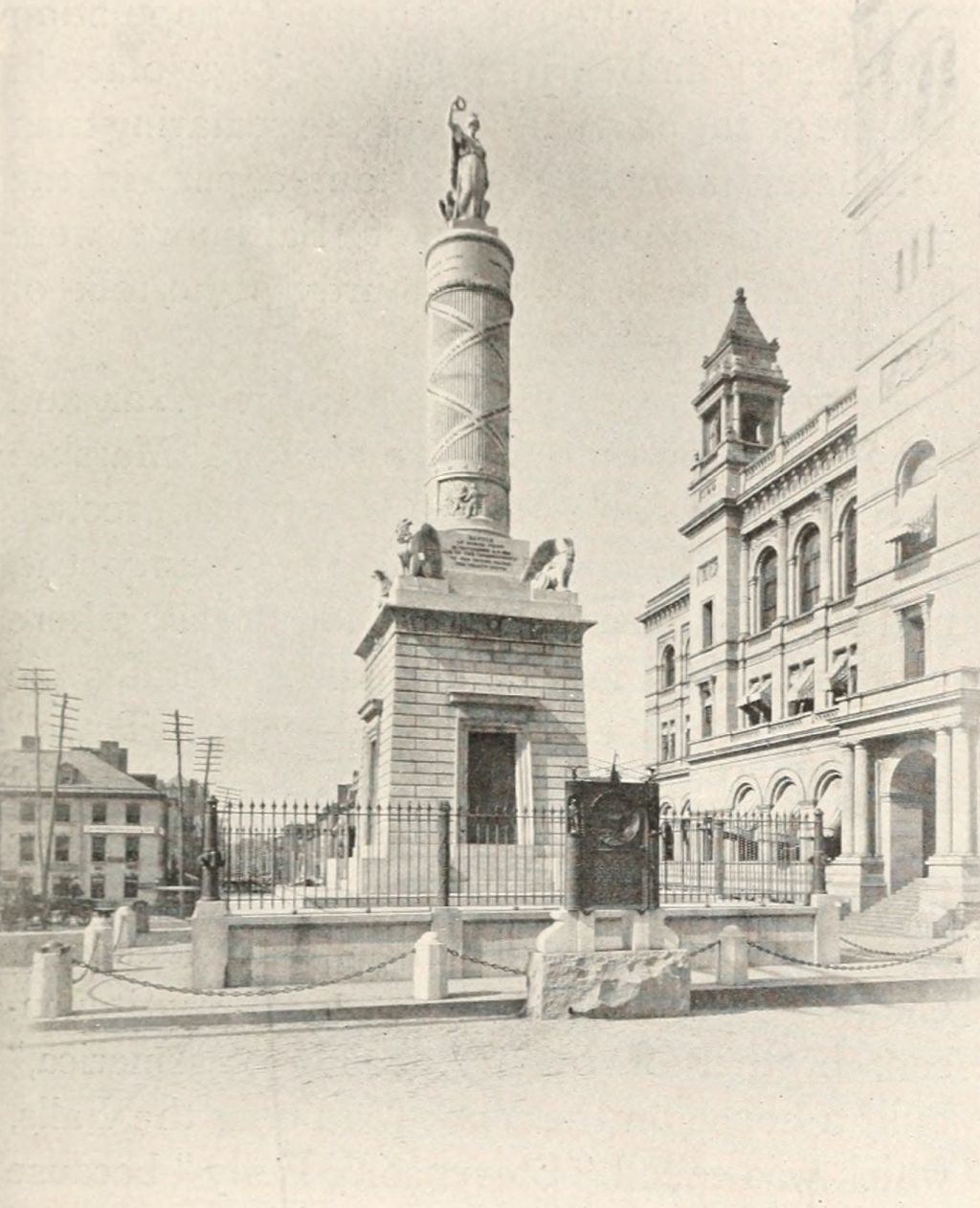
BATTLE MONUMENT.
Though they began in great
poverty, this portion of Baltimore’s population
by industry and thrift rose to a high place in
the life of the city. Many of the seafaring men
who later played so important a part in the
commercial development of Baltimore were
the descendants of this sturdy fisherfolk of
Acadia.
Between the French and Indian War and
the Revolution Baltimore grew apace. Marshes
were drained and a market-house was erected.
In 1768, Baltimore became the county-seat,
and a court-house was built upon the site where
now the Battle Monument commemorates the
defence of the city in 1814. “The Town”
and “the Point” vied with each other, and
those with an eye to the future bought lots
in both places. Many mansions were erected,
among them Mount Clare, the residence of
Charles Carroll, Barrister. Dr. Henry Stevenson,
brother of the “Romulus of America,”
built a house on the York road near the Falls,
which was called “Stevenson’s Folly” because
of the contrast between its elegance and the
simplicity of the surrounding dwellings. It
deserved a better name, for later it was transformed
into a hospital for inoculation against
the smallpox. Here the Rev. Jonathan Boucher
brought “Jacky” Custis, to be “given the
smallpox,” and we find recorded in Washington’s
correspondence an account of Dr. Stevenson’s
charges of “2 pistoles and 25 s. for
board.” At the close of the century, the
venerable doctor was one of the founders of
the Medical and Chirurgical Faculty of Maryland.
When he came to Baltimore, the youth
of the town already enjoyed the instruction of
one schoolmaster, and there was demand for
another.
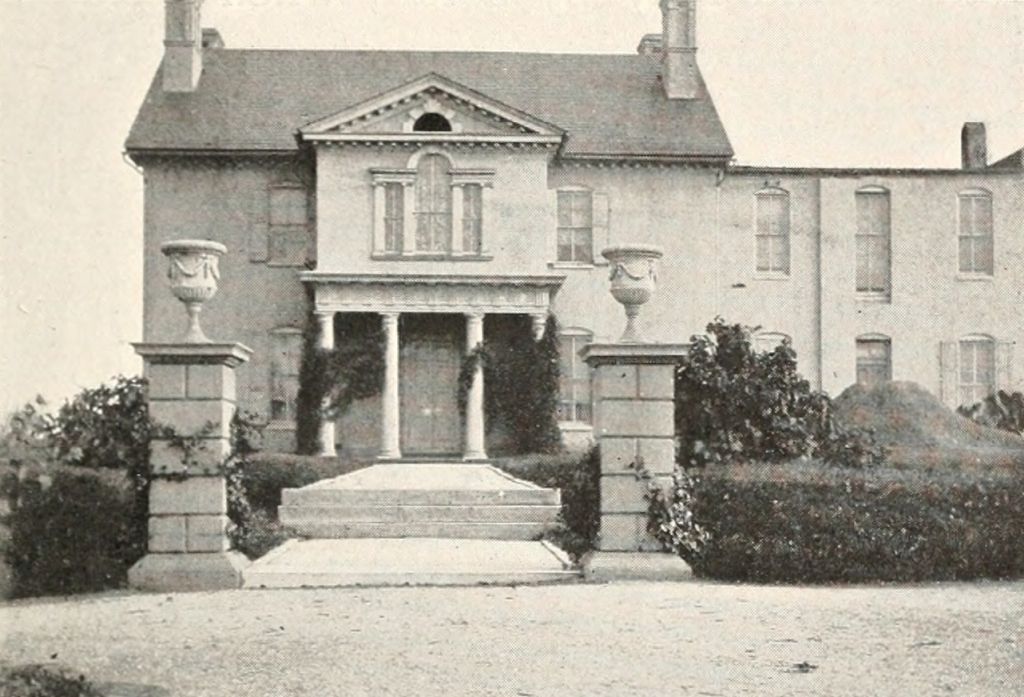
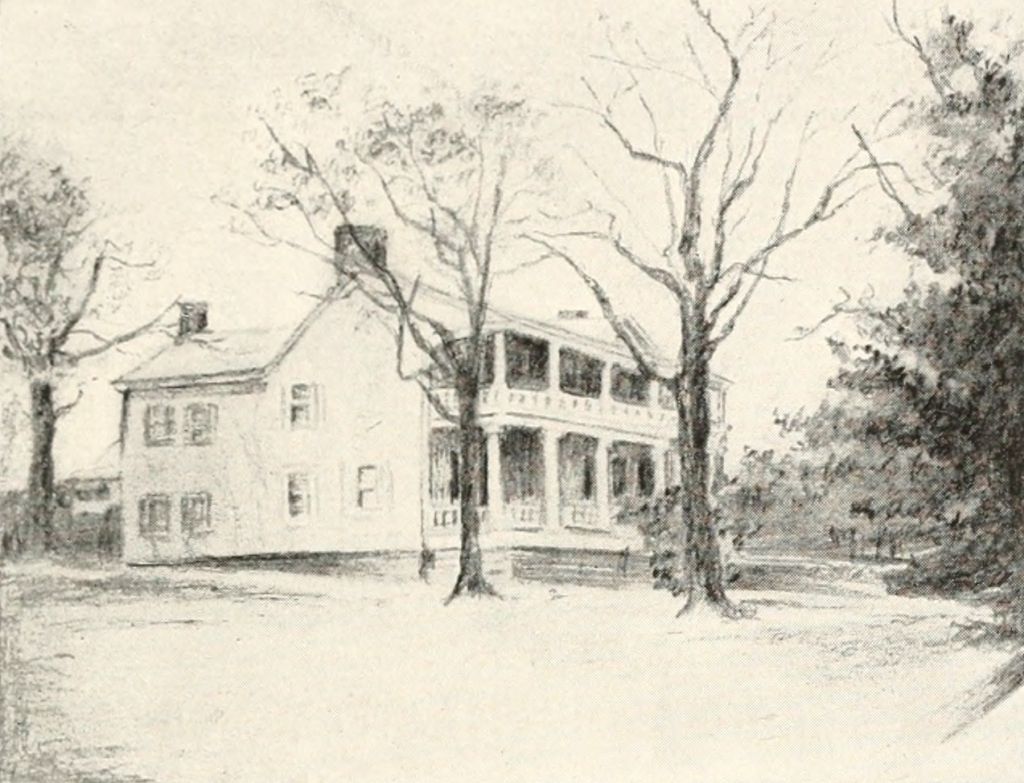
MOUNT CLARE, 1760, RESIDENCE OF CHARLES CARROLL, BARRISTER.
Of Baltimore in this pre-Revolutionary period,
a few odd, disconnected facts have been handed
down. The tax upon bachelors—levied to
raise supplies for his Majesty’s service—cannot
have been very productive, as only thirteen
“taxables” are reported. The commercial activity
of the community was stimulated every
October and May by a fair, when residents
and visitors were free from arrest, except for
felony and breach of the peace. Among other
police regulations, fines were laid upon those
whose chimneys blazed out at the top, or who
neglected to keep ladders. Baltimore began
to look like a busy, thriving town, enjoying
life to the utmost.
And if our ancestors lived well, they endeavored
to die well—at least with regard to the
comfort of the guests at their funerals. One
bill for funeral expenses, besides yards upon
yards of crape, tiffany, broadcloth, shalloon and
linen, several pairs of black gloves and other
necessary attire, includes these items:
47¹⁄₂ lbs. loaf sugar
14 doz. eggs
10 oz. nutmegs 1¹⁄₂ lbs. allspice
20⁵⁄₈ gall. white wine
12 bottles red wine
10³⁄₈ gallons rum [!]
The first recognition of Baltimore’s existence
by the Proprietary appears to have been
in connection with an inquiry as to the possibility
of making the growth of the town a
source of additional income. Cecilius Calvert,
the secretary of Frederick, the sixth Lord Baltimore,
writes to Governor Sharpe that in
Philadelphia William Penn has reserved property
that brings him “much income now” and
will produce to his heirs “immense revenue.”
Sharpe replies that Baltimore town is built
upon land patented to private persons, and
embraces the opportunity to moderate the extravagant
reports of Baltimore’s size that had
reached the ears of the Proprietary, by adding
that it “is almost as much inferiour to Philada
as Dover is to London.” However, the twenty-five
houses and two hundred people of 1752
had become, in 1764, two hundred families,
and the town “is increasing.”
Such was Baltimore town when the citizens
met together in town meeting to adopt a non-importation
agreement, and to propose, upon
the last day of May, 1774, the assembling of a
general congress of delegates from all the colonies.
The suffering of Boston under the Port
Bill awoke deep sympathy, and in August of
this year the sloop America sailed from Baltimore
Harbor carrying three thousand bushels
of corn, twenty barrels of rye flour, two barrels
of pork and twenty-one barrels of bread, “for
the relief of our brethren, the distressed inhabitants
of your town.”
Though never the scene of actual hostilities,
Baltimore lacked neither employment nor excitement.
Early in 1776, a demonstration was
made against the town, which had hitherto
been entirely defenceless, by a British sloop of war
and some smaller vessels. Fortifications
were hastily erected upon Whetstone
Point, where Fort McHenry later was to
check the entrance of another British fleet;
vessels were sunk in the channel, and the ship
Defense was hurriedly fitted out and put under
the command of Captain James Nicholson.
The British commander did not risk an action,
but stood off down Chesapeake Bay, leaving
behind a valuable prize that he had shortly
before captured. “Such was the ardor of
the militia,” wrote Samuel Purviance, Secretary
of the Committee of Safety of Baltimore
town, “that not a man wd stay in Commee
room with me but Mr. Harrison.” Captain
Nicholson was complimented as having “first
had the honor of displaying the Continental
colors to a British man-of-war without a return.”
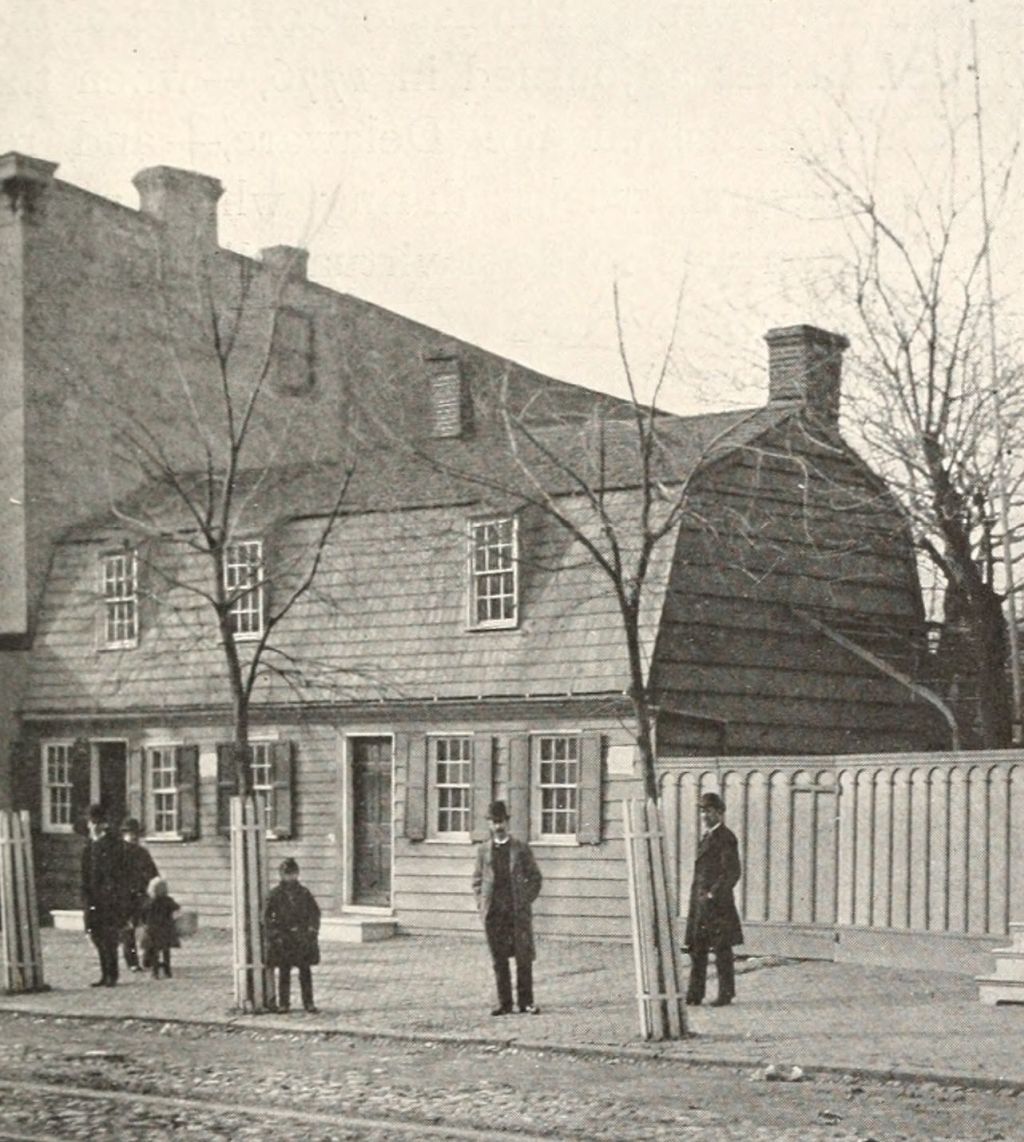
BOOS HOUSE NEAR WHICH LAFAYETTE’S TROOPS ENCAMPED.
Upon Baltimore, formerly Market, Street,
between Sharp and Liberty, a tablet commemorates
the site of “Congress Hall” a
“three story and attic” brick building, which,
in 1776, belonged to one Jacob Fite, and was
at that time one of the most imposing buildings
in the town. Hither the Congress of the
United States adjourned in 1776,—when the
British approached the Delaware,—and remained
several weeks, during which period
Washington was made a virtual dictator. A
few squares to the east was the Fountain Inn,
which entertained Washington and many other
statesmen and soldiers who came to Baltimore,
or passed through the town on their way north
and south. Among these visitors was the
Duc de Lauzun, whose legion lay encamped
around the knoll where later, in 1806, was
commenced the erection of the Roman Catholic
Cathedral. Upon Bond Street, Fell’s Point,
there was standing, not many years ago, an
old farmhouse belonging to a German named
Boos, near which Lafayette’s troops were encamped,
and at which they obtained milk for
their syllabub, and other products of the dairy
and the garden.
When Lafayette passed through Baltimore
en route for Yorktown, a ball was given in his
honor; his melancholy demeanor upon this
joyous occasion, explained by the Marquis as
due to his concern at the sufferings of his ill-clad
soldiers, awoke such sympathy that next
morning “the ball-room was turned into a
clothing manufactory. Fathers and husbands
furnished the materials; daughters and wives
plied the needle at their grateful task.” “My
campaign,” said the General upon his return,
“began with a personal obligation to the citizens
of Baltimore, at the end of it I find myself
bound to them by a new tie of everlasting
gratitude.” When, forty-three years later,
Baltimore again welcomed Lafayette, one of
the most touching incidents of his visit was
his especial inquiry for Mr. and Mrs. David
Poe,—grandparents of Edgar Allan Poe,—the
one of whom had advanced Lafayette
money from his private funds, and the other
had herself cut out five hundred garments for
his ragged troops. Mrs. Poe, with feeble body
but unclouded mind, was yet alive to welcome
the General, but her husband had preceded
his venerable friend to the rest which comes
after toil.
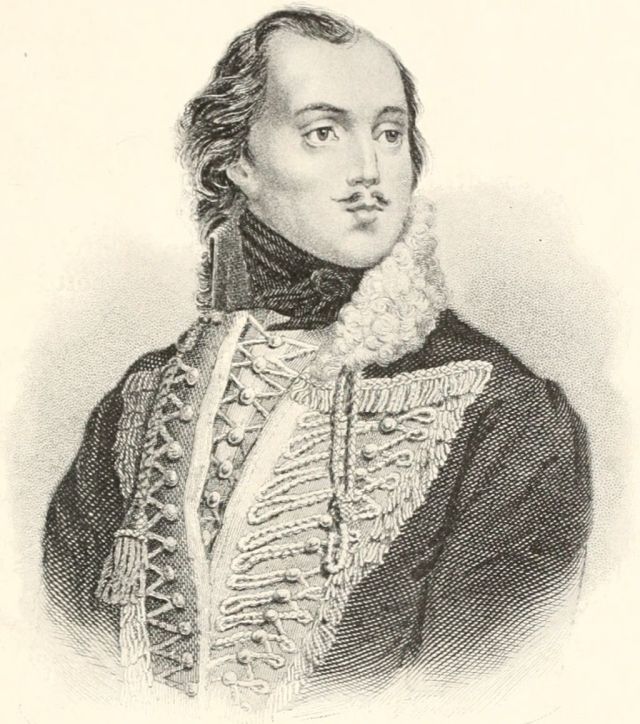
Another foreigner well known in Baltimore
was Pulaski, who completed here the organization
of the legion in command of which he fell
at Savannah. In the library of the Maryland
Historical Society hang the now faded folds of
“The crimson banner, that with prayer,
Had been consecrated there,
by the Moravian nuns at Bethlehem, before
“The warrior took that banner proud,
And it was his martial cloak and shroud.”
Besides welcoming those from elsewhere,
Baltimore gave to the war the best and bravest
of her own. To aid Smallwood and Williams,
Baltimore sent General Mordecai Gist,
who as Major commanded the Maryland troops
that covered the American retreat at Long
Island. Another was John Eager Howard,
who at Cowpens seized the critical moment,
and turned the fortune of the day. At Guilford
and at Eutaw Colonel Howard was
equally conspicuous, and when peace came
Maryland honored him by thrice electing him
to the national Senate. “He deserves,” said
General Greene, “a statue of gold, no less
than Roman and Grecian heroes.” A third
was Captain Samuel Smith, who held Fort
Mifflin, the “Mud Fort on the Schuylkill,” for
seven weeks, against powerful land and sea
forces of the British, who were seeking to open
the communication between Philadelphia and
the Atlantic. It was largely due to the energy
of General Smith that, in the second war with
Great Britain, Baltimore escaped the fate of
the national Capital. And with these officers
went hundreds
of lesser rank, to
join New Englanders
and fellow-Southerners
in the common
cause of Independence.
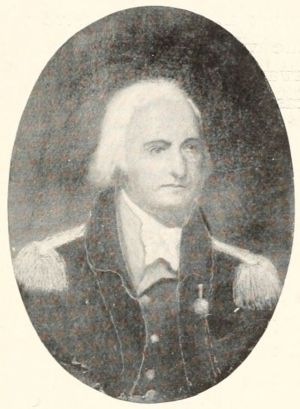
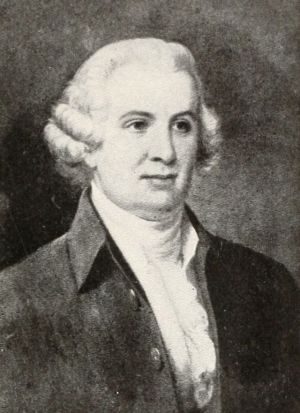
COL. JOHN EAGER HOWARD.
FROM THE PAINTING BY REMBRANDT PEALE.
When the cry
“Cornwallis is
taken!” announced
the
final success of
Washington and
Lafayette, Baltimore’s
exultation
was
unbounded. In
the evening, we are told, there was a “Feau d’
Joy”: “the Town and Fell’s Point were elegantly
illuminated; what few houses that were
not, had their windows broke.” Upon the
Point, Mr. Fell, “a gentleman of princely
fortune,” nephew of the first Edward, gave
a “genteel Ball and Entertainment,” where,
Lieutenant Reeves tells us, “we danced and
spent the night until three o’clock in the
morning of the 23rd as agreeably as one could
wish; as the ladies were very agreeable and
the whole company seemed to be carryed
away beyond themselves on this happy occasion.”
Many years ago, one of the most distinguished
of Baltimore’s sons, the Hon. John P.
Kennedy, himself a scholar and an orator of
the old régime, gave, in an informal lecture,
some of his reminiscences of Baltimore town
as it was at the end of the eighteenth century.
Though often quoted, the quaint and charming
spirit of the author makes his description
yet as fresh and sparkling as his conversation
ever used to be, and it is never too late to give
in his own words some of his early memoirs of
Baltimore town:
“It was a treat to see this little Baltimore town just at
the termination of the War of Independence, so conceited,
bustling and debonair, growing up like a saucy,
chubby boy, with his dumpling cheeks and short, grinning
face, fat and mischievous, and bursting incontinently
out of his clothes in spite of all the allowance of
tucks and broad salvages. Market Street had shot, like
a Nuremberg Snake out of its toy box, as far as Congress
Hall, with its line of low-browed, hip-roofed wooden
houses, in a disorderly array, standing forward and back,
after the manner of a regiment of militia, with many an
interval between the files. Some of these structures
were painted blue and white, and some yellow; and
here and there sprang up a more magnificent mansion
of brick, with windows like a multiplication table and
great wastes of wall between the stories, with occasional
court-yards before them; and reverential locust-trees,
under whose shade bevies of truant schoolboys, ragged
little negroes and grotesque chimney-sweeps ‘skied
coppers’ and disported themselves at marbles.
“In the days I speak of, Baltimore was fast emerging
from the village state into a thriving commercial town.
Lots were not yet sold by the foot,—except perhaps in
the denser marts of business,—rather by the acre. It
was in the rus-in-urbe category. That fury for levelling
had not yet possessed the souls of City Councils. We
had our seven hills then, which have been rounded off
since, and that locality which is now described as lying
between the two parallels of North Charles Street and
Calvert Street presented a steep and barren hillside,
broken by rugged cliffs and deep ravines, washed out
by the storms of winter into chasms which were threaded
by paths of toilsome and difficult ascent. On the summit
of one of these cliffs stood the old church of St.
Paul’s [the second], some fifty paces or more to the
eastward of the present church [the third], and surrounded
by a brick wall that bounded on the present
lines of Charles and Lexington Streets. This old building,
ample and stately, looked abroad over half the
town. It had a belfry tower, detached from the main
structure, and keeping watch over a graveyard full of
tombstones, remarkable to the observation of the boys
and girls, who were drawn to it by the irresistible charm
of the popular belief that it was haunted, and by the
quantity of cherubim that seemed to be continually crying
about the death’s-head and cross-bones at the doleful
and comical epitaphs below them—images long since
vanished, without a trace left, devoured by the voracious
genius of brick and mortar.
“... I have a long score of pleasant recollections
of the friendships, the popular renowns, the household
charms, the bonhomie, the free confidences and the personal
accomplishments of the day.... In the train
of these goodly groups come the gallants who upheld the
chivalry of the age, cavaliers of the old school, full of starch
and powder: most of them the iron gentlemen of the Revolution,
with leather faces—old campaigners, renowned for
long stories: not long enough absent from the camp to
lose their military brusquerie and dare-devil swagger;
proper roystering blades, who had not long ago got out
of harness and begun to affect the elegancies of civil
life. Who but they! jolly fellows, fiery and loud, with
stern glance of the eye and brisk turn of the head, and
swash-buckler strut of defiance, like game-cocks, all in
three-cornered cocked hats and powdered hair and cues,
and light-colored coats with narrow capes and marvellous
long backs, with the pockets on each hip, and small-clothes
that hardly reached the knee, with striped stockings,
with great buckles in their shoes, and their long
steel watch-chains that hung conceitedly half-way to the
knee, with seals in the shape of a sounding-board to a
pulpit; and they walked with such a stir, striking their
canes so hard upon the pavement as to make the little
town ring again.
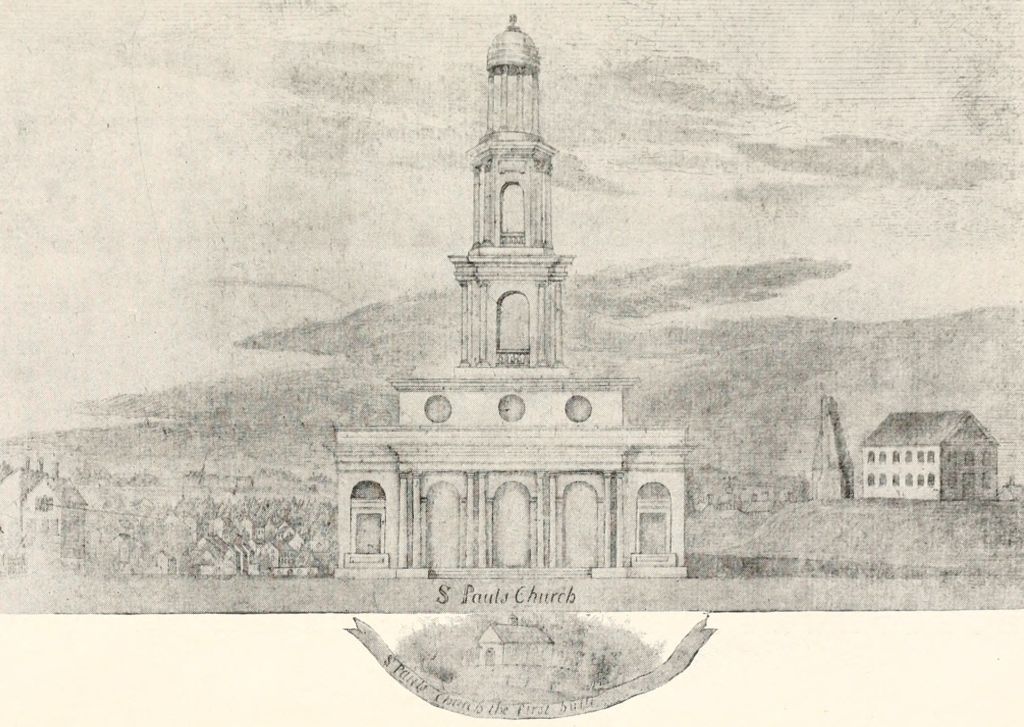
ST. PAUL’S CHURCH.
FROM AN OLD COPPER PRINT.
I defy all modern coxcombry to produce
anything equal to it—there was such a relish of peace
about it, and particularly when one of these weather-beaten
gallants accosted a lady in the street with a bow
that required a whole side pavement to make it in, with
the scrape of his foot, and his cane thrust with a flourish
under his left arm till it projected behind along with his
cue, like the palisades of a chevaux-de-frise; and nothing
could be more piquant than the lady as she reciprocated
the salutation with a curtsey that seemed to carry her
into the earth, with her chin bridled to her breast, and
such a volume of dignity.”
The “rus-in-urbe” life of Baltimore was
nearly ended; with the close of the Revolutionary
War began a new period in its history.
Soon streets were paved and lighted, better
bridges built, and a watch was established.
Commerce sprang up with renewed vigor. The
tobacco trade found other markets than the
mother country; the West Indies bought
flour, Spain and Portugal, wheat. By 1790,
Baltimore skippers had rounded the Cape of
Good Hope and cast anchor in the harbors
of the Isle de France. The year 1793 brought
another foreign addition to the already polyglot
population of Baltimore. The revolution
in San Domingo drove fifteen hundred of the
inhabitants to Maryland, to develop a great
trucking and garden trade, with Baltimore as
its centre. The Baltimore clippers, too, with
their jauntily raked masts, showed their heels
to the craft of the rest of the world, and the
reign of Baltimore’s merchant princes began.
Previous to this time, all large payments of
money were made in bags of heavy coin: in
1790 a bank was organized. Several papers
were now published, and a circulating library
was established by Mr. Murphy. A series of
medical lectures was preparing the way for
the University of Maryland, and education in
general was receiving more attention. Population
increased continually, and in 1796, the
change from town to full municipal life was
made legal by the incorporation of Baltimore
city.
Now, also, began again the improvement of
internal communication. For many years the
white-topped Conestoga wagons had rumbled
down to Baltimore from west and north; and
from time to time efforts had been made to
improve the main roads. In 1805, the main
routes converging in Baltimore were turnpiked.
Western Maryland was now becoming
thickly settled, many thriving towns had
sprung up, and in a few years the “National
Road” joined Cumberland, on the Potomac,
with the Ohio River. The connection between
Cumberland and Baltimore was completed
by means of a curious tax on the banks
of Maryland. Thus the line of communication
between Baltimore and Wheeling was
continuous, over one of the best roads in the
world. This and six other turnpikes were as
seven great rivers, bearing their precious
freight of grain, tobacco, dairy products and
whiskey to Baltimore for foreign shipment;
and in spite of overtrading and the resulting
period of depression, such was Baltimore’s
progress that in 1825 Jared Sparks could
say, “Among all the cities of America, or of
the Old World, in modern or ancient times,
there is no record of any one which has sprung
up so quickly to so high a degree of importance
as Baltimore.” At this time the population
of Baltimore was five times as great as it
had been thirty years before, and commerce
had increased proportionately. The causes
of this remarkable progress were enumerated
by Sparks as the advantages of Baltimore’s
local situation, the swift sailing-vessels, the
San Domingan trade, the two great staples,
tobacco and flour, “for which the demand is
always sure, and the supply unfailing,” and
lastly, the energetic spirit of the people.
BELVIDERE, 1786, THE HOME OF COL. JOHN E. HOWARD.
During all this period the city improved in
appearance as well as in size. Especially
characteristic of the new Baltimore was “Belvidere,”
the residence of Colonel John Eager
Howard. Belvidere was completed in 1794,
and only a few years ago was dismantled by
the ruthless hand of the city surveyor, to make
way for the progress of the ever-expanding
city by the extension of North Calvert Street.
From Belvidere, which at the beginning of
the century was a half-mile from Baltimore,
one could look down, as from some mediæval
castle, upon the bustling town below. In the
view from Belvidere, we are told,
“the town,—the Point, the shipping in the Basin and
at Fell’s Point, the bay as far as the eye can reach,
rising ground on the right and left of the harbor,—a
grove of trees on the declivity on the right, a stream of
water [Jones’s Falls] breaking over the rocks at the foot
of the hill on the left, all conspire to complete the
beauty and the grandeur of the prospect.”
Here, as at many of the country-seats near
Baltimore, a lavish hospitality brought strangers
from America and from Europe into
pleasant association with the leading Marylanders
of the day. A little to the south of
Belvidere, in what was then the woodland of
“Howard’s Park,” there soon rose the grandly
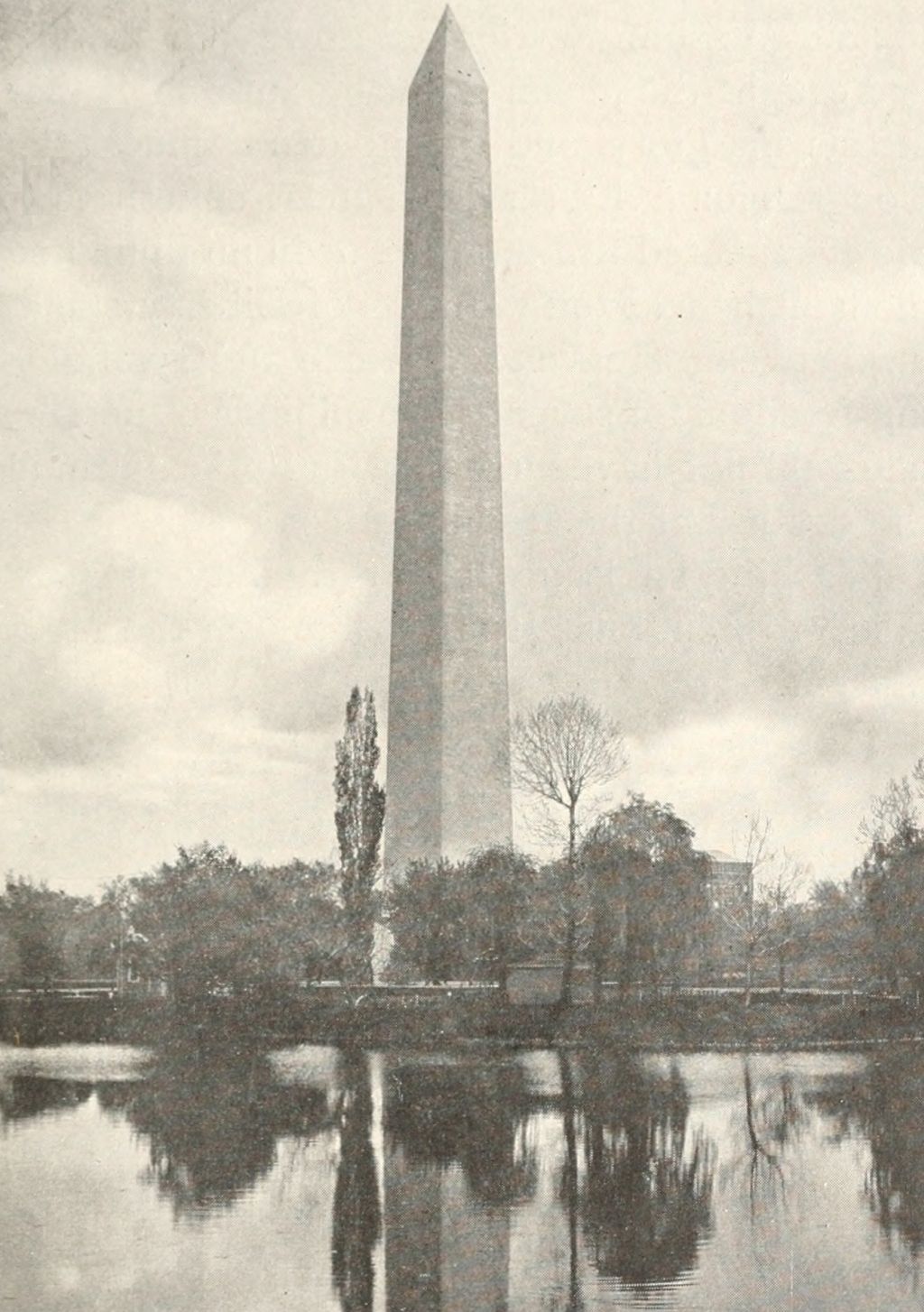
simple column of the Washington Monument.
If Maryland escaped actual invasion during
the Revolutionary War, she bore the brunt of
the second contest with England. After the
British had sailed up the Patuxent, laying
waste the manor houses and wide plantations
along its banks, after they had burned the
national Capitol and routed a body of American
militia, they proceeded to attack Baltimore
by land and sea. The story is told that
some faint hearts came forward with a proposition
to compound for the safety of the city
with a heavy ransom, when Colonel Howard
replied, “I have as much property at stake as
most people, and I have four sons in the field;
but sooner would I see my sons weltering in
their blood, and my property reduced to ashes,
than so far disgrace the country.”
It was such spirit as this that checked the
land attack at North Point, and that held out
in Fort McHenry during the anxious night of
September 12th. When day broke upon Fort
McHenry, the flag was still there. And in
the gray dawn, Francis Scott Key, detained
upon the Minden in an effort to secure the
release of a captive friend, wrote upon the
back of a letter the thoughts which were passing
through his mind. Printed a little later,
and first sung in a restaurant near the Holliday
Street Theatre, the song of The Star
Spangled Banner was caught up in intense enthusiasm,
till now, following the flag it celebrates,
it is sung in every portion of the globe.
No less important with respect to the final
outcome of the war than the repulse of the
British at North Point and at Fort McHenry,
was the offensive warfare carried on by the
privateers of Baltimore,—the clippers turned
fighters. The log-books of these illusive craft
make interesting reading. “Chased by a frigate:
outsailed her,” is the entry that seems to
occur most frequently, and thrilling accounts
of hairbreadth escapes are numerous. The
English Channel was a favorite hunting-ground
of the privateers, and many a British
vessel was taken or burnt outside of and in
view of her own port. The amount of property
taken or destroyed in this way was enormous,
and the moral effect of American success exceeded
the material.
With the return of peace, overtrading led to
a commercial crisis. In 1818, the Baltimore
branch of the Bank of the United States became
insolvent, and the darkest period in the
history of the city ensued. But in less than
ten years the shock had been so far forgotten
that Baltimore was again seeking to develop
commercial connection with the West. “The
enterprising citizens of Baltimore,” we are told,
“perceiving that in consequence of steam navigation
on the western waters, and the exertions
of other States they were losing the
trade of the West, began seriously to consider
of some mode of recovering it.” The means
adopted were twofold: the Chesapeake and
Ohio Canal, and the Baltimore and Ohio Railroad.
The amount of money which Maryland
and, relatively to a greater extent, Baltimore
invested in these schemes has perhaps been
more than subsequent events have justified;
but the effect of the idea of internal improvement
cannot be overestimated.
That the troublous times of the war between
the States should bear upon Baltimore with
especial affliction was but the natural result
of her geographical situation. In the more
southerly cities, popular sentiment was usually
nearly unanimous; in Baltimore, the combination
in municipal life of the foreign with the
native Southern element involved the existence
of two ideas, two ways of looking at things.
When, therefore, the great question had to be
decided, the citizens of Baltimore, ever characterized
by an excessive political activity, immediately
divided into two camps, in which
were often ranged in deadly opposition those
who before had been bound by common ties of
Church, of State and of kindred; while beneath
and between the better elements of both
parties, the turbulent mob, well schooled in
political lawlessness, eagerly embraced every
opportunity for riot and disorder.
The most serious cause of difference was not
the question of slavery, for Baltimore was, it
has been said, “the paradise of the free colored
population.” In 1789, Samuel Chase, Luther
Martin, Dr. George Buchanan, and in fact
most of the leading men of that day, formed
one of the earliest of American abolition societies;
and to the same cause, in later times,
Charles Carroll of Carrollton lent his influence
and William Pinkney his eloquence.
The most powerful stimulus to secession
lay in the policy of Lincoln’s administration.
While the attack upon the Sixth Massachusetts
was the work of the mob, the passage
through Maryland of the Northern troops
made sympathy with the South temporarily
predominant. The excitement subsided; the
city, like the State, was held for the Union, but
the military policy of the national Government
inaugurated a period of bitter oppression
to those whose hearts were across the Potomac.
Newspapers were suppressed, all exhibitions
of sympathy with the Southern cause were
rudely brought to an end, and the personal liberty
of the individual was destroyed by the
suspension of the habeas corpus—a suspension
which henceforth estranged the executive and
the judicial heads of the nation. Yet in spite of
this military policy, or, more properly, because
of it, the Union sentiment increased, and in
1864, in the city where four years before each
of his three opponents had been nominated
for the Presidency, the Union-Republican convention
chose as its candidate for a second
term the President, Abraham Lincoln.
With the development of the policy of internal
improvement began the modern city.
In spite of financial crises, periods of bitter
political disturbance and the shock of the Civil
War, the expansion begun by the uniting of
Baltimore town first with Jonas town and then
with Fell’s Point, has been continued over the
neighboring hillsides to the north, east, and
west, until the hamlet of two hundred inhabitants
has now become the city of more than
half a million souls. With this numerical
increase has come a proportionate commercial
development; the advantageous situation of
“the northernmost southern and the westernmost
eastern city” is as potent a factor in its
life to-day as it was of old. In the higher
things, also, that enrich the life of a great city,
progress has been no less constant. The
schoolmaster, to whom, in 1752, “encouragement”
was offered by advertisement in the
Maryland Gazette, has been succeeded by a
thorough system of public education, while the
ideas that found expression in the “Stevenson’s
Folly,” and the “Murphy’s Circulating
Library” of a century ago, have subsequently
inspired the foundations of McDonogh, Shepard,
Watson, White, Wilson, Peabody, Hopkins
and Pratt.
Of all the institutions, charitable or educational,
with which Baltimore has been blessed,
none have brought her more honor than the
Johns Hopkins University and the Johns
Hopkins Hospital. Founded upon the bequest
of one of Maryland’s sons, who had
amassed his great wealth in the city he loved
so well, the University was fortunate in the
selection as its President of Daniel C. Gilman,
a man with extraordinary genius for educational
organization. Fortunate, also, was the bringing
together, at the start, of a faculty of eminent
specialists: the first were Gildersleeve, Sylvester,
Remsen, Rowland, Martin and Morris.
These men, and their successors, have fostered
a spirit of intellectual advance which has made
the importance of the University in the educational
history of this country assume a proportion
simply incalculable.
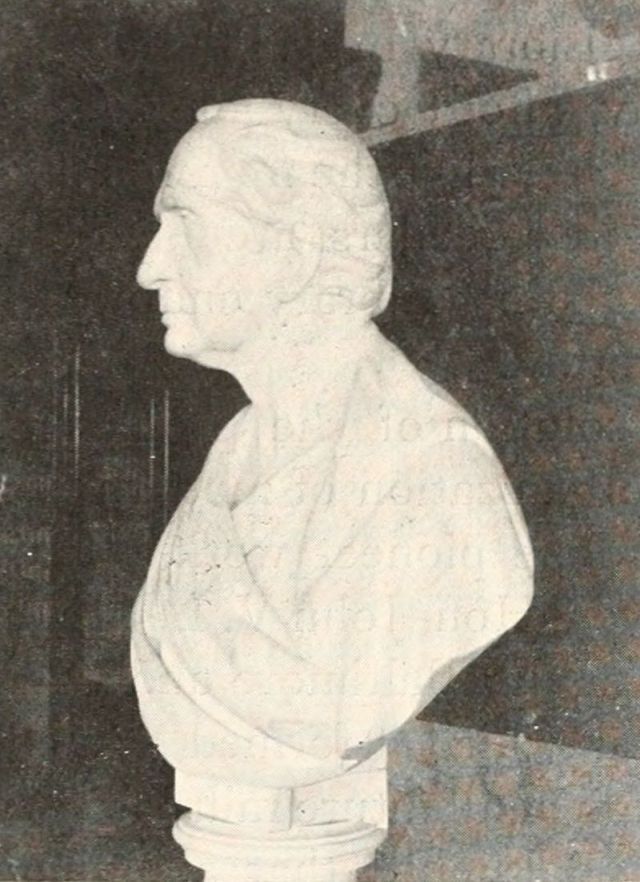
BUST OF JOHNS HOPKINS.
FROM THE ORIGINAL IN JOHNS HOPKINS HOSPITAL.
Across the city, upon a site open and commanding,
stands the Hospital, with its ever-growing
Medical School, and its Training
School for Nurses. Equally successful in its
first choice of leaders, and in the character of
those who follow them, the Hospital has been
far more fortunate than the University in the
financial stability of its endowment.
Between the two, and lying almost at the
base of the Washington Monument, is the
Peabody Institute, with its magnificent library.
Farther downtown is that of the Maryland
Historical Society, and these, with the Congressional
Library in Washington, only forty
miles away, afford every advantage for study
and research; while the more popular demands
of Baltimore’s readers are met by the great
Free Circulating Library endowed by the late
Enoch Pratt.
In the solution of the problems that arise
from the organization of modern society Baltimore
has done pioneer work. It was a Baltimore
lawyer, Hon. John V. L. McMahon, who
drew up for the Baltimore and Ohio Railroad
the charter which “formed a model for the
organization of all future railroad corporations.”
It was in Baltimore that a municipality first
“secured a valuable revenue from street-railway
corporations, and applied it to the purposes
of public parks.”
The ploughman and the fisherman that, upon
the Great Seal of Maryland, support the shield
of the Lords Proprietary may be considered
as typical of the influences which have combined
to further the growth of the city of
Baltimore; while to the happy result that has
crowned their joint endeavors may be applied
the words of the motto that surrounds the
whole:
“SCVTO BONÆ VOLVNTATIS TVÆ CORONASTI NOS.”
[3] John Fleming was a tenant of the Carrolls. This homestead
is supposed to have been located near the point where now Lombard
Street intersects the east side of South Charles Street.
ANNAPOLIS — FOOTNOTES:
“YE ANCIENT CITY”
By SARA ANDREW SHAFER
Neither of the North nor of the South,
of the Old nor of the New, the fair State
of Maryland possesses a thousand charms that
are all her own, as she clasps the blue, river-fringed
Chesapeake to her breast, and stretches
out her lovely leagues of hill and vale, of field
and forest and rocky glen, from where the sun
rises out of the ocean beyond her “East’n Sho’”
to where he sets behind the mountain ramparts
of her western frontier. And of Maryland
surely the heart lies in the quaint old city on
the Severn, where the days are longer, the
nights stiller, the sunshine more full of peace,
and the moonlight more fraught with mystery
than any place else in the world. To saunter
through the streets of “Ye Ancient City” of Annapolis
is to take a University Extension course
in American history; to gaze upon her old
houses is to behold the finest type of colonial
architecture; while to read her annals is to be
fired with the truest patriotism and to mingle
in the best society of the picturesque days of
long ago.
GEORGE CALVERT, FIRST LORD BALTIMORE.
REPRODUCED FROM AN OLD PRINT.
From our New World point of view, Annapolis
is very old, dating back to 1608, when
Captain John Smith, exploring the Chesapeake
Bay, sailed up the Severn in search of
favorable sites for settlements. She is fortunate
in the figures
that stand on
her threshold, for
next after the gallant
Captain come
the noble Calverts—George,
Cecilius,
Leonard, than
whom were never
lordlier men. To
Cecilius, pledges
made to his father
were redeemed
when, in 1632,
Charles I. made him vast grants of lands beyond
the Atlantic, in return for which all that
was asked was allegiance to the English Crown;
one fifth of all gold and silver to be discovered
in the new domain,
and an annual
offering, to
be made at
Windsor Castle
on Easter Tuesday,
of two Indian
arrow-heads.
The
charter thus
given was the
freest ever bestowed
upon any
colony, and in
return Lord Baltimore
named
his new possessions
in honor of Queen Henrietta Maria,
whose bigotry and arrogance had so much to
do with the loss of her husband’s crown and
life, and which—so strange are the relations
of cause and effect—formed one of the broad
foundation stones on which the modern superstructure
of civil and religious freedom rests.
Ark and the Dove, set sail from Cowes, under
command of Leonard Calvert, brother of the
Lord Proprietary, and having on board a
goodly company of gentlemen—adventurers.
It was but the common sight of the putting
out to sea of two insignificant boats to those
who watched them from the shore that autumn
day; but it stands out as marking a great
era in the history of human progress. The
pious and catholic Cecilius Calvert, carrying
out the designs of his great father, had decreed
that all men living under his protection
should be free to serve God according to the
dictates of their own consciences,—a decree
so far in advance of their times as to place the
names of the Calverts forever in the foremost
rank of the world’s greatest and wisest men.
On November 30, 1633, two little ships, the
After many adventures, on the 25th of March,
the Feast of the Annunciation, the colonists
landed. A precious early chronicle tells us
that
“Heere we went to a place where a large tree was made
into a Crosse, and taking it upon our shoulders, wee carried
it to the place appointed for it. The gouvernour
and Commissioners putting their hands first vpon it, and
then the rest of the chiefest aduenturers. At the place
prepared wee all kneeled downe and said certain Prayers,
taking possession of the Countrey for our Savior, and
for our Soueraigne Lord the King of England.”
CECILIUS CALVERT, SECOND LORD BALTIMORE.
REPRODUCED FROM AN OLD PRINT.
The early relations between the new comers
and the aborigines seem to have been of the
most friendly character, and the Relation of
the Successful Beginning of the Lord Baltimore’s
Plantation in Maryland, from which we have
just quoted, is full of the praises of the climate,
the soil, the flora and fauna, and the general
goodliness of the land. An Eden it must have
been in its primeval loveliness!
As ever in Eden, there were serpents. The
world was not yet worthy of the lofty ideas of
the founder of the Terra Mariæ. The first
Provincial Assembly, which met in 1637-38,
had many grave questions to discuss, and these
grew only graver as the political situation in
England became more complicated—the power
of the King waning while that of the Puritans
waxed.
In 1642, the Churchmen in Virginia passed a
Conventicle Act, which bore so heavily upon
the non-conforming Puritans that, in 1648,
Governor Stone sent an invitation to the persecuted
men to come and enjoy the liberties
which, in the next year, were to go upon our
Statute Books, and to be their glory forever,
as the Toleration Act. In 1649, therefore,
ten families crossed the Potomac, and on Severn-side
built a few huts, to which they gave
the name of Providence.
Affairs were moving rapidly. The King
had laid down his life. It was declared treason
to own allegiance to his exiled son. The shoe
was now decidedly on the Puritan foot, and
without loss of time they proceeded to re-read
the Act of Toleration, and to make out a case
for everybody but Church of England men
and Romanists, who were now proscribed.
This act of bigotry and ingratitude makes the
darkest spot on the escutcheon of the Palatinate,
nor is there much that is pleasant to
read in the jealousies, bickerings and aggressions
of the next few years. A county was
formed in 1650, and named in honor of the
gentle Anne Arundel, wife of Lord Baltimore.
A treaty of peace between the white men and
the red was signed in 1652, and the name of
the village was changed to “The Town at
Proctors.” These things are about all we need
to know until, the Revolution of 1688 having
been accomplished, Maryland became a royal
province, and the first royal governor, Sir
Lionel Copley, came over. In 1694 the seat
of government was removed from the original
seat, St. Mary’s, to the place which, after bearing
three or four names, finally settled upon
that of Annapolis, a mongrel title, assumed in
honor of the then heiress to the Crown.
There is but one rational way of beginning
a sketch of the old town, and that is to look
first, as did the wise-hearted early Annapolitans,
at the Church, the State House, and the
School, and to picture them as they stand on
smooth green lawns, high on the little peninsula,
almost encircled by the silver marriage-ring
of the Severn and its estuaries.
The Church (for although the praise of
God arises from many altars, the interest naturally
centres in the eldest born) is a long, low
structure, giving an odd impression of some
seaworthy craft cast adrift upon the green tideless
sea of its spacious Circle. It was named,
we fancy, for various Annes: the mother of
the Virgin, the Lady Anne Arundel, and the
Queen-to-be. St. Anne’s it has ever been,
bearing the name through three baptisms of
fire, in one of which, it is said, the bell, Queen
Anne’s own gift, rung its own knell in a most
weird and pathetic manner. Once upon a
time its yard was the village burying-ground,
but its early tenants have all been disturbed
in their rest, and only one or two box-tombs
remain, on which the sparrows, which have
built themselves nests in the ivy on the walls,
hop and chirp contentedly. The only relic
still possessed by St. Anne’s is the Communion
Plate, which bears the arms of William III.
and the date, 1695. It, too, was a gift from
that “great Anne whom three realms obeyed,”
who seems to have had a special fondness for
sending like mementoes to the infant colonies.
The first clergyman, Dr. Bray, sent out to
care for the souls of the Annapolitans, received
ten thousand pounds of tobacco as his
stipend—this, of course, after the Church of
England was made the Established Church.
Seats were reserved in the sacred edifice for
the Governor and members of the legislative
bodies; and in addition their attendance was
made compulsory. The first missionary meeting
of which we hear in America was held in
St. Anne’s, when a pious annual five-and-twenty
pounds was voted to be applied to the
conversion, not of the heathen Susquehannoghs,
as one might have expected, but of the
Quakers of Pennsylvania!
ST. JOHN’S COLLEGE AND THE TREATY TREE.
Not far from the Church stands the first free
school on the continent, once King William’s
School, and under the direction of the Archbishop
of Canterbury, but, for many a long and
useful year, St. John’s College. Its principal
building, McDowell Hall, was built in 1744,
for a royal governor, and is flanked by dignified
houses standing well back upon the green
campus, a picture of ivy-clad repose that is
very pleasing. A part of a gift of books sent
by the good King William is still cherished in
the library, and on the roll of students are
many of the brightest names the State can
boast. On the campus stands a very old tulip-tree.
Tradition says that under its shadow
the treaty with the Susquehannoghs was signed
in 1652, and it is certain that it must have
been of great age even then. A fire burned away
part of its trunk years ago, but the hole was
boarded up, a friendly ivy has done its best to
hide the scars, and the brave old tree yields its
toll of blossoms to each passing June, and bids
fair to do so when the grandsons of the youngest
lad now playing beneath its branches shall
come to visit this lost monarch of a vanished
forest. Here were pitched the tents of the
French troops which came to aid us in our
hour of peril, and here were camps again
during our second struggle with England, and
during the Civil War. Nor did all leave when
the order to strike tents came.
THE STATE HOUSE.
“Under the sun and the dew,
Waiting the Judgment Day,”
the tenants of some low grassy mounds here
sleep in nameless peace.
If Annapolis is the heart of Maryland—its
cor cordium lies in the State House standing in
the great green circle which overlooks the city,
the river and the bay. Like the Church, it is
now nearing its third outward and visible form,
fire having destroyed the two earlier structures.
The corner-stone of the present edifice was laid
in 1772, and it was designed in the best spirit
of the style we call colonial. Ample spaces
of English patterned brick divide its rather
small windows, a simple pillared portico guards
its doorway, and it is covered by a curious but
very agreeable dome. Under its roof the various
executive, legal and legislative branches
of the State government find lodging. Its rotunda
is decorated with the most elaborate
stucco work, and throughout the old pile are
many, many memorials of days gone by: none
of them more interesting than the Great Seal,
brought over by Governor Stone in 1648, and
which is, substantially, the coat-of-arms of the
Calverts. From the dome and the portico fine
views can be obtained. There is a dignity and
consequence about the building which not even
the noisiest session of the Legislature can
wholly dissipate; in a word, the old State
House is the pride and glory of the commonwealth.
CHARLES CARROLL OF CARROLLTON.
1737-1832.
We have not even touched upon the gallant
part played by the citizens of the town and the
colony in the Revolution; but at last the war
was over, Washington had bidden adieu to
his troops in New York, and had come hither
to lay in the hands of the Congress of the
States, in session in the chamber in which the
Treaty of Peace was to be signed a year later,
his commission as Commander-in-chief of the
armies. That he had been nominated to that
high office by a Marylander, Thomas Johnson,
who had, in 1777, become the first Governor
of the State, added not a little to the interest
of a scene described by every pen that writes
of the times. The simplicity, manliness, pathos
and true dignity of the event have never been
better portrayed than in the vast painting
which adorns the historic room. Portraits of our
four signers, Paca, Stone, Chase, and Carroll
of Carrollton, are also seen here, as well as
those of other
men who fought
with pen or
sword to make
us free.
An odd little
building, with
flagged floors,
huge bolts, and
most ponderous
keys, still stands
on the Circle,
and serves as our
Treasury. It
was once the
home of the
House of Burgesses, and is perhaps the only
building left to us from the seventeenth century.
And there are statues here of Chief
Justice Taney, and of Baron DeKalb, who fell
at the head of his Marylanders in the battle of
Camden; but, more distinctly than these, we
see the figures of Washington and Lafayette
and all that goodly fellowship, and it is they
who will walk the State House green when
the bronzes are dust.
Wandering through the leafy streets, with
ever a glimpse of bright water, or a white sail
shining between the trees, one notes the Old
World flavor of their names; Cornhill, Hanover,
Prince George (of Denmark), King
George (the First), Duke of Gloucester—in
honor, this, of the pathetic little royal child
whose early death broke the heart of William
of Orange, and left Queen Anne a childless
woman.
And the houses that border the
streets, sometimes set close to the pavement,
sometimes half hidden by trees, are worthy of
them, and of the air of unspeakable contentment
and aloofness from the cares of this world
which is characteristic of the place. Here is
one built by the Proprietary Governor, Ogle,
spacious and elegant, in whose garden are yet
some bits of the box-bordering of a forgotten
labyrinth, and here is one whose carved doorway
arrests every eye.
THE OLD HOUSE OF BURGESSES, NOW USED AS THE STATE TREASURY.THE BRICE HOUSE.
The Paca homestead
has wings that are little houses of themselves,
joined to the house proper by long, low corridors;
and opposite to it, in the delightful little
Iglehart house, there is a panelled room where
ghosts might walk. The façade of the Brice
mansion, built of English brick, as is many
another in the town, with long corridors and
transverse wings, is said to be two hundred
feet long; while within, the drawing-room situated
in the old fashion at the back of the
house that it might overlook the garden, is
yet the delight and despair of architects, so
noble are its proportions, and so fine the carved
work of its cornice and chimney-piece. The
fame of the latter is, indeed, international. On
the State House Circle the Randall or Bordley
house, built in 1740, stands in a proud seclusion
of magnolias and ivy-hung trees, and behind
a tiny paddock where a pretty Jersey cow
sometimes grazes. Not far away the Lloyd
or Chase house lifts its walls in a haughty consciousness
of being the finest specimen of its
class in America. It not only boasts of mahogany
doors with wrought-silver latches,
carved shutters and cornices, noble drawing-rooms
and chambers, a vast hall with a curious,
double-flight of stairs, but has also a carved
breakfast-room which is ideal.
On Hanover Street is the stone mansion of
Anthony Stewart, the merchant whose brig,
the Peggy Stewart, came into harbor one October
day in 1764, laden with the repudiated
tea. So incensed were the stout-hearted Annapolitans
that, to escape their ire, poor
Anthony, with his own hands, set fire to the
ill-starred brig, his wife, the Peggy for whom
the boat was named, watching from her chamber
window the sacrificial flames mounting
from the water’s edge.
THE PEGGY STEWART HOUSE.
We keep a Peggy
Stewart Day, now, in Maryland, and some of
us like to remember that Peggy, too, was once
the mistress of a breakfast-room which was
ideal.
THE BURNING OF THE “PEGGY STEWART.”
FROM THE PAINTING BY FRANK B. MAYER.
At the foot of Duke-of-Gloucester Street, in
1760, John Ridout built for himself and his children
three houses that are like a castle; and
just across, hidden by the beautiful St. Mary’s
Church, lies Carrollton, the home of Charles
Carroll.[4] It is occupied now by the Redemptorist
priests, and the profane shoe of a woman
can gain for its owner no nearer view than that
to be had from the bridge that spans the waterway
below. It looks a very charming place,
built in the Dutch rather than the Georgian
taste: gray, small windows, high-roofed, and
set in a garden which is what all Annapolis
gardens are, and what all gardens everywhere
ought to be, an ordered wilderness of hollies,
box, magnolias, roses, lilacs, more roses and
yet more lilacs, jessamine, wallflowers, iris,
lilies, violets, daffodils,—all the old-fashioned
flowers which ever were and ever will be the
dearest and sweetest flowers in the world.
It is hard to come back even to the first
days of the century just closing. The defence
made by the guns of Fort Severn, which kept
Admiral Cockburn at bay, seem but recent
history in the light of other years, nor can the
stirring scenes of the Civil and Spanish
wars claim even a glance. Filled with the
spirit of the golden days of the Athens of
America, we sit in the deep window-seat of a
panelled room, looking out across intervening
lush and flowery growths, at the dome of
the State House and at the aërial procession
of the old denizens. What a procession it
is! Indians, explorers, Lords Proprietary,
Governors Royal, Republicans, Puritans,
Cavaliers, priests, shipowners, sailors, slaves!
Ships sail out with rich freights of tobacco
and other Colonial produce, and ships
sail in, bearing yet richer stores of silks and
spices, wines and perfumes, silver and porcelain
and sumptuous household furnishings. We
see the growth in aristocracy, in wealth, in
hospitality, in luxury, the plenty of those lavish
boards, the splendor and courtliness of
dress and manners of the gentry. Sedan chairs,
carried by the liveried servants, attended by link
boys and by bowing, perruqued gentlemen in
gold-lace waistcoats and buckled shoes, bear
the patched and powdered ladies to balls and
routs. We hear the gossip of the playhouse—the
first in America—or of the races. The
bon mots of the Tuesday Club are told again;
the wit flashes at the dinner given in honor
of the King’s birthday; the defeat of the Pretender,
the birth of the Dauphin, the repeal of
the Stamp Act, the coming of Washington.
Anything would
“Serve as excuse for the glass”
in those
“Very merry,
Dancing, drinking,
Laughing, quaffing, and unthinking times.”
We hear, above the grave tones of the men
who are talking of the affairs of state, the clear
voices of the women—fair, slender, sweet, in
pearls and brocade, singing to the accompaniment
of spinet or harpsichord music, as unlike
ours as were their faces or their thoughts, and
we all but forget that the Past is dead and can
come no more, and that these are but echoes
and shadows and the ashes of roses.
Behind a long brick wall, gated and sentried,
lies the United States Naval Academy, and
another world.
THE NAVAL INSTITUTE.
(WHERE THE BATTLE-FLAGS ARE KEPT.)
“But that,” as Hans Andersen says, “is
another story”; a story familiar at a thousand
American firesides where the life of a son dedicated
to the navy is lived over by fond hearts;
a story told on every wave of every sea where
our American ships ride on their mission.
On the 13th of June, 1845, James K. Polk,
being President of the United States, and
George Bancroft, Secretary of the Navy—a
letter was written by Mr. Bancroft to a Board
of Examiners of Midshipmen, sitting in Philadelphia,
proposing the foundation of a naval
school, and suggesting Fort Severn as a suitable
site. Urged by Commodore Thomas
Ap-Catesby Jones and Captain Isaac Mayo,
the Committee approved the suggestion, and,
although the usual congressional and sectional
opposition had to be overcome, the School
was opened on October 10th of the same year.
During the war there was a temporary flight
to Newport, and there have been, from time
to time, various schemes for removing it permanently
from Annapolis. It has long since
become a permanent fixture, and additions
have been made to the Fort Severn property
(purchased in 1808), making an ample and
beautiful home for the cadets and their corps
of instructors.
Time ceases to be subject to clocks when
one enters the green, shady Academy grounds,
beside which the waters flash and gleam, and
bells divide the hours of the busy lives of the
lithe young sailors who are forever marching
under the trees to this duty or to that; and
whose four years of residence are crowded
with ten thousand things which a landsman
need not know, but which go to make a finished
seaman. Among the officers, gravely saluting
them as they go to classes, one sees many a
famous face, for many of the simple, quiet gentlemen
have done great deeds in their day.
There are some memorials of older days—the
monument which recalls our victory at
Tripoli, some cannon captured in some
“Sea-fight far away,”
and some figure-heads of ancient ships. Most
precious of all is the worn flag, guarded jealously
in the Naval Institute, which bore the
wonderful message
“Don’t give up the Ship.”
By the docks lie various craft needed for
the instruction of the midshipmen; and with
them the old Santee, dismantled, a ghost of herself,
lies at her last moorings. She has seen
strange sights in her day, the old Santee, none
perhaps stranger than the trim young steel
giants of our modern navy which steam up the
Bay at times.
THE OLD GOVERNOR’S MANSION, NOW THE NAVAL ACADEMY
LIBRARY.
Historically, the gem of the Academy is the
Library building, which was built by Edmund
Jennings, and served as a home for our governors
from 1760 until 1868. It has had Washington
for its guest, and many another great
man of his time. And so, no doubt, had the
fine old home of the Dulanys, near by, which
was built as early as 1751. An iconoclastic
superintendent ordered its destruction in 1883,—a
loss irreparable to the lovers of the old
town.
And all are its lovers, who have once felt its
abiding charm.
[4] Of all the deeds whereby Charles Carroll served his country,
none, perhaps, was more noteworthy than the writing of the four
letters to the Maryland Gazette, in 1773, signed “First Citizen.”
In them he pitted his young strength against the marvellous learning
of Daniel Dulany, the greatest lawyer of all the colonies, whose letters
to the same paper were signed “Antilon.” His brave defence
of the rights of the people brought Mr. Carroll the unprecedented
honor of an adjournment of the Legislature that that body might
visit his house en masse, to express its thanks and appreciation.
FREDERICK TOWN
“THE GARDEN SPOT OF MARYLAND”
By SARA ANDREW SHAFER
Long after the lower counties and the eastern
shore of Maryland had been turned
from a wilderness into a rich and prosperous
country, and after Annapolis had grown to be
one of the most brilliant and important cities of
the New World, there lay in the western part of
the domain granted to the Calverts and their
heirs forever a vast and beautiful region, which
was not only Terra Mariæ, but terra incognita
as well. Noble mountains, the remains of far
older and nobler Alps, guarded the valleys
worn by innumerable streams, and rich with
the detritus of uncounted ages of erosion.
Vegetation flourished under the kindly skies,
and green things of every kind, from loftiest
oaks to humblest mosses, grew in rank luxuriance
over the heritage of the wild creatures of
earth and air, and the scarcely less wild Indians.
The Susquehannoghs, who chiefly
lorded it here, were of the fearless and noble
Iroquois stock, and, whatever they lacked, had
certainly “a genius for nomenclature.” Their
“Love of lovely woods”
has left in one fair valley such names as
Catoctin for its long western mountain range;
Linganore for its eastward hills, and Potomac,
Monocacy and Tuscarora for its rivers and
streams. Vanished, like the red leaves of an
autumn forest, in these soft syllables we hear,
even yet, the voices of the “First Families” of
Frederick.
One of the far-reaching consequences of the
Revocation of the Edict of Nantes, in 1685,
was the unrest and fear which spread all over
Europe, and scattered to the four winds tens of
thousands of the best men, not only of France
and the Low Countries, but of Germany,
Switzerland and Bohemia. It is to one of
these waves of emigration that we must look
for the hardy pioneers who came southward
from the settlements in Lower Pennsylvania.
With the land-hunger and the land-judgment
characteristic of the Teuton, they “took
up,” as the phrase goes, the lands lying along
the river they—and the Carrolls, long after
them—called Monnokasi, or Monockessy.
Certain traits they brought with them as a
matter of course, these Palatines,—as they
were indiscriminatingly called,—industry, economy,
honesty, and an absolute devotion to
the principles of civil and religious liberty.
Some were Labadists, some Mennonites, some
Lutherans, but for the greater part they were
of the Calvinistic churches, and held the Helvetic
Confession and the Heidelberg Catechism
next in honor to the open Bible.
Hardly less picturesque than the Indians were
these pioneers: the women in homespun kirtle
and linen bodice; the men in the deerskin
costume of the frontiersman, tomahawk, rifle
and fringed leggings included. It was not
long before they had built roads, cleared
fields, sowed crops, built houses and barns,
and had planted those countless lovely orchards
that make the valley one drift of rose
and snow when May-time comes.
In 1745 another settlement was begun along
one of the newest roadways, the first house
being built by Thomas Schley. There is a glimmer
of doubt as to whence came the name of
the village and the county formed a year or
so later. There was, it is true, a very dissolute
Frederick Calvert who died—the last
Lord Baltimore—in 1771; but there was also
a Frederick, Prince of Wales, father to King
George III.; and it was no doubt in his honor
that the name was given by Charles Calvert,
then bowing and smiling at the English court.
In 1766, the frontier troubles known as the
French and Indian War had assumed such
proportions that General Braddock came over
to see what could be done about it. A young
surveyor from Virginia, tall and brave, with
splendid physique and a judgment which impressed
all who came in contact with him, was
invited to act as aide-de-camp for the British
commander. The meeting between Braddock
and George Washington took place in Frederick,
in April of the ill-fated year 1755, as
all men may read, not only in the pages of
more serious historians, but also in a chronicle
steeped with the very spirit of the eighteenth
century, wherein William Makepeace Thackeray
has recounted the adventures of The Virginians.
Another visitor at the same time was
Benjamin Franklin, Postmaster-General of the
Colonies, who came to arrange for the delivery
of despatches to and from the expedition,
and who then first saw the younger soldier.
A court-house was building, by the way, but,
by fair means or foul, Braddock, whose angry
bluster and loud oaths we can yet almost hear,
aided by the wily Franklin, impressed so many
hundreds of horses, wagons, teamsters and servants
that the work was delayed for some years
after the testy General, in his coach-and-six,
drove off over the mountain on May-day
morning. He left a memorial on Catoctin,—a
walled-in spring of icy water, covered by a
great flat rock, under whose shelter tiny ferns
and silvery-green mosses love to grow.
There was a road to Baltimore and to Annapolis
as early as 1760, and a curiously large
commerce with the Saltzburgers who had settled
in Georgia. The town flourished apace,
and, besides the Palatines, some Scotch-Irish
and many English began to arrive. The gentry
had not been slow in obtaining patents to
the fertile lands. In 1723 the Carrolls received
the splendid manor of Carrollton, ten
thousand acres in extent. Daniel Dulany had
eight thousand acres, and the last Lord Baltimore
nearly twice as much, while other gentlemen
had estates of immense value. With
fortunes such as these figures represent a
splendid style of living was possible, the effect
of which was seen on every hand. In 1760, the
Market House was built, and the Presbyterians
had their pastor, while as early as 1764
the Reformed Church boasted of a belfry,
which, remodelled in 1807, is yet one of the
“Clustered spires of Frederick”
that rise from what the enamored Washington
called the “garden-spot of Maryland.”
In 1765, Father Hunter began the arduous
duties of a priest whose flock was scattered
over uncounted miles of wilderness; and even
before that, perhaps, the whole county, which
embraced all that is now known as Western
Maryland, was one parish of the Established
Church, with All Saints’ for its centre. Her
clergymen had an annual revenue of five thousand
pounds, and this rich plum was given to
one or another of the beneficed clergy who
too often disgraced the reign of the early
Georges. The most notorious of all the New
World incumbents was, perhaps, the Rev.
Bennett Allen, who came to All Saints’ in
1768, greatly against the will of the people.
PROSPECT HALL. THE DULANY MANSION.
On the first Sunday after his arrival the
vestrymen left the church in a body. A peace-making
worshipper ventured up to the pulpit
with a remonstrance, only to be met with a
drawn pistol in the clerical hand, and an oathful
threat of immediate happy despatch if he
interfered with the service. That his wild
career included the murder of one Dulany in
a duel, and the plotted assassination of another,
and that he died an unknown, drunken
outcast of London streets, is the shameful and
pitiful ending of this o’ertrue tale. That he
has been succeeded by a long line of devout
and godly men has long ago effaced the stain
he left upon the parish annals.
Some miles to the northeast of the town a
young man, Robert Strawbridge by name, who
had imbibed the doctrines of the Wesleys,
formed a class after their ideas in 1764, which
Bishop Asbury said was “the first in Maryland
and America.” The small log chapel
which they built antedated any other Methodist
meeting-house in America by three years,
which gives the county the right to the title
of the Mother of American Methodism.
History was fast making in those days. In
1764 the Stamp Act was passed, and a commissioner
was appointed to distribute the
detested paper in the province of Maryland.
Court was sitting in Frederick Town, but
there was no paper of the prescribed variety
on hand. On the 23d of November, 1765,
twelve free men of Frederick decreed and declared
that Frederick Court could attend to its
own affairs without any aid from his Majesty
the King, and that, paper or no paper, its work
should proceed. John Darnell, the clerk, demurred,
refused to issue unstamped paper, was
committed for contempt, submitted, and thus
the first repudiation of the Stamp Act was accomplished.
The names of the twelve justices
who, without hesitation or fear, took this great
step, were these: Joseph Smith, David Lyon,
Charles Jones, Samuel Beall, Joseph Beall, Peter
Bainbridge, Thomas Price, Andrew Hugh,
William Blair, William Luckett, Thomas Dickson
and Thomas Beatty.
People took their pleasures gladly in those
days, and in an old New York Postboy (January
2, 1766), and a yet older Philadelphia Gazette
(December 26, 1765), we read of a right
jolly mock funeral, in which the Stamp Act
was buried with much ceremony, the chief
mourner being the unlucky distributor, Zachariah
Hood, in effigy, which, during the frolic,
was hanged in the Court-House Square, near
the stocks and whipping-post. The usual supper
and ball of the period ended the day.
The skies grew ever darker, and, in the
next old paper to which we turn, we read of
pledges made to support the blockaded Bostonians,
on whose shoulders the burden of a
common injustice was laid. Next came the
call to arms, and the start, on their long march to
Boston, of two companies, in command of Captain
Michael Cresap, whose father had blazed
his way to the Ohio. One of his lieutenants
was John Ross Key, whose son Francis, yet
unborn, was to make his name forever famous.
On the roll of honor the county gives high
place to Sergeant Laurence Everhart, who, in
the battle of Cowpens, prisoner though he
was, bore himself right haughtily in the presence
of Colonel Tarleton. Escaping by good
fortune, a better fortune enabled him to deal a
blow at a British officer whose sword was lifted
against Colonel William Augustine Washington,
so saving that brave life. Long years
afterward we hear of a meeting between the
veterans, when “with tears and kisses” the
old bond was strengthened.
At home work scarcely less patriotic was
doing. Flax, hemp and wool were grown, spun
and woven; a gun-lock factory was established,
saltpetre was made and in the iron furnaces
owned by D’Hughes and by Thomas
Johnson and his brothers, cannon and bombs
were cast. The Market House became an arsenal.
Hessian prisoners, hundreds of them,
were confined in a log jail built for them, and
in some stone barracks, still partly standing.
To reinforce Washington, and to share the
perils of Valley Forge, seventeen hundred men
left home, and until peace was declared, the people
of Frederick bore their share of the danger
and the loss with all bravery and cheerfulness.
It is like a page from the history of the darkest
ages, however, to read this sentence passed
upon seven Tories, convicted of treasonable
conspiracies:
“You shall be carried to the gaol in Frederick town, and
be hanged therein: you shall be cut down to the earth alive,
and your entrails shall be taken out and burned while you are
yet alive. Your heads shall be cut off; and your body shall
be divided into four parts; and your head and quarters
shall be placed where His Excellency the Governor shall
appoint. So Lord have mercy on your poor souls.”
This terrible sentence was in four instances
executed!
ROSE HILL, THE HOME OF GOVERNOR THOMAS JOHNSON.
A mile or so north of the town, where the
lands are richest, and the view up and down
the valley and the blue mountains is finest, lies
Rose Hill, where Thomas Johnson lived and
died. Born in 1732, of sires who had commanded
ships against the Invincible Armada,
this man had few peers in the era which his
wisdom, his industry, his sterling honesty and
his pure patriotism adorned. He had made a
name at the brilliant provincial Bar, when in
1765, in answer to an appeal made by the
Massachusetts Assembly, a Maryland Assembly
was formed, and he took his place among
the men who had set for themselves the task
of righting the wrongs of the colonies.
He became a member of the Committee of
Safety and the Committee of Remonstrance,
and, in 1774, he aided John Adams, Richard
Henry Lee and Patrick Henry in framing the
Address to the Crown. On the 15th of June,
1775, Thomas Johnson nominated George
Washington to be Commander-in-Chief of the
Continental armies. This act, which would
seem to be glory enough for one life, was
but an incident in his busy days, for his
name is heard of wherever probity and wise-heartedness
were needed. That it does not
appear on the Declaration of Independence is
owing to the fact that the serious illness of a
member of his family made his absence from
Philadelphia necessary on that fateful 2d of
July.
When the partition from England was completed,
and the Colony became a State, he was
chosen to be its first Governor, an office he
filled for three terms. He was an ardent supporter
of the Federal Constitution, and was one
of those instrumental in making Washington
our first President. The portfolio of Secretary
of State and the District Judgeship
were earnestly and affectionately urged upon
him by his old friend, who finally persuaded
him to accept a seat upon the Supreme Bench.
This he soon resigned, by reason of delicate
health. Together with Daniel Carroll and
Dr. Stewart he selected the sites for the Capitol,
the President’s mansion and various other
public buildings of the new seat of government,
after which he retired to private life; his
one subsequent public appearance being on
the occasion of a commemorative funeral service
after the death of Washington, when he
pronounced a beautiful eulogy. His own life
drew to its earthly close in 1819, and his dust
rests in All Saints’ burying-ground, surrounded
by the ancient tombstones of his friends and
neighbors, overgrown with wild grasses and
myrtle, swept by the pure mountain winds
and brooded by the deep peace of the valley
he loved so well. His best eulogy was the
few words spoken by John Adams in which
he said that “but for such men as Richard
Henry Lee, Thomas Jefferson, Samuel Chase
and Thomas Johnson there would have been
no Revolution.”
GOVERNOR THOMAS JOHNSON AND FAMILY.
FROM THE PAINTING BY CHARLES WILSON PEALE.
After the peace the town grew steadily in
wealth, comfort and luxury. The road which
is called the National Pike, the great artery
between East and West, was also the main
street of Frederick, and was the scene of much
life. Inns of great excellence divided the
journeys into pleasant stages, wagons and
coaches dashed out and in to a great snapping
of whips, jangling of bells and blowing of
horns, and while the horses were changed
many a glimpse was had of the men who were
talked about early in the nineteenth century.
In 1797, Frederick College was founded.
The church on the hill was outgrown. The
older gentry had worshipped there; Bishop
Claggett had held there in 1793 the first Confirmation
in the State, and the grassy churchyard
was sacred with much holy dust,—but it
was too small and remote for the growing congregation.
Partly by gift, and partly by the
curious aid of a lottery, a second church was
built in 1814, still used and loved as All Saints’
Chapel. It had a ceiling of singular beauty,
high-backed pews, a gallery for servants, and
in 1826 the “new organ,” yet in daily use, was
placed therein.
FRANCIS SCOTT KEY.
One of the faithful worshippers in the church
was Francis Scott Key, who was born in the
upper part of the county in 1780, but who
spent some years of his early manhood practising
at the Frederick
Bar. Of his
quiet, lovely life,
but little is
known, comparatively,
although a
few persons yet
linger who remember
him. A
good citizen, a
good master, a
good lawyer, a
poet of very sweet
and true, if limited,
powers, the
deep spirituality
of whose few
hymns can never
sound elsewhere as in the old church, he would
probably have passed through and out of life
as many other good men do, but for the strain
of one September night in 1814, when his eager
eyes watched for the first ray of dawn, if haply
they might yet see the Star Spangled Banner
afloat over Fort McHenry, and a nation’s love
and loyalty found everlasting voice through his.
CHIEF JUSTICE ROGER B. TANEY.
To Frederick, in 1801, came Mr. Key’s close
friend, soon to
be his sister’s
husband, Roger
Brooke Taney,
for many years
Chief Justice of
the United
States. For
twenty-one years
he lived there,
and returned, his
long life, full of
work and of
honors, over, to
sleep beside his
mother in the little
burial-place
of the Jesuits at the Novitiate.
May a brief pause be made in this hasty
chronicle to look at the great Roman Catholic
foundations of Frederick which lend such an
unusual aspect to the part of the town in which
they stand. The long, dull façade of the Novitiate
fronts the school and the beautiful church,
and next that the great walls of the convent
arise, shutting out the world from the still,
cloistered life within. Many men eminent in the
order have been part of the place—none of
them more interesting, perhaps, than Father
John Du Bois, who came thither in 1792. He
was an émigré of the French Revolution, in
which his old classmates at the College of
Louis-le-Grand, Camille Desmoulins and
Robespierre, figured so largely, and he afterwards
wore a mitre.
In 1824, Lafayette included Frederick in his
great tour of rejoicing, and was accorded the
usual welcoming parades, speeches, dinner and
ball. Only a few years ago a beautiful, blind
old lady, who had been a beautiful, bright-eyed
young wife, used to tell of her noble guest. She
was a favorite granddaughter of Governor Johnson,
and in her girlhood had helped Louisa
Johnson, the wife of John Quincy Adams, to
dispense the unpretentious hospitality of the
White House. Mr. Adams, she said, got up
and built his hearth-fire of a morning himself!
It was a chapter from an old romance to listen
to her kindly talk of “the old times and the days
that were before us,” and when she “went
away,” almost the last of the perfect breeding
and high simplicity of the old, old days left
Maryland forever.
So much must be left out that hardly a word
can be given to the Civil War, which found the
old town alive with the old fervor. Not that all
its sons thought alike. Sometimes the gray
uniforms thronged the streets; sometimes the
blue; once there was even a skirmish on the
main street. In the terrible Battle Autumn of
1862, Frederick was the heart of the war. Dr.
Holmes came down, after Antietam battle, to
make his famous “Hunt after the Captain,”
and even the sad, gaunt face of President Lincoln
was seen among the rows of wounded and
dying men that filled convent and church—every
available space. The roads for miles in
every direction were crowded with the paraphernalia
of war—of hurt and of healing.
In the early September days, Generals Lee
and Stonewall Jackson were both here with the
armies, gathering for the fearful struggles of
South Mountain and Antietam. On the night
of the 7th General Jackson drove into town in
an ambulance, to attend divine service in the
Reformed Church, where, as he wrote to his
wife, and as is told of him by many who saw
him, he fell asleep. On the morning of the
10th, the camps breaking, and the march over
the mountain beginning, General Jackson,
with Major H. Kyd Douglass of his staff, rode
to the Presbyterian manse on Second Street,
to pay his respects to his friends, the Rev. Dr.
and Mrs. Ross.
THE OLD REFORMED CHURCH.
As they had not yet arisen,
the General pencilled a line of greeting and
farewell, with military precision noting the
hour, “5¹⁄₄ a.m.,” and remounting his horse under
the great silver-poplar rode down Mill Alley, a
narrow lane which crosses Carroll Creek by a
ford and a high foot-bridge, and so on to the
Pike, or Patrick Street, where he rejoined his
command, and
led them westward.
BARBARA FRITCHIE.
A few hundred
yards to the east
of Mill Alley,
and again across
a winding of
Carroll Creek,
lived a very old
and intensely
loyal woman,
Barbara Fritchie,
who was no
myth, but a figure
familiar to
Frederick from
time immemorial.
Born in Lancaster, Pennsylvania, on December
3, 1766, she had come, as Barbara
Hauer, to Frederick so many years before
that on the occasion of the visit of General
Washington in 1791 and a ball given in his
honor, she loaned some of her choice china
to adorn the table, and his Excellency drank
a cup of tea poured from her yet carefully
cherished teapot. She and her husband, John
Fritchie, a glover, had long lived in a small
house adjoining the creek which was demolished
after one of the perilous floods to which
the stream was formerly subject. On the opposite
side of the creek is a tiny park, with a
deep, cool spring which is often called by her
name, and from which many a weary soldier
drank. She was of the Reformed faith, and
her devotion to the Union cause was almost
passionate. Small hospitality had she for the
tired Confederate who sometimes dropped for
a moment’s rest upon her “stoop.” Such visitors
were shown her cane, and in most vigorous
Saxon were invited to “move on.” It was said
that just before the battle of South Mountain,
as the Union troops were passing her house,
General Reno, seeing her venerable welcoming
face, asked her age.
HOME OF BARBARA FRITCHIE.
“Ninety-six! Boys, give three cheers for
ninety-six!” he cried, and so rode on to his
death. Perhaps she waved a small flag at him,
but this one thing we know, that until Barbara
Fritchie, who died on the 18th of December of
that year, and Stonewall Jackson met in
Whittier’s stirring ballad, they never met at
all. Those who honor the memory of a brave
Christian soldier are glad that the story is not
true; those who see in the poem an incident
too picturesque to be willingly lost from the
story of the war, are sorry that it is not; but
all who have seen the valley will be for
ever grateful for the perfect picture of its
loveliness.
Clinging to its old faiths, its old churches,
its old traditions, its old customs; clinging to
its old houses, its old mahogany and china
and portraits, its sweet old gardens and its
sweeter friendliness and helpfulness and loyalty,
the generations come and go.
“And ever the stars above look down
On the stars below in Frederick town.”
THE HATED BRITISH TAX-STAMP, 1765-1766.
WASHINGTON
THE NATION’S CAPITAL
By FRANK A. VANDERLIP
Many generations before George Washington,
as the New World Romulus, paced
off in person the metes and bounds of the Federal
City, the powerful Algonquin tribe of
American Indians had established their capital
within the confines of what is now the District
of Columbia. Powhatan, the father of Pocahontas,
conducted, with his eighty painted
chiefs, his savage councils of war, or peaceably
smoked his calumet within view of the hill destined
to become the site of the forum of the
Republic. Nacochtank, afterwards Latinized
as Anacostan by the Jesuit fathers who accompanied
Lord Baltimore to Maryland, and
now called Anacostia, a suburb of Washington,
was the precise location of Powhatan’s wigwam
capital.
The first white man to approach the seat of
government of these barbarian warriors was
Captain John Smith, who sailed up the “Patawomeke”
in 1608. The famous adventurer
only partially explored the country, the principal
item in the log-book of his voyage being
that he found the river “full of luscious fish
and its shores lined with ferocious savages.”
Sixteen years later there began to appear in
British publications vivid recitals of adventure
in the regions bordering the Patawomeke, and
alluring descriptions of the “fair and fertile”
domain surrounding the ancient capital of the
Algonquins. These articles were written by
Henry Fleet, a daring trader, who, in search of
furs, and braving the perils of capture, had
gone fearlessly as an uncommissioned ambassador
to the council-seats of the Monahoacs,
the Monacans and the Powhatans, had established
trade relations with these crude inhabitants
and had roamed at will through their
wildernesses. “The most healthful and pleasantest
region in all this country” was his
characterization of that portion of Maryland
embracing the district to be chosen nearly
three centuries later as the seat of our national
Government.
The description of this region sent to England
by the intrepid fur trader attracted, in
1660, a party of emigrants who founded homes
in the Maryland forests and meadows, fought
or bargained for advantage with the Indians,
and soon reduced to ruin the rude huts of their
primitive capital. Husbandry invaded their
domains and corn and wheat crops were
grown. It looked as if romance had fled to
remoter forests, and that henceforth that portion
of the New World now the capital city of
the United States would be given over to the
“homely joys and destiny obscure” of emigrant
farmers and their heirs.
For more than a hundred years the only
record these humble settlers gave the outside
world was that they had found the soil productive
and that their farms were bordered by a
majestic river on which white swan floated in
innumerable flocks.
It was reserved for the father of the American
Republic to discover that from the time of
the original occupation of the region this simple
colony of wood-choppers and ploughmen
had cherished a reputed prophecy made in 1663
that this locality would, in the course of destiny,
become the renowned capital of a great nation.
To Washington and Major L’Enfant, who
in an antique tavern in Georgetown met the
heirs and descendants of these pioneers to
negotiate the transfer of property to the Government,
the strange story was told that one,
Francis Pope, in the year 1663, had had a vision
wherein he beheld a stately house of parliament
on what is now Capitol Hill. In pursuance of
this dream he had purchased that eminence and
had called it “Rome,” and in further keeping
with his sense of divination had given to a
sluggish yellow stream at the base of the hill
the name of “Tiber.” Pope, it was asserted,
died in the faith that the wooded hill he had
christened would some day be crowned with a
grand edifice devoted to the deliberations of a
mighty empire. Some of the more irreverent
settlers, dolefully observing the continued remoteness
of Pope’s uninhabited “Rome” from
any possible capital, derisively substituted, it
was claimed, the name Goose Creek for the
Tiber and denied the hill the dignity of even a
colloquial title.
The Tiber still flows on, but in the obscurity
of a modern sewer.
The poet, Tom Moore, who stumbled
through the bogs and over the “magnificent
distances” of what pretended to be a capital
city in 1804, turned the story around and pictured
the founders of the city reveling in burlesque
dreams concerning the future of the
capital, and attempting
to mimic the glory
of Rome and give
absurd dignity to
Goose Creek by naming
it the Tiber.
PIERRE CHARLES L’ENFANT.
The original maps
of the city, drawn by
Major L’Enfant in
1790, give both names
to the stream, and
there has come to
light a much older document, proving the
groundlessness of the poet’s lampoon, and giving
substance to the romantic tale concerning
Francis Pope and his prophecy. It is his
original abstract of title and reads as follows:
“June the 5th, 1663. Layd out for Francis Pope of
this Province Gentleman a parcel of land in Charles
County called Rome lying on the East side of the Anacostian
River beginning at a marked oak standing by
the river side, the bounded tree of Captain Robert
Troop and running north by the river for breadth the
length 200 perches to a bounded oak standing at the
mouth of a bay or inlet called Tiber ... and now
laid out for 400 acres more or less.”
Whether this nomenclature in the title attests
the dream of this pioneer or was adopted
by him in a spirit of whimsical humor may be
left to the fancy of the reader, but the fact
that 237 years ago Capitol Hill was called
Rome, and a stream at its base the Tiber,
gives dramatic interest to the reputed prophecy.
It is one of the several beautiful traditions
that impart a romantic interest to the
genesis of Washington.
The record of the complicated circumstances
resulting in the final location of a site for the
capital is one of the most fascinating chapters
in American history. The Continental Congress
was a migratory body. It had no abiding
capital, the exigencies of war forcing it
from city to city. During the stress of the
Revolution it convened its sessions at Philadelphia,
Baltimore, Lancaster, York, Princeton,
Annapolis, Trenton and New York City.
For four years prior to the capitulation of
Cornwallis, Congress had held its sessions in
Philadelphia, and the city seemed destined to
become the permanent capital. Public sentiment
favored such selection, for the Quaker
City was identified with most of the great
and far-reaching acts of the American colonies.
There a document of human rights, unparalleled
since Magna Charta, had been signed by
a company of immortals, and there the Liberty
Bell had pealed forth its joyous tones for
freedom.
Notwithstanding the splendid sentiments
favoring the retention of Philadelphia as the
capital, there were statesmen in that day who
opposed selecting a city whose immediate interests
and political strength might influence
and perhaps dominate the legislation that
should be national. Paris had not yet risen
to override France, but London had at times
shown its mastery over Parliament and the
King. Some of the public men, therefore,
hopeful of establishing the capital remote from
the concentrated power of a great city, favored
the creation of a city that should be wholly
under the control of the nation.
The project might never have been accomplished
but for the mutinous uprising of a
body of unpaid soldiers who attempted to
compel Congress by force of arms to settle
their arrears. In this extremity, the Executive
Council of Pennsylvania was appealed to,
but declined to interfere, claiming that the
State militia could not be relied upon, as its
members were largely in sympathy with the
revolters. In the bankrupt condition of the
Treasury, however, Congress had a sure defence,
and the hopelessness of further sedition
served to disarm the insurrectionary band.
But Congress had learned its lesson and
sought a more peaceful session at Trenton.
From this time, with Congress sitting in
various cities until 1790, the question of selecting
a permanent site for the capital became
one of the most engrossing issues before the
American people. New York offered public
buildings free; Virginia and Maryland offered
to cede districts ten miles square and to furnish
additional subsidies as an inducement.
The advantages of Philadelphia and Baltimore
were ably advanced, while Germantown,
Conogocheague, Wright’s Ferry, Peach Bottom
and other ambitious centres sent persuasive
orators into the acrimonious forum to
plead their respective claims.
Contumacy, satire, hatred, envy and unreason
struggled with wisdom and patriotism for
nearly a decade. It was conceded by all that
the American capital should be fixed as near
as possible to what would remain the centre of
population, but as to the location destined to
enjoy the distinction there was the greatest
possible conflict of conjecture. Goodhue declared
that it would remain in the North for
countless ages, and that when it did shift it
would travel toward the manufacturing districts
of New England.
Stone of Maryland argued that as the tides
of humanity followed the lines of least resistance,
they would flow into the warm and fertile
South.
The vast domain to the westward was not
taken into the calculations of statesmen predicting
the course of empire. The profoundest
philosophers of the latter part of the eighteenth
century were unable to grasp the
transformations soon to be wrought by the
application of steam. They could not dream
that subsequent generations would establish a
teeming civilization in the distant and unmeasured
solitudes. A century later, when the
eleventh census was taken, the centre of population
was five hundred and twenty miles westward
of the spot Congress had fixed upon as
the unchanging focus of our growth. Madison
alone caught a glimpse of continental
possibilities, and believed that America might
“speedily behold an astonishing mass of people
on the western waters;” and although for
that reason it might be impossible to select a
site for the capital that would remain central
as regards population, it was of the utmost
importance to choose a point whence the
knowledge of new enactments could be
the most quickly disseminated throughout the
land. If it were possible, he contended, to
promulgate the proceedings of Congress by
some simultaneous operation, it would be of
less consequence where the seat of government
might be established. A site along the
Potomac began to be favored, as the then projected
canal, now paralleling the Potomac from
Georgetown to Cumberland, would afford the
most convenient and rapid means of conveying
to waiting citizens beyond the Alleghanies the
documentary decrees of the Congress of the
United States.
Could Washington and his colleagues have
imagined that in a later age the tidings of the
deliberations of Congress, instead of depending
for transmission upon canal-boats, would
be flashed instantly, by the clicking of mysterious
keys, to the distant shores of the continent,
and even to possessions beyond the seas, the
Potomac to-day would probably not be graced
by the beautiful city of Washington.
Nearly all the members agreed that the capital
should be located on some waterway communicating
with the Atlantic and connected
with the territory of the West. The Delaware,
the Susquehanna, the Potomac, and even
Codorus Creek, were urged.
In the midst of the diatribes which these
debates created, the unconscious comedian
of the House, Thomas Vining of Maryland,
delivered a speech in favor of the Potomac
which became famous not for its lucidity or
logic, but for the absurdities of its bombast.
Charles Dickens’s comment concerning Congressional
debate of a later day, that the constituents
of American statesmen boasted not of
what their representatives said, but of the
length of time they talked, would have fittingly
described the attitude of the popular mind
toward the fight for the capital. Every member
of both Houses had won the plaudits of
his respective followers by almost endless
speeches championing some locality, or devoted
to arraignment of the sinister motives
of opponents.
Mr. Vining’s speech was a decided relief.
In the first place, it was brief, and secondly,
its freedom from malevolence together with
its bizarre humor gave it a distinction unique
in the famous controversy.
“Though the interest of the State I represent is involved
in it,” said he, “I am yet to learn of the Committee
whether Congress are to tickle the trout on the
stream of the Codorus, to build their sumptuous palaces
on the banks of the Potomac, or to admire commerce
with her expanded wings on the waters of the Delaware.
I have, on this occasion, educated my mind to impartiality
and have endeavored to chastise its prejudices.
I confess to the House and to the world, that viewing
the subject with all its circumstances, I am in favor of
the Potomac. I wish the seat of government to be fixed
there, because I think the interest, the honor and the
greatness of the country require it. I look on it as the
centre from which those streams are to flow that are to
animate and invigorate the body politic. From thence,
it appears to me, the rays of government will most naturally
diverge to the extremities of the Union. I declare
that I look on the western territory in an awful and
striking point of view. To that region the unpolished
sons of earth are flowing from all quarters, men to whom
the protection of the laws, and the controlling force of
the government are equally necessary; from this great
consideration I conclude that the banks of the Potomac
are the proper station.”
Obscurity of logic and serio-comic rhetoric
had accomplished what solemn oratory and
studied satire had failed to do, and the House,
for the first time since the question of locating
the capital had provoked the ambitions and
hostilities of every State, joined in unanimous
and jocular applause.
The Constitution adopted in 1787 gave to
Congress the power to “exercise exclusive
legislation in all cases whatsoever over such
District (not exceeding ten miles square) as
may by cession of particular States and the
acceptance of Congress become the seat of
the Government of the United States.” This
provision served only to increase the competition.
After the conflicting efforts of several
States to secure the prize, a bill was passed on
September 27, 1789, locating the capital at
Germantown, but, pending an amendment to
the bill, the Senate adjourned, and when the
next session was convened both Houses had
decided to change their vote.
The contest might have continued long
enough to dismember the Union but for the
genius of Jefferson and Hamilton, who brought
about a compromise. Jefferson, in his Ana,
has recorded the inside history leading to the
final selection of a site for the capital. At the
time Hamilton was urging the passage of his
bill to have the Federal Government assume
the State debts, amounting to $20,000,000.
The measure was defeated in the House, and
Hamilton invoked Jefferson’s aid to secure a
reconsideration, stating that the creditor States
of the East threatened secession if their claims
were not considered.
“I proposed to him,” says Jefferson, “to dine with me
the next day, and I would invite another friend or two
and bring them into conference together, and I thought
it impossible that reasonable men, consulting together
coolly, could fail by some mutual sacrifices of opinion,
to form a compromise which was to save the Union.
The discussion took place. It was finally agreed that
whatever importance had been attached to the rejection
of the proposition, the preservation of the Union and of
concord among the States was more important, and that,
therefore, it would be better that the vote of rejection
should be rescinded, to effect which some members
should change their votes. But it was observed that
this pill would be peculiarly bitter to the Southern States,
and that some concomitant measure should be adopted
to sweeten it a little to them. There had been propositions
to fix the seat of government either at Philadelphia
or at Georgetown, on the Potomac; and it was thought
by giving it to Philadelphia for ten years and to Georgetown
permanently afterwards, this might calm in some
degree the ferment which might be occasioned by the
other measure alone. So two of the Potomac members,
White and Lee, agreed to change their votes, and Hamilton
undertook to carry the other point.”
Some historians have accepted Jefferson’s
account as final, but others, studying the inflexible
purposes of Washington, believe that
a controlling power more potent than the wine
and compromises at a political dinner finally
secured the vote for the Potomac site. Years
before, when a young lieutenant, encamped
with Braddock’s army on Observatory Hill,
Washington had “noted the beauty of the
broad plateau” on which the Capitol was
destined to be reared, and had “marked the
breadth of the picture, and the strong colors
in the ground and the environing wall of
wooded heights which rolled back against the
sky, as if to enclose a noble area of landscape,
fit for the supreme deliberations of a continental
nation.”
The loftiest minds in Congress were swayed
by Washington’s judgment. They agreed with
him that America should establish the splendid
precedent of a nation locating and founding a
city by legislative enactment for its permanent
capital. Furthermore, they wished to honor
their first President and the great general and
counsellor who had made their independence
possible, by conferring upon him the power to
select for this Federal city the locality he had
in prophetic fancy chosen as a suitable site for
the capital of the Republic.
In the act passed July 16, 1790, Congress
expressed its faith in the President by permitting
him to establish the capital anywhere
along the Potomac between the East Branch
and the Conogocheague, a distance of eighty
miles. The boundaries of no other city were
ever fixed by so illustrious a surveyor. It is
recorded that, as he walked over the wilderness
with his engineering instruments and
corps, he was harassed by the “importunities
of anxious residents and grasping speculators,”
but not for a moment did he waver in his
purpose to select the site whose majesty
had appealed to him in former years as a
fitting environment for the Federal home.
Within nine months the confines of the federal
territory were established. The corner-stone
was laid with appropriate ceremonies
at Jones’s Point, Alexandria, April 15, 1791,
but the territory west of the river was retroceded
to Virginia in 1846. Not a cent
was advanced by Congress for buildings or
grounds. In fact, with an empty treasury
and no credit, Congress was unable to give
financial aid.
Washington himself drew up the original
agreement by which the owners were to convey
the land to the Government. The proprietors
agreed that all lands necessary for streets, avenues,
alleys, etc., should be surrendered free of
cost. The building lots were to be equally apportioned
between the Government and the
individuals. For the larger plots necessary for
public buildings and other government uses,
the owners were to receive compensation at the
rate of £25 per acre. Washington thought
that by this arrangement the Government
might sell the smaller lots and with the proceeds
buy the large ones needed for public uses.
It is a memorable picture, that of the “Cincinnatus
of the West,” the renowned statesman,
President, general and engineer, planting
his theodolite here and there, marking the confines
of the capital city, or travelling on horseback
to the Georgetown tavern to discuss
terms and titles with the owners of the land.
The spectacle of Washington laying out the
city and presiding at the laying of the corner-stone
of its Capitol, appealed to the dramatic
sense of Daniel Webster, who in delivering the
oration on the occasion of the laying of the
corner-stone of the extension of the Capitol,
July 4, 1851, alluded as follows to the city’s
illustrious founder: “He heads a short procession
over these naked fields; he crosses
yonder stream on a fallen tree; he ascends to
the top of this eminence, whose original oaks
of the forest stood as thick around him as if
the spot had been devoted to Druidical worship,
and here he performs the appointed duty
of the day.”
STATUE OF GEN. WINFIELD SCOTT, WASHINGTON.
The planning of the city was entrusted to
Pierre Charles L’Enfant, who had been a major
of engineers during the Revolution, and later
had proved a popular architect both in Philadelphia
and New York. He studied the Potomac
situation and drew up the plan of a city on
so magnificent a scale that it was considered
wild and chimerical. Nothing like it existed
in the New World, and few cities in the Old
equalled the grandeur of his projections.
L’Enfant was removed before having progressed
far with the work, and Andrew Ellicott
of Pennsylvania was appointed in his place.
But the present widely admired plan of Washington
had its origin in the artistic, creative
mind of L’Enfant.
In 1792, Congress voted him a sum of five
hundred guineas, and deeded him a lot in
Washington, as compensation for his services;
but the designing of the capital city had been
to him a work of art and love, and he rejected
all considerations of payment. His dismissal
had been brought about by his refusal to submit
his plans to the Commissioners, his defence
being that if his design were published speculators
would seize upon the “vistas and architectural
squares and raise huddles of shanties
which would permanently disfigure the city.”
When Madison became President, he sought
to honor L’Enfant by offering him the professorship
of engineering at West Point, but again
the artistic foreigner declined to accept anything
at the hands of the people who, he felt, had
failed to appreciate the supreme effort of his
genius. His final years he spent as a pensioner
at the manor houses of the Digges family in
Maryland. He died in the home of Dudley
Digges in 1824, and was buried in the garden of
the Chellum Castle Manor near Bladensburg,
where to-day his grave is marked only by a
cedar tree. Inasmuch as the great projects of
L’Enfant are receiving to this day the attention
of the Government, it would not be inappropriate,
in the centennial year of Washington’s
existence, to give his remains fitting and affectionate
sepulture in the city he designed.
The Commissioners, at a meeting held in
Georgetown, September 8, 1791, decided to
call the Federal district, “Territory of Columbia,”
and the Federal city, the “City of Washington.”
At this same meeting the method of
designating the streets by letters and numbers
was adopted. The name of the city has remained
unchanged, but the name of the
territory was afterwards changed by Congress
to the “District of Columbia.”
For a short time after the city was plotted,
Washington enjoyed its first real-estate boom,
although that word was not then known. The
lots sold more readily abroad than at home,
and for a time brought extravagant prices in
London. However, comparatively few seem
to have been disposed of, and the meagre return
from sales was most unfortunate because
the money was badly needed to pay for the
first public buildings. Finally, the President
made a personal appeal to Maryland, which lent
$100,000, not, however, without first securing
the personal bond of the Commissioners.
The Capitol was planned by Dr. William
Thornton, an Englishman, who seems to have
been a man of some natural talent, but unskilled
in architecture. Stephen L. Hallett,
a professional house-builder, also submitted
specifications for the building, and there is good
reason to suppose that Thornton’s plans, as
finally accepted, were considerably affected by
Hallett’s more practical drawings.
When the corner-stone of the Capitol was
ready to be laid, great preparations were made
for the event. Companies of militia and
artillery were called out, and civic societies,
public officials and many distinguished citizens
were invited. With appropriate ceremonies of
the military and of the Masonic order, the
President deposited in the corner-stone, together
with corn, wine, and oil, a silver plate
bearing this inscription, which the Commissioners
first ordered to be read aloud:
“This Southeast Corner Stone of the Capitol of the
United States of America in the City of Washington was
laid on the 18th day of September, 1793, in the thirteenth
year of American Independence, in the first year of the
second term of the Presidency of George Washington,
whose virtues in the civil administration of his country
have been as conspicuous and beneficial as his military
valor and prudence have been useful in establishing her
liberties, and in the year of Masonry, 5793, by the President
of the United States, in concert with the Grand
Lodge of Maryland, several lodges under its jurisdiction,
and Lodge No. 22, from Alexandria, Virginia.
Thomas Jefferson,
David Stuart,
Daniel Carrol, Commissioners.
Joseph Clark, R. W. G. M. P. T.
James Hoban,
Stephen Hallett, Architects.
Collen Williamson, M. Mason.”
THE CAPITOL.
FROM THE CONGRESSIONAL LIBRARY.
Two years later Thomas Twining, an English
traveller who had taken an important part
in laying the foundations of the Indian Empire,
visited Washington, and thus describes a trip
from Georgetown to Mr. Law’s house at
Washington:
“Having crossed an extensive tract of level country
somewhat resembling an English heath, I entered a large
wood through which a very imperfect road had been
made, principally by removing the trees, or rather the
upper parts of them, in the usual manner. After some
time this indistinct way assumed more the appearance
of a regular avenue, the trees here having been cut down
in a straight line. Although no habitation of any kind
was visible, I had no doubt but I was now riding along
one of the streets of the metropolitan city. I continued
in this spacious avenue for half a mile, and then came
out upon a large spot, cleared of wood, in the centre of
which I saw two buildings on an extensive scale, and
some men at work on one of them. The only human
beings I should have seen here not a great many years
before would have been some savages of the Potomac,
whose tribe is said to have sent deputies to treat with
William Penn at the assembly he held at Chester.
“Advancing and speaking to these workmen, they informed
me that I was now in the centre of the city, and
that the building before me was the Capitol, and the
other destined to be a tavern. As the greatest cities
have a similar beginning, there was really nothing surprising
here, nor out of the usual order of things; but
still the scene which surrounded me—the metropolis of
a great nation in its first stage from a sylvan state—was
strikingly singular. I thought it the more so, as the
accounts which I had received of Washington while at
Philadelphia, and the plan which I had seen hung up in
the dining-room at Bladensburg, had prepared me for
something rather more advanced. Looking from where
I now stood, I saw on every side a thick wood pierced
with avenues in a more or less perfect state.”
Sometime before this, and in answer to an
advertisement by the Commissioners, James
Hoban, an Irish architect, then acting as supervising
architect of the Capitol, had submitted
plans for a “President’s House,” and
they had been accepted. Inasmuch as the Act
of Congress creating the District decreed that
the houses for Congress and the President
should be ready for occupancy by the year
1800, the work on both was now carried forward
vigorously. Washington, retiring to his
home at Mount Vernon at the close of his
second term in 1797, gave over the care of the
Federal city to his successor, John Adams.
President Adams first appointed a new architect
for the Capitol, Stephen Hallett, who
resigned after holding the position for one
year. George Hadfield, an Englishman, next
appointed, resigned in 1798, and left James
Hoban, the supervising architect, to finish the
work alone.
Congress having adjourned about May 20,
1800, to meet in Washington in November,
the seat of government was removed from
Philadelphia to Washington early in June of
that year. The records and files of the various
departments were transferred by vessels
chartered for the purpose, and, as soon as possible,
were put in order in the buildings to
which they had been assigned. The government
officials and clerks came by stage, bringing
their families with them. From the records
of the Treasury Department it appears that
the Government met all the expenses of moving
them and their household effects.
When the government officials arrived, only
the north wing of the Capitol had been completed,
while the Treasury Building, a plain
two-story structure of thirty rooms located on
the site of the south front of the present edifice,
was the only public building ready for the occupancy
of the executive departments. Work
had been begun on the War Office at the
southwest corner of the White House grounds.
When Congress convened in November, little
progress had been made.
THE CITY OF WASHINGTON IN 1800.
FROM AN OLD PRINT.
The few hotels
and buildings of the city were so overcrowded
that few of the members could secure quarters
nearer than Georgetown, three miles away
through mud and forest. Streets existed for
the most part only on paper, and Pennsylvania
Avenue, the principal thoroughfare, was really
a bog lined with bushes. The only sidewalk,
that from the Capitol to the Treasury, being
made of stone chippings, so wounded the feet
and tempers of pedestrians as to make the mud
of the street preferable.
One of the few ladies to follow their husbands
into “the wilderness” at this time was
Mrs. Adams. To her belongs the distinction
of being the first mistress to grace the President’s
house. The house itself was but partially
finished, and, though Congress had
appropriated $6000 with which to furnish it,
but little of the furniture was in place when
she arrived. Mrs. Adams, however, seems to
have been of a bright and cheerful disposition,
for, in her letters to her daughter, she gives a
more lenient account of the inconveniences and
a more just view of the possibilities of the city
than many of the new residents.
THE WHITE HOUSE.
FROM THE NORTHEAST.
During the
short remaining period of President Adams’s
term, Mrs. Adams assisted her husband to
receive at many formal dinners and stately
functions, and under their combined influence
Washington society became as polished and as
exclusive as the best in other cities.
A drawback to the city’s progress lay in the
constant agitation for the removal of the capital—an
agitation that in no wise abated until
in very recent times, when the railroad and
the telegraph overcame “remoteness and inaccessibility,”
the chief grounds for complaint.
The press of New York and Philadelphia
united with the Northern members in declaiming
against the discomforts of the infant city,
and such pressure was brought to bear that in
March, 1804, a bill “to remove the seat of
government to Baltimore” passed to its second
reading in the Senate. However, the
“Capital-movers,” as they came to be called,
succeeded only in retarding the growth of the
city. As a result, at the close of Jefferson’s
administration there were but five thousand
inhabitants. The North spread the sarcasm
that Washington was a city of streets without
houses and houses without streets. The ludicrous
fame of America’s capital created laughter
even in Europe. Foreigners after gazing
at the President’s house were said to peer into
the woods and inquire ingenuously where the
city was. The satire of Tom Moore has been
mentioned. Here is his picture of Washington:
“In fancy now beneath the twilight gloom,
Come, let me lead thee o’er this modern Rome,
Where tribunes rule, where duski Davi bow,
And what was Goose Creek once is Tiber now.
This famed metropolis, where fancy sees
Squares in morasses, obelisks in trees;
Which travelling fools and gazateers adorn
With shrines unbuilt and heroes yet unborn;
Tho’ naught but wood and ... they see
Where streets should run, and sages ought to be.”
With the inauguration ceremonies of President
Madison, March 4, 1809, the capital returned
from Jeffersonian simplicity to the
stateliness and fashion of Washington and
Adams. Mrs. Madison, the charming hostess
of the White House, revived the stately dinners
and formal levees, and a court circle
gradually grew up resplendent at balls and
assemblies.
The War of 1812 had a special bearing on
the history of Washington. It had been in
progress almost two years when, early in the
summer of 1814, rumor told of a great British
armada fitting out at Bermuda, some thought
to attack New York, others Baltimore, Annapolis
and Washington.
On the night of August 19, 1814, a courier,
dashing at full speed over the sandy roads of
Maryland, drew rein for an instant at every
little post-town and shouted the warning note:
“To arms! The British have landed at Benedict,
and are marching inland. To arms!”
Then at once it was known that the city of
Washington was the object of the invasion.
The British forces now marching upon the city
numbered 5123. They were some of Wellington’s
veterans, fresh from the fields of France
and Spain. Opposed to them and in defence
of the city, General Winder had nearly six
thousand men. Only nine hundred of these
were regular troops.
The attempt to resist the invasion resulted
in the battle of Bladensburg, which was fought
near the spot which later became famous as
duelling-grounds. A brief but brave defence
was made, the raw and undrilled American
troops being compelled to give way to the
disciplined veterans who had fought with
Wellington.
STATE, WAR AND NAVY BUILDING.
FROM THE SOUTHEAST.
Washington has had its days of tragedy.
Two American Presidents have been assassinated
within the city, and its inhabitants shuddered
at the approach of Southern armies during
the Civil War. But at no other time in the history
of the Federal city has there been such a
moment of supreme terror as on the night of
the 24th of August, 1814, when the British
gave to the flames the Capitol, the President’s
house, the Navy Yard and the Treasury.
President Madison and his Cabinet had taken
refuge in flight; the frightened citizens were
hurrying bewildered into Virginia when, towards
sunset, General Ross and Admiral Cockburn
drew up their troops on the esplanade
east of the Capitol. Thus far the movement
had been conducted according to the rigid etiquette
of war, but the spectacle of the American
capital at their mercy awoke both in
officers and men the wanton spirit of revenge.
American school-books have perpetuated
the unique fable that the British held a mock
session in the Hall of the House of Representatives;
that Cockburn from the Speaker’s
desk, while the soldiers filled the seats, put
the question: “Shall this harbor of Yankee
democracy be burned?” and that, when the
motion was boisterously carried, gave orders
to apply the torch. The scene is an imaginary
one; the tale is a piece of romance. It
is the sort of historical fiction that Lamartine
delighted to invent to add dramatic interest to
events.
It is unnecessary to resort to imagination to
make a vivid picture of the sacking of Washington.
By the glare of the burning Capitol
the red-coats marched up Pennsylvania Avenue
to the President’s house. The Palace, as the
Federalists called it, was not palatial. The
portico had not been built; what was to be the
garden was a field of rocks and tree stumps;
the interior of the house was crude, and the
East Room, since associated with great historical
events, had, since the time of Mrs. Adams,
been given over to the uses of the laundry.
A second fiction connected with the British
raid is that they found a great dinner spread
on the President’s table and in much glee and
derision sat down to devour it. That tale, like
the fable of the mock session at the Capitol,
was given to a London paper by a merry
midshipman.
At midnight a violent thunder-storm checked
the four conflagrations. The next day the
British renewed the devastation, adding to the
flames the Departments of State and War, and
private buildings. But nature, as if protesting
against the outrage, came to the rescue with a
cyclone that drove the enemy to seek shelter.
Panic seized the combatants. On the
Washington side, General Ross, perceiving
Americans on the Virginia shore, set fire to the
great bridge spanning the Potomac. On the
Virginia side, Americans, believing the British
were about to cross, simultaneously applied the
torch. While the two sheets of flame rushed
together, the British army left the ruined
capital.
Sentiment in England was divided over the
destruction of Washington. “Willingly,” said
the London Statesman, “would we throw a veil
of oblivion over the transactions of our buccaneers
at Washington. The Cossacks spared
Paris, but we spared not the capital of America.”
Other British authorities justified the ruin
as a reprisal for the burning and destruction
of York, the capital of Upper Canada, though
that unwarranted act was the work of soldiers
acting without authority, and had been generally
condemned in America and publicly disavowed
by General Dearborn, who commanded
the expedition.
THE “OCTAGON HOUSE” USED BY PRESIDENT AND MRS. MADISON
DURING THE REBUILDING OF THE WHITE HOUSE IN 1814.
The preparations for rebuilding the city
were begun before the smoldering ruins had
ceased to glow. The designs of the Capitol
and other public buildings were somewhat
altered, but the White House, under the supervision
of Hoban, the original architect, was
reared on the old walls—almost a replica of the
former mansion. Although the reconstruction
was begun immediately, there was a continuation
of the old difficulties. The question of
removing the capital again became an issue,
and continually hampered the work of rebuilding.
However, the old buildings were slowly
replaced, new ones were constructed, and the
Government was soon comfortably housed.
But the city itself developed with woeful
languor. The few attempts to beautify it
failed. By 1860, there were but two or three
miles of poorly constructed pavements. Most
of the streets were worse than country roads.
In summer the dust rose in clouds and blinded
and choked those who ventured forth, while in
winter the mud was so deep that at times the
streets were well-nigh impassable. Until 1862
there were no street railways.
Charles Dickens, who was a visitor to Washington
during its period of struggle and reconstruction,
drew this startling picture of the
capital:
“Take the worst parts of the City Road and Pentonville,
or the straggling outskirts of Paris, where the houses
are smallest, preserving all their oddities, but especially
the small shops and dwellings, occupied in Pentonville
(but not in Washington) by furniture-brokers, keepers of
poor eating-houses, and fanciers of birds.
GRAND STAIRCASE IN THE HALL OF THE CONGRESSIONAL LIBRARY.
Burn the
whole down; build it up again in wood and plaster;
widen it a little; throw in part of St. John’s Wood; put
green blinds outside all the private houses, with a red
curtain and a white one in every window; plough up all
the roads; plant a great deal of coarse turf in every
place where it ought not to be; erect three handsome
buildings in stone and marble, anywhere, but the more
entirely out of everybody’s way the better; call one the
Post Office, one the Patent Office, and one the Treasury;
make it scorching hot in the morning and freezing cold
in the afternoon, with an occasional tornado of wind and
dust; leave a brick-field without the bricks in all central
places where a street may naturally be expected;
and that’s Washington.”
As there were few attractions to tempt the
wealthy, plain and inexpensive dwellings were
mostly in evidence. During the sessions the
members of Congress could hardly find suitable
quarters, since the inns and hotels, with
few exceptions, were of such a character that
they brought forth vilification from those who
were compelled to live in them. Boarding-houses
were somewhat better. An old directory
shows that in 1834 Senators Daniel
Webster, John Tyler, John C. Calhoun, Henry
Clay; Representatives John Ouincy Adams,
Franklin Pierce, James K. Polk and many
other well-known men of the time sought
homes with private families or in semi-public
boarding-houses. The modern method of numbering
houses was not then used, and we find
addresses given as follows: Henry Clay, “at
Mrs. Ditty’s, C Street near the corner of Four-and-a-half”;
Nathaniel Silsbee and Daniel
Webster, “Boarding-house of Mrs. Bayliss,
opposite Central Market.”
The Civil War added the final touch to the
national significance of the capital. From the
straggling city of seventy thousand inhabitants,
those stirring times transformed it into a vast
military post of two hundred and fifty thousand.
In appearance the city resembled an extensive
military camp and hospital. Yet when the foe
did come the city was in but poor condition to
withstand attack. In the summer of 1864,
General Jubal Early was sent north to attack
Washington, and, if possible, to divert Grant
from Richmond. General Lew Wallace was
then in command of the Middle Division,
which included Washington. Home Guard,
crippled soldiers, and Department clerks were
mustered in; but in all there were not more
than thirty-five hundred men. General Early
had by his own account ten thousand picked
veterans, including nine field batteries with
forty guns. At Monocacy, thirty miles from
Washington, after a brave contest, the Union
forces retreated in good order. At night,
Early camped within ten miles of the capital;
But Wallace had delayed him long enough
to enable Grant to send a part of the Sixth
and Nineteenth corps, and Washington was
saved.
Meanwhile, work on the public buildings
went steadily forward. During the war the
dome of the Capitol was raised, and the Treasury
and Patent Office buildings were almost
completed. In 1863, the statue of Freedom
was placed upon the dome with imposing ceremony,
accompanied by the salutes of guns of
the surrounding forts. The enormous military
population during the war brought greatly increased
responsibilities to the city, and a better
realization of its importance to the nation.
From 1860 to 1870, more noteworthy and substantial
improvements were made than had
been before undertaken in the whole history
of the city, and the population in this single
decade increased from seventy thousand to
120,000.
With the return of peace the habitual slothfulness
returned, and the old do-nothing policy
seemed about to be resumed.
THE UNITED STATES TREASURY.
FROM THE SOUTHWEST.
But there were
a few energetic citizens in whom the short
period of progressiveness had instilled an unquenchable
desire for a better order of things,
and by their untiring energy they prevented a
recurrence of the former stagnation.
One man in particular seems to have been
inspired with a resistless ambition for the city’s
salvation. Around this person—Alexander R.
Shepherd—the little body of reformers rallied
their forces.
A territorial form, with a governor, legislature
and delegate to Congress, was created for
the District. A Board of Public Works, appointed
by the President with the approval of
the Senate, was created to undertake the remodelling
of the city. Subsequently this
Board became the pivot around which the rest
of the municipal machinery revolved. Shepherd
was appointed Governor, and under his
guidance the Board immediately began its
difficult and thankless task.
The changes which the Board wrought in the
city were stupendous. The result is Washington
as it is known to-day. The enormous expense
entailed by the great reconstruction
created an opposition which forced Congress
to appoint committees of investigation. The
extent of the Board’s operations are best illustrated
by the enlargement of the District’s
debt.
ROTUNDA OF THE CONGRESSIONAL LIBRARY, WASHINGTON.
The debt of the territory, which in
1871 was but three millions, had risen in 1875
to twenty millions, and of this “astounding increase
only the original loan of four millions
was submitted to the vote of the people, and
this, at the time it was voted on, was understood
to include all the main improvements
necessary for remodelling the city.”
Shepherd, whose master mind had directed
the whole undertaking, finally left the city.
When, a few years later, he returned on a visit
from Mexico, his advent was celebrated by the
citizens of the new and beautified capital by
demonstrations of welcome so sincere and
genuine as to atone for the former lack of
appreciation.
Washington to-day is richer in historic memories
than any other city on the continent.
To the literary worker and historian it is a
boundless treasure-house. Standing on the
hills of Anacostia, and musing on the story of
Powhatan’s vanished capital, one may read in
the surrounding spires and domes and monuments
of the city the eventful story of Anglo-Saxon
triumph in the Western Hemisphere.
One smiles now at the satire of the poet
Moore; for the morasses have indeed become
parks, and imposing shrines have been
built to commemorate heroes that were then
unborn. In what was once the wilderness of
“magnificent distances” are the palatial houses
in brick and granite of men and women celebrated
in letters, in art and in public life. In
the galleries of the Capitol will be found the
portraits and memorials of America’s illustrious
dead. In the State Department is to be seen
the faded original of the Declaration of Independence.
The city that Washington founded has become
one of venerable memories and matchless
triumphs.
From the “Rome” of Francis Pope the
visitor looks down Pennsylvania Avenue, the
Via Sacra of the new world, whereon the men
most illustrious in the annals of the Republic
have walked and ridden to their public offices,
and along whose historic thoroughfares the
heroes of great wars have enjoyed their triumphs.
Here Lafayette was received with
joyous welcome when, in 1824, he returned to
measure the majestic growth of the Republic
during the fifty years that had passed since he
and Washington were comrades in the fight for
freedom. As, standing on the superb terraces
on the west front of the Capitol, one views the
monument, the sacred hills of Arlington, the
Potomac winding towards Alexandria, which
Adams predicted would become the continent’s
metropolis and greatest export city, the imposing
declivities of old Georgetown, at whose base
were once anchored merchant ships from foreign
ports, there passes before the mind a vivid panorama
of the history of the American people.
Beauty and majesty have obliterated the infant
city of a hundred years ago. The achievements
of science have mocked many of the ancient
prophecies. The canal, starting at Georgetown,
which was to have carried the deliberations of
Congress to the Western world, knows no such
use, and the ships that were to crowd the
Potomac are content to moor at railway termini
along the Atlantic coast.
But although applied science has confounded
the wisdom of a hundred years ago, the hopes
and dreams of the founder of the capital have
been realized. In 1798, before the Government
moved to the new city, Washington
wrote concerning the capital:
“A century hence if this country keeps
united, it will produce a city, though not so
large as London, yet of a magnitude inferior
to few others in Europe.”
WASHINGTON MONUMENT.
LOOKING ACROSS THE “FLATS.”
Had Washington looked down the century
and caught the gleam of the gigantic shaft that
attests his glory, and the golden dome of the
Congressional Library, the most superb temple
ever reared to literature, or in an illumined
moment beheld the Goddess of Liberty standing
between Heaven and earth and symbolizing
freedom for seventy-five millions of people,
he could not have written with loftier faith in
the destiny of the Republic.
Washington is no longer the city of magnificent
intentions; it is Washington the Magnificent.
RICHMOND ON THE JAMES
By WILLIAM WIRT HENRY
“And in regions far
Such heroes bring ye forth
As those from whom we come,
And plant our name
Under that star
Not known to our North.”
Drayton.
On the 11th of April, 1606, a patent was
issued by James I. of England to Sir
Thomas Gates, Sir George Somers and others
for the establishment of a colony in Virginia.
The charter prescribed that it was
to be managed by a council of thirteen persons,
under the direction of a council of thirteen
in England. On December the 19th of that
year, one hundred and nine years after the
discovery of North America by Cabot, three
small vessels, the Susan Constant, the God
Speed and the Discovery, sailed for the New
World, bearing one hundred and twelve passengers
and a crew of thirty-nine men.
They encountered many perils by sea, having
bad weather and losing their reckoning,
but the 26th of April, 1607, brought them to
the shores of Chesapeake Bay, and they soon
entered a noble stream called by the natives
the “Powhatan,” but renamed by them the
James, in honor of their King. On the 13th
of May, they landed on a spot which seemed
suitable for a settlement, and called the place
Jamestown. The colony previously planted
at Roanoke Island by Sir Walter Raleigh
having perished, this was the beginning of the
permanent Anglo-Saxon occupation of North
America. From it has developed English
possession of the continent with free institutions
based upon English representative
government.
In 1619, a General Assembly was held, which
was the first legislative body elected by the
people to convene this side of the Atlantic.
It was an English acorn germinating in American
soil, and from it has sprung the tree of
liberty which has filled the continent. Among
the colonists who landed at Jamestown, was
the celebrated Captain John Smith, who was
destined later to be snatched from the jaws of
death by the lovely Indian princess, Pocahontas.
GRAVE OF POWHATAN ON THE JAMES.
From the story of his life, told by himself,
and the Rev. Samuel Purchas in his
Pilgrims, we learn that he had already been
the hero of many adventures. He had been
robbed, had encountered pirates, and had
been shipwrecked at sea. He had slain three
Turks in single combat while serving under
Sigismundus Báthori, the Prince of Transylvania.
He had been beloved by the fair
Turkish lady, Tragabigzanda, besides having
had many other affaires du cœur—notably
one with the good lady Calamata of Russia.
Nine days after the landing of the colony at
Jamestown, and thirteen years before the landing
of the Pilgrim Fathers at Plymouth, Captain
Newport, with Smith and a party of men,
ascended the James River, and discovered the
site of the city of Richmond. In Smith’s
True Relation, printed in London in 1608, he
says:
“The two and twenty day of April [or rather May,
1607] Captain Newport and myselfe with diuers others to
the number of twenty-two persons, set forward to discouer
the Riuer some fiftie or sixtie miles.... In the midway,
staying to refresh ourselues in a little Ile foure or
fiue savages came vnto vs which described vnto vs the
course of the Riuer, and after, in our journey, they often
met vs, trading with vs for such provision as wee had,
and arriuing at Arsatecke, hee whom wee supposed to bee
the Chiefe King of all the rest, moste kindely entertained
vs, giuing vs a guide to go with vs vp the riuer
Powhatan, of which place their Great Emperor taketh
his name, where he they honored for King used vs
kindlly.
“But to finish this discouerie, we passed on further,
where within an ile [a mile] we were intercepted with
great craggy stones in the midst of the river, where the
water falleth so rudely and with such violence, as not
any boat can possibly passe, and so broad disperseth
the streame as there is not past fiue or sixe foote at low
water, and to the shore scarce passage with a barge.”
This was the first view had by Englishmen of
the situation where the city of Richmond was
located.
In September, 1609, when Smith was president,
he set out to find a more favorable spot
for the colony than marshy Jamestown. He
sailed again to the Indian village Powhatan,
at the falls of the river, and bought of the
natives some land near the present site of
Richmond, where the landscape presented such
charming features that he called the place
“None Such.” On his way home he was
wounded by the explosion of a bag of gunpowder,
and the next month he left the colony
and sailed for England, leaving only a small
settlement to occupy the site he had purchased.
In 1645, “Fforte Charles” was built below the
falls of the James, but no permanent settlement
was effected. In 1675, Colonel William
Byrd was granted 7351 acres of land beginning
at the mouth of Shockoe’s Creek, which joins
the river at the falls, and again, in 1687, he had
a patent of 956 acres on the east side of the
creek, extending up and down the line of the
James River. On a part of these two tracts
the present city of Richmond was founded
some years later by his son, Colonel William
Evelyn Byrd, who gives this account in his
journal:
“Sept. 19th, 1733. When we got home we laid the
foundation of two large cities,—One at Schocco’s, to
be called Richmond, and the other at the Point of
Appamattuck River to be nam’d Petersburgh. These
Major Mayo offered to lay out into lots without fee or
reward. The truth of it is these two places being the
uppermost landing of James and Appamattuck Rivers,
are naturally intended for Marts where the traffick of the
outer inhabitants must Center. Thus we did not build
Castles only, but also citys in the air.”
He also advertised in the Virginia Gazette
of April, 1737, “that on the north side of
James River, near the uppermost landing and
a little below the falls, is lately built by Major
Mayo a town called Richmond with streets sixty
feet wide in a pleasant and healthy situation,
and well supplied with springs of good water.”
COLONEL WILLIAM EVELYN BYRD.
FROM A PAINTING BY SIR GODFREY KNELLER.
The founder of Richmond was one of the
worthiest and most intellectual men in the
Colony of Virginia. His portrait, by Sir
Godfrey Kneller, shows a face of remarkable
beauty, framed in the curls of a flowing peruke
of the time of Queen Anne. He was noted
as “the Great Virginia wit,” and his writings
are among the most valuable that have descended
to us from that era. His library was
the largest that had ever been brought over to
the New World. A catalogue of it, in folio, is
now in possession of the Franklin Library in
Philadelphia. He was the father of the beautiful
Evelyn Byrd, whose death of a broken
heart because her father refused to give his
consent to her marriage with her lover—said to
have been Lord Peterborough—has furnished
a theme for poet and novelist. He was buried
at his family estate, Westover, and his tombstone,
in the old flower garden there, not only
gives a history of his life, but tells us also of
several of his noble and illustrious friends and
their good qualities.
Richmond was established as a town by the
Assembly of Virginia in 1742. Originally built
on seven hills, it has been called the “Modern
Rome,” and one of Richmond’s gifted daughters
once wrote:
“O Richmond! Richmond! Richmond!
Upon thy seven hills
Like one of old, we wot of well
Thy fame the wide world fills.”
In 1842, when Dickens visited Richmond, it
already covered yet another hill, and he wrote
of it as
“delightfully situated on eight hills overhanging James
River, a sparkling stream studded here and there with
bright islands, or brawling over broken rocks. There
are pretty villas and cheerful houses on its streets, and
nature smiles upon the country ’round.”
The oldest house in Richmond, the “Old
Stone House,” situated on Main Street, was
built by Jacob Ege in 1737, and is now used
as a museum filled with relics and curiosities.
St. John’s Episcopal Church, which was built
in 1740, is in a state of excellent preservation,
and religious services are held in it as they
were in the days before the Revolution. It
was built under the superintendence of Richard
Randolph of Curls Neck, the son of William
Randolph of Turkey Island and Jane Bolling,
the great-great-granddaughter of Pocahontas.
In its graveyard are many quaint old tombstones—the
oldest, that of the Rev. Robert
Rose, is dated 1751. The learned and accomplished
George Wythe, one of the signers
of the Declaration of Independence, and many
other famous sons of Virginia lie buried in the
graveyard.
OLD STONE HOUSE, BUILT IN 1737.
The most interesting event in the
history of the Church, and one with which its
name will be forever linked, was the meeting
within its walls of the famous Virginia Convention
of March 20, 1775. A few months
after the adjournment of the first Continental
Congress, this convention met to hear a report
of its proceedings, and to deliberate on
the political situation. The bitter hostility
to the patriots on the part of Lord Dunmore
made it unsafe for them to meet in
Williamsburg, the capital of the colony, and
the importance and sacredness of the cause
made it appropriate to meet in the sanctuary
of God, to whom they humbly looked for
guidance on their sea of troubles. The
vestry recognized this, and offered to the convention
this, the largest building in the town.
It was during the session of this convention
that Patrick Henry made his famous speech,
in which he proclaimed the folly of longer expecting
peace, and the necessity of arming for
immediate war, ending with the words: “Is
life so dear, or peace so sweet, as to be purchased
at the price of chains and slavery?
Forbid it, Almighty God! I know not what
course others may take, but as for me, give me
liberty or give me death.” The very spot where
the orator stood is pointed out.
Some six years later, January 6, 1781, Benedict
Arnold, the traitor, entered the city at the
head of nine hundred British soldiers. That
night part of his troops were quartered in the
old church, desecrating it as far as they were
able.
In 1779, the Legislature ordered the removal
of the seat of government from Williamsburg
to Richmond, then only a collection of disjointed
villages placed amid the ragged ground
at the falls of the James. Virginia had been
settled largely by sons of country gentlemen,
who brought from their far-off homes the love
of country life. Her citizens preferred that
life, and the title “Country Gentlemen” was
the most desired. In consequence there were
no large cities in the State.
In 1781, the Marquis Chastellux, who served
with honor in the French army, thus described
the city:
“Though Richmond be already an old town and well
situated for trade, being built on the spot where the
James River begins to be navigable, that is, just below
the rapids. It was before the war one of the least considerable
in Virginia, where they are all in general very
small, but the seat of the government being removed
from Williamsburg it is become a real capital, and is
augmenting every day.”
In 1782, Richmond was incorporated as a
city, and three years later the foundations of
the Capitol were laid. Especially beautiful in
the summer months, when the grass is as green
as emerald and the noble trees give grateful
shade, is the Capitol Square.
BIRD’S-EYE VIEW OF RICHMOND.
Squirrels play
as if at home about the grounds, much to the
delight of the children. The square, with its
area of about twelve acres, includes the lot
on which the Executive mansion stands, and
is supposed to be a part of Nathaniel Bacon’s
plantation, where his overseer was murdered
by the Indians, whose punishment by him,
without permission of the Governor, Sir William
Berkeley, was the beginning of the famous
Bacon’s rebellion.
Of the Capitol itself, Thomas Jefferson
wrote:
“I was written to in 1785, being then in Paris, by
Directors appointed to superintend the building of a
Capitol in Richmond, to advise them as to a plan.
Thinking it a favorable opportunity of introducing into
the State an example of the classic style of antiquity,
and the Maison Quarrée of Nismes, an ancient Roman
Temple, being considered as the most perfect model
existing of what may be called Cubic architecture, I
applied to M. Clerissault, who had published drawings
of the antiquities at Nismes to have me a model of the
building made in stucco, only changing the order from
the Corinthian to Ionic on account of the difficulty of
Corinthian Capitals.”
The model sent by Jefferson is still preserved,
and looks like a miniature of the Capitol with
very slight variations. Jefferson says of it:
“Here I am gazing whole hours at the Maison
Quarrée like a lover at his mistress.”
The corner-stone was laid in 1785, and on
October 19, 1789, eight years to the day after
the surrender of Lord Cornwallis at Yorktown,
the Legislature convened in it.
The Capitol is full of memories of bygone
days. Here were debated and adopted the
famous resolutions of 1798-99, drafted by
James Madison as the true interpretation of
the Federal compact. Here sat the convention
of 1829-30, of which Marshall, Madison,
Monroe and John Randolph of Roanoke were
members, the convention of 1851, which enlarged
the right of suffrage and, ten years
later, the body which adopted the Act of
Secession. Here, in 1862, met the congress
of the Confederate States of America, which
sat until April, 1865, when it adjourned—“Not
sine die indeed, yet never to meet again.”
In the rotunda of the Capitol is the most
valuable marble in America, Houdon’s statue
of Washington, modelled from life. Virginia
had voted this statue to him May 15, 1784, and
Madison penned the inscription which appears
on the pedestal:
“The General Assembly of the Commonwealth of
Virginia have caused this statue to be erected as a monument
of affection and gratitude to George Washington,
who uniting to the endowments of the hero, the virtues
of the patriot, and exercising both in establishing the
liberties of his country, has rendered his name dear to
his fellow citizens, and given to the world an immortal
example of true glory.”
Mr. Jefferson, being then in Paris, engaged
Houdon to come to Virginia to make the
statue, saying of him: “He is without rivalship,
the first statuary of his age, as proof of
which he receives orders from every other
country for things intended to be capital.”
It is a tradition that Houdon spent several
days at Mount Vernon before he selected the
attitude for the statue. One day Washington
was summoned to inspect a pair of horses
offered for sale. He asked their price, and was
told “a thousand dollars.” At once he drew
himself up, with an expression of indignation
at the price, and Houdon, watching him, exclaimed,
“Ah, I ’ave him, I ’ave him!” and
immediately set to work to make the pose
immortal.
In the Capitol grounds stands Crawford’s
famous equestrian statue of the great hero.
WASHINGTON MONUMENT AND CAPITOL, RICHMOND, VIRGINIA.
Thomas Crawford, father of F. Marion
Crawford, the distinguished novelist of our day,
had received an order from the State of Virginia
to make this statue of Washington and
also to make effigies of Thomas Jefferson and
Patrick Henry to stand at its base. He had
just completed his work when he was afflicted
with a mortal disease, and when an order
came to add the figures of Mason, Marshall,
Nelson and Lewis he was unable to fill it,
and the monument was subsequently completed
by Randolph Rogers. The statue was
unveiled February 22, 1858, the one hundred
and twenty-sixth anniversary of Washington’s
birth, and a proud day it was in the history of
Richmond. Henry A. Wise, Governor of the
State, presided and delivered an eloquent address.
Senator R. M. T. Hunter was the orator
of the occasion, and John R. Thompson
and James Barron Hope, who were then the
“rose and expectancy of the State,” recited
poems prepared by them. It is considered
one of the best equestrian statues in the
world.
A fine marble statue of Henry Clay, executed
by Joel T. Hart and erected by the
efforts of some patriotic ladies, stands near
by. Contemporaries of Mr. Clay pronounced
it lifelike. Virginia claims Mr. Clay for a
son, as he was born in Hanover County, and
did not move to
Kentucky until
he reached manhood.
HENRY CLAY.
On the Capitol
grounds is
an old building
known as the
Bell House
which, though
erected many
years previous,
is chiefly interesting
for its association
with
the Civil War.
The bell had
been purchased
in 1790, when
the Directors of
Public Buildings
were authorized
to “fit up a sufficient
bell for
the use of the Capitol.” Tradition says the
bell rang an alarm at the time of the “Nat
Turner” insurrection, but it is consecrated to
the trying times of 1861 to 1865 as is no other
object connected with the Civil War. When
its well-known peal rang out three quick taps
and an interval, soldiers and citizens, old men
and young, rushed with common impulse to
the rendezvous, with hearts and hands ready
for the defence of the city.
There is also on the grounds a statue of the
great soldier, Thomas J. Jackson, executed by
Foley, the celebrated English sculptor, and
presented to Virginia by some of his English
admirers. Old soldiers say of this, that it is
the best likeness extant of their great leader.
“Look! there is Jackson, standing like a stone
wall,” is inscribed on the pedestal.
One of the most interesting sites in the city
is that now occupied by the Monumental
Church, on Broad Street, on what was formerly
known as Academy Square. Here
a certain Chevalier Quesnay de Beaurepaire
erected a large wooden building for an academy
of fine arts. He was full of enthusiasm,
and visited Paris to present his plan to the
French Academy, which body gave their approval,
but his scheme failed and the building
was turned into a theatre. Here assembled in
1788 a brilliant coterie of statesmen—Marshall,
Madison, Mason, Monroe, Randolph,
Henry, Lee, Wythe, Pendleton and others,
who met to discuss and finally ratify the
Constitution of the United States as framed
in Philadelphia.
Twenty-three years afterwards on a fatal
December evening it was the scene of a dreadful
disaster, when seventy-two persons, including
the Governor of the State, who were
attending a performance at the theatre, perished
in the flames which destroyed the building.
The portico of the church covers the
tombs and charred remains of most of the victims
of the fire, and a monument bears their
names.
The house of Chief Justice Marshall stands
on the street named in his honor. It was
built in 1795, and is as simple and unpretentious
as was its distinguished owner. Still in
the possession of his descendants, the house
has not been remodelled and but few changes
have been made inside. By some mischance,
in the absence of Judge Marshall, the house
was built rear side front. The handsome hall
and staircase, with their carved balusters of
cherry, are at the back, opening towards the
garden, the dining-room looks out on Marshall
Street, and the entrance for visitors is by a
small door on the side street.
THE MARSHALL HOUSE, RICHMOND, VIRGINIA.
Here lived
and loved, in the simple, good old fashion,
the great lawyer and his lovely wife, Mary
Willis Ambler. Their married life was a
peaceful idyl lasting forty-two years. Folded
in his will was a touching tribute to his wife,
ending:
“She became at sixteen a most devoted wife. All my
faults, and they were too many, could never weaken this
sentiment. It formed a part of her existence. Her
judgment was so sound and so deep that I often relied
upon it in situations of some perplexity. I do not recollect
once to have regretted the adoption of her opinion.
I have sometimes regretted its rejection.”
Both Washington and Lafayette visited the
city in 1784, and were welcomed by the citizens
and legislature then in session, who expressed
their appreciation of the great services
they had rendered the country. In response
to an address made upon the occasion of this
visit, Washington said: “That this growing
city may enjoy the benefits which are to be derived
from liberty, independence and peace—that
it may improve such of its advantages
as a bountiful nature has bestowed, and that
it may soon be ranked first in the Union for
population, commerce and wealth, is my sincere
and fervent wish.” Lafayette visited
Richmond again in 1824. Houdon had made
a bust of him, which Virginia gave to France,
and a copy of which she kept in the rotunda
of the Capitol. By chance, just before his
visit, the nose was broken off, and there was
great concern lest he reach the city before it
could be restored. Happily, however, the nose
was finished in time.
The Swan tavern, still preserved on Broad
Street, was an ancient place of entertainment
kept by Major Moss, who was said to be “full
of good feeding, breeding and fellowship.”
His home was the Lincoln’s Inn or Doctors’
Commons of Richmond, for there assembled
in term times the non-resident judges and lawyers.
Though of unpretending exterior, the
Swan was of highest repute for good fare,
good wine and good company. An annex to
the Swan was the house where Aaron Burr
was kept prisoner during his trial for treason
in 1807, the Federal Court having then no
prison under its control. Chief Justice Marshall
presided at the trial, and the Court sat in
the Hall of Delegates in the Capitol.
Edgar Allan Poe spent many of his boyhood
days in Richmond, with John Allan, a rich
merchant of Scotch descent who adopted him.
Until recently, the fine old residence of Mr.
Allan was standing on Fifth Street, and near
by was the residence of William Wirt, who
loved the place and thus writes of it:
“I never met with such an assemblage of striking and
interesting objects as here, the town dispersed over hills
of various shapes, the river descending from west to east,
and obstructed by a multitude of small islands, clumps
of trees and myriads of rocks—the same river, at the
lower end of the town, bending at right angles to the
south and winding many miles in that direction, its polished
surface caught here and there by the eye, but more
frequently covered from the view by trees, among which
white sails exhibit a curious and interesting spectacle;
then again, on the opposite side, Manchester, built on a
hill, which, sloping quickly to the river, opens the whole
town to view, interspersed with flourishing poplars and
surrounded to a great distance by green plains and stately
woods,—all these objects falling at once under the eye
constitute by far the most finely varied and most animated
landscape I have ever seen.”
The Valentine Museum, which was given to
the city by one of its most valued citizens, the
late Mann S. Valentine, contains archæological
specimens numbering more than one hundred
thousand, also an art collection and a number of
original works donated by his brother, Edward
V. Valentine, Virginia’s talented sculptor. A
short walk brings you to the studio of this
artist, where, among many beautiful and interesting
figures, the chief interest centres in
the model for the recumbent statue of General
Robert E. Lee, the marble of which is in the
annex to the Episcopal Church in Lexington.
This statue has won for Valentine the admiration
and love of the people of the South.
At once the capital and the citadel of the
Confederacy, Richmond was the objective
point of assault in the Civil War, and the
greatest generalship on both sides was displayed
in its attack and its defence. From
May, 1862, to April, 1865, it may be said to have
been in a state of siege, holding out steadily and
grandly against great odds. During this
period it is said that fifteen pitched battles
and more than twenty skirmishes were fought
in the effort to capture it. When its defenders
were finally obliged to leave the city to its fate,
they set on fire the warehouses to prevent the
capture of the tobacco which they contained,
burned the bridges behind them as the last
soldier crossed the river, and left the business
portion smoldering in flames—a barren trophy
to the victors. It is in consequence of this that
so few of the typical old buildings remain standing,
for the flames leaped from house to house
and destroyed many old landmarks. The city
was not long in rising from its ashes and taking
on new life, and there could be no greater contrast
than that between the city of 1865 and
the Richmond of to-day.
RICHMOND IN FLAMES.
Nevertheless it will
always be remembered as the capital of the
Lost Cause, and, as such, it will be invested
with a pathetic interest. Its suburbs, attractive
as they are from their natural beauty, derive
their chief interest from having been the
scenes of the conflict. In many places there
remain the earthworks thrown up for the defence
of the city, and every avenue out of
the city for miles around leads to battlefields.
Many monuments mark the love and veneration
of the people for the heroes of the war.
Foremost of these is the equestrian statue of
General Robert E. Lee by Mercie, a French
sculptor. It represents the great general riding
slowly down the line, mounted on “Traveller,”
his well-known war-horse. It is located in
Lee Circle, one of the most beautiful parts of
the city. A monument, the corner-stone of
which has already been laid, will be erected
to the memory of Jefferson Davis, President of
the Confederate States.
MONUMENT TO GENERAL ROBERT E. LEE, RICHMOND.
His residence while
occupying that office is a building imposing
in appearance, with grounds beautifully laid
out, and adorned with fountains and flowers.
It is known as the “White House of the Confederacy,”
and is kept in admirable condition
by a band of devoted women, the Confederate
Literary Memorial Society. The residence
occupied by General Lee and his family is in
the care of the Virginia Historical Society,
and contains the extensive library of books,
manuscripts and publications of that society.
THE WHITE HOUSE OF THE CONFEDERACY, RICHMOND.
A favorite drive is to Hollywood, silent city
of the dead, which nature and art have united
to beautify. Here sleep many of Virginia’s
famous men; among them, Monroe and Tyler,
Presidents of the United States, Jefferson
Davis, President of the Confederacy, John R.
Thompson, the poet, John Randolph, caustic
Master of Roanoke, and Matthew F. Maury,
“Pathfinder of the Seas.” A beautiful monument
of granite, pyramidal in form, and covered
with Virginia creeper and ivy, marks the graves
of twelve hundred
Confederate
dead.
MONUMENT OVER CONFEDERATE DEAD
AT HOLLYWOOD.
The Government
has lately
finished a fine
road, leading
from Chimborazo
Park to the National
Cemetery,
where lie buried
6547 of the Federal
soldiers who
fell in the attempts
to capture
the city.
Nature has
done much for
the city. The climate is pleasant and healthful;
trees shade and flowers beautify the residences.
The river glistens as it flows around
wooded islands and rushes toward the sea over
craggy rocks. Numerous lines of travel centre
in its midst and there is a growing spirit of enterprise
among its citizens. The water-power
is very fine, and besides being utilized for many
manufactories, is about to be used for the generation
of electricity on a large scale. Richmond
claims the honor of being among the first, if not
the very first city, to be lighted with gas. A
man named Henfrey visited the city early in
the present century, and induced some of the
prominent citizens to witness experiments made
by him in which he poured flame instead of
steam from the spout of a tea-kettle. Money
was raised by subscription and a lighthouse
was built. On a tower forty feet high was a
large lantern with many jets, and gas was generated
in the basement and conducted by a
pipe to the burners. Not, however, until many
years after were the gas-works erected, and
though Henfrey’s light was short-lived, his
tower remained a monument of the enterprise
of the citizens.
The people of Richmond are refined and
hospitable. “It is the merriest place and the
most picturesque, I have seen in America,”
wrote Thackeray.
The city is filled with the echoes of the past.
She cherishes tender memories of brave men
and gracious women. Rich in historic interest,
progressive in her industries and in education,
Richmond easily takes the lead in the State.
Perhaps it is not too much to say that her
great mental activity to-day, and her rapid advancement
of late years in material concerns,
gives her a position by no means insignificant
among the cities of America, a fitting capital
of the “Mother of States and of statesmen.”
WILLIAMSBURG — FOOTNOTES:
THE ANCIENT CAPITAL
By LYON G. TYLER
Williamsburg is situated on the
famous Peninsula of Virginia, between
the James and York rivers. On this Peninsula
have occurred some of the most important
events in history. One thing alone entitles it
to pre-eminence in American history.
At Jamestown, seven miles distant from
Williamsburg, was established the first permanent
English settlement on the North
American continent. There at Jamestown
English settlers planted English institutions,
had the first jury trial, and summoned the first
assembly of the people. There, too, was the
first enunciation on this continent of the memorable
principle that taxes must not be imposed
except with consent of the people in
their representative assembly. All subsequent
English colonization in America had its chief
inspiration in the successful upbuilding of the
settlement at Jamestown. The Peninsula is
in truth “the cradle of the Union.”
“OLD POWDER-HORN.”
But the Peninsula has also its Yorktown,
thirteen miles distant from Williamsburg.
This place, which once had a very great trade
with Glasgow and London, but which was
never more than a village of a few hundred
inhabitants, may, nevertheless, claim to be the
beginning and ending of Colonial resistance.
Towering on the river bank is the beautiful
monument, erected in 1881, which tells that
there Lord Cornwallis surrendered in 1781 the
British power in America to George Washington,
Commander-in-Chief of the American
armies. But another monument might stand
in close proximity, with this inscription, that
there the first meeting of the people of Virginia
was held in 1635 under the leadership of
Nicholas Martian, an ancestor of Washington,
to protest against the tyranny of the Governor,
Sir John Harvey, who was shortly after deposed
and sent a prisoner to England in the
custody of two members of the Assembly.
Nor, in referring to this neighborhood, must I
omit mention of Hampton at the extreme end
of the Peninsula, which is the oldest town
in English America, which boasts the oldest
free school, and which, twice a victim to
the flames of war, gave its name to the
great landlocked haven where the Merrimac
revolutionized naval warfare by its victory
over the Federal wooden battle-ships in 1862.
Finally, six miles from Hampton is Newport
News, where the first cotton was planted
in America, and where there has suddenly
sprung up a rushing, driving city, tremulous
with the hopes of the future, and already realizing
the dream of its first settlers, who relied
on the magnificent opportunities which its
situation at the conjunction of the James River
with Hampton Roads afforded. The Peninsula
has been traversed by British, French, and
American armies, and in our own times is
memorable as the scene of the tremendous
struggle between the opposing armies of the
Northern and Southern States, under the lead
of McClellan and Johnston—a struggle sustained
on both sides with conspicuous bravery
and endurance, and culminating in the battles
about Richmond in 1862.
Until 1630, the settlements of the English
in Virginia were confined to the Accomac Peninsula,
on the other side of Chesapeake Bay,
and to the valley of the James. In that year
the Governor and Council determined to make
a settlement in the Indian district of Chiskiack
in the neighborhood of Yorktown.
INTERIOR OF BRUTON PARISH CHURCH AT WILLIAMSBURG VA.
Soon
after one of the leading men, Dr. John Pott,
from Harop, in Yorkshire, England, observed
the advantages of a location on the ridge between
Jamestown and Chiskiack, obtained a
patent for a plantation there, and called it
“Harop.” The authorities endorsed his judgment
and in 1632 sent settlers thither for the
purpose of establishing a town upon the spot.
This was the beginning of Williamsburg,
which was called at first the “Middle Plantation,”
because of its location midway between
the York and the James.
The Middle Plantation, though for many
years a small village, was from the first a
strategic point of much value. Two deep
creeks, with wide morasses, penetrate to the
spot from the James and York respectively, so
that no hostile force can proceed up or down
the Peninsula without passing through the
place. The first settlement was walled in with
palisades, and the corn-fields lay on the west of
these. In the war with Opechancanough in
1644, the place was commanded by Captain
Robert Higginson,[5] a soldier of credit and
renown. When Bacon in 1676 drove Sir William
Berkeley from Jamestown, here at Middle
Plantation, just a hundred years before the
American Revolution, the former, calling himself
“General by consent of the People,” held
his famous parliament of the leading men of
the Colony, who published those papers which
sound so much like the inspiring literature of
the Revolution.[6]
In preparing an oath to be administered to
the people, the three articles proposed were
read by James Minge, Clerk of the House of
Burgesses: First, that they should aid General
Bacon in the Indian war; second, that
they would oppose Sir William Berkeley’s endeavor
to hinder the same; third, that they
would oppose any power sent out from England,
till terms were agreed to.
The overweening confidence of the people
of Virginia in themselves was shown in the remark
of Bacon that “one Virginian was equal
to four red-coats.” Middle Plantation, however,
witnessed a sad sight some months later.
The hero of the people had succumbed to disease,
and Sir William Berkeley was again in
power. Among those who supported Bacon
with their counsel and sympathy, though not
with arms, was William Drummond, first Governor
of North Carolina, and here at Middle
Plantation he expiated his offence on the gallows.
The circumstances surrounding the execution
were unusually affecting. Tried by a
drumhead court-martial, he was condemned,
stripped, the ring torn from his finger, sentenced
at one o’clock and hanged at four.
Berkeley, however, did not long exult in his
power, for the British Government recalled him
to England, where he soon died.
Jamestown with all the public buildings had
been destroyed during the course of the war.
The suggestion was now offered to make Middle
Plantation the capital, but was not adopted,
and Jamestown was again restored.
COLLEGE OF WILLIAM AND MARY.
In 1683, a handsome brick church was erected
at Middle Plantation, and fifteen years later
the “old fields” in front of the town were selected
as the site for the “Royall Colledge”
of William and Mary. Then in 1698, the
State House at Jamestown falling again a victim
to flames, Governor Francis Nicholson
proposed to carry out the original suggestion
of making the Middle Plantation the seat of
government. The Legislature seconded him in
this, stating in the preamble to their act that
“the Middle Plantation had been found by
constant experience to be healthy and agreeable
to the constitutions of the inhabitants of
this, his Majesty’s, colony and dominion;” that
“its air was serene and temperate,” and that
“its land was dry and champaign, and plentifully
stored with wholesome springs.”
Soon there rose at Middle Plantation a building
in the shape of an “H,” the first “Capitol”
so called in the United States (the term “State
House” being used in the other colonies),
then a palace for the governor, a theatre, the
first also in English America, for the enacting
of tragedies and comedies, an armory for the
care of the public arms and ammunition, a public
prison, the first hospital for the insane in
America, and other buildings—all of brick. In
honor of the reigning monarch the name of
the place was in 1699 changed to that of Williamsburg,
for which a city charter, in 1722,
was obtained in the name
of King George I., and
under the seal of the
Colony.
Jacobus Blair
THE FOUNDER OF WILLIAM AND MARY COLLEGE.
Thenceforward, the history
of Williamsburg
became the history of Virginia—for
here until 1779
resided the Governor of
the Colony, and here were
held the sessions of the
Council and the House of
Burgesses, and the sessions
of the Supreme Court.
But the life in Virginia was essentially a rural
one, and Williamsburg never attained a population
of over two thousand. During great public
occasions, it assumed something of a real city
character. On such occasions, the streets of
Williamsburg were crowded with the chariots
of the great planters, who rolled in great state
from their plantations, carrying their families
and attended by postilions and outriders.
In 1716, Governor Spotswood left Williamsburg
on his memorable trip to the Blue Ridge
Mountains, instituting on his return the order
of “The Knights of the Horseshoe,” which
has been celebrated in story and verse. This
expedition was the beginning of that march of
empire to the West which in our time has
arrived at the far-distant Philippine Islands.
In 1754, from the same city of Williamsburg,
went George Washington to demand of the
French commander an explanation of his occupation
of Virginia soil on the Ohio. This was
the first act in the drama of the French and
Indian War, which, by driving the French power
from this continent, laid the foundation of the
future American nation. Subsequently, in all
the events that finally culminated in war with
Great Britain, Williamsburg was not only the
capital of Virginia, but in many ways the
capital of the revolting colonies.
It was a memorable day in 1765, when
Patrick Henry offered in Williamsburg his
famous resolutions against the Stamp Act.
Samuel Adams of Massachusetts led the way
in 1764 in remonstrating against the passage
of the Stamp Act, and Virginia and the other
colonies had quickly followed along the same
line; but protests and petitions were unavailing.
Parliament enacted the stamp bill into
law, and the alternatives presented were submission
or resistance. There was a painful
silence throughout the
colonies. In the North
“there was no declared
purpose of action.” The
usual and constitutional
method of petition and
remonstrance, often resorted
to in the past history
of the colonies
against governmental action,
had been tried. Otis
advised submission, and
was elected by Boston to a seat in the Legislature.
When the Massachusetts Legislature
met, Oliver, the stamp distributor, was elected
councillor. Samuel Adams advised only a
meeting of the colonies to confer on the condition
of things. It was a supreme moment,
but Virginia rose to the occasion. From
the Capitol at Williamsburg rang out the
clarion voice of Patrick Henry. He maintained
by resolutions that the inhabitants of
Virginia inherited from the first adventurers
and settlers of that dominion equal franchises
with the people of Great Britain; that royal
charters had declared that equality; that
taxation by themselves or by persons chosen
by themselves to represent them was the distinguishing
characteristic of British freedom;
that the people of that most ancient Colony
had uninterruptedly enjoyed the right of
being thus governed by their own laws respecting
their internal policy and taxation;
that this right had never been forfeited or in
any other way given up, but had been constantly
recognized by the King and people of
Great Britain; that the General Assembly of
the whole Colony had the sole right and power
to lay taxes on the inhabitants of the Colony;
that any attempt to vest such power in any
other person whatever tended to destroy British
as well as American freedom; that the
people of Virginia were not bound to give
obedience to any law designed to impose taxation
upon them other than the laws of their
own General Assembly; and that any one who
should, either by speaking or writing, maintain
the contrary should be deemed an enemy to
the Colony.
In the maintenance of these resolutions
Henry, lifted out of self, shouted those immortal
words, “Tarquin and Cæsar had each
his Brutus, Charles I. his Cromwell, and
George III.”—and here he was interrupted by
the cry of “Treason!”—“may profit by their
example; if this be treason, make the most of
it.” “This is the way,” says Bancroft, “that
the fire began. Virginia rang the alarm bell
for the continent.”
After this, with each of the great epochs in
the constitutional development following the
Stamp Act, Williamsburg, either through the
men born and raised in the place, or educated
at its famous college of William and Mary, had
an imperishable connection. It was Richard
Bland, an alumnus of the college, who first
announced, in a pamphlet entitled An Enquiry
into the Rights of the British Colonies, the
startling doctrine that America was no part of
the kingdom of England, and had never been
united with it except by the common tie of the
crown. Dabney Carr, another alumnus of
the college, was the patron of the resolutions
in 1773 for appointment of intercolonial committees
of correspondence,—the first step
taken towards united action on the part of
the colonies. Then it was Peyton Randolph,
born in Williamsburg and educated at its college,
who when the first Congress came
together in 1774, offered himself as the conspicuous
mark of British resentment in consenting
to act as first President of the Continental
Congress.
Benj. S. EwellJOHN TYLER, SR.
In 1776, it was another
alumnus of the college, Thomas Jefferson, who,
in the language of Ezra Stiles, President of
Yale, “poured the soul of the continent into
the monumental act of Independence.” In
1786, John Tyler, Sr., born in the country
near Williamsburg, and another alumnus, carried
through the Virginia Legislature the
proposition for a convention of the States at
Annapolis. In 1787, Edmund Randolph, a
native of Williamsburg and an alumnus of the
college, opened the proceedings of the convention
at Philadelphia by submitting “the
Virginia plan” of a constitution which gave
direction to its proceedings.
A sketch of Williamsburg, however, would
not be complete without some details of the
famous Convention which met in the city on
May 6, 1776. Edmund Pendleton of Caroline
County was elected President, and John
Tazewell of Williamsburg, Secretary. On
the day after the Convention met they fixed
on the 13th to go into the Committee of the
Whole to consider the state of the Colony.
Colonel Archibald Cary, an alumnus of William
and Mary College, presided over this committee.
The question of independence was introduced
at once, and was debated on that and
the next day, and the committee rose and
reported the following resolutions, drawn by
Edmund Pendleton, which were unanimously
agreed to by the Convention, 112 members being
present:
“Forasmuch as all the endeavors of the United
Colonies, by the most decent representations and petitions
to the King and Parliament of Great Britain, to restore
peace and security to America under the British
government, and a reunion with that people upon just and
liberal terms, instead of a redress of grievances, have
produced, from an imperious and vindictive adminstration
increased insult, oppression, and a vigorous attempt
to effect our total destruction. By a late act all these
Colonies are declared to be in rebellion, and out of the
protection of the British Crown; our people, when captivated,
compelled to join in the murder and plunder of
their relations and countrymen; and all former rapine
and oppression of Americans declared legal and just.
Fleets and armies are raised and the aid of foreign
troops engaged to assist these destructive purposes. The
King’s representative in this Colony hath not only withheld
all the powers of government from operating for our
safety, but, having retired on board an armed ship, is
carrying on a piratical and savage war against us, tempting
our slaves by every artifice to resort to him, and
training and employing them against their masters. In
this state of extreme danger we have no alternative left
but an abject submission to the will of those overbearing
tyrants, or a total separation from the Crown and
Government of Great Britain, uniting and exerting the
strength of all America for defence and forming alliances
with foreign powers for commerce and aid in war:
Wherefore, appealing to the Searcher of Hearts for the
sincerity of former declarations, expressing a desire to
preserve the connection with that nation, and that we are
driven from that inclination by their wicked councils,
and the eternal laws of self preservation;
“Resolved unanimously, that the delegates appointed
to represent this Colony in General Congress, be instructed
to propose to that respectable body to declare
the United Colonies FREE AND INDEPENDENT STATES,
absolved from all allegiance to or dependence upon the
Crown or Parliament of Great Britain, and that they
give the assent of this Colony to such declaration, and
to whatever measures may be thought proper and necessary
by the Congress for forming foreign alliances, and a
confederation of the Colonies, at such time, and in the
manner, as to them shall seem best; Provided, that the
power of forming government for, and the regulations
of the internal concerns of, each Colony be left to the
respective Colonial Legislatures.
“Resolved unanimously, that a committee be appointed
to prepare a declaration of Rights, and such a plan
of government as will be most likely to maintain peace
and order in this Colony, and secure substantial and
equal liberty to the people.”
On June 11, 1776, a committee, at the head
of which was Thomas Jefferson, was appointed
by Congress in Philadelphia to prepare a
“Declaration of Independence”; and on July
1st, R. H. Lee’s resolution of independence
was adopted, and on July 4th the immortal
Declaration by Thomas Jefferson. Nor was
this all that Virginia did. It having been determined
to procure a Declaration of Rights
and a written constitution for the State, the
Convention, on May 15th, appointed a committee
of thirty-one, at the head of which was
Archibald Cary, to do the work. Many projects
were submitted, but the Declaration of
Rights and the State constitution prepared
by the master-hand of George Mason, “swallowed
up all the rest.” The former document,
adopted June 12, 1776, contained all that was
valuable in Magna Charta and the Bill of Rights
of 1689, and much more; for it stands without
a rival as a summary of the rights of man
and also of the principles of free government.
The latter document,—the constitution,—adopted
on June 29, 1776, unlike the similar
constitutions established by South Carolina
and other colonies, declared the connection
with Great Britain “totally dissolved,” furnishing
in this way the first example in this country
of a written constitution of a free and independent
State.
MARY CARY, WASHINGTON’S EARLY LOVE.
Thus, in the language of John Adams of
Massachusetts, Virginia “has the glory with
posterity of beginning with the resolutions
against the Stamp Act, and of concluding with
the acts of the Convention of May, 1776, the
great American Revolution”; and Williamsburg
was the scene of these great proceedings
in the annals of the world.
Williamsburg lost its metropolitan honors
in 1779, when Richmond became the capital
of Virginia. The effect was disastrous, and its
population decreased from two thousand in
1776 to twelve hundred in 1795. Many of the
houses became tenantless, and the population
of the place never rose above sixteen hundred
in after years.
But the old city still retained its college,
which, despite many vicissitudes, continued to
maintain its influence in the Union. Indeed,
William and Mary College holds a unique
position in the history of the United States.
In its antecedents, it is the oldest of American
colleges; in actual operation, it is second
only to Harvard. It is the only college that
received its charter direct from the Crown
under the seal of the Privy Council in England.
It was the first college to have a full faculty
of professors. It was the first to abandon
the Oxford curriculum and adopt the “elective
system,” which it did in 1779. It was the
first to adopt the “honor system,” which
discountenances the custom prevailing at
some colleges even now of spying and informing
on students. It was the first college
in America to widen its curriculum into the
scope of a university by establishing chairs of
law and medicine, in addition to the classics
and the sciences. It was the first to establish
schools of modern languages, history, political
economy and constitutional and political law.
It was the first to establish, in the Phi Beta
Kappa Society, an intercollegiate fraternity,
having for its object purely literary improvement;
and it was the first to award strictly collegiate
prizes, as manifested in the gold medals
donated by Lord Botetourt in 1771.
Of the seven Presidents born in Virginia,
three—Thomas Jefferson, James Monroe and
John Tyler—were educated at William and
Mary. To these men is to be ascribed the
annexation of Louisiana, Florida, Texas and
most of the Western territory, thus trebling
the original area of the Union. Four out of
five judges contributed by Virginia to the
Supreme Bench of the United States were
educated at William and Mary. The most
illustrious commander of the Federal armies
down to 1861, General Winfield Scott, was a
William and Mary man. Of twenty-seven Senators
from Virginia (1789-1861), sixteen, and
of the four Speakers of the House of Representatives
from Virginia, three, of three ministers
plenipotentiary to England, two, and of
six ministers to France, four, were alumni; and
John James Beckly, first Librarian of Congress
and first Clerk of the House of Representatives,
was a William and Mary man.
Of forty-three members of the Supreme
Court of Virginia, down to 1861, twenty-one,
and of thirty-three governors of Virginia, fifteen,
were alumni. Out of a numerical total of
seventy-six judges and governors of Virginia,
William and Mary contributed thirty-six;
Princeton, two; Hampden-Sidney, two; University
of Virginia, three; Dickinson College,
one; University of Pennsylvania, one; College
of South Carolina, one; Randolph-Macon, one;
Yale, one; Washington College, Pennsylvania,
one; European colleges, five, and the rest obtained
their education at private schools.
The society of Williamsburg has had its
attractions from the earliest times.
CHIEF JUSTICE MARSHALL
The Rev.
Hugh Jones, Chaplain of Governor Spotswood
and Professor of Mathematics in the college,
thus wrote of the town in 1722:
“At the Capitol, at publick times, may be seen a great
number of handsome, well dress’d, compleat Gentlemen.
And at the Governor’s House upon Birth Nights, and at
Balls and Assemblies, I have seen as fine an Appearance,
as good Divertion, and as splendid Entertainments in
Governor Spotswood’s time, as I have seen any where else.
“These buildings here described are justly reputed
the best in all English America, and are exceeded by few
of their Kind in England.
“In every part of this Town are excellent Springs of
good Water, or else may be made good Wells; and the
Ground falling on both Sides conveys the Water and
Rain by small Channels into the Creeks; but to make
the main Street exactly level, the Assembly gave a considerable
Sum, which was expended in removing Earth
in some places, and building a Bridge over a low Channel;
so that it is now a pleasant, long, dry Walk, broad,
and almost level from the College to the Capitol. Williamsburg
is now incorporated and made a Market Town,
and governed by a Mayor and Aldermen; and it is well
stocked with rich Stores, of all Sorts of Goods, and well
furnished with the best Provisions and Liquors.
“Here dwell several good Families, and more reside
here in their own Houses at publick times. They live in
the same neat Manner, dress after the same Modes, and
behave themselves exactly as the Gentry in London;
most Families of any note having a Coach, Chariot,
Berlin or Chaise.
“The Number of Artificers is here daily augmented;
as are the convenient Ordinaries or Inns for the Accomdation
of Strangers.
“The Servants here, as in other parts of the country,
are English, Scotch, Irish, or Negroes.
“The Town is laid out regularly in Lots or square
Portions, sufficient each for a House and Garden; so
that they don’t build contiguous, whereby may be prevented
the spreading Danger of Fire; and thus also
afford a free Passage of Air, which is very grateful in
violent hot Weather.
“Here, as in other Parts, they build with Bricks, but
most commonly with Timber lined with Cieling, and
cased with feather-edged Plank, painted with white Lead
and Oil, covered with Shingles of Cedar, etc., tarred
over at first, with a Passage generally through the Middle
of the House for an Air-Draught in Summer.
“Thus their Houses are lasting, dry, and warm in
Winter, and cool in Summer; especially if there be
Windows enough to draw the Air.
“Thus they dwell comfortably, genteely, pleasantly,
and plentifully in this delightful, healthful, and (I hope)
thriving City of Williamsburg.”
At the theatre in Williamsburg, built about
1716, the first professional comedies and
tragedies in America were played by Charles
Stagg, who was assisted by actors and musicians
from England. He died in 1735, and,
for several years after, the building, which
stood on what is known as the Tucker lot,
was used for amateur theatricals, in which the
students of the college figured as the actors.
About 1745 the building was surrendered to
the city for a city hall. In 1751, “The New
Theatre” near the Capitol was built by a
company of comedians from New York, and
in 1752, the Hallam Company, professional
players from the theatre in Goodmanfields,
near London, made their appearance in
Williamsburg. This was a great event in the
Colonial life. It was at this time that Lewis
Hallam made his début, at the age of twelve,
on the boards. This prince of the theatre,
who for a long period had no rival in America,
having on this occasion but a single sentence
to recite, broke down in the middle, and rushed
in tears from the stage.
In 1771, the celebrated Miss Hallam visited
Williamsburg. She had “starred” it in Maryland,
where all the swains of that Colony had
paid her tribute in poetry and where Peale had
painted her portrait. An extract from a letter
of Colonel Hudson Muse, of Virginia, will
recall the glory of her début at “The New
Theatre” in Williamsburg.
“In a few days after I got to Virginia I set out to
Williamsburg where I was detained for eleven days,
though I spent the time very agreeably at the plays every
night, and really must join Mr. Ennalls and Mr. Bassett
in thinking Miss Hallam superfine.
GEORGE WYTHE.
But must confess
her luster was much sullied by the number of beauties
that appeared at that court. The house was crowded
every night, and the gentlemen who have generally attended
that place agree there was treble the number of
fine ladyes that was ever seen in town before.—For my
part I think it would be impossible for a man to have
fixed upon a partner for life, the choice was too general
to have fixed on one.”
The public buildings in Williamsburg appear
to have been the best in British America
at the time of their erection. Weld, in his
Travels, says that “the town in 1795 contained
about 1200 people, and the society in it is
thought to be more extensive and more genteel
at the same time than any place of its size
in America.” The city was then the residence
of the Rev. James Madison, President of the
College, who was the first to teach political
economy at any American college; of George
Wythe, the teacher of both Marshall and Jefferson,
and the first American professor of law;
of Charles Bellimi, the first American professor
of modern languages; of John Blair, Associate
Justice of the United States; of Peter Pelham,
the musician, to whose solemn strains on
the organ the great Washington had often
lent a willing ear as he sat in the old brick
church on Sundays; and of many other persons
of refinement and cultivation.
Williamsburg was the residence in 1841 of
John Tyler, when he was called to the Presidential
chair by the death of Harrison.
JOHN TYLER, PRESIDENT OF THE UNITED STATES.
In 1861, it shared in all the excitement of
the approaching Civil War. The college contributed
all its students and professors to the
Southern army, as the old city contributed all
its able-bodied citizens. During the war
its churches and the college were occupied as
hospitals by the armies on both sides. Through
the city passed the army of Johnston, on its
withdrawal from Yorktown; and within its
streets burst the shells of the Federals in the
bloody battle of Williamsburg in 1862. Then
came the great army of McClellan—and so the
scenes of direful war changed and shifted, the
place being sometimes in possession of the Confederates
and sometimes in possession of the
Federals.
Peace came at last, and the war-worn city
took up again the burden of its destiny. The
college, which had been burned by the Federal
troops, was rebuilt on the old walls, after the old
Confederate soldiers returned to their homes.
In 1881, the centennial of the surrender of
Lord Cornwallis awakened new life. The
Chesapeake and Ohio Railroad ran its cars
through the place for the first time, as it transferred
the multitudes to Yorktown, thirteen
miles away. In 1888, the college, which had
been closed for several years, assumed new
energies under the patronage of the State
Legislature. Then, in 1893, the bicentennial
year of the college charter, Congress, by an
appropriation of money, made amends in some
measure for the injuries inflicted by war.
Since that time, the place has greatly improved.
The “Ancient Capital” has its face
toward the future, while proudly conscious
of the past. It is often visited by travellers
from Europe, and from the North, who
never fail to take away with them kind impressions
of the neighborhood, and who love
to repeat in letters to newspapers and other
periodicals the interesting stories of its ancient
and modern history.
SEAL OF WILLIAM AND MARY COLLEGE.
[5] The tombstone of his daughter, Lucy Burwell, wife of Hon.
Lewis Burwell, describes him as “the valiant Capt. Robert
Higginson, one of the first commanders that subdued the country of
Virginia from the power of the heathen.”
[6] One of these papers, styled “Nathaniel Bacon, Esq., his Manifesto
concerning the present troubles in Virginia,” has words which
ring out very much like the celebrated language of Patrick Henry—“If
this be treason, make the most of it.” Bacon said: “If
virtue be a sin, if piety be guilt, if all the principles of morality
and goodness be perverted, we must confess that those who are now
called ‘Rebels,’ may be in danger of this high imputation; but
if there be, as sure there is, a just God to appeal to, if to plead
the cause of the oppressed, if sincerely to aim at his Majesty’s
honor and the public good without any reservation or by-interest,
if to stand in the gap after so much blood of our dear brethren
bought and sold, if after the loss of a great part of his Majesty’s
Colony deserted and dispeopled, freely with our lives and estates to
endeavor to save the remainder—be treason, God Almighty judge
and let the guilty die.”
WILMINGTON
“THE FREE TOWN ON THE CAPE FEAR”
By JOSEPH BLOUNT CHESHIRE
North Carolina might be called the
State without a city—civitas sine urbe.
It has never had a capital or a metropolis, except
arbitrarily and in name only. It has been
a rural State, a State of planters and farmers.
Its eminent lawyers, and even its physicians
and merchants, have often been also its eminent
farmers. The first president of the State
Agricultural Society was the Chief Justice of
its Supreme Court.
The physical conditions of a country predetermine
the lines of its development. North
Carolina’s interminable length of dangerous
coast-line repelled the earliest attempt at
English settlement. Sir Walter Raleigh’s expedition
of 1585, coasting along its inhospitable
sands, divined their true character, and
marked down upon the first map that ominous
name—Promontorium Tremendum—Cape
Fear. And in spite of all improvements in
navigation they have remained a menace and
a terror. Hatteras and Cape Lookout and
Cape Fear warned off commerce and settlement.
The eloquent words of the late Mr. George
Davis, of Wilmington, applied to Cape Fear,
are descriptive of the general character of the
North Carolina coast:
“Looking then to the Cape for the idea and reason
of its name, we find that it is the southernmost point of
Smith’s Island, a naked, bleak elbow of sand jutting far
out into the ocean. Immediately in its front are the
Frying Pan Shoals, pushing out still farther, twenty
miles to sea. Together they stand for warning and for
woe; and together they catch the long majestic roll of
the Atlantic as it sweeps through a thousand miles of
grandeur and power from the Arctic towards the Gulf.
It is the play-ground of billows and of tempests, the
kingdom of silence and awe, disturbed by no sound but
the sea-gull’s shriek and the breakers’ roar. Its whole
aspect is suggestive, not of repose and beauty, but of
desolation and terror. Imagination cannot adorn it.
Romance cannot hallow it. Local pride cannot soften
it. There it stands to-day, bleak and threatening and
pitiless, as it stood three hundred years ago, when Grenville
and White came near unto death upon its sands.
And there it will stand, bleak and threatening and pitiless,
until the earth and the sea shall give up their dead.
And as its nature, so its name, is now, always has been,
and always will be, the ‘Cape of Fear.’”
But the broad sounds and rivers and fertile
lands which lay behind these barriers of sand
and storm invited immigration, and soon after
the middle of the seventeenth century settlers
began to pour in by different routes. From
Virginia they crowded across into the northern
and eastern sections. The Swiss and the Palatines
came into the Neuse, and by the middle
of the eighteenth century the Highland Scotch
were swarming up the Cape Fear, while the
Scotch-Irish from Pennsylvania spread over
the country on both sides of the Yadkin, and
westward to the Catawba, where they were
mingled with the Germans, who also came
mostly by way of Pennsylvania. Coming into
the country by different routes, separated from
each other by the unsettled wilderness, finding
no centre of power or of influence within
the Province to draw them together, each of
these sections lived in a measure to itself, and
communicated with the outside world through
those routes of travel by which each had first
entered the country. The Albemarle section
traded with Virginia, Cape Fear with Barbadoes
and Charleston. The Scotch-Irish of the
Piedmont country were better acquainted with
their brethren in Pennsylvania, and in nearer
sympathy with them, than with the Scotch on
the upper Cape Fear and lower Yadkin. The
little settlement of Maryland Churchmen in
Rowan kept up communication with their kinsfolk
in St. Mary’s County at the mouth of the
Potomac, and their Lutheran neighbors sent
back to Hanover for teachers and ministers,
and had their services in the German tongue
until well on in the nineteenth century.
Not only was there no metropolis—for the
first fifty years there were no towns. The
Palatines and Swiss at the confluence of the
Neuse and the Trent laid out the little town
of Newbern, and the Moravians, soon after
1750, began their town of Salem, but nowhere
else in the Province was a town made the
basis of the settlement. The Anglo-Saxon
self-reliance and freedom never showed itself
more self-reliant and free than in the unconscious
daring which spread over thousands of
square miles of savage wilderness with never
a centre of strength or of succor provided
against a time of danger.
RESIDENCE OF JAMES SPRUNT.
FORMERLY THE RESIDENCE OF GOVERNOR DUDLEY.
Fifty years after the beginning of its permanent
settlements, its first town, Bath, had
only a dozen small houses, and its second,
Newbern, was just founded. Edenton dates
from 1716; Beaufort from 1723; Brunswick
from 1725, though not incorporated until 1745;
and Wilmington from 1730 or 1735. At the
end of one hundred years of settlement, North
Carolina had only these six villages, and it is
doubtful if the most populous had as many
as six hundred inhabitants, though there was
a population of over fifty thousand in the
Province.
Bath, incorporated in 1705, was never more
than the inconsiderable village which it is to-day.
The first town to become of any importance
was Edenton, looking southward from
a gentle elevation at the head of a beautiful
little bay on the north side of the upper end of
Albemarle Sound. Over against this bay the
broad mouths of the Chowan and the Roanoke
brought her the trade of the back country,
and down the sound and across the shifting
bars at Ocracoke and New Inlet a little fleet
of schooners and brigs began to carry on trade
coastwise and with the West Indies, and presently
across the ocean.
The facetious Colonel William Byrd of
Westover visited Edenton in 1728, and tells
us that its forty or fifty houses were mostly
small and poor, and that only the better sort
had brick chimneys. He says that the Court-House
looked like a tobacco barn, and that it
was, as he supposed, the only “metropolis” in
the world which had no house of worship of
any kind, and no religious teacher or minister.
ST. PAUL’S CHURCH, EDENTON, N. C., FROM THE SOUTHEAST. BEGUN IN 1736.
This may have been true as to the corporate
limits of the town, but we know that a church
had been built at “Queen Anne’s Creek,” the
former name of the point where Edenton
stands, twenty-five years earlier; and a few
years after Colonel Byrd’s visit the church still
standing was begun, and after many years was
completed in such fashion that to-day St.
Paul’s Church, Edenton, remains the most admirable
example we have of our Colonial architecture,
and a stately and becoming temple of
Christian worship. About the same time the
present Court-House was also built. It fronts
upon an open square, sloping gently down to
the margin of the bay, so that the judge, sitting
on the bench and looking through the front
windows, enjoys a beautiful view of the waters
across the sound towards Plymouth. This has
not always been conducive to the despatch of
business. A very able and learned judge from
the up-country, upon his first holding court in
Edenton, is said to have stopped the eloquent
counsel in the midst of his speech, and to
have declared that it would be impossible for
him to attend to his argument until it could be
explained to him how two vessels, which he
saw out in the bay, could be sailing in exactly
opposite directions on the same wind.
Edenton never became a very large town.
The sloops and schooners and brigs which carried
the wheat and corn and pork and lumber
to the Northern or West Indian markets, could
very often run up the deep creeks and inlets
almost to the farmers barn, or to the lumberman’s
camp in the swamp; and a few merchants
were enough to do the limited business of a
purely agricultural community. But from 1722
to 1743 the Assembly met here, with few exceptions,
and the General Court was held here,
so that it was the first settled seat of government.
And even after the growth of the
Province to the southward demanded a more
central location for the government, Edenton
still grew and prospered, and became a place of
wealth and importance, and the centre of a
society as cultivated and refined as could be
found anywhere in the country. It was a port
of entry, though the official title of the collector
was Collector of the Port of Roanoke;
and thither, in 1769, came James Iredell, a lad
of seventeen, as deputy under his kinsman,
Henry Eustace McCulloh. He afterwards became
an Associate Justice of the United States
Supreme Court, and had a county of North
Carolina named in his honor. He was one of
the most truly admirable characters in our history,
and his correspondence is our richest
mine of information concerning the social life
of his times, as well as the most instructive
view we have had left us of the civil and
political history of the State during its sub-revolutionary
period. He has left us a bright
and pleasing picture of the old times in Edenton,
when Samuel Johnston, Joseph Hewes,
Charles Johnson and Hugh Williamson were
its leading men, and, with the other notables of
that region,—Blounts, Skinners, Hoskinses and
others,—made up a society whose traditions remain
and give to Edenton a distinction which
time has not entirely destroyed. After it had
long ceased to be the seat of government it retained
to a considerable extent its prestige in
all the northern section of the State, commercially
and socially.
Newbern, laid out by Colonel Thomas Pollock
on his own lands about the time of the
coming of De Graffenreid, was not incorporated
until 1723. In 1738, Governor Gabriel Johnston
called the Assembly to meet there, and in
1746 the Assembly designated it as the seat of
government. With a few exceptions the subsequent
sessions of the Assembly were held
there during the continuance of the royal authority.
Tryon, the first of the royal governors
who wholly abandoned residence in the
country, built his famous “Palace” there, in
which he and his wife sat while receiving their
company, with an assumption of royal state
which offended the pride of the Colonial gentry,
who did not lack a sense of their own dignity.
Into the Cape Fear River adventurers from
New England had come as early as 1661, and
had begun the raising of cattle on the abundant
natural pasturage of the country. They
soon abandoned the enterprise, driven off, it is
said, by the Indians, whose children they had
sent to be sold for slaves in New England.
In 1665, Sir John Yeamans, a wealthy
planter of Barbadoes, brought in a colony
from that island, and began a settlement at
“Old Town,” eight miles below the site of
Wilmington. This was also abandoned after a
few years, Yeamans going back to Barbadoes,
and the settlers going either north to the
Albemarle section, or south to the new city
Charleston, at the confluence of the Ashley
and the Cooper Rivers.
At the end of the proprietary period the
whole of what was known as Clarendon
County had only about five hundred white
inhabitants. In spite of its noble river and
fertile lowlands it had a bad name. Two
attempts to settle it had failed, as we have seen;
and, added to the terrors of the coast, which its
very name, Cape Fear, advertised, the lower
river had been for years the refuge and rendezvous
of bands of pirates.
HARNETT’S HOUSE, “HILTON,” NEAR WILMINGTON.
As early as 1684
they are known to have resorted to these remote
and solitary waters, and early in the eighteenth
century it was the headquarters of that
nefarious band among whom Stead Bonnet and
Teach, or Black Beard, were leaders, who with
unparalleled insolence lay off the harbor at
Charleston and sent a deputation into the city
to hector the very Governor and Council, and
to demand and obtain certain medical supplies
which they needed. This insolence, however,
proved their ruin: Governor Johnston and
Colonel Rhett attacked Bonnet and his party
in their Cape Fear retreats, and carried off
all whom they did not kill, to be tried and
hanged at Charleston; at about the same time
Teach and his crew were attacked and killed
or hanged by an expedition from Virginia
under officers of the royal navy, so that the
Cape Fear was permanently freed from these
pests.
The settlers from the Albemarle and the
Neuse now began to press down toward the
fertile bottoms along the northeast branch of
the Cape Fear, while about the same time a
movement from South Carolina brought a
number of its distinguished men into the same
region from the opposite direction. The names
Moseley, Lillington, Swann, Porter, Ashe, Harnett,
Rowan and others, first prominent in the
Albemarle settlements, became the leading
names in the southern section; while the Moore
brothers, descendants of Sir John Yeamans,
and already distinguished in the Province of
South Carolina, led a number of their best
families to seek a new home and to extend the
culture of rice into this region.
“ORTON HOUSE.”
The town of Brunswick, in the new county
of New Hanover, was laid out by Maurice
Moore in 1725 or thereabouts, though not
incorporated until 1745. It was intended for
the county town, and affords even now in
its ruins many evidences of the wealth and
culture of its inhabitants. All about it are
remains of Colonial plantations and residences
of whose owners we have in most cases very
insufficient knowledge, but who must have
been people of wealth, culture and taste.
The most notable Colonial residence now remaining
in North Carolina is the mansion
known as “Orton,” built by Roger Moore before
1734, a mile or so above Brunswick,
though part of the building is of more recent
date. The new Church of St. Philip was
solemnly dedicated Tuesday in Whitsun-week,
1768, by the Rev. John Barnett and the Rev.
John Wills, with a special service approved by
Governor Tryon, who declared this to be “the
King’s Chapel.” Its dimensions were seventy-five
feet by fifty-five; and its walls, nearly three
feet thick, and still standing almost untouched
by time, though for the better part of a century
roofless and abandoned, indicate the dignified
character of the original building. The
size and workmanship of the gravestones in
the churchyard, no less than the names and inscriptions
thereon, attest the wealth and intelligence
of the worshippers. The King sent
over a communion service of massive silver,
which some have supposed to be the service
now the property of Christ Church, Newbern,
transferred to Newbern when Governor Tryon
built his “Palace” there, and made Christ
Church the “King’s Chapel” of the Province.
St. Philip’s, though dedicated in 1768, had
been begun more than twenty years earlier,
and had probably resounded to the strains of
that remarkable “Thanksgiving Hymn” composed
by Governor Arthur Dobbs upon the
capture of Quebec by Wolfe in 1759.
THE WALLS OF ST. PHILIP’S CHURCH, BRUNSWICK, SHOWING PART OF
THE CORNER-STONE BROKEN OUT AND RIFLED BY
FEDERAL SOLDIERS IN 1865.
But the glory of old Brunswick was transient,
and its life was absorbed by the new
settlement fifteen miles higher up the river.
In 1739, the Assembly passed an act by which
it was provided that the county offices of New
Hanover, and the office of the Collector and
Officer of the Port of Brunswick, should thereafter
be established at the “village called
Newton,” at the confluence of the two branches
of the Cape Fear River; and this village was
incorporated as a town by the name of Wilmington,
in honor of Spencer Compton, Baron
Wilmington, the friend and patron of Governor
Gabriel Johnston. Its more favorable situation
attracted the increasing trade which came
down the two branches of the river, and afforded
greater security against the severe
storms as well as the privateers which now
and then threatened vessels lying in the roadstead
at Brunswick, while its more healthful
climate made it a more desirable place of residence.
The wealth and influence of Brunswick
for a while prevailed, and it fought hard
to retain its superiority, but it fought in vain.
For some years before the beginning of the
Revolution Wilmington was securely established
as the chief town of the Cape Fear
section, and in a manner the heir-apparent to
the culture and influence of Brunswick.
In itself, Wilmington was an inconsiderable
place until some time after the Revolution.
But it was the centre of a most cultivated,
high-spirited and intelligent population, and,
as it were, the stage upon which all the eminent
men of the country around performed
their parts. It was at once the head and the
heart of the Cape Fear section. Its history
is not the history of the dwellers within its corporate
limits alone. The owner of a house
and lot in the town could vote for its member
of the Assembly, though he left his house vacant
and lived in the country; and the qualification
of its representative was not residence
in the town, but the ownership of town property.
So it came about that many of the
most prominent characters in its history, those
who were actors in its most stirring scenes,
and who are identified with its memories and
traditions, never resided within its limits.
There were wealthy and intelligent and public-spirited
townsmen,—James Innes, Louis and
Moses John de Rosset, William and George
Hooper, Archibald Maclean, Eagles, Quince,
Lloyd, Davis, Hogg, Campbell and others;
but the greater number of its most eminent
names are those of men living in the country
around,—Ashe, Waddell, Moore, Burgwin,
Harnett, Lillington, Moseley and Swann
COMMISSION OF LOUIS DE ROSSET AS CAPTAIN IN THE FRENCH ARMY, SIGNED BY LOUIS XIV.,
AND COUNTERSIGNED BY TELLIER.
One of its notable citizens was Colonel James
Innes, who, having been an officer in the
North Carolina contingent sent to aid Admiral
Vernon’s ill-fated expedition against Carthagena,
afterwards commanded the joint forces
of Virginia and North Carolina against the
French in 1754. Another distinguished man
of this section, Major Hugh Waddell, commanded
the North Carolina troops sent to
Virginia in the second French war.
It was in the dissensions preceding the
Revolution that Wilmington first assumed the
position of leadership in the Province. She
had no single man superior to Iredell or Johnston
of Edenton, but there were in Wilmington,
and residing in the country around, a
larger number of men than could be found in
any other portion of the Province of like commanding
character and eminent ability.
Wilmington may fairly claim the first place
among all the towns of America for resistance
to the Stamp Act. Governor Tryon, in his
despatches, tells us how Colonel Ashe, with
the militia of New Hanover County, came
openly to the Governor’s house in Brunswick
and compelled William Houston, the stamp
master, who had gone to the Governor for
protection, to go with them to Wilmington,
and before the Mayor, Moses John de Rosset,
and the City Council, in the Court-House, to
resign his office and to take an oath that he
would not receive the stamps.
HUGH WADDELL.
He also says
that upon the
arrival of the
sloop of war Diligence
at Brunswick
with the
stamps, they
were not landed,
as there was no
person to receive
them. But
he neglects to
give the true
reason, which
was that the
men of New
Hanover, under
Colonel Waddell,
assembled at Brunswick and notified the
commander of the Diligence that they would not
allow the stamps to be landed. A few weeks
later, when Captain Lobb, of the Viper, had
seized two vessels in the harbor for the want
of proper papers bearing the required stamps,
the men of Wilmington, this time under the
lead of Moore, Harnett, Lillington, Lloyd
and Ashe, in defiance of two armed vessels,
the Viper and the Diligence, compelled the
surrender of the vessels which had been seized,
to the great disgust of the Governor. All
these actions were open and undisguised, the
people of the country assembling in arms under
their chosen leaders, and compelling both
the civil and the naval authorities to yield to
their demands.
The same prompt and intrepid spirit showed
itself throughout the whole struggle, which
was just beginning in 1765. Nine years later
this little community, hardly to be called a
town, raised eight hundred pounds in a very
short time in response to the appeal in behalf
of Boston; and sent to that city a ship-load
of supplies. Its Committee of Safety, whose
minutes have been preserved from 1774 to
1776, when its function was superseded by the
organization of the State under its Constitution,
kept a very vigilant watch, and enforced
most faithfully the recommendations of the
Continental Congress. One day they are providing
powder, preventing the importation of
negroes, and compelling the reshipment of
those brought in; and the next day they are
ordering the discontinuance of public balls,
and requesting ladies not to allow them in
their private houses, as being contrary “to
the spirit of the
8th Article of the
Association of
the Continental
Congress.”
WILLIAM HOOPER OF NORTH CAROLINA,
SIGNER OF THE DECLARATION OF
INDEPENDENCE.
Their
courage and address
interposed a
constant obstacle
between
Governor Martin
in Fort Johnston
and his party
friends among the
inhabitants; and
when they found
that that fortification,
in the
Governor’s possession,
was a menace to the cause of American
independence, they encouraged and endorsed
its destruction. Inspired by their sympathy,
Colonel John Ashe in July, 1775, resigned his
office of Colonel under the Provincial government,
accepted an election as Colonel by the
people, marched with the militia to the fort
and burned and demolished it.
From 1773, the name of William Hooper
becomes prominent in Wilmington. The son
of a Boston clergyman, he had come to Wilmington
and begun the practice of law some
years before. At his first appearance in public
affairs he took his place alongside of Samuel
Johnston, James Iredell, Cornelius Harnett
and John Ashe, as a leader of public sentiment.
In the proceedings of the Continental
Congress during the Revolution and in the
fateful struggle for Federal union which followed,
he was second to none in integrity of
character, in brilliancy of talents and in the
utility of his public services rendered to the
State and to the country. About the same
time Archibald Maclean removed to Wilmington
from Brunswick, and was a fiery and
caustic champion of liberty and of constitutional
government.
Wilmington suffered much during the Revolution.
For almost the whole of the year
1781 it was occupied by the British under the
command of Major Craig, a cruel and implacable
enemy, and was the centre of active enterprises,
mostly carried on by means of the
worst class of Tories, extending as far as
Chatham and Orange, and marked by circumstances
of rapine and atrocity.
HEADQUARTERS OF LORD CORNWALLIS, WILMINGTON.
The brutal
David Fanning, who captured Governor Burke
and all his suite at Hillsboro in August of
this year, was one of Craig’s favorite instruments.
The most distinguished inhabitants,
and even women and children, as in the case
of Mrs. Hooper, were treated with inexcusable
cruelty. Wilmington has few monuments,
but the house still stands where Cornwallis
had his headquarters when passing through
towards Yorktown; and Cornelius Harnett’s
house, the Harnett whom Josiah Quincy called
the Samuel Adams of North Carolina, was
standing near by the north boundary of the
city only a few years ago.
After those stormy and bitter days Wilmington
saw many years of prosperity and peace.
There had been a distinctly literary element
here in Colonial days. The first American
drama, The Prince of Parthia, by Thomas
Godfrey, was written here in 1759, and was
years afterwards produced on the stage by a
company of local amateurs. Its author lies
buried in St. James’s churchyard. When peace
had brought again plenty and prosperity, and
when commerce began to change the provincial
town into a bustling mart of trade, social
refinement and intellectual culture revived,
and under changed conditions democratic institutions
the Cape Fear section asserted
again its old pre-eminence.
During the war between the States, Wilmington
was specially noted as the centre of
the important intercourse between the Confederate
States and foreign countries by means of
the “blockade-runners.”
COMMISSION OF LOUIS DE ROSSET AS CAPTAIN, GIVEN BY WILLIAM AND MARY.
A hundred steamers
are said to have been engaged in this traffic
between Wilmington and the West Indies,
and for many miles north and south of the inlets
into the Cape Fear, the beach is still
marked by the wrecks of those run ashore
to escape the blockading squadron. Some of
them, however, ran almost with the regularity
of mail-boats, and one steamer is said to have
made over fifty successful trips. By these vessels
supplies of all kinds and munitions of war
were brought in, and large fortunes made by
the owners and commanders of the successful
steamers. The State of North Carolina owned
one of the most fortunate and famous of these,
the Advance, which eluded capture and continued
year after year to bring in shoes, blankets
and clothing for the North Carolina
soldiers in the Confederate army, and cotton-cards
for the women at home, until a few
months before Lee’s surrender. Even on her
last fatal voyage she had skilfully slipped between
the blockading vessels under cover of
the darkness, and before day dawned she was
well below the horizon on her way to Nassau.
But, unhappily, she had been obliged to take
in at Wilmington a quantity of coal mined in
Chatham County, and not suitable for her use,
and a thick trail of smoke settling down over
the quiet sea betrayed her. The blockading
steamers gave chase and ran her down by her
trail, the inferior quality of her coal making it
impossible for her to attain her proper speed.
Wilmington is still the largest town and the
most important port of entry in the State.
Its population, like that of the State at large,
has been but little diluted by foreign immigration.
It retains its traditions of culture,
of hospitality, of loyalty to the Anglo-Saxon
heritage of freedom and independence, and
is as ready now as ever it was in the past
to resist the aggressions of power.
CHARLESTON — FOOTNOTES:
By YATES SNOWDEN
“In Pompeii, the tourist, looking from blank wall to
dusty floor, wonders what there is to see in that little
hall, but a native goes down upon his hands and knees;
with a few brisk passes of his hand the sand is brushed
away, and a Numidian lion glares forth from the tesselated
pavement.”—Virginius Dabney’sDon Miff.
Forty-five years before the English
colonization of Virginia, fifty-two before
the Dutch settlement of New York and fifty-eight
before the Puritans landed at Massachusetts
Bay, Captain Jean Ribaut, of Dieppe,
commanding the first Huguenot emigration to
North America, on the 1st of May, 1562,
entered the beautiful harbor of Port Royal,
South Carolina.
In his journal, as translated in one of Hakluyt’s
black-letter tracts, he describes the country
as “full of hauens Riuers and Ilands of
such fruitfulness as cannot with tongue be expressed
... the fairest, fruitfullest, and
pleasantest of al the world.”
Internal dissensions weakened the infant
Huguenot colonies, and they were finally
utterly destroyed by the Spanish bigot,
Menendez. Though in after years the Huguenot
was to be an important element in the
peopling of the colony, the crafty Spaniard
forever prevented the domination of the Fleur-de-Lis
on the South Carolina coast, and made
the way clear for the Lion of St. George.
In 1670, one hundred and eighteen years
later, the first permanent settlement of the
Province was made by the English under
Governor William Sayle, at Albemarle Point,
on the western bank of the Kiawah (Ashley)
River, three miles from the present site of
Charleston. This expedition had also headed
for Port Royal, but the Cacique of Kiawah,
a friendly Indian, advised that the land
farther up the coast was better to plant, and
the colonists acted more wisely than they
knew, for a few years later, in 1686, the
Spaniards utterly destroyed the Scotch colony
established at Port Royal by Lord Cardross.
On August 17, 1669, the frigate Carolina,
the Port Royall and the sloop Albermarle were
at anchor in the Downs with ninety-three
passengers all aboard and ready for sea. A
few days later they sailed for Kinsale, Ireland,
and thence for Barbadoes, which they
reached in October. A West Indian gale
wrecked the Albermarle on the Barbadian
coast and another vessel was procured, and on
the voyage to Carolina, their objective point,
the Port Royall was wrecked on one of the
Bahamas. The ship Carolina, badly battered,
eventually reached Bermuda, where a sloop was
engaged to assist the expedition to its destination.
En route from Barbadoes they passed
through dreadful hurricanes, and the Barbadian
sloop did not reach Ashley River until a
month after the arrival of the two other vessels.
It will be seen that it was through storm
and stress the English made the first settlement
of Carolina, and that of the three ships
that left England with the emigrants, the
Carolina was the only one to reach these shores.
Sir John Yeamans, who had taken charge of
the expedition when it left Barbadoes, withdrew
from its management when it reached
Bermuda, and inserted the name of Colonel
Wm. Sayle as Governor in the blank commission
which he had from the Lords Proprietors.
A contemporary writer describes this, the first
Governor of South Carolina, as “of Bermuda,
a Puritan and Non-Conformist, whose
religious bigotry, advanced age and failing
health promised badly for the discharge
of the task before him.” Governor Sayle died
within the year and the colonists selected
Joseph West as his successor. When the
news of Sayle’s death reached England, the
Lords Proprietors again appointed Sir John
Yeamans Governor, in which position he
served most unsatisfactorily to the Proprietors
until his death in 1674.
The settlers of Charles Town had not been
two years on the western bank of the Ashley
before they recognized the unfitness of its
location, and settlements were soon made on
the peninsula called Oyster Point, two miles
away, and in sight of the sea. These settlements
increased, and in 1680 the public offices
were removed to the present site of Charleston.
PLAN OF CHARLESTON. FROM A SURVEY OF EDWARD CRISP IN 1704.
In spite of religious dissensions between
Churchmen and Dissenters and the opposition
to law and order natural to the many adventurers
and enfans perdus who flocked to Carolina
as to other colonies, and despite wars
with the Indians in 1712 and 1715, commerce
and population rapidly increased. In 1680,
when the new town became the seat of government,
there were as many as sixteen vessels
discharging and loading cargo at one time.
John Locke, who had written the Fundamental
Constitutions for the colony, was a
Socinian, but doubtless by instruction from
seven of the Lords Proprietors,—Lord Shaftesbury,
the eighth, was a Deist,—the philosopher
declared that the Church of England was
“the only true and Orthodox and the national
religion of the King’s Dominions.”
Not until 1680 are there any authentic records
of any church in Charleston, but there appears
to have been a rapid growth in grace as well
as population, for in 1704 there were five
places of public worship, St. Philip’s (Episcopal)
Church, the Huguenot Church, the First
Baptist Church, the White Meeting House
(Presbyterian and Congregational), and the
Quaker Meeting House.
General Edward McCrady, the State’s latest
and ablest historian, writing of the period of
1715, says of the colony:
ST. PHILIP’S CHURCH, CHARLESTON.
“In this small community of less than 6,000 there
were Churchmen from England and Barbadoes, Independents
from England, Old and New, Baptists from
Maine, and Huguenots from France and Switzerland, all
zealous of their peculiar religious tenets, and many, if
not most, with tenacity of bigotry and fanaticism. Carolina
was a Church of England Province under its charter,
and the Fundamental Constitutions, while offering the
greatest religious freedom, provided only that God was
acknowledged and publicly and solemnly worshipped,
still provided for the establishment and maintenance of
that Church.”
In 1706, the Spaniards, who had always been
a menace to the infant colony, made their first
and last attack on Charleston, and, one hundred
and ninety-three years later, when it was
rumored that Cervera and his fleet would menace
the South Carolina coast and storm Charleston,
the old story of their futile effort was read
with intense interest. It was in Havana that
Monsieur Le Feboure, the captain of a French
frigate, planned and organized the memorable
attack. His fleet of four armed sloops stopped
at St. Augustine for reinforcements and supplies,
and on August 25th “five separate
smokers appeared on Sullivan’s Island as a
signal to the town that that number of ships
was observed on the Coast.” Yellow fever was
then raging in Charleston, but Lieutenant-Colonel
Rhett, commanding the militia, ordered
a general alarm by drum-beat, and sent
messengers to Governor Sir Nathaniel Johnson,
who was at his plantation, Silk Hope, on
Cooper River, and to the militia companies in
the neighboring parishes, calling them to the
relief of the town.
On Tuesday morning the allied fleet crossed
the bar, and the next day Le Feboure sent
Governor Johnson a demand for the surrender
of the town within an hour. The Governor
replied that “it needed not a quarter of an
hour or a minute’s time to give an answer to
the demand ... that he valued not any
force Le Feboure had; and bid him go about
his business.” In addition to the fortifications
ashore Governor Johnson relied for defence
upon three ships, a brigantine, two sloops and
a fire-ship, which he had manned and equipped
with Colonel Rhett as vice-admiral. The Governor’s
spirited reply to Le Feboure’s demand
probably unnerved the Spaniards and French,
who did not attempt to attack the town, but
ravaged a part of the mainland and one of the
islands of the landlocked harbor, where they
met stout resistance from the militia. On
Saturday, Rhett with his improvised fleet drove
the four invading war-ships from the harbor to
the open sea, and would have destroyed them,
as he did the ships of Stede Bonnet, the pirate,
twelve years later, but for a threatening storm.
Nothing more having been heard of the allied
fleet, the country militia was discharged.
Then the news came that a French war-ship,
commanded by Captain Pacquereau, had appeared
in Sewee Bay with two hundred men.
He had come to join Le Feboure, but was
unaware of his commander’s failure. On
September 2d, Captain Fenwicke and his
militiamen met the French landing party,
killed fourteen and captured fifty prisoners.
Colonel Rhett demanded and received the
surrender of Pacquereau’s ship, with ninety
men aboard. Charleston had two hundred
and thirty French and Spanish prisoners, but
whether or not they died of yellow fever,
Hewatt, the only historian of the time,
does not say, and unfortunately Charleston
could not boast of a newspaper until
twenty-six years later. The failure of this first
of three attempts to take Charleston by naval
force proved that “the sinews of war are the
sinews of valiant men,” for its defenders were
weakened by yellow fever and had neither full
ranks nor strong fortifications. Doyle, the
English historian, says:
“The settlers who held Charlestown against
the allied forces of France and Spain were
partners in the glory of Stanhope and Marlborough,
heirs to the glory of Drake and
Raleigh.”
A MODERN CHARLESTON RESIDENCE.
Josiah Quincy of Massachusetts visited
Charleston in 1773, with a view to sounding
the leaders of public opinion and seeing if the
colony was ripe for rebellion. He was surprised
at the material prosperity, wealth and
hospitality of the people. He says, in his published
diary: “This town makes a beautiful
appearance as you come up to it and in many
respects a magnificent one. I can only say in
general that in grandeur, splendor of buildings,
decorations, equipages, numbers, commerce,
shipping and indeed everything, it far surpasses
all I ever saw, or ever expect to see in
America.” He was entertained at the elegant
residence of Miles Brewton and records a remarkable
conversation which would seem to
have forecasted the results of the war between
the States eighty-eight years later. The same
house stands to-day, the finest survival of colonial
architecture to be found among the residences
in the city.
He attended a concert of the St. Cecilia
Society, where he saw upwards of two hundred
and fifty ladies, and he notes, with evident
wonder, that three members of the permanent
band were employed at a salary of five hundred
guineas a year, and another musician was
occasionally employed at fifty guineas a month.
His description of the St. Cecilia concert is
brief, but the longest that has ever appeared
in print.
This society, one hundred and thirty-five
years old, the oldest “dancing club” on the
continent, is in active operation to-day, though
the musical feature has long since disappeared.
Now, as in Quincy’s time, admission
to one of its three annual entertainments cannot
be bought for any sum, but gives a gentleman
the open sesame to the most exclusive
social circle in the United States. Some, even
of those who are connected with it and others
whose qualifications for membership are indisputable,
regard this ancient society as an
anachronism, but Charleston has many anachronisms.
The South Carolina law which
declares the marriage tie indissoluble for any
cause is perhaps regarded as an anachronism,
not only in Chicago, but in every city and
State in the Union, and the unwritten law
which prohibits and has, so far, prevented the
publication of any report of a St. Cecilia ball
in the public prints would doubtless excite derisive
laughter from every “Society Reporter”
in this country except those of Charleston.
The invitation list of the St. Cecilia Society is
the Almanach de Gotha of Charleston society.
Once the name of a lady is entered upon it, that
name is never taken off unless the lady dies or
marries out of the charmed circle, or out of the
city.
Isolated from other English colonies by a
wide region of forest, the Charlestonians, with
Spaniards to the south and Indians to the west
of them, and with Cape Hatteras as a menace
to commerce with the North Atlantic seaboard,
were compelled from the first to think and act
for themselves. In 1698, they made the first
attempt to form a public library; in 1735, they
organized the “Friendly Society,” their first
insurance company; and as early as 1774 a
Chamber of Commerce was established in
Charleston. They made in 1764 the second
attempt in the colonies to provide for the care
of the insane.
At the opening of the war of the Revolution
Charleston was one of the three leading seaports
of the country. Apart from its strategic
value and as a base of supplies, the British
government doubtless desired especially to
punish the rebels of one of the most favored
colonies, which by bounties on indigo and
otherwise had been most generously treated
by the mother country. There were many
Charlestonians who were loyal to the King
and who fought for England during the Revolution,
sundering family ties, and, some of them,
self-exiled like Bull and Moultrie, eventually
dying in London.
DEFENCE OF FORT MOULTRIE.
FROM A PAINTING BY J. A. OERTEL.
The presence of these loyal
adherents of the King only served to heighten
the intensity of those who were anxious to
unite the colonies, and, as a consequence, as
far back as 1765, South Carolina took the first
steps toward a continental union before the
measure had been agreed upon by any colony
south of New England. “Massachusetts,”
says Bancroft, “sounded the trumpet, but to
South Carolina is it owing that it was attended
to. Had it not been for South Carolina, no
congress would then have happened.” The
first independent constitution in any of the
colonies was that of South Carolina, formulated
in Charleston in March, 1776, though the
Colony had had a virtually independent government
from the 6th of July, 1774.
“On the 11th of January, 1775,” says Simms,
“the first Revolutionary provincial Congress
met and laid the foundation for the more regular
meeting of the convention of March, 1776,
by which the first constitution of South Carolina
was formed.”
On June 28, 1776, Charleston was besieged
by a British fleet under Sir Peter Parker, as
well as by a land army, under Sir Henry
Clinton, and the first great victory of the
Revolution was won by the gallant General
Moultrie.
THE ATTACK ON FORT MOULTRIE BY THE BRITISH FLEET, 1776.
The military student will tell you
that Sir Peter Parker could easily have run his
great fleet past the palmetto fort on Sullivan’s
Island, and that he met disaster and defeat by
following a military rule of that day,—never to
leave an enemy in a fortified post behind you.
It is interesting to know that the twenty-four
pounder, the largest ball in use at the battle of
Fort Moultrie, was the smallest in use during
the siege of Charleston in the war between
the States.
The devoted city was again besieged in 1779
by the British under General Augustine Provost,
and was again successfully defended.
The third siege by the British was successful
and the city was surrendered on the 12th
of May, 1780, after a siege of four months and
heavy bombardment. It was held by the
British under military rule until evacuated by
them December 14, 1782. General William
Moultrie in his Memoirs thus describes the
reoccupation of the city by the American
forces:
“I cannot forget that happy day when we marched into
Charlestown with the American troops; it was a proud
day to me, and I felt myself much elated at seeing the
balconies, the doors and windows crowded with the
patriotic fair, the aged citizens and others congratulating
us on our return home, saying, ‘God bless you
gentlemen! You are welcome home gentlemen!’ Both
citizens and soldiers shed mutual tears of joy.”
The Duke La Rochefoucault-Liancourt, who
visited the United States in 1796, after the
Revolution, when the people had in great
measure recovered from its effects, was as
extravagant in his praise of the people of
Charleston as Josiah Quincy had been. The
enthusiastic Frenchman wrote:
“I cannot close this long article on South Carolina
without mentioning with deserved praise the kind
reception I experienced in Charleston. This is a duty
which I owe to the inhabitants of all the parts of America
which I have traversed, but especially to this place.
In no town of the United States does a foreigner experience
more benevolence or find more entertaining society
than in Charleston.... They keep a greater number
of servants than those of Philadelphia. From the hour
of four in the afternoon, they rarely think of aught but
pleasure and amusement.... Many of the inhabitants
of South Carolina having been in Europe, have in
consequence acquired a greater knowledge of our
manners and a stronger partiality to them than the
people of the Northern States. Consequently the
European modes of life are here more prevalent. The
women here are more lovely than in the North. They
are interesting and agreeable but not quite so handsome
as those of Philadelphia. They have a greater share in
the commerce of society without retaining for this the
loss of modesty and delicate propriety in their behavior.”
Time does not appear to have changed the
character of the people or their social amenities,
for, in 1836, an Englishman, the Honorable
Charles Augustus Murray, writes:
“A gentleman must be very difficult to please if he
does not find Charleston society agreeable; there is something
warm, frank and courteous in the manner of a real
Carolinian; he is not studiously, but naturally polite;
and though his character may not be remarkable for that
persevering industry and close attention to minutiæ in
business which are so remarkable in the New England
merchants, he is far from deficient in sagacity, courage
or enterprise.”
One characteristic of the Charleston women
which still abides with them is noted by Mr.
Murray, who says:
“They are pretty, agreeable and intelligent, and in
one respect have an advantage over most of their
Northern sisters—(if the judge is to be a person accustomed
to English society)—I mean as regards voice;
they have not that particular intonation which I have
remarked elsewhere, and which must have struck every
stranger who has visited the other Atlantic cities.”
There was little of the Puritanical element
in the thriving capital of South Carolina.
Many of its citizens had frequented, in their
college days, the pit of Drury Lane or Covent
Garden, others who had come as adventurers
had found the fortunes they sought, and an
important element of the population was that
strain of Huguenot blood from which Calvinism
had not eradicated the joie de vivre inherent
in the Frenchman.
William Dunlap, the first and most painstaking
of the historians of the American stage,
states that the first dramatic performance ever
given in America was in Williamsburg, Va.,
where a theatre was opened on September 5,
1752, and this date was generally accepted as
correct, and the centennial of the introduction
of the drama in America was celebrated with
all the honors at Castle Garden, New York, a
hundred years later.
Later investigators claim that New York
was treated to a performance by professionals
in September, 1732, and that Addison’s Cato
was rendered in Philadelphia by a regular
company as early as 1749. The South Carolina
Gazette for January 18, 1734, has the
following advertisement:
“On Friday, the 24th instant, in the Court Room,
will be attempted a tragedy called ‘The Orphan or the
Unhappy Marriage.’ Tickets will be delivered out on
Tuesday next, at Mr Shepheard’s at 40s each.”
That this was probably a success is proved
by its repetition on the Charleston boards on
January 28th, and again February 4th, with
the addition of “A new pantomime entertainment
in grotesque characters called ‘The Adventures
of Harlequin and Scaremouch, with
the Burgo-Master Trick’d.’”
No city on the continent had a higher
standard of scholarship a few decades before
and after the Revolution of 1776.
Many of its leading citizens had been educated
at the English universities, and brought
and established here the literary tastes and
pursuits which had been contracted in those
then greatest seats of learning in the world.
South Carolina headed all the colonies in the
list of the London Inns of Court, and up to
the time of the Revolution had forty-five
representatives out of the one hundred and
fourteen American students of the “lawless
science of the law.”
Among other Carolina youth who were
sent to England to complete their education
were Arthur Middleton, Thomas Heyward,
Thomas Lynch, Jr. (three of the signers
of the Declaration of Independence), John
and Hugh Rutledge, C. C. Pinckney, Thomas
Pinckney, W. H. Drayton, Christopher Gadsden,
Henry Laurens, John Laurens, Gabriel
Manigault, William Wragg and John Foucheraud
Grimké. All of these gentlemen, except
one, William Wragg, were military and civil
leaders in the Revolution.
Mr. Wragg, who was loyal to the King, was
at first confined to the limits of his plantation,
“The Barony,” as it was then styled, and finally
expatriated by order of the patriot Council of
Safety. He went to England never to return,
and up to our own day he was the only American
whose name was commemorated in Westminster
Abbey. Many Charlestonians were
wealthy enough to travel through Europe as
gentlemen of leisure, and one of them, Ralph
Izard, maintained an establishment in London
and travelled through France, Italy and a
part of Germany.
While the pursuit of culture for its own sake
is an evidence of a highly enlightened civilization,
it is unfortunate that the intellectual
coterie of Charleston and the neighboring
parishes left so little, comparatively, to posterity.
Perhaps their most notable productions
during the last century were the novels of Richard
Beresford and The First Comprehensive
Theory of Dew, by William Charles Wells,
both of whom, however, left their native State
and lived and wrote in England. Both Darwin
and Tyndall pay hearty tribute to the ability
and scientific discoveries of Wells, whose paper
on the theory of natural selection furnished
the groundwork for many scientists of our day.
Other works of South Carolinians of the last
century were the histories of Ramsay and
Drayton, the military memoirs of Moultrie
and the political memoirs of Drayton, the
Flora Caroliniana of the botanist Walter, a
few brochures of indifferent poems and some
occasional plays, two of which were selected
by the Dublin University Magazine as the
subject of ridicule in an article on the “Beginnings
of the American Drama.”
The Augustan Age, if we may apply such a
term to the insignificant South Carolina literature,
was early in the thirties, when Hugh S.
Legaré, Stephen Elliott and other kindred
spirits founded at Charleston the Southern
Review, which, while it continued to exist, “had
a more brilliant reputation than any like publication
ever obtained in this country.”
A little later there was a coterie of specialists
in natural history, such as Bachman, the
natural historian, Holbrook, the herpetologist
and ichthyologist, John Lawrence Smith, mineralogist,
the two Ravenels, McCrady, Gibbes,
Porcher and others.
Agassiz found very congenial friends here
and lent invaluable aid to the Museum of the
College of Charleston, and Audubon published
jointly with Bachman The Quadrupeds of
North America, the figures by Audubon, the
text by Bachman.
Dr. John Lawrence Smith is probably as
well known in Europe as in America. He was
employed by the Turkish government to explore
its mineral resources. He received two
decorations from the Sublime Porte, the order
of St. Stanislaus from Russia and the cross of
the Legion of Honor from Napoleon III., and
succeeded Sir Charles Lyell as member of the
French Institute. He was also the inventor
of the inverted microscope.
Simms, the novelist and poet, and Paul
Hamilton Hayne and Henry Timrod, the poets,
are the three Charlestonians whose names are
best known to the world of letters. Their
memory will be cherished more and more at the
home of their birth, as wealth increases, and all
the effects of the fierce struggle for existence
which followed war and reconstruction have
disappeared. The enthusiastic reception and
rapid sale of the recently published memorial
edition of Timrod’s poems is a hopeful
sign of reawakened interest in the sweetest
love poems and most stirring martial lyrics
ever penned by a Southern poet.
No great artist first saw the light in Charleston,
but the city boasts of several of more than
mediocre ability. Early in the eighteenth
century Henrietta Johnson executed a number
of crayon portraits which are still treasured by
some of the old families. Portrait painting
was indeed almost the only branch of art
encouraged for over one hundred years, the
local portrait painter Theus having opened his
studio in Charleston in 1750, and done much
excellent work, some of which is still extant.
But if there were no great painters at home,
the wealthy Charlestonians brought back art
treasures from Europe, and some of their
stately homes were beautified by works of
Allan Ramsay, Zoffany, Romney, Gainsborough,
West, Copley and Gilbert Stuart.
“The pride though of the art lovers of Charleston,”
says Dr. G. E. Manigault, “in the closing years of the
last century as well as the early years of this, was in the
miniatures on ivory by Edward Malbone, who ranks as
having been the greatest of American miniaturists. He
... first opened a studio here in 1800, where he
probably painted more portraits than in any other city.
Our own miniaturist, Charles Fraser, should also be mentioned
with him. He executed over 300 portraits during
a long life and while there is not the same uniform
excellence in them all as in those of Malbone, his master-pieces
certainly entitle him to a high rank in his art.”
Washington Allston spent several years in
Charleston, where were many of his relatives,
whose descendants still possess several of his
paintings.
“Saint Mémin, limner,” is one of the names
to be found in the Charleston City Directory
for 1809; but few of the original crayon drawings
and copper plates of that industrious
French gentleman have escaped the tooth of
time. Louis R. Mignot, the son of a French
confectioner, was the only landscape painter
from Charleston whose ability is recognized
in Europe. S. G. W. Benjamin considers him
one of the most remarkable artists of our
country and says that he was equally happy
in rendering the various aspects of nature,
“whether it was the superb splendor of the
tropical scenery of the Rio Bamba in South
America, the sublime maddening rush of
iris-circled water at Niagara, or the fairy-like
grace, the exquisite and ethereal loveliness of
new-fallen snow.”
The only living Charlestonian known to the
art world is the artist-author Rufus Fairchild
Zogbaum, who was born in August, 1849, was
educated at the Art Students’ League in New
York and studied under Donnat in Paris. He
is still in the heyday of his powers, and has
no superior in the United States as a delineator
of military and naval subjects.
The economic and commercial history of the
city, while not so eventful or of so absorbing
interest as its military and civil annals, cannot
be entirely overlooked. One crop which is not
now cultivated in the State, but which once
enriched the people of the planter city, was
first cultivated by a woman, Eliza Lucas, the
accomplished daughter of Colonel Lucas,
Governor of Antigua, one of the Leeward
Islands, and afterward the mother of General
Charles Cotesworth Pinckney and General
Thomas Pinckney, of South Carolina. With
seed sent her by her father, Miss Lucas, in
1741-42, planted the first indigo in South
Carolina. In 1748, Parliament passed an act
allowing a bounty of sixpence per pound, and
just before the Revolution the export from
Charleston had risen to 1,107,660 pounds.
The cultivation of rice was one of the earliest
planting experiments in the State, and though
Ramsay, the historian, attributes its introduction
to Governor Thomas Smith and a small
bag of seed procured from Madagascar in 1694,
it is certain that rice had been successfully
grown in South Carolina as early as 1691. In
1770, the surplus over consumption exported
from Charleston had risen to 120,000 barrels,
valued at $1,530,000.
As early as 1770, “patches” of cotton were
grown in South Carolina, and year by year
thereafter for two decades indigo cultivation
declined, and was finally entirely abandoned.
“In 1784,” says the Hon. W. A. Courtenay, the city’s
most accomplished and enthusiastic historian, “John
Teasdale, a merchant of Charleston, shipped from this
city to J. and J. Teasdale, Liverpool, eight bags of
cotton. When the vessel arrived out the laughable
incident occurred of the cotton being seized on the
ground that it could not be grown in America. Upon
satisfactory proof, which had to be furnished, it was released.
This cotton shipment was the first ever made
from the United States to a European port!”
Though slavery is commonly supposed to
have rendered those living under its debasing
influence inert and slow to enter upon great
commercial enterprises, it is remarkable that
Charleston merchants and planters planned and
successfully constructed the earliest great
railroad line in America. Mr. Courtenay says:
“While the Liverpool and Manchester Railroad was
being constructed in 1829, under Stephenson’s direction,
and Baltimore was reaching out to the Ohio River,
Charleston was projecting a railroad to the head of
navigation on the Savannah River, which when completed
was the longest railroad in the World.”[7]
In the royal grants of land in Carolina the
Crown reserved an interest in all precious and
base metals, and some of the grants reserved
for the King a share of the diamonds and
precious stones which avarice rather than
common sense suggested might underlie tide-water
South Carolina. Geologists and lawyers
laughed at the idea of precious stones in
marshes and sand dunes, though there had been
“black diamonds” there for thousands of years.
It was not until after the war between the
States that Dr. St. Julien Ravenel’s discovery
of the commercial value of the immense phosphate
deposits brought wealth and prosperity
to many whose needs were the greatest. The
fertilizer business then established is still in
successful operation and Charleston continues
to be the largest phosphate shipping port in
the world.
PHILADELPHIA STREET (COON ALLEY).
SCENE IN REAR OF ST. PHILIP’S CHURCH.
Of the war between the States it is not
necessary to write at length. Whether one
regards “the firing of the first gun on Fort
Sumter as the first rash act of a wild and fatal
delusion,” or as the beginning of the greatest
war in modern times for constitutional liberty
and against the lust for power and territorial
domination, no fair man can deny the heroism
against unnumbered odds displayed by the
Confederate soldiers.
It would be interesting to quote the opinion
of Lord Wolseley as to the value of the study
of the siege of Charleston in its tactical features
as compared with the siege of Sebastopol
and other great naval attacks. All the
world wondered at the marvellous success of
the blockade-runners, and the pages of history
may be searched in vain for greater heroism
than that displayed by Glassell, Dixon and
others who first proved to the world the value
of the torpedo in naval warfare; but let two
sets of figures suffice:
THE ATTACK ON CHARLESTON BY THE FEDERAL IRONCLAD FLEET, APRIL 7, 1863.
GENERAL SUMMARY FORT SUMTER, FEBRUARY 1, 1865.
Total number of projectiles fired against it
46,053
Total weight in tons of metal thrown (estimate)
3,500
Total number of days under three great bombardments
117
Total number of days under eight minor bombardments
40
Total number of days under fire, steady and desultory
280
Total number of casualties (52 killed, 267 wounded)
319
Charleston with a white population of 24,000
furnished twenty-three companies of infantry,
eleven of artillery and eight of cavalry to the
Confederate armies.
The comments of a British officer and of two
officers who served in the Federal army as to
the extraordinary defence of Charleston are
submitted;—for one born and reared in sight
of Fort Sumter, and as a child carried away
from the city to escape the shells from the
“Swamp Angel” on Morris Island, cannot
write of his people sine ira et studio.
Col. H. Wemyss Feilden, colonel and
chief paymaster (retired list), H. B. M. Army
says:
“We find a large commercial city, at the commencement
of a great war defended by nearly obsolete works and
with several unguarded approaches, rendered impregnable
in a short time by the skill and genius of the
general in command, supported by the indomitable
valor, devotion and tenacity of its defenders, and by the
unflinching spirit of all ages and both sexes in the
community.”
Quartermaster-General M. C. Meigs, U.
S. A., in an adverse report to Secretary of
War Stanton, in August, 1865, upon the petition
of various merchants and wharf owners of
Charleston, asking that their warehouses and
wharves in the possession of the government
be restored to them, says:
“Charleston was a hostile fortress. In its defence the
merchants and property owners appear to have aided by
all means within their power. Its defence ceased only
when, after a siege almost unexampled since the invention
of artillery, for duration and persistency, the approach
of a powerful army from the Mississippi Valley
rendered any further resistance entirely hopeless. Then
the armed Rebel forces abandoned the town, destroying
such stores as they could. There was no capitulation,
no surrender by which any of the extreme rights of captors
were modified or abated in the giving up of an
equivalent. The place was defended to the last extremity,
and the whole town is a conquest, and as such the
property of the conquering Government.... The
warehouses and wharves used in the contraband trade,
in violation of the laws and proclamations of the United
States, have been used in aid of the Rebellion....
To put an end to this use, to obtain possession of them,
has cost the United States the lives of many thousand
of patriotic citizens sacrificed in the skirmishes, assaults,
battles and bombardments which have made the bloody
record of this unexampled siege. Shells and torpedoes,
by land and by water, have destroyed our citizens....
To restore this property, which cost the loyal people so
much blood, and so much treasure, to the original disloyal
owners would, it seems to me, give a shock to every
earnest and loyal man. Far better give the property to
the families and heirs of the victims of the massacre of
Wagner, or of those who perished upon the monitors
sunk by the agents of the Torpedo Bureau in Charleston
Harbor.”
It only remains to say that President
Andrew Johnson did not share the views of
Quartermaster-General Meigs and that the
property was restored to the claimants.
Ex-Governor D. H. Chamberlain, formerly
an officer in the Union army, speaking to a
representative young Virginian—a great-grandson
of Chief Justice Marshall—in Charleston
a few days ago, said:
MAJOR-GENERAL WILLIAM MOULTRIE.
FROM A PAINTING BY COL. J. TRUMBULL.
“When I walk the streets of this city of 65,000 inhabitants,
and more than half of them colored, and when I
see the poverty of its material resources as compared with
the large and flourishing business centres of the North,
and when I remember that the population of this city in
1861 was not over 41,000, of which not over 24,000 were
white, I marvel at the blind confidence and fatuity of this
people in inaugurating the most tremendous war of modern
times; but when I walk along the sea wall of the
‘Battery’ and see in the distance Fort Sumter and Fort
Moultrie and other fortifications which, though often attacked,
were never carried by storm, I begin to understand
the wonderful spirit of this people.
Charlestonians
held this stronghold for four years against the most
powerful fleet of war vessels ever seen up to that time on
this hemisphere.”
Disastrous fires have destroyed many of the
historic landmarks of the town, and the most
interesting public building still standing is the
Colonial Exchange, built in 1771, at a cost of
£41,470. In its basement Colonel Isaac Hayne
and other patriot prisoners were confined, and
here General Moultrie walled up one hundred
thousand pounds of gunpowder, which remained
undiscovered during the three years
that the British held the town. It was the
scene of a ball and public reception in honor of
General Washington when he visited Charleston
after the Revolution, and was used as the
Post Office from 1783 until the construction of
the new granite Post Office, in Italian Renaissance
style, during the last decade.
Of the first St. Philip’s Church, built on the
present site, Edmund Burke said that it “is
spacious, and executed in a very handsome
taste, exceeding everything of that kind which
we have in America,” and another author (the
biographer of Whitefield) called it “a grand
church resembling one of the new Churches in
London.” That building was constructed in
1723 and was the leading church in the State
until its destruction in the great fire of 1835.
The architectural proportions and beauty of
the present St. Philip’s Church,—with its
lofty steeple reaching to a height of nearly two
hundred feet, from which shines at night a
beacon light to mariners far away at sea,—“though
perhaps peculiar to themselves, command
the instant admiration of every beholder,
professional or otherwise.”
No visitor to Charleston fails to visit St.
Michael’s Church, the finest piece of colonial
ecclesiastical architecture in the South, and
which was first opened for divine service in
1761. The story of its chime of bells attracts
the stranger and makes the bells doubly dear
to all born within the shadow of the lofty tower.
They never jangled out of tune, except on the
eventful night of August 31, 1886, when the
steeple was swayed by the earthquake. In
1782, Major Traille, of the Royal Artillery,
took possession of the bells as spoils of war
and sent them back to England, but the next
year they were repurchased by a Mr. Rhyner
and sent back to Charleston, where they continued
to voice the people’s joy or woe until
the war between the States, when they were
sent to Columbia for safe keeping. When
General Sherman burned that city in 1865, two
of the bells were stolen and the rest were so
injured as to be useless. Once again the bells
were shipped to England, where they were recast
by the successors of the firm which had
made them in 1764, from the same patterns,
and again returned to Charleston and replaced
in the belfry on March 21, 1867.
The church has been commemorated in the
popular lyric of Mrs. Stansberry, How he
Saved St. Michael’s, though as a matter of fact
it was the spire of St. Philip’s that was saved
from fire by an heroic negro. Timrod, during
the war between the States, refers to the church
in one of his tenderest poems entitled, Christmas,
and Simms, when the steeple was made
a target for Federal guns, published his passionate
lines beginning:
“Aye, strike with sacrificial aim,
The temple of the living God,
Hurl iron bolt and seething flame
Through aisles which holiest feet have trod!”
ST. MICHAEL’S CHURCH, CHARLESTON.
From the “pigeon holes,” the highest point
in the tower, patriots of the Revolution watched
the coming and progress of the British fleets
of Parker and Arbuthnot, and almost a century
later the war-ships of Dupont and Dahlgren
were sighted from the same aerie long before
they crossed the bar.
Its congregation is so largely composed of
the élite of Charleston society that a local
wit had irreverently called the venerable
structure “the Chapel of Ease of the St. Cecilia
Society.”
It is claimed that the French Protestant
(Huguenot) Church in Charleston is nearly
if not quite coeval in date with the present
city. There is some evidence that the church
owes its origin to the colony of French Protestants
sent out to the Province in 1680 by
Charles II. of England. The Revocation of the
Edict of Nantes and the consequent Huguenot
emigration to America in 1685 put the church
on a solid foundation, though many of the
Huguenots who came to Carolina settled at
Orange Quarter, on the Santee River, at St.
John’s, Berkeley, and possibly in St. James,
Goose Creek. In 1687, came Elias Prioleau,
the first recognized and regular pastor of the
French Church in Charleston. Two of his
lineal descendants are now in the eldership
of the church. After the fire of 1740, in which
the early records of the church were destroyed,
the liturgy of Neufchâtel and Valangin was
adopted and an English translation of it is still
in use.
In 1845 the present tasteful Gothic edifice,
the fourth upon the same site, was built, and
has been in use ever since, except during the
war between the States.
In 1858, before a baptism of blood and fire
had put the courage and tenacity of Charleston
to the supreme test, and twenty-eight years
before the memorable earthquake, James L.
Petigru, the head of the bar of Charleston,
and President of the Historical Society of
South Carolina, said in a public speech: “Perhaps
the opinion is tinged with partiality; yet,
after making due allowance for such bias, I
think I may say that in the circle of vision
from the belfry of St. Michael’s there has been
as much high thought spoken, as much heroic
action taken, as much patient endurance borne
as in any equal area of land on this Continent.”
With such a past, Charleston looks hopefully
into the future, confidently expecting as signal
triumphs in the arts of peace as her sons once
achieved against the fleets of France, Spain
and England.
SEAL OF CHARLESTON.
[7] The crude rules for passenger transportation in “the thirties”
read strangely to the traveller who almost annihilates time and space
in the modern “vestibule train,” at the rate of sixty miles or more
an hour. An early resolution of the South Carolina Railroad
Board of Directors declares that there shall be “in future not over
twenty-five passengers to any car; speed shall not exceed one car
and passengers at fifteen miles per hour; two cars and passengers at
twelve miles per hour; three cars and passengers at ten miles per
hour.”
SAVANNAH
NEVER LAST AND OFTEN FIRST
By PLEASANT ALEXANDER STOVALL
The city of Savannah is now a centre of
railroad and steamship lines. It has the
heaviest commerce of all the Atlantic ports
south of Baltimore. It is the largest naval
stores market in the world, and its cotton
and lumber receipts are very considerable.
But in spite of its commercial primacy
Savannah preserves a distinct flavor of the
olden time. On the shores of the Savannah
River, where the British ships were burned in
the Revolution, a railroad system is cutting
slips and building piers, spending a million
dollars in terminal facilities. The high bluff
where the early colonists planted their crane in
1732 to move goods from the ships to the
river bank is now walled-in stone, and the
strand is gridironed with steel rails. The
powder magazine near “the Old Fort,” afterwards
seized by the patriots of the Revolution,
is the site of flourishing foundries. The filature
where early colonists were taught to
spin silk has been dismantled, and long rows
of brick tenements front upon the sandy
streets. The tall pines under which Oglethorpe
pitched his tents survived the shock of war,
and succumbed only to the sweeping storms in
1800. To-day this site is paved with brick
and Belgian block, and is the centre of the Bay,
where cotton and wholesale men do congregate.
“The publick oven” on Congress Street
stood opposite Tondee’s tavern, where the first
liberty pole was elevated by the patriots, and
where a tablet has been placed in the wall of a
thriving grocery store to mark the birth of newer
freedom. “Fort Halifax,” the breastworks
of the “Liberty Boys,” is now covered by the
wharves and warehouses of the Ocean Steamship
Company, the busiest spot in all Georgia.
Spring Hill redoubt, where Pulaski died, is
lined by the brick walls of the Georgia Central
Railway.
THE POST OFFICE.
The executive mansion of Sir James
Wright, the last royal Governor, stood where
the United States has just finished its marble
post office, perhaps the handsomest public
building in the country, with the exception of
the Congressional Library.
In spite of all these changes, Savannah has
followed the original lines laid down by Oglethorpe.
The lots are still sixty by ninety feet,
flanked front and rear by open streets. The
public squares which marked the city at convenient
distances, used by the early settlers as
camp-grounds and corrals in cases of military
alarm, are to-day verdant and fresh with beds
of flowers and spraying fountains, and dotted
by historic monuments. “The tint of antiquity”
still rests upon its walls. Now and then
the white mulberry, where the silkworm fed
in the eighteenth century, crops out and shows
its familiar leaves along the streets, and the
house of General Lachlan McIntosh, where the
Legislature met in 1782, on South Broad Street,
still stands, preserving many of its Colonial
lines.
There was a time when Sunbury, the cradle
of that splendid secession of 1776, was a port
of entry, and the Altamaha was looked upon
as a rival of the Savannah. Now the forts of
Sunbury are overgrown, and the place is seldom
heard of save once a year, when one of
“the Critter companies” of the neighborhood
repairs to the historic spot and holds its annual
target contest and barbecue. Frederica was a
flourishing settlement on South Newport River,
but after the Spanish War of 1742 sank into
decay.
HOUSE WHERE THE COLONIAL LEGISLATURE ASSEMBLED IN 1782.
Ebenezer, on the Savannah, was the
home of the thrifty Salzburgers, who gave a
distinct stamp to the Georgia colony, but Ebenezer
did not long survive the shock of the
Revolution, when the British scandalized these
primitive people by quartering their horses
in the old brick church, which stands to-day.
Only Savannah, of all these early settlements,
remains, and when one walks through
its beautiful streets and Colonial parks, even
now he can easily recall the conditions of that
February morning in 1732, when “the odor of
the jessamine mingled with the balm of the
pine,” and the palmetto and magnolia threw
their shade across the sandy bluff.
Hon. P. W. Meldrim, Mayor of Savannah,
in a tribute to his city in a recent address,
called attention to the fact that the very name
of Savannah’s streets, “State,” “Congress,”
“President,” are full of patriotic suggestions,
telling the story of the Revolutionary struggle.
Other avenues bear the historic names of
Montgomery, Perry, and McDonough, while
the wards have been labeled Washington,
Warren, Franklin and Greene.
“Every spot is hallowed. Where the Vernon River
flows by Beaulieu, the dashing D’Estaing landed to make
his attack with the allied forces of Savannah. Hard by
is Bethesda, ‘House of Mercy,’ where Jew, Protestant
and Roman Catholic united in founding Georgia’s noblest
charity. There it was that Wesley sang his inspired
songs and Whitefield with his eloquence thrilled the
world. On the river is the grove where General Greene
lived and died, and Whitney wrought from his fertile
brain the wonderful invention which revolutionized commerce.
Near at hand, almost sunk into oblivion, is the
spring made historic by the daring of Jasper and Newton.
There stands Savannah’s pride, her Academy of
Arts and Science. Over there is the home where Washington
was entertained, and across the street are the
guns which he captured at Yorktown. Here, at our very
feet, Casimir Pulaski fell, charging at the head of his
legion, while Jasper, rescuing the colors, yielded up his
gallant life.”
HEADQUARTERS OF WASHINGTON DURING A VISIT TO SAVANNAH.
The real romance of history is the settlement
of the colony of Georgia. Two centuries ago
the fertile lands extending from the Savannah
to the Altamaha had attracted the attention of
pioneers and public men. Sir Robert Montgomery
had his eye upon this favored tract, as
yet unsettled, and described it as “an amiable
land lying along the same parallel with Palestine.”
But it was reserved for the first soldier
and gentleman of his day to found the new
colony and perfect a noble benefaction. Had
England exercised the same care over the
other colonies as over Georgia, it is possible
that the War of the Revolution might have
been postponed indefinitely. It is worthy of
note that while Virginia and the New England
colonies were settled by exiles who drifted to
the barren shores of Jamestown and Plymouth
to escape religious and civil persecution, the
Georgia colonists sailed the seas in the good
ship Ann under the fostering care of the
mother country, piloted by statesmen and
noblemen, and sought the smiling Savannahs
with all the forms of royal patronage. These
people, released from debtors’ prisons and
freed from pecuniary obligations, cleared by a
single act of royal clemency from bankruptcy,
departed for Georgia with ships supplied from
the coffers of nobility, while the spiritual welfare
of the people was nurtured by the clergymen
of the Established Church. It was a lofty
benefaction, and when these hitherto unfortunate
men felt their fetters fall, and knew that
no bailiff awaited them in Savannah, it was no
wonder that, on the morning of the 2d of
February, 1733, they gave thanks “for the
safe conduct of the colony to its appointed
destination.”
The foundation of the colony was laid along
the lines of fraternity. The Carolinians met
them at the threshold, and gave them refreshment
and substantial aid in laying out their
city. The principal streets, Bull, Whitaker,
Drayton, St. Julian, and Bryan, were named
for prominent Carolina farmers who crossed
the river with their servants and helped the
Georgians start life in the new world. The
fact that Carolina realized that she was building
an outpost to protect her against the
Indians and Spanish does not detract from
the cheerfulness of this assistance. The early
days of the enterprise were almost Arcadian.
Sir Robert Montgomery, who desired to erect
an ideal commonwealth upon this spot and
call it “the Margravate of Azalia,” could have
conceived no more Utopian plan than that
upon which the colony actually commenced
to grow. Land was divided into lots for
each freeholder under a strict agrarian law.
The tracts were entailed, preventing the estrangement
of his holdings by an improvident
man. There was no chance for the rich to
monopolize the country. The landshark was
unknown. Government bounty was prompt
and liberal in encouraging silk culture, and
the seal of the colony contains the altruistic
motto, descriptive of the unselfish product of
the silkworm, Non sibi, sed aliis. The very
land which Hernando De Soto and his rapacious
Spaniards had just ravished in their
search for gold was now claimed by these
Christian socialists, who started the first work
of “benevolent assimilation” on this continent.
Eight years after the colony had been
founded, a visitor to Savannah described the
progress made in a very clear way. Savannah
was then a mile and a quarter in circumference,
situated upon a steep bluff forty-five
feet above the river. The houses were built
of wood, Mr. Oglethorpe’s being no finer than
those of forty other freeholders. Residences
were good distances apart. To-day, Savannah
is one of the most closely constructed cities in
the United States. Few houses have gardens,
and some of the streets present long rows
of tenements in maddening monotony. The
squares designed by Oglethorpe for market-places
and assembly grounds are now good
breathing-spots, which serve in a measure to
make up for the lack of private gardens.
THE JASPER MONUMENT.
On
one of these squares stands the monument to
General Nathanael
Greene,
of Rhode Island,
who, according
to the
historian, shared
with Washington
the gratitude
of the
patriots of the
Revolution.
There are also
shafts to the
memory of Sergeant
William
Jasper and
Count Pulaski,
who fell, martyrs
in the siege
of Savannah, in
1779. The corner-stones
of these monuments were laid by no
less a person than the Marquis de Lafayette.
At the time of Mr. Francis Moore’s report
there was a guardhouse along the river where
nineteen or twenty cannon were mounted, and
continual watch was kept by the freeholders.
No lawyers were allowed to plead for hire; no
attorneys were licensed to make money; but, as
in old times in England, every man pleaded his
own case. Where an orphan was interested,
or one could not speak for himself, there were
persons “of the best substance in town” appointed
by the trustees to defend the helpless,
and that without fee or reward.
Silk culture was to be the principal industry
of the young colony. Italians were brought
over from Piedmont to feed the worms and
wind the silk. Liberal bounty was given to
encourage the Georgians. So intent were the
authorities upon this interest that they neglected
the cultivation of cotton, rice, indigo
and more satisfactory crops. The old filature
was designed as a sort of normal school for instruction
in this art. This shed was built of
rough boards, thirty-six feet long and twenty
feet wide, and had a loft, upon the flooring of
which the green cocoons were spread. Finally,
the trustees, desiring to push this industry,
purchased the silk-balls from the growers
and wound them at their own expense. But
all this outlay was for nothing. The Government
spent £1500 in machines, salaries,
bounties and filatures, and raised scarcely one
thousand pounds of silk, and yet we are told
that England expected the experiment to realize
five hundred thousand pounds and to give
employment to forty thousand people. To
secure a high class of skilful, self-reliant colonists,
the trustees had barred out slavery and
rum. But the colony projected upon such
lofty planes for some reason did not prosper.
The people clamored for slaves to cultivate
the rice fields, and for the West Indian traffic
in sugar and rum to build up their foreign
trade. They fought the restricted land tenures;
in fine, they wanted to become plain, every-day
colonists, like the Carolinians and
Virginians. They had been reinforced by the
sturdy Salzburgers, the canny Scots, the pious
Moravians, and the thrifty Hebrews, but still
the humanitarian principles of the charter did
not insure them a thriving existence.
If silk culture failed, it is not a little remarkable
that in the ranks of this same people, one
hundred years later, an invention was perfected
which gave rise to a new empire and enthroned
as king the best fibre of the field. The filature
on St. Julian Street lost its distinctive character,
and became an assembly hall for the town
meeting and the militia muster; but upon the
Savannah River, a few miles above the city,
Eli Whitney, the shrewd Connecticut contriver,
worked out the secret saws of the cotton-gin,
and made Georgia and the whole
South opulent and powerful. The Piedmontese
still spin their silk under their own trees at
home; but ten million bales of cotton annually
whiten in the suns and frosts, and to-day more
than one million bales each year are exported
from Savannah alone. So two New England
heroes, Nathanael Greene and Eli Whitney,
aided in protecting the people of Georgia from
a foreign foe and in building up their commercial
supremacy.
No sketch of colonial Georgia is adequate
which omits the name of Tomochichi. This
aged Creek was over ninety years old when he
welcomed Oglethorpe to his demesne. The
loyalty of the venerable mico to his white
friends never faltered. He hailed them with
all the grace and amity of Montezuma, and
guarded them against attacks from the tribes
of the interior. In his youth a great warrior,
Tomochichi in the evening of his life was noted
for his wit, perception and generosity. When
he died, the colonists buried him with military
honors in the public square. Oglethorpe ordered
a pyramid of stones to be erected over
his grave as a testimony of gratitude. It was
only during the last year that the Georgia Society
of Colonial Dames of America caused a
granite boulder, rough-hewn from a Georgia
quarry, to be placed in the square where his
remains are supposed to lie, commemorating
his noble character and heroic virtues.
THE BURIAL PLACE OF TOMOCHICHI.
Hon. Walter G. Carlton, in speaking of the
history of this city, exclaimed:
“Beyond the clouds of furnace smoke and back of
piers of cotton bales arise the visions of old Savannah.
What glories cluster about her honored name! From
out her past appears the noble form of him who from the
brilliant old world light and the gay splendor of the
English Court sought these untried shores, an exile in
fair mercy’s sake, and lent to the struggle of his fellow-men
the strength of that genius which sped his fame
through all the fields of Europe; and with him through
the shadows of that far-off time comes a dusky figure, a
Christian who has never heard of God, a gentleman into
whose guiltless life had never come the influence of
court or fashion; brave with a conscience of honest
aim; kindly with the innate tendency of a noble nature;
regal in that charity which loves to give; a hero to
whose virtues no tablet speaks; a Georgian in whose
memory no marble shaft lifts up its polished line;
forgotten of those he served; asleep in his nameless
grave; but blessed be the soil which has mingled with
Tomochichi’s dust, the first of the great Savannahians!”
On the original spot where the colonists established
a house of worship stands to-day the
beautiful and classic proportions of Christ
Church. Here Wesley preached and Whitefield
exhorted,—the most gifted and erratic
characters in the early settlement of Georgia.
Wesley came to the Georgia shores with a
fervor amounting almost to religious mysticism.
He thought his mission was to Christianize
the Indians. No priest from Spain
ever carried the Cross among the Aztecs
and Incas of Mexico and Peru with more
zeal than the sanguine Wesley.
CHRIST CHURCH.
His career
in Georgia was checkered and unfruitful. A
man of great ability and undoubted piety,
he suspended his missionary work among
the Indians because he could not learn the
language and never understood their temperament.
His ministry among the whites was
marked by a severity which made him unpopular.
He seems to have been a martinet in the
pulpit,—as Colonel Jones calls him, “a censor
morum in the community.” He became embroiled
with his parishioners and left Savannah
between the suns. And yet Bishop Chandler
of Georgia probably spoke the words of truth
from the pulpit of Wesley Monumental Church
in Savannah, in November, 1899, when he said
that “no grander man ever walked these historic
streets than John Wesley.”
OAKS AT BETHESDA ORPHANAGE, UNDER WHICH WHITEFIELD
PREACHED.
George Whitefield was a preacher of such
talent that Chesterfield said he had never listened
to so eloquent a man. Benjamin Franklin
regarded him as a model of logic and
power. This good Oxford graduate was actuated,
like Oglethorpe, by the broadest benevolence
when he established an orphan home at
Bethesda; but his zeal outran his slender resources.
He incurred heavy debts, mismanaged
his laudable enterprise until his spirit
gave way under the discouraging situation. He
died in Newburyport, Massachusetts, while he
was soliciting aid for his cherished project.
Whitefield desired to broaden the lines of his
Bethesda work, and to found a college for the
Province of Georgia. Had the colony given
its revenues to such a plan as the people of
Massachusetts gave to the support of Harvard,
Georgia might have founded a great educational
institution fifty years before Jefferson
started his work at Monticello, and a full century
before Governor Milledge established
Franklin College in this State.
After twenty years, Georgia ceased to be a
province under the trustees, and became a colony
under the King. As originally projected,
the enterprise was expensive. The great Oglethorpe
returned to England and spent his old
age in peace. The trustees surrendered their
charter, but the old country had been good to
the people. Ties with the motherland were
hard to break. This accounted for the fact that
Georgia, the youngest of the thirteen, was the
last to sever her relations with England and
join in the Revolutionary movement.
GREAT SEAL OF GEORGIA IN
COLONIAL DAYS.
Her
most prominent men, James Habersham and
Noble Jones, through their influence with the
Royalists and the popular
Governor, Sir James
Wright, held the people
down at least to a show
of allegiance to the British
Crown. “It excites
small wonder,” writes Col.
Charles C. Jones, “that
many of the wealthiest
and most influential citizens
of Georgia should
have tenaciously clung to the fortunes of
the Crown, and sincerely deprecated all
ideas of separation. Of all the American
colonies, this province had subsisted most
generously upon royal bounty, and had been
the recipient of favors far beyond those extended
to sister States.” But if the old families
were still faithful to England, there was one
spot where Republicanism was aflame. The
parish of St. John had been settled by New
England people who had moved first to South
Carolina and then to Dorchester and Sunbury
in Georgia. They were Puritans with no sympathy
for the Established Church or for the
divine right of kings. They loved liberty,
and hated royalty. They were brave, resolute
and anxious to form a league against English
oppression. Led by Dr. Lyman Hall, a sturdy
rice planter and prominent physician of Sunbury,
they responded with alacrity to the call
from Boston. He went to the Continental Congress
in Philadelphia, May 13, 1775, and was
admitted to a seat as a delegate, not from the
colony, but from the parish of St. John. Until
Georgia was fully represented Dr. Hall declined
to vote upon questions which were to be
decided by the colonies. He, however, participated
in the debates, and predicted that the example
shown by his parish would soon be
followed. A native of Connecticut, Dr. Hall
was a member of the Midway Congregation,
where many patriots worshipped liberty as
a part of their religion. The rebel spirit of St.
John, in advance of the other parishes, received
special recognition when the Legislature
afterwards conferred the name “Liberty
County” upon this section, where dwelt the
descendants of New England people and the
Puritan independent sect.
OLD FORT, WHERE POWDER MAGAZINE WAS SEIZED IN 1775.
Dr. Hall’s prediction that the example of
St. John’s would soon be followed, was rapidly
fulfilled. Events moved beyond the control of
the old Royalists. The elder Jones and the
knightly Habersham about this time passed
away, and their impetuous young sons had already
made vigorous progress in the gathering
struggle for independence. The first liberty
pole was elevated in Savannah, June 5, 1775.
The loyal men were even then celebrating the
King’s birthday; but “the Liberty Boys”
spiked the cannon which were ready to be
fired on this royal anniversary, and rolled the
dismantled guns to the bottom of the bluff.
About this time the powder magazine in the
eastern part of the city was seized and some
of the ammunition shipped to Boston, where
it was used at the battle of Bunker Hill. In
June, 1776, Major Joseph Habersham, acting
under the authority of the Council of Safety,
proceeded to the residence of the chief magistrate,
General Wright. He passed the sentinel
at the door, and advancing to the Governor
placed his hand upon his shoulder and said,
“Sir James, you are my prisoner.” Georgia
now plunged boldly into the Revolution. Her
sufferings and struggles, her prolonged captivity
and final issuance from British occupation
in July, 1782, are familiar chapters of Revolutionary
history.
It is entirely creditable to James Edward
Oglethorpe that he should have refused to take
control of the British armies against the American
people. The great soldier, who had fought
under Prince Eugene of Savoy and John of
Argyle, declined to draw his sword to strike
down the young colonies he had done so much
to build up. If England was his mother,
Georgia he considered his offspring. He had
founded it and protected it, and from the
ramparts of Frederica had beaten back the invading
Spaniards at “Bloody Marsh.”
GENERAL OGLETHORPE.
He had
sought no reward.
The highest philanthropy
brought
him to these
shores to share
the lot of the
emigrant. The
friend of Hannah
More, the companion
of Pope,
the patron of
Sothern, Dr.
Johnson wished
to write his life,
and Edmund
Burke regarded him as the most extraordinary
person of whom he had ever read. There
is no specific monument to Oglethorpe in
Georgia. Why should there be? A tablet in
Cranham Church in England proclaims his
excellence; but here, in the language of Chas.
C. Jones, “The Savannah repeats to the Altamaha
the stories of his virtues and his valor.”
Savannah during the Revolution recalls a
story of blood and suffering. If her people
delayed in severing the bonds which united
them to the mother country, they struck
promptly and boldly when the issue came, and
were zealous throughout their long period of
captivity in opposing the forces of his Majesty’s
government. After the colonists had seized
the powder from the royal magazine, and had
erected the liberty pole on King George’s
birthday, they went actively to work in fortifying
the city against the British troops. In
February, 1776, when the English war-ships and
transports sailed up the river, they were met by
the patriots with a galling volley, and their
fleet was afterwards scattered by a fire-ship
set adrift from the American shore, communicating
the flames to the British boats and
sending their men and sailors through the
marshes in flight. On the 29th of December,
1778, General Howe, the commander of the
Americans, was defeated by Colonel Campbell.
The English and Hessian soldiers marched
through a small path in the swamp, and fell
suddenly upon the flank and rear of the Americans,
consisting of but nine hundred men,
while Colonel Campbell’s forces, which had
been landed at Tybee Island, numbered three
thousand five hundred. The remainder of
General Howe’s army escaped into South
Carolina, and the British took possession of
Savannah, which they held for three years and
a half. In October, 1779, a bloody battle was
fought at Savannah, but the British again
triumphed over the allied forces of the French
and Americans. Count D’Estaing arrived off
Tybee with thirty-five ships and five thousand
men. General Lachlan McIntosh and Count
Casimir Pulaski marched down from Augusta
and formed a junction with D’Estaing. The
engagement took place at Spring Hill redoubt,
now the site of the Georgia Railway. Count
D’Estaing was shot, the noble Pulaski was
killed, and the gallant Jasper, who endeavored
to plant the American flag upon the redoubt,
fell mortally wounded. Shortly afterwards, the
French fleet sailed away, and the American
forces were left to harass the enemy from
time to time. This was done in splendid style
by General Anthony Wayne, the Rough Rider
of the Revolution, who dashed into the British
with his flying columns and inflicted damage
day by day. Finally, on the 11th of July,
1782, the English surrendered to General
Wayne, who entered the city and rescued it
from its long captivity.
COUNT CASIMIR PULASKI.
A memorial tablet,
placed in position at the old site of Tondee’s
tavern, marks the spot where the early patriots,
braving violence abroad, and even derision at
home, erected their liberty pole, while the
frowning battlements of a model bastion
commemorate the name of Pulaski.
At the siege of Savannah the city held only
about four hundred houses and less than one
thousand people. George Washington, who
visited the city in 1790, writes in his diary that
the place was “high and sandy,” that the
town was surrounded with “rich and luxuriant
rice fields,” that the harbor was “filled with
square-rigged vessels,” and that the chief trade
was tobacco, indigo, hemp, lumber and cotton.
General Washington was received with every
evidence of honor, and the Chatham Artillery
was by him presented with handsome guns.
This memorable organization, second only to
the Ancient and Honorables, of Hartford, fired
a salute to George Washington, as they afterwards
did to Presidents Monroe, Arthur, Cleveland
and McKinley upon their visits to this
city. The Chathams served in the Civil War
and in the late Spanish-American struggle.
The first steamship ever built in the United
States was projected and owned in this city.
It was named the Savannah, and in April, 1819,
sailed for Liverpool, completing the voyage
across the sea in twenty-two days.
FORT PULASKI.
Off Cape
Clear the Savannah was signalled as a vessel
on fire, and a cutter was sent to Cork for her
relief. Thus Savannah perfected not only the
cotton-gin, but steam navigation, which revolutionized
the industry and commerce of the
world. Savannah continued to prosper down
to the period of the Civil War, having completed
the Georgia Central Railway, the longest
and most important line in the South and
built up large foreign and domestic commerce
at her port.
When the troubles leading up to the Civil
War opened, Savannah did not wait for the
State of Georgia to secede, but, true to the
traditions of Revolutionary ancestry, seized
Fort Pulaski on the 3d of January, 1861.
The State convention, which framed a new
constitution for Georgia, assembled in Savannah
on the 7th of March, and the flag of the
Confederacy was thrown to the breeze from the
United States Custom-House with a salute of
seven guns, one for each State of the young
nation. The moving spirit of secession in
Savannah, the “Mad Anthony Wayne” of the
State, was Francis S. Bartow, a young man
who, failing to receive permission from the
State authorities to go to Virginia, summoned
his company and went without orders, sending
back in defiance the message to Governor
Brown: “I go to illustrate Georgia.”
R. M. CHARLTON, POET, JURIST,
U. S. SENATOR.
He was
killed with several of his command at the first
battle of Manassas, so that Savannah received
the baptism of
blood at the very
beginning of the
Civil War. In
November, 1861,
General Robert
E. Lee made his
headquarters in
Savannah and inspected
its defences.
He pronounced
Fort Pulaski
impregnable,
and said its walls,
which were seven
and a half feet
thick, would withstand
the heaviest cannon. The rifled guns
of large calibre, however, had not then been
tested, and their penetrating power was unknown.
As a matter of fact, the fort was
breached by Union batteries from Tybee
Island in one day. On the 11th of April, 1862,
General Gillmore, who had constructed the fort
for the Government at a cost of $500,000, reduced
it at a range of from two thousand to three
thousand five hundred yards. One remarkable
fact about the defence of Fort Pulaski was that
the Confederates allowed the Northern fleet
to sail back of the fort through Wall’s Cut,
and interrupt communication with the city. It
was through this identical channel that the
British reinforced their troops in 1779, the
French fleet failing to guard the narrow pass.
In July, 1863, the Confederate ironclad ship
Atlanta, fitted out in Savannah, sailed for
Warsaw Sound to meet the monitors Weehawken
and Nahant. The Atlanta ran aground,
and was shot to pieces by her antagonists.
On December 26, 1864, General Sherman’s
army captured the city, eighty-six years, almost
to the day, after the British captured it from
General Howe. Savannah then contained
about twenty thousand people. To-day it has
over sixty thousand, is the largest and busiest
seaport on the South Atlantic, ships more than
a million bales of cotton a year, and handles
more than a million packages of naval stores.
At Tybee Roads, where Oglethorpe first
anchored his good ship Ann; where the
English fleet halted before attacking the town;
where D’Estaing moored his French frigates
and waited for the Americans to join him;
where the colonists captured the powder ship
from the English, the first naval engagement
of the Revolution; where the sturdy Southern
ironclad met the invulnerable monitors of the
Union, ships of every flag now ride and rest.
Not alone the little “square-rigged vessels”
which Washington saw, but big ocean steamships,
of which the Savannah was the pioneer,
now plow their way to foreign and domestic
ports. The shipping of Savannah exceeds
that of all the South Atlantic and Gulf ports
from Baltimore to Mobile.
MOBILE — FOOTNOTES:
“THE GULF CITY”
By PETER J. HAMILTON
Perhaps Mobile is the only American
city which has seen five flags wave as emblems
of the peaceful rule of as many civilized
powers. She has been French, English, Spanish,
American and Confederate by turn, and
her street names perpetuate her varied story.
In the original Creole limits, we find Dauphin
and Royal, of the French era; Government,
St. Joseph, and Conception, of the Spanish;
just without, come many American names like
Jackson, Franklin, Monroe, and Congress; and
the Mexican War produced Monterey; while
Beauregard, Davis Avenue, and Charleston
Street, among others, point to Confederate
times and feelings. The Latin element is
merged in the Teutonic, but it is still shown
by the narrow thoroughfares, in the character of
the people, and in some of their institutions
and diversions. Steam, electricity, sewers,
waterworks, shell roads and handsome buildings
have caused a long and romantic history
to be half forgotten. Let us recall its chief
events.
The region had a story even back of the
European. Not only are Dauphine Island
and the Portersville coast at the mouth of the
bay fringed with banks of oyster-shell, but on
the marsh islands of the Mobile delta, and in
the swamps adjoining, one often finds huge
piles of clam-shells and high mounds of earth.
These sometimes contain human bones and
ornaments, and point to a large native population
before the white man came.
An Indian race, the Choctaw, gave the
name to the river and bay, and thus to the
present city; for Maubila, or “paddling” Indians,
long occupied what is now South Alabama,
and their language was in later days the
trade jargon from the Atlantic to the Mississippi.
Their primitive manner of living was
interrupted about three centuries and a half
ago. The West Indies then became Spanish,
and the mainland was explored in all directions
for colonization. A map of 1513, attributed
to Columbus, shows many indentations on the
north coast of the Mexican Gulf, then without
a name, and the only one of them with a river
(Rio de la Palma) resembles Mobile Bay.
From time to time afterwards a score of other
maps, with gradually increasing distinctness, develop
the true outline. On them the principal
feature of the north coast is a pear-shaped bay
within the shore-line, into which empty one or
more rivers called Rio del Espiritu Santo, or
some variation of that name. It is first distinct
on the map which Governor Garay of
Jamaica sent home, as showing Piñeda’s exploration
of Florida in 1519. Some have thought
this the Mississippi River, with a total disregard
of the fact that the delta of that great
river projects out into the Gulf, while this bay
is within the coast. We have to wait a century
and a half before there is any account of
the exploration of the Mississippi mouth; and
meantime, dozens of maps show the bay or
river of the Holy Spirit. It is, on the map, the
most prominent object on the north coast of
the Gulf, corresponding to Panuco (Tampico)
on the west. Spanish ships visited it, and
some explorers have left descriptions. Narvaez
possibly wintered in it on his disastrous voyage
of 1528, and a French tradition was that piles
of bones on Dauphine Island were remains of
his men. Here, or in Pensacola Bay, De Soto’s
admiral, Maldonado, waited for De Soto, and
here he certainly touched later in search of
his lost master.
The famous expedition of De Soto crossed
the Mobile River basin at right angles, but the
itinerary is uncertain. The Spaniards did not
care enough to map it intelligently, and the
Indians, according to the proverb, could tell
no tales.
It is doubtful, indeed, if De Soto came much
within a hundred miles of the present site of
Mobile, although early French tradition makes
him to have crossed somewhere near the later
settlement of Mobile Indians, about Mount
Vernon landing.
In 1558 was made the careful exploration
by Bazares, who proceeded from Mexico eastward
towards peninsular Florida. Two bays
he named Bas Fonde and Filipina. One was
Mobile, and it was probably that called Filipina.
The object was settlement, and the next year
Tristan de Luna occupied the country with fifteen
hundred colonists and explored the interior
by Nanipacna and Cosa, up to the gold
region of Georgia. But it all ended only in
mutiny and misfortune. There was more gold
and less fighting in Mexico and South America.
The Spaniards claimed regions further
north more to keep others from the Gulf
than to colonize what is now the United
States.
Soon Hawkins, Drake, and the buccaneers
on the Gulf gave Spain enough to do. The
French occupied the St. Lawrence, and even
part of Florida. Raleigh and others led out
unsuccessful English colonies. After the
wreck of the Armada had destroyed Spanish
prestige, the advance of the French in Canada,
and of the English farther south, was more
rapid. Jamestown and Plymouth were the beginning
of colonies which gradually lined the
Atlantic. The French took possession of the
Great Lakes, and, under Marquette, Joliet,
and La Salle, explored the Mississippi to its
mouth.
The grand plan gradually took shape in the
French mind of colonizing the mouth of the
great river, bringing the native tribes under
control, opening trade with them, discovering
mines, and uniting Louisiana, as La Salle
called it, with Canada by a chain of forts at
strategic points. La Salle did not live to accomplish
this. He was assassinated in modern
Texas, after missing the mouth of the Mississippi.
But a worthy successor was found after
a few years in the elder Lemoyne, better
known as Iberville. In 1699, he was successful
in finding the mouth of the great river, but
realized that its swamps offered no site for a
colony. He and his brother, Bienville, explored
the tributaries and the adjacent coasts,
and a fort was temporarily thrown up on what
is now the east side of the Back Bay of Biloxi.
On Iberville’s return from France, in 1702, the
permanent seat of the colony was placed at 27
Mile Bluff, on Mobile River, amid the friendly
and industrious Indians. The Spaniards, who
had themselves lately occupied Pensacola, vigorously
remonstrated at this occupation of
Florida, as they had at the building of Fort
Maurepas at Biloxi. But Iberville was acting
for Louis XIV., and soon had everything of
value moved via Massacre (now Dauphine)
Island and Mobile Bay to Fort Louis de la
Mobile. A town was laid out and settled.
Conferences with Choctaws and Chickasaws
followed, and alliances were made.
FACSIMILE PAGE OF BAPTISMAL RECORD (1704) WITH THE AUTOGRAPH
OF BIENVILLE.
The establishment
of what was even then popularly
called Mobile was the entrance of a new power
into the Gulf country. Tonty, the old companion
of La Salle, came to stay, and colonists
from France were brought to the port at Dauphine
Island by every ship. The shadowy
Spanish claim became forgotten west of Pensacola,
and the English traders from the Atlantic
colonies found active competitors. French
influence became dominant in all the great
Mississippi Valley. It showed itself in exploration,
religion, trade, and war, and was all directed
from Mobile.
Exploration and religion went together.
The Jesuits had not as strong a hold as in
Canada, and the Relations throw little light
on Louisiana. But the Seminary of Quebec
had missionaries like Davion on the Mississippi
and at Mobile, and Jesuits were found
among the Creeks and Choctaws. The Illinois
region was already known, and portages
there and eastward became important, where
canoes and supplies were carried from the
Lakes to head waters of rivers emptying into
the Gulf. Their value continued until our
own century, and has pointed the way for
systems of canals. Le Sueur, who, with his
influential family, lived at Mobile, explored the
upper Mississippi and Wisconsin Rivers,
whence he carried green earth to France.
The Ohio River was occupied to keep back
the English, whose traders penetrated even to
the Chickasaws and Arkansas, near modern
Memphis, and Juchereau established a fort
and tannery not far from our Cairo. The Red
River was explored in order to bar out the
Spaniards and to seize their mines. St. Denis
penetrated Texas, and, as a prisoner, visited
Mexico. Even the Missouri was ascended in
the hopes of finding a way to the Pacific and
to the Chinese trading there. Of course, the
Mobile waters were well known, and fringed
with industrious plantations. In 1714, Bienville
took advantage of a war between the
Creeks and English colonists to found Fort
Toulouse among the Alibamon Indians, below
Wetumpka, a move of great importance, and
Fort Tombecbé high up on the Tombigbee
was one good result of the unfortunate 1736
war with the Chickasaws.
Trade was at the bottom of everything.
The Spaniards of Pensacola and Vera Cruz
refused all commercial intercourse, and there
was little more success with Havana. There
was some smuggling, however, and a good
deal was accomplished through the buccaneers
and freebooters who roved the Gulf. But the
Indians needed blankets, guns and ammunition,
beads and gewgaws, and could supply
furs, skins and provisions. Much could have
been done in the way of agriculture, but, beyond
introducing figs and raising some vegetables
for local use and indigo for export, the
colonists accomplished little. They were not
of the right kind. At first they were from
too high a rank in society to do much manual
labor, and after John Law and his Mississippi
Bubble exploited the province they were often
jail-birds and prostitutes. Starvation faced
them every now and then; mutiny was not unknown;
and quarrels of priest and commandant,
governor and intendant, were going on
almost all the time.
And yet in war and diplomacy they did
much. It was mainly with the Indians, although
once Pensacola was captured from the
Spanish, and Dauphine Island suffered from
both Spanish and English attacks.
PLAN OF MOBILE AND OF FORT LOUIS IN 1711.
The
Choctaws and Creeks were held in alliance by
congresses at Mobile; the Cherokees and
Chickasaws were sometimes friendly, and
the Mississippi River was kept open for free
intercourse with Canada and the Illinois.
Toulouse, Tombecbé, Biloxi, Natchez, Natchitoches,
and, later, New Orleans and Fort
Chartres and other Mississippi outposts, show
the extent of French influence from the capital
at Mobile.
In 1710, the site of this town had been
moved from 27 Mile Bluff to where the river
joins the bay. There the new Fort Louis was
built, at first of logs, as shown on the plan of
next year, and afterwards of brick, as Fort
Condé. Its foundations still exist below the
soil of the block bounded by Church, Theatre,
Royal and St. Emanuel Streets, with bastions
projecting across Royal and Church. Around
it was laid out the town, with Royal, Conti,
Dauphin and other streets just as to-day; and
lots were assigned to Bienville, the sailor
Chateaugué, the soldier Blondel, the explorer
St. Denis, the engineer La Tour, to the priests
and others. For several years affairs were
generally prosperous.
The shoaling of the port on Dauphine Island
in 1717 led to the removal somewhat later of
the capital from Mobile, at first to Biloxi, and
then to the daughter-town, New Orleans; and
this made a great difference. But the fort was
not abandoned and the place remained important.
The Indian congresses were always held
here, probably at the Indian house of posts
and bark, once standing on the site of the
German Relief Hall. There was the annual
distribution of presents, too, with talks and
solemn smoking, and Mobile was the centre of
French influence for all Indian affairs. Choctaws
and Creeks were always on the streets.
The trade road northwestwardly to Yowanne
and other Choctaw towns has become Spring
Hill Avenue, connecting Dauphin Street with
the suburban homes of Spring Hill, and its
portage at Three-Mile Creek was long the
boundary of the modern city.
The little town had its society, its church
and homes, its public and private history.
There are two executions of peculiar horror
which are said to have occurred on the esplanade
of the fort, possibly where now stands
the Court-House. One was when Beaudrot,
who under compulsion had guided to safety
the men who killed the cruel governor of
Cat Island, was placed in a coffin and
sawn asunder. The other was when a similar
punishment even earlier fell upon the mutineers
of Fort Toulouse who murdered their
commandant, Marchand, through an Indian
princess, ancestor of the Creek chief McGillivray,
of Washington’s time. A pleasanter
remembrance of Toulouse, perhaps also in
Marchand’s time, was the romance of Madame
D’Aubant. Tradition makes her to have
been that wife of Alexis Petrovich, the son of
Peter the Great, who was thought to have
died suddenly in Russia. She only feigned
death, however, and escaped to America. At
Mobile she met D’Aubant, an old or new
lover, and, when he was stationed at the fort
among the Alibamons, went there with him,
taking their little girl. After his death she returned
to Europe.
Mutiny was confined to the outposts, but
Mobile had its own troubles. After Bienville
finally left the colony in 1740, French influence
over the Indians declined. Even he had
been unable to restore the confidence and
prestige lost through Perier’s harsh treatment
of the Natchez. By the Tennessee valley and
a land trail above Fort Toulouse passing not
far from modern Birmingham, the English from
Carolina increased their hold on the Chickasaws,
and by Adair’s address had even provoked
a civil war among the Choctaws.
Mobile became unsafe, and Vaudreuil connected
the three squares north with Fort
Condé by palisades, having gates at the esplanade,
Dauphin Street, and by the present post office.
So reduced was the city that a grant
was made to Madame de Lusser of the south
and west parts of the old town for a plantation,
to be cultivated by her slaves.
This was one of many grants, but the others
were not so near. The earliest known was
that of a part of Dauphine Island, another of
Mon Louis Island (really a part of the mainland),
and the St. Louis tract between Three-Mile
creek and Chickasabogue, above the city.
This was where the Christian Apalaches lived,
whom Bienville had colonized on their flight
from Florida, as he did the Tensaws, whom he
rescued from extinction on the Mississippi.
These two tribes became civilized, and were
moved to the east side of the Mobile delta,
where they gave names to large rivers. French
farmers settled all through the country, as far
up as the Tombigbee, possibly as Bladon
Springs, and along Mobile Bay and Mississippi
Sound. French names still abound, and some
have been only translated. Dog River, Deer
River, Fowl River, Fish River, Red Bluff, are
translations, and Bayou Chateaugué (or Three-Mile
Creek) still recalls Bienville’s sailor
brother, as does Pont Chatooga on Dauphine
Island, and Grand Bay; Isle aux Oies, Bayou
Coden (Coq d’Inde), Bayou la Batré (batterie),
Bon Secours and others are French to
this day. Of French families, Grondel, Favre,
Lusser, Narbonne, Chastang, Dubroca, and
Rochon were important.
But the French development was now to
cease. The Seven Years’ War had come, with
the world for its stage. In that war America
and India saw less fighting than Europe, but
their maps were more changed. The English
colonies had hitherto fringed the Atlantic, the
French inhabited the banks of the St. Lawrence
and Mississippi, with posts between; but
Wolfe’s victory on the Plains of Abraham
caused the transfer to England of all America
east of the Mississippi, except New Orleans.
On October 20, 1763, Colonel Robertson, with
a company of Highlanders, took possession of
Mobile. Fort Condé became Fort Charlotte,
named for the young queen of George III.,
and seventeen years of British rule began.
This was not a long time, and yet in it was
much change. It has been only recently made
clear how thoroughly British everything became.
Mather, Ancrum, Stuart, McGillivray,
McCurtin, in Mobile; Walker, Carson, McGrew,
Sunflower, Lizard, Campbell, and McIntosh
up the river, were well-known merchants
or settlers, and some of these families or sites
still survive.
THE BAY SHELL ROAD AT LOVERS’ LANE.
Attorney-General Edmund Rush
Wegg had a home on Mobile Bay near Battle’s,
and Governor Durnford, to whom when
provincial surveyor we owe the first chart of
the bay (1771), lived near Montrose. The
machinery of government was fully developed.
The governor, council and assembly sat at
Pensacola, the capital, and Mobile delegates
were leaders there in what Governor Chester
calls the “cantankerous” lower house. Mobile
was the largest town in the vast province
of West Florida, which extended from the
Mississippi to the Chattahoochee River, and
had her own common law courts. A British
custom-house was in full operation. We learn
much from the military exploration of the Bigbee
by Romans’s and Bartram’s botanical expedition,
but most from the papers of General
Haldimand, who was long in West Florida.
They are preserved in the British Museum, and
have been copied for the Canadian government.
The collection is a mine for American
history in the late sixties and early seventies.
He pronounced Mobile that part of the province
best fitted for development.
The British established on the Mississippi
two forts that were the origin of Natchez and
Baton Rouge, and also the one where the
Iberville River (Bayou Manchac) left the Mississippi
to take off its surplus waters to Lake
Pontchartrain and the Sound. Thence the
communication with Mobile was covered by a
chain of islands, of which Dauphine is the
easternmost. This Bayou Lake Sound passage
the British endeavored to clear out and utilize,
it being shorter than the ascent from the
river mouth, which also they had a treaty right
to use. In this way Mobile became a depot
and starting-point for expeditions up the Mississippi
River to the Illinois and other parts of
the great West. Major Loftus started thence
on his disastrous attempt to take possession,
and the famous Major Robert Farmer successfully
ascended from Mobile, and in conjunction
with a force from the east occupied
Fort Chartres. Locally the most important
feature of British times was the Choctaw congress
of 1765, which began for this part of
America the process of “extinguishing the
Indian title.” The French had acted as if the
natives were subjects of their king and all
territory was French. The English theory
was that the savages were under a protectorate,
but, while they could not treat with other
nations, their lands remained their own until
bought by the Crown. This is the modern
doctrine of civilized nations as to all savage
countries, and the United States have regularly
acted on it.
The French had found no trouble with the
climate or the marshes of the Mobile delta, but
the British troops were less careful, and for
several years suffered greatly. Summer camps
were provided, one year on historic Dauphine
Island, and longer at “Croftown,” on the high
red bluff below Montrose, where the eye commands
the full expanse of the beautiful upper
bay, and where the British ships could lie at
anchor within musket-shot of the sandy beach.
The troops one year were practically withdrawn
from all Florida on account of the
expense of the establishments; but, as New
Orleans was in Spanish hands, prudence compelled
their early restoration. A popular revolution
broke out in New Orleans, followed by
a strong Spanish occupation, and the British
at Mobile found it expedient to watch their
neighbors closely.
When war began in Europe between these
two powers, the American colonies on the
Atlantic were in revolt against Great Britain.
West Florida, under the overcautious General
Campbell, was weak in military force.
Louisiana, on the other hand, with Mexico
and Cuba at her back, and ruled by the young,
able, and ambitious Galvez, was strong. The
result was what might have been expected.
Galvez reduced the Mississippi forts in the
fall of 1779, and the next spring attacked
Mobile by land, after an adventurous voyage.
Durnford was in command, but he had only
two hundred and seventy-five men with which
to oppose two thousand. A cannonade, and
Campbell’s slowness in sending aid, compelled
a capitulation on March 14th, and the district
became Spanish. Next year, Pensacola also
succumbed. The treaty of 1783 confirmed the
Floridas to Spain, and gave the English but
a few months to sell their property and leave.
During the intervening years, Mobile was
under military rule, but affairs gradually settled
down to a peace basis. Many British abandoned
their houses or farms, and left them as
the property of his Catholic Majesty. The
King, after an inquest showing their vacancy,
regranted them, in different sizes, to his own
subjects, and even to British who had taken an
oath of allegiance. In this way, the grants still
existing are generally new, and can seldom be
traced back to English owners. Courts were
held by alcaldes, and the commandant, as civil
(political) and military governor, also exercised
judicial power. Many proclamations, grants,
suits, wills and inventories of this time are still
preserved in the Probate Court. They are in
thin books of rough paper, the size of legal
cap, with curious old watermarks showing
through the Spanish text.
The Spaniards renamed many of the streets.
St. Joseph survives instead of St. Charles, and
St. Emanuel, Conception, Joachim, St. Anthony
and St. Michael also superseded French
names. On the other hand, St. Francis, St.
Louis, Conti, Dauphin and Royal have outlasted
the Spanish changes. The population
remained essentially French. Negro slavery
had existed since the importations in the time
of John Law, and there were many negroes
and mulattoes, themselves owning land and
slaves. But the commandant, the keeper of
the royal hospital, in what is now Bienville
Square, the royal physician, the commissary,—for
a long time Don Miguel Eslava,—officers
of the garrison and other officials were Spanish,
and with their families and the priest made
up an important part of the population.
For the first eight or ten years even official
papers were often in French; but after the
out-break of the great Revolution, everything
French fell into disfavor.
MOBILE IN 1765.
Proclamations
posted on the gate of Fort Charlotte, not far
from Royal and Government of our day, expressed
the horror of the Spanish King at the
crimes of that great upheaval, and called his
children to a holy war. But Spain had her
hands full in Europe, and the progress of her
half-French post at Mobile was checked. No
large public buildings were erected, and most
of the private dwellings were small. They
have been almost swept away by fires, but
the type is preserved in old American homes.
It was generally of frame, filled in between
with mortar. In front was a wide porch, or
gallery, as it is invariably called, often extending
around the house, and a long hall, going all
the way through, opened into rooms on each
side. The chimneys were generally of native
brick, and house and surrounding picket fence
were whitewashed. The many shells furnished
lime, the clay by Montrose and west of the
city was utilized for brickyards, while on Dog
River, on creeks above the town and on bayous
across Tensaw River, were sawmills. These
industries have all continued. In agriculture
cotton was important, but freshets made indigo
unprofitable.
Most of the cotton came from up the rivers,
as around Fort St. Stephen, where are the first
shoals of the Tombigbee.
THE ELLICOTT STONE.
But the delimitation,
so long demanded by the new country
called the United States was finally run at 31°,
and cut Mobile off from her river system.
The treaty was made in 1795, and four years
later Andrew Ellicott, of the joint commission,
erected near the Creole settlement of Chastang’s,
twenty miles from Mobile, the stone
which marked the boundary. The result was a
rapid influx of Americans north of the line,
and the formation of the Mississippi Territory.
The hoisting of the American flag at Fort
St. Stephen began the marvellous development
and expansion of the United States.
Kentucky and Tennessee became States, and
Louisiana was purchased, by which the Union
crossed the Mississippi. Finally, during the
War of 1812, General James Wilkinson took
possession of Mobile on April 15, 1813. This
was on the theory, consistently adhered to by
our Government, that Mobile was still a part
of Louisiana. Whether the theory would
have been carried out if Spain had been a
strong power at the time is a different question.
So Mobile became American, the seaport of
Mississippi Territory, whose extent was much
that of the old British province of West Florida.
The chief difference was that, as its south
line was at 31°, there was no seacoast except
about Mobile, and that this was compensated
by giving a greater extent to the north.
When the territory was divided in two, the
west half made Mississippi and the east became
Alabama, embracing roughly the basins
draining to Mobile Bay.
Most of Wilkinson’s soldiers came via New
Orleans, but Mobile was really Americanized
from the up-country. Washington County, that
vast district of the territory on both sides
of the Tombigbee, had been rapidly settled
after the Spaniards withdrew. The Methodist,
Lorenzo Dow, repeatedly ministered
there on his meteor circuits. St. Stephen’s,
Tensaw and Fort Stoddert became centres
of influence. American courts were regularly
held at Wakefield, and American civilization
was firmly established in the first few years
of this century. The Government was strong
enough, in 1807, even to capture the popular
Aaron Burr, near the Court-House on his
flight from Natchez to the Spanish lines, and
to send him on to Richmond for trial.
This development was largely in anticipation
of the occupation of Mobile, and when that occurred
many people moved thither. Some of
the oldest families trace their ancestors to
Washington County. St. Stephen’s was almost
as much the first site of American Mobile
as 27 Mile Bluff was of the French town;
and both are now as deserted as Nineveh.
Even an American rival, the younger town of
Blakeley, over on the Tensaw River, has succumbed
and joined its people to the Gulf City.
Much of Mobile’s American growth has been
due to immigration from the upriver counties.
PLACE WHERE AARON BURR WAS CAPTURED.
For the first few years the great Creek
War prevailed, which resulted in driving the
Creeks east of a line running southeast from
old Fort Toulouse. It was begun by the massacre
of perhaps five hundred men, women
and children at Fort Mims, in the Tensaw
district, terrifying the whole Southwest. It
did not reach Mobile, but a blockhouse was
built near the present cathedral. The war was
marked by thrilling scenes in Washington
County and the fork made by the Alabama
and Bigbee; by such incidents as the Canoe
Fight on the lower Alabama River and Austill’s
night ride; and by Claiborne’s storming of
the Holy Ground. In it Andrew Jackson won
his fame up on the Coosa and Tallapoosa
by such battles as that of the Horse Shoe
Bend. When he had made peace with the
brave Creek Weatherford, and sent Pushmataha
and the allied Choctaws home, he floated
down to Mobile.
And there was need. The British were preparing
to invade the country. Four vessels
under Commodore Percy attacked Fort Bowyer
at the mouth of the bay, but Lawrence
with the garrison brilliantly repelled them.
His motto was, “Don’t give up the fort.” The
Hermes drifted directly under his guns and
was fired, and then the others withdrew. Indians,
under Woodbine, were on land near by,
but had no opportunity to participate.
Jackson reconnoitred around Mobile. His
headquarters are said to have been at an old
Spanish building, standing until a few years
since at the southwest corner of Conti and
Conception Streets, opposite the site of the
Indian House of former times; but the troops
were encamped south of the town, near Frascati.
A tree under which he dined used to
be pointed out over Three-Mile Creek, and a
magnificent Jackson Oak is still shown at the
village on the bay above Daphne, commemorating
a stop on the way to the capture of
Pensacola. It was from Mobile that he issued
the two famous proclamations to Louisianians,
white and black; and the first stage of his
march westward to win the battle of New Orleans
was at that beautiful spot near Cottage
Hill ever since called the Cantonment.
After their defeat at New Orleans, the
British reappeared at Mobile in overwhelming
force. Fort Bowyer now had to surrender,
and Dauphine Island was for months occupied
by British troops. But the treaty of Ghent
caused its restoration, and Mobile settled down
to its long American development.
“Peace hath its victories no less renowned
than war,” but they have less of incident.
The settlement of Alabama, the immigration
from the Atlantic States to the lands won
in the Creek War, developed her Gulf port.
Cotton was king, and it made her queen. Even
in 1818, the year before Alabama became a
State, Mobile had established her Bank of
Mobile, and primitive steamboats, such as the
Harriet and Cotton Plant, built much on the
model of Fulton’s Clermont, were already
plying the rivers.
Everything was rude, as in frontier towns,
but here could be found all kinds of people.
Bertrand, Comte Clausel, the distinguished
opponent of Wellington in Spain, lived for a
number of years after 1816 on the bay, near
present Arlington, the possible site of Bienville’s
villa. Here he wrote his Exposé Justificatif,
explaining that defection to Napoleon
during the Hundred Days for which the Bourbons
condemned him to death; and here he
raised vegetables and carried them to market
in his own wagon. Through Mobile passed
those other Napoleonic exiles who, in 1818,
ascended the Bigbee to found the unfortunate
Vine and Olive company, in what was called
for them Marengo County. Near Clausel
lived Lakanal, the regicide, the creator of the
educational system of revolutionary France.
He was for a short time president of the
Orleans College of Louisiana; but with his wife,
Marie Barbe, he also spent most of his American
life raising market vegetables in Garrow’s
Bend. Tradition says that he and his neighbor
Clausel brought their political differences
with them, and would not associate. He was
violently opposed to Lafayette. That great
Frenchman was enthusiastically welcomed to
Mobile in 1825. Arches were erected on
Royal Street, and he is said to have been entertained
at the house on Government Street
opposite the Presbyterian Church. Bernhard,
Duke of Saxe-Weimar, included America in
his grand tour, and in January, 1826, he also
was at Mobile. He does not mention Lakanal
at all, nor the Protestant Union Church,
built a few years before where Christ Church
stands. But the Catholic Church on Royal
and Conti, with its tin altar service, and the
three thousand people,—French, American,
Indian and negro,—interested him; the compress,
which by a vise reduced the bale one
third; the thirty vessels in the harbor waiting
for cotton; the volunteer company celebrating
the battle of New Orleans; the wooden houses
and brick public buildings, the plank walks
and the gambling-houses, the prison, with its
whipping-post, are all recorded. This marks
a great advance on Hodgson’s unpleasing description
of the place in 1820, and, in fact,
Mobile had begun that progress which soon
distanced the progress of her rivals and made
her in the thirties a great city.
She was the natural result of the growth of
the interior, whose products in those days, before
railroads, could go nowhere except to
Mobile. This growth brought trade, and with
it immigration. In 1830, the cotton exported
exceeded one hundred thousand bales; in 1837,
over three hundred thousand, and by 1840 was
almost four hundred and fifty thousand. The
population grew to twelve thousand. The
results were apparent everywhere. The United
States Bank and the State Bank had branches,
and others were organized. There was paper
money galore. Water and gas were introduced;
lands for Bienville Square were bought
by the city; the Presbyterian, Christ and
other churches were built; a public school
system, the first in Alabama, was organized,
and the Barton Academy erected; Hitchcock’s
Press was operated, and the Cedar Point Railway
and Grant’s Pass show attempts to get
nearer to Dauphine Island and the Sound. A
lighter side of the same activity was the formation,
in 1830, by Michael Krafft and his merry
companions of the famous Cowbellion de Rakin
Society, the predecessor of the Strikers, O. O.
M., and every other mystic organization in the
South. It was the transfer of their celebrations
from New Year’s Eve to Mardi Gras
which has made the carnival season famous.
The city grew in all directions; old Creole
homes gave way to modern houses, the Orange
Grove Tract was built up in warehouses, and
St. Michael Street, because of its shipping interests,
was called the British Channel. New
streets were opened, Spring Hill became a
famous summer resort, and handsome residences
soon adorned both shores of the bay.
Then, alas, came the panic of 1837, in
which, however, the Bank of Mobile is said to
have been one of the four banks in the whole
country which did not suspend. Everything
else seemed to go to pieces. Even the city government
made an assignment. To add to the
distress, in 1839 was the most disastrous of all
fires, in its two attacks sweeping Royal Street
and Dauphin and St. Francis up to where the
cathedral then stood unfinished. An epidemic
of yellow fever the same summer slew the
inhabitants as the fire destroyed their property.
The year 1839 is the blackest in Mobile’s history,
and Percy Walker’s picture of that dire
summer, before the Alabama Legislature, deserves
to rank high among American orations.
The depression lasted several years, and before
complete recovery it became complicated
with a commercial problem. Railroads had
been invented, and Mobile with all other ports
had to face new problems. M. J. D. Baldwin
preached the necessity of building a Mobile
road to the growing West, but long he was
laughed at as a Cassandra. He persevered,
and in 1848 the Mobile & Ohio Railroad was
begun towards Cairo, Illinois. It was a magnificent
conception, and right fitting it was
that Baldwin should have driven the last spike
of its realization. The result was that by 1860
the cotton receipts had grown to eight hundred
thousand bales, and the next year were about
a million.
In 1852 was a disastrous flood, and next
year the worst epidemic of her history; but
the results were only temporary. New banks,
like the Southern and Mechanics (afterwards
the Mobile Savings), were organized, the
Battle House, Custom-House and other fine
buildings erected, and Fort Gaines faced older
Fort Morgan at the mouth of the bay.
JOHN A. CAMPBELL.
Society
had long outgrown the crudeness of earlier
days, and Mobile
hospitality and
refinement were
famous. At her
Bar were John
A. Campbell
(whose sister,
Mrs. Chandler,
was the grandmother
of the
Mrs. Maybrick,
now so famous),
Daniel Chandler,
George N.
Stewart, Robert
H. Smith, Peter
Hamilton, D. C.
Anderson, Philip Phillips, E. S. Dargan and
other splendid lawyers. In literature there
was ample atonement for the neglect of early
days. Among Mobile’s books appeared in
1854 Dr. Nott’s Types of Mankind, and in
1859 came Madame LeVert’s Souvenirs of
Travel, and Augusta Evans’s Beulah. John
Forsyth and Charles C. Langdon were famous
editors of the time, and politics, of course, ran
high. The town was generally Whig, and Mr.
Clay’s welcome in 1844 was as cordial as was
that of Jackson in earlier years. At that
time, by the way, Macready held the boards,
and drawled a strenuous objection to the announcement
on his playbills that Henry Clay
would be present at one of his performances.
Mobile theatres, except the last, have generally
burned after a few years. The best was
built by Caldwell on Royal Street, near St.
Michael, and the best-known manager was
Noah M. Ludlow, who, with Sol. Smith, operated
a Mobile-New Orleans-St. Louis circuit.
Ludlow and Smith played a great part in the
history of the theatre in the Mississippi Valley.
Ludlow’s memoirs are an invaluable compilation,
and can almost be claimed as a Mobile
book, for he long lived here. J. H. Hackett,
Madame Celeste, Ellen Tree, Edwin Forrest,
J. B. Booth, Macready, H. Placide, Charles
Kean, Mrs. Mowatt, Julia Dean, John T. Raymond
and Charlotte Cushman were often on
the Mobile stage. The present theatre was
opened in 1860, and the late Speaker Crisp
was often about it when his father conducted
it during the war.
RAPHAEL SEMMES IN 1861.
Fortunately for her, Mobile was not the immediate
seat of
any part of that
great civil conflict;
but she was
thoroughly loyal
to the Confederate
cause, and
furnished most
of her best blood
to its support.
The Mobile
Cadets were tendered
by Captain
Sands immediately
on
receipt of President
Davis’s call
for volunteers,
and from there went out, among others, the 3d,
8th, 21st and 24th Alabama regiments, the two
companies of State Artillery and Charpentier’s
and Watters’s Batteries. There are unmarked
graves of Mobile boys from Pennsylvania to
Texas.
The Mobile post office in the interregnum
issued its much-prized stamps,—two-cent black
and five-cent blue. Later the streets were
alive with Confederate uniforms, for camps
were in the suburbs, and Government Street
was the scene of memorable reviews. Society
even in those war times was often gay. Courts,
too, continued open, although litigation was
limited.
Groceries and staples changed hands, much
as ever, but at prices measured in gradually
depreciating Confederate money. Two hundred
dollars for a barrel of flour, or finally
even for a pair of shoes, and twelve hundred
for a suit of clothes, were not unknown. The
wits said that a basket was as much needed to
carry the paper money to market as to bring
back what it bought. After a while co-operative
associations, with agents all through the
country to buy supplies, became necessary in
order to get things to the city at all. Coffee
and some other articles almost disappeared,
and various substitutes were used. Books and
even money were printed on material that
once would have been discarded, and the
rough Confederate writing-paper still remains
a curiosity.
One new occupation came into being.
While Semmes of Mobile, in the privateers
Sumter and Alabama, and Maffitt in the Florida,
were destroying all Northern commerce
which they could find on the ocean, the Federal
navy was blockading Southern ports. This
was designed to prevent supplies from getting
in and cotton from getting out to Europe, and
thus doubly to cripple the South. Blockade-running
by swift Confederate vessels became
common and often successful. The destination
of the runners was generally the neutral
port of Nassau, in British West Indies. Among
these grayish-white vessels were the Alice,
Denbigh, and Red Gauntlet. They carried,
according to the size, from six hundred to
twelve hundred bales of cotton, and brought
back miscellaneous cargoes, in which drugs
and war stores usually figured. Many of them
were captured, and there was no insurance;
but others made a dozen or more successful
trips. The Heroine, now used as a bay boat,
was one of the small blockade-runners. A
Mobile Presbyterian minister took his wedding
trip on the Swan, bound for Nassau, but was
captured with his bride and taken North.
Fort Morgan, under General Page, was well
equipped, and kept the blockaders at a respectful
distance. Shots were frequently exchanged
between them and the fort, and
sometimes, when they ventured to anchor too
near the coast, they were surprised by a ball
from a cannon, run out behind a sandhill during
the night.
C. S. S. “FLORIDA” ENTERING MOBILE BAY, SEPT. 4, 1862.
FROM A PAINTING BY R. S. FLOYD.
The cruiser Florida was one of the ships
built in England for the Confederacy, and
turned over to its authorities out at sea.
Maffitt took her to Nassau and Cuba, but, as
his small crew was sick with yellow fever, and
he needed further equipment, he made for Mobile.
Personating an English vessel, the Florida,
in broad daylight on September 4, 1862,
ran by the Oneida, Winona and Cayuga into
Mobile Bay, amid a hail of shot and shell.
She remained four months, mainly in the deep
water off Montrose. The Union fleet was
strengthened, and was on the watch for her to
come out. But Maffitt, on January 16th, before
day, ran through the blockaders again, to their
great chagrin, and, although chased, got away
to capture prizes off the coast of Cuba. As it
turned out, the only way the Federals were
able to capture the Florida was in the neutral
port of Bahia, while her captain was ashore,—a
flagrant breach of international law.
About Mobile a line of land fortifications
was early built, at first too far out to be held
by a small force. The entrenchments are still
visible two miles from town, the most prominent
being Fort Sidney Johnson, on the bay beyond
Frascati. Afterwards one or more lines
were constructed nearer in, and remains lately
could be seen near the head of St. Joseph
Street, on both sides of Government east of
Ann Street, near the Bascombe race track and
near the Southern Drain. Slave labor built
them under the supervision of Engineers Pillans
and Van Scheliha. These redoubts were
never much used, however. The great battles
for Mobile were fought at the mouth of the
bay and near Blakeley.
Obstructions and torpedoes filled the channels
between Forts Gaines and Morgan, except
for a short distance immediately under the
guns of Morgan. Within the bay lay the
Confederate fleet, consisting of three gunboats
and the powerful ram Tennessee. This
vessel had been built during 1863 and 1864
at Selma, and was equipped with five-inch
iron armor at Mobile. As she drew thirteen
feet, while the Dog River bar allowed but
eight or nine, wooden caissons were sunk
and attached to her, and when they were
pumped out they raised and lifted her also.
The whole Confederate fleet mustered but four
hundred and seventy men and twenty-two guns,
while the Federal consisted of fourteen steamers
and four monitors, carrying twenty-seven
hundred men and one hundred and ninety-nine
guns.
Farragut started on his perilous passage
early in the morning of August 5th, his vessels
lashed in pairs, the monitor Tecumseh in the
lead. Then came the Brooklyn with her mate,
and next the flagship Hartford, the Admiral
in the rigging. As the stately procession
neared the fort, all engaged on both sides in a
murderous cannonade. Suddenly the Tecumseh
lurched, and, in a few seconds, sank, struck by
a torpedo. The Brooklyn, despite her torpedo
protector, wavered and backed, confusing the
whole column, and giving the gunners in the
fort an opportunity of which they made good
use. But Farragut pushed the Hartford to
the front, and restored order, leading the
others, amidst a galling fire, into the bay. A
little boat had rowed out to save the few who
did not go down in the Tecumseh, and the
Confederates chivalrously refused to fire upon
them, despite the Union flag defiantly run up.
The fleet, though much damaged, gradually
passed in.
An engagement followed with the little Confederate
squadron, but the odds were too
great. One gunboat was sunk, another captured,
a third finally got away to Mobile, and
the ram took shelter, apparently for repairs,
under the guns of the fort. And then, to the
astonishment of friend and foe, the Tennessee
boldly made straight up the bay to ram the
Federal fleet. Vessel after vessel rammed and
fought her, but she held her own, unwavering,
seeking the flagship Hartford, which, however,
was too swift for her to overtake. She engaged
the whole fleet at once in one of the
most heroic naval combats of history, and did
not desist until her plates were loosened, port
shutters jammed, smoke-stack carried away,
many of the crew wounded, Admiral Buchanan
disabled, and the steering apparatus shot away,
leaving her as helpless as a log. Then, at last,
she hauled down her flag. Farragut sent Buchanan
and the wounded to Pensacola, a ship
peaceably passing the fort after arrangements
had been made for that purpose under a flag
of truce.
Troops landed on Dauphine Island had already
driven the Confederates into Fort Gaines,
and it was invested by land and sea. Farragut
had an interview with Col. Anderson, convinced
him that resistance was useless, and thus induced
him to surrender the fort with all its stores.
The Pelham Cadets, Mobile’s home guard of
young men, had lately been sent down, and
they were captured with the regular garrison.
General Granger landed at Navy Cove with
an overwhelming force, and after approaches,
run gradually closer from day to day, by the
22d Fort Morgan was completely invested by
army and navy. The discipline of the garrison
continued perfect, standing the test of an unbroken
bombardment, whose thunders were
heard at Mobile, thirty miles away. Many
shells were thrown into the fort, the citadel
fired, and at last the walls were breached in
several places. Further defence was impossible,
and after spending a night in destroying
everything capable of destruction General
Page surrendered.
General J. E. Johnston is said to have pronounced
Mobile the best fortified city in the
Confederacy. If the fortifications on or near
the Tensaw River could be taken, however,
transports, if not vessels of the fleet, could be
sent behind the torpedoes and obstructions to
the city wharves.
Therefore Canby, with forty-five thousand
troops, including a column under Steele from
Pensacola, undertook to overcome about five
thousand Confederates in Spanish Fort, which
was named from the bastion built by Galvez
almost a century before.
HOME OF AUGUSTA EVANS WILSON.
Randall L. Gibson,
since Senator from Louisiana, was there in command,
reporting—like Lidell at Blakeley—by
telegraph to D. H. Maury at Mobile. Gibson
handled his fifteen hundred men admirably
from Fort McDermott on the right, Red Fort
in the centre, and along the line to the swamp,
which was relied on to protect his left. The
principal gun in his Red Fort was an eight-inch
Columbiad, cast at Selma in 1863, and
manned by Louisiana artillery, commanded by
Slocum. This gun did terrible execution, and
dismantled a whole fortification. But, while
the sand-bags were still removed for that shot,
Federal gunners dismounted her, and killed
several men at their posts by her side.[8] Spanish
Fort held out thirteen days against over
thirty thousand men. The riflemen in the
opposing pits even became friendly, and exchanged
yarns and courtesies. The fleet, after
three vessels had been sunk by torpedoes,
picked up enough torpedoes to get
within range, and the discovery of a passage
through the swamp made it necessary to
abandon the whole fort. Blakeley, with its
garrison of about three thousand, was finally
stormed on April 9th, the day Lee surrendered
in Virginia.
Maury felt that he could not hold Mobile
with only four thousand five hundred men, for
the Federals could now attack from the river
and land at once; and so he withdrew to Meridian.
Blakeley was the last great battle of
the war.
The Federal troops occupied Mobile immediately
upon the surrender by Mayor Slough
on April 12th, camping in the suburbs, on
Government Street and elsewhere. One unfortunate
result was the terrible explosion on
May 25th, from careless handling of ammunition
in a warehouse on Water and Lipscomb
Streets. There were hundreds killed, more
than $700,000 of warehouse property was
destroyed, and the whole business section
of the city was injured. Such was the return
of peace!
Mobile, since the Civil War, offers a fruitful
field for study. The few flush years, when
commerce first revived; Reconstruction, with
slaves over masters; bond issues from 1870
on railroads that were never built, resulting in
bankruptcy in 1879; the panics of 1873 and
1893, the first of which depressed everything,
while the other showed that Mobile had become
sound again; new railroads and commercial
growth in
every line, consequent
on the
Government’s
cutting the ship
channel, twenty-three
feet deep,
through the bars
to the lower
bay; the growing
rivalry of
the Gulf port
with Eastern
harbors for the Western trade to Latin
America and even Europe; the passing of
the once dreaded yellow fever; the good
relations which have existed between the
negroes and whites since they were relieved of
outside interference; the Cuban War, with its
American soldiers (some from Mobile) encamped
on ground once occupied by Confederates,
and the picturesque embarkation of
troops for Santiago; extensive municipal improvements;
impressive public structures, such
as the Y. M. C. A. Building, new hotels, and
the Semmes statue; the advance of literature,
also, which has kept Augusta Evans as Mrs.
Wilson, and added Madame Chaudron, Father
Ryan, T. C. De Leon, Amélie Rives, Hannis
Taylor, and others:—these things are important,
but are too recent for detailed treatment.
AUGUSTA EVANS WILSON.
The net result, however, is that Mobile has
faced the political questions growing out of the
war, the commercial conditions arising from
the building of railroad systems eastward, the
development of independent cities in what had
been her exclusive territory, just as she has met
so many other problems in her long history.
What she could conquer she has overcome,
and for what she must lose she has substituted
other industries. Lumber, coal and iron
far overbalance the loss of cotton, and there is
no mean array of manufactures, while her railroad
and steamship territory yearly increase.
To-day her population, trade and prospects
are greater than anything she has known before.
She has had little of the outside capital
which other towns have enjoyed, and she has
had no “booms.” But the great fire of 1890,
the storm of 1893, and even pestilence in 1897
did not daunt her. In wealth, culture and
industry this Latin-American town has carved
out her own place. Her shady streets and
drives invite visitors, and her pleasant homes
shelter quiet but energetic people. Born in
romance, baptized in fire, educated in commerce,
her past is interesting, her present
prosperous, while her future promises to surpass
them both.
[8] This gun, called the Lady Slocum, could long be seen on Government
Street in Mobile, but is now in New Orleans.
MONTGOMERY
THE CRADLE OF THE CONFEDERACY
By GEORGE PETRIE
Montgomery is best known to the general
reader as the “Cradle of the Confederacy.”
He turns to its history, if he cares
to read it at all, to get a clearer local background
for the stirring scenes enacted there in
’61. And it would have been hard to select for
them a more appropriate setting. For in many
ways Montgomery was then a typical Southern
town. Situated in the heart of the cotton
region, surrounded and supported by large plantations,
it was the centre of much wealth and
refinement. As the home of Yancey and other
men of unusual ability and divergent politics, it
had been the battleground where all phases of
secession were keenly discussed. Moreover,
although founded by a New Englander and
originally named New Philadelphia, it had
from the first taken a vigorous part in the
economic and political struggles which gradually
separated North and South.
OLD CANNON OF BIENVILLE.
To reach the
origin of Montgomery,
one
must go back
nearly to the
beginning of the
century. From
the misty traditions
that early gathered like an Indian-summer
haze about the red bluffs on which the city
now stands, the first tangible object to emerge
is old Moore’s log cabin, perched insecurely on
the high river bank. Here Captain Woodward
visited him, and long afterwards wrote: “Arthur
Moore, the first white man that built a
house and lived in it at Montgomery, built
it in the latter part of 1815, or early in 1816.
The cabin stood upon the bluff above what
was once called the ravine.... The spot
where the cabin stood had long gone into the
river before I left the country.” Here it stood
high and solitary on the crumbling cliff, a picturesque
connecting link between the legendary
days of the Indian Town, Ecunchatty, and the
bustling Western scenes so soon to follow.
Barely two years later the territorial government
of Alabama was established, and the
prospect of protection under it proved an inducement
to the tide of population then setting
strongly toward the Southwest. Fabulous reports
of the fertility of the soil got abroad,
and a steady stream of settlers poured across
from the land office at Milledgeville, Georgia,
through the Creek lands into Alabama territory.
Among these pioneers were many men of
excellent family from all parts of the South,
and even from far-off New England. One of
the earliest was Andrew Dexter, of Rhode
Island, nephew of the well-known Samuel Dexter,
of Massachusetts. In 1817 he bought the
land on which the eastern half of Montgomery
now stands, and paid for it later with the assistance
of John Falconer, a fellow pioneer from
South Carolina. Dexter was a man of large
ideas and remarkable foresight, and at once
recognized the importance of his purchase as a
site for a town. By the very modern plan of
offering free lots, he persuaded several traders
to join his venture, and proceeded to lay off
his town. With touching faith, he reserved
a fine site on the crest of the most commanding
hill for the future state capitol. It was a
prophetic dream that had to wait thirty years
for its fulfilment. Goat-sheds meanwhile
adorned its brow, and gave it the unpoetic
name, “Goat Hill.”
Among the original settlers who came with
Dexter was John G. Klinck, a South Carolinian
of sanguine and enthusiastic temperament,
who, writing years afterwards of the
town in these early days, says:
“As soon after this as I could have the centre pointed
out to me, I selected my lot, which was a privilege of
first choice, and to name the place, which I called New
Philadelphia—and the name was never changed until
1819. I employed a Mr. Bell to build me a cabin, and
in showing him where, we found on the corner a post
oak in the way of laying the ground sill, when I immediately
seized the axe and felled it, remarking to Bell,
‘This is the first tree: future ages will tell the tale.’”
Immigration was brisk, and the high and
healthy bluffs were tempting sites for homes.
So the next year, 1818, two more towns
sprang up in sight of New Philadelphia. One
was a mile or two down stream, and bore
the name “Alabama Town.” The other,
immediately adjoining, was called “East Alabama
Town.” Its site is now included in the
part of Montgomery west of Court Street.
The jealous rivalry that followed was seasoned
with many pranks played by one town on the
other. The redoubtable Mr. Klinck, on one
chilly night, fired his musket with such continued
energy that the neighboring town supposed
the Indians were upon them, fled over
the river, and men, women and children spent
the night among the canes and bushes.
The inconvenience of this rivalry soon became
apparent, and on December 3, 1819, New
Philadelphia and East Alabama Town were
united in one town called Montgomery, a name
whose origin Mr. Klinck explains thus:
“All was agreed, and the union took place. Now for
the name? What shall be done? It will never do to
call it ‘New Philadelphia,’ nor ‘Yankee Town’: either
scent too strong for ‘Georgy.’ I have it: we will call it
Montgomery, after the county. It was settled upon without
a dissenting voice, and to the great satisfaction of all
concerned, the name being equally dear to every American
throughout the land.”
On the other hand, the Montgomery Republican
of 1821 states very positively that the
county was named after Lemuel Montgomery,
who fell in the fight against the Creek Indians
at Horseshoe, and the town after Richard
Montgomery, who was killed at Quebec. Perhaps
the river bluffs may have suggested to
local pride the heights of Quebec, or possibly
the true explanation is suggested in Klinck’s
last sentence. It was a name equally satisfactory
to all parties. Like a political platform,
they all accepted it, and then interpreted it
to suit their tastes. The origin of the city in
the union of two towns may still be traced in
the fact that the streets west of lower Court
Street run at an angle to those east of it.
Alabama Town stayed out of the consolidation,
but the union town had superior resources.
First the business, then the citizens, drifted
over, and like the earlier Indian town it passed
into the twilight of history.
With union came strength and bigger notions,
and Montgomery, in the twenties, was
a bustling little frontier town, full of enterprise
and ambition. One writer, with fond enthusiasm,
speaks of its “dense population.” The
editor of its first newspaper wrote: “Montgomery,
from its high and airy situation ...
is considered peculiarly healthy; indeed, many
resort to that section during the Summer
months.... For an infant establishment,
it may be called a pleasant, flourishing town.”
In another issue he adds: “Its present population
is about six hundred.”
There was a healthy demand for houses, as
is shown by the advertisements in the newspaper.
One man offers a gun and a rifle in
exchange for planks and shingles, and another
a saddle-horse for bricks and mortar. A wholesome
respect, at least, was shown for learning in
the prompt establishment of schools, and in the
advertised arrival of such sturdy books as
Murray’s Grammar, Webster’s Speller, Watts’s
Psalms and Hymns, and (for lighter use) song
and dream books. Town and country struggle
amusingly in the ordinance that imposed a tax
of fifty cents for every dog a family kept—more
than one.
The Court-House stood in the centre of
what is at present Court Square, and from it
the houses extended mainly in two lines, one
up what is now Dexter Avenue, toward Goat
Hill, the other down Commerce Street toward
the river. Perhaps a trace of the New England
“Meeting-house” is to be found in the
multifarious uses to which this building was
put. Here law courts met with suggestive frequency
during the week, and the congregation
assembled on Sundays when notified by a
special messenger that a preacher was in
town, while celebrations, oratory, and even
dancing, kept it lively at night.
A motley population rises before our eyes as
we run through the list of their amusements.
There is the speculator at the horse-races, the
frontiersman at the Indian ball game, the vociferous
patriot at the regular celebration of the
Fourth of July and Washington’s Birthday,
and even the spirits of defeated Indians and
English seem to gaze grimly from the background
at the hearty observance of Jackson
Day. Yet among all these the most significant
fact is the earnestness and delight with which
the drama was cultivated. A company composed
of local amateurs on December 17,
1822, presented Shakespeare’s play, Julius
Cæsar, in the upper story of the old building
still standing at the corner of Commerce
and Tallapoosa Streets, and if we may believe
the newspaper “it went down to the satisfaction
of a numerous and splendid audience.”
Of the actors, one afterwards became Governor
of Alabama, another United States Senator,
another a State Supreme Court Judge,
and a fourth, Governor of Georgia.
DEXTER AVENUE DURING A STREET FAIR.
It was a memorable day in the history of
this little town when, on April 3, 1825, the
great Frenchman Lafayette, then on his last
visit to America, stopped here. The reception
given him, though not without its amusing incidents,
portrays vividly the eager and open-hearted
temper of the citizens. Escorted by
three hundred Alabamians and a number of
Indians, he reached Montgomery on a beautiful
spring morning, and was met by the entire
population on what is now Capitol Hill. Captain
Woodward, who was one of his escort,
thus quaintly describes the scene:
“On Goat Hill, and near where Captain John Carr
fell in the well, stood Governor Pickens and the largest
crowd I ever saw in Montgomery. Some hundred yards
east of the Hill was a sand flat, where General Lafayette
and his attendants quit carriages and horses, formed a
line and marched to the top of the hill. As we started,
the band struck up the old Scottish air, Hail to the Chief.
As we approached the Governor, Mr. Hill introduced
the General to him. The Governor tried to welcome
him; but, like the best man the books give account of,
when it was announced that he was commander of the
whole American forces, he was scarcely able to utter a
word. So it was with Governor Pickens. As I have
remarked before, Governor Pickens had no superior in
the State, but on that occasion he could not even make
a speech. But that did not prevent General Lafayette
from discovering that he was a great man.... The
people of Montgomery did their duty. Col. Arthur
Hayne, who was a distinguished officer in the army in
the war of 1813, and who was the politest gentleman I
ever saw, was the principal manager. If the Earl of
Chesterfield had happened there, he would have felt, as
I did the first time I saw a carpet on a floor, and was
asked to walk in. I declined, saying, ‘I reckon I have
got in the wrong place.’”
OLD BUILDING IN WHICH LAFAYETTE BALL WAS GIVEN IN 1825.
He was hospitably entertained at Colonel
Edmonson’s, on Commerce Street, where he
received with kindly grace the crowds that
pressed around him. At night a grand ball
was given him in the building now standing
on the corner of Commerce and Tallapoosa
Streets; and in the small hours “a large concourse
of citizens escorted him through the
darkness down to the landing, and bid him a
hearty but mournful adieu amid torrents of
tears.”
Frontier life conduces to early maturity in
cities as well as in men, and Montgomery was
no exception to the rule. The hard knocks
that produce self-reliance were not slow in
coming. In spite of disastrous freshets and
destructive epidemics, the population increased,
and with its growth came a new and rougher
element. An old newspaper suggests drily:
“It requires no stretch of art to put rubbish
before a shop door; to take down a gingerbread-maker’s
sign; to take the wheels from a
lady’s carriage and put them on a silversmith’s
shop; and make noise enough to disturb the
slumbers of the sick by beating stirrups for
triangles, and blowing conch-shells for French
horns.” Drunkenness and gambling increased,
and the same paper soon had occasion to add:
“This is the third, if not the fourth, attempt
at homicide in this place within a few months.”
Such things were the first test of the city’s
capacity for self-government, and were met by
primitive but rigorous measures. Indecency
of language or conduct was punished by a
ducking in some neighboring pond, followed
by a ride on a rail. There is a record of an
outrageous scoundrel who attempted to steal
and sell an Indian family, and was promptly
whipped through the streets by the squaws
while the citizens lined up and saw it well
done. But the lawlessness increased until
finally it destroyed the peace and threatened
the existence of the town. Then it was that
the law-abiding class rose in mass, and under the
leadership of Colonel John H. Thorington put
down the gang and cleaned out their haunts.
If they had at times been too lenient toward
lawlessness, and at others too impatient to
wait for legal formalities, a ready explanation
may be found in their absorption in business
cares and enterprises. A new country of unknown
resources had to be developed. Other
things must wait. Governor Gilmer, of
Georgia, who visited Montgomery in 1833, was
deeply—perhaps too deeply—impressed with
this side of their life. He says:
“I found the fertile lands of Montgomery settled up
with active, intelligent, wealthy citizens, who had been
drawn to it from the old States by the great advantages
which it afforded to those who desired to increase their
riches. The rapid accumulation of wealth whetted the
appetite for getting money, until the people could not be
satisfied with any quantity acquired. It was a subject of
wondering cogitation to me, who had for many years
been constantly taken up with the affairs of the government,
and the strife of party politics, to listen to my
Montgomery friends talking without ceasing of cotton,
negroes, land and money.”
The hardest problem that the business man
of those early times had to face was the question
of transportation. Dry goods, groceries
and manufactured articles had at first been
brought from Savannah and Charleston by
wagon or horseback. But the way was long,
the roads wretched,—especially through the
Creek territory,—and the Indians demanded
exorbitant tolls at the bridges; so the method
was anything but satisfactory, and other plans
were soon tried. Barges and flatboats were
laboriously poled up from Mobile. They bore
the promising names, Alabama Swan, Lady of
the Lake, Cotton Patch and Ready Money, but
consumed from fifty to seventy days on the
trip. The local paper records the arrival of an
“amphibious animal in the shape of a boat from
East Tennessee.” It came down the Tennessee,
was transported across thirty miles of land
to the Coosa, and by that river reached its
destination. After a journey of a thousand
miles, it finally arrived with an amusing assortment
of flour, whiskey, apple brandy, cider,
dried fruit, feathers and a five-wheel carriage,—some
of which must have been taken on
board near the end of the trip.
Under such circumstances, the arrival of the
first steamboat, the Harriet, on October 22,
1821, marked an epoch. Nor did the town
fail to appreciate its importance. The entire
population turned out to bid it welcome. The
next day it carried an excursion up the river at
the lively rate of six miles an hour. Steam
was too precious to be wasted in whistling, so
a gun was fired to signal its approach.
While the Swans and the Harriets were
struggling for supremacy, a third rival destined
to supplant them both made its modest appearance.
The Montgomery Railroad, delayed by
the panic of ’37, opened the first twelve miles of
its line for business in 1840. It made no great
display, and when the engine was out of fix
horses were substituted without hesitation or
serious loss of time. But it was the beginning
of a system that soon put the city in close
communication with the older Eastern States;
and when President Davis came in 1861 over
the same road, he traveled in a private car
made in its own shops at Montgomery.
Business was the dominant interest during
the first two decades of the city’s existence,
and may have seemed to visitors like Governor
Gilmer to exclude all other thoughts; yet beneath
the surface there smouldered the Southern
devotion to politics. The town was
scarcely two years old when the Missouri
question gave rise to an ardent discussion
of State rights, which found frequent occasion
for renewal in subsequent years; and at the
public dinner prepared in celebration of the
Fourth of July, 1826, there were two toasts
whose sentiment seems strangely significant in
the light of after events. They were:
“The Union of the States—The golden chain of our
liberties; dissolved into its minute links, the fabric falls
into ruin.”
“States Rights—The ark of our safety; every attempt
to violate them should be regarded as highly obnoxious
to the holy spirit of the Constitution.”
Nor was their zest for politics a mere fondness
for empty debate or idle personalities.
It was an innate love for public affairs, a desire
to discuss and to take part in whatever touched
the public welfare. Now it was a question of
State versus national power in the Creek region,
and they with other Alabamians took
such a lively hand in it that Francis S. Key,
the author of The Star Spangled Banner, had
to be sent down as special commissioner to
smooth matters over. A year later it was
Texas struggling against the absolutism of
Santa Anna, and so keen was the interest felt
at Montgomery that a mass-meeting was held
in the theatre, funds were contributed, and a
company of forty men under Captain Ticknor
was raised in the immediate neighborhood.
In addition to the princely pay of $8 a
month, there was the uncertain promise of a
square mile of land out there. They got just
six feet of it; for they were massacred after
surrender at Goliad. In 1840, their attention
was engrossed by the picturesque “Tippecanoe
and Tyler too” campaign. Log cabins, coon-skins,
and hard cider were seen on every hand,
and the “Great ball,” which the Whig enthusiasts
rolled through so many cities as a spectacular
admonition to “keep the ball rolling,”
passed through the streets inscribed with denunciations
of the Nullifiers.
ALABAMA STATE CAPITOL WHERE PRESIDENT DAVIS WAS INAUGURATED.
But, after all, the event which made politics
a prominent feature of life at Montgomery
was the removal thither of the State capital.
Tuscaloosa, its location at that time, not being
accessible enough, a constitutional amendment
was adopted providing for its removal,
and on January 28, 1846, the Legislature, after
a hot contest, selected Montgomery as the
site. Two days later, the Selma stage brought
the news to the city. Next day there was a
grand procession, and at night there were bonfires
and a jollification that would have gladdened
the soul of old Andrew Dexter. His desire
was to be fulfilled, and the capitol was to
stand on the very lot he had reserved for it on
Goat Hill nearly thirty years before. The
new building, erected by the city, was ready in
the fall of ’47; the archives in one hundred
and thirteen boxes were laboriously brought
from Tuscaloosa in thirteen wagons, at a cost
of $1325—figures as significant of poor transportation
facilities as they are full of the magical
number thirteen—and all was ready for the
Legislature, which met in December. The
effect on the city is vividly described in
Garrett’s Public Men:
“The novelty of the occasion, together with the greater
facilities to reach the seat of government, brought together
an immense concourse of people.... The
hotels were crowded to inconvenience, private boarding-houses
were increased and thronged, and every avenue
to the capitol presented at all hours of the day a stirring
multitude. Candidates for the various offices were as
thick as blackbirds in a fresh plowed field in spring.”
The new building was burned two years
later, but was immediately rebuilt on substantially
the same plan.
Immediately on becoming the seat of government,
Montgomery of course became the
most important place politically in the State,
and during the stirring years before the Civil
War was the scene of many events which connected
its history more and more closely with
that of the country at large, and paved the
way for the conspicuous part it was to play in
’61.
The war with Mexico, like the struggle of
Texas, aroused here more than a passing interest.
In spite of the sad fate of Captain
Ticknor’s men, its citizens enlisted again and
went to the front under Captain Rush Elmore
and Colonel J. J. Seibels; and during the first
few weeks of its session in the new capitol the
Legislature suspended routine work more than
once to join in the enthusiastic receptions accorded
such returning heroes as Generals
Quitman and Shields.
From that time until the Confederacy was
born in its midst, the little city, like a mountain
lake, bore on its ruffled surface traces of
every storm that passed over the land. No
other city reflected more vividly the heated
debates in Congress over the fatal territorial
problems thrust on us by the Mexican War.
Nowhere else was the attitude of the South
on these burning questions stated so promptly
and so emphatically as in the once famous
Alabama Platform, first presented by Mr.
Yancey, February 14, 1848, to a great political
convention assembled in the capitol. The
scene was historic, and is thus described by
his biographer, Mr. DuBose:
“At this stage in the proceedings Mr. Yancey rose.
The galleries were crowded with ladies and their escorts;
the floor, lobbies, and rotunda were packed with men.
He drew from his pocket his own resolutions and read
them.... He spoke at length.... A vote
was taken, and Yancey’s resolutions were adopted, without
even one opposing voice, amidst the most enthusiastic
cheering on the floor and in the lobbies, the ladies in
the galleries waving their handkerchiefs in the contagion
of joy.”
It was a characteristic example of his keen
political foresight and also of the wonderfully
persuasive eloquence that set his hearers on
fire. No orator ever combined more perfectly
closeness of reasoning with the fire of earnestness
and an irresistible personal magnetism.
The capitol, old Estelle Hall, every public
place in the city, rang with the mellow tones
of his voice; his debates with Hilliard were
attended by throngs never equaled in the
State before or since; and the mention of his
name at this day arouses in the memory of old
residents a sense of ecstasy produced by no
other. No better idea of his manner can be
given than by quoting once more from his
biography, this time from a letter of General
H. D. Clayton, describing a subsequent impromptu
debate with his great friend and
opponent, Hilliard:
“Mr. Hilliard, being loudly called, took his stand,
and made the graceful speech he always does....
Then broke forth the deafening, enthusiastic cry, ‘Yancey,
Yancey.’ He came like a man conscious of right
should always come.... As with modesty becoming
a maiden of sixteen, he requested to be permitted to
occupy the stand, ‘To the stand,’ shouted an hundred
voices.... Bowing low he began—Here I must
pause. I should despise my own presumption should I
undertake further description of what followed. First
went the Confederation newspaper, once in existence,
now a dream, a shadow of things that were, gone glimmering
like a schoolboy’s tale. At every blow some foe
fell, broken in every bone. For just two hours this work
of destruction proceeded amidst deafening shouts from
the throats of what is admitted on all sides to have been
at least two-thirds of the crowded house, called to put
Yancey down.”
FIRST PAGE OF THE PERMANENT CONSTITUTION OF THE CONFEDERATE
STATES AS REPORTED BY THE COMMITTEE.
THIS IS IN THE HANDWRITING OF GEN. THOS. R. R. COBB, WHO WAS A MEMBER OF THE
COMMITTEE. TAKEN FROM THE ORIGINAL, WHICH IS IN THE POSSESSION
OF MR. A. L. HULL, ATHENS, GA.
In the debates and speeches of those days
the men and the measures of the last decade
before the war are preserved with a vividness
that seems almost magical. Estelle Hall
echoes with fierce discussions of the great
Compromise of 1850. What a vista of history
opens before the mind as the streets resound
to the tramp of Colonel Buford’s men on their
vain errand to Kansas! And what a sobering
sense of reality it brings to read his card in the
papers! “I wish to raise three hundred industrious,
sober, discreet, reliable men, capable
of bearing arms; not prone to use them wickedly
or unnecessarily, but willing to protect
their section in every real emergency.”
But interesting as these incidents are to the
student, they were historically only preliminary
to the dramatic events connected with the secession
of the State and the organization of
the Confederate Government. The course of
South Carolina and the propositions for compromise
had been watched with the greatest
eagerness, and when the Alabama Convention
assembled in the capitol on January 7, 1861,
the excitement was intense.
THE PERMANENT CONSTITUTION OF THE CONFEDERATE STATES.
AS REPORTED BY COMMITTEE AND AMENDED BY CONGRESS, IS IN THE POSSESSION OF THE
DAUGHTER OF ALEX. B. CLITHERALL, MRS. A. C. BIRCH, MONTGOMERY, ALA.
Hotels were
crowded, lobbies thronged, the factions were
busy caucusing, and so close did the estimate
of votes run that a delegate who was opposed
to secession exclaimed: “Mr. Yancey can save
the Union by the wave of his hand.” When
the convention finally, on January 11th, came
to a vote, the scene was a solemn and impressive
one. Mr. Yancey, as chairman of the
committee to draw up the ordinance of secession,
rose to close the debate. The majority
of the committee, he said, preferred that the
ordinance should state simply that the State
resumed its original sovereignty by its own act,
without adding anything that might seem an
apology; but for harmony they had yielded to
the desire of the minority and agreed to a preamble
and certain resolutions. The question
was put and the vote stood 61 to 39. Alabama
had declared her independence.
The scenes that followed are best described
in the next day’s newspaper:
“THE RUBICON IS CROSSED.”
“Yesterday will form a memorable epoch in the history
of Alabama. On that day our gallant little State
resumed her sovereignty, and became free and independent.
So soon as it was announced that the ordinance
of secession had passed, the rejoicing commenced and
the people seemed wild with excitement. At the moment
the beautiful flag presented by the ladies to the
convention was run up on the capitol, ... the cannon
reverberated through the city, the various church
bells commenced ringing, and shout after shout might
have been heard along the principal streets.”
At night the capitol and other buildings were
“most beautifully illumined,” and fireworks
and speeches gave vent to feelings long pent up.
But in the excited crowd were sad hearts
as well as gay. Many who heartily believed
in the right of secession deemed it inexpedient
at the time. A few caught some vision of the
dreadful days to come; and one house at least
amidst the general rejoicing was draped in
mourning.
All hesitation was, however, soon swept
away by the contagious excitement of the
speedy assembling of the Confederate Congress.
South Carolina had suggested Montgomery
as the place of meeting, partly because
of its central location, partly because of the
conspicuous part it had already played. The
idea met with favor, and the Alabama convention
gave the proper formal invitation.
The little city, so soon to become the storm
centre of the South, was at that time a town of
some twelve thousand inhabitants, but made
the proud boast of being the richest for its size
in the country. A newspaper writer of the
day thus describes it:
“The principal streets are wide and well improved, the
stores and other houses for the transaction of business
are large, commodious and handsome.... In regard
to the private residences of the well-to-do portion
of the population, too much cannot be said in their
praise. A large number of them present much architectural
skill and beauty, surrounded by capacious grounds,
handsomely ornamented with the rarest shrubbery known
to the South.”
THE POLLARD RESIDENCE, BUILT BEFORE THE WAR.
Another visitor was impressed with the
numerous
“residences of gentlemen who own plantations in the
hotter and less healthful parts of the State. Many of
these have been educated in the older States, and with
minds enlarged and liberalized by travel, they form, with
their families, a cultivated and attractive society.”
MONUMENT TO CONFEDERATE SOLDIERS ERECTED ON THE CAPITOL
GROUNDS BY THE LADIES’ MEMORIAL ASSOCIATION.
Here assembled, on February 4, 1861, the
delegates from the Southern States that had
seceded, and, amidst scenes still familiar to all
Americans, they proceeded to organize the Confederate
Government.
JEFFERSON DAVIS.
The excitement culminated
with the arrival and inauguration of
Mr. Davis. An
enormous crowd
escorted him
from the depot
to the Exchange
Hotel, where he
was welcomed by
Mr. Yancey in an
apt little speech
containing the
famous words
“The man and
the hour have
met.” The ceremony
of inauguration
took place
February 18th in
front of the capitol.
The enthusiasm was unbounded. One
who was present declared years afterwards:
“I never before or since that hour so experienced
the ecstasy of patriotism.” At 10
o’clock in the morning Mr. Davis left the
Exchange in a carriage drawn by six white
horses. A vast throng escorted him up Dexter
Avenue to the capitol.
“After he took his seat on the platform in front of the
capitol,” wrote an eye-witness, “and a short prayer had
been offered, he read a very neat little speech, not making
many promises, but hoping by God’s help to be able
to fulfill all expectations. He took the oath amidst the
deepest silence; and when he raised his hand and his
eyes to heaven, and said ‘so help me God,’ I think I
never saw any scene so solemn and impressive.”
Years have gone by since those brave days.
The scenes that so stirred not only Montgomery
but the entire land have passed into
the pages of history. The eager throng that
crowded Capitol Hill, and hung breathlessly
on every word of the brief inaugural address;
the ringing cheers and the roar of cannon that
welcomed the news of Virginia’s secession; the
groups of leaders planning earnestly laws and
constitutions and deep schemes of public
policy; the soldiers in gray marching by with
high hopes and light step; the sad day when the
Confederate Government packed its archives
and took its departure for Richmond—these
memories and a thousand others that cluster
about them will always be kept alive by the
tender sentiment that clings to the Lost Cause.
But Montgomery, true to the spirit of its
history, does not look backward. Business
enterprise has adapted itself to new surroundings.
It is to-day a city of the New South.
On the site of the old Indian town, Ecunchatty,
stands a great modern factory. The change
is typical. Far over the wide stretches of
field and river float the long streamers of
smoke, the banners of the modern army of industry,
in striking but friendly contrast to the
white dome on Capitol Hill, the centre of
Montgomery’s past and present political life.
NEW ORLEANS
“THE CRESCENT CITY”
By GRACE KING
Sail across the blue waters of the Gulf and
make your way up the mighty current of
the Mississippi, like the leisurely traveler of
yore, if you wish to approach New Orleans
in the proper way and spirit; unless—which
also furnishes a proper way and spirit—you
wind your way down the mighty current,
from some far northern starting-point. And
for guidance provide not yourself with an up-to-date
map of the United States, crisscrossed
with railroads, and speckled with illegibly
printed names of swarming towns. The pilot
chart of the steamboat is the true informant
here if you are not the fortunate possessor or
borrower of some old print of the last century,
one of those happy combinations of fact and
imagination issued by the ancient cartographer
in the effort to compromise old theories with
new discoveries; charts tracked by the foot
of the pioneer, not by the wheel of the locomotive,
graded by the paddle of the canoe,
not by that of the steamer; charts that bear
record to the history as well as geography of a
country and chronicle its ever-clearer and ever-increasing
vastness and importance. Upon such
a map was the name New Orleans first written
down. Naught to the north but Canada and
the Great Lakes; to the east, the Atlantic seaboard
with its mere fringe of English settlements
fenced in by impassable mountains; to
the west, mountains again, and illimitable
prairies, covered over by bounding buffalo.
South, lay the Gulf of Mexico with Florida
on the one side, Mexico on the other. From
one of the Great Lakes at the north, Lake
Michigan, to the Gulf of Mexico at the south,
comes through the blank expanse of paper, the
huge, black serpent line of the Mississippi
twisting and curving through, a triumph of the
artist, its great valley, pictured from mountain
range to mountain range, teeming with Indian
villages, fields of waving corn, droves of innumerable
deer, and illimitable forests. At the
head of navigation lay the little village of
Chicagou, about midway the little stronghold
of St. Louis, at the terminus New Orleans;
the three names linking together across the
distance two hundred years ago even as
to-day.
TOMB OF AVAR, CITY PARK.
De Soto first conceived the project of founding
a settlement upon the Mississippi River,
his Rio Grande. As he lay stricken with fever
upon its banks within sight of its majestic currents,
his mind dwelt upon the glory of annexing
the great stream and its territory to Spain,
the souls of its peoples to the Catholic Church.
From his couch, he urged forward the building
of the ships to be sent to Havana for the
necessary supplies; with dying ears he listened
to the sound of the busy axes and hammers,
and with dying voice he charged upon his men
the accomplishment of what would turn all
the suffering and loss of their expedition into
brilliant success and ensure his fame and theirs
to all time.
But the Spaniards, sinking the body of their
commander beneath the turbid waters of the
Mississippi, sank there too his plans and ambitions,
and, turning their backs upon the river,
recked not that Spain should gain or lose it.
Over the burial spot of the Spanish explorer
floated, a century and a half later, the boats of
La Salle, the Canadian explorer. As he paddled
his way down the gigantic stream, the
like of which he had never dreamed existed in
the world, he was, in thought, making that
map of the country described above. And
by the time his boats came into view of the
Gulf, his scheme for affixing the great river
and valley to France lay as clear in his mind
as the blue expanse before his eyes. He
would first build strongholds, settle colonies,
and mass friendly Indians at the mouth of each
tributary. French traders, coureurs de bois,
and missionaries, with a free and secure route
before them, would then ply their canoes backwards
and forwards between Lake Michigan
and the Gulf, where French vessels would be
lying at anchor in the sheltered harbor of the
commodious city he purposed to build. The
French flag once securely established on
the Gulf coast of the continent meant nothing
less than the gradual elbowing of the English
out of the country on the Atlantic side, and the
capture of the Mexican gold mines from Spain
whenever opportunity offered.
THE CUSTOM-HOUSE, NEW ORLEANS.
Like De Soto, La Salle proved only a forerunner
in history. The brilliant scheme he
conceived and failed to execute was carried to
success ten years after his death by Iberville.
He discovered the river from the Gulf, and, entering
it, explored its course until he identified
it as the river discovered from the Lakes by
La Salle. And he it was who selected the site
for the future city upon the Mississippi, the
possession of which meant, to any power that
held it, domination of the Gulf of Mexico and of
the great waterway, the life artery of the American
continent. When Iberville selected that
site upon the narrow neck of land lying between
the river and an equally navigable chain
of lakes, he wrote the history of his city in
advance.
The first year of the eighteenth century saw
France indeed mistress of the Mississippi and
of the Gulf of Mexico, but Iberville, like De
Soto and La Salle, was cut off in the prime of
life and activity, and his work was left to another
for accomplishment—to Bienville, his
young brother.
One cannot think of New Orleans without
Bienville, nor of Bienville without New Orleans.
From the time he came into the country,
a mere stripling, midshipman to Iberville,
until he left it, a middle-aged man, the city
upon the Mississippi was the star by which he
guided all his hopes and ambitions, all his colonial
ventures. For eighteen years, during
which the seat of government was shifted from
Biloxi to Mobile and from Mobile back again
to Biloxi, through changes of king and ministry,
and through all the personal political vicissitudes
of an official dependant of those
troublous times, he never ceased to urge upon
the home authorities the founding of the city,
all the while setting aside with unwearied patience
the baffling objections against it in his
own council-boards.
His opportunity came at last, in 1718, when
Louisiana was made over by contract to John
Law and the Company of the West; then, as
Governor, he had full authority to act with men
and money at his disposal. He himself brought
his axemen to the spot, saw the land cleared
and laid off in lots, according to the map prepared
by the royal engineers. A handsome
little city it was to be according to this map;
with fair, square sides, straight streets; with a
place d’armes, parish church, cemetery, barracks;
all complete, even to the naming of
the streets—Chartres, Condé, Royal, Bourbon,
Dauphine, Burgundy, Conti, St. Louis,
Toulouse, St. Peter, Orleans, St. Anne. No
nicknames were to be allowed here to chance
and illiteracy, no plebeian “Broads,” “Mains,”
“Highs”—a right royal little city it was designed
to be from the first, and one worthy its
princely godfather, Law’s patron, the Duke of
Orleans.
Bienville himself piloted the first royal
vessel of provisions and immigrants through
the mouth of the river, and made the first
landing at the levee bank, crowded to-day
with commerce and shipping. Finally, in 1723,
Bienville removed thither all the government
offices and stores, and made New Orleans the
capital of the colony. In a year, the city
was in full tide of progress, and attaining
its majority as a city among the oldest cities of
the continent.
History and romance carry on the chronicle
of its life, for it is a place whose history has become
romance, romance history, in our literature.
CHARTRES STREET AND CATHEDRAL.
The neat little square checker-board prepared
by Bienville’s engineers, has grown out of all
regularity of proportion; unwieldy and awkward
enough it is now upon paper, with its
streets that vainly strive to run straight, as
they follow the bend of the river, or “Crescent”
as it is called. But the first map still represents
the centre, the heart of the city, the
source of its tradition and sentiment. And
to the children of the city—or, we should say,
the descendants of the children of the first-born
of the city, there has been no change in
this “mother” spot, save that of harmonious
growth and age;—at least so they think in
tender reverence as they saunter through
the old thoroughfares with the high-sounding
names.
The place d’armes has become Jackson
Square; the public market, the French market;
the parish church, the Cathedral; the Ursulines
Convent, the Archbishopric; the cemetery
is now the old St. Louis—beyond
Rampart Street, instead of outside the Ramparts,
as it used to be called. The vieu
carré—as the original city is affectionately
called—has suffered its share of the vicissitudes
of cities. More than once, tornadoes
and fires have swept whole quarters of it bare
of dwellings. Epidemics of yellow fever—then
as now said to be brought in from Havana—decimated
the inhabitants at recurrent intervals;
while the river ever and anon rose up and
overflowed its banks, producing a steady crop of
domestic fevers. But the gay-hearted inhabitants—then,
even as now—seemed to draw
from their misfortunes only zest for greater
energy of work and greater pleasure in life.
THE URSULINES CONVENT.
Every ship that arrived brought accessions
to the population—accessions, not immigrants,
and therefore reckoned by quality, not quantity.
Gay sprigs of the nobility were sent out
to “la Nouvelle Orleans” to mend their morals;
thrifty ones, to mend their fortunes; ambitious
sons of the bourgeoisie came seeking opportunity
for acquiring landed estate; old officers remained
when their terms of service expired;
new officers willingly grew into old ones in a
place so near akin in society and elegance to
Paris. For Paris was the arbiter and model
of New Orleans, and never had the great city
by the Seine an apter pupil than the little city
by the Mississippi.
Social elegance and pleasure reached its
standard height under the administration of
the Marquis de Vaudreuil—“le grand Marquis,”
as he was called. His entertainments,
banquets, balls, theatrical performances, his
manners, dress, conversation, his etiquette,
civil and military, furnished the code which,
in a way, still governs social practice in the
city.
When, in 1763, France, by the Treaty of
Paris, signed away all her possessions east of
the Mississippi to England, she yet retained her
grasp on the jugular vein of the North American
continent by reserving the Island of Orleans,
as it was denominated—that is, the mouth
of the Mississippi. And now the city, by right
and title the sole French metropolis of North
America, made so rapid and so great a stride
forward in wealth, population, and commercial
activity, that even its easy-going, pleasure-loving
citizens began to feel the exhilarating
reality of the possibilities of their geographical
and political situation in the country; of their
importance, not alone to France, but to the
American continent. But the awakening of
the people to the consciousness of their political
virility was
no better than
an awakening by
the hand of an
executioner.
THE JACKSON MONUMENT.
On a bright
day in October,
1764, the men of
the city were
called together
in the place d’armes,
to listen
to the royal edict
that transferred
them, their families,
and property;
in short, all the territory and subjects yet
possessed by France in America, to Spain. The
consternation of the people, their indignation
and excitement, their public meetings, address
to the King, their repudiation of Spanish authority
and Spanish government, the bloody
punishment by O’Reilly, executing six and imprisoning
in Havana five of the conspirators,
as he called them, and, finally, the forcing of
the colony under the domination of Spain—all
of this can but be enumerated here, but it
forms a chapter in the history of New Orleans,
the omission of which can be justified
only by necessity.
The city became Spanish in language, law,
manner, dress,—in all externals, but its heart
remained firmly French, as after events proved.
It is ever acknowledged, however, in the history
of the city, that the Spanish rule was a
wise and just one; and, as is well said by all
chroniclers, the Spanish found the city a city
of wooden one-story houses, and left it a city
of brick mansions.
It was during the Spanish domination that
the great conflagration of 1788 took place—when
the heart of the vieu carré was left a
mere heap of rubbish and ashes. Bienville
himself had not a barer spot before him when
he laid out the first streets in his clearing than
Don Andres Almonester, the Alferez Real had
when, in the midst of the public sorrow and grief
over the disaster, he offered to rebuild the religious
and civil official edifices. His tombstone
in the Cathedral gives the list of his
claims upon the gratitude of posterity:
founder and donor of the Holy Cathedral
Church, founder of the Royal Hospital of St.
Charles (the present Charity Hospital), founder
of the hospital for lepers, of the Church of
the Ursulines Convent, of a public school;
of the Casa-Curiel (Court-House)—in virtue
of which munificence, Don Andres lies buried
under the altar of the Cathedral, and a prayer
is said for the repose of his soul every day at
Vespers.
Following the example of the edifices of
Don Andres, private buildings were constructed
on a style grandiose beyond any that
the city had seen before, and the manner of
living imitated the manner of building. And
now, under the well-regulated, ponderous
monotony of the Spanish domination, the
city might have enjoyed a repose as immutable
as that of her pious benefactor, had it
not been for the great stream rolling past her
to the Gulf.
No longer did the Upper Mississippi flow
through virgin forests and savage villages. Out
of the independence of the United colonies was
born the “West,”—the great West as it was
then and is still called, teeming with energy and
hardihood, with fruitfulness and prosperity.
Before the day of railroads rivers furnished
the only outlet to commerce. The Mississippi,
gathering up with the waters of its tributaries
the harvests of their valleys, bore
down to New Orleans a continuous line of
flatboats laden to the edge. The cargoes
found ready sale and were soon the main food supply
of the city, and the sturdy flatboatmen
returning to their farms were ever better and
better satisfied with their market, and more
and more discontented with the foreign ownership
of it. In their parlance, the valley
owned the river, and the river owned the
mouth. Spanish obstinacy and American
temper, concessions and evasions, threats and
brawls, kept the city for a score of years filled
to the brim with political excitement. Outside
the wall and canal—the Canal Street of to-day—lay
a new city, an American city, populated
by flatboatmen and produce traders, against
which the gates of the Spanish city were carefully
closed and sentinels set at nightfall.
But it were as well to attempt to hold back
the current of the river itself as the current of
popular determination that flowed down with
it from its great valley.
CANAL STREET, NEW ORLEANS.
As it came, so, by
secret compact, the Spanish flag went—to be
replaced not by the old Fleur-de-Lys, but by
the Tricolor; the new and glorious banner of
liberty, equality, and fraternity. It was easily
made at home in a city whose republicanism
under the pruning of Spanish rule had only
rooted itself the more deeply.
THE CABILDO, OLD COURT BUILDING, JACKSON SQUARE.
For a short space, popular joy rioted in
wild rejoicings. But it was only for a moment
that the French flag fluttered over the place
d’armes, a bare three weeks. Then it descended
its staff and the American flag rose in its
place. In the Casa Real, the seat of the Spanish
Cabildo, the ceremony of the cession of Louisiana
to the United States took place, the most
important event, judged by results, that has taken
place in the history of the Republic, enlarging
the United States in domain by a territory
three and a half times as great as its original
size, raising it in political sovereignty to parity
with the greatest European powers.
ST. FRIES CATHEDRAL.
The
Spanish walls were demolished, but the American
domination made slow impression upon
the vieu carré. It has never really altered the
type. There was, correctly speaking, no American
domination in the vieu carré until the
term ceased to be used, when Louisiana was
admitted as a State into the Union.
The memorable discussion in Congress over
the admission of Louisiana need be recalled
here only to introduce the next important event
in her history,—the great and glorious victory
of the Battle of New Orleans on the 8th of
January, 1815. That victory was the vindication
of Louisiana’s right to Statehood in the
Union;—it was New Orleans’s dower gift to
the Nation’s history.
The American quarter, the new town, built
by the flatboatmen outside the wall of the old
town, is still called the American quarter by
the old inhabitants. In architecture and physiognomy,
in material prosperity and educational
progress, it rightfully and justly represents the
American domination. But for art, poetry,
romance, sentiment, and inspiration the denizens
of the new city flee into the old mother
quarter as into a sanctuary, where in the quiet
and gloom, it may be, of the past, they find refuge
from the glare and incessant pursuit of
activities of the present. It is the quarter that
strangers love. Upon any one of the fine days
of a New Orleans winter, a score or more of
these visitors may be seen, strolling through
the aisles of the Cathedral, or the halls of the
old Cabildo, or sitting in the sun on the benches
of Jackson Square watching the leisurely, picturesque
procession of passers-by, as the soft
bells of the Cathedral mark the no less leisurely
procession of the hours.
“Orleans, Gentilly,
D’Artaguette, Marigny,
Bourbon! Bourbon!
Gayoso, Galvez, Bouligny,
Casacalvo, Derbigny,
Don Almonester’s bells intone;
For Bienville and for Serigny,
For d’Iberville, for d’Assigny
They make incessant moan.
Orleans, Gentilly
D’Artaguette, Marigny,
Bourbon! Bourbon!”
VICKSBURG
THE CITY ON THE WALNUT HILLS
By H. F. SIMRALL
Vicksburg has no colonial traditions.
The Walnut Hills on which it stands,
near the northern margin of that portion of
Mississippi which was successively under the
sway of France, Great Britain and Spain,
could not be settled and improved until long
after the region about Natchez. The city is,
in fact, of modern origin. The county of
Warren was not organized until 1809, and
Vicksburg had no real existence until it became
in 1836, second after Warrenton, the
county-seat.
To understand the late origin of the town,
one should study the colonial history of Mississippi.
By the discovery and exploration of the
Mississippi in 1680-82, France claimed all the
territory drained by the river and its affluents
from the source to the mouth, and also all territory
east and west drained by streams that
entered the Gulf of Mexico. The French colony
was planted at Biloxi on the Gulf coast,
which was made the capital. Shortly afterwards
the capital was transferred to Mobile
and finally located at New Orleans. Settlements
spread slowly along the shores of the
Gulf and up the Mississippi River, penetrating
but a short distance inland on account of the
contiguity of hostile Indians.
During the eighteen years of British control
that followed the French and Indian War, an
impulse was given to emigration from Great
Britain, and from the older colonies some settlers
came who desired to avoid participation
in the Revolutionary War. In 1779-80 Spain
drove Great Britain out of the territory west
of the Mississippi, acquired by the treaty which
closed the French and Indian War, and held
and controlled the same for fifteen or more
years, with the colonial seat of authority at
Natchez. By the treaty of peace with Great
Britain at the close of the Revolutionary War,
the Mississippi River on the west and the 31st
parallel on the south were declared the boundaries
of the United States.
MEETING OF GENERALS GRANT AND PEMBERTON AT THE “STONE HOUSE” INSIDE THE REBEL WORKS ON THE MORNING
OF JULY 4, 1863.
(FROM AN ACTUAL SKETCH MADE ON THE SPOT BY ONE OF THE SPECIAL ARTISTS OF “FRANK LESLIE’S ILLUSTRATED NEWSPAPER,” NOW IN THE COLLECTION
OF MAJOR GEORGE HAVEN PUTNAM.)
During the Spanish possession and control
of the lower Mississippi River, serious protests
and diplomatic representations had been made
to Spain against the onerous exactions and
tributes which she imposed on commerce from
the upper valley and imports through New Orleans.
To haul the tobacco, wheat, corn, pork
and other bulky products of the region across
the mountains over dirt roads to Baltimore, the
nearest seaport and market, was hardly possible.
The Mississippi River was the quick and easy
highway to New Orleans and tide-water. Spain
was under treaty obligation to allow free navigation
of the Mississippi, and to deal liberally
at New Orleans with commerce from the upper
valley, but she shamefully set at nought
her obligations, until, in sheer exasperation,
the people of Kentucky and Tennessee were
on the point of fitting out a military force with
which to open the river to free navigation and
commerce and to drive Spain from New Orleans.
The Federal Government rose to the
emergency, and Spain, obliged to choose between
war or cession, concluded in 1795 a
treaty of cession, by which she surrendered the
territory in question and agreed to retire within
six months after ratification of the treaty.
Georgia, claiming that her colonial limits by
the charter of 1735 extended by parallel lines
westward to the Mississippi River, in 1785
organized in southwest Mississippi a county
called Bourbon, and appointed justices of the
peace, who, however, never attempted to exercise
their functions. In 1795, the year the
treaty was made with Spain, Georgia sold to
four of the speculation land companies enormous
acreages of land in what is now Alabama
and Mississippi.
The first relief, permanent and secure, from
all the discouragements to emigration was
furnished when the Congress of the United
States, in 1798, organized a territorial government
for Mississippi and applied to it all
the benefits, advantages and privileges of the
Ordinance of 1787 for the government of the
territory northwest of the river Ohio, except
the clause of the sixth article, which prohibited
slavery. Georgia in turn promptly yielded
up her territorial and political claims to the
United States for pecuniary and other considerations.
From the date of organized authority, population
rapidly poured in. The Bayou, Pearl
and the Big Black ceased to be the outer
confines of the new settlers. They spread rapidly
over all the lands which the Indians had
ceded. As settlements were carried east of
the Walnut Hills a town at that point became
a necessity for trade. A town was laid off
on the plantations of William Vick and John
Lane into blocks or squares by parallel streets
north and south, east and west. The building
of a town on the bluff at the southern extremity
of the delta and of easy access to the uplands
eastward was a natural response to the
needs of commerce. Its growth and development
have kept pace with the increase of
agricultural production of the region tributary
to it. The Vicksburg of to-day is specially
adapted to the manufacture of cotton, lumber
and metals into finished goods. Raw material
is abundant and available. Transportation by
water and rail to home and foreign markets is
adequate to meet the largest demands. When
the Isthmian Canal shall have been constructed,
the ports on the Gulf will be nearer
the Orient than the ports on the Atlantic, and
unusual impulse will be given to manufactures
and agriculture.
Large plants for the utilization of cotton
seed are in full operation at Vicksburg; match
and furniture factories are actively at work.
Other enterprises are slowly building up, and
the natural and economic advantages of the
city for manufactures are becoming more apparent.
The public buildings of Vicksburg—Court-House,
Post Office, churches, schoolhouses, and
hotels—are typical and creditable. The Court-House,
situated on one of the highest eminences,
towers above the surrounding buildings
and is pleasing to the eye from every point of
view. The tradition is that it was planned
and designed by a slave belonging to the
contractor who built it. The United States
building is handsome and commodious. The
city abounds in churches. It is provided with
an excellent system of waterworks and electric
street-railway service. The system recently
adopted of free education for both races has
from time to time been so enlarged as to its
curriculum of studies and improved as to its
methods, that it has superseded private schools,
except an educational establishment for both
sexes under the control of the Roman Catholic
Church.
Vicksburg has been the home of several of
the State’s ablest men, who have proved large
factors in making history. S. S. Prentiss was
an orator of national reputation and an eminent
lawyer. Others worthy of mention are: Judge
W. L. Sharkey, one of the most learned jurists
of the Southwest; Governor John J. Guion;
Governor McNutt; Walter Brooks; United
States Senator George Yerger; a great lawyer,
Joseph Holt, in later life Attorney-General of
the United States. Jefferson Davis, President
of the Confederate States, Senator in Congress
and a gallant and distinguished soldier,
lived the greater part of his life in Warren
County, a few miles south of the city.
We now come to that period in the history
of Vicksburg, when, during the Civil War, for
a time the even current of commercial and
business life gave place to a series of events,
perhaps the most notable and far-reaching in
influence on the shifting fortunes and results of
the great conflict. The bluffs at Vicksburg
are of pre-eminent importance as a strategic
point to the complete control of the great
river which almost divides the continent from
south to north, penetrates the upper valley
nearly to the great chain of lakes, and with its
affluents affords about fifteen thousand miles
of navigation. No object contributing to the
final issue of the war could have presented
itself to the great leaders on both sides of the
conflict as of more urgent need than the possession
and control of the Mississippi. In 1862,
movements were begun against the fortifications
which the Confederates had placed on
the Cumberland and Tennessee and the upper
Mississippi. So important and urgent did this
appear as a necessary means to a speedy and
successful close of the war that operations were
begun very early to drive the Confederates
from the river, and were conducted both from
above and from its mouth. The close of the
year 1862 found the Federal naval and military
forces dominating the river from the north as
far south as Vicksburg, and from the south as
far north as Port Hudson. A campaign, supported
by the fleet, was undertaken on the east
side of the river. The Federal forces moved
from the Yazoo River along the banks of the
Chickasaw Bayou with a view of gaining a
foothold on the bluffs above the city. A
battle, stubbornly contested, was fought, and
resulted in the defeat and repulse of the Union
forces. It demonstrated the impracticability
of capturing the city by attacking the army
entrenched on the bluffs.
PORTRAIT OF GENERAL U. S. GRANT.
The following year a much larger army was
convoyed down the river by a fleet of gunboats,
and landed
at Milliken’s
bend, sixteen
or seventeen
miles above
the city, on
the west bank
of the river.
A tentative
and unsuccessful
effort
was made
by General
Grant to divert
the river
across the peninsula
by cutting
a canal,
so as to pass
his vessels of
war and transports
below out of reach of the batteries on
the bluffs. Meantime a furious and incessant
cannonade was kept up between the gunboats
and shore batteries. Finally a large part of
his fleet, under cover of the darkness of night,
succeeded in passing the batteries, with the
loss of one vessel and serious damage to others.
This movement on the water, followed by the
marching of the army down the west bank,
unmistakably indicated to General Pemberton,
Confederate commandant, the plan and purpose
of the campaign. He promptly withdrew
the most of his army from the breastworks,
crossed the Big Black River, and so disposed
his men as to retard or arrest altogether the
march of General Grant. General Pemberton’s
plan was to form a junction with General
Johnston, who was on his way to take part
in the defence of Vicksburg. General Grant
succeeded in interposing his army between
Johnston and Pemberton, gave battle to Johnston
at Jackson, and obliged him to fall back
northward to Canton. Heavy and obstinate
battles were fought at Baker’s Creek, Champion
Hills and at Big Black. Pemberton, failing to
unite forces with Johnston, deemed it prudent
to recross the Big Black, return and re-occupy
his trenches round the city. General Grant
followed and closely invested the Confederate
works, placing his army behind breastworks
and in trenches. Two or three gallant
assaults made on the Confederate works were
met with determined courage and repulsed
with great loss of life. The control of the
river by the gunboats, above and below, made
the reception of reinforcements or supplies
from the west or from any source by water, impossible.
The land forces spread around the
fortifications cut off succor from the south and
east, so that it became a mere question of time,
before starvation would compel a surrender
without more waste of life in hazardous and
bloody assaults. When Pemberton marched to
the Big Black, the supply of food in the city was
low; on his return his army was placed on short
rations. Constant service on the fortifications,
inadequate food supply and midsummer heat
developed a great deal of sickness, so that
when the surrender was made on the 4th of
July, after a siege of forty days, provisions
were about exhausted, and one third or more
of the garrison were on the sick-list, unfit for
military duty. It is perhaps not out of place
to say that in no campaign of the Civil War
was there higher courage or greater devotion
to soldierly duty displayed than here, by both
participants.
SIEGE OF VICKSBURG.
The events of the siege derive
their true significance from the circumstance
that they constituted the fatal blow which
broke the Confederate power and hastened the
war to its end.
The National Cemetery on the bluffs, just
north of the corporate limits of the city, is,
taken all in all, perhaps the most attractive
patriotic cemetery in the South. The visitor
to the city always seeks it first. Nature has
given to it sublimity; art and landscape-engineering
have imparted all the freshness and
loveliness that flower and shrub and tree can
give. Here rest sixteen thousand soldiers who
lost their lives in the service of their country
in and around Vicksburg. Such care and veneration
for those who fell under the national
flag while a grateful tribute to valor and heroism
serve at the same time to keep ever fresh
and active sentiments of martial valor and a
warmer pride in all that adds glory to the
country and illustrates its military prowess.
Nothing could more strongly and nobly
testify to the fact that all the issues and controversies
which culminated in a long and
bloody war have been closed and settled and
relegated to the past than the measures now
in process of execution to convert the trenches
and bastions around the city of Vicksburg
into a park beautified by all that landscape-engineering
and art can do to make the place
attractive. That which appeals to-day with so
much force to the sensibilities of Americans
is not so much the mere transformation of the
rugged hills, as that the place so wonderfully
transformed is and will ever be a perpetual
witness that sectional discords and strifes have
disappeared from our national life, and that
henceforth the great family of States and Territories,
with their seventy or eighty millions
of people, are members and citizens of a common
country, protected by the same flag, the
emblem of sovereignty to all.
KNOXVILLE
THE METROPOLIS OF EASTERN TENNESSEE
By JOSHUA W. CALDWELL
The beginnings of Knoxville were Scotch-Irish.
Its founder was James White, a
Scotch-Irishman from North Carolina. Its
first place of worship was a Scotch-Irish Presbyterian
Church, wherein the faith of the Covenant
was preached without mitigation, to the
edification and uplifting of the community.
The dominant element of its population until
after the Civil War was Presbyterian, and it
is still strong.
The first effort of the white men to possess
themselves of any part of Tennessee was in
1756, when old Fort Loudon was erected about
thirty miles west of where Knoxville now
stands. Fort Loudon did not long resist the
Cherokees. Its short story is one of the most
romantic and one of the most tragic in the
early history of the Southwest.
JOHN SEVIER, FIRST GOVERNOR OF
TENNESSEE.
Twelve years later, the first permanent settlement
in Tennessee was made upon the
waters of the Watauga in the northeast corner
of the State.
This little community
became,
soon afterwards,
the Watauga
Association, a
practically independent
government,
with a
written constitution;
indisputably
the first of
the kind that was
formed on this
continent, by
men of American
birth, and inspired by American sentiment.
Its leaders were James Robertson, afterwards
the founder of Nashville, a typical Scotch-Irish
pioneer; John Sevier, afterwards the first
Governor of Tennessee, a man of mixed Anglo-Saxon
and Huguenot descent, and of
extraordinary abilities, who became a resident
of Knoxville; and John Carter, presumably
descended from the noted Virginia family of
that name, many of whose descendants are
citizens of Knoxville.
About the year 1787, the settlements having
extended gradually down the Holston, we find
James White living upon the site of Knoxville
and owning, then or later, much of the land
now covered by the city. If traditionary statements
are to be trusted, a part at least of the
first house erected by James White is still
standing, its original sturdy and loopholed
logs protected and preserved by a sheathing of
boards. The name first given the settlement
was “White’s Fort.”
In 1790, North Carolina having ceded her
possessions west of the Alleghanies to the
United States, the “Territory of the United
States South of the River Ohio” was created,
and President Washington named as its Governor
his friend William Blount, of North Carolina.
In 1791, Governor Blount decided to
make White’s Fort, which was by that time
called Knoxville in honor of General Henry
Knox, the capital of the territory, and the
town site was surveyed in part and laid off
into lots by its owner, James White, in that
year.
WILLIAM BLOUNT, GOVERNOR OF
SOUTHWEST TERRITORY.
The location is on the north bank of the
Holston, four miles south of the junction
of the French
Broad and Holston
rivers, giving
to the last
stream the name
to which it is
entitled, without
regard to many
temporary, ineffective
and indefensible
changes
of river nomenclature
in East
Tennessee by
legislation. Between
two
creeks, once
clear and vigorous,
but now defiled and depleted by many civilized
uses, rises a plateau of about two hundred
and fifty acres, of diversified but comparatively
level surface. Where this elevation slopes to
the river on the southeast, the town made its
beginning, and climbed slowly up the hill until
it reached the highest point overlooking the
river, which was crowned with a blockhouse
known as the barracks, where a scanty garrison
of regulars was intended to protect the settlers
and to overawe the Cherokees. The barracks
boasted at least one great gun, which was fired
morning and evening with punctuality and
impressiveness.
The coming of Governor Blount was the
beginning of the greatness of Knoxville.
Blount was a notable man. He had been
a silent but respected and not uninfluential
member of the convention that framed the
Federal Constitution. He was the friend of
Washington, and his lineage was most ancient
and most honorable, reaching back to the
time of William the Conqueror, in whose train,
and among the beneficiaries of whose bounty,
was one of his ancestors. The family had
been settled long, in opulent circumstances
and in social and political prominence, in
North Carolina. The Governor was a man
of education, of fine presence, of graceful and
winning manners and of unfailing, if dignified,
urbanity. He was unquestionably the first
gentleman as well as the chief magistrate of
the “Territory of the United States South of
the River Ohio,” although neither honorable
lineages nor good manners were wanting
there. In addition to all this his Excellency
was most fortunate in his wife. The praises
of the lovely and accomplished Mary Grainger
Blount were in the mouths of all men, and
even of many women in those days. It was
a memorable occasion when the Governor
brought his gracious lady from North Carolina
to Knoxville, and placed her at the head
of his court, which was conducted with no
little circumstance and dignity.
It is said that he imported, likewise, weather-boarding,
wherewith he encased the logs of a
great house which he had constructed as a
home for his wife, and that no sooner had this
attractive and expensive transformation been
accomplished, than the front yard was converted
into a flower garden, the first of its
kind in the town, and certainly one of the most
admired anywhere.
In July, 1791, Governor Blount made at
Knoxville a treaty with the Cherokees.
Nearly fifteen hundred Indians were present,
including forty-one chiefs. The Governor had
caused to be erected in a conspicuous place on
a hillside overlooking the river a large tent,
wherein he remained withdrawn until all the
expected company had assembled. Then the
doors of the tent were thrown open and he
stood forth, arrayed in splendor, and surrounded
by the chief civil and military notables
of the territory. The resplendency of
his Excellency’s dress-sword, laced coat and
cocked hat are much commented on by historians.
Second in splendor of raiment and
dignity of deportment to the Governor only,
was James Armstrong, known as “Trooper,”
formerly a dragoon in his Britannic Majesty’s
service, and versed in the ways of courts.
The Annalist of Tennessee characterizes him,
for this occasion, as “arbiter elegantiarum.”
The Governor stood upon a platform, and one
by one in due order the Cherokee chiefs were
presented by Mr. Armstrong, while the assembled
warriors gazed in awe upon the imposing
ceremony. A treaty was solemnly entered
into, and was speedily broken by both whites
and Indians.
In 1794, an act of the territorial Legislature
was passed, which after reciting the
founding, in 1791, of a town named Knoxville
in honor of Major-General Henry Knox,
“said town consisting of sixty-four lots, numbered
from one to sixty-four consecutively,”
enacts in solemn form, that a town be established
on the spot indicated, and names commissioners
for its government. In 1797,
fifty-nine more lots with necessary streets were
added. In 1799, the town was authorized by
law to elect its commissioners, but for two
years the act seems to have been ineffective.
The commissioners when finally elected
entered promptly upon a course of vigorous
municipal legislation and administration.
Among other things a town sergeant was
elected, and required to patrol the streets
three nights a week, or oftener at his option.
Slaughter-pens within the town limits, wooden
chimneys, hogs upon the streets, dead or alive,
and the firing of guns and pistols within the
corporate limits were declared nuisances, punishable
by fine, fifty cents being the highest
lawful fine. Two of the offences for which
this highest fine was prescribed were drunkenness
and Sabbath-breaking. A few years later,
presumably under pressure of popular demand,
the hog ordinance was repealed, but the provision
against wooden chimneys seems to have
been rigorously enforced.
In 1815, the town was empowered to elect
a Mayor, and Thomas Emmerson, afterwards
a Judge of the Supreme Court of the State,
became the first Mayor.
That the name Knoxville had been adopted
before November 5, 1791, is made certain by
the fact that on that day appeared the initial
number of the Knoxville Gazette, the first
newspaper published within the bounds of
Tennessee. Its publisher was one George
Roulstone, a native of New England, whose
Yankee enterprise appeared in the fact that
while the paper from the first was called the
Knoxville Gazette, it was for some time published
at Rogersville, an older town, seventy
miles east of Knoxville. It is supposed that
the publisher was prevented by difficulties of
transportation from moving his press to Knoxville.
The Gazette was a three-column paper
of four pages. It had not many advertisements
and very little local news, but was filled
with accounts of the French Revolution and of
European affairs in general. It gave much
space to questions of ethics, and reprinted
many political and patriotic speeches.
The first and only Legislature of the Territory
met at Knoxville in February, 1794.
Among the acts passed was one establishing
a college near Knoxville, to be called Blount
College, in honor of the Governor. This it is
believed was the first strictly non-sectarian institution
of higher learning established in the
United States. It was afterwards successively
named East Tennessee College, East Tennessee
University, and the University of Tennessee,
under which last name it now exists
and flourishes. It is unsurpassed among
Southern institutions of learning for its thoroughness,
and in respect of its beautiful situation
is almost unequaled in the whole country.
The treaty made by Governor Blount in
1791 bound the whites to refrain from encroachments
on the Indian lands, and pledged
the Indians to desist from hostilities. The
whites did not all act in good faith, while the
Indians, with characteristic treachery, failed
from the outset to regard the treaty. At first
the Cherokees contented themselves with occasional
outrages, but in the year 1793 it was
known that the whole nation was in arms.
The Indians were emboldened by the avowedly
pacific policy of the Federal Government.
Governor Blount had received specific instructions
to act only on the defensive. Arson and
murder were of daily occurrence and went unpunished.
It was with genuine relief, therefore,
that the whites received news, late in the
summer of 1793, that the Indians had, in effect,
declared war.
UNIVERSITY OF TENNESSEE.
On the night of the 24th of
September, 1793, a body of more than a thousand
warriors crossed the Tennessee River
some twenty-five miles below Knoxville and
marched in the direction of that place. Seven
hundred of this invading force were Creeks
and the remainder Cherokees, and, strangely
enough, one hundred of the Creeks were
mounted. It was the intention to reach and
to attack Knoxville at daylight, but they found
difficulty in crossing the river, and were further
delayed by a consultation among the
leaders upon an interesting question. This
was whether they should kill all the people of
Knoxville, or only the men. The discussion
of this nice question of casuistry proved so
attractive, or provoked so many differences,
that daylight seems to have found it still
unsettled.
At sunrise on the 25th the Indians heard
the morning gun at the barracks at Knoxville
and concluded that it was an alarm
signal. Halting near Cavet’s blockhouse,
eight miles from the village, they entertained
themselves by decoying and butchering the inmates.
Their coming had been made known
on the 24th to the people of Knoxville, who prepared
with courage and energy to resist them.
The total fighting strength of the whites was
forty men. It was determined to waylay the Indians,
and after firing upon them to retreat to
the barracks. Accordingly, leaving two old men
with the women and children, the remaining
thirty-eight spent the night concealed on a
wooded ridge west of the town, fearlessly awaiting
a foe outnumbering them more than twenty
to one. Early on the morning of the 25th,
however, a messenger brought the news that
the Indians had lost heart after the affair at
Cavet’s and were in full retreat.
In this little band of defenders was the Rev.
Samuel Carrick, a Presbyterian minister, afterwards
the first President of Blount College, of
whose conduct on this occasion there is a pleasing
and honorable tradition. It is said that
when news of the invasion came he was preparing
to bury his wife, who had just died, but,
putting aside his grief, and leaving her beloved
remains to be buried by the women of the
neighborhood, he seized his rifle and hastened
to take his post at the front.
A month later the Tennessee militia, led by
Sevier, were in the heart of the Indian country,
and the battle of Etowah, on the 17th of
October, 1793, ended the campaign and cowed
the savages.
From this time until the Civil War, Knoxville
was outside the current of important public
events. From 1792 to 1796, it was the
capital of the “Territory South of the River
Ohio”; from 1796 to 1811, except for a little
while in 1807, it was the capital of Tennessee.
About this time the capital of the State became
peripatetic, on account of the westward
trend of population. As late as 1834, we find
a member of the Constitutional Convention of
that year introducing a resolution for the ascertainment
of the “centre of gravity” of the
State, with a view to the permanent location
of the capital upon it. It will be interesting
to know that the official to whom the question
was referred reported the centre of gravity to
be identical with the geographical centre. The
capital was finally fixed at Nashville, which is
not on the centre of gravity, but is otherwise
fully entitled to the honor. Meanwhile, in
1817, the capital returned for a brief stay at
Knoxville, and then finally departed westward.
The Constitutional Convention of 1796 met
at Knoxville in January of that year with William
Blount as President, and promulgated the
first Constitution of Tennessee. John Sevier
was the first Governor and took up his abode
at Knoxville. He began to build a large brick
house, but hospitality and every form of liberality
exhausted his means and he removed to
the country before the first story of the house
had been constructed. The house was completed
by another owner and was designed
to overlook the town from a distance. It
now stands with its back and one side to
intersecting modern streets, and its front to
the side yard. Sevier was for eleven years
Governor, and then was elected to Congress.
He died in 1815 while on a journey to the
Creek nation as Commissioner of the United
States. His remains reposed in Alabama until
1889, when they were disinterred, brought to
Knoxville, and deposited in the Court-House
yard, where their final resting-place is marked
by a graceful shaft of native white marble.
Sevier, always the popular hero of Tennessee,
is the most brilliant figure in the pioneer
history of the Southwest.
Blount was one of the first Senators from
Tennessee. His impeachment as Senator
upon charges which to this day no man fully
understands and which to the Western people
seem to have imported no turpitude, did not
affect his standing in Tennessee. He is buried
in Knoxville in the old First Presbyterian
churchyard.
Within a few feet of his grave is the tomb
of Hugh Lawson White, son of James White,
“the founder,” and known as the “American
Cato.” He was a Judge of the Supreme Court
of Tennessee, many years a member of the
United States Senate, and for a time its President.
HUGH L. WHITE.
He was long the intimate friend of Andrew
Jackson, but was alienated by Jackson’s
imperious methods, and became a candidate
for the Presidency
of the
United States
against Jackson’s
political
heir, Martin Van
Buren. He was
defeated, but
carried his own
and two other
Southern States.
He was one of
the strongest,
purest and most
patriotic of
American statesmen,
and was a conspicuous figure in the Senate
even in the days of Webster, Calhoun, Clay
and Benton. For fifteen years (from 1812 to
1827) he was President of the Bank of Tennessee,
located at Knoxville, which was almost
the only bank in the South that weathered the
financial storms which followed the War of
1812.
On the western limit of the town stands an
old weather-boarded log house, wherein tradition
declares that George Farragut, the father
of the Admiral, once lived. The county records
show that
George Farragut
owned the
ground on which
the house is situated.
The great
Admiral certainly
was born in
Knox county at
Low’s Ferry
near Campbell’s
Station, where,
on the 15th of
May, 1900, Admiral
Dewey unveiled a monument, which was
erected by the Daughters of the American
Revolution to his illustrious predecessor. Old
deeds to George Farragut sometimes call him
“Fairregret,” but he signs himself Farragut.
ADMIRAL FARRAGUT.
Sam Houston was reared near Knoxville,
and there are many stories of his handsome
presence, winning manners, great abilities and
abounding debts.
Full of interest to strangers is a frame
dwelling in East Knoxville, standing flush with
the sidewalk, and entered by high steps that
encroach upon the pavement. This was the
home of William G. Brownlow, known as the
“Fighting Parson,” one of the most remarkable
men in the history of Tennessee. He
was a Methodist minister, an editor with a gift
of invective that has never been surpassed,
an ardent and fearless Unionist, the Reconstruction
Governor of Tennessee, and finally
United States Senator. Brownlow was a man
of the Andrew Jackson type. The Southwest,
and especially Tennessee, gave to public life
in the first half of this century a class of men
with distinctive physical, intellectual and moral
qualities. Physically, they were tall, angular,
rawboned; intellectually they were alert, positive
and often narrow; they were honest and
sincerely patriotic, but vindictive and unrelenting,
the truest of friends, the most aggressive
and dangerous of foes. Jackson, Brownlow
and Isham G. Harris were men of this kind;
Harris seemingly the last of them.
In theological and political controversy, in
both of which he delighted, Brownlow neither
sought nor gave quarter, and his fame as a polemic
went through the Southwest long before
the Civil War.
WILLIAM G. BROWNLOW, THE “FIGHTING
PARSON.”
Soon after Tennessee seceded
he was imprisoned, and then released and sent
North, where he
made many
characteristic
speeches, and
wrote a book
into which he
gathered all the
bitterness of his
hatred of secession
and of the
secessionists.
When the Federal
authority was
re-established in
Tennessee, it
was supported,
and its local policy mainly directed, by the
loyalists of East Tennessee, among whom
Brownlow was most prominent in State affairs,
and in national affairs Horace Maynard
and Andrew Johnson. The intensity and resolution
of Brownlow’s nature were such that he
sometimes followed the logic of his hatred of
secession to extreme ends, so that by the
Southern element in the State he was hated as
the Irish Catholics hated Cromwell. But his
conduct, after all, was in keeping with the spirit
of the times, and not a little of the censure
that fell upon him was unjust. In private
affairs, while always forcible and positive, he
was a kindly, just and generous man, of pure
life and of correct principles.
Horace Maynard, a native of Massachusetts
and a graduate of Amherst, came to Knoxville
in 1837 and became Professor of Mathematics
in the University. Later, he was for twelve
years a member of Congress, then Attorney-General
of the State, Minister to Turkey and
Postmaster-General. His eminent abilities
and his pure character entitle him to special
mention and to the highest commendation.
His son, Commander Washburn Maynard, distinguished
himself in the late Spanish War.
Another noteworthy citizen of Knoxville
was Thomas A. R. Nelson, whose speech in
Congress against secession was praised by the
London Times in the highest terms. Mr. Nelson
was of the counsel for Andrew Johnson in
the impeachment trial, and was afterwards a
Judge of the Supreme Court of the State.
He was one of the best lawyers and one of the
most eloquent and accomplished public speakers
the State has produced.
When the Civil War broke out, East Tennessee,
not being a slaveholding section, and
being the Whig stronghold, was overwhelmingly
for the Union. The Union leaders
were Johnson, Maynard, Brownlow and many
others of almost equal ability. Knoxville was
the capital of East Tennessee. It had grown
principally by the increase of the original population,
and the kinships of its people, especially
of the more prominent families, were
exceptionally extensive and intricate. A majority
of these well-to-do people went with the
South, but a large minority was loyal, and
the common people, as a rule, held to the
Union.
The first encounter of hostile forces at
Knoxville was on the 20th of June, 1863,
when Colonel Saunders with a force of fifteen
hundred Federal soldiers on a raid through
East Tennessee, halted in front of the town.
A brief artillery duel ensued, in the course of
which Captain Pleasant McClung of Knoxville,
a conspicuously gallant Confederate officer, was
killed. After an hour’s firing Saunders resumed
his march without entering Knoxville.
Toward the end of August, 1863, the Confederates
evacuated the city, never to re-enter
it, and on the 2d of September, General
Burnside entered and occupied it. The next
event of importance was the siege. It will be
remembered that after his retreat from Gettysburg,
General Lee detached Longstreet’s corps
from his army and sent it south to aid General
Bragg. Longstreet remained with Bragg
until November 4th, when he set out to rejoin
Lee, marching overland through East Tennessee
and western Virginia. This movement
was a serious menace to General Burnside,
who had at Knoxville and in its vicinity
about twelve thousand men to oppose to
Longstreet’s twenty thousand. Longstreet’s
approach to Knoxville, however, was so deliberate
as to allow Burnside time to concentrate
his forces and to fortify himself
hastily but effectively. On the 20th of
November, the town was invested, but not
thoroughly. The Confederate General was
not aware apparently that the Holston and
French Broad rivers came together four miles
above Knoxville, and contented himself with
blockading the Holston above the junction,
leaving open the French Broad, by means
of which supplies were constantly conveyed
to the besieged.
On the 29th of November, at daylight,
the Confederates assaulted Fort Saunders,
on the west of the town, an almost impregnable
point in its outer defences. The
attacking force consisted of three brigades of
McLaw’s division. The attack was delivered
upon the northwest angle of the fort, probably
its strongest point. It was necessary for the
storming party, after climbing a high hill,
to pass a difficult abattis, and to make its
way through a labyrinth of telegraph wires
stretched between the stumps of the original
forest trees which had been felled. Having
overcome these obstacles, a deep ditch was
reached, beyond which rose the parapet of the
fort to the height of more than twenty feet.
When the broken, disordered and bleeding
mass of Confederates reached the verge of the
ditch there was no hesitation. In the face of
a deadly musket fire and of a continuous discharge
of hand grenades, they hurled themselves
into the ditch and scrambled upon
hands and knees up the steep and slippery
embankment. Three times they succeeded in
planting their battle-flags upon the parapet,
and once they entered the fort, but only to be
killed or captured after a desperate struggle.
The assault failed. Three hundred Confederates
were captured, and from five to seven
hundred dead and wounded lay before the
abattis, among the broken wires and in the
ditch.
This attack upon Fort Saunders was one of
the most gallant and desperate encounters of
the whole war, and if it had occurred upon
a more conspicuous field would have been
ranked with Pickett’s charge at Gettysburg.
General Longstreet now concluded to molest
Burnside no more, and leisurely retired to Virginia.
Grant sent twenty thousand men to reinforce
Burnside, but Longstreet had already
withdrawn.
Immediately after the war Knoxville began
to increase rapidly in population. The loyalty
of East Tennessee won much favor for it at
the North, and many desirable additions to
the population of Knoxville came from that
section.
BATTLE OF FORT SAUNDERS.
It is probable that no city in the South contains
so large a proportion of citizens of
Northern and Western birth. Of foreign-born
citizens there are comparatively few, the
tides of immigration having flowed always
north of Mason and Dixon’s line. Knoxville
is therefore a thoroughly American city,
of forty thousand population, free from sectional
sentiment, progressive, but withal conservative,
and proud of its deserved reputation
as a center of education and of culture.
Its free schools, handsomely and commodiously
housed, are most liberally supported,
while the State University is the pride of the
intelligent people of Tennessee. The State
Deaf and Dumb School and a branch of the
Asylum for the Insane are located there, and
Knoxville College for the education of negroes
is one of the best of its kind.
Knoxville contributed a handsome building
to the “White City” of the Nashville Centennial,
and afterwards the women of the city secured
the removal of the building to Knoxville,
where, at a point of vantage, it was re-erected
and dedicated to the cause of woman’s advancement
and to all the Muses.
Knoxville is an old town as things go in
America, yet much of it is new. Its population
has increased tenfold within thirty-five years.
It is therefore, in the main, modern in construction.
In proportion to population it has
by far the largest wholesale trade among the
Southern cities. It enjoys a high degree of
prosperity. It is the industrial, commercial
and educational center of East Tennessee, and
its future is full of promise.
NASHVILLE
“THE ADVANCE-GUARD OF WESTERN CIVILIZATION.”
By GATES P. THRUSTON
The beautiful site upon which the city of
Nashville stands must have been famous
in prehistoric times. Its natural salt spring
near the bank of the Cumberland River was
a noted resort of the Indian and buffalo.
Some years ago, the huge bones of a mastodon
were exhumed from the alluvial deposit upon
its margin. Near the flowing spring was an
ancient cemetery of the long-vanished Stone
Grave race, the mound builders, of Tennessee,
and upon the opposite bank of the river and
in the adjacent valleys have been found not
less than ten thousand rude stone cists containing
their mortuary remains. These interesting
memorials have yielded a vast store of
archæological treasures, illustrating their arts
and industries and telling a pathetic story of
aboriginal life in the valley of the Cumberland.
A race of Village Indians, probably akin to
the Pueblo Builders or Village Indians of New
Mexico and Arizona, once made their home in
Middle Tennessee and the adjacent territory.
These industrious pottery makers and mound
builders must have dwelt for several centuries
in this lovely Garden of Eden.
In an evil hour, unhappily, some destroyer
came, perhaps the ancestors of the savage and
vindictive Mohawk or Iroquois Indians of the
north, and devastated their towns and homes
and scattered or exterminated the humble
and less warlike Villagers. The first white
hunters and pioneers discovered in the shadowy
forest only their strange and mysterious
mounds, and the ancient lines of earthworks
that had formed their forts.
For perhaps a hundred years or more before
the advent of the white man, the beautiful valley
of the Cumberland seems to have been a
wilderness uninhabited save by the wild animals
of the forest.
As early as 1714, M. Charleville, a French
trader, came, and tarried for a time near the
salt spring, known thereafter as the French
Lick. In 1775, Timothy De Monbreun, a
native of France, visited the spring, and later
settled near the site of Nashville. Occasionally
adventurous hunters and trappers passed
down the valley. In 1778, a man of singular
courage and gigantic stature named Spencer
came with a party from Kentucky in search of
homes and fortune, and settled near Bledsoe’s
Lick, north of the Cumberland. They planted
a small field of corn. Spencer’s companions
soon became discouraged and returned to
Kentucky, but this self-reliant hunter, undismayed
by the solitude of the wilderness and the
fear of the crafty Cherokee, refused to leave
his new home in the lonely forest, and passed
the long winter there, with only a great hollow
sycamore tree as a shelter.
The story of the founding of Nashville is
full of heroic incidents. It reads like a romance.
About ten years had elapsed since
the stout-hearted pioneers of Virginia and the
Carolinas had pushed their way westward
through the blue ridges of the Alleghanies, and
planted an independent colony upon the banks
of the Watauga River. Its master spirits,
John Sevier, James Robertson and Isaac and
Evan Shelby would have been men of mark in
any community.
From this parent hive, already grown into a
strong and prosperous settlement, a new colony
of two hundred and more hardy riflemen and
pioneers, in the fall of 1779, set out upon a far
journey to the west, under the leadership of
James Robertson.
Allured by the wonderful stories of the
beauty and fertility of the Cumberland Valley,
they determined to seek there new homes.
It was an heroic venture, unsurpassed in
the history of the march of western civilization.
No military force blazed a way for
them. High mountain ranges, deep and unknown
rivers, hundreds of miles of dense
forest, lay before them. The dread of the
crafty savage, upon whose hunting-grounds
they were encroaching, did not deter them.
Bidding farewell to their friends at Watauga
they struck out upon the wilderness trail of
Daniel Boone for the Far West. They passed
through the gap in the Cumberland Mountains,
across the headwaters of the Cumberland
River, and still westward across the rivers
and valleys of Central and Southern Kentucky,
until, after weary weeks of marching, through
storm and snow and ice, they finally reached
the old French Lick on Christmas Day, 1779.
JAMES ROBERTSON.
The wives and families of this advance-guard
of the frontier, unable to endure the
hardships of the march, were sent in boats and
canoes down the Holston and Tennessee rivers.
Captain John Donelson was in command,
a man of rare courage and judgment. His
handsome young daughter, Rachel, one of
the voyagers, afterwards became mistress of
the White House as the wife of President
Jackson.
They left Fort Patrick Henry on the Holston
River, December 27, 1779. The distance
by water around the long, winding circuit of
the Holston, the Tennessee, the Ohio and the
Cumberland up to the Cumberland Bluffs was
more than a thousand miles. Captain Donelson’s
interesting journal, kept during the four-months’
journey and still preserved among
the treasures of the Tennessee Historical Society,
recounts in plain and modest words a
story of heroism, of thrilling adventures, of
singular pathos, scarcely equaled in the annals
of our American frontier. It was a midwinter
journey. The voyagers were attacked by
the savage Chickamauga Indians. Their frail
boats were swept through unknown rapids
and floods. They had to force their way up
the Ohio and Cumberland rivers. Many of the
party perished, some were shot down by the
Indians, others were wounded and ill; but
with thankful hearts the survivors finally
reached their anxious friends at the “Big
Salt Lick” on the Cumberland, April 24,
1780. It was a joyful meeting, a reunion
of happy families, long remembered in the
settlement.
THE FIRST RESIDENCE OF ANDREW JACKSON.
The commanding bluff on the south side of
the river seemed an ideal home for the new
colony, united, hopeful and enthusiastic. The
rich valley and the winding river added
beauty to the landscape. Ranges of noble
and picturesque hills, not far distant, surrounded
the site. The land was fertile.
Springs of pure water abounded, and here in
the far western wilderness was planted the new
germ of civilization, which in after years was to
grow and blossom into rich fruition. In honor
of General Nash, of North Carolina, a distinguished
officer of the Revolution, the village
was christened Nashborough.
And now the cheery sound of the woodman’s
axe rang out in the forest. Cabins were built.
The land was cleared and crops were planted.
Log forts were erected, planned after the good
model of the fort at Watauga that had saved
the precious lives of the little parent colony
from the assaults of the Cherokees.
A regiment of riflemen was formed, with
James Robertson as Colonel and John Donelson
as Lieutenant-Colonel. An independent
civil government was organized and established.
This isolated little settlement was rightly called
by James Robertson “The advance-guard of
western civilization.” It was six or seven hundred
miles from the nearest established government.
It was over three hundred miles
from the Watauga, and nearly as far from the
Kentucky settlements, yet law, order and justice
prevailed.
The carefully drawn articles of the compact
under which the local civil government was
organized, indicate the high character of its
citizens. They bore the impress of the true
Anglo-Saxon spirit,—the love of order and
equity. They required strict obedience to the
will of the majority. Invoking the blessing of
Divine Providence, the compact set up in the
wilderness a temple of justice that secured
ample legal protection
to the
citizen and the
stranger, until
the lawful jurisdiction
of the
parent State of
North Carolina
could be extended
over the new
territory.
FORT RIDLEY, AN OLD NASHVILLE
BLOCKHOUSE.
James Robertson, the well-recognized leader
of the settlement, was not blessed with the
genius and natural gifts of John Sevier, the
soldier and statesman of the eastern section,
but he was a born ruler and organizer, a man
full of resources, of lofty personal character and
purposes. Well might he be called the founder
and father of Nashville. His life is an epitome
of the early history of Middle Tennessee.
Dr. Ramsey, the historian of Tennessee,
tells us that when the treaty was made with
the Indians at Watauga, giving the whites
the right to possess the rich hunting-grounds
of Middle Tennessee and Kentucky, the aged
Indian chief Oconostota took Daniel Boone
by the hand, and remarked with significant
earnestness: “Brother, we have given you a
fine land, but I believe you will have much
trouble in settling it.” How prophetic were
these words! The brave little colony upon
the bluffs at Nashborough, with settlements
stretching for many miles along the valley of
the Cumberland, was destined to pass through
years of peril and anxiety. The young warriors
of the Cherokees and Creeks were not
willing to confirm the surrender of their favorite
hunting-grounds to the insatiate and land-hungry
paleface. Their footprints were soon
discovered in the forest. The settlers were
ambushed near their homes, and were shot
down by unseen foes as they drank at the
springs. Horses and cattle were stampeded
and stolen. The strongest forts were attacked.
At times the dangers and discouragements
were so great that it seemed as if this vanguard
settlement, with all its hopes and promises,
must be abandoned. A number of the settlers
yielded to their fears, and returned with their
families to Kentucky or to their old homes in
the East. In those dark days the exalted
character of James Robertson stood out in
noble relief. He resolutely stemmed the tide
of apprehension. He would not discuss a
retreat. He was the very life and mainstay of
the settlement. “These rich and beautiful
lands,” Robertson said, “were not designed to
be given up to savages and wild beasts. The
God of Creation and Providence has nobler
purposes in view.” “Each one should do what
seems to him his duty. As for myself, my
station is here, and here I shall stay if every
man of you deserts.”
Solitary and alone, and apparently unmindful
of danger, Robertson made long journeys
through the forest to confer with the Cherokee
chiefs in the interest of peace. When
the ammunition at the forts was exhausted,
and an attack was threatened, he set out in
midwinter upon a lonely trail through the wilderness
for the Kentucky settlements, and
never rested until he had returned to Freeland
Station with an ample supply.
His return was none too soon. That very
night, at the dead hour of midnight, a band of
savage Chickasaws attacked Freeland Station.
The moon was shining brightly, but they crept
up noiselessly through the shadows to the
very gates of the fort. They finally unlocked
its bars and were pushing through the opening,
when the quick ear of Robertson, who was
sleeping near by, caught the sound of danger.
He shouted a cry of alarm. A shot from his
rifle rang out on the still night air. His comrades
within the fort grasped their guns and
fired from every cabin door. It was a sharp
contest, but the Indians were finally routed
and driven from the fort.
In the early spring they attacked the station
at Nashborough in almost overwhelming numbers.
They forced their way nearly to the
gates of the old fort, located near the present
corner of Market and Church streets, intercepting
the retreat of many of the settlers.
There was a desperate struggle for possession
of the fort. At an opportune moment, the
pack of powerful watch-dogs and hounds in
the fort was turned loose, attacked the Indians
fiercely, and greatly aided in repelling
the onslaught. Both sides lost heavily, but
the fort and settlement were saved.
For long and anxious years the settlements
upon the Cumberland River were in constant
warfare and danger. There was no period of
peace or repose, yet year by year the restless
march of the western pioneers and “movers”
continued. The
colony grew in
strength and
numbers, and at
the end of the
first decade of its
history, several
thousand thrifty
and prosperous
settlers occupied
the fertile territory
along the
valley.
ANDREW JACKSON.
The village of
Nashborough
had become the ambitious town of Nashville.
North Carolina had taken the settlements under
her motherly protection. A court-house and
prison had been erected. Davidson Academy,
that later grew into Nashville University, had
been chartered and endowed. In 1788, Andrew
Jackson, a young lawyer unknown to
fame, came to the town bearing a commission
from the Governor of North Carolina as attorney
of the Mero District. Colonel James
Robertson was appointed a Brigadier-General.
Tennessee was organized into a State and
admitted into the Union in 1796.
From its infancy as a village, Nashville has
been something of a historic center. It has
been the home of a number of men of national
reputation. Under the leadership of Generals
Jackson and Coffee, the gallant Tennessee
troops who helped to win the famous victory
at New Orleans assembled at Nashville.
One of the happy events in the early life of
the city, still treasured in our local histories,
was the visit of General Lafayette in 1825.
He was received and entertained with joyful
demonstrations of affection, and it is said that
he long remembered and often recalled with
pleasure the cordiality of his reception.
Nashville has been the arena of many hotly
contested political battles. The eloquence of
Sargeant Prentiss, of Henry Clay, of Meredith
P. Gentry, of Haskell and the old-time orators
is still remembered. The city was the home
of Felix Grundy, of Thomas H. Benton, later
the famous Missouri Senator, of General Sam
Houston, the hero of San Jacinto, and of John
Bell. The historic and hospitable mansion of
President Andrew Jackson at the Hermitage,
a few miles east of Nashville, in those early
days, as now was the Mecca of many pilgrimages.
Visitors are always charmed with the
beauty of the surrounding country. A picturesque
avenue lined with overshadowing cedars
leads to the house. Its stately pillars and
broad porch remind us of an old Virginia
homestead.
THE HERMITAGE MANSION, RESIDENCE OF ANDREW JACKSON.
Here the hero and his beloved wife,
Rachel Donelson, lived many happy years,
and entertained their friends and neighbors
with generous hospitality. Here Aaron Burr
was a welcome visitor, before he was suspected
of treasonable purposes, and Lafayette, James
Monroe and Martin Van Buren were honored
guests. In a field adjoining the mansion, two
hundred or more friends and neighbors were
entertained at a dinner given in honor of the
election of James K. Polk as President.
Like the home of Washington at Mt. Vernon,
the residence at the Hermitage was a veritable
museum of souvenirs, arranged and
treasured by Mrs. Jackson and her adopted
daughter. The walls were adorned with family
and historic portraits, the work of noted
artists.
Near by, in a corner of the garden of the
Hermitage, the remains of President Jackson
and his dear wife lie side by side, under a
modest but beautiful marble tomb, prepared
by him for their reception. In his later years
the old General rarely exhibited the sterner
side of his nature. He was mild and courtly
in manner. His kindness was proverbial
among his neighbors. He became deeply interested
in religion. To please his devoted
wife, he had a modest chapel erected near their
home, and they were faithful attendants at all
religious meetings held there.
JAMES K. POLK.
By an act of the Legislature of Tennessee,
the Ladies’ Hermitage Association, a society
of patriotic ladies of Nashville, has charge of
the Hermitage, its mansion and surroundings,
and through their untiring devotion the historic
old home and its many treasures are well
preserved and cared for.
The residence of President James K. Polk
still stands upon an elevated site in the center
of the city of Nashville. It was a stately
dwelling in its day, worthy to be the home of
a President. His remains were deposited in
a tomb of noble proportions erected in front
of the mansion, but some years ago, by an act
of the Legislature, they were removed to the
grounds of the State Capitol.
The revered widow of President Polk survived
him many years, and the old home and
her gracious welcome added a charm to the
social life of the city and attracted visitors
from near and far.
It was not until the year 1843 that Nashville
became the seat of government of the
State of Tennessee. The city presented to the
State the splendid grounds upon which its beautiful
capitol building stands. The famed Acropolis
at Athens did not afford a nobler site for
its temples. The traveler can see it from afar,
and from the broad porticos of the State House
one can survey the winding Cumberland and
the varied beauties of the surrounding hills.
TOMB OF JAMES K. POLK, NASHVILLE.
Nashville continued to grow in importance
and prosperity year by year, until the shadows
of the great conflict between the States clouded
its happy life. The hearts of the people were
mainly in sympathy with the Southern cause.
True to the history of the Volunteer State,
its young men enlisted in the army, and its
devoted women nursed the wounded in the
hospitals.
Unhappily, Fort Donelson soon fell; the
Federal gunboats steamed up the river; General
Buell and his troops appeared on the north
bank of the Cumberland, and in February,
1862, the proud city was forced to surrender to
the Union army.
Nashville became a vast military camp. Federal
brigades and divisions marched through
its streets and camped in the beautiful woodland
parks about the city. A cordon of elaborate
forts and earthworks was built along the
chain of suburban hills to the south and west.
An imposing fortress soon encircled the stately
Capitol building, in the very heart of the city,
and towered threateningly above the homes of
its people. Its battlements and sharp angles,
the very porticos of the Capitol, bristled
with cannon. It became the central citadel of
Federal defence. The fierce cannonade that
announced the bloody battle at Murfreesboro,
thirty miles away, could almost be heard by the
anxious mothers and friends within the walls
at Nashville.
General N. B. Forrest, with his cavalry force,
came and threatened the city for a time, but
made no serious attack. Later, General Hood
marched up from the south with a splendid
army, reviving the hopes of the Confederates
in Nashville; but the fatal disaster at Franklin,
and the overwhelming defeat of the Confederates
by General Thomas on the hills south of
the city, shattered all hope, and left the Union
forces in possession of the coveted prize until
the close of the war.
THE STATE HOUSE.
Ah! those were days that tore the heart-strings.
East Tennessee had cast its affections
and strength with the North, and remained
loyal to the Union. Each section of the State
had followed its convictions as to the right,
and Tennessee may well be proud of her sons
who fought on either side. Nashville was the
home of gallant Frank Cheatham, of General
William H. Jackson, General William B. Bate,
General Rains, General Maney and a host
of other Confederates who won honor and
distinction in the Southern cause. Buell,
Rosecrans, Thomas, Sherman, Grant, distinguished
generals on the Federal side, had all
held command there.
Happily, peace came at last, and the long-beleaguered
city breathed more freely. The
remains of the Confederates who fell in the
battles about Nashville were lovingly gathered
into the beautiful grounds of the “Confederate
Circle” at Mt. Olivet. The Federals sleep
peacefully in the National Cemetery not far
away, under the kindly care of the government.
Soon the wheels of industry began to revolve.
New life and prosperity came.
THE PARTHENON, NASHVILLE, TENN.
The
heart of Cornelius Vanderbilt was warmed
toward the desolated South, and a noble institution
of learning was endowed in his name.
The Trustees of George Peabody came to the
rescue also, and founded the Peabody Normal
College. The Jubilee Singers of Nashville
sang Fisk University into life, and endowed a
useful institution dedicated to the education of
the colored race recently freed from slavery.
A new Nashville has adjusted itself to the
changed order of things in the South, and is
assuming the appearance and proportions of a
metropolis. Its borders have extended to the
picturesque hills that circle the city. Its fame
as an educational center perhaps more than
rivals its importance in commerce and manufactures.
More than five thousand students
from other sections of the country are included
in its scholastic population, and within the city
limits there are not less than eighty schools
and colleges—schools of theology, law, medicine,
pharmacy, music and art. They are the
glory of Nashville.
The throng of teachers and students help to
give it the charm of a literary and intellectual
atmosphere. Right justly may it be called the
“Athens of the South.” Vanderbilt University
and Peabody Normal College, with their
beautiful parks and clusters of fine buildings,
are institutions of which any city might be
proud.
In 1880, Nashville celebrated its Centennial
in honor of the founding of the city. It was
an inspiring occasion, but the Centennial of
the State of Tennessee, celebrated at the capital
in 1896-’97, crowned the city with laurels
that will long be remembered with honorable
pride. It was a revelation,—a noble memorial
of a century of statehood. The dream of
James Robertson, the father and founder of
Nashville, was more than realized. In a little
more than a century of progress, the camp of
the brave little colony on the bank of the
Cumberland had grown into a splendid Southern
city.
LOUISVILLE
THE GATEWAY CITY TO THE SOUTH
By LUCIEN V. RULE
Beautiful of situation is Louisville,
the metropolis of Kentucky, and the
Gateway City to the South. Builded along
the Ohio at the Falls, the river stretches
away to the northeast in a sheet of water
nearly a mile wide and six miles in extent with
a scarcely perceptible current, making one of
the finest harbors in the whole course of this
“Rhine of America.” Circling hills surround
the city, and the parks upon them are unsurpassed
in this section of the country. The
avenues are broad and well shaded, and while
the residences are, as a rule, handsomely modern,
many splendid specimens of Colonial architecture
are to be seen. The homesteads in the
suburbs are delightful, dreamy retreats, and the
river valley is as fertile as that of the Jordan.
As the visitor approaches over any one of
the railroads leading into Louisville and looks
upon the charming scene just outlined, he
may recall the historic associations connected
with it. Here, in the long ago, Daniel Boone
loved to linger and hunt. It was here that
George Rogers Clark, the famous Indian
fighter and leader of western civilization, first
won renown. Here John Fitch studied the
problem of steamboat navigation, anticipating
Robert Fulton many years, and so far succeeded
that Fulton acknowledged him the
original inventor of steam craft. Here the
fathers of ornithology in the new world, Alexander
Wilson and John J. Audubon, resided
and labored, the latter first awaking to a
realization of his marvellous genius in the Kentucky
wilds. In this vicinity Zachary Taylor
spent his childhood, learned the art of war,
and returned at intervals of peace to reside,
after achieving notable triumphs for the
Republic on the hard-fought fields of Mexico
and elsewhere. It was here that George
Keats, favorite brother of the poet, John
Keats, came to live, bringing with him from
old England an atmosphere of classic culture
and refinement which influenced the development
of intellectual Louisville. It was here,
also, that Henry Clay often came to confer
with his political colleagues, and to charm the
people with his superb oratory.
GEO. D. PRENTICE.
FROM AN OLD PAINTING OWNED BY THE POLYTECHNIC
SOCIETY OF KENTUCKY.
Here George
D. Prentice, whose witty, trenchant paragraphs
on the editorial
page of
The Louisville
Journal made
it the most
widely quoted
American paper
in foreign
realms, wielded
his wonderful
influence
as the champion
of the
great Pacificator
of Ashland.
Near
this city General Robert Anderson, the fearless
hero of Fort Sumter in 1861, was reared, and
hither he returned after its surrender and received
the welcome plaudits of all parties for his
memorable loyalty to the Stars and Stripes. In
this city many of the ablest Federal commanders
first came into national notice during the
Civil War; and here resides now Henry Watterson,
whose patriotic pen and eloquent lips in
recent years have dispelled the last feeling of
prejudice between the once estranged sections
of the Union, and who, speaking for his fellow citizens,
cordially received the Grand Army of
the Republic into the South on their first visit
since they left its soil as conquerors.
In the evolution of nations struggle is unavoidable,
but higher results ensue: and it is
the peculiar pride of the State of Kentucky
that though Lincoln and Davis, the two leaders
of the Federal and Confederate governments
while the fate of the Union was being decided
on the bloody field, were her sons, nevertheless
her conservatism, wise counsel and gentle
forbearance—beginning in the speeches of
Henry Clay long previous to the late unpleasantness,
and continuing in the admirable efforts
of Henry Watterson afterward—indicated
the path to peace and prosperity. The motto
of the Republic is “Many in one”; that of
Kentucky, “United we stand, divided we fall”;
and it has been the mission of our State to
emphasize the vital political truth that many
commonwealths with widely diverse institutions
may safely unite in the formation of one strong
central government; that a multiplicity of
peoples with entirely different interests and
pursuits may still be one in sympathy, purpose
and hope. Situated midway between the
North and the South, not only is her climate a
delightful mingling of both extremes, but the
temper of her inhabitants is a dignified reserve
and a spontaneous fervor of feeling happily
proportioned. Able, on the one hand, to appreciate
the spirit of progress which makes the
North impatient of those conditions and tendencies
which the South has wisely altered
with caution; and, on the other hand, apprehending
the principle of personal independence
which causes the South to suspect Northern
counsel as impelled by a desire to interfere
with individual liberty, she has long occupied
a position similar to that of Tennyson’s sweet
little heroine, Annie, who, sitting between
Enoch and Philip, with a hand of each in her
own, would weep,
“And pray them not to quarrel for her sake.”
Scarcely less sublime than Columbus pacing
the deck of his ship at sea and looking wistfully
westward in search of the new world he
so faithfully sought, seems Daniel Boone, in
1769, venturing forth from the quiet valleys of
the Yadkin in response to the promptings of his
restless spirit, unconsciously going to prepare
the way for the
millions that
were subsequently
to follow
him, and as if by
magic to transform
into fertile
fields the pathless
forests
beyond the Alleghanies
which
he was the first
to penetrate and
explore.
Dauntless,
noble souls they
were who created
our commonwealth;
and Byron, fascinated with the
refreshing fame of Daniel Boone, which extended
throughout Europe as well as America,
celebrated him and his fellow Kentuckians in
a number of fine stanzas in the eighth canto
of Don Juan. Henry James, in his life of
Hawthorne, laments the lack of historic inspiration
for prose and verse in this country;
yet Byron, sadly turning from the shams and
hypocrisies of the Old World, which he scathingly
satirized in his great production, burst
into a beautiful strain of hope as he contemplated
the uncorrupted heroes of the new world
beyond the Atlantic. The description begins
half humorously with the sixty-first stanza:
“Of all men saving Sylla the man-slayer,
Who passes for in life and death most lucky,
Of the great names which in our faces stare,
The General Boon, backwoodsman of Kentucky,
Was happiest among mortals anywhere;
For killing nothing but a bear or buck, he
Enjoyed the lonely, vigorous, harmless days
Of his old age in wilds of deepest maze.”
DANIEL BOONE.
FROM A PAINTING IN THE POSSESSION OF COL. R. T.
DURRETT, LOUISVILLE, KY.
The reader cannot help smiling at the poet’s
mistake in leaving off the final letter of Boone’s
name and calling him “General,” when all
Kentuckians, even including the illustrious
pioneer, are “Colonels”; but the spirit of a
master interpreter of Nature is in the stanzas
that follow.
It was not until 1778 that LouisVille, as it was
then called, was founded, George Rogers Clarke
being a resident of Harrodsburg, Ky., during
the years 1776 and 1777.
GEORGE ROGERS CLARK.
FROM A PAINTING IN THE POSSESSION OF COL. R. T.
DURRETT, LOUISVILLE, KY.
The incidents connected
with the settlement he established at
the Falls are memorable in the annals of the
West. The
British leaders
were seeking to
strike an effectual
blow at all
the American
frontier fortresses,
and with this
end in view were
enlisting the
sympathies and
co-operation of
the Indian
tribes. Detroit,
Vincennes,
Kaskaskia and
similar British
stations were
well fortified, and plans were speedily forming
for a descent on the unprepared and unsuspecting
pioneers in the Ohio Valley. Clark instinctively
discerned this scheme and secretly but
courageously determined to thwart it. He
accordingly went to Williamsburg, Va., in
November, 1777. The news of Burgoyne’s surrender
had inspired the Virginia authorities
with patriotic enthusiasm, and Governor Henry
sanctioned Clark’s proposal to raise a sufficient
force to proceed against the British in the
Northwest. Orders were issued and Clark was
put in command of the expedition. Six thousand
dollars in colonial currency were voted
him, and with the rank of Colonel he set out
for Pittsburg. After much discouragement
he secured three companies of volunteers and
a number of adventurers and continued his
journey down the river to the Falls. The
fort that he built on his arrival furnished a
nucleus around which the village subsequently
sprang up.
Thirteen families remained at the Falls
while Clark and his men went on against Kaskaskia.
The campaign was a brilliant success.
One post after another fell into the hands of
the fearless Kentuckians, and the whole of the
Northwest Territory was opened to emigration.
It is said that when Clark and his followers
appeared before the astonished garrisons during
these operations, the red-coats almost imagined
a force had dropped from the skies, so
inaccessible had they deemed their strongholds
to be, and so suddenly had their conquerors
come upon them. It was not strange, therefore,
that the eloquent John Randolph of Roanoke
spoke of Clark in after years as the “American
Hannibal, who, by the reduction of those
military posts in the wilderness, obtained the
Lakes for the northern boundary of our Union
at the peace in 1783.”
If the visitor desires to see the location of
the first settlement at the Falls let him stand
upon the Fourteenth Street Bridge and look
down the river. To the right is the main current
of the Ohio as it plunges roaring over
the Falls, and to the left is the island on which
Colonel Clark and his men built a fort when
they arrived in the spring of 1778. This was
called “Corn Island,” from the fact that a crop
of corn was planted by the risky pioneers
around the fortress, and carefully cultivated,
notwithstanding they were hourly exposed to
Indian attacks.
Either in the autumn of 1778 or the spring of
1779 (history is not certain which), the garrison
on Corn Island went ashore and laid the foundation
of the future city of Louisville.
BLOCKHOUSE AND LOG CABINS ON CORN ISLAND, 1778.
FIRST SETTLEMENT OF LOUISVILLE, KY. From an old print in the possession of Col. R. T. Durrett, Louisville, Ky.
Huts,
blockhouses and stockades were erected, and
the Indians saw that the intruders had come
to stay. During the year 1779, Colonel Clark
directed his energies against the British post
Vincennes, and easily captured it.
In May, 1780, the Virginia Legislature passed
an “Act for Establishing the Town of Louisville
at the Falls of Ohio.” The population
of the place had increased to six hundred; but
the increase of strength rendered the pioneers
careless, and as a consequence the Indians on
several occasions surprised and captured parties
beyond the protection of the fort and escaped
with them across the river, or into the
wilderness to the south, almost before an
alarm could be given. Colonel Clark, in order
to ward off the attacks of the red men, constructed
a unique sort of gunboat supplied
with four-pound cannon. It was the first actual
vessel of war ever seen on the Ohio, and
though some chroniclers are disposed to make
light of its actual utility as a means of defence,
it kept the insidious savages from crossing the
river in its vicinity.
RESIDENCE OF GEORGE ROGERS CLARK ON THE INDIANA SHORE, OPPOSITE LOUISVILLE.
FROM AN OLD PRINT IN THE POSSESSION OF COL. R. T. DURRETT, LOUISVILLE, KY.
This period in the history of Kentucky
(1780-1800) was admirably portrayed by the
facile pen of Washington Irving after his
literary tour of the West in 1834, when he
visited Louisville and took notes for future
sketches. An eccentric though shrewd character
of the day, William P. Duval, whose
career as a pioneer lawyer, and whose adventures
as an Indian commissioner under Monroe
gave him fame scarcely second to that of
George Rogers Clark, inspired those two narratives
in Crayon Papers, called “The Early
Experiences of Ralph Ringwood,” and “The
Conspiracy of Neamathla.” Mr. Irving’s
humor is at its best in the first of these and
his picture of primitive people is unsurpassed.
James K. Paulding likewise wrote of Governor
Duval in a novel called Nimrod Wildfire.
With the old-style method of travel by keel-boat
and barges (1780-1810), going down the
river was easy enough, but ascending stream
was indeed difficult. A mile an hour was the
maximum rate of progress, and if the wind
and tide chanced to be unfavorable, many days
were lost in waiting. Then, again, the craft
was likely to strike a snag or run aground, and
the strength and patience of the crew would
be completely exhausted ere another start
could be effected. Sometimes the men became
so exasperated that they would leave the
boat or barge en masse and return afoot
whence they had started. It required three
and often four months to come up to Louisville
from New Orleans. Nor was this all.
Bands of desperadoes infested the forest on
either shore, and would hold up a boat or barge,—prototypes
of the notorious train robbers of
later days. The records of river navigation
are filled with thrilling incidents and studies
of unique character.
But notwithstanding these difficulties European
tourists ventured into the wilds in search
of novelty or on business speculations. One
of these came to the Falls city as early as
1806, and afterwards, in writing his impressions
of the place, said: “I had thought Cincinnati
one of the most beautiful towns I had
seen in America, but Louisville, which is almost
as large, equals it in beauty and in the
opinion of many exceeds it.”
Robert Fulton and Daniel French went into
the steamboat-building business at Pittsburg,
after the trip of the Orleans in 1811; and a
few years later better facilities were afforded
for travel on the Ohio. The Eastern visitor
to Louisville should by all means come from
Cincinnati, or even Pittsburg, by boat in order
to study the historic scenes and associations
of the “Rhine of America.” Distinct epochs
in American literature have arisen from the
inspiration and suggestion given by this celebrated
stream and life along its course to the
various writers who travelled its waters.
First and foremost among these was John J.
Audubon who came in 1809, previous to the
opening of navigation by steamboat. Reports
of the happy wilds of Kentucky had reached
him in his Pennsylvania home subsequent to
his return from Paris, where he had been sojourning
as an art student. His passion for
ornithology drove him to the West, and the
hour he left Pittsburg marked the beginning of
a new era in his wonderful career as a naturalist.
The Ohio charmed him, and, locating
at Louisville, he collected specimens of every
bird that could be found in forest or field. In
1810, Alexander Wilson, the distinguished
Scotch-American ornithologist, traversed the
Ohio and Mississippi valleys on a mission similar
to Audubon’s. Stopping for a season at
the Falls city he chanced to become acquainted
with Audubon, and in the course of
conversation the two exchanged ideas and
were astonished to discover that they were
pursuing the same line of work.
THE CITY HALL.
This meeting
was memorable, for it awakened Audubon to
a full realization of his genius and helped
Wilson unspeakably. Indeed, so far-reaching
were its results that in order to appreciate
them one has first to familiarize himself with
some of the subtlest tendencies and movements
of the nineteenth century.
When steamboat navigation began on the
Ohio (1812-16) the rush of emigration commenced
anew. Thirty-nine English families
sent Henry Bradshaw Fearon over in 1816 to
make a careful study of places and people in
the Ohio Valley. He was an intelligent, practical
observer, and his descriptions of the inhabitants
and social conditions of Louisville
are strikingly suggestive of Dickens. There
is a vein of sarcasm in his observations, due
to the fact that he has little sympathy with the
commercial ambition that seemed to possess
the people to the exclusion of higher pursuits.
Every one seemed self-absorbed and bent on
money-making; even the best hotels were conducted
on the crowding policy. The people
had unparalleled appetites, according to Mr.
Fearon, for his description of a tavern meal in
Louisville is similar to Dickens’s report of the
fast-eating Americans he met while among us.
The tide of emigration from England swelled
enormously in the decades succeeding 1820-40,
and swindlers reaped so rich a harvest by
selling imaginary land bargains in imaginary
towns of the Ohio Valley that an investigation
became necessary. A leading purpose
with Charles Dickens in coming to America
on his first tour in 1842 was to examine into
and expose these frauds, which he did with
fearless sarcasm and irresistible irony. The
whole plot of Martin Chuzzlewit hinges on
real-estate speculations at Cairo, Ill., at the
mouth of the Ohio, the original of the city of
“Eden,” which Scadder, the real-estate agent,
so eulogistically described to Martin that the
credulous young Englishman forthwith invested
all his funds in the hope of reaping an
ample fortune by the day he set foot in the
place. Pittsburg, Cincinnati and Louisville
are realistically, and in some respects ridiculously,
portrayed in chapters xxi.-xxiii., and if
the reader will compare these with Dickens’s
American Notes, the actual scenes and experiences
that suggested the story may be
found.
As an offset to the severity of this inimitable
satire, the reader should peruse the article
“English Writers on America” in Washington
Irving’s Sketch Book, which was called
forth by exaggerated stories propagated by the
pens of early British travellers in this country
after their return home. Dickens came to
Louisville in 1842, and when he had gone up
to his room at the Galt House, Major Throckmorton,
the proprietor, who was as high-spirited
as he was polite, appeared at the novelist’s
door and said, “Sir, I am proud to extend you
the hospitality of the house; and shall be delighted
to serve you to the best of my ability.”
“Boz,” in spite of his alertness, was not aware
of the vast difference there is between the social
standing of an American hotel proprietor
and that of an English innkeeper. Glancing
at the Major he replied, “All right, sir; all
right; if I want anything I’ll ring for you.”
Throckmorton’s eyes flashed with anger as he
exclaimed, “What do you mean by such impudence
to me? You don’t know whom you
are talking to; I’ll throw you out of the window.”
The Major was a powerful man and
would doubtless have made good his threat
had not Dickens speedily apologized for his
mistake.
ON THE TOBACCO BREAKS.
Among the Englishmen induced to emigrate
to Kentucky by Mr. Fearon’s book in 1818,
was George Keats, brother of the poet, John
Keats. The circumstances of his coming and
his career after arriving form one of the interesting
chapters in the early history of the
State.
George returned to England in the autumn
of 1819, leaving his wife in Louisville. Securing
the remainder of the family estate which
fell to him, he invested in the lumber trade at
the Falls city and made a fortune. His mills
were located on First Street, between Washington
Street and the river, and in 1835 he
built an elegant residence on what is now Walnut
Street, between Third and Fourth. The
square on which this mansion still stands was
then the aristocratic section of the city, and
while the house was in course of construction
people would stroll along and speak admiringly
of it as “The Englishman’s Palace.” With
the exception of the roof, which was altered,
and the present portico, which was added by
a subsequent purchaser, the residence is in no
wise changed since George Keats occupied it.
Lavish was the hospitality dispensed by the
poet’s brother, and he will always rank among
the noblest citizens Louisville has ever had.
Though the happiness of helping John was not,
as he had hoped, permitted him, his house became
the center of a circle of warm admirers of
the author of Endymion, and for a long time
the culture of the city and State found in him
a leader both liberal and inspiring. James
Freeman Clarke was for seven or eight years
pastor of the Unitarian Church in Louisville,
and George Keats was a member of his congregation.
The two became intimate friends,
and Mr. Clarke afterward wrote entertainingly
of him. He served in the city council and
aided in the establishment of the Louisville
school system.
The correspondence between George and
John includes some of the poet’s finest letters.
These descended to one of George’s daughters.
About the year 1873 her son, John Gilmer
Speed, the well-known writer, now of New
York, chanced to be looking over these priceless
papers and noticed that they had not been
published in Lord Houghton’s life of Keats.
He accordingly collected them, and from one
of the volumes we select a few brief sentences
pertinent to the purpose of the present
sketch.
One letter from John tells George to take
financial reverses as coolly as possible, considering
he had done his best. Another, declining
an invitation to come to Kentucky,
says, “You will perceive that it is quite out
of my interest to come to America. What
could I do there? How could I employ myself,
out of the reach of libraries?” And thus
he counsels George: “Be careful of those
Americans. I could almost advise you to
come, whenever you have the sum of five
hundred pounds, to England. Those Americans
will, I am afraid, still fleece you.” In a
letter to George’s wife in January, 1820, he
speaks of his wish to cross the sea with his
brother: “I could almost promise you that
if I had the means I would accompany George
back to America, and pay you a visit of a few
months.” Had he made the trip and beheld
with his own eyes the loveliness of the Ohio
Valley, and met the kindly people of Kentucky,
he would not have been so inclined to
disparage Louisville society: “I was surprised
to hear of the state of society at Louisville:
it seems you are just as ridiculous there as
we are here—threepenny parties, halfpenny
dances. The best thing I have heard of is
your shooting, for it seems you follow the gun.”
THE KEATS HOUSE (THE ELKS BUILDING).
A terrible tragedy occurred at the Keats
mansion, back in the forties, about which there
is a pathetic tradition. Isabella, the beautiful
young daughter of George Keats, according
to tradition, killed herself in a fit of despondency
at the unhappy termination of a love-affair.
A circumstance said to have taken
place in 1890 seemed to substantiate the tradition.
An elderly, refined-looking and quiet
stranger appeared repeatedly at the Keats
house and requested to be left alone in the
library, where the girl was shot. At first he
offered no explanation of his unusual request,
but when finally leaving he said to the lady
who had admitted him, “I parted from her in
there, and have returned from California to
visit the scene once more.” The rumor was
soon circulated that the mysterious stranger
was the lover whose unfaithfulness had robbed
the unhappy girl of the desire to live.
The descendants of George Keats still living
in Louisville deny the pathetic story
throughout. They affirm that the girl was
heartwhole and free from any morbid tendencies.
THE COURT-HOUSE.
Their version of the tragedy is substantially
as follows: Isabella’s brother Clarence
had been out hunting in the vicinity of the
city, and, returning home, carelessly left his
gun on a sofa in the darkened library. Isabella
shortly afterward went into the room to
lie down, and, not seeing the loaded weapon,
struck the trigger in such a way with her foot
that the contents were discharged, mortally
wounding her.
Edward Eggleston’s inimitable Hoosier
Tales portray the next period in the history
of the Ohio Valley (1840-60), immortalizing
those pedagogues of the Ichabod Crane type
who came swarming from New England when
the tide of emigration first set westward. Mr.
Eggleston spent his childhood on the river between
Cincinnati and Louisville, and his pictures
of primitive social life in Kentucky and
southern Indiana are in the style of Irving’s
sketch already mentioned. Zachary Taylor
went to school, not far from the Falls fort,
to one of these Yankee teachers, a native of
Connecticut by the name of Ayers, who was
a sagacious fellow, able to watch the Indians
and urchins simultaneously. The South and
West owe these wandering educators a debt of
gratitude that can hardly be overestimated.
It was from the Falls city that Aaron Burr
planned to make his treasonable descent upon
the South in November, 1805, and there is
still current in the State much interesting tradition
concerning him. The court-house in
Louisville contains the noble statue of Henry
Clay by Joel T. Hart. At the Polytechnic
Society on Fourth Avenue are Hart’s other
pieces of statuary; and on Third Avenue, at
the residence of Mrs. Elizabeth Menefee, are
many of those superb portraits painted by
Matthew H. Jouett, Gilbert Stuart’s favorite pupil,
and a master American artist. His genius
and that of Hart developed beyond the confines
of classic civilization, and though subsequently
aided and directed by the best instruction of
conventional schools retained an individuality
and conformity to nature all their own.
Just across the court-house square, and
within a stone’s throw of the imposing figure
of the sage of Ashland is the site of the old
Pope residence where Worden Pope and his
sons entertained James Monroe and Andrew
Jackson during their tour through the South
in 1819. The Popes held a high position of
political influence in the State, and at a conference
called on this occasion the name of
Andrew Jackson was first proposed to the
Southern people as Monroe’s successor.
The home of Zachary Taylor, five miles
from the city, is well worth visiting. Near
it is the house in which Jefferson Davis was
married to his first wife, the daughter of General
Taylor.
On August 6, 1855, occurred the terrible
political riot precipitated by the Know-nothings.
A mob with a cannon at their head
went murdering and burning through the
streets of Louisville. The day is known in
history as “Bloody Monday.”
Louisville was decidedly Union in its sympathies
during the Civil War, though many of
its inhabitants inclined to support the Southern
cause. George D. Prentice, though just and
kindly to the South, was always loyal to the
national government, and his paper, the Journal,
was notably influential on that side. The
Falls city as a recruiting station at the beginning
of the struggle between the States was
fully as important in the West as was Washington
in the East. It was the basis of numerous
military movements that turned the tide of
fortune against the Confederates, and in this
city some of the most eminent Federal commanders
were at different times located.
A SCENE AT THE WHARF.
At the home of Col. Reuben T. Durrett on
East Chestnut Street are relics innumerable,
and the scholarly host, who knows every fact
of the city’s history, is ever ready to show
them to the visitor. Louisville is not only a
lively commercial center, but is also the home
of culture and art. The brain and beauty of
which she boasts can be found throughout the
Blue Grass region, and the hospitality she dispenses
is characteristic of the whole commonwealth.
Mary Anderson de Navarro first won
fame in this city, her girlhood home, and has
never ceased to love it. Henry Watterson
and his able young lieutenant, Harrison Robertson,
still keep the Courier-Journal to the
front; and James Lane Allen, though not a
native nor a resident of the Falls city, portrays
the traits of her people upon his inimitable
pages when he writes of all Kentuckians.
Madison Cawein, the Keats of America, is
here; and Charles J. O’Malley, who voices
the sentiment of every Kentuckian when he
sings:
“My own Kentucky, sweet is fame,
And other suns sink down in flame;
And other skies bend over blue;
And other lands have hearts as true;
And other mornings break as clear;
And God keeps love-watch everywhere—
But O, my mother, on thy breast
Alone my head may find full rest,—
My heart to thy heart as of yore,—
Asleep within thy arms once more,
O my Kentucky!”
LITTLE ROCK
“THE CITY OF ROSES”
By GEORGE B. ROSE
There are spots marked out by nature
for the sites of cities, where they must
spring up as soon as civilization is established
and remain as long as it endures. Such a
spot is Little Rock.
The southeastern half of Arkansas is low
and flat, composed chiefly of alluvial plains;
the northwestern half rugged and broken, rising
toward the western border into the mountains,
some three thousand feet in elevation,
which gradually drop away toward the east
till they disappear altogether. At the point,
almost the exact center of the State, where
the last foothills form the south bank of the
principal river, it was inevitable that a city
should be built and that that city should become
the State’s capital. Indeed, so manifest
was the destiny of the position that it was
made the seat of government before it had
become a town, and when it was far beyond
the limits of actual settlement.
Nor would it be easy to find a more desirable
spot not beside the sea. The foundation
is a rock bluff of slight elevation, but sufficient
to lift the city above the danger of overflow.
On this there rests a bed of gravelly clay,
covered with a thin vegetable mould, and rising
to the south and west in a succession of
gently swelling eminences, presenting innumerable
building sites of the most attractive
character, and draining in every direction;
equally free from steep acclivities and unwholesome
flatness, and clothed by nature
with a magnificent forest of wide-spreading
oaks and lofty pines. Far out into the river
there projects a rocky peninsula, against whose
adamantine sides the stream has dashed its
ineffectual fury for countless ages; and this,
in contrast to the bold precipice upon the
other bank, which was called the Big Rock,
gave to the place its name.
This promontory is now used as the abutment
of one of the three bridges that span the
river, and its beauty has been destroyed; but
in the old days, when it was clothed with
trees and ferns clinging to its rocky sides and
reflected in the waters below, it was a charming
sight, and must have been hailed with joy
by the early travelers after their weary journey
from the distant sea through the monotony of
the low-lying wilderness.
THE “LITTLE ROCK,” TO WHICH THE CITY OWES ITS NAME.
The original inhabitants of the region were
the Quapaw or Arkansas Indians, a race much
superior to the surrounding savages, and who
dwelt not in scattered wigwams but in walled
villages, and seem always to have lived in
amity with the whites. Father Pierre François
de Charlevoix, an early French missionary,
says of them, “The Arkansas are reckoned
to be the tallest and best-shaped of all the
savages on this continent,” and he speaks at
length of their kindness to the French, and
their fidelity to their engagements. So Du
Pratz, an early voyageur, says: “I am so prepossessed
in favor of this country that I persuade
myself that the beauty of the climate
has a great influence on the character of the
inhabitants, who are at the same time very
gentle and very brave.”
LITTLE ROCK LEVEE.
In the days when Little Rock was a part of
the favorite hunting-ground of the Quapaws
it must have been a lovely spot. Then the
tall trees grew untouched upon its rolling
hills, and its numerous little streams, now converted
into sewers, flowed murmuring beneath
overhanging ferns to mingle with the river.
When it was first visited by white men no
one knows. During 1541 and 1542 De Soto
marched back and forth through the region,
seeking for gold with a Spaniard’s hunger;
but the accounts of his wanderings are uncertain
and confused, and the blood of the unhappy
natives which once marked out his
pathway has long since mingled with the dust.
Then for almost two hundred years the solitude
of the wilderness remained unbroken.
At rare intervals the French voyageurs went
up and down the Mississippi, establishing forts
and trading-posts; but the great river so
engrossed their attention that they left its
tributaries unexplored. At length, in 1722, a
French officer, Bernard de la Harpe, ascended
the Arkansas, and on April 9th reached the
picturesque heights of Big Rock, where the
army post is now located. Standing upon
the brink of its lofty precipice he watched the
river winding far away in the distance between
the mountains of the West, and dreamed of
the mighty empire that France should build up
where lay the untrodden beauty of the woods.
The whole site of Little Rock was spread out
beneath him, clothed in verdure, and he mentions
the slate bluffs which it presents to the
stream.
Then again the curtain is drawn over the
scene. Doubtless from time to time French
voyageurs ascended the river to barter with the
Indians for their furs, but they left no mark.
In 1803, the country passed to the United
States as a part of the Louisiana purchase, and
the hardy Anglo-Saxon pioneer began to penetrate
the wilderness, his Bible in one hand
and in the other his long, death-dealing rifle.
As early as 1814 three or four squatters
were dwelling at Little Rock or in its vicinity,
subsisting chiefly by the chase; and even
then the importance of the site was so conspicuous
that strong men dwelling in St. Louis and
other places began to struggle for possession
of the title with a pertinacity rarely equalled.
At this period it escaped a great danger.
An effort was made to christen it Arkopolis,
and deeds were executed with that designation;
but better counsels prevailed, and it retained
its old name, “The Little Rock,” the article
then being an inseparable portion of the title.
NEW STATE HOUSE.
It was still a mere spot in the forest
marked by a few log huts when, on October
24, 1820, it was made the capital of the territory.
On the 4th of July of that year the
Rev. Cephas Washburn had preached the
first sermon ever heard there, and in the rude
cabin there were gathered to listen to him
only fourteen men,—no women,—probably
all the inhabitants of the place. Yet no one
doubted that they were standing upon the
site of a future city, or questioned the wisdom
of the Legislature when it established
the capital in the remote wilderness, far from
the Mississippi in whose neighborhood the
scanty population of the territory was chiefly
gathered.
The town grew slowly. It was far from the
centers of population, and the means of travel
were slight and precarious. It was made a
post office town on April 10, 1820, but the inhabitants
in 1830 numbered only four hundred
and fifty, and it was not incorporated until
Nov. 7, 1831.
In 1860, the population was only about five
thousand. Between 1833 and 1846 the State
House was built, a handsome edifice for the
time and place; but generally the buildings
were constructed of wood, not infrequently of
logs, and were wholly unpretentious. Yet it
is probable that there has never been in the
city so much ability, certainly never so many
striking personalities, as in those early days.
OLD STATE HOUSE.
It was a time when the nation was in its
lusty youth, when the spirit of adventure and
the love of independence were strong in the
breasts of men. It was an age of great orators,
when men felt strongly and expressed
themselves in words that burned. It was an
age when the romantic movement in literature
was at its best, and when the sad smallness of
the realistic school had not cast its blight on
every lofty enthusiasm. It was a time of
buoyancy, of expansion,—when the love of
change and adventure, the weariness of the
conventionalities of civilized life, the attractions
of a future of unknown possibilities, were drawing
many of the ablest and most ambitious of the
nation’s youth to the distant West.
THE HOUSE WHERE THE ARKANSAS LEGISLATURE WAS HELD IN 1835.
Their
hopes were often chimerical; but of their abilities
and their energy there can be no doubt.
They sought the West, conscious of their
strength, burning with ambition, each dreaming
that he would be the master-spirit of the
new empire that was springing from the wilderness.
When they found that instead of
being unquestioned leaders among ignorant
frontiersmen they were pitted against foemen
worthy of their steel, and equally determined
to rule the destinies of the infant commonwealth,
the rivalries were fierce, the animosities
bitter, the
struggle intense.
ALBERT PIKE.
Politics
ran high, and
conflicting ambitions
led to a
degree of personal
virulence
in writing and
in speech surpassing
anything
that we
have to-day.
When these
young men first
met, fire flashed
as when flint
and steel are struck together, and in the territorial
days their quarrels were too often
solved by the duel. After the admission of
the State in 1836 affairs became more tranquil.
The strong men gradually learned to
dwell together in peace; but their rivalries,
though less bloody, were not less strenuous.
All parts of the country contributed their
quota. From Massachusetts there came perhaps
the two ablest men, Chester Ashley and
Albert Pike, men
who would have
been remarkable
in any age or
place. Connecticut
sent Samuel
H. Hempstead;
Virginia, Henry
W. Conway and
Solon Borland;
Kentucky, the
State’s most accomplished
orators,
Robert
Crittenden and
Frederick W.
Trapnall, besides
William and Ebenezer Cummins and
George C. Watkins; North Carolina, Archibald
Yell; Tennessee, Absalom Fowler and
Ambrose H. Sevier; and there were many
others from various sections worthy to enter
the same arena.
And not at home alone were the great
abilities of these men acknowledged. Arkansas’
first two senators were Ashley and Sevier,
and the former was the chairman of the Judiciary
Committee of the Senate, while the latter
was the chairman of its Committee on Foreign
Relations, the only time when the chairmanship
of both those great committees has been
lodged in the hands of a single State,—and that
a State whose population consisted of a few
frontiersmen almost lost in the primeval forest.
And when the Mexican War was over and the
time came to reap the fruits of victory, it was
Mr. Sevier who, together with Mr. Justice
Clifford, negotiated the treaty of peace.
The leaders of the infant commonwealth
were all lawyers. In the early days of the Republic
the position of lawyers was much more
commanding than it is at present.
ROBERT CRITTENDEN.THE OLD FOWLER MANSION.
NOW THE RESIDENCE OF JOHN M. GRACIE.THE CRITTENDEN RESIDENCE.
THE FIRST BRICK HOUSE BUILT IN LITTLE ROCK. NOW THE HOME OF GOVERNOR
JAMES P. EAGLE.THE OLD PIKE MANSION.
NOW THE RESIDENCE OF COLONEL JOHN G. FLETCHER.
Their
social influence has waned before the aristocracy
of wealth; and their political power has
largely passed to the “boss” and the machine,
whose authority rests on a more material
basis than eloquence and reason. And never
was there a city so dominated by its bar as
Little Rock in the olden times. Everything
circled around the great lawyers. Even the
wealth of the community was mostly in their
hands. The houses of the citizens were generally
of wood, and usually stood upon the
street; but scattered about there arose the
stately mansions of the leaders of the bar,—of
Ashley, Pike, Trapnall, Fowler, Crittenden,
Hempstead and others, encircled by extensive
grounds and shaded by patriarchal trees, dominating
the surrounding dwellings almost like
feudal châteaux. In these mansions were concentrated
the social and intellectual life of the
community, and its history was the story of
their daily struggles for pre-eminence.
So Little Rock grew and flourished, men
dwelling in peace beneath their vines and fig
trees, until the year 1861 brought up the momentous
question of disunion and war. Arkansas
was strongly attached to the Union. In
its mountainous regions there were no slaves,
and three fourths of the people were white.
The convention called to determine the course
the State should take adjourned without action,
declining to enter the confederacy that
had been formed at Montgomery, Ala. But
when they reassembled the war was already
flagrant, and with only a single dissenting vote
they cast in their lot with their brethren of
the South. The result was hailed by the people
of Little Rock with unlimited enthusiasm.
Confidence in the success of Southern arms
was universal. No grim spectre of invasion
and despair haunted their dreams. But the
awakening was rude. The Northern armies
poured across the border in overwhelming
numbers, and soon the people had to fight
for their altars and their firesides. Rarely
have a people sprung so universally to arms,
or defended their homes with such tenacity.
Out of a voting population of 61,198, fully
fifty thousand were in the ranks. But they
fought in vain. On Sept. 10, 1863, Little Rock
was captured by the Northern forces under
General Steele. They did the place no harm,
save that upon one of its highest eminences
they constructed a powerful fort, and to hold
it in security leveled the forest to a great distance
in every direction, destroying many a
monarch of the wood which it will require
centuries to replace.
Since the Civil War the history of Little
Rock has been one of continuous development.
CUSTOM-HOUSE AND POST-OFFICE.
Even the period of Reconstruction,
that strange saturnalia that constitutes one of
the darkest spots in the annals of the Anglo-Saxon
race, did not retard its growth. It is
now a city of some forty thousand inhabitants,
and its future has never been so bright. The
mildness of its climate and the profusion of its
flowers have won for it the name of “The
City of Roses.” The charm of its society,
where Southern hospitality is so happily
blended with Northern thrift and neatness,
have made it a favorite place for visitors from
every State.
LITTLE ROCK UNIVERSITY.
Its inhabitants are fond of art
and of foreign travel, and few cities of its
size send to Europe a larger or more regular
contingent, or can show to the visitor more
statues and pictures brought home from
abroad. A breadth of view unique in the
South, which has led it to welcome immigration
from the North, has saved it from stagnation,
and in all departments of business there
are almost as many men from the North as
from the South. The Indian Territory, which
for years has stood as a Chinese wall upon the
State’s western border, cutting it off from all
participation in the great movement of transcontinental
traffic, and retarding its progress
to an extent that is almost inconceivable, is
now opening, and railroads are penetrating
the new field. Commerce is flourishing, factories
springing up, and everywhere the schoolmaster
is abroad in the land. The decrees of
the future are inscrutable, but, so far as mortal
eye can discern, the twentieth century will
be for Little Rock one of constant growth
and advancement, material and intellectual,
and the wisdom of the men who planted the
State’s capital upon this rock when it stood
alone in the pathless wilderness will be more
than justified.
ST. AUGUSTINE
THE OLDEST TOWN IN THE UNITED STATES
By GEORGE R. FAIRBANKS
Far down on the Atlantic coast lies the old
city of St. Augustine. Unlike most of
our early towns, which have either been abandoned,
like Jamestown, or rebuilt and modernized
until their ancient form and fashion are no
longer recognizable, St. Augustine has preserved
its antiquity. Its newness is placed
alongside, but does not overlie and hide, its
ancient character. Its old self is still there,
always to be felt and seen, and ever about
the old city there cling historic associations
which throw around it a charm that few can
fail to feel.
The aroma of its life is in its past: and when
we recall the fact that it is more than forty
years older than Jamestown; that it was a comparatively
old town when the Puritans landed
at Plymouth; that here, for the first time, isolated
within the shadows of the primeval forest,
the civilization of the old world made its abiding-place,
where all was new and wild and
strange; that this now so insignificant place
was the key to a possible empire; that on its
occupation or destruction rested French or
Spanish domination; that it was a vice-provincial
court, boasted of its Addantados, men of
the first mark and note, of its Royal Exchequer,
its public functionaries, its brave men-at-arms;
that its proud name, La siempre fiel ciudad de
San Agustin (“the ever-faithful city of St.
Augustine”), was conferred by its monarch;
that here the cross was first planted; that from
the Papal chair itself rescripts were addressed
to its governors; that the first great efforts at
Christianizing the fierce native tribes proceeded
from this spot; that the martyrs’ blood
was first here shed; that around these walls
the clash of arms and the battle-cry have been
heard, we may well feel a greater interest in
this ancient city than is possessed by mere
brick and mortar, rapid growth or unwonted
prosperity.
THE OLD CITY GATE.
The first European who visited this spot, so
far as we know, was that sturdy cavalier, Juan
Ponce de Leon, who in 1513 came to Florida
in search of the fountain of youth, but, failing
to find it, gave to Florida its name and perpetuated
his own by the romantic quest upon
which he came.
More than fifty years afterwards, St. Augustine
was visited by Menendez with a Spanish
fleet, and a permanent settlement was made.
Admiral Coligny, a distinguished leader of the
Huguenot party in France, harassed by the
religious animosities which prevailed between
the Roman Catholics and Protestants, conceived
the idea of planting a colony of his
co-religionists in America, both for their protection
and to extend the possessions of France
into the new world.
PEDRO MENENDEZ DE AVILES, FOUNDER
OF ST. AUGUSTINE.
For this purpose a small
fleet was equipped in the year 1562, and sent
out under the command of Captain Jean Ribaut.
The expedition
came upon
the coast of
Florida, near St.
Augustine, the
harbor of which
they named the
River of Dolphins,
because of
the many porpoises
they saw
there. They
then entered the
mouth of the
River St. John’s,
planted a column of stone, and passed on
to the coast of South Carolina, where they
built a small fort called Charlesfort. Leaving
there a small garrison, Ribaut returned to
France, intending soon to return with a larger
force.
Circumstances prevented his return, and it
was not until 1564 that Laudonniere, with
three vessels and a larger number of Huguenots,
came prepared to make a permanent settlement
of the country. He also came first to
the River of Dolphins, and thence to the St.
John’s, called by them the River May, and
after some delay in further explorations of the
coast decided to plant his settlement on the
St. John’s, where he constructed a fort which
he named Fort Caroline, on the south bank of
the river, a few miles from its mouth. The
colony, however, failed to obtain from the soil
or the sea sufficient food, and were about
abandoning the country in the following year,
when Ribaut arrived with a larger and better
class of people, to reinforce Laudonniere’s
settlement.
In the meantime, the Spanish sovereign had
learned of these Huguenot expeditions, and of
their encroachment upon a territory which he
claimed for Spain by right of discovery, and
at once set on foot an expedition under the
command of Pedro Menendez to drive out of
Florida the French Huguenots, whose faith
he regarded with detestation.
Both the French and Spanish fleets came
upon the coast of Florida about the same
time. Ribaut passed St. Augustine and
anchored off St. John’s bar. Menendez followed
and exchanged a few shots with Ribaut’s
vessels, and retired to the harbor of St.
Augustine, where he landed his forces, occupying
an Indian village called Selooe, which
seems to have stood about half a mile north of
the fort, upon a tidal creek.
OLD FORGE.
Ribaut, learning of the landing of Menendez’s
forces, determined to attack the Spanish
vessels, which lay outside because of the low
water on the bar, and thus cut off the Spanish
force from molesting the French at Fort Caroline.
He had hardly put to sea before he
encountered a terrible storm, by which his
vessels were driven down the coast and cast
ashore.
Menendez, being apprised of Ribaut’s movements,
and satisfied that the French vessels
would be either driven afar or wrecked on the
coast, determined to take the initiative, march
across the country and surprise Fort Caroline
in its weakened condition, during Ribaut’s absence.
Guided by natives familiar with the
country, he traversed the forty miles of low,
flat woods, and reaching his destination in the
early morning made a sudden attack upon the
French fort and easily captured it. Moved by
a morbid hatred of the French Protestants, as
intruders on the Spanish territory, and still
more as enemies to his faith and hence entitled
to neither mercy nor compassion, most
of them were slaughtered in the onset, and
Menendez caused his prisoners to be hung on
the neighboring trees, with an inscription that
he did this to them “not as Frenchmen, but as
Lutherans.” Some twenty or more escaped
with Laudonniere to two vessels at the mouth
of the river and thence to France.
All of Ribaut’s vessels having been wrecked
along the coast between St. Augustine and
Canaveral, although most of the people escaped
with their lives, they had no means of
regaining Fort Caroline or of leaving the
coast for any point of refuge. Wrecked and
wretched, they moved northward along the
coast, and at Matanzas, an inlet twenty miles
below St. Augustine, they were met by Menendez,
who had returned from Fort Caroline,
and was informed of their shipwreck and
condition by natives living along the coast.
Ribaut asked safe conduct, but Menendez refused
all overtures for terms of surrender,
requiring unconditional submission to his will
or clemency. The result was that, as fast as
the French were brought across the inlet in
small parties, he directed that they should all
be killed. This sad tragedy is commemorated
by the name, still borne by the inlet, Matanzas,
the place of slaughter.
OLD SPANISH FORT ON MATANZAS RIVER.
The French Huguenots thus disposed of,
Menendez proceeded to lay out and build his
proposed city. A castle and religious house
were first constructed, the castle as a protection
against the Indians, or the French, should
others come. The castle or fort was built of
the trunks of trees, in an octagonal shape, near
the present fort, and the dwellings were located
in the southern portion of the peninsula on
which the present city stands. The shoalness
of the water on the bar was a protection against
an attack by sea, and the bay on one side, and
the Maria Sanchez Creek and St. Sebastian
River on the other made the town secure
against an attack by land.
Menendez, having secured the safety of his
settlement, returned to Spain, little dreaming
of the retribution soon to fall upon his fortified
posts on the St. John’s from the hand of
Dominic de Gourgues, who, with a force of
some two hundred and fifty men, left France
in 1568, with the purpose of avenging the
massacre of his countrymen. Arriving on the
coast in April, he passed the mouth of the St.
John’s and brought his three vessels into Cumberland
Sound. Here, communicating with
the Indians, whom he found very hostile to
the Spaniards, he gathered a large force of
Indian allies, attacked the Spanish forts at
the mouth of the St. John’s River, captured
them after but little resistance, and then
marched against Fort Caroline, changed to
San Matteo. Although the fort was well garrisoned,
the Spanish commander, believing that
he was surrounded by a superior force, fled,
and De Gourgues captured the fort, meeting
with little resistance. In retaliation for the
massacre of the Huguenots, he hung his prisoners
to the same trees, with the inscription,
burned upon a plank, that he did this “not as
to Spaniards, but as to traitors, thieves, and
murderers.”
No further attempt was made by the French
to colonize the southern Atlantic coast, and
thus ended the sad beginnings of what, under
other circumstances, might have proved the establishment
of French colonization along our
whole Atlantic coast.
The annals of St. Augustine during the remainder
of the life of Menendez present only
the usual vicissitudes of new settlements, the
alternation of want and supply and occasional
disaffections and annoyances by unruly soldiers
or hostile Indians.
Unluckily for the little city, Sir Francis
Drake, in 1586, returning from the coasts of
South America, discovered, in passing, the
Spanish lookout on Anastasia Island, at the
entrance of the harbor. Having sent some
boats in, a town across the bay was discovered.
During the night, a fifer came out to the fleet
playing the Prince of Orange march, and informed
Sir Francis that the Spaniards had
abandoned their fort. This report proved to
be true, and Sir Francis found that in their
haste they had left behind some ten thousand
dollars in the treasury chest. Being fired
upon by some of the inhabitants, he burned
the town.
An engraved plan of Drake’s descent upon
St. Augustine, published in England upon his
return, represents an octagonal fort between
two streams, and at the distance of half a mile
another stream, and beyond that the town,
with a lookout and church and monastery.
The plan shows three squares lengthwise, and
four in breadth, with gardens on the west side.
The relative position of the town with reference
to the entrance to the harbor is correctly
shown, and there seems no sufficient ground
to doubt the identity of the present city with
the original location.
THE OLDEST HOUSE IN ST. AUGUSTINE.
The province was then under the government
of Don Pedro Menendez, a nephew of the
Adelantado, who, after the departure of the
English fleet under Drake, began, with some
assistance from Havana, to rebuild the town.
A body of Franciscan missionaries came
to Florida in 1592, and established missions
among the Indians at various points along the
coast and in the interior. For a time considerable
apparent success attended these efforts;
but a few years later a concerted attack was
made by the Indians upon the missionaries,
several of whom were massacred at their posts.
Hostilities became active in 1638 between the
Appalachian Indians and the Spanish settlements
upon the coast. The Indians were soon
subdued, large numbers were brought to St.
Augustine, and as a punishment for their out-break
they were forced to labor—it is said for
sixty years—upon the public works and the
fortifications, in quarrying and transporting the
coquina stone from Anastasia Island.
About this period the English settlements
in Carolina were established, which was considered
an encroachment upon the territory
claimed by the Spanish Crown by virtue of
discovery and occupation. Unfriendly feelings
speedily grew up between the English and
Spanish colonies, embittered by difference of
religious faith and an inherited rancor on both
sides.
In 1648, St. Augustine is described as having
more than three hundred householders,
and containing a flourishing monastery of the
Order of St. Francis, with fifty brothers in residence,
all zealous for the conversion of the
Indians. The parish Church was built of
wood.
But the poor little city was destined not to
rest in peace. In 1665, one hundred years
from its foundation, it was visited by Captain
Davis, an English buccaneer and free-booter,
of a class then numerous in those seas. He
landed his forces near the city, marched directly
upon the town, looted and plundered it without
meeting, it is said, with any resistance from
the Spanish garrison in the fort, which numbered
some two hundred men-at-arms. The
easy capture of the town by this casual free-booter
indicated the necessity for stronger
fortifications and better means of resistance.
The Castle of San Marco had been commenced
and partly constructed by the labor
of the Appalachian Indians, no doubt very
slowly and unwillingly rendered. Don Juan
Marquez de Cabrera, having been appointed
Governor in 1681, at once applied himself to
the completion of the castle and other fortifications.
The English settlements in Carolina continued
to create much dissatisfaction. The
Spanish Crown claimed the whole Atlantic
coast as their province of Florida, and it is so
designated on ancient maps, even including
Delaware and Pennsylvania, then being settled
by Penn and his colonists. An attack was
made in 1681 on a Scotch and English settlement
at Port Royal by three armed galleys
sent out from St. Augustine. Many of the
English colonists lost their lives, and much
property was destroyed, which later led to
bitter retaliation.
Menendez, by his contract with the Spanish
Crown, had been authorized to take to Florida
five hundred negro slaves, but did not avail
himself of the privilege, and it was not until
1687 that one Captain de Aila brought the
first Spanish negro slave into Florida. Later
the inhabitants of Carolina complained that
the authorities at St. Augustine seduced and
harbored their runaway slaves, which was not
denied, but justified by the claim that they did
it for the good of the souls of the negroes.
RUINS OF THE OLD SPANISH FORT AT MATANZAS INLET.
Hostilities having broken out between England
and Spain, and a bitter feeling already
existing between the English in Carolina and
the Spaniards in Florida, Governor Moore, of
South Carolina, led an expedition into Florida
in 1702, and with a considerable force made
an attack upon St. Augustine by sea and by
land. He easily captured the town, and the inhabitants
retired to the fort, where they were
besieged for over a month. For want of
heavier guns, Moore was unable to capture the
fort, and had to retire; not, however, till he
had committed the useless barbarity of burning
the town. Upon the departure of the
English forces, the inhabitants gladly set to
work to repair or rebuild their ruined homes.
About this period the building of a sea wall
was begun, to protect the town from the encroachment
of the sea, and leisurely proceeded
for many years. Portions of this ancient wall
may yet be seen within the present wall, which
was built by the United States after the change
of flags.
In 1704, Governor Moore again appeared
before the old city, and partially destroyed its
habitations, but was unable to make any impression
on the stalwart castle. Bad feelings
were reciprocally held for many years by the
English in Carolina and the Spaniards in
Florida.
In the meantime, another English settlement
having been made in Georgia by General Oglethorpe,
the English drew nearer to Florida
and occupied a country still claimed by the
Spanish Crown. The Spanish Governor notified
Oglethorpe to depart, and gave indications
of a forcible attempt to dispossess the
new colony. Oglethorpe determined to be
beforehand with the Spaniards, and organized
an expedition made up from his own colony
and Carolina, and proceeded to invest St.
Augustine by sea and by land. The town
was now, however, better fortified, and the
Castle had been greatly strengthened. Oglethorpe’s
batteries on Anastasia Island were too
light to make an impression upon the walls of
San Marco, the soft rock imbedding his balls
without injury. The siege lasted thirty-eight
days, but, being unable to reduce the Castle,
Oglethorpe at last gave up the attempt, and
withdrew his forces. The marks of his cannonade
may still be seen on the eastern walls
of the fort.
The repeated outbreaks of the Indians and
the inroads of the English had discouraged all
attempts at cultivation in the vicinity, and the
city remained little more than a garrison town,
until, by the Treaty of 1762, Florida was
ceded to the English Crown. The Spanish inhabitants
nearly all left with the garrison for
Cuba. The English flag was raised upon the
Castle of San Marco, and an English Governor,
an English garrison and English colonists
came in to occupy the city and the province.
Judicious measures were at once taken to advance
the interest and growth of the city and
the two Floridas. Bounties were offered for
the production of indigo and naval stores, and
a considerable commerce at once grew up.
Roads were opened, and settlements made
in the interior and on the coast. During the
twenty years of English occupation extensive
barracks were erected in the city, which was
much built up and improved; and, could it have
remained under the English flag, Florida
would have been as well populated and as
prosperous as the other colonies of England in
America. The acknowledgment of the independence
of her other colonies, which had
organized a confederacy against her rule, rendered
Florida of little consequence as a small
and isolated colony, and, in 1783, England
ceded Florida back to Spain.
As a consequence of this recession and
change of government, the English inhabitants
nearly all left for Carolina and Georgia or the
British West India Islands. St. Augustine
fell back into its old condition of a garrison
town; the works of improvement begun by
the English were abandoned, and the old city
renewed its sleepy existence. There was indeed
some attempt by land grants to induce
immigration, but with no great result.
So things went until 1812, when, fearing that
England intended to acquire Florida, which
would be a menace to the interests of the
United States, President Monroe, under a
resolution of Congress, ordered troops into
Florida. St. Augustine was threatened, but
not conquered or reduced. The country was
raided, plantations were devastated, and much
injury done before the United States troops
were recalled. Finally, Spain was worried into
an agreement to sell Florida to the United
States for a pecuniary compensation.
In the year 1821, the Spanish flag, planted
at St. Augustine in 1565, was hauled down
finally, and the Stars and Stripes waved over
the Castle of San Marco, which by a senseless
order was renamed Fort Marion, which name
it now bears. The Spanish inhabitants generally
remained, and their descendants still
constitute the larger portion of the resident
population of the ancient city. Under American
rule people from the adjoining States
came in and began to establish settlements,
but the Indian tribes still held possession of
the largest portion of the territory.
In 1835, the Seminole Indian War broke
out; for seven years hostilities were maintained,
and it was not until 1842 that peace was restored.
St. Augustine suffered with the rest
of the territory, and little progress was made
in population or prosperity. It still remained
the leading town, though that did not mean
much, and when the war was over other towns,
notably Jacksonville, grew into importance.
Some invalids, not many, came for a winter’s
sojourn, but there was little change until the
Civil War. At an early day Commodore Dupont
came into the harbor with his armed
vessels, and the town was quietly surrendered,
supplied with a garrison, and went into an enforced
apathy from which it never emerged
until the war was over.
HOTEL PONCE DE LEON.
After 1865, a new era sprang up for St. Augustine;
railroad communication was opened
to Tocoi, on the St. John’s, and, later on, to
Jacksonville. Winter visitors began to come
in large numbers, and hotels on a large scale
were built. Finally, Mr. H. M. Flagler became
interested in the old city, and built the
famous and most beautiful Ponce de Leon, the
Alcazar, and the Cordova, with many other
handsome buildings. He purchased and improved
the railroad, filled in the marshes of
the St. Sebastian, and erected a new city
alongside of the old. The population has
been doubled, and its attractions have greatly
increased. A railway system has been established,
taking in the whole east coast of Florida
as far down as Miami, with connecting lines
of steamers to Key West, Havana and Nassau.
Few towns can now boast of more attractive
residences, and none of such magnificent
hotels for the solace of the traveler. After a
varied existence of over three centuries, the
ancient city has put on a new life of elegance
and prosperity.
Dear old city! how many sweet associations
it has for the many thousands who have visited
it in these past years! How many walks on
the sea wall; how many boat rides on its placid
waters; how many excursions into its meandering
creeks, and strolls along the beach of
Anastasia Island; how many cozy corners in
the loggia of the Ponce de Leon, and the
corridors of the Alcazar, come at the call of
memory!
The gray and time-worn old Castle of San
Marco, with its gloomy portals and dark chambers,
seems in a moment to carry the visitor
back three centuries to another people and
another age. People may come, and people
may go, but the old Castle will remain for
centuries, a memorial to the long-past age of
the Spanish monarchy in America.
Minor punctuation errors have been changed without notice. Hyphenation, italicization, and spelling of proper names
have been standardized.
In the original, the caption of the Frontispiece was on the following page. Here it is placed directly under the
illustration.
In this version, the illustrations are placed differently on the page than in the original. This was done to keep
them on the same page as the original. Page numbers in the list of Illustrations reflect the position of the illustration in the
original text, but links to the current position of illustrations.
Page number references in the index are as published in the original
publication and have not been checked for accuracy in this eBook.
Spelling was retained as in the original except for the following changes: