American Historic Towns. — Historic Towns of New England. — Historic Towns of the Middle States.
Edited by Lyman P. Powell. With Introduction
by George P. Morris. Fully illustrated.
Large 8ᵒ, $3.50.
Edited by Lyman P. Powell. With Introduction
by Albert Shaw. Fully illustrated. Large
8ᵒ, $3.50
G. P. PUTNAM’S SONS, New York and London
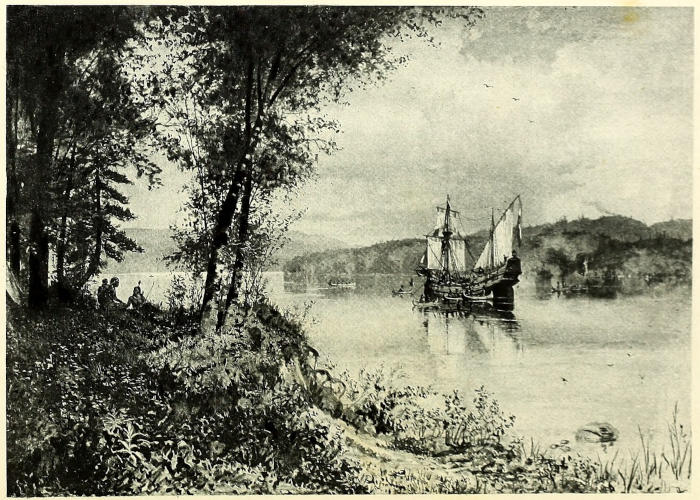
The “Half-Moon” on the Hudson—1609.
From a painting by L. W. Seavey.
American Historic Towns
HISTORIC TOWNS OF
THE MIDDLE STATES
Edited by
LYMAN P. POWELL
Illustrated
G. P. PUTNAM’S SONS
NEW YORK & LONDON The Knickerbocker Press
1899
Copyright, 1899
BY
G. P. PUTNAM’S SONS
Entered at Stationers’ Hall, London
The Knickerbocker Press, New York
PREFACE
In offering to the public the second volume
of American Historic Towns the editor
desires to bring three facts to the consideration
of the reader.
1. This being the middle volume of a series
dealing with the older towns along, or near,
the Eastern coast, it is hoped that the title
Historic Towns of the Middle States will seem
not inappropriate.
2. The plan which underlay the making of
the first volume, Historic Towns of New England,
has in the main been followed. Each
author has invariably been chosen because
of unique fitness for his special task. The
editor believes that in every case the enthusiasm
of the native or the resident will be found
wedded to the perspective of the litterateur or
scholar. No effort has been made to harmonize
divergencies in style or judgment, for obvious
reasons. The success of the first volume
has set the stamp of approval on the method
of the series, and the editor is glad to announce
that a volume on the Southern towns
will shortly follow this.
3. The chapter on Princeton first served as
an address in 1894 before the Historical Pilgrims
on the last day of their Pilgrimage,
which is described in Historic Towns of New
England, pp. iii.-v.
To the making of this volume many have
contributed in various ways. The editor is
under special obligation to his wife, Gertrude
Wilson Powell, for such assistance as makes
her really a co-editor of the volume. Dr.
Albert Shaw, and Mr. Melvil Dewey too have
given freely of their counsel and encouragement,
and the editor is happy to acknowledge
their great kindness.
Lyman P. Powell
St. John’s Rectory, Lansdowne, Pennsylvania, October 17, 1899.
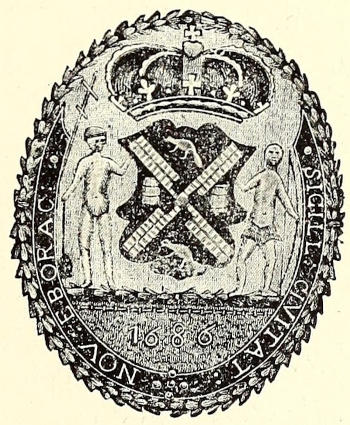
Transcriber’s Note: The illustrations listed as “Seal of Tarrytown”
and “Seal of New York City” were not, in fact, printed in the book.
Illustrations have been moved to the nearest paragraph break, which
may be on a different page.
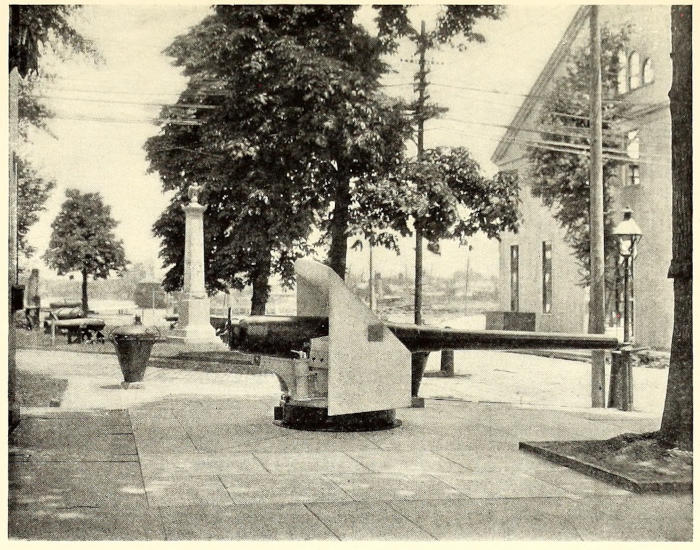
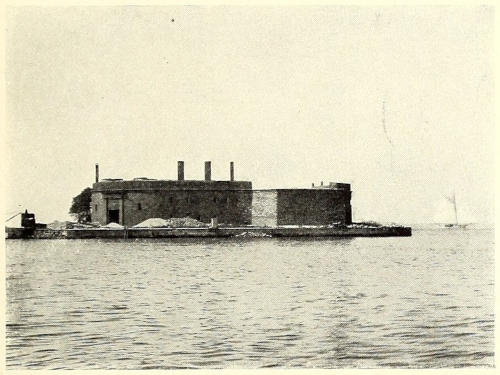
In foreground 5.5-inch breech-loading gun, with mount
and shield, taken from Spanish cruiser Vizcaya, after destruction
of Spanish fleet, July 3, 1898; also submarine mine from Guantanamo.
The designation “Middle States” has a
negative, rather than a positive, significance.
In our later history, as well as in that
of our colonizing and federalizing periods, the
term “New England” has had a definite value
for many purposes besides those of geographical
convenience: and it is equally true that
“the South” has meant very much in our
American life besides a mere territorial expression.
But the “Middle States” lack the
sharply distinguishing characteristics of the
other groups. In more senses than the strictly
literal one, the two immense States of New
York and Pennsylvania, with one or two smaller
neighbors, have occupied middle ground.
If New York, on the one hand, has been
somewhat closely related to New England,
Pennsylvania has had many neighborly
associations with Maryland and Virginia. New
Jersey, meanwhile, has been a close link between
Pennsylvania and New York. The development
of New England was dominated in
a marvellous way by a set of ideas, religious,
political and philosophical, that belonged to a
certain phase of the English Reformation. Virginia
and other settlements to the southward
had their origins in a colonizing movement
that was more typically representative of contemporary
English manners, views and ways
of living. The aristocratic system would have
disappeared rapidly enough in the South but
for the gradual extension of an exotic institution,—that
of African slavery.
The Middle States had a more varied origin,—one
that does not lend itself so readily to the
purposes of contrast and generalization. The
Hudson, called by the Dutch the North River,
and the Delaware, which they called the South
River, were both entered by Henry Hudson,
an Englishman in the employ of the Dutch
East India Company, in 1609; and apart from
an extremely limited settlement of Swedes on
the west bank of the Delaware, it was the
Dutch who controlled the beginnings of European
settlement along the seaboard of what
afterward came to be known as the Middle
States section. The Dutch colonization was
not large, but it had a strong and persistent
influence upon the subsequent development of
New York and the region round about.
The gradual predominance in New York of
men of English speech and origin came about
partly by infiltration from the New England
colonies and partly by direct migration from
England. There resulted a natural and harmonious
fusion between the Dutch pioneers
on the Hudson and the English-speaking colonists.
Various Dutch institutions survived
long after the English language had come into
general use.
Before the grant of Pennsylvania to William
Penn, the settlers on the Delaware had been
mainly Swedish, Dutch or otherwise from continental
Europe. William Penn’s colonists
at the outset were largely English Quakers,
and some years later there arrived great numbers
of Germans, some French Huguenots,
and a good many Scotch-Irish Protestants.
Thus, as compared with New England on
the one hand and the Southern colonies on
the other, the Middle States had cosmopolitan,
rather than purely English, origins. This
cosmopolitanism has remained, as a leading
factor in all their subsequent history. The
spirit of compromise and tolerance that had
been developed in the middle section by the
contact of different nationalities was of incalculable
value when the time came for the co-operation
of the thirteen colonies in the struggle
for independence, and in the subsequent formation
of their federal union.
If the colony which developed into the Empire
State, and that which came to be known
as the Keystone State, had occupied some
other geographical position than the one they
held as a buffer between New England and the
South, the history of America might well have
taken a wholly different course. For there
was almost as much difference in institutions,
life and points of view between the New Englanders
and the Virginians of Colonial days as
between the New Englanders and the Canadian
Frenchmen across the St. Lawrence. But
the transition from New England to New York
was easy, and involved no violent contrasts.
There had been a steady movement of population
from the New England States westward
across the eastern boundary line of the State
of New York. On the other hand, it was
comparatively easy for Maryland and Virginia
to co-operate with Pennsylvania. In so far, indeed,
as population had extended back from
the tide-water districts into the hill country
and the Appalachian valleys, the settlement
both of Maryland and Virginia had proceeded
very largely from Pennsylvania.
Thus the Middle States had a great mission
to perform in uniting and holding together the
more extreme sections. In the development,
after the Revolutionary War, of the country
west of the Alleghanies, this harmonizing influence
of the Middle States was very conspicuously
shown in the creation of the great
commonwealth of Ohio, and only to a less degree
in the making of a number of other States
in what has now come to be called the Middle
West—the region that produced men of the
type of Lincoln and Grant, and that joined
with the old Middle States in later crises to
preserve the Union and fuse its elements into a
homogeneous nation.
No communities in the world lend themselves
more profitably to the study of history
than these which are described in the present
volume. Concrete illustration aids no less in
the study of history than in that of the physical
sciences; and these towns of the Middle States
illustrate not only the more recent tendencies
that have marked the course of human
history, but also lead us back by easy stages
to an insight into conditions of an earlier time.
For example, the survivals of the Dutch régime
in New York quicken a sympathetic interest
that greatly aids the comprehension of
the international career of the Netherlands.
On the very day when these remarks are written,
the larger news of the world—that which
is history in the making—concerns itself with
two widely severed scenes of early Dutch colonization.
From Paris comes the decision of
the Venezuela arbitration tribunal, involving
principally the material and legal facts as to
the extent of Dutch exploration and settlement
in the same general period as the Dutch
colonization of New York. The relations of
the Dutch and English in successions and exchanges
of jurisdiction on the northern coast
of South America can only be understood in
the light of the history of the settlements at
the mouth of the Hudson River.
In like manner the conditions of Dutch settlement
in South Africa in the middle of the
seventeenth century are best comprehended
in connection with the story of contemporary
Dutch colonization in America. The Knickerbockers
of New York and the Boers of
the Transvaal are of common origin,—a fact
frankly recognized by the Holland Society
of New York in its expressions of sympathy
with the Dutch element in South Africa in its
struggle against fate.
The history of the communities of Pennsylvania
affords a convenient initiation into much
of the complex religious and ecclesiastical history
of Europe. Penn brought the Quakers
and other fine English stock from the middle
and north of England for reasons that go to
the very heart of the English life of the seventeenth
century. A little later the Protestant
Germans of the Palatinate came in great numbers,
impelled by motives to understand which
is to find oneself essentially comprehending
the conditions of Church and State that so
disturbed and harassed Western Europe for a
long period. Thus, to study the great city of
Philadelphia in its origins, its later accretions
and its existing conditions, is to find inviting
avenues leading into many fields of historical
inquiry both of the new world and the old.
What single spot could one find anywhere
that would more naturally stimulate the study
of political and economic history in the nineteenth
century than old Castle Garden at the
lower end of New York City, through which
millions upon millions of immigrants have entered
the Western world to find contentment
and prosperity? Many of these came from
Ireland; and the municipal life of New York
City has been profoundly affected by that fact.
To answer the question why these people left
Ireland and, in leaving, why their destination
was New York rather than some port in the
British colonies, is to review the history of
the Irish land system, the Irish Church and
the political administration of Ireland for several
generations.
An enormous element of the present population
of New York, as well as of the country at
large, is made up of a comparatively recent
German immigration, to understand which one
must learn something of the German revolutionary
movement of 1848, the growth of German
militarism and the conditions under which
educational progress in Germany has outstripped
the average material prosperity. Still
more recently there has been a huge immigration
of Russian Jews, with local effects of a
most marked character in the city of New
York. To know why these Jews have come
is to look into racial, political, and economic
conditions throughout the great empire of the
Czar.
To study the main routes of communication
in a region like our Middle States is to gain an
insight into the relations of physical conditions
to historical development that will be of no
little use in the study of other origins and
remoter periods. It would be hard to exaggerate
the importance, for instance, of the part
that the Hudson River has played in the history
of the Western Hemisphere since its
discovery and settlement by the Europeans.
The route by way of the Hudson, Lake
George and Lake Champlain afforded in the
early times the one interior passage to the
St. Lawrence from the settlements on our
seaboard.
Much of the land adjacent to the river was
granted in large tracts under the Dutch system
to patroons, so called, who were virtually
feudal lords. Upon some of these tracts there
still survive various peculiarities of the feudal
system of land tenure. To know something
of what feudalism meant as respects the control
of the land, the student might find a worse
method than to trace back the history of one
of these Hudson River estates to the period of
the Dutch grant, in order to get so much nearer
to the survivals of the mediæval system in
Europe.
At the spot where I live on the Hudson,
and where I am now writing, the environment
is suggestive of almost three centuries of
American history. I look out upon the great
stream which Hudson navigated in the Half
Moon in 1609, and upon which sailing craft
have been plying almost continually ever
since. I see great steamers passing where
Fulton first experimented with steam navigation.
The highway near by is the old Albany
post-road, this immediate part of which was
known as Edgar’s Lane and was opened in
1644. This morning I heard the pleasant
notes of a coaching-horn, and looked out to
see a stately four-in-hand on its way to the
city, a forcible reminder of at least a century
and a half of regular mail coaching on that
same road. My home is a part of what was
the old Philipse manor; and at Yonkers, a few
miles below, one finds the manor-house, now
in constant use as a municipal building. It
was partly built in 1682, and assumed its present
dimensions in about 1745.
On this very ground, and on the hills lying
to the eastward, Washington’s army was encamped
for a number of weeks in 1777, and
near by is the well-preserved colonial house
where Washington and Rochambeau sojourned
for some time, and where the Yorktown campaign
was planned. In the river at this point,
on several occasions, the British frigates made
appearance, the last of these being the final
meeting between General Washington and
General Sir Guy Carleton, in May, 1783, on
the suspension of hostilities. A few miles
farther up the road one comes to the lane that
leads to Washington Irving’s “Sunnyside,”
with its tablet stating that the house was first
built in the year 1650.
With these older historical souvenirs in
mind, I turn to the southward, and there, as a
reminder that the current of American history
flows on, and that our past is in no manner
detached from the present and the future, I
see, standing out in bold relief on the horizon,
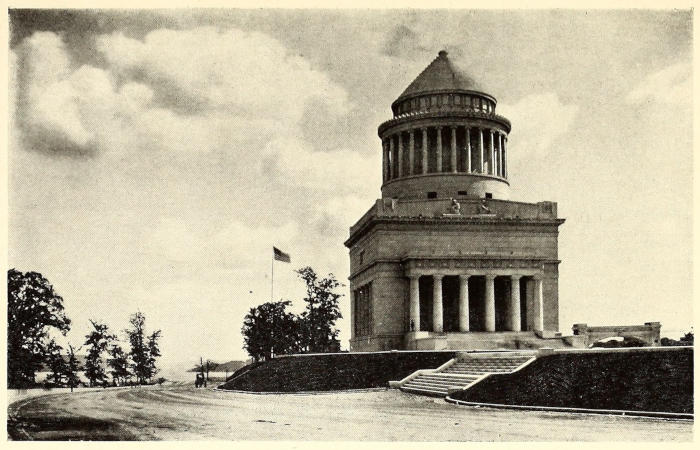
the tomb of General Grant, while anchored in
the river lies the Olympia, the flag-ship of
Admiral Dewey, just now returned from
adventures as fraught with history-making
results as was the presence of Hudson’s Half
Moon in this same river two hundred and
ninety years ago.
The historical significance of the Hudson
might be illustrated in some such way at many
another point upon its banks. The location
of Albany is particularly to be noted as one
evidently intended by nature for an important
rendezvous. In the earlier period Albany and
the Saratoga district, and certain points of advantage
in the Mohawk Valley, were of great
strategic importance. They were natural
gateways, which had to be held first against
the Indians and Frenchmen, and afterward
against the British. Their later importance
has had to do with canals, railroads and the
development of commerce.
But of Albany it must be said that it has also
the distinction of being one of the three or
four chief law-making centres of the English-speaking
world. In no other way has the
State of New York exerted so wide an influence
upon the country at large as in the
working out of laws and institutions which
have been re-enacted almost without change
by a great number of the other States of the
Union. Thus Albany has been a great training
school in politics and legislation.
Before the days of railroad building, the
Erie Canal was the greatest undertaking that
this country had witnessed in the improvement
of its transportation facilities. This waterway
connected the Great Lakes with the Atlantic
by way of the Mohawk and Hudson valleys;
and among other results of a far-reaching
nature there followed the development of the
city of Buffalo, a commercial and manufacturing
community founded in the opening years
of the nineteenth century, and destined in the
twentieth to achieve such growth and splendor
as few men are yet bold enough to anticipate.
We have seen in our generation fierce rivalry
for the occupation of Khartoum, at the head of
Nile navigation, with one expedition succeeding
another until the final success of the
English under General Kitchener. The possession
of Khartoum was known to carry with
it the control of the fertile Soudan beyond, as
well as to affect the permanent mastery of the
valley of the lower Nile to the Delta. In
some such manner the French and English in
the middle of the eighteenth century appreciated
the strategic importance of the point at
the junction of the Alleghany and the Monongahela
rivers, where the Ohio took its start,
and from which navigation was unobstructed
all the way to the Gulf of Mexico. It was in
large part the struggle for the site of Pittsburgh
that gave Washington the military training
and the large perception of the future of
America that fitted him for his great tasks of
leadership. The development of Pittsburgh
and the opening of the Ohio furnish most
instructive and interesting chapters in the
history of our country.
The quaint or curious or heroic beginnings
must always have their fascination; and it is
likely enough that for a long time to come
they will take a little more than their normal
or proportionate share of the page of history.
But real history is learning also to concern
itself with other things. The story of Princeton,
now so largely that of Revolutionary
annals, will henceforth increasingly be the story
of the life and work of a great university.
That of Pittsburgh will become in expanding
proportions the story of the development of
the arts and crafts and of manufacturing in
this country, and of the struggle of skilled labor
for an ever-larger share in the advantages
made possible by the enormous increase
in the volume of production. The story of
Philadelphia will, to an increasing extent, be
that of the best housed and most contented of
all the great communities in the world, full of
evidences of private thrift and the domestic
virtues, while exhibiting the paradox of a
relatively low degree of efficiency in matters of
common concern like municipal administration.
The historic towns of the Middle States are
now engaged in the making of history in ways
very different from those of the Colonial and
Revolutionary periods, but in ways certainly
not less important. But their future will be
the wiser and happier for a studious devotion
to the records of their honorable past, and
they cannot be too zealous in the perpetuation
of the old landmarks.
HISTORIC TOWNS OF THE MIDDLE STATES — ALBANY
“This antient and respectable city.”—(Washington, 1782.)
By WALTON W. BATTERSHALL
Albany, unlike the proverbial happy woman,
has not only age but a history. Its
age is indicated in its claim to be the second
oldest existing settlement in the original
thirteen colonies. The claim is fairly sustained,
but we must remember that the alleged
discoveries and settlements of those nomadic
times are a trifle equivocal. On the other
hand, the historical significance of Albany is
based on two unquestioned facts: for a century
it guarded the imperilled north and west frontiers
of Anglo-Saxon civilization on the continent;
for another century it has been the
legislative seat of the most powerful State in
the Republic.
On the 19th of September, 1609, old style,
the yacht De Halve Maen, six months from
Amsterdam, in command of Henry Hudson,
dropped anchor a few miles below the present
site of Albany. Four days spent in the exchange
of civilities with the Indians and the
taking of soundings from the ship’s boat
farther up the stream, convinced the speculative
explorer that the beautiful river among
the hills gave no promise of a water path to
China, and the Half-Moon, freighted with wild
fruits, peltries and pleasant impressions, turned
her prow homeward.
From the Dutch and also the English point
of view, the English skipper of the Dutch ship
had discovered the river. It appears however
that in 1524 Verrazzano put a French keel, La
Dauphine, far up the same stream, to which
he gave the name La Grande, and, some time
after, French fur traders built a rude château,
or, as we would say, fortified trading-post, on
Castle Island, just off the hills of Albany. But
the France of Francis I. had no colonizing
grip, and La Nouvelle France was simply a
name which stretched along the Atlantic seaboard
on the French charts of the sixteenth
century.
On the return of Henry Hudson, his discovery
was claimed by his patrons, the Dutch
East India Company. They named the river
the Mauritius[13] (Prince Maurice’s River), and
the outlying country, known as Nieu Nederlandt,
had good report in Holland for its furs
and friendly savages.
The Amsterdam merchants were alert, and
other Dutch vessels, following in the wake of
the Half-Moon, pushed up the river to the head
of navigation. There they found on the west
bank the Maquaas, or Mohawks, and on the
east bank the Mahicans, or Mohegans, with
whom they had profitable transactions.
To consolidate and protect their ventures,
a group of merchants petitioned the States-General
of Holland for the exclusive privilege
of traffic with the aborigines on the river.
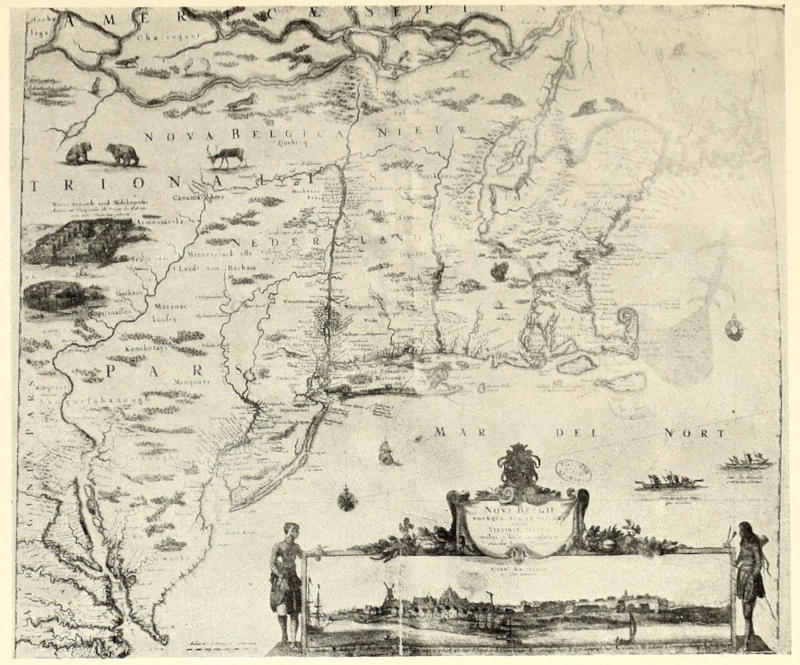
The elaborate map of Nieu Nederlandt which
they presented with their petition was discovered
in 1841 in the royal archives at the
Hague, and a facsimile is now in the State
Library at Albany.[14] A license for three years
was granted. Thereupon, in 1615, the ruined
château on Castle Island was rebuilt, equipped
with two cannon and garrisoned with a dozen
Dutch soldiers. In compliment to the Stadtholder,
it received the name of Fort Nassau.
This occupancy in force of Castle Island
(now called Van Rensselaer Island) was brief,
for the spring freshets proved too much for
even the amphibious Dutch musketeers and
traders, and it hardly can be called a settlement.
It is an interesting fact, that the valley of
the Hudson narrowly missed the honor of
being settled by the passengers of the Mayflower.
Under the November skies of 1620,
that historic vessel, with its valuable cargo of
religious and political seed-corn, for several
days had been beating about the point of Cape
Cod. Old Governor Bradford, with quaint
spelling and phrasing, tells the story of the
mishap:
“After some deliberation had amongst them selves and
with yᵉ mʳ of yᵉ ship, they tacked aboute and resolved
to stande for yᵉ southward (yᵉ wind and weather being
faire) to finde some place aboute Hudsons river for
their habitation. But after they had sailed yᵗ course
aboute halfe yᵉ day, they fell amongst dangerous shoulds
and roring breakers, and they were so farr intangled
ther with as they conceived them selves in great danger;
& yᵉ wind shrinking upon them withall they resolved to
bear up again for the Cape.”[15]
OLD CHART OF NIEU NEDERLANDT.
Thus Plymouth Rock became the intellectual
door-stone of the New World, and the
banks of the Hudson inherited one of the sad
“might-have-beens” of history. However,
Douglas Campbell, in his trenchant and disturbing
book, The Puritan in Holland, England
and America, has told us that the distinctive
principles of our American social and political
life show, on critical inspection, the Dutch
hall-mark.
The America of 1621 was much more of a
“dark continent” than the Africa of fifty years
ago. The adjective applies both to the skin
of the autochthons and the mind of the explorers.
In the commercial circles of Amsterdam,
Nieu Nederlandt was supposed to be a
part of the West Indies. Therefore it was
that the new company which was devised for
its exploitation and chartered in the year
mentioned, took the name of The Dutch West
India Company.
Under its auspices, in March, 1624, the ship
Nieu Nederlandt sailed from Amsterdam by
the accustomed route of the Canary Islands
for the Mauritius River. She carried thirty
families, chiefly Walloons, refugees from Belgium
who had settled in Holland, and a few
Dutch freemen. Some of the families were
landed on Manhattan Island, but the majority
proceeded up the river and selected for their
settlement the fat meadow on the west shore
above Castle Island. Under the shadow of
the clay hill on which the Capitol now lifts its
masses of sculptured granite, they built rude
huts sheathed in bark, and a little log fort
which they named Fort Orange. The Indians
were friendly and eager to barter, and enthusiastic
reports were at once sent over to Holland,
with corroborative otter and beaver skins.
Two years after this settlement at Fort
Orange, the Dutch West India Company purchased
Manhattan Island from the Indians for
sixty guilders in high-priced goods and, planting
a colony and fort on the south end of the
island, brought up the population of Nieu
Nederlandt to two hundred souls. The Company,
desiring to stimulate colonization, in 1629
projected the manorial or patroon system; a
combination of feudal idea and Latin name,
patronus. Killiaen Van Rensselaer, one of the
directors and a rich merchant of Amsterdam,
at once obtained an extensive grant of land
south of Fort Orange and, by the purchase of
the land from the Indians and the planting of a
colony, became the patroon of Rensselaerswyck.
He never visited his “colonie,” but before his
death in 1646, he had sent from Holland over
two hundred artisans and farmers, and included
in his manor a territory forty-eight by twenty-four
miles, and also another tract of sixty-two
thousand acres.
Thus Albany began with a Dutch imprint,
which to this day has given to the city its distinctive
mark. Forty years of Dutch sagacity
and thrift rapidly developed the colony. It
was on the whole a prosperous period, enlivened
by chronic disputes between the garrison and
the manor, and disquieting rumors regarding
belligerent Indians and the French. It throws
on a small canvas sturdy personages and stirring
events. Brandt Van Slechtenhorst, the
stiff upholder of the manor claims against
the doughty Pieter Stuyvesant, the last Dutch
Director-General; Domine Megapolensis, the
first Dutch minister; and the flitting figure of
the Jesuit missionary, Father Jogues with his
hands mangled by the Mohawks and kissed by
the Queen of France, would make any canvas
picturesque. To take Washington Irving’s
delicious bit of humor too seriously shows a
melancholy lack of humor.
Certainly the Dutch burghers of Albany did
not take very seriously the English occupation
of Nieu Nederlandt in 1664. The seizure was
colored by an old claim of uncertain dimensions
based upon the Cabot discoveries, which for a
long time had strained the relations between
England and Holland concerning colonial matters.
The capitulation was bloodless, and to
Albany it brought little change, save that the
English flag, in place of the Dutch, fluttered
over the ramparts of Fort Orange, which took
the name of Fort Albany in commemoration of
the Scotch title of the Duke of York, the new
lord of the province. The great manorial
grant was confirmed, and in all its habits of
thought and life the colony remained Dutch.
The happiest change and perhaps the most
startling shock came from the fact that the
Duke of York, bigot as he was, broke the tradition
of the period and introduced in his
province religious toleration.
The English came, but the Dutch remained.
The old Holland stock on the bank of the Hudson
kept its root in the soil and has made vital
contributions to the American hybrid, which
have had scant recognition in our popular histories.
The fact is, the Dutch were not given
to writing books. They had fought for their
religion and motherland, and had held them
both against the assault of a powerful foe, but
the recital of the story they left to the more expert
tongues and more eloquent pens of Englishmen.
Their type of character and social
usage has proved its vigor and worth by its
quiet persistence and dominance in New York
life of to-day. In old Albany, even under English
rule, ideas and customs which had their
birth behind the dykes of Holland were conspicuously
in the ascendant.
PLAN OF ALBANY, 1695.
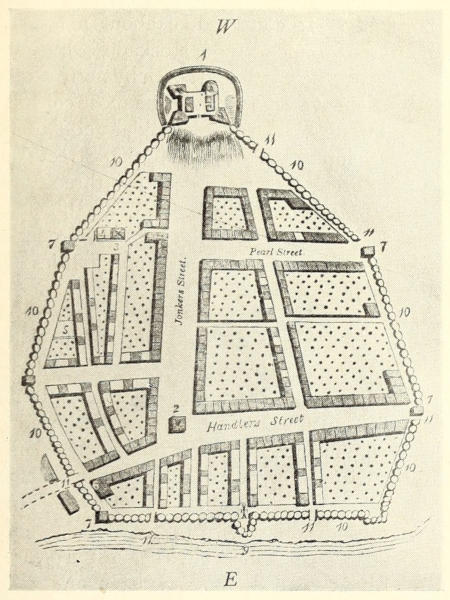
Albany became a city in 1686 by a judicious
charter granted by Governor Dongan. A diagram
in the Rev. John Miller’s Description of
the Province and City of New York, published
in London, 1695, gives us an idea of the new-born
city. It consisted of about a hundred
houses surrounded by a stockade, which was
pierced to the north and south by narrow gateways.
Above the stockade the most conspicuous
objects were the pyramidal roof of the
Dutch church at the foot of Jonker Street (now
State Street), surmounted by three small
cannon, and, on the eminence at the upper
end of the street, the bastions of Fort Frederick,
which had inherited the responsibilities and
honors of the dismantled Fort Orange.
For about forty years after the peaceful
seizure by the English, the old Dutch church,
where the prosperous burghers worshipped,
and a Lutheran church of somewhat intermittent
life but hospitable to outsiders sufficed for
the religious needs of the city. The officers of
the garrison, however, and probably most of the
soldiers were Church of England men. There
was much in the service of the Dutch Church
of that day which must have suggested pleasant
reminiscence. Christmas, Easter and Whitsunday
were festivals brought from Holland,
and were duly celebrated in the church
and at the fireside. Queerly enough, in the accounts
of Pieter Schuyler, the deacon of the
Dutch church in 1683 and the first mayor of the
city, we read that “the 13th of January was
observed as a day of fasting and prayer, to divert
God’s heavy judgment from falling on the
English nation for the murder of King Charles,
martyr of blessed memory,” and that the expenses
therefor were seventeen guilders.
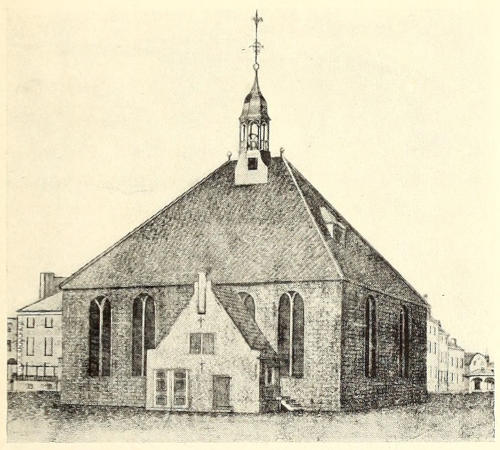
OLD DUTCH CHURCH, ERECTED IN 1715 ON SITE OF ORIGINAL
CHURCH ERECTED IN 1656.
But the theological coin of the Synod of
Dort, whether acceptable or not to the English,
was more or less inaccessible, being hid in
the napkin of the Dutch language. Evidently
there was need of an English house of worship
in Albany. In 1714, therefore, Governor
Hunter issued letters patent granting a plot of
ground in Jonker Street below the fort for a
church and cemetery. The Common Council
made protest. The point at issue was a question,
not of doctrine, but of municipal rights.
They issued notice to suspend the laying of the
foundations. They arrested the workmen. They
petitioned the Governor. They sent a messenger
by express in a canoe to New York,—a
journey in those days of such magnitude that
the church was well under way by the time the
return voyage was accomplished. Despite all
obstacles, the work went on and in the course
of a year the first English church west of
the Hudson was built. The two churches,
the Dutch at the foot and the English at the
head of State Street, were the chief ecclesiastical
landmarks of eighteenth-century Albany.
Like rocks in a stream, they stood in the broad
thoroughfare and preserved the magnificent
approach to the future Capitol.
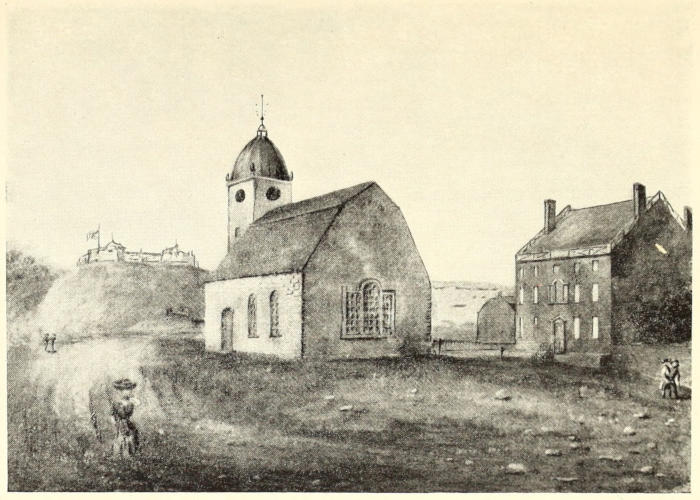
ST. PETER’S CHURCH, ERECTED IN 1715, FORT FREDERICK IN THE BACKGROUND.
(FROM A WATER-COLOR SKETCH IN THE BRITISH MUSEUM.)
Little as it was, Albany was the nest of important
events and a maker of history in those
troublous days. Second to New York in
size and resources, it served as a wary sentinel
and tremulous alarm-bell to the exposed province.
For well-nigh a century, all beyond it
to the west and north, except the hamlet of
Schenectady and the French settlements on
the St. Lawrence, was wilderness and savages.
It occupied a post of the gravest peril and responsibility.
We get a glimpse of the situation
and of the current history in the scene on
that Sunday morning, the 9th of February,
four years after the granting of the charter,
when Symon Schermerhoorn, shot through the
thigh, told at the north gate of the stockade
his breathless story of the night attack and the
horrible massacre at Schenectady.
Between the hostile French in Canada and
the little frontier city on the Hudson roamed
the tribes of the Iroquois confederacy, upon
whose friendship and fealty in large measure
hung the destiny of the English possessions.
The stockade, thirteen feet high, would have
been of little account if that living bulwark of
savage allies had yielded to the arms or the
bribes of the French. That the bulwark did
not yield, that the fealty of the Indians was
won and, through every peril, kept unbroken,
was owing to the sagacity and honorable dealing
of the government and burghers of Albany.
The House of Peace—this is the name which
the Mohawk sachem, at one of the council-fires,
gave to the Albany of those olden days, and,
in the graphic phrase of his Indian oratory, he
pictured at a stroke its political value and place
in history; for there, by repeated formal treaties
and habitual friendly intercourse, were
riveted the “Covenant Chains” which made
the confederation of the Six Nations the guardians
of the feeble province.
There is a scene in The History of New York,
by William Dunlap, which is illustrative. The
date is 1746 and the central figure is the celebrated
Col. William Johnson, Indian agent,
whom George II. made a “baronet of Great
Britain.”
“When the Indians came near the town of Albany on
the 8th of August, Mr. Johnson put himself at the head
of the Mohawks, dressed and painted as an Indian war-captain.
The Indians followed him painted for war.
As they passed the fort, they saluted by a running fire,
which the governor answered by cannon. The chiefs
were afterwards received in the fort-hall and treated to
wine. A good deal of private manœuvring with the individual
sachems was found necessary to make them declare
for war with France before a public council was
held. The Iroquois took to the 23d of the month for
deliberation, and then answered, the governor being
present.”
During the French wars, Albany, from a military
point of view, was probably the most
animated spot on the continent. It was the
storehouse for munitions of war and the rendezvous
for the troops. English regulars and
provincial militia swarmed in and about the
city. After the unsuccessful campaigns of
1756 and 1757, the town was filled with refugees,
reciting the slaughter of the garrison at
Fort William Henry, and the murder and havoc
wrought by the Indians in pay of the French.
Hundreds of loyal Indians, with their squaws
and papooses, encamped under the stockade.
The houses and barns were filled with wounded
soldiers brought from the seat of war. In the
pauses of the campaigns, notwithstanding the
horrible rumors and actual disasters, the “dangerously
accomplished” English officers made
merry life in old Albany, picturesque details
of which are given in that charming chronicle
of colonial days, Memoirs of an American
Lady (Mrs. Philip Schuyler), by Mrs. Grant
of Laggan.
In the opening of the campaign of 1758 there
was grief and consternation in the province.
Tidings came that Lord Viscount Howe had
been killed in a skirmish on the march against
Fort Ticonderoga. The body of the brilliant
soldier was brought to Albany by his friend,
Captain Philip Schuyler, and was buried beneath
the chancel of the English church. The
stone recently unearthed in the village of Ticonderoga,
which bears the inscription, evidently
scratched by a knife or bayonet, Mem of Lo
Howe killed Trout Brook, probably marked
the spot where Lord Howe fell. There is
abundant evidence that his body now lies beneath
the vestibule of St. Peter’s Church. The
Church Book of the parish contains the following
entry: 1758, Sept. 5th. To cash Rt for
ground to lay the Body of Lord how & Pall
£5. 6. 0.
In the following year, the fateful victory of
Wolfe on the Plains of Abraham gave Canada
to England and ended the hard-fought duel
between the Latin and the Anglo-Saxon for
the sovereignty of the continent.
Some years before this, the Stadt Huys, the
old City Hall of Albany, was the scene of a
significant event which was the prelude of one
still more momentous. There in 1754 Commissioners
from the several provinces convened
to renew the “Covenant Chain” with the Six
Nations, and to discuss the best methods for
uniting and defending the colonial interests.
The foremost spirits and political prophets of
the colonies composed the assembly. Numerous
Indian sachems, with their stately bearing
and barbaric splendor, decorated the scene of
the deliberations. The “Plan” adopted by
the convention was not accepted by the Crown,
but it was the first attempt to articulate the
idea of a colonial union, and it bore two names,
Benjamin Franklin and Stephen Hopkins,
which in due time were affixed to the Declaration
of Independence.
Before the lightning flashed in the volley at
Lexington, there were centres of influence
throughout the colonies breeding storm. Albany
was one of them. The heart of the old
Dutch town was fired with the indignations
and enthusiasms of the time. There were
tories of course, but the temper of the city and
the attitude of those who controlled the situation
are indicated by the fact that, when the
Province of New York had fairly opened the
fight, the old fort on the hill was extemporized
into a tory jail.
As early as November, 1774, the freeholders
of the city appointed a Committee of Safety
and Correspondence, which proved a vigorous
agent in propagating the war spirit and
furnishing men and money for the Continental
army. The following names appear on its
lists: John Barclay, Chairman, Jacob C. Ten
Eyck, Henry I. Bogert, Peter Silvester, Henry
Wendell, Volkert P. Douw, John Bay, Gysbert
Marselis, John R. Bleecker, Robert Yates,
Stephen De Lancey, Abraham Cuyler, John
H. Ten Eyck, Abraham Ten Broeck, Gerret
Lansingh, Jr., Anthony E. Bratt, Samuel
Stringer, Abraham Yates, Jr., and Cornelis
van Santvoordt. In the records of the committee
occurs this significant minute: “Pursuant
to a resolution of yesterday, the
Declaration of Independence was this day read
and published at the City Hall to a large Concourse
of the Inhabitants of this City and the
Continental Troops in this City and received
with applause and satisfaction.”
At the beginning of, and all through the
struggle for independence, Albany was a strategic
point of the utmost importance. The war-office
in London and the British commanders
in the field recognized that it was the key to
the situation in the north. There is a passage
in the oration of Governor Seymour at the
Centennial Commemoration at Schuylerville,
the actual scene of Burgoyne’s surrender,
which condenses and interprets one of the
most important chapters in the history of the
Revolution.
“It was the design of the British government in the
campaign of 1777 to capture the centre and stronghold
of this commanding system of mountains and valleys.
It aimed at its very heart,—the confluence of the Hudson
and the Mohawk. The fleets, the armies, and the savage
allies of Britain were to follow their converging lines to
Albany, and there strike the decisive blow.”
As sometimes happens, the blow struck
the striker. Col. Philip Schuyler, the young
officer who brought the body of Lord Howe
to its burial, was an ardent patriot and the
most distinguished citizen of Albany. On the
recommendation of the Provincial Congress of
New York, he had been appointed by the
Continental Congress a major-general in the
armies of the United Colonies and had assumed
command of the Northern Department. He
was displaced in favor of General Gates, but
he retained the confidence of Washington, and
it was he who planned and conducted the
campaign which resulted in the victory of
Bemis Heights and the surrender of Burgoyne.
This event broke the formidable menace that
hung over the
province and the
colonial cause.
The defeated
British general
found himself in
the hands of a
courteous foe,
and for several
months he meditated
and mitigated
his disaster
amid the
elegant hospitalities
of the
Schuyler mansion
in Albany.
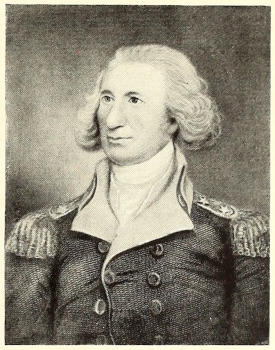
MAJOR-GENERAL PHILIP SCHUYLER.
(FROM A PAINTING BY COL. TRUMBULL.)
In 1797, “this antient and respectable city
of Albany” (to quote the courtly compliment
of Washington) became the capital of the
State. At the close of the Revolution, New
York had not yet determined its seat of government.
From 1777 to 1796 it peregrinated
between Kingston, Poughkeepsie, Albany and
the city of New York. Not until the twentieth
session of the Legislature was the long
dispute settled. The geographical advantages
of Albany finally carried the day, and for the
last hundred years the site of the frontier fort
has been a political arena and an illustrious
seat of legislative and judicial power.
The Albany of “modern times,” as the
phrase is understood in our American life in
which everything is new except human nature,
has preserved few of the ancient landmarks.
The only souvenirs are the bronze tablets
which were devised at the Bicentennial in
1886, and which now designate the historic
sites in the city. If one, reverent of ancient
and vanished things, make pilgrimage to the
tablet near the curb on the lower edge of the
Capitol Park (a block above the site of Fort
Frederick), to the one on the corner of Broadway
and Steuben Street (the site of the northeast
gate), and to the one near the curb on
lower Broadway two blocks from State Street
(the site of the southeast gate), he will define
quite accurately the girdle of the palisadoes
which protected old Albany.
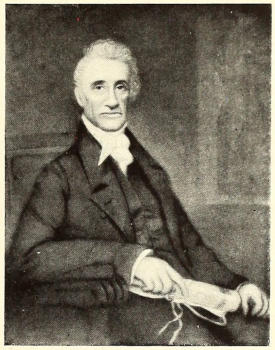
STEPHEN VAN RENSSELAER.
(FROM A PAINTING BY EZRA AMES.)
If he pass the memorial of the northeast
gateway, a place of memorable outgoings and
incomings, and continue up Broadway about
three quarters of a mile, he will find a bronze
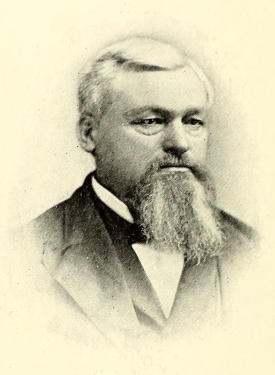
tablet bearing the inscription: “Opposite
Van Rensselaer Manor-House. Erected 1765.
Residence of the
Patroons. This
spot is the site of
the First Manor-House.”
It was
an unpretentious
one-story
building of Holland
brick, half
fortress and half
dwelling. The
final Manor-House,
on the
other side of the
road, was a structure
of another
fashion. At the
time of its erection, 1765, it was considered the
handsomest residence in the colonies. Thither
Stephen Van Rensselaer brought his young
bride, Catherine, daughter of Philip Livingston,
and his babe, who became General Van Rensselaer.
It stood amid the drooping elms of a large
park and was decorated with a taste and luxury
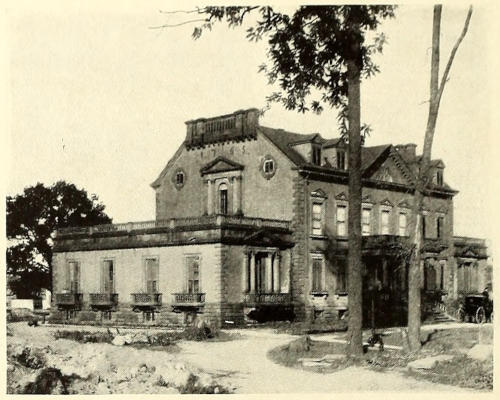
startling to the period. In 1843 the building
was enlarged and enriched by the elder Upjohn.
Once a stately mansion, the scene of
splendid hospitalities, it has shared the American
fate of obstructive antiquities in thriving
towns. The railroad and the “lumber district”
crowded and finally strangled it. For several
years it stood empty and dismantled, and obviously
had outlived both its beauty and its
use. In 1893 the stone and timbers were
transported to the Campus of Williams College,
where they were reconstructed into the
Sigma Phi Society building, which perpetuates
a remote suggestion of the famous Manor-House.
VAN RENSSELAER MANOR-HOUSE, 1765.
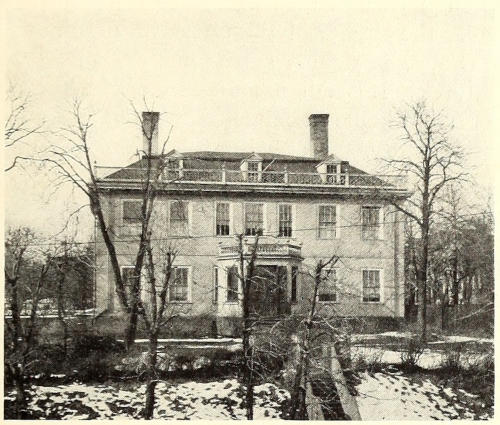
In the southern part of the city, on Clinton
Street, is a bronze tablet which designates the
sister of the Manor-House, the Schuyler mansion,
built by the wife of General Philip Schuyler
while he was in England in 1760. This
historic relic stands on a plateau above the
street, surrounded by a remnant of the original
garden, but the broad avenue, shaded by elms,
which once gave approach to the mansion
from the river, is overgrown with houses.
Though used at present as an orphan asylum
under the charge of the Order of St. Francis
de Sales, it retains substantially its original
features. It is a dignified and spacious house;
not remarkable architecturally, but fragrant
with history. Here Burgoyne enjoyed his
imprisonment. Here Washington, Lafayette,
Count de Rochambeau, Baron Steuben, Benjamin
Franklin, Charles Carroll of Carrollton,
Aaron Burr, and other notable men of old
were entertained. Here Alexander Hamilton
and Elizabeth Schuyler were married, December
14, 1780. Besides famous guests and weddings,
its chief feature of historic interest is
the staircase, apropos of which, we quote from
Mr. Marcus Reynolds’s article on The Colonial
Buildings of Rensselaerswyck in The Architectural
Record of 1895.
“Here is shown the famous tomahawk mark. In
1781 a plan was made to capture General Schuyler and
take him to Canada. A party of tories, Canadians and
Indians surrounded the house for several days, and at
length forced an entrance. The family took refuge in the
upper story, leaving behind in their haste the youngest
member of the family, Margaret Schuyler, afterward the
wife of the patroon. An elder sister going to rescue the
infant, was pursued by an Indian, who threw his tomahawk
at her as she fled up the stairs. The weapon entered
the hand-rail near the newel, and the mark is still
shown, which would be conclusive evidence if the same
story were not told of the Glen house in Schenectady,
the only house unburnt in the massacre of 1690.”
SCHUYLER MANSION, 1760.
With all its historic associations, Albany is
not conspicuous for the scenery it has furnished
for the enchantments of poetry and romance;
still it is not altogether destitute of
literary honors. Its colonial life figures in the
Satanstoe of the great Fenimore Cooper and
in Harold Frederick’s In the Valley. The
Normanskill, which tumbles into the Hudson
at the south end of the city, flows through the
Vale of Tawasentha, the scene of Longfellow’s
Hiawatha. The hills and forests about the city
suggested many a delicate detail in the woodland
rhythms of Alfred Street, who made his
home and burial-place in Albany. Its old Dutch
life with its sedate charm has been pictured by a
living Albanian, Leonard Kip; and probably
the house still stands on Pearl Street or Broadway,
in which Henry James found the charming
girl who stood for his Portrait of a Lady.
On the east bank of the Hudson, in old
Greene Bosch, opposite the city, decays the dishonored
ruin of Fort Crailo. The date, more
or less mythical, is 1642. It was the headquarters
of General Abercrombie, and in the
garden back of the house a derisive British
surgeon, Dr. Stackpole, composed the immortal
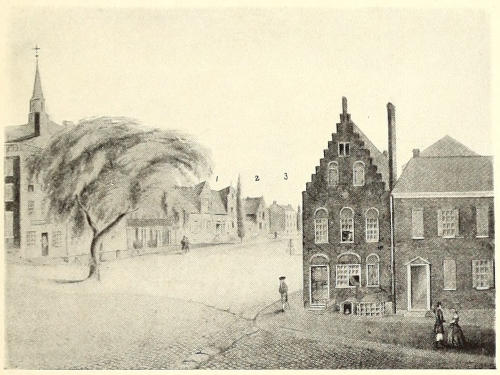
jingle of Yankee Doodle. If, in 1800, one
stood on the southeast corner of State and
North Pearl Streets, opposite the famous elm
which Philip Livingston planted in 1735, his
eye glancing up the street to the north would
be arrested by a picturesque relic of Dutch
Albany, the Vanderheyden Palace. Of course
it has joined the departed, but its ghost appears
in Washington Irving’s Bracebridge Hall, and
its old weather-vane now swings above the
porch of Sunnyside.
Some of the colonial structures were fine
and famous in their day, but in truth, in our
American towns, imposing architecture is a
thing of recent date. Few cities give more
favorable sites for architectural effects than
the three hills of Albany. It is not too much
to say that the wealth and taste of its citizens
have conspired with its peculiar advantages of
position. The architecture of Albany has an
exceptional value. The City Hall, with its Romanesque
doorways and majestic campanile,
is a fine specimen of the great Richardson.
The Albany City Savings Bank, recently constructed,
is a classical gem, inadequately set,
but cut by a master hand. Its Corinthian
monoliths and graceful dome satisfy the eye,
and the whole structure is a suggestive instance
of what trade can do in the interests of art.
WEST SIDE OF PEARL ST. FROM STATE ST. TO MAIDEN LANE, 1814.
1. VANDERHEYDEN HOUSE. 2. PRUYN HOUSE. 3. DR. WOODRUFF’S HOUSE.
(FROM A WATER-COLOR SKETCH BY JAMES EIGHTS.)
The four examples of ecclesiastical architecture
of more than local interest are the
North Dutch Church, an exceptionally good
specimen of the style which obtained in the
beginning of the century; the Cathedral of the
Immaculate Conception, with its lofty double
spires emphasized by the site, and its spacious
interior treated with taste and dignity; St.
Peter’s Church, with its noble lines, artistic windows
and finely detailed tower,—“one of the
richest specimens of French Gothic in this
country”; and the Cathedral of All Saints,
whose unfinished exterior encloses columnar
effects and a choir-vista which remind one of
an impressive mediæval interior and give the
edifice a distinctive place among the churches
of America.
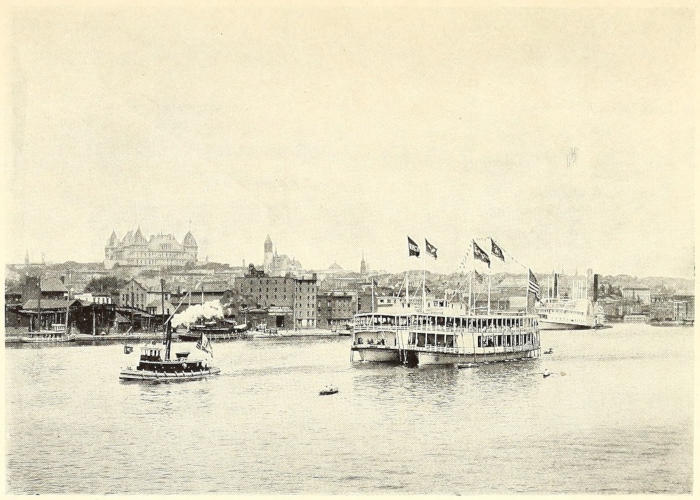
VIEW OF ALBANY, 1899.
These architectural monuments, however,
and the city itself are overshadowed by the
new Capitol. This massive structure, since its
corner-stone was laid on the 24th of June, 1871,
has absorbed over twenty millions of dollars.
The enormous bulk, the difficult foundations,
the obdurate granite, the elaborate sculptures,
the mistakes and afterthoughts, sufficiently account
for the money. The old Capitol, which
stood in front of the southeast corner, well-nigh
could be tucked into one of its great pavilions.
The edifice is of such cost, size, and
architectural importance, that one discusses it
as he might discuss Strasburg Cathedral or
the weather. Claiming simply the freedom of
personal impression, one may say that its
weakest feature is the eastern façade, which
gives an inadequate suggestion of the size of
the building and moreover is dwarfed by the
projecting mass and lofty ascent of the gigantic
stairway. He may also say that the
Capitol declares its highest points of architectural
interest in the constructive and decorative
treatment of the interior.
The edifice has been built with the advantage
of large ideas and limitless resources, and the
disadvantage of fluctuating ideas and a succession
of architects. These facts have left
their imprint on the structure but, with all that
can be said in criticism of details and of unused
possibilities, it can fairly be ranked among the
great buildings of modern times.
As one approaches Albany, the colossal bulk
of the Capitol thrust against the sky seems to
dominate the city as the great cathedrals of
Europe dominate the towns that have grown
or decayed under their shadow. But there are
other structures and artistic things, representing
the local life, that are worthy of remark.
The State Museum of Natural History, in
Geological Hall, a block below the Capitol,
vies with the State Library as a credit to the
State and the haunt of the student. It is one
of the largest and best arranged museums in
the country, and its collection of the paleozoic
rocks of New York, which figure so largely in
the nomenclature of geology, is a monument
to an eminent name in the scientific world,
James Hall, late State Geologist.
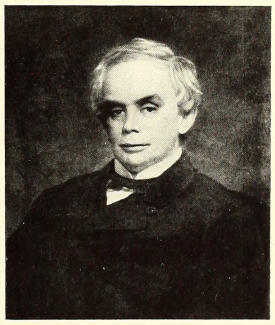
JOHN V. L. PRUYN.
Near the Capitol Park is the Albany Academy,
in whose
upper rooms
Henry and Ten
Eyck demonstrated
the electrical
facts
which were applied
by Morse.
Up the hill, on
the southwest
corner of the
city, stand the
pavilions of the
new Hospital,
built in 1899, and
the Dudley Observatory, of note in the stellar
world. On Washington Avenue is Harmanus
Bleecker Hall, built from the fund held in trust
for more than half a century by Chancellor
Pruyn and Judge Parker. On State Street
opposite the Capitol is the building of the
Historical and Art Society, which, though
new-born, has already done valuable work in
collecting sequestered relics of history.
Under the elms in Washington Park are
two fine bronzes: Caverley’s statue of Robert
Burns and Rhind’s statue of Moses at the
Rock of Horeb. Fortunately one of the earliest
and two of the noblest creations of the
sculptor Palmer are in the city of his home:
his Faith at the Cross, his Livingston, and his
Angel of the Resurrection.
Albany the Old has become Albany the
New. In many ways the new is more energetic
and more splendid than the old. The town is
large enough to show the characteristic features
of our American life in its more sensitive and
vigorous centres, and small enough to retain
local color and distinctive traits. It is self-centred,
believes in itself, and has the instinct
to discern and the habit of demanding the
best things. It is a place where the finest
flavors of the old life linger in and temper the
broader spirit and more robust movement of
the new life; a place that perpetuates its traditions
of social elegance and hospitality; a
place, too, that has been the cradle and home
of men of commanding force, who have contributed
to the highest life of the nation and
have left their names on enduring structures of
thought and art and economic organization.
The city lies at the intersection of the great
thoroughfares of traffic and travel in the richest
and most densely populated portion of the
republic. Its facilities for production and distribution
may give it in the future an enormous
industrial development. This fortune
is not unlikely, but, to those who estimate
in large ways the values of life, it cannot
heighten the beauty or deepen the charm of
the Albany of to-day.
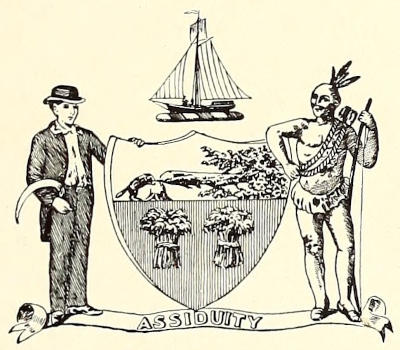
SEAL OF ALBANY.
SARATOGA
THE STRUGGLE FOR THE GREAT WATERWAYS
By ELLEN HARDIN WALWORTH
There are names which are more than
famous—they have a distinct individuality;
their sound to the ear or appearance on the page
arrests attention, arouses interest, and presents
a clear picture to the mind. Such a name is
Saratoga, with its romantic record, its picturesque
scenery, and its beautiful village,—the
“Queen of Spas.” Nature has furnished Saratoga
with a regal setting on the lower spurs of
the Adirondack Mountains, the last elevations
of the Palmertown range, on the edge of the
world’s first continent.
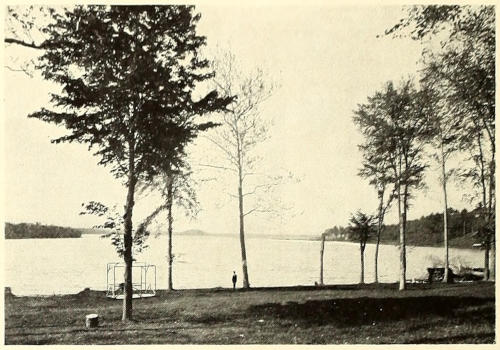
SARATOGA LAKE, N. Y.
Here where the Laurentian rocks stand out
boldly over the sands of the old Silurian sea,
and where the mighty waterways sweep down
from the great northern gulf southward, and
from the great northwestern lakes eastward, lies
Saratoga Springs. These valleys, bearing the
waters of Lake Champlain, Lake George, and
the upper Hudson on the north, and of the
Mohawk River on the west, have been for
centuries the great war-paths of the Indians
and of civilized nations. If America is not old,
at least her maturity is marked in this region
by the scars of war, and by the lines of struggle
for the sovereignty of the great waterways.
Here are veritable ruins,—old Fort Carillon,
later “Old Ticonderoga,” Fort Frederick, afterward
Crown Point, and traces here and there
of the line of forts extending from the Indian
carrying-place at Fort Edward down on either
bank of the Hudson to old Saratoga, now
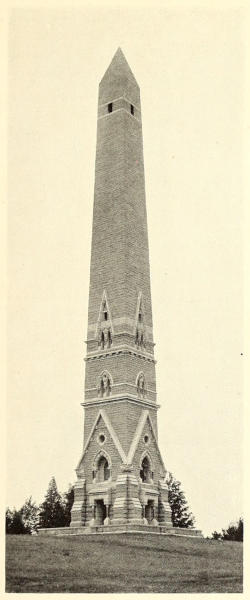
Schuylerville, where the great monument commemorative
of Revolutionary victory marks
the national character of that struggle, and
where, eight miles below, at Bemis Heights,
fourteen granite tablets, each a monument five
or six feet in height, mark the fighting-ground.
Through the Mohawk Valley are signs of the
“Long House” of the Six Nations, of massacres
and battles, that tell their story of three
centuries.
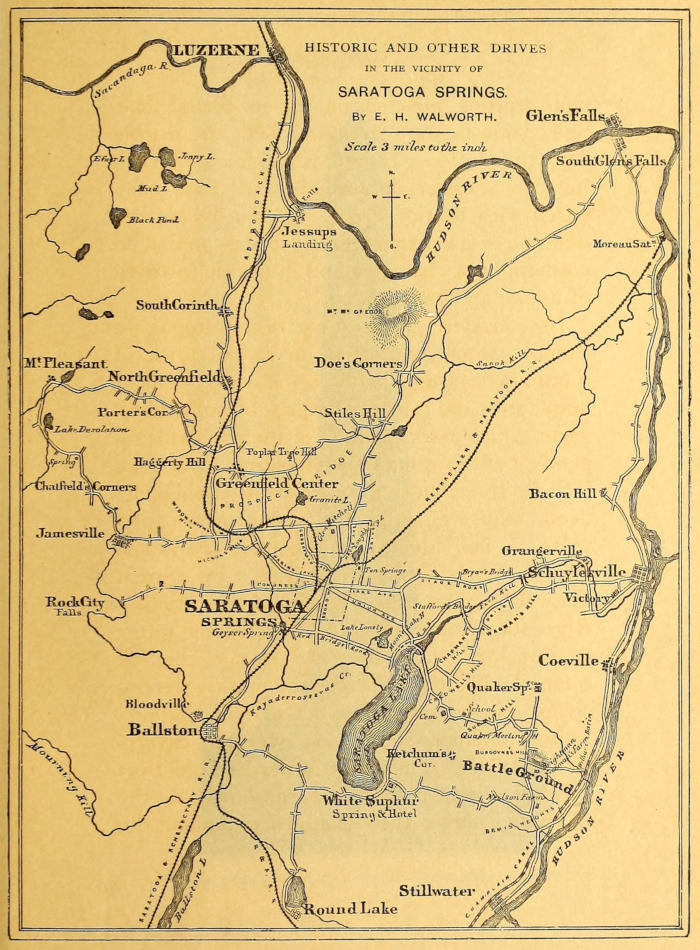
HISTORIC AND OTHER DRIVES IN THE VICINITY OF SARATOGA SPRINGS.
By E. H. WALWORTH.
The story of Saratoga cannot easily be
limited to Saratoga Springs, although it has
fifteen thousand inhabitants who retain their
quaintly rural government and cling to the
appellation of “village.” Village though it be,
it is imposing with its stately hotels, spacious
streets, large business houses, many beautiful
villas, fine public halls, handsome churches, and
numerous valuable mineral springs; which, like
the residences, are set amid magnificent trees,
forest pines and cultivated elms that rival the
famous trees of New Haven. From the surrounding
hills the village seems to nestle in the
original wilderness. But it is always active,—in
winter with its toboggan slide, snow-shoe
club, trotting matches on the ice-bound lake,
and snow-bound streets rolled to marble
smoothness for gay and luxurious sleigh-riding;
in summer, its brilliancy is often compared
with that of Paris. In the loss of the
old-time social exclusiveness it has gained in
cosmopolitan character and in the rich variety
of its life and amusements.
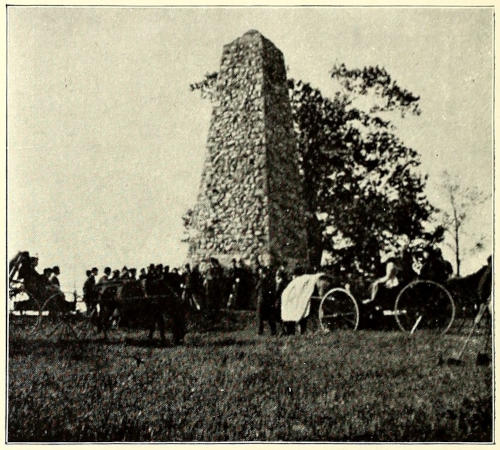
SARATOGA BATTLE MONUMENT, SCHUYLERVILLE, N. Y.
In considering the story of Saratoga, we
cannot confine our attention to the town of
Saratoga Springs, with its sharply defined
boundaries and rectangular lines of political division
which mark the limit of the voters for supervisor
at the annual town-meeting. But if we
include the county in our narrative, then, indeed,
may we recall the vision which presents
the individuality of the name Saratoga.
For Saratoga County is outlined by a great
eastward and southern sweep of the Hudson
River for seventy miles from its narrow gorge
at Luzerne, where the wild savage chief of
colonial days leaped across the mighty river to
escape his pursuing foe, down over the precipitous
Palmer’s Falls, and over the cavern-haunted
Glen’s Falls, and onward to old Fort
Edward, where its waters turn shortly to the
south and pursue their troubled way along the
“hillside country,” which received here its
Indian name, “Se-rach-ta-gue,” which means
“hillside country of the great river.” It is
also said that in the Indian language Sa-ragh-to-ga
means the “place of the swift water,” in
allusion to the rapids and falls that are in contrast
with the “still water” a few miles below.
Thence the Hudson flows on until it receives
the four sprouts or mouths of the Mohawk
River, which spreads out from the precipitous
falls at Cohoes. This great intersecting western
valley separates the northern from the
southern highlands of New York, and is, like
the great northern valley, a natural highway
and thoroughfare. In the angle formed by
the junction of these two long, deep valleys or
passes through the mountain ranges, “in the
angle between the old Indian war-trails, in
the angle between the pathways of armies, in
the angle between the great modern routes of
travel, in the angle formed by the junction of
the Mohawk and Hudson rivers,” is Saratoga
County, the Saratoga of history and romance.
Not only the stealthy tread of the Iroquois
sped over these hills, not only the swift canoe
of the Algonquin shot over these streams, but
also the disciplined armies of France and of
England marched and countermarched, fought
by day and bivouacked at night on this ground,
from the time that Hendrick Hudson opened
the lower valley of the Hudson River, and
Samuel Champlain discovered the broad lake
that bears his name, until the Revolutionary
period closed.
While Jamestown was still struggling for
existence, and Plymouth Bay was still unknown,
the contest had already begun in the
northern valley of the Hudson which initiated
its long service to the progress of the western
world. This remarkable triangle, the Saratoga
and Kay-ad-ros-se-ra of the Indian occupation,
and the Saratoga County of the present time
was, like Kentucky, “the dark and bloody
ground,” the hunting- and fishing-place of the
Five Nations on the south, and their enemies,
the Algonquins, on the north. Here each
summer, in search of fish and game, they built
their hunting lodges on Saratoga Lake, called
by the Dutch, who believed it to be the “head-waters”
of the Hudson, “Aqua Capita.”
Every season brought conflict between the savage
tribes, and later the French, year after year,
marched down from Quebec and Montreal to
intimidate their unceasing foes on the Mohawk.
In 1642, and again in 1645, the Iroquois in
retaliation hastened along the old war-trail at
the foot of Mount McGregor and returned
each time laden with their tortured captives,
the French prisoners and their Indian friends.
The two famous expeditions of Courcelle,
Governor of Canada, and of Lieut.-Gen. de
Tracy, made their way in 1666 through the
valley; first on snow-shoes, to starvation and
despair—and again with the buoyant tread of
a victorious legion. In 1689 the Iroquois followed
the old trail on their way to that massacre
of Montreal which emphasized what is
justly called the “heroic age” of that poetic
and devoted settlement. The French and
Algonquins again in 1690 bivouacked at these
springs as they descended to the cruel massacre
of Schenectady. And in the same year the
English, led by Fitz John Winthrop, made a
fruitless march over the historic war-path.
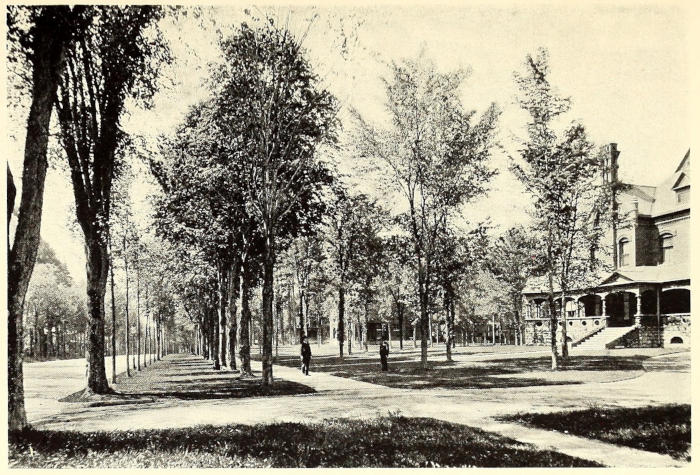
NORTH BROADWAY, SARATOGA SPRINGS, 1898.
The French, urged by Frontenac, came down
the valley in 1693, destroyed the castles of the
Mohawks, and started on their return with
three hundred prisoners. The news created
intense excitement through the whole Province
of New York. Governor Fletcher hurried
up from New York City, Major Peter
Schuyler hastily gathered three hundred white
men and three hundred savages for defence,
and was joined by Major Ingoldsby from
Albany with an additional force. Coming
along the old trail, the French and Indians
halted with their captives about six miles
north of the village of Saratoga Springs, at a
point near Mount McGregor at King’s Station.
The battle-ground lies on the terrace, which is
distinct from the foothills of the mountains,
and has long been known as the “old Indian
burying-ground.” On this plateau, so near
the gay streets of Saratoga, the camp-fires of
a thousand hostile men throwing up entrenchments
flared through the night. On the following
day the English sustained successfully
three fierce assaults on their works, and the
French, worn with the long journey, were glad
to retreat in the darkness of a raging storm,
as night fell on their wounded and captives.
Again, during Queen Anne’s War, beginning
in 1709, old Saratoga, which lies at the
mouth of the Fishkill, was so seriously threatened
that Major Schuyler built a fort below
the mouth of the Batten Kill. In 1731, the
French built Fort Frederick at Crown Point.
From this stronghold, during King George’s
War, which began in 1744, they swung their
forces with deadly effect upon the English
settlements. The forts at Saratoga were then
refitted and manned, but not in time to prevent
the terrible massacre of old Saratoga
in 1745.
History has recorded and poetry sung the
woes of Wyoming and of Cherry Valley, but
the silence of the virgin forest has encompassed
the tragic events that occurred at
Saratoga on the fatal morning of the 17th of
November, thirty years before the Revolution.
“Profound peace had reigned in the old wilderness
for a generation, and the fertile soil had filled the smiling
land with fatness. Many dwellings and fruitful farms
dotted the river bank; long stables were filled with
sleek cattle, and around the mills were huge piles of timber
waiting the market down the river.”
The scowling portholes of the old Schuyler
mansion seemed to laugh between the tendrils
of the creeping vines. Suddenly, in the early
morning, the scene of peace and prosperity
was changed to slaughter, pillage, and destruction.
Philip Schuyler, the elder, was offered
immunity in the midst of the fray, but he
spurned safety at the expense of his neighbors,
and was shot to death in his own doorway.
The houses and forts were burned to the
ground, the cattle killed or burned in their
stalls, and only one
or two inhabitants
escaped to tell the
tale.
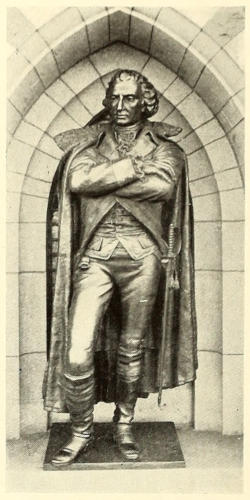
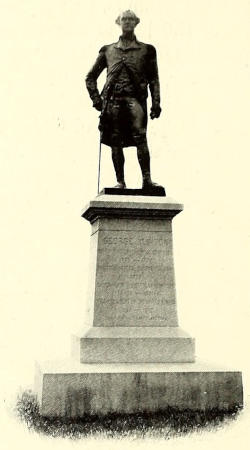
GENERAL PHILIP SCHUYLER.
BRONZE STATUE IN NICHE OF SARATOGA MONUMENT,
SCHUYLERVILLE, N. Y.
This war was a
prelude to the
French and Indian,
or Seven Years’
War, which, with
its five campaigns,
raged continuously
through the war-worn
valley of the
grand northern
waterways. Nearly
a century and a
half of struggle,
first of the French
discoverers and
missionaries with
the savages, and
then of the Frenchmen
and Iroquois,
and later the French, the Indians, and the
English, had proved the importance of this
valley as the northern doorway to the country.
Of the three expeditions first planned to be
sent simultaneously against the French—one
under Braddock against Fort Duquesne, another
under Shirley against Niagara, and another
under Johnson against Crown Point,—the
third was considered the most important.
In August, Major-General William Johnson
took command in person and pushed on to the
outlet of Lake George, intending to build a
fort at Ticonderoga as a defence against Crown
Point, to which the French had extended their
possessions in the last interval of peace. Before
his design could be accomplished, desperate
warfare disturbed the placid waters of
the beautiful lakes and so discolored their outlying
waters that time has not yet effaced the
name of “Bloody Pond.”
Abercrombie’s campaign in 1758 was a fatal
mistake. The brilliant hope inspired by his
fine army of Regulars with their splendid accoutrements,
his thousands of boats paraded
on the broad lake with banners flying and
strains of music unknown in the wilderness, was
turned to gloom when a few days later the boats
returned laden with the dead and dying, and
carrying the body of the beloved Lord Howe.
Again, in 1759, the war-trail of old Saratoga
was trodden by an English army, twelve thousand
strong, under the command of the successful
Lord Amherst. In the autumn the
final conflict came when the death of Wolfe
signalled the triumph of England, and the
great waterways passed under the sovereignty
of the Anglo-Saxons.
CONGRESS SPRING IN 1820.
For some years, Sir William Johnson suffered
from the effects of a wound received in
the hip during the war. In 1767, his Indian
friends told him about the “Great Medicine
Waters” of Saratoga, and carried him by
boat and on a stretcher to the mysterious
spring. The waters proved so beneficial that
he was able to return over the “carrying-place”
unaided and on foot. The waters
which he drank were taken from the High
Rock Spring of Saratoga Springs. Once
they overflowed the cone-like rock through
which they now rise and from which they
are dipped, and the rock was gradually deposited
and formed by the overflow. The
process has lately been repeated by new
springs like the Geyser and the Champion,
which for some years threw the water several
feet into the air, leaving a heavy cascade-like
deposit about the opening. Gradually the waters
subsided, the geyser effect was lost, and
like the High Rock Spring they have fallen
below the level of the ground.
In the year (1767) of Sir William Johnson’s
expedition, the old land troubles with
the Six Nations were settled amicably at the
Fort Stanwix conference, where over three
thousand red men met the English commissioners.
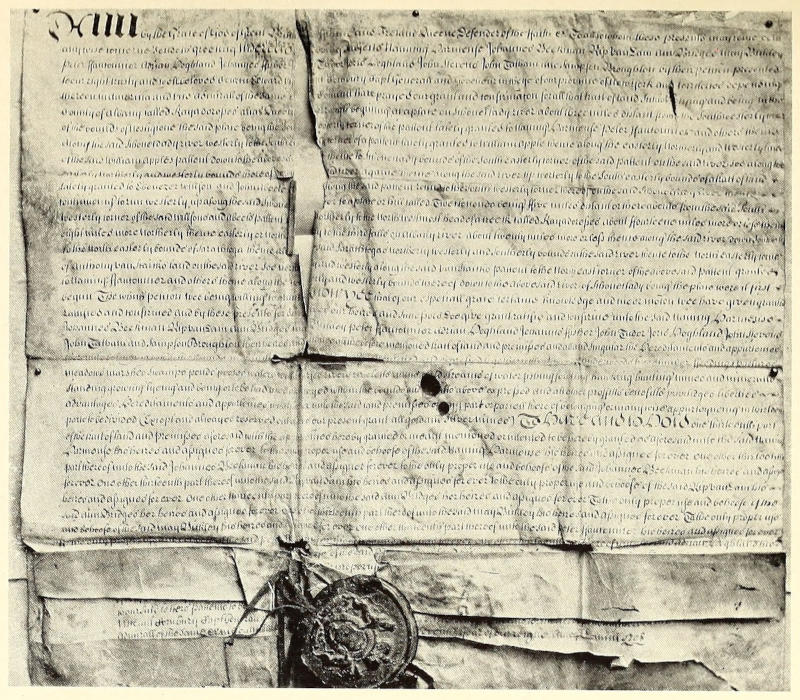
The complaints of alleged frauds
in purchase and surveys included the Kayadrossera
patent, which covered 700,000 acres
lying between the Hudson and the Mohawk, obtained
by grant in 1703 and confirmed in 1708.
Yet quiet did not prevail. The restless
spirits of the wilderness were stirred by their
first political aspirations. The Schuylers,
whose possessions extended over the old Saratoga
hunting-ground, awoke the farmers to
an interest in the burning questions of the
day. Sloops sailing up the Hudson brought
rumors of riots in New York City, and of the
resistance offered by the Sons of Liberty to
the execution of the Stamp Act. When news
came that no good patriot would wear imported
garments, the women redoubled their
efforts to produce from spinning-wheel and
loom the homespun fabric. As the King grew
more determined, and the people learned more
clearly what rights were theirs, the British soldiers
became violent and the patriots more
indignant and outspoken. The first military order
of the home government to put the forts at
Crown Point and Ticonderoga on a war basis
was quickly followed by the tramp of soldiers
through the wilderness. The rumble of artillery
and of commissary wagons broke once
more the stillness of the forest. The farmers
who lived along the old war-trail revived by
the evening fireside the stories of the French
and Indian wars. The Indians, quick to discern
the coming storm, began once more, under
the influence of the Johnson family (allied
to them through Brandt and his sister), to
destroy property and massacre the unprepared.
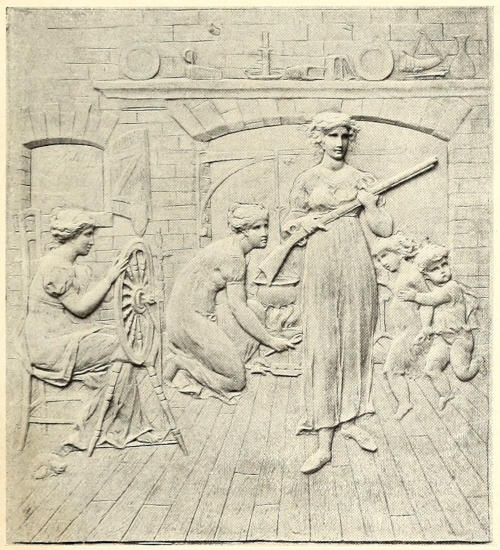
The settlers of the “long valley” were bearing
at this time the brunt of the preliminary
warfare of the American Revolution. They
met the issue bravely. While they fought,
their wives and daughters gathered in the
crops, melted into bullets the treasured pewter
teapots and sugar-bowls, learned to shoot, to
barricade their houses or their little forts, and
to conceal themselves from prowling bands of
Indians and savage Tories. It was then that
the Royalist Governor Tryon, taking refuge on
a war vessel, exclaimed, “The Americans from
politicians are now becoming soldiers.” Had
he witnessed the courageous deeds of the
women of the great waterways, he would perhaps
have added, “The women from housekeepers
are becoming farmers and fighters.”
KAYADROSSERA PATENT, WITH GREAT SEAL OF QUEEN ANNE PENDANT, 1708.
ORIGINAL IN SARATOGA COUNTY CLERK’S OFFICE.
WOMEN OF THE REVOLUTION, 1776.
FROM TABLET ON SARATOGA BATTLE MONUMENT, SCHUYLERVILLE, N. Y.
New anxieties arose in the Province of New
York as rumors multiplied of the advance in
stately procession of a new and splendid army
of the British, recently arrived in Canada,
down the old war-path through Champlain
and Lake George on the way to Albany to
unite with the British wing ascending the
Hudson River. Inspired by General Schuyler,
commanding the American army, the farmers
seized whatever firearms they could find and
hurried to his camp. The women of Albany
hammered the leaden weights from the windows
of their houses, moulded them into
bullets, and urged on the men. The militia
of New England, aroused by the invasion,
came by hundreds and by thousands until the
river hills were covered. The hasty breastworks
planned by Kosciuszko were completed,
and the rude recruits were hurriedly formed
into regiments and brigades. Gates, who
superseded Schuyler, lay with his staff in the
rear of the army, while Morgan with his
riflemen held guard at the western extremity
of the entrenched camp on the hills, with his
headquarters at Neilson’s. This was the defensive
camp of the Americans at Bemis
Heights, and it stretched from the river bank
westward over the hills about two miles and
faced the north. Here they lay in wait for
Burgoyne, who had rallied from his repulses at
Bennington and Fort Stanwix, and was pressing
down the bank of the Hudson River toward
Albany from Fort Edward.
On the 13th of September, a bridge of
boats was stretched across the Hudson River—just
below the mouth of the Batten Kill—for
the passage of Burgoyne’s army. They
halted for the first night amid the charred
wheat-fields of General Schuyler’s farm on the
south side of the Fishkill. On the morrow
they hastened on to Coveville, and thence to
Seward’s house, where again their white tents
were spread over the country.
On September 19th Burgoyne moved forward
to outflank the American camp on the
west. An obstinate fight of many hours about
the old farm-well and in the great ravine followed,
and the British failed in their attempt to
pass the Americans or to weaken their line.
But they held persistently to the position they
had taken at Freeman’s Farm and at the close
of the battle fortified their camp from the point
on Freeman’s Farm in a line to the eastward
on the bank of the river, where they built three
redoubts upon three hills. The fortified camp
of the Americans lay about a mile and a half
below in a line parallel with the British. Here,
within bugle-call of each other, for two weeks,
the hostile forces sat upon the hills of Saratoga,
frowning defiance at each other, and
ready to open the conflict at a moment’s
warning.
Burgoyne waited in vain for the Americans
to attack him behind his works, and for a
message, hourly expected, that Clinton would
come from New York to his relief. Hunger
pressed sorely upon the army. The brilliant
conquests he had pictured to himself were
fading from his grasp. He called his officers
together in council. Silence and gloom hung
over them. Should they advance or retreat?
His imperious will dictated the advice he desired.
Finally Fraser sustained the commander.
An advance was ordered. On the 7th
of October the British marched from their
entrenchments in battle array. Burgoyne led
the centre; Fraser a flanking column to the
right; the royal artillery to the left, and the
Hessians in reserve. Like a great bird of
prey they settled in line of battle upon the
broken ground that separated them from the
American camp. Gates took up the gauntlet
thus thrown down and exclaimed, “Order out
Morgan to begin the game.” With a word to
his command the watchful and heroic Morgan
dashed into the struggle, scattered Burgoyne’s
advance-guard, rushed on against the trained
forces of Fraser, and swept them from the
position to the left which they had taken in
advance. With masterly skill and courage,
Fraser rallied his men, and was forming a
second line of defence, when he fell mortally
wounded.
“OLD WELL,” FREEMAN’S FARM, BATTLE-GROUND BEMIS HEIGHTS, SEPT. 19, 1777.
The sharp whistle of Morgan called his
men once more to action. They charged,
while Poor and Larned attacked the centre
and the right. The battle swayed back and
forth through the great ravine. Another charge
from Morgan and the British retreated to
their entrenchments. At this moment the impatient
Arnold, stung to madness by the slights
put upon him by Gates, dashed across the
field. He gathered the regiments under his
leadership by his enthusiasm, bravery, and
vehemence. He broke through the lines of
entrenchments at Freeman’s Farm. Repulsed
for a moment, he assailed the left and charged
the strong redoubt of Breyman which flanked
the British camp at the place now called
Burgoyne’s Hill. The patriot army, fired
with hope and courage, crowded fearlessly up
to the very mouth of the belching guns of the
redoubt, won the final victory of the day, and
then, exhausted by the desperate fight, dropped
down for a few hours’ rest before they took
possession of the British camp.
GENERAL DANIEL MORGAN.
But there was no rest for the defeated army.
Silently and sullenly during these hours, they
withdrew from the works at Freeman’s Farm,
and huddled closely together under the three
redoubts by the river. Here the women,
Madam Riedesel, Lady Ackland, and others,
trembled and wept over the dying Fraser.
Here the hospital stood with its overflowing
throng of the wounded and the dead. The
great and princely army waited in doubt and
despair while their commander wavered in
his plans. Should he try to hold his dangerous
ground, should he risk another engagement,
should he retreat? The last course was
chosen. On the following night a retreat
began as the last minute-guns were fired
magnanimously by the Americans, in honor
of Fraser’s funeral, which took place at sunset.
The sun fell behind the heights upon which
the exultant Americans lay; heavy clouds
followed, and quickly after, amid the drenching
rain, the army of Burgoyne, abandoning their
sick and wounded, began the retreat up the
river.
Retracing their steps from Bemis Heights,
the scene of their disaster, they followed up the
river road to the Fishkill and the Schuyler
mansion, which they burned to the ground.
Failing here in an attempt to make a stand
against the advancing Americans, they fell
back, formed an entrenched camp, and planted
their batteries along the heights of old Saratoga.
In this camp they still hoped to hold
out until relief should come up the Hudson
from New York. Here the romance and
pathos of the campaign culminated, as described
by Madam Riedesel, the accomplished
and beautiful wife of the Hessian general, in
her thrilling account of the retreat and of the
agonizing days that followed. At the Marshall
house, where she had taken refuge, the cannonballs
thrown across the river crashed through
its walls, and rolled along the floor, so that
the sick and wounded were driven into the
cellar where she and her children and the
broken-hearted widows of the dead were suffering,
watching, and starving. Frail by birth and
rearing, Madam Riedesel stood in the doorway
of the cellar, and with arms outspread across
the open door held at bay the selfish, brutal
men who would have crowded out the sick and
dying. Burgoyne and his army, entrenched on
the hills, and with the river below, yet had no
water to drink, except a cupful brought now and
then for the faint and wounded from the river
by the British women, on whom the gallant
Americans, ever tender toward woman, would
not fire.
CONGRESS SPRING, 1898.
Finally, driven to the last extremity, with
the Americans on the north, where Stark had
seized Fort Edward, to the east, where Fellows
held the river bank, and to the south, where
Gates had thrown his victorious army, Burgoyne
sent in his terms of surrender. Almost
on the site of old Fort Hardy, his brave but
unfortunate troops laid down their arms, and
near the site of the old Schuyler mansion,
which they had so recently burned, Burgoyne
surrendered his sword to General Gates.
Along the road, just across the Fishkill, the
American army stretched in two lines, between
which the disarmed prisoners were marched to
the shrill notes of the fife and the measured
beat of the drum, to the tune of “Yankee
Doodle,” played for the first time as a national
air.
SIGN “PUTNAM AND THE WOLF” ON PUTNAM’S TAVERN, SARATOGA SPRINGS.
ORIGINAL SIGN IN GRAND UNION HOTEL, SARATOGA SPRINGS, N. Y.
General Schuyler, the hospitable and magnanimous,
was on the ground. Neither the
slight he had received from Congress nor the
injuries inflicted on him by the British could
quench his generous nature. He rejoiced
with his victorious countrymen, he sympathized
with the fallen enemy, he protected and cared
for the helpless women.
During the summer of 1777 he had cut a
road from his farm at old Saratoga through
the wilderness to the High Rock Spring,
already famous for its medicinal properties.
He built a small frame house on the ledge of
rocks overhanging the spring, and here for
several summers his family came with him for
rest and recreation as they had formerly gone
to the comfortable mansion at old Saratoga.
This was replaced by a rude cabin, and there,
in 1783, Washington was entertained when,
with General Clinton, he came to visit the
Saratoga battle-ground. The party proceeded
northward to Ticonderoga, and on their return
stopped at High Rock Spring. General Washington
was so strongly impressed with the
value of the water and the beauty of the region
that shortly afterward he tried to buy the property,
but Livingston, Van Dam, and others had
already secured it.
The events of the Revolution had discouraged
the few settlers who first came to the
springs, and for years afterwards but two log
cabins offered a shelter to adventurous tourists.
In 1791, Gideon Putnam cleared his
farm at Saratoga, and Governor Gilman of
New Hampshire in 1792 discovered Congress
Spring. Putnam built his large boarding-house
and tavern, and far-seeing and liberal-minded,
he purchased extensive tracts of land
and secured the foundation of the beautiful and
prosperous village which is now a delight to
visitors and a valued home to its residents.
It is essentially a place of “homes,” where
people of large or small means are assured of
that quiet and ease which cannot be found in
cities or towns which depend for their prosperity
on active commercial or manufacturing
interests.
SEAL OF SARATOGA.
SCHENECTADY
THE PROVINCIAL OUTPOST OF LIBERTY
By JUDSON S. LANDON
Schenectady was settled in 1662. To
give to the story of the settlement its
proper character among the beginnings of
free institutions in America it is necessary to
recall the fact that the States-General of the
Netherlands in 1621 chartered a trading concern,
the Dutch West India Company, granted
it the monopoly of the fur trade in New
Netherland, and permitted it to govern, so long
as it could, whatever colonies might inhabit the
territory. The company thus formed ruled
over the territory from 1624 to 1664, when the
English, trumping up a stale claim of prior
discovery, interfered and took possession.
The company’s rule was arbitrary, but not
without good features. Traders are not apt
to cavil over religious dogmas,—the company
permitted freedom of conscience and worship.
Subjects and servants render better obedience
and service if treated with kindness and justice.
The directors
of the company
seemed
to know this,
and professed
to govern accordingly,
but
their governors
sometimes
found pretexts
for the
injustice
which promised
the surest
profits.
COLONIAL HOUSE, UNION STREET.
Some of the colonists insisted that the
people ought to have a part in the government.
The Dutch governor, when he most
needed their support, would promise concessions.
He sometimes seemed to have begun
to make them, but he made none that were
substantial. Why should the trading company
sentence itself to death?
Agriculture was necessary for the food-supply
of the new province, and promised
customers for the imports from Holland.
Liberal terms were extended to the agriculturist.
Men of wealth were tempted by offers
of vast tracts of land, with a sort of feudal
sovereignty, on condition that each of them
would establish fifty families upon his domain.
Among others the manor or lordship of Rensselaerswyck
was established, embracing nearly
all the territory now comprised within the
counties of Albany and Rensselaer. Literally
its jurisdiction was subject to that of the West
India Company, but practically it was independent
of it. The company established a
trading and governmental post at Beverwyck
or Fort Orange, now Albany, and exercised
supreme jurisdiction, exclusive of that of
Rensselaerswyck, for at least musket-range
about the fort.
Among the colonists and traders who had
been attracted to Beverwyck and Rensselaerswyck
were some intelligent and enterprising
men, mostly Protestant Dutchmen, who, after
varied experience but general good fortune in
the province, resolved to go apart by themselves
and establish a community where justice
equality and liberty could be secured and
enjoyed, free from the overlordship of a
patroon, and as remote as was practicable
from contact with the grasping West India
Company, either at Fort Orange or Manhattan.
VIEW ON STATE STREET.
The leader of these men was the founder of
Schenectady, Arendt Van Curler. He was
the nephew of Killiaen Van Rensselaer, and
came from Holland in 1630 as director of
his uncle’s principality. This he managed
with great success for many years. All accounts
agree in describing him as a man
of honor, benevolence, ability and activity.
His unvarying fairness and tactful address
soon secured for him the respect and confidence
of all who knew him, and especially of
the Mohawk Indians. In their opinion he
was the greatest and best white man they ever
knew. They decorated him while living with
the distinction of “very good friend,” and
honored him when dead by calling other
governors “Curler” or “Corlear,” a title which
still survives with the same meaning in the
language of the scattered remnants of their
tribe. It was through his good offices that
peace was secured between the province and
the Five Nations, among whom the Mohawks
were the foremost, and preserved unbroken
during his life. By following his policy peace
was long maintained after his death.
The beauty and fertility of the Mohawk
country early attracted his attention. A letter
addressed by him in 1643 to the “Noble Patroon”
at Amsterdam exists, in which, after
giving an account of his stewardship as manager
of his uncle’s interests, he writes that the
year before he had visited the Mohawk country,
where he found three French prisoners,
one of them being the celebrated Father
Jogues, “a very learned scholar, who was very
cruelly treated, his finger and thumb being cut
off.” These prisoners were doomed to death,
but Van Curler succeeded in effecting their release.
Father Jogues, however, eager for the
salvation of their souls, returned to them two
years later, to suffer martyrdom at their hands.
In this letter Van Curler writes:
“Within a half-day’s journey from the Colonies lies
the most beautiful land on the Mohawk river that eye
ever saw, full a day’s journey long.” He says “it cannot
be reached by boat owing to the strength of the
stream and shallowness of the water, but can be reached
by wagons.”
“THE BLUE GATE” ENTRANCE TO UNION COLLEGE GROUNDS.
Another part of this letter is worth transcribing:
“I am at present betrothed to the widow of the late
Mr. Jonas Bronck. May the good God vouchsafe to
bless me in my undertaking, and please to grant that it may
conduce to His honor and our mutual salvation. Amen.”
We know that the good lady long survived
him, and as his widow was conceded some
special privileges by the government.
“The most beautiful land” upon which Van
Curler looked, was the Mohawk Valley, embracing
Schenectady and extending far to the
westward.
As he stood upon the crest of the upland
southwest of the present city, where the sandy
plain abruptly ends and gives place to the rich
bottom-lands a hundred and fifty feet below,
he looked northwesterly upon a wide expanse
of meadow, through which the Mohawk River,
gleaming in the sunlight, slowly wended. His
eye rested upon the outline of that break in
the mountains where the Mohawk has gorged
its bed, through which in our day the New
York Central Railroad passes from the seaboard
to the Mississippi without climbing a
foot-hill. It is the only level pass through the
great Appalachian chain between the St. Lawrence
Valley and the Gulf of Mexico. Not a
tree and scarcely a bush grew upon this plain,
but here and there were scattered patches of
beans, corn and pumpkins, the fruit of the industry
of the Mohawk women; and upon the
higher ground where Schenectady now stands,
the second great castle of the Mohawks, the
Capitol of the Five Nations, stood, surrounded
by many wigwams of the tribe. The nearer
hills and the more distant mountains were
clothed with forests. This cleared and fertile
intervale, set in its forest frame, was due to the
volume of water which in the spring freshets
pours down the river. Three miles east of
the city its channel is crossed by great ledges
of shale rock, through which the river has cut
its way, which still remains too narrow for the
immediate passage of its waters when greatly
swollen. These, overflowing and enriching
the bottom-lands above, also denude them of
their forest growth.
The Indian name of the place was Schonowe,
the first syllable pronounced much like the
Dutch “schoon,”—beautiful. Some of the
Dutch, sharing Van Curler’s idea of the beauty
of the place, wished to call it Schoon, beautiful,
achten, esteemed, del, valley,—Schoonachtendel.
The Indian name and the Dutch substitute
were combined and confounded in a various
and perplexing orthography which remains to
us in the deeds, wills and other papers of that
time, from which the name Schenectady was
finally evolved.
Although Van Curler was attracted thus
early by this beautiful land, it was long before
he could realize his purposes. He married
the Widow Bronck and continued the care of
his uncle’s interest in the manor of Rensselaerswyck.
But despite the success of his management
the longer he stayed the more he saw and
deplored the evils inherent in the feudal system.
To his enlarged and benevolent mind the system
itself was essentially one of serfdom.
The patroon was lord of the manor, the
owner of all the land and of a fixed share of
all the produce of his subjects or tenants, with
the right of a pre-emption of all the surplus
beyond what was necessary for their support.
They took an oath of allegiance to him: they
could not hunt or fish or trade or leave the
manor without his consent or that of his representative.
If they sold their tenant right and
improvements, a part of the price was his.
His will was the law, for his subjects renounced
their right of appeal to the provincial government
from his decrees or those of his magistrates.
He was an absentee, and measured the
merit of his agents by the amount of their
remittances. The government of the province
as administered at Fort Orange or at Manhattan
was as good as could be expected from a
trading company, but was odious to men of
Van Curler’s enlarged understanding.
The firearms of white men at Beverwyck and
in Rensselaerswyck began to impair the value of
the hunting grounds in their vicinity, and Van
Curler learned that the Indians might consent
to sell their lands at Schenectady. He looked
about for associates in the purchase of the lands
and their settlement, and sifted out fourteen.
He applied to the Director General or Governor
of the province, Peter Stuyvesant—whose
real qualities and worth and those of his good
subjects the pen of Irving has replaced with
the genial travesties of his enduring caricature,—and
obtained his reluctant consent to
the purchase. He then applied to the Indian
chiefs. They too were reluctant. Schonowe
was the site of one of their most ancient castles.
It had long been their favorite home. Their
traditions covered many generations, but no
tradition reached back to their first coming.
Still they well remembered that Hiawatha had
lived here, two centuries or more before.
GLEN-SANDERS MANSION, ERECTED 1714.
Hiawatha, the chief, of whom the Great
Spirit was an ancestor, and whose wisdom,
goodness and valor far surpassed that of other
men, was the founder of the confederacy of the
Five Nations. He devoted his long life to the
good of his people, teaching them to live nobler
and better, and finally was borne in the flesh
to the Happy Hunting Grounds. Longfellow
sings of Hiawatha with no stint of poetic license,
but his harmonious numbers do not surpass
the Indian estimate of his qualities. No
doubt there was such a man, of exceptional
wisdom, valor and influence, and that he disappeared
without being known to have died.
Around his memory tradition, employing the
figurative language of the Indians, accumulated
myths and magnified them.[16]
Van Curler was persistent, and in the end the
Indians could not find it in their hearts to deny
their “very good friend,” and the deed was
formally executed and delivered at Fort Orange,
July 2, 1661.
The founders entered into possession. The
Indians bade them welcome, and began to
move their wigwams up the valley. It was
their first step in the many stages of their
unreturning journey toward the setting sun.
Their own sun thus passed its zenith, but they
did not know it.
The colonists fixed their home or village
lots upon the land above the sweep of the
river floods, occupying for this purpose that
part of the city west of the present Ferry
Street. They assigned to each proprietor a
village lot, two hundred feet square; a larger
lot for a garden just south of the village, and a
farm upon the bottom-lands beyond, with
privileges in the outlying woodlands. Other
settlers joined them. They sold them village
lots and farm and garden lands, until the farm
lands of the Van Curler grant were disposed
of. Those who came still later bought village
lots, but they had to buy farms of the Indians
from lands outside of the Van Curler grant.
Mechanics, traders and workmen came who did
not want land, or lacked the means to buy it.
Many of the proprietors were rich enough to
own slaves, which—or shall I say whom?—they
brought with them. Very soon by dint of
industry their houses were built of the lumber
sawed at their own mills, their farms were
promising abundant crops, their gardens were
blossoming, while their cattle were grazing
in more distant pastures.
In this little republic the freeholders were
the source of authority. By them and of them
five trustees were elected “for maintaining
good order and advancing their settlement.”
The “Reformed Nether Dutch Church” was
early established with its elders and deacons,
and later, with its settled domine, maintained
a guardianship over the people and especially
the widows, orphans, and the poor. The
community was under the titular jurisdiction
of the province; the laws of Holland were in
force with respect to contracts, property rights,
and domestic relations, and were observed as a
matter of course. The governor appointed
the trustees or their nominees, schepens or
justices of the peace, and they appointed a
schout or constable, with large executive
powers. This official, conscious of his power,
and arrayed in a garb denoting it, solemnly
pointed his pipe stem and sometimes even
shook his sword, at the wayward. If any were
so refractory as not to mend their ways after
such an admonition, he haled them before the
schepen. This magistrate, as his commission
was construed, had the right so to supply the
defects in the Dutch laws and the ordinances
of “Their High Mightinesses, the noble
Dutch West India Company,” as to “make
the punishment fit the crime.” This meant
that he could impose such a fine as the schout
thought collectible, or such other punishment
as he would undertake to inflict. Causes of
great gravity, such as complaints by the
traders at Beverwyck that the accused had
infringed upon their monopolies, were brought
before that jurisdiction, but the records disclose
no practical benefits to the complainants.
FIRST REFORMED (DUTCH) CHURCH.
In 1664, two years after the first settlement,
the province and its government passed by
conquest from the Dutch to the English.
This made but little change at Schenectady.
The system of government already begun was
continued. The manor of Rensselaerswyck
was confirmed to the patroon with some change
in the sovereignty, but none in his property
rights. Beverwyck became Albany, the county
of Albany was established, and embraced
Schenectady. The court at Albany took jurisdiction
of such larger causes as the “Duke’s
Laws,” conferred upon it, and the minor ones
remained as before within the jurisdiction of
the local magistrates. There were but few
ministers of the gospel in the province, and it
was not until 1684 that the Reverend Petrus
Thesschenmaecher, a graduate of the University
of Utrecht, was installed as their first
resident pastor or domine. It was a memorable
day, when that pious man, in his black
silken robe, ascended the high pulpit of the
church edifice which, loopholed for musketry
together with his dwelling-house, awaited his
coming, and in the deep solemn guttural of
his Nether Dutch speech, led the worship
of his dutiful flock. These Dutch Protestants
did not agonize about God’s wrath like the
Puritans; they assumed His loving care, as a
child does its father’s. The ordinances and
forms of worship prescribed by the Church
were regarded as duties to be observed as
well as privileges to be enjoyed, and the
higher the social or official state of the individual,
the more prominent and circumspect
must he be in his religious observances. One
of the documents of that day opens in these
words: “We, the justices, consistory, together
with the common people of Schanegtade, conceive
ourselves in duty bound to take care of
our reverend minister.” It is signed by the
justices, elders, deacons and many others who,
we must assume, were “common people.”
There remains a marriage contract in which
a widower and a widow recite how much
property each brings to the marriage state;
the widow enumerating among other property
three slaves, for whose freedom upon her
decease, however, she provides. No doubt
the justices, the consistory, the freeholders
and the common people observed this order
of precedence on this and all like occasions;
the widow being preceded by a slave bearing
a warming-box for her feet, a metrical version
of the Psalms, and the book of devotion containing
the liturgy, the Heidelberg Catechism,
the Confession of Faith and the canons of the
Church, as all these had been approved by the
Synod of Dordrecht in 1619.
Long before this learned graduate of the
University of Utrecht was secured, the
Rev. Gideon Schaets, minister at Albany, was
permitted by his Church to visit Schenectady
at least four times a year, upon a week day
(“since it would be unjust to let the community
be without preaching”—so the record
at Albany recites), and administer the Lord’s
Supper, baptize the children and officiate at
marriages. Marriage, however, was a civil
function over which a magistrate was competent
to preside. As early as 1681 the Church
had an investment for the support of the
poor of 3,000 guilders, which had reached
4,000 guilders in 1690, when the Church
perished in the
destruction and
massacre of
that year.
ELLIS HOSPITAL.
The inhabitants
of this
frontier village,
who welcomed
with open
hands and glad
hearts their first
domine, might
well be pardoned
if there
was a leaven of
worldly pride in
their greeting. Where else in all the provinces
was there a more prosperous, more generous,
more intelligent and better ordered people?
There was no lack of substantial plenty. Who
more than they were entitled to establish a
Church and have a domine of their own? In October,
1683, the first legislative assembly chosen
by the freeholders was summoned to convene in
New York, to frame laws for the province. By
the governor’s proclamation Schenectady had
been accorded a representative, and thus its
importance in the body politic was recognized.
The village was the frontier bulwark of civilization,
where the white man and the Mohawk
Indian, by keeping faith with each other, kept
bright the chain of friendship which made the
Five Nations the allies of the Province of New
York. To guard against French and Indian
incursions, a stockade had been built around
the village. This was a high fence made of
three rows of posts set together firmly in the
ground. There was a gate upon the north and
south sides, and a fort within the stockade at
each gate. Although often alarmed, it was
not until the war between England and her
allies and France, which was soon declared after
James II. abdicated the crown of England in
the revolution of 1688 and William and Mary
came to the throne, that this frontier village
was seriously threatened. Jacob Leisler, a
Dutch trader and captain of a military company,
of great zeal but of small ability, seized
the government in the name of William and
Mary and brought confusion among the people
by his presumption. The common people
favored Leisler. They “blessed the great
God of Heaven and Earth for deliverance
from Tyranny, Popery, and Slavery.” The
aristocracy opposed him, and complained that
“Fort James was seized by the rabble, that
hardly one person of sense and estate does
countenance.” Their wisest leader, Van
Curler, had long been dead;[17] and the people
of Schenectady became hopelessly divided.
Warnings were frequent, but vigilance was
relaxed, and at last the blow fell upon a
defenceless people.
EDISON HOTEL.
On the night of the 8th of February, 1690,
one hundred and fourteen Frenchmen and
ninety-six Indians, sent by Frontenac, Governor
General of Canada, after a twenty-two
days’ march from Montreal, through the snow
and the wilderness, stole in through the open
gates of the stockade, massacred sixty of the
inhabitants, plundered and burned about sixty
houses—leaving only six—and carried away
thirty captives. The survivors, who were fortunate
enough in the confusion to escape either
by accident or flight, numbered about two hundred
and fifty. Their distress cannot be described.
They buried their dead, their beloved
pastor being among the slain. They made what
provision they
could against
the severity of
the winter and
then took
thought of the
future. Should
they abandon
the place where
for a quarter of
a century they
had lived in
peace and
plenty, and seek
safety elsewhere?
Help
and counsel came to them from Albany,
Esopus and New York, from Massachusetts
and Connecticut, and not least from the
friendly Mohawks, all encouraging them to
stay. Indeed, there was no place of assured
safety in the whole province. The war
threatened all the English colonies. The
colonies sent their delegates to New York,
where they concerted measures for the common
defence. This was the first general
American Congress. To abandon Schenectady
would be to encourage the enemy, to endanger
the whole province by discouraging its
allies, the Iroquois or Five Nations, causing
them to distrust the valor and prowess of the
English arms, and possibly to embrace the oft
proffered alliance of the French. Schenectady
must be held, cost what it might. The survivors
finally concluded to stay. Twenty-four of
the freeholders subscribed to a paper, stating:
“In the first place, it is agreed to resort to the North
Fort to secure our bodies and defend them.
“Secondly, that the crops or fruits of the earth—that
is, the winter grain, shall be in common for the use of all,
and all the mowing lands for this year.
“Thirdly, the widows shall draw their just due and
portions.
“If any one will voluntarily depart or draw up for
Canada, he shall yet have his full share and the benefits.
“Every one that shall stand to these articles shall obey
the orders of their officers, on the penalty of such punishment
as shall be seasonable, without expecting any
favor, grace or dissimulation.”
The survivors began the work of reconstruction
and defence. Every able-bodied
man became both citizen and soldier, ready for
service at home or on scout or picket or skirmish
duty, wherever the approach of the enemy
was to be feared. Schenectady became a military
camp where the provincial troops, reinforced
by detachments from New England and
by their Iroquois allies, made good the safety
of Schenectady and thus kept watch and ward
over the English dominion in North America.
They recognized Governor Leisler’s authority
and sent a representative to the two sessions
of his Assembly held in April and October,
1690.[18]
The warlike state of things existed from
1690 until after the peace of Ryswyck in 1697.
Upon the return of peace, Schenectady began
to resume its former state and prosperity. The
people rebuilt their church and called the Rev.
Bernardus Freerman as their pastor. How
dear he became to them the many children
named in his honor attest. The Dutch
population was sprinkled with a few English-speaking
soldiers who chose to make it their
home. Its importance increased as a centre of
trade, not only with the Indians, but with those
hardy pioneers, who, attracted by the fertile
lands, or the desire to join the friendly Indians
in their hunting expeditions, pushed farther up
the valley. The traders at Albany protested
against this invasion of their monopoly, and
also against the exercise of milling, weaving
and tanning privileges, but in a famous law-suit
in the Supreme Court of the province, the
Albany monopolists were beaten, and Schenectady’s
full right to freedom of trade and
manufacture was established. Then came
Queen Anne’s War with the French, lasting
from 1701 to 1713, and Schenectady was again
in peril, and again garrisoned, for the same
reason and much in the same way as before;
but, the Iroquois having made a treaty of
peace with Canada, the brunt of the war fell
upon New England and Schenectady passed
safely through it.
From the treaty of Utrecht in 1713 to the
“Old French War,” 1744-48, peace prevailed.
In the latter war many inhabitants of the
village were killed in skirmishes or cut down by
skulking Indians in the service of the French.
In one skirmish, or rather massacre, at Beukendal,
three miles northwest of Schenectady,
twenty men were killed and thirteen captured
and carried away. Then came the last French
war, from 1753 to 1763. The English now
had posts at Fort Hunter, Fort Schuyler,
Fort Johnson and Oswego on the west, at
Fort Ann and Fort Edward on the north. Sir
William Johnson and others had established
settlements up the Mohawk Valley. Sir William
was general superintendent of Indian
affairs and a Major-General in the English
service. His influence over the Iroquois was
commanding; his early victory at Lake George
was important; the English carried the war
into the French territory. Schenectady enjoyed
immunity from attack, and was enabled,
besides maintaining a garrison in its fort, to
send its quotas of troops to distant service, one
company assisting in the English siege and
capture of Havana in 1762.
The treaty of Paris in 1763, by which the
French yielded the dominion of North America
to the English, seemed to promise a lasting
peace. But the War of the Revolution came
on. Our Indian allies, the Iroquois, remained
faithful to their long allegiance to the English
Crown, and became our enemies under the
leadership of Sir John Johnson, who, succeeding
to the estate and title of his father, Sir
William, adhered to the Crown, under which
both became ennobled. Schenectady was
again threatened, from the side of Canada,
but by its former friends and allies. Aside
from its contribution of six companies to the
patriot cause, its position made it the base
from which those who adhered to the English
cause sought to send aid and comfort to the
enemy. General Washington came here early
in the struggle, and made arrangements for the
frontier defence.[19]
The Schenectady patriots appointed a committee
of vigilance and safety, who, as the one
hundred and sixty-two written pages of their
records show, repressed with strong hand and
scant ceremony the slightest evasions of the
orders of Congress and of the military authorities,
and all attempts at treasonable intercourse
with the enemy. Finally American independence
was won, and Schenectady, after nearly a
century of unrest, enjoyed the blessing of permanent
peace. The forts and stockade soon
disappeared.
UNION COLLEGE, 1795.
Meantime the little village had steadily
grown, becoming a chartered borough in 1765,
and advancing to the dignity of a city in 1798.
Schenectady received its first officially carried
mail on the 3d day of April, 1763,—Benjamin
Franklin being the colonial postmaster-general,—founded
the Schenectady Academy in 1784,
which became Union College in 1795, and
read its first newspaper, The Schenectady Gazette,
January 6, 1799.
STATUE, SITE OF “OLD FORT.”
The military occupation and the increasing
importance of the frontier trade added largely
to the English population. As early as 1710,
the Rev. Thomas
Barclay, the
English chaplain
to the fort in Albany,
preached
once a month at
Schenectady,
where, as he
writes, “there is
a garrison of
forty soldiers, besides
about sixteen
English and
about one hundred
Dutch families.”
At that
time the Dutch
had no pastor.
Mr. Barclay
writes, “There is
a convenient and
well built church
which they
freely give me the use of.” It was not, however,
until 1759, when there were three hundred
houses in the village, that the English
population undertook the erection of a separate
church. They “purchased a glebe lot and by
subscription chiefly among themselves erected
a neat stone church,” and called it St. George’s.
This stone church, with its subsequent additions,
is the handsome St. George’s of to-day.
Its site had previously been covered by the
English barracks. There is a tradition that
the Presbyterians assisted in the erection of
St. George’s with the understanding that the
Anglicans were to go in at the west door and
the Presbyterians at the south door, but that
the Anglicans managed to get the church consecrated
unknown to the Presbyterians. The
latter, upon finding it out, were so indignant
that they set about building a church for themselves.
Be this as it may, the Presbyterians
commenced building their church in 1770, and
finished it with bell and steeple, the latter surmounted
by a leaden ball gilded with “six
books of gold leaf.”
In 1767 the Methodist movement began
here under the lead of Captain Thomas Webb,
a local preacher bearing the license of John
Wesley. The movement was favored and advanced
by the preaching of that great orator,
George Whitefield, then making his last American
tour. The society, however, waited until
1809 before building its first church edifice.
In the same year Schenectady County was
carved out of Albany County.
All this while the English speech was gaining
over the Dutch. Children of Dutch parents,
despite the teaching of the nursery, would
acquire and use the English idiom. Finally
some of the members of the Dutch Church
ventured to suggest the propriety of having
service now and then in the English tongue.
The staid burghers were shocked. But, the
question once raised, the younger generation
grew bolder, and the elder began to listen.
Domine Romeyn, a graduate of Princeton College,
a fluent master of both languages, and
eminent for his varied learning and as the
founder of Union College, was pastor of the
Church from 1784 to 1804. He so far yielded
to the new demand as to preach in English
upon occasions of which he was careful to give
previous notice. It was not until 1794 that
the leading members of the Church represented
to its consistory the necessity of increasing the
services in English,[20] “to the end that the church
be not scattered.” Ten years later, at the
close of Domine Romeyn’s long ministry, the
Dutch language ceased to be heard from the
pulpit of the church. But there are still surviving
a few—very few—inhabitants to whom
the Dutch is their mother tongue. One of
them informs the writer that when he visited
Holland he conversed with ease with the people,
but that he sometimes used words not familiar
to them and afterwards learned that
these words were of Indian origin.
“THE BROOK THAT BOUNDS THRO’ UNION’S GROUNDS.”
UNION COLLEGE.
As Schenectady is two hundred feet above
tide-water at Albany, it early became the headquarters
of the western trade, goods being carried
to and from the West upon canoes, bateaux,
and the “Schenectady Durham boats.” The
trade developed into large proportions, and during
the hundred years closing with the completion
of the Erie Canal in 1825, many traders
made fortunes which were considered large in
those days. Upon the completion of the canal
the commercial prosperity of the city declined.
The decline seemed to be confirmed by the
era of railroads, notwithstanding the “Mohawk
and Hudson” was the first railroad built in the
State, its first passenger train arriving in Schenectady
from Albany, September 12, 1831, and
on the second railroad, the “Saratoga and
Schenectady,” the first train left Schenectady
for Saratoga, July 12, 1832.
ELIPHALET NOTT,
PRESIDENT OF UNION COLLEGE FOR SIXTY YEARS.
The business revival, however, came at last.
For fifty years its locomotive works have been
renowned, finding customers even in England.
Now, that oldest of powers and newest of merchandise,
electricity, has its greatest plant here,
from which its products seek the ends of the
habitable globe. These, with many other industries,
disturb the city’s ancient repose. It
no longer comprises a people exclusively of
Dutch, English and Scotch ancestry, but embraces
a polyglot assemblage. For more than
a century Union College, founded in an age
less tolerant than our own upon the basis of
Christian unity, implied by its name, over
which the celebrated Doctor Nott presided for
sixty years, and the accomplished Doctor Raymond
now presides, has been sending forth
year by year its graduates. Among them—as
the College justly boasts—is a long list of leaders
in Church and in State, in the halls of
learning, among the votaries of science, where
industrial and professional skill achieves the
worthiest triumphs, and where human needs
require the wisest methods of helpfulness;
and every sign indicates that this long list
will continue to lengthen.
If there is any lesson, it is simple. The
town was founded in the spirit of liberty and
justice; the people cherished and cultivated
the spirit so well that the Mohawk Indian for
one hundred and twelve years respected and
reciprocated. May the spirit long prevail!
SEAL OF SCHENECTADY.
NEWBURGH
THE PALATINE PARISH BY QUASSAICK
By ADELAIDE SKEEL
Mr. Secretary Boyle to Lord Lovelace
Whitehall, 10th Aug’st, 1708.
My Lord:—The Queen being graciously pleased to
send fifty-two German Protestants to New York and
to settle ’em there at Her own expenses, Her Majesty as
a farther act of Charity is willing to provide also for the
subsistence of Joshua de Kockerthal their Minister and
it is Her Pleasure that you pass a grant to him of a
reasonable Portion of Land for a Glebe not exceeding
five hundred acres with liberty to sell a suitable proportion
thereof for his better Maintenance till he shall
be in a condition to live by the produce of the remainder.
I am, my Lord
Your L’dshp’s Most faithful humble servant
H. Boyle.
Lord Lovelace.
A bridge of sighs spans the distance between
the coming of Newburgh’s earliest settlers, the
German Lutherans from the lower Palatinate
on the Rhine, to the later arrival of the English,
Scotch, French and Irish. The Lutherans
were religious exiles, whose villages had
been burnt, whose homes had been destroyed
and whose strong Protestant faith alone survived
the wreck of their fortunes. Of this
poverty-stricken company, nine with their
wives and children were sent up Hudson’s
River to occupy the present site of Newburgh.
The first intention of Queen Anne of England
to send these Germans to Jamaica where
white people were needed, was set aside “lest
the climate be not agreeable to their constitutions,
being so much hotter than that of
Germany.” Apropos of the intelligent consideration
of these Commissioners of Emigration
in 1709, one questions if the half-clad
travellers who are described in an old document
as “very necessitous,” found the climate
of Hudson’s River agreeable to their constitutions
in winter-time.
WASHINGTON’S HEADQUARTERS AT NEWBURGH.
In winter time! Sailing up the river in
summer-time past Sleepy Hollow and Spuyten
Duyvil, beyond the wide Tappan Zee, through
the Gate of the Highlands where the waters
narrow and the mountains cross, where the
fairies dance on old Cro’s Nest, and Storm
King dons and doffs his weather cap, on into
Newburgh Bay where the Beacons guard the
Fishkill shores, and the Queen City of the
Hudson rises in green terraces on the western
bank, the tourist idly wonders if these Palatine
pilgrims, worn by the ravages of persecution,
had eyes to see the beauty of the land they
were about to possess. It is possible, notwithstanding
the ice-bound waters and snow-covered
country, that their homesick hearts
may have been warmed by the sight of a river
not unlike their Rhine. As yet no Irving,
Paulding, Cooper, Drake or Willis had cast
the magic witchery of his tales over these
scenes, yet a century before, the Half-Moon
had passed this way and perhaps the stories
Henry Hudson’s crew brought back of red
devils dancing in rocky chambers amused the
children aboard the sloop of the German
Lutheran exiles.
JOEL T. HEADLEY.
More pertinent in historical research than
such imaginings is the contrast between the
temper of these voyagers and those others
who sailed in the Mayflower, and before landing
covenanted with one another “to submit
only to such government and governors as
should be chosen by common consent.” The
shores of the Hudson were no less fertile than
those of Massachusetts, yet the Palatines
showed far less aggressiveness than the Pilgrims,
and far less courage to stand alone. The
story of these Lutherans here in Newburgh is
a story of petitions first to one Right Honorable
Lord and then to another,—petitions
which, alas! were too often unheeded, although
the petitioners sorely in need of help never
failed to sign themselves
Your Honours
Most Dutyfull
and most obedient Company
at Quassek Creek and Tanskamir.
In one letter to the Right Honourable Richard
Ingoldsby Esq’ʳ, Lieutenant Governor
and Commander-in-Chief over Her Majesty’s
Provinces in New York, Nova Caesaria and
Territories depending thereon in America &c.
as also to Her Majesty’s Honourable Council
of this Province &c. they plead that “they do
not know where to address themselves to receive
the remainder of their allowance of provision
at 9d per day.”
Again, in their search to find “a Gentleman
who might be willing to support said Germans
with the Remainder of their allowance the entire
summ of which is not exceeding 195 lbs,
3sh,” they but succeed in finding a gentleman
whose offer of assistance they considered only
as “fine talke and discourse out of his own
head”—by which one learns the supplicants
were left hungry and cold on their hilly farms,
waiting for help which came slowly and for
crops which yielded but scantily.
THE LUTHERAN CHURCH.
Whoever institutes a comparison between
the Palatines and the Pilgrims must remember
the Pilgrims came to America, a compact society
fortified by friends at home soon to follow,
while the Palatines, beggared by the most
terrible of religious
persecutions,
were
sent, as individuals,
by
Queen Anne
to her colonies,
as to-day
dependent
children of the
State are sent
to the far
West. They
were absolute
paupers, yet
such was their moral excellence that a writer
on Dutch Village Communities on the Hudson
River indirectly commends these poor Germans.
“From the banks of the Rhine the germ of free local
institutions borne on the tide of western emigration
found along the Hudson a more fruitful soil than New
England afforded for the growth of those forms of municipal,
state and national government which have made the
United States the leading Republic among nations, and
thus in a new and historically important sense may the
Hudson river be called the Rhine of America.”
The patent granted the Lutherans known
as the Palatine Parish by Quassaick contained
within its boundaries forty acres for highways
and five hundred for a Glebe. The Glebe is
bounded by North Street on the north and by
South Street on the south. Across its western
border ran Liberty Street, then the King’s
Highway, although no king save Washington,
who refused the title, ever trod its dust. The
Glebe was “for the use of the Lutheran minister
and his successors forever,” but they
really possessed it only about forty years,—thus
liberally was “forever” interpreted two
centuries ago.
“Here’s a church, and here’s a steeple,
Here’s the minister and all the people,”
says the nursery rhyme. Here the evolution
of a parish has for its germ the church and
steeple, the minister and all the people being
a later development. The germ of this
Lutheran parish was the minister, Joshua de
Kockerthal,[21] whose missionary labors on both
sides of the river cannot be overestimated.
After the minister came not the church nor the
steeple, but the bell, a gift from no less a lady
of quality than Queen Anne herself. It was
highly prized by these Lutherans and loaned
to a church in New York on condition that
“should we be able to build a church at our
own expense at any time thereafter then the
Lutheran Church of New York shall restore
to us the same
bell such as it
now is or another
of equal weight
and value.”
ANDREW J. DOWNING.
The church
was built probably
in 1730, and
the Reverend
Michael Christian
Knoll was
appointed to
minister in the
parish, a part of
his salary to be
paid in cheeples
of wheat, sustenance
certainly
more nourishing than the codfish received by
the minister on Cape Cod in lieu of pew-rent in
gold coin of the realm. The church itself,
which was standing in 1846 within the memory
of a few of Newburgh’s citizens, was about
twenty feet square without floor or chimney.
The roof ran up into a point from its four walls,
and on the peak a small cupola was placed in
which hung Queen Anne’s bell. This bell, evidently
not cast in the mould of the one unalterable
Confession of Augsburg, but bewitched
by its donor with Episcopacy, presently rang
out changes and ceased to “call the living,
mourn the dead and break the lightning” exclusively
in behalf of the German Lutherans.
The English were now buying farms from
the discouraged Germans whose complaint that
their patent was all upland can hardly be
denied by any one who, aided by a rope, climbs
Newburgh’s hilly streets to-day. The story,
however, that the United States Government
located the city’s post-office on a shelf-like site
so that shy lovers in search of a billet-doux need
not call at the window but may look down
the building’s chimney from a street above is
probably apocryphal.
The Palatines abandoned Newburgh for a
more fertile soil in Pennsylvania and elsewhere
about 1747. The newcomers, who were
mostly of English and Scotch descent, took
their places, so that nothing remains to tell of
the early settlers save the streets they laid out
and the church in the Old Town burying-ground
whose site is now marked by Quassaick Chapter,
Daughters of the American Revolution.[22]
According to history, the few remaining
Lutherans did not give up their church without
a struggle. On a certain bright July Sunday
the two congregations met, each with its
minister at the head, accompanied by many
people from both sides of the river and the
Justices of the Peace who carried staves of
office. Birgert Meynders, a burly blacksmith
and bold defender of the Lutheran faith, fell
crushed by the falling door, and then the jubilant
English rushed in to hold the fort. It was
after this memorable riot that the Reverend
Hezekiah Watkins,[23] a most excellent clergyman,
preached his first sermon in Newburgh,
possibly from a text in the psalter for the
day, “Why do the heathen so furiously rage
together?”
HENRY KIRKE BROWN.
Legend says some Lutheran boys on a
moonless August night stole the bell and
buried it in a swamp where, punished for
apostasy, it lay for years tongue-tied in the
black mud while hoarse frogs croaked their
pessimistic comments over it. The defeated
Lutherans would doubtless have been pleased
could they have foreseen half a century later
when all that savored of England, were it
book, bell or candle, was out of favor, the
Anglicans in their turn ejected, the building
used as a schoolhouse, and the rent of the
Glebe lands pass entirely from the Church.
The swamp in which the bell was hidden
has of late years been transformed into one of
Downing Park’s lakes, and from its smooth
waters one may hear on summer evenings
the ghostly tolling of bells, as bells toll in
the buried cities beneath Swiss lakes. The
tolling has a martial sound, a call to arms, as if
the little bell had forgotten the smaller church
squabble in the larger quarrel between King
George and his Colonies. Some authorities
insist that the bell was dug up, and that it gladly
used its long silent tongue in Freedom’s cause
as behooved a Liberty Bell. It hung during
the present century, old inhabitants tell us, in
the cupola of the Newburgh Academy, and
was at length sold and melted for a new one
by an iconoclastic school Board.
At the breaking out of the war for American
Independence there were but a dozen or more
houses on the Glebe, and a few to the south.
Among these was the stone residence of Colonel
Jonathan Hasbrouck which had been built
in part by Birgert Meynders. Lieutenant
Cadwallader Colden had his home near and
there were many among his satellites willing to
drink damnation to the Whigs when asked by
the ever vigilant Committee of Safety to sign
the pledge.
It may be thought strange that Newburgh
has been considered of great Revolutionary
importance when no battles were fought nearer
its vicinity than those of Stony Point and Forts
Clinton and Montgomery, but, although the
place had an hereditary tendency to toryism, its
geographical environment filled it to overflowing
with plucky patriots. It is well known that
it was the design of the British to get possession
of the Hudson, and by cutting off the
New England States to weaken the forces of
the Continental Army. Appreciating this fact,
Washington came up the river in 1776 as far
as Constitution Island and, at the suggestion
of Putnam, fortified West Point. Newburgh
came under the same military direction, so
that one leading officer after another made his
headquarters in the vicinity.
At Vail’s Gate, four miles south of Newburgh,
is the Thomas Ellison house built by
John Ellison, the headquarters of Generals
Knox, Green and Gates, and of Colonels Biddle
and Wadsworth. Here too the pretty Lucy
Knox gave a dance at which General Washington
tarried so late as to incur the displeasure
of his wife. The names of Maria Colden,
Gitty Wyncoop, and Sally Jensen, the belles
of the ball, are scrawled on a window-pane in
the dining-room.
Following Silver Stream down to Moodna
Creek, three or four miles south of Newburgh,
we find the Williams house, the residence of
General Lafayette, in the cellar of which the
Dutch loan lies buried past finding, while opposite
are the remains of the forge at which
were made parts of the obstructions thrown
across the river to prevent British ships from
sailing up.
HEADQUARTERS OF MAJOR-GENERAL KNOX AT VAIL’S GATE.
CLINTON’S HEADQUARTERS AT LITTLE BRITAIN, NEAR NEWBURGH.
Westward at Little Britain, six miles from
Newburgh, is Mrs. Fall’s house, the headquarters
of George Clinton, and here on the floor
is the stain where the spy who swallowed the
bullet took the emetic and revealed the proposed
treason. The old homestead of the
Clinton family was in Little Britain, and hither
James Clinton, after the attack on Forts Clinton
and Montgomery, returned, his boots filled
with blood. One of his great-grandchildren
relates that he entered the dining-room where
the family were eating breakfast, and requesting
his mother and sisters to retire lest they
faint from the sight of his wounds, as was the
habit of gentlewomen of the last century, told
the story of his escape to his father. The statue
of his distinguished brother, George,[24] stands in
Newburgh’s business centre on the Square
which oddly enough bears the name of Colden,
the leading family of colonial days. The distinguished
Coldens, although not patriots,
added a lustre to the town, and the Clintons
will not quarrel with their shades.
Mad Anthony Wayne, the Rough Rider of
his day, had his headquarters on the Glebe
near the present corner of Liberty Street and
Broad. Weigand’s tavern, with the whipping-post
in front of the door, a rendezvous of
soldiers, stood on
Liberty Street
not far from the
Lutheran Church.
CLINTON STATUE IN COLDEN SQUARE, AT NEWBURGH.
Revolutionary
interest in Newburgh
focuses on
the coming of
Washington to
the Hasbrouck
house in March,
1782, although recent
research discredits
the story
pictured on the
covers of our
copybooks in
school days of the
disbanding of the
whole Continental
army on these
grounds. In 1779-80 Washington had lived
in the Ellison house, no longer standing, in
New Windsor, a small village to the south
on the river, separated from Newburgh
proper by the Quassaick Creek, but after the
surrender of Yorktown, he and his family
with his staff became the guests of Colonel
Jonathan Hasbrouck in the stone house, on
the corner of Washington and Liberty Streets.
Here Washington wrote his reply to the
Nicola letter, which in popular parlance offered
him the crown. Here is the chair in
which he sat when he took his pen in hand
and dipped it in ink to put on paper words
which after more than a hundred years glow
with the fervor of their author’s single-hearted
purpose.
Newburgh, May 22d, 1782.
Colonel Lewis Nicola,
Sir:—With a mixture of great surprise and astonishment,
I have read with attention the sentiments you have
submitted to my perusal. Be assured, sir, no occurrence
in the course of the War, has given me more painful
sensations than your information of there being such
ideas existing in the army as you have expressed, and I
must view with abhorrence and reprehend with severity.
For the present the communication of them will rest in
my own bosom, unless some further agitation of the
matter shall make a disclosure necessary.
I am much at a loss to conceive what part of my conduct
could have given encouragement to an address,
which to me seems big with the greatest mischiefs that
can befall my country. If I am not deceived in the
knowledge of myself, you could not have found a person
to whom your schemes are more disagreeable. At the
same time, in justice to my own feelings, I must add that
no man possesses a more sincere wish to see ample
justice done to the army than I do, and so far as my
powers and influence, in a constitutional way, extend,
they shall be employed to the utmost of my abilities to
effect it, should there be any occasion. Let me conjure
you then, if you have any regard for your country, concern
for yourself, or posterity, or respect for me, to
banish these thoughts from your mind, and never communicate,
as from yourself or anyone else, a sentiment
of the like nature. With esteem, I am sir,
Your most obedient servant,
G. Washington.
Leaving Washington’s Headquarters at
Newburgh one turns southward and crosses
Quassaick Creek, at one time known as the
Vale of Avoca, to hear above the whirr of to-day’s
many intersecting railroads the echoes of
Indian paddles. It is said the ghosts of Indians
still linger here in their canoes waiting to carry
away Washington, for near is the site of the
Ettrick house whose host treacherously invited
the Commander-in-Chief to dinner with intent
to kidnap him.
THE WILLIAMS HOUSE.
“General, you are my prisoner,” said Mr.
Ettrick, pushing aside his wine-glass and rising
from the table.
“Pardon me, sir, but you are mine,” was the
quiet answer, and instantly the life-guards
appeared and poor Ettrick was put in chains,
his pretty daughter escaping on account of the
timely warning she had given her father’s
guest.
MONUMENT ON TEMPLE HILL, NEAR NEWBURGH.
THE VERPLANCK HOUSE.
BARON STEUBEN’S HEADQUARTERS, WHERE THE “NICOLA LETTER” WAS WRITTEN.
Standing on the slopes of Snake Hill, to
the west of Newburgh, where was the last cantonment
of the American Army on the site of
the Temple, a building used for Sunday services,
for Masonic purposes and as a gathering-place
for social entertainment, a site now
marked by a
monument,
one hears
again those
words spoken
by Washington
when in
March, 1783,
the circulation
of the
Newburgh
letters caused
unrest among
the unpaid
troops.
“You see, gentlemen,” he said as he arose to read his
address, putting on his spectacles as he spoke, “that I
have not only grown grey but blind in your service....
“Let me conjure you,” he continued, “by the name of
our common country, as you value your own sacred honor,
as you respect the rights of humanity, as you regard the
military and national character of America, to express
your utmost horror and detestation of the man who
wishes under any specious pretense to overturn the
liberties of our country and who wickedly attempts to
open the flood-gates of civil discord....
“By thus determining and thus acting you will pursue the
plain and direct road to the attainment of your wishes
... you will by the dignity of your conduct afford
occasion to posterity to say when speaking of the glorious
example you have exhibited to mankind, ‘Had this day
been wanting, the world had never seen the last stage
of perfection to which human nature is capable of
attaining.’”
Crossing the river by the ferry sloop to
Fishkill one finds in this Revolutionary centre
of military supplies much of interest. Here
were Baron Steuben’s headquarters in the
Verplanck house, where the Nicola letter was
written and the Society of Cincinnatus in part
was formed; here at Swartwoutville the headquarters
of Washington; here on the Wicopee,
in the James Van Wyck house, the residence
of John Jay, and at Brinkerhoff, in the home
of Matthew Brinkerhoff, the roof which
sheltered Lafayette when he lay ill of a fever.
The Dutch Church in Fishkill has been made
famous by Cooper’s Spy. Trinity Church was
a hospital, and on the banks of the Hudson at
Presqu’Ile one rests under the oak which
shaded Washington when he waited for his
letters to be brought to him from Newburgh.
WASHINGTON’S HEADQUARTERS AT FISHKILL.
“I cannot tell what you say, green leaves,
I cannot tell what you say;
But I know that in you a spirit doth live
And a message to me this day.”
Is it not a message of courage and patriotism
which lives on in the descendants of the
Hasbroucks,
the Belknaps,
the Williamses,
the Fowlers, the
Deyos, the
Townsends, the
Carpenters, the
Weigands and
others whose
records emblazon
the pages of
Newburgh’s history?
CHARLES DOWNING.
In this last
century not only
material wealth
has come to
Newburgh, but
the richest treasures of the town have been
brought hither by its idealists, men to whom
has been granted the gift of vision. Among
these are numbered preachers, poets, artists,
historians, novelists, physicians, lawyers and
philanthropists, and on this roll of honor are
written the names of the Reverend John Forsythe,
N. P. Willis, H. K. Brown, A. J. Downing,
S. W. Eager, E. M. Ruttenber, J. T.
Headley, E. P. Roe, Carroll Dunham, E. A.
Brewster and Charles Downing.
SEAL OF NEWBURGH.
TARRYTOWN-ON-HUDSON
ITS HISTORIC ASSOCIATIONS AND LEGENDARY LORE
By HAMILTON WRIGHT MABIE
Tarrytown-on-the-Hudson is
interesting from many points of view. It
is beautiful in itself, with a touch of that ripe,
old-world beauty which is the rich deposit of a
long association of man with nature; a beauty
which reveals its depth in the fulness of foliage,
the girth of ancient trees, the texture of
the grass, and that atmosphere of ancient and
familiar use which, although invisible and impalpable,
lends a peculiar charm to settled
towns and countries. For Tarrytown has a
long history—as history is reckoned in this
new world—and an ancient date. It wears
the air of a locality which was in full life in
Colonial times. The old houses are few, but
the modern village is embowered in a landscape
which has known human companionship
and care these two centuries and more. A
road may show the latest skill in road-making,
but if it was once a highway along which
coaches ran in the brave days of the old inns
and the ancient whips and hostlers, there is
always the suggestion of long use about it.
It has been for so many decades a part of the
landscape that nature seems to have had a
hand in its making. The grass grows down
to it and the earth slopes away from it as if
these things had always been as they are. No
one can walk through Tarrytown along its
chief thoroughfare, without recognizing on
every hand the signs of the old highway on
which coach horns were once heard, and
later the bugles rang as redcoats flashed
through the trees or marched along the
ancient way.
BIRD’S-EYE VIEW OF TARRYTOWN.
FROM A PHOTOGRAPH BY F. AHRENS.
The village rises from the water’s edge to
the summit of the low hill which runs parallel
with the eastern shore of the Hudson for
many miles; it has one main thoroughfare,
bisected by many cross streets of a later date;
it is, for the most part, carefully kept, as befits
its age, its intelligence, and its wealth; and,
looked at from the river, it is almost buried in
a wealth of foliage. It has at all times an
air of repose, as if it had done long ago with
the hard work of settlement and organization,
and had earned exemption from the rush and
turmoil which characterize new communities.
In this country a town which has passed its
bicentennial has a right to conduct life with a
certain dignity and repose. It is doubtful if
Tarrytown ever knew any great bustle or
uproar; from the beginning it is probable that
its inhabitants did not suffer themselves to be
driven into undue energy of mood or habit.
A placid temper, a disposition to keep on easy
terms with life and neither give nor ask more
than becomes a man of a quiet habit of mind,
have left their impress on the community. It
is a place in which history is preserved rather
than made, although when it had occasion to
make history, the work was done with picturesque
effectiveness.
When Hendrik Hudson broke the quiet
waters of the Tappan Zee for the first time,
in September, 1609, with the keel of the Half-Moon,
he saw along the eastern shore of the
noble river which was to bear his name an
unbroken forest. The region was singularly
beautiful, with a stillness which it has not
wholly lost; for rivers carrying deep currents
always convey an impression of stillness. Mr.
Curtis has spoken of the lyrical beauty of the
Rhine and the epical beauty of the Hudson;
the first passing, with rapid movement, through
a long series of striking and romantic localities,
the second flowing sedately through a
landscape of larger compass, of more massive
composition, of a beauty sustained through a
hundred and fifty miles of noble scenery. It
is, of course, a matter of pure fancy; but there
seems to have been some kinship between the
men who settled the continent and the localities
they chose for their homes. The hardy French
adventurers were peculiarly at home along the
St. Lawrence and the trails from the Great
Lakes to the Mississippi; the stern soil of New
England would not have given its rare smile to
men of a temper less strenuous than that of
the Puritan and Pilgrim; the waterways of the
James, the Potomac, and the Chesapeake lent
themselves readily to the habits and occupations
of English gentlemen in the new world;
Florida and Louisiana seemed to find their
elect explorers and settlers in the Spanish
adventurers and gold-seekers; while the quiet
of the Hudson was hardly broken when the
Dutch settlers began to till the land north of
Manhattan Island and to build their substantial
homes. They could be voluble and noisy
when occasion required, but they were of a
phlegmatic temper and leisurely by habit.
The reports sent abroad by Hudson’s men
when they found themselves once more in
Holland in the late autumn of 1609, were repeated
and passed from town to town among
merchants who were as eager for trade as they
were stolid in manner. Small ships were soon
plying westward, bent upon trade with the
well disposed Indians whom Hudson found
scattered from Manhattan Island to the place
where Albany now stands. The possibilities
of profit in the fur trade were quickly discovered
by these shrewd merchants; the
nucleus of a settlement was made on the
island, and rude huts hastily put together were
the beginnings of one of the greatest of
modern cities. The traders bought furs, tobacco,
and corn in exchange for trinkets and
rum; they hunted, fished, and lived after the
manner of their time and kind, but for the
most part on good terms with their Indian
neighbors; at long intervals tiny ships from the
old world crept into the harbor, and went
back again laden with the skins of the beaver,
the otter, and the sable. In 1621 the West
India Company received a charter from the
States-General of Holland, with the monopoly
of the American trade, and a grant of the
vast territory discovered by Hudson, which
was called the New Netherlands. The great
trading company, one of a small group of
commercial organizations of almost sovereign
powers in the seventeenth and eighteenth centuries,
drew its profits not only from barter with
Indians, but from the sacking of cities on the
Spanish Main and the capture of Spanish
treasure-ships.
In 1624 families arrived on the island and
community life began in New Amsterdam; two
years later the first governor of the Colony
arrived with a company who brought their
wives, children, cattle, and household goods of
all kinds with them and, by giving these hostages
to fortune, committed themselves irrevocably
to the new world and its destinies.
Manhattan Island was bought from the Indians
for twenty-four dollars, and the name of
New Amsterdam reminded the settlers of their
blood and their history. It was not, however,
until Peter Stuyvesant took up the reins of
government with a firm hand and in a somewhat
choleric temper that the little community
ceased to be a trading-post and became a
Dutch colonial town. The first comers were
largely penniless; the later comers were men
of position and substance. Many races were
soon represented in the new town, but the
Dutch remained for many years the ruling class.
In 1664 the Colony passed into English hands
and New Amsterdam became New York.
The territory north of the island early attracted
attention, and energetic and far-seeing
men set about acquiring title and adding acre
to acre until great estates were created. In
Westchester County, which then bounded the
city of New York on the north, six manors,
including the greater part of its territory, were
granted; that of Fordham leading the way in
1671. The largest of these manors were Phillipsburgh
and Cortlandt, and Tarrytown became
the residence of a great landowner who
secured manorial rights in 1693. This territorial
magnate, a true lord of the manor so far
as greatness of estate was concerned, was a
man of humble birth, and a carpenter by trade.
He came to New Amsterdam in 1647, and being
a man of sagacity and foresight, soon found
his chance in the opportunities of the new
world, became a fur trader, married a rich
widow, and in course of time became probably
the richest man in the Colony. Vredryk Flypse,
or Frederick Philips,[25] knew how to take occasion
by the hand when English rule was established
in New York. He foresaw the increased
value of the lands along the Hudson, and in
1680, by the first of a series of grants, pieced
out by various purchases, he became the
owner of a noble domain, stretching from
Spuyten Duyvil to the old Kill of Kitchawong,
or Croton, and from the Hudson to the Bronx.
The Dutch settlers in the new world were less
adventurous than their fellows of English and
French blood, but they had early established
trading-posts as far north on the Hudson as the
present site of Albany, and they had crept
quietly up the eastern shore of the river, and
small farms were beginning to break the long
line of forest. The beginnings of Tarrytown
probably date back as far as 1645, but of its
earliest history no authentic records remain.
In 1683, when Frederick Philips began the
building of a manor-house on the quiet Pocantico,
he found a small community of farmers,
living in a quiet, frugal way, and carrying
on the business of life with thrift and industry
but in a spirit of great tranquillity. The broad
waters of Tappan Zee could hardly have
caught the reflection of the primitive farm-houses
hidden among the trees. These houses
were unpretentious in dimension and appearance,
but they had a substantial air. There
was nothing provisional in the aspect of the
scattered settlement; it struck tenacious roots
into the soil from the very start.
“In the bosom of one of those spacious coves which
indent the eastern shore of the Hudson,” writes Irving,
in his vein of quiet humor, “at that broad expansion
of the river denominated by the ancient Dutch
navigators Tappan Zee, and where they always prudently
shortened sail, and implored the protection of St. Nicholas
when they crossed, there lies a small market-town
or rural port, which by some is called Greensburgh, but
which is more generally and properly known as Tarry
Town. This name was given, we are told, in former
days, by the good housewives of the adjacent country,
from the inveterate propensity of their husbands to linger
about the village tavern on market days.”
This derivation of the name of the delightful
town which Irving loved so well, has probably
as much authority behind it as many derivations
which have come to be unquestioned;
but if Irving’s genial humor leaves some
sceptics dissatisfied, they may take refuge in
an alternative derivation, which traces the
modern name to the more credible legend that
one Terry was the earliest settler, whose name
became fastened upon the little hamlet first as
Terry’s town, which afterwards was naturally
metamorphosed into Tarrytown. Be this as
it may, a spirit of peace seems to have reigned
in the region from the beginning, and the
sturdy Dutch farmers kept the peace with
their Indian neighbors. There are no traditions
of midnight alarms in the early story
of the community. Indian canoes were seen
for many a year on Tappan Zee, and it is said
that Indian hands assisted in raising the walls
of the quaint and venerable church which still
keeps watch over its earliest worshippers in
the Sleepy Hollow Cemetery. These pioneer
settlers had few wants, and supplied them with
home-made articles or hand-woven fabrics.
Manhattan Island was too distant in time to
be accessible for daily supplies; shops were
still to come; and the peddler, with whose
figure and habits Cooper was subsequently to
make the whole world acquainted, distributed
finery and small wares through the section.
THE POCANTICO RIVER.
FROM A PHOTOGRAPH.
Under the royal grant and license which authorized
Frederick Philips to acquire certain
tracts of land in Westchester County, says an
old chronicler, the grantee agreed “to let any
one settle on said land free, for certain stipulated
years, in order that it should as soon as
possible be cultivated and settled.” These
terms seem to have been accepted by the few
settlers already on the ground, and by others
who were attracted by the impulse which the
lord of the manor (for such Philips was in influence
and authority) gave to local industry.
The great estate was not secured in a day; it
was consolidated by a series of purchases covering
a period of years, and among these purchases
was the site of the present village of
Tarrytown, which was paid for in rum, cloth,
tobacco, and hardware. The great proprietor
laid the foundations of permanent community
life by building, within a comparatively short
time, a mill, a manor-house, and a church.
The Pocantico flows into the Hudson just beyond
the northern boundary of the Tarrytown
of to-day; and on the shores of the quiet bay
which puts in at that point, protected by a
long and heavily wooded promontory which
extends well into the river, Philips chose a
sheltered and beautiful site for his home. His
own ships brought building materials from
Holland and unloaded them on the wharf
built on the premises. The architecture of
the manor-house was of the Dutch order so
familiar along the Hudson; the heavy walls
were of stone; the roof was spread on great
hand-hewn rafters; the doors were divided
into upper and lower sections, and swung on
ponderous hinges; from the end of the wide
hall, stairs ascended by easy rises to the
upper floor. Through openings in the foundation
walls on the southwest side small howitzers
commanded the approach by land or
water. A mill was quite as essential as a
house, and the substantial structure which
still resists the assaults of time in placid old
age, bears witness to the thoroughness with
which Philips did whatever fell to his hand.
Beside its ancient pond the venerable mill
still witnesses to a past which cannot be
wholly lost while the little group of buildings
remains.
OLD MANOR-HOUSE (“FLYPSE’S CASTLE”) AND MILL, TARRYTOWN.
FROM A DRAWING BY EDGAR MAHEW BACON.
THE OLD DUTCH CHURCH, SLEEPY HOLLOW.
FROM A DRAWING BY W. J. WILSON.
To complete this interesting group, which
Tarrytown ought to preserve with pious care,
and at no great distance from the manor-house,
stands the old Dutch church, one of
the most quaint and best preserved monuments
of early history on the continent. He
would be a bold man who would venture to
state definitely the date at which the building
of this ancient edifice was begun; on that
point a wide latitude must be permitted and
discreet silence preserved. It answers all
purposes of intelligent curiosity to be told
that the foundations were probably laid as
early as 1684, and that the building was completed,
probably, not later than 1697. The bell
which still hangs in the little steeple and which
may be heard on quiet Sunday afternoons in
the late summer or early autumn, when services
are held in the ancient structure, was
cast in 1685, and bears the inscription, “Si
Deus pro nobis quis contra nos.” The church
was built with characteristic solidity, the walls
being more than two feet thick; a great pulpit
with a sounding-board projected from the
eastern end; the benches on which the congregation
sat were without backs; and the
doctrine expounded from the sacred desk was
of a kindred soundness of fibre. Some concession
to human weakness was shown to the
lord of the manor, in the comfortable and imposing
arrangement of the large pews on the
right and left of the minister. The farmers
filled the body of the little church, while slaves,
redemptioners, and other obscure persons, with
the choir, sat in the tiny gallery. In 1697, the
Rev. Guiliam Bertholf began a kind of visitorial
ministry in the new church, coming three
or four times a year to preach and administer
the sacraments. He was a native of Sluis, in
Holland, emigrated to the new world in 1684,
and became a preacher nine years later. His
ability and zeal gave him wide influence, and
he was instrumental in organizing a number of
churches of the Reformed faith and order.
From this initial ministry until the present
time, although the congregation has moved to
a larger and modern edifice, the succession of
faithful preachers has never been broken, and
the historic pulpit of Tarrytown has never
been more thoroughly identified with generous
devotion, high character, and unusual gifts of
nature and speech than during the last twenty-five
years. During the stormy years of the
Revolution the church was frequently closed;
and at the close of the struggle the trappings
which had distinguished the pews of the lord
of the manor were torn down, and elders and
deacons sitting in the seats once set apart for
the local aristocracy emphasized the triumph
of the democratic idea in Church and State.
Not long afterwards another innovation was
made by the substitution of English for Dutch
in the services.
INTERIOR OF OLD DUTCH CHURCH, SLEEPY HOLLOW,
PRIOR TO ITS RESTORATION IN 1897.
FROM A PHOTOGRAPH BY F. AHRENS.
In October, 1897, the two hundredth anniversary
of the church was celebrated with
services which recalled, with unusual completeness,
the varied and instructive history
of the old building and of the community.
The modern village lies to the south of
the church, which is hidden beneath ancient
trees, and is still enveloped in an atmosphere
of old-time silence and repose. The Pocantico
flows beside it, almost unseen when the midsummer
foliage is spread over it; while to the
north, climbing a gentle slope and sinking
softly down to the brook, is the ancient
burying-ground, in which the first interments
were made about 1645. The place is singularly
peaceful and of a rare and gentle beauty; the
gradual slope dotted with ancient graves, protected
on the east by wooded heights, overhung
with old trees, and commanding on the west
glimpses of the broad expanse of the Tappan
Zee, and, from its higher levels, the tree-embowered
village, the long line of shining water,
and the distant front of the Palisades. There
is probably no other locality in America, taking
into account history, tradition, the old
church, the manor-house, and the mill, which
so entirely conserves the form and spirit of
Dutch civilization in the new world. This
group of buildings ranks in historic interest, if
not in historic importance, with Faneuil Hall,
Independence Hall, the ruined church tower
at Jamestown, the old gateway at St. Augustine,
and the Spanish cabildo on Jackson Square
in New Orleans; and the time will come when
pilgrimages will be made to this ancient and
beautiful home of some of those ideals and
habits of life which have given form and structure
to American civilization.
It was the misfortune of Tarrytown to lie in
the path of both armies for many dreary
months during the Revolution; and no section
of the country felt the uncertainty and
terrors of war more keenly. When Cooper
looked about for an American subject for his
second novel, his interest in the history of
Westchester County, in the lower part of
which he was for a number of years a resident,
led him to a fortunate choice, and The Spy remains
not only one of the best of American
novels of incident, but a vivid report of the
suspense and misery of the country between
the Highlands of the Hudson, held by the
American forces, and the city of New York in
the hands of the British. That section was
mercilessly harried by friend and foe. The
few families which made the little hamlet of
Tarrytown, never knew whether the Skinners
or the Cowboys would appear next; the only
certainty in the situation seems to have been
that, sooner or later, whatever was portable
and valuable would be carried off. There
was much quiet courage in the form of patient
endurance in those years when church and
school were closed, crops gathered by hands
that had not sown, houses burned in the dead
of night, and all normal community life at an
end. Caught in the centre of the storm of
war, Tarrytown not only suffered severely but
bore her losses with conspicuous fortitude and
courage. In many sudden forays, as well as
in the larger movements of the American
forces, the men of Tarrytown played their parts
with notable pluck and daring.
MONUMENT TO THE CAPTORS OF ANDRÉ.
FROM A PHOTOGRAPH BY F. AHRENS.
The devotion of a majority of the people of
the place to the American cause had its reward
in the lasting association of the town
with the most romantic and tragic episode of
the war; and the incorruptible patriotism of
three Westchester County men not only
averted what might have been a crushing
calamity, but immortalized the scene of their
resistance to temptation. On the 24th day of
September, 1780, Major André, bearing dispatches
of a treasonable nature from General
Benedict Arnold, then in command of the
American forces at West Point, was captured
on the highway at a place now marked by a
monument, by John Paulding, David Williams,
and Isaac Van Wart. These obscure militiamen,
soon to become famous, were watching
the road, when a horseman appeared riding
toward the south. He was promptly challenged,
ordered to dismount, and examined as
to his business and destination. His answers
to the questions put to him by his captors
confirmed their suspicion that something of
unusual importance was in the air. The determination
to search the unfortunate young
officer more thoroughly was met with offers
of a large sum of money; but the militiamen
were not to be bribed, and to their fidelity is
due the discovery of the plot to place West
Point in British hands. The moral effect of
Arnold’s fall was counteracted in large measure
by the incorruptibility of André’s captors,
and the monument
which
marks this historic
site commemorates
the
integrity of the
American militiamen
quite as
much as the dramatic
episode
which ended the
careers of Arnold
and André.
WASHINGTON IRVING.
“SUNNYSIDE.”
THE HOME OF WASHINGTON IRVING.
Tarrytown
has had the
double good fortune
to be the scene of the most striking act of
the drama of Arnold’s treason, and to be the custodian
of one of the few American legends. In
his youth, Washington Irving knew the region
intimately. He was given to solitary walks,
for he was a dreamer by nature and habit.
Wolfert’s Roost was even then an old farm-house,
built close to the water’s edge, where
the glen broadens to the river. It had colonial
and revolutionary associations, and, above all, it
had the charm of a situation of singular beauty.
Irving seems early to have fallen under the spell
of the shaded waterside and the romantic glen.
In 1835, after an absence of seventeen years
in Europe and an extensive journey through
the South and West, which bore fruit in A
Tour on the Prairies, the recollections and
affections of his youth drew him to Sunnyside,
now about a mile and a half south of the railway
station of Tarrytown, and he became the
possessor of a home which will always be associated
with our early literary history. The
house was enlarged, and began to take on that
air of ripe and reposeful beauty which made it
an ideal home for a man of letters. Under
this roof his later books were written, and here
he was sought by the most interesting men of
his time.
THE JACOB MOTT HOUSE WHERE KATRINA VAN TASSEL WAS MARRIED.
NOW OCCUPIED BY THE NEW WASHINGTON IRVING HIGH SCHOOL.
FROM A DRAWING BY EDGAR MAHEW BACON.
Irving’s familiarity with the Hudson River
and its historical associations had already
borne fruit in the Sketch-Book in two original
and characteristic legends. Like his illustrious
contemporary, Sir Walter Scott, Irving was a
born lover of traditions of all sorts; a man with
a genius for getting the poetry and romance
out of the past. In The History of New York,
impersonated in Diedrich Knickerbocker, he
created a legend; in Rip Van Winkle and The
Legend of Sleepy Hollow he gave lasting fame
to two stories full of the Dutch spirit. Sleepy
Hollow lies to the north and east of Tarrytown,
within easy walking distance. It is
still secluded and quiet and the stir of modern
times has not broken in upon its ancient
seclusion.
OLD SLEEPY HOLLOW MILL.
“A small brook glides through it, with just murmur
enough to lull one to repose; and the occasional whistle
of a quail, or tapping of a woodpecker, is almost the only
sound that ever breaks in upon the uniform tranquillity....
A drowsy, dreamy influence seems to hang over
the land, and to pervade the very atmosphere. Some say
that the place was bewitched by a high German doctor,
during the early days of the settlement; others, that an
old Indian chief, the prophet or wizard of his tribe, held
his pow-wows there before the country was discovered by
Master Hendrick Hudson. Certain it is, the place
still continues under the sway of some witching power,
that holds a spell over the minds of the good people,
causing them to walk in a continual dream.”
Since the days when these words were written
the air of Sleepy Hollow has not escaped the
general stirring of a more hurried age; but on
summer afternoons the meditative visitor still
finds the valley a place of silence and peace.
The master of the spell which has brought so
many pilgrims to Tarrytown sleeps in the
ancient graveyard; the home which he loved
with a love deepened by years of exile, still
stands, somewhat enlarged, but not despoiled
of its secluded and ivy-clad loveliness.
Great estates have been formed about Tarrytown
and stately homes line the shores of
the river, but the place has kept something of
its old simplicity and repose. It has never
lacked the presence of those to whom its traditions
of refined social habit and generous
intellectual life have been sacred; and its distinction
is still to be found in an atmosphere
which is in no sense dependent on its later
and larger prosperity.
NEW YORK CITY
THE COSMOPOLITAN CITY
By JOSEPH B. GILDER
By comparison with London, New York is
a city of the second size, lacking some
millions of the population of the modern
Babylon. Even Paris, though less populous,
outranks the American metropolis in
many of the elements that go to the making
of a great city. But in drawing these comparisons
it must be remembered that only
three centuries ago, when the French and English
capitals had been places of importance
for over a thousand years, New York was a
wooded island, criss-crossed by innumerable
streams, indented by morasses and infested
by Indians and wild beasts. European civilization
was wrinkled with age long before a
permanent roof was erected on the island of
Manhattan; and three lives such as that of
ex-Mayor Tiemann, who died here in his
ninety-fifth year, in the summer of 1899,
would have spanned the entire history of the
town from the Dutch discovery to the reign
of Richard Croker.
The first white man’s habitation in what is
now New York was a grave; for the crew of
Hudson’s Half-Moon, after their fight with
the aborigines on
the mainland above
Spuyten Duyvil
Creek, in September,
1609, buried
their dead before sailing
homeward from
their voyage of discovery
up the great
river named for their
commander.
FIRST SEAL OF CITY. 1623-1654.
Four temporary dwellings, presumably little
better than wigwams, housed Skipper Block
and the crew of the Tiger near the lower end
of the island, while they rebuilt their burned
vessel, during the winter of 1613-14. The
site of the present city was bought from the
Indians on May 6, 1626, for trinkets worth
sixty guilders, or four-and-twenty dollars—less
than one tenth of the rate paid a few
years since for a single square foot of land.
Building was begun at once and pushed with
vigor. Fort Amsterdam—a blockhouse partly
shielded by palisades—marked the extreme
southern limit of the island; and the first
bark-roofed cottages were clustered close together
under its harmless, necessary guns.
A warehouse with stone walls and a thatched
roof sprang up as soon as a stronghold had
been built; and a horse-mill, with a loft fitted
up for the simplest form of religious services.
MAP OF ORIGINAL GRANTS.
Fort Amsterdam was a fortress in name
only. Scarcely had it been completed when
it began to fall into disrepair; and the pigs
were forever rooting in its sodded earthworks,
and threatening its very foundations. Thus
early was it that these four-footed scavengers
made their appearance in the history of New
York, playing as picturesque, though not as
patriotic, a part therein as that of the legendary
Roman geese. Not till well forward in
the present century did they disappear from
the streets and the annals of the city.
Peter Minuit, the first Director of New
Netherlands to hold his place for more than a
year, and the first to organize a permanent
provincial government, sent home hopeful reports,
and backed them with shipments of fur
and timber; but the expenses of administering
the colony ultimately exceeded its earnings,
and the West India Company was disappointed
of the revenue it had counted upon
receiving from the new settlement.
The little village grew but slowly. When
it had spread so far northward as the line of
what is now Wall Street—which is so far down-town
to-day that many a New York woman,
native-born, has yet to see it for the first time—a
stockade was set up across the island,
narrower then than now, to fence off the
village from the farms (bouweries) of the more
adventurous pioneers, and the forest that
bordered them. This defense, completed in
1653, consisted of palisades and posts, twelve
feet high, with a sloping breastwork of earth
and a ditch on its southern side. In less than
two years its height was doubled to keep the
Indians from leaping over it.
THE FORT IN KIEFT’S DAY.
But neither the Fort with its stone guns,
nor this high wooden wall, was ever called
upon to withstand a vigorous attack or resist a
siege; for whenever the place was seriously
threatened, its flag came fluttering down, and
its keys were turned over to the enemy. This
happened first in August, 1664, when Col.
Richard Nicolls appeared in the bay, as deputy
of the Duke of York, to whom Charles
II. had granted all the territory between the
Connecticut River and Delaware Bay, and
demanded the Fort’s surrender. The claim of
the English was nebulous to the last degree.
As Freneau neatly put it,
“The soil they demanded, or threatened their worst,
Insisting that Cabot had looked at it first.”
But the flimsiest pretension, if vigorously
backed, outvalues the strongest if less sturdily
maintained; and Director Stuyvesant found
his people unwilling to support him in defying
the intruder. So down dropped the Dutch
colors and up ran the British.
Precisely nine years later, however, what
had formerly been called New Amsterdam, but
was now New York, yielded itself to a little
Dutch fleet without striking a defensive blow.
Captain Colve’s victory was so lightly won,
indeed, that the English commander, Captain
Manning, was courtmartialled for his apparent
inefficiency, cowardice or treason, and the estates
of the Governor, Colonel Lovelace, who,
when the blow fell, was absent on affairs of
state, were confiscated by the Duke. The
triumph of the Hollanders was short-lived; for
the year 1674 had not run its course when
Major Edmund Andros assumed the governorship,
and by the terms of a treaty of peace between
England
and the States-General,
New
Orange, as the
place had been
christened by
the Dutch, again
and finally became
New York.
PETER STUYVESANT.
New York has
been in turn a
Dutch village,
an English
town, and an
American city.
In its infancy
it was wholly Dutch; but in its early youth
the population was so leavened by English
immigration that the transition to English
control was less violent than one might
expect it to have been. English influence
was powerful even in Stuyvesant’s day; and
when Stuyvesant was supplanted by Nicolls,
the Dutch element was still powerful in the
councils of the little town. The new ruler
moved slowly and cautiously in anglicizing the
government, and almost all the changes he
made were for the better. The brief resumption
of Dutch authority
in 1673 was reactionary
and wholly
detrimental to the interests
of the community;
and, all things
considered, the peaceful
cession of the
town to England, a
year later, was the happiest
chance that could
possibly have befallen.
SEAL OF THE CITY IN 1686.
A more violent and radical change was
effected in 1689, when Jacob Leisler seized the
occasion of the fall of the Stuart dynasty to
grasp the reins of government which Andros
had been forced to drop. By the aid of the
militia and with the support of nearly all the less
prosperous townsfolk, he administered public
affairs till that good Dutchman William III.
of England commissioned Governor Sloughter
to hang the usurper and reign in his stead.
Leisler’s rule had been in many respects an
enlightened one, and years afterward his
adherents succeeded in having his dishonored
bones dug up and honorably reinterred. It
was in this town, and at the instance of this
earnest but ill-balanced and despotic champion
of the poor, that the American Colonies took
their first step toward concerted action, their
objective being the overthrow of the French
at Montreal.
The most striking characteristic of New
York has always been its cosmopolitanism.
As Governor Roosevelt points out in his
capital review of the city’s history, no less than
eighteen different languages and dialects were
spoken in the streets so long ago as the
middle of the seventeenth century. The
Dutch, the English and the Huguenot refugees
from France predominated, but there
were many Walloons and Germans, and a
large body of black slaves. The riffraff of
the Old World was to be found here, as well
as the nobly adventurous; and, in fact, at all
times since, the proportion of foreign-born
residents has been very large.
JOHN JAY.
In the period immediately preceding the
Revolution, the desire for independence was
far less general in New York than in Massachusetts
or Virginia. The large land owners
and leading merchants were mainly members
of the Church of England; and while there
was no state
church, so called
and admitted to
be such, the Anglicans
were first
in wealth and
fashion, and
their organization
enjoyed exclusive
privileges.
Even
King’s College
(now Columbia
University) was
placed officially
under Church control. The court party included
not only the Anglican clergy and almost
all the laity, but even an influential section of the
membership of the Dutch Reformed Church.
It included such families as the De Peysters,
the De Lanceys and the Philippses in the
city and its suburbs; and the Johnsons, who
dominated central New York. There were
Tories even on the Committee of Fifty-one
that first authoritatively proposed the assembling
of a Continental Congress. In no other
colony was the Tory element so numerous
and powerful; in
none other were
the patriots opposed
by so active
a spirit of
loyalty to the
Crown, and so
vast a bulk of
indifference on
the part of property-owners,
solicitous
for nothing
but the
security of their
possessions. At
first the Schuylers,
the Livingstons,
and Hamilton,
Jay and Morris found their support
almost wholly among the masses, who rose
not only against England, but also against the
domination of the classes, which was more
oppressive in the aristocratic city of New
York than in the democratic town of Boston,
or in Philadelphia. Thus, it was the so-called
Sons of Liberty that had led in the agitation
which made the Stamp Act a dead letter, so far
as this colony was concerned, and a decade
later prevented the landing of taxed tea on
New York wharves. And their demonstrative
radicalism found little response in the
minds of some of the ablest civil and military
leaders contributed by this colony to
the work of liberation and reconstruction.
But the violence of the mob could not blind
such men to the essential justice of the
American cause, and the actual beginning of
the war found a large majority of the best
people of the colony definitely committed to
a patriotic course. So when Washington and
his army were driven hither from Brooklyn
and hence to New Jersey, in 1776, New York
was no longer the populous place it had been
before their sympathizers fled from the terrors
of hostile military rule.
ALEXANDER HAMILTON.
For the next seven years this remained the
chief British stronghold in America. If the
eastern and southern colonies could be split
apart by English control of the Hudson, the
backbone of the colonial federation would be
broken—as the backbone of the Confederacy
was broken, nearly a century later, by Sherman’s
march to the sea. So every energy was
bent toward dislodging the Continentals from
this dividing-line. This was the immediate
object of Arnold’s treachery, as well as of
many an overt movement from south and
north. But Washington outgeneralled the
enemy and kept the federation intact, till the
capture of Yorktown made New York no
longer tenable by the foe. The city was well-nigh
ruined by its experiences during these
seven terrible years; and the outlying country
to the north—Westchester County—suffered
no less severely, being exposed to raids from
the opposing bodies of regulars, and to constant
marauding at the hands of free-booters,
who pretended affiliation with one side or the
other, sometimes in good faith, but often
merely as a pretext for lawless depredations.
FRAUNCES’S TAVERN.
The most joyously celebrated event in the
annals of Manhattan was the city’s evacuation
by the British at the close of the war. On
the day that this occurred, November 25,
1783, General Washington arrived in town
and dined at Fraunces’s Tavern; and hither
he repaired again, ten days later, on the eve
of his departure for Annapolis, to bid farewell
to his officers. In this same building,
and in the same Long Room, the first meeting
of the New York Chamber of Commerce
had been held, in 1768, fifteen years before
any similar association was organized in Great
Britain. This hostelry had, indeed, been the
fashionable rendezvous of New Yorkers since
1762, when the shop at the southeast corner
of Broad and Pearl Streets was converted to
still more public uses by Samuel Fraunces
(“Black Tom”), who in later years was to become
the first President’s steward. At the
beginning it was known as the Queen’s Head
Tavern, its sign bearing a portrait of Queen
Charlotte. Enlarged, and otherwise altered,
but not improved, Fraunces’s Tavern is still,
as it has always been, a public-house, though
fashion has long since deserted it. It would
be most deplorable if the march of improvement
(in whose name, as in Liberty’s, so many
offences are committed) should ever be allowed
to obliterate this most aged and interesting
relic of old New York.
The war of 1812 was by no means popular
with the representative merchants of New
York, despite the fact that the enforcement of
England’s pretended right of search had acted
almost as a blockade of the port for some years
before the outbreak of hostilities. It had been
a common occurrence for merchantmen in the
lower bay to be stopped by a shot across their
bows, and searched for possible British subjects
among their crews. But when war came
the fighting spirit was aroused, and many a
privateer was fitted out to prey upon the enemy’s
merchant marine. Rich prizes were
taken, and desperate engagements were fought
between the crews of brigs and schooners from
New York and British men-of-war’s men who
interfered with their privateering practices.
A few years earlier (1807), Fulton had demonstrated
on the Hudson the practicability of
steam navigation; and now he built in New
York, under Congressional direction, a steam
frigate, iron-clad and heavily armed. This
formidable craft might have been depended
upon to raise the British blockade, had it not
been raised still more effectually by a declaration
of peace. The city did not suffer in this
second war with England as it had suffered in
the first. Instead of waiting for years, as
before, to recuperate, it entered at once upon
a period of unprecedented growth. The return
of peace stimulated immigration, and
local prosperity was vastly augmented by the
opening in 1825 of the Erie Canal.
Until 1822, the mayor was appointed by a
State council, presided over by the Governor;
thereafter, until 1834, he was chosen by the
municipal council; since then he has been
elected by the people. But democratic rule
was not always found to work satisfactorily,
and in 1857 the control of local affairs was
largely delegated to the legislature. This precaution
proved of comparatively little value,
however, and the Tweed ring of local office-holders
found little difficulty in running things
as they wished and robbing the tax-payers of
millions upon millions. The charter of the
city recently created by the amalgamation of
New York, Brooklyn, etc., professed to restore
home rule, in large measure; but so much of
the supposed boon as it confers may be withdrawn
at any time by State legislation, and
bills withdrawing it piecemeal are, in fact,
introduced at every session of the legislature.
When secession threatened, in 1861, the
Democratic city of New York was the least
friendly of Northern communities in its attitude
toward the federal government. The common
council, indeed, rapturously applauded the
mayor’s formal suggestion that the city itself
secede. But the first overt act of hostility at
the South showed that, beneath this surface
sympathy with the secessionists, the great
mass of earnest citizens were ardent in adherence
to the Union. Life and treasure
were poured out more than abundantly. The
Seventh Regiment—the “crack” militia organization
of the city, if not of the nation—hurried
off to Washington to guard the capital
from surprise; and tens of thousands of volunteers
followed to the front. No one city contributed
more to the national cause. In fact
the city’s contributions were too liberal for her
own good; for the consequent dearth of able-bodied
honest men at home left the community
a prey to the enemies of society, and regiment
after regiment had to be called back to restore
order. The worst outbreaks were the so-called
draft riots, caused by the enforced enlistment
of troops; in these uprisings, negroes
were the special object of the mob’s hostility.
The first few huts in New Amsterdam were
huddled together beneath the sheltering walls
of the Fort. There was but one general direction
in which the hamlet could extend; yet it
was long before the northward movement filled
with shops and houses the space between the
Fort and the line of Wall Street, and for several
years thereafter the great Wall marked the
boundary of the village. The Revolution found
the border pushed forward to the edge of the
Common, where the post-office stands to-day.
The chief outlet from this point lay eastward,
through what is now Park Row to the Bowery,
and thence through the outlying farms to
Westchester County, Connecticut and Boston.
On the west side there was another outlet,
skirting the Hudson River and extending to
the little village of Greenwich; and the occasional
outbreak of yellow fever in New York
made this a popular resort. The influx of
twenty thousand refugees during one of these
scares, early in the present century, completely
changed the character of this village, and although
most of the newcomers returned to the
lower end of the island, Greenwich had practically
become, by 1830, an integral part of the
city. The northward spread via Greenwich
Street, the Bowery and Broadway continued,
till Yorkville and Harlem on the east and Manhattanville
and Bloomingdale on the west were
absorbed by the growing city. In 1874 the
Harlem was crossed, and New York ceased to
be an island; in 1895 still further accessions
were made in Westchester County. But the
crowning event in the expansion of the city
was the legislation by which, on January 1,
1898, Brooklyn and the outlying towns and
villages on Long Island, and all of Staten
Island, were brought within the limits of New
York—an act that raised the population at a
stroke from less than 1,900,000 to near 3,400,000,
and incidentally brought almost half the
people of the State under the immediate rule
of Tammany Hall.
A word should be said as to the Society,
named in honor of Tamanend, an Indian chief
who signed one of the treaties by which William
Penn acquired the site of the city of Philadelphia.
One of many societies of the same
name, organized for social and political purposes
toward the close of the eighteenth century,
it reflected, to a certain extent, a spirit
which had prevailed among the younger officers
of the Revolution who had felt the force
of Rousseau’s idealization of primitive man.
Its first meeting was held on “St. Tammany’s
day” (May 12), 1789. In membership it was
allied with the Sons of Liberty and the Sons
of 1776, and it has always professed “intense
Americanism,” so far as that phrase is synonymous
with Anglophobia. At first its ranks
were recruited from among the small merchants,
retailers and mechanics of the city;
and by coming into close touch with the mass
of immigrants that form so large a proportion
of the population, giving the newcomers employment
in some cases, in others charitable
aid, instructing the alien voter as to his political
rights and privileges, and directing him in
their exercise, it has built up an enormous voting
machine, insufficient to defeat a united
opposition, but almost invariably so fortunate in
local contests as to find its opponents divided.
While nominally Democratic in national
affairs, Tammany has never scrupled to oppose
the Democratic party in the pursuit of
its own immediate end—the control of local
offices and revenues. This powerful machine
has now for several years been dominated by
an illiterate immigrant.
THE STADT HUYS.
Comparatively recent as were the beginnings
of the city, hardly a trace of the original village
remains. Not a single building has come
down to us from the Dutch period. It was to
have been expected that something would
survive the flight of less than three centuries.
A happy chance might easily have preserved
the stone “temple” erected within the walls of
the Fort in 1652, or the slightly older warehouse,
or some one of the many curious little
stone or brick houses in which the burly
burghers of the seventeenth century smoked
their long pipes by the chimney-side, while
their wives plied the spinning-wheel, their
daughters spread the board, and their children,
in padded breeches, played about the sanded
floor.
The Stadt Huys, originally built as an inn,
to relieve Director Kieft of the burden of
overmuch entertaining, dated back to the
same year as the Dutch Reformed Church in
the fortified enclosure. The organization of
the old church is still maintained, and the
functions of the city government have been
performed in successive buildings to the present
day; but the picturesque old government
house—fifty feet square, three stories high in
the walls and two in the attic, with windows in
the gable of its crow-stepped roof,—that should
have been cherished as a most interesting
relic of the city’s earliest period, lasted but a
little way into the present century, having
then been used for over a hundred years for
commercial purposes.
STAINED-GLASS WINDOW IN “BOWLING GREEN OFFICES.”
SHOWING GREEN ABOUT 1760.
Chief among the few other survivals from
the early days, and antedating all of them, is
Bowling Green. This oldest bit of park land
in the city dates from the Dutch occupation.
It lay immediately in front of the Fort, and no
building has ever stood upon its diminutive,
oblong site. The relatively old row of buildings
(Steamship Row) which overlooks it
from the south will ere long be replaced by a
Custom House worthy of the second port of
entry in the world. This will occupy the site
of the old government house, which once
served the purpose for which the new building
is designed. In 1771, it was found advisable
to enclose the Green with an iron fence. Bereft
of the crowns that surmounted the posts,
the fence still surrounds it, though the equestrian
statue of George III., which it was put up
to protect, vanished in 1776. In the excitement
that followed the reading of the Declaration
of Independence, in that year, the crowd
marched down Broadway from the Common,
and tumbled the King from his pedestal. The
leaden carcass was shipped to Connecticut,
where the wife and daughter of Governor
Wolcott cannily converted it into rebel bullets.
An indignity similar in degree though different
in kind was offered to America’s eloquent
Parliamentary advocate, William Pitt, whose
marble effigy at Wall and William Streets
was decapitated during the Revolution by the
Tories, and left standing for years as a mere
“disturber of traffic.”
GOVERNMENT HOUSE.
The house at No. 1 Broadway, looking eastward
over the lower end of Bowling Green,
built in 1760 by Colonel Kennedy, afterward
Earl of Cassilis, and occupied in turn by the
American leaders, including Washington, and
by the English, including Cornwallis, Howe
and Sir Henry Clinton, was the scene of Major
André’s last interview with the British commander
before his fatal journey to West Point.
And in another house in Broadway overlooking
the Green, Benedict Arnold had his quarters
after his flight and the exposure of his infamous
plot. Mention of the gallant young British
officer, André, naturally suggests the name and
fate of Nathan Hale, whose heroism is commemorated
by a noble statue by MacMonnies,
which faces Broadway from the lower corner
of City Hall Park, not far from the spot where
the American spy was hanged from an apple-tree.
The Beekman “Mansion,” overlooking
the East River near what is now Fifty-first
Street, the scene of Hale’s trial and condemnation,
survived till 1874; the Kennedy House,
identified with André’s memory, lasted eight
years longer.
FEDERAL HALL.
A picturesque feature of the old town was
the canal that ran from the city wall to the bay,
becoming first an artery of trade, and then a
centre of fashionable life, as Broad Street,
which took its place, has since been a centre
of commercial activity. It was directly opposite
Broad Street, in Wall, that the foundations of
the new City Hall were laid in 1699, the sale
of the Stadt Huys helping to defray the
cost of the more pretentious structure. The
arms of the English Governor, Lord Bellomont,
were blazoned on its walls; but two years
later the marshal was called upon to remove
and destroy them. When New York became
the seat of the national government, the ninety-year-old
City Hall, partly reconstructed and
lavishly decorated, became the meeting-place
of Congress. The most memorable day in its
history was the 30th of April, 1789, when,
attended by Chancellor Livingston and the
committees of Senators and Representatives,
standing upon its balcony in the presence of a
great concourse, not merely of New Yorkers,
but of Americans from all the colonies, gathered
together from far and near, George Washington
took the oath of office as first President of
the United States. Where the Capitol then
stood now stands the Sub-Treasury, with
Ward’s bronze Washington looking gravely
down from its steps upon the feverish turmoil
of Wall Street.
The oldest existing municipal building in
New York is the Hall of Records, in City
Hall Park, whose contents are erelong to be
housed in a spacious, fire-proof edifice. It
dates from the middle of the eighteenth century.
Its site formed a part of the Common,
and it stood appropriately convenient to the
gallows, for it was originally a jail—the first
building on the island ever designed exclusively
for the detention of law-breakers. In popular
parlance, as in practical use, it soon became
the Debtors’ Prison. When the British occupied
the town during the Revolution, it was
turned to account as their principal military
prison, being known as The Provost, in reference
to the title of the brutal Cunningham,
who was charged with the custody of American
prisoners of war—amongst others, “that d—d
rebel, Ethan Allen.” The building was a debtors’
jail again from 1787 to 1830; on the
completion of alterations projected at the
latter date, it became, in 1835, the Register’s
office, and as such will probably see the close
of the nineteenth century.
ST. PAUL’S CHURCH.
CITY HALL.
Vastly more attractive to the eye than this
treasury of real-estate records, and not wholly
lacking in historic interest, is the adjacent
City Hall. This really handsome building,
in the style of the Italian Renaissance, was
begun in 1803, and completed nine years later.
The likelihood of the city’s extending beyond
it seemed too slight to warrant lavishing upon
its back the white marble which adds so much
to the dignity and grace of its façade; the rear
wall was accordingly constructed of a cheaper
stone. In the “Governor’s room” on the
second floor, used for official receptions, are
the desk on which Washington wrote his first
message to Congress, the chair in which he
was inaugurated as President, and the chairs
used by the first federal Congress.
In the same neighborhood, just beyond the
lower extremity of the old Common, now
City Hall Park, stands St. Paul’s Chapel,
Trinity parish—an edifice much older than
the parish church, which for the past half-century,
like its successive parent buildings,
has stood farther down Broadway, opposing its
bulk to the westward progress of Wall Street.
Fenced off by iron palings, and bordered on
each side by a strip of graveyard, the chapel
turns a picturesque and perhaps scornful back
upon the “topless towers” of Broadway—little
dreamt of when its foundations were
laid in 1766, or three-and-twenty years later,
when President Washington attended service
there on the day of his first inauguration.
These heaven-aspiring structures were only
beginning to turn the street into a canyon
when the first President’s successor in office sat
in the same pew on the same day a century
later (April 30, 1889).
Private houses of historic interest abounded
not many years ago, notable among them the
country-seat called Richmond Hill, near the
long since absorbed village of Greenwich—a
stately dwelling, identified with many familiar
names. John Adams lived there during a part
of his first term as Vice-President, and Aaron
Burr started thence on that fateful July morning
in 1804 that saw the death of Hamilton at
his hand, and the end of his own political
career. Of equal note was the house on Murray
Hill, where Mrs. Murray detained the
British commander at lunch while the American
troops, under Putnam, made their escape
from the island in 1776.
GRANT’S TOMB, RIVERSIDE DRIVE.
The so-called Jumel Mansion, built for
Washington’s whilom flame, Miss Mary Philippse,
by her successful suitor, Col. Roger
Morris, and afterwards occupied by Washington
as his headquarters, became in turn the
property of the nation (Morris having been a
royalist), of John Jacob Astor, and of Stephen
Jumel, whose erratic widow married Aaron
Burr, but soon tired of him, turned him out of
doors and dropped his name. From its coign
of vantage on Harlem Heights at 169th Street,
this dignified colonial dwelling still looks down
upon the Harlem River and across to Long
Island Sound. And at the foot of East 61st
Street is yet to be seen—vine-covered, and
embowered in trees and shrubs—the substantial
stone residence of Col. William Smith,
who married the daughter of President Adams,
and ruined himself by speculating in east-side
real estate. But the scarcity of such relics,
and their glaring incongruity with their surroundings,
emphasize the divergence between
the old New York and that which is termed
the Greater.
In the hall of Cooper Institute, Abraham
Lincoln made that great speech which first
fully revealed him to the people of the Eastern
States; and hither he was brought, to lie in
state in the City Hall, when a martyr’s death
had disclosed his greatness still more clearly
to all his countrymen.
Here have lived, for longer or shorter
periods, sundry Presidents of the United
States, from Washington to Cleveland; the
city has been the permanent or occasional home
of statesmen such as Jay and Livingston,
Alexander Hamilton and Gouverneur Morris;
of political agitators such as Aaron Burr and
“Commonsense” Paine, and political leaders
like DeWitt Clinton and Samuel J. Tilden; of
authors such as Washington Irving, whose
burlesque local history marked him out as the
father of American light literature, Fenimore
Cooper, the most popular of American
romance-writers, and Edgar Allan Poe and
Walt Whitman, most individual of American
poets. Here, for longer or shorter periods,
have lived and labored Curtis, and Bayard
Taylor, and Stoddard, and Stedman, and Aldrich,
and Howells, and that greatest of poets
among journalists and journalists among poets,
William Cullen Bryant, editor of The Evening
Post and one of the founders of the Century
Club; and Horace Greeley, founder of The
Tribune, and most famous of American editors
since Benjamin Franklin. As a resident of
Brooklyn, and editor of a metropolitan religious
weekly, the best-known preacher of the century,
Henry Ward Beecher, was virtually a
citizen of New York. In the annals of invention,
the names of four New Yorkers stand
out conspicuously—Fulton and Ericsson and
Edison and Morse. And of all the free-booters
that ever terrorized the sea, none has
left a more awful and enduring fame than a
once respectable resident of Liberty Street,
renowned in song and story for two centuries
as Captain Kidd.
The hospitality of New York and her
people is proverbial. Every distinguished
visitor to America for more than a century
past has been entertained here, officially or informally.
Among the city’s guests have been
William IV. of England, while yet a sailor
prince; Lafayette, Louis Kossuth, the Prince
of Wales, the Grand Duke Alexis, the Emperor
of Brazil, the Princess Eulalia, the Duke of
Veragua, Li Hung Chang and the Marquis
Ito. Almost all the greatest preachers, orators,
players, singers, and instrumental performers
of the nineteenth century have added to their
fame or wealth by facing New York audiences;
and among the great writers who have
visited us have been Dickens, Thackeray, and
Kipling.
While New York is easily first among the
cities of the New World in commercial importance,
it is not on material bases only that her
supremacy rests. No community throughout
the world responds more generously to every
appeal for sympathy or help, whether the call
be local, national or foreign. Her interest is
keen in educational work of every kind. Columbia
University—one of the oldest of local
institutions, and more than local in its aims
and fame and influence—has of late, through
the liberality of her sons and other citizens,
been housed in a manner commensurate with
her requirements and aspirations; and so also
has the less venerable but justly honored New
York University. And the past few years
have seen Barnard College for women and the
Teachers College (both allied with Columbia)
emerge from the chrysalis state into forms of
beauty and power. The public-school system,
moreover,—thanks to a recent brief respite
from Tammany control,—is in better condition
to-day than at any previous period of
Tammany administration.
Of American literary activity, despite Boston’s
ancient and deserved prestige, it cannot
be denied that New York is to-day the centre,
as it is the centre of the publishing trade, in
books and periodicals. Boston, with her splendid
Public Library, has set an example which
the metropolis has been slow to follow; but
the consolidation of the Astor, Lenox and
Tilden collections, and their prospective housing
in a magnificent and admirably situated
building, has gone far to remove the reproach
incurred during long years of public indifference
to popular needs. The venerable Society
Library, the modern and many-branched Free
Circulating Library and kindred institutions
have helped to create and in part to meet
the demand which the Public Library in its
new home may reasonably be expected to
satisfy. Equally important in their way are
those half-social, half-educational essays toward
the solution of some of the problems of
the slums—the University Settlement of men
and the College Settlement of women. As a
further indication that New York is not wholly
given over to the worship of Mammon, it may
be mentioned that the Greek Club, with its
fortnightly meetings for the reading and discussion
of the classics, has been for more than
three decades the only circle of its kind in
existence.
WASHINGTON ARCH.
In art, the invaluable treasures of the Metropolitan
Museum foster the love of what is
enduringly beautiful in sculpture, painting,
architecture, etc.; while the schools of this museum
and of the National Academy of Design
and the Society of American Artists, to say
nothing of the more utilitarian classes of
Cooper Institute and the School of Artist
Artisans, afford instruction in art of such a sort
as to render foreign study no longer indispensable,
albeit no less attractive than of old.
Of music, vocal and instrumental, such feasts
are spread before the local amateur as can be
matched for quality and abundance in no
other city at home or abroad, and while this
is not true of the drama also, as the Comédie
Française has never come hither in a body, it
is yet a fact that nearly all that is best is seen,
sooner or later, on the New York stage.
By what rapid strides the city is moving forward
in some directions, while halting lamentably
in others, needs not to be pointed out.
There is expert testimony to the effect that in
public morality it has at least held its own during
the past half-century; we trust it may some day
work out its salvation in things political, and
cease to be the mild milch cow of thirsty demagogues.
It can never vie in picturesqueness
and historic interest with its European peers
in population and importance, nor atone by its
singularly fortunate situation for its poverty in
little parks and its richness in rough-paved,
right-angled and treeless streets and avenues;
yet it may some day rival even Paris in the
absolute beauty of its public and private buildings
and historic monuments. A brave beginning
has been made, in the Washington Arch,
the Madison Square Garden, the Columbia and
the New York University buildings, the Washington,
Hale and Farragut statues and certain
churches, club-houses and private dwellings.
And in the Cathedral of St. John, the Public
Library, the Academy of Design and the
Botanical and Zoölogical gardens, a further
stride will be made erelong in the only directions
in which æsthetic leadership seems
possible.
BROOKLYN
THE TOWN ON FREEDOM’S BATTLE-FIELD
By HARRINGTON PUTNAM
The earliest Dutch settlements within the
present borough limits are not so old as
the first hamlets on Manhattan. More than a
score of years after the houses and forts of New
Amsterdam looked out across the East River,
the forest-crested heights of the west end of
Long Island remained in undisturbed Indian
occupation.
The Dutch settlers were deterred, rather than
attracted, by this magnificent stretch of green
woodlands extending along the high shore.
The Holland people were not accustomed to
timber clearing and therefore sought access to
the island by the smoother meadow-lands of
Gowanus, and afterwards to the north where the
sloping grasslands about the Waalboght invited
the settler to essay gardening without too
much preparation with the axe. The early
Long Island farmers advanced on the territory
of Brooklyn by flank attacks, seeking to turn
the wings of the extended forest, rather than
boldly to engage in the struggle with the
densely wooded heights in front. These pioneers
were thrifty, energetic Hollanders and
Huguenots whose farms soon required regular
communication with Manhattan. In 1642 a
public ferry was established between the present
foot of Fulton Street and a landing in
Peck’s Slip. The houses clustered about this
Long Island landing constituted a little settlement
called The Ferry.
VIEW IN BROOKLYN IN THE OLDEN TIMES.
As the Indians were dispossessed from their
maize-fields, the colonists found sites for a
small village a mile or so inland. The modern
visitor who comes up Fulton Street should
stop about the corner of Hoyt and Smith
Streets to locate this settlement and picture a
primitive hamlet of small one-story frame
cottages, sometimes surrounded by palisades
for protection against attacks. The open
lands were of small extent, with forest to the
east and west, and streams running south into
a wide morass, where is now Gowanus Canal.
Undoubtedly the undrained land of this settlement,
receiving copious moisture from the
surrounding forests, contained many a marsh
and fen like the homelands of Holland. So
the settlers called it the brookland, or Breuckelen,
after an ancient village of that name on
the river Vecht in the Province of Utrecht.
The records of old Breuckelen are traced by
local antiquarians of Utrecht to the time of Tacitus.
In its variant forms, Bracola, Broccke,
Brocckede, Broicklede and Brocklandia, it describes
a moist meadow-land. Or, as a Dutch
writer declares, the town on the Vecht was
called Breuckelen from the marshes (a paludibus).
Its beautiful gardens and quaint castles,
as the emigrants had beheld them when starting
out from home, perhaps remained in the
imagination of the Long Island settlers as an
ideal of what their western home should some
day become.
Just as Utrecht and Amersfoort are near-by
towns to Breuckelen in the Lowlands, so New
Utrecht towards the south—near the present
Fort Hamilton—and Amersfoort (Flatlands)
attested the determination of these Netherlanders
to preserve the associations of their
origin between the Rhine and the Zuyder Zee.
DENYSE’S FERRY.
THE FIRST PLACE AT WHICH THE BRITISH AND HESSIANS LANDED ON LONG ISLAND,
AUGUST 22, 1776. NOW FORT HAMILTON.
The life of these hard-working settlers was
not all hardship. Their low houses with projecting
roofs were strong and comfortable; the
wide spacious fireplaces gave warmth to a
generous hospitality that laid on the board
wild turkeys and Gowanus oysters and other
good eatables, followed after the repast by the
long clay pipes, which, when over, left the
weary toiler to be ushered to his night’s rest in
a partitioned-off bunk or betste. But these
material comforts were not all the results realized
by the efforts of the first pioneers. These
Dutch settlers were zealous for religion, liberty,
and good schools; and from the first were not
deficient in a commendable zeal for the public
welfare.
Under the form of Colonial government the
burghers were invited to submit all difficulties
to the Governor and council, who were fond of
the exercise of a strong, minute, and careful
paternalism. The country folk were not expected
to intrude on the authorities their
own ideas of liberty, but merely to obey loyally
what good, old, obstinate, arbitrary Governor
Stuyvesant should command. Yet even when
he had spoken with the official concurrence
of his council, the eager spirits in Breuckelen
would often cavil, and boldly presume to come
over to Manhattan to stir up criticism and
public remonstrance. So they were honored
with a special order. The folk of Breuckelen,
Amersfoort and Midwout (Flatbush) in 1653
were directed to forbid their residents from attending
political meetings in New Amsterdam.
At this time the civic virtues were enforced
in Breuckelen, and the good of the village put
before the preference of a private citizen to
retire from public office. The Governor would
not allow any one to decline to serve in an official
capacity. The schepen-elect of Breuckelen
proposed not to continue in office for another
term. He even said he would sooner go back
to Holland than remain burdened by the duties
of schepen. The Governor quickly took him
at his word. The Sheriff was formally required
to notify him of this order of the Governor
which stated with remarkable clearness the
obligation of good townsmen to the public and
the penalty for its neglect:
“If you will not accept to serve as schepen for the welfare
of the Village of Breuckelen, with others, your fellow
residents, then you must prepare yourself to sail in
the ship King Solomon for Holland, agreeably to your
utterance.”
No further refusals to hold office appear to
have embarrassed the council.
The colonists of Breuckelen were specially
solicitous for a meeting-house and domine.
They insisted that they should have good
measure in discourses and that if the services
should be abbreviated by the preacher, then
on their side no tithes should be forthcoming.
The first meeting-house was begun in 1654 at
Midwout (Flatbush). Soon they worshipped
in the partly roofed building. After much difficulty
and repeated applications to the Council
it had been arranged that the Rev. Mr. Polhemus
should have his morning discourse at
Flatbush, with his evening service alternately
at Midwout and in Breuckelen.
Governor Stuyvesant may have fancied that
he had composed the difficulty. Next winter,
however, the Governor was presented with a
further remonstrance against the cutting-short
of these alternating evening devotions. They
thus complained of this brief and scanty service:
“Every fortnight on Sundays he comes here, only in
the afternoon for a quarter of an hour, when he only gives
us a prayer in lieu of sermon, by which we can receive
very little instruction; while often, while one supposes
the prayer or sermon (whichever name might be preferred
for it) is beginning, then it is actually at an end, by
which he contributes very little to the edification of his
congregation.”
To modern ears, this seems a strange grievance
for legislation.
Governor Stuyvesant, however, admonished
the Breuckelen folk to pay their full tithes.
Doubtless he privately reminded Mr. Polhemus
of his duties and obligations to give his people
full service.
In three years they obtained a domine of
their own. The Rev. Henricus Selyns, a
learned and devout young clergyman of a
prominent Amsterdam family came to Breuckelen
in 1660. At first his parishioners worshipped
in a barn, but a meeting-house was
soon erected. His spiritual labors and influence
were successful, and the four years of
Mr. Selyns’s ministrations were affectionately
remembered. Compelled to return to Holland
by the last illness of his father, he came to
America and settled in New York eighteen
years later. His warm admiration for Cotton
Mather is attested by a graceful Latin poem
appended to the later editions of the Magnalia.
Breuckelen was equally fortunate in a
schoolmaster—Carel de Beauvois—a cultured French
Protestant from Leyden, who was appointed
in Breuckelen in 1661. Besides his duties, in
the church, of precentor and Scripture reader,
it was stipulated that:
“He shall properly, diligently, and industriously attend
to the school, instill in the minds of the young the
fear of the Lord, and set them a good example; to open
the school with prayer and close with a Psalm, also to
exercise the scholars in the questions in the groat regulen
of the Rev. pious and learned father Do. Johannes Megapolensis,
Minister of the gospel in N. Amsterdam.”
Here was a hamlet of but thirty-one families
who were not satisfied until they could listen
to the ablest preaching of the day, and were
also favored with superior educational facilities.
Meanwhile the Dutch order was changing.
The neighboring village of Gravesend was being
settled by the English. From Connecticut
came Quakers, who sowed the seeds of non-conformity
and inculcated a new and strange
doctrine, that taxes should not be levied to
maintain the clergy, a principle especially attractive
to those whose tithes were paid with a
grudging hand.
BUSHWICK TOWN-HOUSE AND CHURCH, 1800.
At the end of the Dutch régime there were
four or five little scattered hamlets within the
present borough. The Wallabout had the
larger French and Huguenot population.
Eastward the English settlers were coming
into farming competition with their Dutch
neighbors.
There was no great alarm or disappointment
manifested on Long Island when on a morning
in August, 1664, a British fleet was found to
have assembled in the Narrows. Colonial
militia under the British flag from New England
came through the Sound and encamped
on the Breuckelen shore. On September 8,
1664, New Amsterdam yielded, and Governor
Nicolls raised the flag of Great Britain on the
fort. Then New Amsterdam became New
York; Long Island and Staten Island, and
probably part of Westchester County, were
made an English “shire,” and Breuckelen,
after some changes of spelling, was known as
“Brooklyn in the West Riding of Yorkshire.”
This settlement of Dutch and Huguenots,
maintained under the Colonial government of
New Amsterdam, in the score of years before
the British conquest had acquired a distinctive
character. Contrary to a prevalent opinion,
these first Dutch settlements, in a sound and
vigorous sense, were essentially democratic. In
the absence of class privileges—the spirit to
refer all questions to the supreme consideration
of the general welfare; to subordinate individual
claims to the rights and advantage of the
public—Breuckelen and Vliessingen (Flushing)
compared favorably in civic life with contemporary
villages in New England. As Holland
had been dyked against the sea by close, unremitting,
and intimate co-operation—a spirit
further developed in the protracted struggle for
independence—so the smaller Dutch colonies
in New York, while they kept their agricultural
character, retained a collective rather than an
individual ideal, which tended to exclude none
from equal social opportunities. They never
had to struggle with the incubus of a modified
feudalism, which, though inevitably breaking
up, was leaving its impress of regard for rank
and class privilege in the American colonies
of British origin.
Colonial life under British rule was marked
by more rigid laws as the communities grew.
The careful protection of common-lands was
strictly attended to, especially the town forests
of Brooklyn against the encroachment of
those who would surreptitiously cut away the
timber. Trustees of the common woodlands
were appointed; but in the year 1702 these
lands were equitably divided and all allotted to
each householder in Brooklyn to insure their
better protection.
Gradually the English language was spoken
in the churches and upon ceremonious occasions.
A waggish tale of Domine Schoonmaker
of Flatbush relates his difficulties in a
wedding service. Fluent and eloquent in his
mother tongue, he essayed the ceremony in
English, with the manner, gestures, and all the
courteous dignity of the old school. His
English failed him at the very close of the
service. Conscious of the literalness of his
extemporized translation of the formula, he
finished with a bow, adding with solemnity and
modulated emphasis, “I pronounce you two to
be one beef.”
English customs gradually came in vogue.
More aristocratic usages superseded the democracy
of the Dutch settlers. Slavery existed
in Brooklyn as in New York. Brick and
stone buildings arose along Fulton Street.
Twice, in 1745 and 1752, the Colonial legislature
of the Province met in Brooklyn, on account of
the prevalence of smallpox in New York.
The rural character of the town is well
illustrated by an event in 1759. A large bear
then passed along the farms in South Brooklyn,
and being pursued took to the water near Red
Hook, where he was shot from a boat.
The ethics of 1774 approved the aid of lotteries
to build an orthodox church in Brooklyn,
which the public were assured should be of no
doubtful laxity, but a church conformable to
the discipline of the Church of England, and under
the patronage of Trinity Church, New York.
In the matter of amusements in 1774, New
Yorkers came to Brooklyn for many of their
sports. Here horse-races were run. In that
year an ambitious innkeeper on “Tower
Hill”—a site along the present Columbia
Heights between Middagh and Cranberry
Streets—announced that there would be a
bull baited there every Thursday afternoon.
At the outbreak of the Revolution, Brooklyn
numbered between three and four thousand
persons grouped in four neighborhoods. There
were then three ferries to New York. At the
old (Fulton) ferry was a famous tavern which
figured often in the times of British occupation.
The two principal villages were then
called Brooklyn-church and Brooklyn-ferry.
At the first movements of the Patriot party
in New England the people of Kings County
were little stirred. Suffolk County, at the
eastern end of Long Island, more readily responded
to the first news from Massachusetts.
After the battle of Lexington, Brooklynites
assembled and passed resolutions and elected
delegates to the Provincial Congress.
The modern visitor to the Borough of
Brooklyn has difficulty to realize that what is
now densely built up, and covered by grading
and asphalt, marks the battle-ground of one
of the greatest engagements of the Revolution.
The houses of Charlestown cover the
battle-ground of Bunker Hill, but that was a
struggle over a single redoubt, while Brooklyn
is built upon a line of battle nearly three
miles in length. In the Civil War, Northern
people recall the great disaster of the
first battle of Bull Run, fought with modern
armies and improved weapons. Yet in that
all-day conflict, with the disastrous rout and
pursuit, the Union loss in killed, wounded and
prisoners probably was not as great numerically
as the loss suffered by the American
forces in the half-day of fierce fighting in
Brooklyn. The Federal forces at Bull Run
suffered in killed, wounded, and missing 2896,
while the patriot losses in this, the first pitched
battle of the Revolution, were estimated at
3300 by the British, of whom 1097 were prisoners
(three being generals); and late American
historians are inclined to accept this estimate
as approximately correct.
In the summer of 1776, a formidable fleet
assembled in the lower Bay of New York.
These vessels bore from Nova Scotia the armies
that had evacuated Boston, and another fleet
of nine war vessels and thirty-five transports
brought in the forces under Clinton that had
been repulsed in the attack on Fort Moultrie
at Charleston. At last, on the 12th of August
arrived the Hessian forces in eighty-two transport-ships
guarded by six war vessels. On
board were 7800 Hessians and 1000 English
guards.
The observer at the Narrows must have
daily beheld a naval pageant such as can no
more be seen in modern warfare. From the
first distant glimpse of the line of sails standing
in for Sandy Hook, until they finally
manœuvred to their crowded anchorage by
Staten Island, the effect was most picturesque.
It was not a fleet of dark, sullen sea-dogs,
with only an inconspicuous hull built to
carry a destructive armament. The coloring
of these vessels against the green background
of Staten Island in the olden days of oak and
hemp would have delighted a painter. The
upper works outside were sometimes dark blue
or canary yellow, surmounted by waving lines
of gilt. Below were black streaks running fore
and aft near the water-line; as the ships slowly
lifted in a seaway, they disclosed a white under-surface
that must have made an admirable target
for the opposing gunner. The grand air
of the frigates was further enhanced by elaborate
ornamentation with emblematic devices
about the carved figure-head, and heavy gilded
scrollwork above the stern-lights, and high
stern-gallery. From the bluffs along the Narrows,
the view down upon the decks would
show that all inboard surfaces, even the gun-carriages
and the inner side of portholes, were
painted blood-red—so as not to have the carnage
of battle too much en évidence.
At one time over four hundred transports,
guarded by thirty-seven men-of-war, had gathered.
Lord Howe on the land, and his brother,
Admiral Howe, on the sea were in joint command.
SECTION OF MAP OF BROOKLYN, 1776.
The patriot forces had carefully entrenched
a line of defensive works, laid out by General
Nathaniel Greene. The good judgment with
which these forts were placed was attested by
the deliberate adoption of almost the same line
of redoubts and forts in the subsequent defences
of Brooklyn by the engineers in the campaign
of 1814, when Brooklyn was again prepared
to resist British attack.
The fortifications of Brooklyn in 1776 extended
in an irregular line from Fort Defiance
at Red Hook opposite Governor’s Island
across to Fort Box on Bergen’s Hill near the
corner of Court Street and First Place. At
the junction of Clinton and Atlantic Streets, or
a little easterly, was a steep conical hill called
the Ponkiesburgh, and on top, surmounting a
line of spiral trenches, a redoubt, called Corkscrew
Fort. Between Atlantic, Pacific, Nevins,
and Bond Streets was a redoubt mounting
five guns called Fort Greene. Thence the line
ran zigzag across the present Fulton Street, to
the west of the junction of Flatbush and Fulton
Avenues, along the hill slope to Fort Putnam,
on the eminence now called Fort Greene
Park, a commanding height where were mounted
five guns. The number of guns mounted upon
the works from Fort Putnam to Fort Defiance
was thirty-five—mainly eighteen-pounders—an
armament in part captured from Ticonderoga.
BROWER’S MILL, GOWANUS.
THE YELLOW MILL IS SEEN IN THE DISTANCE.
From this fort the line extended northwesterly
to a
spring at the
verge of the Wallabout,
near the
corner of Flushing
and Portland
Avenues. This
interior line of defence
was nearly
two miles long.
Between these forts were lines of trenches further
defended by trees and sharpened stakes,
forming an abatis, in the construction of
which the Continental woodsmen were always
proficient. Within this line of defence was
Fort Stirling, which was back near Columbia
Heights.
It is difficult after a century of grading and
building to conceive that an extensive morass
then covered nearly all the lands south of the
present Hamilton Avenue, save about the
small island height at Red Hook. Gowanus,
with several large ponds raised by Brower’s
Mill-dam, flooded and made impassable nearly
all the area extending from Fourth Avenue to
Smith Street. This was crossed by a narrow
causeway along Freeke’s Mill-pond. On the
higher lands beyond, extending from Greenwood
along Prospect Park towards East New
York, were dense woodlands, that were only
practicable for an advancing army by certain
passes or narrow wood-roads. The principal
route from the Narrows to Brooklyn was
along the site of Third Avenue by a good road
then known as the Shore Road.
The battle of August 27, 1776, was fought
almost entirely outside this line of fortifications.
Knowing that the British forces had
been moving towards Brooklyn from the Narrows,
General Putnam had posted troops in detachments
in order to check the hostile columns
as they should come through the wood-roads
and passes. It was natural to expect the principal
British advance by the Shore Road, as
there they would be at all times within supporting
distance of the fleet.
On August 26th the Hessians under de
Heister had occupied Flatbush, and Lord
Cornwallis had reached nearly to Flatlands.
In the forenoon of the 27th, Stirling commanded
the patriot right, extending from the
shore near the foot of Twenty-third Street up
Greenwood Heights about to the corner of
Fifth Avenue and Third Street. This position
was to repel the expected attack by the route
of the Shore Road. Sullivan commanded the
centre, which was an irregular congeries of
militia posted along the summits of hills in
Prospect Park and across the Flatbush Road.
Colonel Miles with the 1st Pennsylvania regiment
occupied the hills near the Clove Road
to the south of Bedford, with some Connecticut
levies continuing the line still further eastward.
Instead of a co-ordinated supporting line
of battle, these dispositions were intended as
little more than a body of skirmishers, too
widely strung-out to be opposed to an actual
attack.
The beginning of a movement of British
troops at daylight on the Shore Road, and the
evident efforts of the fleet to sail up the Bay,
which the light wind and ebb tide prevented,
indicated that the hardest fighting would be
by the right under Stirling. The entire patriot
force inside and without the entrenchments
was 5500. The British force was over 16,000
men. While the troops were facing each
other along this position, a strong flanking
column under Sir Henry Clinton, with Lord
Howe the commander-in-chief, had stealthily
marched from Flatbush to East New York, during
the night, and had followed a sunken road
through the present Cemetery of the Evergreens,
called the Jamaica Pass. This was
about five miles to the east of Sullivan’s position.
Before daylight, at about a mile from
the Pass, the column halted and sent forward a
force which captured the American patrol and
officers, and soon after a detachment secured
the Pass. The light infantry advanced at the
first appearance of day, and occupied the
heights of Bushwick, followed by the guards
with the field-pieces under Lord Percy, and
the 49th regiment with four guns and the
baggage brought up the rear.
After breakfasting, the flanking column
marched along the turnpike to Bedford, where
they arrived at half-past eight o’clock; thence
they advanced along the rear of Miles’s troops,
who were unconscious that they were being
surrounded.
Fearfully outnumbered as they were, the
Americans were now attacked in front by
the Hessians advancing from Flatbush under
General de Heister, and in the rear by this
flanking column. The result was disastrous.
Sullivan’s command was cut to pieces and
himself captured. Terrible slaughter occurred
in the woods and the slopes towards Fourth
Avenue. The only escape not closed by the
British was across the mill-dam and marshes
of Gowanus.
Meanwhile Cornwallis was detached to attack
Stirling’s line, which had still held its
position on the western side of Prospect
Heights. Desperate indeed was the plight
of this devoted remnant of the army, outnumbered
on all sides. General Grant, the British
commander in front, had pressed forward
(after having repeatedly been driven back)
and finally surrounded and captured Atlee’s
riflemen. Stirling gallantly determined to attack
Cornwallis, and drive him back and so
get an opportunity to cross by Brower’s Mill-dam
to the defences of Fort Box. Here was
the heroism of the day. Taking command
of Smallwood’s gallant Maryland regiment and
forming in the vicinity of Fifth Avenue and
Tenth Street, Stirling led these brave young
Marylanders three times in a charge on Cornwallis’s
lines. Closing their ranks as they were
cut down by grape and canister, the Maryland
onset drove the British back behind the stone
Cortelyou house. Once they forced the gunners
from their guns, but at last, overwhelmed
by numbers, the survivors fell back, leaving 256
killed out of 400. It was the sight of this brilliant
charge and the spirited but frightfully unequal
contest that caused Washington to wring
his hands in anguish and say: “Good God!
what brave fellows I must lose this day!”
While these Marylanders gallantly sacrificed
their lives to hold Cornwallis in check, a large
portion of Stirling’s command crossed the
Gowanus Creek and brought the tattered colors
of Smallwood’s regiment and over twenty
prisoners within the lines. The battle was
over at noon. The bodies of the gallant Maryland
heroes—the flower of the army—were
afterward buried on a small knoll or island.
Third Avenue runs across it, between Seventh
and Eighth Streets, but its site is far below the
present street level.
In estimating the service of these Marylanders,
it is to be recalled that they were
young, never before under fire, and were led
without their own colonel, who was detached
the day before for a court-martial in New
York. When the charges were made, the
troops had already been several hours fighting,
and had to re-form under fire, after it was plain
that the battle was lost. The attacks were
up an ascent, against superior numbers, strong
artillery, and an overwhelming body of seasoned
veterans. Even the assault and death
of Montgomery at Quebec were not more
gallant. Unlike that hopeless attack, the
Marylanders accomplished their purpose by
their sacrifice, and stopped the advance of
Cornwallis. The brilliancy, dash, and steady
persistence of this charge have not been properly
recognized.
After the repulse of the patriot army, the
battle ceased. The prudence of Lord Howe
would not permit the English army to move
upon the entrenchments. Bunker Hill with
its terrible memories was too recent.
The next day, the 28th, Washington reinforced
the Brooklyn troops, increasing their
number to 9000. Among them were Colonel
Glover’s battalion of fishermen and sailors from
Salem and Marblehead. On that day heavy
rain prevented an attack. In the afternoon
the British began regular siege approaches
towards Fort Putnam by a trench starting
from the present Clinton Avenue near the
corner of De Kalb Avenue.
A council of war decided on evacuation.
Even in this extremity Washington caused an
elaborate statement of reasons to be drawn up
as the grounds of his action. That night,
aided by the dense fog, the entire body were
rowed over by Colonel Glover’s Marblehead
boatmen. The skill and admirable mastery of
detail in this retreat were Washington’s. For
many hours he sat on his horse at the ferry,
patiently superintending the embarkation. At
least on one occasion he had to check a rush
of impetuous and alarmed men from crowding
into the boats. Finally with the last crew he
embarked. The retreat of the entire force
from Long Island was safely effected. At four
o’clock only empty trenches were revealed to
the invaders.
In Prospect Park is a monument to the
heroism of this gallant Maryland regiment.
At different streets are memorial tablets to
mark the lines of defence. Perhaps some day
a statue of Washington, near the old ferry,
will mark the spot where his prudence and skill
saved the American Army.
MONUMENT TO MARYLAND’S “400.”
During the British occupation the noble forests
of Brooklyn were destroyed. One may
search in vain for any oaks or elms about the
City that are really ancient.
The mention of the Wallabout and the present
site of the Navy Yard recall some of the
most painful memories of our history—the
horrors of the prison-ships. Few indeed are
the Revolutionary families that have not had
deep sorrows connected with the ships Whitby,
Good Hope, Old Jersey, John, Falmouth, and
other hulks, where the martyrs ended their
severe captivity. The bodies of the victims—having
been removed from time to time—are
now, it is hoped, in their final resting-place
on the westerly front of Fort Greene
Park opposite the Plaza. As yet no monument,
not even an inscription, marks the spot
where were reverently laid the bones of 11,500
martyrs to American liberty.
NAVY YARD. IN FOREGROUND 5.5-INCH B.-L. GUN, WITH MOUNT
AND SHIELD, TAKEN FROM SPANISH CRUISER “VIZCAYA” AFTER DESTRUCTION OF
SPANISH FLEET JULY 3, 1898, ALSO SUBMARINE MINE FROM GUANTANAMO.
The Navy Yard, starting in 1824, has become
the foremost in the country. Here are gathered
trophies of the Nation’s battles on many seas.
In a little enclosure near the Commandant’s
office, are grouped captured ordnance, with a
howitzer that did service under Hull on the
Constitution. Trophies from the Spanish war
have lately been added to this collection. Here
are the guns taken from the burnt and shattered
Almirante Oquendo and Vizcaya, and by them
is mounted a submarine contact mine from the
defences of Guantanamo, which the Texas
broke adrift without exploding the deadly contents.
Not far away was built the ill-fated
battleship Maine. In these docks were outfitted
many of the fleet that fought the battle of
Santiago. In the Spanish war, the Brooklyn
Navy Yard was where most of the yachts and
merchant steamers, purchased in emergency,
were converted into cruisers. Under Naval
Constructor Bowles, the unparalleled record
was made in 1898 of thirty-four vessels thus
converted and fitted out for service in the auxiliary
navy in ninety-three days!
At the southern shore of the enlarged
Brooklyn are the forts and batteries defending
this part of Long Island. Under the modern
defences of Fort Hamilton, still is preserved
Fort Lafayette, an island structure of masonry,
valueless for war, but ever to be kept for its
associations. Built in 1812 to defend the Narrows,
its name was changed at the time of Lafayette’s
return in 1824. In 1861, it was used
to imprison those from Maryland and the border
States, whose loyalty the Federal Administration
distrusted. When the Judges of Brooklyn
issued writs of habeas corpus to bring up
these political suspects, and inquire into the
justice of their captivity, the remedy was to
hurry the prisoners to Fort Warren in Boston
Harbor, beyond the reach of the process of
New York courts.
FORT LAFAYETTE, N. Y. NARROWS.
Here also, in 1862, a division commander of
McClellan’s army was held prisoner. General
Charles P. Stone, a graduate of West Point,
was blamed for the disaster at Ball’s Bluff.
By secret orders of Secretary Stanton, he was
arrested at midnight, hurried to New York,
and kept forty-nine days in solitary confinement
in Fort Lafayette, without trial, charges,
or answer to his appeals for a hearing! Congress
finally vindicated him and set him free,
after one hundred and eighty-nine days’ imprisonment.
BROOKLYN INSTITUTE MUSEUM.
The interior of the Fort was burned out in
the winter of 1869. Its armament has never
been replaced. The dark red circular walls
stand at the opposite end of the Bay from the
Statue of Liberty, and furnish an impressive
contrast, in their memories of an American
Bastille.
HENRY WARD BEECHER.
On the completion of the new Shore Road,
following the contour of the Narrows, an admirable
approach upon the bluff overlooking
the Bay will lead the visitor to this Golden
Gate of the commerce of New York.
The traditions of home rule, local self-government,
and civic conscience have come down
from the early Brooklyn agitations against the
government of Peter Stuyvesant. Brooklynites
before consolidation with the greater city
had a liberal home-rule charter that was first
administered under Mayor Seth Low. Through
his government, the “Brooklyn plan” became
the ideal of other municipalities.
The ancient zeal for education and schools
has not declined. Besides the college, academy,
and public schools, two Brooklyn institutions
distinctively illustrate the modern trend
of popular municipal education. The Pratt
Institute, with its wide and helpful teaching in
the industrial arts, is perhaps the most famous
of all Brooklyn benevolences. But the enlarged
and expanding Brooklyn Institute, with its
multiform departments, its generous field of
lectureships, and its museum, is destined to
become the model for organizations planned
to diffuse popular culture in cities.
The regard of Brooklyn for the Church and
the influence of the clergy on the life of
Brooklyn are proverbial. To recall the names
of Brooklyn’s clergy is to mention many leaders
of the American pulpit. Not a little of their
inspiration has come from the influence and
history of Brooklyn itself. In its growth from
village to city, and then to borough, it has
developed along the lines of equality of social
opportunity, and thus unconsciously has been
reaping the fruits of the lives and examples of
its Dutch founders.
SEAL OF BROOKLYN.
PRINCETON
PLANTING AND TILLING
By WILLIAM M. SLOANE
Princeton is by no means one of the
oldest settlements in the State of New
Jersey, and yet it has a history of more than
two centuries, the first homestead having been
established there in 1682. Although situated
midway, or nearly so, between two of the
largest Colonial towns, and nearly equidistant
from the head of navigation on two important
streams, the Raritan and the Delaware, it remained
a quiet and unimportant hamlet for
over half a century. Most of the travel between
New York and Philadelphia went by
way of Perth Amboy and Camden; there was
little to interrupt the humble labors of the
settlers in clearing the forest and tilling the
soil.
Yet the roll-call of Princeton’s pioneers reveals
names which are now synonymous with
patriotism and famous wherever American history
is studied: Stockton, Paterson, Boudinot,
Randolph, and others almost as renowned.
Their instinctive Americanism is first recorded
in a successful protest to the provincial authorities
against the quartering of British troops
in their humble homes during the French and
Indian War.
October 22, 1746, the College of New Jersey
was chartered by Governor Hamilton, an
act notable in American history because the
first of its kind performed without authorization
from England or the consent even of
the provincial legislature. The institution was
opened under President Dickinson in May,
1747, at Elizabethtown. After his death,
which occurred in October of the same year,
the few students were transferred to Newark
and put under the care of the Rev. Aaron
Burr, one of the twelve trustees. On the
fourteenth of the following September, Jonathan
Belcher, just appointed governor, granted
a new charter fuller and more formal than the
first. His interest in the college was from
the outset very great, and his opinion, already
formed, that Princeton was the most desirable
spot for its permanent site ultimately prevailed,
the citizens of the hamlet proving more active
and liberal than those of New Brunswick, already
a good-sized town, to which likewise
terms were proposed “for fixing the college in
that place.”
“THE LINE OF HISTORIC CATALPAS.”
Thereafter the little settlement grew rapidly
and soon became a considerable village. In
1756 the new buildings were virtually completed
and the college was transferred to its
future home. Notable men from throughout
the State and from the cities of New York
and Philadelphia became interested in the
new seat of learning. More noteworthy still
were those who taught and those who studied
in it. Within a decade after the completion
of Nassau Hall the names of Burr, Edwards,
Witherspoon, of Livingston, Rush and Ellsworth,
of James Manning, Luther Martin and
Nathaniel Niles became Princeton names.
The stream of influential patronage once
started continued to flow until long after the
Revolution. It included men from New England
on the one hand, and from the South on
the other, with, of course, a powerful element
from the Middle States.
A VIEW OF THE FRONT CAMPUS.
Princeton College is the child of Yale. But
the parting was not entirely amicable. Theological
controversy grew very fierce, even for
the Connecticut Valley, in the days of Whitefield’s
preaching. The conservatives or Old
Lights held the reins and were not kindly disposed
toward the innovators or New Lights.
The trouble culminated in the expulsion from
Yale of David Brainerd because, defying the
Faculty’s express command, he attended New
Light meetings and would not profess penitence
for his fault. This occurred in 1739;
thereafter an even stronger feeling of discontent
smouldered among the liberal Calvinists
until finally the way was clear for founding a
new training-school for the ministry and the
learned professions on broad and generous
lines. Brainerd became a most successful and
famous missionary. He was betrothed to the
daughter of Jonathan Edwards and died at her
father’s house, a victim of his own laborious
and devoted life. This was less than a year after
the College of New Jersey had been founded by
a body of liberal-minded men of all orthodox
denominations, under the influence of a few
leaders who sympathized with both Brainerd
and the Edwards theology. The first charter
was granted by an Episcopalian governor to
four Presbyterian clergymen, and one of the
original trustees was a Quaker. Governor
Belcher, who enlarged the charter and made
the College “his adopted daughter,” was a
man of the most catholic feeling. Fourteen
of the trustees under the permanent constitution
were Presbyterian clergymen, an arrangement
corresponding to the similar one whereby
the majority of the governing body of Yale
was composed of Congregational ministers.
This wise guardianship has kept the two universities
true to their traditions, and the flourishing
condition of both is the strongest proof anywhere
afforded that temporal affairs do not
necessarily suffer when committed to the
charge of spiritual advisers. Considerable
sums of money were raised in England by the
personal solicitation of Tennent and Davies,
two clergymen sent out for the purpose by
the Trustees. The ten laymen of the first
Princeton board represented various orthodox
denominations, including Episcopalians and
Quakers. There is not a syllable in the charter
concerning creeds, confessions, or religious
tests. It is very significant of the vast improvement
in public morality that a college
founded under such auspices a hundred and
fifty years ago was partly endowed and supported
by lotteries authorized and drawn both
in Connecticut and New Jersey.
From the day when the College was installed
in its grand new home, history-making went on
apace in Princeton. Nassau Hall was a majestic
building for those days; distinguished
foreign visitors to America all noted its dimensions
and architecture in their written accounts
of travel. Indeed, even now, with the tasteless
alterations of chimneys, roofs and towers
made necessary by fire and carried through
with ruthless economy, it may be considered
one of the great monumental college buildings
in America. It is, however, far more
than this; we assert without fear of contradiction
that it has no peer as the most historic
university pile in the world. This contention
rests on the fact that it saw the discomfiture of
the British at the ebb-tide of the American rebellion,
harbored the Government of the United
States in its critical moments and cradled the
Constitution-makers of the greatest existing
republic. No other university hall has been
by turns fortress and barrack, legislative chamber
and political nursery in the birththroes of
any land comparable to our land.
The building was designed to be complete
in itself; it contained lodgings for a hundred
and forty-seven students, with a refectory,
library and chapel. The class which entered
under Dickinson, the first president, had six
members, of whom five became clergymen.
His untimely death a year after his election
made his administration the shortest but one
in the College history. During the ten years
of Burr’s tenure of office (1747-1757) the total
number of students was a hundred and fourteen;
half of them entered the ministry. The
short presidency of Jonathan Edwards lasted
but a few months. It gave the glory of his
name, that of America’s greatest metaphysician,
to the College, the sacred memories of his residence
to the venerable mansion now occupied
by the Dean, and the hallowed custody of his
mortal remains to the Princeton graveyard, a
spot to which thousands have made their pilgrimage
for the sake of his great renown. In
this enclosure he lies beside his son-in-law,
the Rev. Aaron Burr, who was his predecessor.
At his feet are the ashes of the brilliant and erratic
grandson, the Aaron Burr so well known
to students of American history. President
Davies, who followed Edwards, held his office
for only two years, and was succeeded by Finley
who presided for five. Under the latter
the number of students present at one time
rose to one hundred
and twenty.
All told, a hundred
and thirty
sat under his instruction,
and of
these less than
half, fifty-nine,
became clergymen.
JOHN WITHERSPOON.
This tendency
to send fewer
and fewer men
into the ministry
is highly
significant. It
reached its climax under the next president—the
great Scotchman whose name is among the
most honored in the history of his adopted
country—John Witherspoon. His incumbency
was coincident with the Revolutionary epoch,
lasting from 1768 to 1794. In those twenty-six
years four hundred and sixty-nine young men
graduated from the College; of these, only
a hundred and fourteen, less than a quarter,
became clergymen, an average of between four
and five a year. This phenomenon was due to
the fact that Witherspoon, though lecturing
on Divinity like his predecessors, was vastly
more interested in political than in religious philosophy.
So notorious was this fact that many
a pious youth bent on entering the ministry
passed the very doors of liberal Princeton to
seek the intense atmosphere of Yale orthodoxy,
while many a boy patriot from New England
came hither to seek the distinction of being
taught by Dr. Witherspoon.
WASHINGTON’S HEADQUARTERS AT ROCKY HILL, N. J.
(NEAR PRINCETON.)
The first eight years of Witherspoon’s presidency
embraced the period of political ferment
in the Colonies which ushered in the War
of the Revolution. From the very beginning
of his residence in America, the new president
espoused the Colonial cause in every conflict
with Great Britain; he was soon accounted
“as high a son of liberty as any man in
America.” Not content with enlarging and
improving the College course, he collected
funds throughout the Colonies from Boston to
Charleston, and even laid Jamaica under contribution
to fill the depleted College chest.
From the pulpit of the old First Church his
voice rang out in denunciation of the English
administration, until in his native land he was
branded as a rebel and a traitor. The spread
of the Reformation was more largely due to
the fact that Luther was a professor in the
University of Wittenberg than to any other
single cause; the adherence to the Revolution
of the powerful Scotch and Scotch-Irish element
in the Colonies was chiefly if not entirely
secured by the teachings of John Witherspoon
from his professor’s chair in Nassau Hall. To
him and John Dickinson, author of the Farmer’s
Letters, belongs the credit of having convinced
the sober middle classes of the great middle
Colonies that the breach with England was not
merely inevitable, but just and to their interest.
MORVEN.
But Witherspoon was more than a teacher,
he was a practical statesman. His country-seat
was a farm on the southern slope of Rocky
Hill, about a mile due north of Nassau Hall.
Its solid stone walls still bear the classic name
which he gave it, of Tusculum. In his hours
of retirement at that beloved home he seems
to have brooded more on the rights of man
than on human depravity, more on law than on
theology, more on Providence in His present
dealings with men than on the remoter meanings
of God’s Word. In the convention which
framed the constitution of New Jersey, he
amazed the other delegates by his technical
knowledge of administration and led in their
constructive labors; he assisted in the overthrow
of William Franklin, the royal governor;
was elected to the Continental Congress,
and in the critical hour spurred on the lagging
members who hesitated to take the fatal step
of authorizing their president and secretary to
sign and issue the Declaration of Independence.
With solemn emphasis he declared:
“For my own part, of property I have some, of reputation
more. That reputation is staked, that property is
pledged on the issue of this contest; and although these
gray hairs must soon descend into the sepulchre, I would
infinitely rather that they descend thither by the hand of
the executioner, than desert at this crisis the sacred
cause of my country.”
The word “God” occurs but once in that
famous document. Jefferson wrote it with a
small “g.” Witherspoon was the solitary
clergyman among the signers; neither he nor
his neighbor, friend, and supporter, Richard
Stockton, of Morven, who was a member of his
church, set their hands the less firmly to sign
the paper. Finally, Witherspoon was a member
of the secret committee of Congress which
really found the means of moral and material
support for the war down to its close. He was
chosen in the dark hours of November, 1776,
to confer with Washington on the military
crisis; he was a member, with Richard Henry
Lee and John Adams, of the committee appointed
that same winter to fire the drooping
spirits of the rebels when Congress was driven
from Philadelphia to Baltimore. He was a
member, too, of the boards of war and finance,
wrote state papers on the currency, and framed
many of the most important bills passed by the
Continental Congress. It was not unnatural
that when, at the close of the war, Congress
was terrified by unpaid and unruly Continentals
battering at its doors in Philadelphia, it should
seek refuge and council, as it did, in John
Witherspoon’s college.
Thus it happened that Nassau Hall became
one of the hearthstones on which the fires of
patriotism burned brightest. From 1766 to
1776 there were graduated two hundred and
thirty young Americans. What their temper
and feeling must have been may be judged
from the names of those among them who
afterwards became eminent in public life. Ephraim
Brevard, Pierrepont Edwards, Churchill
Houston, John Henry, John Beatty, James
Linn, Frederick Frelinghuysen, Gunning Bedford,
Hugh Brackinridge, Philip Freneau,
James Madison, Aaron Burr, Henry Lee,
Aaron Ogden, Brockholst Livingston, and
Wm. Richardson Davie. Those ten years
produced twelve Princetonians who sat in the
Continental Congress, six who sat in the
Constitutional Convention, one President of
the United States, one Vice-President, twenty-four
members of Congress, three Judges of the
Supreme Court, one Secretary of State, one
Postmaster-General, three Attorneys-General,
and two foreign ministers. It may well be
supposed that the clergymen who were their
comrades in those days of ferment were, like
their great teacher, no opponents of political
preaching. The influence of such a body of
young men, when young men seized and held
the reins, was incalculable.
“We have no public news,” writes James
Madison from Princeton on July 23, 1770, to
his friend, Thomas Martin,
“but the base conduct of the merchants in New York in
breaking through their spirited resolutions not to import;
a distinct account of which, I suppose, will be in the
Virginia Gazette before this arrives. The letter to the
merchants in Philadelphia, requesting their concurrence,
was lately burned by the students of this place in the
college yard, all of them appearing in their black gowns
and the bell tolling.... There are about 115
in the College and in the Grammar School, all of them
in American cloth.”
“Last week, to show our patriotism,” wrote
in 1774 another Princeton student, Charles
Beatty,
“we gathered all the steward’s winter store of tea, and
having made a fire in the campus we there burnt near a
dozen pounds, tolled the bell, and made many spirited
resolves. But this was not all. Poor Mr. Hutchinson’s
effigy shared the same fate with the tea, having a tea-canister
tied about his neck.”
RICHARD STOCKTON
“THE SIGNER”.
With such a nursery of patriotism at its very
hub, the temper of the surrounding community
can easily be pictured. The proposition
for a provincial congress came from Princeton.
John Hart, a farmer from the neighboring
township of Hopewell, and Abraham
Clark, a farmer’s son from the neighboring
county, were associated with graduates from
Princeton College and delegates from Princeton
town in conducting its deliberations. Both
were made delegates to the Continental Congress
and both, along with Witherspoon and
Stockton, were signers of the Declaration of
Independence. Even Francis Hopkinson, the
fifth signer for this State, a Philadelphian in
reality, though a temporary resident of Bordentown,
was, as the friend and co-worker of
Freneau and Brackinridge, intimately associated
with Princeton influence. When rebellion
was finally in full swing, the Committee of
Safety for New Jersey held its sessions here,
probably in Nassau Hall, possibly in the famous
tavern. It is well known that neither the
Continental Army nor the people of the United
States at large were profoundly impressed by
the Declaration of Independence. This was
not the case in Princeton, for the correspondent
of a Philadelphia paper wrote that on
July 9, 1776, “Nassau Hall was grandly illuminated
and independency proclaimed under a
triple volley of musketry, and universal acclamation
for the prosperity of the United States,
with the greatest decorum.”
Seven days previous to this demonstration,
the Provincial Congress, sitting at Trenton,
had adopted a new State constitution; nine
days later the first Legislature of the State assembled
in Nassau Hall—the College library
room—and chose Livingston governor. They
continued more or less intermittently in session
until the following October after the invasion
of the State by British forces. Before the
invaders they fled to Trenton, then to Burlington,
to Pittstown, and finally to Haddonfield.
After the battles of Princeton and
Trenton they promptly returned to their first
seat and resumed their sessions.
The storm of war broke upon Princeton early
in December of the same year, 1776. The
British Army, landed from Howe’s fleet in New
York Bay, had entirely worsted the American
forces. Brooklyn, New York, Fort Washington
with Fort Lee had been successively abandoned,
and Washington in his memorable retreat
across this State reached Princeton on
the first of December. Stirling, with one
thousand two hundred Continentals, was left
as a rear-guard, while the Commander-in-Chief
with the rest, one thousand eight hundred, and
his stores, pushed on to Trenton, whence he
crossed in safety to the right bank of the Delaware.
On the seventh, Cornwallis entered
Princeton at the head of six thousand Anglo-Hessian
veterans, driving Stirling before him.
The invaders were quartered in the College and
in the church. Both Tusculum and Morven,
the estates of the arch-rebels Witherspoon and
Stockton, were pillaged, and the new house of
Sergeant was burnt. All the neighboring
farms were laid under contribution for forage.
Popular disaffection followed in the course
of Washington’s retreat. Large numbers of
the people and many of the State officials accepted
the English offers of amnesty. The
patriots were compelled to abandon their
homes and flee across the Delaware. Two regiments
were left by Cornwallis in Princeton as
a garrison. The rest of his troops were established
in winter quarters at New Brunswick,
Trenton and Bordentown. Washington’s thin
and starving line stretched along the Delaware
from Coryell’s Ferry to Bristol. Congress fled
to Baltimore. Putnam, with no confidence in
Washington’s ability even to hold his ground,
was making ready for a desperate defence of
Philadelphia.
There was as yet no French alliance, no adequate
supply of money raised either at home
or abroad, no regular or even semi-regular
army,—nothing, apparently, but a disorderly
little rebellion; for the first promise of constancy
in New England and of regular support
for a considerable force of volunteers had had
as yet no fulfilment. The English felt that
the early ardor of radical and noisy rebels
would fade like a mist before Howe’s success;
Canada was lost; New York as far as the
Highlands was in British hands; so also were
New Jersey and Long Island, which latter virtually
controlled Connecticut. Howe believed
the rebellion was broken; Cornwallis had engaged
passage to return home.
HALL IN THE MORVEN HOUSE.
While the British were lulled into security,
Washington and the patriots, though desperate,
were undaunted. A well considered and
daring plan for a decisive sally from their lines
was formed and carried to a successful issue.
On Christmas night two thousand four hundred
men were ferried over the Delaware nine
miles above Trenton; the crossing was most
dangerous, owing to the swollen waters and
the floating ice; the ensuing march was made
in the teeth of a dreadful storm. The affair at
Trenton was scarcely a battle, it was rather a
surprise; the one thousand two hundred Hessians
were taken unawares and only a hundred
and sixty-two escaped; nearly a thousand were
captured. What made it a great event was
its electrical effect in restoring courage to
patriots everywhere, together with the inestimable
value to Washington’s troops of the captured
stores and arms. He did not occupy
the place at all, but returned immediately to
his encampment on the other shore to
refit.
The ensuing week was certainly the most
remarkable of the Revolution. The English in
New York were thrown into consternation.
Cornwallis hastened back to Princeton, where
he collected between seven and eight thousand
men, the flower of the British army. Washington’s
force, on the other hand, was reinforced
with a speed and zeal bordering on the
miraculous. Three thousand volunteers came
in from the neighborhood and from Philadelphia.
The term of service for nine hundred
of his men would expire on New Year’s day;
these were easily induced, in the new turn of
affairs, to remain six weeks longer. Washington
and John Stark both pledged their
private fortunes and Robert Morris raised
fifty thousand dollars in Philadelphia. The
mourning of the patriots throughout the Middle
States was changed into rejoicing.
On the thirtieth of December the American
army began to recross the Delaware; the
movement was slow and difficult owing to the
ice, but was completed the following day. On
January 1, 1777, Washington wrote from Trenton
that he had about two thousand two hundred
men with him, that Mifflin had about one
thousand eight hundred men at Bordentown
on the right wing and that Cadwalader had
about as many more at Crosswicks, some miles
to the east. He thought that no more than
one thousand eight hundred of those who
passed the river with himself were available
for fighting, but he intended to “pursue the
enemy and break up their quarters.”
Next day Cornwallis, leaving three regiments
and a company of cavalry at Princeton,
set out by the old “King’s Highway” for
Trenton. At Maidenhead, now Lawrenceville,
there was a skirmish between his van and the
American outposts; thence for over five miles
his march was harassed by irregular bodies of
his foe, General Hand being stationed in command
of a detachment at Shabbakong creek,
and General Greene about a mile this side of
Trenton. It was four o’clock, and therefore
late in the short winter day when the English
General reached the outskirts of the city.
There stood Washington himself with a few
more detachments, ready still further to delay
the British march through the town. Withdrawing
slowly, the last Continental crossed
the bridge over the Assanpink in safety, to fall
behind earthworks, which in anticipation of the
event had been thrown up and fortified with
batteries on the high banks behind.
BATTLE OF PRINCETON—DEATH OF MERCER.
FROM A PAINTING BY COL. J. TRUMBULL.
The British attacked at once, but were repulsed;
undismayed they pressed on again,
and again they were driven back across the
narrow stream. The spirited conflict continued
until nightfall, when the assailants
finally gave up and withdrew to bivouac,
hoping to renew the fight next morning. In
this affair on the Assanpink about a hundred
and fifty, mostly British, were killed. Cornwallis
dispatched messengers to summon the
men he had left at Maidenhead and Princeton,
determined if possible to surround, overwhelm
and annihilate Washington next day. But the
battle on the Assanpink was destined to be the
only real fighting in Trenton. Washington had
in mind the strategic move which rendered this
campaign one of his greatest, if not his very
greatest. He determined to outflank his foe
by a circuitous march to Princeton over the
unguarded road on the south side of the
Assanpink.
The night was dark and cold; the camp-fires
of both lines burned strong and bright.
Behind those of Cornwallis there was a bustle
of preparation for the next day’s battle; behind
those of Washington there was a stealthy
making ready for retreat. The baggage was
packed and dispatched to Burlington; a few
men were detached to keep the fires well fed
and clear; the rest silently stole away about
midnight. Their march was long, between
sixteen and eighteen miles, and difficult because
the frost had turned the mud on the
roads into hummocks. But at sunrise on the
third of January the head of the column had
crossed Stony Brook by the bridge on the
Quaker road, and stood about a mile and three-quarters
from Princeton, awaiting the result of
a council of war. They were masked by the
piece of woods which is still standing behind
the Quaker meeting-house. It was determined
that Washington with the main column should
march across the fields, through a kind of
depression in the rolling land intervening between
the meeting-house and Princeton, in
order to reach the town as quickly as possible.
Mercer, with three hundred and fifty men and
two field-pieces, was to follow the road half a
mile farther to its junction with the King’s
Highway, and there blow up the upper bridge
over Stony Brook, that by which Cornwallis’s
reserve, marching to Trenton, must cross the
stream. This would likewise detain Cornwallis
himself on his return in pursuit.
There were three actions in the battle of
Princeton. Two of the three English regiments
left in reserve at Princeton were under
way betimes to join Cornwallis at Trenton.
One of these under Colonel Mawhood, with
three companies of horse, had already crossed
Stony Brook and had climbed the hill beyond,
before they descried Mercer following the road
in the valley below; the other was half a
mile behind, north of the stream. Mawhood
quickly turned back and, uniting the two, engaged
Mercer. The Americans were armed
with rifles which had no bayonets, and although
nearly equal in number to the enemy they
were first slowly then rapidly driven up the
hill to the ridge south of the King’s Highway
and east of the Quaker road. They stood
firm before the firing of the English, but yielded
when the enemy charged bayonets. In this
encounter Mercer was severely wounded and
left for dead. Many other officers were likewise
wounded as they hung back, striving to
rally the flying troops.
Washington, hearing the firing, stopped
immediately and, leaving the rest of his column
to follow their line of march, put himself
at the head of the Pennsylvania volunteers
and wheeled. Summoning two pieces of artillery
he turned to join the retreating forces of
Mercer. The British reached the crest of the
hill in pursuit before they saw Washington’s
column. The sight brought them to a halt,
and while they formed their artillery came
up. It seemed to Washington a most critical
moment. In an instant Mercer’s command
was fused with his own men, and placing himself
well out before the line he gave the order
to advance. There was no halt until the
Commander himself was within thirty yards of
the foe; at that instant both lines volleyed
simultaneously. The fire was hasty and ineffective.
Washington, as if by a miracle, was
unscathed. As the smoke blew away, an
American brigade came in under Hitchcock,
while Hand with his riflemen attacked the
British flank. In a few moments Mawhood
gave up the fight; his troops, after a few brave
efforts, broke and retreated over the hill up the
valley of Stony Brook. The bridge was then
destroyed.
Meantime the head of the American column
had reached the outskirts of Princeton. There,
on the edge of the ravine now known as Springdale,
was posted still a third British force composed
of soldiers from the 40th and 55th Line.
The Americans, with Stark at their head,
attacked and drove them back as far as Nassau
Hall, into which the fugitives hastily threw
themselves. From the windows scattered
remnants of their regiments could be seen
fleeing through fields and byways toward New
Brunswick. The American artillery began to
play on the walls of the building; one ball, it
is said, crashed through the roof and tore from
its frame the portrait of George II., hanging
in the Prayer Hall; another is still imbedded in
the venerable walls. A Princeton militiaman,
with the assistance of his neighbors, finally burst
the door and the little garrison surrendered.
When Donop retreated from Bordentown to
Princeton after the battle of Trenton, he threw
up an arrow-head breastwork at the point not
far from where Mercer and Stockton Streets
now join; on this still lay a cannon of the size
known as a thirty-two pounder, the carriage of
which was dismantled. It was early morning
when Cornwallis became aware that his expected
battle would not be fought at Trenton;
the roar of artillery gave him the terrible assurance
that the blow had been struck on his
weakened flank,—that his precious stores at
New Brunswick were in danger. Swiftly he
issued the necessary orders and appeared at
the west end of the town on the King’s Highway,
just as Washington was leaving Princeton,
his van having been delayed in crossing
Stony Brook. The citizens had loaded the gun
in the breastwork and on the approach of the
intruders they fired it. This utterly deceived
the English generals, for they thought themselves
facing a well-manned battery. It was
some time, tradition says an hour, before they
were undeceived and in that precious interval
Washington collected his army and marched
away. His forces were too weak to risk the
venture of seizing New Brunswick, even temporarily;
accordingly he turned northwestward
and reached Morristown in safety. There and
at Middlebrook his headquarters practically
remained for the rest of the war. The English
were content to secure New Brunswick.
In the battle of Princeton there were engaged
somewhat under two thousand men on each
side. The actual fighting lasted less than half
an hour. We lost very few men—so few that
the number cannot be accurately reckoned—possibly
thirty; but we lost a brave general,
Hugh Mercer, a colonel, a major, and three
captains. The English soldiers fought with
unsurpassed gallantry. They lost two hundred
killed and two hundred and fifty captured, but
no officers of distinction. It was not, therefore,
a big fight, but it was none the less a
great and decisive battle. How important
Washington felt it to be, is attested by his
personal exposure of himself. How decisive
the great military critics have considered it, is
shown by the fact that the campaign of which
it was the finishing stroke is held by them to
have been typical of his genius as a strategist.
The two affairs of Trenton and Princeton are
in the short histories of the Revolution generally
reckoned together. And naturally so,
since they occurred so near to one another in
time and place. But, strategically and tactically
examined, the battle of Trenton made
good Washington’s position behind the Delaware;
the battle of Princeton secured New
Jersey and the Middle States.
After the preliminary actions which took
place in New England the remainder of the
Revolution falls into three portions—the struggle
for the Hudson, to secure communication
between New England and the Middle States;
the struggle for the Delaware, to secure communication
between the Middle States and the
South; and thirdly, the effort to regain the
South. After the battle of Princeton, Washington
was able to establish a line from Amboy
around by the west and south to Morristown;
New England, the Middle and Southern
States were in communication with each other
and free. As a result of the first campaign by
a numerous and well-equipped Anglo-German
army the English held nothing but Newport
in Rhode Island and New York City, with
posts at King’s Bridge on the north and at New
Brunswick on the south. The proof was
finally secured that Washington with a permanent
army such as the Colonies might, unassisted,
have furnished him, would have been a
match for any land force the English could
have transported to America.
For the remaining years of the war Princeton
was held by the Americans. Both the
Legislature of the State and the Council of
Safety held their meetings within its precincts;
for a time Putnam was in command of the little
garrison, for a time Sullivan. Early in 1781
thirteen hundred mutinous Pennsylvanians of
Washington’s army marched away from Morristown
and came in a body to Princeton.
They were met by emissaries from Clinton who
strove to entice them from their allegiance.
But, though mutinous, they were not traitors,
for they seized the British emissaries and
handed them over to General Wayne to be
treated as spies. A committee of Congress appeared
and made such arrangements as pacified
them. In the autumn of the same year the
victory of Yorktown was celebrated with illuminations
and general rejoicings. The College
was again in session with forty students
and local prosperity was restored. In 1782
there was held a meeting to support a continuance
of the war.
NASSAU HALL.
The Revolutionary epoch was fitly brought
to a close by a meeting of Congress in Nassau
Hall. On June 20, 1783, three hundred
Pennsylvania soldiers who were discontented
with the terms of their discharge marched from
Lancaster to Philadelphia and beset the doors
of Congress, holding that assembly imprisoned
for three hours under threat of violence if
their wrongs were not redressed. The legislators
resolved to adjourn to Princeton. They
were made heartily welcome, the college halls
were put at their disposal, and the houses of
the citizens were hospitably opened for their
entertainment. Their sessions were held regularly
in the College library for over four
months, until the fourth of November, when
they adjourned to meet at Annapolis three
weeks later. Washington was in Princeton
twice during this time: once at commencement
in September, when he made a present of fifty
guineas to the trustees—a sum they spent for
the portrait by Peale which now hangs in
Nassau Hall, filling, it is said, the very frame
from which that of George II. was shot away
during the battle. The second time he came
in October, at the request of Boudinot, President
of Congress, and a trustee of the College,
to give advice concerning such weighty matters
as the organization of a standing army to
defend the frontiers, of a militia to maintain
internal order, and of the military school. The
Commander-in-Chief was received in solemn
session and congratulated by the President on
the success of the war. He replied in fitting
terms. According to tradition he occupied
while in attendance on Congress a room in
a house now replaced by the handsome Pyne
dormitory on the corner of Witherspoon and
Nassau Streets, but his residence was the
colonial mansion three miles away on the hill
above the town of Rocky Hill which has been
preserved as a historical monument and revolutionary
museum by the liberality of Mrs. Josephine
Swann. It was from this place that he
issued his famous farewell address to the army.
But the greatest occasion in Princeton’s
history was on the thirty-first of the same
month. Congress had assembled in the Prayer
Hall to receive in solemn audience the minister
plenipotentiary from the Netherlands. There
were present, besides the members, Washington,
Morris, the superintendent of finance,
Luzerne, the French envoy, and many other
men of eminence. The company had just
assembled when news came that the Treaty of
Peace had been signed at Versailles. Many
brilliant and beautiful women were present, and
their unchecked delight doubled the enthusiasm
of all. The reception was the most splendid
public function thus far held by the now independent
republic. On the twenty-fifth of
November the British evacuated New York.
Washington left Princeton to attend the ceremony,
and afterward journeyed by Annapolis
to his home at Mt. Vernon. He believed that,
his military career being concluded, he was to
spend the rest of his days as a private gentleman.
Providence had ordained otherwise. He had
carried the difficult, strange and desultory War
of the Revolution to a successful end; he
had, by wise counsel and firmness, averted the
dangers of a civil war which seemed imminent,
so far as he could judge from the temper of
those about his headquarters at Newburgh.
Once more he was to enter the arena of embittered
strife, but in a conflict political and not
military. Three of the five great actions in
which he was personally present during the
Revolution were fought on Jersey soil; his
next leadership was displayed in a contest
waged in Philadelphia, but largely by Jerseymen
or Princetonians. Princeton’s place in
American history can not be understood
without consideration of the Constitutional
Convention, where the passions of localism,
separatism and sectional prejudice broke forth
afresh. The assembly contained many wise
and far-seeing men. Of its fifty-five members,
thirty-two were men of academic training.
There were one each from London, Oxford,
Edinburgh and Aberdeen, and five had been
connected with the checkered fortunes of
William and Mary. The University of Pennsylvania
sent one, Columbia two, Harvard
three, Yale four and Princeton nine. The
most serious dissension, as is well known, was
concerning the relative importance of large and
small States in legislation. The Virginia, or
large-States plan, was for two houses, basing
representation in both on population. It was
essentially the work of James Madison, a pupil
of Witherspoon. The Jersey, or small-State,
plan was for one house, wherein each State
should have equal representation. It was the
cherished idea of Paterson, another Princetonian.
Over these two schemes the battle
waged fiercely until it seemed that even Washington,
the presiding officer, could not command
peace or force a compromise, and that
the convention was on the verge of dissolution.
Connecticut had ever been accustomed to two
houses—one representing the people, one the
towns. It was the compromise suggested on
this analogy by Sherman and Ellsworth, and
urged by them, with the assistance of Davie
from Georgia, which finally prevailed. Ellsworth
and Davie were both Princetonians.
Madison joined hands with Washington in the
successful struggle for the acceptance of the
new Constitution in Virginia—both Ellsworth
and Paterson, their end attained, became the
most ardent Federalists.
The history of Princeton during this century
has of course not been so dramatic as it was in
the last, but the town and neighborhood have
secured the permanent influence foreshadowed
by its Revolutionary record. They shared in
the control of State and nation, they gave
their sons freely to the service of the country
in each of the three wars since fought. But of
course the story of Princeton is, in the main,
the story of the University. Reopening its
doors under Witherspoon with about forty
students, its graduating class as early as 1806
numbered fifty-four, and thence to the outbreak
of the Civil War it enjoyed almost unbroken
prosperity under four presidents, Samuel
Stanhope Smith, Ashbel Green, James Carnahan
and John Maclean. The first care of its
friends was to provide for thorough training
in science, so that it has the honor of having
had the first American professor of chemistry.
For a time it likewise had a professor of
theology; but the founding of the Theological
Seminary in 1812 and its permanent location
in Princeton the following year committed
that branch of learning to an institution which
has since become one of the most important
in the country. From time to time new buildings
were added to both College and Seminary
as necessity required. How stern the college
discipline was is shown by the fact that at
intervals, fortunately rare, students were sent
to their homes in numbers scarcely credible
in this quieter age; on one occasion a hundred
and twenty-five out of something over two
hundred. In 1824 Lafayette graciously accepted
the degree of Bachelor of Laws from
the authorities while passing from New York
to Washington. In 1832 Joseph Henry was
made professor of natural philosophy, a chair
he held with the highest distinction, for it was
in his Princeton laboratory that he made his
epochal discoveries in electricity, stepping-stones
to the revolution of the world by its
use; in 1848 he was made director of the
Smithsonian Institute. In 1846 was organized
a Law School; its three professors were men of
the highest distinction, but the project was
premature. In 1855 flames destroyed all but
the walls of Nassau Hall, whereupon it was
speedily remodelled as it still stands; the
variation, slight as it was from the original,
appears to have been in the interest of economy
rather than beauty.
PRESIDENT JAMES McCOSH.
The only serious check in Princeton’s prosperity
was caused by the Civil War. Though
a large proportion of the students had always
come from the Southern States, the rest were
enthusiastic in their Northern sympathies, and
the national flag was hoisted by them over
Nassau Hall in April, 1861. The minority
tore it down, but it was promptly restored to
its place by a gallant citizen of the town, who
in climbing to the apex of the cupola twisted
the shaft of the weather-vane and fixed the
arrow with its head to the north. Thus it
remained until conciliation was complete a
few years since (1896), when the pivot was
repaired so that the historic index may point
in all directions at the will of the winds. The
withdrawal of the Southern students left the
numbers of the ever-loyal University at a low
ebb, and it was not until after the accession of
James McCosh to the presidency that the
new clientage which has so munificently supported
him and his successor was secured. It
is also gratifying to note that the sons of the
old Princeton Confederates are returning in
ever greater numbers. The presidencies of
Dr. McCosh and Dr. Patton are too near to
belong to history. The evidences of the enormous
strides made in material equipment are
on every hand: splendid and beautiful buildings,
professors of distinction in great numbers,
and a body of students numbering, along with
those of the Seminary, about fifteen hundred.
Near by is the famous Lawrenceville School,
itself an epochal institution in the history of
our secondary training. Wherever men converse
of science, literature or art, the names
of Princeton’s sons must be considered; but
her chiefest glory thus far has been in her
contributions to political and educational life.
Representative of a definite theory and practice
in her sphere, she breeds men in abundance
to uphold her banner in the face of all
assaults.
Time, place and the men—these are the
factors of history; the first and the last vanish,
the scenes alone remain. If history is to be
made real, if we are to know in the concrete,
from the experience of the men and women
who have left the stage, what alone is possible
for ourselves and our race, we do well to see
and ponder the places which knew those who
have gone before. Princeton possesses, in
Nassau Hall, a focus of patriotism—a cradle of
liberty. In her battle-field, the spot where culminated
one of the greatest
campaigns of one of
the greatest of generals;
and in her sons one sees
the triumph of the moral
forces which combine in
true greatness. The lesson
to be learned from
Princeton’s historic scenes should be that intellect
and not numbers controls the world; that
ideas and not force overmaster bigness; that
truth and right, supported by strong purpose
and high principle, prevail in the end.
SEAL OF PRINCETON.
PHILADELPHIA
THE CITY PENN FOUNDED AND TO WHICH FRANKLIN GAVE DISTINCTION
By TALCOTT WILLIAMS
Cities are of nature. Their long life
flows in ways she has made longer than
the changing rule of which they are part.
Nations and boundaries are of man and his
laws. Artificial creations all. Cities and their
sites are of the same forces as form the
rivers and ports, the passes and pathways on
which they stand and last as long. Rome outlives
its empire, and Damascus the shock of
massacre from Chedorlaomer to Timur. The
cities of Europe are still where they were
twenty centuries ago. The civil structure into
which they fit has changed until nothing is left
of what once was. These things are missed
in the general. They come to be seen in the
particular.
Philadelphia stands, and necessarily stands
on the straight, ruler-like “Falls line” which
passes through every city site from New York
to Montgomery, because this prodigious slip
changes river navigation wherever it crosses a
river valley. Where marine navigation stopped
to-day and then, Penn put his city, its site
a peninsula about which two rivers joined, a
rich alluvial plain, covered with glacial clay,
with schistose rocks cropping out across it, the
palæozoic marble of the Atlantic coast hard
by, and a strip of green serpentine crossing
the country from the highest points in the
future limits of the city to Chester County,
its first granary and feeding ground. These
things—the half-sunken Lower Delaware River
spreading into Delaware Bay, the term of
navigation at the junction of two rivers, and
the abrupt approach to the sea of a formation
elsewhere miles from the ocean—make Philadelphia
all it is in outer look, a flat city built
of its own clay, garnished with its own marble,
a seaport knowing the sea only in its rivers.
READING THE DECLARATION OF INDEPENDENCE.
FROM AN OLD FRENCH PRINT.
In this inland port, as you float in either
river, seafaring masts and main rigging, black
and tarred, silhouette against the tender green
of growing fields. The early houses were
brick of the glacier’s leaving, matching London
in color; for both are ground out of the same
earth mill. Its early stone houses were of the
narrow contorted gray schists, and marble quarries
had been opened, exhausted and closed
to trim the brick before the Revolution.
Later these were varied by the green serpentine,
a hideous, dull color, the red sandstone
of the fertile inland plains, and at last, as railroads
made it easy to seek a door-step 1,000
miles away, the marble of Vermont built
the City Hall, the granites of Cape Ann the
Post Office, and Ohio ashlar a growing number
of private homes, matching London once
more as a close congener of the Portland stone
Penn saw builded into St. Paul’s. The outer
resemblance to London noted by Matthew
Arnold and many an one besides, rests, as such
things do, on concrete fact.
William Penn in 1682 came into no empty
Western world. The Dutch and Swede had
been entering these waters for near a century.
They were charted, tracked and known. Uneasy
frontier alarms were over. Farms dotted
all the region. For the first time, in Fox’s
Journal, a decade before Penn, we catch the
accent and atmosphere of the American settler
living lonely and safe. He was as yet neither
of these in New England, New York or the
Southern States. The Swedes had left their
work in Swedes’ Church, with its timber, roof
and tower recalling North Europe, as its carved
angels do the wood sculpture of the pine forest.
There was a tavern, the Blue Anchor, possibly
(not probably) still standing, waiting for Penn
at the little boat harbor, now Dock Street.
A thriving commerce of a ship a week was
already busying the river with its boats. On
the crest of the low hill that rose from this
boat-haven, Penn planted the house which now
stands in the Park. On this crest ran Market,
and where the land began to dip to the Schuylkill,
Broad Street crossed, the first streets to be
run by the prospector and real-estate speculator,
on a plan by whose geometrical extensions
both are still guided, in these days of new
boulevards in old cities the oldest and least
changed of any city plan in civilized lands.
On this background of growing farms and
frequent vessels, Penn sketched the Commonwealth.
He and his were fortunate in his
bringings. He came from Central England,
that central mark and beach line from which
so large a portion of the worthier of the race
spring. He drew his settlers in the north of
the kingdom from the line of Fox’s trips,
whose Cumberland and Lancashire converts
dotted the region about Philadelphia with
names familiar in his Journal, Lancaster,
Swarthmore, Merion, and Haverford. All
South England had been stirred by Monmouth’s
Rebellion and the Revolution, the
work of the South as the Commonwealth had
its leader in the North. Philadelphia, therefore,
drew chiefly from Saxon, and less from
Danish or Celtic England, than had New
England. Its leaders came from the thrifty
business classes of London, “city” people, instead
of from the gentry as had Virginia’s.
Ten years later, Louis was harrying the Palatinate,
and a German population, skilled in
the mechanic arts, came and gave Philadelphia
its manufacturing foundation. Penn was pietistic,
his mother was from Holland, and this
gave him continental acquaintance and sympathy
with continental dissent, which later
brought the Moravians and gave the colony
relations with Central Europe, an early and
prolific press, and patience with political oppression,
a dubious virtue still surviving.
THOMAS PENN.
FROM A PAINTING OWNED BY THE HISTORICAL SOCIETY OF PENNSYLVANIA, AND COPIED BY
M. I. NAYLOR FROM THE PORTRAIT IN POSSESSION OF MAJOR DUGALD STUART.
SECOND STREET, PHILADELPHIA, SHOWING THE OLD COURTHOUSE ON THE LEFT.
FROM AN ENGRAVING MADE BY BIRCH & SON.
The town grew like a weed and as rank.
Grain was cheap, thanks to the limestone plain
just beyond the low primitive rocks. Trade
flowed in from the West Indies and Europe.
In thirty years the place was bigger than any in
the provinces. The Proprietor’s square house
set the fashion, built from imported brick.
Farmsteads on the road out to the German
town of the new immigrants were built of the
gray schists of the region. Ship-building began.
Pirates lurked in the river below. The
Proprietor’s official residence, now gone, fronted
on the fouling pool where boats came, and
matched the English country-house of South
England. A little State House, which closely
resembled in outer look the market-house of
the same period on Second Street to the south,
was built on Market Street, near the open rising
ground on which Letitia Penn’s dwelling
stood. Merchants’ homes were on its low hill;
some of those still there are probably of this
period when of imported brick. There is a
row of houses on Swanson Street recalling the
mechanics’ homes. In green quiet still held,
the Friends’ meeting-house was erected—the
present building far later. Low houses and
warehouses clustered about what is now Dock
Street—probably not one left. The swarm of
some two thousand houses stretched along the
river for what is now a square or two. Beyond
were a few fields. Dense forests stood
to the Schuylkill, and crowned all the little
hills about, save that Fairmount stood bare,
as is indeed the fashion of the sterile, rocky
height. Schools were opened, of which one
survives in the “Penn charter” school on
Twelfth and Market. The city began its chartered
existence, and the portraits of its first
mayors, whose descendants are still part of the
active life of the city, recall those of Guildhall,
not as with like New England iconography,
the Puritan remonstrants of James and Charles.
An almanac was issued from the press of Bradford,
whose solitary copy in the Historical
Society begins printing for the State. A polyglot
literature was in progress, apparent in
more than one collection. The long, low,
brick-built town left its image in 1720 in the
picture in the entrance of the Philadelphia
Library. Market stalls filled the river end of
the street to which they gave a name, and
these the civic organization, the peak-towered
State House, the courts, the brick houses, the
Proprietor’s residence, the city ordinances, the
entire machinery of life, followed and imitated
as closely as might be, on the edge of the
wilderness, the market borough of an English
shire. The town had had its first big boom
and was near wallowing in its first reaction,—houses
empty, more money in demand, debts
oppressive, and all hope gone, when (1723)
the great genius, Benjamin Franklin, who was
to be its second founder and save it from
Friend and Precisian, Palatinate Dutch, German,
and Pietist, walked up Market Street
and turned down Fourth in early morning.
He was to give Philadelphia its better civilization.
For near seventy years, he was to be, so
far as the civilized world was concerned, the
city and all in it worth knowing. By supreme
good fortune all his past, or at least as much
as it is desirable to know, is laid bare to
the visitor. The houses in which he is said
to have had his lodging as apprentice—old
enough for this, at least—look down from
Lodge Street on Dock Square. His old
home on Market, between Third and Fourth,
is long since gone, but it stood back from the
street and was doubtless of the type of the
roomy old houses now on Third south of Walnut,
or the house of Hamilton in Woodlawn
Cemetery. The letter-books of Franklin, with
his correspondence for over twenty years, are at
the American Philosophical Society which he
founded, which first commemorated his death,
and, a century later, the centenary of his obsequies.
The best of his portraits is there,
Houdon’s bust of the old man, and the roomy-seated
chair of “Dr. Heavysides.” His dress
buckles are in the Historical Society, and the
teacups over which he bowed his compliments,
and some speeches which Madame Helvetius
rightly held more dearer than compliments,
frowsy as Mrs. Adams found her. There, too,
is the dubious portrait, which, whether it is
Franklin in his youth or no, looks the youth
of his male descendants. Part of his electric
machine, and his printing-press, are in the
Franklin Institute, part in the Philadelphia Library,
which he also founded, and a Leyden jar,
perhaps of the great experiment, at the American
Philosophical Society. The fire-bucket
of his company, and the sword he wore in his
brief but not inglorious military service, are
in the Historical Society. One probable site
of the field in which he flew his kite is filled by
the present Record building. His statue is on
the front of the library at Juniper and Locust;
another—worthy—is to the right on Chestnut
Street, looking on the flow of men and women
in the city life he loved, for in the country
he never willingly spent a day. Not a stage
of his life but can still be followed by the
historical pilgrim in Philadelphia. He can
follow in Franklin’s steps,—the steep slope
up which he walked to enter—with old landing-stairs
still in place south of Market—the
Fourth Street corner, the site of his job office,
the purlieus of Dock Street, from whence came
the mire that never quite left his garments,
the lots of the Market Street home where his
better years were passed, his pew at Christ’s
Church, the State House he entered for a half-century
in so many capacities—King’s officer,
contractor, colonial legislator, rebellious congressman,
signer of the Declaration and Constitution,—his
eye through all the years on the
gilded sun one can yet trace on the back of
the President’s chair—and last, when his own
sun was at its setting, as member of the Constitutional
Convention of his own State, and
his modest grave at Fifth and Arch, where
one may still uncover at the last memory of
the most human of all Americans. Most of
us, least of other lands, prefiguring in life,
work, and character our invincible patience,
our good humor, our quenchless curiosity, our
careless disorder in trifles, our easy success in
serious affairs, our sluttish phrase, our high
spirit, the even equality of our manners,
our perpetual relish for the simple environment
and the homelier joys of our life, our
neglect of means and detail, our perseverance
and achievement in the final end, our
self-consciousness and our easy conviction
that neither fate itself, nor our own careless
disregard of a less wise past, can rob us of our
appointed place in the advancing files of time.
FRANKLIN IN 1777.
AFTER THE PRINT REPRODUCED FROM THE DRAWING OF COHIN.
THE PHILADELPHIA LIBRARY.
THE OLD BUILDING ON FIFTH STREET, NOW DEMOLISHED. FROM THE ENGRAVING BY W. BIRCH & SON.
Franklin’s busy march through these streets
bridged two great periods. His half-century
before the Revolution, fifty-two years from his
landing to Lexington, was a season of prodigious
material expansion whose signs are all
about the city. Then were built those pleasant
places in the Park, and homes like that of
John Penn’s in the Zoölogical Garden, ending
in the privateer’s house which was later to be
Arnold’s headquarters, to-day Mt. Pleasant.
John Bartram built his stone house, set up its
pillars and laid out his Botanical Garden, both
happily standing and city property, his cypress
alone dead,—slow failing through the years in
which one lover has each spring sought it,—but
much of his sylvan wealth remains, still a
record of his science and of the economic conditions
which gave him means for his long and
costly trips. For when there were neither
roads nor railroads the “distance-rent” of
farm land near a city was enormous. The
farm hard by swept in all the profit of days of
teaming of which the railroad has long since
robbed it and diffused it over a wide area,
levelling up, as is our American way. The
home, the life, the leisure, the acquaintance
and the society possible 150 years ago to a
man who farmed suburban acres are all attested
when you stand in Bartram’s garden by
the river on the gray rock of the only rock
wine-press this side of the Atlantic, and remember
that on this curving path Washington,
Franklin, Hancock, Rittenhouse, Morris,
and Kalm, and a score more of the century’s
great, supped in the cool, open evening with a
host whom the first two found at a sudden
coming bare-headed, barefooted and plowing.
The Revolutionary houses of the environs tell
of the farm-profits of this period; so do the
“clasped hands” and the “green tree” on the
fronts of the olden homes—few or none dating
back of the Revolution—which record the organization
of rival insurance companies; the
earliest building of the Pennsylvania Hospital
on Pine with quaint old-world aspect, the little
strip of wall at Tenth and Spruce, once part of
the almshouse which Longfellow blended with
the hospital in Evangeline; Carpenters’ Hall,
the only Guild house in the colonies; the bit
of wall still standing of the brewery at Fifth
and Wharton; of the first play-house in the city
and, most important of all, the two chief colonial
monuments of the city, Christ Church and
Independence Hall.
CARPENTERS’ HALL, PHILADELPHIA.
WHEREIN MET THE FIRST CONTINENTAL CONGRESS, 1774.
THE PENNSYLVANIA HOSPITAL.
FROM AN OLD ENGRAVING BY W. BIRCH & SON.
These buildings mark much. The city from
a mere “Front” Street on the river, and two behind
it, had grown up to Seventh and Eighth
in a half ellipse which ran in thriving homes
from Kensington, grew thronged about Chestnut,
now passing Market in the race,—so that
Market and Arch have the oldest house-fronts
to-day,—and then thinned out again towards
the scene of the Mischienza. In this area are
scattered the mansions of the Colonial and immediate
post-Revolutionary period, with Mrs.
Ross’s house on Arch Street as type of the
mechanic’s dwelling of the day, happily preserved
and now bought as a memorial of the
flag first made there. Beyond them begins
the modern city of this century, of machine-made
brick, of lumber sawed by steam, and
house plans fitted to the growing value of
the city lot. The growth which thus expanded
the city of Penn into the city of Franklin
was no mere accretion of population. It
came of a profitable trade, of a share in adventures
by sea and land, not always legal, and
always dangerous, and of a close connection
between the merchants of this city and those
of London, from which the ancestors of more
than one Philadelphia Friend were drawn, for
Penn had borne his testimony in the Grace
Church and Wheeler Street meeting-houses in
London. When the richer men of the city
came to erect its chief church, it was Gibbs’s
St. Martin in the Fields which suggested the
interior of the building on Second Street, and
it was London brick architecture which was
followed in Independence Hall and its open
arches,—now restored,—despoiling the record
of recent history to decorate and sometimes
disfigure an earlier period, as is the manner
and method of restoration the world over.
These buildings in their size, their grace, their
Georgian flavor, their cost,—for both were extravagant
as times then went,—stood for an
opulent mercantile connection between the
metropolis of colonial and of royal England, a
connection never quite lost, as the resemblance
of the younger city to the older has never
quite vanished. New York suggests Paris in
spots, but no Philadelphian in his wildest flight
ever thought that Philadelphia did.
When the Revolution came, Philadelphia
sacrificed its English trade as promptly as
ninety years later the city, loyal to its principles,
sacrificed its Southern trade, and in
both times and both sacrifices New York
lagged to the rear in action and came to the
front in assertion. Independence Hall still
looked out on green fields to the west, and
Rittenhouse’s little observatory—earliest of
American star-gazing spots, whose telescope,
earliest of our astronomical instruments, is in
the American Philosophical Society—still
stood in the square where Howe’s artillery was
to be parked. The jail of “Hugh Wynne”
was on the southeast corner of Sixth and
Chestnut, on whose site Binney’s home was
to stand later, the hero of another struggle for
freedom. In the northeast corner of Washington
Square was the potter’s field, last
opened a century ago for yellow-fever victims.
The house, Dutch built, and hence close to the
street edge, in which Jefferson was to write
the draft of the Declaration, preserved by
the American Philosophical Society, was on
Seventh and Market, its commemoration tablet
on the wrong lot. A tavern fronted the
Hall, and its stables ran opposite to the main
door, its flies worrying the Continental Congress
on a hot historic afternoon. The sharp
rise which still ascends between Callowhill and
Spring Garden was crested by the British
works, of which the first was at Second and
Poplar. From the Market Street Bridge it is
still possible to make out the hill on which
Hamilton planted his field-pieces to engage
the British tête-du-pont, held by the 72d Highlanders.
The Hessians camped in the open
space at Gray’s Ferry, as the bridge of many
years is still called. The stately house which
held the Mischienza has disappeared only
within a few years. The houses on the main
street of Germantown still bear the mark of
the battle, and look unchanged on the street
whose fogs still veil it as on the day of conflict.
The city now had from the river the sky-line
which it substantially retained up to twenty
years ago, when the steeples and the towers
the Revolutionary period knew were dwarfed
by the many-storied steel frames of to-day.
INDEPENDENCE HALL, PHILADELPHIA, BEFORE 1876.
THE MORRIS HOUSE, GERMANTOWN, PHILADELPHIA.
The returning tide of prosperity after the
Revolution has left one mark in the Morris
dwelling on the south side of Eighth, between
Locust and Walnut, type of the wealthy
home of the day. The biggest of the period
was Robert Morris’s, on the site of the Press
Building, left as his “folly.” The peak-roofed
house in roomy squares now gave way for
thirty years to the house built flush to the
street, which in the generation between 1790
and 1820 spread the growing city up to Tenth
Street or so, and of which many are left.
With this growth dwellings pushed beyond
South on one side and beyond Vine on the
other, the fringe of the city limits becoming
an Alsatia still apparent, mechanics’ homes
crowding just beyond as they still do, until
met north and even south by more pretentious
dwellings. In this thirty years the city grew
from 42,000 to 108,000, and it faced first the
problem to which only the American and
Australian city has proved fully equal in all
the round of semitropical summers north or
south of the equator. The city, as it inherited
from England its city government, had also
inherited from there its well-water supply, its
surface drainage, its slovenly streets, its practice
of crowding the homes of the poor on
back lots, so as to fill the area on which they
stood with unsavory wynds, and its habit of
intramural interment and intramural slaughter-houses,
all which, even the Latin cities of two
thousand years ago, taught by hotter summers,
had outgrown. In the tepid temperature and
light but even rain-fall in England these
worked few ills until the middle of this century.
Under our torrid summer, our tropical
rain-fall, and our swift changes, all these things
meant disease and death, and the unconscious
problem which faced the city a century ago
and left its mark on the map was recorded in
yellow fever, born of water-supply and filth
together with overcrowding, and all the evils
of bad water and overcrowding.
Water-works were at last built, the most
considerable then known, their site where the
Public Buildings stand and their picture in
the Historical Society; a systematic street
scavenging began, building on the back of
lots was prohibited, years before New York,
and two generations before the European city;
a fixed yardage, small, but sufficient to transform
the city map, was required of each dwelling;
paving and sewerage commenced, the
almshouse was moved, a city hospital was established,
and a most important legal decision
made easy the purchase of house lots by the
poor and frugal. The solution was not complete.
Typhoid lurks where yellow fever once
raged, but crowding was prevented and the
city has no slums in the region outside of the
area which has been built over since the ordinances
of the first twenty to thirty years of
this century stopped overcrowding and saved
its poorer citizens from the awful fate inflicted
by the titled avarice and civic mislegislation of
London and Glasgow. Nor ought any one to
look across the Schuylkill from the Zoölogical
Garden at the lovely and related group which
houses the Fairmount Water-works without a
thrill of pride that this was the beginning of
the problem of preserving health in heat and
rain, which since the world began had meant
pestilence to the city in like climes. As is the
American habit, the supply
looked first to quantity, and
later to quality; and as is
also the American habit,
both will be secured in the
end. So the large provision
for the almshouse of seventy
years ago has given the
space for the University and its buildings, its
cognate institutions, hospitals and museums,
taken collectively, one of the most liberal
grants made by any modern city to the work
of higher education not under its own control,
a grant which owed its initiative and early success
to Dr. William Pepper, whose statue overlooks
the site he secured to learning and to
science. There the University has grown,
covered its site with a score of buildings,
added department to department, doubled
its students in a decade, received more in
gifts under its present Provost, Mr. Charles
C. Harrison, than had come to it in all
the century and a half of its history, knit
the community to it and given it intellectual
leadership by a group of affiliated
societies, linked itself to the public schools
by municipal scholarships supported by the
city, opened courses for teachers, spread
its lectures over the State and in all ways
made itself not only an institution of learning
for students, but of teaching for the
community.
DR. WILLIAM PEPPER.
FRANK THOMSON.
The development of civic institutions in the
first quarter of the century was accompanied
by the founding, each to-day housed in conspicuous
recent edifices of the past decade, of
State-aided institutions for the Deaf and Dumb,
1820, for the Blind, 1833, and the House of
Refuge, 1828. This philanthropic impulse
came, as such generally does, as part of a
rapid material development which, in a score
of years ending with the commercial crash of
1837-39, had laid the foundations of the manufacturing
activity and the internal commerce
of Philadelphia. It was in this period that
the Music Fund Hall (1824), Eighth above
South, was built. The Exchange, 1832, the
most pretentious building of its day, was
erected near the close of the period, and the
pillared row, following a London model, was
built on Spruce between Ninth and Tenth, the
largest and most costly private dwellings of its
day. The next Colonnade row, nearly twenty
years later, occupied the site, and gave the
name to the Colonnade Hotel,
Fifteenth and Chestnut.
St. Mark’s and St. Luke’s
stood for opposite extremes
of the church edifices of the
forties. The taste of the
Federalists and Whigs of
the day filled the city with
the pseudo-classic, from which Europe was just
departing—the United States bank, now the
Custom-house, the Mint, the building in which
Girard had his bank, back of the Exchange,
and lastly Girard College, not easily forgot,
however unfit for its purpose, if once seen
from St. George’s hill on its airy height. The
ship-building firm of Cramps was established
1830, and Baldwin’s Locomotive Works 1837,
both products of the same period of activity.
Ten years later began the Pennsylvania railroad
comparable to a kingdom in revenue
power and the ability of chiefs like Frank
Thomson. The city flowed across Broad
Street, and solid blocks pushed their way in
brick and white marble, turning later to New
York’s brown-stone, up each flank of the city
on Pine and on Arch, spreading out in an area
beyond Broad Street, which the crash of credit,
and the failure of the State for a season to pay
the interest on its bonds, left tenantless, often
roofless, covered with mortgages and the prediction,
heard first under Governor Keith,
1725, repeated within this decade, that the city
would never need the houses which a boom
had erected.
The city of the period before the war had
now been built and the suburbs had grown
close to the consolidation of 1854. Railroad
access had created, across the Schuylkill, the
village of Mantua, which was to become West
Philadelphia as it extended southward and
was reached by new bridges and street-car
lines. To the north, just beyond the old
British redoubts, factory owners, managers
and foremen, mechanics and operatives, with
the retailers they required, had built their
homes on the higher ground, north of the
great industries growing on the low and lightly
taxed land, easily accessible by railroads from
the coal-fields, beyond the old city limits at
Vine, and extending to Callowhill and beyond.
This created the city of Spring Garden. The
river settlements, the Northern Liberties, Kensington,
Richmond, grew under the triple influence
of manufacturers and cheap coal, out
of the villages whose farm-houses, taverns and
mechanics’ dwellings of the early years of the
century still dot the raw newer dwellings of
the past forty years. Like settlements had
grown in Southwark and Manayunk. The
gaps and sutures still remain to mark the old
divisions. The squalid stretches of South
Street from river to river, for nearly a century
the resort of cheap stores which sought city
trade, and avoided city taxes. The like ragged
selvedge along Vine, influenced, too, along
much of the line by low, open ground. The
gap fringing both banks of the Schuylkill, marking
days when the railroad and the Market
Street bridge made the more distant uprise of
Fortieth Street more accessible than the lower
region nearer. The bare and vacant patches
about Germantown Junction, over which the
old village has never quite grown down to meet
the approaching city, where for various reasons
of grade, access was not easy, and where
institutions like Girard College and the Penitentiary,
with a cemetery or two, like rocks in
a moving stream, have stopped and divided
the glacier-like spread of the city. These
things have made Philadelphia, like London, a
city of accretions from divers centres, and
not, like Paris or New York, a steady, symmetrical
and continuous growth from one
organic centre.
The war found a city which, united, had
more than the area of London (Philadelphia,
82,807 acres; London, 74,692), and at almost
every stage of the growth of the two a quarter
of the population of the vaster metropolis.
Since room is the chief factor in civic comfort,
there has never been a year in which the
average man has not been just about four
times as comfortable in Philadelphia as in
London, and he has always had higher wages
by a quarter to a half, paid less for food and
lodgings, and paid more for clothing, light and
coal. He has lived here, a family to a house,
where a quarter of London has been a family
to two rooms. Most of all, for twenty years
past has this growth of the small houses of
labor gone on, their number swelling faster
than the tale of families seeking them. These
conditions, secured by a wise civic policy early
in the century, had reached the full development,
which they have since maintained,
at the opening of the war. Inexpressibly
dull was the extension the city now made,
the dreary reaches of homes, which oppress
the stranger west of Eleventh Street, and
appear in unvarying blocks on the North and
South Streets, the building operations of the
’40s and ’50s, in whose even rows were the last,
worst expression of the dull, utilitarian spirit
of the pre-war, pre-centennial period. Napoleon
LeBrun built the Cathedral and the
Academy of Music, a brick shell holding a
shapely and grandiose interior, and Walton and
McArthur added to the pseudo-classic. When
the Jayne Block went up on Chestnut, east of
Third, it was believed to be the largest single
business building yet erected on the continent.
The Girard, 1852, was one of its largest hotels,
and echoed the Italian palace front which
Barry had taught London in his Reform Club.
THE ANNOUNCEMENT OF THE DECLARATION OF INDEPENDENCE.
STATE HOUSE, PHILADELPHIA.
The development in manufactures after the
war, railroad expansion and the somewhat deceptive
prosperity of the Centennial gave the
city the same sudden burst which Chicago had
in 1893, and Philadelphia took on the aspect
in the next twenty years, 1876 to 1896, which
the great city will always hold. Cheap freights
poured in new building-stones, and the easily
worked green serpentine was used in the University
buildings and the Academy of Natural
Science on Logan Square. It was employed in
the Academy of Fine Arts, less agreeable than
the earlier front of the same institution, now a
theatre on Chestnut. The architectural impulse
first felt at the Centennial broke up the
traditions of a century, and building of the last
twenty-five years, often bizarre, always shows,
even in the humblest row, intent, design and
recognition, however uncouth, of the just claim
of decoration.
The seeing eye and loving can still trace all
these changes of a century. The very kernel
of the city, and its warehouses about Dock
Square, and the river front, the expansion before
the Revolution, the pause just after, the
growth in the period after 1787, the addition
early in the century and the great growth
before and after the war and for twenty years
past. Each has its character and quality, its
message and purport, and these as they extended
have met a growth as distinct and
recognizable, north, west and south. The
marks of these things and their metes and
bounds, the current and course of population,
the monuments of the past, the changing fashion
of each decade and the desire of the
present, these are all written in this moving
tide of houses which has flooded all the wood-grown
fields of two centuries ago. Generation
by generation has seen a wider comfort,
a higher level of life, an improving education
and more abundant resource for the Many for
whom this city has always existed. Dull, sordid,
narrow, much of this life has been. From
its dawn, it has had its seasons of stagnant
corruption, and Penn but wrote the despair of
all who have served it since,
yet no man has labored and
lived in it but has come to
know its charm, to feel its
life, to trust to the sure tides
of its being, welling always
towards a more complete
comfort, and to love this vast amorphous city
which broods over its children with a perpetual
home nurture.
SEAL OF THE CITY OF PHILADELPHIA.
WILMINGTON
“Her mingled streams of Swedish, Dutch and English blood.”
By E. N. VALLANDIGHAM
When the adventurous William Usselinx,
native of Antwerp and merchant of
Stockholm, was growing old, he proposed to
King Gustavus Adolphus that Sweden organize
a trading company to operate in Asia,
Africa, America, and Terra Magellanica. The
King lent ear to Usselinx, and Usselinx was
able to picture to the Swedish people the
beauty and fertility of the region bordering on
the Delaware, “a fine land, in which all the
necessaries and comforts of life are to be enjoyed
in overflowing abundance.” The proposed
plans sped well for a time; the King
pledged a great sum from the royal treasury
in aid of the new company, and the Swedish
people, nobles and commons, subscribed to the
stock. But the King was shortly to be busied
in the wars of Germany, and when he died at
his great victory of Lützen, the plans of Usselinx
were yet unexecuted. One biographer of
Gustavus, indeed, says that the little fleet intended
for America was seized by the Spaniards,
but it is by no means certain that such
a fleet ever set sail.
Queen Christina, the daughter of Gustavus,
permitted her able chancellor, Oxenstiern, to
revive the charter of Usselinx, and Oxenstiern
employed to take out a Swedish colony to the
Delaware probably the fittest man in all the
world for that task, Peter Minuet, sometime
Governor of New Netherlands, driven from
his post by the jealous factors that they
might put in his place the more pliant Walter
Van Twiller, surnamed the Doubter. The
exact date of Minuet’s expedition is unknown,
but Kieft, who succeeded Van Twiller in the
Governorship of New Netherlands, made protest
in May, 1638, against the presence upon
the Delaware of Peter Minuet, “who stylest
thyself commander in the service of her
Majesty the Queen of Sweden.” Kieft warned
Peter “that the whole South River [the Delaware]
of the New Netherlands, both the upper
and the lower, has been our property for many
years, occupied by our forts, and sealed by our
blood.”
When Kieft’s protest reached the newly
arrived Swedes, they were already in snug
quarters on the edge of the River Minquas, as
the Indians called it, or Christina, as the newcomers
named it (set down on modern maps
as Christiana, but in the mouths of those that
navigate its waters, called Christeen); for they
had sailed up the Delaware in the Bird Grip,
or Griffin, and the Key of Calmar, and entering
the Minquas, had come to anchor in
deep water close against a natural wharf of
rock, well within the present limits of Wilmington.
Thus was made the true beginning of the
city, though no part of the region it now occupies
bore the name of Wilmington until a
full century later.
The newcomers built close to their original
place of anchorage a little fort, and behind it
a little village. Hudde, the Dutch commander
at Fort Nassau, thirty miles up the Delaware,
describing the Swedish fortification
seven years later, says that it was “nearly encircled
by a marsh, except on the northwest
side, where it can be approached by land.”
The fort was then and for years afterward, the
only place of worship in the immediate region,
and here from the founding of the colony
the Rev. Reorus Torkillius, a Swedish clergyman
of Latinized name, conducted the Lutheran
service in the Swedish language. Thus
church and state were planted together. Pastor
Campanius, who came five years after
Torkillius, found that beside Fort Christina
had sprung up the village of Christina Harbor,
or Christinaham, and Engineer Lindstrom,
who came when the settlement was
not yet twenty years old, has left us a map of
this earliest Wilmington.
PLAN OF CHRISTINA FORT, 1655.
Before the Dutch had time to call the Swedish
intruders to a reckoning Minuet died,
and John Prinz was sent out as Governor.
There had been the short intervening reign of
Peter Hollendare. Prinz came under a cloud,
having lost his rank as First Lieutenant by
his over-hasty surrender of Chemnitz. Probably
this fact may account for his restless
energy as Governor of New Sweden. He
sought to regain in the new world repute
lost in the old. Prinz came with two ships,
an armed transport, munitions of war, troops,
and many immigrants, and with instructions
to maintain and promote piety and education,
to develop the resources of the colony, agricultural
and mineral, to make friends with
the Indians, and to live at peace with all
neighboring Europeans. But he was to resent
by force of arms, if need be, the pretensions of
the Dutch to any territorial or other rights
upon the west side of the Delaware.
Prinz built at Tinicum, or Tenacong as the
Indians called it, near the present city of
Chester, Pennsylvania, a fort to threaten the
Dutch Fort Nassau, above; and likewise at the
mouth of Salem Creek, on the Jersey shore,
where the English had a small settlement, he
built Fort Elfsborg, or Elsinborough. Both
were promptly armed and garrisoned. He
built still another fort, this time on the Schuylkill,
within gunshot of its mouth, and in 1646
he ordered a Dutch trading-vessel from that
river. Furthermore, he caused to be torn
down with despiteful words the arms of the
Dutch, set up in sign of possession upon the
present site of Philadelphia, and when reminded
of the Dutch West India Company’s
prior claim, he profanely answered that
although Satan was the earliest possessor of
hell, doubtless he sometimes welcomed new
comers.
But a day of reckoning was speedily to
come, for Peter Stuyvesant, Governor of the
New Netherlands, moved by the amazing
activity of Prinz, bought from the Indians all
the west side of the Delaware from Minquas
Creek to Bompties (or Bombay) Hook, and
in 1651, as some say,—before the building of
Elfsborg as others say,—built Fort Casimir at
Sand Huken, now Newcastle, on the Delaware,
five miles below Fort Christina, and
within sight of Elfsborg. Whichever fort
was built first, it is pretty certain that the
Swedes soon deserted Elfsborg, after naming
it in disgust Myggenborg, which means Fort
Mosquito. The excuse for the desertion was
the insupportable insect pests of the region;
so early did the New Jersey mosquito earn
the reputation that clings to him even to this
day. As for Prinz, alarmed at the activity
of the Dutch, he vainly petitioned the home
government for aid, and at length went off to
Europe, leaving as deputy his son-in-law, John
Pappegoja.
And now the comedy of outflanking was to
be followed by the comedy of bloodless capture
and recapture, for Prinz had not been
long gone when there arrived in the Delaware
from Sweden, in the man-of-war Eagle, John
Claudius Rising, as commissary and counsellor
to the Governor, and Peter Lindstrom, military
engineer, together with arms and soldiers.
The Dutch at Fort Casimir were living in
unsuspicious peace when the Eagle suddenly
appeared before the fort and demanded that
the place surrender, as occupying Swedish
ground. Rising enforced his demand by landing
thirty soldiers, and the Dutch yielded upon
favorable terms which secured to them all
their property, public and private, and granted
as well the honors of war. As the capture
was made on Trinity Sunday, the name of the
place was changed by the Swedes to Trefalldigheet,
or Fort Trinity. This incident,
which befell in the year 1655, is notable as the
first passage at arms, if such it may be called,
between rival European claimants to the western
shore of the Delaware.
RESIDENCE OF THE LATE THOMAS F. BAYARD.
But Rising’s prompt policy of aggression
was a mistake, for it left the Dutch no alternative
but counter-aggression; and accordingly
Peter Stuyvesant, with seven ships and six
hundred or seven hundred men, appeared before
the deserted Elfsborg late in August, 1655,
captured a few straggling Swedes ashore, endured
the mosquitoes for one night only, and
next day, having landed a force north of Fort
Trinity to cut it off from Fort Christina, demanded
that the garrison surrender. Swen
Schute, the Swedish commander, despite a
name that ought to have been formidable in
war, was as obligingly prompt in compliance as
the Dutch commander had been a few months
earlier. There was, as before, a friendly arrangement
as to the guaranty of property,
public and private, but Swen Schute never
dared return to Sweden lest he be brought to
book for his alacrity in surrendering.
Now came the taking of Fort Christina,
immortalized by Washington Irving’s genius of
burlesque. Rising, aware of his weakness, professed
to believe that the Dutch had no further
hostile intent, but when they invested Fort
Christina on three sides, planted cannon, and
called for the surrender of the place in forty-eight
hours, he first temporized, then put on a
bold face, and finally, without striking a blow,
surrendered. So ended Swedish rule in Delaware,
and so began the short-lived Dutch
supremacy.
The Dutch guaranteed to the vanquished
religious liberty and all other reasonable privileges,
so that few Swedes took the chance
afforded of selling their property and removing
out of the jurisdiction. The Swedes, indeed,
were soon reconciled to Dutch rule, and
in fact the colony remained, in all save politics,
as truly Swedish as it had been before. The
Dutch children learned the Swedish tongue,
and as the Swedes far outnumbered the Dutch,
the latter were soon lost in the mass of the
former. When a nephew of Prinz visited the
country, late in the seventeenth century, he
found that the people “used the old Swedish
way in all things.” Pastor Rudman wrote
home to Sweden that the mother tongue was
still spoken in all its purity by the colonists at
Christinaham, and as a matter of fact it did
not entirely cease to be used in the services
of the Swedish church until more than a century
and a quarter had elapsed.
OLD SWEDES CHURCH.
Luckily for the Swedes they were too busy
to trouble themselves about a change of masters,
and when the agents of James, Duke of
York, having possessed themselves of New
Amsterdam in 1664, after Charles I. had magnificently
given to James all the country between
the Connecticut and the east bank of
the Delaware, also seized New Sweden as a
dependency of New Netherlands, the good
folk at Christinaham accepted the new situation
and went about their business. The attempted
rebellion of Königsmark, “the Long
Finn,” who called himself a son of General
Count William Von Königsmark, and the
historical interlude of the Dutch occupation in
1673 and 1674, when the forts changed hands,
in the usual bloodless fashion, twice in a few
months, did not profoundly shake the community
on the Minquas. The second surrender
left the English in secure possession.
In the midst of this apparent indifference to
governmental changes, one thing did move the
Swedes, and was doubtless in part responsible
for the welcome they gave the return of the
Dutch: this was a tariff imposed by the
English rulers upon all inward-bound merchandise
passing the capes of the Delaware.
At this juncture there came to the rescue
the best friend the Swedes had yet found
in the new world, a man so wise and just
in his dealing with civilized man and savage
on this side the Atlantic, so generous, tolerant,
large-minded and large-hearted in all that
concerned the great powers entrusted to him,
that one can hardly understand how even
so audacious an iconoclast as Macaulay had
the hardihood to assail his memory. This
man was William Penn, who, having recently
become trustee for Quaker estates in West
Jersey, made prompt protest against the tariff
and had it revoked—an early triumph for the
principle of no taxation without representation.
When, soon after, he became proprietor
of the “Three Counties on the Delaware,”
the Swedes of Christinaham and the region
round about knew him and were glad. Penn
had an equally good opinion of the Swedes,
for he says:
“As they are a proper people, and strong of body,
so they have fine children, and almost every house
full. It is rare to find one of them without three or
four boys and as many girls, some six, seven and
eight sons. And I must do them that right to say I
see few young men more sober and laborious.”
A Swedish writer of about the same period
notes that the Swedish farmers are as well
clad as the residents of cities. Penn describes
the houses in his new possessions as of a
single story and divided into three apartments.
A house and a barn suitable to a colonist
might be built for seventy-five dollars.
REV. ERIC BJORK.
BISHOP LEE.
Penn noted, however, that the Swedes were
not so well educated as they should have been,
and a few years later they were in such need
of religious instruction, although they had but
recently lost their pastor, that, partly through
the representations of the proprietor and partly
through the importunities of the Swedes themselves,
the King of Sweden was induced to
send out to Delaware the Rev. Eric Bjork.
This good and energetic man, finding inconveniently
situated the Swedish Lutheran church
erected in 1667 at Crane Hook, or Tran Hook,
near the mouth of the Christiana, conceived
and executed the plan of building a new
church near the scene of the original Swedish
landing at the Rocks. The new edifice was
the Old Swedes of to-day, which celebrated the
two hundredth anniversary of its dedication on
the 28th of last May. This venerable church,
now Holy Trinity of the Protestant Episcopal
Diocese of Delaware, is revered and cherished
as the one visible link which joins the city of
Wilmington to her earliest past. In the churchyard
lie the dead of many generations, and
of almost all denominations. Here, side by
side with the Swedish colonists of the early
eighteenth century, lies the late Bishop Alfred
Lee of the Episcopal Church, who in life, as
learned as he was modest, was one of the
American Committee for the Revision of the
King James Bible. Here, too, was recently
laid to rest, amid many of his kinsfolk, the
late Ambassador Thomas F. Bayard, worn
with long and honorable public service.
Thanks to the late Dr. Horace Burr we
have an English translation of the earliest
records of Old Swedes. In these records is
contained a curious account of the difficulties
attendant upon the building of the new church.
There were quarrels over the glebe, the
usual troubles with the contractor, and the
inevitable changes of plan after the work was
under way. Hired sawyers were paid so much
per foot, and “drink.” In order to save wages
the men of the parish came as they found
leisure and hewed the timbers. Masons and
other skilled mechanics came from Philadelphia,
then “a clever little town,” and with
them came Dick, a negro mortar-mixer.
THOMAS F. BAYARD.
Notwithstanding the erection of the new
church, the community seems to have grown
away from the scene of the original landing,
until in 1731 Thomas Willing, son-in-law of
Andrew Justison, of Swedish blood, laid out
upon the Christiana front, half a mile from the
Rocks, a new town modelled upon the rectangular
plan of Philadelphia. The first house
in Willingstown, built at the corner of Front
and Market streets, bore in its brick gable
a stone with the inscription, “J. W. S.,
1732.” Three years later the place was only
a small hamlet, but in that year Willingstown
had a new birth, for then William Shipley,
a wealthy, well educated and energetic
English Friend of Ridley in Pennsylvania,
came to the place and made himself, so to
speak, its second founder. He came through
the influence of his second wife, Elizabeth
Lewis, a preacher of his own sect, who saw
in a vision a goodly land lying at the foot
of a hill and traversed by two rivers, one wild
and dashing, the other sluggish and serpentine,
and visiting by accident the region of the
Swedish settlement on the Christiana, recognized
the landscape of her vision.
William Shipley built his house—an admirable
example of eighteenth-century brickwork—at
the corner of Fourth and Shipley
streets, where it recently gave place to a
modern business building. He built, also, a
market-house for the town at the corner of
Fourth and Market streets, and in doing so,
paved the way for a quarrel with the partisans
of the Second Street market-house, a body of
citizens including many Swedes.
So potent was the magic of William Shipley’s
presence that in four years the town had
reached six hundred inhabitants. Next year
it received a borough charter from Penn, and
its name was changed to Wilmington, in
honor of Lord Wilmington, says Ebeling,
the German historian. It was a tight little
borough, the Wilmington of that day and of
fifteen or twenty years later. The burgesses,
who at first met about in taverns, at length
were comfortably housed in a neat little Town
Hall built upon arches over one end of the
Second Street market. There were fairs during
most of the eighteenth century; fairs to
which hundreds came in holiday attire and
dancing shoes to make merry to the sound of
bagpipe, flute, fiddle and trombone. It is significant
of grave Quaker austerity, perhaps,
that the fairs were suppressed by act of Legislature
in 1785, as nurseries of vice, a scandal
to religion, and an offence to well ordered
persons. There may have been some excuse
for this severity, for indeed with the coming of
the English had come something of the brutality
of eighteenth-century English manners.
Bullies fought naked to the waist in the
market-place, and hired ruffians nearly cut
down the posts that supported William Shipley’s
market-house. The most picturesque
modern survival of Wilmington in the eighteenth
century is the King Street open-air
market, and with it remains the statute against
forestalling, made to meet the case of some
early monopolist.
SHIPLEY BUILDING.
Wilmington’s Quaker peace was little disturbed
by echoes of European wars in the
eighteenth century, though in 1741 the Christiana
was fortified against possible Spanish
pirates; but when the war of the Revolution
came, Wilmington was loyal and ready. Old
folk still preserve the tradition of Washington’s
presence in the city just before the
battle of the Brandywine, of his gay French
officers in the sober house of a Quaker citizen,
of President John McKinly’s capture at midnight
by a detachment of British sent in after
the battle, of the British wounded crowding the
houses of citizens and probably saving the town
from bombardment by British ships of war in
the Delaware. Tradition recalls, too, the visit
of Washington in his hour of victory, when he
journeyed homeward to Mount Vernon, of his
other visit on his journey northward to be
inaugurated as President at New York, and
of still another visit in 1791, when he made his
famous progress through the country. On
that last visit, riding in his chariot of state
through little Brandywine village, opposite
Wilmington, on the left bank of the Brandywine,
he stopped at the house of miller Joseph
Tatnall, to learn that he was at the mill, and
then, with those great strides of his, walked
through the village street to the edge of the
stream, entered the mill, and talked with the
courageous patriot Quaker of his services to
the army during the war.
OLD FRIENDS’ MEETING-HOUSE.
By this time the borough had travelled far
from the crudity of Swedish days and had
even departed somewhat from the severity of
Quaker tradition. There were French emigrants
from the black terror in Santo Domingo,
and from the red terror in France.
There were soon to be other French immigrants,—Du
Ponts, bringing a mingled flavor
of aristocracy, learning and benevolence, destined
to found great factories and to give
patriot soldiers and sailors to the land of their
adoption, and yet to retain even to the fifth
generation the Gallic face, and air, and manner.
Wealth and elegance were come to the little
community on the Minquas. Had not Robert
Montgomery made the tour of Europe, and
did he not for four months during the plague
of yellow fever at Philadelphia entertain Governor
McKean of Pennsylvania? Did not
another wealthy citizen entertain one hundred
refugees of the same period? And there was
Gunning Bedford, Jr., aide-de-camp and friend
to Washington, inheritor of his crimson satin
Masonic sash, his appointee as first Federal
Judge for the District of Delaware. He
and his wife, a Read of distinguished colonial
stock, entertained friend and stranger with
splendid hospitality in the very house in Market
Street that had been the headquarters of
Washington’s French officers. The Bedfords
were Presbyterians. Gunning Bedford, Jr.,
worshipped in the quaint little First Presbyterian
Church in Market Street near Tenth,
now reverently preserved and occupied by the
Delaware Historical Society. Hard by in the
churchyard you may see Judge Bedford’s
tomb, a low but graceful domed shaft facing
the public street, so that all may read the lesson
of civic virtue, and bearing an inscription
that closes thus:
“His form was goodly, his temper amiable,
His manners winning, and his discharge
Of private duties exemplary.
“Reader, may his example stimulate you to improve
the talents—be they five, or two, or one—with which God
has entrusted you.”
Wilmington built her new Town Hall just a
century ago last year, and Friend Joseph Tatnall
gave the clock that shone in its tower
and told the hours. The clock went out of
use more than thirty years ago, but the building
remains, not altogether spoiled by modern
additions, sacred because of its associations,
and testifying to the solidity with which the
city fathers built in the last century.
HOUSE OF THE HISTORICAL SOCIETY.
When the City Hall was built Penn’s
charter, unamended, still served the community,
and continued to serve until 1809, when it was
amended and the borough limits were enlarged.
The town was yet merely a borough
when the War of 1812 came on, and Senator
James A. Bayard, the first of four Bayards to
represent Delaware in the United States Senate,
helped with his own hands to build a fort
almost upon the site of Fort Christina. A
city charter came in 1832. The mayor was
elected for three years by the city council,
and the first mayor chosen was Richard H.
Bayard.
Wilmington as the intellectual centre of the
State was naturally also the home of radical
thought. Quaker sentiment had sunk deep
into the community. An anti-slavery society
was organized early. A great meeting at
the Town Hall in 1820 adopted resolutions
against the extension of slavery into the territories.
Sam Townsend, a picturesque and
characteristic figure in the mid-century politics
of the State, was amazed and horrified to find
that his brother, home after a week’s visit to
Wilmington, had returned with a tincture of
abolitionism. Sam and his neighbors labored
with the erring one, but could not meet his arguments
against holding one’s fellow-men in
bondage until Sam bethought him to deny
the humanity of the negro, and thus snatched
the brother as a brand from the burning.
CITY HALL.
Wilmington was a station on the “underground
railroad,” and Thomas Garrett, a Quaker
of Pennsylvanian birth, was the station-master—a
man of prudence but of dauntless courage,
who, left penniless at sixty by reason of a fine
imposed upon him for violation of the Fugitive
Slave Law, declared upon the court-house steps
in his peculiar lisp: “I did it; I’m glad I did
it; and I’d do it again.” The Civil War came
too soon for him, he said, for he had hoped
to help away three thousand slaves, and had
stopped at two thousand seven hundred.
NEWCASTLE COUNTY COURT HOUSE.
The conflict found Wilmington a little city
of rough-cobbled streets, the metropolis of a
small surrounding territory, visited daily by
country folk, who drove twelve or fifteen miles,—came
“to town,” as the phrase went,—and
having made their purchases, drove home, whipping
in dread past “Folly Woods,” since the
days of Sandy Flash a place of evil reputation.
The firing upon Fort Sumter stirred the community
to its depths, and the city lost no time
in sending to the front more than her quota
of volunteers. Flags fluttered out all over the
city. Barbers made haste to add to their poles
a third stripe, a blue one, in token of loyalty.
Amid all the enthusiasm it was a time of acrid
bitterness, for Delaware was a border State
with citizens holding openly or secretly opinions
of many shades other than that recognized
as true blue. There were reported sullen
threats of incendiarism on the part of the disaffected;
there were many arrests of the disloyal,
and stubborn but entirely conscientious
men, who would not take the oath of allegiance
and were imprisoned or publicly shamed.
It was no time for a nice weighing of motives,
and the fires of the war-time hatreds
were nearly a generation in cooling. The
city came out of the war chastened by sorrow
and pained by bitter contention, but ready
for a newer and broader life. She has since
grown to 70,000 people. Her boundaries
have been extended to the Delaware; her factories
have vastly increased in volume and variety.
Miles of territory have been covered
with new homes. Water-works, sewers and
parks have been created. New Castle, the
old Dutch capital of New Amstel, has yielded
up the court-house to Wilmington, but has
held on to the whipping-post, as perhaps not
quite in keeping with the modern mood of the
city. But in spite of growth and change the
old Quaker spirit, the ineradicable instinct of
sobriety and decency, remains along with the
Swedish and Dutch names two and a half centuries
ago. When the hush of evening falls
upon the city and the crowds have melted
from the sidewalks, then in the dusk of the
deserted streets one may easily imagine the
distinguished William Shipley and the gracious
Elizabeth, the grin of broad-faced Dutchmen
fresh from the harrowing of Swen Schute,
the spectral figures of tow-haired Swedish
farmers, or the grave, black-clad form of
Pastor Torkillius with solemn eyes bent upon
wondering peasant lads and lasses.
SEAL OF THE CITY OF WILMINGTON.
BUFFALO
“THE QUEEN CITY OF THE LAKES”
By ROWLAND B. MAHANY
Few cities of the United States have a history
more picturesque than Buffalo, or
more typical of the forces that have made the
Republic great. At the time of the adoption
of the Federal constitution, in 1787, not a single
white settler dwelt on the site of what is
now the Queen of the Lakes; and it was not
until after the second presidency of Washington,
that Joseph Ellicott, the founder of Buffalo,
laid out the plan of the town, which he
called New Amsterdam. Ellicott was a man
of great ability, force and foresight, and with
prophetic vision he saw the future importance
of the city, which is now the fourth commercial
entrepôt of the world. He had been the
assistant of his brother, Andrew Ellicott, the
first Surveyor General of the United States;
and the two brothers, together with General
Washington,—himself an engineer by profession,—had
collaborated
with
Captain Pierre
Charles L’Enfant
the plan of
the National
Capital. With
the beautiful design
of Washington
City fresh
in his mind, Joseph
Ellicott
gave to the village
of New
Amsterdam a
similar system of
radiating broad avenues, embracing in the territory
they enclosed rectangular systems of
streets. The avenues were 99 feet in width
and the streets 66 feet. The surveys were
begun in 1798 and completed in 1805. Indirectly,
therefore, Buffalo is indebted to
President Washington for some of its topographical
features.
JOSEPH ELLICOTT.
FOUNDER OF BUFFALO.
The early history of the village is not unlike
that of most of our inland cities which have
grown from conditions common to the Canadian
and to the western frontier; and differs,
perhaps, chiefly in this regard, that owing to
the natural advantages of the town’s situation
and its proximity to the great cataract of
Niagara Falls, its annals are rich with instances
of exploration, of war and of romance;
for adventure and enterprise met here at the
beginning of the century.
The period when the Mohawks, the Eries,
the Hurons, the Tuscaroras, the Neuters (so
called because they were a peaceful tribe) and
the Senecas were the sole possessors of this
region was succeeded by the epoch of the
French traders, whose business was in turn
absorbed by their Dutch competitors. These
gave way to the alert descendants of New
England, who yielded back again the supremacy
to a group of Dutch capitalists, composing
the Holland Land Company, whose first agent
was Joseph Ellicott.
The primitive scenery of Buffalo must have
been almost incomparable in its beauty. The
wooded hills, the fertile plains, the superb
river and the mighty lake enchanted alike the
savage and the civilized beholder. Even now,
when commerce has invaded the loveliness of
the prospect by investing one of the greatest
harbors in the world with a fortress of elevators
and crowding it with a forest of masts,
artists and tourists unite in saying that the
Buffalo sunsets are not rivalled anywhere save
by those on the Bay of Naples.
In 1806, the first schoolhouse was built on
the corner of Swan and Pearl streets,—the
humble pioneer of an educational system that
now embraces sixty modern grammar schools,
three collegiate High Schools, and innumerable
independent and private institutions of
learning. Notable among these latter is the
Le Couteulx Asylum for the instruction of the
deaf and dumb. This beneficent institution
owes its origin to the liberality of the Le
Couteulx family. Louis Stephen Le Couteulx
de Caumont, a Norman-French gentleman of
station and culture, was the founder of the
family in Buffalo. He came to New Amsterdam
in 1804.
On February 10, 1810, the “Town of Buffaloe”
was created by an act of the legislature.
This was the name originally given to the settlement
by the Senecas, and there is little
doubt that it was derived from the visits of the
bison to the neighboring salt-licks. However
that may be, the village of New Amsterdam
was merged in 1810 into the town of Buffalo.
LAFAYETTE SQUARE.
With the disappearance of the Dutch appellation
of the town, vanished also the Dutch
nomenclature of the streets. Van Staphorst
and Willink Avenues were connected and
called Main Street; Stadinzky Avenue, a name
suggestive of the Polish element that later was
to swell in such numbers the population of the
city, became Church Street; Niagara Street
succeeded Schimmelpennick Avenue; and
Vollenhoven Avenue was changed into Erie
Street.
The origin of some of Buffalo’s thoroughfares
is interesting and amusing. Utica Street
was formerly a lane on the old Hodge farm,
and led from the Cold Spring region to
the Elmwood Avenue district. The people
using it, however, were very careless about
closing the gates, and this so irritated Mr.
Hodge that he locked the gates and closed
the lane. An indignation meeting was called
in the little schoolhouse at Cold Spring. The
schoolmaster was the chief speaker, and unless
tradition does violence to his grammar, the
principal part of his speech consisted of the
declaration that “them Hodges is maintainin’
a ‘pent-up Uticky.’” When Mr. Hodge heard
of the meeting, he relented and offered to give
the people the lane on condition that the town
government would lay out a street. The offer
was accepted and the new thoroughfare was
called Utica Street in commemoration of the
schoolmaster’s speech.
The inevitable newspaper appeared on the
3d of October, 1811, when the Buffalo Gazette
issued its first number. The Gazette
was the forerunner of journals which to-day
recognize as their only competitors the Metropolitan
press.
On the 26th of June, 1812, the tidings of
war with Great Britain reached Buffalo, and on
August 13th the first gun of the struggle is said
to have been fired by the battery at Black Rock,
then a rival, now a suburb, of Buffalo. The excitement
was intense; for all recognized that
the growing town, because of its frontier situation,
was sure to be one of the theatres of hostilities.
Nor was this a mistaken idea, as
subsequent events proved. Immediately after
the declaration of war, the British soldiers from
the Canadian garrison at Fort Erie, directly
across the river from Buffalo, made an incursion,
and captured the schooner Connecticut,
at anchor in the Buffalo Creek. This humiliation,
however, was more than wiped out by the
daring exploit of Lieutenant Jesse D. Elliott,
U. S. N., who, on October 9, 1812, crossed the
river, and boldly attacked two vessels lying under
the guns of Fort Erie. One of these, the Detroit,
of six guns, had been captured by the British
at the surrender of that town; the other was
the Caledonia, of two guns. With a loss of two
killed and five wounded, Elliott’s force captured
both vessels and took prisoners, officers
and men, to the number of seventy-one. Forty-seven
American prisoners taken by the British
at the River Raisin, were released by Elliott.
The Detroit was carried down the stream when
the cables were cut, and ran aground on Squaw
Island. The British opened a lively cannonading
from the Canadian shore and attempted
to recapture the vessel, but were driven off by
the Americans, who, unable to float it, burned
it to the water’s edge. For his brilliant coup,
Lieutenant Elliott was voted a sword of honor
by Congress.
A GLIMPSE OF BUFFALO HARBOR.
One great advantage the British possessed
early in the war was their superiority on the
Lakes. The Queen Charlotte, of twenty-two
guns, the Hunter, of twelve guns, and a small
armed schooner patrolled the Erie coast-line in
the neighborhood of Buffalo, and kept the inhabitants
of the region in a constant state of
fear and excitement. To remedy this disadvantage,
the Government, in the spring of
1813, sent Captain Oliver Hazard Perry to fit
out a war fleet at Erie, Pennsylvania. He arrived
in Buffalo in March, and thence proceeded
to his destination. The Government
had purchased a number of merchant craft,
and these he immediately began converting
into men-of-war. Some new vessels also were
built. Five gunboats were fitted out at Buffalo
on Scajaquada Creek. On September 10,
1813, Perry, with an inferior force, both in the
number of men and guns, gave battle to the
British and captured or destroyed their entire
fleet. This victory was not only the most notable
of the war, but is one of the most conspicuous
in our naval history. In the midst
of the battle Perry’s ship was sunk, and he left
it in an open boat, and, under the fire of the
enemy, went to another vessel of his fleet,
whence he directed the operations that rendered
the battle of Lake Erie an illustrious
triumph for American arms.
In a few months, however, the exultation of
Buffalo’s citizens was turned into mourning
through the burning of the town by the British.
On the 29th of December, General
Riall, with twelve hundred men, regulars, militia
and Indians, landed below Scajaquada
Creek, and owing to the confusion which prevailed
in the councils of the local military
commanders, captured the town with little
difficulty. The inhabitants had fled, and every
dwelling, with one or two exceptions, was given
over to the flames. Mrs. St. John and two of
her daughters remained to protect their house,
and owing to the chivalry of Colonel Elliott,
the commander of the Indians, neither the
ladies nor their household possessions were
molested. Mrs. Joshua Lovejoy, who also remained
in her home, where the Tifft House
now stands, was imprudent enough to have an
altercation with the Indians, and was slain by
one of them. Her house was burned, and her
dead body with it.
On the withdrawal of the British, the citizens
returned from their flight, bringing back
with them such household goods as they had
gathered together on their hasty departure,
and forthwith the rebuilding of Buffalo commenced.
The American loss in the engagement
preceding the capture of the town was
heavy. Between forty and fifty of our troops
were killed, as many more wounded, and about
ninety prisoners were carried off by the victors.
From all these reverses the people of the little
town measurably recovered in the succeeding
five or six months. On April 10, 1814, Brigadier-General
Winfield Scott came to Buffalo,
and shortly after, Major-General Brown arrived.
The preparations for an advance on the Canadian
position were pushed forward as rapidly
as possible, and on July 3d the movement began.
Three brigades,—two of regulars, one of
volunteers,—accompanied by a few Indians,
crossed the river, and captured Fort Erie.
Thence proceeding down the Canadian bank,
they engaged the enemy at Chippewa on July
5th, and won a decisive victory.
The Americans wore temporary uniforms of
gray, and it was in honor of the conspicuous
gallantry displayed by our troops in this conflict
that gray was adopted as the uniform for
the West Point cadets.
ST. PAUL’S CHURCH.
The volunteer brigade was commanded by
General Peter B. Porter, for many years a
member of Congress from Erie County, and
afterwards Secretary of War for a brief period
under John Quincy Adams. General Porter
distinguished himself also in the battle of
Lundy’s Lane, and throughout the war gained
such reputation for valor, skill and eloquence,
that to him has been assigned the credit of
being the pioneer in organizing the volunteer
system of the American Army.
During all this war the famous Seneca chief,
Red Jacket, took an active part in behalf of
the Americans, and though he had little love
for the white men on either side of the controversy,
still his influence was cast in favor of
those who were the neighbors and friends of
his people. Innumerable anecdotes are told
of the wisdom, oratory and dignity of the
great sachem, and a later generation has raised
in Forest Lawn Cemetery an imposing statue
to his memory.
After the battle of Chippewa, General Riall,
the British commander, retreated to Queenstown,
and thence to Fort George, the Americans
in pursuit. The British, however, were
reinforced and General Brown decided to return
to Fort Erie. Riall, in turn, pursued.
On July 25th the contending forces met near
Lundy’s Lane, and one of the most fiercely
fought battles of the war followed. The conflict
began a little before nightfall, and raged
until nearly ten o’clock, when the Americans
held undisputed possession of the field. General
Riall and one hundred and sixty-eight
prisoners were captured. Both General Brown
and General Scott were wounded, as was also
Captain Worth, afterwards famous in the
Mexican War.
The command of the American forces then
devolved upon General Ripley, who took up
his position at Fort Erie and was there besieged
by Lieutenant-General Drummond.
On August 3d, the British directed a savage
onslaught against the Fort, but were driven
back with loss. They continued, however,
to invest the American position. On September
17th, General Porter headed an attack on
the besieging force, and such was the gallantry
of the American volunteers that the British
veterans were dispersed. General Napier,
the English military historian, cites this sortie
as one of the few in all history that at a single
stroke compelled the raising of a siege. The
Governor brevetted Porter a major-general,
and Congress voted him a gold medal.
With this exploit at Fort Erie, the War of
1812 was practically over, so far as the interests
of Buffalo were concerned. When the
American troops retired from Fort Erie, they
blew it up, and its ruins are one of the picturesque
features of the region about Buffalo.
The commercial greatness of the city is
indissolubly associated with the Erie Canal.
In 1807-8 Jesse Hawley of Geneva wrote a
series of articles in the Ontario Messenger. In
these he advocated the construction of a grand
canal connecting Lake Erie with the Atlantic
Ocean. This idea found favor with Joseph
Ellicott, DeWitt Clinton, Gouverneur Morris,
and Peter B. Porter, and so strong did the
sentiment for the project become, that in 1816
a bill passed the Assembly, directing that the
work of construction be commenced. The
Senate, however, decided that additional surveys
should be made. The work of preparation
was inaugurated July 14, 1817; and on
the 9th of August, 1823, the work of actual
construction began in Erie County by the
breaking of ground for the canal, near the
place where is now the Commercial Street
bridge in Buffalo. The great waterway was
completed on October 25, 1825, and the first
boat, Seneca Chief, started on its voyage from
Buffalo to the Hudson. DeWitt Clinton,
then the Governor of the State and chief
promoter of the canal, graced the ceremonies
with his presence.
MILLARD FILLMORE.
In this connection, it is interesting to observe
that, in 1819, the question whether Buffalo or
Black Rock should be the western terminus of
the canal was settled in favor of the former
through the public spirit and enterprise of
Charles Townsend, Samuel Wilkeson, Oliver
Forward and George Coit. These men gave
each a bond of $8,000 for the purpose of
securing a loan of $12,000 from the State to
construct a harbor, the State reserving the
right to accept or reject, as it pleased, the
completed work. From this time on, Judge
Wilkeson devoted his immense energies and
great executive ability to the interests of Buffalo
in connection with the canal, and to him
may justly be ascribed the credit of being the
founder of her lake commerce. It was altogether
appropriate, therefore, that, on the
opening of the canal, he should have been
given the honor of pouring into the lake the
water brought from the ocean, an event described
as the Wedding of the Atlantic and
Lake Erie. It recalled the marriage in old
time of Venice and the Adriatic.
Near where LaSalle, in 1679, built his little
sailing vessel, the Griffin, three New York
capitalists completed on May 28, 1818, the
first steamboat that plied the waters of Lake
Erie. This was fittingly named, after the
Wyandot chieftain, Walk-in-the-Water. The
little vessel was lost three years later, but it
marked the beginning of steam navigation on
the Lakes—since grown to such perfection as
to rival the navigation of the sea.
The influence of the Erie Canal has been
incomparably great, not merely in the rise of
one city, but, in a larger sense, in the development
of the State and the nation. The commercial
forces which it generated have aided
in building up the wealth of the Middle West,
and the impetus of the resultant enterprise has
finally reached every industry of the continent.
To the canal, more than to any other factor,
Buffalo owes its growth and importance. The
little hamlet founded by Joseph Ellicott now
has a population of 390,000. The city’s coal
receipts in 1898 were 2,455,191 tons; its lumber
receipts, 189,075,938 feet; its grain receipts,
267,395,434 bushels. It has a harbor
enclosed by a new breakwater nearly four
miles in length, and costing over $2,000,000.
The coal interests have constructed the greatest
trestles in the world. Forty-one elevators,
with a capacity of 20,920,000 bushels, line the
harbor. There are 3500 manufactories. The
park system comprises thousands of acres, with
seventeen miles of park driveways. Twenty-six
railroads enter the city, with 250 passenger
trains daily, and have nearly 700 miles of
trackage within the city limits. The electric
power from Niagara Falls is delivered at Buffalo
in practically unlimited quantities. There
are 24 banks, and 184 churches. The city has
116 miles of street paved with stone, 6 miles
paved with brick, and 225 miles with asphalt,
or more asphalt than any other city in the
world, not excepting Paris, Washington, or
London. Two public libraries contain more
than 180,000 volumes. In handling flour and
wheat, Buffalo is the first city in the world.
Its fresh-fish industry aggregates an annual
distribution of 15,000,000 pounds. Buffalo’s
horse market is the most important in the
country; and in cattle and hogs, the trade of
the city is second only to that of Chicago.
The sheep market is the largest in the United
States.
BEACON ON OLD BREAKWATER.
The climate of Buffalo, with the exception
of high winds during certain portions of the
winter, is probably as delightful as that enjoyed
by any city on the globe. In summer,
the temperature is nearly always moderate,
and when other cities suffer from extreme
heat, the people of Buffalo are blessed with
the conditions common to late summer in
other regions.
The residence portion of the city is celebrated
for its beauty. The avenues are wide,
the dwellings elegant and commodious, the
lawn effects charming, and the trees superb.
DELAWARE AVENUE, SHOWING BISHOP QUIGLEY’S HOUSE.
Buffalo is entering upon what might be
termed its metropolitan period. New forces,
new ideas, are building splendid superstructures
on the foundations established by the generation
now passing away. From the time of the
city’s incorporation, in 1832, the bench and
the bar, the medical and the clerical professions,
have been especially rich with the names
of those who have left a lasting impress upon
the thought of the city, the state and the nation.
The political life and the business progress
have been dignified by men of intellect
and character.
Such names as
the Right Reverend
Arthur
Cleveland Coxe,
Protestant Episcopal
Bishop of
Western New
York; the Right
Reverend Stephen
Vincent
Ryan, Roman
Catholic Bishop
of Buffalo; John
Ganson, one of
the giants of the
legal profession; Millard Fillmore, a former
President of the United States; Doctors
George N. Burwell and John Cronyn, cultured
physicians of the old school; William I. Williams,
the pioneer of Buffalo’s unrivalled paved
streets; the Reverend Doctor William Shelton,
rector of St. Paul’s Church; the Reverend
Doctor John Lord, perhaps the most famous
of Buffalo’s Presbyterian divines; James M.
Smith, Justice of the Supreme Court, recall
types of men whose ability, integrity and civic
worth would
contribute to
advance civilization
in any community.
DR. JOHN CRONYN.
WILLIAM I. WILLIAMS.
During the
Civil War, Buffalo
did its patriotic
share
towards the
preservation of
the Union. The
names of William
F. Rogers,
Michael Wiedrich,
James P.
McMahon, Daniel D. Bidwell, Edward P.
Chapin, John Wilkeson and William Richardson
are cherished by the people of Buffalo and
Erie County as typical of the soldiers who, in
regiment after regiment, enlisted there for the
war.
In legislation, also, the city contributed its
part to the successful prosecution of the
struggle. On December 30, 1861, Mr. E. G.
Spaulding, member of Congress from Buffalo,
introduced the bill which afterwards became
famous as the Legal-Tender Act, whereby the
Secretary of the Treasury was authorized to
issue $50,000,000 in Treasury notes, payable
on demand, in denominations of not less than
$5, these to be the legal tender for all debts,
public and private, and exchangeable for the
bonds of the Government at par.
Nearly every element of American progress
has entered into the growth of this beautiful
city. Its development has been brilliant in
enterprise, luminous in education, rich in romance,
splendid in achievement, and noble in
patriotism. In a word, Buffalo has kept pace
with the Great Republic.
SEAL OF THE CITY OF BUFFALO.
PITTSBURGH
THE INDUSTRIAL CITY
By SAMUEL HARDEN CHURCH
George Washington, the Father
of his Country, is equally the Father of
Pittsburgh, for he came thither in November,
1753, and established the location of the now
imperial city by choosing it as the best place
for a fort. Washington was then twenty-one
years old. He had by that time written his
precocious one hundred and ten maxims of
civility and good behavior; had declined to
be a midshipman in the British Navy; had
made his only sea-voyage to Barbadoes; had
surveyed the estates of Lord Fairfax, going
for months into the forest without fear of savage
Indians or wild beasts, and was now a
major of Virginia militia. In pursuance of the
claim of Virginia that she owned that part of
Pennsylvania in which Pittsburgh is situated,
Washington came there as the agent of Governor
Dinwiddie to treat with the Indians.
With an eye alert for the dangers of the wilderness,
and with Christopher Gist beside him,
the young Virginian pushed his cautious way to
“The Point” of land where the confluence of
the Monongahela and Allegheny rivers forms
the Ohio. That, he declared, with clear military
instinct, was the best site for a fort; and
he rejected the promontory two miles below,
which the Indians had recommended for that
purpose.
AN EARLY RESIDENT OF PITTSBURGH.
(FROM A STATUE BY T. A. MILLS IN THE CARNEGIE MUSEUM.)
As early as 1728 a daring hunter or trader
found the Indians at the head waters of the
Ohio,—among them the Delawares, Shawanese,
Mohicans and Iroquois,—whither they
tracked the bear from their village of Logstown,
seventeen miles down the river. They
also employed the country roundabout as a
highway for their march to battle against
other tribes, and against each other. At that
time France and England were disputing for
the new continent. France, by right of her
discovery of the Mississippi, claimed all the
lands drained by that river and its tributaries,—a
contention which would naturally
plant her banner upon the summit of the
Alleghany Mountains.[26] England, on the other
hand, claimed everything from ocean-shore
to ocean-shore. This situation produced war,
and Pittsburgh became the strategic key of
the great Middle West. The French made
early endeavors to win the allegiance of the
Indians, and they felt encouraged to press
their friendly overtures because they usually
came among the red men for trading or exploration,
while the English invariably seized
and occupied their lands. In 1731 some
French settlers did attempt to build a group
of houses at Pittsburgh, but the Indians compelled
them to go away. The next year the
Governor of Pennsylvania summoned two
Indian chiefs from Pittsburgh to say why they
had been going to see the French Governor
at Montreal; and they gave answer that he
had sent for them only to express the hope
that both English and French traders might
meet at Pittsburgh and carry on trade amicably.
The Governor of Pennsylvania sought
to induce the tribes to draw themselves
farther east, where they might be made to feel
the hand of authority, but Sassoonan, their
chief, forbade them to stir. An Iroquois
chief who joined his entreaties to those of the
Governor was soon afterward killed by some
Shawanese braves, but they were forced to
flee into Virginia to escape the vengeance of
his tribe.
Louis Celeron, a French officer, made an
exploration of the country contiguous to
Pittsburgh in 1747, and formally enjoined the
Governor of Pennsylvania not to occupy the
ground, as France claimed its sovereignty. A
year later the Ohio Company was formed, with
a charter ceding an immense tract of land for
sale and development, including Pittsburgh.
This corporation built some storehouses at
Logstown to facilitate their trade with the
Indians, which were captured by the French,
together with skins and commodities valued
at £20,000; and the purposes of the Company
were never accomplished.
SUN-DIAL USED AT FORT DUQUESNE.
As soon as Washington’s advice as to the
location of the fort was received, Captain William
Trent was dispatched to Pittsburgh with
a force of soldiers and workmen, packhorses
and materials, and he began in all haste to
erect a stronghold. The French had already
built forts on the northern lakes, and they now
sent Captain Contrecœur down the Allegheny
with one thousand French, Canadians and
Indians, and eighteen pieces of cannon, in a
flotilla of sixty bateaux and three hundred
canoes. Trent had planted himself in Pittsburgh
on February 17, 1754,—a date important
because it marks the first permanent white
settlement there. But his work had been retarded
alike by the small number of his men
and the severity of the winter; and when
Contrecœur arrived in April, the young subaltern
who commanded in Trent’s absence
surrendered the unfinished works, and was
permitted to march away with his thirty-three
men. The French completed the fort and
named it Duquesne, in honor of the Governor
of Canada; and they held possession of it for
four years.
Immediately on the loss of this fort, Virginia
sent a force under Washington to retake
it. Washington surprised a French detachment
near Great Meadows, and killed their
commander, Jumonville. When a larger expedition
came against him, he put up a stockade
near the site of Uniontown, naming it Fort
Necessity, which he was compelled to yield
on terms of marching away with the honors
of war.
The next year (1755) General Edward
Braddock came over with two regiments of
British soldiers, and, after augmenting his
force with Colonial troops and a few Indians,
began his fatal march upon Fort Duquesne.
Braddock’s testy disposition, his consuming
egotism, his contempt for the Colonial soldiers
and his stubborn adherence to military maxims
that were inapplicable to the warfare of the
wilderness alienated the respect and confidence
of the American contingent, robbed him of an
easy victory and cost him his life. Benjamin
Franklin had warned him against the imminent
risk of Indian ambuscades, but he had
contemptuously replied: “These savages may
indeed be a formidable enemy to your raw
American militia; but upon the King’s regular
and disciplined troops, sir, it is impossible
they should make any impression.” Some of
his English staff-officers urged him to send
the rangers in advance and to deploy his Indians
as scouts, but he rejected their prudent
suggestions with a sneer. On July 9th
his army, comprising twenty-two hundred
soldiers and one hundred and fifty Indians,
was marching down the south bank of the
Monongahela. The variant color and fashion
of the expedition,—the red-coated regulars, the
blue-coated Americans, the naval detachment,
the rangers in deerskin shirts and leggings,
the savages half-naked and befeathered, the
glint of sword and gun in the hot daylight,
the long wagon train, the lumbering cannon,
the drove of bullocks, the royal banner and
the Colonial gonfalon,—the pomp and puissance
of it all composed a spectacle of martial
splendor unseen in that country before. On
the right was the tranquil river, and on the
left the trackless wilderness whence the startled
deer sprang away into a deeper solitude. At
noon the expedition crossed the river and
pressed on toward Fort Duquesne, ten miles
below, expectant of victory. What need to
send out scouts when the King’s troops are
here? Let young George Washington and
the rest urge it all they may; the thing is
beneath the dignity of his Majesty’s General.
But here, when they have crossed, is a level
plain, elevated but a few feet above the surface
of the river, extending nearly half a mile landwards,
and then gradually ascending into thickly
wooded hills, with Fort Duquesne beyond.
The troops in front had crossed the plain and
plunged into the road through the forest for
a hundred feet, when a heavy discharge of
musketry and arrows was poured upon them,
which wrought in them a consternation all the
greater because they could see no foe anywhere.
They shot at random, but without
effect, while the hidden enemy kept up an incessant
and destructive fire. In this distressing
situation their courage forsook them, and
they fell back into the plain. Braddock rode
in among them, and he and his officers persistently
endeavored to rally them, but without
success. The Colonial troops adopted the Indian
method, and each man fought for himself
behind a tree. This was forbidden by Braddock,
who attempted to form his men in platoons
and columns, making their slaughter
inevitable. The French and Indians, concealed
in the ravines and behind trees, kept up a cruel
and deadly fire, until the British soldiers lost
all presence of mind and began to shoot each
other and their own officers, and hundreds
were thus slain. The Virginia companies
charged gallantly up a hill with a loss of
but three men, but when they reached the
summit the British soldiery, mistaking them
for the enemy, fired upon them, killing fifty
out of eighty men. The Colonial troops then
resumed the Indian fashion of fighting from
behind trees, which provoked Braddock, who
had had five horses killed under him in three
hours, to storm at them and strike them with
his sword. At this moment he was fatally
wounded, and many of his men now fled away
from the hopeless action. Washington had
had two horses killed and received three
bullets through his coat. Being the only
mounted officer who was not disabled, he
drew up the troops still on the field, directed
their retreat, maintaining himself at the rear
with great coolness and courage, and brought
away his wounded general. Sixty-four British
and American officers, and nearly one
thousand privates, were killed or wounded
in this battle, while the total French and Indian
loss was not over sixty. A few prisoners
captured by the Indians were brought to Pittsburgh
and burnt at the stake. Four days after
the fight Braddock died, exclaiming to the last,
“Who would have thought it!”
THE EARL OF CHATHAM.
FROM AN OIL PAINTING IN THE POSSESSION OF THE HISTORICAL SOCIETY OF PENNSYLVANIA.
Despondency seized the English settlers
after Braddock’s defeat. But two years afterward
William Pitt became Prime Minister,
and he thrilled the nation with his appeal to
protect the Colonies against France and the
savages. His letters inspired the Americans
with new hope, and he promised to send
them British troops and to supply their own
militia with arms, ammunition, tents and provisions
at the King’s charge. He sent twelve
thousand soldiers from England, which were
joined to a Colonial force aggregating fifty
thousand men,—the most formidable army yet
seen in the new world. The plan of campaign
embraced three expeditions: the first against
Louisburg, in the island of Cape Breton, which
was successful; the second against Ticonderoga,
which succeeded after a defeat; and the
third against Fort Duquesne. General Forbes
commanded this expedition, comprising about
seven thousand men. The militia from Virginia,
North Carolina and Maryland was led
by Washington. On September 12, 1758,
Major Grant, a Highlander, led an advance-guard
of 850 men to a point two miles from
the fort, which is still called Grant’s Hill,
where he rashly permitted himself to be surrounded
and attacked by the French and Indians,
half his force being killed or wounded,
and himself slain. Washington followed soon
after, and opened a road for the advance of
the main body under Forbes. Fort Frontenac,
on Lake Ontario, had just been taken by
General Amherst, with the result that supplies
for Fort Duquesne were cut off. When, therefore,
the French commandant learned of the
advance of a superior force, having no hope of
reinforcements, he blew up the fort, set fire to
the adjacent buildings and drew his garrison
away.
BLOCKHOUSE OF FORT PITT. BUILT IN 1764.
On Saturday, November 25, 1758, the English
took possession of the place, and on the
next day General Forbes wrote to Governor
Denny from “Fort Duquesne, now Pittsburgh,
the 26th of November, 1758,” and this was the
first use of that name. On this same Sunday
the Rev. Mr. Beatty, a Presbyterian chaplain,
preached a sermon in thanksgiving for the
superiority of British arms,—the first Protestant
service in Pittsburgh. The French had
had a Roman Catholic chaplain, Father Baron,
during their occupancy.
The English proceeded to build a new fort
about two hundred yards from the site of Fort
Duquesne, which they called Fort Pitt. This
stronghold at Pittsburgh cut off French transportation
to the Mississippi by way of the
Ohio River, and the only remaining route, by
way of the Great Lakes, was soon afterward
closed by the fall of Fort Niagara. The fall
of Quebec, with the death of the two opposing
Generals, Montcalm and Wolfe, and the capture
of Montreal, ended the claims of France
to sovereignty in the new world.
The new fort being found too small, General
Stanwix built a second Fort Pitt, much
larger and stronger, designed for a garrison of
one thousand men. The Indians viewed the
newcomers with suspicion, but Colonel Henry
Bouquet assured them, with diplomatic tergiversation,
that, “We have not come here to
take possession of your country in a hostile
manner, as the French did when they came
among you, but to open a large and extensive
trade with you and all other nations of Indians
to the westward.” A redoubt (the “Block-House”)
built by Colonel Bouquet in 1764
still stands, in a very good state of preservation,
being cared for by the Daughters of the
American Revolution. The protection of the
garrison naturally attracted a few traders, merchants
and pioneers to Pittsburgh, and a permanent
population began to grow.
But the indigenous race continued to resent
the extension of white encroachment; and
they formed a secret confederacy under Pontiac,
the renowned Ottawa chief, who planned a
simultaneous attack on all the white frontier
posts. This uprising was attended by atrocious
cruelties at many of the points attacked, but
we may take note here of the movement only
as it affected Pittsburgh. At the grand council
held by the tribes, a bundle of sticks had
been given to every tribe, each bundle containing
as many sticks as there were days intervening
before the deadly assault should begin.
One stick was to be drawn from the bundle
every day until but one remained, which was
to signal the outbreak for that day. This was
the best calendar the barbarian could devise.
At Pittsburgh, a Delaware squaw who was
friendly to the whites had stealthily taken out
three of the sticks, thus precipitating the attack
on Fort Pitt three days in advance of the
time appointed.
PLAN OF FORT PITT.
The last stick was reached on June 22, 1763,
and the Delawares and Shawanese began the
assault in the afternoon, under Simon Ecuyer.
The people of Pittsburgh took shelter in the
fort, and held out while waiting for reinforcements.
Colonel Bouquet hurried forward a
force of five hundred men, but they were intercepted
at Bushy Run, where a bloody battle
was fought. Bouquet had fifty men killed and
sixty wounded, but inflicted a much greater
loss on his savage foes, and gained the fort,
relieving the siege. As soon as Bouquet could
recruit his command, he moved down the Ohio,
attacked the Indians, liberated some of their
prisoners and taught the red men to respect
the power that controlled at Pittsburgh.
In 1768 the Indians ceded their lands about
Pittsburgh to the Colonies, and civilization was
then free to spread over them. In 1774 a land
office was opened in Pittsburgh by Governor
Dunmore, and land-warrants were granted on
payment of two shillings and sixpence purchase
money, at the rate of ten pounds per
one hundred acres.
With the French out of the country, the
Colonies began to feel the oppression of a
British policy which British statesmen and
historians to-day most bitterly denounce.
Their opposition to tyranny found its natural
expression in the battle of Lexington, April
19, 1775. The fires of patriotism leapt through
the continent, and the little settlement at
Pittsburgh was quickly aflame with the national
spirit. On May 16th a convention was held
at Pittsburgh, which resolved that
“This committee have the highest sense of the spirited
behavior of their brethren in New England, and do
most cordially approve of their opposing the invaders
of American rights and privileges to the utmost extreme,
and that each member of this committee, respectively,
will animate and encourage their neighborhood to follow
the brave example.”
No foreign soldiers were sent over the
mountains to Pittsburgh, but a more merciless
foe, who would attack and harass with
remorseless cruelty, was impressed into the
English service, despite the horrified protests
of some of her wisest statesmen. American
treaties with the Indians had no force against
the allurements of foreign gold, and under this
unholy alliance men were burnt at the stake,
women were carried away, and cabins were
destroyed.
With the aim of regaining the friendship
of the Indians, Congress appointed commissioners
who met the tribes at Pittsburgh; and
Colonel George Morgan, Indian agent, writes
to John Hancock, November 8, 1776:
“I have the happiness to inform you that the cloud
that threatened to break over us is likely to disperse.
The Six Nations, with the Muncies, Delawares, Shawanese
and Mohicans, who have been assembled here with
their principal chiefs and warriors to the number of
644, have given the strongest assurance of their determination
to preserve inviolate the peace and neutrality
with the United States.”
These amicable expectations were not realized,
and General Edward Hand came to
Pittsburgh the next year and planned an expedition
against the Indians. Colonel Broadhead
took out Hand’s expedition in the
summer and burnt the Indian towns.
The depreciation of paper currency, or Continental
money, had by this time brought the
serious burden of high prices upon the people.
The traders, who demanded apparently exorbitant
rates for their goods, were denounced in
public meetings at Pittsburgh as being “now
commonly known by the disgraceful epithet
of speculators, of more malignant natures
than the savage Mingoes in the wilderness.”
This hardship grew in severity until the
finances were put upon a more stable basis.
By 1781, there were demoralization and
mutiny at Fort Pitt, and General William Irvine
was put in command. His firm hand
soon restored the garrison to obedience. The
close of the war with Great Britain was celebrated
by the issue of a general order at
the fort, November 6, 1781, requiring all, as a
sailor would say, “to splice the main-brace.”[27]
Up to this time the Penn family had held
the charter to Pennsylvania; but as they had
maintained a steadfast allegiance to the mother
country, the General Assembly annulled their
title, except to allow them to retain the ownership
of various manors throughout the State,
embracing half a million acres.
In order to relieve the people of Pittsburgh
from going to Greensburg to the court-house
in their sacred right of suing and being sued,
the General Assembly erected Allegheny
County out of parts of Westmoreland and
Washington counties, September 24, 1788.
This county originally comprised, in addition
to its present limits, what are now Armstrong,
Beaver, Butler, Crawford, Erie, Mercer, Venango
and Warren counties. The act required
that the court-house and jail should be
located in Allegheny (just across the river from
Pittsburgh), but as there was no protection
against Indians there, an amendment established
Pittsburgh as the county-seat. The
first court was held at Fort Pitt; and the next
day a ducking-stool was erected for the district,
at “The Point” in the three rivers.
In 1785, the dispute between Virginia and
Pennsylvania for the possession of Pittsburgh
was settled by the award of a joint commission
in favor of Pennsylvania.
A writer says that in 1786 Pittsburgh contained
thirty-six log houses, one stone and one
frame house and five small stores. Another
records that the population “is almost entirely
Scots and Irish, who live in log houses.” A
third says of these log houses, “Now and then
one had assumed the appearance of neatness
and comfort.”
PHIPPS CONSERVATORY.
The first newspaper, the Pittsburgh Gazette,
was established July 29, 1786. A mail route
to Philadelphia, by horseback, was adopted in
the same year. On September 29, 1787, the
Legislature granted a charter to the Pittsburgh
Academy, a school that has grown steadily in
usefulness and power, and is now the Western
University of Pennsylvania.
In 1791, the Indians became vindictive and
dangerous, and General Arthur St. Clair, with a
force of twenty-three hundred men, was sent
down the river to punish them. Neglecting
President Washington’s imperative injunction
to avoid a surprise, he led his command into an
ambush and lost half of it in the most disastrous
battle with the redskins since the time of
Braddock. In the general alarm that ensued,
Fort Pitt being in a state of decay a new fort
was built in Pittsburgh at Ninth and Tenth
streets and Penn Avenue,—a stronghold that
included bastions, blockhouses, barracks, etc.,
and was named Fort Lafayette. General Anthony
Wayne was then selected to command
another expedition against the savages, and he
arrived in Pittsburgh in June, 1792. After
drilling his troops and making preparations for
two years, in the course of which he erected
several forts in the West, including Fort Defiance
and Fort Wayne, he fought the Indians
and crushed their strength and spirit. On his
return a lasting peace was made with them,
and there were no further raids about Pittsburgh.
The Whiskey Insurrection demands a brief
reference. Whiskey is a steady concomitant
of civilization. As soon as the white settlers
had planted themselves securely at Pittsburgh,
they made requisition on Philadelphia for six
thousand kegs of flour and three thousand
kegs of whiskey—a disproportion as startling
as Falstaff’s intolerable deal of sack to one
half-pennyworth of bread. Congress, in 1791,
passed an excise law to assist in paying the
war debt. The measure was very unpopular,
and its operation was forcibly resisted, particularly
in Pittsburgh, which was noted then,
as now, for the quantity and quality of its
whiskey. There were distilleries on nearly
every stream emptying into the Monongahela.
The time and circumstances made the tax odious.
The Revolutionary War had just closed,
the pioneers were in the midst of great Indian
troubles, and money was scarce, of low value
and very hard to obtain. The people of the
new country were unused to the exercise of
stringent laws. The progress of the French
Revolution encouraged the settlers to account
themselves oppressed by similar tyrannies,
against which some of them persuaded themselves
similar resistance should be made.
Genêt, the French demagogue, was sowing
sedition everywhere. Lafayette’s participation
in the French Revolution gave it in America,
where he was deservedly beloved, a prestige
which it could never have gained for itself.
Distillers who paid the tax were assaulted;
some of them were tarred and feathered;
others were taken into the forest and tied to
trees; their houses and barns were burned;
their property was carried away or destroyed.
Several thousand insurgents assembled at
Braddock’s Field, and marched on Pittsburgh,
where the citizens gave them food and submitted
to a reign of terror. Then President
Washington sent an army of fifteen thousand
troops against them, and they melted away, as
a mob will ever do when the strong arm of
Government smites it without fear or respect.
THE COAL FLEET.
Pittsburgh was incorporated a borough in
1794. Her first glassworks was built in 1797;
and both her population and her industries
multiplied until she was made a city in 1816.
In 1845 (April 10th), a great fire destroyed
about one third of the total area of the city,
including most of the large business houses
and factories, the bridge over the Monongahela,
the large hotel known as the Monongahela
House and several churches;—in all
about eleven hundred buildings. The Legislature
appropriated $50,000 for the relief of
the sufferers.
In 1877, the municipal government, being,
in its personnel, at the moment incompetent
to preserve the fundamental principles on
which it was established, permitted a strike of
railroad employees to grow without restriction
as to the observance of law and order until it
became an insurrection. Three million dollars’
worth of property was destroyed by riot and
incendiarism in a few hours. When at last
outraged authority was properly shifted from
the supine city chieftains to the indomitable
State itself, it became necessary, before order
could be restored, for troops to fire, with a
sacrifice of human life. The lesson was worth
all it cost, and anarchy has never dared to
raise its head in the corporation limits since
that time.
CARNEGIE INSTITUTE.
In 1889, the great flood at Johnstown, accompanied
by a frightful loss of life and destruction
of property, touched the common
heart of humanity all over the world. The
closeness of Johnstown geographically made
the sorrow at Pittsburgh most poignant and
profound. In a few hours almost the whole
population had brought its offerings for the
stricken community, and besides clothing, provisions
and every conceivable thing necessary
for relief and comfort, the people of Pittsburgh
contributed $250,000 to restore so far
as possible the material portion of the loss.
Pittsburgh has thus passed through many
battles, trials, afflictions and adversities, and
has grown in the strength of giants until it
now embraces in the limits of the county a
population of over one million. The tax valuation
of her property is $554,000,000. Her share
is more than one half of the whole production
in the United States of steel, steel rails, coke,
oil, plate glass, glassware, harness-leather and
iron pipe. She mines one quarter of the bituminous
coal of the United States. She has
2500 mills and factories, with an annual product
worth $250,000,000, and a pay-roll of $75,000,000.
Her electric street-railway system
multiplies itself through her streets for 250
miles. Natural-gas fuel is conveyed into her
mills and houses through 1000 miles of iron
pipe. Her output of coke makes one train
ten miles long every day throughout the year.
Her tonnage by river and rail exceeds the
tonnage by river and rail of any other city in
the world; it is equal to one half the combined
tonnage of the Atlantic and Pacific
coasts. Her rail tonnage is three times as
large as that of New York or Chicago, double
that of London, four times that of Paris, and
greater than the combined tonnage of New
York, Boston and Chicago. Two hundred
and fifty passenger trains and six thousand
loaded freight-cars run to and from her terminals
every day. Nowhere else in the world
is there so large a Bessemer-steel plant, crucible-steel
plant, plate-glass plant, chimney-glass
plant, table-glass plant, air-brake plant, steel-rail
plant, cork works, tube works or steel
freight-car works. Her armor sheathes our
battleships, as well as those of Russia and
Japan. She equips the navies of the world
with projectiles and range-finders. Her bridges
span the rivers of India, China, Egypt and the
Argentine Republic; and her locomotives,
rails and bridges are used on the Siberian railroad.
She builds electric railways for Great
Britain and Brazil, and telescopes for Germany
and Denmark. Indeed, she distributes her
varied manufactures into the channels of trade
all over the earth.
COURT HOUSE.
But while these surpassing industries have
given Pittsburgh her wealth, population, supremacy
and power, commercial materialism
is not the ultima thule of her people. She
has the largest and handsomest court-house in
the world, the crowning architectural triumph
of H. H. Richardson. Her churches and
schoolhouses are found in nearly every block.
She spends a quarter of a million annually on
her parks,—Schenley and Highland. She
maintains by popular support one of the three
symphony orchestras in America. She has
given many famous names to Science, Literature
and Art. Her astronomical observatory
is known throughout the world. Her rich
men are often liberal beyond their own needs—particularly
so William Thaw, who spent
millions for education and benevolence; Mrs.
Mary Schenley, who has given the city a
great park, four hundred picturesque acres
in the very heart of its boundaries; and
Henry Phipps, who erected the largest conservatory
for plants and flowers in our country.
There is one other, Andrew Carnegie, whose
wise and continuous use of vast wealth for the
public good is nearly beyond human precedent.
Mr. Carnegie has spent many millions
on libraries, art galleries and scientific
museums in Pittsburgh alone, and millions
more for similar institutions in other parts of
the world. The Carnegie Institute at Pittsburgh,
comprising Art Galleries, Library,
Museum and Music Hall, now in its fourth
year, is the rallying-ground of the whole people
in their growing love of æsthetic and spiritual
life. Its doors are open all day, from nine in
the morning until ten at night, free to the
people. And the people use it with delight,
more than five hundred thousand of them having
thronged its halls in this past year.
Pittsburgh is truly an imperial city.
SEAL OF THE CITY.
FOOTNOTES
[1] Reproduced by permission of Augustus Pruyn, Albany, N. Y.
[2] Reproduced by permission of Dr. Samuel B. Ward, Albany, N. Y.
[3] Reproduced by permission from King Washington, by Adelaide Skeel and
William H. Brearley.
[10] Reproduced by permission of Lewis C. Vandegrift, Wilmington, Del.
[11] Reproduced by permission of Henry C. Conrad, Wilmington, Del.
[12] Reproduced by permission of Buffalo Historical Society.
[13] Subsequently the river bore the name of North River, to distinguish
it from the Delaware, the South River of Nieu Nederlandt.
In fact the fair stream has been renamed as often as a
Parisian street. Albany has shared the fate of the river.
[14] The Chart illustrating this article is one of a later date.
[15] See page 93, Bradford’s History of Plimoth Plantation. From
the original manuscript. Boston, 1898. This original MS. in the
above year was transferred with appropriate ceremonies from the
library of the Archiepiscopal Palace at Fulham to the archives of
the Commonwealth of Massachusetts.
[16] The writer is indebted to As-que-sent-wah, a member of the
Onondaga tribe, an authority upon Indian local lore, and well known
among white men as Edward Winslow Paige, for an account of the
tradition which fixes the residence of Hiawatha at Schonowe. Mr.
Paige owns the lot at the west end of Union Street on the bank of
the Binnekill, upon which the castle and residence stood. He
points out to the visitor existing traces of the Indian occupation.
[17] He was drowned in October, 1667, in Lake Champlain, while
journeying to Canada in response to the pressing invitation of the
Governor General to visit him.
[18] Governor Leisler was afterwards unjustly condemned and executed
for high treason; the destruction of Schenectady being one
of the charges against him.
[19] He came again in 1782, when the struggle was practically
over. The authorities and the people did their utmost in his
honor. This he suitably acknowledged in a letter addressed “To
the magistrates and military authorities of the township of Schenectady,”
closing in these words: “May the complete blessings of
peace soon reward your arduous struggle for the freedom and independence
of our common country.”
[20] “Ten eynde de Gemeente niet verstroyt werde.”
EPITAPH OF JOSHUA DE KOCKERTHAL, IN BURYING-GROUND AT
SAUGERTIES, N. Y.
Wisse Wandersman Unter diesem Steine Rusht nebst Seiner Sibylla
Charlotte Ein Rechter Wandersman Per Hoch Jeutsehen in Nord
America ihr Josua und der selben an Der Ost and West seite Der Hudson’s
River rein Lutherischer Prediger. Seine erste an Kunft war mit
Lrd Lovelace, 1707-8, den 1 Januar. Seine sweite mit Col. Hunter
1710 d. 14 Juny. Seine Englandische ruc reise unterbrach Seine
Seelen Himmelische reise an St. Johannis sage 1719. Regherstu
mehr Ku wissen So untersuche in Welaneh thons vaterland, Wer
war de Kockerthal, Wer Harschias, Wer Winchenbuch, B. Berkenmayer,
S. Heurtin, L. Brevort.
MDCCXLII.
Know, Wanderer, under this stone rests beside his Sybilla Charlotte
a right wanderer, the Joshua of the High Dutch in N. America, the
pure Lutheran Preacher of them on the East and West side of the
Hudson River. His first arrival was with Lord Lovelace in 1707,
the first of January. His second with Colonel Hunter, 1710, the
fourteenth of June. His voyage back to England was prevented
(literally interrupted) by the voyage of his soul to Heaven, on St.
John’s Day, 1719. Do you wish to know more? Seek in Melancthon’s
fatherland who was Kockerthal, who was Harschias, who
Winchenbuch, B. Berkenmayer, S. Heurtin, L. Brevort.
1742.
[22] On this Glebe site was erected about 1730 the Lutheran Church
of the Palatine Parish by Quassaick. Reverend Michael Christian
Knoll, Pastor.
From July 19, 1747, the Reverend Hezekiah Watkins of the
Church of England held services for about twenty-five years.
Erected by Quassaick Chapter, Daughters of the American Revolution.
In Memory of
REVEREND HEZEKIAH WATKINS
YALE 1737 ORDAINED 1754 IN ENGLAND
SENT HERE BY VEN. SOC. P. G. IN F. P.
FOUNDED THE PARISHES OF
S. DAVID’S, S. ANDREW’S AND S. GEORGE’S
RESIDENT MINISTER AT NEWBURGH
FROM 1752 UNTIL HIS DEATH.
APRIL 10, 1765. AET. 57.
GEORGE CLINTON
MEMBER OF CONTINENTAL CONGRESS
1775-1777
BRIGADIER-GENERAL CONTINENTAL ARMY
1777
GOVERNOR OF THE STATE OF NEW YORK
1777-85—1801-4
VICE-PRESIDENT OF THE UNITED STATES
1804-1812
Cara Patria Carior Libertas.
Inscription on Clinton Statue in Colden Square, Newburgh.
Statue by Henry Kirke Brown. Presented to the city by the Historical
Society of Newburgh Bay and the Highlands and other citizens.
Unveiled on the 119th anniversary of the battles of Forts
Clinton and Montgomery in the Highlands.
[25] The change from Vredryk Flypse to Frederick Philips was synchronously
made—both names being changed at the same time.
[26] The word is commonly spelt thus for the mountains, but thus—Allegheny—for
the river, county and city.
[27] “The commissaries will issue a gill of whiskey, extraordinary, to
the non-commissioned officers and privates, upon this joyful occasion.”—General
Irvine’s Order.
INDEX — Historic Towns of New England — Historic Towns of the Middle States — Some Colonial Homesteads — More Colonial Homesteads — Where Ghosts Walk — BELLES-LETTRES — Browning, Poet and Man — Tennyson — Petrarch — Literary Hearthstones
Edited by Lyman P. Powell. With introduction by George
P. Morris. With 160 illustrations. 8ᵒ, gilt top, $3.50.
Contents: Portland, by Samuel T. Pickard; Rutland, by Edwin
D. Mead; Salem, by George D. Latimer; Boston, by Thomas Wentworth
Higginson and Edward Everett Hale; Cambridge, by Samuel A.
Eliot; Concord, by Frank A. Sanborn; Plymouth, by Ellen Watson;
Cape Cod Towns, by Katharine Lee Bates; Deerfield, by George Sheldon;
Newport, by Susan Coolidge; Providence, by William B. Weeden;
Hartford, by Mary K. Talcott; New Haven, by Frederick Hull Cogswell.
Edited by Lyman P. Powell. With introduction by Dr.
Albert Shaw. With over 150 illustrations. 8ᵒ, gilt
top, $3.50.
Contents: Albany, by W. W. Battershall; Saratoga, by Ellen
H. Walworth; Schenectady, by Judson S. Landon; Newburgh, by
Adelaide Skeel; Tarrytown, by H. W. Mabie; Brooklyn, by Harrington
Putnam; New York, by J. B. Gilder; Buffalo, by Rowland B.
Mahany; Pittsburgh, by S. H. Church; Philadelphia, by Talcott
Williams; Princeton, by W. M. Sloane; Wilmington, by E. N. Vallandigham.
And Their Stories. By Marion Harland. Second impression.
With 86 illustrations. 8ᵒ, gilt top, $3.00.
“A notable book, dealing with early American days.... The
name of the author is a guarantee not only of the greatest possible accuracy
as to facts, but of attractive treatment of themes absorbingly interesting in
themselves, ... the book is of rare elegance in paper, typography,
and binding.”—Rochester Democrat-Chronicle.
And Their Stories. By Marion Harland. With over 70
illustrations. 8ᵒ, gilt top.
The Haunts of Familiar Characters in History and Literature.
By Marion Harland, author of “Some Colonial Homesteads,”
etc. With 33 illustrations. 8ᵒ, gilt top, $2.50.
“In this volume fascinating pictures are thrown upon the screen so
rapidly that we have not time to have done with our admiration for one
before the next one is encountered.... Travel of this kind does not
weary. It fascinates.”—New York Times.
A Survey. By Elisabeth Luther Cary, author of “Tennyson;
His Homes, His Friends, and His Works.” With
cover design by Margaret Armstrong. With 25 illustrations
in photogravure and some text illustrations. Large
8ᵒ, gilt top (in a box), $3.75.
This volume forms a companion work to Miss Cary’s book on Tennyson
issued last year, and which met with such a cordial reception.
His Homes, His Friends, and His Work. By Elisabeth
Luther Cary. With 18 illustrations in photogravure
and some text illustrations. Second edition. Large 8ᵒ,
gilt top (in a box), $3.75.
“The multitudes of admirers of Tennyson in the United States will
mark this beautiful volume as very satisfactory. The text is clear, terse,
and intelligent, and the matter admirably arranged, while the mechanical
work is faultless, with art work especially marked for excellence.”—Chicago
Inter-Ocean.
The First Modern Scholar and Man of Letters. A Selection
from his Correspondence with Boccaccio and other
Friends. Designed to illustrate the Beginnings of the
Renaissance. Translated from the original Latin together
with Historical Introductions and Notes, by James Harvey
Robinson, Professor of History in Columbia University,
with the Collaboration of Henry Winchester Rolfe,
sometime Professor of Latin in Swarthmore College.
Illustrated. 8ᵒ, $2.00.
“Petrarch is widely known as a poet of the Italian language whose
love for Laura is immortalized in a long series of sonnets. It was an
admirable idea for Prof. Robinson to translate for us a selection from the
letters of Petrarch, and to intersperse their thoughtful and scholarly, fresh
and interesting, notes and comments.”—N. Y. Times.
Studies of the Home Life of Certain Writers and Thinkers.
By Marion Harland, author of “Some Colonial Homesteads
and Their Stories,” “Where Ghosts Walk,” etc.
Put up in sets of two volumes each, in boxes. Fully
illustrated. 16ᵒ.
The first issues will be:
Charlotte Brontë.
William Cowper.
Hannah More.
John Knox.
In this series, Marion Harland presents, not dry biographies, but, as
indicated in the sub-title, studies of the home-life of certain writers and
thinkers. The volumes will be found as interesting as stories, and, indeed,
they have been prepared in the same method as would be pursued in writing
a story, that is to say, with a due sense of proportion.