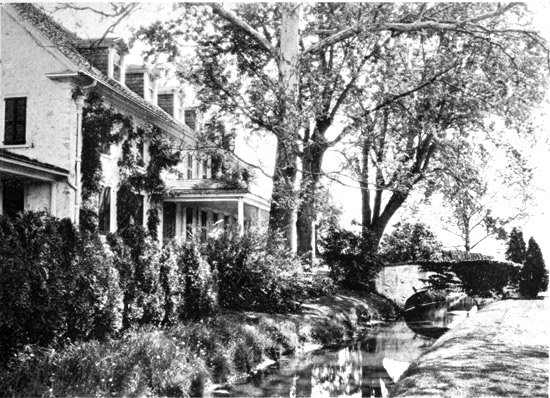
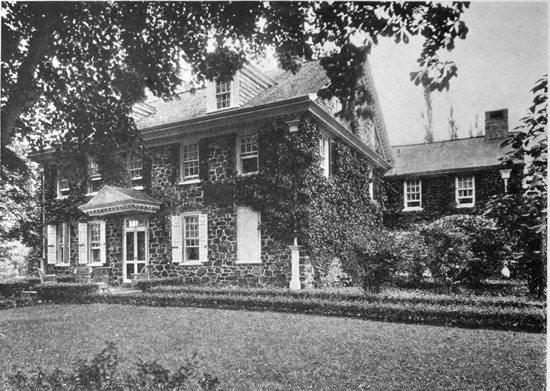
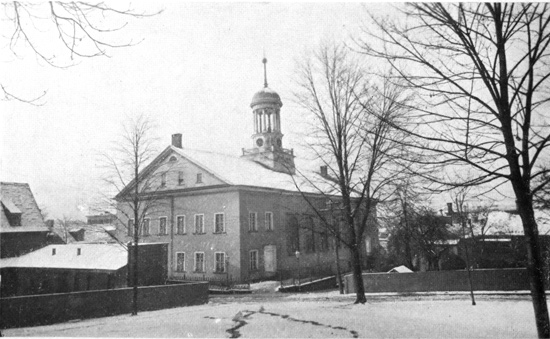
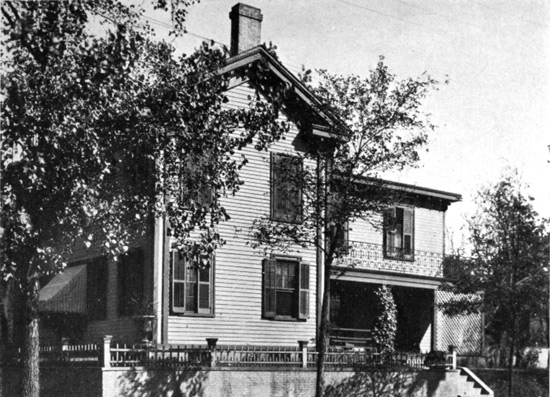
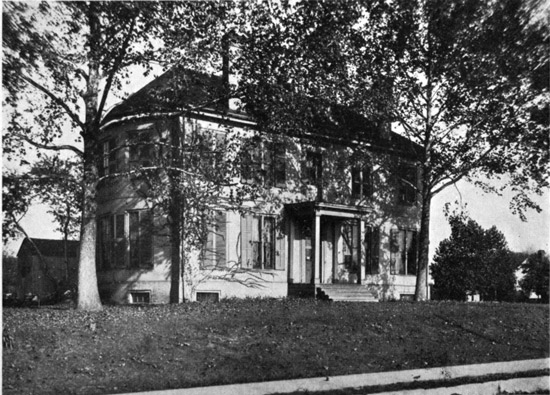
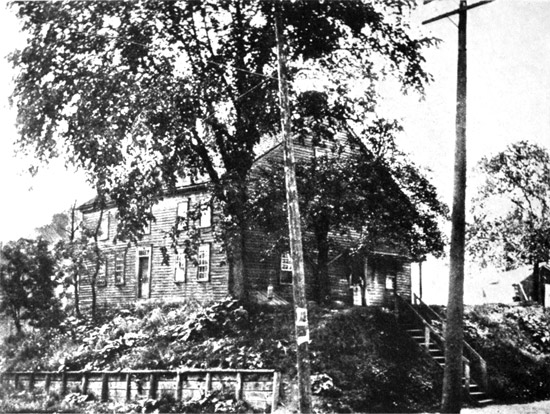
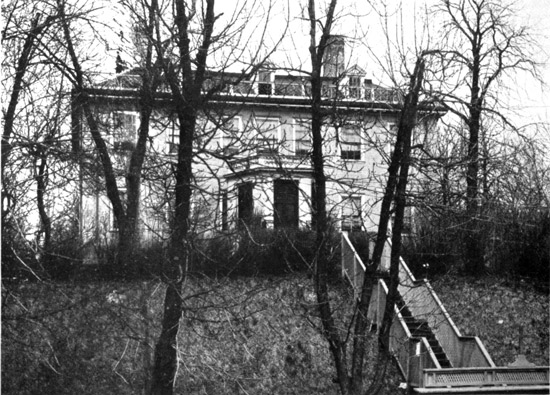
I love the stately southern mansions with their tall white columns,
They look through avenues of trees, over fields where the cotton is growing;
I can see the flutter of white frocks along their shady porches,
Music and laughter float from the windows, the yards are full of hounds and horses.
Long since the riders have ridden away, yet the houses have not forgotten,
They are proud of their name and place, and their doors are always open,
For the thing they remember best is the pride of their ancient hospitality.
Henry van Dyke.
SIX: HOMES AND HAUNTS OF THE CAVALIERS
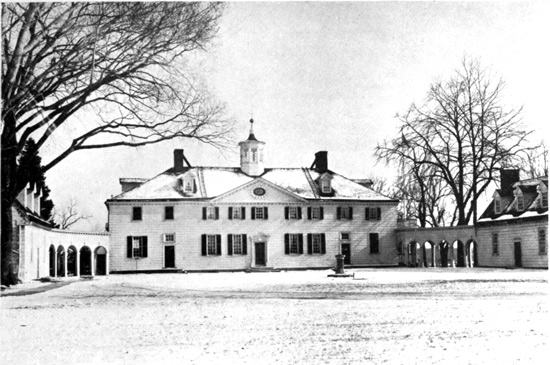
Photo by E. C. Hall
MOUNT VERNON, VIRGINIA, REAR VIEW
LII
SACRED TO THE MEMORY OF GEORGE WASHINGTON
George Washington was twenty years old when he
became the owner of the Mount Vernon estate on the
Potomac, in accordance with the provisions of the will
of Laurence Washington, his half-brother. At that
time the house contained but eight rooms and an attic,
four rooms on each floor. There were twenty-five hundred
acres in the farm.
As a boy Washington had tramped over every acre
of the estate. When he was sixteen he made a plot
of the region around Mt. Vernon. The original of the
survey made at that time may be seen in the Library
of Congress at Washington.
The young owner looked forward to years of quiet
on his estate, but he was frequently called away from
home for service in the militia of Virginia. In spite
of these absences, however, he managed to make the
acres surrounding the mansion give a good account of
themselves.
When he responded to the call of the Colonies and
became Commander-in-Chief of the army, he turned his
back on Mt. Vernon with great reluctance, and for six
years hardly saw the place he loved. But when the
independence of the Colonies had been won he returned
home, in the hope that he might be permitted to remain
there in obscurity, farming his land and entertaining
his friends in the house on the Potomac.
That he might have more room for his friends, he
enlarged the house. On July 5, 1784, he wrote to his
friend, William Rumney of Alexandria, asking him to
inquire into the terms on which "a House Joiner and
Bricklayer" might be engaged for two or three years.
To the house, which dated from 1744, he made additions
until it was three times as large as when he inherited
the property. The alterations were completed in 1785.
The completed house was ninety-six feet long, and thirty
feet deep, with a piazza fifteen feet wide. The building
material was wood, cut in imitation of stone.
While these alterations were in progress a visitor
to Mt. Vernon was Charles Vardo, an Englishman.
When he returned home he wrote an account of his visit,
in which said:
"I crossed the river from Maryland into Virginia,
near to the renowned General Washington's, where I
had the honor to spend some time, and was kindly
entertained with that worthy family. As to the General,
if we may judge by the countenance, he is what
the world says of him, a shrewd, good-natured, plain,
humane man, about fifty-five years of age, and seems
to wear well, being healthful and active, straight, well
made, and about six feet high. He keeps a good table,
which is always open to those of a genteel appearance....
"The General's house is rather warm, snug, convenient
and useful, than ornamental. The size is what
ought to suit a man of about two or three thousand
a year in England. The out-offices are good and seem
to be not long built; and he was making more offices at
each wing to the front of the house, which added more
to ornament than to real use. The situation is high,
and commands a beautiful prospect of the river which
parts Virginia and Maryland, but in other respects the
situation seems to be out of the world, being chiefly
surrounded by woods, and far from any great road or
thoroughfare.... The General's lady is a hearty,
comely, discreet, affable woman, some few years older
than himself.... The General's house is open to poor
travellers as well as rich, he gives diet and lodging to
all that come that way, which indeed cannot be many,
without they go out of their way on purpose...."
A visitor of January 19, 1785, was Elkanah Watson.
In his diary Washington wrote simply that Mr. Watson
came in and stayed all night; and that he went away
after breakfast next morning. But Mr. Watson had
a fuller account to give:
"I found him at table with Mrs. Washington and his
private family, and was received in the native dignity
and with that urbanity so peculiarly combined in the
character of a soldier and eminent private gentleman.
He soon put me at ease.... The first evening I spent
under the wing of his hospitality, we sat a full hour
at table by ourselves, without the least interruption,
after the family had retired. I was extremely oppressed
by a severe cold and excessive coughing, contracted by
the exposure of a harsh winter journey. He pressed
me to use some remedies, but I declined doing so. As
usual after retiring, my coughing increased. When
some time had elapsed, the door of my room was gently
opened, and on drawing my bed-curtains, to my utter
astonishment, I beheld Washington himself, standing
at my bedside, with a bowl of hot tea in his hand."
The following May Rev. Thomas Coke and Bishop
Francis Asbury were welcomed to Mt. Vernon. "The
General's seat is very elegant," Mr. Coke wrote. "He
is quite the plain, country-Gentleman." After dinner
the visitors presented to their host a petition for the
emancipation of the Negroes, "entreating his signature,
if the eminence of his station did not render it
inexpedient for him to sign any petition." Washington
told his guests that he was "of their sentiments,
and had signified his thoughts on the subject to most
of the great men of the State; that he did not see it
proper to sign the petition, but if the Assembly took
it into consideration, would signify his sentiments to
the Assembly by a letter."
An attractive picture of the General was given by
Richard Henry Lee after a visit to Mt. Vernon in
November, 1785:
"When I was first introduced to him he was neatly
dressed in a plain blue coat, white Casimer waistcoat,
and black breeches and Boots, as he came from his
farm. After having sat with us some time he retired....
Later he came in again, with his hair neatly powdered,
a clean shirt on, a new plain drab Coat, white
waistcoat and white silk stockings."
John Hunter, who was with Colonel Lee, added his
impression:
"The style of his house is very elegant, something
like the Prince de Condé's at Chantilly, near Paris, only
not quite so large; but it's a pity he did not build a new
one at once, as it has cost him nearly as much as repairing
his old one.... It's astonishing what a number
of small houses the General has upon his Estate for
his different Workmen and Negroes to live in. He has
everything within himself—Carpenters, Bricklayers,
Brewers, Blacksmiths, Bakers, etc., etc., and even has
a well assorted store for the use of his family and
servants."
While the repairs were still in progress, the ship
Mary arrived at Alexandria, having a consignment for
Washington from Samuel Vaughan, a great admirer
in London. This was a chimney-piece, wrought in Italy
from pure white and sienite marble, for the use of Mr.
Vaughan. When the mantel reached England the
owner learned of the improvements then in progress at
Mt. Vernon. Without unpacking the mantel he sent it
on to America. When Washington received word of the
arrival of the gift, he wrote, "By the number of cases,
however, I greatly fear it is too elegant and costly for
my room and republican style of living." Nevertheless
the mantel was installed in the mansion and became a
great delight to the household.
Washington's days at Mt. Vernon were interrupted
by the renewed call of his country. For much of the
time for eight years he was compelled to be absent, and
when, at length, the opportunity came to resume the
free life on his estate, he had less than three years left.
But these years were crowded full of hospitality in the
mansion and of joyous work on the estate, and when,
on December 14, 1799, he died as a result of a cold
caught while riding on the estate, he left it to his
"dearly beloved wife, Martha Washington."
For many years Mt. Vernon continued its hospitable
career. Then came years of neglect, when the mansion
was falling into ruins. But in 1853-56 Miss Ann
Pamela Cunningham of South Carolina appealed to the
women of the nation, and succeeded in organizing an
association that took over the estate, restored it to its
original condition, furnished it with Washington relics
gathered from far and near, and opened it for the visits
of the reverent visitors to the city of Washington, who
continue their journey sixteen miles down the Potomac
that they may look on the scene that brought joy to
the heart of the Father of his Country.
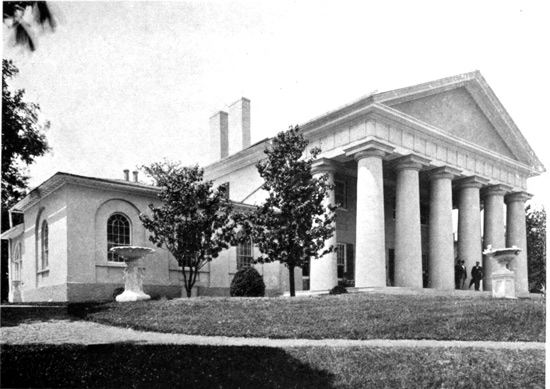
Photo by H. P. Cook
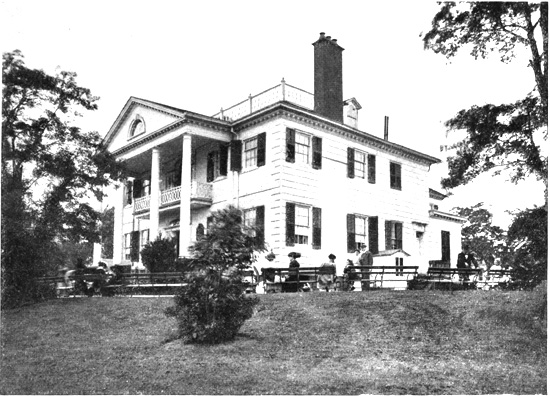
ARLINGTON, VIRGINIA
LIII
FROM WHICH ROBERT E. LEE WENT TO BATTLE FOR
THE SOUTH
After the death of George Washington the Mt. Vernon
family was gradually broken up, one after another going
elsewhere for a home. George Washington Parke Custis,
Washington's adopted son, and grandson of Martha
Washington, decided to build a home on a hill overlooking
the Potomac, opposite Washington City. There
were eleven hundred acres in the estate of which Arlington,
the mansion he built in 1802, was the central
feature.
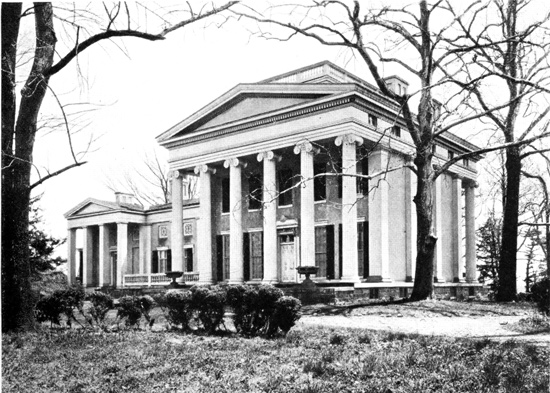
It has been said that the stately house is an adaptation
of the Doric temple at Paestum, near Naples. The
roof of the great portico rests on eight massive columns.
The rooms within are of a size in keeping with the
magnificent portal.
Perhaps the plan was too ambitious for the Custis
fortune. At any rate the rooms on the south side of
the hall were not completed. But it was a famous
house, nevertheless. Guests were many. They delighted
to look from the portico across the Potomac to
Washington, where they could see the government buildings
slowly taking shape.
One of the favored guests was Robert E. Lee. His
frequent visits led to his marriage, in 1831, to Mr.
Custis' daughter. At this time Lee was a lieutenant
in the United States Army. Mrs. Lee remained at
Arlington, waiting for the husband whose military
duties enabled him to spend only brief seasons with
her and the growing family there.
During the years before the war visitors to the Capital
City thronged to Arlington. Some of them were
interested in the many Washington relics in the house.
Chief among these was the bed on which Washington
died. Others came to the picnic grounds at Arlington
Spring, which Mr. Custis had opened for the pleasure
of the people, building for the use of all comers a great
dining-hall, a dancing pavilion, and a kitchen.
One of these visitors told his impressions of Arlington:
"In front of the mansion, sloping toward the Potomac,
is a fine park of two hundred acres, dotted with
groves of oak and chestnut and clumps of evergreens;
and behind it is a dark old forest, with patriarchal
trees bearing many centennial honors, and covering six
hundred acres of hill and dale. Through a portion of
this is a sinuous avenue leading up to the mansion."
At the time of the secession of Virginia, Robert E.
Lee was a colonel. Duty seemed clear to him. It was
not easy for him to take up arms against the United
States Government, but he considered himself first of
all a citizen of his native State. To respond to the call
of the Confederacy meant ruin. His beautiful home, he
feared, would be destroyed. But he did not hesitate.
A desire to retain possession of his slaves had nothing
to do with his decision. His own slaves had already
been freed, and provision had been made in the will
of Mrs. Lee's father that all his slaves should be freed
in 1862.
When, in 1865, General Lee was urged to prolong the
conflict by guerilla warfare, he said: "No, that would
not do. It must be remembered that we are Christian
people. We have fought the fight as long and as well
as we know how. We have been defeated. For us as a
Christian people there is but one course to pursue. We
must accept the situation. These men must go home and
plant a crop, and we must proceed to build up our
country on a new basis."
But he could not return to Arlington. The government
had taken possession of the estate for a National
Cemetery. For a time he lived in obscurity on a little
farm. Then he became President of Washington College,
later Washington and Lee University. With his
family he lived on the campus at Lexington, Virginia,
and there he died, October 12, 1870.
In the meantime the National Cemetery at Arlington
was becoming a pilgrimage point for patriotic Americans.
The slopes of the beautiful lawn were covered
with graves. The stately white mansion, with its eight
great pillars and its walls of stucco seemed a fitting
background for the ranks of little white tombstones.
For years the title to the property was in dispute.
In 1864 the United States bought it for $26,800, when it
was sold at auction for delinquent taxes. In 1882 the
Supreme Court decided that G. W. C. Lee, son of General
Lee, was entitled to the property, and the following
year the government paid him $150,000 for eleven hundred
acres, including the mansion.
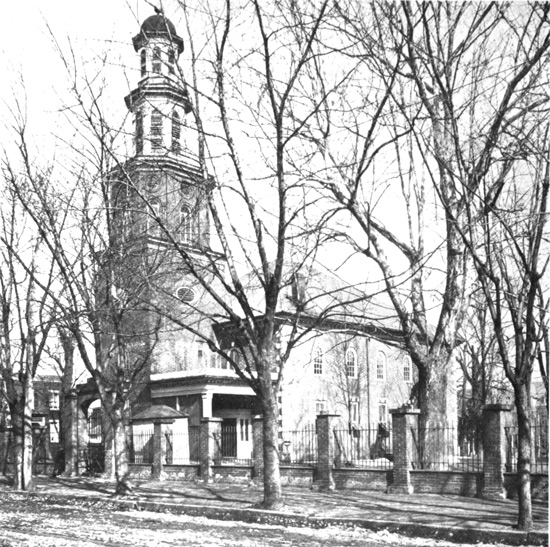
Photo by H. P. Cook
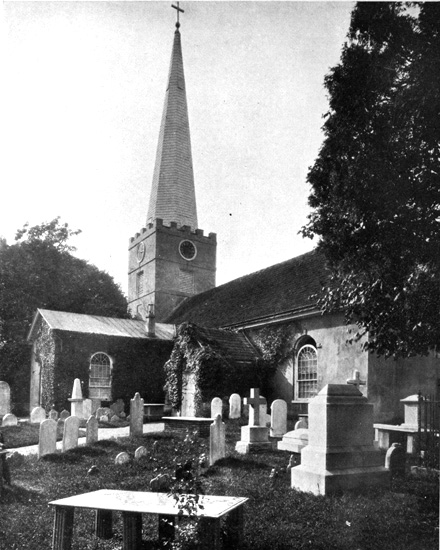
CHRIST CHURCH, ALEXANDRIA, VA.
LIV
WHERE WASHINGTON HAD A PEW "AT THE UPPER PART
OF THE CHURCH"
George Washington was chosen one of the vestrymen
of Fairfax parish in 1764, when this was formed by the
division of Truro parish, although he was already a
vestryman in Pohick Church at Truro.
The records of the new parish show that in 1766 it
was decided to build Christ Church at Alexandria, and
a second church at the Falls of the Potomac instead of
the old church there. The members of the parish were
asked to pay thirty-one thousand pounds of tobacco for
the purpose of construction.
James Wren, the architect of Christ Church, is said
to have been a descendant of Sir Christopher Wren.
While the building was well designed, no one ever
thought of it as a masterpiece. But it has answered the
purposes of the worshipper for more than a century and
a half, and it promises to last at least a hundred and
fifty years more.
The original contract called for the expenditure of
£600. Colonel John Carlisle, who was bondsman for
the contractor, James Parsons, in 1772, agreed to complete
the building on payment of £220 additional, since
Parsons failed to fulfil his agreement.
The church was built of brick, and was sixty by fifty
feet long. The work was carefully done, but the structure
was ready for the vestry to take possession early
in 1773.
At the first sale of pews, of which there were fifty
in all, Washington paid £36 10 s. for pew number five.
He had already made a generous gift toward the building
fund, but asked the privilege of giving the brass
chandelier which still hangs from the ceiling.
When the Church and State were separated in Virginia,
after the Revolution, Washington subscribed five
pounds a year to the rector's salary. By act of the legislature
the glebe lands of churches in the State were
confiscated, but, through the influence of Washington
and Charles Lee, Christ Church "and one other" (probably
Falls Church) were allowed to retain their lands.
Many changes have been made in the building. The
gallery was added in 1787, that twenty-five pews might
be provided for the growing congregation. The west
aisle was built in 1811, and the next year the chimneys
were built, for stoves were placed in the church at
that time. The bell was hung in 1816. The pews were
later divided, including that which Washington occupied,
but this pew has since been restored to its original
condition. Since 1891 the high pulpit and sounding
board have been replaced as they were at first.
Washington's diary tells of his attendance at service
on Sunday, June 2, 1799. Perhaps it was of this Sunday
a visitor to Alexandria wrote in a letter to a friend,
which was quoted in "The Religious Opinions and Character
of George Washington," published in 1836. The
writer said:
"In the summer of 1799 I was in Alexandria on a
visit to the family of Mr. H.... Whilst there, I expressed
a wish to see General Washington, as I had
never enjoyed that pleasure. My friend ... observed:
'You will certainly see him on Sunday, as he is never
absent from church when he can get there; and as he
often dines with us, we will ask him on that day, when
you will have a better opportunity of seeing him.' Accordingly,
we all repaired to church on Sunday....
General Washington ... walked to his pew, at the
upper part of the church, and demeaned himself throughout
the service of the day with that gravity and propriety
becoming the place and his own high character.
After the services were concluded, we waited for him
at the door, for his pew being near the pulpit he was
among the last that came out—when Mrs. H. invited
him to dine with us. He declined, however, the invitation,
observing, as he looked at the sky, that he thought
there were appearances of a thunderstorm in the afternoon,
and he believed he would return home to dinner."
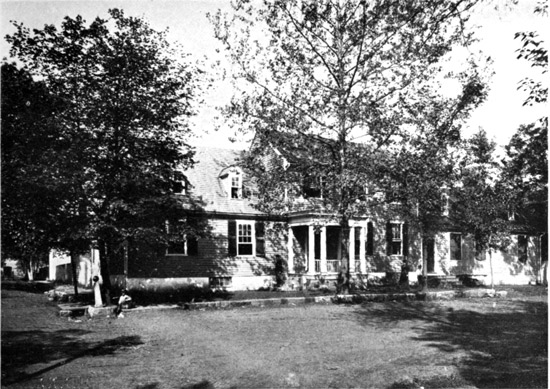
Photo by H. P. Cook
MARY WASHINGTON'S HOUSE, FREDERICKSBURG, VA.
LV
WHERE WASHINGTON'S MOTHER SPENT HER LAST YEARS
The first property mentioned in connection with the
name of Mary Ball, who became the mother of George
Washington, was on the tract of four hundred acres "in
ye freshes of Rappa-h-n River," bequeathed to her in her
father's will before she was six years old. Her father,
Colonel Joseph Ball of Epping Forest, Lancaster
County, thought he was about to die, but he lived some
years longer.
Ten years later an unknown writer spoke of Mary
Ball in pleasing terms:
"WmsBurg, ye 7th of Octr, 1722.
"Dear Sukey, Madam Ball of Lancaster and her
sweet Molly have gone Hom. Mama thinks Molly the
Comliest Maiden She Knows. She is about 16 yrs old,
is taller than Me, is verry Sensable, Modest and Loving.
Her Hair is like unto Flax, Her Eyes are the color of
Yours, and her Chekes are like May blossoms. I wish
You could see Her."
This "Belle of the Northern Neck," as she came to be
called, continued her conquests of young and old until,
at twenty-two, an orphan, she left Epping Forest to live
with her brother, Joseph Ball, at "Stratford-by-bow,
Nigh London." There, on March 6, 1730, she became
the second wife of Augustine Washington, the second
son of Laurence Washington, who was visiting England
at the time.
Less than two years later, at Wakefield, on the Potomac,
in Westmoreland County, Virginia, George Washington
was born. He was not three years old when the
mansion was burned.
The new home was at Pine Grove, in Stafford County,
on the Rappahannock River, opposite Fredericksburg.
For eight years the family circle was unbroken, but
on April 12, 1743, Augustine Washington died. Laurence
Washington, Mary Washington's stepson, then became
the owner of Mt. Vernon, while to George Washington
was bequeathed Pine Grove, though the estate
was to be managed by Mrs. Washington until the son
became twenty-one.
With wonderful skill Mrs. Washington directed the
plantation and with firm purpose she devoted herself to
the care of her five fatherless children.
A picture of this capable woman at this period was
recorded by Laurence Washington, a nephew of George
Washington's father. He wrote:
"I was often there [at Pine Grove] with George, his
playmate, schoolmate, and young man's companion. Of
the mother, I was more afraid than of my own parents;
she awed me in the midst of her kindness; and even
now, when time has whitened my locks and I am the
grandfather of a second generation, I could not behold
that majestic woman without feelings it is impossible
to describe."
The death, in 1752, of Laurence Washington of Mt.
Vernon made George Washington the owner of that
property. Thereafter the twenty-five hundred acre
estate became known as the home of the eldest son, while
Mrs. Washington remained at Pine Grove with her
younger children.
Only a few months later he stopped to see his mother,
as he was on his way to the West to carry out a commission
laid upon him by Governor Dinwiddie. As
Mrs. Washington bade her son good-bye, she urged him
to "remember that God only is our sure trust." Then
she added, "To Him I commend you."
Her words were remembered. In 1755, when General
Braddock asked Colonel Washington to accompany him
to Fort Pitt, Mrs. Washington hurried to Mt. Vernon
and urged him not to go. He considered her objections,
but said:
"The God to whom you commended me, madam, when
I set out on a more perilous errand, defended me from
all harm, and I trust He will do so now; do you?"
One by one the children left Pine Grove. In 1750
Betty Washington was married to Colonel Fielding
Lewis, who built for her the stately house Kenmore, not
far from her mother's home, but across the river, on
the edge of Fredericksburg. This house is still among
the show places of the old town.
In the early days of the Revolution Colonel and Mrs.
Lewis tried to persuade Mrs. Washington that she was
getting too old to live alone at Pine Grove, and urged
her to make her home at Kenmore. At the same time
Colonel Lewis offered to take over the management of
the plantation. To both entreaties she turned a deaf
ear; she said she felt entirely competent to take care of
herself, and she would manage her own farm.
However, she consented to make her home in a house
purchased for her in Fredericksburg, because "George
thought it best." The dutiful son had time to help in
the flitting to the new home before he hurried to the
North. He was not to see her again for seven long
years.
A member of the family described later the days of
waiting when Mary Washington directed her household
in the preparation of clothes, provisions, and other comforts
for the General and his associates: "During the
trying years when her son was leading the Continental
forces, the mother was watching and praying, following
him with anxious eyes," the story is told. "But to the
messenger who brought tidings, whether of victory or
defeat, she turned a calm face, whatever tremor of feeling
it might mask, and to her daughter she said, chiding
her for undue excitement, 'The sister of the commanding
general should be an example of fortitude and
faith.'"
It was November 11, 1781, when the victorious commander
next saw Fredericksburg, on his way to Philadelphia
from Yorktown. George Washington Parke
Custis has described the meeting with his mother:
"She was alone, her aged hands employed in the
works of domestic industry, when the good news was announced,
and it was told that the victor was awaiting
at the threshold. She bade him welcome by a warm
embrace, and by the well-remembered and endearing
name of George.... She inquired as to his health, for
she marked the lines which mighty cares and toils had
made in his manly countenance, and she spoke much of
old times and old friends, but of his glory not one
word."
When the Peace Ball was given in Fredericksburg
she was an honored guest. Her son walked with her
into the gaily decorated ballroom. She remained for a
time, but after a while, from the seat where she had
watched the dance, she called him to her side. When
she was near she said, "Come, George, it is time for old
folks to be at home."
Lafayette visited Fredericksburg in 1784, that he
might pay his respects to Mrs. Washington. He found
her in her garden, dressed in a short linsey skirt, working
among her flowers. After his visit he declared, "I
have seen the only Roman matron living at this day."
She still went frequently to her plantation across the
river, but as she became more feeble her son gave her
a phaeton in which she could cross the ferry in comfort.
Her great-granddaughter has written of her appearance
when she rolled in the phaeton down the village street:
"In summer she wore a dark straw hat with broad
brim and low crown, tied under her chin with black
ribbon strings; but in winter a warm hood was substituted,
and she was wrapped in the purple cloth cloak
lined with silk shang (a present from her son George)
that is described in the bequests of her will. In her
hand she carried her gold-headed cane, which feeble
health now rendered necessary as a support."
One of the last visits paid by George Washington to
his mother was on March 7, 1789. A Fredericksburg
paper of March 12 said, "The object of his Excellency's
visit was probably to take leave of his aged mother,
sister, and friends, previous to his departure for the new
Congress, over the councils of which, the united voice of
America has called him to preside." On March 11
Washington's account book shows that the expenses of
the trip were £1.8.0. He also noted that he advanced to
his mother at the time "6 Guineas."
At New York, on September 1, 1789, President Washington
was dining with friends when a messenger
brought word of the death of Mrs. Washington. The
notice of her death, as given in the Gazette of the United
States, on September 9, read:
"Fredericksburg, Virginia, August 27, 1789—On
Tuesday, the 25th inst. died at her home in this town,
Mrs. Mary Washington, aged 83 years, the venerable
mother of the illustrious President of the United States,
after a long and painful indisposition, which she bore
with uncommon patience. Though a pious tear of duty,
affection, and esteem is due to the memory of so revered
a character, yet our grief must be greatly alleviated from
the consideration that she is relieved from the pitiable
infirmities attendant on an extreme old age.—It is usual
when virtuous and conspicuous persons quit this terrestrial
abode, to publish an elaborate panegyric on their
characters—suffice it to say, she conducted herself
through this transitory life with virtue, prudence, and
Christianity, worthy the mother of the grandest Hero
that ever adorned the annals of history."
"O may kind heaven, propitious to our fate,
Extend THAT HERO'S to her lengthen'd date;
Through the long period, healthy, active, sage;
Nor know the sad infirmities of age."
The house in Fredericksburg which was occupied after
1775 by Mrs. Washington, is now the property of
the Association for the Preservation of Virginian
Antiquities.
LVI
TWO OF THE HOMES OF JOHN TYLER
A little girl was responsible for the fact that John
Tyler, who became the tenth president of the United
States, was born, not at Marlie, but at Greenway.
Marlie was the name chosen by Judge John Tyler for
his James River estate, but his young daughter, Anne
Contesse, as soon as she began to talk, insisted on calling
it "Greenway," "because the grass grows so green
there."
The fact that Anne's name displaced that chosen by
her father is an indication of his great love for children.
Greenway was "a bird's nest full of young," but
at various times he added to his own flock one or another
of twenty-one children, of whom he was made guardian,
all of whom he guided through childhood to earnest manhood
and womanhood.
These children must have enjoyed roaming about the
estate, for, according to Judge Tyler's description, it
was a delightful place. He said of it:
"Greenway contains five hundred acres, well improved.
On it is a genteel, well-furnished dwelling-house,
containing six rooms, all wainscoted, chair-board
high, with fine dry cellars the full length of the house,
which is 56 feet; also every other building which a
reasonable person could wish or desire, to wit: a handsome
study, storehouse, kitchen, laundry, dairy, meat-house,
spring-house, and an ice-house within the curtelage;
a barn 40 by 34 feet, two granaries, two carriage
houses, 20 stalls for horses, a quarter for house servants;
a handsome pigeon-house, well stocked; and several
other houses for slaves; a well of water (so excellent
that I can drink with delight after returning from a
mountain circuit), a large, fertile garden, abounding
with a great variety of shrubs, herbs, and beautiful
flowers, well enclosed. The buildings new and well covered
with shingles."
On this attractive estate John Tyler was born on
March 29, 1790. He was a slender, delicate-looking lad,
but he was not afraid to stand up for himself when he
felt he was being abused. His first schoolmaster, a
Mr. McMurdo, who taught across the road from Greenway,
thought that it was impossible to teach well unless
the rod was in daily use. "It was a wonder that he did
not whip all the sense out of his scholars," John said
once, years later. But one day the boys rebelled.
"John and some of the larger boys tripped him up,
and began to tie his hands and feet," the Tyler family
biographer tells the story. "McMurdo scuffled bravely,
but upon little William Tyler, the smallest boy in school,
throwing himself upon him, he exclaimed, in imitation
of the great Roman, 'Et tu, Brute!' and ceased to resist.
The boys firmly secured him, locked him up in the
schoolhouse, and left with cheers of triumph and
derision."
Hours later the schoolmaster was released by a passing
traveller, who heard his cries. At once the enraged
man hastened to Judge Tyler and told his story. "But
the Judge, born and bred in the Revolutionary school,
hated tyranny in any shape, and as he drew himself up
to his full stature, he ... replied, in the language of
Virginia's motto, 'Sic Semper Tyrannis.'"
At the age of twelve John entered the grammar school
of William and Mary College at Williamsburg. There
he had a good time, and he made a creditable showing in
his classes. Yet that he did not advance in at least one
study is evident from a letter written by his father in
1807. He said:
"I can't help telling you how much I am mortified to
find no improvement in your handwriting; neither do
you construct your lines straight, which makes your
letters look too abominable. It is an easy thing to
correct this fault, and unless you do so, how can you
be fit for law business?"
Some years later, when Judge Tyler was Governor
of Virginia, he announced impressively to John that
Thomas Jefferson would be among the dinner guests on
a certain day. "Be sure you have a good dinner," the
Governor added; for John was at the time in charge of
the establishment. The future President asked himself,
"What is the best thing for dinner?" "Plum pudding!"
was the answer.
The appointed time came. The company was seated
at table. The first course was served. Then came a
long wait.
"Suddenly a door flew open, and a negro servant
appeared, bearing, with both hands raised high above
his head, a smoking dish of plum pudding. Making a
grand flourish, the servant deposited it before Governor
Tyler. Scarcely had he withdrawn before another door
flew open, and an attendant, dressed exactly like the
first, was seen bringing another plum pudding, equally
hot, which at a grave nod from John, he placed before
Mr. Jefferson. The Governor, who expected a little
more variety, turned to his son, who sat surveying the
puddings with tender interest, and exclaimed, in accents
of astonishment, 'Two plum puddings, John, two plum
puddings! Why, this is rather extraordinary!' 'Yes,
sir,' said the enterprising major domo, 'it is extraordinary;
but' (and here he rose and bowed deferentially
to Mr. Jefferson) 'it is an extraordinary occasion.'"
In 1813, John Tyler married Letitia Christian.
They did not make their home at Greenway, however.
On the death of Judge Tyler the old house was sold, but
it became the property of John Tyler in 1821. There
he retired for the season of rest which he sorely needed
after his strenuous years as a member of the House of
Delegates, and Representative in Congress. During the
intervals of his service as Governor and United States
Senator he resided at the old home, but in 1829 he sold
the property, and removed to Gloucester County, to an
estate which he took for debt. Eighteen years later, at
the close of his presidential term, he returned, with his
bride, the second Mrs. Tyler, to the county where he
was born, having bought an estate of twelve hundred
acres, three miles from Greenway, on the north side of
the James, opposite Brandon. He tore down the old
house on the estate, and built a house on the same plan,
which, with its connected out-buildings, was more than
two hundred feet long. He called his place "Sherwood
Forest," with grim humor; for was he not an outlaw,
in the opinion of the Whigs, just as really as was Robin
Hood?
Not long after the beginning of life at Sherwood
Forest he was appointed overseer of the road on which
his estate was located. Some claimed that this appointment
was secured by the Whigs to humiliate him. But
he refused to be humiliated. Instead he determined to
be a good overseer and make the road the best in the
State. All the men in the township were called, and
they were kept at work day after day, as, according to
law, he had a right to keep them. But it was harvest
time, and the wheat was dead ripe. "The smiles that
lately illuminated the countenances of the Whigs turned
to dismay. The august justice who had made the appointment
repaired to Mr. Tyler's house, and represented
to him the state of things. Mr. Tyler replied that
the law made it his duty to put the road in good order,
and to keep it so. The Whigs expostulated. Mr. Tyler
was firm. Then the justice begged him to resign, and
let the hands go home. The ex-President said, 'Offices
are hard to obtain in these times, and having no assurance
that I can ever get another, I cannot think, under
the circumstances, of resigning.'"
One of the statesman's valued companions during
these early years at Sherwood Forest was "General,"
the old horse which he had owned for many years. At
length the horse died, and was buried in the grave at
Sherwood Forest. On a wooden slab at the head of the
grave the owner wrote:
"Here lieth the bones of my old horse, General, who
served his master faithfully for twenty-seven years, and
never blundered but once—would that his master could
say the same!"
The last years of John Tyler's life witnessed the return
of his popularity. Enemies became friends, and all
rejoiced to do him honor. He was called to a number
of honorable posts, and he was about to take his seat
as a member of the House of Representatives of the Confederate
Congress when he died, in Richmond, on January
18, 1862.
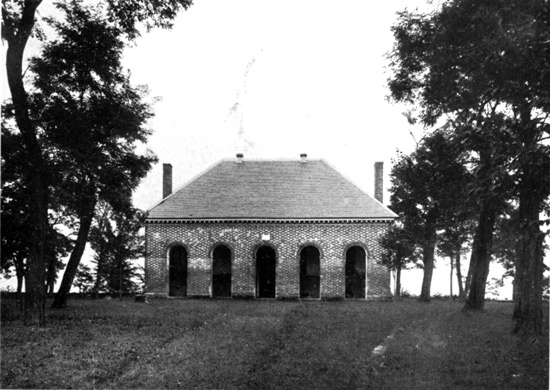
Photo by H. P. Cook
HANOVER COURT HOUSE, VIRGINIA
LVII
OLD DOMINION COUNTY BUILDINGS AT HANOVER AND
WILLIAMSBURG
A momentous announcement appeared in the Williamsburg,
Virginia, Gazette on March 16, 1769:
"The Common Hall having this day determined to
build a commodious brick court-house in this city and
having appointed us to agree with and undertake to
build the same, we do hereby give notice that we shall
meet at Mr. Hay's (the Raleigh Tavern) on Tuesday,
the 4th of April, to let the building thereof; we are also
appointed to dispose of the present court-house, and the
ground on which the same stands. James Cock, John
Carter, James Carter, John Tazewell."
The building displaced by the new structure was
erected in 1716 by William Levington, and was given
to the city in 1745 by "the Gentlemen subscribers for
the Play House."
The stone steps on the new building, which are still
in use, were brought from England in 1772. A copy
of the letter in which William Wilson acknowledged
their receipt is in a letter book preserved in the library
of the Episcopal Seminary, near Alexandria.
During the Revolution, the patriots were called together,
from time to time, by the bell in the picturesque
tower. It was fitting, then, that when American independence
was celebrated at Williamsburg, on May 1,
1783, the Courthouse was made the rallying place for
the people. On receipt of official notice from Governor
Benjamin Harrison that the treaty of peace had been
signed, the mayor of Williamsburg prepared an "Order
of the Procession on the Great Day," which closed with
the following direction:
"The Citizens to be Conveyed on Thursday, at 1
o'clock at the Court-House by a Bellman.
"After the convention of citizens they are to make
proclamation at the C: House, after which the Bells
at the Church, College, & Capitol are to ring in peal.
"From the Ct House the Citizens are to proceed to
the College, and make proclamation at that place, from
whence they are to proceed to the Capitol and make
proclamation there and from thence Proceed to the
Raleigh (Tavern) & pass the rest of the day."
A frequent visitor to the Williamsburg Courthouse
was the brilliant lawyer Patrick Henry, whose reputation
as an orator was made long before he delivered his
"Give me Liberty or Give me Death" speech at St.
John's Church, Richmond.
Some years before the Williamsburg Courthouse was
erected, this orator made his first public speech, at Hanover
Courthouse, a building that dates from 1735, in
the celebrated suit of the clergy demanding the payment
of their stipends in tobacco, according to law. In consequence
of a short crop the price had increased, and
they insisted that it was their right to have the advantage
of the increase. Their case had been tried once
and won. The attorney of the people thereupon withdrew,
and Henry was engaged to appear for them in
court.
When the case was called, Rev. Patrick Henry was
present, to the regret of his nephew. The lawyer sought
his uncle and said that he feared he would be too much
overawed by his presence to do his duty to his clients,
and added that he would be compelled to say some
"very hard things of the clergy." The minister thereupon
entered his carriage, and drove away.
William Wirt describes the scene at the opening of
the case:
"On the bench sat more than twenty clergymen, the
most learned men in the Colony, and the most capable,
as well as the severest critics before whom it was possible
for him to have made his début. The Court House
was crowded with an overwhelming multitude, and surrounded
with an immense and anxious throng, who, not
finding room to enter, were endeavoring to listen without,
in the deepest attention. But there was something
still more awfully disconcerting than all this; for in the
chair of the presiding magistrate, sat no other person
than his own father....
"And now came on the first trial of Patrick Henry's
strength. No one had ever heard him speak, and curiosity
was on tiptoe. He rose very awkwardly, and faltered
much in his exordium. The people hung their
heads at so unpromising a commencement; the clergy
were observed to exchange sly looks with each other, and
the father is described as having almost sunk with confusion,
from his seat. But these feelings were of short
duration, and soon gave place to others, of a very different
character.... The spirit of his genius awakened
all his features.... His action became graceful, bold,
and commanding; and in the tones of his voice, but more
especially in his emphasis, there was a peculiar charm,
a magic, of which any one who ever heard him will
speak as soon as he is named, but of which no one can
give any adequate description....
"The people, whose countenances had fallen as he
arose, had heard but very few sentences before they
began to look up; then to look at each other with surprise,
as if doubting the evidence of their own senses....
In less than twenty minutes, they might be seen in
every part of the house, on every bench, in every window,
stooping forward from their stands, in deathlike silence....
The mockery of the clergy was soon turned
into alarm; their triumph into confusion and despair;
and at one burst of his rapid and overwhelming invective,
they fled from the bench in precipitation and terror.
As for the father, such was his surprise, such his amazement,
such his rapture, that, forgetting where he was,
and the character which he was filling, tears of ecstasy
streamed down his cheeks without the power or inclination
to restrain them."
The case was won. As soon as the verdict was announced
the people seized the orator at the bar and bore
him out of the courthouse. Then, raising him on their
shoulders, they carried him about the yard.
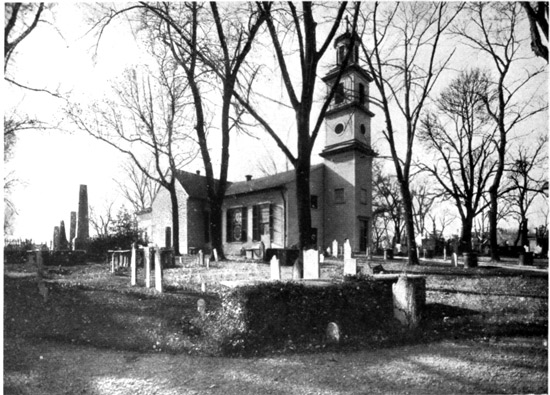
Photo by H. P. Cook
ST. JOHN'S CHURCH, RICHMOND, VA.
LVIII
WHERE PATRICK HENRY SAID, "GIVE ME LIBERTY, OR
GIVE ME DEATH"
In 1611 Sir Thomas Dale founded his town of Henricopolis,
the second established settlement in Virginia.
It was named in honor of Prince Henry, the eldest son
of James I. A church was soon after built. The
bounds of Henrico parish, to which it belonged, were
quite large until 1634, when the parish was made to
include the present Chesterfield, Powhatan, and Goochland
counties.
Soon after the marriage of Pocahontas she moved to
the plantation of her husband, John Rolfe, near Henricopolis,
and they were both members of Henrico parish
until they left Virginia.
The written records of Henrico parish begin with
1730. At that time the principal church of the parish
was on Curle's plantation, on the north side of the
James, some miles below the present city of Richmond.
Curle's church disappeared during the Civil War. The
bowl of the baptismal font in St. John's Church, Richmond,
is a relic of the old church. This was removed
from the cellar of a house where it had been in use for
beating hominy.
Steps were taken in 1737 to build the present St.
John's Church, because of the increase of population in
Richmond. The first action was recorded as follows:
"At a Vestry held at Curls Church for Henrico parish
ye 8th day of October Anno Dom. 1737 for laying ye
parish Levey—
"The Vestry do agree to build a Church on the most
convenient place at or near Thomas Williamsons in this
parish to be Sixty feet in Length and Twenty-five in
Breadth and fourteen feet pitch to be finished in a plain
Manner After the Moddle of Curls Church. And it is
ordered that the Clerk do Set up Advertisements of the
particular parts of the Said Building and of the time
and place of undertaking the Same.... It is ordered
that the Collector do receive of every Tithable person
in this parish five pounds of Tobacco after the Usual
deduction to be apply'd towards building the New
Church at Williamsons."
At a later meeting the location and the dimensions of
the church were changed. Richmond was decided on,
and it was stated that "Richard Randolph Gent undertakes
the Said Building and engages to finish the Same
by the Tenth day of June, which Shall be in the year of
our Lord 1741; for which the Vestry agrees to pay him
the Sum of £317 10s. Current Money to be paid by the
amount of the Sale of Twenty thousand pounds of Tob'o
Annually to be Levyd on the parish and Sold here for
Money till the whole payment be compleat."
There is no record of the completion of the building,
but probably it was finished at the appointed time.
Since that date various additions have been made, yet
it is possible to trace the lines of the original structure.
The original pews are still in use, though they have been
lowered. The hinges of the pew doors are handwrought.
The wainscoting and the window sashes are those first
put in. The original weather-boarding is still in place.
It is fastened by nails whose heads are half an inch
broad.
For the new church there were imported from England:
"One Parsons Surples, a Pulpit Cushen and Cloth,
two cloths for Reading Desks, a Communion Table
Cloth, and a Dozen of Cushens—to be of good Purple
Cloth, and the Surples good Hollond, also Large Bible
and four large Prayer Books."
An entry in the vestry book on December 17, 1773,
shows that the rector, Mr. Selden, received as salary
17,150 pounds of tobacco, worth £125. The clerk of the
parish received 1,789 pounds of tobacco, or £13 10s., the
sexton had 536 pounds, or £3.10s.7d.
Selden was chaplain of the Virginia Convention which
met in the church March 20, 1775. At the closing session
of this convention Patrick Henry "flashed the electric
spark, which exploded the country in revolution,"
as Burton says in his history of Henrico Parish. This
was the speech that closed:
"Gentlemen may cry peace, peace, but there is no
peace. The war is actually begun! The next gale that
sweeps from the north will bring to our ears the clash
of resounding arms! Our brethren are already in the
field! Why stand here idle? What is it that gentlemen
wish? What would they have? Is life so dear, or
peace so sweet, as to be purchased at the price of chains
and slavery? Forbid it, Almighty God. I know not
what course others may take, but as for me, Give me
liberty, or give me death."
Dr. Burton says that the orator "stood, according to
tradition, near the present corner of the east transept
and the nave, or more exactly, in pew 47, in the east
aisle of the nave.... He faced the eastern wall of the
transept, where were the two windows. In the more
northern of these stood Colonel Edward Carrington.
He broke the silence that followed the orator's burning
words with the exclamation, 'Right here I wish to be
buried!'"
When the British took possession of Richmond in
1781, St. John's Church became a barracks for Arnold's
men. And some of them stood on the spot where
Patrick Henry spoke the words that had such large part
in stirring up the people to drive all British soldiers
from the Colonies.
After the close of the war the diocese of Virginia was
reorganized in the building, and plans were laid to overcome
the difficulties that would soon come through the
loss of the property of the Protestant Episcopal Church,
which led Edmund Randolph, later Governor of Virginia
and Secretary of State in Washington's Cabinet, to
speak the famous words:
"Of what is the Church now possessed? Nothing but
the glebes and your affections."
That the affections of the people are a better dependence
than rich endowments in money has been shown
by the later history of the church, the parish, and the
diocese.
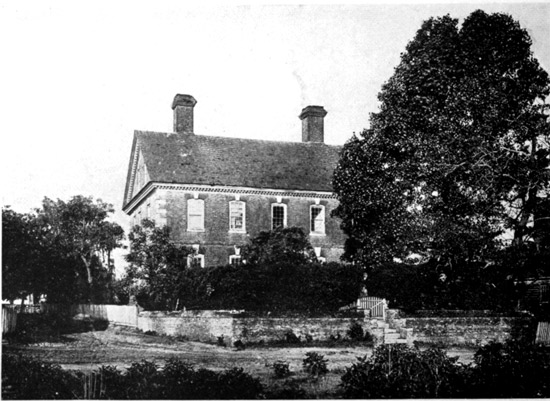
Photo by H. P. Cook
NELSON HOUSE, YORKTOWN, VA.
LIX
MADE MEMORABLE BY THE BATTLE OF YORKTOWN AND THE
SURRENDER OF CORNWALLIS
One day in 1740 a baby a little more than one year
old, whose name was Thomas Nelson, stood by the side
of his father, William Nelson, as the father was about
to lay the foundation of his new home in York, Virginia.
The babe had been stationed there that the brick for the
corner might be placed in the little hands; then it could
be said in later years that the babe had helped in the
exercises of the day. The little fellow became a Signer
of the Declaration of Independence, a General in the
Revolutionary War, and Governor of Virginia.
William Nelson was a merchant, who had invested his
savings in land and had become quite wealthy. When
his son was fourteen years old he was able to send him
to Cambridge, England, to be educated. Nine years
later the young man married Lucy Grymes of Brandon,
and took up his residence in the house whose foundation
he had helped to lay.
For many years the home of the young people was
noted for the hospitality shown there. Whenever the
owner could leave his guests, he rode to his plantation
near town. He kept a pack of hounds, which were frequently
employed in fox hunting.
When discontent against England became pronounced,
he was a leader of the patriots. He was a
member of the House of Burgesses of 1774 which was
dissolved by Lord Dunmore because of the passage of a
resolution against the Boston Port Bill, and he was one
of the eighty-nine men who met next day at a tavern and
took action that led to the first Continental Congress.
On July 17, when the Convention of Virginia delegates
gathered in Richmond decided to raise three regiments
for home defence, Patrick Henry was named as
commander of the first while Nelson was put in charge
of the second.
He was among the patriots who sat in the Continental
Congress of 1775, 1776, and 1777, and his name was
signed to the Declaration of Independence. On August
16, 1777, he retired from public service because of failing
health, but when, a little later, the Governor of Virginia,
fearing the approach of the British fleet, asked him to
serve as brigadier general and commander-in-chief of the
forces of the State, he agreed, on condition that he be
excused from accepting payment for his services.
During the siege of Yorktown he was at the head of
the militia. The sketch of his life as given by Sanderson
in the "Biography of the Signers," says: "During
the siege, observing his own house uninjured by the artillery
of the American batteries he inquired the cause. A
respect for his property, was assigned. Nelson ...
requested that the artillerists would not spare his house
more than any other, especially as he knew it to be occupied
by the principal officers of the British Army. Two
pieces were accordingly pointed against it. The first
shot went through the house and killed two ... officers....
Other balls soon dislodged the hostile
tenants." It is said that Nelson gave ten guineas
reward to the man who fired the first shot.
Again Thomas Nelson responded to the call of his
State when in June, 1781, he became Governor, succeeding
Thomas Jefferson. Four months after the beginning
of his term as chief executive of the State, George
Washington, in general orders, said:
"The General would be guilty of the highest ingratitude,
a crime of which he hopes he shall never be
accused, if he forgot to return his sincere acknowledgments
to his excellency governor Nelson, for the succours
which he received from him and the militia under
his command, to whose activity, emulation, and bravery,
the highest praises are due. The magnitude of the
acquisition will be ample compensation for the difficulties
and dangers which they met with so much firmness
and patriotism."
Nelson's term as Governor was shortened by ill health.
In November, 1781, he was compelled to resign.
But he was not permitted to rest. Attacks were made
on him for certain courses taken during his term as
Governor. When he asked and was given permission to
defend himself before the State delegates, he was triumphantly
acquitted of all blame. On December 31,
1781, this action was recorded:
"An act to indemnify Thomas Nelson, Junior,
Esquire, late governor of this commonwealth, and to
legalize certain acts of his administration. Whereas,
upon examination, it appears that previous to and during
the siege of York, Thomas Nelson, Esquire, late governor
of this commonwealth, was compelled by the peculiar
circumstances of the state and army, to perform
many acts of government without the advice of the council
of state, for the purpose of procuring subsistence for
the allied army under the command of his excellency
general Washington; be it enacted that all such acts of
government, evidently productive of general good, and
warranted by necessity, be judged and held of the same
validity, and the like proceedings be had on them as if
they had been executed by and with the advice of the
council, and with all the formality prescribed by law.
And be it enacted that the said Thomas Nelson, jr.,
Esquire, be and he hereby is in the fullest manner indemnified
and exonerated from all penalties and dangers
which might have accrued to him from the same."
Nelson lived more than seven years after this act
approving his emergency actions. But three years were
spent in comparative poverty. Most of his property was
sold to satisfy the debts incurred by paying two regiments
out of his own pocket, and by going security, with
the State, for two million dollars needed to carry on the
war. Sanderson says of these acts of generosity:
"He had spent a princely fortune in his country's
service; his horses had been taken from the plough, and
sent to drag the munitions of war; his granaries had
been thrown open to a starving soldiery, and his ample
purse had been drained to its last dollar, when the credit
of Virginia could not bring a sixpence into her treasury.
Yet it was the widow of this man who, beyond eighty
years of age, blind, infirm, and poor, had yet to learn
whether republics can be grateful."
On the simple gravestone in Yorktown, erected to the
memory of the patriot, is this eloquent inscription:
Thomas Nelson,
Governor of Virginia.
He Gave All for Liberty.
Not far from the grave is another historic house that
should be named with the Nelson house. This is the
Moore house, on Temple farm, then less than a mile from
Yorktown. In this house, which was built in 1713, the
terms of the surrender of Cornwallis were drawn up.
It was once the summer home of the colonial governor,
Alexander Spottswood.
LX
WHERE THE CHIEF JUSTICE CARED FOR HIS WIFE AND
ENTERTAINED HIS FRIENDS
An old book, "Richmond in By Gone Days," says that
John Marshall was noted in Richmond for his unpretending
manner. "His dress was plain even to negligence.
He marketed for himself and might be seen at
an early hour returning home with a pair of fowls, or
a basket of eggs in his hand, not with ostentatious humility,
but for mere convenience."
It is related by Flanders that Marshall "was one
morning strolling through the streets of Richmond, attired
in a plain linen roundabout and shorts, with his
hat under his arm, from which he was eating cherries,
when he stopped in the porch of the Eagle Hotel, indulged
in some little pleasantry with the landlord, and
then passed on." Just then a man from the country,
who wished a lawyer to appear for him in court, was
referred by the landlord to Marshall, as the best advocate
he could have, but the countryman declined to have
anything to do with the careless young man. In court
he asked the clerk for a lawyer, and was once more
recommended to take John Marshall. Again he refused.
Just then a dignified old man in powdered wig
and black coat entered. He was at once engaged, on
his appearance. After a time the inferiority of the
black-coated lawyer was so apparent that the countryman
sought Marshall, told him of the mistake he had
made, said that he had left but five dollars of the one
hundred dollars he had set aside for lawyers' fees, and
asked Marshall if he would assist on the case. The
lawyer laughingly agreed.
In 1781, when Marshall was twenty-five years old, he
walked from Virginia to Philadelphia, to be inoculated
for smallpox. "He walked at the rate of thirty-five
miles a day. On his arrival, such was his shabby appearance,
that he was refused admission into one of
the hotels; his long beard, and worn-out garments, probably
suggesting the idea that his purse was not adequate
to his entertainment. And this in the city which had
seen much of the young man's heroic services during the
Revolution!"
Before the close of the war, while visiting his father,
Colonel Marshall, who was the commanding officer at
Yorktown, Virginia, he met Mary Willis Ambler, a
daughter of Jacqueline Ambler, the treasurer of Virginia.
"She was just fourteen years of age at the time,
and it is stated to have been a case of love at first sight."
Even when Marshall called to see her he was not prepossessing
in appearance, yet he was well received, "notwithstanding
his slouched hat, and negligent and awkward
dress," for his amiable manners, fine talents, and
especially his love for poetry, which he read to them
with deep pathos, led them to forget his dress.
The young people were married on January 3, 1783.
After paying the fee of the minister, the groom's sole
remaining fortune was a guinea!
Mrs. Marshall was for many years a nervous invalid.
Bishop Meade says, "The least noise was sometimes
agony to her whole frame, and his perpetual endeavor
was to keep the house and yard and out-houses from the
slightest cause of distressing her; walking himself at
times about the house and yard without shoes." The
attitude of the people of Richmond to the husband and
wife is shown by the fact that "on one occasion, when
she was in her most distressing state, the town authorities
manifested their great respect for him and sympathy
for her, by having either the town clock or town bell
muffled."
On his marriage John Marshall took his wife to one
of the best houses then available in the village of Richmond,
a two-room frame building. In 1789 he bought
two acres of ground on Shockoe Hill, and here, in 1793,
he built a nine-room brick house. One of the rooms was
a large apartment, in which he gave his famous "lawyer
dinners."
When Marshall was not in Washington, he lived in
this comfortable house, which was near the home of his
father-in-law. He had also a farm a few miles from
Richmond. Bishop Meade says that one morning, between
daybreak and sunrise, he met Marshall on horseback.
He had a bag of clover seed lying before him,
which he was carrying to his farm.
An English traveller who spent a week in Richmond
in 1835 gave his impression of the Richmond home:
"The house is small, and more humble in appearance
than those of the average of successful lawyers and merchants.
I called there three times upon him; there is
no bell to the door. Once I turned the handle of it and
walked in unannounced; on the other two occasions he
had seen me coming, and had lifted the latch and received
me at the door, although he was at the time suffering
from severe contusions received in the stage while
travelling on the road from Fredericksburg to Richmond."
Chief Justice Marshall frequently attended the Monumental
Church. The narrow pews troubled him, for he
was quite tall. "Not finding room enough for his whole
body within the pew, he used to take his seat nearest the
door of his pew, and, throwing it open, let his legs
stretch a little into the aisle."
The death of his wife was a great grief to him.
"Never can I cease to feel the loss and to deplore it,"
he wrote on December 25, 1832, the anniversary of her
death. "Grief for her is too sacred ever to be profaned
on this day, which shall be, during my existence, marked
by a recollection of her virtues."
He survived Mrs. Marshall less than five years. In
June, 1835, he went to Dr. Physic in Philadelphia, seeking
relief for a disability that had been aggravated by
the road accident of which the English visitor wrote, as
already quoted. There he died, July 6, 1835. On July
4 he wrote the inscription which he wished placed above
his grave:
"John Marshall, son of Thomas and Mary Marshall,
was born on the 24th of September, 1755, intermarried
with Mary Willis Ambler the 3rd of January, 1783, departed
this life the —— day of —— 18 ——."
The Marshall house is now in possession of the Society
for the Preservation of Virginia Antiquities, having
been purchased a few years ago from the Misses Harvie,
the granddaughters of Chief Justice Marshall. They
had lived in the house until they sold it to the city of
Richmond.
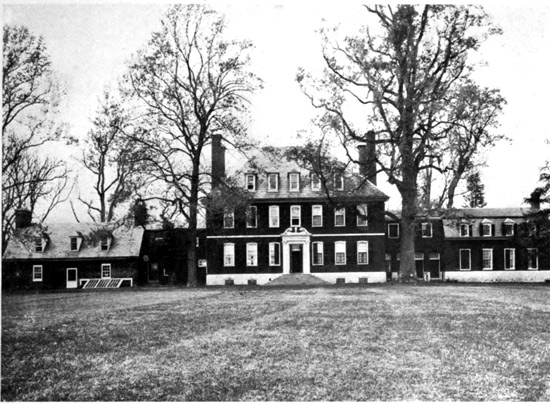
Photo by H. P. Cook
WESTOVER ON THE JAMES, VIRGINIA
LXI
SABINE HALL, WESTOVER, SHIRLEY, BRANDON, AND
CARTER'S GROVE
The five houses mentioned briefly in this chapter are
noteworthy, not only because of their beauty, but because
the stories of those who lived in them show how
the leading families of old Virginia intermarried until
the various relationships became a puzzle that delights
the genealogist.
On the Rappahannock, in Richmond County, Virginia,
Landon Carter, son of Robert ("King") Carter,
the ancestor of the Carter family of Virginia, built
Sabine Hall in 1730. He was a great lover of the works
of Horace, and it was quite natural that he should adopt
for his mansion the name of the Roman poet's Sabine
Farm.
Until his death in 1778 he was a recognized leader in
both Church and State. Robert A. Lancaster quotes an
unnamed writer who says that he was "a high-minded
public servant and a finished scholar, indulging a taste
for science and a love for letters," and was considered
"one of the most notable of the pre-Revolutionary statesmen
of the Colony," and was "looked up to by the
younger generation as a Nestor among his compatriots."
He was a friend of Washington, and received many letters
from him, some of which have been preserved.
Landon Carter's second wife was Maria Byrd, of
Westover. Her portrait, as well as those of the other
two wives, the husband and "King" Carter, are hanging
to-day on the walls of Sabine Hall. The estate of four
thousand acres descended to his son by his third marriage
with Elizabeth Beale, Robert Wormeley Carter,
who was a member of the Virginia Assembly. The
property is still in the possession of the descendants of
the original owner.
Westover, where Landon Carter courted Maria Byrd,
is on the James in Charles City County, not far south of
Sabine Hall. The mansion was built in the same year
as Sabine Hall, 1730, by William Byrd, II, whose father
came from England about 1674.
William Byrd, of Westover, was famous as a literary
man and as a statesman. At one time he was President
of His Majesty's Council. But perhaps his greatest
fame came to him because he was the father of Evelyn
Byrd, who was a reigning belle. When, at the age of
eighteen, she was presented at Court, it was reported
that the king of England complimented her by saying
he was glad Virginia could produce such "beautiful
Byrds."
Evelyn's brother, William Byrd, III, was the heir of
the estate. He married Elizabeth Hill Carter, of Shirley,
a neighboring estate. He was a member of the
Virginia Council and attained distinction by his service
as a colonel in the French and Indian War.
During the siege of Yorktown some of the French officers
made frequent visits to Westover. One of them,
Marquis de Chastellux, said that this was the most beautiful
place in America.
Two armies have halted at Westover. In April, 1781,
Cornwallis passed that way, and, during the Civil War
McClellan's army camped on the grounds. A war-time
picture shows something of the havoc wrought by the
soldiers.
When Elizabeth Hill Carter, of Shirley, came to Westover,
she gave up one beautiful home for another. Her
father's Charles City County mansion was probably
built late in the seventeenth century, though the exact
date is not known. One of the estate's claims to distinction
is that it has never been offered for sale. Colonel
Edward Hill, the builder, Colonel Edward Hill, II, his
son, and Colonel Edward Hill, III, his grandson, were
leaders in the life of the county. At the death of
Colonel Hill, III, his sister, Elizabeth Hill, became heir
to the estate. She married John Carter, of Corotoman,
son of Robert ("King") Carter, who was Secretary of
the Colony. It was his daughter who married William
Byrd, III, of Westover. Her brother, Charles Carter,
who was a patriot of prominence, was the father-in-law
of Light Horse Harry Lee, and the grandfather of General
Robert E. Lee.
Carter's Grove, another seat of the Carter family, is
also on the James, in Charles City County, not far from
Shirley. The builder was Carter Burwell, and the house
dates from 1751. The work was done by slaves, under
the direction of a foreman who received £140 for his
work. In the construction of the house 25,000 feet of
lumber, 40,000 shingles, 15,000 laths, and 460,000 bricks
were used. The total cost was only £500.
Carter Burwell was the son of Elizabeth, daughter of
Robert ("King") Carter, who married Colonel Nathaniel
Burwell.
Across the James, in Prince George County, is Brandon,
whose builder was Nathaniel Harrison. The
house dates from early in the eighteenth century. His
son, also Nathaniel Harrison, married, as his second
wife, Lucy the daughter of Robert ("King") Carter of
Corotoman. Benjamin Harrison, the son by the first
wife, Mary Digges, married Evelyn Taylor Byrd, of
Westover. When she went to Brandon she took with
her the Byrd portraits, which are to-day one of the attractions
of the mansion.
Brandon has always been in the possession of descendants
of the original owner.
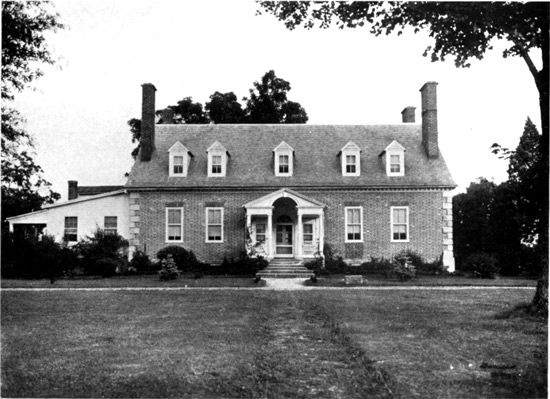
Photo by H. P. Cook
GUNSTON HALL ON THE POTOMAC, VIRGINIA
LXII
THE HOME OF GEORGE MASON, "THE PEN OF THE
REVOLUTION IN VIRGINIA"
Four miles from Mt. Vernon, on the Potomac, is
the well-preserved mansion, Gunston Hall, built in 1758
by George Mason, the great-grandson of George Mason,
who fled to America after the Battle of Worcester, where
he was in arms against the king of England. The first
mention of the name of this George Mason occurs in the
Virginia patent of land which he secured in March, 1655.
George Washington and George Mason were not only
near neighbors, but they were warm friends. Frequently
Washington drove to Gunston Hall for a talk
with Mason; or sometimes he floated down the stream
in his four-oared gig, manned by his own slaves. Sometimes
the men roamed together through the woods or
the fields; on one of these walks they sought to define
the boundaries between their estates.
Gifts of various kinds passed back and forth between
the two manors; one day in 1785, when Mason
was driven from Mt. Vernon in Washington's carriage,
he sent back by the driver some young shoots of the Persian
jessamine and Guelder rose.
A few days later a hogshead of cider was broached at
Gunston Hall, and a liberal sample was sent to Washington.
A note dated "9th November, 1785," addressed
to Washington, begins, "The bearer waits on you with
a side of venison (the first we have killed this season),
which I beg your acceptance of."
At one time both Washington and Mason were members
of the vestry of Truro parish. Washington's list
of the vestrymen shows that his friend was elected by
two hundred and eighty-two votes, while he himself received
but fifty-one votes.
Mason was as often at Mt. Vernon as Washington was
at Gunston Hall. After a visit made on Christmas Day,
1783, one of the other guests, Miss Lewis, of Fredericksburg,
wrote:
"Among the most notable of the callers was Mr.
George Mason, of Gunston Hall, who was on his way
home from Alexandria, and who brought a charming
granddaughter with him.... He is said to be one
of the greatest statesmen and wisest men in Virginia.
We had heard much of him and were delighted to look
in his face, hear him speak, and take his hand, which he
offered in a courtly manner. He is slight in figure, but
not tall, and has a grand head and clear gray eyes."
To the home of George Mason other men of note
delighted to come. In the guest room Jefferson and
Richard Henry Lee, as well as Washington, slept more
than once. Patrick Henry, too, was a welcome visitor
at Gunston Hall. George Mason had as high an opinion
of the orator as Patrick Henry had of the statesman.
"He is by far the most powerful speaker I ever
heard," Mason once said of Henry; "every word he
says not only engages but commands the attention; and
your passions are no longer your own when he addresses
them. But his eloquence is the smallest part of his
merit. He is in my opinion the first man upon this continent,
as well in abilities as public virtues, and had he
lived in Rome about the time of the first Punic War,
when the Roman people had arrived at their meridian
glory and their virtue not tarnished, Mr. Henry's talents
must have put him at the head of that glorious commonwealth."
The orator returned the compliment by calling Mason
one of the two greatest statesmen he ever knew.
George Mason's statesmanlike vision was seen in
1766, when he warned the British public of the results
that would follow coercion. "Three millions of people
driven to desperation are not an object of contempt," he
wrote. Again he proved a good prophet when he wrote
to George Washington, on April 2, 1776, after the General
took possession of Boston:
"I congratulate you most heartily upon this glorious
and important event—an event which will render George
Washington's name immortal in the annals of America,
endear his memory to the latest posterity, and entitle
him to those thanks which heaven appointed as the reward
of public virtue."
Mason was of a retiring disposition, and he would
have preferred to remain at home. But he was forced
into the councils of the Virginia Convention, and during
his service there he prepared the marvellous Bill of
Rights which was later made a part of the Constitution
of that State and was the model for similar documents
in many other States. He was also the author of the
Constitution of Virginia, and the designer of the State
seal. He was a member of the Constitutional Convention
in Philadelphia, where he proved himself "the
champion of the State and the author of the doctrine
of State Rights." Because the Constitution as finally
drafted by the convention contained so many provisions
that he felt were dangerous, he refused to sign the document,
"declaring that he would sooner chop off his
right hand than put it to the Constitution" whose provisions
he could not approve.
After the Constitutional Convention for more than
four years the statesman lived quietly at Gunston Hall.
When he died in October, 1792, he asked to be buried by
the side of his first wife, whose death in 1773 had been
a grievous blow to him. Over her tomb he had inscribed:
"Once She was all that cheers and sweetens Life;
The tender Mother, Daughter, Friend and Wife:
Once She was all that makes Mankind adore;
Now view the Marble, and be vain no more."
No monument was ever raised over his own grave. A
grandson planned to set a stone inscribed to "The
Author of the Bill of Rights and the Constitution of
Virginia," but he was unable to do as he wished.
Gunston Hall still stands, though it has passed
through many hands since the death of him whom
George Esten Cooke called "one of the most remarkable
men, not only of his Country, and of his epoch, but of
all Countries and all time."
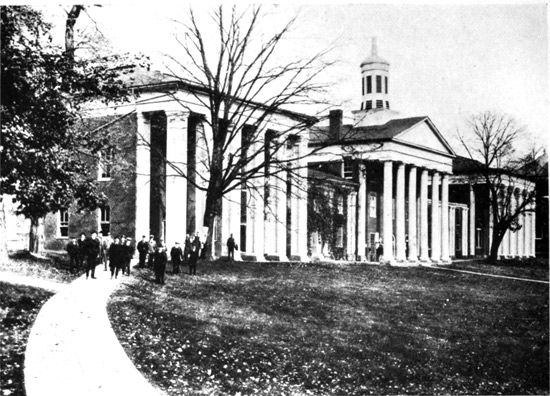
Photo by Ph. B. Wallace
WASHINGTON COLLEGE BUILDING, LEXINGTON, VA.
LXIII
HOW GEORGE WASHINGTON SOLVED A DELICATE PROBLEM
Even before the treaty of peace with Great Britain
was signed, George Washington was making plans for
the development of the West. He was especially impressed
with the possibilities of the Potomac and James
rivers, if improved by canals, as a means of communication
with the Ohio. Companies were organized to the
work. In both enterprises he was a stockholder. On
August 13, 1785, he wrote to Edmund Randolph:
"The great object for the accomplishment of which
I wish to see the inland navigation of the River Potomack
and James improved and extended is to connect
the western territory with the Atlantic states.... I
have already subscribed five shares to the Potomack
navigation; and enclosed I give you a power to put my
name down for five shares to that of James River."
In 1785 Patrick Henry, Governor of Virginia, wrote
to Washington that the General Assembly of the State
had voted to give him one hundred shares in the James
River Company, "it being their wish, in particular, that
those great works of improvement, which, both as
springing from the liberty which he has been so instrumental
in establishing, and as encouraged by his patronage,
will be durable monuments of his glory, may be
made monuments also of the gratitude of his country."
Washington replied that he could not accept money
for his services to his country. Then he added: "But
if it should please the General Assembly to permit me to
turn the destination of the fund vested in me, from my
private emolument, to objects of a public nature, it will
be my study in selecting these to prove the sincerity of
my gratitude for the honor conferred on me, by preferring
such as may appear most subservient to the enlightened
and patriotic views of the legislature."
Of course the legislature granted the desired permission,
indicating that the gifts might be made either during
Washington's life, or by bequest.
Some years passed before Washington fixed on a
proper recipient for the canal shares. In 1798, however,
he gave them to the trustees of Liberty Academy,
at Lexington, Virginia, which had been incorporated in
1782. In recognition of the gift the trustees asked the
legislature to change the name of the school to Washington
Academy. In 1813 the name was once more
changed to Washington College.
This, the first large gift received by the institution, is
still yielding an income of three thousand dollars. During
many times of crisis the income provided in this way
has been of signal use to the institution, notably in
1824, when the Washington College building was begun.
This structure is two hundred and fifty feet long, is built
of brick, and each of its three porticoes is supported by
white colonial columns.
For more than seventy-five years after Washington
turned over the canal shares, the institution's sole endowment
amounted to only about one hundred and
twenty thousand dollars. The seventy thousand dollars
added to the canal shares came from sources that were
influenced by Washington's confidence in the institution.
The beginning of the larger life of the college was
the election of General Robert E. Lee as president. The
keynote of his five years of service was sounded in the
letter which he wrote to the trustees on receiving notification
of his election. He feared that, in view of his
military history, he might cause harm to the college.
He was never greater than when he said:
"I think it is the duty of every citizen, in the present
condition of the country, to do all in his power to aid
in the restoration of peace and harmony, and in no
way to oppose the policy of the State or General Government
directed to that object. It is particularly incumbent
upon those charged with the instruction of the
young to set them an example of submission to authority,
and I would not consent to be the cause of
animadversion on the College."
Following the death of General Lee, which came after
five years of remarkable development under his leadership,
the name of Washington College was changed to
Washington and Lee University, that it might continue
forever a memorial to its two greatest benefactors.
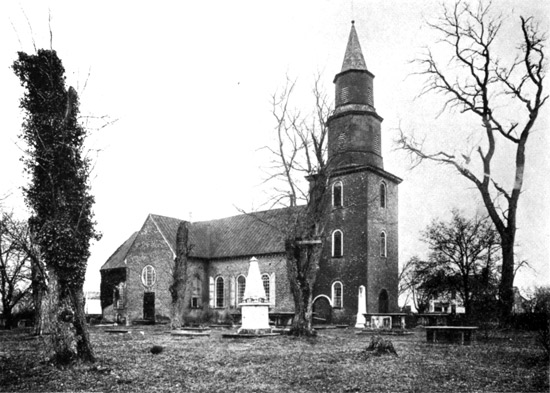
Photo by H. P. Cook
BRUTON PARISH CHURCH, WILLIAMSBURG, VA.
LXIV
"THE COURT CHURCH OF COLONIAL VIRGINIA"
Jamestown was the capital of Virginia until 1699.
Then Williamsburg became the seat of government. Six
years earlier the latter town had taken on some importance
because of the founding there of William and
Mary College, and for more than sixty years efforts had
been made to persuade the people to make their homes
in the place. The records of the Colony show that in
1632 rewards were offered to those who would locate
in what seemed a promising situation for a town.
The date of the building of the first church in Williamsburg
is not known. The first entry in the vestry
book of Bruton parish was made in April, 1674, but the
parish dates from 1658. In that year Harrop and
Middle Plantation parishes were united, though the new
parish was not called Bruton for some time. The name
was given because Sir James Ludwell, who afterward
left a legacy of twenty pounds to the parish, was born
in Bruton, England.
A building (that it was not the first is shown by the
mention in the records of the Old Church) was completed
in 1683, and the first service was held on January
6, 1684. The cost was "£150 sterling and sixty thousand
pounds of good sound, marketable sweet, scented
Tobacco." The minister, "Mr. Rowland Jones," was
"paid annually ye sum of sixteen thousand, six hundred
and sixty pounds of Tobacco and Caske."
The removal of the capital to Williamsburg brought
so many new people to town that the church became too
small for the congregation. In 1701 the parish records
show that there was talk of a new building.
On October 1, 1706, the vestry decided to levy a tax
of twenty thousand pounds of Tobacco as a beginning
of the building fund. Four years later the members of
the vestry made known their hope that the House of
Burgesses would assist in the expense, which, they
thought, would be about five hundred pounds. To the
Burgesses a message was sent indicating that the vestry
"do not doubt in the least but the House of Burgesses
would show their Pious and Generous Spirits by their
Liberall Donation towards soe Necessary and good a
worke and that they would assure them to the best of
their Judgment they would appropriate the same according
to the true Intent thereof."
The Burgesses offered "to take Care of the wings and
intervening parts," if the vestry would build the ends
of the church. They also agreed to build the pews for
the Governor, the Council, and themselves. With their
help, the building was completed and occupied in 1715.
The tower was added in 1769.
Rev. James Blair, who was minister of Bruton parish
at the time of the erection of the new building, had been
instrumental in organizing William and Mary College.
The early history of that institution is bound up with
that of the church. Some of the most notable conflicts
between Church and State in the old Colony took place
during the years of Mr. Blair's activity. He died in
1743, after serving the church as minister for thirty-three
years, William and Mary College as President for
fifty years, and the Colony as Commissioner for fifty-three
years.
Among the famous names on the vestry rolls are those
of Henry Tyler, great-great-grandfather of President
Tyler, who was first mentioned on "The Seaventh day
of April, 1694," and George Wythe, one of the Signers
of the Declaration of Independence. Patrick Henry, and
George Washington later worshipped with the congregation.
When Virginia was about to go to war with Great
Britain, the House of Burgesses, on May 24, 1774,
ordered that "the members of the House do attend in
their places, at the hour of ten in the morning, on the
first day of June next, in order to proceed with the
Speaker and the mace, to the church," for fasting, humiliation,
and prayer. During the Revolution the members
of the church were noted for their loyalty to the
Colonies.
To-day the building is about as it was during the
troubled days of the war. No change has been made in
the exterior, but in 1839 the interior was changed in
many important particulars. In 1905, however, it was
restored as before. The pulpit was put in the old place.
The canopy and curtain which had long stood above the
pew of Governor Spotswood, were found and again put
in position. King Edward VII gave the new pulpit
Bible, and President Roosevelt provided the lectern.
LXV
THE ALMA MATER OF THOMAS JEFFERSON, JAMES
MONROE, AND JOHN TYLER
Three years before John Harvard left a legacy for
the founding of the college that bears his name, the
first bequest for public education made by a resident
of Virginia was recorded, though this was used for a
secondary school, rather than for a college.
The project of a college, proposed in 1617 and 1618
by the London Company, and in 1619 at the first session
of the General Assembly, languished until 1685, when
Rev. James Blair came to the Colony as a missionary
and settled in Henrico County, where it had been proposed
to found the college sixty-eight years earlier. For
five years he brooded over the need of a college and in
1690 he made to a convention at Jamestown "Severall
Propositions for a free school and college, to be humbly
presented to the consideration of the next general assembly."
Later, by authority of the Assembly, Dr.
Blair appealed to the Merchants of London, "especially
such as traffick with Virginia," and three thousand
pounds were pledged.
On the occasion of Dr. Blair's visit to England in
1691, he had an audience with King William, at which
he presented the petition for "a charter to erect a free
school and college." The king replied, "Sir, I am glad
that the Colony is upon so good a design, and will promote
it to the best of my power." Queen Mary also
showed her interest in the college.
To the endowment in lands and taxes provided by
royal order, Dr. Blair secured an appreciable addition
in an ingenious manner. Learning that, some time before
his arrival, the authorities had promised forgiveness
to pirates who, before a set day, should confess their
crimes and give up a portion of their booty, and that
three famous pirates had come in after the appointed
day, so that they were arrested, he visited them in jail
and offered to use his influence in their behalf, if they
would consent to give to the college a portion of their
booty. They gladly agreed; Dr. Blair's efforts were successful,
and they were given their liberty together with
their treasure, minus the promised gift to the Virginia
College. Another much larger gift was secured from
the executor of an estate which held money devised indefinitely
for "pious and charitable uses." The income
from this portion of the endowment was to be used "to
keep as many Indian children in meat, drink, washing,
clothes, medicine, books and education, from the first
beginning of letters till they should be ready to receive
orders and be sent abroad to convert the Indians."
In connection with the charter for "the College of
William and Mary," which was dated February 8, 1693,
authority was given to use the seal described as follows:
"On a green field a college building of silver, with a
golden sun, showing half its orb, rising above it." This
is said to be the sole instance of a college, either English
or American, which has a seal of such high origin.
Sir Christopher Wren, the designer of St. Paul's
Cathedral, made the plan for the original building,
which was to be two stories and a half high, one hundred
and thirty-six feet long, and forty feet wide, and
with two wings sixty feet long and twenty-five feet wide.
In 1697 it was reported to the governor of the province
that the front and north side of the proposed rectangle
had been completed at Williamsburg, and that funds
were exhausted. The walls were more than three feet
thick at the base, and contained 840,000 bricks, the product
of a brickyard nearby.
For some years subscriptions were paid slowly, and
interest in the college languished, but conditions improved
when King William sent to Governor Nicholson
a proclamation urging him "Yt you call upon ye persons
yt have promised to contribute towards ye maintenance
of ye sd college, to pay in full the severall
Contributions."
The first of the disasters that have visited the main
building came in 1705, when the interior was burned.
The college was rebuilt on the old walls, as was the case
after the fire of 1859. Thus, after much more than two
hundred years, the venerable building looks almost as it
did when the first students entered its doors. A number
of other structures have been erected since, including
the Brafferton building in 1723, the house now occupied
by the president, which dates from 1732, and the chapel,
begun in 1729. Interest must always centre about the
central structure, however.
During the Revolution the president was James Madison,
second cousin of the future President of the United
States. The president's house was occupied by Cornwallis
in 1781. After his surrender French officers
lived there. During their occupancy the house was
badly damaged by fire, but it was repaired at the expense
of the French Army.
Three events of the years of the war are of special
moment in the history of higher education in America.
On December 5, 1776, the Phi Beta Kappa Society, the
first intercollegiate fraternity in the United States, was
organized. On December 4, 1779, the college was made
a university, the first in the country, and the same year
marked the beginning of the Honor System of college
government which worked such a revolution in other colleges
more than a century later. When Thomas Jefferson,
who was a student at William and Mary in 1760-62,
founded the University of Virginia, the Honor System
was successfully inaugurated in the new institution.
Other famous men who have been connected with
William and Mary included George Washington, who
was chancellor in 1794; Chief Justice John Marshall,
student in 1779; Secretary of State Edmund Randolph,
student in 1766; James Monroe, student in 1775. John
Tyler was also educated there. It is a remarkable fact
that the presidents who are responsible for adding to
the original territory of the country Louisiana, Florida,
Texas, and most of the western territory, were products
of William and Mary.
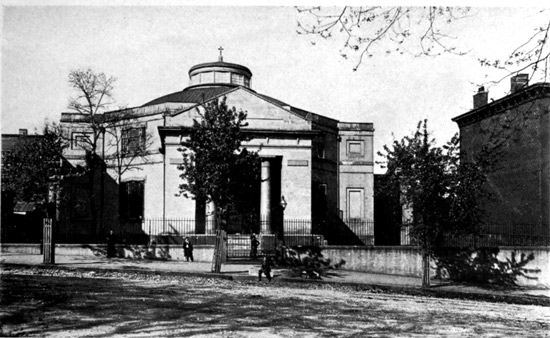
Photo by H. P. Cook
MONUMENTAL CHURCH, RICHMOND, VA.
LXVI
ON THE SITE OF A THEATRE WHOSE BURNING MOVED
THE ENTIRE COUNTRY
"Last night the playhouse in this city was crowded
with an unusual audience. There could not have been
less than 600 persons in the house. Just before the conclusion
of the play, the scenery caught fire, and in a few
minutes the whole building was wrapt in flames. It is
already ascertained that 61 persons were devoured by
that most terrific element. The Editor of this paper
was in the house when the ever-to-be-remembered, deplorable
accident occurred. He is informed that the
scenery took fire in the back part of the house, by raising
of a chandelier; that the boy, who was ordered by some
of the players to raise it, stated, that if he did so, the
scenery would take fire, when he was commanded in a
peremptory manner, to hoist it. The boy obeyed, and
the fire was instantly communicated to the scenery."
This story the editor of the Richmond (Virginia)
American Standard told in the columns of his paper on
Friday, December 27, 1811. He added the fact that
among those who perished were the Governor of the
State, as well as many of the leaders in the business
and social life of the city.
By order of the city council the remains of the victims
were buried on the site of the burned building, which
was bought for the purpose. At the same time it was
ordered that "no person or persons should be permitted
for and during the time of four months ... to exhibit
any public show or spectacle ... within the city."
By ordinance it was also decreed that a monument
should be erected on the site. Later it was suggested
that there should be built there, by public subscription,
"an edifice to be set apart and consecrated for the worship
of God," and that this should be the monument.
Accordingly, on August 1, 1812, the corner stone of
the Monumental Church was laid, the lot having been
purchased by the city for $5,000. The building was
consecrated as a Protestant Episcopal church in May,
1814. In April, 1815, the subscribers to the fund for
the building, who had organized under the title, "The
Association for building a Church on Shockoe Hill,"
were notified that one-half of their subscription money
would be returned to them on application at the Bank
of Virginia.
In the middle of the front or main porch of the
church a white marble monument was erected to the
memory of the victims of the fire.
To the General Convention of the Protestant Episcopal
church, which assembled in Philadelphia on May
18, 1814, report was made that "a magnificent church
has sprung up in Richmond from the ashes of the Theatre;
it has the patronage and support of men of the
greatest talents and highest rank in Virginia."
Among the communicants of the Monumental Church
have been numbered many of the most prominent men
in the Virginia capital, and men famous in the early
history of the country were attendants from time to
time. In February, 1824, General Lafayette worshipped
in the building.
LXVII
THE LIFELONG HOME OF JAMES MADISON
James Madison was born at the residence of his
mother's parents, at Port Conway, Prince George
County, Virginia, but before long he was taken to his
father's house, Montpelier, which was the first brick
house built in Orange County. And Montpelier continued
to be his home to the day of his death. Much
of his life was spent in Washington, but his heart was
always turning to the old Virginia plantation where
he had spent his boyhood, and he took advantage of
every possible opportunity to go there for a longer or
shorter visit.
The distance to Shadwell, where Thomas Jefferson
lived as a boy, was only thirty miles, but these two who
were to have such a large place in the early history of
America, did not meet until Madison was seventeen
years old. Then lost time was made up. For many
years the road between Montpelier and the home of
Jefferson became quite familiar to the friends.
In the years before he went to college Madison roamed
at will over the twenty-five hundred acres of the Montpelier
estate. He walked and rode, he hunted and
fished, he learned to take delight in the quiet scenery of
that beautiful Blue Ridge country. His tutor, who lived
on the estate, was his companion on his expeditions.
It was probably due to this outdoor life that his
health was so much better in Virginia than it was at
the College of New Jersey (Princeton College). Soon
after he graduated in 1771 he returned to Montpelier,
somewhat broken by reason of overwork and lack of
exercise. To a college friend in Philadelphia he wrote
rather pessimistically:
"I am too tired and infirm now to look for extraordinary
things in this world, for I think my sensations for
many months have intimated to me not to expect a long
or a healthy life, though it may be better for me after
some time; but I hardly dare expect it, and therefore
have little spirit or elasticity to set about anything that
is difficult in acquiring and useless in possessing after
one has exchanged time for eternity."
He was right in thinking that he was not to have a
healthy life, but he was wrong in thinking it was to
be neither long nor eventful. For more than sixty
years after he wrote the letter from which quotation
has been made, he was energetic and devoted in the
service of his country. In May, 1776, he entered the
Virginia Convention, thus beginning the career that led
him to eight years in the White House. And after he
retired from the Presidency much of his time and
thought was given to the affairs of the nation. During
all these years the thought of his Virginia home gave
him new strength in the midst of his tasks.
That home meant more to him than ever when, in
September, 1794, he entered the doors of Montpelier
with his bride, Dorothy Todd, the young Philadelphia
widow whom he had married at Harewood, Virginia.
The estate was still the property of Mr. Madison's
father, and both his father and mother continued to
live there. Before long the house was enlarged. The
rooms so long occupied by the old people were made
a part of the new mansion.
The two families lived together in perfect harmony.
The father lived to see his son President of the United
States, and the mother was ninety-eight when she died.
William O. Stoddard, in his "Life of James Madison,"
says that "she kept up the old-fashioned ways of housekeeping;
waited upon by her servants who grew old and
faded away with her. She divided her time between
her Bible and her knitting, all undisturbed by the modern
hours, the changed customs, or the elegant hospitality
of the mansion house itself. She was a central
point in the life of her distinguished son, and the object
of his most devoted care to the end of her days."
For Mr. and Mrs. Madison, real life at Montpelier
began in 1817, after the close of the stirring period in
the White House. They did not have much opportunity
to be alone, for guests delighted to come to them, and
they liked to have others with them, yet they managed
to secure a wonderful amount of joy out of the years
spent "within a squirrel's jump of heaven," to use
Dolly Madison's expressive phrase.
Among the guests were intimate friends like Jefferson,
who was almost a member of the family. Lafayette,
too, found his way to the estate, while Harriet Martineau
told in her "Recollections" of her pleasant sojourn
there. Frequently strangers who were on the
way to the Virginia Hot Springs took the five-mile detour
merely to reach Montpelier, and they were always
made welcome.
The dining-room was large, but there were sometimes
so many guests that the table had to be set out of doors.
Mr. Madison wrote in 1820 of one such occasion:
"Yesterday we had ninety persons to dine with us at
our table, fixed on the lawn, under a large arbor....
Half a dozen only staid all night."
After a visit to her parents that was broken into
by the presence of guests, a daughter of the house complained
to her husband that she had not been able to
pass one sociable moment with her father. His reply
was sympathetic: "Nobody can ever have felt so severely
as myself the prostration of family society from
the circumstances you mention.... But there is no
remedy. The present manners and ways of our country
are laws we cannot repeal. They are altering by degrees,
and you will live to see the hospitality of the
country reduced to the visiting hours of the day, and
the family left to tranquillity in the evening."
When the steward saw that Madison would not curb
these guests, he began to cut down on the fodder for
the horses, but when the hospitable host learned of this
he gave orders that there should be no further attempts
of this sort. He realized that he was living beyond
his income, but he saw no help for it. He longed for
more time in his library or for riding or walking about
the estate.
The time came when walks had to be taken on the
veranda; health was failing rapidly. He was not able
to oversee the farm as he had long been accustomed to
do, but depended on others. In 1835 Mrs. Madison
wrote to her daughter: "My days are devoted to nursing
and comforting my sick patient, who walks only
from the bed in which he breakfasts to another." Still
later she wrote: "I never leave my husband more than
a few minutes at a time, and have not left the enclosure
around our house for the last eight months."
When the owner of Montpelier died, on June 28, 1836,
he was buried in the cemetery on the estate. Mrs.
Madison spent a few lonely years in the old home, but
the property was finally sold to satisfy the debts of
her wayward son, Payne Todd. She was sometimes in
actual want before she died, but Congress provided for
her relief by buying for twenty-five thousand dollars
the Madison letters and other papers.
She lived until July 12, 1849, and her body was
finally laid by the side of that of her husband.
William Dupont, the present owner of Montpelier,
has enlarged the house by the addition of a second
story to the wings. So the house that was built in
1760 by James Madison, Sr., and was enlarged by
James Madison, Jr., has entered on a new era of
hospitality.
LXVIII
THE HOME OF JAMES MONROE'S OLD AGE
James Monroe, at twenty-eight, wrote from New York
to Thomas Jefferson, with whom he had studied law:
"I shall leave this about the 1st of October for Virginia—Fredericksburg.
Believe me, I have not relinquished
the prospect of being your neighbor. The
house for which I have requested a plan may possibly
be erected near Monticello; to fix there, and to have
yourself in particular, with what friends we may collect
around, for society is my chief object; or rather,
the only one which promises to me, with the connection
I have formed, real and substantial pleasure; if, indeed,
by the name of pleasure it may be called."
The "connection" of which the future President
wrote was his marriage to Miss Eliza Kortwright of
New York. Of this he had spoken in an earlier letter
to Jefferson:
"You will be surprised to hear that I have formed
the most interesting connection in human life with a
young lady in this town, as you know my plan was to
visit you before I settled myself, but having formed an
attachment to this young lady ... I have found that
I must relinquish all other objects not connected with
her."
Monroe was not permitted to practice law long. As
United States Senator, diplomat, Governor, Cabinet
officer, and President, his time was so fully occupied
that no one but a man of his fine physique and endurance
could have stood the strain. Once, during the
War of 1812, according to his friend, Judge E. R.
Watson, when the burden of three of the departments
of the government rested on him—State, Treasury, and
War—he did not undress himself for ten days and
nights, and was in the saddle the greater part of the
time.
After some years he bought an estate in Loudoun
County, Virginia, to which he retired for a brief rest
whenever this was possible. For a time the old dormer-windowed
house on the property satisfied him, but
during his presidential term he built Oak Hill, the
house for which Jefferson had prepared the plans. It
is said that the nails used in its construction were
manufactured on the Jefferson estate.
The house—which was named Oak Hill because of
the oaks on the lawn, planted by the owner himself,
one for each State of the Union—has been described by
Major R. W. N. Noland as follows:
"The building was superintended by Mr. William
Benton, an Englishman, who occupied the mixed relation
to Mr. Monroe of steward, counsellor and friend.
The house is built of brick in a most substantial manner,
and handsomely finished; it is, perhaps, about
90 x 50 feet, three stories (including basement), and
has a wide portico, fronting south, with massive Doric
columns thirty feet high, and is surrounded by a grove
of magnificent oaks covering several acres. While the
location is not as commanding as many others in that
section, being in lower Loudoun where the rolling character
of the Piedmont region begins to lose itself in
the flat lands of tide water, the house in two directions
commands an attractive and somewhat extensive view,
but on the other side it is hemmed in by mountains,
for the local names of which, 'Bull Run' and 'Nigger
Mountain,' it is to be hoped the late President is in no
wise responsible.... The little stream that washes
the confines of the Oak Hill estate once bore the Indian
name Gohongarestaw (the River of Swans), and is now
called Goose Creek."
After the expiration of his second term as President
Monroe made Oak Hill his permanent home, though
sometimes he was with his daughter, Mrs. Gouverneur,
in New York.
One who was a member of the household during a
part of the six years of the life in Virginia said that
he "looked perhaps older than he was, his face being
strongly marked with the lines of anxiety and care."
There were many guests at Oak Hill, among these
being Madison and Jefferson. Monroe, in turn, was
frequently at Monticello and Montpelier. His office
as Regent of the University of Virginia also brought
him into frequent touch with his two predecessors in
the presidency, for they were fellow-members on the
Board.
Whenever weather and guests permitted he was accustomed
to ride about the estate and through the
countryside both morning and evening. One day,
when he was seventy-two, his horse fell on him, and
his right wrist was sprained so badly that for a time
he could not write to his friends, as he had delighted
to do. Thus he was able to sympathize with Madison
when a letter came from Montpelier a few months later:
"In explanation of my microscopic writing, I must
remark that the older I grow the more my stiffening
fingers make smaller letters, as my feet take shorter
steps, the progress in both cases being, at the same
time, more fatiguing as well as more slow."
Monroe's last years of life were saddened by financial
difficulties, though even these brought gleams of joy,
because of the fidelity of his friends. Lafayette, who
visited Oak Hill in 1825, wrote later to his friend a
most delicately worded offer of assistance, indicating
that he felt it was his right to offer this, since Monroe,
when minister to France, had exerted himself to bring
about the release of Lafayette, then a prisoner at
Olmütz, and had ministered to the wants of Madame
Lafayette.
A measure of relief came when Congress voted to
repay, in part, the extraordinary expense incurred by
the statesman during his diplomatic career, but not
before he had advertised Oak Hill for sale and had
planned to go to New York to live near his daughter.
The estate was later withdrawn from the market, but
the plan to go to New York was carried out: he did
not see how he could remain after the death of Mrs.
Monroe, which took place in 1830.
He did not stay long in New York. On July 4, 1831,
he died. Twenty-seven years later, on the one hundredth
anniversary of his birth, his body was taken
to Richmond for burial. There, in his native State,
rest the remains of him of whom Thomas Jefferson
said, "He is a man whose soul might be turned inside
out without discovering a blemish to the world."
LXIX
WHERE PATRICK HENRY SPENT HIS LAST YEARS
Patrick Henry was only fifty-eight years old when
he retired for rest and the enjoyment of family life
to his 2,920-acre estate, Red Hill, in the Staunton Valley,
thirty-eight miles southeast of Lynchburg. Just
before he made this move he wrote to his daughter
Betsy, "I must give out the law, and plague myself
no more with business, sitting down with what I have.
For it will be sufficient employment to see after my
little flock."
He had served his country well for thirty years, as
member of the House of Burgesses, as Speaker of the
first Continental Congress in Philadelphia in 1774, in
the Virginia Convention of 1775 where he made his
most famous speech, and as Governor of Virginia from
1776 to 1779 and again from 1784 to 1786. He had
well earned the rest he hoped to find. Washington
asked him to become Secretary of State and, later,
Chief Justice of the Supreme Court. John Adams
nominated him as minister to France. But he resisted
all these efforts to draw him from his retirement.
The house at Red Hill was a simple story and a half
structure, to which the owner soon added a shed kitchen,
solely because he "wished to hear the patter of the
rain on the roof." This original portion of the house
has been retained intact by later occupants, who have
made additions with rare appreciation of what is fitting.
The central portion was built by the son of the
orator, John Henry. The box hedges in which the sage
of Red Hill took such delight have been retained and
extended.
George Morgan, in "The True Patrick Henry," says
that this life in retirement "might be designated as
a patriarchal life, if it were not for the fact that the
cradle was still rocking at Red Hill." Henry's letters
were full of references to his children. Once he wrote
to his daughter Betsy, "I have the satisfaction to inform
you that we are well, except Johnny, Christian,
and Patrick, and they are recovering fast now." And
again, "I have great cause of thankfulness for the
health I enjoy, and for that of your mamma and
all the children.... We have another son, named
Winston."
William Wirt, in his "Life of Patrick Henry," written
in 1817, said, "His visitors have not infrequently
caught him lying on the floor, with a group of these
little ones, climbing over him in every direction, or
dancing around him with obstreperous mirth to the
tune of his violin, while the only contest seemed to be
who should make the most noise."
That there were many visitors who had the opportunity
to see such contests as these is evident from a
paragraph in "Homes of American Statesmen":
"His home was usually filled with friends, its dependences
with their retinue and horses. But crowds,
besides, came and went; all were received with cordiality....
Those who lived near always came to breakfast,
when all were welcomed and made full. The
larder never seemed to get lean. Breakfast over, creature
comforts, such as might console the belated for the
loss, were promptly set forth on side-tables in the wide
entrance-hall.... Meanwhile, the master saw and
welcomed all with the kindliest attention, asked of their
household, listened to their affairs, gave them his view,
contented all. These audiences seldom ceased before
noon, or the early dinner. To this a remaining party
of twenty or thirty often sat down.... The dinner
ended, he betook himself to his studies until supper,
after which he again gave himself up to enjoyment."
Not only was he a total abstainer, but as he grew
older he came to detest the odor of tobacco; so there
were certain refreshments that were never offered to
the guests at Red Hill.
During the closing years of his life he spent hours
over the Bible. Every morning he would take his seat
in the dining-room, with the big family Bible open before
him. Once he said to a visitor, "This book is
worth all the books that ever were printed, and it has
been my misfortune that I never found time to read it
with the proper attention and feeling till lately. I
trust in the mercy of heaven that it is not too late."
To Betsy, a daughter by his first marriage, he wrote
in 1796:
"Some good people think I am no Christian. This
thought gives me much more pain than the appellation
of tory; because I think religion of infinitely higher
importance than politics, and I find much cause to reproach
myself that I have lived so long and have given
no decided and public proof of my being a Christian.
But, indeed, my dear child, there is a character which
I prize far above all this world has or can boast. And
amongst all the handsome things I hear said of you,
what gives me the greatest pleasure is, to be told of
your piety and steady virtue."
As, one by one, the older children grew up and went
out from Red Hill to homes of their own, they were
urged to read the Bible. Dorothea was the first to be
married. Then came Martha Catherine, who, at seventeen,
fell in love with the hero who rescued her when
she fell from a boat into the water. Sarah married
Robert, the brother of the poet Thomas Campbell. It
is said that at one time the poet was engaged to come
to Red Hill as tutor for the younger children of the
family, but was unable to keep his promise.
Because of the constant pleas that were made that
he give up his quiet life and reënter politics, Henry
Clay wrote, in 1796:
"I shall never more appear in a public character,
unless some unlooked-for circumstance shall demand
from me a transient effort.... I see with concern our
old Commander-in-chief most abusively treated—nor are
his long and great services remembered, as any apology
for his mistakes in an office to which he was totally
unaccustomed. If he, whose character as our leader
during the whole war was above all praise, is so roughly
treated in his old age, what may be expected by men
of the common standard of character?"
He kept his resolution. A few months after writing
this message, when notified that he had been elected
Governor of Virginia, for a third term, he wrote, "My
declining years warn me of my inability."
But in January, 1799, came an appeal from Washington
himself that he would present himself as a candidate
"if not for Congress, which you may think would
take you too long from home, as a candidate for Representative
in the General Assembly of the Commonwealth."
The reasons were given: "Your insight of
character and influence in the House of Representatives
would be a bulwark against such dangerous sentiments
as are delivered there at present. It would be
a rallying point for the timid, and an attraction of the
wavering. In a word, I conceive it to be of immense
importance at this crisis that you should be there, and
I would fain hope that all minor considerations will
be made to yield to the measure."
Though Henry knew that he had little strength left,
he responded to the appeal. On County Court day,
the first Monday in March, he presented himself before
the people at Charlotte as a candidate for Representative.
How they flocked about him!
A Hampdon-Sidney student, Henry Miller, who heard
him that day, said afterward:
"He was very infirm, and seated in a chair conversing
with some friends who were pouring in from
all the surrounding country to hear him. At length
he rose with difficulty, and stood, somewhat bowed with
age and weakness. His face was almost colorless.
His countenance was careworn, and when he commenced
his exordium, his voice was slightly cracked and
tremulous. But in a few minutes a wonderful transformation
of the whole man occurred, as he warmed
with his theme. He stood erect; his eyes beamed with
a light that was almost supernatural, his features
glowed with the hues and fires of youth; and his voice
rang clear and melodious, with the intonations of some
great musical instrument whose notes filled the area,
and fell distinctly and delightfully upon the ears of
the most distant of the thousands gathered before him."
Near the close of this effective address he said:
"You can never exchange the present government,
but for a monarchy. If the administration have done
wrong, let us all go wrong together, rather than split
into factions, which must destroy that union upon which
our existence hangs. Let us preserve our strength for
the French, the English, the German, or whoever else
shall dare to invade our territory, and not exhaust it
in civil commotion and intestine wars."
After the conclusion of the oration, Henry went back
to Red Hill, and never left it again. In April he was
triumphantly elected, but he was unable to take his
seat.
On June 6, 1799, he was near death. When the
physician offered him a vial of mercury, at the same
time telling him that the remedy might prolong his
life a little while, or it might be fatal, he drew over
his eyes a silken cap which he usually wore, and, holding
the vial in his hands, made "a simple childlike
prayer for his family, for his country, and for his own
soul. Afterwards in perfect calm he swallowed the
medicine."
His last word was to his physician, commending the
Christian religion, which was so real a benefit to a man
about to die.
Patrick Henry and his wife lie side by side in the
rear garden of Red Hill. "His fame his best epitaph"
is the simple inscription on the stone above the patriot.
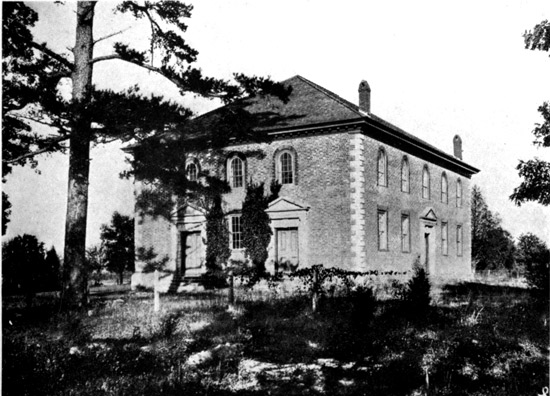
Photo furnished by Aymar Embury, II
POHICK CHURCH, VIRGINIA
LXX
THE HOME CHURCH OF GEORGE WASHINGTON
Both Truro parish and George Washington were
born in 1732, and Washington's connection with Truro
Church began in 1735, when his father, Augustine
Washington, became a vestryman, and it continued
throughout his life, though during his later years, when
services were seldom held there, he went to Christ
Church at Alexandria.
When Washington was a boy he had to make a round
trip of eighteen miles, frequently over extremely rough
roads, when he wished to attend services. Yet he was
a faithful attendant, at all seasons.
A number of the early rectors of Truro were welcome
guests at Mt. Vernon. One of these, Charles Green,
was a physician as well as a minister, as appears from
the record that he was called to prescribe for Washington
in 1757, when the young campaigner was so seriously
ill, in consequence of hardships suffered on his
western trip, that he said he had "too much reason to
apprehend an approaching decay."
Five years after this illness Washington was elected
a member of the vestry of the parish, and he was re-elected
many times. His record for attendance was
unusual, in spite of his many outside engagements.
During the years from 1763 to 1774 thirty-one vestry
meetings were held. He was absent from eight of
these, once on account of sickness, twice because he
was attending the House of Burgesses, and at least
three times because he was out of the county. For
a few months, in 1765, he did not serve, because, on
the division of Truro parish, Mt. Vernon was thrown
over the line into the new Fairfax parish. At once the
new parish made him a member of its vestry, but when,
in response to a petition which Washington helped to
present, the House of Burgesses changed the parish line
so that Mt. Vernon was once more in Truro parish,
he resumed his service in the old church. There he
maintained his connection with an official body noted
for the fact that, at one time or another, it had eleven
members in the House of Burgesses, two members in
His Majesty's Council for Virginia, as well as the author
of the Virginia Bill of Rights and the Constitution of
the State of Virginia, George Mason.
When it was decided that a new church building was
needed, Washington was instrumental in settling the
inevitable discussion as to site that followed. He made
a map of the parish, showing where each communicant
lived, and recommended that the building be placed
at the centre of the parish, as shown by the map. His
suggestion was adopted, and a site two miles nearer
Mt. Vernon was chosen.
For the new church Washington himself drew the
plan. He was also active in letting the plan and overseeing
the building operation. At an auction of pews,
held in 1772, when the church was ready for use, he
bought Number 28, next the communion table, for £10,
while he paid £13 10s. for pew 30. Evidently he was
thoughtful for the guests who frequently rode with him
to service, either in the coach, or in the chaise that followed,
or on horseback. When the Mt. Vernon contingent
came to church there was usually quite a procession.
Under date October 2, 1785, the diary of Washington
tells of one of these processions, as well as of an interesting
event that followed:
"Went with Fanny Bassett, Burwell, Bassett, Doctr
Stuart, G. A. Washington, Mr. Shaw and Nellie Custis
to Pohick Church to hear a Mr. Thompson preach, who
returned with me to Dinner.... After we were in
Bed (about Eleven o'clock in the Evening) Mr Houdon,
sent from Paris by Doctr Franklin and Mr Jefferson
to take my Bust, in behalf of the State of Virginia ... arrived."
For many years Pohick Church was practically deserted,
but there is evidence that services were held here
in 1802. Davies, an Englishman, in his "Four Years
in America," wrote:
"About four miles from Occoquon is Pohick. Thither
I rode on Sunday and joined the Congregation of Parson
Weims, who was cheerful in his mien that he might
win me to religion. A Virginia churchyard on Sunday
is more like a race-course than a cemetery; the women
come in carriages and the men on horses which they
tie to the trees. The church bell was suspended from
a tree. I was confounded to hear 'steed threaten steed
with dreadful neigh,' nor was I less astounded at the
rattling of carriage-wheels, the cracking of whips, and
the vociferation of the gentlemen to the negroes who
attended them; but the discourse of Parson Weims
calmed every perturbation, for he preached the great
doctrines of Salvation as one who has experienced their
power; about half the congregation were negroes."
This Parson Weems was no other than the author of
Weems' "Life of Washington," a readable but inaccurate
biography that had a great vogue seventy-five
years ago.
For many years Truro Church was desolate, and relic
hunters made spoil of the furnishings. But since 1876
it has been open for services once more.
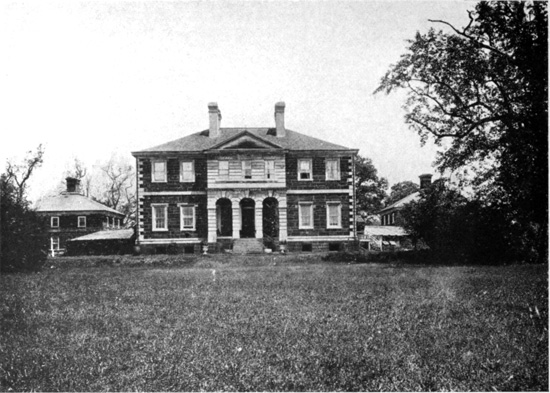
Photo by H. P. Cook
MOUNT AIRY, RICHMOND COUNTY, VA.
LXXI
THE PLANTATION HOME OF COLONEL JOHN TAYLOE
The purchase for £500 of three thousand acres of
productive land in Charles County, on the Potomac,
gave a big boost to the fortunes of the Tayloe family
of Virginia. This shrewd purchase was made by Colonel
John Tayloe, the son of William Tayloe (or Taylor)
who came from England in the seventeenth century.
William Tayloe was a member of the House of Burgesses
in 1710. His son John became a member of
the Colonial Council in 1732, while his son John, who
was born in 1721, also had the honor of serving in
the Council under Lord Dunmore, as well as in the
first Republican Council, during the administration of
Patrick Henry. He married the sister of Governor
George Plater of Maryland. Of his eight daughters
one married Richard Lightfoot Lee, a Signer of the
Declaration of Independence, while another married
Colonel William Augustine Washington, a nephew of
George Washington, by whom he was educated.
Colonel John Tayloe, the father of three daughters,
was the builder of Mount Airy, which was for many
years the most superb mansion in Virginia, and was
so different from all other mansions that it attracted
many visitors, even in the days when transit was difficult.
Its twenty-five spacious rooms afforded generous
accommodation for the guests who were eager to accept
the invitations of Colonel and Mrs. Tayloe. Among the
entertainments provided for these guests by the thoughtful
hosts were concerts by a band made up entirely of
slaves who had been instructed by their master. On
occasion this band was taken to the town house at
Williamsburg, the capital of the State.
The letters of Washington show that the builder of
Mount Airy was an ardent patriot, and his friend and
associate. These two men were joint executors of the
estate of one of the Lees. From his headquarters in
the Craigie House at Cambridge the General wrote to
Mount Airy a letter about the estate, asking Tayloe to
become sole executor.
The varied interests of Colonel Tayloe were indicated
by his remarkable will, which asked, among other
things, that one part of his estate in Prince William
County, Virginia, and Baltimore County, Maryland, be
kept intact and worked for the making of pig iron.
Not only did he own a number of other plantations, but
he was a large shipowner, and reaped unusual profits
from trade.
Perhaps the best known owner of Mount Airy was
John Tayloe, III, who was born in 1771, and was the
only son in a family of twelve. He was educated at
Eton and Cambridge, England. Before going abroad
he had learned patriotism from his father, and on his
return he was ready to administer his estate for the
benefit of the country as well as his own family. When
his inheritance was turned over to him the income was
sixty thousand dollars. Within a few years he increased
this to seventy-five thousand dollars. His
father's iron- and ship-building interests were conserved
and enlarged. His master ship-builder at Occoquon
was his slave Reuben.
During his residence at Mount Airy the splendor
of the mansion was increased. Among his guests were
men who had stood shoulder to shoulder with Washington
during the Revolution, and those who later became
prominent as associates of Hamilton, Jay, Marshall,
and Pinckney. He married the daughter of
Governor Ogle of Maryland, and had fifteen children.
The memorial by one of his sons, Benjamin Ogle
Tayloe, says that "his manners were refined and elegant.
He was distinguished for his nice sense of
honor, and a scrupulous regard to his word at all times.
His wife was esteemed for sincerity and kindness of
heart, graceful and dignified manners, and true and
unaffected piety."
He took time for the services of his country. As
Captain of Dragoons he went to Western Pennsylvania,
to help put down the whiskey insurrection. When
President Adams made him a Major of Dragoons, General
Washington wrote to him a warm letter of congratulation,
but Tayloe hesitated to accept the commission.
He had just been elected as a Federalist to
the Virginia Senate, and he feared, as he wrote to
Washington, that if he resigned his seat the place would
be filled by an opponent of the administration. On
February 12, 1799, Washington replied that he was
inclined to believe his civil service would be more important
than military service, but he asked that decision
be delayed until they could have a personal
interview. Later, on the breaking out of the War of
1812, he was made commander of the cavalry of the
District of Columbia, and saw active service.
Washington's friendship led him to make his winter
home in the District of Columbia. In 1801 he occupied
the Octagon House, then the finest private residence
in the city. When the British burned the White House
he was at Mount Airy. At once he sent a mounted
messenger to President Madison, offering the use of
the Octagon as the temporary Executive Mansion.
His establishment at Mount Airy was maintained
in remarkable splendor. His household and equipages
were the talk of the neighborhood. A lover of fine
horseflesh, he was the owner of some of the swiftest
animals of his day.
The eldest son, John Tayloe, inherited his father's
ardor for public service. He was engaged brilliantly
in the battles of the Constitution with the Guerriere,
and with the Cyano and the Levant. After the action
his native State gave him a sword, and he was promoted
to a lieutenancy. Though he was captured by
the British, he lived to return to Mount Airy, where
he died in 1824. His father died four years later, while
his mother lived until 1855.
Mount Airy has always been in the hands of a Tayloe.
It is now in possession of the family of the late Henry
Tayloe.
LXXII
ST. LUKE'S, IN SMITHFIELD, AND ST. PETER'S, IN
NEW KENT COUNTY
Captain Smith in 1607 wrote of his discovery of the
Indian kingdom of Warrosquoyacke. Soon settlers
were attracted to its fertile lands. Twenty-seven years
later the more than five hundred residents were organized
into Isle of Wight County.
In 1632, the ancient brick church near Smithfield
was built. The tradition fixing this date was established
in 1887, when the date 1632 was read in some
bricks that fell from the walls.
The builder of the staunch church was Joseph Bridger,
who was Counsellor of State to Charles II. He is
buried not far from the church, and on his tomb is
the inscription: "He dyed April 15 Anno Domini 1688
Aged 58 years. Mournfully leaving his wife, three
sons and four daughters."
The oldest vestry book dates from 1727, for the first
book was destroyed at the time of General Arnold's
expedition made to Isle of Wight County, in the effort
to capture General Parker, of the Continental Army.
Fortunately, however, a few other records were saved.
An entry in 1727 spoke of "The Old Brick Church";
evidently the name St. Luke's was of later origin.
The architectural beauty of the old building is described
in a pleasing manner by Aymar Embury, II,
the well-known New York architect, in his "Early
American Churches":
"The building is an extremely picturesque brick
church, reminiscent not of the Renaissance work then
becoming dominant in England, but of the older Gothic;
it is not at all unlike many of the small English parish
churches of the sixteenth century, when the Gothic style
was really extinct, although its superficial characteristics,
the buttresses and the pointed arch, still obtained.
The stepped gable at the chancel end of the
church is an unusual feature in English architecture....
The tower is the only part of the building which
shows the Renaissance influence."
When the building was some two hundred years old
it began to fall into disrepair; the people preferred to
attend the church in Smithfield. Bishop Meade wrote
his "Old Churches and Families of Virginia" at the
time when the old church was most dilapidated. He
said:
"Its thick walls and high tower, like that of some
English castle, are still firm, and promise to be for a
long time to come. The windows, doors, and all the
interior, are gone. It is said that the eastern window—twenty-five
feet high—was of stained glass. This venerable
building stands not far from the main road leading
from Smithfield to Suffolk, in an open tract of
woodland. The trees for some distance round it are
large and tall and the foliage dense, so that but little
of the light of the sun is thrown upon it. The pillars
which strengthen the walls, and which are wide at the
base, tapering toward the eaves of the house by stair-steps,
have somewhat mouldered, so as to allow various
shrubs and small trees to root themselves therein."
For nearly fifty years the church was closed. But
in 1884 Rev. David Barr, who was in charge of a church
nearby, began to raise funds for the reconstruction
of the building. He persisted in spite of many discouragements.
When matters looked darkest a man
who signed himself "A Virginian" made the following
appeal:
"There is still some plastering to be done in the
tower, and the pews are to be made or bought. The
church cannot be completed until the money is raised.
Can no generous giver be found who will contribute the
money necessary to bring the east window from London?...
For sixty odd years the church has stood
there silent, without a service, facing and defying
storms and decay, appealing in its desolation to every
sentiment of the State, of the Church and of the Nation
against abandonment and desertion, and now in its
half completed condition, feeling the touch of revival
and restoration, it pleads more imploringly still for
just enough money to complete the repairs and to enable
it once more to enter upon its life of activity, and to
utter again with renewed joyousness the ancient but
long suppressed voice of prayer and of thanksgiving.
Shall it appeal in vain?"
The appeal was not in vain. The church was completed.
Twelve beautiful memorial windows were put
in place. These bore the names of George Washington,
Joseph Bridger, the architect of the church, Robert E.
Lee, Rev. William Hubbard, the first rector, Sir Walter
Raleigh, John Rolfe, Captain John Smith, Bishops
Madison, Moore, Meade, and Johns, and Dr. Blair,
whose connection with Bruton Church and William
and Mary College is told in another chapter of this
volume.
A building that is similar and yet in many respects
quite different is in New Kent County, about as far
above Williamsburg as Smithfield is below that university
town. This is St. Peter's Church. It is thought
that the parish dates from 1654, though the present
building was not begun until 1701. The minute which
tells of the first plan for the structure is dated August
13, 1700:
"Whereas, the Lower Church of this Parish is very
much out of Repair and Standeth very inconvenient
for most of the inhabitants of the said parish; Therefore
ordered that as soon as conveniently may be a new
Church of Brick Sixty feet long and twenty fower feet
wide in the clear and fourteen feet pitch with a Gallery
Sixteen feet long be built and Erected upon the Main
Roade, by the School House near Thomas Jackson's;
and the Clerk is ordered to give a copy of this order
to Capt. Nich. Merewether who is Requested to show
the same to Will Hughes and desire him to draw a
Draft of said Church and to bee at the next vestry."
The cost of the new church was one hundred and
forty-six thousand pounds of tobacco. This included
the main building only, for the belfry was not built
until 1722.
Rev. David Mossom, who was rector of the church
from 1727 to 1767, was the minister who married General
Washington, at the White House, as the home of
his bride was called, a few miles from St. Peter's
Church. The story is told of this eccentric minister
that on one occasion, having quarrelled with his clerk,
he rebuked him from the pulpit. The latter avenged
himself by giving out to the congregation the psalm in
which were these lines:
"With restless and ungovern'd rage
Why do the heathen storm?
Why in such rash attempts engage
As they can ne'er perform?"
The epitaph on the tomb of Mr. Mossom in St. Peter's
churchyard states that he was the first native American
admitted to the office of Presbyter in the Church of
England.
LXXIII
THE HOME OF THOMAS JEFFERSON
"Oh, my young master, they were all burnt, but ah!
we saved your fiddle!"
So the negro servant replied to Thomas Jefferson
who, on returning from a trip, learning that his home
at Shadwell had been burned, asked after his books.
To the negro's mind the fiddle was the most important
thing in the house.
Fortunately the new mansion, Monticello, near Charlotte,
which he had designed, was so nearly completed
that he was able to take up his residence there. Two
years later he led into the new house his bride, Martha
Skelton, a widow of twenty-three.
Before the marriage Jefferson, in accordance with
the Virginia law, in company with Francis Eppes, entered
into a license bond, of which the following is a
copy:
"Know all men by these presents that we Thomas
Jefferson and Francis Eppes are held and firmly bound
to the sovereign lord the king his heirs and successors
in the sum of fifty pounds current money of Virginia,
to the paiment of which well and truly to be made we
bind ourselves jointly and severally, our joint and several
heirs, executors and administrators, in witness
whereof we have hereto set our hands and seals this
twenty-third day of December in the year of our Lord
one thousand seven hundred and seventy one. The condition
of the above obligation is such that if there be
no lawful cause to obstruct a marriage intended to be
had and solemnized between the above bound Thomas
Jefferson and Martha Skelton of the County of Charles
County, widow, for which a license is desired, then this
obligation is to be null and void, otherwise the same
is in full force."
Edward Bacon, who was overseer at Monticello for
twenty years, described the estate in vivid words:
"Monticello is quite a high mountain, in the shape
of a sugar-loaf. A winding road led up to the mansion.
On the very top of the mountain the forest trees were
cut down, and ten acres were cleared and levelled....
I know every room in that house. Under the house and
the terrace that surrounded it, were the cisterns, ice-house,
cellar, kitchen, and rooms for all sorts of purposes.
His servants' rooms were on one side....
There were no negro and other out-houses around the
mansion, as you generally see on plantations. The
grounds around the house were beautifully ornamented
with flowers and shrubbery.... Back of the house was
a beautiful lawn of two or three acres, where his grandchildren
used to play.
"His garden was on the side of the mountain. I had
it built while he was President. It took a great deal
of labor. We had to blow out the rocks for the walls
for the different terraces, and then make the soil....
I used to send a servant to Washington with a great
many fine things for his table, and he would send back
the cart loaded with shrubbery."
Jefferson spent most of his time on his estate until
his death in 1826, except when he was called away for
the service of his country.
Nine years after the beginning of the happy married
life in Monticello there was a panic among the servants
because of the approach of the British. Because Jefferson
was Governor of Virginia, it was thought that
of course the mansion would be pillaged. Mrs. Jefferson
was put in the carriage and sent to a place of
safety, while Mr. Jefferson remained at home, collecting
his most valuable papers. Later he followed his
family. But when the soldiers reached the estate, the
first inquiry of the leader of the party was for the
master of the house. When he learned that Jefferson
had escaped, he asked for the owner's private rooms,
and, on being shown the door which led to them, he
turned the key in the lock and ordered that nothing in
the house should be touched. This, it was explained,
was in strict accordance with the orders that had been
given by General Tarleton; their sole duty was to seize
the Governor.
A year later, when the Marquis de Chastellux, a
nobleman from France, visited Monticello, he was
charmed with the house of which Mr. Jefferson was
the architect, and often one of the workmen. He said
it was "rather elegant, and in the Italian taste, though
not without fault; it consists of one large square pavilion,
the entrance of which is by two porticoes, ornamented
with pillars. The ground floor consists of a
very large lofty saloon, which is to be decorated entirely
in the antique style; above it is a library of the same
size; two small wings, with only a ground floor and
attic story, are joined to this pavilion, and communicate
with the kitchen, offices, etc., which will form a
kind of basement story, over which runs a terrace."
Another attractive picture was given by the Duc de
la Rochefoucauld-Liancourt, after his visit to Monticello
in 1796. He noted the fact that Jefferson owned
five thousand acres, of which but eleven hundred were
cultivated.
"I found him in the midst of the harvest," he wrote,
"from which the scorching heat of the sun does not
prevent his attendance.... Every article is made on
his farm: his negroes are cabinet makers, carpenters,
masons, bricklayers, smiths, etc. The children he employs
in a nail factory, which yields already a considerable
profit.... His superior mind directs the
management of his domestic concerns with the same
abilities, activity and regularity which he evinced in
the conduct of public affairs."
Long absence from home and lavish hospitality
wrecked the Jefferson fortune, and when the owner of
Monticello finally returned home after his eight years
as President, he was compelled to curtail his expenses.
But still he made guests welcome. It is said that at
times there were as many as fifty guests in the house
at one time. One of those who sought the Sage of
Monticello in 1817 was Lieutenant Francis Hall, who
wrote of his veneration as he looked on "the man who
drew up the Declaration of American Independence,
who shared in the Councils by which her freedom was
established, when the unbought voices of his fellow-citizens
called to the exercise of a dignity from which
his own moderation impelled him, when such an example
was most salutary, to withdraw; and who, while
he dedicates the evening of his glorious days to the
pursuits of science and literature, shuns none of the
humble duties of private life; but, having filled a seat
higher than that of kings, succeeds with graceful dignity
to that of the good neighbor, and becomes the
friendly adviser, lawyer, physician, and even gardener
of his vicinity."
July 4, 1826, the fiftieth anniversary of the Declaration
of Independence, was the day of Jefferson's death.
The sale of his estate was sufficient to pay all his debts.
To his daughter who was thus made homeless, the legislatures
of South Carolina and Virginia each voted as
a gift $10,000.
On the stone placed over the grave of the Sage of
Monticello was carved the inscription which he himself
had asked for: "Here was buried Thomas Jefferson,
author of the Declaration of American Independence,
of the Statute of Virginia for Religious Freedom,
and Father of the University of Virginia."
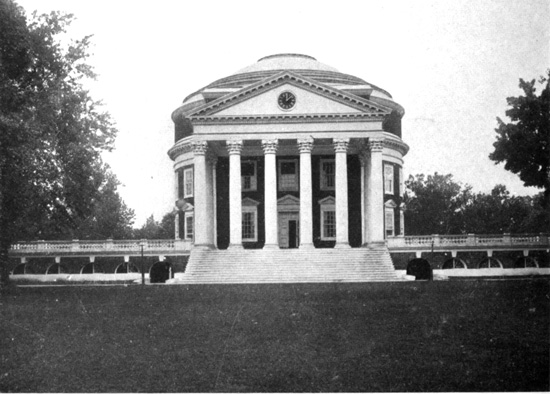
Photo by H. P. Cook
UNIVERSITY OF VIRGINIA, CHARLOTTESVILLE, VA.
LXXIV
THE CHILD OF THOMAS JEFFERSON'S OLD AGE
When Thomas Jefferson retired from the Presidency
he was surrounded at Monticello by his daughter, her
husband, and eleven grandchildren. Daily association
with the young people made him more anxious than
ever to carry out a plan that was the growth of years.
He wanted to see other children as happy as were those
in his own home, and he felt that the one thing he could
do to increase their happiness would be to see that the
State made provision for their education.
During the remainder of his life he never lost sight
of his project. While he did not live to see his system
of common schools established in Virginia, it was his
joy to see the University of Virginia grow under his
hands from an academy to a college and then to a university.
From 1817 he labored for State appropriations
for the school. A friend in the State Senate assisted
him nobly. The reader of the published volume
of the correspondence between the two men, a volume
of 528 pages, will see how untiring was the labor that
had its reward when the appropriation of funds made
sure the founding of the university. Three hundred
thousand dollars were provided for construction, as
well as $15,000 a year for maintenance.
Jefferson himself drew the plans for the buildings
and superintended the construction. Sarah N. Randolph,
in "The Domestic Life of Thomas Jefferson,"
says that "the architectural plan and form of government
and instruction for this institution afforded congenial
occupation for his declining years.... While
the buildings were being erected, his visits to them were
daily; and from the northeast corner of the terrace at
Monticello he frequently watched the workmen engaged
on them, through a telescope which is still [1871] preserved
in the library of the University."
Edmund Bacon, the overseer at Monticello, gave to
Hamilton W. Pierson, the author of "Jefferson at
Monticello," a humorous account of the early days of
the project:
"The act of the Legislature made it the duty of the
Commissioners to establish the University within one
mile of the Court House at Charlottesville. They advertised
for proposals for a site. Three men offered
sites. The Commissioners had a meeting at Monticello,
and then went and looked at all these sites. After they
had made their examination, Mr. Jefferson sent me to
each of them, to request them to send by me their price,
which was to be sealed up. Lewis and Craven each
asked $17 per acre, and Perry, $12. That was a mighty
big price in those days.... They took Perry's forty
acres, at $12 per acre. It was a poor old turned-out
field, though it was finely situated. Mr. Jefferson wrote
the deed himself. Afterwards Mr. Jefferson bought a
large tract near it. It had a great deal of timber and
rock on it, which was used in building the University.
"My next instruction was to get ten able-bodied
hands to commence the work.... Mr. Jefferson
started from Monticello to lay off the foundation, and
see the work commenced. An Irishman named Dinsmore,
and I, went along with him. As we passed
through Charlottesville, I ... got a ball of twine, and
Dinsmore found some shingles and made some pegs....
Mr. Jefferson looked over the ground some time,
and then stuck down a peg.... He carried one end
of the line, and I the other, in laying off the foundation
of the University. He had a little ruler in his pocket
that he always carried with him, and with this he
measured off the ground, and laid off the entire foundation,
and then set the men at work."
This foot-rule was shown to Dr. Pierson by Mr.
Bacon, who explained how he secured it:
"Mr. Jefferson and I were once going along the bank
of the canal, and in crawling through some bushes and
vines, it [the ruler] fell out of his pocket and slid down
the bank into the river. Some time after that, when
the water had fallen, I went and found it, and carried
it to Mr. Jefferson. He told me I ... could keep it....
When I die, that rule can be found locked up in
that drawer.
"After the foundations were nearly completed, they
had a great time laying the corner-stone. The old field
was covered with carriages and people. There was an
immense crowd there. Mr. Monroe laid the corner-stone.
He was President at that time.... He held
the instruments, and pronounced it square. I can see
Mr. Jefferson's white head just as he stood there and
looked on.
"After this he rode there from Monticello every day
while the University was building, unless the weather
was very stormy.... He looked after all the materials,
and would not allow any poor materials to go
into the building if he could help it."
A letter from Jefferson to John Adams, written on
October 12, 1823, spoke of the "hoary winter of age."
"Against this tedium vitae," he said, "I am fortunately
mounted on a hobby, which, indeed, I should have better
managed some thirty or forty years ago; but whose
easy amble is still sufficient to give exercise and amusement
to an octogenary rider. This is the establishment
of a University, on a scale more comprehensive, and
in a country more healthy and central than our old
William and Mary, which these obstacles have long
kept in a state of languor and inefficiency."
In designing the buildings Jefferson acknowledged
his indebtedness to Palladio, who guided him in his
adaptation of Roman forms. The visitor who is familiar
with Rome is reminded of the baths of Diocletian,
the baths of Caracalla, and the temple of Fortuna
Virilis, while a reduction of the Pantheon, with a rotunda,
is the central feature of the group.
The University was opened in March, 1825. Forty
students were in attendance, though at the beginning
of the second year the number was increased to one
hundred and seventy-seven.
The central feature of the collection of buildings, the
wonderful Rotunda, was badly injured in the fire of
1895 which destroyed the Annex. The Rotunda was
soon rebuilt according to Jefferson's original plan, and
the group of buildings is more beautiful than ever.