One of the most strange and terrible tragedies of this century was the
murder of the Countess Goerlitz; and it excited immense interest in
Germany, both because of the high position of the unfortunate lady, the
mystery attaching to her death, and because the charge of having
murdered her rested on her husband, the Count Goerlitz, Chamberlain to
the Grand-Duke of Hesse, Privy Councillor, a man of fortune as well as
rank, and of unimpeachable character. There was another reason why the
case excited general interest: the solution remained a mystery for three
whole years, from 1847 to 1850.
The Count Goerlitz was a man of forty-six, a great favourite at the
Court, and of fine appearance. He had married, in 1820, the daughter of
the Privy Councillor, Plitt. They had no children. The Countess was aged
forty-six when the terrible event occurred which we are about to relate.
The Count and Countess lived in their mansion in the Neckarstrasse in
Darmstadt—a large, palatial house, handsomely furnished. Although
living under the same roof, husband and wife lived apart. She occupied
the first floor, and he the parterre, or ground floor. They dined
together. The cause of the unfriendly terms on which they lived was the
fact that the Countess was wealthy, her family was of citizen origin,
and had amassed a large fortune in trade. Her father had been ennobled
by the Grand-Duke, and she had been his heiress. The Count, himself, had
not much of his own, and his wife cast this fact in his teeth. She loved
to talk of the "beggar nobility," who were obliged to look out for rich
burghers' daughters to gild their coronets. The Count may have been hot
of temper, and have aggravated matters by sharpness of repartee; but,
according to all accounts, it was her miserliness and bitter tongue
which caused the estrangement.
There were but four servants in the house—the Count's valet, the
coachman, a manservant of the Countess, and the cook.
Every Sunday the Count Goerlitz dined at the palace. On Sunday, June 13,
1847, he had dined at the Grand-Duke's table as usual. As we know from
the letters of the Princess Alice, life was simple at that Court. Hours
were, as usual in South Germany, early. The carriage took the Count to
dinner at the palace at 3 P.M., and he returned home in it to the Neckar
Street at half-past six. When he came in he asked the servant of the
Countess, a man named John Stauff, whether his wife was at home, as he
wanted to see her. As a matter of fact, he had brought away from the
dinner-table at the palace some maccaroons and bonbons for her, as she
had a sweet tooth, and he thought the attention might please her.
As John Stauff told him the Countess was in, he ascended the stone
staircase. A glass door led into the anteroom. He put his hand to it and
found it fastened. Thinking that his wife was asleep, or did not want
to be disturbed, he went downstairs to his own room, which was under her
sitting-room. There he listened for her tread, intending, on hearing it,
to reascend and present her with the bonbons. As he heard nothing, he
went out for a walk. The time was half-past seven. A little before nine
o'clock he returned from his stroll, drew on his dressing-gown and
slippers, and asked for his supper, a light meal he was wont to take by
himself in his own room, though not always, for the Countess frequently
joined him. Her mood was capricious. As he had the bonbons in his
pocket, and had not yet been able to present them, he sent her man
Stauff to tell her ladyship that supper was served, and that it would
give him great satisfaction if she would honour him with her presence.
Stauff came back in a few moments to say that the Countess was not at
home. "Nonsense!" said the husband, "of course she is at home. She may,
however, be asleep. I will go myself and find her." Thereupon he
ascended the stairs, and found, as before, the glass door to the
anteroom fastened. He looked in, but saw nothing. He knocked, and
received no answer. Then he went to the bedroom door, knocked, without
result; listened, and heard no sound. The Count had a key to the
dressing-room; he opened, and went in, and through that he passed into
the bed-chamber. That was empty. The bed-clothes were turned down for
the night, but were otherwise undisturbed. He had no key to the anteroom
and drawing-room.
Then the Count went upstairs to the laundry, which was on the highest
storey, and where were also some rooms. The Countess was particular
about her lace and linen, and often attended to them herself, getting up
some of the collars and frills with her own hands. She was not in the
laundry. Evidently she was, as Stauff had said, not at home. The Count
questioned the manservant. Had his mistress intimated her intention of
supping abroad? No, she had not. Nevertheless, it was possible she might
have gone to intimate friends. Accordingly, he sent to the palace of
Prince Wittgenstein, and to the house of Councillor von Storch, to
inquire if she were at either. She had been seen at neither.
The Count was puzzled, without, however, being seriously alarmed. He
bade Stauff call the valet, Schiller, and the coachman, Schämbs, who
slept out of the house, and then go for a locksmith. Stauff departed.
Presently the valet and coachman arrived, and, after, Stauff, without
the locksmith, who, he said, was ill, and his man was at the tavern. The
Count was angry and scolded. Then the coachman went forth, and soon came
back with the locksmith's apprentice, who was set at once to open the
locked doors in the top storey. The Countess was not in them. At the
same time the young man noticed a smell of burning, but whence it came
they could not decide. Thinking that this smell came from the kitchen on
the first storey—that is, the floor above where the Count lived—they
attacked the door of the kitchen, which was also locked. She was not
there. Then the Count led the way to the private sitting-room of the
Countess. As yet only the young locksmith had noticed the fire, the
others were uncertain whether they smelt anything unusual or not. The
key of the apprentice would not fit the lock of the Countess' ante-room,
so he ran home to get another. Then the Count went back to his own
apartment, and on entering it, himself perceived the smell of burning.
Accordingly, he went upstairs again, to find that the coachman had
opened an iron stove door in the passage, and that a thick pungent smoke
was pouring out of it. We must enter here into an explanation. In many
cases the porcelain stove of a German house has no opening into the
room. It is lighted outside through a door into the passage. Several
stoves communicate with one chimney. The Count and his servants ran out
into the courtyard to look at the chimney stack to see if smoke were
issuing from it. None was. Then they returned to the house. The
apprentice had not yet returned. Looking through the glass door, they
saw that there was smoke in the room. It had been unperceived before,
for it was evening and dusk. At once the Count's valet, Schiller,
smashed the plate glass, and through the broken glass smoke rolled
towards them.
The hour was half-past ten. The search had occupied an hour and a half.
It had not been prosecuted with great activity; but then, no suspicion
of anything to cause alarm had been entertained. If the Countess were at
home, she must be in the sitting-room. From this room the smoke must
come which pervaded the ante-chamber. The fire must be within, and if
the Countess were there, she must run the danger of suffocation.
Consequently, as the keys were not at hand, the doors ought to be broken
open at once. This was not done. Count Goerlitz sent the servants away.
Stauff he bade run for a chimney-sweep, and Schiller for his medical
man, Dr. Stegmayer. The coachman had lost his head and ran out into the
street, yelling, "Fire! fire!" The wife of Schiller, who had come in,
ran out to summon assistance.
The Count was left alone outside the glass door; and there he remained
passive till the arrival of the locksmith's man with the keys. More time
was wasted. None of the keys would open the door, and still the smoke
rolled out. Then the apprentice beat the door open with a stroke of his
hammer. He did it of his own accord, without orders from the Count. That
was remembered afterwards. At once a dense, black, sickly-smelling smoke
poured forth, and prevented the entrance of those who stood without.
In the meantime, the coachman and others had put ladders against the
wall, one to the window of the ante-room, the other to that of the
parlour. Seitz, the apprentice, ran up the ladder, and peered in. The
room was quite dark. He broke two panes in the window, and at once a
blue flame danced up, caught the curtains, flushed yellow, and shot out
a fiery tongue through the broken window. Seitz, who seems to have been
the only man with presence of mind, boldly put his arm through and
unfastened the valves, and, catching the burning curtains, tore them
down and flung them into the street. Then he cast down two chairs which
were flaming from the window. He did not venture in because of the
smoke.
In the meanwhile the coachman had broken the window panes of the
ante-room. This produced a draught through the room, as the glass door
had been broken in by Seitz. The smoke cleared sufficiently to allow of
admission to the parlour door. This door was also found to be locked,
and not only locked, but with the key withdrawn from it, as had been
from the ante-chamber door. This door was also burst open, and then it
was seen that the writing-desk of the Countess was on fire. That was all
that could be distinguished at the first glance. The room was full of
smoke, and the heat was so great that no one could enter.
Water was brought in jugs and pails, and thrown upon the floor. The
current of air gradually dissipated the smoke, and something white was
observed on the floor near the burning desk. "Good heavens!" exclaimed
the Count, "there she lies!"
The Countess lay on the floor beside her writing-desk; the white object
was her stockings.
Among those who entered was a smith called Wetzell; he dashed forward,
flung a pail of water over the burning table, caught hold of the feet of
the dead body, and dragged it into the ante-room. Then he sought to
raise it, but it slipped through his hands. A second came to his
assistance, with the same result. The corpse was like melted butter.
When he seized it by the arm, the flesh came away from the bone.
The body was laid on a mat, and so transported into a cabinet. The upper
portion was burnt to coal; one hand was charred; on the left foot was a
shoe, the other was found, later, in another room. More water was
brought, and the fire in the parlour was completely quenched. Then only
was it possible to examine the place. The fire had, apparently,
originated at the writing-desk or secretaire of the Countess; the body
had lain before the table, and near it was a chair, thrown over. From
the drawing-room a door, which was found open, led into the boudoir.
This boudoir had a window that looked into a side street. In the
ante-room were no traces of fire. In the drawing-room only the
secretaire and the floor beneath it had been burnt. On a chiffonier
against the wall were candlesticks, the stearine candles in them had
been melted by the heat of the room and run over the chiffonier.
In this room was also a sofa, opposite the door leading from the
ante-chamber, some way from the desk and the seat of the fire. In the
middle of the sofa was a hole fourteen inches long by six inches broad,
burnt through the cretonne cover, the canvas below, and into the horse
hair beneath. A looking-glass hung against the wall above; this glass
was broken and covered with a deposit as of smoke. It was apparent,
therefore, that a flame had leaped up on the sofa sufficiently high and
hot to snap the mirror and obscure it.
Left of the entrance-door was a bell-rope, torn down and cast on the
ground.
Beyond the parlour was the boudoir. It had a little corner divan. Its
cover was burnt through in two places. The cushion at the back was also
marked with holes burnt through. Above this seat against the wall hung
an oil painting. It was blistered with heat. Near it was an étagère, on
which were candles; these also were found melted completely away. In
this boudoir was found the slipper from the right foot of the Countess.
If the reader will consider what we have described, he will see that
something very mysterious must have occurred. There were traces of
burning in three distinct places—on the sofa, and at the secretaire in
the parlour, and on the corner seat in the boudoir. It was clear also
that the Countess had been in both rooms, for her one slipper was in the
boudoir, the other on her foot in the drawing-room. Apparently, also,
she had rung for assistance, and torn down the bell-rope.
Another very significant and mysterious feature of the case was the fact
that the two doors were found locked, and that the key was not found
with the body, nor anywhere in the rooms. Consequently, the Countess had
not locked herself in.
Again:—the appearance of the corpse was peculiar. The head and face
were burnt to cinder, especially the face, less so the back of the head.
All the upper part of the body had been subjected to fire, as far as the
lower ribs, and there the traces of burning ceased absolutely. Also, the
floor was burnt in proximity to the corpse, but not where it lay. The
body had protected the floor where it lay from fire.
The police were at once informed of what had taken place, and the
magistrates examined the scene and the witnesses. This was done in a
reprehensibly inefficient manner. The first opinion entertained was that
the Countess had been writing at her desk, and had set fire to herself,
had run from room to room, tried to obtain assistance by ringing the
bell, had failed, fallen, and died. Three medical men were called in to
examine the body. One decided that this was a case of spontaneous
combustion. The second that it was not a case of spontaneous combustion.
The third simply stated that she had been burnt, but how the fire
originated he was unable to say. No minute examination of the corpse was
made. It was not even stripped of the half-burnt clothes upon it. It was
not dissected. The family physician signed a certificate of "accidental
death," and two days after the body was buried.
Only three or, at the outside, four hypotheses could account for the
death of the Countess.
1. She had caught fire accidentally, whilst writing at her desk.
2. She had died of spontaneous combustion.
3. She had been murdered.
There is, indeed, a fourth hypothesis—that she had committed suicide;
but this was too improbable to be entertained. The manner of death was
not one to be reconciled with the idea of suicide.
The first idea was that in the minds of the magistrates. They were
prepossessed with it. They saw nothing that could militate against it.
Moreover, the Count was Chamberlain at Court, a favourite of the
sovereign and much liked by the princes, also a man generally respected.
Unquestionably this had something to do with the hasty and superficial
manner in which the examination was gone through. The magistrates
desired to have the tragedy hushed up.
A little consideration shows that the theory of accident was untenable.
The candles were on the chiffonier, and no traces of candlesticks were
found on the spot where the fire had burned. Moreover, the appearance of
the secretaire was against this theory. The writing-desk and table
consisted of a falling flap, on which the Countess wrote, and which she
could close and lock. Above this table were several small drawers which
contained her letters, receipted bills, and her jewelry. Below it were
larger drawers. The upper drawers were not completely burnt; on the
other hand, the lower drawers were completely consumed, and their
bottoms and contents had fallen in cinders on the floor beneath, which
was also burnt through to the depth of an inch and a half to two inches.
It was apparent, therefore, that the secretaire had been set on fire
from below. Moreover, there was more charcoal found under it than could
be accounted for, by supposing it had fallen from above. Now it will be
remembered that only the upper portion of the body was consumed. The
Countess had not set fire to herself whilst writing, and so set fire to
the papers on the desk. That was impossible.
The supposition that she had died of spontaneous combustion was also
entertained by a good many. But no well-authenticated case of
spontaneous combustion is known. Professor Liebig, when afterwards
examined on this case, stated that spontaneous combustion of the human
body was absolutely impossible, and such an idea must be relegated to
the region of myths.
There remained, therefore, no other conclusion at which it was possible
for a rational person to arrive who weighed the circumstances than that
the Countess had been murdered.
The Magisterial Court of the city of Darmstadt had attempted to hush-up
the case. The German press took it up. It excited great interest and
indignation throughout the country. It was intimated pretty pointedly
that the case had been scandalously slurred over, because of the rank of
the Count and the intimate relation in which he stood to the royal
family. The papers did not shrink from more than insinuating that this
was a case of murder, and that the murderer was the husband of the
unfortunate woman. Some suspicion that this was so seems to have crossed
the minds of the servants of the house. They recollected his
dilatoriness in entering the rooms of the Countess; the time that was
protracted in idle sending for keys, and trying key after key, when a
kick of the foot or a blow of the hammer would have sufficed to give
admission to the room where she lay. It was well known that the couple
did not live on the best terms. To maintain appearances before the
world, they dined and occasionally supped together. They rarely met
alone, and when they did fell into dispute, and high words passed which
the servants heard.
The Countess was mean and miserly, she grudged allowing her husband any
of her money. She had, however, made her will the year before, leaving
all her large fortune to her husband for life. Consequently her death
released him from domestic and pecuniary annoyances. On the morning
after the death he sent for the agent of the insurance company with
whom the furniture and other effects were insured and made his claim. He
claimed, in addition to the value of the furniture destroyed, the worth
of a necklace of diamonds and pearls which had been so injured by the
fire that it had lost the greater part of its value. The pearls were
quite spoiled, and the diamonds reduced in worth by a half. The agent
refused this claim, as he contended that the jewelry was not included in
the insurance, and the Count abstained from pressing it.
To the Count the situation became at length intolerable. He perceived a
decline of cordiality in his reception at Court, his friends grew cold,
and acquaintances cut him. He must clear himself of the charge which now
weighed on him. The death of the Countess had occurred on June 13, 1847.
On October 6, that is four months later, Count Goerlitz appeared before
the Grand-Ducal Criminal Court of Darmstadt, and produced a bundle of
German newspapers charging him with having murdered his wife, and set
fire to the room to conceal the evidence of his crime. He therefore
asked to have the case re-opened, and the witnesses re-examined. Nothing
followed. The Court hesitated to take up the case again, and throw
discredit on the magistrates' decision in June. Again, on October 16,
the Count renewed his request, and desired, if this were refused, that
he and his solicitor might be allowed access to the minutes of the
examination, that they might be enabled to take decided measures for the
clearing of the Count's character, and the chastisement of those who
charged him with an atrocious crime. On October 21, he received a
reply, "that his request could not be granted, unless he produced such
additional evidence as would show the Court that the former examination
was defective."
On October 25, the Count laid a mass of evidence before the Court which,
he contended, would materially modify, if not absolutely upset the
conclusion arrived at by the previous investigation.
Then, at last, consent was given; but proceedings did not begin till
November, and dragged on till the end of October in the following year,
when a new law of criminal trial having been passed in the grand-duchy,
the whole of what had gone before became invalid, save as preliminary
investigation, and it was not till March 4, 1850—that is, not till
three years after the death of the Countess—that the case was
thoroughly sifted and settled. Before the promulgation of the law of
October, 1848, all trials were private, then trial by jury, and in
public, was introduced.
However, something had been done. In August 1848—that is, over a year
after the burial of the Countess—the body was exhumed and submitted to
examination. Two facts were then revealed. The skull of the Countess had
been fractured by some blunt instrument; and she had been strangled. The
condition in which the tongue had been found when the body was first
discovered had pointed to strangulation, the state of the jaws when
exhumed proved it.
So much, then, was made probable. A murderer had entered the room,
struck the Countess on the head, and when that did not kill her, he had
throttled her. Then, apparently, so it was argued, he had burnt the
body, and next, before it was more than half consumed, had placed it
near the secretaire, and, finally, had set fire to the secretaire.
He had set fire to the writing-desk to lead to the supposition that the
Countess had set fire to herself whilst writing at it; and this was the
first conclusion formed.
That a struggle had taken place appeared from several circumstances. The
bell-rope was torn down. Probably no servant had been in the house that
Sunday evening when the bell rang desperately for aid. The seat flung
over seemed to point to her having been surprised at the desk. One shoe
was in the boudoir. The struggle had been continued as she fled from the
sitting-room into the inner apartment.
Now, only, were the fire-marks on the divan and sofa explicable. The
Countess had taken refuge first on one, then on the other, after having
been wounded, and her blood had stained them. The murderer had burnt out
the marks of blood.
She had fled from the sitting-room to the boudoir, and thence had hoped
to escape through the next door into a corner room, but the door of that
room was locked.
The next point to be determined was, where had her body been burnt.
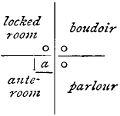
In the sitting-room, the boudoir, and a locked corner room were stoves.
The walls of these rooms met, and in the angles were the stoves. They
all communicated with one chimney. They were all heated from an opening
in the anteroom, marked a, which closed with an iron door, and was
covered with tapestry. The opening was large enough for a human being to
be thrust through, and the fire-chamber amply large enough also for its
consumption.
Much time had passed since a serious examination was begun, and it was
too late to think of finding evidence of the burning of the body in this
place. The stoves had been used since, each winter. However, some new
and surprising evidence did come to light. At five minutes past eight on
the evening that the mysterious death took place, Colonel von
Stockhausen was on the opposite side of the street talking to a lady,
when his attention was arrested by a dense black smoke issuing suddenly
from the chimney of the Count Goerlitz' palace. He continued looking at
the column of smoke whilst conversing with the lady, uncertain whether
the chimney were on fire or not, and whether he ought to give the alarm.
When the lady left him, after about ten minutes, or a quarter of an
hour, he saw that smoke ceased to issue from the chimney. He accordingly
went his way without giving notice of the smoke.
So far every piece of evidence went to show that the Countess had been
murdered. The conclusion now arrived at was this: she had been struck on
the head, chased from room to room bleeding, had been caught, strangled,
then thrust into the fire-chamber of the stove over a fire which only
half consumed her; taken out again and laid before the secretaire, and
the secretaire deliberately set fire to, and all the blood-marks
obliterated by fire. That something of this kind had taken place was
evident. Who had done it was not so clear. The efforts of the Count to
clear himself had established the fact that his wife was murdered, but
did not establish his innocence.
Suddenly—the case assumed a new aspect, through an incident wholly
unexpected and extraordinary.
The result of inquiry into the case of the death of the Countess
Goerlitz was, that the decision that she had come to her end by
accident, given by the city magistrates, was upset, and it was made
abundantly clear that she had been murdered. By whom murdered was not so
clear.
Inquiry carried the conclusion still further. She had been robbed as
well as murdered.
We have already described the writing-desk of the Countess. There were
drawers below the flap, and other smaller drawers concealed by it when
closed. In the smaller drawers she kept her letters, her bills, her
vouchers for investments, and her jewelry. Among the latter was the
pearl and diamond necklace, which she desired by her will might be sold,
and the money given to a charitable institution. The necklace was indeed
discovered seriously injured; but what had become of her bracelets,
brooches, rings, her other necklets, her earrings? She had also a chain
of pearls, which was nowhere to be found. All these articles were gone.
No trace of them had been found in the cinders under the secretaire;
moreover, the drawers in which she preserved them were not among those
burnt through. In the first excitement and bewilderment caused by her
death, the Count had not observed the loss, and the magistrates had not
thought fit to inquire whether any robbery had been committed.
A very important fact was now determined. The Countess had been robbed,
and murdered, probably for the sake of her jewels. Consequently the
murderer was not likely to be the Count.
When the case was re-opened, at Count Goerlitz's repeated demand, an
"Inquirent" was appointed by the Count to examine the case—that is, an
official investigator of all the circumstances; and on November 2, 1847,
in the morning, notice was given to the Count that the "Inquirent" would
visit his mansion on the morrow and examine both the scene of the murder
and the servants. The Count at once convoked his domestics and bade them
be in the house next day, ready for examination.
That same afternoon the cook, Margaret Eyrich by name, was engaged in
the kitchen preparing dinner for the master, who dined at 4 P.M. At
three o'clock the servant-man, John Stauff, came into the kitchen and
told the cook that her master wanted a fire lit in one of the upper
rooms. She refused to go because she was busy at the stove. Stauff
remained a quarter of an hour there talking to her. Then he said it was
high time for him to lay the table for dinner, a remark to which she
gave an assent, wondering in her own mind why he had delayed so long. He
took up a soup dish, observed that it was not quite clean, and asked her
to wash it. She was then engaged on some sauce over the fire.
"I will wash it, if you will stir the sauce," she said. "If I leave the
pan, the sauce will be burnt."
Stauff consented, and she went with the dish to the sink. Whilst thus
engaged, she turned her head, and was surprised to see that Stauff had a
small phial in his hand, and was pouring its contents into the sauce.
She asked him what he was about; he denied having done anything, and the
woman, with great prudence, said nothing further, so as not to let him
think that her suspicions were aroused. Directly, however, that he had
left the kitchen, she examined the sauce, saw it was discoloured, and on
trying it, that the taste was unpleasant. She called in the coachman and
the housekeeper. On consultation they decided that this matter must be
further investigated. The housekeeper took charge of the sauce, and
carried it to Dr. Stegmayer, the family physician, who at once said that
verdigris had been mixed with it, and desired that the police should be
communicated with. This was done, the sauce was analysed, and found to
contain 15½ grains of verdigris, enough to poison a man. Thereupon
Stauff was arrested.
We see now that an attempt had been made on the life of the Count, on
the day on which he had announced that an official inquiry into the
murder was to be made in his house and among his domestics.
Stauff, then, was apparently desirous of putting the Count out of the
way before that inquiry was made. At this very time a terrible tragedy
had occurred in France, and was in all the papers. The Duke of Praslin
had murdered his wife, and when he was about to be arrested, the duke
had poisoned himself.
Did Stauff wish that the Count should be found poisoned that night, in
order that the public might come to the conclusion he had committed
suicide to escape arrest? It would seem so.
John Stauff's arrest took place on November 3, 1847, four months and a
half after the death of the Countess. He was, however, only arrested on
a charge of attempting to poison the Count, and the further charge of
having murdered the Countess was not brought against him till August 28,
1848. The body of the murdered woman, it will be remembered, was not
exhumed and examined till August 11, 1848—eight months after the
re-opening of the investigation! It is really wonderful that the mystery
should have been cleared and the Count's character satisfactorily
vindicated, with such dilatoriness of proceeding. One more instance of
the stupid way in which the whole thing was managed. Although John
Stauff was charged with the attempt to poison on November 3, 1847, he
was not questioned on the charge till January 10, 1849, that is, till he
had been fourteen months in prison.
It will be remembered that the bell-rope in the Countess's parlour was
torn down. It would suggest itself to the meanest capacity that here was
a point of departure for inquiry. If the bell had been torn down, it
must have pealed its summons for help through the house. Who was in the
house at the time? If anyone was, why did he not answer the appeal?
Inconceivable was the neglect of the magistrates of Darmstadt in the
first examination—they did not inquire. Only several months later was
this matter subjected to investigation.
In the house lived the Count and Countess, the cook, who also acted as
chambermaid to the Countess, Schiller, the valet to the Count, Schämbs,
the coachman, and the Countess's own servant-man, John Stauff. Of these
Schiller and Schämbs did not sleep in the house.
June 13, the day of the murder, was a Sunday. The Count went as usual to
the grand-ducal palace in his coach at 3 P.M. The coachman drove him;
Stauff sat on the box beside the coachman. They left the Count at the
palace and returned home. They were ordered to return to the palace to
fetch him at 6 P.M. On Sundays, the Count usually spent his day in his
own suite of apartments, and the Countess in hers. On the morning in
question she had come downstairs to her husband with a bundle of coupons
which she wanted him to cash for her on the morrow. He managed her
fortune for her. The sum was small, only £30. At 2 P.M. she went to the
kitchen to tell the cook she might go out for the afternoon, as she
would not be wanted, and that she must return by 9 P.M.
At three o'clock the cook left. The cook saw and spoke to her as she
left. The Countess was then partially undressed, and the cook supposed
she was changing her clothes. Shortly after this, Schiller, the Count's
valet, saw and spoke with her. She was then upstairs in the laundry
arranging the linen for the mangle. She was then in her morning cotton
dress. Consequently she had not dressed herself to go out, as the cook
supposed. At the same time the carriage left the court of the house for
the palace. That was the last seen of her alive, except by John Stauff,
and, if he was not the murderer, by one other.
About a quarter past three the coach returned with Schämbs and Stauff
on the box. The Count had been left at the palace. The coachman took out
his horses, without unharnessing them, and left for his own house, at
half-past three, to remain there till 5 o'clock, when he must return,
put the horses in, and drive back to the palace to fetch the Count. A
quarter of an hour after the coachman left, Schiller went out for a walk
with his little boy.
Consequently—none were in the house but the Countess and Stauff, and
Stauff knew that the house was clear till 5 o'clock, when Schämbs would
return to the stables. What happened during that time?
At a quarter past four, the wife of Schiller came to the house with a
little child, and a stocking she was knitting. She wanted to know if her
husband had gone with the boy to Eberstadt, a place about four miles
distant. She went to the back-door. It was not fastened, but on being
opened rang a bell, like a shop door. Near it were two rooms, one
occupied by Schiller, the other by Stauff. The wife went into her
husband's room and found it empty. Then she went into that of Stauff. It
also was empty. She returned into the entrance hall and listened.
Everything was still in the house. She stood there some little while
knitting and listening. Presently she heard steps descending the
backstairs, and saw Stauff, with an apron about him, and a duster in his
hand. She asked him if her husband had gone to Eberstadt, and he said
that he had. Then she left the house. Stauff, however, called to her
from the window to hold up the child to him, to kiss. She did so, and
then departed.
Shortly after five, Schämbs returned to the stable, put in the horses,
and drove to the palace without seeing Stauff. He thought nothing of
this, as Stauff usually followed on foot, in time to open the coach door
for the Count. On this occasion, Stauff appeared at his post in livery,
at a quarter to six. At half-past six both returned with their master to
the house in Neckar Street.
Accordingly, from half-past three to a quarter past four, and from
half-past four to half-past five, Stauff was alone in the house with the
Countess. But then, from a quarter to five to half-past five she was
quite alone, and it was possible that the murder was committed at that
time. The Count, it will be remembered, on his return, went upstairs and
knocked at the door of the Countess' apartments, without meeting with a
response. Probably, therefore, she was then dead.
At seven o'clock the coachman went away, and Stauff helped the Count to
take off his court dining dress, and put on a light suit. He was with
him till half-past seven, when the Count went out for a walk. The Count
returned at half-past eight; during an hour, therefore, Stauff was alone
in the house with the Countess, or—her corpse.
What occurred during that hour? Here two independent pieces of evidence
come in to assist us in determining what took place. At five minutes
past eight, Colonel von Stockhausen had seen the column of black smoke
issue from the chimney of the house; it ascended, he said, some fifteen
feet above the chimney, and was so dense that it riveted his attention
whilst he was talking to a lady.
At about a quarter-past eight the smoke ceased.
The reader may remember that the window of the inner boudoir did not
look into the Neckar Street, but into a small side street. Immediately
opposite lived a widow lady named Kekule. On the evening in question,
her daughter, Augusta, a girl of eighteen, came in from a walk, and went
upstairs to the room the window of which was exactly opposite, though at
a somewhat higher level than the window of the boudoir. Looking out of
her window, Augusta Kekule saw to her astonishment a flickering light
like a lambent flame in the boudoir. A blind was down, so that she could
see nothing distinctly. She was, however, alarmed, and called her
brother Augustus, aged twenty years, and both watched the flames
flashing in the room. They called their mother also, and all three saw
it flare up high, then decrease, and go out. The time was 8.15. On
examination of the spot, it was seen that the window of Miss Kekule
commanded the corner of the boudoir, where was the divan partly burnt
through in several places.
What was the meaning of these two appearances, the smoke and the flame?
Apparently, from half-past seven to half-past eight the murderer was
engaged in burning the body, and in effacing with fire the blood-stains
on the sofas. During this time John Stauff was in the house, and, beside
the Countess, alive or dead, John Stauff only.
Stauff was now subjected to examination. He was required to account for
his time on the afternoon and evening of Sunday, June 13.
He said, that after his return from the palace, that is, about ten
minutes past three, he went into his room on the basement, and ate bread
and cheese. When told that the wife of Schiller stated she had seen him
come downstairs, he admitted that he had run upstairs to fetch a duster,
to brush away the bread crumbs from the table at which he had eaten.
After the woman left, according to his own account, he remained in his
room below till five o'clock, when the Countess came to the head of the
stairs and called him. He went up and found her on the topmost landing;
she went into the laundry, and he stood in the door whilst she spoke to
him, and gave him some orders for the butcher and baker. She wore, he
said, a black stuff gown. Whilst he was talking to her, Schämbs drove
away to fetch the Count. He gave a correct account of what followed, up
to the departure of the Count on his walk. After that, he said, he had
written a letter to his sweetheart, and at eight went out to get his
supper at an outdoor restaurant where he remained till half-past nine.
He was unable to produce evidence of anyone who had seen him and spoken
to him there; but, of course, much cannot be made of this, owing to the
distance of time at which the evidence was taken from the event of the
murder. According to his account, therefore, no one was in the house at
the time when the smoke rose from the chimney, and the flame was seen in
the boudoir.
If we sum up the points determined concerning the murder of the
Countess, we shall see how heavily the evidence told against Stauff.
She had been attacked in her room, and after a desperate struggle, which
went on in both parlour and boudoir, she had been killed.
Her secretaire had been robbed.
Her body had been burnt.
The blood-stains had been effaced by fire.
The secretaire had been set fire to; and, apparently, the body removed
from where it had been partially consumed, and placed near it.
Now all this must have taken time. It could only be done by one who knew
that he had time in which to effect it undisturbed.
John Stauff was at two separate times, in the afternoon and evening,
alone in the house for an hour, knowing that during that time he would
be undisturbed.
If his account were true, the murder must have been committed during his
brief absence with the coach, and the burning of the body, and setting
fire to the room, done when he went out to get his supper. But—how
could the murderer suppose he would leave the house open and unprotected
at eight o'clock? Was it likely that a murderer and robber, after having
killed the Countess and taken her jewels at six o'clock, would hang
about till eight, waiting the chance of getting back to the scene of his
crime unobserved, to attempt to disguise it? not knowing, moreover, how
much time he would have for effecting his purpose?
It was possible that this had been done, but it was not probable.
Evidence was forthcoming from a new quarter that served to establish
the guilt of Stauff.
On October 6, 1847, an oilman, Henry Stauff, in Oberohmen, in Hesse
Cassel, was arrested, because he was found to be disposing of several
articles of jewelry, without being able to give a satisfactory account
of where he got them. The jewelry consisted of a lump of molten gold,
and some brooches, bracelets and rings.
Henry Stauff had been a whitesmith in his youth, then he became a
carrier, but in the last few years, since the death of his wife, he had
sold knives, and been a knife-grinder. He was very poor, and had been
unable to pay his rates. In July of 1847, however, his affairs seemed to
have mended; he wore a silver watch, and took out a licence to deal in
oil and seeds. When he applied for the patent, the burgomaster was
surprised, and asked him how he could get stock to set up business, in
his state of poverty. Thereupon, Henry Stauff opened his purse and
showed that it contained a good amount of silver, and—with the coins
was a gold ring with, apparently, a precious stone in it.
The cause of his arrest was his offering the lump of gold to a
silversmith in Cassel. It looked so much as if it was the melting up of
jewelry, that the smith communicated with the police. On his arrest,
Henry Stauff said he was the father of four children, two sons and two
daughters; that his sons, one of whom was in the army, had sent him
money, that his daughter in America had given him the jewelry, and that
the gold he had had by him for several years, it had been given him by
a widow, who was dead. The silver watch he had bought in Frankfort.
Henry Stauff had a daughter at home, name Anna Margaretta, who often
received letters from Darmstadt. One of these letters had not been
stamped, and as she declined to pay double for it, it lay in the
post-office till opened to be returned. Then it was found to be dated
September 29, 1847, and to be from her brother, John Stauff. It simply
contained an inclosure to her father; this was opened; it contained an
angry remonstrance with him for not having done what he was required,
and sent the money at once to the writer.
Was it possible that this had reference to the disposal of the jewelry?
On July 7, three weeks after the death of the Countess, Henry Stauff was
at Darmstadt, where one son, Jacob, was in the army; the other, John,
was in service with the Goerlitz family.
This led the magistrates in Cassel to communicate with those in
Darmstadt. On November 10, John Stauff was questioned with reference to
his father. He said he had often sent him money. He was shown the
jewelry, and asked if he recognised it. He denied having ever seen it,
and having sent it to his father.
The jewelry was shown to Count Goerlitz, and he immediately identified
it as having belonged to his wife. A former lady's-maid of the Countess
also identified the articles. The Count, and a maid, asserted that these
articles had always been kept by the deceased lady in the small upper
drawers of her secretaire. The Countess was vain and miserly, and often
looked over her jewelry. She would, certainly, have missed her things
had they been stolen before June 13.
The articles had not been stolen since, found among the ashes, and
carried off surreptitiously, for they showed no trace of fire.
Here we must again remark on the extraordinary character of the
proceedings in this case. The articles were identified and shown to John
Stauff on November 10, 1847, but it was not till ten months after, on
August 28, 1848, that he was told that he was suspected of the murder of
the Countess, and of having robbed her of these ornaments. Another of
the eccentricities of the administration of justice in Darmstadt
consisted in allowing the father Henry, and his son John, to have free
private communication with each other, whilst the latter was in prison,
and thus allowing them to concoct together a plausible account of their
conduct, with which, however, we need not trouble ourselves.
On September 1, 1848, on the fourth day after Stauff knew that he was
charged with the murder of the Countess, he asked to make his statement
of what really took place. This was the account he gave. It will be seen
that, from the moment he knew the charge of murder was brought against
him, he altered his defence.
He said, "On June 20, 1847," (that is, a week after the murder), "about
ten o'clock in the evening, after the Count had partaken of his supper
and undressed, he brought me a box containing jewelry, and told me he
would give it to me, as I was so poor, and that it would place my father
and me in comfortable circumstances. I then told the Count that I did
not know what to do with these jewels, whereupon he exhorted me to send
them to my father, and get him to dispose of them. He told me that he
required me solemnly to swear that I would not tell anyone about the
jewels. I hid the box in a stocking and concealed it in some bushes on
the Bessungen road. Later I told my brother Jacob where they were, and
bade him give them to my father on his visit to Darmstadt."
When Stauff was asked what reason he could assign for the Count giving
him the jewels, he said that the Count saw that he, John Stauff,
suspected him of the murder, and he named several circumstances, such as
observing blood on the Count's handkerchief on the evening of the
murder, which had led him to believe that the Count was guilty, and the
Count was aware of his suspicions.
On March 4, 1850, began the trial of John Stauff for the murder of the
Countess, for robbery, for arson, and for attempt to poison the Count.
At the same time his father, Henry Stauff, and his brother, Jacob
Stauff, were tried for concealment of stolen goods. The trial came to an
end on April 11. As many as 118 witnesses were heard; among these was
the Count Goerlitz, as to whose innocence no further doubts were
entertained.
John Stauff was at that time aged twenty-six, he was therefore
twenty-four years old at the time of the murder. He had been at school
at Oberohmen, where he had shown himself an apt and intelligent scholar.
In 1844 he had entered the grand-ducal army, and in May 1846 had become
servant in the Goerlitz house, as footman to the Countess. In his
regiment he had behaved well; he had been accounted an excellent
servant, and both his master and mistress placed confidence in him.
Curiously enough, in the autumn of 1846, he had expressed a wish to a
chambermaid of the Countess "that both the Countess and her pack of
jewels, bracelets and all, might be burnt in one heap."
When the maid heard of the death of the Countess in the following year,
"Ah!" she said, "now Stauff's wish has been fulfilled to the letter."
He was fond of talking of religion, and had the character among his
fellow-servants of being pious. He was, however, deep in debt, and
associated with women of bad character. Throughout the trial he
maintained his composure, his lips closed, his colour pale, without
token of agitation. But the man who could have stood by without showing
emotion at the opening of the coffin of his mistress, at the sight of
the half-burnt, half-decomposed remains of his victim, must have had
powers of self-control of no ordinary description. During the trial he
seemed determined to show that he was a man of some culture; he
exhibited ease of manner and courtesy towards judges, jury, and lawyers.
He never interrupted a witness, and when he questioned them, did so with
intelligence and moderation. He often looked at the public, especially
the women, who attended in great numbers, watching the effect of the
evidence on their minds. When, as now and then happened, some ludicrous
incident occurred, he laughed over it as heartily as the most innocent
looker-on.
The jury unanimously found him "guilty" on every count. They
unanimously gave a verdict of "guilty" against his father and brother.
Henry Stauff was sentenced to six months' imprisonment; Jacob Stauff to
detention for three months, and John to imprisonment for life. At that
time capital punishment could not be inflicted in Hesse.
On June 3, he was taken to the convict prison of Marienschloss. On July
1, he appealed to the Grand-Duke to give him a free pardon, as he was
innocent of the crimes for which he was sentenced. The appeal was
rejected. Then he professed his intention of making full confession. He
asked to see the Count. He professed himself a broken-hearted penitent,
desirous of undoing, by a sincere confession, as much of the evil as was
possible.
We will give his confession in his own words.
"When, at five o'clock, I went to announce to the Countess that I was
about to go to the palace, I found both the glass door of the ante-room,
and that into the sitting-room, open, and I walked in through them. I
did not find the Countess in her parlour, of which the curtains were
drawn. Nor was she in her boudoir. I saw the door into the little corner
room ajar, so I presumed she was in there. The flap of her desk was
down, so that I saw the little drawers, in which I knew she kept her
valuables, accessible to my hand. Opportunity makes the thief. I was
unable to resist the temptation to enrich myself by these precious
articles. I opened one of the drawers, took out a gold bracelet, one of
gold filigree, two of bronze, a pair of gold ear-rings, a gold brooch,
and a triple chain of beads or Roman pearls; and pocketed these
articles, which my father afterwards had, and, for the most part, melted
up.
"Most of these articles were in their cases. At that moment the Countess
appeared on the threshold of her boudoir and rushed towards me. I do not
remember what she exclaimed; fear for the consequences, and anxiety to
prevent the Countess from making a noise and calling assistance, and
thereby obtaining my arrest, prevailed in my mind, and I thought only
how I might save myself. I grasped her by the neck, and pressed my
thumbs into her throat. She struggled desperately. I was obliged to use
all my strength to hold her. After a wrestle of between five and seven
minutes, her eyes closed, her face became purple, and I felt her limbs
relax.
"When I saw she was dead I was overcome with terror. I let the body
fall, whereby the head struck the corner of the left side of the
secretaire, and this made a wound which began to bleed. Then I ran and
locked both the doors, hid what I had taken in my bed, and left the
house. On my way to the palace, I stepped into Frey's tavern and drank
three glasses of wine. I was afraid I should arrive too late at the
palace, where I appeared, however, at half-past five. The Count did not
return till half-past six, as dinner that day lasted rather longer than
usual.
"When the Count went upstairs to see his wife and take her something
good he had brought away with him from table, I was not uneasy at all,
for I knew that he would knock and come away if he met with no response.
So he did. He came down without being discomposed, and remarked that he
fancied the Countess had gone out. At half-past seven he left the house.
In the mean time I had been considering what to do, and had formed my
plan. Now my opportunity had arrived, and I hastened to put it into
execution. My plan was to efface every trace of my deed by fire, and to
commit suicide if interrupted.
"As the weather was chilly, the Count had some fire in his stove. I
fetched the still glowing charcoal, collected splinters of firwood and
other combustibles, and matches, and went upstairs with them. Only the
wine sustained me through what I carried out. I took up the body. I put
a chair before the open desk, seated the corpse on it, placed one arm on
the desk, laid the head on the arm, so that the body reposed in a
position of sleep, leaning on the flap of the desk. I threw the red hot
charcoal down under the head, heaped matches, paper, and wood splinters
over them; took one of the blazing bits of wood and threw it on the
divan in the boudoir; locked both doors, and flung away the keys.
"Then I went to my own room and lighted a fire in the stove, and put the
jewel cases on the fire. The fire would not burn well, and thick smoke
came into the room. Then I saw that the damper was closed. I opened
that, and the smoke flew up the chimney; this is what Colonel von
Stockhausen saw. There were a lot of empty match-boxes also in the
stove, and these burnt with the rest."
Such was the confession of Stauff. How far true, it is impossible to
say. He said nothing about the bell-pull being torn down, nothing about
the holes burnt in the sofa of the sitting-room. According to the
opinion of some experimentalists, the way in which he pretended to have
burnt the Countess would not account for the appearance of the corpse.
His object was to represent himself as the victim of an over-mastering
temptation—to show that the crime was wholly unpremeditated.
This was the sole plea on which he could appeal for sympathy, and expect
a relaxation of his sentence.
That sentence was relaxed.
In 1872 he obtained a free pardon from the Grand-Duke, on condition that
he left the country and settled in America. Including his imprisonment
before his trial, he had, therefore, undergone twenty-five years of
incarceration.
When released he went to America, where he probably still is.