The cover image was created by the transcriber and is placed in the public domain.
HISTORIC JAMAICA
Is it nature or by the error of fantasie that the seeing of
places we know to have been frequented or inhabited by men
whose memory is esteemed or mentioned in Stories, doth in
some sort move and stirre us up as much or more than the
hearing of their noble deeds or reading of their compositions?
Montaigne
The care which a nation devotes to the preservation of the
monuments of its past may serve as a true measure of the
degree of civilization to which it has attained.
Les Archives Principales de Moscou du Ministère
des Affaires Etrangères, Moscow, 1898.
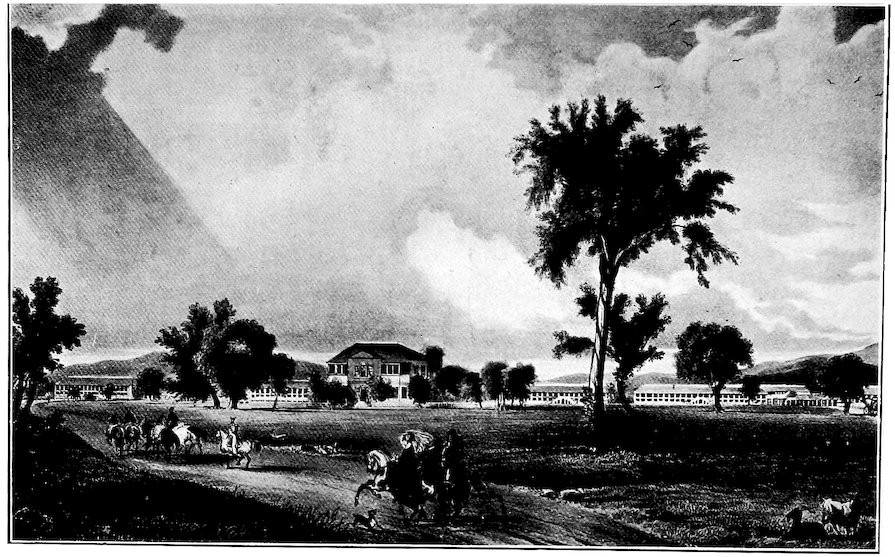
UP-PARK CAMP IN 1840
From a coloured lithograph by Joseph B. Kidd
BY
FRANK CUNDALL, F.S.A.
SECRETARY AND LIBRARIAN OF THE INSTITUTE OF JAMAICA
WITH FIFTY-TWO ILLUSTRATIONS
PUBLISHED FOR
THE INSTITUTE OF JAMAICA
BY THE WEST INDIA COMMITTEE
LONDON
1915
Printed by Ballantyne, Hanson & Co. Ltd.
at the Ballantyne Press
London, England
PREFACE
v
In the year 1900 the present writer published a small
volume entitled “Studies in Jamaica History,” giving the
records of certain historic sites in the colony.
In its issue of October 27, 1908, the Editor of the “West
India Committee Circular,” commenting on the appointment
of a Royal Commission to enumerate and report upon
the historical monuments in England, drew attention to the
need for the preservation of historic sites and buildings in
the West Indies, and stated that a letter on the subject had
been addressed by the West India Committee to the Colonial
Office. On November 24 he was able to state that the
Secretary of State for the Colonies (the Earl of Crewe)
sympathised with the object of the West India Committee
and had forwarded their representations to the governors of
the various West Indian colonies, recommending them to
their consideration.
In Jamaica the present writer, at the request of the
Governor (Sir Sydney Olivier) and with the consent of the
Board of Governors of the Institute of Jamaica, undertook
to prepare a list, parish by parish, of historic sites, buildings
and monuments, stating in each case the nature of its
interest and the name of its owner. This list was published
as a special supplement to the “Jamaica Gazette” on
December 23, 1909; and in November 1912 it was reprinted
as part of a report relating to the preservation of historic
visites and ancient monuments and buildings in the West
Indian colonies presented to Parliament.
In the meantime the present writer had commenced a
series of articles in the “West India Committee Circular”
dealing with historic sites and monuments in Jamaica,
which appeared from October 1909 till October 1914.
At the suggestion of various persons interested in the
subject it was decided to reprint these articles. In doing
this it has been thought well to arrange them parish by
parish and to add a few words of general history, taken in
part from the writer’s contributions to the “Handbook of
Jamaica,” and of descriptions of sites and monuments which
have not been treated of individually.
It is hoped that the following notes may not only serve
the double purpose of evoking interest in the history of the
colony in the minds of its inhabitants and proving a source
of information to visitors, but may be the means of steps
being taken to preserve old buildings and other monuments
alike from decay and the hand of man.
A list of works consulted in the compilation of the notes
embodied in this volume would comprise almost all the
books in the Jamaica section of the West India Library of
the Institute of Jamaica, some 1400 in number.
My thanks are due to Mrs. Lionel Lee for making the
illustrations and to Mr. Algernon E. Aspinall for kind assistance
in seeing the work through the press.
F. C.
Kingston, Jamaica.
1915.
CONTENTS
vii
PAGE
LISTS OF OFFICIALS
Governors, Presidents of the Council, Speakers of the Assembly, Chief Justices, Attorney-Generals, Naval Commanders-in-chief at Jamaica, Agents for Jamaica in Great Britain
The Point: Shirley: Jackson: Forts: Residence of the Governor: Church: Buccaneers: Myngs: Morgan: Earthquake of 1692: Spanish bell: Fire of 1703–4: Hurricane of 1722: Attempt on Cartagena, Ogle, Smollett: Rodney: Water-supply: Rodney’s Look-out: Fort Charles: Nelson’s Quarter-deck: Rodney’s victory over De Grasse: the Convoy: Prince William Henry: Lady Nugent: Gosse: Hill: Urgent
Passage Fort: Jackson: Penn and Venables: Spanish-Town: Raymond and Tyson: Cathedral, monuments, plate, rectors, Earl of Effingham, Countess of Elgin: House of Assembly: Eagle House: Sir Hans Sloane’s House: King’s House: Rodney Memorial: St. John’s, Guanaboa Vale: Church of St. Dorothy: Colebeck Castle: Galdy’s Tomb: Ferry Inn: Fort Augusta: Rodney’s Look-out: Port Henderson
Earthquake, site: Lilly, plan: Fire, 1780: Corporation: Fires, 1843, 1862, 1882: Earthquake, 1907: Names of streets: Parish church, Knight, Lewis, Hakewill, plate, rectors, records, Benbow, monuments: Scotch Church: Headquarters House: Thomas Hibbert: General officers: Old Mico: Blundell Hall: Institute of Jamaica: Arawâk pottery: Chancellor’s purse: maces: Monuments, Sir Charles Metcalfe, Queen Victoria, Edward Jordan, Dr. Bowerbank, Father Dupont, Rev. John Radcliffe, Rev. W. J. Gardner: Wharves
Name: Yallahs, church, plate: Luke Stokes: Stokes Hall: Stokesfield, Estate accounts: Morant Bay: Rebellion: Eyre, Gordon: Church, Bath, Spring, Court House: Botanical Gardens: Dr. Dancer: Belvedere: Lyssons, Sir John Taylor, Simon Taylor: Hordley, Monk Lewis: Albion: Arawâk remains at Cambridge Hill and Botany Bay: Cow Bay and Bull Bay
Name: Titchfield: Early settlement: School: St. George: Olivier Park: Carder Park: Moore Town: Muirton: Darlingford: Low Layton: Spring Garden: Modyford’s Gully: Balcarres Hill: Seaman’s Valley
Name: Gray’s Inn, Spanish remains: Decoy, Tomb of Sir Charles Price, Gardens: Sir Charles Price’s rat: Agualta Vale: Dryland: Fort Haldane: Prospect: Heywood Hall
Historic interest: Liberty Hill: Arawâk remains: Dry Harbour: Landing of Columbus, 1494: Don Christopher’s Cove: Residence of Columbus, 1503–4: Mendes, rebellion of Porras, appeal to Hispaniola, bravery of Bartolommeo Columbus: Sevilla Nueva, Sloane’s account, Peter Martyr, Ocho Rios, Chireras: Doyley’s defeat of Sasi: Rio Nuevo in St. Mary, Final defeat of Sasi: Runaway Bay: Sevilla Nueva: Cardiff Hall: Edinburgh Castle, Hutchinson: Moneague Tavern: Forts, Mammee Bay, St. Ann’s Bay, Windsor Fort: Priory: Dixon Pen: Geddes: York Castle: Dry Harbour Caves: Walton, Jamaica Free School
Montego Bay: Close Harbour: Church, rectors: Mrs. Rosa Palmer: Maroons, Block House, Maroon Town, Accompong, War, Walpole, Treaty, Balcarres, Gillespie, Maroons in Nova Scotia: Duckett’s Spring, the Scarletts: Rose Hall: Arawâk Middens and Caves
LIST OF OFFICIALS — GOVERNORS OF JAMAICA [1] — PRESIDENTS OF THE COUNCIL OF JAMAICA — LEGISLATIVE COUNCIL — PRIVY COUNCIL — SPEAKERS OF THE HOUSE OF ASSEMBLY OF JAMAICA — CHIEF JUSTICES OF JAMAICA — ATTORNEY-GENERALS OF JAMAICA — NAVAL COMMANDERS-IN-CHIEF AT JAMAICA — COMMODORES ON JAMAICA DIVISION OF NORTH AMERICAN AND WEST INDIAN STATION — AGENTS FOR JAMAICA IN GREAT BRITAIN
xiii
The following tables are inserted for reference. The list of
Governors is complete. The others are as complete as it has
hitherto been found possible to make them. There are portraits in
Jamaica History Gallery in the Institute of Jamaica of those to
whom an * is suffixed.
1. Administrations during temporary absences of Governors have not
been included.
1661–62.
General Edward Doyley.
Governor.
1662.
Thomas, Lord Windsor.*
„
1662–64.
Sir Charles Lyttelton.*
Dep.-Governor
1664.
Colonel Edward Morgan.
„
1664.
Colonel Thomas Lynch.
President.
1664–71.
Sir Thomas Modyford, Bt.
Governor.
1671–74.
Sir Thomas Lynch.
Lieut.-Gov.
1674.
Sir Henry Morgan.*
„ „
1675–78.
John, Lord Vaughan.*
Governor.
1678.
Sir Henry Morgan.
Lieut.-Gov.
1678–80.
Charles, Earl of Carlisle.*
Governor.
1680–82.
Sir Henry Morgan.
Lieut.-Gov.
1682–84.
Sir Thomas Lynch.
Governor.
1684–87.
Colonel Hender Molesworth.
Lieut.-Gov.
1687–88.
Christopher, Duke of Albemarle.*
Governor.
1688–90.
Sir Francis Watson.
President.
1690–92.
William, Earl of Inchiquin.*
Governor.
1691–92.
John White.
President.
1692–93.
John Bourden.
„
1693–1700.
Sir William Beeston.
Lieut.-Gov.
1700–02.
„ „ „
Governor.
1702.
Maj.-Gen. William Selwyn.
„
1702.
Peter Beckford.*
Lieut.-Gov.
1702–04.
Colonel Thomas Handasyd.
Lieut.-Gov.
1704–11.
Sir Thomas Handasyd.
Governor.
1711–16.
Lord Archibald Hamilton.
„
1716–18.
Peter Heywood.
„
1718–22.
Sir Nicholas Lawes.
„
xiv1722–26.
Henry, Duke of Portland.
Governor.
1726–28.
John Ayscough.
President.
1728–34.
Maj.-Gen. Robert Hunter.
Governor.
1734–35.
John Ayscough.
President.
1735.
John Gregory.
„
1735–36.
Henry Cunningham.
Governor.
1736–38.
John Gregory.
President.
1738–52.
Edward Trelawny.
Governor.
1752–56.
Admiral Charles Knowles.*
Governor.
1756–59.
Henry Moore.
Lieut.-Gov.
1759.
General George Haldane.
Governor.
1760–62.
Henry Moore.
Lieut.-Gov.
1762–66.
William Henry Lyttelton.
Governor.
1766–67.
Roger Hope Elletson.
Lieut.-Gov.
1767–72.
Sir William Trelawny.
Governor.
1772–74.
Lieut.-Col. John Dalling.
Lieut.-Gov.
1774–77.
Sir Basil Keith.
Governor.
1777–81.
Colonel John Dalling.
Lieut.-Gov.
1781–83.
Maj.-Gen. Archibald Campbell.*
„ „
1783–84.
„ „ „
Governor.
1784–90.
Brig.-Gen. Alured Clarke.*
Lieut.-Gov.
1790–91.
Thomas, Earl of Effingham.*
Governor.
1791–95.
Maj.-Gen. Adam Williamson.
Lieut.-Gov.
1795–01.
Alexander, Earl of Balcarres.*
„ „
1801–06.
Lieut.-Gen. George Nugent.*
„ „
1806–08.
Sir Eyre Coote.*
„ „
1808–11.
William, Duke of Manchester.*
Governor.
1811–13.
Lieut.-Gen. Edward Morrison.
Lieut.-Gov.
1813–21.
William, Duke of Manchester.
Governor.
1821–22.
Maj.-Gen. Henry Conran.*
Lieut.-Gov.
1822–27.
William, Duke of Manchester.
Governor.
1827–29.
Maj.-Gen. Sir John Keane.*
Lieut.-Gov.
1829–32.
Somerset, Earl of Belmore.*
Governor.
1832.
George Cuthbert.
President.
1832–34.
Constantine, Earl of Mulgrave.*
Governor.
1834.
George Cuthbert.
President.
1834.
Maj.-Gen. Sir Amos Norcot.
Lieut.-Gov.
1834–36.
Peter, Marquis of Sligo.*
Governor.
1836–39.
Sir Lionel Smith.
„
1839–42.
Sir Charles Metcalfe.*
„
1842–46.
James, Earl of Elgin.*
„
1846–47.
Maj.-Gen. Sackville Berkeley.
Lieut.-Gov.
1847–53.
Sir Charles Edward Grey.
Governor.
1853–56.
Sir Henry Barkly.*
„
1856–57.
Maj.-Gen. E. Wells Bell.
Lieut.-Gov.
1857–62.
Captain Charles Darling.*
Governor.
1862–64.
Edward John Eyre.*
Lieut.-Gov.
1864–66.
„ „ „
Governor.
xv1866.
Sir Henry Storks.*
Governor.
1866–74.
Sir John Peter Grant.*
„
1874.
W. A. Young.
Administ.
1874–77.
Sir William Grey.*
Governor.
1877.
Edward Rushworth.
Lieut.-Gov.
1877.
Maj.-Gen. Mann.
Administ.
1877–80.
Sir Anthony Musgrave.*
Governor.
1879–80.
Edward Newton.
Lieut.-Gov.
1880–83.
Sir Anthony Musgrave.
Governor.
1883.
Col. Somerset M. Wiseman Clarke.
Administ.
1883.
Maj.-Gen. Gamble.
„
1883–89.
Sir Henry Norman.*
Governor.
1889.
Col. William Clive Justice.
Administ.
1889–98.
Sir Henry Arthur Blake.
Governor.
1898.
Maj.-Gen. Hallowes.
Administ.
1898–04.
Sir Augustus W. L. Hemming.*
Governor.
1904.
Sydney Olivier.
Administ.
1904.
Hugh Clarence Bourne.
„
1904–07.
Sir James Alexander Swettenham.
Governor.
1907.
Hugh Clarence Bourne.
Administ.
1907–13.
Sir Sydney Olivier.
Governor.
1913.
Philip Clarke Cork.
Administ.
1913–
Sir William Henry Manning.
Governor.
1661.
General Edward Doyley, Governor and President
1664.
Colonel Thomas Lynch
1671.
Major-General James Bannister
1674.
Colonel Hender Molesworth (afterwards Baronet).
1688.
Sir Francis Watson
1691.
John White
1692.
John Bourden
1702.
Peter Beckford
Francis Rose
1722.
John Ayscough
1735–51.
John Gregory
1774.
Archibald Sinclair
1775–96.
Thomas Iredell
1797.
John Palmer
1798.
Thomas Wallen
1805.
John Scott
1806.
Nathaniel Beckford
1811.
John Lewis
1821.
George Pinnock
1825.
George Cuthbert
xvi1838.
William Rowe
1840.
James Gayleard
1856.
John Salmon
1866–91.
The governor for the time being
1892.
Dr. J. C. Phillippo
1893 et seq.
The governor for the time being
1866 et seq.
The governor for the time being
1664.
Robert Freeman
1664.
Sir Thomas Whetstone
1671.
Samuel Long
1672–73.
Major John Colebeck (pro tem.)
1673.
Samuel Long
1677.
Lieut.-Col. William Beeston
1679–88.
Samuel Bernard
1688.
George Nedham (pro tem.)
1688.
Roger Hope Elletson
„
Thomas Rives
„
John Peeke
1691–92.
Thomas Sutton
1693.
Andrew Langley
1694.
James Bradshaw
1698.
Thomas Sutton
1701.
Andrew Langley
1702.
Francis Rose
1702–03.
Andrew Langley
1704.
Edward Stanton
1705.
Matthew Gregory
1706.
Hugh Totterdale
„
John Peeke
„
Matthew Gregory
1707–11.
Peter Beckford, jun.
xvii1711.
William Brodrick
„
Samuel Vassall (pro tem.)
1711–13.
Peter Beckford, jun.
1714.
Hugh Totterdale
1715.
John Blair
1716.
Peter Beckford
1718.
William Nedham
1719.
Edmund Kelly
1721–22.
George Modd
1722.
William Nedham
1724.
John Manley (pro tem.)
1725.
Francis Melling
1727–28.
Thomas Beckford
1731.
John Stewart
1733.
William Nedham
1745.
Charles Price [afterwards Sir Charles, Bt.] (pro tem.)
1747.
Richard Beckford (pro tem.)
1751.
„ „
1755.
Edward Manning
1756.
Thomas Hibbert
1756.
Charles Price
1763.
Charles Price, jun. [afterwards 2nd Baronet]
1764.
Thomas Fearon (pro tem.)
1765.
Charles Price, jun.
1766.
William Nedham
1768.
Edward Long
„
Phillip Pinnock*
1770.
Nicholas Bourke
„
Charles Price, jun.
1775.
Phillip Pinnock
1776.
Sir Charles Price (2nd Baronet)
1778.
Jasper Hall*
1778–93.
Samuel Williams Haughton
1781.
Thomas French (pro tem.)
1782.
William Pusey (pro tem.)
1787.
William Blake (pro tem.)
1793.
William Blake
1797.
Donald Campbell
1798.
Keane Osborn
1802.
Philip Redwood
1809.
James Lewis
1821.
David Finlayson
1830.
Richard Barrett
1832.
Robert Allwood
1838.
Richard Barrett
1839.
Edward Panton
1842.
Samuel Jackson Dallas*
xviii1849.
Charles McLarty Morales*
1861.
Edward Jordon (pro tem.)*
1864.
Charles Hamilton Jackson*
1661.
Philip Ward
„
Samuel Barry
1663.
William Mitchell
1664–65.
Lynch
1671.
John White
1675.
Sir Thomas Modyford
1676–79.
Samuel Long
1681.
Robert Byndloss
1685.
Samuel Bernard
1688.
Robert Noell
1689.
Roger Elletson
„
Richard Lloyd
1695–98.
Richard Lloyd
1698.
Nicholas Lawes
1703.
Peter Beckford
„
Peter Heywood
1706.
John Walters
1714–15.
Peter Heywood
1716.
Peter Bernard
1724.
John Ayscough
(d. 173
6) Edward Pennant
1733.
Richard Mill
1733–35.
John Gregory
1735.
James Hay
1736–39.
George Ellis
1739.
John Gregory
1742.
Dennis Kelly
1746.
William Nedham
1749.
John Hudson Guy
1751–56.
John Palmer
1756–64.
Thomas Fearon
1765.
George Ellis
1766.
Thomas Beach
1770.
Peter Haywood
1776.
Edward Webley
1779.
Richard Welch
1780–83.
Thomas French
1784–91.
John Grant
1790.
Thomas Harrison (pro tem.)
xix1792.
William Jackson
1801.
John Henckell
1802.
John Kirby
1808.
John Lewis
„
Philip Redwood
1818.
Thomas Witter Jackson
1821.
Sir William Anglin Scarlett*
1832.
Sir Joshua Rowe*
1855.
Sir Bryan Edwards*
1869.
Sir John Lucie-Smith
1884.
Sir Adam Gibb Ellis*
1895.
Sir Henry James Burford-Hancock
1896.
Sir Fielding Clarke
1910.
Sir Anthony Coll
1671.
Edmund Ducke
1688.
Sir Richard Dereham
1686–91.
Simon Musgrave
1693.
William Brodrick
1698.
Thomas Barrow
1698.
Charles Brodrick
1703.
Edward Haskins
„
Robert Hotchkyn
1711–15.
William Brodrick
1719.
Edmund Kelly
1724.
William Monk
1732.
Alexander Henderson
1732.
Thomas Howe
1732–44.
Matthew Concanen
1744.
Thomas Hill
1744–49.
Robert Penny
1754.
Henry Morgan Byndloss
1755.
Richard Beckford
1760.
Gilbert Ford
1760.
Edward Penny
1766.
Thomas Gordon
1766.
Thomas Beach
1769.
Thomas Harrison
1784.
Robert Sewell
1796.
George Crawford Ricketts
1802.
William Ross
1806.
Thomas Witter Jackson
1807.
William Ross
xx1810.
Thomas Witter Jackson
1818.
William Burge
1829.
Hugo James
1832.
Fitz Herbert Batty
1833.
Dowell O’Reilly
1857.
Alexander Heslop*
1872.
E. A. C. Schalch
1876.
G. H. Barne
1877.
E. L. O’Mally
1881.
Sir Henry Hicks Hocking
1896.
(Sir) Henry Rawlins Pipon Schooles
1906.
Thomas Bancroft Oughton
1910.
Ernest St. John Branch
1655.
Sir William Penn, Admiral and General-at-sea*
1655–57.
Vice-Admiral William Goodsonn
1656–57.
Vice-Admiral Christopher Myngs*
1662.
Col. Mitchell, chief over the sea-officers
1662–64.
Vice-Admiral Christopher Myngs
1663.
Sir Thomas Whetstone, commanded a fleet at Jamaica
1669.
Henry Morgan, “Commander-in Chief of all the ships of war” of Jamaica (commission from Governor)
1676.
The Duke of York was Admiral of Jamaica and all other his Majesty’s Plantations and Dominions
[1692.
Commodore Wrenn, commanded in the West Indies
1692.
Rear-Admiral Sir Francis Wheler, commanded in the West Indies]
1702.
Vice-Admiral Benbow*
[1703.
Vice-Admiral John Graydon, commanded a fleet in the West Indies]
1703–05.
Sir William Whetstone, Commander-in-Chief in the West Indies
[1706.
Commodore William Kerr, commanded a fleet in the West Indies
1706.
Sir John Jennings, commanded a fleet in the West Indies]
1707–09.
Rear-Admiral Charles Wager*
1710–12.
Commodore James Littleton
1712.
Rear-Admiral Sir Hovenden Walker
1720.
Commodore Vernon, Commander-in-Chief of all his Majesty’s ships in the West Indies*
xxi[1726–27.
Vice-Admiral Francis Hosier, commanded a squadron in the West Indies]
1727.
Commodore Edward St. Lo, in command of West India Station
1728.
Vice-Admiral Edward Hopson, in command of West India Station
1728–29.
Rear-Admiral Edward St. Lo, in command of West India Station
1729.
Commodore William Smith
1730–33.
Rear-Admiral the Hon. Charles Stuart, in command of West India Station
1732.
Commodore Richard Lestock
1732–39.
Commodore Sir Chaloner Ogle*
1736–37.
Captain Digby Dent
[1739–42.
Admiral Edward Vernon, commanded in the West Indies]*
1742–44.
Rear-Admiral Sir Chaloner Ogle.
[1744.
Vice-Admiral Thomas Davers, died at Jamaica]
1746.
Captain Cornelius Mitchell
1747.
Captain Digby Dent
1747–49.
Rear-Admiral Charles Knowles
1749–52.
Commodore the Hon. George Townshend
1755–57.
Rear-Admiral the Hon. George Townshend
1757.
Rear-Admiral Thomas Cotes
1760–61.
Rear-Admiral Charles Holmes
1762.
Commodore Sir James Douglas
[1762.
Admiral Sir George Pocock, Commander-in-Chief of expedition against Havana]
1762–64.
Rear-Admiral Viscount Keppel
1764–66.
Rear-Admiral Sir William Burnaby
1766–69.
Rear-Admiral W. Parry
1769–70.
Commodore Arthur Forrest*
1771–74.
Rear-Admiral Sir George Rodney*
1774–78.
Vice-Admiral Clarke Gayton
1778–82.
Vice-Admiral Sir Peter Parker*
[1779.
Captain Horatio Nelson, commanded in Fort Charles, Port Royal]*
1782–83.
Rear-Admiral Joshua Rowley
1783–84.
Vice-Admiral James Gambier
1785.
Commodore John Pakenham
1785.
Captain Alan Gardner*
1786.
Rear-Admiral Alexander Innes
1786–89.
Commodore Alan (afterwards Lord) Gardner
1790–93.
Rear-Admiral Philip Affleck
1793–95.
Rear-Admiral John Ford
1796.
Rear-Admiral William Parker
1796.
Commodore Richard Rodney Bligh*
xxii1796–1800.
Vice-Admiral Sir Hyde Parker*
1800–01.
Vice-Admiral Lord Hugh Seymour*
1802.
Rear-Admiral Robert Montague
1803–04.
Vice-Admiral Sir John Thomas Duckworth*
1804–08.
Vice-Admiral James Richard Dacres*
1809–11.
Vice-Admiral Bartholomew Samuel Rowley*
1811–13.
Vice-Admiral Sir Charles Stirling, Bart.
1812.
Vice-Admiral James Vashon
1813–14.
Rear-Admiral William Brown*
1814–16.
Vice-Admiral the Hon. Sir Alexander Forrester Inglis Cochrane, K.B., Commander-in-Chief on the Jamaica Station, Windward and Leeward Islands, and Coast of North America
1816–17.
Rear-Admiral John Erskine Douglas
1817–20.
Rear-Admiral Sir Home Riggs Popham, K.C.B.*
1820–23.
Rear-Admiral Sir Charles Rowley, K.C.B.
1823.
Commodore E. W. C. R. Owen
1824–27.
Vice-Admiral Sir Lawrence William Halstead, K.C.B.
1828–29.
Vice-Admiral the Hon. Charles Elphinstone Fleeming
1829–32.
Vice-Admiral Sir Edward Griffith Colpoys, K.C.B.
1833.
Commodore Sir Arthur Farquhar, C.B., K.C.H. K.S.
1833–36.
Vice-Admiral Sir George Cockburn
1838.
Sir John Strutt Peyton, K.C.H.
1839–41.
Peter John Douglas
1843.
Hon. Henry Dilkes Byng
1844–45.
Alexander R. Sharpe, C.B.
1846.
Daniel Pring
1849–51.
Thomas Bennet
1855.
Thomas Henderson
1860.
Henry Kellet, C.B.
1861.
Hugh Dunlop
1864–65.
Peter Cracroft, C.B.
1865.
A. M. De Horsey (acting)
1865–68.
Sir Francis Leopold M’Clintock*
1869–70.
Augustus Phillimore
1871–72.
Richard W. Courtenay
1873–75.
Algernon F. R. De Horsey
1875–78.
Algernon McLennan Lyons
1878–80.
William John Ward
1880–82.
William S. Brown
1882.
Edward White
xxiii1883–86.
F. M. Prattent
1886–89.
Henry Hand
1889–92.
Rodney M. Lloyd
1892–95.
T. S. Jackson
1895–98.
H. W. Dowding
1898–99.
William H. Henderson
1900–01.
Edward H. M. Davis, C.M.G.
1901–03.
D. Mc. N. Riddel
1903–05.
(Sir) F. W. Fisher
Dockyard close, March 1905
1664–66.
Sir James Modyford
1682.
{ Sir Charles Lyttelton
{ William Beeston
1688.
Ralph Knight
1698–1713.
{ Sir Gilbert Heathcote
{ Sir Bartholomew Gracedieu
1714.
F. Marsh
1725.
Alexander Stephenson
1725–6.
Edward Charlton
1728–1733.
Charles de la Foy
1733.
John Gregory
1733–1757.
John Sharpe
1757–1762.
Lovel Stanhope
1764–1795.
Stephen Fuller
1795–1803.
Robert Sewell
1803–1812.
Edmund Pusey Lyon
1812–1831.
George Hibbert
1831–1845.
William Burge
1845, Dec 8.
Office abolished
INTRODUCTION
1
Studies in Jamaica archæology and history naturally fall into three
main groups: Aboriginal, Spanish and English.
Though, owing to the high form of civilization there attained,
research has in Egypt revealed very full information concerning the
condition of life in the Nile valley thousands of years before the
Christian era, it has hitherto told us very little about the aborigines
who inhabited Jamaica a little more than 400 years ago. How
long they had been here when Columbus discovered the island
no one can say for certain, though the thickness and extent of their
middens, some thirty of which have been opened from time to
time, offer evidence of value.
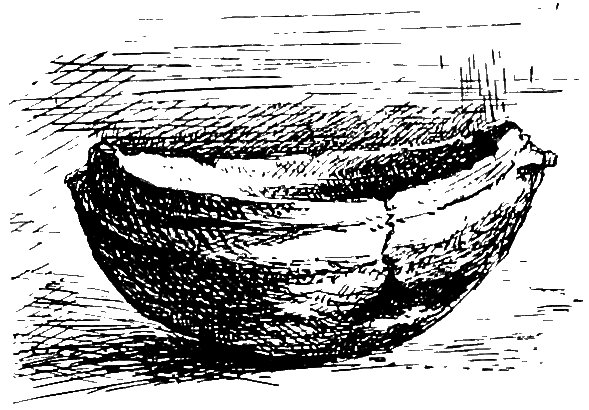
ARAWÂK BOWL
As in Hispaniola, the natives of Jamaica were ruled over by
caciques or chieftains. The estimates of historians of the number
of inhabitants in the West
Indian islands differ widely.
Las Casas says that the islands
abounded with inhabitants as
an ant-hill with ants, and
puts them down at 6,000,000.
But Peter Martyr gives but
1,200,000 to Hispaniola and,
taking this as a guide, there
would probably have been
about 600,000 in Jamaica—or,
roughly speaking, three-quarters
of its present population.
Not many were left
when the English took the
island in 1655.
Judged by the English standard, Indians are short in stature.
The Arawâks of Guiana to-day are described as being of a red
cinnamon in colour. The hair on the scalp is thick, long, very
straight and very black. The features of the face are strikingly
like those familiarly known as Chinese (Mongolian), and the expression
is decidedly gentle. Physically they are weak, and life hardly
ever exceeds fifty years. The natives of Jamaica—as a few skulls
found from time to time testify—possessed, in common with other
West Indian tribes, the peculiarity of tying boards on to the foreheads
2of their children in such a way that the skulls assumed and
permanently retained an extraordinarily flat shape.
Peter Martyr, who heard it spoken, said that the language in the
Greater Antilles was “soft and not less liquid than the Latin,” and
“rich in vowels and pleasant to the ear.” Of words of West Indian
origin, those most frequently in use in the English language are
avocado (aguacate) pear, barbecue, buccaneer, canoe, Carib and its
derivative cannibal, guava, hammock, hurricane, iguana, maize,
manatee, pirogue, potato and tobacco.
Columbus has told us of a cacique of Cuba who believed in a
future state dependent on one’s actions in this world, but Sir
Everard im Thurn found nothing of the kind amongst the Indians
of Guiana, and it is probable that Columbus’s guide from Guanahani
(Watling Island) only partially understood the cacique, or that
Columbus only partially understood his guide. Their houses were
primitive alike in shape and construction. In Jamaica, they were
probably circular, and were provided with walls of wattle work
plastered with mud, and with a high-pitched roof of palm leaves;
they probably had no windows. The Indians slept in hammocks.
The weapons of the Arawâks of Jamaica and the other large islands
consisted of darts and war clubs; but they apparently did not
possess bows and arrows, which were the form of weapons preferred
by the Caribs, and the use of which gave them a great advantage
over their more peaceful foes.
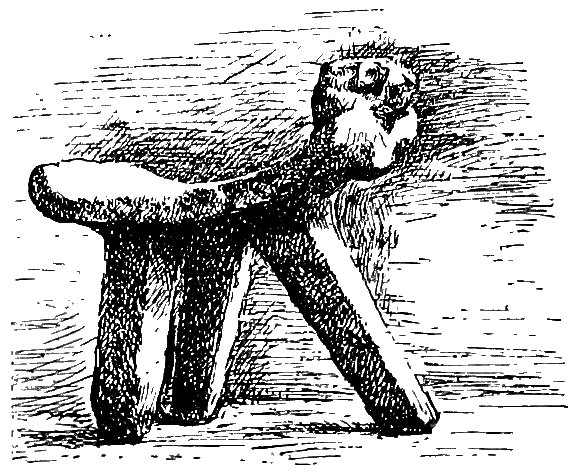
MEALING-STONE
Ornaments were more worn by the men than the women. Painting
was the simplest form of ornamentation; the colours used
being blue, black, carmine, white and yellow, derived from plants
and earths. They wore necklets of hogs’ teeth and stone beads,
crowns of feathers in their
heads, aprons of palm-leaves
or woven cotton, and bands
round their arms and legs.
Their chief occupations and
means of living were hunting
and fishing and agricultural
pursuits with, in some cases,
a certain amount of trading.
As they required nothing
more than canoes for travelling
on the water, simple
houses to live in, baskets
for domestic purposes, hammocks
for rest, rude weapons
of the chase, and implements
such as hatchets and chisels, earthen vessels, and a few ornaments
and articles of dress, these, with a few crude rock-carvings, formed
the sum total of their arts and manufactures.
In common with the other aborigines of the West Indies generally
3and with the natives of New Zealand and with all the nomad tribes
of the new world from Patagonia to the Arctic circle, the Arawâks
of Jamaica were, when discovered, without any knowledge of the
metals as such. From their kitchen middens we know that they
were great fish eaters.
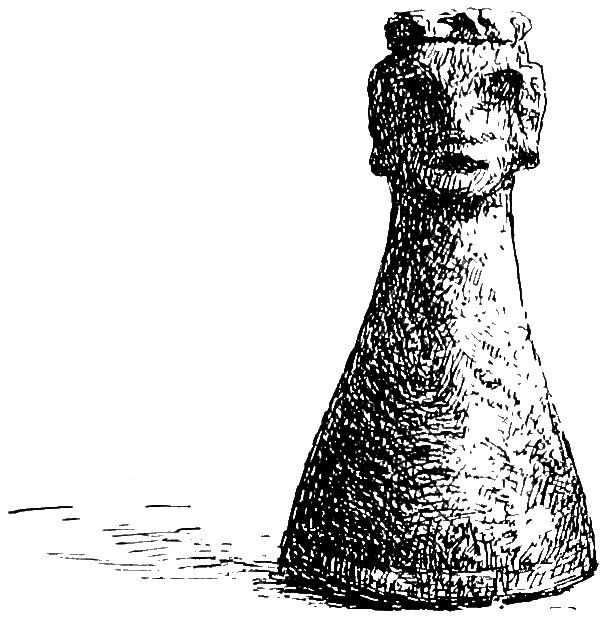
ARAWÂK PESTLE
Until 1895, but few remains had been discovered to testify to the
existence of a tribe which not so very long ago
lived by gathering the fruits of the land and sea
of Jamaica. During that and the following years
several collections of Indian remains were found.[2]
They are scattered fairly throughout the island,
except curiously enough, the eastern end, and are
thickly grouped in St. Andrew and Vere, in St.
Ann, and in the west end of Westmoreland. They
all supply objects similar in character and giving
evidence of no very high advance in civilization or
the arts; being considerably below those of
Mexico and Peru. The objects consist for the
most part of petaloid or almond-shaped polished
celts of metamorphic or igneous rocks, found
somewhat abundantly all over
the island; circular or oval,
shallow, unglazed bowls of
baked pottery, with but crude
ornamentation, used in the
preparation of food, and some
as mortuary vessels for the heads of their chiefs—found here and
there in the caves and on the sites of dwellings; calcedony beads,
hitherto found, curiously enough, only in Vere; stone and wooden
images and rock-carvings and the rock-pictures; and a few shell
and flint implements and mealing-stones rarely found.
2. For this subject consult “Aboriginal Indian Remains in Jamaica.
By J. E. Duerden, A.R.C.Sc., Kingston, Ja., 1897.”
It is to be regretted that many of the objects shown at an
exhibition of native remains held at the Institute of Jamaica in
1895, following on the discovery of the Halberstadt cave, as well
as others discovered later, should have been allowed to leave the
island. Such things once lost can rarely be regained.
Some of the early Spanish historians—putting as they frequently
did X for J—wrote the name of the island Xaymaca, but it appears
in its present form as early as 1511 in Peter Martyr’s “Decades.”
He called it Jamaica and Jamica. The island is unnamed in
Juan de la Cosa’s map of 1500.
Its first appearance in cartography is on the map made by
Bartolommeo Colombo, Columbus’s younger brother, to illustrate
the admiral’s fourth voyage, where it is spelled Jamaicha. In
4Cantino’s map (1502–04) it appears as Jamaiqua: in Caneiro as
Jamaiqua and in Waldseemüller’s map of 1507 as Jamaiana. In
the so-called Admiral’s map of 1507 it appears as Jamaqua: the
name does not appear in Ruysch’s map of 1508, but in the Ptolemaeus
edition, Strasburg 1513, it is given as Jamaiqua, and in the
Waldseemüller map of 1516 it is also Jamaiqua.
In the Maggiolo map of 1519 it is Jamaica, but in the Maggiolo
map of 1527 it is Jamaicha: in Ribero’s “Antilles” of 1529 and
in Mercator’s map of 1541 it is Jamaica: but in Herrera’s map of
1601, it goes back to the old form Xamaica, and as late as 1734
in Charlevoix’s “L’isle Espagnole,” it appears as Xamayca.
Amongst Englishmen who wrote of it from personal knowledge
immediately after the British occupation, Commissioner Butler
(1655) wrote it Gemecoe and Gemegoe. Daniell (1655) calls it
Jamico, Gwakin (1657) wrote it Jammaca, and General Fleetwood
(1658) wrote it Jamecah.
Columbus on his return from his first journey was told by the
natives when off Tortuga, that if he sailed in a certain direction
two days he would arrive at Babeque, where he would find gold.
Columbus mentions Babeque many times in his journals, but he
never found it, at least under that name. The “Historie,” of 1571,
identifies it with Hispaniola but this is doubted. Las Casas thought
that it might refer to Jamaica.
In common with most other West Indian native names Jamaica
has come to us through a Spanish source; and the native pronunciation
was possibly something like Hâmîca. Several derivations
have been given of the meaning of the word. The most
extraordinary is that which seeks to connect it with James II. On
Moll’s map of the island, published early in the eighteenth century,
it is stated that it was first called St. Jago by Columbus, who
discovered it, but that the name was afterwards changed to Jamaica,
after James, Duke of York. In this connection it is somewhat
sad to note that not one of the Greater Antilles retained the name
given to it by Columbus. Española, Santiago and Juana, went
back to their native Hayti, Jamaica and Cuba; and St. Juan
Bautista became Porto Rico, but Hispaniola still survives to some
extent and is the most convenient name for the island which
contains two republics. Of the smaller islands, the names of
Trinidad, Antigua, Dominica, Montserrat and Guadeloupe still
remind us of their great discoverer.
James Knight, in the rough draft of his history of Jamaica (1742)
in the British Museum, gives the following derivation of the word
Jamaica: “In the original it was Jamajaco. Jamo in the Indian
language is a country, and Jaco is water.”
John Atkins, in his “Voyage to the Guinea, Brazil, and the West
Indies” (1737), says that “Jamaica was altered by King James,
it being a compound of his name and ‘ca’ an island.” He was
possibly not far wrong in regard to the “island.” The West
5Indian word for an island, cai (or the Biscayan word cay) is supposed
to appear in Lucayos (Bahamas), “Men of the Island”; in
the Caicos islands, and also in various cays or keys in the West
Indies; albeit modern etymology makes cay or key the same word
as the Welsh cae.
Long wrote in 1774 that “it is not improbable that Jamaica
is a name of Indian extraction, perhaps derived from Jamacaru,
the Brazilian name of the prickly pear, which overspreads the
maritime parts of the south side, where the aboriginal Indian
discoverers of this island might have first landed,” but this derivation
has found no supporters among later writers.
Bryan Edwards, writing in 1793, says: “The early Spanish
historians wrote the word Xaymaca. It is said to have signified
in the language of the natives, a country abounding in springs.”
Bridges, who as a rule displays a more fertile imagination than
Long without half his trustworthiness as a historian, says, writing
in 1828: “In the speech of Florida, Chaübaan signified water
and makia wood (Lescarbot, I.6, c.6). The compound sound
would approach to Chab-makia; and, harmonized to the Spanish
ear, would be Chamakia, or some such indistinct union of these
two significant expressions, denoting a land covered with wood,
and therefore watered by shaded rivulets, or, in other words,
fertile.” This suggested origin has been usually adopted by later
writers. Why Bridges sought in Florida the meaning of words of
Jamaica, he does not explain. Carib and Arawâk are probably
the only two languages which Columbus heard spoken in the
Greater Antilles. Wood, in Arawâk, is ada; woods are in Arawâk
konoko and in Carib eotch; and water is in Arawâk winiab (Hillhouse)
or comiaboo (im Thurn), and in Carib tona.
Bryan Edwards points out that Fernando Columbus’s “Historie”
states that the Indian name of Antigua was Jamaica, and he adds:
“It is a singular circumstance that this word which in the language
of the larger islands signified a country abounding in springs,
should in the dialect of the Charaibs have been applied to an island
that has not a single spring or rivulet of fresh water in it.” Until
further research proves the contrary Jamaica must remain, what
it truly is, the land of woods and streams.
Apart from the name of the island itself, there are few names
of native origin left. These will be referred to in the body of the
work as they occur.
There is some difficulty in discriminating between the native
Indian and Spanish origin of West Indian names: and too great
a faith in the laws of philology are apt to lead one astray. Placenames
are not infrequently rather evolved in accordance with the
rule of phonetics.
On this subject Long wrote: “From the resemblance which the
language of these islanders bears in some respects to the Spanish,
I am apt to suspect that many of their words have been altered
6by the Spanish mode of pronunciation, and the difficulty which
the discoverers found in articulating and accenting them without
some intermixture of their own patronymic. In some this is
exceedingly obvious, where the letter b is used indiscriminately
for v, agreeably to their idiom. This perversion may easily lead
us to ascribe a Spanish or Moorish origin to the names of places,
such as rivers, mountains, headlands, &c., which in fact are of
Indian derivation. Thus the article gua, so commonly met with
both in these islands and on the Southern continent, was often
prefixed or appended to the Indian names of places and things;
and even of their provincial caciques. Of the latter were Gua-rionexius,
Gua-canarillus, Gua-naboa, and others. Of the former
a vast multitude occurs, as Gua-nama, Xa-gua, Gua-há-gua,
Camayá-gua, Aicayazá-gua, Má-gua, Nicará-gua, Verá-gua, Xará-guo,
Gua-ríco, Ni-gua (Chigger), etc., which may seem to confound
them with derivatives from the Spanish or Moorish word agua
(water). So the terminations, ao, ana, coa, and boa or voa, as
Manabax-ao, Cib-ao, Gu-ana, Magu-ana, Yagu-ana, Ligu-ana,
Zav-ana (Savannah), Furac-ana (Hurricane), Caym-ana, Guaiac-ana
(Guiacum), Haba-coa, Cuana-boa, and so forth. The names therefore
occurring in our island of Liguana, Cagua, Tilboa, Guanaboa,
Guadibocoa, and others of similar finals are with more propriety to
be traced from the Indian than the Spanish dialect.”
With regard to the Spanish occupation of the island both history
and archæology are almost as scantily supplied as in the case of
the Arawâks.
It is estimated that when Jamaica fell into the hands of the
English the population of the capital was half Spanish and Portuguese
or their descendants and half slaves; but it is a curious fact
that a negro is mentioned as holding the position of priest of the
Roman Catholic church.
The more important islands of Cuba and Hispaniola, to say
nothing of the rich mines of South America, offered greater attractions
to the Spaniards than did Jamaica, where—then, as now—the
field had to be ploughed before the harvest could be reaped.
They utilized for their hatos, or pastures, the low-lying lands on the
sea-coast, which had formerly been used by the native Arawâks
for the cultivation of Indian corn and cassava.
Of these hatos the principal were, going from east to west,
Morante (the name of which still lives in Morant Bay), Ayala
(Yallahs), Lezama (where Mona now is), Liguanea (Lower St.
Andrew), Guanaboa (the name of which still exists), Guatabaco
(about Old Harbour), Yama (in Vere), Pereda (Pedro Plains),
El Eado (behind Bluefields) and Cabonico (near Savanna-la-Mar).
7
8They had settlements at St. Jago de la Vega (the present Spanish
town, established in 1520), Puerto de Esquivella (Old Harbour,
named after the first governor about 1501), Parattee (still bearing
the same name), Oristan (Bluefield, named after a town in Sardinia
then subject to the crown of Spain), Savanna-la-Mar, Melilla
(in the north-west corner of St. James, named after a town on the
coast of Barbary, then in the possession of Spain), Sevilla Nueva
(St. Ann’s Bay), Chireras (Ocho Rios), Rio Nuevo and Hibanal
(somewhere near Buff Bay).
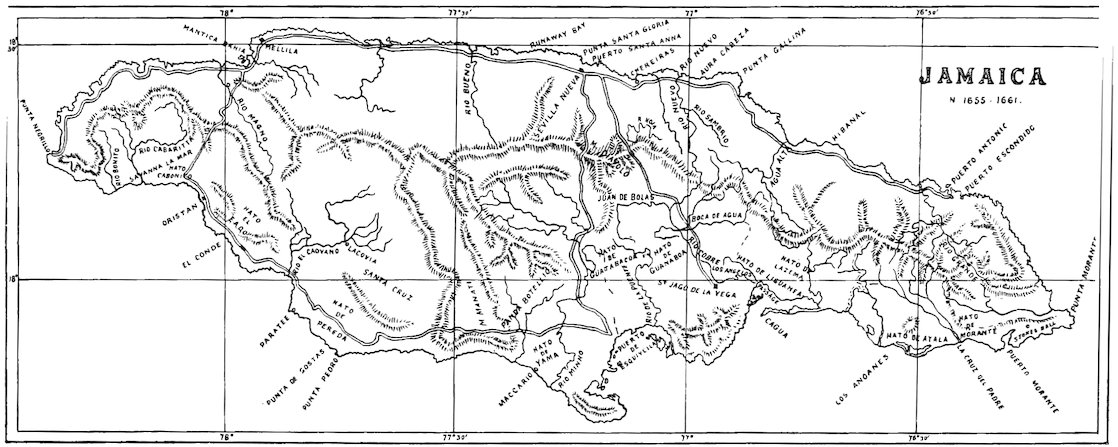
Roads ran from Puerto Antonio westerly along the coast to
Punta Negrilla, connecting their townships of Santa Anna, Melilla
and Manteca. From Manteca a road ran southerly to where
Savanna-la-Mar now is, and thence easterly to Old Harbour, and
thence northerly to Santa Anna.
There are but scanty remains of Spanish masonry in the island;
none of great importance. The “Columbian Magazine” in 1796
recorded that an old Spanish tavern, with laths of bamboo, was
taken down to make way for Rodney’s statue, and the adjacent
buildings, but there is, of course, no certain proof that this was
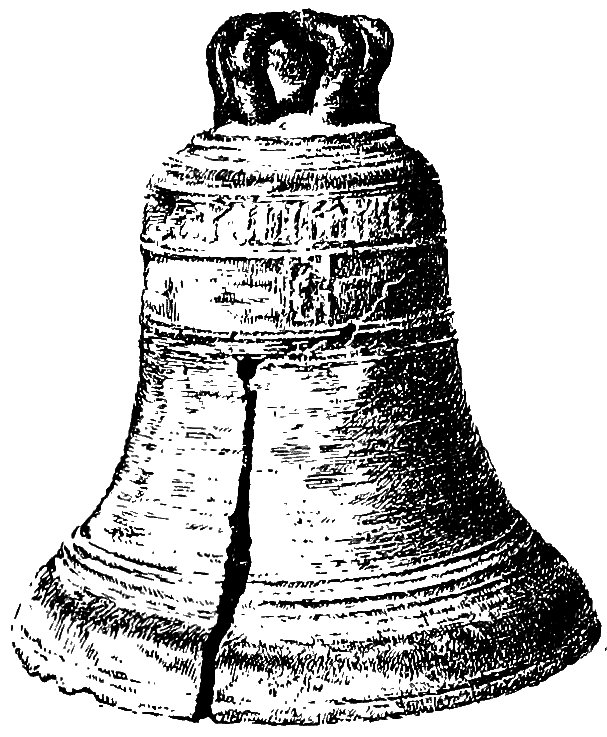
Spanish work. The only known relic of Spanish Jamaica is the
church bell from Port Royal now in the Institute of Jamaica.
Of their buildings in general, Sir Hans Sloane, who was here in
1687–88, only thirty-three years after the conquest, says that
they were “usually one storey high, having a porch, parlour, and
at each end a room, with small ones behind. They built with
posts put deep in the ground; on the sides their houses were
plastered up with clay or reeds, or made of the split trunks of
cabbage trees nailed close to one another and covered with tiles
or palmetto thatch. The lowness, as well as fixing the posts deep
in the earth, was for fear their houses should be ruined by earthquakes,
as well as for coolness.” It seems strange, according to
modern ideas, to build a house one storey only for coolness;
although one might do so for fear of earthquakes.
Long tells us that “a certain number of posts of the hardest
timber, generally lignum vitæ, brazilletto, or fustick, of about
18 feet in length and 6 to 8 inches in diameter, being first well-seasoned
and hardened in smoke, were fixed at proper distances
to the depth of 2 or 3 feet in the ground; then a wall of brick,
enclosing these posts, was carried up with very strong mortar
to the plate, which was pinned with wooden spikes to the tops
of the posts. The main rafters were small, but being of the like
hard wood, and perfectly well-seasoned, were sufficiently strong;
these were likewise pinned upon each other, and at their angle
of intersection at top formed a crutch to receive the ridge pole.
The smaller rafters were of the lesser ebony trees, stripped of their
bark, hardened in smoke, notched at bottom, and being placed
at the distance of about 18 inches from each other, were pinned to
the plate. Athwart these on all rafters a stratum of the wild cane
(Arundo Indica, bamboo species), previously smoked, was tied on
by way of wattling with straps made of the bark of mahoe or
9mangrove trees. Upon these wattles some mortar was laid, to the
thickness of about 4 inches; and the whole covered with large
pantiles, well bedded in. The thickness of these roofs, from the
outward shell or tile-covering to the ceiling within, was about
8 or 10 inches. A canopy of so solid a texture was certainly well
contrived to shelter the inhabitants from the disagreeable effects
of a vertical sun,” and accordingly it is found by experience that
these old Spanish houses are much cooler than our modern ones
covered with shingles. After regretting the failure to establish a
manufacture of tiles, and the importation of North American
shingles, Long goes on to say: “The chief error the Spaniards
committed in their buildings was the placing their ground floors
too low; these were nearly on a level with the surface of the earth
out of doors, or at most raised only a few inches higher.” In his
time there were, he tells us, upwards of fifty Spanish houses remaining
in Spanish Town “very little the worse for time or weather.”
Of Spanish names given to towns and villages, St. Jago de la
Vega (St. James of the plain) still survives in custom, although
supplanted officially by Spanish Town. So also do Ocho Rios,
Savanna-la-Mar (the plain by the sea) and Oracabessa; Esquivel
became Old Harbour soon after the British occupation.
Of the Spanish names of rivers, many survive; the principal
being Rio Alto (deep river), Rio Cobre (copper river), Rio Grande,
Rio Minho, Rio Bueno (the good river), Rio Magno (the great
river), Rio Novo (new river), Rio d’oro (golden river), Rio Pedro
(Peter’s river). It is thought that Rio Pedro may be a corruption
of Rio Piedra (stony river). The Rio Minho is said to have been
named after a river in Portugal or, as Long says in another place,
after some mine in the neighbourhood. It is thought by some
that it should be Rio Mina, (the river by the mine). Others are
named after rivers in Spain.
Amongst districts we have Santa Cruz (Holy Cross); as well as
Pedro both in St. Ann and in St. Elizabeth. The former is said
to have been named after Pedro Esquivel, the Spanish governor.
The following derivations of Spanish names in Jamaica are given
by Long. Notes by the present writer are added between square
brackets:
Auracabeza. Aura, air or breeze; Cabeza, head or high land.
[This is now Ora Cabessa in St. Mary. Others derive it from
Oro Cabeza, the golden head.]
Alta Mela. Deep Gap. (Alta Mela, Savannah, St. James.)
Agua Alta Bahia. Deep water Bay, corruptly Wag-Water.
[Still known as Wag Water.]
Los Angelos. The Angels. [Angels in St. Catherine was the
first terminus of the railway.]
Rio Bonito. The Pretty River.
10Cabo Bonito. The Pretty Cape. [In St. Catherine.]
Cabarita Punta. Kid or Goat Point. [In Westmoreland, where
there is a river of the same name; there is another Cabaritta
Point in Old Harbour Bay, and a Cabaritta Island in Port
Maria Harbour.]
Rio de Camarones. Perhaps from Gambaro, a crab, from the
abundance of black crabs hereabouts.
Cobre Rio. Copper River, or Cobra Port, Snake River. [Still
known as Rio Cobre.]
Caborido.Quasi Caba Arido, the dry or withered cape (part
of Healthshire highlands.)
Carvil or Caravel Bahia. Caravela signifies a light round kind of
a ship formerly used by the Spaniards.
Diablo Monte. Devil’s Mount. [Now called Mount Diavolo.]
Escondido Puerto. The hidden harbour. [In Portland; now
called Turtle Crawle Harbour.]
Flora Ria. Flower River.
Fortaleza Punta. Fort Point. [On Blome’s map there are two
in St. Ann.]
Gallina Punta. Hen Point. [Galina Point is in St. Mary.]
Guada Bocca. Guada, brook of water; boca, mouth.
Hoja Rio. River of leaves, now corruptly Riho Hoa. [Now
called Rio Hoe.]
Jarisse Punta. Cross-bow or arrow, probably refers to some
action with the Indians.
Javareen. Rustic expression, signifying a wild boar.
Lacovia.Quasi Lago-via, or the way by the lake. [A village in
St. Elizabeth. Elsewhere Long suggests it may be a corruption
of La agua via, the watery way. It was once in the possession
of the Gladstone family.]
Liguanea. Lia-withe-guana, the name of an animal, probably
one frequent in that part of the island. [That part of Lower
St. Andrew, bordered by the Long Mountain, the St. Andrew
Mountains and the Red Hills.]
Moneque or Monesca Savannah. Savannah of monkeys. [Now
confined to the village of Moneague.]
Mari bona. Maria-buena, Mary the Good. [Maria Buena Bay
is in Trelawny.]
Multi-bezon Rio. Multi, many; buzon, conduit.
Macari Bahia. Macari, a tile, such as is made for floors, which
the Spaniards universally used here and probably manufactured
them near this bay, the soil being proper for that purpose.
[Long adds as a footnote to Macari: “Or perhaps it may derive
more properly from the Indian word Macarij (which signifies
bitter), and allude to the tree commonly called the Majoe,
or Macary-bitter which grows in great abundance along this
part of the coast, and with whose leaves, bark and root, which
are all of them extremely bitter, some very notable cures in
11cases of inveterate ulcers, the yaws, and venereal distempers,
were some years ago performed by an old negress named
Majoe, in commemoration of whom it took its name.” Macary
Bay is in Vere. Majoe Bitter, or Macary Bitter (Picramnia
Antidesnia Sus.) is a shrub about 8 feet high, with small
whitish green flowers, and berries first scarlet, then black.]
Mantica Bahia. Butter (now Montego Bay). This part abounding
formerly with wild hogs, the Spaniards probably made
here what they called hog’s butter (lard) for exportation.
[In a very old deed of conveyance of land in St. James a road
is marked as leading to Lard Bay.]
Ocho Rios said to mean eight rivers. [In St. Ann. It was more
commonly called Chareiras in Long’s time; and indeed as
late as 1841, William Rob wrote “Ocho Rios, called to this
day by the old inhabitants ‘Cheireras,’ its early and appropriate
name ‘the Bay of the Water-Falls,’ but has now gone
back to Ocho Rios.” It is not unlikely that the present form
Ocho Rios and the derivation from eight rivers is wrong, and
that the real name is Chorréra, a spout. There is a Chorréra
River in Cuba, near Havannah.]
Perexil Insula. Samphire Island.
Sombrio Rio. Shady river. [Now called the Sambre.]
Yalos. Frosts (whence, perhaps corruptly, Yallahs), the high
white cliffs having the appearance of a frosty covering. [Now
called Yallahs. Long was probably wrong in connecting
Yallahs with Yalos. The Hatô de Ayala extended from Bull
Bay nearly to Morant Bay, and the name is probably a personal
one. Pedro Lopez de Ayala was a celebrated poet and
politician in the fourteenth century; Pedro de Ayala was
Spanish envoy to the Court of St. James in 1498; and,
curiously, a recent Spanish representative at Havana bore the
name de Ayala. There was a Captain Yhallahs, a privateer
who flourished in Jamaica in and about 1671, and the locality
may have been named after him.]
Luidas. Perhaps from Luzida; gay, fine. [Lluidas Vale is in
St. Catherine.]
Martha Brea. Martha, a woman’s name; Brea, tar; perhaps
a nickname of some Spanish sailor’s Dulcinea like the English
vulgar appellation Jack Tar. [Martha Brea village and river
are in Trelawny. The name is a corruption of Rio Matibereon.]
No traces are to be found to-day of the following: Alta Mela,
Rio de Camarones, Caborida, Carvil Bahia, Guada Bocca, Jarisse
Punta, Javareen, Multi Bezon Rio, Perexil Insula.
Of corruptions of Spanish names the best known are: Agualta
(Agua Alta, the deep river); Bog Walk (Boca d’Agua, water’s
mouth); and Mount Diablo. Cagua became with the English
Caguay, then Cagway when it was renamed Port Royal.
12Those who see in Porus a survival of the name of Columbus’s
companion, Porras, are probably drawing on a fertile imagination.
Columbus and his companions saw little of the interior of the
island. It is more probably called after some well sunk there,
or from the porous nature of the soil, “pitted with holes.” In the
English edition of Ferdinand Columbus’s “Historie,” we read
that the Morant Cays were called by Columbus Los Poros because
“not finding water in them they dug pits in the sand”; but in
the Italian edition (Venice, 1571) they are called “le pozzi” (the
pits), and in the Spanish edition of 1749 they are called “Las
Poças” (the pits). It is possible that in the case of Porus, as in
that of the Morant Cays, there has been a confusion between Poros
and Pocas; and that the town in Manchester should be called
Poças. The Spaniards called the Black River, el Caovana (the
Mahogany River).
In the English section of Jamaica history for the two centuries
from 1655 to 1855, there is a wide field of exploration.
What with earthquakes, hurricanes and floods, the march of time,
and rebuilding, the typical old-time planter’s houses are getting
scarcer. Then, again, there are the monuments and gravestones
which contribute to our knowledge of Jamaica genealogy and history.
Captain Lawrence-Archer, in the middle of the last century, did
much in his “Monumental Inscriptions of the British West Indies,”
to put this information in a handy form, but his work, which is
often inaccurate, by no means covers the whole field. Something
of late years has been done in that direction by Mr. Oliver in
“Caribbeana.”
Although Jamaica is probably no worse than other countries
in its disregard for ancient monuments, that there is need for
improvement cannot be denied by those who have looked into the
matter. The Spanish invaders burned the Arawâk huts; the
old-time English planters despoiled Spanish buildings to find
material for their sugar works; and in our own day a ruined
seventeenth-century building which withstood the recent earthquake
was later pulled down by peasants for the sake of its stones.
When Lawrence-Archer wrote less than fifty years ago, he recorded
a statue by Bacon to Richard Batty in the cathedral. Only a
fragment of it remains to-day. The author of his epitaph little
thought that the literal truth of part of it would be so early established
when he wrote in 1796:
“Yet vain the Record, which sculptured stone
Would raise to those pre-eminently known.”
The most strongly constructed building will wear out with time
and, in the tropics especially, vegetation is apt to interfere with
monuments and gravestones; but a little care without much
expense should be all that is needed to render unnecessary an
13expensive restoration, which many individuals and bodies find
themselves unprepared to meet and which, after all, can never take
the place of preservation.
In 1672 Port Royal contained 800 well-built houses, “as dear
rented,” Blome tells us, “as if they stood in well-traded streets in
London.” Twenty years later, when it was at its zenith, the number
was 2000, “the greatest number of which were of brick, several
storeys in height.” In 1692, as is well known, a large part of the
town perished by an earthquake, and from that event Kingston
dates its origin, Port Royal being partially destroyed again, by fire,
in 1703 and by hurricane in 1722.
Charles Leslie, writing in 1739, says of Jamaica: “One is not
to look for the beauties of architecture here; the public buildings
are neat but not fine. The churches in the town are generally in
form of a cross, with a small cupola a-top, built high in the walls,
paved within, and adorned with no manner of finery.” The
churches, he says, except those at Spanish Town and Halfway-Tree,
are “decent small houses, scarce to be known for such,”
and he adds, “the clergy trouble them little, and their doors are
seldom open,” in marked contrast to the present state of affairs.
“The gentlemen’s houses,” he says, “are generally built low,
of one storey, consisting of five or six handsome apartments,
beautifully lined and floored with mahogany.... In the towns
there are several houses which are two storeys, but that way of
building is disapproved of because they seldom are known to stand
the shock of an earthquake or the fury of a storm.”
On Craskell and Simpson’s large map of Surrey, of the year 1763,
is shown a view of a presumably typical Jamaica house, two storeys
high, with an open veranda in front only. It is evident from
what Long says that, at all events for the first century of the
island’s occupation by the British, not much attention was paid
to domestic architecture by the planters of the island. “It is,”
he says, “but of late that the planters have paid much attention
to elegance in their habitations; their general rule was to build
what they called a makeshift; so that it was not unusual to see
a plantation adorned with a very expensive set of works, of brick
or stone, well executed, and the owner residing in a miserable
thatched hovel, hastily put together with wattles and plaster,
damp, unwholesome, and infested with every species of vermin.
But the houses in general, as well in the country parts as in
the towns, have been greatly improved within these last twenty
years.”
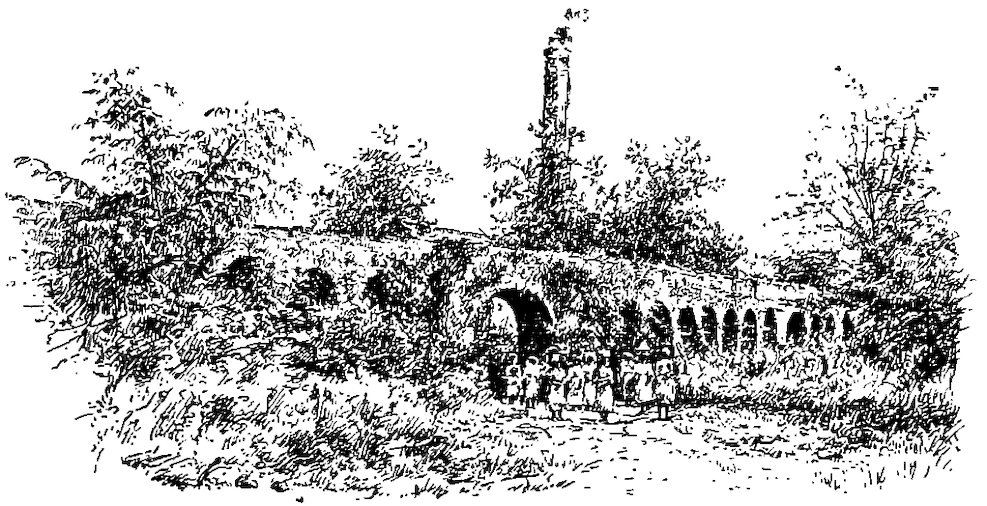
In this connection mention may be made of the aqueducts on
some of the sugar estates, which are amongst the best pieces of
architectural work in the island. They and some of the old stone
bridges compare more than favourably with the modern bridges,
many of which—excellent monuments of engineering skill as they
14may be—their best friends would never venture to call works of
art. Moreover the stone bridges will probably be standing when
the iron ones have perished by decay.
Peter Marsden, writing a little later (1788), says: “Except
a few excellent houses which have lately been built of brick and
two or three of stone, after the English fashion, by rich merchants,
the houses are in general of wood, very often mahogany, which is
plentiful in this island. They consist but of a room or two below
stairs, with piazzas all round and a storey above.” Stewart,
whose account of the island was published in 1808, gives much
the same account of the domestic houses, but goes on to say:
“As for bridges and other public structures of the kind, in this
part of the world there are few that deserve mention, except a
neat cast-iron bridge imported from Great Britain and some years
ago thrown across the Rio Cobra. There is, indeed, often a marked
deficiency here of public spirit in undertakings of this sort.”
Many of the houses on the sea-coast were, in the eighteenth
century, made defensible with loopholes and fortified by guns,
so as to guard against the attacks in war time of the enemy’s
privateers. In other cases a like precaution was taken against the
risings of slaves; houses in some instances being supplied with
towers at the corners, each of which commanded two sides of the
building.
Of direct records of slavery days there are not many prominent
relics.
Here and there a punishment cell is found, with indications of
the fixing of shackles; but of stocks and such-like implements
no traces remain. A few examples of branding-irons exist. In this
connection it may be of interest to quote Bryan Edwards’s account
of the method adopted in branding slaves:
“A gentleman of my acquaintance, who had purchased at the
same time ten Koromantyn boys and the like number of Eboes
(the eldest of the whole apparently not more than thirteen years
of age) caused them all to be collected and brought before him
in my presence, to be marked on the breast. This operation is
performed by heating a small silver brand composed of one or
two letters, in the flame of spirits of wine, and applying it to the
skin, which is previously anointed with sweet oil. The application
is instantaneous and the pain momentary. Nevertheless, it may
be easily supposed that the apparatus must have a frightful appearance
to a child. Accordingly when the first boy, who happened
to be one of the Eboes, and the stoutest of the whole, was led
forward to receive the mark, he screamed dreadfully, while his
companions of the same nation manifested strong emotions of
sympathetic terror. The gentleman stopt his hand, but the
Koromantyn boys, laughing aloud, and, immediately coming
forward of their own accord, offered their bosoms undauntedly
15to the brand, and receiving its impression without flinching in the
least, snapt their fingers in exultation over the poor Eboes.”
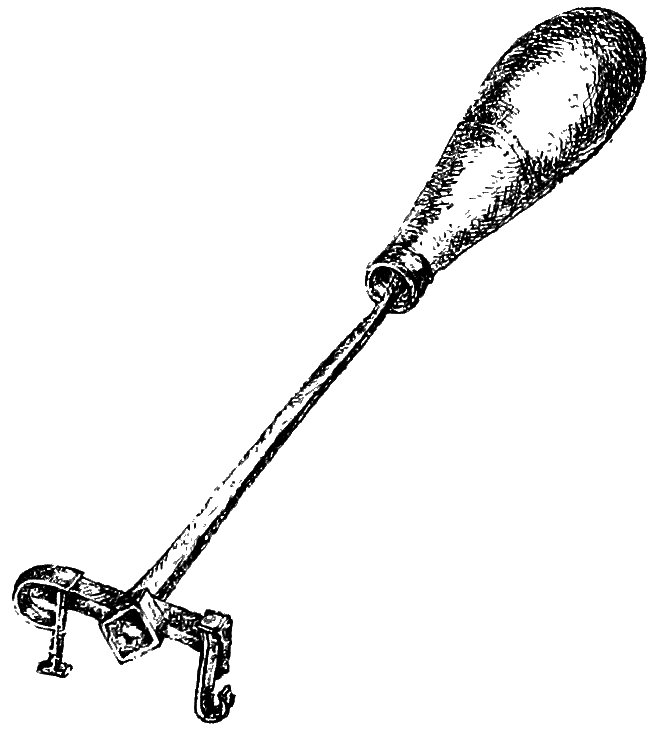
A branding-iron such as that mentioned above, in the Institute
of Jamaica, is shown in the accompanying illustration. It is
6⅞ inches in length.
BRANDING-IRON
Doyley’s Council had been elected by the people, and so, in a
sense, was a forerunner
of the Assembly. But
the first regular Assembly
was summoned
by Lyttelton and met
at Spanish Town on
January 20, 1664, and
from that day until
the Assembly of the
time resigned its
powers to the Crown
on December 21, 1865,
the political destiny of
the colony is to be read
in the pages of its
Journal and its Votes.
The first Assembly
chose as its speaker
Robert Freeman, who
represented Morant,
one of the then twelve
districts that returned
members.
The troubles which
Doyley, the first governor, had had in inducing adventure-loving
soldiers to become planters had given place to a more
settled state of affairs, and when the House rose on February 12,
1664, it “parted with all kindness and feastings, having passed as good
a body of laws as could be expected from such young statesmen.”
But this peaceful condition was not destined to last. Familiarity
with legislative functions bred contempt for the opinions of others,
and unreasonable demands on the part of these young statesmen
were met by high-handed actions on the part of the Crown.
In his opening speech to the Assembly Carlisle said that the
King looked on Jamaica as “his darling plantation, and has taken
more pains to make this island happy than any other of his colonies.”
These kind words were, however, nullified by the fact that the new
governor had brought with him forty acts which Charles had had
drawn up (and to which he had affixed the great seal of England)
in lieu of the acts which the Assembly had passed under Vaughan,
and that he was instructed to get the House to pass them. This
16plan had been suggested in a letter written in England by a Mr. Nevil
(who was evidently acquainted with Jamaica) to Carlisle just before
he started to take up his appointment, and had been adopted because—to
quote the words of the Lords of Trade and Plantations to the
King in Council—“of the irregular, violent and unwarrantable
proceedings of the Assembly.”
The virtual point of difference was this, that under the original
constitution the island (through the Governor, Council and Assembly)
made its own laws in accordance with what it conceived to be its
needs and sent them home for approval, they remaining in force
for two years till the royal pleasure was known, while under the
new arrangement (based on Poynings’s Law, or the Statutes of
Drogheda, in use in Ireland), the laws were to be made in England
(on the advice of the Governor and Council), and remitted for the
approval of the Assembly. The style of enactment was altered
from the “Governor, Council and Assembly, etc.” to the “King,
by and with the advice, etc. of the Assembly.”
This proposed change, which had been decided on by the Lords
of Trade and Plantations, in opposition to the advice of Lynch,
who knew Jamaica well—the Assembly resisted with might and
main, but though they were in a very great measure successful,
it was not until 1728 that the complete legislative power for which
Jamaica contended was granted.
Lynch, when he returned as governor, was able to tell the people
of Jamaica, “His Majesty, upon the Assembly’s humble address,
was pleased to restore us to our beloved form of making laws, wherein
we enjoy beyond dispute all the deliberative powers in our Assembly
that the House of Commons enjoy in their House.”
In return for the constitution now conceded the Assembly pledged
itself to grant to the King a fixed revenue, which if not perpetual
should at least last for seven years. The quarrel, however, with
regard to the revenue bills lasted up till 1728; the Crown desiring
a perpetual revenue, the Assembly persistently declining to do
more than grant bills for a few years’ duration. The Crown on the
other hand declined to approve many of their laws. In 1728 the
Assembly gave way and settled a permanent revenue in return for
the royal confirmation of various acts of importance to the island
and a concession as to their past laws which they regarded as “the
grand charter of their liberties.”
To return for a moment to the early struggles, we find that
under the Duke of Albemarle, a very unwise governor, matters
were far from satisfactory. He dissolved the House suddenly
because one of the members, John Towers, in a debate repeated the
old adage salus populi suprema lex, in protesting against the Speaker’s
refusal to grant him permission to attend a race meeting. Albemarle
had the offender taken in custody and fined £600. In his dispatch
on the subject he wrote: “The Assembly have done very little,
the major part having made it their business to wrangle and oppose
17all things that are for the King’s service and the good of the country.”
The freedom of election was grossly violated by the duke, who
admitted hosts of servants and discharged seamen to the poll at
the election, and actually imprisoned many legal voters of wealth
and consideration. He imposed fines on the latter to a large
amount, and threatened to whip two gentlemen for requesting a
habeas corpus for their friends. In spite of this he had the effrontery
to write home to the Board of Trade and Plantations: “While the
elections were going forward there were unwarrantable oppositions
made in most parishes as well as malicious practices to prevent
fair election!”
His successor, Inchiquin, met with considerable opposition from
a section of the Assembly whose temper had been ruffled by Albemarle’s
arbitrary government, and whom he treated in a somewhat
tactless manner. That they would not do what he wanted he
considered “an indignity and affront to himself and the board.”
He finally rejected their address of congratulation, and “then it was
thrown to them with some contempt.”
The franchise established by the law of 1681 for appointing the
members of the Assembly was still in force in 1812: “Freeholders
in the same parish where the election is to be made.” At a by-election
in 1804, in St. Andrew, seventy-nine freeholders voted,
forty-six for the successful candidate.
The House met usually from October to Christmas, the time
of the year when the planters could be absent from their estates
with least inconvenience.
The closing scene in the life of the Assembly was acted on December
21, 1865, around amendments to the “Act to alter and
amend the Political Constitution of the Island,” and especially to
that to the second clause, which ran:
“It shall be lawful for Her Majesty’s Imperial Government to
assume the entire management and control of the affairs of this
island, and by orders in Council or otherwise, as Her Majesty may
be advised, to conduct the affairs of this island as Her Majesty may
think fit: and such orders shall have the effect and force of law.”
The Council’s amendment was as follows:
“It shall be lawful for Her Majesty the Queen to create and constitute
a Government in this island, in such form and with such
power as to Her Majesty shall seem fit, and from time to time to
alter and amend such Government.”
The Legislative Council had adjourned while their amendments
to the Constitution Bill were being discussed by the Assembly,
and some of them were in the House during the discussion. So
soon as they saw that the amendments had passed, they retired
and formed a board, which passed the bill in almost ten minutes
after it left the Assembly.
18In proroguing the assembly on the following day Governor Eyre
said:
“In releasing you from further attendance upon your legislative
duties, I cannot lose sight of the probability that you may never
be called upon to exercise these duties again, under the existing
form of constitution, and that this general sacrifice has been consummated
by yourselves from an earnest and sincere desire,
regardless of all personal considerations, to benefit the colony.
“On behalf of the colony and of the many interests associated
with it, I return you the thanks which are so justly your due.
History will record the heroic act, and I trust that history will
show from the ameliorated state of the country, and a renewed
prosperity, that your noble self devotion has not been in
vain.”
In concluding, he said, with reference to the Morant Bay outbreak:
“The session which is now about to terminate has been the most
important that has ever taken place since Jamaica became a
dependency of the British Crown.
“It is impossible to help regretting the necessity which has
enforced the abandonment of institutions so deservedly dear to
every British heart, and which, even in this colony, have remained
unchanged for a period of 200 years; but it is wiser and better,
circumstanced as we are, to give up institutions which are valued
rather for the associations which are connected with them, than
for any advantages which have resulted to the colony from their
existence in Jamaica, and to substitute in their place a perhaps
less showy and less time-honoured form of Government, but which
is certainly more practicable and better suited to the altered circumstances
of our position.
“Well, I think, it is that we have taken warning by the terrible
circumstances which have forced upon us the conviction that a
Government, to be effective, in times of difficulty and danger,
must be a strong and united one; and well will it be if by a voluntary
reconstruction, the community may receive some compensation in
future good government, for the dreadful calamity with which it
has just been afflicted.”
The House took a deep interest from time to time in the barracks
for which they voted funds. In 1702 orders were received from
home to build barracks to receive 3000 men. Handasyd, the
Lieutenant-governor, said that it would cost more than £40,000
“where such buildings are unreasonably dear” to build such as
were built in Ireland, but that suitable barracks could be built of
wood for £3000.
The following account of the state of the forts and barracks in
the island in May 1745, taken from the “Journals of the House
of Assembly,” may be fittingly quoted here.
19“Then the House resolved itself into a Committee of the whole
House, upon the report made on Friday last, of the number and
condition of the barracks already built, and of such others as were
necessary to be provided; and the plans laid before the House, and
the said report, being read, is in the words following:
Mr. Speaker,—Your Committee, appointed to make enquiry into
the number and condition of the barracks already built, and what
more shall be necessary to be provided, have accordingly done the
same; and, by the best information they have been able to get,
find to be as follows:
Port-Morant. A complete barrack, newly built by the Parish of
St.-Thomas-in-the-East, framed, boarded, and shingled, in good
order, which will contain about sixty men.
Manchioneal. A barrack, formerly built by the said parish of
St.-Thomas-in-the-East, which will contain thirty men; the body
built with stone, a framed roof, wants new shingling, and already
ordered to be forthwith done, and to be put in good repair.
Morant-Bay. A new barrack now building at the expense of the
aforesaid parish of St.-Thomas-in-the-East for twenty-five men.
Yallahs Bay. A large house with proper conveniencies belonging
to Mr. Donaldson, already hired for a barrack, to receive twenty-five
men.
Cow-Bay. A barrack for twenty men going to be built, by Mr.
Vallete, in the room of the former barrack destroyed by the hurricane.
Westmoreland. A barrack already built, capable of receiving a
whole company, situate at Savanna-la-Mar, as informed by Mr. Hall.
St. Ann’s. A barrack now building at St. Ann’s Bay, and is
calculated to be a crutched house, wattled and plastered, and
capable to receive fifty men, as informed by Mr. Whitehorne.
Moneague. A barrack which now lodges twenty men, and
capable of holding thirty; is at present water-tight, but will soon
want new shingling, as informed by lieutenant Troah.
Vere. The barrack was blown down in the late hurricane but
the parish has agreed with Mr. Pusey for his storehouse in Carlisle
Bay, which is boarded, shingled and in good order and capable
to receive one hundred men.
St. Elizabeth. A barrack situate at Black-River; it being a
crutched house, wattled and plastered, injured by the storm, but
is now ordered by the parish to be repaired.
St. James. A barrack at St. James, of a hundred feet long
and twenty feet wide, with a stone wall, a framed roof, well shingled,
in good order, which will completely contain fifty men as informed
by Mr. Hall.
Hanover. A barrack situate at Lusea-Fort, which will be capable
of receiving fifty men; a crutched house, wattled, plastered and
thatched, in good order; and a convenient house for the reception
of four officers, well shingled and floored.
20Port Antonio. A barrack in good order, which now lodges one
company, and will soon be in a condition to receive another, by
the information of lieutenant Bailey.
St. Mary’s. No barrack built in said parish, but as the Committee
are informed his excellency intends to send some
soldiers for their protection, a barrack is necessary to be forthwith
built.
Old Harbour. No barrack built, but the parish of St. Dorothy
have hired a house for a detachment of thirty soldiers, as informed
by Mr. Edmund Pusey.
Spanish Town. The barrack-house is in good order, the officers’
cook-room wants repairing, the cook-room for the private men is
entirely down, and the palisado enclosure, on the back part of the
out-houses, carried away by the late storm; said barrack contains
sixty men.
The Committee are informed that his excellency intends four
companies of soldiers to be in this town, if proper lodgements were
provided for them; and, as the barrack contains so few, it will
be necessary either to enlarge the present barrack or to buy such
house or houses as may be convenient and sufficient to lodge the
aforesaid four companies, as are intended for this town; but as
we are informed that the house belonging to the estate of the late
Colonel Heywood is as proper and convenient for the purpose
aforesaid as any building in this town, and to be sold, we think
proper to lay before the house a plan relating thereto, as also a
plan of a barrack to be built adjoining to the present barrack, or
such other place as shall be judged most convenient; all which
is submitted to the consideration of the house.
Kingston. No barracks built, and his excellency is willing to
let this town have one or more companies of His Majesty’s troops
was there proper lodgement to receive them.
Port Royal. The barracks in that town being too small for
receiving the number of men intended to be quartered there, your
Committee are informed that said barracks are to be enlarged for
that purpose.
And, after some time spent in the Committee, Mr. Speaker
resumed the chair, and Mr. Chief Justice, from a Committee, reported
that they had gone through the matter to them referred, and come
to several resolutions, which he read in his place, and afterwards
delivered them in at the table; where they being again read were
agreed unto by the House, and are as follows:
1. Resolved. It is the opinion of this Committee, that it be
recommended to the House, to appoint a Committee to bring in a
bill for obliging the several parishes to repair and keep up the
respective barracks already built.
Ordered. That Mr. Fuller, Mr. Fearon and Mr. March be a
committee for that purpose.
2. Resolved. It is the opinion of this Committee, that it be
21recommended to the House, to appoint a committee to treat with
the attornies of Abraham Elton and Mary Heywood for the purchase
of a house and footland, late of James Heywood, deceased,
for a barrack for the service of the public.
Ordered. That Mr. Arcedeckne, Mr. R. Beckford and Mr. Fuller
be a committee for that purpose.
3. Resolved. It is the opinion of this Committee that a barrack
be built at Kingston, at the expense of the parish of Kingston.
4. Resolved. It is the opinion of this Committee that the barrack
at Port-Royal be enlarged.
Ordered. That it be an instruction to the committee appointed
to bring in the bill for obliging the several parishes to repair and
keep up the respective barracks already built, to insert a clause
therein to oblige the parish of Kingston to build a barrack at the
expense of the parish.”
We learn from Foster’s “Alumini Oxonienses” that William
Dennys, of New College, a chaplain who took his B.A. degree in
1652, obtained leave of absence from the parliamentary visitors,
for special service at sea in 1654, and died at Jamaica in 1655. He
probably came out with Penn and Venables, and predeceased Thomas
Gage who was chaplain to the expedition.
In 1655, the very year in which the English took the island,
Admiral William Goodson, one of the Commissioners charged with
the conduct of Penn and Venables’s expedition, requested that
“some godly ministers with monies for their maintenance” should
be sent out. Two years later the want of ministers in Jamaica
was referred by the Council of State to the Committee for America
for suggestions. It was one of the instructions to Doyley, when
he was made governor in 1661, that he should give the best encouragement
to ministers “that Christianity and the Protestant religion,
according to the profession of the Church of England, may have
due reverence amongst them”; and later in the year it was resolved
that the Archbishop of Canterbury and the Bishop of London should
choose five able ministers to be maintained in Jamaica at the King’s
expense for one year, the governor to provide for their maintenance
afterwards.
In 1664 Sir Thomas Modyford, the governor, stated that there
was “but one church (in the whole island) at St. Katherine’s [at
Spanish Town], being a fair Spanish Church ruined by the old
soldiers, but lately in some measure repaired by Sir Charles Lyttelton;
but they are now levying contributions to raise churches in
some of the richest parishes.” There were then five ministers in
the island, Henry Howser (a Switzer) being at St. Catherine’s.
In 1671 Sir Thomas Modyford replied to enquiries of His Majesty’s
Commissioners that: “Their Lordships will find among the statutes
with these presented a law for the maintenance of the ministry;
until this His Majesty was piously pleased to pay five ministers
22£100 each, but since they were left upon the charity of the inhabitants,
he has encouraged them to enlarge their payments at St.
Katherine’s, where he lives, from £50 to £140, and at Port Royal
£200. At St. Katherine’s, Mr. Howser, a Switzer, officiates; at
Port Royal, Mr. Maxwell, a Scotchman; at St. John’s, Mr. Lemmings,
an Englishman, lately sent by my Lord of London; and
in St. Andrew’s, Mr. Zellers, another Switzer; all these are orthodox
men, of good life and conversation, live comfortably on their means,
and preach every Sunday. Mr. Pickering, of St. Thomas and St.
David’s, at Port Morant and Yallows, is lately dead, and they have
none to supply his place. But, alas, these five do not preach to
one-third of the island, and the plantations are at such distance
that it is impossible to make up congregations; but they meet
at each others’ houses, as the primitive Christians did, and there
pray, read a chapter, sing a psalm, and home again; so that did
not the accessors to this island come so well instructed in the article
of faith, it might well be feared the Christian religion would be
quite forgot. I have, my Lords, and shall use all the persuasive
means I can to advance this people’s knowledge of the true God,
as also of all Christian and moral virtues.”
In 1675 a Mr. Crandfield reported that there were six churches
and four ministers, and two years later there were but three clergy
in the island. In a MS., once in the House of Assembly Library,
entitled “The State of the Church in His Majesty’s Island of
Jamaica,” dated May 1675 (which was allowed to perish after
Richard Hill quoted from it in 1864), it was stated, after enumerating
the then stipended ministers of religion: “All the other parishes
on the northside, and St. Elizabeth’s on the south, are great and
ill-settled, without churches, they being almost planted in Sir
Thomas Lynch’s time, who ordered Glebe lands to be reserved in
two or three places in every parish, that in time may prove convenient.”
In 1677 Howser and Zellers, “His Majesty’s chaplains in Jamaica,”
petitioned that they might receive the pay promised to them, and
declared that “the island, in regard of its great poverty, is not
able to allow maintenance for four chaplains resident there.” In
the same year the Bishop of London represented the ill-usage of
ministers in the Plantations, and their too great subjection to the
vestrymen, especially in Jamaica; and the Lords of Trade and
Plantations resolved that the clergy should, in future, “make a
part of the vestry in the regulation of all matters, except in the
settlement of their maintenance.”
In 1681 an Act was passed for the maintenance of ministers and
the poor, and erecting and repairing churches. Ten vestrymen
and two churchwardens were yearly elected by the freeholders of
each parish. The law provided for the keeping of a register of
births, christenings, marriages and burials. Port Royal was to
pay £250 to its minister, St. Catherine £120, St. Thomas, St. Andrew
23and St. John £100, and other parishes £80. These stipends were
apparently not sufficient inducement, for in 1706 an Act was passed
“for the encouragement of good and able ministers to come to this
island.” The salary of St. Catherine was fixed at £150 (or £250 if
the vestry wished); for St. Thomas-in-the-Vale, St. Dorothy,
Kingston, Vere, and Clarendon, it was £150 (or £200), and for the
other parishes (including Port Royal, by reason of its recent disasters)
£100 (or £150 if the vestry wished). This system of payment of the
rectors by the parishes was continued till late in the eighteenth
century, when they were placed on the Island Establishment.
In 1682 Sir Thomas Lynch sent home to the Bishop of London
a detailed report of the state of the Church in Jamaica. He says:
“At St. Jaga de la Vega the minister is also a Swiss, Mr. Howsyer;
he has £140 a year by law, and, since I came, £150. He is a reasonable
preacher, a good liver, well esteemed, and very rich. The
church is a Spanish church, and the parsonage good. The parish is
called St. Catherine’s.”
When, by an Act passed in 1789, burying in churches was prohibited,
on penalty of £500 imposed on any rector who permitted it,
the rectors received compensation in lieu of fees, the largest amount
falling to the rector of Kingston, who received £100 per annum,
St. Catherine being next with £70.
As evidence of the relative value of the livings in the island at
the time it is interesting to quote from the “Jamaica Magazine”
that in November 1814, “The Reverend Alexander Campbell has
been translated from the living of Kingston to that of St. Andrew’s,
vacant by the death of his father, the reverend John Campbell;
the Reverend Isaac Mann to that of Kingston; the Reverend
William Vaughan Hamilton from St. Elizabeth’s to St. Catherine’s;
and the Reverend William Peat from St. Dorothy’s to St. Elizabeth’s.”
In 1800 Ecclesiastical Commissioners were appointed. But it is
evident that they had not been able to effect much by April 1802,
when Lady Nugent wrote: “I will conclude my tour through the
island with a few remarks. In this country it appears as if everything
were bought and sold. Clergymen make no secret of making a
traffic of their livings; but General N—— has set his face against
such proceedings, and has refused many applications for the purpose.
He is determined to do all he can towards the reformation of the
Church, and thus rendering it respectable. It is indeed melancholy
to see the general disregard of both religion and morality throughout
the whole island.”
Matters were much improved when the see of Jamaica, which
then included the Bahamas and British Honduras, was formed in
1824; and in 1870, when Disestablishment threw the Church almost
entirely on to voluntary resources, it gave to it a new vitality.
Many of the old Baptismal, Marriage and Burial registers are
deposited for safe keeping in the Record Office at Spanish Town,
24where all the old church registers should be, as they would there
have a chance of longer life than when exposed to the vicissitudes
of local vestries, and would, moreover, be more readily available for
research than when scattered throughout the island.
It may be convenient to give here a list of the earliest date of the
Baptismal, Marriage and Burial registers for the island, taken
from “Sketch Pedigrees of some of the early Settlers in Jamaica.
By Noel B. Livingston, Kingston 1909.”
Earliest Date of Parish Registers
Parish
Baptisms
Marriages
Burials
Kingston
1722
1721
1722
Port Royal
1728
1727
1725
St. Andrew
1664
1668
1666
St. Thomas ye East
1709
1721
1708
St. David
1794
1794
1794
Portland
1804
1804
1808
St. George
1806
1807
1811
St. Mary
1752
1755
1767
Clarendon
1690
1695
1769
St. Ann
1768
1768
1768
Manchester
1816
1827
1817
St. Catherine
1668
1668
1671
St. John
1751
1751
1751
St. Dorothy
1693
1725
1706
St. Thomas ye Vale
1816
1816
1816
Metcalfe
1843
1843
1843
Westmoreland
1740
1740
1741
St. Elizabeth
1708
1719
1720
Trelawny
1771
1771
1771
St. James
1770
1772
1774
Vere
1696
1743
1733
Hanover
1725
1754
1727
John Roby, Jamaica’s most celebrated antiquary, published
(from notes made in 1824) in 1831, at Montego Bay, where he was
then collector of customs, “Monuments of the Cathedral Church
and Parish of St. Catherine.” The information therein given was
included and supplemented by Lawrence-Archer in his “Monumental
Inscriptions of the British West Indies,” published in 1875:
and annotations to Lawrence-Archer’s account, by the present
writer and Mr. N. B. Livingston, were published in “Caribbeana”
for January and April 1910. A full account of the history of the
Church of England in Jamaica may be gathered from the work of
the Rev. J. B. Ellis, published in 1913, “The Diocese of Jamaica.”
The history of the Department of Public Gardens and Plantations,
now known as the Agricultural Department, is intimately connected
25with the various vicissitudes through which the island has
passed. The following particulars have been taken in great measure
from the account in the “Handbook of Jamaica for 1900.”
Directly and indirectly during the last hundred years and more
the Department has been the means of introducing and propagating
some of the most valuable plants, now the sources of the staple
products of the island.
It is a striking fact that with the exception of pimento and a
few others of comparatively little value, most of the staple products
of the island are derived from exotics or plants introduced from
other parts of the globe, either by accident or by direct intention.
The sugar-cane, though here in the time of the Spaniards, was
first cultivated by the English, by Sir Thomas Modyford, in 1660;
but its most valuable varieties, the Otaheite and Bourbon canes,
were introduced in His Majesty’s ships by Captain Bligh as late as
1796. Coffee was introduced by Governor Sir Nicholas Lawes in
1718. The mango, brought by Captain Marshall of Rodney’s
squadron in 1782, was first planted in Hinton East’s botanic
garden, in Liguanea, and is now one of the commonest trees in the
island. The plentiful and free-growing logwood was introduced
from Honduras by Dr. Barham, the author of “Hortus Americanus,”
in 1715. The beautiful akee was obtained by Dr. Thomas Clarke,
first Island Botanist, from a West African slave ship in 1778. The
cinnamon came with the mango in Captain Marshall’s ship in 1782,
and was distributed from the Bath Garden by Dr. Dancer. The
ubiquitous but graceful bamboo is also an exotic and owes its introduction
to M. Wallen, who brought it from Hispaniola and first
planted it in the parish of St. Thomas-in-the-East. To Wallen,
formerly owner of Cold Spring and Wallenford, the friend of Swartz
and a successful botanist, we are no doubt indebted for the first
plants of the watercress, chickweed, wild pansy, groundsel, dead
nettles, dandelion, common honeysuckle, black-berried elder,
evening primrose, nasturtium, common myrtle, the English oak,
white clover, and the sweet violet, now common on the Port Royal
and Blue Mountains, being possibly escapes from his garden at
Cold Spring, which even in 1793 was well stocked with choice
selections of introduced flowers and European trees and shrubs.
For the cherimoyer we are indebted to Hinton East, who introduced
if from South America in 1786; to East and his magnificent garden
we also owe the jasmines and many species of lilies, many convolvuli,
the oleander, the horse-radish tree, numerous roses,
the trumpet-flower, monkey-bread, the camellia, Calla æthiopica,
the weeping willow, the mulberry tree, the Arbor vitæ, and the
sweet-scented mimosa. Dr. Clarke, on his arrival as Island Botanist
in 1777, brought with him the jujube tree, and the litchi, the
purple dracæna, the sago palm, and the valuable camphor tree;
at the same time there came the now common “almond tree,” the
tea tree, and the “sunn” hemp plant. The wanglo, or zezegary,
26was sent by Sir Simon Haughton Clarke in 1801. The nutmeg
tree, first brought by Rodney in 1782, was reintroduced by Dr.
Marter in 1788, together with the clove and black pepper, for which
he received the thanks of the House of Assembly and an honorarium
of £1000. The seeds of the valuable and now indispensable Guineagrass
were accidentally introduced from the West Coast of Africa
as bird food in 1745. Scotch grass received its name from having
been first brought from Scotland to Barbados.
Pindars were brought to Hinton East from South America; the
afou, the acorn and Guinea yam, and indeed all but one of the
cultivated yams, are from the coast of Africa or East Indies. The
seeds of the guango were brought over from the mainland by
Spanish cattle. Cacao is indigenous to Central America. The
shaddock was brought to the West Indies from China by Captain
Shaddock, hence its name. The genip was brought to Jamaica
from Surinam by one Guaf, a Jew. The ginger is a native of the
East Indies, introduced to Jamaica by a Spaniard, Francisco de
Mendiza. The locust tree and blimbling were brought to Jamaica
from the South Seas in H.M.S. Providence in the year 1793. The
orange, both sweet and Seville, the lime, the lemon and citron, were
brought hither by the Spaniards. The Jerusalem thorn is from the
Spanish main. The prickly pear is a Mexican plant.
It appears that the first public garden established in the island
was the old Botanic Garden at Bath; and in the Journals of the
House of Assembly mention is made of Dr. Thomas Clarke,
“Practitioner in Physic and Surgery,” who came to the island in
1777, at the particular instance and request of Sir Basil Keith,
to superintend two botanic gardens, then intended to be established
in the island. One was to be a European Garden, which
however was not established till long after, at Cinchona, and the
other was the Tropical Garden at Bath.
A private garden possessing many rare and valuable plants had
already been formed by Hinton East in Liguanea (Gordon Town),
which, on the death of the founder, became the property of his
nephew, E. H. East, “who with great generosity offered it to
the Assembly of Jamaica for the use of the public at their own
price.”
Bryan Edwards remarks that “the Assembly of Jamaica, cooperating
with the benevolent intentions of His Majesty (to introduce
valuable exotics and productions of the most distant regions to the
West Indies) purchased in 1792–93 the magnificent Botanical
Garden of Mr. East and placed it on the public establishment,
under the care of skilful gardeners, one of whom, Mr. James Wiles,
had circumnavigated the globe with Captain Bligh.”
An interesting catalogue of the plants in this garden, at the time
of East’s decease, was prepared by Dr. A. Broughton, and forms an
appendix under the title of “Hortus Eastensis” to Bryan Edwards’s
“History of the British West Indies.”
27From a letter addressed to Sir Joseph Banks by the Botanic
Gardener, Jamaica, 1793, we gather that the bread-fruit trees
“were upwards of 11 feet high, with leaves 36 inches long, and the
success in cultivating them has exceeded the most sanguine expectations;
the cinnamon tree is become very common, and mangoes
are in such plenty as to be planted in the negro grounds. There
are, also, several bearing trees of the jack or bastard bread-fruit ...
and we have one nutmeg plant.” For his services in introducing
the bread-fruit tree, 1000 guineas were granted in 1793 to Captain
Bligh and 500 guineas to Lieutenant Portlock.
The Botanic Garden at Liguanea continued to be under Wiles’s
care (superintended by a Committee of the House of Assembly)
for many years, while that at Bath was entrusted to Dr. Dancer
as Island Botanist. The allowance for the two gardens was fixed
at £800. The duties of the Island Botanist were defined as follows:
“To collect, class and describe the native plants of the island; to
use his endeavours to find out their medicinal virtues; to discover
if they possess any qualities useful to the arts, and annually to
furnish the House with a correct list of such plants as are in the
Botanic Gardens, together with such information as he may have
acquired relative to their uses and virtues.”
For the purpose of distributing the bread-fruit and other valuable
plants from the Botanic Garden the Committee of the House
“appointed several Committees for each county, to receive and
distribute the allotments destined for them,” and, according as
sufficient numbers were prepared for propagation, the Chairmen of
the County Committees were apprised and their respective proportions
delivered and distributed, “by which means,” it is quaintly remarked,
“the public has derived all the advantages to be expected from
these establishments.”
During the years 1791–1807 the Committee in charge of the
Botanic Gardens, with Shirley as Chairman, greatly developed and
improved them. Enquiries were made everywhere for new products;
thanks and gratuities were voted for the introduction of
valuable plants, and these were cultivated and distributed with
great assiduity and care. In order to make the islands less dependent
on America for supplies every encouragement was given to the
cultivation of yams, cocoas, maize, plantain, and such products
as the bread-fruit, zezegary or wanglo, nutmeg, clove, cinnamon,
pindars and coffee, it being believed that the “cultivation of these
valuable exotics will without doubt in a course of years lessen the
dependence of the Sugar Islands on North America for food and
necessaries; and not only supply subsistence for future generations,
but probably furnish fresh incitements to industry, new improvements
in the arts, and new subjects of commerce.”
These beneficial efforts, long and successfully maintained, were
however greatly relaxed after the year 1807, and under the influence
of domestic troubles, want of due appreciation of the value and
28nature of botanic gardens, or the need of strict economy, a bill was
introduced into the House of Assembly in 1810 “for vesting the
Botanic Garden in Liguanea in the Commissioners of the Board
of Works, to be sold and the money to be brought to the credit of
the public.” This bill was finally passed December 1810, and,
the garden passing to private hands, many of the valuable plants
contained in it, and collected with so much care and industry, were
entirely lost.
The garden at Bath was however maintained, though in a very
reduced state. Dr. Stewart West acted for some time as Island
Botanist, and was engaged in collecting the plants that had been
lost from the gardens, for the purpose of propagating and distributing
them.
The first record to be found of any agricultural society in Jamaica
occurs in 1807. The society, which had evidently been in existence
for some little time, belonged to Cornwall. As it was called the
Agricultural Society it was presumably the only one of its kind
in existence. In 1825 a Jamaica Horticultural Society was formed
at Kingston, which two years later became the Jamaica Society
for the Cultivation of Agriculture and other Arts and Sciences,
which did good work till it ceased to exist in 1850.
In the year 1824 an effort was made to restore the value and
usefulness of the botanic gardens, and Sir M. B. Clare, from the
Committee appointed to enquire into the state of the Botanic
Garden, reported: “That the Botanic Garden in St.-Thomas-in-the-East,
established more than fifty years ago, has during that
period received and transmitted for propagation throughout the
island many valuable plants. That the royal munificence of his
late Majesty promoted the object of this institution by vessels of
war employed to collect plants in the settlements of the east and
south seas, some of which are now naturalized in this island, and
more might be added, greatly to the advantage of its inhabitants.
Your Committee therefore recommend that proper care may be
taken to preserve the valuable plants which the Garden now contains.
That in addition to the above considerations, Your Committee
are of opinion that one object of this institution of chief
importance has never been properly attended to, namely, the investigation
of the many unknown native plants of this island, which,
from the properties of those already known, it is reasonable to infer
would prove highly beneficial in augmenting our internal resources,
by supplying various articles either for food, for medicine, or for
manufactures, to be cultivated, prepared and exported as staple
commodities, by which great commercial advantages might be
obtained; among others the various vegetable dyes claim particular
attention as promising a fruitful field for discovery. That it appears
to your Committee that the person fit for undertaking such enquiries
ought to be a well-educated and scientific man, combining with his
botanical knowledge sufficient information in experimental chemistry
29to enable him to discover the useful qualities of such indigenous
plants, and improve the productions of those already known; but
at the same time your Committee strongly recommend that such
person should not be a medical man, as his whole time and attention
ought to be applied to promote the above objects. Your Committee
recommends to the House to instruct the Commissioners of Correspondence
to direct the Agent to apply for such a person to the
President of the Linnean Society in London.” As a result of this
proposal James Macfadyen was selected and approved of as a
botanist, and arrived in the island in 1825.
At the same time it was felt that the botanic garden at Bath
was too distant from Kingston and the seat of government to answer
the intention proposed, and it was recommended that a bill be
brought in for purchasing a proper place for such a garden in the
vicinity of Kingston and Spanish Town.
This proposal was, however, never carried into execution, and
the garden at Bath on the removal and death of Macfadyen, “fast
falling to decay,” was placed in charge of Thomas Higson; and his
petitions addressed to the House of Assembly during 1830–32 show
that the allowances made were not sufficient for the maintenance
of the garden even in its reduced state, and that no remuneration
had been made to him for its superintendence.
In 1833, in another fit of economy, owing to domestic troubles
and the need for retrenchment, a Committee was appointed to
“report on the best means of diminishing the contingencies and
expenditure of the island and to consider whether the Botanic
Gardens at Bath could be sold for the benefit of the public.” The
report was made at the close of the year and ordered to lie on the
table. Nothing further, however, appears to have been done for
the garden till 1840, when the sum of £300 was “voted for the
improvement of the Garden at Bath and for the services of a
Botanist.” This sum, afterwards reduced to £200, was placed
in the hands of the members of St. Thomas-in-the-East, Portland
and St. David, by whom it appears to have been administered down
to the year 1852, when the garden was transferred to the Board of
Directors of the Bath of St. Thomas the Apostle. Nathaniel
Wilson was appointed Curator of the Garden in 1847, and devoted
many years, often labouring under great discouragements, in
maintaining and improving the garden and introducing new plants.
His yearly reports contain sufficient evidence of the value of the
garden, small as it was, to an island entirely dependent for its
prosperity on its agricultural interest; and, assisted and encouraged
by the Rev. Thomas Wharton, Wilson laboured most successfully
in the propagation and distribution of valuable plants, and especially
in developing the “fibre” resources of the colony.
In 1842 we find there were local agricultural societies in St.
Dorothy, St. John, St. Thomas-in-the-Vale, St. Thomas-in-the-East,
St. Catherine, St. Andrew, St. James and Trelawny. In
30the following year a general Agricultural Society was established,
with the governor as patron, with eighteen vice-patrons, and local
committees in each of the parishes. In 1845 this society became
the Royal Agricultural Society of Jamaica. In 1854 a Jamaica
Society of Arts was established, which two years later became the
Royal Society of Arts of Jamaica. This in 1864 was amalgamated
with the Royal Agricultural Society—the two becoming the Royal
Society of Arts and Agriculture, but it ceased after about 1873:
the present Jamaica Agricultural Society being established in 1895.
In 1857 a grant was passed by the Legislature for purchasing land
and for a botanic garden at Castleton, in the parish of St. Mary,
nineteen miles from Kingston, and steps were at once taken to
establish the garden and remove such plants as could be spared
from Bath.
Writing in 1861 Wilson referred to the successful introduction of
seeds of the valuable cinchona tree to Jamaica, through the
liberality of the British Government and recommendation of Sir
W. J. Hooker of Kew. By the month of October 1861 Wilson
reported that he had over four hundred healthy plants quite
ready for planting out. As the climate of Bath was unsuitable
for the successful growth of cinchona, by the kindness of Dr.
Hamilton, they were tried at Cold Spring coffee plantation in St.
Andrew, at an elevation of 4000 feet. Here Wilson found “the
climate and soil to be all he could desire,” and as it afforded every
facility for carrying out so valuable an experiment he at once
availed himself of it, and planted out in the coffee fields, November
1861, several plants of each species.
The garden at Castleton was then finally established, and ultimately
the government Cinchona plantations were opened in
1868, and placed under the management of Robert Thompson,
who on Wilson’s retirement had been appointed superintendent
of the Botanic Gardens. The cinchona trees flourished, but the
industry was killed by the cheaper production of bark from India.
Thompson retired in 1878, and was succeeded by Mr. (now Sir)
Daniel Morris till 1886, then Mr. William Fawcett till 1908, when
the Department was changed into an agricultural Department,
with Mr. H. H. Cousins as Director and a Farm School and Stock
Farm were added to the Hope establishment. At the same time the
Government Laboratory, originated in 1870 as a separate department,
and in 1901 brought into direct connexion with agricultural
work, was amalgamated with it.
The Palisadoes plantation of coco-nuts, which in 1884 had some
23,000 palms in bearing, was while in the care of lessee later
attacked by disease.
Mining operations have been carried on with more or less success
in Jamaica from time to time. In 1857 there were four mining
companies operating: the Clarendon Consolidated Copper Mining
31Company in Clarendon, where mining has recently been reintroduced;
the Wheal-Jamaica, with a capital of £100,000; the
Ellerslie and Bardowie Copper Mines (capital £50,000) in St. Andrew;
and the Rio Grande Copper Mine (capital £60,000) in Portland.
The earliest reference to Education in the history of Jamaica
occurs under date February 23, 1663, when a warrant was issued
to prepare a bill for the king’s signature authorizing the treasurer
of the exchequer to pay the sum of £500 yearly to Thomas Povey
to be by him transmitted and equally distributed to five ministers
serving in Jamaica or to four ministers and a schoolmaster as shall
seem fit to the governor.
Jamaica then apparently preferred preaching to teaching—there
being at the time obviously few children of a teachable age—for
there is no further reference to the schoolmaster.
In 1671 the last of twenty-four enquiries sent to the governor,
Sir Thomas Modyford, was “what provision for instructing the
people in the Christian religion and for paying the ministry?”;
but there was no mention made of secular education.
In 1675 Sir Thomas Lynch reported that “Mr. Lemon, a sobergoing
man and a very good preacher, is minister of Guinaboa,
St. John’s parish; he has £100 per annum from the parish, and
about as much from Colonel Coape for keeping a free school he
has erected.” To John Coape, who was a member of the first
Council, Custos of Precinct VII (consisting of the parishes of St.
John, St. Ann, St. George and St. Mary) and a Quaker, is due
the honour of having spent the first money recorded in the cause
of education in Jamaica.
The art of self-defence was not neglected. Sara Lyssons, of St.
Thomas, employed John Lookmore, “a master of the noble science
of defence,” to teach her sons, in 1678.
Till the end of the seventeenth century the safety of trade and
commerce, the means of defence against Spanish or French invasion,
the encouragement of immigration, government, and legislation,
formed the subjects of discussion with the home government, and
the comparatively newly formed colony was too unsettled to think
of imparting knowledge to the rising generation.
The only reference to education found in the legislation of the
century is in an “Act for Confirmation of Pious, Charitable and
Public Gifts and Grants,” to “erecting or maintaining of Churches,
Chappels, Schools, Universities, Colledges, or other places for
education of Youth or maintenance of men of Learning, or any
Alms-houses or Hospitals, or any other uses whatsoever, heretofore
made, and hereafter to be made within the time aforesaid.” But
it was long ere “Colledges” came into being, and the Universities
are as yet in the future.
In the year 1688, Sir Henry Morgan, of buccaneering fame, gave
£100 to aid the bequest of £100 sterling by Joachim Hane to found
32a school in St. Mary, but nothing was rendered available to the
establishment of such a school.
Bridges tells us that “in the year 1695 Sir Nicolas Lawes bequeathed
his estate, in default of heirs, to found a free school for
the benefit of the parishes of Kingston and St. Andrew. A school
was consequently incorporated, with a seal, bearing the founder’s
arms, but it failed for want of sufficient means, and the land was
attached to the rectory. Twelve years afterwards Zacariah Gaulton
left £80 per annum to pay a master and £500 to build a schoolhouse,
and in 1721 Benjamin Cotman bequeathed his estate for
the same purpose.” As a matter of fact Sir Nicholas Lawes’s will
is dated August 21, 1730, and the bequest was not to establish a
school, but “unto the Governors of the Free School of St. Andrews
in the Island of Jamaica for the time being, and in case there
be no Governors at that time as the Law directs then to such
Governors as the Chancellor or Commander-in-Chief of the said
Island shall direct and appoint Governors of the said Free School
then I say I give to such Governors of the said Free School and
their successors for ever the estate and premisses aforesaid for
and towards the maintenance of the Masters Teachers and other
Officers of the said Free School the repairing and making new
Buildings more fitt and comodious large house or houses on the
land at Halfway Tree which I formerly gave for that use finishing
and furnishing the same and for and towards the maintenance
support education and learning of so many Scholars (native youths
of Jamaica) as the said Governors of the said School or the major
part of them shall from time to time think fitt to admit to that
benefit and the said bequest can support and maintain.”
But this bequest never took effect, for all his children who were
living when he made his will—his sons James and Temple and his
daughter Judith Maria—survived him.
Roger Elletson, Speaker of the House of Assembly, and Chief
Justice, in the year 1690 gave £20 towards the foundation of a
school in St. Andrew. Edward Harrison, in 1695, and Charles
Delacree, in the succeeding year, each bequeathed £10 per annum
for the same purpose. The bequests, however, were allowed to
lie dormant until the year 1789, when the principal and interest
were estimated at £14,710, no part of which was, however, recovered.
John Mills, in 1711, after several entails, left money to establish
a free school in St. Elizabeth, but no such institution ever existed.
In the year 1736, Edward Pennant left £200 for a school and
books, in Clarendon; and a school was founded in Old Woman’s
Savannah, aided by subscriptions to the amount of £2000. It
flourished about the year 1758, when, by some ill-management,
it failed; the premises were vested in trustees for sale, and the
institution vanished.
By the end of the seventeenth century the need of education for
the sons and daughters of the colonists must have become pressing.
33The plan usually adopted by those who could afford it was to
send their children (often the illegitimate as well as the legitimate)
home; and so it continued in the main till the end of the following
century, and indeed far into the nineteenth. Many a son of
Jamaica acquired a good education in England, and not a few
graduated at the universities. A manuscript “Catalogue of Men
born in the Island of Jamaica who matriculated at Oxford 1689–1885
extracted from Alumni Oxonienses. (To which I have added a
few stray names of men connected with the island.) By William
Cowper, M.A.,” in the Library of the Institute of Jamaica, contains
268 names of men known to have matriculated at Oxford. Peter
Beckford, who matriculated in 1688, and afterwards became
lieutenant-governor of Jamaica, is the first on the list which
includes other well-known names, such as Garbrand, Dawkins,
Nedham, Ellis, Price, Gale, Gregory, Haughton, Morant, Barham,
Lawrence, Lewis, Clarke, Barrett, East, Dallas, Dwarris and
Scarlett.
A review of the state of education in the middle of the eighteenth
century is given by Leslie in his “New History of Jamaica” (1740).
He says:
“Learning is here at the lowest Ebb; there is no publick School
in the whole Island, neither do they seem fond of the thing; several
large Donations have been made for such Uses, but have never
taken Effect. The Office of a Teacher is looked upon as contemptible
and no Gentleman keeps Company with one of that
Character; to read, write and cast Accounts, is all the Education
they desire, and even these are but scurvily taught. A Man of
any Parts or Learning, that would employ himself in that Business,
would be despised and starve. The Gentlemen whose Fortunes
can allow it, send their Children to Great Britain, where they have
the Advantage of a polite generous Education; but others are
spoil’d, and make such an inconsiderable Figure ever after, that
they are the common Butt in every Conversation. Mr. Beckford[3]
has lately bequeathed £2000 sterling, for a Free-School: It is
doubtful whether this Gentleman’s Intentions will be answered
by the Managers; for by their way of proceeding there is small
Appearance they design to encourage Men of Merit to take upon
them such an Office. Several have lately offered themselves who
were every way qualified for the Undertaking; and some promised
themselves Success, from the good Disposition they perceived in
many to encourage their Design; but after a Trial were of Necessity
obliged to quit it. ’Tis Pity, in a Place like this, where the Means
could be so easily afforded, something of a publick Nature should
not be done for the Advantage of Posterity; but when such a
Spirit will appear, is hard to determine. There are indeed several
34Gentlemen who are well acquainted with Learning, in some of its
most valuable Branches: but these are few; and the Generality
seem to have a greater Affection for the moodish Vice of Gaming
than the Belles Lettres, and love a Pack of Cards better than the
Bible. To talk of a Homer, or a Virgil, of a Tully, or a Demosthenes,
is quite unpolite; and it cannot be otherwise; for a Boy, till the
Age of Seven or Eight, diverts himself with the Negroes, acquires
their broken way of talking, their Manners of Behaviour, and all
the Vices which these unthinking Creatures can teach: Then
perhaps he goes to School; but young Master must not be corrected;
if he learns, ’tis well; if not, it can’t be helped. After a little
Knowledge of reading, he goes to the Dancing-school, and commences
Beau, learns the common Topicks of Discourse, and visits
and rakes with his Equals. This is their Method; and how can
it be supposed one of such a Turn can entertain any generous
Notions, distinguish the Beauties of Virtue, act for the Good of
his Country, or appear in any Station of Life, so as to deserve
Applause? Some of the Ladies read, they all dance a great deal,
coquet much, dress for Admirers; and at last, for the most part,
run away with the most insignificant of their humble Servants.
Their Education consists intirely in acquiring these little Arts.
’Tis a thousand Pities they do not improve their Minds, as well as
their Bodies; they would then be charming Creatures indeed.”
3. Peter Beckford, the grandfather of William Beckford of Fonthill,
who behaved badly with respect to the Drax property.
That the object of those few who, amongst a community indifferent
to such matters, wished to benefit education in Jamaica,
had been in the main disregarded during the eighteenth century,
is evident from a report of a Committee of the Assembly presented
in November 1791 by Bryan Edwards, the historian. The Committee
had been appointed to “enquire into and prepare an account
of the several charities and donations that have been made and
devised from time to time, by well disposed persons for the establishment
of free-schools in the different parts of this Island, and
which have not been carried into effect agreeably to the intention
of the donors; and further to report a state of the landed and
other real property, funds, and securities for money, which, in the
judgment of the Committee, are at this time subject and liable
to such donations; and their opinion what steps are proper to be
taken for the recovery and establishment thereof for the purposes
intended.”
They reported “that the committee, limiting their enquiries to
such charities or donations only, in the recovery whereof there
appears at this time any visible property to which resort can be
had, confine themselves to the several Parishes of St. Ann, St.
Andrew, Vere, and Westmoreland: In each of these parishes
donations have been made for the purpose in the resolution of the
House mentioned; some of which donations have not been carried
into full effect, and others have remained wholly unapplied and
35unaccounted for by the several devisees, executors, purchasers, or
possessors, under the original granters or donors of such estates
or properties as were specially charged with such donations.”
That matters had not much improved by the beginning of the
nineteenth century is evident from “An Account of Jamaica and
its Inhabitants,” published in 1808. “Literature,” the author
says, “is little cultivated in Jamaica, nor is reading a very favorite
amusement. There is a circulating Library in Kingston, and, in
one or two other places a paltry attempt at such a thing, these
collections of books not being of that choice and miscellaneous
nature which they ought to be, but usually composed of a few good
novels mixed with a much larger proportion of these ephemeral
ones which are daily springing up, and which are a disgrace to
literature, and an insult to common sense.”
John Rippingham, the author of “Jamaica considered in its
Present State, Political, Financial, and Philosophical” (1817),
presented a memorial to the Assembly, setting forth that “there
is no establishment provided by this Island for the education of
sons of gentlemen, that he had had considerable experience in the
higher departments of education, and had published several works
upon intellectual improvement, and that he offered his abilities,
acquirements, and assiduity to supply the deficiency and craved
the aid of the house.” The matter was referred to a Committee
and the House agreed, on their report, that they did not consider
it expedient to adopt any measure on the subject. Whether the
House thought higher education was not necessary or doubted
Rippingham’s ability to give it, is not stated.
Bridges, writing in his “Annals,” gives some account of the
educational efforts of the past. He reports “no endowments of
any kind” in the parishes of Trelawny, Manchester, St. Dorothy
(now part of St. Catherine), St. Thomas-in-the-Vale, and St.
Thomas-in-the-East or in St. James, although the Legislature had
early in the eighteenth century appropriated £1400 per annum
for the purpose.
In 1843 the Charity Commissioners of England reported on the
schools of Jamaica:
“With this view, then, we may be permitted to observe that
almost all the schools in question have been greatly modified by,
and that many owe their very existence, or their increased income
to, acts of the Legislature. The original bequest to the Jamaica
Free School would probably have been lost to that institution,
but for the interference of the Legislature, and a great part of its
present funds was derived from a grant of the Crown. So at Vere,
the Act 2 Geo. 4, c. 19, recites that the school was failing for want
of scholars, and its original constitution was accordingly varied,
by throwing it open for the reception of children from the adjoining
36and other parishes. Grants have, from time to time, been made
to each of these schools for temporary purposes, e.g. repairs, etc.,
and a permanent rate of interest amounting to no less than 8 per
cent. is paid by the Receiver General to both. It is not, therefore,
we think, too much to say that the Legislature has thus acquired
(even if it did not necessarily possess it) a right to deal with the
funds of these institutions, in such manner as it may deem expedient.
Least of all can this be denied where the object is not to divert
them from, but to apply them more usefully to the great purpose
of education, for which they were originally intended. More
especially does this remark apply to the Jamaica Free School,
which appears by the Act 18, Geo. 3, c. 25, s. 5, to have been
expressly intended to fulfil this end, and was even permitted to
incorporate with its own funds those of any other charitable
institution, which were either unappropriated, or which parties
were willing to transfer to it, with a view to carry out this very
object.”
Of the condition of education in the middle of the nineteenth
century, Gardner, in his “History” (1873), states:
“Another Commission, first appointed in 1843, was also discharging
the duty of enquiring into the extent and management
of the different charities of the island, and quietly preparing the
way for some wholesome reforms. Many painful facts were
brought to light relative to the culpable alienation of benevolent
bequests from their intended purpose; and other facts equally
discreditable, in reference to the mode in which existing charities
were managed.”
Robson, in “The Story of our Jamaica Mission” (1894), says:
“In 1855 the Governor, Sir Henry Barkly, in a despatch to the
Colonial Secretary, said: ‘By far the most creditable institution
in the island is the Presbyterian Academy, principally intended
for training young men of the ministry or the scholastic profession.
It still held a foremost place and was accomplishing excellent
work; there were twenty-four missionary students and fifty-six
public scholars in attendance. But the expense to the Home
Church, amounting to nearly £500 a year, appeared to call for
some more economical scheme.’”
In a chapter in his “History” devoted to “Religion, Education,
and Social Progress, from 1839 to 1865,” Gardner makes no reference
to Secondary Education, unless the foundation of Calabar
College in 1843 for the training of a native Baptist Ministry can
be so considered.
In 1865 an Act (28 Vic., c. 23) was passed by which the Government
appropriated the sums of money deposited from time to
time in the Public Treasury by various charities and institutions
at varying rates of interest, and became responsible for the payment
37of perpetual annuities in lieu thereof, thereby preventing for the
future so far as those funds were concerned any of that misapplication
alluded to in the reports of the Committee of 1791.
Under that able organizer, Sir John Peter Grant (1866–1874),
elementary education was put on a sound basis of encouragement
and support; by him was also founded the too ambitious and
short-lived College at Spanish Town which aimed at providing a
university education for a community that was not yet ready for it.
During the governorship of Sir Anthony Musgrave the needs of
Secondary Education—which was defined as being the encouragement
of education of a higher grade “among those classes of the
community who would value it, if placed within their reach, but
whose means do not enable them to send their children to Europe
for the purpose of obtaining it”—received full consideration.
By the creation in 1879 of the Jamaica Schools Commission,
which exercises over endowed schools in Jamaica the same sort of
supervision formerly exercised by the Charity Commissioners in
England over English schools, means were afforded for placing
the old endowed schools of the island under suitable management.
The Jamaica High School was established, the Jamaica Scholarship
was started, and the Cambridge Local Examinations were
held for the first time in 1882; and later in 1891 the University of
London was induced to hold its examinations in the colony.
The Wesleyan Church started their High School at York Castle,
in St. Ann, in 1876; and the Institute of Jamaica for the encouragement
of Literature, Science and Art was founded by the Government
in 1879.
In 1892 a Secondary Education Law (32 of 1892) was passed,
empowering the Governor in Privy Council on the recommendation
of the Board of Education—a Board formed with the main object
of advising on elementary education—to declare any important
centre of population to be without adequate provision for secondary
education and to establish a school there, to be managed by a
local committee of management under the supervision of the
Board. A subsequent act of the Legislature transferred the duty
of supervision of all such schools from the Board of Education to
the Jamaica Schools Commission. In 1911 the secondary schools
of the island were first inspected and reported on by an English
school inspector.
Taverns must have existed in Jamaica from early times. They
are mentioned in the Deficiency law, by which one white hired or
indentured servant had to be kept for every tavern or retail shop;
and White’s Tavern in Kingston is referred to in the Journals of the
Assembly in 1730. That there was a tavern at Dry Harbour in
1769 is evident from a rare view published in that year entitled
“Dry Harbour in the Parish of St. Ann’s, Jamaica, taken from the
West end of the Tavern, with the Fort and Barracks, now in Ruins.”
But when one considers the large amount of travelling by road
38that was done in Jamaica in the past, there were, comparatively
speaking, few taverns or posting houses, the truth being that
planters and even strangers relied in the main on the proverbial
hospitality of the inhabitants. Of “the Permanent natives, or
Creole men,” Long tells us in his history (written in 1774), “their
hospitality is unlimited; they having lodging and entertainment
always at the service of transient strangers and travellers; and
receive in the most friendly manner those, with whose character and
circumstances they are often utterly unacquainted.” And he adds
as a footnote: “One obvious proof of this is, that there is scarcely
one tolerable inn throughout the whole Island, except at a great
distance from any settlement.” He refers to Knockpatrick, now
in Manchester, and “two good taverns” at Lacovia in St. Elizabeth.
He says: “The Tavern at Knockpatrick (belonging also
to Mr. W—stn—y), the next settlement we come to, stands very
commodiously, and enjoys a most excellent climate. The English
beans, pease, and other culinary vegetables of Europe grow here
in most seasons of the year, to the utmost perfection. A gentleman
who supped here could not help remarking, that the victuals were
literally brought smoaking-hot to table, a phenomenon seldom
observed in the low lands, where the air is so much more rarefied.”
Elsewhere he states that “Mr. W—stn—y” is said to be a natural
son of the late “Duke of L—ds.”
Bryan Edwards in 1806 says: “As Mr. Long has remarked,
there is not one tolerable inn throughout all the West Indies.” He
then goes on to contrast the general plenty and magnificence of
the Jamaica planter’s table and the meanness of their houses and
apartments: “it being no uncommon thing to find, at the country
habitations of the planters, a splendid sideboard loaded with plate
and the choicest wines, a table covered with the finest damask, and
a dinner of perhaps sixteen or twenty covers; and all this in a
hovel not superior to an English barn.”
Monk Lewis, writing on his visits to the Island in 1816 and 1818,
in his “Journal of a West India Proprietor,” alluded to a “solitary
tavern called Blackheath” near Claremont, and to a lodging-house
in St. Ann’s Bay where he found “an excellent breakfast at
an inn quite in the English fashion;” to the “Wellington Hotel”
at Rio Bueno in Trelawny; to “Judy James’s” in Montego Bay,
in St. James; to “Miss Hetley’s” inn at Yallahs in St.-Thomas-in-the-East;
to a “solitary tavern” at Bluefields in Westmoreland,
where he met “the handsomest creole that I have ever seen,” Antonietta
by name, of Spanish-African parentage; and to “West
Tavern,” which must have been somewhere near Ewarton, as it
was nineteen miles from Spanish Town on the north road. He
also alludes to “The Gutturs” in St. Elizabeth, where they found
“everything that travellers could wish.”
Lewis says: “All the inns upon this road [the western half of
the north side] are excellent, with the solitary exception of the
39Blackheath Tavern, which I stopped at by mistake instead of that
at Montague [an obvious misprint for Moneague].” While elsewhere
he says: “Inns would be bowers of Paradise if they were
all rented by mulatto ladies like Judy James.”
A strangely long time was allowed to elapse after the settling
of the various islands in the West Indies before printing presses
were established. Perhaps some of the governors thought like
Berkeley of Virginia, who, in his report to the Lords of Trade in
1671, wrote: “But I thank God, there are no free schools, nor
printing, and I hope we shall not have, these hundred years; for
learning has brought disobedience, and heresy and sects into the
world, and printing has divulged them, and libels against the best
of government. God keep us from both.”
The earliest printing press in America was set up in Mexico before
the middle of the sixteenth century.
The first printing press in English Colonies was set up in Massachusetts
in 1638. In Jamaica it was established in 1721, sixty-six
years after the acquisition of the colony by the British. The first
almanac printed in the colonies was produced at Cambridge in 1639.
Unfortunately no copy is known to exist: the earliest existing
being one issued at Cambridge in 1646 in private possession. Printing
was practised at Havanna, in Cuba, as early as 1729, and in
Martinique as early as 1727; a Royal printing house was established
in St. Domingo in 1750. The “Barbados Gazette,” published
weekly, has been called the earliest British West Indian newspaper.
Its first issue appeared on May 18, 1731, but Isaiah Thomas, in his
“History of Printing,” says that the “Weekly Jamaica Courant”
was published at Kingston as early as 1722.
The first Jamaica wall almanac and the earliest piece of Jamaica
printing known to be extant dates from 1734, a copy of which is
in the Library of the Institute of Jamaica. The earliest Jamaica-printed
book known is the “Merchant’s Pocket Companion,” printed
in Kingston—be it observed, not in Spanish Town, the then capital
of the island—in 1751. The next oldest Jamaica-printed book
known is a volume of Love Elegies by Peter Pindar of the year 1773.
A copy of each is in the Institute Library. The best known of the
early Jamaica newspapers was the “St. Jago de la Vega Gazette.”
There may be early volumes of the “St. Jago de la Vega Gazette”
(founded in 1756) in existence, but the earliest in the Institute
Library bears date 1791, and the earliest of the “Royal Gazette”
(founded in 1779) there bears date 1780. The earliest example of a
Jamaica newspaper in the Library is an issue of “The St. Jago
Intelligencer” of Kingston of the year 1757, possibly the earliest
copy of a Jamaica newspaper extant.
In Hickeringill’s “Jamaica View’d,” published in the year 1661,
appears what is probably the oldest English map of the island.
With the exception of Guanaboa, The Seven Plantations, The
40Angels, and St. Jago de la Vega, only towns on the sea-board are
mentioned in it, and there is no attempt to divide the island into
parishes.
In a census taken in 1662 the Island was divided into ten districts,
as follows: the Precincts of Port Moranto; Morant; Yealoth;
and Legene; the town of Saint Angelo Delvega [St. Jago de la
Vega]; Between Black River, Bower Savanna and thereabouts; In
the Angles Quarter; In the Seven Plantations, Macaria, Quathebeca;
In the Quarters Quanaboa and Quardelena; and Point Caugway.
Sir Thomas Modyford, in his “View of the Condition of Jamaica,
the 1st of October, 1664,” reprinted in the appendix to the first
volume of the “Journals of the House of Assembly” ([Spanish
Town] 1811), says “there is in the said island but seven established
parishes: videlicet, the town and parish of St. Katherine’s, St.
John’s, the town and parish of Port Royal, Clarendon, St. David’s,
St. Andrew’s, and St. Thomas, which are very large, and in them
all but one church, that at St. Katherine’s.”
The parish of St. David was part of the precinct of St. Thomas-in-the-East,
and St. George was part of the precinct of St. Mary.
As a result of the survey ordered by Sir Thomas Modyford, and
made by “Serjeant-Major John Man, Surveyor-General for His
Majesty,” who calculated that the island comprised seven millions
of acres, a map was prepared by Man and copied by “Mr. Innians,
the surveyor,” and published in Blome’s “Description of the
Island of Jamaica” in 1671. There are included on this map, in
addition to two unnamed precincts occupying approximately the
positions of the present Hanover and Manchester, the precincts
of St. Catherine, St. Andrew, Port Royal, St. David, St. Thomas,
St. George, St. Mary, St. John, St. Ann, St. James, St. Elizabeth
and Clarendon.
In the year 1673, Vere was formed by cutting off a portion of
Clarendon, but it still remained part of the precinct of Clarendon;
and in 1675 when an Act was passed for dividing His Majesty’s
Island of Jamaica into several parishes and precincts, St. Thomas-in-the-Vale
was taken from St. Catherine; and Clarendon lost
another piece out of which was formed St. Dorothy, which parish
became part of the precinct of St. Catherine.
In “The State of Jamaica under Sir Thomas Lynch, His Majesty’s
present Captain-General and Chief Governour, September 20th,
1683,” prefixed to the “Laws of Jamaica” (London 1684), it states
“since that time (1661) it has been divided into Fifteen Parishes
and they into eight Provinces or Precincts.”
41
JAMAICA
42The first act on record having reference to the parishes of the
island was read on the 11th of May, 1675, by the Council, and sent to
the Assembly with this amendment, that the Magotty be annexed
to the sixteen-mile-walk, but continue still to pay all parochial
duties to St. John’s except to the repairing of the highways, until
a church be built and a parish settled in the parish of St. Thomas-in-the-Vale. A law was passed in 1677. The law itself had not
been preserved, but it is recited in a law passed in 1681 (33 Car. 2),
“An Act for the maintenance of Ministers and the Poor, and
erecting and Repairing of churches.” (“The Laws of Jamaica,”
London 1684): “and whereas this Island, in the twenty-ninth
year of His Majesty’s reign, by an Act of this Country, was divided
into fifteen parishes, which were called, distinguished and known,
by the several names hereafter mentioned, that is to say, St. Thomas,
St. Davids, Port Royal, St. Andrews, St. Katherines, St. Dorothys,
St. Thomas in the Valley, Clarendon, Vere, St. Johns, St. Georges,
St. Maries, St. Anns, St. James, and St. Elizabeths; Be it therefore
enacted and ordained by the Authority aforesaid, That all and
every of the said Parishes, rest, remain, and for ever hereafter be
distinguished and known by the aforesaid respective Names, and
by no other whatsoever, anything in this or any other Law to the
contrary notwithstanding.”
In 1692, on the destruction of the greater part of Port Royal
by earthquake, most of the inhabitants that survived settled in
hastily erected buildings in St. Andrew, on the harbour, and in
the following year the parish of Kingston was formed.
In 1703 Westmoreland was formed out of a portion of St. Elizabeth.
In 1723 Portland was formed, the land being taken partly
from St. Thomas-in-the-East, and partly from St. George (by
10 Geo. 1); and Hanover was formed out of part of Westmoreland.
In 1739 (12 Geo. 2, ch. 6) parts of the Carpenters Mountains,
heretofore esteemed part of St. Elizabeth and Clarendon, were
transferred to Vere.
In 1758 the three counties of Surrey, Middlesex and Cornwall
were created (by 31 Geo. 2, ch. 15) with a view to the more convenient
holding of courts of justice. The middle county was
appropriately called Middlesex; the westernmost was named
after the most western county in England, Cornwall; and the
eastern division was called Surrey, probably because, like Surrey
in England, its principal town was Kingston.
Kingston was declared the county town of Surrey; St. Jago de
la Vega, that of Middlesex; and Savanna-la-Mar, that of Cornwall.
In the first-named were the seven parishes of Port Royal, Kingston,
St. Andrew, St. David, Portland, St. George and St. Thomas-in-the-East;
Middlesex comprised St. Catherine, St. John, St. Thomas-in-the-Vale,
St. Dorothy, Clarendon, Vere, St. Ann, and St. Mary;
while Cornwall had but four parishes, St. Elizabeth, Westmoreland,
Hanover and St. James. The next change was in 1770, when
Trelawny was formed out of a portion of St. James. In 1814
Manchester was created by taking parts from Clarendon, Vere and
St. Elizabeth, thus transferring a portion of Cornwall to Middlesex.
In many old maps of the island, notably James Robertson’s
(published in 1804) the names of the owners are given rather than
the names of properties, and in many instances these proper names
43exist to this day; and to-day the negro peasantry are often able to
tell one the name of the owner when they are ignorant of the name
of the estate or house.
In 1809 a law was passed (50 Geo. 3) for fixing the boundaries
of the several counties and parishes of this island, by which the
extent and boundaries of the counties and parishes as laid down
and delineated in the three maps of the counties and the general
map of the island, made and published by Robertson, were taken
as the bounds of the counties and parishes, and printed copies of
the maps were recognized as evidence in all courts of justice in the
island.
In 1831 McGeachy and Smith, surveyors, proposed to publish
by subscription maps of the three counties at £20 apiece. They
received the names of eighty-six subscribers, but the maps were
never published, as we learn by “St. Jago de la Vega Gazette” for
February 12, 1831.
In 1841 the last parish to be created in the history of Jamaica,
Metcalfe, was formed out of the parishes of St. Mary and St. George,
whereby Middlesex again gained land, this time at the expense of
Surrey. The parishes then numbered twenty-two. In 1844 an Act
(8 Vic. c. 39) was passed defining the boundaries of Kingston Harbour.
In 1867, as part of the reformation scheme of Sir John Peter
Grant, was passed the law for the reduction of the number of
parishes. In Surrey, Kingston, was increased by taking part of
St. Andrew, a part of the parish and the whole town of Port Royal.
St. Andrew took the remaining part of Port Royal parish; and
St. David was merged into St. Thomas-in-the-East, and St. George
into Portland, which also took the Manchioneal district of St.
Thomas-in-the-East.
In Middlesex the recently created parish of Metcalfe was merged
into the parish of St. Mary. St. Thomas-in-the-Vale, St. John,
and St. Dorothy were all merged into St. Catherine, and Vere
again became part of Clarendon; St. Ann and Manchester remaining
as they were. In Cornwall there was no alteration, the five parishes
remaining as they were.
In 1900 Port Royal was made a separate parish for municipal
purposes, remaining still part of the electoral district of Kingston.
Of names given owing to natural features, there are numbers in
Jamaica—the Blue Mountains; the Red Hills; the Great, White,
Swift, Dry, and Milk Rivers; Green Island; Dry Harbour; Dry
Mountains; the Round Hill (in Vere), and so on.
The Y. S. River (pronounced Wyers) is, Long tells us, so called
from the Gallic word Y. S., which signifies crooked or winding.
Another authority says the name of the property was Wyess,
and its commercial mark for shipping purposes was Y. S.
Labour-in-vain Savannah in St. Elizabeth is a name perfectly
descriptive of its nature. So, too, is Burnt Savannah.
44The struggle for and the success of emancipation have left their
names on many a free negro settlement; some of which, it is to
be feared, have not realized their early promise: Clarkson Ville,
Sturge Town, Wilberforce, Buxton, Liberty Hill and others.
Some names are typical of the simple faith and language of the
negro, such as Wait-a-bit and Come-see. Me-no-sen-you-no-come,
in Trelawny, must have been named by folk of recluse habits.
Others are not euphonious—Fat Hog Quarter, Running Gut (which
Lawrence Archer, in his “Monumental Inscriptions of the British
West Indies,” thinks may probably be a corruption by some seafaring
man of Harangutta, a branch of the Ganges), Starve Gut
Bay; and one rather wonders whether they are not vulgar
corruptions of different designations. We find, however, similar
names in the other islands: Dos d’Ane in Dominica, and Mal
d’Estomac in Trinidad. On the other hand Kick-em-Jenny, the
rock between St. Vincent and Grenada, is said to have been originally
called Cay qu’on gêne—the islet that bothers one, from the roughness
of the neighbouring sea.
Many names of townships and properties have been translated
from the old country—Oxford, Ipswich, Cambridge, Newmarket
and the like—and the number of Bellevues, Belvideres, Contents,
speak little for the inventive faculties of those who named them.
Of its trade with the outside world Jamaica has evidences in
Jamaica Bay, in Acklin’s Island, Bahamas; in Jamaica (as old
at least as 1699), Long Island; in Jamaica Plain near Boston;
in Jamaica Street in Glasgow; in Jamaica Street in Greenock;
and formerly in the Jamaica coffee house in London.
The Jamaica coffee house was in St. Michael’s Alley, Cornhill,
which runs out of Cornhill to the west of St. Michael’s church.
This alley is famous as having contained the first coffee house
established in London. The Jamaica coffee house is kept in
memory there by the Jamaica wine house which adjoins the office
of a wine merchant (E. J. Rose & Co.) and by Jamaica buildings.
Like all city alleys, the place has been entirely rebuilt.
Jamaica Street, one of the busiest streets in Glasgow, leading to
Jamaica Bridge over the Clyde, was named in 1763, and its name
was doubtless suggested by the business connexion. There are
other evidences in Glasgow of West Indian trade in St. Vincent
Street, Tobago Street, and the “Havannah” (Street); but the
name of Kingston Dock has no connection with Kingston, Jamaica.
There is a Jamaica Road in Bermondsey and a Jamaica Street
in Shadwell.
I PORT ROYAL
45
The chief interest of Port Royal lies rather in the silent
witness which through two and a half centuries she has
borne to the naval activities of the island of Jamaica,
and in a measure to those of the British fleets which have
from time to time visited these waters, than in any part
which she has played in the internal domestic development
of the colony, although she has now and again sent
to the Assembly such notable members as William Beeston,
Samuel Long, Marmaduke Freeman, Peter Beckford,
Matthew Concanen, Roger Hope Elletson and Samuel
Jackson Dallas. The three last, however, were connected,
not with “the Point,” but with that portion of the old
parish of Port Royal which now forms part of St. Andrew
and is known to-day as the Port Royal Mountains.
In these days of pageants, Port Royal would fittingly
make either background or proscenium to many a stirring
episode illustrative of the island’s history.
Though Jamaica since its occupation by the English has
escaped the capture and recapture which was the fate of
many of the smaller West Indian islands which are now
British, and its forts have never had to face besieging
ships, the vessels sent out from its harbour from that date
till the early years of the last century played no insignificant
part in the sum total of Britannia’s naval history; and
Port Royal was a toll-gate on Britain’s path of Admiralty
at which many heavy tolls were paid.
From the Swiftsure, Admiral Penn’s flagship in the expedition
which gained the island for England, to the Suffolk
and Sydney, many of the finest ships in the British Navy
46have sailed or steamed past Port Royal’s shores; and the
flags of not a few of England’s most celebrated seamen have
waved near its walls—Myngs, Morgan (who was buried
there), Nevell, Benbow (who died there), Vernon, Hosier,
Ogle, Keppel, Rodney, Peter Parker, Nelson, Joshua
Rowley, McClintock, and lastly Admiral Lloyd.
Columbus, who was intimately acquainted with the
north side of Jamaica, probably only saw Port Royal from
the Niña’s deck as he, after discovering the island on his
second voyage, in 1494, beat slowly homeward along the
south side, after having exchanged courtesies with the
caciques in Old Harbour bay, putting in here and there for
shelter from the contrary wind.
During the Spanish occupation the Point remained unoccupied
and the harbour of Kingston was disregarded till
1520, when the Spaniards removed their northside capital
to St. Jago de la Vega.
In January 1596–97, the inhabitants of Port Royal, had
there been any, would have seen that adventurous soldier
of fortune, Sir Anthony Shirley, sail up the harbour,
whence he plundered the island and burnt St. Jago;
in March 1643, the buccaneering hero Captain William
Jackson, with his marauding company of three ships sent
out from England by the Earl of Warwick, recruited at
Barbados and St. Kitts, again insulted the powerless or
supine Spaniards, passing Port Royal, which was then an
island; and in May 1655, the inhabitants fell an easy prey
to a ragamuffin army of 8000 troops contained in thirty-eight
ships under Penn and Venables, who tried to atone
thereby for their ineffectual attempt on Hispaniola.
This was probably the largest fleet which up to that moment
had entered Kingston harbour.
The English conquerors soon saw the strategic advantage
of Cagua (which they corrupted into Cagway), or
the Point, as they called it, as a protection to the harbour
and the capital at St. Jago de la Vega.
The earliest act of this motley crew, when they tired of
killing the cattle which the Spaniards had been at great
pains to breed on the sea-washed savannahs on the south
47side, was to erect a fort at Cagway under Sedgwick in
March 1656. At the Restoration it not unnaturally
received the name of Fort Charles, and the collection of
houses that grew up around it was called Port Royal,
at the dictates of loyalty or sycophancy, according to the
political creed of the members of the new colony. But the
governor and council had often great difficulty in persuading
the Assembly to vote the funds necessary for its
upkeep and improvement. A writer during Sir Charles
Lyttelton’s governorship, 1662–1664, says it was called
Port Royal from the excellency of the harbour; but it
was apparently not till February 1674 that that became
its official name, when the Assembly voted “Point
Conway (an obvious misprint for Cagway) to be called
Port Royal.” In addition to Fort Charles there were
three other principal forts called James, Carlisle and
Rupert.
For a time Port Royal was the residence of the Lieutenant-Governor,
while the Governor’s official residence was at
Spanish Town. In November 1661, it was ordered “that
no person remain on Point Cagua without giving security
to a Justice of the Peace not to be chargeable to the inhabitants
for more than one month. Any waterman
bringing a person likely to be chargeable to pay a piece of
eight and carry him back again.” In 1664 the Assembly
desired and advised the Council that the Court of Common
Pleas should be held constantly “in St. Jago de la Vego
and no more at Port Royal,” and the Council agreed. In
March 1674–5 Peter Beckford wrote home:
Lord Vaughan arrived on the 13th inst. at night and landed at
Port Royal; next day his commission was read, and he was
entertained as well as the island could afford; 15th, he remained
on Port Royal, viewing the fortifications; came next day to
St. Jago, being received at the seaside [at Passage Fort, probably]
by 150 horse and a company of foot, besides the gentlemen of
the country and seven coaches, all which attended him to the
town, where he was received with two companies of foot, and dined
with Sir Thos. Modyford.
By 1675, residence by the Governor at Port Royal had
gone out of favour. In that year was passed a resolution
48to the effect that—the “Captain-General’s salary to be
£2000 per annum, residing usually at St. Jago, his residence
at Port Royal to be omitted.”
In 1680, the custos of Port Royal was Sir Henry Morgan,
J.P. The judges of court of common pleas were William
Beeston, Reginald Wilson and Anthony Swimmer. The
justices of the peace were, besides the judges, John
White, Theodore Cary, Prichard Herne and Harbottle
Wingfield.
Sir Thomas Lynch wrote, in 1682, to the Bishop of
London, of Beeston: “You may be disposed to credit him
as Dr. Beeston’s brother, and a very ingenious man, to
whose skill and zeal we owe the building of our church at
Port Royal, the handsomest in America....” This
church, called Christchurch, perished in the earthquake.
The present building, erected in 1725–26, contains monuments
to many of those who succumbed to yellow fever.
Its most notable monument is that to Lieutenant Stapleton
(d. 1754) by Roubiliac. Of the rest the most interesting
is that to Captain de Crespigny (d. 1825), who had served
under St. Vincent, Nelson and Collingwood, and during
his career saved no less than sixteen lives. The carved
organ loft was erected in 1743.
In the Council minutes for June 1685, occurs the valuation
of two parcels of land taken for the public use. One “contiguous
to the breast work” (probably identical with the
“Redoute” in Lilly’s plan) was valued at £125.
As early as 1661 there were in Fort Charles “some as
good cannon planted as the Tower of London would afford,”
but it was not ever thus. The fort was “not shook down,
but much shattered” by the earthquake of 1692. Seven
or eight years later it was reconstructed by Colonel
Christian Lilly, an engineer officer of considerable ability,
who had laid out the town of Kingston in 1694, and who,
in 1734, was captain of the fort. He was probably the
author of “An Account of Commodore Wilmot’s Expedition
to Hispaniola” of the year 1696, in which occurs
a very caustic description of the “small fort” at Port
Royal, which he regarded as
49Of little significance in case of an attack. It is something like
a square redoubt of forty or fifty paces to a side with two small
bastions towards the town, but nothing towards the sea but a
small semi-circular advance in the middle of that side, capable of
containing three or four pieces of cannon. The walls are built
after the ancient way of fortifications and are not cannon-proof.
The embrasures are arched over, and so large as to be more like
gates for the enemy to enter at than port-holes. There is not so
much as a trench or palisade round it, and I believe not six pieces
of cannon that can bear at one time upon a ship when opposite to
it. Outside this fort, when I was there, there was a long line of
cannon; but so extremely exposed to the enemy’s fire that it
would be hard matter for any one to use them in case of an attack,
and they are of no use at all in case an enemy gets into the harbour,
for they can then be taken in reverse. This is the chief artificial
fortification of Port Royal, and the natural fortification is not
much except that it is now an island, for the town is all open to
the harbour and partly to the sea. In my opinion, therefore,
there would be no difficulty for a small fleet to master it, and less
risk than in encountering two stout men-of-war, were it not for
our own ships in the harbour, as I can explain if required.
This place, being the bulwark and gate to the conquest of the
island, should be better secured. The side of the fort towards
the sea, already falling down, should be rebuilt in some figure
better suited for its defence, and the whole should be surrounded
by a good deep ditch and a row or two of strong palisades. The
embrasures should be lessened to two feet at most to protect the
gunners at their guns. The battery on the east side should be
made defencible and cannon-proof. The plot of land to north-west
of the fort should be taken into a horn-work and fitted for
several guns, to defend it against attack in reverse. To eastward
of the town a work should be thrown up to cover it against the
isthmus, and to guard against surprise by boats on that side.
These fortifications could also be built of earth and wood; which
would save much expense and would suffice if they lasted to the
end of the war.
This account tallies with a description of Port Royal,
dated October 25, 1699, signed by Lilly himself.
Sir William Beeston, writing to the Council of Trade and
Plantations in February 1700, said—with all the self-sufficiency
of one in authority:
The storehouses are finished and of great use, and so is Fort
Charles with all the advantage the ground will afford. Captain
Lilly would have had it built in another figure, but that was more
to show his desire it might be done by his directions than of any
50use, for, as he proposed, there would have been much less room,
and the spurs were not capacious enough to contain any guns.
I had the approbation of all people in the figure I proposed, and
it’s not only very useful but very beautiful also. The next public
work we go about is to lay a line of thirty or forty guns in good
stone work to the eastward of Fort Charles, which guns will be
right up the channel where all ships come in, and make the place
not easy to be attempted by sea.
From the earliest times the members of the House of
Assembly, ever ready to insist on their rights, were admitted
to view the forts and fortifications, and a joint committee
of the Assembly and Council used to report annually on
Fort Charles. After pointing out various defects for thirty
or forty years, the committee in 1736 got angry, and
complained “that the present state and condition of the
fortifications in Port Royal, which is very defenceless,
require the immediate consideration of the Legislature,
as they are the strength and security of the island,” and
that “little or no notice had been taken to remedy the
grievances complained of.”
Towards the close of the eighteenth century there were
thirty forts and batteries in the island. At present there
are but three worthy of the name—Fort Nugent at Harbour
Head, Fort Clarence, opposite Port Royal, and Rocky Point,
on the Palisadoes.
As the island became more settled under the British
colonists, vessels which had at first been equipped for
home defence began to assume the position of private
men-of-war, or privateers, and to bring into Port Royal,
sometimes with the warrant of the governor, sometimes
without, spoils from the Spaniards. When it suited the
home programme the local Governor was praised for zeal
in Imperial service. When the complaints of the Spanish
court became too insistent, he was made a scapegoat and
recalled. But the habit of plundering the hated Spaniard
had got into the blood of men who were ill-fitted to
lead a sedentary life, and the steps from authorized privateersmen,
first to unauthorized buccaneer, and then to
pirate and murderer, were easy. And no close scrutiny
was placed upon the origin of the wealth poured into Port
51Royal, which its owners squandered in drinking and
gaming as quickly as they had gained it. Port Royal was
then the centre of much debauchery.
Modyford, the governor, wrote home, “The Spaniards
wondered much at the sickness of our people, until they
knew of the strength of their drinks, but then they wondered
more that they were not all dead.” The buccaneers,
another writer tells us, “have been known to spend 2000
or 3000 pieces of eight in one night.”
The memory of the wild deeds done by those who
put off from Port Royal’s shore is kept alive in the
name of Gallows Point, where many notorious pirates
were, when condemned, hung up, and where the last of
those executions, of which one is graphically described by
Michael Scott in “Tom Cringle’s Log,” took place in 1831.
Rackham, another pirate, was executed on the cay which
still bears his name.
The following interesting account of Port Royal is given,
in Francis Hanson’s account of Jamaica, written in 1682,
appended to the first printed edition of the “Laws of
Jamaica”:
The Town of Port Royal, being as it were the Store House or
Treasury of the West Indies, is always like a continual Mart or
Fair, where all sorts of choice Merchandizes are daily imported,
not only to furnish the Island, but vast quantities are thence
again transported to supply the Spaniards, Indians, and other
Nations, who in exchange return us bars and cakes of Gold, wedges
and pigs of Silver, Pistoles, Pieces of Eight and several other
Coyns of both Mettles, with store of wrought Plate, Jewels, rich
Pearl Necklaces, and of Pearl unsorted or undrill’d several Bushels;
besides which, we are furnished with the purest and most fine sorts
of Dust Gold from Guiney, by the Negroe Ships, who first come to
Jamaica to deliver their Blacks, and there usually refit and stay
to reload three or four Months; in which time (though the Companies
Gold may be partly sent home) yet the Merchants, Masters
of Ships, and almost every Mariner (having private Cargoes) take
occasion to sell or exchange great quantities; some of which
our Goldsmiths there work up, who being yet but few grow very
wealthy, for almost every House hath a rich Cupboard of Plate,
which they carelessly expose, scarce shutting their doors in the
night, being in no apprehension of Thieves for want of receivers
as aforesaid. And whereas most other Plantations ever did and
now do keep their accounts in Sugar, or the proper Commodities
52of the place, for want of Money, it is otherwise in Jamaica, for in
Port-Royal there is more plenty of running Cash (proportionably
to the number of its inhabitants) than is in London....
One of the earliest to bring lustre to the crown of Port
Royal was Admiral Myngs, by his capture in 1662 of St.
Jago de Cuba, and other naval exploits.
Then came Sir Henry Morgan, the conqueror of Panama,
whose deeds of undoubted valour were smirched by cowardly
conduct towards priests and defenceless women. In later
life he turned respectable, even to the extent of persecuting
his former comrades, when he acted as lieutenant-governor.
But the old spirit died hard, and we are not surprised when
we read that the governor, Lord Vaughan, complained
that Morgan made himself “so cheap at the port drinking and
gaming at the taverns” that he intended to remove thither
himself, from Spanish Town, for the credit of the island.
In justice to Morgan’s memory it may be said that some
historians hold that Oexmelin’s account of the buccaneers
is a libel on Morgan, and that he was not nearly so black
as he has been painted: and when we find his methods of
warfare, and worse, adopted by a nation that has hitherto
claimed to be in the forefront of civilization we are tempted
to forgive Morgan much. As admiral of the Jamaica fleet,
Morgan at the time commanded twenty-eight English-built
ships and eight taken from the French—thirty-six
in all, with a tonnage of 1585, the size of a small passenger
steamer of to-day.
The Council was sitting at Port Royal on June 7, 1692,
when by the ever memorable earthquake of that day many
important colonists lost their lives. Houses, said to have
been as good as many in the city of London, were destroyed;
and the part of the town bordering on the sea entirely disappeared,
owing to insecure foundations. A century
later remains of these houses were still visible. Lewis
Galdy, a French immigrant, was swallowed and cast up
again, and lived many years. He will be referred to in
the chapter on St. Catherine. The mace brought out by
Lord Windsor in 1662 (erroneously supposed to have been
the bauble which Cromwell ordered out of the House of
53Commons), was damaged at the time of the earthquake,
and repaired after it; but it has since disappeared. The
two maces in the Institute of Jamaica are of later date.
The principal authorities usually quoted on the earthquake
of 1692 are Sir Hans Sloane’s account in the “Philosophical
Transactions”; the description given by Long,
in his History of Jamaica; and a letter by the rector of
the parish which appeared in the “Gentleman’s Magazine”
for 1750, and was reprinted by Bridges—all of which
information was epitomized by Gardner in his history.
In addition to these is available a broadside in the
British Museum, a copy of which is in the Institute of
Jamaica. The key and letter which form part of the
broadside appeared in the “Journal of the Institute of
Jamaica,” in 1892.
The following accounts of the earthquake have also been
printed in the “Journal of the Institute of Jamaica”:
(1) Sir Hans Sloane’s account consisting of (a) “An account ... which I wrote myself being present in it.” (b) “Extract
from a letter from one in Jamaica who was in the terrible earthquake.”
(c) “Extract of a letter ... giving an account of the
sickness that followed the earthquake.” (d) “Part of a letter ... giving a further account from another hand.” (e) “Part of
another from the same hand.” (f) “Part of a letter from a
gentleman in Jamaica ... not being present in the earthquake ... very curious.” (2) Notes by Mr. Maxwell Hall on an article
by Colonel A. B. Ellis in “Popular Science Monthly” for 1892.
(3) “A full account of the late dreadful earthquake at Port Royal
in Jamaica written in two letters from the minister of the place
[Dr. Heath],” which is copied incompletely and incorrectly by
Bridges. (4) An account by Mrs. Akers of Nevis, printed in a
“Natural History of Nevis ... by the Rev. Mr. Smith ...
1745.” (5) “The Truest and Largest account of the earthquake
in Jamaica ... written by a Reverend Divine there to his friend
in London ... 1693,” a copy of which is in the West India Library
in the Institute. The letter is dated “Withy Wood in the parish
of Vere,” and it is possible that the “Reverend Divine” was
Thomas Hardwicke, who was appointed Rector of Vere by the
Earl of Carlisle. (6) “A letter to a friend from Jamaica, Spanish
Town, the 29th of June, 1692,” by John Pike, printed in a pamphlet,
a copy of which is in the British Museum.
There were also two letters dated from Port Royal
on June 20 and June 28, 1692, given in “Earthquakes
54explained and Practically Improved ... by Thomas Doolittle,
M.A., Jamaica’s Miseries show London Mercies ...
London, 1693.”
In addition to all these there is a letter sent home by the
Council to the Lords of Plantations, which is given in an
abbreviated form in the “Calendar of State Papers (Colonial
Series)—America and West Indies—1689–1692.” The
following is copied in extenso from the manuscript Council
minutes in the Colonial Secretary’s office, Jamaica, a
manuscript copy of which is in the Library of the Institute:
A letter from the President and Council of Jamaica to Lords
of Trade and Plantations of the date June 20 from on board the
Richard and Sarah, Jamaica. May it please Your Lordships on
the seventh instant it pleased God to afflict this whole island with
an earthquake, the dreadfullness whereof will sensibly enough
appear in acquainting Your Lordships that in the space of two
minutes [the “Calendar of State Papers” has ten] all the churches,
the dwelling houses and sugar works of the whole island were
thrown down: two-thirds of Port Royal swallowed up by sea,
all its forts and fortifications demolished and a great part of its
inhabitants miserably either knockt o’th head or drowned. As
we are become by this an instance of God Almighty’s severe
judgment, so we hope we shall be of Your Lordships compassion.
We have in the midst of this confusion applied ourselves with all
vigour to the restoring of things. We have taken into Their
Majesties’ service the Richard and Sarah, a merchantship, where
though to a great loss in the neglect of our own private affairs,
we sit de die in diem in Council; protecting the merchants in their
fishing on the ruins of their own houses; preventing robbery and
stealing amongst the ruins; deciding controversies and punishing
quarrels too frequently arising from the uncertain right of things.
In sinking floating carcasses, taking care of the sick and wounded;
lastly, in feeding and sustaining the necessitous which must now
be done out of the Country stock, all kinde of stores being lost
in the ruin of Port Royall. We have sett the masters of ships to
the sounding a channell leading further up into this harbour,
where we are like to have a scituation equal to Port Royall in
everything and exceeding it in its being capable of relieving the
country or being on any invasion relieved by it. This may it
please Your Lordships we doe in all humble confidence hoping
Your Lordships will consider us as we are all open and exposed
to the attempts of enemyes by sea as well as by land. At land
at this instant we are contending against a party of French who
have been for some time ravageing the north side of the island,
and though we have sent a proportionable force against them
55both by sea and land, yet by reason of the violent rains and earthquakes
at land and blowing weather at sea it has not pleased God
as yet to make us able to give much account of them as we still
hope to doe. Among other accidents of the earthquake, their
Majesties ship the Swan, which was lying at the wharves for
careening, was suckt among the houses of Port Royall, has lost her
guns, rigging, cables, and anchors, and her keel damaged, and is on
survey cast, and we must inform Your Lordships that could
repeated persuasions or even threats have prevailed on Captain
Nevill to any degree of diligence, the Swan had either been out of
harbour or rid out of danger. Many of the guns of the fortifications
are two fathoms under water, and are in danger of being lost. The
small arms of the country are generally broke by the fall of the
houses, which gives us apprehensions from the slaves. This being
the true state of our condition we must humbly beseech Your
Lordships effectually to intercede with their most gracious Majesties
that we may have a proportionable reliefe in time, and in all
humility we think till we shall be able to fortify it cannot be less
than three fifth Rates with one or two good fourth Rates for a
battery, together with four or five hundred land soldiers and all
sorts of arms and ammunition (great shot excepted), and that
Your Lordships would procure us such a Governor whose generous
care and charity may be equall to the needs of this distressed place,
and we humbly take leave to inform Your Lordships that a tollerable
choice may be made from amongst ourselves till, by the blessing
of God and the just and equal administration of the Government,
it may again grow to be fitt reward for greater persons. We humbly
beg that this advice sloop may be speedily returned and the master
and men protected. All which is humbly submitted. We are,
may it please your honours, Your Lordships most humble servants,
John White, P.C., John Bourden, Peter Heywood, Samuell Bernard,
John Towers, Nicholas Laws, Francis Blackmore, Charles Knight,
Thomas Sutton.
Postscript—Since the foregoing their Majesties’ ship Guernsey
with the sloop which we sent out against the French that had
landed on the north side of this island are come into port and
have had good success, having burnt the enemy’s ship and taken
and destroyed all the men both by land and sea, except eighteen
which escaped in a sloop.
In all humility we are your Lordships most humble and
obedient servants.
Jamaica. From on board the Richard and Sarah, June the
20th, 1692.
The old bell in the Institute of Jamaica, is said to have
been sunk originally by the great earthquake, and to have
been recovered during some dredging operations off Port
56Royal. Tradition said that it was given to the old Spanish
church at Port Royal, by a convent in Spain, but this is
obviously incorrect as the Spaniards had no church, or in
fact, any building at the Point. It is, of course, possible
that the early English settlers took it from the ruins of
some Spanish Town church, for use in the church they
built at the Point, or it may have been taken to Port Royal
at a later date. In any case it is curious that the only
Spanish bell known in Jamaica should have been discovered
at Port Royal
and not at Spanish
Town or at St. Ann’s
Bay, where the first
Spanish settlement
stood.
SPANISH CHURCH BELL
Either in the ordinary
course of events by the
continual beating of the
clapper, or through a
flaw in the metal, or
through its fall at the
time of the earthquake
or at some other time,
the bell was cracked;
but after its recovery
the crack was stayed
by a drill hole, and the
bell is said to have been
hung in the new church
which had been built at Port Royal in 1725.
In 1855, as the crack had extended in two directions and
rendered the bell useless, the “whitewash and plaster”
churchwardens of the day sold it for old metal. During
the administration of Sir John Peter Grant it was pointed
out to the Government that it was lying in an old curiosity
shop in Kingston, in imminent danger of being melted
down; and it was purchased by the Government and
deposited at the Ordnance Wharf, whence it found its way
to the Institute of Jamaica. It is 2 feet 1¾ inch in height
57and 6 feet 7 inches in circumference at the base. Round
the edge runs the following inscription:
Ihesv Maria et Verbum Caro Factum Est et Abita.
In the Vulgate, the 14th verse of the 1st chapter of
St. John’s Epistle commences thus: “Et Verbum caro
factum est, et habitavit in nobis.”
The bell also bears a cross made of a series of stars, and
two small designs in relief placed in duplicate on opposite
sides, representing the one the Virgin and Child, and the
other, a saint, probably St. George or St. Michael.
The bell, in the opinion of an expert to whom a photograph
was sent, is certainly Spanish; the cross and letter
are from fifteenth-century moulds, but the small designs
are later, probably sixteenth century. In casting, old
moulds were frequently used. The cross is decidedly
Spanish.
In September 1692, the Council wrote home, “Port
Royal which was our chief stay and where we could muster
two thousand effective men is, since the earthquake,
reduced to about two hundred men.”
The old plan of Port Royal which was reproduced on page
442 of the “West India Committee Circular” of September
23, 1913, was formerly in the Dockyard there, having been
presented to that office by Commodore the Hon. W. J.
Ward, in August 1880. It was handed over to the Institute
of Jamaica by the last commodore after the dockyard
was given up. It is obviously a copy of an older plan in
the Colonial Secretary’s office. In mistake it is stated on
it that the original plan was surveyed in June 1857. It
should have been 1827.
The wording on the original plan is as follows: “A general
plan of the town, forts and fortifications, etc., of Port
Royal, performed by an order from His Grace William,
Duke of Manchester, Captain-General and Governor-in-Chief
of His Majesty’s Island of Jamaica and the territories
thereon depending in America, Chancellor and Vice-Admiral
of the same. Surveyed in June 1827 by Philip A. Morris,
Crown Surveyor.”
On the original plan are the following notes: “All
58within the yellow lines is Crown property.” “The blue
lines represent the town of Port Royal before the great
earthquake of 1692.” “The red line is what remained of the
town after the earthquake.” “The ochre colouring
represents the town as it now stands.” “True copy from
Morris, original Survey. The blue, red and yellow lines
added by me.” (Signed) Thos. Harrison, Govt. Surveyor,
20th September, 1870; (Signed) J. R. Mann, D. of Rds.
and Surveyor-General, 24th October, 1870.
The following interesting experience of a diver during
his visit to submerged Port Royal, appeared in the “Falmouth
Post,” of October 7, 1859.
Sir,—Being aware that many erroneous statements regarding
my explorations of old Port Royal have been circulated, I beg to
offer the public, through the medium of your valuable journal,
the following statement, should you deem it worthy a place in your
columns.
I first went down on the remains of the old Port Royal on the
29th August, and found that what I had heard with regard to some
of the buildings being seen when the water was clear was correct.
I landed among the remains of ten or more houses, the walls of
which were from 3 to 10 feet above the sand. The day was rather
cloudy and I could only get a view of a small portion at a
time.
After repairing H.M. Ship Valorous, I went down again on the
9th instant, at what is called at Port Royal, “The Church Buoy,”
but which ought to be called the “Fort Buoy,” it being placed
on the remains of old Fort James; but the day was unfavourable,
the water being muddy—so that I could not see much; and being
impressed with the idea that it must have been the remains of
the church on which I was, my explorations that day were not
satisfactory. About 12 o’clock (being then down four hours) the
water cleared a little, and getting a better view I concluded that
the ruins which I was on must have been those of a fort. But
soon after I found a large granite stone somewhat the shape and
size of a tombstone, which was covered with a coral formation,
so that I could not tell whether it had an inscription or not.
Fancying this stone to have been a tombstone, thereby indicating
the vicinity of a churchyard, I was not satisfied what the character
of the building could have been. I came to the surface about
1 o’clock determined to wait a more favourable day. In the
meantime Mr. de Pass was so good as to obtain for me, from the
collection of Henry Hutchings, Esq., a map of the old town as it
stood before the earthquake, by which I learnt that the ruins, of
the nature of which I had all along my doubts, were in fact the
59ruins of old Fort James, and that the Church stood about the east
end of the present dockyard.
Monday, the 19th instant, being a very clear day, I went down
about 2 o’clock, and had a very good view of the Fort. At times
I could see objects 100 feet each away from me. The Fort forms
an obtuse angle to the west, on a line with the north end of the
hospital—the wall of the angle runs in a N.E. direction, the other
in a S.S.E. The walls are built of brick, and are as solid as so
much rock. I have traced and examined several of the embrasures
and have no doubt but that the guns in them are covered with
coral; that known as “brain stone,” being large and numerous
on the fort. After being down about two hours, I found an iron
gun in one of the embrasures almost covered in the ruins, with a
heavy copper chain to the breech. After sending up the gun next
day, I found the end of another chain not far from where the gun
lay. On heaving it out of the sand and mud, I found it was
attached to a granite stone similar to the one I had seen before.
I have no doubt these stones were part of the embrasures and that
the copper chains were used for slinging the guns. The gun which
I found had no trunnions to it, and therefore could not have been
used on a carriage.
I am of opinion, from what I have seen of old Port Royal, that
many of the houses remained perfect after the earthquake, though
sunk in the water, and that the sand has been thrown up, and the
mud settled around and in them from time to time, until all the
largest buildings are covered over, so that the remains of the
houses which I have seen may have been the top part of the highest
buildings; which is apparently the case from the irregularity of
the heights.
I intend paying another visit to the ill-fated town, in a week or
two; and I will take the first opportunity of informing you, and
through you the public, of anything new that may come to my
notice.
I remain, Sir, &c.,
(Sgd.) Jeremiah D. Murphy.
It would be interesting to know what became of the gun
referred to.
Port Royal as a town, never recovered from the effects
of the earthquake of June 17, 1692.
Shortly after, the town of Kingston rose on the mainland
across the harbour, and thither much of the wealth
of Port Royal went, and the principal commercial and
shipping street was not unnaturally called Port Royal
Street.
In August 1702, brave old Benbow sailed into Port Royal
60after his fight with Du Casse off Santa Marta, extending
over five days (a fight which, thanks to his cowardly
captains, was one of the darkest blots on Britannia’s shield)
only to die here of his wounds two months later.... He
was buried in Kingston parish church.
In 1703 arrived from Massachusetts one good foot company
of volunteers, “the first men in armes that ever went
out of this Province, or from the Shoar of America”: they
were intended for a further expedition.
In January 1703–04, a fire destroyed that part of Port
Royal which the earthquake had spared. The occurrence
is thus described by Christian Lilly: “Between 11 and 12
of the clock in the morning a fire hapn’d thro carelessness
to break out in a warehouse at Port Royall which before
night consumed all ye Town, and left not one house of it
standing, by which meanes a great many people, especially
merchants are ruin’d. For this Town being scituated
upon a small Cay, now, of about Thirty Acres of Land
surrounded with the sea, and the whole place taken up
with houses and the streets and lanes extreamly narrow,
the poor people had not that conveniency of saving their
goods as might have been expected in a place where they
might have been more at large.”
In 1708, Admiral Sir Charles Wager, commander-in-chief
of Jamaica, met and conquered a Spanish treasure ship,
and though, owing to the cowardice of two of his captains,
much of the treasure (said to have been worth from four
to ten millions) was lost, Wager became a wealthy man.
During his command (1707–9), a greater number of prizes
were taken than at any former period of like duration.
On March 23, 1692–93, Beeston, in writing home, had
said: “But there is little of Port Royal left, being now a
perfect island of about twenty-five acres and too small to
hold the trade and people.” After the fire a bill was passed
in the Assembly to prevent the re-settling of the town,
but this was warmly opposed and in October 1703 another
bill was passed entitled “an Act for making the Key,
whereon Fort Charles and Fort William are erected, a port
of entry”; and in a letter written from Jamaica in 1712,
61Port Royal is referred to as a “small island about fourteen
miles from Spanish Town”: In 1716, William Wood,
in his preface to “The Laws of Jamaica” says, “The
Town of Port Royal, formerly much larger and very
populous, is built on a key, which before the great earthquake,
joyned to an Isthmus of Land that divides the
sea and the Harbour of Kingston,” and there is additional
evidence that, at various stages in the history of
the Palisadoes, channels were formed by the sea across
what is, after all, nothing but a string of islands more or
less closely connected by drifted sand and stone. And
an engraving, in Long’s History, as late as 1774, shows it
as an island.
A manuscript chart, in the Institute of Jamaica, entitled
“A plan of the Harbour of Port Royal in Jamaica, survey’d
in the year 1724, and carefully examin’d in the year 1728,
by Capt. John Gascoigne,” tells of the severe shocks which
the town and harbour have received within historic times.
As we see by the map, the hurricane of 1722 once more cut
it off from the isthmus to which it is now connected, if,
indeed, the passage existing ten years before had silted up.
Professor Robert T. Hill, in “The Geology and Physical
Geography of Jamaica,” writes:
The Kingston formation is the oldest of the formations of old
gravel and other alluvium occurring upon the plains of the Liguanea
type. This is the formation upon which the city of Kingston and
suburbs are built, including the strip of land known as the Palisades,
and the plain extending back of Kingston to the foot of the
mountains. The material consists of boulders, gravel, and pebble
of varying sizes, usually very angular, and representing every
known material of the Blue Mountain series. These are embedded
in a matrix of dull red arenaceous clay, producing a chocolate soil
and derived from the Minho beds so completely exposed in situ
in the mountains north of Kingston.
With reference to the chart, Mr. Charlton Thompson, R.N.,
the harbour master, wrote in 1907 as follows:
“I have always been of opinion that the Palisadoes were originally
coral cays joined gradually by sand-spits. To my knowledge of
Port Royal Point (thirty-one years), I am sure it had grown out
about 50 feet during that time, which portion sank during the
last earthquake; and the depressions or subsidences which took
62place then were all made-up land. There were also subsidences
in the Palisadoes.”
The following account of the hurricane of 1722 above
referred to is from “A Voyage to Guinea, Brasil, and the
West Indies; in His Majesty’s ships the Swallow and
Weymouth” by John Atkins, a naval surgeon (2nd edition,
London, 1737).
The present hurricane was a week after our arrival; began at
eight in the morning, two days before the change of the moon,
gave at least forty-eight hours notice, by a noisy breaking of the
waves upon the kays, very disproportioned to the breeze, a continued
swell, without reflux of the water; and the two nights
preceding, prodigious lightnings and thunder; which all the old
experienced men foretold would be a hurricane; or that one already
had happened at no great distance. I was ashore at Port Royal
and found all the pilots returned from the windward part of the
island, (where they customarily attend the coming down of ships,)
and observing upon the unusual intumescence of the water, so
great the day before, and beat so high, that our boats could not
possibly put on shore at Gun Kay to take the men off that were
set there, to the number of twenty, for trimming up our cask;
themselves making signals not to attempt it. Betimes next
morning, the wind began in flurrys at N.E. and flew quickly round
to S.E. and S.S.E. where it continued the stress of the storm,
bringing such quantities of water, that our little island was overflowed
4 foot at least; so that what with the fierce driving of
shingles (wooden staves used instead of tiling upon their houses)
about our ears, and the water floating their boats, empty hogheads,
and lumber about the streets, those without doors were every
moment in danger of being knocked on the head, or carried away
by the stream. Within it was worse, for the waters sapping the
foundations, gave continual and just apprehensions of the houses
falling, as in effect half of them did, and buried their inhabitants!
Nor indeed after the storm had began, was it safe to open a door,
especially such as faced the wind, lest it should carry the roofs off;
and escaping thence, there was no place of retreat, we remaining
in a very melancholly scituation, both from wind and water. The
perils of false brethren was nothing to it. It may be worth notice,
what became of the purser in this common danger; I was regardless
at first, as suspecting more of timidity in the people, till finding
myself left alone proprietor of a shaking old house, the streets full
of water and drift, with shingles flying about like arrows; I began
to meditate a little more seriously upon my safety, and would
have compounded all my credit in the victualling, my hoops, and
bags, for one acre (as Gonzalo says in the Tempest) of barren ground,
long heath, or brown furze, to have trod dry upon. Our neighbours
63had retreated towards the church, as the strongest building, and
highest ground, which I was luckily too late to recover; but
endeavouring to stem upwards for a safer station, was taken into
a house in the lower street, with an old woman wading in the same
manner from her ruined habitation. We were no sooner in, but
new fears of this also falling, thrust us into the yard (the water
then at eleven o’clock, breast high) where we helped one another
upon a low brick-built outhouse, that being more out of the wind,
and surrounded with others, kept the water still. The unhappiness
of those who suffered in stronger, was their facing the wind, which
brought the sea upon them with violence. A platform of one
and twenty guns and mortars were drove some of them to the
market-place; the two lines of houses next the sea, with the
church, was undermined and levelled with the torrent, and in their
ruin was our safety; for altho’ we had a greater depth, they were
by such a bank made motionless. The whole rise of the water
was computed at 16 or 18 foot, very admirable at a place where
it is not ordinarily observed to flow above one or two. At 5 in
the evening the waters abated, and with so quick a retreat as to
leave the streets dry before 6; when every one was congratulating
his own safety in condolancies upon the loss of their friends. Of
50 sail in this harbour, only four men-of-war and 2 merchant
ships rid it out, but with all their masts and booms blown away.
All the men we left at Gun Kay were washed off and perished,
except one Indian that drove into harbour upon a broken gallows
that had been there erected. Wrecks and drowned men were
everywhere seen along shore; general complaints of loss at land
(least at St. Jago) which made it a melancholy scene, and to finish
the misfortune, the slackness of the sea-breezes, calms, and lightning,
stagnating waters, broods of insects thence, and a shock or two of
earthquake that succeeded to the hurricane, combined to spread
a baneful influence, and brought on a contagious distemper, fatal
for some months through the island. There being no volcanos,
the earthquakes felt here are always after great rains, on a parched
earth that admits their penetration; and possibly nigher the coast,
as at Port Royal, may be from the sea in a long process of time
undermining in some manner a loose earth, or finding in its deep
recesses new caverns; or subterranean heats working towards
them, the dreadful contest shocks.
The hurricane occurred on the tenth anniversary of one
that visited Jamaica on August 28, 1712. In it about four
hundred persons perished, and August 28 was appointed
by the House of Assembly as a “perpetual anniversary
fast.”
At this time it was “ordered that all masters of sloops
and vessels employed as sugar-drogers in and about this
64island, shall before they are permitted to pass His Majesty’s
fort at Port Royal, be obliged to bring one load of stones
each, in order to repair the damages done to the fortifications
by the late hurricane.” The Marquis Duquesne
got into trouble with the assembly owing to the manner
in which he enforced the order, and generally in his duties
as captain of the fort, and had to vindicate his position, in
“The Marquis Duquesne vindicated in a letter to a noble
lord,” published in 1728.
In a petition presented by the garrison of Fort Charles
to a committee of the Assembly that was inspecting the
fort in September 1725, the following representations occur:
That abundance of us from time to time have been swept away
into our graves; besides several of us, by reson of divers sorts
of lingering distempers, are rendered incapable of doing further
service:
“... You are sensible, sirs, our beds are the hard stones, our
covering nothing but the expanded canopy of the heavens! This
certainly is very grievous, especially when we see the company at
Spanish-Town lie in beds, and having barracks fit for men of their
function. Are they more loyal subjects, or more dutiful soldiers,
than we are? Be it far from us to reflect on them or their happiness!
but with sorrow and regret we behold our own misfortunes.
In 1733 Fort Charles was considered not sufficient protection
to Kingston Harbour and a fort at Mosquito Point
was suggested; this was the origin of Fort Augusta.
In 1734 was passed an act to vest Lands in Port Royal
in His Majesty, His Heirs and Successors for the use of
His ships of war. The property consisted of “Lands,
tenements, hereditaments or shoal water.” The act,
in the edition of 1738, is accompanied by a plan of land
proposed to be acquired to the north-east of Port Royal.
From this it appears that there was at the time a town
wall on the sea front.
In the first half of the eighteenth century smuggling was
prevalent in the British colonies, and subject to violent repression
on the part of Spain. The well-known case in 1731
of Robert Jenkins, master of the brig Rebecca, who lost his
ear on his way from Jamaica to London was not unique.
Rear-Admiral Stewart, who then commanded on the
65Jamaica station, saw that the fault lay largely with the
Jamaica merchants, but the English merchants made their
wrongs felt in the House of Parliament, and Vernon was
amongst their warmest supporters. He pleaded for the
destruction of Porto Bello (where the Spanish guardacostas
fitted out), and offered to effect it with six ships; which he
did to his own renown and the gratification of the English
nation in general and the Jamaica merchants in particular.
While in command on the Jamaica station, Vernon issued
an order, which was quickly adopted by the Admiralty,
and made marked improvement in the discipline and
efficiency of the British navy, and enriched the English
language with the word grog. The order was to the effect
that the sailors should qualify their rum with water—a
quart of water to half a pint of rum. The sailors did not
like their “grog,” as they nicknamed the new drink,
adopting the nickname of Vernon, derived, it is said, from
his using a grogram boat cloak.
Writing about 1740, Leslie, in his “New and Exact
Account of Jamaica,” says:—“Port Royal was once the
fairest seaport in America, it flowed in Riches and Trade,
now it is only a small place, but yet it consists of three
handsome streets, several cross lanes and a fine Church.
They have a Hospital for sick or disabled Sailors, and there
is lately built a Yard for the King’s Naval Stores and
conveniency of Workmen employed about His Majesty’s
Ships of War.”
Although doubt had been expressed as to the wisdom
of appointing Port Royal as a rendezvous, “for fear of
the soldiers staying too long there, and getting sickness,
by drinking too much rum, as has usually been the case,”
on January 17, 1740–41, by far the largest force that ever
assembled in Jamaica waters was gathered together. On
that day twenty-four ships of the line under Sir Chaloner
Ogle, with nine thousand soldiers under Brigadier Wentworth,
reached Port Royal as a reinforcement for Vernon’s
fleet. The attempt on Cartagena was a miserable failure,
owing to divided command, lack of ability on Wentworth’s
part, disease caused by the rainy season, and general mismanagement,
66which was exposed by Smollett, the novelist,
who was surgeon’s mate on one of Ogle’s vessels. He
married a Jamaica lady (the original of Narcissa in
“Roderick Random”) and lived for a time in Jamaica.
Ill-feeling also between Vernon and Wentworth was
responsible for the lack of success which attended the attack
on St. Jago de Cuba.
During a storm in 1744 the larger part of the fleet was
luckily at sea under Sir Chaloner Ogle, but there were in
the harbour nine men-of-war and ninety-six merchant-ships.
One hundred and four were stranded, wrecked or
foundered, so that only the Rippon rode it out with
the loss of her masts. A great number of marines
perished.
We learn from a petition from the inhabitants of Port Royal
to the Assembly, in October 1751, that during the hurricane
of that year, the sea “by forcing up the sand to a level with
the wall, has rendered it quite unserviceable, as it gained,
by that means, a free and easy passage into the town, and
filled the greatest part of it with such a quantity of water,
that many of the inhabitants, in the extremity of the
weather, were obliged to abandon their houses, and fly
for shelter to places of greater safety.” It then appeared
that the law of 1717 arranging for the repairing of the
wall had been a dead letter since 1737.
When Rodney assumed command in 1771, he found
that apartments only were provided for the admiral
at Port Royal, and it was doubtless due to his action
that “Admiral’s Pen” near Kingston (the present poor-house),
was purchased just before he left in 1774. One
of the chief objects to which he devoted his attention while
on this station was the watering of the fleet—the water
having hitherto been purchased by the naval authorities;
and he, after investigation at Kingston and the Rio Cobre,
decided on Rock Fort, Vernon’s old spot, at Harbour Head
as a source of supply. The sailors, when they found themselves
spared the task of rolling heavy water casks long
distances in the hot sun, said “God bless the Admiral,” but
when they realized that improved methods of watering
67meant shorter leave on shore, they changed their tune and
said, “The devil take the Admiral.”
Till about the year 1902, when pipes were laid along the
Palisadoes to Port Royal, that town had its water conveyed
to it, from Rodney’s source at Rock Fort, in a sailing
ship fitted for the purpose.
Rodney, in order to get timely notice of the approach of
foreign ships, had a look-out erected on the top of the
Healthshire Hills on the opposite side of the harbour from
Port Royal; and on the site of Rodney’s Look-out there
is still a mark for navigation.
It is quite likely that during the voyage which Nelson
made to the West Indies in 1771–72 in a merchant ship he
visited Jamaica, as the ship belonged to a Jamaica firm;
but no such visit has been recorded.
On September 19, 1771, Rodney wrote from Port Royal:
Since my letter to their Lordships [of the Admiralty] of the
4th instant, giving their Lordships an account of the violent earthquake
which happened the day before, which has been attended
with frequent shocks till within these few days and, in the opinion
of the inhabitants, done more damage than any since the great
one in 1692, particularly in the towns of Port Royal and Kingston,
in the former of which there is not a single house that has not
been damaged, I find His Majesty’s dockyard has suffered considerably.
The pitch-house is split up the middle of the arch,
the chimney thrown down, the coppers and chimney where the
people cook while at the wharf are rendered useless; the smith’s
shop split in several places, and so shaken as to be quite unserviceable.
The foundations of the capstern and mast-houses have
likewise received much damage.
His Majesty’s hospital at Port Royal seems to have suffered
more than any other building, the chimneys shaken down, the
walls shattered; the partition walls and gable end of the northern
wing, and a southern wall next the dispensary greatly damaged.
As the sick men were very much alarmed, and really in danger,
I found it necessary to order the surgeon and agent to repair it
with all possible despatch. There have been nine shocks since the
first, but as each has appeared weaker, I hope we shall experience
no more of them.
The most brilliant period of Port Royal’s glory was
perhaps the command of Sir Peter Parker, from 1778–1782.
68Of all the forts which have been erected from time to
time round the coast of Jamaica for its protection the oldest,
and most important from an historic standpoint, is undoubtedly
Fort Charles at Port Royal. It was not the first
fort built at The Point, for Sedgwick writing home in
November 1655, to the Commissioners of the Admiralty,
said, “Are building a fort at the harbour’s mouth, and 9
or 10 guns are mounted.”
Nelson’s Quarter-deck
The construction of Fort Charles, named after Charles II,
was commenced in the reign of that monarch. When
originally built it was washed by the sea on two sides. In
course of time Chocalatta Hole became silted up, and is
now the parade-ground. It is thus referred to in a “Journal
Kept by Colonel William Beeston from his first coming to
Jamaica,” in connection with a fear that the Spaniards,
enraged by the loss of St. Jago de Cuba, might meditate
revenge, and make some attempt on the island:
“Therefore what money was due to the King was called
in, and in November [1662] about forty men hired to work
on the fort, which is now called Fort Charles, with intent to
finish it, which hitherto lay open, with only a round tour of
stone and banks of board and sand towards the sea....”
69And on May 29, 1678, he writes: “Being the King’s
birthday, and all the flags abroad upon all the forts, the
great flag of Fort Charles blew down, which we doubted
was ominous, being so noted a day and on the most noted
Fort....”
The fort was “not shook down, but much shattered”
by the earthquake of 1692. It was subsequently reconstructed
in 1699 by Colonel Christian Lilley, who had laid
out the city of Kingston four years earlier, and who in 1734
was captain of the fort.
From the earliest times the members of the House of
Assembly were admitted to view the forts and fortifications,
and a joint committee of the Assembly and Council used
to report annually on Fort Charles.
Long, writing in 1774, says: “The Captain of the fort
[Fort Charles] has of late years been appointed by the
Governor’s warrant, upon the nomination of his Ministry.
His salary is only £109 10s. per annum, but the profits of
this post make it far more considerable.”
In June 1779, war was declared with Spain, and on the
11th of that month Nelson was promoted to the command
of the Hinchinbrook, thus becoming a post-captain while
yet four months under twenty-one years of age. The ship
was then at sea, and had not returned by July 28, when
Nelson wrote from Port Royal to his friend Captain Locker,
and she apparently did not return till September 1. During
this period Nelson was in command of the batteries at Port
Charles, as he twice mentions in his published correspondence—once
when writing under date August 12, 1779, to Locker,
and once in the “Sketch of My Life,” written twenty years
later. At this time Jamaica was, to use Nelson’s own words,
“turned upside down” by fear of capture of a French fleet.
In his own letter to Locker he says, speaking of the measures
of defence taken:
Five thousand men were encamped between the Ferry and
Kingston, 1000 at Fort Augusta, 300 at the Apostles’ Battery,
and we expect to have 500 in Fort Charles, where I am to command.
Lion, Salisbury, Charon, and Janus in a line from the Point to the
outer shoal; Ruby and Bristol in the narrows going to Kingston,
70to rake any ships that may attack Fort Augusta; Pomona and
Speke Indiaman above Rock Fort, and Lowestoffe at the end of
the dock wall.... I have fairly stated our situation, and I leave
you in England to judge what stand we shall make; I think you
must not be surprised to hear of my learning to speak French.
In his sketch of his life, Nelson tells us:
In this critical state [i.e. fear of invasion] I was by both Admiral
and General entrusted with the command of the Batteries at Port
Royal, and I need not say, as the defence of this place was the key
to the port of the whole naval force, the town of Kingston, and
Spanish Town, it was the most important place in the whole island.
The admiral was Sir Peter Parker, Nelson’s lifelong
friend and patron; the general was the Governor, Dalling.
This was Nelson’s first actual command after he was
posted, though it lasted probably but three or four weeks,
and gave him no opportunity of showing what he could do
in that capacity.
Nelson’s reputation still survives in Port Charles itself,
and there still exists his wooden “quarter-deck” from
which he could, while pacing up and down, command a view
to windward.
There is also an inscription to his memory in gilt letters
on a white marble tablet fixed into the brickwork of the
west wall of Port Charles. In size the tablet is 2½ feet by
1½ feet, and the following is a copy of the inscription:
IN THIS PLACE
DWELT
HORATIO NELSON.
You who tread his footprints
Remember his glory.
Nelson’s memory was kept green in Jamaica for many
years. Monk Lewis saw, at Black River, at New Year,
1816, a “Nelson’s Car” with “Trafalgar” written on it,
which formed part of the procession of Blue Girls in the
John Canoe festivities. But there is no monument to the
great hero in Jamaica as there is at Barbados; and yet
the larger island owes just as much to Nelson as does the
smaller.
KINGSTON HARBOUR IN 1774
From an engraving in Long’s “History of Jamaica”
71
Figure-head of the Aboukir
The following, amongst others, commanded at Fort
Charles: Major Man (1661–64), Major Byndloss (1664–65),
Sir James Modyford (1667), Col. Theodore Cary (1675),
Col. Charles Morgan (1682), Col. Molesworth (1683), Col.
James O’Brien (1691–92), Peter Beckford (1692), Col.
Knight (1703), Major
Howard (1713), Col.
Joseph Delawnay
(1715), Gabriel, Marquis
Duquesne (1723–25),
Captain Dalrymple
(1730–33), Col.
Christian Lilly (1733–35),
Captain Charles
Knowles (1734), Col.
Philips (1737), Captain
Newton (1742),
Captain Hamilton
(1743), Lieut.-Col.
Spragge (1753), Captain
Trower (1762),
Exelbee Lawford
(1776), John Dalling
(1776–77), Horatio
Nelson (1777), Edward FitzGerald (1777–79), Montgomery
Mathan (1779–80), Hans Carsden (1780).
A portrait bust in wood, which formed the figurehead
of the Aboukir, port guardship from 1862 to 1877, and now
rests in the dockyard (alongside the figureheads of the
Imaum, the port guardship from 1856 to 1862; the Argent,
the port guardship from 1877 to 1903, and the Megaera,
wrecked on Bare Bush Cay in 1843), was until quite lately
thought to represent Nelson; but recent investigation has
tended to prove that it is a portrait of the celebrated general
Sir Ralph Abercromby, who received his death wound in
the hour of victory at the battle of Alexandria, on August 1,
721801 (when he was conveyed to Nelson’s old flagship, the
Foudroyant): the blind eye of the soi-disant Nelson has
been removed, and the figure painted to represent Abercromby.
If this be the true version, one rather wonders
what wag had the audacity to transform it into a Nelson.
After a cruise of a few months in his ship, the Hinchinbrook,
Nelson wrote to Locker from Port Royal on January 23,
1780, “Our mess is broken up. Captain Cornwallis and
myself live together.... I have been twice given over
since you left this country with that cursed disorder, the
gout.” Early in 1780, Nelson went on that ill-fated expedition
to Nicaragua, originated by Dalling, the governor, in
which Dr. Dancer, the island botanist, and the unfortunate
Colonel Despard took part.
This expedition, while it laid the foundation of his subsequent
fame, nearly cost Nelson his life. On his return to
Port Royal he was suffering so much from fever and dysentery
that he had to be carried ashore in his cot to the lodging-house
of his former black nurse, Couba Cornwallis, a
favourite nurse with naval officers. From Couba’s hands
Nelson passed under the care of Sir Peter and Lady Parker,
who first nursed him at Admiral’s Pen, and afterwards sent
him to Admiral’s Mountain[4] (as the Admiral’s hill residence
was named) to recuperate; but there he missed their kind
attention, and wished himself back with Couba. While at
Jamaica Nelson made many friends—in addition to his
naval companions, Parker, Prince William, Locker and
Collingwood—such as Simon Taylor, a wealthy sugar planter
and Hercules Ross, the Navy agent, to whose son Horatio,
afterwards a celebrated sportsman, Nelson stood godfather.
A portrait of Charles II (said to have been painted in 1679
and to have been in the possession of Bishop Falconer),
presented by Hercules Ross, for many years hung in the
Royal Artillery and Royal Engineers’ mess at Fort Charles,
and now adorns the former residence of the commodores,
now used as the mess room.
4. This was probably in the Red Hills, but has never been identified.
It was possibly Mount Salus.
Towards the close of Parker’s service at Jamaica, Rodney
73gained his celebrated victory over the brave De Grasse off
Dominica, on April 12, 1782. De Grasse after fighting hard
all day till only himself and two men remained unwounded,
at the setting of the sun and the arrival of the Barfleur fresh
to the fray, lowered with his own hands his flag on his ship
the Ville de Paris, the gay Lutetia’s present to Louis XV,
and thus completed the British victory which had commenced
the moment that Rodney’s flagship the Formidable
had broken the French line.
On April 24, news reached Jamaica from St. Lucia, that
both French and English fleets had sailed. The worst was
feared, and the suspense was intense; but on the morrow
arrived the joyful news from Rodney that Jamaica was
saved from invasion.
On the morning of Monday, April 29, Rodney’s fleet with
nine prizes was seen approaching, and though it was evident
that it would be near sunset before the ships could be moored
we can imagine that that would not have restrained many
from starting off from Kingston to Port Royal to witness
the triumphal entry.
Those, however, who remained behind and lined every vantage
spot of view and every housetop, witnessed a goodly sight, for a
long line of tall ships, on the tallest of which flew the lilies of
France with the Red Cross of St. George of England surmounting
it, followed by ship after ship each bearing similar signs of subjugation,
and attended by a brave show of their captors, swept in
slow but stately array past the Palisadoes with the last of the
sea breeze, and rounding the point brought up in good order, their
enormous wooden anchor stocks causing such a splash as they
fell from their bows as to be visible by help of a good glass from
Kingston Church tower.
The Ville de Paris, was, it is said, the first first-rate man-of-war
ever taken and carried into port by any commander
of any nation. A painting by Pine, of Rodney in action
aboard the Formidable, attended by his principal officers,
is, with a volume of charts taken from De Grasse’s cabin,
and a series of prints illustrating the engagement, in the
Institute of Jamaica. The prizes were sent home under
convoy, which was of course a special one. In those
days the planters, merchants and others interested
74were wont to meet and settle the rates of freight to be paid
by the fleet of merchantmen which went home four times
a year, under the convoy of a man-of-war. In war time
the rates were nearly three times as high as in peace. The
merchantmen were then wont to assemble at Bluefields in
order to await their convoy for England.
The Ville de Paris and the other prizes encountered a
hurricane on their way to England on September 16; and
being hove to on the wrong tack, and perhaps overladen
with the captured battering train and other stores, besides
being weakened by the heavy fire to which they had been
exposed, they with the exception of the Ardent foundered
with 1200 men; several ships of the convoy also sank.
A series of four aquatints by Robert Dodd, published in
1783, illustrates the fate of this convoy with special reference
to the Lady Juliana.
It is worthy of record that two sons of Flora Macdonald
went down in the late flagship of the Comte De Grasse.
In this connection the following extract from the Minutes
of a Meeting of the West India Merchants—now the West
India Committee—held on January 29, 1782, Mr. Long
presiding, may be of interest:
The following letter from the Chairman, and Deputy Chairman,
to Mr. Stephens, was read.
Sir,—We take the Liberty of desiring you to submit to the
Lords of the Admiralty, to recommend to their Commander in
Chief, the request we made at the Board some time ago, of having
early and frequent Convoys home, both from Jamaica and the
Leeward Islands, instead of the Ships being sent home in such
large and delayed Fleets, which in the present Situation of Affairs,
is found to be attended with great Inconveniences, and very severe
losses, besides, a greater Object of Attention to the Enemy.—Early
Convoys are particularly desirable, from the Produce being extremely
wanted, on account of its scarcity, and coming home in a favourable
season for safe Passages, the Strength of the Convoys may be
regulated by the number of the Trade in each.
We decline naming the Times of the Appointment of the Convoys
(as has been usually done) in order to prevent their expected arrival
in Europe being known to our Enemies.
We are, etc.,
10th January, 1782. (Signed) Beeston Long.
Richd. Neave.
75From 1796 to 1800, Sir Hyde Parker was commander-in-chief
of Jamaica, and the cruising ships as stationed by him
were exceptionally fortunate, and brought into Port Royal
a great many prizes, merchantmen, privateers and ships of
war, “by which both himself and his country were materially
benefited.”
From October 1782 to July 1783, Nelson was cruising
under Hood in West Indian waters, and more than once put
into Port Royal.
In 1783, William IV, as a midshipman on the celebrated
Barfleur, came into Port Royal, the first prince of the blood
royal of England to put foot on Jamaica’s shore. He then
made the acquaintance of Couba Cornwallis, the chère amie
of the admiral of that name and the kindly nurse of Nelson,
who lived till 1848.
Lady Nugent in her voluminous Journal, does not make
much reference to Port Royal. On their arrival in July
1801, she records:
It is now seven o’clock in the evening and we have only just
anchored in Port Royal Harbour. An express is just sent off to
the Governor at Spanish Town. Colonel Ramsay of the Artillery,
and Captain Coates of the 69th Regiment, with a Navy officer
from Lord Hugh Seymour, came on board immediately. I am
disappointed. I hoped to have landed instantly, but there is so
much etiquette about it, that it is settled we are not to stir till
to-morrow morning.
29th [July]. General N. landed at six o’clock under salutes
from the forts and all the ships of war in the harbour. The
Ambuscade fired on his leaving the deck, and I lay down to my
cot, with a pillow over my ears, the noise was so stunning.
All this is in marked contrast to the simpler landing of a
governor in these days—even on his first arrival.
In March 1804, Lady Nugent records:
Dress by candle-light, and our whole party proceeded to Port
Royal where the Admiral gave us a grand breakfast on board
the Hercules.... The lion for the morning for the gentlemen
was a large cannon, taken from the French, but I own it did not
interest me much.
This was probably one of those cannons which were
removed to the present King’s House on the shutting up
of the dockyard.
76In 1806, Port Royal saw the victorious Duckworth bring
in three French ships taken off Santo Domingo after what
was called, before the days of Togo, “one of the completest
victories on record.”
In the memorable year 1805, Dacres was commander-in-chief
of Jamaica, and he detained at Port Royal for the
protection of the island four of the six ships (of Cochrane’s
squadron), which had come out in chase of Missiessy, and
Nelson had hoped would reach him at Barbados, when he
sailed in pursuit of the French fleet under Villeneuve,
immediately before Trafalgar.
With Trafalgar, Port Royal’s chief importance as a naval
station may be said to have ended. Nothing of great
moment, except the almost complete destruction of the
town by fire in 1815, occurred afterwards, although Jamaica
remained as a separate station for some twenty years
more.
Monk Lewis writes in February 1816:
The Jamaica canoes are hollowed cotton-trees. We embarked
in one of them at six in the morning, and visited the ruins of Port
Royal, which, last year, was destroyed by fire: some of the houses
were rebuilding; but it was a melancholy sight, not only from
the look of the half-burnt buildings, but the dejected countenances
of the ruined inhabitants.
Bleby records in his “Scenes in the Caribbean Sea”
(1854) having seen as he entered the harbour in 1831, several
slavers captured by British cruisers and sent in here to be
condemned and broken up.
In “The Wanderings of a Marine,” a series of letters
to a friend comprising descriptive sketches at sea and on
shore, at home and abroad, written in 1831—a manuscript
volume in the West India Library of the Institute of
Jamaica, we read:
As we approached Port Royal Bay a novel and pleasing sight
was again displayed to our view. The hills now gradually gave
place to gentle slopes and green knolls till towards the entrance
the land became perfectly level. Still advancing, we found ourselves
in a narrow channel between the projecting headlands
beautifully ornamented with cocoanut trees and separated from
each other by a very small distance, scarcely sufficient to permit
77two large vessels to pass. At the extremity of these headlands,
where the bay begins to sweep, there are placed two very strong
forts, and there is a third at the opposite side so that no enemy
can force an entrance if a good outlook is kept. The water in this
channel is remarkably clear, and exhibits with great distinctness
the tops and chimneys of houses at the bottom. It is now many
years since a dreadful earthquake destroyed great part of the town
of Port Royal and covered it with the sea, by which means the
site of the harbour was completely changed, and what was formerly
dry land, on which stood the town, became part of the entrance
of the bay.
In the “Statistical Report of the Sickness, Mortality,
and Invaliding Among the Troops in the West Indies,”
published as a Parliamentary paper in 1838, the following
is the account given of Port Royal:
... The barracks stand at the very extremity of the peninsula
on which the town is built, only three feet above the level of the sea,
and frequently at high water a great portion of the parade-ground
is inundated by the tide. The hospital is in a narrow street leading
from the town to the barracks, and consists of a ground floor and
upper storey, divided into six wards, with balconies in front and
rear....
... During the above period [1817–1836] the average mortality
has been about 113 per thousand of the strength annually, but
it exhibits remarkable variations at different periods. Last year
it was less than 1 per cent., while in 1825 about a third part of the
force was cut off; thus demonstrating how difficult it is to form
any fair estimate of the influence of these climates, except on the
average of a long series of years. This station suffered very
severely from the epidemic fevers which raged throughout the
island in 1819, 1822, and 1825. A large proportion of the force
also was cut off in 1821, when most of the other stations were
comparatively healthy....
On comparing the ratio of deaths by each of the above classes
of diseases with that which has prevailed generally throughout
the island, there appears little difference in any except fevers,
which have been rather under the average, particularly since
1830; and so irregular has been their operation that, though in
1819 and 1825, they cut off a third part of the force; in 1831 not
a death took place from them.
On visiting Jamaica in 1844, while the captain and the
other passengers of the ship, which was bound for Savanna-la-Mar,
went up the harbour, to see Kingston, Gosse spent
his time in examining the fauna and flora of the Palisadoes.
78It is true there was little of the luxuriance or beauty that we
associate with tropical scenery here. It is a low land of sand
nearly nine miles in length; but scarcely anywhere more than
a few hundred yards in breadth, forming a natural breakwater
that separates the broad lake-like harbour of Kingston from the
Caribbean Sea. I found it barren enough; but it was all strange,
and to feet which for nearly two months had not felt the firm
earth, even a run along the beach was exhilarating. The graceful
cocoanut palm sprang up in groups from the water’s edge, waving
its feathery fronds over the rippling waters that dashed about
its fibrous foot. Great bushes of prickly-pear and other Cacti
were growing on the low summit of the bank, covering large
spaces of ground, with their impenetrable masses, presenting a
formidable array of spines: as did also a species of Acacia that
grew in thickets and single trees. All along the line of high water
lay heaps of seaweeds drying in the sun, among which was particularly
abundant a species of Padina, closely resembling the pretty
“Peacock’s tail” of our own shores, though less regularly beautiful.
Sponges of various forms, and large Fan-corals with the gelatinous
flesh dried on the horny skeleton, were also thrown up on the
higher beach; and I found in some abundance, a Coralline, of a
soft consistence, and of a bright grass green hue, each branch
of which was terminated by a radiating tuft of slender filaments.
Shells were very scarce on the sea beach; but on the harbour
side many species were found in the crevices and pools of the low
rocks, and just within the margin of the water. All were small,
and few presented any facts worthy of being noticed: they were
chiefly of the genera Turbo, Phasianella, Planaxis, Buccinum,
Vermetus, and Fusus; the bivalves Ostrea, Anomia, Spondylus,
Avicula, Arca, Cardium, Venus, and Pholas. Several specimens of
a brilliant little Choetodon were swimming and darting about the
narrow, but deep pools; they were not more than an inch in
length, marked with alternate bands of black and golden yellow.
In the vertical position in which they swim, with the eye of the
observer looking down upon them, they appear to bear the slender
proportions of ordinary fishes; and it is only by accident as in
turning, or on capturing one, that we detect the peculiar form,
high and vertically flattened, of this curious genus.
For the naturalist there is a work of lasting interest in
the form of a small rare volume published in 1855, by Richard
Hill, the friend and collaborator of Gosse, entitled “A Week
at Port Royal.” Even in his day it was “a place for the
memory.”
One passage records that:
Admiral Sir Charles Hamilton related that in 1780 the submerged
houses were plainly discernible between the town as it now
79stands and the usual anchorage of vessels of war. Bryan Edwards
says, in 1793, the ruins were visible in clear weather from the
boats which sailed over them; and Lieutenant B. Jeffrey, of the
Royal Navy, states that when engaged in the surveys made between
the years 1824 and 1835, he repeatedly traced sites of buildings
where the depth of the water is from four to six fathoms. When
there was little wind, he perceived traces of houses, especially
distinct when he used the instrument called “the diver’s eye”
let down below the ripple of the wave.
A later work, published in 1893 by Major M. M[artin] and
others, entitled “Port Royal and its Harbour,” is of more
general interest.
In 1891, at the time of the exhibition, Jamaica was visited
by the present King and his elder brother, and Port Royal
was not overlooked; nor was it when Prince Albert visited
Jamaica in the spring of 1913.
In 1894, experimental borings were made by the military
authorities with a view to obtaining a supply of fresh water,
but these were abandoned when a depth of 270 feet had been
reached.
By the irony of fate, the impetus given a few years since
to British naval development was destined to result not in
the increase in importance, but in the withdrawal of the
remnants of the faded glory, of a fort which was formerly
one of the principal advance guards of Britannia’s realm.
A shadow of coming events was cast in 1903 by the sale
of the old depot ship, the Urgent, which for many years,
after serving as a troop ship, had swung to the tide at the
entrance to the harbour, which before the days of monster
vessels boasted that it could hold the navies of the world.
By a special order in council the commodore then flew for
a short time his broad pennant in the dockyard instead of
in the Urgent, which was destined to spend her last days
in the inglorious capacity of a coal hulk in Boston harbour.
Then the edict went forth that the office of commodore,
which in 1838 replaced that of admiral, when Jamaica
ceased to be an independent command, was to be abolished,
and on March 31, 1905, Commodore Fisher struck his flag.
Of later years Port Royal has become most important as
a military fort; if that glory were taken from it, it would
80sink almost into the insignificance of its neighbour Port
Henderson, across the harbour’s mouth—where the old
Aboukir, rebuilt, does duty as a storehouse, and where
memory still lingers of the days when it formed a seaside
resort for the gay folk of St. Jago de la Vega—and it would
be without Port Henderson’s importance as a banana
port.
Its ancient glory was recalled on September 10, 1914,
when a large crowd assembled to see H.M.S. Essex bring
in as prize the Hamburg-Amerika line steamer Bethania
with five hundred naval reservists on board.
It is to be hoped that the completion of the Panama Canal
may give to Port Royal a new era of commercial prosperity,
unaccompanied by the drawbacks which attended its
acquisition of wealth in the seventeenth century.
II ST. CATHERINE
81
The parish of St. Catherine derived its name from the queen
of Charles II., who was king of England when the parish
was formed. In the first act in which it is mentioned it
is correctly spelled Katharine. It consists of what before
the passing of law 20 of 1867 constituted the parishes of
St. Catherine, St. Dorothy, St. John and St. Thomas-in-the-Vale.
St. Thomas-in-the-Vale was probably named after
Sir Thomas Lynch. St. Dorothy, Roby, in his “Memorials
of the Cathedral Church and Parish of St. Catherine”
(1831), conjectures, received its name in compliment to
Dorthy Wale, who had probably a large estate there.
Passage Fort, at first known as The Passage, probably
so called by the Spaniards as being their place of embarkation
from St. Jago de la Vega (Spanish Town), situated at
the west end of Kingston harbour, first appears in the
annals of Jamaica as the landing-place of a predatory
expedition fitted out chiefly in Barbados and St. Kitts in
1642 by a certain Captain William Jackson, of whom little
is known but of whose expedition a graphic account is
given in a manuscript in the Sloane MSS. in the British
Museum entitled: “CXVIII—Mercurius Americanus—A
Briefe Journall, or a succinct and true relation of the
most Remarkable Passages observed in the Voyage undertaken
by Captain William Jackson to the West Indies or
Continent of America. Anno Domini, 1642, September 27,”
reprinted in “The West India Committee Circular,”
May 9, 1911—January 16, 1912. The date, September 27,
1642, it may be mentioned, is the date of sailing, not of the
writing of the account.
82Richard Norwood, who was a minister of religion and a
school teacher, writing under date May 14, 1645, from
Somers Islands, now known as Bermuda, to the Governor
and Company of Adventurers to the Somers Islands, alluded
to the time when of late the valiant and victorious General
Capt. Jackson arrived after his voyage through the West
Indies, and added “it was doubtful how things would
go.”
After attempts more or less successful on various islands
and the Spanish main, Jackson, in the Charles, accompanied
by the Dolphin and the Valentine, put into Port Royal
harbour on March 25, 1643. After trying the west coast
of the harbour, where they perceived “noe passage,” they
interrogated some prisoners and were led to Passage Fort
“at a place where we found an Old Trench and a storehouse
of Timber, lately sett by but not fully finished,”
where, after a skirmish with both horse and foot of the
enemy, they took the fort and marched past “divers
workes,” one of which they dismantled, into Spanish Town.
Jackson’s men were so pleased that they wished “to sett
by their stacon here”; but the general, bent on robbing
the Spaniards, had no taste for bucolic simplicity and gave
up the town for “200 Beaves and 10,000 weight of cassavi
bread for ye victualling of our ships, besides 20 Beaves every
day for ye general expense till our departure and 7,000 pieces
of Eight.” After spending sixteen days in “salting up our
Beaves” Jackson and his men sailed away, but a few days
later took a Spanish frigate “in an Harbour next to that
where wee had formerly ridd at ankor,” probably Old
Harbour.
The most important event, however, in the history of
Passage Fort is the taking of Jamaica by the English in
1655. After an inexcusable failure on Hispaniola (or, to
give it its original name, Haiti), due in some measure to
silly jealousy between the naval and military authorities,
when, to use Venables’s own words, passion usurped the
seat of reason, and also to want of care—one might almost
say of honesty—on the part of those responsible for the
organization of the expedition, Penn and Venables, joint
83commanders of an expedition intended “to assault the
Spaniard in the West Indies,” entered what we now
call Kingston harbour on May 10, 1655, and anchored
at about 11 A.M. On nearing the island it had been proclaimed
to the whole army, as a result of the cowardice
displayed in the attack on Hispaniola, that whoever should
be found to turn his back on the enemy and run away, the
next officer (that brought up the rear of that division)
should immediately run him through, on penalty of death
if he failed to do it.
PASSAGE FORT
There were thirty-eight ships in the three squadrons,
and about seven thousand troops, without counting the
sea regiment, who numbered nearly one thousand more.
A few shots fired into the fort from the Martin (one of
the smallest of the fleet, carrying but twelve guns and
sixty men), which was run ashore as near the fort as possible,
and the landing of the troops, seemed to have sufficed to
disperse the Spaniards, whose best soldier, a major, had
been disabled by a shot. They left three guns mounted in
the fort.
Thus Jamaica was captured by a wretched army without
the loss of a man. Colonel Clarke, who had died at
sea on the 9th from wounds received at Hispaniola, was
buried at Passage Fort on May 11.
84The following account, signed W.B., and written
probably by William Burrows, who was Sir William Penn’s
chief clerk in the Navy Office after the Restoration, is taken
from the journal of the Swiftsure:
The landing-places are two, and are only banks supported with
stakes, a matter of twenty yards long towards the water; all the
rest being trees and bushes, among which can be no good going
ashore. At the more eastward, where we landed, we saw the
ordnance the Spaniards left; the army having landed at the other,
within that to the westward. A pretty parcel of ground is cleared
within the landing-places. About a furlong and a half thence,
the way leads into the wood, which continues till within a quarter
of a mile of the town; all the way being even, without hills, and a
fair path for eight to march abreast. At the issuing out of the
wood begins the Savanna, which stretches about, and is very fair
and plain to the westward of the town; so that I deemed there
might be room enough for 50,000 men to draw up in battalia.
The Rio Cobre has, since the conquest of the island,
brought down so much sand and deposited it at its mouth
that the site of Passage Fort is now some four or five hundred
yards off the sea. In dry weather, it now meanders
through a new course which it cut for itself in 1838, across
the beach to the harbour, giving no idea of the power which
it acquires in the rainy season. Here, as of old, is there
“no good going ashore,” the slope of the beach being very
gradual.
In “The Present State of Jamaica” (1683) we read:
“Going from Port Royal to St. Jago de la Vega, people
land at Passage, where a fort was in Col. Doyly’s time, and
there is about thirty houses that are storehouses, alehouses,
and horse keepers, and hackney coaches; this being the
greatest passage in the island, it is two leagues from Port
Royal by sea, and six miles from St. Jago by land.”
Totally destroyed by the earthquake of 1692, the village
was but partially rebuilt, and was, when Long wrote his
history (1774), of small importance, consisting of about
fifteen houses, chiefly inhabited by wharfingers, warehouse
keepers and the masters of wherries and hackney chaises,
which plied with passengers to and from Port Royal and
Spanish Town. Large ships could not lie alongside as
85there was not sufficient depth of water; and for this reason
it was in a measure superseded by Port Henderson, where
the depth of water is greater; but, with the abandonment
of Spanish Town as the seat of government, both villages
gradually diminished, and Passage Fort is to-day a mere
fishing hamlet.
Richard Hill, in his “A Week at Port Royal” (1855),
says:
The early maps of Saint Catherine’s show that there have
occurred deviations in the course of the Rio Cobre, that are not
easily to be reconciled by abundant rains. Antecedent to the
discovery of the West Indies, the embouchure of the river was
perceptively in the ponds, shut in by the narrow belt of land on
which Fort Augusta stands, the river having been at that time
more of a surface stream, and striking to the sea due south; the
outlet curving northward, and embaying Passage Fort. At the
time of the conquest of the island by the English the river flowed
in an opposite direction due north, coursing the foot of the Caymanas
Mountains, and making the present lagoons in the upper part of
that plain its channel, seeking the sea southward, through what
is now an independent stream, called the Ferry River (Fresh River).
In 1722, in the midst of an extraordinary rain-storm, this channel
was suddenly quitted, and a straight line made eastward. The
settling waters, as they reached the Harbour of Kingston, impeded
by the easterly winds, regurgitated through the lakelet into which
they gathered themselves, and digging out the soil at the foot of
the mountains, made the present lagoons, increasing the sea-board
lands of Hunt’s Bay 3000 feet (three thousand).
In Spanish Town, the ancient capital, although there
is nothing to speak to us of the native Arawâk, we can
perhaps, better than anywhere else in the island, picture
to ourselves the deeds of the Spaniards in the fifteenth
and early sixteenth century; and especially the long
struggles between the people’s or rather planters’ representatives
and the government in the House of Assembly for a
century and a half; together with the political and social
entertainments at King’s House, as narrated for one short
period in the graphic pages of Lady Nugent’s Journal,
until, with the removal of the government to Kingston by
Sir John Peter Grant, Spanish Town was shorn of its
grandeur, to be only revived at rare intervals by such episodes
as the consecration of the Bishop of Antigua in 1911.
86Jackson gives the following account of the town in 1643.
The fame of our proceedings in other places had arrived here
eight days before us, so that they had time enough to convey all
their best household stuff away, leaving nothing behinde them of
any value, but onely ye possession of empty houses, with some
few chaires, bedsteads, jarres of Mountego, and ye like poore
materialls. However, we feasted ourselves this night with Hoggs,
Henns, and other good provisions, which wee found in and about
ye Towne. This place is called by ye inhabitants Sant Jago de la
Vega, being a faire Town, consisting of four or five hundred houses,
built for ye most part with canes, overcast with morter and lime,
and covered with Tyle. It is beautiful with five or six stately
churches and chapples, and one Monastery of Franciscan Fryers,
and situated upon descent of a delectable and spacious plaine, on
ye North West whereof runneth a pleasant River, whose streame
doth empty itself into ye Harbour, distant from hence about four
miles Eastward, where our Fleet lay at ankor.
The houses, unlesse it bee in ye Markitt Place, stand somewhat
separated one from another, by which means it taketh up farr
more roome than thrice ye number of our comparted building in
Europe.
The churches and houses of the Spaniards were for the
most part destroyed by the Venables’s soldiery in sheer
wantonness. But when they began to settle the island,
they repaired those which were worth repairing. It is
doubtful, however, if much Spanish work exists to-day.
The foundations of St. Jago de la Vega were probably
laid by the then viceroy, Diego Columbus, about the year
1523. His son Lewis, created Duke of Veragua, had for
a second title Marquis de la Vega, after this town. Hickeringill
(writing in 1661) tells us that when the English took
the island it contained 2000 houses, sixteen churches and
chapels and one abbey, and that of these the English
soldiery left but two churches and 500 houses undemolished,
but it is thought by Long that this was an exaggeration.
In April 1755 when the penkeepers of St. Catherine,
St. John, St. Dorothy and St. Thomas-in-the-Vale petitioned
the Assembly against the proposed removal of the courts
of justice and public offices to Kingston (the assembly
itself being then sitting there) they stated that St. Jago de
la Vega then consisted of 499 houses, of a rental value of
nearly £20,000, and 866 settled white inhabitants exclusive
87of visitors, and 405 mulattoes and negroes: that there were
472 pens and provision plantations in the neighbourhood,
and there were 24,000 inhabitants in the parishes named.
When Doyley, on the death of Brayne in September 1657,
found himself in supreme command in the newly acquired
island of Jamaica, he set himself resolutely to work to
establish the colony on a firm basis. After having successfully
repelled three attempts made by Sasi, the last Spanish
governor, to retake the island from Hispaniola, he, in
August 1660, was met by internal rebellion, got up by
Colonel Raymond, who persuaded Colonel Tyson, the
gallant commander of the English troops in the last defeat
of Sasi a few months earlier, to participate in it.
Of Raymond little is known beyond that Beeston calls
him “a discontented reformed officer,” and Long “a
factious officer.” Tyson, we know, was not one of those
who came out with Venables, but arrived a year later.
Leslie tells us that they were “two gentlemen who adhered
to the Protector and had a mighty influence on the soldiers.”
In the face of contradictory evidence it is a little difficult
to discover the real origin of the outbreak. An interesting
contemporary account of it is given by Colonel (afterwards
Sir) William Beeston, in a journal kept by him “from his
first coming to Jamaica,” and printed from the MSS. now
in the British Museum, in “Interesting Tracts relating to
the Island of Jamaica ... St. Jago de la Vega, 1800.”
He says:
April 27, 1660. At my arrival the people were still as an Army,
but without pay, commanded by General Doyley, under whom,
as chief ministers, were Major Fairfax and Captain Burroughs; the
government was only by a court-martial held once a month at St.
Jago, and what disputes General Doyley [gap in the print here]
self, who lived very near and private, did not by any means love
planting, but hindered those that were willing to plant, by telling
them they would be all called off. The people were now healthful,
and provisions began to be plenty, and trade to increase; the
privateering was carried on, and good prizes often brought in by
them....
About this time the rump parliament being again up in England
no recruits came for the Army, and they had no pay which made
the soldiers deem themselves neglected, and a general expectation
88there was that all would be called off, and the island deserted, there
being no news of His Majesty’s happy restoration; this gave occasion
to one of the Regiments at Guanaboe, and formerly commanded
by Colonel Barrington, but now by Lieutenant-Colonel
Tyson, who being set on by a discontented reformed officer called
Lieutenant-Colonel Raymond, who lived near him, began to mutiny
and set up for themselves, saying, they would live no more as an
Army. And accordingly, August 2, they declared they would
have the Island settled in Colonies, and make constables and civil
officers. These, General Doyley not being able to appease with
words, drew some forces to St. Jago to appease them, but was
cautious, not being certain but that those he brought if it came
to the push, would fail him, and be of the mind of the others; and,
therefore, he ordered a ship of Southampton, called the Mary,
Captain Richard Tylar, Commander, to lay ready without the fort
that if he saw things grow desperate he might embark and leave
them; but by sending several messengers to them, and at length
Major Richard Hope, of the Liguanea Regiment, he so prevailed
with them, telling them the danger if they persisted, and, on the
contrary, that if they delivered up the two Lieutenant-Colonels
they should all be pardoned, that they promised the next morning
to deliver up their officers. Accordingly, in the morning, the
soldiers brought down the two Lieutenant-Colonels, and delivered
them up; on whom there presently sat a Court-Martial who adjudged
them worthy of death, and accordingly, in a very short time, in sight
of both parties, they were shot to death. Then the soldiers were
all ordered to their several quarters, but were grown so insolent,
that the General was forced to give them leave to plunder the houses
of Tyson and Raymond in St. Jago, which flushed them to plunder
more, even any that they could pretend had any correspondence
with those men; and yet after all this, and all the fair words that
were given them, it was as much as the General and their Officers
could do to keep them from mutinying and to get them to return
to their precincts.
Tyson and Raymond were shot on August 3, 1660,
tradition says, under the large tamarind tree which still
stands in Spanish Town, in Mulberry Garden, now used
as a poor-house. August 2 is the date usually given, but
Beeston’s account makes it clear that they were shot on
“the next morning,” i.e. the 3rd.
Leslie, without giving the source of his information, adds,
“Raymond expressed no concern, but died with a haughty
kind of Resolution. Tyson behaved in a manner more
becoming, and seemed penitent for the part he had acted.”
We learn from the “Calendar of State Papers,” that in
89May 1660 an Order in Council was made “To permit Mary
Tyson to repair to her husband, Lieut.-Col. Edward Tyson,
in Jamaica, in the ship Bear, now bound thither, with
accommodation for two maid-servants and one manservant.”
Her arrival must have been a sad one. She
found her gallant but misguided husband laid in a rebel’s
grave.
Long says that Raymond was probably encouraged in
his attempt by the knowledge that Doyley was not armed
with any express commission or power to punish such
offence capitally; and Gardner, thus fortified, says that
Doyley’s action was illegal. But Beeston tells us that
“the government was only by court-martial,” and this
surely implied the right to shoot a rebel. The news of the
Restoration reached Jamaica twelve days after the affair,
but Doyley did not receive his commission to act as a constitutional
governor until February 8, 1661.
Leslie makes the outbreak a Cavalier and Roundhead
affair, and Bridges and Hill concur in that view. Gardner,
following Beeston, thinks it was mainly due to a desire for
a simple civil life. Long says, “Raymond’s object, it has
been supposed, was to seize the Government himself; but
the real design is not certainly known.” In contradistinction
to Beeston, Long tells us that Doyley was “a
steady advocate for pursuing the cultivation of the island,
to which most of the private men were disinclined.”
The outbreak was probably just as much due to a desire
for a more civil form of government than that favoured by
Doyley as to any feeling of loyalty to the Stuarts; and the
fact that Doyley felt compelled to take precautions for his
personal safety in case of defeat may have been dictated
as much by fear of the soldiers’ dislike for him as a martinet,
as of the antipathy of the Roundhead portion of them to
him as a cavalier.
Of the ecclesiastical buildings at St. Jago de la Vega
trustworthy records exist only of an abbey, and a chapel
of the red cross and a chapel of the white cross. The
present Cathedral, the oldest cathedral in the British
colonies, stands on the site of the red cross chapel. The
90bases of two piers (Long calls them columns) 8 feet square,
part of the entrance to the abbey (which stood to the south
of the present parade), were, in Long’s time, standing near
the south end of the public offices. They were of brickwork,
strongly cemented. He says: “I have seen in this town
a great many large stone mouldings for the bases and
other parts of columns, which, as well as the sculptures
dug out of the ruins of Sevilla Nueva, in St. Ann’s, appeared
to have been executed by no mean artist. The Spanish
ecclesiastics ... must be allowed some merit in having
cultivated the elegances of architecture in these remote
parts of the world. Some of their public structures at
St. Domingo, the Havannah, La Vera Cruz, Carthagena,
Panama, &c., would make a noble figure even in European
cities.” Unfortunately it would seem that, judging from
his comments on buildings still standing, art criticism was
not one of Long’s strong points.
SPANISH-TOWN CATHEDRAL
The original church, erected by the English, probably
on the foundations and of the materials of the Spanish
91building, as the parish church of St. Catherine, was thrown
down by the hurricane of 1712, and was rebuilt of red brick
in 1714, as is stated on a tablet over the entrance door in
the tower at the west end:
D. O. M.
This Church Dedicated to ye Service of Almighty God was thrown
downe by ye dreadfull Hurricane of August ye 28th Anno Domini
MDCCXII., and was by ye Divine Assistance, through ye Piety and
at ye expence of ye Parishioners, more beautifully and substantially
rebuilt upon its old foundation in ye thirteenth year of ye Reigne
of our most gracious Sovereigne Queen Ann and in ye Government
of his Excellency the Lord Archibald Hamilton, in the year of our
Lord MDCCXIV.
Matthew Gregory, Esqr.
& Church Wardens.
Mr. Beaument Pestell.
Below this on another marble slab is the following
inscription:
This tower was erected,
And the above Tablet removed from the inner Wall
In the year MDCCCXVII.
His Grace the Duke of Manchester Governor.
John Lunan, Francis Smith, Churchwardens.
When Long published his History in 1774, the church
being without a tower, the congregation was “summoned
by a small bell hung in a wooden frame erected in the
churchyard.”
Hakewill (1821), one of the few artists who have ever
seen the cathedral, calls it “an ancient brick structure
of no exterior beauty.” In Roby’s time (1831) the walls
were wainscoted, and the roof was coved and ornamented
with circles, ovals, and lozenges. In 1843 the letters
patent creating Aubrey George Spencer second bishop
of Jamaica, created the parish church of St. Catherine
the cathedral of the diocese. The chancel was restored
and extended in 1853. A chapter was formed in 1899.
The church, which had fallen into disrepair, was restored
in 1901, as is duly recorded on the tower, “in commemoration
of the glorious reign of her most gracious Majesty
Queen Victoria, 1837–1901.” Considerable damage was
92wrought by the earthquake of 1907, and a further restoration
was completed during the year 1908.
On state occasions, such as the burial of the governor,
the House of Assembly was wont to attend in a body;
and the church was, from the taking of the island till the
removal of the capital to Kingston in 1866, intimately
associated with all the important events in the island’s
history, being near both to the House of Assembly and the
governor’s residence. Nearly all its celebrated personages
were at some time or another within its walls, and many of
them are buried within its precincts.
Of its monuments the most important are those to the
Earl and Countess of Effingham (d. 1791); the wife of
Sir Adam Williamson (d. 1794); and Dr. Brodbelt (d. 1795),
all by Bacon; Sir Basil Keith (d. 1777), by J. Wilton, R.A.;
the Countess of Elgin (d. 1842), by Sir John Steell; Colonel
John Colbeck (d. 1682), who came out with Penn and
Venables; William Nedham (d. 1746), four times elected
speaker of the Assembly; William Selwyn (d. 1702),
governor; Henry Cunningham (d. 1735–6), governor;
Sir Thomas Modyford (d. 1679), governor; Elizabeth
Modyford (d. 1694), wife successively of Samuel Barry and
Sir Nicholas Lawes; Sir Thomas Lynch (d. 1684), governor;
Samuel Long (d. 1683), the patriot who, with William
Beeston, succeeded in maintaining the privileges of the
island as against the restrictions attempted to be imposed
by the Earl of Carlisle, acting on instructions from home;
Peter Beckford (d. 1710), lieutenant-governor; Major-General
James Bannister (d. 1674), at one time governor
of Surinam.
When Sir William Trelawny died, the Assembly expended
1000 guineas on his funeral, but no monument or slab
marks his last resting-place. Other governors who have
died in the island and are without a monument are, the
Duke of Albemarle, the Duke of Portland, Sir Nicholas
Lawes, General Hunter and General Haldane; the bodies
of the two first-named (as was that of Sir Basil Keith)
were sent across the Atlantic for interment; but portions
of Albemarle’s body were buried under the altar. Inchiquin
93was buried in the church, but there was no memorial of
him until the present Lord Inchiquin erected a brass tablet
in 1912.
The earliest monument is that to Catherine, wife of Sir
Charles Lyttelton (January 1662).
The following plate is in the Cathedral:
Flagon: The Rev. John Lindsay, D.D., Rector; Samuel Howell,
James Trowers, Esq., Churchwardens. From the old plate
of St. Catherine, Jamaica, 1685. Refashioned 1777. Maker’s
name S. W., like that of the maker of a pair of Candlesticks
of the year 1759 in Trinity College, Oxford (recorded by
Cripps).
2 Patens: On each—The Gift of Susannah Butler, widow, of
St. Catherine, Jamaica, 1702. Refashioned 1777. Maker’s
name S. W.
2 Patens (Small), with foot. The gift of Mrs. Jane Spencer to
the Altar of St. Catherine, Jamaica. Refashioned 1777.
Maker’s name S. W.
2 Chalices: On each—The gift of Mrs. Jane Spencer to the Altar
of St. Catherine, Jamaica. Refashioned 1777.
Flagon and 2 Cups and 2 Patens: With the year mark 1789.
Maker’s name, W. P.
1 Flagon, 2 Chalices and 2 Patens: On each—Presented by
Sarah Cole to Trinity Chapel, St. Catherine’s, Jamaica.
Christmas, A.D. 1851.
Paten (Small): The gift of Wm. G. Macfarlane, in memory of his
sister, Elizabeth E. Jackson, born October 8th, 1819, died
Dec. 5th, 1854.
Strainer Spoon: Year mark 1855. Maker’s name G. A.
It is to be regretted that the old plate of 1685 was refashioned
in 1777.
The church at Spanish Town is the oldest foundation in
the colony, dating from the year of the British occupation,
1655; the next oldest being St. Andrew (Halfway-Tree),
dating from 1666, the Alley, 1671, and St. John’s Guanaboa
Vale, which dates from 1699.
The Baptismal and Marriage registers date from 1668:
the Burial from 1671.
It is interesting to note that one of the earliest bequests
recorded in the island was that of Edward Morgan of
July 14, 1674, of “his house for a parsonage house” in
St. Jago de la Vega.
94In April 1677, the Assembly gave “Thanks to Mr.
Howser for his sermon; to be desired to say prayers in
the House every morning between six and seven o’clock,
who answered that he would give his attendance at that
time. Every member not attending prayers to be fined 15d.”
In the following year the Assembly requested Mr. Howser
“to say prayers every morning between 6 and 7 o’clock.”
The following is a list of the rectors. Since 1899 they
have been ex officio senior canons of the cathedral.
1664–1683—Rev. Henry Howser (d. Dec. 29, 1683).
1683–1700—Rev. Philip Bennett (d. Sept. 5, 1707).
1700–1702—Rev. James Cunningham.
1702–1703–4—Rev. William Alsop (d. Jan. 10, 1703–4).
1704–1720—Richard Tabor (d. April 6, 1720).
1720–1734—Rev. John Scott (d. Nov. 22, 1734).
1735–1748—Rev. Calvin Galpine (d. Aug. 20, 1748).
1748–1764—Rev. John Venn, B.A. (d. April 6, 1764).
1764–1773—Rev. Samuel Griffiths, A.M.
1773–1788—Rev. John Lindsay, D.D. (d. Nov. 3, 1788).
1789–1791—Rev. Alexander Cumine, D.D. (d. July 18, 1791).
1791–1808—Rev. Robert Stanton Woodham, M.A.
1808–1813—Rev. Isaac Mann.
1814–1822—Rev. William Vaughan Hamilton.
1823–1843—Rev. Lewis Bowerbank, A.M.
1843–1857—Rev. Samuel Paynter Musson, D.D.
1857–1864—Rev. G. J. Handfield, M.A.
1864–1868—Rev. Joseph Williams.
1869–1875—Rev. F. S. Bradshaw, LL.D.
1876–1891—Rev. Charles Frederick Douet, A.M. (afterwards Assistant Bishop).
1892–1900—Rev. Canon Edward Jocelyn Wortley.
1901–1904—Rev. Canon Reginald John Ripley.
1904–1908—Rev. Canon John Walton Austin.
1909– —Rev. Canon Samuel Purcell Hendrick, M.A.
Tabor is referred to in “The Groans of Jamaica.”
Of the Rev. John Venn, Bryan Edwards wrote an epitaph
beginning:
Beneath this stone lies plain John Venn,
Neither the best, nor the worst of men;
and ending:
To sum in short—yet speak in full—
Our plain John Venn was blunt John Bull.
95Lindsay was ordained in December 1753 in Conduit
Street Chapel, Hanover Square, London; he was presented
to the rectory of St. Thomas-ye-Vale, Jamaica, in 1768,
and was made rector of St. Catherine in 1773; and he was
made D.D. by the University of Edinburgh in the same
year. He officiated at Spanish Town till his death in 1788.
The sermon which he preached at the funeral of Sir Basil
Keith, the governor, in 1777, was published. In 1770 he
petitioned the House of Assembly to assist him in publishing
his collection of “drawings of the most curious and beautiful
plants, trees, fruits, birds, insects, fishes,” but received
but cold comfort—the House resolving that the drawings
“will merit the attention of the curious in natural history.”
In 1781 and 1783 he published in “The Gentleman’s Magazine,”
“An Examination of the Hypothetical Doctrine of
Waterspouts, in Opposition to the Ingenious Speculations
of Dr. B. Franklin, of Philadelphia, F.R.S.,” which was
reprinted in “The Journal of the Institute of Jamaica,” for
December 1897. It is curious that one of his illustrations
represents the church of St. Catherine with a tower and
spire, for it had not even a tower in 1781. In the Bristol
Museum are four volumes of coloured drawings of Jamaica
plants and animals made by Lindsay from 1758 to 1771,
many of them accompanied by descriptive matter.
The Rev. Robert Stanton Woodham was rector in
Nugent’s time, and is frequently mentioned in Lady
Nugent’s Journal. She appears to have formed no very
high opinion of the clergy of the island.
Dr. Musson, who died in 1857, is the only rector whose
resting-place is recorded in the church.
Dr. C. F. Douet was for many years assistant bishop of
the diocese—1888–1904. He died in England in 1905.
The stained glass window was erected to his memory in
1914, at the same time as the Children’s window over the
north door.
After the Rodney memorial, the monument in the
cathedral, Spanish Town, erected to the memory of the
Earl of Effingham, governor of Jamaica, and his
countess, is the most important and the most beautiful
96work by Bacon in Jamaica. It is of marble, and bears the
legend “J. Bacon, sculptor, London, 1796.”
On a base stands an urn, decorated with festoons of
flowers, and bearing, under an earl’s coronet, the arms of
Effingham: Quarterly, 1st gules on a bend between six
cross crosslets fitchée argent, an escutcheon or, bearing a
demi-lion rampant pierced through the mouth with an
arrow within a double tressure flory counterflory of the
first. 2nd gules three lions passant guardant in pale or
(England) with a label of three points. 3rd checky, or and
azure. 4th gules a lion rampant argent. In fess point of
the shield a mullet for difference. Supporters two lions
rampant. Motto, Virtus mille scuta. Above the urn,
hanging on an obelisk which rises from the base of the
monument, are represented the Chancellor’s seal, the mace
and sword in saltire, and the usual emblematic scales.
On one side of the monument, clasping the urn, is an
elegant female figure personifying Jamaica, bearing the
crest of the colony, an alligator passant proper, on her zone.
On the other side is a lovely boy, his left hand holding an
olive branch, resting on a cornucopia full of tropical fruits,
and his right hand upon a shield bearing the arms of
Jamaica as granted by Charles II, viz,: Argent on a cross
gules five pineapples proper. Dexter supporter an Indian
female, in her exterior hand a basket of fruit. Sinister, an
Indian warrior, in his exterior hand a bow, both plumed,
all proper. Crest, an alligator. Motto, Indus uterque
serviet uni. The epitaph, written by Bryan Edwards, the
historian of the West Indies, and then member of Assembly
for Trelawny, is as follows:
To the Memory of
Thomas Earl of Effingham Baron Howard, Captain General
and Chief Governor of this Island in the Years 1790 and
1791, and of Catherine his wife. The latter departed this
life on the Thirteenth day of October, 1791, in a voyage
undertaken for the benefit of her health, in His Majesty’s
ship Diana: the former on the 19th of the following month,
the third week after the melancholy return of the Diana
with the remains of his beloved consort, whom he seemed
unwilling to survive, and with whom he was deposited in
97the same grave, thus, united in their lives by the most
tender and exalted ties,
He—the fond and indulgent husband,
She—the cheerful and obedient wife—
In their deaths they were not divided.
To perpetuate the remembrance of so illustrious a
pattern of conjugal affection, to manifest the public sense
of the many public and private virtues of their respected
Governor, and to record for the benefit of posterity the
Clearness of that sagacity, the extent of that knowledge,
and the purity and firmness of that integrity, which
rendered his administration the boast and security of a
grateful people; the Assembly of Jamaica, having caused
the remains of this noble and lamented pair to be interr’d
with funeral honours at the public expense, the whole
House attending each procession as mourners, as a further
testimony of merited esteem, inscribe this monument.
By an Act passed in 1789, burying in churches had been
recently prohibited, and a penalty of £500 imposed on any
rector permitting such burial; but two bills, dispensing
with that Act and indemnifying the Rev. Robert Stanton
Woodham, the then lately appointed rector of St. Catherine,
from its penalties in the special cases of the Earl and Countess
were introduced in the Assembly by Bryan Edwards and
passed unanimously.
On November 19 the House “resolved, nem. con., in order
to testify the grateful respect which this House entertain of
his late Excellency’s merit and virtues, his firm and independent
conduct, and the sense they have of the great and universal
satisfaction which his mild and equitable administration,
in every department, gave to all ranks of people, and the
regret which they feel at his loss, that the funeral of the late
Earl of Effingham be conducted at the public expense”;
and on December 7, 1791, the Assembly voted £500 sterling
toward this monument. The monument, together with
the two funerals, which were attended by the members of
the Assembly, cost the island £8700.
The Rev. Thomas Warren, rector of St. Elizabeth, and
domestic chaplain to the governor—the same Thomas
Warren who ten years later disgusted Lady Nugent by his
toadyism while conducting the service at Black River-preached
98the funeral sermons, which are given in the
“Columbian Magazine or Monthly Miscellany” published
in Kingston in June 1797.
The Earl and Countess of Effingham arrived at Port
Royal on March 17, 1790, in the ship Catherine Countess of
Effingham. During his short period of governorship the
condition of Jamaica was the cause of some anxiety owing to
the nearness of the republican movement in San Domingo;
so much so, that during the Christmas holidays of 1791 two
ships of war patrolled round the island. The National
Assembly of France passed a decree of thanks to the King
of Great Britain, to the English nation, and to Lord
Effingham, governor of Jamaica, for his generous conduct
in relieving the planters of St. Domingo from the horrors
of famine, and in furnishing them with arms and military
stores against the rebel negroes. It was during Effingham’s
governorship that the bread-fruit and other trees were
imported from the south seas, and a collection of Jamaica
plants was sent home to Kew Gardens.
The House of Assembly addressed the governor on the
subject of proposed additional duties by England on sugar
and rum, but to their representations the governor made a
diplomatic reply.
The Earl’s mother was daughter of Peter Beckford,
speaker of the Assembly, and sister to the celebrated lord
mayor of London. His wife, whom he married in 1765,
was the daughter of Metcalfe Proctor, of Thorpe, near
Leeds. They had no children.
Next to the Effingham monument that to the Countess
of Elgin is the most interesting from an art point of view.
In April 1841, Elizabeth Mary, the twenty-year-old
daughter of Charles Lennox Cumming Bruce, was married
to Lord Bruce, the son of the earl of “Elgin Marbles”
fame. He had the year before become heir to the earldom
through the death of his elder half-brother; and in the July
following he was elected member of Parliament for Southampton,
and succeeded to the title in the November of the
same year (1841), becoming a peer of Scotland without a
seat in the House of Lords. In the April of the following
99year he was made governor of Jamaica at the early age of
thirty-one years, and there served his apprenticeship to
his greater work as governor-general of Canada and
viceroy of India. He experienced a period of depression,
owing to the effects of emancipation, and of storms and
floods; but in spite of difficulties he endeavoured, not
without success, to improve the social conditions and
develop the industrial resources of the island. The Royal
Agricultural Society of Jamaica (later merged into the
Royal Society of Arts and Agriculture of Jamaica) and
several parochial agricultural associations were established
by him; the first batch of coolies arrived from India in
1845, and the railway was opened for traffic in the same
year.
On the death of the countess within less than a twelvemonth
of her landing, and after a little more than two years
of married life, the House of Assembly voted three hundred
guineas for a monument to be erected in the cathedral at
Spanish Town. It was carved by Sir John Steell, and is
inscribed on the back “Jn. Steell, Sculptor, Edinr., 1849.”
He is best known for his statues in Edinburgh of Sir Walter
Scott and the Prince Consort, and for his colossal statue of
Burns in New York. The first-named is said to have been
the first marble statue commissioned in Scotland from a
native artist; the second secured him his knighthood.
Steell in early life patriotically declined Chantrey’s flattering
offer to remove from Edinburgh to London, in order
that he might devote himself to the improvement of the
art of his native country.
His busts are said to be distinguished by great dignity
and refinement. These characteristics are evident in his
posthumous portrait of Lady Elgin.
The following is the inscription on the monument:
In memory of
Elizabeth Mary, Countess of Elgin and Kincardine, only
child of Charles Lennox Cumming Bruce, Esqr., of Roseisle
and Kinnaird in Scotland, Member of Parliament for the
Counties of Elgin and Nairn, and of Mary Elizabeth Bruce.
granddaughter and representative of the distinguished
100Traveller in Abyssinia. Born on the 13th April, 1821, she
was married on the 22nd April, 1841, and having accompanied
her Husband, His Excellency James Earl of Elgin
and Kincardine, to Jamaica, in April, 1842, she died at
Craigton, in the Parish of St. Andrew’s, on the 7th June,
1843: Resting with assured faith on the love of her
Redeemer, amidst the unspeakable sorrow of her relatives
and friends, and the deep lament of the community that
had witnessed the rich promise of her early virtues. This
monument was erected by the Legislature of the Colony
not as a cold tribute of respect due to exalted rank, but
to mark the public regret, for distinguished worth and
talent, so early lost to her country and her family.
“Blessed are the pure in heart for they shall see God.”
Craigton, used as a mountain residence by the Earl of
Elgin, is in the Blue Mountains, by the fourteenth milestone
on the driving road to Newcastle.
The following passage from Professor Wrong’s “Earl of
Elgin” tells in a few words the sad cause of Lady Elgin’s
death:
In April 1842 Lord Elgin left England for Jamaica. On the
way he experienced the dramatic and, for him, tragic consequences
of shipwreck; the steamer struck on the coral reefs surrounding
Turk’s Island, one of the Bahamas, and became a total wreck.
No lives were lost, but Lady Elgin received a shock from which
she never recovered. When, in the following summer, she died in
Jamaica, Lord Elgin was so prostrated by grief that his recovery
seemed doubtful. He was left with one infant daughter. From
utter loneliness the society of his own kindred saved him; with
him were his sister Charlotte, afterwards Lady Charlotte Locker,
and his brother Robert, the latter as his Secretary. Though living
chiefly at the country house, Craighton (sic), in the Blue Mountains,
he did not neglect holding at Spanish Town, then the capital of
Jamaica, the receptions and entertainments which must be a heavy
burden upon the time and patience of those in high official position.
The life was sufficiently monotonous, and after three years he
longed for more active employment.
The immediate cause of Lady Elgin’s death was the birth
of an infant daughter, who only lived a few hours. Her
only surviving child, Elma, married Baron Thurlow.
With regard to the actual spot where the body is interred,
we read in the “Morning Journal” of June 1843:
101His Honour, the Chief Justice, the Custos, and several other
officials, then proceeded to the selection of a proper place for the
sepulture of her Ladyship. The spot they selected was immediately
below the Communion Table, in the Cathedral, and in which the
remains of the Earl and Countess of Effingham were interred in
1791. The excavation took place under the superintendence of
His Honor the Custos, assisted by Mr. Churchwarden M’Anuff;
and about five o’clock on Thursday morning the vaulting and
arches were complete.
The funeral was attended by all the high officials, civil,
naval and military, and by the members of the House
of Assembly.
Though the present House of Assembly probably only
dates from about the same period as King’s House (1762)
or a little later, the Assembly always met (with a slight
diversion, in favour of Kingston, under Admiral Knowles
in 1755) in Spanish Town, and the old capital was thus
associated with the story of the long series of struggles
which took place between the people’s representatives and
the Crown.
In 1702 the Assembly met at the Queen’s House and at
the Court House. In his speech to the Assembly on
September 5, 1706, Handasyd said, “That the public building,
I mean the Assembly House, being ready to fall, I
don’t doubt but you will give orders for the rebuilding of
the same.”
In 1728 the Duchess of Portland, widow of the late
Governor, gave a portrait of George I to the Assembly.
It was hung over the speaker’s chair. One wonders where
it now is.
One of the most dramatic incidents which ever happened
during a session of the Assembly is that which caused the
death of Peter Beckford, a former lieutenant-governor of
the colony, the president of the Council, and the first
custos of Kingston.
The incident is thus described by Bridges:
During a warm debate in the Assembly on June 8, 1711, on
the right of adjournment for a longer period than de die in diem,
Peter Beckford, the Speaker (son of the President), repeatedly
called to order; and was at length compelled to enforce it by
102adjournment. But irritation had gone so far that, when he rose
to quit the chair, the Members drew their swords and held him
there, while the obnoxious questions in debate were put and
carried. The doors were barred; the uproar was alarming; and
the Speaker’s father heard the disturbance in the Council Chamber.
He recognised the voice of his son crying aloud for help, and rushed
into the Governor’s apartment. Sir Thomas Handasyde seized
his sword, ordered the sentinels to follow him, forced the door
of the Court House, and dissolved the Assembly in the Queen’s
name. But the fray was fatal to the elder Beckford; in his
agitation his foot slipped, and he was precipitated down the staircase,
and the effects of terror were deadly to his aged frame.
From this account we incidentally learn that the
Assembly then had no House of its own and met in the
court house, which probably stood where the present
court house stands, at the south side of the square; the
House of Assembly being on the east side, the King’s
House on the west, and Rodney’s memorial on the north.
In 1679 the church was first used as a House of Assembly,
and was so used occasionally, as well as the court house,
till its destruction by hurricane in 1712.
In “A View of the Proceedings of the Assemblies of
Jamaica for some years past,” published in London in 1716,
occurs a letter dated from Kingston, December 4, 1715,
which begins, “The Grand Court is Sitting, as also the
Assembly (who as former Assemblies have done in Court
time) Sit in the Great Church [at Spanish Town]....”
The speaker alluded to above, Peter Beckford, held that
office no less than four times. He will ever be remembered,
in Spanish Town at all events, as the founder of Beckford
and Smith’s School.
Space will not permit of any detailed reference to the
continual struggles which took place between the Assembly
and the Governor in Council, or the Assembly and the
Crown, for in some cases the Assembly found governors
who from the larger knowledge gained by local experience
were in sympathy with many of their claims for equitable
treatment. But we may perhaps for a moment try to
picture to ourselves the scene at the opening of an assembly
a hundred years ago. There were then forty-three members
representing twenty constituencies or parishes. Of these
103all but a few came from outside Spanish Town, and had perforce
to find temporary homes for themselves, their servants,
and their horses: and the old capital must have offered a
gay appearance. If the member for noble St. James did
not drive his own horses it must have cost him some £8
to £10 to post.
It is true that Feurtado mentions ten lodging-houses
and six hotels or taverns as existing at the time of the
removal of the Government from Spanish Town to Kingston
in 1870; but it is somewhat curious that, though travellers
and historians have recorded the names of some ten or
twelve taverns throughout the colony in the eighteenth
century, no mention is made of any such institution of
importance in the old capital.
In 1812 the lieutenant-governor was Lieutenant-General
Edward Morrison. His secretary was William Bullock,
who later, under the Duke of Manchester, became a great
pluralist and wielded much power. The speaker of the
Assembly was James Lewis, who represented St. Catherine.
John Jacques, the mayor, was one of Kingston’s three
representatives. St. Andrew sent as one member a James
Stewart, Trelawny sent another James Stewart, and
Westmoreland a third—which suggests numerous pitfalls
for the unwary student of genealogy—while a fourth
Stewart, John by name, sat for St. Ann. John Shand, the
custos of St. Catherine, represented St. John. One of Vere’s
members was J. P. Edwards, while Robert Allwood came
up from St. Elizabeth. Hanover was represented by a
Scarlett. Portland sent two Minots. The wealthy and
powerful Simon Taylor represented St. Thomas-in-the-East,
where most of his property lay.
The officers of the Assembly were: Clerk, F. Smith;
Serjeant-at-arms and Librarian, John Clement; Chaplain,
Isaac Mann (rector of St. Catherine); Printer, A. Aikman;
and Doorkeeper, J. Wintle.
104
KING’S HOUSE
COURT HOUSE
105
RODNEY MEMORIAL
HOUSE OF ASSEMBLY
THE SQUARE, SPANISH TOWN
106The president of the Council, which was not infrequently
recruited from the Assembly, was John Lewis, the chief
justice, a relative of the well-known “Monk” Lewis; and
other members (twelve in all) bore the well-known Jamaica
names of Broadbelt, Ross, Pinnock, Cuthbert, Scarlett,
Nembhardt and Jackson. Its chaplain was the Rev.
John Campbell (rector of St. Andrew). Its librarian was
Alexander Dallas, a relation of the author of the “History
of the Maroons.” The Assembly opened daily with
prayer.
Until 1842, when a new judicature law, which transferred
to a vice-chancellor the authority of chancellor,
came into force, the governor for the time being was
ex-officio chancellor of the island, and sat in a Chancellor’s
Court which was held in the Egyptian hall of Ring’s
House.
At its first session the House was wont to go over “in
grand procession”—the speaker preceded by the macebearer
with the mace—to King’s House at 4 P.M. to hear
the governor read his speech. They then returned and
deliberated on the speech, to which they sent a reply. They
formally elected a speaker. He was wont to plead his
unworthiness but allowed himself to be over-persuaded,
and the governor gave his approval. After the passing
of many compliments the pendulum not infrequently
swung round to the point of contention and bickering, but
many of the Assembly honestly did their best in legislating
for the well-being of the colony. To do honour to Sir Henry
Barkly the Assembly turned their hall into a ballroom,
each member subscribing £10 toward the cost of the entertainment.
In 1853 the House committed to jail, where he was kept
for upwards of twenty-four hours, one of the judges of the
supreme court, William Stevenson (afterwards governor
of Mauritius), for an alleged breach of privilege in writing
a letter to the public press, in which he accused them of
violating public faith and confiscating the property of
public men.
An English merchant describing Jamaica in 1726 says,
“Nor is the keeping of a coach and six any more credit than
keeping a horse in England, it is so common in the lowlands
where the roads will admit”; and, even within the memory
of those living, members of the Council and Assembly were
107wont to drive into Spanish Town in style. The late Mr.
Judah, in “Old St. Jago” (1894), says:
We come to so late as 1848–49 when Sir Charles Grey was
Governor. He rode in a State Coach drawn by four horses, and
had outriders as part of his equipage. Besides coachman and
groom he had two footmen behind his coach holding, in their
dignity, their straps in holders; all in splendid livery. When the
Honourable James Gayleard was President of the Council, he
rode too in State Coach and pair, with coachman and groom on
the box and a footman behind standing with strap and holder, all
too in livery. Sir Joshua Rowe, Chief Justice, in his stately
barouche with liveried servants. The Honourable William Church
Macdougall driving in uniform with high-booted postilion. The
Honourable Alexandre Bravo, always arriving in town on the
first day of the meeting of the Council, of which he was a member,
with four in hand, his wife and then young family inside, himself
on the driving box with his son Alexandre, afterwards Major and
Acting Governor in one of Her Majesty’s Colonies in Africa, seated
beside him; while Mr. Moses Bravo followed with his wife, driving
a gay and attractive tandem. “Old Saint Jago” has its traditions,
and is full of memories of the old past and the greater days of
Jamaica. A hundred of these memories as it were pass before my
eyes, and I feel a real pleasure in recalling some of them, associated
as they are with the days of my boyhood and my early manhood.
I well remember the first day of the inauguration of a new Governor,
attended at old King’s House by all the heads of departments
and highest officials of the colony. The Lieutenant-Governor,
who was always then the Major-General commanding the Forces
in this island, and his brilliant staff, the Admiral with his staff,
the Commodore on the station—the whole in full dress uniform.
The Bishop with his mitre on, and his black silk gown with ample
lawn sleeves. The three Archdeacons in their full college dress
and honours. The Chief Justice and Puisne Judges in their purple
robes. The Registrar in Chancery and Clerk of Patents, gowned
in black silk and bearing on a scarlet velvet cushion the insignia in
gold of Equity and of his office. The Clerk of the Crown and
Supreme Court with parchment scroll surmounted by the British
Crown in gold. The Military and Navy in full dress uniform.
The foreign Consuls also in uniform—those of Spain, France,
Austria, and the Mosquito territory being most conspicuous for
their splendour. The three members of “the mixed Commission”
(for the adjudication of cases arising out of the slave trade treaties)
in their peculiar dress of white kerseymeres trimmed in silver,
and their silver-sheathed swords suspended in fine silver chains.
The military band of music arriving from the barracks, at the
head of the regiment, with standards flying and taking up their
position in the present garden on the left hand opposite to the
108front of the King’s House. During the administration of the
usual oaths to the new Governor the playing of the National
Anthem, and this followed by a salvo of fourteen guns from two
field pieces positioned in front of Rodney’s statue, then on its
original site, under the dome of the colonnade, at the north side
of the public square.
Then there was the opening day of the annual meeting of the
Legislature, with almost the like pageantry and with the members
of the Privy Council in Windsor uniform, and the members of the
Legislative Council, attended by “Black Rod” in full Court dress
with his chapeau bras. The entrance of the Governor into the
Egyptian Hall of King’s House, in full military dress as Captain-General
and Commander-in-Chief, attended by his Secretary in
Windsor uniform, and his aide-de-camp in full military dress. The
despatch of “Black Rod” by the Governor, summoning the
Assembly to attend him in the Council Chamber. The arrival of
“Black Rod” at the bar of the Assembly Hall, delivering the
message, and his retiring backways, making his obeisance three
times to the Chair while retiring. The attendance of the Speaker
and the whole House, headed by the Serjeant-at-Arms carrying,
with head covered by his chapeau bras, the large gilt mace of the
House, and with his ivory-hilted sword at side, while the band
plays the grand and stately “God Save the Queen.” These
pageantries followed by a grand dinner at King’s House to the
Lieutenant-Governor and staff, Admiral and staff, Chief Justice,
Bishop, and the high officials of the day.
The mace mentioned above is now in the history gallery
in the Institute of Jamaica.
Tradition has it that the old house known as Eagle
House, behind the Public Hospital in King street, Spanish
Town, was the residence of William O’Brien, second earl
of Inchiquin, who was governor of Jamaica in 1690–91–2.
Its local name, from the remaining eagle that surmounts
one of the gate-posts, is John Crow House; John Crow
being the popular designation of the vulture of Jamaica
(Cathartes aura).
A discussion on the subject of this house took place in the
“Gleaner” newspaper during August and September 1911,
with the result that, though some light was thrown on the
subject, nothing was settled for certain. Mr. G. F. Judah,
whose antiquarian knowledge of Jamaica was unequalled,
informed us that his father told him that when he first
visited the house as a boy in 1808–9 both eagles were in situ;
109but that when he went to reside in Spanish Town in
1830–31 only one remained; and further that tradition
said that it had once been the residence of Sir James de
Castillo, the agent of the Assiento Company.
Mr. Judah seemed to think that “Eagle House” is
identical with the “Fort House,” which he told us was
granted first in 1662 to Sir Charles Lyttelton, deputy
governor to Lord Windsor, being the first of the records of
Patents in the island, and dating only seven years after
the British occupation. Lyttelton sold it to Charles
Brayne, who sold it to Sir Thomas Modyford. Modyford’s
nephew succeeded to the baronetcy and his executors sold
the “Fort House” in 1715 to John Stewart, president of
the Council, who had the title to the house confirmed by a
special act of the Legislature in 1733. From an act
which was passed in 1736 it appears that the Fort House
bounded north-east on a street between a storehouse
belonging to John Stewart, Esquire, and the dwelling-house
formerly belonging to Arnold Brown, Esquire, deceased,
to the Parade; south-east on land belong to William
Careless, Esquire, deceased; south-west on the town
Savanna; and north-west on the land lately belonging to
Ursula Hunt, widow, deceased, by indenture.
It was conveyed to Thomas Brayne, descended to his
daughter, Mary Elizabeth, wife of Alexander Henderson.
They conveyed it to Walter Thomas, and he and his wife
conveyed it to John Stewart. Stewart sold it to Robert
Delap (nephew of Francis Delap, provost marshal), and
the place subsequently fell into the hands of Bogle & Co.,
of which firm Michael Scott, the well-known author of
“Tom Cringle’s Log,” was a member. It then passed
successively into the possession of Alexander Young,
William Taylor and Robert Nichol. Mr. Oscar Plummer,
quoting from manuscripts in his possession, of which
however he gave no details, said that various personages—Robert
Russell, Andrew Gregory Johnson, and Richard
Hill—in the earlier part of the nineteenth century, gave
credence to the legend that Eagle House was the residence
of the Earl of Inchiquin, and that some of them alluded
110to Eagle House as the Moat House. In this case, although
there is no proof, it is quite likely that the legend that
Inchiquin inhabited it is true; but it is not likely that
much of the old fabric remains, though the present house
is of considerable antiquity. There is nothing in all this
to aid in the identification of Eagle House with the residence
of Lord Inchiquin; but as the rent for the house he occupied
was paid to Samuel Bernard, the chief justice, it was
probably not identical with Fort House, which, as we have
seen, belonged to the Modyfords.
The early life of the Earl of Inchiquin was spent with his
father in foreign military service, during which he lost an
eye and suffered imprisonment in Algiers. In 1764 he was
appointed captain-general of the King’s forces in Africa,
and governor and vice-admiral of the royal citadel of
Tangier, ceded by the Portuguese to Britain as part of the
marriage portion of Catherine of Braganza. He held the
post for six years.
Inchiquin welcomed the Prince of Orange in 1688, and in
the following year he and his son were attainted by the
Irish Parliament of James II, and their estates were
sequestrated. He appealed to arms, but was defeated and
fled to England.
After the Revolution he was appointed governor of
Jamaica. On going to take up office he was allowed £500
in lieu of fifty tons of baggage, and also passage and victuals
for seventy-five menial servants. It is interesting to note
that on his journey he drew half-pay salary (i.e. at the rate
of £1000 a year).
He, after escaping great dangers by sea and a malignant
fever brought on board by the soldiers embarked at
Plymouth, arrived at Jamaica, accompanied by Lady
Inchiquin, on May 31, 1690, in H.M.S. Swan, “so bad a
sailor that she is little better than nothing”—the same
ship that was “forced over the tops of many houses” in
the earthquake of two years later. Inchiquin was sworn
in as governor on the same day.
He met with considerable opposition from a portion of
the Assembly, whose temper had been ruffled by Albemarle’s
111arbitrary government, and whom he treated in a somewhat
tactless manner. That, added to troubles arising from
incursions by French cruisers on the seaside plantations—the
result of the war—plunderings by the runaway slaves,
the original maroons, and an outbreak of slaves in Clarendon,
undermined his constitution. Nineteen months of worry
were terminated by his death, on Saturday, January 16,
1691–2, “after long indisposition through fever and plague
which ended in a flux”; he was buried that night in the
parish church at St. Jago de la Vega. Until recently no
monument marked the spot. A memorial brass has now,
however, been erected in the cathedral by Lord Inchiquin
with the following inscription:
In Memory of
William O’Brien, 2nd Earl of Inchiquin
Governor of Jamaica
From 31st May, 1690, till 16th January, 1691–2.
When he died of fever at St. Jago de la Vega,
and was buried in this church
erected in 1912 by Lucius W. XVth Baron Inchiquin.
In connection with his governorship of Tangier, Inchiquin
has been described as “a well-meaning impulsive man,
devoid of discretion,” and this description seems equally
applicable to his Jamaica career.
By his first wife, Lady Margaret Boyle, daughter of the
first Earl of Orrery, he had three sons, of whom the third,
James, was a member of the Council of Jamaica, Captain
of Fort Charles, and chief of an expedition that destroyed
French settlements in Hispaniola.
James O’Brien returned to England at his father’s
death.
For the first thirty-four years of British occupation, the
governors of Jamaica lived partly at Spanish Town and
partly at Port Royal. In 1675 the Assembly voted £500
to be employed in buying the house Lord Vaughan lived in
at Spanish Town “for the Governor’s use for ever.”
On January 13, 1690, however, the President and Council
passed an “Order for hiring a house in Port Royal and for
provision for the reception of Lord Inchiquin.”
112On March 27, 1690, they passed an “Order for King’s
House to be made ready for Lord Inchiquin,” but the
Order does not state whether Port Royal or St. Jago de la
Vega was meant, probably the latter.
On June 18 it was resolved that “Their Majesties’ house
at St. Jago de la Vega being extremely out of repair and
almost ruinous so it is in no manner fit for the reception of
His Excellency, it was decided by the Board if His Excellency
would be pleased to let it be ordered, and it is
hereby ordered that the rent of the house where His
Excellency now lives be paid out of their Majesties’ revenue
for the island till the other be so repaired or built, that it
may be fit for his reception.”
On December 18, 1690, it was “ordered that £600 be
allowed for building an addition to the King’s House on
Port Royal to be paid out of their Majesties’ revenue for this
island.”
On January 28, 1691–2, just after the death of Lord
Inchiquin, the Council wrote home to the Lords of Trade
and Plantations: “We beg that the Governor’s residence
may be fixed at St. Jago de la Vega, which is the most
convenient place.”
At a Council meeting on March 15, 1691–2, it was ordered
that £250 be paid to Samuel Bernard for “rent of the house
the Earl of Inchiquin, late Governor, lived in at the Towne
of St. Jago de la Vega.”
On May 9, 1692, just after the earthquake, the Council
made an “Order for agreement as to the goods belonging
to the late Governor at King’s House, for the accommodation
of the next Governor,” and on June 24, they passed
an “Order for material for rebuilding King’s House.”
This presumably refers to St. Jago de la Vega.
On July 8 of that year the Lords of Trade and Plantations
at a meeting at which Beeston, who was then agent
for Jamaica in England, and was soon to be appointed
lieutenant-governor, was in attendance, resolved that the
“King’s House at St. Jago de la Vega should be sold, and
the proceeds devoted to the purchase of another house”—at
the very time that it was probably being rebuilt.
113On the Earl of Inchiquin’s death, the Government bought
of Lady Inchiquin for the use of the Government, goods to
the value of £90. These included the “King and Queen’s
picture” valued at £20. Where is that picture now?
It is interesting to note that in the contemporary manuscript
Council Minutes the name Inchiquin is always spelt
phonetically Insiquin.
Sir Hans Sloane studied botany, materia medica, and
pharmacy, in England and France. It is said that, before
consenting to accompany Albemarle, the newly appointed
governor, to Jamaica in 1687, he consulted Sydenham on
the subject, and that the father of English medicine told
him that he had better drown himself in Rosamond’s Pond,
a sheet of water in St. James’s Park, which was then a
fashionable resort for intending suicides. He, however,
decided to come. While in Jamaica he attended, in addition
to the duke’s “numerous family,” many people professionally,
including the whilom buccaneering governor,
Morgan; making in his reports very frank references to
their mode of life.
In fifteen months he collected 800 plants, most of which
were new specimens; of these he published, in 1696, his
“Catalogus Plantarum.” On April 16, 1691, Evelyn writes:
“I went to see Dr. Sloane’s curiosities, being a universal
collection of the natural productions of Jamaica, consisting
of plants, fruits, corals, minerals, stones, earth, shells,
animals and insects, collected with great judgement;
several folios of dried plants, and one which had about
eighty several sorts of ferns and another of grasses; the
Jamaica pepper in branch, leaves, flower, fruit, &c. This
collection, with his Journal, and other philosophical and
natural discourses and observations, indeed very copious
and extraordinary, sufficient to furnish a history of that
island, to which I encouraged him.” In 1707 and 1725
Sloane issued two large volumes entitled, “A Voyage
to the Islands Madera, Barbados, Nieves, St. Christopher
and Jamaica, with the Natural History ... of the
last of those Islands,” with many engravings from
114crayon drawings. The work was parodied by the clever
but drunken Dr. William King, under the title “The Present
State of Physic in the Island of Cajami.”
Sloane’s wife, whom he married in 1695 and who died
in 1724, was Elizabeth, daughter of Alderman Langley and
widow of Ffulk Rose, of St. Catherine, who from 1675 to
1693 represented first St. Thomas-in-the-Vale, and afterwards
St. John, in the House of Assembly.
Soon after the death of his patron, the Duke of Albemarle,
Sloane returned to England. In 1693 he was secretary
to the Royal Society, of which he edited the transactions
for twenty years, contributing twenty-two papers. Of
these one was an account of the earthquake of 1692 which
destroyed Port Royal, already alluded to. Meantime he
practised with great success as a physician. In 1716 he
was created a baronet, being the first physician so honoured,
and made physician-general to the army; from 1719 to
1735 he was president of the College of Physicians; and
in 1727 president of the Royal Society. He bequeathed
his books, manuscripts, prints and curiosities (including
his Jamaica collections) to the nation, on condition that
£20,000 (or less than half of what they had cost him) was
paid to his executors. The collection formed the basis of
the British Museum. He gave to the Apothecaries Company
the freehold of the physic garden at Chelsea, and he
assisted to start the Foundling Hospital.
Tradition points to a house (now No. 14), in what has
been known as Nugent Street, Spanish Town, for upwards
of a century, as the residence of Sloane.
In a MS. scrap book called “The Omnibus, or Jamaica
Scrap Book,” in the West India Library of the Institute
of Jamaica, dating from about 1840, there is an account
of Sir Hans Sloane, wherein it states: “This celebrated
naturalist during his stay in Jamaica resided in the old
Spanish fronted building which was till about the year 1828
to be discerned in the lane at the back of the King’s House
in Spanish Town, and which about that period came by
purchase into the hands of a tradesman, who, without
any respect to its former possessor, razed it to the ground
115and erected upon the site a blacksmith’s shop and other
tradesmen’s offices, at which period some of his etchings,
were discovered in a ruined outhouse.” The present building
is of a type that has existed in the colony “from time.”
Previous to the building of a King’s House, the governors
of Jamaica apparently lived in whatever house they chose.
From the following entry in the Council Minutes of June 16,
1684, it would appear that there were in 1683 two King’s
Houses, one at Port Royal and one at Spanish Town:
“Ordered that His Excellency’s order shall be sufficient
warrant for issuing money for the fortifications, repair of
the King’s Houses, &c., according to the Act of this
country”; and this is confirmed by the accounts of the
Receiver-General for 1684–85, which contains references
to the “King’s House at Town” [Spanish Town] and the
King’s House at Port Royal. In July 1689 it was reported
that in the Duke of Albemarle’s time (December
1687 to October 1688) the King’s House at Port Royal
had been appointed for a Popish priest, Thomas Churchill,
to say Mass in.
In June 1689 Colonel Hender Molesworth, who did not
live to take up his position as governor for a second term
of office, suggested, in his proposals as to the government
of Jamaica, that “it would be well to sell the old King’s
House [presumably at Port Royal], and build a new one at
Spanish Town”; but in January 1690 it was ordered,
as we have seen, that a house should be built in Port
Royal, and provision made for the reception of Lord
Inchiquin. There was, however, a King’s House at
Spanish Town in Beeston’s time. On July 8, 1692, it was
decided by the Lords of Trade and Plantations that “the
King’s House at St. Jago de la Vega should be sold,
and the proceeds devoted to the purchase of another
house”; but on July 27, 1693, Beeston wrote home:
“I hope also to get them to raise money to put King’s
House at St. Jago (where I live) in order, for at present
it only protects me from the sun and rain, having no
convenience for horses or servants, nor room for but
few in a family, and being as common as the highway.
116Nevertheless, my cost of living, for the honour of the
Government, is more than double what I am allowed, nor
is there money nor like to be yet awhile, to pay me what
I am allowed by their Majesty’s.”
In October 1700 he wrote home: “I am also enlarging
to more than double the King’s House, which was too little
for any indifferent family, and have taken in all the land
belonging to it with a bricke wall, and have made aditions
of out houses for the reception of servants and for offices,
all which will bee finished in a short time, and will be very
comodious and useful, tho’ not so beautyfull, being built
not one entire fabricke, but by peices.”
There was a Queen’s House when Lord Archibald Hamilton
arrived in 1711, but it was in a “ruinous condition” and
“could not be made tenable under £2000,” which was voted.
The Duke of Portland (1724–6) expended £1544 0s. 1¾d.
over the £4000 voted on the then King’s House, but this
sum was not refunded to his widow although a committee
of the Assembly recommended it.
The original residence of the governors consisted partly
of the old Spanish edifice and partly of irregular additions
made from time to time by Sir William Beeston and other
governors. The Spanish hall of audience was demolished
in 1761 to make way for the present building. Of it Long
says:
Nothing of art or elegance graced the inside of this hall: it was
lined throughout with boards, or rather planks, unequally hewn
with an adze, none of them appearing to have undergone the embellishment
of the plane; these were rudely nailed to upright posts,
which supported the roof. The posts were for the most part
crooked, not even squared, and many of them had some remnant
of their bark, but they retained for the most part their primitive
solidity. The whole of the woodwork, indeed, seemed to have passed
through no other hands than those of a clumsy ship-carpenter.
This description might almost apply to the dwellings of
the native Arawâks.
The former official residence of the governors of Jamaica,
or King’s House, as it is called, stands on the west side of
the square. The plan was designed by Craskell, the
engineer of the island, and approved during the administration
117of Lieutenant-Governor Henry Moore in 1759–62;
but the building was not completed until the arrival of
Governor William Henry Lyttelton in 1762.
The expense of building and furnishing amounted to
nearly £30,000 currency (or £21,428 sterling), and in Long’s
time (circa 1774) it was “thought to be the noblest and
best edifice of the kind, either in North America or any
of the British colonies in the West Indies.” The façade is
about 200 feet long; the freestone used in the construction
came from the Hope river course in St. Andrew. The
columns supporting the portico are of Portland stone, the
pavement of white marble, of which much came out, as
ballast, from time to time in the old sugar ships, and is
still seen in many a great house and town dwelling. The
following is taken from Long’s description of the interior:
Two principal entrances lead through it into the body of the
house; the one opens into a lobby, or ante-chamber; the other
into the great saloon, or hall of audience, which is well proportioned,
the dimensions being about 73 by 30 feet, and the height
about 32; from the ceiling, which is coved, hang two brass gilt
lustres. A screen of seven large Doric pillars divides the saloon
from an upper and lower gallery of communication, which range
the whole length on the West side; and the upper one is secured
with an elegant entrelas of figured iron work. The East or opposite
side of the saloon is finished with Doric pilasters, upon each of
which are brass girandoles double-gilt; and between each pilaster,
under the windows of the Attic story, are placed, on gilt brackets,
the busts of several ancient and modern philosophers and poets,
large as life; which being in bronze, the darkness of their complexion
naturally suggests the idea of so many Negro Caboceros,
exalted to this honourable distinction for some peculiar services
rendered to the country. At the North end, over a door which
opens into the lobby, is a small moveable orchestra, made to hold
a band of music on festive occasions. The furniture below consists
of a great number of mahogany chairs and settees, sufficient to
accommodate a large company, the room being chiefly used for
public audiences, entertainments, balls, and the hearings of chancery
and ordinary. At the South end are three folding doors opening
into a spacious apartment, in which, by the Governor’s permission,
the Council usually meet; whence it has received the name of the
Council Chamber....
Monk Lewis, writing in 1834, says: “The Government
House is a large clumsy-looking brick building with a
118portico, the stucco of which has suffered by the weather,
and it can advance no pretensions to architectural beauty.”
And with this criticism one must fain agree.
In Long’s time a new governor was usually feasted for
three successive days in Spanish Town; after which he
was wont to make a kind of public entry into Kingston,
where more festivities were got up in his honour—the two
towns vying the one with the other; and Lady Nugent,
in her Journal, makes many references to gay doings in
King’s House, Spanish Town.
During the reign of Queen Victoria, King’s House—in
common with its younger rival in the plain of Liguanea—remained
King’s House, and did not permanently change
its name to Queen’s House, as did the official residences of
other British colonies, although in 1840 the House of
Assembly alluded to the Queen’s House.
With the removal of the seat of Government the remaining
glory departed from Spanish Town. With the exception
of the year 1873, when it was utilised for a little more than
twelve months by Queen’s College, of which Grant Allen
was one of the staff, and the occupation by a temporary
tenant of recent years, King’s House has been practically
empty.
Jamaica’s former capital is like one of her bridges, which
now and again, through the change of a rivercourse, is left
to span a dry passage.
In the palmy days of old the lot of a governor and his
wife could not have been altogether a happy one. Lady
Nugent writes, under date August 3, 1801, soon after their
arrival in the island:
Up at six. A grand breakfast at eight and a council at ten.
Lord B[alcarres] set off immediately for his country-house, called
The Penn. A salute was fired, and all due honours paid to him, as
he drove off. General Nugent then walked in procession to the
House of Assembly, and was sworn in as Lieutenant-Governor and
Commander-in-Chief. Then another salute was fired, and he came
back and held a levee. I remained above stairs until four o’clock,
seeing all the proceedings from my windows, or the gallery round
the Egyptian Hall. I then went to the drawing-room, and received
all the ladies of Spanish Town, &c., the principal officers of the
Navy and Army, the members of Council, and a number of the
119gentlemen of the House of Assembly, who had come to compliment
the new Governor and his Lady; bowing, curtseying, and making
speeches, till six o’clock. The ladies then dined with me in the
Ball-room, and the gentlemen with General N. in the Egyptian
Hall. My guests were forty in number, with ten gentlemen to
carve for us. General N. had three or four times that number
with him; but we should not call them our guests, as these dinners
were given to us by the public. I must remark the loads of turtle,
turkies, hams, and whole kids, that crowded my table, and increased
the heat of the climate. The room, too, was filled with black
servants; and all the population, I believe, both white and black,
were admitted to walk round the table, and stare at me after
dinner. They did General N. the same favour, being, I suppose,
very curious to see what sort of looking people we were; but their
curiosity added most exceedingly to the heat, and, indeed, I never
felt anything like it in all my life. At two o’clock all the ladies
took their leave, and some of the gentlemen; but General N. left
those that remained to enjoy their bottle, and he and I retired
to our own apartment, but not to rest, for the garrison gave us a
grand serenade, and the house was a scene of dancing, singing,
and merriment almost the whole night.
No wonder she writes on the following day “This day
we have kept to ourselves.”
Rodney, who was for three and a half years commander-in-chief
on the Jamaica station, crowned that service by
his ever-memorable victory over De Grasse on April 12,
1782. The early days of that April had been dark indeed
for Jamaica. The militia had been called up for the defence
of the capital, extra taxation had been imposed to
meet the cost of defensive preparations, and the roads
had been rendered impassable by the placing of large trees
across them. After weeks of doubt and fear, Rodney’s
letter, written on the 14th, “between Guadaloupe and
Montserrat,” announcing his victory, was received on the
25th, and fear was replaced by rejoicing, which received
additional impetus when four days later Rodney himself
appeared with his fleet, accompanied by nine prizes,
including the famous Ville de Paris.
On February 20, 1783, the House of Assembly resolved
to write to the agent of the colony in England, Stephen
Fuller, desiring him “to apply to the most eminent artist
in England, to prepare an elegant marble statue of Lord
120Rodney, with a handsome pedestal of the same, to be
erected in Spanish Town in commemoration of the glorious
victory obtained by that gallant commander and the brave
officers and seamen serving under him, over the French
fleet on April 12, 1782.”
Premiums for designs to be approved by the Royal
Academy were to be offered, and the most eminent
statuary employed to carry them out.
Instead of an anonymous competition for premiums open
to all English sculptors, which would have included the
young Flaxman, who had already shown signs of genius,
the Council of the Academy directed Bacon, Carlini,
Nollekens, Tyler and Wilton to prepare designs. Only
Bacon and Tyler sent models, and the work was entrusted
to Bacon, who was “at the extraordinary trouble of
making two trips to Italy for the purpose of procuring a
block of marble large enough for the design.”
We read in Leslie and Taylor’s “Life of Sir Joshua
Reynolds,” that the President, “according to Barry (letter
to the Dilettanti Society, 1798), was much disappointed
at the poor result, complaining that it in some measure
defeated the object of those who intrusted the commission
to the Academy.” But inasmuch as Bacon was recognised
as the best sculptor of the time, it is a little difficult to
understand what Sir Joshua expected.
The House of Assembly voted £1000 sterling for the
object, but, as is usually the case in such matters, the
monument cost them considerably more before it was
completed—£5200 in fact; of which £500 was for freight
and erection.
The statue did not arrive until 1790; and in that year
the inhabitants of Kingston and Port Royal, having heard
with concern a report that it was to be erected in Spanish
Town, petitioned the House that it might be placed in the
Parade in Kingston. The petition says:
Conscious that such an ornament can only be adapted to decorate
a place equally conspicuous in point of situation, and convenient
with respect to proximity to those harbours which his victory
graced, they have anticipated the public approbation of seeing his
121statue erected in the centre of the first commercial town in the
West Indies, and, solicitous to improve every advantage of position
as well as to add every possible embellishment to this testimony
of public gratitude, they, some time ago, subscribed a large sum of
money for the purpose of conveying water from the Hope River
to the Parade of Kingston, by means of which they propose to
form a spacious basin to surround the statue, and have lately
subscribed a further considerable sum to assist in erecting it, but
are penetrated with the greatest concern, to find a report prevails
of its being intended to be placed in Spanish Town.
The petition was rejected by the vote only of the speaker
pro tem. (William Blake), the House dividing equally; and
a further sum of £3000 was voted for a “proper building”
to contain it, in Spanish Town, making an expenditure of
£8200. The total cost of Jamaica’s tribute to the great
hero (including the public offices which form wings to the
colonnade, and £3650 for the purchase of the necessary land)
was £30,918 (currency).
This grant for a “proper building” was ill-spent.
Memorial statues should be erected “plain for all folk to
see.” It is difficult to get a good view of Rodney, placed
as he is beneath a low-roofed temple which, fitting as it
might be for a statue of Jupiter or Venus, ill accords with
the breezy life of a sailor; and if the good people of
Kingston had been supported by the Assembly, Rodney’s
statue would certainly have looked better in the centre of
the Parade. When it was in Kingston temporarily from
1872 to 1889 it was on that barest of bare pedestals at the
bottom of King street (to which Lord Metcalfe has once
more been relegated) and lacked subsidiary adornment
altogether.
Although West, in 1771, broke through tradition in
painting in the matter of classic costume, and dared, to
the great advantage of Art, to represent Wolfe and his
soldiers in their own dress; and Pine painted Rodney
himself and his officers as they appeared on board the
Formidable in the dress they wore, in sculpture the result
was slower, and Rodney was clothed by Bacon in the dress
of a Roman, as a matter of course; the fondness on the
part of sculptors for classic costume dying hard. Gibson,
122it is said, refused in the middle of the nineteenth century
to execute his statue of Sir Robert Peel unless he was allowed
to clothe him in a toga. In general treatment Rodney’s
statue is not unlike the Augustus Cæsar of the Capitol.
He is clad in a short-sleeved tunic (of which the part that
should cover the body is by artistic licence omitted), and
wears his paludamentum (or cloak) over his right arm,
He has no greaves, but wears sandals on his feet. From a
torques, or necklace (usually worn by Oriental barbarians)
is suspended a Medusa’s head. His left hand, holding a
sword-hilt, rests on the ordinary oblong shield of the
Romans. His right arm is outstretched, and in his hand is
a baton.
On the front panel of the pedestal is the following inscription:
GEORG. BRYDG. RODNEY
BARON RODNEY
NAVAL. PRAEL. VICTORI
PRID. ID. APRILIS
A.D., MDCCLXXXII.
BRITANN. PACEM REST.
D.D.D. S.P.Q. JAMAICENSIS.
Which may be rendered:
TO GEORGE BRYDGES RODNEY
BARON RODNEY
VICTOR IN A SEA FIGHT
ON THE DAY BEFORE THE IDES OF APRIL
IN THE YEAR OF OUR LORD 1782.
HE RESTORED PEACE TO BRITAIN.
THE LEGISLATURE AND THE PEOPLE OF JAMAICA
PRESENTED [THIS MEMORIAL].
On the other three panels are bas-reliefs. On the one
side is a representation of Britannia protecting Jamaica,
who has a shield bearing the arms of the colony and her
foot on a crocodile. The French flag appears to the
right. On the other side is a representation of Britannia
sitting in her chariot, with her foot on the French flag, in
the grasp of a seaman. On her shield is the head of
George III. On the back panel is a well-executed bas-relief
of the chief feature in the great battle, showing the
sterns of the Ville de Paris and the Barfleur.
THE “LADY JULIANA” IN TOW OF THE “PALLAS” IN 1782
From an aquatint by Robert Dodd
123In front of the monument, typifying the spoils of war,
are two handsome brass cannons, Le Modeste and Le
Précipice, founded at Douay in 1748, by Jean Maritz, and
bearing the proud legend “Nec pluribus impar”—the motto
of Louis XIV.
The initials P. R. and B. E. refer to Philip Redwood
(member of the Assembly for St. Catherine, later speaker,
and afterwards chief justice), and Bryan Edwards, the
historian, who selected the passages from Horace, cut in
each side of the pedestal.
Over the front arch of the superstructure is the Rodney
coat-of-arms carved in bold relief.
Rodney’s statue is mentioned in Cecil’s “Life of Bacon”
as one of his principal works; and it was doubtless through
the commission for this work that Bacon gained the orders
for the other monuments by him erected in Jamaica—to
the Countess of Effingham, Rosa Palmer, Lady Williamson,
John Wolmer and others.
In Spanish Town, streets named after governors, are
Beckford street, Nugent street, Manchester street, and
Conran lane (after General Conran, 1813); the origin of
Adelaide street (after the Queen of that name), William
street (after the Prince who was later King), Brunswick
street (after the Duke of Brunswick), and Nelson lane
and Wellington street, are obvious.
Canning lane and Melbourne lane tell of two English
prime ministers. In Cochrane lane we have probably a
reminiscence of Sir Alexander Cochrane, who was admiral
on the Jamaica station in 1814–15. Ellis street tells of
the family of Lord Seaford who had properties in the
island: the first Lord Seaford having been born in Spanish
Town.
Barrett street recalls a family long resident in the island
on the North-side.
The parish of St. John, merged in St. Catherine since
1867, dates from the first partition of the island under
Modyford in 1664. The old name of Guanaboa is either
Arawâk or Spanish, possibly, as Long suggests, a mixture
of both, but the prefix gua is suggestive of an aboriginal
124origin. It may perhaps be formed from the Cuban Indian
word meaning any kind of palm, or the native Indian word
for sour-sop, guabana. Guanaboa occurs as the name
of a district in Hayti. The earliest reference to the district
in English days is under date July 15, 1661, when the
justices of peace of Guanaboa were ordered by the Governor
and Council “to nominate a person to sell drink at Cowhides,”
and in the map in Hickeringill’s “Jamaica View’d,”
published in that year, Guanaboa is one of the four inland
names given. In the earlier edition of Slaney’s map of
Jamaica of 1678, published by William Berry, there is a
church marked at Guanaha, north-west of Spanish-Town,
but in the later edition, published by Morden, Guanaha
has been erased from the plate. Cowhides is marked
on the map which accompanies the “Laws of Jamaica,”
of 1684, as a pen for cattle; it probably indicated the
place where the skins of the wild cattle were disposed of
and possibly survives to-day in Cowpen estate; albeit a
spot near Aylmers is still called Cowhide. On August 1 of
the same year permission was given to Captain Anthony
Collier and Lieutenant Edward Morris “to pen their own
with other wild horses for one month, with the assistance
of the officers of Guanaboa, to whom half the wild horses
are to be delivered.” In 1663–64 to the first Assembly
Guanaboa returned two members. One was William Clee,
of whom even the erudite Roby has nothing to record. He
was not a landowner in 1670. The other was Thomas
Freeman, who was later member for St. Thomas-in-the-East,
a brother-in-law of Colonel Cope (a member of the
Council and colonel of one of the seven regiments, and
possibly a kinsman of Colonel Doyley) who lived at Cope
Place hard by.
Amongst the representatives whom St. John sent to the
Assembly were members of the most noted families in
Jamaica history—Aylmer, Beckford, Price, Ayscough,
Rose, Brodrick, Kelly, Modd, Fuller, Beach and Shand.
In 1664 when Sir Thomas Modyford wrote home, St.
John was one of the seven established parishes. By the
survey of the island in 1670, it was shown to have eightythree
125families, and an estimated total population of 996;
and a rate of one penny per acre then produced £200 in the
parish. The largest landowner was John Styles with 3200
acres. Styles, in a letter to the principal Secretary of State
in that year, states that Jamaica “would maintain more
people than the whole of England.”
In May 1675 a petition was presented by him “that his
land be made a distinct parish under the name of Styles
Langley, he having left it by will to Christ Church College,
Oxford, from whence he expects it will be supplied with
preachers,” and offering to build a church. The petition
was refused on the ground that the land, which was at
Magatee, was not sufficiently extensive. It was later taken
from St. John and made part of St. Thomas-in-the-Vale.
Research at Christ Church, Oxford, has failed to reveal
any trace of Styles’s bequest.
In 1671 of the four clergymen ministering in Jamaica,
at St. John’s was “Mr. Lemmings, an Englishman, lately
sent by my Lord of London.” In 1675 “Mr. Lemon”
(evidently the same man), “a sober young man and very
good preacher,” was minister at Guanaboa. “He has
£100 per annum for the parish, and about as much from
Colonel Coape for keeping a free school he has erected.”
In 1682 we learn from a very interesting account of the
state of the Church in Jamaica, sent to the Bishop of
London by Sir Thomas Lynch, who took a keen interest in
the cause of religion, that “St. John’s parish or Guanaboa
is supplied by Mr. Lemon, who has £100 a year by law. He
had some advantages by a school built by Colonel Cope, but
on the failure of that and on his marriage to a poor gentleman’s
widow he has been a little uneasy. However, since
I came he has sold some land I gave him for £500, so that
he is in a reasonably good condition. For all I have heard he
is a very honest, sober, fair-conditioned man, and esteemed
the best preacher in the island. I think he has a parsonage,
but the church is decayed, and he preaches in the schoolhouse.”
This reference to the decayed condition of the
church is, curiously enough, the earliest direct evidence of
the existence of a church at Guanaboa, though it was
126probably one of the six churches existing in 1675. It was
presumably at all events existing when Richard Guy was
buried in 1681, the earliest dated tombstone in the church;
but it is curious that there is no mark for a church at
Guanaboa in the map of 1684 above referred to. The
existing register of baptisms, marriages and burials only
goes back as far as 1751. Part of the original fabric
probably exists in the present building, which only dates
from about 1845, the older church having been burnt down
shortly before then.
Roby, in his “History of the Parish of St. James” (1849),
says, “In a wood near Aylmer’s in St. John’s, is a monument
inscribed, under arms (the colours added) sable, a
chevron erminois, between three spear-heads argent,
embrued at the points, proper. Crest, a dragon’s head
vert, erased gules, holding in its mouth a sinister hand,
erect, couped, dropping blood from the wrist, all proper.”
Roby gives the inscription with, marvellous to relate,
one or two mistakes, e.g.He for Who in the fourth line;
High for Hon. in the tenth; and he corrects the Mason’s
Pallidæ into Pallida. It runs as follows:
Near to this Mournfull Marble lies Interr’d the Body of the
Hon. Coll. Charles Price who was divested of the Robe of Mortality
on the 23d day of May, 1730, Aged 52 years.
Who was a Loving Husband, an Indulgent Parent, a peaceable
Neighbour, and a faithful Friend; Just, Charitable, Courteous,
Affable to his Inferiors, patient of Injuries and Slow to wrath.
A Man of Integrity, and so firm to his word, that he inviolably
preserv’d the same even to the strictest Nicety of Honour; meek
he was but truly Brave, and every way fited for his Hon. station,
and for a Loyalist was second to none.
He was possessed of such a singular ingaging temper and sincerity
of mind, which render’d him a very desirable Companion to all,
but more especialy to those who had the happyness of being
intimately acquainted with him for he knew no guile neither was
deceit found in his heart. If he had any Enemies, they must have
been the Sons of Envy, and became such not thro’ any real cause
by him given, but from some invidious and Malignant seeds planted
and foster’d in their own turbulent and uneasie breasts.
To say more of him would be but still to say too little, only
that he is now gone to that place which alone knows how to reward
those vertues, of which he was here the happy possessor.
127O may we then like him resign our breath,
In life his vertues share, and be like him in Death.
Lawrence-Archer, in his “Monumental Inscriptions of
the British West Indies” (1875), gives the same information
as Roby. Nothing is now known of such a tomb near
Aylmers, and the tombstone in memory of Price, as quoted
by Roby, is now on the floor of the church near the north
door; but the tinctures on the arms are quite gone. There
is no record of the removal from wood to church. It was
evidently subsequent to 1849, but the reference in Lawrence-Archer
is no certain proof that it was still in the wood in
1875.
Charles Price was the third son of Francis Price, who
came to Jamaica as a captain under Venables. His eldest
son, Charles, who achieved much fame in Jamaica and
was made a baronet in 1768, and lies buried at Decoy, his
estate in St. Mary, will be dealt with under that parish.
Charles Price was member for St. John in 1713 and St.
James in 1725, but was expelled for non-attendance in
the same year. He was custos of St. Catherine. His two
sons and six daughters, who all died between 1716 and
1727, lie buried in the church. He left three surviving
sons.
Amongst other monuments in the church are those to the
following: Richard Guy, who represented in the Assembly
“the North-side” (1671–2), St. Ann and St. James in
1673–74, and St. James from 1675 to 1679. In 1676 he
patented 1000 acres of which Latium (not Latimer as Lawrence-Archer
and Feurtado—after him—have it) in St. John,
formed part: George Modd, who represented St. John in
the Assembly in 1718, 1719, and 1722, and St. Catherine in
1721, in which year he was speaker; and Colonel Whitgift
Aylmer. The arms on his monument are: a cross between
four Cornish choughs close; the crest, a Cornish chough
rising out of a ducal coronet. From the title “Honourable”
it is possible, Roby points out, that he was custos of the
precinct of St. Catherine (which comprehended the parish
128of St. John with St. Dorothy and St. Thomas-in-the-Vale),
as he does not appear to have been a member of the Council;
and although from the arms on his monument it may be
inferred that he was of the now noble family of Aylmers, of
Balrath, Co. Meath, yet that family was not ennobled until
1718, seventeen years after his decease, when Matthew
(second son of Sir Christopher Aylmer, who was created a
baronet of Ireland in 1682), rear-admiral of the red, was
created Baron Aylmer of Balrath.
The family, which had been long settled in Ireland, is
said to have been descended from Aylmer, a Saxon duke of
Cornwall, and Sir Gerald Alymer, who, 25 Hen. VIII (1533),
was a Baron of the Exchequer in Ireland, was great-great-grandfather
to Sir Christopher, the first baronet before
mentioned.
The family gave an archbishop to Canterbury, and
Whitgift Aylmer is supposed to have descended from Whitgift,
archbishop of Canterbury. He was member of
Assembly for St. John’s 1673–74, 1677, 1677 again; St. Ann’s
1680–81 and 1687–88; and for St. John’s 1701. The Christian
name of his wife was Joyce, as appears from the register
of St. Catherine’s, in which parish two of their children were
baptized—Mary, June 11, 1669, and John, September 5,
1687. His son was also a member of the Assembly.
The following notice of his election for this parish appears
under the date of June 26, 1701.
It appearing by the return of the writs, that Lieutenant-Colonel
Whitgift Aylmer was elected for the parish of St. John, and Whitgift
Aylmer for the parish of St. James, and it being doubted whether
the said Whitgift Aylmer, elected for the parish of St. James,
was Colonel Whitgift Aylmer the father or Whitgift Aylmer the
son, and a debate thereon, it was put to the vote whether the House
understood by the said returns, that Lieutenant-Colonel Whitgift
Aylmer or Whitgift Aylmer his son were elected for the parish of
St. James.
Resolved, that it was understood by the return to be Whitgift
Aylmer the son.
The memory of the family still lives in Aylmers estate
hard by.
The parish of St. Dorothy, which was formed out of part
129of Clarendon and part of St. Catherine in 1675, was, on the
general reduction of the number of parishes in 1867, merged
into St. Catherine.
Old Harbour bay was called by Columbus Puerto de
las Vacas, probably because he saw a number of manatees
there when he visited it on his homeward way after he had
discovered Jamaica.
Bernaldez tells us that:
Thus sailing in a southerly direction they anchored one evening
in a bay in a territory where there were many large villages; and
the cacique of a very large village which was above the ships came
and brought them a quantity of fresh provisions and the admiral
gave some of the things which he had on board to him and his
followers, and they were much pleased; and the cacique asked
whence they came and what the admiral’s name was, and the
admiral answered that he was a vassal of the mighty and illustrious
sovereigns the king and queen of Castile, his masters, who had
sent him to these parts to learn and discover those lands and to
do much honour to good men but to destroy the bad. Now he
spoke to them by means of his Indian interpreter and the said
cacique was much pleased, and he asked the interpreter at great
length about things in Spain, and he told him at great length at
which the cacique and the other Indians were much astonished and
pleased and they stayed there until night, and then took leave of
the admiral. Next day the admiral departed, and as he was sailing
with a light wind, the cacique came with three canoes and overtook
the admiral coming in an orderly and stately manner; one
of the canoes was as large as a sea-going ship and was painted all
over: the cacique came and his wife and two daughters and two
young lads, his sons and five brothers and others who were followers;
one of the daughters was 18 years old, and very beautiful; she was
quite naked according to the custom of those parts, the other was
younger.
In the prow of the canoe stood the standard-bearer of the cacique
clad in a mantle of variegated feathers, with a tuft of gay plumes
on his head, and bearing in his hand a fluttering white banner.
Two Indians with caps or helmets of feathers of uniform shape and
colour and their faces painted in a similar manner, beat upon
tabors; two others, with hats curiously wrought of green feathers,
held trumpets of a fine black wood, ingeniously carved; there were
six others, in large hats of white feathers, who appeared to be
guards to the cacique.
Having arrived alongside of the admiral’s ship, the cacique
entered on board with all his train. He appeared in full regalia.
Around his head was a band of small stones of various colours, but
principally green, symmetrically arranged, with large white stones
130at intervals, and connected in front by a large jewel of gold. Two
plates of gold were suspended to his ears by rings of very small
green stones. To a necklace of white beads, of a kind deemed
precious by them, was suspended a large plate, in the form of a
fleur-de-lys, of guanin, an inferior species of gold; and a girdle
of variegated stones, similar to those around his head, completed
his regal decorations. His wife was adorned in a similar manner,
having also a very small apron of cotton, and bands of the same
round her arms and legs. The daughters were without ornaments,
excepting the eldest and handsomest, who had a girdle of small
stones, from which was suspended a tablet, the size of an ivyleaf,
composed of various coloured stones embroidered on network
of cotton.
When the cacique entered on board the ship he distributed presents
of the productions of his island among the officers and men.
Columbus tells us that Old Harbour was inhabited by
the most intelligent and most civilized of all the aborigines
that he had met in the Antilles. Later it was called
Esquivel, after the Spanish governor who established it
as a port for ship-building.
The land on which the Church of St. Dorothy, commonly
called Tamarind-tree church, at Old Harbour, was
built, was given as a free gift by Colonel Fuller and his wife
Catherine Fuller, and also the land and glebe consisting
of about 30 acres of land on which the rectory house was
built. Colonel Fuller was among the foremost of the
Parliamentary officers who came here with Penn and
Venables, and received large grants of land, comprising
Fuller’s Pen and Thetford in St. Dorothy, and Fuller’s Pen
in St. John’s. At a Council meeting held at St. Jago de la
Vega, May 9, 1692,
Thomas Scambler Clerke, Minister and Rector of the Parish of St.
Dorothy, being at the Board tendered the oaths appointed by Act
of Parliament to be taken instead of the oaths of Supremacy and
Allegiance, and also to repeat and subscribe the Declaration as by
the said Act is Required Peremtarily refuse to take the same ordered
that he be from henceforth ipso facto deprived of his said benefice
as by the said Act is Directed, and that notice thereof be given to the
Churchwardens of the said parish.
On May 19, at a meeting of the council, it was
ordered that the Provost Marshall forthwith take into custody the
body of Thomas Scambler Clerke, late Minister and Rector of the
131Parish of St. Dorothy for refusing to take the oaths ... and that
the Attorney-General prosecute him thereupon.
Amongst the rectors was the Rev. William Leacock,
who was of the Leacock family in Barbados. He gave up
the living in 1836–37 and went to America and was the
leading divine of the Episcopal church in New Orleans.
He was succeeded by the Rev. Charles Hall, the Rev.
McAlves, and the Rev. George Wilkinson Rowe, brother
of Sir Joshua Rowe, the chief justice of Jamaica, who
held the rectory for upwards of 30 years, and the Rev.
W. C. McCalla, who commenced the building of the chancel
and organ chamber about 1890.
Up to the year 1845–46 the old church was usually
called the Old Harbour “barn,” with red brick walls and
wooden window shutters. The church was renovated and
restored and a belfry was put on the roof by the late
Alexander Bravo in the time of the Rev. George W. Rowe.
In the church are monuments to Colonel Thomas Fuller
(d. 1690) and John Pusey (d. 1767).
Colebeck Castle, which stands on a ridge of land on the
west bank of the Colebeck gully, about a mile and a half
to the north-west of Old Harbour town, overlooking the
bay, probably dates from the end of the seventeenth century.
It must have been the most imposing building of the kind
erected in Jamaica. It was evidently at one time partially
destroyed by fire. It is rectangular in plan, about 114 feet
wide and 90 feet deep, consisting of four three-storied,
square, tower-like buildings at each corner, rising to a
height of about 40 feet, connected by two-storied arched
arcades, consisting on two sides of three arches, on the other
sides of five arches. The windows on the ground floor are
circular. The walls are formed of stone, filled in between
with rubble, with brick quoins and window facings, and
are about 2 feet 6 inches thick; at every fourth or fifth
course is a course of larger sized bricks. The inside walls
have been coated with plaster work. Some of the lintels
of doors and windows still remain, and are of bully-wood,
as good as when they were first put up. A concrete terrace
ran around the castle, with steps at front and back.
132Parts of a projecting wall—at a distance of about 114 feet
from the castle on each side, enclosing a square of about
300 feet—about 12 inches thick, still remain, and show
crudely-formed loopholes for firing. In some places there
is a drop of from 12 to 20 feet on the outside. At each
corner of the outer wall was a substantial building some
60 feet square, and underneath three of them were vaulted
dungeons. Two dungeons are no higher than 6 feet, 8 feet
wide, and 24 feet long, with only one very small aperture
low down at one end. The dungeon at another corner
measures 60 feet by 20 feet, and is reached by a flight of
twenty steps.
To-day the castle is surrounded by bush, and is the abode
of bats and owls. On the surrounding property sugar has
given place to tobacco.
From his black marble gravestone on the floor of the
south transept in the cathedral, we learn that “Collnel
John Colbeck of Colbeck in St. Dorothyes was born ye 30th
of May, 1630, and came with ye army that conquered this
island ye 10th day of May, 1655, where haveing discharged
several honble. offices both civill and military with great
applause he departed this life ye 22d day of February 1682.”
He was returned member for Old Harbour in the first
Assembly of Jamaica, which met on January 20, 1663–64.
In 1664, as Sedgwick had prophesied in a letter to Thurloe,
the Maroons proved a thorn in the side of the English
settlers. Though the main body under Juan de Bolas had
surrendered after the defeat of the Spaniards by Doyley,
other parties remained in inaccessible retreats, and, augmented
by runaway slaves, gave great trouble by intermittent
descents on the planters in the interior. Foremost
amongst these were the Vermaholis negroes. After the
death, in action, of Juan de Bolas, who on surrendering had
been made a colonel of the Black regiment, Captain
Colebeck, in March 1664, was employed to endeavour to
quell them. “He went,” Long tells us, “by sea to the
north side, and having gained some advantages over them,
he returned, with one who pretended to treat for the rest.
This embassy, however, was only calculated to amuse the
133whites, and gain some respite; for they no sooner found
themselves in a proper condition, and the white inhabitants
lulled into security, than they began to renew hostilities.”
In the survey of Jamaica sent home by Modyford in 1670,
under St. Katherine’s parish we read: “John Colebeck (812
acres); Capt. Colebeck and inhabitants (1340 acres).”
In the third Assembly, which met on February 1, 1671–72,
Colebeck’s name appears among the representatives of
St. Catherine as “Major John Colebeck for Bowers,” Bowers
being the district in which Colebeck Castle stands. On
February 14 following “the Gentlemen of the Assembly
in a body came to the Council and informed the Governor
[Sir Thomas Lynch, Lieutenant-Governor] of the sickness of
their Speaker, Captain Samuel Long, who recommended
unto them Major John Colebeck, with whom they went
back to their House and immediately returned their thanks
to the Governor for his proposing so fit and able a person
to be their Speaker.”
Colebeck remained speaker of the Assembly until
Samuel Long was re-elected in May 1673; but on Long’s
election to the Council, Colebeck was passed over for the
speakership, and Beeston was elected.
In the fourth Assembly, May 10, 1673, Colebeck was
again returned under the general head of St. Catherine as
chosen specially for Bowers. In the next Assembly, which
met on February 13, 1673–74, his name appears as one of
the three representatives for St. Catherine generally, the
return omitting the former distinctions of one member for
St. Jago, another for Sixteen Mile Walk, and a third for
Bowers. In the sixth Assembly, April 26, 1675, he was
elected for the newly formed parish of St. Dorothy, and
continued until his death to represent that parish in every
successive assembly, viz. on April 9, 1677, when he had
been promoted to the rank of lieutenant-colonel; on
September 6, 1677; September 2, 1678; August 19, 1679,
when he had attained his colonelcy; and finally on March
19, 1680–81.
In a “Brief Account of the Government of Jamaica,”
drawn up in 1680, his name appears fourth on the list of
134justices of the peace for Precinct IV (St. Catherine’s, St.
Thomas-in-the-Vale, and St. Dorothy’s), coming after those
of Byndloss, Ballard and Long.
In 1679 he was one of a committee of fourteen of the
Council and Assembly for the Defence of Jamaica, who
signed specific recommendations to the governor for
strengthening the breastwork, arming the new works, and
providing four fire-ships.
COLEBECK CASTLE
On February 17, 1682, the Lords of Trade and Plantations
agreed to recommend, and the King approved, Colonel John
Colebeck to be of the Council of Jamaica, in the room of
Colonel Whitfield deceased, but he had died before the
decision reached Jamaica. His will, dated February 20,
was proved on March 15, 1682–83. He does not seem to have
had relations for whom he cared, for he named none. He
left all his estate, real and personal, to his executors, Hender
Molesworth and Samuel Bernard (to each of whom he
gave £40), to hold for payment of his just debts and legacies.
He bequeathed money to purchase a ring to each of Sir
Thomas Lynch, Robert Byndloss and Sir Henry Morgan.
He left £20 to Henry Howser, the rector of St. Catherine,
to preach his funeral sermon. He left £10 each to Dr. Ross
135and Edmund Duck, the Attorney-General, and £300 to
Mrs. Ann Ash; and to every one of “ye Gentlemen of
Councill each a ring of 30/- price. To ye church of St.
Dorothy’s ye charge of glassing all ye windows and putting
in iron barrs.”
After his death, the name of Colebeck does not appear
in Jamaica history. As his arms are not given on his tombstone,
there is nothing to show whether he came of the
Bedfordshire or the Lincolnshire branch of the family;
but there is a tradition in the Colbeck family that a member
of the Lincolnshire branch at Louth was transported to the
West Indies for cutting down an elm tree; that he acquired
a fortune, and that his estate went into Chancery.
The principal reminiscence of the great earthquake of
1692 which overthrew Port Royal is the Tomb of Lewis
Galdy, which is on the opposite side of Kingston harbour,
at Green Bay, where at one time many naval officers
were interred. On a brick tomb rests a white marble
slab with Galdy’s crest and arms. The arms are a cock,
two mullets in chief and a crescent in base. The crest,
on an esquire’s helmet, is a plume, and the motto “Dieu
sur tout.” The following is the inscription:
Here Lyes the Body of Lewis Galdy, Esq., who departed this
life at Port Royal the 22nd December 1739. Aged 80. He was
Born at Montpelier in France, but left that Country for his Religion
and came to settle in this Island, where he was swallowed up in
the Great Earthquake in the year 1692 and by the Providence
of God was by another Shock thrown into the Sea, and miraculously
saved by swimming until a boat took him up: He lived many
years after in great Reputation, Beloved by all who knew him
and much lamented at his death.
Lawrence-Archer, in recording this inscription, adds:
“Mr. Galdy probably exaggerated the circumstances of his
escape, especially as there was no one left to contradict his
statement.” There must have been at the time of his death
many persons living who could have borne witness to Galdy’s
escape. Galdy probably did not write his own epitaph.
Moreover, if Lawrence-Archer had experienced an earthquake
himself he would not have been so ready to scoff;
and the following contemporary accounts all tend to prove
136the truth of the monumental inscription. In the earthquake
of 1907 there were many escapes almost as miraculous
as Galdy’s.
In “The Truest and Largest Account of the Earthquake
in Jamaica, June the 7th, 1692, Written by a Reverend
Divine there to his friend in London” (London, 1693) it
is stated:
You would admire at the Goodness of God in the Preservation
of the residue; some were very miraculously delivered from
death, swallowed down into the Bowels of the Earth alive and
spewed up again, and saved by the violent Eruption of Water
through those Gaps; some (as they say themselves, if they were
alive at that time to know what was done to them) were swallowed
up in one place, and by the rushing of Waters to and fro by reason
of the agitation of the Earth at that time, were cast up again by
another Chasm at places far distant.
This account is corroborated by the contemporary account
given by Captain Crocket, writing from Port Royal
on June 30, 1692. He says:
Several People were Swallow’d up of the Earth, when the Sea
breaking in before the Earth could Close, were washed up again
and Miraculously saved from Perishings; Others the Earth received
up to their Necks, and then Closed upon them and squeez’d
them to Death; with their Heads above ground, many of which
the Dogs Eat; Multitudes of People Floating up and down, having
no Burial.
Also in “A full Account of the Late Dreadful Earthquake
at Port Royal in Jamaica, Written in two Letters from the
Minister of that Place” (London, 1692), we read:
But no place suffered like Port Royal; where whole Streets were
swallowed up by the opening Earth, and the Houses and Inhabitants
went down together, some of them were driven up again by the
Sea, which arose in those breaches and wonderfully escaped; some
were swallowed up to the Neck, and then the Earth shut upon
them, and squeezed them to death; and in that manner several
are left buried with their Heads above ground, and some Heads
the Dogs have eaten, others are covered with Dust and Earth by
the people which yet remain in the Place to avoid the stench.
Also in a letter, dated Jamaica, September 20, 1692,
quoted by Sir Hans Sloane:
137The Earth when it opened up and swallowed up people, they rose
in other streets, some in the middle of the Harbour, and yet saved;
though at the same time I believe there was lost about 2000 Whites
and Blacks.
Elsewhere in the same letter it says:
She [the anonymous writer’s wife] told me when she felt the
House shake, she run out, and called all within to do the same:
She was no sooner out but the Sand lifted up; and her Negro
Woman grasping about her, they both dropped into the Earth
together; and at the same Instant the Water coming in rowled
them over and over, till at length they catched hold of a beam,
where they hung, till a Boat came from a Spanish Vessel and took
them up.
And again, in a letter of July 3, 1693, “Some were
swallowed quite down, and cast up again by great Quantities
of Water; others went down and were never more seen.
These were the smallest openings: Others that were more
large swallowed up great Houses, and out of some gapings
would issue great Rivers of Water, spouted up a great
height into the Air, which seemed to threaten a Deluge to
that part of Port-Royal.”
But the most detailed account of all is given in “A
Natural History of Nevis and the rest of the English
Leeward Charibee Islands in America. With many other
Observations on Nature and Art. In Eleven Letters from
the Rev. Mr. Smith, sometime Rector of St. John’s, at
Nevis, and now Rector of St. Mary’s in Bedford; to the
Rev. Mr. Mason, B.D., Woodwardian Professor, and
Fellow of Trinity College, in Cambridge, 1745.”
One Mrs. Akers of Nevis was a native of Port Royal in Jamaica,
and lived there in the year of our Lord 1692, when the great earthquake
made such a dismal havoc and destruction, as will hardly
ever be forgotten by the inhabitants of that Island. She told me,
‘That the earth opened wide, swallowed her with many others, and
then immediately closed up again’; she said she was in a state
of insensibility during her short stay there. It could not exceed
the tenth part of a minute before it opened once more to vomit
some of them up again. I asked her what might be her thoughts
of the matter just the moment before the Earth swallowed her
down; and she answered, that imagining herself upon the brink
of a boundless Eternity, she put up a short ejaculation to Almighty
138God, begging him to pardon her Sins, and to receive her Soul.
The Hiatus she fell into was all Water, so that being very wet she
received no other harm, excepting in one of her Cheeks, which grated
a little against something that did but just draw blood. This water
Hiatus closed again the next moment, catching hold of some people by
a Leg, of others by the middle of the Body, and of others some
by the Arm &c., detaining them in dismal torture, but immovably
fixed in the ground, till they, with almost the whole Town besides,
sunk under Water; which happen’d within three minutes after she
had got safe on board a Ship then riding at anchor in the Harbour.
Galdy was an affluent merchant of Port Royal, churchwarden
from 1726, and member of Assembly for St. Mary,
1707; for Port Royal, 1708–09; for St. George, 1711;
for Port Royal again, 1716; and for St. Anne, 1718. He
enriched himself by the slave trade, as factor for the
Assiento.
Until about the middle of the last century various inns
and posting-houses, or taverns, as they were generally
called, were kept in Jamaica. Some were rendered unnecessary
by the advent of the railway, and some were
superseded owing to the more rapid travelling rendered
possible by better roads.
Of these the Ferry Inn, formerly the halfway house
between Kingston and Spanish Town, has survived hurricane
and earthquake, only to live on its departed glory,
and no longer as a tavern.
In 1677 “An Act for the Ferry between St. Catherines
and St. Andrews” was passed, of which the preamble runs:
Whereas William Parker, of the parish of St. Andrews, Esquire,
hath at his particular Charge found out and made a very convenient
Way between the Salt and Fresh River in the Parish of St. Andrews
and St. Catherines, which will be of great use and advantage to the
whole Island, in causing a more near and easie Correspondence with
the several Precincts and whereas the said William Parker hath
likewise set up and erected a Ferry for the better Accommodation
of the said Passage, and whereas the same cannot be maintained
without great and constant charges....
In return for the right to demand Toll over the Ferry,
Parker was bound to “compleat the said Way and Passage
within twelve months from and after the making of this
139Act, and that in all places it be not less than eight foot
broad.”
This was one of a batch of laws that was not assented
to by the King, and included in the laws passed under
the Great Seal of England in 1678, and brought out by
Carlisle for the Assembly’s acceptance which was refused.
It was repeated in an Act of 1683. An Act of 1699, confirmed
in 1703, directed the building of a bridge, and
the 1683 Act does not appear in subsequent editions of the
laws. The Ferry river—once known as the Lagoon river
from its source to the Ferry and thence to its junction with
the Salt river as the Fresh river—rises at Governor’s Spring
in Ellis’s Caymanas and runs into the Salt river; the
united stream then runs into the old course of the Rio
Cobre just before it enters Hunt’s Bay in Kingston harbour.
THE FERRY INN
By the Act of 1677, “William Parker, his Heirs and
Assigns” were “Impowered and Authorized, for the space
and term of fourteen years from the making thereof, to ask,
demand, sue for, recover, and receive as a Duty and Toll
for the Transporting of any Person over the said Ferry,
Seven pence half peny; for every Horse and Man, fifteen
pence; for every grown Beast that hath no Rider, seven
Pence half peny; for every Sheep, Calf, or Hog, sixpence;
140and that the said William Parker, his Heirs and Assigns,
may and shall erect a Tavern or Victualling-house near the
said Ferry, and shall not be compelled to renew or pay
any License Money for the same.”
Lady Nugent, in her Journal, mentions visits to the Ferry
Inn on three occasions, all in 1803; on February 10, when
the Governor’s party breakfasted there prior to the review
of the St. Andrew’s militia by General Nugent; on May 27,
when “most of our family dined at the Ferry House, on
the Kingston Road, and our dinner party was very small”;
and lastly, on June 13, when she writes: “13th—Sent
carriages, soon after 5, into Spanish Town, for the Murphy
family, who slept there. Soon after breakfast, General
N. set off with Mr. M. in the curricle, to visit the estates
between this and Kingston called the Camoens [Caymanas].
After second breakfast Mrs. and the Misses Murphy with
me in the sociable. The rest of the party in kittareens,
phaetons, and on horseback, all proceded to the Ferry Inn
to meet the Admiral and a large party at dinner. We had
sent on to order the dinner, a few days before, and all that
Jamaica produces was ready to be served up. The poor
Admiral however, was so overcome with fatigue and the
heat of the day, that he was quite ill, and obliged to leave
the table. In consequence we all separated early. Mr.
and Mrs. M. went with the Admiral, and are to be his guests
till Wednesday. I took my seat in the curricle with
General N., and all our young people went in the sociable;
and really if it had not been for Sir J. T. Duckworth’s
illness it would have been a merry party. As it was I was
much entertained; for the Inn is situated on the road
between Kingston and Spanish Town, and it was very
diverting to see the odd figures and extraordinary equipages
constantly passing—kittareens, sulkies, mules, and donkies.
Then a host of gentlemen, who were taking their sangaree
in the Piazza; and their vulgar buckism amused me very
much. Some of them got half tipsy; and then began
petitioning me for my interest with his Honour—to redress
the grievance of one, to give a place to another, and so
forth; in short it was a picture of Hogarth....”
141To-day one can drive by the road and meet perhaps only
a few drays, laden with wood or guinea-grass for Kingston,
or, it may be, bananas or other agricultural produce. Of
the “host of gentlemen” one sees nothing. The Ferry
was in the early nineteenth century one of the places where
tolls were charged. In the “Royal Gazette” for November
17, 1827, the Lease of the Ferry Toll was advertised for
tender.
The records of the House of Assembly contain many
references to the grants made in aid of roads, their management
and the like. It may be interesting to take the
history of the Spanish Town road, which until the advent
of the railway was the principal, as typical of the rest.
“An Act for the Highways,” passed in 1681 (the third
Act passed by the legislature of the colony) provides
“That the Highways be sixty foot wide in standing Wood,
forty foot where the Wood is only on one side, and twenty-four
foot in open ground.”
The early “Act for the Highways” is alluded to in a
slightly later Act (passed before 1695): “For making and
Clearing a Publick Road from St. Mary’s and St. George’s
into the Parish of St. Andrew’s.”
In 1698 Parker was brought before the House for collecting
toll at the Ferry although the law had expired. A
Committee to whom the matter was referred, reported
that they had
examined the business referred to them by the House, concerning
the Ferry between St. Catherine’s and St. Andrews and upon
perusal of the Patent granted anno 1682, the whole Committee
came to this resolution, viz. That the patent was void and the
law expired:
Whereupon the said letters patent and the law being read in the
house, it was put to the vote, whether the House would concur to
the report of the committee of grievances;
Carried in the affirmative.
Michael Holdsworth and John Moone, esquires, ordered to wait on
the Governor and acquaint him of the resolution of the House about
the ferry, who returning, reported the delivery of the message,
and that the Governor said that he hoped the house would take
care to make a law that the benefit of the ferry should go to the two
parishes, but that he thought it reasonable that the parish of St.
142Andrew shall have somewhat the more of the benefit, in regard that
the road on the other side the ferry is to be maintained by them,
which will be chargeable.
Whereupon Michael Holdsworth, Usher Tyrrell, John Walters,
John Dove, Emanuel Moreton, William Hall, Jervis Sleigh, and John
James, esquires, were appointed a committee to bring in a bill for
that purpose.
And in the following year an Act was passed “to oblige
the parishes of St. Catherine and St. Andrew to build a
bridge over the Rio Cobre.” The bridge was to be at least
twelve foot wide.
In October 1723 a Committee of the Assembly, appointed
to consider the most effectual means for repairing the
public roads, reported:
1. That although the road leading from Spanish-Town to the
Parish of St. Andrew were repaired according to the Act of this
island directing the repairing the public roads, yet it would be
of no effect, unless the Rio Cobre were first cleared.
To which the House agreed....
And a committee was appointed to bring in a bill for
repairing the road leading from St. Jago de la Vega to the
town of Kingston. The committee was, five days later,
ordered to insert a clause for cutting a new channel for the
Rio Cobre.
By 1745 the road was known as the Ferry Road, and in
that year a Committee of the Assembly was appointed to
enquire into matters respecting it.
In 1748 the Assembly again considered the state of the
Ferry Road, and passed “An Act to empower Commissioners
to keep the Ferry, and erect a toll-gate or turnpike,
between St. Catherine’s and St. Andrew’s, to commence
at the expiration of an Act entitled An Act for empowering
William Peete, Esquire to keep the Ferry, and erect a toll-gate
or turnpike between St. Catherine’s and St. Andrew’s,
and taking up runaway negroes.”
In 1758 an Act was passed for “Vesting in Trustees a
toll to keep the ferry, and erect a toll-gate or turnpike
between St. Catherine’s and St. Andrew’s ...” and a
similar Act was passed in 1761.
143In 1777 a Committee reported:
4. On consideration of the motion for £4000 to be applied towards
carrying on the road from the church in Spanish Town to the church
in Kingston, it appears to your Committee, from accounts solemnly
attested and rendered in, and also from vouchers produced, that
the sum of £2000 granted last session of Assembly, for carrying
on the new road from the town of St. Jago de la Vega to the Ferry,
in the parish of St. Catherine, and of £2000 for carrying on the new
road from the Ferry, in the parish of St. Andrew, to the Town of
Kingston, have been all expended on the said roads; your Committee
were therefore of opinion, the sum of £4000 now applied for,
should be granted: Your Committee have come to two resolutions
respecting this road:
1st. Resolved: It is the opinion of this Committee that the road
between Spanish Town and Kingston is laid out on too large a
scale; that therefore, it ought to be contracted that thirty feet
in the centre well paved and gravelled (except in the Salina which
ought to be paved forty feet) would answer every purpose to the
public, and save a considerable expense.
2nd. Resolved: It is the opinion of this Committee that the
salaries allowed to the Superintendent, and his assistants, amounting
to about £900 per annum, are too large; and that, in future, they
ought to be reduced.
In 1778 an Act was passed “for explaining and amending
the several Highway Laws now in force, and rendering the
said Laws more effectual.” It was repealed and expired
by 1792.
In 1799 an Act “for continuing the Act commonly
called the Highways Act for a certain time longer,” was
passed, but expired in 1812.
In 1801 a Highway law was passed, but was repealed in
1805.
In 1802 a law was passed “for rendering more effectual
the several laws relating to the public road from the church
in the town of Saint Jago de la Vega to the church in
Kingston,” and “the Trustees of the Ferry Road” were
thereby appointed.
In 1815 an Act was passed giving “fuller powers to the
Trustees of the Ferry Road,” as it was found that “the
present state of the Ferry Road requires that their powers
shall be extended, and that prompt and efficacious means
should be used to repair and keep the same in good order
especially by causing it to be frequently examined.”
144The oldest tablet in the Church of St. Thomas-in-the-Vale
at Linstead is that of one Elizabeth Burton, who died in
1742. At the time of the threatened invasion by the
French in 1805 the Records of the island were removed
to this church, and were protected by a militia guard.
The said church was blown down by a hurricane in March
1822, and was shortly afterwards rebuilt. A tower was
added to the church in 1830.
The church was destroyed by earthquake on January 14,
1907, and was rebuilt of reinforced concrete with eternit
roofing at a total cost of £950 and was consecrated in 1911.
Although the parish of St. Thomas-in-the-Vale dates
from 1675, when the author of “The Present State of
Jamaica” (published in 1683) wrote his work, its church
was not one of the seven churches in the island; the
nearest church then being St. John’s, Guanaboa Vale,
which had been in existence since 1669. The earliest
rector recorded was the Rev. Thomas Garbrand, appointed
in 1705. In “The Early English Colonies” (1908), by
Mr. Sadler Phillips, is given “A List of the Parishes,
Churches and Ministers in Jamaica, April 18th, 1715,”
in which is included “St. Thomas-in-the-Vale, a church
blown down, Mr. Reinolds.” The Rev. James Reynolds
had come out in 1709, sent by the Bishop of London, who
since 1702 had had ecclesiastical jurisdiction over Jamaica.
In 1798 the rector was the Rev. William Williamson. In
1820 and for some years after the rector was the Rev.
William Buston.
Williamsfield, in St. Thomas-in-the-Vale, on the road
between St. Mary and Spanish Town, was first settled
by Needham, a large proprietor, but was soon purchased
by one Harvey from Barbados, who in turn sold it to
Daniel Lascelles, brother to the first Baron Harewood.
It remained in the Lascelles’ hands for many years. In
1743, Henry Lascelles went to London from Barbados,
and being a wealthy man purchased the Harewood estate,
carried on business in London as West India merchants
with George Maxwell. His son Edwin was created Baron
Harewood in 1790.
145At a Council meeting held on July 11, 1692, at St. Jago
de la Vega (the first held there after the earthquake) it was
“ordered that the Councill meet on Wednesday next at
Musqueto Point to view and consider of a place in order
to the Building a fortification for to secure the Channell.”
And on August 8 it was “ordered that a fortification
be made at Mosquito Point, of the ground &c. fitt to erect
the same and that Charles Bouchier, Esq. goe and veiw
the same and draw out Plott thereof and the same
Returne to this Board.” This was the origin of Fort Augusta.
Long gives the following account of the fort in his time.
He makes a strong attack on the policy of fortifying a
place which he designates a “still unfinished battery stuck
into a quagmire at the entrance of Kingston Harbour,” and
says that the immense charges incurred on its behalf had
by 1757 helped to cripple the island financially. He says:
This fort mounts eighty-six large guns, kept in excellent order.
It contains a large magazine, a house for the commandant, barracks
to contain three hundred soldiers, with all convenient offices, and
casemates. It was projected to mount one hundred and sixteen
guns; but it is not yet compleated. The walls and bastions are
built upon piles of the palmeto or thatch-pole tree, which is endued
with the property of lasting in water without being liable to erosion
by the worm. These were driven down through the loose land,
until they reached a firm bed. If the same precaution had been
used in constructing the houses of Port Royal, it is probable that
the greater part of the town would have survived the earthquake.
This fort contains an hospital, besides habitations for the officers,
and is looked upon to be an healthy garrison. The neck of sand
which joins it to the main is not above fifty or sixty feet wide in
most places, and so low, that an enemy could not carry on approaches,
on account of the water rising near the surface; and it is flanked
by a lagoon, or inlet of water from the harbour, of some extent;
for these reasons, and because the ships, in passing up the channel
towards Kingston, must come within point-blank shot of a whole
line of guns, a governor of this island pronounced it impregnable
both by land and sea.
During a storm in 1744 a new fort begun at Mosquito
Point was entirely destroyed.
The present fort was erected on Mosquito Point in
Kingston Harbour in 1753. On September 13, 1782, the
magazine, with three hundred barrels of powder, blew up.
146Amongst the military tombs is that to Major John Sankey
Darley, 2nd W.I.R., who was killed in a mutiny of the
West India Regiment there in May 1808. Recruits of the
2nd West India Regiment, Chamba and Koromantyn
negroes, mutinied on parade, aided by some of the older
men. The Lieutenant and Adjutant Ellis was killed on
the spot, and Darley died of the wounds he received. The
general officer commanding, Carmichael, got into conflict
with the House of Assembly by directing his officers not
to answer any questions that that body might put to them
with reference to the occurrence. Darley was brother to
Alderman Darley of Dublin, of Orange notoriety. Carmichael
died in 1813 while governor of British Guiana.
Rodney’s Look-out on the Heathshire Hills was shaken
down by the earthquake of 1907. It was erected by
Rodney while he was admiral on the Jamaica station,
(1771–74), for the purpose of keeping a look-out to windward.
Port Henderson hard by, is named after a former
owner, John Henderson, colonel of militia, who was presented
at Court in February 1784. He died at his estate
in Scotland in 1811. It was founded in opposition to
Passage Fort, as it afforded better accommodation for ships.
Towards the close of the nineteenth century it was the
site of a temporary laboratory of marine zoology for students
of the Johns Hopkins University.
Lawrencefield is said to have been the residence
of Sir Henry Morgan, governor of Jamaica (1673–82).
St. Jago Farm is said to be the site of the residence of
Sasi, the last of the Spanish Governors. Government
Pen was the residence of former governors, and is frequently
mentioned in Lady Nugent’s “Journal.” At Caymanas
is an Arawâk kitchen-midden·, at Mountain River, St.
John’s, some Arawâk rock-carvings, and at Goat Island
(in Old Harbour Bay) is a cave with Arawâk remains. At
Point Hill are some old barracks which are now used as a
police station.
Keith Hall is probably named after Sir Basil Keath,
governor in 1774–77, and Sligoville after Peter, Marquis of
Sligo, governor in 1834–36.
III KINGSTON
147
That there was a collection of houses on or near the spot
where Kingston now stands, some years before its formation
into a town and parish, is evident, but it is also evident that
Gardner’s application of the name to “the little village
of Kingston” in 1673 is based on imagination. In the
map of Jamaica in “The English Pilot” of 1689 in the
inset of “the draft of the Harbor of Port Royal” is marked
Liganea, with seven small houses and one larger one where
Kingston now is, and one larger one half-way to The Rock.
In the “Present State of Jamaica,” published in 1683,
occurs the following description of the village:—“At
Liguania, the inside of the harbour, opposite to Port Royal,
about two leagues, is several houses, some of them very
handsome, and well built, which place in time is like to
become a pretty town.”
On the map which accompanies the “State of Jamaica
under Sir Thomas Lynch” (included in the “Laws of
Jamaica,” published in London in 1684) the place where
Kingston now stands is marked “Beeston.” The original
owner of the land was Colonel Samuel Barry, who patented
it in 1664 and later sold it to (Sir) William Beeston, who,
coming to Jamaica in 1660, represented Port Royal in the
first House of Assembly, and was lieutenant-governor of the
island from 1693 to 1700, and Governor till 1702: but there
is on the map a mark for a “towne” on the harbour to
the west, between “Beeston” and Hunt’s Bay, where
Greenwich now is.
The site of Kingston was not the first chosen by the
English for the commercial capital of the island. Port
148Royal, as we have seen, flourished as such until 1692, in
which year occurred the great earthquake which destroyed
that place and caused the death of 3000 of its inhabitants.
That dealt it a fearful blow.
On June 24, 1692, a little more than a fortnight after
the earthquake which destroyed Port Royal, the Council
ordered a “survey of 200 acres of Colonel Beeston’s land
in St. Andrews where the Council have resolved to build
a new town,” and four days later the Council ordered that
£1000 should be paid to Beeston, who was at the moment
in England, for the 200 acres: but this was apparently
ultra vires on the Council’s part, as they had no power to
originate money votes. The first traceable reference to
the place by name occurs in the Council minutes of July 21,
1692, when regulations for building “the new town of
Kingston in St. Andrews” were drawn up, and it was
resolved that every purchaser should within three years
build a house worth £50 on forfeiture of that sum. Such
forfeiture, it was later decided, should go towards founding
a hospital.
The following occurs in the Council minutes for August
9, 1692:
Ordered that no freeholder of Port Royall have laid out for him
above one lott by the sea side.
Ordered that none of the Inhabitants of Port Royall have laid
out for him above one lott.
Ordered that all the freeholders of Port Royall have laid out for
them in the said Towne the same quantity they had on Port Royall
provided it Exceed not three lotts.
Ordered that all the freeholders that had land bounding upon the
North sea side on Port Royall be Preferred to the sea side land
and that their lotts be first cast.
Ordered that all the lotts for the Towne of Kingston be cast
on once and that if Claimers doe not appear for all the said land
that then blankes be cast to Collll Peter Beckford and Collll
Nicholas Laws or be disposed of by them to the next Pretenders.
Ordered that for every lott of land there be reserved to their
Majties Tenn Shillings a year as an anuall Quitt Rent.
Ordered that the chiefe Justice be desired to order the Drawing
of Conveyances for the severall parcells of land laid out in the said
Towne.
Ordered that the forfeiture of fifty pounds for not building a house
149upon the Premises of the Value of fifty Pounds within the time
appointed by this Board shall be applied to the building of an
Hospital in the said Towne.
Ordered that the Councill meet at the house of Mr. Ann. Lowder
in the Towne of Kingston on Tuesday next to Receive the claims of
the freeholders and Inhabitants of Pot Royall & all others that are
Desireous to Erect and build in the said Towne & that notice be
given thereof accordingly.
After the Calamity of the Earthquake we had appointed a place
for ye building of a Towne wch we then thought by its Scituation
would have been equall if not Exceeding Port Royall where we had
ordered all ships and vessells arriveing here to unlade and also
ordered the severall offices to settle there for Enterey of the
same—
But may it pleas yr Lordships Since to or no small greif we are
made sensible of the unhealthyness of the place. By the great
Mortality that there happened & finding a Greater difficulty then
we Expected in fortifying the harbour Have been forst to order
the withdrawing of those offices to the Remains of Port Royall
where there is firme Rock enough left for fortifying that neither
the Earthquake nor the sea hath distroyed or made Unhabitable.
On August 16 the Council itself met at Kingston.
Orders were given for the erection of a market to be held
daily, Edward Yeamans to be clerk. Thomas Clarke was
provisionally appointed naval officer and collector of
customs, and Deodatus Stanley was appointed bellman of
Kingston. Kingston was not represented in Sir William
Beeston’s first Assembly, which met in 1693; of his second,
which met in the following year, the names of the members
are not recorded; so it is impossible to give the names
of those who probably represented the new town for the
first time. But in Beeston’s third Assembly, which met
on March 5, 1694–5, Kingston was represented by Josiah
Hethcott, James Bradshaw and Samuel Foxley. Of
these Bradshaw was a relative (probably son) of the
regicide of that name. According to a document in Fulham
Palace, recently quoted by Mr. N. Darnell Davis in “Notes
and Queries,” “in 1723–4 Bradshaw, the son of President
Bradshaw, came frequently to Liguania and received the
sacrament there.”
A letter, dated Port Royal, July 3, 1693, quoted by Sir
Hans Sloane in his account of the great earthquake already
150alluded to, contains the following information about
Kingston:
Others went to the place called Kingston (or by others Killcown)
where from the first clearing of the Ground, and from bad Accommodations,
then Hutts built with Boughs, and not sufficient to keep
out Rain, which in great and an unusual manner followed the
Earthquake, lying wet, and wanting Medicines, and all Conveniences,
etc., they died miserably in heaps. Indeed there was a general
sickness (supposed to proceed from the hurtful Vapours belch’d
from the many openings of the Earth) all over the Island so general
that few escaped being sick; and ’tis thought it swept away in all
Parts of the Island 3000 Souls; the greatest part from Kingston
only, yet an unhealthy Place.
Many people remained at Port Royal, but most of the
survivors removed to the lower part of Liguanea. The
Council paid Beeston on June 28, £1000. A plan for the
town was drawn up by Colonel Christian Lilly, “Her
Majesty’s engineer-general,” under the direction of the
Government.
In his plan Lilly adopted the chessboard fashion of
all Spanish cities in the New World—a plan which is at
least as old as the Romans. If one omits the lanes, the
plan of Kingston as laid down by Lilly in the seventeenth
century is precisely the same as that of the recently unearthed
Roman city of Calleva (Silchester) of thirteen
centuries earlier, with its insulæ, prototypes of the American
blocks. Kingston consisted then of a parallelogram one
mile in length from north to south, and half a mile in
breadth, regularly traversed by streets and lanes, alternately
crossing each other at right angles. When Long wrote it
contained “sixteen hundred and fifty-five houses, besides
negro houses and warehouses; so that the whole number
of its buildings, including every sort, may be computed
at between two and three thousand, and thirty-five spacious
streets and sixteen lanes.” At present there are in Kingston
171 streets and sixty-nine lanes and about 9000 houses.
HARBOUR STREET, KINGSTON, IN 1820
From a coloured engraving in Hakewill’s “Picturesque Tour of Jamaica”
151Unfortunately Lilly when he planned Kingston, when
land was cheap, omitted to leave room for lines of trees
down each principal street. Had this been done, shade
would have been afforded to drivers and pedestrians alike,
and a picturesque feature would have been assured for
the town. Moreover, the chessboard plan of laying out
a town, naturally from its regularity dear to the heart of
an engineer, is fatal in the interests of picturesqueness,
however suitable it may be for progression.
There was not at first much progress in its settlement,
the recollection of the former wealth and greatness of Port
Royal giving the colonists a continued preference for that
place; but the fire of 1703 completely destroyed the
favourite town, and the disheartened inhabitants went in
large numbers to Kingston, which the Assembly caused to
be divided into lots and given to those who had lost their
houses. A law was also passed directing the slave-owners
in the parish of St. Andrew to send one out of every twenty
of their slaves to build temporary huts for the refugees,
and, as an encouragement for the early settlement of the
new town, every house built within the year (1703) was
exempted from taxes for seven years. Soon after this
another law was passed declaring Kingston to be “the
chief seat of trade and head port of entry” of the island.
From this time the prosperity of the town was assured,
and in the year 1713 it was declared by law that the place
should “for ever be taken and esteemed as an entire and
distinct parish, with all the powers of any other parish,”
and, further, that it should “have the right of sending
three representatives to the Assembly.”
So rapidly had the town grown that in 1716 it was thus
described by a historian of the time:
Within the harbour and about six miles from the town of
Port Royal lies the town of Kingston, first laid out and partially
settled after the great earthquake.... It is now become greatly
increased in houses, stores, wharves and other conveniences for
trade and business, so that it is by much the largest town in the
island; and if the island shall increase in people and new settlements
(the consequences of trade and riches) it is likely to be much
the fairest town in all the Indies for ’tis most commodiously laid
out, happily and beautifully situated, has many spacious houses
in it, and more are daily building, is the residence of the greatest
merchants and traders, and has resorting to it most of the ships or
vessels that come to the island, and in it is managed the greatest
part of the trade of Jamaica.
152In 1721 an Act was passed empowering the inhabitants
to erect a court house and exchange; and for nearly half
a century the town continued to grow in size and opulence,
and so important had it become in 1755 that the attempt
was then made to constitute it the seat of government.
The Governor (Admiral Knowles) twice proposed and
the Assembly twice rejected a bill for that purpose; but
at length the Assembly gave way and a law was passed
giving effect to the arrangement. Soon after the public
archives were removed to Kingston and the superior
courts were established there. But the change was
unpopular throughout the island, and numerous petitions
against it were sent to the King. On October 3,
1758 (after Knowles had left), the disallowance of the
law was proclaimed and the records were returned
to Spanish Town, escorted by “a considerable body of
military.”
In 1780, and again in 1782, the town was severely stricken
by a fire. In the former year the large and closely built
portion of the town lying between King and Orange streets
was burnt down, the destruction of property being estimated
at £30,000. But the town soon recovered from the effects
of the conflagrations, and prospered to such an extent that
in 1802 it was granted a corporation under the style of
“The Mayor, Aldermen and Common Council of the City
and Parish of Kingston.” The Court of Common Council
was given a seal and empowered to make and ordain bylaws,
ordinances and regulations for the good order of the
city, not repugnant to prerogative or to the laws of the
island. The following is a description of the city seal:
On the obverse the island arms, crest, supporters and
mottoes. Legend, Sigi Commune Civit: Kingston in
Jamaica. Reverse, Britannia, in the dress of Minerva,
holding a trident in one hand, and in the other a mirror,
reflecting the rays of the benign influence of Heaven on the
produce of the island; behind her the British Lion, supporting
her shield, a conch shell at her feet, and at a distance
a ship under sail. Legend, Hos fovet, hos curat, servatque,
Britannia Mater.
153In 1843 another great fire devastated a large portion
of the city. It began shortly before 10 A.M. on August 26,
in a foundry situated at the east end of Harbour street
and extended diagonally across the city until it reached
the old Roman Catholic chapel at the corner of Duke street.
Many of the best dwellings and much valuable property
were consumed, and a large number of persons were
left in utter destitution. The sum of £10,149 was distributed
among the sufferers, of which £5000 was voted
by the House of Assembly. At this period a great deal
of the foreign trade of Kingston had disappeared in consequence
of the establishing of direct steam communication
between the European and Spanish-American states;
still Kingston continued an important centre of
commerce.
In March 1862, another great fire occurred by which
the commercial division of the city was devastated. Nineteen
of the principal stores in Harbour and Port Royal
streets, three wharves, and the extensive and well-built
three-storied house in which the Commercial Hotel
was kept, were burnt down at a loss of £30,000. The
value of the merchandise, furniture, &c., destroyed
was estimated at £60,830, making a total of £90,830.
Of this £9400 was covered by insurances, leaving
£81,530 as the total loss to the owners of the premises
and stock.
Three years afterwards representative government
was abandoned in Jamaica, and Kingston ceased to be a
corporate city. All the powers and immunities of the
common council were transferred to a nominated municipal
board created by Law 8 of 1866, the privilege of making
ordinances for the regulation of the city being transferred
to the Governor in Privy Council. Since 1885 its affairs
have been administered by a mayor and city council,
elected every three years, similar to the parochial boards
of the other parishes.
For many years it had become evident that the convenience
of the Government and of the general public
would be best served by a transfer of the seat of government
154from Spanish Town, and in 1872 Sir John Grant, with the
approval of the Secretary of State for the Colonies, gave
effect to the change.
A calamitous fire occurred in Kingston on December 11,
1882, by which a large section of the business portion of
the city was destroyed. The total number of houses
entirely destroyed was five hundred and seventy-seven,
whilst twelve were partially destroyed. These places
were inhabited by about six thousand persons. The total
loss of house property was estimated at between £150,000
and £220,000.
On January 14, 1907, the city suffered great damage
from the disastrous earthquake of that date and from fire.
Much the same area as that devastated by fire in 1882 was
destroyed in the fire of 1907, in addition to the havoc caused
by the earthquake. The loss of life was variously estimated
as between 1000 and 1500. The value of property
destroyed amounted to between £1,000,000 and £1,500,000.
A Mansion House fund for the relief of the sufferers
amounted to £55,395, and a free Imperial grant was made
by Parliament of £150,000 and a loan of £800,000 was
authorised. The relief funds were distributed by a Relief
Committee, afterwards the Assistance Committee, constituted
by the Assistance Committee Law 20 of 1907.
After considerable delay and much negotiations, and on
the failure of an appeal in a test case to the Judicial Committee
of the Privy Council, the insurance companies
agreed to pay the claims to the extent of 85 per cent. on
the face values of the policies, and the money was distributed
in 1909.
The Imperial Loan was administered by a Loan Board
created by law. Up to March 31, 1914, loans had been
made to the value of £326,000.
A fair number of the streets of Kingston have personal
names. Those named after Governors: Beeston street,
(Sir William Beeston, 1692–1701); Beckford street (Sir
Peter Beckford, 1702); Heywood street (Peter Heywood,
1716–17); Laws (sic) street (Sir Nicholas Lawes, 1718–22);
Elletson road (Roger Hope Elletson, 1766–67);
155Nugent lane (General Nugent, 1801–6); Manchester
square (Duke of Manchester, 1808–27); Elgin street and
Lord Elgin street (Earl of Elgin, 1842–16); Darling
street (Captain Charles Darling, 1857–62); Musgrave
avenue (Sir Anthony Musgrave, 1878–83); Norman
road, Norman crescent and Norman range (Sir Henry
Norman, 1883–89); and Blake road (Sir Henry Blake,
1889–98).
There was a Thomas Allman, clerk to the Agent Victuallers
at Jamaica, who was wanted for forgery and embezzling
£1283 in 1743: but Allman Town, which came
into existence soon after Emancipation, was, so Mr. G. F.
Judah stated, named after George Allman, who was either
an officer in the army or the son of one.
Barry street reminds us of Colonel Samuel Barry, who
was one of the first Council named in 1661, and owned the
land on which Kingston was built. The land called Colonel
Barry’s Hog Crawle was sold to Beeston, who had it laid
out in lots for the building of Kingston. Byndloss lane
bears the name of a family which in the seventeenth and
early eighteenth centuries supplied seven members to the
Assembly—the earliest being Colonel Robert Byndloss,
member for Cagua in 1663. Barnes gully recalls Joseph
Barnes, mayor, custos and representative in the Assembly
of Kingston, who died in 1829. Bowrey road reminds
us of a recent island chemist, from whose property the road
was formed. Hibbert street also recalls a family closely
connected with Jamaica in the eighteenth and nineteenth
centuries, one member of which built Headquarters House,
formerly known as Hibbert house. Marescaux road,
north of Kingston, reminds us of the late manager of the
Colonial Bank. Orange and Hanover streets refer to
reigning houses of England.
It is probable that Pechon street was named after
Major John Bonnet Pechon, who was assistant engineer
on the military staff in 1809, and later island engineer.
He died in 1815. Princess street is a corruption of Prince’s
street, as it was called in Beeston’s time. It is called
Rue du Prince on a French translation of Lilly’s map.
156Sutton street was probably named after Colonel Thomas
Sutton, who was speaker of the Assembly at the time of
the earthquake of 1692. Temple lane in Kingston, as
well as Temple Hall in St. Andrew, was named after
Susanna Temple, the fourth wife of Sir Nicholas Lawes,
sister of “la belle Temple” of de Grammont, the wife of
Sir Charles Lyttelton. Whence Tower street obtained its
name is not known. The following has been suggested as
the origin. In the very early days of Kingston the town
had a rector but no church. The rector lived in Tower
street. It is thought that the rector’s house may have been
used as a church and had a tower and bell.
Wildman street is named after James Wildman, a
member of the Council in 1786, and later fellow member
of Parliament for Hindon with Monk Lewis, another
Jamaica proprietor.
Though they omitted for two centuries to dedicate their
parish church to a patron saint, the people of Kingston
named five of their lanes after the Apostles.
Dr. Samuel Knight, who practised medicine in the
island “magna cum laude” for thirty-four years, represented
Kingston in the Assembly in 1698 and 1701; he
lies buried in the church.
In 1694, when an Act was passed for raising money “to
solicit in England the affairs of this Their Majesties’ island,”
the parish of St. Andrew was taxed to the extent of
£52 17s. 5d., St. Katherine £56 16s. 3d., and others in less
amounts; Kingston only being called upon to contribute
£19 5s.: but soon after, on another tax being raised,
Kingston was regarded as being on a par with Port Royal
and St. Jago de la Vega.
It is interesting to note that in 1699 a law was passed
uniting the precincts of St. Andrew and Kingston for the
purpose of keeping their courts and sessions. This law was
repealed in 1704, by which time the new town had become
more prosperous.
The church has always been known as Kingston Parish
Church, and there is no record of its ever having been
dedicated to any saint until, at the time of the recent
157consecration of the new building (in 1911), it was decided
to dedicate it to St. Thomas.
PARISH CHURCH, KINGSTON
The first traceable documentary reference to the church
occurs under date October 1701, when the land was sold
to the churchwardens. In March 1702–3 it is recorded
in the “Votes” in the house of Assembly, that the commissioners
appointed to receive claims and make distributions
of the lands, under the Act of that year, “to
invest Her Majesty in land in Kingston, for the reception
of the sufferers by the late dreadful fire at Port Royal,
declaring Kingston to be the chief seat of trade and head
port of entry, and fortifying West Chester,” gave notice
that they would sit in the church at Kingston. But the
Act was disallowed in the following year; and West Chester,
wherever it may have been (probably the western part
of the town), was never fortified. It is interesting to note
that the only serious rival to Kingston in its claim to be
made the chief seat of trade was Old Harbour. The use
of the parish church for civic purposes was by no means
unusual in those days in England: for instance, from 1576
(the date of the town receiving a charter) till 1794 the paroise
158(or priest’s chamber) over the porch of the parish church
of Hythe was used as a town hall.
There were probably in Jamaica nine churches of older
foundation than Kingston—those at Spanish Town, Port
Royal, Halfway-Tree, St. John’s (in Guanaboa Vale), Port
Morant, Yallahs, The Alley, Old Harbour and one other.
Kingston, till an earlier year can be assigned, must rest
content with 1699, the date of its oldest tomb—that to
William Hall, a merchant of Kingston and member of
Assembly for St. Andrew from 1694 to 1699 (one of the
Halls of Lincolnshire)—although it was possibly erected
in or about 1695. On the other hand, if the church was
standing in 1701, it is odd that it is not mentioned in the
deed conveying the land given by Sir William and Lady
Beeston to the churchwardens.
The following is a copy of the register:
Lib. 33. Fol. 85.
Beeston, Sir William et Ux.
Dated 13th October, 1701.
to
Enrolled October 28th, 1701.
The Churchwardens of
Kingston
Josiah Heathcote and
Peter Caillard.
All these two lotts or parcells of land with the appurtenance
thereunto belonging being part and parcell of the said five hundred
and thirty acres of land situate and lying and being in the said
Towne of Kingston both the said lots containing one hundred foot
to the High Street westward one hundred and fifty foot northward
to the Parade one hundred foot East to Temple Lane and one
hundred and fifty foot South to the land of the said Sir William
Beeston.
It is probable that a temporary building was at first
erected, and was served by the rectors of Halfway Tree
and Port Royal pending the appointment of a rector; and
that the permanent structure of the church was only
commenced after the land had been given by Beeston.
In 1703 a sermon was “preached at King’s Town in
Jamaica upon June 7, being the Anniversary Fast for that
Dreadful Earthquake which happened there in the year
1692, by William Corbin.” This was “printed and sold
by William Bradford at the Bible in New York, 1703.”
159James Knight, whose manuscript history of Jamaica
(dating from 1746) is in the British Museum, thus describes
the Kingston of his day, which he represented in the
Assembly from 1722 to 1735, with intervals:
“The plan of the town is three-fourths of a mile in length, N. and
S., and half a mile in breadth, E. and W. Streets are Broad and
are Regularly laid out with a Parade in the centre. The South
part is built from one end to the other as high as the Parade and
many buildings are scattered in the North part so that there are
now 1200 Houses and Storehouses, most of which are handsome
Buildings, two stories high besides garrets. They are covered with
shingles, sashed and glazed with Piazzas before every house so that
a man may walk from one end to the other without going in the sun
but in crossing streets. The church, which is a handsome building
in form of a cross, is 120 feet in length and stands in the S.E. part
of the Parade, the pulpit, pews and wainscote about 8 feet in height
are all neatly made with cedar, and it has a very good organ in it.
There is also in the town a Quakers’ Meeting House and a Jews’
Synagogue, no other place of Public Worship, though there are
grounds to believe some Roman Catholics or disguised Papists
and Priests privately assemble and meet together. There is also
a very good Town Hall about 80 feet in length and 30 in breadth
on the South side and fronting of King Street, with a Piazza round
which is made use of as an exchange.... Kingston being the most
popular parish in the island, and a great number of strangers
resorting to it yearly, the Benefice is estimated at six hundred
pounds per annum currency.”
The anonymous author of an undated work, published
in London in 1740, entitled “The importance of Jamaica
to Great Britain, considered.... In a Letter to a Gentleman,”
thus refers to the church:
There is a handsome neat church, which consists of four Isles;
the Pulpit-Cloth is red Velvet, with Gold Fringes; the Seats large,
uniform and airy; has a good Organ; but the Church has no
steeple, there is no Bell hung up in it, but ’tis supplied by a small
one set up on a Frame not far from it; a large one lies in readiness
to be set up when they think proper, or have a Conveniency to hold
it. The Churchyard is wall’d in, which has several Tombs in it;
in the Church under the Altar, lies the brave Admiral Bembow (sic);
and in another burying-place is a Tomb, which bears the Arms and
Name of one of the noble Family of the Talbots.
From this it appears that the tower had probably been
erected between 1740 and 1774, for Long, whose history
160was published in 1774—easily pleased in matters architectural—calls
it “a large elegant building, of four aisles,
which has a fine organ, a tower and spire, with a large
clock. The tower is well-constructed, and a very great
ornament to the town.” “The Rector’s stipend,” he
adds, “as fixed by Law, is only £250; but the surplice-fees
are so large, that his income is supposed at least to
be £1000 per annum, Jamaica currency (£715 stirling).”
His “four aisles” is a very free use of the term. The
church was in his time an aisleless, cruciform building,
but Greek rather than Latin in shape, a not uncommon
custom in Jamaica in early days.
In 1808 the mayor and commonalty of Kingston
petitioned the House of Assembly, inter alia, that “the
resort of persons to the parish church of the parish of
Kingston for public worship hath of late years so much
increased that the said church cannot with convenience
accommodate them.”
In the “Jamaica Magazine” for 1813 we read: “An ordinance
was passed in Common Council of Kingston, the
same day (15th) for punishing all persons conducting
themselves in a manner offensive to public decorum in
the church. It enacts a punishment on all white and free
persons of £100 fine or three months imprisonment for
such an offence, and on slaves thirty-nine stripes or three
months imprisonment.”
“Monk Lewis,” who saw it in 1816, says:
The church is a large one, but it is going to be still further extended,
the negroes in Kingston and neighbourhood being (as the Rector
assured me) so anxious to obtain religious instruction, that on
Sundays not only the church but the churchyard is so completely
thronged with them, as to make it difficult to traverse the crowd;
and those who are fortunate enough to obtain seats for the morning
service, through fear of being excluded from the evening, never
stir out of the church the whole day. They also flock to be baptised
in great numbers, and many have lately come to be married; and
their burials and christenings are performed with great pomp and
solemnity.
James Hakewill, the architect, who was here in 1820,
in his “Picturesque Tour,” calls the church truly “a plain,
161convenient structure, but without any pretensions to
architectural beauty.”
The Rev. R. Bickell, who had been naval chaplain at
Port Royal and for some time curate of Kingston, wrote
in his “West Indies as they are,” in 1825:
In the city and parish of Kingston, there is but one church,
which will hold nearly a thousand people; it is thronged every
Sunday morning, principally by free people of colour, and free
blacks. Indeed, had there been two or three churches more built
in this populous city, six or seven years ago, and zealous clergymen
appointed to them, I feel confident in saying, they would, ere
now, have been equally thronged; but, though there are eight or
ten thousand slaves in the place, and a greater number of free people,
with several thousand white inhabitants, an island curate has never
been appointed there, and consequently a chapel of ease has never
been built: on this account, seeing so good an opening, the Dissenters
have been very active, and have four or five places of worship, three
of them built within the last three years; the Scotch, and other
Presbyterians, have a very large kirk (built principally with
Episcopalians’ money) which is not half filled; but the Wesleyans
have two large chapels, capable of containing more than two
thousand persons, and which are well attended (even filled I have
been told) morning and evening, chiefly by negroes and people
of colour. The Baptists have also a large and handsome chapel
well attended by Blacks and Browns, besides a smaller one occasionally
opened. There is also a Catholic chapel for the French and
other foreigners.
In the “Estimate of Contingencies for the City and Parish
of Kingston for the year 1830” occur the following
entries:
Clerk’s salary, 70l.; taking care of plate, 15l.; palls, 10l.
95
0
0
Sexton’s salary, 70l.; digging graves, 25l.; ringing the bell, 25l.
120
0
0
Keeper of the town clock salary, 40l.; repairs to organ, 120l.
160
0
0
Sundry repairs and alterations for the present year
200
0
0
Organist’s salary, 130l.; beadle’s salary, 84l.; lighting up the church, 132l.
346
0
0
Amount required for the Chapel of Ease
300
0
0
£1581
0
0
162This of course does not include the stipends of rector
and curate, which were paid by the Government.
N. B. Dennys, who was here in 1861, writing in “An
Account of the Cruise of the St. George” (1862), miscalls
the church St. Andrews and describes it as a “small
building, whose only point of interest seemed to be its
extreme old age.”
Of the fabric of the church wrecked by the earthquake
of 1907 nothing much need be said. It was a simple
brick structure with concrete pillars and round-headed
arches and window openings. Cruciform in shape, in
accordance with English custom it was oriented with its
altar at the east end. The pulpit and reading-desk
originally stood, as was the case at Halfway Tree, Port
Royal and Montego Bay, at the transept, almost in the
centre of the building.
The present building was erected from a design by
Mr. B. A. Raves at a cost of £6000, in reinforced concrete
on the old foundations, and as nearly as possible similar
in design, with the omission of the tower. The window
openings differ from those of the old building; two of
them being decidedly original in design. The new building
was consecrated on January 17, 1911, by the Archbishop
of the West Indies, assisted by the Bishops of St.
Albans, North Carolina, Honduras and Antigua, the
Coadjutor Bishop of Jamaica, and the Assistant Bishop
of Toronto.
About the beginning of the nineteenth century, as
“Monk Lewis” mentions, the church was extended in
length and the renaissance baldachin, which was not
replaced after the recent rebuilding, an unusual addition
to an Anglican church, was, it is said, added by the then
rector, the Rev. Isaac Mann. Some thought they saw in
the floral device immediately beneath the crown over the
centre of the baldachin, the monogram W.M., which they
took to stand for William and Mary, but there are no
grounds for the supposition, and the structure was probably
of later date.
In Duperly’s view taken in about 1844 the old sash
163windows appear; and the old curved lead gargoyles, most
of which were removed later, are very evident.
In 1883–85, during the incumbency of Archdeacon
Downer, who held the living for thirty-five years and
took part in the recent consecration service, the church,
which in 1873 consisted of nave and transepts without
side aisles, was considerably enlarged by G. Messiter,
by the addition of two side aisles on each side, giving
extra accommodation for 500 persons, making the building
available for 1300 in all.
The aisles nearest the nave extended the full length
of the fabric, while the exterior ones only ran east of the
transepts. This, added to their apsidal form, gave, and
gives, the church the appearance of a miniature cathedral
in plan. Pieces of the original outside walls could, till the
recent reconstruction, be seen in situ in corners of the
transept. The original windows were removed to the new
outer walls and the mural monuments were taken down
and replaced on the new walls, a process which had to be
repeated in 1910. When some of the old walls were pulled
down many massive beams of timber were found embedded
in the masonry, placed in several directions. Some of
them were ten or fifteen feet long, many inches in diameter
and of bully-wood in perfectly sound condition. Some,
including Messiter the architect, thought that these were
put in to strengthen the walls in case of a repetition of
the Port Royal earthquake of a few years before: and
they certainly suggest the method of construction adopted
by the Spaniards for that purpose and described in Long’s
history. At the same time, when the foundation of the
east wall was underpinned, a large vault under the altar
was opened; and in it was found a coffin—covered with
the remains of velvet and gilt ornaments, apparently of
a most expensive character—thought to have been Admiral
Benbow’s.
The oldest dated Communion plate is of the year 1707.
Two patens were the gift of Mrs. Ann Plowman; and two
other pieces, a chalice and flagon, were given by Mr. Elias
Nezerau in that year. Mrs. Elizabeth Sillers gave in 1721
164a flagon identical with that given by Mr. Nezerau fourteen
years earlier. Both flagons bear the maker’s mark.
The clock dates from 1801, the organ from 1878, the
lectern from 1886, the bell from 1890, the pulpit (of white
stone, with marble columns) from 1891, when it was erected
in memory of a former rector, Archdeacon Campbell, his
brother Dr. Charles Campbell, and the doctor’s partner,
Dr. Bowerbank.
The rose window in the north transept, representing
the Good Samaritan, with medallions of St. John, St.
Peter, St. Stephen, St. Andrew as deacon, and St. Stephen
as martyr, was put up in 1888 to the memory of the Hon.
H. F. Colthirst, a churchwarden, and his children. The
corresponding window, of 1887, in the south transept,
representing, in the centre, the Angel at the Sepulchre,
surrounded by cherubs, is a memorial to Mr. C. A. Robinson
and children. These two windows gave a good illustration
of the manner in which concrete, even before the earthquake
of 1907, was made to do duty for stone in Jamaica.
Portions of the glass from these windows have, in the
recent reconstruction, been scattered throughout various
window openings. The window at the east end of the
north aisle, heraldic and geometric in character, was erected
to the Hon. Dr. Hamilton, District Grand Master of the
Freemasons in Jamaica. The east window was erected
in 1914 in memory of Archdeacon Downer.
The vestry was built in 1895, and in that year the old
brick wall which formerly surrounded the churchyard was
replaced by the present railing. The City Council contributed
£50 towards the cost of the bell on the condition
that it should be rung at nine o’clock every evening—a
reminiscence of the English curfew which is still
continued.
Beside the west door were hung the old colours of the
2nd Battalion of the West India Regiment, returned to
the rebuilt garrison chapel at Up-Park Camp in 1912,
and on either side are monumental brasses—one (1896)
to the memory of officers and men of the 1st Battalion
W.I.R. who fell in West Africa in various expeditions, and
165another (1898) to officers who died of fever on the West
Coast of Africa and in this island; and there are marble
tablets to the officers of the 1st and 3rd W.I.R. who died
here and elsewhere in the West Indies of yellow fever in
1853.
The following is as perfect a list of the rectors of the
parish as it has been found possible to compile:
1701–(?) 1714.
Rev. William Collins.
1715—————
Rev. — Skipp.
1722–1754.
Rev. William May, M.A.
1729—————
Rev. Charles Lambe, D.D.
1754–1765.
Rev. Robert Atkins.
1766–1768.
Rev. John Pool.
1768–1776.
Rev. Thomas Coxeter.
1776–1784.
Rev. William Morgan, D.D.
1784–1805.
Rev. Thomas Rees.
1805–1813.
Rev. Alexander Campbell, M.A.
1813–1828.
Rev. Isaac Mann, M.A.
1829–1847.
Ven. Archdeacon Edward Pope, D.D.
1848–1860.
Ven. Archdeacon Thomas Stewart, D.D.
1861–1872.
Ven. Archdeacon Duncan Houston Campbell, M.A.
1873–1908.
Ven. Archdeacon George William Downer.
1908.—————
Rev. R. J. Ripley.
It is difficult to understand how Lambe came to be
rector during May’s tenure of office. It may have been
an acting appointment during the incumbent’s illness.
The authority for including Lambe in the list of rectors
is the following entry in Foster’s “Alumni Oxonienses”:
Lambe, Charles. S. John [Dean of Ely]. Ch. Ch. Matric. 1697,
aged 18 [or 13]; B.A. 1701, M.A. from King’s Coll., Cambridge, 1709.
D.D. Lambeth, 1722.... Chaplain to the Duke of Portland when
Governor of Jamaica, Rector of Kingston, Jamaica, 1729.
The records of the parish church of Kingston extant
unfortunately only go as far back as the year 1722, the
date of the first “Christening” recorded. The marriages
at that time were by licence, or Bannis tribus vicibus
promulgatis. By recent legislation one calling of the banns
is sufficient. It is curious to note the large number of
widows amongst the brides and of mariners amongst the
bridegrooms. One of the best kept registers is that of
166baptisms, commenced in 1785 by the Rev. Thomas Rees.
The first entry is:
Joseph Fennell Brookbank, the son of Mary Fennell, a free
mulatto woman, by George Brookbank, was born April 12, 1779,
Bapt. Jany. 1, 1785.
The next entry, more Jamaicense, records the baptism of
“Jamima Beaumont, the daughter of Mary Fennell, by
James Beaumont.” Two out of the first seven entries
in this register are of children of married women, which
unfortunately would not be, according to the Registrar-General’s
returns, a bad record even for to-day. On
Christmas Day, 1786, the rector baptized twelve of his
own slaves en bloc.
Those who were baptized are described as black, or
negro; mulatto; sambo; quadroon; mestee, or mustee;
brown; of colour; Indian (these were probably from
the Mosquito Coast); and slave, or property of; and
free. The old African names of Quashie, Quasheba and
the like were replaced by ordinary Christian names, with
a partiality for Biblical ones, with here and there a classic
designation. The names on one page, taken at random,
of the register for 1797 are: John, Sarah, Richard, Lucretia,
Susanna, Margaret, Hannah, Jeremiah, James, William,
Edward, Cilly (sic), Juno, Mary, Eleanor, Joseph. These,
in the main, simple names are preferable to the Thomasina,
Justina, Rosina, and so on, affected to-day.
In 1745 Cornelius Lilly, “of the parish of Kingston,
mariner,” was married to Jane Macky of the same parish.
One wonders whether he was a relation of Colonel Christian
Lilly who had laid out the town. The first burial recorded
is under date March 27, 1741, “Ralph Greathead, belonging
to the Sheldon, Capt. Read, Command.” The ship Sheldon
possibly belonged to the owner of Sheldon, a property in
the Blue Mountains. The baptism in 1797 of “Dorothy
Morgan Mahony, a negro woman slave of Thomas Mahony,
aged forty years,” recalls Dolly Mahony’s Gap in the St.
Andrew Mountains.
The following particulars of the baptisms solemnised
in the parish church in the year 1828 may be of interest:
167
White
10
Coloured
164
Black
54
No memo made of colour
53
281
Slaves—Coloured
40
Black
276
316
597
From its position of principal church in the chief town
of the island, Kingston parish church is frequently chosen
for the holding of state and other important services rather
than the cathedral of Spanish Town, which now finds itself
left by the stream of time in a civic backwater.
With the exception of the cathedral at Spanish Town
more celebrated personages have been buried within the
walls of Kingston parish church than in those of any other
church in the island.
Of the memorials, the most interesting is the tomb of
Benbow, of dark blue slate, in the chancel, the inscription
on which is curiously inaccurate. He was not, we learn
in his life in the “Dictionary of National Biography,” an
admiral of the white, but vice-admiral of the blue. He was
not fifty-one years old at his death, but forty-nine; and
the arms carved on it are not his. The arms are: Palewise,
two bent bows between two sheaves of arrows; the crest,
on an esquire’s helmet, a harpy. The following is the
inscription:
Here Lyeth Interred the Body of John Benbow Esq: Admiral
of the White: a true Pattern of English Courage who Lost his
life In Defence of his Queene & Country, November ye 4th 1702
In the 52nd year of his age by a wound In his Legg, Receeiu’d
In an Engagement with Monsr. du Casse, Being Much Lamented.
Of the monuments, there are only four of artistic merit—three
by John Bacon, all similar in style, figures carved
in high relief against a pyramidal background of marble;
and one without the sculptor’s name, in the north wall
of the inner north transept, to Edward Maiming. It
consists of a bust in mezzo-relievo. If executed shortly
168after Manning’s death in 1756, it is too early for a work
by Bacon. It is a good example of English sculpture of
that time, and it is possibly by Roubiliac, by whom there
is a monument of the year 1754 to Lieutenant Stapleton
in Port Royal church, or more probably by John Cheere
(brother of Sir Henry Cheere, Roubiliac’s instructor for
some time), by whom there is a monument of the year
1733 to the Hon. James Lawes (eldest son of Sir Nicholas
Lawes) in Halfway-Tree church. Cheere’s work resembles
more closely the Manning bust than does that of the more
florid Roubiliac. As was the case with Bacon, one commission
for Jamaica sometimes led to others. The arms
on the Manning monument are wrongly blazoned in
Lawrence-Archer’s “Monumental Inscriptions of the
British Indies.” They are: Gules, a cross fleurie [not
moline] or between four [not three] trefoils slipped or.
Of the monuments by Bacon, that to Malcolm Laing
and his wife (1794) represents a female figure seated,
emblematic of grief; the phœnix, of which Bacon was
fond, is introduced in the background.
The monument to Dr. Fortunatus Dwarris, member
of the House of Assembly for St. George (which is now
merged in Portland), and his stepdaughter (1792), represents
a recumbent female figure resting on an urn, gazing at an
angel conducting the soul of the departed upwards. In
it the poetry on the urn descriptive of the scene represented
is hardly equal to Bacon’s art:
Ascend to Bliss ye gentle Spirits
Where yon Angel soars above:
Their Virtue her Reward Inherits
Crowne’d with Heav’n’s eternal love.
Sir Fortunatus William Lilley Dwarris (d. 1860), the
lawyer and antiquary, eldest son of William Dwarris, of
Warwick, England, and Golden Grove, Jamaica, of which
he was a native, was a member of the same family.
The monument to John Wolmer (1789) is on the west
wall of the outer north aisle. Of the three monuments
by Bacon this is the best. Erected just sixty years after
169Wolmer’s death, it represents a seated figure of Liberality,
carved in high relief, holding a medallion, on which the
crest of the school, the sun of Learning breaking through
a cloud of Ignorance, is represented. On the supporting
brackets are scholastic emblems—a quill pen, a book,
parchment, scientific instruments and the like.
Besides the three monuments in this church already
mentioned, there is another monument to Mary, daughter
of Dawkins Carr (who died in 1798). It is in the usual
pyramidal form, and represents a classic urn on a pedestal.
It is signed “J. Bacon, sct., London, 1799,” and must
have been one of the last works sent out of his studio in
his lifetime, for he died in that year.
Some monuments make one wish that the admirers
of the worthies represented had followed the Erewhonian
plan of paying the sculptor on condition that he did not
make the statue, letting into the pavement a small inscription
where it would have stood, as was the case in
that delectable country. The tribute of respect would
have been paid to the deceased, and the rest of the public
would have suffered no inconvenience.
Other tombs of interest in the church are those to Smart
Pennant (wife of the rector, William May), who “was
kill’d in ye 23rd year of her age by ye fall of an house in
ye great storm, August ye 28th, A.D. 1722” (when her
husband’s leg was also broken; he was commissary to
the Bishop of London); to Susanna, wife of Colonel
William Gordon (d. 1731), of the family which gave its
name to Gordon Town; to Captain Charles Brown (d. 1747),
who is evidently the Commodore Brown who was described
in a pamphlet published in 1740 as living in Kingston,
“and entertain’d the gentlemen and Ladies about Ligunea
once a fortnight with an Assembly”; to Captain Samuel
Phillips (died in 1757, aged 54), who, as the inscription
tells us, “Commanded the Alexander, Private Ship of War,
out of Bristoll, and Cut His Majesties Ship Solebay out of
St. Martin’s Road the 10th of April, 1746, for which he had
the honour to kis His Majesties hand and Received a Gold
Medal and Chain. Alexander 140 Men and Solebay 220
170men”; to John Jaques (d. 1815), first mayor of Kingston;
to Hon. George Kinghorne (1823), custos of Kingston; to
Hon. Joseph Barnes (d. 1829), mayor and custos of
Kingston, whose memory lives in Barnes Gully; to Virginia
Fairfax, wife of Peter Alexander Espeut, and daughter of
Colonel Robert Munroe Harrison, consul-general of the
United States of America for Jamaica; to Lieut.-Colonel
Sir Alexander Leith, Bt.; to William James Stevenson,
receiver-general; to Ebenezer Reid (d. 1843), headmaster
of Wolmer’s school for twenty-eight years (the monument
was erected by his pupils); to William Augustus Hunt
(d. 1852), another headmaster of Wolmer’s school, a
member of the family of Barbadian Hunts of which Leigh
Hunt was one; to Bartholomew Owen Williams (d. 1830),
founder of the Sussex Lodge of Freemasons; to Colonel
Hill (d. 1819), who took part in the engagements of Vimiera
and Vittoria; and to Dr. Edward Nathaniel Bancroft
(d. 1842), deputy inspector-general of Army Hospitals.
Of tombs of special biographical interest are those of
Benbow, Rowley and Brown, sailors; May, Mann and
Humberstone, clergymen; Campbell, an author; Higson,
a botanist; Wolmer, a philanthropist; and Manning,
Lawrence, Mitchell and Jordan, politicians.
At the principal entrance to the north transept was a
large dark blue slate slab, foot-worn, but without an
inscription.
“The story is,” says Lawrence-Archer, “that it is turned
on its face, to conceal the epitaph of an early Rector of
the parish, who was hanged for coining counterfeit doubloons
in the vestry. It is said he was discovered in consequence
of having issued one from his mint before it was
quite cold. The story is most improbable.” In 1885 the
slab was raised and turned, when it was found to be to the
memory of James Ramadge, a merchant of Kingston, who
died in 1755, aged thirty-three years. Why it had ever
been placed face downwards is not known. But that there
is some reason for the legend is proved by a reference to
the “St. Jago de la Vega Gazette” for December 19, 1801,
where we read:
171A number of counterfeit Doubloons and Eight-Dollar pieces
are now in circulation. The inscription on the face is Carol’s 3d.,
date 1761. The face does not by any means resemble any effigy
given of him or any coins issued by Spanish Government during
his reign. It is a perfect copy of the head of Ferdinand the 6th,
which appears on the doubloons issued by him ten years before
the accession of Charles the 3rd to the throne. The pieces now in
circulation are said to have been coined by a Reverend Mr. Smith,
who suffered for the crime many years ago on the Kingston Parade.
Can this have been the Hadden Smith who was curate
of Kingston parish church in 1766?
The death of Peter Wagstaffe (who died in 1759) was
curiously enough recorded on two tombstones, both lying
in the north aisle.
In the churchyard are three interesting tombstones,
those of Janet Scott, sister to Michael Scott (the author
of the well-known “Tom Cringle’s Log”), who was two
years her brother’s senior, and evidently came out with
him and his bride in 1818, when he returned from Glasgow
to Jamaica; to Robert Bogle, his brother-in-law, of the
firm of Bogle, Harris & Co., of Glasgow; and to Robert
Hamilton, who was planting attorney to Sir Edward Hyde
East, the owner of Maryland, on which stands Raymond
Hall, where “Tom Cringle’s Log” was written. Hamilton
was a friend of Scott’s, and was portrayed as Aaron Bang
in the Log. The Scotts and the Bogles were evidently
old friends. A “Jennet Scott, the daughter of Robert
Bogle and Margaret his wife,” was baptized on April 5,
1793. She was probably a sister of the Robert Bogle
who was Scott’s brother-in-law. The following are the
inscriptions on the three tombs:
Here lies Interr’d the remains of Mr. Robert Bogle, third son of
Robert Bogle, Esqr., Merchant, Glasgow, formerly of this city
Merchant who departed this life on 21st December 1819 aged 18 years.
Miss Janet Scott, fourth Daughter of Allan Scott, Esq., of Glasgow,
departed this life on the 4th January 1819 aged 32 years.
In memory of Robert Hamilton, Esq., of the Parish of St. Andrews,
who departed this life on the 30th day of October 1826, aged 68
years. His unbounded Hospitality and goodness of heart endeared
him to all who knew him and his worth and amiable qualities will
172long live in the remembrance of his Family who pay this last tribute
due to the Memory of a revered Father.
The Hamilton tomb is close to the south door. The Scott
and Bogle tombs are side by side further south.
It is possible that the name of Murray Crymble, who was
receiver-general in the middle of the eighteenth century,
may have suggested to Scott the somewhat curious name
of the hero of his novel. Crymble patented land in Grand
Cayman in 1741.
Copies of the inscriptions on all the tombs both in church
and churchyard up to the year 1875 will be found in
Lawrence-Archer’s “Monumental Inscriptions of the British
West Indies” (London, 1875); but many of the tombs
mentioned by him as being in the churchyard were, at
the enlargement of the church in 1883–85, placed on the
floor of the side aisles. During the recent reconstruction
of the church, many changes have taken place in the
monuments and tombstones.
The following brief biographical notes on some of the
principal persons buried in the church and churchyard
may have some interest:
William Hall, youngest son of Edmund Hall, of Greatford Hall,
Lincolnshire, was born in Lincolnshire in 1656, and was for a time
British Consul at Bilbao. In 1687 he accompanied the Duke of
Albemarle, as his secretary, when he came out as Governor to
Jamaica. In the following year he married Elizabeth, daughter
of William Wyatt. He was member of the Assembly for St.
Andrew from 1695 till his death, which took place in 1699.
Vice-Admiral John Benbow, the son of a tanner, was born at
Shrewsbury in 1653. In 1678 he entered the navy, and served
in the Mediterranean, where he did good service against the
Algerine corsairs. In 1686 he appears to have owned a ship in
the Levant trade. In 1689 he re-entered the navy, and became
master attendant at Chatham Dockyard and at Deptford. In
1690–92 he acted as Master of the Fleet; he was present at the
engagements of Beachy Head, Barfleur and La Hogue. In
1693–94 he commanded a flotilla of bomb vessels against the
French; and, though only a captain, received the pay of rear-admiral,
which rank he acquired in 1695; and in 1697 he became
Commander-in-Chief of the King’s ships in the West Indies,
with especial orders to hunt down the pirates. The help which he
rendered to the Scotch colony in Darien was not acceptable to
173the English government. In 1700 he returned to England, but
in the following year he was back in the West Indies, and in 1702
he was stationed at Jamaica. From August 19 to the 24th of that
year took place his engagement off Santa Martha with Du Casse,
chef d’éscadre in the French navy, and a former governor of San
Domingo, which has been called “the most disgraceful event in
our naval records.” Owing to the cowardice displayed by some of
his captains, Benbow had to abandon pursuit. He court-martialled
his captains, of whom two were shot, one cashiered and two
suspended. Benbow died of his wounds at Port Royal on
November 4, 1702.
John Wolmer, was a goldsmith, to whose benefaction the town of
Kingston has for nearly two centuries been indebted for the
excellent school bearing his name. Of his life little is known.
On July 11, 1705, he married at Halfway Tree Mary Elizabeth
Lumbard. From the name of one of the executors of his will
(Samuel Kemer Main), as well as from his own, it is possible that he
was of German or Swiss extraction. By his will, dated May 21,
1729, he devised, after some small legacies mentioned therein, the
rest and residue of his estate for the foundation of a Free School
in the parish in which he should happen to die. This amounted
to about £2360. He died on June 29, 1729, at Kingston, where
he had resided for upwards of twenty years. In 1820 Wolmer’s
Pen, adjoining Camp, was purchased by the authorities in order
to secure a better water-supply for Camp. Although a bill was
brought into the House of Assembly to give effect to the will in
June 1731, and the matter was again revived in 1734, it was not
till 1736, and then after many amendments and conferences
between the Assembly and the Council, that a law was passed
and the Trust put upon a firm basis. The marble to his memory
in the church was erected “as a monument of public gratitude,”
sixty years after his death.
Hon. Edward Pratter, who died in 1735, aged 52, was member
of the Assembly for Hanover in 1723–24 (he and John Morant
being the first members for that parish) and for Kingston in
1726–27, 1731, and 1732–33. He was receiver-general, and
also agent in Jamaica for the South Sea Company. Kingston
Gardens, in Kingston, was formerly known as Pratter Pond.
Rev. William May, born at Ash, in Kent, in 1695, was educated
at St. John’s College, Cambridge, was commissary of
Jamaica, and for thirty-two years rector of Kingston. He died
in January 1753–54. His first wife was Smart Mary, daughter
of Edward Pennant, of Clarendon, widow of Thomas Peters,
member for Clarendon; his second wife was Bathusa, daughter
of Florentius Vassall, of St. Elizabeth. His only surviving son,
Rose Herring May, was a member of the Council and custos
of Clarendon and Vere.
Edward Manning, who died in 1756, aged 46, was a member of the
174House of Assembly for Kingston in 1744, 1745–46, 1749 and 1752;
and for Portland in 1754–55, in which year he was chosen speaker.
He and his partner, James Ord (who also represented Kingston
in the Assembly), were considered the principal merchants of the
island in their day. In 1756 Manning was made a member of
the Council. He was also custos of Kingston. His wife was
Elizabeth, the only sister of Henry Moore, lieutenant-governor
of Jamaica from 1756 to 1762, when he was created a baronet;
he became governor of New York in 1765. Moore’s wife,
Catherine Long (sister of the historian), gave her name to
Catherine’s Peak, the highest point in St. Andrew, as she was the
first lady to ascend it in 1760. Manning’s marriage with Elizabeth
Moore was, after the taking of evidence, dissolved in 1739 by an
Act of the legislature of the island, the co-respondent being
Ballard Beckford (a member of the House of Assembly and a
relation of the famous author of “Vathek”). This was the only
Divorce Act ever passed in Jamaica, the Assembly being told
they were not to pursue the same course again. The inscription
on Manning’s monument is given below, as only an abbreviation
is given by Lawrence-Archer:
Near this monument
Lies interred the Body of Edward Manning, Esq.
One of the Honourable Privy Council
Speaker of the Assembly
And Custos Rotulorum of this Parish
In which Stations he distinguished himself.
A true patriot to his country, in Private life he was remarkable
for Filial Duty Steady Friendship and kind Benevolence to the
Distressed which with his affable Disposition gained him the
Esteem of all who had the Pleasure of knowing him.
He died greatly lamented December 6th 1756 aged 46 years.
Colonel James Lawrence, the third son of John Lawrence and
Susanna Petgrave, belonged to a family which was amongst the
earliest and most extensive landed proprietors in the parish of
St. James. In 1739 they owned four out of eight sugar estates
in the parish. It is said, possibly without reason, that they
were descended from Henry Lawrence, President of Cromwell’s
Council, to whose son Milton addressed the sonnet, “Lawrence,
of virtuous father virtuous son.” John Lawrence emigrated to
Barbados, coming on to Jamaica about 1675. James Lawrence
was his grandson. In 1736 he commanded, as captain, a party
raised in St. James and St. Ann to suppress rebellious negroes;
the House of Assembly voting to “each white shot, twenty
shillings; each black shot, ten shillings; and each baggage-negro,
five shillings,” as a further encouragement to the party.
He subsequently became colonel of the St. James regiment.
175He represented the parish of St. James in the three Assemblies
which were held in Kingston (the only Assemblies ever convened
in that town), which met on October 21, 1754, on January
20 and on April 8, 1755, when he supported the governor, Admiral
Charles Knowles, in his scheme for the transference of the legislature,
courts and public offices from Spanish Town to Kingston.
Party feeling ran high. Many of the Spanish Town party rendered
the formation of a quorum difficult by withdrawing themselves
from meetings—the two Prices, Roger Hope Elletson,
William Nedham, Thomas Beach and others, and refused to obey
the summons of the Speaker for their attendance. For this
seventeen members were expelled the House, but all but two were
re-elected by their constituencies. The House sat usually in the
court house, but once it met at Wolmer’s school house and at
Hibbert house (the present Headquarters house, where the
legislative council now sits), and sometimes at Dr. Clarke’s
house. In 1755 Lawrence was made custos rotulorum of the
parish of St. James, and in that year he erected the square in
Montego Bay, which he called Charles Square, in honour of his
friend and patron, the governor. His wife, Mary, was daughter
of Colonel Richard James, of Hanover, who was the first child
born of English parents in Jamaica. Lawrence died at Kingston
in 1756, aged forty-six. Lawrence-Archer’s statement to the
effect that “he was buried there 16th June” is made in error to
appear as though it was part of the inscription.
Archibald Campbell, who died at Kingston on December 16,
1780, in the fifty-fourth year of his age, was the son of a divine
of Edinburgh of the same name. A classical scholar, he all his
lifetime dabbled in books; but he became purser of a man-of-war
and led a wandering and unsettled life. In 1745 William
Falconer (author of the “Shipwreck”), who was serving on the
same ship, became his servant. About 1760, on a long voyage,
Campbell read the “Rambler,” and soon afterwards at Pensacola
wrote “Lexiphanes” and the “Sale of Authors.” The former,
a dialogue in imitation of Lucian, was published in order to
cast ridicule on Dr. Johnson’s style. Issued anonymously in 1767,
it was attributed by Sir John Hawkins to Dr. Kenrick. It is not
known when or why Campbell came to Jamaica.
Richard Cargill, colonel of the St. Thomas Regiment of Foot
Militia, and member for that parish of the House of Assembly,
died in 1781, aged thirty-seven years. The first reference to the
Cargill family in Jamaica is to “one Cargill,” who is believed to
have slain in a duel Thomas, son of Colonel Peter Beckford,
in 1731.
Thomas Higson, a merchant of Kingston, who was born in 1773,
succeeded Macfadyen as island botanist and curator of the
Gardens at Bath in 1828, which post he held till 1832. He
presented to the garden a collection of living plants collected
176by himself in South America. He died in Kingston in 1836,
in the sixty-fourth year of his age.
Vice-Admiral Bartholomew Samuel Rowley was the second
son of Vice-Admiral Sir Joshua Rowley. He was commander-in-chief
at Jamaica from 1809 till 1811, when he died on October 7,
aged forty-seven years. He was buried in the churchyard. A
monument to him is over the west door.
Rear-Admiral William Brown was a member of an old Leicestershire
family. He was made a lieutenant in the Navy in 1788,
a commander in 1792, and was raised to post rank in the next
year. In 1794 he served in the Channel under Lord Howe. In
1805 he took part in the engagement off Cape Finisterre. He
missed being present at Trafalgar by going home to give evidence
at Calder’s court-martial. He was afterwards commissioner
of the dockyards at Malta and at Sheerness. He attained flag
rank in 1812. He was commander-in-chief at Jamaica in 1813–14.
He died on September 20 in the latter year, after an illness
of five days. He is buried in the churchyard.
Rev. Francis Humberstone was born at Ampthill, Bedfordshire,
in 1791, and was trained at Newport-Pagnell college. He
came to Jamaica in 1818 as curate of the parish of Kingston,
and was appointed chaplain to the Corporation of that town
in the following year, at a salary of £420 per annum, and chaplain
to the 61st Regiment. He died on August 9 in the same
year after only nine months’ residence in the island, in which
time he made a reputation as a very fervent and fearless preacher;
preaching especially on behalf of the slaves. The tablet to his
memory was erected by the Corporation, which also paid £210
to his widow.
Rev. Isaac Mann, M.A., was rector of Kingston from 1813 to 1828.
He was chaplain of the Provincial Grand Lodge, and Past Master
of the Sussex Lodge, No. 8, in Kingston. He died in 1828, aged
fifty-one. A monument was erected to his memory in the churchyard
by the Brethren of these Lodges.
Dr. Edward Nathaniel Bancroft was born in London in 1772.
He graduated bachelor of medicine at Cambridge in 1794,
and was in the following year appointed physician to the Forces.
In 1804 he took his degree as M.D., and commenced to practise
in London. He became a Fellow of the Royal College of Physicians.
In 1811 he gave up practice in London and resumed his
duties as physician of the Forces, and came to Jamaica, where he
resided till his death in Kingston in 1842, when he held the post
of deputy inspector-general of Army hospitals. The mural
tablet was erected to his memory “by the Physicians and
Surgeons of Jamaica.” One of his earliest writings was due to
conflict with his brother army medical officers—“Exposure of
misrepresentations by Dr. McGrigor and Dr. Jackson to the
Commissioners of Military Enquiry” (1808); but he is best
177remembered by his “Essay on the Disease called Yellow Fever,
with observations concerning Febrile Contagion, Typhus Fever,
Dysentery, and the Plague, partly delivered as the Gulstonian
Lectures before the College of Physicians in the years 1806 and
1807” (1811 and 1817). In 1839 he published in Jamaica “A
Letter to the Hon. Hector Mitchell on the proposed erection of
a new Lunatic Asylum,” and in the following year he issued
another “representing the total unfitness of the present Asylum
for Lunatics, and the urgent necessity for building a new Lunatic
Asylum in a proper situation.”
Hector Mitchell was elected mayor of Kingston in 1833 and held
the office till he died, aged eighty-four years, in 1853 at Kingston.
His body lay in state in the old court house, and his funeral was
attended by most of the prominent men of Jamaica. He was
also custos of Kingston. His portrait—a lithograph by A.
Maurin, from a daguerreotype by A. Duperly, printed for distribution
when he addressed the electors of Kingston in 1848—is
in the Jamaica History Gallery in the Institute.
Edward Jordan, C.B., was born in 1800. He devoted himself
to journalism in early life, and for many years was connected with
the “Watchman” and the “Morning Journal.” While representing
Kingston in the House of Assembly he was in 1854 called to
the Council, and on that occasion received a testimonial from the
inhabitants of the island; but he resigned his seat to seek reelection
in the Assembly at the time of the introduction of the
new constitution. He was elected, and was furthermore made a
member of the Governor’s Executive Committee, which carried
with it the leadership of the Assembly. He also acted as Speaker.
He represented Kingston till the abolition of the House in 1866.
He was appointed custos of Kingston by Sir Charles Grey, and
held the post till 1866. Governor Eyre appointed him receiver-general,
but he did not hold the post for long; and he was
appointed Governor’s Secretary, with which was amalgamated
on the death of the Hon. W. G. Stewart the Island Secretaryship.
He died in 1869 at his residence, Good Air, in St. Andrew.
On the Parade stands a monument of him erected by public
subscription. There is also a tablet to his memory in Halfway
Tree church. His portrait, an oil painting from life, is in the
Jamaica History Gallery in the Institute.
As in Lawrence-Archer many of the coats-of-arms are
blazoned wrongly and a few omitted, and as many of the
arms on the slabs on the floor of the church were in danger
of being completely, as some of them were then partly,
effaced, it was thought desirable, some years before the
earthquake of 1907, to describe all the armorial bearings
178in the church; and this was duly done in the “Jamaica
Churchman” in 1902, and the descriptions were reprinted
in the “West India Committee Circular” for March 26,
1912.
The floor of a church, where they are subjected to the
tread of many feet, is not a good position in which to place
monuments with a view to their preservation; but it is
to be deplored that some other method of rendering the
seats stable was not adopted by the architect in charge
during the alterations of 1883–85 than fastening them to the
pavement by iron clamps, many of which have actually
been driven through armorial designs—that of Benbow
not excepted.
It has recently been well said that “the village church
is the village Westminster Abbey, in which every object
commemorating our ancestors ought to be sacred, small
as well as great.” This applies with the greater force to
the principal church in the chief town of an ancient colony.
But, on the other hand, it must be admitted that even
the ancient stall-plates of the Knights of the Order of the
Garter in St. George’s, Windsor, have not altogether
escaped damage at the “restorer’s” hands.
Amongst the coats-of-arms alluded to above occur the
following examples of allusive devices—the canting heraldry
of England, the armes parlantes of France—the asses of
Askew, the bent bows of Benbow, the fern of Ferneley,
the hinds of Hinde, and the vessel (both cup and ship) of
Vassall; whilst amongst the mottoes we have the “Sanguis
et vulnera” of Skinner. It may be of interest to note that
the only arms in the church represented with supporters
are those of Crawford.
Rubbings of the most interesting of the armorial
bearings were made, for preservation in the Library of
the Institute of Jamaica, by the Rev. W. B. Atherton,
B.A.
Hakewill, writing in 1821, said, “The handsomest building
in Kingston is the Scotch Church in Duke street,
which was erected about the year 1814 by a public subscription
from a plan of Mr. James Delaney.” This church
179was destroyed by the earthquake of 1907 and subsequently
rebuilt on the old foundations.
With the destruction of “Jasper Hall” in the earthquake
of 1907, Headquarters House, as it is still called, in
Duke street, became possessor of the undisputed title
of the finest old house in Kingston. Its history is of
interest.
The story goes that in the latter half of the eighteenth
century four Kingston merchants with great wealth and
equally great ambition as to appearance—Jasper Hall,
Thomas Hibbert, John Bull and another, made a heavy
bet amongst themselves as to who should build the most
magnificent dwelling. This resulted in Jasper Hall, till
recently standing in High Holborn street; Headquarters
House; Bull House, in North street; and the house to
the north of the old “Mico” in Hanover street, once called
“Harmony Hall.” The name of the winner of the bet
is not recorded. It should have been Jasper Hall.
Jasper Hall, who was receiver-general and speaker
of the house of Assembly, died in 1778. As mentioned
above, he was in 1774 one of the commissioners for purchasing
a pen for an official residence for the admiral on
the station. His house, which he named “Constantine
House,” bore the date “June 1, 1756”; and not many
years ago possessed what was probably the best collection
of paintings, engravings and books ever got together by a
private individual in Jamaica. Unfortunately at the sale
many bibliographical treasures were allowed to leave the
colony.
Thomas Hibbert, who arrived in Jamaica in 1734, soon
became one of the principal and most opulent merchants
in Jamaica. He was member of Assembly for St. George
and for Portland, and speaker of the Assembly in 1756.
He died in 1780, and was buried at “Agualta Vale” pen
in St. Mary. His house was long known as Hibbert’s
House.
In November 1755, when the Assembly was sitting in
Kingston, it on the 12th adjourned “to the dwelling house
of Thomas Hibbert, Esquire, a member of this House,
180where he and Colonel Lawrence, another member of this
House, are indisposed, there to proceed to business,” and
the House met there for several days. In December 1814
it was purchased by the War Office of the widow of Dr.
Solomon Deleon, of Kingston, and was thenceforward
known as General’s House or Headquarters House.
Although the governor of the colony has ever held the
rank of captain-general of the forces, there has always
been a general officer in actual command of the troops;
and in former days, and as late as 1895, such general held,
ex officio, a commission as lieutenant-governor of the
colony, and succeeded to the control of affairs when
occasion arose. The house still retains the name of Headquarters
House, though it has been the colonial secretary’s
office since the government was removed from Spanish
Town to Kingston. It was purchased by the Government
in 1872 for £5000. It also contains the chamber in which
the legislative council sits. The “Hibbert Trust” was
founded by a member of this family.
DATE TREE HALL IN 1906
John Bull was the owner of Sheldon coffee estate
181in the Blue mountains. The name of the builder of the
house to the north of the Mico has not been recorded.
Amongst those, many of them lieutenant-governors,
who were general officers commanding the forces in Jamaica
while the headquarters of the army were in Duke street,
Kingston, were Archibald Campbell (1782–84), who controlled
military affairs at a troublous time for Jamaica,
and by sending troops to act as marines materially assisted
Rodney in his victory over de Grasse; Sir Alured Clarke
(1785–90), during whose tenure of office there was a succession
of severe storms during one of which the barracks
at Up-Park Camp were blown down; Sir Adam Williamson
(1790–95), who was in 1795 governor-general of that part
of St. Domingo which was under the control of Great
Britain; the Earl of Balcarres (1796–1801), who is chiefly
remembered in connection with the Maroon war; Sir
George Nugent (1801–05), whose doings have been fully
chronicled by his wife in her Journal; Sir Eyre Coote
(1806–09), who had served with distinction under Cornwallis
in America, under Grey in the Leeward Islands, and in
Egypt; Hugh Carmichael (1809), who had declined to let
the House of Assembly interfere with a purely military
matter—the mutiny at Port Augusta alluded to in the
chapter on St. Catherine—eventually, but by the King’s
command, had to appear before that body, which grudgingly
accepted the explanation offered; Edward Morrison (1811–14);
Francis Fuller (1814–17); Henry Conran (1817–23);
Sir John Keane (1823–30), who had served under Wellington
in the Peninsula, and while in Jamaica took part in the
attack on New Orleans, and later served with distinction in
India; Sir Willoughby Cotton (1831–37), who in Bermuda
had had Havelock as his aide-de-camp, and in Jamaica
suppressed the rebellion in St. James; Sir William Maynard
Gomm (1839–42), at one time governor and commander-in-chief of the Windward and Leeward Islands; Sackville
Hamilton Berkeley; Samuel Lambert; Thomas Bunbury;
Sir Richard Doherty; Edward Wells Bell; Pringle Taylor;
Charles Ashmore; and lastly Luke Smythe O’Connor
all of whose regimental commissions were in the 1st West
182India Regiment, and who was in command of the troops
during the Morant Bay rebellion of 1865.
The old Mico Institution in Hanover street—now used
as a technical school, and for a few years after the earthquake
of 1907 used as the supreme court of the colony—was
the original home of the Mico College, which is now
removed to St. Andrew.
With their destruction by the earthquake in 1907
Kingston lost two important old-time houses in Blundell
Hall and Date Tree Hall, at the lower end of East street.
Both had been in former days boarding-houses. Latterly
the former had served as the home of a part of the Post
Office, the latter as that of the Institute of Jamaica,
founded in 1879. Blundell Hall was for some years
under the proprietorship of Mary Seacole, a native of
Jamaica, well known in connection with her kindness
to the sick and wounded of the British soldiers in the
Crimea, where she filled the position of sutler, having failed
to obtain that of nurse. Sir William Russell wrote a
preface to her “Adventures,” published in 1857. Seacole
Cottage in Duke street was named after her.
The reconstructed Institute of Jamaica possesses several
objects of considerable historic interest. Besides the
Arawâk pottery and implements and the slave branding-iron
alluded to in the Introduction, there is a cage in which
criminals were hung to die of starvation, as late as the early
days of the nineteenth century. There is also the Chancellor’s
purse for holding the official seal of the colony,
recalling the days when the governor sat as chancellor,
which lasted up to the passing of the judicature law of 1879.
The following—taken from “The State of Jamaica under
Sir Thomas Lynch, 1683,” printed in “The Laws of
Jamaica” (London, 1684)—is the earliest reference to the
Seal of the Island:
The King has been pleased to honour this Island with a large guilt
Mace, as a signal Mark of his Favour, and to make the Government
appear more great and formal: It’s carried before the Governour
and Chancellour on Solemn Occasions.
The King has likewise honoured this Island with Arms, and with
183a publick Broad Seal; and on one side of it his Majesty is seated
on his Throne, with two Indians on their knees, presenting him
Fruits, and two Cherubins aloft, supporting a Canopy; underneath
his Feet, this Motto:
The Inscription about it is, Carolus Secundus Dei gratia, &c.
Dominus Jamaicæ; On the other side is an Escutcheon, bearing a
Cross charged with five Pines; two Indians for the Supporters
and for the Crest an Alligator. The Inscription in the Orle,
Inclosing all, is
All this, as I have heard, was designed by the present Lord Archbishop
of Canterbury, in the year 1661, and the Seal then delivered
to Sir Charles Littleton, that came hither Chancellour, for the Chancellours
always keep it, and with it Seal all Publick Grants, Commissions,
Patents &c.
The King by a Clause in the Commission for the Government,
appoints the Governour to be Chancellour, as judging it fittest to
entrust him with the Equity, who is to see the Laws executed, and
not thinking it for the good of his Subjects to have many great
Officers in a young Colony; and that if the Seal were in private
hands it would be erected into an Office: Now its worth little or
nothing. For the Chancellour has no Fee, only for granting Land
and that amounts to very little now....
There is no mention of a purse, but one was probably
sent out with the Seal and Counter-Seal.
Lawrence-Archer—misled by Bridges, who, ignoring
the “present,” simply says, “This seal was designed by the
Archbishop of Canterbury”—says, “At that time (1662)
the Metropolitan See was filled by William Juxon.” It
is true that Lord Windsor came to Jamaica while Juxon
was archbishop of Canterbury (1660 to 1663), but Sancroft
occupied the see in 1683, when the sentence quoted from
the Records of the house of Assembly was written.
184The only Jamaica chancellor’s purse that is known to
exist to-day is that which is now in the history gallery of
the Institute, whither it was transferred from the supreme
court office some years ago.
No mention of the purse has hitherto been found in
any of the histories: it is not even mentioned by Lady
Nugent, who makes frequent references to her husband,
Sir George Nugent, sitting as chancellor. Bryan Edwards
says, “The Governor or Commander-in-chief is chancellor
of his office, and presides solely in that high department,
which is administered with great form and solemnity.”
It would seem evident that a new purse was not supplied
each year. In fact there is no evidence that any later
purse than this dating from the time of George III has ever
been in use in the colony.
In form and character and size it is just like the purses
used in England. Like them, it measures 1 ft. 6 in.
by 1 ft. 4 in., and is made of red velvet. The arms of
Jamaica (with the cross gules, be it observed) are in the
centre, and are surmounted by the arms of England at
the time of George III. At the base are two cornucopias,
and on each side is a decorative border of roses and other
flowers. It is embroidered with gold and silver thread
and coloured silk, ornamented with beads. It has suffered
by wear and neglect.
The mace was evidently the property of the governor,
and was probably used when the council met.
The council is known to have sat on the fatal June 7,
1692; and in the Journals of the house of Assembly is
this entry:
June 7, 1692.—This day happened the great earthquake which
destroyed Port Royal, and did great injury throughout the island:
The Council had previously met in that town, and it is probable
were sitting when it commenced, as no adjournment is entered that
day in the Journal.
This is not correct, as the president was with the rector.
The next record we find of a mace is on December 1,
1763, when the house of Assembly resolved: “That the
Receiver-General do send to his correspondent in England,
185to purchase a silver mace gilt, of the same size, for the use
of the Speaker of the House, as that used by the Speaker
of the House of Commons; and that this or any future
Assembly will make the same good.”
The older of the two maces at present in the Institute
was possibly imported as the result of this resolution. It
is silver-gilt, measures 5 ft. 6 in. high and weighs 297 oz.
5 dwt., and is thus both higher and heavier than the
mace of the House of Commons. It is surmounted by a
royal crown, on the base of which are the British coat-of-arms
as used from 1714 to 1801, and the letters G. R.
(Georgius Rex). Round the head, in panels divided by
caryatides, are the emblems of England and Scotland,
Ireland and France, and the arms of Jamaica. It bears
the London hall marks and date letter of the year 1753,
and the initials M. F. of the maker, Mordecai Fox of
London.
The other mace evidently came as the result of the
resolution of the Assembly of December 22, 1786: “That
the Receiver-General do immediately remit to the agent
the sum of £300 to be by him laid out in the purchase
of robes for the Speaker, and a mace.” Four years later
they voted £200 for a coach to be obtained from England.
The mace is similar in appearance, but of a little later date,
measures also 5 ft. 6 in. high, and is also surmounted by a
royal crown on the base of which is the same form of the
British coat-of-arms; and round the head are the same
emblems of England and Scotland, France and Ireland, and
the arms of Jamaica. It bears the London hall marks and
date letter of the year 1787, and the initials H. G. of the
maker, Henry Green of London, whose initials are on a
piece bearing the mark of the same year in the hall of the
Clothworkers Company, London, and who also made the
Grenada mace, which dates from 1781, and which is almost
as massive as the Jamaica mace of 1753. The Barbados
mace, which dates from 1812, is 4 ft. 4 in. high. The head
of the Jamaica 1787 mace has at some time been bent by
a blow, and should stand up in the same manner as that
of the older one. This is not to be wondered at when we
186read of the stormy meetings held in the last century by
the house of assembly.
These two maces were used, the one at the meetings of
the house of Assembly, the other at those of the legislative
council. One or other of them was used at the
meetings of the privy council until some time in Sir John
Peter Grant’s administration, when its use was discontinued.
They were both deposited in the Institute of
Jamaica in 1879, and were shown at the exhibition in 1891.
Of the public monuments in Kingston the principal is
the Statue of Sir Charles Metcalfe.
High on a list of those governors who have left their
mark on Jamaica history stands the name of Metcalfe, the
only governor to whom the colony has erected a statue.
Without seeking it, Metcalfe gained everywhere where his
work lay such popular esteem as finds expression in statues
and addresses, while he received the sincere regard of those
with whom he came in close contact. Coming in September,
1839, when relations between the planters and the British
government on the one hand and the emancipated slaves
on the other had become very strained over questions
arising out of the recent abolition of slavery, he, by the
same tactful manner which he had employed in India with
marked success, did much to reconcile the differences;
and when he left Jamaica three years later it was amidst
the genuine regret of all classes of the community.
Charles Theophilus Metcalfe, the son of a major in the
Bengal army, who later became a director of the East
India company, was born at Calcutta in 1785. He was
one of a family of six; the boys all had, in addition to
another, the name Theophilus, the girls Theophila. After
spending five years at Eton, where he did much “sapping,”
he, to his own regret at having to leave, entered the East
India service at the early age of fifteen. By the time he
was nineteen he was earning £1000 a year; and after
working in several important branches of the service as
special commissioner, and as president at Delhi, and at
Hyderabad, where he incurred the displeasure of the
governor-general by his fearless methods of pressing
187reforms, he became in 1827 a member of the supreme
council, on which he sat for nearly seven years. In 1832
he succeeded his brother in the baronetcy which had been
bestowed upon his father, and in 1836 he received the Grand
Cross of the Bath in reward for his distinguished services.
In 1835–36 he held provisionally the post of governor-general
of India, at which he had confidently aimed from
almost the commencement of his career, and he only lost
the actual position, to
which he was nominated
by the court of directors,
because the ministry
did not consider it
advisable to appoint
one so experienced as
Metcalfe in Indian
affairs to that high
office, which they wished
to bestow on their own
nominee.
STATUE OF SIR CHARLES METCALFE
Always a Liberal in
politics and wide in his
sympathies, he during
his tenure of office gave
offence to the directors
of the company by his
action in removing the restrictions on the liberty of the
press, and this led ultimately to his resignation from the
company’s service.
After a period of rest in England from official labours,
he was in 1839 made governor of Jamaica, two former
governors of which colony—Sir Alured Clarke and Sir
George Nugent—he had incidentally met in India. He
was made a privy councillor “as a mark of consideration
for his past services and a tribute to the importance of
the office he was about to assume.”
The sending of an East Indian official as governor to
the West Indies was then an unusual occurrence, but the
undoubted success achieved by Metcalfe led to greater
188frequency in the custom. Somewhat tired of administrative
work, a lover of a quiet life and with some parliamentary
ambition, he only accepted the office because he
knew that the affairs of the colony were in disorder, and he
looked upon it as a duty to his country to be at the call of
the Colonial Office.
The few years that had elapsed since Emancipation
had not proved sufficient in Jamaica to efface differences
of opinion and produce harmony where conflicting interests
were rife. The apprenticeship system had broken down
the year before, and total abolition had come into effect.
Trouble had arisen between the Assembly and the Home
Government. The Assembly considered the passing of
the West India Prisons bill an aggression on their rights,
and declined to perform any legislative functions not absolutely
necessary, until those rights were restored. The
British Government retorted by threatening to suspend
the constitution of Jamaica, and a measure was ultimately
passed which increased the powers possessed by the
governor. Metcalfe was selected as a possibly popular
governor to tide over a critical period of great anxiety.
On his arrival he saw that the existence of the stipendiary
magistrates, which body had been formed with a view to
counteracting the alleged lack of justice on the part of
the local magistracy composed chiefly of the planters and
their attorneys, was a means of keeping alive the ill-will
between the planters and the emancipated slaves and their
well-wishers; and he therefore decided to let the scheme
gradually die out, by abstaining from filling up vacancies
as they arose.
In his work of conciliation Metcalfe did not hesitate
to controvert the opinions of the Secretary of State for
the Colonies, and to point out to him the error of his views
in certain cases.
He achieved the at that time difficult task of gaining
the esteem alike of the white and the black population,
and he did much to remove the mutual mistrust existing
between them. The only sect in sympathy with whom
he found it difficult to work was the Baptist community,
189who wished him to be hostile to the planters and were
displeased by his absolute impartiality.
In November 1841 he considered that the purpose of
his visit had been achieved, and he resigned his office. By
his honesty of purpose and the conciliatory nature of his
methods of work he had endeared himself to almost all.
As his mission had been one of smoothing over difficulties
arising from a recent legal and social upheaval, it obviously
was not a time for great administrative changes; but while
he was in Jamaica the judicial system and the criminal
code were amended, the military cantonment at Newcastle
was established, and the salary of the governor was put
on a more satisfactory and permanent basis.
Metcalfe had his portrait painted twice in Jamaica—once
by a Danish artist, a full-size, half-length, which he
sent home to his aunt, Mrs. Manson: the other, a full-length,
by another artist, “was intended for the town hall
of our principal city Kingston.” Where is that portrait
now? There is a portrait of him, by a very mediocre
painter, in the court house at Old Harbour, and a full-length
standing painting, dated 1846, and signed by
A. Bradish, in the Town Hall at Falmouth. The portrait
of him by F. R. Say in the Oriental Club, a copy of the
engraving after which by F. E. Lewis is in the Jamaica
history gallery in the Institute, was painted between his
return to England from Jamaica and his going to Canada.
Another portrait in the same gallery is a mezzotint engraving
by William Warner of Philadelphia, after a painting
by A. Bradish, executed in 1844, representing him half-length
seated. This print, published at Montreal, was
dedicated to Sir Robert Peel. It shows the left side of
the face, the right having by that time been disfigured
by the sad malady which caused his death.
Metcalfe on leaving Jamaica received addresses.
“On May 21, 1842,” says Sir John William Kaye, in
his life of Metcalfe, “Sir Charles Metcalfe once again
embarked for England. The scene will never be forgotten
by those who witnessed it. From even the most distant
places crowds of people of all classes had come to see for
190the last time, and to say God-speed to, the Governor whose
public and private virtues they so loved and revered. The
old island militiamen, who had not been called out for
years, volunteered to form his escort. The ‘coloured
population knelt to bless him.’ Many present on that
occasion, at once so gratifying and so painful to the departing
statesman, felt that they had lost a friend who
could never be replaced. All classes of society and all
sects of Christians sorrowed for his departure; and the
Jews set an example of Christian love by praying for him
in their synagogues.
“He went—but the statue voted by the Island, and
erected in the public square of Spanish Town, is not a more
enduring record of his residence in Jamaica than the
monument which he has made for himself in the hearts of a
grateful people.”
In 1843–45 he was governor-general of Canada, a post
of extreme difficulty at that time, and held by him with
considerable tact and firmness while he himself was practically
dying. He displayed much patience under the greatest
provocation. He had there the support of that empire-builder
Wakefield, who said of him that God had made
him greater than the Colonial Office. In 1845 he was
created Baron Metcalfe. In the securing of this honour
the valuable services which he rendered in connection with
Jamaica played an important part. In fact it may fairly
be said that had the Whigs and not the Tories been in
power when he left that island the peerage would have
been conferred on him then. He never took his seat in
the House of Lords, and the title died with him the following
year, the baronetcy going to his younger brother. During
the latter part of his life he had borne great suffering with
heroic patience.
He was short in stature and somewhat homely in appearance;
but he had an intelligent countenance and an
habitually sweet smile. He was of a most lovable disposition.
Though intensely hospitable he really disliked society and
preferred the companionship of a few friends, but he lived
continually in harness either social or official. He was
191at all times of his life a poor horseman; he had tried in
vain to learn in India, and travelling in the hilly parts of
Jamaica must have been a painful task for him. He
writes: “I have got some steady horses and ponies which
suit me pretty well. Any but steady ones would soon
tumble me over a precipice.”
Of his country residence, Highgate, to which he retreated
from Spanish Town whenever the calls of office permitted,
he wrote, “If climate were everything I should prefer
living on this spot to any other that I know in the
world.”
Liberal and generous by disposition, he yet succeeded
in saving from his official salaries and the interest of his
investments a sufficient fortune to have maintained with
credit the peerage which had been bestowed upon him.
On his quitting Jamaica the Assembly voted £3000 for
the statue, which for many years looked down King street,
Kingston, to which spot it had been removed from Spanish
Town, where it was originally erected on the site of the
present court house, opposite Rodney’s statue. It was
originally intended to have a temple and colonnade like
Rodney’s, but the funds did not prove sufficient and the
scheme was abandoned. In 1898 the statue was removed
to make way for a statue of Queen Victoria, when it was
placed at the foot of King street, on the pedestal which had
for some years supported Bacon’s statue of Rodney during
its temporary absence from Spanish Town.
Metcalfe’s statue has proved more enduring than the
parish which, formed from parts of St. George and St.
Mary and named after him in 1841, was merged into St.
Mary in 1867 by Grant’s reduction of the parishes from
twenty-two to fourteen. The statue is by Edward Hodges
Baily, R.A., a pupil of Flaxman, and a sculptor of high
aims and pure ideals, by whom there is also a bust of
Metcalfe in the Metcalfe Hall, Calcutta.
He is represented bare-headed, and wearing the insignia
of the Bath. The statue on its double pedestal stands
too high to be well seen. On the front of the original
pedestal is the following inscription, now almost illegible
192from the ground, partly because of its great height and
partly because the painting has worn off the letters:
This Statue
is erected in honor of
The Rt. Hon. Sir Charles Theophilus Metcalfe, Bart, K.C.B.
Now Baron Metcalfe
By the grateful inhabitants of Jamaica
in commemoration
of the benefits derived from
his wise, just and beneficial administration
of the government of the island
A.D. 1845.
On the west face are the arms of Jamaica (on which the
cross is tricked or instead of gules, and the crest is placed
on an esquire’s helmet); on the east those of Metcalfe.
On the back is an emblematic design with figures of Justice
and Mercy on either side of an altar on which rests an
anchor.
On the lower pedestal, erected originally to receive
Rodney’s statue, is placed an earthenware tablet (similar
to those erected by the Royal Society of Arts in London)
which was put up by the Institute of Jamaica in 1892 to
record the fact that:
12 feet west of the
centre of the pedestal,
Commander Green,
U.S.N.in 1875 erected the
longitude station of
Kingston and found it to be
5h. 7m. 10·65 s. (76° 47′ 39·8″)
West of Greenwich.
I.J.
The great weight of this lower pedestal enabled the
statue to stand the earthquake of 1907 unmoved; while
every other statue in Kingston was either thrown down
or slued round on its base.
“Selections from the Papers of Lord Metcalfe” contain
papers from Jamaica, dealing with such divers
subjects as the Conditions of the Island; the Social Condition
of the People; the Labour Question; the Stipendiary
193Magistrate; the Governor’s Salary; Reforms of the
Judicial System; Advantages of Conciliation; Prison
Discipline; the Health of the Troops, and Answers to
Addresses from the parishes of St. Catherine, St. Ann and
St. Thomas; the Missionary Presbytery and the St.
George’s Agricultural Society. The “Addresses” themselves,
to the number of thirty-nine from all sections of
the community, were published in Jamaica in 1842.
From this volume we learn that the first proposal to
erect a statue to Metcalfe in St. Jago de la Vega was made
and adopted at a meeting of the inhabitants of St. Catherine
held on March 17, 1842, and this was supported by meetings
held in many of the parishes. There was, however, a
counter proposal to have a statue in Kingston. St. Jago
de la Vega won then, but time has brought revenge to
Kingston. In 1847 £200 was paid by the Assembly for
a temple for the statue of Metcalfe, and they voted “£1500
for its removal and erection” in front of the Assembly
Room and Library.
When Colonel Christian Lilly laid out the town of
Kingston in 1692, he left in the centre a plaza or square
after the Spanish method of colonial town-planning. In
the eighteenth century barracks were erected to the north-west
corner of this square, and the space to the south was
for many years utilised as a parade-ground, as shown in
Adolphe Duperly’s view in his “Daguerian Excursions in
Jamaica,” published about 1844. Later on the barracks
were abandoned by the troops, and they are now utilised
for police-court purposes. The ornamental gardens were
laid out in 1870 in the centre of the old military parade,
whence they became known as the Parade Gardens; a
wide space being left as roadway to the south.
At the instance of a Committee appointed to report
on the most suitable way to celebrate the Queen’s Diamond
Jubilee, £800 was voted by the Legislature in March 1897
for a Statue to Queen Victoria in addition to £700 for
local rejoicings.
It was originally intended to place the statue at the front
of the block of buildings which was in contemplation; but,
194as retrenchment then interfered with the project, the
statue was erected at the top of King’s street, on the base
erected for the statue of Lord Metcalfe when it was removed
from Spanish Town. Owing to its small size it is to be
regretted that the statue was not placed somewhere indoors,
or at all events not on so
high a pedestal.
QUEEN VICTORIA’S STATUE
It is a replica of a statue
erected in the hall of the
Colonial Office at Singapore
in connection with
the Jubilee of 1887, by E.
Edward Geflowski, who
exhibited at the Royal
Academy from 1867 to
1872.
The statue cost in all
about £800. A plaster
cast that was used for the
unveiling, in connection
with the Jubilee rejoicings,
is now at King’s House,
Spanish Town. Another
copy is in the Imperial
Institute, London.
In February of 1914 the Victoria League of Jamaica
asked the Mayor and Council of Kingston to consider
the desirability of re-naming the Parade Gardens the
Victoria Park, and suggested that, if they approved,
occasion should be taken of the presence of Her Highness
Princess Marie Louise of Schleswig-Holstein, the granddaughter
of Queen Victoria, on February 4, to ask her
Highness to perform the ceremony, as it was felt that it
would be well if the memory of Queen Victoria should be
perpetuated in the centre of the principal town of the
Colony, the more especially as it was in close proximity
to the statue of her late Majesty. The Mayor and Council
fell in with the suggestion, the consent of the Governor
was obtained, and Her Highness the Princess renamed the
195Gardens on February 4. Although the Gardens have been
fittingly named after Queen Victoria, dear to the hearts
of all Jamaicans, it is to be hoped the surrounding buildings
will still retain the name of Parade, and thus help to recall
the days when the central part was made gay by many a
military uniform.
On the eastern side of the Gardens stands a full-length
statue by R. G. Miller, R.A., of Edward Jordan, C.B.,
“who through a long series of years and in times of danger,
fearlessly stood forward as the champion of Emancipation
and for the removal of civil disabilities,” erected by
public subscription. The statue of another distinguished
Jamaican, Dr. Lewis Quier Bowerbank, was erected in the
year 1881, on the northern side, by his numerous friends
and admirers; but a third statue, that of Father Dupont,
a Roman Catholic priest who for many years laboured
among the poor of the city, erected at the north-east
corner, was destroyed by the earthquake of 1907.
Other monuments of interest in Kingston are a bust
portrait of the Rev. John Radcliffe (preacher and poet),
in the Scotch church, by Sir Thomas Brock, R.A.,
erected by public subscription in 1896, which, though
buried under the ruins of the porch, escaped serious injury
in the earthquake of 1907, and a memorial tablet to the
Rev. William James Gardner (Congregational minister and
historian) in the Congregational church, North street,
erected after his death, which occurred in 1874.
Amongst disused burial-grounds are the Stranger’s Burial-Ground
(earliest tomb is dated 1753) and the Spring Path
Burial-Ground, both by the Railway Station (earliest tomb
is dated 1794); the Baptist Ground, in the Windward Road
(earliest tomb dated 1801); the Wesleyan Methodist
Cemetery at the corner of Windward Road and Elletson
Road (earliest tomb dated 1791); the Jewish Cemetery
in Elletson Road (the earliest tomb dated 1797); the
Jewish Cemeteries at the south-east and south-west corners
of Church and North streets (in the former the earliest tomb
dated 1719), all contain monuments of historic interest.
In view of recent interest evinced in the question of
196wharf accommodation it may be well to republish a “List
and Situation of the Public Wharves in Kingston, running
East and West,” which appeared in the “Columbian
Magazine” (Kingston) in 1800—one hundred and fifteen
years ago.
I. Welsh & Son’s: bottom of John’s Lane.
I. Harriot’s: between John’s Lane and Duke Street.
G. Douglas & Co., and I. Sewell’s: bottom of Duke Street.
John Davidson’s: between Duke Street and Mark Lane.
Donaldson & Heron, and M’Bean & Bagnold’s: bottom of Mark
Lane.
Jaques, Laing, & Ewing’s: between Mark Lane and Church
Street.
Duncomb & Pownal, and Bogle & Cathcart’s: bottom of Church
Street.
Thomas Hyne’s: between Church Street and Temple Lane.
Kinkhead & Sproull; and Hardy, Pennock & Brittan’s: bottom
of Temple Lane.
John West & Co.’s: between Temple Lane and King Street.
Willis & Waterhouse; and Bogle, Jopp & Co.’s: bottom of
King Street.
Joseph Teasdale; and I. Robertson & Co.’s: bottom of Peter’s
Lane.
Burnett, Stirling & Co.; and W. Cleland’s: bottom of Orange
Street.
Cowgill & Co.’s; between Orange Street and Luke Lane.
Henry West & Co.; and Donaldson, Forbes, Grant & Stewart’s:
bottom of Luke Lane.
Dick, McCall & Co.’s: between Luke Lane and Princess Street.
Shaw, Holy & Co.; and Lindo & Brothers’: bottom of Princess
Street.
Ordnance; and R. Sutherland & Co.’s: bottom of Matthew’s
Lane.
W. B. Bryan & Co.; and Fairclough & Barnes’s: bottom of
West Street.
Dick, McCall & Co.’s Lumber Wharf: next on the Westward;
and further on.
Liddle & Rennie’s.
IV ST. ANDREW
197
The parish of St. Andrew was originally called Liguanea,
and the name still lingers round the plain. It now consists
of what before the passing of law 20 of 1867 comprised
the parish of Port Royal and the parish of St. Andrew,
less the parts known as Smith’s Village, Hannah’s Town,
Fletcher’s Town, and the town of Port Royal. There are
no towns in St. Andrew; the principal villages being Halfway
Tree, Gordon Town and Stony Hill.
The earliest known reference to Halfway Tree on record
occurs in the minutes of the Council of January 4, 1696,
when “the Governor acquainted the Board that he had
been informed that Mr. Redman Maccragh, Mr. Henry
Archbold, and others had assembled together att halfeway
tree in the parish of St. Andrews and had obleiged severall
of His Majesty’s subjects passing that way to drink a health
to the late K. James, which was lookt upon by the Board
to be a great misdemeanour,” and it was ordered that all
persons concerned should appear before the Board the next
Council day; but this apparently they discreetly abstained
from doing.
It derives its name from a cotton tree dating from the
conquest, which existed as late as 1866. Richard Hill,
in an article which was published posthumously in the
“Victoria Quarterly” in 1890, said:
“I visited Halfway Tree on Sunday the 25th November, 1866. When
I first saw the cotton tree at the junction of the four roads through
the plain of Liguanea from which Halfway Tree receives its name,
it had nearly lived out its time. It is of that lofty straight-stemmed
variety of Eriondendron which originally growing among some
198clustering trees had overtopped them and had spread its horizontal
arms out above them at about some fifty or sixty feet in elevation
from the root. Four or five of these arms yet remained with a
few scattering stems on which a few straggling leaves vegetated.
An age of surface rains rushing to the sea three miles away had
removed all the soluble earth from the platform roots, so that they
made arched resting places, where the marketers coming from
the mountains would rest themselves in groups for they had
reached the Halfway Tree.... At the time of the conquest of
the island 200 years ago, the Halfway Tree was one of those tall
and solitary cotton trees of the Liguanea Plain.”
It is to be regretted that no illustration exists of this
interesting tree, which has perished since Hill wrote. It
stood near the present church, where the original road
(now known as the old Pound Road) going from Passage
Fort, the landing-place from Port Royal, direct towards
the mountains, was cut by the road that went from Spanish
Town to the plain of St. Andrew.
Long the historian says: “The village of Halfway
Tree is situated ... at the intersection of the three roads
which lead to Spanish Town, St. Mary, and St. George,”
and this probably is the origin of the name.
The ascription of the name to the half-way position
for the troops between Greenwich on the Harbour and
Stony Hill is evidently wrong, as the troops were not placed
at Stony Hill till 1799.
The Old Burial-Ground, Halfway Tree, is the name usually
given to the disused graveyard on the road between
King’s House and the Constant Spring road, where the
Waterloo road crosses it on its way to the foot of the
hills. Standing on land falling away towards Sandy
Gully, it is said to be the site of the first church erected
by the English in St. Andrew, one of the seven parishes
into which the island was originally divided by Sir Thomas
Modyford in 1664; but there are now no evidences of the
foundations to be seen.
In 1682 Sir Thomas Lynch sent home to the Bishop of
London a detailed account of “this infant church” in
Jamaica. Of Halfway Tree he wrote: “On the north side
of Port Royal harbour lies St. Andrews, where Mr. Cellier,
a Swiss, is minister. It is the pleasantest part of the
199Island, with an ordinary church and a pretty parsonage
house. The minister has £100 a year, he is an honest man
and well beloved. Colonel Beeston can tell you about him.”
The second church was erected near where the present
fabric stands; the foundation stone being laid on January
12, 1686, according to the following extract from the early
vestry minutes:—“1686, January 12, Prayers at the old
church and a sermon from Gen. ch. 28, v. 16, 17. The
first brick of the new church laid by the Rev. Mr. Zeller,
the second by Col. Sam. Barry.” The building of this
church had evidently been contemplated for some time,
a previous entry, under date July 28, 1684, reading
“Agree about building the new intended Church.” James
Zellers, a Swiss by birth, came out to Jamaica in 1664 and
was at once appointed to St. Andrew, which parish he
served for thirty-six years. Colonel Barry, who owned
Cavaliers, was one of the largest landowners in the parish.
The second church was destroyed by the earthquake of
1692. In “The Truest and Largest Account of the Late
Earthquake in Jamaica ... written by a Reverend Divine
there ... London, 1693,” it is thus referred to: “From
thence it is but a short way to Ligania, the first and principal
place for Planting, (whereunto my own parish is immediately
the next) which for the most part imitating, if not Exceeding
the stateliness of Port Royal, is now, together with its fine
New Built and not yet finished Church, buried in the same
Ruines with the Houses.” This old ground was used
for interment long after the present church was built; in
fact, as late as 1862.
The registers of the church of St. Andrew at Halfway
Tree, dating back to 1666, are the oldest in the island.
They contain many records of interest. Unfortunately,
the entries for the early years are only a transcript of
about the middle of the eighteenth century, the same
handwriting extending to the year 1741. The first entry
of baptism extant is that of Grace, daughter of Edward
Onion, under date June 10, 1666. The earliest marriage
is that of John Wilson and Anne Zeale on June 7, 1666;
and the first death Arabella Joanes, on July 4, 1666.
Amongst those who lie in the old burial-ground are
200George Bennett, of Dorsetshire family, “who came here a
soldier under General Venables”; Henry Dakins, who
died in 1683; Major Samuel Guy, who died in 1736; and
“Edward, the soven (sic) of William and Anne Beeston,
who dyed this 5th day of August, 1678, being above the
age of ... months,” and “Henry the sonne of William
and Anne Beeston who dyed the first day of May, 1677,
being about the age of 14 months.”
HALFWAY-TREE CHURCH IN 1906
Sir William Beeston was governor of Jamaica from
1693 to 1701. His daughter Jane married firstly Sir Thomas
Modyford, the fifth and last baronet, and secondly,
Charles Long, of Longville, son of Samuel Long who came
out with Penn and Venables as secretary to Cromwell’s
Commission, and rose to fame. With his friend Beeston,
Samuel Long was sent home a prisoner by the Earl of
Carlisle, but they successfully vindicated the privileges
of Jamaica. Edward Long, the historian of Jamaica, was
grandson of Charles and Jane Long.
201The wall of the churchyard no doubt dates from early in
the eighteenth century, as appears by a further extract from
the vestry minutes, under date “1706, February”:
“Ordered that both these churchyards [the new and the
old] be walled in.”
The vestry minutes are copied from a reference in the
“Morning Journal” of June 18, 1858, contributed by Mr.
Livingston.
The Parish Church of St. Andrew, commonly known
as Halfway Tree church, is, after the cathedral at Spanish
Town, the most interesting, from an historic point of view,
of all the churches in the colony.
The vestry lost no time in rebuilding after the earthquake
had destroyed the first church, for we learn from
the vestry minutes, under date July 5, 1692; “Ordered
that a new church be forthwith built on the church land
at Halfway Tree of the figure of the late new church, and
a house for the Minister 50 feet front from out to out, 16
feet wide from in to in, 9 feet high a brick and half
thick.”
The building was apparently so far completed as to
receive monuments on its walls by the following March,
for that is the date of the one which records the death of
Frances, wife of Sir Nicholas Lawes, a successful planter, and
a wise and beneficent governor in times of great misfortune.
Lawes himself was buried in the church of the parish, the
interests of which he did much to further, but his tomb is
not now to be found. His name still lives in Laws street,
Kingston.
The following further extracts from the vestry minutes
are interesting: “1697, order for building a Vestry room
and hanging the Bell”; “1699, April 29, Bargain about a
Steeple”; “... December 22, Order for pewing the
Church.”
The church was finally completed in 1700. In 1701 Sir
William Beeston and his wife gave, as we have seen, a site
in Kingston for the erection of a church in that town, and
in the year following, namely, on January 13, 1702, the
Vestry of St. Andrew ordered “That the benches belonging
202to the church be given to Kingston for the use of their
church.” On October 25, 1703, it was ordered “that the
tyles be taken off the roof of the church, and that it be
covered with shingles instead thereof”; and in 1705 that
the ceiling, &c., be plaistered. Richard Hill is probably in
error in saying that “the then existing church shattered
and blown down in the hurricane of 1712 and 1722 was
succeeded by the present edifice,” but one’s later day
experience of hurricane and earthquake have shown that
these and the work of “restorers” make sad havoc of
the historic evidence offered by monumental inscriptions.
In 1685 it was decided to order a communion service from
England, but the oldest chalice and flagon in the church
bear the date 1700, and the mark, B.O., of John Boddington
(who made a communion flagon which is at North Cerney
in Gloucestershire).
On June 9, 1741, the churchwardens were ordered to
send to Great Britain for a “Pulpit Cloth with Cushions
and other necessary ornaments for the Pulpit, Reading
Desk, and Communion Table, of crimson, with a plain
gold fringe, and six dozen hassocks.” The edifice was
somewhat damaged in the hurricane of October 20, 1744;
and on November 3 following the churchwardens were
ordered to agree with workmen to put the church immediately
in repair and secure the windows with substantial shutters
on the outside. In 1760 orders were given for the importation
of an organ, and on July 1, 1762, Messrs. Freeman
and Dixper were employed to take down the old organ
and to put up and tune the new one for £80.
For many years the church remained, as it was built,
a plain unattractive structure, by men who had the fear
of earthquake and hurricane before them. In 1879–80
extensive restorations were carried out; the Campbell
memorial chancel was added, extensions were made to
the north and south ends of the transept, and at the west
end so as to connect nave and tower, and the ceiling was
removed.
In 1904, in order to provide extra accommodation, a
south chancel aisle, designed with deep-mullioned, unglazed
203window-openings, so as to exclude sunlight and yet
admit fresh air, was added in memory of the late rector,
the Rev. H. H. Isaacs. And in 1909 extensive repairs,
involving the pulling down of the shattered tower, the space
occupied by which was thrown into the nave, were rendered
necessary by the earthquake of 1907.
The first rector, James Zellers, was appointed to St.
Andrew on June 9, 1664, and since that date the parish
has been served by but sixteen rectors, giving an average
of upwards of fifteen years for each incumbent—not a bad
record for a “pestilential climate,” as that of Jamaica was
formerly called.
In this connection it is of interest to note that a recent
member of the congregation worshipped in the church
for upwards of seventy years, for a large part of which
time he was verger. Stephen Dale, who was born in the
parish of Manchester in or about 1806, came to St. Andrew
as a slave on Cassia Park, a property near the church,
when a young man, and lived in Halfway Tree till his
death. Though pensioned as verger in 1896, he still,
to the advanced age of 106, in 1912, played his part in
collecting the offertory at the Sunday services, and performed
other duties in connection with the church. He
remembered that he was thirty-two years of age at the
time of Emancipation.
Of the monuments by far the most interesting from an
art point of view is that formerly on the south wall of the
chancel, now on the north wall of the nave, to James
Lawes. One of the best pieces of iconic sculpture in the
island, it is by John Cheere (miscalled Sheere by Lawrence-Archer),
the brother of Sir Henry Cheere (b. 1703, d. 1781),
at first a pupil of Sheemakers, and afterwards employer
and instructor of Roubiliac.
Sir Henry Cheere was the chief of the statuaries of his
time, working in marble, bronze, and lead to meet the
demand for garden decoration. He executed numerous
monuments for Westminster Abbey. In 1760 he was
chosen by the County of Middlesex to present a congratulatory
address to the King on his accession. Knighted
204on that occasion, he was created a baronet six years
later. In 1755 he drew up the first proposals for the formation
of the Royal Academy. All we are told of John Cheere
is that he was “also a statuary and probably a partner
in his brother’s works.”
Of James Lawes almost all there is to tell is stated in
Latin on his handsome monument. He was baptized in
1697, married in 1720, and was member of the house of
Assembly for St. Andrew in 1721, and for Vere in 1722.
He was called up to the council in 1725. He died in 1733.
He had a dormant commission, but never acted as governor.
His widow re-married, in 1742, William Home, eighth
Earl of Home, governor of Gibraltar. His epitaph, translated,
runs as follows:
In this neighbourhood lie the remains of the Hon. James Lawes:
he was the first-born son of Sir Nicholas Lawes, the Governor of
this island, by his wife Susanna Temple: he married Elizabeth,
the only daughter and heiress of William Gibbon, Esquire: then
in early manhood, when barely thirty-six years of age, he
obtained almost the highest position of distinction amongst his
countrymen, being appointed Lieutenant-Governor by royal
warrant; but before he entered on his duties, in the prime of life—alas!—he
died on the 29th day of December, A.D. 1733.
In him we lose an upright and honoured citizen, a faithful
and industrious friend, a most affectionate husband, a man who was
just and kind to all, and distinguished by the lustre of genuine
religion. His wife who survived him had this tomb erected to
perpetuate the memory of a beloved husband.
His arms are painted on the monument: “Or, on a
chief azure, three estoiles of eight points or. On an
escutcheon of pretence, or, a lion rampant sable debruised
of a bend gules charged with three escallops, or.”
He was probably born at Temple Hall, where his father,
governor of the colony from 1718 till 1722, introduced
towards the close of his life, in 1728, the coffee plant into
the island. His mother was a daughter of Thomas Temple,
of Francton, Warwickshire, and Temple Hall, in St. Andrew,
sister of “La Belle Temple,” of de Grammont (wife of
Sir Charles Lyttelton, governor of Jamaica), and widow
of Samuel Bernard, speaker of the Assembly. She was
205the fourth of Sir Nicholas Lawes’s five wives, all widows
when he married them.
Other interesting monuments in the church are those
to Zachary Bayly, uncle and patron of Bryan Edwards,
the historian, who wrote his flowery epitaph typical of the
time; to Admiral Davers, who was one of the principal
actors in the quarrel between Sir Chaloner Ogle and the
governor, Trelawny, an echo of the jealousy of Wentworth
and Vernon, which was a factor in their deplorable
failure at Cartagena; and to General Villettes (by Sir
Richard Westmacott), commander of the forces and
lieutenant-governor, to whom there is a mural tablet in
Westminster Abbey; and in the churchyard is the monument
of Christopher Lipscomb, first bishop of Jamaica.
The earliest dated tomb is that to Edward Harrison,
of the year 1695. The latest monuments of importance
erected in the church are those in memory of Sir James
Fergusson, who was killed in Kingston by the earthquake
of 1907, and lies buried in the churchyard; and a brass
tablet to the memory of Sir Anthony Musgrave, a former
governor.
The number of naval men buried here is somewhat
remarkable for an inland church: Admiral Davers (d. 1746),
Dr. Charles Mackglashan, R.N. (d. 1834), Commodores
Pring (d. 1846), Peter McQuhae (d. 1853) and Cracroft
(d. 1865), Admiral Holmes (d. 1761), Captains Renton
(d. 1747–8), Shortland (d. 1827) and Morrish (d. 1861).
Amongst military men are General William Anne Villettes
(d. 1808), Lieut.-Col. Augustus Frederick Ellis (d. 1841),
Lieut.-Col. Charles Markham (d. 1842), and Major-General
Lambert (d. 1848).
The old chandelier, at the west end, dating from the year
1706, the gift of Nicholas Lawes, is a good example of
English brass work of that period. The copy of the royal
arms, also at the west end, dates from the time of Queen
Anne, as the initials A. R. testify. The tattered flags of
the 3rd West India Regiment told of a time when there
were more battalions than there are now. Laid up on the
disbandment of the regiment in 1870, they were on July 31,
2061912, removed from the church to the recently erected
garrison chapel at Up-Park Camp.
The registers contain many records of interest. In the
early years occur the well-known names of Brayne, Beeston,
Barry, Elletson and Lawes.
Between 1671 and 1691 Colonel Samuel Barry had four
children baptized; Colonel William Beeston, five; and
Roger Elletson (who married Anne Hope on May 6, 1680),
six.
The Robert Beckford who, on June 6, 1688, married
Anne Prenyard, must have been a member of the well-known
family, possibly a brother of Colonel Peter Beckford,
the president of the council.
Amongst the baptisms are recorded those of Robert
Charles Dallas, the author of “The History of the Maroons,”
on Christmas day, 1756; of William, son of Lieut.-Col.
John Dalling, afterwards governor of the island, in 1771;
and of Marie Antoinette, daughter of Maria Despouches
and Sir Hyde Parker, vice-admiral of the red, in 1797.
Slaves were often baptized en bloc. In 1780 four negroes
“the property of the Dutchess of Chandos” were baptized
on February 8. On May 5, 1790, five slaves, the property
of Simon Taylor, the wealthiest man of his time, were
baptized; and on September 9, 1803, eighteen slaves
on Mona estate; and on July 15, 1815, twenty-nine
male adults, twenty-seven female adults, eight male and
nine female children slaves were baptized on Fair Hill
plantation.
The good people of Kingston not infrequently came to
St. Andrew to be married, e.g., on September 12, 1792,
Robert Hibbert, Esq., Jun., of the parish of Kingston,
married Elizabeth Jane Nembhard, of the same parish.
Another interesting marriage that took place in St. Andrew
was that of Philip Livingston of Kingston, merchant
(the eldest son of Philip Livingston, one of the signers of
the Declaration of Independence of the United States in
1776), to Sarah Johnson, of the parish of St. Andrew, on
June 29, 1768. Apparently, also, sometimes burial services
were conducted in St. Andrew prior to entombment elsewhere.
207Under date November 5, 1702, is recorded the
death of “Admiral John Bembo,” whose tombstone is
in Kingston parish church. He had died at Port Royal
on November 4. There is an old tradition that Benbow
was buried at Greenwich, then a naval station on the
harbour to the west of Kingston. This would be compatible
with the entry in the Halfway Tree register, as Greenwich
was and is in the parish of St. Andrew; but James Knight,
who was member for Kingston in 1722 and following years,
says, in a manuscript history of Jamaica in the British
Museum, “He was buried the day following [his death]
in the church at Kingston, greatly lamented by all ranks
of people.” It is strange, therefore, that his burial should
be recorded in the register of St. Andrew. It may be that
when two rectors took part in the burial service each
recorded it.
Amongst other interesting items in the burials we read:
“1772, Nov. 6, Mrs. Clies, mother-in-law to Sir George
Bridges Rodney, Bart.” She was the mother of Rodney’s
second wife, Henrietta. Her husband was John Clies, of
Lisbon.
The following is a complete list of the rectors of the
parish:
July
1664
to 25th May
1700
Rev. James Zellers
1700
to 5th July
1710
Rev. John Moodie
1710
to 22nd Oct.
1714
Rev. George Wright
1714
to 25th March
1738
Rev. John Carey
1738
to 26th April
1747
Rev. Alexander Inglis
1747
to 25th Oct.
1760
Rev. George Eccles
1760
to 13th April
1768
Rev. Gideon Castelfranc
1768
to
1782
Rev. John Pool, LL.B.
1782
to May
1813
Rev. John Campbell
1813
to 8th Dec.
1858
Rev. Alexander Campbell, M.A.
1858
to
1860
Ven. Archdeacon Richard Panton, D.D.
January
1861
to
1870
Rev. William Mayhew, M.A.
October
1870
to August
1872
Rev. George Taylor Braine, B.A.
August
1872
to Oct.
1878
Ven. Archdeacon Duncan Houston Campbell, M.A.
208March
1879
to 22nd Sept.
1900
Rev. Hubert Headland Isaacs M.A.
January
1901
Rev. Edward Jocelyn Wortley
KING EDWARD’S CLOCK TOWER
Amongst interesting houses are Lundie’s Pen, Halfway
Tree, a typical eighteenth-century Jamaica house, but
altered after the earthquake of 1907—it bears date September
3, 1767. King’s House, which was formerly the
residence of the Bishop of Jamaica, was purchased for
£5000 as an official residence of the governor, on the
removal of the seat of government to Kingston in 1872.
209A dining-hall and ballroom were added later. It was
wrecked by the earthquake of 1907, and was rebuilt in
1909 from designs by Sir Charles Nicholson. In it are two
full-length portraits by Sir Joshua Reynolds of George III
and Queen Charlotte, copies of the portraits which were
painted in 1779 and for which Reynolds received £420.
Reynolds made it a condition of his acceptance of the
presidentship of the Royal Academy that he should be
allowed to paint portraits of the king and queen. The
portraits were presented to the Royal Academy by the
king. Thirteen pairs of copies were painted. Copies are
in the possession of the Earl of Malmesbury at Heron Court;
at the Viceregal Lodge, Dublin; at Hatfield House; at
Cobham Hall; at Knole; the Senior United Service Club,
London; and the Cutlers’ Company; and the pair mentioned
above at Jamaica. The king is seated in his
robes, with the sceptre in his right hand; in the background
are a canopy and the aisles of Westminster Abbey.
The queen is seated on a throne, with a sceptre on a cushion
in front. She is clad in a gold-embroidered dress, with lace
sleeves, and ermine train and robe.
At Halfway is King Edward’s Clock Tower, erected as
a memorial by public subscription in 1913.
The Stony Hill Barracks (dating from 1799) are now
used as an Industrial School. In 1844 they were unoccupied,
and the Assembly suggested that they should
form a lodging for the convicts which, it was proposed,
should tunnel Stony Hill. Amongst the tombs is one to
the memory of an officer of the York Chasseurs who fell in
a duel in 1818.
During the latter years of the eighteenth century the
Jamaica naval station was one of very great importance
to the British Empire. The North American (with which
it was later united) was then considered a fine station for
making prize-money, but the West Indies was, to use
Nelson’s own words, “the station for honour.” Earlier
in the century, however, riches had been added to honour
for those who held command at Jamaica.
In addition to the naval station at Port Royal (where
210the commodore on the station till recently resided at
Admiralty house), there were for many years to the west
of Kingston a dockyard at Greenwich (with a depot for
military stores, and a hospital, as well as a cemetery
attached) which was the point of embarkation for the naval
authorities; and a pen residence for the commander-in-chief
near Kingston, known as Admiral’s Pen. At
times the admiral on the station had a house in the hills,
and there was at one period a naval convalescent hospital
(now called The Cottage) in the St. Andrew mountains.
The earliest record of a suggestion for a permanent
residence for the admiral on the station is to be found in
the will of Zachary Bayly (the uncle of Bryan Edwards
the historian) who offered Greenwich Park, situated between
Admiral’s Pen and Greenwich, near Kingston, to
the government “for the use and residence of a Governor,
or of the Commander-in-chief for the time being, of His
Majesty’s ships of war employed or kept upon this station,”
at a reduction of £1000 sterling on a just valuation. This
offer, which Bryan Edwards, as executor, made to the
House of Assembly in 1770, was not accepted.
But in 1773 the House resolved “that a sum not exceeding
£2500 (currency) be laid out in purchasing the
house and pen in the parish of St. Andrew, where Sir
William Burnaby, Admiral Keppel, and Admiral Parry
formerly lived, to be annexed to the Government for the
use of the Commander-in-Chief of his Majesty’s ships of
war on this station.”
Admiral’s Pen was bought on January 13, 1774, by
Jasper Hall, et al., commissioners for purchasing a pen for
the admiral on the station, from John Dalling, et ux., for
the sum of £2500 (currency). This was Lieut.-Colonel
Dalling, who was then lieutenant-governor. Its purchase
was no doubt due to Rodney, who was then the admiral on
the station. As he left, however, in that year, Gayton,
commodore at Jamaica in 1776–78, was probably the
first admiral to inhabit it as an official residence. Gayton
was followed by, amongst others, Sir Peter Parker, Joshua
Rowley, Gardner, Affleck, Sir Hyde Parker, Lord Hugh
211Seymour, Sir J. T. Duckworth, Dacres, Cochrane, Douglas
and Popham. In November 1829 Admiral Fleeming
reported that Admiral’s Pen was “ruinous and uninhabitable.”
ADMIRAL’S PEN
On May 20, 1863, Thomas Cushnie, for the Executive
Committee of the Government, bought it for £600 (sterling).
It is now used as a Union Poorhouse for Kingston and
St. Andrew. Its whitewashed walls and stones along the
drive recall the coastguard stations of England, and keep
alive the memory of its connection with the navy of Great
Britain at a period of some of its brightest achievements.
To Admiral’s Pen in 1780 Nelson was brought, after a
short sojourn at Port Royal, on his return from the San
Juan expedition, and, weak from fever and dysentery,
was tenderly nursed by Lady Parker and her housekeeper,
Mrs. Yates, while even the admiral himself took his turn
in sitting up with the patient. We are told that Nelson’s
aversion from taking medicine was so great that they had
to send it to him by the hand of the admiral’s youngest
daughter. On June 11 Nelson went up to the admiral’s
hill residence, or “Admiral’s Mountain,” as he calls it in a
letter to his friend Hercules Ross.
Lady Nugent, in her “Journal of a Voyage to and
Residence in the Island of Jamaica,” refers to the Admiral’s
212Pen more than once. On September 13, 1804, when Sir
John Thomas Duckworth was admiral, she writes:
Breakfast at 8, as usual. Have at 11 a second breakfast of
fruit, wine, cake, etc., and at 12 all set off for the Admiral’s Penn;
Lady M[argaret Cameron, wife of the Governor of the Bahamas],
her young people, and myself, in the sociable, with our two black
postillions in scarlet liveries, but with black ancles peeping out of
their particulars, and altogether rather a novel sort of appearance,
to Europeans just arrived. General N. and Mr. Cameron in the
curricle. Aides-de-camp, servants, etc., in kittareens, and on
horseback; and all arrived in grand procession at the Admiral’s
at about 3. Refreshments were ready, and then we all creolized
till 5 o’clock. A large party, of the Navy chiefly, at dinner. Cards;
and to bed soon after ten.
The banquets and other ceremonies that have taken
place within the walls of Admiral’s Pen must have been
excelled in splendour only by those of King’s House,
Spanish Town, in its palmiest days.
ROCK FORT
“Long before Kingston had been settled as a town,” says
the late Mr. G. F. Judah in his “Rock Fort, Fort Castile,
Fort Nugent” (Kingston, 1906), “Rock Fort, with its
surroundings then lying in both the old parishes of Port
Royal and St. Andrew, had acquired a name and reputation
of its own.”
213Though not one of the earliest spots to be defended in
Jamaica under British rule, Rock Fort, at Harbour Head
(not to be confounded with Rocky Fort on the Palisadoes),
which commands the approach to Kingston from the east,
or windward as it was commonly called in the days of
sailing-ships, came into importance before the close of
the seventeenth century. It was first fortified as a protection
against the threatened French invasion from San
Domingo, under Du Casse in 1694; and enlarged and
strengthened from time to time. It was manned in 1865,
when it was feared that the rising in St. Thomas would
spread to Kingston. Near Rock Fort is the site of a
Naval Watering Place, established by Admiral Vernon in
1739–42, where Rodney later added a conduit, still to be
seen, for the conveyance of fresh water from the spring
to the shore. Sir James Castile, a native of Barcelona
but a naturalised Englishman, who had come to Jamaica
as agent for the Assiento Company of Spain, which had
the exclusive right to import slaves and other objects
from Africa to the Spanish West Indies, and to which
was joined the Royal African Company of England,
received his letters of naturalisation in March, 1684–85;
and in the July following he acquired land in Port Royal,
where he established offices for his company, which he
could not have done had he been an alien. In 1690 he
purchased 300 acres of land in the old parish of Port Royal
(now St. Andrew), near Harbour Head, and in the following
year he acquired one hundred more in St. Andrew near
by. In September 1693 letters patent were issued by
the governor, Sir William Beeston, authorising Castile “to
enclose his dwelling house at Three Rivers in the Parish
of St. Andrews, with imbattled walls for the security and
defence of his said house and plantation and negroes and
the parts adjacent, against their Majesty’s Enemys”; and
thus arose Fort Castile, about a mile and a quarter beyond
Rock Fort. In the June following, under fear of French
invasion, with the defences of Port Royal ruined by the
recent earthquake, Colonel Lawes “drew lines and secured
a narrow pass to the eastward of Kingston,” and this
214became Rock Port, and Du Casse was led to make his attack
to the west of St. Jago de la Vega at Carlisle Bay. Sir
James assisted not only at Rock Fort, but also at his own
dwelling; “having garrisoned and provided his house,
which was well walled and guarded for a defence, they
built a regular fort on the parade.”
In 1702 Castile petitioned the House of Assembly in
respect to the great charge he had been put to in building
Fort Castile, and the House voted him £500 in compensation.
He died in 1709, and in 1711 his widow petitioned
for consideration in view of the fact that for five years the
fort was occupied by her Majesty’s forces, “during which
time it ran greatly to ruin.”
From that time nothing is recorded of Rock Fort till
1753, when £300 was voted for its defence (£7000 being
voted for Mosquito Point, afterwards called Fort Augusta);
and thence onwards it is frequently reported on by the
various committees appointed from time to time to report
to the Assembly on the state of the fortifications and
barracks of the island; and in 1755 £5000 was voted to
be expended on Rock Fort. The following account of it
is given by Long:
215
FORT NUGENT IN 1908
It consists of two bastions, mounting twenty-one guns (twenty-four
pounders), and furnished with a small powder-magazine, and
other habiliments of war necessary for its defence. Upon the face
of the hill is a little battery of six guns, with traversed lines that
lead up to it. Outside the walls is a wet ditch, sunk lower than
the surface of the water in the harbour; so that it may be occasionally
filled. The fort is provided also with a drawbridge towards
the Eastern road; casemates for lodging the men; and a house
for the officers. It is too small to admit a garrison of more than
seventy men: nevertheless, governor Kn[o]l[e]s was so confident
of its strength, that he maintained that it was capable of standing
a siege against ten thousand. It defends the access towards the
town from the Eastward, and would undoubtedly prove a great
security against an attack from that quarter; for the only way
leading to it is narrow, and confined a considerable length in a
straight direction, exposed to the whole fire of the fort, without a
possibility of annoying it: nor could trenches be formed, to carry
on a regular approach, as the road is all the way a shallow sand
close by the water’s edge. A guard of soldiers is always kept here;
but the fort is said to be very unhealthy to the men and their
officers. The cause of this has by some been imputed to their
drinking from a brackish stream which runs near it. Others ascribe
it to the extreme heat reverberated down upon them from the hill,
which rises like a wall above the fort. And some have thought it
proceeded from a lagoon, which lies near the mouth of Mammee
River, about three miles to the Eastward. To corroborate the
latter opinion, is alleged the instance, mentioned by Lind, of
Whydaw-castle, on the coast of Africa; which has been rendered
more unhealthy than the Negroe-town in its neighbourhood by a
flight of circumstance unattended to at first. It is built on a small
spot of ground, which the sea breezes cannot reach without passing
over a little, inconsiderable brook of water, which produces some
aquatic plants always covered with a putrid slime. It is certain,
from constant experience, that places adjacent to a foul shore, or
stagnant waters, near the coast in the West Indies, are invariably
unhealthful. But, whatever be the cause, it deserves a minute
enquiry of gentlemen of the faculty, in order to its discovery; to
the end that, if it arises from some local evil, that cannot be remedied,
the men might be lodged at night in convenient huts, erected
for them upon the hill-side; by which means all of them, except
those on immediate duty in the fort, might enjoy a purer air,
especially in those hours when a depraved air is found to be most
pernicious; for this is a post of so much importance to the Town,
that the men stationed here ought neither to be disheartened by
apprehensions, nor disabled by sickness, from doing their regular
duty. The assembly having lately granted 1500l. for erecting
barracks at this fort to contain two hundred men; if the situation
be properly attended to, the result will shew, whether the unhealthiness
216of the garrison has been owing to a pestilent quality in the air,
or some other cause.
It is interesting to read Long’s reference to the lagoon,
having in view the unpleasant experiences which Kingston
has had in recent years from the smell of the Yallahs
ponds from time to time, notably in 1906.
In 1805 fear of French invasion was very real in Jamaica,
martial law was proclaimed, and in December (before the
news of Trafalgar reached the island) a law was passed for
purchasing Castile Fort and certain lands (118 acres)
surrounding it, for completing the works of that Fort,
and for putting the same on the Island establishment
under the name of Fort Nugent, in honour of Lieutenant-General
George Nugent, then lieutenant-governor. The
martello tower hard by must have been built about the
same time. In 1865, owing to fear of a descent on Kingston
by the rioters of Morant Bay, the fort was manned by
volunteers.
The view of the old guns lying about in picturesque
confusion, shown in the sketch (on the previous page) copied
from a photograph taken in 1908, no longer exists, as the
fort has since been reconstructed.
When the lands on the plain of Liguanea were divided
amongst themselves by Cromwell’s army of occupation,
that part on which the Constant Spring estate stands fell
to the lot of Lieutenant-Colonel Henry Archbould, a
member of the first Council nominated in 1661. He
married in 1668 (he was her third husband and she was
his second wife) the mother of Sir Nicholas Lawes (afterwards
governor of the colony), but died in the following
year, she surviving him twenty years. His son, Colonel
Henry Archbould, who had sat for St. George from 1680
to 1688, was elected member of the Assembly for St.
Andrew in 1701–2. His wife, Joanna Wilhelmina, was
sister to the wife and cousin of Sir Henry Morgan (buccaneer
and governor of Jamaica) and sister to the wife of Colonel
Robert Byndlos, chief justice. She obtained a patent
of naturalisation in August 1685. The second Colonel
Archbould died in 1709, and was buried in Halfway-Tree
217church. The first Colonel Archbould’s second son, Major
William Archbould, was member for St. Andrew in 1688.
James Archbould, the son of his second wife, was
member for St. Andrew in 1702–4, but sat for St. David in
1713.
In 1759 a private Act was passed (we read in Feurtado’s
“Official and other Personages of Jamaica,” 1896) for
the sale of certain lands in Liguanea belonging to Henry
Archbould, late of the said parish, deceased, for payment
of £8000 with interest, devised by the will of the said
Henry Archbould, to his daughter, Sarah Elizabeth
Archbould, and for other purposes.
In 1765 Constant Spring estate with some mountain land
adjoining, called Snow Hill, was (the writer was informed
by Mr. G. F. Judah) sold by Henry Archbould to Daniel
Moore, who had in the previous year provisionally leased
the property. Daniel Moore, member of the Assembly
for St. Andrew from 1768 to 1781, who had done a thriving
trade in prizes and prize money in those privateering days,
and was latterly joined in business by Jasper Farmer,
died in 1783–4, and his properties formed part of his
residuary estate. After his death there was a suit in
Chancery, “Maitland vs. Moore et al,” and in 1785 Constant
Spring and Snow Hill, with its slaves and other
effects, were sold under a decree of the Court at Riley’s
tavern in Kingston for £33,000 current money of the
Island. It became afterwards the property of George
Cuthbert (who administered the government of Jamaica
in 1832), who mortgaged it for £77,000 to Alexandre
Lindo, a retired merchant; the latter sold the mortgage
debt in 1810 to his son, Abraham Alexandre Lindo, the
proprietor of Kingston Pen.
It was during the ownership of Daniel Moore in 1770
that an Act was passed empowering him to bring, by means
of a tunnel through the mountain range and an aqueduct,
the water of the Wag Water (the Agua Alta of the Spaniards)
to his estate, which means now serve in part to supply
the town of Kingston with water. It was entitled “An
Act to enable Daniel Moore, Esquire, to take up a sufficient
218quantity of water for turning mills for grinding sugar-canes,
out of or from Agua Alta River, commonly called
Wag Water River, in the parish of St. Andrew; and to
convey the same to his works on the plantation in the said
parish, called Constant Spring.”
In 1898 the original brick-lined tunnel, which is about
half a mile in extent, was straightened in parts, and converted
into a concrete pipe of six feet diameter. The
proposal to supply Kingston with water from the Wag
Water was first made, it is interesting to note, as early as
1798.
In 1811 there were on the estate 401 slaves and 22 head
of stock.
As the result of legal proceedings of a protracted character
the estate about 1832 became the property of Mrs. Jasper
Farmer Cargill (née Jane Marston), when there were
312 slaves and 31 head of stock; the only estate in the
lowland district of St. Andrew with more slaves being
Hope.
It later passed into the hands of Chrystie and Porteous,
merchants of Kingston, the memory of this ownership
still living in the title Porteous’s Pen, applied to a lower
and now distinct part of the property. In the ‘seventies
it was owned by a Captain Carson, a son of a member of
the above-named firm.
In the year 1888 the American Hotels company was
formed in Jamaica, principally with Jamaica capital, and
properties were acquired and two or three hotels were
started, Constant Spring amongst the number. When the
Jamaica Exhibition of 1891 was in preparation, the
Government, thinking there was not enough hotel accommodation,
passed the Hotels Companies law, and the
directors of the Constant Spring hotel, as it was not paying
as well as was anticipated, mortgaged it to the Government,
to whom they subsequently handed it over. Golf links
and tennis courts now usurp the place of cane-fields. The
hotel since that date afforded a pleasant temporary home
for numberless visitors to the island.
At the commencement of the nineteenth century Constant
219Spring estate was the place selected for his experiments
in the improvement of the manufacture of sugar
and rum by Dr. Bryan Higgins (miscalled “Wiggins” in
Gardner’s “History of Jamaica”), the celebrated physician
and chemist, who came to Jamaica in 1797 at the instance
of the West India Committee (as related in the issue of
the “Circular” for November 6, 1906).
On March 4, 1801, the House of Assembly resolved,
“That a Committee be appointed to visit Constant Spring
estate in Liguanea, on Monday, the 9th instant, to inspect
what improvements Dr. Higgins has effected there in the
manufacture of sugar and rum, and to report their opinion
thereon to the House.”
RAYMOND HALL
On the 13th of that month the Committee made a
lengthy report, in which it stated that:
“As Doctor Higgins has exemplified practically what
theoretically he has detailed in print, the Committee deem
it unnecessary to lay before the House in their report a
more particular account of what they have seen and so
satisfactorily approve.
“That the Committee lament that they have to state
to the House that the infirm state of Doctor Higgins’s
health obliges him to return to England this year; his
assiduous and indefatigable exertions, both of body and
220mind, in the public service ever since his arrival, of which
every gentleman with whom he has by turns resided is a
witness, have been too much for his weak frame and
advanced years, and render the change of climate necessary.”
“The observations and Advices for the Improvement of
Muscavado Sugar and Rum by Bryan Higgins, M.D.,”
was published in the “Columbian Magazine” in Kingston
in 1798.
Constant Spring forms part of the scene of a tale by
Captain Brooke-Knight, entitled “The Captain’s Story,
or Adventures in Jamaica Thirty Years Ago,” which
appeared in the “Leisure Hour,” illustrated by (Sir) John
Gilbert, in 1859–60, and was afterwards published in book
form with the same illustrations about 1880, under the
title “The Captain’s Story, or Jamaica Sixty Years
Since.” At the time of the story (1832) Constant Spring,
which is in it called “Running Water,” was, as is mentioned
above, the property of Mrs. Cargill; and Judge
Jasper Farmer Cargill figures in the work as Mr. Jasper.
The author, Captain Brooke-Knight, who appears as
Lieutenant Brook, married Miss Marston.
The original Constant Spring works stood to the east
of the new main road to Stony Hill, about seven miles
from Kingston, just below the aqueduct. They were
later removed to the other side of the road lower down
the hill, near the end of the car line, where they still stand
in ruins; and traces of the stone guttering connecting the
old works with the new may still be seen on the east side
of the main road. The late Dr. Cargill stated (in an article
on “The Captain’s Story” which appeared in the “Journal
of the Institute of Jamaica” in 1896) that the great house
stood a little below the aqueduct. Mr. Soutar, however,
says that the house at Spring Garden was the original great
house. The remains of a substantial though short flight
of stone steps (marking, Mr. Soutar says, the old still-house)
exist to-day just above the reservoirs, commanding one
of the finest views to be obtained on the higher slopes of
the plain of Liguanea. These old aqueducts, which enhance
the beauty of many a Jamaica landscape, besides telling
221of the day when sugar was king, afford the best examples
of architecture to be found in the island.
It was at Constant Spring hotel in 1894 that “Alice
Spinner” wrote a “Study in Colour,” one of the best
pictures of negro character sketched by an English pen;
and the hotel figures in the story as Summerlands Hotel,
where “no ill-cooked stew or muddy coffee could rob the
glorious mountains of their jewelled peak.”
Olivier Road, near Constant Spring, helps to record the fact
that Sir Sydney Olivier, when colonial secretary, lived near by.
It is the only publicly-given name after a colonial secretary.
Although of late, writers, misled by Anthony Trollope’s
doubting reference to the story, and by a misreading of
Froude’s words, have attempted to prove that “Tom
Cringle’s Log,” a work which brought literary fame to
Michael Scott at a bound, was probably written in Glasgow
in the intervals of business, and although it is possible he
may have rewritten in that city the chapters to suit the
pages of “Blackwood,” there seems very good evidence
still obtainable that the original studies of Jamaica life
and character, which have delighted three or four generations
of readers, were actually written in Jamaica.
Michael Scott, who was born at Cowlairs, on the outskirts
of Glasgow, on October 30, 1789, was the son of Allan
Scott, a Glasgow merchant and owner of a small estate
at Cowlairs. After being educated at the high school
and the university of Glasgow, he came in 1806 to Jamaica
to manage several estates. Four years later he entered
in Kingston a business the nature of which compelled
him to travel frequently both by sea and road. He visited
the neighbouring islands, especially Cuba and the Spanish
Main, and the experiences of tropical scenery and nautical
life thus gained formed the basis of his “Log.” In 1817
he returned to Scotland, and in the following year he
married Margaret, daughter of Robert Bogle, of Gilmore
Hill, a merchant in Glasgow. He returned to Jamaica
immediately afterwards, but left the island finally in 1822,
and, settling in Glasgow, became a partner in his father-in-law’s
firm, Bogle, Harris and Co., of Glasgow, and Bogle,
222Douglas and Co., of Maracaybo. He died in Glasgow on
November 7, 1835. It was in 1829, we learn from Mowbray
Morris’s introduction to the edition of 1895, that
the “Log” began to make its appearance in “Blackwood’s
Magazine” as a disconnected series of sketches,
published intermittently as the author supplied them, or
as the editor found it convenient to print them. Blackwood,
while keenly alive to their value, was urgent, we
are told, with the author to give these sketches some
connecting link, which, without binding him to the strict
rules of narrative composition, would add a strain of
personal and continuous interest to the movement of the
story. The young midshipman accordingly began to cut
a more conspicuous figure; and in July 1832 the title
of “Tom Cringle’s Log” was prefixed to what is now the
eighth but was then called the eleventh chapter. Henceforward
the “Log” proceeded regularly each month,
with but one intermission, to its conclusion in August
1833; and in that year it appeared in volume form in
Philadelphia, in what was probably an unauthorised
edition. Mowbray Morris gives 1834 as the year of its
first appearance as a book; the “Dictionary of National
Biography” says 1836; Allibone gives 1833. Both the
“Log” and its successor, “The Cruise of the Midge,”
were highly praised at the time, and Coleridge, in his
“Table Talk,” called them “most excellent.” Scott so
successfully concealed his identity that he was dead before
his authorship of “Tom Cringle” was known. It was
attributed to Captain Chamier, to Captain Marryat, and to
Professor Wilson, to whom it was ascribed in a German
edition published at Brunswick in 1839. From internal
evidence it is clear that the events in this story synchronise,
if they are not identical, with Scott’s own travels.
Anthony Trollope, who visited Jamaica in 1859, tells us,
in his “West Indies and the Spanish Main,” that “Nothing
can be grander, either in colour or grouping, than the ravines
of the Blue Mountain ranges of hills. Perhaps the finest
view in the island is from Raymond Lodge [sic], a house
high up among the mountains, in which, so local rumour
223says, ‘Tom Cringle’s Log’ was written.” Trollope misrepresented
the case and misled later writers when he used
the expression “so local rumour says,” for he heard the
story from the then owner of Raymond Hall, Captain
Hinton East, as Captain East’s daughter, the late Mrs.
Marescaux, one of the two ladies whom Trollope mentions
as accompanying him on his ride to Newcastle, well remembered,
and told the present writer.
Mowbray Morris says that “the tradition seems to
have died away before Froude’s visit,” but the reason
why the historian did not mention it is probably because
he never heard it. Raymond Hall is the great house on
Maryland coffee estate. Situated in the Blue Mountains
at an altitude of about 3000 feet, some eleven miles from
Kingston, it has been in the possession of the East family
for upwards of 200 years. When Scott was here it was
in the possession of Sir Edward Hyde East. In the returns
of properties given in the “Jamaica Almanac” for 1840,
Maryland is recorded as being 1265 acres in extent. In
1845 it had increased to 1700.
Mr. Hamilton, the original Aaron Bang in the “Log,”
was, at the time when Michael Scott was in Jamaica,
planting-attorney to Sir Edward Hyde East for Maryland;
he resided at times at Kingston, at Raymond Hall, and in
St. Thomas-in-the-Vale. At all three places his friend
Scott was wont to stay with him. Hamilton was known
among his friends as (Aaron) Bang from his fondness for
practising with firearms, and until the hurricane of 1886
there stood in front of Raymond Hall a cabbage palm, the
stem of which was riddled with shot, it is said, from
Hamilton’s gun. Under this tree Scott wrote his studies
of Jamaica life and scenery. So Captain East, who came
out in 1836, only fourteen years after Scott had left, was
informed.
An orange tree under which Scott, as he relates in his
“Log,” made love to his cousin Maria, stood till quite
recently at the back of the house. Mrs. Marescaux remembered
the old estate carpenter, Stackpole by name,
who was wont to show where Scott wrote, and where
224Hamilton fired at the cabbage palm from an old sofa which
the writer saw resting in the same corner at Raymond
Hall. The house was much shaken by the earthquake
of 1907.
The following is Scott’s description of the house and its
view:
“The beautiful cottage where we were sojourning was situated
about 3000 feet above the level of the sea, and half-way up the
great prong of the Blue Mountains, known by the name of the
Liguanea range, which rises behind and overhangs the city
of Kingston.... Immediately under foot rose several lower
ranges of mountains—those nearest us, covered with laurel-looking
coffee-bushes, interspersed with negro villages hanging
among the fruit trees like clusters of birds’ nests on the hill-side, with
a bright green patch of plantain suckers here and there, and a
white-painted overseer’s house peeping from out the wood, and
herds of cattle in the guinea-grass pieces. Beyond these stretched
out the lovely plain of Liguanea covered with luxuriant cane-pieces,
and groups of negro houses, and guinea-grass pastures of even
a deeper green than that of the canes; and smaller towns of sugar
works rose every here and there, with their threads of white smoke
floating up into the clear sky, while, as the plain receded the cultivation
disappeared, and it gradually became sterile, hot and sandy,
until the Long Mountain hove its back like a whale from out the sealike
level of the plain; while to the right of it appeared the city of
Kingston, like a model, with its parade, or place d’armes, in the
centre, from which its long lines of hot, sandy streets stretched out
at right angles, with the military post of Up-Park Camp, situated
about a mile and a half to the northward and eastward of the town.
Through a tolerably good glass the church spire looked like a needle,
the trees about the houses like bushes, the tall cocoanut trees
like harebells; a slow crawling black speck here and there denoted
a carriage moving along, while waggons with their teams of eighteen
and twenty oxen looked like so many centipedes. At the camp, the
two regiments drawn out on parade, with two nine-pounders on each
flank, and their attendant gunners, looked like a red sparkling
line, with two black spots at each end, surrounded by small black
dots.”
Michael Scott is now chiefly remembered in connection
with a cotton tree at Camp by the barracks, and one
on the Spanish Town road, half-way from Kingston.
The following is the passage from “Tom Cringle’s Log”
which has made the cotton tree at Up-Park Camp famous:
“I had occasion at this time to visit Up-Park Camp, a military
225post about a mile and a half from Kingston, where two regiments
of infantry and a detachment of artillery were stationed.
“In the forenoon I walked out in company with an officer, a
relation of my own, whom I had gone to visit; enjoying the fresh
sea-breeze that whistled past us in half a gale of wind, although
the sun was vertical, and shining into the bottom of a pint-pot, as
the sailors have it.
“The barracks were built on what appeared to me a very dry
situation (although I have since heard it alleged that there was
a swamp to windward of it, over which the sea-breeze blew, but
this I did not see), considerably elevated above the hot, sandy
plain on which Kingston stands, and sloping gently towards the sea.
They were splendid, large, airy, two-storey buildings, well raised
off the ground on brick pillars, so that there was a perfectly free
ventilation of air between the surface of the earth and the floor of
the first storey, as well as through the whole of the upper rooms....
“This superb establishment stood in an extensive lawn, not
surpassed in beauty by any nobleman’s park that I had ever seen.
It was immediately after the rains when I visited it; the grass
was luxuriant and newly cut, and the trees, which grew in detached
clumps, were most magnificent. We clambered up into one of them,
a large umbrageous wild cotton tree, which cast a shadow on the
ground—the sun being, as already mentioned, right overhead—of
thirty paces in diameter; but still it was but a dwarfish plant
of its kind, for I have measured others whose gigantic shadows, at
the same hour, were upwards of one hundred and fifty feet in
diameter, and their trunks, one in particular that overhangs the
Spanish Town Road, twenty feet through of solid timber; that is
not including the enormous spurs that shoot out like buttresses,
and end in strong twisted roots that strike deep into the earth
and form stays, as it were, to the tree in all directions.
Our object, however—publish it not in Askalon—was not so
much to admire the charms of Nature as to enjoy the luxury of
a real Havannah cigar in solitary comfort; and a glorious perch
we had selected. The shade was grateful beyond measure. The
fresh breeze was rushing, almost roaring, through the leaves and
groaning branches, and everything around was green, and fragrant,
and cool, and delicious—by comparison, that is, for the thermometer
would, I daresay, have still vouched for eighty degrees. The
branches overhead were alive with a variety of beautiful lizards
and birds of the gayest plumage; amongst others, a score of small
chattering green paroquets were hopping close to us, and playing
at bo-peep from the lower surfaces of the leaves of the wild pine
(a sort of Brobdignag parasite that grows like the mistletoe in the
clefts of the large trees), to which they clung, as green and shining
as the leaves themselves, and ever and anon popping their little
heads over to peer at us; while the red-breasted woodpecker kept
drumming on every hollow part of the bark for all the world like
226old Kelson, the carpenter of the Torch, tapping along the top-sides
for the dry rot. All around us the men were lounging about in the
shade and sprawling on the grass in their foraging caps and light
jackets, with an officer here and there lying reading, or sauntering.
about, bearding Phœbus himself, to watch for a shot at a swallow
as it skimmed past; while goats and horses, sheep and cattle were
browsing the fresh grass, or sheltering themselves from the heat
beneath the trees....
“At length the forenoon wore away, and the bugles sounded
for dinner, when we adjourned to the mess-room.”
Up-Park Pen, on which Up-Park Camp now stands, was
conveyed to King by the trustees of Sir Alexander Grant in
1784. In 1793 the Assembly deducted lodging allowance
previously made to the army because of the new barracks
at Up-Park. In 1819 the Assembly in response to a
request for a water-supply resolved that it “does not feel
justified in making an extraordinary grant for the troops
at Up-Park, a post entirely under the control of the British
Government.” In the following year Wolmer’s Pen
adjoining was purchased by the Treasury as it had a well.
In that year the officer commanding asked for six mules
to carry water; but the House was obdurate, “the barracks
at Up-Park not being under the control of the House.”
For a similar reason Up-Park was not included in the
official list of “Forts, Fortifications and Public Buildings”
for many years. The history of the West India regiment,
closely associated with Up-Park Camp, is extremely interesting.
It dates back to the American War of Independence
when a British expedition from New York captured the
State of Georgia. As a result, black and white loyalists
flocked to the British camp where they were formed into
corps of which the South Carolina was one. This regiment
took an active part in the war, and in 1780 was converted
into a cavalry regiment which at the close of the war was
stationed in Jamaica under the command of Lord Charles
Montagu.
The regiment at this period consisted of both black and
white soldiers, and on the general disbandment of provincial
corps in 1783, the white members were compensated with
grants of land, and the black formed into a foot regiment
227in combination with black mechanics, under the name of
the “Black Carolina Corps.” War broke out with France
in 1793 and at that time various black corps were formed
in the West Indies, all of which took an active part in the
fierce fighting that took place during the succeeding years
in those islands. With one of these corps, the Royal
Rangers, the South Carolina Regiment was amalgamated
in 1795 under the title of “Whyte’s Regiment of Foot.”
In the West Indies, however, these regiments were
called the West India Regiments, “Whyte’s Regiment
of Foot” receiving the title of “The First West India
Regiment.”
This regiment, which is now the only British black
regiment surviving, has a magnificent record. It took
part in the Ashantee wars of 1864 and 1873–74 and was
especially complimented by Sir Garnet Wolseley on its
behaviour; and in all punitive and other expeditions
associated with African colonisation, its members have
maintained its reputation for soldierly qualities of the
highest order. It is interesting to note that in 1815 the
regiment was strengthened by the Bourbon regiment of
French emigrés which had been disbanded at the outbreak
of the French Revolution. The present Zouave uniform
of the corps was adopted in 1858 at the suggestion of Queen
Victoria.
The first reference to a West India regiment in the
Jamaica Almanacs is in 1802, when the second is recorded,
and so continues to 1809; then till 1813 the fifth is recorded:
in that and the following years the second and seventh
were also at Up-Park. Then the second occurs down
to 1842, being accompanied by the third in 1841 and
1842. A new chapel erected to replace the one destroyed
by the earthquake was consecrated in May 1912, and in
1915 four windows were put in to replace those (lost with
the old chapel) which had been erected to the memory of
officers and men of the 2nd W.I.R. who fell in the Ashantee
war of 1873–74.
Plum-Tree Tavern, which stands on the junction road
between Kingston and Annotto Bay, and seven miles
228distant from the former, is of interest as having been the
scene of one of the last duels fought in Jamaica.
The late Dr. Cargill, in his article entitled “A few Words
about ‘The Captain’s Story’” in “The Journal of the
Institute of Jamaica” for July 1896, says: “A very
amusing duel (almost the last fought in Jamaica) took
place near ‘Running Water’ [Constant Spring Estate],
and was omitted from the ‘Captain’s Story’ by request
of the parties concerned. As they are all dead and gone
there is no reason why it should not now be related. My
uncle, Dr. John Marston and a Captain Peel, R.N., went
to a party and were requested to sing. Captain Peel sang
first, and then Dr. Marston was asked to sing the same
song that Captain Peel sang, but got more applause. Peel
conceived himself insulted and called out Marston. They
fought at ‘Plum Tree.’ I have the pistols, Wagdon and
Barton’s hair-triggers. They fired and missed, but
Marston’s shot hit a tree and glanced off on to the forehead
of a Mr. Berry (a book-keeper) who had hidden in the bush
to see the fight. Dr. Marston had to leave the battlefield
to attend to Berry, who was supposed to be killed. In the
meantime ‘Mrs. Jasper’ (my mother) heard of the duel
and came down to Plum Tree and prevented further
hostility. Mr. Berry only died a few years ago. He had
the mark of Dr. Marston’s bullet in the space between the
eyes. I have often seen the wound, which had broken the
outer table of the bone there.”
Unfortunately old Plum-Tree Tavern was wrecked by
the hurricane of 1903, and little more than the lower walls
now remain to bear witness to old-time life in Jamaica.
A fort on Bridge Pen (formerly Berthaville) and, at the
foot of the Long Mountain, now a ruin, was probably erected
as a protection against rebellious slaves marching on
Kingston.
At Garden House, Gordon Town, Hinton East (receiver-general
of the Island, 1779) gathered together a collection
of rare and valuable plants which were purchased
by the Government in 1792–3, as is mentioned
in the Introduction. The house of Hope Tavern was
229destroyed by the earthquake of 1907; the foundations
still stand above the Hope river just beyond Papine on
the way towards Gordon Town. In the old days it was
the place where travellers to the Port Royal Mountains
and the Blue Mountains exchanged buggies for saddles.
Cherry Garden was once the residence of George William
Gordon, who will be found mentioned elsewhere.
The estate at Hope, now a botanical garden, formerly
belonged to the Duke of Buckingham. In “Notes in
Defence of the Colonies,” by a West Indian, 1826, we read:
A decrease is not from premature mortality arising from slavery,
for slaves live to great ages in Jamaica: eighty and one hundred years
old are as common on estates as in any country of the same latitude,
or more so; and I saw a few years ago a negro from the Hope
Estate in St. Andrew’s, belonging to the Marquis of Buckingham,
one hundred and forty-five years old. He had walked seven miles
that morning, and his faculties were perfect, except his sight.
Admiral Douglas had a painting taken of him, by Field[8] of the Royal
Academy, who was out here, which I saw.
8. There was never a member of the Royal Academy of this name.
The painter referred to was probably R. Field of Halifax, Nova Scotia,
who exhibited a portrait in 1810.
The Jamaica College at Hope, which was established
under law 34 of 1879 as the Jamaica High School, became
the inheritor of the Walton foundation in St. Ann of the
year 1802, which may therefore be taken as the date of its
foundation. A college, called University College, was
opened in connection with the school in 1890, but by law 26
of 1902 the college and school were amalgamated. During
its existence thirty students passed through the college, and
four students took the London B.A. degree, and one the
M.A., without leaving the island. Amongst its alumni are
several well-known teachers now working in Jamaica.
At Matilda Corner, near Hope, is a Drinking Trough,
erected in 1914 by his widow to the memory of Sir Charles
Frederick Lumb, puisne judge of the colony from 1892 to
1909, showed a keen interest in the welfare of animals.
The Mico College was erected in 1896 on land in St.
Andrew to the north of the racecourse. This building was
wrecked by the earthquake, rebuilt in 1909, and again
230destroyed by fire in 1910: it was rebuilt as it now stands
in 1911. The origin of the charity is of some historic
interest.
Jane Robinson, widow of Sir Samuel Mico, an alderman
of the city of London, of the family of Micault of the Isle
de France, amongst numerous other bequests in her will,
dated July 1, 1670, made the following:
“And whereas I haveing a great kindness for Samuel Mico, my
deere husbande kinsman son of John Mico of Croscombe in the
county of Somersett and well knoweing that my deere husband
with myself had thought of marrying him to one of my neeces and
when and as sune as he shall marrey such nece of mine viz:
one of the daughters of my brother-in-law Andrew Barker or my
brother William Robinson aforemencioned then and not before or
otherwise, I give and bequeath to him two thousand pounds lawful
money of England, and on the forementioned condition I give and
bequeath to him a farm called the Littell Parke which I bought or
purchashed in the names of my brother Andrew Barker and my
brother William Robinson of the Right Honourable the Marquis
of Worcester in the manner (sic) of Crookham scituate lyeing
and being in the severall parishes of Chatcham in the countey of
Barke and Kingscleare in the countey of Southampton now in the
tenor or occupation of Thomas Browne and when the aforesaid
Samuel Mico shall have given a full discharge according to law
when he comes to one and twenty years of age to the executors of
my deere husband for his estate in thare hands then I give him
one thousand pounds of lawful money of England and if hee doe not
to thare satisfaction I then give it to redeeme poor slaves in what
manner my Executors shall think most convenient and I give to
Samuel Mico aforesaid my deere husband’s picter set with diamonds
and I give him my crimson damaske bedd with all that belongs to
that sute and my great Lucking Glace and my marbell tabell when
he comes to the age of one and twenty yeares he dying before that
age I give them to my two Executors.
“But if the above Samuel Mico do not marry one of my neces
aforesaid my will is if he be a civel man and doe marrey into a good
family and has a porchone with her answereable to his estate and
has a sonne that lives to the age of a man I then give him the Littell
Parke in the manner of Crookham in the parish Chactham in the
County of Barkes and Kingscleare in the county of Southampton.
But if he have no sonne I give it to his brother Richard Mico sonne
if hee have any if he have no sonne then to my two executors I
give it.”
After further bequests she turns to her nephew.
“And furthermore I doe hereby declare that whereas I gave
231Samuel Mico aforesaid two thousand pounds when he had married
one of my neeces he not performing it I give one of the saide thousand
pounds to redeem poore slaves which I would have put out as my
Executors thinke the best for a yeerely revenue to redeem some
yeerely, and if the aforesaide Samuel Mico marry one of my neeces
I then give him my best Pearl Necklace and all my plate that I doe
not give away by this my will.”
Samuel Mico was by the terms of his aunt’s will given
the option of marrying any one of the six nieces of Lady
Mico-Jane, Mary and Elizabeth Robinson, and Jane,
Mary and Elizabeth Barker; the Jane in each case being
apparently the most desirable bride from a monetary
point of view as being god-daughter of his rich aunt: and
of these Jane Barker was the favourite, unless Lady Mico
in her bequest took into account the respective wealth
of the two families, for there is evidence in Lady Mico’s
will that Jane Barker’s father was not opulent. Apparently
not one of the six pleased him; nor could he be induced
to change his mind by the promise of his aunt’s best pearl
necklace and the unbequeathed portion of her plate. Thus
the £1000 went to the redemption of “poore slaves,”
i.e. Christians held in captivity by the Moors of Algiers,
in aid of whose release benevolent persons were at that
time wont to make bequests.
In the seventeenth century pirates, mostly from Algiers,
swarmed along the coasts of the Mediterranean sea, and
numberless captives were taken as slaves and detained
as such in Algiers and Barbary.
During the latter part of the eighteenth and the earlier
part of the nineteenth century both France and England
had done much to put a stop to piracy in the Mediterranean,
and when in 1816 Algiers was taken by Pellew and the
slaves, some three thousand in number, mostly Spanish
and Italian, were liberated, there no longer existed an
outlet for the special benevolence on their behalf of Lady
Mico and other philanthropists.
In the year 1827 the Court of Chancery referred the
matter of the Mico bequest for the redemption of poor
slaves to Lord Henley, Master in Chancery, to devise a
232scheme for the application of the money according to the
will of the foundress; and if the Master should find that
the same could not be executed according to her will,
then “as near its intent as possible,” regard being had to
existing circumstances.
In the meantime Lady Mico’s £1000 had increased—partly
by the re-investment of the unused income, partly
by the realisation of a material profit on an investment
in London property—to upwards of £120,000, giving a yearly
income of £3625, and nobody knew what to do with it;
but a matter very “near its intent” was already before
the public.
While the name of William Wilberforce in England will
ever be honoured as the prime mover in the abolition of
the curse of the Slave Trade, the completion of his life’s
work by the abolition of slavery in the British colonies
proved too heavy for his age-enfeebled shoulders. This
great undertaking he consigned in 1821 to the care of an
earnest colleague, Thomas Fowell Buxton; and it was
under this younger champion’s leadership of the forces of
Emancipation and through his indefatigable efforts that
the inevitable day was hastened, when, in Jamaica, the
flag of Great Britain floated—as in every portion of the
far-extended British dominions—over none but freemen.
The Emancipation Act came into force on August 1,
1834, and on July 29 of the following year the Master of
the Rolls made an order confirming the scheme prepared
by Buxton and Stephen Lushington, by which the Lady
Mico Charity was founded, for giving Christian education
to the coloured population of the British colonies. It
was eminently fitting that to Buxton and Lushington,
with others of kindred spirit, should be trusted the administration
of the fund to confer the blessings of education
upon the freed people of the British West Indies.
The institution in Jamaica, where the trustees have
finally concentrated their efforts, was at first locally looked
after by a board of visitors. This in 1882 was replaced
by a board of directors. Each year some twenty-four
students leave its walls to take up the work of education.
233The burial-grounds of interest are the Newcastle
Burial Ground, containing military monuments, inter alia
a monument to officers and men of the 36th Regiment who
died there and at Stony Hill of yellow fever in 1856; and
the rare instance of musical notation on a tomb. The
oldest tomb is dated 1844. The Jewish Burial-Ground at
Hunt’s Bay, the wall of which was destroyed by the earthquake
of 1907, has its oldest tomb 1678; at the Up-Park
Camp new burial-ground the oldest tomb is dated 1836;
and at the disused graveyard the oldest one is dated 1819,
a year during which yellow fever proved very fatal to the
troops. The principal monument in May Pen Cemetery,
the general burial-ground for Kingston, is the simple
obelisk erected in 1909 to the Unknown Dead who perished
in Kingston in the earthquake of January 14, 1907.
The Kitchen-middens worthy of note are Norbrook, near
Constant Spring; Belle Vue, in the Red Hills; Hope, near
the old tavern; and Long Mountain (on the top and on
northern slope): Dallas Castle Cave and Bloxburgh
Cave have Arawâk remains. The latter was discovered
in 1895, and gave an impetus to archæological research.
Silver Hill, near Newcastle, contains the Jamaica Spa,
a mineral spring of great value; it was once in great
request, but is now not used. The Cane River Falls
are famed for their beauty. They were the haunt of
“Three-fingered Jack,” who was captured in 1781, and
later formed the hero of a transpontine melodrama; various
editions of the play having been issued.
Hagley Gap is named after Hagley in Worcestershire,
the home of William Henry Lyttelton, governor in 1762–66.
It is interesting to note that Mr. Jekyll in his “Jamaican
Song and Story” informs us that he was told locally that
it was so called because it was “a hugly place”!
Catherine’s Peak (often miscalled St. Catherine’s Peak),
near Newcastle, was named after Catherine Long (sister
of the historian, and wife of Henry Moore, lieutenant-governor)
who in 1760 was the first lady to ascend that
peak.
Gordon Town was formerly the property of a family
234of that name; but was not, as some suppose, connected
with George William Gordon, of Morant Bay fame.
Dallas Castle (which still survives as a district in St.
Andrew) was owned by a scion of the family of Dallas,
in the state of Alabama, whose descendants played their
part in Jamaica history.
Manning’s Hill in St. Andrew Hills, and Salt Hill,
Morce’s Gap, and Hardwar Gap (usually miscalled Hardware
Gap), in the Blue Mountains, recall the names of
former owners. Edward Manning, a wealthy merchant,
who represented Kingston in the Assembly for many
years. John Morce was at one time sergeant-at-arms
of the Assembly and also deputy postmaster. John
Hardwar was auditor-general in 1782.
The Scarletts were amongst the earliest settlers in Jamaica.
On April 24, 1673–74, Colonel Samuel Barry and Captain
George Nedham took to the Council from the Assembly,
with four other bills, a bill for compensating the loss of
“Mr. Nicholas Scarlett, received by the pursuit of the
rebellious negroes at Legonea.” This was read three
times and sent to the Assembly with these amendments:
“In the sixth line after ‘be it enacted by the Governor
and Council’ add ‘and the representatives of the Commons
of this Island now assembled and by the authority thereof,
that the said Nicholas,’ &c....” On May 17 it
passed the House. A similar bill was No. 14 on the list
of forty bills brought out by the Earl of Carlisle. It
was voted “not to pass” on October 11, 1678, the Committee’s
reasons against it being: “Because Mr. Scarlett
hath been in England since, and when the former Act was
first made it was intended to continue only during the
residence here, and, that if notwithstanding any further
consideration ought to be had it were better that the
entire sum were given, rather than to enlarge anything
upon the revenue.” What relation Nicholas Scarlett was
to Francis Scarlett is not evident. He is not mentioned
in the latter’s will.
Captain Francis Scarlett, the son of Benjamin Scarlett,
of Eastbourne in Sussex, came out with Penn and Venables,
235but as his name is not mentioned in the “perfect list of all
the forces under the command of His Excellency General
Venables, taken at muster, March 21, 1654,” he presumably
must then have held rank below that of captain. He
patented lands on the Wag Water in the 28th year of
Charles II, and bought neighbouring land in the vicinity
of the present Temple Hall Estate. In the “Survey of
the Island of Jamaica” sent home by Modyford in 1670
he is put down as owning 1000 acres in St. Andrew, in
which parish there were then 194 families, and people,
“by estimation” 1552. Only five men—Archbould, Hope,
Howell, Parker (his neighbour), and Tothill were larger
landowners in the parish than Scarlett at that time. He
was recorded as Captain Francis Scarlett, member of the
Assembly for St. Andrew in 1680–81; his co-member was
Colonel Samuel Barry. He returned to England, and died
unmarried in Eastbourne. He left his estate to his nephew
William Scarlett, of the Middle Temple. A William
Scarlett, of Port Royal, merchant, named as one of the
Commissioners to take the evidence of certain witnesses
in the Chancery suit of Elizabeth Smart versus John Parnaby
in 1685, may be identical with him. It is interesting to
note that one of his executors to whom he left legacies
was Sir Bartholomew Gracedieu of London, Agent for
Jamaica in England.
The first William Scarlett was succeeded by his only
son William. This William (the second) was married in
1705 in the parish church of St. Andrew to Judith, daughter
and co-heiress of Gideon Lecount of St. Jago de la Vega.
She must have been very young, for she was not of age three
years later. He and his wife sold the Wag Water estate,
some of it to Sir Nicholas Lawes, the rest to James Herbert
of St. Andrew, planter, and from that time onwards the
fortunes of the Scarletts were connected with the western
parishes of the Island.
V ST. THOMAS
236
The parish of St. Thomas (or as it was formerly called
St. Thomas-in-the-East to distinguish it from St. Thomas-in-the-Vale),
which now embraces the former parish of
St. David, is one of the oldest parishes in the island.
Roby points out that, although St. Thomas was so called
before the arrival of Sir Thomas Modyford, Doyley’s
immediate successor in the Government was Thomas
Hickman, Lord Windsor, after whom it may have been
called. But many of the parishes in the sister colonies
were named after saints, and we need probably seek
no further than the desire to establish church districts
in the newly acquired lands for the origin of the names
of several of Jamaica’s parishes. It was settled by the
Spaniards and was thus described by General Venables,
of the army of occupation, in 1655: “Morante is a large
and beautiful hato, being four leagues in length, consisting
of many small savannahs, and has wild cattle and hogs
in very great plenty, and ends at the mine, which is at the
cape or point of Morante itself, by which towards the
north is the port of Antonio.”
There was a settlement at Yallahs (called Yealoth),
when Sir Thomas Modyford surveyed the island in 1663.
In 1661 Sir Charles Lyttelton recorded that “the regiment
of Port Morant, Morant and Yallahs, commanded by
Colonel Lynch, is the richest settlement.”
In 1671 Sir Thomas Modyford wrote home, in answer
to questions as to church matters, that “Mr. Pickering
of St. Thomas and St. Davids at Port Morant and Yallahs,
is lately dead and they have none to supply his place.”
237There is no reference to a church, but rather a suggestion
that there was none; “but they meet at each others
houses as the primitive Christians do.”
There is, however, a church shown at Yallahs in “A new
and exact map of Jamaica ... dedicated to Sir Thomas
Lynch” in “The Laws of Jamaica” of 1684. Therefore
the date of the foundation of Yallahs Church was between
1671 and 1684.
The chalice and patten belonging to this church are
amongst the oldest in the island. They are at present
deposited in the offices of the Church of England in Jamaica
in Kingston. The chalice, 6 inches high, is inscribed:
John Hammond }
William Donaldson } Esqrs.
Churchwardens
of St. David
1739.
The patten, 9¼ inches in diameter, is inscribed:
St. Davids
Thomas Rijues
James Lobley
Churchwardens
1683.
After Cromwell had acquired Jamaica through the
blundering of Penn and Venables at Hispaniola, he set
about finding colonists for his new plantation, and conceived
the idea of inducing settlers in the Leeward Islands to go
thither. Amongst those who acted in the matter was old
Luke Stokes, governor of Nevis.
On March 12, 1655–6, he wrote from Nevis to Sedgwick
in Jamaica:
Major Sedgwicke,
Sir, his highnes undeserved and unexpected favours he hath
bin pleased to throw some of them uppon my self wherein hee
hath in some particulars declared his highnes designe concerning
Jamaica and made mee an instrument to declaire it to the people
of this colloni; so likewise I have declaired it to my adjacent
nighbours, and caused his proclamations to bee published; and I
find in this island the greatest part of the inhabitants, with their
wives, children and servants, are willing and ready to accept his
highnes termes, laid downe in his highnes proclamation.
238There is onely wanting transportation for them and theires.
What provission his highnes intends to make when his fleete comes
(which wee are informed wee may daily expect) I know not; but
in case there bee not, if by you and the others, that are intrusted
in those great affaires of his highness, to send them shipping for
theire transportation, and such provissions as they intend to carry
with them may effect it, the which I leave to your grave considerations.
Sir, the number of men in a moneth’s time, which is of this
place, may arrise neere to one thousand, besides women children
and slaves. Sir, other islands are forward, if they may but have
a convenient transport, and some man impowered to treat with
the governours about them, concerninge some small debts, or other
small engagements, which paradventure may bee some cause of
stoppidge to them therein, which to further his highnes designe
may be composed with his power.
Sir, bee pleased to give mee leave, to publish to yourself, I am
in my hart his highnes faithful servant, yours and all his. Sir,
I pray God direct you in all your highnes designes and bee your
wisdome and directions, and all God’s people in theire lawfull
imployes. Sir
Your servant,
L. Stokes,
Major.
Sedgwick probably only received this letter a few weeks
before his death, which occurred on May 24, 1656.
Vice-Admiral Goodson wrote home to the Admiralty
Commissioners from on board the Torrington at Jamaica
on June 24:
Upon notice given from Governor Stokes of himself and the
people of Nevis their intention to transplant themselves hither,
dispatched three ships for their transport, and 4th June a vessel
arrived from the Governor with three gentlemen to treat with
us concerning shipping and to view the country. Afterwards
fitted out a small vessel to carry back our resolutions of sending
ships for about 1000 people besides women, children and servants.
On September 23 he wrote that he had been informed
by Wm. Simons, master of the Peter of Bristol, which had
put in at Barbados, that:
Three ships had sometime since arrived at Nevis, that the Governor
there had not only used all means possible to induce the people of
Nevis to transplant themselves to [Jamaica] but had gone to St
Christopher’s to draw what people he can from thence.
239Stokes, with his 1600 settlers, arrived in Jamaica during
the administration of Goodsonn and Doyley, and just about
the same time as the arrival of Brayne on December 14
with his 1000 troops. The site selected for Stokes was in
the Spanish Hato de Morante, near Port Morant, whither
some of the soldiers had already been sent with the object
of colonization; and doubtless he set to work to establish
his settlement with all the ardour that he had displayed
in getting his followers together; but the sad fate of his
venture is recorded by Long, the historian. Brayne had
petitioned the Protector that he might be recalled at the
end of one year’s service. Long tells us that:
Several disheartening circumstances occurred besides what
have already been noticed, and contributed to make him disgusted
with the command. He had conceived great hopes from
the industry of the Nevis planters settled at Morante; and imagined,
that the example of their success would not only prove an incentive
to the drones of the army, but induce many persons to remove
from the other islands and dissipate their ill-grounded fears.
But, about the latter end of February, Governor Stokes and his
wife died, leaving three sons, the eldest of whom was not more
than fifteen years old. The Governor was advanced in age when
he left Nevis; and had been at so much expense in the removal,
that his fortune was greatly impaired by it. In his last moments
he earnestly recommended his family to Brayne and the Protector,
who afterwards bestowed a commission in the army on his eldest son.
Either this gentleman, or one of his brothers, formed a very good
plantation, which still continues with their descendants. Near
two-thirds of these unfortunate planters at Morante were buried
before the month of March; the rest were reduced to a sickly condition
and the danger of starving, for want of strength either to
gather in their crops of provisions already come to maturity, or to
plant anew.
But a little further on Long tells us that “in the meantime
the remnant of the settlers at Morante, having
recovered their healths, and got in their harvest, were
exempted from the calamities which oppressed the other
inhabitants, and proceeded in their labours with great
ardour and success.” And still further on he says that
“In 1671 notwithstanding the mortality which had swept
off many of the first planters, there were upwards of sixty
settlements in this neighbourhood; many of which formed
240a line along the coast Eastward from the harbour, where
are only two or three at present.”
In Modyford’s “Survey of the Island of Jamaica” sent
home on September 23, 1670, we find recorded:
St. Thomas Parish
John Stokes
25 acres.
St. David’s Parish
Jacob Stokes
640 acres.
Jacob Stokes and Smith
1 acre.
Of Luke Stokes research has failed to reveal any particulars,
either as to place of origin, family or personal
accomplishments. He would seem to have been a simple-minded
man, who did his best for his country.
One wonders what relation, if any, he was to Admiral
John Stokes, “Commander-in-Chief of the English Forces
upon the coast of Africa,” against whose actions the States-General
of Holland, on behalf of the Dutch West India
Company, protested in 1663. This was apparently the
same Admiral Stokes who commanded the Marmaduke
which brought Modyford from Barbados to Jamaica in 1664.
Jacob Stokes, who was member for St. David in 1672,
and his namesake who sat for St. Thomas in 1721, were
apparently the only members of the family to sit in the
House of Assembly, although their name appears in the
Island records till the beginning of the nineteenth century.
In November 1732 a petition, dated April of that year,
by one John Evans, overseer of Dousabel plantation,
complained to the Assembly that he had been opprobriously
used by Colonel Jacob Stoakes and his son Jacob Stoakes,
with several of their negroes, in passing through said
Colonel Stoakes his plantation to the seaside or barquadier
in which complaint it appears that Evans applied in vain
to the custos, the chief justice, the magistrates of the
parish, and the attorney general, being sent from one
to the other—for a warrant for Colonel Stoakes’ arrest.
It was resolved that the report do lie on the table.
Stokes Hall and Stokesfield are now all that remain
to testify to gallant old Luke Stokes’s attempt to assist
the struggling colony of Jamaica.
241
STOKES HALL
Stokes Hall is possibly the oldest house in good preservation
in the island. It was probably built soon after
it was found that Stokesfield was unhealthy by reason
of the swamps near Port Morant. It is a very substantially
built building. It apparently consisted at first of a single-storey
building measuring 48 ft. 6 ins. by 30 ft., with four
two-storied towers at the corners each measuring 13 ft.
by 19 ft., the towers overlapping the main building by the
width of the doorway. The walls are of solid stone work
2 ft. 6 ins. thick. The lower storeys of the towers are 13 ft.
high and the upper about 15 ft. Both towers and main
building are loopholed, each tower having eight loopholes,
two at each corner. The building stands at an
altitude of about 290 feet, on a range of hills between
Plantain Garden valley and the sea, and commands a
fine view of Holland bay about five miles away. The
upper storey of the main building and the front and back
verandahs are evidently additions of a later date.
Though not of course the selfsame house that sheltered
poor Luke Stokes, it carries us back to the days when
dwellers far from the capital of St. Jago de la Vega had to
depend in great measure on their own resources for protection
from the incursions of foreign foes, bloodthirsty
pirates or rebellious slaves.
242Stokesfield, which was possibly the earliest home of
Luke Stokes, stand at an elevation of about 300 ft., about
three miles to the north of Port Morant harbour, of which
it commands a fine view. Much damaged by the hurricane
of 1903 and again by the earthquake of 1907, it was
originally a substantially built loopholed two-storey
building, but inferior in solidity to Stokes Hall. It has
evidently been altered from time to time; in the early
part of the nineteenth century, and again in the seventies,
when the present owner took possession. The building
was in the shape of a cross, the transept made by two
porches 18 ft. square, the main body measuring 74 ft. by
46 ft. with five bedrooms upstairs, to which access was
gained by a winding stair. On the front wall has been
placed a tablet with the inscription “T. S. H., 1775,” it is
supposed for Thomas Stokes Harris (said to have been the
grandson of Colonel Stokes), whose grave is still to be seen
on the estate. Till some years ago an English weeping
willow planted by it was still alive. Thomas Stokes
Harris is recorded as one of the magistrates of St.-Thomas-in-the-East and St. David in the “Jamaica Almanac” for
1776: but as he continues as Thomas S. Harris till 1791,
he must have been of a later generation than the man who
died in 1775. From 1782 to 1805 a Thomas Harris was
coroner and clerk of the peace and vestry for the parish.
The latter Thomas Stokes Harris’s will dated 1790 was
proved in 1792.
In the “In-giving” for 1810, and for another thirty
years or more, in the “Jamaica Almanac,” Stoakes Hall was
owned by the trustees of Alexander Donaldson. In 1810,
it had 263 slaves and 169 head of stock. Stoakesfield was
then owned by Peter Wallace, and had sixty-four slaves
and seven head of stock, but the latter is absent from
later in-givings.
In 1746 Jacob Stoakes and Mary his wife mortgaged
Stoakes Hall to Daniel McQueen to secure £3209 (currency).
It was described as containing 1057 acres part of 1330
acres patented by Charles Whitefield. Jacob Stoakes died
in 1749. McQueen took possession after Stoakes’s death
243and continued in possession till July 8, 1758, when he died;
and his executors continued to run the estate until Ann
Stoakes, the only surviving child, who in 1760 had married
Richard Cargill of St. Thomas, took proceedings in
Chancery which resulted in their favour and also showing
a balance in their favour of £639 18s. 4d. which was directed
to be paid them by the executors of McQueen, who were
also ordered to reconvey Stoakes Hall to Richard Cargill
and Ann his wife free from the mortgage.
The following items of account taken from the old
Chancery records may prove of interest.
Stoakes Hall a/cs.
£
s.
d.
Profit shown in a/c for year
1749
312
1
8
„ „ „ „ „ „
1750
45
14
6½
„ „ „ „ „ „
1751
543
0
8
„ „ „ „ „ „
1752
34
3
8
„ „ „ „ „ „
1753
1441
11
8½
„ „ „ „ „ „
1755
786
4
0
„ „ „ „ „ „
1756
1317
0
2¼
„ „ „ „ „ „
1757
897
5
9¼
Certain Items from a/c.
1752
Nov. 24th.
To paid Ann Downes for 2 qrs. Board of Mrs. Mary Stoakes D of Captain Stoakes decd
£15.
1753
May 7th.
To cash paid the soldiers at Rock Fort for taking up Robt Can a white servt belongs to this estate
6s.
3d.
Oct. 11th.
Box knives and forks sent p for the use of the overseer of this plantation
3s.
9d.
A/CSreStoakes Hall Plantation with the Estate of Daniel McQueen deceased
(Extracts.)
1748
Sept. 13th.
To Sundrys sent for the Funeral of Jacob Stoakes viz.
From Robt Wilson one compleat set of coffin Furniture and one thousand of brass nails
£5
10
0
244
From Eliz. Able 12 pr. white gloves 37s. 6d., 2 pr. black Shammy do. 37s. 6d.—15s., 2 crape hat bands 12s. 6d.—25s., 2 oz. mace 7s. 6d., 2 doz. cloves 5s.
4
10
0
10 Black silk scarves 27s. 6d. £13 15s., 8 Black hat bands 12s. 6d. ea. £5, a box &c. to pack them in 2s. 6d.
18
17
6
£28
17
6
Sept. 30th.
To sundries sent to Mrs. Stoakes viz.
2 pr. white and black callicoe £4 15s., 1 pr. silk shoes 10s.
5
5
0
A black Fan 5s., 2 skains black silk 1s. 3d. 3 yds. narrow ribband 1s. 10½d.
8
1½
1 pr. Buckles 2s. 6d., 1 pr. Buttons 1s. 3d., 2 laces 1s. 3d.—2s. 6d.
To cash paid Parson Bonnervalle for his attendance at Mr. Stoakes’s Funeral.
4
15
0
1749
May 29th.
Taxes for 1748.
15
10
7½
Morant Bay, the chief town and shipping port, is
noted as being the principal scene of the disturbances of
1865. Nearly all the public buildings were then burnt
down. No disturbance in the West Indies since the days of
Emancipation has caused half so much excitement or given
rise to half so much acrimonious correspondence, publication
and litigation as that which occurred in Jamaica in
1865, and is usually known as the “Morant Bay Rebellion.”
Apart from the official inquiry, which is of course judicial
in tone, the publications range over the whole subject of
negrophobia or negrophilia—of abuse of Governor Eyre
and of his defence.
In 1862 Edward John Eyre was appointed acting governor
of Jamaica, and when in 1864 he became full governor,
the post was no bed of roses. The island was not prosperous,
the American war had raised the price of American
breadstuffs, and the governor was at variance with the
House of Assembly, in which the negro population was
245then represented. Agitation ended in riot at Morant Bay
on October 11, 1865. Undoubtedly the riot, or rebellion,
was a very serious one in its actual results, and still more
in its possible consequences, and but for its prompt and
energetic repression it might have spread into a general
negro insurrection in an island where the negroes outnumbered
the whites by at least fifty to one. Martial law
was proclaimed on October 13 throughout the county of
Surrey, except Kingston, and tranquillity was restored.
Then followed courts-martial and punishments; and George
William Gordon, a ringleader, was taken from Kingston,
where martial law did not exist, to Morant Bay, where it
did, tried by an ill-constituted court-martial, and executed
in haste and on evidence wholly insufficient.
On the day of the outbreak at Morant Bay, October 11,
1865, twenty-two civilians, including the custos (the chief
magistrate), and volunteers were killed and thirty-four
wounded; under martial law 439 were put to death (354
by sentence of courts-martial—the rest shot by soldiers,
sailors or maroons who were employed by the Government).
In addition there were 147 put to death after martial law
ceased. One thousand “houses,” some of them very flimsy
in character, were destroyed.
These Jamaica disturbances engaged public attention
in England for nearly three years, and caused an excitement
quite unprecedented. The Parliamentary papers relating
to the case are voluminous, consisting as they do of eight
separate publications and covering in the aggregate no
less than 2336 pages. The first series of papers begins
with the celebrated letter of Dr. Underhill to Mr. Cardwell,
drawing attention to the state of affairs in Jamaica, and
the subsequent despatches have reference to it or the
question which it raised.
The Commissioners appointed to enquire into the origin,
nature, and circumstances of the disturbances and the
means adopted for their suppression, and the conduct of
those concerned in the disturbances and suppression, after
taking a large amount of evidence reported that the
disturbances had their immediate origin in a planned
246resistance to lawful authority, which resistance was caused
in manifold ways—by a desire to obtain land free of rent,
a lack of confidence on the part of the labouring class in
the tribunals before which most of their disputes were
adjudicated, and in some cases hostility towards political
and personal opponents, and a desire to attain their ends
by the death or expulsion of the white inhabitants of the
island. They further reported that, though the original
design was confined to a small portion of St.-Thomas-in-the-East,
the disorder rapidly spread over an extensive
tract of country, and that praise was due to Eyre for his
skill, promptitude and vigour, which in a great degree
caused its speedy termination. The military and naval
operations appeared to them prompt and judicious, but
they thought that martial law was continued longer
than necessary and that the punishments inflicted were
excessive.
The reply of the Secretary of State to Sir Henry Storks
stated that Her Majesty’s Government generally concurred
in the conclusions arrived at by the commission. So far
as Eyre was concerned, it gave him full credit for his
promptness in quelling the outbreak, but held him responsible
for the continuance of excessive severity, and for
the method of Gordon’s trial and execution. Eyre was
recalled and was most bitterly attacked by a large section
of the English people headed by John Stuart Mill, and
defended by another led by Carlyle, whose original draft
manuscript defence of Eyre is in the West India library
of the Institute of Jamaica. Eyre successfully underwent
more than one legal prosecution. He retired on a pension
into private life, and never sought, even in the face of the
greatest hostility, to justify his actions to the world. He
died at Tavistock on November 30, 1901, aged eighty-six.
“He did many good and brave things, and atoned for the
one error of his life by a silence so dignified and so prolonged.”
Behind the court house is Mount Bay Fort, dating
from the seventeenth century.
The present church of Morant Bay was built in 1881,
247on the site of the church destroyed by the cyclone of
August 19, 1880, and the church so destroyed was built to
take the place of the old church near the almshouse, which
is now in ruins. There are tombs in the ruined church to
Jane Ellis (d. 1763); Marmaduke Freeman (d. 1709); and
to Mary, wife of Sir Henry Lyttelton, governor (d. 1808).
The village of Bath contains a thermal spring of great
value. An historical account of the Bath was contributed
by Dr. G. J. Neish to the “Journal of the Institute of
Jamaica” in 1895, and from it much of the following
account is taken.
Tradition says that a runaway slave hiding in the gorge
came upon a spring in which he bathed. Finding the
temperature greatly to his liking, he returned constantly
to the pool, and after the lapse of some days was astonished
and delighted at the evidence of healing in a long-standing
ulcer on one of his legs. With his ulcer healed he braved
the wrath of his master to communicate the discovery
of the pool. Colonel Stanton, the owner of the land, sold
his right in the spring “to the public in the year 1699 for
a valuable consideration.”
By the law passed in 1699 the land was vested in “The
Directors of the Bath of St. Thomas the Apostle.” They
consisted of the governor (Sir William Beeston), the chief
justice (Nicholas Lawes), Peter Beckford, and Peter Heywood,
and seven other members of the privy council, and
five justices of the peace of St. Thomas and St. David.
They were a body corporate and had power to erect a
market, and to grant licences and to sell and retail strong
liquors.
In 1731 an Act was passed for rendering the Bath more
serviceable. From the preamble it appears that there
were no house or proper conveniences for the accommodation
of sick persons. £500 was voted for a house. The
leases of lands were cancelled, but land was to be granted
to soldiers and others who would settle, and who would
be exempt from taxes for seven years.
A road was made, buildings were erected, and the public
began to make use of the bath. Shortly afterwards lots
248were laid out and assigned, a town sprang up. Slaves
were purchased to look after the roads and the vegetable
gardens which had been planted for provisioning the
hospital, which was built on the town square. The
foundation was in more modern days utilized for supporting
the present court house, and the old baths are
still to be seen on the ground floor. The bath house at
the spring was first built on the brink of the river, opposite
the point of issue of the water which was conducted across
the stream by a wooden gutter.
Changes in the river bank afterwards made it possible
to build the house on the same side as the hot spring and so
near that the water retained its heat. The baths grew
fashionable and the town of Bath rapidly became a society
resort. People of wealth built houses and brought their
amusements with them. Gaiety prevailed and music,
dancing and card-playing were indulged in; but fashionables
wearied, quarrelled and sought for pastures new.
In 1774, Long complained of the desertion of Bath; the
decline went steadily on, and it never regained its popularity.
There is a stone table affixed to the portico of the court
house, bearing this inscription:
This public building was erected under the inspection of the
Hon. Charles Price, Peter Valette and William Forbes, Esqrs.,
appointed commissioners for carrying on the same, the foundation
of which was begun on the 10th day of March, 1747.
This tablet originally belonged to the old bath house
and was many years ago picked out of the river bed, and
after lying in a yard in the town for some time was rescued
by the authorities and placed on the front of the court
house.
After 1789, the old Botanic Garden in Bath was
placed under the corporation. Dr. Thomas Dancer, best
known as the author of “The Medical Assistant or Jamaica
Practice of Physic” (1801), and as chief of the hospital
staff on the expedition to San Juan de Nicaragua from
Jamaica in 1779, when Nelson nearly lost his life from
249malarial fever, was for many years from 1781 to 1792 physician
to the bath, and Island botanist from 1797. While
acting in the former capacity, he brought out in 1784
“A Short Dissertation on the Jamaica Bath Waters, to
which is prefixed an introduction concerning mineral
waters in general....”
Of the rainfall he says, “above forty perpendicular inches
have fallen in about the space of six or eight hours, which
is nearly double the quantity that on a medium, falls
in Great Britain through a whole year.” The work also
contained a list of the rarer plants cultivated in the garden,
of which he published a full list in 1792. Some of the
plants he owed to the interest of Sir Joseph Banks, with
whom he corresponded.
Near the Johnson River to the west of Morant Bay is
Belvedere estate, 2200 acres in extent, the original home
of Colonel Thomas Freeman, the first speaker of the House
of Assembly.
There are remains of a fine aqueduct, a water-wheel,
still used for pumping water, parts of very extensive works,
and higher up the hill the great house and the overseer’s
house. Now, bananas and coco-nuts usurp the place of
cane. Not far from the great house, in a logwood plantation,
is a tomb on the front of which is a massive slate slab
with the following inscription:
Here lyeth Anne Freeman who was Wife to ye Hon. / Colonel
Thomas Freeman of Bellvedere Daughter to Richard Bellthrapp
Esq. & Grandaughter to St. John Colt / Shee left five sonns
and one daughter (viz) Thomas, / John, Charles, Richard and
Howard, And Anne two sisters /in the island Hester married
to ye Hon. Colonell John Cope / and Margaret unmaried. Shee
departed this life August ye 3rd 1681 Ætatis Suao 30.
Shee liv’d a Vertuous and Religious Life
Shee was a Tender Mother and a most loveing wife.
The slab was thrown down by the earthquake of 1907,
and on October 4, 1911, the writer saw in the vault two
skulls and the bones appertaining.
The tomb of George Cuthbert (who governed Jamaica
250as senior member of the Council in 1832 and 1834); which
is said to have been here, is not now to be found.
Dr. William Lloyd, in his “Letters from the West
Indies,” wrote in 1837 of Belvedere as follows:
Belvidere is a noble estate: the great house has a balcony thirty
yards long, fronting the sea; it may be one mile from the shore;
the cane grounds descend thereto skirted by cocoanut palms;
neighbouring and distant hills form an imposing background and
complete the panoramic spectacle. The sick house is a clean,
commodious, handsome building, and the children and others
confined under a prevalent epidemic, measles, well attended to: the
negroes’ cottages were like so many harbors in bowers of ever-greens;
and close at hand the inmates had built a chapel at their own
expense, spacious enough for hundreds; neither mahogany, glass
nor doors, formed part of the structure; but there was a pulpit, and
one substantial adornment, simplicity, around and throughout;
service was performed in it every sabbath. An intelligent negro
acted as our Cicerone through the village, conducting us into his
dwelling, where he waited on us with due politeness, in handing
water; from the evident air of comfort around, I was certain
that “Aristus would not be so amiable, were it not for his Aspasia;
nor Aspasia so much esteemed were it not for her Aristus”; yet
distress sits over those unaspiring seats. Count F——, the
proprietor, a French nobleman, resides in France, and he is not at
present liberally disposed. The provision grounds are in the
mountains, and the watchmen being removed, cattle and thieves
destroy the fruits of their exertions; so that instead of having
provisions to sell, they suffer scarcity themselves, only being
allowed one pound of salt fish per week; in crop time they are
defrauded and overworked, and these teasing impositions, which
are beneath a proprietor’s dignity, destroy their peace.
On Lyssons estate, named after Nicholas Lycence,
member for St. Thomas in 1671–72, by the works, are the
remains of an old windmill with the date 1764.
Here is the tomb to Sir John Taylor, Bt., and Simon
Taylor, to the north of the main road running through the
property. It is in good condition. The latter held many
important posts and was a very wealthy planter, leaving
behind him, it is said, the largest fortune ever accumulated
by a West Indian. Both Sir John and his brother Simon
were originally buried at Vale Royal, in St. Andrew; but
on the sale of that property their bodies were removed to
Lyssons.
251The following are the inscriptions:
[On the South side]
Here lie the Remains of—Sir John Taylor, of Lissons, Baronet,—Amiable
in His Manners, Steady in His Attachments—& Exemplary
in the Practice of the Social & Domestic Duties.—He died—during
a visit to His Estates in this Island,—May 6th, 1786,—Aged 41.
[On the North side]
Here lie the Remains of—the Honourable Simon Taylor,—A
Loyal Subject, A firm Friend, & an Honest man.—Who, after
an active life,—During which he faithfully & ably filled the highest
Offices—of Civil & Military Duty in this Island,—Died April 14th,
1813,—aged 73.
[On the East side]
To the Memory of—A beloved & Honoured—Father and Uncle.
This Monument was erected—By Sir Simon Richard Brissett
Taylor,—Baronet,—1814.
[On the West side]
Arms, Two escutcheons.
1. Argent, a saltire sable, between two human hearts, in pale
gules, & 2 cinquefoils in fesse, vert. Baronet’s badge in the fesse
point. Crest, Out of a ducal coronet, a cubit arm holding a cross
crosslet.
2. The same arms with supporters—Two leopards chained &
collared. Motto, “In hoc signo Vinces.”
All that is left of Hordley are the remains of the works
and overseer’s house. Of the great house, two miles away
at an elevation of 700 feet, there is now nothing left.
While on his second visit to Jamaica, in 1818, Monk
Lewis paid a flying visit to this estate.
Here (he said) I expected to find a perfect paradise, and I found a perfect
hell. Report had assured me that Hordley was the best managed
estate in the island; and, as far as the soil was concerned, report appeared
to have said true: but my trustee had also assured me that my
negroes were the most contented and best-disposed, and here there
was a lamentable incorrectness in the account. I found them in a
perfect uproar; complaints of all kinds stunned me from all quarters:
all the blacks accused all the whites, and all the whites accused all
the blacks; and, as far as I could make out, both parties were
extremely in the right.
In the week at his disposal he was not able to effect
much remedy. He found his “trustee” not cruel, but
252merely indolent as to the fate of the negroes; but he dismissed
one of the book-keepers and the “chief black
governor.” He gave the negroes new holdings, additional
allowances of salt fish and presents of money, &c., and “left
them in as good humour, apparently, as I found them
in bad.”
ALBION ESTATE
Albion estate, on the right bank of the Yallahs just
before it joins the sea, is the estate whence the white Albion
sugar well known in England takes its name. The old
works and the coolie hospital, erected in the middle of the
nineteenth century, and the old-time book-keeper’s house
still exist; but the great house is now in ruins.
Dr. William Lloyd, in “Letters from the West Indies,”
above quoted, gives the following account of Golden
Grove:
The “great house” is at a little distance on rising ground, commanding
a coup d’œil of the whole plain; hundreds and thousands
of acres of canes may be seen at one glance. A school house has
been erected near, and a pleasing young man sent out by the Church
Missionary Society has charge of it. We were pleased with the
good order of the children; many were absent; at present the
measles prevail, which may be one cause. During the day we
visited a very celebrated estate, Golden Grove; attorney, Thomas
McCornock, Esq., custos of the parish, answering to our Lord
253Lieutenant. The extent of this estate is two thousand acres; apprentices
five hundred; and it exports near six hundred hogheads of
sugar: “communibus annis.” All the arrangements, buildings,
machinery, et cet, are of a very superior description. A very neat
chapel with a tower and clock close to the principal dwelling, was
built by the tradesmen of the estate during the slave regime; and
such was the interest evinced by the slaves for religion, that they
subscribed twenty pounds to buy a communion service cup; it
has been appropriately engraved; much might be said on this
occurrence.
The plate mentioned is now preserved in the offices of
the Church of England in Jamaica in Kingston. The
chalice, eight inches high, is inscribed round the foot, “Purchased
for Golden Grove Chapel by the slaves of the estate,
1830.”
At Cambridge Hill and at Botany Bay are caves in
which Arawâk remains have been found.
Cow Bay and Bull Bay recall the old days of the “cow
killers” or buccaneers; cow being by them applied to all
kinds of horned cattle.
VI PORTLAND
254
The parish of Portland was named after the Duke of
Portland, who was Governor of the colony at the date of
its formation. It includes the old parish of St. George
and part of St. Thomas, from which it was originally taken
in 1723. St. George derived its name from the patron saint
of England. Roby thinks that the name might have
received additional appropriateness from the fact that
George was the Christian name of the Duke of Albemarle,
Sir Thomas Modyford’s relative and patron; as also of
Colonel Nedham, his son-in-law.
Port Antonio, which was then established, has two of
the finest and securest harbours in the island. It is divided
into Upper and Lower Titchfield, named after the property
of the Duke of Portland. Upper Titchfield stands on
a peninsula and contains Fort George, the old military
barracks.
In the year 1721, when strenuous efforts were made to
induce immigrants from the British Isles to settle in the
north-eastern part of the island, the Governor was
empowered to make grants in the king’s name:
To every white person, being a protestant, thirty acres;
to every white person in the family, thirty acres; to every
free mulatto Indian or Negro, twenty acres; to every slave
bought, five acres; with a proviso that no person not
having fifteen white persons in the family should have
above 400 acres in the whole. On the condition that the
grantees should settle and plant the land, or some part
thereof, within six months from the date of the patent,
and should not alienate the land for seven years from
255that date. Special facilities were given to intending
settlers: the lands were exonerated from all arrears of
quit rent and all grants made without fee of office, and
the settlers freed from all taxes (general or parochial)
(except quit rents) for seven years.
In 1723 the receiver-general was authorised to raise
a sum of £1500, to be applied: £1000 in purchasing lands,
&c., provided by Act 9 Geo. 1, c. 8, and to provide each
newcomer (man or woman) that should come over and
settle within twelve months with two barrels of beef and
one barrel of flour to be delivered at Port Antonio free
of all charges as a means of support until the lands allotted
to them should be planted with proper provisions, and until
the same were grown up and become fit for use—and also
to provide proper necessaries and conveniences for the
newcomers travelling to the land where they were to
settle.
To encourage new settlers and on account of the distance
from the supreme court (then held in Spanish Town),
persons settling were freed from all suits, actions and arrests,
and public taxes, for three years.
All these Acts and the facilities and encouragements
apparently proved ineffectual to settle the parish, and
in 1725 an Act was passed and the privileges of the previous
Acts extended to all inhabitants of the island as well as
newcomers.
In 1730, the Crown having purchased the remainder of
Lynch’s Island, the twenty acres originally allotted for
a town and fortifications were vested in the Crown as they
were found necessary for building wharves and stores and
for careening men-of-war.
In 1733 an Act was passed for cutting a road from the
breastwork, building a defensible house, and prohibiting the
sale of rum in Titchfield. Breastwork (about one and a half
miles from Port Antonio) is still a local name on the Golden
Vale road.
In 1743 settlers in Portland were granted the same
privileges as persons settling at Manchioneal and Norman’s
Valley in St. Thomas-in-the-East, by Act 9 Geo. 2,
256that is; their passages were paid and that of their slaves
not exceeding twenty, and the receiver-general was to
subsist them and their slaves for twelve months on the
following scale: each white person, four barrels of beef
and 400 lb. of biscuit or bread; each slave a barrel of
herrings and 400 lb. of biscuit or bread—the number of
slaves not exceeding twenty. Every settler was entitled
to a grant of land: for himself, thirty acres; for his wife,
fifty acres; for each child, twenty acres; for every other
white, fifteen acres; for each slave, ten acres; not to
exceed in the whole 300 acres. He was exempted from
taxes for five years, but had to commence settlement
within three months from the date of his patent.
This Act was limited in its duration, and subsequently
expired.
Long tells us that under the inducements of the laws
passed between 1736 and 1752, in sixteen years, one
hundred and eight families and fifteen artificers were
introduced into Portland and elsewhere at an expense of
£17,898, but that many of them failed for lack of capital.
In 1780 all the restrictions, conditions, penalties and forfeitures
imposed on settlers by the several Acts from 1721 to
1776 having failed of their end, these Acts were repealed,
and lands were to be held free from such restrictions, &c.,
and thereafter grants were to be made free therefrom—with
a proviso excepting persons who had within four
years before evaded the condition of their grants.
From this date legislation with a view to settle the
parish appears to have been discontinued, as no more Acts
with that object are to be found in the statute book.
In 1722 it was enacted that fifty acres at a certain place
named Pattison’s Point and thirty acres on Ruther’s or
Lynch’s Island should be allotted for a town, and that
two hundred and fifty acres adjoining should be a common
belonging to the said town or towns.
PORT ANTONIO IN 1770
From an engraving
257By an Act of 1725 (an explanatory Act for the further
encouraging the settling the parish of Portland) it was
enacted that for enlarging the said town of Titchfield which
had sprung up, fifty more acres should be added to the town
and one hundred acres should be added to the common.
By 1785 it appeared that divers people unlawfully encroached
on the common of 350 acres, and the land had become
of little or no use or profit to the town and the benefit was
in danger of being entirely lost to them. Certain trustees
were appointed by act 26 Geo. 3, c. 7 (an Act for vesting
the common lands of the town of Titchfield in the parish
of Portland, in trustees, for the purpose of raising a fund
for erecting and maintaining a free school in the said town;
and for other purposes therein mentioned), for the direction
and management of a free school to be erected in or near
the town of Titchfield, to be maintained and endowed from
the proceeds of the 350 acres of common land. The object
of the trust was to provide instruction for youths, without
charge to their parents, in reading, writing, arithmetic,
Latin, Greek, mathematics, &c., and the masters were to
be of the Church of England. The school was open to
children of the island generally, but those of the inhabitants
of the town of Titchfield were to have the preference.
The school was in active operation from its foundation
to the year 1855, when it appears to have been closed in
consequence of a report made on its “state and condition”
by Henry Laidlaw, stipendiary magistrate, in pursuance
of a commission entrusted to him by the Governor, and
because of the trust having been thrown into Chancery
by reason of having incurred debts amounting to nearly
£300, for which judgment was obtained against the trustees
in the Grand Court of October 1852, in the case of “Anderson
Charles vs. the Trustees of the Titchfield Free School
Trust.”
From the revelations laid bare in Laidlaw’s report, and
from the tenor of a resolution passed at a meeting of the
trustees held on January 3, 1853, it may be gathered that
the trust at this time was in a very bad state.
In 1883 a scheme was drawn up by the Jamaica Schools
Commission, by which the management of the trust was
vested in the Schools Commission and a board of local
managers appointed by the Governor on the recommendation
of the Schools Commission, and in 1903 the Titchfield
258lands were vested in trustees appointed by the
Governor.
Olivier Park in Port Antonio was named after Sir Sydney
Olivier, when he was Colonial Secretary; Carder Park
after a benefactor to the town.
The fruit trade, which was opened up in Portland in
the year 1868, has made Port Antonio a town of considerable
importance.
The Maroon settlement, called Moore Town, named
after Henry Moore, Governor in 1760–62, is nine miles
from Port Antonio on the banks of the Rio Grande.
There are at Low Layton, 150 feet above sea level, the
remains of an extinct volcano.
Manchioneal was the scene of some of the exploits of
“Tom Cringle,” recorded in his Log; and the great
house on Muirton is said to be the one to which he was
taken on his arrival from Cuba with yellow fever.
Darlingford, an extensive coco-nut plantation belonging
to the heirs of Sir Charles Darling, a former Governor of
Jamaica, stands around the village of Manchioneal.
At Spring Garden is a ruined fort, said to have been
erected against the buccaneers. Sir Thomas Modyford,
Governor from 1664 to 1670, is probably commemorated
in Modyford’s Gully at Dry River in St. George. Balcarres
Hill is perhaps named after Alexander, Earl of
Balcarres, Governor in 1795–1801, but Crawford Town was
so called before the Earl of Balcarres came to the Island.
Seaman’s Valley is said to have derived its name from the
destruction of a party of seamen by the Maroons.
In 1842 the portion of the original parish of St. George
to the west of the little Spanish River, together with part
of the eastern portion of St. Mary, was taken to constitute
the separate parish of Metcalfe. On the reduction of the
number of parishes in 1867 this parish of Metcalfe fell to
St. Mary, and the parish of St. George as reduced in 1842
fell to Portland.
VII ST. MARY
259
The parish of St. Mary was probably so called from the
port, Puerto Santa Maria, thus named by the Spaniards,
now known as Port Maria: but Roby points out that
Modyford’s daughter’s name was Mary, and it was immediately
next to the parish of St. George, the name of
her husband being, as we have seen, George Nedham. It
includes the former parish of Metcalfe, as well as a part of
the old parish of St. George.
At Gray’s Inn, near Annotto Bay, are to be found remains
of an old Spanish house, one of the few left in the
island. The Maroon Town of Scott’s Hall is situated
behind Castleton Gardens on the Junction road, from
Kingston to Annotto Bay.
The account of the defeat of Sasi by Doyley at Rio
Nuevo, now on Spring Valley, will best be told in the
account of St. Ann amongst Doyley’s other operations.
At Decoy on the borders of St. Catherine is the tomb
of Sir Charles Price, Bart., called the Patriot, for many
years speaker of the Assembly. The property has now
been divided up. The tomb is illustrated in Hakewill’s
“Picturesque Tour of Jamaica.”
The following is a copy of the lengthy inscriptions.
The Latin inscription is on the top, the English round the
sides.
Hic jacet
Carolus Price Baronettus
Multis vir ornatus virtutibus
In omnibus enim vitæ officiis
Ita se probavit
Ut et civibus et sociis
260Gratissima esset ejus integritas
et Fides.
Memoriæ tanti viri
Caroles Price
Filius natu maximus
Et quatuor solus superstes
Fortunæ et Honoris
Utinam ac virtutum
Hæres
Hoc Monumentum
Posui.
Though thou hast past the murky road
Which Cato, Raleigh, Sidney, trod
Yet still thy name and deathless praise
By Poets sung in artless lays
Or by tradition handed down
To latest ages shall be known
With tears of unaffected joy,
Each parent teach his fav’rite boy
How you withstood your country’s foes
And o’er their spleen triumphant rose
Although ‘twill hardly be believed
That such a Patriot ever lived.
This truly great man was born on the 20th August 1708. Having
finished his Classical Education in some of the best private schools
in England, his academical at Trinity Colledge in the University
of Oxford and taken the tour of Europe he returned to this his
Native Country in the month of January 1730.
On the 13th March 1732 he was elected a Member of the Honourable
House of Assembly, of which on the 18th March 1745 he was
chosen Speaker.
On the 3rd of August 1748 the House came to the following
Resolution:
Resolved Nemine Contradicente: That Charles Price Esq. have
the thanks of this House for his candid and impartial behaviour
in the Service of this Country as Speaker of the Assembly, and that
as a farther acknowledgement of his said Service:
Ordered:—That the Receiver-General do purchase a peice of
Plate for the said Speaker of the value of Two hundred Pistoles
to be made in such Form and Shape as the said Speaker shall direct.
December 19th 1760 the House came to another Resolution:
Resolved Nemine Contradicente: That Charles Price, Esqr.
Speaker of the Assembly hath supported that High Office with
great Dignity, Impartiality, and Integrity, and that the thanks of
the House be, and they are hereby given to the said Charles Price,
Esqr. for his faithful discharge of the High Office of Speaker, and
as a further Testimony of the Sense this House entertains of his
261Conduct in that Office that a peice of Plate of the value of Two
Hundred Pounds sterling be presented to him.
Ordered:—That Robert Graham Esq. the Receiver-General,
or the Receiver-General for the time being do pay to the order of
Charles Price Esq. the sum of two hundred pounds sterling to be
laid out in the purchase of a Peice of Plate and that this or any
future Assembly will make the same good to him.
TOMB OF SIR CHARLES PRICE
On the 11th day of October 1763 his seat was vacated at his own
request, and the House came to the following Resolution:
Resolved Nemine Contradicente: That the Thanks of this House
be given to the Honourable Charles Price Esqr. for his steady,
faithful, and impartial Discharge of the high and important Office
of Speaker of the Assembly for a long series of years, throughout
the whole course of which he distinguished himself in the most
conspicuous manner, and approved himself a dutiful and loyal
subject to His Majesty and a true lover of this Country by supporting
on every Occasion the Honour and Dignity of the Crown
and the Rights and Privileges of the People, and as a farther testimony
of the high sense and approbation this House entertains of his
conduct in that Office and Services to the Public that he be presented
with a Peice of Plate of the value of five hundred Pounds
sterling.
Ordered:—That Malcolm Lang Esqr. Receiver-General or the
262Receiver-General for the time being do pay to the Order of the
Honourable Charles Price Esqr. the sum of Five Hundred Pounds
sterling to be laid out in the Purchase of a Peice of Plate, and this
or any future Assembly will make the same good to him.
Ordered:—That Mr. Speaker do transmit to the Honourable Charles
Price Esqr. a copy of the foregoing Resolution and Order, in a
Letter of thanks agreeable to the above Resolution, and expressing
likewise their Concern for the great loss the Country hath sustained
by his Resignation occasioned by his ill state of Health.
In the year 1768 as an additional Testimony of the Approbation
of his Conduct and in Reward of his great Merit, His Majesty King
George the Third in a manner, the most distinguishly honourable,
it being unsolicited, was most graciously pleased to create him
a Baronet of the Kingdom of Great Britain, an Honor, which though
he did not live many years to enjoy, he might justly be said to
enjoy with honor.
In the offices also of Judge of the Supreme Court of Judicature,
Custos Rotulorum of the Parish and Precinct of St. Catherine,
and Major-General of all the Horse and Foot Militia in the Island, he
eminently distinguished himself in the service of his Country.
“His Life was gentle, and the Elements so mixed in him, that
Nature might stand up and say to all the world This was a Man.”
In the “Columbian Magazine,” Kingston, 1796, occurs a
poem on “The Decoy”:
Dedicated to Sir Charles Price, Baronet, by his Son, the Hon.
Charles Price Esq. Speaker of the Honourable House of Assembly
of Jamaica.
9. This delightful spot, to which art and nature seemed to have
conspired, in imparting the brightest touches of beauty and sublimity
to the surrounding scenery, is situate in the higher part of the St.
Mary’s Mountains, and at present in possession of Henry Archbould,
Esq. It was denominated the “Decoy,” from the various attractions
it possessed, and the interest it maintained in the breast of its
numerous visitors. The garden is represented as the burial-place
of that respectable but unfortunate family the Prices.
10. From its elevated situation, the island of Cuba is said to be
distinctly seen in a clear day; a prospect, however, commanded
by many other mountainous settlements on that side of the Island.
In the same magazine appears a poem by Sir Charles
Price entitled “Resignation.” One of the twelve verses
may suffice:
It was Heaven’s Almighty decree,
You will say, then, why should I repine?
Tho’ in this we perhaps may agree,
Have you ever felt anguish like mine.
Long says of St. Mary: “The weather in this parish is
extremely wet during great parts of the year, and so cold,
that few if any of the houses are unfurnished with a
chimney.” In writing of the Decoy he says:
One of the greatest curiosities in this parish is the Decoy, the
seat of Sir Charles Price, Bart. It is situated on part of the range
of mountains which border on St.-Thomas-in-the-Vale. The house
264is of wood, but well finished, and has in front a very fine piece
of water, which in winter is commonly stocked with wild-duck
and teal. Behind it is a very elegant garden disposed in walks,
which are shaded with the cocoanut, cabbage and sand-box trees.
The flower and kitchen garden are filled with the most beautiful
and useful variety which Europe, or this climate produce. It
is decorated, besides, with some pretty buildings; of which the
principal is an octagonal saloon, richly ornamented on the inside
with lustres, and mirrors empanneled. At the termination of
another walk is a grand triumphal arch, from which the prospect
extends over the fine cultivated vale of Bagnals quite to the North-side
sea. Clumps of graceful cabbage-trees are dispersed in different
parts, to enliven the scene, and thousands of plantane and other
fruit-trees occupy a vast tract, that environs this agreeable retreat,
not many years ago a gloomy wilderness.
He further tells us that Price constantly resided on this
property, and in truly Jamaica old-time fashion kept open
house: “Few gentlemen of rank, whether of the army or
navy, on service here, quitted the island without having
passed some of their time at the Decoy.”
Sir Charles Price, the first baronet, was a grandson of
Francis Price, a captain in the army of Venables at the
capture of the island, who married the widow of Lieutenant-Colonel
Rose, also one of the army. His son, Colonel
Charles Price, who died in 1730 and lies buried, as we have
seen, in the church of St. John, Guanaboa Vale, was the
father of the first baronet. Sir Charles Price was a native
of Jamaica, and “endued with uncommon natural talents,
which were improved by education, and polished by travel
in the early part of his life”: these abilities and his personal
wealth gained for him considerable influence in the island.
He was member of the Assembly for St. Thomas-in-the-Vale
1732, for St. Catherine in 1752–66, and St. Mary 1756–61,
and again for St. Catherine in 1766, was speaker in
1746, and from 1756 to 1763.
He was created a baronet, of Rose Hall, Jamaica, in 1768.
His son, Sir Charles Price, the second baronet, was
member of the Assembly for St. Catherine in 1768, for
St. Thomas-in-the-Vale in 1779 and 1787. He was speaker
in 1763 (when he succeeded his father in that office), 1765,
and 1770. In October 1775 he was expelled the house at
265his own request, and left for England, intending never to
return.
In 1786 as he was in financial difficulties the House
advanced £5000 on mortgage of the Decoy, but in the
following year a new Assembly voted this transaction
“unconstitutional and of dangerous example.” He died
in 1788 in Spanish Town without issue, and the title
became extinct.
Sir Charles Price’s name was for many years associated
with a particular species of rat—the largest in the island—known
as the “cane-piece rat,” or the “Charles Price rat”
on the assumption that it was introduced into Jamaica by
him; but Richard Hill, who investigated the matter for
Gosse, and obtained the family tradition on the subject
from George Price, of Worthy Park, a great-grandson
of Sir Charles Price, came to the conclusion that the
animal, which Price introduced from South America and
in the eyes of the negroes had strong rat characteristics,
was no rat. Several were set loose at the Decoy, and at
Worthy Park, but they did not survive. They may
possibly have been a species of opossum, one example
of which recently came to Jamaica in a ship from Costa
Rica. To show what a curse rats were to the sugar planters,
Beckford records that 39,000 were caught in five or six
months on one estate.
At Agualta Vale is the tomb of Thomas Hibbert
(d. 1780), who came to Jamaica in 1734.
The following is the inscription:
In a vault near this place lie deposited by his own direction the
remains of—Thomas Hibbert, Esq.,—late a Merchant in the Town
of Kingston—and proprietor of this and two adjoining Estates.
He was the eldest son of Robert and Mary Hibbert, of Manchester,
in the county of Lancaster, in the Kingdom of Great Britain—from
whence he first arrived in this Island in 1734—and after residing
in it, with little interruption, almost forty-six years—Died unmarried
at this Estate, on the 20th of May, 1780—in the 71st year
of his age....
As we have seen, he built Headquarters House, Kingston.
He purchased Agualta Vale, containing about 3000 acres,
266from the heir of one Bendish about the year 1760. The
sugar estate was settled in 1771.
Fort George, near Annotto Bay, is now all that remains
of the lands of the Ellis family, which once owned numerous
properties in the island—Shettlewood Montpelier in St.
James, Ellis Caymanas and Crawle Pen in St. Catherine
and Nutfield, Newry, Greencastle and Fort George in St.
Mary.
The statement often made that John Ellis, the first
settler, was an officer in Venables’ army is not borne out
by the list of those officers. He is recorded as a captain in
1685. He and his descendants sat in many Assemblies,
and intermarried with the Nedhams, Beckfords, and Longs.
Charles Rose Ellis was created Baron Seaford in 1826, and
his son became Baron Howard de Walden in right of his
mother.
George Ellis, the poet, and John Ellis, the naturalist
and Agent in England for Dominica, were also members
of this family, who have, from time to time, done much for
cattle breeding in Jamaica, having been pioneers in importing
valuable breeds from Cuba, India, Portugal, and Italy.
To George Ellis, chief justice in 1736–39, Jamaica owes the
introduction of guinea grass—the seed having been brought
from Guinea as food for cage-birds.
At Fort George indigo was cultivated in the early days.
At Dryland, near Woodside, is an example of Arawâk
rock-carving (illustrated in the “Journal of the Institute
of Jamaica,” vol. ii, No. 4). Fort Haldane, situated on
a cliff above the coast on Gray’s Charity, a mile west of
Port Maria, is named after General George Haldane,
Governor in 1759. Prospect, near White River, is an old
loopholed house, a good example of Jamaica architecture;
and Heywood Hall was the scene of a fight between
Koromantyn slaves and the white inhabitants of St. Mary,
who defeated them, in 1760.
As early as Slaney’s map of 1678 there was a Christopher’s
Cove in St. Mary in addition to Don Christopher’s
Cove in St. Ann.
VIII ST. ANN
267
The parish of St. Ann is rich in associations with the
aboriginal inhabitants, the Spaniards, and with the early
history of the British occupation of the colony. It was in
St. Ann that Columbus discovered Jamaica; it was in
St. Ann that he spent a twelvemonth while waiting for
help from Hispaniola; it was in St. Ann, at Ocho Rios,
that two engagements of note with the Spaniards were
fought; it was from St. Ann that the last remnants of the
Spaniards left the island, while the last battle of importance
was fought at Rio Nuevo in St. Mary, but a few miles across
the border.
A kitchen midden of peculiar interest was opened up in
1912, situated at the top of the hill, some 980 feet high,
on which stands the great house of Liberty Hall, commanding
a view from Seville, the old Spanish settlement,
on the west, to Port Maria on the east, and overlooking
the little creek to the east of St. Ann’s Bay, known as Don
Christopher’s Cove, where Columbus spent twelve weary
months, from June 1503 to June 1504. The thick foliage
must in those days, however, have precluded any more
than mere peeps at that sea over which the dreaded Caribs
might at any moment arrive.
It is highly probable that the Liberty Hill Arawâks
supplied Columbus and his companions with food while
he lived on board ship in the creek some three miles distant,
into which the Spanish Lookout river runs, through land
which afterwards became Drax Hall property and whence
Beckford of “Vathek” fame later obtained much of the
wealth he spent lavishly at his Gothic residence in Somerset.
268It is possible that some of the pottery recently dug up by
the turn of the fork may have been used to cook this food,
and it is conceivable that some of the vessels may have
been handled by the great discoverer himself.
The area of the midden or shell-mound is, roughly
speaking, about half of an acre, consisting of the brow of
the hill on which the great house stands. The richest
collection of remains was found just outside the garden
gate on the carriage drive, where a few days before some
pieces had been unearthed in the preliminary work of
grading the drive to facilitate the turning of motor cars—a
strange link between the old world and the new. Investigation
in the banana walk at the back of the house,
and in the garden on the one side and the pastures on the
other, yielded proof that the midden extended all round
the brow of the hill, as was the usual custom.
Dry Harbour
The remains resemble in the main the usual results of
search in such middens—as described in Dr. Duerden’s
“Aboriginal Indian Remains of Jamaica” published by the
Institute of Jamaica in 1897, and in Mr. T. De Booy’s more
recent pamphlet, “Certain Kitchen-Middens in Jamaica”
(1913)—land and marine shells, some pierced for the
purpose of carrying them, fish bones, coney bones, broken
269pottery, broken stone implements, flint flakes and chalcedony,
from which their beads and other ornaments were
made. The Jamaica arawâk pottery, Professor Mason
tells us, lies between the Porto Rican and that of Florida
to Carolina. The pieces unearthed at Liberty Hill afford
good examples of its decoration, in the handles especially.
One is distinctly fashioned like a parrot’s head. The
borders show the usual indentations made, before the
pottery was baked, by cross-hatching and otherwise. But
one has a curious serrated edge not hitherto found in
Jamaica. Examples of this collection are in the museum
of the Institute of Jamaica.
Although from the nature of things only fragments of
pottery were obtained, it is not difficult, in the light of
previous experience, to reconstruct the bowls of which
they formed part. Dr. Duerden mentions as the greatest
size hitherto found, a circular basin with a diameter of
about eighteen inches. That must have been approximated
by one found at Liberty Hill. The bowls vary in
thickness from three-sixteenths of an inch to half an inch,
but pieces of flat cooking slabs were found as thick as one
inch. The pottery on the whole seems better baked than
that usually found.
Additional interest attaches to the Liberty Hill mound
from the fact that clay from which some of this pottery
was made is to be found at Lime Hall hard by, where there
was in recent times a pottery in operation, and also from
the fact that in the St. Ann’s Great River, which runs
bordering the property to the east, are to be found stones
from which aboriginal hatchets were made, and alongside
a supply of sandstone which the Arawâks conceivably used
for the shaping and polishing of their implements. A slab
of stone was found on the midden itself, suggesting that
perhaps Liberty Hill may have been the site of a factory
of both earthenware bowls and stone hatchets. But it
would seem that its greatest interest lies in its possible
close association, during a twelvemonth, with the life of
the great Columbus.
Other kitchen middens have been discovered at
270Moneague, on the hotel grounds; at Friendship, near by;
at Belle Vue, on the banks of the White River; at Retreat,
at Orange Valley; and at Cranbrook. Further investigations
would doubtless reveal others.
There are Arawâk rock-carvings in a cave at Coventry.
On September 12, 1492, Columbus, after encountering
oppositions and difficulties which would have deterred
all but very resolute men, was the first European to set
foot in the New World—landing on that day at Guanahani
(Watling Island) in the Bahamas. The important discovery
of Cuba and Hispaniola was made on his homeward voyage.
On May 4, 1494, while on his second voyage of discovery,
he was the first European to land in Jamaica, running his
lateen-rigged caravel, the Niña, and her two consorts into
Dry Harbour Bay on the north side of the island.
On April 24 he had left his new-founded city of Isabella
in Hispaniola, and started on a further voyage of discovery.
He sailed westward along the north coast of Hispaniola,
and, leaving the point we now call Cape St. Nicholas, stood
across to Cuba, and anchored in a harbour (Guantanamo),
to which he gave the name of Puerto Grande. Leaving
on May 1, he coasted along the southern shores, admiring
the beauty of the landscape, noting the rivers, and receiving
visits from numerous Indians in their canoes, with
whom he exchanged beads and hawks’ bells for cassava
bread, fish and fresh water. But soon, on the advice of his
Guanahani guide (whom he had taken to Spain on returning
from his first voyage) he stood due south in order to visit
a large island of which the natives spoke. As he neared
the island a number of carved and painted canoes, one
nearly ninety feet in length, crowded with Indians, came
out to meet him a league’s length from the shore. After
giving them presents, Columbus sailed on and dropped
anchor in a place which he named Santa Gloria, on account
of its extreme beauty. Passing the night there he sailed
westward to find a closed port in which he might careen
and caulk up his vessels. About four leagues further on
he found a very singular port, to use the words of Bernaldez,
or, as Fernando Colombo describes it, resembling a horseshoe
271in shape, which he named Puerto Bueno. Here two
canoes full of Indians met him, but after six or seven of
the natives had been wounded by bolts from the Spaniards’
crossbows they retreated.
On anchoring Columbus saw “so many Indians that
the earth was covered with them,” all painted, chiefly in
black, wearing nothing but plumes on their heads and
aprons of leaves round their waists. Wishing to assert
his authority and instil a fear for the arms of Castile into
the hearts of the natives, Columbus, as the caravels could
not reach the shore owing to the shallowness of the water,
sent three boatloads of men, who, aided by the pioneer
of those hounds which afterwards did fearful execution
amongst the poor Indians, drove them off so that there was
not a man or woman left in the neighbourhood. On the
following day six Indians came as ambassadors from the
caciques or chiefs, begging Columbus not to go away; and
later on the caciques themselves and many followers came
and brought provisions, which probably consisted of cassava,
arrowroot, guavas, naseberries, cocoa-plums and star-apples.
During the time they were there the Spaniards
had everything in abundance, and the Indians were very
pleased with the objects (hawks’ bells, beads and the like)
which the admiral gave them. When the vessels had been
repaired and the crews were rested, Columbus left Puerto
Bueno after a three days’ stay, and skirted the northern
shore, being visited from each village by canoes full of
Indians, who exchanged native products for hawks’ bells
and beads, till he came to Point Negril, which he named
“Cabo del Buen Tiempo.”
Owing partly to contrary winds and partly to the impression
that there was “no gold in it, or any other metal,
although the island was otherwise a paradise and worth more
than gold,” Columbus now left Jamaica and returned to Cuba.
The historians of Jamaica and the West Indies generally
have thrown but little light on the subject of the Jamaica
landing. For a time the honour was about equally divided
between St. Ann’s Bay and Port Maria. So far, however,
as the somewhat scanty information warrants one in
272coming to a conclusion, it may be assumed that Columbus’s
Santa Gloria was probably St. Ann’s Bay and that his
Puerto Bueno was what is now known as Dry Harbour,
for it is said that he called the first port he touched at
Santa Gloria; that he stayed at Santa Gloria in 1504;
that Sevilla arose near Santa Gloria, and Sevilla, we are
told, was near St. Ann’s Bay. The horseshoe shape of
Puerto Bueno, as well as other evidence, points to Dry
Harbour as the place of Columbus’s first landing in Jamaica.
It may be mentioned that the identification of Puerto
Bueno with Dry Harbour was dealt with by the present
writer at greater length than is possible here in “The Story
of the Life of Columbus and the Discovery of Jamaica”
(Kingston, 1894). There was a Fort Columbus at Dry
Harbour in and about 1783.
It is not here necessary to follow Columbus in his further
voyaging—through “The Queen’s Garden,” as he named
the islands off the southern coast of Cuba, back to Jamaica,
where on the south side he had, as we have seen in the
account of St. Catherine, an interview at Old Harbour
with an important cacique, thence to Isabella, on the north
coast of Hispaniola, and so home. But Dry Harbour
was once again visited by the admiral on his fourth and
last voyage.
On his way back from the continent of America, which
he saw for the last time on May 1, 1503, while making for
Hispaniola for succour, as his two worm-eaten caravels
the Capitana and the Santiago de Palos were in no fit state
to cross the Atlantic, after passing the Cayman Islands,
which he named Las Tortugas, and encountering a storm
at the west end of Cuba, he ran for Jamaica and reached
Dry Harbour on June 23, 1503; when, finding no water
there, he went on to Puerto Santa Gloria (St. Ann’s Bay)
and ran his caravels on the beach in a cove, possibly in that
which is still called Don Christopher’s Cove. Why another
cove in St. Mary received the same name is not evident.
Being unable to keep the ships afloat any longer he
stranded them as best he could, one near the other, and
propped them up on both sides so that they could not move.
273The lower parts soon filled when pumping ceased, and
cabins had to be built on deck thatched with straw to
supplement the accommodation now only found in the
cabins under the poops and forecastles. There, in the
words of Mendez, they were “not without considerable
danger from the natives, who were not yet subdued, and
who might easily set fire to our habitation in the night,
in spite of the greatest watchfulness.”
Don Christopher’s Cove
The natives, however, soon showed that they were
inclined to be friendly, and Columbus endeavoured to see
that nothing was done to
abuse their confidence.
They brought in provisions
such as cassava, fish and
birds, which they willingly
exchanged for cheap ornaments;
and we are told
that Columbus’s youthful
son, Fernando, took great
interest in these barterings,
which were organised on a large scale by Diego
Mendez, who had ever been a good and faithful follower
of the admiral.
The following is Mendez’s account[11] of what he did:
It was there that I gave out the last ration of biscuit and wine;
I then took a sword in my hand, three men only accompanying me,
and advanced into the island; for no one else dared go to seek
food for the Admiral and those who were with him. It pleased
God that I found some people who were very gentle and did us no
harm, but received us cheerfully, and gave us food with hearty
goodwill. I then made a stipulation with the Indians, who lived
in a village called Aguacadiba, and with their cacique, that they
should make cassava bread, and that they should hunt and fish to
supply the Admiral every day with a sufficient quantity of provisions,
which they were to bring to the ships, where I promised
there should be a person ready to pay them in blue beads, combs
and knives, hawks’-bells and fish hooks, and other such articles
which we had with us for that purpose. With this understanding,
I dispatched one of the Spaniards, whom I brought with me, to the
Admiral, in order that he might send a person to pay for the provisions,
274and secure their being sent. From thence I went to another
village, at three leagues distance from the former, and made a similar
agreement with the natives and their cacique, and dispatched
another Spaniard to the Admiral, begging him to send another
person with a similar object to this village. After this I went
further on, and came to a great cacique named Huareo, living in a
place which is now called Melilla, thirteen leagues from where the
ships lay. I was very well received by him; he gave me plenty to
eat, and ordered all his subjects to bring together in the course
of three days a great quantity of provisions, which they did, and
laid them before him, whereupon I paid him for them to his full
satisfaction. I stipulated with him that they should furnish a
constant supply, and engaged that there should be a person appointed
to pay them. Having made this arrangement, I sent the
other Spaniard to the Admiral with the provisions they had given
me, and then begged the cacique to allow me two Indians to go with
me to the extremity of the island, one to carry the hammock in which
I slept, and the other carrying the food.
In this manner I journeyed eastward to the end of the island,
and came to a cacique who was named Ameyro, with whom I entered
into close friendship. I gave him my name and took his, which
amongst these people is regarded as a pledge of brotherly attachment.
I bought of him a very good canoe, and gave him in exchange
an excellent brass helmet that I carried in a bag, a frock, and one
of the two shirts that I had with me; I then put out to sea in
this canoe, in search of the place that I had left, the cacique having
given me six Indians to assist in guiding the canoe. When I reached
the spot to which I had dispatched the provisions, I found there
the Spaniards whom the Admiral had sent, and I loaded them
with the victuals that I had brought with me, and went myself
to the Admiral who gave me a very cordial reception. He was
not satisfied with seeing and embracing me, but asked me
respecting everything that had occurred in the voyage, and offered
up thanks to God for having delivered me in safety from so barbarous
a people. The men rejoiced greatly at my arrival, for there was
not a loaf left in the ships when I returned to them with the means
of allaying their hunger; this and every day after that, the Indians
came to the ships loaded with provisions from the places where
I had made the agreements; so that there was enough for the two
hundred and thirty people who were with the Admiral.
In spite of Mendez’s efforts, it was evident to Columbus
that the present state of affairs was highly unsatisfactory.
Neither of the caravels could be made fit for sea, and it
became necessary to seek aid from Hispaniola. After a
conversation with the admiral, and when no response had
been made to an appeal for volunteers for such a risky
275journey, which appeal Columbus had made publicly at
Mendez’s suggestion, Mendez offered to go, saying:
“I have but one life, and I am willing to sacrifice it in
the service of your lordship, and for the welfare of all
those who are here with us; for I trust in God, that in
consideration of the motive which actuates me, he will give
me deliverance, as he has done on many other occasions.”
It was decided that he should be accompanied by Bartolomé
Fiesco, in a second canoe, who was to return and
announce Mendez’s safe arrival in Hispaniola, while the
latter was to go on to Spain and let the sovereigns know of
the results of the voyage, and for that purpose Columbus
entrusted Mendez with a long letter descriptive of the
voyage.
In the meantime hope of assistance deferred, their
crowded quarters on shipboard, and want of occupation
and exercise began to have their effects upon the health
and spirits of the little settlement at Santa Gloria. Discontent
led to open rebellion. The brothers Porras
(Francisco the captain of the Santiago, and Diego the
accountant) led the revolt, followed by Juan Sanchez, the
pilot Ledesma, Barba the gunner, and some fifty others,
who were moved to rebellion by Porras’s false representations.
On January 2, 1504, when Columbus was confined
in bed by gout, Francisco de Porras burst into his small
cabin and accused the admiral of having no intention of
returning to Spain. Remonstrances were useless, and,
to quote the “Historie”:
“Porras replied, that it was not now time to talk, and
that the Admiral must either embark immediately or stay
there by himself; and turning his back upon the Admiral
he called out in a loud voice, ‘I am bound for Spain with
those that are willing to follow me.’ On this all his
followers who were present shouted out, ‘We will go with
you! we will go with you!’ and running about in great
confusion crying, ‘Let them die! let them die! For
Spain! for Spain!’ while others called on the captain
for his orders, they took possession of the poop, forecastle,
and round tops.
276“Though the Admiral was then so lame of the gout that
he could not stand, he yet endeavoured to rise and come
out upon deck on hearing this uproar; but two or three
worthy persons, his attendants, laid hold upon him and
forcibly laid him again in bed, that the mutineers might
not murder him; they then ran to his brother, who was
going out courageously with a half-pike, and wresting it
from his hands, they forced him into the cabin beside the
admiral, desiring Captain Porras to go where he liked, and
not commit a crime for which they might all suffer; that
he might be satisfied in meeting no opposition to his going
away, but if he killed the Admiral he must lay his account
with being severely punished for what could not possibly
be of the least benefit to his views.”
The rebels seized some stores and ten canoes which
Columbus had purchased at Maima, a native village near
where the caravels were grounded, and which perhaps
stood by Mammee Bay, and made several futile attempts
to follow Mendez to Hispaniola; proving themselves such
wretches, it is said, as to force into the sea when the
waves ran high, in order to lighten the canoes, those poor
Indians whom they had taken with them to navigate their
canoes.
Foiled by their own cowardice and want of enterprise
from leaving Jamaica, they ran riot throughout the island,
ill-treating the natives, and thereby upsetting the reputation
for kindness and fair dealing which the admiral had
carefully been building up. The result was that the
natives, not able to distinguish between the followers of
Columbus and his renegades, began to change their regard
for their visitors; the consistent and steady labour necessary
for the due supply of food also was unusual and proved
irksome to them, and the Spanish trinkets with their loss
of novelty lost much of their value in their eyes. Supplies
therefore were not now forthcoming, and Columbus found
himself and his companions, many of whom were with him
owing rather to sickness than to loyalty, in danger of
starvation. Once again his resourceful nature stood him
in good stead, and he made use of an approaching eclipse
277to bring them to reason in the manner related by
Mendez.
But Columbus’s troubles were by no means over. In
March, just as discontent amongst his followers was again
becoming formidable, a caravel hove in sight, and all
hearts were raised in thanksgiving in anticipation of being
removed from their disagreeable position. Bitter must
have been the disappointment when, the ship anchoring
outside the bay, a boat put off, and Escobar, the messenger
sent by Ovanda, handed a letter to Columbus, with a
present of a bottle of wine and a piece of bacon; and it
was found that the letter contained merely condolences
for their sufferings, and regret that no vessels could be
spared for the purpose of bringing them from Jamaica.
It was a sorry jest on Ovanda’s part, and there seems reason
for believing that Escobar had been sent rather in the
hope of finding that the admiral was dead, than to render
succour. Still Columbus’s dignity and courage did not
desert him. He sent an answer asking for assistance,
consoling himself with the reflection that Mendez was safe,
and that sooner or later succour would come: and Escobar
left that same night.
At this time Columbus endeavoured to pacify the rebel
party by sending to tell them of the arrival of Escobar,
giving them a piece of the bacon as token; and he offered,
if they returned to obedience, to give them a free pardon
and a passage to Spain. Porras persuaded his followers
to decline this offer and to demand permission to reside
where they liked in the island and a promise of half the
room on ship board and half the stores when help should
arrive. On being told that these demands would not be
complied with, they said they would take them by force.
Hearing that Porras and his mutineers were marching
in open rebellion upon Maima, Columbus entrusted to
the adelantado the task of pacifying them or defying
them. Bartolomé gathered together what men he could,
about fifty in all, and, after overtures had been rejected
by Porras, who calculated on his superior numbers to gain
him an easy victory, prepared to receive attack on May 19.
278Porras and six others made a dead set at the adelantado,
for they thought if they could kill him, the rest would be
easy. But the bold Bartolomé was not dismayed. His
first three blows disposed of the powerful Sanchez the
pilot, Barba the gunner, and Ledesma, who, however,
recovered from his wounds in spite of the fact that he fell
into a ravine and was not discovered till the next day.
Then he received on his shield a fierce blow from Francisco
de Porras, who, his sword sticking in the shield, was overpowered
and bound. His followers fled, and the formidable
revolt was quelled by the courage and strength of one man.
The adelantado lost but one soldier. This miniature
battle had been witnessed by the natives drawn up in
battle array, and after the fight was over they marvelled
to find that the strangers from the skies were but mortal
like themselves. Columbus, with his usual clemency,
granted the pardon asked for by the rebels, and even spared
the lives of the two Porrases, whom he, however, kept in
custody.
At last, about the end of June, the long looked for help
arrived in the shape of two caravels, one sent by Mendez
under the command of Diego Salcedo, and a second sent
as an ostensible aid to Columbus by Ovando, who, now
that he found that the admiral could get assistance without
him, thought it well to take part in the relief.
On June 28, 1504, after a sojourn of twelve months and
four days in the island, Columbus and his followers,
accompanied by Salcedo, left Jamaica, which could have
had but unhappy memories for the great mariner.
Four years later the town of Sevilla Nueva, later
known as Sevilla d’Oro, was founded under the authority
of the admiral’s son and successor Diego, near the spot
occupied by the wrecked caravels.
Sloane on his expedition to the north side visited
Sevilla Nueva. He says:
I observed the ruins of the town called Sevilla, among which a
church built by Peter Martyr of Angleria, of a sort of freestone
(to be had near this city) and bricks. A pavement was found two
miles from this church; the city was so large it had a fortified
279castle, the walls of pebbles and bricks, four feet thick; it was and
is a good port.... This town is now Captain Hemmings’ plantation.
The church was not finished; it was thirty paces broad and
thirty paces long. There were two rows of pillars within; over the
place where the altar was to be were some carvings under the ends
of the arches. It was built out of a sort of stone between freestone
and marble, taken out of a quarry about a mile up in the hills;
the houses and foundations stand for several miles along. The
ground towards the country is rising. Captain Hemmings told
me he sometimes found pavements under his canes, three feet
covered with earth, and several times wells, and sometimes burialstones
finely cut. There are the beginnings of a great house
called a monastery, but I suppose the house was designed for the
Governor. There were two coats-of-arms not set up—a ducal
one, and that of a count, I suppose belonging to Columbus’s family,
the proprietors of the island. There had been raised a tower, part
brick and part hewn stones, as also several battlements on it, and
other lower buildings not finished. At the church lie several
arched stones to complete it, which had never been put up, but
lay among the canes. The rows of pillars within were for the most
part plain. In the time of the Spaniards it was thought the Europeans
had been cut off by the Indians, and so the church left unfinished.
When the English took the island the ruins of this city
were so overgrown with wood that they were all turned black;
nay, I saw a mammee, or bastard mammee tree grow within the
walls of the tower, so high that it must have been a very large gun
could kill a bird on the top of it, and most part of the timber fell’d
off this place, when it was planted, was sixty foot or more long. A
great many wells are on this ground.... The west gate of the
church was a very fine work, and stands very entire; it was seven
feet wide, and as high before the arch began. Over the door in
the middle was our Saviour’s head with a crown of thorns between
two angels; on the right side a small round figure of some saint
with a knife struck into his head; on the left a Virgin Mary or
Madonna, her arm tied in three places, Spanish fashion. Over the
gate, under a coat of arms, this inscription:—Petrus Martir ab
Angleria Italvs Civis Mediolanen. Prothon. Apos. hvivs Insulæ Abbas
Senatus Indici Consiliarivs Ligneam privs Ædem hanc bis Igne
consvmptam Latericio et Quadrato Lapide primus a Fundamentis
Extruxit.
This Long thus translates:—
Peter Martir, of Anghiera, an Italian citizen of Milan, chief
missionary and abbot of this island, member of the Council of
the Indies, first raised from its foundation, with brick and square
stone, this edifice, which formerly was built of wood, and twice
destroyed by fire.
280This Peter Martyr must not be confounded with his
namesake, Pietro Martire Vermigli (1500–62), of Florence,
who at Cranmer’s instance went to England, and for six
years occupied a professor’s chair of theology at Oxford.
Our Peter Martyr was Pietro Martire of Anghiera (1455–1526),
a native of Arona in Italy, apostolic protonotary,
and a member of the Council of the Indies to Charles V.
and first abbot of Jamaica. He was a prototype of the
absentee proprietor; he never set foot in the island. He
is best known by his work entitled “De Orbe Novo,”
commonly called “The Decades.” The “some saint with
a knife struck into his head,” mentioned by Sloane, was
the Dominican saint of the thirteenth century, well known
to students of mediæval Christian art, especially by reason
of Titian’s world-famous painting of his martyrdom, and
the saint after whom the two sixteenth-century Peter
Martyrs were named.
At the time that Long wrote (1774), nearly a century later
than Sloane, several fragments of carved work in stone
“that would be thought no mean ornaments in an European
church” were still to be seen there, and the ruins of two
edifices, one said to have been a castle and the other
probably the collegiate church, were still remaining,
separated by about half a mile. The walls were compacted
with a very hard cement, and were several feet in thickness.
But he mentions that these walls were being every day
diminished for the sake of the materials, which were used
in repairing the buildings on the estate, so much so that
the remains of the castle were then below the surface of
the earth. In 1764 he tells us there were dug up two
pilasters of about seven feet in length, “of no particular
order, but somewhat resembling the Ionic,” on which
were “some carvings in alto-relievo.” Four or five coarse
images were likewise found, one of which resembled a
sphinx, another an alligator, and the rest creatures of the
mason’s fancy. Long says that the Spaniards abandoned
Sevilla Nueva because the south side ports were more convenient
for the galleons and other vessels passing between
St. Domingo and Cartagena.
281The usual derivation of the name of Ocho Rios, one of
the most beautiful spots in the beautiful parish of St. Ann,
as meaning eight rivers, is probably wrong. The word is
most likely a corruption of chorréra, a spout, having reference
to the waterfall near by. In Long’s time it was
called Chareiras, and as late as 1841 William Rob wrote:
“Ocho Rios called to this day by the old inhabitants
‘Cheireras,’ its early and appropriate name, ‘the bay of
waterfalls.’” It is interesting to note that there is a
Chorréra River in Cuba, near Havannah.
In 1657 a letter from Bayona, the governor of Cuba,
to a certain Spanish serjeant-major in Jamaica, making
arrangements for an attack on Jamaica to be aided by
the whilom Spanish slaves in the island, was intercepted.
Immediate steps were taken by the resourceful Doyley;
and Arnoldo Sasi, the Spanish governor, who having
yielded up Jamaica to Penn and Venables had re-landed
on the north side from Cuba, was signally defeated by
Doyley in person at Ocho Rios, whither he had sailed
round from Passage Fort.
The following is the account which Doyley himself gave
to Cromwell in “A Narrative of the Great Success God
hath been pleased to give his Highness Forces in Jamaica,
against the King of Spain’s Forces. Published by His
Highness Special Command. London, 1658.”
Right Honourable,
Since my last to Your Honour, the First of October last, I have
had intelligence, that the Galleons with Plate, I then mentioned
to be at Carthagena bound for Spain, were cast away by a Hirecane;
and an evident token thereof, the Burmudans, our Informants,
being in a small Shallop, brought in hither about Twenty thousand
pieces of Eight, which they had taken in the Rack. And according
to my former to the Committee for Jamaica, having by a Prisoner
notice, that about Five hundred of the Enemy were landed here,
and that the Governour Don Christopher Arnaldo Sasser [sic] was
fortifying himself at St. Anne about Thirty-five miles from us, I was
resolved to give him time to fortifie so much, that he might think
himself secure enough to stand us (that we might not perpetually
be put to the toyl of hunting them in the Woods), and yet so that he
might not be able to give us any strong resistance: which accordingly
being done, I sent a Party of Stout, Well and Willing men, under
282the command of Major Richard Steevens to whom about Sixty of our
Officers joyned, Volunteers, exceedingly desirous of action (after so
long a cessation) who advanced to the place, very strongly situated
on a Rock; as soon as the Enemies Centinels discovered them,
they threw down their Arms, gave the Allarm to the Governour,
who with the rest fled to the Woods, leaving behinde them all their
Arms and Ammunition; so, finding the vanity of following them in
the Woods and Mountains, we left them.
Before our Party came in, our Ships brought in a Portugal,
running into Cuba, who examined, told me that there were Five
hundred landed about the middle of July, that they had marched
up the Countrey, and finding the scarcity of provisions (contrary
to what was told them) were almost starved, had endeavoured to
mutiny; and that about Three hundred of them were by the Spanish
Commanders returned to a place called the Chareras, in the North,
over against Cuba, where they first landed, where was their Magazine
and Provisions, and more men and Provisions dayly expected, where
likewise they were fortified and received their relief, which he had
twice carried them.
Upon this intelligence, I met the Party coming home, and dismissing
about a hundred to their plantations (which wanted them)
I shipped the rest under the same command, on board the Indian,
and went myself with them for the better carrying on and expediting
the business.
The 24 of October we set sail from Cagway Point, and the thirty
stood over against the place. Early in the morning we spied a Sail
from Cuba running into the place we were bound for, who had come
with relief, but told them he could not unlade himself because
he saw Ships at Sea. Our Party landed Six miles below the place
intended, there being no place nearer, and marcht on; who ere they
had marched Two miles, were saluted with a round Volley out of a
wood, at which ours, prepared for before by their Orders, never
made stand, but fired in boldly at the Ambuscade, in which the
Enemy had Four wounded, we One; the Captain with the rest
made hast to their Fort, and ours so fast after them, that onely the
Captain and Four of the forty could get in.
Our Party found them very well prepared with Matches lighted
in the Stockadoes (for that is the manner of their fortification, with
great Trees and Flankers) ours leaving a Third for a reserve, without
any gradual approaches, presently ran up to their Work, and with
their Musquets possest as much advantage, as the Enemy (the
Work being not at all Lined) between whom for the Space of near
Three quarters of an hour was a stiff dispute, till some of ours with
the help of Hatchets (which they were ordered to carry) made a
Breach and entred; as soon as the Enemy saw that, they betook
themselves to run over the Rocks, leaping into the Sea, and shifting
for themselves (though the Officers endeavoured to rally them) yet
made not such hast, but that they left One hundred and twenty,
283or thereabouts dead on the place, and many wounded, amongst
whom were most of the Officers; the Mastre del Campe Don Francis
De Prencia, by means of a Prisoner of ours, whom he kept by him,
got quarter, and some others whom we found in the Rocks whom
(though we had received barbarous usage from them) we could not
kill in cold blood.
We took here Thirty-three barrels of Powder, with Match and
Bullet proportionable, and good Store of Bread and Salt, and likewise
their Musters, their Commissaries book; which Powder, and
what we took before from the Governour, within less than Two
Barrels did ballance the Commissaries Accompt, so that they were
wholly deprived of that. And that which did more indear our
Success; we had onely Four men killed, and about Ten wounded,
some whereof I have sent home, and humbly and earnestly desire
they may be provided for.
After I had refresht the men, I put them aboard again, and
with small Parties in several little Boats, Scoured all the Coast,
and left them that fled neither Boats nor time to get away; since
which time some are come in to us almost starved. The Negroes
formerly their Slaves, using them roughly, and denying them
Provisions, so that I saw a Letter from Don Francis de Liva, the
Deputy-Governor, to one of his former Slaves, wofully bemoaning
the condition of his Majesties Infantry, and giving him the title
of Worship at every word; to such a necessity are they reduced,
and we have not been idle to pursue them in all quarters, though
we now lie still for want of Shooes, if there should any more of the
Enemy come, which we have reason to expect; for that I find by
Letters, that the Governour of CubaDon Peter de Bayona being an old
Souldier in Italy, doth not onely heartilie solicite it, but makes a great
benefit by it, having received money from the Vice Roy, for the
payment of Three Moneths to the Souldiers, according to their
Kings express command, whereof they never received any; and
since that, hath received Twenty thousand pieces of Eight from the
Vice Roy for levying more men. I shall not fail in my endeavours to
prepare for their coming, and doubt not, but that the King of Spains
lessening his Garrisons, may in time produce good effect to our
Nation.
I have sent the Mastre del Campe, the Colours, some Paper and
Letters; he is the onely man hereabouts, and hath chiefly advised
in this relief, and therefore I hope shall not be released till we are
better settled. I had almost forgot to acquaint your Honour
that the enemy at their first coming, sent a Lieutenant and two more,
to scatter Papers amongst our Souldiers signifying that who would
come to them, should have fair quarter and transport; who being
met withall by some of our Hunters, were all kil’d, and so that hopefull
design of theirs had no effect: And that the Governour of Porto
Rico, having set One hundred men to demand some English, living in
new Turtola, a Coloney of the Dutch, being refused to have them
284delivered up, was in his return cast away by the Hericane, one onely
Mulatto escaped. The King of Spains Affairs do very much fail in
these parts, and his Trade is almost brought to nothing, by the many
private Men of War of English and French and ours are still abroad
to annoy them.
All I have more is, onely to intreat your Honour, and all our
Friends with us, to magnifie the goodness of God, who hath given yett
by his glimmering, some hopes, that he altogether hath not forgotten
us, but doth, and will at length continue to own his Servants,
who trust in him, and to subscribe myself,
Your most Obedient and
Faithfull Servant,
Edward Doyley.
Cagway, Feb. 3, 1657.
In spite of the fact that Doyley felt aggrieved at having
been twice superseded by Cromwell in military command
(by Sedgwick and by Brayne, both avowed followers of
Cromwell) and at not being appointed actual governor,
and showed his resentment by asking to be allowed to
return home, he loyally did his best for the infant colony
which fate had more than once entrusted to his care; and
it was owing to the wise and prompt methods he pursued
that the last serious attempt made by the Spaniards to
retake Jamaica was frustrated.
In the May of 1658, Spanish reinforcements of troops
from Spain, consisting of thirty small companies making
in all about one thousand men, landed at the mouth of
the Rio Novo in St. Mary, where they erected a fort of
some strength on a rocky eminence near the sea and not
far from the west bank of the river.
The account of the occurrence given by Long, which is
relied on by later historians, is taken from the letter which
Doyley sent home; and it is better, therefore, to give the
description in Doyley’s own words, which, though not
printed in the “Calendar of State Papers,” are given by
Thurloe:
Right Honourable,
285
RIO NOVO
The 8th of May last the Spaniards made good my intelligence to
your honour, by landing thirty captaines, thirty alferes, and thirty
companyes of foote, at a place called Rio Nova, in the north
of this island, who were there about 12 days, before they were
discovered; at which tyme our ships playing up and downe, saw
three sayle of Spanish in that bay, and made an attempt to have
boarded them; but being becalmed could not effect it. That night
the Spaniards stole away, and a ship came out to acquaint me therewith.
I immediately called a counsell of warr, as the affair did
importune; and we debated, whether it were most advantageous
to assault them presently, or let them partake of the distemper and
want of the country; and when sickness had weakened them, to
attempt them then, though much might have beene and was urged,
how invaders were to be used with delayes, &c., the exceeding desire
of the officers and soldiers to be doing with them, cut of all debates,
and termed a sudden resolution to fall on them, before they were
fortified; so I comanded out 750 officers and souldiers; and on
the 11th of June last, wee set sayle from this harbour towards them,
and on the 22d in the morning wee attempted the landing on a bay,
which was defended by 2 companies and 2 captains within half
shott of their cannon playing from their fort. Our forelorne went on
with such gallantry, and kept into the water with so much chearfullness,
that perswaded the enemy they would not be denyed entrance,
and so they ranne, leaving one of their captaines and about 23
slaine; the other were took wounded, who dyed since. Then
we made all the hast, and in a hour landed our men, their cannon
playing all the while with little successe. That day we spent in
playing upon their fort from our ships, though the place being of so
vast an height, they could bear to doe them little harme. The
next day understanding their numbers to be more than ours, we
were at a stand how to attempt them, having fortified themselves
and having 6 pieces of ordnance, and a river to passe, the depth
whereof we knew not. Wherefore after our ladders were made,
and other things fitted as well as we could, in the evening I sent a
drummer, partly to discover the depth of the river he was to passe,
with this summons:
286Sir, being here with the forces of the mighty prince, the
protector of England and the dominions thereunto belonging,
I doe, in his name and for his use, require and summon you to
deliver up the fort of Rio Novo, with the ordnance and amunition
therein; assuring you honourable termes and transport to
your country; which, if you shall refuse, I shall be acquitted
of the bloud shall be shed. I expect the returne of my drummer
in an hower, and am,
Your very humble servant,
E. D.
For Don Christopher Arnoldo Sasi,
Commander in chiefe of the Spanish Forces.
Who was very civilly treated; the generall gave him twenty-five
pieces of eight, and sent me a jarr of sweate meates, and this answere:
Lord generall don Christopher Arnoldo & Sasi, Governor for his
majestie the king of Spayne, my lord of the island of Jamaica,
answering to your letter, wherein you require me to deliver the fort
of Rio nova, and what else is therein, I say, that his majestie, whom
God preserve, hath appointed me for governor of this island, being
his owne property, and hath remitted me unto it a regiment of
Spanish infantry, and twenty foote companies to defend it. The
forts and castles of his majestie are not yielded with so much facility
hitherto. I have received noe batteries, nor have you made any
advance. I want noe powder, ball, provisions, nor gallant men, that
know how to dye before they be overcome. God keepe your honour
many years in those commands that you desire.
Don Christopher Sasi Arnoldo.
To the generall Mons. Doyley,
governor of the forces of England, these.
Wee made noe more demurrs, but resolved to march the morrow
morning: soe I ordered two of our vessels to set sayle leeward,
to perswade them. We intended to stand on that side of them;
the other ships to warpe as neere as they could, and play in them,
while wee fell on the other side. Wee marcht as so’on as it was
light, haveing two arches to goe being through a wood on the back side
of them. About a quarter of a mile from their fort wee mett a party
on a worke on a high hill, prepared to obstruct our goeing over the
river, who onely gave us a fruitless volley, rann to their fort, and told
them all the world was comeing. Wee clymed that hill with much
adoe, refreshed our weariness and advanced. When wee came
in sight of their fort, we found, to our exceeding joy, that the work
on that side was not finished to that height, as that to the leeward.
Wee ordered our business with our forlorne ladders and handgranades,
and without any further dispute received their shott,
and rann up to their flankers, which in a quarter of an hower wee
gained. Many of them made shift to runn out of the works, and ours
287followed their chase about three or four miles, doeing execution.
The seamen likewise seeing of them runn along the rocks, came
out with their boats, and killed many of them.
In this fort, wee took about ten double barrels of powder, shott
great store, six peices of ordnance, great store of provisions, wyne,
brandy, salt, oyle, and other provisions for eight months, as they
termed it. There was slayne about three hundred persons, diverse
captaines, two priests, and their serjeant-major, about one hundred
taken, and six captaines, which we have sent home; the king
of Spayn’s standard and ten collours. The rest, especially the
strangers, that are in the woods, must of necessity perish. Though
this mercy was very great, yet our joy had some abatement, by the
losse of capt. Wiseman, capt. Meers, capt. lieutenant Walker, capt.
lieutenant Robinson, and ensign Ferror, men for their gallantry
rather to be admired than comended, about some twenty-three
private souldiers killed, and thirty-fower wounded, whereof some are
since dead; some other of our officers slightly wounded with stones.
Thus hath the Lord made knowne his salvation. His righteousness
hath He openly shewed in the sight of the heathen. I have sent
this short narration, because it comes by colonell Barry, who was
an eye witness, and principal actor herein, and rest
Your honour’s faithful servant,
Edw. Doyley.
Cagway in Jamaica the 12 July, 1658.
To the Colonel Barry, the first name mentioned in the
list of Doyley’s first Council elected in 1661, reference has
been made in the chapter dealing with Kingston.
In this action we can imagine that the soldiers played
their part. William Burough, the steward-general, wrote
home on July 15, 1659: “The ships in his Highness’s
service here are the Marston Moor, Grantham, Cagway,
Blackmore, Hector, Pearl and Dolphin, with upwards of
650 men all in good health. Three were slain in their
late expedition to Rio Novo. Their stay aboard was near
six weeks, the soldiers about 700, who made a great hole
in the stores.”
On the 16th he wrote:
This comes by the Martin to communicate our good news which
he desires may be kept from the press well knowing the Commander-in-Chief
sends a fuller account. Several letters of private persons
here have been inserted in the weekly prints “which is judged to be
popularity and a matter of great offence here.” Has seen a great
deal of bloody work in his time both by land and sea, but never
saw any action carried on with so much cheerfulness as this was, the
288Commander-in-Chief, Colonel D’Oyley, telling the soldiers that a
great deal of England’s glory lay at stake, and therefore hoped they
would consider it and carry themselves accordingly, going himself
from party to party, and following the rear of the forlorn in a
very signal habit. His gallant behaviour was answered both by
officers and soldiers with a silent cheerful obedience, and through
God’s gracious goodness there was found such a joint unanimous
willingness to the work that the truth is it was of God and it hath
exceedingly endeared us one to another since we came here.
Doyley evidently had difficulty in beating round Port
Morant, for he mentions incidentally (on another occasion)
that the Nevis settlers there quartered 400 men for a week
en route.
Among those who took part in the expedition was
Captain Sibada, who had joined Penn’s fleet from Antigua,
and acted as pilot of the flagship.
The army evidently had to do its work on short commons.
Burough wrote home in November: “Stores almost spent,
occasioned by entertainment of soldiers on board the fleets
in two expeditions, one to Rio Nuevo with 700 men, equal
to the number of the fleet for six weeks, and 300 men
in the late expedition to find out the Spanish fleet, ten weeks.
If they had not pinched the army the fleet and garrison
on the island must have been starved.”
Hickeringill tells us that Doyley at Rio Novo made
amends for the loss of British honour at Hispaniola:
to whom our Nation in some measures stands indebted for the
Reprizal of the Honour at Rio Novo which was so shamefully Lost
under the Debauch’d conduct of General Venables in Hispaniola:
the Spaniards till then having so mean and despicable Thoughts of
English Courage, that upon the Onset at Rio Novo they upbraided
our Men with the opprobrious mention of Sancto Domingo, till the
repeated Assay of their Valour, disicplin’d them into better manners.
For though the number of the Spanish Forces at Rio Novo doubled
the English (being sent from Cuba to reinforce and settle the Island)
and those strongly Entrenched, yet such was the enraged earnestness
of the Soldiery to redeem their wounded Honours, that (regardless
of all odds and disadvantages) they storm’d them in their Trenches
with a resolution as undaunted as the success was prosperous.
Hereby not only retrieving the Prestine Fame of their Country-men;
but also hitherto frustrating all hopes in the Spaniards of further
Attempts to regain the Island.
289Sir Hans Sloane, in his account of his visit to the north
side of Jamaica in 1688, says: “I went from St. Anns
towards St. Georges, where I crossed the river called Rio
Nuevo. I saw the old Spanish Fortifications, whither the
Spaniards retreated and kept themselves till they were
carried to Cuba, where they, for the most part, settled
about a place called St. Jago. Colonel Ballard, who was
present at the taking of the Island, assured me that the
Spaniards (who inhabited the Island to the number of
Five thousand, with as many Blacks) retired to the North-side,
where Seven hundred fortified themselves very well,
but were beat in their Forts by so many English. The
Governour was an old decrepid Man, who was brought to
them in an Hamaca, his name was Don Juan Ramires de
Arellano Cavalero del Habito de S. Jago. They held it
out in this North-side for some time.”
In the beginning of the year 1660, Long tells us, Doyley
was informed by the friendly negroes that his old opponent
Sasi, unwilling to resign his pretensions to the government
so long as he could maintain the least party or show of
authority, was lying perdu on the north side of the island.
Doyley ordered out a detachment under the command of
Lieutenant-Colonel Tyson, consisting of eighty officers and
soldiers, and twenty-one of the revolted Spanish blacks;
which, after a tedious march across the mountains, found
Sasi in a swampy place, now part of Shaw Park, with
one hundred and thirty-three men. Sasi himself was then
old and infirm, but his second in command was an experienced
soldier, who had served in Spain and had engaged
in this new service in consideration of double pay,
and a promise of succeeding to the chief command after
the governor’s death.
The English advanced upon them with intrepidity, and
at the first onset the Spanish lieutenant-general received
a lance-wound, of which he died in two hours. On the
loss of this able leader, upon whom all their hopes had been
fixed, the whole of the little army was panic-stricken.
Sasi was one of the first to retreat, and “ran so nimbly
as to save himself from being taken.” Several, however,
290were made prisoners, and about fifty officers and soldiers
slain on the part of the Spaniards, without any loss to the
victorious side. The negroes were extremely active and
dexterous in catching the fugitives. Long goes on to say:
The unfortunate old Governor, being now reduced to the last
extremity, and studious only for the preservation of life, sent
commissioners to treat on his behalf; and was permitted to retire
to Cuba.
After this exploit the English proceeded to Chereiras Bay, where
a vessel lay at anchor, which the Spaniards had formerly taken
and employed to bring them monthly supplies of provision from
Cuba, such as cassada-bread, sweet-meats, chocolate and other
conveniences. The better to secure her from being surprised they
kept several scouts at some distance from the shore, to reconnoitre
the country, and give the alarm upon the approach of any enemy.
Colonel Tyson had intelligence of this caution; and disposing his
men on different ambuscades, found means to secure all the scouts
one after another; after which he concerted his measures so well as
to make himself master of the vessel, on board of which he found
twenty officers and soldiers, who were all taken prisoners.
The few remaining Spaniards who had eluded the search of the
English forces, embraced the first convenient opportunity of
making their escape from the Island, leaving about thirty of their
negro slaves behind, who secreted themselves in the mountains and
afterwards entered into alliance with other unsubdued banditti.
It is to be regretted that Tyson, who acquitted himself
so nobly on this occasion, shortly afterwards gave occasion
to Doyley to have him shot, as has been described in the
chapter dealing with St. Catherine.
In his account Bridges says that “The British troops
pursued him [Sasi] to a little bay about eight miles to the
westward of the ruins of Seville; thence he escaped in a
Canoe and ended his days in the bosom of peace and
Christianity, by retiring to a monastery in Spain.” The
spot from whence he embarked still retains the name of
Runaway Bay.
In Modyford’s “View” of 1664 there is no reference to
St. Ann. It first appears in the same governor’s “Survey”
of 1670; the other new parishes being St. George, St. Mary,
St. Elizabeth and St. James.
The parish is said to have been named after Anne Hyde,
291wife of James Duke of York. If Roby is right in this,
the correct spelling of the name of the parish would be
St. Anne, as indeed Long and others spell it.
Not more than a mile to the west of St. Ann’s Bay is the
site of the first capital of the island, Sevilla Nueva, or
“Sevilla d’Oro,” as it was afterwards called. This town
was founded by Juan d’Esquivel, the first Spanish governor
of Jamaica, he having been commissioned and sent over
by Diego Columbus (Christopher’s son), the hereditary
viceroy of the New World, to establish a colony there.
Esquivel arrived in Jamaica in November 1509, accompanied
by a number of the viceroy’s friends. “Bringing
with them the refinements of taste and the means of displaying
it, they assisted in the foundation of Sevilla Nueva,
whose fame long attested its superiority over every other
town which has since been built here.” The town contained
many buildings worthy of note, amongst which
were a monastery, a cathedral, a theatre and many palaces.
Sevilla did not long, however, continue the capital, having
been abandoned for St. Jago de la Vega. The reason for
the change is not quite agreed upon; some say that it was
owing to the Spanish inhabitants of Sevilla having in their
wars with the natives been suddenly and entirely cut off,
and others assigned the desertion to “a visitation of
innumerable ants” that destroyed all the provision grounds
of the people and compelled them to find a home elsewhere.
Bridges, however, attributes the abandonment to the
depredations of the French filibusters, and states that
“the northern coast of Jamaica afforded frequent spoils
to this bold band of corsairs.”
No property in Jamaica has perhaps been handed down
in the same family for so many years as Cardiff Hall.
The first Blagrove to settle in Jamaica was a regicide.
Land in St. Ann was early taken up—about 1665; and
before the middle of the eighteenth century Cardiff Hall
was a place of note. The earliest patent of land to a
Blagrove of which a record has been discovered is to
John Blagrove of 700 acres in St. James in 1689. On
Orange Valley, near to Cardiff Hall, in the possession of the
292same owner, are the remains of a so-called Spanish residence;
and, going further back, on “big pasture” is
a series of Arawâk kitchen-middens of the usual type,
from which a small modelled human head of greater
naturalistic treatment than is usually met with was
excavated in April 1914. Other middens are near this
series, indicating a thick population in aboriginal times.
It is conceivable that the residents were amongst the
first to welcome Columbus on his landing at Dry Harbour,
a few miles off. The present building of Cardiff
Hall, which possesses more architectural features than
most houses in the colony, of which the fine old mahogany
staircase is not the least noticeable, probably dates from
the middle of the eighteenth century. It displays details
of a Renaissance character, such as a line of columns in the
entrance hall, a three-light window in what was evidently
the drawing room upstairs, and an ornamentation over the
doorways dating from about the closing years of the century.
The hospital and other buildings are also of a character
superior to those usually met with. The first named has
Corinthian pilasters of considerable beauty. Guns, too,
that formerly protected the property from buccaneers,
are still in situ. In front of the house is a vaulted chamber,
half dug out of the rock, which is said to have been designed
as a place of refuge in case of hurricane. It measures some
7 feet by 20 feet, and is 10 feet high, with walls some 2 feet
thick. The house attracted the attention of Hakewill,
who included it in his “Picturesque Tour” (1825), the
drawings of which were made in 1820–1.
John Blagrove, who was proprietor shortly before
Hakewill visited the island, was born at Cardiff Hall, but
was sent, like the majority of planters’ sons in those days,
at an early age to England. He received his education
at Eton, and afterwards passed a considerable time in
travelling. On his return to Jamaica he occasionally took
an active part in the discussions which occurred in the
House of Assembly, to which he was returned by his native
parish, St. Ann, in 1787. The only member of the family
to sit in the Assembly before him was his father, Thomas
293Blagrove, who had represented Hanover in 1755. He
(Thomas Blagrove) died in that year, when only 21 years
of age, leaving a widow and one son. He was buried
at Maggotty.
During the Maroon war John Blagrove was most actively
engaged, and shared in its privations and dangers. He,
Hakewill tells us, bestowed the greatest attention to improvement
of the breed of cattle on his several pens. He
imported into the island some of the best-bred horses
England ever produced, and his liberality and public spirit
were rewarded by the high price which his stock, particularly
his horses, always commanded. He was a successful
competitor on many occasions for the cup given at the
races held in the parish of St. Ann; in fact, his horses for
the most part beat the whole field. The Blagrove stables
were successful in other races as well. On the flat land by
Runaway Bay the memory of the old private racecourses
on which the horses were trained is still preserved in the
names of three pastures. In Palache’s “Jamaica Stud
Book” John Blagrove is recorded as having imported for
racing purposes Lurcher, a bay colt, bred in 1789, and
Buzzard, imported in 1809. For many years previous to
his decease John Blagrove was resident in England. He died
at Great Abshot, near Titchfield, in Hampshire, in 1824.
At this period, when the whole system of colonial slavery
was being severely criticized, Blagrove was always considered
by his slaves as a most kind and humane master.
His will states:
And, lastly, to my loving people, denominated and recognized
by Law as, and being in fact my slaves in Jamaica, but more estimated
and considered by me and my family as tenants for life
attached to the soil, I bequeath a dollar for every man, woman and
child, as a small token of my regard for their faithful and affectionate
service and willing labours to myself and family, being reciprocally
bound in one general tie of master and servant in the prosperity
of the land, from which we draw our mutual comforts and subsistence
in our several relations (a tie and interest not practised on by the
hired labourer of the day in the United Kingdom), the contrary of
which doctrine is held only by the visionists of the puritanical order
against the common feeling of mankind.
Henry John Blagrove sat for St. Ann for a short time
294in the middle of the nineteenth century. In the library
of the Institute of Jamaica, which inherited the library
of the House of Assembly, is a series of twenty-five bound
volumes of the “St. Jago de la Vega Gazette,” ranging from
1791 to 1840, “presented to the Library of the Hon. House
of Assembly of Jamaica by Henry John Blagrove, Esq.
Representative in Assembly for the Parish of St. Ann.
1851.” He soon afterwards left the colony, never to return.
CARDIFF HALL
The view by Hakewill is “taken from the great interior
road, and represents, seen through the pimento grove,
the south or entrance front of the house. On the right
is the barbecue or plaister floor, on which the pimento
is spread out to dry. The excellence of the house, the
delightful variety of the grounds and the contiguity of
the sea, render Cardiff Hall one of the most desirable
residences in the island of Jamaica.”
A sketch of a photograph taken recently from the same
point of view is shown on this page.
Near the house is a private burial-ground with five
tombs. Three are unnamed; of the other two one is inscribed
as follows:
Here lyeth the body of Thomas Williams, Esqr., who departed
this life the 7th of June, 1746, aged 66 years.
Here lyeth the body of Mary Williams, who departed this life
on April 14, 1753, aged....
The arms are those of the Williams of Herringstone,
county Dorset. Argent a greyhound courant in fess
between three Cornish choughs proper, a border engrailed
295gules charged with crosses pattée or and bezants alternately.
Crest, a man’s arm couped at the elbow, habited sable
charged with a cross pattée or the hand proper holding
an oak branch vert, fructified gold. Neither the motto,
Nil Solidum, nor the tinctures are given. The second tomb
is inscribed:
In the memory of Peter Blagrove, Esq., son of John Blagrove,
Esquire, and Ann, his wife. Born at Cardiff Hall in this parish,
21st May, 1789, and died there 10th August, 1812.
The wife’s name was Shakespeare.
The following account of this Peter Blagrove is taken
from the “Jamaica Magazine” for 1812.
At Orange-Valley Pen, in St. Arm’s, on the 9th inst., aged 24 years,
Peter Blagrove, Esq., third son of John Blagrove, of Cardiff Hall.
In spite of the best medical skill and experience, he fell on the
eighth day a victim to one of those insidious fevers so fatal to
many young men from Europe. Detained with an elder brother
in France, which he visited after the peace of 1802, for the purpose
of gaining a knowledge of mankind, he endured, for seven years,
an exile from his family and friends—which as it was inflicted
on himself, and his unoffending countrymen, during a profound
peace, will continue to stamp with infamy the despot and government
that sanctioned it as long as the laws of nature and nations
shall be understood. Impelled by his attachment to liberty and his
country, he adopted the disguise of one of the meanest of the French
peasants to effect his escape; and with a perseverance the most
extraordinary, he encountered scenes and hardships to which his
earlier years were not accustomed. Unappalled by the danger of
the attempt such were the vigour of his mind and his resources,
amidst the hazard of hourly detection, that for many months he
eluded the vigilance of the most active police, employed by any
barbarian; and, having traversed the greater parts of France,
Switzerland and Germany he reached Trieste in safety, and soon
after repaired to his native country.
Amongst evil-doers mentioned in Jamaica history,
Lewis Hutchinson of Edinburgh Castle holds a high place.
Some of the accounts of him are based on that given by
Bridges in his “Annals of Jamaica”; others, more fantastical,
on the imagination of their writers. But the
following account taken down in 1897 by Miss A. E. Cork,
from her great-aunt Miss Potenger, kindly contributed
296by the late Miss Robinson, of Trafalgar, St. Ann, is based
on better tradition, and is more likely to be correct. Miss
Cork is great-great-granddaughter of Dr. Hutton, mentioned
in the narrative.
“About the year 1768 there lived at Edinburgh Castle,
in the Pedro district of St. Ann, Jamaica, a desperado
called Lewis Hutchinson. He owned the property on which
he lived, and was said to have been a man of some education,
but he was the terror of the neighbourhood, and it was not
infrequent for a white man to disappear mysteriously,
and it would then be said that Hutchinson had made away
with him by shooting him as he passed the ‘Castle,’ which
was furnished with loopholes and overlooked the road.
But these stories were hard to verify, and such was the
unsettled and lawless state of the Island in those days that
people preferred to leave Hutchinson alone, rather than
attempt to have him arrested.
“A few miles from Edinburgh Castle was Hutton
Bonvil, or Bonneville Pen, as it is now called, which, with
Lebanon Pen, adjoining, belonged to Dr. Jonathan Hutton,
an Englishman. Dr. Hutton was a retired naval doctor,
and also owned property in Lincolnshire, his native county.
He spent his time between England and Jamaica, sometimes
remaining in the latter place a year or two at a time.
“During one of these visits he got into a dispute with
the redoubtable Hutchinson about a boundary-line between
their properties, Hutchinson claiming some portion of land
which Dr. Hutton asserted was his own. This caused
great bitterness of feeling on Hutchinson’s part towards
Dr. Hutton; and one evening as the doctor, who was
colonel of militia for the parish of St. Ann, was riding home
from muster at Moneague with his black servant man
following on foot, carrying his sabre and other accoutrements,
Hutchinson overtook the man and took away the
sabre from him, saying, ‘You can give my compliments
to Dr. Hutton and tell him I have got his sabre.’ Dr.
Hutton appeared to have taken no notice of this. Some
months later Dr. Hutton made arrangements to go to
England. His wife and one of his children—a little girl
297of about eight years of age—were in Jamaica with him,
and Mrs. Hutton went to the adjoining parish of Clarendon
on a visit, intending to meet her husband in Kingston,
and return with him to England. The little girl, Mary
Hutton, was left with her father at Bonneville; and Dr.
Hutton set out one morning on horseback on his journey
to Kingston, little Mary being carried by one of his servants
in attendance before him on horseback.
“Dr. Hutton intended to pursue the route now usually
taken from Pedro through Moneague and St. Thomas-ye-Vale
to Spanish Town, and on to Kingston; with this
exception that the public road from Pedro to Moneague
in those days lay across the hill from Grier Park, where
they were met by Hutchinson and a following of his slaves.
He rode up to Dr. Hutton, who was unarmed, and attacked
him fiercely, the weapon he used being Dr. Hutton’s own
sabre which he had stolen. He struck the doctor such a
severe blow on the head with this sabre that the latter fell
senseless from his horse. Hutchinson made off with his
servants, and Dr. Hutton’s terrified servants carried him
back to Bonneville, where he stayed for a few days until
he partially recovered, when, without venturing to travel
by the same road he had at first intended to take, his
servants took him across the hills to join his wife in
Clarendon and they and their little girl went on to Kingston
together. Dr. Hutton laid information there about
Hutchinson; but as he was unable through the cruel blow
he had received to remain in the Island to prosecute the
matter, no steps appeared to have been taken. Dr. Hutton
proceeded to England still suffering much from the wound
in his head, and when he got there had to undergo the
operation of trepanning, and wore a silver plate in his head
until the day of his death. Dr. Hutton remained in England
for about a year or more, and on his return to Jamaica
tried to get Hutchinson arrested; but such was the terror
he inspired, that the doctor found it hard to get anyone
to take the warrant. At last a white soldier named
Callender agreed to go, and with some others proceeded to
Edinburgh Castle. As soon as Hutchinson found what
298was their errand, he fired at Callender and shot him dead
on the spot. The others fled, and Hutchinson was again
left unmolested for a short while. But this crime committed
before white witnesses could never be passed over,
and a strong body was sent to arrest him for the murder
of Callender. He was overpowered and taken to Spanish
Town jail. The castle was searched and forty-three
watches were said to have been found there, besides
quantities of clothing and many other articles, showing
that Hutchinson had committed most, if not all, of the
murders with which he was popularly credited. His
unfortunate slaves, to whom, as may be supposed, he had
been friendly, came now gladly and told all that they knew
about his proceedings, and showed what he used to do
with the bodies of his victims, which had hitherto been a
puzzle.
“Not far from Edinburgh Castle House, in a small wood,
was a sink-hole with a large mouth and supposed to be
bottomless. To this sink-hole the bodies of Hutchinson’s
victims were carried by the slaves on a plank in the dead
of night, and one edge being placed at the edge of the hole,
the other was raised and the body shot down never to be
seen again by human eyes. Many of his victims were
persons against whom he had no grudge, and murder was
evidently a mania with the wretched man. Edinburgh
Castle overlooked the road, and it was Hutchinson’s playful
little practice to stand at one of the loopholes and fire
at any solitary white traveller who might be passing.
As he was a dead shot they never lived to tell the tale.
His negroes would then bring the body to the house, where
after being rifled of whatever valuables might be on it,
it was kept until night and then disposed of in the manner
already stated. It was said by these slaves that once a
young man—a stranger to his reputation—being ill in the
road, called up and asked for hospitality, which was at once
accorded to him; Hutchinson showing him every kindness
and administering remedies kept him for some time until
the young man was able to proceed on his journey.
Hutchinson then took his station at his loophole, and as
299the young man turned into the road, shot him dead and
disposed of his body as usual. Many such tales were related
by the slaves, but a coloured person’s evidence was not
admitted in those days; and so Hutchinson was tried,
convicted and hanged for the murder of Callender only.
“This story of Hutchinson and his crimes and connections
has been variously told. In Mr. Bridges’ ‘Annals
of Jamaica,’ another version will be found. This was
owing to Mr. Bridges having sent for an old Bonneville
slave and obtaining from him the story as it was current
among slaves. But as I have told it, I think it is fairly
correct, allowing for the lapse of years. The little Mary
Hutton—who was an eye-witness of Hutchinson’s attack
on her father, married in England, and was Mrs. Potenger—lived
afterwards at Bonneville for many years. One of
her daughters was my grandmother, and from my late
great-aunt, Miss Elizabeth Potenger, another of her
daughters, I have often heard the story related to her by
her mother.
“Annie E. Cork.
“Great-great-grand-daughter of Dr. Hutton.
“December 1897.”
George Wilson Bridges was rector of St. Ann from 1823
till 1837, when, on losing four daughters by a boating
accident in St. Ann’s Bay, he left Jamaica never to return.
In his story he appears to have confused Callender with
Dr. Hutton, and makes him manager of a neighbouring
property. The statement in the account given above,
that Hutchinson was “overpowered and taken to Spanish
Town jail” is incorrect. Hutchinson, when he saw that
the authorities were determined to arrest him, escaped
south to Old Harbour and put out to sea in an open boat,
where he was captured by one of Rodney’s officers, acting
under his directions. He was hanged in Spanish Town
on March 16, 1773.
Bridges states that Hutchinson left a hundred pounds
to erect a monument to his memory, and that he (Bridges)
saw the following autograph writing:
300Lewis Hutchinson—hanged in Spanish Town, Jamaica, on the
sixteenth morning of March, in the year of his Lord one thousand
seven hundred and seventy-three.—Aged forty years.
Their sentence, pride, and malice, I defy;
Despise their power, and, like a Roman, die.
Of his life little is known. In the St. Ann Vestry Records
(February 5, 1768) his name appears on the jury list for
the parish. In 1771 he was called upon to supply slave
labour for mending the road passing Edinburgh Castle to
Pedro River. In 1773 the “Estate of Lewis Hutchinson”
was returned at twenty-four slaves and ninety-three head
of stock; but it does not appear whether he had heirs
or whether it went to the Government.
On December 2, 1773, the House of Assembly resolved:
“That the thanks of the House be given to Sir George
Brydges Rodney, baronet, rear-admiral of Great Britain,
vice-admiral of the red, and commander-in-chief of His
Majesty’s squadron on this station, for the essential service
rendered to this Island by his ready and effectual assistance
of the civil power, at the instance of his Majesty’s Attorney-General,
in apprehending Lewis Hutchinson, since executed
for murder, and that Mr. Speaker do transmit the same to
the Admiral, in the most acceptable manner.”
And it was further resolved: “That as a testimony of
the approbation of the House, respecting the behaviour
of Mr. George Turnbull (an officer in his Majesty’s Navy,
employed by the Admiral to take and secure the said Lewis
Hutchinson), and of the spirit and address with which he
executed that charge, the Receiver-General to pay to the said
Mr. George Turnbull, or his order, the sum of £50 sterling,
to be laid out in the purchase of a gold-hilted sword; and
this or any future assembly will make the same good; and
that the admiral be desired to signify, to the proper department
of state, the sense the House entertains of Mr.
Turnbull’s merit on that occasion.” An account—basing
his undoing on a quarrel with a neighbour named Callender
over a jackass—is given in the “Columbian Magazine” for
June 1797, published in Kingston.
The ruins of Edinburgh Castle still stand on a rising
301piece of ground near the main road, which it commands,
running from St. Ann’s Bay to the south side of the island.
It was a small two-storeyed rectangular building with two
loopholed towers, circular in plan, at diagonally opposite
corners. A doorway was at one side of the front angle,
and another at the side to the east near the front tower.
There are evidences of there having been a fireplace on
each story of the front tower, and of a series of spiral steps
in the back tower. The adjacent ruins to the west are
said to mark the site of the slave quarters.
Mr. R. F. Perkins, who went down the sink-hole some
years ago, wrote as follows:
“Sir Henry Blake with two or three others, I among
the number, went down it. It is 265 feet deep from its
edge to the point where a stone dropped down would first
strike, and it slopes down for another ten feet or so, where
it stops. The ground around the top of the hole slopes
rapidly down to its edge, and the bottom is wider than the
top; the sides of the hole are of nearly vertical rock.
“All this refers to the hole known as ‘Hutchinson’s Hole,’
which local tradition connects with the murderer. Hundreds
of people have visited the place and rolled down stones,
so it is possible that any remains might well have been
covered. We did not find a vestige of anything connected
with the atrocities. From more recent investigations I
believe that ‘Hutchinson’s Hole’ is not the hole at all.
It is about a quarter of a mile away from the castle, to
the south; and there is another far less formidable one
quite close, that, I should not be surprised to find, has some
hidden entrance from the castle.”
Sir Henry Blake wrote as follows:
I had, of course, heard the accounts of the various murders committed
by the notorious Hutchinson, and I determined to ascertain
the depth and details of the cave, which is in limestone formation,
and to see if any remains of bones, arms, &c., could be found.... On
July 22, 1895, I was lowered to the bottom and examined the cave, or
“Swallow Hole,” carefully. The opening at the surface was
15 feet by 8 feet. The cave was, in shape, somewhat like a champagne
bottle, 270 feet deep, and 70 feet by 50 feet at the bottom, which
was formed by a level mass of stones of all sizes. There were no
302bones to be seen; but remembering the time that has elapsed
since the notorious Hutchinson held the country in terror, bones,
if any, may well have been covered to a considerable depth by the
stones flung down by curious visitors, and the stones and rubbish
from the adjacent fields flung into the pit by the inhabitants.
The old tavern at Moneague, which was represented by
Duperly in 1844, has been succeeded by the Moneague
hotel. A reference to the early taverns of Jamaica will
be found in the Introduction.
As we have seen in the Introduction, in the eighteenth
century there were many forts around the coast of Jamaica,
as protection against privateers. St. Ann had her fair
share of such forts, of which remains still exist. There
was one at Mammee Bay, two miles east of St. Ann’s Bay,
where the St. Ann volunteers repelled an attack by pirates
in 1795; another between Roaring River bridge and Ocho
Rios, close to the main road, dating from the eighteenth
century; two at St. Ann’s Bay—one, erected in 1777,
now used as a slaughter-house; Windsor Fort, erected
in 1803; and Dry Harbour, existing in 1777. In 1737
an Act was passed to enable the inhabitants of the parish
of St. Ann to build a barrack at or near the head of the
Rio Bueno, which divides the parish of St. Ann from the
parish of St. James. Other places of historic interest in the
parish are: Priory, nine miles west of St. Ann’s Bay,
where are the ruins of an old church, the oldest tomb being
dated 1750; best known during the incumbency of Bridges
the historian, who resided at one time at Tydenham, which
was purchased by the vestry as a rectory in 1817. At
Dixon Pen, in the Pedro district, there are remains of a
very old building said to have been the residence of a
Spanish governor of the island. At Green Park, near
Claremont, is said to be the house mentioned in Scott’s
“Cruise of the Midge.”
At Geddes, about five miles from Claremont, there is a
curious slave punishment cell, with holes in one wall,
through which it is possible the hands of the prisoner were
fastened.
MONEAGUE TAVERN IN 1844
From a daguerreotype by Adolphe Duperley
303At Rio Hoe, properly Rio Hoja, two miles south-east
from Moneague, was the last settlement of the Spaniards
prior to their departure from the Island. At York Castle,
in the Pedro district, was held from 1576 to 1900
the Wesleyan High School for boys, which during that
period contributed eight of the Jamaica scholars. The
Dry Harbour Caves, on Hopewell and Cardiff Hall, are
about a mile and a half from the village of Dry Harbour.
They inspired a poem entitled,
“The Grotto of
Melancholy,” in “A Short
Journey in the West
Indies,” published in 1790.
Moseley Hall Cave, on
Guy’s Hill, on the border
of St. Mary and St. Ann,
has fine stalactites, which
were much visited in
former times. Llandovery
Falls are natural waterfalls
on the Llandovery; a view
of them is reproduced on
one issue of the Jamaica
penny postage stamps.
PUNISHMENT CELL, GEDDES
Metcalfe Ville is named
after Sir Charles Metcalfe,
mention of whom has been
made in the chapter on
Kingston.
Walton, near Moneague—where
a lake appears at intervals after very heavy
rains, is the site of an old military barracks, also the
original site of the Jamaica High School, now the
Jamaica College at Hope, in St. Andrew. Here also is
a lake which appears at intervals after very heavy rains.
Charles Drax, by will dated 1721, directed
that a charity school should be established in the said parish of
St. Ann for maintaining and educating eight poor boys and four
poor girls belonging to the said parish as well as for other charitable
purposes: And, as an endowment to the said charity, the testator
304made subject and liable all that his estate in the said parish of
St. Ann, called Shelton; and if that estate be found insufficient,
his will was, that all his, the testator’s, other estates should be
made liable for the deficiency.
It appears from the report that William Beckford, the
well-known author of “Vathek,” had obtained possession
of Drax Hall, the principal property, in a manner “that
excited the indignation of every honest man who became
acquainted with the transaction.”
Protracted legal proceedings resulted in Beckford
having to disgorge £5200. A free school, commenced
by the vestry of St. Ann in the old court house in that
parish in 1795, was in 1802 by an Act of the legislature
(43 George 3, c. 32) endowed with the sum obtained
from the Drax bequest and called Drax’s Free School;
and trustees, consisting of the president of the Council,
the speaker of the Assembly, and representatives of St.
Ann, were appointed. In 1806 the trustees of this school
purchased Walton, the buildings on which had originally
been erected as barracks. In 1807 they expressed their
willingness to surrender their charge for the public good,
and new trustees (embodying many of the old members)
were appointed (by 48 George 3, c. 25), and the name
of the school was changed to the Jamaica Free School.
At its formation the school was thrown open to the island,
ten nominations to the school being reserved for the
parish of St. Ann in view of the bequest, and thirteen
being for the other parishes on the nomination of the
Governor, this privilege being transferred by Sir John
Peter Grant in later days to the custodes of the thirteen
parishes; and on the school being removed and merged
into the Jamaica High School, which was opened in the
newly constructed buildings at Hope in 1885, after a short
sojourn in Barbican great house hard by, the same
course was followed, the thirteen open scholarships
being awarded by the Jamaica Schools Commission,
as the trustees and board of management of the
College.
The old Jamaica Free School, like other schools in the
305island at that period, was somewhat overweighted by
trustees, consisting as they did of the Governor, the
president and members of the Council, the speaker and
members of the Assembly, the chief justice, the Attorney-general
and others. In the case of the Jamaica Free School
their duties were not onerous. The law enforced their
meeting only “once in every year, during the annual
session of the Legislature of this Island, in the town of
Saint Jago de la Vega, for the purpose of examining into
the state of the said free-school, &c.”
When Bridges wrote his Annals, he said of it:
The total income of the establishment is now about £1700 per
annum, which educates, maintains and clothes ten boys, nominated
by the parish, and six named by the Governor. In the session of
1825, a grant of £1500 displayed the liberal desire of the public
to extend the means of instruction, and dissemination of Christianity,
by the addition of a chapel to the establishment. The master’s
salary is £300; and he is allowed to appoint an under-master with
£150 per annum. Under the management of the late master,
the establishment rose to be the first in the Island; public examinations
took place twice a year; and besides the objects of the foundation,
thirty-one boys were educated there at £70 per annum each.
The present master is permitted to hold the curacy of the parish;
but the chapel being thirty miles distant, he is under an engagement
to the Trustees, not to quit the school, but to pay half the salary of
his cure to an officiating curate.
It is a curious record, that the estate of Drax Hall still remains
charged with the sum of £500, payable to the same fund, whenever
the old Spanish Abbey at Seville d’Oro shall be rebuilt.
In the Wesleyan church, Brown’s Town, are two recently
erected memorials to the Rev. W.C. Murray, D.D. (d. 1909),
for fifty-one years a minister, and for eighteen years
Governor of York Castle, which school, while it existed, did
much for secondary education in Jamaica—in the church a
mural tablet, in the churchyard an obelisk of granite.
IX TRELAWNY
306
The parish of Trelawny derives its name from Sir
William Trelawny, the Governor, who died in Jamaica in
1772. It was taken out of part of St. James in 1770.
Falmouth was a town of considerable importance, and
is more regularly laid out than any other town in the island,
except Kingston. The court house, a building erected
in the days of Jamaica’s extravagance, is lofty and spacious
and affords accommodation for nearly all the parochial
officers. It contains full-length portraits of General Sir
John Keane, lieutenant-governor from 1827 to 1829, and
of Sir Charles Theophilus Metcalfe, Governor in 1839–42,
the former being a replica of the portrait by Sir Martin
Archer Shee in the possession of the family. The Parish
Church contains monuments to John Hodges, who died
in 1787, and James Blake (d. 1753), and to James
Stewart (b. 1762, d. 1828), custos of Trelawny, and member
of the Assembly for the parish from 1794 to 1822, and
from 1826 till his death. The spacious Baptist chapel
was erected under the auspices of William Knibb.
Martha Brae, one and a half miles inland from Falmouth,
is supposed by some to have been the site of the
old Spanish settlement of Melilla (which, however, was
probably in St. James), which was abandoned soon after
its establishment owing to the depredations of the French
filibusters. “The secret gold mine” of the Spaniards is
said to be in the neighbourhood of Martha Brae. The
origin of the name has puzzled antiquaries, but Mr.
G. F. Judah a few years ago discovered it in Rio Matibereon
recorded in a patent of the year 1674. In the
307map in “The Laws of Jamaica” of 1683 the Para Mater
Tiberen Rio is marked where the Martha Brae now flows.
Bryan Castle, where Bryan Edwards’s “History of
the British West Indies” was written, was, together with
the neighbouring estate of Brampton (now called Brampton
Bryan), acquired by him from Zachary Bayly in or before
1792. It is within three miles of the port of Rio Bueno.
It afterwards became by purchase the property of Alexander
Donaldson, whose estate went into bankruptcy,
and is now in the possession of the heirs of Mr. A. W.
Gordon. A view of the great house is given in James
Hakewill’s “Picturesque Tour of the Island of Jamaica”
(London, 1825), the most artistic work ever published on
the island. In 1825 the property contained 1402 acres
of land, 300 of which were in sugar-canes, 600 in pasture
and pimento, and the remainder was occupied by negroes
and their provision grounds. The crops had then averaged
during the previous twelve years 300 hogsheads of sugar,
with the usual proportion of rum, and, in good seasons,
300 bags of pimento. There were employed 165 estate
negroes, with the addition of extra labour.
BRYAN CASTLE
The great house is a typical Jamaica house of the
period, solidly built, but without any pretensions to architectural
beauty, and surrounded on all four sides by the
usual verandah. When Hakewill wrote, Edwards’s books
and furniture were still preserved in his study upstairs,
308where he compiled his history. His writing-table is
now all that remains. From the only window of the
room that was his study an extensive view is obtained
across the Bryan Castle works and cane-fields in the
foreground, and more cane-fields and woodlands in the
distance, to the open sea in the neighbourhood of Falmouth.
Bryan Edwards, the son of a gentleman of Westbury
in Wiltshire, who tried not very successfully to add to his
patrimony by dealing in corn and malt, was born at Westbury
in 1743. On his father’s death in 1756, his widowed
mother, who had great difficulty in maintaining her six
children, was taken under the protection of the elder of
her two brothers, Zachary Bayly, a liberal-minded man of
considerable wealth, custos of St. Mary and St. George,
and a member of the Council, who had come to Jamaica
from Westbury. After acquiring some education and a
love of letters at two schools in Bristol, and after spending
a few months with his younger uncle, Nathaniel Bayly,
with whom he disagreed, young Bryan was in 1759 sent
out to his uncle, Zachary Bayly. The epitaph on the
monument of the uncle in Halfway-Tree church is from
the pen of the nephew. In Jamaica Edwards resided
under the care of his “great and good uncle,” continuing
his studies under the Rev. Isaac Teale, who was specially
engaged by his uncle for this purpose—the T—— of
Edwards’s “Poems.” They evidently lived on one of
Zachary Bayly’s properties in St. Mary, on the banks of
the Agua Alta (Wag Water); and the chief outcome of
the instruction seems to have been a love for literature,
and a propensity for writing poetry. In his “Elegy on
the Death of a Friend” Edwards says:
Enamour’d echo bade each mountain hear,
And pleas’d Agualta smoother flow’d along.
Oft round thy banks, sweet stream (now sacred made)
Together we explor’d the classic page.
Teale, who died in 1794, was at his own request buried
on its banks.
309In 1769, Edwards was left heir in tail male to his uncle’s
properties, and four years later he acquired by bequest
the great possessions of Benjamin Hume, of Jamaica, a
friend of his uncle’s, and became a merchant. Hume,
it may be mentioned, had been removed from the post of
receiver-general on its being proved that he had embezzled
upwards of £20,000 of public money. In 1765 Edwards
had been elected a member of the House of Assembly
for the parish of St. George, now merged in Portland.
In February 1770 he resigned his seat on the plea that
his ill-health necessitated a change of climate, but he
apparently did not leave the island, and in December 1771
he was again elected for St. George, but in 1772 he was
called up to a seat in the Council. As a member of the
Assembly he attacked the restrictions placed by the British
Government on trade between Jamaica and the United
States.
In 1782 he returned to England, where he tried, without
success, to enter Parliament as member for Chichester
against the Duke of Richmond’s nominee, losing by eight
votes only. In 1787 he came out again to Jamaica, and
in the Assembly which first met in the October of that
year he sat as member for Trelawny. In 1788 he received
in his place the unanimous thanks of the House for his
reports on the slave trade.
Soon after the revolt of the negroes in 1791 he paid a
short visit to San Domingo, in the welfare of which island
he took a deep interest, endeavouring to obtain for it a loan
from Jamaica. This was recommended by a Committee
of the Assembly; but the matter met with public opposition,
and the loan did not pass the House. In a long letter
from his pen which appeared in the “Royal Gazette,”
April 21, 1792, he says:
For myself, I propose shortly to quit the island, and probably
shall never return to it; but my wishes for its happiness, freedom
and prosperity shall never be suppressed, so long as I have life
and recollection. I have exerted myself in its service for the last
five years with unabating zeal and perseverance, and, I hope, on
some occasions, with success.
310In 1793 his seat in the Assembly was declared vacant,
he having gone to England the previous year.
While in the Assembly he was often called upon to
assist in drawing up addresses and reports, and he now
and then acted as chairman of committees.
In England he settled permanently at Southampton
as a West Indian merchant and banker. After contesting
Southampton in vain in 1794, he was in 1796 elected
M.P. for Grampound. He supported the slave trade
with certain restrictions, and was admitted by Wilberforce
to be a powerful opponent to abolition. He was, however,
not unmindful of the great hardships done in Africa,
and he had stated in Jamaica “that if all the nations
of Europe would concur in a determination to relinquish
the slave trade altogether, it ought to be relinquished.”
In 1797 he succeeded Sir Joseph Banks as secretary
of the Association for promoting the discovery of the
interior parts of Africa, and he edited some of Mungo
Park’s contributions to its Proceedings. He died at his
residence in the Polygon at Southampton, in July 1800.
He was buried in the catacombs of the church, but there
is no recording tablet. His wife, whom he married in
1774, was Martha, daughter of Thomas Phipps, of Westbury.
His vast wealth was inherited by his only surviving
son, Zachary Hume Edwards, who was not of age
when his father died; but he died on board the Montague
packet on his passage from Jamaica to England in 1812.
An elder son had died at Winchester College in his seventeenth
year, in 1794, of a “nervous malignant fever.”
Bryan Edwards’s elder brother, Nathaniel Bayly Edwards,
died in 1771, aged 19, and lies buried at Halfway Tree;
his younger brother, Zachary Bayly Edwards, of Dove
Hall, Jamaica, was member of the Assembly for St. Andrew
in 1785–90. He married Catherine, daughter of Rowland
Otto-Baijer, of Antigua and Ffarleigh Castle, Somerset,
England. Their son was Sir Bryan Edwards, chief justice
of Jamaica from 1855 to 1869, and their daughter Eliza
married her cousin Samuel Otto-Baijer, a member of the
Council of Antigua. A genealogical table of the Edwards
311family will be found in Mr. Oliver’s “History of the Island
of Antigua.” What relation to the historian the Bryan
Edwards, special stipendiary magistrate for the parish
of Westmoreland, who died in 1835, aged 29, was, it is
difficult to say. He could not have been a son of his
brother Nathaniel Bayly Edwards (who died at Cheltenham
in September 1800). He may have been a son of
his cousin William mentioned below. We know that the
historian was one of a family of six, and that he had two
brothers; whether the remaining two were brothers or
sisters is not recorded; but it would seem from his will
that he left but one brother, who only survived him two
months.
That Bryan Edwards was, to some extent at all events,
a patron of the arts, is evident from the following extract
from the second codicil to his will:
I give and devise to my wife, Martha Edwards ... the full
length portrait of herself, drawn by Pine,[12] now in my drawing-room
in London, if she thinks proper to accept it. I give and devise
to my brother the portraits of my mother and brother, Nathaniel
McHume; and my own portrait now in London and any six other
pictures in my collection which he may make choice of.
12. Robert Edge Pine, the painter of the picture of Rodney in
the Institute of Jamaica.
One wonders whether the fact that Edwards had employed
Pine to paint his wife’s portrait had any influence in the
purchase by the people of Kingston of that artist’s celebrated
portrait of Rodney on board the Formidable.
In an obituary notice of him, a writer in the “Gentleman’s
Magazine” said: “He exercised his literary talents
in a memorable way in Jamaica; for, by the strokes of
his pen, he drove Peter Pindar from the Island, and the
bitter satirist never dared to attack his character while
he remained in this country.”
The first time Wolcot left Jamaica it was in order to
take Holy Orders, so that he might be presented to a living
in Jamaica by his kinsman the governor, Sir William
Trelawny; the second time he left—never to return—it
was to accompany Lady Trelawny, his patron’s widow,
312to whom he was deeply attached. Moreover, Edwards
never in his writings, at all events, gave evidence of satire
equal to Wolcot’s; and the latter, one would think, was
too pachydermatous to be driven anywhere by anybody
against his will.
Four later members of the Edwards family have also been
famous. Sir Bryan Edwards, chief justice of Jamaica,
died in December 1876. Dr. William Frédéric Edwards,
who was born in Jamaica in 1776, was the son of a rich
English planter—William Edwards by name (a cousin
of Bryan)—who afterwards settled at Bruges, where the
younger William was educated. In early life he became
a Frenchman, and won for himself much fame as a physiologist,
dying at Versailles in 1842. William’s younger
brother, Henri Milne Edwards (born at Bruges in 1800
and died in 1885), the zoologist, and Henri’s son, Alphonse
Milne Edwards (born in Paris in 1835 and died in 1900),
successively held the post of professor of zoology at the
Jardin des Plantes, Paris.
In 1793 Bryan Edwards published in London, in two
quarto volumes, “The History, Civil and Commercial,
of the British Colonies in the West Indies,” with plates
and maps, which has remained the standard work on its
subject—the history of the British West Indies till the
close of the last century—till to-day. A third volume
was added in 1801.
He evidently took much pains to collect all the trustworthy
information available, especially about current
affairs. But he wrote more as a politician than as an
historian, and the chief value of the work lies in the large
amount of light it throws on the condition of affairs in the
West Indies at his time. The arrangement, it must be
admitted, leaves a good deal to be desired; and it partakes
rather of a collection of essays and articles than of a connected
history, and is sadly in need of editing; but the
nature of the subject makes it difficult to treat it as a
whole while at the same time going into details. Edwards
himself only visited San Domingo, and the information
about the British islands other than Jamaica is scanty.
313For instance, Barbados is dismissed in thirty-five
pages.
The fifth edition was published in London in 1819,
many years after the author’s death. It contains (as
did the third and fourth editions) a “prefatory advertisement”
by his friend and collaborator, Sir William Young,
Governor of Tobago, and a brief “sketch of the life of the
author, written by himself a short time before his death.”
It also contains descriptions of colonies ceded after
Edwards’s death, a “History of the Abolition of the
Slave Trade,” and later particulars of the West Indies
generally, which would have been more useful had they
been put in their several places in the work, instead of
at the end.
The following is a list of Bryan Edwards’s publications:
1. (a) The History, Civil and Commercial, of the British Colonies
in the West Indies. In two volumes. By Bryan Edwards, Esq.,
of the Island of Jamaica. London, 1793. 4to. [With plates and
preface to 2nd edition added afterwards.]
(b) The History, Civil and Commercial, of the British Colonies
in the West Indies. In two volumes. By Bryan Edwards, Esq.,
of the Island of Jamaica. Dublin, 1793. 8vo.
(c) The History, Civil and Commercial, of the British Colonies
in the West Indies. In two volumes. By Bryan Edwards, Esq.,
of the Island of Jamaica, F.R.S., S.A., and Member of the American
Philosophical Society at Philadelphia. The second edition, illustrated
with maps. London, 1794. 4to.
(d) List of Maps and Plates for the History, Civil and Commercial,
of the British Colonies in the West Indies. In two volumes. By
Bryan Edwards, Esq., of the Island of Jamaica, F.R.S., S.A., and
Member of the American Philosophical Society of Philadelphia.
London, 1794. 4to. [Issued in order that owners of the 1st edition
might add to their copies the map and plates included in the 2nd
edition.]
(e) An Abridgment of Mr. Edwards’ Civil and Commercial
History of the British West Indies. In two volumes. London,
1794. 8vo.
(f) Beschreibung der Brittischen Kolonien in Westindien. [Translated
from the English of Bryan Edwards by Matthias Christian
Sprengel in “Auswahl der basten ausländischen geographischen und
statistischen Nachrichten zur Aufklärung der Volker und Länderkunde.”
Halle, 1794–1800. 8vo.]
(g) The History, Civil and Commercial, of the British Colonies
in the West Indies: To which is added a Survey of the French
314Colony in the Island of St. Domingo. Abridged from the History
written by Bryan Edwards, Esq. Illustrated with a map. London,
1798. Small 4to.
(h) The History, Civil and Commercial, of the British Colonies
in the West Indies. To which is added an Historical Survey of
the French Colony in the Island of St. Domingo. Abridged from
the History written by Bryan Edwards, Esq. Illustrated with a
map. London, 1799. Small 4to.
(i) The History, Civil and Commercial, of the British Colonies
in the West Indies. Vol. 3. Edited by Sir William Young. [Issued
to be added to the two volumes of the 1st edition of 1793.] London,
1801. 4to.
(j) The History, Civil and Commercial, of the British Colonies
in the West Indies. By Bryan Edwards, Esq., F.R.S., S.A. In
three volumes. Third edition, with considerable additions. Illustrated
with Plates. London, 1901. [With “Prefatory Advertisement,”
by Sir William Young, Bart.; a brief “Sketch of the
Life of the Author, written by himself a short time before his death”;
and “A Tour through the several Islands of Barbadoes, St. Vincent,
Antigua, Tobago, and Grenada, in the years 1791 and 1792.” By
Sir William Young, Bart., M.P., F.R.S., &c.] 8vo.
(k) The History, Civil and Commercial, of the British Colonies
in the West Indies. By Bryan Edwards, Esq., F.R.S., S.A. Fourth
edition, with considerable additions. Illustrated with Plates.
In three Volumes. London, 1807. [With “Prefatory Advertisement”
by Sir William Young, Bart., and a brief “Sketch of the
Life of the Author, written by himself a short time before his
death.”] 8vo.
(l) The History, Civil and Commercial, of the British in the West
Indies. By Bryan Edwards, Esq., F.R.S., S.A. Illustrated by
an Atlas and embellished with a portrait of the Author. To which
is added a general description of the Bahama Islands by Daniel
M’Kinnen, Esq. In four Volumes. Philadelphia, 1805–6. 8vo.
(m) Another edition. 4 Vols. Baltimore, 1810.
(n) Another edition. 4 Vols, and Atlas. Philadelphia, 1810.
(o) The History, Civil and Commercial, of the British West
Indies. By Bryan Edwards, Esq., F.R.S., S.A. With a continuation
to the present time. Fifth edition, with Maps and Plates.
In five Volumes. London, 1819. Five Volumes of Text, 8vo,
and one Volume of Plates, 4to. The title-page of the plate is as
follows: “History of the British West Indies. By Bryan Edwards,
Esq., F.R.S., S.A. With a continuation to the present time.
Illustrated by Maps and Plates. In four Volumes. London.
Printed for the Proprietors, 1818.”
(p) Burgerlyke en Handelkundige Geschiedenis van de Englische
Volkplantingen in de West-Indiën. Door Bryan Edwards, Schildkn.
Uit het Engelsch. Haarlem, 1794–99. 6 Vols. 8vo.
(q) Extracto do livro quinto da Historia Civil e Commercial das
315colonias occidentales Inglezias, por Bryan Edwards. [Translated
by José Mariano la Conceicao Velloso in “O. Fazendeiro do Brazil.”]
Lisbon, 1798. 8vo.
(r) Histoire civile et commerciale des Colonies Anglaises dans
les Indies occidentales: depuis leur découverte par Christophe
Colomb jusqu’a nos jours; suivie d’un Tableau historique et
politique de l’ile de Saint-Domingue avant et depuis la revolution
française; traduit de l’anglais de Bryan Edouard (sic), par le
traducteur des Voyages d’Arthur Young en France et en Italie.
Orné d’une belle carte. Paris, An. IX. [1801.] 8vo.
2. (a) An Historical Survey of the French Colony in the Island
of St. Domingo: Comprehending a short account of its ancient
government, political state, population, productions, and exports;
A Narrative of the calamities which have desolated the country
ever since the year 1789, with some Reflections on their causes and
probable consequences; and a detail of the military transactions
of the British Army in that Island to the end of 1794. By Bryan
Edwards, Esq., M.P., F.R.S., &c., Author of the History of the
British Colonies in the West Indies. London, 1797. 4to.
(b) An Historical Survey of the Island of Saint Domingo, together
with an Account of the Maroon Negroes in the Island of Jamaica,
and a History of the War in the West Indies in 1793 and 1794.
By Bryan Edwards, Esq., Also a Tour through the several Islands
of Barbadoes, St. Vincent, Antigua, Tobago, and Grenada in the
years 1791 and 1792 by Sir William Young, Bart. Illustrated with
Copper Plates. London, 1801. 4to. [Issued also as 1i. of this list.
Each sheet is marked Vol. iii.]
(c) Geschichte des Revolutionskriegs in Sanct Domingo; von
Bryan Edwards, Esq. Aus dem Englischen. [On title page of Vol.
2: Nebst einem schreiben: über Europens Interesse in Beziehung
auf die Wohlfahrt der Colonien in Amerika, von Herrn Malouet,
und einer Rede des Admiral Villaret Joyeuse.] Leipzig, 1798.
2 Vols., with map. 8vo.
(d) Geschiedkundige Beschouwing van St. Domingo, door Bryan
Edwards. Uit het Engelsch. Haarlem, 1802. 8vo.
(e) Histoire de l’île Saint-Domingue; extraite de l’Histoire civile
et commerciale des Antilles, de M. Bryan Edwards, et continuée
jusqu’aux derniers événemens. Contenant de nombreux détails
sur ce qui s’est passé dans cette importante colonie pendant la
Révolution. Traduite de l’Anglais par J. B. J. Breton, auteur du
Voyage dans la Belgique. Orné d’une carte de Saint Domingue.
Paris, An. XI., 1802. 12mo.
(f) Storia dell’ Isola di S. Domingo ricavata dalla Storia civile
e del commercio delle Antille. Del. Sig. Bryan Edwards, e continuata
sino agli ultimi avvenimenti, che minutamente rappresentano
quanto ê succeduto in quella importante Colonia
pendente la rivoluzione. Tradotta dall’ Inglese da J. B. Breton,
autore del Viaggia nel Belgio, e trasportata dal francese in
316italiano da Giammichele Briolo. Torino. Anno XI., 1803.
12mo.
(g) The History of the Island of St. Domingo. Abridged from
the History of Bryan Edwards, Esq., and continued to the present
time. Illustrated with a Map. Edinburgh, 1802. 6mo.
3. (a) Proceedings of the Honourable House of Assembly relative
to the Maroons; including the Correspondence between the Right
Honourable Earl Balcarres and the Honourable Major-General
Walpole, during the Maroon Rebellion, with the report of the Joint
Special Secret Committee, to whom those papers were referred.
St. Jago de la Vega, 1796. 4to.
(b) The Proceedings of the Governor and Assembly of Jamaica,
in regard to the Maroon Negroes: Published by order of the
Assembly. To which is prefixed an Introductory Account, containing
observations on the disposition, character, manners, and
habits of life, of the Maroons, and a Detail of the origin, progress
and termination of the late war between those people and the
white inhabitants. London, 1796. 8vo.
4. (a) Thoughts on the late Proceedings of Government respecting
the Trade of the West India Islands with the United States of North
America. By Brian [sic] Edwards, Esq. ... London, 1784.
Small 4to.
(b) Thoughts on the late Proceedings of Government respecting
the Trade of the West India Islands with the United States of
North America. The Second Edition, corrected and enlarged.
To which is now first added a Postscript addressed to the Right
Honourable Lord Sheffield. By Bryan Edwards, Esq. London,
1784. Small 4to.
5. (a) A Speech delivered at a Free Conference between the
Honourable the Council and Assembly of Jamaica, held the 19th
November, 1789, on the subject of Mr. Wilberforce’s propositions in
the House of Commons concerning the Slave Trade. By Bryan
Edwards, Esq., Member of the Assembly of the said Island. Kingston,
Jamaica, 1789. Small 4to.
(b) A Speech ... on the Subject of Mr. Wilberforce’s propositions
in the House of Commons concerning the Slave Trade. London,
1790. 8vo.
6. A Vindication of the Conduct and Proceedings of the English
Government towards the Spanish Nation in M.D.C.L.V., in reply
to the Misrepresentations of some late Historians. Also some account
of the State of Jamaica, its inhabitants and productions, on its
surrender. By Bryan Edwards, Esquire. In “An Abridgement
of the Laws of Jamaica.... St. Jago de la Vega, Jamaica, 1793.”
4to.
7. Poems written chiefly in the West Indies. Kingston, Jamaica,
1793. Small 4to.
[Contains a translation of the Second Epode of Horace, by his
brother Nathaniel Bayly Edwards.]
3178. Abstract of Mr. Park’s Account of his Travels and Discoveries,
abridged, from his own minutes. By B. Edwards, Esq. In
“Proceedings of the Association for promoting the discovery of
the interior parts of Africa.” Vol. 2, 1798. 4to.
9. Travels in the interior districts of Africa; performed under
the direction and patronage of the African Association in the years
1795, 1796, 1797, with an appendix containing geographical illustrations
of Africa by Major Rennell. Edited by Bryan Edwardes.
London, 1799. 4to.
His writings evoked the following publications:
10. A letter to Bryan Edwards, Esq., containing Observations
on some passages of his History of the West Indies. By William
Preston, M.R.I.A. London, 1795.
11. Lettre à M. Bryan Edwards, membre du parlement d’Angleterre
et de la Société Royale de Londres, colon propriétaire à la
Jamaïque, en réfutation de son ouvrage, intitulé Vues Historiques
sur la Colonie Française de Saint-Domingue, etc., etc., publié en
Mars dernier, Par M. le Colonel Venault de Charmilly, chevalier
de l’ordre royal et militaire de St. Louis, colon propriétaire à St.
Domingue, ancien membre de l’Assemblé générale de cette colonie:
chargé par les Ministres de sa Majesté Britannique, et par les
Habitans de la Grande-Anse de régler, accepter et signer la capitulation
pour la reddition de la partie Française de Saint-Domingue avec
M. le lieutenant-general Adam Williamson, lieutenant-gouverneur
de la Jamaïque, etc., etc. Londres, juillet, 1797. Small folio.
(b) Answer, by way of letter to Bryan Edwards, Esq., M.P.,
F.R.S., Planter of Jamaica, etc., containing a Refutation of his
Historical Survey of the French Colony of St. Domingo, etc. By
Colonel Venault de Charmilly.... London, 1797. Small folio.
12. An Address to Brian [sic] Edwards, Esq.; containing remarks
on his Pamphlet entitled “Thoughts on the late Proceedings of
Government respecting the Trade of the West India Islands with
the United States of America.” Also Observations on some parts
of a pamphlet, lately published by the West India Planters and
Merchants, entitled “Considerations on the present State of the
Intercourse between His Majesty’s Sugar Colonies and the Dominions
of the United States of America.” By John Stevenson. London,
1784. Small 4to.
In a copy of No. 12 from the library of Lord Sheffield is a
note on the title page in Sheffield’s handwriting:
Is this the John Stevenson who is included in the list of persons
restored to grace and pardon within the State of New York by an
Act of that State passed 12th May, 1784?
At Rio Bueno is Fort Dundas, dated 1778 and taken
318over as an Island fort in 1800. At Mayfield are the tombs
of John Spence (d. 1785) and Anne Blake, the wife of John
Hodges (d. 1787); at Roslyn Castle tombs of Minto
and Virgo; at Golden Grove that of Rebecca, wife of
Colonel Thomas Reid (d. 1747); at Orange Valley
tombs of Mrs. Ann Jarrett (d. 1769) and of William Rhodes
James (d. 1795); at Weston Favell, the tomb of Thomas
Harding (d. 1766). In the old slave village on Hyde
Hall Estate is the rare example of a monument erected
to a slave, rare at least in Jamaica, though not so rare in
the smaller islands. It is inscribed:—
In memory of
Eve
An honest, obedient and
faithful Slave, by her affectionate
and grateful master,
Henry Shirley
1800.
Tradition has it that Eve was the woman in charge of the
children of the slaves who went out to work during the
day, and that she met her death by being drowned in a
pond on Hyde Hall.
Arawâk kitchen middens are to be found at Stewart
Castle, the locality being known as Indian Town to this
day, and at Wales; while at Pantrepant are Arawâk
rock-carvings. Kettering was named about 1840 by
the well-known Baptist missionary William Knibb after
his birthplace in Northamptonshire.
John Kenyon, the poet and philanthropist (1784–1856),
was born in Trelawny, where his father owned extensive
sugar plantations. His mother was a daughter of John
Simpson of Bounty Hall in the same parish. Both died
while he was a boy at Fort Bristol School, Bristol. He it
was who first introduced Browning to Elizabeth Barrett,
a distant relative and soi-disant cousin.
To Kenyon Browning dedicated his “Dramatic Romances
and Lyrics”; and Mrs. Browning dedicated to him
“Aurora Leigh.”
X ST. JAMES
319
The parish of St. James, which was one of the second
batch of parishes formed in Jamaica (the others in the
batch being St. George, St. Mary, St. Ann and St. Elizabeth),
was so named by Sir Thomas Modyford in 1664–65, probably
after James, Duke of York; and he may at the same time
have intended, as Roby suggests, to perpetuate the memory
of his brother, Sir James Modyford. The parish of Hanover
was made out of parts of Westmoreland and St. James in
1725–26, and Trelawny was made out of parts of St. Ann
and St. James in 1770. In this parish is the site (probably
at Spanish Quarters) of the first town built by the Spaniards
in the island, Melilla; and from this parish, from Cabo
del Buen Tempo, sailed with Columbus the first Jamaican
who ever went to Europe—probably the first willing
emigrant from the New World to the Old. The origin
of the name of the chief town, Montego Bay, has been
variously ascribed, firstly to the bay in Portugal into
which the Mondego river falls; secondly to Francisco
de Montego (or Montijo), who assisted Grijalva in his
discoveries in New Spain; and thirdly, with the greatest
probability, by Long to manteca, the Spanish word for
butter. He adds, “This part abounding formerly with
wild hogs, the Spaniards probably made here what they
called hog’s butter (lard) for exportation.”
At the time of the formation of St. James’ parish
(1665) the “north side” was represented in the Assembly
by Abraham Rutter and Samuel Jenks. In 1673, jointly
with St. Ann, St. James returned a member, Captain
Richard Guy. In that year, when there were in the twelve
320inhabited parishes of Jamaica 17,268 persons, the parish
of St. James had only 146, of whom 22 were negroes. In
1675 St. James returned two members on its own account,
Richard Guy and Samuel Jenks.
Four years later, when the Assembly decided that £1300
should be raised for the fortifications of the island, St.
James was asked to contribute £5 only. In 1711–12 the
parishes of St. James and St. George were exempt from
taxation, “they having no towns, few inhabitants and
little commerce.” In 1724 the first Road Act for the parish
was passed, the road going from The Cave in Westmoreland
to the west end of St. James; and a court of quarter
sessions was established four years later.
At Montego Bay was printed the third known book
printed in Jamaica—an almanack for the year 1776. St.
James remained a poor parish till about the middle of
the eighteenth century, but by 1782 Montego Bay was
called “next to Kingstown the most flourishing town in
the island.”
In 1733 a bill was passed “for appointing a proper
plan for building a church.” This church was probably
built, but all traces of it are now lost. In 1738 barracks
were built, and were supplied by the churchwardens with
a pack of hounds, to be used in defence and offence against
revolted slaves. In that year Montego Bay was made a
free port. In March 1738–39 articles of pacification
were signed at Trelawny Town by Cudjoe, the Maroon
chief.
In 1795 the Legislature passed an Act incorporating
a company to be formed by subscription under the title
of “The President, Directors and Company of the Close
Harbour of Montego Bay,” with power to raise £10,000
capital, and to make a harbour at “Meagre Bay, being
a part of Montego Bay,” for the protection of shipping
and to create rules and regulations for its management;
which company, said to have been the first formed in the
West Indies for the execution of any public undertaking,
existed for about half a century, and for a time paid
dividends.
321In January 1800 (to quote from the “Columbian Magazine,”
Kingston, 1800):
one of those dreadful swells of the sea from the N.W. did much
damage, although the misfortune has been greatly decreased, by
the extent of the Moles erected, yet it has been very considerable.
Of the two channels through the reef, which were intended to
be filled up by the Moles, the largest only is made, and the other
is hardly, as yet, commenced. Vessels lying immediately behind
the Mole, and not near to the Southern channel, which is still open,
lie secure and easy; but the vessels moored near the South channel
into which an immense sea poured, and the small craft near the
shore, round which the waves coming in at the South channel
washed, were, and still are in the greatest danger.
There were twenty-four vessels of all sizes in the Close Harbour;
of these the ship Clyde, belonging to Kingston, which was anchored
near the Southern channel, is totally lost; but a brig still nearer,
fortunately escaped the first day, and has since been able to shift
to a safer birth (sic). Five small vessels from the great action of
the swell near the shore, or from bad tackling are also lost.
In the Outer Harbour were two vessels, one a Spanish schooner,
prise to the Experiment lugger, is lost; and the other, an American
brig, after losing an anchor, and driving some hundred yards, has
got into a situation where the undertow gives her a more easy birth.
It is certainly a distressing consideration to the community
that after the expense of upwards of 16,000l. in building the Moles,
so much damage has happened to the shipping, within them, and
this danger cannot be completely guarded against, so as to protect
the whole of the harbour, until the Southern Mole is finished, or
nearly joins to the shore; but there is this consideration, that a
great number of valuable lives were saved, not a seaman having
lost his life, and upwards of 250 negroes being safely landed on
Tuesday evening, from the Thomas Guineaman.
Reference to the Close Harbour ceases in the Jamaica
almanacks after 1848.
In 1798 two thirds of the town of Montego Bay was
destroyed by fire, the loss being estimated at £500,000.
And in 1831–32 the parish was the scene of one of the worst
outbreaks of slaves recorded in the island’s history. On
one night sixteen incendiary fires took place, and many
lives were lost in quelling the outbreak. Martial law
was declared, and the commander of the forces, Sir Willoughby
Cotton, took the field in person.
The foundation stone of the present parish Church
322of St. James, was laid on May 6, 1775, and the
building was opened for public worship in 1782. It is
Georgian in character, and typical of many churches
erected in the West Indies by those who, probably doing
the best they could with the money and knowledge at
their disposal, considered that a building was rendered
ecclesiastical by putting rounded heads to ordinary domestic
windows, and did not hesitate to combine the Classic and
Gothic styles. In this case, however, the building, which
is one of the best of its kind, is helped by a tower, its most
pleasing feature. Hakewill called it the handsomest
church in the island. The church is dedicated to St.
James the Great, the patron saint of Spain, whose name
was given to the Spanish capital of the island. The
parochial seal, or seal of the churchwardens, in establishment
days, is—Argent, a palmer’s staff erect; from its
rest, dependent by a leathern thong, a gourd bottle, all
proper. On a bordure gules, five pineapples of the second.
The circumscription is “Sigill Aedilium Sancti Jacobi in
Jamaica.”
The earliest baptism recorded in the existing register
of St. James is dated January 1, 1771; the earliest
marriage, May 5, 1774, and the earliest burial July 6,
1774.
The rectors have been, so far as they can be
traced:
1771–74.
Rev. Joseph Stoney.
1774–87.
Rev. J. Grignon.
1787–95.
Rev. Francis Dauney.
1795–1805.
Rev. Francis Rickard.
1805–13.
Rev. David Duff.
1814–27.
Rev. Henry Jenkins.
1827–47.
Rev. John M’Intyre, M.A.
1847–62.
Archdeacon Thomas Price Williams, D.D.
1862–81.
Rev. David R. Morris.
1881–85.
Rev. W. H. Williamson.
1885–87.
Rev. George Whyte.
1887–97.
Rev. F. H. Sharpe.
1897–1904.
Rev. J. W. Austin.
1905.
Rev. J. Messiah, B.A.
323Of the monuments in the church, the best is that of
Mrs. Rosa Palmer, by John Bacon, R.A., of the year
1794. It is, after the Rodney and Effingham monuments
at Spanish Town, the best work by Bacon in Jamaica.
She to whose memory it was erected, the wife of John
Palmer, custos of the parish, died in 1790, aged 72 years.
This monument has been for years connected with the
legend of Rose Hall, about ten miles to the east of Montego
Bay. Into this legend, of cruelty to slaves and murder
of her several husbands by a certain Mrs. Palmer, it is
not necessary to enter. Controversies have raged having
for their object the identity of the figure on the monument;
some maintaining that it was the good, others the
bad Mrs. Palmer. As a matter of fact it represents neither,
but is merely an emblematic figure, such as Bacon was
very fond of putting into his memorials, and in all probability
the head on the vase represents the features of Rosa
Palmer. Mr. Joseph Shore, in his work “In Old St.
James” in 1911, solved the mystery. The good Mrs.
Palmer was Rosa Kelly, daughter of the Reverend John
Kelly of St. Elizabeth, who married John Palmer as her
fourth husband, and was his faithful wife for twenty-three
years; her other husbands being Henry Fanning of
St. Catherine, George Ash of St. James, and the Honourable
Norwood Witter of Westmoreland. The wicked Mrs.
Palmer was Annie Mary Paterson, who married in St.
James in 1820 John Rose Palmer, grand-nephew and
successor at Rose Hall and Palmyra of John Palmer.
She ended her ill-spent days in 1833.
Other good monuments in the church are to Dr. George
Macfarquhar, also by Bacon (1791), to Dr. William Fowle,
an early work of Sir Richard Westmacott (1796), and to
Mrs. Sarah Newton Kerr, by Henry Westmacott (1814).
The works by John Bacon the younger are hardly worthy
of mention.
In 1911 a handsome three-light window by Jones and
Willis was erected at the east end of the church. The
centre light represents the Crucifixion, the side-lights the
Resurrection and the Ascension. One of the side-lights
324was presented by Mr. W. F. Lawrence, whose family owned
Fairfield and other estates on the north side for many
years.
Space will not permit of more than a brief résumé of the
history of a people in Jamaica around whom much romance
has sprang up. This romance is, however, apt to be a
little modified by a closer acquaintance, for the modern
representatives show little of that physical enterprise and
endurance for which their ancestors were famous.
BLOCK HOUSE, MAROON TOWN
The term Maroon—said to be a corruption of the Spanish
Cimarron, wild, untamed, and applied to those negroes,
originally fugitive slaves, who lived and still live in the
mountains and forests of Guiana and the West Indies—first
occurs in the English language in 1628, in “Sir Francis
Drake Revived”: “The Symerons (a blacke people,
which about eightie yeeres past, fled from the Spaniards
their Masters).” So, too, in 1655, when Penn and Venables
arrived, the negroes left their masters and betook themselves
to the mountainous parts of the island, with a natural
325desire to escape from serving alien owners; and when the
Spaniards vacated the island, assumed to themselves, as
they had every right to do, not the rôle of rebels, but of a
people resisting to the utmost of their power the invasion
of the island by the English. And thenceforward, their
forces swelled from time to time by runaway slaves of
the newcomers, they were for many a long year a source
of anxiety to the planters living in their neighbourhood,
and, indeed, to the colony in general. It may be mentioned
that Bridges, in his History, gives a different origin to the
Maroons, but he quotes no authority in support of either
of the following statements, and the first is certainly untrue.
He says:
It has been supposed that the present race of Maroons derive
their origin from the Spanish slaves who remained in the fastnesses
of the island after its conquest; but these were all disposed of and
accounted for to a man in less than eight years after that event.
The Maroons of Jamaica owe their peculiarity of feature to the
mixture of the Malay caste, which they derived from the crews of
a Madagascar slave-ship wrecked upon these shores.
That the Maroons of Jamaica were a real menace in the
early days is evident from the fact that General Robert
Sedgwick, in writing home to Thurloe, more than once
referred to them with apprehension.
The name of their first chief known to history still lives
in Juan de Bolas, in the St. John district of St. Catherine,
round which hill the Maroons were scattered in Doyley’s
time; but de Bolas in time surrendered to the English,
and was made colonel of the black regiment, and trouble
ceased for the moment. The next Maroon chief of whom
we read is Cudjoe. In 1690 there was an insurrection,
in the parish of Clarendon, of negro slaves who found a
secure retreat in the interior of the country, contenting
themselves for a time with predatory excursions against
neighbouring estates. When later an armed force was
sent against them, they elected as their chief Cudjoe,
who appointed his brothers, Accompong, whose name still
lives in Accompong in St. Elizabeth (Akjampong was
the name of an Ashantee chief who figured in the Ashantee
326War of 1872) and Johnny, as leaders under him, the
greater part of his men being Coromantees. He was, in
about 1730, joined by a party of Cottawood negroes from
St. George (now merged in Portland), and later by a party
from St. Elizabeth. From the similarity of their mode of
life, Cudjoe and his followers about this time became
known as Maroons, the same as the original Spanish runaway
slaves. Up to this time forty-four Acts of the
Assembly, Long tells us, had been passed, and £240,000
expended for the suppression of the Maroons. On the
commencement of hostilities against them, their mere
wish for plunder became a desire for revenge. In 1733
the Government resolved to establish advanced posts to
hold the Maroons in check, one at Cave Valley being
intended to guard Cudjoe. These posts were garrisoned
by independent companies, confidential negroes (termed
black shot), mulattoes, and some two hundred Indians
specially imported from the Mosquito Coast, who, fighting
the Maroons with their own weapons, destroyed their
provision grounds. Dogs, provided by the churchwardens
of the parishes, were also used for defence and for tracking
purposes. Realising that his quarters were accessible
to the rangers, Cudjoe removed into Trelawny, on the
north-west side of the Cockpits. Finding them difficult
to subdue, and fearful of the risk of defeat of an organised
attack on them, the Governor, Edward Trelawny, was
persuaded—at a time when, though he was ignorant of it,
the Maroons were prepared to surrender—to offer terms
of peace to the Maroons, the offer being made through
Colonel Guthrie, of the militia, and Captain Sadler, of the
regulars, who had been placed in command of the troops
it had originally been intended to send against them. Dr.
Russell was selected as delegate to represent the English.
In order to placate Cudjoe he exchanged hats with him.
Later, Colonel Guthrie came forward, and under Cudjoe’s
tree in Guthrie’s defile were concluded “Articles of Pacification
with the Maroons of Trelawny Town, March 1,
1738,” by which the Maroons received full pardon, with
privilege to possess for ever 1500 acres between Trelawny
327Town, which was then so called after the Governor,
Edward Trelawny, and the Cockpits, with right to hunt;
the Maroons on their side undertaking to take part in any
action of the Government against rebels, and to hand
over runaway slaves to their masters. A similar treaty
was made with Quao and the Windward Maroons in July
1739, and the five Maroon settlements of Jamaica were
established—Trelawny Town, Accompong, Scott’s Hall,
Charles Town and Moore Town, the last three being in the
eastern part of the island. Later, some of the land was
alienated from Trelawny Town, and 1000 acres were attached
to Accompong. It was really this treaty, which
kept the bodies of Maroons as a distinct tribe in the strongest
parts of the country, instead of encouraging their being
merged in the general negro population, that was the
cause of all the subsequent trouble.
We next in the history of the Maroons come to the
rebellion in 1795, by the Trelawny Town Maroons—sometimes
spoken of as the Maroon War—when James
Montague was their leading chief. Their neighbours at
Accompong sided with the Government.
The immediate cause of (or rather excuse for) the rebellion
was the flogging at the workhouse at Montego Bay
by a runaway negro (whom the Maroons themselves had
captured) of two Maroons who had been convicted of
stealing pigs. Previous to this the Maroons had become
discontented through the removal of their superintendent,
which removal they themselves had helped to bring about,
and disapproval of his successor; and they also desired new
land in place of that allotted to them, which they said was
both worn out and insufficient. But Balcarres, the Governor,
always held that the origin of the war lay “in French
principles and the unjustifiable mode of warfare adopted
in these islands by the ruling power in France.”
At the first outbreak the whole island was put under
martial law, and the Governor himself, a veteran of the
American war, went to the seat of war and took command—his
headquarters being first at Vaughan’s Field and later
at Montego Bay and Castle Wemyss—only leaving the
328scene of operations to meet the Assembly from time to
time in Spanish Town. Of a nature prone to show his
military prowess, and moved by fear of the influence of
the rebellion taking place in Haiti hard by, and the presence
of a number of questionable immigrants in Jamaica from
that island, as well as by his prejudice against the imperium
in imperio which the Maroons possessed under the
treaty of 1738, he gave the rebels, the Maroons of Trelawny
Town (1660 in number all told) only four days in
which to surrender. Thirty-eight did so; but on
August 12 hostilities commenced by a detachment of
dragoons falling into an ambuscade, five officers and thirty
men being killed. It is said by some that the Maroons
chose their time for rising when they did, as they knew
that with the departure of the July fleet but few troops
would be left in the island; and it was only by the prompt
action on the part of the Governor in stopping the Halifax
packet for three weeks and in detaining a convoy of troops
on its way from England to St. Domingo (where it was
sadly needed), which had actually sailed from Port Royal,
that forces were available to meet the rebels. These
forces numbered some four hundred men of the 13th,
14th, 17th, and 18th Light Dragoons, the 83rd Foot, and
the recently raised 130th Foot. A tiresome campaign
then followed, in which twenty actions were fought, the
seat of the struggle being the wild Cockpit country. By
another ambuscade Colonel Fitch and two other officers
lost their lives.
At the time of the meeting of the Assembly in September
the rebellion was not so near quelled as the Governor
had hoped.
Lieutenant-Colonel Walpole, of the 13th Light Dragoons,
who on the death of Colonel Fitch had succeeded to the
command of the forces, and was made a major-general
by Balcarres and given very full powers, altered the whole
plan of campaign, teaching the troopers of the 17th Light
Dragoons, who had had experience in colonial warfare
with Tarleton in America, to fight on foot and to work
in twos, so that each could hold the arms of the other while
329climbing had to be done—and by fighting the Maroons
in their own way paved the way for their surrender. But
the difficulty of the operation may be judged by the fact
that Walpole, after months of experience, wrote to Balcarres
that there was “little chance of any but a Maroon
discovering a Maroon.”
When “cultivation was suspended, the courts at law
had long been shut up, and the Island seemed more like a
garrison under the power of the martial law than a country
of agriculture and commerce,” one hundred bloodhounds
and forty chasseurs were imported from Cuba to aid in
tracking the Maroons. The news of the arrival (on December
14) of the hounds had such an effect that without
seeing them the Maroons sued for peace a week or so later,
only stipulating that they should not be executed or
transported. The treaty was ratified on December 28,
but they were only given till January 1 to come in and
deliver up the runaways. In the end they were transported
on the grounds that they had not surrendered by
the date named (the last did not come in until March 21)
and that they had not surrendered up the runaway slaves
that had joined them; and Walpole, considering that
the Governor and House of Assembly had broken faith
with the Maroons, whom he had promised should not be
expatriated, refused a sword of honour offered him by
that body and resigned his commission in the army,
which, however, he had contemplated selling before the
trouble with Balcarres began. That being so, it is odd
to read in the “Account of Expenses incurred in the late
Martial Law” “Present of swords to Lord Balcarres and
General Walpole, £1950.” The regard one feels for Walpole’s
indignation at what he terms “this guilt and infamy,”
and his skill in quelling the rebellion, is marred
when one learns that he Wrote to Balcarres on December 24,
1795: “Two Maroons (Smith and Dunbar) have come
in from Johnstone’s party, to beg the King’s mercy, and
the whole are to be here on Saturday, to construct their
huts within our posts. I have allotted them a spot between
Cudjoe Town and the Old Town; there they are to remain
330until the Legislature shall dispose of them. If I might
give you an opinion, it should be that they should be
settled near Spanish Town, or some other of the large
towns in the lowlands; the access to spirits will soon
decrease their numbers, and destroy that hardy constitution
which is nourished by a healthy mountainous situation.”
It is evident that his indignation was aroused
by the false position in which he had been placed, and not
by any humanitarian feeling towards the Maroons. It
is also evident that Balcarres was satisfied in his own
conscience that his action was right.
Parkinson was one of the last to surrender, about three
months after the date fixed. He and Palmer, who had
both surrendered on August 11, 1795, had been sent to
the Maroons to try and persuade them to come in. Instead,
they had rejoined their companies. That General Walpole
had a high opinion of them as leaders is evident. He says
in a letter to Lord Balcarres, “If Palmer or Parkinson
should refuse the terms, which I think they will, you will
never conquer them.”
In addition to the regular foot soldiers and militia
employed, the 13th, 14th, 17th, 18th and 20th Light
Dragoons and the York Hussars, as we have seen, took
part in the struggle, and Horse-guards in St. James’s
probably owes its name to their having been quartered
there. Of the Dragoons, the 20th (or Jamaica) were
raised in the West Indies. On the whole about 1520
chosen European troops, aided by twice that number of
colonial militia, were opposed to less than three hundred
undisciplined Maroons, who were, however, physically
brave men, and fighting under conditions very favourable
to themselves and most unfavourable to their adversaries.
They had a system of horn-signals so perfect that there was
a distinct call by which every individual man could be
hailed. The cost of the war was about £350,000 sterling.
In addition £49,400 was voted to defray the expatriation
expenses.
Under date December 22, 1795, General Walpole wrote
to Lord Balcarres as follows:
331I have the honour to enclose to your Lordship the proposals
of the Maroons to which I have acceded.
The whole detachment behaved to their credit. I must not
omit to mention to your Lordship, that to the impression made in
the action by the undaunted bravery of the 17th Dragoons who
were more particularly engaged on the 15th, we owe the submission
of the rebels: The Maroons speak of them with astonishment.
Mr. Werge was particularly signalized with the advance guard;
and the sergeant-major of that regiment is strongly recommended,
for his spirit and activity, by the commanding officer Mr. Edwards,
who is every way deserving your Lordship’s good opinion.
On February 11, 1796, General Walpole wrote to Lord
Balcarres as follows:—
... I am preparing to move the 13th Dragoons through the
cockpits, from One-Eye.
On February 20 Lord Balcarres wrote to General
Walpole:
... I think it will take a considerable force to guard the
Maroon prisoners. The 17th Light Dragoons and the 62nd Regiment
may occupy Montego-Bay, Falmouth and St. Ann’s.
The 17th are to hold themselves in readiness to embark for St.
Domingo, when they send shipping to receive them; of which no
requisition is as yet made.
I should be glad to know your wish as to the quartering of the
13th Light Dragoons on their arrival.
The 14th regiment of Light Dragoons are not to remain in this
country if quiet is restored. If, however, the banditti of runaway
slaves have gone down to Old Woman Savanna, they must occupy
posts in that neighbourhood; the country that lies behind it I
believe never was explored.
The “XX (or Jamaica) Regiment of Light Dragoons”
was formed in 1792 and is last mentioned in the year
1802, when it was transferred to the English establishment.
Major-Gen. Robert R. Gillespie, who was one of the
first lieutenants appointed when the regiment was raised
in 1792, entered the army in 1783. When in the following
year the French planters in San Domingo applied to
Jamaica for aid, he volunteered for service with the infantry,
332and in the campaign there distinguished himself for bravery,
returning home at the fall of Port-au-Prince. On being
appointed in 1795 major of brigade to General Wilford,
he accompanied him to San Domingo, and soon afterwards,
though small in stature, killed six men single handed.
Returning to Jamaica, he assumed command of the regiment,
and in 1799 was recommended by the lieutenant-governor
and House of Assembly for the rank of lieutenant-colonel
and was so gazetted. He was offered
by Lord Hugh Seymour the military command at Curaçoa;
but Lord Balcarres said he could not spare him. At the
Peace of Amiens in 1802, when the 20th Light Dragoons
were transferred to the English establishment, Gillespie
returned home in command, and the House of Assembly,
glad to be rid of the regiment, voted one hundred pounds
for a sword of honour for him. He subsequently had a
brilliant career in the East, and in 1812 he received the
thanks of the commander-in-chief in India, Sir George
Nugent, for services in connection with the Palimbang
expedition.
With regard to the unfairness to them in expatriating
them, it is only just to those who did it to add that those
few Maroons to whom was offered liberty to stay in Jamaica
elected to go with the rest, on the grounds that “they
feared they could never live in security and quiet with the
free people of colour and negroes in this island.” Balcarres
was severely attacked in England for the use he made of
the dogs from Cuba; but he, it would seem, fully justified
his action in that matter.
On June 6, 1796, the Maroons left Port Royal in three
ships with the 96th Regiment as guard, and under convoy of
H.M.S. Africa. The arrival of the exiles in Halifax is thus
described in “Maroons of Jamaica and Nova Scotia, by
J. C. Hamilton, LL.B.” in “Proceedings of the Canadian
Institute, April 1890”: “Four years after this (i.e. in
1796) three ships entered the harbour of Halifax, laden
with the most extraordinary cargoes that ever entered
that port. Prince Edward, Duke of Kent, then in command
at Halifax, boarded the Dover, was met by Colonel
333W. D. Quarrell, commissary-general of Jamaica, with
whom Mr. Alexander Ouchterlony was associated, and a
detachment of the 96th Regiment drawn up on board to
receive him. Black men of good proportions, with many
women and children, all in neat uniform attire, were
mustered in lines. Other transports, the Mary and Anne,
were, his Highness was informed, about to follow, and
the main cargo was six hundred Maroons exiled from
Jamaica, with soldiers to guard them and meet any attacks
from French vessels on the voyage.
“The Prince was struck with the fine appearance of the
black men, but the citizens had heard of how Jamaica
had been harried by its black banditti, and were unwilling
at first to have them added to their population.”
They worked at the fortifications that were being erected
to meet the threatened attack of the French fleet under
Richery; and Maroon Hill, near Halifax, still bears their
name. But the settlement of the Maroons in Nova Scotia
was ill-conceived and ill-controlled, and they, being themselves
unwilling to work, and both Jamaica and Nova
Scotia unwilling to keep them in idleness, followed in 1800
those “loyal negroes” of the United States who had
migrated first to Canada and then to Sierra Leone. In
the transport Asia 550 of them reached Sierra Leone,
where, as no particular place could be secured for their
location, efforts to obtain an island having failed, they
were allotted a place in Granville Town, under a superintendent,
Lieutenant Odburn. The “Settlers’ Rising”
was in progress when they arrived, and they assisted in
quelling it.
Soon after the Trelawny Town Maroons were transported
from Jamaica, barracks were erected on the site of
their old town, and regiments of British troops were maintained
there until the middle of the nineteenth century,
when they were withdrawn at the time of the Crimean
war. Trelawny Town was for a time the headquarters of
the troops stationed in the county of Cornwall, but it later
was superseded by Falmouth. The barracks at Trelawny
Town have fallen into ruins, but the evidence of the
334residents in the neighbourhood of a number of white
soldiers in the past exists in some of the peasantry there
to-day.
In 1839 Maroon Town was made the site of a sanatorium
for European troops, and huts were erected there
for the purpose, and the 68th Regiment was stationed
there.
On a visit made to the Cockpit country in 1905 by the
present writer and a friend, on entering the neighbourhood
of Trelawny Town, or Maroon Town as it is now
called, we came across the remains of a block-house which
had loopholed chambers at three corners and evidently
had had an upper storey, now disappeared, for dwelling
purposes. Being now in the heart of the Cockpit country
we could study its formation in detail. At one time it
gave the impression of a number of stunted cones rising
from a plain; at another the feeling was one of a number
of basins like the Devil’s Punch-bowls of England; at all
times, except where there was a clearing for corn, bananas
or bread-kind, it appeared thickly wooded—mahogany,
cedar, mahoe, Santa Maria, and broadleaf being prominent;
and mosquito wood and red shingle wood, and other lesser
known woods, being pointed out by our guide. As the
bridle path now runs at some distance from the rocks,
which here and there crop out of the overhanging foliage
and assume the form of solid masonry, tending to deceive
one into thinking that one is in front of the ruin of some
fort, it cannot be by it that the troops travelled when
the Maroons hurled stones on them from above. As one
rides along these defiles the mournful note of the solitaire,
suggests the nervousness which might have fallen on the
soldiers marching through a thickly wooded, rocky, unknown
country, every crag of which might conceal a foe,
to whose foot such mountain paths were familiar. At
Maroon Town itself we found a clearing on which cattle
were grazing, and a police station (just abandoned) built
on the site of the officers’ quarters of half a century ago.
Near by was the well which supplied the settlement with
water, and a barracks, some 130 ft. long by 30 ft. broad,
335which had once possessed an upper storey of wood, little
now remaining of the stoutly built lower walls of limestone
quarried in the neighbourhood. There also were the
powder-house and the cells, the hospital and the kitchens
and the mess-house, which, placed on an immense rock
open to the sea breeze from the east, commanded a view
over Trelawny to the sea by Falmouth miles away. It was
once a substantial building of three storeys, the solid steps
leading up to the second floor being still usable. Opposite
the mess-house rise two large conical hills calling to mind
the twin Pitons of St. Lucia—the one called Gun Hill
(because a gun had been placed in position there, possibly
the howitzer with which Walpole did great execution),
the other Garrison Hill. Then we saw the tank some
thirty feet long, fed by a clear stream in which the soldiers
were wont to bathe; then, saddest of all, a few tombs—one
recalling the death in 1840 of a coloured sergeant of
the 68th (or Durham) Regiment, another to the wife of a
quartermaster of the 38th Regiment who died in 1846, and
a third to the paymaster of the 101st Regiment who died
in 1810; while a nameless tomb, the oldest inhabitant
told us, belonged to a Colonel Skeate, who, being ill when
his regiment left, was buried by the incoming regiment.
The wood behind the police station was, we were told,
almost impassable. For miles the thick woods lie untrodden
by man, except when a few Maroons or other
negroes go hunting the wild hogs which abound, or “fowling,”
i.e. shooting pigeons.
After leaving Maroon Town we visited the chief settlement
of the Maroons in the west end of the island, Accompong,
and experienced rough travelling. In places there
was nothing but the bare limestone rock for yards, without
a scrap of earth. Nothing but a pony bred in the district
could have negotiated it successfully. But once on the
main path riding was easy. One was struck by the amount
of cultivation on either hand; here and there a patch of
bananas, here and there yams, and so on. On reaching
the town of Accompong we saw a number of houses scattered
about and a small church nearing completion. Across
336a “pit” stood the “Colonel’s” house on the opposite
side. There was a schoolhouse, presided over by a teacher
trained in the elementary school at Retirement hard
by; but the Maroons apparently did not set much store
by education, and only about a fourth of their children
attended school.
The “Colonel’s” brother told us he knew more of their
old language (Coromantyn) than any one else, but all we
could get out of them was pig = bracho, bull = aboukani,
cow = aboukress. From a philological point of view
one views them with suspicion, although the late Major
J. W. Powell, of the Bureau of Ethnology of the United
States, assured the writer that when he visited these
Maroons a year or two ago, he had discovered them talking
their native language. Bryan Edwards tells us that in
his day their language was “a barbarous dissonance of
the African dialects with a mixture of Spanish and broken
English.”
To the ordinary observer there is little or nothing to
differentiate the Maroons from the ordinary “bush-negroes,”
although they seem to possess more than an ordinary
share of suspiciousness—a suspiciousness which was engendered
by the treatment which their brothers of Trelawny
Town received from Balcarres, and has been kept
alive at odd times by subsequent actions. This curious
group of people numbering about 800 dwelt, each family
in its own house, in the centre of their 1200 acres, which
they hold in common.
The following technical description of the Cockpit country,
wherein Maroon Town and Accompong are situated,
is taken from Mr. F. C. Nicholas’s paper on the subject
in the “Journal of the Institute of Jamaica,” 1897.
A marked feature of the geology of the West Indies is found
in the extensive deposits of massive white limestone common to
all this part of the world. This formation, though hard and compact,
disintegrates freely; tall cliffs and broken rocks are honeycombed
with openings and pit-marks, presenting a rough jagged
surface, which is sometimes almost impassable.
The Cockpit country where this formation is typical is situated
in the west central part of Jamaica, and comprises an area some ten
337by fifteen miles in extent, and for the greater part one vast labyrinth
of glades among rough cliffs, with here and there patches of smoother
ground, and at other places, coming one after the other, a general
collection of impassable sink-holes, called cockpits.
The impression one gets in first visiting this region is that it
is of little interest; just a path between a few not very high cliffs.
There is such a sameness about it all that one is constantly expecting
the next turn to lead out into the open country, or to a cultivated
estate. After a few hours’ hard scrambling one realises that here in
truth there is a wilderness of rocks.
A large part of the Cockpit country has never been explored,
nor is it probable that it ever will be, because the land is useless.
One can cross the district from north to south, and east to west,
and go all round it; sufficient to show that there is nothing to compensate
for the effort, and that one part is quite similar to all the
others. The elevations averaged from 1400 ft. to 1500 ft. In the
glades I noted aneroid readings as low as 800 ft.; while on some of
the ridges which cross this district N.E. and S.W., bending at times
N. and S., I took readings as high as 2300 ft. These are the
extremes, the average variation is about 200 ft.; but these elevations
are abrupt and almost precipitous over nearly all the region.
In 1898 there arose, owing to a not unfrequent source,
disputes about land, some slight trouble amongst the
Maroons of Charles Town, which was, however, effectually
suppressed by the prompt action of the general commanding
the forces. It, however, gave to the late Phil
Robinson, who was in the island at the time, an opportunity
to write an article for the “Contemporary Review,” entitled
“A Dress Rehearsal of Rebellion among the Maroons at
Annotto Bay, Jamaica.”
In 1796 “The Proceedings of the Honourable House
of Assembly relative to the Maroons; including the correspondence
between the Right Honourable Earl Balcarres
and the Honourable Major-General Walpole, during the
Maroon rebellion; with the report of the Joint Special
Secret Committee, to whom those papers were referred,”
edited by Bryan Edwards, was published at St. Jago de
la Vega; while in the same year was published in London
“The Proceedings of the Governor and Assembly of
Jamaica, in regard to the Maroon negroes: published
by order of the Assembly. To which is prefixed an introductory
account, containing observations on the disposition,
338character, manners, and habits of life, of the Maroons,
and a detail of the origin, progress and termination of the
late war between those people and the white inhabitants.”
This was published in great measure as an answer to the
attack made by Fox in the House of Commons on the
action of the Assembly of Jamaica with regard to the
Maroons. The same “Account of the Maroon Negroes
in the Island of Jamaica” was included in Bryan Edwards’
“Historical Survey of the Island of St. Domingo,” published
in 1801.
In the “Lives of the Lindsays,” published in 1858,
is an account of “The Rise, Progress and Termination
of the Maroon War.” Accounts of the Maroons will also
be found in the histories of Long (to whom Edwards owns
his indebtedness) and Bridges. The story of the Maroon
War, from a military point of view, is told in the 7th
chapter of the “History of the 17th Lancers,” by the
Honourable J. W. Fortescue, and in a briefer form in the
same writer’s “History of the British Army.” “The
Maroon,” the work of the well-known novelist, Captain
Mayne Reid (first published in 1862), described a sugar
estate named “Welcome Hall” near Montego Bay, and
a neighbouring pen, and the scene is laid entirely in St.
James and Trelawny. The time is shortly anterior to
the passing of the Emancipation Act in 1833, and the
story, which incidentally imparts much information about
local natural history and social life at the time, is, as might
be expected from its author, full of exciting adventures.
In 1898 Lady Blake contributed an article on “The
Maroons of Jamaica” to the “North American Review.”
The published accounts of the Maroon War are all more
or less of a partisan spirit. Bryan Edwards holds a brief
for the planters, Dallas for the Maroons, the writer of the
“Lives of the Lindsays” for Balcarres, and even Mr.
Fortescue shows a slight partiality for Walpole.
An account of the cantonment of Maroon Town in
1848 is given in “Memorials of Captain Hedley Vicars,
97th Regiment,” 1881.
A brief account of the Maroons in Sierra Leone is given
339in “The Rise of British West Africa,” by Claude George
(1904).
The wife of William Scarlett (the second), who has been
alluded to in the chapter dealing with St. Andrew, had
the Lecount estate in the parish of St. John, which she
parted with to Francis Morgan, mariner, her brother-in-law,
he being the husband of her sister Elizabeth. This
William (the second) had a son William, baptized in St.
Andrew’s parish church on January 17, 1711, but he is
the only child so recorded. His (William the second)
second son, James Scarlett, had estates in St. James, which
by his will, proved in 1777, he left amongst his eleven
children, and this James’s second son was the Robert
Scarlett of Duckett’s Spring, alluded to above.
Robert Scarlett was born in 1737, probably in St. James.
He died in 1798, and was buried in Montego Bay on
March 18. He owned Duckett’s Spring, Success estate
and Forest pen in St. James. Scarlett’s Hall (not far from
Rose Hall and Palmyra) was a property of the family.
Elizabeth Anglin, daughter of Philip Anglin, of Paradise
estate, was born on June 25, 1747, and married firstly
one John Wright, a planter, who was killed in her presence
by revolted slaves in 1763 or 1764, in the month of March,
on the estate of a Mr. Griswold. In 1765 she married
Robert Scarlett, of Duckett’s Spring, and had by him
thirteen children, but only four sons and three daughters
survived their father, the four sons being Philip
Anglin Scarlett, custos and member of Assembly for
Hanover from 1816 till his death in 1823; James
Scarlett, “Silver-tongued Scarlett,” afterwards Lord
Chief Baron of the Exchequer and first Lord Abinger;
Robert Scarlett, M.D. of Edinburgh 1795, member of the
Assembly for St. James in 1803–07, and later of the Council;
and Sir William Anglin Scarlett. Elizabeth Anglin
died in 1828 at Montego Bay, and was buried there on
August 28.
Mary, daughter of John Lawrence, and wife of Philip
Anglin, of Paradise estate, was the mother of the above
340mentioned Elizabeth. She was born in 1713 and died in
1797.
Philip Anglin Scarlett, member of the Assembly for
Hanover, was the eldest son of Robert Scarlett, of Duckett’s
Spring, and the owner of Cambridge estate, where the
railway now runs on the way to Montego Bay, and near
the road to Duckett’s.
William Anglin Scarlett was born on June 24, 1777.
He died at Grove pen in Manchester on October 9, 1831,
and lies buried at Mandeville. The following is the inscription
on his tombstone: “Here rest the mortal remains
of the Honourable Sir William Scarlett, Knight, ten years
Chief Justice of Jamaica. He died October 9, 1831, aged 54.
‘The memory of the just is blessed.’” He married in
July 1809 Mary, daughter of Joseph Williams, of Luana
estate in the parish of St. Elizabeth; in that year he was
member of the Assembly for St. James. He became chief
justice of Jamaica in 1821. He was knighted in 1829.
His widow survived him for one year, dying at Worthing
in Sussex, England, in 1832. In 1823 he presided over
the trial of Augustus Hardin Beaumont, the proprietor of
a somewhat scandalous paper called “The Trifler,” first
published in that year, for a libel on the Governor, the
Duke of Manchester. The trial was the first to take place
in the new court house, Kingston, which, wrecked by the
earthquake of 1907, was only pulled down recently. The
trial lasted for fourteen hours, finishing at 12.30 A.M., and
ended in a verdict of “Not Guilty.” On leaving the
court house the chief justice and attorney-general (Burge)
were hissed and pelted with stones.
In the rebellion of 1831 the great house and works on
both Cambridge and Duckett’s Spring were destroyed.
On the former were 196 slaves, on the latter 221. At the
time of Emancipation nine Scarletts owned properties in
Hanover, Trelawny, St. James, St. Ann, St. Thomas-in-the-Vale
and Kingston, with an aggregate of 327 slaves.
At Cambridge is still to be seen a family burial vault.
At Duckett’s are the remains of the works and the great
house. The latter was a square building of stone, with
341two loopholed circular towers at diagonally opposite
corners. A similar arrangement is observable at The
Cottage, on Cow Park, hard by in Westmoreland.
In the history gallery of the Institute of Jamaica are
photographic reproductions of paintings of five members
and connections of the Scarlett family: Robert Scarlett
of Duckett’s Spring, and Elizabeth Anglin his wife; Mary
Anglin, mother of Elizabeth Anglin, and Philip Anglin
Scarlett, the eldest son of Robert; and his fourth son,
Sir William Anglin Scarlett, chief justice of Jamaica.
The slave boy who holds the game bag in the portrait of
Robert Scarlett was called Oliver, and was entailed very
strictly on his master’s death.
ROSE HALL
Grove Hill house is mentioned in “Tom Cringle’s
Log.” Rose Hall, about 10 miles from Montego Bay, is
one of the finest examples of Jamaica architecture of the
old time. It was erected in 1760 at a cost of £30,000 by
George Ash, the second husband of Rose Kelly (b. 1724).
Her fourth husband was the Hon. John Palmer. It is
said to have been the scene of a tragedy in the eighteenth
century, when the owner, Annie Mary Paterson, wife of
John Rose Palmer, grand-nephew of the Hon. John Palmer,
was murdered by her slaves; but the occurrence more
probably took place at Palmyra hard by. In 1831 the
great house at Rose Hall was unoccupied and one wing
had been removed, while a gable end is all that remains
342of the other. Adelphi (formerly called Stretch and
Set) is said to have been the first spot on the north side
at which religious instruction was given to the slaves.
At Running Gut estate are monuments of the Lawrence
family, e.g. Benjamin Lawrence (d. 1776). The Lawrences
for many years owned property from Little River
to Montego Bay. The last portion was sold in 1910.
Spring Mount estate has monuments of the Heath family,
and Catherine Hall estate has tombs of Stone, Barnett,
Ross, and others. Cinnamon Hill is interesting as being
the home of the Barretts and the Moultons, from whom
descended the poetess wife of the poet Robert Browning.
Carlton formerly belonged to an old Scottish family, the
Gordons of Earlston, well known by readers of Crockett’s
books, and part of the property is still called Earlston. At
California and Williamsfield are Arawâk kitchen middens;
at Tryall an Arawâk kitchen midden and cave,
indicating the existence at one time of an important Indian
settlement; and at Kempshot, the site of the observatory
of the government meteorologist, there is an Arawâk rock-carving.
Brandon Hill has a curious cave; this was
the town house of the Hon. John Palmer, of Rose Hall.
There is another cave at Seven Rivers, near Cambridge,
with stalactites. Miranda Hill has Spanish remains.
Seaford Town, in St. James, is named after Lord Seaford,
who there established a settlement of German immigrants
from Hanover. Some account of his family is given in the
chapter on St. Mary.
XI HANOVER
343
Kingston and Port Royal excepted, Hanover is the
smallest parish in area in the island. When it was formed
the Assembly wished to call it St. Sophia in honour of
the mother of George I, but in this it was overridden
by the Council, and the name was chosen with reference to
the reigning family in England. In the “Jamaica Almanac”
for 1751 it is called, German fashion, Hannover.
In the Church of Lucea is a monument to Sir Simon
Clarke, 7th baronet (d. 1777) by Flaxman. The inscription
runs: “In this church is deposited the mortal part of Sir
Simon Clarke, Bart., who was born in this island A.D. 1727,
and died on the 2nd of November, 1777, having that day
completed his 50th year.” His father, the sixth baronet,
represented St. John in the Assembly in 1731, and St.
Mary in 1732 and 1736, and was called to the Council in
1739. Sir Simon, the seventh baronet, represented Hanover
in the Assembly in 1760 and 1772. By his wife, Anne
Haughton, eldest daughter and co-heir of Philip Haughton,
he left two sons, Philip Haughton and Simon Haughton.
Sir Simon Peter, the fifth baronet, was an officer in the
royal navy in 1730, but was transported for highway
robbery to Jamaica, where his uncle held the office of
patent clerk of the Crown.
Martin Rusea, a French refugee, in grateful recollection
of the hospitality manifested towards him on his
arrival and settlement in the colony, left by his will,
dated July 23, 1764, all his real and personal estate, which
afterwards realised £4500 currency (£2700 sterling), for the
establishment of a free school in the parish of Hanover.
344The devise was disputed, but in 1777 an Act was
passed (18 Geo. 3, chap. 18) settling the trust and establishing
an undenominational school, which has been maintained
since in Lucea. It is at present situated in the
old barracks, and is known as Rusea’s School.
Trinity Chapel, Green Island, has the tomb of Hugh
Munro (d. 1829); at Orange Bay estate is the tomb of
Colonel James Campbell (d. 1744) and others of the family,
including one to John Campbell, custos of the parish
(d. 1808, aged 76) “erected by his dutiful and affectionate
nephew, John Blagrove, Esq.,” the John Blagrove, alluded
to in the account of Cardiff Hall, in St. Ann, to whom
Campbell owned his indebtedness for much financial assistance
in his will, and to whom he left his estates under
certain conditions. He manumitted certain of his mulatto
slaves and left them money to purchase negroes to assist
them in carrying on their business. In a codicil he states:
It is my will and desire also that the place of my interment
should be about 20 feet in direct line from the front Bow windows
of the Hospital [for the completion of which he made provision]
and that a sun-dial be erected over my grave. The Sun Dial
18 inches in diameter to be supported by both hands upon the head
of a Leaden figure of a Negro man with a bandage about his waist
Kneeling upon the right knee, placed upon a platform laid with
Bristol Flags, six feet square and 18 inches higher than the ground
round about, so that it requires three steps of Bristol Flags six
inches high and 18 inches wide to get up to the platform, and this
will effectually prevent the Cattle and Horses while pasturing from
rubbing against it, and putting it out of plumb.
At Haughton Court Mountain is the tomb of Christopher
Crooks (d. 1762). The tomb of John Pearce is on the
parochial road between Hopewell and Welcome; he was
murdered by the slaves of the adjoining estate on December
30, 1831. Salt Spring estate burial-ground has a
monument to John Campbell (d. 1782); Haughton Court
burial-ground has tombs of Colonel Richard Haughton
(d. 1740), Jonathan Haughton (d. 1767), and others
of the family who came to Jamaica from Barbados;
Fat Hog Quarter Estate burial-ground has tombs of
Philip Haughton (d. 1765) and others of the family; and at
345Point Estate burial-ground are tombs of David Dehaney
(d. 1701) and others of the family. Haughton Hall,
Rhodes Hill, New-found River and Kew are all places
with Arawâk kitchen-middens. At The Bluff, Round
Hill, is a stone to James Reid (d. 1772). Cousin’s
Cove is interesting as being the property which caused
Mrs. Flora Annie Steel, its present owner, to visit Jamaica
in 1914 on account of a lawsuit connected with it.
Shettlewood, originally belonging to an owner of that
name, was for many years, with Montpellier, the
property of the Ellis family. In the closing years of the
nineteenth century extensive tobacco-growing experiments
were carried out, but were ultimately abandoned.
Both pens of recent years have had many head of imported
Indian cattle placed on them.
XII WESTMORELAND
346
Westmoreland, which became a parish in 1703, was
probably so called because it is the westernmost parish
in the colony.
The chief town was formerly called Queen’s Town
(now Cross Path) and contained a church and many inhabitants,
but in 1730 Savanna-la-Mar (“the plain by
the sea”) rose into fame.
Its sad fate in the hurricane of 1744 can never be remembered
without horror. “The sea bursting its ancient
limits overwhelmed that unhappy town and swept it to
instant destruction, leaving not a vestige of man, beast, or
habitation behind. So sudden and comprehensive was
the stroke,” says Bryan Edwards, “that I think the catastrophe
of Savanna-la-Mar was even more terrible, in
many respects, than that of Port Royal.”
The “Spanish road from Bluefields Bay to Martha
Brae, by the head of the Great River,” as Long wrote, is
said to be still in existence.
The old parish Church of Savanna-la-Mar was pulled
down in 1904 in order that a new and more suitable building
be erected in its place. The old building took the
place of what must have been the first parish church
erected there late in the seventeenth century or early in the
eighteenth century.
The church stood somewhere along the sea beach. It
was destroyed in the storm on October 3, 1780. For some
years services were held in a temporary building, and in
1797 the foundation-stone of the second church was laid,
but it would seem that it was really intended to be a
347temporary structure. It was opened for divine service in
1799, so considering that it was a wooden building it had
done good service. While excavating, the old foundation-stone
was discovered, and in it was inlaid a brass plate in
a fine state of preservation, bearing the following inscription:
Deo Juvante
Hoc primum Saxum
Templi hujus
Parochiæ Westmoriæ
Jamaicensis
Ornatissimus Georgius Murray, Arm.
Custos Rotulorum
(Attendentibus
Multis Parochianis præclaris)
Collocavit
Die quarto Mensis Junii
Natatis Auspicatissimo
Annoque Regni tricesimo Septimo
Georgii Tertii
Salutis humanæ
1797.
Thoma Stewart, Rectore
Hugone Fraser, Architecto
D. G.
C. L. Robertson, Sculpt.
Which may be thus translated:
Thanks be to God, the Hon. George Murray, Esquire, Custos,
in the presence of many distinguished parishioners, laid the foundation-stone
of this Church of the Parish of Westmoreland, in Jamaica,
on the fourth day of June, on the hallowed birthday and in the
thirty-seventh year of the reign of George III, and (in the year) of
man’s salvation, 1797. Thomas Stewart, Rector. Hugh Fraser,
Architect. To the glory of God.
C. L. Robertson engraved
[this plate].
The accompanying list copied from an old bible once
in the possession of a former beadle, W. Robertson, gives
the following rectors:
Rev. John Dickson
From 1739
Died July 23, 1747
Rev. John Pool
From 1747
Died Dec. 1766
Rev. Thomas Pollen
From 1767
Died 1768
348Rev. William Bartholomew, A.M.
From July 1768
Died Sept. 15, 1780
Rev. Hanford
Left Dec. 1793
Rev. Thomas Stewart
From Dec. 17, 1793
To Sept. 15, 1815
Rev. Edmund Pope, LL.D.
From Sept. 15, 1815
To July 9, 1820
Rev. James Dawn, A.M.
From July 16, 1820
Died Jan. 25, 1822
Rev. W. W. Baynes
Left Jan. 25, 1823
Rev. John McIntyre
Left Dec. 1, 1827
Rev. Thos. Stewart, D.D.
Left Dec. 6, 1847
Rev. Wm. Mayhew, M.A.
Left Nov. 13, 1860
Rev. Daniel Fidler, B.D.
Died Apr. 11, 1863
Rev. Josias Cork
Left Sept. 21, 1870
Rev. Henry Clarke }
To Oct. 1872
Rev. Edward Clarke }
Rev. Henry Clarke
Till April 1894
Archdeacon Henderson
Davis, F.K.C.
Died Jan. 1915
The new building is a stone structure with a clerestory of
wood. It is in length 105 ft. 3 in.; width 56 ft., with an
apse 13 ft. 6 in. by 23 ft. It is dedicated to St. George.
The foundation-stone was laid on St. George’s Day, 1903,
and the building was consecrated St. George’s Day,
1904.
Where Bluefields now stands once stood probably the
township of Oristan, one of the three principal early
“cities” formed by the Spaniards in Jamaica, named
after a town in Sardinia when that island was under the
crown of Spain. Except for Sevilla (St. Ann’s Bay),
Bluefields was the only town mentioned in the description
of Jamaica supplied by Gage to Cromwell. It was connected
by road with Mellila (near Montego Bay) on the
north, and with Esquivel (Old Harbour) to the east. It
had been deserted by the founders as a place of settlement
prior to 1655, although it was adopted as a temporary
place of residence by a number of Spaniards
in 1657, before they were finally driven off the island.
Of it Blome writes in his “Description of the Island of
Jamaica, with other Isles and Territories in America”
(1672):—
“Orista reguards the South-Sea, in which are many Rocks, and
amongst their Banks, some Isles, as Servavilla, Quitosvena and
349Serrana, where Augustin Pedro Serrano lost his Vessel, and saved
onely himself, and here in a solitary and lone Condition passed away
3 Yeares; at the end of which time he had the company of a Marriner
for 4 Years more, that was likewise there Ship-wrackt, and also alone
saved himself.”
The Serrano above mentioned was a Spanish hidalgo, a
passenger in one of the plate fleets during the reign of
Charles V, whose ship was wrecked on the island. When,
after his sojourn there, he reached Spain, Serrano was
sent into Germany to tell his experiences to the Emperor,
who gave him an order on the mines of Peru for four thousand
eight hundred ducats, but he died on his way to
Panama.
Ruins of Oristan existed when Leslie wrote in 1739.
In the Assembly convened in October 1664, Bluefields
was represented by James Perkman and Christopher Pinder;
but at the next election (January, 1671–72) the district
was called St. Elizabeth.
Whether Bluefields owes its name, as does its namesake
Blewfields in Nicaragua, to the use made of it by
Bleevelt, the buccaneer, is merely conjecture. In the
map accompanying Blome’s “Description of Jamaica”
it is called Blew Fields.
In later days Bluefields has been chiefly noted as the
temporary home of the celebrated naturalist Philip Henry
Gosse, well known as the inventor of the marine aquarium,
whose writings have done much to bring the charms of
Jamaica to the notice of students of natural history.
While on the one hand he was, as Huxley called him, an
“honest hodman of science,” on the other the unacademic
freshness of his early habit of mind, which met with the
hearty approval of Darwin and Owen, remained through
life, and gave, as his son points out in his Life, its pleasant
tincture to all his subsequent works; and this is especially
noticeable in his “Naturalist’s Sojourn,” “one of the most
valuable and best written of his books.” He was not a
true biologist; his real work in life was the practical
study of animal forms in detail, and his chief attempts
at theorising, “Life” and “Omphalos,” were failures.
350In these days of nature study it may be interesting to quote
the following passage from the preface to the “Naturalist’s
Sojourn,” written more than half a century ago:
That alone is worthy to be called Natural History, which investigates
and records the condition of living things, of things in a
state of nature; if animals, of living animals:—which tells of their
“sayings and doings,” their varied notes and utterances, songs and
cries; their actions, in ease and under the pressure of circumstances;
their affections and passions towards their young, towards each
other, towards other animals, towards man; their various arts
and devices to protect their progeny, to procure food, to escape
from their enemies, to defend themselves from attacks; their
ingenious resources for concealment; their stratagems to overcome
their victims; their modes of bringing forth, of feeding and of
training their offspring; the relations of their structure to their
wants and habits; the countries in which they dwell; their connexion
with the inanimate world around them, mountain or plain,
forest or field, barren heath or bushy dell, open savannah or wild
hidden glen, river, lake or sea:—this would be indeed zoology, i.e.
the science of living creatures.
Dr. Duerdon, in his article on Gosse, which appeared
in the “Journal of the Institute of Jamaica” in 1899,
says:
There is no writer who has thrown such a charm around the
natural history of Jamaica, or who has contributed in the same
degree to make known the various representatives of its topical
fauna, as Philip Henry Gosse. Probably no other country possesses
such a strictly accurate and entertaining account of the nature and
activities of its leading animals, such as they were fifty years ago,
as is found in the pages of “A Naturalist’s Sojourn in Jamaica.”
With its minute and attractively written observations and descriptions
of almost everything which could appeal to the eye of a
naturalist, Gosse has accomplished for Jamaica what Gilbert White,
in his letters of last century, performed for Selborne.
Born in 1810, Gosse was from 1827 to 1835 in an office
in Newfoundland; from 1835 to 1838 in Canada. In
1836 he wrote his “Entomology of Newfoundland”
(which still remains unpublished); after a sojourn in
Canada and Alabama he returned to England in 1839
and sold the MS. of his “Canadian Naturalist,” which
had been written on his homeward voyage. He published
his “Introduction of Zoology” in 1843. In 1844 he
351started for Jamaica, where he remained for eighteen
months at Bluefields as the paying guest of a Moravian
minister and his wife, and collected and sent home specimens
of many rare animals. In 1847 he published his
“Birds of Jamaica,” and in 1849 a folio volume of plates
in illustration. In 1851 he produced his “Naturalist’s
Sojourn in Jamaica,” in which he was much assisted by
Richard Hill, one of Jamaica’s most talented sons. Several
other works followed and added to his reputation. In
1856 he was elected a Fellow of the Royal Society, to the
Transactions of which he contributed numerous papers.
He died in 1888, after many years of seclusion, at St.
Mary’s Church, Devonshire. Gosse’s main purpose in
visiting Jamaica was the collection, for dealers at home,
of the animals and plants, particularly in such popular
groups as insects, birds, shells and orchids. That he was
an eminently successful collector in every department
may be gathered from the number of objects which he
gives in the “Sojourn,” namely: “Mammalia, 41 specimens;
Birds, 1510; Reptiles, 102; Fishes, 94; Nests and Eggs,
34; Shells (marine), 1276; (terrestrial and fluviatile),
about 1850; Crustacea, 100; Insects (including Arachnida
and Myriapoda), about 7800; Echinodermata, 57;
Zoophytes, &c., 42; Sponges, 550; Dried plants, about
5000; Living plants (Orchideæ), about 800; Bulbs and
Suckers, 932; Cacti, 32; Ferns, 222; other Living Plants
and Young Trees, &c., 117; large Capsules and Seed-vessels,
383; Seeds of Flowering Plants, 170 packets;
Palm seeds, 14 boxes; Gums, 24 specimens; Woods, 50
blocks.”
The Bluefields of to-day differs but little from its condition
of fifty years ago. The actual property to which
the name is applied was in Gosse’s time in a very advanced
ruinate condition, having been thrown up as an estate
years before. When he was there the prospect of planters
was by no means bright. “In 1844,” he says, “the beautiful
sugar estates throughout the Island were half desolate,
and the planters had either ceased to reside in their mansions
or had pitifully retrenched their expenses.”
352A tinted lithograph of Bluefields House and its immediate
surroundings forms the frontispiece to the “Naturalist’s
Sojourn”; but various alterations have been effected
in the house since the drawing was made, and the internal
re-arrangements have been so numerous that the actual
room used by Gosse—a naturalist’s workroom—cannot
now be identified. A view of Bluefields, entitled “The
Torch was lying in Bluefields Bay,” also forms the frontispiece
to one of the many editions of “Tom Cringle’s Log,”
i.e. the third volume of “Blackwood’s Standard Novels,”
published in 1842. Gosse gave a copy of this work to his
young son on his request for information regarding the
West Indies. Bluefields River—the “romantic little
stream,” as he fondly terms it—still glides and tumbles
down to the sea, its waters as pure and fresh as ever and
as well stocked with mullet, crayfish, and crabs as when
the naturalist wandered along its banks, turned aside
its stones or searched its crevices for specimens, or bathed
in its enticing pools. The Bluefields hills behind stretch
upwards, their sides as thickly wooded as when Gosse
first gazed upon them from Bluefields Bay, or, as he himself
says of the Peak, “in the rude luxurious wildness that
it bore in the days when the glories of those Hesperides
first broke upon the astonished eyes of Europeans.”
In August 1694 Sir William Beeston sent home to the
Duke of Shrewsbury “A Brief Account of what passed in
Jamaica during the preparations and duration of the French
attacks on it in 1694.” In it, while telling of the French
predatory attacks along the coast before the final landing
at Carlisle Bay, he says: “On the Thursday after their
arrival at Cow Bay, the wind blew hard and the Admiral’s
ship and another were blown off shore to Blackfield Bay
at the west end of the Island, where they landed sixty
men. Major Andress, who had been left there with a few
men, engaged them and there was a small encounter in
which we had one man killed and two wounded, and they
lost some; but the Admiral firing a gun to recall them
they hurried on board, leaving their food and captured
cattle behind them, and sailed away.”
353Although the word is Bluckfield or Blackfield in the
original manuscript (it is printed Blackfield in the “Calendar
of State Papers”) there is no doubt that Bluefields is
referred to. The Major Andress is evidently identical
with Lieutenant-Colonel Barnard Andreiss, who was
custos and member of the Assembly for St. Elizabeth,
and died at Lacovia in 1710.
Matthew Gregory Lewis—usually known from the title
of his most famous work as Monk Lewis—though he only
spent a few months in Jamaica, did much for the welfare
of the negro population, both by precept and example.
On both sides his ancestors had interests in the island.
His uncle Robert Sewell died Attorney-General of Jamaica.
Another relative and namesake, the Hon. John Lewis,
was Chief Justice. The husband of one of his father’s
sisters, a Mr. Blake, was a West Indian planter, and his
maternal grandmother lies buried in Spanish Town cathedral,
while the mausoleum which he mentions as being at
Cornwall points to a resident proprietorship. Another
aunt, it may be mentioned, was married to the ill-fated
General Whitelocke, who, after commanding with distinction
in 1793–94 the expedition sent by General Williamson
from Jamaica to St. Domingo, and elsewhere, was cashiered
in 1808 for cowardice in the Buenos Ayres expedition of
the previous year.
Lewis was born in London in 1775. His father was
the deputy secretary at war, and his mother the youngest
daughter of Sir Thomas Sewell, the Master of the Rolls.
Much of his life and his inner thoughts may be gathered
from “The Life and Correspondence of M. G. Lewis,”
published anonymously—by Mrs. Margaret Baron-Wilson—in
1839, based in great measure on the letters which he
constantly wrote to a mother whom he adored.
A more precocious child than he was it would be almost
impossible to conceive; but at the same time, though
least like her in outward appearance of all her four children,
he inherited much of the temperament of his mother, a
timid and sensitive woman, whose constant companion
he was in early life.
354Young Lewis’s histrionic talents were early developed,
and at Westminster he took part in the school plays.
Intended by his parents for a diplomatic career, he afterwards
went to Oxford, spending his vacations on the
continent in the study of modern languages.
When he was nineteen, his father’s influence procured
him an attachéship to the British Embassy at the Hague.
He stayed but a few months in the Dutch capital, but in
that time, in the short space of ten weeks, he wrote a work
by the publication of which in 1795 he at once sprang into
fame—“Ambrosio, or The Monk.”
The discrepancy to be noticed between the character
of Lewis as a man and the opinions expressed in the book
are most curious. Mrs. Baron-Wilson, evidently a close
friend, says of him: “There is nothing else in English
literature so wild, so extravagant, so utterly at variance
with all the ordinary and received rules of art and of
criticism (not to mention the recognised codes of morals),
as the chief writings of ‘Monk’ Lewis. Yet we may
tax the whole circle of our biographical literature to show
us a man whose personal character and conduct—from
his earliest youth to the close of his worldly career—were
more strictly and emphatically those which we are
accustomed to look for from a plain, right-thinking, commonsense
view of human affairs.” Before he had passed his
majority by many months, Lewis was elected Member of
Parliament for Hindon in Wiltshire, in which borough he
succeeded William Beckford, of Fonthill Abbey, another
Jamaica proprietor. But his parliamentary career was
singularly prosaic; he never addressed the House. Henceforth
he devoted himself to literature. From his facile pen
flowed contributions to every branch, from vers de société
to funeral odes—novels, dramas, lyric poems, Scotch ballads,
nautical songs, imitations of classic writers, translations and
adaptations from the German, Italian, Spanish and Danish.
As a reviver of old ballads he paved the way for Hogg
and for Scott, the latter of whom collaborated with him
in his “Tales of Terror” and “Tales of Wonder,” which
however were never popular.
355The acquisition of wealth and the inheritance of his
father’s West Indian estates enabled him to enter on a
larger sphere of philanthropic work than he had hitherto
been able to undertake. His action in this respect was not
a momentary impulse, but a practical outcome of firm
conviction, and he took steps to ensure that its effects
should endure after his death. His object was the amelioration
of the condition of the slaves on his Jamaica
properties.
He arrived at Black River on New Year’s Day, 1816,
where he found “John Canoe” and all the rest of negro
Christmastide festivities in full swing. In his first letter
home to his mother he told her he was keeping a regular
journal, and this was afterwards published posthumously
in 1834, under the title of “The Journal of a West Indian
Proprietor, kept during a residence in the Island of Jamaica,”
which Coleridge in his “Table-Talk” denotes “delightful.
It is almost the only unaffected book of travels I
have read of late years. You have the man himself. It
is by far his best work, and will live to be popular.” A
new edition appeared in 1861 under the title of “Journal
of a Residence among the Negroes in the West Indies.”
Lewis spent four months in Jamaica, and so much of
his time did he give to the amelioration of the condition
of his slaves on his estate of Cornwall, within a few miles of
Savanna-la-Mar, that he left the island without having
visited Hordley, an estate in the Plantain Garden River
division of St. Thomas-in-the-East, in which estate he
had a share. On Cornwall there were 307 slaves and 287
head of stock, and on Hordley 283 slaves and 130 stock.
His friend Lord Holland, it may be mentioned, then
owned Friendship and Greenwich, neighbouring estates
in Westmoreland.
Lewis’s principal acts were the abolition of the lash,
the acceptance of negro evidence at enquiries into offences,
&c., and an endeavour to supplement manual labour
by mechanical implements and improved stock. He built
better hospitals for the sick, granted extra holidays to his
negroes, and generally did his best to spoil them—not
356without success, for he writes: “The negroes certainly
are perverse beings. They had been praying for a sight
of their master year after year; they were in raptures
at my arrival; I have suffered no one to be punished,
and shown them every possible indulgence during my
residence amongst them, and one and all they declare
themselves perfectly happy and well treated. Yet previous
to my arrival they made thirty-three hogsheads
a week; in a fortnight after my landing their product
dwindled to twenty-three; during this last week they have
managed to make but thirteen.”
It is curious to read of the author of “The Monk,” a
little lion in London society, throwing himself heart and
soul into the most minute questions of domestic economy
and policy at Cornwall, and adjusting differences between
Cubina and Phyllis.
He drew up rules for the better security of justice for
his slaves after he had left, and by his kindness he so won
their hearts that when he threatened to leave them, they
professed to be filled with despair.
So strongly was he impressed with the evil arising from
absent landlordism that in a codicil to his will he made
it a condition of inheritance that the owner, whoever he or
she might be, of his estates should pass three clear calendar
months in Jamaica every third year.
He made enemies for himself amongst the local magistrates,
by taking upon himself the part of intercessor with
their masters for slaves on neighbouring properties.
He made one more visit to Jamaica. In October 1817
accompanied by Tita, an Italian valet, he set out for
Jamaica in the same ship and with the same captain
as in 1815. He reached Black River in February 1818, and
this time he visited Hordley, but, as we have seen in the
account of St. Thomas, had hardly sufficient time to effect
such drastic changes as he had done at Cornwall.
On his way he stopped at Kingston, where he saw performed
at the theatre his own tragedy “Adelgitha,”
whom the author meant only to be killed in the last act,
but whom the actors murdered in all five.
357On May 4, 1818, he left Black River for England, and
ten days later he was committed to a watery grave, having
succumbed to yellow fever, which had broken out on
board the Sir Godfrey Webster. He died in the arms of
the faithful Tita who was afterwards present at Byron’s
death.
The following is Lewis’s description of Cornwall great
house as it then was:
The houses here are generally built and arranged to one and the
same model. My own is of wood, partly raised upon pillars; it
consists of a single floor: a long gallery, called a piazza, terminated
at each end by a square room, runs the whole length of the house.
On each side of the piazza is a range of bedrooms, and the porticoes
of the two fronts form two more rooms, with balustrades, and
flights of steps descending to the lawn. The whole house is virandoed
with shifting Venetian blinds to admit air; except that one of
the end rooms has sash-windows on account of the rains, which,
when they arrive, are so heavy, and shift with the wind so suddenly
from the one side to the other, that all the blinds are obliged to be
kept closed; consequently the whole house is in total darkness
during their continuance, except the single sash-windowed room.
There is nothing underneath except a few store-rooms and a kind
of waiting-hall; but none of the domestic negroes sleep in the
house, all going home at night to their respective cottages and
families.
Cornwall House itself stands on a dead flat, and the works are
built in its immediate neighbourhood, for the convenience of their
being the more under the agent’s personal inspection (a point of
material consequence with them all, but more particularly for
the hospital). This dead flat is only ornamented with a few scattered
bread-fruit and cotton trees, a grove of mangoes, and the branch
of a small river, which turns the mill. Several of these buildings
are ugly enough; but the shops of the cooper, carpenter and blacksmith,
some of the trees in their vicinity, and the negro huts, embowered
in shrubberies and groves of oranges, plantains, cocoas
and pepper-trees, would be reckoned picturesque in the most
ornamented grounds. A large spreading tamarind fronts me at
this moment and overshadows the stables, which are formed of
open wickerwork; and an orange tree, loaded with fruit, grows
against the window at which I am writing.
On three sides of the landscape the prospect is bounded by lofty,
purple mountains; and the variety of occupations going on all
around me, and at the same time, give an inconceivable air of life
and animation to the whole scene, especially as all those occupations
look clean—even those which in England look dirty. All the
358tradespeople are dressed in jackets and trousers, either white or of
red and sky-blue stripe. One band of negroes are carrying the
ripe canes on their heads to the mill; another set are conveying
away the “trash,” after the juice has been extracted; flocks of
turkeys are sheltering from the heat under the trees; the river is
filled with ducks and geese; the coopers and carpenters are employed
about the puncheons; carts drawn some by six, others by
eight, oxen, are bringing loads of Indian corn from the fields; the
black children are employed in gathering it into the granary, and
in quarrelling with pigs as black as themselves, who are equally
busy in stealing the corn whenever the children are looking another
way: in short, a plantation possesses all the movement and interest
of a farm, without its dung and its stench and its dirty accompaniments.
The following inscriptions occur at Cornwall:
Here lieth the Body of
Mrs. Jane Lewis
Late wife of the Honourable William Lewis Esq.
and elder daughter of Matthew Gregory Esq.
who departed this life
on the 19th day of February 1765.
Aged 39 years and 10 months.
She was married 22 years and 5 Days During which time
She devoted herself entirely to her God and her Family.
She lived the inimitable Pattern
of Conjugal Affection and Goodness,
of Filial Love and Duty,
And of Maternal Care and Tenderness.
Oh Death Thou hast Shewn thy Sting
Oh Death Thou hast Obtained thy Victory.
Also the Body of
William Lewis
who died the 27th of April 1774
Aged 53 years
His Remains were brought from England
according to His own request
and Deposited in this Place
near those of his
Affectionate and beloved Wife.
For Beckford Town, now little more than a name,
the land was given by Richard Beckford, one of the family
of that name, which numbered in it some of Jamaica’s
most wealthy planters.
359Under date January 5, 1660–61, Pepys wrote: “The
great Tom Fuller come to me to desire a kindness for a
friend of his who hath a mind to go to Jamaica with these
two ships that are going, which I promised to do.” The
friend, Peter Beckford, quitted England in search of
adventures, and settled in Jamaica, where he rose to
considerable wealth as a planter. He did not, as Bridges
suggests, fly from Cromwell’s tyranny, for the Restoration
had taken place before he left England. In 1663 the
name of Beckford appears amongst the planters of St.-Thomas-in-the-Vale.
Colonel Peter Beckford, a son of
the immigrant, was elected member of the Assembly under
Lord Carlisle, who must have been—if we are to believe
Nichols in his “Herald and Genealogist” and Burke in
his “History of the Commoners”—a man of somewhat
humble estate in spite of his high ancestry, for they tell us
that Sir Thomas Beckford, sheriff of London, and Colonel
Peter Beckford, governor of Jamaica, were brothers—both
sons of a tailor of Maidenhead. Lord Braybrooke,
in his notes to Pepy’s Diary, says that Sir Thomas and
Colonel Peter were uncle and nephew, the former being a
son of the tailor. Colonel Beckford was elected member
for St. Catherine in the Assembly which met on April 26,
1675. He afterwards served in several Assemblies for
the parishes of St. James, Clarendon and St. Dorothy.
He was then called to the Council and became its president.
On the death of the Governor, Major-General
Selwyn, on April 5, 1702, when the Legislature was sitting,
Colonel Beckford, who had a dormant commission of old
date, caused himself to be proclaimed lieutenant-governor.
In his speech to the Assembly he said, “I have gone through
most of the offices of this Island, though with no great
applause, yet without complaint.” The manner of his
death has been already narrated in the account of
St. Catherine. His personal wealth, which was said to
have amounted to £478,000, and his real estate to as much
more, gained for him great influence with the planters.
This wealth was inherited by his son Peter, the speaker
of the Assembly above mentioned. His second son,
360Thomas, married “en secondes noces” Mary Ballard
(apparently a cousin) and had three sons; the eldest,
Ballard Beckford, who married a daughter of John Clark,
Governor of New York, was expelled from the House
“during the continuance of this Assembly” in 1739, for
adultery with the wife of another member, Manning,
the member for Kingston. At his death his estate was in
debt, and an Act was passed to enable certain properties
to be sold. The second, Thomas, married a daughter of
Robert Byndloss, the brother-in-law of Sir Henry Morgan,
of buccaneering fame, and their daughter and sole heiress
married firstly John Palmer, and secondly Edward
Long, the historian. Thomas Beckford himself, who sat
in the Assembly for St. Catherine, and was elected speaker
in 1727 and 1728, died in 1731, “slain, it is believed, in
an encounter with one Cargill,” probably Captain Richard
Cargill, member for Vere.
FORT WILLIAM—AQUEDUCT
Peter Beckford, the speaker, married Bathshua, daughter
and co-heiress of Colonel Julines Herring, of Jamaica. He
was elected member of Assembly for Port Royal in 1704,
and in the next Assembly of 1705 was chosen for three
parishes, St. James, Westmoreland and St. Elizabeth,
but elected to sit for the last named. He continued to
serve as a member in every Assembly of the island until
his death—in the early part of the time generally for St.
361Elizabeth, in the later for St. Catherine. As member
for the former parish he was five times chosen speaker—in
1707, 1708–9, 1711, 1713, 1716. At this time he applied
to be deputy secretary of the island, under a deputation
from William Congreve, but the Governor (Lord Archibald
Hamilton) refused to accept him on the ground
that he was “the chief actor in all the unhappy differences
in the country.” He was comptroller of her Majesty’s
customs. He died in 1735, aged 61. From the votes of the
Assembly we learn that he bequeathed the sum of £1000
to the poor of the parish of St. Catherine. This sum
was used in the formation of a school: it is now merged
with the Smith bequest in the Beckford and Smith
School at Spanish Town. In the “Gentleman’s Magazine”
for December 1735 he is said to have left nearly £300,000.
Besides mortgages and similar investments, he had no
less than twenty-four plantations and twelve hundred
slaves of his own in the island.
PORT WILLIAM ESTATE
He had thirteen children. The eldest, Peter, was member
of the Assembly for Westmoreland in 1728, while his father
was sitting for St. Catherine, and his uncle for Port Royal.
He died unmarried in 1737, aged 31. On his death his
fortune went to his brother William, afterwards Lord
Mayor of London, whose son was the celebrated William
Beckford, of “Vathek” and Fonthill fame.
362A younger brother of the Lord Mayor, Richard Beckford,
who was M.P. for Bristol, had a natural son, William
Beckford, who visited his father’s Jamaica estates. His
mother was Elizabeth Hay. He married his cousin, Charlotte
Hay, daughter of Thomas Hay, formerly Island
Secretary of Jamaica; and he impaled with his father’s
arms those of the Hays—on a field argent, three escutcheons
gules: but in preference to the bend sinister, the usual
mark of illegitimacy, he added the less-known badge, the
fimbria or border. Richard Beckford by his will trusted
to the justice of his brother Julines to convey—to trustees
in trust for his reputed son William—Roaring River and
such other estates in Jamaica as had come into Julines’
possession by virtue of an agreement between them, and
accordingly he bequeathed these properties to his reputed
son William, who, on his coming of age, executed a deed
in 1765, which was registered at Spanish Town in 1766,
a deed to bar the entail in favour of another, who, however,
subsequently re-conveyed it to him. He is therein described
as “of Balls, in the County of Hartford (sic),
Esq.” In a later deed, recorded in 1773, he is described
as late of Balls, but now of Summerley (sic) Hall.
One of his earliest works was “Remarks on the Situation
of Negroes in Jamaica,” 1788; and he published in 1794 a
“History of France from the most early records to the
death of Louis XVI,” the early part of which is by Beckford,
and the more modern by an anonymous Englishman
who had been some time resident in Paris. But
the work by which he is best known is “A Descriptive
Account of the Island of Jamaica; with remarks upon
the cultivation of the Sugar-cane, throughout the different
seasons of the year, and chiefly considered in a picturesque
point of view; also observations and reflections upon
what would probably be the consequences of an abolition
of the slave-trade and of the emancipation of the Slaves,”
published in two volumes in London in 1790. The title
fully describes the contents. It is a work of no considerable
merit, and displaying none of the genius which might
have been expected of a near relative of the author of
363“Vathek.” From the dedication we learn that the author
enjoyed the friendship of the Duke of Dorset, to whom
it is addressed, and from the preface that the work was
written in the Fleet prison—a strange residence for one
who would claim kinship with the owner of Fonthill. His
position was, he says, the consequence of “imprudences
which I might have prevented, and of misfortunes which
I could not foresee”—a subject which is constantly referred
to throughout the book. Besides suffering from the great
hurricane of 1780, he was evidently deceived by some
friend for whom he had become security.
He intended to illustrate his work with engravings
from “some particular views of the island that were taken
on the spot” by George Robertson, but pecuniary reasons
obliged him to desist. He devotes several pages to the
praises of this artist’s work, comparing him—with an
enthusiasm which does more credit to his kindness of heart
than to his faculties as an art critic—to Claude Lorrain,
Gaspard Poussin and Salvator Rosa, and he concludes:
“It is a pity that more of his drawings are not engraved;
of the numerous and interesting views he took in Jamaica,
only six have met the public eye, although there are many
that richly deserve to be removed from dust and oblivion.
The names of Robertson and Earlom, to the same plate,
could not fail to render them immortal.”
In 1778 John Boydell published a series of six engravings
from paintings by George Robertson, by Thomas Vivares,
James Mason and David Lerpiniere. They are all dedicated
to William Beckford, Esq. They represent: (1) Part
of the Rio Cobre, near Spanish Town; (ii) Roaring River
Estate; (iii) Fort William Estate, with part of Roaring
River belonging to William Beckford, Esq., near Savanna-la-Mar;
(iv) Bridge crossing Cabarita River; (v) The
Spring Head of Roaring River on the Estate of William
Beckford, Esq.; (vi) The Bridge crossing the Rio Cobre,
near Spanish Town.
Two of the original paintings are in the possession of
Mrs. C. E. de Mercado, of Kingston.
As, with the exception of Hakewill and John Bartholomew
364Kidd, R.S.A., George Robertson is the only artist
of any importance who has devoted his pencil to portraying
the beauties of Jamaica, a few notes about him may
prove of interest. The facts recorded about him by
Redgrave are somewhat scanty. Born in London, he
was the son of a wine merchant, and was brought up to
that business. He studied in Shipley’s school, and in
1761 he gained a Society of Arts premium for his drawings
of horses. This brought him to the notice of William
Beckford, with whom he travelled in Italy, and studied,
chiefly at Rome, during several years. He returned to
London about 1770, and although Beckford tried to push
his fortunes for him, he was not very successful, and he
was induced to accompany his patron to Jamaica. He
painted views in the island, and, returning to England,
exhibited pictures of Jamaica scenes, twenty-six in all,
with the Incorporated Society of Artists (of which body
he was for some time vice-president) from 1775 to 1778.
Most of them appeared as “A View in Jamaica.” The names
given are Roaring River, Fort William and Williamsfield.
These views were admired, and when engraved created
some interest; but he received no better encouragement than
before, and he had to have recourse to teaching and making
drawings for the dealers, to support his wife and children,
till a bequest from an uncle happily relieved him from
anxiety. Never of robust health, a fall from a horse
increased his infirmity. He died in 1788, before he reached
his fortieth year. He occasionally painted subject pieces,
aiming at the “grand style,” and his “St. Martin dividing
his cloak” is in Vintners’ Hall, London. But his principal
talents lay in the direction of landscape. “His compositions,”
Redgrave says, “were too scenic, his trees,
though spirited, were fanciful and exuberant in their
forms, yet his works are by no means without merit.”
ROARING RIVER ESTATE IN 1774
From an engraving by Thomas Vivares after a painting by George Robertson
365William Beckford also employed in Jamaica the talents
of Philip Wickstead, a portrait painter, a pupil of Zoffany,
and distinguished by his small whole-length portraits,
whose acquaintance he had made in Rome in 1773. He
accompanied his patron to Jamaica, and practised his
art for a considerable time in the island. He speculated
as a planter, but was unsuccessful. Losses led to drink,
and his life was thereby shortened. He died before 1790.
Beckford said of him, his “powers of painting were considerably
weakened by his natural indolence, and more
than all, by a wonderful eccentricity of character. His
colouring was almost equal to that of any artist of his
time, and the freedom and execution of his pencil were
particularly apparent in his representation of negroes of
every character, expression and age.” Unfortunately many
of Wickstead’s drawings perished in the hurricane of 1780.
In biographical dictionaries William Beckford is styled an
historian, and, as we have seen, he wrote part of a History
of France, but in his work on Jamaica he was content to
reprint his historical facts from the “Jamaica Almanack”
of the day, and apparently he did not know the year of
the discovery of the island by Columbus, for he twice
gives a wrong date, and his date for the Port Royal earthquake
is also wrong. Much may be excused, however,
in an historian who wrote in the Fleet prison.
One trait he had in common with his kinsman and namesake—a
true love of nature and the picturesque. But
his description of the natural beauties of the island is
couched in the somewhat high-flown style of the eighteenth
century.
The following is part of his description of the great
hurricane which destroyed Savanna-la-Mar in 1780:
At Savanna-la-Mar, there was not even a vestige of a town (the
parts only of two or three houses having in partial ruin remained,
as if to indicate the situation and extent of the calamity); the very
materials of which it had been composed had been carried away by
the resistless fury of the waves, which finally completed what the
wind began. A very great proportion of the poor inhabitants were
crushed to death or drowned; and in one house alone, it was
computed that forty, out of one and forty souls, unhappily and prematurely
perished. The sea drove with progressive violence for
more than a mile into the country; and carried terror, as it left
destruction, wherever it passed. Two large ships and a schooner
were at anchor in the bay, but were driven a considerable distance
from the shore, and totally wrecked among the mango-trees upon
land.
366He concludes his description thus:
“Having resided for some time in that delightful country, from
which the most celebrated painters of landscape have made their
principal studies; and having always travelled with those who
loved, or were professors of the Art; and having accompanied the
latter in all their walks, and followed their imitations upon the easel,
it is not unnatural to suppose that I should catch, as it were by
reflection, a small portion of their curiosity, and endeavour to follow,
at a distance, those rays which have warmed, although they have
not been able to illuminate. As one, therefore, who has observed
Nature with more enthusiasm than taste, I must decide in favour
of the rich and magnificent scenery of the West Indies, in preference
to any rural appearances I have observed in other countries; and
I should dwell with more pertinacity upon this opinion, were they,
by contrast, more observed and better known.”
William Beckford was born in Jamaica in 1744.
In 1767 or 1768 he went abroad with “two others”
(William Fullerton and Glover) under the travelling preceptorship
of Patrick Brydone, traveller and author, and
made a somewhat extensive tour. Fullerton, after a
most successful career in India, became known, from his
conduct of the first commissionership of the government
of Trinidad, as “the persecutor of Picton.” Beckford
spent nearly thirteen years (between 1773 and 1788) in
Jamaica, on his estates, Fort William and Roaring River,
near Savanna-la-Mar, now the property of Miss G. C. Hay.
Of the works at Roaring River almost all that remain are
two stones, one of which bears the date 1737 and the other
the Beckford crest, a heron’s head with a fish in its beak,
with the date 1778. On page 392 of his work he says,
“When I left Jamaica in the year 1777.” This is an
evident misprint for 1788 or 1789. He also owned Williamsfield,
and is said to have owned the following properties,
also in Westmoreland: The Crawl, Hertford Pen, Hatfield
Pen and Smithfield Wharf. During all these years he
apparently never visited the north side of the island. He
is mentioned in the Jamaica Almanacs from 1782 to 1788
(after which date his name disappears) as a magistrate for
Westmoreland. Much as he admired its scenery, the
island of Jamaica evidently had for him unpleasant memories.
He alludes to it as “that spot upon which it was
my unhappy fortune for so many years of my life to reside.”
The only records of his sojourn in Jamaica are Beckford
street at Savanna-la-Mar, and Beckford Lodge, a small
holding near that town, and the mark R WB which is still
used for the rum exported from Roaring River. On his
return voyage to England he passed the Cayman Islands,
landing at Grand Cayman. In 1788 he published his
“Remarks on the Situation of Negroes in Jamaica.” He
retired to his estate at Somerly in Suffolk, which he had
evidently owned as early as 1773. He then spent, as we
have seen, some time, about 1790–91, in the Fleet prison.
SAVANNA-LA-MAR IN 1840
367He died on February 4, 1799, of an apoplectic fit at the
Earl of Effingham’s in Wimpole street, London. His
pecuniary losses had probably led him to sell his property
in Suffolk, for he is described as “late of Somerly Hall.”
The Earl of Effingham mentioned is Richard the fourth
earl, nephew to Thomas second earl, who had married a
sister of Lord Mayor Beckford in 1744, and brother to the
third earl, who died while Governor of Jamaica. Beckford
evidently selected his friends from those accomplished
in literature and the arts. In his writings he refers to Sir
William Hamilton, who was a friend of the author of
“Vathek,” to Brydone, to “my friend Parsons,” the
musician, to Charles Burney, nephew of Dr. Burney and
Robertson and Wickstead the artists; and Dr. Burney
has told us that he was the friend of Sir Joshua Reynolds
and Sir Joseph Banks.
Negril Harbour is sometimes called Bloody Bay, said
to be due to the killing of whales there in former times.
In it is a tomb of George Murray (d. 1804), custos,
who laid the foundation-stone of the church in 1797. At
Cross Path is the tomb of Colonel John Guthrie (d. 1739),
custos of the parish and colonel of the militia, who reduced
the rebel negroes who had for many years harassed the
island; at Dryworks there is the tomb of Colonel William
Williams (d. 1723), custos of the parish, who had rendered
valuable services during the hurricane of 1772, and William
Lewis (d. 1774), grandfather of Matthew Gregory Lewis;
368On the roadside near Kew Park is a soldier’s tomb with
the following inscription:
In the rear of this stone lie the remains of Obediah Chambers,
late a private of the Light Infantry Company W.I.R. which, on the
5th of January 1830 fell into an ambush of rebellious slaves, near
this spot, by whom the deceased was cruelly butchered.
A brave man, & valorous in course of life here, who died a Soldier
& an honest man.
This stone is erected by the Officers & N.C. Officers of the 6th
Battn. Coy.
At Harmony Hall is the tomb of John Lewis (d. 1820),
chief justice and custos of the parish, and also of Mary
Lewis (d. 1813). At Three-Mile River Estate is a
mausoleum with a large marble slab “to the memory of
James Graham, late of this island” (d. 1795), erected by
his friend John Wedderburn. Drummond and Indian
Head both have caves with Arawâk remains.
XIII ST. ELIZABETH
369
The parish of St. Elizabeth was probably named in honour
of Elizabeth, Lady Modyford, the daughter of William
Palmer, whose tombstone is in the cathedral. It is one
of the largest parishes and one of the most important.
In the parish church at Black River are memorial tablets
recalling to the memory of the living the many good qualities
of the departed St. Elizabeth gentry. The handsomest
are those on either side of the chancel to the memory of
Caleb Dickenson and Robert Hugh Munro, founders of the
Munro and Dickenson’s trust, which to-day maintains two
of the principal schools in the island. The Maroon township
called Accompong on the northern boundary of the
parish has been referred to in the account of the neighbouring
parish of St. James.
Robert Hugh Munro, of the parish of St. Elizabeth,
by his will dated January 21, 1797, and a codicil of May 23,
1797, bequeathed the residue of his real and personal
estate in certain contingencies in trust to his nephew,
Caleb Dickenson, and the churchwardens of the parish of
St. Elizabeth, and their successors, to lay out the same
in the endowment of a school to be erected and maintained
in the said parish, for the education of as many poor children
of the parish as the funds might be sufficient to provide
for and maintain, and, if necessary, to apply to the Legislature
for an act for the regulation of the charity and to
carry out his intentions. For years after the death of
Dickenson, who had bequeathed them fully to carry out
his uncle’s intentions, the funds of the Charity were applied
to anything but their proper purpose, and at length in
3701825 an Act of the Legislature was passed for regulating
the charity, which recited the history of the trust up to
that date, and propounded a scheme which had been
agreed upon for the management of the trust; but this
commendable scheme appears never to have been carried
out, and it was not until 1855 that the Act 18 Victoria,
chap. 53, was passed with the object of rescuing the remains
of the charity.
In 1856 a Free School for boys was opened near Black
River, and early in 1857 the premises at Potsdam, in the
Santa Cruz Mountains, were purchased and the school
was removed thither. The Trust maintains two schools
situated in the Santa Cruz Mountains—that for boys still
at Potsdam; that for girls formerly at Mount Zion, now
at Hampton.
At Lacovia, on the main road from Santa Cruz to Black
River, precisely at its junction with the road from Lacovia
to Balaclava, there are two tombs, side by side; the space
between being only six feet. One, built of large squares
of stones or rock commonly used for building purposes,
is in the last stages of decay and ruin, and without any
slab or inscription. The other is a high brick tomb, with a
massive white marble slab on which is the following inscription:
Here lyes interr’d the body of
Thomas Jordan Spencer.
Born Octbr. the 14th, 1723, who departed
this life Sunday morning, September the
17th, 1738.
The Arms are: Quarterly argent and gules, in the second
and third quarters a frette or: over all, on a bend sable,
three fleurs-de-lis of the first. The Crest an esquire’s
helmet.
This monument is not mentioned in Lawrence-Archer’s
“Monumental Inscriptions of the British West Indies.”
The quartering of the shield is very much worn owing to
the exposed position of the tomb.
Tradition says that at a tavern which formerly stood
hard by, a friendly party was interrupted by angry words
371which led to a duel, in which both combatants fell, and
that they were buried side by side.
At Lacovia estate is the tomb of Barnard Andreiss
(d. 1710), custos of the parish; Dickenson’s Run has Jewish
tombs with inscriptions in Hebrew and Portuguese. At
Pedro is a cave with Arawâk remains, and also at Hounslow.
Hampstead great house is said to have been the summer
residence of former Jamaica governors.
Some one with classic taste named Catadupa, a word
originally applied to the cataracts of the Nile, and once
used both in French and English for a waterfall.
Long, after ridiculing the tale copied by many writers
that the rain-drops which fall at Magotty turn into maggots,
goes on to suggest the derivation of “maga (an enchantress)
and oteo (watching on a high place); alluding probably to
the pinnacle of Monte Diablo, over which the thunder clouds
so frequently break, as together with its horrid aspect
to make it seem a proper residence for a witch, under
patronage of the devil, to whom the mountain was dedicated.”
Surinam Quarters, in St. Elizabeth, were settled in
1675 by planters from Surinam, when that colony was
exchanged with the Dutch for New York.
Culloden and Auchindown, in St. Elizabeth, date from
the time of the arrival of the ill-fated Darien refugees.
XIV MANCHESTER
372
Manchester was separated from the adjoining parishes of
St. Elizabeth, Clarendon and Vere in 1814, and was named
after the Duke of Manchester, who was Governor of the
island at the time; while the chief town, Mandeville, was
named after his eldest son.
The parish is more noted for its agricultural than historic
associations. Mandeville is much frequented by visitors
from the United States and Canada and Great Britain.
The court-house is said to have cost upwards of £20,000.
In the churchyard is the tombstone of Sir William Scarlett,
chief justice of the island from 1821 to 1832, who is referred
to in the account of St. James.
Bridges, the historian, was the rector from 1817 to 1823.
In that period he baptized 9547 slaves, and married 2187.
In 1823 he published his “Voice from Jamaica,” written
in defence of slave-owners, for which the Assembly two
years later voted him £700. He valued his living at £1118
per annum. The Rev. Samuel Stewart, writing in 1840,
says: “Four large schoolhouses have been erected, one-half
of the expense paid by the Bishop, the other moiety
by the Vestry.”
XV CLARENDON — On the Floor of the Nave — Epitaphium — Epitaph — In Churchyard
373
The parish of Clarendon was named in honour of the
celebrated Lord Chancellor. The parish of Vere, now
merged in it, was named after Vere, daughter of Sir Edward
Herbert, Attorney-General to Charles I, and first wife of
Sir Thomas Lynch, who, with her two sons, died on her
passage from England to this island in 1683.
Carlisle Bay, the scene of the principal military engagement
with a foreign foe which has taken place in
Jamaica during the British occupation, is on the south-west
coast of the old parish of Vere.
Much of the following account is taken from “A Narrative
of the Descent on Jamaica by the French,” by Sir William
Beeston, in the MSS. department of the British Museum.
It is printed in “Interesting Tracts relating to the Island
of Jamaica,” published at St. Jago de la Vega in 1800.
A letter from the Council in England in answer to Beeston’s
narrative is also in the British Museum, and a contemporary
account of the occurrence sworn to at Bermuda on October 2,
1694, by Benjamin Thornton, master of the sloop Content,
is in the Record Office at Bermuda. Beeston came to the
island in 1660, was employed in various public capacities,
and was lieutenant-governor from 1690 to 1700, and
thenceforward Governor till 1702; he is chiefly famous
for the defence, which he made, together with Colonel
Long, against the attempt by Lord Carlisle to assimilate
the government of Jamaica to that of Ireland.
374For some time prior to the engagement at Carlisle Bay
the owners of the plantations on the sea coast of Jamaica
had been much distressed by descents by French privateers
(aided in some cases by disaffected persons from the island
itself who threw in their lot with them) from San Domingo
and the Leeward Islands, who plundered and murdered
as occasion offered.
Captain Du Casse—the Governor of San Domingo, perhaps
best known in England as the opponent to Benbow
in the engagement which ended in the latter’s death—being
informed by two renegade Irishmen that the “island
was easily taken; the fortifications at Port Royal were
out of order and few men there, so that two hundred men
would take that place, and two hundred more would
march in any part of the country the people were so thin
and so little used to arms,” and, being reinforced by three
men-of-war from France, decided to make a descent on
the island. In the meantime a Captain Elliott, of Jamaica,
who had been taken prisoner into Petit Goave, on the
west coast of San Domingo, by French privateers, and
was probably the Captain Stephen Elliott who brought
to England the news of the great earthquake at Port
Royal in 1692, managed to escape to Jamaica in a small
canoe, and give timely warning on May 31, 1694, that
Du Casse himself, with twenty sail and 3000 men, was
coming to take the island. For this he was subsequently
rewarded by William III with a gold chain and medal
of £100 value and £500 in money.
Upon the receipt of Elliott’s news the House of Assembly,
which was then sitting, was adjourned for one month,
a council of war was called together, martial law proclaimed,
and every officer ordered to his post. Colonel
Beckford (grandfather of the celebrated Lord Mayor of
London), who was in command at Port Royal, got Fort
Charles into excellent order and fortified the town. A
fort also was built in the Parade at Kingston; the pass by
Rock Fort to the east of Kingston was guarded, and breastworks
were erected at Old Harbour and Carlisle Bay.
Beeston, realising that it was hopeless with the forces at
375command to try to protect all his coast-line, decided to
defend the strongest parts, and drew all the forces from
the out ports into St. Dorothy (a parish now merged in
St. Catherine), St. Catherine, St. Andrew and Port Royal;
and “some few” were left to defend the breastwork at
Carlisle Bay. The people from St. Thomas and St. David,
the most exposed positions, were called into St. Andrew
and Kingston.
At Fort William and Port Morant the guns were spiked,
the shot buried, and the powder brought away.
CARLISLE BAY
The French fleet, consisting of three men-of-war and
twenty-three transports, appeared in the offing on June 17.
Rollon, the admiral, sailed in the Téméraire, of fifty-four
guns. Eight ships stayed about Port Morant, but the
remainder went into Cow Bay, near Yallahs, where they
laid waste the country, plundered the houses, murdered
what inhabitants they could find, and generally behaved
with barbarity.
On July 15 the fleet, having done all the damage it could
in the neighbourhood of Port Morant, set sail, and after
reconnoitring Port Royal, put into Cow Bay the next day.
Fearing an attack on Kingston by land, Beeston sent a
hundred men from St. Catherine to reinforce the troops
guarding the Windward road; but on the morning of
the 18th he saw seventeen ships making, as he rightly
judged, for Carlisle Bay, thirty six miles from Spanish
376Town. He took prompt action. He sent to Carlisle
Bay two troops of horse, and parts of the regiments of
St. Catherine, Clarendon and St. Elizabeth, the foot to be
mounted on what horses they could find. The cavalry and
the mounted infantry got there that night, and those on
foot “marched so hard” that they arrived by ten the
next morning. The enemy had anchored in Carlisle Bay
on the afternoon of the 18th. The editor of the earliest
edition of the “Laws of Jamaica,” published in 1683,
refers to “Carlisle Bay, a safe Road for Shipping, and there
is likewise built a pretty Town of that name, of about
100 Houses which has a fine Trade, that also increases, as
the Country does in Plantations.”
Into the breastwork, which was commanded by Colonel
Sutton of Clarendon, who had constructed it, were packed
250 men, in addition to negroes, being those of the several
regiments that had come in during the night. Beeston
tells us that the fort was ill-made and worse contrived.
“On the south was the sea, on the west a large river [the
Rio Minho], and on the east they had left a wood standing,”
which formed a natural covert for the enemy. They
also failed to lay in provisions for either man or
horse.
By daylight on the morning of the 19th the enemy had
landed about 1400 or 1500 men about a mile and a half to
the east of the breastwork, where the small guard, after
firing on them, retreated to the breastwork, which the
French attacked so hotly that the defenders had to retreat
over the river, not, however, before they had fought bravely
and killed many of the enemy. Just as the French forced
the breastwork three or four companies of the St. Catherine
regiment and one of the St. Elizabeth and some horse
came in, weary, footsore and hungry with their march
of about thirty-six miles from Spanish Town. Yet they
fell on bravely on the right of the enemy and charged
them so warmly that they not only prevented them from
pursuing the party that had crossed the river, but made
them retire.
Nothing but skirmishes took place till Sunday the
37722nd, when the French marched upwards till they came
to the house of a certain Mr. Hubbard, which was garrisoned
with twenty men and well provisioned. Local tradition
says that this stood where Gales, a hamlet now occupied
by the Coolie barracks on Amity Hall estate, now is.
Bridges, in his “Annals,” writing in 1828, said: “The
brick house in which so gallant a stand was made, remains
with the shot visible in its walls, and a solitary cotton
tree in the road from the Abbey [sic, Alley] to Carlisle Bay
still marks the rallying-point of the English and the grave
of many a valiant soldier.” An attack on this house by
the French resulted in the loss of several of their best
officers, as the besieged were aided by a detachment from
the Bay. On hearing that a more determined attack
was intended on the morrow, Major Richard Lloyd, who
was chosen to command, put fifty men into the house
and prepared an ambuscade. But the French, finding
that they had lost so many of their officers and men, and
that they could not penetrate further into the country,
contented themselves with firing the small town of Carlisle,
spiking the guns and doing what mischief they could,
and then retreated to their ships. On Tuesday, 24th, the
whole fleet sailed—Du Casse and two or three ships going
straight back to San Domingo, the rest staying only to
put into Port Morant to wood and water and land prisoners.
And thus ended the most serious attempt at the capture
of Jamaica ever made upon its shores during the English
occupation.
Beeston estimates that the French lost on the expedition,
by their different engagements and sickness, about 700
men; of these about 550 were killed at Carlisle Bay, albeit
Père Labat puts it down at 150 only. On the English side
100 were killed or wounded; but 50 sugar-works were
destroyed and many plantations burnt, and about 1300
negroes carried off. Du Casse received a pension of 100
pistoles per annum.
A sum of £4000 was received as a royal bounty to the
sufferers by the French invasion. When called upon by
the House of Assembly to account for it, Beeston declined;
378and the House, refusing to proceed with business, was
dissolved by him. The matter was subsequently allowed
to drop.
Colonel Richard Lloyd, alluded to above, who was chief
justice of Jamaica in 1696–98, entered, however, a caveat
with the Council of Trade and Plantations, received by
them on April 26, 1699, against the late act of Assembly
for a present of £1500 to Sir William Beeston. He says:
“The pretence for giving him this money is to reward
his care in the time of the French invasion of that island.
I was a principal actor against them at that time, and have
a journal of the whole affair. It will be ready for the press
by the beginning of next week. I intend to dedicate it
to your Lordships, and think it may induce you to think
he deserves not to be gratified for his behaviour on that
occasion.” If the journal was ever printed, no copy is
now known to exist. It is difficult to say where the truth
lay in the dispute, at a time when corruption was rife in
high places.
In consequence of this descent of the French, the Government
set to work to guard the coast as well as it could,
and Carlisle Fort was built the following year. When
Leslie wrote in 1740 “A New History of Jamaica,” the
fort was “now in ruins and little regarded.” There is little
left of it now, and that little is in the sea—part being
shown in the illustration on page 375.
When Long wrote his “History” in 1774, the town of
Carlisle, so-called in honour of the Earl of Carlisle, who
was governor in 1678–80, was only a hamlet of ten or
twelve houses near the mouth of the Rio Minho, or, as it is
sometimes called the Dry River. Now all that is left is
Carlisle estate and one house at the Bay. As the mouth
of the river is known to have moved of late years considerably
further to the east, it is probably about the site of
this house, now about half a mile from the river mouth,
that the French landed.
In those days the parish of Vere, which was formerly
called Withywood, was very thickly wooded. Later the
trees were cut down to make way for the sugar-cane,
379which still holds its own, thanks to the adoption of the
central factory system.
Withywood took its name, Long tells us in his History
(1774), from its having been
formerly overspread with wood and withes when the English
first settled upon it, and which grew so thick that it was impossible
to walk among them without a cutlass to clear the way. This is
the part which, on account of its rich soil, was afterwards filled
with indigo and sugar works, the opulence of whose owners is spoken
of by several writers; and though it has been called in question
by some, yet it is very certain that more carriages of pleasure
were at one time kept there than in all the rest of the island,
Spanish Town only excepted. It is indeed almost incredible to
think that vast fortunes were made here by cultivation of this
simple commodity.
And in describing the cultivation of Jamaica:
There were formerly upwards of seventy gentlemen’s carriages
kept in the parish of Vere, the vast profits of their indigo works
enabled them to live in such splendour; and that part of the
country for its number of houses and inhabitants, on both sides of
the Rio Minho resembled a populous town.
One may compare with this Rampini’s account of 1873,
just one hundred years later than Long:
How can we describe the unutterably bare and barren character
of the scenery between the Alley and Four Paths, our half-way
station on the road to Chapelton?
Dusty roads, bordered with stunted logwood trees for miles;
then dusty roads without the logwood trees; then a dry
river course full of rough stones, which broke our buggy springs,
and delayed us an hour to have them tied up with ropes and branches;
then more dusty roads and logwood trees, and then dusty roads
without logwood trees as before. Not a bird to be seen, not a
butterfly on the wing; not a bit of colour, except a stray orchid
or two, to break the drear monotony of the landscape.
Rampini evidently visited Vere during a period of
drought; or when he was suffering from dyspepsia.
Withywood appears as Wither Wood in Blome’s map of
1671, which is copied in Long’s History as “according
to a survey made in the year MDCLXX.” The name does
not appear on modern maps, though it was used as late as
1728 in the Journals of the House of Assembly. The
380village that has arisen around the old church is now known
as Alley. Remains of the old indigo works are still to be
seen here and there in the cane pieces, and indigo grows
as a weed. There cotton was formerly cultivated extensively.
As late as 1808 Vere had some cotton plantations,
while at the same time there were thirty sugar estates.
Cotton is again being grown there.
Vere, from 1673 to 1867, was a distinct parish of Jamaica,
albeit it lost part of its area when Manchester was formed
in 1814.
The Church itself, with its magnificent old cotton
tree, forms one of the most attractive pictures of a simple
type in Jamaica, and approaches more nearly to an English
village church in character than any other in the colony.
Built of brick, with stone quoins, it is a serviceable structure
which has successfully withstood earthquake and hurricane
since it was constructed in the earlier part of the
18th century, about 1715–35. It was originally a squat
building about 33 ft. wide and some 48 ft. long with the
present tower. The eastern end was erected and consecrated
in 1872. Some monuments which Lawrence-Archer
recorded are now covered by the flooring of the
seats in the nave. On the other hand, some which he did
not record are now visible in the nave.
On February 1, 1671, a petition was submitted to the
Council by Christopher Horner, George Osborne, John
Aldred, George Child, Tho. Coswell, Jno. Warren, Wm.
Hinkston, Robt. Smith, James Jenner, Jno. Downer,
and Phi. Robarts, inhabitants of Withywood and Dry
River:
“that whereas His Excellency had recommended Mr. Lander to
them for their minister, and they had bought land and were building
him a church, and had provided him a competent maintenance,
pray they may not be liable to contribute to any other church
within the parish.” This was “referred to the next General
Assembly in regard the justices and vestry men of every parish
are empowered by Act of the General Assembly to lay such assessments
and parish duties as they shall think requisite and that power
cannot be taken from them by the Governor and Council only.”
There was a church in Withywood, although no parson,
381as early as 1675. Sir Thomas Lynch, writing in May of
that year, says,
None but these four parishes, Port Royal, St. Catherine, St. John
and St. Andrew, are supplied, though there are 14 in the island.
In Vere or Withywood there is a church, and that and Clarendon
parish adjoining are able and willing to give a minister £100 per
annum.
At a meeting of the Council held at St. Jago de la Vega
on February 19, 1693,
The Council being acquainted that Mr. Samuell Cook, Rector
of the parish of Vere, was attending at the Door, To answer for a
Certaine Remonstrance by him writt and published, was ordered
to be called in. Then the Clerke of the Councill was ordered to read
the same in his presence. Acknowledged his Error and promised
to give a Recantation under his hand and presented to this board
which he did accordingly and was accepted of.
In a list of the Parishes, Churches and Ministers in
Jamaica, April 18, 1715, under Vere is recorded “a church
rebuilding” but no rector’s name is given.
In 1737 the Committee appointed by the Assembly to
inspect the list of dockets of the charitable devises and
donations in the Secretary’s office, drew up and submitted
a very interesting analysis of the list, parish by parish.
So far as Vere is concerned we find that:
William Gibbons gave £20 for a communion plate; George
Forsett in 1680 gave £10 for a church Bible and pulpit cloth; Andrew
Knight in 1683 gave £20 to the church and poor; Hugh Gurge in
1687 gave £10 towards building a church; Magdalen Fawcett in
1688 gave £10 to the poor, and £10 for the minister and pall; Joseph
Taylor in 1689 gave fourteen acres of land for the minister and poor;
John Moore in 1690 gave £150 towards building a church; Christian
Flyer in 1715 gave £50 towards building a wall round the church
[then being built]; Nathaniel Skeen in 1721 gave £100 for ornaments
for the pulpit and pall; and Robert Cargill in 1731 gave £30 towards
building the church.
The principal monuments in the church are those to
the Morants, the Gales and the Suttons, families long and
honourably connected with Jamaica history as members of
the Council and the Assembly and in other capacities; the
Gales having, however, more to do with St. Elizabeth and
Westmoreland than Vere. John Gale (1680–1721), the
382general Baptist Minister, son of Nathaniel Gale, “an
eminent citizen” who had property in the West Indies, was
evidently connected with this family. Colonel Jonathan
Gale was custos of St. Elizabeth, and member for St.
Elizabeth 1709–11, and for Westmoreland 1721–26.
THE ALLEY CHURCH
Vere gave but two speakers to the Assembly from among
its members, Andrew Langley and William Pusey, but
among its representatives were those bearing the well-known
names of Ivy, Sutton, Vassall, Cargill, Beckford, Lawes,
Morant, Dawkins, Nedham and Batty. Andrew Knight,
who was its member in 1677–79, was, his tombstone tells
us, custos of Clarendon and Vere, and he was probably
its first custos.
John Morant settled in Jamaica soon after the occupation.
His son John Morant, Custos of Clarendon and
Vere, married Mary Pennant, aunt of the first Lord Penrhyn.
Edward Morant, son of John, represented Vere in 1752,
1754, in both the Assembly of 1755, and in 1756. He
was called up to the Council in 1757, left Jamaica in 1760,
383and purchased Brockenhurst manor, which is owned by
his descendants. In 1761 he was elected M.P. for Hindon.
On July 16, 1791, as he was driving in Kensington, his
horses took fright, when he was precipitated from his
carriage, carried home senseless, and died four days afterwards.
He married first in Clarendon, June 10, 1754,
Eleanor Angelina, widow of William Dawkins, member for
Portland in 1749, and St. Thomas in the Vale in 1752,
whose tombstone in Clarendon old church is inscribed:
Here lieth the Body of
William Dawkins Esqre.,
of this Parish, who died
the 14th of December,
1752, aged 26 years.
Edward Morant married secondly in England, April 22,
1762, a Miss Goddard, grand-daughter and only remaining
descendant of President John Gregory, who twice administered
the government of Jamaica, on the refusal of
Edward Pennant, the senior member of the Council, to
act in that capacity.
Elizabeth Morant, daughter of John Morant, the younger,
and sister of Edward, married in Vere, January 11, 1753–54,
her cousin, William Gale, who represented Hanover in
1754 and 1755, and St. John in the second Assembly of
1755, and in 1756. He was the younger son of John Gale,
the member of Council, who in 1747 first settled the estate
of York (from the county of his ancestors) in this parish,
and died 1749–50. Another mural monument in the church
commemorates his elder son, a younger daughter, himself
and his daughter-in-law.
Lawrence-Archer records Colonel Thomas Sutton, who
played an important part in the successful repulse of the
French at Carlisle Bay in 1694; but the monument is no
longer to be seen. It probably is hidden by the flooring
of the nave. It is to be regretted that copies of the inscriptions
were not taken before they were covered up.
One of the most interesting accounts of the earthquake
which destroyed Port Royal in 1692 is “The Truest and
Largest Account of the Late Earthquake in Jamaica,
384June the 7th, 1692, Written by a Reverend Divine there to
his Friend in London. With some Improvement thereof by
another Hand. London: Printed, and are to be sold
by J. Buttler, Bookseller at Worcester, 1693,” of which a
copy is in the library of the Institute of Jamaica, and a
reprint is given in the second volume of the “Journal of
the Institute of Jamaica.” It is dated “Withywood,
in the parish of Vere, June 30th, 1692.” Nothing is
known for certain of the author. He was probably the
Thomas Hardwicke who was made rector of Vere by the
Earl of Carlisle in 1678. The following extract shows how
Vere fared in the great calamity:
It overthrew all the Brick and Stone buildings in the Countrey,
whereof several in my own Parish, which now are either leveled
with the ground or standing Monuments of the Wrath of God,
are so shattered and torn that they are irrepairable. While these
were trembling, the Earth opened in my Parish in multitudes of
Places, and through thier dire Chasms spew’d out Water to a considerable
height above ground, in such quantities in some Places,
that it made our Gullies run on a suddain, tho’ before exceeding
dry; in so much that some were afraid of being overwhelmed at
once by the River and Sea joining together to swallow up the
Countrey, especially nigh the River, in the purest Mould, which
had not Clay or other Consolidating Matter beneath to oppose the
force of the Fountain of the Deep breaking up; for where that was,
we do not find any cracks of the Earth at all; and yet it pleases
God that we in the Parish have escaped the Danger much better
than our Neighbour Parishes; for happening to content ourselves
with mean and low built Houses, for the most part built with Timber,
and boarded, or with Cratches set deep in the ground and Plaistered,
such Houses are generally standing: So that we have means to
assist one another in this calamitous distress.
In 1728 the finances of the parish were in such a bad
condition that a Bill was passed by the Assembly to reduce
the rector’s salary from £150 to £100.
Under date February 11, 1803, Lady Nugent records
that “The Admiral brought Mr. and Mrs. Ledwich and
Captain Dunn with him.” This may refer either to the
rector of Vere or to his brother, G. Ledwich, the rector
of Port Royal. On July 2 she entertained “the Mr. and
Mrs. Ledwich” again.
385The following is a list of the rectors as complete as it has
possible to make it:
1671.
Rev. Lander.
1675.
Vacant.
1678.
Rev. Thomas Hardwicke.
1693.
Rev. Samuel Cook.
1701.
Rev. Richard Tabor.
1716.
Rev. James White.
1762–63.
Rev. Samuel Griffiths, A.M. Cantab.
1763–70.
Rev. John Lindsay, D.D.
1770–72.
Rev. John Wolcot (Peter Pindar).
1776.
Rev. William Morgan.
1782–94.
Rev. Francis Johnstone.
1795–96.
Rev. Thomas Markly.
1797–1802.
Rev. Edward Ledwich.
1803.
Vacant.
1804.
Rev. Thomas Underwood.
1805.
Rev. Humphries.
1806.
Vacant.
1807–09.
Rev. Isaac Mann.
1811–15.
Rev. Edmund Pope, LL.D.
1816.
Rev. John M’Cammon Trew.
1817–20.
Rev. George Crawford Ricketts Fearon.
1821–24.
Rev. Joseph Jefferson.
1825.
Rev. Edward F. Hughes.
1826.
Rev. Urquhart Gillespie Rose.
1827.
Rev. Henry V. Towton, M.D. Edin. 1817.
1828–44.
Rev. John Smith, A.B.
1845–47.
Rev. B. Robinson, B.A.
1849–50.
Rev. J. Williams.
1851.
Rev. W. S. Coward.
1855–69.
Rev. Thomas Garrett, B.A.
1870.
Rev. Alexander Foote.
1871–76.
Rev. C. Douet, B.A. (later Assistant Bishop).
1876.
Rev. C. T. Husband.
1905.
Rev. S. Negus.
Griffiths accompanied the Governor, William Henry
Lyttelton, to the island in 1762, and was in the same year
presented to the rectory of Vere. He afterwards removed
to St. Dorothy, and later to St. Jago de la Vega. Of
Dr. Lindsay some account was given in the notice of the
Cathedral.
Wolcot, satirist and poet, best known perhaps by his
satires on the King and the Royal Academy, accompanied
386as physician his kinsman, Sir William Trelawny, when he
came out to take up the governorship of Jamaica in 1767.
They were both Cornishmen, and Wolcot had been chaplain
on Trelawny’s ship when the latter was a captain in the
navy. Finding that medical prospects in Jamaica were
not promising he returned to England in 1769, and took
orders with a view to being appointed rector of St. Ann,
the Bishop of London ordaining him deacon and priest
on succeeding days. Returning to Jamaica early in 1770
he found the rectory of St. Ann not vacant, and he was
appointed to Vere. He was ex-officio a trustee of the Vere
School. He lived with the Governor at Spanish Town
and performed most of his duties by deputy. In May of
the same year he was appointed physician general to the
horse and foot soldiers in the island. He lived on terms of
close intimacy with the Trelawnys, and one of his earlier
poems, “The Nymph of Tauris,” which first saw the light
of day in Jamaica, is an elegy on the death of Ann Trelawny,
sister to Sir William. Soon after the Governor’s death,
which occurred in December 1772, Wolcot accompanied
Lady Trelawny to England, and Redding in his “Recollections
Literary and Personal,” tells us that her death shortly
afterwards robbed him of a future wife.
While rector of Vere he published a work entitled “Persian
Love Elegies, to which is added the Nymph of Tauris,”
printed in Kingston in 1773 by Joseph Thompson and Co.
It is dedicated to Lady Trelawny. This work is, apart
from the Kingston printed Almanac of 1751, the oldest
Jamaica printed book in the library of the Institute.
The following tale is told of Wolcot’s ready wit in Jamaica.
At a dinner-party given by Pusey Manning of Vere, he
jokingly introduced the rector to a stranger in the following
manner, “This is Dr. Wolcot, the unworthy incumbrance
of this parish.” “And this, Sir,” retorted Wolcot,
“is Pusey Manning, Esq., the scabbiest sheep in my flock.”
The east window of the church is filled with stained
glass, and stained glass is in two lights of the west window.
That to the south is “In memory of Marie Sophie, the
beloved wife of James Harvey, who died on July 24,
3871871, aged 41 years”: that to the north is “In memory
of George Harrison Townsend, died July 10, 1846, and
Sarah Bevil his wife died Feb. 22, 1871.”
The church owns a most interesting chalice and paten:
on the former is inscribed “The Gift of Ralph Rippon,
sen., to the Parish Church of Vere, in Jamaica, 1687”:
on the paten “Ralph Rippon, 1687.” Except for the
paten at Yallahs, which dates from 1683, these are the
oldest examples of plate in the colony. Both bear the
date mark of 1685. The chalice is typical of what
Cripps calls “the rude vessels of the latter part of the
century.” Rippon represented Vere in the Assembly
from 1726 to 1733, with an interval in 1731, when he sat
for St. Elizabeth.
The following are the principal tombs in Vere Church,
those that are given in Lawrence-Archer being so stated:
Mural Monuments
1. Underneath, amidst the ashes of her father, mother, brothers
and sisters, lyes interred the body of Elizabeth, daughter to ye
Honble. John Gale, Esq., and Elizabeth, his wiffe, who dyed April
the 30, 1761, in the 34th year of her age, in memory of whose many
amiable qualities her Husband Daniel McGilchrist, Esq., hath
erected this monument of his love and regard to one of the best of
wives.
[In Lawrence-Archer, who, however, omits the arms:—A lion
rampant: impaling a bar charged with 3 lions heads between 3
pairs of fish in saltire.]
2. Beneath this marble, in this pew, lieth interred the body’s of
the Honourable John Morant, Esq., who departed this life October
the 3rd anno domini 1723, in the 44th year of his age, and his son,
John Morant, Esq., who departed this life February the 6th, anno
domini 1734, in the 36th year of his age, and also Elizabeth, the
wife of John Gale, Esq., daughter of John Morant the elder, who
departed this life January the 10th, 1740, in the 34th year of her
age.
Arms—Gules, a fess lozengy argent and azure, between three
talbots passant or.
[In Lawrence-Archer, who has “38th year” for “36th year,”
and calls the azure sable, and puts rampant for passant.]
3. Near this place are deposited the remains of John Morant,
who died the 9th of August, 1741, aged 18, William Morant, who
died the 9th of November, 1744, aged 19, Samuel Morant, who died
the ... October 1752, aged 18, Eleanor Angelina Morant, who
388died the 5th of February, 1756, aged 24, Mary Morant, who died
the 9th August, 1759, aged 60.
Arms—Gules a fess lozengy argent or sable, between three
talbots or.
[In Lawrence-Archer, who has “1756” for 1759.]
4. Near this place are deposited the remains of John Gale,
Esquire, who departed this life on the 24th June 1758, aged 24
year, Sarah Gale, who died on 29th August, 1748, aged 14 year,
the Honble. John Gale, Esquire, who died on 27th February, 1749–50,
aged 52 year, Jonathan Gale, who died 30th April, 1756, aged 25
year, and Elizabeth, the wife of William Gale, and daughter of John
Morant, Esquire, who departed this life the 14th of June, 1759,
aged 31 year.
Arms—Quarterly 1 and 4, on a fess between three pairs of fish
in saltire as many lions heads erased; 2 and 3 a chevron between
three talbots passant.
[In Lawrence-Archer, who gives “1743” for 1748, omits all
reference to Jonathan Gale, and calls the fish in saltire merely
saltires.]
5. To the memory of the Hon. Kean Osborn of Caswell Hill in
the parish of Vere and of Montpelier, Saint Thomas-in-the-East,
late Speaker of the House of Assembly in this Island, who departed
this life the 4th of September, 1820, at Mont-sur-Vaudray, in France,
on his way to Italy for the health of the wretched survivor, Elizabeth
Osborn.
6. Sacred to the memory of Ennis Read, Esq., who departed this
life on the 10th day of Novr., 1771, aged 58, and of Margaret, his
wife, who died on the 29th of Septr., 1745, aged 34. A pair that
by a primæval purity of manners acquired the universal esteem of
and reflected honour on human nature. To the world their lives
were fair models of imitation: their last moments an instructive
lesson that shew’d with what fortitude and serenity, virtue can
support her votaries in the awful hour of dissolution.
O’er Birth and Titles let the column heave
And venal flattery mock the lifeless ear,
Far nobler honours grace your humble grave,
Truth’s simple sigh and Virtue’s sacred tear.
Arms—Azure a griffin rampant or, impaling between three stags
passant or a chevron charged with three rosettes gules.
7. Erected to the memory of Saml. Alpress Geo. Osborn,
lieutenant 74th regiment, aged 20 years, who departed this life on
the 26th September, 1828, at Gibraltar, of the malignant fever
prevalent there, by his broken-hearted grandmother, Elizabeth
Osborn....
8. George Cussans Richards, Esqr., Obit. Jany. 1828. Erected
to the memory of their relative by John Morant, George Morant,
Esquires, Sir John and Lady Lambert. Sacred to the memory of
389Edward Sympson, Esqre., younger son of Robert Sympson, Esqr.,
of Monymusk, in this parish. Previous to his residence in this
island, he served with credit many years in the royal navy and was
present at the Battle of Navarino, 20th October, 1827, in H.M. Ship
Asia, 84 guns, Admiral Sir Edward Codrington, G.C.B. He obtained
and preserved the universal goodwill and affection of his
comrades and of those amongst whom his lot was subsequently
cast. Died at Monymusk, March 8th, 1846, aged 33 years.
9. Near this monument lies interred the body of John Pusey.
Esqr., who died the 24th day of January, 1767, aged 75 years,
Disinterestedly sincere, and uniformly steady in the interest of
his native country; he lived truly and justly venerated. Unsolicitous
of public honours, he knew no ambition but that of doing
good; and possessing a soul rich in humanity and benevolence
which poured forth its bounty with a generous and unbounded
hand. He died gratefully lamented.
Arms—Gules 2 bars or. Crest: a cat o’mountain statant
gules.
10. In memory of John, who died the 14th January, 1860, also
of Mary Agatha, who died 22 March, 1862, the infant children of
Rev. Thos. Garrett, M.A., rector of this parish, and of Sarah, his
wife, this tablet was erected in the 16th year of his incumbency,
in the year of the Lord, 1869.
11. Sacred to the memory of Anna Maria, widow of the late
Stephen Hannaford, Esquire, of Amity Hall, in the parish of St.
Dorothy, who departed this life on the 20th day of January, 1874,
in the 68th year of her age. Deeply regretted by her family and
friends who mourne her loss.
12. Sacred to the memory of William Lewis, who died at Moreland
Estate, August 4th, 1838, aged 41 years. Beloved, esteemed and
respected by everyone who knew him as an able, kind and honest
man, the loss of whom is by no one more sincerely regretted and
lamented than by Robert and Edward Sympson of Moneymusk
Estate, who have caused this tablet to be erected to his memory.
13. Sacred to the memory of William Collman, Esquire, born
15th May, 1807, died 25th January, 1853, at Caswell Hill Estate,
in the Parish of Vere. Also George Munro Collman, born Nov.
29th, 1834, died 29th May, 1853, at Bushy Park Estate in the parish
of St. Dorothy, and Elizabeth Caroline Collman, born 28th August,
1846, died 27th July, 1849, at Salt River in the parish of Vere. As
a tribute of conjugal and maternal remembrance this tablet has been
inscribed by Elizabeth Collman.
14. Sacred to the memory of George Willett Hannaford, youngest
son of the late Stephen Hannaford, Esq., of the parish of St.
Dorothy, who departed this life on the 23rd day of October, 1875,
in the 37th year of his age....
15. In memory of Canute Wilson, many years Clerk of the Peace
for this parish, this monument is erected by the many friends who
390experienced his kindness. He departed this life at Gibbons on the
16th October, 1848, aged 47 years.
16. To the memory of Emma Edwardes, only daughter of Richard
Crewe, Esqr., of Raymonds Estate, and wife of John Pusey Edwardes,
Esq., of Pusey Hall, at which place she died on the 23rd of November,
1820....
Near this place lies intern’d with her parents, &c., the body of
Mrs. Deborah Gibbons, wife to Willm. Gibbons, Esq., and daughter
of John Favell, Esq., of ye county of York, who departed this life
the 20th of July, 1711, in the 29th year of her age. To summ up
her character in brief she was one of the best of women and a most
pious Christian. She left only one daughter, who married the
Honble. James Lawes, eldest son of Sir N. S. Lawes, Kt., Governor
of this island, who in honour to the memory of so good a parent
erected this monument to her.
Arms—Or a lion rampant sable surmounted by a bend argent
charged with three escallops argent: impaling sable a chevron
argent between three escallops argent.
17. Sacred to the memory of William Pusey, Esq., representative
in Assembly for this parish & Colonel of the Midland Division of
horse militia, who died the 11th day of June, 1783, aged 42 years.
And of Elizabeth, his wife, who departed this life the 8th day of
June, 1780, in her 40th year.
While here a brother’s sorrowing eye
Surveys the melancholy stone;
Dear Shades! Accept a Muse’s sigh,
A Muse that mourns for worth alone.
[This epitaph is said to have been written by Peter Pindar].
18. A tribute to filial and parental affection, this monument is
erected by Kean Osborn, Esq., and Elizabeth, his wife, to the
memory of her father, the Honble. Samuel Alpress, Esquire, of
Caswell Hill, in this parish, and of Margaret Eleanor, her mother.
Also to the memory of the two sons of Kean Osborn and Elizabeth
his wife, Samuel Alpress Osborn, who departed this life on xxx day
of July MDCCCI, on his passage from this island to resume his
studies at Trinity Hall, Cambridge; and of Kean Osborn, a Captain
in the Vth Dragoon Guards, and a Q.M.G., to Lt. Genl. Sir Thomas
Picton’s Division, who fell at the Battle of Salamanca in Spain
on the xxii day of July MDCCCXII, after having distinguished
himself at the Battle of Vimeira and besieges of Ciudad Rodrigo
& Badajos.
[Executed in Rome, 1818.]
19. In memory of Robert Edward Mitchell, who died in the
discharge of his duty, April 3, 1899, aged 28.
20. In memory of Robert Charles Gibb, M.R.C.S., Eng., L.S.A.,
who for over twenty years worked faithfully as a medical man in
391this parish. Died at Lismore House, St. Andrew, Jany. 27th, 1900,
aged 49 years and was interred at Halfway-Tree.
21. Erected by many friends to the glory of God & in memory
of the Rev. Charles Townshend Husband, rector of St. Peter’s Vere
from 1876 to 1904. Died 28th January, 1904.
22. D.O.M.L. In piam memoriam dni dni Andrer, Knight,
Rotulorum Custodis et Supremi Judicis communium placitorum
in Provinciis Clarendon et Vere in Jamaica, et turmae pedestris
centurionis, qui obiit 42o aetatis anno, 19o julii, 1683.
Dives opum Andreas: famae virtutis et artis
ditior; hocque magis dives honoris erat.
Plura darent superi, ni fata invicta negarent
sternendo humani [sic] futile molis onus.
Ni superi tamen huic et sors sibi fida deessent
urna tenet corpus, mens habet alta polum,
dicat, vovet, dedicat.
Ja. Barclay.
Arms—... on a fess ... between three bulls heads erased ... (each with a ring in its nose ...) a fret between two eagles
close....
[In Lawrence-Archer; now in great part covered up.]
It may be thus translated:
To God, the best and greatest, praise.
In affectionate memory of Sir Andrew Knight, Custos Rotulorum:
and Chief Judge of the Court of Common Pleas in the Parishes of
Clarendon and Vere in Jamaica, Captain of a troop of infantry,
who died in the 42nd year of his age, 19th July, 1683.
Rich in this world’s goods was Andrew: richer in his renown for
virtue and learning: and therefore the richer in honours. The
Gods above had given him more, had not the fates unconquerable
gainsaid it by laying low the worthless burden of human toil. Yet
unless the Gods above and his destiny, faithful to itself, proved
wanting, a funeral now holds his body, his soul soaring on high is in
heaven.
James Barclay, gives vows and dedicates this.
23. Here lyes the body of John Favell, Esqr., who died March
the 20th, 1720–21, aged 72 years.
Arms—A chevron between 3 escallops.
24. Here lyeth ye body of George Fawcett ... of William
392Fawcett of ... ewill in ye county of York, who departed this life
13th day of January, 1681.
[Partly covered.]
25. In memory of Cap. John Watt, who departed this life April
20th, in the year of our Lord, 1767, aged 54 years.
26. Here lies the body of John Pusey, Esquire, who died the
24th of January, 1767, aged 75 years.
27. ... yeth interr’d the body of ... grett Read, wife of ... is
Read, who departed ... the 29th day of September ...ar of
our Lord, 1745, and in ...ty second year of her age.
Arms—A griffin rampant. [Partly covered.]
The following are given by Lawrence-Archer but are not
now visible:
28. Here lyeth interr’d the body of Coll. Thomas Sutton, who
departed this life, the 15th day of November, in the seventy-second
year of his age, and in the year of our Lord God, 1710. B.M. Slab.
29. (Ab.) In memory of John Sutton, son of John Sutton, Esq.,
of this parish ... (Eulogium). Post tam illustre diluculum qualis
expectandus esset meridies? Sed nubes—sed tenebrae—sed umbra
mortis. He was cut off in the flower of his age by the violence of a
fever, 23rd August, anno 1745. W.M. Slab.
30. Sacred to the memory of Walter Comrie, eldest son of Walter
Sterling Comrie, late of the parish of Westmoreland, obt. 12 October,
1880, aged 46 years.
31. This tomb was erected by Mr. Daniel Callaghan, consignee,
and Messrs. Anderson Thomson & Co., owners of the barque Vere
of London in memory of their loyal friend and servant Archibald
Boyd, who traded regularly to Jamaica in command of the above
vessel for many years. He died at Pusey Hall in this parish on
the 24th December 1862, in the 52nd year of his age, & was buried
thre.
32. Beneath this stone lieth the body of Ann Livingston, the
beloved wife of William Livingston Reid, born 11th April, 1880,
died on the 12th February, 1861, aged 53 years.
Raines Waite, in the year 1694, left the remainder of
his estate to poor children. As several persons of the old
parish of Vere (which included a part of the present parish
of Manchester) had made several charitable donations,
consisting of lands, slaves and money, for the use of the
said parish, without giving any particular directions or
making any particular appointments touching the management
393or disposal of the proceeds of these gifts, an act of
the Island Legislature was passed in 1740, vesting the
funds of the Charity in certain trustees for the purpose
of erecting buildings and endowing a free school at the
Alley in the then parish of Vere, for the education and
maintenance of as many poor children as the trustees
might approve of. The present Free School at the Alley
was founded under the provisions of this Act, which was
amended by an act of 1768 and again by 18 Vic. c. 54.
When Bridges wrote: “The funds at present amount to
£12,000, vested in Island certificates, bearing 6 per cent.
interest, with a parcel of land rented to Moneymusk
estate, for £383 per annum, and some slaves, leased by
the proprietor of Pusey Hall estate for the annual sum of
£103. There is besides an excellent house, with five
acres of land, and the establishment, which has been
lately opened to the adjoining parishes of Manchester
and Clarendon, maintains twelve boys.”
In 1908 a secondary school was established.
Of Hillside Peter Pindar wrote a ballad entitled “The
Fisherman,” published in the “Columbian Magazine” for
1797, commencing:
At Hillside where you’ll meet with most excellent Cheer,
Good Burgundy, Claret, Hock, Cyder and Beer,
Where the Master and Mistress seem both to Contest,
Who shall treat with most kindness and welcome each Guest.
The site of the old parish church of Clarendon, known
as the Church of the White Cross, as distinguished
from that of the Red Cross (the Cathedral) at Spanish
Town, was on a rising piece of land about four miles from
May Pen and eight from Old Harbour. It is now covered
with dense undergrowth, and very few even of the negro
squatters in the district know of its whereabouts. The bush
was recently so thick that two men were necessary to cut
a path through with machettes; and though the old rectory
was found, an hour’s search failed to discover the church.
The face of the country has been completely altered
since the old days, but it is difficult to understand why
394such an out-of-the-way situation should have been selected.
The only road in the district used when the church was
dedicated was the present rough parochial road from
May Pen which debouches on to the Free Town road
about half a mile from Old Harbour. This latter road
was not, it is believed, in existence 150 years ago, so that
the old road probably was continued to Old Harbour Bay,
whither the sugar from the estates in Upper Clarendon was conveyed.
It is about three-quarters of a mile from the church,
and now there is no trace of any road connecting them.
MORGAN’S VALLEY
The old church has now completely disappeared, as
not so long ago local squatters pulled the walls down to
utilise the stones. On the occasion of a visit in 1907 the
walls of strong masonry were still standing, undamaged by
the recent earthquake, though the roof had fallen in,
several of its beams lying rotting in the grass. It was
evidently a very small stone building, not more than 40
by 20 ft., though at the west end there was a small room
about 12 ft. square, probably a vestry. The walls were
not more than 10 ft. high.
The foundations of the rectory are clearly visible, distant
about 300 yards in the bush. Local tradition is that it
was a large house with good stables. It was evidently
built of bricks and must have been of a good size, larger
than the church. There was a churchyard immediately
joining the house. Besides traces of several other graves,
395there is a bricked and railed-in space containing several
gravestones level with the ground. The slabs have no
armorial bearing, but contain a full list of the virtues
appertaining to the Hon. Edward Pennant (1736), chief
justice and president of the Council, and of his wife Elizabeth
(1735), Francis Reading (1738), and, William Dawkins,
who died in 14/12/32 (1752), aged 26 years.
Sir Henry Morgan, the buccaneer governor (1675–82), is
commemorated in Morgan’s Valley, where he for some
time is said to have resided.
The Chapelton Church, dedicated to St. Paul, was built
at the time when the present parish of Clarendon was
divided into the parishes of Clarendon and Vere. The
“Cross” Church, near May Pen, now in ruins, was then
the parish church of Clarendon. The Chapelton Church
was built as a chapel of “ease” to the Cross Church, and
was the first place of worship of any size erected in Upper
Clarendon. It was commonly known as the “Chapel,”
and the village around it took the name from the church,
being called “Chapel Town,” and in the course of time
shortened into its present form, Chapelton. The oldest
records go back to the year 1666.
The building when first erected was about one-fourth
of its present size. It was then enlarged to half its present
size, and finally was increased to its present size. This
history of the growth of the church accounts for the fact
that the old building had a double roof with a column of
pillars down the centre. It appears that after the Cross
Church fell into disuse, the daughter church of St. Paul’s,
Chapelton, became the Parish Church of Upper Clarendon,
and what was then called “Lime Savannah Chapel”
(now St. Gabriel’s Church) took the place of the old church
at the Cross.
The list of incumbents as far as it has been possible
to complete it is as follows:
Rev. Edward Reading.
1765 (about).
Rev. Michael Smith.
1769.
Rev. Richard Call.
1771.
Rev. William Pagett, A.M.
3961775.
Rev. Thomas Pool.
1779.
Rev. Isham Baggs.
1794.
Rev. Adam Sibbit.
1804.
Rev. Alexander Campbell.
1806.
Rev. Hugh Price Hughes.
1808.
Rev. Wm. Henry Lynch.
1811.
Rev. Lewis Bowerbank.
1814.
Rev. Thomas P. Williams.
1820.
Rev. G. C. R. Fearon.
1822.
Rev. J. W. Austin.
1840.
Rev. Sam. Hy. Stewart, LL.D.
1852.
Rev. Chas. Hy. Hall.
1877.
Rev. Hy. Wase Whitfield.
1897.
Rev. C. P. Muirhead.
1913.
Rev. R. J. Macpherson.
There are monuments to John Moore (d. 1733), the
grandfather of Henry Moore, lieutenant governor of
Jamaica and Governor of New York; to Edward Pennant
(d. 1736); to Elizabeth his wife (d. 1735), from whom
descended the Barons Penrhyn; to Thomas Beach (d.
1774), Attorney-General and Chief Justice, and grandfather
to Sir Henry de la Beche, the eminent geologist.
HALSE HALL
The Halse Hall Burial-Ground contains a tomb of
the Halse family—Major Thomas Halse (d. 1702), who
came from Barbados with Penn and Venables, and Thomas
Halse (d. 1727); on Old Plantations Estate are tombs
of Henry Dawkins (d. 1744), a member of the Assembly for
Vere, and James Dawkins (d. 1757); at Sheckle’s estate
is the tomb of John Sheckle (d. 1782), the custos of Clarendon
397and Vere. Kemp’s Hill Look-out is about four
miles north of the Alley; on the top of the hill are some
old cannon. The look-out commanded a view of Carlisle
Bay. At Harmony Hall is an Arawâk kitchen-midden;
at Mountain River (St. John’s) are Arawâk rock-carvings
(illustrated in the “Journal of the Institute of Jamaica”);
at Jackson’s Bay and Three Sandy Bay are caves with
Arawâk remains. The mountain, Juan de Bolas, was
the haunt of the leader of rebellious negroes of that name
who surrendered to the English soldiers soon after the
conquest. At Longville, named after Samuel Long, who
came out with Penn and Venables and settled there, on
the Rio Minho, are indications of the places where the
Spaniards washed for gold.
According to reports furnished to the Assembly for
1832 and 1833 by the physician, A. Murchison, M.D.,
there were 112 patients admitted to Milk River Baths in
the former year and 82 in the latter. In both cases a large
proportion suffered from disorders of the stomach and
liver, and rheumatism.
Moses Kellet, who represented Clarendon in the Assembly
in 1746–51, was the owner of Kellets in Clarendon.