The free cities of mediæval Germany were continually torn asunder by
petty civil wars. The nobles, who despised commerce, and the burghers,
who lived by it, were always fighting for the upper hand, and the
laboring people sided now with one party, and now with the other.
After each uprising the victors usually banished a great number of the
defeated faction from the city. So it happened that John Gutenberg, a
young man of good family, who had been born in Mainz about 1400, was
outlawed from his home, and went with his wife Anna to live in the
city of Strasburg, which was some sixty miles distant from Mainz. He
chose the trade of a lapidary, or polisher of precious stones, an art
which in that age was held in almost as high esteem as that of the
painter or sculptor. He had been well educated, and his skill in
cutting gems, as well as his general learning and his interest in all
manner of inventions, drew people of the highest standing to his
little workshop, which was the front room of his dwelling house.
One evening after supper, as Gutenberg and his wife were sitting in
the room behind the shop, he chanced to pick up a playing-card. He
studied it very carefully, as though it were new to him. Presently
his wife looked up from her sewing, and noticed how much absorbed he
was. “Prithee, John, what marvel dost thou find in that card?” said
she. “One would think it the face of a saint, so closely dost thou
regard it.”
“Nay, Anna,” he answered thoughtfully, “but didst thou ever consider
how the picture on this card was made?”
“I suppose it was drawn in outline, and then painted, as other
pictures are.”
“But there is a better way,” said Gutenberg, still studying the
playing-card. “These lines were first marked out on a wooden block,
and then the wood was cut away on each side of them, so that they were
left raised. The lines were then smeared with ink and pressed on the
cardboard. This way is shorter, Anna, than by drawing and painting
each picture separately, because when the block is once engraved it
can be used to mark any number of cards.”
Anna took the playing-card from her husband’s hand. It represented a
figure that was known as the Knave of Bells. “It’s an unsightly
creature,” she said, studying it, “and not to be compared with our
picture of good St. Christopher on the wall yonder. Surely that was
made with a pen?”
“Nay, it was made from an engraved block, just like this card,” said
the young lapidary.
“St. Christopher made in that way!” exclaimed his wife. “Then what a
splendid art it must be, if it keeps the pictures of the blessed
saints for us!”
The picture of the saint was a curious colored woodcut, showing St.
Christopher carrying the child Jesus across the water. Under it was an
inscription in Latin, and the date 1423.
“Yes, thou art right, dear,” Gutenberg went on. “Pictures like that
are much to be prized, for they fill to some extent the place of
books, which are so rare and cost so much. But there are much more
valuable pictures in the Cathedral here at Strasburg. Dost thou
remember the jewels the Abbot gave me to polish for him? When I
carried them back, he took me into the Cathedral library, and showed
me several books filled with these engraved pictures, and they were
much finer than our St. Christopher. The books I remember were the
‘Ars Memorandi,’ the ‘Ars Moriendi,’ and the ‘Biblia Pauperum,’ and
the last had no less than forty pictures, with written explanations
underneath.”
“That is truly wonderful, John! And what are they about?”
“The ‘Biblia Pauperum’ means ‘Bible for the Poor,’ and is a series of
scenes from the Old and New Testaments.”
“I think I’ve heard of it; but I wish you’d tell me more about it.”
John leaned forward, his keen face showing unusual interest. “The
forty pictures in it were made by pressing engraved blocks of wood on
paper, just like the St. Christopher, or this playing-card. The lines
are all brown, and the pictures are placed opposite each other, with
their blank backs pasted together, so they form one strong leaf.”
“And how big are the pictures?”
“They are ten inches high and seven or eight inches wide, and each is
made up of three small pictures, separated by lines. More than that,
there are four half-length figures of prophets, two above and two
below the larger pictures. Then there are Latin legends and rhymes at
the bottom of each page.”
“And all that is cut on wood first?” said Anna, doubtfully. “It sounds
almost like a miracle.”
“Aye. I looked very closely, and the whole book is made from blocks,
like the playing-card.”
“Art thou sure it’s not the pencraft of some skilful scribe?”
“Assuredly I am. Dost thou see, Anna, how much better these blocks are
than the slower way of copying by hand? When they’re once cut many
books can be printed as easily as one.”
“Aye,” answered his wife, “and they will be cheaper than the works
written out by the scribes, and still be so costly that whoever can
make them ought to grow rich from the sale. If thou canst do it, it
will make thy fortune. Thou art so ingenious. Canst thou not make a
‘Bible for the Poor’?”
“Little wife, thou must be dreaming!” But John Gutenberg smiled, for
he saw that she had discovered the thought that had been in his mind.
“But couldst thou not?” Anna persisted. “Thou art so good at inventing
better ways of doing things.”
Gutenberg laughed and shook his head. “I have found new ways to polish
stones and mirrors,” said he, “but those are in my line of work. This
is quite outside it, and much more difficult.”
Nothing more was said on the subject that night, but Anna could see,
as day followed day, that her husband was planning something, and she
felt very certain that he was thinking out a way of making books more
quickly than by the old process of copying them word for word by hand.
A few weeks later the young lapidary surprised his wife by showing her
a pile of playing-cards. “See my handicraft,” said he. “Aren’t these
as good as the Knave of Bells I gave thee?”
She looked at them, delight in her eyes. “They are very much better,
John. The lines are much clearer, and the color brighter.”
“Still, that is only a step. It is of little use unless I can cut
letters, and press them on vellum as I did these cards. I shall try
thy name, Anna, and see if I cannot engrave it here on wood.”
He took a small wooden tablet from the work-table in his shop, and
marking certain lines upon it, cut away the wood so that it left a
stamp of his wife’s name. Brushing ink over the raised letters he
pressed the wood upon a sheet of paper, and then, lifting it
carefully, showed her her own name printed upon the paper.
“Wonderful!” she cried. “The letters have the very likeness of
writing!”
“Aye,” agreed Gutenberg, looking at the four letters, “it is not a
failure. I think with patience and perseverance I could even impress a
copy of our picture of St. Christopher. It must have been made from
some manner of engraved block. See.” He took the rude print from the
wall, and showed her on the back of it the marks of the stylus, or
burnisher, by which it had been rubbed upon the wood. “Thou mayst be
sure from this that these lines were not produced by a pen, as in
ordinary writing,” said he.
“Well,” said Anna, “it would surely be a pious act to multiply
pictures of the holy St. Christopher.”
Encouraged by his wife’s great interest, and spurred on by the passion
for invention, Gutenberg now set himself seriously to study the
problem of engraving. First of all he found it very difficult to find
the right kind of wood. Some kinds were too soft and porous, others
were liable to split easily. Finally he chose the wood of the
apple-tree, which had a fine grain, was dense and compact, and firm
enough to stand the process of engraving. Another difficulty was the
lack of proper tools; but he worked at these until his box was
supplied with a stock of knives, saws, chisels, and gravers of many
different patterns. Then he started to draw the portrait of the saint.
At his first attempt he made the picture and the inscription that went
with it on the same block, but as soon as he had finished it a better
idea occurred to him. The second time he drew the picture and the
inscription on separate blocks. “That’s an improvement,” he said to
his wife, “for I can draw the picture and the letters better
separately, and if I want I can use different colored inks for
printing the two parts.” Then he cut the wood away from the drawings,
and inking them, pressed them upon the paper. The result was a much
clearer picture than the old “St. Christopher” had been.
He studied his work with care. “So far so good,” said he, “but it’s
not yet perfect. The picture can’t be properly printed without thicker
ink. This flows too easily, and even using the greatest care I can
hardly keep from blotting it.”
He had to make a great many experiments to solve this difficulty of
the ink. At last he found that a preparation of oil was best. He could
vary the color according to the substances he used with this. Umber
gave him lines of a darkish brown color, lampblack and oil gave him
black ink. At first he used the umber chiefly, in imitation of the old
drawings that he was copying.
When his ink was ready he turned again to his interested wife. “Now
thou canst help me,” said he. “Stuff and sew this piece of sheepskin
for me, while I get the paper ready for the printing.”
Anna had soon done as he asked. Then Gutenberg added a handle to the
stuffed ball. “I need this to spread the ink evenly upon the block,”
said he. “One more servant of my new art is ready.”
He had ground the ink upon a slab. Now he dipped his printer’s dabber
in it, and spread the ink over the wood. Then he laid the paper on it,
and pressed it down with the polished handle of one of his new graving
tools. He lifted it carefully. The picture was a great improvement
over his first attempt. “This ink works splendidly!” he exclaimed in
delight.
“Now I shall want a picture of St. Christopher in every room in the
house,” said Anna.
“But what shall I do?” said Gutenberg. “I can’t afford the time and
money to make these pictures, unless I can sell them in some way.”
“And canst thou not do that?”
“I know of no way at present; but I will hang them on the wall of the
shop, and perhaps some of my customers will see them and ask about
them.”
The young lapidary was poor, and he had spent part of his savings in
working out his scheme of block-printing. He could give no more time
to this now, but he hung several copies of the “St. Christopher” in
his front room. Several days later a young woman, stopping at
Gutenberg’s shop for her dowry jewels, noticed the pictures. “What are
those?” said she. “The good saint would look well on our wall at home.
If thou wilt wrap the picture up and let me take it home I will show
it to my husband, and if he approves I will send thee the price of it
to-morrow.”
Gutenberg consented, and the next day the woman sent the money for the
“St. Christopher.” A few days later it happened that several people,
calling at the shop to buy gems, chose to purchase pictures instead.
Anna was very much pleased by the sales, and told her husband so at
supper that evening. But he was less satisfied. “In spite of the sales
I have lost money today,” said he. “Those who bought the prints had
meant to buy jewels and mirrors, and if they had done so I should have
made a bigger profit. The pictures take people’s attention from the
gems, and so hurt my business.”
“But may it not be that the printing will pay thee better than the
sale of jewels, if thou wilt keep on with it?” suggested the hopeful
wife. “How soon shalt thou go to the Cathedral with the Abbot’s
jewels?”
“As soon as I have finished the polishing. Engraving these blocks has
kept me back even in that.”
“When thou dost go take some of thy prints with thee,” begged Anna,
“and see what the Father has to say about them.”
By working hard Gutenberg had the Abbot’s jewels finished two days
later, and he took them with several of his prints to the Cathedral.
He was shown into the library, where often a score of monks were
busied in making copies of old manuscripts. He delivered the jewels to
the Abbot, and then showed him the pictures.
“Whose handiwork is this?” asked the Father.
But Gutenberg was not quite ready to give away his secret, and so he
answered evasively, “The name of the artisan does not appear.”
“Where didst thou obtain them?” asked the Abbot.
“I pray thee let me keep that also a secret,” answered Gutenberg.
The Abbot looked them over carefully. “I will take them all,” said he.
“They will grace the walls of our library, and tend to preserve us
from evil.”
The young jeweler was very much pleased, and hurried home to tell his
wife what had happened. She was delighted. “Now thou art in a fair way
to grow rich,” said she.
But Gutenberg was by nature cautious. “We mustn’t forget,” he
answered, “that the steady income of a regular trade is safer to rely
on than occasional success in other lines.”
A few days later a young man named Andrew Dritzhn called at
Gutenberg’s shop, and asked if he might come and learn the lapidary’s
trade. Theretofore Gutenberg had had no assistants, but, on thinking
the matter over, he decided that if he had a good workman with him he
would have more time to study the art of printing. So he engaged
Dritzhn. Soon after this the new apprentice introduced two young
friends of his, who also begged for the chance to learn how to cut
gems and set them, and how to polish Venetian glass for mirrors and
frame them in carved and decorated copper frames. Gutenberg agreed and
these two others, named Hielman and Riffe, came to work with him.
The shop was now very busy, with the three apprentices and the master
workman all occupied. But Gutenberg was anxious to keep his new
project secret, and so he fitted up the little back room as a shop,
and spent his evenings working there with Anna.
On his next visit to the Cathedral he came home with a big package
under his arm. He unwrapped it, and showed Anna a large volume. “See,”
said he, “this is the ‘History of St. John the Evangelist.’ The Abbot
gave it to me in return for some more copies of my St. Christopher. It
is written on vellum with a pen, and all the initial letters are
illuminated. There are sixty-three pages, and some patient monk has
spent months, aye, perhaps years, in making it. But I have a plan to
engrave it all, just as I did the picture.”
“Engrave a whole book! That would be a miracle!”
“I believe I can do it. And when once the sixty-three blocks are cut,
a block to a page, I can print a score of the books as easily as one
copy.”
“Then thou canst sell books as well as the monks! And when the blocks
are done it may not take more than a day to make a book, instead of
months and years.”
So John Gutenburg set to work with new enthusiasm. He needed a very
quiet place in which to carry out his scheme, and more room than he
had at home. It is said he found such a place in the ruined cloisters
of the Monastery of St. Arbogast in the suburbs of Strasburg. Thither
he stole away whenever he could leave the shop, and not even Anna went
with him, nor even to her did he tell what he was doing. At last he
brought home the tools he had been making, and started to cut the
letters of the first pages of the “History of St. John.” Night after
night he worked at it, until a great pile of engraved blocks was done.
Then one evening there was a knock at the door of the living-room, and
before he could answer it the door was opened, and the two
apprentices, Dritzhn and Hielman, came in. They saw their master
bending over wooden blocks, a pile of tools, and the open pages of the
History. “What is this?” exclaimed Dritzhn. “Some new mystery?”
“I cannot explain now,” said the confused inventor.
“But thou promised to teach us all thy arts for the money we pay
thee,” objected Hielman, who was of an avaricious turn of mind.
“No, only the trade of cutting gems and shaping mirrors.”
“We understood we paid thee for all thy teaching,” objected the
apprentice. “’Tis only fair we should have our money’s worth.”
Gutenberg thought a moment. “This work must be done in quiet,” said
he, “and must be kept an absolute secret for a time. But I do need
money to carry it on rightly.”
This made Dritzhn more eager than ever to learn what the work was. “We
can keep thy secret,” said he, “furnish funds, and perhaps help in the
business.”
Gutenberg had misgivings as to the wisdom of increasing his
confidants, but he finally decided to trust them. First he pledged
each to absolute secrecy. Then he produced his wooden cuts, and
explained in detail how he had made them. Both the apprentices showed
the greatest interest. “Being a draughtsman, I can help with the
figures,” said Dritzhn.
“Yes,” agreed Gutenberg, “but just now I am chiefly busy in cutting
blocks for books.”
“Books!” exclaimed the apprentice.
“Yes. I have found a new way of imprinting them.” Then he showed them
what he was doing with the History.
Dritzhn was amazed. “There should be a fortune in this!” said he. “But
will not this art do away with the old method of copying?”
“In time it may,” agreed the inventor. “That’s one reason why we must
keep it secret. Otherwise the copyists might try to destroy what I
have done.”
As a result of this interview a contract was drawn up between
Gutenberg and his apprentices, according to the terms of which each
apprentice was to pay the inventor two hundred and fifty florins. The
work was to be kept absolutely secret, and in case any of the partners
should die during the term of the agreement the survivors should keep
the business entirely to themselves, on payment of one hundred florins
to the heirs of the deceased partner. Riffe, the third apprentice, was
admitted to the business, and after that the four took turns looking
after the jewelry shop and working over the blocks for the History.
But the pupils were not so well educated as the master. They could not
read, and had to be taught how to draw the different letters. They
were clumsy in cutting the lines, and spoiled block after block.
Gutenberg was very patient with them. Again and again he would throw
away a spoiled block and show them how the letters should be cut
properly.
In time the blocks were all finished. “Now I can help,” said Anna.
“Thou must let me take the impressions.”
“So thou shalt,” her husband answered. “To-night we will fold and cut
the paper into the right size for the pages, and grind the umber for
ink. To-morrow we will begin to print the leaves.”
The following day they all took turns making the impressions. Page
after page came out clear and true. Then Anna started to paste the
blank sides of the sheets together, for the pages were only printed
on one side. In a week a pile of the Histories was printed and bound,
and ready to be sold.
The jewelers had little time to offer the books to the wealthy people
of the city, and so Gutenberg engaged a young student at the
Cathedral, Peter Schœffer by name, to work for him. The first week
he sold two copies, and one other was sold from the shop. That made a
good beginning, but after that it was more difficult to find buyers,
and the firm began to grow doubtful of their venture.
The poor people of Strasburg could not read, and could not have
afforded to buy the books in any event, the nobility were hard to
reach, and the clergy, who made up the reading class of the age, were
used to copying such manuscripts as they needed. But this situation
did not prevent Gutenberg from continuing with his work. He knew that
the young men who were studying at the Cathedral had to copy out word
for word the “Donatus,” or manual of grammar they were required to
learn. So the firm set to work to cut blocks and print copies of this
book. When they were finished they sold more readily than the History
had done, and the edition of fifty copies was soon disposed of. But by
that time all the scholars of the city were supplied, and it was very
difficult to send the books to other cities. There were no newspapers,
and no means of advertising, and the only practical method of sale was
to show the book to possible purchasers, and point out its merits to
them. So Gutenberg turned to two other books that were used by the
monks, and printed them. One was called the “Ars Memorandi,” or “Art
of Remembering,” and the other the “Ars Moriendi,” or “Art of Knowing
How to Die.”
Whenever he printed a new book Gutenberg took it to the Cathedral to
show the priests. He carried the “Ars Moriendi” there, and found the
Abbot in the library, looking over the manuscripts of several monks.
“Good-morning, my son,” said the Abbot. “Hast thou brought us more of
thy magical books?”
“It is not magic, Father; it is simply patience that has done it,”
said Gutenberg, handing the Abbot a copy of his latest book.
“Thanks, my son. It is always a pleasure to examine thy manuscripts.”
The monks gathered around the Abbot to look at the new volume. “It is
strange,” said one of them, named Father Melchior. “How canst thou
make so many books? Thou must have a great company of scribes.”
Another was turning over the pages of the book. “It is not quite like
the work of our hands,” said he.
“It is certain that none of us can compete with thy speed in writing,”
went on Father Melchior. “Every few weeks thou dost bring in twelve or
more books, written in half the time it takes our quickest scribe to
make a single copy.”
“Moreover,” said another, “the letters are all so exact and regular.
Thou hast brought two copies, and one has just as many letters and
words on a page as the other, and all the letters are exactly alike.”
The Abbot had been studying the book closely. Now he asked the monks
to withdraw. When Gutenberg and he were alone, he said, “Are these
books really made with a copyist’s pen?” He cast a searching glance at
the lapidary.
Gutenberg, much embarrassed, had no answer for him.
“It is as I guessed,” said the Abbot. “They are made from blocks, like
the St. Christopher.”
The Abbot smiled at the look of dismay on Gutenberg’s face. “Have no
fear,” he added. “It may be that I can supply thee with better work
for thy skill. We need more copies of the ‘Biblia Pauperum’ for our
use here, and I have no doubt thou couldst greatly improve on the best
we have.”
“I should like to do it,” said Gutenberg, “if there were not too much
expense.”
“The priests will need many copies,” the Abbot assured him. “And thou
shalt be well paid for them.”
So the young printer agreed to undertake this new commission. It meant
much to him to have secured the patronage of the Abbot, for this would
set a seal upon the excellence of his work, and bring him to the
notice of the wealthy and cultivated people of the day.
Gutenberg took the Abbot’s copy of the “Biblia” home, and he and the
apprentices started work upon the wooden blocks. There were many cuts
in the book which had to be copied, and so they engaged two wood
engravers who lived in Strasburg to help them. Even so, it took them
months to finish the book. But when it was printed and bound, and a
copy shown to the Abbot, he was delighted with it. “Thou hast done
nobly, my son,” said he, “and thy labors will serve the interests of
our Mother Church. Thou shalt be well paid.”
Gutenberg returned home with the money, and showed it delightedly to
his wife. “I knew thou wouldst triumph,” said she. “Only to think of a
real ‘Biblia Pauperum’ made by my John Gutenberg. We shall see
wonderful days!”
Now fortune grew more favorable. The “Biblia” sold better than the
other books had done, and they next printed the Canticles, or
Solomon’s Song. This was impressed, as the others had been, on only
one side of the page, and from engraved wooden blocks. Then Gutenberg
thought he would like to print the entire Bible. Anna favored this,
and he started to figure out how long the work would take.
“There are seven hundred pages in the Bible,” said he. “I cannot
engrave more than two pages a month working steadily, and at such a
rate it would take me fully three hundred and fifty months, or nearly
thirty years, to make blocks enough to print the Holy Book.”
“Why, thou wouldst be an old man before it was done!” cried his wife
in dismay.
“Yes, and more than that, this process of engraving is dimming to the
eyes. I should be blind before my work was half done.”
“But couldst thou not divide the work with the others?”
“Yes, if only I could persuade them to attempt so big a work. They
want to try smaller books, for they say my new process is hardly
better for making a large book than the old method of copying. It may
be that I can get them to print the Gospels gradually, one book at a
time.”
Though the workmen were now growing more weary and disheartened with
each new volume they undertook, Gutenberg would not give up. He
persuaded them to start cutting the blocks for the Gospel of St.
Matthew. But as he worked with his knives the apprentices grumbled
about him. At last he had the first block nearly done. Then his hand
slipped, the tool twisted, and the block was split across.
The other men looked aghast. So much work had gone for nothing.
Gutenberg sat studying the broken block of wood. As he studied it a
new idea came to him. Picking up his knife he split the wood, making
separate pieces of every letter carved on it. Then he stared at the
pile of little pieces that lay before him like a bundle of splinters.
He realized that he was now on the trail of a greater discovery than
any he had yet made, for these separate letters could be used over and
over again, not only in printing one book but in printing hundreds.
Taking a fresh block he split it into little strips, and cutting these
down to the right size, he carved a letter on the end of each strip.
This was more difficult than cutting on the solid block, and he
spoiled many strips of wood before he got a letter that satisfied him.
But finally he had made one, and then another, and another, until he
had all the letters of the alphabet. He was careful to cut the sticks
of the proper width, so that the letters would not be too far apart
when they should be used for printing. When they were done he showed
them to the others and called them stucke, or type. They soon saw
what a great step forward he had made.
The first words he printed with type were Bonus homo, “a good man.”
He took the letters that spelled the first word, and putting them in
their proper order tied them together with a string. He only had one
letter o, so he had to stop and cut two more. Then he made a supply of
each letter of the alphabet, and put type of each letter separately in
little boxes, to keep them from getting mixed. So he made the first
font of movable type known to history.
As he experimented with these first type he made another improvement.
He found it was hard to keep the letters tight together, so that he
could ink them and print from them. He cut little notches in the edges
of the different type, and by fastening his linen thread about the
notches in the outside letters of each word he found that he could
hold a word as tightly together as if all the letters in it were cut
on a single block.
The cutting of the type and the studying out of new and better ways of
holding them together took a great deal of time, and meanwhile the
sales of gems and mirrors had fallen off. The apprentices had not the
master’s skill in holding the letters together, and they grew
discouraged as time after time the type would separate as they were
ready to print from it. They wanted to go back to the blocks, but
Gutenberg insisted that his new way was the better. At last he hit
upon another idea. He would make a press which would hold the type
together better than a linen thread or a knot of wire.
After many patient experiments he finished a small model of a press
which seemed to him to combine all the qualifications needed for his
work. He took this to a skilful turner in wood and metal, who examined
it carefully. “This is only a simple wine-press I am to make, Master
John,” said he.
“Yes,” answered Gutenberg, “it is in effect a wine-press, but it shall
shortly spout forth floods of the most abundant and marvelous liquor
that has ever flowed to quench the thirst of man.”
The mechanic, paying no heed to Gutenberg’s excitement, made the press
for him according to the model. It was set up in the printing-rooms of
Dritzhn’s dwelling, and the firm went on with their work of cutting
movable type. But the sale of books was small, and for two years more
the apprentices grumbled, and protested that they should have stuck to
the lapidary’s art.
New troubles soon arose. It was found that the ink softened the type
and spoiled the form of the letters. “We must make more fresh type,”
said Gutenberg, “until we can find a way to harden the wood.” Then a
bill was sent in of one hundred florins for press-work. The partners
were angry, and said they saw no real advantage in the press. “But
without the frame and press all our labor of making stucke will
prove useless,” answered the inventor. “We must either give up the
art, and disband, or make the necessary improvements as they are
called for.”
Gutenberg was made of sterner stuff than his partner Dritzhn. Two
years of small success and great doubt had told upon the latter, and
so one day when Father Melchior of the Cathedral told him he noticed
that he was worried, Dritzhn confessed to him the secret of the
printing shop. “I have put money into the business,” said he, “and if
I leave now I fear I shall lose it all.”
“Leave it by all means,” advised the Father, “for be sure that no good
will come of these strange arts.”
But when he went back to the shop Dritzhn discovered the others
setting type for a new work, a dictionary, that was called a
“Catholicon.” They were all enthusiastic about this, believing it
would have a readier sale than their other works, and so he decided to
stay with them a little longer, in spite of the Father’s advice.
Just as the dictionary was ready to be issued, in the autumn of 1439,
an event occurred which threw the firm into confusion. Dritzhn died
suddenly, and his two brothers demanded that Gutenberg should let them
take his place in the firm. He read over the contract which they had
all signed, and then told them that they could not be admitted as
partners, but should be paid the fifteen florins which the books
showed were due to Dritzhn’s heirs. They rejected this with scorn, and
at once started a lawsuit against Gutenberg and his partners.
There were no such protections for inventions as patents then; rumor
soon spread abroad the news that Gutenberg had discovered a new art
that would prove a gold-mine, and the poor inventor saw that the
lawsuit would probably end in his ruin. The printing-press had stood
in Dritzhn’s house, and before Gutenberg could prevent it the two
brothers had stolen parts of it. Then he had what was left of it
carried to his own house; but even here spies swarmed to try to learn
something of his secret. Finally he realized that his invention was
not safe even there, and decided that every vestige of his work must
be destroyed. “Take the stucke from the forms,” said he to his
friends, “and break them up in my sight, that none of them may remain
perfect.”
“What, all our labor for the last three years!” cried Hielman.
“Never mind,” answered Gutenberg. “Break them up, or some one will
steal our art, and we shall be ruined.”
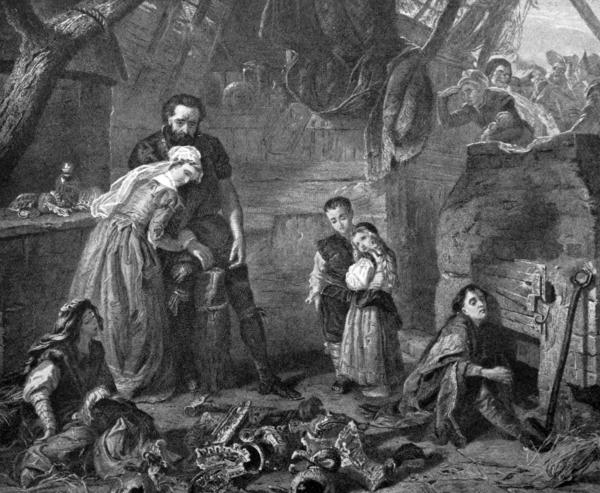
So, taking hammers and mallets, they broke the precious forms of type
into thousands of fragments.
The lawsuit dragged along, and finally ended in Gutenberg’s favor. The
firm was ordered to pay Dritzhn’s brothers the fifteen florins, and
nothing more. But the type were destroyed, and the partners were
afraid to make new ones, lest the suspicious public should spy upon
them and learn their secret. When the term of the contract between the
partners came to an end it was not renewed. Each of the firm went his
own way, and John Gutenberg opened his lapidary’s shop again and tried
to build up the trade he had lost.
His wife was still Gutenberg’s chief encouragement. She was certain
that some day he would win success, and often in the evening she would
urge him not to despair of his invention, but to wait till the time
should be ripe for him to go on with it again. As a matter of fact it
was impossible for him to give it up. Before long he was cutting
stucke again in his spare hours, and then trying his hand at
printing single pages.
He felt however that it would be impossible for him to resume his
presswork in Strasburg. There was too much prejudice against his
invention there. So he decided to go back to his home town of Mainz,
where many of his family were living. Anna agreed with this decision,
and so they closed their shop, sold their goods, and journeyed to his
brother’s home. There one day his brother introduced him to a rich
goldsmith named Faust, and this man said he understood that Gutenberg
had invented a new way of making books. John admitted this, and told
him some details of his process.
The goldsmith was most enthusiastic, and suggested that he might be
able to help the inventor with money. Gutenberg said he should need
two or three thousand florins. “I will give it to thee,” answered
Faust, “if thou canst convince me that it will pay better than
goldsmithing.”
Then the printer confided all his secrets to Faust, and the latter
considered them with great care. At last he was satisfied, and told
Gutenberg that he would enter into partnership with him. “But where
shall we start the work?” he added. “Secrecy is absolutely necessary.
We must live in the house in which we work.”
“I had thought of the Zum Jungen,” answered Gutenberg, naming an old
house that overlooked the Rhine.
“The very place,” agreed Faust. “It is almost a palace in size, and
will give us ample room; it is in the city, and yet out of its bustle.
It is vacant now, and I will rent it at once. When canst thou move
there?”
“At once,” said Gutenberg, more pleased than he dared show.
So the printer and his good wife moved to the Zum Jungen, which was
more like a castle than a tradesman’s dwelling-house. Its windows
looked over the broad, beautiful river to the wooded shores beyond.
Faust advanced Gutenberg the sum of 2,020 florins, taking a mortgage
on his printing materials as security. Then Faust moved his family and
servants to the old house, and the firm started work. Hanau, the valet
of Gutenberg’s father, and a young scholar named Martin Duttlinger,
joined them at the outset.
Two well-lighted rooms on the second floor, so placed as to be
inaccessible to visitors, were chosen for the workshops. Here the four
worked from early morning until nearly midnight, cutting out new sets
of type and preparing them for the presswork. They began by printing a
new manual of grammar, an “Absies,” or alphabetical table, and the
“Doctrinale.” All three of these it was thought would be of use to all
who could read.
Soon Faust discovered the same defect in the type that the workmen at
Strasburg had discovered. The wooden letters would soften when used,
and soon lose their shape. He spoke to Gutenberg about it, and the
latter studied the problem. At length an idea occurred to him. He
opened a drawer and took out a bit of metal. He cut a letter on the
end of it. “There is the answer,” said he. “We will make our type of
lead. We can cut it, and ink cannot soften it as it does wood.”
Faust was very much pleased. Now that he understood Gutenberg’s
invention he realized how great a thing it was destined to become, and
was anxious to help its progress in every way he could. One day
Gutenberg told him that they needed a good man to cut the designs for
the engravings. “Dost thou know of one?” asked Faust. “Of only one,”
was the answer. “He is Peter Schœffer, a youth who helped me
before. He is now a teacher of penmanship in Paris.”
“We must send for him,” said Faust.
So Gutenberg sent for Schœffer, and the printing staff was
increased to five.
Schœffer had considerable reputation as a scholar, and soon after
he had joined them Gutenberg asked him what he thought was the most
important book in the world. Schœffer replied that he was not
sufficiently learned to answer the question.
“But to the best of thy knowledge,” persisted Gutenberg.
“I remember that when I was in the Cathedral school,” said
Schœffer, “Father Melchior showed us the Gothic Gospels, or Silver
Book, and said that more art and expense had been spent on the Bible
than on any other book he knew. I believe therefore that it is the
most useful and important book in the world.”
“So I believe,” agreed Gutenberg, “and I intend to print it in the
best style possible to my art.”
“But what a tremendous undertaking, to print the whole Bible!”
exclaimed Schœffer.
“Yes, a stupendous work,” Gutenberg agreed. “And so I want to start
upon it at once.”
Schœffer was amazed when Gutenberg showed him the new press he had
built at the Zum Jungen. He watched the master dab the type with ink,
slide them under the platen, and having pressed it down, take out the
printed page.
“It is wonderful!” said he. “How many impressions canst thou take from
the press in a day?”
“About three hundred, working steadily.”
“Then books will indeed multiply! What would the plodding copyists say
to this!”
When they began printing with the lead type they soon found that the
metal was too soft. The nicest skill had to be used in turning the
screw of the press, and only Gutenberg seemed able to succeed with it.
Schœffer suggested that they should try iron.
“We have,” said Gutenberg, “but it pierced the paper so that it could
not be used.”
Schœffer was used to experimenting in metals, and the next day he
brought to the workroom an alloy which he thought might serve. It was
a mixture of regulus of antimony and lead. They tried it, and found it
was precisely the right substance for their use. Gutenberg and Faust
were both delighted, and very soon afterward made Peter Schœffer a
partner in the firm.
They now started on the great work of printing the Bible. Duttlinger
was commissioned to buy a Bible to serve for his own use. This was
brought in secret to the workrooms, and the partners inspected it
carefully. They realized what a huge undertaking it would be to print
such a long book, but nevertheless they set out to do it. Each man was
allotted his share in the labor, and the work began.
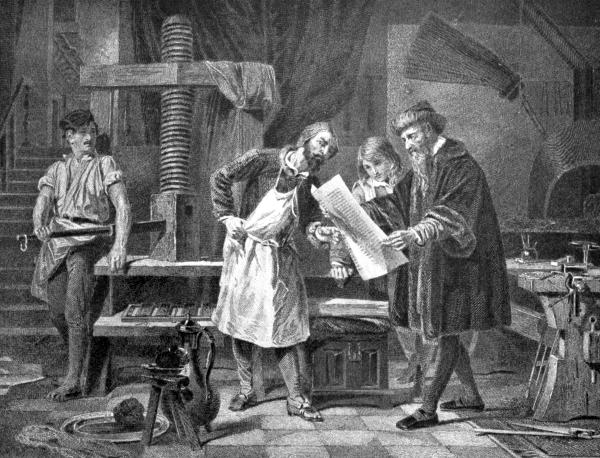
The press Gutenberg was using was a very simple affair. Two upright
posts were fastened together by crosspieces at top and bottom. In this
frame a big iron screw was worked by means of a handle. A board was
fastened beneath the screw, and the type, when inked and set in a
wooden frame, were placed on this board. The printing paper was laid
over the type, and the screw forced the platen, which was the board
fixed to it, down upon the paper. Then the screw was raised by the
handle, the platen was lifted with it, and the printed paper was ready
to be taken out. The screw was worked up and down in a box, called a
hose, and the board on which the type were set for the printing was
actually a sort of sliding table. The frame or chase of type was fixed
on this table, and when inked and with the paper laid in place, was
slid under the platen, which was a smooth planed board. The screw was
turned down, the platen was pressed against the sheet of paper, and
the printing was done.
Each of the workers at the Zum Jungen suggested valuable changes and
additions. Schœffer proved wonderfully adept at cutting type, and
later at illuminating the initial letters that were needed. The copies
we have of the books published by this first Mainz press bear
striking witness to the rare skill and taste Peter Schœffer showed
in designing and coloring the large capital letters that were
considered essential at that day.
The firm had by now prepared several hundred pounds’ weight of metal
type for the Bible, had discovered that a mixture of linseed oil and
lampblack made the best ink, and had invented ink-dabbers made of skin
stuffed with wool. Then it occurred to Schœffer that there must be
some easier way of making type than by cutting it out by hand. After
some study he found it, and the firm began taking casts of type in
plaster moulds. But the success of this method seemed very doubtful at
first, for it was hard to get a good impression of such small things
as type in the soft plaster. Again Schœffer showed his skill. He
planned the cutting of punches which would stamp the outline of the
type upon the matrix. He cut matrices for the whole alphabet, and then
showed the letters cast from them to Gutenberg and Faust.
“Are these letters cast in moulds?” exclaimed the astonished Faust.
“Yes,” answered Schœffer.
“This is the greatest of all thy inventions then,” said Faust. “Thou
art beyond all question a great genius!”
With type cast in this new way the firm printed the first page of
their Bible in the spring of 1450. The press worked to perfection, and
when they removed the vellum sheet the printed letters were clear,
beautifully formed, and ranged in perfect lines. So began the
printing of what was to become famous as the Mazarine Bible. But it
was not until five years later, in 1455, that the book was finished.
The Bible was printed, but its cost had been great, and the returns
from its sale were small. Faust was dissatisfied with Gutenberg, and
took occasion to tell Schœffer one evening that he believed the
firm would do better without the master. “Thou hast devised the ink,
the forms for casting type, and the mixture of metals,” he said.
“These are almost all that has been invented. Gutenberg spent 4,000
florins before the Bible was half done, and I do not see how he can
ever repay me the sums I have advanced.”
Faust played upon young Schœffer’s vanity, he praised him
continually and disparaged Gutenberg, and finally persuaded him they
would be better off without the latter. Peter Schœffer was,
moreover, in love with Faust’s daughter Christiane, and wished to
marry her. This was another inducement for him to side with the rich
goldsmith.
Then one day Faust asked Gutenberg blankly when he intended to repay
him the money he had advanced. Gutenberg was surprised, and told him
he had nothing but the small profits the firm was making.
“I will give thee thirty days to pay the debt,” said Faust, “and if
thou dost fail to pay within that time I shall take steps to collect
it.”
“But how am I to procure it? Wouldst thou ruin me?” cried Gutenberg.
“The money I must have, and if thou art honest thou wilt pay me,” came
the hard answer.
The month ended, and Gutenberg had not found the money. He protested
and pleaded with Faust, but the latter was obdurate. He started a
lawsuit at once to recover the sums he had expended, and judgment was
given against Gutenberg, commanding that he should pay what he had
borrowed, together with interest. Gutenberg could not do this, and so
Faust took possession of all the presses, the type, and the copies of
the Bible that were already printed.
Gutenberg knew that he was ruined. His wife tried to console him. “I
am worse than penniless,” said he. “My noble art is at an end. What I
most feared has happened. They have stolen my invention, and I have
nothing left.”
Meantime Schœffer had married Faust’s daughter, and the two men
took up the printing business for themselves. Faust showed the Bibles
to friends, and was advised to carry a supply of them to Paris. He
went to that city, and at first met with great success. He sold the
King a copy for seven hundred and fifty crowns, and private citizens
copies at smaller prices. But soon word spread abroad that this
stranger’s stock was inexhaustible. “The more he sells the more he has
for sale,” said one priest. Then some one started the report that the
stranger was in league with the devil, and soon a mob had broken into
his lodgings and found his stock of Bibles. Faust was arrested on the
charge of dealing in the black art, and was brought before the court.
He now decided that he would have to tell of the printing press if he
were to escape, and so he made a full confession. So great was the
wonder and admiration at the announcement of this new invention that
he was at once released, loaded with honors, and soon after returned
to Mainz with large profits from his trip.
But Gutenberg was not entirely left to despair. His brother Friele,
who was well-to-do, came to his aid, and interested friends in
starting John at work on his presses again. He missed Schœffer’s
discoveries as to ink and the casts for type, but although he had not
the means to print another copy of the Bible, he contrived to print
various other books which were bought by the clerical schools and the
monasteries. After a time Faust, realizing perhaps that Gutenberg was
in reality the inventor of the art which he was beginning to find so
lucrative, came to him, and asked his forgiveness. He admitted that he
had been unfair in the prosecution of the lawsuit, and urged Gutenberg
to take his old place in their firm. But Gutenberg could not be
persuaded, he preferred to work after his own fashion, and to be
responsible only to himself.
For eight years he carried on the business of his new printing shop in
the Zum Jungen, with his brother and Conrad Humery, Syndic of Mainz,
to share the expenses and profits. Then his wife, Anna, died, and he
could not keep on with the work. His brother advised him to leave
Mainz for a time and travel. So he sold his presses and type to the
Syndic, and left Mainz. Wherever he journeyed he was received with
honor, for it was now widely known that he had invented the new art of
printing. The Elector Adolphus of Nassau invited him to enter his
service as one of his gentlemen pensioners, and paid him a generous
salary. Thus he was able to live in peace and comfort until his death
in 1468.
Meanwhile Faust and Schœffer had continued to print the Bible and
other works, and had found a prosperous market in France and the
German cities. Schœffer cast a font of Greek type, and used this in
printing a copy of Cicero’s “De Officiis,” which was eagerly bought by
the professors and students of the great University of Paris. But as
Faust was disposing of the last copies of this book in the French
capital he was seized with the plague, and died almost immediately.
For thirty-six years Peter Schœffer continued printing books,
making many improvements, and bringing out better and better editions
of the Bible.
The capture of Mainz in 1462 by the Elector Adolphus of Nassau gave
the secrets of the printing press to the civilized world. Presses were
set up in Hamburg, Cologne, Strasburg, and Augsburg, two of Faust’s
former workmen began printing in Paris, and the Italian cities of
Florence and Venice eagerly took up the new work. Between 1470 and
1480 twelve hundred and ninety-seven books were printed in Italy
alone, an indication of what men thought of the value of Gutenberg’s
invention.
William Caxton, an English merchant, learned the new art while he was
traveling in Germany, and when he returned home started a press at
Westminster with a partner named Wynken de Worde. This was the first
English press, but others were quickly set up at Oxford and York,
Canterbury, Worcester, and Norwich, and books began to appear in a
steady stream.
The art of printing has seen great changes since Gutenberg’s day. The
type is now made by machinery, inked by machinery, set and distributed
again by machinery. The letters, when once set up, are cast in plates
of entire pages, so that they can be kept for use whenever they are
wanted. Stereotyping and electrotyping have made this possible. The
Mergenthaler Linotype machine sets and casts type in the form of solid
lines. The great presses of to-day can accomplish more in twelve hours
than the presses of 1480 in as many months.
But the great press we have is the direct descendant of the little one
that John Gutenberg built in the Zum Jungen at Mainz, and the letters
we read on the printed page are after all only another form of those
he cut out with so much patient labor on his wooden blocks in
Strasburg. Printing is one of the greatest inventions the world has
ever seen, but it had its beginning in the simple fact that a young
German polisher of gems fell to wondering how a rude playing-card had
been made.