The Old Town gives the first Commander, first Admiral, and Great Citizens
Washington’s Boyhood Home
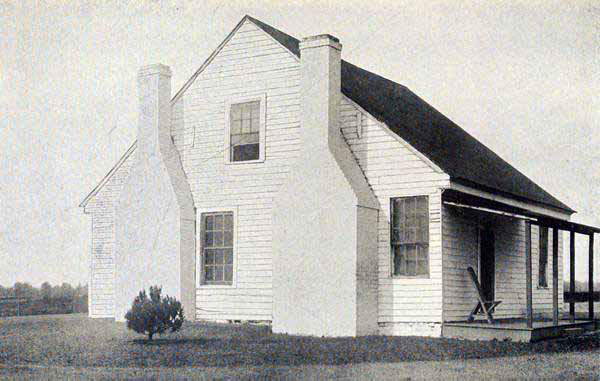
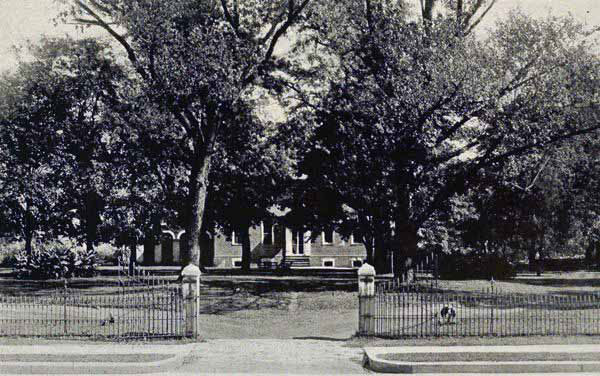
Fredericksburg claims George Washington, who although born in Westmoreland
County, Virginia, February 22, 1732, spent most of his boyhood on the
“Ferry Farm,” the home of his father, Augustine Washington, situated on a
hill directly opposite the wharf which juts out from the Fredericksburg
side of the river. Here it is that Parson Weems alleged he threw a stone
across the river.
He was educated in Fredericksburg and Falmouth, a village of gray mists
and traditions, which lords it over Fredericksburg in the matter of
quaintness and antiquity, but obligingly joins its fortunes to those of
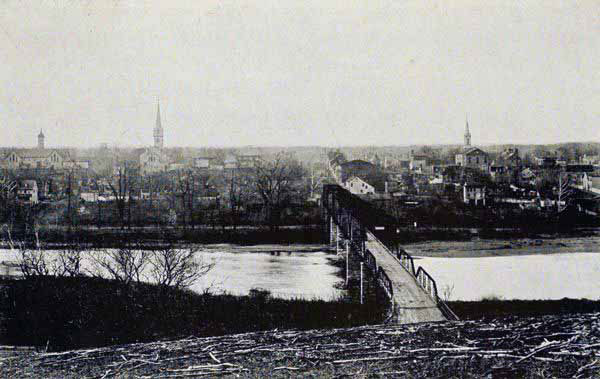
the town by a long and picturesque bridge.
His tutor in Falmouth was a “Master Hobbie,” and while this domine was
“strapping the unthinking end of boys,” George was evading punishment by
being studious and obedient. He also attended the school of Mr. Marye, at
St. George’s Church. It was in this church that the Washingtons
worshipped.
Shy in boyhood and eclectic in the matter of associates, he had the genius
for real friendships.
The cherry tree which proclaimed him a disciple of truth has still a few
flourishing descendants on the old farm, and often one sees a tourist
cherishing a twig as a precious souvenir of the ground hallowed by the
tread of America’s most famous son. It was on this farm that George was
badly hurt while riding (without permission) his father’s chestnut colt.
We take Washington’s career almost for granted, as we watch the stars
without marveling at the forces that drive them on, but when we do stop
to think, we are sure to wonder at the substantial greatness, the
harnessed strength of will, the sagacity and perception, which made him
the man he was.
He left school at sixteen, after having mastered geometry and
trigonometry, and having learned to use logarithms.
He became a surveyor. His brother, Lawrence, who at that time owned Mt.
Vernon, recognized this; in fact, got him, in 1740, to survey those wild
lands in the valley of the Alleghany belonging to Lord Fairfax.
He was given a commission as public surveyor after this. It is hard to
realize that he was only sixteen! We will not attempt to dwell upon his
life in detail. We know that at nineteen he was given a military district,
with the rank of major, in order to meet the dangers of Indian
depredations and French encroachments. His salary was only 150 pounds a
year.
On November 4, 1752, he was made a Mason in Fredericksburg Lodge, No. 4.
The Bible used in these interesting ceremonies, is still in possession of
the lodge, and is in a fine state of preservation. Washington continued a
member of this lodge until he died, and Lafayette was an honorary member.
At twenty-one, as a man of “discretion, accustomed to travel, and familiar
with the manners of the Indians,” he was sent by Governor Dinwiddie on a
delicate mission which involved encroachments by the French on property
claimed by the English. During all these years he came at close intervals
to visit his mother, now living in her own house in Fredericksburg, which
was still his home.
After his distinguished campaign against the French army under M. De
Jumonville in the region of Ohio, where he exposed himself with the most
reckless bravery, he came to Mt. Vernon which he inherited from his
brother, Augustus, married Martha Custis, a young widow with two children
and large landed estates, and became a member of the House of Burgesses,
punctually attending all the sessions.
Indeed, one finds oneself eagerly looking for an occasional lapse in this
epic of punctuality. It would humanize him. Anyway, one is glad to see
that he was a patron of the arts and the theatre, and his industry in
keeping day-books, letter-books, contracts and deeds is somewhat offset by
the fact that he played the flute.
He seldom spoke in the House of Burgesses, but his opinion was eagerly
sought and followed. We will pass over the time when Dunmore prorogued the
“House,” and of the events which ended in Washington’s being made
Commander-in-Chief of the Continental Army.
We are, perhaps, more interested in another visit to Fredericksburg to see
his mother, after he had resigned his commission. From town and country,
his friends gathered to give him welcome and do him honor. The military
turned out, civic societies paraded, and cannon boomed.
When “George” got Arrested
In between his career as statesmen and as soldier, we strain our eyes for
a thread of color, and we discover that he was once brought before a
justice of the peace and fined for trading horses on Sunday. And again,
that he was summoned before the grand jury and “George William Fairfax,
George Washington, George Mason,” and half dozen others were indicted for
“not reporting their wheeled vehicles, according to law.”
It is worth noting, too, that while her son, George, was leading the
American army, Mary, his mother, was a partisan of the King; a tory most
openly. “I am sure I shall hear some day,” She told some one, calmly, in
her garden, “that they have hung George.”
Nevertheless, his first two messages, after he crossed the Delaware and
won signal victories, were to Congress and his mother. And after the
hard-riding courier had handed her the note, and the gathering people had
waited until she laid down her trowel, and wiped the garden earth from her
hands, she turned to them and said: “Well, George has crossed the Delaware
and defeated the King’s troops at Trenton.”
Washington Advises Lovers
The stern fact of the Revolution, which cast upon George Washington
immortal fame and which was followed by his election to the Presidency of
the United States, is softened somewhat by a letter on love written to his
daughter, Nellie Custis. A few excerpts are as follows:
“When the fire is beginning to kindle, and the heart growing warm,
propound these questions to it. Who is this invader? Is he a man of
character; a man of sense? For be assured, a sensible woman can never be
happy with a fool. Is his fortune sufficient to maintain me in the manner
I have been accustomed to live? And is he one to whom my friends can have
no reasonable objection?”
And again, “It would be no great departure from the truth to say that it
rarely happens otherwise than that a thorough paced coquette dies in
celibacy, as a punishment for her attempts to mislead others by
encouraging looks, words and actions, given for no other purpose than to
draw men on to make overtures that they may be rejected.”
The letter ends with a blessing bestowed on the young lady to whom is
given such sensible advice. That this letter is characterized by an
admirable poise, cannot be denied.
George Washington died at Mt. Vernon, December 4, 1799. He upheld the
organization of the American state during the first eight years of its
existence, amid the storms of interstate controversy, and gave it time to
consolidate.
No other American but himself could have done this—for of all the
American leaders he was the only one whom men felt differed from
themselves. The rest were soldiers, civilians, Federalists or Democrats,
but he—was Washington.
Evidence of Citizenship
Almost immediately after appearing before the public session of Congress,
at which he resigned his commission as commander-in-chief of the
Continental armies, an act of which Thackeray speaks as sheathing his
sword after “a life of spotless honor, a purity unreproached, a courage
indomitable and a consummate victory,” Washington came to Fredericksburg
to visit his mother. He was the great hero of the age, the uncrowned King
of America and from all over the section crowds flocked to do him honor.
The occasion was of such importance that the city did not trust the words
of welcome to a single individual, but called a meeting of the City
Council at which a short address was adopted and presented to Washington
upon his arrival by William McWilliams, then mayor.
While beautifully worded to show the appreciation of his services and
respect for his character and courage, the address of welcome contains
nothing of historical significance except the line “And it affords us
great joy to see you once more at a place which claims the honor of your
growing infancy, the seat of your amiable parent and worthy relatives,”
which establishes Washington’s connection with Fredericksburg.
In reply, General Washington said:
Gentlemen:
With the greatest pleasure I receive in the character of a private
citizen the honor of your address. To a benevolent providence and the
fortitude of a brave and virtuous army, supported by the general
exertion of our common country, I stand indebted for the plaudits you
now bestow. The reflection, however, of having met the congratulating
smiles and approbation of my fellow citizens for the part I have acted
in the cause of Liberty and Independence cannot fail of adding
pleasure to the other sweets of domestic life; and my sense of them is
heightened by their coming from the respectable inhabitants of the
place of my growing infancy and the honorable mention which is made of
my revered mother, by whose maternal hand, (early deprived of a
father) I was led to manhood. For the expression of personal affection
and attachment, and for your kind wishes for my future welfare, I
offer grateful thanks and my sincere prayers for the happiness and
prosperity of the corporate town of Fredericksburg.
Signed: George Washington.
This address is recorded in the books of the town council and is signed in
a handwriting that looks like that of Washington.
As it is known that Washington lived at Fredericksburg from the time he
was about six years of age until early manhood, the expression “growing
infancy” is unfortunate, but later, when Mayor Robert Lewis, a nephew of
Washington, delivered the welcome address to General Lafayette when he
visited Fredericksburg in 1824 the real case was made more plain when he
said:
“The presence of the friend of Washington excites the tenderest
emotions and associations among a people whose town enjoys the
distinguished honor of having been the residence of the Father of his
Country during the days of his childhood and youth,” and in reply
General Lafayette said:
“At this place, Sir, which calls to our recollections several among
the most honored names of the Revolutionary War, I did, many years
ago, salute the first residence of our paternal chief, receiving the
blessings of his venerated mother and of his dear sister, your own
respected mother.” Later the same day, at a banquet in the evening,
given in his honor, Lafayette offered the following sentiment, “The
City of Fredericksburg—first residence of Washington—may she more
and more attain all the prosperity which independence, republicanism
and industry cannot fail to secure.”
John Paul Jones.
Of all the men whose homes were in Fredericksburg, none went forth to
greater honor nor greater ignominy than John Paul Jones, who raised the
first American flag on the masthead of his ship, died in Paris and was
buried and slept for 113 years beneath a filthy stable yard, forgotten by
the country he valiantly served.
He came to Fredericksburg early in 1760 on “The Friendship,” as a boy of
thirteen years. Born in a lowly home, he was a mere apprentice seaman, and
without doubt he deserted his ship in those days, when sea life was a
horror, to come to Fredericksburg and join his brother, William Paul,
whose home was here, and who is buried here. There is some record of his
having been befriended by a man in Carolina, and traditions that he left
his ship in a port on the Rappahannock after killing a sailor, and walked
through the wilderness to Fredericksburg. Neither tradition is of
importance; the fact is that he came here and remained four years during
the developing period of his life.
Jones’ American Home Here
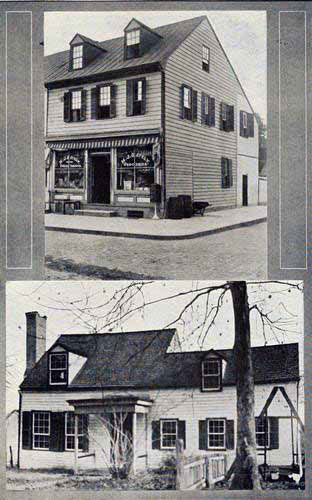
William Paul had immigrated to Fredericksburg from the Parish of Kirkbeam,
Scotland, (where he and his brother, John, were born), about 1760, had
come to Fredericksburg and conducted a grocery store and tailor shop on
the corner of Caroline and Prussia streets. William died here in 1773, and
is buried in St. George’s Church Yard. In his will he left his property to
sisters in the Parish of Kirkbeam, Scotland.
Alexander McKenzie, in his life of John Paul Jones, says, after referring
to the fact that William Paul is buried in Fredericksburg: “In 1773 he
went back to Fredericksburg to arrange the affairs of his brother, William
Paul,” and John Paul Jones himself wrote of Fredericksburg: “It was the
home of my fond election since first I saw it.” The Legislature of
Virginia decided in settling William Paul’s estate that John Paul Jones
was a legal resident of Fredericksburg.
Obviously, then, Fredericksburg was the great Admiral’s home, for, though
not born here, he chose it when he came to America.
When he first reached the little town on the Rappahannock he went to work
for his brother, William Paul and one can surmise that he clerked and
carried groceries and messages to the gentry regarding their smart clothes
for his brother.
The Rising Sun Tavern was then a gathering place for the gentry and
without doubt he saw them there. He may well have learned good manners
from their ways, good language from hearing their conversation and
“sedition” from the great who gathered there. We may picture the lowly
boy, lingering in the background while the gentlemen talked and drank
punch around Mine Host Weedon’s great fire, or listening eagerly at the
counter where the tavern-keeper, who was to be a Major-General, delivered
the mail.
Certainly John Paul Jones was a lowly and uneducated boy at 13. He left
Fredericksburg after four years to go to sea again, and in 1773 came back
to settle his brother’s estate, and remained here until December 22, 1775,
when he received at Fredericksburg his commission in the Navy.
From Cabin Boy to Courtier
John Paul Jones’ story is more like romance than history. Beginning an
uncouth lad, he became a sea fighter whose temerity outranks all. We see
him aboard the Bonhomme Richard, a poor thing for seafaring, fighting the
Serapis just off British shores, half of his motley crew of French and
Americans dying or dead about him, the scruppers running blood, mad
carnage raging, and when he is asked if he is ready to surrender he says:
“I’ve just begun to fight,” and by his will forcing victory out of defeat.
He was the only American who fought the English on English soil. He never
walked a decent quarter deck, but with the feeble instruments he had, he
captured sixty superior vessels. His ideal of manliness was courage.
What of this Fredericksburg gave him no one may say, but it is sure that
the chivalry, grace and courtliness which admitted him in later years to
almost every court in Europe was absorbed from the gentry in Virginia. He
did not learn it on merchantmen or in his humble Scotch home, and so he
learned it here. Of him the Duchess de Chartres wrote:
“Not Bayard, nor Charles le Téméaire could have laid his helmet at a
lady’s feet with such knightly grace.”
He won his country’s high acclaim, but it gave him no substantial
evidence. He was an Admiral in the Russian Navy, and after a time he went
to Paris to live a few years in poverty, neglect, and bitterness. He died
and was buried in Paris in 1792, at 45 years of age.
He was a dandy, this John Paul Jones, who walked the streets of
Fredericksburg in rich dress. Lafayette, Jefferson, and, closest of all,
the Scotch physician, Hugh Mercer, were his friends. Slender and not tall,
black-eyed and swarthy, with sensitive eyes, and perfect mouth and chin,
he won the love or friendship of women quicker than that of men.
He was buried in an old graveyard in Paris and forgotten until the author
of this book wrote for newspapers a series of letters about him. Interest
awoke and Ambassador Porter was directed to search for his body. How
utterly into oblivion had slipped the youth who ventured far, and
conquered always, is plain when it is known that it took the Ambassador
six years to find the body of Commodore John Paul Jones. He found it in an
old cemetery where bodies were heaped three deep under the courtyard of a
stable and a laundry.
Admiral Jones’ Surgeon
Surgeon Laurens Brooke
Surgeon Laurens Brooke, was born in Fredericksburg, in 1720, and was one
of those who accompanied Governor Spottswood as a Knight of the Golden
Horseshoe. He afterwards lived in Fredericksburg, entered the U. S. Navy
as a surgeon and sailed with John Paul Jones on the “Ranger” and on the
“Bon Homme Richard.” At the famous battle of Scarborough, between the
latter vessel and the “Serapis,” Surgeon Brooke alone had the care of one
hundred and twenty wounded sailors; and later with Surgeon Edgerly, of the
English navy, from the Tempis, performed valiant work and saved many
lives. The surgeons were honored by Captain Paul Jones with a place at his
mess, and the literature of the period refers to Surgeon Brooke as the
“good old Doctor Laurens Brooke.” He was with Jones until the end of the
war and spent some time at his home here when a very old man, some years
after the Revolution. His family had a distinguished part in the War
Between the States, being represented in the army and in the C. S.
Congress during that period.
General Hugh Mercer
We wonder if any one ever declined to take the advice of George
Washington.
Certain it is that General Hugh Mercer did not, for, at the suggestion of
Washington, Mercer came to Fredericksburg. Many Scotchmen have found the
town to their liking. It makes them feel a sort of kinship with the
country of hill-shadows, and strange romance.
Mercer was born in Aberdeen in the year 1725. His father was a clergyman;
his mother, a daughter of Sir Robert Munro, who, after distinguishing
himself at Fontenoy and elsewhere, was killed at the battle of Falkirk,
while opposing the young “Pretender.” Hugh Mercer did not follow in the
footsteps of his father, but linked his fortunes with Charles Edward’s
army, as assistant surgeon, fought with him at Culloden and shared the
gloom of his defeat—a defeat which was not less bitter because his ears
were ringing with the victorious shouts of the army of the Duke of
Cumberland.
To change a scene that brought sad memories, Dr. Hugh Mercer, in the fall
of 1746, embarked for America. There, on the frontiers of civilization, in
Western Pennsylvania, he spent arduous, unselfish years. He was welcomed
and loved in this unsettled region of scattered homes.
A rough school it was in which the doctor learned the lessons of life.
In the year 1755, Mercer made his appearance in the ill-fated army of
Braddock, which met humiliating disaster at Fort Duquesne. Washington’s
splendid career began here and here Mercer was wounded. Of this memorable
day of July 9, 1755, it has been said that “The Continentals gave the only
glory to that humiliating disaster.”
In 1756, while an officer in a military association, which was founded to
resist the aggression of the French and Indians, he was wounded and forced
to undergo terrible privations. While pursued by savage foes he sought
refuge in the trunk of a tree, around which the Indians gathered and
discussed the prospect of scalping him in the near future. When they left
he escaped in the opposite direction and completely outwitted them. Then
began a lonely march through an unbroken forest, where he was compelled to
live on roots and herbs, and where the carcass of a rattlesnake proved his
most nourishing meal. He finally succeeded in rejoining his command at
Fort Cumberland. In recognition of his sacrifices and services in these
Indian wars, the Corporation of Philadelphia presented him with a note of
thanks and a splendid memorial medal. In the year 1758 he met George
Washington and then it was that Pennsylvania lost a citizen. In
Fredericksburg, at the time that Mercer came, lived John Paul Jones, and
we do not doubt that they often met and talked of their beloved Scotland.
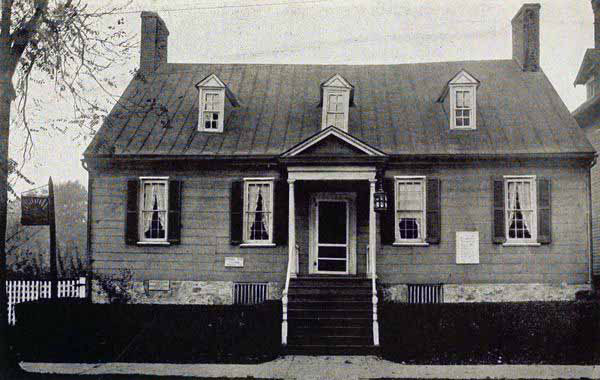
During his first years in Fredericksburg, Mercer occupied a small
two-story house on the southwest corner of Princess Anne and Amelia
Streets. There he had his office and apothecary shop. The building is
still standing.
An Englishman, writing at this time of a visit to Fredericksburg, calls
Mercer “a man of great eminence and possessed of almost every virtue and
accomplishment,” truly a sweeping appreciation.
Mercer Joins Masonic Lodge
He belonged to Lodge No. 4, of which George Washington was also a member,
and he occasionally paid a visit to Mount Vernon.
In September, 1774, the Continental Congress met in Philadelphia. The war
cloud was lowering, it broke, and when the Revolution swept the country,
Mercer was elected Colonel of the Third Virginia Regiment.
An approbation of the choice of Mercer was prepared by the county
committee, which set forth the importance of the appointment and was an
acknowledgment of his public spirit and willingness to sacrifice his life.
Colonel Mercer with his men and fifes and drums marched away from his
home, bidding good-bye to his wife (Isabella Gordon), whom he never saw
again.
There is an interesting story of Mercer at Williamsburg. Among the troops
which were sent there at that time, was a Company of riflemen from beyond
the mountains, commanded by a Captain Gibson. A reckless and violent
opposition to military restraint had gained for this corps the name of
“Gibson’s Lambs.” After a short time in camp, a mutiny arose among them,
causing much excitement in the army, and alarming the inhabitants of the
city. Free from all restraint, they roamed through the camp, threatening
with instant death any officer who would presume to exercise any authority
over them.
Mercer Quells a Mutiny
At the height of the mutiny an officer was dispatched with the alarming
tidings to the quarters of Colonel Mercer. The citizens of the town vainly
implored him not to risk his life in this infuriated mob.
Reckless of personal safety, he instantly repaired to the barracks of the
mutinous band and directing a general parade of the troops, he ordered
Gibson’s company to be drawn up as offenders and violators of the law, and
to be disarmed in his presence.
The ringleaders were placed under a strong guard and in the presence of
the whole army he addressed the offenders in an eloquent manner,
impressing on them their duties as citizens and soldiers, and the
certainty of death if they continued to remain in that mutinous spirit
equally disgraceful to them and hazardous to the sacred interests they had
marched to defend. Disorder was instantly checked and the whole company
was ever afterward as efficient in deportment as any troop in the army.
On June 5, 1776, Mercer was made Brigadier-General in the Continental
Army. It was Mercer who suggested to Washington the crossing of the
Delaware. Major Armstrong, Mercer’s Aide-de-Camp, who was present at a
council of officers, and who was with Mercer on that fateful night, is
authority for this statement.
We, somehow, see the army of the colonists poorly clad, many of them
barefoot, without tents, with few blankets, and badly fed. In front of
them is Cornwallis, with his glittering hosts, and we can almost hear the
boast of General Howe, that Philadelphia would fall when the Delaware
froze. He did not know Washington; and Mercer’s daring was not reckoned
with. We wonder if ever a Christmas night was so filled with history as
that on which Washington, with the intrepid Mercer at his side, pushing
through that blinding storm of snow and fighting his way through the
floating ice, crossed the Deleware with the rallying cry of “victory or
death,” and executed the brilliant move which won for him the Battle of
Trenton.
Near Princeton, Washington’s army was hemmed in by Cornwallis in front and
the Delaware in the rear. After a consultation at Mercer’s headquarters it
was determined to withdraw the Continental forces from the front of the
enemy near Trenton, and attack the detachment then at Princeton. The
pickets of the two armies were within two hundred yards of each other. In
order to deceive the enemy, campfires were left burning on Washington’s
front line and thus deceived, the enemy slept.
Death on The Battlefield
A woman guided the Continental army on that night march. A detachment of
two hundred men, under Mercer, was sent to seize a bridge at Worth’s Mill.
The night had been dreary; the morning was severely cold. Mercer’s
presence was revealed at daybreak. General Mahood counter-marched his
regiment and crossed the bridge at Worth’s Mill before Mercer could reach
it. The British troops charged. The Colonials were driven back. General
Mercer dismounted and tried vainly to rally his men. While he was doing
this, he was attacked by a group of British troops, who, with the butts of
muskets, beat him down and demanded that he surrender. He refused. He was
then bayoneted and left for dead on the battlefield. Stabbed in seven
different places, he did not expire until January 12, 1777.
Washington finally won the Battle of Princeton, but Mercer was a part of
the price he paid. The battles of Trenton and Princeton were the most
brilliant victories in the War of the Revolution.
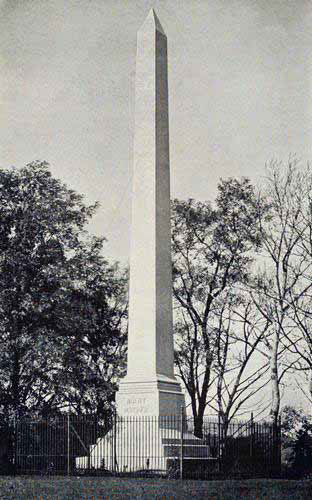
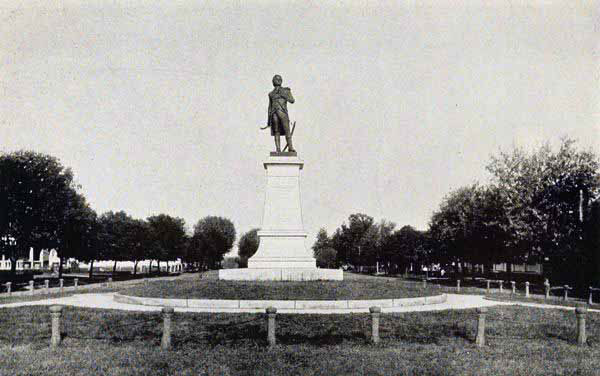
At Fredericksburg a monument perpetuates Mercer’s fame. At the funeral in
Philadelphia 30,000 people were present, and there his remains rest in
Laurel Hill Cemetery.
The St. Andrew’s Society, which he joined in 1757, erected a monument to
his memory and in the historical painting of the Battle of Princeton, by
Peale Mercer is given a prominent place. The states of Pennsylvania,
Kentucky, Virginia and New Jersey have, by an act of Legislature, named a
county “Mercer,” and on October 1, 1897, a bronze tablet to his memory was
unveiled at Princeton, N. J. We have not the space to relate all of his
illustrious life, but somewhere there is a poem, the last lines of which
voice the sentiment of his countrymen.
“But he, himself, is canonized,
If saintly deeds such fame can give;
As long as liberty is prized,
Hugh Mercer’s name shall surely live.”
Sir Lewis Littlepage
In the possession of a well-known man of Richmond, Va., is a large gold
key.
It is vastly different from the keys one sees these days, and inquiry
develops that it was once the property of one of the most picturesque
characters in America—a man who began his life in the cornfields of
Hanover County, Va., in 1753, and was swept by the wave of circumstance
into the palace of a King.
The atmosphere of old William and Mary College, where Lewis Littlepage was
graduated, after the death of his father, gave a mysteriously romantic
note to the beckoning song of adventure, which finally became a definite
urge, when the youth, after residing in Fredericksburg, listened to the
advice of his guardian, Benjamin Lewis, of Spotsylvania County, who placed
him with John Jay, the American Minister at Madrid.
Six months later, Jay, in a letter to Benjamin Lewis, said of the
seventeen-year-old lad:
“I am much pleased with your nephew, Lewis Littlepage, whom I regard as a
man of undoubted genius, and a person of unusual culture.”
And a few months after this we discover that the well-known traveler, Mr.
Elekiah Watson, has an entry in his diary which reads:
“At Nantes I became acquainted with Lewis Littlepage, and although he is
but eighteen years of age, I believe him to be the most remarkable
character of the age. I esteem him a prodigy of genius.”
The Poet Takes The Sword
In Madrid, Littlepage got into financial straits, owing to the fact that
his allowance did not reach him, and the next glimpse we get of him is
through the smoke of battle at Fort Mahon, where in 1781, as a member of
the force under the Duke de Crillion, he was painfully wounded while
charging the Turks.
In 1872, en route to Madrid to join Mr. Jay, he heard that de Crillion was
preparing to storm Gibraltar, and, believing himself in honor bound to
follow the fortunes of his chief, he wrote Mr. Jay that he must turn again
to arms.
From that day forward he was a soldier, a diplomat, a courtier—the
elected friend of Kings and Princes.
He aided in storming Gibraltar and left his ship only when it had burned
to the water’s edge. He was highly recommended to the King for his
gallantry, and went back to Paris with de Crillion to become a brilliant
figure at court and in the salons.
Europe knew him, but America refused him even a small commission, though
Kings wrote to our Congress in his behalf.
He met Lafayette at Gibraltar; in fact, accompanied him to Spain. Then,
after considerable travel in European countries, he again encountered
Prince Nassau, who was his brother at arms in de Crillion’s forces, became
his aide-de-camp and, together they found happiness in travel. They
sought the bright lights of gay capitals and followed mysterious moon
tracks on the Danube river.
When Poland’s Star Flamed
At the Diet of Grodno, in 1784, where he went with Nassau, he met
Stanislaus Augustus, King of Poland. He captivated the King; and in a
brilliant ball room, Stanislaus offered him a permanent service at his
court.
Within a year he was chamberlain and secretary to the cabinet of His
Majesty, and for years he was practically the ruler of the empire.
In 1787, at Kiva, he made a treaty with Catherine, Empress of Russia, and
became her intimate friend.
He was a special and secret envoy from Poland to the sessions of the grand
quadruple alliance in France. Later we see him leading a division of the
army of Prince Potempkin across the snow-clad steppes of Russia, and a few
months after, he was marching at the head of the Prince’s army through the
wild reaches of Tartary. Again, under Prince Nassau, we find him
commanding a fleet against the Turks at Oczacon.
Shortly after, he was a special high commissioner to Madrid. His mission
completed, he was ordered to return to Russia for the revolution of 1791,
and now he served as aide-de-camp and Major-General.
In 1794, when the Polish patriot, Kosciusco, headed a revolution,
Littlepage answered his summons and fought through to the storming of
Prague.
Stanislaus held him the greatest of his generals and his aides and when
the King was captured by the Russians, Littlepage, tired of the broils of
European politics, came home to America.
Ah, But he Had His Memories
When Littlepage was first in Poland, the place was gay and
laughter-loving. An atmosphere of high culture and literary achievements
made a satisfactory entourage for the ill-fated people. He lived happily
there and loved a princess of North Poland. There were starlight meetings
and woodland strolls, vows of faith and the pain of renunciation, when
for diplomatic reasons she was forced to endure another alliance.
Littlepage’s reputation and splendid appearance; her beauty and the love
they bore each other and, finally, her death, made a background of red
romance, against which he is silhouetted in one’s memory.
That Lewis Littlepage was a poet of no mean ability was a fact too well
known to be disputed. The last verse of a poem written by him and inspired
by the death of the woman he loved reads:
“Over there, where you bide—past the sunset’s gold glory,
With eyes that are shining, and red lips apart,
Are you waiting to tell me the wonderful story,
That death cannot part us—White Rose of my Heart.”
It is said that Littlepage had more honors and decorations showered upon
him than any other American in history.
Go to the old Masonic cemetery in Fredericksburg, and in a far corner,
where the wild vines and the hardy grass struggle for mastery, you may see
a legend inscribed upon a large flat stone: This is the tomb of Lewis
Littlepage. For the multitude, it is simply an unpleasant finale to the
life of a well known man.
To the imaginative, it starts a train of thought—a play of fancy. One
sees the rise of the star of Poland. Gay youths and maids pass and repass
to the sound of music and laughter. The clank of a sword sounds above the
measured foot fall on a polished floor. A soldier passes in all the
bravery of uniform. It is General Littlepage silently going to an audience
with the King. The massive doors open without a challenge, for as a
passport to the palace, on the uniform of this soldier glitters a large
gold key—the gift of Stanislaus.
Suddenly the scene changes. Amid the surging hosts and in the thick of the
bloody clash at Prague, when the anguish of uncertainty was crumbling the
courage of a kingdom, a man is seen, riding with reckless abandon. Tearing
through the lines and holding aloft the tattered standard of Poland,
comes Littlepage of Virginia. With the rallying cry of his adopted land,
he gathers up his troops and gloriously defends the flag he loves. Our
eyes again stray to the legend on the tomb: Disillusionment!
His return to his old home! His death! We see this also, but with this is
the knowledge that he lived greatly, and in his ears, while dying, sounded
again, the shout of victory, while his heart held the dream of the old
romance.
Gen. George Weedon
Among the first men in America to “fan the flames of sedition,” as an
English traveler said of him long before the war, was Mine Host George
Weedon, keeper of the Rising Sun Tavern, Postmaster, and an Irish
immigrant. At his place gathered all the great of his day, spending hours
dicing and drinking punch.
Over and over among these men—Washington, Mason, Henry, the Lees,
Jefferson and every Virginia gentleman of that section, George Weedon
heard discussion of the Colonies’ problems, and he forcibly gave vent to
his opinions.
Time and again he expressed the idea of freedom before others had thought
of more than protest. His wild Irish talk in the old Rising Sun Tavern
helped to light the torch of liberty in America.
When war came, Weedon was elected Lieutenant-Colonel of the First
Virginia, of which Hugh Mercer was chosen Colonel. August 17, 1776, he
became its Colonel, and on February 24, 1777, he was made a
Brigadier-General.
In the Battle of Brandywine, General Weedon’s division rendered
conspicuous service, when they checked the pursuit of the British and
saved our army from rout. He commanded brilliantly at Germantown. Wherever
he fought, his great figure and stentorian voice were prominent in the
conflict.
He admired Washington and his fellow-generals. It was not because of
these, but because he thought Congress to have treated him unfairly about
rank, that he left the Army at Valley Forge. He re-entered in 1780, and in
1781 was given command of the Virginia troops, which he held until the
surrender of Yorktown, where he played an important part.
George Weedon was the first President of the Virginia Society of the
Cincinnati, a fraternity of Revolutionary officers which General
Washington helped to organize, and this was, indeed, a singular honor. He
was a member of the Fredericksburg Masonic Lodge, of which Washington was
also a member. After the war, he lived at “The Sentry Box,” the former
home of his gallant brother-in-law, General Mercer.
A Song For the Yuletide
General Weedon was a man of exuberant spirits, loud of voice and full of
Irish humor. He wrote a song called “Christmas Day in ’76,” and on each
Yuletide he assembled at his board his old comrades and friends, and,
while two negro boys stood sentinel at the door, drank punch and roared
out the verses:
“On Christmas Day in ’76
Our ragged troops with bayonets fixed,
For Trenton marched away.
The Delaware ice, the boats below
The lights obscured by hail and snow,
But no signs of dismay.”
Beginning thus, the brave Irishman who verbally and fought among the
foremost for America for over physically thirty years, told the story of
Washington’s crossing the Delaware, vividly enough, and every Christmas
his guests stood with him and sang the ballad.[2]
Mason of Gunston
Of George Mason, whom Garland Hunt says is “more than any other man
entitled to be called the Father of the Declaration of Independence,” whom
Judge Garland says, “Is the greatest political philosopher the Western
Hemisphere ever produced,” of whose Bill of Rights, Gladstone said, “It is
the greatest document that ever emanated from the brain of man,” little
can be said here. His home was at Gunston Hall, on the Potomac, but the
Rising Sun knew him well, and his feet often trod Mary Washington’s garden
walks, or the floors of Kenmore, Chatham and the other residences of Old
Fredericksburg.
Mason was intimate here, and here much of his trading and shipping was
done. When he left Gunston, it was usually to come to Fredericksburg and
meet his younger conferees, who were looking up to him as the greatest
leader in America. He died and is buried at Gunston Hall. It was in
Fredericksburg that he first met young Washington, who ever afterward
looked upon “The Sage of Gunston” as his adviser and friend, and as
America’s greatest man.
General William Woodford
Although he came from Caroline, General William Woodford was a frequenter
of and often resident in Fredericksburg, and it was from this city he went
to Caroline upon the assembling of troops when Lord Dunmore became
hostile. In subsequent military operations he was made Colonel of the
Second Regiment and distinguished himself in the campaign that followed,
and he was honorably mentioned for his valiant conduct at the battle of
Gread Bridge, December 9, 1775, upon which occasion he had the chief
command and gained a brilliant victory. He was later made General of the
First Virginia Brigade. His command was in various actions throughout the
war, in one of which, the Battle of Brandywine, he was severely wounded.
He was made prisoner by the British in 1778 at Charleston, and taken to
New York, where he died.
The Owner of “Kenmore”
Col. Fielding Lewis
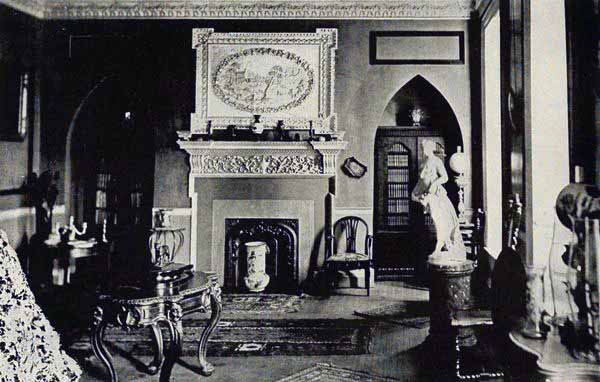
The mansion stands in a park, which in autumn is an explosion of color. An
old wall, covered with Virginia creeper, adds a touch of glamour to the
Colonial house, and a willow tree commanding a conspicuous corner of the
grounds lends a melancholy aspect which makes up the interesting
atmosphere of Kenmore, part of the estate of Colonel Fielding Lewis, who
brought to this home his bride, “Betty,” a sister of George Washington,
and where they lived as befitted people of wealth and learning, his wife
giving an added meaning to the social life of the old town, and Colonel
Lewis himself taking an active and prominent part in the civic affairs, as
most people of wealth and culture deemed it their duty to do in the days
gone by.
Colonel Lewis was an officer in the Patriot Army and commanded a division
at the siege of Yorktown. He was an ardent patriot and when the Revolution
started his activities ran to the manufacture of firearms, which were made
at “The Gunnery” from iron wrought at the foundry, traces of which may
still be seen on the Rappahannock river, just above the village of
Falmouth.
Colonel Lewis was a magistrate in the town after the war, a member of the
City Council and represented the county in the Legislature.
His son, Captain Robert Lewis, was one of President Washington’s private
secretaries and mayor of Fredericksburg from 1821 to the day of his death.
When LaFayette visited the town in 1824, Colonel Lewis was selected to
deliver the address of welcome.
However, we are apt to forget the elegancies and excellencies of the
courtly man whose life was dedicated to useful service in a note that is
struck by the home in which he lived. Kenmore, in the light of its past,
sounds an overtone of romance. We cannot escape it, and it persistently
reverberates above the people it sheltered.
The Greatest Officeholder
James Monroe
James Monroe was among the most important citizens that ever lived in
Fredericksburg.
Monroe was born in Westmoreland County, not far from what is now Colonial
Beach. When a young man he was attracted by the larger opportunities
afforded by the town and moved to Fredericksburg, where he began the
practice of law, having an office in the row of old brick buildings on the
west side of Charles Street, just south of Commerce. Records still in the
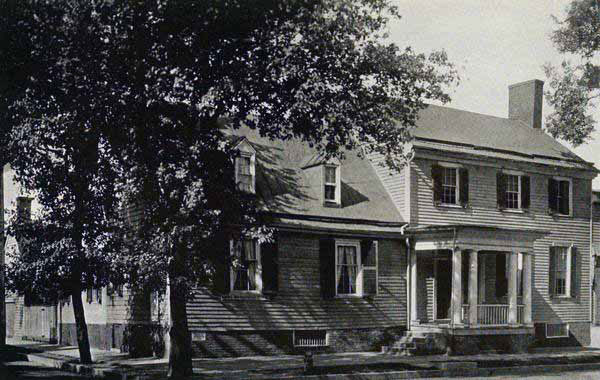
courthouse show that he bought property on lower Princess Anne Street,
which still is preserved and known as “The Home of James Monroe.” Monroe
occupied the house when it was located at Bradley’s corner, and it was
afterwards moved to its present site, though some contend that he lived in
the house on its present site.
Shortly after his arrival he became affiliated with St. George’s Church,
soon being elected a vestryman, and when he had been here the proper
length of time he got into politics, and was chosen as one of the Town
Councilmen. From this humble political preferment at the hands of the
Fredericksburg people, he began a career that seemed ever afterward to
have included nothing but officeholding. Later he became Continental
Congressman from the district including Fredericksburg, and was, in turn,
from that time on, Representative in the Virginia convention, Governor of
Virginia, United States Congressman, Envoy Extraordinary to France, again
Governor, Minister to England, Secretary of War, once more Minister to
England, Minister to Madrid, Secretary of State and twice President—if
not a world’s record at least one that is not often overmatched. Previous
to his political career, Monroe had served in the Revolutionary Army as a
Captain, having been commissioned while a resident of Fredericksburg.
Monroe gave to America one of its greatest documents—known to history as
the Monroe Doctrine. It was directed essentially against the purposes of
the Holy Alliance, formed in 1815 by the principal European powers with
the fundamental object of putting down democratic movements on the part of
the people, whether they arose abroad or on this side of the world. After
consultation with English statesmen and with Jefferson, Adams, John Quincy
Adams and Calhoun, Monroe announced his new principle which declared that
the United States of America would resent any attempt of the Alliance to
“extend their system to this part of the Hemisphere.”
“Old Doctor Mortimer”
Dr. Charles Mortimer
In a beautiful old home on lower Main Street, surrounded by a wall,
mellowed by time, and ivy-crowned, lived Washington’s dear friend and
physician, Dr. Charles Mortimer. He could often be seen, in the days gone
by, seated on his comfortable “verandah,” smoking a long pipe, covered
with curious devices, and discussing the affairs of the moment with those
rare intellects who were drawn there by the interesting atmosphere of
blended beauty and mentality. There was, as a background, a garden,
sloping to the river, and sturdy trees checquered the sunlight.
Old-fashioned flowers nodded in the breeze which blew up from the
Rappahannock, and the Doctor’s own tobacco ships, with their returned
English cargoes, swung on their anchors at the foot of the terraces.
If one entered the house at the dinner hour, every delicacy of land and
water would conspire against a refusal to dine with the host of this
hospitable mansion. Highly polished and massive pewter dishes, disputed
possession of the long mahogany table, with a mammoth bowl of
roses—arrogantly secure of an advantageous position in the center.
There was often the sound of revelry by night, and the rafters echoed gay
laughter and the music of violins—high, and sweet and clear.
An historic dinner, following the famous Peace Ball at the old Market
House in November, 1784, was given here, and the hostess, little Maria
Mortimer, sixteen years old, the Doctor’s only daughter, with her hair
“cruped high” for the first time, presided, and her bon mots won the
applause of the company, which was quite a social triumph for a
sixteen-year-old girl, trying to hold her own with Lafayette, Count
d’Estang and the famous Rochambeau. They clicked glasses and drank to her
health standing, and little Maria danced with “Betty Lewis’ Uncle George
himself,” for Washington did not disdain the stately measures of the
minuet.
But there is an obverse here. The old Doctor did not fail in his duty. On
horseback, with his saddlebag loaded with medicines, he rode down dark
forest paths to the homes of pioneers, traveled the streets of
Fredericksburg and came silently along lone trails in the country in the
dead of night, when hail or snow or driving rains cut at him bitterly
through the trees. He refused no call, and claimed small fees. He was Mary
Washington’s physician for years, called on her almost daily, and stood by
her bedside mute, when, the struggle over, she quietly passed on to the
God in whom she had put her deepest faith.
Of the many people who walk in Hurkamp Park, in the center of the old
town, there are few who know that they are passing daily over the grave of
the genial and popular Doctor, who was Fredericksburg’s first mayor, and
Washington’s dearest friend.
Maury—a Master Genius
Matthew Fontaine Maury
Of all the famous men who went from Fredericksburg to take large parts in
the rapidly moving history of America, or in the work of the world,
Commodore Maury added most to the progress of science. Not only did he
create knowledge, but he created wealth by the immense saving he effected
to shipping by charting shorter ocean routes. He is buried in Hollywood
Cemetery, in Richmond, under a simple shaft which bears the name, “Matthew
Fontaine Maury.” The great “pathfinder of the seas” was born in
Spotsylvania County, January, 1806, and died at Lexington in 1873.
A World Famed Scientist
He wore the most prized decorations the monarchs of Europe could give him;
he founded the most valuable natural science known, and was reckoned a
transcendent genius. Of him, Mellin Chamberlain, Librarian of Congress,
said, with calm consideration “I do not suppose there is the least doubt
that Maury was the greatest man America ever produced.”
Alexander Humbolt said that Maury created a new science.
He plunged into the unknown; he charted the seas and mapped its currents
and winds. He was the first to tell the world that winds and currents were
not of chance, but of fixed and immutable laws, and that even cyclones
were well governed. He knew why a certain coast was dry and another rainy,
and he could, on being informed of the latitude and longitude of a place,
tell what was the prevailing weather and winds.
Maury went to sea as a midshipman in the American navy in 1825, and in
1831, at twenty-four years of age, he became master of the sloop Falmouth,
with orders to go to the Pacific waters, but, though he sought diligently,
he found no chart of a track for his vessel, no record of currents or of
winds to guide him. The sea was a trackless wilderness, and the winds were
things of vagrant caprice. And he began then to grapple with those
problems which were to immortalize him.
He came back from ocean wanderings in a few years and married an old
sweetheart, Miss Ann Herndon, of Fredericksburg, and he lived for a time
on Charlotte Street, between Princess Anne and Prince Edward, and wrote
his first book, “A Treatise on Navigation;” while from his pen came a
series of newspaper and magazine articles that startled the world of
scientific thought. For the man had discovered new and unsuspected natural
laws!
Misfortune—that vastly helped him—came in 1839, when his leg was injured
through the overturning of a stage coach. The government put him in charge
of a new “Bureau of Charts and Instruments,” at Washington, and out of
his work here grew the Naval Observatory, the Signal Service and the first
Weather Bureau ever established on earth! Every other science was old. His
science was utterly new, a field untouched.
Charting Seas and Winds
He found a mass of log books of American warships. Over these he pondered.
He sent hundreds of bottles and buoys to be dropped into the seven seas by
fighting craft and merchantmen.
These were picked up now and again and came back to him, and from the
information sent to him with them, and soundings in thousands of places,
added to what he had gleaned in earlier years, he prepared his greatest
work. It took ultimate form in a series of six “charts” and eight large
volumes of “sailing directions,” that comprehended all the waters and
winds in all climes, and on every sea where white sails bend and steamer
smoke drifts.
The charts exhibit, with wonderful accuracy, the winds and currents, their
force and direction at different seasons, the calm belts, the trade winds,
the rains and storms—the gulf stream, the Japan current—all the great
ocean movements; and the sailing directions are treasure chests for
seamen. Paths were marked out on the ocean, and a practical result was,
that one of the most difficult sea voyages—from New York to San
Francisco, around the Horn—was shortened by forty days. It has been
estimated that by shortening the time of many sea voyages, Commander Maury
has effected a saving of not less than $40,000,000 each year.
Of his own work, Maury wrote:
“So to shape the course on voyages at sea as to make the most of winds and
currents, is the perfection of the navigator’s art. How the winds blow or
the currents flow along this route or that is no longer a matter of
speculation or opinion. The wind and weather, daily encountered by
hundreds who sailed before him, have been tabulated for the mariner; nay,
the path has been blazed for him on the sea; mile posts have been set
upon the waves and time tables furnished for the trackless waste.”
It was this work that, reaching over Europe and Asia, brought on the
Brussels conference in 1853, to which Maury, founder of the science of
hydrography and meteorology, went as America’s representative, and here he
covered himself with honors. He came back to write his “Physical Geography
of the Sea and Its Meteorology.”
This, the essence of his life work, the poetry and the romance of his
science, passed through twenty editions and was known in every school, but
the book’s greatest interest was killed by the removal of the poetic
strain that made it beautiful. It has been translated into almost every
language. In it is the story of the sea, its tides and winds, its shore
lines and its myriads of life; its deep and barren bottoms. For Maury also
charted the ocean floors, and it was his work in this line that caused
Cyrus Field to say of the laying of the Atlantic cable:
“Maury furnished the brains, England furnished the money, and I did the
work.”
Honored by All Europe
No other American ever was honored by Emperors and Kings as was Matthew
Fontaine Maury. He was given orders of Knighthood by the Czar of Russia,
the King of Denmark, King of Spain, King of Portugal, King of Belgium and
Emperor of France, while Russia, Austria, Sweden, Holland, Sardenia,
Bremen, Turkey and France struck gold medals in his honor. The pope of
Rome sent him a full set of all the medals struck during his pontificate.
Maximilian decorated him with “The Cross of the Order of Guadaloupe” while
Germany bestowed on him the “Cosmos Medal,” struck in honor of Von
Humboldt, and the only duplicate of that medal in existence.
The current of the Civil War swept Maury away from Washington, and he
declined offers from France, Germany and Russia, joining his native state
in the Confederacy. He introduced the submarine torpedo, and rendered the
South other service before the final wreck, which left him stranded and
penniless. He went to Mexico now, to join his fortunes with those of the
unhappy Maximilian, and when the Emperor met his tragic end he found
himself again resourceless—and crippled. In 1868 when general amnesty was
given, he came back to become the first professor of meteorology at the
Virginia Military Institute. In October, 1872, he became ill and died in
February of the next year.
And this man, who had from Kings and Emperors more decorations than any
American has ever received, and for whom Europe had ever ready the highest
honors and greatest praise, was ignored by his own government, to which he
gave his life’s work. No word of thanks, no tribute of esteem, no reward,
was ever given him. A bill to erect a monument to him lies now rotting in
some pigeonhole in Congress. But an effort to renew this is underway.
Archibald McPherson
Curiously enough, no more memory is left to Fredericksburg of Archibald
McPherson than the tombstone under the mock orange tree in St. George’s
Church, the tablets to his memory in the old charity school on Hanover
Street (now the Christian Science Church) and a few shadowy legends and
unmeaning dates.
He was born in Scotland and died in Fredericksburg in 1854. He was a
member of St. George’s Church and vestry.
But what manner of man he was, the few recorded acts we know will convey
to every one. He established a Male Charity School with his own funds
principally, and took a deep interest in it, and, dying, he left the small
fortune he had accumulated by Scotch thrift “to the poor of the town,” and
provided means of dispensing the interest on this sum for charity
throughout the years to come. Most of this fund was wiped out by
depreciation of money, etc., during the Civil War.