(South Carolina, 1718)
I
Antony Evans was rowing slowly round the southern point of Charles Town,
the bow of his boat pointing out across the broad expanse of water that
lay to the east. It was early morning of a bright summer day, and the
harbor looked very inviting, the breeze freshening it with little
dancing waves of deep blue, tipped with silver, and bringing the salt
fragrance of the ocean to the sunlit town. Deep woods ringed the bay;
here and there tall, stately palmettos standing out on little headlands,
looking like sentries stationed along the shore to keep all enemies away.
Antony loosened his shirt at the throat and rolled his sleeves higher up
on his sunburned arms. He had finished school a few days before, and was
to have a fortnight's holiday before starting work in his father's
warehouse. He loved the water, the two rivers that held his home-town in
their wide-stretched arms; the little creeks that wound into the
wilderness, teeming with fish and game; the wide bay, and the open
ocean. His idea of a holiday was to fish or swim, row or sail, and he
meant to spend every day of his vacation on the water. In the bow of his
boat was a tin box, and in that box were bread and cold meat and cake,
and a bottle of milk—his lunch, and possibly his supper too.
Slowly the town receded across the gleaming water. It grew smaller and
smaller as Antony watched it from his boat, until it looked to him like
a mere handful of toy houses instead of the largest settlement in His
Majesty's colony of South Carolina. He half-shut his eyes and rested on
his oars, letting the wind and the waves gently rock his boat. Now
Charles Town became a mere point, a spot of color on the long, level
stretch of green. He opened his eyes and looked over his shoulder at the
wide expanse of blue. Then he pulled toward the southern shore, planning
to follow it for a time. There would be more shade there as the sun grew
warmer.
The depths of the woods looked very cool and inviting as he rowed along
close to them. Great festoons of gray moss hung from the boughs of the
live-oaks, festoons that were pink or pale lavender where the sun shone
on them. He paddled along slowly, letting the water drip from the blades
of his oars, until the town had disappeared around the curve of the
forest and he was alone with the waves and the trees.
The sun, almost directly overhead, and his appetite, presently suggested
to him that it was time for lunch. He chose a little bay with a sandy
beach, and running his boat aground, landed, carrying the precious tin
box with him. There was a comfortable mossy seat under a big palmetto,
and here he ate part of his provisions, and then, rolling his coat into
a pillow, prepared to take a nap. The air was full of spices from the
woods, warm and sleep-beguiling; he had slept an hour before he waked,
stretched his rested muscles, and went back to the boat.
He had a mind to do a little exploring along this southern shore. The
water was smooth, and he felt like rowing. Rapidly he traveled along the
shore, peering into bays and inlets, covering long stretches of thick
forest, while the sun made his westward journey, the air grew cooler,
and the shade stretched farther across the sea. There would be a moon to
see him home again, and he was weatherwise enough to know that he had
nothing to fear from the wind.
The sun was almost setting when the rowboat rounded a wooded point and
swung into a bay. Antony was following the shore-line, so he did not
bother to look around, but pulled steadily ahead, keeping about the same
distance from the bank. Then, to his great surprise, a voice directly
ahead hailed him. "Look where you're going, son! Ease up a bit on your
oars, and you'll get to us without bumping."
He looked around and saw three men fishing from a boat. They must have
kept very quiet not to have attracted his attention. He slowed the
speed of his boat by dragging his oars in the water, but even so he
swept pretty close to the fishermen, and one of them, with a quick turn
of his own oar, brought the larger boat side-on to Antony's.
"Pull in your oar," the man ordered. To avoid a collision Antony obeyed.
The man caught the gunwale of Antony's boat, bringing the two side by
side.
All three of the men were grinning. "Well, now, lad," said the man at
the oars, "where were ye bound at such a pace? Going to row across the
ocean or down to St. Augustine? Bound out from Charles Town, weren't
ye?"
Antony smiled. "I was doing a little exploring," he answered. "I didn't
know there were any fishermen down along here."
The man's grin widened. "Ye didn't, eh? Well, there's quite a lot of us
fishermen down along here. Take a look." He gestured over his shoulder
with his thumb. Antony turned and saw that at the other end of the bay
were a number of boats, men on the beach, and that the hull and spars of
a good-sized ship stood out beyond the trees of the next headland.
The man in the bow of the other boat, a slim, dark fellow with a
straggling black mustache, pulled in his fishing-line. "An' now you've
done your exploring, you'll make us a little visit. It wouldn't do to go
right back to Charles Town to-night." He stood up, and with the agility
of a cat stepped from his boat to Antony's and sat down on the
stern-seat.
Antony had plenty of nerve, but somehow neither the words of the man at
the oars nor the performance of the dark fellow was altogether
reassuring. The two men now in the other boat were big swarthy chaps,
with many strange designs tattooed on their brawny arms; and the one who
sat in the stern wore gilded earrings and had a good-sized sheath-knife
fastened to his belt. They didn't look like the men he was used to
seeing about Charles Town.
They weren't disagreeable, however. The man at the oars gave Antony's
boat a slight shove, which sent them some distance apart, and then
dropped his fishing-line into the water again. "See you two later," he
said, still grinning. "Keep an eye on the lad, Nick."
Nick sat leaning forward, his arms on his knees, his black eyes
twinkling at Antony. "Don't you be feared of this nest," said he. "I
don't say that some mightn't well be, but not a lively young limb like
you. What's your name?"
Antony told him. "And why might some be afraid?" he asked, his curiosity
rising.
"Because," said Nick, "that sloop round the point belongs to old man
Teach, and she flies a most uncommon flag at her masthead."
"Blackbeard!" exclaimed the boy, his eyes wide with surprise and sudden
fear.
"Now don't be scared," said Nick. "Some do call him Blackbeard, but he
don't make trouble if he's handled right."
"They said he was down around the Indies, after Spanish ships," said
Antony.
"He's been in a good many places," said the other. "Spanish galleys pay
well, but trade's trade, wherever you find it."
This Nick was a pleasant fellow, with nothing piratical-looking about
him, unless you considered the skull and crossbones tattooed on his
right forearm as a sign of his trade. He smiled in a very friendly
fashion. "We've got a little matter on hand now that brings us up to
Charles Town. Some of the crew's sick, and we want drugs and other
things for 'em." He chuckled, as though the notion was amusing. "Pirates
get sick just like other folks sometimes," he added. He pointed to the
beach ahead of him. "Row us up there, Tony."
There was nothing for Antony to do but obey, and somewhat assured by the
mild manner of Nick, he pulled at his oars until the boat grounded in
shallow water. "Don't mind a little wetting, do ye?" said Nick, stepping
over the side. Antony followed, and they drew the boat high and dry on
the shore. "Come along," said Nick, and he turned to lead the way.
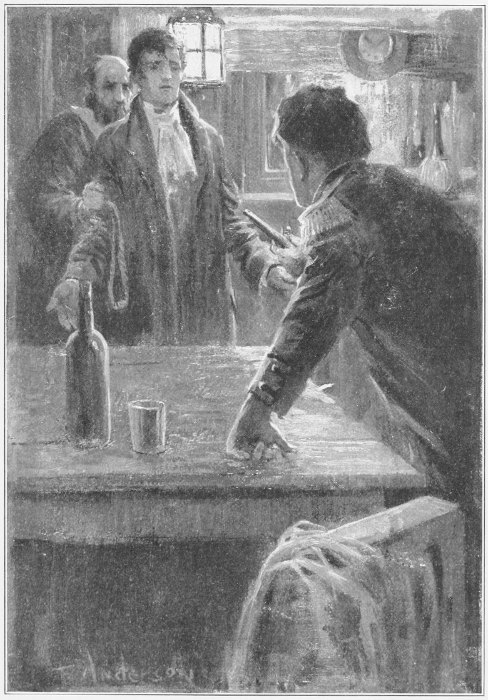
Nick Turned to Lead the Way
Men were working on a couple of overturned skiffs, men were lounging
about doing nothing, men who looked nowise different from the fellows
Antony saw in his own town. They paid no particular attention to him,
and Nick led him along the shore through the woods that covered the
headland, and out on the other side. Here was a snug harbor, with a
good-sized ship at anchor, men on the shore and more men on the ship's deck.
Nick shoved a small boat into the water, motioned to Antony to climb in,
and with a few strokes brought them to the ship's side. He made the boat
fast, and climbed a short rope-ladder to the deck. "Don't be scared," he
muttered; "he don't eat boys." He led the way to where a stocky man with
a heavy black beard sat in a chair smoking a long pipe.
"Here's a lad," said Nick, nodding to the chief, "we picked up as he was
rowing down along the coast from Charles Town. He wanted a taste of salt
air, and something better to do than what he'd been doing. And we didn't
want him to go back home and tell what he'd seen down here."
Blackbeard was certainly black, and there was a scar on one side of his
face that didn't add to the beauty of his appearance, but he wasn't
ferocious-looking, not as fierce in fact as several men Antony knew at
home. He puffed at his pipe a minute before he spoke.
"We're going up to the town to-morrow morning," he said. "What's the
talk about us there?"
"They thought you were chasing Spanish ships from Cuba and St.
Augustine," answered Antony, "and I think they were pretty glad you were
doing it."
"They were, eh?" snorted Blackbeard. "That's always the way of it!
Fight the enemy and you're a hero, but don't for the love of Heaven come
near us. Smooth-faced rascals all! Keep an eye on him, Nick," and he
jerked his head to show that the audience was over.
"Not so terrible, was he?" said Nick, as they went aft. "Now I'll show
you some folks you know." They came to the window of the cabin, and he
indicated that he wanted Antony to look inside. Half a dozen men and a
couple of small boys were in the cabin, a most disconsolate-looking lot.
To his great surprise Antony recognized the nearest as Mr. Samuel Wragg,
a prominent merchant of Charles Town. The faces of all the others were
familiar to him. "What's Mr. Wragg doing there?" he demanded. "He isn't
a pirate, too?"
"No, he's no pirate," chuckled Nick. "He's what you might call a
hostage. You see, all that merry-looking crowd sailed from your town a
few days ago, bound for England, but we met their ship when she reached
the bar and we asked 'em to come on board us. Thought we might be able
to accommodate 'em better, you see. We overhauled eight ships within a
week out there, and that's pretty good business, better than what we've
done with your Spanish Dons lately. But there's no denying the Dons do
carry the richer cargoes."
"And what are you going to do with them?" asked Antony.
"That's for old Teach, the chief there, to make out. I've a notion your
friend Mr. Wragg and the others in there are going to help us get that
store of drugs and supplies I was telling you of. Let's be going ashore.
I don't want those mates of mine to eat all the fresh fish before we get
back to 'em."
Blackbeard's men—pirates and desperadoes though they were—seemed no
rougher to Antony than any other seafaring men he had met at Charles
Town. They carried more pistols and knives perhaps than such men, but
though he listened eagerly he heard no strange ear-splitting oaths nor
frightening tales of evil deeds they had committed. Nick looked after
him almost like an older brother, saw that he had plenty to eat, helped
him gather up wood for the fire they lighted on the shore after supper.
There were a number of these small fires, each with a group of
swarthy-faced men round it. As Big Bill, the man who had first hailed
Antony and caught the gunwale of his boat, explained, "Blackbeard's men
were glad to stretch their legs ashore whenever they got the chance."
Their pipes lighted, the pirates sat about the campfires as the moon
flooded the sea with sparkling silver. Nick told Antony how he had run
away from his English home in Devon when he was a boy, and had shipped
on board a merchantman out of Bristol. He had followed the sea year in,
year out, until one day the captain of his ship had suddenly given up
being a peaceful merchantman and had begun to hold up and rob any
well-laden vessels he happened to meet. There was more profit in such a
life, he said, and a great deal more excitement. Then he went on to tell
Antony that many great sea-captains had really been pirates, and that
both the people in England and the American colonists really liked the
pirates as long as they preyed on Spanish commerce and the ships of
enemies. King Charles the Second of England, he said, though he
pretended to frown on piracy, had actually made Morgan, the greatest
pirate of them all, a knight, and appointed him governor of his island
of Jamaica. "In most seaport towns," said Nick, "the townsfolk are glad
enough to have us walk their streets, spend our Mexican doubloons, and
sell them the silks and wine we bring in, without asking any questions
about where we got 'em. We're as good as any other traders then; maybe
better, because we don't haggle so over a bargain. But when we hold up
one o' their own precious ships they sing a song about us from t'other
side their mouths."
So he talked on, boastfully enough, about the doings of the sea-rovers;
but the boy, listening intently, thought that every now and then it
sounded as if the dark man were making excuses for himself and his mates.
The fires burned down, and most of the men hunted soft beds under the
forest trees. The summer night was warm, and the air was fresher here
than in the close bunks on the ship. Big Bill and Nick and Antony found
a comfortable place for themselves. "You might take it into your head to
run away," said Nick, "but Big Bill and I always sleep with one eye
open, and there's a couple of men by the boats that'll see anything
stirring, and there's a big marsh through the woods, so you'll do better
to stay where you be. And if they should catch you trying to take French
leave, I'm afraid they'd put you in that stuffy cabin along with your
friend Mr. Wragg and the others. So my advice to ye is, get a good
night's sleep."
Antony took the advice so far as lying still went, though it was not
nearly so easy to fall asleep. He watched the moon through the
tree-tops, he listened to the lapping of the water on the shore, and he
thought how strange it was that he should actually be a prisoner of the
pirates. He thought of his father and mother and hoped they weren't
worried about him; he had stayed away from home overnight before,
camping out in the woods, and probably they wouldn't begin to worry
about him until next day. Then he fell asleep, and when he woke the sun
was rising over the water, and the woods were full of the early morning
songs of birds.
"Yeo ho for a swim!" cried Nick, jumping up. He and Antony plunged into
the water, swam for half an hour, came out and lay in the sun, drying
off, put on their clothes, and went on board the ship, where, in the
galley, they found the cooks had breakfast ready.
Soon afterward there was work to be done preparatory to weighing
anchor. The small boats were brought on board, the crew set the sails,
orders rang from bow to stern. Blackbeard was no longer a quiet man
smoking a pipe in a chair. He was very alert and active, overseeing
everything, and when he snapped out a word, or even jerked his thumb
this way or that, men jumped to do his bidding. The anchor was hoisted
aboard, the ship slowly turned from her harbor and sought the channel.
With a fresh favoring wind the ship set in toward Charles Town. Antony,
on the forward deck with Nick, watched the shore-line until the bright
roofs of the little settlement began to stand out from the green and
blue. Farther and farther on Blackbeard sailed until they were in full
view of the town. Then he called a half-dozen men by name, among them
Nick, and gave them his orders. "Man the long-boat," said he, "and row
ashore. Send this note to the governor. It's a list of drugs I want for
my crew. And tell the governor and Council that if the drugs don't come
back to me in three hours I'll send another boat ashore with the heads
of Samuel Wragg and his son and a dozen other men of Charles Town. Their
heads or the drugs! Look to the priming of your pistols." Blackbeard was
a man of few words, but every word he spoke told.
As the others swung the long-boat overboard Nick stepped up to the
chief. "I'll take the boy along," said he. "He might help us ashore, as
he knows the people there." Blackbeard nodded.
An idea occurred to Antony, and whispering to Nick, he darted to the
galley. He found a scrap of paper there, and scrawled a couple of lines
to his father, saying he was well, and begging his parents not to worry
about him. As he ran back by the cabin he couldn't help glancing in at
the window, and saw Samuel Wragg and the other prisoners whispering
together, their frightened faces seeming to show that they had heard
what was in the wind, and knew that Blackbeard meant to have their heads
in case their friends in Charles Town should refuse to let him have the
drugs he wanted.
The long-boat was now manned and floating lightly on the bay. At a word
from Nick, Antony swung himself over the side of the ship by a rope and
dropped into the boat, "You steer us," said Nick, "and mind you don't
get us into any trouble, or overboard you go as sure as my name's
Nicholas Carter."
The harbor was smooth as glass and the long-boat, pulled by its lusty
crew, shot along rapidly. Nick was pulling the stroke oar, and presently
Antony, who sat opposite him, took the little note he had written from
his pocket. "If you go ashore, won't you give this paper to somebody?"
he begged. "My father's name's on the outside, and everybody knows him.
It'll make his mind easier about me."
Nick bobbed his head. "Slip it into my pocket," he murmured, nodding to
where his jacket lay on the bottom of the boat.
The town was right before them now, its quays busy with the usual
morning life of the water-front. To Antony, however, it seemed that more
men and boys than usual were standing there, some watching the
long-boat, and others looking past her at the big ship far down the bay.
He saw faces he knew, he saw men staring at him wonderingly, he even
felt rather proud at the strange position he had so unexpectedly fallen into.
"Easy now, mates," sang out Nick, looking over his shoulder at the near
water-front. He gave a few orders, and the long-boat swung gently up to
an empty float, and he and the man next to him, slipping on their
jackets and making sure that their pistols slid easily from their belts,
stepped lightly to the float.
By now a large crowd had gathered on the shore, all staring at the
strangers. Nick and his fellow-pirate, cool as cucumbers, walked up the
plank that led from the float to the dock. There Nick made a little
mocking bow to the men and boys of Charles Town. "Who's governor here?"
he demanded, with the assurance of an envoy from some mighty state.
Several voices answered, "Robert Johnson is the governor."
Nick took from an inner pocket the paper Blackbeard had given him. "One
of you take this message to Governor Robert Johnson. It comes from
Captain Teach, sometimes known as Captain Blackbeard. He entertains
certain merchants of your town on board his ship, Mr. Samuel Wragg and
others. And should any of you harm me or my mates while we wait for the
governor's answer Captain Teach will feel obliged, much to his regret,
to do the same to your worthy townsmen on his ship."
There were murmurs and exclamations from the crowd, and whispers of
"It's Blackbeard!" "It's the pirates!" and the like.
As no one stepped forward Nick now pointed to a man in a blue coat who
stood fronting him. "Take this message," he said, and spoke so
commandingly that the man stepped forward and took it. Then he beckoned
a boy to him and gave him Antony's note. "For Mr. Jonas Evans," he said.
"Make sure he gets it." After that he sat down on a bale of cotton,
pulled out a pipe, filled it with tobacco, and lighted it. The other
pirate did the same. The bright sun shone on the brace of pistols each
man wore in his belt.
The man in the blue coat hurried to Governor Johnson with the message
from the pirate chief. The governor read the message, demanding certain
drugs at once, on pain of Samuel Wragg and the other merchants of
Charles Town losing their heads. The governor sent for the Council and
read the message to them. They would all have liked to tear the message
to shreds and go out at once to capture this insolent sea-robber, but
there was danger that if they tried to do that their worthy
fellow-citizens would instantly lose their heads.
Meantime the news had spread through the town, and there was the
greatest excitement. The people longed to get their hands on Blackbeard
and pay him for this insult. But they dared not stir now; they dared not
even lay finger on the two insolent rascals who sat on the bales of
cotton on the water-front, smiling at the crowd. The families and
friends of Samuel Wragg and the other prisoners, all of whom were named
in Blackbeard's message to the governor, hurried to the house where the
Council was meeting, and demanded that the drugs should be sent out to
Blackbeard at once.
The governor and Council argued the matter up and down. They hated to
yield to such a command, and yet it would be monstrous to sacrifice
their friends for a few drugs. Then Governor Johnson made his decision.
He reminded them that he had time and again urged the Proprietors and
the Board of Trade to send out a frigate to protect the commerce of
Charles Town from just such perils as this; and added that it was his
duty to protect the lives of all the citizens. He would send the drugs,
and then the Council must see to it that such a situation shouldn't
occur again.
All the medicines on Blackbeard's list were carried down to the float
and put on board the long-boat under Nicholas Carter's supervision. "I
thank you all in the name of Captain Teach," Nick said, smiling and
bowing in his best manner. Among the crowd on shore Antony had caught
the faces of his father and mother, and waved to them, and called out
that he would soon be back.
The long-boat left the shore amid angry mutterings from the people. The
tide was low now, and presently Antony, by mischance, mistook the course
of the channel, and ran the boat aground. He showed so plainly, however,
that he hadn't meant to do it, that Nick forgave him, and said he
wouldn't throw him overboard. It took some time for the crew to get the
boat afloat again, and when they finally reached the ship they found
Blackbeard in a terrible rage at the delay and almost on the point of
beheading Mr. Wragg and the other prisoners.
The sight of the drugs calmed his anger somewhat, and he ordered his
captives brought out on deck. There he had them searched, and took
everything of value they had with them, among other things a large
amount of gold from Mr. Wragg. Some of their clothes he took also, so
that it was hard to say whether the poor merchants were shivering more
from fright or from cold. Then he had them rowed in the long-boat to a
neighboring point of land, where they were left to make their way home
as best they could.
Antony had asked Nick if he couldn't be set on shore with the others,
but Nick, drawing him away from the rest of the crew, had whispered,
"Stay with me a day or two more. I'm going to leave the ship myself.
I'm tired of this way of living, and I'd like to have a friend to speak
a good word for me when I land. I'll see no harm comes to you, boy. I
got that note to your father, and—one good turn deserves another. We'll
leave old Blackbeard soon."
Antony liked the dark man. "All right," said he. "I think we can get
into Charles Town without any one knowing who you are. I'll look out for
you."
"Much obliged to you, Tony," said Nick, with a grin.
So when the pirate ship sailed out to sea again, Antony was still on
board her.
II
Five days Antony stayed on board the pirate ship, while Blackbeard
doctored the sick men of his crew with the medicines he had obtained in
Charles Town. The boy was well treated, for it was understood that he
was under Nick's protection, and moreover, although the pirates could
show their teeth and snarl savagely enough in a fight, they were
friendly and easy-going among themselves. It was a pleasant cruise for
Antony, for the weather held good, and Nick taught him much about the
handling of a ship. Then, after five days of sailing, Blackbeard
anchored off one of the long sandy islands that dot that coast, and
those of his men who were tired of their small quarters on the ship went
ashore and spent the night there. Among them were Nick and Antony, and,
as on that other night ashore, they made their beds at a little distance
from the others.
Just before dawn Antony was waked by some one pulling his shoulder. It
was Nick, who signaled to him that he should rise noiselessly and follow
him. The boy obeyed, and the two went silently through the woods and
came out on another beach as the sun was rising. They walked for some
time, watching the wonderful colors the sun was sending over sea and
sky. Then said Nick, "We're far enough away from them now. They won't
hunt for us; they've more than enough crew, and old Teach ain't the man
to bother his head about a couple of runaways. Five minutes of curses,
and he'll be up and away again, with never a thought of us. I'll beat
you to the water, Tony," and Nick started to pull his shirt over his
head.
They swam as long as they wanted, and then they followed the shore,
growing more and more hungry as they went along. "There must be
fishermen somewhere," said Nick. "A little farther south, and we'd have
fruit for the taking; but here"—he shrugged his shoulders—"nothing but
a few berries that rattle around in one like peas in a pail."
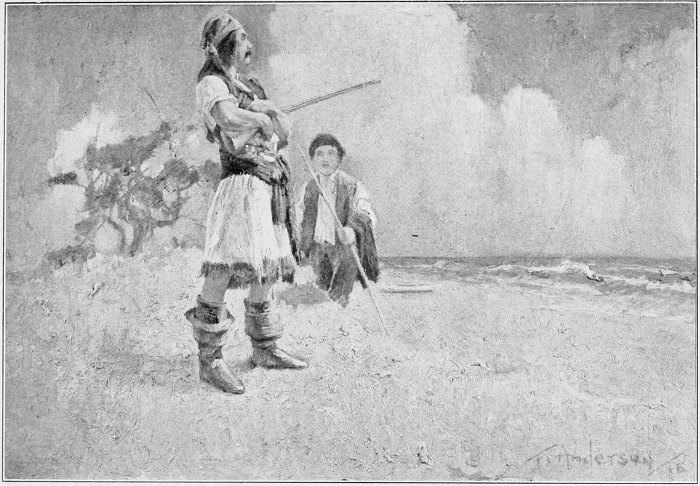
After an hour, however, they came to a fisherman's shanty, and found the
owner working with his nets and lines on the shore. He was a big man,
with reddish hair and beard, and clothes that had been so often soaked
in salt water that they had almost all the colors of the rainbow. "We'll
work all day for food and drink," said Nick, grinning.
The fisherman grinned in return. "Help yourselves," said he, waving his
hand toward his shanty. "You're welcome to what you find; I got my gold
and silver safe hid away."
They found dried fish and corn-meal cakes and water in an earthen jar.
When they came out to the beach again they told the man their names, and
learned in turn that his was Simeon Park. They went out with him in his
sailing-smack, and fished all day, and when they came back they felt
like old friends, as men do who spend a day together on the sea.
There followed a week of fishing with Simeon, varied by mornings when
they went hunting ducks and wild turkeys and geese with him over the
marshes and the long flats that lay along the coast. Antony had never
had a better time; he liked both of his new friends, and, except for his
father and mother, he was in no hurry to go back to Charles Town and
work in the warehouse there. At the end of the week Simeon Park
suggested that they should take the smack for a cruise, fishing and
gunning as chance offered. So they put to sea again, this time in a much
smaller vessel than Blackbeard's merchantman.
They met with one small gale, but after that came favoring winds.
Presently they found themselves near Charles Town harbor again. They
camped on shore one night, and Antony told Nick that he must be heading
for home shortly.
Next morning the boy was waked by the big fisherman, who pointed out to
sea. Three big ships were standing off the coast, and even at that
distance they could see that the "Jolly Roger" of a pirate, the skull
and crossbones, flew from the masthead of the biggest vessel. Guns
boomed across the water. "The two sloops are after the big fellow,"
exclaimed Simeon Park. "Let's put out in our boat, and have a look at
the game."
They put off in their smack, and with the skilful fisherman at the helm,
stood off and on, tacked and ran before the wind, until they came to a
point where they were out of shot and yet near enough to see all that
was taking place.
"I can read the names of the sloops," said Park, squinting across at
their sterns; "one's called Sea Nymph and t'other the Henry, and
they both hail from Charles Town."
Nick chuckled. "That governor of yours," he said to Antony, "didn't lose
much time. He's got two sloops of war now for certain, and he means to
try a tussle with the rovers." He too squinted at the vessels. "I don't
think she's Blackbeard's, howsomever. No, there's her name." And he
spelled out the words Royal James.
The two sloops, each mounting eight guns, had swept down on the pirate,
evidently planning to catch her in a narrow strait formed by two spits
of land. But the pirate ship, undaunted, had sought to sail past the
sloops, and by her greater speed to gain the open sea. Then the two
sloops bore in close, and before the Royal James knew what she was
about she had sailed out of the channel and was stuck fast on a shoal of
sand. Then the Henry, too, grounded in shoal water, and some distance
further, her mate, the Sea Nymph.
This was a pretty situation, all three ships aground, and only the
little fishing-smack able to sail about as she liked. "Lucky we don't
draw more'n a couple of feet of water," said Simeon Park, at the helm.
"If we only had a gun of our own aboard we could hop about and pepper
first one, then t'other."
"And have one good round shot send us to the bottom as easy as a man
crushes a pesky mosquito," observed Nick. "No, thankee. If it's all the
same to you I'd rather keep out of gun-fire of both sides to this little
controversy."
Antony, crouched on the small deck forward, was too busy watching what
was going on to consider the likelihood of his boat going aground.
The tide was at the ebb, and there was no likelihood of any of the three
fighting-ships getting off the shoals for hours. The Royal James and
the Henry had listed the same way, and now lay almost in line with
each other, so that the hull of the pirate ship was turned directly
toward the Charles Town sloop, while the deck of the latter was in full
view of the pirate, and only a pistol-shot away.
"They're more like two forts now than ships," said Nick. "There she
goes!"
Antony was yelling. The Henry had opened fire on the pirate ship. But
instantly the Royal James returned the fire with a broadside, which,
on account of its position, raked the open deck of the Henry.
"Those lads have got grit to stick to their guns!" cried Park, keeping
his smack bobbing on the waves at a safe distance. "They're using their
muskets, too!" Antony cheered every time shots blazed from the Henry
and held his breath to see what damage the answering fire of the pirate
did to his own townsmen.
The other Charles Town sloop, the Sea Nymph, was aground too far
down-stream to be of any help to her mate. Her crew, like the crew of
three in the fishing-smack, could only watch from a distance, and cheer
as the battle was waged back and forth.
And waged back and forth it was for a long time, while men were shot
down at the guns, and parts of each ship shot away, and the sea
scattered with wreckage, and the air filled with smoke and the heavy,
acrid odor of powder. "The pirate's getting the best of it," shouted
Simeon Park, after some time of fighting. It looked that way; her crew
were yelling exultantly, and her captain had called to the sloop,
demanding that the latter's crew haul down their flag in surrender.
At length, however, the tide began to turn, and with it the chance of
victory for the pirates. The Henry floated from the shoal first, and
her captain prepared to grapple with his enemy and board her. Then the
Sea Nymph floated, and headed up to aid her consort. The pirate chief,
seeing the chances now two to one against him, yelled to his crew to
fight harder than ever; and the Royal James blazed again and again
with broadsides, making a desperate stand, like a wild animal brought to
bay. The rail of the Henry was carried overboard, and to the three in
the fishing-smack it looked as if some of the crew had gone over with
it.
Antony forgot the sea-fight; he was calling directions to Park to steer
his boat so as to near the wreckage. He saw a man with his arm thrown
over a piece of the railing, and he called encouragement to him. The
fisherman sent his boat dashing ahead, and the man in the water, hearing
Antony's voice, tried to swim in his direction. "Easy now!" cried the
boy, and the boat swept up to the wreckage, and lay there, with loosely
flapping sail, while Antony and Nick leaned far over her side and drew
the man on board. They laid him on the deck, while Park, at the tiller,
brought his boat about and scurried away from the line of fire.
The man was not badly hurt; he had a flesh wound in one shoulder, and
was dazed from having been flung into the sea with the railing. "Never
mind me," he said. "Look for others." The three looked over the water,
but though they saw plenty of floating wreckage, they spied no other
men.
"She's striking her flag!" cried Park. They all looked at the fighting
ships, and saw that the pirate had hauled down his flag, and heard the
cheers of victory from the Henry and the Sea Nymph. Antony jumped up
and down and yelled with the best of them; the men of Charles Town were
having their revenge on the sea-rovers who had so openly flouted them a
short time before.
"That's the end of Blackbeard!" cried the wounded man, sitting up and
watching the crews of the two sloops as they prepared to board the other vessel.
Nick shook his head. "Not Blackbeard," he said. "Whoever that rover may
be, he's not old Teach, I know."
The gun-smoke drifted away across the water, and Park, at Nick's
suggestion, headed his boat for shore. The dark man had no wish to sail
up to the sloops from Charles Town just then, thinking it not unlikely
that some of the crew might remember him as Blackbeard's agent at the
Charles Town dock. So they skirted the shore till they reached a good
landing-place. There they camped, binding the sailor's wounded shoulder
as best they could, cooking dinner, for they were all ravenously hungry,
and resting on the sand. There the sailor, Peter Duval, told them how
angry Governor Johnson and the men of Charles Town had been when
Blackbeard had sailed away with his medicines, leaving Samuel Wragg and
the others, plundered and almost stripped, to find their way home; and
how Colonel Rhett had sworn that with two sloops he would rid the sea of
the pirate, and had sailed forth to do it. In return Antony told the
sailor who he was and they planned that in a day or two they would
return home. "And Nick there is going back with me," added Antony,
nodding toward the dark young fellow who sat on the beach with them.
Now Duval had heard how Blackbeard or some of his men had kidnapped the
son of Jonas Evans, and he had his own suspicions concerning what manner
of man this dark-haired fellow might be. Yet he could not help liking
the man, who had certainly helped to do him a good turn; and even if he
had been a pirate there was no reason why he shouldn't have changed his
mind about that way of living and have decided to become an honest
citizen. So he nodded his head approvingly, and said, "That's good. The
old town needs some likely-looking men," and shifted about so that the
warm sand made a more comfortable pillow for his wounded shoulder.
Next day they sailed back to Simeon Park's cabin, and there Nick
discovered a pair of shears and cut his black mustache and cropped his
hair close, so that he looked more like one of the English Roundheads
than he did like a sea-rover. "Now, mates," said he to Antony and Duval,
"I'm a wandering trader you happened to meet in the woods. Tony stole
away from Blackbeard's men one night, and found Park's cabin here. Then
I came along, and a day or two later the three of us picked Duval out of
the sea. What d'ye say to that, mates?"
"I say," said Duval, winking, "that with the lad and me to speak up for
you, they'll be glad to have you in Charles Town, whatever you may be."
He added sagely, "Folks aren't over particular in the colonies about
your granddaddy. Many of 'em came over from the old country without
questions asked as to why they came. No, sir; if a man deals square by
us, we deal square by him."
The following afternoon Simeon Park's boat tacked across the bay, and
zigzagged up to the Charles Town docks. At sundown his three passengers
landed, and bade him a hearty farewell. Few people were about, and none,
as it chanced, who knew them, so that the three walked straightway up
the street along the harbor, Nick in the middle, looking as innocent as
if he had never seen the town before.
The Evans family lived in a small frame house on Meeting Street, and
husband and wife were just sitting down to supper when there came a
knock at the street door. Jonas Evans opened the door, and his son
sprang in and caught him around the shoulders. "Here I am, dad!" he
cried. "Safe and sound again!" After that bear-like squeeze he rushed to
his mother, and gave her the same greeting, while she exclaimed, and
kissed him again and again, and called him all her pet names.
"And I've brought a friend home with me, Nicholas Carter," said Antony.
"I met him along the coast, and he's been very good to me, so you must
be good to him. He's a splendid fellow," he added loyally. "And he and a
fisherman and I pulled Peter Duval out of the water after the big
sea-fight the other day."
"Any friend of my boy's is my friend," said Mr. Evans, and he caught
Nick by the hand and drew him into the house. Then he shook hands with
Duval, and so did Mrs. Evans, almost crying in her delight at having her
son home again, and they both urged the sailor to stay and have supper
with them, but he said that now that he had seen his two mates safely
home he must dash away to his own family.
Antony and Nick sat at the supper-table and ate their fill while Jonas
Evans told them the news. Colonel Rhett had sailed out from Charles Town
with his two sloops and after a great battle had captured the pirate
ship. He thought he had captured Blackbeard, but found he was mistaken.
The pirate had turned out to be a man named Stede Bonnet, a man who came
of a good family and owned some property, a gentleman one might say, a
man who had been a major in the army, and a worthy citizen of
Bridgetown. Once he had repented of his pirate's life, and taken the
King's pardon, but he had gone back to his lawless trade, and been one
of the fiercest of his kind. No one in Charles Town could understand why
such a man had a liking for such a business. Mr. Evans supposed that it
must be because of the wild adventures that went with the career of the
sea-rovers. Here Antony caught a smile on Nick's face, and knew that his
friend was thinking there were many reasons why respectable fellows
turned outlaws. Some drifted into it, as Nick had done as a boy, and
found it easier to stay in than to leave.
Colonel Rhett, Jonas Evans added, had returned to Charles Town with the
Royal James as a prize, and with Stede Bonnet and thirty of his crew
in irons. Eighteen of the men of Carolina had been killed in the
sea-fight, and many more badly wounded.
Then, when he could eat no more, Antony told his story. "And I hope,
dad," he finished, "that you can find a place for Nick in the warehouse.
And on Sundays," he added to his friend, "we'll get out on the water,
and go gunning and fishing."
"Any honest work," said Nick, with his familiar smile, "till I can get
my bearings, and see what I'm best fitted for." He thought he might
endure the warehouse for a week or so, but already he felt the call to
the old free life of the rover.
Jonas Evans agreed to try to find a place for his son's friend. They
talked till the tallow dips sputtered and went out, and then Nick and
Antony climbed to their two bedrooms up under the eaves. "It's the first
time I've slept in a house for years, Tony," said Nick. "I don't know
how I'll like it."
He found that he liked it very well, and the ex-pirate slept
comfortably under the roof of the respectable Charles Town merchant.
III
Jonas Evans was as good as his word, and when Antony went to work in the
warehouse Nick was given a place there too. The dark-haired man had some
pieces of silver in his pocket, and he bought himself quiet-colored
clothes and a broad-brimmed hat, so that he looked very much like other
men in the town; but his black eyes would shine and his clean-shaven
lips curl in amusement as they had done when Antony first rowed his boat
almost into his arms. However, the people of Charles Town were
accustomed to having all sorts of men settle among them, as Peter Duval
had said, and they made no inquiries as to what a man had done before he
arrived there, but only considered how he behaved now, and so they took
it for granted that Nicholas Carter was quite respectable enough, and
didn't trouble themselves about his past. And who would be likely to
think that the man with the long black hair and mustache who had landed
from Blackbeard's small-boat and insolently ordered the governor to
furnish him with drugs was the same man as this young fellow, who was
polite and friendly with every one?
The room in the warehouse where Antony and Nick worked had a window that
looked out across the water, and often the boy saw his friend gazing at
the dancing waves with longing eyes. But when Nick would catch Antony
looking at him he would grin and shake his head, and then try to appear
very much absorbed in the job he had on hand. At such times the boy, who
had only tasted that free life of sea and shore for a few days, could
appreciate the feelings of the man who had known that life for years.
Meantime Charles Town had been very busy dealing with the pirates it had
captured. There was no jail in the town, so most of the crew of the
Royal James had been locked up in the watch house, while their leader,
Stede Bonnet, and two of his men had been given in charge of the marshal
to keep under close guard in his own house. After some time the crew
were put on trial before Chief Justice Trott, and the attorney-general
read to the court and jury a list of thirty-eight ships that Bonnet and
Teach had captured in the last six months. The prisoners had no lawyers
to defend them, but two very able lawyers to attack them, and the Chief
Justice and the other judges, as well as the jury, were convinced that
the crew of the Royal James had beyond question been guilty of piracy.
Four, however, were freed of the charge, while the rest were sentenced
to be hung, the customary punishment for pirates.
Stede Bonnet, their captain, was not put on trial. The guards at the
marshal's house had been very careless, and Bonnet had made friends with
some men in the town. With the help of these friends he had disguised
himself as a woman, and with one of his mates had escaped in a boat with
an Indian and a negro. People said that his plan was to reach the ships
of another pirate named Moody, who had appeared off the bar of the
harbor a few days before, with a ship of fifty guns, and two smaller
ships, likewise armed, that he had captured on their way from New
England to Charles Town.
From the warehouse window Antony and Nick saw the sails of this insolent
new sea-rover, who dared stand so close inshore, waiting to pounce on
any boats that might put out from the town.
The governor had already sent word to England, asking for aid in his
warfare with the buccaneers, but none came from England. So he told the
Council that they must act for themselves, and they ordered the best
ships in port impressed into service and armed. Colonel Rhett, the man
who had captured Bonnet, was asked to take command of this new fleet,
but he declined, owing to some difficulty he had had with Governor
Johnson. Thereupon the governor himself declared he would be the
admiral, to the great delight of Charles Town. Four ships, one of them
being the captured Royal James, were armed with cannon, and a call was
sent out for volunteers.
Nick and Antony, going home one night, read the governor's call posted
on a wall. They went down to the harbor and saw the big ships ready to
sail. "This looks like a chance to set myself right again," said Nick,
slowly. "I wouldn't fight my old mates or Blackbeard; but I don't see
any reason why I shouldn't help to clear the sea of Moody or any other
rascal. I'm going to volunteer."
"The governor might want a boy on board," said Antony. "There are lots
of things I can do about a ship."
That night he asked his father to let him volunteer, and though Jonas
Evans and his wife were very loath to lose their son again, he finally
won their permission. Their friends and neighbors were volunteering;
there was no good reason why they should refuse to do their share.
Next day three hundred men and boys volunteered for the little navy of
Charles Town. Then word came that Stede Bonnet and his companions when
they had reached the bar had found that Moody was cruising northward
that day, and so had put back and taken refuge on Sullivan's Island.
Colonel Rhett, who was very angry at the escape of his captive,
volunteered to lead a party to capture Bonnet again. A small party went
in search, hunting the fugitives. The sand-hills, covered with a thick
growth of stunted live-oaks and myrtles, offered splendid protection,
and the hunt was difficult, but at last the men were sighted, shots were
fired, Bonnet's comrade was killed, and the pirate chief himself was
taken prisoner, and once more brought back to Charles Town by Colonel
Rhett.
While this search and capture were going on Antony and Nick were busy
on Governor Johnson's flag-ship, making ready to put to sea. Lookouts
caught sight of the pirate Moody's vessels returning, sailing closer and
closer in, actually coming inside the bar, as though they meant to
attack the town itself. But inside the bar they stopped, and casting
anchor, quietly rode there, while the sunset colored their sails, and
men and women of Charles Town, on the quays and from the roofs and
windows of their houses, watched them and wondered what might be the
pirate's plans.
That night Governor Johnson, from his flag-ship, gave the order to the
other ships of his small fleet to follow him, and they all slipped their
moorings and stole down the harbor to the fort, and waited there.
At dawn next day the four ships from Charles Town, with their guns under
cover and no signs of war about their decks, crossed the bar, heading
toward the sea. The pirate supposed them to be peaceful merchantmen, and
let them sail past him, and then had his ships close in on their track,
in order to cut off their retreat. What he had often done before with
merchantmen he did now; he ran up the black flag and called to the ships
to surrender.
But Governor Johnson had planned to get his enemy into just this
position. The pirate fleet now lay between his own ships and the town.
He hoisted the royal ensign of England, threw open his ports, unmasked
his guns, and poured a broadside of shot into the nearest pirate ship.
Antony, from the deck of the flag-ship, could see the sudden surprise
and alarm on the faces of the pirate crew.
The pirate chief was a clever skipper, however. By wonderful navigating
he sailed his ship straight for the open sea, and actually managed to
get past Governor Johnson. The latter followed in swift pursuit, and as
the ships were now somewhat scattered, the flag-ship signaled the Sea
Nymph and the Royal James to look out for the pirate sloop.
Soon these ships and the sloop were close together, yard-arm to
yard-arm, and a desperate fight under way. The men of Charles Town
fought well; they drove the pirates from their guns, they swarmed aboard
the pirate ship, and killed the pirates who resisted them. Most of the
pirates fought to the last inch of deck-room, refusing to surrender. A
few took refuge in the hold, and threw up their hands when the enemy
surrounded them. Then the crews of the Sea Nymph and the Royal James
sailed the captured sloop back to the harbor, where the men and women
who had been listening to the guns cheered wildly.
In the meantime the governor's flag-ship was chasing the pirate
flag-ship. Antony and another boy stood near Johnson, ready to run his
errands whenever needed; Nick was of the crew that manned one of the
forward cannon. It was a long stern chase, but Johnson slowly drew up on
the other. The buccaneers threw their small boats and even their guns
overboard in an attempt to lighten their ship, but the ship from Charles
Town was the faster, and at length overhauled the rover. A few
broadsides of shot, and the black flag came fluttering down from the
masthead; the governor and part of his crew went on board and the
pirates surrendered.
Antony, dogging the governor's steps, was by him when the hatches were
lifted; to his great astonishment he saw that the hold was filled with
frightened women. The governor turned to the captured rover captain.
"What does this mean?" he demanded, pointing to the women, who were now
climbing to the deck with the help of the Charles Town crew.
"When we captured this ship," said the rover, "we found she was the
Eagle, bound from England to Virginia, carrying convicts and
indentured servants. We'd have set them ashore at the first good
chance."
It was true. There were thirty-six women on board, sailing from England
to find husbands and homes in the new world. The pirates had changed the
name of the ship, and taken her for their own use, but had had no chance
to land the women safely.
The governor had another surprise that day. He found that the captain of
this fleet of pirates was not Moody, as all Charles Town had supposed,
but an even more dreaded buccaneer, Richard Worley. This Richard Worley
had been on board the sloop, and had been killed in the fierce fighting
on her deck that morning.
Antony and Nick were of the crew that brought the captured Eagle,
with her cargo of women, back to shore. There kind-hearted people of
Charles Town took care of the frightened passengers. In the town that
night there was great rejoicing over the defeat of two of the rovers who
infested that part of the seas, Stede Bonnet and Richard Worley. It was
true that Blackbeard and Moody were still at large, but it might well be
that the fate of their fellows would prove a warning to them that the
people of Charles Town meant business. Governor Johnson and his crews
went back to their regular business, and the town grew quiet again.
Neither Moody nor Blackbeard again troubled the good people there. Weeks
later it was learned that Moody had heard how Charles Town was prepared
for him, and that he had gone to Jamaica, and there taken the "King's
pardon," which was granted to all pirates who would give up their
lawless trade before the following first of January. Afterward word came
that Blackbeard had been captured by a fleet sent out by Governor
Spotswood of Virginia, and commanded by officers of the Royal British
Navy.
Stede Bonnet's crew had already been tried and found guilty of piracy.
The judges had now to consider the case of that buccaneer chief himself.
Every one in Charles Town knew that he had sailed the seas time and
again with the "Jolly Roger" at his masthead, but he was a man of very
attractive appearance and manners, and many of the good people of the
town thought that he really meant to repent and lead a better life. The
judges and jury, however, with Bonnet's past record before them, saw
only the plain duty of dealing with him as they had already dealt with
his crew. Then Colonel Rhett, the gallant soldier who had twice captured
Bonnet, came forward and offered to take the pirate personally to
London, and ask the king to pardon him. The governor felt that he could
not consent to this request; he knew how Bonnet had taken the oath of
repentance once before, and had immediately run up the "Jolly Roger" on
his ship at the first chance he found. Bonnet was a pirate, caught in
the very act. The law was very clear. So Bonnet was hanged, as were the
forty other prisoners who had been found guilty.
Nick stayed with Antony at Mr. Evans's warehouse until the excitement of
the war with the pirates had blown over. He and Antony were almost
inseparable, and the people who met the slim, dark fellow liked him for
his good-nature and ready smile. Whenever they found the chance Antony
and he went sailing or hunting or fishing.
"Tony," he said one day as they sailed back from fishing, "I'm going to
leave the warehouse. No, don't look put out; I'm not going back to my
old way of living. Besides, there aren't any of the rovers left for me
to join. But I was made for the open air, and the work there in the shop
can't hold me. The governor wants soldiers for his province of South
Carolina, and I've a notion the life of a soldier would suit me. I take
naturally to swords and pistols."
Antony smiled. "You'll make a good one, Nick. I shouldn't wonder if you
got to be a general. Yes, you'll like it better. But Dad and I'll hate
to have you go."
So, a few days later, Nicholas Carter, who had once been one of
Blackbeard's crew, offered his services to Governor Johnson and became a
soldier in the small army of the province. He did well, and rose to be a
colonel, and one of the most popular men of Charles Town. But sometimes,
when he and Antony Evans were alone together, Colonel Nicholas Carter
would wink and say, "Remember the day when you and I sailed away on
Blackbeard's ship? Yeo ho, for the life of a pirate!"
"The day you kidnapped me, you mean," Antony would remind him. "That was
a wonderful holiday, to be sure!"
For respectable men turned pirates, and pirates reformed and became
worthy citizens and soldiers, in the days before the little settlement
of Charles Town became the city of Charleston in one of the thirteen
states of the American Union.