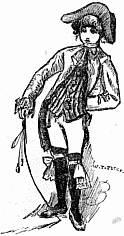
(Afterward Major-General, and Lieutenant-Governor of the State of
New York.)
[a.d. 1777.]
I question whether any of my young
readers, however well up in history
they may be, can place the great River
of Prince Maurice (De Riviere Van den
Voorst Mauritius), which, two hundred
years ago, flowed through the broad
domain of the lord patroons of Rensselaerswyck.
And yet it is the same wide
river upon whose crowded shore now
stands the great city of New York; the
same fair river above whose banks now towers the noble
front of the massive State Capitol at Albany. And that
lofty edifice stands not far from the very spot where, beneath
the pyramidal belfry of the old Dutch church, the
boy patroon sat nodding through Dominie Westerlo's sermon,
one drowsy July Sunday in the summer of 1777.
The good dominie's "seventhly" came to a sudden
stop as the tinkle of the deacon's collection-bell fell upon
the ears of the slumbering congregation. In the big Van
Rensselaer pew it roused Stephanus, the boy patroon,
from a delightful dream of a ten-pound twaalf, or striped
bass, which he thought he had just hooked at the mouth
of Bloemert's Kill; and, rather guiltily, as one who has been
"caught napping," he dropped his two "half-joes" into
the deacon's "fish-net"—for so the boys irreverently
called the knitted bag which, stuck on one end of a long
pole, was always passed around for contributions right in
the middle of the sermon. Then the good dominie went
back to his "seventhly," and the congregation to their
slumbers, while the restless young Stephanus traced with
his finger-nail upon the cover of his psalm-book the profile
of his highly respected guardian, General Ten Broek,
nodding solemnly in the magistrate's pew. At last, the
sands in the hour-glass, that stood on the queer, one-legged,
eight-sided pulpit, stopped running, and so did the
dominie's "noble Dutch"; the congregation filed out of
church, and the Sunday service was over. And so, too,
was the Sunday quiet. For scarcely had the people
passed the porch, when, down from the city barrier at the
Colonie Gate, clattered a hurrying horseman.
"From General Schuyler, sir," he said, as he reined up
before General Ten Broek, and handed him an order to
muster the militia at once and repair to the camp at Fort
Edward. St. Clair, so said the despatch, had been defeated,
Ticonderoga was captured, Burgoyne was marching
to the Hudson, the Indians were on the war-path, and
help was needed at once if they would check Burgoyne
and save Albany from pillage.
The news fell with a sudden shock upon the little city
of the Dutchmen. Ticonderoga fallen, and the Indians
on the war-path! Even the most stolid of the Albany
burghers felt his heart beating faster, while many a
mother looked anxiously at her little ones and called to
mind the terrible tales of Indian cruelty and pillage. But
the young Van Rensselaer, pressing close to the side of
fair Mistress Margarita Schuyler, said soberly: "These be
sad tidings, Margery; would it not be wiser for you all to
come up to the manor-house for safety?"
"For safety?" echoed high-spirited Mistress Margery.
"Why, what need, Stephanus? Is not my father in
command at Fort Edward? and not for Burgoyne and all
his Indians need we fear while he is there! So, many
thanks, my lord patroon," she continued, with a mock
courtesy; "but I'm just as safe under the Schuyler
gables as I could be in the Van Rensselaer manor-house,
even with the brave young patroon himself as my defender."
The lad looked a little crestfallen; for he regarded himself
as the natural protector of this brave little lady, whose
father was facing the British invaders on the shores of the
Northern lakes. Had it not been one, almost, of the unwritten
laws of the colonie, since the day of the first patroon,
that a Van Rensselaer should wed a Schuyler?
Who, then, should care for a daughter of the house of
Schuyler in times of trouble but a son of the house of
Rensselaer?
"Well, at any rate, I shall look out for you if danger
does come," he said, as he turned toward the manor-house.
"You'll surely not object to that, will you,
Margery?"
"Why, how can I?" laughed the girl. "I certainly may
not prevent a gallant youth from keeping his eyes in my
direction. So, thanks for your promise, my lord patroon,
and when you see the flash of the tomahawk, summon
your vassals like a noble knight and charge through the
Colonie Gate to the rescue of the beleaguered maiden of
the Fuyck.[AL] Why, it will be as good as one of Dominie
Westerlo's Northland saga-tales, won't it, Stephanus?"
And, with a stately good-by to the little lord of seven
hundred thousand acres, the girl hastened homeward to
the Schuyler mansion, while the boy rode in the opposite
direction to the great brick manor-house by the creek.
Twenty-four miles east and west, by forty-eight miles
north and south, covering forest and river, valley and hill,
stretched the broad colonie of the patroons of Rensselaerswyck,
embracing the present counties of Albany, Rensselaer,
and Columbia, in the State of New York; and
over all this domain, since the days of the Heer Killian
Van Rensselaer, first of the lord patroons, father and son,
in direct descent, had held sway after the manner of the
old feudal barons of Europe. They alone owned the
land, and their hundreds of tenants held their farms on
rentals or leases, subject to the will of the "patroons," as
they were called,—a Dutch adaptation of the old Roman
patronus, meaning patrician or patron.
Only the town-lands of Beverwyck, or Albany, were free
from this feudal right—a territory stretching thirteen
miles north-west, by one mile wide along the river front,
and forced from an earlier boy patroon by the doughty
Peter Stuyvesant, and secured by later English governors;
and at the time of our story, though the old feudal laws
were no longer in force, and the rentals were less exacting
than in the earlier days, the tenantry of Rensselaerswyck
respected the authority and manorial rights of Stephen
Van Rensselaer, their boy patroon, who, with his widowed
mother and his brothers and sisters, lived in the big brick
manor-house near the swift mill creek and the tumbling
falls in the green vale of Tivoli, a mile north of the city
gate.
And now had come the Revolution. Thanks to the
teaching of his tender mother, of his gallant guardian, and
of the good Dominie Westerlo, young Stephen knew what
the great struggle meant—a protest against tyranny, a
blow for human rights, a defence of the grand doctrine of
the immortal Declaration that "All men are created free
and equal." And he had been told, too, that the success
of the Republic would be the death-blow to all the feudal
rights to which he, the last of the patroons, had succeeded.
"Uncle," he said to his guardian, that stern patriot and
whig, General Abram Ten Broek, "you are my representative
and must act for me till I grow to be a man. Do
what is best, sir, and don't let the Britishers beat!"
"But, remember, lad," said his uncle, "the Revolution,
if it succeeds, must strip you of all the powers and rights
that have come to you as patroon. You will be an owner
of acres, nothing more; no longer baron, patroon, nor
lord of the manor; of no higher dignity and condition
than little Jan Van Woort, the cow-boy of old Luykas
Oothout on your cattle farm in the Helderbergs."
"But I'll be a citizen of a free republic, won't I, Uncle?"
said the boy; "as free of the king and his court across the
sea as Jan Van Woort will be of me and the court-leet of
Rensselaerswyck. So we'll all start fair and even. I'm
not old enough to fight and talk yet, Uncle; but do you
fight and talk for me, and I know it will come out all right."
And so, through the battle-summer of 1777, the work
went on. Men and supplies were hurried northward to
help the patriot army, and soon General Ten Broek's three
thousand militia-men were ready and anxious for action.
The air was full of stirring news. Brandt and his Indians,
Sir John Johnson and his green-coated Tories, swarmed
into the Mohawk Valley; poor Jane McCrea fell a victim
to Indian treachery, and the whole northern country
shuddered at the rumor that twenty dollars had been
offered for every rebel scalp. And fast upon these came
still other tidings. The noble General Schuyler, fair Mistress
Margery's father, had, through the management of
his enemies in the Congress and in the camp, been superseded
by General Gates; but, like a true patriot, he worked
just as hard for victory nevertheless. Herkimer had
fallen in the savage and uncertain fight at Oriskany;
in Bennington, stout old Stark had dealt the British a
rousing blow; and Burgoyne's boast that with ten thousand
men he could "promenade through America" ended
dismally enough for him in the smoke of Bemis Heights
and the surrender at Saratoga.
But, before that glorious ending, many were the dark
and doubtful days that came to Albany and to Rensselaerswyck.
Rumors of defeat and disaster, of plot and
pillage, filled the little city. Spies and Tories sought to
work it harm. The flash of the tomahawk, of which Mistress
Margery had so lightly jested, was really seen in the
Schuyler mansion. And the brave girl, by her pluck and
self-possession, had saved her father and his household
from the chance of Tory pillage and Indian murder. Good
Dominie Westerlo kept open church and constant prayer
for the success of the patriot arms through one whole
anxious week, and on a bright September afternoon, General
Ten Broek, with a slender escort, came dashing up
to the "stoop" of the Van Rensselaer manor-house.
"What now, Uncle?" asked young Stephen, as he met
the General in the broad hall.
"More supplies—we must have more supplies, lad," replied
his uncle. "Our troops need provisions, and I am
here to forage among both friends and foes."
"Beginning with us, I suppose," said the young patroon.
"Oh, Uncle, cannot I, too, do something to show my love
for the cause?"
"Something, Stephen? You can do much," his uncle
replied. "Time was, lad, when your ancestors, the lord
patroons of Rensselaerswyck, were makers and masters of
the law in this their colonie. From their own forts floated
their own flag and frowned their own cannon. Their word
was law and from Beeren's Island to Pafraet's Dael the
Heer Van Rensselaer's orders were obeyed without question.
Forts and flags and cannon are no longer yours,
Stephen, and we would not have it otherwise; but your
word still holds as good with your tenantry as did that of
the first boy patroon, Johannes the son of Killian, when,
backed by his gecommitteerden and his schepens,[AM]
he bearded the Heer General Stuyvesant and claimed all
Rensselaerswyck as his 'by right of arms.' Try your word
with them, lad. Let me be your gecommitteerden and,
in the name of the patroon, demand from your tenantry
of Rensselaerswyck provisions and forage for our gallant
troops."
"Oh, try it, Uncle, try it—do," young Stephen cried,
full of interest; "but will they give so much heed, think
you, to my word?"
"Ay, trust them for that," replied the general. "So
strong is their attachment to their young patroon that
they will, I know, do more on your simple word than on all
the orders and levies of the king's Parliament or the Continental
Congress."
So, out into the farm-lands that checkered the valley and
climbed the green slopes of the Helderbergs, went the
orders of the boy patroon, summoning all "our loyal and
loving tenantry" to take of their stock and provender all
that they could spare, save the slight amount needed for
actual home use, and to deliver the same to the commissaries
of the army of the Congress at Saratoga. And
the "loyal and loving tenantry" gave good heed to their
patroon's orders. Granaries and cellars, stables and pigsties,
pork-barrels and poultry-sheds, were emptied of their
contents. The army of the Congress was amply provisioned,
and thus, indeed, did the boy patroon contribute
his share toward the great victory at Saratoga—a victory
of which one historian remarks that "no martial event,
from the battle of Marathon to that of Waterloo—two
thousand years,—exerted a greater influence upon human
affairs."
The field of Saratoga is won. Six thousand British
troops have laid down their arms, and the fears of Northern
invasion are ended. In the Schuyler mansion at
Albany, fair Mistress Margery is helping her mother fitly
entertain General Burgoyne and the paroled British officers,
thus returning good for evil to the man who, but a
few weeks before, had burned to the ground her father's
beautiful country-house at Saratoga. Along the fair
river, from the Colonie Gate to the peaks of the Katzbergs,
the early autumn frosts are painting the forest
leaves with gorgeous tints, and to-day, the first of November,
1777, the children are joyously celebrating the
thirteenth birthday of the boy patroon in the big manor-house
by the creek. For, in Albany, a hundred years ago,
a children's birthday party really meant a children's party.
The "grown-folk" left home on that day, and the children
had free range of the house for their plays and rejoicing.
So, through the ample rooms and the broad halls of
the Van Rensselaer mansion the children's voices ring merrily,
until, tired of romp and frolic, the little folks gather
on the great staircase for rest and gossip. And here the
fresh-faced little host, in a sky-blue silk coat lined with
yellow, a white satin vest broidered with gold lace, white
silk knee-breeches, and stockings tied with pink ribbons,
pumps, ruffles, and frills, is listening intently while Mistress
Margery, radiant in her tight-sleeved satin dress, peaked-toed
and bespangled shoes, and wonderfully arranged
hair, is telling the group of girls and boys all about General
Burgoyne and the British officers, and how much they
liked the real Dutch supper her mother gave them one
day—"suppawn and malck[AN] and rulliches,[AO] with chocolate
and soft waffles, you know,"—and how General the
Baron Riedesel had said that if they stayed till Christmas
he would play at Saint Claes (Santa Claus) for them.
"Oh, Margery!" exclaimed Stephen, "you wouldn't
have a Hessian for good old Saint Claes, would you?"
"Why not?" said Mistress Margery, with a toss of her
pretty head. "Do you think you are the only patroon,
my lord Stephen?"
For Santa Claus was known among the boys and girls
of those old Dutch days as "the children's patroon" (De
Patroon van Kinder-vreugd).
"I saw the Hessian baron t' other night, Margarita,"
said Stephen's best boy-friend, Abram Van Vechten; "he
never could play at Santa Claus. He's not the right
shape at all. And then a Hessian! Why, I'd sooner
have old Balthazar!"
"Oh, dear, what a Saint Claes he'd make!" cried all
the girls and boys, for old Balthazar Lydius was the terror
of the Albany children in those days—"a tall, spare Dutchman,
with a bullet head," a sort of Bluebeard to their
imaginations, living in his "big mahogany house with
carved beams," near the old Kerk, and scowling and
growling at every Kind who passed his door.
"No, no, Abram," protested Margery, "I'd rather
have the baron, even if he is a Hessian. Only imagine
old Balthazar playing at Saint Claes, girls! Why, he's
as sour as a ladle of Aunt Schuyler's kool-slaa. Show us
how he looks, Stephen; you can, you know."
"Yes, do, do!" shouted all the girls and boys. "Show
us Abram's sour face. Let's see which is the best
patroon."
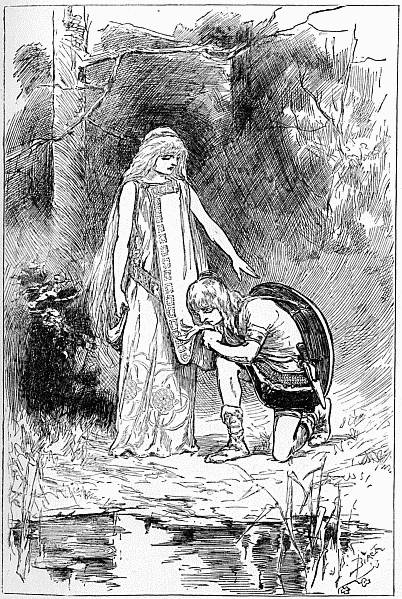
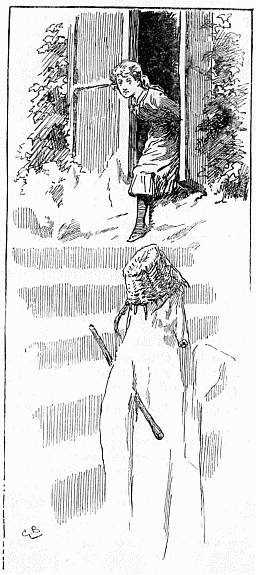
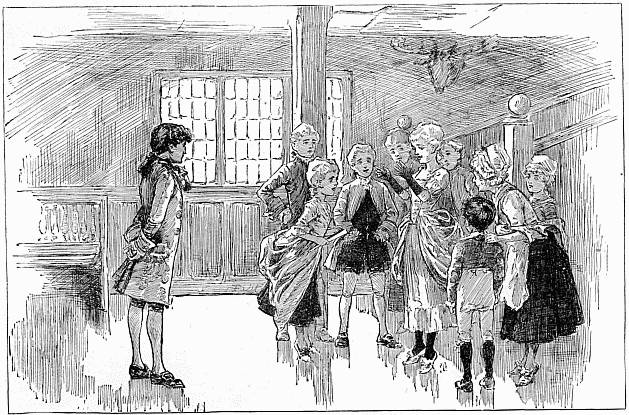 "SUPPAWN AND MALCK AND RULLICHES, WITH CHOCOLATE AND SOFT WAFFLES, YOU KNOW," SAID MISTRESS MARGERY.
So the boy lengthened down his face and pulled in his
cheeks and looked so ferociously sour that the children
fairly shrieked with delight at the caricature, and Abram
cried: "That's it; that's old Balthazar as sure as you
live! That's just the way he looked at me last winter
when I almost ran into him as I was sliding down the
long coast at Fort hill. My! I was so scared that I ran
as fast as my legs could carry me from way below the
Kerk clear past the Van der Hayden palace."[AP]
But, in the midst of the laughter, a quick step sounded
in the hall, and General Ten Broek came to the children-crowded
staircase. "The Helderberg farmers are here,
lad," he said to his nephew; and the young patroon,
bidding his guests keep up the fun while he left them
awhile, followed his uncle through the door-way and
across the broad court-yard to where, just south of the
manor-house, stood the rent-office. As the boy emerged
from the mansion, the throng of tenants who had gathered
there at his invitation gazed admiringly at the manly-looking
little lad, resplendent in blue and yellow, and gold
lace, and greeted him with a rousing birthday cheer—a
loyal welcome to their boy patroon, their young Opperhoofdt,
or chief.
"My friends," the lad said, acknowledging their greeting
with a courtly bow, "I have asked you to come to the
manor-house on this, my birthday, so that I might thank
you for what you did for me before the Saratoga fight,
when you sent so much of your stock and produce to the
army simply on my order. But I wish also to give you
something besides thanks. And so, that you may know
how much I value your friendship and fealty, I have, with
my guardian's approval, called you here to present to each
one of you a free and clear title to all the lands you have,
until now, held in fee from me as the patroon of Rensselaerswyck.
General Ten Broek will give you the papers
before you leave the office, and Pedrom has a goodly
spread waiting for you in the lower hall. Take this from
me, my friends, with many thanks for what you have
already done for me."
Then, what a cheer went up! The loyal tenantry of the
Helderberg farms had neither looked for nor expected
any special return for their generous offerings to the army
of the Congress, and this action of the boy patroon filled
every farmer's heart with something more than gratitude;
for now each one of them was a land-owner, as free and
untrammelled as the boy patroon himself. And, as fair
Portia says in the play,
"So shines a good deed in a naughty world,"
that, when young Stephen Van Rensselaer went joyfully
back to his children's party, and the Helderberg farmers
to black Pedrom's "spread" in the lower hall, it would
have been hard to say which felt the happier—the giver
or the receivers of this generous and manly gift.
The years of battle continued, but Dominie Doll's
boarding-school, smoked out of 'Sopus when the British
troops laid Kingston in ashes, found shelter in Hurley;
and here the boys repaired for instruction—for school
must go on though war rages and fire burns. The signs
of pillage and desolation were all around them; but, boy-like,
they thought little of the danger, and laughed heartily
at Dominie Doll's story of the poor 'Sopus Dutchman who,
terribly frightened at the sight of the red-coats, fled wildly
across a deserted hay-field, and stepped suddenly upon the
end of a long hay-rake left behind by the "skedaddling"
farmers. Up flew the long handle of the rake and struck
the terrified Dutchman a sounding whack upon the back
of his head. He gave himself up for lost. "Oh, mein
Got, mein Got!" he cried, dropping upon his knees and
lifting imploring hands to his supposed captors, "I kivs
up, I kivs up, mynheer soldiermans. Hooray for King
Shorge!"
Nearly two years were passed here upon the pleasant
hill-slopes that stretch away to the Catskill ridges and the
rugged wildness of the Stony Clove; and then, in the fall
of 1779, when the boy patroon had reached his fifteenth
birthday, it was determined to send him, for still higher
education, to the College of New Jersey, at Princeton.
Of that eventful journey of the lad and his half-dozen
school-fellows, under military escort, from the hills of the
Upper Hudson to the shot-scarred college on the New
Jersey plains, a most interesting story could be told. I
doubt whether many, if any, boys ever went to school
under quite such delightfully exciting circumstances. For
their route lay through a war-worried section; past the dismantled
batteries of Stony Point, where "Mad Anthony
Wayne" had gained so much glory and renown; past the
Highland fortresses, and through the ranks of the Continental
Army, visiting General Washington at his headquarters
at West Point, and carrying away never-forgotten
recollections of the great commander; cautiously past
roving bands of cruel "cow-boys" and the enemy's outposts
around captured New York, to the battered college
buildings which had alternately been barracks and hospital
for American and British troops. And an equally interesting
story could be told of the exciting college days
when, almost within range of the enemy's guns, the boom
of the distinct cannon would come like a punctuation in
recitations, and the fear of fusillades would help a boy
through many a "tight squeeze" in neglected lessons.
But this was education under difficulties. The risk became
too great, and the young patroon was finally transferred
to the quieter walls of Harvard College, from which
celebrated institution he graduated with honor in 1782,
soon after his eighteenth birthday.
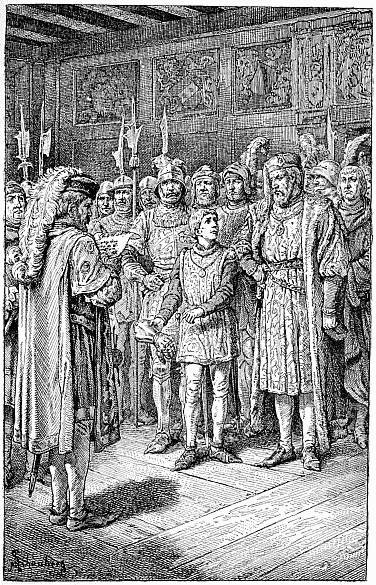
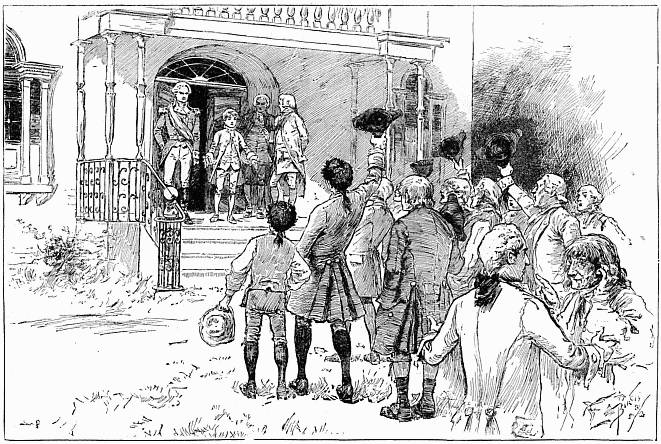 "THE THRONG OF TENANTS GREETED HIM WITH A ROUSING BIRTHDAY CHEER."
The quiet life of an average American boy would not
seem to furnish very much worth the telling. The boy
patroon differed little, save in the way of birth and vast
estate, from other boys and girls of the eventful age in
which he lived; but many instances in his youthful career
could safely be recorded. We might tell how he came
home from college just as the great war was closing; how
he made long trips, on horseback and afoot, over his great
estate, acquainting himself with his tenantry and their
needs; how, even before he was twenty years old, he followed
the custom of his house and married fair Mistress
Margery, the "brave girl" of the Schuyler mansion; and
how, finally, on the first of November, 1785, all the
tenantry of Rensselaerswyck thronged the grounds of the
great manor-house, and, with speech and shout and
generous barbecue, celebrated his coming of age—the
twenty-first birthday of the boy patroon,—now no longer
boy or patroon, but a free American citizen in the new
Republic of the United States.
His after-life is part of the history of his State and of
his country. At an early age he entered public life, and
filled many offices of trust and responsibility. An assemblyman,
a State Senator, a lieutenant-governor, a member
of Congress, a major-general, and the conqueror of Queenstown
in Canada in the War of 1812, one of the original projectors
of the great Erie Canal, and, noblest of all, the
founder and patron of a great school for boys,—the Rensselaer
Polytechnic Institute at Troy,—he was, through all,
the simple-hearted citizen and the noble-minded man.
But no act in all his long life-time of seventy-five years
became him better than the spirit in which he accepted
the great change that made the great lord patroon of half a
million acres the plain, untitled citizen of a free republic.
"Though born to hereditary honors and aristocratic
rank," says his biographer, "with the history of the past
before him, in possession of an estate which connected
him nearly with feudal times and a feudal ancestry, and
which constituted him in his boyhood a baronial proprietor,
he found himself, at twenty-one, through a forcible and
bloody revolution, the mere fee-simple owner of acres,
with just such political rights and privileges as belonged
to his own freehold tenantry, and no other." And though
the Revolution, in giving his country independence, had
stripped him of power and personal advantages, he
accepted the change without regret, and preferred his
position as one in a whole nation of freemen, to that feudal
rank which he had inherited from generations of ancestors,
as the Boy Patroon, the last Lord of the Manor of Rensselaerswyck.
From the patrician emperor of old Rome to the patrician
citizen of modern America these sketches of Historic
Boys have extended. They represent but a few from that
long list of remarkable boys, who, through the ages, have
left their mark upon their times,—lads who, even had
they died "in their teens," would still have been worthy
of record as "historic boys." The lessons of their lives
are manifold. They tell of pride and selfishness, of
tyranny and wasted power, of self-reliance and courage, of
ambition and self-conquest, of patience and manliness.
History is but the record of opportunities for action
availed of or neglected. And opportunities are never wanting.
They exist to-day in the cities of the New World,
even as they did ages ago with young David in the valley
of Elah, with the boy Marcus in the forum of Rome, or
with the valiant young Harry of Monmouth striving for
victory on the bloody field of Shrewsbury.
Whenever or wherever a manly boy says his word for
justice and for right, or does his simple duty in a simple,
straightforward way, regardless of consequences or of the
world's far too-ready sneer or frown, the stamp of the
hero may be seen; and however humble his condition or
contracted his sphere there is in him the mettle and the
possibilities that may make him, even though he know it
not, a worthy claimant for an honored place on the
world's record of Historic Boys.
THE END.
"A better collection of juvenile books it has not been our privilege to examine. A
robust and healthy tone pervades their pages; and while stirring adventures, deeds of
daring, and self-sacrifice form an important factor in the stories, information, historical
or otherwise, constitutes a primary feature."—Christmas Bookseller, 1885.
Blackie & Son's
Books for Young People.
The New Season's Books.
By G. A. HENTY.
The Young Carthaginian:
A Story of the times of Hannibal.
With Wolfe in Canada:
Or, The Winning of a Continent.
The Bravest of the Brave:
Or, With Peterborough in Spain.
A Final Reckoning:
A Tale of Bush Life in Australia.
By G. MANVILLE FENN.
Devon Boys: a Tale of the North Shore.
Yussuf the Guide:
Being the Strange Story of the Travels in Asia Minor
of Burne the Lawyer, Preston the Professor, and
Lawrence the Sick.
By HARRY COLLINGWOOD.
The Log of the "Flying Fish":
A Story of Aerial and Submarine Peril and Adventure.
By ALICE CORKRAN.
Down the Snow Stairs:
Or, From Good-night to Good-morning. With 60 illustrations
by Gordon Browne.
By DOUGLAS FRAZAR.
Perseverance Island:
Or, The Robinson Crusoe of the 19th Century.
By J. PERCY GROVES.
Reefer and Rifleman: A Tale of the Two Services.
By JOHN C. HUTCHESON.
The White Squall: A Story of the Sargasso Sea.
Teddy: The Story of a "Little Pickle."
By E. S. BROOKS.
Historic Boys:
Their Endeavours, their Achievements, and their Times.
By EVELYN EVERETT GREEN.
The Eversley Secrets.
By R. STEAD.
The Lads of Little Clayton.
Stories of Village Boy Life.
By LAURA E. RICHARDS.
The Joyous Story of Toto.
TALES OF CAPTIVITY AND EXILE.
By CAROLINE AUSTIN.
Dorothy's Dilemma: A Tale of the Time of Charles I.
By ROSA MULHOLLAND.
The Late Miss Hollingford.
By AMY WALTON.
The Hawthornes.
Our Frank, and other Stories.
GORDON BROWNE'S SERIES OF OLD FAIRY TALES.
Hop o' my Thumb.
Beauty and the Beast.
Also, New Books in the Shilling, Ninepenny, and Sixpenny Series.
By F. Bayford Harrison,
Mrs. Geo. Cupples, Mary C. Rowsell, Annie S. Fenn,
Emma Leslie, and other favourite Authors.
DOWN THE SNOW STAIRS:
Or, From Good-night to Good-morning. By Alice Corkran.
With 60 character Illustrations by Gordon Browne. Square
crown 8vo, cloth elegant, gilt edges, 6s.
This is a remarkable
story: full of
vivid fancy and quaint
originality. In its
most fantastic imaginings
it carries with
it a sense of reality,
and derives a singular
attraction from
that combination of
simplicity, originality,
and subtle humour
which is so much
appreciated by lively
and thoughtful children.
Children of
a larger growth will
also be deeply interested
in Kitty's
strange journey: and
her wonderful experiences
amidst the
extraordinary people
whom she meets. The
work is profusely illustrated
by an artist
whose facile pencil
has portrayed alike
the graceful and the
grotesque, the images
of goblin and fairy
land and the semblances
of child life.
BY PROFESSOR CHURCH.
TWO THOUSAND YEARS AGO:
Or, The Adventures of a Roman Boy. By Professor A. J.
Church, Author of "Stories from the Classics." With 12 full-page
Illustrations by Adrien Marie, in black and tint.
Crown 8vo, cloth elegant, olivine edges, 6s.
Prof. Church has in this story sought to revivify that most interesting
period, the last days of the Roman Republic. The hero of the story, Lucius
Marius, is a young Roman who has a very chequered career, being now
a captive in the hands of Spartacus, again an officer on board a vessel detailed
for the suppression of the pirates, and anon a captive once more, on
a pirate ship. He escapes to Tarsus, is taken prisoner in the war with
Mithradates, and detained by the latter in Pontus for a number of years.
While boys will follow with the deepest interest the career of Lucius,
they will gain a clear insight into the history and life of the ancient
Roman world.
"Adventures well worth the telling.
The book is extremely entertaining as
well as useful, and there is a wonderful
freshness in the Roman scenes and
characters."—The Times.
"Entertaining in the highest degree
from beginning to end, and full of adventure
which is all the livelier for its
close connection with history."—Spectator.
"We know of no book which will do
more to make the Romans of that day
live again for the English reader."—Guardian.
BY PROFESSOR POUCHET.
THE UNIVERSE:
Or the Infinitely Great and the Infinitely Little. A
Sketch of Contrasts in Creation, and Marvels revealed and
explained by Natural Science. By F. A. Pouchet, m.d.
Illustrated by 273 Engravings on wood. 9th Edition, medium
8vo, cloth elegant, gilt edges, 7s. 6d.; morocco antique, 16s.
The object of this Work is to inspire and extend a taste for natural
science. It is not a learned treatise, but a simple study. The title adopted
indicates that the author has gathered from creation at large, often contrasting
the smallest of its productions with the mightiest.
"We can honestly commend this
work, which is admirably, as it is copiously
illustrated."—Times.
"As interesting as the most exciting
romance, and a great deal more likely
to be remembered to good purpose."—Standard.
"Scarcely any book in French or in
English is so likely to stimulate in the
young an interest in the physical phenomena."—Fortnightly
Review.
"The volume, and it is a splendid
one, will serve as a good pioneer to more
exact studies."—Saturday Review.
BY G. A. HENTY.
"Surely Mr. Henty should understand boys' tastes better than any man living."—The
Times.
THE YOUNG CARTHAGINIAN:
A Story of the Times of Hannibal. By G. A. Henty. With 12
full-page Illustrations by C. J. Staniland, R.I. Crown
8vo, cloth elegant, olivine edges, 6s.
When boys at school read of the history of the Punic Wars their appreciation
of the merits of the struggle between the Romans and Carthaginians
is usually slight. That it was at first a struggle for empire, and afterwards
one for existence on the part of Carthage, that Hannibal was a great and
skilful general, that he defeated the Romans at Trebia, Lake Trasimenus,
and Cannæ, and all but took Rome, and that the Romans behaved with
bad faith and great cruelty at the capture of Carthage, represents pretty
nearly the sum total of their knowledge.
To let them know more about this momentous struggle for the empire of
the world Mr. Henty has written this story, which not only gives in graphic
style a brilliant description of a most interesting period of history, but is a
tale of exciting adventure sure to secure the interest of the reader.
THE LION OF THE NORTH.
A Tale of Gustavus Adolphus and the Wars of Religion. By
G. A. Henty. With 12 full-page Illustrations by John
Schönberg, in black and tint. Crown 8vo, cloth elegant,
olivine edges, 6s.
In this story Mr. Henty gives the history of the first part of the Thirty
Years' War, a struggle unprecedented in length, in the fury with which it
was carried on, and in the terrible destruction and ruin which it caused.
The issue had its importance, which has extended to the present day, as
it established religious freedom in Germany. The army of the chivalrous
King of Sweden, the prop and maintenance of the Protestant cause, was
largely composed of Scotchmen, and among these was the hero of the
story. The chief interest of the tale turns on the great struggle between
Gustavus and his chief opponents Wallenstein, Tilly, and Pappenheim.
"As we might expect from Mr. Henty
the tale is a clever and instructive
piece of history, and as boys may be
trusted to read it conscientiously, they
can hardly fail to be profited as well as
pleased."—The Times.
"A praiseworthy attempt to interest
British youth in the great deeds of the
Scotch Brigade in the ware of Gustavus
Adolphus. Mackay, Hepburn, and
Munro live again in Mr. Henty's pages, as
those deserve to live whose disciplined
bands formed really the germ of the
modern British army."—Athenæum.
"A stirring story of stirring times.
This book should hold a place among
the classics of youthful fiction."—United
Service Gazette.
BY G. A. HENTY.
"Mr. Henty as a boy's story-teller stands in the very foremost rank."—Glasgow Herald.
WITH WOLFE IN CANADA:
Or, The Winning of a Continent. By G. A. Henty. With
12 full-page Illustrations by Gordon Browne. Crown 8vo,
cloth elegant, olivine edges, 6s.
In the present volume Mr. Henty has endeavoured to give the details
of the principal events in the struggle between Britain and France for
supremacy on the North American continent. The importance of this
struggle can scarcely be overrated, as on the issue of it depended not
only the destinies of North America, but to a large extent those of the
mother countries themselves. The fall of Quebec decided that the Anglo-Saxon
race should predominate in the New World, that Britain, and not
France, should take the lead among the nations, and that English commerce,
the English language, and English literature, should spread right
round the globe. While thus of the greatest significance, this episode from
the world's history lends itself pre-eminently to the romantic style of treatment
of which Mr. Henty is master.
WITH CLIVE IN INDIA:
Or the Beginnings of an Empire. By G. A. Henty. With
12 full-page Illustrations by Gordon Browne, in black and
tint. Crown 8vo, cloth elegant, olivine edges, 6s.
The period between the landing of Clive as a young writer in India and
the close of his career was critical and eventful in the extreme. At its
commencement the English were traders existing on sufferance of the
native princes. At its close they were masters of Bengal and of the greater
part of Southern India. The author has given a full and accurate account
of the events of that stirring time, and battles and sieges follow each other
in rapid succession, while he combines with his narrative a tale of daring
and adventure, which gives a life-like interest to the volume.
"In this book Mr. Henty has contrived
to exceed himself in stirring adventures
and thrilling situations. The pictures add
greatly to the interest of the book."—Saturday Review.
"Among writers of stories of adventure
for boys Mr. Henty stands in the very
first rank, and Mr. Gordon Browne occupies
a similar place with his pencil....
Those who know something about India
will be the most ready to thank Mr.
Henty for giving them this instructive
volume to place in the hands of their children."—Academy.
"He has taken a period of Indian History
of the most vital importance, and he
has embroidered on the historical facts
a story which of itself is deeply interesting.
Young people assuredly will be delighted
with the volume."—Scotsman.
BY G. A. HENTY.
"The brightest of all the living writers whose office it is to enchant the boys."—Christian Leader.
THROUGH THE FRAY:
A Story of the Luddite Riots. By G. A. Henty. With 12 full-page
Illustrations by H. M. Paget, in black and tint. Crown
8vo, cloth elegant, olivine edges, 6s.
The author in this story has followed the lines which he worked out so
successfully in Facing Death. As in that story he shows that there are
victories to be won in peaceful fields, and that steadfastness and tenacity
are virtues which tell in the long run. The story is laid in Yorkshire at the
commencement of the present century, when the high price of food induced
by the war and the introduction of machinery drove the working-classes
to desperation, and caused them to band themselves in that widespread
organization known as the Luddite Society. There is an abundance of
adventure in the tale, but its chief interest lies in the character of the
hero, and the manner in which by a combination of circumstances he is
put on trial for his life, but at last comes victorious "through the fray."
"Mr. Henty inspires a love and admiration
for straightforwardness, truth,
and courage. This is one of the best of
the many good books Mr. Henty has
produced, and deserves to be classed
with his Facing Death."—Standard.
"The interest of the story never flags.
Were we to propose a competition for
the best list of novel writers for boys
we have little doubt that Mr. Henty's
name would stand first."—Journal of Education.
TRUE TO THE OLD FLAG:
A Tale of the American War of Independence. By G. A.
Henty. With 12 full-page Illustrations by Gordon Browne,
in black and tint. Crown 8vo, cloth elegant, olivine edges, 6s.
In this story the author has gone to the accounts of English officers who
took part in the conflict, and lads will find that in no war in which British
soldiers have been engaged did they behave with greater courage and
good conduct. The historical portion of the book being accompanied with
numerous thrilling adventures with the redskins on the shores of Lake
Huron, a story of exciting interest is interwoven with the general narrative
and carried through the book.
"Does justice to the pluck and determination
of the British soldiers during
the unfortunate struggle against American
emancipation. The son of an American
loyalist, who remains true to our flag,
falls among the hostile redskins in that
very Huron country which has been endeared
to us by the exploits of Hawkeye
and Chingachgook."—The Times.
"Mr. G. A. Henty's extensive personal
experience of adventures and moving
incidents by flood and field, combined
with a gift of picturesque narrative,
make his books always welcome visitors
in the home circle."—Daily News.
"Very superior in every way. The book
is almost unique in its class in having
illustrative maps."—Saturday Review.
BY G. A. HENTY.
"Mr. Henty's books never fail to interest boy readers."—Academy.
IN FREEDOM'S CAUSE:
A Story of Wallace and Bruce. By G. A. Henty. With
12 full-page Illustrations by Gordon Browne, in black and
tint. Crown 8vo, cloth elegant, olivine edges, 6s.
In this story the author relates the stirring tale of the Scottish War of
Independence. The extraordinary valour and personal prowess of Wallace
and Bruce rival the deeds of the mythical heroes of chivalry, and indeed
at one time Wallace was ranked with these legendary personages. The
researches of modern historians have shown, however, that he was a living,
breathing man—and a valiant champion. The hero of the tale fought under
both Wallace and Bruce, and while the strictest historical accuracy has
been maintained with respect to public events, the work is full of "hairbreadth
'scapes" and wild adventure.
"Mr. Henty has broken new ground
as an historical novelist. His tale is full
of stirring action, and will commend
itself to boys."—Athenæum.
"It is written in the author's best
style. Full of the wildest and most
remarkable achievements, it is a tale of
great interest, which a boy, once he has
begun it, will not willingly put on one
side."—The Schoolmaster.
"Scarcely anywhere have we seen in
prose a more lucid and spirit-stirring
description of Bannockburn than the one
with which the author fittingly closes his
volume."—Dumfries Standard.
UNDER DRAKE'S FLAG:
A Tale of the Spanish Main. By G. A. Henty. Illustrated
by 12 full-page Pictures by Gordon Browne, in black and
tint. Crown 8vo, cloth elegant, olivine edges, 6s.
A story of the days when England and Spain struggled for the supremacy
of the sea, and England carried off the palm. The heroes sail as lads
with Drake in the expedition in which the Pacific Ocean was first seen by
an Englishman from a tree-top on the Isthmus of Panama, and in his great
voyage of circumnavigation. The historical portion of the story is absolutely
to be relied upon, but this, although very useful to lads, will perhaps
be less attractive than the great variety of exciting adventure through
which the young adventurers pass in the course of their voyages.
"A stirring book of Drake's time, and
just such a book as the youth of this
maritime country are likely to prize
highly."—Daily Telegraph.
"Ned in the coils of the boa-constrictor
is a wonderful picture. A boy must be
hard to please if he wishes for anything
more exciting."—Pall Mall Gazette.
"A book of adventure, where the hero
meets with experience enough one would
think to turn his hair gray."—Harper's
Monthly Magazine.
BY G. A. HENTY.
"Mr. Henty is the prince of story-tellers for boys."—Sheffield Independent.
THE BRAVEST OF THE BRAVE:
Or, With Peterborough in Spain. By G. A. Henty. With
8 full-page Illustrations by H. M. Paget. Crown 8vo, cloth
elegant, 5s.
There are few great leaders whose lives and actions have so completely
fallen into oblivion as those of the Earl of Peterborough. This is largely
due to the fact that they were overshadowed by the glory and successes
of Marlborough. His career as General extended over little more than
a year, and yet, in that time, he showed a genius for warfare which has
never been surpassed, and performed feats of daring worthy of the leaders
of chivalry.
Round the fortunes of Jack Stilwell, the hero, and of Peterborough, Mr.
Henty has woven an interesting and instructive narrative descriptive of
this portion of the War of the Spanish Succession (1705-6).
THE DRAGON AND THE RAVEN:
Or, The Days of King Alfred. By G. A. Henty. With 8 full-page
Illustrations by C. J. Staniland, R.I., in black and
tint. Crown 8vo, cloth elegant, 5s.
In this story the author gives an account of the desperate struggle
between Saxon and Dane for supremacy in England, and presents a vivid
picture of the misery and ruin to which the country was reduced by the
ravages of the sea-wolves. The hero of the story, a young Saxon thane,
takes part in all the battles fought by King Alfred, and the incidents in
his career are unusually varied and exciting. He is driven from his home,
takes to the sea and resists the Danes on their own element, and being
pursued by them up the Seine, is present at the long and desperate siege
of Paris.
"Perhaps the best story of the early
days of England which has yet been
told."—Court Journal.
"A well-built superstructure of fiction
on an interesting substratum of
fact. Treated in a manner most attractive
to the boyish reader."—Athenæum.
"A story that may justly be styled
remarkable. Boys, in reading it, will be
surprised to find how Alfred persevered,
through years of bloodshed and times
of peace, to rescue his people from the
thraldom of the Danes. We hope the
book will soon be widely known in all
our schools."—Schoolmaster.
"We know of no popular book in
which the stirring incidents of the reign
of the heroic Saxon king are made accessible
to young readers as they are
here. Mr. Henty has made a book which
will afford much delight to boys, and is
of genuine historic value."—Scotsman.
BY G. A. HENTY.
"Mr. Henty is one of the best of story-tellers for young people."—Spectator.
A FINAL RECKONING:
A Tale of Bush Life in Australia. By G. A. Henty, With
8 full-page Illustrations by W. B. Wollen. Crown 8vo,
cloth elegant, 5s.
In this book Mr. Henty has again left the battlefields of history and has
written a story of adventure in Australia in the early days of its settlement,
when the bush-rangers and the natives constituted a real and formidable
danger.
The hero, a young English lad, after rather a stormy boyhood, emigrates
to Australia, where he gets employment as an officer in the mounted police.
A few years of active work on the frontier, where he has many a brush
with both natives and bush-rangers, gain him promotion to a captaincy.
In that post he greatly distinguishes himself, and finally leaves the service
and settles down to the peaceful life of a squatter.
ST. GEORGE FOR ENGLAND:
A Tale of Cressy and Poitiers. By G. A. Henty. With 8 full-page
Illustrations by Gordon Browne, in black and tint.
Crown 8vo, cloth elegant, 5s.
No portion of English history is more crowded with great events than that
of the reign of Edward III. Cressy and Poitiers laid France prostrate at
the feet of England; the Spanish fleet was dispersed and destroyed by a
naval battle as remarkable in its incidents as was that which broke up the
Armada in the time of Elizabeth. Europe was ravaged by the dreadful
plague known as the Black Death, and France was the scene of the terrible
peasant rising called the Jacquerie. All these stirring events are treated
by the author in St. George for England. The hero of the story, although
of good family, begins life as a London apprentice, but after countless
adventures and perils, becomes by valour and good conduct the squire,
and at last the trusted friend of the Black Prince.
"A story of very great interest for boys.
In his own forcible style the author has
endeavoured to show that determination
and enthusiasm can accomplish marvellous
results; that courage is generally
accompanied by magnanimity and gentleness,
and that it is the parent of nearly all
the other virtues, since but few of them
can be practised without it."—Pall Mall
Gazette.
"Mr. Henty has developed for himself
a type of historical novel for boys which
bids fair to supplement, on their behalf,
the historical labours of Sir Walter Scott
in the land of fiction."—Standard.
"Mr. Henty as a boy's story-teller
stands in the very foremost rank. With
plenty of scope to work upon he has produced
a strong story at once instructive
and entertaining."—Glasgow Herald.
BY G. A. HENTY.
"Among writers of stories of adventure for boys Mr. Henty stands in the very
first rank."—Academy.
FOR NAME AND FAME:
Or, Through Afghan Passes. By G. A. Henty. With 8 full-page
Illustrations by Gordon Browne, in black and tint.
Crown 8vo, cloth elegant, 5s.
This is an interesting story of the last war in Afghanistan. The hero,
after being wrecked and going through many stirring adventures among
the Malays, finds his way to Calcutta, and enlists in a regiment proceeding
to join the army at the Afghan passes. He accompanies the force
under General Roberts to the Peiwar Kotal, is wounded, taken prisoner,
and carried to Cabul, whence he is transferred to Candahar, and takes
part in the final defeat of the army of Ayoub Khan.
"Mr. Henty's pen is never more effectively
employed than when he is describing
incidents of warfare. The best
feature of the book—apart from the
interest of its scenes of adventure—is
its honest effort to do justice to the
patriotism of the Afghan people."—Daily
News.
"Here we have not only a rousing
story, replete with all the varied forms
of excitement of a campaign, but an instructive
history of a recent war, and,
what is still more useful, an account of
a territory and its inhabitants which
must for a long time possess a supreme
interest for Englishmen, as being the
key to our Indian Empire."—Glasgow
Herald.
BY SHEER PLUCK:
A Tale of the Ashanti War. By G. A. Henty. With 8 full-page
Illustrations by Gordon Browne, in black and tint. Crown
8vo, cloth elegant, 5s.
The Ashanti Campaign seems but an event of yesterday, but it happened
when the generation now rising up were too young to have made themselves
acquainted with its incidents. The author has woven, in a tale of
thrilling interest, all the details of the campaign, of which he was himself
a witness. His hero, after many exciting adventures in the interior, finds
himself at Coomassie just before the outbreak of the war, is detained a
prisoner by the king, is sent down with the army which invaded the British
Protectorate, escapes, and accompanies the English expedition on their
march to Coomassie.
"Mr. Henty keeps up his reputation as
a writer of boys' stories. 'By Sheer Pluck'
will be eagerly read."—Athenæum.
"The book is one which will not only
sustain, but add to Mr. Henty's reputation."—The
Standard.
"Written with a simple directness,
force, and purity of style worthy of Defoe.
Morally, the book is everything that
could be desired, setting before the boys
a bright and bracing ideal of the English
gentleman."—Christian Leader.
BY G. A. HENTY.
"Mr. Henty's books are always welcome visitors in the home circle."—Daily News.
FACING DEATH:
Or the Hero of the Vaughan Pit. A Tale of the Coal Mines.
By G. A. Henty. With 8 full-page Illustrations by Gordon
Browne, in black and tint. Crown 8vo, cloth, elegant, 5s.
"Facing Death" is a story with a purpose. It is intended to show that
a lad who makes up his mind firmly and resolutely that he will rise in life,
and who is prepared to face toil and ridicule and hardship to carry out his
determination, is sure to succeed. The hero of the story is a typical British
boy, dogged, earnest, generous, and though "shamefaced" to a degree, is
ready to face death in the discharge of duty. His is a character for imitation
by boys in every station.
"The tale is well written and well
illustrated, and there is much reality in
the characters."—Athenæum.
"If any father, godfather, clergyman,
or schoolmaster is on the look-out for a
good book to give as a present to a boy
who is worth his salt, this is the book
we would recommend."—Standard.
YARNS ON THE BEACH.
By G. A. Henty. With 2 full-page Illustrations. Crown 8vo,
cloth extra, 1s. 6d.
"This little book should find special
favour among boys. The yarns are
spun by old sailors, and while full of
romance and adventure, are admirably
calculated to foster a manly spirit."—The
Echo.
BY GEORGE MANVILLE FENN.
IN THE KING'S NAME:
Or the Cruise of the Kestrel. By G. Manville Fenn. Illustrated
by 12 full-page Pictures by Gordon Browne, in black
and tint. Crown 8vo, cloth elegant, olivine edges, 6s.
"In the King's Name" is a spirited story of the Jacobite times, concerning
the adventures of Hilary Leigh, a young naval officer in the
preventive service off the coast of Sussex, on board the Kestrel. Leigh
is taken prisoner by the adherents of the Pretender, amongst whom is an
early friend and patron who desires to spare the lad's life, but will not release
him. The narrative is full of exciting and often humorous incident.
"Mr. Fenn has won a foremost place
among writers for boys. 'In the King's
Name' is, we think, the best of all his
productions in this field."—Daily News.
"Told with the freshness and verve
which characterize all Mr. Fenn's writings
and put him in the front rank of
writers for boys."—Standard.
BY GEORGE MANVILLE FENN.
"Mr. Manville Fenn may be regarded as the successor in boyhood's affections
of Captain Mayne Reid."—Academy.
DEVON BOYS:
A Tale of the North Shore. By George Manville Fenn. With
12 full-page Illustrations by Gordon Browne. Crown 8vo,
cloth elegant, olivine edges, 6s.
The adventures of Sep Duncan and his school friends take place in the
early part of the Georgian era, during the wars between England and France.
The scene is laid on the picturesque rocky coast of North Devon, where the
three lads pass through many perils both afloat and ashore. Fishermen,
smugglers, naval officers, and a stern old country surgeon play their parts
in the story, which is one of honest adventure with the mastering of difficulties
in a wholesome manly way, mingled with sufficient excitement to
satisfy the most exacting reader. The discovery of the British silver mine
and its working up and defence take up a large portion of the story.
BROWNSMITH'S BOY.
By George Manville Fenn. With 12 full-page Illustrations
by Gordon Browne, in black and tint. Crown 8vo, cloth
elegant, olivine edges, 6s.
The career of "Brownsmith's Boy" embraces the home adventures of
an orphan, who, having formed the acquaintance of an eccentric old gardener,
accepts his offer of a home and finds that there is plenty of romance
in a garden, and much excitement even in a journey now and then to
town. In a half-savage lad he finds a friend who shows his love and fidelity
principally by pretending to be an enemy. In "Brownsmith's Boy" there
is abundance of excitement and trouble within four walls.
"'Brownsmith's Boy' excels all the
numerous 'juvenile' books that the
present season has yet produced."—Academy.
"Mr. Fenn's books are among the
best, if not altogether the best, of the
stories for boys. Mr. Fenn is at his best
in 'Brownsmith's Boy.' The story is a
thoroughly manly and healthy one."—Pictorial
World.
"'Brownsmith's Boy' must rank
among the few undeniably good boys'
books. He will be a very dull boy indeed
who lays it down without wishing
that it had gone on for at least 100
pages more."—North British Mail.
"Is every way a charming book for
young people. The author has much
of the inventiveness of the well-known
French writer Jules Verne; indeed, he
is in the front rank of writers of stories
for boys. Parents especially ought to
be very thankful to him for providing
their sons with so much wholesome and
fascinating amusement in the way of
literature."—Liverpool Mercury.
BY GEORGE MANVILLE FENN.
"There is a freshness, a buoyancy, a heartiness about Mr. Fenn's writings."—Standard.
THE GOLDEN MAGNET:
A Tale of the Land of the Incas. By G. Manville Fenn.
With 12 full-page Pictures by Gordon Browne, in black and
tint. Crown 8vo, cloth elegant, olivine edges, 6s.
The tale is of a romantic lad, who leaves home to seek his fortune in
South America by endeavouring to discover some of that treasure which
legends declare was ages ago hidden to preserve it from the Spanish invaders.
He is accompanied by a faithful companion, who, in the capacity
both of comrade and henchman, does true service, and shows the dogged
courage of the English lad during the strange adventures which befall them.
"Told with admirable force and
strength. Few men other than Mr. Fenn
have the capacity for telling such stories
as this."—Scotsman.
"There could be no more welcome present
for a boy. There is not a dull page,
and many will be read with breathless
interest."—Journal of Education.
BUNYIP LAND:
The Story of a Wild Journey in New Guinea. By G. Manville
Fenn. With 12 full-page Illustrations by Gordon
Browne. Crown 8vo, cloth elegant, olivine edges, 6s.
"Bunyip Land" is the story of an eminent botanist, who ventures into
the interior of New Guinea in his search for new plants. Years pass away,
and he does not return; and though supposed to be dead, his young wife
and son refuse to believe it; and as soon as he is old enough young Joe
goes in search of his father, accompanied by Jimmy, a native black. Their
adventures are many and exciting, but after numerous perils they discover
the lost one, a prisoner among the blacks, and bring him home in triumph.
"Mr. Fenn deserves the thanks of
everybody for 'Bunyip Land' and 'Menhardoc,'
and we may venture to promise
that a quiet week may be reckoned on
whilst the youngsters have such fascinating
literature provided for their evenings'
amusement."—Spectator.
"One of the best tales of adventure
produced by any living writer, combining
the inventiveness of Jules Verne, and the
solidity of character and earnestness of
spirit which have made the English victorious
in so many fields of labour and
research."—Daily Chronicle.
A TERRIBLE COWARD.
By G. Manville Fenn. With 2 full-page Illustrations in black
and tint. Crown 8vo, cloth extra, 1s. 6d.
The tale of a lad who never bounced, bragged, or bullied. When the
testing time came, however, the "coward" was found to be the one who
distanced all by his cool unflinching English courage.
"Just such a tale as boys will delight to read, and as they are certain to profit
by."—Aberdeen Journal.
BY GEORGE MANVILLE FENN.
"Mr. Fenn is in the front rank of writers of stories for boys."—Liverpool
Mercury.
YUSSUF THE GUIDE:
Being the Strange Story of the Travels in Asia Minor of Burne
the Lawyer, Preston the Professor, and Lawrence the Sick.
By G. Manville Fenn. With 8 full-page Illustrations by
John Schönberg. Crown 8vo, cloth elegant, 5s.
Deals with the stirring incidents in the career of Lawrence Grange, a
lad who has been almost given over by the doctors, but who rapidly
recovers health and strength in a journey through Asia Minor with his
guardians "The Professor" and "The Lawyer." Yussuf is their guide;
and in their journeyings through the wild mountain region in search of
the ancient cities of the Greeks and Romans they penetrate where law is
disregarded, and finally fall into the hands of brigands. Their adventures
in this rarely-traversed romantic region are many, and culminate in the
travellers being snowed up for the winter in the mountains, from which
they escape while their captors are waiting for the ransom that does not
come.
MENHARDOC:
A Story of Cornish Nets and Mines. By G. Manville Fenn.
With 8 full-page Illustrations by C. J. Staniland, R.I., in
black and tint. Crown 8vo, cloth, elegant, 5s.
The scene of this story of boyish aspiration and adventure is laid among
the granite piles and tors of Cornwall. Here amongst the hardy, honest
fishermen and miners the two London boys are inducted into the secrets of
fishing in the great bay, they learn how to catch mackerel, pollack, and conger
with the line, and are present at the hauling of the nets, although not without
incurring many serious risks. Adventures are pretty plentiful, but
the story has for its strong base the development of character of the three
boys. There is a good deal of quaint character throughout, and the
sketches of Cornish life and local colouring are based upon experience in
the bay, whose fishing village is called here Menhardoc. This is a thoroughly
English story of phases of life but little touched upon in boys'
literature up to the present time.
"They are real living boys, with the
virtues and faults which characterize the
transition stage between boyhood and
manhood. The Cornish fishermen are
drawn from life, they are racy of the soil,
salt with the sea-water, and they stand
out from the pages in their jerseys and
sea-boots all sprinkled with silvery pilchard
scales."—Spectator.
"Mr. Fenn has written many books in
his time; he has not often written one
which for genuine merit as a story for
young people will exceed this."—Scotsman.
BY GEORGE MANVILLE FENN.
"No one can find his way to the hearts of lads more readily than Mr. Fenn."—Nottingham
Guardian.
PATIENCE WINS:
Or, War in the Works. By G. Manville Fenn. With 8 full-page
Illustrations by Gordon Browne, in black and tint.
Crown 8vo, cloth elegant, 5s.
This is a graphic narrative of factory life in the Black Country. The
hero, Cob, and his three uncles, engineers, machinists, and inventors, go
down to Arrowfield to set up "a works." They find, however, that the
workmen, through prejudice and ignorance, are determined to have no
new-fangled machinery. After a series of narrow escapes and stirring
encounters, the workmen by degrees find that no malice is borne against
them, and at last admiration takes the place of hatred. A great business is
built up, and its foundation is laid on the good-will of the men.
"An excellent story, the interest being
sustained from first to last. This
is, both in its intention and the way
the story is told, one of the best books
of its kind which has come before us
this year."—Saturday Review.
"Mr. Fenn is at his best in 'Patience
Wins.' It is sure to prove acceptable
to youthful readers, and will give a good
idea of that which was the real state of
one of our largest manufacturing towns
not many years ago."—Guardian.
"Mr. Fenn has written many a book
for boys, but never has he hit upon a
happier plan than in writing this story
of Yorkshire factory life. The whole
book, from page 1 to 352, is all aglow
with life, the scenes varying continually
with kaleidoscopic rapidity."—Pall
Mall Gazette.
NAT THE NATURALIST:
A Boy's Adventures in the Eastern Seas. By G. Manville
Fenn. Illustrated by 8 full-page Pictures by Gordon Browne,
in black and tint. Crown 8vo, cloth elegant, 5s.
This is a pleasant story of a lad who has a great desire to go abroad to
seek specimens in natural history, and has that desire gratified. The
boy Nat and his uncle Dick go on a voyage to the remoter islands of
the Eastern seas, and their adventures there are told in a truthful and
vastly interesting fashion, which will at once attract and maintain the
earnest attention of young readers. The descriptions of Mr. Ebony, their
black comrade, and of the scenes of savage life, are full of genuine humour.
"Mr. Manville Fenn has here hit upon
a capital idea.... This is among the
best of the boys' books of the season."—The
Times.
"This sort of book encourages independence
of character, develops resource,
and teaches a boy to keep his eyes open."—Saturday
Review.
"We can conceive of no more attractive
present for a young naturalist."—Land
and Water.
"The late Lord Palmerston used to
say that one use of war was to teach
geography; such books as this teach it
in a more harmless and cheaper way."—Athenæum.
BY HARRY COLLINGWOOD.
"Mr. G. A. Henty has found a formidable rival in Mr. Collingwood."—Academy.
THE LOG OF THE "FLYING FISH:"
A Story of Aerial and Submarine Peril and Adventure. By
Harry Collingwood. With 12 full-page Illustrations by
Gordon Browne. Crown 8vo, cloth elegant, olivine edges, 6s.
In this story the aim of the author has been, not only to interest and
amuse, but also to stimulate a taste for scientific study. He has utilized
natural science as a peg whereon to hang the web of a narrative of absorbing
interest, interweaving therewith sundry very striking scientific facts
in such a manner as to provoke a desire for further information.
Professor Von Schalckenberg constructs a gigantic and wonderful ship,
appropriately named the Flying Fish, which is capable of navigating not
only the higher reaches of the atmosphere, but also the extremest depths
of ocean; and in her the four adventurers make a voyage to the North
Pole, and to a hitherto unexplored portion of Central Africa.
In common with all this author's stories, "The Log of the Flying Fish" is
thoroughly healthy and unexceptionable in tone, and may be unhesitatingly
placed in the hands of "our boys," who will enjoy in its perusal a literary
treat entirely after their own hearts.
THE CONGO ROVERS:
A Tale of the Slave Squadron. By Harry Collingwood.
With 8 full-page Illustrations by J. Schönberg, in black and
tint. Crown 8vo, cloth extra, 5s.
The scene of this tale is laid on the west coast of Africa, and in the
lower reaches of the Congo; the characteristic scenery of the great river
being delineated with wonderful accuracy and completeness of detail.
The hero of the story—a midshipman on board one of the ships of the slave
squadron—after being effectually laughed out of his boyish vanity, develops
into a lad possessed of a large share of sound common sense, the exercise
of which enables him to render much valuable service to his superior officers
in unmasking a most daring and successful ruse on the part of the slavers.
"Mr. Collingwood carries us off for
another cruise at sea, in 'The Congo
Rovers,' and boys will need no pressing
to join the daring crew, which seeks
adventures and meets with any number
of them in the forests and pestilential
fogs of the Congo."—The Times.
"We can heartily recommend it as
one that boys will be sure to read
throughout with pleasure, and with advantage,
also, to their morals and their
imaginations."—Academy.
"No better sea story has lately been
written than the Congo Rovers. It is
as original as any boy could desire."—Morning
Post.
BY HARRY COLLINGWOOD.
"Mr. Collingwood has established his reputation as a first-rate writer of sea-stories."—Scotsman.
THE PIRATE ISLAND:
A Story of the South Pacific. By Harry Collingwood. Illustrated
by 8 full-page Pictures by C. J. Staniland and J. R.
Wells, in black and tint. Crown 8vo, cloth elegant, 5s.
This story details the adventures of a lad who was found in his infancy
on board a wreck, and is adopted by a fisherman. By a deed of true gallantry
his whole destiny is changed, and, going to sea, he forms one of a
party who, after being burned out of their ship in the South Pacific, and
experiencing great hardship and suffering in their boats, are picked up
by a pirate brig and taken to the "Pirate Island." After many thrilling
adventures, they ultimately succeed in effecting their escape. The story
depicts both the Christian and the manly virtues in such colours as will
cause them to be admired—and therefore imitated.
"A capital story of the sea; indeed in
our opinion the author is superior in
some respects as a marine novelist to the
better known Mr. Clarke Russell."—The Times.
"The best of these books.... The
events are described with minuteness
and care. The result is a very amusing
book."—Saturday Review.
"Told in the most vivid and graphic
language. It would be difficult to find a
more thoroughly delightful gift-book."—The Guardian.
"One of the very best books for boys
that we have seen for a long time: its
author is thoroughly at home in maritime
matters, and stands far in advance
of any other writer for boys as a teller
of stories of the sea."—The Standard.
"There is enough to make any boy
dream of all that is strange and wild.
But bravery and gentleness and helpfulness
are shown in all their beauty; and
so we should like as many boys as possible
to read the story and admire the
daring deeds."—Christian Leader.
BY DOUGLAS FRAZAR.
PERSEVERANCE ISLAND:
Or the Robinson Crusoe of the 19th Century. By Douglas
Frazar. With 12 full-page Illustrations. Crown 8vo, cloth
elegant, 5s.
This story shows the limitless ingenuity and invention of man, and
portrays the works and achievements of a castaway, who, thrown ashore
almost literally naked upon a desert isle, is able, by the use of his brains,
the skill of his hands, and a practical knowledge of the common arts and
sciences, to far surpass the achievements of all his predecessors, and to
surround himself with implements of power utterly beyond the reach of
the original Robinson Crusoe.
"One of the best issues, if not absolutely the best, of Defoe's work which has ever
appeared."—The Standard.
THE LIFE AND SURPRISING ADVENTURES OF ROBINSON CRUSOE.
BY DANIEL DEFOE.
Beautifully Printed, and Illustrated by above 100 Pictures
Designed by Gordon Browne.
Crown 8vo, cloth elegant, olivine edges, 6s.
There have
been countless
editions of Robinson
Crusoe,
and they have
mostly been
imperfect, inasmuch
as they
have been so
largely altered
from the original
text that
the language in
many instances
has not been
that of Defoe
but of his revisers.
The present
volume has
been carefully
printed from
the original edition,
and all obsolete
or little-known
terms
and obscure
phrases are explained
in brief
foot-notes. The
"Editing" is
not a corruption
or pretended
improvement
of Defoe's
great work.
"Of the many editions of Defoe's immortal
story that have passed through
our hands in recent years, we are inclined
to rank this the most desirable as a present
for a good boy."—The Academy.
GULLIVER'S TRAVELS.
A New Edition, beautifully printed, and illustrated by more
than 100 Pictures from designs by Gordon Browne. In
crown 8vo, cloth elegant, olivine edges, 5s.
The wonderful travels of Gulliver "into several remote regions of the
world" are still as fresh and entertaining as when they were first presented
to the public more than a hundred and fifty years ago. In this edition
the text has been judiciously curtailed by the omission of several passages
quite unsuited for the perusal of the young or for family reading; and
foot-notes to the text have been added to explain and throw light on those
allusions, references, &c., which a young reader would not understand.
"Mr. Gordon Browne is, to my thinking,
incomparably the most artistic,
spirited, and brilliant of our illustrators
of books for boys, and one of the
most humorous also, as his illustrations
of 'Gulliver' amply testify."—Truth.
"By help of the admirable illustrations,
and a little judicious skipping,
it has enchanted a family party of ages
varying from six to sixty. Which of the
other Christmas books could stand this
test?"—Journal of Education.
BY ASCOTT R. HOPE.
STORIES OF OLD RENOWN:
Tales of Knights and Heroes. By Ascott R. Hope. With
nearly 100 Illustrations by Gordon Browne. Crown 8vo,
cloth elegant, olivine edges, 5s.
A Series of the best of the Stories of Noble Knighthood and Old Romance,
told in refined and simple language, and adapted to young readers.
A book possessing remarkable attractions for boys.
"The stories are admirably chosen.
It is a book to be coveted by all young
readers."—Scotsman.
"One of the best, if not the best, boys'
book of the season."—Truth.
THE WIGWAM AND THE WAR-PATH:
Stories of the Red Indians. By Ascott R. Hope. With 8
full-page Pictures by Gordon Browne, in black and tint.
Crown 8vo, cloth elegant, 5s.
"The Wigwam and the War-path" consists of stories of Red Indians
which are none the less romantic for being true. They are taken from the
actual records of those who have been made prisoners by the red men or
have lived among them, joining in their expeditions and taking part in
their semi-savage but often picturesque and adventurous life.
"Mr. Hope's volume is notably good:
it gives a very vivid picture of life among
the Indians."—Spectator.
"All the stories are told well, in simple
spirited language and with a fulness of
detail that makes them instructive as
well as interesting."—Journal of Education.
BY J. PERCY GROVES.
REEFER AND RIFLEMAN:
A Tale of the Two Services. By J. Percy Groves, late 27th
Inniskillings, author of "From Cadet to Captain," &c. With
6 full-page Illustrations by John Schönberg. Crown 8vo,
cloth elegant, 3s. 6d.
A tale of the naval and military services in the early part of the present
century. The hero enters the Royal Navy just after the rupture of the
Peace of Amiens. After a short but eventful career afloat, he returns
home, and subsequently joins the sister service, being appointed to a second
lieutenancy in the old 95th Rifles. The ex-"reefer" takes an active part
in the opening scenes of the Peninsular War, and meets with varied adventures
in Portugal and Spain. After the battle of Coruña he once more
returns to England. The story has an historical interest as well as a plot
of exciting adventure, and a spice of humour which will commend it to
the attention of lads who admire the stories of Captain Marryat.
BY JOHN C. HUTCHESON.
"Mr. Hutcheson bids fair to take a prominent place among our best writers of
boys' books."—The Academy.
THE WHITE SQUALL:
A Story of the Sargasso Sea. By John C. Hutcheson. With
6 full-page Illustrations by John Schönberg. Crown 8vo,
cloth elegant, 3s. 6d.
Commencing amid the fairy-like scenes and surroundings of a West
Indian home, this story passes to Tom Eastman's setting sail from the
Windward Islands on a voyage to England. At first the good ship Josephine
glides buoyantly through the balmy waters of the Caribbean Sea,
but getting out into the broad Atlantic, calm and whirlwind are succeeded
by a gale which drives her to the confines of the Sargasso Sea, that meadow-like
portion of the ocean, between the Azores and Bermuda, which is constantly
covered with the fibrous tentacles of the gulf-weed. Here a sudden
and unexpected "white squall" assails her—the Josephine is turned over
on her beam-ends, and the captain and crew climb up on the ship's keel
for shelter. How they extricate themselves from this terrible predicament,
and how the Josephine is righted and pursues her voyage safely to the
English Channel, the reader will discover in the book.
THE WRECK OF THE NANCY BELL:
Or, Cast Away on Kerguelen Land. By John C. Hutcheson.
Illustrated by 6 full-page Pictures by Frank Feller, in black
and tint. Crown 8vo, cloth extra, 3s. 6d.
This is a book after a boy's own heart. The story narrates the eventful
voyage of a vessel from the port of London to New Zealand, and the haps
and mishaps that befell her, culminating in the wreck of the Nancy Bell
on Kerguelen Land. There is no lack of incident. From the opening
chapter, with the cowardly steward's alarm of "a ghost in the cabin," to
the end of the story, which details the rescue of the shipwrecked passengers,
one engrossing narrative holds the attention of the reader.
"A full circumstantial narrative such
as boys delight in. The ship so sadly destined
to wreck on Kerguelen Land is
manned by a very life-like party, passengers
and crew. The life in the Antarctic
Iceland is well treated."—Athenæum.
TOM FINCH'S MONKEY
And other Yarns. By John C. Hutcheson. With 2 full-page
Illustrations in black and tint. Crown 8vo, cloth extra, 1s. 6d.
"Short stories of an altogether unexceptionable
character, with adventure
sufficient for a dozen books of its
size."—United Service Gazette.
BY JOHN C. HUTCHESON.
"Mr. Hutcheson is master of a capital style for boy readers."—Scotsman.
PICKED UP AT SEA:
Or the Gold Miners of Minturne Creek; and other Stories. By
John C. Hutcheson. With 6 full-page Pictures in tints.
Crown 8vo, cloth extra, 3s. 6d.
The story of a young English lad, rescued in mid Atlantic from a watery
grave, and taken out west by a party of gold-diggers to the wild regions of
the Black Hills in Dakota. Here, after warring with the elements during
months of unceasing toil in their search for the riches of the earth, and
having the result of their indefatigable labour well-nigh torn from their
grasp when on the verge of victory, success at last rewards the efforts of
the adventurous band.
"A capital book; full of startling incident,
clever dialogue, admirable descriptions
of sky and water in all their aspects,
and plenty of fun."—Sheffield Independent.
"This is the first appearance of the
author as a writer of books for boys, and
the success is so marked that it may well
encourage him to further efforts. The
description of mining life in the Far-west
is true and accurate."—Standard.
TEDDY:
The Story of a "Little Pickle." By John C. Hutcheson. With
3 full-page Illustrations. Crown 8vo, cloth extra, 2s.
This is the story of a little fellow, who, while brave and fearless, is always
in mischief, and a torment to everyone connected with him, by reason of
his natural exuberance of animal spirits. As Teddy cannot manage to
steer clear of hot water on shore he is sent to sea, in the hope that discipline
and duty will tame down the rough points of his character, and
teach him to be a noble and good man. Although a "little pickle" at the
beginning of his career, Teddy turns out a little hero at the close of the
story, as the reader will find out if the wonderful adventures of the "young
torment" be followed to the end.
THE PENANG PIRATE,
And The Lost Pinnace. By John C. Hutcheson. With 3
full-page Illustrations. Crown 8vo, cloth extra, 2s.
Deals with the pirates who infest the great water-highways of the East,
and tells how a party of Malayan freebooters were caught in their own
toils and how the gallant ship Hankow Lin voyaged from the Canton
river through the straits of Sunda. Both stories are founded on fact.
"A book which most boys will thoroughly
enjoy. It is rattling, adventurous,
and romantic, and the stories are
thoroughly healthy in tone, and written
by a skilful hand."—Aberdeen
Journal.
BY MRS. R. H. READ.
SILVER MILL:
A Tale of the Don Valley. By Mrs. R. H. Read. With 6 full-page
Illustrations by John Schönberg, in black and tint.
Crown 8vo, cloth elegant, 3s. 6d.
The story of a girl and boy. The chief interest centres around Ruth,
who is supposed to be the orphan child of a working-man, but who
eventually turns out to be the daughter of the cynical, though essentially
kind-hearted, owner of Silver Mill. In tracing the character of Ruth as
she develops from an impulsive girl to noble womanhood, the author
has drawn a picture at once pleasing and suggestive.
"Another of those pleasant stories
which are always acceptable, especially
perhaps to girls standing on the debatable
ground between girlhood and
young ladyhood."—The Guardian.
"A good girl's story-book. The plot
is interesting, and the heroine, Ruth, a
lady by birth, though brought up in a
humble station, well deserves the more
elevated position in which the end of
the book leaves her. The pictures are
very spirited."—Saturday Review.
DORA:
Or a Girl without a Home. By Mrs. R. H. Read. With
6 full-page Illustrations. Crown 8vo, cloth elegant, 3s. 6d.
The story of a friendless orphan girl, who is placed as pupil-teacher at
the school in which she was educated, but is suddenly removed by hard
and selfish relatives, who employ her as a menial as well as a governess.
Through a series of exciting adventures she makes discoveries respecting
a large property which is restored to its rightful owners, and at the same
time she secures her escape from her persecutors.
"It is no slight thing, in an age of
rubbish, to get a story so pure and
healthy."—The Academy.
"One of the most pleasing stories for
young people that we have met with of
late years. There is in it a freshness,
simplicity, and naturalness very engaging."—Harper's
Magazine.
FAIRY FANCY:
What she Heard and what she Saw. By Mrs. R. H. Read.
With many Woodcut Illustrations in the text, and a Frontispiece
printed in colours. Crown 8vo, cloth elegant, 2s.
The tale is designed to show the influence of character even among little
children, and the narrative is such as to awaken and sustain the interest of
the younger readers.
"The authoress has very great insight
into child nature."—Glasgow Herald.
"All is pleasant, nice reading, with a
little knowledge of natural history and
other matters gently introduced and divested
of dryness."—Practical Teacher.
OUR DOLLY:
Her Words and Ways. By Mrs. R. H. Read. With many Woodcuts,
and a Frontispiece in colours. Cr. 8vo, cloth extra, 2s.
A story showing the growth and development of character in a little girl;
with a series of entertaining small adventures suitable for very juvenile
readers.
"Prettily told and prettily illustrated."—Guardian.
"Sure to be a great favourite with
young children."—School Guardian.
BY ALICE BANKS.
CHEEP AND CHATTER:
Or, Lessons from Field and Tree. By Alice Banks. With
54 Character Illustrations by Gordon Browne. Small 4to,
cloth, handsome design on cover, 3s. 6d.; gilt edges, 4s.
About a dozen highly dramatic sketches or little stories, the actors in
which are birds, beasts, and insects. They are instructive, suited to the
capacities of young people, and very amusing.
"The real charm of the volume lies in
the illustrations. Every one is a success.
With birds and mice and insects the artist
is equally at home; but his birds
above all are inimitable."—Academy.
"The author has done her work extremely
well, and has conveyed very
many admirable lessons to young people.
The illustrations are capital—full of fun
and genuine humour."—Scotsman.
BY LEWIS HOUGH.
DR. JOLLIFFE'S BOYS:
A Tale of Weston School. By Lewis Hough. With 6 full-page
Pictures in black and tint. Crown 8vo, cloth extra, 3s. 6d.
A story of school life which will be read with genuine interest, especially
as it exposes some of the dangers which may beset lads who are ill instructed
at home or have been thrown among unscrupulous companions.
The descriptions of the characters of the boys are vivid and truthful. The
narrative throughout is bright, easy, and lighted by touches of humour.
"Young people who appreciate 'Tom
Brown's School-days' will find this story
a worthy companion to that fascinating
book. There is the same manliness of tone,
truthfulness of outline, avoidance of
exaggeration and caricature, and healthy
morality as characterized the masterpiece
of Mr. Hughes."—Newcastle Journal.
BY MRS. EMMA RAYMOND PITMAN.
"Mrs. Pitman's works are all to be prized for their ennobling character—pure,
elevating, interesting, and intellectual."—Christian Union.
GARNERED SHEAVES.
A Tale for Boys. By Mrs. E. R. Pitman. With 4 full-page
Illustrations in black and tint. Crown 8vo, cloth extra, 3s. 6d.
"This book is of unusual merit. It
breathes out good thoughts in earnest
and true tones that speak to the heart."—Schoolmistress.
LIFE'S DAILY MINISTRY.
A Story of Everyday Service for Others. By Mrs. Pitman. With
4 full-page Illustrations. Crown 8vo, cloth extra, 3s. 6d.
"Full of stirring interest, genuine pictures
of real life, and pervaded by a
broad and active sympathy for the true
and good."—Christian Commonwealth.
FLORENCE GODFREY'S FAITH.
A Story of Australian Life. By Mrs. E. R. Pitman. With 4
full-page Illustrations. Crown 8vo, cloth extra, 3s. 6d.
"This is a clever, and what is better
still, a good book, written with a freshness
and power which win the reader's
sympathies."—Christian Globe.
MY GOVERNESS LIFE:
Or Earning my Living. By Mrs. E. R. Pitman. With 4 full-page
Illustrations in black and tint. Crown 8vo, cloth extra, 3s. 6d.
"Told in the author's usual winsome style, which holds the reader spell-bound
from first to last."—Christian Union.
BY HENRY FRITH.
THE SEARCH FOR THE TALISMAN:
A Story of Labrador. By Henry Frith. With 6 full-page
Illustrations by John Schönberg, in black and tint. Crown
8vo, cloth elegant, 3s. 6d.
A stirring tale of adventure. Four youths and two elder relatives proceed
in search of a "talisman" left by the father of two of the young explorers
when an officer in the Hudson's Bay Company's service. On an
exploring expedition they are separated, and various adventures result
until they unite again and land amongst the Esquimaux. After suffering
many vicissitudes they succeed in recovering the talisman.
"A genial and rollicking tale. It is
a regular boys' book, and a very cheery
and wholesome one."—Spectator.
"Is everything that a boy's book
should be—healthy in teaching, instructive,
yet never dull. Mr. Frith is
a thorough master of boy nature."—Glasgow
Herald.
JACK O' LANTHORN:
A Tale of Adventure. By Henry Frith. With 4 full-page Illustrations
in black and tint. Crown 8vo, cloth elegant, 2s. 6d.
A story of the days when George the Third was king. The hero gets
into certain scrapes, and at the sea-coast makes the acquaintance of Jack
o' Lanthorn. Drifting out to sea in an open boat they discover in a singular
manner the approach of the Spanish fleet, and Jack accompanies the hero
of the tale to report what they have seen. Seized by a press-gang they
are taken off to sea, and eventually take part in the defence of Gibraltar.
"'Jack o' Lanthorn' will hold its own
with the best works of Mr. Henty and
Mr. Fenn."—Morning Advertiser.
"The narrative is crushed full of stirring
incident, and is sure to be a prime
favourite with boys."—Christian Leader.
BY F. BAYFORD HARRISON.
BROTHERS IN ARMS:
A Story of the Crusades. By F. Bayford Harrison. With
4 Illustrations by Gordon Browne. Cr. 8vo, cloth extra, 2s. 6d.
A story which, while it provides exciting incidents and vivid descriptions,
will be of real value to the young reader because of its containing accurate
historical information on the subject of the Crusades and the doings of
Richard the Lion-heart and his army in the Holy Land.
"Full of striking incident, is very
fairly illustrated, and may safely be
chosen as sure to prove interesting to
young people of both sexes."—Guardian.
"One of the best accounts of the
Crusades it has been our privilege to
read. The book cannot fail to interest
boys."—Schoolmistress.
BY MARY C. ROWSELL.
TRAITOR OR PATRIOT?
A Tale of the Rye-House Plot. By Mary C. Rowsell. With 6
full-page Pictures by C. O. Murray and C. J. Staniland, R.I.
Crown 8vo, cloth elegant, 3s. 6d.
A romantic tale of the later days of Charles II. The main theme of the
story is the conspiracy for the assassination of the king and the Duke of
York, which was to be effected on their return from Newmarket. The
hero of the story, Lawrence Lee, a young farmer, accidentally learns the
truth, and starts on horseback for Newmarket to warn the king. After a
series of adventures, the young man succeeds in his loyal enterprise, and
duly receives his reward for his conspicuous share in the frustration of the
"Rye-House Plot."
"A romantic love episode, whose true
characters are life-like beings, not dry
sticks as in many historical tales."—Graphic.
"The character of the heroine, Ruth,
is singularly pretty and attractive: we
thank the author for so charming a creation."—Bristol
Mercury.
THE PEDLAR AND HIS DOG.
By Mary C. Rowsell. With 2 Illustrations by George Cruikshank,
in black and tint. Crown 8vo, cloth extra, 1s. 6d.
A story of English life in the time of Good Queen Bess. Accompanying
John Pennycuick and his dog Shock in their wanderings, we get a pleasant
view of rural England, quiet and peaceful then, as it is now, and of London
with its quaint old streets and houses.
"The opening chapter, with its description
of Necton Fair, will forcibly
remind many readers of George Eliot.
The style is clear and attractive, and
taken altogether it is a delightful
story."—Western Morning News.
BY ELIZABETH J. LYSAGHT.
BROTHER AND SISTER:
Or the Trials of the Moore Family. By Elizabeth J. Lysaght.
With 6 full-page Illustrations. Cr. 8vo, cloth extra, 3s. 6d.
An interesting story for young people, showing by the narrative of the
vicissitudes and struggles of a family which has "come down in the world,"
and of the brave endeavours of its two younger members, how the pressure
of adversity is mitigated by domestic affection, mutual confidence, and
hopeful honest effort.
"A pretty story, and well told. The
plot is cleverly constructed, and the
moral is excellent."—Athenæum.
"'Brother and Sister' is a charming
story, admirably adapted for young
people."—Society.
BY E. S. BROOKS.
HISTORIC BOYS:
Their Endeavours, their Achievements, and their Times. By
E. S. Brooks. With 12 full-page Illustrations by R. B. Birch
and John Schönberg. Crown 8vo, cloth extra, 3s. 6d.
The careers of a dozen young fellows of different lands and epochs, such
as show that, from the earliest ages, manliness and self-reliance have ever
been the chief groundwork of character.
"We may safely predict that this book
will be voraciously read by every boy
into whose hands it may come: and no
boy will read it without being thereby
better fitted to fight the battle of life."—Literary
World.
BY JANE ANDREWS.
TEN BOYS
Who lived on the Road from Long Ago till Now. By Jane
Andrews. With 20 Illustrations. Cr. 8vo, cloth extra, 2s. 6d.
Introduces the stories of Kablu the Aryan Boy, Darius the Persian Boy,
Cleon the Greek Boy, Horatius the Roman Boy, Wulf the Saxon Boy,
Gilbert the Page, Roger the English Lad, Ezekiel Fuller the Puritan Boy,
Jonathan Dawson the Yankee Boy, Frank Wilson the Boy of 1885, and
gives much entertaining and instructive reading on the manners and
customs of the different nations from Aryan age to now.
BY EVELYN EVERETT GREEN.
THE EVERSLEY SECRETS.
By Evelyn Everett Green. With 4 full-page Illustrations by
J. J. Proctor. Crown 8vo, cloth elegant, 2s. 6d.
This is a story of family life, and deals with the effects of the influence of
one member of the family upon another. The story is told in the easy but
deeply engaging style for which the author has attained a high reputation.
BY R. STEAD.
THE LADS OF LITTLE CLAYTON:
Stories of Village Boy Life. By R. Stead. With 4 full-page
Illustrations. Crown 8vo, cloth elegant, 2s. 6d.
These stories show that humble country boys are often as well worth
writing about as the young gentlemen of the public school or academy.
The stories will be found interesting and even exciting, and most of them
have the advantage of being founded on fact. A healthy moral tone pervades
the tales.
FAMOUS DISCOVERIES BY SEA AND LAND.
With 4 full-page Illustrations by A. Monro Smith, in black
and tint. Crown 8vo, cloth elegant, 2s. 6d.
Narratives of the stirring times when the great achievement of Columbus
had shown that beyond the Atlantic there were new worlds and oceans to
discover and explore—stories of bold adventure and heroic effort which,
while strictly historical, are invested with all the charm of romance.
"Either of these volumes will be a
gift beyond price for studious lads."—Norwich
Mercury.
"Such a volume may providentially
stir up some youths by the divine fire
kindled by these 'great of old' to lay
open other lands, and show their vast
resources."—Perthshire Advertiser.
STIRRING EVENTS OF HISTORY.
With 4 full-page Illustrations by John Schönberg. Crown 8vo,
cloth elegant, 2s. 6d.
The incidents in this volume have been drawn from times and countries
wide apart, the aim having been to present the young reader with a series
of historical pictures instructive in themselves, and thus to induce a taste
for further reading in the same direction.
"The volume will fairly hold its place
among those which make the smaller
ways of history pleasant and attractive.
It may safely be selected as a gift-book,
in which the interest will not be exhausted
with one reading."—Guardian.
STORIES OF THE SEA IN FORMER DAYS:
Narratives of Wreck and Rescue. With 4 full-page Illustrations
by Frank Feller. Crown 8vo, cloth elegant, 2s. 6d.
While no attempt is made in "Stories of the Sea" to paint the sailor's
life in glowing colours, or invest it with a glamour of romance, the narratives
selected are full of such thrilling incidents of peril, suffering, and shipwreck,
as are always deeply interesting to the young reader.
"Next to an original sea-tale of sustained
interest come well-sketched collections
of maritime peril and suffering
which awaken the sympathies by the realism
of fact. 'Stories of the Sea,' are a very
good specimen of the kind."—The Times.
ADVENTURES IN FIELD, FLOOD, & FOREST:
Stories of Danger and Daring. With 4 full-page Illustrations by
Frank Feller. Crown 8vo, cloth elegant, 2s. 6d.
These narratives of real personal experience in "Field, Flood, and
Forest," while in no sense fictitious, will be found quite as exciting and
more truly interesting than the most cunningly devised fables.
"The editor has beyond all question
succeeded admirably.... It cannot fail
to be read with interest and advantage."—Academy.
"All admirably told. It will be counted
one of the best of the story-books
that Christmas produces."—Scotsman.
TALES OF CAPTIVITY AND EXILE.
With 4 full-page Illustrations by W. B. Fortescue. Crown 8vo,
cloth elegant, 2s. 6d.
A volume of stories of men and women in many lands, who in prison or
in exile have suffered for their conscientious convictions, or have been the
victims of irresponsible tyranny. The walls of many a dungeon in ancient
as well as modern times could tell of heroic endurance of wrong, and of
marvellous patience and ingenuity in devising means of lightening the
horrors of the prison or effecting deliverance from it. In this volume will
be found authentic records of many of these more notable life-stories.
THE JOYOUS STORY OF TOTO.
By Laura E. Richards. With 30 humorous and fanciful Illustrations
by E. H. Garrett. Crown 8vo, cloth extra, 2s. 6d.
Toto is a little boy who finds his friends among the birds and the animals,
who tell him many wonderful stories in a bright, quaint, humorous
fashion. The fun is genuine and cheerful, and the illustrations give a
delightful personality to the characters.
"A very delightful book for children,
which deserves to find a place in every
nursery."—Lady's Pictorial.
"An excellent book for children, which
should take its place beside Lewis Carroll's
unique works."—Birmingham Gaz.
BY EMMA LESLIE.
GYTHA'S MESSAGE:
A Tale of Saxon England. By Emma Leslie, author of "Glaucia
the Greek Slave," &c. With 4 full-page Pictures by C. J.
Staniland, R.I. Crown 8vo, cloth extra, 2s. 6d.
This is a story of the time of "Harold, the last of the Saxon Kings."
Though mainly a domestic title, we yet get a glimpse of the stirring events
taking place in the country at that period. A good deal is learned of
Saxon manners and customs, and both boys and girls will delight to read
of the home life of Hilda and Gytha, and of the brave deeds of the impulsive
Gurth and the faithful Leofric.
"This is a charmingly told story. It
is the sort of book that all girls and
some boys like, and can only get good
from."—Journal of Education.
"The book is throughout most interesting,
and shows in a very natural
manner the rough habits and usages in
Saxon England."—Schoolmistress.
BY M. A. PAULL.
MY MISTRESS THE QUEEN:
By Miss M. A. Paull. With 4 full-page Illustrations by C. T.
Garland. Crown 8vo, cloth extra, 2s. 6d.
"My Mistress the Queen" is Mary, daughter of James II., into whose
service the narrator, a girl of 16, enters just before the marriage of Mary
to William III. The descriptions of persons and manners at the courts of
Charles II. and William III. are life-like and accurate. The language is
simple, and imitative of the quaint quiet style of that period.
"The style is pure and graceful, the
presentation of manners and character
has been well studied, and the story is
full of interest."—Scotsman.
"This is a charming book. The old-time
sentiment which pervades the
volume renders it all the more alluring."—Western
Mercury.
BY DARLEY DALE.
THE FAMILY FAILING.
By Darley Dale, author of "Spoilt Guy," &c. With 4 full-page
Illustrations. Crown 8vo, cloth elegant, 2s. 6d.
This is a lively and amusing account of a family, the members of which
while they lived in affluence were remarkable for their discontent, but who,
after the loss of fortune has compelled them to seek a more humble home
in Jersey, become less selfish, and develop very excellent traits of character
under the pressure of comparative adversity.
"'The Family Failing' is at once an
amusing and an interesting story, and a
capital lesson on the value of contentedness."—Aberdeen
Journal.
BY ROSA MULHOLLAND.
HETTY GRAY:
Or Nobody's Bairn. By Rosa Mulholland. With 4 full-page
Illustrations in black and tint. Cr. 8vo, cloth extra, 2s. 6d.
"Hetty Gray" is the story of a girl who, having been found as an infant
by a villager, is brought up by his wife, and is a kind of general pet, till an
accident causes a rich widow to adopt her. On the death of her adoptive
mother Hetty, who is left unprovided for, is taken by the widow's relatives
to be educated with a view to her gaining her livelihood as a governess,
an event which is prevented by a rather remarkable discovery.
"A pleasantly told story for girls, with
a happy ending."—Athenæum.
"A charming story for young folks.
Hetty is a delightful creature—piquant,
tender, and true—and her varying fortunes
are perfectly realistic."—World.
FOUR LITTLE MISCHIEFS.
By Rosa Mulholland. With 3 full-page Pictures in colours
by Gordon Browne. Crown 8vo, cloth extra, 2s.
The history of Kitty, Jock, Bunko, and Ba, who, after successfully
weathering the mumps in their London nursery, are sent to the country
to recruit. The book is full of innocent fun and attractive incident.
"Will be read with absorbing interest
by the youngsters."—Land and Water.
"A charming bright story about real
children."—Watchman.
THE LATE MISS HOLLINGFORD.
By Rosa Mulholland. With 2 full-page Illustrations. Crown
8vo, cloth extra, 1s. 6d.
This story, which was a great favourite of Charles Dickens, and originally
appeared in All the Year Round, is of an orphan girl, who, leaving the
gaiety and frivolity of London life, goes to live with an old friend of her
mother at a farm-house. A delightful picture is given of the peaceful
country life; but there is a strangely pathetic drama running through the
quiet narrative, and the troubles which Marjory narrates as having been
her portion in youth are sure to interest all who have sympathetic hearts.
NAUGHTY MISS BUNNY:
Her Tricks and Troubles. By Clara Mulholland. With
3 Illustrations in colours. Crown 8vo, cloth extra, 2s.
The story consists of small incidents such as please small listeners,
who will be interested not only in Miss Bunny's naughtiness, but in her
reformation.
"This naughty child is positively delightful.
Papas should not omit 'Naughty
Miss Bunny' from their list of juvenile
presents."—Land and Water.
BY KATE WOOD.
WINNIE'S SECRET:
A Story of Faith and Patience. By Kate Wood. With 4 full-page
Pictures in black and tint. Crown 8vo, cloth extra, 2s. 6d.
Tells the story of two orphan girls, who, at an early age, are left in a
miserable den of London to struggle for a living. The vicissitudes of the
little sisters are narrated with touching sympathy, at times sad enough;
but relieved by flashes of fun and gleams of genuine humour.
"One of the best story-books we have
read. Girls will be charmed with the
tale."—Schoolmaster.
"A very pretty tale, with great variety
of incident and subtle character study,
written precisely in the style that is
surest to win the hearts of young folks."—Pictorial
World.
A WAIF OF THE SEA:
Or, the Lost Found. By Kate Wood. With 4 full-page Illustrations
in black and tint. Crown 8vo, cloth extra, 2s. 6d.
"A Waif of the Sea" deals very pathetically with the sorrows and trials
of children, and of mothers who are separated from their children. The
narrative is full of human interest, and the lives and struggles of the
people of a poor London neighbourhood are well portrayed.
"A very touching and pretty tale of
town and country, full of pathos and interest,
embodied in a narrative which
never flags, and told in a style which deserves
the highest praise for its lucid and
natural ease."—Edinburgh Courant.
BY ANNIE S. SWAN.
WARNER'S CHASE:
Or the Gentle Heart. By Annie S. Swan. With 3 Illustrations
printed in colours. Crown 8vo, cloth extra, 2s.
"Warner's Chase" is a domestic story, in which we see the failure of an
essentially self-seeking and self-assertive nature to secure happiness to
itself or bestow it upon others, and the triumph of gentleness, love, and
unselfish service, in the person of a feeble girl.
"A good book for boys and girls. There
is nothing sentimental in it, but a tone
of quiet and true religion that keeps its
own place."—Perth Advertiser.
"In Milly Warren, the heroine, who
unwittingly restores the family fortunes,
we have a fine ideal of real womanly
goodness."—Schoolmaster.
INTO THE HAVEN.
By Annie S. Swan. With 2 Illustrations printed in colours.
Crown 8vo, cloth extra, 1s. 6d.
"No story more attractive, by reason
of its breezy freshness and unforced
pathos, as well as for the practical lessons
it conveys."—Christian Leader.
BY CAROLINE AUSTIN.
DOROTHY'S DILEMMA:
A Tale of the Time of Charles I. By Caroline Austin. With
3 full-page Illustrations. Crown 8vo, cloth extra, 2s.
This is a story of the time of Charles I., and the opening scenes are laid
in a remote country district through which the king passes in his flight to
the north. A little Puritan maiden, Dorothy Hardcastle, is induced to
afford a night's shelter to his majesty unknown to her father, who has
fought on the side of the Parliament. In the event, her deception costs
her father his life, and she is removed to London, whither her only brother
John also goes. The story follows them both through their strange adventures
in the great city, and leaves them setting sail for the New World,
full of sorrow for past mistakes and with an earnest desire to lead a true,
unselfish life on the other side of the sea.
MARIE'S HOME:
Or, A Glimpse of the Past. By Caroline Austin. With
3 full-page Illustrations. Crown 8vo, cloth extra, 2s.
This record of an early life, spent partly in an old English home and
partly amid stirring scenes of the French revolution, teaches just such
lessons of unselfish love as are of value to English maidens of to-day.
"An exquisitely told story. The heroine
is as fine a type of girlhood as one
could wish to set before our little
British damsels."—Christian Leader.
"A pure, fresh story of what is the
result in a young girl's life when it is
governed by unselfishness and a sense
of duty."—Bradford Observer.
BY AMY WALTON.
THE HAWTHORNES.
By Amy Walton. With 3 full-page Illustrations by J. J. Proctor.
Crown 8vo, cloth extra, 2s.
Describes in eight chapters the joys and troubles of five children living
in a country rectory—their faults, fancies, pets, and amusements, written
in simple language, and fit for children who love the country.
OUR FRANK.
By Amy Walton. With 2 full-page Illustrations. Crown 8vo,
cloth extra, 1s. 6d.
Six stories suitable for young readers. "Our Frank," which is the
longest, describes the fortunes of a runaway boy in the Buckinghamshire
woods—how he met with a tramp, how they travelled together, and how,
after all, Frank found that "From East to West, At Home is best."
BY THOMAS ARCHER.
LITTLE TOTTIE,
And Two Other Stories. By Thomas Archer. With 3 full-page
Illustrations by J. J. Proctor. Crown 8vo, cloth extra, 2s.
A thrilling little drama of the life of a poor neighbourhood, and perhaps
fuller of suggestion than many more pretentious tales.
"We can warmly commend all three
stories, and the attractive binding and
pleasing illustrations combine with the
contents to render the book a most
alluring prize for the younger ones."—Schoolmaster.
MISS GRANTLEY'S GIRLS,
And the Stories She Told Them. By Thomas Archer. With
2 Illustrations by Gordon Browne. Cr. 8vo, cloth ex., 1s. 6d.
Stories that are likely to prove attractive to the girls in other schools.
They are small romances of real life with a good deal of genuine pathos
and exciting incident in them.
"For fireside reading more wholesome
and, at the same time, highly entertaining
reading for young people could not
be found."—Northern Chronicle.
MISS FENWICK'S FAILURES:
Or "Peggy Pepper-Pot." By Esmé Stuart. With 4 full-page
Illustrations. Crown 8vo, cloth extra, 2s. 6d.
A pleasing narration of the failures of Peggy Fenwick, who, before her
sixteenth birthday, had to assume the responsible position of head of her
father's house. The story abounds in capitally told domestic adventures;
and while it has an excellent moral purpose, it is brimful of fun.
"Esmé Stuart may be commended for
producing a girl true to real life, who
will put no nonsense into young heads."—Graphic.
"There is not a dull page in it; while
it is graphically written and abounds in
touches of genuine humour and innocent
fun."—Freeman.
THE BALL OF FORTUNE:
Or Ned Somerset's Inheritance. By Charles Pearce. With
4 full-page Illustrations. Crown 8vo, cloth extra, 2s. 6d.
A story of London life, founded on the strange bequest left by a sea captain,
and the endeavours of some unscrupulous persons to obtain possession
of it before the discovery of the true heir in the person of a street Arab.
"The most exciting of them all."—The
Times.
"A bright genial story, which boys will
thoroughly enjoy."—Birmingham Post.
BY ALICE CORKRAN.
ADVENTURES OF MRS. WISHING-TO-BE.
By Alice Corkran, author of "Latheby Towers," &c. With 3
full-page Pictures in colours. Crown 8vo, cloth extra, 2s.
The strange adventures of a very young lady, showing how she met with
the wonderful people of nursery legend and the manner of her introduction
to them.
"Simply a charming book for little
girls."—Saturday Review.
"Well worth buying for the frontispiece
alone."—Times.
THE WINGS OF COURAGE,
And The Cloud-Spinner. Translated from the French of
George Sand, by Mrs. Corkran. With 2 coloured Illustrations.
Crown 8vo, cloth extra, 2s.
These stories are among the most attractive of the many tales which the
great French novelist wrote for her grandchildren. They are full of fancy,
of vivid description, and of a keen appreciation of the best way to arouse
the interest of juvenile readers.
"Mrs. Corkran has earned our gratitude
by translating into readable English
these two charming little stories."—Athenæum.
"Ranks with the writings of Erckmann-Chatrian
for finish, beauty, and
naturalness. The whole story is delightful."—Dundee
Advertiser.
MAGNA CHARTA STORIES:
Or Struggles for Freedom in the Olden Time. Edited by
Arthur Gilman, A.M. With 12 full-page Illustrations.
Crown 8vo, cloth extra, 2s.
These stories of heroic deed in the cause of national liberty, from Marathon
and Thermopylæ to the times of King Alfred and the Magna Charta,
are designed to stimulate a love of history, and add to the inspiration of
freedom, which should be the heritage of every boy and girl.
"A book of special excellence, which
ought to be in the hands of all boys. It
is as readable as it is instructive, and as
elevating as it is readable."—Educ. News.
THE PATRIOT MARTYR:
And other Narratives of Female Heroism in Peace and War.
With 2 Coloured Illustrations. Cloth extra, 1s. 6d.
"It should be read with interest by
every girl who loves to learn what her
sex can accomplish in times of difficulty
and danger."—Bristol Times.
BY GREGSON GOW.
NEW LIGHT THROUGH OLD WINDOWS:
A Series of Stories illustrating Fables of Æsop. By Gregson
Gow. With 3 Pictures in colours. Cloth extra, 2s.
Stories designed to bring before the young mind, in a new and entertaining
form, some of the shreds of wit and wisdom which have come down
to us from ancient times in the guise of fables.
"The most delightfully-written little
stories one can easily find in the literature
of the season. Well constructed and
brightly told."—Glasgow Herald.
DOWN AND UP AGAIN:
Being some Account of the Felton Family, and the Odd People
they Met. By Gregson Gow. With 2 Illustrations in colours.
Crown 8vo, cloth extra, 1s. 6d.
A story of city life, in which, though the chief aim is to amuse through
the recital of interesting events and the exhibition of original and humorous
character, the reader may see something of the spirit in which misfortune
should be met, and receive an impulse towards kindliness of deed
and charity of thought.
"The story is very neatly told, with
some fairly dramatic incidents, and calculated
altogether to please young boys."—Scotsman.
TROUBLES AND TRIUMPHS OF LITTLE TIM.
A City Story. By Gregson Gow. With 2 Illustrations in
colours. Crown 8vo, cloth extra, 1s. 6d.
"An undercurrent of sympathy with
the struggles of the poor, and an ability
to describe their feelings under various
circumstances, eminently characteristic
of Dickens, are marked features in Mr.
Gow's story."—North British Mail.
THE HAPPY LAD:
A Story of Peasant Life in Norway. From the Norwegian of
Björnson. With Frontispiece in colours. Cloth extra, 1s. 6d.
"This pretty story has a freshness and
natural eloquence about it such as are
seldom met with in our home-made tales.
It seems to carry us back to some of the
love stories of the Bible."—Aberdeen Free
Press.
BOX OF STORIES.
Packed for Young Folk by Horace Happyman. A Series of
interesting Tales for the Young. With 2 Illustrations printed
in colours. Crown 8vo, cloth extra, 1s. 6d.
GORDON BROWNE'S SERIES OF
OLD FAIRY TALES.
4to, One Shilling each.
- HOP O' MY THUMB.
- BEAUTY AND THE BEAST.
Others to follow.
Each book contains 32 pages 4to, and is illustrated by over
30 pictures in the text, and 4 full-page plates.
This series has been issued so that young people may be
provided with the old favourite Fairy Tales, pleasingly told
and very fully illustrated in a really artistic manner.
The pictures are by Gordon Browne, whose name is a
guarantee for the artistic quality of the work. Almost every
page is illustrated, and the little reader can thus follow the
story step by step by the pictures, and will be able to
relate the tale to the younger members of the nursery by
the aid of the illustrations alone. The pictures are not
merely decorative, they are graphic character illustrations of
a quaint and humorous kind which will be equally relished
by young and old. The pictures form of themselves a story,
and while sufficiently literal to be easily read, they at the
same time possess that quality of suggestiveness which is
only associated with work of a creative order.
The stories have been delightfully retold by Laura E.
Richards, a lady who has the rare faculty of investing the
purest romance with that air of realism which is so full of
charm to children.
THE SHILLING SERIES OF BOOKS
FOR YOUNG PEOPLE.
Square 16mo, neatly bound in cloth extra. Each book contains
128 pages and a Coloured Illustration.
"Quality is not sacrificed to quantity, the stories one and all being of
the highest, and eminently suited for the purposes of gift books for either
day or Sabbath schools."—Schoolmaster.
ALF JETSAM: or Found Afloat. By Mrs. George
Cupples.
Alf Jetsam is a little boy who is cast ashore from a wreck on the coast
of England. He is adopted and brought up by a kind old fisherman and
his wife. Eventually he goes to sea, and after many voyages finds his
parents. The story of his adventures is charmingly told.
THE REDFORDS: An Emigrant Story. By Mrs.
George Cupples.
The story of an English family forced to leave their pleasant country
home and face the hardships of pioneer life in New Zealand. The many
haps and mishaps which befell them will excite the deepest interest in
youthful readers, who will learn in the perusal many a lesson of patience
and fortitude.
MISSY. By F. Bayford Harrison.
A tale of joyous child-life in the country. The pranks of Missy and Ernest
Dacre with their dog Don are sure to please the "little ones," while the
story of Missy's fault will teach the lesson of sincerity and truthfulness.
HIDDEN SEED: or a Year in a Girl's Life. By
Emma Leslie.
A brightly told story of a girl who on her fifteenth birthday resolves to
make herself useful in the world; but who, forgetting that her home where
she is needed is her proper sphere of action, is betrayed into worldliness,
while her simple loving cousin Isabel, without pretension or self-consciousness,
delights in serving those near her and in making them happy.
URSULA'S AUNT. By Annie S. Fenn.
The fresh and simple narrative of the troubles of two girls, who make a
not uncommon mistake in thinking they are not beloved by their guardian,
and of the manner in which they discover the truth by means of a
great sorrow, which, however, turns to as great a joy.
JACK'S TWO SOVEREIGNS. By Annie S. Fenn.
A story which will interest the young reader in the fortunes of a poor
and very peculiar family, the members of which show great diversity of character,
but are united by the troubles that befall them, and by the singular
events which at last lead to their being relieved from serious difficulties.
OLIVE MOUNT. By Annie S. Fenn.
A bright and sparkling story about a family of boys and girls left, through
the death of both parents, to the charge of their eldest brother. For a time
the children fairly run riot in the pleasant country-side at Olive Mount;
till the wholesome discipline of sorrow and the gentle influence of their
governess lead them to find enjoyment in doing what is right.
A LITTLE ADVENTURER. By Gregson Gow.
Tells how little Tommy Treffit started off to search for his father in
Australia. How he hid himself on board a vessel bound for Madeira, and
how, after many adventures, he at last found his father, not in Australia,
but safe at home.
TOM WATKINS' MISTAKE. By Emma Leslie.
Tom Watkins, having given way to the temptation to commit acts of
petty pilfering in the carpenter's shop where he is apprenticed, ultimately
suffers the consequences of his wrong-doing, and not only learns that
honesty is the best policy, but comes to see the sinfulness of his conduct.
TWO LITTLE BROTHERS. By Harriet M. Capes.
This is a pleasant account of some of the incidents which befell two little
brothers, whose home was in a seaside village. It tells of their adventures
on the shore and of the wonderful sights they saw during a trip to London,
and how a kind father taught them to practise at all times self-control
and courtesy.
THREE LITTLE ONES: Their Haps and Mishaps.
By Cora Langton.
A simple tale of home life. Children are sure to love and admire bright
Mabel, affectionate Eddie, and sad little Lucy, while the story of Mabel's
sin and Lucy's sorrow will teach them truthfulness and obedience.
THE NEW BOY AT MERRITON. By Julia
Goddard.
"A story of English school life. It is an attempt to teach a somewhat higher code
of honour than that which prevails among the general run of schoolboys, and the
lesson makes a very good story."—School Board Chronicle.
THE BLIND BOY OF DRESDEN.
"This is a family story of great pathos. It does not obtrusively dictate its lesson,
but it quietly introduces, and leaves it within the heart."—Aberdeen Journal.
JON OF ICELAND: A True Story.
"'Jon of Iceland' is a sturdy, well-educated young Icelander, who becomes a successful
teacher. It gives children a clear idea of the chief physical features of the
island, and of the simple and manly character of its inhabitants."—School Guardian.
STORIES FROM SHAKESPEARE.
"The stories are told in such a way that young people having read them will desire
to study the works of Shakespeare in their original form."—The Schoolmistress.
EVERY MAN IN HIS PLACE. The Story of a
City Boy and a Forest Boy.
"This is the history of the son of a wealthy Hamburg merchant, who wished to
follow in the steps of Robinson Crusoe. He was put to the test, and became convinced
in the end that it is better to live the life of a wealthy merchant in a great
city than to endure hardship by choice."—School Board Chronicle.
FIRESIDE FAIRIES and FLOWER FANCIES:
Stories for Girls.
"Nine stories are included, all for girls, encouraging them to try and do their
duty. Young servants would find this book very interesting."—The Schoolmistress.
TO THE SEA IN SHIPS: Stories of Suffering
and Saving at Sea.
"To the Sea in Ships records several noted disasters at sea, such as the foundering
of the London and the wreck of the Atlantic. It also contains narratives of successful
rescues. This is a capital book for boys."—School Guardian.
JACK'S VICTORY: Stories about Dogs.
"Every boy, and some girls, take great delight in reading about dogs. Well, Jack
was a dog; a famous and wonderful one, too. He became leader of a team in Greenland,
and some rare exploits he took part in."—The Schoolmistress.
THE STORY OF A KING, Told by one of his
Soldiers.
"This book recounts the boyhood and reign of Charles XII. of Sweden. The wars
in which he was engaged and the extraordinary victories he won are well described,
and equally so are the misfortunes which latterly came on him and his kingdom
through his uncontrollable wilfulness."—Aberdeen Journal.
LITTLE DANIEL: A Story of a Flood on the Rhine.
"A simple and touching story of a flood on the Rhine, told as well as George
Eliot so graphically wrote of The Mill on the Floss."—Governess.
PRINCE ALEXIS: A Tale of Old Russia.
This is a legend wrought into a story, rendering a fiction of Life in
Russia, something more than a hundred years ago; a state of things which,
as the author says, "is now impossible, and will soon become incredible."
SASHA THE SERF: And other Stories of Russian
Life.
The stories in the volume comprise:—The Life of Sasha, a poor boy who
saved the life of his lord, and finally rose to wealth and gained his freedom,—Incidents
of remarkable personal bravery in the army, &c. &c.
TRUE STORIES OF FOREIGN HISTORY. A
Series of Interesting Tales.
The book contains stories—How Quentin Matsys the Antwerp smith
became a great painter,—The rise and fall of Jean Ango the fisherman of
Dieppe,—The heroism of Casabianca the little French midshipman, &c. &c.
THE NINEPENNY SERIES OF BOOKS
FOR CHILDREN.
Neatly bound in cloth extra. Each contains 96 pages and a
Coloured Illustration.
ABOARD THE MERSEY: or Our Youngest Passenger.
By Mrs. Geo. Cupples.
A tale of the sea, told in the simple and fascinating style in which few
writers can equal Mrs. Cupples. Little Miss Matty, our youngest passenger,
is a dear little girl, who, by her tender devotion, sustains many
of the rough sailors in time of danger, and leads them to a knowledge of
the better life. Boys will appreciate the story for its incident, and girls
because the chief actor is a little maiden.
SEPPERL THE DRUMMER-BOY. By Mary C.
Rowsell.
The story is of a drummer-boy, who, by courage and patience, became
a great musician, and whose name is remembered with reverence and
admiration. The narrative and the style are both simple enough for
very young readers, but yet so interesting that a good many "grown up"
people will take real pleasure in making the little ones listeners, and
reading the story to them.
A BLIND PUPIL. By Annie S. Fenn.
This is a strikingly original tale, which will deeply interest both girls
and boys, for it is full of simple but exciting incidents; and though the
hero of the story is a blind boy, whose unhappy disposition is improved
and at last quite changed by the influence of a firm and kindly friendship,
the descriptions of external objects are remarkably picturesque and vivid.
LOST AND FOUND: or Twelve Years with Bulgarian
Gypsies. By Mrs. Carl Rother.
Tells of how the young heir of Wolfsburg on the Rhine was entrapped
and carried off by a gang of Bulgarian gypsies; how for years he wandered
with them through Austria and Bulgaria; how he eventually joined the
Bulgarian army and fought against the Servians, and how at last he found
his father's home. The wandering life through the fertile valleys of the
Rhine and Danube is pleasantly depicted.
FISHERMAN GRIM. By Mary C. Rowsell.
May be called a historical romance in a nutshell. The scene is laid in
Saxon times on the north-east coast of England, where Grimsby now stands,
and the story of Hablok the little Danish Prince, and Grim the rough English
fisherman with his cat Tib, is told with a simplicity and vivacity that
will delight children.
THE SIXPENNY SERIES FOR CHILDREN.
Neatly bound in cloth extra. Each book contains 64 pages and a Coloured
Illustration.
New Volumes.
Little Mop: and other Stories. By
Mrs. Charles Bray.
The Tree Cake: and other Stories.
By W. L. Rooper.
Nurse Peggy, and Little Dog Trip.
Two Stories by Two Sisters.
Wild Marsh Marigolds. By Darley
Dale.
Fanny's King. By Darley Dale.
Kitty's Cousin. By Hannah B.
Mackenzie.
Cleared at Last. By Julia Goddard.
Little Dolly Forbes. By Annie S.
Fenn.
A Year with Nellie. By Annie S.
Fenn.
The Little Brown Bird: a Story of
Industry.
The Maid of Domremy: and other
Tales.
Little Eric: a Story of Honesty.
Uncle Ben the Whaler: and other
Stories.
The Palace of Luxury: and other
Stories.
The Charcoal-Burner: or, Kindness
Repaid.
Willy Black: a Story of Doing Right.
The Horse and his Ways: Stories
of Man and his best Friend.
The Shoemaker's Present: a
Legendary Story.
Lights to Walk by: Stories for the
Young.
The Little Merchant: and other
Stories.
Nicholina: a Story about an Iceberg.
"The whole of the set will be found admirably adapted for the use of the young."—Schoolmaster.
"A very praiseworthy series of Prize Books. Most of the stories are designed to
enforce some important moral lesson, such as honesty, industry, kindness, helpfulness,
&c."—School Guardian.
A SERIES OF FOURPENNY REWARD BOOKS.
Each 64 pages, 18mo, Illustrated, in Picture Boards.
Holidays at Sunnycroft. By Annie
S. Swan.
Worthy of Trust. By H. B. Mackenzie.
Maudie and Bertie. By Gregson
Gow.
Phil Foster. By J. Lockhart.
Brave and True. By Gregson Gow.
Poor Tom Olliver. By Julia Goddard.
The Children and the Water-Lily.
By Julia Goddard.
Johnnie Tupper's Temptation. By
Gregson Gow.
Fritz's Experiment. By Letitia M'Lintock.
Climbing the Hill. By Annie S.
Swan.
A Year at Coverley. By Do.
Lucy's Christmas-Box.
*
*
*
These little books have been specially written with the aim of inculcating
some sound moral, such as obedience to parents, love for brothers
and sisters, kindness to animals, perseverance and diligence leading
to success, &c. &c.
"Any one who wishes to send a dainty packet of story-books to a household blessed
with little children will find in these exactly what he wants. They are issued with
the prettiest of all the coloured covers we have yet seen."—Christian Leader.
VERE FOSTER'S
WATER-COLOR DRAWING-BOOKS.
The Times says:—"We can strongly recommend the series to young students."
PAINTING FOR BEGINNERS.
First Stage. Teaching the use of One Color. Ten Facsimiles
of Original Studies in Sepia by J. Callow, and numerous
Illustrations in pencil. With full Instructions in easy language.
4to, cloth elegant, 2s. 6d.
"Sound little books, teaching the elements
of 'washing' with much clearness
by means of plain directions and well-executed
plates."—Academy.
PAINTING FOR BEGINNERS.
Second Stage. Teaching the use of Seven Colors. Twenty
Facsimiles of Original Drawings by J. Callow, and many
Illustrations in pencil. With full Instructions in easy language.
4to, cloth elegant, 4s.
"The rules are so clear and simple
that they cannot fail to be understood
even by those who have no previous
knowledge of drawing. The letterpress
of the book is as good as the illustrations
are beautiful."—Birmingham Gazette.
SIMPLE LESSONS IN FLOWER PAINTING.
Eight Facsimiles of Original Water-Color Drawings, and numerous
Outline Drawings of Flowers, after various artists. With
Instructions for Drawing and Painting. 4to, cloth elegant, 3s.
"Everything necessary for acquiring
the art of flower painting is here: the
facsimiles of water-color drawings are
very beautiful."—Graphic.
"Such excellent books, so carefully
written and studied, cannot fail to have
great advantage in the creation and fostering
of a taste for art."—Scotsman.
SIMPLE LESSONS IN LANDSCAPE PAINTING.
Eight Facsimiles of Original Water-Color Drawings, and Thirty
Vignettes, after various artists. With full Instructions by
an experienced Master. 4to, cloth elegant, 3s.
"As a work of art in the book line we
have seldom seen its equal; and it could
not fail to be a delightful present, affording
a great amount of pleasurable amusement
and instruction, to young people."—St. James's Gazette.
SIMPLE LESSONS IN MARINE PAINTING.
Twelve Facsimiles of Original Water-Color Sketches. By Edward
Duncan. With numerous Illustrations in pencil, and Practical
Lessons by an experienced Master. 4to, cloth elegant, 3s.
"The book must prove of great value
to students. Nothing could be prettier
or more charming than the marine
sketches here presented."—Graphic.
STUDIES OF TREES
In Pencil and in Water-Colors. By J. Needham. A Series of
Eighteen Examples in Colors, and Thirty-three Drawings in
pencil. With descriptions of the Trees, and full Instructions
for Drawing and Painting. First Series, cloth elegant, 5s.;
Second Series, cloth elegant, 5s.
"We commend them most heartily to
all persons of taste who may be wanting
to cultivate the great accomplishment
of Water-color Drawing, or who want a
gift-book for a lad or girl taking up the
study."—Schoolmaster.
ADVANCED STUDIES IN FLOWER PAINTING
By Ada Hanbury. A Series of Twelve beautifully finished
Examples in Colors, and numerous Outlines in pencil. With
full Instructions for Painting, and a description of each plant
by Blanche Hanbury. 4to, cloth elegant, 7s. 6d.
"Apart from its educational value in
art training this is a lovely book: we
have seen nothing to equal the coloured
plates."—Sheffield Independent.
"The handsomest and most instructive
volume of the series yet produced."—Daily
Chronicle.
"Coloured sketches of flowers which it
is literally no exaggeration to term exquisite."—Knowledge.
EASY STUDIES IN WATER-COLOR PAINTING
By R. P. Leitch and J. Callow. A Series of Nine Pictures
executed in Neutral Tints. With full Instructions for drawing
each subject, and for sketching from Nature. 4to, cloth
elegant, 6s.
SKETCHES IN WATER-COLORS
By T. M. Richardson, R. P. Leitch, J. A. Houston, T. L. Rowbotham,
E. Duncan, and J. Needham. A Series of Nine
Pictures executed in Colors. With full Instructions for drawing,
by an experienced Teacher. 4to, cloth elegant, 5s.
"To those who wish to become proficient
in the art of water-color painting no better
instructor could be recommended than
these two series."—Newcastle Chronicle.
ILLUMINATING.
Nine Examples in Colors and Gold of ancient Illuminating of the
best periods, with numerous Illustrations in Outline, Historical
Notes and full descriptions and instructions by Rev. W. J.
Loftie, B.A., F.S.A. 4to, cloth elegant, 6s.
"The illuminations are admirably reproduced
in colour. Mr. Loftie's practical
instructions enhance the value of an
excellent handbook."—Saturday Review.
BOOKS FOR YOUNG PEOPLE.
Classified according to Price. Elegantly Bound in Extra Cloth.
Books at 7s. 6d.
The Universe; or The Infinitely Great and Infinitely Little. By F. A. Pouchet, M.D.
Advanced Studies in Flower Painting.
Books at 6s.
The Young Carthaginian. By G. A. Henty.
With Wolfe in Canada. By G. A. Henty.
Down the Snow Stairs. By Alice Corkran.
The Lion of the North. By G. A. Henty.
Through the Fray. By G. A. Henty.
In Freedom's Cause. By G. A. Henty.
With Clive in India. By G. A. Henty.
True to the Old Flag. By G. A. Henty.
Under Drake's Flag. By G. A. Henty.
Two Thousand Years Ago. By Prof. A. J. Church.
The Log of the "Flying Fish." By Harry Collingwood.
Devon Boys. By G. Manville Fenn.
Brownsmith's Boy. By G. Manville Fenn.
Bunyip Land. By G. Manville Fenn.
The Golden Magnet. By G. M. Fenn.
In the King's Name. By G. M. Fenn.
Robinson Crusoe. Over 100 Illustrations by Gordon Browne.
Lessons in the Art of Illuminating.
Easy Studies in Water-Colors.
Books at 5s.
Bravest of the Brave. By G. A. Henty.
A Final Reckoning. By G. A. Henty.
For Name and Fame. By G. A. Henty.
The Dragon and the Raven. By G. A. Henty.
St. George for England. By G. A. Henty.
By Sheer Pluck. By G. A. Henty.
Facing Death. By G. A. Henty.
The Congo Rovers. By H. Collingwood.
The Pirate Island. By H. Collingwood.
Gulliver's Travels. Over 100 Illustrations by Gordon Browne.
Yussuf the Guide. By G. Manville Fenn.
Patience Wins. By G. Manville Fenn.
Menhardoc. By G. Manville Fenn.
Nat the Naturalist. By G. M. Fenn.
Perseverance Island. By Douglas Frazar.
The Wigwam and War-Path. By Ascott R. Hope.
Stories of Old Renown. By A. R. Hope.
Studies of Trees in Pencil and Water-Colors. Two Series.
Sketches in Water-Colors.
Book at 4s.
Painting for Beginners, 2nd Stage.
Books at 3s. 6d.
Reefer and Rifleman. By Percy Groves.
The White Squall. By J. C. Hutcheson.
The Search for the Talisman. By Henry Frith.
Silver Mill. By Mrs. R. H. Read.
The Wreck of the Nancy Bell. By J. C. Hutcheson.
Picked up at Sea. By J. C. Hutcheson.
Dr. Jolliffe's Boys. By Lewis Hough.
Historic Boys. By E. S. Brooks.
Traitor or Patriot? By M. C. Rowsell.
Brother and Sister. By Mrs. Lysaght.
Dora. By Mrs. R. H. Read.
Cheep and Chatter. By Alice Banks.
Garnered Sheaves. By Mrs. Pitman.
Life's Daily Ministry. By Mrs. Pitman.
Florence Godfrey's Faith. By Do.
My Governess Life. By Mrs. Pitman.
Books at 3s.
Simple Lessons in Flower Painting.
Simple Lessons in Marine Painting.
Simple Lessons in Landscape Painting.
Books at 2s. 6d.
The Eversley Secrets. By E. E. Green.
The Lads of Little Clayton. By R. Stead.
Ten Boys. By Jane Andrews.
The Joyous Story of Toto. By Laura
E. Richards.
Gytha's Message. By Emma Leslie.
My Mistress the Queen. By M. A. Paull.
Brothers in Arms: A Story of the Crusades.
By F. Bayford Harrison.
Miss Fenwick's Failures. By E. Stuart.
Winnie's Secret. By Kate Wood.
A Waif of the Sea. By Kate Wood.
Jack o' Lanthorn. By Henry Frith.
Hetty Gray. By Rosa Mulholland.
The Ball of Fortune. By Chas. Pearce.
The Family Failing. By Darley Dale.
Famous Discoveries by Sea and Land.
Stirring Events of History.
Stories of the Sea in Former Days.
Adventures in Field, Flood, and Forest.
Tales of Captivity and Exile.
Painting for Beginners, 1st Stage.
Books at 2s.
Dorothy's Dilemma. By Caroline Austin.
The Hawthornes. By Amy Walton.
Teddy. By J. C. Hutcheson.
The Penang Pirate. By J. C. Hutcheson.
Little Tottie. By Thomas Archer.
Marie's Home. By Caroline Austin.
Warner's Chase. By Annie S. Swan.
The Wings of Courage. By George Sand.
Mrs. Wishing-to-be. By Alice Corkran.
Four Little Mischiefs. By Rosa Mulholland.
Magna Charta Stories. By A. Gilman.
New Light through Old Windows. By
Gregson Gow.
Our Dolly. By Mrs. R. H. Read.
Fairy Fancy. By Mrs. R. H. Read.
Naughty Miss Bunny. By Clara Mulholland.
Books at 1s. 6d.
The Late Miss Hollingford. By Rosa
Mulholland.
Our Frank. By Amy Walton.
A Terrible Coward. By G. M. Fenn.
Yarns on the Beach. By G. A. Henty.
Miss Grantley's Girls. By T. Archer.
The Pedlar and his Dog. By Mary C.
Rowsell.
Tom Finch's Monkey. By J. C. Hutcheson.
Down and Up Again. By Gregson Gow.
Little Tim. By Gregson Gow.
The Happy Lad. By Björnson.
Into the Haven. By Annie S. Swan.
Box of Stories. By H. Happyman.
The Patriot Martyr: and other Narratives.
Books at 1s.
Alf Jetsam. By Mrs. Geo. Cupples.
Jack's Two Sovereigns. By A. S. Fenn.
Ursula's Aunt. By A. S. Fenn.
Missy. By F. B. Harrison.
The Redfords. By Mrs. Geo. Cupples.
Hidden Seed. By Emma Leslie.
A Little Adventurer. By Gregson Gow.
Olive Mount. By A. S. Fenn.
Two Little Brothers. By H. M. Capes.
Three Little Ones. By Cora Langton.
Tom Watkins' Mistake.
The New Boy at Merriton.
The Blind Boy of Dresden.
Jon of Iceland: A True Story.
Stories from Shakespeare.
Every Man In His Place.
Fireside Fairies.
To the Sea in Ships.
Little Daniel: a Story of the Rhine.
Jack's Victory: Stories about Dogs.
The Story of a King.
Prince Alexis.
Sasha the Serf: Stories of Russia.
True Stories of Foreign History.
For Series at 9d., 6d., and 4d. see pages 43 and 44.
LONDON: BLACKIE & SON, 49 OLD BAILEY, E.C.
GLASGOW, EDINBURGH, AND DUBLIN.
TRANSCRIBERS' NOTES
General: Corrections to punctuation have not been individually documented
Page x: birth-day standardised to birthday
Page 3: school-boys standardised to schoolboys
Page 45: girl changed to girls as it made more sense
Page 50: southeastern standardised to south-eastern
Page 53: hazal as in original
Page 69: in added before spite
Page 73: know corrected to known
Page 78: northwest standardised to north-west
Page 81: millitary corrected to military
Page 83: Tuilleries standardised to Tuileries
Page 163: Miserecordia as in original
Page 164: divise corrected to devise
Page 175: crossletted standardised to crossleted
Page 178: road-way standardised to roadway
Page 185: northeast standardised to north-east
Page 189: 'Huitzal standardised to 'Huitzil
Page 191: Tibunal corrected to Tribunal
Page 192: Ixtlil-o-chitl not standardised as used in speech
Page 194: 'Huitzel standardised to 'Huitzil
Page 197: gayety standardised to gaiety
Page 208: square-nozed as in original
Page 229: auroch corrected to aurochs
Page 236: stonghold corrected to stronghold
Page 256: BIRTH-DAY standardised to BIRTHDAY
Advertisement page 6: lifelike standardised to life-like
Advertisement page 7: wide-spread standardised to widespread
Illustration "Annia, the sister of Marcus and her pets"
moved from after page 20 to page 16
Illustration "The Castle of Falaise" moved from after page 70 to page 71
Illustration "Hualpilli the Lord of Tezcuco Reveals Himself"
moved from after page 184 to page 185
Illustration "Eagle-Flag of Sweden" moved from page 237 to page 236
Footnote Q: southeasterly standardised to south-easterly