Long after pirates had been swept from the Western
Ocean they flourished in the Mediterranean Sea.
They hailed from the northern coast of Africa, where
between the Mediterranean and the desert of Sahara
stretched what were known as the Barbary States.
These states were Morocco, Algeria, Tunis, Tripoli,
and the tiny state of Barca, which was usually included
in Tripoli. Algeria, or, as it was commonly
called from the name of its capital, Algiers, was the
home of most of the Mediterranean pirates.
There was hardly a port in the whole of that inland
sea that had not seen a fleet of the pirates' boats
sweep down upon some innocent merchant vessel,
board her, overpower the crew, and carry them off to
be sold in the African slave-markets. Their ships were
usually square-rigged sailing vessels, which were
commonly called galleons. The pirates did not trust
to cannon, and the peculiar shape of the ships gave
them a good chance for hand-to-hand fighting. The
dark-skinned crew would climb out on the long
lateen yards that hung over their enemies' deck, and
drop from the yards and from the rigging, their
sabers held between their teeth, their loaded pistols
stuck in their belts, so that they might have free use
of their hands for climbing and clinging to ropes and
gunwales.
Strange as it seems, the great countries of Europe
made no real effort to destroy these pirates of the
Barbary coast, but instead actually paid them bribes
in order to protect their crews. The larger countries
thought that, as they could afford to pay the
tribute that the pirates demanded, and their smaller
rivals could not, the pirates might actually serve
them by annoying other countries. So England and
France, and the other big nations of Europe, put up
with all sorts of insults at the hands of these Moorish
buccaneers, and many times their consuls were ill-treated
and their sailors made to work in slave-gangs
because they had not paid as much tribute as the
Moors demanded.
Many an American skipper fell into the hands of
these corsairs. The brig Polly of Newburyport,
Massachusetts, was heading for the Spanish port of
Cadiz in October, 1793, when she was overhauled by
a brig flying the English flag. As the brig came
near her captain hailed the Polly in English, asking
where she was bound. Meanwhile the brig ran close
in beside the Polly, and the Americans saw a large
number of men, Moors by the look of their beards
and dress, spring up from under the rail. This crew
launched a big boat, and nearly one hundred men,
armed with swords, pistols, spears, and knives, were
rowed up to the Polly. The Moors sprang on board.
The Yankees were greatly outnumbered, and were
driven into the cabin, while the pirates broke open
all the trunks and chests, and stripped the brig of
everything that could be moved. The prisoners
were then rowed to the Moorish ship, which sailed
for Algiers. There they were landed and marched
to the palace of the Dey, or ruler of Algiers, while
the people clapped their hands, shouted, and gave
thanks for the capture of so many "Christian dogs."
They were put in prison, where they found other
Americans, and nearly six hundred Christians of
other countries, all of whom were treated as slaves.
On the next day each captive was loaded with chains,
fastened around his waist and joined to a ring about
his ankle. They were then set to work in rigging
and fitting out ships, in blasting rocks in the mountains,
or carrying stones for the palace the Dey was
building. Their lot was but little better than that of
the slaves of olden times who worked for the
Pharaohs. As more American sailors were captured
and made slaves their friends at home grew more
and more eager to put an end to these pirates, and
when the Revolution was over the young Republic
of the United States began to heed the appeals for
help that came from the slave-markets along the
Barbary coast.
The Republic found, however, that so long as
England and France were paying tribute to the
pirates it would be easier for her to do the same
thing than to fight them. The American Navy was
very small, and the Mediterranean was far distant.
England seemed actually to be encouraging the
pirates, thinking that their attacks on American
ships would injure the country that had lately won
its independence. So the United States made the
best terms it could with the rulers of Algiers,
Morocco, Tunis, and Tripoli, and paid heavy ransoms
for the release of the captives. There was little self-respect
or honor among the Moorish chiefs, however.
One Dey succeeded another, each more
greedy than the last, and each demanded more
tribute money or threatened to seize all the Americans
he could lay hands upon. The consuls had
to be constantly making presents in order to keep
the Moors in a good humor, and whenever the Dey
felt the need of more money he would demand it of
the United States consul, and threaten to throw him
in prison if he refused.
This state of affairs was very unpleasant for free
men, but for a number of years it had to be put up
with. When Captain Bainbridge dropped anchor off
Algiers in command of the United States frigate
George Washington, the Dey demanded that he
should carry a Moorish envoy to Constantinople
with presents for the Sultan of Turkey. Bainbridge
did not like to be treated as a messenger boy; but
the Dey said, "You pay me tribute, by which you
become my slaves. I have, therefore, a right to
order you as I may think proper." Bainbridge had
no choice but to obey the command, or leave American
merchant vessels at the mercy of the Moors, and
so he carried the Dey's presents to the Sultan.
As all the Barbary States throve on war, in that
way gaining support from the enemies of the country
they attacked, one or the other was constantly
making war. In May, 1801, the Pasha of Tripoli declared
war against the United States, cut down the
American flagstaff at his capital, and sent out his
pirate ships. In reply the United States ordered a
squadron of four vessels under command of Commodore
Richard Dale to sail to the Mediterranean.
This squadron did good service, capturing a number
of the galleys of Tripoli, and exchanging Moorish
prisoners for American slaves. But the pirates were
like a swarm of hornets; they stung wherever they
got a chance, and as soon as the war-ships were out
of sight they would steal out from their hiding-places
to terrorize the coast. The United States had to
keep sending squadrons to act as policemen. When
the fleet kept together the Moors had proper respect
for them, but once the ships separated they became
the target for the hornets.
The frigate Philadelphia, of thirty-six guns, was
detailed in October, 1803, to blockade the port of
Tripoli. The morning after she reached there she
saw a ship inshore preparing to sail westward. The
frigate gave chase, and as the other vessel carried
the colors of Tripoli, the frigate opened fire. As she
chased the Moor the Philadelphia ran on a shelving
rock that was part of a long reef. Her crew worked
hard to get her off, but she stuck fast. As the Moors
on shore saw the plight of the Philadelphia they
manned their boats, and soon she was surrounded
by a swarm of pirate galleys. The galleys sailed
under the fire of the frigate's heavy guns, and came
up to close quarters, where the cannon could not
reach them. The Americans were helpless, and by
sunset Commodore Bainbridge had to strike his flag.
As soon as he surrendered the Moors swarmed over
the sides of his ship, broke everything they could
lay their hands on, stripped officers and men of their
uniforms, and tumbled them into the small boats.
The prisoners were landed at night, and led to the
castle gate. The sailors were treated as slaves, but
the officers were received by the Pasha in the great
marble-paved hall of his palace, where that ruler,
dressed in silks and jewels, and surrounded by a
gorgeous court, asked them many questions, and
later offered them supper. But the favor of the
Pasha was as fickle as the wind; within a day or two
he was treating the American officers much as he
treated his other Christian captives, and the crew,
three hundred and seven in number, were worked as
slaves. Meantime the Moors, using anchors and
cables, succeeded in pulling the Philadelphia off the
reef, and the frigate was pumped out and made seaworthy.
She was brought into the harbor, to the
delight of the Pasha and his people at owning so
fine a war-ship. The loss of the Philadelphia was a
severe blow, not only to American pride, but to
American fortunes. The squadron was now much
too small for service, and Bainbridge and his crew
were hostages the United States must redeem.
It fell to the lot of Commodore Preble to take
charge of the American ships in the Mediterranean,
and he began to discuss terms of peace with Tripoli
through an agent of the Pasha at Malta. By these
terms the frigate Philadelphia was to be exchanged
for a schooner, and the Moorish prisoners in Preble's
hands, sixty in number, were to be exchanged for as
many of the American prisoners in Tripoli, and the
rest of the American captives were to be ransomed
at five hundred dollars a man. Before these terms
were agreed upon, however, a more daring plan occurred
to the American commodore, and on February
3, 1804, he entrusted a delicate task to Stephen
Decatur, who commanded the schooner Enterprise.
Decatur picked a volunteer crew, put them on board
the ships Siren and Intrepid, and sailed for Tripoli.
They reached that port on February 7th, and to
avoid suspicion the Intrepid drew away from the
other ship and anchored after dark about a mile
west of the town. A small boat with a pilot and
midshipman was sent in to reconnoiter the harbor.
They reported that the sea was breaking across the
western entrance, and as the weather was threatening
advised Decatur not to try to enter that night.
The two American ships therefore stood offshore,
and were driven far to the east by a gale. The
weather was so bad that it was not until February
16th that they returned to Tripoli. This time the
Intrepid sailed slowly toward the town, while the
Siren, disguised as a merchantman, kept some distance
in the rear.
The frigate Philadelphia, now the Pasha's prize
ship, lay at anchor in the harbor, and the Intrepid
slowly drifted toward her in the light of the new
moon. No one on ship or shore realized the real
purpose of the slowly-moving Intrepid. Had the
men at the forts on shore or the watchman at the
Pasha's castle suspected her purpose they could have
blown her from the water with their heavy guns.
The Intrepid drifted closer and closer, with her
crew hidden, except for six or eight men dressed as
Maltese sailors. Decatur stood by the pilot at the
helm. When the little ship was about one hundred
yards from the Philadelphia she was hailed and ordered
to keep away. The pilot answered that his
boat had lost her anchor in the storm, and asked
permission to make fast to the frigate for the night.
This was given, and the Moorish officer on the
Philadelphia asked what the ship in the distance was.
The pilot said that she was the Transfer, a vessel
lately purchased at Malta by the Moors, which was
expected at Tripoli about that time. The pilot kept
on talking in order to lull the Moors' suspicions, and
meantime the little Intrepid came close under the
port bow of the Philadelphia. Just then the wind
shifted and held the schooner away from the frigate,
and directly in range of her guns. Again the Moors
had a chance to destroy the American boat and crew
if they had known her real object. They did not
suspect it, however. Each ship sent out a small
boat with a rope, and when the ropes were joined
the two ships were drawn close together.
When the vessels were almost touching some one
on the Philadelphia suddenly shouted, "Americanos!"
At the same moment Decatur gave the
order "Board!" and the American crew sprang
over the side of the frigate and jumped to her deck.
The Moors were huddled on the forecastle. Decatur
formed his men in line and charged. The surprised
Moors made little resistance, and Decatur quickly
cleared the deck of them; some jumped into the
sea, and others escaped in a large boat. The Americans
saw that they could not get the Philadelphia
safely out of the harbor, and so quickly brought
combustibles from the Intrepid, and stowing them
about the Philadelphia, set her on fire. In a very
few minutes she was in flames, and the Americans
jumped from her deck to their own ship. It took
less than twenty minutes to capture and fire the
Philadelphia.
Decatur ordered his men to the oars, and the
Intrepid beat a retreat from the harbor. But now
the town of Tripoli was fully aroused. The forts
opened fire on the little schooner. A ship commanded
the channel through which she had to sail,
but fortunately for the Intrepid the Moors' aim was
poor, and the only shot that struck her was one
through the topgallantsail. The harbor was
brightly lighted now. The flames had run up the
mast and rigging of the Philadelphia, and as they
reached the powder loud explosions echoed over the
sea. Presently the cables of the frigate burned, and
the Philadelphia drifted ashore and blew up. In the
meantime the Intrepid reached the entrance safely,
and joining the Siren set sail for Syracuse.
The blowing up of the Philadelphia was one
of the most daring acts ever attempted by the
United States Navy, and won Decatur great credit.
It weakened the Pasha's strength, and kept his
pirate crews in check. Instead of making terms
with the Moorish ruler, the United States decided
to attack his capital, and in the summer of 1804,
Commodore Preble collected his squadron before
Tripoli. On August 3d the fleet approached the
land batteries, and in the afternoon began to throw
shells into the town. The Moors immediately opened
fire, both from the forts and from their fleet of
nineteen gunboats and two galleys that lay in the
harbor. Preble divided his ships, and ordered them
to close in on the enemy's vessels, although the
latter outnumbered them three to one. Again
Decatur was the hero of the fight. He and his
men boarded a Moorish gunboat and fought her
crew hand-to-hand across the decks. He captured
the first vessel, and then boarded a second. Decatur
singled out the captain, a gigantic Moor, and
made for him. The Moor thrust at him with a pike,
and Decatur's cutlass was broken off at the hilt.
Another thrust of the pike cut his arm, but the
American seized the weapon, tore it away, and
threw himself on the Moor. The crews were fighting
all around their leaders, and a Moorish sailor
aimed a blow at Decatur's head with a scimitar.
An American seaman struck the blow aside, and the
scimitar gashed his own scalp. The Moorish captain,
stronger than Decatur, got him underneath, and
drawing a knife, was about to kill him, when Decatur
caught the Moor's arm with one hand, thrust
his other hand into his pocket, and fired his revolver.
The Moor was killed, and Decatur sprang
to his feet. Soon after the enemy's crew surrendered.
The other United States ships had been
almost as successful, and the battle taught the
Americans that the Barbary pirates could be beaten
in hand-to-hand fighting as well as at long range.
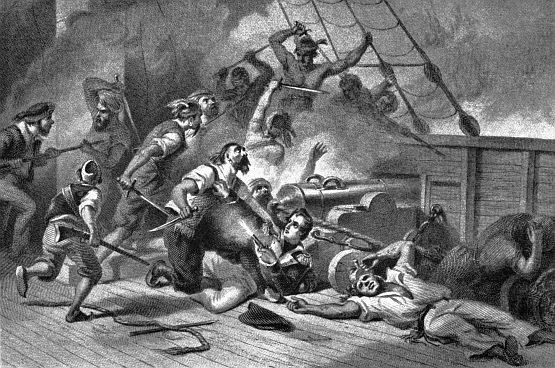
Decatur Caught the Moor's Arm
The Pasha was not ready to come to terms even
after that day's defeat, however, and on August 7th
Commodore Preble ordered another attack. Again
the harbor shook under the guns of the fleet and
the forts, and at sunset Preble had to withdraw. To
avoid further bloodshed the commodore sent a flag
of truce to the Pasha, and offered to pay eighty
thousand dollars for the ransom of the American
prisoners, and to make him a present of ten thousand
dollars more. The Pasha, however, demanded one
hundred and fifty thousand dollars, and Preble was
not willing to pay that amount. So later in August
he attacked Tripoli again. Each of these bombardments
did great damage to the city, but the forts
were too strong to be captured. The blockading
fleet, however, held its position, and on September
3d opened fire again in the last of its assaults.
In spite of the heavy firing the Pasha refused to
pull down his flag.
On the night of September 4th a volunteer crew
took the little Intrepid into the harbor. She was
filled with combustibles, and when she was close to
the Moorish ships the powder was to be fired by a
fuse that would give time for the crew to escape in a
small boat. The night was dark, and the fleet soon
lost sight of this fire-ship. She took the right
course through the channel, but before she was
near the Moors she was seen and they opened fire
on her. Then came a loud explosion, and the
Intrepid, with her crew, was blown into the air.
No one knows whether one of the enemy's shots or
her own crew fired the powder. This was the greatest
disaster that befell the United States Navy during
all its warfare with the Barbary pirates. Soon after
Commodore Preble sailed for home, though most of
his fleet were kept in the Mediterranean to protect
American sailing vessels.
The government at Washington, tired with the
long warfare in the Mediterranean, soon afterward
ordered the consul at Algiers, Tobias Lear, to treat
for peace with the Pasha. A bargain was finally
struck. One hundred Moors were exchanged for as
many of the American captives, and sixty thousand
dollars were paid as ransom for the rest. June 4,
1805, the American sailors, who had been slaves
for more than nineteen months, were released from
their chains and sent on board the war-ship Constitution.
The Pasha declared himself a friend of the
United States, and saluted its flag with twenty-one
guns from his castle and forts.
In the Barbary States rulers followed one another
in rapid succession. He who was Dey or Pasha one
week might be murdered by an enemy the next, and
that enemy on mounting the throne was always
eager to get as much plunder as he could. Treaties
meant little to any of them, and so other countries
kept on paying them tribute for the sake of peace.
The United States fell into the habit of buying
peace with Algiers, Tripoli, Morocco, and Tunis by
gifts of merchandise or gold or costly vessels. But
the more that was given to them the more greedy
these Moorish rulers grew, and so it happened that
from time to time they sent out their pirates to board
American ships in order to frighten the young Republic
into paying heavier tribute. Seven years
later the second chapter of our history with the Barbary
pirates opened.
The brig Edwin of Salem, Massachusetts, was
sailing under full canvas through the Mediterranean
Sea, bound out from Malta to Gibraltar, on August 25,
1812. At her masthead she flew the Stars and Stripes.
The weather was favoring, the little brig making
good speed, and the Mediterranean offered no dangers
to the skipper. Yet Captain George Smith,
and his crew of ten Yankee sailors, kept constantly
looking toward the south at some distant sails that
had been steadily gaining on them since dawn.
Every stitch of sail on the Edwin had been set, but
she was being overhauled, and at this rate would be
caught long before she could reach Gibraltar.
Captain Smith and his men knew who manned
those long, low, rakish-looking frigates. But the
Edwin carried no cannon, and if they could not out-sail
the three ships to the south they must yield
peaceably, or be shot down on their deck. Hour after
hour they watched, and by sunset they could see
the dark, swarthy faces of the leading frigate's crew.
Before night the Edwin had been overhauled,
boarded, and the Yankee captain and sailors were in
irons, prisoners about to be sold into slavery.
They had been captured by one of the pirate crews
of the Dey of Algiers, and when they were taken
ashore by these buccaneers they were stood up in
the slave market and sold to Moors, or put to work
in the shipyards. Other Yankee crews had met
with the same treatment.
Now the United States had been paying its tribute
regularly to the pirates, but in the spring of 1812 the
Dey of Algiers suddenly woke up to the fact that the
Americans had been measuring time by the sun
while the Moors figured it by the moon, and found
that in consequence he had been defrauded of almost
a half-year's tribute money, or twenty-seven thousand
dollars. He sent an indignant message to Tobias
Lear, the American consul at Algiers, threatening
all sorts of punishments, and Mr. Lear, taking
all things into account, decided it was best to pay the
sum claimed by the Dey. The United States sent
the extra tribute in the shape of merchandise by the
sailing vessel Alleghany; but the Dey was now in a
very bad temper, and declared that the stores were
of poor quality, and ordered the consul to leave at
once in the Alleghany, as he would have no further
dealings with a country that tried to cheat him. At
almost the same time he received a present from
England of two large ships filled with stores of war,—powder,
shot, anchors, and cables. He immediately
sent out word to the buccaneers to capture all
the American ships they could, and sell the sailors
in the slave-markets. The Dey of Algiers appeared
to have no fear of the United States.
The truth of the matter was that his Highness
the Dey, and also the Bey of Tunis, had been spoiled
by England, who at this time told them confidently
that the United States Navy was about to be wiped
from the seas. English merchants assured them
that they could treat Captain Smith and other
Yankee skippers exactly as they pleased, since Great
Britain had declared war on the United States, and
the latter country would find herself quite busy at
home. Algiers and Tripoli and Tunis, remembering
their old grudge against the Americans, assured
their English friends that nothing would delight
them so much as to rid the Mediterranean of the
Stars and Stripes.
The pirates swept down on the brig Edwin, and
laid hands on every American they could find in the
neighborhood. They stopped and boarded a ship
flying the Spanish flag, and took prisoner a Mr.
Pollard, of Virginia. Tripoli and Tunis permitted
English cruisers to enter their harbors, contrary to
the rules of war, and recapture four English prizes
that had been sent to them by the American privateer
Abellino. When the United States offered to
pay a ransom of three thousand dollars for every
American who was held as a prisoner the Dey replied
that he meant to capture a large number of
them before he would consider any terms of sale.
Our country was young and poor, and our navy
consisted of only seventeen seaworthy ships, carrying
less than four hundred and fifty cannon. England
was indeed "Mistress of the Seas," with a
great war-fleet of a thousand vessels, armed with
almost twenty-eight thousand guns. No wonder
that the British consul at Algiers had told the Dey
"the American flag would be swept from the seas,
the contemptible navy of the United States annihilated,
and its maritime arsenals reduced to a heap of
ruins." No wonder the Dey believed him. But as
a matter of fact the little David outfought the giant
Goliath; on the Great Lakes and on the high seas
the Stars and Stripes waved triumphant after many
a long and desperate encounter, and the small navy
came out of the War of 1812 with a glorious record
of victories, with splendid officers and crews, and
with sixty-four ships. The English friends of the
Barbary States had been mistaken, and Algiers,
Tunis, and Tripoli began to wish they had not been
so scornful of the Yankees.
It was time to show the pirates that Americans
had as much right to trade in the Mediterranean as
other people. On February 23, 1815, a few days
after the treaty of peace with England was published,
President Madison advised that we should
send a fleet to Algiers. Two squadrons were ordered
on this service, under command of Commodore
William Bainbridge. One collected at Boston, and
the other at New York. Commodore Stephen Decatur
was in charge of the latter division.
Decatur's squadron was the first to sail, leaving
New York on May 20, 1815. He had ten vessels in
all, his flag-ship being the forty-four-gun frigate
Guerrière, and his officers and crew being all seasoned
veterans of the war with England. The fleet
of the Dey of Algiers, however, was no mean foe.
It consisted of twelve vessels, well armed and
manned, six sloops, five frigates, and one schooner.
Its admiral was a very remarkable man, one of the
fierce tribe of Kabyles from the mountains, Reis
Hammida by name, who had made himself the
scourge of the Mediterranean. He had plenty of
reckless courage; once he had boarded and captured
in broad daylight a Portuguese frigate under
the very cliffs of Gibraltar, and at another time,
being in command of three Algerine frigates, had
dared to attack a Portuguese ship of the line and
three frigates, in face of the guns leveled at him
from the Rock of Lisbon, directly opposite.
The city of Algiers itself was one of the best
fortified ports on the Mediterranean. It lay in the
form of a triangle, one side extending along the sea,
while the other two rose against a hill, meeting at
the top at the Casbah, the historic fortress of the
Deys. The city was guarded by very thick walls,
mounted with many guns, and the harbor, made by
a long mole, was commanded by heavy batteries, so
that at least five hundred pieces of cannon could be
brought to bear on any hostile ships trying to enter.
Decatur's fleet was only a few days out of New
York when it ran into a heavy gale, and the wooden
ships were badly tossed about. The Firefly, a
twelve-gun brig, sprung her masts, and had to put
back to port. The other ships rode out the storm,
and kept on their course to the Azores, keeping a
sharp watch for any suspicious-looking craft. As
they neared the coast of Portugal the vigilance was
redoubled, for here was a favorite hunting-ground
of Reis Hammida, and Decatur knew what the
Algerine admiral had done before the Rock of Lisbon.
They found no trace of the enemy here, however.
At Cadiz Decatur sent a messenger to the
American consul, who informed him that three Algerine
frigates and some smaller ships had been
spoken in the Atlantic Ocean, but were thought to
have returned to the Mediterranean.
Decatur wanted to take the enemy by surprise,
and so sailed cautiously to Tangier, where he learned
that two days earlier Reis Hammida had gone
through the Straits of Gibraltar in the forty-six-gun
frigate Mashuda. The American captain at once
set sail for Gibraltar, and found out there that the
wily Algerine was lying off Cape Gata, having demanded
that Spain should pay him half a million
dollars of tribute money to protect her coast-towns
from attack by his fleet.
Lookouts on the Guerrière reported to Decatur
that a despatch-boat had left Gibraltar as soon as
the American ships appeared, and inquiry led the
captain to believe the boat was bearing messages to
Reis Hammida. Other boats were sailing for Algiers,
and Decatur, realizing the ease with which his
wily opponent, thoroughly familiar with the inland
sea, would be able to elude him, decided to give
chase at once.
The fleet headed up the Mediterranean June 15th,
under full sail. The next evening ships were seen
near shore, and Decatur ordered the frigate Macedonian
and two brigs to overhaul them. Early the
following morning, when the fleet was about twenty
miles out from Cape Gata, Captain Gordon, of the
frigate Constellation, sighted a big vessel flying the
flag of Algiers, and signaled "An enemy to the
southeast."
Decatur saw that the strange ship had a good
start of his fleet, and was within thirty hours' run of
Algiers. He suspected that her captain might not
have detected the fleet as American, and ordered
the Constellation back to her position abeam of his
flag-ship, gave directions to try to conceal the identity
of his squadron, and stole up on the stranger. The
latter was seen to be a frigate, lying to under small
sail, as if waiting for some message from the African
shore near at hand. One of the commanders asked
permission to give chase, but Decatur signaled back
"Do nothing to excite suspicion."
The Moorish frigate held her position near shore
while the American ships drew closer. When they
were about a mile distant a quartermaster on the
Constellation, by mistake, hoisted a United States
flag. To cover this blunder the other ships were
immediately ordered to fly English flags. But the
crew of the Moorish frigate had seen the flag on the
Constellation, and instantly swarmed out on the
yard-arms, and had the sails set for flight. They
were splendid seamen, and almost immediately the
frigate was leaping under all her canvas for Algiers.
The Americans were busy too. The rigging of each
ship was filled with sailors, working out on the yards,
the decks rang with commands, and messages were
signaled from the flag-ship to the captains. Decatur
crowded on all sail, fearing that the Algerine frigate
might escape him in the night or seek refuge in
some friendly harbor, and the American squadron
raced along at top speed, just as the Barbary pirates
had earlier chased after the little brig Edwin, of Salem.
Soon the Constellation, which was to the south of
the fleet and so nearest to the Moorish frigate,
opened fire and sent several shots on board the
enemy. The latter immediately came about, and
headed northeast, as if making for the port of Carthagena.
The Americans also tacked, and gained
by this manœuvre, the sloop Ontario cutting across
the Moor's course, and the Guerrière being brought
close enough for musketry fire.
As the flag-ship came to close quarters the Moors
opened fire, wounding several men, but Decatur
waited until his ship cleared the enemy's yard-arms,
when he ordered a broadside. The crew of the
Algerine frigate, which was the Mashuda, were
mowed down by this heavy fire. Reis Hammida
himself had already been wounded by one of the
first shots from the Constellation. He had, however,
insisted on continuing to give orders from a couch
on the quarter-deck, but a shot from the first broadside
killed him. The Guerrière's gun crews loaded
and fired again before the first smoke had cleared;
at this second broadside one of her largest guns exploded,
killing three men, wounding seventeen, and
splintering the spar-deck.
The Moors made no sign of surrender, but Decatur,
seeing that there were too few left to fight,
and not wishing to pour another broadside into
them, sailed past, and took a position just out of
range. The Algerines immediately tried to run before
him. In doing this the big Mashuda was
brought directly against the little eighteen-gun
American brig Epervier, commanded by John
Downes. Instead of sailing away Downes placed
his brig under the Moor's cabin ports, and by backing
and filling escaped colliding with the frigate
while he fired his small broadsides at her. This running
fire, lasting for twenty-five minutes, finished
the Moor's resistance, and the frigate surrendered.
The flag-ship, the Guerrière, now took charge of
the Algerine prize, and Decatur sent an officer, two
midshipmen, and a crew on board her. The Mashuda
was a sorry sight, many of her men killed or wounded,
and her decks splintered by the American broadsides.
The prisoners were transferred to the other ships,
and orders were given to the prize-crew to take the
captured frigate to the port of Carthagena, under
escort of the Macedonian.
Before this was done, however, Decatur signaled
all the officers to meet on his flag-ship. In the cabin
they found a table covered with captured Moorish
weapons,—daggers, pistols, scimitars, and yataghans.
Decatur turned to Commandant Downes, who had
handled the small Epervier so skilfully. "As you
were fortunate in obtaining a favorable position and
maintained it so handsomely, you shall have the first
choice of these weapons," he said. Downes chose,
and then each of the other officers selected a trophy
of the victory. That evening the squadron, leaving
the Mashuda in charge of the Macedonian, resumed
its hunt for other ships belonging to the navy of the
piratical Dey.
The fleet was arriving off Cape Palos on June 19th
when a brig was seen, looking suspiciously like an
Algerine craft. When the Americans set sail toward
her, the stranger ran away. Soon she came to shoal
water, and the frigates had to leave the chase to the
light-draught Epervier, Spark, Torch, and Spitfire.
These followed and opened fire. The strange brig
returned several shots, and was then run aground
by her crew on the coast between the watch-towers
of Estacio and Albufera, which had been built long
before for the purpose of protecting fishermen and
peasants from the raids of pirates. The strangers
took to their small boats. One of these was sunk
by a shot. The Americans then boarded the ship,
which was the Algerine twenty-two-gun brig Estedio,
and captured eighty-three prisoners. The brig was
floated off the shoals and sent with a prize-crew into
the Spanish port of Carthagena.
Decatur, being unable to sight any more ships
that looked like Moorish craft, and supposing that
the rest of the pirate fleet would probably be making
for Algiers, gave commands to his squadron to
sail for that port. He was determined to bring the
Dey to terms as quickly as possible, and to destroy
his fleet, or bombard the city, if that was necessary.
When he arrived off the Moorish town, however, he
found none of the fleet there, and no apparent preparation
for war in the harbor. The next morning he
ran up the Swedish flag at the mainmast, and a
white flag at the foremast, a signal asking the Swedish
consul to come on board the flag-ship. Mr.
Norderling, the consul, came out to the Guerrière,
accompanied by the Algerine captain of the port.
After some conversation Decatur asked the latter
for news of the Dey's fleet. "By this time it is safe
in some neutral port," was the assured answer.
"Not all of it," said Decatur, "for we have captured
the Mashuda and the Estedio."
The Algerine could not believe this, and told the
American so. Then Decatur sent for a wounded
lieutenant of the Mashuda, who was on his ship, and
bade him confirm the statement. The Moorish
officer of the port immediately changed his tactics,
dropped his haughty attitude, and gave Decatur to
understand that he thought the Dey would be willing
to make a new treaty of peace with the United
States.
Decatur handed the Moor a letter from the President
to the Dey, which stated that the Republic
would only agree to peace provided Algiers would
give up her claim to tribute and would cease molesting
American merchantmen.
The Moor wanted to gain as much time as possible,
hoping his fleet would arrive, and said that it
was the custom to discuss all treaties in the palace on
shore. Decatur understood the slow and crafty
methods of these people, and answered that the
treaty should be drawn up and signed on board the
Guerrière or not at all. Seeing that there was no
use in arguing with the American the Moorish officer
went ashore to consult with the Dey.
Next day, June 30th, the captain of the port returned,
with power to act for his Highness Omar
Pasha. Decatur told him that he meant to put an
end to these piratical attacks on Americans, and insisted
that all his countrymen who were being held
as slaves in Algiers should be given up, that the
value of goods taken from them should be paid them,
that the Dey should give the owners of the brig
Edwin of Salem ten thousand dollars, that all Christians
who escaped from Algiers to American ships
should be free, and that the two nations should act
toward each other exactly as other civilized countries
did. Then the Moorish officer began to explain and
argue. He said that it was not the present ruling Dey,
Omar Pasha, called "Omar the Terrible" because
of his great courage, who had attacked American
ships; it was Hadji Ali, who was called the "Tiger"
because of his cruelty, but he had been assassinated
in March, and his prime minister, who succeeded
him, had been killed the following month, and Omar
Pasha was a friend of the United States. Decatur
replied that his terms for peace could not be altered.
The Moor then asked for a truce while he should
go ashore and confer with the Dey. Decatur said he
would grant no truce. The Algerine besought him
to make no attack for three hours. "Not a minute!"
answered Decatur. "If your squadron appears before
the treaty is actually signed by the Dey, and
before the American prisoners are sent aboard, I will
capture it!"
The Moorish captain said he would hurry at once
to the Dey, and added that if the Americans should
see his boat heading out to the Guerrière with a white
flag in the bow they would know that Omar Pasha
had agreed to Decatur's terms.
An hour later the Americans sighted an Algerine
war-ship coming from the east. Decatur signaled his
fleet to clear for action, and gave orders to his own
men on the Guerrière. The fleet had hardly weighed
anchor, however, before the small boat of the port
captain was seen dashing out from shore, a white
flag in the bow. The excited Moor waved to the
crew of the flag-ship. As soon as the boat was near
enough Decatur asked if the Dey had signed the
treaty, and set the American captives free. The
captain assured him of this, and a few minutes later
his boat was alongside the flag-ship, and the Americans,
who had been seized and held by the pirates,
were given over to their countrymen. Some of them
had been slaves for several years, and their delight
knew no bounds.
In so short a time did Decatur succeed in bringing
the Dey to better terms than he had made with any
other country. When the treaty had been signed the
Dey's prime minister said to the English consul,
with reproach in his voice, "You told us that the
Americans would be swept from the seas in six
months by your navy, and now they make war upon
us with some of your own vessels which they have
taken." As a fact three of the ships in Decatur's
squadron had actually been won from the English in
the War of 1812.
The Epervier, commanded by Lieutenant John
Templer Shubrick, was now ordered to return to the
United States, with some of the Americans rescued
from Algiers. The fate of the brig is one of the
mysteries of the sea. She sailed through the Straits
of Gibraltar July 12, 1815, and was never heard of
again. She is supposed to have been lost in a heavy
storm in which a number of English merchantmen
foundered near the West Indies.
Algiers had now been brought to her knees by
Decatur, and he was free to turn to Tunis and
Tripoli. The rulers of each of these countries had
been misled by the English agents exactly as had the
Dey of Algiers, and the Bey of Tunis had allowed
the British cruiser Lyra to recapture some English
prizes that the American privateer Abellino had
taken into harbor during the War of 1812. Like
Algiers, both Tunis and Tripoli were well protected
by fleets and imposing forts. Decatur, however, had
now learned that downright and prompt measures
were the ones most successful in dealing with the
Moors, who were used to long delays and arguments.
He anchored off Tunis on July 26th, and immediately
sent word to the Bey that the latter must pay the
United States forty-six thousand dollars for allowing
the English Lyra to seize the American prizes, and
that the money must be paid within twelve hours.
The United States consul, Mordecai M. Noah,
carried Decatur's message to the Bey. The Moorish
ruler was seated on a pile of cushions at a window of
his palace, combing his long, flowing black beard
with a tortoise-shell comb set with diamonds. Mr.
Noah politely stated Decatur's terms.
"Tell your admiral to come and see me," said the
Bey.
"He declines coming, your Highness," answered
the consul, "until these disputes are settled, which
are best done on board the ship."
The Bey frowned. "But this is not treating me
with becoming dignity. Hammuda Pasha, of blessed
memory, commanded them to land and wait at the
palace until he was pleased to receive them."
"Very likely, your Highness," said Mr. Noah,
"but that was twenty years ago."
The Bey considered. "I know this admiral," he
remarked at length; "he is the same one who, in the
war with Sidi Yusuf, burned the frigate." He referred
to Decatur's burning the Philadelphia in the
earlier warfare.
The consul nodded. "The same."
"Hum!" said the Bey. "Why do they send wild
young men to treat for peace with old powers?
Then, you Americans do not speak the truth. You
went to war with England, a nation with a great
fleet, and said you took her frigates in equal fight.
Honest people always speak the truth."
"Well, sir, and that was true. Do you see that
tall ship in the bay flying a blue flag?" The consul
pointed through the window. "It is the
Guerrière, taken from the British. That one near
the small island, the Macedonian, was also captured
by Decatur on equal terms. The sloop near Cape
Carthage, the Peacock, was also taken in battle."
The Bey, looking through his telescope, saw a
small vessel leave the American fleet and approach
the forts. A man appeared to be taking soundings.
The Bey laid down the telescope. "I will accept
the admiral's terms," said he, and resumed the
combing of his beard.
Later he received Decatur with a great show of
respect. The American consul was also honored,
but the British was not treated so well. When a
brother of the prime minister paid the money over
to Decatur the Moor turned to the Englishman, and
said, "You see, sir, what Tunis is obliged to pay for
your insolence. You should feel ashamed of the
disgrace you have brought upon us. I ask you if
you think it just, first to violate our neutrality and
then to leave us to be destroyed or pay for your
aggressions?"
Having settled matters with Tunis, Decatur sailed
for Tripoli, and there sent his demands to the Pasha.
He asked thirty thousand dollars in payment for two
American prizes of war that had been recaptured by
the British cruiser Paulina, a salute of thirty-one
guns to be fired from the Pasha's palace in honor of
the United States flag, and that the treaty of peace
be signed on board the Guerrière.
The Pasha pretended to be offended, summoned his
twenty thousand Arab soldiers and manned his cannon;
but when he heard how Algiers and Tunis had
already made peace with Decatur, and saw that the
Americans were all prepared for battle, he changed
his tactics and sent the governor of Tripoli to the
flag-ship to treat for peace. The American consul
told Decatur that twenty-five thousand dollars would
make good the lost prize-ships, but that the Pasha
was holding ten Christians as slaves in Tripoli.
Decatur thereupon reduced the amount of his claim
on condition that the slaves should be released.
This was agreed to. The prisoners, two of whom
were Danes, and the others Sicilians, were sent to
the flag-ship, and by way of compliment the band of
the Guerrière went ashore and played American airs
to the delight of the people.
The American captain now ordered the rest of
his squadron to sail to Gibraltar, while the Guerrière
landed the prisoners at Sicily. As the flag-ship
came down the coast from Carthagena she met that
part of the Algerine fleet that had put into Malta
when the Americans first arrived in the Mediterranean.
The Guerrière was alone, and Decatur
thought that the Moors, finding him at such a disadvantage,
might break their treaty of peace, and
attack him. He called his men to the quarter-deck.
"My lads," said he, "those fellows are approaching
us in a threatening manner. We have whipped
them into a treaty, and if the treaty is to be broken
let them break it. Be careful of yourselves. Let
any man fire without orders at the peril of his life.
But let them fire first if they will, and we'll take the
whole of them!"
The decks were cleared, and every man stood
ready for action. The fleet of seven Algerine ships
sailed close to the single American frigate in line of
battle. The crews looked across the bulwarks at
each other, but not a word was said until the last
Algerine ship was opposite. "Where are you going?"
demanded the Moorish admiral.
"Wherever it pleases me," answered Decatur;
and the Guerrière sailed on her course.
Early in October there was a great gathering of
American ships at Gibraltar. Captain Bainbridge's
fleet, which included the seventy-four-gun ship of the
line Independence, was there when Decatur arrived.
The war between the United States and England
was only recently ended, and the presence of so
many ships of the young Republic at the English
Rock of Gibraltar caused much talk among the
Spaniards and other foreigners. The sight of ships
which had been English, but which were now
American, added to the awkward situation, and
more than one duel was fought on the Rock as the
result of disputes over the War of 1812.
The Dey of Algiers, left to his own advisers and
to the whispers of men who were jealous of the
United States' success, began to wish he had not
agreed to the treaty he had made with Decatur.
His own people told him that a true son of the
Prophet should never have humbled himself before
the Christian dogs. In addition the English government
agreed to pay him nearly four hundred
thousand dollars to ransom twelve thousand prisoners
of Naples and Sardinia that he was holding.
Before everything else the Dey was greedy. Therefore
when Captain Oliver Hazard Perry, the hero of
the battle of Lake Erie, brought out in the Java a
copy of the treaty after it had been ratified by the
United States Senate, and it was presented to the
Dey by the American consul, William Shaler, the
ruler of Algiers pretended that the United States
had changed the treaty, and complained of the way
in which Decatur had dealt with the Algerine ships.
Next day he refused to meet Mr. Shaler again, and
sent the treaty back to him, saying that the Americans
were unworthy of his confidence. Mr. Shaler
hauled down the flag at his consulate, and boarded
the Java.
Fortunately there were five American ships near
Algiers; and these were made ready to open fire on
the Moorish vessels in the harbor. Plans were also
made for a night attack. The small boats of the
fleet were divided into two squadrons, to be filled by
twelve hundred volunteer sailors. One division was
to make for the water battery and try to spike its
guns, while the other was to attack the batteries on
shore. Scaling-ladders were ready, and the men
were provided with boarding-spikes; but shortly
before they were to embark the captain of a French
ship in the harbor got word of the plan and carried
the information to the Dey. The latter was well
frightened, and immediately sent word that he
would do whatever his good friends from America
wanted. The next day Mr. Shaler landed again,
and the Dey signed the treaty.
The fleet then called a second time on the Bey of
Tunis, who had been grumbling about his dissatisfaction
with Decatur's treatment. He too, however,
was most friendly when American war-ships poked
their noses toward his palace. After that the Barbary
pirates let American merchantmen trade in peace,
although an American squadron of four ships was
kept in the Mediterranean to see that the Dey, and
the Bey, and the Pasha did not forget, and go back
to their old tricks.
So it was that Decatur put an end to the African
pirates, so far as the United States was concerned,
and taught them that sailors of the young Republic,
far away though it was, were not to be made slaves
by greedy Moorish rulers.