Of this tour Queen Alexandra’s Bedchamber Woman, the
Hon. Mrs. Grey, wrote a charming record, which her brother-in-law,
General Grey, persuaded her to give to the world. It
should be mentioned that Mrs. Grey was a Swedish lady, the
daughter of Count Stedingk. Her first husband, the Hon.
William George Grey, eighth son of the famous Earl Grey
who was Prime Minister in the reign of William IV., had
been dead some years before this tour began. She afterwards
married en secondes noces the Duke of Otranto, but it will be
more convenient to speak of her here as Mrs. Grey.
Mrs. Grey begins by giving an outline of her plans for the
summer of 1868, and then goes on:—
“These plans were, however, all upset by a letter from the
Princess, in which she told me that she wished me to accompany
her on the tour she projected with the Prince of Wales to
the East, and to join her at Copenhagen in the beginning of
January; and that in the meantime I might remain quietly—which
she knew would be a pleasure to me—with my father
and mother in Sweden. This was too tempting an offer not to
be eagerly embraced.”
Mrs. Grey went to Copenhagen, and there writes in her
journal at the beginning of 1869 the following sketch of the
tour:—
“January 12.—Soon after breakfast I went to see my dear
Princess, and to hear something of the proposed plans. I
found her, as usual, most kind and affectionate, but very sorry
that the few weeks she had been able to spend with her father
and mother had come to an end. Her visit seemed to have
been a great happiness to her. It is now arranged that we
shall set out for our long journey on the 15th, and that while I
accompany Her Royal Highness as her lady-in-waiting, Lady
Carmarthen and Colonel Keppel, who accompanied the Prince
and Princess from England in November, shall part from us at
Hamburg, and, with Sir W. Knollys, take the Royal children
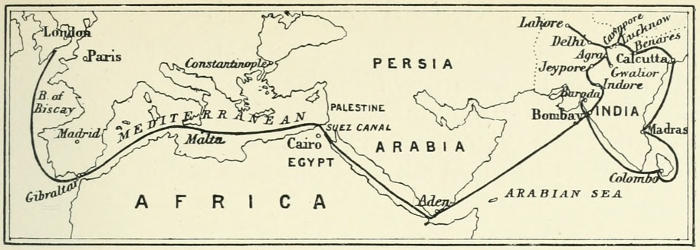
home. The plan is for us to pass by Berlin and Vienna, and
embark on board the Ariadne frigate, fitted as a yacht, at
Trieste; sail from thence to Alexandria; and, after going up
the Nile as far as the Second Cataract, to visit Constantinople,
the Crimea, and Greece, before returning home somewhere
about the beginning of May. Such is the plan made out for
us, but it is, of course, open to many changes, as the political
state of things between Greece and Turkey at the present
moment may, after all, very possibly upset the latter part of
the journey; and in that case we shall return home through
Italy.”
King Edward and Queen Alexandra were joined at Trieste
by Prince Louis of Battenberg, the Duke of Sutherland, Dr.
(afterwards Sir) W. H. Russell, and other friends, together
with their suite. There the Royal party embarked on board
H.M.S. Ariadne, which had been specially fitted up for their
reception. Of the accommodation in this vessel Mrs. Grey
gives an attractive account:—
“The Ariadne, in reality a man-of-war, but for this occasion
fitted up as a yacht, is most comfortable. The Prince and
Princess have two large sleeping cabins, besides a large cabin
for a sitting-room, and another for a dining-room. I have a
charming cabin also, with a bath-room outside, and my maid
next door to me. In short, I think we were all much pleased
with the accommodation and arrangement of what is to be our
home, while at sea, for the next four months.”
The travellers reached Alexandria on 3rd February 1869, and
were met by the usual loyal greetings, addresses, and bouquets
presented by the British residents. The party then went on to
Cairo, where they were received by the Viceroy of Egypt and
his ministers. Here the King and Queen were assigned a
palace, which Mrs. Grey thus describes:—
“The Palace of Esbekieh is beautiful, full of French luxury,
but without the real comfort of an English house. The Prince
and Princess have an immense bedroom, full of rich French
furniture. The beds are very beautiful, made of massive
silver, and cost, I believe, £3000 each! My room is so large
that even when the candles are lit, there might be somebody
sitting at the other end of it without your knowing it. You
could not even hear people speaking from one end to the other!
It is as high as it is long, with nine large windows. There is a
beautiful silver bed, a large divan (rather high and hard for
comfort) round half of the room, a common writing-table and
washhand-stand (put in all the rooms at the request of Sir S.
Baker), a large sofa, and quantities of very smart chairs round
the walls. The curtains and covers of the furniture are all
made of the richest silk. Add to all this, one immense looking-glass,
and you have the whole furniture of my room, which is
more like a State drawing-room at Windsor than a bedroom.
All the other rooms are furnished in the same way.”
Queen Alexandra and Mrs. Grey had an absolutely novel
experience on 5th February, namely an invitation to dinner at
the Harem of “La Grande Princesse,” the Viceroy’s mother.
The Queen, her lady-in-waiting, and two English ladies
were received at the door of the Palace by la Grande Princesse,
the second and third wife of the Viceroy (the first and fourth
were not well), his eldest son, and two eldest daughters. La
Grande Princesse took Queen Alexandra by the hand, while
one of the wives handed Mrs. Grey, another Mrs. Stanton
(wife of the British Consul), and one of the daughters Miss
M’Lean; and so the party went in procession to an immense
drawing-room, the whole way thither being lined with slaves.
No stay, however, was made in the drawing-room, and what
followed reads like a page out of the Arabian Nights.
The visitors were conducted straight to the dining-room,
after having a cherry given them to eat, handed to them on a
beautiful gold tray, with goblets and plates of gold and precious
stones. A slave then offered each visitor a silver basin to
wash their hands in before sitting down to dinner. In the
middle of the room there was a kind of round silver table,
about one foot high from the floor, looking more like a big
tray than anything else; large square cushions were placed
all round it, and the company sat down à la Turque round the
table, la Grande Princesse having Queen Alexandra on her
right, next whom was Mehemet Taafik Pasha, then the third
Princess and Mrs. Grey, with the second Princess next, on
the left side of the Viceroy’s mother. Mrs. Stanton and Miss
M’Lean, with the two daughters of the Viceroy, dined in
another room.
A slave then entered very smartly dressed, half her skirt
being of black satin and embroidered in gold, and the other
half of yellow satin, also trimmed with gold, and with a sort of
turban on her head. She had a beautifully embroidered napkin,
with gold fringe, hanging on her arm, as a sort of badge of
her office, which corresponded with that of a European
maître-d’hôtel. She placed each dish in the middle of the
table, beginning with soup—a sort of chicken broth with rice.
Each visitor was given a sort of tortoiseshell spoon, with a
large coral branch as a handle, but neither knife nor fork; and
then, at a sign from the old Princess, everybody dipped their
spoons into the tureen together. Next came an enormous
piece of mutton, of which the company had to tear off bits
with their fingers and put them straight into their mouths.
About twenty dishes followed in rapid succession, alternately
savoury and sweet, and the dinner ended with compôte of
cherries. No wine or water was served during the meal, and
Mrs. Grey confesses that she felt thoroughly disgusted.
Some very necessary washing of hands followed, and then
there was an entertainment in the great drawing-room, given
by musicians and dancing-girls, in the course of which a slave
brought in a tray covered with black velvet cloth embroidered
with pearls and uncut emeralds, and decorated with an enormous
diamond star in the centre. This was lifted off, and
then were revealed a number of cups encrusted with diamonds,
and full of coffee. These were handed round, and a slave
brought pipes and cigarette-holders, all lavishly ornamented
with precious stones, each mouthpiece being formed of one
large ruby or emerald.
After an interval the visitors were taken all through the
upper rooms, a young prince who acted as interpreter being
most anxious that Queen Alexandra should see everything.
“La Princesse doit tout voir,” he kept saying. More music
and dancing followed, and more coffee, until at four o’clock it
seemed to be time to go, so Queen Alexandra rose, and the
party were handed out to the door of the garden at which they
had entered amid enthusiastic demonstrations of affection on
the part of their hospitable entertainers.
There can be no doubt of the impression which the Queen’s
graciousness and charm created. Mrs. Grey says:—
“They were all perfectly enchanted with the Princess, and
about every ten or fifteen minutes une phrase de cérémonie was
exchanged through the Prince [that is, the young Egyptian
prince who acted as interpreter]. ‘La Grande Princesse est si
contente de vous voir,’ or ‘La Grande Princesse regrette tant
que cela soit contre l’usage du pays, de vous rendre cette
visite’; and so on.… At last they all expressed a hope that
the Princess would come and dine again on her return to
Cairo.”
The same evening Queen Alexandra had the pleasure of
visiting some beautiful Arab horses in the stables of Ali Sherif
Pasha.
Before starting on their journey up the Nile the King and
Queen took the opportunity of witnessing the curious and
interesting Procession of the Holy Carpet starting from Cairo
on its way to Mecca, which, strangely enough, few of the
Europeans who at that time visited Cairo cared to see. Every
year two carpets are sent, one of which goes to Medina to
serve as a covering for the tomb of the Prophet, and the other
to Mecca to be a covering for Kaabah or the central point of
the Mahomedan religion. The King and Queen also witnessed
the departure of the pilgrims for Mecca, or rather of that
portion of the pilgrimage consisting of sheikhs and holy men,
escorted by irregular cavalry and artillery, which left the city
to join the other pilgrims encamped on the plain outside.
On 6th February the voyage up the Nile began. The
party was a large one, and the number of vessels provided for
them formed quite a little fleet, of which the following was the
order of sailing:—
A large and very smartly fitted-up steamer, the Federabanee,
Captain Achmet Bey, headed the squadron, and was occupied
by Prince Louis of Battenberg (then a midshipman on board
the Ariadne), Major Teesdale, Captain Ellis, equerries in
waiting, Lord Carrington, Mr. O. Montagu, Dr. Minter, Sir
Samuel Baker, and Mr. Brierley. On deck there was a large
saloon, all fitted up with silk and looking-glasses and every
description of luxury, and there meals were served. Outside
this there was a small open saloon with a large looking-glass at
the back, in which the scenery could be viewed in comfort.
The Federabanee towed a most beautiful dahabeah, or Nile
boat, which was named the Alexandra, and in which the
King and Queen and Mrs. Grey lived. It was all fitted up in
blue and gold, with a great deal of taste, and the cabins were
all large and most comfortable. Mrs. Grey mentions that
the King and Queen had “a very nice sleeping cabin, with
a bath-room and dressing-room apiece.” The Alexandra also
contained a large sitting-room with a piano, and outside there
was a place for sitting and reading, as well as the upper deck.
The only inconvenience of this arrangement was that the
travellers in the dahabeah had to go on board the Federabanee
for every meal. This necessity was especially hard on Queen
Alexandra, who resolved, however, to return to the dahabeah
after breakfast as often as she could in order to have time for
painting and reading; this, with the active co-operation of Mrs.
Grey, she contrived to do on a good many days.
After the dahabeah came a kitchen steamer, carrying four
French cooks and one Arab cook, and towing a barge full of
provisions and live stock, such as turkeys, sheep, and chickens.
Following this came another steamer, having on board Colonel
Stanton, British Consul-General at Cairo, with two Egyptian
gentlemen, Mourad Pasha and Abd El Kader Bey, and towing
a barge containing horses, donkeys, and a French washerwoman.
Nor was this all. In his anxiety to do everything possible for
the comfort of the Royal party, the Viceroy had actually provided
another steamer of lighter draft than the Federabanee,
simply in case the latter vessel should get stuck in the mud.
The whole flotilla was completed by a steamer belonging to
the Duke of Sutherland, the father of the present Duke, who
brought with him a distinguished party, composed of his son,
Lord Stafford, Colonel Marshall, Dr. Russell, Mr. Sumner,
Professor Owen, Mr. Fowler, the distinguished engineer,
Major Alison, the Duke’s brother Lord A. Gower, and Sir
Henry Pelly.
The King looked forward to having plenty of sport during
the voyage. Accordingly he had taken a large variety of
guns of almost every calibre in use, as well as a wherry to be
used for approaching land game. For the purpose of capturing
crocodiles, nets were brought which had been specially made
under the superintendence of Sir Samuel Baker. The King
also specially arranged for the inclusion in his party of a clever
naturalist and taxidermist.
Both the King and Queen greatly enjoyed this novel form
of yachting, although, unfortunately, bad weather soon set in,
and the Alexandra was frequently enveloped in clouds of dust
and sand. Notwithstanding this, however, the King had
fairly good sport and bagged some very large birds, though
the crocodiles were, on the whole, conspicuous by their
absence. Soon the Royal taxidermist could show some very
fine specimens of spoonbills, flamingoes, herons, cranes,
cormorants, and doves.
Mrs. Grey thus records an amusing adventure which
happened on 9th February:—
“The fog was so thick this morning that we could not
start till nine o’clock, the hour at which we are in future
usually to begin our day’s voyage being between five and six
in the morning; and then to go on, with occasional stoppages,
till six in the evening. We now only went on for about an
hour, as the Prince wanted to try and shoot some ducks from a
small punt with a large gun, which had been lent to him for
the trip. At eleven, the Princess and myself, with Prince
Battenberg, Sir S. Baker, Mr. Brierley, and Dr. Minter,
followed in another boat to look at the shooting. We saw
perfect swarms of wild ducks, and hundreds of flamingoes
and a few pelicans. However, the ducks took fright, and only
a few flamingoes were shot. We determined to land, as soon
as we saw that we could no longer spoil the sport; but the
water being low, we stuck fast in the sand about thirty or
forty yards from the shore. The four boatmen at once took
off their jackets, shoes, and trousers; but luckily some undergarments
(waistcoats and trousers in one) remained; and in
they jumped, and dragged the boat a few yards, beyond which
their utmost efforts were unable to move it. The alternative
was now either to remain in the boat or to allow ourselves to
be carried through the water. Of course we chose the latter.
Sir S. Baker and Mr. Brierley carried the Princess, crossing
their arms, on which she sat.”
Ultimately the whole party got off and reached Minieh.
There the King joined a shooting party on the following day,
while the Queen, Prince Louis of Battenberg, and some of the
others visited the Viceroy’s palace, and afterwards saw the
process of making sugar out of the sugar-canes. Queen
Alexandra and Mrs. Grey were allowed to visit the wife of
one of the directors of the sugar factory, whom Mrs. Grey
describes as a very ugly woman, painted and bedizened. The
room was full of her women friends, all as ugly and as lavishly
dressed as she was. Queen Alexandra, however, was much
pleased with the novelty of such a visit, for, though the
hostess and her friends were very cheerful and talked and
laughed, yet naturally everything that was said was quite
unintelligible to their English visitors. The Queen afterwards
sent some presents to the ladies in memory of the
visit.
On the 11th the Queen and Mrs. Grey succeeded in
staying for the whole day in the dahabeah, where they
played and wrote and painted. The same thing happened
on the afternoon of the 13th, the morning being occupied by
an interesting lecture from Mr. Fowler on the Suez Canal.
During the voyage Queen Alexandra had one very serious
adventure. One night the King, who was on board the steamer,
observed a light reflected on the side of the Alexandra. He at
once gave an alarm, the Queen and Mrs. Grey, who were in
the dahabeah, were hurried off to the shore, and the fire, which
had been caused by a lighted candle in Prince Louis of
Battenberg’s cabin, was put out by the King and his suite.
Had not the quick eye of the King discovered the danger a
terrible disaster might have happened, for the boats were
wooden and scorched by an Egyptian sun, while there were,
of course, a considerable number of cartridges on board.
The 14th was Sunday, the first Sunday in Lent, and Mrs.
Grey records that King Edward read the service to the party
and the servants very impressively. The party frequently
landed to visit the temples and the other splendid ruins of
ancient Egyptian civilisation. On one occasion the King
caught a bat in the large tomb of Rameses IV.
The party started to see the Temple of Karnak by moonlight
on the evening of the 18th. The King rode a milk-white
ass caparisoned in crimson velvet and gold, while the Queen
was mounted on a gray mule. When they approached the
temple an electric light was lit between each enormous
column, and in the background there was a display of rockets
and fireworks, forming stars of different colours. This had
been arranged by the King as a surprise for the Queen,
though Mrs. Grey confesses that the secret had been accidentally
revealed. However, she describes the whole scene as
one of surprising beauty. She walked alone with the Queen
amid the gigantic columns, until they were recalled to the
prosaic luxury of the nineteenth century by being offered
glasses of iced champagne.
The 20th was rendered memorable by a mishap; all the
steamers stuck fast in the ground, with the result that everybody
had to turn out, and all the luggage had to be removed
in order to lighten the boats. The King and Queen and Mrs.
Grey were entertained on board the Duke of Sutherland’s
steamer at dinner, and by the next day the difficulty of the
sand-banks had been surmounted, thanks to the smaller steamer
which the Viceroy’s foresight had provided.
On the 21st the King again read Divine Service, and the
party arrived at Assouan. Here they found a large number
of camels ready to carry the baggage across from the First
Cataract to Philæ, whither the party rode to see the boats
in which they were to go on to the Second Cataract. On the
22nd the King started first in order to pay a visit to Lady
Duff Gordon, who was living in her dahabeah a little above
Assouan; while the Queen, the Duke of Sutherland, and Mrs.
Grey followed in a boat to the foot of the First Cataract,
where they were to meet the King. There seems to have
been some hitch in the arrangements, but Queen Alexandra
was not at all disconcerted, and was highly amused at having
to ride a wretched donkey without a bridle, and with a cushion
for a saddle, though Mrs. Grey, who was no better mounted,
regarded the incident with less philosophy. After a time,
however, they met their own donkeys, and ultimately joined
the King’s party, who had been getting very anxious.
The Duke of Sutherland and his party left on the 23rd,
while the Royal party continued their voyage in two new
dahabeahs tied together, and towed by a small steamer. The
accommodation was not nearly so good as it had been below
Philæ. The Queen and Mrs. Grey landed frequently, and the
latter notes that her Royal mistress found great pleasure in
distributing the baksheesh for which the natives were continually
asking, especially the little children. On one occasion the
Queen and her lady-in-waiting found a donkey running about;
they caught it, and the Queen mounted it and rode through
the fields in the cleverest way without saddle or bridle.
Meanwhile the King was very anxious for crocodile, but
he had very poor luck, though he had better sport with fishing.
It was not, indeed, until the 28th that he had a fair shot at a
crocodile, which he killed at fifty yards with his first barrel.
The excitement was tremendous among the party, for, as is
well known, the shyness of these beasts is so great that they
are among the most difficult game to stalk in the world. This
specimen was 9 feet long and 4 feet round the body; and it
was at once skinned with a view to being stuffed. Inside the
creature was found a quantity of pebbles, two bottles full of
which were brought away as mementoes.
The King and Queen throughout the voyage took the
greatest interest in the antiquities along the route, visiting
all that were accessible. Mrs. Grey mentions how much Queen
Alexandra enjoyed the extreme peacefulness of the life led
by the party, for there was no post nor any papers, and, after
the first inconvenience had worn off, the feeling that no means
existed of either sending or receiving letters soon became
perfectly delightful.
A touching incident occurred at Wady Halfa on 3rd March.
The party were at dinner, when the King and Queen took a
fancy to a little boy whom they saw watching the torches, which
were always fixed in the ground on shore wherever the Royal
dahabeah stopped for the night. On being questioned, the
child said that his father was dead, his mother had married
again, and he had not a friend in the world. He was delighted
with the idea of going with the party, and so he was engaged
as a pipe cleaner. The only property he had was a white linen
shirt and a white cap. Mrs. Grey describes him as an intelligent
ugly little boy, not very black, but rather bronzed,
and wearing a large silver ring in one ear.
Whenever the dahabeah stopped, numbers of natives came
down to the bank, mostly children; and at first the Queen
used to throw them bread and oranges, but it was discovered
that they regarded empty bottles as much more valuable, and
for these there was the greatest competition, although in the
end they generally agreed to divide the spoil equally in the
most good-humoured manner. At one place a little Nubian
monkey was presented to Queen Alexandra, and the fortunate
donor was presented in return with a double-barrelled English
fowling-piece and some money.
There were the usual groundings on sand-banks, but nothing
else of interest occurred, and the party returned to their old
dahabeah on 8th March, having thoroughly enjoyed their expedition
to the Second Cataract. After lunch the King and Queen,
with Mrs. Grey and Sir Samuel Baker, paid a visit to Lady
Duff Gordon in the dahabeah, which she had made entirely her
home on account of her health.
The return voyage down the Nile began on the following
day, and immediately the big steamer stuck fast on the old
sand-bank which gave so much trouble on the way up, although
the Viceroy had had six hundred people working away in the
interval to deepen the channel. No amount of exertion could
get the steamer off, and consequently the little steamer was
used, and Prince Louis of Battenberg, Sir Samuel Baker, and
Lord Carrington had to sleep on deck.
On 10th March, the anniversary of the King and Queen’s
wedding day, some members of the Duke of Sutherland’s party,
which had broken up, met the Royal party at Thebes, namely,
Colonel Stanton, Sir Henry Pelly, Major Alison, and Abd El
Kader Bey. Colonel Stanton entertained the party, and
Mourad Pasha proposed the health of the Royal pair. After
dinner the party went to the house of Mustapha Aga, the
English Consul, where they saw some famous Egyptian dancing-girls,
including the Taglioni of the country, and some remarkable
mummy cases, which had been excavated on purpose for
the King. The following day they visited the spot where the
digging was going on. Mrs. Grey describes it as like a coal
pit, at the bottom of which was a magnificent stone sarcophagus,
said to be that of the beautiful Queen Nicotris, which the King
intended to take to England, together with a selection of
mummies.
This was the last day’s picnic on the Nile, and the party
were due at Minieh in two days, going thence by rail to Cairo.
On the 15th, however, the Queen, Mrs. Grey, and some of the
gentlemen of the party paid a visit to the little town of Minieh,
where an old woman was engaged to tell fortunes. This she
did with the aid of a heap of shells and bits of coloured glass;
and she told the Queen that she had many friends and much
money, with the usual “patter” traditional among fortune-tellers.
Thence the party went on to the house of the
Governor of the town, where a kind of lemonade was offered
to the visitors, and the Queen was presented with a beautiful
white parrot and two live flamingoes. The menagerie already
consisted of the Nubian monkey, a snapping turtle, and two
goats. As for the little Nubian boy, who was added to the
party at Wady Halfa, he turned out much too sharp and difficult
to manage, so, instead of bringing him to England, the King
decided to start him in life with a donkey, as one of the
numerous donkey boys so common in Egypt.
On 16th March the party went by train from Minieh
to Ghizeh, where they were met by the Viceroy’s eldest son
and a number of officials. After some conversation the King
and Queen took their leave, and the Royal party, entering some
carriages, drove to the Pyramids. At the foot of the big
Pyramid they found a small pavilion which had been built on
purpose for the Royal visit. The King and Queen, in spite of
the slippery, difficult, and suffocating ascent, visited the King’s
and Queen’s chambers, and the King actually went up to the
top of the Pyramid. Dinner was served in the pavilion by
order of the Viceroy, consisting of nineteen dishes, eight
entrées, ice, and other luxuries—quite a small dinner for Egypt.
On the night drive to Cairo which followed, there was very
nearly a bad accident, the carriage being driven up against a
high white flag-post, which it fortunately only just touched.
During the voyage down the Nile the King received
letters to say that as the differences between Turkey and
Greece had been happily settled, their Majesties were free to
pay their proposed visit to Constantinople and Athens.
The King and Queen spent a week in Cairo, and saw all
the sights of that wonderful city, which were then, it must be
remembered, much more novel than they are nowadays when
Egypt has become a regular winter resort. Mrs. Grey gives
an amusing description of a shopping expedition on which she
attended Queen Alexandra in the Turkish bazaar. Abd El
Kader Bey, their old friend of the Nile expedition, did the
bargaining in the Oriental method. The Queen wished to
buy a burnous, but the price was too high, and so Abd El
Kader Bey sent for a shopman from another shop where they
had seen a similar burnous, and employed him to help in
bargaining with the other shopman. This extraordinary
device was most successful, and the Queen ultimately obtained
her burnous for £9.
On the 19th Mrs. Grey attended the Queen in the ordeal
of being photographed on a dromedary, and then the party,
having been joined by the King, went to see the museum of
Egyptian antiquities, where the distinguished French Egyptologist,
M. Mariette, explained everything. In the evening of
the same day there was a great dinner at the Viceroy’s palace
on the other side of the river, where the scene was one of truly
Oriental magnificence and luxury, finishing up with a display
of fireworks so arranged that their reflection was seen in a large
ornamental piece of water.
The Royal party had intended to leave Cairo on the 21st
March, but the King was persuaded by the Viceroy to remain
over the Feast of Bairam, which corresponds with the Christian
Easter. Consequently, instead of starting immediately, the
Queen, to her great delight, was able to pay a visit to the wife
of Mourad Pasha, who had attended so ably to the comfort of
the Royal travellers during their voyage on the Nile. Queen
Alexandra was delighted with this lady, who was most kind
and good-natured, and spoke French very well, her father,
indeed, having been half a Frenchman.
On the 22nd the Queen started after breakfast for the
bazaars, and met the King there and shopped until lunch-time.
In the afternoon the Queen and Mrs. Grey visited the wife of
Abd El Kader Bey, and then went on to see Achmet Bey, the
captain of their dahabeah. His wife received the English
visitors with much enthusiasm, kissing both the Queen and
Mrs. Grey violently. Mrs. Achmet was a very pretty woman
with pleasant manners, but although she could only speak
Arabic, which was not understood by her visitors, yet she
never stopped talking for a minute.
The following day, the 23rd, was the first day of Bairam,
and the Queen again visited la Grande Princesse, the Viceroy’s
mother, who held a sort of Drawing-room in the Harem. In the
evening the Queen went to the Viceroy’s palace across the river
to dine with His Highness’s four wives. The Princesses were
much charmed with some photographs which the Queen gave
them of herself. Shortly before leaving she expressed a wish
to see how the Egyptian ladies’ outdoor veils were fastened on.
Some were accordingly sent for, and Queen Alexandra was
dressed up in a veil, much to her amusement; her eyebrows,
and those of Mrs. Grey, were painted, and the thin veil and
the burnous were put over them. These Her Majesty and her
lady-in-waiting were entreated to keep as a souvenir of their
visit. They were still wearing their Egyptian dresses when
they returned to their palace, but to their great disappointment
found everybody gone to bed except their courier, whom they
succeeded in surprising, though he very frankly said that he
thought the ladies were looking far better than usual. That
was the last night in Cairo.
On the following day the Royal party had a very hot and
dusty journey, and arrived at Suez at seven o’clock in the
evening. There they were joined by Dr. Russell and Major
Alison, and were met by the great de Lesseps. Dinner was
served in the large dining-room of the hotel, and among the
waiters the King observed a small black boy about fourteen
years old, who seemed intelligent above the average. After
dinner His Majesty asked the landlord of the hotel about
him, and, finding that he was an Abyssinian boy and had an
excellent character, he decided to take him home instead of
the little mauvais sujet whom the party had picked up at
Wady Haifa.
Then came one of the most interesting episodes of the tour,
namely, their visit to the Suez Canal, where their Majesties
were received and escorted by M. de Lesseps. The works of
the Canal Company were by no means completed, but they
were being actively carried forward, a large dock, 450 feet
long, having been already finished. At Tussum the King
performed the important ceremony of opening the sluices of
the dam across the finished portion of the canal, thus letting
the waters of the Mediterranean into the empty basin of the
Bitter Lakes.
The Royal party then drove about three miles beyond the
town through the desert to the Viceroy’s châlet, a pretty little
place built on high ground overlooking Lake Timsah. The
King and Queen were lodged here, the rest of the party having
to rough it in out-houses and tents. Dinner was served in a
large tent, and, thanks to the Viceroy’s forethought, it was a
most excellent French dinner, for His Highness was determined
that his guests should not have to rough it unless it was
absolutely necessary.
The next day the Royal party went up the Canal towards
the Mediterranean, and after driving through Port Said, they
embarked on board the Viceroy’s yacht Mahroussa for passage
to Alexandria. M. de Lesseps and his party also came on
board the yacht. When the vessel passed outside the breakwater
she began to roll so much that dinner became more
exciting than comfortable. One swell threw everything off
the table, and the Royal party were rolled out of their chairs,
and then in an instant, before they had time to pick themselves
up, another roll threw the ship over on the other side. Fortunately,
however, the rolling did not last very long, and the
resources of the yacht were so great that dinner was not long
interrupted.
The following morning the yacht arrived at Alexandria,
where the Royal party visited the various sights, including
Cleopatra’s Needle and Pompey’s Pillar. Then they were
rowed off in a barge to the Ariadne, their old home, which
looked quite small and poor after the gorgeous Mahroussa,
with its silk hangings, Italian marbles, mosaic mother-of-pearl,
and so on, though in reality it was much more comfortable in
a practical way. Here they said good-bye, much to their
regret, to Mourad Pasha, Abd El Kader Bey, and old Captain
Achmet, as well as to Colonel Stanton, the British Consul.
The next day, 28th March, the Ariadne left for Constantinople,
but nothing much of importance occurred during the
voyage, and the vessel anchored on 1st April some three miles
from Constantinople. There the Royal party were transferred
to the Sultan’s yacht Pertif Piati, in which they went past
the entrance to the Golden Horn, as far as the Saleh-Bazar
Palace, which had been assigned as a residence by the Sultan
to the King and Queen during their visit. The Sultan himself
received the Royal party on landing, and took Queen
Alexandra up to her rooms, every one following.
Mrs. Grey describes the rooms in the Saleh-Bazar Palace
as not quite so gorgeous as those which they had had at Cairo,
but, on the other hand, fitted up with the most perfect taste in
the French style. Every European luxury had been provided.
The lattice work, which is always put up across the windows in
Turkish houses in order to screen the fair inmates from the
rude gaze of outsiders, had been removed and replaced with
magnificent silk hangings. All the servants appointed to wait
on the King and Queen were Greek and European, except the
coachmen, who were French. The meals at the Palace were
all served on gold and silver plate studded with gems; a band
of eighty-four musicians played during dinner; every morning
arrived gorgeous presents from the Sultan, including exquisite
flowers and trays laden with fruits and sweets; while, at a clap
of the hand, black-coated chibouquejees brought in pipes with
amber mouth-pieces of fabulous value, encrusted in diamonds
and rubies. There was a complete Turkish bath establishment
in the Palace, and the slightest wish expressed by the Royal
guests was considered an order.
Almost immediately after the arrival the labour of official
functions began, King Edward going to pay a visit to the
Sultan at the Palace of Dolma-Baghtche. The next day the
Royal party saw the Sultan going to the Selamlik, the brilliant
uniforms and the native ladies in their white yashmaks and
brilliantly-coloured dresses producing to Mrs. Grey’s eyes the
effect of a bright flower-garden. While the pageant was passing,
little Prince Izzedin, the Heir-Apparent, visited their
Majesties. Nothing could exceed the anxiety of the Sultan
to entertain his distinguished visitors in a splendid manner,
and he certainly seems to have succeeded.
On 4th April the Royal party dined with the Sultan at the
Palace of Dolma-Baghtche. The dinner was good, and well
served in the European fashion, but it was remarkable for
being the first time that the Sultan had ever sat down to
dinner with ladies; and, indeed, it was the first time that any
of his own Ministers, except the Grand Vizier, had ever been
known to sit down in his presence. Half the party were
Turks, and they looked so frightened and astonished that
they acted as wet blankets to the rest of the company, which
included Mr. Elliot, the British Ambassador, and Mrs. Elliot,
and General Ignatieff, the Russian Ambassador, and his wife.
The Sultan was in high good-humour, but spoke very little.
After dinner Queen Alexandra, attended by Mrs. Grey
and accompanied by Mrs. Elliot and Madame Ignatieff, went
to visit the Sultan’s mother and wife. The visit very much
resembled that which had been paid in Cairo to La Grande
Princesse; and the most amusing part of the evening was
the sudden appearance of the Sultan’s son, aged ten, and
daughter, aged nine, who both came marching in followed
by slaves. Both were enormously over-dressed, the little
girl, indeed, being hardly able to move under all her lace and
finery. They sat themselves down in large arm-chairs, and
the little Princess kept slipping down off hers, but a slave
always helped her up again.
The King and Queen, who adopted for the nonce the name
of Mr. and Mrs. Williams, spent the whole morning of 5th April
in the bazaars, attended by Mrs. Grey, and entirely escaped
being recognised. Another Oriental precedent was broken
on the 7th, when the Royal party went to the opera, and the
Sultan joined the King and Queen and Mrs. Grey in the
Royal box. This was the first time that the Sultan had been
seen with ladies in his box. On the following day Queen
Alexandra was delighted to have an opportunity of seeing the
Sultan’s stables, containing about 200 horses of extraordinary
beauty.
It would be tedious to describe in detail the ceremonies and
visits to places of interest which the Royal party paid. In this
way the days were filled up until the 10th, when it was decided
that the Queen should accompany the King in his proposed
visit to the Crimea.
After lunching with the Sultan, the Royal party again went
on board the Ariadne with the usual ceremonies, and started
for the Crimea. They had a beautiful passage across the
Black Sea, and arrived in the harbour of Sevastopol on 12th
April. The great struggle with Russia was still fresh in
every one’s memories, and they found not a single ship in the
harbour, and all the forts and fortifications abandoned—indeed,
the whole town on one side almost one mass of ruins. The
débris remained just as they were left in 1856, and the populace,
which before the war amounted to 60,000, had been reduced to
5500.
As soon as the Ariadne had cast anchor a boat came off
containing General Kotzebue, Governor-General of New
Russia, and General Jukoffsky, Governor of Crim Tartary,
who had come from Simferopol to meet King Edward. They
were accompanied by Admiral Kisalinsky, the Commandant of
Sevastopol, and other officials, together with the British Consul
at Odessa. The Russian authorities offered every possible
assistance to the King and Queen in order that they might see
everything that could be seen.
On that first day of their arrival they visited the Russian
cemetery, and then drove to the battlefield of the Alma, where
Mrs. Grey records the shaking which the Queen and she experienced
in driving over the rough ground still full of great
holes made by the shells used in the battle; indeed, the pony
carriage broke down, and they had to get into a larger one with
four horses. They saw the broken-down bridge over the Alma,
just as it was left after the battle; the party drove through the
water, and Dr. Russell pointed out where the Duke of Cambridge
had passed with his Staff—in fact, the King and Queen
examined the battlefield most thoroughly, studying the various
positions occupied by the forces on both sides.
The Russian authorities entertained the party at luncheon
in a Tartar farm-house, which had been used during the war as
a field-hospital. Dr. Russell, Major Alison, and Captain
Ellis, who had all been there during the war, were perpetually
pointing out fresh places of interest, and in the evening the
Russian officials were entertained at dinner on board the
Ariadne. Nothing could exceed the tact and courtesy of the
Russians, who affected to regard the war as if it had been some
long distant historical campaign, and had no hesitation even in
pointing out to their visitors the different places where the
Russian forces had been beaten.
It is needless to mention the names of all the places visited
by the Royal party. Wherever they went the beautiful old
Russian custom of offering bread and salt was never omitted,
the inhabitants of the villages always rushing out and presenting
these signs of hospitality to Queen Alexandra.
On the 14th the Royal party found the Psyche in the
harbour of Balaklava, in which they embarked and steamed out
of the harbour to see the rocks at the entrance where the ship
Prince was lost in 1845, and where the Duke of Cambridge had
such a narrow escape in the Retribution. On re-landing they
visited the field of Balaklava, and listened to many amusing
stories told by Dr. Russell.
That night the party slept at Livadia, and were most agreeably
entertained by Count Stenboch, who had been sent all the
way from St. Petersburg on purpose to receive the King and
Queen. The Ariadne and Psyche had been sent round from
Sevastopol to meet the party, and after visiting some villas
in the neighbourhood, they all embarked in the Ariadne and
bade farewell to their Russian friends with much regret.
On the 16th they anchored again opposite the Sultan’s
palace, and His Majesty and King Edward exchanged farewell
visits. On the 17th the Ariadne left Constantinople for
Athens; she was lighted up with red and blue lights held by
sailors at the end of the yard-arm. The Turkish ships were all
illuminated, and rockets, music, and cheering sped the parting
guests.
Bad weather detained the Ariadne until the 20th, when
they entered the Piræus, where the King of the Hellenes and
Prince Frederick of Glucksburg came on board. The King
had arrived, on purpose to receive the Royal visitors, from
Corfu, where the Court was established, and after two days’
sightseeing His Majesty was to conduct the Royal party there,
where he had left the Queen. King Edward and Queen
Alexandra duly arrived at Corfu on the 24th, and on the following
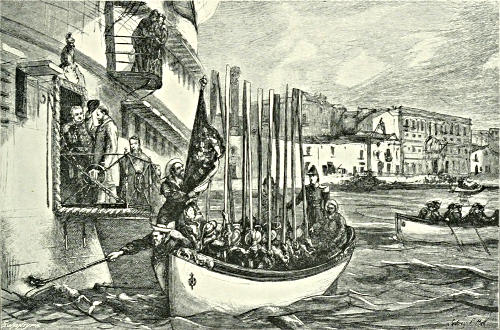
day, which was the Festival of St. Spiridion—the patron
saint of Corfu—they had an opportunity of seeing the town en
fête. The body of the saint was carried in procession amid
much picturesque rejoicing of the populace. On the 27th the
King left for the Albanian coast for some wild boar shooting,
and returned on the following evening, having bagged two
boars and other game.
The visit to Corfu came to an end on 1st May. There was a
great display of fireworks, and the Ariadne and the Royal Oak
were dressed with red and blue lights. Unfortunately there
was a sad accident which occurred just as the illuminations
were over. One of the sailors fell overboard, and though a
most careful search was made, nothing was ever seen or heard
of him again except just the splash as he fell into the water.
On the following day the Royal party arrived at Brindisi,
and returned to London over-land, stopping a little while in
Paris, where they were treated with the most marked attention
by the Emperor and Empress of the French.
As may be easily imagined, the King is very popular all
over France, and he has had many curious and interesting
adventures when going out in the semi-incognito which he
affects when travelling for pleasure. On one occasion, shortly
after the end of the war, he visited the battlefield of Sedan
attended by General Teesdale. He was naturally anxious
that his identity should not become known, for French
susceptibilities were very keen at that time, and he had no
desire to appear to glory over his brother-in-law’s brilliant
victories. When the time came to pay the hotel bill
General Teesdale found with great dismay that he had no
ready cash; the King was in an equally penniless condition;
while any telegram sent would have disclosed the identity of
the Royal visitor. At length, after much discussion, the
equerry made his way to the local Mont de Piété and placed
both his own and King Edward’s repeater in pawn.
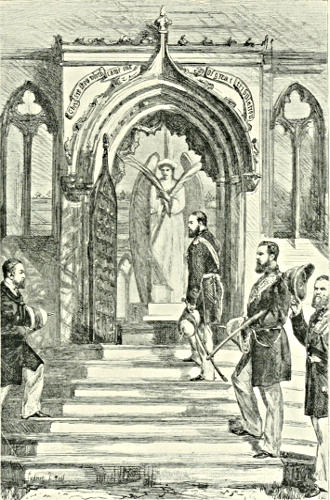
Among the formal acts of ceremony which King Edward
performed during this year was the unveiling of a statue of the
late Mr. George Peabody. In the speech which he delivered on
this occasion he alluded in the warmest terms to his feeling of
personal friendship towards the United States, and his enduring
recollection of the reception which had been accorded to him
there.