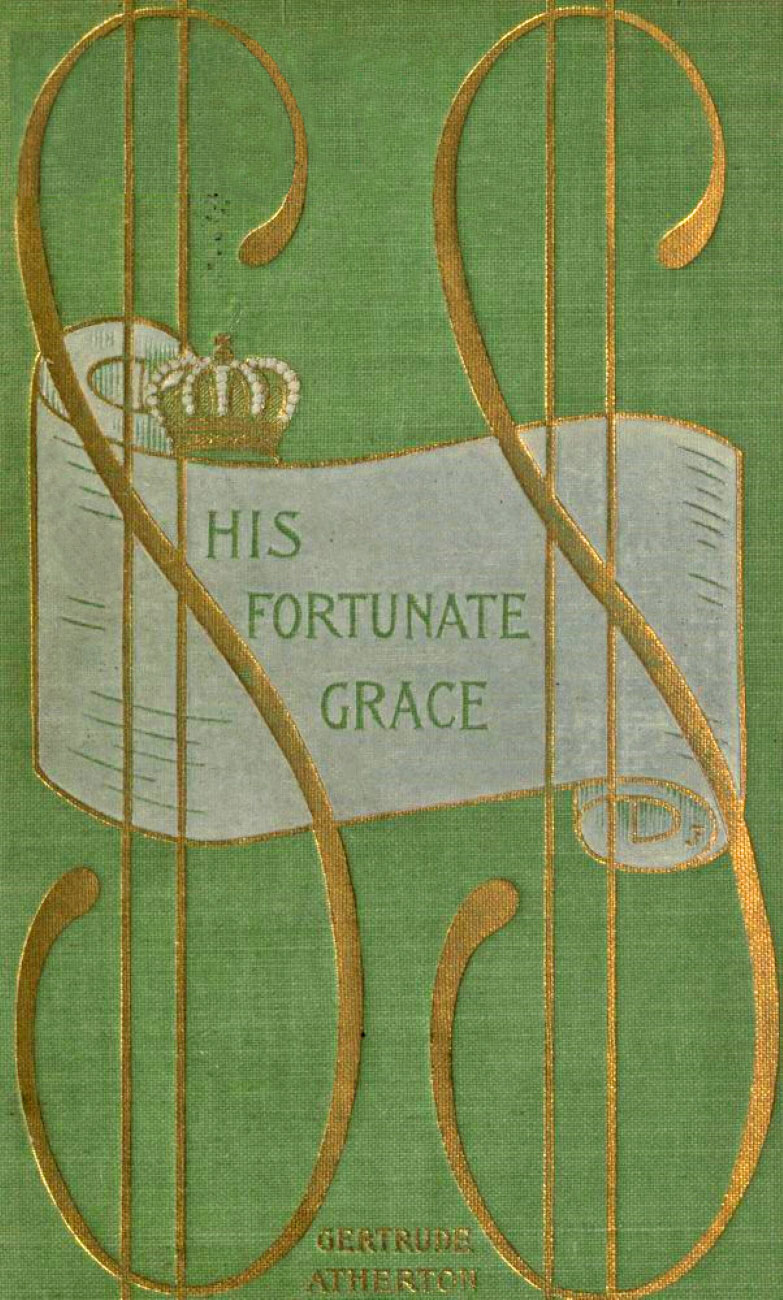
Author of A Whirl Asunder, The Doomswoman,
Patience Sparhawk and Her Times,
Before The Gringo Came, Etc.
New York
D. Appleton and Company
1897
Copyright, 1897,
By D. APPLETON AND COMPANY.
TO
ALEECE VAN BERGEN.
CHAPTER I.
HIS FORTUNATE GRACE.
“Are you quite sure?” Mr. Forbes laid
down his newspaper, and looked with slightly
extended mouth at his daughter who leaned
forward in an attitude of suppressed energy,
her hands clasped on the edge of the breakfast-table.
The heiress of many millions was not
handsome: her features were large and her
complexion dull; but she had the carriage and
‘air’ of the New York girl of fashion, and
wore a French morning-toilette which would
have ameliorated a Gorgon.
“Quite sure, papa.”
“I suppose you have studied the question
exhaustively.”
“Oh, yes, indeed. I have read Karl Marx
and Henry George and a lot of others. I
suppose you have not forgotten that I belong
to a club of girls who aspire to be something
more than fashionable butterflies, and that we
read together?”
“And you are also positive that you wish
me to divide my fortune with my fellow-men,
and deprive you of the pleasant position of
heiress?”
“Perfectly positive,” firmly. “It is terrible,
terrible to think of the starving thousands.
I feel it my duty to tell you, papa, that if you
do not do this yourself, I shall—when—when—but
I cannot even think of that.”
“No; don’t worry about it. I’m good for
twenty or thirty years yet——”
“You are the handsomest and most distinguished-looking
man in New York.”
“Thanks. To proceed: I should say that
you are likely to be several things meanwhile.
I don’t know that I shall even take the trouble
to alter my will. Still, I may—that is unless
you convert me. And you are also convinced
that women should have the vote?”
“Yes! Yes! indeed I am. I know all
the arguments for and against. I’ve heard
and read everything. You see, if we get the
vote we can bring Socialism about quite
easily.”
“Without the slightest difficulty, I should
say, considering the homogeneity of the
feminine mind.”
“You darling sarcastic thing. But can’t
you see what weight such women as we are
interesting in the cause must have? We
have carefully excluded the nouveau riche;
only the very oldest and most notable names
will be on our petition when we get it up.”
“Oh, you are going to get up a petition?
Well, let that pass for the present. Suppose
you fall in love and want to marry?”
“I shall tell him everything. What I
intend to make of my life—do with what
wealth I have at my disposal. If he does
not sympathize with me and agree to my
plans, he must go. A woman’s chief end
is not matrimony.”
“I need not ask if you have ever been
in love?”
“Oh, of course, I want to be, dreadfully.
All women do—even we advanced women—now,
papa! I don’t love you quite so well
when you smile like that. I am twenty-one,
and that is quite old for a girl who has been
highly educated, has travelled, and been out
two years. I have a right to call myself advanced,
because I have gone deliberately into
the race, and have read up a great deal, even
if I have as yet accomplished nothing. Exactly
how much are you worth, papa?”
“Broadly speaking, about thirty millions.
As a great deal of that is in railroad and other
stock, I am liable to be worth much less any
day; much is also in land, which is worth
only what it will bring. Still, I should
say that I am reasonably sure of a fair
amount.”
“It is terrible, papa! All that land! Do
give some of it at least to the poor dear
people—I assure you we feel that we have
taken them under our wing, and have grown
quite sentimental over them. Mr. George
would tell you what to do, at once. That
man’s very baggy knees fascinate me: he is so
magnificently in earnest. When he scolded
us all for being rich, the other day at the
meeting, I loved him.”
“It is a great relief to me that George is a
married man. Well, my dear, your allowance
is ten thousand dollars a year. Do what you
please with it, and come to me if your fads
and whims demand more. God forbid that
I should stand in the way of any woman’s
happiness. By the by, what does your
mother think of this business?”
“She is most unsympathetic.”
“So I should imagine,” said Mr. Forbes,
drily. “Your mother is the cleverest woman
I know.”
CHAPTER II.
After luncheon, Miss Forbes hied herself
to a drawing-room meeting in behalf of
Socialism. Despite the fact that she had
elected the rôle of mental muscularity, she
gave studious application to her attire: her
position and all that pertained to it were
her enduring religion; the interests of the
flashing seasons were unconsciously patronised
rather than assimilated. As she walked
up the Avenue toward the house of her
friend, Mrs. Latimer Burr, she looked like
a well-grown lad masquerading in a very
smart outfit of brown tweed, so erect and
soldierly was her carriage, so independent
her little stride. A bunch of violets was
pinned to her muff, another at her throat,
and she wore a severe little toque instead
of the picture-hat she usually affected.
She smiled as she swung along, and one
or two women looked back at her and
sighed. She was quite happy. She had
never known an ungratified wish; she was
spoken of in the newspapers as one of the
few intellectual young women in New York
society; and now she had a really serious
object in life. She felt little spasms of
gratification that she had been born to set
the world to rights—she and a few others:
she felt that she was not selfish, for she
grudged no one a share in the honours.
When she reached Mrs. Burr’s house, high
on the Avenue, and overlooking the naked
trees and the glittering white of the Park,
she found that other toilettes had taken less
time than hers: several of her friends complimented
the occasion with a punctuality
which she commended without envy.
The large drawing-room, which was to be
the scene of operations, was a marvellous
combination of every pale colour known to
nature and art, and looked expectant of
white-wigged dames, sparkling with satin
and diamonds, tripping the mazes of the
minuet with gentlemen as courtly as their
dress was rich and colourous. But only a
half-dozen extremely smart young women
of the hoary Nineteenth Century sat in a
group, talking as fast as seals on a rock;
and the slim little hostess was compactly
gowned in pearl-grey cloth, her sleek head
dressed in the fashion of the moment.
She came forward, a lorgnette held close
to her eyes. “How dear of you, Augusta,
to be so prompt!” she said, kissing her
lightly. “Dear me! I wish I could be as
frightfully in earnest as the rest of you,
but for the life of me I can’t help feeling
that it’s all a jolly good lark—perhaps that’s
the effect of my ex-sister-in-law, Patience
Sparhawk, who says we are only playing
at being alive. But we can’t all have
seventeen different experiences before we
are twenty-four, including a sojourn in
Murders’ Row, and a frantic love affair
with one’s own husband——”
“Tell me, Hal, what is a woman like who
has been through all that?” interrupted Augusta,
her ears pricking with girlish curiosity.
“Is she eccentric? Does she look
old—or something?”
“She’s not much like us,” said Mrs. Burr,
briefly. “You’ll meet her in time; it’s odd
you never happened to, even if you weren’t
out. Of course she can’t go out for awhile
yet; it would hardly be good taste, even if she
wanted to.”
“How interestingly dreadful to have had
such a thing in the family. But I should think
she would be just the one to take life seriously.”
“Oh, she does; that’s the reason she
doesn’t waste any time. Here is someone
else. Who is it?—oh, Mary Gallatin.”
Augusta joined the group.
“Where is Mabel Creighton?” demanded
one of the girls. “I thought she was coming
with you.”
“Haven’t you heard?” Miss Forbes, with
an air of elaborate indifference, drew her eyelids
together as if to focus a half-dozen women
that were entering. “The Duke of Bosworth
arrives to-day, and she has stayed at home to
receive him.”
“Augusta! What do you mean? What
Duke of Bosworth?”
“There is only one duke of the same name
at a time, my dear. This is the Duke of Bosworth
of Aire Castle—and I suppose a half-dozen
others—of the West Riding, of the district
of Craven, of the County of Yorkshire,
England. He has five other titles, I believe;
and enjoys the honour of the friendship of
Fletcher Cuyler.”
“Well!”
“Mabel met him abroad, and got to know
him quite well; and when he wrote her that
he should arrive to-day, she thought it only
hospitable to stay at home and receive
him.”
“Are they engaged? Augusta, do be an
angel.”
“I am sure I have not the slightest idea
whether they are engaged or not. Mabel
always has a flirtation on with somebody.”
“What is he like? How perfectly funny!
How quiet she has kept him. Is he good-looking—or—well,
just like some of the
others?”
“Mabel has merely mentioned him to me,
and I have not seen his photograph.”
“She’d make a lovely bride; and Mrs.
Creighton has such exquisite taste—St. Thomas’
would be a dream, I suppose he’ll wear a
grey suit with the trousers turned up and a
pink shirt. I do hope he won’t walk up the
Avenue with her with a big black cigar in his
mouth.”
“Is that what we came here to talk
about?” asked Miss Forbes, severely.
“What difference does it make what a foreign
titled thing looks like? We are here to discuss
a question which will one day exterminate
the entire order.”
“True,” exclaimed a dark-haired distinguished-looking
girl who was mainly responsible
for the intellectual reputation of her set,
albeit not exempt from the witchery of fads.
“We must stop gossiping and attend to
business. Do you know that I am expected
to speak? How am I to collect my
thoughts?”
“You have so many, Alex,” said Miss
Forbes, admiringly, “that it wouldn’t matter
if a few got loose. Have you prepared your
speech? I have mine by heart.”
“I have thought it out. I don’t think I
shall be frightened; it is really such a very
serious matter.”
“Have you spoken to your father?”
“Oh, we’ve talked it over, but I can’t say
that he agrees with us.”
Augusta laughed consciously. “There are
probably some points of similarity in our experiences.
But we must be firm.”
Some thirty women, gowned with fashionable
simplicity, had arrived, and were seated
in a large double semi-circle. They looked
alert and serious. Mrs. Burr drifted aimlessly
about for a moment, then paused before a table
and tapped it smartly with her lorgnette.
“I suppose we may as well begin,” she
said. “I believe we are going to discuss to-day
the—a—the advisability of women having
the vote—franchise. Also Socialism. Miss
Maitland, who has thoroughly digested both
subjects, and many more, has kindly consented
to speak; and Dr. Broadhead is coming
in later to give us one of his good scoldings.
Alexandra, will you open the ball?”
“Hal, you are incorrigible,” exclaimed
Miss Maitland, drawing her dark brows together.
“At least you might pretend to be in
earnest. We think it very good of you to
lend us your house, and we are delighted that
you managed Dr. Broadhead so cleverly, but
we don’t wish to be flouted, for we, at least,
are in earnest.”
“Alexis, if you scold me, I shall cry. And
I’ll now be serious—I swear it. You know I
admire you to death. Your French poetry is
adorable; you have more ideas for decorating
than any professional in New York, and you
fence like a real Amazon. I am simply dying
to hear you make a speech; but first let me
see if Latimer is hiding anywhere.”
She went out into the hall and returned in
a moment. “It would be just like Latimer to
get Fletcher Cuyler and listen, and then guy
us. Now, Alexandra, proceed,” and she
seated herself, and applied her lorgnette to her
bright quizzical eyes.
Miss Maitland, somewhat embarrassed by
her introduction, stepped to the middle of the
room and faced her audience. She gave a
quick sidelong glance at her skirts. They
stood out like a yacht under full sail. She was
a fine looking girl, far above woman’s height,
with dignified features, a bright happy expression,
and a soft colour. She was a trifle nervous,
and opened her jacket to gain time,
throwing it back.
“That’s a Paquin blouse,” whispered a
girl confidently to Augusta.
“Sh-h!” said Miss Forbes severely.
Miss Maitland showed no further symptom
of nervousness. She clasped her hands lightly
and did not make a gesture nor shift her position
during her speech. Her repose was very
impressive.
“I think we should vote,” she said decidedly.
“It will not be agreeable in many
respects, and will heavily increase our responsibilities,
but the reasons for far outweigh
those against. A good many of us have
money in our own names. We all have large
allowances. Some day we may have the terrible
responsibility of great wealth. The income-tax
is in danger of being defeated. If
we get the vote, we may do much toward
making it a law, and it is a move in the right
direction towards Socialism. Our next must
be towards persuading the Government to
take the railroads. It is shocking that the
actual costs of transit should be so small, the
charges so exorbitant and the profits so enormous.
I feel this so oppressively that every
time I make a long journey by rail, I give the
equivalent of my fare to the poor at once. It
is a horrifying thing that we on this narrow
island of New York city should live like hothouse
plants in the midst of a malarious
swamp: that almost at our back doors the
poor are living, whole families in one room,
and on one meal a day. My father gives me
many thousands a year for charity, but charity
is not the solution of the problem. There
must be a redistribution of wealth. Of course
I have no desire to come down to poverty; I
am physically unfit for it, as are all of us. We
should have sufficient left to insure our comfort;
but any woman with brain can get along
without the more extravagant luxuries. It is
time that we did something to justify our existence,
and if the law required that we
worked two or three hours a day instead of
leading the idle life of pleasure that we
do——”
“We are ornamental; that is something,”
exclaimed a remarkably pretty woman. “I
am sure the people outside love to read about
and look at us. Society gossip is not written
for us.”
Miss Maitland smiled. “You certainly are
ornamental, Mary,” she said; “but fancy how
much more interesting you would be if you
were useful as well.”
“I’d lose my good looks.”
“Well, you can’t keep them forever. You
should cultivate a substitute meanwhile, and
then you never need be driven back into the
ranks of passée, disappointed women. Faded
beauties are a bore to everybody.”
“I refuse to contemplate such a prospect.
Alex, you are getting to be a horrid rude advanced
New Woman.”
Mrs. Burr clapped her hands. “How delightful!”
she cried, “I didn’t know we were
to have a debate.”
“Now keep quiet, all of you,” said Miss
Maitland; “I have not finished. Mary Gallatin,
don’t you interrupt me again. Now that
we understand this question so thoroughly,
we must have more recruits. Of course, hundreds
of women of the upper class are signing
the petition asking for the extension of the
franchise to our sex, but few of them are interested
in Socialism. And if it is to be brought
about, it must be by us. I have little faith in
the rag-tag bob-tail element at present enlisted
in that cause. They not only carry little
weight with the more intelligent part of the
community, but I have been assured that they
would not fight—that they take it out in talk;
that if ever there was a great upheaval, they
would let the anarchists do the killing, and
then step in, and try to get control later.
“Now, I thoroughly despise a coward; so
do all women; and I have no faith in the
propagandism of men that won’t fight.
What we must do is to enlist our men.
They are luxurious now, and love all that
pertains to wealth; but, as Wellington said
once of the same class in England: ‘The
puppies can fight!’ Not that our men are
puppies—don’t misunderstand me—but you
know what I mean. They would only
seem so to a man who had spent his life
in the saddle.
“It has been said that the Civil War took
our best blood, and that that is the reason
we have no great men now; all the most
gallant and high-minded and ambitious were
killed—although I don’t forget that Mr.
Forbes could be anything that he chose.
I suppose he thinks that American statesmanship
has fallen so low that he scorns
to come out avowedly as the head of his
party, and merely amuses himself pulling
the wires. But I feel positive that if a
tremendous crisis ever arose, it would be
Mr. Forbes who would unravel the snarl.
You can tell him that, Augusta, with my
compliments.
“Now, I have come to the real point of
what I have to say. It was first suggested
to me by Helena Belmont when she was on
here last, and it has taken a strong hold
on my mind. We must awaken the soul
in our men—that is what they lack. The
germ is there, but it has not been developed;
perhaps I should say that the soul
of the American people rose to its full
flower during the Civil War, and then
withered in the reaction, and in the commercial
atmosphere which has since fitted
our nation closer than its own skin. Miss
Belmont says that nothing will arouse the
men but another war; that they will be
nothing but a well-fed body with a mental
annex until they once more have a
‘big atmosphere’ to expand in. But I
don’t wholly agree with her, and the
thought of another such sacrifice is appalling.
I believe that the higher qualities in
man can be roused more surely by woman
than by bloodshed, and that if we, the
women of New York, the supposed orchids,
butterflies, or whatever people choose to call
us, whose luxury is the cynosure and envy
of the continent, could be instrumental in
giving back to the nation its lost spiritual
quality—understand, please, that I do not
use the word in its religious sense—it
would be a far greater achievement than
any for which the so-called emancipated
women are vociferating. The vote is a
minor consideration. If we acquire the influence
over men that we should, we shall
not need it. And personally, I should dispense
with it with great pleasure.”
“Bravo! young lady,” exclaimed a vibrating
resonant voice, and a clerical man entered
the room to the clapping of many
hands. His eyes were keen and restless,
his hair and beard black and silver, and
there was a curious disconcerting bald spot
on his chin. He looked ready to burst with
energy.
“Thank you all very much, but don’t
clap any more, for I have only a few
minutes to spare. How do you do, Mrs.
Burr? Yes, that was a very good speech—I
have been eavesdropping, you see. Feminine,
but I am the last to quarrel with
that. It is not necessary for a woman to
be logical so long as her instincts are in
the right direction. Well, I will say a few
words to you; but they must be few as I
am very hoarse: I have been speaking all
day.” He strode about as he talked, and
occasionally smote his hands together. He
was a very emphatic speaker, and, like all
crusaders, somewhat theatrical.
“I agree with all that Miss Maitland has
said to you—with the exception of her
views on Socialism, I don’t believe Socialism
to be the solution of our loathsome
municipal degradation nor of the universal
social evil. But I have no time to go into
that question to-day. The other part—that
you must awaken the soul of the men of
your class—I most heartily endorse. The
gentlemen alone can save this country—snatch
it from the hands of plebeians and
thieves. In them alone lies the hope of
American regeneration. When I read of a
strapping young man who has been educated
at Harvard, or Yale, or Princeton,
who is an expert boxer, fencer, whip, oarsman,
yachtsman, addicted to all manly
sport, in fact—when I read of such a man
having tortoise-shell brushes with diamond
monograms, diamond garter buckles, and
thirty sets of silk pyjamas—never see their
names in the paper except as ushers at
weddings, or as having added some new
trifle to their costly apartments, it makes
me sick—sick! A war would rouse these
young men, as Miss Maitland suggests; I
haven’t the slightest doubt that they would
fight magnificently, and that those who survived
would be serious and useful men for
the rest of their lives. But we don’t want
war, and you must do the rousing. Make
them vote—vote—nullify the thieving lying
cormorants who are fattening on your country,
and ruining it morally and financially,
as well as making it the scorn and jest of
Europe. And make them vote, not only
this year, but every year for the rest of
their lives, and on every possible question.
It is to be hoped, indeed, that no war will
come to awaken their manhood—we don’t
want to pay so hideous a price as that,
and it is shocking that it has been found
necessary to suggest it. But what we do
want is a great moral war. Lash them into
that, and see that they do not break ranks
until they have honest men in the legislature,
in Congress, and in every municipal
office in the country. Now, I must be off,”
and waving a hasty adieu, he shot out.
“For my part,” said Mrs. Burr, above
the enthusiastic chorus, “I am delighted
that he didn’t uphold Socialism. I’ll undertake
the reformation of Latimer, although
it will probably give me wrinkles and turn
me grey, but I won’t have him giving up
his ‘boodle,’ as they say out West; not I!
not I!”
“Gally is hopeless,” said that famous
clubman’s wife, with a sigh. “I shall have
to work on someone else.”
“It will be lots more interesting,” murmured
her neighbour.
“How shall we begin?” asked Mrs.
Burr, wrinkling her smooth brow. “Put
them on gruel and hot water for awhile?
I am sure they are hopeless so long as
they eat and drink so much.”
“I suppose all we girls will have to
marry,” remarked one of them.
“Well, you would, anyhow,” said Mrs.
Burr, consolingly.
“I shall not marry until I find the right
man,” said Augusta firmly, “not if I die
an old maid. But father would be a splendid
convert, and his name would carry
great weight.”
“You mean for Socialism,” replied her
hostess. “No man does his political duty
more religiously than Mr. Forbes. But let
us send Socialism to—ahem—and just work
at the other thing. I am dying to see how
Latimer will take it.”
“Never!” exclaimed Augusta, and was
echoed loyally. “We must not lose sight
of that. I don’t at all agree with Dr.
Broadhead on that point. I have fully
made up my mind to bring papa round.”
“But you are at a disadvantage, darling,”
said Mrs. Burr, drily; “your beautiful mamma
thinks we are all a pack of idiots, and
your father has a great respect for her
opinion, to say nothing of being more or
less épris.”
“I shall convert her too,” said Augusta
sturdily.
Mrs. Burr laughed outright. “I can just
see Mrs. Forbes posing as a prophet of Socialism.
Well, let us eat. Alexis, you must be
limp all the way down, and your thinker
must be fairly staggering. I will pour you a
stiff cup of tea and put some rum in it.”
Augusta rose. “I must go, Hal,” she
said. “I have a speech to make myself in
the slums, you know. Aren’t you coming?”
“I? God forbid! But do take something
before you go. It may save you
from stage-fright.”
“I haven’t a minute. I must be there
in twenty. Who is coming with me?”
Eight or ten of the company rose and
hurried out with her; the rest gathered
about the tea-table and relieved their mental
tension in amicable discussion of the
lighter matters of the day.
CHAPTER III.
A footman had taken the Duke of Bosworth’s
cards up to Miss Mabel Creighton and
her mother. The young man had arrived but
an hour before and still wore his travelling
gear, but had been given to understand that
an English peer was welcome in a New York
drawing-room on any terms. The drawing-room
in which he awaited the American
maiden who had taken his attenuated fancy
was large and sumptuous and very expensive.
There were tables of ormolu, and cabinets of
tortoise-shell containing collections of cameos,
fens and miniatures, a lapis lazuli clock three
feet high, and a piano inlaid with twenty-seven
different woods. The walls were frescoed
by a famous hand, and there were lamps
and candle-brackets and various articles of
decoration which must have been picked up
in extensive travels.
The Duke noted everything with his slow
listless gaze. He sat forward on the edge of
his chair, his chin pressed to the head of his
stick. He was a small delicately-built man,
of thirty or more. His shoulders had rounded
slightly. His cheeks and lower lip were beginning
to droop. The pale blue eyes were
dim, the lids red. He was a debauchee, but
“a good sort,” and men liked him.
He did not move during the quarter of an
hour he was kept waiting, but when the
portière was pushed aside he rose quickly, and
went forward with much grace and charm of
manner. The girl who entered was a dainty
blonde fluffy creature, and looked like a bit of
fragile china in the palatial room.
“How sweet of you to come so soon,”
she said, with frank pleasure. “I did not expect
you for an hour yet. Mamma will be
down presently. She is quite too awfully
anxious to meet you.”
The Duke resumed his seat and leaned
back this time, regarding Miss Creighton
through half-closed eyes. His expression was
much the same as when he had inventoried
the room.
“I came to America to see you,” he
said.
The colour flashed to her hair, but she
smiled gracefully. “How funny! Just as if
you had run over to pay me an afternoon call.
Did the trip bore you much?”
“I am always bored at sea when I am not
ill. I am usually ill.”
“Oh! Really? How horrid! I am never
ill. I always find the trip rather jolly. I go
over to shop, and that would keep me up if
nothing else did. Well, I think it was very
good indeed of you—awfully good—to brave
the horrors of the deep, or rather of your
state-room, just to call on me.”
She had a babyish voice and a delightful
manner. The Duke smiled. He was really
rather glad to see her again. “You were
good enough to ask me to call if I ever came
over,” he said, “and it occurred to me that it
would be a jolly thing to do. I only had little
detached chats with you over there, and there
were always a lot of Johnnies hanging about.
I felt interested to see you in your own surroundings.”
“Oh—perhaps you are going to write a
book? I have always felt dreadfully afraid
that you were clever. Well, don’t make the
mistake of thinking that we have only one
type over here, as they always do when they
come to write us up. There are just ten girls
in my particular set—we have sets within sets,
as you do, you know—and we are each one
of us quite different from all the others. We
are supposed to be the intellectual set, and
Alexandra Maitland and Augusta Forbes are
really frightfully clever. I don’t know why
they tolerate me—probably because I admire
them. Augusta is my dearest friend. Alex
pats me on the head and says that I am the
leaven that keeps them from being a sodden
lump of grey matter. I have addled my brains
trying to keep up with them.”
“Don’t; you are much more charming as
you are.”
“Oh, dear! I don’t know. Men always
seem to get tired of me,” she replied, with just
how much ingenuousness the Duke could not
determine. “Mrs. Burr says it is because I
talk a blue streak and say nothing. Hal is
quite too frightfully slangy. Augusta kisses
me and says I am an inconsequential darling.
She made me act in one of Howell’s comedies
once, and I did it badly on purpose, in the
hope of raising my reputation, but Augusta
said it was because I couldn’t act. Fletcher
Cuyler, who is the most impertinent man
in New York said—— Have you seen
Fletcher?”
“He came out on the tug to meet me, and
left me at the door.”
“I believe if Fletcher really has a deep
down affection for anyone, it is for you—I
mean for any man. He is devoted to all of us,
and he is the only man we chum with. But
we wouldn’t have him at the meeting to-day.
Do you know that I should have lent my valuable
presence to two important meetings this
afternoon?”
“Really?” The Duke was beginning to
feel a trifle restless.
“Yes, we are going in frightfully for Socialism,
you know—Socialism and the vote—and—oh,
dozens of other things. Alex said
we must, and so we did. It’s great fun. We
make speeches. At least, I don’t, but the
others do. Should you like to go to one of
our meetings?”
“I should not!” said the Duke emphatically.
“Well, you must not make fun of us, for I
am simply bent on having all the girls adore
you, particularly Augusta. The other day we
had a lovely meeting. It was here. I have
the prettiest boudoir: Alex designed it. It
looks just like a rainbow. I lay on the couch
in a gown to match, and the girls all took off
their stiff street frocks and put on my wrappers,
and we smoked cigarettes and ate bon-bons,
and read Karl Marx. It was lovely! I
didn’t understand a word, but I felt intellectual—the
atmosphere, you know. When we
had finished a chapter and Alex had expounded
it, and quarrelled over it with Augusta,
we talked over all the men we knew,
and I am sure men would be lots better if they
knew what girls thought about them. Alex
says we must regenerate them, quicken their
souls, so to speak, and I suppose I may as
well begin on you, although you’re not an
American, and can’t vote—we’re for reforming
the United States, you know. What is the
state of your soul?” And again she gave her
fresh childlike laugh.
“I haven’t any. Give me up. I am hopeless.”
He was arriving at the conclusion that
she was more amusing in detached chats,
but reflected that she was certainly likeable.
It was this last pertainment, added to the rumour
of her father’s vast wealth, that had
brought him across the water.
“I don’t know that I have ever seen one
of the—what do they call them?—advanced
women? But I am told that they are not
Circean. That, indeed, seems to be their
hall-mark. A woman’s first duty is to be
attractive.”
“That’s what Fletcher says. Augusta is
my most intimate friend, my very dearest
friend, but I never saw a man look as if he
was thinking about falling in love with her.
How long shall you stay?” she added
quickly, perceiving that he was tiring of the
subject.
“I?—oh—I don’t know. Until you tell
me that I bore you. I may take a run into
Central America with Fletcher.”
“Into what? Why that’s days, and days,
and days from here, and must be a horrid
place to travel in.”
“I thought Chicago was only twenty-four
hours from New York.”
“Oh, you funny, funny, deliciously funny
Englishman! Why Central America doesn’t
belong to the United States at all. It’s ’way
down between North and South America or
somewhere. I suppose you mean middle
America. We call Chicago and all that part
of the country West.”
“If it’s middle it’s central,” said the Duke,
imperturbably. “You cannot expect me to
command the vernacular of your enormous
country in a day.”
He rose suddenly. A woman some twenty
years older than Mabel had entered. Her face
and air were excessively, almost aggressively
refined, her carriage complacent, a trifle insolent.
She was the faded prototype of her
daughter. The resemblance was close and
prophetic.
“My dear Duke,” she said, shaking him
warmly by the hand, “I am so flattered that
you have come to us at once, and so glad to
have the opportunity to thank you for your
kindness to Mabel when she was in your dear
delightful country. Take that chair, it is so
much more comfortable.” She herself sat
upon an upright chair, and laid one hand
lightly over the other. Her repose of manner
was absolute. “The happiest days of my life
were spent in England, when I was first married—it
seems only day before yesterday—my
husband and I went over and jaunted about
England and Scotland and Wales in the most
old-fashioned manner possible. For six
months we rambled here and there, seeing
everything—one was not ashamed of being a
tourist in those days. We would not present
a letter, we wanted to have a real honeymoon:
we were so much in love. And to think that
Aire Castle is so near that terrible Strid. I remember
that we stood for an hour simply fascinated.
Mr. Creighton wanted to take the
stride, but I wouldn’t let him. He has never
been over with me since—he is so busy. I
can’t think how Mr. Forbes always manages
to go with his wife, unless it is true that he is
jealous of her—although in common justice I
must add that if she has ever given him cause
no one knows it. I suppose it is on general
principles, because she is such a beauty. Still
I must say that if I were a man and married
to a Southern woman I should want
to get rid of her occasionally: they are so
conceited and they do rattle on so about
nothing. Virginia Forbes talks rather less
than most Southern women; but I imagine
that is to enhance the value of her velvety
voice.”
The Duke, who had made two futile efforts
to rise, now stood up resolutely.
“I am very sorry——” he began.
“Oh! I am so sorry you will rush away,”
exclaimed his hostess. “I have barely heard
you speak. You must come with us to the
opera to-night. Do. Will you come informally
to an early dinner, or will you join us in
the box with Fletcher?”
“I will join you with Fletcher. And I
must go—I have an engagement with him at
the hotel—he is waiting for me. You are
very kind—thanks, awfully. So jolly to
be so hospitably received in a strange country.”
When he reached the side-walk, he drew
a long breath. “My God!” he thought,
“Is it a disease that waxes with age?
Perhaps they get wound up sometimes and
can’t stop.... And she is pretty now,
but it’s dreadful to have the inevitable
sprung on you in that way. What are the
real old women like, I wonder? They
must merely fade out like an old photograph.
I can’t imagine one of them a
substantial corpse. I shall feel as if I were
married to a dissolving view. She is
charming now, but—oh, well, that is not
the only thing to be taken into consideration.”
The Creighton house was on Murray Hill.
He crossed over to Fifth Avenue and
walked down toward the Waldorf, absently
swinging his stick, regardless of many curious
glances. “I wonder,” he thought,
“I wonder if I ever dreamed of a honeymoon
with the one woman. If I did,
I have forgotten. What a bore it will be
now.”
CHAPTER IV.
Augusta returned home at six o’clock,
not flushed with triumph, for she was too
tired, but with an elated spirit. She had
stood on a platform in an East Side hall
surrounded by her friends, and to two
dozen bedraggled females had made the
first speech of her life. And it had been
a good speech; she did not need assurance
of that. She had stood as well as
Alexandra Maitland, but had used certain
little emphatic gestures (she was too independent
to imitate anyone); and she had,
with well-bred lack of patronage, assured
her humble sisters, for three quarters of an
hour, that they must sign the petition for
Woman Franchise, and make all the other
women on the East Side sign it: in order
that they might be able to put down the
liquor trust, reform their husbands, secure
good government, and be happy ever after.
She flattered herself that she had not used
a single long word—and she prided herself
upon her vocabulary—that she had spoken
with the simplicity and directness which
characterized great orators and writers. Altogether,
it was an experience to make
any girl scorn fatigue; and when she entered
her boudoir and found Mabel Creighton,
she gave her a dazzling smile of welcome,
and embraced her warmly. Mabel responded
with a nervous hug and shed a tear.
“He’s here!” she whispered ecstatically.
“Who?—Oh, your Duke. Did he propose
right off? Do tell me.” And she
seated herself close beside her friend, and
forgot that she was reforming the United
States.
“No, but he told me that he had come
over on purpose to see me.”
“That’s equal to a proposal,” said Augusta
decidedly. “Englishmen are very
cautious. They are much better brought up
than ours. Which is only another warning
that we must take ours in hand. It is
shocking the way they frivol. I’d rather
you married an American for this reason;
but if you love the Duke of Bosworth, I
have nothing to say. Besides, you’re the
vine-and-tendril sort; I don’t know that
you’d ever acquire any influence over a
man; so it doesn’t much matter. Now tell
me about the Duke, dearest; I am so glad
that he has come.”
Mabel talked a steady stream for a half-hour,
then hurried home to dress for the
evening.
Mr. Forbes was standing before the fire
in the drawing-room when his daughter
entered, apparelled for the opera and subsequent
ball. She wore a smart French
gown of pale blue satin, a turquoise comb
in her pale modishly dressed hair, and she
carried herself with the spring and grace of
her kind; but she was very pale, and there
were dark circles about her eyes.
“You look worn out, my dear,” said her
father, solicitously. “What have you been
doing?”
Miss Forbes sank into a chair. “I went
to two meetings, one at Hal’s and one in
the slums. I spoke for the first time, and it
has rather taken it out of me.”
“Would the victory of your ‘cause’ compensate
for crow’s feet?”
“Indeed it would. I really do not care.
I am so glad that I have no beauty to lose.
I might not take life so seriously if I had.
I am beginning to have a suspicion that
Mary Gallatin and several others have merely
taken up these great questions as a fad.
Here comes mamma, I am glad, for I am
hungry. I had no time for tea to-day.”
A portière was lifted aside by a servant,
and Mrs. Forbes entered the room. But for
the majesty of her carriage she looked
younger than her daughter, so exquisitely
chiselled were her features, so fresh and
vivid her colouring. Virginia Forbes was
thirty-nine and looked less than thirty.
Her tall voluptuous figure had not outgrown
a line of its early womanhood, her
neck and arms were Greek. A Virginian
by birth, she inherited her high-bred beauty
from a line of ancestors that had been
fathered in America by one of Elizabeth’s
courtiers. Her eyes had the slight fullness
peculiar to the Southern woman; the colour,
like that of the hair, was a dark brown
warmed with a touch of red. Her curved,
scarlet mouth was not full, but the lips
were rarely without a pout, which lent its
aid to the imperious charm of her face.
There were those who averred that upon
the rare occasions when this lovely mouth
was off guard it showed a hint in its
modelling of self-will and cruelty. But few
had seen it off guard.
She wore a tiara of diamonds, and on
her neck three rows of large stones depending
lightly from fine gold chains. Her
gown was of pale green velvet, with a
stomacher of diamonds. On her arm she
carried an opera cloak of emerald green
velvet lined with blue fox.
Mr. Forbes’ cold brilliant eyes softened
and smiled as she came toward him, flirting
her lashes and lifting her chin. For
this man, whose eyes were steel during all
the hours of light, who controlled the destinies
of railroads and other stupendous
enterprises and was the back-bone of his
political party, who had piled up millions
as a child piles up blocks, and who had
three times refused the nomination of his
party for the highest gift of the nation,
had worshipped his wife for twenty-two
years. He turned toward his home at
the close of each day with a pleasure
that never lost its edge, exulting in the
thought that ambition, love of admiration,
and the onerous duties of the social leader
could not tempt his wife to
neglect him for an hour. He lavished fortunes
upon her. She had an immense allowance
to squander without record, a
palace at Newport and another in the
North Carolina mountains, a yacht, and
jewels to the value of a million dollars.
In all the years of their married life he had
refused her but one dear desire—to live
abroad in the glitter of courts, and receive
the homage of princes. He had declined
foreign missions again and again. “The
very breath of life for me is in America,”
he had said with final decision. “And if
I wanted office I should prefer the large
responsibilities of the Presidency to the nagging
worries of an Ambassador’s life. The
absurdities of foreign etiquette irritate me
now when I can come and go as I like.
If they were my daily portion I should end
in a lunatic asylum. They are a lot of tin
gods, anyhow, my dear. As for you, it is
much more notable to shine as a particular
star in a country of beauties, than to walk
away from a lot of women who look as if
they had been run through the same mould,
and are only beauties by main strength.”
And on this point she was forced to submit.
She did it with the better grace because she
loved her husband with the depth and tenacity
of a strong and passionate nature. His
brain and will, the nobility and generosity
of his character, had never ceased to exercise
their enchantment, despite the men that
paid her increasing court. Moreover, although
the hard relentless pursuit of gold
had aged his hair and skin, Mr. Forbes
was a man of superb appearance. His head
and features had great distinction; his face,
when the hours of concentration were passed,
was full of magnetism and life, his eyes of
good-will and fire. His slender powerful
figure betrayed little more than half of his
fifty-one years. He was a splendid specimen
of the American of the higher civilisation:
with all the vitality and enthusiasm
of youth, the wide knowledge and intelligence
of more than his years, and a manner
that could be polished and cold, or
warm and spontaneous, at will.
For her daughter, Mrs. Forbes cared less.
She had not the order of vanity which would
have dispensed with a walking advertisement
of her years, but she resented having borne an
ugly duckling, one, moreover, that had tiresome
fads. She had been her husband’s confidante
in all his gigantic schemes, financial
and political, and Augusta’s intellectual kinks
bored her.
She crossed the room and gave her husband’s
necktie a little twist. Mr. Forbes sustained
the reputation of being the best-groomed
man in New York, but it pleased her
to think that she could improve him. Then
she fluttered her eyelashes again.
“Do I look very beautiful?” she whispered.
He bent his head and kissed her.
“When you two get through spooning,”
remarked Miss Forbes in a tired voice, “suppose
we go in to dinner.”
“Don’t flatter yourself that it is all for
you,” Mrs. Forbes said to her husband, “I am
to meet an English peer to-night.”
“Indeed,” replied Mr. Forbes, smiling,
“Have we another on the market? What is
his price? Does he only want a roof? or will
he take the whole castle, barring the name
and the outside walls?”
“You are such an old cynic. This is the
Duke of Bosworth, a very charming man, I am
told. I don’t know whether he is poverty-stricken
or not. I believe he paid Mabel
Creighton a good deal of attention in the
autumn, when she was visiting in England.”
“He wouldn’t get much with her: Creighton
is in a tight place. He may pull out, but
he has three children besides Mabel. However,
there are plenty of others to snap at this
titled fish, no doubt.”
“I hope not,” said Augusta. “Dear Mabel
is very fond of him; I am sure of that. He
only arrived to-day, and is going with them
to the opera to-night. How are you to meet
him?”
“Fletcher Cuyler will bring him to my
box, of course. Are not all distinguished foreigners
brought to my shrine at once?”
“True,” said Miss Forbes. “But are we
going in to dinner? I have never heard
Maurel in Don Giovanni, and I don’t want to
lose more than the first act.”
“There is plenty of it. But let us go in to
dinner, by all means.”
CHAPTER V.
The two tiers of boxes at the Metropolitan
Opera House reserved for the beauty and
fashion of New York flashed with the plumage
of women and a thousand thousand gems.
Women of superb style, with little of artifice
but much of art, gowned so smartly that only
their intense vitality saved them from confusion
with the fashion-plate, carrying themselves
with a royal, albeit somewhat self-conscious
air, many of them crowned like
empresses, others starred like night, producing
the effect en masse of resplendent beauty,
and individually of deficiency in all upon
which the centuries have set their seal, hung,
two or three in a frame, against the curving
walls and red background of the great house:
suspended in air, these goddesses of a new
civilisation, as if with insolent challenge to all
that had come to stare. To the music they
paid no attention. They had come to decorate,
not to listen; without them there would
be no opera. The music lovers were stuffed
on high, where they seemed to cling to the
roof like flies. The people in the parquette
and orchestra chairs, in the dress-circle and
balconies, came to see the hundreds of millions
represented in the grand tier. Two rows of
blasé club faces studded the long omnibus
box. Behind the huge sleeves and voluminous
skirts that sheathed their proudest possessions,
were the men that had coined or inherited
the wealth which made this triumphant
exhibition possible.
As the curtain went down on the second
act and the boxes emptied themselves of their
male kind that other male kind might enter
to do homage, two young men took their
stand in the back of a box near the stage and
scanned the house. One of them remarked
after a few moments:
“I thought that all American women were
beautiful. So far, I see only one.”
“These are the New York fashionettes,
my dear boy. Their pedigree is too short for
aristocratic outline. You will observe that the
pug is as yet unmitigated. Not that blood
always tells, by any means: some of your old
duchesses look like cooks. Our orchids travel
on their style, grooming, and health, and you
must admit that the general effect is stunning.
Who is your beauty?”
“Directly in the middle of the house.
Gad! she’s a ripper.”
“You are right. That is the prettiest
woman in New York. And her pedigree is
probably as good as yours.”
“Who is she?”
“Mrs. Edward R. Forbes, the wife of one
of the wealthiest and most powerful men in
the United States.”
“Really!”
“That is her daughter beside her.”
“Her what!”
“I always enjoy making that shot. It
throws a flash-light on the pitiful lack of
originality in man every time. But it is nothing
for the petted wife of an American millionaire
to look thirty when she is forty. It’s the
millionaire who looks sixty when he is fifty.
I’m not including Forbes, by the way. That
tall man of fine physique that has just left the
box is he.”
“Poor thing!”
“Oh, don’t waste any pity on Forbes.
He’s the envy of half New York. She is devoted
to him, and with good reason: there are
few men that can touch him at any point. I
shall take you over presently. The first thing
a distinguished stranger, who has had the tip,
does when he comes to New York is to pay
his court at that shrine. What a pity you are
booked. That girl will come in for forty millions.”
The other set his face more stolidly.
“Pounds?”
“Oh, no—dollars. But they’ll do.”
“I have not spoken as yet, although I
don’t mind saying that that is what I came
over for.”
“I suppose you are in pretty deep—too
deep to draw out?”
“I don’t know that I want to. I can be
frank with you, Fletcher. Is her father solid?
American fortunes are so deucedly ricketty. I
am perfectly willing to state brutally that I
wouldn’t—couldn’t—marry Venus unless I got
a half million (pounds) with her and something
of an income to boot.”
“As far as I know Creighton stands pretty
well toward the top. You can never tell
though: American fortunes are so exaggerated.
You see, the women whose husbands
are worth five millions can make pretty much
the same splurge as the twenty or thirty million
ones. They know so well how to do it.
For the matter of that there’s one clever old
parvenu here who has never handled more
than a million and a half—as I happen to
know, for I’m her lawyer—and who entertains
with the best of them. Her house, clothes,
jewels, are gorgeous. A shrewd old head like
that can do a lot on an income of seventy
thousand dollars a year. But Forbes, I should
say, is worth his twenty millions—that’s
allowing for all embellishments—if he’s worth
a dollar, and Augusta is the only child. Unless
America goes bankrupt, she’ll come in for
two-thirds of that one of these days, and an
immense dot meanwhile.”
At this moment Miss Creighton, who had
been talking with charming vivacity to a
group of visitors, dismissed them with tactful
badinage, and beckoned to the two men
in the back of the box.
“Sit down,” she commanded. “What
do you think, Fletcher? I stayed away
from two important meetings to-day in
order to receive the Duke. Was not that
genuine American hospitality?”
She spoke lightly; but as her eyes sought
the Englishman’s, something seemed to flutter
behind her almost transparent face.
“These fads! These fads!” exclaimed
the young man addressed as Fletcher.
“Have you resigned yourself to the New
Woman, Bertie? The New York variety
is innocuous. They just have a real good
time and the newspapers take them seriously
and write them up, which they
think is lovely.”
“Nobody pays any attention to Fletcher
Cuyler,” said Miss Creighton with affected
disdain. “We will make you all stare
yet.”
The Duke smiled absently. He was
looking toward the box in the middle of
the tier.
“I think women should have whatever
diversion they can find or invent,” he said.
“Society does not do much for them.”
The curtain rose.
“Keep quiet,” ordered Cuyler. “I allow
no talking in a box which I honour with
my presence. That isn’t what I ruin myself
for.”
He was a tail nervous blonde bald-headed
man of the Duke’s age, with an imp-like
expression and dazzling teeth. Despite the
fact that he was unwealthed, he was a
fixed star in New York society; he not
only knew more dukes and princes than
any other man in the United States, but
was intimate with them. He had smart
English relatives and was a graduate of
Oxford, where he had been the chosen
friend of the heir to the Dukedom of Bosworth.
His excessive liveliness, his adaptability
and versatility, his audacity, eccentricities,
cleverness, and his utter disregard of
rank, had made him immensely popular in
England. He was treated as something between
a curio and a spoilt child; and if
people guessed occasionally that his head
was peculiarly level, they but approved him
the more.
When the act was done and the box
again invaded, Cuyler carried the Englishman
off to call on Mrs. Forbes. Her box
was already crowded, and Mr. Forbes stood
just outside the door. As the Duke was
introduced to him, he contracted his eyelids,
and a brief glance of contempt shot
from eyes that looked twenty years younger
than the fish-like orbs which involuntarily
twitched as they met that dart. But Mr.
Forbes was always courteous, and he spoke
pleasantly to the young man of his father,
whom he had known.
Cuyler entered the box. “Get out,” he
said, “everyone of you. I’ve got a live
duke out there. He’s mortgaged for the
rest of the evening and time’s short.” He
drove the men out, then craned his long
neck round the half-open door.
“Dukee, dukee,” he called, “come
hither.”
The Duke, summoning what dignity he
could, entered, and was presented. After he
had paid a few moments’ court to Mrs.
Forbes, Cuyler deftly changed seats with
him and plunged into an animated dispute
with his hostess anent the vanishing charms
of Don Giovanni.
The Duke leaned over Miss Forbes’ chair
with an air of languor, which was due to
physical fatigue, contemplating her absently,
and not taking the trouble to more than
answer her remarks. Nevertheless, his prolonged
if indifferent stare disturbed the girl
who had known little susceptibility to men.
There was something in the cold regard of
his eye, the very weariness of his manner,
which had its charm for the type of woman
who is responsive to the magnetism of
inertia, whom a more vital force repels.
And his title, all that it represented, the
pages of military glory it rustled, appealed
to the mind of the American girl who had
felt the charm of English history. She was
not a snob; she had given no thought to
marrying a title; and if the man had repelled
her, she would have relegated him
to that far outer circle whence all were
banished who bored her or achieved her
disapproval; but a thin spell emanated
from this cold self-contained personality and
stirred her languid pulse. Practical as she
was, she had a girl’s imagination, and she
saw in him all that he had not, haloed
with an ancient title; behind him a great
sweep of historical canvas. Then she remembered
her friend; and envied her with
the most violent emotion of her life.
“Well, what do you think of her?”
asked Cuyler of the Duke, as they walked
down the lobby. “I don’t mean la belle
dame sans merci; there’s only one opinion
on that subject. But Augusta? do you
think you could stand her? If Forbes took
the notion he’d come down with five million
dollars without turning a hair.”
“I could swallow her whole and without
a grimace,” said the Duke drily. “But I
am half, two-thirds committed. I have no
intention of making Miss Creighton ridiculous,
although I shall be obliged to tell her
father frankly that I cannot marry her unless
he comes down with half a million. It’s
a disgusting thing to do, but I have no
choice.”
“Oh, don’t go back on Mabel, of course.
But I am sorry. However, nous verrons.
If Creighton doesn’t come to time, let me
know. I am pretty positive I can arrange
the other: I think I know my fair compatriot’s
weak spot. I suppose you go on
with the Creightons to the big affair at
the Schemmerhorn-Smiths to-night? Well,
give Augusta a quarter of an hour or so
of your flattering attentions. It will do no
harm, in any event. I feel like a conspirator,
but I’d like to see you on your feet.
Gad! I wish I had a title; I wouldn’t be
in debt as long as you have been.”
CHAPTER VI.
The next day Cuyler took the Duke to
call on Mrs. Forbes in her house. It was
five o’clock and the lamps were lit. Augusta’s
particular set were there, talking
Socialism over their tea, and enlightening a
half-dozen young men and elderly club
roués, who listened with becoming gravity.
Mrs. Forbes sat somewhat apart by the tea-table
talking to three or four men on any
subject but Socialism. She wore a gown
of dark-red velvet with a collar of Venetian
lace and sat in a large high-backed
chair of ebony, inlaid with ivory. The seat
was also high, and she looked somewhat
like a queen on her throne, graciously receiving
the homage of her courtiers. The
drawing-room was twice as large as the
Creighton’s, the Duke noted as he entered.
It was hung with dark-green velvet embroidered
with a tree design in wood colour
an inch thick. Every shade of green blended
in the great apartment, and there was
no other colour but the wood relief and
the pink of the lamp-shades.
Mrs. Forbes did not rise, but she held
out her hand to the stranger with so spontaneous
a warmth that he felt as if he
were receiving his first welcome in transatlantic
parts. She had not shaken hands
with him at the opera, and their brief conversation
had been over her shoulder; he
now found that her eyes and hand, her
womanly magnetism and almost regal manner
combined to effect the impression:
“New York, c’est moi. My hospitality to
the elect few who win my favour is sincere
and unbounded, the bitter envy of the cold
and superfluous stranger without its gates;
and, of all men, my dear Duke of Bosworth,
you are the most genuinely welcome.”
He wondered a little how she did it, but
did not much care. It was a large beautiful
gracious presence, and he was content,
glad to bask in it. He forgot Augusta
and Mabel, and took a low chair before
her.
“I won’t ask you how you like New
York,” she said, smiling again. She half
divined his thoughts, and saw that he was
clever despite an entire indifference to his
natural abilities; and the sympathy of her
nature conveyed what she thought.
“Oh, I do—now,” he replied with unwonted
enthusiasm. “I must say that the
blind rush everybody seems to be in is a trifle
disconcerting at first—it makes an Englishman
feel, rather, as if his youngest child—the child
of his old age, as it were, was on a dead run,
and that he must rush after to see what it was
all about or be left behind like an old fogey.
Upon my word I feel fully ten years older than
I did when I landed.”
She laughed so heartily that he felt a sudden
desire to say something really clever, and
wondered why he usually took so little trouble.
“That is the very best statement of one of
our racial differences I have heard,” she said;
“I shall remember to tell it to my husband.
He will be delighted. I feel the rush myself
at times, for I was born in a far more languid
climate. But New York is an electrifying
place; it would fascinate you in time.”
“It fascinates me already!” he said gallantly,
“and it is certainly reposeful here.”
“It is always the same, particularly at five
o’clock,” she replied.
“Does that mean that I can drop in sometimes
at this hour?”
“Will you?”
“I am afraid I shall be tempted to come
every day.”
“That would be our pleasure,” and again
she smiled. It was a smile that had warmed
older hearts than the weary young profligate’s.
“Augusta is almost invariably here
and I usually am. Occasionally I drive down
to bring my husband home.”
The Duke understood her perfectly. Her
graceful pleasure in meeting him was not to
be misconstrued. As she turned to greet a
new comer he regarded her closely. If she
had not taken the trouble to convey her subtle
warning, he should have guessed that she
loved her husband. Then he fell to wondering
what sort of a man Forbes was to have
developed the abundant harvest of such a
woman’s nature. “She could easily have
been made something very different in the
wrong hands,” he thought, “and not in one
respect only but in many. What a mess I
should have made of a nature like that! Little
Miss Creighton, with her meagre and neutral
make-up is about all I am equal to. This
woman might have lifted me up once; but
more likely I should have dragged her down.
She is all woman, the kind that is controlled
and moulded by the will of a man.”
His eyes rested on her mouth. “She will
hurt Forbes some day, give him a pretty nasty
time; but it won’t be because she doesn’t love
him. And—she’ll make him forget—when
she gets ready. A man would forgive a
woman like that anything.”
She turned suddenly and met his eyes.
“What are you thinking?” she demanded.
“That Mr. Forbes must be a remarkable
man,” he answered quickly. He rose. “I
must go over and speak to Miss Forbes; but I
shall come back.”
Mabel’s eyes were full of coquettish reproach.
Augusta chaffed him for forgetting
their existence. Her manner was not her
mother’s, but it was high-bred, and equally
sincere. She presented him to the other girls,
and to Mrs. Burr, who lifted her lorgnette, and
regarded him with a prolonged and somewhat
discomforting stare. But it was difficult to
embarrass the Duke of Bosworth. He went
over and sat beside Mabel.
“I think I met him once,” said Mrs. Burr
to Augusta, “but he is so very unindividual
that I cannot possibly remember.”
“I think he is charming,” said Miss
Forbes. “I had quite a talk with him last
night.”
“He doesn’t look stupid, but he’s not precisely
hypnotic.”
“Oh, there’s something about him!” exclaimed
one of the other girls. “I feel sure
that he’s fascinating.”
“He looks as though he knew so much of
the world,” said another, with equal enthusiasm.
“What’s the matter with us?” demanded
one of the young men.
“You haven’t a title,” said Mrs. Burr.
“Hal, you are quite too horrid. I have
not thought of his title—not once. But Norry,
you can’t look like that, no matter how hard
you try.”
“Oh yes I can; it’s not so hard as you
imagine; only it’s not my chronic effect.
When I am—ah—indiscreet enough to produce
it, I have the grace to keep out of
sight.”
“That is not what I mean.”
“Oh, he is an Englishman—with a title,”
said the young man, huffily. “Miss Maitland,
have you caught the fever?”
“I have either had all, or have outgrown
the children’s diseases, and I class the title-fever
among them. I know that some get it
late in life, but some people will catch anything.
Our old butler has just had the
mumps.”
“That’s a jolly way of looking at it.”
“Oh you men are not altogether exempt,”
said Mrs. Burr. “But the funniest case is Ellis
Davis. He’s just come back from London
with a wild Cockney accent, calls himself
‘Daivis,’ and says ‘todai’ and the Princess of
‘Wailes,’ and ‘paiper.’ Probably he also says
‘caike’ and ‘laidy.’ I can’t think where he
got it, for he must have had some letters, and
you may bet your prospects he presented
them.”
“Possibly he saw more of the hotel servants
and his barber than he did of the others,”
suggested Miss Maitland.
“Or his ear may be defective, or his memory
bad, and he got mixed,” replied Mrs. Burr.
“We’ll give him the benefit of the doubt; but
I can’t think why the most original people on
earth want to imitate anyone. And yet they
say we hate the English. Great heaven!
Why, we even drink the nasty concoction
called English breakfast tea, a brand the English
villagers would not give tuppence a pound
for, simply because it has the magic word
tacked on to it.”
“We don’t hate the English,” said Augusta.
“What nonsense. The Irish do, and
the politicians toady to the Irish and control
certain of the newspapers. That is all there is
in it; but they make the most noise.”
“And we grovel,” said Mrs. Burr. “It is
a pity we can’t strike a happy medium.”
“I think the greater part of the nation is
indifferent,” said Miss Maitland, “or at all
events recognises the bond of blood and gratitude.”
The Duke was making his peace with
Mabel.
“I was afraid I bored you this morning,”
he said, “it is good of you not to tell me that
you don’t want to talk to me again for a
week.”
“You only stayed an hour. Did it seem
so long?”
“I never paid a call of twenty minutes before,”
he said unblushingly.
“Oh, how sweet of you!”
“Not at all. Can I walk home with you?
Is that proper?”
“Oh, there will be a lot of us together;
and they will all want to talk to you.”
“My valuable conversation shall be devoted
to you alone.” He hesitated a moment.
“Shall you be at home this evening?”
She looked down, tucking the end of her
glove under her cuff. “Yes, I rarely go out
two nights in succession.”
“May I call again?”
“Yes.”
She looked up and met his eyes. “It has
to be done,” thought the Englishman, “there’s
no getting out of it now, and I may as well
take the plunge and get over it. And she
certainly is likeable.”
“They are going now,” said Mabel.
He went over to Mrs. Forbes to make his
adieux.
“I haven’t given you any tea,” she said.
“It was stupid of me to forget it. You must
come back to-morrow and have a cup.”
“I shall come—for the tea,” he said.
“And you must dine with us? Some day
next week—Thursday?”
“Thanks, awfully; I’ll come on any pretence.”
“You must—Fletcher, take the Duke into
the dining-room. It is so cold outside.”
And to this invitation the Duke responded
with no less grace, then walked home with
Mabel and left her at her door, happy and
elated.
CHAPTER VII.
Mr. Forbes stood in his office, his eyes
rivetted on a narrow belt of telegraph ticking
which slipped loosely through his hands, yard
after yard, from a machine on the table. As
it fell to the floor and coiled and piled about
him, until the upper part of his body alone
was visible, it seemed to typify the rising
waters of Wall Street. Outside, the city was
white and radiant, under snow and electric
light. In the comfortable office the curtains
were drawn, a gas log flamed in the grate, and
the electric loops were hot.
Mr. Forbes had stood motionless for an
hour. His hat was on the back of his head.
His brow was corrugated. His lips were
pressed together, his eyes like flint. The secretary
and clerk had addressed him twice, but
had been given no heed. The hieroglyphics
on that strip of white paper sliding so rapidly
through his fingers had his brain in their grip.
For the moment he was a financial machine,
nothing more.
Suddenly the ticking was softly brushed
from his hands, the coils about him kicked
apart by a little foot, and he looked down
into the face of his wife. She was enveloped
in sables; her cheeks were brilliant with the
pink of health and cold. Mr. Forbes’ brow
relaxed; he drew a deep sigh and removed
his hat.
“Well! I am glad I came for you,” she
exclaimed. “I believe you would have stood
there all night. You looked like a statue. Is
anything wrong?”
“I have merely stood here and watched a
half million drift through my fingers,” he said.
“Northern Consolidated is dropping like a
parachute that won’t open. But let us
go home. I am very glad you came
down.”
When they were in the brougham she
slipped her hand into his under cover of the
rug. “Are you worried?” she asked.
“No; I don’t know that I am. I can hold
on, and when this panic is over the stock will
undoubtedly go up again. I have only a
million in it. But I am sorry for Creighton.
About two-thirds of all he’s got are in this
railroad, and I’m afraid he won’t be able to
hold on. But let us drop the subject. The
thing has got to rest until to-morrow morning,
and I may as well rest, too. Besides,
nothing weighs very heavily when I am at
home. Are we booked for anything to-night?”
“There is Mary Gallatin’s musicale. She
has Melba and Maurel. And there is the big
dance at the Latimer Burr’s. But if you are
tired I don’t care a rap about either. Augusta
can go with Harriet.”
“Do stay home; that’s a good girl. I am
tired; and what is worse, a lot of men will get
me into the smoking-room and talk ‘slump.’
If I could spend the evening lying on the divan
in your boudoir, while you read or played
to me, I should feel that life was quite all that
it should be.”
“Well, you shall. We have so few good
times together in winter.”
He pressed her hand gratefully. “Tell
me,” he said after a moment, “do you think
this Socialism mooning of Augusta’s means
anything?”
“No,” she said contemptuously. “I hope
that has not been worrying you. Girls must
have their fads. Last year it was pink parrots;
this year it is Socialism; next year it will
be weddings. By the way, what do you
think of the Duke?”
“I can’t say I’ve thought about him at
all.”
“He is really quite charming.”
“Is he? His title is, I suppose you mean.
Have you seen him since?”
“Since when? Oh, the night of Don
Giovanni. I forgot that you had not been
home to tea this week. He has dropped in
with Fletcher several times.”
“Ah! Well, I hope he improves on
acquaintance. What does Augusta think of
this magnificent specimen of English manhood?”
“I think she rather likes him. She has
seen much more of him than I have, and says
that she finds him extremely interesting.”
“Good God!”
“But he must have something to him, Ned
dear, for Augusta is very difficile. I never
heard her say that a man was interesting
before.”
“And she has been surrounded by healthy
well-grown self-respecting Americans all her
life. The infatuation for titles is a germ disease
with Americans, more particularly with
New Yorkers. The moment the microbe
strikes the blood, inflammation ensues, and
the women that get it don’t care whether the
immediate cause is a man or a remnant.
Is his engagement to Mabel Creighton announced?”
“No; she told Augusta that he had
spoken to her but not to her father—that Mr.
Creighton was in such a bad humour about
something she thought it best to wait a while.
I suppose it is this Northern Consolidated
business.”
“It certainly is. And if the Dukelet is impecunious,
I am afraid Mabel won’t get him,
for there will be nothing to buy him with.
Don’t speak of this, however. Creighton may
pull through: the stock may take a sudden
jump, or he may have resources of which I
know nothing. I should be the last to hint
that he was in a hole. Don’t talk any more
here; it strains the voice so.”
They were jolting over the rough stones
of Fifth Avenue, where speech rasped and
wounded the throat. The long picturesque
street of varied architecture throbbed with
the life of a winter’s afternoon. The swarm
of carriages on the white highway looked like
huge black beetles with yellow eyes, multiplying
without end. The sidewalks were
crowded with opposing tides; girls of the
orchid world, brightly dressed, taking their
brisk constitutional; young men, smartly
groomed, promenading with the ponderous
tread of fashion; business men, rushing for
the hotels where they could hear the late gossip
of Wall Street; the rockets of the opera
company, splendidly arrayed, and carrying
themselves with a haughty swing which challenged
the passing eye; and the contingent
that had come to stare. But snow-clouds had
brought an early dusk, and all were moving
homeward. By the time the Forbes reached
their house in the upper part of the Avenue
the sidewalks were almost deserted, and snow
stars were whirling.
The halls and dining-room of the Forbes
mansion were hung with tapestries; all the
rooms, though home-like, were stately and
imposing, subdued in colour and rich in effect.
But if the house had been designed in the
main as a proper setting for a very great lady,
one boudoir and bedroom were the more personal
encompassment of a beautiful and luxurious
woman. The walls and windows and
doors of the boudoir were hung with raw silk,
opal hued. The furniture was covered with
the same material. On the floor was a white
velvet carpet, touched here and there with
pale colour. The opal effect was enhanced
by the lamps and ornaments, which cunningly
simulated the gem. In one corner was a
small piano, enamelled white and opalized by
the impressionist’s brush.
The pink satin on the walls of the bedroom
gleamed through the delicate mist of lace. A
shower of lace half-concealed the low upholstered
bed. The deep carpet was pink, the
dressing-table a huge pink and white butterfly,
with furnishings of pink coral inlaid with
gold. A small alcove was walled with a
looking-glass. Every four years, when Mr.
Forbes was away at the National Convention,
his wife refurnished these rooms. She was a
woman of abounding variety and knew its
potence.
Mr. Forbes passed the evening on the divan
in the boudoir, while his wife, attired in
a negligée of corn-coloured silk, her warm,
heavy hair unbound, played Chopin with soft,
smothered touch for an hour, then read to him
the latest novel. It was one of many evenings,
and when he told her that he was the
happiest man alive, she remarked to herself:
“It would be the same. I love him devotedly.
Nevertheless, during these next few
weeks he shall not be allowed to forget just
how happy I do make him.”
CHAPTER VIII.
Fletcher Cuyler was banging with all
his might on the upright piano in one corner
of the parlour of his handsome bachelor
apartment. The door was thrown open
and the servant announced in a solemn
voice:
“His Grace, the Duke of Bosworth, sir.”
A bald crown and a broad grin appeared
for a moment above the top of the piano.
“Sit down. Make yourself easy while I
finish this. It’s a bravura I’m composing.”
And he returned to the keys.
“I wish you’d stop that infernal racket,”
said the Duke peevishly. “It’s enough to
tear the nerves out of a man’s body. Besides,
I want to talk to you.”
But Cuyler played out his bravura to the
thundering end; then came leaping down
the room, swinging his long legs in the
air as if they were strung on wires.
The Duke was staring into the fire, huddled
together. He looked sullen and miserable.
“Hallo!” cried his host. “What’s up?
Anything wrong?”
“Nothing particular. I’ve made an infernal
mess of things, that’s all. I hear on
good authority that Creighton has never
been worth more than a million or so at
any time, and is losing money; and, without
conceit, I believe I could have had Miss
Forbes.”
“Conceit? You’d be a geranium-coloured
donkey if you had the remotest
doubt of the fact. She’s fairly lunged at
you. I’ve known Augusta Forbes since she
was in long clothes—she was called ‘Honey’
until she was ten, if you can believe it; but
at that age she insisted upon Augusta or
nothing. Well, where was I?—I never
knew her to come off her perch before.
She always went in more or less for the
intellectual, and of late has been addling
her poor little brain with the problems of
the day. Well, the end is not yet. Have
you spoken to Mr. Creighton?”
“No; I barely have the honour of his
acquaintance. Upon the rare occasions when
he graces his own table he’s as solemn as a
mummy. I’m willing to admit that I have
not yet summoned up courage to ask him
for an interview. He’s polite enough, but
he certainly is not encouraging.”
“Oh, all the big men are grumpy just
now. The richer they are the more they
have to lose. Well, whichever way it
works out, you have my best wishes. I’d
like to see Aire Castle restored.”
“I believe in my heart that’s all I’m in
this dirty business for. I don’t enjoy the
sensation of the fortune-hunter. If I have
any strong interest left in life beyond seeing
the old place as it should be I am not
conscious of it.”
“Come, come, Bertie, brace up, for God’s
sake. Have a brandy and soda. You’ll be
blowing your brains out the first thing I
know. Can’t you get up a little sentiment
for Mabel Creighton? She’s a dear little
thing.”
“I loved one woman once, and after she
had ruined me, she left me for another man.”
He gave a short laugh. “She didn’t have
the decency to offer to support me, although
she was making a good £60 a
week. I don’t appear to be as fortunate
as some of my brothers. Oh, we are a
lovely lot.” He drank the brandy and soda,
and resumed: “I have no love left in me
for any woman. Mabel Creighton is a girl
to be tolerated, that is all; and more so
than Miss Forbes. Nevertheless, I wish I
had taken things more slowly and met
the latter before I was committed. You
may as well be killed for a sheep as a
lamb, and I am afraid I am not going to
get enough with Miss Creighton to make it
worth while. If he offered me two hundred
thousand pounds, I don’t believe I’d
have the assurance to refuse.”
The servant entered and thrust out a
granitic arm, at the end of which was a
wedgewood tray supporting a note.
“From Mrs. Forbes,” said Cuyler. He
read the note. “She wants to see me at
once,” he added. “I wonder what’s up.
Well, I must leave you. Go or stay, just as
you like. And good luck to you.”
CHAPTER IX.
The Englishman sat tapping the top of
his shoe with his stick for some moments
after Cuyler had left, then rose abruptly,
left the building, and hailing a hansom,
drove down town to Mr. Creighton’s office
in the Equitable Building. The elevator
shot him up to the fifth floor, and after
losing his way in the vast corridors several
times, he was finally steered to his
quarry.
A boy who sat by a table in the private
hall-way reading the sporting extra of an
evening newspaper, took in his card. Mr.
Creighton saw him at once. The room
into which the Duke was shown was
large, simply furnished, and flooded with
light. The walls seemed to be all windows.
The roar of Broadway came faintly
up. A telegraph machine in the corner
ticked intermittently, and slipped forth its
coils of clean white ticking, so flimsy and
so portentous. From an inner office came
the sound of a type-writer.
Mr. Creighton rose and shook hands with
his visitor, then closed the door leading into
the next room and resumed his seat by a
big desk covered with correspondence. He
had a smooth-shaven determined face that
had once been very good-looking, but there
were bags under the anxious eyes, and his
cheeks were haggard and lined.
“He is a man of few words—probably
because his wife is a woman of so many,”
thought the Duke. “I suppose I shall
have to begin.”
He was not a man of many words himself.
“I have come down here,” he said, “because
it seems impossible to find you at
your house, and it is necessary that I
should speak to you on a matter that concerns
us both. I came to America to ask
your daughter to marry me.”
“Have you done so?”
“I have.”
“Has she accepted you?”
“Of course she wishes to refer the matter
to you.”
“She wishes to marry you?”
“I think she does.”
Mr. Creighton sighed heavily. He
wheeled about and looked through the
window.
“I wish she could,” he said,—“if she
loves you. I don’t know you. I haven’t
had time to think about you. I should
prefer that she married an American, myself,
but I should never have crossed her
so long as she chose a gentleman and a
man of honour. I know nothing of your
record. Were the marriage possible, I
should enquire into it. But I am afraid
that it is not. I am well aware—pardon
my abruptness—that no Englishman
of your rank comes to America for a wife
if his income is sufficient to enable him
to marry in his own country.” He paused
a moment. Then he resumed. The effort
was apparent. “I must ask your confidence
for a time—but it is necessary to
tell you that I am seriously involved; in
short, if things don’t mend, and quickly,
I shall go to pieces.”
The Duke was sitting forward, staring at
the carpet, his chin pressed hard upon the
head of his stick. “I am sorry,” he said,
“very sorry.”
“So am I. Mabel has two hundred thousand
dollars of her own. I have as much
more, something over, in land that is as yet
unmortgaged; but that is not the amount you
came for.”
The Duke of Bosworth was traversing the
most uncomfortable moments of his life. He
opened his mouth twice to speak before he
could frame a reply that should not insult his
host and show himself the exponent of a type
for which he suddenly experienced a profound
disgust.
“Aire Castle,” he said finally, “is half a
ruin. All the land I have inherited which is
not entailed is mortgaged to the hilt. I may
add that I also inherited about half of the
mortgages. My income is a pittance. It
would cost two hundred thousand pounds to
repair the castle—and until it is repaired, I
have no home to offer a wife. In common
justice to a woman, I must look out that she
brings money with her. That is my position.
It is a nasty one. It is good of you not to
call me a fortune-hunter and order me
out.”
“Well, well, at least you have not intimated
that you are conferring an inestimable
honour in asking me to regild your
coronet. I appreciate your position, it is
ugly. So is mine. Thank you for being
frank.”
The Englishman rose. He held out his
hand. “I hope you’ll come out all right,”
he said, with a sudden and rare burst of
warmth. “I do indeed. Good luck to
you.”
Mr. Creighton shook his hand heartily.
“Thank you. I won’t. But I’m glad you feel
that way.”
He went with his guest to the outer door.
The boy had disappeared. Mr. Creighton
opened the door. The Duke was about to
pass out. He turned back, hesitated a moment.
“I shall go up and see your daughter
at once,” he said. “Have I your permission
to tell her what—what—you have told
me?”
“Yes,” said Mr. Creighton. “She must
know sooner or later.”
CHAPTER X.
The Duke did not call a hansom when he
reached the street. The interview to come
was several times more trying to face than the
last had been; he preferred to walk the miles
between the Equitable Building and Murray
Hill.
He reached the house in an hour. Miss
Creighton was in the library reading a novel
by the fire, and looked up brightly as he
entered.
“You are a very bad man,” she said, “I
have waited in for you all day, and it is now
half-past four. I am reading Kenilworth.
The love scenes are too funny for words.
Amy hangs upon Leicester’s neck and exclaims
‘My noble earl!’ Fancy if I called you
‘My noble duke.’ How perfectly funny!”
The Duke took his stand on the hearth-rug—man’s
immemorial citadel of defence—and
tapped his chin with his hat, regarding Mabel
stolidly with his fishy pale-blue gaze. He was
cross and uncomfortable and hated himself,
but his face expressed nothing.
“I have seen your father,” he said.
“Oh—have you? What—what did he
say?”
“When I asked you to marry me I explained
how I was situated.”
“I know—won’t papa?—He’s very generous.”
“He can’t. He is very seriously embarrassed.”
The girl’s breath shortened painfully. She
turned very white. Unconsciously she
twisted her hands together.
“Then we cannot marry?”
“How can we? Do you want to spend
your life hounded by lawyers, money-lenders,
and financial syndicates, and unable to keep
up your position? You would die of misery,
poor child. I am not a man to make a woman
happy on three hundred thousand pounds a
year. Poor! It would be hell.”
She did not look up, but sat twirling her
rings.
“You know best,” she said, “I don’t
know the conditions of life in England. If
you say that we should be miserable, you
must know. I suppose you did not love me
very much.”
“Not much, Mabel. I have only the skeleton
of a heart in me. I wonder it does duty
at all. You are well rid of me.”
“You certainly did not make any very violent
protestations. I cannot accuse you of
hypocrisy.”
“One thing—I was not half good enough
for you. As far as I can remember this is the
first time I have ever humbled myself. You
are a jolly little thing and deserve better
luck.”
She made no reply.
“I shall cross almost immediately—shall
give it out that you have refused me.”
“You need not. I have told no one but
Augusta. People will think that we are
merely good friends. We will treat each
other in a frank off-hand manner when we
meet out.”
“You are a game little thing! You’d
make a good wife, a good fellow to chum
with. I wish it could have come round our
way.”
He was quick of instinct, and divined that
she wanted to be alone.
“Au revoir,” he said. “We meet to-night
at dinner, somewhere, don’t we?”
“At the Burr’s.” She rose and held out
her hand. She was very pale, but quite composed,
and her flower-like face had the dignity
which self-respect so swiftly conceives
and delivers. He had never been so near to
loving her. She had bored him a good deal
during the past weeks, but he suddenly saw
possibilities in her. They were not great, but
they would have meant something to him.
He wanted to kiss her, but raised her hand to
his lips instead, and went out.
Mabel waited until she heard the front
door close, then ran up to her room and
locked herself in.
“I mustn’t cry,” was her only thought for
the moment.
“I mustn’t—mustn’t! My eyes are always
swollen for four hours and my nose gets such
a funny pink. I remember Augusta once
quoted some poetry about it. I forget it.”
She looked at the divan. It exerted a
powerful magnetism. She saw herself lying
face downward, sobbing. She caught hold of
a chair to hold herself back. “I can’t!” she
thought. “I can’t! I must brace up for that
dinner. The girls must never know. Oh! I
wish I were dead! I wish I were dead!”
“I wish I were dead!” She said it aloud
several times, thinking it might lighten the
weight in her breast. But it did not. She
looked at the clock and shuddered. “It is
only five. What am I to do until Lena
comes to dress me? She won’t come until
half-past six. I can’t go to mamma; she
would drive me distracted. Oh! I think I
am going mad—but I won’t make a fool of
myself.”
She walked up and down the room,
clenching her hands until the nails bit the soft
palms. “I read somewhere,” she continued
aloud, “that the clever people suffered most,
that their nerves are more developed or something.
I wonder what that must be like.
Poor things! I am not clever, and I feel as if
I’d dig my grave with my own fingers if I
could get into it. Oh! Am I going to cry?
I won’t. I’ll think about something that will
make me angry. Augusta. She’ll get him
now. She’s wanted him from the first. I’ve
seen it. She was honourable enough not to
regularly try to cut me out, but there’s nothing
in the way now. And she will. I know
she will. I hate her. I hate her. Oh, God!
What shall I do?”
She heard the front door open; a moment
later her father ascend the stair and enter
his room. She ran across the hall, opened
his door without ceremony and caught him
about the neck, but still without tears.
He set his lips and held her close. Then
he kissed and fondled her as he had not
done for years. “Poor little girl,” he said.
“I am a terrible failure. God knows I
should have been glad to have bought your
happiness for you. As it is, I am afraid
I have ruined it.”
She noticed for the first time how worn
and old he looked. Her development had
been rapid during the last hour. She passed
on to a new phase. “Poor papa,” she
said, putting her hands about his face. “It
must be awful for you, and you have
never told us. Listen. He said I would
make a plucky wife, a good fellow. I’ll
take care of you and brace you up. I’ll
be everything to you, papa; indeed I will.
Papa, you are not crying! Don’t! I have
to go out to dinner to-night! Listen. I
don’t care much. Indeed I don’t. I’m sure
I often wondered why he attracted me so
much when I thought him over. Alex says
that if he were an American she wouldn’t
take the trouble to reform him—that he
isn’t worth it. And Hal says he looks
like a dough pudding, half baked. It’s
dreadful that we can’t control our feelings
better—Papa, give me every spare moment
you can, won’t you? I can’t stand the
thought of the girls.”
“Yes,” he said, “every minute; and as
soon as I can we’ll go off somewhere together.
It would be a great holiday for
me. It is terrible for me to see you suffer,
but I am selfish enough to be glad that I
shall not lose you. Stay with me awhile.
This will pass. You can’t believe that now,
but it will; and the next time you love,
the man will be more worthy of you. I
don’t want to hurt you, my darling, but
for the life of me, I can’t think what you
see in him.”
CHAPTER XI.
That evening, shortly after Miss Forbes
had been dressed for Mrs. Burr’s dinner,
her mother entered and dismissed the
maid.
“What is it, mamma?” Augusta demanded
in some surprise. “How odd you
look. Not as pretty as usual.”
Mrs. Forbes’ lips had withdrawn from
their pout; her whole face had lost its
sensuousness and seemed to have settled
into rigid lines. She went over to the fire
and lifted one foot to the fender, then
turned and looked at her daughter.
“Do you wish to marry the Duke of
Bosworth?” she asked abruptly.
A wave of red rose slowly to Augusta’s
hair. Her lips parted. “What do you
mean?” she enquired after a moment. Her
voice was a little thick. “He is engaged to
Mabel.”
“He cannot marry Mabel. Mr. Creighton
is on the verge of ruin.”
Miss Forbes gasped. “Oh, how dreadful!”
she exclaimed, but something seemed
to suffuse her brain with light.
“You can marry him if you wish.”
“But Mabel is my most intimate friend.
It would be like outbidding her. She has
the two hundred thousand dollars that her
grandmother left her, and her father could
surely give her as much more.”
“What would four hundred thousand
dollars be to a ruined Duke, up to his
ears in debt? He wants millions.”
“But papa does not like him.”
“Leave your father to me, and be guided
entirely by me in this matter. I have a
plan mapped out if he will not give his
consent at once. Do you wish to marry
this man?”
Miss Forbes drew a hard breath. “I
want to marry him more than anything in
the world,” she said.
CHAPTER XII.
About the same time, as the Duke of
Bosworth was dressing for dinner in his
rooms at The Waldorf, he received the
following note:—
“Duky, Duky, Daddledums!—I have
great news for you. Rush your engagements,
and come here between twelve and
one to-night.
F. C.”
As the young Englishman entered Cuyler’s
rooms a little after midnight, he received
such warmth of greeting from a powerful
hand concealed behind the portière that his
backbone doubled.
“For God’s sake, Fletcher,” he said
crossly, “remember that I am not a Hercules.
What do you want of me?”
“Sit down. Sit down. I’ll put you in
a good humour if I have to break a bank.
I’ve pledged it to my peace of mind.
Well, first—Creighton has practically gone
to smash.”
“I know it. He told me so this afternoon.
Poor man, I felt sorry for him; and
I think he did for me, although his respect
may have been something less than his
pity. I know I felt uncommonly cheap, and
if he had kicked me out I doubt if I should
have resented it. He said that what with
his daughter’s fortune and some land investments,
he might scrape together a hundred
thousand pounds. I told him it
wouldn’t pay my debts. Then I had an
interview with her. Don’t ask me to repeat
it. Good God, what have we come
to? Drop the subject.”
“I haven’t begun yet. My conscience
wouldn’t rest, however, unless I paused to
remark that I am deuced sorry for the
Creightons. They are the best sort, and I
hate to see them go under. Well, to proceed.
You can have Miss Forbes.”
The nobleman’s dull eyes opened.
“What do you mean?”
“I had an interview of a purely diplomatic
nature with la belle mère after I left
you. She is willing. Miss Forbes is willing.
Nay, willing is not the word. I
named your price—the modest sum of
$5,000,000. She said you should have it.”
“But Mr. Forbes despises me. By
Heaven, I have more respect for that man
than for anybody I have met in America.
Every time I meet those steel eyes of his
I seem to read: ‘You poor, miserable, little
wretch of a fortune-hunter! Go home
and blow out your brains, but don’t disgrace
your name by bartering it for our
screaming eagles.’ He’ll never consent.”
“My boy, you need a B. and S. Do
brace up.” Fletcher wagged his head pathetically.
“You’ll have me crying in a
minute. I’ve been on the verge of tears
for the last three weeks. Now let me tell
you that you are all right. There may be
a tussle, but Forbes is bound to cave in
the end. He is infatuated with his wife
and she knows her power. She is as set
on this match as you could be. She’s had
the bee in her bonnet for a good many
years, to cut as great a dash in London as
she does in New York. Of course she’s
in it in a way when she’s over there for
a month or two during the season, but
she wants a long sight more than that.
Her ancestry does her no good because the
English trunk of the family died out two
hundred years ago. As your mother-in-law
she’d be out of sight. A woman with her
beauty and brain and style and charm
could bring any society in the world to
her feet, and keep it there once she had
those feet planted beyond the door-mat.
Now she is patronised pleasantly as one of
many pretty American women who flit
back and forth. You’ve got a powerful
ally, and one that’s bound to win. Now
pull up that long face or I’ll hold you
under the cold water spout!”
“I believe you have put new life into
me,” said his Grace, the Duke of Bosworth.
CHAPTER XIII.
Augusta was moving restlessly about her
boudoir. Her mind was uneasy and a trifle
harrowed. For the first time in her life she
was not thoroughly satisfied with herself.
Once she sat down and opened “Progress
and Poverty”; but George had ceased to
charm, and she resumed her restless marching.
Her boudoir was a scarlet confusion of
silk and crêpe, and conducive to cheerfulness.
Although it extinguished her drab
colouring, Augusta usually felt her best in
its glow and warmth; but to-day she felt her
worst.
Suddenly she paused. There was a sound
of rapid ascent of stair and familiar voices.
She opened her door, and a moment later Mrs.
Burr and Miss Maitland entered. Both looked
unusually grave, and slightly pugnacious.
Augusta experienced a disagreeable sensation
in her knees.
“Has anything happened?” she asked,
after she had greeted them and they were
seated.
“Augusta!” said Miss Maitland sternly,
“we are perhaps meddling in what is none of
our affair; nevertheless, we have made up our
minds to speak.”
“Well?”
“Are you trying to get the Duke of Bosworth
away from Mabel Creighton?”
“I am not.”
“It looks like it.”
“Does it?”
“You are keeping something back, Augusta,”
said Mrs. Burr. “Out with it.”
Miss Forbes recovered herself. “I am going
to marry the Duke of Bosworth,” she said
distinctly.
“Augusta Forbes!”
“Yes; and I have not cut out Mabel
Creighton. I am perfectly willing to justify
myself to you, as we have always kept to our
compact to stand the truth from each other.
He came over here to marry Mabel, but Mr.
Creighton could not give him the portion—dot—you
know. He is dreadfully embarrassed,
but that is a dead secret.”
“And you have out-bid her?”
“I have done nothing of the sort. The
thing was quite settled before the Duke spoke
to me.”
“He didn’t lose much time. He must
have been pretty sure how he would be received
before he wound up with Mabel.”
“I did not discuss that part of it with
him.”
“It’s too bad you didn’t discuss less.
Poor Mabel is a wreck. The way she is trying
to keep up is positively pathetic.”
“Well, my not marrying him would not
help her.”
“Augusta, you are wood all through.”
The young matron threw herself back in
her chair, and beat her knuckles sharply with
her lorgnette. Miss Maitland, who had not
spoken for some moments, now unburdened
herself.
“I have a good deal to say, Augusta, and I
am going to say it. You know we all agreed
before we came out that we would regard
certain matters in a different light from that
of most fashionable girls; we agreed, among
other things, that, while enjoying all that our
wealth and position offered us, we would read,
and think, and endeavour to be of some use in
the world—not write polemical novels, or belong
to clubs, or anything of that sort, but
take the very best advantages of the accident
of our birth. And we also agreed—do you
remember?—that we would cultivate higher
ideals than most women care for—particularly
in our relations to each other and to men. It
is three years since that subject was discussed;
but you remember it, I suppose.”
“I do, and I have not broken it.”
“Very well, I shall say no more about that
particular phase of the matter; that is for you
to settle with your own conscience, and with
Mabel. This is what we are chiefly concerned
with: there are several ways by which our
example can benefit society, and the chief of
them is to stop marrying impecunious foreign
nobles!”
She paused a moment. Augusta stiffened
up, but made no reply. Miss Maitland resumed:
“As long as we continue to jump at titles
whenever they come gold-hunting and Jew-flying,
just so long shall we—the upper class
of the United States, which should be its best—be
contemptible in the eyes of the world.
Just so long shall we be sneered at in the
newspapers, lampooned in novels, excoriated
by serious outsiders, and occupy an entirely
false place in contemporary history. We are
so conspicuous, that everything we do is tittle-tattled
in the Press—we are such a god-send
to them that it is a thousand pities we don’t
give them something worth writing about.
Now, my idea is this: that all we New York
girls band together and vow not to marry any
foreigner of title, English or otherwise, unless
he can cap our prospective inheritance by
twice the amount—which is equivalent to
vowing that we will go untitled to our graves.
Also, that such girls as we fail to convert from
this nonsensical snobbery, and who insist
upon marrying titles whenever they can get
them, will see none of us at their weddings.
“Now this is the point: That would not
only express to the whole world our contempt
for the alliance of the fortune-hunter and the
snob, but it would raise the self-esteem of our
own men, and be one step toward making
them better than they are. You couldn’t convince
one of them that we are not all watching
the foreign horizon with spy-glasses, waiting
to make a break for the first title that appears,
and that they have not got to be content with
the leavings. But if they saw that we really
desired to marry Americans, and, above all,
men that we could love and respect, I believe
they would make an effort to be worthy of us.
That would certainly be one great step gained.
The next thing for us to do is to be able to
love hard enough to awaken the right kind of
love in men.”
“Well?” asked Augusta.
Miss Maitland’s cheeks were flushed. She
looked almost beautiful. Augusta felt that
she looked pasty, but did not care. She was
angry, but determined to control herself.
“You have a great opportunity. Dismiss
the Duke of Bosworth, and avow openly that
you will only marry an American—that the
American at his best is your ideal. How it
can be otherwise, as the daughter of your
father, passes my comprehension. Will
you?”
“Bravo, Alexis!” said Mrs. Burr. “We’ll
have to find a man who’s hunting for an ideal
woman. And you didn’t mention Socialism
once.”
“That belongs to the future. I have come
to the conclusion that we must build the house
before we can fresco the walls.”
Augusta had risen, and was walking up
and down the room. At the end of three or
four minutes she paused and faced her visitors,
looking down upon them with her habitual
calm, slightly accentuated.
“A month ago I should have agreed
with you,” she said. “Your ideas, Alex,
are always splendid, and, usually, no one
is more willing to adopt them than I. But
theories sometimes collide with facts. I
am going to marry the Duke of Bosworth.”
They rose.
“I hope you’ll scratch each other’s eyes
out!” said Mrs. Burr.
“You married for money,” retorted Augusta.
“I did, and my reasons were good ones,
as you know. Moreover, I married a man,
and an American. If I hadn’t liked him,
and if he’d looked as if he’d been boiled
for soup, I wouldn’t have looked at him
if he’d owned Colorado. Latimer’s wings
are not sprouting, and he doesn’t take
kindly to the idea of being reformed, but
I don’t regret having married him—not for
a minute. You will. Maybe you won’t
though.”
Miss Maitland had fastened her coat. She
gave her muff a little shake.
“Good-bye, Augusta,” she said icily.
“It is too bad that you inherited nothing
from your father but his iron will.”
And without shaking hands they went
out.
CHAPTER XIV.
But although Augusta had maintained an
attitude of stiff defiance, she was by no
means pleased with herself. She rang for
her maid, dressed for the street, and a
few moments later was on her way to
Murray Hill. When she reached the Creighton’s
she went directly up to Mabel’s room,
and, after a hasty tap, entered. Mabel was
lying full-length on the divan among her
rainbow pillows, a silver bottle of smelling-salts
at her nose.
She rose at once.
“I have a headache,” she said coldly.
“Sit down.”
“Mabel!” said Augusta precipitately,
“should you think me dishonourable if I
married the Duke of Bosworth?”
“If I did would it make any difference?”
“No; but I’d rather you didn’t.”
Mabel turned her head away and looked
into the logs burning on the hearth.
“Until you yourself told me that it was
over,” pursued Augusta, “I gave him no sort
of encouragement; but as you cannot marry
him yourself, I don’t see why I shouldn’t.”
“No; I suppose there is no reason why
you shouldn’t. Only it is something I
couldn’t do myself.”
“You don’t know whether you could or
not. Nobody knows what abstract sentiments
he’ll sacrifice when he wants a
thing badly. If somebody suddenly died
and left you a fortune, wouldn’t you take
him from me if you could?”
“Yes, I would.”
“Well, that would be much more dishonourable
than anything I have done.”
“I suppose so. I don’t care. I don’t
call that kind of thing honour. I wouldn’t
have done it in the first place.”
“I fail to see any distinction, Mabel.
You never had any reasoning faculty. I
am much more suited to the Duke, anyhow,
for he is really clever.”
“It isn’t cleverness he’s after.”
“Oh, of course he must have money.
One is used to that. It’s like knowing
that lots of people come to your house
because you give good dinners; but you don’t
like them any the less; in fact, don’t think
about it. We have to take the world as we
find it. If you regard the Duke as a fortune-hunter
I wonder you can still love
him.”
Mabel turned her head and regarded Miss
Forbes with a haughty stare. “I do not
love him,” she said, “I despise him too
thoroughly. It is my pride only that is
irritated. Don’t let there be any doubt on
that point.”
“Well, I am delighted—relieved! It has
worried me, made me genuinely unhappy;
it has indeed, Mabel dear. I will admit
that I had misgivings, that I was not altogether
satisfied with myself; but now I
can be as happy as ever again. And you
don’t think it dishonourable? Please say
that.”
“No, I don’t think it dishonourable; (for
we are no longer friends),” she added to
herself; but she was too generous to say
it aloud.
Augusta went away a few minutes later,
and Mabel, who was not going out that
evening, flung herself on the divan, and
sobbed into her cushions.
CHAPTER XV.
Several evenings later, a banquet was
given to a party of Russian notables. As
no young people were invited, Augusta,
chaperoned by her father’s sister, Mrs. Van
Rhuys, arranged a theatre party, which included
the English Duke.
As Mrs. Forbes stood between her mirrors
that evening, she wondered if she had
ever looked more lovely. She wore a gown
of ivory white satin, so thick that it
creaked, and entirely without trimming,
save for the lace on the bust. But about
the waist, one end hanging almost to the
hem of the gown was a ribbon of large
pigeon-blood rubies. A collar of the same
gems lay at the base of her long round
throat. Above her brow blazed a great
star, the points set with diamonds, radiating
from a massive ruby. A smaller star
clasped the lace at her breast. The bracelets
on her arms, the rings on her fingers,
sparkled pink and white.
Her lips parted slightly. She thrilled
with triumph, intoxicated with her beauty
and magnificence. For this woman could
never become blasé, never cease to be
vital, until the shroud claimed her.
Nevertheless, she felt unaccountably nervous.
She had felt so all day.
“I am quite well, am I not, mammy?”
she said to an old negro woman who sat
regarding her with rapt admiration. The
negress had been Virginia’s nurse and personal
attendant for thirty-nine years. Only
the ocean—for which she had an unsurmountable
horror—had separated them. In
Augusta she had never taken the slightest
interest, but over her idolized mistress she
exercised an austere vigilance. And as she
was a good old-fashioned doctor, and understood
Mrs. Forbes’ constitution as had it
been a diagram of straight lines, she was
always on the alert to checkmate nature, and
rarely unsuccessful.
“You sut’n’y is, honey,” she replied.
“You never was pearter. No wonder you
git ’cited sometimes with all dose purty
things that cos’ such heaps and heaps o’
money. Yo’ uster go wild over yore toys,
and you al’ays will be de same.”
It was not yet eight and Mrs. Forbes
seated herself lightly on the old woman’s knee.
At that moment Augusta entered the room.
“Mother!” she exclaimed in a disgusted
voice. “Do get up. I declare you are
nothing but a big overgrown baby. If it
isn’t papa it’s mammy, and if it isn’t mammy
it’s papa.”
“I suppose you can get through life without
coddling,” replied her mother, undisturbed;
“but I can’t. You look remarkably
well this evening.”
“Thanks.” Miss Forbes regarded herself
complacently in the mirror. She wore black
and pink and there was colour in her face.
“I’m no beauty, but I think I do look rather
well, and this frock is certainly a stunning
fit. You are a vision as usual. There is the
carriage.”
Mrs. Forbes rose and the maid enveloped
her in a long mantle of white velvet lined with
ermine. The old negress adjusted the inner
flap over the chest and wrapped a lace scarf
about the softly-dressed hair.
“You is a leetle nervous, honey,” she said.
“Has anything put yo’ out? Don’t you tetch
one bit o’ sweets to-night and not a drap o’
coffee.”
“I’ll have it out when we come home, and
get it over,” thought Mrs. Forbes as she went
down the stair and smiled to her husband,
who awaited her in the hall below. “That is
what is making me so nervous.”
Mr. Forbes, like many New York millionaires,
had spread his house over all the land
he could buy in one spot on The Avenue, and
there was no porte cochère. When his wife
was obliged to go out in stormy weather an
awning was erected between the front doors
and the curb-stone. To-night it was snowing
heavily. As she appeared on the stair two
men-servants opened the doors and flung a
carpet from the threshold to the carriage-step.
If Virginia Forbes had ever wet her boots
or slippers she could not recall the occasion.
She was the sensation of the dinner and of
the reception afterward. The foreigners stood
about her in a rivetted cluster, and with the
extravagance of their kind assured her that
there was no woman in Europe at once so
beautiful and so clever. She took their flatteries
for what they were worth; they could
have salaamed before her without turning her
head; but she revelled in the adulation, nevertheless.
Mr. Forbes had two important letters to
write when they returned home, and she
went with him to the library. As he took
the chair before his desk she got him a fresh
pen, then poured him some whisky from the
decanter. She was as fresh as when she had
left the house, and he looked at her with passionate
admiration.
“I should like to be able to tell you
how proud I was of you to-night,” he
said. “Sometimes I believe that you are
really the most splendid creature on earth.”
“That is what those princelings were telling
me,” she said, rumpling his hair. “But
you flatter me much more, for I may suspect
that you mean it.”
“Well, sit where I can’t see you or I
sha’n’t do much writing. Don’t go, though.”
She took an easy chair by the fire, but
although she lay in its depths and put her
little feet on a low pouf, she drew the long
rope of jewels nervously through her fingers.
Once or twice her breath came short, and
then she clasped the rubies so closely that the
setting dented her skin.
“I must, must brace up,” she thought.
“Unless I am at my best I shall be no match
for him, and I must win in the first round or it
will be a long hard fight that I may not be
equal to. Besides, I should hate it.”
She was glad to have the interview in the
library, her husband’s favourite room. It was
a long narrow room, lined to the ceiling with
the books of seven generations: Mr. Forbes
came of a line of men that had been noted for
mental activity in one wise or another since
England had civilized America. There were
busts and bas-reliefs of great men, and many
pieces of old carved furniture. The curtains,
carpet, and easy chairs were lit with red, and
very luxurious. The mantel was of black
onyx. Above it was a portrait of Mrs. Forbes
by Sargeant. The great artist protested that
he had interpreted “the very sky and sea-line
of her soul.” Certain it is that he had chosen
to see only that which was noble and alluring.
Imperious pride was in the poise of the head,
the curve of the short upper lip; but it was the
unself-conscious pride of race and the autorité
of a lovely woman which all men delighted to
foster. The eyes, sensuous, tender, expectant,
were the eyes of a woman who had
loved one man only, and that man with fond
reiteration. The lower lip was full, the mouth
slightly parted. The brow was so clear that
it seemed to shed radiance. It uplifted the
face, as if the soul dwelt there, at home with
the vigorous brain.
Some thin white stuff was folded closely
over the small low bust. A string of large
pearls was wound in and out of the heavy
hair, whose living warmth the artist had not
failed to transfer. Indeed, warmth, life, passion,
soul, intelligence seemed to emanate
from this wonderful portrait, so combined by
the limner as to convey an impression of
modern womanhood perfected, satisfied, triumphant,
to which the world could give no
more, and from which the passing years
would hesitate to steal aught. Sometimes
Virginia Forbes stood and regarded it sadly.
“It is an ideal me,” she would think, “all
that I should like to be—that I might—were
it not for this trowelful of clay in my
soul.” Although Mr. Forbes was too keen
a student of human nature to be ignorant
of his wife’s faults, his faith was so
strong in the large full side of her nature
that he had long since felt justified in
closing his eyes to all that fell below the
ideal.
He wrote for an hour, then threw the pen
down, rose, and ran his fingers through his
hair.
“Thank heaven that is over. I can sleep
in peace. How good of you to wait for me.
Are you very tired?”
“No,” she said, and unconsciously her lips
lost their fulness, and she clutched the stones
so tightly that they bruised her flesh. “Will
you sit down, Ned, dear? I want to talk to
you.”
“Is anything the matter?” he asked
anxiously. “You’ve lost your colour since
you came in. I am afraid you go too hard.
New York is a killing place. Shall we go to
Asheville for a week or two?”
“I never felt better. Sit down—there—where
I can see you; and light a cigar. I am
going to speak of something very important.
You won’t like what I say—at first; but I am
sure you will when I have finished.”
He sat down, much puzzled. “I don’t
want to smoke, and I’m afraid something has
gone wrong with you. Have you been investing
and lost? You know that I never
ask what you do with your money, and if you
are short all you have to do is to ask for
more.”
“You know that I never would invest
money without your advice; and I have
scarcely touched this year’s income. It is
about Augusta.”
Mr. Forbes raised his brows. “Augusta?
She doesn’t want to take to the public platform,
I hope.”
“She is in love.”
“What? Our calm, superior—with
whom, for heaven’s sake?”
“With the Duke of Bosworth.”
Mr. Forbes sat forward in his chair, pressing
his hands upon its arms. The blood rose
slowly and covered his face. “The Duke
of Bosworth!” he ejaculated. “Do you
mean to tell me that our daughter, and a girl
who is American to her finger-tips, has had
her head turned by a title?”
“It is not the title, Ned; it is the
man——”
“Impossible! The man? Why, he’s not
a man. He’s—but I don’t choose to express
to you or to any woman what I think of
him. I never set up to be a saint; I went
the pace with other men before I married
you; but in my opinion the best thing
that remnants like Bosworth can do is to
get into the family vault as quickly as
possible and leave no second edition behind
them. He’ll leave none of my blood.”
“You misjudge him, dear; I am sure
you do. I have talked much with him.
He is very intelligent, and, I think, would
be glad to live his life over. It is his
delicate physique that gives him the appearance
of a wreck.”
“Excuse me. I have seen men of delicate
physique all my life. I am also a man
of the world. Sooner than have that puny
demoralised creature the father of my grandchildren,
I should gladly see Augusta spend
her life alone—happy as we have been. I
cannot understand it. She must be hypnotised.
And you, Virginia! I am ashamed
of you. I cannot believe that you have
encouraged her. You, the cleverest and
most sensible woman I have ever known!
Do you wish to see your daughter the
wife of that man?”
“I should not if she were like some girls.
But she has little sentiment and ideality.
She is a strong masculine character, just
the type to give new life and stamina to
the decaying houses of the old world. She
is not as clever as she thinks, but at
thirty she will know her limitations and be
a very level-headed well-balanced woman.
She will shed no tears over the Duke’s
defections, and you know what Darwin
says about the children of strong mothers
and dissipated eldest sons. I am sure
that Augusta’s children will not disgrace
you.”
“What you say sounds well: I never
yet knew you to fail to make out a good
case when driven to a corner; but this
miserable man’s children will not be my
grandchildren.”
“Ned, you are so prejudiced. You are
such a rampant American.”
“I am, I hope. And you know perfectly
well that I am not prejudiced. I know
many members of the British peerage for
whom I have hearty liking and respect.
Some of the best brains the world has
ever known have belonged to the English
aristocracy. But this whelp—if he were the
son of as good an American as I am do
you think it would make any difference?
And if he were worthy of his blood he
could have my daughter and welcome.”
Mrs. Forbes had controlled herself inflexibly,
but she was conscious of increasing
excitement. Her eyes looked as hard and
brilliant as the jewels upon her. Her hands
trembled as she played with her rope of
rubies. She recognised that he was conclusive;
that it would be worse than folly
to resort to endearment and cajolery, even
could she bring herself to the mood. But
before such uncompromising opposition her
ambition cemented and controlled her, was
near to torching reason and judgment.
She would not trust herself to speak for
a moment, but looked fixedly at her husband.
“I thought this little fortune-hunter was
engaged to Mabel Creighton,” he said abruptly.
“That was all a mistake——”
“He found out that Creighton was in a
hole, I suppose. Virginia!—it is not possible?—you
did not tell him?—you have not
been scheming to bring about this damnable
transaction?”
“Of course I did not tell him. I wish
you wouldn’t screw up your eyes like that
at me. I saw before he had been here a
week that he had fallen in love with Augusta——”
“Love be damned! Do you imagine a
man like that loves?”
“Well, liked then. Of course he cannot
afford to marry without money——”
“And I am expected to buy him, I suppose?”
“Don’t be so coarse! Now listen to me,
Ned. I want this match. Of course I
should not move in the matter if I did
not respect the Duke, and if Augusta didn’t
love him as much as she is capable of
loving. But I want this English alliance—and
there may never be another opportunity.
I will state the fact plainly—it would
give me the greatest possible satisfaction to
know that my position was as assured in
England as it is in America——”
“Good God! What is the matter with
you American women? If you sat down
and worked it out, could you tell why
you are all so mad about the English nobility?
Or wouldn’t you blush if you
could? As I said the other day it is a
germ disease—a species of brain-poisoning.
It eats and rots. It demoralises like morphine
and alcohol. After a woman has
once let herself go, she is good for nothing
else for the rest of her life. She eats,
drinks, sleeps, thinks English aristocracy.
Even you, if I gave you your head, would
find it in you to become a veritable coronet-chaser—you!—my
God! Well, it won’t
be in my time; and if Augusta runs off
with this debased dishonoured little wretch
she’ll not get one cent of mine. And
there will be no breaking of wills; I’ll dispose
of my fortune before I die. I
shall take good care to let him know
this at once, for I make no doubt he’s desperate——”
Mrs. Forbes sprang to her feet. “You
never spoke so to me before,” she cried
furiously. “I do not believe you love me.
So long as I spend my life studying your
wishes—and I have studied them for twenty-two years—you
are amiable and charming
enough; but now that your wife and daughter
want something that you don’t wish
to give them, that doesn’t happen to suit
your fancy, you turn upon me in your
true character of a tyrant——”
“Virginia! hush!” said Mr. Forbes
sternly. “I have done nothing of the sort.
You are talking like a petulant child. Come
here and tell me that you will think no
more of this wretched business——”
He went forward, but she moved rapidly
aside.
“Don’t touch me,” she said. “I am not
in the mood to be touched. And I shall
never be happy again if you refuse your
consent to this marriage.”
“Never be what? Has our happiness
rested on so uncertain a foundation as that?
I thought that you loved me.”
“Oh, I do. Of course I do. But can’t
you understand that love isn’t everything
to a woman?—any more than it is to a
man? I would be married to no other
man on earth, not to a prince of the
blood. But it is not everything to me any
more than it is everything to you. Suppose
you were suddenly stripped of your
tremendous political influence, of your financial
power, and reduced to the mere domestic
and social round? Would I suffice?
Not unless you were eighty and in
need of a nurse.”
She had drawn herself up to her full
commanding height. Her head was thrown
back, her nostrils were distended, her lips
were a scarlet undulating line. There was
no other colour in her face. It looked as
opaque, as hard as ivory. The eyes were
merciless; even their brown had lost its
warmth. The jewels with which she was
hung, which glowed with deep rubescent
fire on her robe and neck and brow, gave
her the appearance of an idol—an idol which
had suddenly been informed with the spirit
of pitiless ambition and spurned its creator.
Mr. Forbes had turned very grey. His
nostrils and lips contracted. His teeth set.
Involuntarily he glanced from the woman to
the portrait. The portrait was more alive
than the woman.
“Don’t you understand?” she demanded.
“No,” he said, “I don’t think I do. At
least I hope I do not. At all events, I
hope we may not discuss this subject again.
I did not tell you that I intend to pull
Creighton through. I cannot see an old
friend go under. It will be to the Duke’s
interest to push his suit in that quarter—if
they want him. Now, please go to your
room. You are very much excited. If you
were not I hardly think you would have
spoken as you have.”
He went to the end of the room and
opened the door. She passed him quickly
with averted head.
CHAPTER XVI.
Once more father and daughter faced each
other across the breakfast table. This time,
Augusta, with a very red face, stared defiantly
into bitter and contemptuous eyes.
“And your socialism? Do you expect to
convert your Duke?”
“No, papa; of course not.”
“It is exactly five weeks since you informed
me that you wished me to devote my fortune
to the dear people.”
“I know it, papa. One looks at things
very differently when one looks at them
through a man’s eyes, as it were—I mean
through the eyes of the man one has fallen in
love with; of course I always have had the
highest respect for your opinion. Now, it
seems to me a grand thing to restore the
fortunes of an ancient and illustrious
house——”
“That is the reason the good God permitted
me to be born, I suppose—to sacrifice
some ten or fifteen years of man’s allotted
span in accumulating millions with which to
prop up a rotten aristocracy.”
“Papa! I never knew you to be so bitter.
You are quite unlike yourself this morning.
Of course, we don’t all look at things in the
same way in this world. But I don’t wish
you to think that I have entirely forsaken my
old principles. I should do much good with
my money in England. The poverty is said
to be frightful there; and I hear that the
working-men on the great estates only get
a pound a week, and sometimes less. I
should pay those on our estates more, my
self.”
“It doesn’t occur to you, I suppose, that
American-made millions should be spent in
America, and that we have poverty enough of
our own.”
“Our poor are mostly Europeans,” she retorted
quickly.
He gave a brief laugh. “You have me
there. Well; go on. You intend to reform
this poor little trembling sore-eyed weak-kneed,
debauchee——”
“Father! I will not permit you to speak
in that way of the Duke of Bosworth.”
She had sprung from her chair. Like all
phlegmatic natures, when the depths were
stirred she was violent and ugly. She looked
as if about to leap upon her parent and beat
him.
He rose also and looked down on her.
“You will not do what?” he said with a cutting
contempt. “Go upstairs to your room,
and stay there until I give you permission
to leave it. And understand here, once for
all, that not one dollar of mine will ever go
into that man’s pocket. If he marries you,
he will have to support you, or you him:
I shall not take the trouble to enquire
which.”
CHAPTER XVII.
Mr. Forbes was obliged to go that morning
to Boston, to remain until the following
evening. He did not see his wife before he
left—had not seen her since the interview in
the library. She had locked herself in her
room, and he was not the man to hammer on
a sulking woman’s door.
Several men he knew were in his car, and
he talked with them until the train reached
Boston. There he was engrossed; he had
barely time to snatch a few hours for sleep,
none for thought. But the next day, after
taking his chair in the train for New York,
and observing that he knew no one in the
car, he became aware that the heart within
him was heavy. He and his wife had quarrelled
before, for she had a hot Southern
temper, and he was by no means without
gunpowder of his own; but none of their
disputes had left behind it the flavour of this.
That she should tolerate such a man as Bosworth,
had disappointed him; that she should
espouse his pretensions to their only child,
filled him with disgust and something like
terror; and her snobbery sickened him. But
what had stabbed into the quick of his heart
were her final words. He repeated them
again and again, hoping to dull their edge.
Moreover, she had never let the night set
its ugly seal on their quarrels. Her tempers
were soon over, and she had invariably come
to him and commanded or coaxed for reconciliation,
as her mood dictated. He had
steered safely through the first trying years
of matrimony, and it appalled him to think
that perhaps an unreckoned future lay before
them both.
When he entered his house something
struck him as out of the common. A servant
had fetched his portmanteau from the cab.
It suddenly occurred to Mr. Forbes that the
man had ostentatiously evaded his eye.
He walked toward the stair, hesitated, then
turned.
“Is Mrs. Forbes well?” he asked; and he
found that he was making an effort to control
his voice.
The man flushed and hung his head.
“Mrs. Forbes and Miss Augusta sailed for
Europe this afternoon, sir. There’s a letter
for you on the mantel-piece in the library.”
Mr. Forbes did not trust himself to say,
“Ah!” As he turned the knob of the library
door his hand trembled. He entered, and
locked the door behind him.
He opened the letter at once and read it.
“I think you did not understand on Monday
night that I was in earnest,” it ran. “I
am so much in earnest that I shall not stay
here to bicker with you. That we have never
done. I do not wish to run the risk of speaking
again as I spoke the last time we were together.
I know that I hurt you, and I am very
sorry. If I did not believe that you were entirely
wrong in the stand you have taken, I
should not think of taking any decisive step in
the matter myself; for it hurts me to hurt you—please
believe that. But I feel sure that as
soon as you are alone and think it over calmly,
you will see that your opposition is hardly
warrantable, and that the wishes of your wife
and daughter are worthy of serious consideration.
If we remained to renew the subject
constantly you would not give it this consideration;
there would be an undignified and
regrettable war of words every day.
“This is what I have made up my mind to
do: if you persist in refusing your consent—which
I cannot believe—I shall, on the tenth
day of March, turn over all my own property
to the Duke: my houses in Newport and
Asheville, my horses and yacht, and my
jewels. Two days later they will marry. I
stand pledged to these two people that they
shall marry, and nothing will induce me to
break my word.
“I sail to-day with Augusta on the Brétagne;
I go to Paris first to order the trousseau.
My address will be the ‘Bristol’; but I shall
only be in Paris a week. From there I shall
go to London—to the ‘Bristol.’ The Duke
and Fletcher Cuyler sail to-day on the Majestic.
“I am afraid I have expressed myself brutally.
My head aches. I am very nervous. I
can hardly get my thoughts together, with all
this hurry and confusion, and the unhappy
knowledge that I am displeasing you. But
this cloud that has fallen between us can be
brushed aside; we can be happy again, and
at once. It only rests with you.
“Virginia.
“I have told Harriet to make a plausible
explanation of our abrupt departure. She has
a talent for that sort of thing. No one need
know that there has been the slightest difference
of opinion.”
Mr. Forbes dropped the letter to the
floor, and leaned forward, his elbows digging
into his knees, his hands pressed to his
head.
He stared at the carpet His face was as
white as if someone had struck him a blow
in a vital part. The tears gathered slowly
in his eyes and rolled over his cheeks.
Suddenly his hands covered his face; and
sobs shook him from head to foot.
“What have I loved?” he thought.
“What have I loved? Have I been in a
fool’s paradise for twenty-two years? Oh,
my God!”
This woman had been the pre-eminent
consideration of the best years of his life.
He had loved her supremely. He had been
faithful to her. He had poured millions at
her feet, delighted to gratify her love of
splendour and power. And never had a
man seemed more justified. She had half
lived in his arms. She had been his comrade
and friend, a source of sympathy and
repose and diversion and happiness that had
never failed him; for nearly a quarter of a
century. And now she had sold him, trodden
in the dirt his will, his pride, his
heart, that she might finger a coronet which
could never be hers, but gloat over the
tarnish on her fingers.
He sat there for many hours. Dinner
was announced, but he paid no heed. He
reviewed his married life. It had seemed
to him very nearly perfect. It lost nothing
in the retrospect. He doubted if many
men were as happy as he had been, if
many women had as much to give to a
man as Virginia Forbes. And now it had
come to a full stop; to be resumed, pitted
and truncated, in another chapter. The delight
of being petted and spoiled and
adored by a man whom all men respected,
the love and communion upon which she
had seemed passionately dependent, were
chaff in the scale against her personal and
social vanities.
Life had been very kind to him. Money,
position, influential friends had been his
birthright. His talents had been recognised
in his early manhood. He had turned his
original thousands into millions. No man
in the United States stood higher in the
public estimation, nor could have had a
wider popularity, had he chosen to send
his magnetism to the people. No American
was more hospitably received abroad.
Probably no man living was the object of
more kindly envy. And yet he sat alone
in his magnificent house and asked himself,
“For what were mortals born?” His
heart ached so that he could have torn it out
and trampled on it. And the gall that bit
the raw wound was the knowledge that
he must go on loving this woman so
long as life was in him.
CHAPTER XVIII.
Mrs. Forbes and her daughter had been
in London two weeks. The engagement
had been announced by the Duke a week
previously, and was the sensation of the
hour. The American newspapers were
agog, but, as Mr. Forbes refused to be interviewed,
were obliged to content themselves
with daily bulletins from London.
Mr. Forbes’ opposition was suspected, but
could not be verified. When congratulated,
he replied diplomatically that he was not
a warm advocate of international marriages.
He hedged with a sense of bitter abasement,
but he could not fling his dignity
into the public maw.
Mrs. Van Rhuys informed people that,
personally, her brother liked the Duke of
Bosworth, but had hoped that Augusta
would marry an American. She could not
name the exact amount of the dowry; several
millions, probably. The Duke seemed
singularly indifferent. He wished the marriage
to take place at once and in England,
that his mother, who idolized him,
might be present. Wherefore the sudden
move, as the trousseau was of far more
importance than the breaking of a dozen
social engagements. Mr. Forbes would go
over for the wedding, of course—unless
this dreadful financial muddle prevented.
She and her brother-in-law, Schuyler Van
Rhuys, who was nursing the wound inflicted
by that unintelligible Californian,
Helena Belmont, should go, in any case.
No; the Duke had not jilted Mabel Creighton.
On the contrary, Mabel might be
said to have made the match. She and
the Duke had known each other for a long
while, and were the best of friends, nothing
more.
All the folk in London of the Duke’s set
had called on Mrs. Forbes and the impending
Duchess. As Parliament was sitting,
there was a goodly number of them. The
United States Ambassador gave a banquet
in honour of the engagement, and it was
the first of many attentions.
But the Duke was a man in whom few
beyond his intimate circle took personal
interest: he was cold, repellent, unpicturesque.
The heiress had neither beauty nor
the thistle-down attraction of the average
American girl. It was Virginia Forbes who
introduced a singular variation into this
important but hackneyed transaction, and
atoned for the paucities of the principal
figures: she absorbed something more than
two-thirds of the public attention. Her
beauty, her distinction, her lively wit, her
exquisite taste in dress, her jewels, above
all her girlish appearance, commanded the
reluctant admiration or the subtle envy of
the women, the enthusiasm of the men,
and the unflagging attentions of the weekly
press. Her ancestry was suddenly discovered,
and was a mine of glittering and
illimited strata. Her photograph was printed
in every paper which aimed to amuse a
great and weary people, and was on sale
in the shops. In short, she was the
“news” of the hour; and the twentieth of
his line and the lady who would save the
entail were the mere mechanism selected
by Circumstance to steer a charming woman
to her regalities.
“You certainly ought to be in a state of
unleavened bliss,” remarked her daughter
with some sarcasm one evening as they
sat together after tea, alone for the hour.
“You simply laid your plans, sailed over,
and down went London. I never knew
anything quite so neat in my life. But it
is in some people’s lines to get everything
they want, and I suppose you will
to the end of the chapter.”
Mrs. Forbes was gazing into the fire
through the sticks of a fan. Her face was
without its usual colour and her lips were
contracted.
“Not a line from your father, and it is
three weeks,” she said abruptly.
“You did not expect him—father!—to
come round in a whirl, I suppose. But
why do you worry so? You know that
it can end in one way only. We are all
he has, and he adores us, and cannot live
without us. It isn’t as if he were fast,
like so many New York men. I have not
worried—not for a moment.”
“How can you be so cold-blooded? I
wish you knew the wretch I feel. If he
does adore us, cannot you comprehend
what we are making him suffer? Sometimes
I think I can never make it up to
him, not with all the devotion I am capable
of, after this miserable business is over.”
“Mother! You are not weakening?
You will not retreat now that you have
gone so far?”
“I have no intention of retreating. But
I wish that I had stayed in New York
and fought it out there. It was a shocking
and heartless thing to run away and
leave him like that, a brutal and insulting
thing; but when he told me that he should
pull Mr. Creighton through, and speak to
the Duke, this move seemed the only one
that could save the game.”
“And a very wise one it was. Father
would have beaten you in the end—surely;
he can do anything with you. I think it is
humiliating to be part and parcel of a man
like that.”
“You know nothing of love. You are
fascinated by a man who has the magnetism
of indifference; that is all.”
“I am quite sure that I love Bertie,” said
Miss Forbes with decision. “I have analyzed
myself thoroughly, and I feel convinced that
it is love—although I thank my stars that I
could never in any circumstances be so besottedly
in love with a man as you are with dear
papa. I do not pretend to deny that I am
pleased, very pleased, at the idea of being a
Duchess. All we American girls of the best
families have good blue English blood in our
veins, and it seems to me that in accepting the
best that the mother country can offer us, we
should feel no more flattered or excited than
any English-born girl in the same circumstances.
For the nouveau riche—the fungi—of
course it is ridiculous, and also lamentable:
they muddy a pure stream, and they are chromos
in a jewelled frame. But there are many
of us that should feel a certain gratitude to
Providence that we are permitted to save
from ruin the grand old families whose ancestors
and ours played together, perhaps, as
children. To me it is a sacred duty as well as
a very great pleasure. Papa’s English ancestors
may not have been as smart as yours, but
he has seven generations of education and refinement,
position and wealth behind him in
the United States; he is the chief figure in the
aristocracy of the United States; and in time
he must see things as we do.”
To this edifying homily Mrs. Forbes gave
scant attention. She was tormented with
conjectures of her husband’s scorn and displeasure,
picturing his loneliness. Sometimes
she awoke suddenly in the night, lost the
drift for the moment of conversation in company,
saw a blank wall instead of the mise en
scène of the play, her brain flaring with the
enigma: “Will life ever be quite the same
again?” She had had a second object in leaving
New York abruptly: she believed that her
husband could not stand the test of her absence
and anger. But in the excitement and
rush of those two days she had not looked
into her deeper knowledge of him. She had
known him very well. It was a dangerous
experiment to wound a great nature, to shatter
the delicate partition between illusion and
an analytical mind.
“What a dreadful sigh!” expostulated Miss
Forbes. “It is bad for the heart to sigh like
that. I don’t think you are very well. I
don’t think, lovely as you look, that you have
been quite up to mark since we left New
York.”
“I suppose it is because I was ill crossing;
I never was before, you know. And then it
is the first time in my life that I have been
away from both your father and mammy. I
am so used to being taken care of that I feel as
if I were doing the wrong thing all the time,
and Marie is merely a toilette automaton.
This morning the clothes were half off the bed
when I woke up, and the window was open;
and yesterday Marie gave me the wrong wrap,
and I was cold all the afternoon.”
“Good heavens, mother!” cried Miss
Forbes. “Fancy being thirty-nine and such a
baby. I feel years older than you.”
“And immeasurably superior. I suppose
the petting and care I have had all my life
would bore you. Well, your cold independent
nature often makes me wonder what are its
demands upon happiness. Does Bertie ever
kiss you?”
“Occasionally; but I don’t care much
about kissing. We discuss the questions of
the day.”
“Poor man!”
“I am sure that he likes it, and we shall get
along admirably. I am the stronger nature,
and I feel reasonably certain that I shall acquire
great influence over him, and make an exemplary
man of him.”
“Great heavens!” thought Mrs. Forbes.
“A plain passionless pseudo-intellectual girl
reforming an English profligate! What a
sight for the gods!”
“I hope papa will come round before the
wedding, because I wish only the interest
of my dowry settled on us, and it takes a
man to hold out on that point. That would
give me the upper hand in a way. You
have not written to him since we left, have
you?”
“No.”
“Don’t you think it is time?”
“I intend to write by to-morrow’s
steamer.”
“Do make him really understand that he
is forcing you to sacrifice the houses and
jewels to which you are so much attached.”
“I shall make it as strong as I can.”
“I’ll write to Aunt Harriet, and tell her to
talk to him. Poor dear papa, I am afraid he is
lonesome. I wish he would come over so
that we could all be together again. Give him
my love and a kiss.”
“You certainly have a magnificent sense of
humour.”
CHAPTER XIX.
Mr. Forbes read his wife’s second letter
with dry eyes. His face, during the past
weeks, had been habitually hard and severe.
He looked older. It was a long letter. It was
fragrant with love and admitted remorse; but
it reasserted that unless he made the required
settlement three weeks from receipt she would
hand over to the Duke’s attorneys all she possessed.
Mr. Forbes tore the letter into strips and
threw them on the fire. His face had flushed
as he read; and as he lay back in his chair, it
relaxed somewhat.
“If she were here would I yield?” he
thought. “I am thankful that she is not. Or
am I? I don’t know. What fools we mortals
be—in the hands of a woman. Five millions
seem a small price to have her back. But to
pay them, unfortunately, means the free gift of
my self-respect. What is to come? What is
to come? I had believed at times that this
woman read my very soul and touched it.
Her intuitions, her sympathy, her subtle comprehension
of the highest wants of a man’s
nature and reverence for them amounted to
something like genius. Indeed, she had a
genius for loving—a most uncommon gift.
Or so it seemed to me. But I think that few
men would appreciate that they were idealising
a woman like Virginia Forbes. And now? I
am to take back the beautiful woman, the
companionable mind, I suppose—nothing
more. But it is something to have been a fool
for twenty-two years. I cannot say that I
have any regrets. And possibly it was my
own fault that I could not make her love me
better.”
He looked up at the picture. “Several
times,” he thought, “I have felt like mounting
a chair and kissing it. And if I did, I
should feel as if I were kissing the lips of a
corpse.”
“Ned! Are you there?”
Mr. Forbes rose instantly. The door had
opened, and a tall woman, not unlike Augusta,
but with something more of mellowness, had
entered.
“I am glad to see you, Harriet,” he said.
“What brings you at this hour? Have you
come to help me through my solitary
dinner?”
“I will stay to dinner, certainly.” Mrs.
Van Rhuys took the chair he offered, and
looked at him keenly. “I have just received
a letter from Augusta,” she said. “Do withdraw
your opposition, Ned. Yield gracefully,
before the world knows what it is beginning
to suspect. And a man can never hold out
against his womankind. He might just as
well give in at once and save wrinkles.”
“What is your personal opinion of the
Duke of Bosworth?” asked Mr. Forbes
curtly.
“Well, I certainly should have chosen a
finer sample of the English aristocracy for Augusta,
but I cannot sympathise with your
violent antipathy to him. His manners are
remarkably good for an Englishman, and it
would be one of the most notable marriages
in American history.”
“You women are all alike,” said Mr.
Forbes contemptuously. “Would you give
your daughter to this man?”
“Assuredly. I am positive that when
the little Duke settles down he will be all
that could be desired. He has something
to live for now. Poor thing! He has
been hampered with debts ever since he
came of age. The old Duke was a sad
profligate, but a very charming man.
What it is I do not pretend to define,
and I say it without any snobbishness, for
I am devoted to New York; but there
is something about the English aristocracy——”
“Oh!”—Mr. Forbes rattled the shovel
among the coals—“Do, please, spare me.
You’re all peer-bewitched, every one of
you. Don’t let us discuss the subject any
farther. It is loathsome to me, and I am
ashamed of my womankind.”
“Are you determined to let Virginia sell
her houses and jewels, Ned? It will break
her heart.”
“She knew what she was doing when
she struck the bargain. It was an entirely
voluntary act on her part. I see no
reason why she should not stand the consequences.
Shall we go in to dinner?”
CHAPTER XX.
The next evening Miss Forbes dressed for
a dinner party in a very bad humour.
Her mother was prostrated with a violent
headache and had been obliged to send an
excuse.
“Such a dreadful thing to do,” grumbled
Augusta to her maid as she revolved before
the pier glass. “Have you asked
Marie the particulars? Is my mother really
ill?”
“Dreadful, I believe, miss.”
“It makes me feel heartless to leave her,
but one of us must go, that is certain.
Can I see her?”
“No, miss. She is trying to sleep.”
“People may have an idea that the path
of an American heiress who is going to
marry an English Duke is strewn with
Jacqueminots; I wish they knew what
I have gone through in the last month.
I wish to heaven papa would come over.”
It was a bright and lively dinner given
by a very young and newly-titled United
Statesian, who treated the British peerage
as a large and lovely joke, and was accepted
on much the same footing. The
Duke, who had pulled himself together
since the swerve in his fortunes, looked
something more of a man. His cheeks had
more colour and his eye-belongings less.
He held himself erectly and talked well.
Augusta bored him hideously, but he reflected
that a Duke need see little of his
Duchess, and filled his present rôle creditably.
Fletcher Cuyler as usual was the life
of the company, and even Augusta forgot
to be intellectual.
A theatre party followed the dinner. Augusta
returned to the hotel a little after
midnight. As she opened the door of the
private drawing-room of Mrs. Forbes’ suite,
she saw with surprise that her mother was
sitting by one of the tables.
“I thought you were in bed with a
headache,” she began, and then uttered an
exclamation of alarm and went hastily forward.
Mrs. Forbes, as white as the dead, her
hair unbound and dishevelled, her eyes
swollen, sat with clenched hands pressed
hard against her cheeks.
“Mother!” exclaimed Augusta. “You—you
look terribly. How you must have
suffered. Has the pain gone?”
“Yes, the pain has gone.”
“Well, I am glad you are better——”
“It will be a long while before I am better.
Oh, I want your father! Cable to him!
Go for him! Do anything, only bring him
here.”
“I’ll cable this minute if you are really
ill. But what is the matter?”
Mrs. Forbes muttered something. Augusta
bent her ear. “What?” she asked. Her
mother repeated what she had said. As
Augusta lifted her head her face was scarlet.
“Gracious goodness!” she ejaculated.
“Who would ever have thought of such a
thing?” She walked aimlessly to the window,
then returned to her mother. “Well,”
she added, “it’s nothing to be so upset
about. It isn’t as if it were your first.
And papa will be delighted.”
Mrs. Forbes flung her arms over the table,
her head upon them, and burst into wild
sobbing.
“Good heavens, mother, don’t take on
so,” cried her daughter. “What good
could papa do if he were here? I hope
I’ll never have a baby if it affects one like
that.”
She hovered over her mother, much embarrassed.
She was not heartless and would
have been glad to relieve her distress; but
inasmuch as she was incapable of such distress
herself she comprehended not the
least of what possessed her mother. She
took refuge upon the plane where she was
ever at home.
“I have always said,” she announced,
“that it is not a good thing for American
men to spoil their wives as they do, and
particularly as papa spoils you. Here you
are in the most ordinary predicament that
can befall a woman, and yet you are utterly
demoralized because he is not here
to pet you and make you think you are
the only woman that ever had a baby.
And upon my word,” she added reflectively,
“I believe he would be perfectly
happy if he were here. I can just see the
fuss he would make over you——”
Here her mother’s sobs became so violent
that she was roused to genuine concern.
“I’ll cable at once,” she said. “But what
shall I cable? I don’t know how to intimate
such a thing, and I certainly can’t
say it right out.”
“I will write. Give me the things.”
Mrs. Forbes raised her disfigured face and
pushed back her hair. “It will make me
feel better. Of course you cannot cable
without alarming him, and he has had
enough.”
Augusta brought the writing materials
with alacrity. Mrs. Forbes wrote two lines.
The tears splashed on the paper.
“Those will look like real tears,” said
Augusta reassuringly. “Once I helped
Mabel write a letter breaking off an engagement,
and she sprinkled it with the
hair-brush. I am sure he must have guessed.
Here, I’ll send it right away, and then
you’ll feel better.”
She summoned a bell-boy and dispatched
the letter. “There!” she said, patting her
mother’s head. “He’ll be sure to come
over now, and all will go as merry as a
marriage-bell—my marriage-bell. Tell me,
mamma, don’t you feel that this is a
special little intervention of Providence to
bring things about just as we want them?
Aren’t you glad that this is the end of
doubt and worry, and that you can keep
your houses and lovely jewels?”
“I don’t know,” said Mrs. Forbes wearily.
“I want nothing but my husband.”
CHAPTER XXI.
The week passed. No cable came from
Mr. Forbes. His wife did not admit further
disquiet. She knew his pride. He would
come, but not with the appearance of hastening
to her at the first excuse.
She went out as much as she could—filled
every moment. A part of the trousseau arrived,
and there were many things to be
bought in London.
She needed all the distraction she could
devise. Impatience and longing, regret and
loneliness crouched at the four corners of her
mind, ready to spring the moment her will relaxed.
The gloomy skies contributed their
quota. She was home-sick for the blue and
white, the electric atmosphere of New York.
Nevertheless, when she was surrounded by
admirers, during the hours wherein she was
reminded that her haughty little head was
among the stars, she was content, and had no
thought of retreat.
The letter had left England on a Saturday.
She reckoned that her husband would not
receive it until the following Monday week.
Making allowance for all delays, he could
take the steamer that left New York on
Wednesday.
On the Wednesday of the week succeeding
she remained in her rooms all day. The time
came and passed for the arrival of passengers
by the “Cunard” line; but her husband had a
strong preference for the “American,” and she
had made up her mind not to expect him before
a quarter to nine in the evening—a slight
break in the St. Paul’s machinery had delayed
its arrival several hours.
She was nervous and excited. Augusta
left the hotel and declared that she should not
return until the “meeting was quite over.”
For the last week Mrs. Forbes had been
haunted by visions of shipwreck, fire at sea,
and sudden death. In these last hours she
walked the floor torn by doubts of another nature.
Suppose her husband would not forgive
her, was disgusted, embittered? She had
every reason to think that she had deep and
intimate knowledge of him; but she knew
that people had lived together for forty years
before some crook of Circumstance had revealed
the dormant but virile poison of their
natures. Was bitter pride her husband’s?
For the first time she wished that she had
never seen the Duke of Bosworth—retreated
before the ambitions of a lifetime in detestation
and terror. Every part of her concentrated
into longing for the man who had made the
happiness of her life. She even wished passionately
that she had never had a daughter
to come between them, and with curious
feminism loved the baby that was coming the
more.
She went to the mirror and regarded herself
anxiously. When in society, excitement
gave her all her old rich vital beauty, but the
reaction left her pale and dull. Would he find
her faded? He had worshipped her beauty,
and she would rather have walked out from
wealth into poverty than have discovered a
wrinkle or a grey hair. But she looked very
lovely. Her cheeks were flushed, her eyes
sparkling. Her warm soft hair when hanging
always enriched her beauty. She wore an
Empire gown of pale pink satin cut in a high
square about the throat.
“Oh, I look pretty enough,” she thought.
“If he would only come!”
For the twentieth time she went to the
clock. It was a few minutes to eight The
train was due at twenty minutes past. He
should be at the hotel by a quarter to nine at
latest.
The next hour was the longest of her life.
She assured herself that if there was such a
result as retributive justice in this world it beat
upon her in a fiery rain during those crab-like
moments. There was nothing to momentarily
relieve the tension, no seconds of expectation,
of hope. The roll of cabs in the street was
incessant. The corridors of the hotel were so
thickly carpeted that she could not hear a foot-fall.
Her very hands shook, but she dared not
take an anodyne lest she should not be herself
when he came.
She tried to recall the few quarrels of her
engagement and their perturbing effect. They
were such pale wraiths before this agitation,
following years of intense living, and quicked
with the full knowledge of the great possession
she may have tossed to Memory, that
they dissolved upon evocation. She sprang to
her feet again to pace the room. At that
moment the door opened and her husband
entered.
She had purposed to captivate him anew
with her beauty, to shed several tears, perhaps,
but not enough to blister and inflame.
She flew across the room and flung herself
about his neck and deluged his face with tears,
as she sobbed, and kissed him, and protested,
and besought forgiveness.
His face had been stern as he entered.
Although the appeal of her letter was irresistible,
he had no intention of capitulating without
reserves; but no man that loved a woman
could be proof against such an outburst of feeling
and affection, and in a moment he was
pressing her in his arms and kissing her.
CHAPTER XXII.
The next morning Mr. Forbes had an interview
with Augusta.
“I don’t choose to discuss this matter of
your engagement with your mother,” he said,
“so we will come to an understanding at
once, if you please. Are you determined to
marry this man, to take your mother’s
property in case I continue to refuse my
consent?”
“Papa! What else can I do? The invitations
are out. We should be the laughingstock
of two continents. Besides, I am
convinced that Bertie is the one man I
shall ever want to marry, and I cannot give
him up.”
“Very well. You and your mother have
beaten me. Fortunately, you are better able
to stand the consequences of your acts than
most women. I doubt if you will ever realize
them. I have an attorney here. He will confer
with the Duke’s attorneys to-morrow.
Only, be good enough to arrange matters so
that I shall see as little as possible of your
Duke between now and the wedding. Your
mother and I shall return to America the day
after the ceremony.”
As Mr. Forbes left the room Augusta
thoughtfully arranged the chiffon on the front
of her blouse.
“Even a big man,” she reflected, “a great
big man, a man who can make Presidents of
the United States, has no chance in the hands
of two determined women. We are quite
dangerous when we know our power.”
She added after a moment:
“How gracefully he gave in. Dear papa!
But that is the American of it. We never
sulk. We lose our temper. We come down
with both feet. We even kick hard and
long when we want or don’t want a thing
badly. But when we find that it’s all no
use, I flatter myself that we know how to
climb down.”
CHAPTER XXIII.
The next two weeks flashed by. Besides
the accumulating details there were two
visits to country houses and a daily breakfast
or dinner. Mr. Forbes, who had many
friends in London, had no time to be
bored. Mrs. Forbes was happy and triumphant.
Augusta’s serene components pleasurably
oscillated.
The wedding was very brilliant, but not
gorgeous. Mrs. Forbes was far too clever
to give society and the press an excuse to
sneer at the “vulgar display of American
dollars.” St. George’s was decorated with
sufficient lavishness to make it appear a
bower of delight after the drive through
rain and mud, but suggested to no mind
the possible cost.
Royalty came from Cannes. The church
was crowded to the doors with the best
blood in England. The dowager duchess,
a stout plainly-garbed old lady, sat with
her daughters and grandchildren. She
looked placid and rather sleepy. Mrs.
Forbes, who was gowned in violet velvet
with a point lace vest of new device, was
flanked by her husband’s relatives and the
United States Embassy. Augusta, in a
magnificent bridal robe of satin and lace
and pearls, her severely-cut features softened
by the white mist of her veil, looked
stately and imposing. The maidens who
flanked her were not the friends of her
youth, but their names were writ in the
style of chivalry, and Augusta’s equanimity
was independent of sentiment. The
Duke’s bump of benevolence was on a
level with her small well-placed ear, but
he also looked his best.
As Mrs. Forbes listened to the words
which affiliated her with several of the
greatest houses in the history of Europe,
she thrilled with gratified ambition and the
more strictly feminine pleasure of having
her own way. Suddenly her glance rested
on her husband. He stood with his arms
folded, his eyes lowered, an expression of
bitter defeat on his face.
The blood dropped from her cheeks to
her heart; the rosy atmosphere turned grey.
“He says that he has forgiven me,” she
thought. “Has he? Has he? But I will
make him! Any impressions can be effaced
with time and persistence, and others that
are ever present.”
After the ceremony there was a breakfast
at the Embassy. Only the members of the
two families, the few intimate friends, and
the bridesmaids were present. The company
was barely seated when Fletcher
Cuyler rose, leaned his finger tips lightly
on the table and glanced about with his
affable and impish grin.
“Ladies and gentlemen, your attention if
you please,” he commanded. “I wish the
individually expressed thanks of each member
of this assemblage. Not for being the
happy instrument in bringing this auspicious
marriage about—although I confess the
imputation—but for a more immediate benefit,
one which I have conferred equally
upon each of you, and upon the many
hundreds who were so fortunate as to witness
the ceremony which bound together
two of the most distinguished families of
America and Great Britain. I allude to the
wedding-march. You doubtless noticed that
it was played as it should be, as it rarely
is. I have attended twenty-two weddings
in St. George’s——”
“Sit down, Fletcher,” said the First Secretary
impatiently. “What are you talking
about? Do kindly take a back seat for
once.”
“On the contrary, I am entitled to a
high chair in the front row. I played
that march. You do not believe me? Ask
the organist—when he is able to articulate.
He is red-hot and speechless at present.
I calmly approached him as he was pulling
out his cuffs, and said: ‘Young man’
(he is venerable, but I too am bald),
‘move aside if you please. I am to play
this wedding-march. The Duke of Bosworth
is my particular friend. It is my way
of giving him good luck. At once. There
is the signal.’ I fancy I hypnotized him.
He slid off the stool mechanically. I lost
no time taking his place. When he had
recovered and was threatening police I was
playing as even I had never played before.
That is all.”
Everybody laughed, the Duke more
heartily than anyone. Fletcher was one of
the few of life’s gifts for which he was
consistently thankful.
“You shall come with us to-day,” he
said, delighted with the sudden inspiration;
and Fletcher, who had intended to go
whether he was invited or not, graciously
accepted.
The breakfast party was informal and
gay. Toasts were given and the responses
clever. Even Mr. Forbes, who had no idea
of being a death’s head at a feast, forced
himself into his best vein.
The Duke drank a good deal of wine
and said little. He was, on the whole,
well content. Mr. Forbes had handed over
two hundred thousand pounds with which
to repair Aire Castle, and settled the income
of eight hundred thousand pounds on
the young people, the principal to go to
their children. The Duke reflected gratefully
that he should have no cause to be
ashamed of his bride. She was not beautiful,
but even his relatives had approved of
her manners and style. He forgave her for
having bored him, for she had brought
him a certain peace of mind; and she
should have as many M.P.’s to talk political
economy to as she (or they) listed.
He would talk to Fletcher, and others.
Mrs. Forbes had her especial toasts.
Even here, at this anti-climax dear to the
heart of a bride, she was the personage.
She looked regal and surpassing fair, for
her eyes were very soft; and she had
never been happier of speech. The Duke,
who admired her with what enthusiasm
was left in him, proposed a toast to
which the Ambassador himself responded.
CHAPTER XXIV.
When it was over and Mr. Forbes and
his wife had returned to the hotel, she
put her hands on his shoulders and looked
him in the eyes.
“Tell me,” she said imperiously; “have
you really forgiven me? I have almost
been sure at times that you had. I have
felt it. But you have not been quite your
old dear self. I want to hear you say
again that you forgive me, and it is the
last time that I shall refer to the subject.”
“Yes,” he said, adjusting a lock that
had fallen over her ear, “I have forgiven
you, of course. We are to live the rest
of our lives together. I am not so unwise,
I hope, as to nurse offended pride and resentment.”
The colour left her face. She came
closer.
“Tell me!” she said, her voice vibrating.
“Won’t it ever be quite the same
again? Is that what you mean?”
He took her in his arms and laid his
cheek against hers. “Oh, I don’t know,”
he said, “I don’t know.”
THE END.
D. APPLETON & COMPANY’S PUBLICATIONS.
RUDYARD KIPLING’S NEW BOOK.
THE SEVEN SEAS. A new volume of poems by
Rudyard Kipling, author of “Many Inventions,” “Barrack-Room
Ballads,” etc. 12mo. Cloth, $1.50; half calf,
$3.00; morocco, $5.00.
“The spirit and method of Kipling’s fresh and virile song have taken
the English reading world.... When we turn to the larger portion of
‘The Seven Seas,’ how imaginative it is, how impassioned, how superbly
rhythmic and sonorous!... The ring and diction of this verse add new
elements to our song.... The true laureate of Great Britain.”—E. C.
Stedman in The Book Buyer.
“The most original poet who has appeared in his generation.... His
is the lustiest voice now lifted in the world, the clearest, the bravest, with
the fewest false notes in it.... I do not see why, in reading his book,
we should not put ourselves in the presence of a great poet again, and consent
to put off our mourning for the high ones lately dead.”—W. D.
Howells.
“The new poems of Mr. Rudyard Kipling have all the spirit and
swing of their predecessors. Throughout they are instinct with the
qualities which are essentially his, and which have made, and seem likely
to keep, for him his position and wide popularity.”—London Times.
“He has the very heart of movement, for the lack of which no metrical
science could atone. He goes far because he can.”—London Academy.
“‘The Seven Seas’ is the most remarkable book of verse that Mr.
Kipling has given us. Here the human sympathy is broader and deeper,
the patriotism heartier and fuller, in the intellectual and spiritual insight
keener, the command of the literary vehicle more complete and sure than
in any previous verse-work by the author. The volume pulses with power—power
often rough and reckless with expression, but invariably conveying
the effect intended. There is scarcely a line which does not testify to the
strong individuality of the writer.”—London Globe.
“If a man holding this volume in his hands, with all its extravagance
and its savage realism, is not aware that it is animated through and through
with indubitable genius—then he must be too much a slave of the conventional
and ordinary to understand that Poetry metamorphoses herself
in many diverse forms, and that its one sovereign and indefensible
justification is—truth.”—London Daily Telegraph.
“‘The Seven Seas’ is packed with inspiration, with humor, with
pathos, and with the old unequaled insight into the mind of the rank and
file.”—London Daily Chronicle.
“Mr. Kipling’s ‘The Seven Seas’ is a distinct advance upon his
characteristic lines. The surpassing strength, the almost violent originality,
the glorious swish and swing of his lines—all are there in increased measure....
The book is a marvel of originality and genius—a brand-new
landmark in the history of English letters.”—Chicago Tribune.
“In ‘The Seven Seas’ are displayed all of Kipling’s prodigious gifts....
Whoever reads ‘The Seven Seas’ will be vexed by the desire to
read it again. The average charm of the gifts alone is irresistible.”—Boston
Journal.
MISS F. F. MONTRÉSSOR’S BOOKS.
FALSE COIN OR TRUE? 16mo. Cloth, $1.25.
“One of the true novels of the day.... It is powerful, and touched
with a delicate insight and strong impressions of life and character....
The author’s theme is original, her treatment artistic, and the book is remarkable
for its unflagging interest.”—Philadelphia Record.
“The tale never flags in interest, and once taken up will not be laid
down until the last page is finished.”—Boston Budget.
“A well-written novel, with well-depicted characters and well-chosen
scenes.”—Chicago News.
“A sweet, tender, pure, and lovely story.”—Buffalo Commercial.
TTHE ONE WHO LOOKED ON. 16mo. Cloth,
$1.25.
“A tale quite unusual, entirely unlike any other, full of a strange power
and realism, and touched with a fine humor.”—London World.
“One of the most remarkable and powerful of the year’s contributions,
worthy to stand with Ian MacLaren’s.”—British Weekly.
“One of the rare books which can be read with great pleasure and recommended
without reservation. It is fresh, pure, sweet, and pathetic, with
a pathos which is perfectly wholesome.”—St. Paul Globe.
“The story is an intensely human one, and it is delightfully told.... The
author shows a marvelous keenness in character analysis, and a marked
ingenuity in the development of her story.”—Boston Advertiser.
INTO THE HIGHWAYS AND HEDGES. 12mo.
Paper, 50 cents; cloth, $1.00
“A touch of idealism, of nobility of thought and purpose, mingled with
an air of reality and well-chosen expression, are the most notable features of
a book that has not the ordinary defects of such qualities. With all its elevation
of utterance and spirituality of outlook and insight it is wonderfully
free from overstrained or exaggerated matter, and it has glimpses of humor.
Most of the characters are vivid, yet there are restraint and sobriety
in their treatment, and almost all are carefully and consistently evolved.”—London
Athenænum.
“‘Into the Highways and Hedges’ is a book not of promise only, but
of high achievement. It is original, powerful, artistic, humorous. It places
the author at a bound in the rank of those artists to whom we look for the
skillful presentation of strong personal impressions of life and character.”—London
Daily News.
“The pure idealism of ‘Into the Highways and Hedges’ does much to
redeem modern fiction from the reproach it has brought upon itself.... The
story is original, and told with great refinement.”—Phila. Public Ledger.
GILBERT PARKER’S BEST BOOKS.
THE SEATS OF THE MIGHTY. Being the Memoirs
of Captain Robert Moray, sometime an Officer in the
Virginia Regiment, and afterwards of Amherst’s Regiment.
12 mo. Cloth, illustrated, $1.50.
“Another historical romance of the vividness and intensity of ‘The
Seats of the Mighty’ has never come from the pen of an American. Mr.
Parker’s latest work may, without hesitation, be set down as the best he has
done. From the first chapter to the last word interest in the book never
wanes; one finds it difficult to interrupt the narrative with breathing space.
It whirls with excitement and strange adventure.... All the scenes do
homage to the genius of Mr. Parker and make ‘The Seats of the Mighty’
one of the books of the year.”—Chicago Record.
“Mr. Gilbert Parker is to be congratulated on the excellence of his
latest story, ‘The Seats of the Mighty’, and his readers are to be congratulated
on the direction which his talents have taken therein.... It is
so good that we do not stop to think of its literature, and the personality of
Doltaire is a masterpiece of creative art.”—New York Mail and Express.
THE TRAIL OF THE SWORD. A Novel. 12mo.
Paper, 50 cents; cloth $1.00.
“Mr. Parker here adds to a reputation already wide, and anew demonstrates
his power of pictorial portrayal and of strong dramatic situation and
climax.”—Philadelphia Bulletin.
“The tale holds the reader’s interest from first to last, for it is full of
fire and spirit, abounding in incident, and marked by good character-drawing.”—Pittsburg
Times.
THE TRESPASSER. 12 mo. Paper, 50 cents; cloth,
$1.00.
“Interest, pith, force, and charm—Mr. Parker’s new story possesses all
these qualities.... Almost bare of synthetical decoration, his paragraphs
are stirring because they are real. We read at times—as we have read the
great masters of romance—breathlessly.”—The Critic.
“Gilbert Parker writes a strong novel, but thus far this is his masterpiece....
It is one of the great novels of the year.”—Boston Advertiser.
THE TRANSLATION OF A SAVAGE. 16mo.
Flexible cloth, 75 cents.
“A book which no one will be satisfied to put down until the end has
been a matter of certainty and assurance.”—The Nation.
“A book of remarkable interest, originality, and ingenuity of construction.”—Boston
Home Journal.
“A better book than ‘The Prisoner of Zenda.’”—London Queen.
THE CHRONICLES OF COUNT ANTONIO. By
Anthony Hope, author of “The God in the Car,” “The
Prisoner of Zenda,” etc. With photogravure Frontispiece
by S. W. Van Schaick. Third edition. 12mo. Cloth,
$1.50.
“No adventures were ever better worth recounting are those of
Antonio of Monte Velluto, a very Bayard among outlaws.... To all
those whose pulses still stir at the recital of deeds of high courage, we may
recommend this book.... The chronicle conveys the emotion of heroic
adventure, and is picturesquely written.”—London Daily News.
“It has literary merits all its own, of a deliberate and rather deep
order.... In point of execution ‘The Chronicles of Count Antonio’ is
the best work that Mr. Hope has yet done. The design is clearer, the
workmanship more elaborate, the style more colored.... The incidents
are most ingenious, they are told quietly, but with great cunning, and the
Quixotic sentiment which pervades it all is exceedingly pleasant.”—Westminster
Gazette.
“A romance worthy of all the expectations raised by the brilliancy of
his former books, and likely to be read with a keen enjoyment and a
healthy exaltation of the spirits by every one who takes it up.”—The
Scotsman.
“A gallant tale written with unfailing freshness and spirit.”—London
Daily Telegraph.
“One of the most fascinating romances written in English within
many days. The quaint simplicity of its style is delightful, and the adventures
recorded in these ‘Chronicles of Count Antonio’ are as stirring and ingenious
as any conceived even by Weyman at his best.”—New York
World.
“Romance of the real flavor, wholly and entirely romance, and narrated
in true romantic style. The characters, drawn with such masterly handling,
are not merely pictures and portraits, but statues that are alive and step
boldly from the canvas.”—Boston Courier.
“Told in a wonderfully simple and direct style, and with the magic
touch of a man who has the genius of narrative, making the varied incidents
flow naturally and rapidly in a stream of sparkling discourse.”—Detroit
Tribune.
“Easily ranks with, if not above, ‘A Prisoner of Zenda.’... Wonderfully
strong, graphic, and compels the interest of the most blasé novel
reader.”—Boston Advertiser.
“No adventures were ever better worth telling than those of Count
Antonio.... The author knows full well how to make every pulse thrill,
and how to hold his readers under the spell of his magic.”—Boston Herald.
“A book to make women weep proud tears, and the blood of men to
tingle with knightly fervor.... In ‘Count Antonio’ we think Mr. Hope
surpasses himself, as he has already surpassed all the other story-tellers of
the period.”—New York Spirit of the Times.
THE REDS OF THE MIDI. An Episode of the
French Revolution. BY Félix Gras. Translated from
the Provençal by Mrs. Catharine A. Janvier. With an
Introduction by Thomas A. Janvier. With Frontispiece.
12 mo. Cloth, $1.50.
“It is doubtful whether in the English language we have had a more
powerful, impressive, artistic picture of the French Revolution, from the
revolutionist’s point of view, than that in Félix Gras’s ‘The
Reds of the Midi.’... Adventures follow one another rapidly; splendid,
brilliant pictures are frequent, and the thread of a tender, beautiful love
story winds in and out of its pages.”—New York Mail and Express.
“‘The Reds of the Midi’ is a red rose from Provence, a breath of
pure air in the stifling atmosphere of present-day romance—a stirring narrative
of one of the most picturesque events of the Revolution. It is told
with all the strength of simplicity and directness; it is warm and pulsating,
and fairly trembles with excitement.”—Chicago Record.
“To the names Dickens, Hugo, and Erckmann-Chatrian must be
added that of Félix Gras, as a romancer who has written a tale of the
French Revolution not only possessing historical interest, but charming as
a story. A delightful piece of literature, of a rare and exquisite flavor.”—Buffalo
Express.
“No more forcible presentation of the wrongs which the poorer classes
suffered in France at the end of the eighteenth century has ever been put
between the covers of a book.”—Boston Budget.
“Every page is alive with incidents or scenes of the time, and any one
who reads it will get a vivid picture that can never be forgotten of the
Reign of Terror in Paris.”—San Francisco Chronicle.
“The author has a rare power of presenting vivid and lifelike pictures.
He is a true artist.... His warm, glowing, Provençal imagination sees
the tremendous battalion of death even as the no less warm and glowing
imagination of Carlyle saw it.”—London Daily Chronicle.
“Of ‘The Reds of the Midi’ itself is safe to predict that the story will
become one of the most widely popular stories of the next few months. It
certainly deserves such appreciative recognition, for it throbs with vital interest
in every line.... The characters are living, stirring, palpitating
human beings, who will glow in the reader’s memory long after he has
turned over the last pages of this remarkably fascinating book.”—London
Daily Mail.
“A charmingly told story, and all the more delightful because of the
unstudied simplicity of the spokesman, Pascalet. Félix Gras is a true
artist, and he has pleaded the cause of a hated people with the tact and skill
that only an artist could employ.”—Chicago Evening Post.
“Much excellent revolutionary fiction in many languages has been written
since the announcement of the expiration of 1889, or rather since the
contemporary publication of old war records newly discovered, but there is
none more vivid than this story of the men of the south, written by one of their
own blood.”—Boston Herald.
BY S. R. CROCKETT.
Uniform edition. Each, 12mo. cloth, $1.50.
LADS’ LOVE. Illustrated.
In this fresh and charming story, which in some respects recalls
“The Lilac Sunbonnet,” Mr. Crockett returns to Galloway and pictures
the humor and pathos of the life of the city he knows so well.
CLEG KELLY, ARAB OF THE CITY. His Progress
and Adventures. Illustrated.
“A masterpiece which Mark Twain himself has never rivaled.... If
there ever was an ideal character in fiction it is this heroic ragamuffin.”—London
Daily Chronicle.
“In no one of his books does Mr. Crockett give us a brighter or more
graphic picture of contemporary Scotch life than in ‘Cleg Kelly.’...
It it one of the great books.”—Boston Daily Advertiser.
“One of the most successful of Mr. Crockett’s works.”—Brooklyn Eagle.
BOG-MYRTLE AND PEAT. Third edition.
“Here are idyls, epics, dramas of human life, written in words that
thrill and burn.... Each is a poem that has an immortal flavor. They are
fragments of the author’s early dreams, too bright, too gorgeous, too full of
the blood of rubies and the life of diamonds to be caught and held palpitating
in expression’s grasp.”—Boston Courier.
“Hardly a sketch among them all that will not afford pleasure to the
reader for its genial humor, artistic local coloring, and admirable portrayal
of character.”—Boston Home Journal.
“One dips into the book anywhere and reads on and on, fascinated by
the writer’s charm of manner.”—Minneapolis Tribune.
THE LILAC SUNBONNET. Eighth edition.
“A love story pure and simple, one of the old-fashioned, wholesome,
sunshiny kind, with a pure-minded, sound-hearted hero, and a heroine
who is merely a good and beautiful woman; and if any other love story half
so sweet has been written this year, it has escaped our notice.”—New York
Times.
“The general conception of the story, the motive of which is the growth
of love between the young chief and heroine, is delineated with a sweetness
and a freshness, a naturalness and a certainty which places ‘The Lilac
Sunbonnet’ among the best stories of the time.”—New York Mail and
Express.
“In its own line this little love story can hardly be excelled. It is a
pastoral, an idyl—the story of love and courtship and marriage of a fine
young man and a lovely girl—no more. But it is told in so thoroughly delightful
a manner, with such playful humor, such delicate fancy, such true
and sympathetic feeling, that nothing more could be desired.”—Boston
Traveller.
By A. CONAN DOYLE.
Uniform edition. 12mo. Cloth, $1.50 per volume.
RODNEY STONE. Illustrated.
“A remarkable book, worthy of the pen that gave us ‘The White
Company,’ ‘Micah Clarke,’ and other notable romances.”—London Daily
News.
“A notable and very brilliant work of genius.”—London Speaker.
“‘Rodney Stone’ is, in our judgment, distinctly the best of Dr. Conan
Doyle’s novels.... There are few descriptions in fiction that can vie with
that race upon the Brighton road.”—London Times.
THE EXPLOITS OF BRIGADIER GERARD.
A Romance of the Life of a Typical Napoleonic Soldier. Illustrated.
“The brigadier is brave, resolute, amorous, loyal, chivalrous; never
was a foe more ardent in battle, more clement in victory, or more ready
at need.... Gallantry, humor, gayety, moving incident, make up a really
delightful book.”—London Times.
“May be set down days without reservation as the most thoroughly
enjoyable book that Dr. Doyle has ever published.”—Boston
Beacon.
THE STARK MUNRO LETTERS.
Being a Series of Twelve Letters written by Stark Munro, M. B.,
to his friend and former fellow-student, Herbert Swanborough, of
Lowell, Massachusetts, during the years 1881-1884. Illustrated.
“Cullingworth, ... a much more interesting creation than Sherlock
Holmes, and I pray Dr. Doyle to give us more of him.”—Richard le
Gallienne, in the London Star.
“One of the freshest figures to be met with in any recent
fiction.”—London Daily News.
“‘The Stark Munro Letters’ is a bit of real literature.... Its reading
will be an epoch-making event in many a life.”—Philadelphia Evening
Telegraph.
ROUND THE RED LAMP.
Being Facts and Fancies of Medical Life.
“Too much cannot be said in praise of these strong productions, that,
to read, keep one’s heart leaping to the throat, and the mind in a
tumult of anticipation to the end.... No series of short stories in
modern can approach them.”—Hartford Times.
Books by Mrs. Everard Cotes (Sara Jeannette Duncan).
HIS HONOUR, AND A LADY. Illustrated, 12mo.
Cloth, $1.50.
“‘His Honour, and a Lady’ is a finished novel, colored with true local
dyes and instinct with the Anglo-Indian and pure Indian spirit, besides a
perversion by originality of created character and a crisp way of putting
things.”—Chicago Times-Herald.
THE STORY OF SONNY SAHIB. Illustrated.
12mo. Cloth, $1.00.
“As perfect a story of its kind as can be imagined.”—Chicago Times-Herald.
VERNON’S AUNT. With many Illustrations. 12mo.
Cloth, $1.25.
“A most vivid and realistic impression of certain phases of life in
India, and no one can read her vivacious chronicle without indulging in
many a hearty laugh.”—Boston Beacon.
A DAUGHTER OF TO-DAY. A Novel. 12mo.
Cloth, $1.50.
“This novel is a strong and serious piece of work; one of a kind that
is getting too rare in these days of universal crankiness.”—Boston Courier.
A SOCIAL DEPARTURE: How Orthodocia and I
Went Round the World by Ourselves. With 111 Illustrations
by F. H. Townsend, 12mo. Paper, 75 cents;
cloth $1.75.
“A brighter, merrier, more entirely charming book would be, indeed,
difficult to find.”—St. Louis Republic.
AN AMERICAN GIRL IN LONDON. With 80
Illustrations by F. H. Townsend, 12mo. Paper, 75
cents; cloth, $1.50.
“So sprightly a book as this, on life in London observed by an
American, has never before been written.”—Philadelphia Bulletin.
THE SIMPLE ADVENTURES OF A MEMSAHIB.
With 37 Illustrations by F. H. Townsend.
12mo. Cloth, $1.50.
“It is like traveling without leaving one’s armchair to read it. Miss
Duncan has the descriptive and narrative gift in large measure, and she
brings vividly before us the street scenes, the interiors, the bewilderingly
queer natives, the gayeties of the English colony.”—Phila. Telegraph.
New York: D. APPLETON & CO., 72 Fifth Avenue.
TRANSCRIBER’S NOTES:
—Gossipping, on page 13, has been changed to gossiping.
—All other hyphenation and variant/archaic spelling has been retained
as typeset.