A VISIT AND A PEST
In spite of the disappointment Hiram Strong experienced regarding the
party at the Bronson house in Plympton, the winter did not pass without
some entertainment—and of a kind which he really enjoyed better than
he had Lettie's party.
The Christmas holidays ushered in a series of barn dances, surprise
parties, straw rides and other country social functions organized in
the Pringleton district and mostly of a nature that assured a pleasant
time and plenty of clean fun.
Hiram and Orrin and Jim Larry attended most of these entertainments.
But Hiram hid away his dress suit and never wore it again. After a
while his comrades on Sunnyside Farm ceased to gibe at him about the
garments.
Hiram had never asked Orrin about the invitation he might have received
to the Bronsons' party. He shrank from arousing any suspicions in
Orrin's mind that he, Hiram, was suspicious of him.
But the young farm manager believed Lettie Bronson's note to the young
man they both knew as "Orrin Post" had gone to the real Orrin Post—the
bewhiskered farmer who had driven through the neighborhood with Eben
Craddock, the lawyer from Cincinnati, looking for the mysterious
"Theodore Chester."
Was Hiram's assistant here at Sunnyside the individual that had run
away from Post, the farmer, who lived fifteen miles east of Pringleton?
If so, why had the young fellow given Hiram his former employer's name
as his own?
And then, searching his mind for the details of that long-past
incident, Hiram remembered that the sick young fellow when Hiram found
him in the calf shed had been delirious. He had given his name as
"Orrin Post" without realizing, perhaps, what he was doing or saying.
He had uttered the first name that had come into his mind—the name of
the farmer who had treated him so harshly by driving him out of his
house when he was taken ill.
Hiram was quite convinced that there was no criminal charge against the
young man he knew as Orrin Post. It was surely no misdemeanor for a man
twenty-three years old to run away from his employer! It was evident
that neither the bewhiskered man nor the lawyer were willing to accuse
the man they called "Theodore Chester" of any particular wrongdoing.
The circumstances remained a mystery.
Whenever Miss Delia Pringle had anything to do with getting up a party
that winter Hiram, Orrin and Jim Larry were of course invited. Indeed
they were practically her right hand men.
Miss Pringle frankly admired Orrin, treated Hiram as though she had
known him all his life, and could not keep from hugging the fresh-faced
and grinning Jim if he chanced to sit next to her on a straw ride or in
any other free-and-easy assembly.
Yancey Battick once remarked to Hiram, and with vast disapproval: "They
can't come too young for Delia. She'd rob the cradle, she would!"
"You're unfair to Miss Pringle, Mr. Battick," Hiram told him. "She is
the best-hearted girl around here."
"Girl!" snorted Battick, with emphasis.
It was in January that something happened to Yancey Battick that
was bound to change that misanthrope's attitude toward most of the
world, and should have changed it particularly toward Miss Pringle.
All through the winter up to that time, Battick could have been seen
frequently walking about the lower end of the wheat field where his new
seed was planted. That he apprehended trouble at almost any time he
frankly admitted to Hiram.
Sometimes in the middle of the night, or when the boys came home late
after some party, or very early in the morning when they got up for
some special purpose at Sunnyside Farm, they would see the spark of a
wandering lantern down at that end of the twenty-acre lot. Battick was
roaming about on the lookout for trouble.
Just what the man expected to happen to the dormant wheat plants, in
mid-winter, Hiram could not imagine. But it was a fact that going out
at all hours of the night and in all kinds of weather brought its own
punishment.
Battick lived so much like a hermit anyway that had it not been for
Hiram's interest in him, the man might never have seen spring again
and the revival of his wonderful wheat. One day the young farm manager
suddenly remembered that he had not seen or heard from Battick for at
least three days.
The thought somewhat startled him; yet he started along the county road
toward the old Pringle place with no real fear that Battick was in
trouble. When he mounted the low steps to the rickety front porch where
he had taken refuge from the rain the first night he had come to this
neighborhood, Hiram was startled by hearing a faint cry from inside the
house.
"Hi!" he shouted. "That you, Mr. Battick?"
There followed another murmuring cry. Hiram put his hand on the knob of
the door and rattled it. The door, of course, was locked. But he heard
the pleading call again. This was no time for etiquette. Nor did he
worry about Battick's gun.
"It's I, Mr. Battick! Hiram Strong!" he shouted, and then threw his
shoulder against the door. The frail bar to his entrance gave way
immediately. He was almost catapulted into the room.
"What's up?" he cried seeing nobody in the living room of the house.
"I'm down, Mr. Strong," croaked Battick's voice from the bedroom.
"For pity's sake! what is the matter?" demanded the boy, and hurried to
see.
Battick was stretched upon his bed, covered in his blankets and shaking
with a chill. He could scarcely speak above a whisper and his face was
fiery-red with fever.
Hiram was deft in attending the sick. He had shown that at the time
Orrin Post had first come to Sunnyside. He made Battick as comfortable
as possible, leaving drinking water beside him, and then hurried back
up the hill. His first thought was to hitch up Jerry and go for a
doctor. He believed the man was in a bad way.
Then he remembered that Miss Pringle had a telephone. In addition, the
spinster was famous as a nurse. Hiram knew that Yancey Battick was in
need of nursing as well as of medical attention.
"I expect he will give me fits when he gets well for letting Miss
Pringle into his house, he hates her so," thought Hiram. "But if I was
to be sick that way myself, and could not get Mother Atterson to nurse
me, I'd be mighty glad to get Miss Pringle as the next best nurse."
So he did not stop at Sunnyside but went on to Miss Pringle's and told
his story. Almost immediately the spinster was at the telephone and
calling up Doctor Marble. Abigail Wentworth scurried around to pack a
basket with the things Delia thought she might need.
"You won't be let in. You'll be put out like you were before," declared
Abigail in her sputtering way. "That Yance Battick will work some magic
on you—"
"Nonsense!" exclaimed Miss Pringle.
"Yance Battick has got the evil eye," declared Abigail with confidence.
"He's got pneumonia, I shouldn't wonder," snapped Miss Pringle. "I'll
be glad when Doctor Marble comes. Are you going back with me, Hiram?"
"I certainly am, Delia," said the young farm manager. "And if he tries
to send you home, I won't let him."
But when they got down to the old Pringle homestead Battick was too
deep in delirium to recognize Miss Pringle. When Dr. Marble arrived
he declared that Hiram had found the man and given the alarm none too
soon, if he was to be saved.
It was a fight to keep Battick from slipping over the Border. Hiram,
or Orrin, or Jim Larry was at the house all the time. Miss Pringle
remained night and day. Other neighbors showed an interest in the queer
man and Mr. Bronson sent up everything that might be needed and which
Battick and his neighbors might not possess when he became convalescent.
Mr. Bronson had been over-urged again by Lettie, and they were going to
Florida for the season.
"Of course, if anything happens to Battick—if he dies—let me know by
telegraph," Mr. Bronson told Hiram. "Being his partner in that wheat
growing deal gives me a personal interest in the poor fellow."
"And me, too," agreed Hiram. "I will look out for him—and for the
wheat too."
Battick did not wholly forget his precious wheat, and the day after
Hiram had found him so ill he recognized the young farmer and earnestly
begged him to bring the remaining seed of the new wheat into his
bedroom and hang it in a bag above the foot of the bed where Battick
could see it.
"If anything should happen to that in the ground," the sick man
whispered, "I'd still have a chance."
But the wheat in the ground—not only Yancey Battick's but all the
wheat on Sunnyside, gave promise of good growth when the spring should
open. There was some snow for a cover during the coldest weather; but
most of the storms were of rain and wind. Hiram was growing hungry for
the spring. He watched anxiously for the earliest moment when he could
get the plow into the ground for oats.
Battick was convalescing when this first plowing began. Miss Pringle
had ministered to him so faithfully that, crank though he was, the
hermit could but speak well of her at last. Yet—
"She is a nuisance to have around—all women are," he grumbled to
Hiram. "She's cleaned and scoured this room—even my workbench—till
I know I can't find half my things. There isn't anything in its right
place. But she has nursed me faithfully and won't take a cent's pay—"
"Great goodness, man! you didn't offer her money?" Hiram gasped.
"Well, she did not take it," muttered Battick.
"No wonder I met her just now going up the road crying. Is that all
the sense you have? Or gratitude? Or anything?" completed Hiram with
great disgust.
"Hoity-toity, young man!" Battick said weakly. "Do you realize that I
am much older than you are?"
"You don't act so," snapped the young farm manager. "I can't respect
anybody who throws away the very heart of the nut and eats the husk.
You are determined, it seems, to make all your neighbors dislike you.
If I were Delia Pringle I'd never step inside your house again!"
"Well, I don't know that I shall ask her," muttered Battick.
At that Hiram marched out himself. He knew very well that the man did
not mean what he said; he was still sick and weak enough to quarrel
with everybody—even his best friends.
Hiram was too busy just then to give the crotchety man much attention;
and thereafter he knew that Miss Pringle sent a neighbor's boy down to
Battick's with the dainties she cooked for him. She did not go near the
old homestead.
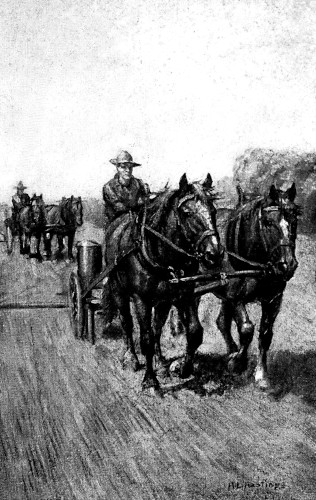
Another team of Percherons and a double plow came to Sunnyside to help
in the plowing and oat sowing. They got on the land just as soon as
the horses would not mire. But there was much of even the higher fields
that Hiram wished might be tiled properly to make the soil more friable.
They drilled the oats and then went about the other spring
work—cleaning the stables and calf pens and drawing out all the
fertilizer the cattle had made to the early corn land. There was now
more than sixty head of young stock on the farm and Hiram intended to
grain a dozen or more for market.
But the silo was empty and most of the corn fodder had been picked over
and trampled in the cattle yards. What hay he had left Hiram needed for
the horses. It was still three months and a half till haying time, and
Sunnyside did not yield any too much hay, in any case.
The promise of the crimson clover was encouraging, however; and it
would make the earliest of pasture. Therefore he turned the cattle into
a ten-acre piece below the barns and let them graze there before the
regular pasture at the far end of the farm was grown.
The stock went pretty nearly crazy over the first few mouthfuls of
clover, bawling and running about rather than settling down to eating.
But after a few hours they spread out and went quietly to grazing.
Until mid-May they found plenty to do on this patch of fast-growing
clover; but of course Hiram could not cut that for hay. He put the plow
into it as soon as the cattle were driven to the regular pasture. They
had enriched it considerably and the roots and stubble of the clover
held plenty of nitrogen. He knew the soil was in good condition now for
corn.
The fields that had lain fallow over winter were already plowed and
planted. This year Hiram was following the local custom and planting
in the row and would use the large horse-hoes for cultivating. The
early cornfields had received during the winter a heavy dressing of
manure and all the other cornfields—save those that now had growing
wheat upon them—would either have clover sod to turn under or an
eighteen-inch growth of cowpeas.
Hiram claimed that his cornfields this year would be well enriched in
one way or another.
Mr. Bronson had returned with Lettie from Florida. He brought Lettie up
to Sunnyside in his car on several occasions; but although the girl was
chatty and kind, both to Hiram and Orrin Post, to the mind of the first
named there was something lacking in her manner. She seemed bored and
dissatisfied. In her usual frank fashion Miss Pringle commented upon
the change in Lettie since she had first met her.
"Land's sake, Hiram! that girl is certainly getting her nose in the
air. Not that I mean she's spoiled, but she ain't the same as she was.
This taking her around from one flashy place to another is making her a
regular flibbertigibbet."
"Whatever that is," laughed Hiram.
But he recognized the truth of Delia's homely statement. Since Yancey
Battick's illness Hiram and the spinster had become even firmer friends
than before. Miss Pringle was shrewd enough to see that Hiram was
enamored of Lettie Bronson. But there were other interests Hiram had
that Miss Pringle knew about.
Long before this time she had not only heard all about Sister, but she
had begun a correspondence with the little girl back in Scoville and
with Mother Atterson. She could tell those loved ones "back home" more
about Hiram and his affairs than the youth himself would have been
willing to write about.
Hiram was too busy again to send very long letters to Scoville,
although during the winter he had been faithful in writing to Sister.
Oat harvest came and the Sunnyside Farm crop was all that Hiram had any
right to hope for. They stacked the oats ready for the thrashing and
then put both big plow-teams to work, turning under the stubble, raking
and rolling the land. Jerry and two mates (the first trio-hitch Hiram
had driven on Sunnyside), followed behind the land rollers with the
drill, sowing cowpeas.
Haying and wheat harvest was right ahead of them when Miss Pringle
drove past Sunnyside behind her dappled pony one day, bound for
Pringleton.
"Where are you going to be when I come back, Hiram?" she called to the
young farmer.
"Right here, or hereabout," he replied. "What do you want, Delia?"
"I am going to have something to show you," she said, and drove on.
It was two hours later that Hiram chanced to walk down the county road
toward Battick's, intending to take a careful look at the green wheat
at that end of this roadside field—the wheat in which he, as well as
Battick and Mr. Bronson, placed such hopes.
Although he did not apprehend that the same danger menaced the new
wheat which Yancey Battick did, Hiram seldom allowed two days to go by
without a scrutiny of the field.
By this time the new wheat proved itself, to the most casual eye, to be
a different variety from that growing in the remainder of the field. It
was a foot taller, the bearded heads were beginning to fill out, and,
as Battick had promised, the plants had spread so in growing that the
grain stood quite as thick as in any other part of the twenty acres.
Hiram saw a figure moving at the edge of the field at the far corner
next to Yancey Battick's land, and he knew it to be Battick himself.
These warm days the man was getting around quite briskly and was
feeling much like his old self.
Before Hiram could cross the ditch and start around the lower end of
the wheat field, as he intended, he saw the dappled pony coming up the
hill. There was somebody beside Miss Pringle on the seat of the buggy.
"Hey, Hiram! Wait!" called the spinster. "I want you to see who I have
here."
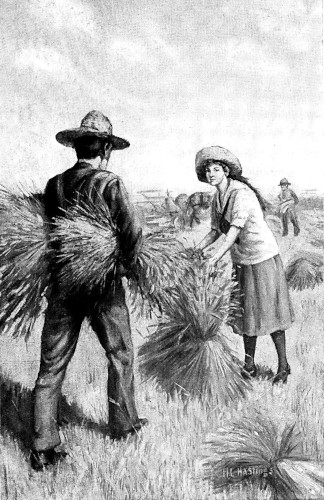
Hiram had already given a second glance. He saw a slim, prettily
dressed figure with a flower-like face under a shade hat. For a half
minute or so the boy had no idea who this person could be. He only
realized that she was a very pretty girl.
And then Miss Pringle's companion smiled. Hiram fairly jumped.
"Sister!" he shouted, and strode down the hill to meet the dappled pony.
At that moment he heard a wild yell from Yancey Battick. The man came
running along the lower edge of the field. He bore high above his head
a handful of the grain which he had torn up by the roots. His lean
face was actually pale.
"Strong! Look here! They've got us!" he cried.
"Who has got us? What is the matter?" demanded Hiram, startled into
forgetting Sister and her wonderful appearance for the moment. "What's
turned that wheat in your hand yellow so early?"
"Do you see it? Do you see it?" shouted the excited Battick. "It's
being eaten alive! Little green bugs—not the Hessian fly. It is a pest
I never saw before. It wasn't there the other day. I tell you, they've
got us!" concluded the man in a hopeless tone of voice.