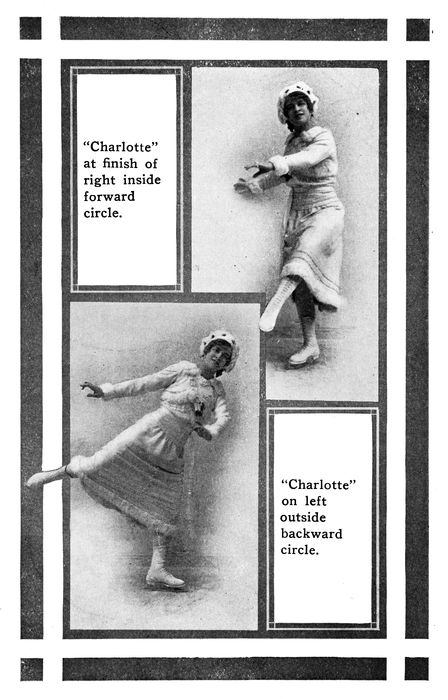
HIPPODROME SKATING BOOK PRACTICAL, ILLUSTRATED LESSONS IN THE ART OF Figure Skating
Transcriber’s Note:
The cover image was created by the transcriber and is placed in the public domain.
HIPPODROME SKATING BOOK, by “Charlotte”
To CHARLES DILLINGHAM, Esq., TO WHOM I OWE A DEBT OF GRATITUDE FOR MY AMERICAN FAME, AND TO WHOM ALL SKATERS ARE THANKFUL FOR THE STIMULATING INFLUENCE HIS ENTERPRISE HAS HAD IN REVIVING INTEREST IN AMERICA IN THE GREATEST OF ALL ATHLETIC PASTIMES, THIS LITTLE VOLUME IS RESPECTFULLY DEDICATED,
SALUTATION.

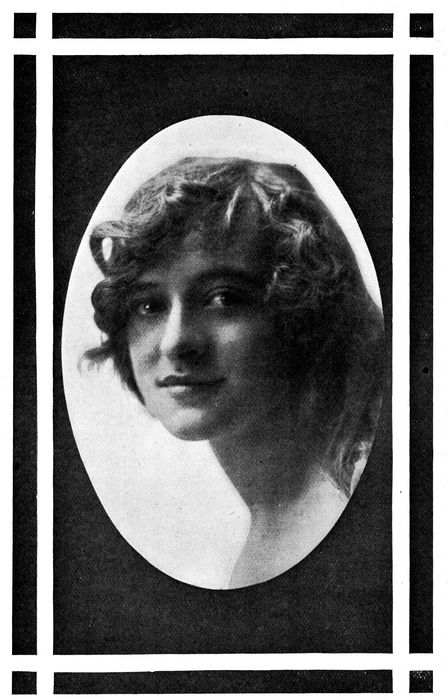
“CHARLOTTE.”
CONTENTS.
| Chapter | ||
|---|---|---|
| 1— | THE RIGHT EQUIPMENT, Skates, Shoes, Costumes, etc. | Page 11 |
| 2— | Correct Form of Skating | Page 15 |
| Illustrated | Page 17 | |
| 3— | Outside Circles, forward | Page 18 |
| 4— | PLAIN CIRCLES, Inside Edge Forward | Page 22 |
| Illustrated | Page 22 | |
| 5— | OUTSIDE CIRCLES, Backward | Page 26 |
| Illustrated | Page 27 | |
| 6— | INSIDE CIRCLES, Backward | Page 30 |
| Illustrated | Page 33 | |
| 7— | CHANGE OF EDGE; Forward; Outside to Inside | Page 34 |
| 8— | CHANGE OF EDGE; Forward; Inside to Outside | Page 36 |
| Illustrated | Pages 36–37–38 | |
| 9— | CHANGE OF EDGE; Backward; Outside to Inside and Inside to Outside | Page 40 |
| Illustrated | Pages 40–44 | |
| 10— | THREES—Forward and Backward | Page 45 |
| Illustrated | Pages 46–47 | |
| 11— | DOUBLE THREES Forward | Page 49 |
| 12— | DOUBLE THREES Backward | Page 53 |
| 13— | LOOPS, Forward | Page 55 |
| Illustrated | Pages 56–58 | |
| 14— | LOOPS, Backward | Page 59 |
| Illustrated | Pages 60–61 | |
| 15— | BRACKETS | Page 63 |
| Illustrated | Page 65 | |
| 16— | ROCKERS; Outside Forward and Outside Backward | Page 67 |
| 17— | ROCKERS; Inside Forward and Inside Backward | Page 70 |
| 18— | COUNTERS | Page 73 |
| Illustrated | Page 74 | |
| 19— | The Advanced School Figures | Page 75 |
| Illustrated | Page 76 | |
| 20— | Other Important Figures | Page 77 |
| Illustrated | Pages 69–72–83 | |
| 21— | FREE SKATING | Page 79 |
| Illustrated | Page 80 | |
| 22— | Pair Skating | Page 81 |
| 23— | Competitions and Judging | Page 90 |
| 24— | Skating Ponds and Rinks | Page 92 |
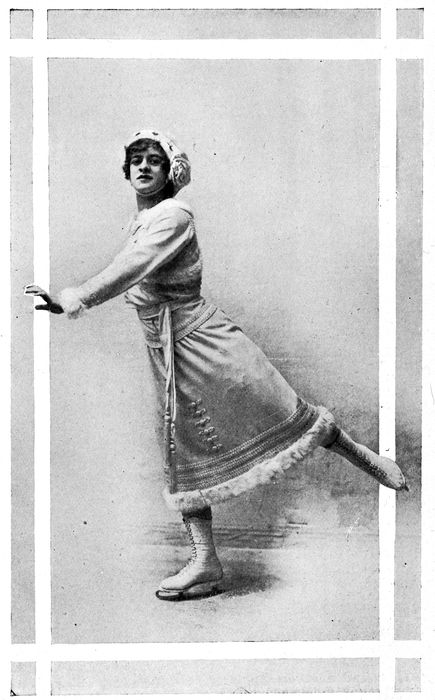
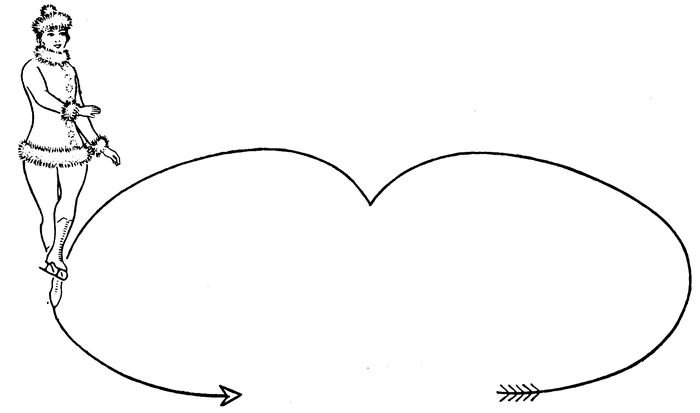
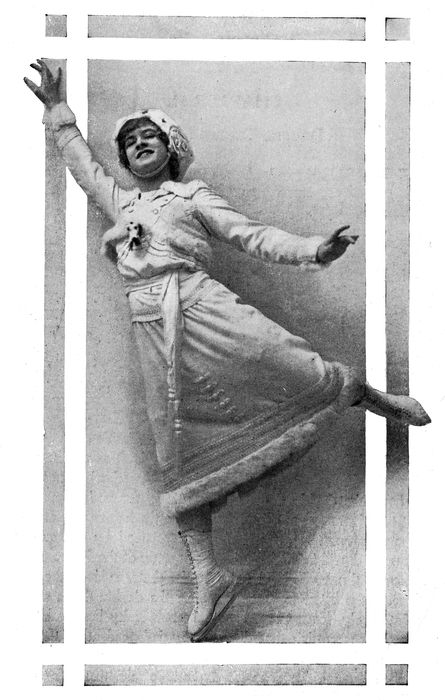
“CHARLOTTE” starting the right inside edge forward.
INTRODUCTION.
Americans ought to be the greatest skaters in the world. They are athletic people, lovers of outdoor sports and their country is situated in the largest tract of the North Temperate zone occupied by any one nation in the world. In this zone is found sufficient cold weather to produce a great deal of natural ice and at the same time such agreeable weather as to render the use of that ice, for sport, attractive and exhilarating. In this respect the United States is more fortunately situated than any of the countries of northern Europe.
This little book is intended as a stimulus and encouragement toward ice skating among Americans. It is intended as much for women as for men. There are no physical reasons why women should not skate quite as well as men. Skating is a matter of balance and grace, not strength. Young girls often become very expert skaters, doing all the difficult feats that grown men accomplish. Up to within a few years ago, the figure skating championships of Europe were open to both men and women on equal terms. Perhaps the fact that women excelled in grace was partially responsible for the separation of the sexes in these championships.
Much attention is paid in the book to the fundamental strokes, called school figures. These are the foundation of all figure skating. After they have been fully mastered the skater will probably discover a tendency to adopt an individual style and make up special figures suited to individual physical or temperamental characteristics. One skater, for instance, will especially enjoy spins and whirls; another will incline toward big, showy spirals; another will develop individual skill in two-foot movements such as grapevines, etc. Skating, like every other fine sport, becomes an expression of individuality. The foundation rules must first be learned, after which personal choice will direct the skater toward special figures most to his or her liking.
Skating is a sport for everybody—girls and boys, young people and old people. It can be started in extreme childhood and enjoyed far into old age. It can be a fast, strenuous exercise or a gentle enjoyment of poetic motion. It stimulates health, prompts to wholesome life out of doors, is a social diversion and, in its best development, requires considerable mental application. In every respect it is an ideal sport for people of any nation, especially those situated where natural ice is found or artificial ice is provided.
Frontispiece and cover design by Mr. Karl Struss.
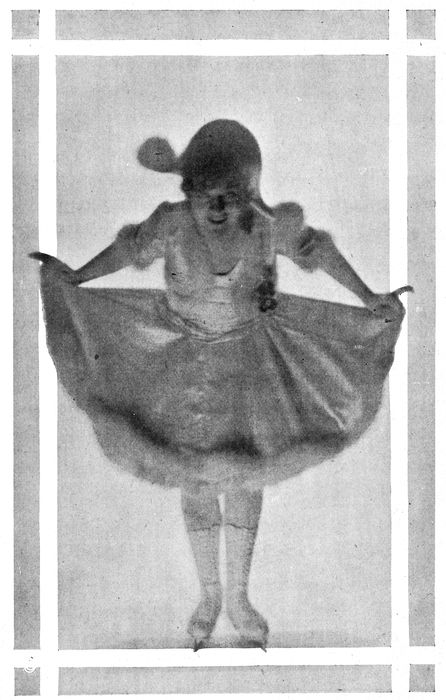
Portrait Study, page four, by Count Streclecki.
All other photographs posed for at White’s Studio.
I wish to thank my American skating friend, Mr. James A. Cruikshank of New York, for his assistance in the arrangement of this book and for preparation of the manuscript for the printer.
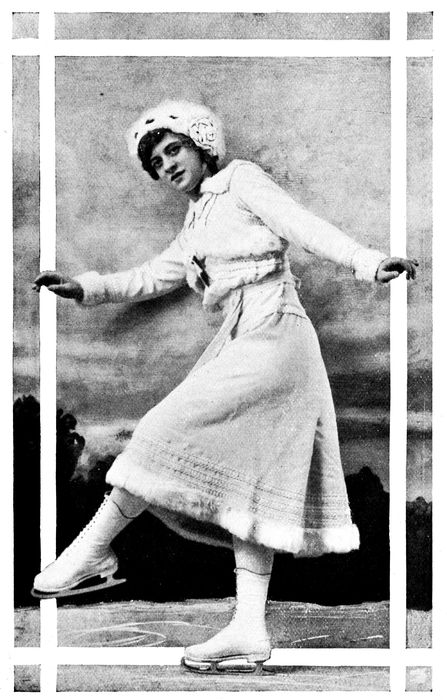
“CHARLOTTE” on right inside edge forward.
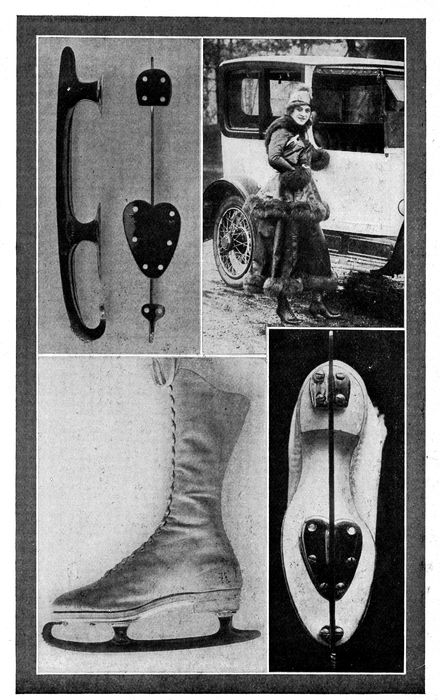
CHARLOTTE’S personal equipment for skating.
CHAPTER 1. The Right Equipment, Skates, Shoes, Costumes, &c.

Skating on ice is the best sport in the world. It is also the best method in the world for developing grace of carriage, supple muscles and fine health through a fascinating exercise. I have tried all the various sports, including swimming, fencing, dancing, tennis and mountain climbing, and there is none to compare with ice skating.
Strange as it may seem, ice skating will both reduce fat and add fat; if mildly followed as a regular exercise it will stimulate appetite, digestion and that zest in life which makes for healthy, rounded physique without superfluous fat. If persisted in vigorously, it will reduce flabby fat into smooth muscle. It is especially good for the reduction of fat around the waist and hips.
Skating to music is the most rhythmic of all exercises and far surpasses dancing in enjoyment and benefit. Dancing generally implies the need of a partner who dances equally well, while skating is a sport which can be enjoyed with a partner or without one. In fact, the more expert one becomes in skating the less one is dependent upon any one else for the pleasure of the sport.
To skate properly or to learn to skate, the right equipment is absolutely essential. The skate is the first essential; one may skate fairly well with shoes which are inappropriate or costume which retards free action, but with the wrong skates it is impossible to learn the art.
The proper skate has two stanchions or uprights running from the blade to the foot and heel plates. There seems to be scientific warrant for the statement that this method of construction makes it “run farther.” The old pattern having three stanchions or supports has been discarded by the best skaters of all skating countries for years.
The toe of the skate should curve up and around the toe of the shoe, in many patterns even touching the sole of the shoe in front. This curved front is deeply cut in with very sharp 12sawteeth, and it is on these sawteeth that so many of my pirouettes and pivots and dance steps are made. The height of the foot plate from the ice is much less than that of the heel plate from the ice, which naturally throws the skater into a forward balance. Most of the time I am skating upon the part of the skate directly under the ball of my foot. The curve of the blade from toe to heel is about a nine foot radius.
My skates are very light, weighing only four ounces. I advocate a light skate, and I think that most of the skates being used are too heavy. As one becomes more expert, lighter skates become more important, for in spins and turns on one foot the weight of the shoe and skate can seriously affect the balance and throw the skater into a false curve.
For about two inches along the blade of my skate, almost directly under the ball of my foot, I have a slightly flattened space which permits the immense curves and spirals I execute. These would be impossible with a sharply curved blade. The blade of my skate is splayed—that is, it is wider at the centre than at the toe and heel.
I have quite a deep groove ground in my skates, and I have the outer edge of the skate slightly lower than the inner edge. The height of the skate above the ice is not very important. Some of the experts favor great height. My skates are built comparatively low.
The flat bladed skate ought not to be used by any one who wishes to learn figure skating. The hockey skate is the right skate for hockey, but the wrong skate for anything else. To learn on that type of skate means that the skater must learn all over again when figure skating is attempted.
I am glad to hear that some of the American manufacturers are even making their hockey skates with a curved blade, so that the simple curves can be learned on that type of skate. There are several excellent models of skates now being made in the United States.
The skating shoe should fit very snug around the heel and over the instep, and should be comparatively high, seven or eight inches being my preference. The heel of the shoe should be higher than that of the sporting or tramping or golf shoe now being worn by the American woman.
It is important to get such skates and shoes as will throw 13the balance of the body forward onto the ball of the foot when one stands on the ice. This can only be done by raising the heel of the foot, partly through the design of the skate and partly through the height of the heel of the shoe. But no such thing as French heels are intended or advocated, of course.
The shoe should lace from close to the toes up and should be a comparatively straight last. A strong, stiff leather lined shoe should be the first choice. Afterward, as the ankles strengthen, a lighter shoe can be worn. I often skate in low shoes, my ankles are so strong, and the only trouble I find with my low shoes is that the heel slips out in the toe spin.
Artificial braces are sometimes valuable aids to the beginner. The best braces consist of a bandage wrapped carefully around the ankle and foot under the stocking. A stiff piece of leather set inside the shoe between the stocking and the shoe is an excellent brace. It can be removed as the skater gains strength.
The shoe should not be laced so tight as to stop circulation or to interfere with the play of the toes, but it should be capable of being laced with rigid firmness around the instep. Skating is hard on the feet at first and makes them sore and tender. A thin lisle or wool stocking is advisable for the beginner, and cold baths will soothe and strengthen the foot muscles.
The costume for skating may now include practically all varieties of design and material, ranging from silk to leather, the latest fad. Nowhere can a woman look prettier and nowhere can she look less attractive than on the ice. Some items are essential, however. The material of the skating costume ought to be something which does not bulk up, something which falls into naturally graceful curves and straightens out quickly.
An undergarment of silk or satin in the form of a petticoat, bloomers or knickerbockers is important in skating any difficult or spectacular figures, since it serves to keep the gown from bunching around the legs. The skirt should be comparatively snug around the hips and free, even slightly flaring, around the edge. Fur bands around the edge of the skirt give an air of appropriateness.
The new unrestrained and somewhat bold way of skating necessitates skirts which permit freedom in the swinging and spread of the legs. A petticoat or short skirt of thin woven 14elastic goods, especially if of silk, makes an ideal undergarment for the skater, whether beginner or expert.
The length of the skirt should be about to the tops of the skating shoes. Sensible costumes are now being adopted by the best skaters of all countries. One should as soon think of swimming in a long skirt as skating in one. The skirt which reaches to the middle of the calf will be found both comfortable and graceful.
My skating costume at the Hippodrome is probably regarded as very daring, but I wish every woman who skates might test for herself how comfortable it is. There is a stimulus in suitable costumes which it is impossible to get any other way. Skating is worth a pretty and appropriate costume, and such a costume will last for years and be always in style.

Note:—The CHARLOTTE SKATE, designed and used by CHARLOTTE, is not as yet being manufactured in America, but it will be on the market next winter. Those who desire this skate should accept none as the genuine CHARLOTTE Skate unless stamped with her trade-mark on the side of the runner.
CHAPTER 2. Correct Form in Skating.

The tracing of certain set figures on the ice is by no means all there is to figure skating. The correct carriage of the head and body, the arms and the balance leg are not merely an important part of the sport; they are even the very basis on which good marks are given in all serious competitions. No skater wishes to look like a freak on the ice. To avoid it one must cultivate the right carriage and balance from the start. Certain accepted rules are in vogue among the European skaters which tend to make skating graceful. They should be memorized carefully and followed every time the skater goes on the ice.
The head should be carried erect. Momentary looking down at the ice to see where to place a figure is permitted but the habit of a drooping carriage of the head should be carefully avoided. It is as unnecessary as it is ungraceful.
The arms should not be held close to the body nor should they be flung violently about. If the former position is taken the skater looks stiff and awkward. If too wide reaching out of the arms is permitted the skater appears to be grasping at imaginary straws like a drowning man. Both extremes are bad but of the two it is better to allow the arms freedom of poise and carry them gracefully extended than stiffly hung to the sides of the body. Fencing and interpretive or folk dancing furnish interesting examples of the right use of the arms during vigorous action. The individuality of the skater is often revealed by the carriage of the arms as much as by the tracing of the figures.
Bending of the body from the hips, sidewise, is neither necessary nor permissible. It is a fault which beginners adopt from 16fear of falling. But the sharp edge of the skate sustains the body in its temporary violation of the law of gravitation. Take a firm edge and let the body lean as much as is necessary or desired. Some skaters take a much stronger edge than others and therefore lean more than others.
The men ought to be told that there is nothing more ungraceful or unsuitable for skating than long trousers. Knickerbockers and tight fitting coats with just a bit of military cut are the right costume for the men who would skate well and look well. The best European skaters among the men all skate in woolen tights, but they are a little theatrical and do not always serve to increase one’s admiration for the wearer.
Bending the body forward or backward from the waist is generally only temporary and for the purpose of obtaining strong impetus for an initial stroke or adding power to a stroke already started. In general the carriage of the body should be upright, with the chest expanded and the shoulders held back.
The skating leg should be bent at the knee. This bending may be increased occasionally to gain power but the straightening up of the body should almost immediately follow. Too much bending of the skating knee makes an ungraceful appearance. The balance leg should be carried somewhat away from the skating leg, with the knee well bent and the foot turned outward and downward. The knees should seldom touch in skating and should never be held close together for any considerable length of time. In some figures there are temporary and necessary violations of both of these rules.
The position and carriage of the hands have very much to do with the effect created by the skater. They should be extended gracefully, with the fingers neither stretched out nor clenched and with the palms turned down or toward the body.
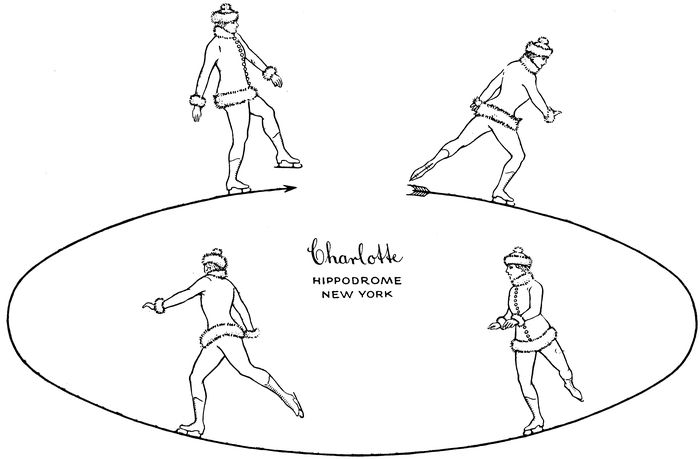
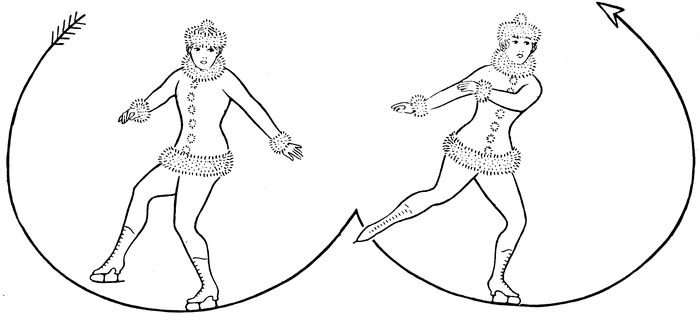
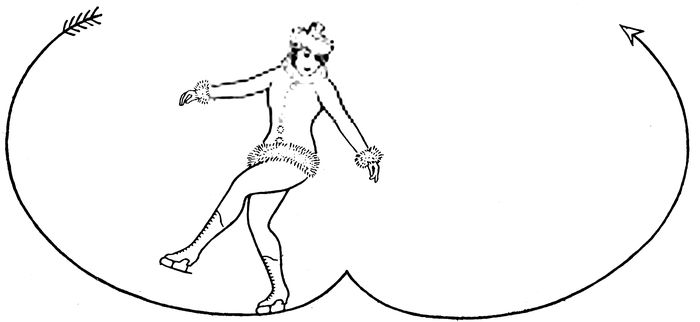
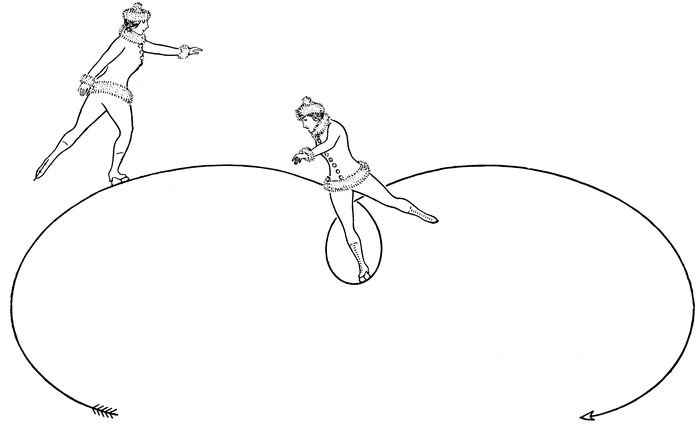
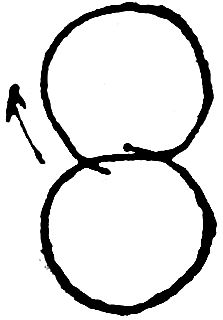
CIRCLE. Right outside edge, forward. (ROF)
CHAPTER 3. Outside Circles, Forward.

Start with the idea that good skating is a hard thing to acquire. It is. For the same reason it is interesting. Easy things never hold their interest very long. Graceful skating implies perseverance and determination. It requires close application to right principles from the very start and rigid concentration upon a number of important rules, several of which the skater will have to keep in mind during the moment of execution of any figures. But the fact that it is the chosen sport of most of the people dwelling in the northern parts of the world, women as well as men, proves that it is not too difficult to permanently hold the enthusiasm of lovers of outdoor sport.
Curves are the fundamental figures in skating. True, the racing skate and the hockey skate permit only straight strokes, but these skates are a development of the sport by which greater speed or steadier position against attack is obtained. Graceful skating and the execution of figures on the ice are impossible without the proper skate.
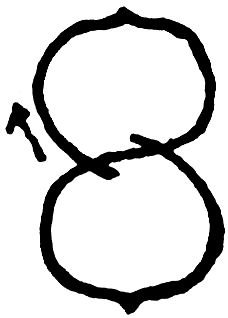
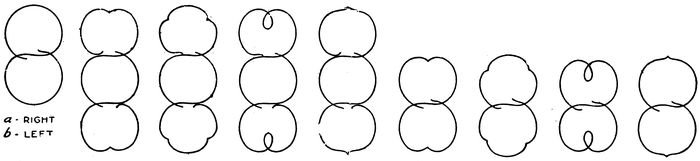
The first figures to learn, and the basis of all further progress in the art, are the outside edge circles. The outside edge of the skate is the edge furthest away from the body. There is an outside edge on each skate and this edge can be used to skate forward or backward; there are, therefore, four outside edge circles, one on right forward, one on left forward, one on right backward and one on left backward. For convenience and simplicity these edges are often designated thus: ROF, meaning right outside forward, etc.
The most important things to have in mind as one skates the elementary figure are carriage, poise and deliberation. If the body is correctly poised a slight stroke will carry the skater in the right direction; no amount of straining or kicking will cause the skate to execute the right figures if the body over that skate is in the wrong position or wrong balance.
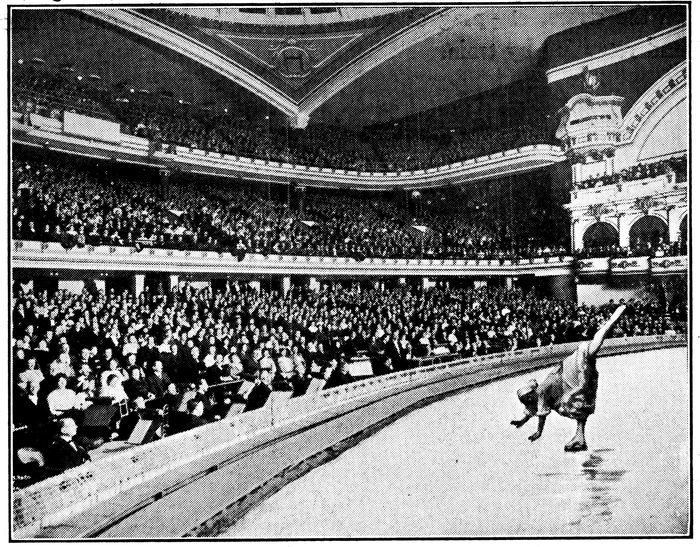
19My own skating as head of the ice ballet at the New York Hippodrome is fast and spectacular, I admit; it has to be so to be theatric, to catch the crowd, to startle the sensation seeker. But it is not quite so fast when I am skating for my own amusement.
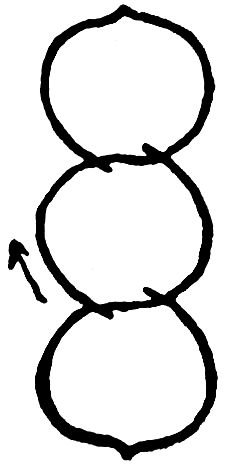
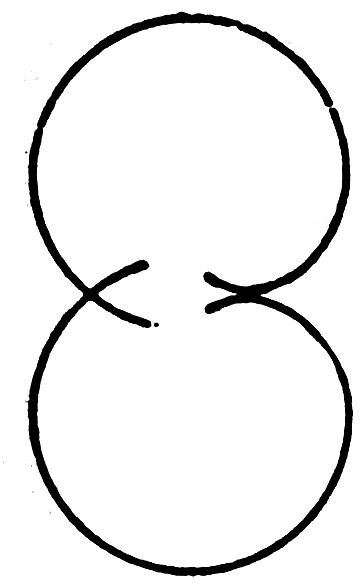
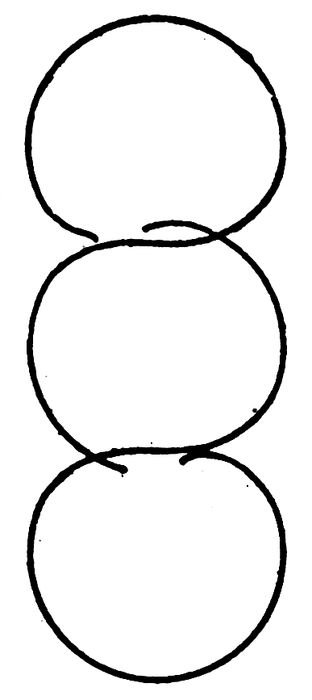
Size is the next most important consideration in skating the elementary or school figures. All the plain circles should be made as large as possible without sacrificing correct balance all the way to the end of the curve. The European skaters make the plain circles, in the form of an eight, with a diameter of fifteen to twenty feet. The beginner will find about eight feet as large a circle as can be made without loss of poise, but this depends also upon the question of size and strength of the skater and whether man or woman.
It is essential that the skater learn to use both feet equally well. If one foot is harder than the other to manage, it must be skated with more often until equal skill is attained. It will generally be found that right handed persons are more proficient in skating with the left foot and vice versa. To skate each figure equally well on either foot is not merely the right standard to set; it will be found fundamental to the correct execution of figures implying a reverse direction, and it is the basis of success in pair skating.
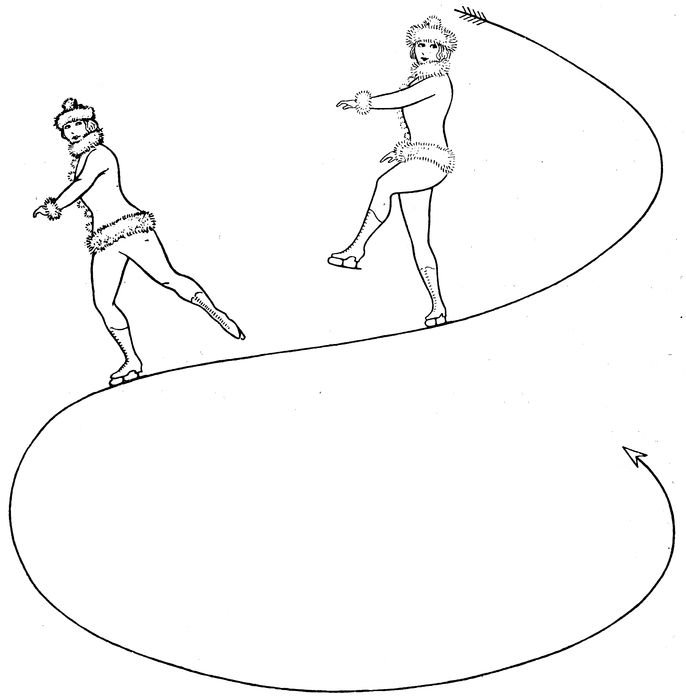
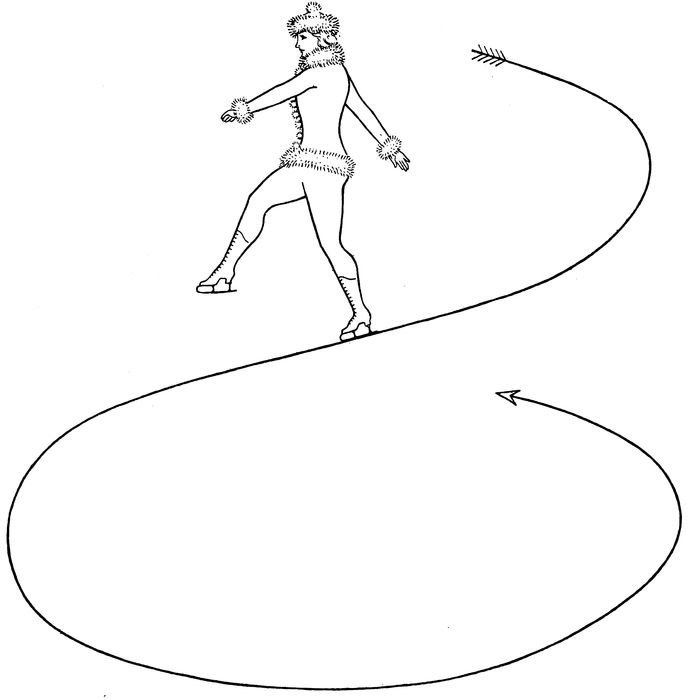
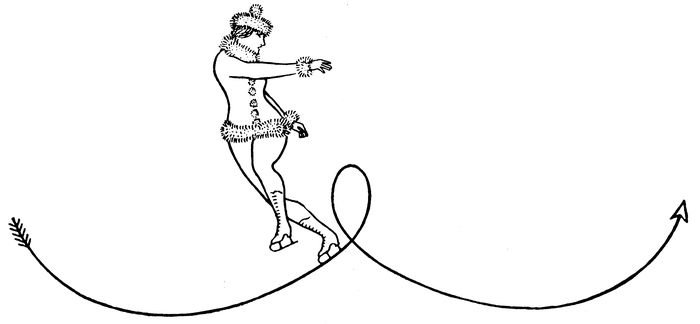
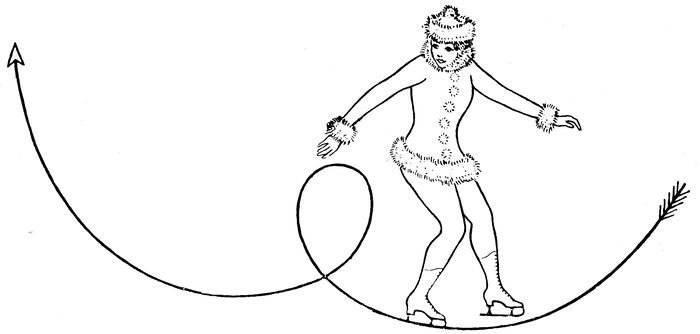
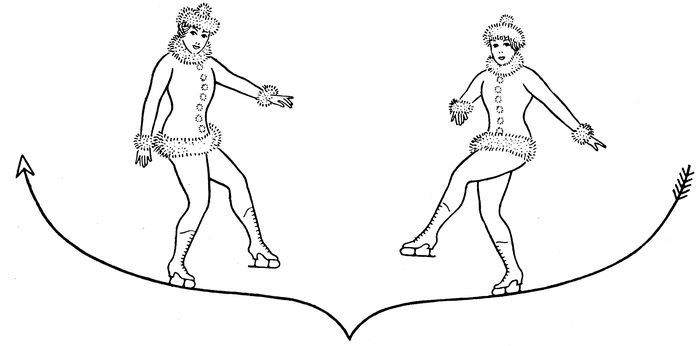
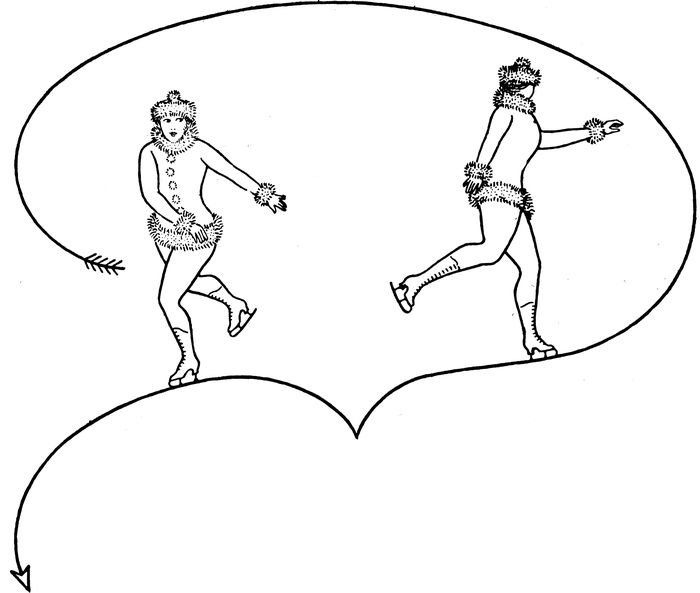
Now we are ready to strike out on the right outside edge. Stand with feet together. Get your start on the right foot by pressing the left skate, by its edge, not by its point, firmly against the ice. Bend the skating knee a good deal, almost sink on it, something in the manner of the dancing dip, and lunge strongly forward, leaning toward the centre of the circle. The left leg should follow well behind, and a little across the print, with the knee bent and the toe turned out, and the body should be turned or twisted so that the right shoulder is almost directly over the right foot. This will bring the body flatly in line with the mark on the ice which the skate is making. This mark is called the print. (See the diagram for the first skating position near the feathers of the arrow.)
The arms will take their correct, natural position, the right arm being held well up and curved around the breast at a distance of about six inches and the left arm well extended directly behind the body.
20This general position should be sustained during one-half of the circle. Then slowly bring the balance foot past the skating foot, turning the toe in and bending the knee of the balance foot as it is carried forward. It must be kept very close to the skating foot in passing, otherwise there will be a tendency for its weight to swing the skater out of the true circle he is making.
The fact that the balance leg, which was being carried behind the body, has now been brought in front of it, implies that a complete change in the balance of the body has taken place. Up to a little more than one-half of the circle the body has been held strongly forward; as the foot passes the skating leg the body assumes first a straight and then a slightly backward balance. The arms, too, have been serving to compensate the balance. At first they are held well toward the left or behind. As the body twists or turns into the new position and the shoulders are brought square with the direction of the print, the arms slowly swing forward and, from being held on the outside of the circle at the beginning of the stroke, are found on the inside of the circle at the end of the stroke.
The general principle of skating implies that the arms and the legs are used for compensating balances in almost every stroke. When the arms are on one side of the body the leg is on the other. There are a very few violations of this broad principle, but they are associated with the execution of extremely complicated figures.
The body performs a gradual and almost complete rotation during the execution of the forward outside circles. At the beginning of the stroke the back is toward the centre of the circle, at the end of the stroke one faces the centre. The twisting of the body during the stroke should be first at the shoulders and afterward at the hips. But care must be exercised not to make this twisting conspicuous. It must be gradual, deliberate and almost unnoticeable. In fact, it is difficult to believe as one writes about the stroke that all these changes of poise and balance are taking place. It is excellent practice to stand in the various positions on one’s floor and get them clearly in mind.
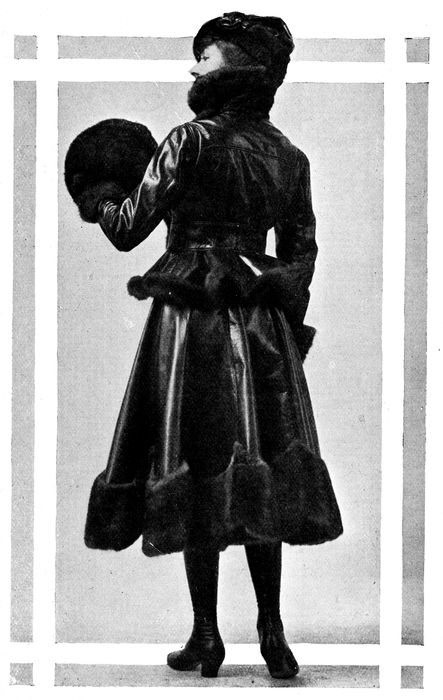
“CHARLOTTE” in novel kid skating costume.
CHAPTER 4. Plain Circles, Inside Edge Forward.

Next to the outside edges in importance are the inside edges. Indeed, it is more accurate to say that they are of equal importance. For some reasons the inside edge deserves the premier position in skating.
Spectacular and exhibition skating probably draws into use more bold inside edges than it does outside edges. There is a certain attraction about the poised body executing the inside edge that the outside edge lacks.
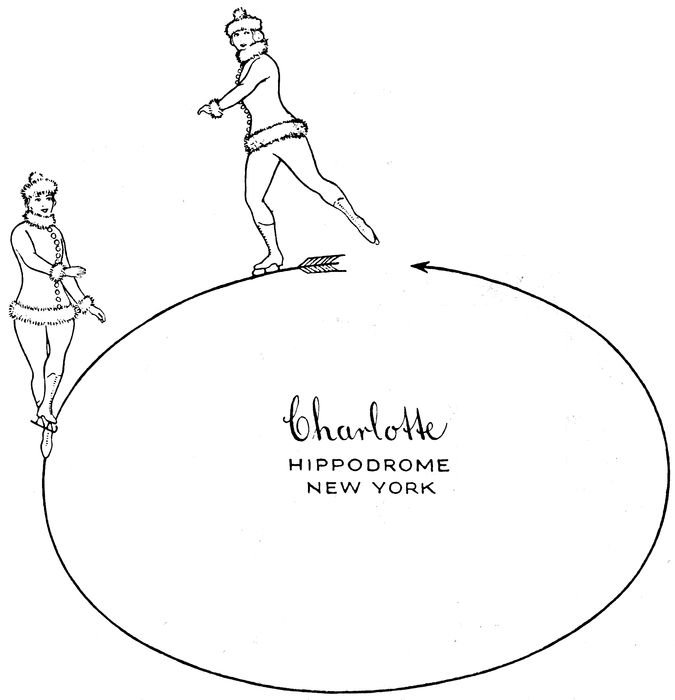
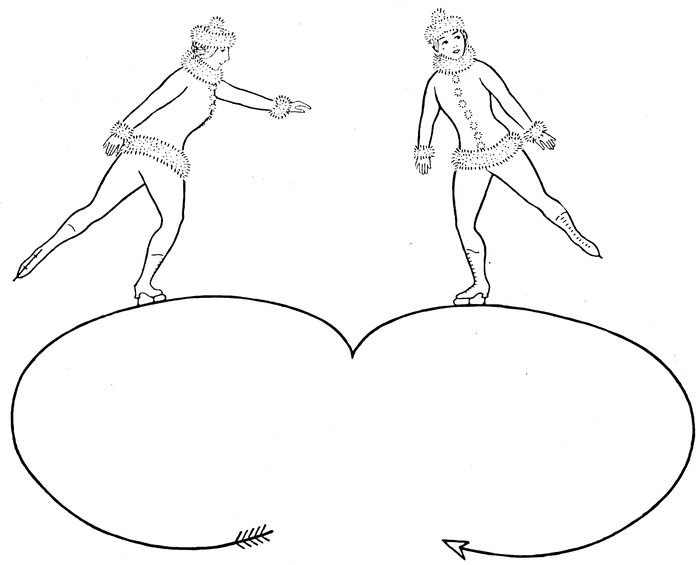
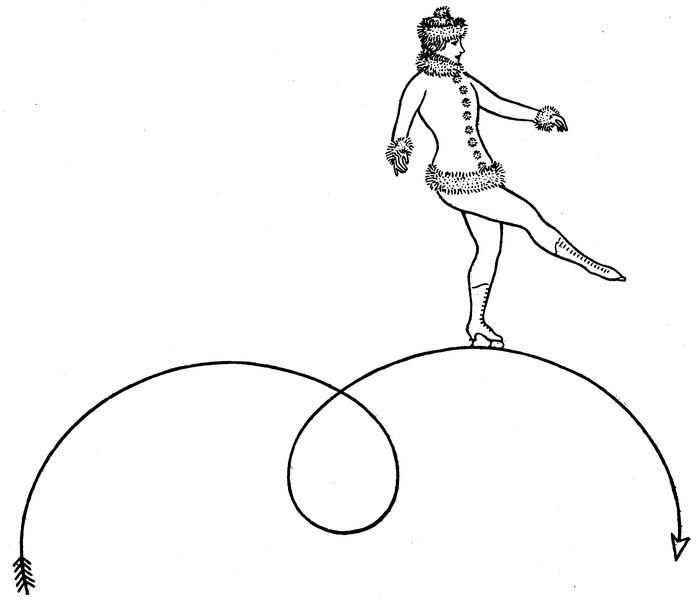
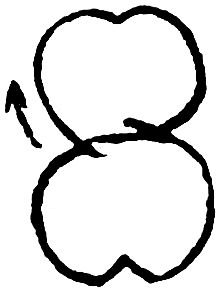
CIRCLE. Right inside edge, forward. (RIF)
23Many of my own big sweeping curves following quick dance steps are on the inside edges and they have come to me without any especial analysis of the reasons for their introduction. The fact that they have worked themselves into my varied programme implies that I find them both agreeable and natural.
The outside edge may be said to be an unnatural balance, almost a false balance. The weight of the body, if it is held erect over the print or mark which is being executed in the outside edge circle, is outside of the circle, where it has a natural tendency to pull the skater away from the circle he is trying to execute.
This pull has to be counteracted by leaning the body well toward the centre of the circle which is being skated. There are many compensating and at the same time conflicting balances in the outside edge circles which make them more difficult than the inside edge circles.
The inside edge circles, on the other hand, especially those skated forward, are in some respects the most natural and easy balances in the whole school of skating figures. They are the most natural stroke for any beginner to take. It is sometimes well to allow a beginner to start with these inside circles merely for the encouragement which their comparatively easy accomplishment will bring to the pupil. The more difficult outside edges can be gradually worked into the practice.
The reason why the inside plain circles forward are easy, is found in the fact that the natural balance of the body, poised on either skate, has a strong tendency to the inner curve. The weight of the body is in the inside of the circle which it is proposed to execute, not outside, where a pull out of the direction of right progress is constantly at work.
On the inside edges the body has opportunity to swing as a pendulum in a natural curve which has a tendency to end in a spiral. The fact that a spiral almost invariably results from the uncorrected inside edge serves to prove that the stroke is a natural and correct skating position. But since the spiral is the very thing that must not be permitted to enter into the execution of the plain inside circles, at least until the skater has fully mastered all the school figures, there must be careful correction of the balance to round out the inside edges into full circles and prevent them from becoming spirals.
24The outside edges which we studied in the last lesson are hard. The inside edges are much easier. But there are certain fundamental things to remember in the inside edge circles. And unless they are remembered the figure cannot be executed properly. The circle will insist upon becoming a spiral in spite of all the skater can do unless these few foundation principles are mastered. An excellent method for learning to skate, seen constantly on the skating floors of Europe, is the little book or even the page from the book, held in the hand of the skater and studied constantly as the figure is practised. It is difficult to remember the various poses and changes of carriage.
The most important item to remember in the inside forward edges is the carriage of the shoulders and the manner in which they are slowly turned during the execution of the circle. Next to that in importance is the carriage of the balance leg. Here let me repeat that it is almost invariably true in skating that the correct balance as well as the most graceful poise is found when the arms and hands are used to compensate the weight of the balance leg. If the balance leg is inside the circle which is being skated, the arms will generally be carried outside and vice versa. When the balance leg is forward of the body there will be a slightly backward poise; when the balance leg is carried far behind the body there will be a strong forward leaning of the body. If this general principle is remembered by the ambitious beginner much will be gained in progress toward correct carriage.
Now start out on the right inside forward circle. Start from the push of the left skate squarely pressed against the ice, not from the toe of the skate. Bend the skating knee considerably, take a firm hold of the ice with the inside edge of the skate, lunge strongly forward with the leg carried well behind, knee bent and toe turned out. The shoulders, at the start of the figure, should be twisted toward the right, which will bring the left shoulder forward; this position is maintained for about one-fourth of the circle, when the shoulders are slowly brought square with the print and from this point to the end of the circle the right shoulder continues to be brought forward until, at the end of the circle, the shoulders are almost in line with the print.
When one-half of the circle has been completed, the balance leg, which up to this time has been carried well behind, is slowly 25brought forward and carried past the skating leg, the body meanwhile swaying from a forward to a backward balance to compensate the weight of the leg in front. As the balance foot passes the skating foot the knee of the balance leg is well bent, the toe turned out, and the foot carried as close to the skating foot as possible. Then the balance leg is carried well to the right, across the print and considerably elevated above the skating knee.
The arms, which were carried on the right of the body, well elevated, at the start of the figure, are slowly swung across to the left of the body as the balance leg swings forward and across the print. The close of the figure is one of the most striking and effective poses in the whole list of school figures. Unless the balance leg is carried well forward and across the print, the body straightened up and the arms carried across simultaneous with the bringing forward of the balance leg, the figure will degenerate into a spiral. Finish the figure as close to the starting point as possible. Do it at least three times on each foot and practise most on the weaker foot.
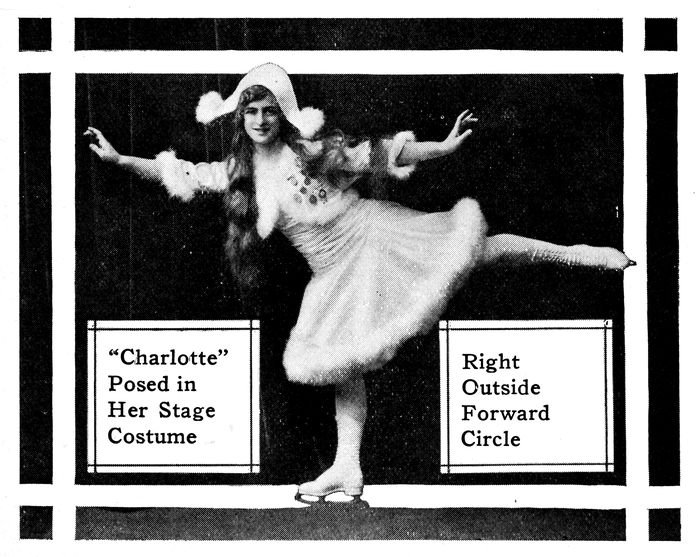
CHAPTER 5. Outside Circles, Backward.

Most spectacular and most applauded of all the items on my programme in the ice ballet in “Flirting at St. Moritz,” at the Hippodrome, are the backward outside edges or circles. Probably the very simplicity of them adds to the effect which they create in the mind of the crowds. The series of jumps which I make from a forward outside edge to a backward outside edge, is nowhere near as hard as it appears. And the complete revolution in the air which I make from one outside backward edge to the same edge again is dependent upon the accuracy and firmness of the outside edges. These are but two of the simple, yet very spectacular features of my exhibition which are based on the outside backward edges.
The outside edges backward are very popular for exhibition and spectacular purposes. But they are fundamental figures which must be mastered by every skater who hopes to make real progress in the most beautiful of all sports.
First the beginner must get a little confidence in skating backward by what is called “sculling.” The friend or helper is more important in learning the fundamental backward figures than in the forward figures. The best position for the helper when one is learning the backward strokes is facing the beginner; thus the beginner will skate backward and the instructor or friend will skate forward, right hands joined to left hands.
By a gentle push from the instructor or friend, the beginner is sent backward. Then should begin the waving lines made by the skates on the ice as the learner sways from side to side and throws the balance of the body from one foot to the other and from one edge to the other. Probably the beginner will not realize that he is making a sculling or waving mark on the ice until he has examined the print of the skates. It is an excellent practice to look at the marks which you have made in the ice. Often the accuracy of a curve or circles, or the correct tracing of a three or counter or rocker will be impossible to determine until the print has been examined. The judges in all great contests study the print on the ice as much as they do the carriage of the skater.
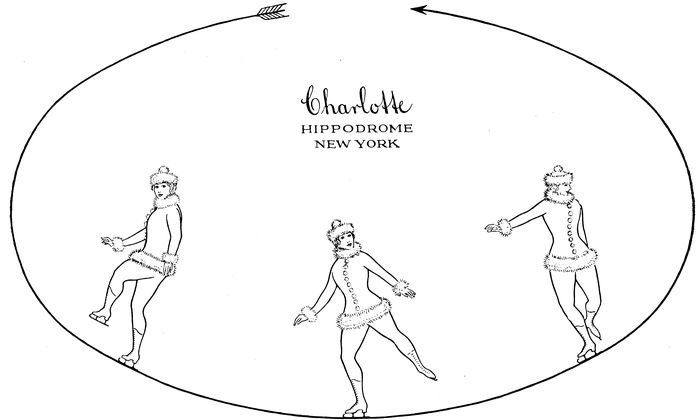
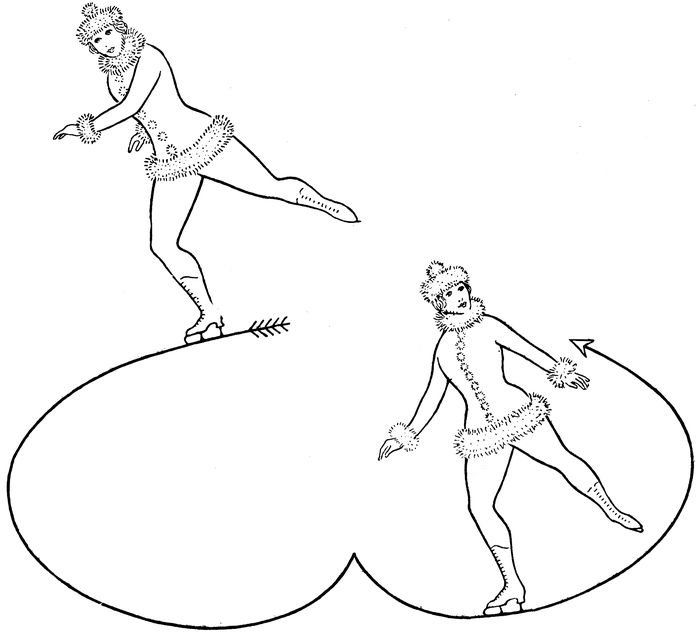
CIRCLE. Right outside edge, backward. (ROB)
28The sculling motion and strokes should be continued until the skater realizes that he is making a slight outside edge with each skate as his body changes its balance. Then learn to take the foot which is not being skated on, off the ice, carry it forward of the body toward the helper and trust to the outside edge of the skating foot.
When some considerable practice has been done in this manner and a part of a circle can be accomplished on the outside edge backward it is time for the beginner to start the full circles, or at least to learn to make the figure large and try to get back to the starting point.
The backward outside edges require nerve and daring. Here the skater’s qualifications for the sport will often come out. Skating backward in any circumstances is trying work to the beginner, and the curious balance of the outside backward circles is a hard thing to learn when one is at the same time distressed by the perfectly natural fear of skating backward. But make up your mind, clench your fists, grit your teeth and pluckily go at it.
Standing with both feet together on the ice, the starting stroke is made by pressing firmly with the flat part of the left skate on the ice and lunging backward strongly on the outside edge of the right skate. The chief difficulty in mastering this important figure comes from the innate hesitancy of the beginner to throw his balance backward. If this backward lunge is firm and strong, more than half the difficulty of the stroke has been mastered.
The balance left foot is carried across the right leg with the 29knee bent and the toe turned out and the leg carried fairly high in the air, not dragging behind. The shoulders rotate during all the circle edges, as we have seen in those which have already been studied. In the backward circle eights on the right foot, the left shoulder should be held well in front; this position, holding the shoulders almost square with the print, should be maintained through the circle.
The left foot, which is carried across the right leg and in front of the skater at the start of the stroke, should be brought slowly past the skating foot when about one-third of the circle has been completed, then carried well extended in a “spread-eagle” position to the end of the circle. This is one of the few strokes in skating where but little change of the position of the arms occurs during the completion of the circle. They slowly turn with the shoulders and maintain a graceful pose, with hands extended and palms downward. The general idea of the backward circle is to keep the entire body, arms and legs, almost directly over and slightly inside the print; its weight will tend to swing the body around as a revolving pendulum. The outside circle eights, either forward or backward, are somewhat forced or false balance, since the body has to lean considerably toward the centre of the circle to get the centre of gravity in the right place.
These articles are for beginners, and they ought not to hold me too closely to the rules I lay down. Many of my exhibition figures are so unusual and contain such unexpected combinations of jumps, counter rockers and spins that I have to violate rules or the figures could not be done. I have been accused of having no rules for skating, as I do so many things my own way. And when you have progressed to the point where they want newspaper articles from you which they head with the flattering remark that you are the greatest woman skater in the world, you will be in a position to violate rules a little bit. My pet philosopher says that rules were made for slaves.
CHAPTER 6. Inside Circles, Backward.
All backward skating is difficult to acquire. After it is acquired it is more interesting than forward skating.
Some of the very difficult jumps in mid-air which I do are taken backward because it is really easier to do them that way than forward. There is one jump where I am skating backward on the outside edge on the right foot, swing the left foot violently around, spring into the air, make a complete revolution of my body, land on the outside edge of the right foot again and continue on a big sweeping curve. It is in some respects the most popular number that I introduce. It is done that way solely for the reason that it is much easier backward than forward and yet at the same time it looks more difficult backward than forward.
Most skating figures will be found easier forward than backward. Probably that is partly due to the fact that not as much time is spent by any skater learning backward skating as is spent learning forward strokes. The art of skating backward requires pluck and courage. When one attempts the full backward circles without a helper it is an occasion to mark in one’s diary.
The plunge is the main thing in learning to skate backward. Make up your mind some fine morning that you are going to practise outside edges backward or inside edges backward all of the skating session of that day. Then do it. Skating is a matter of will power after all and not at all a matter of strength. I took up skating just because I was not strong and the doctors said it was outdoor life or a little narrow box for me.
It is hard to catch one’s self during a fall when one is on the outside circles backward; the position during much of the inside circles backward makes it easier to get ready for the fall after you feel sure it is coming. Not that I mean there is any special instruction necessary in the matter of falling for there is not. Just let go and sit down as meekly as you can, smile and look about helplessly and some chivalrous American is sure to hurry to your aid. This is much more dignified and less liable to be embarrassing than scrambling to all fours, stepping on your gown and, perhaps, falling over again.
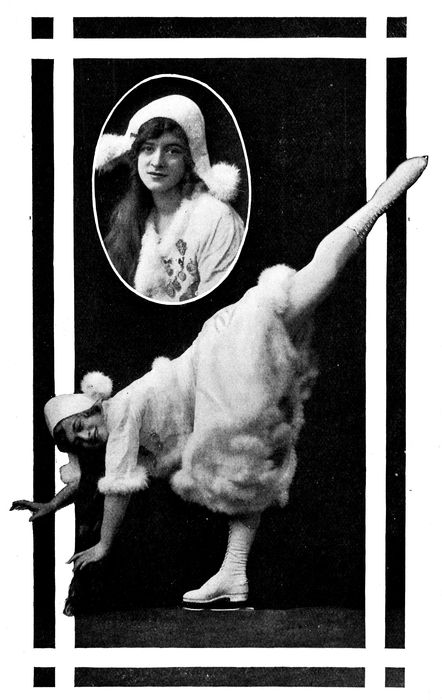
“CHARLOTTE” in spectacular backward stroke.
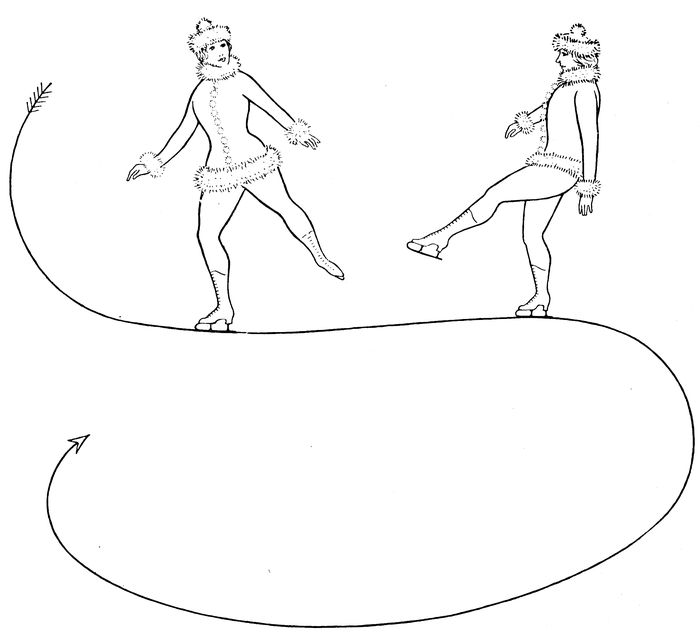
32To get a strong start for the inside circle backward is the hardest part of the acquirement of the figure. Stand on the flat of the left skate, swing the right foot in front of you, just as if you were going to make a little jump backward onto that foot, bend the right knee a good deal and lunge onto the right skate on the inside edge. The left foot as it leaves the ice should then be carried across the right leg, with the knee bent and the toe turned out and down. It should be carried well across the print or mark that the skate is making on the ice and somewhat high, not dragging along. The body should lean strongly backward.
As the stroke is begun the shoulders are turned well toward the right and both arms are carried on the right of the body outside of the print. This is one of the very few cases where the arms are carried on the same side of the print as the balance leg and it is due to the fact that the body naturally inclines toward the center of the circle when it is on the inside edges. The head should be facing the starting point throughout the execution of the circle.
When about one-third of the circle has been skated then slowly bring the balance foot past the skating foot, knee bent and toe turned strongly out and down. Simultaneously the shoulders should be turned toward the left until the body faces the center of the circle and maintained in that position to the end of the figure with both arms, one forward and the other following, almost directly over the print. As the balance foot passes the skating foot the body is straightened and for a moment the arms are drawn close to the body. This straightening of the body and change in the carriage of the balance foot will make it possible for the skater to round out the circle to its correct proportions. All inside edge circles have a strong tendency to become spirals. At the close of the stroke the skater will be in the right position for the start of the same stroke on the opposite foot.
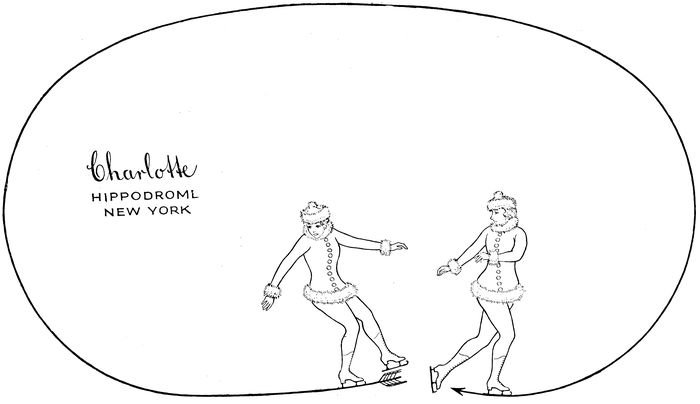
CIRCLE. Right inside edge, backward. (RIB)
CHAPTER 7. Change of Edge; Forward; Outside to Inside.

The change of edge is one of the most important school figures and should be carefully practised by every skating pupil. It is not spectacular, although it is very graceful and very easy to acquire.
I like the changes of edge and, like all other expert skaters, find them of the greatest importance at certain times. When one has an audience of skaters I find these figures much better appreciated than at other times. At a private party given on the stage of the Hippodrome, I was skating a difficult figure where there were three small circles at the four corners of a square. I went from one of the corners to the other by a change of edge and a three after it. The skaters who were watching me applauded this figure as generously as any figure of a more spectacular character that I do during the regular performances of matinees and evenings during the week. But they were all skaters and appreciated the difficulty and the beauty of the figure.
The right outside edge forward is the best way to start to learn the changes of edge. It is easier than the change of edge which begins with the right inside edge forward, for the reasons which I have explained in previous chapters concerning the way that the body tends to swing around toward the circle on inside edges and tends to swing away from it on outside edges.
The start of the right outside forward change of edge is the same as for the right outside forward circles and it seems unnecessary to repeat those directions. The drawings, too, will be found precisely similar in the pose for some of the figures as for some other figures. This is one way to get double practise. Every time one practises the outside change of edge forward he is practising the right start of the outside forward circles. Every time he is practising the inside forward change of edge he is practising the start of the inside forward circles.
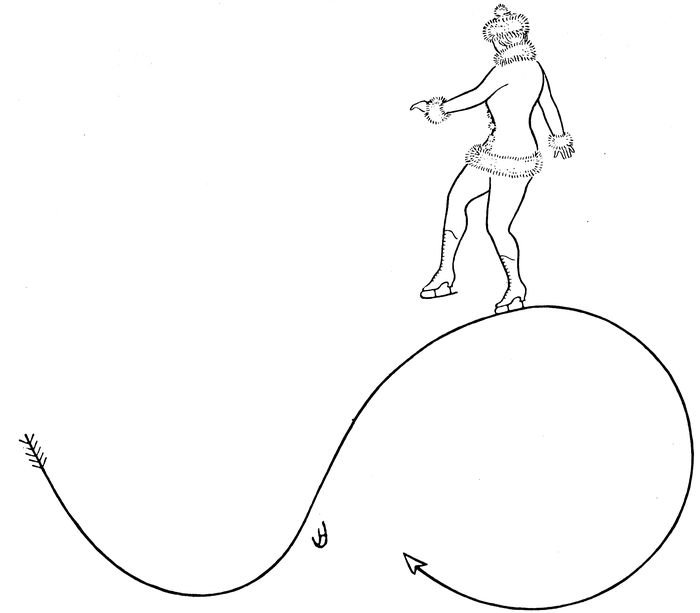
Start the right outside forward edge circle, as we have seen, 35by pressing the left skate squarely against the ice and thrusting onto the right foot outside edge. The left foot should be carried well behind and a little across the print with the knee bent and the foot turned out and down. The skating knee should be strongly bent at the start of the stroke. The shoulders should be turned so that the right shoulder is almost over the right foot and the left shoulder twisted well to the back. When nearly half of the circle has been completed gradually turn the shoulders toward the right, which will bring them square across the print or direction in which the skater is moving.
When half the circle is complete the change of edge from the right outside forward to the right inside forward occurs. The balance of the body is here changed from an outside to an inside circle and the general directions which have been given for the execution of an inside edge circle will be found applicable. But the manner of making the change from the outside to the inside edge is most important and this portion of the figure is new to the pupil.
As the outside forward half circle is nearly completed and the change of edge about to occur, the body, which has been carried on a slightly forward balance, is slowly changed to a backward balance, and the left foot, which has been carried behind during the completion of the outside forward circle, is slowly swayed past, close to the skating foot, and carried well in front, somewhat high. Sinking on the skating knee at the time of the change of edge will much assist the full rounding out of the figure. The arms should not be allowed to swing the body around during this change of edge as they are liable to do if carried too high or too far from the body.
Follow same directions for left forward outside change of edge.