This book is the response to a constant appeal for
information. During the last nine years I have received
thousands of letters, asking for hints on all
manner of subjects relating to the care, handling, buying
and equipping of small yachts. The majority of these
letters came from boys and young men living throughout
the world, who were just entering the sport, and who
were anxious to become skillful sailors and competent
skippers. I can thoroughly understand their position, and
sympathize with their desire for fuller and more practical
knowledge than that contained in the majority of works
upon yachting.
What knowledge I possess of this art, or profession, I
have gained by years of hard work and close observation,
and having begun my studies when very young can testify
to the dearth of literature of value to the green hand,
who is looking for practical hints that will help him to
become a skillful yacht sailor. Had I possessed a book
like this, it would have saved me time, money and lots of
hard work and anxiety.
But, in using this book, it must be remembered that a
hint is not a law or a command, it is simply a concise statement
for you to take, think over, and make use of, if it appears
to be logical and practical. There may be better and
easier ways of doing many of these things I speak of—that
is for you to find out. I am an authority only as far as
my knowledge goes, and no further. The basis of my authority
is my years of observation and experience; your
right to confute my findings can only be based on similar
premises. Unless you have tried and proved that my instructions
are wrong, they are still good medicine.
If a man, especially a young one, decide to go into
yachting, he should also decide to learn the business of
handling these craft from the keel up. It is not sufficient,
as many of you think, that all that is necessary is to
learn how to sail a boat about. You should know not only
how to sail her, but you should know why she sails, and
all about the gear and canvas used to propel her. You
should learn to rig and unrig, to care for and to understand
every part of her structure, both above and below
decks. It is certainly a sorry spectacle to see a man sailing
a yacht who cannot tie a proper knot, splice a rope,
or bend a sail, and who does not know the terms used to
designate parts of the structure which he essays to manage.
If he is ashamed to learn, or if he is too lazy to
gather such knowledge, he is out a place in a sport which
is the life and joy of energetic, skillful and brave men.
I hope all of my boys the world over who are coming
into yachting, and to assist whom I have written these
words, will never be ashamed to learn the sailor’s trade,
or be too lazy to acquire all possible knowledge relating
to the art of handling vessels. You will never regret having
given your time to the study. It will bring to you
that which is more valuable than the treasures of the
earth; something that you can never be deprived of, no
matter how unlucky or how unfortunate you may be—the
respect paid to the skillful by the unskillful; the deference
shown to the educated by the ignorant.
It is as well to say here that these hints are not intended
for men owning and sailing large yachts. Such
vessels are too costly to be trusted in the hands of any
men except those who are thoroughly competent; and if
an owner has not sufficient skill to handle a large yacht
it is his business to hire somebody who has. These hints
are intended for the small-boat owner and skipper.
HINTS TO YOUNG YACHT SKIPPERS
If you are going to buy a boat, either the first or
last one, make up your mind thoroughly as to what kind
of a craft you want, and what you want her for. If you
want to race, it is one thing; if you want to cruise, another.
Combination cruising and racing boats are impossibilities,
and are neither one thing or other. If you are
going to build, get a good design from some man who
knows his business, and have a boat built from it in the
best manner possible. A poorly or cheaply-built boat is
a losing proposition. If you are going to buy a second-hand
craft, and don’t know much about boats, get a man
who does to look over any that you think of purchasing.
An honest builder is the best man for this. Most men buy
a racer for her record, and a cruiser for her cabin. The
record of a racing craft is not worth a pinch of salt, unless
the boat is in such condition as will enable her to uphold
it, and a cabin of a cruiser is of little value unless it
is surrounded by a good, seaworthy and handy outside.
Before buying a racer, find out if she is suitable for entering
in any of the classes racing in the waters you frequent.
Find out what boats are likely to sail against her,
what her measurement is under the rule in vogue, and
how and by whom she was handled when winning or losing.
These are very necessary points, if you hope to helm
a winner. Many a fast boat is condemned and sold after
the first season, because the man who owned it did not
know how to handle her to win. Such a boat can be
bought and, if properly managed, be made a winner.
Others are sold because they have no earthly chance of
getting a prize, no matter how well-sailed. These latter
are a very bad investment.
If you want a cruising boat, her record is of no consequence,
unless it is irretrievably bad. If she has a
habit of capsizing, or won’t go to windward, you don’t
want her. If she consistently leaks, you don’t want her.
If she draws a lot of water for her length, and can’t get
into your harbor except at high tide, you don’t want her.
If she is in bad repair, or is very old, you don’t want her.
If you haven’t sufficient personal knowledge to tell by
looking at her how she will handle, ask some man who
has sailed her, or who has seen her sail; better ask several,
and take a general average of their testimony.
Then go and have her thoroughly looked over. If she
is hauled out, sound her bottom. Get the owner to let
a builder bore her. If the chips come out clean, white
and papery, she is sound in plank. Examine the rabbet
at stem and stern and all along the keel; pierce that stick,
both inside and out. Sound the mast. Go below and look
at the heels and heads of the frames. Don’t forget the
deck, cockpit floor and staving. An experienced man can
tell from the appearance of the unpainted wood whether
it is sound or not. Then examine her spars, gear, blocks
and sails; last of all, her cabin fittings, etc.
This is somewhat of a lottery, but you can generally
judge of the condition of a boat’s bottom by the condition
of her topsides, and by inspecting the inside of the
hull. If there is any water in the bilge take some up in
a glass. If it is clean and fresh-smelling, you can be sure
she has a regular leak. Get a quiet look at the sucker of
the pump-rod. If it looks well-brightened up, it shows
plenty of usage. If there is no leak, notice the heels of
the frames near the mast, also the fastenings of the ends
of the deck beams in that part of her. If she strains, it
will show there, if anywhere. If there are doors in the
bulkheads or lockers, see if they have been planed off, so
as to close. If she is canvased on deck or top of cabin-house,
the cloth will show if she has strained badly. All
boats strain to certain extent, and without seemingly permanent
harm.
I once knew a lady who would not buy a house, because
she did not like the way in which the halls between
the rooms were painted. Some yachtsmen are just as
bad. Last year I met a young fellow who wanted a
knockabout with a white enameled cabin. He refused to
take several, because they lacked this inside coating.
Others will be caught by a lot of brass or gaudy cushions
and curtains. Nicely varnished spars, parceled backstays
and immaculate sail covers, are other and successful traps.
Others will buy a boat because a friend has one like it.
The first and most necessary thing is that the vessel’s
bottom be sound; the second, that the decks be tight; the
third, that the spars are in good condition. If she is right
in these three points, you can find out the rest by sailing
her, and in that way only. Many a good boat is condemned
for some trivial cause. She may have a leak
which can be easily stopped; her sails may be poor, that
can be remedied; or her gear worn out. If so, give the
seller a chance to make good before breaking off negotiations.
Tell him what you see or think is wrong, and let
him have a chance to explain or make good. Don’t go
away, as many do, and blackguard a boat because it is not
just in the order or condition you expected to find it.
Sometimes a boat out of repair can be bought cheap,
and is a good bargain. But, before buying, consult a
builder, and find out if the craft can be repaired, and if it
is worth repairing. I have found that you can generally
trust a builder’s word on this question, as they dislike to
work over a worthless craft. If the builder tells you she
is no good, don’t touch her, no matter how cheap she is
offered.
I strongly advise young yachtsmen to buy their boats
through a broker, if it is a second-hand craft. These men
are up to all the tricks of the trade, and are thus able to
safeguard a client’s interests. If the boat is registered,
they will attend to the custom-house part of the transaction,
and get the thing put through properly, besides saving
you endless bother. If she is not registered, they will
get you a proper bill of sale, and see that the boat has no
liens or mortgages lying against her. I have known several
cases where men have bought and paid for boats only
to find that the vessel was mortgaged, or else somebody
unknown was a part owner.
Be sure and get a written inventory before buying, and
have it checked off before making the final payment. It
is, I regret to say, a too common practice among some sellers
to skin-out a boat before delivering her. Or, if this
is not done, to substitute cheaper articles for the ones on
board. It is also frequent for purchasers to call for things
that are not on board, and which they suppose or think
ought to be, and this leads to a disagreement. A written
inventory will settle the question; verbal statements are
worthless.
Nautical instruments, charts, books, private flags,
clothes, etc., are personal belongings, and are not part of
a boat’s fittings or furniture, unless so specified in the
inventory. A compass is, if it belongs in a vessel’s binnacle.
A dingey or other boat if used by the yacht as
a tender goes with her, unless there is an agreement to
the contrary. Spare spars, sails, ballast and anchors,
even if stowed on shore and not used, belong to the boat,
and are included in the sale, unless otherwise specified.
If a boat is registered, you cannot lawfully change her
name, without the permission of the Customs. All registered
vessels must have their name and port painted on
them. The name of a boat is not necessarily sold with
the craft, but the former owner cannot prevent you from
using the old name if you wish to, unless you have made
an agreement before buying not to do so; nor can he
prevent you from changing the name.
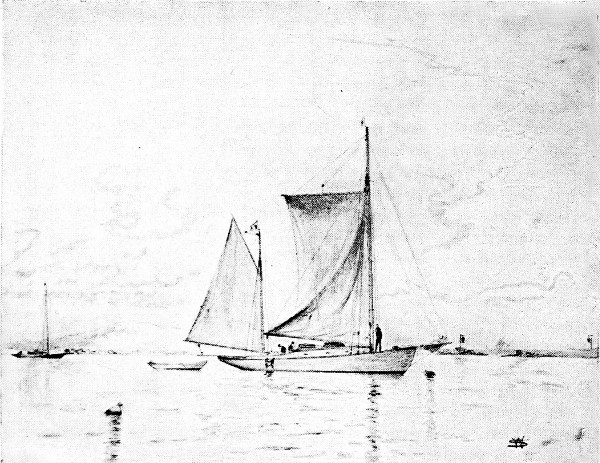
MAKING SAIL.
If for any reason you remove your mast, be careful
to note its position, so that it can be put back again as
it was before. If wedged, mark the wedges before taking
them out, so you can put them back again in their
proper places. The rake of a mast has frequently much
to do with a boat’s good sailing.
To remove a mast, if you have no shears convenient,
place another boat with a mast as tall, or taller than yours,
close alongside, and lash her fast. Then place a sling
round the mast to be removed in such a position as you
think the stick will balance. To this hook in the throat
halyards of the assisting boat. Remove the wedges, and
if the fit in the partners is tight well-grease the houseings.
Then send a man in forward with a sharp-edged bar and
let him pry the heel out of the step as you hoist on the
halyard. Use your own halyards as guys to steady the
spar. Keep the spar steady; if allowed to fall over it
will very likely split the partners. You can step a mast
by reversing this method.
Booms are frequently sprung and spoiled by hauling
down hard on the sheet and pulling up the lift. The
boat being left at anchor, it rains; the ropes shrink, and
the end of the spar is pulled up and the spar sprung out
of shape. Do not set up taut on your lift if it looks
like wet weather.
The less running rigging you have on a racing craft
the better, as a complication of tackle, lifts, sheets, etc.,
make it more difficult to handle sails quickly. Use as
simple tackles as possible, and have as light gear as will
do the work. The running rigging of a racing yacht
should be constantly looked to, and at the first sign of
weakness be replaced by new.
Hoops, to work easy, should be quite some bigger than
the mast. Grease the foreside of the spar frequently,
and they won’t stick when hoisting. If you don’t like
grease, you can keep them from sticking by taking a
piece of small line and with it linking them together by
clove-hitching each one. In this way they will be kept
horizontal when being hoisted. Always put on several
more hoops than there are grommets for, so that if one
breaks you can replace without removing your rigging.
Don’t buy or use cheap blocks; they are the worst investment
you can make, as they will be an endless source
of trouble. Don’t use blocks with sharp edges to the
shell, as they will soon fray and strand your gear. It is
a common practice of riggers to put on a block the swallow
of which will just carry a certain sized rope; consequently,
when the cordage gets wet and swells, it sticks,
and the sail won’t come down. This generally happens
in bad weather, when you want things to run smoothly.
Always have the swallow bigger than the rope, by at
least one size. For instance, if using a 12-thread rope,
have the block made to carry a 15-thread.
To rig a spinnaker pole for racing, when the stick is
not too heavy to be lifted and handled by two men, have
at the head or outboard end a band, or grommet, with
three eyes, one on top and one on each side. Put snaphooks
on your guys, so that all gear can be quickly removed
from the pole. Have snap-hooks on both ends of
your halyard. Make your halyard fast on each side in
the rigging.
If you have a forehatch, after stopping the spinnaker
coil it snake-fashion right under the opening. Screw a
hook to the underside of the deck, where it can be readily
reached, and hook the head of the sail to it then
when wanted the tack man can reach it without getting
up or jumping below. It is frequently necessary in order
to make a quiet move to get this sail ready without your
rival knowing what you are up to.
These sails are of little or no use if the boom cannot
be carried square to the length; the minute they have to
be guyed forward they lose their power, and it is better
to take them in and use the balloon headsail. Do not haul
the tack of the sail hard down; let it light up and leave
an opening between the luff and the mast. Spinnakers
cut with a deep roach, so as to hang below the pole, are
no good. Remember, that the spinnaker is a depressing,
not a lifting, sail, as many suppose, and has a tendency
to force a vessel’s head down, unless the sheet is lighted
up.
If a light pole, this can be easily and quickly done.
Let go the after guy and swing the pole forward; unship
the heel and run the pole aft along the deck on the
side you want to set it, being sure to keep it clear until
the head is abaft all sheets, etc. Have the other end of
the halyard ready, let go the sail, cast off one end and
snap in the other end, and hoist away. While those forward
are doing this the after man can carry the guy over
and pass it forward outside the rigging. Then shove the
pole out right ahead, ship the heel, and haul aft the guy.
By being able to shift a spinnaker quickly you can frequently
manage to get away from a rival who is following
close in your wake and blanketing you. It is a
maneuvre that should be constantly practiced by a racing
crew.
If your pole is carried aloft, lower it down by the lift,
and square with the fore and after guys. Hook the clew
to sheet or outhaul, and the head to the halyard, hoisting
and hauling out at the same time. When in position
break out. To take in, haul the foot in first and muzzle
the sail before letting go the halyard.
As soon as you are through with the spinnaker pole,
unsnap the guys and coil them up. In this way you
keep them in readiness for instant use on either side,
and free the pole of all incumbrance. A spinnaker pole
carried on end with all its gear is a nuisance on a small
boat, besides adding to the weight and windage aloft.
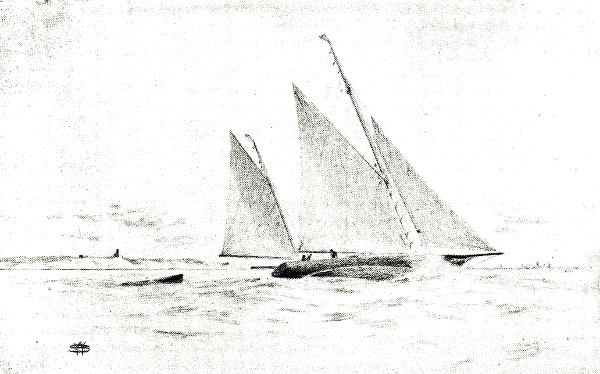
REACHING.
In handling sails the crew should be given certain
stations, and taught to keep them. Each man should
be allotted a certain task, and be instructed to attend to
that, and not to interfere with the others. If you have
a crew of four, including yourself, your place is at the
helm; the man in your watch stays with you in the cockpit,
or aft, unless called forward; the mate and his watch
work forward. The lightest man is the tackman. His
business is to take the tack of the sails. He always works
furthest forward, going out on the bowsprit to snap on
jibs, etc. The mate works behind him attending to the
halyards and gear about the mast.
When making sail, the mate and the tackman go to the
main halyards, one taking the throat and the other the
peak. The skipper and his watch look out for the lashings,
crotch, sheet, and see the gaff clear of the lifts. If
the boat is a yawl, they cast loose and hoist the mizzen,
the mate and tackman attending in the same way to the
headsails. The after guard looks after the jib sheets and
backstays, the forward gang get the anchor and cat it,
standing by forward until she is properly cast and underway;
then they clear up decks.
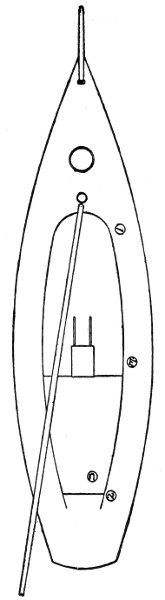
CREW STATIONS—ON THE WIND RACING.
The handling of light sails is the best measure of the
merits of a crew. The bungling of light canvas shows
that the crew are not properly drilled, and that the skipper
is a muff, or else is slack in attention to his duties. Nothing
looks prettier than to see running sails handled
quickly. To do this it is necessary to thoroughly drill
your crew at stations, and to practice them in setting,
shifting and taking in the light sails.
The mate and tackman go to the halyards; the man aft
stands by the peak downhaul, if necessary, after getting
the sheet in. When the sail is down the skipper and his
watch take the pendant, and after the tackman has tied
in haul the foot of the sail out, the mate standing amidships
and helping by lighting the cloth along. When
properly hauled out the skipper or his man pass the clew
lashing. Then all hands tie in, the mate and tackman
working from the middle of the boom forward, the
others aft. Then the mate and his watch hoist the sail,
those aft keeping it clear of the lifts, and working the
sheet.
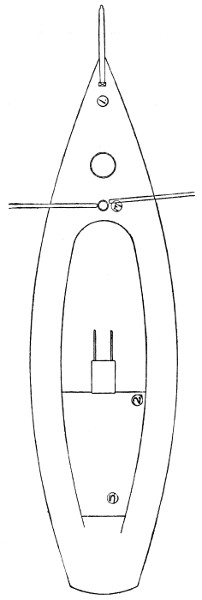
CREW STATIONS—TO SET SPINNAKER.
Get the boom along on the side you want to use it,
with the heel aft and the head just forward of the rigging.
See that it is clear of the jib sheets. Take your after guy
outside the rigging and snap it into the grommet, or eye,
on the spar. Snap in the fore guy, if you use one, and
place the coil in the bow. When ready, let the tackman
snap the halyard to the head, being sure there are no
turns in the sail; then the mate, who has the halyard,
can hoist away. When the sail is up belay the halyard
and snap in the clew of the sail in the grommet or eye
on top of the boom, at the word “ready!” the tackman and
mate seize the pole and shove it out right ahead, until the
latter can ship the heel. At the order from the mate, “haul
aft!” the man in the cockpit hauls on the after guy until
the boom is square. The tackman stands by the fore
guy and the mate seizes the tack and breaks the sail out.
To take in reverse these proceedings.
Sails, if not used, should be frequently cast adrift and
aired. Light sails stowed below, either in bundles or
bags, should be attended to in this manner. It is best
to have your headsails fitted with snaphooks, so they
can be taken off and stowed below.
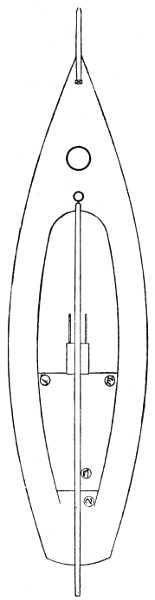
CREW STATIONS—TACKING OR WEARING.
Sails are not made of iron; neither are they made of
rubber. Canvas, especially when new, should be treated
with gentleness. It is very easy to spoil a sail. More
bad sails are made by yachtsmen than by sailmakers.
When bending a new sail haul it out along the spar
hand-taut and lash it. Then let the wind stretch it out,
you taking up the slack day by day. As it comes, you
can put more strain on it until it reaches its proper place.
In damp weather, ease it in at the head and foot.
When measuring your boat for a suit of sails, do not
try to put on every inch the spars will carry. Leave
plenty of drift between the hoist and the block and a good
length at the end of each spar. This will give you a
chance to properly stretch your canvas. The foot of all
sails should be kept well up off the deck, so as to allow
plenty of room for the wind to escape from under them.
Also, keep the leach of the headsail away from the mast.
Sails should never be made to lap if it is possible to sheet
them without doing so.
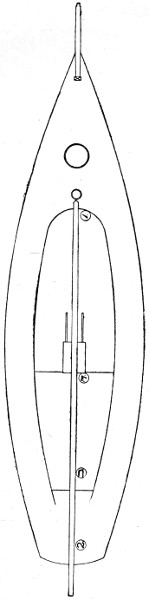
CREW STATIONS—REEFING.
Take the same care of your sails as you do of your
best suit of clothes. When you get a new suit, you don’t
start in by stretching the back of the coat, and by pulling
like mad on the legs of the trousers. Canvas is woven
just as cloth is. When you put your clothes away you
don’t roll them up in a tight ball and leave them in a
damp place for days at a time. Remember this.
The luff of a mainsail should be pulled on until it is
taut, but it should never be sweated until the bolt-rope is
nigh to parting. The peak should be hoisted until the
proper draft appears in the luff. In light airs a better
draft will be had by slacking both peak and luff and by
hauling up the weather lift, so as to take the weight
of the boom off the canvas. The lighter the wind the
more baggy your sail wants to be.
If you are not going to stay on board, do not stow
your sails in tight rolls; make up loosely and tie well;
but be sure that the air can get at the canvas. It is the
weather, not work, that wears out sails.
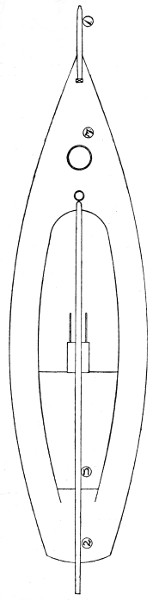
CREW STATIONS—SETTING OR SHIFTING HEAD SAILS.
Sail covers are the sailmaker’s best friend. They destroy
more sails than any other one thing. If a boat has
a crew always on board, or someone constantly near to
look after the canvas, they are very useful contrivances,
but should never be left over sails for days at a time;
the moisture collects under them and rots the cloth.
Storm jibs, as shown in most sail plans, are altogether
too small, and are of no use whatever. When a sail of
that size would be any good it would be blowing too hard
to use any canvas forward of the mast. A storm jib
wants to be big enough to give the boat some life. To
do this it must have a pull to it. They should be roped
heavily, and have good strong clew pieces and irons.
The only way to set them is flying.
If you have to shift jibs in a blow, with a heavy sea
running, it is an extremely difficult and sometimes dangerous
job. The jib you are going to set should be stopped
up, as it is much easier to handle in that form. In getting
in a jib at such times be very careful about how you slack
off the sheet, as men are frequently knocked off a spar or
hurt by the sheet being let fly while they are on the bowsprit.
Don’t have any more men forward than are actually
needed to shift the sails, as their weight will depress
the boat’s head and make it wet working.
If your running gear is stowed around the mast when
underway in bad weather, it is a good plan to trice the
coils up in the rigging. Here it will not get washed loose
and tangled up, and can be readily found and handled.
Gear in the coil should always be kept clear for running;
nothing looks worse, or is worse, than a mess of halyards
lying about a boat’s deck or cockpit. Teach your crew
to always coil down the gear at once, and to always turn
the coil over, so that it will run clear when let go.
The ends of all halyards, sheets and lifts should be
made fast, if you are going to sail at night, or in rough
weather, as they are liable to get adrift and cause a lot
of trouble before being recovered. Frequently, when letting
the sail run in a hurry, the halyards will bunch and
go aloft; if the end is fast you can easily recover them.
The readiest way to make the end fast is to open the
strands and pass the pin or cleat through the rope.
The length of life of your running rigging can be increased
by turning the rope end-for-end, thus bringing
a new part to work in the blocks. Sheets are apt to
wear and strand where they play in the block when the
boat is close-hauled.
If your jib sheets are rove double bring both ends aft
and join them behind the cockpit; then the hauling part
will not get away from you, and can always be found,
even in the darkest night. Another way is to bore a hole
in the cockpit rail, pass the end through and knot it.
In heavy weather always bend a peak downhaul. Take
a long enough piece of good flexible manila and splice an
eye in it. Put this eye over the end of spar, and make the
loose end fast to a lower hoop, or on the pin rail. With
this downhaul you can control the gaff and get the peak
down, no matter how hard it blows.
Sails having their luff running on a track up the mast
will frequently stick, despite the assurances of the inventor
and vendor of these patent devices. To insure
working, keep the track well-greased, and let go the
throat halyards before you do the peak, always keeping
the gaff at a high angle while lowering down. In this
way the weight of the gaff will force the slides down
the track.
If sailing at night, and it looks at all like bad weather
coming, get in a reef in your large sail before dark, as
you can do it then quickly and properly. If suddenly
struck by a heavy wind you will have your boat better
prepared to meet it.
If you carry an amateur crew you should constantly
practice them at reefing. Give each man his station,
and teach him to keep it, and not interfere with the work
of the others. It is a good plan when sailing on a breezy
day to reef and shake out several times, as this will give
your crew practice. A well-trained crew will reef a
mainsail of a small yacht in less time than it takes to
write this.
Always keep a tack in your sail at each reef band.
Take a short piece of small rope, whip both ends, pass
this through the cringle, making each end the same
length, then open the rope just under the cringle and
pass the other part through it. Your tack will stay there
and always be ready to tie down.
These should always be kept rove, if the end of the
boom is outboard. If the sail is a small one, put a snap-hook
on the end that goes in the cringle, but do not trust
hooks if the sail is heavy; splice your rope in.
When reefing a boom sail, before lying along make
sure that the mainsheet is fast, so that it cannot slip,
as this happening is likely to throw you overside. If the
boat is rolling badly it is best to secure the boom with
a lashing from each side to hold it steady, as this will
make reefing easier.
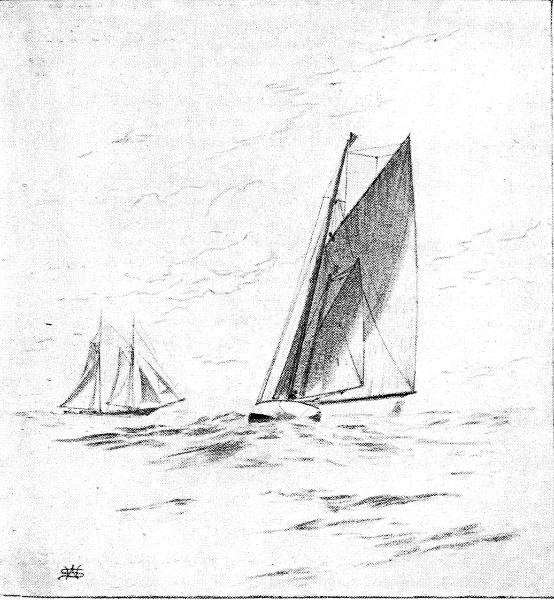
WIND ABAFT THE BEAM.
In a heavy seaway it is easier and handier to reef with
all the sail down and the boat running broad off, as she
will go along steady. It is very difficult to reef a boat
when in the trough of the sea.
When hauling out the foot of your sail to reef do not
pull it out too hard, especially if it is liable to get wet
from rain or sea, as the cloth will shrink and pull the leach
out of shape. Be sure and pass a good lashing around
the pendant close to the cringle and, if there is room,
through it. Don’t haul out on your pendant until the
tack is tied in.
Set up on your lift. Cast off the points, beginning in
the middle and working both ways. Then cast off the
tack and clew-cringle lashing; then the pendant. Be
sure all the points are loose before hoisting, as you are
liable to tear the sail if one is fast.
Before leaving harbor, if it looks breezy outside, tie in
a reef, or reefs. When outside, and you can feel the
weight of wind, you can then judge whether to carry
more sail or not. If close-reefing, tie in number one and
then number two over it. This will enable you to shake
out one reef at a time.
When running off in heavy weather, if you have a jib
keep it on her and haul it dead flat; then if she attempts
to broach the wind hitting in the jib will drive her head
off again. All boats going where winds are likely to be
heavy should carry a small, strong headsail to use for
this purpose.
Keep your boom topped up, so that it is clear of the
sea when she rolls to leeward. Don’t give the sail too
much sheet, as you will find that she will steer better if
the boom is at a smaller angle, and be less likely to be
broken or to damage the rigging.
Always keep a knot in the end of your mainsheet, or
else make it fast. If the end gets away you will have
trouble.
The only safe way to jibe in a breeze is to lower the
peak and top up the boom, before getting the sail over.
In ordinary airs you can jibe a boat if you pay attention
to the helm, and get the sheet down flat. Let her come
easy. If forced to jibe all standing with the sheet off,
just as soon as the boom comes over put your helm, hard
the other way, so as to throw the boat round, and get
the wind back of the sail. This will break the force and
save the knockdown, but is liable to break the boom.
If fitted with backstays, look out for them.
Slack off the mizzen sheet, if that sail is set; haul your
jib a-weather; flatten the mainsheet; put the helm up
and let her come round slowly, easing off the mainsail as
she pays off.
Going with a strong current or tide through a channel,
when there is no wind, you can steer a yawl by taking
hold of the mizzen boom and working that sail from side
to side. When beating to windward in a light breeze,
with a strong tide under the lee, hauling the mizzen to
windward will help a yawl considerably, especially if she
is at all slack-headed.
Haul your mizzen if set fairly flat; slack the lee jib
sheet and haul in the weather at the same time, until this
sail is properly trimmed. Get your mainsheet aft gradually.
Put the helm up slowly, and if the mizzen is set
jibe that first, then the mainsail. The reason for trimming
the jib and mizzen is this: If when the mainsail
comes over she knocks down the other two sails will
shoot her up in the wind, and give you a chance to shoot
her out. If the mizzen it not set, light your jib sheets
sufficiently to allow her to come up.
If you have to come to at a dock or pier on the windward
side, go well to windward of it, lower your sail,
and steer straight for it. Have an anchor and warp
ready aft, and when close enough to reach let go your
anchor and pay out, checking her way as you near the
structure.
It is always best to lie head or stern on to a dock if
you intend to remain long or over night. Always run out
an anchor to hold her off in case the wind shifts, or if for
any reason you have to haul out. In making your head
fast be sure to allow length enough, if in a tidal harbor,
or you will be hung up when the water falls.
This is one way of getting down a narrow fairway
when a swift current is going with you. By employing
it you will be able to keep off the banks and to dodge
anchored vessels. Send a man forward and let him heave
in on the anchor until it breaks, then let him keep it
trailing along the bottom, checking the vessel whenever
needed, by paying out enough slack cable to make the
hook bite. The skipper at the helm can then shear her
with the rudder to port or starboard, as he wishes. The
current moving faster than the boat will give her steerageway.
Instead of an anchor you can use a heavy
chain to drag along the bottom.
If bucking a strong tide or current a vessel will answer
to the slightest touch of the helm, but if going with the
stream she will steer slowly and badly. This must be
looked out for in running narrow entrances between jetties
and bars. Sometimes it is better to go out stern first,
if the wind is blowing directly in, letting the vessel sail
slowly before the wind and drop back faster with the
tide.
In going against a strong current to windward you can
force a vessel through, no matter how strong the tide is,
if you can lay up close enough to get the wind on one bow
and the tide on the other. The pressure of opposing
forces will drive the vessel ahead. You will often see
schooners get through the Long Island Sound Race in
this way against a strong ebb, running over 5 knots.
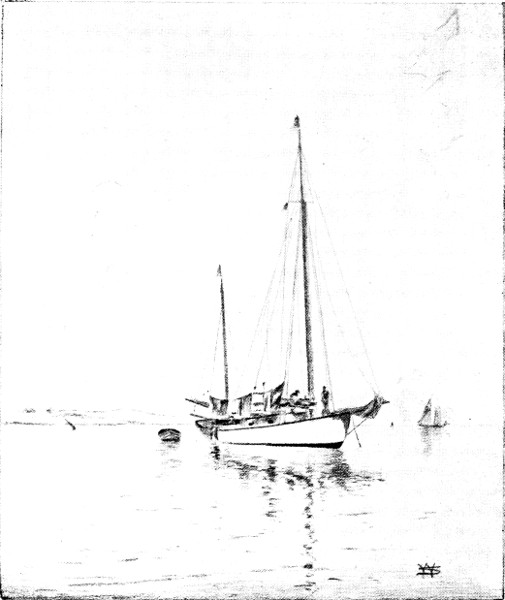
IN HARBOR, DRYING OUT.
With the tide or current under the lee bow trim your
after canvas dead flat, unless the sea is large. Let her
eat out to windward on an easy helm, humoring to keep
good way on all the time.
Going through a passage with a strong favorable current
and no wind, lay your vessel broadside to the drift
of the tide, then the speed of the stream will make a
breeze in the sails and give your boat steerageway. Tack
on approaching the shore, and stand over for the other,
being careful to tack while still in the strength of the
stream.
If at anchor in a current with the wind blowing against
the tide, to keep the yacht from riding over her anchor,
tie a bucket on a rope and drop it over the stern. This
is a good way to keep a dingey away from a yacht’s stern
when tide-rode.
To heave-to a vessel you must trim your sails so that
the wind presses on one side of one sail and the other
side of the other or others. In a boat like a sloop or yawl
you can heave-to by drawing your jib a-weather, by
slacking off the lee and hauling on the weather sheet.
This causes the force of the wind in the jib to counteract
the force in the after canvas. By slacking off the mainsheet
until a balance of power is established between mainsail
and jib a boat will lie almost in one place.
It is a very simple matter to lay a fore-and-aft vessel
to. But in the first place you should find out in reasonably
good weather what sail she will lie-to best under.
Knowing this, snug her down to it before bringing her
head to it. The best sail is that nearest amidships; but
some boats require more after canvas and some more
forward. No rule can be laid down, each vessel in this
respect being peculiar to itself. When ready, watch your
seas until after a big one has past you; get a smooth,
then put your helm down easily and bring her to with
a long sweep. The amount of sail she wants is enough
to keep her just moving ahead, so that there will be steerageway
and no more. Use plenty of oil while rounding
to and afterwards, if the seas are cresting and breaking.
Unless the weather is fine and you are well acquainted
with them, keep off lee shores. A lee shore is a bad place
to go aground, and it is a bad place to be caught on if a
heavy blow comes.
In strong winds and heavy weather it is always best
to get in under the lee of a weather shore, and to keep it
aboard as long as possible. You should figure to do this
in mapping out runs from place to place. In running a
weather shore keep working your boat up to it, especially
in the bights between headlands. This will enable you to
choose your own distance in rounding the outermost
points and prevent being driven off shore.
If caught at anchor close on a lee shore where you are
too close to wear with safety, you can get your anchor
and cast your boat in the right tack by this method:
Make sail; then when all is ready heave in until half
scope; then get a bucket with a line bent to it, carry this
line outside the rigging and the bucket as far forward as
possible. Let one hand hold it ready to cast overboard
on the side you want to fill on. Haul in your anchor
quickly; when broken out, heave the bucket overboard,
and give a slow, steady pull on the line from as far aft as
convenient. This will hold her stern and the bow will
swing off in the opposite direction. If you have no
bucket, use a hunk of ballast, and slip it when her head
is round.
The cause of this is generally carelessness or haste.
Sufficient way is not on the boat when the helm is put
down, owing to her being too near the wind. Always
give a boat a good full before putting the helm a-lee.
You should watch the sea and make the move when there
is a smooth flat spot between the waves. If there is any
doubt of the boat’s getting round it is better to wear her.
If your boat miss stays in a seaway and gets sternway
on, don’t jam your helm hard over. Keep it amidship,
and try and get your headsail a-back; then slowly
put your helm over. It is a dangerous practice to jam a
helm hard over when a boat is making a stern board in a
seaway, as you are liable to damage the rudder or drive
her counter under. If a centerboard boat, pull up the
board, as this will help her to fall off.
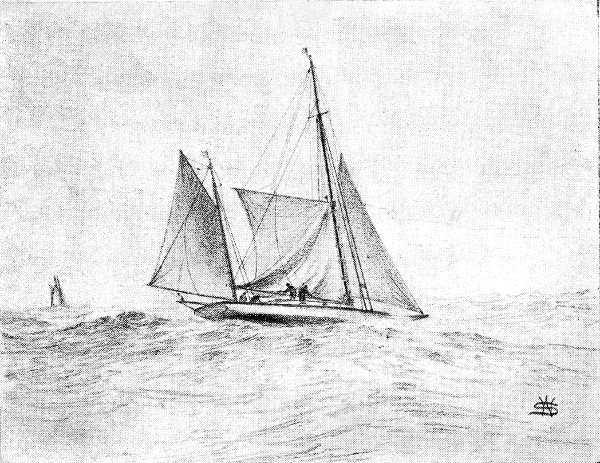
REEFING.
If it is too windy and rough to get your anchor, prepare
to slip. Get the bitter end on deck and bend a buoy
to it. See all clear to cast over. Haul in as much as you
dare to, and bend a small line to hawser or chain. Carry
this line aft to the quarter outside the rigging. When
ready, slip and haul in on the small line. As soon as she
swings off cut the spring.
When sailing in a seaway don’t trim a boat flat. Give
her a liberal lift of sheet, and sail her with a good full.
Never let her lose way, as your safety depends upon
always having control of her motions. Keep a close
watch on the water on your weather bow, and judge how
to take a wave before it strikes you.
In sailing a boat in a seaway and heavy breeze amateurs
are apt to make two mistakes. One to carry too
much sail, the other, too little. In the first place, the
boat cannot be kept full; in the second, she hasn’t sufficient
drive to keep her moving. Carry as much sail
as she will keep full and not bury under.
It is a mooted question among yawlsmen as to whether
the mizzen is of use or not when going dead before the
wind. If you can wing it—that is, get the boom on the
opposite side to that of the mainboom—it is, as it makes
a boat steer steadier. But if it is off on the same side as
the mainsail it is doubtful if it helps the speed. I have
tried the experiment repeatedly and cannot find that it
makes any difference in a strong breeze; but it does help
in light airs. In a strong wind the boat will do better
with the mizzen stowed, is my opinion.
The handling of this sail seems to be a problem that
worries many young skippers. No fixed rule can be
laid down, it depending largely on the shape of the boat,
the position and size of the sails. Generally speaking,
with the wind forward or on the beam, the mizzen should
be sheeted flatter than the mainsail. How flat, depends
upon the effect it has on the steering. If the boat gripes,
ease it off; if she is slack-headed, haul it flatter. In beating
through a narrow channel work it as you do the jib,
but exactly opposite; that is, with the helm a-lee haul
in flat; as she pays off ease the sheet. In this way you
will help the rudder to bring the boat round. The mizzen
sheet should be belayed where the helmsman can readily
get at it, so that by working the sheet in combination with
the tiller he can control his vessel.
In working to windward in open water for a long distance
stand on the tack which looks up nearest to your
destination. On this tack the wind is as foul as it is
possible for it to be, and cannot shift in either direction
without favoring you. Attention should be paid to the
probable direction of the shift, and a course shaped that
will bring you into such a position as will lift your vessel
up and not throw her to leeward of her course. For
instance, if the wind is East, stand on the tack towards
the Southeast, because it is probable that the wind will
move round with the sun across your bow and be constantly
freeing you until you can stand your course on
the other tack. This is largely a study of local conditions,
and can be mastered only by constant observation
of the tendencies of the wind at certain seasons of the
year.
If the wind is offshore, blowing at an angle, so that
you can make a long and short leg, keep close under the
weather shore, as the wind will draw more favorable
there than further out. For instance, if the shore lies
East and West and the wind be Southwest, under the
weather shore it will haul more to the South, sometimes
as much as a point, thus enabling you to lengthen your
long leg. Besides, you have the advantage of smoother
water.
If the wind is so foul as to be dead ahead it is waste
of labor to try to beat a small boat a long distance to
windward. With the best of handling you cannot make
more than three miles an hour, and a very good day’s
work is twenty miles. Probably the next day the wind will
come favorable, and you can make that twenty miles in
four or five hours. If you are pressed for time and have
to do it, take the first of the fair tide.
Never sheet light balloon or running sails; let them
sheet themselves. If you trim these sails the way you
do working canvas you will destroy much of their power.
To get the sail right, slack off the sheet until the luff
trembles, then belay. If you sheet them, the whole after
angle becomes a back sail. The object is to get them to
pull ahead, not sideways. The minute a balloon sail has
to be sheeted aft to make it draw take it in and set your
working canvas. You will do better with it.
Coming down to round a mark with running sails set,
when within fair working distance hoist and sheet your
working headsails, if the ballooner is not set on the jib-stay.
Get your main sheet aft and runners ready; then
when close to the mark take in your spinnakers and ballooner.
In this way you are ready at once to haul on
the wind. If you take in your light sails first you will
have them littering up the deck and in the way, delaying
getting the working sails set and sheeted, and consequently
the boat instead of being able to make a sharp
turn will drag off to leeward.
If rounding a mark to leeward, always do so before
you reach it. In order to do this, if possible, keep away
from it some distance, and put your helm down gradually;
then you will not kill the boat’s way and will give your
crew time to get the sheets flattened down. If you come
down and take the mark close aboard and then turn it,
you will have to put your helm hard down, killing the
boat’s way and causing her to sag off to leeward.
If another boat is abreast of or overlapping, and will
be between you and the mark, try and drop back before
reaching the turning stake, so as to let her get ahead.
You will lose less by doing so than you will by rounding
close under her lee, as once round you can probably
free your wind and get clear of her wake by a sharp
luff. You have also a chance to cut in if her crew make a
fumble of their sheet work; but if you are under her
you will have no chance at all.
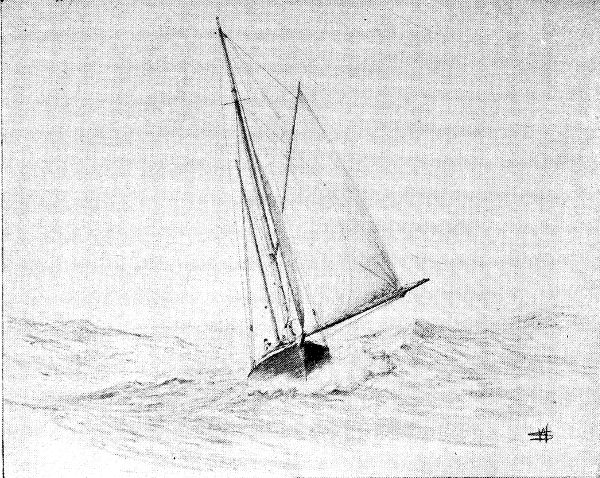
RUNNING BEFORE THE GALE.
Before rounding a windward mark, if the next leg is
a run, make up your mind which side you are going to
carry your spinnaker on. Get the pole along on that side
and the after guy passed and hooked on. Then before
getting to the mark hoist the spinnaker clean up and
hook in the clew. Just as soon as you are round and
squared off run the pole out and square it, and break the
sail. A good crew should get a sail set in this way in
fifteen seconds.
A vessel to sail her best wants to be kept on a level
water line; the minute she shoves her head up or down it
kills her speed. This is true of sail, power or any kind
of craft. Therefore, in racing, see that your crew keep
her trimmed to a level by constantly moving and balancing
their weights. If a man goes out on the bowsprit
move a man aft to counterbalance his weight. Never let
a bunch of men get forward, as is often done when taking
in or setting light sails. It is better to do this work
slower and keep the boat properly trimmed.
Have two separate sheets rigged with snaphooks. If
you come down to a mark with your balloon jib on one
side and want to shift it over so as to carry it on the other,
before jibing over gather the sail up and roll it out to the
stay; there stop it. Unhook the sheet on that side and
hook on the other. As soon as you are round break out.
By doing this you don’t have the bother of passing the
sheet in use forward around the stay and aft again in the
other side all of which takes time and causes confusion.
When not in use, keep the sheets hooked to the stay, and
fast aft. You can stop the sail with the sheet, using a
turn similar to that made round a flag when hoisted in
a ball or bundle.
If a shroud parts, go right on the other tack; then
get any tackle you can that is idle and set it up in place
of the rope carried away. If you have no tackle aloft
that is not working get a piece of hawser or large-sized
rope and pass it round the mast above the other rigging.
Take it round the spar with a clove hitch and stop the
end. Seize a bight in the lower part high enough up to
get the watch tackle in between it and whatever you have
at the rail to make fast to. Then set it up and rack the
tackle. If the chain plate is gone, and you have nothing
to make fast to, you can secure the lower end in this way,
as I once did. Bore a hole through the deck just inside
the clamp, and one through the side just below the clamp.
Pass a piece of wire rope through these holes and marry
the ends. Into this loop hook your tackle. All boats of
any size should have two shrouds on each side.
If your main sheet bursts or the shackle breaks and the
tackle gets away, keep the boat as near the wind as
possible. Then slack up on the weather topping lift until
you can reach the bight. Get this inboard and aft, and
haul on it easily, slacking down the throat of the sail at
the same time; then the peak. If you have only one lift
rove, slack down the throat, and try to get a line on the
boom, as far out as possible. If this won’t work, cut off
the hoops, unship the heel of the boom and run it inboard.
It is a very dangerous situation if any sea is on, and requires
skill and courage to master it.
If you carry away a mast in a seaway get it clear of
all gear as soon as possible, as it may smash in your side.
If it is rigged with wire shrouds and rigging screws, and
you cannot get these loose, saw off the head of the mast
just below the eyes of the rigging. If the sea is not too
heavy you can veer the broken spar astern and tow it, or
else haul it in over the stern and lash it fast. It is better
to save the spar, if possible, as it makes it easier to replace
it.
This is a bad accident, as you are liable to lose your
mast. Get the mainsail off of her at once. If you have a
crotch, put it under the boom so as to take the weight off
the mast until you have it secured. Take your jib or
staysail halyards or preventer backstays, hook them to
the bits or around the bowsprit close to the cranze, and
heave taut. Get the yacht before the wind, if possible.
Then make the best job of the bobstay you can. A watch
tackle makes the best temporary repair.
The want of speed in sailing craft is due to many
causes. The most frequent is the result of over-ballasting
or to the ballast being in the wrong place. This is especially
so in shoal, flat-floored models. Frequently, if a
boat prove sluggish, a yachtsman will attempt to improve
her speed by adding more sail, and then to carry this sail,
will ship more weight. Consequently, the boat is slower
and worse-acting than before. If your boat does not
seem to be up to her speed, try first by removing a portion
of the ballast, and by continually shifting the weights.
To try her, sail alongside another boat, of whose comparative
speed you are aware, and you will soon find out
your boat can be improved in this way.
Sometimes the sails are to blame, usually through these
not being properly set, owing to the blocks being placed
in positions where they cannot properly hold up the
spars; or, having too little draft. Want of draft will
cause a boat to be sluggish in light airs.
If shifting ballast or getting better sails will not bring
the boat to her form, try altering the position of the
centerboard or mast. Much additional speed is frequently
gained by moving the mast or board. You cannot discover
the faults of a boat by analysing her design; you
must work it out by sailing her, and studying her actions
in all weights of wind.
If you have no log, you can by practice get so that you
can gauge a boat’s speed within a half knot by watching
the water. When running along shore, make a practice
of timing the boat between measured points. By doing
this constantly you will get so experienced that you can
judge by eye very close to the speed she is making.
Another way is to time her as she passes floating objects,
or while passing a stick dropped over from the bow,
count the seconds one, two, three, and so on, until it
passes the stern. Knowing the length of the boat by
this means you can roughly estimate her speed through
the water. If your boat is 25 feet long, and it takes her
5 seconds to pass an object, she is making about 3 knots.
When towing a heavy boat or another yacht, with the
wind anywhere on the beam, make your towing warp
fast on your weather quarter. This will make the load
tow easier and your boat will steer better. When towing
with the wind aft, keep the warp amidships, by using a
bridle from each quarter. If the tow is being steered,
veer a long scope of hawser, so as to get a heavy bight;
this will ease the strain in a seaway.
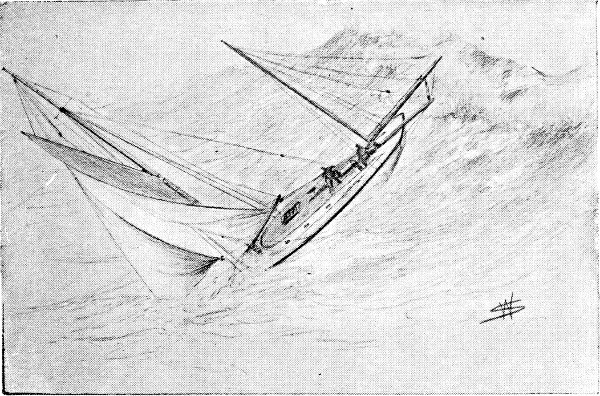
TRIPPING.
To tow a dingey alongside, make fast to the fore
thwart, or to anything, about one-third aft from the stem.
In this way you can tow a dingey under the lee while getting
men or stores out of her. The same plan is used in
towing along a canal or narrow thoroughfare by tracking
on the bank.
When towing, never make a warp fast so that it cannot
be instantly cast off. It is always best to keep a sharp
knife handy, so as to be able to cut the line. In a seaway
this should always be looked to.
When towing a heavy boat in rough water, or when
the wind is scanty, and you have to tack, place a hand or
two on the line to haul in. When ready to put the helm
down have them take in considerable slack. At the call
“Helm’s a-lee!” let go the line and tack your boat on the
slack line. This will enable you to get round and have
way before the pull of the tow comes on your boat.
Anchors should be looked to and taken care of just
the same as any other gear. The same with chain. If
you keep your spare hook below, see that it is a place
where you can readily get at it, and not buried in a heap
of old ropes, awning stanchions, and other dunnage. I
have fully covered this subject and that of anchoring in
the book, On Yachts and Yacht Handling, which I advise
you to read.
It is sometimes very difficult to get an anchor in a seaway
with a hard wind blowing. It can be done in this
way: Take a turn with the hawser round the post or
bitts. Watch when she pitches. As she descends she
will slack up the hawser. Quickly take in this slack and
hold when she scends. In this way you can get it foot by
foot, and, when close under, the sea will break the hook
out for you.
If an anchor is lost or foul you can get a line on the
upper fluke in this way, if the water is not too deep:
Feel for the fluke with a pole or, better, a piece of iron
gas pipe. When found, rest the pipe end on the tip of
the fluke. Then send a messenger of rope with slip noose,
down the pipe or pole until it falls over the fluke and on
the arm. Carefully haul it taut, using the pole to keep it
from slipping off until firmly fixed. By this means you
can get a back pull on an anchor and shake it loose if
caught under a timber or rock.
If you have lost your anchor, and there is chain or
hawser on it, you can recover it by dragging with a grapnel
back and forth across where you suppose the hawser
is lying. If there is no chain or hawser attached, you
will have to sweep for it. Take two boats and pass a
weighted line between them, then row back and forth,
dragging the bight of the line across the bottom until it
finds the lost hook. Sometimes you can get an anchor
by making fast one end of the sweep and rowing round
in a circle, paying out the line as you go. Let it sink;
then bring both ends together, as fishermen do a net, and
haul in slowly. The best sweep is one made with a piece
of chain in the middle.
Get the anchor in the boat flukes toward the bow, then
coil down in the boat about two-thirds of the line to be
payed out. Start the boat off and pay out what you have
on board. In this way the oarsman has not got to drag a
heavy weight of line after him. Use the same method
to run out a guess warp to be made fast ashore.
Get two boats and lash them side by side. Put a strong
stick or oar across the gunwales and lash it fast. Lower
the anchor overboard with a tackle from aloft and swing
it in between the boats, ring up. Lash the ring to the
beam. When you get to the spot where you want to drop
it set the hawser all clear for running and cut the ring
lashing.
Lash two boats together. Put a round beam or spar
across the gunwales and ship a couple of hand-sticks in it
so as to turn it like a windlass. Take the line on the
anchor round the spar and turn, winding it slowly up.
Keep the beam from rolling out of place by two guys, one
at each end, with an eye over it. The guys want to lead
from the end of the boat on the side that the rope from
the anchor comes up.
Don’t anchor on bad bottom without putting a trip
line on the anchor. The worst bottom for fouling is
one over which boulders are strewn. Also be careful
how you anchor in any place where sunken wrecks are
likely to be found.
The weight necessary to furnish a secure mooring depends
upon the locality, the amount of exposure, the
depth and character of the bottom, and the weight and
model of the boat. It is always better when on the safe
side by using as heavy a mooring as possible. For
ordinary conditions, multiply the length over all of the
boat by five, the answer being the weight in pounds that
is needed. In exposed situations this weight should be
largely increased. The best moorings are mushroom
anchors, where the bottom is suitable for their use, as
they can be readily recovered when it is desirable to
take them up.
To do this properly requires judgment and practice.
Nothing looks worse than to see a man make a bungle of
getting a mooring. If he is familiar with his boat, there
is no excuse for mismanaging the job. The first thing
to learn is how far your boat will carry way when thrown
into the wind. This you can find out only by observation
and practice. Having discovered this, set a range on
shore to use when coming to; one that will place you at
about the right distance. A better plan is to calculate
your distances by lengths of your boat. If your boat is
thirty feet long, and will carry way for six lengths, luff
up at a distance of 180 feet. Always, if you have good
way on, go directly to leeward of the mooring. Luff
with a long sweep, for if you put your helm over too
quickly you will kill the boat’s way and fall short. If the
wind is light, go to leeward and come to the buoy at an
angle, with your sheets lighted up; then by trimming and
spilling you can baby her up to the mooring. If a boat
is coming with too much way on you can kill her speed
by shoving the helm hard across, first one way and then
the other. Take an afternoon off some day and practice
picking up your mooring and you will soon have it down
to a science.
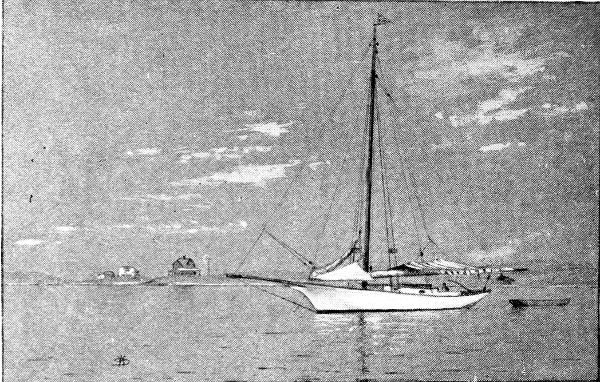
AT ANCHOR, BLOCK ISLAND POND.
This should never be done unless you have to, as it
is more likely to get you into a mix-up. But in places
where there is strong tide running against the wind it is
the only way. Go well to windward, and take enough
sail off so that she will just about stem the tide; then steer
right for the buoy and pick it up, getting sail down at
once.
Get an iron hook made, shaped like the hooks used
by women on their dresses, only longer in the shank.
Splice a rope to this and then fasten to it and the rope
a short piece of stick, long enough to reach from the rail
to the water. When you come to the mooring the bowman
can hook this into the ring and hold her until you get
the sail down and can pass the mooring warp. A little
practice with one of these contrivances will make a man
so expert that he can catch the ring every time, even by
throwing the hook several feet.
If your boat lies at moorings where there is constant
jump of sea on, or where the tide and wind keep her
yawing about, the warp should be well-armored where
it comes through the chock or over the rail. Leather is
best for this. A boat will lie much easier if a bridle is
used, an end being brought aboard at each bow. Don’t
leave the warp hanging to the buoy, especially if the
water is foul or the bottom muddy. Not only will it rot,
but every time you take it on board it will dirty the boat.
It is best to use a heavy chain, much heavier than is
really needed, to stand the strain, as the boat will ride
in all ordinary weather to the weight of the chain, and
not to the block or anchor. In this way she will take
the seas easier and not try the gear so much.
This is a simple proceeding, if you have plenty of sea
room on either side of you. If not, use a cant line, as it
will enable you to cast your boat on either tack. To do
this take a light line and pass it through the ring on the
buoy, and bring both ends aft outside the rigging to the
quarter. If you want to go off on the port tack, bringing
it on the port quarter, and on the starboard tack on
that quarter. Let go the mooring warp and hold on to
the cant line until she swings and fills; then let go one
end of it and it will slip the buoy ring. If you want to go
off before the wind hang on until she comes stern to the
buoy, then slip. This is a much simpler and surer way
than trying to cast her with the mooring warp.
Most accidents happen to moored yachts, not through
the anchor failing to hold, but through the line or chain
parting. Frequently the line is too short, and an extra
high tide, such as often accompanies a storm, causes the
boat to lift the anchor. Most accidents happen late in
the season when the gear is rotted after months of laying
on the mud. Mooring gear should be frequently looked
to.
Hawsers, such as are employed on yachts, are very
perishable articles, and should be frequently aired. Excessive
dryness is very bad for manila rope. To prolong
the life of a hawser that is used for anchoring it should
be turned end-for-end frequently. If used in water where
sewerage or chemical refuse is present, wash the rope
thoroughly in clean water before stowing away.
Chain is much cleaner than rope for use as anchor
warp where the bottom is muddy. Chain should be frequently
examined and tested, as it is liable to develop
weak links, which will give way when least expected.
If anchored in an exposed harbor, before turning in
at night reef your principal sail or sails, so that if it comes
on to blow you will be in shape to get quickly away.
Pay strict attention to the rule requiring a riding
light to be set from sunset to sunrise, if in a place where
other vessels are likely to come. Hoist it in such a position
that it will not be completely shadowed by the mast
from astern. If in close quarters, it is as well to have
another light aft, or at the end of the main or mizzen
boom.
Make a practice of looking to your lights early in the
day. Fill and clean them all so they will be ready for
instant use. Side lights, riding, and binnacle lights, are
too often neglected, and when suddenly wanted are
empty and cannot be shown. It is difficult, and sometimes
dangerous, to fill lamps in the dark.
If sailing in waters where big vessels are frequenting
the fair ways, always keep a flare handy during the dark
hours. A bunch of rags tied on a stick, with a can of
kerosene to dip it into, makes a good flare. In case a
vessel does not see your side lights and bears down on
you, you can warn her off with a good bright flame.
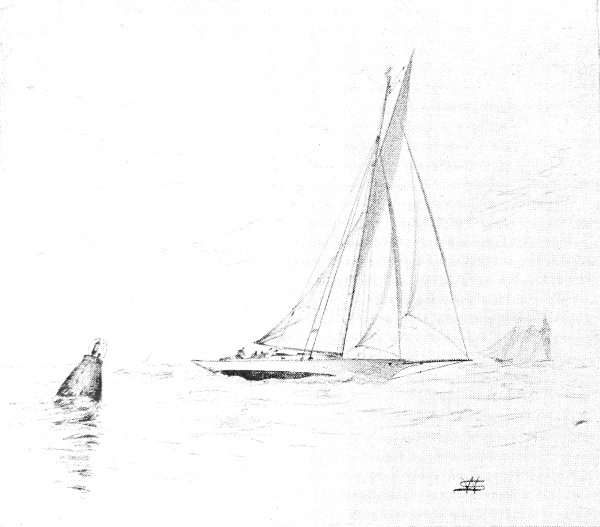
SHEETS LIFTED.
The ordinary brass or wooden binnacles made for
small yachts are pretty, but of very little use at night. The
lamps will not burn if the lid is closed, owing to the
heated air driving or keeping out the fresh and starving
the flame of oxygen. The best binnacle is a box large
enough to hold a small lantern. The lantern should be
of brass, not iron. Such lantern can be bought for 25
cents in nearly any hardware store. Get two, keeping
one in reserve in case of accident. Bore plenty of holes
in the sides of the box. The best oil to use is railway
signal oil, which is a mixture of lard and kerosene.
Side lights should be carried well up the rigging, so as
to make them visible as far as possible. On launches they
should be put on top of the cabin house. Six feet above
deck on a small yacht is about the best height. This is
high enough to keep them from being washed out.
A lantern should always be kept handy just inside the
cuddy doors to be shown for a stern light if a vessel
comes up from aft. If a steamer is coming down on you
from anywhere astern pull back the companion slide and
let the cabin light shine on the sail; they will be sure to
see the reflection and know what it is ahead of them.
Water tanks, no matter how small, should be fitted
with splash plates, and plenty of them. Else when half
full they will be the worst nuisance possible in a seaway.
If the tank is large it should not only have athwartship
plates, but plates fore-and-aft. In power boats especially
they should be fitted in this way, as such craft are generally
bad and persistent rollers.
Drinking water causes more sickness than all other
foods combined, and yachtsmen cannot be too careful
where they get their supply. If you are not certain sure
of the fluid, boil it before using. Also keep your tanks
clean, and don’t put new water in on top of old that has
been in the tanks for weeks, or perhaps months. One
time I was going on a cruise and ordered the crew to fill
the tanks, but cautioned them not to take the supply from
a pipe that led to the dock, but to go to the clubhouse for
it. When my back was turned they decided that the pipe
water was good enough, and filled up with it. Consequently
we got a dose of iron rust that laid the whole
crowd out for three days with an attack that would have
turned Mr. Beacham green with envy. If the water
gets riley from shaking up in a seaway you can instantly
clear it for drinking by putting in the glass a few drops
of lime juice.
When off cruising, a yacht should have in her locker
some simple remedies. Much suffering has been entailed
by neglect of this precaution. A roll of bandage, and
some absorbent cotton, some Pond’s Extract, salve, a few
pills, and a diarrhæa medicine, are good things to have.
I have known of a man being badly burned, and having
to suffer for hours before a port could be made, because
there was nothing on board to ease the pain.
A log is a most useful instrument, not only to register
distance, but to tell you what your boat is doing under
different sails. There are several logs now made suitable
for small craft. By watching the log when you are sailing
you can tell whether or not your craft is doing her
best. By employing it I have frequently found that a
measure that I supposed would add speed has worked
just to the opposite. For instance, I have put on more
sail, and found by the log that instead of making the
boat go faster it has made her move slower. It will also
aid you in properly sheeting your sails, so as to get the
most effective work out of the canvas. Logs are a great
comfort in thick weather, when running for a landfall,
as they give you warning of your approach to it, and save
a lot of worry. But they must never be implicitly trusted.
Always when cruising carry a barometer, and constantly
watch it. This instrument does not foretell the
weather except indirectly. It is simply an instrument for
measuring the weight of the atmosphere. No change of
weather takes place without a change of the weight of the
air; therefore, when the barometer remains steady there
will be no change. If it goes up or down it means that
some change will take place. By learning what usually
follows such fluctuations you can employ it to help you
in determining or foretelling the future weather conditions.
The study of the weather is a most necessary as well
as an interesting occupation. To make a success of it
you must constantly observe the barometer, the sky, and
the sea. By learning the meaning of the colors in the
heavens at sunset and sunrise, and by knowing the different
forms of cloud, you can nine times out of ten foretell
the weather for the next day or two. The color of
the sea and its movements are also a guide. The actions
of fish, birds and animals, like whales and porpoises, will
also aid you. Nothing should be too minute to escape the
seaman’s observations, if he wants to become weather-wise.
Make a study of the winds in the locality in which you
sail. You will find that nine times out of ten they go
through the same routine in shifting. By learning the
manner in which they change you can take advantage
of these shifts. The winds in summer generally follow
the sun in its circuit, until they get back to their proper
place. If they go the other way, what is called back, you
can never trust them to stay long, and it is usually a sign
of bad weather. In sounds and estuaries the wind usually
comes in with the flood tide. If this tide makes in the
morning the wind will stay all day; if the flood makes in
the p. m. hours it will not last long. If the wind comes
in strong against the tide look out for a long blow.
Offshore winds usually come and go with the sun, reaching
their maximum velocity at noon and midnight.
After a heavy squall you will usually have a calm spell
or an offshore breeze. Winds blowing in from the ocean
are weaker on the weather side of an island and heavier
and puffy on the lee side. On calm nights a gentle air
can often be found close under the land, when there is
none in mid-channel.
Never parley with a squall. Take in sail at once. You
can never tell from the appearance of a squall how much
wind is in it. The most innocent-looking are generally
the most dangerous. I was once on a yacht when a
squall appeared that looked more like rain than wind.
All hands except the skipper, an old man, decided that
it would not amount to much. The skipper, much to our
disgust, insisted upon taking all sail off. We had scarcely
got the canvas lowered and gasketed before the squall
struck, and laid the yacht over on her side and kept her
there until the blast had spent itself. The force of the
blow was terrific; probably the air was traveling at the
rate of 70 or 80 miles an hour. A large lumber-laden
schooner close to had her foresail blown clean away and
lost part of her deck load. This taught me a lesson I have
never forgotten.
If becalmed, at the approach of a squall, get the vessel
headed toward the point you expect the blast to come
from, so that the wind will strike her bow on, and not on
the broadside. If the squall looks to be a lasting one,
anchor, if in shallow water.
Squalls on the seacoast generally come off at either
high or low water. If they come between tides they are
apt to be bad ones. If your feelings or the barometer
tell you a squall is likely to come off, carefully watch
inshore for the appearance of the wind. White squalls—that
is, sudden blows unaccompanied by cloud or rain,
are the most likely to catch you napping. They sometimes
precede a sudden change of wind. If you see the
water suddenly whiten inshore, look out for trouble,
and lower all sail at once.
If struck by a sudden squall, let go your main throat
halyards first—not the peak. By keeping the peak up
you will be able to luff the boat; letting go the throat will
relieve her until you can get in the wind and get your
sail down and muzzled. If you cannot get your sail
down, get her off before the wind and haul your mainsail
flat amidship; then steer so as to bring the wind dead
aft. This will split the force and give you a chance to
take in sail.
The time of the tide has much to do with the strength
of the wind in sounds, bays, and channels. If a morning
flood brings in the wind it will usually blow all day. Ebb
tide in the morning is apt to produce calm or light winds
during the summer months on our Eastern seaboard.
Thunder squalls are also affected by the condition of the
tide, coming off land at either high or low water.
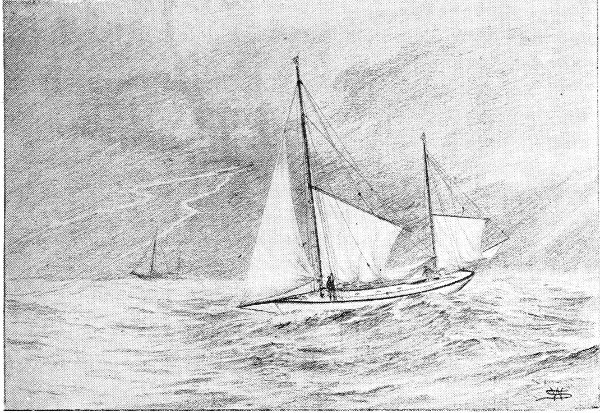
THE COMING SQUALL.
Roughly speaking, the tide is one hour later every day.
It is theoretically high when the moon bears directly
South, either on one side of the world or the other, but
actually the friction of the water causes a retardation
which delays the wave until sometime after the moon
has made its southing.
Channels open at both ends have generally very strong
tidal currents, but a small rise and fall. The highest
tides are in funnel-shaped bays or estuaries directly open
to the sea. The day tides are generally higher than those
at night.
High water does not in many cases coincide with the
stop of the current. In places situated upon sounds,
channels and passages, the current continues to flow long
after it is high water. The same with the ebb, which
runs after the tide has reached its lowest level.
Frequently the tide is not found to be high at the time
given in the tables, and very often the current does not
turn at the hour and minute predicted. This does
not prove that the tables are unreliable or worthless.
The tide is frequently prolonged or retarded by the wind,
which, acting either with or against it, causes the current
to run with greater or less force.
A correct and extensive knowledge of the tide is essential
to good work, if navigating salt water. A constant
study should be made of the tides, learn their strength,
direction and height. Always carry a tide book, and
make a habit of consulting the tables. By knowing the
exact time of the current changes and the locations where
they change earliest you will save hours of time in getting
from port to port. In estuaries and sounds the current
generally runs longest in mid-channel and changes on
the inshore first. So if carrying the last of a tide keep
in midstream; if using the first of it keep inshore.
Eddies can be found by examining the shore line, and
drawing conclusions from the trend of the coast. Much
distance can sometimes be gained by working eddies if
sailing against an adverse current.
Floating objects have a tremendous attraction for each-other,
and if lying becalmed will gradually draw together.
This is an influence shared by every particle of
matter in the universe, but passes unnoticed upon land
where we only see it manifested as weight. It no doubt
accounts for many of the collisions at sea in thick weather.
Many strandings are also due to this attraction which
draws vessels towards the land. In sailing at night or
in thick weather along a coast, this force should be allowed
for. It is most likely to be felt on high, bold shores, and
least on low, shallow ones. It is this attraction that
causes your dingey on a still night to insist upon lying
against the stern or side of the yacht.
Yachtsmen should never unnecessarily bother coasters
or steam vessels, or any craft that is on the water for
business. A yacht can be easily cast from tack to tack,
whereas it is a laborious job to turn a heavily laden
schooner round. But if you are not going to insist upon
having the right of way always tack or shift your helm in
plenty of time, so that the other man can know what you
are about. If you decide to stand on, do so, and don’t
balk at the last moment when close aboard of the other
vessel. It is this indecision which leads to collisions.
The lookout on coasters is generally badly kept, owing
to their being short-manned, and sometimes to carelessness.
At night and in foggy weather keep out of their
track, if possible. Also, keep out of the way of tugs towing
barges, as they are bad customers, who pay little
or no attention to the rights of small craft. Large steamers
are as a general thing very carefully navigated, and
can be trusted to go clear, if they see you; but remember
that yacht side lights are poor things, and cannot be
seen at any distance.
Never try to cross the bows of anchored vessels, especially
sailing craft, unless you are well to windward of
them. Trying to shave a jib-boom has cost many a man
a spar or a sail. It is always best if there is any doubt
of clearing to go under the vessel’s stern.
Don’t attempt to cross the bows of another vessel,
especially a larger one, when underway, unless you are
certain you can clear her. You will be clear of the other
vessel, providing she holds the same course, when you
can see her anchor on the further bow. In meeting a
large sailing vessel, head to head, don’t pass close along
her lee side; your boat may become becalmed, soak in,
and get a nasty swipe from a boom end.
The rule for a cruiser is to start early and finish early.
Map out a run that with the expected conditions you can
complete easily in the allotted time. This, doing as many
shippers do, starting after the sun is well up and finishing
late, is the cause of discontent among a crew. Getting
into harbor after dark, hungry and tired, all hands are in
a bad humor, and work is neglected or scanted, and the
pleasure of the run spoiled. If you have wind, and the
tide is right, get away at daylight and finish your run
before sunset; then you will have light to find an anchorage,
and get all snug before getting supper and turning
in.
To make a quick run in a sailing vessel wait until you
get the conditions favorable and start. Then carry all
she will, and push her right through. In this way I have
made 120 miles in 24 hours. It is seldom on our Eastern
Seaboard that you can make a run like this during the
summer season, the winds as a general thing losing their
strength after sunset.
The principal accident that endangers the life and limb
of yachtsmen is that inflicted by the main boom. I have
known several men to have lost their lives through being
struck by this spar, and have been twice badly hurt myself.
A jibing boom comes over with tremendous force,
and is likely, if it hits, either to fracture the skull or knock
the unfortunate person it hits overboard. In cruising
boats the foot of the sail should be cut up sufficiently aft
to raise the boom above the head of the man standing in
the cockpit. In very small boats this cannot be done. Another
source of danger is the mainsheet. Great care
should be exercised in bad weather when handling it.
Also, look out for the blocks on the clew of the jib, as
they will give you a nasty rap.
It is no use marking a lead line as seamen do, as not
one man in a hundred can ever remember the marks.
Again, frequently you have to put a green hand to work
taking casts, and he never could tell one piece of rag from
another, or a hole in a piece of leather from one in the
water. Get a good-sized piece of corded rope, like that
used for window weights, measure of either five or ten
fathoms. Ten is best, if you intend to cruise far. At one
fathom clove hitch a short piece of marline round the
line and tie one knot in the end. At two fathoms two
knots and so on. In this way the greenest greenhorn
can tell by simply feeling with his fingers. I use a line
like this, and can tell in the darkest night just what the
cast is.
Leaks are most dangerous in the middle body and least
dangerous at the ends, but the latter are most difficult to
find and stop. Sometimes a small leak may have its outside
opening far away from where it appears inside. This
is especially so if it comes through the bow or stern timbers.
It is seldom that a leak can be stopped from the inside,
although it may be temporarily checked. You
should always carry a small calking iron, some cotton, a
piece of sheet lead, copper or rubber, for use in stopping
leaks.
Centerboard boats, if old or not properly built, will
leak constantly, especially if they are hard-pressed. They
should be thoroughly looked to before being put overboard
in the spring, and any bad places cleaned out and
re-calked. The king bolt should also be removed and repacked.
Another source of leaks is the rudder port. In
many boats this opening is not carried high enough, and
in bad weather the sea slops in through it. It should be
boxed in and carried up to the deck.
Frequently a boat will leak in her topsides when heeled
down, causing a lot of annoyance, as water running in
there is apt to wet the bedding, etc. These leaks are
sometimes the effect of straining, owing to poor construction.
At other times they are due to sun exposure. If a
vessel is allowed to lie constantly with one side exposed
to the rays of the sun her plank will dry and open up. If
a boat is not put into commission early in the spring she
should be kept well-covered up to prevent this.
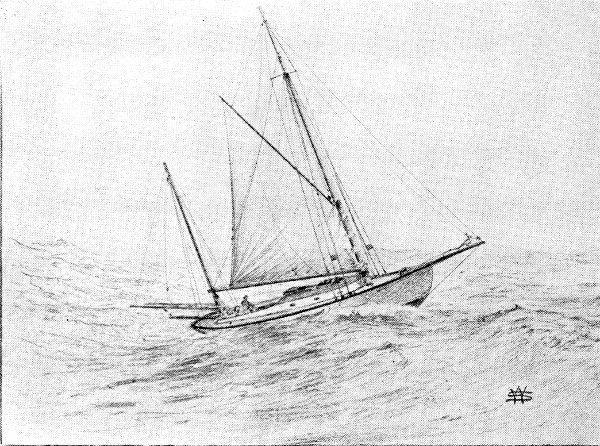
HOVE TO.
Leaky decks are difficult to make tight, and are the
worst possible nuisance. Wooden decks on small sail-boats
cannot be kept tight, unless they are covered with
canvas and kept well-painted. Wherever the canvas is
pierced, be careful to see that the cloth is carried well up
and closely tacked to the object that goes through it. If
a bolt or screw for a fairleader or hook passes through
have a wide washer at the base and screw it down hard.
Around the mast at the partners use a coat made of sheet
lead.
A very common place for leaks to develop is in the
rabbet between the garboard and keel, just under the
mast. This is due to the downward thrust and working
of the spar. If a boat persists in leaking there, lengthen
the mast step so as to distribute the strain over a larger
space. Our modern plank-keel boats are liable to develop
cracks in the plank, which will only leak when
underway, and are difficult to discover, as they close up
when the boat is at rest. If the leak is bad it can be
readily found by hauling the boat out, filling her bilge
with water and watching where it drips out.
You can sometimes stop or check a leak by calking
from the inside, if you can get at it; but great care
should be exercised in driving the cotton not to push it
in too hard, as you may drive out what calking is in the
seam, and make the leak worse. Holes, if they can be
got at from the outside, can be covered with sheet lead,
copper, or a piece of rubber boot leg. In an emergency
the same can be used inside to check the flow. Barge men
frequently use horse manure to stop leaks in the seams
when near the water line; they throw it overboard and
let the water draw it into the crevice. I have checked
a leak by running a boat on a bar of soft sand, thus getting
sand in the seam.
If you get a hole in the bottom from striking a rock
or other obstruction, and cannot put the boat ashore on
a safe place, you can check it enough to keep her afloat
by what is called frapping. Take a sail or large piece of
canvas, and fasten a line to each of the four corners, then
on the inside of the canvas sew a lot of oakum or cotton
so as to make a wad big enough to completely cover the
hole and a large space around it. Pass two of the lines
under the boat and bring them up on the side opposite
to the one the leak is on; keep the other two on the side
the leak is. Work the canvas along until it covers the
hole, and then haul all the lines taut, and make fast, the
pressure will force the wadding into the hole and check
the inflow of water until you can lay the boat ashore.
If you get a bad leak in the scupper pipe, and cannot
get at it from the inside, the following method is a quick
and sure way of stopping the inflow of water: Cut a
round disk of wood about five times bigger across than
the outside opening of the pipe. Bore a hole in the
middle of this disk just small enough to pass a strong
cord through and knot. Then on inside of the disk
fasten a good big wad of cotton batting, or oakum; this
you can do with tacks, thread or glue. I have used thick
paint and cotton wadding pulled out of an old quilt.
When the disk is ready, take another line and weight it
with a sinker, drop it down the scupper pipe until it hangs
outside, then fish it up with a boat hook and bring the
end on board. Marry the end of this cord to the cord
attached to the disk. Then haul the cord in through the
pipe until the disk comes up against and closes the scupper
hole. By taking a stick and making a windlass of it
you can roll the cord up tightly and secure the disk so
it will not slip.
The lookout should examine the side lights, at least
every half hour, and report to the man aft in command
their condition. He should also see that the set of the
headsails do not cover the lee light. If so, be prepared
to show it clear if a vessel approaches on that bow.
The side lights should be kept clean and the lamps
properly trimmed. Use signal oil in them. After lighting
the lamps below place them in the lanterns, and let them
burn for some minutes with the door open. This will
dry out the moisture and allow it to escape. If you don’t
do this, your glass will cloud with watery vapor. The
cause of these lights refusing to burn is generally want
of air, owing to overheating. The gas inside preventing
the fresh oxygen from entering.
If you send a man forward of a rough dark night, put
a light line around him and have it fast aft, or else have
another hand hold it. This should always be done if a
headsail is to be taken in, as more men are lost off the
bowsprit than from any other spar.
Always at night, if sailing in waters frequented by
other vessels, keep a good lookout. If two men are in
the watch, have one forward whenever you get among
other craft, as it is difficult to keep a close watch to leeward
from the cockpit. The helmsman should keep a
lookout to windward and astern.
A watch tackle or Handy Billy is most useful contrivance,
and should have a place on every cruising boat.
It is made of a single and double block, both having
hooks, or else the single having a hook and the double an
eye. For a small yacht, blocks carrying a 15-thread rope
are heavy enough. When stretched to its best there
should be at least 15 feet drift between the blocks. This
tackle saves oceans of labor, and makes the heaviest job
light. If your anchor sticks, Handy Billy will bring him
to terms. If you get aground, he will give a strong pull
on the warp to get you off. If the bobstay breaks, or a
shroud parts, he will help to keep the mast in while repairs
are being made. You want good, strong blocks, as
there is a tremendous strain when all the beef is on this
tackle. Keep Handy Billy in a safe and easily accessible
place, and he will pay you well for his lodgings.
This is something that many men get sadly mixed on,
and consequently are frequently violating the rules of
the road. A vessel is on the starboard tack when her
boom is on the port side and the wind is blowing on her
starboard side. She is on the port tack when the boom
is on the starboard side and the wind is blowing on her
port side. Not only are there men sailing who in an
emergency cannot tell the port side from the starboard,
but who do not know their right from their left hand.
One day I was watching a sergeant drilling a squad of
recruits. He said to me, “would you believe it, half
these men don’t know their right from their left hand.”
Upon my questioning this, he suddenly commanded them
to raise their right hands, two lifted the right, one the
left, and the other three looked doubtfully at both for
some seconds before raising the right one up. You can
always know when you are on the starboard tack in this
way: Standing at the helm and facing forward, if your
right hand is on the side from which the wind is blowing
you are on the starboard tack. When I was a boy, and
even to-day in an emergency, I always tell my right hand
by thinking which hand I would throw a stone with.
When a vessel is sailing off the wind the tack is determined
by the position of the main boom. For instance,
if a schooner or yawl is running wing-a-wing with the
main boom off on the port side she is on the starboard
tack.
A sailing vessel has the right of way over all steam
or power vessels, except when she is the overtaking craft;
then she must keep out of the way of the vessel overtaken.
A “steam vessel” in the eyes of the law is any
vessel driven by machinery, no matter of what kind or
sort, and includes all gasolene, kerosene and electric
boats. An auxiliary, if using her engine, is a steam
vessel, and must keep clear of sailing craft, no matter
whether she has sail set or not. Sailing craft must keep
clear of rowboats.
When taking a swig on a tackle, in order to get a sail
up, especially on the lee side, if the boat is heeling be
careful to get a firm brace of your body or a good leg
hold. Sometimes the pin will fly out, or your turn on the
cleat slip, and you are liable to go overboard backwards.
The best way is to have the different sets of points
made of different kinds of line. Use cotton for the first
and manila for the second. Then when tying in, especially
in the dark, you will be sure to get the right ends
knotted together.
The hauling part of the peak halyards is usually
brought down and belayed on the starboard side of the
mast. I bring mine down on the port side, for this simple
reason: The terms peak and port begin with the same
letter, and thus it is easy for a green hand to find the
right rope. Frequently a trained hand in a moment of
excitement will let go the wrong halyard, but by remembering
the letter P you are less likely to make the mistake.
If you are to command, show yourself a leader, not
by talk, but by action. Always be first in everything that
requires skill or courage. Thus you will win your crew’s
respect, and if they respect you they will obey you.
Never send a man to do a task you fear to do yourself.
If there is any danger, lead, and your men will follow;
but you cannot expect men to risk their limbs or lives
to save your vessel if you shrink from the position who
have the most at jeopardy. Don’t put all the hard work
on the crew; do your share of it; also the dirty jobs. If
you are working watch and watch, be sure to be the first
on deck when your watch is called, and don’t leave it,
unless you are sure that the yacht is in safe hands and
that your care and skill is not needed.
It is your duty as skipper to know and see everything
that goes on. If you order the lead to be hove see that
it is. See that the lights are attended to and ready. See
that the course is being properly steered. Before turning
in at night inspect your riding gear, likewise when coming
to an anchor. Don’t trust to a report, go and look
at it. See that the pump is used and the vessel kept
clear of water. Make a practice of doing these things
until they become a habit.
If you have a second in command, and he is a man
who understands his work, if you place him in charge
of the deck don’t be constantly interfering with him. If
he is not competent to take charge of the yacht, he has
no business to be where he is. If you put confidence in
a man, and he is worthy of it, it will strengthen him and
enable him to do better work all along the line.
My standing order, and one that I always enforce, is
this: When in charge of the boat no reefs are to be
shaken out or extra sail made without my order; but
sail can be taken in or reefed at any time without waiting
to call me.
In order to insure safety, comfort and good work, you
must enforce a certain amount of discipline upon your
crew. You can only do this by showing that you are
amenable to it. You cannot expect men who are sailing
with you for pleasure to obey orders or respect rules
if you do not obey and respect them yourself. This is the
prime fault with many young skippers. If you shape
your own conduct according to your rules you will find
that your crew, if they are any good, will do likewise.
But do not make foolish rules or issue unnecessary
orders; the less you restrict and domineer the better you
will get along with your hands.
Sails are most often torn or split through carelessness
in tieing in the points when reefing, or not untieing when
shaking out. The first man will tie his points hard, the
second slack, consequently bringing undue strain on one
cloth. All the points should be tied with as nearly equal
strain as possible. Another cause is allowing sails to fall
and lie over pointed things, like oarlocks, anchor stocks
and belaying pins. Somebody steps or hauls on the sail
and the point goes through.
If you have a sister, or know somebody else’s sister,
get her to show you how they herringbone or darn a
rent, such as they frequently have in their clothes. This
knowledge will enable you to mend a rent in your sail,
and perhaps save the canvas from being torn to pieces.
A small hole in a sail can be temporarily mended with
court plaster. If the sail rends and starts to split up the
cloth put in a safety pin at top and bottom of tear until
you can get at it with a needle. Always carry a spare
yard or two of canvas when cruising, as it will frequently
come in handy for mending and other purposes.
Every young yachtsman should learn to make the simple
knots and splices. Nothing looks worse than to see
on a boat a lot of rigging that is knotted or fastened together
in a lubberly fashion. There is no need of learning
the fancy knots, unless you want to, but you should
know how to make the following knots, etc.:
- Square or reef knot,
- Figure eight,
- Overhand,
- Fisherman’s bend,
- Carrick bend,
- Clove hitch,
- Half and whole hitch,
- Bowline,
- Bowline-on-a-bight,
- Sheet-bend,
- Rolling hitch,
- Wall and crown,
- Sheep-shank,
- Short splice,
- Sailmaker’s splice,
- Cut splice,
- Eye splice,
- Whipping, common,
- Whipping, Spanish,
- Serving,
- Mousing,
- Plain, stitching,
- Herringboning.
A boat’s deck and cockpit should be thoroughly washed
at least once a day. Nothing looks worse than a dirty
deck. Wooden decks should be washed before the heat
of the day gets on them: Canvas decks can be scrubbed
at any time. If on salt water, always take advantage of
a rain and give your decks a good hard scrubbing to
get the salt off. If you have a crew, teach them to wash
down the first thing every morning, and see that they
do it
The first lesson to learn on a yacht, and the first to
teach your crew, is that there is a place for everything,
and that everything must be kept in its place. If they
take anything out to use make them put it back at once
in its place just as soon as they are done with it. Make
every man keep his berth tidy, his clothes put away, and
his bedding properly aired and folded. Teach them not
to throw cigarette butts, tobacco and match sticks on the
floor, and to spit overboard and not on the deck or in
the cockpit. Don’t leave dirty dishes about. Keep your
cabin just as tidy as you do your deck.
Every yacht should carry a simple kit of tools with
them. You can always make temporary repairs, and
sometimes save yourself expense, worry and toil. Have
a box for them where they can be easily got at. You
don’t want fine tools, as they will soon be ruined by the
dampness. The following is a list of what is necessary
for a cruising boat:
- Hatchet,
- Monkey wrench,
- Small saw,
- Cold chisel,
- Brace and bits,
- Screw driver,
- Marline spike,
- Small vice,
- Wire nippers,
- Grommet set,
- Sail needle,
- Sail hook,
- Twine,
- Wax,
- Fid,
- Piece of sheet copper,
- Piece of sheet lead,
- Piece of sheet rubber,
- Copper tacks,
- Screws,
- Nails,
- Some galv. iron rod,
- Wire,
- Screw eyes.
Don’t have more than two or three sizes of rope in
your rig, if you can help it, and carry a spare coil of a
few fathoms of each. Also, have spare fittings, so if
anything carries away you can replace it. Here is a
short list:
- Blocks,
- Shackles,
- Pins for same,
- Cleats,
- Rope,
- Marline,
- Hambroline,
- Canvas,
- Lacing,
- Paint,
- Varnish.
Every yacht, no matter of what size, should have a
good pump fitted to draw from the lowest part of the
bilge. If a full-decked cabin boat, have the pump put in
through the deck, and not through the cockpit floor.
Builders like to put it in the latter place, as the work is
easier. In consequence of its being there the dirty water
is pumped into the pit and makes it wet and nasty. In
an open centerboard boat put the pump at the after end
of the trunk and pump into it. Keep the pump well
clean. If you do not use the pump daily, to keep the
leather on the sucker in good condition wrap it about
with an oiled rag. A small portable pump is very useful
to completely dry out the bilges.
If the boat has a leak, make it a practice to try the
pump every morning before washing down. Keep the
water out of her, so that when she heels down it won’t
run up into the lockers and wet things. A good knockdown
will distribute a few buckets of bilge water around
a cabin in a way to make things damp for weeks to come.
If you use inside ballast of any kind do not lump it in
heaps along the keel; spread it out as much as possible
over the bottom. It should be spaced in the middle half
of the boat, leaving the ends empty. No rule can be laid
down for placing weight in a boat; you must experiment
and find out how much and where to put it. Remember,
that too much ballast is as bad as too little.
Inside ballast is either lead, iron or stone. There is
no question but what stone is the best ballast, so far as
the effect is concerned, and lead the worst. Lead has the
advantage of being always worth its money, second-hand
lead bringing nearly the same price as new. Old iron is
of little or no value. Lead stows snugly and is clean.
Iron is very dirty, and the rust from it is a nuisance.
The disadvantage of stone is that you cannot secure it.
Inside ballast should be secured so as not to shift in case
the vessel gets on her side. Heavy ballast should rest
on the frame and not on the plank.
The cause of many yachts smelling below is dirty
bilges. They are never properly cleaned from one season
to the other. Before putting the yacht in commission
the bilges should be thoroughly searched, cleaned and
washed out, all the limbers poked open so as to allow the
water to flow to the pump well. If the boat does not leak
enough to keep her bilges sweet, water should be poured
in at least once a week and pumped out again. Don’t
sweep dirt or other rubbish into the bilge; it is liable to
get into the pump and choke it.
To make the joints of pipes carrying gasolene or kerosene
tight use common yellow soap. These pipes if used
to carry either of these fluids to a stove should be frequently
examined, so as to prevent leakage. If gasolene
leaks into the bilge, flood it with water and pump out
before making any light below decks.
Keep your lead line where it can be instantly laid
hands upon. For a small boat a five-fathom line is long
enough, with an extra five that can be bent on in case of
need. A three-pound lead is plenty heavy enough.
Always keep about your person a sharp knife, so that
you can get hold of it without delay. Many a man has
lost his life for want of a knife. It is best when cruising
to carry a sheath knife, as they are handiest.
Always carry a large oar on deck and a pair of spare
ones for the dingey stowed below. It is also well to have
at least two pair of spare oarlocks on board.
Take some 6, 9 and 12-thread manila rope and cut it
into 3, 5 and 8-foot lengths. Put an eye-splice in one
end of each length and whip the other end. These short
pieces are always of the greatest use, and will save much
time and trouble. They can be employed for many purposes,
and are especially handy for gasketing sails.
Standing-by:
It is the duty, and should be the pleasure, of every
yachtsman to stand-by another yacht when in distress,
or in need of any sort of help. It is always best if you see
a boat in a predicament to stand-down to her and offer
your services, even if they are not needed; it will generally
be appreciated as an act of courtesy and good will.
And all yachtsmen should receive such offers in the
spirit in which they are advanced, and not as some do,
if they do not need assistance, give a jeering or discourteous
reply. I have been fairly insulted several times
by skippers because I have offered my aid to get them
out of a predicament, my advances being considered to
be a reflection on their skill and ability. Power-boat
skippers can do much to make yachting pleasant, by
offering a tow to becalmed sail-craft men. The little
attentions do much to establish a feeling of perfect comradeship
that is so essential to the making of a sport.

 ON