FROM THE NINTH EDITION EDITED FOR THE Council of the Royal Geographical Society BY
E. A. REEVES, F.R.A.S., F.R.G.S. Map Curator and Instructor in Surveying to the Royal
Geographical Society.
Vol. II.
METEOROLOGY, PHOTOGRAPHY, GEOLOGY, NATURAL
HISTORY, ANTHROPOLOGY, INDUSTRY AND
COMMERCE, ARCHÆOLOGY, MEDICAL, ETC.
LONDON
THE ROYAL GEOGRAPHICAL SOCIETY
KENSINGTON GORE, S.W. 7 AND AT ALL BOOKSELLERS
1921
Price of the two Volumes, 21s. net.
To Fellows, at the Office of the Society, 15s. net.
LONDON:
PRINTED BY WILLIAM CLOWES AND SONS, LIMITED,
DUKE STREET, STAMFORD STREET, S.E. 1, AND GREAT WINDMILL STREET, W. 1.
PREFACE TO VOL. II.
The first seven sections of this volume have been carefully revised,
but required no serious alteration. The eighth section required very
extensive changes and additions, due to the great progress of Tropical
Medicine in the last fourteen years. The Society is much indebted to
Dr. Andrew Balfour, C.B., C.M.G., Director-in-Chief of the Wellcome
Bureau of Scientific Research, who has very kindly revised and extended
the Medical Hints in the light of his wide experience in the Sudan
and in the East during the War.
In the instructions for the use of drugs the word “tablet” has been
used to denote products compressed in the form usually described by a
proprietary word that belongs in law only to the products of a particular
firm.
A. R. H.
CONTENTS.
PAGE
SECTION I.
Meteorology and Climatology
(by Hugh Robert Mill, D.SC.,
LL.D., F.R.S.E.,
formerly President Royal Meteorological Society and Director British
Rainfall Organization)
General Remarks, 1—A Record of Weather, 2—Non-Instrumental
Observations, 3—Instrumental Observations, 11—Observations
for Forecasting the Weather, 32—Extra-European Weather Services,
42—Table of Relative Humidity, 44—Table showing Pressure
of Saturated Aqueous Vapour in Inches of Mercury at
Lat. 45° for each degree Fahr. from -30° to 119°, 50—Isothermal,
Isobaric, and Rainfall Maps, 50.
SECTION II.
Photography (by J. Thomson, formerly
Instructor in Photography, R.G.S.
Revised by the late J. McIntosh, Secretary Royal Photographic
Society of Great Britain)
The Camera, 51—Selecting a Camera, 51—The Hand Camera, 52—Camera
Stand, 54—Lenses, 54—Exposure Tables, 56—Sensitive
Plates or Films, 57—How to keep Plates and Films Dry, 58—Apparatus
and Chemicals for Development, 58—Photography in
Natural Colours, 61.
SECTION III.
Geology (by the late W. T.
Blanford, F.R.S. Revised by
Prof. E. J. Garwood, F.R.S.)
General Remarks, 63—Outfit, 64—Collections, 65—Mountain
Chains, 70—Coasts, 71—Rivers and River-Plains, 72—Lakes and
Tarns, 73—Evidence of Glacial Action, 74—Deserts, 75—Early
History of Man in Tropical Climates, 76—Permanence of Ocean
Basins, 76—Atolls or Coral-Islands, 77.
Memorandum on Glacier Observations.
(Revised by Alan G. Ogilvie)
Outfit, 82—Where and What to Collect, 89—Mammals and Birds,
91—Preserving Mammals, &c., in Alcohol, 92—Preparation of
Skeletons of Animals, 94—Reptiles and Fishes, 96—Land and
Freshwater Mollusca, 97—Insects, 99—Botanical Collecting, 99—Fossils,
104—General Remarks, 104—Observations of Habits,
&c., 104.
SECTION V.
Anthropology (by the late E. B. Tylor,
D.C.L., F.R.S.)
General Remarks, 138—Minerals and Metals, 140—Vegetable Products,
141—Agriculture, 143—Animal Products, 144—Trade,
144—Climate, 145—Facilities and Hindrances to Commercial
Development, 146.
Introduction, 160—General Hints, 168—Diseases and their
Prevention and Treatment, 169—Medicines, Medical Appliances,
&c., 252—Treatment of Wounds and Injuries, 275.
HINTS TO TRAVELLERS. VOL. II. — I. METEOROLOGY AND CLIMATOLOGY. — Non-Instrumental Observations. — Instrumental Observations.
By Hugh Robert Mill, D.SC, LL.D., F.R.S.E.,
Formerly President Royal Meteorological Society, and Director
of the British Rainfall Organization.
The nature of the meteorological observations made by a traveller or
by a resident in regions where there is no organised meteorological
service will necessarily depend on the object which he has in view, the
time he is able to devote to meteorological work, his knowledge of
meteorology as a science, and his interest in it.
Of the many ways in which a traveller may add to the knowledge of
atmospheric conditions, five may be specially mentioned:—
1. A record of the weather, observed day by day with regard both to
non-instrumental observations and the readings of instruments.
This may be taken as the minimum incumbent on all travellers.
2. Observations for forecasting the weather and obtaining warning of
storms. This is sometimes of vital importance; it is always
valuable at the time, and occasionally the results are worth
recording. It may, however be looked upon as a practical application
of the systematic observations.
3. Observations with a view to determining the character of the local
climate. The traveller passing through a country can do little in
this way, as long continued uniform observations in one place are
necessary to fix the annual variations. Still, the recording of such
data as may be obtained is always important in a little-known
region, and the work of several travellers at different seasons will
allow some fair deductions to be drawn. When a day is spent
in camp, much importance attaches to regular observations made
every two hours, from which the diurnal changes of climate may
be ascertained.
4. Special meteorological researches. These usually demand special
instruments and skilled observers. Observations in the upper air
by kites or balloons in particular, must be an end in themselves.
Exact measures of radiation in deserts, of rainfall in forests and
on adjacent open ground, of temperature during land and sea
breezes, or of fogs, thunderstorms, tornadoes, etc., in places
subject to those visitations, are always of value. As a rule,
however, the traveller cannot devote much time to these matters,
unless the study of physical geography is the object of his journey.
5. The collection of existing meteorological records. It sometimes
happens that at outlying stations meteorological observations have
been taken and recorded for a considerable time. If they have not
been already communicated to some meteorological centre, the
traveller should obtain a copy of them, and also compare the instruments
in use with his own. He might in some cases aid in
securing a knowledge of local climate by inducing residents at
outlying stations to start regular observations.
The first two ways of advancing meteorology need alone be considered
in detail; but with regard to all, it must be clearly understood
that the value of the work is greater the more carefully the observations
are made and recorded, and the more remote and less known the
region.
1. A Record of Weather.—The traveller who makes his journey
for any other purpose than the study of physical geography would be
wise to burden himself as little as possible with instruments, but to
understand thoroughly and use faithfully the few he carries. In a rapid
march many different climates may be traversed in a few weeks, and the
records of variation of weather so obtained could not have much value;
but when a halt of a few days or of a week or two is made, systematic
observations become valuable.
The first place must be given to non-instrumental observations, which
may be made at any time on the march or in camp, and should always be
noted at the time they are made in the rough note-book, and copied
carefully into the journal each evening. These observations in the
rough note-book will necessarily be mixed up with others on various
subjects; but the meteorological facts should have a place reserved for
themselves in the journal, say at the end of each day’s work.
Wind.—Observations of the direction and force of the wind at several
fixed hours in the day are advisable for comparison with instrumental
readings; but on the march every decided change should be
recorded if the nature of the country permits. In the depths of a forest,
or in a narrow valley, the wind, if felt at all by the traveller, gives
scarcely any clue to the movement of the air over the open country, but
in most cases the movements of low clouds, when any are in sight, may
be taken as a fairly satisfactory test. The direction is to be observed by
means of the compass, and it will be sufficient to estimate it by the
eight principal points—North, North-east, East, South-east, South,
South-west, West, and North-west. Any sudden changes in direction
so pronounced as to be noticeable should be recorded, for, taken in
conjunction with the barometer readings, if the journey is along a
route of nearly constant level, they are valuable aids in predicting the
weather. In some places the direction of the wind undergoes a well-marked
regular diurnal change in perfectly settled weather.
Wind is always named by the direction from which it blows. The
force of the wind is best estimated on the scale Calm, Light, Moderate,
Fresh, Strong, and Gale. It is impossible, without long experience and
the tuition of a trained observer, to assign relative numbers to these
forces which should have any permanent value for comparison with the
observations of others. Travelling on foot in a strong wind is always
uncomfortable, and in a gale very difficult. If it is impossible to make
way against the wind at all, or to pitch tents, the force may be put down
as Hurricane after it has passed, the traveller bearing in mind that if he
can write in his note-book at all, while unsheltered, a hurricane is not
blowing. If a lake or a river without appreciable current is in sight, wind
just sufficient to produce white crests on the waves may be called fresh,
and that sufficient to blow away spray from the crests deserves to be
termed strong. At sea, in a sailing-vessel, it is possible to acquire great
skill in estimating wind-force; hence Beaufort’s scale, originally devised
with reference to the amount of sail a well-equipped frigate could carry,
has come into extensive use, and it is as well to know it. By comparison
with anemometers, the approximate velocity in miles per hour corresponding
to the numbers on the scale has been estimated:—
The duration of strong wind should be noted, as well as the time of
any marked change of strength. The land and sea winds of tropical
coasts show a well-marked relation to the position of the sun and the
hour of sunset, and in places where these winds blow the hours of calm
and change should be noted. On mountain slopes a similar diurnal effect
may be noticed; the wind usually blows uphill during the day and downhill
at night, while in valleys it usually blows either with or against
the direction of the river. Local winds of peculiar character are sometimes
met with in association with mountains such as the Föhn of the
Alps, the Chinook wind of the Rocky Mountains, and the Helm wind of
the Eden Valley in England and Adam’s Peak in Ceylon.
Whirlwinds and tornadoes are rare phenomena, but if met with, it is
worth while to take some trouble to put on record at least the hour of
their appearance (local time), the direction in which the whirl moves
onward, and the breadth of the path of destruction it leaves behind.
When a storm of wind has passed over a wooded region and blown down
many trees, the direction in which most of the trunks lie is worth
observing. The top of the tree usually falls in the direction in which
the wind was blowing, hence the root usually points to the direction of
the wind. Waterspouts are closely allied to whirlwinds, and in any of
those phenomena of revolving columns of air it is of much theoretical
importance to determine the direction of the whirl about the axis, i.e.,
whether the rotation is in the direction of the hands of a watch or the
opposite. The prevailing wind of a district may often be discovered by
the slope of trees growing on open ground, or still better, by the difference
in the degree of wave erosion on small lakes. If the banks are of the
same material all round, the side against which the prevailing wind
drives the waves will always be the most worn away.
Cloud and Sunshine.—It would be impossible to keep a record of the
countless changes in the cloud-covering of an English sky, but in many
parts of the world the absence or presence of cloud is a function of latitude,
altitude, and season, of great stability, and worthy of being attentively
studied. The amount of cloud is usually estimated as the number
of tenths of the sky covered; but it is a very difficult thing indeed to
compare a tenth of the visible sky near the horizon with a tenth near the
zenith. There is no difficulty, however, in observing when the sky is
completely overcast or quite free of cloud, and as a matter of convenience
the belt round the horizon to the height of thirty degrees may be neglected,
i.e., the lower third of the distance from the horizon to the zenith. Very
often it will be found that clouds form and disappear at certain hours of the
morning or evening, and it is useful to get exact information on the subject.
Of more importance than the amount of cloud is its nature, elevation,
and movement. Distinct species of cloud have been recognised for a
long time, and from more recent studies it would appear that they owe
their distinctive appearance to the altitude at which they float in the air.
Meteorologists distinguish a number of classes and transitional forms of
cloud; it is enough for the traveller to be able to recognise the most definite
types, viz., Cirrus, Cumulus, Stratus, and Nimbus. Cirrus clouds are
the small tufts or wisps of cloud which float very high in the atmosphere,
and to which the popular name of “mare’s tails” is applied. The
transitional form, Cirro-Cumulus, popularly known as “mackerel scales”
or “mackerel sky,” is equally easy to identify. Cumulus clouds are
great woolly-looking heaps of cloud, the lower surface of which is often
nearly horizontal, while above they well into an exuberant variety of
rounded forms. They represent the condensation of moisture in ascending
columns of heated air. Stratus clouds are low-lying sheets of condensed
moisture, which, being usually seen at a low angle, appear like thin
layers parallel to the horizon. The transitional type Cirro-Stratus is
usually seen in the form of great feather-like clouds stretching across
nearly the whole sky. Nimbus is a rather low-lying cloud from which
rain is falling even if the rain is re-evaporated before reaching the
ground. The lowest clouds of all, those resting on the surface of the
ground and enveloping the observer, are called mist and fog. The two
are distinguished by the fact that a mist wets objects immersed in it,
while a fog does not. All clouds, except Cirrus, are physically the same,
consisting of minute globules of liquid water falling through a portion
of air saturated with moisture. The globules being small offer a
relatively great surface to friction, and so fall very slowly, and in the
higher clouds they evaporate on the lower surface before they have
time to agglomerate into raindrops. In the highest of all clouds,
the cirrus type, the particles are spicules of ice and not globules of
water. It is a common error to suppose that black clouds differ from
white clouds. All clouds are white when they reflect the light of the
sun, and all are black when they come between the eye and the sun
in sufficient thickness to cut off a considerable portion of its light.
The sudden appearance of a particular kind of cloud is important as
a weather sign. It shows that changes are going on in the vertical
circulation of the atmosphere. Hence if cirrus or cumulus cloud should
be observed to be increasing the fact should be noted, and the direction
in which the clouds are moving should be noted also.
In observing cloud-motion attention should be given only to the sky
overhead; at any lower angle the parallax due to viewing the clouds
obliquely deprives the observation of value. It is also necessary to
distinguish between the movement of the upper and of the lower clouds,
as these are floating in very different parts of the atmosphere. It is
comparatively rarely that the motion, say of nimbus and cirrus, is in the
same direction. On a lofty mountain, strata of cloud which from below
were seen to be cumulus may be passed through as layers of mist, and
on emerging from them their upper surface may be seen below one. In
many mountains the cloud-belt is as sharply defined as the snow-line,
and its variations should be carefully observed.
Clouds should occasionally be photographed as a record. This should
be done especially when a type of cloud comes to be recognised as a
usual one, for while exceptional forms may prove interesting, a record of
the usual forms is certain to be valuable. In this connection a protest
may be made against the horrible custom of some amateur and of many
professional photographers of printing in clouds from some stock negative
in their pictures of scenery. The cloud is an essential part of a picture,
and it is better to leave an over-exposed sky of natural cloud than to
insert a beautiful representation of a cloud-form which may be one never
visible in the particular place or at the particular season.
Mist, Fog and Haze.—Mist or fog at low levels will of course be recorded
whenever observed, and its density and duration noted. A good way to
define the density of thick fog is to measure the number of yards at which
an object becomes indistinguishable, and the most convenient object for
the purpose is a person. Light mists lie over water or marshes at
certain hours in particular seasons, and their behaviour should always
be observed. It often happens that the distant view from a height is
obscured by a haze not due to moisture, and this appearance should be
noticed with a view to discovering its cause. The smoke from forest or
prairie fires in Canada sometimes produces so thick a haze as to put a
stop to surveying operations for weeks at a time. Haze is often due to
dust blown from deserts, or ejected from volcanoes, and sometimes to
swarms of insects.
Rain and Dew.—The journals of most travellers fail to give a clear
idea of the prevalence of rain during their journeys, and it is much
to be desired that something more explicit than “a showery day” or
“fairly dry” should be recorded. The hour of commencement and
cessation of rain during a march should be noted, and some indication
given as to whether the rain fell heavily or lightly. In this way any
tendency to a diurnal periodicity of rain would be detected, and some
definite meaning would be given to the terms rainy season and dry
season. If rain occurs during the night it should also be recorded, and
the amount of night rains should always be measured by means of a
rain gauge in the manner to be described later.
The general condition of a country with regard to rain may often be
judged from the appearance of vegetation or the marks of former levels
of high-water in lakes or rivers. Thus on mountain slopes or the sides
of a valley any difference in the luxuriance of vegetation according to
exposure probably indicates the influence of rainfall as guided by the
prevailing wind. So, too, the appearance of lines of drifted débris on
the banks some distance from the edge of a lake or river may be taken
as indications of the height to which the waters sometimes rise; and conversely
the appearance of rows of trees in the middle of a wide shallow lake
may indicate the line of a river which has temporarily flooded the surrounding
meadows. Such observations have an important bearing on climate.
The appearance and amount of dew are also to be recorded. The most
important points to notice are the hour in the evening when the deposit
commences, and the hour in the morning when the dew disappears. It
should be noted also whether the deposit of dew is in the form of small
globules standing apart on exposed surfaces, or if it is heavy enough
to run together into drops and drip from vegetation to the ground.
Thunderstorms and Hail.—The occurrence of thunderstorms should of
course be noted, and here the hour of occurrence is of very great importance,
for thunderstorms frequently show a marked diurnal period.
The appearance of lightning without thunder should be recorded when
it is observed, but this will naturally be almost always after sunset.
Hailstorms usually accompany thunderstorms, and sometimes take the
place of them. The occurrence of hail is most frequent in summer, and
records of the size of hailstones are important. If possible they should,
when very large, be photographed along with some object of known size,
and their structure described. It might at least be noticed whether they
are hard and clear, like pure ice, or opaque like compacted snow, or
made up of concentric layers of clear and opaque ice alternately.
Snow.—Snow falls in all parts of the world, although in tropical or
sub-tropical latitudes only at great elevations above sea-level. The
actual limits of snowfall at sea-level are as yet imperfectly known, and
any observations of snow showers in the neighbourhood of the tropics
are of importance. It is essential in such a case to record also the
approximate elevation of the land. On mountains in all latitudes the
position of the snow-line should be noted at every opportunity. This
is the line above which snow lies permanently all the year round, or
below which snow completely melts in summer; and it is a climatic
factor of some importance. It may be remarked, for instance, that
if the traveller finds snow lying on grass, moss, or other vegetation, he
is certainly not above the snow-line. It is necessary also to notice that
glaciers may descend unmelted a long distance below the level of perpetual
snow. While the conditions of snow lying on the ground in the
Arctic regions and above the snow-line in any part of the world are
matters pertaining more to geology and mountaineering than to meteorology,
the duration of snow-showers, the character of the snow, and the
depth to which it lies on ground below the snow-line are too important
from their bearing on climatology to be overlooked.
The character of the snow as it falls varies from the sleety, half-melted
drops common in warm air to the fine dust of hard, separate ice-crystals
found in the intense cold of a Polar or Continental winter. The
feathery appearance of lightly-felted flakes is an intermediate type
between the two extremes. In measuring the depth of snow as it lies,
care should be taken to select open ground where there is no drifting,
and when the snow is not too deep the measurement can usually be best
made with a walking-stick on which a scale of feet and inches (or of centimetres)
has been cut. Such a stick is useful for measuring the depth of
shallow streams, and for many other purposes. The result should be
entered as “depth of fallen snow,” so that there may be no risk of confusing
the figures with the amount of snowfall estimated as rain.
Speaking roughly, a foot of snow is usually held to represent an inch of
rain. A violent storm of wind, accompanied with falling or driving
snow, is termed a blizzard in the western United States, and a buran in
Siberia. The name blizzard has been naturalized in the Antarctic, but it
is not known that this phenomenon is identical with the American storm.
Frost.—The appearance of frost in the form of hoar-frost (the way in
which atmospheric water-vapour is deposited in air below the freezing-point),
or of thin ice formed on exposed water, should always be carefully
looked for and noted. In hot, dry countries the intense radiation from
the ground at night often reduces the temperature below the freezing-point,
although, during the day, the ground may be very hot. The appearance
of frost at sunrise is a valuable check on the readings of a minimum
thermometer, and in most cases is a more trustworthy datum. Similarly
in cold countries, where snow is lying on the ground or ice covering the
rivers, the appearance of thaw, especially in cloudy weather, is a delicate
test of the rise of the air temperature to the freezing-point. The traveller
should never fail to record cases of melting and solidifying of any substances
due to changes of temperature. The softening of candles and the
freezing of mercury or of spirits give information regarding temperature
at least as valuable as the readings of thermometers.
Other Observations.—Any peculiar atmospheric phenomena, such as the
appearance of the zodiacal light after sunset, the aurora, the electrical
lights seen on pointed objects, and known as St. Elmo’s fire, rainbows,
especially lunar rainbows, haloes, the appearance of mock-suns or moons,
meteors or shooting stars, should be noted on their occurrence, as many
of them are valuable weather prognostics. Attention should also be
given to any appearances of mirage, or other effects of irregular distribution
of atmospheric density. A mirage is only rarely so perfect as to
show ships inverted in the air, palm-grown islands in the sea, or distant
oases in the desert. The common form is an unusual intensification of
refraction, raising land below the horizon into sight, or apparently
cutting off the edges of headlands or islands at sea or on large lakes.
It is worth while observing the temperature of the air and of the water
or ground when an unusually clear mirage effect is visible.
Another interesting series of observations may be made on the colours
of the sky and clouds at sunrise and sunset. A phenomenon often
observed at sunset, but the existence of which is still sometimes denied,
should be looked for. This is the appearance of a gleam of coloured light
at the moment when the upper edge of the sun dips below a cloudless
horizon. A note should be made of the nature of the horizon, whether
land or sea, and of the colour of the light if it should be observed. When
opportunity offers, the first ray of the rising sun might be similarly
observed.
The traveller should, at the end of each day, give his opinion of the
nature of the weather, saying whether he felt it hot or cold, relaxing or
bracing, close or fresh. Such observations have no necessary relation to
degree of temperature or humidity as recorded by instruments; but the
human body is the most important of all instruments, and everything
which affects it should be studied. By paying attention to the foregoing
instructions, an observant traveller will bring home a far better meteorological
log without instruments than a more careless person could
produce by the diligent reading of many scales. Yet, in enforcing the
importance of non-instrumental observations, we must not leave the
impression that the readings of instruments are of little value. It is, in
ordinary circumstances, only by the readings of instruments that the
climate of one place can be compared with that of another, and only the
best results of instrumental work are precise enough to form a basis for
climatological maps.
The minimum requirement of instrumental observations by a traveller
is the reading twice daily of the barometer and of the dry and wet bulb
thermometers, to ascertain the temperature and humidity of the air,
also the reading once daily, in the morning, of the minimum thermometer
which has been exposed all night, and on days in camp of the maximum
thermometer also. It is very desirable to expose a rain gauge whenever
it is practicable to do so. Unless special meteorological researches are
to be carried out, nothing farther in the way of observations need be
attempted. A very useful supplement to the necessary observations is
the use of a self-recording barograph or thermograph; but these
are delicate instruments, liable to get out of order unless very
carefully handled, and it will not always be possible to make use of
them.
The observer must understand what his instruments are intended to
measure, how they act, and how they should be exposed, read, and the
reading recorded. He must know enough about all these things to be
able to dispense with unnecessary precautions only possible at fixed
observatories, and, at the same time, to neglect nothing that is necessary
to secure accuracy in the results.
Thermometer Corrections.—All thermometers, without exception,
should have the degree marks engraved on the stem, or on a slip
of enamel within the outer tube, and be supplied with a certificate
from the National Physical Laboratory showing the error of the scale at
different points. This certificate should be in duplicate, and a copy
ought to be left in a safe place at home. After a long journey the
thermometers which have been in use should be sent to have their
errors re-determined. The corrections are not, however, to be applied by
the observer unless he is working out his observations for some special
purpose. No thermometer is passed at the National Physical Laboratory
if its error approaches one degree, so that for all ordinary purposes
of description a certificated thermometer may be looked on as
correct. But when the readings are being critically discussed and
compared with the observations of other people, the correction is of the
greatest importance. It cannot be too strongly impressed upon an
observer that, in reading meteorological instruments, he must read
exactly what they mark, and record that figure in his observation-book
on the spot. The corrections can be applied afterwards by the specialist
who discusses the work. For subsequent reference it is necessary to note
in the observation-book the registered N.P.L. number of the thermometer
in use, and if a thermometer should get broken and another be
used instead, the number of the new instrument must be noted at
the date where it is first employed. Care should be taken to use
the same thermometer for one purpose all the time if possible, and
only an accident to the instrument should necessitate a change being
made.
Thermometers are either direct-reading or self-registering. The
former are used for obtaining the temperature at any given moment,
the latter for ascertaining the highest or the lowest temperature
in a certain interval of time. They are filled either with
mercury, or a light fluid which freezes less readily, such as alcohol or
creosote.
Thermometer Scales.—The particular system on which the thermometers
are graduated is of no importance, but merely a matter of convenience.
The Fahrenheit scale is used for meteorological purposes in English-speaking
countries; but for all other scientific purposes the Centigrade
scale is used everywhere. One can be translated into the other very
simply by calculation[2]; but it is convenient for a traveller to have all
his thermometers graduated in accordance with one scale only.
The graduation, as marked on the stem of the thermometer, is usually
to single degrees, but anyone can learn to read to tenths of a degree by a
little practice. Care must be taken to have the eye opposite the top of
the mercury column. Suppose it to be between 50 and 51, the exact
number of tenths above 50 is to be estimated thus: If the mercury is
just visible above the degree mark it is 50°.1, if distinctly above the
mark 50°.2, if nearly one-third of the way to the
next mark 50°.3, if almost half-way 50°.4, exactly
half-way 50°.5, a little more than half-way 50°.6,
about two-thirds of the way 50°.7, if nearly up to the
next mark 50°.8, and if just lower than the mark of
51° it is 50°.9. The eye soon becomes accustomed to
estimating these distances.
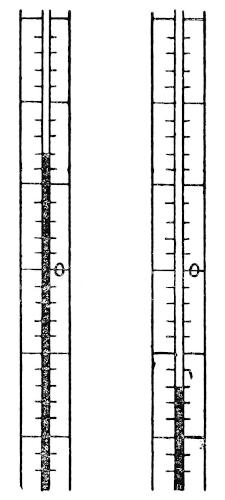
Fig. 1.—Reading
Thermometer Scale above and below Zero.
In using a thermometer below zero, the observer
must pay attention to the change in the direction of
reading the scale, the fractions of a degree counting
downward from the degree mark instead of upward
from it, as in readings above zero. Readings below
the zero of the scale are distinguished in recording
them by prefixing the minus sign. The annexed figure
shows the reading of two thermometers graduated
to fifths of a degree, one showing a temperature of
1°.4, the other of -1°.4. The British Meteorological
Office now recommends the use of the Centigrade thermometer
graduated from the absolute zero, i.e., the
freezing point is shown by 273°, the boiling point as 373°.
Care of Thermometers.—Mercurial thermometers
will always be employed for ordinary purposes in places where the
temperature is not likely to fall to -40°: i.e., everywhere except in
the polar regions and the interior of continents north of 50° N. These
thermometers are very strong and are not easily broken except by
violence. The one vulnerable part is the bulb, which is of thin glass
and filled with heavy mercury. Hence, in carrying thermometers, care
has to be taken to protect the bulb from coming in contact with
any hard object. The best way to carry an unmounted thermometer
is in a closed brass or vulcanite tube with a screw top, the
inside of the tube being lined with india-rubber and provided with a
cushion of cotton-wool for the bulb to rest on. If the thermometer
is mounted in a wooden frame it should be secured in a box so that
the frame is firmly held and the bulb projects into a vacant part of
the box, which may be lightly filled with cotton-wool or provided
with a deep and well-padded recess. Every thermometer which is not
graduated above 120° should have an expansion at the top of the tube
which the mercury that may be driven beyond the scale by over-heating
will not fill; otherwise any accidental over-heating will break the bulb.
The unavoidable shaking or any sudden shock during travelling is apt
to cause the mercury column to separate, and a portion of it may be
driven to the top of the tube, where it may remain unless looked for
and brought back. Hence it is important to see that the top of the
bore of the tube is visible, and not covered by any attachment holding
the tube to a wooden frame. Thermometer readings are absolutely
valueless unless the whole of the mercury fills the bulb and forms a
continuous column in the stem. To bring a broken column together
the best plan is to invert the thermometer, if necessary shaking it
gently, until the mercury flows from the bulb and entirely fills the tube,
leaving a little vacant dimple in the mass of mercury in the bulb.
When this is done, the thermometer should be brought into its normal
position bulb downwards, and the column will usually be found to have
united. If this method does not succeed the thermometer may be held
in the hand by the upper end, raised to the full stretch of the arm, and
swung downwards through a wide arc with a steady sweep. I have
never known this method to fail.
Thermometer Screens.—It is usual at fixed stations to expose the
thermometer to the air by hanging it in a screen made of louvre-boards
so arranged that the air penetrates it freely while the direct rays of the
sun are cut off. The Stevenson screen, constructed on this plan with a
door opening on the side away from the sun, is well adapted for use in
temperate countries; but it is too cumbrous to carry on a journey and
does not afford sufficient ventilation for use in tropical countries. An
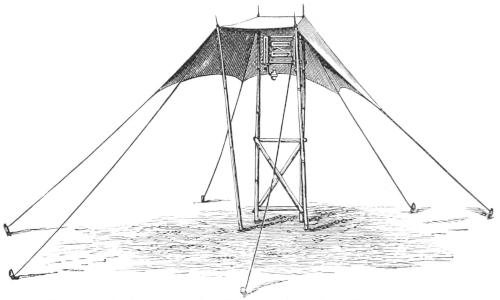
excellent substitute is the canvas screen devised by the late Mr. H. F.
Blanford, which consists of a bamboo frame carrying the thermometers
(with their bulbs four feet from the ground). The whole structure is
five feet high, and is sufficient for any places where the wind is moderate.
It is constructed of bamboos or rods of light wood, cords, and canvas,
which may readily be made up before starting, and it is easily renewed
or repaired. The canvas roof should be triple or quadruple according to
the thickness of the material. Such a screen will afford sufficient protection
at night, or even in the day, if set up in the shade, and it will
throw off rain; but in the sun it will require a thick mat as an additional
protection on or preferably stretched above the roof.
Fig. 2.—Mr. H. F. Blanford’s Portable Thermometer Screen.
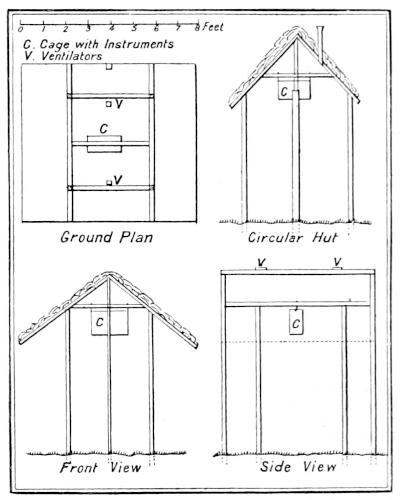
For a more permanent station the form of exposure recommended by
a committee of the British Association for use in tropical Africa will be
found very suitable in hot countries.
Fig. 3.—Hut for Sheltering Thermometers.
The thermometers are placed in a galvanised iron cage, which is kept
locked for safety. This cage is suspended under a thatched shelter,
which should be situated in an open spot at some distance from
buildings. It must be well ventilated, and protect the instruments from
being exposed to sunshine or rain, or to radiation from the ground. A
simple hut, made of materials available on the spot, would answer this
purpose. Such a hut is shown in the drawing (Fig. 2). A gabled roof
with broad eaves, the ridge of which runs from north to south, is fixed
upon four posts, standing four feet apart. Two additional posts may be
introduced to support the ends of the ridge beam. The roof at each end
projects about eighteen inches; in it are two ventilating holes. The
tops of the posts are connected by bars or rails, and on a cross bar is
suspended the cage with the instruments. These will then be at a
height of six feet above the ground. The gable-ends may be permanently
covered in with mats or louvre-work, not interfering with the free circulation
of the air, or the hut may be circular. The roof may be covered
with palm-fronds, grass, or any other material locally used by the
natives for building. The floor should not be bare but covered with
grass or low shrubs.
The great object of these precautions is to obtain the true temperature
of the air, and avoid the excessive heating due to the direct rays or
reflected heat of the sun falling on the thermometers, and the excessive
cooling due to the radiation of heat from the thermometers to a clear
sky at night. Such a shelter is absolutely necessary when maximum
and minimum thermometers are used; but can be dispensed with for the
simple observation of the temperature of the air at a given time. This
may be effected by securing a rapid flow of air over the thermometer,
either by causing the air to flow past the instrument or by causing the
instrument to move rapidly through the air. It has been found by
experiment that the true temperature of the air is obtainable in this way
whether the operation is performed in sunshine or in shade; but it is
preferable to do so in the shade.
Sling Thermometer.—The sling thermometer is the most simple and
convenient of all instruments for ascertaining the temperature of the air.
It is an unmounted thermometer with a cylindrical bulb, and the
degree-marks engraved on the glass stem. The upper end terminates in
a ring to which a silk cord about two feet long is attached. As a precaution
it is as well to secure the cord by a couple of clove hitches
round the top of the thermometer stem as well as to the ring, as the
thermometer would then be held securely even if the ring broke. The
thermometer is used by whirling it in a vertical circle about a dozen
times, the observer taking care, by having a loop of the string round
the wrist or finger, that it is not allowed to fly off. Then the
thermometer is read, swung once more, and read again. This process
is repeated until two consecutive readings are identical; when this is
the case the instrument shows the true temperature of the air. It is
sufficient to note the final temperature in the observing book.
The risk of breaking a sling thermometer is the only drawback to its
use. Only a silk cord should be used, and it should be examined
frequently to see that it has not got chafed. In swinging the thermometer,
an open place must be selected where it is not likely to come
in contact with a branch or any other object.
Hygrometers.—As the humidity or degree of moisture in the atmosphere
is a very important climatic factor it is necessary to measure it as
carefully and as frequently as the temperature of the air. There are
many instruments, called psychrometers or hygrometers, for doing this;
but few of them are simple enough for the use of a traveller. The proportion
of water-vapour in air is a little difficult to understand at first,
because it is not a constant quantity as in the case of the other constituents
of air, but varies according to the amount of water-surface
exposed to the air and according to the temperature. The maximum
amount of water-vapour which can be present in air varies with the
temperature, being greater as the temperature is higher and less as the
temperature is lower. Thus, if air at 50° F. contains the maximum
amount of water-vapour which it can contain at that temperature, it is
said to be saturated, for it will take up no more and evaporation stops;
and if the temperature were to fall ever so little there would be more
water-vapour present in the air than it could hold and some would
separate out and condense into dew or rain, hence the temperature of
saturation is called the dew-point. But if air saturated at 50° is warmed
up say to 60° it can then contain more water-vapour than it has, and the
temperature would require to fall 10° before dew or rain could form.
When the air is not saturated water exposed to it evaporates rapidly
until the maximum quantity of water-vapour is again present, a larger
quantity corresponding to the higher temperature. At any given temperature
the essential thing to know about the humidity of the air is
the additional amount of water-vapour it could take up before becoming
saturated, or in other words the humidity relative to the maximum
humidity possible at the existing temperature. The relative humidity is
expressed in percentages of the maximum humidity possible (saturation)
at the actual temperature of observation. It may be measured by two
methods, (1) finding the dew-point or temperature at which the amount
of vapour present saturates the air; (2) by finding the rate at which the
air allows evaporation to proceed; the farther the air is from saturation
the more rapid is the rate.
The dew-point may be found directly by means of an instrument by which
the air is cooled down until it begins to deposit moisture on a polished
surface, but such an instrument is inconvenient to handle when travelling.
It may also be found indirectly by calculation from the relative humidity.
The relative humidity is most easily calculated from the rate of
evaporation. It is one of the laws of evaporation that heat is required
to change liquid into vapour, and when evaporation is going on heat
is being abstracted from surrounding bodies, and they are growing colder.
By allowing evaporation to take place from the bulb of a thermometer
the rate of evaporation may be measured by the fall of temperature
produced, and tables have been constructed to convert the differences
between the wet and dry bulb readings into relative humidities.
The wet-bulb thermometer consists of an ordinary thermometer, the
bulb of which is covered with clean muslin and kept moist by means of
a piece of cotton lamp-wick dipping into a small vessel of pure water.
Care must be taken to have the water quite pure and free from salt,
otherwise the true reduction of temperature will not be observed. Hence
special precautions are necessary when observing at sea or in an arid
country where the ground is covered with incrustations of salt.
In any form of wet bulb thermometer when the air is much below
the freezing point, it will usually be found most satisfactory to remove
the muslin covering and allow the bulb to become covered with a coating
of ice, by dipping it into water and allowing the water to freeze upon it.
Evaporation takes place from solid ice sufficiently rapidly to give the
true wet-bulb readings at least with a sling thermometer.
When the air is saturated, i.e., relative humidity = 100 per cent., there
is no difference in the reading of the wet and dry bulb thermometers,
and the greater the difference between the readings at a given air
temperature the smaller is the relative humidity of the air.
The wet-bulb thermometer has to be exposed to the air with the same
precautions as are taken in the case of the dry bulb. The two may be
hung side by side—but at least six inches apart—in the screen or cage
described on p. 15; or the wet bulb may be employed as a sling thermometer.
One way to do this is to tie a muslin cap on the bulb of the
sling thermometer with a piece of wet lamp-wick coiled round the upper
part of the bulb, and then whirl it until the reading becomes constant,
taking care to moisten the bulb again if it should become dry. Another
way is simply to twist a piece of filter-paper or blotting-paper round the
bulb, and dip it in water before swinging.
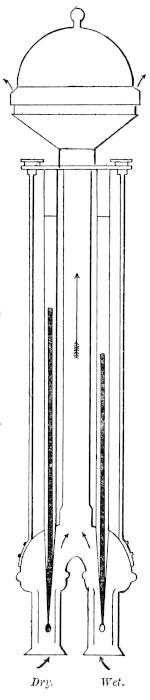
Aspiration Psychrometer.—Perhaps the most convenient form of wet
and dry bulb thermometer for use by a traveller is that known as
Assmann’s Aspiration Psychrometer. It requires
no protecting screen, is not subject to the risk
attending the use of the sling thermometer, and
gives an extremely close approximation to the
true temperature and humidity. The principle
of the instrument is very simple. The wet and
dry bulb thermometers are enclosed separately
each in an open tube (see Fig. 4) through which
a current of air is drawn by means of a fan,
actuated by clockwork in the upper part of the
case. In making an observation, all that is required
is to see that the water vessel for the wet
bulb is filled and the bulb properly moist, and
that the dry bulb is free from any condensed
moisture. The instrument is then hung to a
branch or other support placed in the open
air (or even held in the hand), preferably in
the shade, although this is not essential, and
the clockwork wound up. Air will then be
drawn over the bulbs for five minutes or more,
and if the temperature of each thermometer
has not become steady by the time the clockwork
has run down, it must be wound up
again.
Fig. 4.—Section of Assmann’s Aspiration Psychrometer.
The thermometers in Assmann’s Psychrometer
are graduated according to the Centigrade scale,
and each degree is subdivided into fifths on a
slip of porcelain enclosed in the outer tube of
the thermometer (see p. 13).
Minimum Thermometer.—The minimum temperature
of the night can usually be ascertained
by a traveller exposing a minimum thermometer
when the camp is set up and reading it in the
morning before starting on his way. There are
several forms of minimum thermometer, but
the only one likely to be used is that known
as Rutherford’s. It is very delicate and liable
to go out of order. The instrument should be of full size, as used in
meteorological stations at home; it must be packed so as to be as free
as possible from shock or vibration, and ought to be carried in a horizontal
position. The bulb is filled with alcohol or some similar clear fluid,
and within the column of spirit in the stem there is included a little
piece of dark glass shaped like a double-headed pin. This is the index
which continues pointing to the lowest temperature until the instrument
is disturbed or re-set. The thermometer has to be hung in a
horizontal position. When the temperature rises, the column of spirit
moves along the tube, flowing past the index without disturbing it.
When the temperature falls, the spirit returns towards the bulb, flowing
past the index until the end of the column touches the end of the
index. The phenomenon known as surface-tension gives to the free
surface of any liquid the properties of a tough film, and the smaller
the area of a free surface is, the greater is this effect of surface-tension.
Hence it is that the inner surface of the column of alcohol is
not penetrated by the glass index, but draws the index with it backwards
towards the bulb. As soon as the temperature begins to rise,
the alcohol once more flows past the index towards the farther end
of the tube. The end of the index farthest from the bulb remains
opposite the mark on the stem indicating the lowest temperature which
had occurred since it was last set, and this reading must be taken without
touching the thermometer.
To set the index it is only necessary to tilt the bulb end of the tube
upwards, when the index will slide down by its own weight until it
comes in contact with the inner surface of the end of the column of
alcohol.
Care of a Minimum Thermometer.—The chief dangers to which a
minimum thermometer are liable are three—(1) the index being shaken
into the bulb, (2) the index being shaken partly or wholly out of the
column of spirit, and sticking in the tube, and (3) the column of spirit
becoming separated or a portion of the spirit evaporating into the upper
end of the tube.
The thermometer should be so constructed as to make it impossible
for the index to get into the bulb, or with an index so long as not
wholly to leave the tube, and this should be seen to before purchasing.
When any of the other derangements occurs the natural instinct of
an observer is to immerse the thermometer in warm water until the
spirit entirely fills the tube, and then allow it to cool. The only drawback
to this simple method is the almost inevitable bursting of the
bulb and destruction of the thermometer. This method should never
be attempted; but if the warning were not given, the idea would be
sure to occur to the observer some time or other, and he would proceed
to destroy his thermometer with all the fervour of a discoverer. The
only satisfactory way to rectify a deranged minimum thermometer is as
follows:
If the column is separated, but the index remains in the spirit, grasp
the instrument firmly by the upper end and swing it downwards with a
jerk (as in the case of the mercurial thermometer mentioned on p. 23).
If the index has been shaken out of the spirit and remains sticking in the
upper part of the tube, or if a little spirit has volatilised into the top of
the tube and cannot be shaken down by the first method, a quantity of
spirit should be passed into the upper end of the tube by grasping the
thermometer by the bulb end of the frame and swinging in the same way.
When the index is immersed or the drop of volatilised spirit joined on
to the column, the first process of swinging by grasping the upper end of
the tube will bring the instrument into working order. After any operation
of this kind the thermometer should be kept in a vertical position
bulb downwards, to allow the spirit adhering to the sides of the tube to
drain back completely. Then the thermometer should be brought into
the horizontal position and set by allowing the index to slide down to the
end of the column of spirit. The end of the column of spirit farther from
the bulb should always show the same temperature as the dry-bulb
thermometer. If it should be observed to read a degree or two lower, it
will be found that some of the spirit has volatilized and condensed at the
end of the tube.
The minimum thermometer should be exposed to the air four or six
feet from the ground under a screen or roof, like that described on p. 15,
so that it is not exposed to the open sky, and the ground under the
shelter should be covered with grass or leaves, not on any account left
bare. The loss of heat by radiation of the ground to the open sky will
produce a night temperature much lower than that of the air a few
feet above the ground, and a radiation thermometer is often employed,
laid on the grass and exposed to the sky to measure this effect.
Travellers, however, can rarely be expected to make observations of
such a kind, as the instrument is one of extreme delicacy.
Maximum Thermometers.—Maximum registering thermometers are
filled with mercury, and are less liable to get out of order than spirit-thermometers.
The simplest and best form for use by travellers is
Negretti and Zambra’s. Its principle is very simple. When the temperature
rises and the mercury in the bulb expands, it forces its way along
the stem in the usual manner; but there is a little constriction in the
tube just outside the bulb which breaks the column as the temperature
begins to fall, and so prevents the mercury in the bulb from drawing
back the thread of mercury from the tube. The thermometer is hung
horizontally, and the end of the mercury farthest from the bulb always
shows the highest temperature since it was last set. Before reading
the thermometer, it is well to take the precaution of seeing that the
inner end of the thread of mercury is in contact with the constriction
in the tube, and if, by the shaking of the instrument or otherwise, the
mercury has slipped away from this position, it should be brought back
to it by tilting the thermometer bulb downwards very gently, then
returning it to the horizontal position and reading.
To set this thermometer, it is only necessary to hold it vertically bulb
downwards and shake it slightly, if necessary striking the lower end of
the frame carrying the instrument, gently against the palm of the hand.
This causes the mercury to pass the constriction and re-enter the bulb.
When set, the end of the column farther from the bulb should indicate
the same temperature as the ordinary dry-bulb thermometer.
Another form of maximum thermometer is known as Phillips’. It is
an ordinary mercurial thermometer, but a short length of the upper part
of the column in the tube is separated from the rest by a little bubble of
air. It is used in the horizontal position, and as the temperature rises
the whole column moves forward, while, when the temperature falls, only
that portion behind the air-bubble retires towards the bulb. The tip of
the column thus remains to mark the maximum temperature to which its
farther end points. The instrument is set by gently tilting the bulb end
downwards, when the detached portion of the column at once runs back
until stopped by the air-bubble. This is the most convenient instrument
to use at a fixed station; but in travelling it is apt to get out of order
as shaking may have the effect of allowing the air-bubble to escape into
the upper part of the tube, or into the bulb, and the instrument cannot
easily be brought into working order again.
Rain-Gauge.—While measurements of rainfall can possess no climatological
value unless they are carried on continuously at a fixed station,
some very interesting observations may be made by the traveller both
during the night when in camp, and during heavy showers when compelled
to stop on the march. The rain-gauge is in itself the most simple of all
scientific instruments, for it consists essentially of a copper funnel to
collect the rain as it falls, and a bottle to contain what has been collected.
A graduated measuring glass is the only accessory required. Rain is
measured by the depth to which the water would lie on level ground if
none soaked in, evaporated or flowed away. On an emergency, a rain-gauge
can be improvised out of a biscuit tin, or any vessel with vertical sides
and an unobstructed mouth. Such a vessel standing level would collect
the rain, the depth of which might be measured by an ordinary inch-rule.
It is rare, however, to find rain so heavy as to give any appreciable depth
when collected in a vessel freely open to evaporation, and in order to
estimate the amount of rainfall to small fractions of an inch, the device
is employed of measuring the water collected in the receiver of the gauge
in a glass jar of much smaller diameter than the mouth of the collecting
funnel. Thus, if the funnel exposes a surface of fifty square inches, and
the measuring glass has a cross-section of one square inch, the fall of 1/50
of an inch of rain on the funnel will give a quantity of water sufficient to
fill the measuring glass to the depth of an inch. In this way the actual
rainfall may be read to the thousandth part of an inch without trouble.
The smallest diameter for a serviceable rain-gauge is five inches, and this
size is well adapted for the traveller. A three-inch rain-gauge might be
employed, but the results obtained with it are not so satisfactory. The
rain-gauge should be placed in an open situation, so that it is not sheltered
by any surrounding trees or buildings, and it ought to be firmly fixed by
placing it between three wooden pegs driven securely into the ground.
The mouth of the gauge should be level, and when the instrument is
fixed, the rim of the funnel ought to be one foot above the ground. A
spare measuring glass should be carried, but as there is always a considerable
risk of breaking such fragile objects, it is well to carry also one
or two small brass measures of the capacity of half an inch, two-tenths
of an inch, and one-tenth of an inch of measured rainfall. In this way,
although no satisfactory record could be kept of light rainfall, a very fair
estimate may be made of any torrential showers, the half-inch measure
being used first, and then the smaller measures, finally estimating by eye
the fraction of the tenth of an inch that remains over. It must, however,
be distinctly borne in mind that an estimate formed in this way is not an
accurate measurement, and the fact of using the rough method must be
stated in the note-book.
When snow falls along with rain, the melted snow is measured as
equivalent to rainfall, and if the funnel of the rain-gauge should contain
some unmelted snow at the time of observation, it should be warmed
until the snow melts before a measurement is taken. When snow falls
in a strong wind the drift that occurs makes it almost impossible to
measure the amount accurately, but an effort should be made to estimate
the average depth of the snow over a considerable area.
If the receiving bottle of the rain-gauge should be broken by frost or
accident, any other bottle may be used, or in default of a bottle, the
copper case itself will act as a receiver, although the risk of loss by
evaporation, and by the wetting of a large surface in pouring out the
water, is considerably increased.
At a fixed station the rain-gauge should be read every morning. The
traveller who only exposes his rain-gauge during a halt should be
careful to state the hours when it was exposed and when it was read.
Barometers.—The barometer is the most delicate, and at the same time
the most important, instrument which a meteorologist has to employ.
It requires particular care in transport, and must be very carefully
mounted and read, while several accessory observations have to be made
at each reading in order to ascertain the corrections required for the
subsequent calculation of the results. The function of the barometer is
to measure the pressure of the air at the time of observation, and this
purpose may be carried out by the use of two different principles. The
oldest and best method is to measure the height at which a column of
heavy fluid is maintained in a tube entirely free from air. The weight of
this column is equal to the weight of a column of the atmosphere of the
same sectional area. Mercury being the densest fluid is the only one
usually employed, because the column balancing a column of the atmosphere
of equal sectional area is the shortest that can be obtained, and,
consequently, a mercurial barometer is the most portable that can be
constructed on this principle. The mercurial barometer has come to be
recognised as the standard in all parts of the world.
The average height of the column of mercury in a barometer is about
thirty inches, and, consequently, the whole instrument cannot well be
made less than three feet long, so that when account is taken of the
glass tube, and the amount of mercury it contains, it is long, fragile and
heavy. To avoid the disadvantages inherent in such an instrument, the
method of measuring the pressure of the air by the compression of a
spring holding apart the sides of an air-free flexible metallic box was
devised, and the aneroid barometer invented. The aneroid is graduated
on the dial in “inches,” i.e., divisions each of which corresponds to a
change of atmospheric pressure, equal to that measured by one inch
of mercury in a standard barometer. Although a carefully constructed
aneroid is a very useful instrument indeed, it is not to be trusted like
a mercurial barometer kept in a proper place. But a good aneroid
is likely to be much more serviceable to the ordinary traveller on the
march than a standard mercurial barometer, every packing and unpacking
of which exposes it to the risk of breakage, or to the equally
fatal risk of air obtaining access to the vacuous space at the top of the
tube. The scale of a barometer may be divided into millimetres, or, as
now recommended by the British Meteorological Office, into millibars or
thousandths of a hypothetical “atmosphere.” We shall describe the
Fortin barometer, which is best adapted for use at a fixed station,
and one devised by Prof. Collie and Capt. Deasy, which is portable
enough for the use of travellers.
The Fortin Barometer.—The barometer must be kept in a room with
as equable a temperature as possible; the instrument must be absolutely
vertical—hence it should be hung freely and not touched while it is
being read; it must be in a good light, and yet be sheltered from the
direct rays of the sun. The measurement of the height of any mercurial
barometer is that of the difference of level between the surface of the
mercury in the tube and the surface of the mercury in the cistern. When
the mercury rises in the tube it falls in the cistern, and vice versâ,
although when the cistern is much wider than the tube the changes of
level there are much less than those in the tube. In most barometers
an arbitrary correction is made to allow for this change, the “inches”
engraved on the scale not being true inches. In the Fortin barometer,
however, the lower end of the measuring rod is brought in contact with
the mercury in the cistern before every reading, and then the scale of
inches engraved on the upper part of the measuring rod gives the true
height of the column of mercury. In calculating the barometric pressure
for purposes of comparison, five corrections have to be applied: (1) for
temperature, which requires the temperature of the barometer at the
time of reading to be observed, (2) for altitude, which necessitates
knowing the elevation of the place of observation above sea-level, (3) for
the force of gravity at sea-level, which requires
the latitude to be known, (4) for the capillary
attraction between the mercury and the glass
tube, which is a constant for each barometer,
(5) for the slight imperfection in engraving the
scale (index error), which is also a constant
for each instrument.
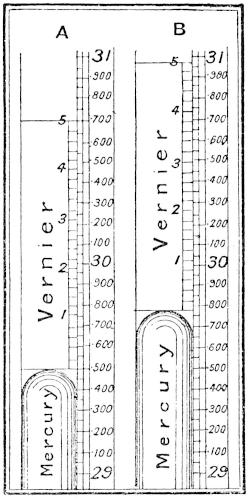
Fig. 5.—Two Readings of the Barometer Vernier.
It is enough for the observer at a fixed station,
and to such alone can the use of a Fortin barometer
be recommended, to read the temperature
on the thermometer attached to the barometer
and to read the height of the mercury in the
barometer tube. These two figures he is to enter in
his note-book, and unless he is himself discussing
the results, he should apply no correction whatever
to them. The rules for observing, then, are:—
1. Read the attached thermometer and note
the reading.
2. Bring the surface of the mercury in the
cistern into contact with the ivory point which
forms the extremity of the measuring rod by
turning the screw at the bottom of the cistern.
The ivory point and its reflected image in the mercury should appear
just to touch each other and form a double cone.
3. Adjust the vernier scale so that its two lower edges shall form
a tangent to the convex surface of the mercury. The front and back
edges of the vernier, the top of the mercury, and the eye of the observer
are then in the same straight line.
4. Take the reading, and enter the observation as read without either
correcting it to freezing point or reducing it to the sea-level.
The scale fixed to the barometer is divided into inches, tenths, and
half-tenths, so that each division on this scale is equal to 0.050 inch.
The small movable scale or vernier attached to the instrument enables
the observer to take more accurate readings; it is moved by a rack and
pinion. Twenty-four spaces on the fixed scale correspond to twenty-five
spaces on the vernier; hence each space on the fixed scale is larger than
a space on the vernier by the twenty-fifth part of 0.050 inch, which is 0.002.
Every long line on the vernier (marked 1, 2, 3, 4, and 5) thus corresponds
to 0.010 inch. If the lower edge of the vernier coincides with a line on
the fixed scale, and the upper edge with the twenty-fourth division of the
latter higher up, the reading is at once supplied by the fixed scale as
in A (Fig. 5), where it is 29.500 inches. If this coincidence does not
take place, then read off the division on the fixed scale, above which the
lower edge of the vernier stands. In B (Fig. 5) this is 29.750 inches.
Next look along the vernier until one of its lines is found to coincide with
a line on the fixed scale. In B this will be found to be the case with
the second line above the figure “2.” The reading of the barometer is
therefore:—
On fixed scale
29.750
On vernier (12 × .002)
.024
Correct reading
29.774
Should two lines on the vernier be in equally near agreement with two
on the fixed scale, then the intermediate value should be adopted.
5. Lower the mercury in the cistern by turning the screw at the bottom
until the surface is well below the ivory point; this is done to prevent the
collection of impurities on the surface about the point.
The transport of barometers requires very great care in order to
prevent the introduction of air into the tube or the fracture of the tube
by the impact of the mercury against the top. To reduce the risk of
these accidents, the barometer must be carried with the tube quite full of
mercury, and in an inverted position, at least with the cistern end kept
higher than the top of the tube. The flexible cistern of the Fortin type
of barometer allows of it being screwed up tight so as to fill the tube
and close the lower end of it. In case of breakage, the operation of
fitting a new tube is not very difficult, but unless the tube has been
carried out ready filled with mercury, this cannot well be attempted. In
order to drive out the film of air adhering to the glass on the inside, it is
necessary, after filling the tube, to raise its temperature to the boiling-point
of mercury. No one should attempt either to fill or to change a
barometer tube unless he has had practice in doing so under expert
supervision beforehand.
The Collie Portable Mercurial Barometer.—This instrument is not
likely to be broken in travelling. It is quickly set up, and from such
tests as have been applied, it appears to give excellent results. The
cistern and vacuum tube at the top are of equal diameter, and are
connected by a flexible tube, and the difference in level of the mercury
may be measured directly by means of a graduated rod, or as in Deasy’s
mounting by means of a vernier. There is no attached thermometer, but
if the instrument be used in the open air, and is exposed for ten minutes
or a quarter of an hour before using, it will be sufficient to note the
temperature of the air in the usual way.
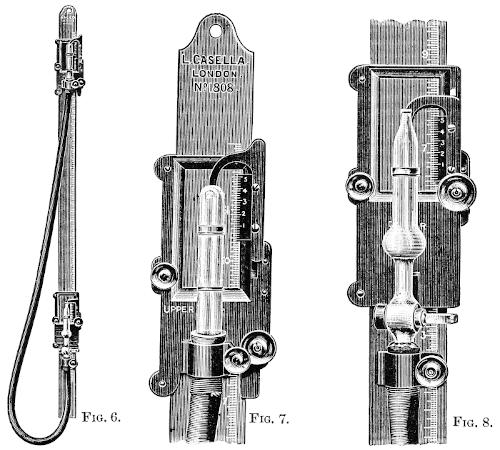
The upper end (Fig. 7) is about 2.5 inches long, and contains an
air-trap, into which all the air that may accidentally enter the barometer,
either by the tap leaking, through the rubber tubing, or through
either of the joints, must find its way. The lower or reservoir end
(Fig. 8) is about 4.5 inches long, and has an air-tight glass tap about
an inch below the broad part. These ends are forced into the rubber
tubing, and, as an additional precaution against leakage, copper wire is
bound round the joints. The scale is cut on an aluminium bar, along
which two carriages, to which the barometer is attached, move up and
down, and they can be clamped to the bar at any place (Fig. 6). By
means of the verniers attached to the carriages, which are divided to
0.002 of an inch, it is easy to estimate the height of the mercury to 0.001.
To use the barometer, the carriages are put on the scale bar; the lower
one is clamped at the bottom of the bar, and the upper one some inches
higher up; the barometer is attached to the carriages by clamps which
fit over the joints; the rubber cap is removed from the reservoir end, the
tap opened, the verniers put in the middle of their runs, and the upper
carriage moved up the bar until there is a vacuum. By means of the
screws on the right of the carriages the verniers are moved up or down
until the top of the mercury at each end is in line with the edges of the
rings attached to the verniers, which fit round the glass ends. Both
verniers are then read, and the difference gives the height of the barometer.
The rubber cap on the reservoir end is merely to prevent the
small quantity of mercury, which should be left above the tap when it
is closed, from being shaken out when travelling.
Fig. 6. The Collie Barometer, with the
Deasy Mounting, in its Normal Working Position.
Fig. 7. The Upper Carriage and Vernier
on a larger scale, with Barometer Attached.
Fig. 8. The Lower Carriage and Vernier,
with Reservoir End of Barometer Attached. (Same scale as Fig. 7.)
To pack up the barometer, lower the upper carriage very slowly until
the mercury has touched the top of the glass; then detach the barometer
from this carriage, and either let the upper end hang vertically below the
reservoir, or detach the reservoir end from its carriage and raise it till
the barometer hangs vertically. By this means the barometer is completely
filled with mercury, and then the tap must be closed. The tube
is then to be coiled away in its padded box. When too much air is
found in the trap, it must be extracted by means of the air-pump.
The Aneroid Barometer.—The aneroid barometer is so convenient on
account of its portability that, although much less trustworthy than a
mercurial barometer, it is much more likely to be used by a traveller.
Care should be taken in using it to see that the pointer has come to a
position of equilibrium, and it should be tapped gently before reading.
The eye must be brought directly over the end of the pointer, and the
reading made to one-hundredth of an inch, the barometer being held in
a horizontal position. Every opportunity of comparing the aneroid with
a standard mercurial barometer should be taken, and a note made of the
readings of both. The mercurial barometer will require to be corrected
for temperature before its indications can be used for correcting the
aneroid, as all good aneroids are compensated for changes of temperature.
The readings of an aneroid give a very fair idea of the changes of atmospheric
pressure, and are very much better than none at all, although
they cannot in any case be accepted as of the highest order of accuracy.
The Watkin mountain aneroid, which is so constructed as to be
thrown into gear at the moment when it is read, appears to be free from
the worst errors of the ordinary aneroid.
For climatological purposes, it is impossible to make barometric
observations of value while travelling unless the altitude of each
camping-place is accurately known. This is practically never the case
except when travelling along the sea-shore or the margin of a great lake
the elevation of which has been determined. But, meteorology apart,
barometric readings in any little known country are of value, because by
comparing them with simultaneous readings taken at a neighbouring
fixed station, new data as to the altitude of the country may be obtained.
While in camp, it would be an extremely useful thing to make barometer
readings, even with an aneroid, every two hours, in order to get some
information as to the normal daily range of atmospheric pressure.
The Boiling-point Thermometer.—The temperature at which water boils
depends on the pressure of the atmosphere, so that an accurate observation
of the boiling-point of water enables the pressure of the atmosphere
at the moment of observation to be determined with the utmost accuracy.
This method of determining atmospheric pressure having been used
hitherto almost solely for the purpose of measuring altitudes, the boiling-point
thermometer is usually known as the Hypsometer, but its records
are quite as valuable for use at fixed stations as in mountain climbing.
Mr. J. Y. Buchanan recommends the use of a boiling-point thermometer
with a very open scale graduated to fiftieths of a degree Centigrade and
entirely enclosed in a wide glass tube through which steam from water
boiling in a copper vessel is passing. On a thermometer of this kind
change of pressure can be measured by the change of boiling-point more
accurately than with the aid of a mercurial barometer. See Table,
Vol. I., p. 293.
2. Observations for Forecasting the Weather.—The familiar name
of “weather-glass” is appropriately applied to the barometer, for in most
parts of the world it is the surest indicator of any approaching storm.
The scientific prediction of the weather by means of the barometer
involves the comparison of the simultaneous readings of barometers over
as wide an area as possible, and can only be carried out where there is
a complete telegraph system and a public department charged with the
work. The storms of wind and rain which break the more usual
steady weather are usually associated with the formation of centres
of low atmospheric pressure towards which wind blows in from every
side. These atmospheric depressions move, as a rule, in fairly regular
tracks, the rate of movement of the centre of the depression having no
relation to the rate at which the wind blows or to the direction of the
wind. The term cyclone is usually applied to such a moving depression,
because of the rotating winds round the centre; but the size of a cyclone
may vary from a vast atmospheric eddy extending across the whole
breadth of the Atlantic to one only a few miles in diameter. The
strength of the wind in a cyclone depends on the barometric gradient;
in other words, the greater the difference in atmospheric pressure between
two neighbouring points the stronger is the wind that blows between them.
Or, when a cyclone is passing over an observer, the more rapidly the
barometer falls or rises the stronger may the wind be expected to blow.
In direct contrast to the cyclone or depression is the system of high
pressure rising to a centre from which the wind blows out on every side.
This is called an anticyclone, and is a condition which, once established,
may last for many days, or even weeks, without change. It is the typical
condition for dry calm weather in all parts of the world.
Fig. 9.—Cyclone
Paths and Circulation of Winds in Cyclones in the Northern
and Southern Hemispheres.
The direction of movement of the centres
of cyclones in the northern hemisphere is
usually westward and northward near the
equator, the path of the centre bending
to the right as it proceeds, and becoming
ultimately eastward and southward. In
the southern hemisphere the direction of
the centre near the equator is westward
and southward, turning towards the left as
it proceeds. The rotation of the wind about
the centre of a cyclone in the northern
hemisphere is inwards towards the centre
in the direction opposite to the hands of a
watch, and in the southern hemisphere it
is in the direction in which the hands
of a watch move (Fig. 9). In the centre
of a cyclone there is a calm, a well-known
danger to sailing ships caught in such a
storm at sea, because there is no wind to
move the vessel, but a tremendous sea
driven in from the gale which rages all
round from every point of the compass.
The law of storms has been very fully
studied, and rules have been drawn up to
enable sailors to ascertain the direction in
which the centre of an approaching cyclone
lies and the direction in which it is moving.
In a work intended mainly for travellers
on land it is not necessary to give these
rules; all that is required is to tell how
the approach of dangerous storms may be ascertained some time in
advance. The fact that the barometer is high or low is in itself of no
value for prediction. The important thing to know is the distribution
of atmospheric pressure at a given moment over a considerable area.
To the isolated observer this is impossible, and he can only judge of the
state of the atmosphere by observing the rate at which the barometer is
falling or rising. Thus, if for several days the barometer has been
steadily and slowly rising, he will probably be right in believing that an
anticyclonic condition is establishing itself, and that the weather may
be expected to continue fine for many days to come, even after a gradual
fall of the barometer begins. A sudden fall of the barometer, on the
other hand, is always a sign of wind, and usually of wet weather
as well. This is a particularly valuable sign of approaching storm
in those parts of the world where, as in the tropics, the normal weather
is very uniform and steady. In such places a very sudden fall, say one-tenth
of an inch in an hour, is a sure precursor of a violent storm. As
the barometer continues to fall, the wind will probably continue to
increase in force, and when the barometer reaches its lowest point it
will either fall calm (if the centre of the cyclone is passing over the
observer) or suddenly change in direction. The rapid rise of the barometer
after a great depression is also always accompanied by strong
wind, though not so frequently by rain.
It must be clearly understood that these remarks refer only to observations
at a fixed station. If a fall of barometer is observed in travelling,
it may be due either to a change in the state of the atmosphere or to a
change in the traveller’s height above sea-level. This is the reason why
it is absolutely essential, in making barometric estimates of height (or
boiling-point determinations), to have simultaneous observations going on
at a base-station, or preferably at a series of intermediate stations.
The ordinary prognostics of the approach of rain or bad weather differ
in different localities, and require a considerable amount of local knowledge
before they can be utilised. The peculiar absorption band in the
solar spectrum due to the water vapour of the Earth’s atmosphere, and
called the rain-band, is a valuable guide to an experienced observer with
a spectroscope in predicting rain. The only instrument, however, likely
to be useful to the ordinary traveller is the wet and dry bulb thermometer.
When the two thermometers have the same reading, indicating saturation
of water vapour, or when they approach at temperatures above 60° F.
within two degrees or so, rain may be expected, or possibly mist. The
appearance of low clouds clinging to the hillsides is an indication that
the temperature at the place where they are is below the dew-point. The
appearance of the upper clouds, taken in conjunction with the readings
of the barometer, is a valuable indication of forthcoming weather changes.
The increase of cirrus clouds in a clear sky with a falling barometer,
or the appearance of a solar or lunar halo, may be taken as a sure sign
of an approaching cyclone, the intensity of which may be foreseen by the
rate at which the barometer is falling.
While the weather of places on the west coasts of temperate continents
exposed to the prevailing sea-wind is usually made up of a succession of
cyclones of different degrees of intensity, and of the anticyclonic intervals
between them, over the greater part of the Earth’s surface the climate is
much more uniform, and the seasonal changes are the principal cause of
changes of weather. To understand these general conditions it is
necessary to consider the elements of climatology.
3. Outlines of Climatology.—The air is in constant movement on
account of the unequal way in which the heat of the sun falls on different
parts of the Earth’s surface, and at different seasons of the year. All the
conditions of the atmosphere show a certain diurnal periodicity which is
most marked in the regions of steady climate between and near the
tropics. Thus, as a rule, the minimum temperature of the air occurs
just before sunrise, the maximum temperature from two to three hours
after noon. The amount of difference between the maximum and
minimum temperature of the day (daily range) is least near the sea
or in wet regions (a maritime climate) and greatest in the interior of the
continents, especially where the rainfall is slight (a continental climate).
Over the sea itself the daily range of air temperature averages only
3 Fahrenheit degrees; but in the heart of a continent, especially in a
desert, it may exceed 60 Fahrenheit degrees.
Diurnal changes of pressure are proportionally much smaller in amount
than changes of temperature, and are to be observed as a regular
phenomenon only in the tropics, or elsewhere during very settled
weather. There are usually two maxima daily, about 10 A.M. and
10 P.M., and two minima occurring about 4 A.M. and 4 P.M. It is only
in rare cases that the total barometric range exceeds 0.10 inch, very
frequently it is not greater than 0.04 inch. Still it is convenient to
remember in the tropics that a fall of the barometer not greater than
0.10 inch between 10 A.M. and 4 P.M. is to be expected, and does not
indicate either the approach of a storm (if the observer is at rest) or the
ascent of 100 feet (if he is on the march).
Associated with the diurnal changes of temperature in settled weather
are changes of wind due to local configuration of the ground. The wind,
for example, usually blows up a mountain side, or up a steep valley,
during the day, and down a mountain, or down a steep valley, during the
night. So, too, the regular land and sea breezes found on the borders of
the sea or of great lakes blow from water to land in the day time and
from land to water at night. Here the determining cause is the fact
that land is warmed and cooled by radiation, and in turn heats or chills
the air much more than water does. In the settled climates of high
tropical plateaus a regular diurnal change of wind direction has been
observed, the wind blowing successively from all points of the compass.
A similar diurnal periodicity occurs in the amount of cloud, in the
moisture of the air, the fall of rain, the occurrence of thunderstorms, etc.
It is also to be noticed in the flow of rivers in mountainous regions where
the streams take their rise from glaciers or snow, the rapid melting of which
by the heat of the sun causes the volume of water to increase greatly in
the afternoon, while the cessation or reduction of the rate of melting at
night diminishes the volume of the river in the morning and forenoon.
Periodic changes of greater amount but similar in kind are produced
by the alternation of the seasons, the difference between the mean values
of the months in which the phenomena are at a maximum and minimum
respectively being termed the annual range. With regard to temperature,
very moderate changes occur in the tropical zones where the altitude of
the noon-day sun is always great, and the length of day and night varies
little with the season (for the most part less than 5 Fahrenheit degrees);
but in the temperate and frigid zones there are strongly marked annual
changes. As in the case of daily range, proximity to the sea is a controlling
factor in the annual range of temperature. To take a very
characteristic instance, the annual range between the mean temperature of
July and January is about 23 Fahrenheit degrees in the Lofoten islands
on the margin of the Atlantic, while it is 120 Fahrenheit degrees at Verkhoyansk
in the same latitude, but in the centre of the Asiatic continent.
The extreme months for air temperature are January and July in
almost every part of the world, the maximum occurring north of the
equatorial belt in July and south of it in January.
The annual changes in barometric pressure and wind are equally
marked. The belt of low pressure which lies nearly under the vertical
sun moves northward over the surface of the globe in the northern
summer, coming to its most northerly position in July: returning southward
after the sun, it reaches its most southerly position in January.
This belt of low pressure is also a belt of calms, known by sailors as the
Doldrums, and it is a belt of frequent rains, so that as it approaches and
passes over a place there is a rainy season, followed by a dry season
when it retires. Near the mean position of the belt of low pressure,
where it passes over a place twice in the year, there are two rainy
seasons. The low pressure belt is bordered to north and south by
belts of high atmospheric pressure, from which the trade-winds blow
towards the equator, and the westerly anti-trades blow towards the
poles. These are also subject to the annual change; but the different
action of land and sea on the distribution of pressure exercises a
greater influence than does the difference of latitude. As the greater
heating and cooling of the land each day causes the phenomena of daily
land and sea breezes, so the greater heating and cooling of the land
between summer and winter causes seasonal land and sea winds, blowing
from land to sea in winter, from sea to land in summer. Generally
speaking, the pressure is greater—in the same latitude—where the air is
cooler, so that outside the frigid zones cold areas are usually areas of
high pressure, from which wind blows out in every direction, while warm
areas are areas of low pressure towards which wind blows in on every side.
The distribution of rainfall on the land is dependent on the direction of
the rain-bringing wind and the configuration of the surface. Thus
when the rain-bringing wind meets a mountain range, it deposits a great
rainfall on the exposed slopes, but passes over as a dry wind which yields
little rain to the region beyond. In places where the wind changes with
the season, as in southern Asia, the distribution of rainfall is entirely
different during the continuance of the different monsoons.
All these questions of normal climate can be more easily illustrated on
maps than explained by words. But the reader must be cautioned
against taking the condensed and generalised representations of small-scale
maps as showing all that is known on the subject. Even the
magnificent plates in the ‘Atlas of Meteorology,’ which forms part of
Bartholomew’s Physical Atlas, cannot show everything that is known;
and in many parts of the world so little has yet been ascertained as to
the climatic conditions that generations of observers will be required to
make it possible for meteorologists to draw a uniform trustworthy map of
the whole world showing the distribution of any one element of climate.
Isothermal maps.—The principle of an isothermal map is that of
representing the distribution of temperature by drawing lines through
all the places where the temperature is the same at a given time. It is
usual to take this time as an average month in an average year. Thus
in a map of isotherms for January (see p. 50), what is shown is not the
temperature of any particular day in any particular January, but
that of an average day in a long series of Januaries. Hence it is not
likely that the exact distribution of temperature shown in the map will
ever be found on any January day; but it is to be expected that most
days in every January will have a distribution of temperature which is
very similar to that shown. The same is of course true of maps showing
pressure, or rainfall, or any other average condition.
Again, the isotherm is necessarily constructed from average temperatures
which have been corrected so as to be applicable to the same level.
On the equator, for instance, the summit of a lofty mountain is seen by
the snow on it to have a temperature not exceeding 32° F., while at sea-level
the temperature may be 90°. But observations have been made
showing the rate at which the temperature of the air diminishes as the
height increases, and although the rate varies in different places and at
different seasons, it may be taken roughly as one Fahrenheit degree in
300 feet. Now if the mountain top with a temperature of say 30° F. is
known to be 18,000 feet above the sea, the addition of 1° for every
300 feet, or 60° altogether, would give the temperature of 90° as that
corresponding to sea-level. By applying such corrections, the isothermal
maps have been constructed to show the distribution of temperature at
the level of the sea. In order to compare the temperature he has observed
with that on the map the observer must calculate the average of his
daily observations for the month in question, and then make the correction
for the altitude of his station.
Similarly, in ascertaining from an isothermal map the mean temperature
of a particular place, care must be taken to subtract from the number of
degrees of the isotherm passing through the place one degree for every
300 feet of elevation. Of course it will usually happen that no isotherm
as shown on the map runs through the point the mean temperature of
which it is desired to obtain. In that case the temperature at the point
will be found by considering its relative position between the two nearest
isotherms. Thus, if it lie half-way between the lines of 60° and 70°—measured
perpendicularly to the isotherms—the temperature of 65° may
be assumed; if it lies one-tenth of the distance from 60° and nine-tenths
from 70°, it is safe to assume 61°; if three-tenths from 70° and seven-tenths
from 60°, then assume 67°. If the point lie in a loop of a single
isotherm, e.g., Cape St. Roque, the eastern point of South America in the
map for January, lying within the 80° isotherm, one can only guess that
the temperature is above 80° and it may be assumed to be below 85°.
The method of representation is unsatisfactory in such a case.
These facts being borne in mind, the study of isotherm maps will be
found to give an excellent general idea of the distribution of climate at
sea-level, and if the contour lines of 600 and 6000 feet are traced on the
maps the areas within which corrections of over -2° and -20° have to
be applied to the isothermal values to get the temperature at the place
will be easily recognised.
Isobaric Maps.—Isobars are drawn from the data of the height of the
barometer corrected to sea-level values and to the temperature of 32° F.,
exactly in the same way as isotherms are drawn from the data of thermometer
readings or contour lines from data of altitude measurements.
The practical value of the study of isobars is very great, because of
the importance of assuming a probable value of sea-level pressure in
reducing the barometric or boiling-point thermometer readings for determining
elevation, and also because of the intimate relation between
the form and proximity of isobars and the direction and force of the
winds.
Barometric gradient is measured by the difference between the isobars
per unit of length. For instance, gradient is frequently expressed in
the number of hundredths of an inch difference between barometers
fifteen nautical miles apart. The greater the gradient of pressure is, the
more closely together must the isobars be drawn in order to represent
it. For example, in the isobaric map for January (p. 50) a very
steep gradient is shown on the east coast of Asia, north of Japan,
and a remarkably gentle gradient in the interior of Asia from the
Black Sea eastward. The steeper the gradient the stronger is the wind.
The arrows in the isobaric maps (which are represented flying with the
wind) show the average directions of the wind over the world for the
months in question. The relation they bear to the isobars becomes clear
on inspection, although, on account of the greater number of observations
available for some parts of the world than for others, all the arrows
are not drawn with the same amount of certainty, and the direction of a
few contradicts that of most. As a general rule, the following facts may
be taken as absolutely established: (1) Wherever there is a region of
high pressure the wind blows out from it in all directions. (2) Wherever
there is a region of low pressure the wind blows in towards it from every
side. (3) The wind never blows perpendicularly to the isobars or directly
from higher to lower pressure, but always in a curved or spiral path
inclined to the isobars. (4) In the northern hemisphere the wind blows
out from a high pressure area in the same direction as the hands of a
watch move, but in the southern hemisphere in the opposite direction.
Also in the northern hemisphere the wind blows into a low-pressure area
in the direction opposite to that of the hands of a watch and in the
southern hemisphere in the same direction as the hands of a watch
move. (5) Recognising that the wind blows nearly parallel to the
direction of the isobars, the following statement (known as Buys Ballot’s
Law) expresses its direction both for high-pressure and for low-pressure
areas: If you stand with the lower pressure on your left hand, and the
higher pressure on your right hand, in the northern hemisphere the
wind will be blowing on your back, but in the southern hemisphere
in your face.
Rainfall Maps.—Rainfall is represented on maps by lines of equal
precipitation termed Isohyets. These represent actual figures without
reduction for elevation or other local conditions, and a rainfall map can
consequently be studied as a direct record of observed facts. The map
(p. 50) of mean annual rainfall brings out clearly the equatorial zone of
heavy rains crossing the Amazon valley, the Congo valley, the southeastern
peninsulas of Asia and the Malay archipelago. North and south
of this belt are the nearly rainless regions of the tropical deserts, extended
northward and southward over the continents, and merging nearer the
poles into the fairly-watered temperate zones. The rainfall maps for
separate months show the intimate relation between rainfall and the
direction of the wind taken in conjunction with the configuration of the
land. Even on the coast, when the prevailing wind is off shore, there
may be scarcely any rain, as on the west coast of tropical South America.
In the very heart of a continent the rainfall may be very heavy where the
sea-wind blows across a great plain before striking the mountains, as is
illustrated by the eastern slope of the Andes. Rainfall is, however, one
of the most inconstant elements of meteorology, and the actual rainfall
of any year may differ very widely from the average. The practical
value of exact statistics of rainfall is, however, greater than that of any
other climatological condition; for the water supply and the fertility of
the land depend in every case on the rain that falls either locally or
on the heights of the water-sheds.
In order to pursue the subject further the chapters on the atmosphere
in the writer’s ‘Realm of Nature’ (London, Murray; New York, Scribner)
and Mr. L. C. W. Bonacina’s ‘Climatic Control’ (London, A. and C.
Black) may be useful. The most systematic treatment of climatology
will be found in Hann’s ‘Handbuch der Klimatologie,’ 3 vols. (Stuttgart),
which contains numerous references to special works; the essential part
of this treatise is translated by Professor R. de C. Ward, under the
title of ‘Handbook of Climatology,’ Part I. (Macmillan). The most
important work of all is the great ‘Atlas of Meteorology’ by Dr. A. Buchan
and Dr. A. J. Herbertson, forming Vol. III. of Bartholomew’s ‘Atlas of
Physical Geography’ (London, Constable), which gives an unrivalled
series of climate and weather-maps with explanatory letterpress.
The recent great advances in meteorology have rendered the old textbooks
obsolete, while the new data, especially those regarding the upper
regions of the atmosphere, have not yet been built into a coherent system.
Sir Napier Shaw’s ‘Forecasting Weather’ (London, Constable & Co.) is
a pioneer discussion, and the numerous publications of the Meteorological
Office, South Kensington, London, S.W.7, may be consulted with much
advantage.
Daily synoptical weather-maps are published by the Weather Service
of almost every civilised country. Those for the United Kingdom may
be obtained from the Meteorological Office of the Air Ministry. The only
weather-maps of large areas produced regularly are the Pilot Charts
of the North Atlantic and the North Pacific, published monthly by
the Hydrographic Office at Washington, and those of the North Atlantic
and Mediterranean published monthly by the Meteorological Office in
London. These show the tracks of cyclones, and give a great deal of
information as to the meteorology and currents of the oceans. They are
intended primarily for the use of sailors.
The following list gives the name of the official weather service of all
countries outside Europe and the town in which the head office is
situated. Application might be made to any of these offices for information
as to the stations where standard instruments are established in the
country in question.
Extra-European Weather Services.
Country.
Name.
Place.
America:—
Canada
Meteorological Service of the Dominion of Canada
Toronto.
United States and West Indies
Weather Bureau
Washington.
Mexico
Observatorio meteorologico magnetico central
Mexico.
Salvador
Observatorio Astronomico y Meteorologico
San Salvador.
Guatemala
Instituto fisico-geografico
San José.
Cuba
Real Colegio de Belen de la compania de Jesus
Havana.
Brazil
Central Meteorological Department of the Navy
Rio de Janeiro.
Uruguay
Observatorio meteorologico del colegio pio de Villa Colon
Montevideo.
Argentina
Oficina meteorologica Argentina
Buenos Aires.
Chile
Oficina meteorologica
Santiago.
Peru
Harvard College Observatory
Arequipa.
Africa:—
Algeria
Service météorologique
Algiers.
British Central Africa
Zomba.
Egypt
Observatory
Helwan.
Madagascar
Observatoire
Tananarive.
Mauritius
Royal Alfred Observatory
Pamplemousses.
Union of South Africa
Meteorological Branch, Irrigation Department
Johannesburg.
Asia:—
India
Meteorological Department
Calcutta.
Japan
Central Meteorological Observatory
Tokyo.
Ceylon
Surveyor-General’s Office
Colombo.
Hongkong
Observatory
Hongkong.
China
Imperial Maritime Customs
Peking.
”
Observatoire de Zi-ka-wei
Shanghai.
Philippine Islands
Weather Bureau
Manila.
Dutch East Indies
Magnetic and Meteorological Observatory
Batavia.
Australasia and Pacific:—
Australia
Commonwealth Meteorological Service
Melbourne.
New Zealand
Meteorological Office
Wellington.
Hawaii
Weather Bureau
Honolulu.
In addition to the above, which are regular government services
specially organised for publishing and utilising the data from numerous
observing stations, there are many isolated stations in all parts of the
world. There are no colonies which do not possess some meteorological
stations, and at many mission stations meteorological observations
are made. It would always be well for a traveller to try to ascertain
where in the vicinity of his route meteorological stations have been
established and over what period of time their records extend.
In the Table (pp. 44-49), taken from Marriott’s “Hints to Meteorological
Observers,” is given the relative humidity for every 2° of temperature
from 20° to 80°, and for every two-tenths of a degree of difference
between the dry and wet-bulb readings from 0°·2 to 18°·0.
To use the Table: Look in the column on the left or right for the
nearest degree to the dry-bulb reading; then carry the eye horizontally
along until the column is reached corresponding to the difference between
the readings of the dry and wet-bulb thermometers, when the relative
humidity will be found. Intermediate readings can be interpolated in
the usual way.
Example: Dry-bulb 58°·5, wet-bulb 52°·7, the difference is 5°·8.
Having found 58° in the column on the left or right, run the eye along
this line until the column under 5°·8 is reached, when the relative
humidity will be found, viz., 67.
Table of Relative Humidity.
Dry Bulb Reading.
Difference between the Readings of the Dry and Wet Bulb Thermometers.
°
°
°
°
°
°
°
°
°
°
°
°
°
°
°
0.2
0.4
0.6
0.8
1.0
1.2
1.4
1.6
1.8
2.0
2.2
2.4
2.6
2.8
3.0
°
20
93
86
80
74
68
63
59
55
51
47
44
41
37
34
32
22
94
88
82
76
70
65
60
56
53
50
47
44
41
38
36
24
94
88
83
78
73
69
65
61
57
53
50
47
44
42
39
26
95
90
85
80
76
72
68
64
61
57
54
51
48
45
43
28
96
92
88
84
80
76
72
69
66
63
60
57
54
52
50
30
96
93
90
87
84
81
78
75
72
70
67
64
62
60
58
32
97
94
91
89
87
84
82
80
78
76
73
71
69
67
65
34
97
95
93
91
89
87
85
83
81
80
78
76
74
72
71
36
98
96
94
93
91
89
87
86
84
82
80
79
77
76
74
38
98
96
94
93
91
89
87
86
85
83
81
80
78
77
76
40
98
97
95
94
92
90
88
87
86
84
82
81
79
78
76
42
98
97
95
94
92
90
88
87
86
84
83
81
80
78
77
44
98
97
95
94
92
90
88
87
86
84
83
82
81
79
78
46
99
97
95
94
92
91
89
88
87
85
84
82
81
79
78
48
99
97
95
94
92
91
89
88
87
85
84
82
81
80
79
50
99
97
96
94
93
92
90
89
88
86
85
83
82
80
79
52
99
97
96
94
93
92
90
89
88
86
85
83
82
81
80
54
99
97
96
94
93
92
90
89
88
86
85
83
82
81
80
56
99
97
96
94
93
92
90
89
88
87
86
84
83
82
81
58
99
97
96
94
93
92
90
89
88
87
86
85
84
83
82
60
99
97
96
94
93
92
91
90
89
88
86
85
84
83
82
62
99
98
96
95
94
93
91
90
89
88
86
85
84
83
82
64
99
98
96
95
94
93
91
90
89
88
86
85
84
83
82
66
99
98
96
95
94
93
91
90
89
88
87
86
85
84
83
68
99
98
96
95
94
93
92
91
90
89
87
86
85
84
83
70
99
98
96
95
94
93
92
91
90
89
87
86
85
84
83
72
99
98
96
95
94
93
92
91
90
89
87
86
85
84
83
74
99
98
96
95
94
93
92
91
90
89
88
87
85
85
84
76
99
98
97
96
95
93
92
91
90
89
88
87
86
85
84
78
99
98
97
96
95
94
93
92
91
90
89
88
87
86
85
80
99
98
97
96
95
94
93
92
91
90
89
88
87
86
85
Dry Bulb Reading.
Difference between the Readings of the Dry and Wet Bulb Thermometers.
°
°
°
°
°
°
°
°
°
°
°
°
°
°
°
3.2
3.4
3.6
3.8
4.0
4.2
4.4
4.6
4.8
5.0
5.2
5.4
5.6
5.8
6.0
°
20
29
27
25
23
21
19
18
17
16
15
14
13
12
11
10
22
33
31
29
27
25
23
21
19
18
17
15
14
13
12
11
24
36
34
32
30
29
27
25
23
21
19
18
17
16
15
14
26
41
39
37
35
33
31
29
27
26
25
23
21
20
19
18
28
48
46
44
42
40
38
36
34
33
32
30
29
27
26
25
30
55
53
51
49
47
45
44
42
40
39
37
36
35
33
32
32
63
61
60
58
56
54
53
51
50
48
47
45
44
42
41
34
69
67
65
63
62
60
59
57
56
55
53
52
51
50
49
36
72
71
69
68
66
64
63
61
60
59
58
57
55
54
53
38
74
73
71
70
69
67
66
64
63
62
61
60
58
57
56
40
75
74
72
71
70
68
67
65
64
63
62
61
60
59
58
42
76
75
73
72
70
69
68
66
65
64
63
62
61
60
59
44
77
76
74
73
72
71
70
68
67
65
64
63
62
61
60
46
77
76
74
73
72
71
70
68
67
66
65
64
63
62
61
48
78
77
75
74
73
72
71
69
68
67
66
65
64
63
62
50
78
77
75
74
73
72
71
70
69
68
66
65
64
63
62
52
79
78
76
75
74
73
72
71
70
69
67
66
65
64
62
54
79
78
77
76
75
73
72
71
70
69
68
67
66
65
64
56
80
79
77
76
75
74
73
72
71
70
69
68
67
66
65
58
81
80
78
77
76
75
74
73
72
71
70
69
68
67
66
60
81
80
78
77
76
75
74
73
72
71
70
69
68
67
66
62
81
80
79
78
77
76
75
74
73
72
71
70
69
68
67
64
81
80
79
78
77
76
75
74
73
72
71
70
69
68
68
66
82
81
80
79
78
77
76
75
74
73
72
71
70
69
68
68
82
81
80
79
78
77
76
75
74
73
72
71
70
69
69
70
82
81
80
79
78
77
76
75
74
74
73
72
71
70
69
72
82
81
80
79
79
78
77
76
75
74
73
72
71
70
70
74
83
82
81
80
79
78
77
76
75
74
73
72
71
70
70
76
83
82
81
80
80
79
78
77
76
75
74
73
72
71
71
78
84
83
82
81
80
79
78
77
76
75
74
73
72
71
71
80
84
83
82
81
80
79
78
77
76
76
75
74
73
72
72
Dry Bulb Reading.
Difference between the Readings of the Dry and Wet Bulb Thermometers.
°
°
°
°
°
°
°
°
°
°
°
°
°
°
°
6.2
6.4
6.6
6.8
7.0
7.2
7.4
7.6
7.8
8.0
8.2
8.4
8.6
8.8
9.0
°
20
9
8
7
6
6
6
5
5
5
5
..
..
..
..
..
22
10
9
9
8
8
7
7
6
6
5
5
5
5
4
4
24
13
12
11
10
10
9
9
8
8
7
7
6
6
6
5
26
17
16
15
14
14
13
12
11
10
10
9
9
8
8
7
28
24
23
21
20
19
18
17
16
15
15
14
14
13
13
12
30
31
30
29
28
28
27
26
25
24
23
22
21
20
19
18
32
39
38
37
36
35
34
33
32
31
30
29
29
28
27
27
34
47
46
45
44
43
41
40
39
38
37
36
36
35
34
33
36
52
51
49
48
47
46
45
44
43
42
41
40
39
39
38
38
55
54
52
51
50
49
48
47
46
45
44
43
42
42
41
40
57
56
54
53
52
51
50
49
48
47
46
45
44
44
43
42
58
57
56
55
54
53
52
51
50
49
48
47
46
45
44
44
59
58
57
56
55
54
53
52
51
50
49
48
47
46
46
46
60
59
58
57
56
55
54
53
52
51
50
49
48
47
47
48
61
60
59
58
57
56
55
54
53
52
51
50
49
48
48
50
61
60
59
58
58
57
56
55
54
53
52
51
50
49
49
52
62
61
60
59
59
58
57
56
55
54
53
52
51
50
50
54
63
62
61
60
59
58
57
56
55
55
54
53
52
51
51
56
64
63
62
61
60
59
58
57
56
56
55
54
53
52
52
58
65
64
63
62
61
60
59
58
57
57
56
55
54
53
53
60
65
64
63
62
62
61
60
59
59
58
57
56
55
54
54
62
66
65
64
63
63
62
61
60
59
58
57
56
56
55
55
64
67
66
65
64
63
62
61
60
59
59
58
57
57
56
55
66
67
66
65
64
64
63
62
61
60
60
59
58
58
57
56
68
68
67
66
65
65
64
63
62
61
60
59
58
58
57
56
70
68
67
66
65
65
64
63
62
61
61
60
59
59
58
57
72
69
68
67
66
65
64
63
62
61
61
60
60
59
58
58
74
69
68
67
66
66
65
64
63
62
62
61
61
60
59
59
76
70
69
68
67
66
65
65
64
63
63
62
61
61
60
59
78
70
69
68
67
67
66
65
64
63
63
62
61
61
60
60
80
71
70
69
68
67
67
66
65
64
64
63
62
62
61
60
Dry Bulb Reading.
Difference between the Readings of the Dry and Wet Bulb Thermometers.
°
°
°
°
°
°
°
°
°
°
°
°
°
°
°
9.2
9.4
9.6
9.8
10.0
10.2
10.4
10.6
10.8
11.0
11.2
11.4
11.6
11.8
12.0
°
20
..
..
..
..
..
..
..
..
..
..
..
..
..
..
..
22
..
..
..
..
..
..
..
..
..
..
..
..
..
..
..
24
5
5
5
5
4
..
..
..
..
..
..
..
..
..
..
26
7
6
6
6
5
5
5
5
5
4
..
..
..
..
..
28
12
11
10
10
9
9
8
8
7
7
7
6
6
6
5
30
17
16
15
15
14
14
13
13
12
12
12
11
11
10
10
32
26
25
24
23
23
22
21
20
20
19
19
18
17
17
16
34
33
32
31
30
30
29
28
27
27
26
26
25
24
24
23
36
37
36
35
34
34
33
32
31
31
30
30
29
28
28
27
38
40
39
38
37
36
35
34
33
33
32
32
31
30
30
29
40
42
41
40
39
38
37
36
35
35
34
34
33
32
32
31
42
43
42
41
40
40
39
38
37
36
36
35
34
33
32
32
44
45
44
43
42
41
41
40
39
39
38
37
36
35
34
34
46
46
45
44
43
43
42
41
40
39
39
38
37
36
35
35
48
47
46
45
44
44
43
42
41
40
40
39
38
37
36
36
50
48
47
46
45
45
44
43
42
41
41
40
40
39
39
38
52
49
48
47
46
46
45
44
44
43
43
42
41
40
40
39
54
50
49
48
47
47
46
45
45
44
44
43
42
41
41
40
56
51
50
49
48
48
47
46
46
45
45
44
43
42
42
41
58
52
51
50
49
49
48
47
47
46
46
45
45
44
44
43
60
53
52
51
50
50
49
48
47
46
46
45
45
44
44
43
62
54
53
52
51
51
50
49
48
47
47
46
46
45
45
44
64
55
54
53
52
52
51
50
49
48
48
47
47
46
46
45
66
55
54
53
52
52
51
51
50
49
49
48
48
47
47
46
68
56
55
54
53
53
52
52
51
50
50
49
48
47
47
46
70
57
56
55
54
54
53
52
51
50
50
49
49
48
48
47
72
57
56
55
54
54
53
53
52
51
51
50
50
49
49
48
74
58
57
56
55
55
54
54
53
52
52
51
50
49
49
48
76
59
58
57
56
56
55
54
53
52
52
51
51
50
50
49
78
59
58
57
56
56
55
55
54
53
53
52
52
51
51
50
80
60
59
58
57
57
56
55
54
53
53
52
52
51
51
50
Dry Bulb Reading.
Difference between the Readings of the Dry and Wet Bulb Thermometers.
°
°
°
°
°
°
°
°
°
°
°
°
°
°
°
12.2
12.4
12.6
12.8
13.0
13.2
13.4
13.6
13.8
14.0
14.2
14.4
14.6
14.8
15.0
°
20
..
..
..
..
..
..
..
..
..
..
..
..
..
..
..
22
..
..
..
..
..
..
..
..
..
..
..
..
..
..
..
24
..
..
..
..
..
..
..
..
..
..
..
..
..
..
..
26
..
..
..
..
..
..
..
..
..
..
..
..
..
..
..
28
5
5
5
5
4
..
..
..
..
..
..
..
..
..
..
30
10
9
9
9
8
8
7
7
7
6
6
6
6
5
5
32
16
15
15
15
14
14
13
13
13
12
12
11
11
11
10
34
23
22
21
21
20
20
19
18
18
17
17
16
16
15
15
36
27
26
25
25
24
24
23
23
23
22
22
21
21
20
20
38
29
28
27
27
26
26
25
25
24
24
23
23
22
22
21
40
31
30
29
29
28
28
27
27
26
25
25
25
24
24
23
42
31
31
30
30
29
29
28
28
27
26
26
26
25
25
24
44
33
33
32
32
31
31
30
30
29
28
28
27
26
26
25
46
34
34
33
33
32
32
31
31
30
29
29
28
27
27
26
48
35
35
34
34
33
33
32
32
31
30
30
29
29
29
28
50
37
36
35
35
34
34
33
33
32
32
31
31
30
30
29
52
38
38
37
37
36
36
35
35
34
33
32
32
31
31
30
54
39
39
38
38
37
37
36
36
35
34
33
33
32
32
31
56
40
40
39
39
38
37
36
36
35
35
34
34
33
33
33
58
42
41
40
40
39
39
38
38
37
36
35
35
34
34
34
60
42
42
41
41
40
39
38
38
37
37
36
36
35
35
35
62
43
43
42
42
41
40
39
39
38
38
37
37
36
36
35
64
44
44
43
43
42
41
40
40
39
39
38
38
37
37
36
66
45
45
44
44
43
42
41
41
40
40
39
39
38
38
37
68
45
45
44
44
43
42
41
41
40
40
39
39
38
38
38
70
46
46
45
45
44
43
42
42
41
41
40
40
39
39
38
72
47
47
46
46
45
44
43
43
42
42
41
41
40
40
39
74
47
47
46
46
45
45
44
44
43
43
42
42
41
41
40
76
48
48
47
47
46
46
45
45
44
43
43
43
42
42
41
78
49
49
48
48
47
47
46
46
45
44
43
43
42
42
41
80
49
49
48
48
47
47
46
46
45
45
44
44
43
43
42
Dry Bulb Reading.
Difference between the Readings of the Dry and Wet Bulb Thermometers.
°
°
°
°
°
°
°
°
°
°
°
°
°
°
°
15.2
15.4
15.6
15.8
16.0
16.2
16.4
16.6
16.8
17.0
17.2
17.4
17.6
17.8
18.0
°
20
..
..
..
..
..
..
..
..
..
..
..
..
..
..
..
22
..
..
..
..
..
..
..
..
..
..
..
..
..
..
..
24
..
..
..
..
..
..
..
..
..
..
..
..
..
..
..
26
..
..
..
..
..
..
..
..
..
..
..
..
..
..
..
28
..
..
..
..
..
..
..
..
..
..
..
..
..
..
..
30
5
5
5
4
4
..
..
..
..
..
..
..
..
..
..
32
10
10
10
9
9
9
8
8
8
7
7
7
7
6
6
34
15
14
14
14
13
13
13
12
12
12
11
11
11
10
10
36
19
19
18
18
17
17
16
16
15
15
14
14
14
13
13
38
21
20
20
20
19
19
18
18
17
17
16
16
16
15
15
40
23
22
22
22
21
21
20
20
19
19
18
18
18
17
17
42
24
23
23
23
22
22
21
21
20
20
19
19
19
18
18
44
25
24
24
24
23
23
22
22
21
21
20
20
20
19
19
46
26
25
25
25
24
24
23
23
22
21
21
21
21
20
20
48
27
27
26
26
25
24
23
23
22
22
22
21
21
20
20
50
28
28
27
27
26
26
25
25
24
24
23
22
22
21
21
52
29
29
28
28
27
27
26
26
25
25
24
24
24
23
23
54
30
30
29
29
28
28
27
27
26
26
25
25
25
24
24
56
32
32
31
31
30
29
29
28
28
27
27
26
26
25
25
58
33
33
32
32
31
31
30
30
29
29
28
28
28
27
27
60
34
34
33
33
32
32
31
31
30
30
29
29
28
28
27
62
35
34
34
33
33
33
32
32
31
31
30
30
29
29
28
64
36
35
35
34
34
33
32
32
31
31
30
30
29
29
29
66
36
36
35
35
34
34
33
33
32
32
32
31
31
30
30
68
37
37
36
36
35
35
34
34
33
33
33
32
32
31
31
70
38
37
37
36
36
35
35
35
34
34
33
33
32
32
31
72
39
38
38
37
37
36
36
35
35
34
34
34
33
33
32
74
40
39
39
38
38
37
37
36
36
35
35
35
34
34
33
76
40
40
39
39
38
38
37
37
37
36
36
36
35
35
34
78
41
40
40
39
39
39
38
38
37
37
36
36
35
35
34
80
41
41
40
40
39
39
38
38
37
37
36
36
35
35
35
Table showing the Pressure of Saturated Aqueous Vapour in inches of
Mercury at Latitude 45° for each degree Fahrenheit from -30° to 119°.
°
Inch.
°
Inch.
°
Inch.
°
Inch.
°
Inches.
-30
0.0099
0
0.0440
30
0.1665
60
0.5192
90
1.4128
-29
0.0105
1
0.0461
31
0.1738
61
0.5379
91
1.4578
-28
0.0111
2
0.0482
32
0.1815
62
0.5572
92
1.5040
-27
0.0117
3
0.0504
33
0.1888
63
0.5771
93
1.5514
-26
0.0123
4
0.0527
34
0.1964
64
0.5976
94
1.6001
-25
0.0130
5
0.0551
35
0.2043
65
0.6187
95
1.6502
-24
0.0137
6
0.0577
36
0.2125
66
0.6405
96
1.7017
-23
0.0144
7
0.0604
37
0.2210
67
0.6630
97
1.7546
-22
0.0152
8
0.0632
38
0.2297
68
0.6862
98
1.8088
-21
0.0160
9
0.0661
39
0.2388
69
0.7101
99
1.8646
-20
0.0168
10
0.0691
40
0.2482
70
0.7347
100
1.922
-19
0.0177
11
0.0723
41
0.2579
71
0.7601
101
1.980
-18
0.0186
12
0.0756
42
0.2679
72
0.7862
102
2.041
-17
0.0196
13
0.0790
43
0.2783
73
0.8131
103
2.103
-16
0.0206
14
0.0825
44
0.2890
74
0.8409
104
2.166
-15
0.0217
15
0.0862
45
0.3001
75
0.8695
105
2.231
-14
0.0228
16
0.0901
46
0.3116
76
0.8989
106
2.298
-13
0.0239
17
0.0942
47
0.3235
77
0.9292
107
2.366
-12
0.0251
18
0.0985
48
0.3358
78
0.9604
108
2.437
-11
0.0263
19
0.1030
49
0.3485
79
0.9925
109
2.509
-10
0.0276
20
0.1076
50
0.3616
80
1.0255
110
2.583
- 9
0.0289
21
0.1124
51
0.3751
81
1.0595
111
2.659
- 8
0.0303
22
0.1174
52
0.3891
82
1.0945
112
2.736
- 7
0.0318
23
0.1226
53
0.4036
83
1.1305
113
2.817
- 6
0.0333
24
0.1282
54
0.4186
84
1.1675
114
2.898
- 5
0.0349
25
0.1339
55
0.4341
85
1.2056
115
2.982
- 4
0.0366
26
0.1399
56
0.4501
86
1.2447
116
3.067
- 3
0.0383
27
0.1461
57
0.4666
87
1.2850
117
3.156
- 2
0.0401
28
0.1526
58
0.4836
88
1.3264
118
3.246
- 1
0.0420
29
0.1594
59
0.5011
89
1.3690
119
3.338
Transcriber’s Note: Maps are clickable for larger versions.
ISOTHERMAL LINES SHOWING THE MEAN TEMPERATURE (FAHR.) OF THE GLOBE FOR JANUARY.
Published by the Royal Geographical Society in “Hints to Travellers.” 1921.
ISOTHERMAL LINES SHOWING THE MEAN TEMPERATURE (FAHR.) OF THE GLOBE FOR JULY.
Published by the Royal Geographical Society in “Hints to Travellers.” 1921.
ISOBARIC LINES AND PREVAILING WINDS OF THE GLOBE FOR JANUARY.
Published by the Royal Geographical Society in “Hints to Travellers.” 1921.
ISOBARIC LINES AND PREVAILING WINDS OF THE GLOBE FOR JULY.
Published by the Royal Geographical Society in “Hints to Travellers.” 1921.
MEAN ANNUAL RAINFALL OF THE GLOBE.
Published by the Royal Geographical Society in “Hints to Travellers.” 1921.
II. PHOTOGRAPHY. — Photography in Natural Colours.
By J. Thomson, formerly Instructor in Photography R.G.S.
Revised by J. McIntosh, Secretary of the Royal Photographic Society of Great Britain.
The photographic camera should form an essential part of the traveller’s
outfit, as it affords the only trustworthy means of obtaining pictorial
records of his journey, and it is also helpful in making the survey of a
new region, delineating its contours, its geological and botanical features,
and ethnographical types of race. The camera and materials necessary
for a journey may be readily obtained, so designed as to minimise space
and weight, and in every way so perfectly adapted to the traveller’s needs
as to ensure successful results in every variety of climate, and render the
operation of taking a photograph extremely simple. It is necessary,
however, that the traveller should make himself master of the principles
involved in the production of a successful photograph, as he will have to
depend on his personal effort in exposing and developing the plate, etc.
He should also acquire a knowledge of the construction of the camera, to
enable him to effect slight repairs when necessary.
In selecting an outfit he must first decide upon the size of plate to be
carried, and that need not exceed what is termed “half-plate,” 6½ × 4¾
inches; which is large enough for the best work. The smallest effective
size for scientific work may be “quarter-plate,” 4¾ × 3¼ inches; in use
in many hand-cameras. Negatives on this scale, if perfect, may be
enlarged for book illustration, or printed as lantern slides. The two
sizes given form a very complete outfit when extra weight may be
conveniently carried.
Selecting a Camera.—The cameras should have bellows bodies of
Russian leather which folds into small space, the woodwork must be
well seasoned to prevent warping, or cracking under a hot sun. The
framework should be metal-bound at the corners, and the camera fitted
with a rising front and swing back, although the swing back is not
indispensable. A reversible back (now universal) is of advantage, as it
enables the operator to take vertical or horizontal views without turning
the camera on its side. If the camera is fitted with a swing-front, the
swing-back becomes unnecessary. The swing-front is in all ways
preferable to the swing-back.
Bellows Camera.
The Hand-camera.—Hand-cameras are designed to carry a dozen or
more plates or films in flat sheets or in spools, so arranged inside the
camera as to be changed after each exposure by simply turning a milled
head, or moving a lever. Rolled films are not recommended for
travellers’ use in hot and humid climates. Sir Martin Conway says:
“A traveller who carries glass plates and flat films will probably bring
home a larger percentage of good negatives from a long mountain
journey than one who relies upon spools of films.” There can be no
question about the force and accuracy of this statement. My own
experience goes to prove that a camera arranged for glass plates and
flat films is best.
Twin-Lens Camera (open).
The twin-lens hand-camera made by Ross, of New Bond Street,
London, offers several advantages in its design. It is fitted with a
focal-plain shutter which is in every way simple and effective. The twin
lenses are of equal focal length, enabling the object to be photographed
to be seen on the same scale as it will appear in the finished negative, so
that just what is required may be embraced in the field. It consists
of a stout body of thoroughly seasoned hardwood, not easily damaged
by rough usage. The principal fittings required for adjusting the
instrument are inside, protected by the outer case. The exception to
this arrangement is the milled head by means of which the two lenses
are focussed at the same time. The lenses are of uniform focal length,
so that the image transmitted by the “finder” is a counterpart of the
image which falls upon the sensitive plate. The advantage of this is
that the object to be taken is seen on the finder-screen to scale exactly as
it will appear in the finished photograph. By this means the operator
has it in his power to place the object in the required position on the
screen at the moment of exposure. This is of signal importance if the
object is moving about. It must also be noted that this form of camera
may be used when the operator is facing at right angles to the object to
be photographed. I have frequently found that natives of foreign
countries resent the liberty taken of pointing a camera at them, and fly
as if they expected to be shot. The slides are each made to hold two
plates, or flat films. They are strong, serviceable, and easily managed,
while the body of the camera is so arranged as to carry a roll holder.
The camera can also be adapted to stereoscopic work, and fitted for the
use of glass plates, flat films, or rolled films.
A light tripod stand should be taken for supporting the camera when
longer exposures are required than can be given in the hand. A very
satisfactory compromise has been adopted by Sir W. Abney between
using the camera in the hand and on a tripod. He rests the camera on
top of a walking-stick when making hand exposures, with the result that
he overcomes all tremor caused by pulsation, and so secures photographs
full of sharp detail.
The same object is obtained by the reflex type of camera in which the
image formed by the lens is thrown upon a silver-faced mirror and
reflected upward to the focussing screen. Focussing can be carried
out, and a moving object followed till the moment when the exposure
is made. The reflex type of camera is a trifle less bulky than the
twin-lens, and, of course, only one high class and expensive lens is
required.
A Focussing-cloth.—This is used for keeping out the light while
focussing, being thrown over the camera and the head of the operator.
It is generally made of black velvet, but waterproof sheeting is much
better. It should have rings sewn on to one edge, or some arrangement
by which it may be attached to the camera so as not to be blown away.
Camera-stand.—There are many varieties of tripod stands, with legs
either folding or sliding into a small compass. For mountainous country
it is of great advantage to have a stand with telescopic legs, as they can
be readily altered in length so as to stand firmly on slopes or rocky ground.
The smallest size, weighing about 3 lbs., and measuring 33 in. long
when closed, and standing about 4 ft. 6 in. high, is steady enough to
support a 6½ × 4¾ camera without perceptible vibration in a moderate
wind.
A Small Circular Cup Level, let into the wood of the camera, for
levelling the camera on the tripod, is a useful addition.
Lenses.—There are many lenses in the market, and as it is impossible
to do good work with an inferior lens, it is necessary to exercise great
care in selecting this part of a photographic outfit. Lenses known as
rectilinear or symmetrical are useful to a scientific explorer, and are well
fitted for producing pictorial effect in his work.
Ordinary portrait lenses are designed specially for rapid work, and this
is attained at the cost of qualities in a lens most useful to an explorer.
The so-called portrait combination should therefore be avoided.
Rectilinear and symmetrical lenses give true images of objects to be
photographed free from distortion, so that straight lines are reproduced
as straight lines. In this way they are invaluable where accurate measurements
have to be taken from photographs produced by them.
Homocentric Lens.
Ross’s homocentric lens is one of the most useful lenses. It has
a flat field, is free from what is called “coma” and astigmatism, and
is so perfectly corrected as to fit it for interior and exterior work alike.
It is also a rapid hand-camera lens. The homocentric are made in series
to suit all cameras. Other lenses may also be noted, viz.: c. Dallmeyer’s
rapid rectilinear, including about 37°. d. Zeiss’s anastigmat, made by
Ross, consists of a double front lens and a triple back lens. It is
intended for portraits, groups, copying, and general outdoor work. The
combinations being brought closely together, gives them great illuminating
power. They have an angular aperture of from 858 to 908, and can
therefore be used as wide-angle lenses when desired. In consequence of
the peculiar system of correction for oblique pencils adopted in these
lenses, they behave somewhat differently from the usual types with
regard to the mode of compensating the effect of the resulting aberrations
between centre and margin of the field. This is, of course, only possible
in the case of perfectly plane objects. In all other cases—landscape,
instantaneous work, or interiors—the centre should be focussed rather
than objects at a distance or foreground.
Focus.—It will be sufficient to say that focal length means the distance
between the diaphragm of a lens, and the ground-glass screen when the
image of a distant object is seen most distinctly on the screen.
Exposure Tables.—Exposure tables are based on the focal length of a
lens, in relation to the diameter of the diaphragm of a lens. Thus, if
the focus is eight inches and diameter of diaphragm one inch, the relationship
will be expressed by f /8 or by the uniform standard number 4, and
so on, as in table. The diaphragms are so arranged for size of opening
that each succeeding number requires double the exposure necessary
with the one preceding it. f /11.3, for example, requires double the exposure
wanted with f /8.
U. S. Nos.
4
8
16
32
64
128
256
f
f
f
f
f
f
f
Ratio of Stops.
—
—
—
—
—
—
—
8
11.3
16
22.6
32
45.2
64
Such tables are useful guides to the relative duration of exposure with
diaphragms of different sizes applied to the same lens. They afford no
clue, however, to time of exposure to be given with any particular lens or
diaphragm. This can be best ascertained by experience, as duration of
exposure of a plate or film in the camera depends on the sensitiveness of
the plate, the time of day, the sun, the state of the atmosphere, the
nearness or distance of the object to be photographed, etc. To take an
extreme case of the difference of time required to impress the plate with
the image of an exterior view and that of an interior, a landscape open
and well lighted may be taken in the fraction of a second, while a
dimly-lighted interior with the same lens would require an hour, both being
taken with plates coated with the same emulsion. The duration of
exposure may be approximately estimated by using an exposure meter
such as may be obtained from any photographic dealer’s. It is useful to
keep an exposure record; a handy book for this purpose is published by
Messrs. Burroughs & Welcome. In this book rules are set down for
exposure during different months of the year and for different latitudes.
These are apt to prove misleading to the amateur. The simplest method
of measuring the actinic power of light in any latitude, and at any
moment, is by actinometer, giving plate-speeds, focus of lens, etc.
Watkins “Bee Meters” are excellent for this purpose.
Sensitive Plates or Films.—Gelatine plates are now made commercially
by a large number of firms and of great excellence; they keep indefinitely
before exposure, and for a long time afterwards and before development
and under some circumstances (as for instantaneous pictures, portraits,
and dimly-lighted interiors) will give results which could hardly be
obtained at all on collodion plates. Gelatine plates are made of various
degrees of sensitiveness; the slowest are best for ordinary landscape work.
They are generally supplied in parcels of a dozen each, packed face to
face with strips of folded paper between opposite edges. The card boxes
in which they are usually packed are an insufficient protection against
injury and damp. In all cases it is advisable, and for sea voyages and
damp climates essential, to have each package of a dozen plates soldered
down in a tin case, and afterwards packed in a light wooden box with
tow or cotton wool, and the box screwed (not nailed) down. In packing
them up again after exposure or after development, a good plan (due to
Sir W. Abney) is to provide oneself with a number of cardboard frames
exactly the size of the plates, made of strips of card about ¼ in. wide, one
of which is inserted between every two plates film to film. The packages
thus made up should be soldered down again, and treated with at least
as much care as the original plates in packing. Should there be no
available means of resoldering the boxes, it will be better to have tin
boxes with the lid turned well down, the joinings to be closed by strong
well-gummed paper or medical rubber strapping. It will also be well
to be provided with a supply of waterproof paper, or cloth, as an
additional precaution in packing and in case of emergencies.
Sensitive films in rolls or spools are made by the Kodak and other
companies, and may be used successfully in their proper roll-holders
when they can be kept perfectly dry in temperate climates. Flat films
made by Kodak, Ltd., and others have many advantages for travellers.
The celluloid of which they are made is very much lighter than glass,
and in exposure and development may be treated in the same way as a
glass plate. When plates can be carried, the extra weight is compensated
for by greater certainty of success, and general excellence in the
photographs.
How to Keep Plates and Films Dry.—When the traveller has a long
journey before him, and the prospect of storing his plates and films for
months both before and after exposure, it is of the greatest importance that
precautions should be taken against the inroads of damp. This applies
with full force when the country to be explored has a hot, humid climate.
Plates and films that have absorbed moisture, causing decomposition in
the sensitive gelatine coating, are frequently brought back to this country
to be developed, and are the most fruitful cause of failure. The remedy
is simple, but can only be applied when packing and repacking the plates.
Some guarantee should be sought from makers of plates and films that
they are packed perfectly dry, and that the packing used is also dry.
Assuming that work has to be done in a damp climate and that the plates
have been exposed in the camera and require to be repacked, they should
be dried in a box containing a small quantity of chloride of calcium. The
box used for drying may be also designed to carry the camera and outfit.
It should have a lid with a rim of rubber padding, so that by putting the
lid on and a weight on it, the box would be fairly air-tight. Stack the
exposed plates, or films, in the bottom of box, so separated as to permit
the passage of air between. Place a cup or saucer on the bottom of box
containing chloride of calcium. (The chloride should be first dried on
a piece of iron over a fire.) Put on the lid and allow the plates to
remain for an hour or more. Dry all the packing materials, remove the
plates from the box and repack. The chloride will have absorbed the
moisture in the plates, and rendered them quite dry and safe for preserving
for an indefinite length of time.
Apparatus and chemicals for development.—The development of the
plates or films after exposure in the camera requires practice and
experience in order to secure the best results. Instructions for development
are sent out with all commercial plates or papers, but many failures
would certainly result from attempting to work by these without some
preliminary practice at home. As plates, &c., will keep after exposure
(if well protected from damp) for 18 months, or longer if properly packed,
it is not, of course, necessary to develop them en route, although if the
traveller possess sufficient skill, and if ample water-supply and other
facilities can be secured, it will be advantageous for many reasons to do
so. On a long journey, when the temperature is not too high, use of
convenient resting-places may be made to develop from time to time a
few plates selected from the whole, both as tests for exposure and as
proof that all the apparatus is in order. The following list comprises all
that is absolutely required for developing 8 or 10 dozen gelatine plates:—Three
papier-mâché dishes, two 3-ounce glass measures, three 6-ounce
bottles, containing strong solutions of pyrogallic acid preserved with
potassium meta-bisulphite, potassium bromide, and sodium carbonate
respectively, 1 lb. hyposulphite of soda, and ¼ lb. alum, both in crystals,
4 or 5 feet of india-rubber tubing and a spring clip, to make a syphon
for a water supply from a jug or can, a basin or tub to serve as a sink,
a folding rack for draining the plates.
There are several convenient new developing agents in the market:
Hydro-Kinone, Eikonogen, Glycin, Metol, Rodinal, and Amidol.
Some of these were made and named in Germany, they are no longer
procurable under their German names. English manufacturers are
however making substitutes quite as good under new names, and these
can be obtained from the dealers. Many of them can be obtained in
compressed form.
The traveller is recommended for advanced study of photography, such
works as Instructions in Photography by Sir Wm. Abney, The Science
and Art of Photography by Chapman Jones, and The Manual of Photographic
Exposure and Development by Alfred Watkins, which may be
had from any photographic dealer’s.
The aim of the traveller-photographer should be the production of
good negatives. It often requires years of study on the part of professional
operators (with advantages impossible to the traveller) before
thoroughly good negatives are habitually produced; and it must not be
supposed that a person taking up photography for the first time, in a
few hurried moments before departure on a journey, will attain other
than very unsatisfactory results.
The operations necessary for taking a picture are briefly as follows:—Having
selected the position from which the view is to be taken (for
valuable hints as to the artistic production of pictures see Robinson’s
‘Pictorial Effect in Photography’), the tripod stand is first set up, and
the head approximately levelled by means of the pocket level, altering
the position or length of the legs as may be necessary. The camera is
next screwed on to the stand, and the lens selected which on trial is
found to include the required amount of subject. For groups or portraits
a long focus lens with wide aperture, such as Dallmeyer’s “Rapid
rectilinear,” 11 in. focus, should be used. The next operation is to focus
the picture accurately on the ground-glass screen of the camera. The
focussing-cloth is thrown over the head and the camera, so as to exclude
the light as much as possible, and while looking at the inverted image
on the ground glass, the milled head of the rack adjustment is turned till
the image appears as sharp as possible. The camera is now turned about
on its vertical axis till it exactly includes the view intended to be taken,
and the screw is tightened. It may be necessary to raise or lower the
front of the camera carrying the lens in order to include objects at a high
or low elevation; if the vertical range of this sliding front is insufficient,
the camera must be tilted; but, if this is done, care must be taken to set
the focussing-screen vertical again by means of the swing back, and to
readjust the focus. The full aperture of the lens should always be used
for focussing, and if the image is not sharp all over the plate it will be
necessary to insert a diaphragm in the lens, using the largest that will
effect the required object. Having then put the cap on the lens, the
hinged frame carrying the focussing-glass is turned over, and one of the
slides carrying the sensitive plates is inserted in its place. The slides
should be exposed as little as possible to the light, especially avoiding
direct sunlight; however carefully constructed, it is difficult to make
them absolutely light-tight. The shutter of the slide is then withdrawn,
and the exposure made by removing the cap from the lens for time
exposure, and by a spring shutter for instantaneous work. The time of
exposure must be estimated according to circumstances, and it requires
considerable experience to judge of it accurately. A record should
be kept in a note-book of every plate exposed, giving the number,
date, time, exposure, subject, &c. If the plates cannot be developed
the same evening, and the slides are wanted for fresh plates, they
must be packed up again, and should be numbered. This is best
done by marking the number on the back with a bit of dry soap,
or in the film with a lead pencil. The image on the plate after
exposure is latent and invisible, and has to be developed. This is
effected by pouring on the plate, laid in one of the flat dishes, a
dilute solution containing pyrogallic acid, soda, and potassium bromide.
The excellence of the result largely depends on the due proportion
between these constituents, and here more experience is perhaps
necessary than in any other part of the process. The image having been
fully developed, the plate is well washed, and then immersed in a solution
of alum, which hardens the film. After another thorough washing
it is “fixed” by immersion in a solution of sodium hyposulphite, which
dissolves out the unchanged bromide of silver, and, being once more well
washed, it is finished, and must be set up in the rack to dry spontaneously.
On no account must heat be applied, not even the warmth of sunlight,
or the wet film will melt. When dry it must be varnished to protect the
film. The printing operations are best deferred till the return home, as
they would involve the carriage of a large amount of extra apparatus.
It is generally best to get the printing done by a professional printer;
but if the traveller prefers to print from his own negatives he will find
full instructions in each packet of paper which he buys.
Colour sensitive plates are now much used and, when a yellow glass
filter is placed immediately in front of, or behind, the lens, will give in
the print the same variations in depth of tint which the eye sees in the
landscape, or other object. The nearest to perfection among these plates
are those known as Panchromatic, but they must be developed in total
darkness. The subject is a large one and should be studied in the
pamphlets on ‘orthochromation’ published by Kodak (Wratten Division),
and Ilford, Ltd.
As regards the expense of a photographic outfit, at the present time
the manufacturing trade is still very unsettled, some goods cannot be
supplied, and all have been greatly increased in price. Quarter plates
which used to be sold at a shilling per dozen are now about 3s. 6d.
Application should be made to the dealers for current prices.
The camera, slides and lenses may be arranged to pack into a solid
leather case, conveniently in the form of a knapsack, measuring about
16 in. wide, 12 in. high, and 5 in. deep. This can easily be carried on the
back of one man, and is of a more convenient shape than the cases
generally sold for the purpose.
The plates and other apparatus, with the exception of the knapsack
and its contents, and the tripod stand, are best packed for travelling in a
strong basket, which is much better than a box, being more elastic and
lighter. It will weigh, when packed with the apparatus, and a gross of
7½ × 5 plates, about 60 lbs.
It is now possible for the traveller to bring home records of what he
has seen in natural colours. There are two or three known methods by
which this may be done, but few are available for the work of exploration.
The picture obtained by the method patented by Mr. Ives
and named Krōmskōp Photography is produced by three monochrome
images. These have however been taken through three tinted glasses in
a camera of a special kind. The images may be thrown upon a screen
by means of a special lantern; the light passes through tinted glasses of
colours complementary to those employed in making the negatives with
the result that the picture on the screen exhibits all the varied hues of
nature. The devices however are exceedingly expensive and can be
satisfactorily employed only by those who thoroughly understand the
apparatus and the problems which have to be solved.
Simpler processes are the Autochromic and The Paget Colour Plate
process. In the Autochromic process the manufacturers coat a sheet of
glass with minute specks of three colours, blue, violet green and orange,
irregularly spread, and lay a coat of panchromatic emulsion on top.
The photographer exposes through the glass, thus obtaining a negative.
The developed silver, the negative image, is dissolved away and the silver
bromide remaining is developed giving a positive image in natural colours.
In the Paget process the glass is coated with points of colour laid in a
regular pattern. This is called the screen plate and is placed in the
dark slide face to face with a colour-sensitive plate, and the expression
is made through the screen plate. From the negative so obtained a
monochrome positive plate is made, and this is bound up in contact with
one of the screen plates. Some little experience is necessary to obtain
correct register.
Each process has its difficulties. Most photographers consider that
the Autochrome plate gives the nearest approach to natural colours, but
the slides are very dense and require an intense light to show them well.
The Paget plate is much more transparent and possesses the advantage
that any number of positives may be made from the negative, whereas
the Autochrome plate having been converted into a positive cannot be
multiplied, resembling in that particular the earliest form of photography,
the Daguerrotype.
None of these colour processes are suitable for photographing objects in
motion. The exposures may be reckoned as from fifteen to twenty times
as long as with an ordinary slow plate.
III. GEOLOGY.
By the late W. T. Blandford, F.R.S.
Revised by Prof. E. J. Garwood, F.R.S.
A traveller who has not devoted some time to studying geology in the
field must not be surprised or disappointed if the rocks of any country
which he may happen to traverse appear to him a hopeless puzzle. If he
desires to investigate the geological structure of an unknown region, he
should previously devote some time to mastering, with the aid of a good
geological map and description, the details of some well-known tract.
Under the term “Geological Observations,” two very distinct types of
inquiry are commonly confounded. The first of these, to which the
name of Geological Investigation ought properly to be restricted, consists
in an examination of the rocks of a country as a whole, so as to enable a
geological map, or, at all events, geological sections, to be constructed.
This demands a knowledge of rocks (petrology), some acquaintance with
the details of geological surveying, and, usually, with the elements of
palæontology—a science that, in its turn, requires a preliminary study of
biology, and especially of zoology. Despite all these hard terms, any
intending traveller who has a taste for geology—if he has none he had
better not waste time upon the subject—will find that a few months’
study in any good museum, a course of geological lectures, and, above
all, a few days in the field with a good geologist, will start him very
fairly equipped with the great requisite to all successful scientific
investigation, a knowledge of how to observe, and what to observe.
The term “Geological Observations” is, however, often, but incorrectly,
used in a second sense, which implies a restriction of the observations to
the useful minerals found in any country, or to what is termed economic
geology. Here also a preliminary knowledge of the elements of geological
science will be found very useful, and will frequently enable the traveller
to form much more trustworthy conclusions as to the nature and value of
mineral deposits than he could without such a guide. But the essential
point is to recognise a valuable mineral when seen, and for this some
knowledge of mineralogy is requisite.
Outfit.—The essential articles of a geologist’s outfit are neither
numerous nor cumbrous. A very large proportion of the known geology
of the world has been made out with no more elaborate appliances than
a hammer, a pocket compass with a small index to serve as a clinometer,
a pocket-lens, a note-book and a pencil. No scientific observer has to
depend more on his own knowledge and faculty for observation, and less
on instrumental appliances, than a geologist.
The best hammer for general purposes should weigh from 12 to 24 oz.
and should have a square flat end, and a straight cutting end—the latter
should be horizontal, and the inner face of the hammer a continuous
plane surface. The ends should be of steel, not too highly tempered.
The hole for the handle should be as large as possible (with a small
hole the handles are so weak as to be liable to break), and the handle
should be secured in the hole by a wooden wedge, and an iron one
driven into and across the wooden one. It is advisable to take a few
spare ash handles and iron wedges. Cut a foot-measure in notches on
the handle—this is very useful for measuring thickness of beds, &c. It
is as well to have more than one hammer in case of loss, and if
fossil-collecting is anticipated, at least one heavy hammer, with one
end fashioned to serve as a pick, three or four cold chisels of various
sizes, and a short crow-bar will be found useful. In London,
hammers, chisels, &c., may be procured of Messrs. Buck, 242, Tottenham
Court Road.
A very good pocket compass, the shape and size of a watch, with a
clinometer arm, is made by Troughton and Simms, 138, Fleet Street.
The use of the clinometer is for measuring the angle of dip in rocks.
If more accuracy of measurement is required than is afforded by looking
at a bed, a section, or a hill-side, and holding the straight-edge attached
to the compass parallel to the dip, and if a surface can be found that
affords the exact inclination, it is usually practicable, by means of a
note-book laid on the rock surface, or, better still, a folding two-foot
rule with a slot for sliding in the compass-clinometer, to obtain a plane
sufficiently close to that at which the beds dip to enable the angle to be
determined with a very short straight-edge. As a rule, except with very
low angles of dip, the variation in the inclination of the rocks themselves
exceeds the limits of error of the instrument. A little care, however, is
necessary in taking dips; for the apparent dip seen in a section, such as
is often exposed in a cliff, may differ widely from the true dip, which will
only be shown if the section runs at right angles to the strike of the
beds. Dips seen on the sides of hills at a distance are but rarely correct
for the same reason.
A prismatic compass and an aneroid are frequently of great service:
the former to determine the position on the map, if one exists, and to
aid in making a rough map, if there is none; and the latter to estimate
roughly the heights on the road travelled, especially in mountainous
countries, and also to measure the thickness of horizontal beds. Both
form a part of the outfit of most modern travellers. A good aneroid
gives sufficiently accurate determinations of height for a rough but
adequate geological section across any country, if the distances are
known. The Watkin mountain aneroid of Hicks and Co., Hatton
Garden, is the most accurate for considerable heights.
Collections.—Geological specimens require little more than paper and
boxes, or biscuit tins, for packing. Occasionally fossils or minerals are
fragile, and need tow or grass to protect them from injury; but there is
no risk from the animal and vegetable enemies of zoological or botanical
collections. The only important point to be borne in mind is that every
specimen should be labelled on the spot, or, at all events, in the course of
the day on which it is collected. Strong paper is best for labels, and
these should not be put up in contact with the rock-fragments themselves,
or they will be worn by sharp edges and become illegible, if not
rubbed to fragments. Always wrap each specimen in paper, or some
substitute, then add the label, and then an outer covering. The label,[3]
if nothing else is written, should always record the locality distinctly
written.
A collection of rock specimens may show what kinds of rock occur in
a country, but the information afforded is very meagre, and, in general,
of very small value. Such collections, indeed, unless made by a geologist,
and accompanied by notes, are scarcely worth the carriage. If such
specimens are taken, care should be used to select them from the rocks
in place, not from loose blocks that may have been transported from a
distance. In certain cases, however, where the traveller does not intend
to penetrate beyond the low ground, pebbles brought down by streams
give some indication of the strata which occur higher in the drainage
basin, and the information may be useful to future explorers, but they
should always be labelled as such. No fragments of spar or crystals
should be collected merely because they are pretty.
In taking specimens of useful minerals, such as coal or metallic ores,
the traveller should always endeavour to procure them himself from
the place of occurrence, and if such are brought to him by natives, he
should, if practicable, visit the locality whence the samples were procured.
The value of all useful minerals depends both on quality and
quantity; the former can to some extent be ascertained from a sample,
but the amount available can only be estimated after a visit to the
locality. Most metallic ores occur in veins or lodes. These were originally
cracks in the rock, and have been irregularly filled with minerals,
different from those in the neighbourhood. It is, however, very difficult,
and often impossible, to estimate from surface examination whether the
quantity of ore occurring in veins is likely to prove large; some idea
may possibly be obtained if underground workings exist. Many of the
ores of iron and manganese, some of those of other metals, and all coal
and salt occur in beds, and here it is important to see what is the
thickness, and to ascertain whether the mineral is equally pure throughout.
Iron ores occur in most countries, and unless very pure and within
easy reach of water-carriage, are not likely to be worth transport. The
value of salt also depends on facilities for carriage. Coal, however,
may be of value anywhere; but it is improbable that seams of less
thickness than four or five feet can be of much use, except in countries
where there is a skilled mining population and a considerable demand
for the mineral. It does not follow because much thinner seams are
sufficiently valuable to be worked in Western Europe, that they would
pay for extraction in a country where the mechanical arts are less
advanced. Still the occurrence of thin seams is worthy of record, as
thicker deposits may exist in the neighbourhood. It must not be
inferred, however, that a seam of small thickness at the surface will
become thicker below. The reverse is equally probable.
A blow-pipe is extremely useful for ascertaining the nature of ores, and
for determining minerals generally, and a small blow-pipe case might
be added to a traveller’s kit, if he thinks it probable that he may
meet with minerals in any quantity. But in general they are not to be
found in such profusion as to render it difficult to carry away specimens
sufficient for determination at leisure. A blow-pipe, too, is of no use to
any one unacquainted with the method of employing it, though this is
easy to acquire.[4]
To form a rough idea of the value of iron ore, see whether it is heavy;
to form some notion of the quality of coal, pile up a heap and set fire to
it. If it does not burn freely, the prospects of the coal being useful are
small. It may be anthracitic, and very valuable with proper appliances;
but anthracite is not of the same general utility as bituminous coal.
Good coal should burn freely, with more or less flame, and should leave
but little ash, and it is preferable that the ash should be white, not red,
as the latter colour is often due to the presence of pyrites, a deleterious
ingredient.
Gold and gems have, as is well known, been procured in considerable
quantities from the sands of rivers and alluvial deposits. The deposits
known to the natives of any country are often of small value, and the
rude methods of washing prevalent in so many lands suffice to afford
a fair idea of the wealth or poverty of the sand washed. Gold and,
wherever it is found, platinum occur in grains and nuggets, easily
recognised by their colour and their being malleable; but gems, such
as diamond, ruby, sapphire, are not so easy to tell from less valuable
minerals. They may be recognised by their crystalline form and hardness.
A diamond is usually found in some modification of an octahedron, and
the crystalline facets are often curved; rubies and sapphires are really
differently coloured varieties of corundum or emery, and occur, when
crystalline, in six-sided pyramids or some modification. A diamond is
the hardest of known substances; nothing will scratch it, and it will
scratch all other minerals. Sapphire will scratch everything except
diamond. Topaz will scratch quartz.
In collecting fossils, it is useless to take many specimens of one kind
unless carriage is exceptionally plentiful. Two or three good examples
of each kind are usually sufficient, but as many kinds as possible should
be collected. Great care is necessary that all specimens from one bed
be kept distinct from those from another stratum, even if the bed be
thin and the fossils in the two beds chiefly the same species. If there
is a series of beds, one above the other, all containing fossils, measure
the thickness roughly, draw a sketch-section in your note-book, apply
a letter or a number to each bed in succession on the sketch, and label
the fossils from that bed with the same number or letter.
Remains of Vertebrata, especially of mammals, birds and reptiles, are
of great interest; but it is useless to collect fragments of bones without
terminations. Skulls are much more important than other bones, and
even single teeth are well worth collecting. After skulls, vertebræ
are the most useful parts of the skeleton, then limb bones. If complete
skeletons are found, they are usually well worth some trouble in
transporting. If fossil bones are found abundantly in any locality, and
the traveller has no sufficient means of transport, he will do well to carry
away a few skulls, or even teeth, and carefully note the locality for the
benefit of future geologists and explorers. The soil of limestone caverns,
and especially the more or less consolidated loam, rubble, clay, or sand
beneath the flooring of stalagmite, if it can be examined, should always
be searched for bones, and also for indications of man or his works.
The foregoing remarks are intended for all travellers, especially for
those who have paid little or no attention to geology. It would be far
beyond the object of the present notes to attempt to give instruction in
the methods of geological observation; all who wish to know more fully
what questions are especially worthy of attention, should consult the
article on Geology by the late Dr. Charles Darwin and Professor. J. Phillips
in the ‘Admiralty Manual of Scientific Enquiry.’ But a few hints may be
usefully added here for those who have already some knowledge of geology,
who do not require to have such terms as dip, strike, fault, or denudation
explained to them, and who are sufficiently conversant with geological
phenomena to be able to distinguish sedimentary from volcanic,
and metamorphic from unaltered rocks, and to recognise granite, gneiss,
schist, basalt, trachyte, slate, limestone, sandstone, shale, &c., in the field.
Assuming then that a traveller with some knowledge of field geology is
making a journey through a tract of the earth’s surface, the geology of
which is unknown, what will be the best method of procedure and the
principal points to which he should direct his attention?
On the whole, the most useful record of a journey, whether intended
for publication or merely as a memorandum, is a sketch geological map of
the route followed, with the dips and strikes of the rocks and approximate
boundaries to the formations, supplemented by notes and sketch-sections.
Where, as is commonly the case in mountain-chains, and frequently
in less elevated portions of the country, the rocks are much
disturbed, and especially if the number of systems exposed is large and
the changes frequent, no traveller can expect to do more than gain a very
rough and general idea of the succession of beds in detail, and of the
structure; but by making excursions in various directions, whenever a
halt is practicable, by searching for fossils as a guide to the age and for
the identification of beds with each other, and by carefully noting the
general dip and strike of the more conspicuous beds, it is often possible,
especially if an opportunity occurs of retracing the road followed, or of
traversing a parallel route, to make out the structure of a country that
at first appears hopelessly intricate. Dense forest is perhaps the worst
obstacle to geological exploration; snow is another, though not quite so
serious a disadvantage. It is always a good plan to climb commanding
peaks; the general direction of beds, obscure from the lower ground, not
unfrequently becomes much clearer when they are seen from above.
In level and undulating regions, on the other hand, it frequently
happens that enormous tracts of country are occupied by the same
formation, and if the rocks are soft, and especially if they are horizontal,
or nearly so, little, if any, rock is to be seen in place. In this case
water-courses should be searched for sections, and the pebbles found in
the stream-beds examined, care being taken not to mistake transported
pebbles derived from overlying alluvium or drift for fragments of the
underlying rock. Where the same formation prevails over large tracts,
it is usually easy, by examining the stones brought down by a stream, to
learn whether any other beds occur. It is astonishing how even a small
outcrop of hard rock at a remote spot in the area drained by a stream
will almost always yield a few fragments that can be detected by walking
two or three hundred yards up the stream-bed and carefully examining
the pebbles.
Not infrequently different rocks support different vegetation, and by
noting the forms that are peculiar, the constitution of hills at a considerable
distance may be recognised. Thus some kinds of rock will be found
to support evergreen, others deciduous trees, others grass, whilst a fourth
kind may be distinguished by the poverty or want of vegetation. It is
not well to trust too much to such indications, but they may show which
hills require examination and which do not. The form assumed by the
outcrop of some hard beds is often characteristic, and may be recognised
at a considerable distance.
One most important fact should never be forgotten; mineral character,
whether of sedimentary or volcanic rocks, is absolutely worthless as a
guide to the age of beds occurring in distant countries. The traveller
should never be led to suppose, because a formation, whether sedimentary
or volcanic, in a remote part of the world, is mineralogically and structurally
identical with another in Europe, or some country of which the
geology is well known, that the two are of contemporaneous origin. The
blunders that have been made from want of knowledge of this important
caution are innumerable.
There are a few points of geological interest well worthy of the investigation
of those who traverse unexplored, or partially explored, tracts of
the earth’s surface. Amongst these are the following:—
Mountain-Chains.—Few, if any, geologists now believe that mountains
were simply thrust up from below; all admit that, at least in the majority
of cases, where great crumpling of the strata has taken place, there has
been lateral movement of the earth’s crust. But the causes, extent and
date, of the lateral movements are still, to a great degree, matters of
conjecture, and every additional series of observations bearing on the
question is of importance. There are many mountain-chains of which
very little is yet known. In every case good sections are required, drawn
as nearly to scale as practicable, through the range from side to side, and
including the rocks at each base. The nature and distribution of all
volcanic and crystalline rocks, both in the range and throughout the
neighbouring areas, are especially noteworthy, and also the relations of
the later beds, if any, on the flanks of the mountains, to those constituting
the range itself. The derivation of the materials of the former from the
latter, and the relative amount of disturbance shown by the two, and by
the different members of each, will afford a clue to the date of upheaval;
and two or more periods of movement may thus be determined, where
intrusive igneous rocks, such as granite, occur, their relations to the
surrounding rocks should be carefully noted, and specimens at the
contact of the two rocks collected. If altered sedimentary rocks are found
these should be traced, if possible, away from the igneous rock until some
indication of their age is obtained from included fossils.
The distinction between a contemporaneous lava flow and an intrusive
sheet of igneous rock is not always at first sight apparent; if the latter,
it may pass from one bed to another or send tongues upwards into the
overlying strata. Search should be made in the beds overlying the
igneous rock for signs of alteration by heat. Thus limestone may be
re-crystallised into marble, or shales altered into flinty hornstone.
Volcanoes and Volcanic Rocks.—It is almost needless to say that any
additional information on the distribution of volcanic vents, recent or
extinct, is of interest. In the case of extinct vents, the geological date
of the last eruptions should be ascertained if practicable. This may
sometimes be determined by finding organic remains or sedimentary beds
of known age interstratified with the ashes or lava-streams near the base
of the volcano.
Coasts.—The subject of the erosion of coasts is now fairly understood,
and there is no doubt that the relative importance of this form of denudation
was greatly overrated by many geological writers, who took their ideas
of geological denudation generally from the phenomena observed in the
islands, and on some of the coasts of Western Europe. Still, wherever
cliffs occur, they afford good sections, and deserve examination. One
question will usually present itself to almost every geological observer,
and that is, whether any coast he may be landing upon affords evidence
of elevation or depression. In the former case, beds of rolled pebbles or
of marine shells, similar to those now living on the shore, may be found
at some elevation above high-water mark. Very often the commonest
molluscs in raised beds are the kinds occurring in estuaries, which are
different from those inhabiting an open coast. Caution is necessary, however,
that heaps of shells made by man, or isolated specimens transported
by animals (birds or hermit-crabs), or by the wind, be not mistaken for
evidence of raised beds.[5] If the shore is steep, terraces on the hillsides
may mark the levels at which the sea remained in past times, but some
care is necessary not to mistake outcrops of hard beds for terraces. If
dead shells of species of mollusca, only living in salt-water estuaries, are
found in places now beyond the influence of the tide, it is a reasonable
inference that elevation has taken place.
The evidence of depression, on the other hand, unless there are buildings
or trees partly sunk in the water, is much less readily obtained, and
neither trees nor buildings are available as evidence, unless the depression
is of comparatively recent date. The best proof is the form of the coast.
If deep inlets of moderate breadth occur, with numerous branches, a
little examination will frequently show whether such inlets are valleys of
subaërial erosion, as they not unfrequently are, that have been depressed
below the sea. A good and familiar example of such a depressed valley
is to be found at Milford Haven in South Wales. In higher latitudes,
the coast should be examined for signs of the action of sea ice, and
stones should be collected from icebergs which have drifted from outside
the accessible area; the shape of these stones and the proportion of
those having only one smoothed side should be noted.
Rivers and River-Plains.—At the present time a question of much
interest is the antiquity of existing land-areas, and some light may be
thrown upon this, if the relations of existing river-basins to those of past
times can be determined. If a stream cuts its way through a high range,
it is probable that the stream is of greater antiquity than the range, and
either once ran at an elevation higher than the crest of the ridge now
traversed, or else has cut its way through the range gradually during the
slow elevation of the latter. Where a river traverses a great alluvial
plain, it may fairly be inferred that a long time has been occupied in the
accumulation of the deposits to form the plain; but it remains to be seen
whether those deposits are not partly marine or lacustrine. If upheaval
has taken place over any portion of the plain, or if the river has cut its
bed deeper, sections may be exposed, and these should always be examined
for fossil remains. Bones of extinct animals are not unfrequently
found in such deposits.[6]
Lakes and Tarns.—The mode of origin of lakes is always a subject of
considerable geological interest, and any evidence which bears on the
origin of a particular lake should be carefully noted. Lakes may be
divided broadly into two classes: (1) Rock basins, (2) impounded hollows.
Lakes of the latter class may, as a rule, be readily recognised and
accounted for. The material forming the barrier may be due to a
moraine, screes, or a landslip, or may result from the presence of a glacier in
the main valley damming back the drainage of a lateral tributary. When
lakes occur near the summit of a pass, they may often be traced to
deposition of delta material on the floor of the valley brought down by a
tributary stream. In this case, the inability of the stream to remove
the material may often be traced to the abstraction of the head waters
of the valley by the encroachment of the stream on the other side of the
watershed. Rock basins, on the other hand, are frequently difficult to
account for. They may occupy volcanic craters, or lie in areas of special
depression (earthquake districts), or synclinal folds. They may be due
to upheaval of old valley systems, causing reversal of drainage, or to
subsidence at the upper end of a valley.
In special cases they may be due to the solution of soluble rock (rock-salt,
gypsum, limestone, or dolomite). Many not otherwise explicable
have been attributed to ice erosion during glacial periods, and it is still a
moot point how far these lakes are due to partial changes in the
elevation of the country, some observers having adopted, while many
others dispute, the views of the late Sir A. Ramsay, who believed all
these hollows to have been scooped out by ice moving over the surface
in the form of a glacier or an ice-sheet. The origin of any lake met
with should, if possible, be investigated and assigned to one of these
causes.
Evidence of Glacial Action.—Closely connected with the subject of
lakes is that of glacial evidence generally. There is probably no geological
question which has produced more speculation of late years than
the inquiry into the traces of a comparatively recent cold period in the
earth’s history, and the former occurrence of similar glacial epochs at
regular or irregular intervals of geological time.
The evidence of the last glacial epoch may be traced in two ways—by
the form of the surface, which has been modified by the action of
ice, and by changes that have taken place in the fauna and flora of the
country in consequence of the alteration in the climate. The effects of an
ice-sheet, like that now occurring in Greenland, if such formerly existed
in comparatively low latitudes, must have been to round off, score and
polish the rocks of the country in a peculiar manner, easily recognised
by those familiar with glaciated areas. Care should be taken that the
peculiar scoring and grooving of rock surfaces produced by the action of
sand transported by the wind be not mistaken for glacial evidence. Cases
also occur where movement among a mass of unconsolidated conglomerate
or scree material has produced striation of the pebbles; in this
case, however, careful observation will disclose a similar striation in the
material of the matrix as well. Glaciers, properly so called, are confined
to hilly or mountainous countries, and the valleys formerly occupied by
them retain more or less the form of the letter U instead of taking the
shape of the letter V, as they do when they have been cut out by running
water. The sides of the valley, when modified by a glacier, have a
tendency to assume the form of slopes unbroken by ravines, and with all
ridges planed away or rounded, whilst in ordinary valleys of erosion by
water, the sides consist of a series of side valleys or ravines, divided from
each other by sharp ridges running down to the main valley. Large and
small masses of rock, preserving to a considerable extent an angular form,
but frequently polished and grooved by being ground against the sides or
bottom of the valley, are carried down by the ice, and either left behind,
perched up high on the slopes of the valley, or accumulated in a vast
heap or bank, known as a terminal moraine, at the spot where the ice
has terminated, or as lateral moraines on the sides of the valley. The
nature of the rock will usually show whether the fragments on the side
of a hill or at the bottom of a valley are derived from the higher parts
of the drainage area, or whether they have merely fallen down from
the neighbouring slopes. In the latter case, they may be due to landslips;
in the former, their shape and the erosion they have undergone
will aid in showing whether they have been transported by water or ice.
The surfaces that have been modified by earlier glacial epochs must
in general have been long since removed by other denuding agencies.
The most important evidence of former ice action consists in the
occurrence, embedded in fine sediment, of large boulders, occasionally
preserving marks of polish and striation, and usually, though not always,
angular. Accumulations of this kind afford evidence of transport by
two different agencies, water, which has brought the silt, and ice, which
has carried the boulders. If the water had been in rapid movement,
and thus capable of moving the boulders, it would have carried away
fine silt or sand, instead of depositing it. Evidence of ice action has
thus been traced equally in the boulder clay of North-Western Europe,
and in the Palæozoic boulder beds of India, South Africa, and Australia,
and probably of South America.
It is well to search in all mountain ranges for traces of glacial
action. In many mountain chains, even in comparatively low latitudes,
proofs have been found of the existence of glaciers, at a much lower level
than at present, dating from a comparatively recent geological period,
whilst in other mountain regions none have been recognised. The question
also whether glacial action has been contemporaneous in the two
hemispheres is of the greatest importance, and the evidence hitherto
adduced is of a very conflicting character.
Deserts.—The great sandy or salt plains, with a more or less barren
surface, that occupy a large area in the interior of several continents, have
only of late years received due attention from geologists. A great thickness
of deposits must occur in many of these vast, nearly level, tracts, for
the underlying rocks are often completely concealed over immense areas.
The investigation of the deposits is frequently a matter of great difficulty
for want of sections; but, where practicable, a careful examination should
be made, and exact descriptions of the formations exposed recorded.
Some, at all events, of these beds appear to be entirely deposited from the
air, and consist of the decomposed surfaces of rocks and the sand and
silt from stream deposits, carried up by wind and then redeposited on the
surface of the country. Such deposits are very fine, formed of well-rounded
grains, and, as a rule, destitute of stratification. The geologist
who has especially described these formations, Baron F. von Richthofen,
in his work on China, attributes to the loess of the Rhine and Danube
valleys a similar origin. It is usual to find beds due to water-action,
rain-wash and stream-deposits, interstratified with the subaërial accumulations.
Further observations on these formations are desirable. The
occurrence of blown sands, the origin of these accumulations, and the
peculiar ridges they assume, usually at right angles, but in some remarkable
cases parallel to the prevailing winds, are questions deserving of
additional elucidation.
Early History of Man in Tropical Climates.—Very little has been
discovered as to the races of men formerly inhabiting tropical regions.
It is evident that a race unacquainted with fire could only have existed in
a country where suitable food was procurable throughout the year, and
this must have been in a region possessing a climate like that found in
parts of the tropics at the present day. It is possible that an investigation
of the cave deposits in the tropics may throw some light on this
subject. “Kitchen middens,” as they are termed—the mounds that have
once been the refuse heaps of human habitations—are also worthy of
careful examination.
Permanence of Ocean-Basins.—Within the last few years some geologists
have adopted the theory that all the deep-sea area has been the
same from the earliest geological times, and that the distinction between
the depressions occupied by the oceans and the remaining undepressed
portion of the earth’s crust, constituting the continents and the shallow
seas around their coasts, is permanent. This view is very far from being
universally or even generally accepted amongst geologists, although many
who hesitate to accept the theory as a whole admit that parts of the
oceans may have been depressions since the earth’s crust was first
consolidated.
The argument on both sides depends upon theories to which travellers
can contribute but little except by observations on the geology, fauna,
and flora of oceanic islands, and by the investigation of coral-reefs and
especially of atolls. In ranges of hills or mountains near the coast both
of continents and islands and in all tracts where evidence of recent
elevation exists, search should be made for deep-sea deposits. These are
fine calcareous or argillaceous beds, often containing small Foraminifera
or Radiolaria, which, however, are generally extremely minute, and
require microscopical examination for detection. If any beds of consolidated
calcareous or siliceous ooze or especially if red or gray clay (in
older rocks, slate, or even quartzite) be found associated with pelagic
deposits, such as coral limestone, a few small fragments of the beds
should always be brought away for examination, and any distinct fossil
remains found in such beds, for instance echinoderms (sea-urchins or
star-fishes) or sharks’ teeth, should be carefully preserved with some of
the matrix. Deep-sea deposits have recently been discovered in several
parts of the world, for instance, the West Indies, the Solomon Islands,
the islands of Torres Straits and Southern Australia, as well as in
Europe.
Atolls or Coral-Islands.—Each of the remarkable coral-islands of the
Pacific and Indian oceans consists usually of an irregular ring, part or
the whole of which is a few feet above the sea, and which encircles an
inner lagoon of no great depth. The outer margin of the reef around
each island slopes rapidly, sometimes precipitately, to a depth of, usually,
several hundred fathoms. Darwin, taking these facts into consideration,
together with the circumstance that no coral-reefs are known to be
formed at a greater depth than about 15 to 20 fathoms (90 to 120 feet),
showed that all the facts of the case could be explained by the theory
that coral-islands were formed in areas of subsidence. This view was
generally accepted until Prof. A. Agassiz, Sir John Murray, and other
writers brought forward evidence in favour of coral-islands being founded
on shoals that may be areas of elevation.
Much light has been thrown on this subject by recent exploration.
Two instances in especial may be mentioned. The examination of
Christmas Island in the Indian Ocean, South of Sumatra, by Mr. Andrews,
has shown it to be a raised atoll, founded on a volcanic base, whilst, on
the other hand, borings on the atoll of Funafuti, one of the Marshall
Islands in the Western Pacific, carried to a depth of over 1000 feet on
the ring itself, and to 245 feet below sea-level in the middle of the
lagoon, have yielded results which, in the opinion of the geologists
engaged, Prof. Sollas and Prof. Edgeworth David, completely confirm
Darwin’s theory.
It is probable that atolls originate in more than one way, some being
formed in rising or stationary tracts, others in areas of depression. The
important question, from a geographical point of view, is not so much
how isolated atolls were formed as whether the great tracts in the
Pacific and Indian oceans in which no islands occur except atolls, for
instance, the Marshall, Gilbert and Low archipelagoes in the former,
and the Laccadives and Maldives in the latter, have been areas of
extensive subsidence during the later geological periods. Further
evidence on this question may perhaps in time be furnished by additional
borings, for one of which an island of the Maldive group would furnish
an excellent locality, since there is in this case independent evidence to
indicate that the archipelago occupies part of a sunken tract. Meantime
any additional details would be useful, such as careful soundings around
those atolls which have not been fully surveyed, so as to give an accurate
profile of the sea-bottom in the neighbourhood.
MEMORANDUM ON GLACIER OBSERVATIONS.
Revised by Alan G. Ogilvie.
The recent movements of glaciers may be noted by the following
signs:—
When the ice is advancing, the glaciers generally have a more convex
outline, the icefalls are more broken into towers and spires, and piles of
fresh rubbish are found shot over the grass of the lower moraines.
Moraines which have been comparatively recently deposited by advancing
ice are disturbed, show cracks, and are obviously being pushed forward
or aside by the glacier. There is a tendency for the glacier to terminate
in a vertical front, or “Chinese wall,” as distinguished from the sloping
snout of a stationary or retreating glacier, owing to the more rapid
advance of the upper layers. If the advance is rapid the overhanging
layers will fall, and an ice talus will collect in front. An inspection of
the ice will often disclose horizontal lines of sheering which in a side
view are seen to rise towards the terminal wall. Search should be made
along these sheer planes for included moraine material, and any proofs
of elevation of this material noted.
When the ice is in retreat it terminates in a gently sloping snout.
The marks of its further recent extension are seen fringing the glacier
both at the end and sides in their lower portions, the glacier fails to fill
its former bed, and bare stony tracts, often interspersed with pools or
lakelets, lie between the end of the glacier and the mounds of recent
terminal moraines.
Where a glacier has retreated to any considerable extent, careful
observations of the form of its bed are of value. What is the nature of
the rock surfaces exposed—convex or concave; are they rubbed smooth
on their leesides; how far have the contours of the cliffs or slopes, or the
sides of any gorge, been modified where they have been subjected to ice-friction?
Is there any evidence that the ice has flowed over large
boulders, or loose soils, such as gravel, without disturbing them? How
has it affected rocks of different hardness, for instance, veins of quartz in
a less hard rock? Generally, do the appearances indicate that the glacier
has excavated, or only abraded and polished its bed; that it has scooped
out new rock-basins, or only cleaned out, scratched, and preserved from
filling-up by alluvial deposits or earthslips, existing basins? What is the
general character of the valley bottom and the slopes above and below
the most conspicuous ancient moraines?
With a view to ascertaining the oscillations in length of a glacier,
the traveller or surveyor should, if possible, mark on the ground the
position of the end of the glacier at the time of his visit, so that the next
visitor will be able to measure the movement that has taken place since
his predecessor’s visit. Leaving out of question elaborate trigonometrical
methods, such, for instance, as have been carried out on the Rhone
Glacier in Switzerland, the following means may be adopted for recording
the position of the glacier front with considerable accuracy. Paint some
signs on large boulders, not too far from the end of the glacier, and
measure their distance from it by a tape (Richter’s system), or build a
low wall of stones of a few yards in length, and, say 15 to 20 inches in
height, some distance from the ice-end, and measure this distance
(Gosset’s system). It is to be recommended that the stones of these
walls should also be painted. In either case the date and distance should
be painted on the stones. If the traveller himself returns after some
interval—even after only two or three weeks—he will be able to judge
of the movement of the glacier, and he will have laid down a basis for
further observations by future travellers. A plane-table sketch on a
fairly large scale with contours or form lines of the ice front and its
immediate vicinity is of the greatest value, as it records not only the
position but also the form of the glacier. The sketch should, of course,
show the position of the painted boulders or other fixed points near the
ice. To ascertain the recent retreat of a glacier, measure the distance
from the ice front to the most advanced terminal moraine, where
vegetation first shows itself. The bare ground recently left by glaciers
is easily recognisable. The diminution of volume is best measured
by ascertaining the height of bare soil left on the sides of the lateral
moraines in the portion of the glacier within the zone of vegetation.
All photographic representations of the glacier end, and of the ground
which has been freed from the glacier ice, are of great value. Those
will be of most service that show the position of the glacier-snout
with relation to some conspicuous rock or other feature in the local
scenery. Each photograph should be dated, and the bearings and
distance of the camera with reference to any such feature accurately
noted.
Neighbouring glaciers often furnish very different results as regards
advance or retreat, owing to the fact that steep glaciers anticipate in
their oscillations those the beds of which are less inclined.
One of the results most to be desired is an exact knowledge of the
dates:
I. Of the maximum extension of the ice.
II. Of the commencement of retreat.
III. Of the minimum.
IV. Of the commencement of fresh increase.
and even information giving approximate dates—say, to within a decade,
may prove to be of value.
In dealing with a mountain group, therefore, the traveller should note
where he can get the information as to the past, the date of the
commencement of the actual movement of each glacier, and in all cases
whether the ice is in advance, or retreat, or stationary. Of course the
rate of forward movement, or velocity of the ice, and the oscillations in
the extension of the ice must be kept carefully distinct. Observations
should also be made on the presence of blue bands, and their relation to
the lines of stratification in the névé noted.
Should time and circumstances permit, a series of observations of the
velocity of the ice is of value. These may be made after Tyndall’s
method, by planting a line of sticks across the glacier, or by painting
marks on boulders, the position of which relatively to ascertained points
on the mountain-side has been accurately fixed. The size of the glacier
that is, the area of its basin and its length, also the slope of its bed
above, as well as at the point measured, should be noted. The rate of
movement of the ice appears to be connected both with the volume of
the glacier and the inclination of its bed, and is considerably affected by
temperature. Thus a rise in temperature may even be accompanied by
a temporary advance, but in this case a sagging will take place higher in
the névé, producing a concave cross-section, showing that the advance is
not due to increased snowfall, but to a decrease in the viscosity of
the ice.
The advance or retreat of a glacier are not the only factors to take into
account in estimating the decrease or diminution of the volume of ice.
The highest level of the transverse convexity of the glacier at various
points in its course should also be noted. If the glacier is bounded
laterally by rocky walls, marks may conveniently be painted on these,
opposite one another. The vertical height of the marks above the ice at
the sides should be noted, and the date of the observation recorded.
A society, entitled the Commission Internationale des Glaciers, has
been formed to promote the study of glacial movements and other points
of interest and importance. Their reports from their inception to 1905
were published in the ‘Archives des Sciences,’ Geneva, the journal of
the Swiss Alpine Club, and from 1906 to 1913 in the ‘Zeitschrift für
Gletscherkunde,’ Berlin. A summary of the reports in English appeared
throughout these years in the ‘Journal of Geology,’ Washington. The
European War has disorganised this international society, but steps are
being taken to establish some organisation to replace it.
IV. NATURAL HISTORY. [7]
By the late H. W. Bates, F.R.S.
Revised by W. R. Ogilvie-Grant, British Museum (Natural History).
In the present state of Biological Science, travellers who intend to devote
themselves specially to the zoological or botanical investigation of new
or little-known countries, require to be trained for the work beforehand,
and are consequently well-informed as to methods and appliances. It
is not for them that these ‘Hints’ are drawn up, but for general travellers
and explorers, who, whilst engaged chiefly in survey, wish to know how
best to profit by their opportunities of benefiting science by collecting
examples of new or rare species, and how to preserve and safely transmit
their specimens. The observations refer only to explorations by land.
A magazine sporting rifle, either Mannlicher ·256, or Lee-Enfield
·303, and ammunition (solid and soft-nosed, split or hollow-point
bullets).
Double-barrel 12-bore gun—for choice a Keeper’s hammerless non-ejector
gun and ammunition (Nos. 3 and 5 shot).[9]
Double-barrel ·410 hammer-gun and ammunition (Nos. 8, 10 and
12 shot).
Cartridges with a full charge of powder and No. 8 shot will kill
larger birds at a considerable distance; those with Nos. 10 and 12
shot are specially loaded for collecting smaller birds at closer
quarters, and may be used at distances of from fifteen to twenty-five
yards without damaging the specimens. The loads are:
⅜ oz. No. 12 shot, ¾ dr. black powder, or 9 grains Schultz; ½ oz.
No. 10 shot, ¾ dr. black powder, or 9 grains Schultz. In damp
climates black powder will be found more reliable. If shot larger
than No. 8 is used with this gun, the pattern is erratic and the
result uncertain. Messrs. Cogswell and Harrison, 226 Strand,
W.C., have had considerable experience in loading cartridges for
these guns, and their Nos. 10 and 12 shot is even and carefully
screened.
No. 1 saloon pistol and ammunition (turned-over caps with dust
shot). This pistol will be found of great value for collecting small
birds at very close quarters in thick cover, or the more active
lizards. It can be easily carried in a holster on a belt, to which is
also attached a small pouch for ammunition. Small brass
turned-over caps, loaded with a pinch of dust-shot, can be had of
Messrs. Cogswell and Harrison.
Telescope.
Binocular field-glasses.
Traps can be procured from Mr. S. J. Beckett, 39 Dresden Road,
Highgate, N. (apply, in the first place, by letter). For catching
hyænas, etc., large traps are supplied; for smaller mammals,
Brailsford live-traps and Cyclone and Schuyler break-back traps
are the best, and should be procured in several sizes. Pitfall-traps
made by sinking earthenware jars flush with the ground are
also useful.
Several air-tight zinc-lined collecting boxes, fitted with light wooden
trays. These are made by Messrs. Lovelace and Co., 20 Gloucester
Road, S.W., and will be found extremely serviceable for packing,
storing, and transmitting skins of smaller mammals and birds.
When starting they can be packed full of stores. Uniform cases
may be substituted, but, unless protected by wooden travelling-covers,
are liable to get damaged and to admit insects.
A set of carpenter’s tools; screws and French nails of various sizes.
3 1-lb. tins of arsenical soap (in treacle tins), or the same weight of
powdered arsenic.
1 2-lb. tin burnt alum.
1000 labels for bird-skins.
500 labels for small mammals.
2 bundles of wool.
Tow (which can be used as packing).
6 pieces of fine mesh wire-netting (for making cages, etc.).
* All the articles mentioned in this list can be best procured from Mr.
S. J. Beckett, 39 Dresden Road, Highgate, N. Apply, in first place,
by letter.
† Those marked with a cross
(†) can be obtained from Messrs. Buck, 242 Tottenham Court Road, W.C.
For preserving Reptiles, Batrachians, and Fish—
These should be preserved in spirits whenever practicable.
For larger specimens—
2 or 4 four-sided copper tanks with a round opening of six inches
diameter, closed with a screw cover. Each tank is fitted into a
strong wooden case with a lid secured by hinges and lock, and
furnished on two opposite sides with a rope handle.
For smaller specimens liable to be damaged—
2 or 4 wooden cases divided into four or six compartments, each
containing a pickle jar, with glass rubber-edged stopper secured
by an adjustable iron fastening.
3 dozen or more corked glass tubes of various sizes.
A supply of sheets of zinc, soldering irons and soft solder (to make
extra tanks).
1000 parchment labels bearing numbers.
If the above specially constructed zinc tanks cannot be procured,
wide-mouthed earthenware jars, tightly closed with cork or
rubber, may be used.
The glass tubes will be found specially useful for collecting Arachnida,
Myriopoda, small Mollusca, etc.
For collecting Insects—
Store boxes lined with cork-carpet.
Triangular envelopes of smooth foolscap paper for butterflies and
thin-bodied moths.
Card fly-discs.
Entomological pins (boxes of various sizes).
2 zinc oval pocket boxes lined with cork-carpet (two sizes).
6 or more sets (four each) of glass-bottomed pill-boxes covered with
jaconet.
For instructions regarding the collecting and preservation of specimens
in all branches of natural history, travellers and others are recommended
to provide themselves with a ‘Handbook of Instructions for Collectors,’
issued by the British Museum (Natural History). With illustrations.
Second edition, 1904. Price 1s. 6d.
In humid tropical countries, where the ubiquitous ants are likely to
destroy specimens before they are ready to be packed away, drying-cages,
suspended from the roof of a hut or tent, are absolutely necessary.
These can be readily made from old packing-cases, but a few square feet
of wire gauze must be provided for the back and front of the cages, and
the cord by which they are suspended must be threaded through a small
calibash containing oil, or, better still, naphthaline, to prevent ants from
descending from the roof. The cages may be so arranged as to
be taken to pieces and put together again readily; one, for
birds, should be about 2 feet 6 inches long by 1 foot 6 inches
high and 1 foot broad; the other, for insects and other small
specimens, may be about one-third less. They should have
folding doors in front, with panels of wire gauze, and the backs
wholly of the latter material; the sides fitted with racks to
hold six or eight plain shelves, which in the smaller cage
should be covered with cork, or any soft wood that can be
obtained in tropical countries. A strong ring fixed in the top
of the cage, with a cord having a hook attached at the
end by which to hang it in an airy place, will keep the contained
specimens out of harm’s way until they are quite dry, when they may
be stowed away in suitable close-fitting boxes. An even simpler and
perfectly effective plan is to take a number of pieces of stout wire each
about 18 inches long, bend each end into a loop, and round the middle
solder a funnel-shaped piece of tin to contain powdered candle-naphthaline.
The upper loop of each wire can be secured with string to a rafter, and
between the lower loops flat boards, or a series of boards, can be suspended
on which skins may be placed to dry. This method has been proved to
be safe, no ants ever venturing to cross the naphthaline.
A few yards of india-rubber waterproof sheeting may be found useful
as a temporary covering to collections in wet weather or in crossing rivers.
To those who have had little or no experience in field-collecting it may
be useful to give some idea of the impedimenta considered absolutely
essential for an ordinary day’s work when it is desired to collect, as far
as possible, in all branches of zoology, and the most convenient means
of disposing of such. The collector should be accompanied, if possible, by
two intelligent natives to act as bearers, who may, with patience, be
developed into useful assistant-collectors.
A 12-bore gun or rifle, according to circumstances, with ammunition,
to be carried by the first bearer.
A ·410 collecting gun and twenty-five cartridges, including a few
cartridges with full loads of 8 shot: the cartridges to be carried by self,
the gun, when not in use, to be carried by the second bearer. The
10 shot and 12 shot ·410 cartridges should be carried in the two lower
waistcoat pockets, where they are easily accessible, and the few 8 shot
cartridges in some other pocket.
Saloon pistol in holster with pouch for carrying ammunition on belt,
strapped round the waist, so that it can be easily and quickly made
use of.
A butterfly-net carried by self, or by the second bearer if not in use.
Large oval zinc pocket-box lined with cork carpet, containing a stock
of pins, both large and small, stuck in one side of the cork carpet ready
for use; to be carried in the right-hand side-pocket of the coat.
Entomological forceps, pointed forceps, and larger forceps for picking
up scorpions, large spiders, etc., and entomological killing-bottle; to be
carried in the left-hand side-pocket of the coat.
Two larger-sized corked glass tubes half-full of spirits and a camel’s-hair
brush to be carried in the right and left top waistcoat-pockets, for
collecting small spiders, etc. It is difficult to pick up the swift-running
ground-haunting species without injury, but, by dipping the brush in
spirits and placing it on them, they are at once stupefied, and may then
be easily transferred to the tube.
The spirit is also required for saturating the small plug of cotton-wool
to be pushed down the throat of each bird as soon as it has been killed;
the gape should then be plugged with dry cotton. Specimens thus prepared
may be carried, even in a hot climate, for several hours without
deteriorating.
A game bag carried by the second bearer, with a large supply of paper
for wrapping up birds when shot.
Several sets of glass-top pill-boxes carried in the ‘hare’-pocket, or in
one of the pockets of the game-bag, to which they can be transferred
when filled.
A pickle pot in Willesden canvas or basket-work cover with handle,
half filled with spirits, for collecting small snakes, lizards, frogs, scorpions,
etc.; to be carried by the first bearer, who should be instructed how to
hunt for reptiles, etc.
If possible, a beetle-killing bottle should be added to the above impedimenta,
and may be carried in the left-hand breast-pocket of the coat.
A Norfolk coat is a most useful article of clothing, and should be
provided with a deep ‘hare’ pocket running round the skirt and divided
in the middle.
After a very short time the collector will be able to find any article he
may require by instinct, and without loss of time. To have a pocket for
each article, and to know where it is, saves an infinity of trouble.
At daylight the traps should be visited, and any specimens to be
preserved should at once be sent back into camp.
Collecting should always, if possible, be vigorously prosecuted during
the early morning hours, when birds, etc., are feeding, and are much
more easily procured.
When butterflies and thick-bodied moths are placed in the killing-bottle,
care should be taken to see that they die with their wings turned
the ‘right way,’ i.e., with the underside outermost. Those which die
with the upper side outermost should be at once reversed with the aid of
a pin or the sharp-pointed forceps, and then replaced in the bottle. If
not attended to at once they become rigid, and the wings get rubbed and
spoilt before they are quite dead.
Where and what to collect.—The countries which are now the least
known with regard to their natural history are New Guinea and some of
the large islands to the east of it, East Sumatra, the highlands of
Mindanao and other Philippine Islands, Formosa, Tibet, Indo-China,
and other parts of Central Asia, Equatorial Africa, and Central South
America. A special interest attaches to the indigenous products of
oceanic islands, i.e., islands separated by a deep sea from any large tract
of land. Those who have opportunities could not fail to make interesting
discoveries by collecting specimens of the smaller animals (insects,
molluscs, etc.,) and plants in these isolated localities. Both in continental
countries and on islands the truly indigenous species will have
to be sought for on hills and in the remote parts, where they are more
likely to have escaped extermination by settlers and the domestic
animals introduced by them. In most of the better-known countries the
botany has been better investigated than the zoology, and in all these
there still remains much to be done in ascertaining the exact station, and
the range, both vertical and horizontal, of known species of animals and
plants. This leads us to one point which cannot be too strongly insisted
on, namely, that some effective means should be adopted by the traveller
to record the exact locality and date of every specimen he collects.[12]
A traveller may be puzzled, in the midst of the profusion of animal
and vegetable forms which he sees around him, to know what to collect
and what to leave. Books can be of little service to him on a journey,
and he had better at once abandon all idea of encumbering himself with
them. A few days study at the principal museums before he starts on
his voyage may teach him a great deal, and the cultivation of a habit of
close observation and minute comparison of the specimens he obtains
will teach him a great deal more. As a general rule all specimens which
he may meet with for the first time far in the interior should be preferred
to those common near the civilised parts, and he should bear in mind
that the few handsome kinds which attract the attention of the natives,
and are offered for sale to strangers, are almost sure to be of species well
known in European museums. He should strive to obtain as much
variety as possible, and not fill his boxes and jars with quantities of
specimens of one or a few species, but as some of the rarest and most
interesting species closely resemble others which may be more common, he
should avail himself of every opportunity of comparing the objects side by
side. In most countries, as already remarked, the truly indigenous, and often
the rarest, species are to be found only in the mountains at considerable
elevations and in the primitive forests, the products of cultivated districts
being nearly all widely distributed and well known. In Botany a traveller,
if obliged to restrict his collecting, might confine himself to those plants
which are remarkable for their economic uses; always taking care to
identify the flowers of the tree or shrub whose root, bark, leaves, wood,
etc., are used by the natives, and to preserve a few specimens of them.
But if he has the good fortune to ascend any high mountain not previously
explored, he should make as complete a collection of the flowering
plants as possible, at the higher elevations. The same may be said of
insects found on mountains, where they occur in great diversity—on the
shady and cold sides rather than on the sunny slopes—under stones, and
about the roots of herbage, especially near springs, on shrubs and low trees,
and so forth; for upon a knowledge of the plants and insects of
mountain ranges depend the solution of many curious questions regarding
the geographical distribution of forms over the earth. In Reptiles, the
smaller Batrachians (Frogs, Salamanders, etc.) should not be neglected,
especially the extremely numerous family of tree-frogs; the arboreal,
or rock-haunting species of Lizards seen out of reach, and the swift-running
forms that inhabit sandy plains may be secured with a charge
of dust-shot, the saloon pistol being especially handy for this purpose.
Snakes should be taken without injuring the head, which is the most
important part of the body: a cleft stick may be used in securing them
by the neck, or they may be shot, and on reaching camp placed in the
jars of spirits. As large a collection as possible should be made of the
smaller Fishes and Tortoises of lakes and rivers.
Mammals and Birds.[13]—An ordinary geographical expedition will
hardly have the means at its disposal for bringing home many specimens
of the larger animals, but many species in regions visited only by
adventurous explorers are still desiderata in the large museums of
Europe; and additional specimens of all genera of which there are
numerous closely allied species (e.g., Rodents, Antelope, Deer, etc.), and
of all the small nocturnal mammals would be welcome to zoologists.
If only portions can be obtained, skulls with horns attached are to be
preferred. The smaller birds shot on an excursion should be carried to
camp in the game bag, folded in paper, the mouth, anus and any wounds
being first plugged with cotton-wool. In a hot climate when the birds
have to be carried for some distance before they are skinned, a plug of
cotton-wool dipped in a weak solution of formaline or in spirits should
be pushed down the gullet into the stomach, before the mouth is plugged
with dry cotton-wool. This precaution will insure specimens remaining
fresh for many hours.
Small dull-coloured birds are most likely to be new or interesting.
Immediately after killing a small mammal or bird, make a note of
the colour of its eyes and soft parts, and, if time admits, of the dimensions
of its trunk and limbs. Full directions for skinning will be found
in the British Museum ‘Handbook,’ pp. 15-29. It should however be
mentioned that in large-headed Parrots, Woodpeckers, Ducks, and some
other birds, in which the skin of the head cannot be turned back, an
incision has to be made in the nape, through which the skull can be
pushed and cleansed, the incision being afterwards closed by two or
three stitches. In finishing the skin of a bird the feet should be
placed side by side, with the claws folded and fastened together by
means of a pin run transversely through the soles. The protruding
ends of the pin can afterwards be cut off close to the feet. This is
Mr. W. Foster’s plan, and is by far the best and neatest method. When
the skin is dry, it should be laid on its back in one of the trays fitted
into the zinc-lined collecting boxes, and secured by means of a couple of
stout pins passed through the head at the base of the lower mandible
and through the root of the tail. By dovetailing the specimens into
one another, they can thus be packed with the least loss of space, and
need not again be moved. They require no wrapping or paper, and are
much more easily looked over to see that no insects have attacked them.
Preserving Mammals, etc., in Alcohol.—When Mammals cannot be
prepared as skins with skulls, according to the British Museum directions,
they may prove of service if preserved in spirits. Indeed, when a
series of skins has been made, additional specimens may well be placed
in spirits, while in the case of Bats half the individuals taken of any
species should be skinned and half put in spirits.
On the subject of the preservation of such spirit specimens, the late
Dr. G. E. Dobson has published the following ‘Hints’:—
General Collecting-Case.
The general collecting case should be made of strong block tin, or,
better still, of copper, rectangular in form, about 2 feet × 1 foot ×
1 foot 8 inches in height, having in the top a circular aperture from
6 to 8 inches in diameter, closed by a well-fitting brass screw-cap,
the flange of which is made air-tight by a well-greased leather
collar. This should fit accurately into a similarly shaped box of inch
boards, having a simple flat lid (not projecting beyond the sides),
secured by eight long screws, and provided with a strong iron handle.
This case should be filled with the strongest methylated spirits procurable
(in foreign countries over-proof rum, brandy, or arrack will
suit equally well). If circumstances admit, two or more such cases
should be taken, or four wide-mouthed earthenware jars placed in a
square wooden case, separated by light wooden partitions, and having
their mouths closed by well-fitting bungs tied down with bladder and
string. On arrival at the collecting station one of the jars should be half
filled with spirits from the tin case. Into this each specimen, as it is
obtained, having been slit along the side of the abdomen, should be
put, and allowed to remain 24 hours before being transferred to the
general collecting case. When the latter can hold no more the specimens
should be removed one by one and packed in the moist state in the other
wide-mouthed jars, one above the other, like herrings in a cask, each
rolled in a piece of thin cotton cloth, in which a label, having the locality
and date written in pencil, should be placed. When the jar has been thus
filled to the mouth a glass or two of the strong spirits (kept in reserve)
should be poured in so as to fill up the interstices, but not to appear on the
surface, which should be covered with a thick layer of cotton-wool. A
few drops of carbolic acid, if the spirit be weak, will greatly aid its preserving
powers. The bung should then be replaced, secured round the
margin outside with a mixture of tallow and wax, and tied down securely
with bladder or skin, and the name of the collector and district written
legibly outside. The jar is now ready for transmission to any distance, for
specimens thus treated will keep good in the vapour alone of strong spirits
for months. Other jars may be filled in like manner, and finally, the
general collecting case. Incisions should invariably be made in the sides
(not in the centre line) of all animals, so as to allow the spirits to enter,
and no part of the intestines should be removed. In the case of Tortoises
the opening may be made in the soft parts round the thighs; if this be
not done, the body soon becomes distended with gases. Frogs should
always be first placed in weak spirits, and after being soaked for one or
two days, be removed to strong alcohol. Crabs should be rolled up alive
in thin cotton-cloths, secured by thread tied round, and may then be readily
killed by immersion in alcohol; if this be not done they lose many of
their limbs in their dying struggles.
Preparation of Skeletons of Animals.—In many cases it will be found
impossible to preserve the whole animal, especially if of large size, but
it may advantageously be converted into a skeleton by attention to the
following directions of the late Sir W. H. Flower, F.R.S.
If the animal is of small size—say not larger than a Fox—take off the
skin except from the feet below the wrist and ankle joints. If it is
intended to preserve the skin as a zoological specimen as well as the
skeleton, the bones of the feet should all be left in the skin; they can be
easily extracted afterwards, and will be preserved much more safely in
their natural covering. Remove all the contents of the abdominal and
thoracic cavities; also the larynx, gullet, and tongue. In doing this be
careful to leave attached to the base of the skull the chain of bones which
supports the root of the tongue. These may either be left in connection
with the skull, or cleaned separately and tied to the skeleton. Then
clear away, with the aid of a knife, as much as possible of the flesh from
the head, body, and limbs, without cutting or scraping the bones, or
separating them from each other. At any intervals that may be
necessary during this process it will be desirable, if practicable, to leave
the body in water, so as to wash away as much of the blood as possible
from the bones, and a few days’ soaking in water frequently changed will
be an advantage.
The body, with all the bones held in connection by their ligaments,
should then be hung up to dry in a place where there is a free current of
air, and out of the way of attacks from animals of prey. Before they
get hard the limbs may be folded by the side of the body in the most convenient
position, or they may be detached and placed inside the trunk.
When thoroughly dry the skeletons may be packed in boxes with any
convenient light packing material between them. Each should be well
wrapped in a separate piece of paper or canvas, as sometimes insects will
attack the ligamentary structures and allow the bones to come apart.
If it can be avoided, skeletons should never be packed up so long as
any moisture remains in them, as otherwise decomposition will go on in
the still adhering soft parts, and cause an unpleasant smell.
If the animal is of larger size it will be most convenient to take it
partially to pieces before or during the cleaning. The head may be
separated from the neck, the vertebral column divided into two or more
pieces, and the limbs detached from the trunk; but in no case should
the small bones of the feet be separated from one another. The parts
should then be treated as above described, and all packed together in a
canvas bag.
In the cetacea (porpoises, etc.), look for two small bones suspended in
the flesh, just below the vertebral column, at the junction of the lumbar
and caudal regions (marked externally by the anal aperture). They
are the only rudiments of the pelvis, and should always be preserved with
the skeleton.
If there is no opportunity of preserving and transporting entire
skeletons, the skulls alone may be kept. They should be treated as
above described, picked nearly clean, the brain being scooped out through
the foramen magnum, soaked for a few days in water, and dried.
Every specimen should be carefully labelled with the popular name of
the animal, if known, and at all events, with the sex, the exact locality
at which it was procured, and the date.
For the purpose of making entire skeletons, select, if possible, adult
animals; but the skulls of animals of all ages may be advantageously
collected.
Collectors of skins should always leave the skull intact. It should be
taken out, labelled with a corresponding number to that on the skin, and
dried with as much flesh on it as possible.
Reptiles and Fishes.—Full directions for preserving these will be
found in the British Museum ‘Handbook,’ pp. 33-47. The following
‘hints’ were prepared by the late Mr. Osbert Salvin, F.R.S., who
collected these animals most successfully in Guatemala:—
Almost any spirit will answer for this purpose, its fitness consisting in
the amount of alcohol contained in it. In all cases it is best to procure
the strongest possible, as it is less bulky, and water can always be obtained
to reduce the strength to the requisite amount. When the spirit sold
retail by the natives is not sufficiently strong, by visiting the distillery
the traveller can often obtain the first runnings (the strongest) of the
still, which will be stronger than he requires undiluted. The spirit used
should be reduced to about 20° over proof, and the traveller should always
be provided with an alcoholometer. If this is not at hand, a little practice
will enable him to ascertain the strength of the spirit from the rapidity
with which the bubbles break when rising to the surface of a small
quantity shaken in a bottle. When the spirit has been used this test is
of no value. When reptiles or fish are first immersed, it will be found
that the spirit becomes rapidly weaker. Large specimens absorb the
alcohol very speedily. The rapidity with which this absorption takes
place should be carefully watched, and in warm climates the liquid tested
at least every twelve hours, and fresh spirit added to restore it to its
original strength. In colder climates it is not requisite to watch so
closely, but practice will show what attention is necessary. It will be
found that absorption of alcohol will be about proportionate to the rate
of decomposition. Spirit should not be used too strong, as its effect is
to contract the outer surface, and close the pores, thus preventing the
alcohol from penetrating through to the inner parts of the specimen. The
principal point, then, is to watch that the strength of the spirit does not
get below a certain point while the specimen is absorbing alcohol when
first put in. It will be found that after a few days the spirit retains
its strength: when this is the case, the specimen will be perfectly preserved.
Spirit should not be thrown away, no matter how often used,
so long as the traveller has a reserve of sufficient strength to bring it
back to its requisite strength.
In selecting specimens for immersion, regard must be paid to the
means at the traveller’s disposal. Fishes up to 9 inches long may be
placed in spirit, after a slit has been cut in the side of the belly to allow
the spirit to enter to the entrails. With larger specimens, it is better
to pass a long knife outside the ribs, so as to separate the muscles on
each side of the vertebræ. It is also as well to remove as much food
from the entrails as possible, taking care to leave all these in. The
larger specimens can be skinned, leaving, however, the intestines in, and
simply removing the flesh. Very large specimens preserved in this way
absorb very little spirit. All half-digested food should be removed from
snakes and animals. In spite of these precautions, specimens will often
appear to be decomposing; but, by more constant attention to restrengthening
the spirit, they can, in most cases, be preserved.
A case (copper is the best), with a top that can be unscrewed and
refixed easily, should always be carried as a receptacle. The opening
should be large enough to allow the hand to be inserted; this is to hold
freshly-caught specimens. When they have become preserved, they can
all be removed and soldered up in tin or zinc boxes. Zinc is best, as it
does not corrode so easily. The traveller will find it very convenient to
take lessons in soldering, and to be able to make his own boxes. If he
takes them ready-made, they had best be arranged so as to fit one into
another before they are filled. When moving about, all specimens should
be wrapped in calico or linen or other rags to prevent their rubbing one
against the other. This should also be done to the specimens in the
copper case when a move is necessary, as well as to those finally packed
for transmission to Europe. These last should have all the interstices
between the specimens filled in with cotton-wool or rags. If a leak should
occur in a case, specimens thus packed will still be maintained moist, and
will keep some time without much injury. Proof spirit should be used
when the specimens are finally packed, but it is not necessary that it
should be fresh.
Land and Freshwater Mollusca.[14] Full instructions for collecting
these will be found in the ‘British Museum Handbook,’ pp. 113-115.
Lieut.-Col. H. H. Godwin-Austen, F.R.S., has contributed the following
notes on collecting these animals: Mollusca are always most abundant
on limestone rocks, and should be searched for under the larger stones
lying about the ground, and under fallen trees and logs in the woods and
forests. They may generally be found adhering to the surface of the stone
or wood. Many species are often only 0.05 inch in length, so that very
close examination is necessary. In damp spots, generally in ravines with
a northerly aspect, the dead leaves when damp with dew in the early
morning may be turned over one by one, and the under surface examined
for minute species; larger species will be found very frequently on the
surface of the ground below the layer of decaying vegetable matter. Many
may also be secured by tearing off the bark of decaying trees. In the
drier parts of the country some species are only to be found among the
roots of shrubs, at considerable depth; by digging these up and shaking
the earth on to paper, small shells may be found on close examination.
At a dry place like Aden, I should expect to find most of the living land-shells
in such a habitat. Look well in limestone caves on the damp
surface of the rock; some forms hide themselves under a coating of
earthy matter. Search also on damp moss and rocks near waterfalls.
Some species will be found high up on the bushes and trees. This is the
habit of certain African forms especially; not so in India. A very good
idea of the land-shells of a country may at first be obtained by the
examination of the beds of the streams, either along the highest flood-line,
or in the fine sand and mud collected in the bed. Land-shells found in
such situations are usually old and bleached, but the living specimens
will not be far off.
The leaves and stems of water plants should be examined, and Confervæ
taken out of the water and well washed in a basin; in these, and in the
mud of ponds and still rivers, many minute shells may be found.
The best way of preserving minute shells is to put them into glass tubes
plugged with wool; it is better than cork. Capital collecting tubes
can be made out of the smaller sorts of bamboo and the large grasses.
A certain number of every species (at least a dozen) should be preserved
in spirits for the sake of the anatomy. It is best to kill them first in water
and then put them into spirits; if this is not done they contract, so
that it is impossible to form any idea of the form of the mantle and
other parts, and they become so hard they are difficult to cut up.
A good method of keeping the small shells and slugs, especially in spirits,
is to put them with labels into small tubes plugged with wool, and then
place the tubes in a large jar, capable of holding three or four dozen.
Other small shells, ½ to ¾ of an inch in diameter, may be put into pill-boxes
at once, for in a dry climate they very soon dry up. The very
large animals may be removed by boiling them in water, but when time
does not admit of attending to the cleaning of the shells, species, such as
Unios, may be put into empty soup-tins and then filled up with dry
sand.
It is very important to make a few notes on the colour of the animal,
attaching a number for reference on the box or in the tube, and the
operculum, when present, should always be preserved.
With respect to slugs, note the surface of the mantle, and always the
form of the extremity of the foot, whether pointed or provided with a
mucous pore; and again the lobes of the mantle. Preserve them in spirits
as above. Drawings from the living animal are invaluable, and should be
made if possible. Very little is known of the Asiatic forms; they are of
much interest, and have been very little collected.
Insects.—For the best means of preserving the various orders of insects
the traveller should consult the ‘British Museum Handbook,’ pp. 48-89.
Botanical Collecting.—Full instructions will be found in the ‘British
Museum Handbook,’ pp. 116-125.
The following instructions have been prepared by the late Mr. J. Ball,
F.R.S.:—
To obtain good specimens of dried plants in a condition serviceable to
scientific men, the following are the chief points to be observed:—
1. Selection of Specimens.—The object is to give as much information
as possible respecting the plant which it is intended to collect. Small
plants not exceeding 16 inches in height should be collected entire with
the roots. Slender plants of greater dimensions may be folded to the
same length, and may often be collected entire. Of larger plants, shrubs
and trees, the object is to show as much as possible of the plant within
the limit of the size of your drying paper. As an universal rule, both
the flower and fruit (seed-vessel) should, if possible, be preserved. Of
those plants whereon the male and female flowers grow separately,
specimens of both should, if possible, be collected.
2. Conveyance of Specimens to Camp or Station.—Tin boxes made for
the purpose are generally used in Europe for carrying botanical specimens
until they can be placed in the drying press. They answer sufficiently
well in cool weather, but in hot countries specimens are often partly
withered before they can be laid out; and a rough portfolio, into which
the plants can be put when (or soon after) they are gathered, is much to
be preferred.
Such a portfolio is easily prepared with two sheets of millboard connected
by an endless tape, so as to be easily slung over the shoulder;
between these about thirty or forty sheets (60 to 80 folds) of thin soft
(more or less bibulous) paper may be carried and kept in place by a strap
or piece of twine. With two such portfolios a traveller can carry as
many plants as it is possible to collect with advantage in a day. As
soon as possible after being gathered, the specimens should be laid
roughly between the sheets of paper: except in the case of delicate
flowers, no special care is needed, and no harm comes of two or three
being put together.
3. The Drying Press.—The great object, both to secure good specimens
and to save labour and weight of paper, is to get the plants dried quickly,
and for this one of the first conditions is to lose as little time as possible.
When practicable, the specimens should always be put in the press on
the same day on which they are gathered. The press should be made
with two outer gratings of iron wire; the outer frame of strong wire,
about a quarter of an inch in diameter—the size being that of the paper
used. Between these the paper is laid. As to the choice of drying
paper, the general rule is, that the coarser it is the better, provided it be
quite or nearly quite free from size.
To enable the plants to dry quickly, the traveller should be provided
with light wooden gratings of the same size as the drying paper. I
think the size 18 inches × 12 inches is quite large enough. The iron
wire outer gratings may with advantage be a quarter of an inch longer
and broader to save the edges of the wooden gratings.
GRATING SEEN FROM THE EDGE.
GRATING SEEN FROM ABOVE.
These should be made of light laths fastened with a few nails (all the
better if these are of copper), the interstices should be rather less than
three-quarters of an inch, at all events not more. Their use is to allow
the air to circulate through the pile of plants that are being dried. One
should be inserted at each interval of about two inches (counting the
drying paper and the plants laid out for drying), and when this is done
the parcel may with advantage be exposed to the sun or placed near a
fire, as the case may be. In dry warm climates, the majority of plants
may be dried in the course of a few days, and will be fit to pack up,
without any need of changing the drying paper in which they were
originally placed; but in damp weather, and in regard to plants of thick
fleshy foliage, it is usually necessary to change the paper more than
once before the specimens are thoroughly dry.
The pile of paper, with plants between each five or six thicknesses of
paper, and gratings at intervals of about two inches, should be squeezed
between the outer (iron) gratings by means of two strong straps. Too
much pressure is not desirable. For a pile ten or twelve inches thick,
the parcel may be pulled nearly as tight as a moderate man can do it;
but in proportion as the thickness is less, the pressure should be moderated.
Plants with fleshy leaves are very difficult to dry well. The best way
is to dip them in quite boiling water for a minute or less, then to lay
them between a few sheets of drying paper with slight pressure, merely
to remove the exterior moisture, and then place them (when externally
dry) in the drying press. Plants collected in rain should be treated in a
similar way to remove outer moisture before it is attempted to dry them.
4. When once dry, plants may be packed away between paper of
almost any kind. Old newspapers answer very well. The only precaution
needed is to preserve them from insects.
The chief trouble in collecting plants is to get the paper already
used thoroughly dry before it is again employed. The best resource in
dry climates is to stretch cords and hang these papers exposed to sun
and air. Artificial heat must be resorted to in wet seasons, but the
process is then slow and troublesome.
For a traveller wishing to make large collections, the time consumed
in changing the paper in which the plants are dried becomes an important
consideration. I have adopted with advantage a suggestion of
the late Professor A. Gray to use, instead of ordinary drying paper,
sheets cut to the proper size, of the paper-felt which is used for laying
under carpets. The specimens when originally laid out for drying are
placed within sheets of thin paper without size, such as filtering paper,
and as a rule these do not need to be changed. One sheet of felt-paper
is generally sufficient between each layer of plants, and the operation of
changing the paper is very quickly effected.
It is an important rule to note the locality where the specimens have
been collected, with the date. If proper care be taken to keep together
all the specimens collected at the same time, it is not necessary to place
a separate scrap of paper within each sheet; but it is advisable to do this
when the dried specimens are packed for transmission home.
5. Seeds.—Travellers may easily make valuable contributions to our
knowledge of the vegetation of distant countries by preserving seeds of
remarkable and unusual plants. The only precautions necessary are, to
select seeds that are fully ripe; if enclosed in a seed vessel, or covering
of a succulent character, to take care that this is thoroughly dried before
they are packed; and that they are preserved from moisture during the
homeward voyage. Small seeds may be enclosed in paper, the larger
kinds in canvas bags, and the whole wrapped in a piece of oiled cloth.
It is very desirable to keep each description of seed separate, and to
note the place where it was gathered, with indications of altitude, soil,
and climate.
6. Bulbs.—These are easily obtained, but as a rule, they should be
taken only at the end of the growing season, and kept until the leaves
are quite withered. They should be packed dry in a small box with
shavings, or other elastic stuffing. The same treatment will suit the
pseudo-bulbs of some orchids.
7. Fleshy Tubers.—Fleshy and thick tubers are best sent in boxes,
wrapped in slightly moist materials, such as cocoa-nut fibre, peat, or
leaf mould.
8. Living Plants.—As a general rule, these require to be established in
pots or boxes for some time before being packed for transmission. They
travel best in what are called Wardian cases; but an ordinary wooden
box covered with a glass top, and with sufficient moisture in the soil and
air to prevent excessive evaporation, is found to answer the purpose.
The cases should be kept on deck under some protection from the direct
heat of the sun. Tropical plants should be despatched so as to reach
England during the summer months. At other seasons they are liable
to perish from cold.
9. Succulent Plants, such as cacti, aloe, houseleeks, &c., survive for a
long time if packed without earth in a perfectly dry box, with sufficient
openings for ventilation.
10. Small plants with woody roots and cuttings of larger species of
plants from the north or south temperate zones often travel successfully
when merely packed with a little soil, slightly moist, about the roots, and
a wrapping of damp moss, or similar substance, tied up in thick paper or
canvas. There is, however, much risk of failure in these cases where, on
the homeward voyage, it is necessary to pass through the tropics.
As a general rule, plants are more often injured by excess of moisture
than by being sent too dry.
It is desirable to make use of every favourable opportunity for sending
botanical collections of all kinds to England, as in hot countries they are
always exposed to risk of injury.
It is scarcely necessary to mention that living plants, as well as seeds,
and bulbs, should be placed in the hands of skilful gardeners after
reaching this country. The chance of preserving interesting specimens
is commonly much greater when they are sent to botanic gardens than
when entrusted to private cultivators. In all cases information as to the
soil and climate of the native home of the plant is a necessary guide to
proper treatment.
Fossils.—The collection of fossils and minerals (except in the case of
the discovery of new localities for valuable metals) is not to be recommended
to the traveller, if he is not a geologist. Fossils from an unexplored
country are of little use unless the nature and order of superposition
of the strata in which they are found can be at the same time
investigated. In the cases, however, of recent alluvial strata or the supposed
beds of ancient lakes, or deposits in caves, or raised sea-beaches
containing shells or bones of vertebrate animals, the traveller will do
well to bring away specimens if a good opportunity offers. If the plan
of the expedition includes the collection of fossil remains, the traveller
will, of course, provide himself with a proper geological outfit, and obtain
the necessary instructions before leaving Europe. (SeeSection III.)
For suggestions as to the collecting and preserving fossils and minerals,
cf. British Museum ‘Handbook,’ pp. 126-135.
General Remarks.—All collections made in tropical countries should be
sent to Europe with the least possible delay, as they soon become
deteriorated and spoilt unless great care be bestowed upon them.
Observations of Habits, etc.—Travellers have excellent opportunities of
observing the habits of animals in a state of nature, and these ‘Hints’
would be very deficient were not a few remarks made upon this subject.
To know what to observe in the economy of animals is in itself an accomplishment
which it would be unreasonable to expect the general traveller
to possess, and without this he may bring home only insignificant details,
contributing but little to our stock of real knowledge. One general rule,
however, may be kept always present to the mind, and this is, that anything
concerning animals which bears upon the relations of species to
their conditions of life is well worth observing and recording. Thus, it
is important to note the various enemies which each species has to contend
with, not only at one epoch in its life, but at every stage from birth
to death, and at different seasons and in different localities. The way in
which the existence of enemies limits the range of a species should also
be noticed. The inorganic influences which inimically affect species,
especially intermittently (such as the occurrence of disastrous seasons),
and which are likely to operate in limiting their ranges, are also important
subjects of inquiry. The migrations of animals, and especially
any facts about the irruption of species into districts previously uninhabited
by them, are well worth recording. The food of each species
should be noticed, and if any change of customary food is observed, owing
to the failure of the supply, it should be carefully recorded. The use
in nature of any peculiar physical conformation of animals, the object
of ornamentation, and so forth, should also be investigated whenever
opportunity occurs. Any facts relating to the interbreeding in a state
of nature of allied varieties, or the converse—that is, the antipathy to
intercrossing of allied varieties—would be extremely interesting. In
short, the traveller should bear in mind that facts having a philosophical
bearing are much more important than mere anecdotes about animals.
To observe the actions of the larger animals, a telescope or field-glass
will be necessary. The traveller should bear in mind, if a microscope is
needed in his journey, that by unscrewing the tubes of the telescope in
which all the small glasses are contained, a compound microscope of
considerable power may be produced.
V. ANTHROPOLOGY.
By the late Sir E. B. Tylor, D.C.L., F.R.S.
The characters of men’s bodies and minds being matters of common
observation, Europeans not specially trained in anthropology, who have
happened to be thrown among little-known tribes, often bring home
valuable anthropological information. Though explorers, traders, and
colonists have made their way into almost every corner of the earth, it is
surprising to find how many new facts may still be noted down by any
careful observer. If familiar with anthropological methods, he will, of
course, observe more and better. The hints here given will serve to
draw attention to interesting points which might otherwise be overlooked.
Directions for such investigation, drawn up in much greater detail,
will be found in the small British Association manual entitled: ‘Notes
and Queries on Anthropology’ (Royal Anthropological Institute, 50, Great
Russell Street, W., 4th edition (1912), price 5s.) For fuller details see the
international agreement for the Unification of Anthropometric Measurements
to be made on the living subject. English translation of the
official version, W. L. H. Duckworth.
Physical Characters.—On first coming among an unfamiliar race, such
as the Negroes, the traveller is apt to think them almost alike, till after
a few days he learns to distinguish individuals more sharply. This first
impression, however, has a value of its own, for what he vaguely perceived
was the general type of the race, which he may afterwards gain
a more perfect idea of by careful comparison. Among tribes who for
many generations have led a simple uniform life and mixed little with
strangers, the general likeness of build and feature is very close, as may
be seen in a photograph of a party of Caribs or Andamaners, whose
uniformity contrasts instructively with the individualised faces of a party
of Europeans. The consequence is that a traveller among a rude people,
if he has something of the artist’s faculty of judging form, may select
groups for photography which will fairly represent the type of a whole
tribe or nation. While such portrait-groups are admirable for giving the
general idea of a race, characteristic features belonging to it should be
treated separately. For instance, to do justice to the Tartar eye or the
Australian forehead, the individual feature must be carefully sketched
or photographed large.
How deceptive mere unmeasured impressions of size may be is shown
by the well-known example of the Patagonians, who, though really only
tall men (averaging 5 feet 11 inches), long had the reputation of a race of
giants. Such measurements as any traveller can take with a measuring-tape
and a three-foot rule with sliding square are good if taken with
proper precautions. As the object of the anthropologist is to get a
general idea of a race, it may be in some respects misleading to measure
at random one or two individuals who are perhaps not fair specimens.
If only a few can be measured, they should be selected of ordinary average
build, full-grown but not aged. What is much better is to measure a large
number (never less than thirty) of persons taken indiscriminately as they
come, and to record the measurements of each with sex, age, name, locality,
etc. Such a table can afterwards be so classified as to show not only the
average or mean size, but the proportion of persons who vary more or
less from that mean size; in fact, it represents on a small scale the
distribution of stature, etc., in the whole people. Gigantic or dwarfish
individuals, if not deformed, are interesting, as showing to what extremes
the race may run. The most ordinary measurements are height, girth
round chest, fathom or length of outstretched arms, length of arm from
shoulder and leg from hip, length of hand and foot. The traveller may
find that such measuring of another race shows very different stature and
girth from that of his own companions, who, if they are well-grown Europeans,
may stand 5 feet 8 inches to 6 feet, and measure 34 to 36 inches
round the chest. Beyond this, he will find that the relative proportions
of parts of the body differ from those he is accustomed to. An example
of this is seen by placing Europeans and negroes side by side, and
noticing how much nearer the knee the negro’s finger-tips will reach.
It will be found that body measurement needs skill in taking the corresponding
points, and in fact all but the simplest measures require some
knowledge of anatomy. This is especially the case with skull measurements.
There are instruments for taking the dimensions of the living
head, and with care and practice the untrained observer may get at
some of the more conspicuous, such as the relative length and width
of the skull as taken by hatters. This roughly indicates the marked
difference between dolichocephalic or long-headed peoples, like the
African negro, and brachycephalic or short-headed peoples, like the
Kalmuks and other Tartars. Attention should be paid also to the degree
of prognathism or projection of jaw, which in some races, as the
Australian, gives a “muzzle” unlike the English type. Where practicable,
native skeletons, and especially skulls, should be sent home for accurate
examination. How far this can be done depends much on the feeling of
the people; for while some tribes do not object to the removal of bones,
especially if not of their own kinsfolk, in other districts it is hardly safe
to risk the displeasure of the natives at the removal of the dead—a
feeling which is not only due to affection or respect, but even more to
terror of the vengeance of the ghosts whose relics have been disturbed.
In describing complexion, such terms as “brown” or “olive,” so often
used without further definition in books of travel, are too inexact to be of
use. Broca’s scale of colours (see Final Report of British Association
Committee on Anthropometric Method. R. Anthrop. Institute, 1909)
gives means of matching the tints of skin, hair and eyes; if this is not
forthcoming, the paint-box should be used to record them. Among rude
tribes, the colour of the skin is often so masked by paint and dirt that
the subject must be washed to see the real complexion. Hair is also an
important race-mark, varying as it does in colour from flaxen to black, and
also in form and size of the hairs; for instance the American Indian’s
coarse straight hair seems almost like a horse’s tail in comparison with
the Bushman’s hair with its natural frizz of tiny spirals. Locks of hair
should therefore be collected. The traveller, however, will often find
some difficulty in getting such specimens, from the objection prevalent in
the uncivilised world of letting any part of the body, such as hair and nail-clippings,
pass into strangers’ hands lest they should be used to bewitch
their former owner. Even in such countries as Italy, to ask for a lock of
a peasant-girl’s hair may lead to the anthropologist being suspected of
wishing to practise love-charms on her.
Differences of temperament between nations are commonly to be
noticed; for instance, in comparing the shy and grave Malays with the
boisterous Africans. It is an interesting but difficult problem how far
such differences are due to inherited race-character, and how far to such
social influences as education and custom, and to the conditions of life
being cheerful or depressing. Nor has it yet been determined how far
emotions are differently expressed by different races, so that it is worth
while to notice particularly if their smiling, laughing, frowning, weeping,
blushing, etc., differ perceptibly from ours. The acuteness of the senses
of sight, hearing and smell, among wild peoples is often remarkable, but
this subject is one on which many accounts have been given which
require sifting. The skill of savages in path-finding and tracking
depends in great measure on this being one of their most necessary arts
of life to which they are trained from childhood, as, in an inferior degree,
gipsies are with us. The native hunter or guide’s methods of following
the track of an animal, or finding his own way home by slight signs, such
as bent twigs, and keeping general direction through the forest by the sky
and the sheltered sides of the trees, are very interesting, though when
learnt they lose much of their marvellous appearance. The testing of the
mental powers of various races is an interesting research, for which good
opportunities now and then occur. It is established that some races are
inferior to others in volume and complexity of brain, Australians and
Africans being in this respect below Europeans, and the question is to
determine what differences of mind may correspond. Setting aside the
contemptuous notions of uneducated Europeans as to the minds of “black-fellows”
or “niggers,” what is required is, to compare the capacity of two
races under similar circumstances. This is made difficult by the fact
of different training. For instance, it would not be fair to compare the
European sportsman’s skill in woodcraft and hunting with that of the
native hunter, who has done nothing else since childhood; while, on
the other hand, the European, who has always lived among civilised
people, owes to his education so much of his superior reasoning powers,
that it is mostly impossible to get his mind into comparison with a
savage’s. One of the best tests is the progress made by native and
European children in colonial or missionary schools, as to which it is
commonly stated that children of African or American tribes learn as fast
as or faster than European children up to about twelve, but then fall
behind. Even here it is evident that other causes besides mental power
may be at work, among them the discouragement of the native children
when they become aware of their social inferiority. The subject is one
of great importance, both scientifically and as bearing on practical
government.
Both as a matter of anthropology and of practical politics the suitability
of particular races to particular climates is of great interest; sometimes
this depends on one race being free from a disease from which
another suffers, as in the well-known immunity of negroes from yellow
fever. Or it may be evident that tribes have become acclimatised, so
as to resist influences which are deadly to strangers; for instance, the
Khonds flourish in the hills of Orissa, where not only Europeans but
the Hindus of the plains sicken of the malaria in the unhealthy season.
That such peculiarities of constitution are inherited and pass into the
nature of the race, is one of the keys to the obscure problem of the
origins of the various races of man as connected with their spread over
the globe. As yet this problem has not passed much beyond the stage of
collecting information, and no pains should be spared to get at facts thus
bearing on the history and development of the human species. European
medical men in districts inhabited by uncivilised races have often made
important observations of this kind, which they are glad to communicate,
though being occupied with professional work they do not follow
them up. In all races there occur abnormal varieties, which should be
observed with reference to their being hereditary, such as Albinos, whose
dead-whiteness is due to absence of pigment from the skin. Even such
tendencies as that to the occurrence of red hair where the ordinary
hue is black, or to melanism or diseased darkening of the skin, are worth
remark. It is essential to discover how far these descend from parents
to children, which is not the case with such alterations as that of the
Chinese feet, which, in spite of generations of cramping, continue of the
natural shape in the children.
Language.—Before coming to actual language, remark may be made
on the natural communication of all races carried on by pantomimic signs
without spoken words. This is the “gesture language” to which we are
accustomed among the deaf-and-dumb, and which sometimes also comes
into practical use between tribes ignorant of one another’s languages, as
on the American prairies. It is so far the same in principle everywhere,
that the explorer visiting a new tribe, having to make frequent use of
signs to supplement his interpreter, or to eke out his own scanty knowledge
of the native language, soon adapts himself to the particular signs
in vogue. He will observe that, as to most common signs, such as asking
for food or drink, or beckoning or warning off a stranger, he understands
and is understood quite naturally. Signs which are puzzling at first
sight will prove on examination to be intelligible. Some are imitative
gestures cut short to save trouble, or they may have a meaning which
was once evident, like the American Indian sign for dog, made by trailing
two forked fingers, which does not show its meaning now, but did so in
past times, when one of the principal occupations of the dog was to trail
a pair of tent-poles attached to his back. Besides its practical use, the
gesture-language has much scientific interest from the perfect way in
which it exposes the working of the human mind, expressing itself by a
series of steps which are all intelligible. It will be particularly observed
that it has a strict syntax; for instance, that the quality or adjective
must always follow the subject or substantive it is applied to. Thus, “the
white box” may be expressed by imitating the shape and opening of a box,
and then touching a piece of linen or paper to show its colour; but if the
signs be put in the contrary order, as in the English words, the native
will be perplexed. It is worth while, in countries where gesture-language
is regularly used, to note down the usual signs and their exact order.
In recording a vocabulary of a language not yet reduced to form in a
grammar and dictionary, the traveller may seek for equivalents of the
principal classes of words in his own grammar: verbs, substantives,
adjectives, pronouns, prepositions, etc. But the structure of the language
he is examining will probably differ from any he is familiar with, the
words actually used not coming precisely into these classes. The best
method is for the traveller to learn a simple sentence, such as “the men
are coming,” and to ascertain what changes will convert them into “the
men are going,” “the women are coming.” He thus arrives at the real
elements of the language and the method of combining them. Having
arrived at this point, he will be able to collect and classify current ideas,
such as the following:—
Actions—as stand, walk, sleep, eat, see, make, etc.
Natural Objects and Elements—as sun, moon, star, mountain, river,
fire, water, etc.
Man and other Animals—as man, woman, boy, girl, deer, buck, doe,
eagle, eagles, etc.
Parts of Body—as head, arm, leg, skin, bone, blood, etc.
Trees and Plants.
Numerals (noticing how far they extend, and whether referring to
fingers).
Arts and Pastimes—as picture, paint, carving, statue, song, dance, toy,
game, riddle, &c.
Family Relationships (as defined by native custom).
Social and Legal Terms—as chief, freeman, slave, witness, punishment,
fine, &c.
Religious Terms—as soul, spirit, dream, vision, sacrifice, penance, &c.
Moral Terms—as truth, falsehood, kindness, treachery, love, &c.
Abstract Terms, relating to time, space, colour, shape, power, cause, &c.
The interjections used in any language can be noted, whether they are
organic expressions of emotion, like oh!ugh!ur-r-r! or sounds the
nature of which is not so evident. Also imitative words which name
animals from their cries, or express sounding objects or actions by their
sounds, are common in all languages, and strike the stranger. Examples
of such are kah-kah for a crow, twonk for a frog, pututu for a shell-trumpet,
haitschu for to sneeze. When such imitative words are noticed
passing into other meanings where the connection with sound is not
obvious, they become interesting facts in the development of language;
as, to take a familiar example from English, the imitative verb to puff
becomes a term for light pastry and metaphorically blown-up praise.
It is only when the traveller has a long or close acquaintance with a
tribe, that he is able to deal satisfactorily with the vocabulary and
structure of their language. To be able to carry on a conversation in
broken sentences is not enough, for an actual grammar and dictionary is
required to enable philologists to make out the structure and affinities
with other languages. It used to be customary to send out English lists
of thirty or forty ordinary words to have equivalents put to them in
native languages. As every detail of this kind is worth having, these
lists cannot be said to be quite worthless, but they go hardly any way
toward what is really wanted. They are liable to frequent mistakes, as
when the barbarian, from whom the white man is trying to get the term
“foot,” answers with a word meaning “my leg,” which is carefully taken
down and printed. Such poor vocabularies cannot even be relied on to
show whether a language belongs to a particular family, for the very
word which seems to prove this may be borrowed. Thus, in various
African vocabularies, there appears the word sapun (or something
similar) with the meaning of soap; but this is a Latin word which has
spread far and wide from one country to another, and proves nothing as
to original connection between languages which have adopted it. While
it is best not to under-rate the difficulty of collecting such information as
to a little-known dialect as will be really of service to philology, it must
be remembered that travellers still often have opportunities of preserving
relics of languages, or at any rate special dialects, which are on the point
of dying out unrecorded. Where no proper grammar and dictionary has
been compiled, it is often possible to find some European or some interpreter
fairly conversant with the language, with whose aid a vocabulary
may be written out and sentences analysed grammatically, which, when
read over to intelligent natives and criticised by them, may be worked
into good linguistic material. It is worth while to pay attention to
native names of plants, minerals, &c., as well as of places and persons,
for these are often terms carrying significant meaning. Thus ipecacuanha
is stated by Martius to be i-pe-caa-guéne, which in the Tupi language of
Brazil, signifies “the little wayside plant which makes vomit.”
Arts and Sciences.—The less civilised a nation is, the ruder are its
tools and contrivances; but these are often worked with curious skill in
getting excellent results with the roughest means. Stone implements
have now been so supplanted by iron that they are not easily found in
actual use. If a chance of seeing them occurs, as, for instance, among
some Californian tribe, who still chip out arrow-heads of obsidian, it is
well to get a lesson in the curious and difficult art of stone-implement
making. In general, tools and implements differing from those of the
civilised world, even down to the pointed stick for root-digging and
planting, are worth collecting, and to learn their use from a skilled hand
often brings into view remarkable peculiarities. This is the case with
many cudgel or boomerang-like weapons thrown at game, slings or spear-throwers
for hurling darts to greater distances than they can be sent by
hand, blow-tubes for killing birds, and even the bow-and-arrow, which in
northern Asia and America shows the ancient Scythian or Tartar form,
having to be bent inside out to string it. Though fire is now practically
made almost everywhere with flint and steel or lucifers, in some districts,
as South Africa or Polynesia, people still know the primitive method of
fire-making by rubbing or drilling a pointed stick into another piece of
wood. Europeans find difficulty in learning this old art, which requires
some knack. As is well known to sportsmen, different districts have
their special devices for netting, trapping and other ways of taking game
and fish, some of which are well worth notice, such as spearing or shooting
fish under water, artificial decoys, and the spring-traps set with bent
boughs, which are supposed to have first suggested the idea of the bow.
While the use of dogs in hunting is found in most parts of the world,
there is the utmost variety of breeds and training. Agriculture in its
lower stages is carried on by simple processes; but interesting questions
arise as to the origin of its grain and fruits, and the alterations in
them by transplanting into a new climate and by ages of cultivation.
Thus in Chili there is found wild what botanists consider the original
potato; but while maize was a staple of both Americas at the time of
Columbus, its original form has no more been identified than that of
wheat in the Old World. The cookery of all nations is in principle known
to the civilised European; but there are special preparations to notice,
such as bucaning or drying meat on a hurdle above a slow fire, broiling
kebabs or morsels of meat on the skewer in the East, etc. Many peoples
have something peculiar in the way of beverages, such as the chewed
Polynesian kava, or the South American maté sucked through a tube.
Especially fermented liquors have great variety, such as the kumiss from
mares’ milk in Tartary, the pombe or millet-beer of Africa, and the kvass
or rye-beer of Russia. The rudest pottery made by hand, not thrown on
the wheel, is less and less often met with, but ornamentation traceable
to its being moulded on baskets is to be seen; and calabashes, joints of
bamboo, and close-plaited baskets are used for water-vessels, and even
to boil in. Among the curious processes of metal-working, contrasting
with those of modern Europe, though often showing skill of their own,
may be mentioned the simple African smelting-forge by which iron-ore
is reduced with charcoal in a hole in the ground, the draught being
supplied by a pair of skins for bellows. In the far East a kind of air-pump
is used, of which the barrels are hollowed logs. The Chinese art
of patching cast-iron with melted metal surprises a European, and the
Hindu manufacture of native steel (wootz) is a remarkable process. No
nation now exists absolutely in the Bronze Age, but this alloy still
occupies something of its old place in Oriental industry. As an example
of the methods still to be seen, may be mentioned the Burmese bell-founding,
which is done, not in a hollow mould of sand, but by what
in Europe is called the cire perdue process, the model of the bell being
made in beeswax and imbedded in the sand-mould, the wax being melted
and the hot metal taking its place. The whole history of machinery is
open to the traveller, who still meets with every stage of its development,
from savagery upward. He sees, for instance, every tilling implement
from the stake with fire-hardened point, and the hoe of crooked branch,
up to the modern forms of plough. In like manner he can trace the
line from the rudest stone-crushers or rubbers for grinding seed or
grain up to the rotating hand-mills or querns still common in the East,
and surviving even in Scotland. From time to time some special contrivance
may be seen near its original home, as in South America the
curious plaited tube for wringing out the juice from cassava, or the net
hammock which still retains its native Haitian name hamaca. Architecture
still preserves in different regions interesting early stages of
development, from the rudest breakwinds, or beehive huts of wattled
boughs, up to houses of logs and hewn timber, structures of mud and
adobes, and masonry of rough or hewn stone. Even the construction of
the bough-hut or the log-house often has its peculiarities in the arrangements
of posts and rafters. Among the modes of construction which interest
the student of architectural history is building with rough unhewn stones.
Many examples of “rude stone monuments” are to be seen on our own
moors and hills. The most familiar kinds are dolmens (i.e., “table-stones”),
formed by upright stones bearing a cap-stone; they were burial-places,
and analogous to the cists or chambers of rough slabs within burial-mounds.
Less clearly explicable are the single standing-stones or menhirs
(i.e., “long-stones”), and the circles of stones or cromlechs. Ancient and
obscure in meaning as such monuments are in Europe, there are regions
where their construction or use comes down to modern times, especially
in India, where among certain tribes the deposit of ashes of the dead in
dolmens, the erection of menhirs in memory of great men, and even
sacrifice in stone circles, are well-known customs. The traveller may
also sometimes have opportunities of observing the ancient architectural
construction by fitting together many-sided stones into what are sometimes
called Cyclopean walls, a kind of building which seems to have
preceded the use of squared blocks, fastened together with clamps or with
mortar. Vaulting or roofing by means of courses of stones projecting
inwards one course above the other (much as children build with their
wooden bricks), so as to form what architects call a “false arch,” is an
ancient mode of construction found in various parts of the world where
the “true arch” with its keystone has not superseded it. It often
appears that rude nations have copied the more artistic buildings of
higher neighbours, or inherited ancient architectural traditions. Thus
traces of Indian architecture have found their way into the islands of
the Eastern Archipelago, and hollow squares of mud-built houses round
a courtyard in northern Africa have their plan from the Asiatic caravanserai.
In boat-building some primitive forms, as the “dug-out,” hollowed
by the aid of fire from a tree-trunk, and the bark-canoe, are found in
such distant regions that we cannot guess where they had their origin.
When, however, it comes to the outrigger-canoe, this belongs to a district
which, though very large, is still limited, so that we may at least guess
whereabouts it first came into use, and it is important to note every
island to which it has since travelled. So there is much in the peculiar
build and rig of Malay prahus, Chinese junks, etc., which is worth noting
as part of the history of ship-building. This may suffice to give a general
idea of the kind of information as to the local arts which it is worth
while to collect, and to illustrate by drawings and photographs of objects
too large to bring away.
Naturally, nations below the upper levels of culture have little or no
science to teach us, but many of their ideas are interesting as marking
stages in the history of the human mind. Thus, in the art of counting,
which is one of the foundations of science, it is common to find the
primitive method of counting by fingers and toes still in practical use,
while in many languages the numeral words have evidently grown up out
of such a state of things. Thus lima, the well-known Polynesian word
for five, meant “hand,” before it passed into a numeral. All devices for
counting are worth notice, from the African little sticks for units and
larger sticks for tens, up to the ball-frames with which the Chinese and
Russian traders reckon so rapidly and correctly. It is a sign of lowness
in a tribe not to use measures and weights, and where these appear in a
rough way, it is interesting to discover whether vague lengths, such as
finger, foot, pace, are used, or whether standard measures and weights
have come in. If so, these should be estimated according to our standards
with as much accuracy as possible, as it may thus become possible to
ascertain their history. In connection with this comes the question of
money, as to whether commerce is still in the rudimentary stage of
exchanging gifts, or has passed into regular barter, or risen to regular
trade, with some sort of money to represent value, even if the circulating
medium be only cowries, or bits of iron, or cakes of salt, all which are
current money to this day in parts of Africa. Outside the present higher
civilisation, more or less primitive ideas of astronomy and geography will
be found to prevail. Among tribes like the American Indians the obvious
view suggested by the senses still prevails, that the earth is a flat round
disc (or sometimes square, with four quarters or winds) overarched by a
solid dome or firmament, on which the sun and moon travel—in inland
countries going in and out at holes or doors on the horizon, or, if the sea
bounds the view, rising from and plunging into its waves at sunrise and
sunset. These early notions are to us very instructive, as they enable us
to realise the conceptions of the universe which have come down to us
in the ancient books of the world, but which scientific education has uprooted
from our own minds. With these cosmic ideas are found among
the lowest races the two natural periods of time, namely, the lunar month
and the solar year, determined by recurring winters, summers, or rainy
seasons. Such tribes divide the day roughly by the sun’s height in the
sky, but among peoples civilised enough to have time-measures and the
sun-dial, there is a tolerably accurate knowledge of the sun’s place at
the longest and shortest days, and indeed, throughout the year. The
astronomy of such countries as India has been of course described by
professional astronomers; but among ruder nations there is still a great
deal unrecorded—for instance, as to the constellations into which they
map out the heavens. This likening stars and star-groups to animals and
other objects is almost universal among mankind. Savages like the Australians
still make fanciful stories about them, as that Castor and Pollux
are two native hunters, who pursue the kangaroo (Capella) and kill him
at the beginning of the hot season. Such stories enable us to understand
the myths of the Classical Dictionary, while modern astronomers keep up
the old constellations as a convenient mode of mapping out the sky. As
to maps of the earth, even low tribes have some notion of their principle,
and can roughly draw the chart of their own district, which they should
be encouraged to do. Native knowledge of natural history differs from
much of their rude science in its quality, often being of great positive
value. The savage or barbarian hunter knows the animals of his own
region and their habits with remarkable accuracy, and inherited
experience has taught him that certain plants have industrial and
medicinal uses. Thus, in South America the Europeans learnt the use
of India-rubber or caoutchouc, which the native tribes were accustomed
to make into vessels and playing-balls, and of the Peruvian bark or
cinchona, which was already given to patients in fever.
Here a few words may be said of magic, which, though so utterly futile
in practice, is a sort of early and unsuccessful attempt at science. It is
easy, on looking into the proceedings of the magician, to see that many of
them are merely attempts to work by false analogy or deceptive association
of ideas. The attempt to hurt or kill a person by cutting or piercing
a rude picture or image representing him, which is met with in all the
four quarters of the globe, is a perfect example of the way in which
sorcerers mistake mere association of ideas for real cause and effect.
Examined from this point of view, it will be found that a large proportion
of the magic rites of the world will explain their own meaning.
It is true that this is not the only principle at work in the magician’s
mind; for instance, he seems to reason in a loose way that any extraordinary
thing will produce any extraordinary effect, so that the peculiar
stones and bits of wood which we should call curiosities become to the
African sorcerer powerful fetishes. It will often be noticed that arts
belonging to the systematic magic of the civilised world, which has its
source in Babylon and Egypt, have found their way into distant lands
more readily indeed than useful knowledge, so that they may even be met
with among barbaric tribes. Thus it has lately been pointed out that the
system of lucky and unlucky days, which led the natives in Madagascar
to kill many infants as of inauspicious birth, is adopted from Arabic
magic, and it is to be expected that many other magical arts, if their
formulas are accurately described, may in like manner be traced to their
origin.
Society.—One of the most interesting features of savage and barbaric
life is the existence of an unwritten code of moral conduct, by which
families and tribes are practically held together. There may be no laws
to punish crime, and the local religion may no more concern itself
directly with men’s behaviour to one another than it did in the South
Sea Islands. But among the roughest people there is family affection,
and some degree of mutual help and trust, without which, indeed, it is
obvious that society would break up, perhaps in general slaughter. Considering
the importance of this primitive morality in the history of mankind,
it is unfortunate that the attention of travellers has been so little
drawn to it, that our information is most meagre as to how far family
affection among rude tribes may be taken to be instinctive, like that of
the lower animals, or how far morality is produced by public opinion
favouring such conduct as is for the public good, but blaming acts which
do harm to the tribe. It is desirable to inquire what conduct is sanctioned
by custom among any people, whether, for instance, infanticide is thought
right or wrong, what freedom of behaviour is approved in youths and
girls, and so on. For though breaches of custom may not be actually
punishable, experience will soon convince any explorer among any rude
tribe that custom acts in regulating their life even more strictly than
among ourselves. The notion of even savages leading a free and unrestrained
life is contradicted by those who know them best; in fact, they
are bound in every act by ancestral custom. While each tribe thus has
its moral standard of right and wrong, this differs much in different tribes,
and one must become intimately acquainted with any people to ascertain
what are really their ruling principles of life. Accounts have been often
given of the natural virtue and happiness of rude tribes, as in the forests
of Guiana or the hills of Bengal, where the simple native life is marked
by truthfulness, honesty, cheerfulness, and kindness, which contrast in
a striking way with the habits of low-class Europeans. There are few
phenomena in the world more instructive than morality thus existing in
practical independence either of law or religion. It may still be possible to
observe it for a few years before it is altered by contact with civilisation,
which, whether it raises or lowers on the whole the native level, must
supersede in great measure this simple family morality.
The unit of social life is the family, and the family is based on a
marriage-law. Travellers who have not looked carefully into the social
rules of tribes they were describing, or whose experience has been of
tribes in a state of decay, have sometimes reported that marriage hardly
existed. But this state of things is not confirmed as descriptive of any
healthy human society, however rude; in fact, the absence of definite
marriage appears incompatible with the continued existence of a tribe.
Therefore statements of this kind made by former visitors should be
carefully sifted, and marriage-laws in general deserve careful study.
The explorer will hardly meet with marriage at so low a stage that the
union can be described as little beyond annual pairing; but where
divorce is almost unrestricted, as in some African tribes, there is more
or less approach to this condition, which is possible, though unusual,
under such laws as that of Islam. Polygamy, which exists over a large
part of the globe, is a well-understood system, but information is less
complete as to the reasons which have here and there led to its opposite
polyandry, as among the Toda hill-tribes and the Nairs in South India.
Among customs deserving inquiry are match-making festivals at spring-tide
or harvest, when a great part of the year’s marriages are arranged.
This is not only often done among the lower races, but traces of it remain
in Greece, where the dances at Megara on Easter Tuesday are renowned
for wife-choosing, and till lately in Brittany, where on Michaelmas Day
the girls sate in a row decked in all their finery on the bridge of Penzé,
near Morlaix. The custom of bride-capture, where the bridegroom and
his friends make show of carrying off the bride by violence, is known in
Europe as a relic of antiquity, as in ancient Rome, Wales within the last
century or two, or Tyrol at the present day; but in more barbaric regions,
as on the Malay peninsula or among the Kalmuks of North Asia, it may
be often met with, practised as a ceremony, or even done in earnest. On
the other hand, restrictions on marriage between kinsfolk or clansfolk are
more prominent among the lower races than in the civilised world, but
their motive is even now imperfectly understood. Partly these restrictions
take the form we are accustomed to of prohibiting marriage between
relatives more or less near in our sense, but among nations at a lower
level they are apt to involve also what is called exogamy or “marrying-out.”
A tribe or people—for instance, the Kamilaroi of Australia, or the
Iroquois of North America—is divided into hereditary clans, members
of which may not marry in their own clan. In various parts of the
world these clans are named from some animal, plant, or other object,
and anthropologists often call such names “totems,” this word being
taken from the native name among Algonquin tribes of North America.
For an instance of the working of this custom among the Iroquois tribes
a Wolf was considered brother to a Wolf of any other tribe, and might
not marry a Wolf girl, who was considered as his sister, but he might
marry a Deer or a Heron. In contrast with such rules is the practice of
endogamy, or “marrying-in,” as among some Arab tribes, who habitually
marry cousins. But it will be found that the two rules often go together,
as where a Hindu must practically marry within his own caste, but at
the same time is prohibited from marrying in his own gotra or clan.
Researches into totem-laws are apt to bring the traveller into contact
with other relics of the ancient social institutions in which these laws
are rooted, especially the practice of reckoning descent not on the father’s
side, as with us, but on the mother’s side, after the manner of the
Lycians, whose custom seemed extraordinary to the Greeks in the time
of Herodotus, but may be still seen in existence among native tribes of
America or in the Malay islands. Even the system of relationship
familiar to Europeans is far different from those of regions where forms
of the “classificatory system” prevail, in which father’s brothers and
mother’s sisters are called fathers and mothers. In inquiring into native
laws of marriage and descent, precautions must be taken to ensure
accuracy, and especially such ambiguous English words as “uncle” or
“cousin” should be kept clear of.
Another point on which travellers have great opportunity of seeing
with their own eyes the working of primitive society is the holding and
inheritance of property, especially land. Notions derived from our
modern law of landlord and tenant give place in the traveller’s mind to
older conceptions, among which individual property in land is hardly
found. In rude society it is very generally the tribe which owns a district
as common land, where all may hunt and pasture and cut fire-wood;
while, when a family have built a hut, and tilled a patch of land round it,
this is held in common by the family while they live there, but falls back
into tribe-land if they cease to occupy it. This is further organised in
what are now often called “village communities,” which may be seen in
operation in Russia and India, where the village fields are portioned out
among the villagers. Those who have seen them can understand the
many traces in England of the former prevalence of this system in
“common fields,” etc. There is the more practical interest in studying
the working of this old-world system from the light it throws on projects
of communistic division of land, which in such villages may be studied,
and its merits and defects balanced. On the one hand it assures a maintenance
for all, while on the other it limits the population of a district,
the more so from the obstinate resistance which the counsel of “old men”
who manage a village always oppose to any improved method of tillage.
Not less perfectly do the tenures existing in many countries show the
various stages of landholding which arise out of military conquest. The
absolute ownership of all the land by a barbaric chief or king, which
may be seen in such a country as Dahome, whose subjects hold their
lands on royal sufferance, is an extreme case. In the East, feudal tenures
of land granted for military service still have much the same results as
in mediæval Europe.
At low levels of civilisation the first dawning of criminal law may be
seen in the rule of vengeance or retaliation. The person aggrieved, or his
kinsfolk if he has been killed, are at once judges and executioners, and the
vengeance they inflict stands in some reasonable relation to the offence
committed. Not only is such vengeance the great means of keeping order
among such rude tribes as the Australians, but even among half-civilised
nations like Abyssinians and Afghans the primitive law may still be
studied in force, carried out in strict legal order as a lex talionis, not
degraded to mere illegal survival in outlying districts like the “vendetta”
of modern Europe, carried on even now, in spite of criminal jurisprudence,
which for ages has striven to transfer punishment from private hands to
the State. Whether among savages, barbarians, or the lower civilised
nations, the traveller will find everywhere matter of interesting observation
in the law and its administration. The law may be still in the state
of unwritten custom, and the senate or council of old men may be the
judges, or the power at once of lawgiver and judge may have passed into
the hands of the chief, who, as among the modern Kaffirs, may make a
handsome revenue by the cattle given him as fees by both sides, a fact
interesting as illustrating the times when an European judge took gifts as
a matter of course. Among the nations at higher levels of culture in the
East, for instance, most of the stages may still be seen through which the
administration of law, criminal and civil, was given over to a trained
legal class. One important stage in history is marked by religion taking
to itself legal control over the conduct of a nation. The working of
this is seen among Oriental nations, whether Mohammedan, Brahman,
or Buddhist, whose codes of law are of an ecclesiastical type, and the
lawyers theologians. There is much to be learnt from the manner
in which such law is administered, and the devices are interesting
by which codes framed under past conditions of society are practically
accommodated to a new order of things, without professedly violating
laws held to be sacred, and therefore unchangeable. Ordeals, which have
now disappeared from legal procedure among European nations, are
often to be met with elsewhere. Thus in Arabia the ordeal by touching
or licking hot iron is still known (the latter is an easy and harmless
trick, if the iron is quite white-hot). In Burma, under native rule, the
ancient trial of witches by “swimming” went on till lately. In many
countries also symbolic oaths invoking evils on the perjurer are to be
met with, as when the Ostyaks in Siberia swear in court by laying their
hand on a bear’s head, meaning that a bear will kill them if they lie.
It shows the carelessness with which Europeans are apt to regard the
customs of other nations, that in English courts a Chinese is called upon
to swear by breaking a saucer, under the entirely erroneous belief that
this symbolic curse is a Chinese judicial oath.
The most undeveloped forms of government are only to be met with in
a few outlying regions, as among some of the lower Esquimaux or Rocky
Mountain tribes, where life goes on with hardly any rule beyond such
control as the strong man may have over his own household. Much
oftener travellers have opportunity of studying, in a more or less crude
state, the types of government which prevail in higher culture. It is of
especial interest to see men of the whole tribe gathered in assembly (the
primitive agora) to decide some question of war or migration. Not less
instructive are the proceedings of the council of old men (the primitive
senate), who, among American tribes or the hill tribes of India, transact
the business of the tribe; they are represented at a later social stage by
the village-elders of the Hindus or the Russians. Among the problems
which present themselves among nations below the civilised level is that
of the working of the patriarchal system, still prevailing among such tribes
as the Bedaween, while often the balance of power is seen adjusting itself
between the patriarchal heads of families and the leaders who obtain
authority by success in war. The struggle between the hereditary chief
or king and the military despot, who not only usurps his place but seeks
to establish hereditary monarchy in his own line, is one met with from
low to high levels of national life. The traveller’s attention may be
called to the social forces which do their work independently of men in
authority, and make society possible, even when there is little visible
authority at all. The machinery of government described in books is
often much less really powerful than public opinion, which controls
men’s conduct in ways which are so much less conspicuous that they
have hardly yet been investigated with the care they deserve.
Religion and Mythology.—While great religions, like Mohammedanism
and Buddhism, have been so carefully examined that European students
often know more about their sacred books than the believers themselves,
yet the general investigation of the religions of the world is very imperfect,
and every effort should be made to save the details from being
lost as one tribe after another disappears, or passes into a new belief.
Missionaries have done much in recording particulars of native religions,
and some have had the skill to describe them scientifically; but the point
of view of the missionary engaged in conversion to another faith is unfavourable
for seeing the reasons of the beliefs and practices he is striving
to upset. The object of the anthropologist is neither to attack nor defend
the doctrines of the religion he is examining, but to trace their rational
origin and development. It is not only among the rudest tribes that
religious ideas which seem of a primitive order may be met with, but
these hold their place also among the higher nations who profess a
“book-religion.” Thus the English or German peasant retains many
ideas belonging to the ancestral religion of Thor and Woden, and the
modern Burmese, though a Buddhist, carries on much of the old worship
of the spirits of the house and the forest, which belong to a far earlier
religious stratum than Buddhism. It is in many districts possible for
the traveller to obtain at first hand interesting information as to the
philosophical ideas which underlie all religions. All over the world,
people may be met with whose conception of soul or spirit is that belonging
to primitive animism, namely, that the life or soul of men, beasts, or
things, resides in the phantoms of them seen in dreams and visions.
A traveller in British Guiana had serious trouble with one of his
Arawaks, who, having dreamt that another had spoken impudently
to him, on waking up went quite naturally to his master to get the
offender punished. So it is reported that our officials in Burma have
considered themselves disrespectfully treated when the wife or servant
of the person they have come to see has refused to wake him, the
Englishman not understanding that these people hold early animistic
ideas, believing the soul to be away from the sleeper’s body in a dream,
so that it might not find its way back if he were disturbed. As scientific
ideas of the nature of life and dreams are rapidly destroying these primitive
conceptions, it is desirable to collect all information about them for
its important bearing on the history of philosophy and religion. The
same may be said as to the ancient theory of diseases as caused by
demons, and the expulsion and exorcism of them as a means of cure,
which may still be studied everywhere outside the scientific nations. Information
as to religious rites is of course valuable, even when the foreign
observer does not understand them, but if possible their exact meaning
should be made out by some one acquainted with the language, otherwise
acts may be confused which have really different senses, as where a morsel
of food offered as a pious offering to an ancestral ghost may be taken for a
sacrifice to appease an angry wood-demon. A people’s idea as to the meaning
of their own rites may often be very wrong, but it is always worth while
to hear what they think of the purpose of their prayers, sacrifices,
purifications, fasts, feasts, and other religious ordinances, which even
among savage tribes have been long since stereotyped into traditional
systems.
Mythology is intimately mixed up with religion, which not only ascribes
the events of the world to the action of spirits, demons, or gods, but
everywhere individualises many of these beings under personal names,
and receives as sacred tradition wonder-tales about them. Thus, to
understand the religion of some tribes, we have not only to consider the
rude philosophy under which such objects as heaven and earth or sun and
moon are regarded as personal beings, whose souls (so to speak) are the
heaven-god and earth-god, the sun-god and moon-god; but we have to go
on further and collect the religious myths which have grown on to these
superhuman beings. The tales which such a people tell of their origin
and past history may to some extent include traditions of real events,
but mostly they consist of myths, which are also worth collecting, as they
often on examination disclose their origin, or part of it. This is seen, for
instance, in the South Sea Island tale of the god Maui, whose death, when
he plunged into the body of his great ancestress the Night, is an obvious
myth of the sunset. The best advice as to native mythology is to write
down all promising native stories, leaving it to future examination to
decide which are worth publishing. The native names of personages
occurring in such stories should be inquired into, as they sometimes carry
in themselves the explanation of the story itself, like the name of Great-Woman-Night
in the Polynesian myth just referred to. Riddles are sometimes
interesting, as being myths with an explanation attached, like the
Greek riddle of the twelve black and twelve white horses that draw the
chariot of the day. It is not too much to say that everything which a
people thinks worth remembering as a popular tradition, and all the more
if it is fixed in rhyme or verse, is worth notice, as likely to contain something
of historical value. That it may not be historically true is beside the
question, for the poetic fictions of a tribe often throw more light on their
history than their recollections of petty chiefs who quarrelled fifty years
ago. The myths may record some old custom or keep up some old word
that has died out of ordinary talk, or the very fact of their containing a
story known elsewhere in the world may give a clue to forgotten intercourse
by which it was learnt.
Customs.—It remains to say a few words as to the multifarious customs
which will come under the traveller’s observation. It does not follow
that because these may be mentioned or described in books they need not
be further looked into. The fact is that accurate examination in such
matters is so new, that something always remains to be made out,
especially as the motives of so many customs are still obscure. The
practice of artificially deforming the infant’s skull into a desired shape,
which is not quite forgotten even in Europe, may be noticed with respect
to the question whether the form to which the child’s head is bulged or
flattened is the exaggeration of the natural form of an admired caste or
race. If not, what can, for instance, have induced two British Columbian
tribes, one to flatten their foreheads and the other to mould them up to a
peak? In tattooing, an even more widespread practice, it is well to ascertain
whether the pattern on the skin seems to have been originally tribe-marks
or other signs or records, or whether the purpose is ornament. In
South-East Asia the two motives are present at once, when a man has
ornamental designs and magical charm-figures together on his body. With
regard to ornaments and costumes, the keeping-up of ancient patterns for
ceremonial purposes often affords curious historical hints. Thus in the
Eastern Archipelago, the old-fashioned garments of bark-cloth are used
in mourning by people who have long discarded them in ordinary wear,
and another case is found among some natives of South India, whose
women, though they no longer put on an apron of leaves as their real
ordinary garment, wear it over a cotton skirt on festival-days. Among
the amusements of a people, songs are often interesting musically, and
it is well to take them down, not only for the tunes, but also for the
words, which sometimes throw light on old traditions and beliefs. Dancing
varies from spontaneous expression of emotion to complex figures handed
down by tradition and forming part of social and religious ceremony. The
number of popular games in the world is smaller than would be supposed.
When really attractive they may be adopted from one people to another
till they make their way round the world. Any special variety, as
of ball or draughts, should therefore be noticed, as it may furnish
evidence of intercourse by which it may have come from some distant
nation.
Though the subjects of anthropological interest are not even fully
enumerated in the present chapter, some idea may have been given of
the field of observation still open to travellers, not only in remote
countries, but even in Europe. In taking notes, the explorer may be
recommended not to be afraid of tedious minuteness, whereas the lively
superficiality of popular books of travel makes them almost worthless for
anthropology.[15]
In looking through the above remarks, written some years since,
alteration has seemed hardly needful. The writer thinks, however, that
it may be useful to call attention to the increased opportunities of
travellers to study and obtain implements of the rudest and most
ancient Stone Age. Up to a few years ago they could only have expected
to find proof of the recent use among savages of stone hatchets,
knives, arrow-heads, etc., such as in Europe are relics of ancient tribes.
These, indeed, have been known for more than a generation not to be
the oldest relics of the kind, but have been called neolithic or of the
New-Stone Age, to distinguish them from the far older and lower types
of the mammoth period, called palæolithic or of the Old-Stone Age.
Implements of this class, after their discovery in Europe, were soon
noticed in India, and are now especially recognised as found over a
great part of Africa. Of later years, in the islands of the South Pacific,
stone implements of an even lower class have not only been found in
the ground, but there is evidence that they had remained in use into
modern times. In Tasmania it is on record from European eye-witnesses
that tools made from chips of hard stone by trimming to an edge on one
side, and which were grasped in the hand without any handle, were the
cutting and hacking instruments of the natives into the last century,
almost up to the time of their extinction. Thus apparently the oldest
known phase of human life endured in this region untouched by civilisation,
and travellers have the opportunity of studying its recent relics
in Tasmania, while similar traces of rude Stone Age life, though not
reaching up to so late a time, are making their appearance both in West
Australia and New Zealand. Travellers should be careful to consider
whether chipping is really artificial, and not due to natural action of
water or wind-blown sand. There is no doubt that many “implements”
in our museums are freaks of nature, e.g., those found in such quantities
in the desert plateaux above the lower Nile.
Travellers of the present day have still opportunities of observation
in the history of culture which will have disappeared in another generation.
Inquiry in outlying countries should be made for the vanishing
survivals of arts and customs, stories, and even languages. In Europe
there is much of this kind to be met with by the inquirer, especially off
the beaten track. Thus the dug-out canoe, the monoxyle of Hippokrates,
need not be sought on African lakes, for it is still the fisherman’s craft
of Hungary and Bosnia; and in the same region the apparatus for producing
the ceremonial need-fire by friction of wood, which disappeared
from Scotland towards the beginning of last century, and the “whithorn”
of coiled bark, the rustic musical instrument just vanishing from English
peasant life, are still in ceremonial use. As for savage tribes which come
within the traveller’s ken, though their stone implements have been
mostly superseded by the white man’s cutlery, many arts of the remote
past may still be seen. The yet simpler means of producing fire by
drilling a stick with the hands without further mechanical adaptation
may still be seen among savages who have not lost their old arts, and
the twisting of thread with the hands, which preceded the use of even
the spindle, is not everywhere forgotten. Though the study of the religion
and folk-lore of the savage and barbaric world must be left to those who
are residents rather than visitors, the passer-by who inquires may see
primitive rites of religion or magic. Thus in many an Indian house in
Arizona or New Mexico the traveller is reminded of his classic recollections
when he sees the first morsel of the meal thrown into the fire as an
offering to the ancestral spirits.
Note by Professor R. R. Marett.
‘Although Sir Edward Tylor’s summary account of the task of the
field anthropologist was written many years ago, and is now reproduced
in a substantially unaltered form, one can confidently recommend it as
still adequate to the needs of a rapidly progressing science. The general
plan of campaign, so brilliantly sketched here, remains much the same.
On the other hand, the traveller in these latter days, instead of opening
up fresh fields, must for the most part be content to work over old
ground more carefully than his predecessors. Unless, therefore, he is
prepared to discard superficial modes of observation and devote himself
to a critical and intensive study of the available facts, he had much
better leave the subject alone. It will help greatly if he has been
through a course of special training, such as several of the leading
Universities can nowadays provide.’—R. R. Marett.
The following books will be found useful to the traveller, besides those
mentioned above:—
‘Handbook of Folk-lore’; published by the Folk-lore Society. Ed.
C. S. Burne.
‘Anthropology’: Prof. R. R. Marett. Home University Library.
Williams & Norgate.
Queries of Anthropology. — I. Physical Character. — II. Mode of Subsistence. — III. Religion and Customs. — IV. Arts and Manufactures. — V. Personal Ornaments, Disfigurements, etc. — VI. Ivory and Wood Carving. — VII. Money.
By the late Sir A. W. Franks, K.C.B., F.R.S.
Average height of men and women in each tribe. Character of hair:
straight, wavy, curly, frizzy, or woolly. Prognathism. Strength in
lifting and carrying weights, &c. Speed in running. Accuracy of aim.
Knowledge of numbers, weights, and measures.
Whether mainly by hunting, or by pastoral or agricultural pursuits.
Any instances of dwellings in caves.
Use of boats; forms of boats and of paddles; mode of paddling.
Any particular stratagems used in hunting, snares and traps; implements
for hunting; use of dogs and of cross-bows, as well as bows and arrows.
Fishing; nets; fish-hooks; spears; any javelins or arrows with loose
heads attached by a cord.
Modes of cooking, and implements used; any particular observances
in cooking or at meals; any separation of sexes at meals. How is fire
produced? and are any persons charged with the preservation of it?
Forms and construction of houses. Separation of the sexes.
Furniture of houses.
Plans of towns and fortifications.
Plants cultivated for food or manufactures; agricultural implements.
Birth ceremonies.
What are the idols and their names? Is there any distinction between
them in importance? What worship is paid to them? and what offerings
are made, and on what occasions?
Are there any particular superstitions? What fetishes or amulets are
used? by whom are they made? Are there any forms of divination, any
use of casting lots with cowries, ordeals by poison or otherwise?
Vampire beliefs and ghost beliefs generally.
Cannibalism, and motives for the same.
Funeral rites. Belief in a future state. Deposit of objects with the
dead, and whether deposited broken or whole, in or on the graves.
Are burial customs associated with belief in destiny after death?
It is important that the traveller should distinguish between genuine
native traditions and those acquired through contact with civilised
peoples.
Peace survivals among newer peoples.
Mode of spinning and weaving; patterns and materials employed.
Dyeing and nature of dyes.
Any mode of preparing and working leather.
Any knowledge of glass-making. If not acquainted with the manufacture
of glass, do they melt down broken European glass and beads to
make armlets and other ornaments?
Musical instruments: their forms, nature, and names.
Knowledge of pottery and mode of manufacture.
Use and manufacture of tobacco and other narcotics; forms of tobacco-pipes;
any ceremonies connected with smoking; use of snuff; snuff-bottles.
Manufacture and trade in salt, wine, beer, or other liquors.
Knowledge of simple medical remedies, cupping, etc.
Ivory and wood-carving.
Metallurgy: working in the various metals, whether by a special class
of people or tribes; implements used in smelting, etc. Where are the
ores obtained?
Is there any knowledge of precious stones?
Are there any special marks made by tattooing or cicatrices to distinguish
the various tribes? are they the same in both sexes? Drawings
of these marks would be very desirable, distinguishing each tribe.
Are the teeth filed or knocked out? If the former, into what shapes are
they filed? when is the filing effected? and is it the same for both sexes?
Is antimony used for the eyelids? and how is it applied?
Are ear-ornaments worn by either sex? are they pendent or inserted in
the lobe? Are there any nose or lip ornaments?
Is the hair cut into any peculiar shape, or is its colour altered by
dyeing?
Is any cap or protection worn on the penis, as by the Kafirs and other
tribes?
Any peculiarities of dress for men and women? any distinction between
married and unmarried?
What protection is worn in battle? What are the forms of the
weapons? and is any missile weapon in use?
Is there any mutilation of the sex organs?
Are any marks used as distinctions for bravery, success in hunting
or rank?
If elephant ivory is not of native origin, where is it obtained? Are
any other materials of the same nature employed in carving, such as
walrus-tusk, cachalot teeth, etc.? Are any very hard woods employed;
and if so, how are they worked?
What kinds of money are in use? Do the coins pass by weight as
bullion, or have they a recognised value? Are any objects such as iron
bars or tools, salt, pieces of cotton, cowries, beads, wampum, etc.,
employed as a means of exchange? If so employed, is there any
recognised way in which their value is certified, or is their value the
subject of bargain in each case?
Anthropological Notes.
By W. L. H. Duckworth, M.D., SC.D., M.A.
The following notes deal in the briefest possible manner with the more
important observations to be made on human bones; and it is conceivable
that some such records might be obtained under circumstances
precluding the observer from securing or removing the actual specimens,
and even in instances where only a very brief period is available for
inspecting them. It is convenient to arrange the observations under the
following separate headings:—
1. The circumstances attending the death of the individual should be
first investigated, and observations concerning the mode and locality of
interment should be recorded (cf. Professor Tylor’s Schedule, under
‘Funeral Rites’).
2. The general condition of the specimen next demands attention.
This is to some extent dependent upon circumstances referred to in the
preceding section. From the texture and preservation of the actual
bony substance, a rough estimate may be formed as to the lapse of time
since the death of the individual. The occurrence of the skull alone, or
at a distance from the remainder of the skeleton, should be noted.
3. The greater weight and size, as well as the greater prominence of the
brow-ridges and ridges at the back of the skull, serve to distinguish the
male sex, but in many cases the determination of sex is almost impossible.
As regards age, skulls are conveniently described as immature, adult
or senile. Immature skulls lack the full complement of teeth or of
sockets for these, and a deep cleft is seen to cross the base of the skull
about an inch in front of the large hole (foramen magnum) for the spinal
cord. Upon the attainment of maturity this cleft is obliterated, by the
fusion of its margins. In senile crania, the sutural lines on the surface
are almost entirely obliterated, and the jaws are toothless and much
reduced in size and prominence.
4. The skull may be deformed. It is important to attempt to distinguish
deformation produced during life (either artificially or otherwise)
from that determined by the weight of superincumbent soil after interment.
Artificial deformation is manifested in most cases by flattening
of the forehead, or of the back of the skull, or of both. But posthumous
deformation is quite irregular, the face is often involved as well as the
brain-case, there is often extreme flattening from side to side, and the
bones are usually fragile and tend to fall apart.
5. Trephine-holes, indicative of enterprise in operative surgery, should
be noted. The regularity of contour and the size of the hole often gives
the clue to its real nature. It must be remembered that, in the process
of exhumation, injuries closely resembling the foregoing operative
wounds may be received by skulls, and therefore the circumstances of
exhumation demand enquiry in this connection. Some skulls are found
to have been incised or engraved with decorative patterns after death.
6. Craniological descriptions deal with the appearances presented by
skulls in each of the five normal positions or aspects depicted in Fig. 1.
In the first view or aspect (Fig. 1, B) the general form of the skull is
shewn, and in proportions the cranial case may be either elongated or
rotund; or again, if elongated, it may be elliptical (with no great
difference in form between front and back), ovoid (when the hinder end
is the broader), or rhomboid (lozenge or diamond-shaped).
In Fig. 1, C, the profile line, and its modification by prominent brow-ridges
or jaws, claims attention. In Fig. 1, D, the general form of the eye
(orbital aperture) and nose (nasal aperture), as well as the relative breadth
of the face, are considered. Fig. 1, E, shows the palate, and the number
and forms of the teeth are studied from this point of view. In Fig. 1, A,
the form of the transverse cranial arc, and any irregularities, such as
flattening or the production of a keeled (scaphoid) appearance, should be
noted.
Fig. 1.
The five normæ, or aspects of the human skull, viz.:—(B) Norma
verticalis, the vertex view; (C) Norma lateralis; (D) Norma facialis;
(E) Norma basilaris; (A) Norma occipitalis.
7. The lower jaw is studied independently. The prominence of the
chin, the squareness of the angle, the stoutness of the whole bone, and
the number and characters of the teeth are the chief points to which
attention is directed.
Fig. 2.—Measurement of the length of the
skull with callipers (Flower’s Craniometer as
modified by Dr. Duckworth).
Fig. 3.—Measurement of the length of the skull with
another form of callipers.
8. Cranial measurements are made with callipers and a flexible steel
or tape measure. These objects, as well as a graduated two-meter rod
used for measuring stature or long bones, are supplied in a travelling
case by Messrs. Hermann of Zürich, who have made them to Professor
Martin’s designs. The whole outfit costs about £4, but the instruments
can be obtained separately. Messrs. Hermann also make a modified
form of the callipers, known as Flower’s Craniometer (cf. Fig. 2).
Measurements are recorded in millimeters, in which the various callipers,
etc., are graduated. The latter instruments may have the forms represented
in Fig. 2 (Flower’s Craniometer) or Fig. 3, in which are shown the
exact positions of the instruments in measuring the length of the skull.
The chief measurements may be now enumerated in order of
importance:—
i. The extreme length of the brain-case, measured as shown in
Figs. 2 and 3.
ii. The maximum breadth of the skull is measured on the brain-case.
iii. The circumference of the brain-case (as distinct from the face)
is measured with the flexible tape passed round the brow-ridges
and the back of the skull. The measurement is that of the greatest
circumference of the brain-case obtainable in this way.
iv. Measurements illustrative of the degree of prominence of the
upper jaw are two in number, and are made with the callipers. The
two measurements start from the same point behind; this point is
the middle of the front edge, or margin, of the hole for the spinal
cord (foramen magnum), shown in Fig. 1, E. From this common
point, the upper or basi-nasal measurement passes to the upper
border of the nasal bones in the middle line of the face, and the
lower or basi-alveolar measurement passes to the extreme front edge
of the upper jaw in the middle line, just above and between the
upper incisor teeth.
9. Measurements of the long bones of the limbs. These are best
made by means of a graduated rod with fixed and movable limbs,
resembling a large pair of callipers. Such a rod is supplied (as indicated
above) by Messrs. Hermann. The bones to be measured are six
in number for each side of the body, viz.:—those of the upper arm and
thigh (humerus and femur); then two for the forearm (called radius
and ulna, the former being the shorter); and two for the leg (called
tibia and fibula, the former, or shin-bone, being the larger). The
extreme or maximum length is measured in each case, excepting those
of the femur and tibia.
i. The femur is measured obliquely, that is, from its ball-like
head to a line touching both prominences at the lower end, as
shown at B in Fig. 4. This represents the position of the bone
in a person standing erect.
ii. The spiny processes on the upper end of the tibia are not
included in the measurement of its length.
Immature limb-bones are recognised by the line which demarcates
the extreme ends, or epiphyses, from the shaft (or diaphysis). Sexual
differences are chiefly indicated by greater length, stoutness, and also
by the development of osseous ridges in male bones.
Fig. 4.—Position of the thigh-bone for measurement of its length.
10. The measurements of the long bones are used in estimating the
stature. Special notice is to be paid to individuals of giant or of dwarf
stature. In this connection particular mention should be made in the
following instances:—
(a) Where the thigh bone measures more than 52 cm., or less
than 36 cm.
(b) Where the shin bone measures more than 42 cm., or less
than 28 cm.
(c) Where the fibula measures more than 41 cm., or less than
28 cm.
(d) Where the upper arm bone measures more than 37 cm., or
less than 26 cm.
(e) Where the ulna measures more than 29 cm., or less than
20 cm.
(f) Where the radius measures more than 27 cm., or less than
19 cm. (only adult bones being considered, and the sex, where known,
recorded).
11. Adult skulls will also excite attention when the horizontal circumference
(measured in accordance with the directions provided above)
is greater than 56 cm., or less than 47 cm.
VI. INDUSTRY AND COMMERCE. [16]
By Sir John Scott Keltie, LL.D., formerly Secretary, R.G.S.
The kind of information desired under this heading may be summed up
in the three following questions, so far as uncivilised or semi-civilised
countries are concerned:—
(1.) What are the available resources of the country that may be
turned to industrial or commercial account?
(2.) What commercial products can find an available market in the
country?
(3.) What are the facilities for or hindrances to intercourse between
the country and the rest of the world?
These include the questions of suitability for immigration and colonisation.
What is known as commercial geography is one of several special
applications of geographical knowledge. From this practical point of
view, therefore, the observations collected under other heads in this
book will be of service, especially if the requirements of commerce are
kept in view at the same time as the desiderata of science. From this
standpoint, the sections on Meteorology, Geology, Natural History, and
Anthropology should be consulted. Even general geographical and
topographical observations will be of practical service—the general lie
of the country, its altitudes, and its character at certain altitudes, its
mountains, hills, valleys, plains, rivers—if regarded from the special
standpoint of habitability and possibilities of development.
The suggestions contained in this, as in the other sections of this
manual, are meant both for the ordinary explorer or traveller who may
have to pass rapidly through a country and for those who may have
more opportunity for making leisurely observations. To the former the
following brief hints may prove serviceable:—
Observe and note—
1. As regards Resources:—
The extent or quantity, quality, facilities for raising or collecting,
for transport and shipment, etc., of
(a) The natural products, such as minerals and metals, especially
gold, silver, coal, iron, copper, tin, nitre, guano, phosphates, etc.;
timber useful for various purposes; vegetable products, useful for
food, fibres, dye-stuffs, or medicine—gums, resins, etc.; animal
products useful for food, skins, fur, feathers; riverine or
lacustrine products, useful for food, oil, or other purposes.
(b) Substances cultivated for food or for manufacturing purposes.
(c) Articles manufactured for clothing, for domestic, warlike, or other
purposes.
(d) Native methods of developing resources, of carrying on manufactures,
and of transport.
(e) Practicability of developing the resources of the country by
European methods.
2. As to Wants:—
(a) What particular things used by the natives could be profitably
supplied from the outside?
(b) What do the natives lack that might be introduced and supplied
from the outside?
(c) In all cases be particular to note favourite materials, shapes,
colours, or other peculiarities, as of cloths, implements, ornaments,
such as beads, anklets, etc.
3. As to Accessibility:—
Note the nearest ports and railways; the character and connections
of native roads, if any; the navigability of rivers,
inlets and lakes for various kinds of craft at various seasons of
the year; heights of passes, whether suitable for animals or
only for porters, whether blocked at any season of year; routes
likely to be suitable for railways.
In all cases where practicable, specimens of products should be obtained,
in order that specialists at home may judge of their industrial or commercial
value.
For those who may have more leisure for observation, some or all of
the following detailed hints may be useful:—
Minerals and Metals.—It is not necessary to add much here to what
has been said under Geology. If the traveller is not himself competent,
or has no opportunity to test the value of these products, he should bring
home specimens; this, if possible, should be done in any case. Under
this section a look-out should be kept for any indication of naphtha,
asphalt, or mineral oils. From the commercial point of view the
important points are—
Quality.—To what extent are minerals or metals, as gold, copper, iron,
phosphates, mixed up with other matter? What is the yield per ton of
ore? In the case of coal, how does it burn, and what is the percentage
of ash? Next—
Quantity.—Does the substance occur in sufficient quantity to make it
worth expenditure of capital and labour? The information must be
obtained by personal inspection. Finally—
Locality.—Is the situation of the deposits easily accessible? How are
they situated with reference to routes, existing or practicable? and how
with reference to ports of embarkation? Could they be worked with the
resources available in the country, or would labour and machinery require
to be introduced? If worked in the country, is there any neighbouring
market for the manufactured products? What are the native processes
(if any) of obtaining and working minerals?
We must again refer to the section on Geology for further details, and
the intending traveller would do well to take a few lessons before he
leaves, so as to be able to recognise the most common and useful minerals
and the conditions under which they usually occur; he will thus save
much time and trouble.
Vegetable Products.—The directions for observation and collection
given under the Botanical section should be attended to; and it is
important that the traveller should be able to recognise the chief classes
of plants, so that specialists may be able to pronounce generally on their
utility.
Character of Surface.—The general character of the surface of a country,
so far as its vegetation is concerned, should be clearly grasped. What
proportion, or, if possible, what area is under forest? what under grass?
what desert, or mountain, or marsh, or uncultivable? what under
cultivation?
Forests.—If of a generally forest or thickly-wooded character, are the
forests extensive and dense, with much undergrowth, as in tropical South
America? or easily penetrable, as the forests of Europe and North
America? Or are the trees scattered, either in clumps, or singly, as in a
great part of Central Africa? Do they prevail over the country generally,
or are the river-banks only lined with dense tree vegetation? Are the
forests only found in the low country, or do they cover the hills and
extend up the mountains?
Timber.—Ascertain the leading characteristics of the trees of the forests.
What are the prevailing families, and, if possible, genera and species?
What uses, if any, do the natives make of the woods? Which do they
use for their houses, their furniture, their canoes, their weapons, their
ornaments? How do the woods seem to stand tear and wear, the climate,
the attack of destructive insects, immersion in water? Are there any
woods that would do for such purposes as railway-sleepers or telegraph-poles
in the conditions which prevail in the country? Any
ornamental woods suitable for cabinet purposes?
Fibres, Fruits, Chemicals, etc.—Are there any plants the fibres of which
could be turned to account? Any fruits adapted to human consumption,
and are they found in any quantity, or could they be cultivated?
Are there any trees or other plants suitable for drugs or chemicals—bark,
leaves, juices, roots? What medicines, narcotics, or stimulants are
used by the natives? how are they obtained and how prepared?
Are there any species of useful plants growing wild—coffee, sugar,
cotton, vanilla, spices, etc.? Any trees producing gums that might be of
commercial value, like gum arabic, gutta-percha, or caoutchouc? Or
any whose fruits yield oil, like the cocoa-nut and the olive? Do the
natives make use of these juices? What are the processes of extraction
and preparation?
Other Vegetation.—When there is an undergrowth, its character should
be noticed, and the diseases, if any, to which trees are subject.
Note what other vegetation exists besides that of trees. Are there any
plants like the turnip, the potato, the batata, which are useful as foods, or
for other purposes? Specimens of any herbs likely to be useful should be
obtained, especially if they are used by the natives for medicine, for dyeing,
for poison, or other useful purposes.
Sometimes, as in Central and Western Australia, what arboraceous
vegetation exists consists mainly of shrubs, the character of which
should be noted. Do they hinder locomotion? Are their shoots useful
for forage? Are they injurious to horses and cattle?
When there is herbaceous vegetation of any extent, what is its
character? Is it tall and coarse and reedy, like much of the African
grass? Or such as is found on the prairies and pampas? Or of a
troublesome spinifex character, as in Australia? Or of a turf-like
character, like the grasses of Europe? What are the components of
this kind of vegetation, and how far is it likely to prove useful as fodder?
What uses do the natives put it to, either for their animals or for manufactures?
Do they use it for making mats or cloth? Are there any
plants mixed with it injurious to animals? What is the condition of the
grass at different seasons of the year? When is it at its best, its
strongest, its densest? Is it liable to be parched up at any season? To
what extent is its condition affected by the climate, by rainfall, by irrigation,
natural or artificial? Is it easily removed, in order to make way for
other cultures? Does it spread into the forest region, and has it any
special characteristics there? How does it, as well as other useful
vegetation, vary with altitude or other local conditions? Do the products
change under different agricultural conditions? e.g., some are
poisonous under certain conditions, not others?
Marshes, Deserts, Irrigation.—Note if marshes or peat-bogs, or other
special features of the surface exist to any extent, and whether the
drainage of marshes is practicable.
Where deserts exist, note their character. Are they sandy, gravelly,
rocky, salt? What is the prevailing rock? If the desert character of
the land (as is generally the case) seems due to want of water, is there
any artificial means likely to be available for supplying that want? Is
there any storage of water and irrigation among the natives? and, if so,
how is it accomplished? and what are the results? Are there any sources
within reach, either above or underground, from whence a supply of
water for irrigation purposes could be obtained? Indicate any exceptional
defects of quality in the supply of water.
Note if any part of the country is liable to periodical inundations.
At what periods of the year do they occur? Are these inundations
destructive, or are they utilised for agricultural purposes? Would it be
possible to regulate these inundations?
Agriculture.—The general outcome of all these observations is the
suitability of a country for agricultural development. What articles do
the natives cultivate, if any? Has the cultivated land any special
character, or is it simply the ordinary land cleared of trees or grass, or
other wild growth? Note the methods and implements of culture used
by the natives; the seasons of sowing and reaping, and preparing the
crops for use. Do they depend for water on rainfall or irrigation? To
what altitudes is cultivation carried, and what are the crops that prosper
at these altitudes?
From the point of view of colonisation and agriculture, precise information
as to the nature of the soil is desirable. The proportion or
extent of a country suitable for agriculture might be noted. Observe,
as precisely as practicable, the nature and depth of the upper layer of
soil. The depth—it may be a few inches, or it may be two or three feet—can
easily be ascertained. A general idea may also be given of its
nature. Is it mostly vegetable mould, as it is likely to be in old forest
or grass countries? or peaty? or marshy? If possible, also, ascertain
the depth of the subsoil down to the rock or clay, or other permanent
basis on which it rests. In a general way it might be observed whether
the soil is sandy, gravelly, stony, calcareous, marly, clayey. Also is
it compact, tenacious, or loose, and, above all, is it permeable or
impermeable to water? Is the soil very dry or very moist? or what is
its intermediate stage?
If the natives carry on cultivation, ascertain, if possible, the yield per acre
of what they cultivate. Do they cultivate only for their own wants? If not,
where and what is the nature of the market to which they send the surplus?
Does the country seem suitable for other cultures besides those carried
on by the natives?
Animal Products.—If there are wild animals in the country, observe
whether the natives hunt them for what they yield in the way of food or
other useful products. Are there any ivory-yielding animals, or animals
whose skins can be turned to profitable account? Could a sufficient
supply for mercantile purposes be obtained by means of native hunters,
if properly encouraged; or how would it be best to work such resources?
Are there any laws or customs enforced by the natives in hunting wild
animals? Are there any noxious wild animals, and to what extent do
they affect human comfort and human life?
Domestic Animals.—It is important to know what domestic animals the
natives possess, how they are reared and fed, and what uses they are put
to. Also whether the country is good for horses, cattle, sheep, and poultry,
and approximately what is the extent, situation, and accessibility of the
grazing-lands. Are the pastures perennial? To what extent do they
depend on rainfall, or irrigation, or on intermittent streams? During
what months of the year are they available? Are there any plants
among the pastures injurious to animals? Are there any insects (like
the tsetse) or other animals injurious to cattle or horses? Do horses or
asses exist among the natives, and what uses are they put to? If not,
would they be likely to flourish, if introduced?
Fisheries.—Information concerning fish and fisheries is desirable;
and among fish, from the practical standpoint, are included shell-fish
(especially pearl shells), sponges, corals, and animals of the whale and seal
kind. If the natives practise fishing, either in lakes, rivers, or the sea,
ascertain the kinds of fish they capture, their methods and implements,
and the particular seasons at which fishing is practised. Are the fisheries,
whether worked by the natives or not, likely to be of commercial value?
Trade.—Much of the information suggested above will be of service
from the special commercial point of view, especially with reference to
export. Information should be obtained concerning any manufactures
carried on by the natives besides what has been suggested above—manufactures
in metal, in wood, in clay, or stone; in materials derived
from the vegetable and animal kingdoms, what they are, what uses they
are put to, what processes are used, and to what extent, if any, they
form articles of trade. With regard to the import market, what generally
are the wants of the natives and what new wants might be created. If
possible, some approximate estimate of the value of the leading classes
of imports, if there are any, should be obtained.
Ascertain if any goods are brought into the country from the outside;
if so, what they are, where they come from, and as accurate an estimate
as possible of quantity, or value, or both. In the case of imports from
civilised countries, are those of any particular country preferred, and, if
so, why? Is it owing to anything special in quality, or pattern, or
cost, means of communication, or in quantity available? Is there
any special tribe of middlemen who prevent the inland people from
coming into direct relation with traders? Probably a market could
be created for outside manufactures which have not as yet been
introduced into the country; or such manufactures might easily obtain a
market in preference to those of native make. Note especially the patterns
of articles of native make, as these are probably adapted to the conditions
of the country, and should therefore be imitated or improved upon in
the case of imported goods, the quality of the latter being better, and
the cost, if possible, lower. British traders, especially, often incur
serious losses by not ascertaining in advance what particular articles and
what special patterns are in demand among natives. Note also whether
European methods might not be introduced with advantage for the
manufacture of native goods. Native usages as to credit ought to be
ascertained, what safeguards are binding, what is the medium of exchange,
etc. It would be useful to discover beforehand whether the
importation of machinery and explosives is likely to be unimpeded.
Climate.—This is an essential item, so far as the exploitation of tropical
and semi-tropical countries by Europeans is concerned. Its main elements
are determined by temperature, latitude, altitude, and rainfall; the character
of the surface should also be taken into account. Under Meteorology, the
main directions on the subject are given. The temperature at different
seasons and at different times of the day (say 9 A.M., 3 P.M., and 9 P.M.)
should be ascertained, and that at various altitudes. Rainfall observations
are not of much service unless they can be obtained over a
continuous series of years. Ascertain the distribution of rainfall over the
year, and the limits of the rainy period of the year, when such period
exists, and, if possible, the quantity which falls in the different months of
the period; how does the rainfall differ with altitude and other topographical
variations? If a country is subject to droughts, it is important
to ascertain if there is any periodicity in these droughts, and how they
affect the resources and prospects of the country, and the condition of
the rivers. Would it be possible, by storage of water or other means, to
counteract to any extent the bad effects of drought?
What effect has the rainy period and the drought period on the native
inhabitants, and especially on Europeans? As far as possible, ascertain
the birth and death rate per annum.
Facilities and Hindrances to Commercial Development.—Under
this head the first consideration is Accessibility or Means of Communication.
Generally, the quickest, cheapest, and safest routes to a
satisfactory market should be ascertained.
Water Communication.—Observe what natural means of communication
exist, what is the nature of communication between the country
and the outside world. If communication by sea is of importance, how
is the interior to be reached from the sea? Are there any deep inlets?
Is there practicable river communication? For what sort of vessels is
it adapted? Are there any obstructions in the river, and, if so, what is
their nature, and how could they be surmounted? What is the width
of the river, the depth of the water, and the force of the current, at
various distances from the mouth, and at the periods of the year when
the river is at its lowest and highest? Are there any lakes that could
be utilised for communication?
Roads.—If there are native roads, state precisely what is their nature
under various conditions of weather; their width; what sort of vehicles,
if any, they are suited for, and where they lead to. If the country is
mountainous, ascertain the principal passes, what places they connect,
their exact heights at the highest point (not the heights of the mountains),
for what animals or vehicles they are practicable, or if only for porters,
and what is their condition at various seasons of the year. If the natives
have any vehicles, or vessels, or other means of transport, describe them.
Railway Routes.—Observe, as far as possible, suitable routes for
railway or canal communication, as well as for good roads, and whether
any materials for railway construction are obtainable in the country.
Possibly the country, if an inland one, could be connected by road or
rail with some existing railway system. What are the nearest telegraph
stations?
Labour.—Another important consideration under this head is that of
labour—labour for the varied enterprises connected with the development
of a country’s resources. Is labour obtainable within the country itself?
If so, to what extent, and on what terms? Are the natives industrious,
and are they likely to labour under foreign superintendence? Does
slavery or forced labour in any form exist? If not obtainable in the
country, how may labour be most easily and cheaply obtained? Is the
country suited to manual labour by whites? If there are only certain
kinds of labour in which whites may engage, state what they are.
To what extent could machinery be used with advantage? Is there
any water power available? or any animal power?
Currency, Tariffs, etc.—Under this head also questions relating to
currency should be included, or whatever other medium of exchange exists.
Another important consideration here is the question of tariffs, which,
in one shape or another, exist in nearly all uncivilised and semi-civilised
countries, from the hongo of Central Africa to the Customs duties of
Eastern countries. Precise information concerning these, both as to
exports and imports, is important.
Note, also, as precisely as practicable, the cost of living for Europeans
settling down for a time, and the expenses involved in travelling through
a country.
Inhabitants.—Is there anything in the character of the natives—physical,
mental, or moral—likely to affect commercial intercourse or
the industrial development of the country? Any prejudices or superstitions
that should be attended to? Anything in the attitude of natives
to traders and settlers deserving consideration? Is the population
nomadic or settled? What material, if any, do they use for smoking,
and what is the nature of their intoxicating drinks, if they have any?
Estimate, as nearly as possible, the population, the density per square
mile, both for the country as a whole and for the chief centres of population.
Ascertain the nature of any political or social organisation which
exists. What are the terms on which land can be acquired? What are
the prevalent crimes? Under the Anthropological section directions are
given for ascertaining the leading racial characteristics of the people.
VII. ARCHÆOLOGY. — A.—Recording. — 1. Mechanical Reproduction. — 2. Other Reproductions. — 3. Literary Memoranda. — B.— Cleaning and Conservation.
By D. G. Hogarth, C.M.G., M.A., D.LITT.
This section is intended, not for experts, but for those travellers without
special interest or experience in archæological work, who, finding themselves
in districts where unpublished antiquities exist, feel it incumbent
to record or rescue them. General hints, therefore, are subjoined on
methods of recording, cleaning, temporarily conserving, and conveying
monuments and objects of antiquity.
There are three ways of obtaining a record of a monument, all of which
should be used if possible in cases of importance:—
1. Mechanical reproduction by photography, moulding, or rubbing.
2. Reproduction by planning, drawing, or otherwise copying.
3. Literary memoranda of characteristics, e.g., dimensions, subject, etc.
(a) Photography.—This subject has already been dealt with in Part II.,
and it is only necessary here to add a few hints, peculiarly applicable
to the photography of objects of antiquity.
Of inscriptions photography does not, as a rule, supply a useful reproduction,
and unless time or other opportunity be wanting, it should not be
the only mechanical process applied. If an inscription is at all worn, or
the material on which it is engraved contains superficial faults, do not
rely on a photograph; but if one is taken, try to dispose the object so that
light falls on it from one side, with a slight obliquity from above. In
the case of rock inscriptions or others still in their place on walls, etc., a
photograph should be secured to show relative position and surroundings.
An inscription on dark material will often need preparation with white
chalk before being photographed to any good purpose; but the traveller
who has opportunity to do that, will probably have equal opportunity to
employ the better process of moulding.
For sculpture, photography will often be the only method of reproduction
possible to the traveller. When that is the case he may be advised
(1) to take his photographs on the largest possible scale; (2) to take the
object from all possible points of view; (3) to do what he can to improve
the light and relief of the subject. Small objects gain enormously by
reflected lights carefully arranged to bring out their contours; if sufficient
mirrors are not obtainable, strips of tin or even white paper will serve as
reflectors. Backgrounds may be chalked or blacked as the case may be,
but in the case of a relief this should only be done when the outlines are
very clear. If a sculpture on rock or other material is much broken or
worn, a good mechanical method of improving relief, which Professor
Petrie recommends, can be used; this consists in dusting the face with
powdery sand and then fanning it. The result, if carefully done, is to
leave hollows and background in strong contrast to the surface of the
relief. Highly polished or lucent surfaces should be dulled before
photographing. Metal objects do not, as a rule, photograph very satisfactorily;
and of coins it is much better to take a cast and photograph
that. Perhaps it is not superfluous to remind the photographer to make
notes of all colouring before leaving his subject. On preparing sculpture,
etc., for photography there are valuable practical hints in Professor
Petrie’s ‘Methods and Aims in Archæology,’ Chapter VII.
For small objects of antiquity, photography is not of much service
unless a camera with very long extension can be used. If it be possible,
the best way is to lay the objects on a sheet of glass raised about a foot
from the ground on a frame, and arrange the camera above, so as to
photograph downwards. This process obviates all ground shadows, and
all pins or other supports for the objects, which appear sharply on the
negative as if suspended in air.
For buildings photography is, of course, the only method of mechanical
reproduction possible.
(b) Moulding.—This in almost all cases will have to be done by
impressing paper. Only in the case of small objects will a traveller
ordinarily be able to use either plaster of Paris (if he can procure it) or
sealing wax. As to the latter he may be reminded never to heat his wax
by putting it in direct contact with a flame, or the impression will come
out so parti-coloured or black as to be of little use; a card should be held
over a candle or lamp, or, better, a spirit burner, and the wax rubbed
upon the gradually heating upper surface till enough has melted on to
the card without boiling. A useful impression may be obtained of coins,
gems, etc., by pressing ordinary tin foil upon the surface; but great care
must be taken afterwards that the impression does not get flattened out
in transport. Mr. Petrie recommends floating impressed foil on water
face downwards, and dropping hot wax upon it, as a solidifying agent.
As to the use of plaster of Paris it may be remembered that (1) the
proper mixture is just as much plaster as will absorb the water, leaving
none standing on the top; (2) the object must be well cleaned and soaped
before being moulded; (3) the plaster must be applied very rapidly, in a
thin coating all over the object at once: it can be backed with more
plaster afterwards; (4) a surface of any size should either be moulded
in sections, or, if done all at once, the plaster will probably have to be
cut into sections afterwards for transport. To cut it, it is best to lay
strings upon the object before moulding, which, later, can be pulled up
through the plaster while still viscous.
Paper moulding or ‘squeezing’ is, however, the ordinary process
employed. Any fairly strong unsized paper will serve more or less well,
but a special ‘squeeze’ paper is procurable in most large cities where
there are archæological museums (e.g., in London, from Nutt’s, 57 to
59, Long Acre, W.C.; in Paris, from Moreau’s, 11, Passage du Pont
Neuf; in Berlin, from Ebers Brothers. It can also be got direct from
the maker, Papierhändler Dorr, Spiesgasse, Strassburg.) Mr. Maudslay
recommended in a previous edition a hand-made paper, used for packing
oranges in Spain, and to be obtained of Messrs. Batalla, of Cacagente,
near Valencia, through the agency of Messrs. H. King & Co., Cornhill.
Failing these, the paper on which the commoner news-sheets are printed
will do. The other implements needed are a sponge, and close-bristled,
not very hard, brushes of two or three sizes, e.g., an ordinary clothes-brush,
a nail-brush, and a tooth-brush, if no others are at hand, but
special brushes with hand-straps on the back, or curved handles to
keep the knuckles of the beater away from the stone, are preferable.
In the case of an ordinary inscription, of not specially rough or uneven
surface, brush and clean the stone thoroughly, and pick all accumulation
out of the letters; then wet it thoroughly all over; lay the dry paper,
cut to size, as flat on the surface as possible, and dab it down with a
very wet sponge till thoroughly soaked; take the largest brush and
pound the paper rather gently all over, till it partially adheres; then
take smaller brushes and work the paper into all depressions with the
maximum pressure you can exert; finally, hammer it with the large
brush again, working systematically from top to bottom or side to side,
not minding the surface becoming mashed, and driving the air-bubbles,
which collect under the paper, before you and out at the farthest point.
If the stone was thoroughly wetted before the paper was laid on, these
ought not to be numerous or troublesome. Then, if the surface of the
stone has penetrated through the paper at any point, lay a second sheet
and, if necessary, a third, or more, and treat as the first was treated.
Leave the sheets, if possible, to dry on the stone, and all will come off
as one with a perfect reverse impression of the stone’s surface. Some
soak the paper before laying on the stone, but if that is done and there
be any wind, the paper, become very tender, will be apt to tear with its
own weight while being laid on, and will be difficult to lay flat. If for
any reason, e.g., overhanging of the stone’s face, it is difficult to make the
paper adhere, the task will prove easier with small pieces. But whenever a
surface is squeezed by sections, the operator must be careful to make the
edges of his sheets overlap, so that later all can be gummed together as
one sheet; to number the sheets according to a key-plan, recorded in his
note-book, and to mark on the sheets themselves the lines of junction.
All superfluous edges should be peeled off, as they are apt to lift in the
wind and cause all or a part of the impression to become detached before
it is well set, and weights should, if possible, be laid on the drying paper.
If for any reason the paper cannot be left to dry in position, peel off
carefully and lay out to dry reverse side uppermost. The impression,
so taken, will be hardly less good. When dry, roll the squeeze inside a
tin cylinder, and only very rough usage will harm it.
Squeezing sculptures is a more difficult matter. Mr. A. P. Maudslay gave
very full directions in an earlier edition of these “Hints” which may be repeated
here. After stating that all moulds of sculpture have to be made of
many thicknesses of paper, with a good coating of paste between every
few sheets (not only because of the great inequalities of surface, which
break through the paper, but also in order that the mould, when dry,
may be stout enough to keep its shape), he said:—
‘Paper can only properly be applied for the purpose of moulding when
the carving is free from large contours and deep undercutting; but it is
wonderful what accurate results can be obtained even when large curves
and some undercutting have to be contended against. Where worn or
splintered parts of a wood-carving, or fissures in a stone, or deep undercutting
which is not essential to the design, occur, it is often of advantage
to fill them up with clay or paper, to which a smooth surface can be
given, so that the mould will come away free from them when it is dry;
and careful notes and measurements will often enable one to restore the
contour to a mould which has suffered some pressure in transport. In a
properly-made mould the detail of carving is never lost, unless the paper
itself is destroyed.
‘A shallow tin bath (or two made to fit inside one another), large
enough to hold an open sheet of paper, is useful for soaking the paper in.[17]
Twenty sheets or more may be placed in the water at once, and left there
without harm for an hour or more; but a few minutes’ soaking is quite
enough.
‘I have several times had to mould, in America, the whole of a monolithic
monument—one as much as 25 feet in height—covered with carving
and hieroglyphic inscription, and have been perfectly successful in
reproducing it in plaster in England. Each face would be marked out
into three or more sections, and each section would be moulded separately,
great care being taken that each mould should considerably overlap the
margin of the other, so that when each section is cast in plaster the
edges of the cast can be cut away until the joint is perfect. And each
section should also overlap at the top and sides in No. 1, and at the sides
in No. 2, &c., for the same reason; and it is necessary to pay careful
attention to the beating in of the paper near the sides and edges, as it is
there that the layers are most likely to come apart when dry. These
edges can be trimmed down afterwards, if found too bulky in packing.
‘The first sheets of paper should always be put on singly, and well
beaten in. If the carving presents many sharp angles, the paper will
again and again be broken away over them, and small scraps of paper may
be used for covering them up, until the whole section is covered at least
three papers deep in the thinnest place. The coat of paste should then be
given. If the paste is laid on when the mould is too thin, it will penetrate
to the stone, and prevent the mould coming off when dry. The paste
may be put on warm, but if too hot it draws the paper from the stone (if
it is a stone sculpture); air gets underneath the paper, and it is very
difficult to get rid of it again. Avoid, in putting on the first papers,
doubled edges or creases, and beat in well, so that the paper may work
into the grain of the stone or wood. It is easy to spoil a mould by
scamping the work in it, but not easy to spoil it by overbeating. After
giving a coat of paste with a brush, it is advisable to work in the paste
with the fingers, so as to be sure, from the smooth feeling, that it
penetrates the paper over the whole surface.
‘After the first coat of paste has been applied, a good deal of time may
be saved by employing an assistant to beat out the paper for the further
thickening of the mould, for when thus beaten out, two or three thicknesses
of paper can be laid on at the same time. Take about six sheets
together from the water, fold them, and then double them twice, and
slightly tear the wet doubled edges, so that when the sheets are laid open
again there are a number of small slits in the paper; then lay them out
together on any flat surface, and beat them out with a brush for a few
minutes. It is easy to separate them again into the required number of
sheets in thickness.
‘Another method which is equally good, if not better than the last, is,
after making the tears in the doubled sheets as before, to unfold them,
and then to roll them together and twist them up like a rope, and rub
them well between the hands; then unroll them and beat them out for a
moment, separating as many sheets as are required. Either of these processes
loosens the fibre of the paper, whilst the slits prevent it stretching
unevenly. After this treatment it feels to the touch more like wet leather
than paper.
‘As the mould grows thicker the pulpy paper will, from the continual
beating, find its way into, and fill up, the deeper cutting; but it should
be most carefully watched that the mould is not left too thin over the
more prominent parts of the surface, and, with a little practice, the
thickness is easily judged by the touch. It is always well to use the
fingers frequently both in pressing the paper into its place and working
in the paste.
‘It is difficult to lay down any rule as to the thickness of a mould and
the number of coatings of paste necessary. If the mould is of large size,
and the carving presents prominent angles or large curves, it may need
an average of thirty sheets in thickness to preserve its shape, and three
or four coatings of paste; but if the carving is in low-relief on a flat
surface, less than half the thickness will suffice.
‘In hot weather, out of doors, a mould will take about twenty-four
hours to dry; but it should be covered up at night from the dew. In
damp forests or in bad weather I have dried most of my moulds by
building up large wood fires at the distance of a few feet from the
sculpture.
‘It is best to take off a mould when it is cool—in the morning or
evening. Don’t be in a hurry about it.
‘If the mould is torn or broken in taking it off the carving, mend it
with paste at once.
‘When a mould is taken off, lay it to dry in the sun on a flat surface,
as there is usually some moisture left in it. If the mould is not flat in
shape, support it carefully, so as to preserve the contours.
‘When the mould is quite dry, it is advisable, but not necessary, to
give it, both back and front, one or more coats of boiled linseed oil.
Heat this oil before applying it, and it will then soak in well, and use
either a soft brush, and be careful, in oiling the surface of the mould, not
to rub too hard. As the paper easily absorbs moisture, the moulds need
to be carefully packed.’ Plaster casts can be taken very successfully
from paper moulds. See directions for casting above.
(c) Rubbing can only be practised on a fairly smooth surface, and has
nothing to recommend it except the ease and celerity with which it can
be done. The traveller may as well carry a little heel-ball in his kit.
Any thin, tough paper will do.
Planning and drawing are dealt with in Vol. I. of these ‘Hints.’
Copying, as distinct from either, applies to inscriptions. A hand-copy of
an inscription as well as a mechanical reproduction should always be made,
partly because it has the better chance of surviving the accidents of travel,
partly because, if a stone surface is at all perished, anyone with a keen
eye and power of concentration ought to see more lettering on its worn
parts than will appear on a photograph or ‘squeeze.’ The copy should
be as near a facsimile on a reduced scale as time and other considerations
will allow. It should be made on ruled paper, if possible on paper ruled
in squares (en quadrille), and the relative position of the letters to one
another must be kept as far as possible. All broken parts of letters are
to be scrupulously copied (they can often be distinguished from stone-flaws
by feeling along the bottom of the groove with a knife-blade; if that
finds an even line, the groove is probably part of a letter), and all intervals
where letters have perished beyond the copyist’s power to recover them
should be measured, and by comparison of equal intervals containing
decipherable letters in other parts of the inscription, the number of lost
letters can be estimated. These should be indicated by dots in a shaded
patch. Letters, about which the copyist is not quite certain, must be
dotted or drawn in faint line. If a stone be imperfect at the sides, and
there be any means of estimating its original breadth, the line of its
true centre should be marked on the copy. Such an observation will be
invaluable to the restorer of the text. All letters that have peculiar
forms should be carefully drawn at least once, as specimens. If the text
is grouped about, among, or in any relation to, sculptures, such relation
should be indicated, even if the whole sculpture be not drawn. Marks
of punctuation or division, ligatures of one letter with another, and ornate
initials and finials, should be looked out for and noted. On beginning a
copy it is well to transcribe first the most obviously easy parts of the
inscription: they will give an inkling of the character of the text,
teach the forms of lettering used, and accustom the eye to the inscribed
surface. On finishing a copy, if there be time, read it over, try
to translate it, and in the light of the probable translation, attack again
the harder parts of the inscription. In the case of stones with two or
more texts inscribed one over the other (as frequently happens on
Roman milestones, which may be geographical documents of great
importance), a ‘squeeze’ must be got at all costs, for an untrained
copyist will make little or nothing of them, and find it very difficult to
draw an accurate hand facsimile.
It is impossible to make too many notes of a monument, and quite
easy to make too few. The nature of the great majority of such notes
must be left to the discretion of the traveller; but concerning all
antiquities, from buildings to beads, it may be said that, at any rate,
material, colour, dimensions, condition of preservation, arrangement of
parts and character of ornament must be jotted down in the ever ready
note-book. In the case of buildings, notes giving all dimensions are
especially important, since the camera can seldom be brought to bear
on all parts and details, and there is often not opportunity to draw
out a plan on the spot. Of inscriptions certain facts must be
recorded, viz., form of the stone; condition of its surface; the
material and colour; on what sides complete, and on what not;
actual dimensions; height of lettering; general character of lettering;
whether well or ill cut, plain or ornate. Epigraphists’ notebooks
are procurable in Germany and Austria containing divisions
for the notes on all these points, together with a ruled space for the
actual inscription. In the case of coins, the material, the ancient value,
the weight (if possible), the state of preservation, and the images and
superscriptions should be noted; of sculpture, the material, the dimensions,
the degree of finish, and a minute analysis of the subject, the
dress of the figure or figures, their gestures, attributes, and so forth.
The traveller will not have occasion to render more than ‘First Aid’
to objects of antiquity, i.e. to clean them so that their true character
may appear, and to consolidate them with a view to safe transport. He
should do the least that is absolutely necessary, leaving all elaborate
treatment to experts at home. The hints here given are therefore
elementary, and concerned mainly with portable objects. In this connection
these are best classified by the materials of which they are made.
(a) Gold.—Gold requires no immediate treatment, unless it be laid
over a core of other metal, e.g. copper or bronze, which has oxidised out
through cracks. This oxide can usually be removed by picking or by
sharp scaling blows with a small hammer and chisel. If it is obstinate,
use dilute hydrochloric acid laid on with a brush. The proportion of
pure acid should not be more than one part to ten of water.
(b) Silver.—If in very much corroded condition, technically known as
‘dead,’ silver should be left alone. If there is only slight superficial
corrosion, soak in a solution of common salt or lemon juice, or strong
ammonia, and polish after a few hours. If there is a good deal of
chloride on the surface, but the body of the metal seems sound, put zinc
or iron in the solvent and the chlorine will pass over, leaving a powdery
surface which can be brushed clean. Silver should never be packed in
a tin box, even if wrapped up, or it will be found on arrival at home to
be stained with a brown rust, very difficult to remove. Pack in wood or
cardboard.
(c) Copper and Bronze.—Both copper and bronze objects are best
cleaned, if possible, with hammer and burin. Bronze, however, which the
traveller will meet with most often, is frequently covered with a corrosion
which cannot be scaled off at once, and calls for an acid solvent. Diluted
hydrochloric (1:10) will act most quickly and effectually, but it leaves
a white oxy-chloride coat, not easily got rid of either from the metal or
the fingers of the operator, which it stains deeply. On the whole, we
recommend that (1) if the bronze be badly cracked it be left alone; (2) if
not cracked, but covered with very hard corrosion, soaking in a weak
solvent like lemon-juice be tried; and (3) after that (or before, if the
corrosion will yield to a tool at all) every effort be made to pick or flake off
the corrosion, after which the object should be rubbed well with oil in
the palms of the hands.
(d) Lead and Iron, after oiling, are both best left alone by the traveller.
(e) Stone.—The traveller will seldom or never be under the necessity to
treat stone surfaces, except in the case of inscribed marbles on which
carbonate of lime has formed, or small objects attacked by salt. The
former can be cleaned with strong acid; the latter must be soaked in
water for long periods, and when drying laid with the most important
surface downwards, so that evaporation into the air may take place
through the less important surfaces.
(f) Pottery and Terra-cotta.—The same enemies, carbonate of lime
and salt, attack pottery and terra-cotta, and are met in the same way as
in the case of stone; but the hydrochloric or other acid solvent should
be weaker, and where there is colour be very cautiously used, if at
all. In packing vases, it should be remembered that if many are put
into one case without partitions, and one collapses, this will probably
entail the breaking of the lot. Large vases should be filled with tightly
rammed packing. Nothing of heavier or more solid material, e.g., stone,
should be put in a case with pottery.
(g) Wood, Ivory, and Bone.—These materials are generally found
flaked, split, or scaly, and need consolidation before packing. The
methods most likely to be open to the traveller are: (1) if the objects are
not excessively tender, to dip them in melted vaseline, let this set, wrap in
tissue paper and pack carefully in cotton wool; (2) if the objects are very
tender or rotten with salt, to make a stiff jelly, drop them in before it
sets, and convey them home in aspic. On the way the jelly will absorb
the salt. In addition to either process, it is often well to bind the
object in every direction and part with fine thread to keep it from
splitting, or prevent the sections, if already split, falling apart and
splintering or warping in different directions. If there is crystalline
carbonate of lime on the surface of bone or ivory, it had better not be
touched except by experts.
(h) Papyrus.—Papyrus needs damping and flattening out as far as
possible without breaking its fibre. Lay it between two damp towels,
and after flattening, pack it between sheets of paper in close tin boxes,
filling each box up tightly. But the traveller will be wise not to try too
much. As soon as the edges of his roll or fragment cease to be brittle to
the touch he had best leave the papyrus as it is without further unrolling,
and pack very carefully away.
(j) Glass, Glazed Objects, Pastes, Amber, Various Compositions.—None
of these should the traveller try to treat. Glass must be left wholly
alone if in a flaking state; other objects, if flaky or powdery, will, at
least, be no worse for having been dipped in melted vaseline than they
would be in any case, after transport.
No general hints can be usefully given about either the methods of
discovering antiquities or those of detecting forgeries. It is not supposed
that the travellers here addressed will undertake regular excavations.
Should they propose to do so, they will need special training and much
more elaborate instruction. Mr. Petrie’s ‘Methods and Aims’ will supply
much of the latter, but the tyro excavator will not have Mr. Petrie’s
success without serving a long apprenticeship.
The above hints will serve for the traveller who takes antiquities by
the way and in the day’s work, having other objects more in view. For
him the following list of necessities will suffice:—
1. Long extension camera and all photographic requisites, including, if
possible, a stand and frame for overhead photography (v.p. 52).
2. ‘Squeeze’ paper, brushes with hand-straps or curved handles,
and tin cylinders for carrying the paper and moulds; heel-ball, sealing-wax,
tin-foil, beeswax.
3. Planning and drawing outfit.
4. Notebooks ruled en quadrille, magnifying-glass and hand-mirror.
5. Small hammer and chisels for metal work, hydrochloric acid,
ammonia, emery-paper, tissue paper, burin, plate brushes, sheet zinc,
vaseline, cotton-wool (not raw cotton-waste with hard seeds in it).
VIII. MEDICAL HINTS. — Introduction. — Risks to Health in a Tropical Climate. — Precautions on the Voyage. — General Hints. — Vaccination. — Inoculation. — Isolation. — Transmission of Infection. — Diseases and their Prevention and Treatment. — Table of Diseases Classed according to Etiology. — Bed-sore. — Beri-beri. — Blackwater Fever. — Bronchitis, or Inflammation of the Branches of the Windpipe. — Burns and Scalds. — Cerebro-Spinal Fever. — Chicken-Pox. — Chilblains and Frostbite. — Cholera. — Colic. — Concussion of the Brain. — Constipation. — Coryza, or Cold in the Head. — Cystitis, or Inflammation of the Bladder. — Dengue. — Diarrhœa. — Diphtheria. — Dysentery. — Enteric or Typhoid Fever, including the Paratyphoid Fevers. — Epilepsy. — Faintness. — Filariasis. — Gonorrhœa. — Hay Fever. — Influenza. — Insect Pests. — Iritis, or Inflammation of the Eyeball Itself. — Jaundice. — Laryngitis, or Inflammation of the Upper Part of the Windpipe. — Leeches. — Leishmaniasis. — Liver, Congestion of :— — Liver, Acute Inflammation of :— — Liver Abscess. — Malaria. — Malta Fever. (See Undulant Fever. ) — Measles. — Mumps. — Myiasis. — Ophthalmia, Simple. — Ophthalmia, Purulent. — Piles. — Plague. — Pleurisy, or Inflammation of the Membrane Covering the Lung. — Pneumonia, or Inflammation of the Lungs. — Quinsy, or Inflammation of the Tonsils. — Relapsing Fever. — Rheumatism. — Rupture or Hernia. — Sand-Fly Fever. — Scarlet Fever, or Scarlatina. — Scorpion Sting and Spider Bite. — Scurvy. — Sea-Sickness. — Skin Diseases. — Sleeping Sickness. — Sleeplessness. — Small-pox. — Snake Bite ( see p. 281 ). — Sprue. — Stroke, or Apoplexy. — Sun-Stroke and Heat-Stroke. — Syphilis. — Tick Fever. — Typhus Fever. — Ulceration of the Throat. — Undulant (Malta) Fever. — Urine, Retention of. — Urine, Suppression of. — Worms. — Yellow Fever. — MEDICINES, MEDICAL APPLIANCES, ETC. — Temperature Taking, Hypodermic Injection, Baths, Catheters, Stomach Tubes, Enemas, and Poultices.
By the late William Henry Crosse,M.D.
Revised and brought up to date by Andrew Balfour,C.B., C.M.G., M.D.
The following hints, which were compiled by the late Dr. W. H. Crosse,
formerly the experienced medical adviser of the Royal Niger Company,
based upon previous editions of this work, have been edited so as to bring
them up to date. A good deal remains as Dr. Crosse wrote it, but
several sections have been almost entirely re-written, in order to bring
them into line with modern views. New sections have been introduced
and there have been numerous additions and corrections.
In the following pages the chief emphasis has been laid upon the care
of the health in the tropics; but it must be remembered, that whilst by
far the greater proportion of travellers go to the tropics, most of these
hints for the preservation of health apply equally well for all climates.
Though many subjects have been briefly dealt with, certain matters
have been rather more fully written up, such as the treatment of
wounds. It is, in the author’s opinion, so important that the traveller
should thoroughly understand what is meant by ‘surgical cleanliness’
that the usual methods observed by surgeons to ensure it have been
plainly set forth. The author, of course, understands that in many
cases it would be quite impossible to carry out the instructions in every
detail, but it is hoped that a thorough knowledge of the principles
underlying the correct treatment of wounds will assist the traveller in
doing the best possible for his patient in any emergency, and under even
the most unfavourable circumstances.
It is hardly necessary to observe that travellers in remote regions, and
especially in tropical climates, are much more exposed to physical ills
and diseases than most residents at home, and that they are more
likely to be placed beyond the reach of skilled medical and surgical aid
when it is most required. It is chiefly for the use of the non-professional
traveller that the following pages have been written, and with
this aim in view the symptoms and general treatment of the diseases and
injuries with which he is most likely to be brought in contact are dealt
with in simple, non-technical language.
Every traveller should supply himself with either Bernard Myer’s
‘Atlas of First Aid Treatment’ or Hastings Young’s ‘First Aid to the
Sick,’ books of general utility. Travellers visiting countries with hot
climates will find Garry’s ‘Some Factors Influencing Health in Tropical
and Sub-tropical Climates’ a useful book, despite a few errors, while
the small ‘Primer of Tropical Hygiene’ by Colonel R. J. Blackham,
is a valuable guide to things hygienic as is Professor Simpson’s
‘Maintenance of Health in the Tropics.’
A few books may be mentioned as specially suitable for those
travelling in the countries with which they deal, such as ‘Hints for
Residents and Travellers in Persia’ by A. R. Neligan, ‘Health
Preservation in West Africa’ by J. C. Ryan, ‘Hygiene and Disease in
Palestine’ by Masterman, and ‘The Epidemics of Mauritius’ by
Anderson.
Those who read German will find the ‘Gesundheitlicher Ratgeber
für Auswanderer,’ issued under the auspices of the Institut für Schiffs- und
Tropenkrankheiten in Hamburg, of considerable service, and if they
intend visiting South America it is worth noting that from the same
source a series of small books to guide the traveller in different parts of
that continent will soon be forthcoming. This series will also include
works on Mexico, Angola and Siberia. These German guides are
obtainable from L. Friederichsen & Co., Hamburg.
Persons who intend to travel should undergo a thorough medical
examination, in order to ascertain if they are likely to be able to stand
the fatigues, exposures and privations to which they will probably be
subjected.
Fig. 1.—Diagram showing some of the Principal Organs of The
Body, and the Course of the Main Blood-vessels.
Most people of good constitutions and regular temperate habits can,
with care, maintain a good state of health in the tropics, and many of those
who have been by no means strong at home are able with some extra
caution to do well even in the hottest climates.
The intending traveller should attend a course of ambulance lectures
in order to prepare himself for the responsibilities which he will have to
undertake. As much time as possible should be devoted to discussing
with some professional friend the uses, correct doses, and proper
methods of prescribing and combining the drugs which are to be taken
on the journey, and in becoming familiar with the position of the
principal bones, vessels and other important structures of the human
body.
A traveller should understand how to use the clinical thermometer,
how to twist or tie a bleeding vessel, how to use the hypodermic syringe
and the syphon stomach tube. He should learn how to cleanse a wound,
how to treat a case of snake-bite, and should know the best way in
which to set a broken limb. Such things are not easily learnt from
books, and experience alone will give the necessary skill and confidence.
Many valuable lives have been saved by travellers who have fairly
mastered the rudiments of medical and surgical treatment, and who
have been able in an emergency to give the necessary drugs, administer
an antidote, or to stop severe bleeding.
The ideal traveller is a temperate man, with a sound constitution, a
digestion like an ostrich, a good temper, and no race prejudices. He is
capable of looking after details, e.g., seeing that drinking water has
really been boiled, and is willing to take advice from those who have
made journeys in countries similar to the one in which he is about to
travel.
A traveller should be supplied with suitable housing, food and
clothing, and should have a proper supply of medicines, dressings, and
medical comforts.
In selecting the drugs with which the traveller should be provided
before leaving home care should be taken to see that only reliable
products be purchased. In the tropics, and in exploration generally, the
medical outfit is subjected to very severe tests, and it is a mistaken policy
to economise on medicines. The latter should be as portable as possible
and be properly packed.
Seeing that these hints will be chiefly required by travellers in tropical
or sub-tropical climates, it may be well to indicate some of the chief risks
which are to be met with in warm climates, and the best methods of
meeting them.
It will be noted that any detailed reference to questions of outfit, such
as the supply of proper food or clothing, is omitted, as these matters have
been fully dealt with in ‘Hints on Outfit,’ published by the Royal
Geographical Society uniformly with this ‘Hints to Travellers,’ and it is
understood that this work will be consulted by all who read these hints.
Chill.—The most prominent feature of a tropical climate is undoubtedly
heat, and yet the greatest risk arises not so much from excessive high
temperature as from a risk of chill, which is due mainly to the excessive
perspiration which takes place. This must be guarded against by the
use of proper clothing, the most important point being that the underclothing
should be partly of absorbent material. For general use cotton
is best, and the vest or undershirt should in the tropics be of the Aertex
Cellular type. It is a mistake to wear wool next the skin in hot
countries, for it soon gets sodden with perspiration and is irritating.
A light flannel shirt worn over the open cotton mesh is probably the
best arrangement though a mixture of wool and cotton may be employed
for the shirting. This question is fully dealt with in ‘Hints on Outfit.’
It is particularly important to avoid sudden changes of temperature, and
if exposed to the cooling sea breeze, special care must be taken as to
proper clothing. Parke laid great stress on the importance of avoiding
chills, draughts, or wettings. He remarked “In crossing Equatorial
Africa the Relief Expedition found that every wetting meant an attack
of fever.” The sea breeze, which is so refreshing and cool, by checking
the perspiration, frequently acts as the exciting cause of an attack of
fever. There is special liability to chill and subsequent fever when
ascending an eminence, as the exertion causes profuse perspiration,
and the cool breeze encountered on arrival at the top is very likely to
produce ill effects.
On completing a day’s journey, the underclothing, at least, should be
changed without delay, and the skin should be well dried by the free use
of a rough towel. If at all possible a warm bath should be taken.
The cummerbund is a useful article of clothing, especially for men in
the evening. It does away with the need for a waistcoat, which often
proves hot and uncomfortable, and yet provides the necessary safeguard
against chill to the abdominal organs.
A word as to the use of a flannel cholera belt, about which opinions
differ. Experience in many tropical countries leads the writer to
recommend its use at night, and at night only. Even so, it is
unnecessary and uncomfortable in places where the nights are invariably
hot and steamy, and is chiefly of value in dry, desert climates where
there is a great difference between the day and night temperatures.
Effects of the Sun.—It is difficult to overestimate the importance of
the protection of the head from the direct rays of the sun. It is best,
where possible, to avoid going out in the heat of the day, but where this
is necessary the head should be protected by a suitable helmet, which
should be light in weight and colour, which should be ventilated, and
which should have a good protection for the back of the head. A large
green leaf inside the helmet might be an additional protection, and a
sun umbrella should also be used wherever practicable. A helmet
should as a rule be worn when going out during the day-time in
the tropics. Sometimes, however, the helmet is found very troublesome,
as, for example, by the sportsman in the bush. He may then have
recourse to a double Terai hat, or even to an ordinary wide-brimmed
felt hat provided he inserts a crumpled-up handkerchief in its crown.
This will usually afford a reasonable protection.
Errors of Diet.—The lassitude which is often so much felt by
Europeans resident in the tropics too frequently tempts them to the
abuse of alcoholic stimulants and highly-spiced foods. The habit is a
most pernicious one, for such indulgence is one of the most fruitful
causes of the permanent ill-health so often wrongly attributed to the
mere residence in a hot climate. There is no doubt that food should
be taken with greater moderation in hot than in cold climates; heat-producing
articles of diet, such as fat, should be taken in far smaller
quantity, but an ample supply of vegetables is essential. The meals
should never be heavy, especially during the heat of the day, and intervals
of about four hours should always separate consecutive meals.
Cooking should always be conducted with great care in the tropics, for
the stomach and liver are less able to bear any extra strain, such as would
be induced by the attempt to digest imperfectly-cooked food. Parasites
are often introduced into the system by insufficiently cooked food.
Natural milk must be boiled; condensed milk should be mixed with
boiled water.
Excess in the use of alcoholic stimulants is one of the most fatal errors
into which the tropical resident can fall, and their habitual use as
beverages is totally unnecessary, tea, coffee and cocoa being the best
beverages for ordinary use. A small supply of brandy, champagne, and
port wine may be of service in certain cases of illness, but they are better
regarded as belonging strictly to the medical equipment.
Avoid native drinks, as they will probably have been diluted with
dirty water, or prepared in unclean vessels.
Great moderation in the use of alcohol is quite as necessary in arctic
as in tropical climates. In the latter no alcohol should be taken till the
sun has set, and even then the quantity should be strictly limited.
There is no reason why a glass of light beer, a whisky and soda, or a
little light wine should not be drunk with the evening meal. Alcohol
taken at this time often promotes appetite and aids digestion, but
alcohol between meals is bad, chiefly perhaps because the habit of
exceeding the daily allowance is thereby apt to be engendered. It is
largely a question of self-control, and it must be remembered that in the
tropics self-control, so far as drinks are concerned, is very apt to weaken.
Apart from the question of its habitual use alcohol is often of great
service as a restorative, as, for example, after a fatiguing march, and
especially if one has got wet and chilled. Champagne is possibly the
best form to take on such occasions and it should be used as an apéritif
or drunk along with food.
Risks due to Drinking Water.—The use of water for drinking purposes
must be attended with great care in all tropical climates. As the water
of the lakes, streams and pools of these countries usually contains a
large proportion of impurities, and the germs or parasites of many
diseases, it should be strained and subsequently boiled before being used.
As, however, it is not always possible or convenient to incur the delay
of boiling the drinking water and allowing it to cool, it is advisable that
a reliable filter should be taken.
Most filters—charcoal or otherwise—are merely death-traps, as the
accumulation of germs and injurious matter within the filtering substance
soon renders the water more dangerous than if unfiltered. There
are, however, a few filters which, with ordinary care in cleansing, are in
themselves efficient safeguards. The most highly recommended of these
are the Pasteur Chamberland and the Doulton filters. In any case,
spare filtering candles should be taken, and these should be cleaned
and boiled at least every three days. It is recommended that the
filter-makers should be consulted immediately the probable requirements
of any expedition are known. It should be remembered that
no filter combines rapid delivery of water with efficient sterilization. A
mistake commonly made is to boil water and then filter it. This should
never be done.
The drinking of very cold water, to which there is great temptation
when one is exhausted by prolonged heat and copious perspiration,
should be carefully avoided; thirst often induces tropical residents to
have recourse to iced water, which is always apt to be dangerous if
taken when one is heated. The drinking of copious draughts of water
is also a habit to be deprecated; it certainly weakens the muscular
energy, and as the water is rapidly lost by perspiration, the feeling of
exhaustion is increased. Hot or cold weak tea, without milk or sugar,
is one of the least injurious of all beverages.
The traveller should endeavour to land in a perfectly healthy condition,
and to this end he should on the voyage out take plenty of exercise,
drink little or no alcohol, be moderate as to diet, and avoid much meat
and rich dishes. Neglect of these obvious rules frequently ends in the
traveller arriving in a flabby, bilious condition, in which state he is
predisposed to attacks of malaria, dysentery, and other diseases.
Constipation is frequent at sea, and a seidlitz powder, a dose of fruit
salt, or one or two cascara tabloids may be necessary. If constipation is
severe, then one or two four-grain blue pills should be taken at bedtime,
followed in the early morning by a seidlitz powder or some other saline
aperient.
In order to avoid chill the traveller should be properly clothed during
the evening or when there is a cool breeze, and should not stand in
draughty doorways and passages on board. If he is proceeding to a
country where there is endemic malaria he should begin his course of
prophylactic quinine on ship-board, because even a single night spent
ashore in a malarious locality may result in his acquiring infection. It
is therefore advisable to begin taking quinine in the manner described
on p. 207 at least two days before arrival at the place of disembarkation.
What is true of the journey out is of even greater importance on the
voyage home. There is a serious danger of illness owing to chills contracted
on board ship when leaving a hot climate. Quinine should be
systematically taken as recommended on p. 208.
Never take a cold bath in the Tropics unless ordered to do so by a
doctor.—In the case of persons who have already suffered from many
attacks of fever, dysentery, or any disease of the liver or other important
organs, warm bathing should alone be used. Bathing should never be
resorted to during the period of digestion, i.e., three to four hours after
meals. Wear warm clothes at night. Avoid the direct rays of the sun.
Do not take too much animal food. Never begin work on an empty
stomach. Never neglect a slight attack of fever or diarrhœa. Keep the
bowels gently opened—once a day is quite enough—but avoid strong
purgatives.
It is essential that all the members of an expedition should be
re-vaccinated if they have not suffered from small-pox or been vaccinated
within two years. A proper supply of vaccine should be carried on the
journey. Heat and bright sunlight are very detrimental to vaccine lymph.
Hence the proper transport of such lymph in hot climates is a matter
of great importance and by no means always easy to arrange. Where
a thermos flask is available it may be used for storing and carrying the
capillary tubes, or they may be wrapped up in green leaves and
inserted into a hollow bamboo, the ends of which are closed with
cotton wool.
Owing to the prevalence of typhoid and paratyphoid fevers in hot
countries it is essential that all persons, and more especially young
adults, proceeding to tropical countries should undergo preventive
inoculation. Two injections of the so-called triple vaccine, at ten days’
interval, are necessary, and both should be given shortly before leaving
or, if arrangements can be made, one or both may be given on ship-board.
On the outbreak of an infectious complaint, such as small-pox (which
is very common amongst negro carriers), the sufferer should be promptly
isolated, and one or more attendants should take charge of the case and
not be allowed to come to camp. It is wise to select as attendants
those who have either had the disease, or who are protected (as by
vaccination) against it.
In Nigeria it was found most convenient to build grass huts, which
were burnt to the ground, together with the clothing and bedding of the
patient and attendants, on the termination of the outbreak.
All vessels which are not destroyed must be boiled thoroughly. The
motions, etc., of patients suffering from typhoid fever, cholera and
dysentery should be disinfected, preferably by boiling, or, better still,
destroyed by fire.
The traveller should remember that of late years the rôle of the
healthy human “carrier” in the transmission of many communicable
diseases has been established. This is true of such diseases as enteric
fever and cholera, and when engaging servants, porters, and camp
followers it is important to inquire into their previous history and, if
necessary, to make certain that they do not harbour the specific
organisms of such diseases.
In the tropics, as elsewhere, the diseases to which the traveller is
liable are due to widely differing causes, but in hot countries climatic
conditions and parasites play a predominant part. Insects are very
frequently to blame for the transference of the latter from the sick to
the sound, both insects which are not themselves parasitic on man,
e.g., the mosquito and the tsetse fly, and those which make man their
host, e.g., lice and fleas.
It is useful for the traveller to bear diseases in mind from the standpoint
of their etiology, as in this way he can more readily grasp the
measures necessary for their prevention.
Accordingly, the following classification is given, merely as a guide,
together with a few examples. The diseases themselves, for the sake of
convenience of reference, are grouped alphabetically and are not classified
in any way.
A.—Parasitic.
(i.) Due to “contact” either direct or through the agency of clothes,
bedding, etc. Also due to direct inoculation through the skin or mucous
membrane.
Examples: Many skin diseases, venereal diseases, small-pox, tetanus,
and blood-poisoning (septicæmia).
(ii.) Due to “mouth to mouth” infection, through the agency of
so-called “droplet” infection, expectoration, coughing, sneezing, etc.
Examples: Influenza, pneumonia, and pneumonic plague.
(iii.) Due to “droplet” infection, as above, or to infected scales from
the skin, or to infected discharges from the nose, throat, or ear.
(iv.) Due to excremental infection through the agency of water, food,
flies, fingers, dust, and soil.
Examples: Enteric (typhoid) fever, dysentery, diarrhœa, cholera, worm
infections of many kinds.
(v.) Due to inoculation through the bites of insects, or the entry
through skin abrasions of the infected excreta or infected crushed tissues
of insects rubbed or scratched into these lesions.
Examples: Bed-sores, epilepsy, apoplexy, concussion of the brain,
hay fever, and other conditions into the cause of which a mechanical
element frequently enters.
It will be seen that some of these diseases, such as small-pox and
diarrhœa, come under more than one heading, but this does not detract
from the general utility of the above classification.
When a patient is confined to his bed for a long time it is necessary
to support the lower part of the back on something soft, such as a pad of
wool, or an extra pillow, in order to prevent the formation of a bed-sore;
pillows should also be placed under the hips and heels.
To harden the skin it is well to rub it with alcohol or to treat it with oil
or white of an egg three parts, and spirits one part; zinc ointment is
also useful for this purpose.
Besides pressure, the most frequent cause of bed-sores is constant
moisture from the passage of urine and motions and consequent damping
of the sheets. Great care must be taken to thoroughly dry the back
after any evacuation; the lower part of the back should be dusted with
a powder of boric acid and zinc oxide.
If a bed-sore is present the patient should lie on a circular pad with a
hole in the middle, to take pressure off the bed-sore. The sore should
be thoroughly cleaned twice a day with some antiseptic lotion, such as
chinosol or permanganate, and subsequently dressed with zinc ointment
or vaseline.
If the bed-sore is on the back, the patient should lie if possible on
each side alternately, to relieve the pressure.
In most cases this is a disease due to some deficiency in the dietary,
which leads to a form of what is called peripheral neuritis. The name
is possibly derived from a Cingalese word signifying “I cannot.”
Symptoms.—Weakness of the legs and digestive troubles, abnormal
sensations in the legs, frequently associated with swelling. The gait
alters, and the arms and fingers may be affected. The condition is one
of spreading paralysis, and in bad cases the heart is affected. In
so-called wet beri-beri the patient becomes bloated as in dropsy, while
in dry beri-beri he wastes away until he is little better than a skeleton.
There is a “squatting test” which may enable one to recognize the
disease at an early stage. The patient, with his hands on the top of his
head, is unable to assume a squatting position and to rise from it
unaided. If he is squatting and has to rise he accomplishes the act by
climbing, as it were, up his own legs.
Prophylaxis.—Avoid overcrowding, as this seems in some cases to
predispose to the disease. Give the yeast extract known as “Marmite,”
which is supplied in small cubes one-quarter ounce in weight. One
should be taken twice a week, either alone or with bread or biscuit,
or dissolved in warm water in the form of a soup. Lentils, other
legumes, and oatmeal are useful. Eggs and fresh meat, when obtainable,
are very valuable.
Treatment.—This is chiefly dietetic. Give yeast, two ounces daily,
along with milk and sugar, or marmite in one-cube doses twice a day.
Eggs are specially useful, while fresh milk, legumes, and nourishing
soups are all indicated. Only small quantities of food should be given
at a time. Rest in bed is very important, and the patient must be
careful when he is allowed to get up owing to the danger of heart failure.
Tonics are required during convalescence.
Blackwater fever is probably a pernicious complication of malarial
fever, and derives its name from the colour of the urine. It must be
remembered that dark-coloured urine is usual in all fevers; it is scanty
during the height of the fever, especially if there is much sweating. If,
however, it is obviously “bloody,” the case is more grave, but as a rule
it is only men broken down in health, and those who have resided in
blackwater countries, e.g., Tropical Africa, parts of India, the West
Indies, etc., for at least a year, especially those who have taken their
prophylactic quinine irregularly, who suffer from this complication.
The reason for the occurrence of this condition is not fully known.
Some have ascribed the symptoms entirely to the taking of quinine, but as
the fever often occurs where no quinine has been given this is impossible.
At the same time it appears likely that in certain cases of malaria,
owing perhaps to some idiosyncrasy, quinine may help to bring on the
symptoms. It is possible that chill occurring during the course of a
fever may lead to the production of blackwater fever. Those who have
had one attack are particularly liable to a recurrence, and after two consecutive
attacks return to a temperate climate is required.
Symptoms.—In addition to the ordinary symptoms of malarial fever,
the urine is dark, blood-like, and eventually porter-coloured; it is often
scanty, and may become entirely suppressed. The skin is yellow, often
a bright orange, there is frequent vomiting, often hiccough, and the
vomited matter is usually of a green colour.
Prophylaxis.—With our present knowledge all that can be said is that
malaria prophylaxis is also the method to prevent blackwater. Such
prophylaxis, so far as quinine is concerned, must be properly carried out.
Those who take quinine regularly, and in sufficient doses, do not contract
blackwater fever. Chill and excesses of all kinds must be avoided.
Treatment.—Much the same treatment should be adopted as that fully
described later for malaria. It is especially important to give an
aperient at the beginning, and perhaps five grains of calomel is the best
form. In every case, no matter how slight, it is essential to ensure,
wherever possible, absolute rest in bed and skilled and careful nursing.
If it can possibly be avoided a blackwater patient should never be moved
from the place where he is taken ill. So long as he has a bed to lie on,
a roof to cover him, and some sensible person to look after him who will
carry out the doctor’s orders, he should be treated on the spot. It is
better, when it can be arranged, for the nurse to go to the patient than
for the patient to come to the nurse.
The chief aim should be to support the strength by fluid nourishment,
and to secure free action of the kidneys. The former should be maintained
by fluid nourishment given in small quantities at frequent intervals, such
as milk, Plasmon, Benger’s food, Allenbury’s foods, invalid Bovril,
Brand’s fever food, or Brand’s essence, Maggi’s consommé. A little
Plasmon added to any of the meat preparations would be useful, while
raisin tea is a valuable preparation.
In order to maintain free action of the kidneys, plenty of fluid should
be given, such as barley-water made from Robinson’s prepared barley,
flavoured slightly with lime-juice or lemons. Weak tea is useful.
Diuretics which stimulate the kidneys must be avoided. The most
effective method of flushing the kidneys is by giving saline injections by
the bowel, but these, as a rule, can be administered only by a medical
man or by a trained nurse under a doctor’s supervision. It may,
however, be stated that the amount usually given is six ounces of
physiological salt solution (seven and a half grains of sodium chloride to
the ounce of warm water). This is administered every hour, or even
oftener, if necessary, in bad cases. In mild cases enemata every four or
six hours will suffice. Other measures are the application of poultices
or hot fomentations to the loins when suppression threatens, or when
there is severe lumbar pain. Diaphoretics, so long as they do not
depress the heart, are useful, and so is frequent sponging. Cold applications
to the head and especially behind the ears alleviate headache.
The question of giving or of withholding quinine is an important one,
but recent work on the subject indicates that in the absence of a medical
man who can carry out blood examinations, it is advisable to give quinine
as in the case of malaria.
Vomiting is often a serious complication, and the directions for its
treatment, given under the head of malaria, should be carefully followed.
If it cannot be speedily checked, feeding by the bowel must be carried
out. See Nutrient Enema, p. 259.
So long as plenty of urine is passed and sufficient nourishment is taken
there is little cause for anxiety, though wherever possible skilled assistance
should be obtained at the earliest opportunity.
After an attack the patient is very weak and anæmic. He requires
careful feeding and tonics, especially iron and arsenic. It is advisable
that he should be invalided out of the endemic area, and he should be
specially warned as to the danger of getting chilled or wet.
Symptoms.—When bronchitis exists, there is a good deal of coughing—at
first dry, but afterwards accompanied by frothy expectoration—with
a sensation of rawness and tenderness at the upper part of the
breastbone.
Treatment.—In the early stages of this condition, opium in some form
or other will be found beneficial, and will often cut short an attack;
for this purpose, ten grains of Dover’s powder, or fifteen to twenty
minims of chlorodyne, may be given every eight hours for twenty-four
hours, and then be gradually diminished.
If the breathing is difficult, poultices should be applied to the chest
and ipecacuanha, half to two grains, and ammonia, should be given three
times a day. Later, stimulating expectorants, such as ammonium
carbonate, should be administered.
Inhalation of steam often gives great relief; and the effect is much improved
if thirty drops of Friar’s balsam are added to a pint of hot water.
In tropical climates even an ordinary feverish cold very often tends to
become malarial in character, therefore the use of quinine, in addition
to the other treatment, is usually desirable, and five grains may be given
thrice a day.
Where an extensive burn or scald has occurred, the clothing of the
injured part should be removed by cutting, so as to cause as little
irritation as possible. If the burn is only slight, the surface may be
covered over with lint smeared with zinc or boric ointment, or oil.
If there is much blistering, or the surface is charred, the skin should
be cleaned up as well as possible with boric acid lotion, and hot fomentations
of the same applied for twenty-four hours. After this, the
burn may be dressed twice a day with boric ointment spread on lint.
Great cleanliness is an important factor in the successful treatment of
burns. In a severe burn, stimulants must be given, and the patient
put to bed with hot-water bottles, and active treatment of the burn
should be left till the patient has somewhat recovered from the shock.
When there is great pain, chlorodyne or laudanum in full doses will
be required.
This disease, also known as “spotted fever,” is of special importance
at the present time to the traveller in Central Africa, where it is very
prevalent amongst the natives, especially in Uganda. It may, however,
be encountered in all parts of the world, and in the tropics is very
frequently a malady of the dusty months.
Causes.—The disease is very often transmitted from some carrier of
the causative organism, which occurs in the throat and nose, and is
distributed by coughing, spitting, or sneezing. Infected material, such
as handkerchiefs, may play a part, and the spread of the disease is
greatly favoured by overcrowding, especially of sleeping quarters.
Symptoms.—In very acute cases the onset may be very sudden, the
patient rapidly losing consciousness. As a rule the disease begins with
headache, stiffness of the neck and chilly sensations. There may be
vomiting, and the temperature is raised. The mind is often confused,
and the patient may be delirious. The skin eruption, which occurs
especially on the back and about the joints, and which is responsible for
the name “spotted fever,” is not very frequently seen, and can hardly
ever be detected on a dark skin. In very bad cases there is violent
delirium, laboured breathing, and a purulent discharge from the nostrils.
One of the most characteristic features is retraction of the head, while a
dislike to light is common.
Prophylaxis.—Avoid unnecessary fatigue and guard against overcrowding,
faulty conditions of ventilation and those which tend to cause
naso-pharyngeal catarrh. Persons who have been in contact with cases
of the disease are probably well advised to wash out their noses with a
dilute solution of permanganate of potash 1 in 1,000.
Treatment.—In the absence of a medical man this can merely be
symptomatic. Hot baths relieve pain and restlessness. Ice to the head,
antipyrin, caffeine or aspirin relieve headache, and sedatives may be
given for the insomnia and delirium. The patient’s mouth is foul, and
should be carefully swabbed and kept clean.
In the tropics this disease is very largely one of adults.
Incubation period, a fortnight to three weeks. Rash appears first day.
Rash.—Pink spots, upon which blebs form after twelve to twenty-four
hours. The blebs are at first transparent, but subsequently become
yellowish, and after two to three days shrivel and separate, leaving a
pink scar.
The symptoms are usually very mild, perhaps only slight fever, and
possibly headache. The appearance of the rash is often the first
symptom.
Treatment.—Isolation, and light diet. Bed may not be necessary.
Chilblains are usually found on the fingers or toes—after exposure to
severe cold—especially when tight gloves or boots have been worn.
Certainly the best way to promote the formation of chilblains is to toast
the semi-frozen fingers or toes at a fire or stove, before the circulation
has been re-established.
When chilblains are threatened, the part should be well rubbed with
snow, or with camphorated spirit. Sponging with hot vinegar is very
effective. Chilblains are checked in the early stages by painting with
tincture of iodine. Once they have developed a preparation containing
carbolic acid is useful in allaying pain and causing them to disappear.
Ulcerated chilblains should be dressed with boric ointment spread on
lint.
Prolonged exposure to intense cold leads to development of frostbite.
If the case is a bad one, or injudiciously treated, gangrene or death of
the part always follows; if this is extensive, amputation may be necessary.
Frostbite should be treated first by vigorous friction with snow or
pounded ice. The affected parts should then be well wrapped with
cloths wet with cold water. It is extremely dangerous to bring them
near a fire. Afterwards, the part should be wrapped in cotton-wool.
Cholera is a serious acute disease, characterised by frequent watery
motions, vomiting, cramp and collapse.
Cause.—It is often contracted by drinking contaminated water.
Research has shown the importance of the cholera “carrier,” that is
to say the person, usually a native, who harbours in his bowel the
specific organism of the disease. He may be perfectly healthy and yet
be able to transmit cholera to other people by infecting water or food.
The rôle of flies, infected clothes and rags, and faulty conservancy
methods must be kept in mind.
Symptoms.—Giddiness, faintness, persistent vomiting and diarrhœa,
great prostration, feeble pulse, cold perspiration, colic, intense thirst, and
constant desire to pass urine. The vomit and motions rapidly become
like rice-water in appearance, and the urine is more or less suppressed.
There are severe cramps in the legs, belly, and other parts of the body.
If then the pulse becomes weak, the temperature low, and the countenance
dusky, the patient will probably sink. On the other hand, reaction may
set in, all the symptoms abating, and the pulse, temperature, and colour
becoming natural; the water is passed more freely, vomiting is less
frequent, and the motions become more natural in colour.
Prophylaxis.—Anti-choleraic inoculations are now practised. They
not only afford a considerable degree of protection but lessen the risk of
a fatal issue in the inoculated. Hence it is advisable to be vaccinated
against cholera whenever there is risk of infection. The inoculation
must be repeated after the lapse of four months if the epidemic still
persists, as the protection afforded is only temporary. Persons travelling
in regions where cholera is present in an endemic form should take a
little lactic acid in tea, or add a little vinegar or thirty drops of dilute
hydrochloric acid to every ounce of drinking water.
At times of epidemic prevalence it is essential that all water should be
boiled. The practice of hand-shaking should be discouraged, indigestible
diet should be avoided, and raw fruit, raw vegetables, and meat jellies
should not be eaten. Lettuces and celery, being moist and eaten
uncooked, are specially dangerous. Patients and contact cases must be
isolated, and the former should be protected from flies. It is very
necessary to maintain a strict supervision of cooks and cooking arrangements.
All kitchen cloths should be washed in permanganate solution
or boiled. Milk should always be boiled.
Cholera stools may be disinfected by adding a five per cent. cresol
solution to them and allowing it to remain in contact with the stool for
at least one hour. Quicklime is excellent as a disinfectant. Add
together equal parts of fresh quicklime and water, dilute with three times
as much water as previously used, add a quantity of this slaked lime
equal to the amount of stool to be disinfected and allow it to remain in
contact with the stool for one hour. When the ground has been fouled
by dejecta or vomit, disinfect with cresol, or rake hot ashes over it or
pour kerosene oil upon it and set the latter alight. Cholera-soiled
clothing, bed linen and blankets should be soaked in a two and a half per
cent. cresol solution.
Treatment.—Isolate the patient, keep him warm, and give ice to
suck. Apply hot bottle to the feet, and mustard leaves to the pit of the
stomach.
It is advisable to clear the bowel of irritating material at the outset
by giving half an ounce of castor oil with a teaspoonful of brandy.
Drugs are of little use in cholera, but some like to give one drop of
carbolic acid, together with twenty drops of spirit of camphor (or peppermint,
or a little brandy), five grains of bismuth, and ten grains of soda,
suspended in one ounce of gum water, every four hours. Chlorodyne
may be given to allay severe pain.
Even in the mildest cases absolute rest in bed is essential, and a warm
bed-pan should be provided.
In the early stages no food at all should be given, but plenty of fluid
should be allowed, though it must be administered only in sips.
Stimulants may be necessary. Later on fluid food such as milk should
be given carefully, and the quantity gradually increased.
The special treatment for cholera can only be carried out by a medical
man, and recourse should be had to his help at the earliest possible
moment, as everything depends upon immediate treatment. If, after
the acute symptoms subside, diarrhœa continues a dose of bismuth is
often useful.
This is the name given to the well-known severe twisting or griping
pains in the belly, usually due to excessive flatulence, and resulting from
constipation, or some error of diet.
Treatment.—Hot fomentations should be applied to the belly, or better
still, the Instra, which is the best means of applying continuous heat to
any part of the body. A turpentine enema (a tablespoonful to a pint
of warm water) will nearly always cut short the symptoms; in the
absence of turpentine, give warm water alone. A full dose of opium
(20 minims) should also be given if the pain is severe, preferably in a
tablespoonful of castor oil.
Bicarbonate of soda, carbonate of ammonia and ginger should be freely
given in full doses, and the bowels should be well opened as soon as the
severe pain has passed off.
This term is applied to the partial suspension of the functions of the
brain, produced by the severe shaking of its substance by a fall or blow.
Symptoms.—At first the patient lies in an unconscious condition, skin
cold and clammy, pulse and breathing very feeble, and temperature
extremely low; he can be slightly roused by shouting; he cries out if he
is moved, or when painful applications are made, but quickly relapses
into insensibility. The stage of unconsciousness may pass off almost at
once, it may be prolonged for hours or days, or the patient may never
recover from it. The second stage—that of reaction—is marked by
returning consciousness and frequently by vomiting, the skin becomes
warm, and gradually the patient recovers; on the other hand, inflammation
of the brain may set in, or he may again become unconscious
and die.
Treatment.—Keep the patient perfectly quiet in bed, in a darkened
room, give a milk diet, and if he is much excited, apply cold cloths or an
ice-bag to the head. If there is much prostration apply a hot-water
bottle, and restore the circulation by rubbing the limbs. When reaction
sets in, give five grains of calomel.
Stimulants should be avoided in cases of concussion of the brain,
unless the collapse is very alarming (when ammonia should be given),
as they tend to cause too violent reaction, which might be followed by
inflammation of the brain and its coverings.
This condition is very frequent in tropical climates, where it is
associated with sluggishness of the liver. One of the best remedies is the
two-grain tablet of cascara, of which one may be taken three times a
day. Rhubarb is also a very useful drug. In addition to this, an
occasional dose of a saline purge should be used, or a large enema of
soap and water may be given. Five grains of blue pill or three grains
of calomel will be found to act as a very efficient aperient, especially if
followed in about six hours by a saline such as fruit salt. Castor oil
is a valuable remedy, but it must be remembered that in the tropics its
effects are sometimes rather severely felt, and hence it is well to give it
in somewhat smaller doses than those usually employed in temperate
climates. Three-quarters of an ounce may be given where an ounce
would otherwise be employed.
As a rule, the general health of people suffering from simple constipation
is not seriously affected.
In cases of chronic constipation one of the anti-constipation products,
otherwise known as the Aloin Co., given three times a day and gradually
reduced, will be found useful.
In most acute diseases, such as malaria, pneumonia, etc., if constipation
is present, it should be treated at once by means of suitable aperients.
Note.—In peritonitis, i.e., inflammation of the bowels, hernia, and in
some cases of typhoid, constipation is a leading symptom, and is accompanied
by severe pain in the belly. On no account should an aperient be
given by the mouth in these cases. If it is necessary to clear the bowels,
this should be done by means of an enema.
When a cold is confined to the head it can usually be cut short by
retiring to bed early, taking a ten-grain dose of Dover’s powder, followed
by hot drinks to encourage the perspiration which the action of this
drug produces, together with the use of as many additional bed-clothes
as can be borne. Care must be taken to avoid chill on the following
morning. Once it is established the condition is difficult to cure, but
marked relief will often be afforded by washing out the nose with a
solution made from naso-pharyngeal products. In fact, a simple nasal
glass douche should form part of the traveller’s outfit, at least, if he is
liable to bad colds in the head. In tropical regions five grains of
quinine should be added to the dose of Dover’s powder. When there is
a liability to colds in the head the use of preventive vaccines is
recommended, but these should not be employed without the advice of
a medical man.
Causes.—Injury or the result of operations, extension of inflammations
such as gonorrhœa, retention and decomposition of urine; debilitated or
gouty persons are especially liable to this affection.
Symptoms.—Intense pain in the lower part of the belly, and in the
crutch, continual desire to pass water, with frequent passage of small
quantities. The urine is scanty, high-coloured, foul-smelling, and
occasionally blood-stained, and there may be some fever.
Treatment.—Hot baths, leeches, or fomentations to the crutch, and
a sedative, such as opium (preferably given by the bowel), will be
required. If the disease continues the bladder should be washed out
through a catheter with weak boric acid solution, five grains to the
ounce, or chinosol (1 in 2000), twice a day. Urotropin, ten grains, and
copaiba or sandal-wood oil in ten-drop doses.
The diet should be restricted to milk.
This disease, also known as dandy fever and break-bone fever, occurs
in many parts of the world, and it is most common along littorals,
probably because the Stegomyia mosquito which carries the infection is
usually numerous in sea-coast places.
Cause.—The organism of dengue fever is unknown, but the infection
has been proved to be carried by at least one species of mosquito.
Symptoms.—The incubation period varies from about five to ten days.
The onset is very sudden, the temperature rising rapidly. Within an
hour or two an initial rash appears, which varies in appearance and
is transient. The patient suffers from severe headache and pain in the
joints and back. Indeed, the condition closely resembles a sharp attack
of influenza, but, as a rule, there are no signs of coryza. The eyes are
very painful and insomnia is present. The high temperature lasts for
three or four days, then drops, continues low from twelve hours to three
days and rises again sharply. During the interval the patient feels
better but the symptoms start again when the temperature rises for the
second time. In the second stage the true rash of dengue appears,
which is rather like that of measles, and it is followed by desquamation
of the skin. The disease, though often causing great weakness, is very
rarely fatal.
Prophylaxis.—Protect against mosquito bites by using a proper
mosquito net or by employing mosquito repellents such as “sketofax.”
Treatment.—Light diet, rest in bed, phenacetin and aspirin for the
relief of pain and headache. Cold sponging helps the febrile condition
and the insomnia. During convalescence there is often much
depression, and the patient benefits by being ordered tonics and a
sound wine.
Diarrhœa, or looseness of the bowels, is one of the most common and
one of the most serious ailments of the tropics, and should never be
neglected. In many cases it is a sign of enteric fever, dysentery, cholera,
or sprue, the symptoms of which are given below. Ordinary attacks are
usually due to the presence of some irritant in the bowels, such as
irritating sand, bad food, unripe fruit, or other poisonous material.
Amongst African and other natives diarrhœa is often due to a faulty or
ill-cooked dietary. The importance of flies in fouling food should not
be overlooked.
Treatment.—Begin the treatment by administering castor oil, fruit salt,
cascara, or other mild aperient, to clear out the cause of the diarrhœa.
If castor oil is used the following note as to its administration is likely
to be of service. Place an ounce of brandy in a glass or cup. Carefully
pour the oil into the centre of the brandy and then add one ounce of
water. The mass of oil will then resemble the yolk of an egg enclosed
in the white. Lime juice may be used instead of brandy. Failing
these, black coffee helps to cover the taste and “feel” of the oil.
Sometimes three grains of calomel with fifteen grains of sodium
bicarbonate act better than castor oil. A warm-water enema of about a
pint is useful.
If the diarrhœa continues, give chlorodyne (20 minims) and tincture
of ginger (10 minims) in an ounce of water two or three times a day.
This treatment should not be persisted in for more than two days.
If the diarrhœa is persistent, an astringent is needed: five grains of
tannin, or two or three grains of sulphate of iron may be given three times
a day. Ten grains of quinine should be given each day.
All food should be semi-solid and tepid; milk diet, as recommended
below for enteric fever, is the safest food, but soup thickened with rice or
arrowroot is good. The patient should keep in bed and wear a flannel band
round the belly. Sometimes in the tropics, as the result of excessive
purgation, diarrhœa is very acute and may be alarming. In such cases
a hot bath, stimulants and the administration of astringents are
indicated.
If the trouble continues for more than a few days it is probably
due to dysentery, or typhoid.
Diphtheria is an acute infectious disease, the essential feature of which
is a peculiar inflammation of the lining membrane of the mouth, nose,
throat, and windpipe, characterised by the formation of a membrane
upon the inflamed surface. Diphtheria occurs in the tropics but happily
does not spread much in hot countries.
Causes.—It may be contracted from some person suffering from
the disease, from a healthy “carrier” harbouring the specific micro-organism
(Bacillus diphtheriæ) in his throat or nose, or from infected
milk, etc.
As the disease is a very grave one, and skilled treatment is often an
absolute necessity, measures should be immediately taken to summon
medical assistance on the first appearance of diphtheria, or the patient
should be sent as speedily as possible to a place where medical aid is
likely to be obtained; for if the breathing becomes so difficult that the
patient gets blue in the face, an operation for opening the windpipe will
be necessary.
Incubation period, two to six days or even longer.
Symptoms.—Headache, discomfort, loss of appetite, sore throat, and
sickness, with swelling of the glands at the angle of the jaw. On
examination the palate and tonsils are seen to be swollen, with a white
deposit of membrane upon the surface. The membrane may be thick
and tough, and if stripped off will leave numerous small bleeding points.
The temperature may run up, and is irregular in type. The pulse is
rapid and feeble, and the bodily strength is quickly lost.
If the nose be affected there is copious discharge from the nostrils,
with difficulty of breathing and much discomfort. If the windpipe is
affected the voice will become hoarse or absent, and there will be greater
difficulty in breathing, accompanied by a loud crowing noise.
Diphtheria may be accompanied by cough and pneumonia.
Treatment.—Isolation. Bed. If diphtheria anti-toxin is obtainable, it
should be administered at the earliest opportunity, but this should only
be carried out by a doctor.
Nourishing foods and stimulants should be given frequently in small
quantities. The throat should be thoroughly and frequently washed
out with chinosol (1 in 1000) or other antiseptic lotion. If the difficulty
in breathing is marked, warm baths should be given at intervals of about
four hours. A steam kettle should be placed near the bed. The expulsion
of the membrane may often be aided and great relief afforded by
the administration of emetics, such as ipecacuanha, but these must be
given with care owing to the risk of heart failure.
Complications.—Diphtheria may be followed by paralysis of the windpipe
with loss of voice, or paralysis of other parts of the body, therefore
great care should be taken not to allow convalescents to get up too soon,
no matter how well they may appear.
This disease, which is due to an inflammatory condition limited as a
rule to the lower or large bowel, may be the result of a variety of
causes, but there are two chief types which must be clearly distinguished:
(1) Amœbic dysentery, due to a protozoon or animal organism, (2)
Bacillary dysentery, caused by certain micro-organisms belonging to the
vegetable world.
Amœbic dysentery is much more of a tropical complaint than is
bacillary dysentery, but the latter is also common both in tropical and
temperate climates. Both forms are transmitted in much the same way
and their symptoms are very similar. Hence from the layman’s point of
view no good purpose is served by considering them separately, at least
so far as methods of transmission and symptoms go. The treatment
of the two forms, however, differs, and to carry out such treatment
effectively medical skill is required.
Causes.—Dysentery is conveyed by impure drinking water, contaminated
food, infected flies, and possibly also by infected dust. In
both forms, but especially in the amœbic variety, the so-called “carrier”
plays an important part, because in the latter case the organism
produces cysts which are passed by the bowel, and these cysts are
frequently found in the dejecta of persons who have suffered from
amœbic dysentery and who are either convalescent or possibly in quite
good health. If these cysts find their way into food or water and are
then swallowed they are capable of developing in the human intestine
and producing dysentery. Carriers are also met with in the bacillary
form of the disease. Dysentery may be provoked by chills, general
debility and exhausting conditions, such as chronic malaria.
Symptoms.—Diarrhœa with pains in the belly, straining and frequent
desire to go to stool. The motions soon become small in amount, slimy,
lose their natural colour, and contain more or less blood; when there is
ulceration of the coats of the bowel, the motions are extremely offensive,
and bleeding may be very free. There is heat, tenderness, and bearing
down about the outlet of the bowel, with considerable prostration and
probably some fever; there is frequently a constant desire to pass water.
All these symptoms may be due to severe ordinary diarrhœa; but in the
tropics it is best to treat them as if they were dysenteric. Some guide
may be obtained as to the form of dysentery from which the patient is
suffering by taking his temperature. As a rule there is little or no fever
associated with the amœbic form, while in the case of the bacillary
type the temperature is always raised and in severe cases may be
considerably elevated. It is in this form that the small intestine is apt
to become involved and then the condition is more serious.
One help in diagnosis, though not a very reliable one, is the character
of the stool. In amœbic dysentery the blood is apt to be mixed with
the dejecta and to be dark in colour, while the whole mass looks brown
or greyish green. The stool of bacillary dysentery, on the other hand,
has a whitish appearance, the blood in it is bright coloured and is often
in the form of streaks or spots. The amœbic form is apt, if not promptly
and efficiently treated, to be followed by inflammation of the liver,
which may go on to liver abscess.
Prophylaxis.—Avoid chill and debilitating causes of all kinds. In
countries where there is a great difference between the day and the
night temperature wear a cholera belt. Carefully protect food and
water from contamination of any kind, and especially from flies.
Doubtful water should be boiled or rendered sterile by some chemical
method. All milk should be boiled. Care should be taken not to
employ as cooks natives who have recently suffered from dysentery, and
scrupulous cleanliness should be observed in the preparation of food.
Unripe fruit and other materials apt to cause diarrhœa should be
avoided. Camp conservancy methods should be carried out on approved
sanitary principles which prevent the access of flies to human excrement
and prevent the latter from being disseminated by wind or in
any other way. All dysenteric stools should be carefully disinfected or
burnt.
Treatment.—The general treatment is common to both forms, the
essentials being rest, warmth and suitable food. Put the patient to
bed, apply a cholera belt and get the bowels open by an initial dose of
castor oil. If there is much pain ten drops of tincture of opium may be
added to the oil. The usual dose of the oil is an ounce, but if the
patient is feeble or exhausted half an ounce will be sufficient.
As regards diet do not give any milk at first, and indeed if the case is
recognized as being one of bacillary dysentery milk should not be given
at all as it tends to favour putrefaction. Albumin water, rice water,
chicken broth are required during the first twenty-four hours. Thereafter
in the amœbic form milk diluted with barley water or with citrate of
soda (three grains to the ounce) can be given. Soups are often useful,
and at a later period custard, arrowroot and jellies are indicated. In
the bacillary type arrowroot, meat and fruit jellies and beef-tea can be
given from the outset. In both types the food should be given in small
quantities frequently, and it should be neither too hot nor too cold.
Alcohol is deleterious.
Fortunately we now have a specific drug for treating amœbic dysentery
and that is emetine, which is the active principle of ipecacuanha. It is
best given in the form of emetine bismuthous iodide, which is supplied
in capsules and the dose of which is three grains per day for twelve
consecutive days. The dose is best given in the evening along with a
cup of hot tea on a full stomach when the patient is in bed. If it causes
much vomiting it is well to give ten or fifteen drops of tincture of opium
before administering the emetine. The latter can also be given by
subcutaneous injection, but this method of treatment should only be
carried out by a physician. Where emetine is not available ipecacuanha
itself may be used and is given as follows:—
Treatment by Ipecacuanha.—When the bowels have been opened, give
twenty grains of ipecacuanha, either solid or mixed with a wineglass of
water, or less; arrowroot, starch, or gum-water, which will help to
suspend the drug. Of course, ipecacuanha will act more quickly if it can
be taken suspended in a liquid, instead of in the solid form. To prevent
vomiting, put a mustard leaf to the pit of the stomach. Absolute
quiet must now be observed; darken the room, and allow no moving
in bed or talking. Withhold food and liquid for at least two hours if
possible, but if there is much thirst, teaspoonful doses of water may be
given.
If there is no vomiting for an hour, probably a good part of the
ipecacuanha has been digested; if it has been vomited, wait for half-an-hour,
and then give another full dose. If vomited again, wait for two
hours, and give twenty drops of chlorodyne, followed by twenty grains of
ipecacuanha; the chlorodyne is to quiet the stomach, enabling it to retain
the ipecacuanha. In about twelve hours from the first dose, repeat it in
exactly the same way. If thirty grains are too much at a time, give
twenty, three times a day, for not less than sixty grains should be given
in twenty-four hours. The drug is not a dangerous one, and, if the
patient can take it, too much can hardly be given. Between the doses
feed the patient, giving but little at a time. If the ipecacuanha is going
to do good, marked improvement should be apparent in four or five days;
failure of the drug is often due to its not being given or retained in
sufficiently large quantities.
In addition to the emetine or ipecacuanha treatment it is well, save in
mild or trivial cases, to give a saline mixture once a day, for example
one ounce of sodium or magnesium sulphate. Other methods which are
helpful are enemata of warm water, hot hip baths, or a soothing injection
made by soaking an ounce of linseed for several hours in two pints of
warm water. Sedatives, such as laudanum or chlorodyne, should be
used only in cases where there is severe pain, sickness and great distress.
The full dose in ordinary cases is twenty drops three times a day, but if
less is sufficient so much the better, and it is advisable to avoid these
remedies wherever possible.
The object of treatment is not to block up the bowel—as might be done
by giving large doses of opium or tannin—it is to cure the disease of
which the looseness is only one symptom. The most favourable sign during
an attack is a return of the colouring matter to the motions; this shows
that the liver is again acting, and that the treatment is doing good. With
the return of colour (which at first may be intermittent), the other
symptoms, such as pain and bloody discharge, will abate, and the motions
will become more solid and healthy.
In dysentery, as in severe diarrhœa, the patient should not be allowed
to get up to stool. A box cut across obliquely will make a rough slipper
bed-pan; put sand in it, and pad the edges.
In bacillary dysentery emetine is nearly or quite useless, and recourse
should be had to a saline treatment. A mixture containing sixty grains
of sodium or magnesium sulphate, fifteen drops of dilute sulphuric acid,
and five drops of tincture of ginger can be given in half an ounce of
peppermint water, if necessary, every two hours at first, and then every
four or six hours, until the stools are watery and bile-stained. An
alternative method of treatment, but one which is not so satisfactory, is
to give half-grain doses of calomel every hour for twelve hours on three
successive days. The patient must, however, be watched for such
symptoms as tenderness of the gums, salivation (i.e., great increase of
the saliva), and a metallic taste in the mouth. Should such symptoms
arise the doses must be reduced or the drug discontinued.
The general treatment is the same as that for amœbic dysentery. As
colic is often very severe, turpentine stupes or poultices to the abdomen
are often indicated.
A specific anti-dysenteric serum is now employed in cases of bacillary
dysentery, but its administration requires medical skill.
When the acute dysenteric attack is over, bismuth may be given, and
various astringent enemata may be tried, but these should not be
administered in the absence of a physician. A simple form of enema,
however, is one containing a teaspoonful of alum or ten grains of sulphate
of iron to the pint.
It is impossible to give a full account of the enteric fevers here, and
moreover the presence of a medical man, still more of a good nurse, is
absolutely necessary for their proper treatment. The chief early
symptoms, however, will be given, and a few hints as to their treatment.
For all practical purposes paratyphoid fever may be considered as a
mild variety of typhoid.
The disease is characterised by ulceration of the small bowel, with
continued high fever, and is usually accompanied by diarrhœa.
Causes.—It is generally caused by the drinking of impure water, but
may also be transmitted by all the causes operative in the case of
dysentery (seep. 185).
The incubation period is from ten to fifteen days.
Symptoms.—The early symptoms of the disease are often so slight that
the patient will not believe he is really ill; he may just feel out of sorts,
or complain of headache, but still go about his work. There may be
diarrhœa, or occasionally constipation. After five or six days the patient
is generally compelled to give up and go to bed, headache or diarrhœa, or
both, being the chief complaint. The temperature goes up in a characteristic
manner, rising a little more every evening till it eventually reaches
103° or 104° F. There may be some cough, and often this symptom is
a very troublesome one.
The belly is usually distended and slightly tender, and there may or
may not be the characteristic typhoid rash, consisting of rose-pink
circular, slightly raised spots, about the size of a large pin’s head.
They occur chiefly on the chest and abdomen, and come out on successive
days, often only three or four at a time. These spots are frequently
absent, and then one must be guided by the presence of other symptoms.
They are difficult to be seen upon a dark skin.
The possibility of enteric fever should always be remembered in cases
where there is constant fever, unaccompanied by any definite symptoms,
such as the recurrent shiverings of malaria, or the spitting of blood in
pneumonia.
Prophylaxis.—As for dysentery (seep. 186). Preventive inoculation
is very important and confers immunity for a considerable period (see
“Inoculation,” p. 168).
Treatment.—Absolute quiet in bed. If constipated, bowels should be
kept open by soap and water enema only.
Milk only (three to four pints daily) should be given during the whole
course of the illness and till ten days after the temperature has descended to,
and remained, normal. Stimulants, if pulse is feeble and rapid; opium only
if there is much pain. If bleeding occurs from the bowel, an ice poultice or
cold-water cloths should be applied to the belly; ice may be given to suck;
opium and an astringent, such as tannin, administered by the mouth, or
an opium enema be given. Milk should be given in small quantities only,
and to each half-pint five grains of bicarbonate of soda should be added.
The motions must be burned, or carefully disinfected.
Symptoms.—This is the most common form of fits. There are three
stages. 1st stage—The patient falls down completely unconscious and
without warning, the face is pale, the limbs become stiff and rigid, and
the breathing ceases. 2nd stage—Convulsive movements take place,
the tongue being often bitten, the breathing becomes heavy and
laboured, and the motions may be passed unconsciously. 3rd stage—A
confused mental condition, sometimes acute mania, usually sleepy for
some time. In some cases the fit may only last a few minutes. They
almost always recur.
Treatment.—During the attack nothing can be done beyond loosening
all tight clothing, and gently preventing the sufferer from injuring himself
in his struggles. It is especially important to keep the teeth apart
with a piece of cork or rubber to prevent the tongue from being bitten.
Bromide of potassium (ten to twenty grains) may be given three times
a day as a preventive.
Bending the head firmly down between the knees is the best and
most rapid way of dealing with an attack. Another method is to lay the
patient on a couch, loosen any clothing which is round the neck, bathe
his face and arms with cold water, and fan him vigorously. Give three
grains of carbonate of ammonia in an ounce of water. Alcohol may be
given if the pulse is very weak, but sal volatile or carbonate of ammonia
is more efficacious.
This term connotes several pathogenic conditions, but the most
important form of filariasis in man is that due to a small blood-worm
which is conveyed by the bite of one or other species of mosquito. The
most important symptom of filariasis is the condition known as
elephantiasis, but the presence of filaria in the blood also causes a
febrile state and various other symptoms which need not be detailed.
Prophylaxis.—Protect from the bites of mosquitoes, especially those
which breed in the vicinity of human habitations. The most effective
method of doing this is the careful use of a mosquito net.
Gonorrhœa, or clap, is an acute inflammation of the urethra or pipe,
attended with a discharge of more or less matter. It is nearly always
due to direct contagion.
Symptoms.—At first there is some itching about the end of the pipe,
which is followed by a yellowish-white discharge. This lasts from three
to five days. Then great pain is noticed on passing water, and the
discharge becomes thick and yellowish-green in colour, with redness
and swelling about the lips of the opening of the pipe. After a time
the pain on making water disappears, and the discharge becomes thin and
watery, a condition known as “gleet.”
Treatment.—Forbid alcohol in any form. Give large quantities of
liquid—water, weak tea, or milk—to thoroughly flush the system. Light
diet and as complete rest as possible. Keep bowels well open with saline
and other purges. Give sandal-wood oil or copaiba, twenty drops three
times a day, and urotropin, ten grains twice a day.
If there is much pain in the acute stage, a mixture containing fifteen
grains of bicarbonate of soda, and five drops of chlorodyne or laudanum,
in an ounce of water, may be given twice a day. Except in very acute
cases the pipe should be syringed out with a very weak solution of
permanganate of potash, or better, a solution of protargol (quarter to
two per cent.); later on, a lotion containing four grains of sulphate of
zinc to one ounce of water may be used as an injection.
If the glands in the groin become tender and inflamed, they should be
painted with tincture of iodine. If, in spite of this, the pain and swelling
increase, they should be poulticed frequently, and treated as ordinary
abscesses.
This is a very severe catarrh which attacks certain individuals yearly,
when grasses and other plants are flowering. It is most probably due
to the irritation of the nose by pollen grains in the air.
Treatment.—Exposure to the irritating substances which are known
to provoke an attack should be avoided.
The nose may be syringed out with a lotion containing boric acid and
bicarbonate of soda (five grains of each in four ounces of water), or one
containing bicarbonate of soda and salt (five grains of each in four ounces
of water), to which has been added two to four drops of carbolic acid.
The interior of the nostrils may be anointed with vaseline. Menthol
snuff is of great value. A substance called “Pollantin” has a specific
action in many cases, but it should be employed only under medical
supervision.
Influenza has been introduced into many tropical countries, in which
it has spread rapidly and caused in many instances a very heavy
mortality. The actual cause of the disease is still a matter of dispute,
but there can be no doubt that it is chiefly spread by personal contact.
Symptoms.—What may be called the respiratory type is pretty well
known to everyone, but it should not be forgotten that sometimes the
main stress of the disease falls either on the alimentary or the nervous
system, while there is also a type of what is known as febrile influenza
in which the heat-regulating centre is greatly upset. In this latter form
the temperature may be intermittent and it is then apt to be mistaken
for malaria.
The respiratory type is the most important. Its incubation period is
short, one or two days. The onset is sudden and is characterized by
shivering, pains in the back and limbs, severe headache and a feeling of
malaise. The patient may be giddy and suddenly collapse, his throat is
often dry and sore and he has an irritating cough. His temperature
rises and runs up to 102° to 104° F. His face becomes flushed, his eyes
reddened and his tongue is furred. Constipation is common. Uncomplicated
influenza, if promptly attended to, is not a very serious disease,
and improvement usually sets in about the third day. The most serious
complication of influenza is bronchial pneumonia, and in some forms of
the disease the heart is very apt to be affected.
Prophylaxis.—Isolation of cases; free ventilation; treat patients as
much as possible in the open air. Nurses and those attending the sick
should be careful about contracting infection from the patient’s invisible
mouth spray. Indeed in some epidemics the use of face masks has been
recommended.
Treatment.—Rest in bed as soon as possible; free purgation at the
outset; an early dose of twenty to thirty drops of laudanum (Tinct.
opii) is often very beneficial but the drug must be administered with
care. Aspirin in ten-grain doses thrice daily frequently relieves the
more urgent symptoms. In cases where there is vomiting and collapse
with high temperature a dose of fifteen grains of aspirin with half to one
ounce of brandy and three drachms of liquor ammon. acetat. may act
like a charm. According to our present knowledge, however, it would
seem that drugs are of little use in influenza, and that the important
thing is to ensure good nursing and to keep up the patient’s strength.
Quinine in effervescing form is very useful for convalescent cases.
These are best divided into the Winged and Wingless forms. Of the
winged pests Mosquitoes are undoubtedly the most important in the
tropics, as they are known to transmit such diseases as malaria, yellow
fever, dengue fever and filariasis. The anopheline mosquitoes are those
responsible for transmitting malaria, and they can easily be recognized
by the facts that their wings are usually spotted and that they appear as
it were to stand on their heads when resting on any flat surface. The
culicine mosquitoes, which include Stegomyia fasciata, the carrier of
yellow fever, do not as a rule have spotted wings and they rest parallel
to the surface on which they alight. There are also marked differences
in the water stages of these insects which cannot, however, be here
considered.
The best way of protecting oneself against mosquitoes is the proper
use of an effective mosquito net, the mesh of which should contain at
least sixteen holes to the linear inch. Mosquito boots or buskins are
also useful, and in certain places hoods for the face and neck, such as
the “Mosquinette” variety, will be found of value.
Repellent substances applied to the skin may also be employed.
Cassia oil, with brown oil of camphor in vaseline, is useful. Vermijelli,
containing a little citronella oil, is fairly effective but is not
so pleasant to use. The irritating effect of mosquito bites may be
diminished by the application of tincture of iodine. The same measures
are effective in the case of some of the biting midges.
The insects generally known as Sand-flies are really owl midges or
moth flies, tiny and hairy insects which have been proved to transmit
sand-fly fever (seepage 221). These flies breed in damp places where
there is rotting vegetation, dark and damp cellars, cracks and fissures in
the soil, tunnels, etc., and they are often very troublesome. The
repellents mentioned above may be used to drive them away, as may
eucalyptus oil, camphor and tobacco smoke. The ordinary mosquito
net is useless against their attacks, and one containing twenty-two holes
to the linear inch is required.
Buffalo gnats, which are often called sand-flies, are insects which
breed in running water and amongst cataracts and rapids. They are
formidable biters although they are not known to cause any disease.
The same protective measures are indicated in their case as in that of
owl midges.
House Flies.—There are several species of these. They are definitely
known to distribute certain harmful bacteria and protozoa and to
contaminate food by carrying the organisms on their bodies, wings and
legs, or depositing them by regurgitation or in their droppings. Hence
it is very important to protect all food and drink from flies and to
destroy these insects wherever possible. The subject of their destruction
is too large a question to be dealt with here, so all that need be said is
that the traveller should provide himself with wire mesh fly covers to
screen food and also with pieces of mesh or calico weighted with beads,
which can be utilized for covering vessels containing milk or other
liquids. It is worth noting that ordinary fish netting hung over a tent
door or used to screen the windows or doors of a house will effectively
exclude flies, despite its large mesh.
Tsetse Flies.—These are considered under Sleeping Sickness (seepage 234).
The Congo Floor-maggot Fly.—It is the maggot or larva of this fly
which is important, as in many parts of Africa it infests the floors of
native huts and it is a blood-sucker feeding at night. So far as is known
it does not convey any disease but it is an unpleasant visitor, and if its
numbers are great they may extract comparatively large quantities of
blood from their unconscious victims.
Prophylaxis.—General cleanliness and enforcement of sanitary
measures, the use of high beds, the scrutiny of sleeping mats and
blankets in which eggs or larvæ may be concealed. Infected huts can
be rendered habitable by firing the ground or by removing the surface
soil, which can then be disinfected.
Wingless Pests.—Lice.—These are known to transmit typhus fever.
Further, they often cause great cutaneous irritation and are loathsome
companions. It is no easy matter to get rid of lice when infection is on
a large scale, but very often this is not the case and it is possible to
detect their presence only by careful examination. There is no real
difference between head lice and body lice; they are simply varieties of
the same insect. The presence of head lice may be recognized by the
discovery of their eggs, which are known as nits and are minute,
yellowish-white, goblet-shaped bodies about the size of a full-stop on
this page. Examination for head lice is much facilitated by the use of
a fine tooth comb. Persons suspected of harbouring body lice should
be examined first for the actual bites of the insect on the skin. Their
clothes, and especially their under-garments, should then be carefully
examined, attention being more particularly directed to the seams and
folds where the eggs, if present, are most likely to be found.
The best preventive measure against lice is strict personal cleanliness.
Clothes should be frequently changed, and as frequently washed. The
hair should be kept cropped short, especially at the sides and back of
the head, and in the tropics it is very advisable to shave all hairy parts
of the body.
Space does not permit a full account of how to deal with verminous
persons and verminous clothing, but it may be said that the only reliable
methods of destroying lice are by hot air, steam, boiling water, or hydrocyanic
acid gas. At the same time it should be noted that the heads of
those infested with head lice should be thoroughly combed and treated
with paraffin, petrol, or white precipitate ointment, and then well washed
with carbolic soap. The nits may be loosened by treatment with warm
vinegar or acetic acid. In the case of body lice possibly the most satisfactory
grease for application to the underclothing is one composed of
crude unwhizzed naphthalene from the coke oven, four parts, and soft soap,
one part. It is important that the proper type of naphthalene be used.
A useful palliative method is the ironing of clothing, especially along
the seams, with heavy hot irons.
Fleas.—Bubonic plague is known to be transmitted by fleas, and it is
possible that they play a part in the transmission of that form of
leishmaniasis which is known as kala-azar (seep. 202). Fleas dislike
powdered naphthalene and pyrethrum powder, and either of these may be
applied to the clothes to ward them off.
A note on the troublesome Chigger flea or Jigger will be found under
“Skin Diseases” (seep. 228).
Bed-Bugs.—The traveller sleeping in hotels or inns abroad is very apt
to be attacked by bed-bugs, which harbour in wooden beds and bedding,
crevices in walls, floors and ceilings, and other places which are dark and
sheltered. Fortunately, so far as is known, the bed-bug does not carry
any disease, but its bites are annoying, and its presence is a sign of
insanitary conditions. It is difficult to protect oneself against bed-bugs
without instituting a campaign against their hiding-places and breeding-places,
but a skin ointment like vermijelli is useful, and powdered
naphthalene or Keating’s powder may deter the insects to some extent.
Note.—Keating’s powder, which contains pyrethrum, is slow in its
effects, and therefore, if possible, should be shaken over the sleeping bag
or blankets some hours before bedtime. If not, the pests will struggle
through it and find renewed vigour on the sleeper. It is best in very
bad quarters to rub the powder on the skin as well as to dust it over the
bed. It will not kill a full-grown bug under an hour, but it is extraordinarily
effective with fleas. It is important to obtain a good
pyrethrum powder, as such preparations are frequently adulterated.
The Itch Insect is the cause of the skin disease known as scabies. It
is a mite, the female of which burrows under the skin to lay her eggs.
The favourite site for her operations is between the fingers, but other
parts of the body may be affected, and the rash produced may assume
various forms, so that it is well in the case of any skin eruption in the
tropics to remember the possibility of scabies.
Treatment.—Its effective treatment is by no means easy, and would
take much too long to detail here. All that can be said is that the skin
should be washed well with soap and hot water, and that thereafter a
liberal quantity of sulphur ointment should be thoroughly rubbed into
the skin twice daily for three days. On the fourth day recourse should
be had again to soap and hot water, if possible in the form of a hot bath.
Meanwhile, clothing and bedding should be boiled or destroyed.
Ticks.—The most important tick from the traveller’s point of view, at
least, in Africa, is the species responsible for the transmission of tick
fever (seep. 242). It would seem that the fowl tick may occasionally
attack man, and some believe that it may spread the infection of certain
kinds of relapsing fever (seep. 218). The larval stages of certain ticks
are often very troublesome in many parts of the world, owing to their
habit of burrowing into the skin of persons coming into contact with
them.
Treatment.—When a larval tick is found half buried in the skin, force
should not be used in an attempt to remove it, because either the
surrounding skin is unnecessarily damaged or, as is most probable, the
head of the tick is ruptured, its rostrum or beak remaining buried in
the skin. The result is severe irritation which may lead to septic
infection. The best way, therefore, of dealing with a tick larva lodged
in the skin is to dip a small camel’s hair brush in turpentine, benzene,
petrol or paraffin, and apply it between the skin and the under surface
of the tick. In a short time the tick will let go its hold and may be
swept from the skin with the brush. Vaseline is also effective if smeared
over the tick. To remove a rostrum which remains in the skin after a
tick has been forcibly ejected, cocaine should be applied to the spot, and
the rostrum extracted with needle forceps, iodine being thereafter
applied. A special form of tick-case devised for dealing with this
condition is upon the market, and is a useful addition to the traveller’s
outfit.
Ants.—These are often very troublesome owing to their depredations
on foodstuffs, and it must be remembered that experimentally ants have
been shown capable of carrying the organisms of typhoid fever and
cholera, though under ordinary conditions they are not likely to be very
dangerous in this respect. Some form of pyrethrum powder, such as
Keating’s, will be found useful in checking the depredations of ants, or
they can be prevented from getting at food on tables by tying paraffin-soaked
rags round the legs of the latter. Powdered borax or paraffin are
useful in dealing with so-called “ant-routes” into tents or houses.
Symptoms.—In this there is pain, the vision is dimmed, and the
transparent part of the eye is found to be cloudy. Skilled assistance is
necessary.
Treatment.—Apply hot fomentations and boric acid lotion; leeches or
a blister to the temples are of service, and the pupil, which is contracted,
should be dilated by dropping two or three drops of a one
per cent. solution of atropine on to the eye twice a day or oftener till it
is well dilated; only enough drops should be applied afterwards to
prevent the pupil from contracting. Dark glasses may be worn with
advantage. The bowels should be kept well open, and one grain of
calomel may be given three times a day for a week, or longer if it does
not cause a coppery taste in the mouth, with tenderness of the gums and
excessive flow of the saliva. As the inflammation subsides a shade may
be adopted.
Fig. 2.
Night blindness and snow blindness are due to exposure to the glare
either of the sun or of the snow. To avoid these complaints tinted
glasses should be worn. Travellers in snowy regions should be provided
with smoked glasses; if these get broken or lost, some opaque substance
may be smeared over the surface of an ordinary pair, leaving a narrow
horizontal slit of clear glass—in the Esquimaux fashion, as shown in
the accompanying illustration. On snow it must be remembered that
the perforated wire gauze sides are essential for protection from the
reflected rays of the sun. Elastic may be substituted with advantage for
the ordinary metallic attachments, between the glasses as well as around
the head.
Jaundice, which is a condition in which the skin and mucous membranes
assume a yellow colour, may be due to various causes. One of
the commonest forms is that known as catarrhal jaundice, which is
induced by chill, exposure, dietetic disturbances, etc. It should be
treated by calomel and salines. Violent purges are to be avoided.
Bismuth and bicarbonate of soda should be given, and the diet should
be regulated and should consist of simple and bland articles of food,
free, as far as possible, from fats.
There is a form of jaundice associated with infective conditions, such
as the enteric fevers, dysentery, malaria, relapsing fever and yellow fever.
In these cases the jaundice is to be treated like the catarrhal form, and
the accompanying condition requires attention.
In addition to the above there is a camp or infectious jaundice, the
nature of which is somewhat obscure, but which is associated with a
considerable degree of illness.
Symptoms.—The condition commonly begins with shivering, a rise of
temperature, headache, giddiness, general malaise, sleeplessness, loss of
appetite, nausea, and it may be vomiting. The tongue is coated, and
there may be pains in the back and legs. The jaundice usually lasts
from seven to nine days, and about the fifth day the temperature falls,
though there may be a secondary fever.
Prophylaxis.—So far as we know at present this is a question of
enforcing good sanitary surroundings, and paying special attention to the
hygiene of food and drinks, which should be guarded from the access of
flies.
Treatment.—This is entirely symptomatic and should be that of any
ordinary febrile attack, together with the measures employed in catarrhal
jaundice. There is a severe form of jaundice of an infective nature
which is associated with the presence of a parasite in the blood, very
like that of yellow fever, and which apparently is derived from infected
rats. This form of jaundice is, however, not very common and need not
be further considered, especially as it requires skilled medical attendance.
The organ of the voice is called the “larynx.”
When the windpipe is affected it is somewhat tender on pressure,
there is hoarseness, cough, and pain in swallowing. Treatment similar
to that for cold in the head may be adopted; in addition, the upper
part of the front of the throat should be kept well poulticed for a day
or two, and then wrapped up in cotton wool for some days longer. A
piece of mustard leaf covered with six layers of a handkerchief and
secured by a bandage, can usually be borne for a considerable time,
and is often more efficacious than the poultice; when the smarting is
great the mustard leaf should be removed and the tender part smeared
with oil or vaseline.
Inhalations of steam are of use in promoting expectoration. Carbonate
of ammonia, three grains, or bicarbonate of potash, five grains, with half
to two grains of ipecacuanha, will help to promote secretion from the
affected part. A teaspoonful of Friar’s balsam in a pint of hot water
makes a good inhalation.
Persons travelling in India, Ceylon, the Far East generally, and the
Philippine Islands, are likely to make the acquaintance of the Asiatic
leech, which is a very troublesome and indeed dangerous species of
vermin. It is very small, only about an inch long, and of the thickness
of a knitting-needle. It is able to penetrate through the interstices in
clothing, and when in vast numbers it is a foe difficult to combat. The
bites of these leeches are painless and much blood may be lost before
their presence is discovered. It is very difficult to obtain any kind of
boot or puttee which will keep these creatures at bay, and the traveller
in these countries should be provided with a solution of salt or weak
acid which, on application, causes the leeches to loose their hold. It is
a mistake to try and drag them off the skin, as parts of their biting
apparatus are apt to be left behind and set up inflammation and
suppuration. Tincture of iodine should be applied to the site of a
leech bite. In forest regions where these leeches abound protective
measures must be taken at night, the best being the use of a properly
adjusted mosquito net of very fine mesh.
The tropical water leech is found in the Azores, the Canary Islands,
Africa, Palestine, Syria, Armenia and Turkestan. It may reach a length
of four inches, and if swallowed with drinking water usually fastens on
the mucous membrane of the mouth or throat. As a preventive
measure drinking water should be passed through a piece of muslin or
similar form of sieve.
This condition is named after Sir William Leishman, who discovered
the parasite producing it. There is a general and febrile form of the
disease and also a form attacking the skin and mucous membrane of the
mouth and nose, which is considered under Skin Diseases.
The systemic form of the disease is commonly known as kala-azar,
which signifies “black sickness.” It is common in certain parts of
India, notably Assam, but is found also throughout the Far East, and it
occurs in Arabia, in the Anglo-Egyptian Sudan and in the Mediterranean
area. A case has also been described in South America, in parts of
which it is possibly more common than is generally supposed.
Cause.—The parasite, which lives in the blood and tissues, is known,
but its exact method of transmission to man is still in the realm of
uncertainty.
Symptoms.—The disease begins in an indefinite manner and then
assumes the form of a continued fever, associated with enlargement of
the spleen and liver and progressive emaciation. Bleeding from the
nose is not uncommon, and in Europeans the peculiar earthy-grey colour
of the skin is very striking. The disease lasts for months and even years
and is very frequently fatal.
Prophylaxis.—As we do not know how the disease is spread it is not
easy to recommend preventive measures, and all that can be said is that
every care should be taken to isolate the sick, to live under healthy
conditions and to avoid contact with vermin of all kinds. As dogs may
possibly be carriers of the disease they should be destroyed if proved
infected.
Treatment.—Antimony is the best and indeed the sole remedy, but it
can be given only by a medical man, so that nothing further need be
said here regarding it.
The Liver, which is mainly on the right side, lies below the right lung,
and is protected by the lower ribs. In health it extends vertically from
one-and-a-half inches below the right nipple to the lower edge of the
ribs; in certain diseases it is enlarged, and its edge can be felt well
below the ribs.
Congestion of the liver is frequent in the tropics, and is often due to
malaria or dysentery. Very frequently it is caused by abuse of alcohol,
over-indulgence in food, and the excessive use of hot condiments, or by
constipation and want of exercise. In the tropics the liver is more easily
affected by excesses than in temperate climates.
Symptoms.—A furred tongue, sallowness of the face, headache,
lassitude, disinclination for work, loss of appetite, tendency to vomit,
occasional slight jaundice, and a sense of oppression about the region of
the liver.
Treatment.—Light diet, abstinence from alcohol and spices, and the
use of calomel or other aperient will usually effect a cure. Ammonium
chloride, five to ten grains, three times a day, should be given.
In this complaint there is severe pain, some fever, and frequently
jaundice. The complaint is serious, as abscess of the liver frequently
follows it, at least if it is due to amœbic dysentery.
Treatment.—The patient should be put to bed, hot fomentations
applied to the seat of pain, and the bowels well relieved. Emetine
should be at once administered as for dysentery, or ten grains of
ipecacuanha should be given three times a day. Ammonium chloride
in full doses (twenty grains three times a day) often does good, and can
be retained when ipecacuanha cannot, but it is unpleasant to take, so
the dose should be given in one or two ounces of water. The wisest
course for one who has had a severe inflammation of the liver is to get
away to a healthy climate.
It is extremely difficult for the traveller to decide if abscess of the liver
is present; it may be suspected if a patient, convalescent from dysentery,
still remains feeble and ill, or if he has an irregular temperature, a
muddy complexion, night sweats, wasting, and pain or uneasiness in the
right shoulder. Sometimes a definite swelling can be made out. A dry
cough is not uncommon.
Treatment.—Emetine is the specific treatment for the prevention of
liver abscess, and it would seem in some cases actually able to bring
about a cure even when the abscess has formed. It should be given as
for amœbic dysentery (p. 187), and it is essential that a patient with liver
abscess should as soon as possible come under medical control, as it may
be necessary to give emetine by the needle subcutaneously or even to
inject it into the abscess cavity. Ammonium chloride may be given;
the patient’s strength must be supported, and he should be as quickly as
possible placed under the care of a surgeon, who will probably decide to
operate. If this cannot be done, then the patient should not be interfered
with surgically, for he will have a better chance of recovery if the abscess
is allowed to burst naturally than he would if the traveller attempted to
operate.
Of all diseases in the tropics malaria is the one which is most likely
to trouble the traveller. Hence it is essential that he should be well
posted regarding it. In addition to the books which have already been
indicated he will find the recently published ‘Malaria at Home and
Abroad,’ by Colonel S. P. James, a work of much value and interest.
It is true it is more especially intended for the medical man, but any
intelligent layman can study it with interest and profit, and the chapters
dealing with prophylaxis and treatment are specially valuable and well
up to date. Here it is possible to give only a mere outline of the chief
facts concerning the disease.
1. Malarial fever is caused by a small animal parasite which lives
chiefly in the blood of patients attacked by it. 2. Under ordinary
conditions in nature it can be conveyed only from one person to another
by the bite of a mosquito which has previously sucked the blood of an
infected person. 3. The parasite undergoes a series of changes in the
mosquito’s body and eventually finds its way to the salivary glands of
the insect whence it is injected through the mosquito’s proboscis into
another victim. 4. There are only certain species of mosquitoes,
belonging to the family Anophelinæ (from a Greek word signifying
“harmful”), which can carry malaria, and it is only the females of
these species which are affected as the males are not blood-suckers.
Anopheline mosquitoes breed in shallow puddles and in almost all
collections of stagnant or gently flowing water. It is therefore very
dangerous to pitch camps close to stagnant pools, sluggish reed-grown
streams or marshy places. 5. In the tropics one of the chief reservoirs
of infection is the native, and more especially the native child, who
frequently harbours the malarial parasite in the form which is adapted
for life and reproduction in the mosquito and hence is a distinct source
of danger. It is therefore inadvisable to camp in the vicinity of native
villages or to spend a night in the neighbourhood of native habitations
unless efficiently protected from the bites of mosquitoes.
Symptoms.—Malarial fever presents itself under two chief forms,
though it should be noted that malaria is one of the most protean of
all diseases and may simulate any malady. (1) Intermittent fever. In
this disease the temperature may rise high, but returns each day to
normal or lower; hence there is, after each attack, a period of complete
freedom from fever. An intermittent fever or ague is usually less serious
than a remittent fever, but it is harder to cure in the long run.
(2) Remittent fever. In this the temperature, though it varies, keeps
constantly above the normal, and the higher the fever, and the slighter
the difference between the extremes of temperature, the more serious is
the condition of the patient. Where the temperature is remittent, and
appears to be unaffected by quinine, the disease is probably not malarial,
but may be a case of enteric fever, and should be treated as advised
below under that heading.
The attack may be sudden, but it is usually preceded by a feeling of
languor, yawning, and general discomfort; this is followed by the cold
stage, which, in the tropics, is usually short, and in the more ordinary
attacks is ushered in by a violent shivering fit or rigor, though this is
not common in Central Africa. The sensation of cold is entirely
subjective, for though the patient feels chilly and piles clothes upon
himself his temperature will be found elevated. At this period violent
vomiting is not infrequent. Then comes the hot stage, often of long
duration, followed by the sweating stage, during which the perspiration
pours from the patient and soaks everything on and about him. After
this there is a period of remission, or intermission of the feverish
symptoms with corresponding relief to the patient. Usually, after some
hours, the attack comes on again, beginning with the cold stage, but if
the fever is treated very early, the disease may now pass off. The whole
attack lasts as a rule from six to ten hours, say one hour for the cold
stage, three or four for the hot period, and two to four for that of
defervescence. There is sometimes a feeling of pain and discomfort in
the right side owing to the congestion of the spleen, which enlarges
during the rigor.
There are three distinct species of malarial parasite, and each causes
a different type of fever. According to the type with which the patient
has become infected, the fever recurs after one, two, or three days. At
the same time all kinds of febrile irregularities are met with, so that it
is often impossible to diagnose the disease in the absence of blood
examination for the detection of the parasite.
Anæmia is a constant feature of the malarial attack, as is but natural,
considering the great destruction of red blood cells brought about by the
parasites which have infected them.
Prophylaxis.—Only those preventive measures which can be put into
operation by the individual will be here considered. This may be called
personal prophylaxis. By far the most important means of avoiding
malaria is the proper use of an efficient mosquito net. The oblong type
is best, and it should contain sixteen meshes to the linear inch. Round
the foot of it should be sewn a stout layer of calico 2 feet in depth.
This will permit of a foot of the material being tucked under the mattress
while the upper foot remains in the form of a belt or zone round the bed.
It is necessary, because in its absence the sleeper is very liable to be
bitten through the mosquito-net mesh, with which his arms or legs are
apt to come in contact. Care must be taken to see that the net is kept
in good repair—a most important matter—and in very malarious
countries it is advisable to provide every member of an expedition,
native or otherwise, with a good mosquito net. In what may be called
the dry tropics, the top of the net may be of mesh; in the moist tropics,
it is best made of calico in order to keep off the heavy dews. The
traveller often sleeps out on the deck of river steamers, and then it is
certainly advantageous to have the roof of the net composed of stout
calico, as sparks from the funnel are very apt to alight upon it, and
naturally holes will be burnt much more readily in mesh than in thick
cotton. It is foolish to sleep even for one night in a malarious locality
unprotected by a net.
The net is for use during the period of sleep, but one is very apt to be
bitten by infected mosquitoes just after sunset, and hence it is well to
make use of some form of mosquito canopy. A good type is the so-called
mosquito umbrella tent. Such a canopy may be arranged so that the
evening meal can be taken in it. One servant will be inside the canopy
and receive the dishes through a guarded opening from the attendant
outside.
Other methods of protection exist in the shape of mosquito boots
or buskins. The best type of mosquito boot is the form which reaches
right up the thigh. They may be made of untanned leather or of stout
khaki cloth. All mosquito boots and buskins should be provided with
soles to protect the feet from wet and damp. In the absence of boots
it is well to know that a mosquito will not bite through two pairs
of stockings, one super-imposed over the other. This is a way in which
women can protect their legs and ankles, or they can employ the buskin,
leggings, gaiters, or puttees.
Mosquito veils have been mentioned, the best type being the
“Mosquinette” hood.
Mosquitoes are apt to bite through chairs with cane seats or with
perforated seats, and these should be guarded by a layer of brown paper,
newspaper, or a cushion.
Repellent substances may be used, smeared on the skin. They contain
essential oils, such as oil of cassia or eucalyptus oil. These repellents
are effective only for a short time, but lessen in some degree the liability
to infection.
The prophylactic use of quinine has recently fallen somewhat into
disrepute, owing to its comparative failure in many of the war areas,
but there can be no doubt that under conditions of civil life it is a
valuable auxiliary method, if properly employed. One of the troubles
about it is that quinine is rapidly excreted from the body, and hence
after a dose it remains in the blood only a comparatively short time;
for example, if the dose be taken at 6 p.m. it is very doubtful if enough
quinine will be left in the blood at 2 o’clock in the morning to kill any
malarial spores which may be introduced into it by an infected mosquito.
The ideal method of taking quinine prophylactically would be to take
a dose of 5 or 6 grains with the evening meal shortly before sunset. This
will protect until it is time to get under the mosquito net. If for any
reason it is impossible to employ the latter, then a second dose of quinine
should be taken at midnight. This is difficult to accomplish, and hence
something may be gained by taking a larger dose of quinine at night on
the chance that some of it may remain in the blood for a longer period
than would the smaller quantity. As much as 10 grains may therefore
be taken under these conditions. Some persons, however, cannot stand
10 grains of quinine daily for a long period of time.
It is clear from what has been said that prophylactic quinine should
never be taken in the morning, and also that it is merely an auxiliary
method, and does not do away with the necessity of using the mosquito
net. Sugar-coated tablets should be avoided, and care must be taken
to see that the products or tablets which may be used are readily soluble.
It is a good plan to crack the products before swallowing them. A good
salt of quinine is the bisulphate, which is soluble and comparatively
cheap. When the drug is given in powder, tablet, or pill form, it should
be followed by a wine-glassful of water, and it is advisable to acidify the
latter by a few drops of hydrochloric acid. There is no doubt that as a
general rule quinine is best taken in solution, but in the case of persons
travelling about this is not always easy to arrange, and if the above
precautions be taken the solid form will generally be found effective. It
is better to take prophylactic quinine in daily doses, because if an interval
is allowed to elapse between doses one is apt to forget to take the drug
at the proper time. Hence it is well to make it a kind of ritual to take
the quinine along with the evening meal, for it is certainly an advantage
to do so on a full stomach. It should be remembered that persons
who take their quinine regularly do not suffer from blackwater fever,
while the irregular taking of quinine certainly appears to favour the
occurrence of the latter. It is better not to take prophylactic quinine
at all than to take it in a haphazard and irregular manner.
Treatment.—The three great principles of treatment are: (1) To open
the bowels; (2) to produce perspiration; (3) to give quinine. The
routine to be adopted is as follows. Put the patient to bed in flannel
pyjamas, and covered up well with blankets; in all cases, save where
there is diarrhœa, give an aperient, such as four grains of calomel, or
two tabloids of Cathartic Co, or two Livingstone’s Rousers, and if this
does not act, repeat the dose in about four hours. If free evacuation is
not produced, a warm-water enema should be given. A hot-water bottle
in bed is useful. Sponging with warm water often gives relief at the
beginning of a fever, and tends to shorten the cold stage. At the same
time hot drinks should be given, such as weak tea, in order to promote
perspiration and cut short the hot stage, and at this stage, i.e., at the
outset of the fever, 10 grains of Antipyrin, or 10 grains of Phenacetin,
may be found useful for inducing perspiration, or four tablets of
Warburg’s Tincture, which contains some quinine, may be substituted
for them. Antipyrin and Phenacetin should not be given except in the
earliest stages of the fever.
During the hot stage cold applications, such as cloths wrung out of
cold or iced water and sprinkled with eau de cologne, vinegar or spirit
may be applied to the forehead and behind the ears. The bed-clothes
should be lightened and drink freely supplied, unless it seems to
promote vomiting. If the temperature shows signs of getting above
105° F. sponge the patient with warm water or cradle the bed-clothes, as
it is called—that is, remove them from contact with the body by some
simple means. In the sweating stage strip off the soaked pyjamas and
sheets and get the patient into warm, well-aired night-clothes and bed-clothes.
If there is any tendency to collapse a little stimulant may be
given—say, a dessertspoonful of brandy. In most cases alcohol is
better avoided. If vomiting is bad withhold all food, and give bits of
ice to suck if it can be obtained.
Whilst the above methods of treatment are important, it should be
clearly recognised that the one drug which can alone counteract the
malarial affection is quinine, and it is upon the proper administration of
quinine that successful treatment largely depends.
This proper administration necessitates at the outset rest in bed, and
it also necessitates a continuance of the drug for a sufficient length of
time. For ordinary cases the best way is to give quinine by the mouth,
and here again it is best given in solution, though it can be administered
in solid form if the precautions above indicated are duly observed.
Various doses have been advocated, but probably the best quantity to
administer is 30 grains every twenty-four hours. This is usually given
in three doses of 10 grains each, but there would appear to be an
advantage in giving four doses instead of three, and Colonel James
advocates the following times for administration, i.e. 12 midnight,
6 a.m., 12 noon, 6 p.m. He does so, because such a method of
administration is likely to ensure that there shall be a sufficient concentration
of quinine in the blood at the time when the youngest forms
of the parasite are present. The patient should remain in bed, if
possible, for ten days, or, if this is impossible, for at least half that
period; and it is essential that the quinine should be given as soon as
possible, and quite irrespective of the stage of the attack or the height
of the fever. If its administration is followed by vomiting, give a small
teaspoonful of bicarbonate of soda in warm water. If this is rejected
repeat the dose, and then give some form of stomach sedative, such as
bismuth, and dilute hydrocyanic acid or 20 drops of chlorodyne. A
mustard leaf applied to the pit of the stomach is often helpful. Sometimes
drop doses of tincture of iodine, well diluted, will check these
troublesome symptoms. Under ordinary conditions this 30-grain
quinine treatment should be steadily continued for at least five days,
but in troublesome cases it may be necessary to carry on with it for as
long as three weeks. Thereafter what is called the “after treatment” is
begun and must be continued for a period of three months, in order to
ensure, if possible, an eradication of the infection.
There are several ways of carrying out this after treatment, but one
of the simplest and most effective is to administer 10 grains of quinine
every day, the dose being taken an hour or two before the time at which
the fever was apt to come on during the attack.
If, despite quinine treatment, relapses occur, the patient must go to
bed and be treated as for the first attack, and the after treatment must
again be carefully carried out.
Under certain conditions quinine has to be injected by the needle, either
into the muscles or into a vein; but, as a rule, this should not be done save
by the medical attendant. It should, however, be remembered that the
drug may be given by the bowel, in which case twice the quantity of
quinine which would be administered by the mouth should be given.
It is only exceptionally that this procedure will have to be followed, but
it is sometimes useful in the case of children.
The feeding of the malaria patient is important. Between the attacks
of fever, or during the sweating stage, he should be given food in fluid
form, such as chicken broth, eggs beaten up with milk, raisin tea, etc.;
and as soon as his stomach will stand it, the diet should be increased.
Tonics, such as iron and arsenic, are required during convalescence.
In cases where there is acute malarial poisoning, with temperature
106° F., or even higher, do not wait to undress the patient or get a
bath; but empty gallons of water over him, one boy keeping the head
constantly soused; while this is being done a bath can be procured
and the patient then undressed, or, better still, have his clothes cut
off, because it is dangerous to lift such a patient about too much.
Remember that when a patient is very ill and weak, he should not
be allowed to stand or sit up suddenly, as he may faint.
Delirium with high temperature, say 106° F. or over, is a certain sign
that the fever is doing harm, and must be reduced.
The temperature and pulse should be carefully watched when the
cold water treatment is employed.
Incubation period, ten days. Rash occurs on the fourth day.
Rash.—Pink spots, round or irregular, slightly raised above the surface,
tending to run together in patches over the body, leaving the unaffected
skin between them clear. In the early stages often best marked on the
face and behind the ears.
Symptoms.—Fever, catarrh, congested eyes, running from the nose,
sickness and cough.
Treatment.—Similar to that of scarlet fever (seep. 222). It is very
important to guard against chill; to ensure plenty of fresh air.
Complications.—Measles may be followed by pneumonia.
This is an infectious disease, characterised by swelling of the salivary
glands. Its chief importance to the traveller is that if once it makes
its appearance it may spread rapidly through his native attendants,
and that it is apt to be followed by inflammation of the testicle.
Symptoms.—The invasion is accompanied by fever, which is usually
slight, but is sometimes severe. There is pain just below the ear on one
side, followed by a swelling which gradually increases, causing great
enlargement of the neck and side of the cheek. In a day or two the
other side of the face is usually affected, and sometimes the condition
spreads under the lower jaw. It persists from seven to ten days, then
gradually subsides. Inflammation of the testicle may be troublesome.
It is usually one-sided.
Treatment.—Rest in bed during the height of the disease. Get the
bowels freely open and keep the patient on a light diet. No medicine
is required unless the fever is high. Either cold or hot applications
may be made to the swelling. If the testicle is involved it should be
treated by rest and protection with cotton wool.
This is the name applied to the condition in which the larvæ of flies
are found parasitic in the body. It may be cutaneous, nasal or intestinal.
The last named is not of great importance. Different species of flies
may be concerned; thus in Africa, one of the best known flies producing
this condition is called on the West Coast the Tumbu fly. The fly
itself is about the size of a small blue-bottle, and is yellowish-grey
in colour. It has a fat white larva, which burrows under the skin and
produces a small boil or wheal, in the centre of which there is an
opening which, unless blocked up by discharge, looks black owing to the
presence of excrement from the posterior end of the larva. The skin
round the hole becomes inflamed and very itchy. The commonest site
is the forearm, but in Europeans various parts of the body may be
attacked.
Treatment.—When small the larvæ can easily be squeezed out. They
are, however, best extracted with forceps, and this is more readily done
if a little chloroform is injected into the maggot before it is removed.
Apply local sedatives, such as lead and opium and, after removal of the
maggot, paint the skin with iodine. Indeed, if there is some delay in
getting the maggot removed, it is well to apply tincture of iodine to the
skin to prevent the occurrence of suppuration.
In Central and South America we meet with the so-called Ver macaque,
which is the larva of another species of fly, and which gets under the
skin in much the same way as does that of the Tumbu fly. It causes
a great deal of pain, especially when it is moving about. It should be
treated on the same lines as above.
The Screw-worm is also met with in America, and is the maggot of a
fly which lays its eggs on the surface of wounds and in the ears and nose
of persons sleeping in the open air. The maggots burrow into the
tissues and may bring about a very serious condition if not detected at
an early date and removed.
Treatment.—Injections of chloroform are one of the best ways of
getting rid of maggots in the ear or nose, but medical attention is
required. Wounds should be protected and kept clean. If infected
they may be treated with turpentine, a painful but effective method.
Simple ophthalmia, conjunctivitis, or inflammation of the membrane
covering the eye and the inner side of the eyelids, is usually due to cold
or dust.
Symptoms.—The affected eye is bloodshot and painful, waters freely,
and cannot bear a bright light; there is a feeling of grittiness, as if the
trouble were due to something between the eye and eyelid.
Treatment.—The eye should be carefully washed, the eyelids being
opened and clean, cold water allowed to run over them and over the eye;
any particles of dust must be removed—for this purpose a small clean
camel-hair brush will be found useful. A lotion should be made consisting
of six grains of boric acid, or two grains of sulphate of zinc, to an
ounce of water, and ten drops or more of this should be dropped on to
the eyeball six or eight times a day. To prevent the lids sticking
together during the night, they should be smeared with vaseline or a
salve containing 4 grains of calomel to an ounce of vaseline. Sometimes
hot fomentations give relief.
This is a more serious inflammation, and is caused by some poison,
e.g., germs carried by flies, or by the fingers from unhealthy sores
and discharges. It may also result from injury, such as a septic wound.
Symptoms.—The symptoms of simple ophthalmia are present, but are
all intensified, the eyelids are swollen and the eyeballs red, there is a
discharge of yellow matter or pus, and the patient feels ill. There is
great danger of the affected eye infecting the sound one, therefore warn
the patient not to touch the sound eye for fear of infecting it. There is
also great danger lest the attendant’s own eyes should become infected.
Treatment.—The patient should be kept in bed and the eyes should be
shielded from bright light. Protect the sound eye (especially when the
affected one is being washed) by placing a pad of wool or lint over it,
kept in its place by strips of strapping so as effectually to close the eye
and prevent infection. Thoroughly wash out the space between the eyelids
and the eye, and remove any matter or foreign body which may be
found.
When the inflamed surfaces are clean, wash them very thoroughly with
a solution of corrosive sublimate, 1 in 5000, and finally smear a little
vaseline along the edges of the lids, to prevent them sticking together.
This treatment must be repeated as frequently as possible. Once a day
the inflamed surfaces may be brushed over with a solution of nitrate of
silver, 10 grains to the ounce, applied with a camel’s-hair brush, followed
immediately by the application of a few drops of common salt solution.
Hot fomentations may give relief. When this is so, the eye should be
kept covered with a pad of moist lint, which must be changed frequently.
Benefit has followed the administration of very large doses of salicylate
of soda.
Piles are very common in the tropics, and are often due to want of
exercise, chronic constipation, dysentery, too free use of alcohol, and
over-eating. No one who suffers from piles should become a traveller
till skilled advice has been obtained.
Internal Piles, though not usually painful, are by their frequent
bleeding a cause of anæmia and debility; they lie inside the orifice
of the bowel, but sometimes they come down on straining, and are
then nipped by the muscle surrounding the opening, and may swell
up, become very painful, and bleed profusely.
Treatment.—Keep the bowels freely but gently opened by taking
cascara regularly; if the piles come down they should be returned,
and an ointment of galls and opium or an injection of hazeline (one
tablespoonful mixed with seven of water) used. Tannin, five grains to
the ounce, or sulphate of iron, three to five grains to the ounce, may be
used instead of hazeline. Hazeline suppositories are often of great use
for internal piles, but ordinary suppositories do not keep well in very
hot countries; if they are taken to the tropics they should therefore be
specially made and packed. If the piles bleed profusely or cause great
pain, an operation will be necessary.
External piles do not bleed, but from time to time they become inflamed
and swollen, causing great agony.
Treatment.—The bowels should be kept well opened; the sufferer
should lie with his hips raised; hot fomentations should be frequently
applied, and the piles should be well greased. Glycerine of belladonna,
smeared on a pad of lint, is a valuable application, as is dry calomel
powder.
Some sedative, such as Dover’s powder, may be necessary to procure
rest and sleep.
There are two chief varieties of plague, the bubonic and the pneumonic.
Causes.—Bubonic plague, which is due to a small vegetable organism,
the Bacillus pestis, exists primarily as a disease in rats and other rodents,
such as the Manchurian marmot and the Californian brown squirrel,
and is transmitted from these animals to man by means of the flea. It
is the rat flea that is chiefly concerned in the spread of plague. Both
the brown and the black rat are affected and, speaking generally, the
black rat is the more dangerous, as it lives in closer association with
man. It is now known that certain forms of merchandise, especially
grain and, to a lesser extent, raw cotton, are more to be dreaded as
vehicles of the bubonic plague infection than the infected human
being.
The flea does not inoculate the bacillus by its bite. It sucks up blood
containing plague bacilli. The latter multiply in the insect to such an
extent that they block the entrance of the flea’s stomach and prevent
it from feeding. The starved flea makes violent efforts to obtain more
blood and, as a result, the contents of its gullet are discharged, together
with the plague bacilli, upon the skin of the healthy person on whom
it is trying to feed. If there is any little wound in this skin the bacilli
gain an entrance and they set up the disease. Infection may also occur
from the bacilli-containing excreta of the flea being voided on the
skin and rubbed into wounds. When rats become ill or die the fleas
leave them and attack man. It should be noted that the rat flea may
remain infective for 43 days.
Pneumonic plague, although due to the same bacillus, is quite a
different kind of disease, and is transmitted from the sick to the sound
by droplets of sputum expelled in coughing, and probably also by the
invisible spray which pneumonia patients discharge from the mouth.
When the disease is epidemic domestic animals may suffer from it and
become sources of infection.
Symptoms.—Both forms of plague are characterised by sudden onset,
sharp fever, giddiness, great weakness, a drunken gait, appearance and
speech, and a tendency to heart failure.
In bubonic plague there is lassitude, headache and shivering, and the
face is pale and anxious. The patient looks haggard, his eyes are often
bloodshot, and his expression is frequently one of fear or horror. His
temperature runs up to 102°, 104° F., or even higher, and his face gets
hot and flushed. There is intense thirst, the tongue becomes dry and
brown, the urine is scanty, and there may be delirium. About the second
or third day the glandular swellings known as buboes make their
appearance, usually in the groin, but they may occur in the armpits, the
neck, and elsewhere. As a rule there is only one bubo, which varies in
size. There may be a good deal of pain associated with the swelling,
and sometimes it is very severe. The bubo, if not dealt with surgically,
eventually softens and bursts, discharging matter and sloughs. In cases
which are going to recover, improvement is noted about the fourth or
fifth day, and is heralded by a profuse perspiration. In fatal cases,
death usually takes place between the third and fifth days.
Pneumonic plague usually begins with shivering and vomiting.
There is a cough, accompanied by breathlessness and blueness of the
face, the sputum is profuse, watery and blood-stained, and as it is full
of plague bacilli it is exceedingly dangerous. Very few cases of pneumonic
plague recover.
Prophylaxis.—Ward off attacks of fleas. A substance called pesterine
is good for this purpose, and consists of kerosene 20 parts, soft soap 1 part,
and water 5 parts. Powdered naphthalene and tricresol powder are
useful. Attendants on plague patients should be protected from infection.
They should wear puttees or gum-boots, gloves, and overalls, and those
looking after pneumonic cases must wear masks, goggles, and overalls.
There is a protective vaccine for plague, and those travelling in districts
where plague is epidemic should avail themselves of its protective power.
Treatment.—The only treatment which is of any value, and this only
in bubonic plague and when given early, is the administration of plague
anti-toxin, which should only be given by a medical man. The symptoms
should be treated in order to relieve the patient’s distress. Belladonna
and glycerine may be applied to the buboes, and they should be opened
and carefully dressed once suppuration is established. Morphia is often
required for the restlessness and insomnia, and cardiac stimulants are
indicated in nearly every case.
This is more a disease of cold climates, and is usually the result of chill
following severe exertion.
Symptoms.—Pleurisy is accompanied by less fever and general sickness
than pneumonia; its characteristic symptom is the “stitch in the side”,
which always accompanies it. There is also a short, dry cough, without
expectoration, which the patient tries to restrain, as it “catches” in the
side, and causes acute pain. For the same reason the breathing is
shallow, as any attempt to draw a deep breath causes extreme suffering.
Treatment.—The patient suffers greatly, therefore in the early stages
treatment must be directed to the pain. If leeches are procurable, the
application of half-a-dozen to the painful region of the chest is advisable.
Mustard leaves or poultices should be applied over the part, or it may be
painted with tincture of iodine; opium may be given to relieve the acute
pain, in the form of Dover’s powder, fifteen grains three times a day.
Five grains of quinine may be given twice a day.
It has been definitely proved that the black races are specially
susceptible to the organism which is the cause of pneumonia, and it is a
frequent source of invaliding amongst the native attendants of travellers
in Africa and elsewhere.
Causes.—As predisposing factors may be noted change of climate,
chill, insanitary conditions of life, fatigue, and overwork. Malaria,
syphilis, alcoholism, and excessive tobacco-smoking also play a part.
The disease is believed to be spread by personal contact, but this has
not been definitely established.
Symptoms.—These usually begin with a severe attack of shivering; the
temperature rises rapidly, the pulse and breathing are greatly quickened,
and the patient is completely prostrated. The face is flushed, the skin
feels hot and dry, and there is a short cough, dry at first, but afterwards
accompanied by expectoration of a moderate quantity of slimy, rust-coloured,
blood-stained, and almost frothless matter. Usually there is
pain on the affected side, which in most eases is the right side of the
chest, above the liver. In African natives heart failure is very common.
Prophylaxis.—In order to prevent the occurrence of pneumonia
amongst native followers good food should be provided, properly cooked;
and it is important to see that they are supplied with sufficient blankets
at night if travelling through cold regions. If it can possibly be
avoided natives from hot, humid localities should not be taken to chilly,
elevated and wind-swept places, as under such conditions they are very
apt to contract pneumonia. Overcrowding in huts or tents should be
avoided, and any sore throats which develop should be promptly treated.
Treatment.—A patient attacked with pneumonia should take to bed at
once. The affected side should be surrounded with a large poultice.
Five grains of quinine should be given every eight hours. If the heart’s
action is weak, give some preparation of ammonia, as a stimulant, and
administer alcohol, up to half an ounce, every two hours. Opium should
only be given to calm the patient, as large doses do harm by checking
free expectoration; if there is much distress, then ten or fifteen grains of
Dover’s powder may be given.
An ice poultice applied to the chest will give great relief by lowering
the temperature and diminishing the pain (seepage 274).
Apply poultices to the neck. Gargle with a hot, weak solution of
permanganate of potash, or a solution of chinosol (1 in 2000), at least
every hour. Administer quinine and iron as a tonic. Keep the bowels
well open. Surgical aid is sometimes required in bad cases.
This is the old “famine fever,” and it occurs in various parts of the
world.
Causes.—It is due to a corkscrew-shaped blood parasite, which is
conveyed from the sick to the healthy by means of lice. Some hold
that certain forms of this fever in Palestine, Cilicia, and Persia are
transmitted by means of the common fowl tick, which often harbours
in the cracks in native bedsteads and in crevices in the walls of huts
and other dwelling places.
The true tick fever of Africa, which is also a relapsing fever, is
considered separately. (See Tick Fever, p. 241.)
Symptoms.—These differ a little in different parts of the world. The
incubation period is usually from five to ten days. The onset is
remarkably sudden. The patient has a chill or shivering fit, becomes
giddy, develops a bad frontal headache, feels as if he had been beaten
all over, and frequently vomits. He has often a difficulty in walking,
and soon becomes seriously ill. Delirium is not infrequent. The
tongue, unlike that in typhus fever, remains moist throughout the
illness. Thirst, restlessness, and vomiting are very characteristic of
the condition, and the urine is scanty. As a general rule recovery takes
place, but sometimes the patient grows gradually worse and dies. As a
rule, however, the temperature falls very suddenly, and the patient is
better. After a week or so a relapse occurs. The temperature again
shoots up, and remains up for several days. Then there is a second
crisis, another relapse, and so on for perhaps three or four times. Most
cases recover, and once convalescence is established the patient soon
gets well.
Prophylaxis.—The disease being lice-borne, it is necessary to take all
steps to prevent contact with these insects (see Lice, p. 196). The
organism has been shown to be capable of passing through intact
mucous membranes and unbroken skin. Hence it is advisable to be
careful when attending a case, for the organism has been found in sweat
and tears, while the patient’s blood is, of course, infectious.
Treatment.—Careful nursing and a light diet. Attend to the state
of the mouth and of the bowels. The arsenic preparation, known as
salvarsan (kharsivan), is a specific remedy, and can cut the disease
short; but it can be administered only by a medical man. Otherwise
there is no treatment save the symptomatic.
This is a disease which frequently follows exposure to damp and cold,
and is on that account not uncommon in the tropics. It is often
hereditary. After one attack, rheumatism is always liable to recur in
the same individual, and on this account it is necessary that persons
liable to the disease should use special precautions.
Acute rheumatism or Rheumatic Fever.—This is really an infectious
disease due to a specific organism, and is quite different from the
ordinary rheumatism of everyday life.
Symptoms.—It begins by a shivering fit, with rise of temperature and
general sickness, and the joints, usually wrists, ankles, or knees, become
painful, tender, and afterwards swollen. It resembles other feverish
conditions in the rapid pulse and breathing, the constipation, scanty
and high-coloured urine, etc., but it differs from most of them in the
presence of a profuse and sour-smelling perspiration, resembling the
odour of butter-milk.
Treatment.—The best remedy for acute rheumatism is salicylate of
soda, of which fifteen grains should be given every six hours. The joints
should, at the same time, be kept wrapped up in cotton wool, covered with
oiled silk and a flannel bandage. This treatment will nearly always
correct the acute symptoms in two or three days. If the symptoms
subside sooner, the quantity of the salicylate should be diminished; if
there is delirium, the dose must be lessened at once, for many people are
very susceptible to salicylates and are easily affected by them, the
delirium being characteristic. Dover’s powder may be given to relieve
pain and to secure sleep.
Chronic rheumatism.—In this disease there is chronic pain and tenderness
of the joints, without fever.
Treatment.—Bicarbonate of potash and salicylate of soda, each in five-grain
doses, should be given every eight hours. Painful joints may be
painted with tincture of iodine, rubbed with turpentine liniment, or
bathed with hot water. The bowels should be kept well open, and
alcohol and much meat avoided.
A rupture or hernia is a protrusion of some portion of the bowels
under the skin, and is usually found in the groin. It is generally
reducible, i.e., it can be pushed back into the belly. It reappears when
the pressure is removed, especially if the patient coughs or strains.
When reduced, a properly-fitting truss should be applied and worn
during the day. It can be taken off at night, after lying down, but should
be re-adjusted in the morning, whilst the patient is still in bed. No
patient should go abroad without having an operation for the cure of the
hernia.
The great danger of any rupture is that it may become irreducible—a
condition which is very likely to be followed by constriction or “strangulation”
and subsequent death of the ruptured part of the bowel. If
unrelieved, this constricted condition is always fatal. The existence of
strangulation is known by local pain and tenderness, development of
severe colicky pains in the belly (especially about the navel), absolute
constipation, vomiting, hiccough, and symptoms of collapse. When this
condition is observed, the patient’s hips should be raised by supporting
them with pillows, and the tumour should be only very gently kneaded
with the view of getting back the protruded bowel. The treatment is
considerably aided by immersing the patient in a warm bath, and giving
about twenty drops of laudanum or chlorodyne. Ice placed round the
swelling for half an hour or so is often very effective. If these means
fail, surgical aid is absolutely necessary. Purgatives should not be given.
This disease, also known as phlebotomus fever, is very widespread and
probably occurs in most parts of the world where sand-flies are found.
Cause.—The organism is unknown, presumably being too small to be
seen by the highest powers of the microscope, but it is known to be
transmitted by what are called sand-flies or pappataci flies, tiny and
very hairy midges which breed in such places as heaps of damp stones,
bricks, and tiles, cracks in surface soil, the walls of old cellars, cracks
and fissures in embankments. These little flies, which sally forth upon
the blood quest towards evening, are voracious blood-suckers, and feed
principally in the gloaming and at dawn. They chiefly attack the
wrists and ankles, and can easily bite through thin socks or light cotton
or linen clothing. It has been proved that the bite of one infected fly
can convey fever. During the day they hide in dark places, and may be
found in the dark corners of rooms. Their bites are painful, and when
numerous the bitten part may swell badly. An attack by many flies
effectually banishes sleep.
Symptoms.—The fever is short and sharp—indeed, it is often called
the three-day fever. The incubation period is four to seven days, and
the attack is sudden, beginning with chilly sensations and a tired feeling.
There may be rigors, but these are never so severe as the shivering fits of
malaria. The patient becomes giddy, has a severe frontal headache
with pain at the back of the eyes and pains in the back and legs. The
condition, indeed, is very like an influenzal attack except that there is,
as a rule, no coryza. The face is flushed and the eyes may be injected.
When the latter is the case one can understand how the disease was
originally given the name of the “dog disease,” as the appearance of the
injected conjunctivæ resembles that sometimes seen in mastiffs and
bloodhounds. There may be some sore throat, and sometimes there
is a little eruption on the throat or palate. The temperature rises
rapidly and may attain 103° F. It remains up for about twenty-four
hours and then begins to fall, usually becoming normal on the third or
fourth day. Sometimes there is a secondary rise of temperature. The
patient may speedily recover or convalescence may be tedious, and the
condition is sometimes followed by mental depression and the digestion
may be upset. The fever is apparently never fatal but it is troublesome
and debilitating.
Prophylaxis.—Protect from the bites of sand-flies. This is best done
by the use of a fine-mesh net containing twenty-two holes to the linear
inch. It should be of the same general pattern as the net recommended
under malaria (seep. 206). Tobacco smoke keeps the flies away to
some extent and repellents are useful, especially vermijelli, containing
some oil of citronella, the preparation known as Sketofax, oil of cassia
and oil of eucalyptus. A lump of camphor as a bed-fellow is also useful
as the flies dislike its odour. The patient should always be placed under
a fine-mesh net to prevent his being a source of infection to others.
Treatment.—Rest in bed, light diet, and one full dose of laudanum,
i.e., thirty drops, given as early as possible. Chlorodyne in the same
dose may also be used. Quinine is useless and may aggravate the
symptoms, but aspirin and the salicylates are helpful. If there is much
pain in the muscles the application of hot sand-bags may afford relief.
This fever is very uncommon in hot climates.
Incubation period, three to eight days. Rash appears second day.
Symptoms.—The rash consists of numerous minute red spots, evenly
distributed all over the surface of the body, upon a general rose-red blush.
The area immediately surrounding the mouth is not affected. Shivering
fits, sickness, high temperature, sore throat, headache, pains in the
back. The sickness is very characteristic in children. After the rash
has subsided, peeling of the skin takes place, beginning on the face as a
very fine powdery deposit. The process then spreads to other parts of
the body, the last places to peel being the palms of the hands, the soles
of the feet, and between the fingers and toes. The peeling process
takes from four to six weeks, and the patient is infectious during the
whole of this period.
Treatment.—Isolation. Bed in an airy room. Light food. If the
fever is high (104° F.), the body may be sponged with tepid water. If
the throat is very inflamed, an antiseptic gargle should be used. As the
course of infectious fevers cannot be cut short, the chief aim of treatment
should be to avert complications and the return of distressing
symptoms—over-treatment with drugs must be guarded against.
To prevent the spread of infection from the peeling surface, the
body should be rubbed over with boracic ointment, or carbolic or
olive oil.
Complications.—As scarlet fever may be followed by heart, kidney, or
ear trouble, the patient should not be allowed to get up until at least ten
days after the temperature has become normal.
Scorpion sting is not infrequent in hot countries, but is very rarely
fatal in the case of the adult European unless several stings have been
received at one time.
Symptoms.—The usual symptoms in the adult are a brawny swelling
in the region of the sting and more or less collapse. There is often
severe pain of a throbbing nature, and there may be sickness and
vomiting.
Treatment.—Apply a tourniquet above the sting and incise the
affected area; then apply an opium lotion. This is usually sufficient to
afford relief and prevent extension of the swelling. A serum suitable for
use in Egypt and the Sudan only, has been prepared for treating scorpion
stings, and when it is available it should be used as soon as possible, as
very favourable results have been reported from its employment. It
can be obtained in Cairo or in this country from Messrs. Allen and
Hanbury.
Spider bite is not so important as scorpion sting, though poisonous
spiders do exist in various parts of the world and belong to a genus
found in Southern Europe, New Zealand, and various parts of North and
South America. Many of these poisonous spiders are brightly coloured,
their abdomens being spotted with vermilion. In Peru there is a
so-called “pruning-spider,” which belongs to another genus and is also
poisonous.
Symptoms.—Locally a reddish papule appears, and there is sharp
stinging pain. The papule is followed by a spreading inflammation
which sometimes goes on to gangrene, though this is rare. The general
symptoms are those of nervous exhaustion and there is high fever, rapid
pulse, rapid breathing, and sometimes blood in the urine.
Treatment.—Apply a ligature and suck the wound. Use permanganate
of potash locally as in the case of snake-bite. The permanganate should
also be given internally, one-quarter to one per cent. solution being
given every hour or every two hours. Diffusible stimulants such as
ammonia, caffeine, or camphor are useful as diuretics. A strict milk
diet should be enforced during treatment.
This is one of the deficiency diseases. This is not to say that mere
general starvation will produce it, but that it is due to the lack of
certain substances in the diet. These substances are known to exist in
fresh fruit and vegetables, and also to a lesser extent in fresh meat and
raw milk, but their exact nature has not yet been determined. Travellers
should remember that, apart from the actual disease, there is a scorbutic
state in which the symptoms are indefinite, and which, if not recognized
and promptly treated, will pass on to true scurvy.
Symptoms.—Scurvy begins insidiously with progressive weakness,
pallor, loss of weight, and stiffness in the leg muscles. Later the gums
become affected, soft swellings sprouting up between the teeth. As the
disease progresses the gums become swollen and spongy, ulcerate and
bleed, while in bad cases the mouth becomes very offensive and contains
large fungating masses. Other signs of scurvy are hæmorrhages under
the skin and mucous membrane and in the muscles. Any injury is apt
to be followed by hæmorrhage. Swelling of the legs is an important
symptom, especially in the region of the ankles. If untreated, the
condition becomes worse, the appetite is impaired, mental depression
sets in, there is breathlessness on exertion, and night and day blindness.
Death results from heart failure or some complication.
Prophylaxis.—Ensure a good dietary containing sufficient anti-scorbutic
elements. Wherever possible, fresh meat, fresh vegetables,
and fresh fruit should be supplied. Lemon juice is valuable. It should
be noted that it is four times as efficient as the lime juice which used
formerly to be employed. The ration should be one ounce daily served
with sugar. Germinating peas, beans, and other pulses contain the
anti-scorbutic elements in large quantity. It is a simple matter to
carry a supply of these pulses and to germinate them when required.
The dry seeds must be whole, retaining their original seed-coat. In
order to make them germinate they are placed in a clean sack and
steeped in a vessel containing clean water, which should be occasionally
stirred. Sack and trough should be large enough to allow for the
swelling of the pulses to about three times their original size. In a hot
climate six to twelve hours is sufficient for this soaking. Thereafter,
lift the seeds out of the water and spread them out to a depth not
exceeding two or three inches in some vessel which allows free access of
air to them. Keep them moist by covering with sacking, which is
wetted at intervals. The germination should reach the stage necessary
within twenty-four hours in a hot climate, and the pulses should be
cooked and eaten as soon as possible after germination. Care should be
taken not to overcook them. At a pinch germination may be effected
by placing the seeds between wet blankets, but this is a rough-and-ready
method not to be recommended.
It is important to attend to oral hygiene, especially the regular use of
the tooth-brush. Vegetables should never be overcooked. In the case
of African native followers Kaffir beer made from germinated grain is of
great value; one pint should be given daily per head. Potatoes and
root vegetables are useful, and the onion is a valuable food in this
connexion. Fresh meat is not so effective as either fresh fruit or
vegetables.
Treatment.—This is chiefly dietetic, and the same foods and substances
as are mentioned under prophylaxis are used also for the cure of
scurvy. In addition, scurvy patients should be kept in bed, given
plenty of fresh air, and have the affected parts massaged. Tonics and
mouth-washes are indicated, and a liberal diet with plenty of fat in it
should be provided. Where fresh fruit cannot be obtained raw meat and
raw fresh eggs in milk form a good substitute.
Take a saline aperient on the day before embarking, and a light plain
meal at least three hours before going on board. A cup of good tea or
black coffee soon after starting is often of use.
Those liable to sea-sickness should go to bed directly they get on
board: the head should be kept low and the room darkened. A mustard
leaf applied to the pit of the stomach is of value in diminishing the
tendency to vomit. An abdominal belt is useful from the gentle support
it gives. A hot-water bottle may be applied to the feet.
A mixture containing fifteen grains of bromide of soda and five grains
of antipyrine to one ounce of water is often of great value. The first
dose should be given immediately the patient is in bed, and may be
repeated every six hours if required.
Whitla states that the best of all remedies is bromide of ammonium.
It should be given in twenty-grain doses for a day or two before
embarking. Morphia may be found necessary: a third of a grain may
be injected under the skin of adults, but it should on no account be given
to children.
I have found that three or four drops of chloroform, dropped on to loaf
sugar and sucked, often prevents vomiting.
Those who are vomiting severely should take plenty of hot water or
milk, so as to prevent them from straining on an empty stomach.
Very often raisins or raisin tea can be taken when other nourishment
is rejected. A recent method of treatment which has sometimes been
found effective is to plug the ears firmly with cotton-wool, but this
should only be done by a medical man. It is, however, worth trying.
Boils.—Boils are very common in the tropics and occur especially
in people who have been run down. They are most frequent during
or after the rains and especially in the course of hot, damp summers.
In Egypt the so-called Nile boil is quite a feature of the country.
In the tropics boils are often multiple and a very favourite site
is the buttocks. Any part, however, which is apt to be bathed
in sweat is liable to infection. A boil on the face may apparently
result from the bite of a mosquito or other blood-sucking
insect.
Prophylaxis.—Protect from insect bites and treat even the most trivial
of skin lesions with tincture of iodine. Keep the skin clean and change
the underclothing frequently. If a boil occurs cover it with a small
dressing so that other parts of the skin may not be affected. A change
of climate is often the only thing that will do good in the case of a person
afflicted with crops of boils.
Treatment.—It is sometimes possible to abort a boil by dipping a
sharpened wooden match or a toothpick into pure carbolic acid and
thrusting it repeatedly into the heart of the swelling. If the boil has
somewhat developed hot fomentations and moist dressings should be
applied and iodine should be painted on the skin round the boil. As a
rule it is wiser not to open a boil, even when it has suppurated. It is
best to let it burst and then to dress it carefully with a boric poultice,
which should be frequently changed. Treatment with vaccines has
come into vogue and is sometimes very helpful. Sulphide of calcium
pills, one grain in each, three times a day, are often given and are said
to have a prophylactic effect, but a preparation known as stannoxyl
and used in the form of tablets is to be preferred. The usual dose is
four tablets the first day, six the second, and eight on subsequent
days. The drug is somewhat constipating. A remedy more easily
obtained and which is said to be distinctly beneficial is dilute
sulphuric acid. It should be taken in doses of twenty to thirty drops,
well diluted, every four hours. The general health requires attention
and lemon juice, plenty of green vegetables and tonics should be
taken.
Carbuncles.—A carbuncle is of the same nature as a boil, but is a
more serious complaint, and it is distinguished from a boil by the fact
that it opens by several mouths.
To promote ripening of the carbuncle and the separation of the core
or dead piece of tissue, poultices and hot fomentations should be freely
applied, and if the core can be seen it should be removed, if possible, by
a pair of forceps.
To facilitate removal of the core it is sometimes advisable to cut
through the skin separating the openings; there may be some slight
bleeding, but it will cease after a short time.
Opium may be given to relieve acute suffering. The bowels should be
kept well open. A generous diet must be given; tonics of iron, quinine
and arsenic are needed, and alcohol may prove necessary.
Carbuncles rarely appear except in people much broken down in
health, and their presence is an indication that the sufferer should
return to his own country and seek skilled advice.
Chigger.—The chigger is not itself a disease but is a sand-flea
producing a condition known by the long name of dermatophiliasis.
It is a veritable pest in parts of South America and all over tropical
Africa. The insect is like the common flea but smaller, lives in dry
sandy soil and sucks the blood of mammals, especially pigs. After
impregnation the female burrows into the skin of a mammal or
bird, and, nourished by blood, proceeds to ovulation. Her abdomen
becomes filled with ripe eggs and enormously distended till it looks
like a small pea. Eventually the eggs escape through the opening
of the skin and hatch into larvæ which in due time become adult
fleas.
Symptoms.—In man the feet are the part most frequently affected, the
chiggers being found between the toes and under the toe nails. When
people sleep on the ground other parts of the body may become affected
and large numbers of chiggers may be present at one time. There is
itching and irritation at the place of invasion, and when the latter is
examined a little dark dot will be seen. This is the posterior end of the
female flea, which is lying head downwards in her burrow. If not
removed suppuration occurs round her distended abdomen and the skin
gets much inflamed and swollen. When the eggs have been discharged
ulceration takes place and the flea is expelled. A small sore, however,
is left which is very liable to get contaminated, and, if neglected, may
lead to very severe complications.
Prophylaxis.—Do not camp in the neighbourhood of native villages.
Clean the camping ground thoroughly and, if necessary, fire it. As
insecticides flaked naphthalene or a strong infusion of native tobacco are
useful. The latter may be used inside boots or shoes. Walking bare-foot
should be avoided, as should sleeping unprotected on the ground. In
the case of native carriers or porters a daily foot-parade should be
instituted. Some protection is afforded by smearing the feet, especially
the spaces between and under the toes, with a preparation like phenofax
or with a mixture of five drops of lysol or cresol and an ounce of
vaseline.
Treatment.—It is usually better to get a native to remove a chigger as
long practice makes them very expert in the little operation. The latter
consists in widening the skin orifice with a sharp clean needle, and
freeing the flea from the surrounding tissues in order to get it out whole.
If it ruptures forceps must be employed, and this is much more painful
and difficult than extracting the entire insect. The infected parts should
be carefully treated antiseptically.
Fungus Diseases.—There is a great number of tropical diseases
due to fungi but only a few can be considered here, and these only
very briefly. (1) Dhobie Itch is one of the best known and is so
called because it was thought to be derived from clothes infected
by the persons (dhobies) who washed them. The parts usually
attacked are the groins, the upper part of the thighs and the armpits.
The condition is due to a fungus like that of ringworm and the
skin becomes red and raised and somewhat scurfy. Dhobie itch
causes great irritation and is sometimes associated with considerable
pain.
Treatment.—Mild cases are best treated by using an ointment containing
resorcin two drachms, salicylic acid ten grains, and vaseline and
lanoline, of each four drachms. The parts may be painted with iodine
but this is somewhat irritating. An ointment of ammoniated mercury,
two to five per cent., is often effective. Bad cases require the application
of araroba (chrysarobin) ointment, but it should not be used unless
recommended by a doctor. Goulard water or Wright’s liquor carbonis
detergens (one tablespoonful to two pints of water) are soothing
applications.
(2) There is a fungus disease of the hairs, especially of the armpits
and the pubis, which occurs in tropical climates and is often very
troublesome. The hairs assume a coated, beaded or nodular appearance
and the deposit on them varies in colour and may be black, yellow or
red. The underclothing in contact with the affected parts becomes
stained and when the disease spreads to the skin, as it often does, the
latter becomes inflamed, thickened and painful.
Prophylaxis.—Keep the axillae shaved. It is always well to do so in
a tropical climate. Failing this, dust with a mixture of powdered
sulphur and fuller’s earth, equal parts. Change the underclothing
frequently and bathe the parts liable to infection.
Treatment.—Apply twice daily a lotion containing one drachm of
formalin in six ounces of rectified spirit, and at night rub in a
two per cent. sulphur ointment. If these measures fail apply tincture
of iodine, except in cases where the skin is involved. In such cases
bathe with cold water and employ a dusting powder or a soothing
lotion.
(3) Ringworm of the head is a disease due to a fungus. The part for
some distance round the affected area should be shaved, and any stumps
of hairs pulled out. The skin should be lightly painted with tincture
of iodine or strong solution of carbolic acid (one in ten of water); or
sulphur, white precipitate, or mercurial ointment may be gently
rubbed in.
Kraw-Kraw.—This is a term commonly employed by natives of
the West Coast of Africa to indicate almost any kind of itchy,
papular, or pustular eruption. Many of these appear to be contagious,
and most of them are best treated by opening up any
pustules which may be present, removing crusts by boric poultices,
and scraping ulcers. Then scrub thoroughly with sublimate lotion
1 in 1,000, dust with boric powder and apply a dressing of medicated
vaseline. The application should not be disturbed for a week when,
as a rule, the skin will be found to have healed up. Clothing and
any other articles which have been in contact with the affected parts
should be destroyed or thoroughly disinfected.
Prickly Heat.—This condition is very frequent, especially in the
moist tropics. It is due to free sweating, and is accompanied by
intense heat and itching. The parts closely covered by clothing are
specially apt to be affected. The skin becomes covered with numerous
slightly inflamed papules, set close together, and the eruption may
remain for months at a time, varying in intensity according to
circumstances.
Prophylaxis.—Avoid long drinks, warm clothing, too much exercise,
and all conditions producing excessive perspiration. Sea-bathing should
be avoided, and soap should not be used in the bath. One should sleep
under as hygienic conditions as possible, with a well-ventilated bed and
without unnecessary clothing. A dusting powder of equal parts of boric
acid, oxide of zinc, and starch is useful.
Treatment.—Ryan strongly recommends the so-called “Sulphaqua”
bath charge, which is sold in packets ready for use. The above-mentioned
dusting powder is helpful, as is the application of a
lotion containing salicylic acid and spirit. Some prefer oily applications.
Whatever is used, care should be taken to see that the
bowels are well opened at the beginning of an attack, preferably by a
saline purge.
Ulcers.—Ulcers are often very troublesome to the traveller, as the
healing process is frequently retarded by exposure, dirt and dust, and the
chafing of clothes. Want of sufficient animal food greatly favours the
spread of large ulcers.
A simple dressing of iodoform ointment, or ointment of boric acid, is
effective when the ulcer can be protected, and rest can be given to the
affected part. When the ulcer is deep and large it may be stimulated
to heal by the application of lint or cotton-wool, moistened with carbolic
oil, carbolic lotion, or other antiseptics.
Large, unhealthy ulcers should be well bathed with some antiseptic
such as carbolic acid, one in sixty of water, or a solution of chinosol
(1 in 600); and after the sore has been cleansed it may be lightly
dusted with iodoform and then covered with a piece of lint moistened
with carbolic oil or smeared with iodoform ointment and supported by
an evenly applied bandage. Boric ointment, lano-creoline, izal ointment
or other antiseptic dressing may take the place of iodoform ointment.
In addition to the above general account, certain conditions leading
to ulceration require consideration.
Oriental Sore.—This condition is commonly known as Baghdad
Boil, Aleppo Button, Frontier Sore, etc. It occurs in various hot
countries, such as Egypt, Syria, Asia Minor, Arabia, and Mesopotamia,
and has been met with in Europe and Greece. A special form
affecting both skin and mucous membranes is widely distributed in
South America.
Cause.—The cause is an organism to all appearance identical with
that which produces leishmaniasis or kala-azar. Indeed, Oriental sore
is a form of cutaneous leishmaniasis. In all probability infection is
conveyed by sand-flies, but our knowledge is still defective on this
point.
Symptoms.—The incubation period varies from a fortnight to a year.
The sore may occur on any exposed part of the body, but is most common
on the forearm, hands, and face. Multiple sores are frequent. The
first sign is a small red, scaly papule, which increases in size and
eventually breaks down, forming a painless ulcer, with a hard, dry
edge. Non-ulcerating forms occur, but are not common. The condition
is very chronic, but healing usually sets in after six to twelve
months. When the ulcer heals a white or pink scar is left, which is
disfiguring.
Prophylaxis.—Sleep under a sand-fly net, containing 22 holes to the
linear inch. Warn against the danger of infection by personal contact
and the risk of re-infecting oneself by scratching. It is advisable
to paint the sites of all fly and insect bites with iodine as soon as
possible.
Treatment.—The best treatment at present known is intravenous
injection of tartar emetic. This, of course, can be carried out
only by a medical man. Good results have, however, been obtained
by applying a 2 per cent. ointment of tartarate of antimony, and
this method can be carried out by the patient himself. Local
injections of emetine have been recommended, and there are various
other ways of treating Oriental sore, but they need not be here
considered.
Tropical Ulcer.—This is a special and serious form of ulcer found in
all parts of the world, and especially amongst East African natives. It
is found chiefly in the lower third of the leg and in the region of the foot
and ankle.
Cause.—This is somewhat obscure, but it is believed to be due to
certain organisms possibly acting in association with one another.
Symptoms.—The condition starts as a small, tender, and often itchy
papular bleb, surrounded by a dense inflammatory zone. An ulcer
results, which is more or less painless, and one of the characteristics
of which is the way it spreads and destroys all the tissues with which
it comes in contact. It is often mistaken for a syphilitic ulcer, but it
does not usually yield to anti-syphilitic remedies.
Treatment.—The best remedy would appear to be formalin, though
the iodoform ointment mentioned under ulcers may aid the condition.
It can be effectually treated only by a medical man.
Veldt Sore.—This condition, which is also known as Barcoo Rot, is
frequently in evidence in countries with hot, dry climates, as, for
example, Egypt, Palestine, South Africa, Mesopotamia, etc.
Cause.—It is due to certain bacteriological organisms, and is apt to
occur in persons who are debilitated, who are not receiving proper food,
or who are living under conditions where it is not easy to keep clean.
Some think the sores are commonest in men who have to deal with
horses.
Symptoms.—Veldt sores are most common on the hands and forearms.
They begin as itchy papules, which become blebs, then pustules, and
finally ulcers. They are usually multiple, and when they heal they
leave areas of thin, glossy skin.
Prophylaxis.—As for boils.
Treatment.—The spread of ulcers can be checked by removing the
hairs from their bases and round their margins. Very often the ulcer
can be started on its healing process by employing dressings soaked
in a solution of 1.5 per cent. sodium citrate and 20 per cent. common
salt. Vaccines are often successfully used in this condition, and the
stannoxyl mentioned under boils may be employed, as may a salicylic
acid ointment, 20 grains to the ounce.
This is the old “Negro lethargy,” and must not be confounded with
what is now called sleeping sickness in the British Isles and on the
Continent, which is quite a different disease. True sleeping sickness
is limited to Africa, and there are two chief types: that occurring in
parts of the West Coast and the French and Belgian Congos, in
Angola, in portions of the Anglo-Egyptian Sudan, in Uganda, and in
parts of the Tanganyika territory; and that which occurs in Northern
Rhodesia, Nyasaland, Portuguese West Africa, and the region of the
Rovuma River.
Cause.—The cause is a tiny animal blood parasite conveyed from the
sick to the healthy by certain species of tsetse flies. In the tsetse fly
the parasite, which is called a trypanosome, undergoes a definite
development.
The two species of tsetse fly meriting special consideration here are
Glossina morsitans and Glossina palpalis. The former, as a rule,
occurs in thin, deciduous bush, or low, comparatively open forest,
while the latter haunts the neighbourhood of streams and lakes, and is
rarely found any great distance from the water edge. These flies are
about the size of a small blue-bottle, but are not so stoutly built
and, when closed, their wings overlap and project beyond the end
of the abdomen. Glossina morsitans is brownish coloured, with
bands on its abdomen. Glossina palpalis is much darker, indeed
almost black-looking. They have a quick and darting flight, and
are attracted by rapidly-moving objects, like motor-bicycles and motor-cars.
Once they alight they do not move about. As a rule they
bite only during the day, but they may attack man on bright moonlight
nights.
Symptoms.—The incubation period is probably about three weeks.
The fly bite may be painful; and causes a slight local irritation. The
disease begins insidiously, with an irregular fever, and there may be a
skin eruption. The fever comes and goes, and the patient gets weaker
and suffers from headache. The glands in his neck and possibly in other
parts of his body become enlarged and may be tender. The first
stage of the disease is called trypanosome fever, and may end in
recovery. More usually the central nervous system becomes affected,
and then the symptoms of true sleeping sickness develop, slowly or
with considerable rapidity. The patient becomes dull and drowsy.
Both his speech and movements are affected. His face gets puffy,
and he shuffles when he walks. He still has fever, continues to lose
flesh, and gradually passes into a sleepy condition, which may be
associated with convulsions. Saliva dribbles from the lips, and half-masticated
food may remain in the mouth. The patient becomes
helpless and indifferent to his surroundings, and either dies from
coma or from some intercurrent disease, such as pneumonia or
dysentery.
Prophylaxis.—Personal prophylaxis consists in avoiding being bitten
by tsetse flies. When passing through fly belts in affected areas veils
and gloves may be worn.
Treatment.—If taken in time sleeping sickness can be readily cured
by the use of the arsenical preparation atoxyl, combined with antimony.
The course of treatment, however, extends over a considerable period,
and it must be carried out under the supervision of a medical man.
This is common in those broken down by malaria, dysentery or
debilitating diseases; it is also induced by the irritation caused by
mosquitoes and other pests, such as the itch parasite. It is at times
due to errors of diet, prickly heat, mental worry and exhaustion, abuse
of tea and coffee, coldness of the feet and indigestion, and as most acute
diseases are worse at night, sleeplessness is very common amongst sick
people.
Treatment.—As far as possible remove the cause; kneading the feet
and legs, or the application of a hot-water bottle to the feet, will often
be of service. A cup of hot milk or soup should be taken at bedtime,
and again on waking in the night. The bowels must be regulated and
alcohol taken very sparingly.
The taking of sedative drugs should be avoided as much as possible.
The least harmful of these is sulphonal in doses of from twenty to thirty
grains, given several hours before bedtime, or bromide of potassium in
twenty or thirty-grain doses given at bedtime. A warm bath at night
often acts more satisfactorily than any other remedy. Only very rarely
should chloral, chlorodyne, or opium be resorted to.
Regular habits and plenty of work are potent factors in the production
of that healthy condition which predisposes to natural refreshing
sleep.
The unfortunate man who has no hard work to do, who is without
even a hobby to occupy him, and has no interest in life but the torpid
condition of his liver, is a constant sufferer from insomnia. He should
be purged and put on a light plain diet. Alcohol must be forbidden
and plenty of exercise must be taken. A tumblerful of hot water
is to be taken the first thing in the morning and the last thing at
night.
Very prevalent in the tropics, hence the importance of revaccination
before going abroad.
Incubation period, twelve days. Rash appears third day.
Rash.—Before the appearance of the typical rash there are occasionally
earlier rashes, viz., a diffuse blush covering the whole body, resembling
scarlet fever, or a dark purple rash of effused blood beneath the skin
of the lower part of the belly, or occasionally in the armpit. The
small-pox rash proper consists of small red raised spots which first
appear on the face, forehead, and scalp, subsequently coming out
over the rest of the body, commencing at the top and working downwards.
These spots become prominent, and have a characteristic
“shotty” feeling under the finger. On the third day after their appearance
a small bleb forms in the centre of each spot; it is transparent
at first, but subsequently becomes yellowish, from the formation of matter
in its interior. The centre becomes depressed on the sixth day, then
the bleb breaks down, and discharges matter. Two or three days later
the spot begins to dry up, and ultimately heals under a scab. During
the period of most active inflammation the face may be very swollen
and sodden.
The spots and pustules are not confined to the skin, but may occur on
the roof of the mouth and in the throat.
Prophylaxis.—This consists in efficient vaccination, and as travellers
may themselves have to carry out the technique of vaccination, it is
important they should know something about it. The usual faults in
technique are a lack of cleanliness, resulting in sepsis, the use of too
strong an antiseptic when cleaning the skin, over-heating of the lancet,
needle or scarifier when purifying it, drawing too much blood, which
washes away the lymph, exposure of the recently vaccinated area to the
hot sun, and charring of the lymph in the capillary tube when sealing.
All that is necessary is to clean the part to be vaccinated with soap and
water, using a nail-brush, then rub the skin with alcohol, and when the
latter dries proceed with the little operation. There should be four
incisions, and the total area which will eventually be occupied by the
vaccine vesicles should not be less than half a square inch. It may be
noted that the vesicle is fully ripe on the seventh day after vaccination.
Treatment.—Isolation, similar to that of scarlet fever. The body may
be sponged and vaseline applied if there is much itching. The eyelids
and eyes should be frequently washed with weak boric acid solution.
This is a chronic form of tropical diarrhœa, often called “white
diarrhœa,” the leading symptom of which is the frequent passage of
large, frothy, and pale-coloured motions; dyspepsia, and soreness of the
tongue and mouth, are also present, and there is marked anæmia and
advancing debility. The disease may follow attacks of diarrhœa or
dysentery.
Cause.—The actual cause of sprue is unknown, but the disease usually
develops in persons who have been for some considerable time in the
tropics, and it is commoner in India, Ceylon, and the Far East than
elsewhere.
Treatment.—Put the patient to bed, give a simple aperient such as
castor-oil, to clear out the bowels; allow only a milk diet, to which, as
the symptoms begin to abate, meat juices and jellies should be cautiously
added. If any other disease, such as scurvy, is present, it must be
treated. Drugs are not usually of much service; however, a mixture
containing bismuth, soda, and one drop of carbolic acid in an ounce of
gum-water may be given three times a day for a week. The soreness
of the mouth and tongue may be treated by the application of borax
and glycerine, or mild antiseptic mouth washes, such as a weak solution
of permanganate of potash, or a lotion of boric acid. Special symptoms,
such as pain and collapse, must be treated as they arise. As soon as the
patient is strong enough, he should be removed to a temperate climate.
This disease is caused by the rupture or blocking up of one of the
blood-vessels in the brain.
Symptoms.—The person attacked falls down suddenly, and is unable
to move one or more of his limbs. He may be quite insensible, or soon
become so, or perhaps he is unable to talk. The mouth may be drawn
to one side, and the tongue, when protruded, be pushed to the right or
left. The condition is serious.
Treatment.—Tight clothing must be removed. Six grains of calomel
powder should be placed on the back of the tongue, and the patient kept
lying on his back with the head slightly raised. Cold should be applied
to the head and a hot-water bottle to the feet, the room darkened, and
absolute quiet observed. An enema of hot water may be given, and
while the patient is insensible the lips should be moistened only with
water. Food may be given by the bowel on the second or third day.
Stimulants are absolutely forbidden. If the patient gets over the attack
he ought to be sent home.
Note.—It must not be forgotten that many of the above symptoms
might be caused by injury or poison.
These conditions are distinct. Sun-stroke, which is comparatively
rare, is due to the direct action of the sun on the brain and spinal cord.
Heat-stroke, on the other hand, would appear to be due to the lack of
escape of heat from the body, owing to insufficient evaporation from the
skin, and to the effect of muscular fatigue. As a result, poisonous
substances accumulate and act detrimentally upon the nerve cells.
There is also a deficient supply of oxygen to the blood. High relative
humidity plays a very important part in producing attacks of heat-stroke.
The milder forms are known as Heat exhaustion and Heat
prostration; the severe form is often associated with true sun-stroke.
Symptoms.—Heat exhaustion is really a form of faintness, and
recovery soon takes place after a rest. The symptoms of heat prostration
are giddiness, often associated with nausea. The patient is bathed
in a clammy sweat, his pulse is thready, his breathing shallow, and, it
may be, sighing. The condition may pass into unconsciousness, but
the temperature is not raised, and death rarely results.
There are two kinds of true Heat-stroke; one a form with high
temperature, the other what is called Heat cramp, which is common
amongst ships’ firemen in the tropics. An early warning sign of heat-stroke
is a desire for frequent micturition, and other premonitory
symptoms are a dry skin, giddiness, drowsiness, headache, and intolerance
of light. The pulse becomes quick and irregular, the skin is
hot and dry, and the temperature elevated. The patient may become
comatose, or exhibit delirium or convulsions. There is an asphyxial type,
in which the face becomes cyanosed and the breathing is in abeyance.
Prophylaxis.—Avoid severe exercise in a hot sun. Wear suitable
clothing, which should be loose and easy, and protect the head, and
especially the nape of the neck, from the sun’s rays. Dark or tinted
glasses are useful. Water should be taken freely, and the bowels kept
open; but alcohol must be avoided. Sniffing a mixture of water and
vinegar and damping the face are helpful measures.
Treatment.—In the case of Heat prostration the patient should be
laid in the shade on his back, his clothes should be loosened, his limbs
massaged, and, if he is collapsed, stimulants in the form of ammonia
or camphor should be administered. The asphyxial type of heat-stroke
can only be treated by means of artificial respiration, which may have
to be continued for as long as a couple of hours. The ordinary form,
which has been called the paralytic type, must be treated promptly and
vigorously. One must aim at reducing the temperature, getting rid of
the toxic material in the body and preventing heart failure. Probably
the best way of treating the condition as an emergency is to lay the
patient naked on an inclined plane and drench him with cold water.
When doing so it is well to take the rectal temperature, and to stop this
chilling process when the thermometer registers 102° F. After the
drenching wrap the patient in blankets and apply hot bottles to the
trunk and limbs. An ice bag, if available, should be applied to the
head, which in any case should be swathed in cold cloths. It should be
noted that in the absence of ice, a sheet soaked in cold water or dilute
alcohol, over which a draught of air plays, is a useful substitute. A fan
may be used to create the air draught. Auxiliary methods of treatment
can be efficiently carried out only under medical supervision. As soon
as the patient has recovered somewhat, a dose of calomel should be given,
followed by salines.
Syphilis, or the Pox, is an infectious venereal disease, nearly always
communicated by direct contagion. The course of the disease is marked
by a primary sore, the chancre; early constitutional (secondary)
symptoms, and late constitutional (tertiary) symptoms.
In primary syphilis the disease is limited to the part or organ
originally infected, and the glands connected with that spot. After an
incubation period of from three to six weeks a small painless pimple
appears at the seat of infection; it breaks down, and forms a small ulcer
from which oozes a little watery fluid. The base of the ulcer and the
skin surrounding it are hard like gristle. The nearest glands, usually
those of the groin, enlarge and occasionally become tender. Unless
badly neglected, the original sore gradually heals and the glands resume
their normal size. Secondary symptoms now make their appearance.
These are fairly definite, and comprises (a) A skin rash, consisting of
numerous irregularly shaped copper-coloured spots, spread over the face,
upper part of the chest, the loins and the back of the arms. They do
not itch. (b) Moist lumps and warts form in the crutch, around the
scrotum (purse) and the outlet of the bowel. (c) Ulcerated sore throat.
Large deep ulcers form on each tonsil, having ragged undermined edges.
(d) Iritis or inflammation of the eye may also occur. These symptoms,
even if untreated, tend to heal, but always leave more or less marked
traces behind.
The discharge from either primary or secondary sores is infectious and
may convey the disease, so that great care needs to be taken in handling
such sores.
After an interval of apparent health, lasting perhaps only a few months,
but often for a year or two, the tertiary symptoms or “reminders” make
their appearance. These take the form of localised swellings, which
soon break down, forming deep ulcers, and if untreated, produce extensive
destruction of the part involved, with much deformity.
Prophylaxis.—The methods available are now so well known that
they need not be discussed in a work of this kind. Mention need
merely be made of the fact that in some foreign countries, owing to
unhygienic conditions, there is a greater liability to contract the disease
by what may be called unusual methods, and therefore every care
should be taken to prevent such sources of infection, as, for example,
the contaminated seats of closets, etc.
Treatment.—As soon as the disease is recognised, the treatment must
be commenced.
Local treatment.—Keep the sore perfectly clean by washing it with an
antiseptic solution such as chinosol (1 in 1000). Between the washings,
dress it with a piece of lint soaked in “black wash,” or dust it with
iodoform powder and cover it with a piece of lint smeared with boric
ointment.
For the sore throat, use an antiseptic gargle (see Ulceration of Throat,
p. 244).
General treatment.—The patient must be put on a course of mercury
at once. Calomel, one grain twice a day, or grey powder, one grain
three times a day, must be administered, and continued until skilled
advice can be obtained. The effect of the mercury must be carefully
watched, and if the patient complains of soreness of the gums, a coppery
taste in the mouth and excessive flow of saliva, the dose must be
reduced or the administration of the drug stopped until these symptoms
have disappeared. If the calomel or grey powder causes looseness of
the bowels, five grains of Dover’s powder may be added to each dose.
In some cases, the addition of three grains of the iodide of potash to
each grain of calomel does good from the very first.
For the later symptoms, continue the mercurial treatment, and give
at least five grains of the iodide of potassium three times a day.
Since the above was written the whole treatment of syphilis has been
revolutionized by the introduction of certain organic arsenic compounds
as therapeutic agents. Of these the best known is the German
salvarsan, represented in this country by kharsivan, the so-called “606.”
Treatment with arsenic has now largely replaced the old method with
mercury; but it cannot be carried out except by one having medical
training, and so need not be further considered.
One of the diseases which may be produced by the bites of insects
is a form of fever, conveyed by the bite of a tick, which is common
in many parts of Africa. This produces a series of symptoms which
are similar to those found in the disease known as relapsing fever, which
has been known to occur even in the United Kingdom, and which
used to be called “famine fever” (seep. 218).
Cause.—The cause is a corkscrew-shaped organism found in the blood,
and its vector is the tick above mentioned, which in its adult state and
unfed is roughly about the length of a finger-nail, that is, four-tenths of
an inch. It is of a greenish brown colour, and is covered by a leathery
integument, which looks as if it was spotted all over and which is
grooved in several places. When the tick is gorged, these grooves
disappear. A gorged female tick may be well over half an inch in
length, and very nearly of an equal breadth.
The tick lives in native houses and in rest houses, especially along
caravan routes. At night it sallies forth in search of blood, but during
the day it conceals itself in cracks and corners in the walls and floors,
and sometimes in cracks in native wooden bedsteads. Its bite is painful,
but the infection takes place not through the bite, but as a result of the
infected excreta of the tick contaminating the tick bite. One tick is
sufficient to cause infection.
Symptoms.—The chief symptoms are those of a severe attack of
fever, ushered in by a shivering fit and acute symptoms such as are
usually found in cases of fever, for example, pains in the back and
limbs, rapid pulse, and sometimes severe vomiting and diarrhœa, frontal
headache, and painful bloodshot eyes are rather characteristic. The
fever, which is of the relapsing type, generally keeps up for about a
week, after which there may be an interval without fever for a few
days, to be followed later on by another attack of fever. There are
usually several relapses. As many as eleven have been noted.
Prophylaxis.—Avoid sleeping in native huts and rest houses which
have been occupied by natives. Do not sleep on the ground or on
wooden native bedsteads. If the latter have to be used, their legs
should be smoothed to prevent ticks from climbing up them. In badly
infested places, it is well to employ a hammock. A mosquito-net is
useful, as it excludes the ticks; and it is well to make use of a night-light,
which also keeps them away. Packs and blankets should be
periodically inspected to see that they do not harbour ticks. If one has
to camp on an infected area, the ground should be fired and the floors
of huts dug up and thereafter removed and buried or treated with fire,
care being taken that the ticks do not escape during the process.
Wandering ticks can be kept away from a tent to some extent by digging
round it a trench and filling it with wood ashes.
Treatment.—This is mainly symptomatic. Careful nursing is required
together with a light diet. In some cases the arsenic preparation known
as salvarsan (kharsivan) is found of value, but the specific treatment
of this malady can only be carried out by a medical man. In many
cases digitalis or strophanthus is required, owing to the risk of heart
failure.
This disease is not so common in the tropics, but in certain sub-tropical
countries, such as Egypt, it frequently occurs, and it is of course closely
associated with military operations in the field.
Cause.—The exact nature of the infection is as yet unknown, but the
disease is transmitted by lice, both the head and the body louse having
been proved to be carriers of the virus.
Symptoms.—Incubation period 5 to 14 days, as a rule 12 days.
Symptoms vary, but at first somewhat resemble those of an influenzal
attack without the cold in the head. The patient is feverish and
uncomfortable, but not until the third day do the typical symptoms
of typhus make their appearance. Then the patient’s face becomes
flushed and his eyes congested, his pulse rate increases, and very soon
his temperature rises and runs up to 103 or 104° F. The rash, which
varies in type, generally appears on the fifth day, being found first on
the upper part of the abdomen. It does not occur upon the face, but
is usually very profuse on the back. If the rash develops the patient
becomes seriously ill, and all his symptoms are intensified. He becomes
dull and lethargic, his mouth is foul, and his general aspect is somewhat
like that of a drunken man. His voice becomes husky, his hands are
tremulous, and his breathing is rapid. In the second week, in most
cases, he becomes delirious or comatose, and lies in bed more or less
like a log. In cases that recover, improvement sets in about the
fourteenth day, and is usually rapid and complete. In cases which die
the temperature remains high or rises, the general condition becomes
worse, and death usually takes place from heart failure.
Prophylaxis.—Get rid of lice according to the methods detailed on
page 196. Those attending typhus patients should be protected from
lice by wearing overalls, etc. Patients suffering from typhus should be
thoroughly cleansed, their hair cut or shaved, and completely cleared
of lice. Bedding and clothing must be disinfected.
Treatment.—Good nursing is of more importance in this disease than
the administration of drugs. The mouth must be kept in a good
condition, and the food must be strengthening, nourishing soups being
indicated. It is important to give the patient as much fresh air as
possible, and as a rule he will require stimulants, especially heart tonics
such as digitalis or strophanthus. Other measures can be carried out
only under medical supervision.
Gargle with a weak antiseptic solution such as permanganate of potash
or chinosol. An astringent gargle may be made by dissolving five grains
or more of tannin in two ounces of hot water. Sulphate of iron can be
used for the same purpose, two grains or more to an ounce of water. If
there is much pain, apply poultices to throat.
If due to syphilis give one grain of calomel and three grains of iodide
of potassium, twice a day, in addition to the local treatment. Kharsivan,
or similar treatment, is also indicated (seep. 240).
The term Undulant Fever is applied to Malta Fever partly because
the latter is not a good name, as the disease occurs in various parts
of the world, and partly because the term Undulant affords a good
description of the type of the temperature curve.
Cause.—The organism is a small bacterium, which is found in the
blood and tissues. Although theoretically the disease can be spread like
enteric fever or dysentery, in practice it is found that it is nearly always
conveyed by infected goats’ milk. Goats are apt to harbour the organism
and excrete it in their milk. It is also found in certain milk products,
such as cream and cheeses which are not allowed to ripen. In addition
to man and goats, cows, sheep, horses, mules and dogs, are all liable to
natural infection.
Symptoms.—Incubation period 5 to 15 days. The disease begins with
headache, malaise, anorexia, and sleeplessness. The patient is usually
constipated, and there is tenderness in the splenic region, the spleen
being enlarged at an early date. The temperature rises gradually for
three or four days in a step-like manner, and then falls by a similar
descent, reaching the normal on or about the tenth day. At this early
stage bleeding from the nose may occur, and profuse night sweats are
not uncommon. The tongue is flabby and coated. When the temperature
falls the patient feels better for a few days, but is still apt to suffer from
night sweats, and continues to lose flesh. A relapse occurs, and is
usually accompanied by joint troubles and sometimes neuralgic pains.
A series of febrile waves continues to follow each other at short intervals,
and the illness is a very wearisome one, running an average course of 60
to 70 days. It may, however, extend for nearly a year, and in some
cases terminates fatally. The long course of the illness results in the
patient becoming anæmic, and he often suffers from mental depression.
There are irregular forms of the fever which are apt to be puzzling, and
it is always well to remember that any cases of prolonged pyrexia from
tropical or sub-tropical regions may be Malta fever.
Prophylaxis.—Avoid drinking goats’ milk and eating the local products
of such milk. If goats’ milk must be drunk it should be boiled. General
hygienic measures are also important, and it should not be forgotten
that the organism of the disease is found in urine, which should therefore
be disinfected.
Treatment.—This is for the most part entirely symptomatic. Medical
attention and good nursing are essential. A vaccine has been introduced
and is worth trying, but vaccine treatment is best left to an expert. It
is sometimes necessary to give morphia for the joint pains and the
neuralgia, but there is a distinct risk of the patient’s acquiring the
morphia habit. Sleeplessness, which is often troublesome, should be
treated as indicated on page 235.
Retention of, or inability to pass the water may be caused by stricture,
injury, shock, spasm, inflammation of some part of the passage, the
effects of drinking, or by chill.
Symptoms.—The bladder is unable to expel its contents and it gets
fuller and fuller; it can be felt in its distended condition as a painful,
soft swelling in the lower part of the belly, below the navel, underneath
the skin and muscles. There may be fever, great pain and constant
desire to pass water, with inability to do so. When the bladder becomes
greatly distended, there is usually slight dribbling of water, which is
somewhat misleading, as the case may be considered, not one of retention
but rather of too frequent passing of urine.
Treatment.—Give a saline purge such as Epsom salts, three or four
teaspoonfuls, and let the patient sit in a bath of hot water. If not
relieved very quickly, then pass a clean catheter into the bladder, and
allow it to empty itself (see Catheters, p. 272). After the bladder has
been emptied put the patient to bed and give a dose of opium or
bromide of potassium to procure rest. When he desires to pass water
again let him have another bath, and if this is not effectual, again
withdraw the water through a catheter. Patient should be careful to
ward off further attacks by avoiding chills, over-drinking, and other
exciting causes. If there is inflammation of the bladder, copaiba or
sandal-wood capsules should be used; if the urine is irritating, bicarbonate
of soda must be given.
In this serious condition no urine is secreted by the kidneys, so that
on passing a catheter the bladder will be found to be empty.
Causes.—Shock from injury, inflammation and blocking up of the
kidneys. Suppression of the urine is a common complication of severe
cases of blackwater fever.
Treatment.—Hot baths, hot poultices to the loins, free use of aperients,
especially Epsom salts and other saline purges. Bicarbonate of soda
in full doses. Keep the skin acting freely by means of sweet nitre, or
Warburg’s tincture, or five-grain doses of antipyrine. Injections of hot
water into the lower bowel.
Worms are introduced into the system chiefly by means of dirty water
or imperfectly cooked food.
In the case of hook worms (ankylostomes), contaminated soil is the
chief medium of infection.
Of the worms which live in the bowels the most important are the
following:
Tape Worms.—These worms may measure many feet in length; and
their presence in the body can only be certainly known by the appearance
of some of the segments or portions of the worm in the motions
although hunger and dyspepsia may be complained of.
Treatment.—Administer a good aperient overnight so as to empty the
bowels; after the aperient nothing should be given by the mouth for
eight hours, then give sixty to one hundred and twenty drops of the
liquid extract of male fern in one ounce of thin gruel, milk, or gum
water, and follow this up in four hours by a good meal, and an aperient
to remove the worm, which should now be dead.
When the extract of male fern is not available, one tablespoonful of
the oil of turpentine may be used in its place.
If later on fresh segments appear in the motions, then the treatment
must be repeated.
Round Worm.—The round worm resembles the garden worm and is
several inches in length; it may be observed in the vomit but more
commonly is seen in the motions. The symptoms are similar to those
caused by the tape worm and the treatment is the same, except that,
instead of the male fern, two to five grains of santonin should be given
in a little milk; and the treatment repeated every other day for
a week.
Threadworm.—The threadworm is a small round worm usually
measuring less than half an inch in length; it inhabits the lower end
of the bowel and causes great heat and itching about the outlet, especially
at night.
Treatment.—Wash out the lower bowel and inject into it about a third
of a pint of tea, or a similar quantity of water containing one teaspoonful
of salt, tannin, or alum; then apply a little mercurial ointment around
the outlet to diminish irritation. This should be done every third day
till the worms have disappeared from the motions.
The Guinea Worm.—The guinea worm often measures several feet in
length; it chiefly causes trouble in the feet, ankles, and legs, where in
order to obtain an exit from the body it penetrates the skin, causing a
small ulcer at its point of exit.
Usually the presence of the guinea worm is attended with inflammation
and the formation of matter.
Prophylaxis.—Infected persons should be kept away from water
supplies, and such sources of water supply as wells and water holes
should be protected. In areas where guinea worm occurs, all water
should be boiled. If this cannot be managed, it should be filtered
through a piece of clean cotton cloth, as this will remove from it the
small crustacean in which the larva of the guinea worm develops.
Another method of treating infected water is by means of permanganate
of potash, one ounce to every 2,000 gallons of well water. Caustic
potash and quicklime are also effective.
Treatment.—When the worm can be seen at the base of the little
ulcer, it may be secured to a piece of match and a small portion
may be wound on to the match daily. If attempts are made to forcibly
draw it out, it will probably break and violent inflammation will result.
During the time that the worm is being wound out, the part should
be kept very clean and an antiseptic ointment applied.
There are other methods of treatment, but these can only be carried
out under medical supervision.
The Hook Worm.—This is the American name for one or other of the
species of ankylostomes which infect man. The disease they cause is
known as ankylostomiasis, and it is common in many parts of the world,
especially in the tropics. It chiefly affects natives, owing to their
habits; but it occurs also in Europeans.
Cause.—Hook worms are small, almost cylindrical worms, which
inhabit the human small intestine, to the wall of which they attach
themselves by means of their mouths, which are furnished with formidable
hooks and lancets. They suck blood, and the symptoms they
produce are due in part to loss of blood, in part to the destruction of the
lining membrane of the bowel, and possibly also in part to the effects of
a poison which they are believed to excrete. Their eggs are passed in
the excrement, and develop in the infected soil into larvæ, which are
able to penetrate the unbroken skin if they come in contact with it.
This is the most important route of infection, but it may occur also by
means of infected drinking water and from contaminated food.
Symptoms.—The most marked feature of the disease is anæmia, which
is often associated with digestive troubles. Palpitation of the heart
and shortness of breath are frequently met with. In bad cases the
appetite is disordered or depraved. The patient becomes pot-bellied,
and there is swelling, chiefly about the face and ankles. The face is
frequently puffy, and the skin assumes a peculiar earthy hue. It
should be noted that a very early symptom is what is called ground
itch. This is a skin eruption, usually on the feet and legs, due to the
irritation caused by the larvæ penetrating the epidermis.
Prophylaxis.—The chief measure consists in preventing contamination
of the soil by infected excrement. It is therefore important when
camping to make proper provision in the way of latrines. Care must
also be taken to prevent the fouling of water and food stuffs, such as
vegetables, which are eaten uncooked. It is very dangerous to go about
bare-foot in regions where the disease occurs, and camping sites should
always be thoroughly cleansed.
Treatment.—Efficient treatment can only be carried out in association
with microscopic examination of the stools, and hence all that need
here be said is that various worm medicines are employed, of which the
most effectual are thymol and oil of chenopodium. These should be
administered only under careful medical supervision. The anæmia has
to be treated, and in the case of natives a nutritious and easily-digested
diet is indicated; for example, for native coolies the following has been
recommended: bread 1 pound, milk 2 pints, sugar 2 ounces, 2 eggs, and
4 bananas daily. Ground itch should be treated by an ointment
containing zinc oxide and salicylic acid.
The Bilharzia Worm.—This worm, of which there are two species,
produces the disease known as Bilharziasis or Schistosomiasis, which
occurs in one or other, or both forms, in various parts of the world, but
is specially prevalent in Egypt.
Cause.—The worms, which produce either urinary or rectal bilharziasis,
live in parts of the human vascular system, where they produce their
eggs. These eggs are furnished with spines, and hence cause irritation
when lodged in the tissues. In the urinary form the eggs have a terminal
spine, in the intestinal form the spine is lateral. These eggs are passed
either in the urine or in the excreta and reach water, where they develop
into larvæ. The larvæ enter special species of water snails, in which
they develop, producing eventually tiny forms known as cercariæ.
These cercariæ escape into the water and can penetrate the unbroken
skin or intact mucous membrane. They thus get access to the bodies
of persons who are bathing in the infected water, or who may drink it.
Once in the human body, the blood carries them to the place where they
develop into the adult worms, which eventually unite, and then the
females begin producing the spined eggs.
Symptoms.—In the urinary form the chief symptom is the passage
of bloody urine, which usually shows itself about three months after
infection, and is often associated with a good deal of irritation of the
bladder and the pipe. The intestinal form may produce various symptoms.
Sometimes a condition resembling enteric fever occurs, sometimes one
like dysentery. Diarrhœa is common. The condition is chronic and,
if untreated, sets up all kinds of secondary effects, which need not be
discussed.
Prophylaxis.—Carefully avoid any kind of personal contact with water
which may by any possibility be infected from urine or fæces. Bathing,
wading, washing in, or drinking any such waters, are all dangerous.
Wherever possible, water which may be infected should be boiled. If
this cannot be done, sodium bisulphate tablets may be used; two of the
16-grain water-purifying tablets in a quart water-bottle full of water are
efficient. Filtration through a Pasteur-Chamberland or Doulton candle
is efficient, as it excludes the cercariæ. Bathing water can be rendered
safe for immediate use by the addition of undiluted Army cresol in a
dilution of 1 in 10,000. If the water is kept overnight, 1 in 90,000
is sufficient, as the storage of water tends to diminish infection.
Treatment.—Certain forms of antimony have been found to cure the
condition, but can only be administered by a medical man. Indeed, either
form of bilharziasis can be properly treated only under medical
supervision. If this is not obtainable, some relief can be afforded by the
use of urotropin and sedative drugs.
There are many other worm diseases which afflict man, but no good
object would be served by mentioning them in detail. Most of them
can be diagnosed with certainty only by a medical man using the
microscope, and they all require scientific treatment which is beyond
the scope of the ordinary traveller.
This disease, the “Yellow Jack” of naval historians, occurs, so far as
is known, only in parts of the New World and on the West Coast
of Africa. One attack usually protects permanently against a second.
Cause.—Quite recently the organism has apparently been discovered.
It is a corkscrew-shaped parasite which exists in the blood, and which
is allied to, though not identical with, the parasites of relapsing fever
and tick fever. The infection is conveyed from one patient to another
by the mosquito Stegomyia fasciata, which is a black and white insect,
commonly known from its striped legs as the tiger mosquito. Incubation
period two to five days.
Symptoms.—The onset of the disease is very sudden, the highest
temperature being reached almost at once; then follows a period of
remission or calm, the pulse becomes abnormally slow, and this stage is
usually either succeeded by convalescence, or the symptoms become
worse and the patient dies. Some of the symptoms much resemble
malaria, but the rapidity of the onset, severe pain in the forehead, eyes,
and loins, the early scantiness of the urine, the marked jaundice, the
bright eyes, the narrow red tongue, and the absence of pain about the
spleen are fairly characteristic.
There is considerable thirst and vomiting, and in bad cases the vomit
becomes black, the colour being due to the presence of blood. (In
ordinary malaria the vomit is yellow, or in severe cases, such as blackwater
fever, it may be of a bright or dark-green colour.) In yellow fever,
jaundice is developed about the third day, and tends to increase, whilst
in blackwater fever it comes on very early and soon begins to abate.
An important diagnostic sign in yellow fever is found in the fact that
the pulse does not increase in rapidity as the temperature rises.
Prophylaxis.—Avoid being bitten by mosquitoes, employing the
methods mentioned on pages 206, 207. It must be remembered that
Stegomyia fasciata, unlike the anopheline mosquitoes, bites during the
day, and therefore it is more difficult to avoid its unwelcome attentions.
It usually breeds in the neighbourhood of houses, being what may be
called a domestic mosquito; and it is of the greatest importance to
abolish all potential breeding places or to protect them from the
mosquito. Practically any vessel holding water may become a nursery
for Stegomyia, and it is remarkable in what small quantities of water
this mosquito will lay her eggs. Patients suffering from the disease
must be isolated and kept under a mosquito net or in a mosquito-proof
chamber, in order to prevent them from infecting mosquitoes, which
they are capable of doing in the early part of the disease.
Treatment.—Open the bowels well by means of calomel, six grains,
followed by a saline purge and hot-water enema. Some prefer castor
oil in large doses. Give ten grains of bicarbonate of soda three times a
day. Give cooling drinks, such as fruit salt. Make the skin act.
Apply hot fomentations to the back and mustard leaves to the pit of
the stomach.
The question of feeding is very important. During the first two or
three days of the fever the patient is better without any food at all.
As he recovers his appetite returns, and great care must be exercised
about gratifying it. Only the plainest foods in very small quantities
should be permitted, the amounts being gradually increased, as otherwise
relapses may occur. Stimulants are usually required in the later
stages of the fever, but they must be carefully employed as they may
tend to increase the vomiting. It is possible that the discovery of the
parasite may lead to new and more efficient methods of treating the
disease.
Weights and Measures.
Solids.
A Grain
Symbol
Gr.
20 Grains
1 Scruple
{ weights now rarely used
”
℈
60 Grains
1 Drachm
”
ℨ
437.5 Grains
1 Ounce
”
℥
16 Ounces
1 Pound
”
℔
Note.—An ounce weighs not 8 but rather under 7½ drachms.
1 Gramme
about 15½ grains.
1 Kilogramme
” 2 lbs. 3¼ ozs.
Liquids.
1
Minim
About 1 drop, or 0.06 c.c.
Symbol
♏
60
Minims
One fluid drachm
”
ℨ
8
Fluid drachms (480 Minims)
One fluid ounce
”
℥
20
Fluid ounces
One pint
”
O
1
Cubic centimetre
17 Minims.
A teaspoonful
About one fluid drachm.
A dessertspoonful
About two fluid drachms.
A tablespoonful
About half a fluid ounce.
A wine-glassful
About two fluid ounces.
A tumblerful
About half a pint.
A litre
About a pint and three quarters.
All bottles containing drugs should be doubly labelled, and the labels
should be varnished, otherwise they will probably come off in a damp
climate. Poisons should be kept in bottles of a special shape.
Drugs in a liquid state are inconvenient for travellers. They are bulky,
and require very careful packing and handling.
As far as possible, therefore, compressed drugs should be selected.
These must be of good quality.
Tablets are often taken in the solid form, but they will act more quickly
and certainly if dissolved or suspended in about an ounce of water.
Some preparations, chiefly those used for preparing lotions, etc., e.g.,
of chinosol, are also made in compressed form.
In regard to drugs, I have kept well within the maximum dose, so that
there may be no trouble on that account. For instance, in certain cases a
medical man would give sixty drops of laudanum for a dose, but I advise
travellers rarely to give more than sixty drops in twenty-four hours. The
urgency of the case must be the guide as to the quantity of the drug to
be given. The smallest dose which is effective is the best.
A supply of antiseptic gauze, wool and lint is necessary. The compressed
forms are very convenient.
All antiseptic gauzes and other dressings should be very carefully
protected from the air in order that their properties may be preserved.
They should be wrapped in oiled paper or india-rubber tissue, and kept
in a tin box.
A supply of bandages will also be needed. Each bandage should be
two inches in width by six feet in length.
Dressing case.—The traveller should provide himself with a surgical
dressing case. A suitable one should contain 1 pair of scissors, 1 pair of
Spencer Wells’ artery forceps, 1 probe, 1 scoop and grooved director,
1 knife with two blades, 1 small saw with a detachable handle, and a
packet containing silk, wire, needles, and pins.
All active poisons mentioned in the following pages are marked with
an asterisk (*).
Aloin Co. tablets.—One taken three times a day after meals, in
chronic constipation, gradually reduced as bowels become regular.
Alum.—Dose, five to ten grains. Is occasionally used as an internal
astringent in the treatment of diarrhœa.
A solution containing five grains to the ounce of water may be used
as a mouth wash for bleeding or inflamed gums, as a gargle for relaxed
and sore throats, or as a lotion for inflamed eyes.
Ten to twenty ounces of a solution containing five grains to the ounce
is sometimes used as an enema to check the diarrhœa in chronic
dysentery.
The tablet of alum weighs ten grains.
Ammonia.—Three preparations of ammonia, viz., Sal volatile, Carbonate
of ammonia, and Liquor ammoniæ, are extremely valuable as
stimulants, and in this respect they are to be preferred to alcohol. All
three are similar in their action, and are useful on account of their
stimulating effect upon the heart in cases of fainting, or collapse caused
by snake-bite, bullet-wound, or other injury; they relieve spasm, and
promote sweating in feverish states. They also cause free expectoration,
and are therefore useful in the later stages of bronchitis.
The chief objection to these drugs is that their strength is rapidly lost,
unless they are kept in well-stoppered bottles, and in the dark.
All preparations of ammonia should be administered in about one
ounce of water.
Sal volatile, or aromatic spirit of ammonia.—Dose, twenty to sixty
drops for a single administration, or up to thirty drops if repeated
frequently. This is the most convenient and pleasant preparation of
ammonia, but is bulky. As a local application, it is of service in
relieving the pain caused by the bites of certain insects, e.g., mosquitoes
and fleas.
Carbonate of ammonia.—Dose, three to ten grains.
Liquor ammoniæ, or solution of ammonia.—Dose, five to twenty drops.
(Note.—This is not the strong solution, which is always labelled
“Liq. Ammon. Fort.,” and which is three times stronger than liquor
ammoniæ.)
Ammonium chloride.—Dose, five to twenty grains. This drug is chiefly
used in congestion of the liver, especially where acute inflammation or
abscess is threatened; at times it is useful in neuralgia and chronic
bronchitis. It is also used for inflamed and relaxed sore throat, in the
form of a gargle, five to ten grains to the ounce of water.
Antipyrine.—Dose, five to ten grains. (Uses as Phenacetin.)
* Araroba, Chrysarobin, or Goa powder.—Is not for internal use. One
part of the powder mixed with one of acetic acid and fourteen of lard
makes what is known as araroba ointment.
Araroba ointment is useful in many skin diseases, such as psoriasis;
it easily destroys the parasites in ringworm, dhobie itch, or kraw kraw.
It is a powerful drug, and should be used only in small amounts, for if
applied too freely it will cause some inflammation and pain. Care must
be taken that it is not rubbed into the eyes.
* Aromatic chalk with opium tablets.—Ten grains three times a day
in severe cases of diarrhœa.
* Arsenic.—Dose, one-sixtieth to one-fifteenth of a grain. Is a powerful
and poisonous drug, and should be taken with caution. It is useful
in chronic malaria, and in anæmia and debility, especially that following
an attack of fever.
It is best combined with iron in tablet form—iron and arsenic
tablet—two of which may be taken twice a day, after food, for a week.
This is a good general tonic.
Aspirin.—Dose 5 to 15 grains. Should be taken with a drink of water.
Useful in rheumatic and febrile conditions; often relieves headache and
the feeling of discomfort associated with chill. It is apt to be depressing
in large doses, and some persons do not tolerate it well. Speaking
generally it may be used in those conditions in which salicylate of soda
is indicated.
Bismuth carbonate.—Dose, five to twenty grains. Useful in dyspepsia,
pain in the stomach, vomiting and diarrhœa. The drug is heavy, and
therefore gum or starch water should be used to suspend it.
It is often combined with opium and bicarbonate of soda to check
vomiting and diarrhœa.
Bismuth may also be used as a dusting powder.
Boric acid, or boracic acid.—Chiefly used in solution, for its mild antiseptic
properties, as a gargle, injection, eye lotion, or mouth wash. On
the same account, it is used for washing wounds, or syringing out ulcers,
or sore and inflamed ears. It is practically non-poisonous.
Lotions should contain from five to ten grains to the ounce. Boric
ointment is a useful dressing for sores, burns, or wounds; it may be
made by adding one part of powdered boric acid to nine of vaseline
or fat.
Equal parts of finely-powdered boric acid, zinc oxide and starch
makes a good dusting powder for moist eczema, bed-sores, chafes, and
perspiring feet.
Boric lint (lint impregnated with boric acid) is useful as a dressing for
wounds, ulcers, and abrasions.
Boric wool is absorbent cotton-wool impregnated with boric acid, and
is the most generally useful antiseptic wool.
Bromides.—The bromides generally used are those of potassium, or
ammonium. Dose in either case, five to twenty-five grains. They are
sedatives, and are used in convulsions, epilepsy, and delirium; they
relieve headache, especially if taken with sal volatile, and may be combined
with chloral (seeChloral). The bromide of ammonium is less
depressing than the bromide of potassium.
Calcium sulphide, i.e., sulphurated lime.—Dose, a quarter to one grain
three times a day. Useful for those who are suffering from boils or
carbuncles.
* Calomel, or subchloride of mercury.—Dose, two to five grains. Calomel
may be used in almost all cases requiring an aperient; its action will be
assisted by giving fruit salt, or citrate of magnesia, four hours later. In
cases of insensibility or delirium it is specially useful, for the powder
may be placed on the back of the tongue, and it will be swallowed
unconsciously.
Four grains of calomel may usually be given with advantage, at the
beginning of a malarial attack.
In syphilis, one grain may be given two or three times a day; but its
action should be watched, and if it causes salivation, tenderness of the
gums, and a coppery taste in the mouth, it should be discontinued until
these symptoms disappear.
Camphor.—Dose, two to five grains. Is a stimulant, and an antispasmodic;
it helps to calm the nervous system. It is used in cholera
and in fevers, and is taken for colds in the head.
Camphor is slightly soluble in water, and this solution makes a cooling
lotion, which is useful for inflamed or painful parts. A lump of camphor
is a good repellent for sand-flies.
Spirit of camphor consists of one part of camphor in ten of alcohol;
the dose is ten to twenty drops.
Camphorated oil consists of one ounce of camphor in four ounces of
olive oil, and makes a stimulating liniment for stiff and painful parts.
A stronger liniment may be made by adding to this an ounce of spirit,
and half to one ounce of solution of ammonia or oil of turpentine.
* Carbolic acid, or phenol.—Dose, one or two grains may be given
internally, well diluted, for acute diarrhœa, dysentery, and cholera. Is
mostly used as an external application. Carbolic acid acts as a caustic,
and may be applied on the end of a match in the case of boils (p. 227). A
drop on a piece of cotton-wool applied to a hollow tooth quickly relieves
pain.
It is much used as an antiseptic lotion for wounds and foul sores, and
for cleansing hands and instruments before operation.
One part in twenty of water makes a strong solution for cleansing
instruments and disinfecting dysenteric and other stools.
One part in sixty may be used for sponging or syringing sores and
wounds.
One part added to nineteen of olive, or other oil, makes carbolic oil,
which is a handy dressing for all kinds of wounds.
One part to nineteen parts of vaseline, or fresh lard, makes carbolic
ointment.
Cascara sagrada, extract of.—Dose, two to six grains. Is a valuable
aperient, especially in chronic constipation. Cascara tablets, two
grains each, are convenient, and one or two should be taken at
night.
Cathartic Co. Tablets.—A useful purge in cases of fever or liver
derangement. Two or three for a dose when required.
Castor oil.—Dose, one to three tablespoonfuls. It is a good aperient,
but is not very convenient for the traveller, as it takes up much space,
which could be better used for aperients which are not so bulky, e.g.,
calomel or cascara. The usual dose of castor oil should be somewhat
reduced in the tropics, where it is often not so well borne as in temperate
climates.
Note.—The seeds of the castor oil plant should not be eaten, as they
are poisonous.
Chinosol is a drug which has many of the advantages of carbolic acid
without its poisonous or caustic properties. It is so generally useful
that, at any rate for explorers, it will largely replace carbolic acid. It is
antiseptic and disinfectant in its action, can be used as a mouth wash or
gargle, for sore gums and ulcerated throats; it makes a good lotion for
washing the hands, instruments, or wounds, and may be syringed into
fresh wounds or into chronic ulcers.
It is put up in the compressed form, each tablet weighing eight and
three-quarter grains, and the strength of the solutions here given are
calculated strictly from this weight.
One tablet dissolved in a pint of water makes a solution of 1 in 1000
(equal to about 1 in 40, carbolic lotion), which is the most useful for
general purposes, such as an antiseptic wash for the hands or for disinfecting
surgical instruments.
A tablet in two pints of water makes a solution of 1 in 2000. This
may be used for washing fresh wounds, burns, and suppurating surfaces,
or as a gargle for sore throat.
As a healing dusting powder, one part of chinosol may be mixed with
ten of boric acid, and used in the same manner as iodoform powder.
To disinfect typhoid or dysenteric stools, dissolve four tablets in one
pint of water and add the mixture to the vessel containing the motions.
* Chloral.—Dose, five to twenty grains. Relieves restlessness and
delirium, and produces sleep. Larger doses than twenty grains should
not be given. In severe convulsions, due to certain poisons, e.g., strychnine,
twenty grains or more of bromide of potassium may be added to
the full dose of chloral, and given either by the mouth or bowel.
* Chloroform.—Dose, one to five drops. Two to four drops can be given
with advantage with almost any drug, as a flavouring agent, and on
account of its antispasmodic action.
From two to four drops put on a piece of loaf sugar and sucked will
often stop sea-sickness or other vomiting.
Spirits of Chloroform, or Chloric Ether, consisting of one part of
chloroform in twenty parts of alcohol, is a convenient form in which to
administer the drug. It is useful in sea-sickness, cramps and colic, and
should be given in doses of twenty drops added to a teaspoonful of water
every quarter of an hour, until six such doses have been given.
* Cocaine.—A one per cent. solution may be used to diminish pain in
the eye caused by injury or a piece of grit lodging under the lids. Two
drops should be applied to the eyeball, and in about two minutes the
application may be repeated; in another minute the sensibility of the
part will be diminished, and a careful examination may be made for dust
or other foreign bodies, which should of course be cautiously removed.
Creosote.—Dose, one to two drops; is best given in a capsule. In
many cases of indigestion it gives great relief if administered immediately
after food. Creosote applied to a hollow tooth, upon a piece of
cotton-wool, will usually relieve the pain.
Cresol.—This is a valuable disinfectant which is found on the market
under several names.
* Croton Oil.—Dose, half to one or two drops, mixed with bread crumb
or in a pill.
Is a powerful purgative not usually given to Europeans. Native carriers
like it. Useful in the case of unconscious patients, given in butter.
Copaiba, Balsam of.—Dose, five to twenty drops three times a day.
Is best taken in capsules. It increases the expectoration, and is therefore
useful in bronchitis; is a stimulating disinfectant to the urine,
bladder and pipe, and is used in gonorrhœa and inflammation of the
bladder. It may produce an irritating rash on the skin if taken in too
large quantities.
Emetics.—The following are the usual emetics:—
Common salt, two tablespoonfuls
in half a pint of water.
Mustard, one tablespoonful
””
Ipecacuanha, thirty grains
””
Zinc sulphate, thirty grains
””
In the absence of any of the above, give copious draughts of tepid water,
followed by tickling the back of the throat with the finger or a feather.
Emetine.—The active principle of ipecacuanha. Of great value in
amœbic dysentery (p. 187).
Enema.—Nutrient enema:
Two eggs,
Half teaspoonful of salt,
A wine-glassful of milk.
Beat up the eggs, then add the salt and milk, and mix well. Raise
the hips and inject slowly through the long tube well up into the bowel.
Nutrient enema:
Benger’s beef jelly, two tablespoonfuls,
Milk, about three ounces.
Warm-water enema. To relieve uneasiness of lower bowel, as in
dysentery, piles, etc., half a pint or more of warm water, by the
short tube.
Soothing enema. Laudanum, thirty drops; warm water about two
ounces. A little thin starch water or gum may be added. Inject through
the short tube, and repeat the injection in three hours if patient is not easier.
Quinine enema. Quinine, twenty grains or more; warm water, about
two ounces. If the patient does not retain the injection, give a second
one within an hour. Select a soluble preparation of quinine, such as
the bisulphate or the hydrobromide.
Aperient enema. Lather soap in thirty ounces of warm water, using
plenty of soap to make a good solution; or use plain warm water or
weak gruel; the addition of one or two tablespoonfuls of oil is of
advantage. Inject slowly into the bowel with short tube; if it does not
cause uneasiness, inject the whole amount. The injection should be
retained as long as possible.
Epsom salts, or sulphate of magnesia. Dose, two teaspoonfuls or more.
Is a saline purgative, giving a copious watery motion, rapid in its action,
and useful in fevers or congestion of the liver. It also increases the
flow of urine.
Recently has been much used in dysentery (p. 189).
Friar’s Balsam.—(Tinct. Benzoin Co.) Dose, thirty drops or more.
Internally is useful as an expectorant in bronchitis. Can also be
employed as an inhalation.
Externally, lint soaked with it is an efficient dressing for wounds and
sores. When first applied it causes a good deal of smarting, but this
soon passes off.
Gall and opium ointment is a useful application for piles.
Gauze, antiseptic. The best dressing for wounds is some form of
antiseptic gauze. Cyanide gauze, which is impregnated with cyanide of
mercury, is the most generally used.
Ginger, essence of.—Dose, five to twenty drops. It is useful in cases
of cramp, colic, and indigestion, especially if combined with five or ten
grains of bicarbonate of soda and two or three drops of chloroform.
If there is much pain, ten drops or more of chlorodyne or laudanum
may be added.
* Goulard water.—For external use only. Is astringent, and may be
used as a lotion for inflamed joints. Is also useful as an injection in
gonorrhœa and gleet, as a soothing lotion in herpes, shingles, eczema,
discharge from the ear, and itching and chafes of all kinds. It should
not be used as an eye lotion.
Goulard water is made by adding one part of Liquor Plumbi
Subacetatis Fortis, or Goulard Extract, and one of alcohol to seventy-eight
of water.
One of the tablets of the subacetate of lead added to a quarter of a
pint of water (distilled when convenient) makes a solution similar to
Goulard water.
Gum acacia is used for forming a mucilage with which to suspend such
drugs as carbonate of bismuth. One part of gum to three of water should
be made and strained before use. Starch may be used for the same
purpose.
Hazeline.—Dose, thirty to one hundred and twenty drops. It is a
powerful astringent. May be applied freely to bleeding parts, such as
the nose, gums, piles, or small wounds. One tablespoonful of hazeline
to five of water may be injected into the bowel for bleeding piles. Hazeline
snow is an elegant preparation for sunburn and other skin affections.
Ichthyol.—An ointment containing twenty per cent. of ichthyol is very
soothing in most skin diseases, such as eczema and psoriasis. The ointment
is of service in reducing the pain and swelling of mosquito bites.
Iodide of potassium.—Dose, five to ten grains in the later stages of
syphilis.
* Iodine, tincture of.—Dose, two drops in a teaspoonful of water; given
every hour, is most valuable for obstinate vomiting.
Used externally, it acts as a counter-irritant, and should not be
painted on too freely as it may cause blistering. Does good if painted
over swollen joints or enlarged glands, but should not be applied if the
skin there is broken. Tincture of iodine may be painted on the chest
or over the liver or spleen if there is pain. It is a valuable application
for all open, recent wounds, and may be painted freely over and round
the raw surface. It relieves the irritation of mosquito bites.
Is very useful in certain diseases of the skin, such as ringworm, kraw
kraw, and dhobie itch.
Iodoform powder is a valuable antiseptic, and is used for all kinds of
sores, or wounds, in which it rapidly promotes healing. One part of
iodoform to eight parts of vaseline makes a good healing ointment.
Ipecacuanha.—Dose,
expectorant,
half to two grains.
”
emetic,
fifteen to thirty grains.
”
for dysentery,
twenty to forty grains or more.
In small doses, e.g., a quarter to half a grain, is a stomachic and may
check vomiting.
Was formerly much used in amœbic dysentery (p. 187). Its active
principle, emetine, is now employed.
By causing free expectoration, it is very useful in bronchitis, and is
then usually combined with ammonia.
Is contained in Dover’s powder, and in this form is useful in coughs
and colds, as it helps to cause sweating.
Iron.—Iron is much used on account of its tonic and blood-forming
properties. It is especially useful in anæmia following fevers and other
exhausting diseases, and it also gives tone to the nervous system.
Most preparations of iron are astringent in their action, some such as
the sulphate and perchloride being more so than others; these are,
therefore, useful in diarrhœa and in bleeding from the gums and bowel.
Iron by its astringent action may cause constipation, and it may be
necessary to add a small amount of an aperient, such as Epsom salts,
to each dose.
The following preparations are those generally used:—
Tincture or perchloride of iron, or tincture of steel.—Dose, five to
fifteen drops in at least an ounce of water. Good blood tonic. Is very
astringent, and is therefore useful in internal bleeding and looseness of
the bowels. It is of value in erysipelas.
Sulphate of iron.—Dose, one to three grains. Is a powerful astringent
and blood tonic, and often does good in checking the looseness of the
bowels which remains after an attack of dysentery.
Iron pill or Blaud’s pill.—Dose, five to fifteen grains. Is one of the
best tonic preparations of iron, as it is not very astringent. It is put up
in tablet form.
Solution of dialysed iron.—Dose, ten to thirty drops. Is a good blood
tonic, and, unlike most preparations, is not astringent.
Parrish’s food.—Dose, thirty to a hundred and twenty drops in water.
Is a good preparation of iron for children.
Iron and arsenic compound tablets.—A useful tonic in convalescence
from malaria, one taken three times a day after meals.
Mercurial ointment forms a useful application in certain skin
diseases. As it is rather strong, it should be diluted with two parts of
vaseline.
White precipitate, or ammoniated mercurial ointment.—Useful in
the case of head lice and several parasitic skin diseases.
Naso-pharyngeal Tablets.—Useful in nasal catarrh and pharyngitis.
* Opium.—Is a valuable drug, but it is also a poison, and great care
should be observed in using it. Opium is narcotic and sedative in its
action; it relieves pain of all kinds. Useful in diarrhœa, dysentery,
cramp and colic. Promotes perspiration and checks vomiting. Sometimes
it will cut short a cold or mitigate an attack of malaria.
No preparation containing opium should be given to children without
medical advice, and the same is true as regards persons suffering from
kidney disease.
The chief preparations containing opium are:—
* Chlorodyne.—The ordinary dose is ten to fifteen drops, but if there is
great pain, then even thirty or forty drops may be given, but a second
dose should not be administered for three or four hours; if two full
doses have been given, do not give a third within at least twelve
hours of the second dose, and do not give it at all if the patient is
drowsy.
It is best not to give more than forty to sixty drops in twenty-four
hours, unless there are very special reasons for giving a larger quantity.
Is to be preferred to laudanum, as it is more palatable and more readily
stops vomiting.
* Laudanum, or tincture of opium.—The doses and uses are precisely
similar to those of chlorodyne. Laudanum has been put up in the compressed
form, and is very convenient for transport.
* Dover’s powder, or compound ipecacuanha powder.—Dose five to
fifteen grains. It contains opium and a small amount of ipecacuanha. Ten
grains of Dover’s powder are equal to about fifteen drops of chlorodyne
or laudanum. The tablet is an extremely handy preparation. Dover’s
powder is especially useful in coughs and colds, the ipecacuanha it contains
assisting the action of the opium. If a patient who is chilled is
put to bed at once, kept warm with blankets and hot-water bottles, and
is given ten or fifteen grains with a hot drink, he will perspire, and
possibly the cold will be cut short.
Peppermint, spirits of.—Dose, five to twenty drops. Is a valuable
drug in cases of flatulence and dyspepsia, especially if combined with
bicarbonate of soda; it also masks the taste of unpleasant medicines.
For children, one drop of the spirit and one grain of bicarbonate of
soda may be added to one teaspoonful of water, and this dose may be
frequently repeated.
Pepsin tablets, a useful digestive product, taken with food when
digestion is weak, or may be used to predigest it.
* Perchloride of mercury tablets, for making lotions for disinfecting
wounds, etc.
Phenacetin.—Dose, three to eight grains. Phenacetin is used for
headaches, or for reducing the temperature in malaria and other febrile
diseases, and to cause sweating. As it is very insoluble, it is best taken
in the form of a powder, or in alcohol and hot water.
Potassium, bromide of. See Bromides.
* Potassium permanganate in solid form is a mild caustic, and is the
active principle of Condy’s fluid, which contains about eight grains of
the drug in one ounce.
It is disinfectant, deodorant, and antiseptic.
One part of this drug is soluble in about twenty parts of water.
One grain gives a purple colour to a gallon of water. Impure water
turns the purple rapidly to a brown colour, therefore the permanganate
is a rough test for the presence of organic matter in water.
A pale purple solution is useful as a gargle or mouth wash, also
as an injection in gonorrhœa; wounds may be cleansed with a similar
solution.
It is especially useful in poisoned wounds, such as snake-bites, and
should in these cases be injected hypodermically (p. 281).
Is an antidote to poisoning by opium.
Of late years it has been extensively used in the treatment and
prevention of cholera. The two-grain tablet is a convenient form for
medication.
Purgatives may be divided into the following classes:—
1. Laxatives.
2. Simple purgatives.
3. Drastic purgatives or cathartics.
4. Saline purges.
1. Laxatives slightly stimulate the movements of the bowel, but cause
practically no increase of the intestinal secretion. Examples of this
class are fruit, wholemeal bread, small doses of castor oil, figs, prunes, etc.
These may be given regularly in slight cases of chronic constipation.
2. Simple purges are more powerful than laxatives, and in addition
to stimulating the movements of the bowel increase the secretion. The
result is a soft, easy motion. Examples: rhubarb, senna, cascara sagrada.
3. Drastic purgatives or cathartics. The drugs cause a profuse flow
of the intestinal secretions, and, occasionally, of the bile, with greatly
increased bowel movements. They cause a copious watery evacuation,
accompanied by a good deal of griping. Examples: calomel, colocynth,
aloes, podophyllin, croton oil, jalap and oil of turpentine; of these,
podophyllin and aloes cause an increase in the flow of bile, with
increased intestinal movements, so they may be said to act directly upon
the liver. The result is a profuse, watery, bile-stained motion.
Calomel does not act directly upon the liver, but stimulates the upper
part of the bowel, so that its contents are hurried along before the bile
can be reabsorbed, and a loose, watery, bile-stained motion ensues.
The most useful purgative of this class is the pill containing colocynth,
calomel, and hyoscyamus, of which five to ten grains should be given
when there is a furred tongue, constipation, heaviness or weight over the
liver, and dyspepsia and loss of appetite.
4. Saline purgatives. These cause a free secretion of the intestinal
juices, and a copious motion, proportionate to the size of the dose, is
the result. The principal saline purges are Epsom salts (i.e., sulphate
of magnesia), Glauber’s salts (i.e., sulphate of soda), seidlitz powder, the
various forms of fruit salts, and the aperient mineral waters, such as
Rubinat, Hunyadi Janos, etc.
A saline purgative may be given in the morning, to assist the action of
an aperient pill administered the previous night.
Saline purgatives are useful, too, in many cases of habitual constipation,
and, if necessary, a small dose may be given every morning in a
tumbler of warm water.
Quinine.—Quinine is chiefly used for malarial fever, and the urgency
of the case must be the guide as to the amount to be administered. It
is seldom necessary to give more than ten grains three times a day; at
times enormous doses, such as thirty grains three times a day, have been
given with advantage, but such doses are rarely necessary, and in the
absence of a medical man should never be given.
The administration of quinine sometimes causes headache, deafness,
delirium, and partial or even complete blindness. In such cases the
dose should be reduced or the drug withheld until these symptoms have
disappeared.
It has been stated that quinine causes blackwater fever; this, I believe,
is absolutely untrue. I have seen cases of blackwater fever, apparently
resulting from the neglect of malarious attacks, which date the commencement
of their recovery from the first administration of quinine.
Quinine is best given in solution; the nauseous taste can be somewhat
disguised by adding chloroform water or essence of ginger or lime juice
to the solution. Many men take the drug in a little beer or spirit for the
same purpose.
Quinine pills are, as a rule, very insoluble, therefore they are not suitable
for explorers. Quinine in the form of a tablet, or in a capsule, or
wrapped in tissue paper, acts well, but even tablets should be cracked or
crushed. Sugar-coated products are inadmissible in the tropics.
Sometimes, owing to frequent vomiting or other cause, the quinine
administered by the mouth cannot be retained. It must then be given
by means of an enema or by injection into the muscles.
If the traveller decides to give an intra-muscular injection of quinine,
he should only give five grains at a time. The dose should be added to
about a teaspoonful of water which should then be boiled and allowed to
cool. The amount of water is of little importance so long as enough is
used to dissolve the drug, and keep it in solution when the water is cool
enough to be injected. The less fluid, however, injected the better.
Injections are best made deeply into the muscles of the buttock. This
is a method best left to a medical man, as there is danger of injuring the
sciatic nerve.
The preparations of quinine.—Many preparations of quinine are made;
they are all popularly known as quinine, their uses are similar, and the
doses are as follows:—
Dose,
one to five grains,
as a tonic.
”
five or more grains
as a preventive of malaria.
”
five to twenty grains,
in fevers.
Sulphate of quinine.—This is the preparation most commonly used;
but it is very insoluble in water, and should be given along with a little
dilute acid.
Acid sulphate of quinine, sometimes called bisulphate, soluble or
neutral sulphate of quinine.
The acid sulphate is much more soluble than the sulphate, and is
a more suitable preparation for administration by the mouth or for
injection into the bowel.
Hydrochloride of quinine.—Is a very soluble preparation, and contains
a large percentage of quinine.
Quinine hydrobromide.—Is more soluble than the sulphate, and less
liable to cause headache and other quinine symptoms.
Acid quinine hydrobromide.—Very soluble and non-irritating. Solubility,
one in six of water.
Tannate of quinine.—Is a weak preparation, but suitable for children.
Solubility, one in ten of water.
Acid quinine hydrochloride, or quinine bihydrochloride.—Is a very
soluble preparation, and is suitable for hypodermic injection, but is
somewhat expensive.
It is soluble in less than its own weight of water.
For administration by the mouth or bowel, the traveller is advised to
take either the hydrochloride or the bisulphate of quinine.
For intra-muscular administration the acid quinine hydrochloride is
generally used.
Rhubarb, either in form of compound rhubarb pill, one of the most
useful of ordinary aperients, two to four for a dose.
Compound Rhubarb Powder, otherwise known as Gregory’s Powder.
Sandal-wood oil.—Uses and doses as for balsam of copaiba.
Soda, bicarbonate of.—Dose, five to ten grains or more. Five to ten
grains dissolved in water may be given twice a day for acidity, flatulence,
heartburn. Useful in dysentery to allay irritation of stomach; for this
purpose five or ten grains may be given an hour before each dose of
ipecacuanha.
If the urine is acid and scalding, give twenty grains three times a day.
Bicarbonate of soda is given in cases of blackwater fever when the urine
is not sufficient in quantity; in such cases at least twenty grains should
be given every six hours.
Soda mint tablets, useful for relieving flatulence, one or two being
taken after meals.
Sodium salicylate.—Dose, ten to twenty grains. Relieves pain in
rheumatic fever. Lowers temperature. Its action must be carefully
watched, as too large doses may cause headache, buzzing in the ears,
and even delirium.
Sulphur.—An ointment containing one part of sulphur to nine of lard,
grease, or vaseline, makes a useful application for itch and other skin
diseases.
Tannin.—Tannin is a powerful astringent, and may be used internally
or externally.
In five to ten grain doses it helps to stop diarrhœa, bleeding from
stomach, bowel, piles, and bladder. If there is continued bleeding,
increase the dose to twenty grains, and repeat it as often as necessary.
Voice tablets, consisting of chlorate of potash, borax and cocaine are
useful in cases of sore throat.
Warburg’s tincture.—One tablet is equal to thirty drops of the
ordinary tincture. Stronger tablets are also available.
To produce sweating, first open the bowels, then give four to eight
of the tablets with a little hot spirit and water. If necessary, repeat
the dose in three hours, and in either case withhold if possible food or
drink till after this period has elapsed, but if the patient is very thirsty
give hot drinks of weak tea or spirit and water. Keep him covered up
and put a hot-water bottle in the bed.
Urgency of the case is a guide as to how many tablets ought to be given.
Zinc oxide alone or mixed with an equal quantity of boric acid or
starch makes a useful drying dusting powder.
Zinc ointment contains three parts of zinc oxide to seventeen parts of
lard or vaseline. This is a most useful application for burns, eczema,
chafes and sores.
Sulphate of zinc.—As a prompt emetic, give twenty to thirty grains
in half a pint of warm water. If patient does not vomit give a pint or
more of warm water and tickle the back of the throat. A second dose
of the drug may be given.
Two grains to an ounce of water makes a valuable astringent lotion for
gonorrhœa, raw surfaces, ulcers, and inflamed eyes and ears. The strength of
this solution may be gradually increased to six grains to the ounce of water.
Pulse, Respiration and Temperature.
Normal pulse rate (adult) about 72 per minute.
Normal respiration rate (adult), 15 to 18 per minute.
Normal temperature, 98.4° F., but varying in health between 97.5°
and 99°.
Temperature Taking.
The temperature of the body may be taken in the armpit, the mouth,
or the lower part of the bowel.
In the Armpit.—Dry armpit well, put the bulb of the thermometer into
it, and press the arm tightly against the body, so that the thermometer
will be in close contact with the skin on either side for at least five
minutes.
In the Mouth.—Wash the thermometer in an antiseptic solution, dry
it and place the bulb well under the tongue and close the lips on the
stem; at least three minutes should be allowed. This is a more reliable
way of taking the temperature than in the armpit.
In the Bowel.—If the patient is very ill and light-headed, it is not
advisable to place the thermometer in the mouth, and when a patient is
having a cool bath to reduce his temperature a reading will be needed at
least every quarter of an hour; in these cases it is best to pass the end
of the thermometer, which has been previously greased, about two inches
up the bowel, and to leave it there for at least two and a half minutes.
Do not trust in half-minute or minute thermometers, always allow the
full time given above. Before taking a patient’s temperature see that
the mercury in the thermometer is shaken down at least as low as 97° F.
After the temperature has been taken, note it down carefully, wash the
thermometer, and shake the mercury down to 97° F. If the thermometer
is washed in hot water, the expanding mercury may break it.
Hypodermic Injection.
The best place to inject is under the skin of the back or chest. The
forearm is usually selected, but there are many objections to it. If the
injection is made into the leg or arm, the point of the needle should be
directed towards the body.
1. Surgical cleanliness must be observed. The hands of the
operator and the skin of the patient at the spot chosen for injection
must be properly cleaned with an antiseptic lotion, e.g., chinosol
(1 in 1000) or carbolic acid (1 in 60). The site of injection may, as
an alternative, be painted with iodine which, indeed, is the preferable
method.
2. The hypodermic syringe and needle must be perfectly cleaned;
if possible they should be boiled, or an antiseptic lotion, or alcohol
(brandy or whisky) may be syringed through them.
3. The solution to be injected should be made in a clean, i.e., boiled,
spoon, by adding the drug to boiled water.
4. Draw solution into the syringe, hold the syringe with the needle
end pointing upwards, so as to allow any air to rise above the fluid, and
push the piston up till all air has been driven out and the solution begins
to come through the needle.
5. Pinch up the skin where the injection is to be made, push the
needle well through and then under it, keeping the point slightly away
from the skin until the needle is almost entirely covered. The point of
the needle will now lie in the loose tissue—between the skin and the
muscle—into which the fluid is to be injected.
6. Holding the needle firmly, slowly press the piston until the
required amount has been injected; withdraw the needle slowly, keep
the finger over the minute opening in the skin, so as to close it at
once, and with another finger rub for a few seconds, where the fluid
has been injected, in a direction away from the opening, to assist its
absorption.
After giving an injection, wash out the syringe as before, dry needle
well, and pass a piece of thin wire through it to keep it open. The
needles are sent out with wire in them to keep the fine channel open;
of course the wire must be removed before the needle is put on to the
syringe.
As strong solutions of permanganate of potash attack the plunger of
the piston, when this drug has been injected, the syringe should be well
washed with water directly after its use.
Hypodermic tablets.—Solutions for injection are best made from
tablets which are specially prepared for the purpose. A hypodermic
tablet should be dissolved in about ten drops of hot water, but as
each contains a definite amount of the drug, it does not matter in
exactly how much water the dose is dissolved. In injecting certain
preparations of quinine, which are not easily soluble, so much water
may be required that two or three separate injections are necessary;
there is no objection to this, the important thing is to have the quinine
really dissolved.
Usually only medical men should administer hypodermic injections.
Frequently it is not necessary to give a hypodermic injection, for the
hypodermic tablet will be absorbed, and act almost as quickly if
placed under the tongue.
The traveller may be called upon to use one of the following hypodermic
injections:—
Permanganate of potassium. See Snake-bite, p. 281.
Morphia. An injection of a quarter of a grain of morphia may be
necessary when there is much pain. The soothing action of opium and
chlorodyne is due to this substance.
Cool Bath.—Lift the patient gently in a blanket into a long bath
containing water at about 90° F., add water as cold as can be obtained,
keep the water circulating and running out; one boy must pour water
on to the head all the time.
If a long bath is not at hand, put a blanket over a waterproof sheet,
and let the patient lie on it; get six or eight boys to hold up the edges,
and give patient his bath in that way.
A good plan is to dig a shallow trench in the sand and to spread a
waterproof in it; it is less difficult then to keep the edges of waterproof
up as the patient is lying in a groove. It is not necessary to make the
bath really cold if the cool water can be kept running. I have hardly
ever been able, in Africa, to get the water below 80° F.
Note the bowel temperature, and as soon as it falls to 101° F., remove
the patient from the bath and put him between warm blankets, and feed
with some hot soup. If there are any signs of faintness, ammonia, or
equal parts of strong spirit and water, must be given. Weak spirit and
water has little or no stimulating effect on the heart, therefore, in cases
of fainting, shock, exhaustion, or collapse from any cause, give a little
spirit, and give it strong.
Wet Pack.—Slip a waterproof under patient, wring a sheet out of cold
water and pass it under him and wrap him in it, cover with three or
four blankets, and tuck him in. At first he will feel cold and chilly, but
soon the surface vessels will dilate, and he will begin to feel hot, and
very likely will sweat; keep him in the wet pack with the clothes carefully
tucked in round the neck, feet and sides for about half an hour.
Then partially dry the patient, and put him into bed between warm
blankets and with hot-water bottles, and give hot drinks to encourage
perspiration.
Catheters.
At least six silk-webbed catheters should be taken as part of the
equipment. The most suitable sizes are, 2, 3, 4, 6, 8, 10. They should
be packed in a separate box, and should be kept dry with French chalk
or any other dusting powder.
Before use the catheter should lie for at least a quarter of an hour in
an antiseptic solution such as chinosol (1 in 1000), and the solution should
be frequently syringed through it. The catheter should then be lubricated
with eucalyptus, vaseline, or carbolic oil, or, better, with boric acid
ointment.
Let the patient lie down, and thoroughly wash the genitals, especially
the opening of the pipe, with an antiseptic solution, the operator having
carefully cleaned his own hands. Then pass the catheter gently down
the pipe and into the bladder. The silk-web catheters are so flexible
that unless force is used they can do no harm; begin with a No. 8 size,
and if this cannot be passed, try a No. 4.
After use, wash the catheter as before, dry with a soft handkerchief,
and dust it with powder. On no account should the catheters be greased
when they are being put away. Neglect of cleanly precautions in passing
catheters may lead to inflammation of the bladder and even more serious
mischief.
Stomach Tube.
The stomach tube consists of a piece of india-rubber tubing about
three feet long, with a funnel at one end. The method of passing it is
as follows:—The patient’s jaws should be kept apart by a gag such as
a piece of stick wrapped in lint placed between the back teeth on either
side. The left forefinger should be passed into the patient’s mouth as far
as possible and the tongue drawn forward; the rubber tube, oiled or
smeared with vaseline or glycerine, should then be passed by the side of
the finger and down the throat for about twenty inches, taking care to
use no great force. The funnel is then raised and slowly filled with
water; when all the water has run down, the funnel is lowered and the
liquid in the stomach is drawn out by the syphon action of the tube.
The process should be repeated till the water returning from the stomach
is clear.
If the patient is unconscious the tube should not be passed except by
a doctor.
Enemas.
Enema Syringe.—This is fitted with long and short tube. To use the
long tube, slip it over the short one, which will hold it firmly. After use
hang it up to drain, dry it well, but do not oil it; carry it loose rather
than coiled up, so as to avoid risk of the rubber kinking at the flexed
portions of the tube.
To give an enema, the patient should be placed on his left side, and
brought close to the edge of the bed, with his knees slightly drawn up
towards the belly. The pipe or nozzle of the syringe should be well
oiled or smeared with vaseline, and then carefully introduced into the
outlet of the bowel, and passed gently upwards for about three inches,
great care being taken not to exert any force.
The higher up into the bowel a nutrient or medicinal injection is passed,
the more rapidly will it be absorbed; therefore the long tube is to be
preferred, and the hips should be raised on a pillow, to assist the patient
in retaining the injection.
A nutrient or medicinal enema is usually small in quantity, about
two to four ounces, in order to prevent its being rejected by the bowel,
and is administered by means of a small ball syringe provided with a long
nozzle.
Before giving a medicinal or nutrient enema, it is best to wash the
lower bowel with warm water, and always see that the mixture to be
injected is warmed to “blood heat.”
Poultices.
Linseed-meal poultice.—Mix four ounces of linseed meal into about
half a pint of boiling water, constantly stirring until the mixture is smooth
and even. A piece of tow, teased out to the required size, or a piece of
linen or thin cloth, is placed upon a table, and the poultice turned out
upon it; then spread evenly in a layer about three-quarters of an inch
thick, leaving a margin of tow or linen about an inch wide all round.
This margin should be folded over, and the poultice applied to the
affected part—with the meal next the body.
An Ice poultice is made by mixing pounded ice and sawdust, and
enclosing the mixture in a waterproof material such as a mackintosh or
gutta-percha.
TREATMENT OF WOUNDS AND INJURIES. — To clean and dress a Wound. — Bleeding or Hæmorrhage. — After-Treatment of Wounds. — Erysipelas. — Blood-Poisoning. — Bruises. — Sprains. — Poisoned Wounds from Snakes, Animals, and Arrows, etc. — Drowning. — Fractures. — Treatment of Simple Fractures. — Dislocations. — POISONS.
By the late William Henry Crosse, M.D.
In treating wounds, whether large or small, the great essential is
absolute cleanliness, not simple cleanliness in the ordinary acceptance of
the word, but absolute surgical cleanliness.
In the first place, it is as well to lay down the axiom that all inflammation
and other complications of wounds, as suppuration and blood-poisoning,
are due to germs, and germs alone. All cleansing operations
and antiseptic processes are instituted with the sole idea of preventing
the entrance of germs into the wound, either from the hands of the
operator, the dressings, instruments, or the skin of the patient.
Antiseptics are chemical substances which have the power of killing
germs outright, or so checking their growth that the cells in the blood
can easily cope with them. The antiseptics that are mentioned in these
notes are carbolic acid, chinosol, permanganate of potash, and boric acid.
Given the antiseptic properties of the substance, it seems a simple
thing, by its application, to prevent germs either entering a wound or
multiplying there, but in actual practice the germ-free cleanliness of a
wound is a difficult thing to procure. The germs are everywhere—on
the instruments which cause the wounds, on the skin of the patient, in
the sweat glands of the skin, at the roots of the hairs, and on the hands
of the operator, especially under the nails. Again, a great obstacle to
the free action of antiseptics is grease or oil of all kinds. A fine coating
of grease enveloping a germ offers great resistance to the action of
antiseptics, and the object of the process of cleansing a wound described
below is, first, to remove all the grease, and then to apply the antiseptic
to destroy the germs. With care, a clean-cut wound should heal kindly,
without the formation of matter.
First cover the wound itself with a small piece of cotton-wool or lint,
wrung out in an antiseptic solution; then thoroughly scrub the surrounding
skin with warm water and soap (soft soap for preference),
using a nail brush which has been previously boiled.
Shave the skin in every case, whether thickly covered with hair or not.
This shaving is most important, as it removes all fine grease-coated hairs
which might favour the growth of germs, and also scrapes off the surface
dirt and dead scales of skin.
After shaving, again scrub with soap and water, and wash the skin with
an antiseptic lotion, such as carbolic (1 in 60), or chinosol (1 in 1000).
Having cleansed the skin, now clean up the wound itself. Thoroughly
wash the wound with an antiseptic lotion, either rubbed in with lint or
wool, or injected with a glass syringe.
All instruments, ligatures and needles should be boiled for at least
five minutes in water (to which a little washing-soda may be added
with advantage), and should then be dropped into an antiseptic solution.
When boiling is not possible, they should be soaked in carbolic lotion,
1 in 30, for ten minutes, and then transferred to 1 in 60.
The hands of the operator must be scrubbed for some minutes with
soap and warm water, and then in an antiseptic solution, particular
attention being paid to the nails, which should have been cut quite short.
Cleanliness of the operator’s hands is the first essential of successful
treatment of wounds.
The edges of small, clean-cut wounds may be brought together with
adhesive plaster, but larger wounds will need antiseptic silk or gut
ligatures to keep the edges applied evenly.
Large ragged wounds, with much bruising; wounds containing dirt,
sand, etc., or deep wounds such as those caused by bullets or spears,
should not be completely closed. They should be cleansed, as above,
dusted with iodoform powder, and a strip of antiseptic gauze arranged so
as to reach from the surface of the skin to the deepest part of the wound.
This, which serves as a drain for the discharges, should be renewed every
day until healing is fairly established. If necessary, a few stitches may
be inserted in the more superficial parts of the wound to bring the edges
of the skin into contact.
The wound should be dressed with strips of antiseptic gauze, slightly
moistened with whichever antiseptic solution is used, and over this
should be placed a pad of antiseptic wool, which should be kept firmly
and evenly in place by a well-applied bandage.
A wounded limb should be kept at rest, as far as possible, either by
sand-bags or a splint.
(In the absence of other antiseptics, the wound, after thorough
washing, may be dressed with carbolic oil or Friar’s balsam, or boric
or iodoform ointment applied on lint.)
General oozing from small vessels may be stopped by means of a pad
made of a piece of antiseptic wool or gauze, firmly bandaged over the
bleeding area.
When a large vessel, whether an artery or a vein, is cut across, profuse
bleeding will take place, and immediate steps must be taken to stop this
whilst suitable instruments are being obtained. (In bleeding from an
artery, the blood spurts out in quick jerking jets; if coming from a vein,
the blood flows in a steady continuous stream.) Pressure should therefore
be applied, by means of the thumb or thumbs, or a tourniquet,[18] in
the course of the vessel, either above or below the injury—nearer to the
body than the wound if the bleeding is from an artery (Fig. 3), and
beyond the wound if the bleeding is from a vein.
It will be found that the bleeding can be controlled more effectually,
and with greater ease, if the vessel is compressed against a neighbouring
bone.
No more pressure should be exerted than is just sufficient to stop the
flow of blood.
Whilst pressure is being applied, the wound should be cleansed with
some antiseptic lotion, and a wedge-shaped pad of antiseptic gauze
applied and firmly held in position by a bandage.
Bleeding from the hand or forearm can generally be immediately
arrested by forcibly bending up the forearm at the elbow-joint.
If these measures effectually control the bleeding, the pressure should
be kept up for an hour or two, after which time it may be cautiously
relaxed. If, after the removal of the pressure, the hæmorrhage seems to
have ceased (as judged by the pad which has been kept in position not
trickling with blood), apply a large pad of wool over the original dressing,
and bandage this firmly. Dress the wound very carefully on the third day.
If, on the other hand, in spite of the treatment, the bleeding continues,
the pressure must be re-applied, and the cut ends of the bleeding vessel
looked for in the wound itself, and either twisted or tied with a silk
ligature.
Fig. 3.—Method of Compressing the Main Artery of the Thigh.
To twist a vessel, seize the bleeding point between the blades of the
artery forceps, then, by twisting the instrument round three or four
times, the vessel will become blocked or closed, and the forceps may be
taken off in the course of ten minutes. The other method is to tie the
vessel with a silk ligature (previously boiled), making a reef or sailor’s
knot, to cut short the ends of the ligature, remove the forceps, and let the
vessel fall back into the wound. In any case cleanse the wound, and
dress in the manner previously described.
The traveller who has taken the trouble to learn something about the
treatment of wounds and severe hæmorrhage will, before his journeys
are ended, probably have opportunities of saving the life of a comrade by
his skill. Nothing can be more distressing than to see a man die from a
hæmorrhage which anyone who has studied the subject a little would be
able to control in nine cases out of ten without much difficulty. I therefore
earnestly urge all travellers to gain as practical a knowledge of this
subject as is possible, before leaving a civilised country.
A clean-cut wound, which has been completely closed and properly
dressed, need not be dressed again until the fourth day; and the stitches
need not be removed for seven days.
On the other hand, a ragged or dirty wound, or one in which it has
been necessary to insert a piece of gauze for the purpose of drainage,
should be syringed out and dressed daily from the first.
The important index to the state of a wound is the patient’s temperature.
If, on the third day after the wound was first dressed, the temperature
is normal, and subsequently remains so, the wound is probably
healing well; but if the patient’s temperature is up to or beyond
100° F., and the part is painful, there is probably some inflammatory
change going on in the wound. The dressings should be taken off, and
the wound examined. If the surrounding skin is red and shiny, and the
limb swollen and tender, some of the stitches should be taken out, and the
wound well syringed with an antiseptic lotion. This, with a good purge,
such as calomel or Epsom salts, will probably remove all signs of inflammation;
but still the wound must be dressed daily. If, however, the
temperature still remains high, 100° to 101° F., or more, and the patient
is restless and light-headed, all the stitches should be taken out, the
wound opened up, and hot fomentations, prepared with an antiseptic
lotion, applied every four hours till the temperature comes down. Tonics
of quinine and iron should be given.
Erysipelas is a diffusely-spreading inflammation of the skin, caused
by the presence and activity of germs, which enter through a wounded
surface. It is most frequently due to want of cleanliness in the treatment
of wounds. Bright’s disease and gout predispose to this complaint.
Symptoms.—The disease begins with a vivid red blush, usually starting
from a wound, and which has a great tendency to spread or to move
from one part of the limb to another. The edge of the blush is sharply
defined, and slightly raised above the surrounding skin; there is stiffness
and heat in the part, with fever 103°-104° F., not varying much; rapid
pulse, headache, loss of appetite, furred tongue and constipation.
Treatment.—Isolate the patient and administer a good purgative. Give
twenty drops of tincture of steel, with five grains of quinine in two
ounces of water. Light diet. Stimulants will be necessary. Local
treatment: flour, starch, or zinc oxide may be used to dust over the part,
or zinc ointment applied on lint. The healthy skin just beyond the
advancing edge may be painted with tincture of iodine.
Cellulitis.—Occasionally the infection of the skin by the germs spreads
to the tissue beneath, and is then called cellulitis, or phlegmonous
erysipelas. In this condition there is more swelling than in simple
erysipelas, and the skin is very boggy or doughy, and retains the imprint
of a finger pressed upon it. The red blush is not so vivid, being
darker and more purple, and there is no well-defined edge. If left untreated,
the skin will break down and die, causing extensive destruction
of the part.
Treatment.—General treatment the same as for erysipelas. Locally,
several incisions, each at least one inch in length, should be made into
the swollen tissue where it is most boggy, and right through the skin,
care being taken to avoid the larger blood-vessels; then hot fomentations
of boric acid (five grains to the ounce) or other antiseptic should be
applied, every two or three hours, till the swelling has subsided. The
important point in the treatment of swollen and inflamed parts following
wounds, when accompanied by continued or rising high temperature, is
to relieve tension by making free incisions. Some knowledge of the
anatomy of the parts is essential before using the knife. In any case,
incisions in the arm or leg should be made parallel to and not across the
limb.
If a poisoned wound is left without thorough local treatment, the poisons
and germs contained in the tissues are taken up by the blood, and cause
blood-poisoning. The symptoms of this condition are high temperature,
delirium, headache, loss of appetite, vomiting, and occasionally bronchitis
and pneumonia. Severe forms of blood-poisoning may lead to the formation
of abscesses all over the body, with fatal result.
Treatment.—The general treatment is the same as that described for
erysipelas. The local treatment is to thoroughly open up and disinfect
the poisoned part.
A bruise should be treated by bathing with cold water, or the frequent
application of wet cloths. The addition of Goulard water, gin, methylated
spirits, eau de cologne, or vinegar, to the water, is beneficial.
The affected joint should be raised on pillows, and treated in the
manner advised for bruises, but if seen immediately after the injury,
firm strapping with adhesive plaster and bandaging of the part is often
equally serviceable. If inflammation develops, warm fomentations will
be found soothing, leeching may be necessary, and free purgation always
has a good effect.
The troublesome stiffness which often remains is relieved by friction
and kneading with the hand. To regain the use of the joint, it should
be gently moved each day; this movement is less painful if it is performed
with the joint in hot water.
In cases of poisonous snake-bite, the marks of two fangs will usually
be found.
Treatment.—Tie a piece of tape, bandage, or cord a couple of inches
above the wound, i.e., between the wound and the body; tie another
piece still nearer the body, say three inches from the first. Cut across
the wound or wounds to encourage free bleeding.
(If a medical man is present, he may think fit to inject anti-venomous
serum as an antidote to snake poison.)
Dissolve as much permanganate of potash as possible in about a
teaspoonful of water, stirring well to hasten its solution. Inject about
five drops of this underneath the skin, on either side of the cut, by
means of a hypodermic syringe. Some of the solution may be injected
into the wound itself, or even a crystal of the drug may be pressed into
the cut, or part of a crushed tablet of the drug.
It is best to keep a small bottle of the strong solution of permanganate
always ready.
Give spirits strong, that is, one tablespoonful to one of water; at least
four such doses in the first hour. Ammonia may also be given.
If the patient is heavy and stupid, give two tablets of strychnine
(one-hundredth of a grain in each) in half a wine-glassful of water, by the
mouth; or dissolve two in twenty drops of water, and inject well beneath
the skin into the muscles of the back. If there is no improvement
within an hour, give two more tablets; and if necessary, one or two more
in another hour.
After tying up a limb for a poisonous bite, there will be great pain if
the ligatures have been applied tightly; the parts will swell, become
very dusky, and if the ligatures are left on too long, the blood supply
will be cut off, and the parts will die. Therefore, when the ligatures
begin to cause much pain, loosen the one next the injured part for ten
seconds, then tie again at or near the same place, and loosen the other
one for a similar period, and then re-tie; repeat this about every fifteen
minutes. In the course of two hours, both tapes may be taken off. The
object of tying up is to prevent much of the poison getting into the
system at once.
The first thing is to tie up tightly; next cut freely, and suck or
squeeze out as much blood as possible, then treat with drugs.
(It is usually safe to suck a poisoned wound unless there are any
abrasions or cracks in the mouth, tongue, gums, or lips, taking care to
spit out the poison at once; but the mouth should be washed out
immediately afterwards with a light purple solution of permanganate of
potash.)
If the wounds are on the face, neck, or other spot which cannot be
tied up, then it is best to cut out the part at once and wipe the wound
well with the strong solution of permanganate.
In the treatment of snake-bite, pure carbolic acid, ordinary caustic, a
red-hot wire, or even a burning stick may be applied to the wounds
when permanganate of potash cannot be obtained. In some cases, where
no other treatment is available, it is advisable to explode a pinch of gun-powder
over the place of injury, or even to blow the parts away with
one’s gun.
If a finger or toe is bitten by a snake which is certainly poisonous, and
neither drugs nor fire are at hand, it would be best to amputate at once.
Wounds inflicted by poisoned arrows or other weapons, mad dogs,
jackals, etc., should be treated in a similar manner to those caused by
poisonous snakes.
Death from drowning usually occurs in from two to three minutes
after submersion, although people have been revived after a period of
five or six minutes under water.
In treating cases of apparent death from drowning, the points to be
aimed at are:—
First and immediately, the restoration of the breathing.
Secondly, and after breathing is restored, the promotion of warmth
and circulation.
1. To restore the breathing.
Roll the patient on to his face for a few seconds, placing one of his
arms under the forehead; wipe away all weeds, mud, etc., from the
mouth. (In this position water will more easily escape from the mouth,
whilst at the same time the tongue will fall forward, and leave the
entrance to the windpipe clear.)
Turn the patient on his back, on a flat surface, with the head a little
higher than the feet.
Place a small hard pillow (or a rolled-up coat) under the shoulder-blades.
Draw the patient’s tongue forward, and keep it projecting beyond
the lips.
Remove all tight clothing from about the patient’s neck and chest;
also braces, belt, etc.
Kneel at the patient’s head, grasp his arms just above the elbows, draw
them gently and steadily upwards above his head, and keep them
stretched in that position for two seconds (Fig. 4). (By this means air
is drawn into the lungs.)
Fig. 4.
Reverse the movement, and press the patient’s arms gently but firmly
against the sides of the chest, keeping them in this position for two
seconds (Fig. 5). (By this means air is pressed out of the lungs.)
Fig. 5.
Repeat these movements alternately and regularly, about fifteen times
a minute, until natural breathing takes place, or as long as there is any
hope of saving the patient. It may be necessary to continue the movements
for as long as an hour.
While these movements are being carried out the wet clothing may
be removed, the body gently dried, and the patient wrapped up in dry
blankets.
2. To promote warmth and circulation.
Rub the limbs and body vigorously with dry towels and flannels,
always rubbing from the extremities towards the heart.
Apply hot-water bottles, hot flannels, or hot bricks to the feet, armpits,
the pit of the stomach, and between the thighs.
Immediately the power of swallowing returns, administer hot coffee,
spirits and warm water, etc.
Put the patient to bed between hot blankets as soon as possible.
Fig. 6.—Diagram of the Human Skeleton,
giving the Names and Positions of the Chief Bones.
A simple fracture is one in which, though the bone or bones are broken,
the protecting skin is not broken.
A compound fracture is one in which the skin, etc., is broken or cut
across, so that the fracture is more or less exposed to the air. The end
of either fragment of the broken bone may protrude through the skin.
A comminuted fracture is one in which the bone is broken into several
pieces; such a fracture may be either simple or compound.
In a simple fracture great gentleness should be used in handling the
parts, so as not to convert it into a compound fracture; therefore, do
not undress the part; rather cut away the clothing.
A fracture which is compound is usually serious, for dirt and germs
are liable to be carried into the wound and cause great mischief; in
gunshot wounds, dirt or pieces of clothing may be carried into the
wound.
The signs of a fracture are, firstly, the patient’s own feelings, e.g., the
pain which is caused on handling the part, sudden loss of power, and the
sensation of grating. Secondly, on examination, most if not all of the
following signs will be observed: inability of patient to move the part
below the injury, swelling, unnatural movement below the site of fracture,
alteration in appearance of the limb.
In fractures of the upper or lower limb there is usually shortening,
the spasmodic action of the muscles causing the broken ends to ride over
each other, and the greater the obliquity of the line of fracture the
greater will be the shortening and alteration in appearance.
A sensation of grating is usually conveyed to the operator when he
attempts to move the parts; sometimes this grating can be heard, as
well as felt. Comparison of the injured with the sound limb is of the
greatest importance in detecting fractures.
Directly a fracture of a limb is made out, a splint or splints of some
kind should be applied to keep the parts fairly in position, and to prevent
a broken end from being pushed through the skin. Cloths and bandages
may be applied firmly round the injured part, and then extemporised
splints, such as boards, straight sticks, umbrellas, or bayonets, should be
applied and kept in position till the patient is in bed.
Splints suitable to the injury should be now made and well covered
with wool, lint, or cloth, special care being taken to pad them well where
they are likely to press upon bony prominences, such as the inner or
outer ankle. The limb must next be straightened, and any deformity
caused by overriding of the fragments must be remedied by steady
pulling upon the parts above and below the fracture, in opposite
directions, and the parts brought into good position by manipulating the
bones at the seat of fracture. The prepared splints, extending well
below and above the fracture, are then fitted to the limb with cotton-wool
or lint, and secured by bandages.
If there is great swelling and tenderness of a limb, then it is advisable
not to apply splints at once. Sand pillows should be made, or stockings
nearly filled with sand and their mouths tied, and applied one on either
side of the limb, to keep it absolutely still; the painful swelling may be
reduced by applying ice or evaporating lotions. When the swelling is
somewhat reduced, splints may be applied after proper manipulation.
Whilst the bandages should be firmly applied so as to keep the splints
in position, they must not be bound too tightly, otherwise swelling and
ulceration may be caused. If there is much pain and swelling after a
fracture has been set, it will be necessary to loosen the bandages.
Union of the fractured bones is generally completed in about six weeks.
Collar-bones.—Fracture of the collar-bone should be treated by placing
a large wedge-shaped pad (about six inches long, by three in thickness at
the upper end) in the armpit, and securing it with tapes tied over the
opposite shoulder. The elbow should then be brought forward, and
raised and well supported by a broad triangular bandage or handkerchief,
used as a sling, and with the ends tied over the opposite shoulder. A
flannel or other bandage should then be wound round the chest, so as to
secure the arm from accidental movements.
Ribs.—Fracture of the ribs may be treated by wrapping a flannel
bandage round the chest pretty tightly, so as to limit the movements of
breathing, which are very painful. The flannel should be secured by
stitching, and the upper turns should be fixed by broad tapes passed
over the shoulders and firmly stitched. Firm strapping of the side with
adhesive plaster is still better. For this purpose about six strips of
plaster one to two inches wide and eighteen inches long should be
applied evenly round the side of the chest; each piece should be
overlaid by the next piece above it for about half an inch. To secure
rest for the affected side of the chest, the strapping should not only cover
the broken bone, but should extend to about three inches above and below
it, and should reach well beyond the middle line both in front and behind.
Upper Arm.—Fracture of the upper arm may be treated by the
application of several narrow splints reaching from the armpit to the
elbow, well padded, and supported in position by a bandage carried
from the fingers to the armpit. Care must be taken that the splints
on the inner side do not chafe the folds of the armpit. The hand
and wrist should then be supported in a sling, but the elbow must be
allowed to hang free.
Forearm.—Fractures of the forearm must be treated by two splints,
each wider than the limb. The injured limb is allowed to hang down by
the side, palm forwards. One splint reaching from the elbow to the
finger-tips is applied to the back of the limb; the other is placed on the
front, and only reaches from the bend of the elbow to the level of the
ball of the thumb. The splints are secured temporarily by a couple of
slip knots. Now bend the arm to a right angle, thumb uppermost, and
bandage securely from the tips of the fingers up to the elbow.
Thigh.—Fractures of the thigh are serious; they require the patient
to be kept in bed till union has been effected, and they are more
likely to lead to shortening and permanent lameness if not very carefully
treated, and the assistance of a skilled surgeon is urgently needed. A
long splint is applied to the outside of the limb, reaching from the
armpit to beyond the foot, and secured above by a bandage passing round
the body, whilst the foot and leg are firmly bandaged to it below.
Leg.—Fractures of the leg should be treated by applying a splint on
each side, long enough to reach from the knee to a little below the sole
of the foot. They should be carefully applied with bandages, keeping
the great toe in a line with the inner border of the knee-cap. When
the accident occurs in the open air, the injured limb should be tied
to the sound one, till the patient is brought to a place of security, the
toes being prevented from pointing inwards.
Lower Jaw.—Manipulate the parts into their normal position and
mould a splint of gutta percha, or other material, as accurately as
possible to the lower jaw. If a tooth is loose and prevents the two jaws
meeting properly it should be taken out.
Apply the splint and keep it in position by a bandage, which should be
split at the chin so as to encircle the point of the jaw; the ends of the
bandage are also split as far forward as the angle of the jaw; two ends
are tied behind the neck and two over the top of the head, as in the
diagram, and these tied ends should be united by a bandage or tapes to
keep them in position (Fig. 8).
In the absence of suitable material for making a splint, this bandage
alone will have to suffice.
Fig. 7.Fig. 8.
The patient must be fed on slops through a tube passed behind the
teeth, or through a passage resulting from the loss of a tooth.
Compound Fractures.—Clean up thoroughly as described in the treatment
of wounds. Wash out with an antiseptic solution, dust with
iodoform, apply an antiseptic pad. Set the limb in such a manner that
the wound can be dressed daily without interfering with the splints.
If the bone is protruding through the wound, it must, if possible, be
got back into position. If this cannot be done it may be necessary to
saw off the end of the bone to enable the wound to be closed.
If the wound is large, deep, or dirty, it should be stuffed with antiseptic
gauze so that free drainage may be allowed, and the gauze should
be changed each day.
After-treatment of Fractures.—Gentle movements may be cautiously
begun, in the joints above and below the injury, in about three weeks.
While these are being carried out, the limb must be firmly supported to
avoid interfering with the healing processes going on between the ends of
the bones.
Dislocations nearly always require skilled aid to reduce them.
Shoulder-joint.—Patient cannot raise the arm to his head or perform
any other shoulder movements freely. The shoulder is flattened, the
elbow sticks out, and the limb is usually lengthened.
Treatment.—The patient should lie down. The operator removes his
own boot on the same side as that of the patient’s dislocation, inserts his
heel into the patient’s armpit and draws the arm steadily down, at the
same time pressing the heel in an outward direction; the dislocated bone
should slip back into its proper position. Put a pad in the armpit and
bandage the arm to the side for a week; support arm in a sling for
another week or two.
Elbow-joint.—Dislocation of the bones of the forearm backwards at
the elbow-joint is fairly common.
Treatment.—This dislocation can usually be reduced by placing the
knee in front of the patient’s elbow, and making firm traction on the
forearm—which is at the same time bent a little around the operator’s
knee. The patient can be kept sitting in a chair while this is done, and
the operator can get his knee into the required position by placing his
foot on the side of the chair.
Hip-joint.—Is the most common form of dislocation. The limb is
shortened, bent at the knee and twisted inwards, the great toe of the
injured limb resting on the instep of foot of the opposite limb. The
outer side of the hip is swollen and distorted.
Treatment.—Grasp the ankle with one hand and the knee with the
other. Lift up the leg and bend it at the hip, then carry it as a whole
away from the other limb as far as possible, rotate the toes and foot
firmly outwards, and in that position bring the limb back parallel to the
sound one.
After-treatment of Dislocations.—After dislocations, gentle movement
of the joints should be begun in two weeks, so as to prevent them
becoming fixed.
It is impossible, in the small space available, to give anything like a
detailed scheme of the treatment of the various poisons, but a few hints
on the essential points must not be omitted.
I have therefore arranged a list of the commoner poisons, together
with the special treatment appropriate to each. Following this are a
few hints more especially adapted to the requirements of travellers.
Poison should be suspected (a) when severe and alarming symptoms
of illness suddenly attack a person apparently in good health; (b) if the
symptoms closely follow the taking of food, drink, or medicines; (c) if
several people are attacked after having partaken of the same food or drink.
The points to be attended to in the treatment of cases of poisoning
are:—
a. Remove as much of the poison as possible from the stomach.
To do this, it is usual to give an emetic, such as mustard and
water, or zinc sulphate, thirty grains; or to pass the soft rubber
tube down the gullet, and wash out the stomach with water.
b. Counteract the effect of the poison by an antidote.
c. Keep up the patient’s strength till the poison is removed from the
system.
d. Relieve pain.
Travellers may be poisoned in the following ways:—
1. By poisonous bites, arrow wounds, etc.
2. By eating food poisoned by natives.
3. By eating poisonous plants, etc.
4. By eating bad meat or fish.
The treatment of snake-bites and arrow wounds has already been dealt
with.
Poisoned food and poisonous plants.—Food is occasionally poisoned
by natives, either by adding strophanthus leaves or other poisons. The
eating of such articles may be followed by severe pain, colic, vomiting,
diarrhœa or other symptoms. The general line of treatment should
consist in giving emetics promptly, washing out the stomach by means
of the stomach tube, and administering large quantities of water, milk, or
gruel. Distressing symptoms should be treated as they arise; thus, if
convulsions occur, large doses of chloral or potassium bromide should be
given; if stupor or drowsiness comes on, the patient should be forced
to take hot coffee, stimulants, etc., and made to walk about. If collapse
supervenes, stimulants should be freely given, the patient wrapped in
blankets, and hot bottles applied to the feet.
Poisoning by bad meat, fish, etc.—The symptoms of poisoning by bad
meat, etc., are severe pains in the belly, cramps, and shivering fits,
followed by vomiting and diarrhœa coming on soon after its consumption,
occasionally within an hour or two. The vomiting and diarrhœa are
usually alarming and very severe, causing great collapse, and unless
urgent remedies are applied, death may occur. The bodies of patients
may be covered all over with irritating blotches, red rashes or with
nettle rash.
Treatment.—Give an emetic at once. Administer a sharp purge to
clear out the bowels. Use stimulants freely. Apply hot-water bottles
and blankets. Give opium or chlorodyne, fifteen drops every four hours
until the pain is relieved. Milk and gruel or arrowroot.
Canoeing and Boating. — Canoeing. — Boating.
By J. Coles.
Choice of a Canoe.—In making choice of a canoe the traveller must
bear in mind that, in all probability, there will be rapids in the river,
which will necessitate a portage being made, and that the canoe may
have to be carried over rough ground for a considerable distance. For
this reason, it is far better to take two canoes of moderate size than one
large one, besides which, a small canoe is much more easily handled in bad
water, and even should it become necessary to carry a large load, this can
easily be done by lashing two small canoes together, at about one yard
apart, and laying a platform across them, on which to place the stores, &c.
This, however, should not be done in dangerous and rapid rivers. The
following remarks do not, therefore, apply to large canoes, which, having
nearly the stability of a boat, may be handled in the same manner.
Paddles.—It will generally be found that the native paddles will be
best suited for the work. The double-bladed paddle, such as is used with
the Rob Roy canoe, is quite useless on a rapid and dangerous river.
Sail.—The sail should be made of duck, or some such light material,
fastened to a light yard at each end, and its hoist should be about twice
its breadth; its size must be in proportion to the canoe, the hoist being
about one-fourth of the canoe’s length. The mast should be as light as
possible, with a hole at the top for the halliards to pass through freely.
The end should be stepped in a chock in the bottom of the canoe (when in
use), and it should be lashed to one of the stays, or cross-pieces of the
canoe. The sail should never be used unless the wind is steady and
abaft the beam, and the halliards should be taken to the after part of the
canoe in order to stay the mast, and secured in such a manner that it
can be instantly let go, when the sail will at once fall, and undue pressure
on the canoe relieved.
The Tow-line.—Too much attention cannot be paid to this important
article. It should be light, but of the best material (such as the rope
used by the Alpine Club), as its giving way at a critical moment in a rapid
is sure to be attended with most serious results.
Loading the Canoe.—The packages should not exceed 50 lbs. in weight,
as they may have to be carried long distances over portages, and care
must be taken not to overload the canoe. Natives, who are all good
swimmers, and have nothing to lose by a capsize, are very apt to put
more into a canoe than is safe, so that it is a matter in which the
traveller should use his own discretion.
In ascending a rapid river, keep close to one of its banks, and endeavour
to take advantage of eddies. It will often happen that, owing to the
strength of the stream, no headway can be made with the paddles, in
which case recourse must be had to poling or tracking. In the event of
the former, the poles should be straight and tough, and as long as can be
conveniently carried in the canoe. Natives generally stand up to pole,
but this the traveller should not attempt to do, or he will in all probability
either fall overboard, or capsize the canoe, or both. In tracking,
as great a length of line as possible should be used, as a sheer of the
canoe in a rapid, with a short line, will often end in a capsize. Only two
men should remain in the canoe, one in the bow with a pole, and the
other in the stern with a paddle to steer; this man should also have his
pole handy. The line should be made fast to one of the stays in the bow
of the canoe, and never to a towing mast, as in a boat; as in passing round
bad corners, or places where there are snags, and where it is necessary to
give the canoe a wide sheer, the leverage of the mast, if the line were
fastened to the top of it, would pull the canoe over. The man in the
bow, however, should always have his knife handy to cut the tow-line,
should necessity arise for his doing so. In tracking, when a river passes
through sandy soil, the men on the line should keep at some little
distance from the edge of the bank, as it is likely to give way under
their weight, and precipitate them into the river. Several men lost their
lives in Fraser River, in the early days of the gold discovery, by
neglecting this precaution.
In crossing from one bank of a river to the other above a rapid, be
careful to ascend the river for a considerable distance before attempting
to do so; and then make the crew paddle as hard as they can, keeping
the head of the canoe, if anything, rather down the stream, as in the
case of a rapid river you would only lose ground by trying to fight
against it.
In descending a river, the traveller should keep a look-out ahead for
snags and places where the river is narrowed in between hills, as in such
places there is nearly sure to be a rapid which may be so bad as to
render navigation impossible. In all cases before descending an unknown
rapid, he should land and inspect it throughout its entire length before
attempting to run it in the canoe. When descending a rapid, care must
be taken to keep steerage way on the canoe, as this will be needed to
avoid rocks, or whirlpools. These latter are very serious dangers, as they
generally do not remain fixed in one spot, but move about within a
certain distance of a centre. There are, however, in most cases, short
intervals when they break up, and that is the time to make a dash past
them. To attempt this when they are in full swing could only end in the
loss of the canoe and its occupants.
When a traveller has to proceed for some distance overland before
reaching a river or lake he purposes to navigate, he must of necessity
provide himself with a boat constructed in such a manner as to be
easily transported, either by being built in sections, that can be put
together and taken to pieces at pleasure, or by taking one of the
collapsible boats, such as Berthon’s. If the former, he cannot do better
than to have one built of Spanish cedar, on the same plan as that which
was constructed for Sir H. M. Stanley, by Mr. James Messenger, of
Teddington, with such modifications as may be necessary, when the
means of transport, and the nature of his journey, have been duly
considered. Collapsible boats, though very useful for ferrying across
lakes or rivers, cannot, where a boat of other construction is available,
be recommended for a continued exploration.
If the exploration is to be commenced at the mouth of the river, a
whale-boat will be found to be the best form of boat for the following
reasons. Being steered by an oar, it is more easily handled in surf or a
rapid; it is generally faster than boats of the same size of ordinary
build; it will carry a good cargo, sail well off the wind, and is the best
boat built for crossing the bars of rivers, or landing through a surf.
Such a boat can generally be purchased at foreign ports, with oars and
sail, and should be well overhauled before starting.
Boat-sailing cannot be taught by any book, and certainly not by a
few short notes of this description. The traveller, therefore, who intends
using a boat for exploration, should gather some experience before
starting, which can be done at any fishing village on the coast. This
will be the more necessary if he intends to use his boat on a lake, or for
sailing along the coast, from the mouth of one river to another, and the
following hints may, it is hoped, be useful to those who have had but
small experience in boat-sailing.
When under sail, never, under any circumstances, allow the sheet to
be made fast; a turn should be taken round a cleat, and it should be
held by one of the crew ready to let go at any moment. Do not let the
crew stand up, or sit on the gunwale. When about to round-to, remember
that you cannot carry the same canvas on a wind that you can before
it. If caught in a squall, put down the helm at once, ease the sheet, and
if the squall is a bad one, lower the sail while it is still shaking. When
approaching a danger, such as a rock, do not stand on if you are in
doubt about weathering it, but go about in time, and have an oar ready
to help the boat round if she appears likely to miss stays. Never carry
too much sail, as there is considerable danger in doing so, and a boat
will often sail faster with a reef taken in, than she will when unduly
pressed. If necessary to take in a reef when sailing on a wind, do not
luff, but check the sheet, lower the sail sufficiently to shift the tack,
gather the sheet aft so that the men may take in the reef without
leaning over the gunwale, shift the sheet, hoist the sail, while the sheet
is slack, and do not haul the sheet aft until the men are again in their
places.
Rowing.—This can only be acquired by practice, and though the
traveller will seldom be called on to take an oar himself, circumstances
may arise when he may have to do so, and we would, therefore, advise him
to learn how to handle an oar before leaving England. Under ordinary
circumstances, rowing on a river is sufficiently simple, and calls for no
special instructions. The case, however, is very different when a river
bar has to be crossed, or a landing made on a beach where a surf is
breaking, and in either case it will be well to remember the following
hints. On approaching the shore, a surf when seen from seaward never
looks so bad as it really is. Where possible, a landing should not be
attempted until opposite a village where the natives will be ready to
assist the moment the boat touches the beach. When the surf is heavy,
the boat should be backed in, pulling a few strokes to meet each heavy
sea, and then backing in again until the shore is reached. The great
thing to avoid is, letting the boat get broadside to the sea, as she will
then capsize; a steer-oar should always be used, as a rudder is of little
use in a surf, when backing in.
In crossing a bar, if there is a good, strong, fair wind, it will generally
be best to cross under sail; but if the wind is light or variable, this should
never be attempted. When rowing, the crew should be cautioned to
keep their oars out of the water when the sea breaks round the boat, and
to commence rowing again as quickly as possible afterwards. As even in
the most experienced hands a boat will often be swamped on a bad bar,
it will be well, before attempting to cross it, to prepare for a swim by
removing all superfluous clothing, and see that everything that will float
in the boat should be left free to float, while things that will sink, such
as fire-arms, &c., should be securely fastened to the thwarts.
The remarks given on canoeing with regard to loading, to ascending
and descending rapid rivers, are equally applicable to boating under
similar circumstances, with the following exceptions. In towing, a short
mast should be used to which the line is made fast; this is stepped in
the same place as the mast, and should be stayed, so as to resist the
strain of the tow-line. Paddles will often be found useful in reedy rivers
where the oars get entangled. As a whale-boat empty will weigh about
five hundredweight, more care must be taken at portages than in the
case of a canoe, which can be lifted bodily over obstacles. The stems of
small trees, or the oars should be laid down under the boat, and, where
possible, sharp rocks must be avoided or moved out of the way. In a
rapid, two men should be in the bow with poles ready to fend off from
rocks, and the most experienced man of the crew should be in the stern
with the steer-oar.
Although in the foregoing remarks special reference has been made
to whale-boats, the hints given are equally applicable to boats of other
construction, which should, however, for river work, crossing a bar, or
landing through a surf, be fitted with a steer-oar in addition to the
rudder. Awnings should be taken, but in rapid rivers, and when under
sail, they cannot be used.
ORTHOGRAPHY OF GEOGRAPHICAL NAMES. — RULES FOR THE SPELLING OF GEOGRAPHICAL NAMES FOR BRITISH OFFICIAL USE.
By Maj.-Gen. Lord Edward Gleichen, K.C.V.O., C.B., C.M.G., D.S.O.
Chairman of the Permanent Committee on Geographical Names.
In 1878 the Council of the R.G.S., impressed with the necessity of
endeavouring to reduce the confusion existing in British maps with regard
to the spelling of geographical names, in consequence of the variety
of systems of orthography used by travellers and others to represent the
sound of native place-names in different parts of the world, formally
adopted the general principle which had been long used by many, and
the recognition of which had been steadily gaining ground, viz., that in
writing geographical native names vowels should have their Italian
significance, and consonants that which they have in the English
language.
This broad principle required elucidation in its details, and a system
based upon it was consequently drawn up with the intention of representing
the principal syllabic sounds: this has long been known as the
R.G.S. system.
The system thus drawn up was largely adopted by the War Office, the
Admiralty, and other Government Departments and private societies.
But it was never officially sanctioned, for India, China,[19] Egypt, and
many of our Colonies had already their own system (or want of system)
for spelling foreign words; added to this, the private firms of map-makers
had their own views on the subject, and still spelt their names
in a bewildering variety of ways.
The matter came to a head in 1919, when the Admiralty approached
the Royal Geographical Society with a request for the authoritative
spelling of names. A committee was accordingly formed, with representatives
from all Government Departments, each of which bound
itself to adopt the spelling recommended.
This “Permanent Committee on Geographical Names,” under the
chairmanship of a Member of Council, R.G.S., at once got to work and
proceeded to draw up:
1. A revised system of Rules and Alphabet, termed the R.G.S. II system,
amplifying and improving on the old R.G.S. system of 1878. (This is
given in the succeeding pages.)
2. Lists of doubtful names, with their correct spelling and other
details concerned. (These will be published periodically, in the form of
leaflets, in the ‘Geographical Journal.’)
3. Tables of Foreign Alphabets transcribed into the R.G.S. II system.
(These will be published shortly in the R.G.S. Technical Series.)
It is hoped that the above procedure will gradually result in the correct
and uniform spelling of foreign Place-Names throughout the Empire.
It must also be noted that the Government of the United States of
America, after an exhaustive enquiry, has adopted a system in close conformity
with that of the R.G.S., and has directed that the spelling of all
names in their vast territories should, in cases where the orthography is
at present doubtful, be settled authoritatively by a Board appointed
for the purpose. The two great English-speaking nations are thus
working in harmony.
(Termed the R.G.S. II system.)
1. The spelling of every place-name in an independent country or
self-governing dominion using the Latin alphabet[20] shall be that adopted
by the country or dominion, except in the case in which certain
important localities have also, in addition to the official name, another
customary name, notably different, in which case the name customary
in British use (i.e., “conventional”) may be adopted (e.g., Geneva,
Warsaw, etc., for Genève, Warszawa, etc.).
2. The spelling of such place-names in colonial possessions as belong
to languages coming under Rule (1) will be spelt in accordance with
that rule.
3. The accents and diacritical marks in official use by the above
countries will be retained. Wherever it appears desirable, the pronunciation
will be shown by giving the name as transliterated on the
system below.
4. All other place-names throughout the world will (with the exception
of “Conventional” names and some others) be spelled in general
accordance with the following system, which is based upon, and differs
only slightly from, the system long used by the Royal Geographical
Society, from which are derived the War Office system, 1906,[21] and the
system of the Intelligence Division, Naval Staff, 1917.[22]
The broad features of this system are—
(a) That vowels are pronounced as in Italian and consonants as
in English;
(b) That every letter is pronounced, and no redundant letters
are used.
The system aims at giving a close approximation to the local pronunciation;
but it is recognised that in some languages, notably
Russian, Greek, and Arabic, the necessity for letter-for-letter transliteration
often renders this impossible.
‡ Pronounced differently in Greek: see ‘Alphabets of Foreign Languages
transcribed into English according to the R.G.S. II system’ (to be published
in the R.G.S. Technical Series).
§ This decision has been arrived at chiefly owing to the large number of
English (and French) maps of these countries in which the zh sound appears
as j.
¶ The true Italian ō is broader than this: almost as in broth.
Inverted Comma and Apostrophe.—The inverted comma ʿ is employed
only to represent the Arabic ʿain, ع, and the Hebrew ʿayin, ע. The
apostrophe ’ in foreign words indicates a liquid sound. (See below.)
Liquid Sounds.—The occasional “liquid” or “palatalised” sound of
d, l, n, r, t, etc. (as in d’you, lure, new, clarion, tune), is as a rule sufficiently
represented by a following y; where, however, owing to a following
consonant, or to the letter in question coming at the end of a word, the y
is inapplicable, the liquid sound will be represented by an apostrophe,
thus: d’, l’, n’, r’, t’, etc.
The “Neutral Vowel”.—The “indeterminate” or “neutral” vowel
sound (er), i.e. the sound of a in marine, e in often, i in stir, io in
nation, o in connect, ou in curious, u in difficult, etc., e in French je, or
the often unwritten vowel (َ Fat-ha) in Arabic, etc., is represented as a
rule by a: as in Basra, Hawiya; but sometimes by e, when the sound
approximates more to e than to a: as Meshed, El Gezira.
(In any guide to pronunciation issued by the Permanent Committee
on Geographical Names, the “neutral vowel” is represented generally
by the italic e: occasionally also by italic a or u.)
This sound must not be confused with e-mute, where the e is not
sounded at all: as in Abbeville.
ON THE GIVING OF NAMES TO NEWLY-DISCOVERED PLACES.
The Council of the Royal Geographical Society would urge upon
all travellers that in giving names to any new discoveries which they
may make they should be guided by the following restrictions, which,
until comparatively recent years, were commonly observed:—
1. That before putting forward any personal or fanciful name the
traveller should do his best to ascertain that no local name exists, and
where none is forthcoming should further consider whether one might
not conveniently be derived from the vicinity, e.g., from an adjacent
stream, or pasture, or glacier, or from some characteristic of the natural
object itself.
2. That no one should commemorate himself in this manner.
3. That any new nomenclature which a traveller may desire to
suggest should be put forward tentatively and subject to the approval
(1) of the Administration of the region or country, if there is one;
(2) of the Official Cartographer of the country, if it possesses a Survey
Department, or of the State to which the region may belong; or (3) of
the Council of the Royal Geographical Society.
FOOTNOTES
[1] Equivalents obtained by Mr. R. H. Curtis using Köppen’s method. See
‘Symons’s Meteorological Magazine,’ 40 (1905), p. 157.
[2] For comparison of scales see Table XXVI., Vol. I., p. 333.
To convert Centigrade readings into Fahrenheit the rule is “Multiply by
1.8 and add 32.” This can be done mentally in a moment, thus: “Multiply
by 2, subtract one-tenth of the product, and add 32.” E.g., to convert 10° C.
to F.: 10 × 2 = 20; one-tenth of 20 = 2; 20 - 2 = 18; 18 + 32 = 50° F.
[3] Travellers in tropical countries will do wisely to poison all their labels
before using them, to preserve them from attacks of insects and mites.
Washing with a very weak solution of corrosive sublimate is an efficient plan.
A large number of labels, with the collector’s name printed on them, may be
taken, and if made of strong thin paper they will not occupy much space.
Bank-note paper is well adapted for the purpose. Any writing should be, if
possible, in ink; if not, a very hard black pencil should be used. Some tie
labels should be added, as paper coverings soon run short.
[4] There are plenty of good works on the use of the blow-pipe. The best are
by Plattner and Scheerer, of both of which English translations have been
published. Of Von Kobell’s tables for the determination of minerals, several
translations have appeared. Brush and Penfield 1906 edition is a practical
work. A very portable outfit may be obtained from J. T. Letcher, Truro,
Cornwall.
[5] In high latitudes care must be exercised in distinguishing between true
raised beaches and ridges of beach material pushed up by the pressure of
shore ice in winter.
[6] In some valleys the lateral tributaries enter at a higher level than the
floor of the main valley, owing to the overdeepening of the latter; this overdeepening
has been attributed to four different causes:—(1) Inequality in the
hardness of the rocks, especially when the main valley runs along the strike;
(2) the presence of joints, or other lines of weakness; (3) increased erosion of
the main valley by river action owing to the elevation of the upper end of
the district, while the lateral valleys were merely tilted sideways, or were
protected by the presence of ice or lakes; (4) erosion of the main valley by
ice more rapidly than its tributaries, owing to the ice being thicker in the
former. The problem is complicated by the fact that the upper end of
the main valley is frequently a ‘hanging’ valley. Any evidence bearing
on the formation of these ‘hanging’ valleys should be carefully noted.
[7] Travellers who intend to make collections of zoological specimens are
advised to call on the Secretary of the British Museum (Natural History),
Cromwell Road, S.W. He will be happy to supply any information required.
[8] General travelling outfit can be procured from Messrs. Silver & Co.,
67 Cornhill, E.C.
[9] Ejector guns are apt to get out of order in sandy countries.
[10] The shafts of old golf-drivers, when shortened to about 2 feet 6 inches
in length, make the most perfect handles for nets.
[11] All the above-mentioned articles for collecting insects may be procured
from Mr. Janson, 44 Great Russell Street, W., or from Messrs.
Watkins & Doncaster, 36 Strand, W.C., or from Miss E. M. Sharpe, 4
Barrowgate Road, Chiswick.
[14] Much useful information may be found in the ‘Manual of the Mollusca,’
by S. P. Woodward, F.G.S., one of Weale’s series; an admirable book in a
small form.
[15] More extended accounts of the departments of the Science of Man here
noticed will be found in Tylor’s ‘Anthropology: an Introduction to the Study
of Men and Civilisation’ (Macmillan and Co., New edition, 1895).
[16] Some useful training under this head can be obtained at the London
School of Economics.
[17] In the case of sculptures, owing to their deep depressions, it is best to
wet the paper before laying on.—Ed.
[18] A tourniquet is a special instrument devised for the purpose of applying
pressure to the main vessels of the limbs; in its absence, one may be improvised
by rolling a handkerchief into a narrow band, and inserting a stone or a
cork between its folds to serve as a pad; the pad is adjusted over the spot
where it is proposed to compress the vessel, and the ends of the handkerchief
knotted loosely round the limb. A stick is now slipped between the knot and
the limb, and twisted round until sufficient pressure is exerted to arrest the
bleeding.
[20] Including ‘Latin’ alphabets containing extra or modified letters, such as
Česky, Croatian, Polish, Rumanian, etc. The pronunciation of these letters is
given in the ‘Alphabets of Foreign Languages,’ etc., mentioned below (p. 301).
[21] ‘Rules for the Transliteration of Place-names occurring on Foreign
Maps.’ Compiled in the Topographical Section, General Staff, by Alexander
Knox, B.A., Map Curator. 1906.
[22] ‘Instructions for the Spelling of Place-names in Foreign Countries.’
Naval Staff Intelligence Division. 1917.
INDEX.
Abney, Sir W., Method of packing sensitive plates or films, 57;
method of using camera in hand or on tripod adopted by, 54;