The traditional date for the introduction of Buddhism is 62 A.D., when
the chronicles tell how the Emperor Ming-Ti of the Later Han Dynasty
dreamt that he saw a golden man fly into his palace[591] and how his
courtiers suggested that the figure was Fo-t'o[592] or Buddha, an
Indian God. Ming-Ti did not let the matter drop and in 65 sent an
embassy to a destination variously described as the kingdom of the Ta
Yüeh Chih[593] or India with instructions to bring back Buddhist
scriptures and priests. On its return it was accompanied by a monk
called Kâśyapa Mâtanga[594], a native of Central India. A second
called Chu Fa-Lan[595], who came from Central Asia and found some
difficulty in obtaining permission to leave his country, followed
shortly afterwards. Both were installed at Loyang, the capital of the
dynasty, in the White Horse Monastery[596], so called because the
foreign monks rode on white horses or used them for carrying books.
The story has been criticized as an obvious legend, but I see no
reason why it should not be true to this extent that Ming-Ti sent an
embassy to Central Asia (not India in our sense) with the result that
a monastery was for the first time established under imperial
patronage. The gravest objection is that before the campaigns of Pan
Ch'ao[597], which began about 73 A.D., Central Asia was in rebellion
against China. But those campaigns show that the Chinese Court was
occupied with Central Asian questions and to send envoys to enquire
about religion may have been politically advantageous, for they could
obtain information without asserting or abandoning China's claims to
sovereignty. The story does not state that there was no Buddhism in
China before 62 A.D. On the contrary it implies that though it was not
sufficiently conspicuous to be known to the Emperor, yet there was no
difficulty in obtaining information about it and other facts support
the idea that it began to enter China at least half a century earlier.
The negotiations of Chang Ch'ien[598] with the Yüeh Chih (129-119
B.C.) and the documents discovered by Stein in the ancient military
posts on the western frontier of Kansu[599] prove that China had
communication with Central Asia, but neither the accounts of Chang
Ch'ien's journeys nor the documents contain any allusion to Buddhism.
In 121 B.C. the Annals relate that "a golden man" was captured from
the Hsiung-nu but, even if it was an image of Buddha, the incident had
no consequences. More important is a notice in the Wei-lüeh which
gives a brief account of the Buddha's birth and states that in the
year 2 B.C. an ambassador sent by the Emperor Ai to the court of the
Yüeh Chih was instructed in Buddhism by order of their king[600]. Also
the Later Han Annals intimate that in 65 A.D. the Prince of Ch'u[601]
was a Buddhist and that there were Śramanas and Upâsakas in his
territory.
The author of the Wei-lüeh comments on the resemblance of Buddhist
writings to the work of Lao-tzŭ, and suggests that the latter left
China in order to teach in India. This theory found many advocates
among the Taoists, but is not likely to commend itself to European
scholars. Less improbable is a view held by many Chinese
critics[602] and apparently first mentioned in the Sui annals, namely,
that Buddhism was introduced into China at an early date but was
exterminated by the Emperor Shih Huang Ti (221-206) in the course of
his crusade against literature. But this view is not supported by any
details and is open to the general objection that intercourse between
China and India viâ Central Asia before 200 B.C. is not only
unproved but improbable.
Still the mystical, quietist philosophy of Lao-tzŭ and
Chuang-tzŭ has an undoubted resemblance to Indian thought. No one
who is familiar with the Upanishads can read the Tao-Tê-Ching without
feeling that if Brahman is substituted for Tao the whole would be
intelligible to a Hindu. Its doctrine is not specifically Buddhist,
yet it contains passages which sound like echoes of the Pitakas.
Compare Tao-Tê-Ching, 33. 1, "He who overcomes others is strong: he
who overcomes himself is mighty," with Dhammapada, 103, "If one man
overcome a thousand thousand in battle and another overcome himself,
this last is the greatest of conquerors"; and 46. 2, "There is no
greater sin that to look on what moves desire: there is no greater
evil than discontent: there is no greater disaster than covetousness,"
with Dhammapada, 251, "There is no fire like desire, there is no
monster like hatred, there is no snare like folly, there is no torrent
like covetousness." And if it be objected that these are the
coincidences of obvious ethics, I would call attention to 39. 1̣,
"Hence if we enumerate separately each part that goes to form a cart,
we have no cart at all." Here the thought and its illustration cannot
be called obvious and the resemblance to well-known passages in the
Samyutta Nikâya and Questions of Milinda[603] is striking.
Any discussion of the indebtedness of the Tao-Tê-Ching to India is too
complicated for insertion here since it involves the question of
its date or the date of particular passages, if we reject the
hypothesis that the work as we have it was composed by Lao-tzŭ in
the sixth century B.C.[604] But there is less reason to doubt the
genuineness of the essays of Chuang-tzŭ who lived in the fourth
century B.C. In them we find mention of trances which give superhuman
wisdom and lead to union with the all-pervading spirit, and of magical
powers enjoyed by sages, similar to the Indian iddhi. He approves
the practice of abandoning the world and enunciates the doctrines of
evolution and reincarnation. He knows, as does also the Tao-Tê-Ching,
methods of regulating the breathing which are conducive to mental
culture and long life. He speaks of the six faculties of perception,
which recall the Shaḍâyatana, and of name and real existence
(nâmarûpam) as being the conditions of a thing[605]. He has also a
remarkable comparison of death to the extinction of a fire: "what we
can point to are the faggots that have been consumed: but the fire is
transmitted and we know not that it is over and ended." Several
Buddhist parallels to this might be cited[606].
The list of such resemblances might be made longer and the explanation
that Indian ideas reached China sporadically, at least as early as the
fourth century B.C., seems natural. I should accept it, if there were
any historical evidence besides these literary parallels. But there
seems to be none and it may be justly urged that the roots of this
quietism lie so deep in the Chinese character, that the plant cannot
have sprung from some chance wind-wafted seed. That character has two
sides, one seen in the Chinese Empire and the classical philosophy,
excellent as ethics but somewhat stiff and formal: the other in
revolutions and rebellions, in the free life of hermits and wanderers,
in poetry and painting. This second side is very like the temper of
Indian Buddhism and easily amalgamated with it[607], but it has a
special note of its own.
The curiosity of Ming-Ti did not lead to any immediate triumph of
Buddhism. We read that he was zealous in honouring Confucius but not
that he showed devotion to the new faith. Indeed it is possible that
his interest was political rather than religious. Buddhism was also
discredited by its first convert, the Emperor's brother Chu-Ying, who
rebelled unsuccessfully and committed suicide. Still it flourished in
a quiet way and the two foreign monks in the White Horse Monastery
began that long series of translations which assumed gigantic
proportions in the following centuries. To Kâśyapa is ascribed a
collection of extracts known as the Sûtra of forty-two sections which
is still popular[608]. This little work adheres closely to the
teaching of the Pali Tripitaka and shows hardly any traces of the
Mahâyâna. According to the Chinese annals the chief doctrines preached
by the first Buddhist missionaries were the sanctity of all animal
life, metempsychosis, meditation, asceticism and Karma.
It is not until the third century[609] that we hear much of Buddhism
as a force at Court or among the people, but meanwhile the task of
translation progressed at Lo-yang. The Chinese are a literary race and
these quiet labours prepared the soil for the subsequent
efflorescence. Twelve[610] translators are named as having worked
before the downfall of the Han Dynasty and about 350 books are
attributed to them. None of them were Chinese. About half came from
India and the rest from Central Asia, the most celebrated of the
latter being An Shih-kao, a prince of An-hsi or Parthia[611]. The
Later Han Dynasty was followed by the animated and romantic epoch
known as the Three Kingdoms (221-265) when China was divided between
the States of Wei, Wu and Shu. Loyang became the capital of Wei and
the activity of the White Horse Monastery continued. We have the names
of five translators who worked there. One of them was the first to
translate the Pâtimokkha[612], which argues that previously few
followed the monastic life. At Nanking, the capital of Wu, we also
hear of five translators and one was tutor of the Crown Prince. This
implies that Buddhism was spreading in the south and that monks
inspired confidence at Court.
The Three Kingdoms gave place to the Dynasty known as Western
Tsin[613] which, for a short time (A.D. 265-316), claimed to unite the
Empire, and we now reach the period when Buddhism begins to become
prominent. It is also a period of political confusion, of contest
between the north and south, of struggles between Chinese and Tartars.
Chinese histories, with their long lists of legitimate sovereigns,
exaggerate the solidity and continuity of the Empire, for the
territory ruled by those sovereigns was often but a small fraction of
what we call China. Yet the Tartar states were not an alien and
destructive force to the same extent as the conquests made by
Mohammedan Turks at the expense of Byzantium. The Tartars were neither
fanatical, nor prejudiced against Chinese ideals in politics and
religion. On the contrary, they respected the language, literature and
institutions of the Empire: they assumed Chinese names and sometimes
based their claim to the Imperial title on the marriage of their
ancestors with Chinese princesses.
During the fourth century and the first half of the fifth some twenty
ephemeral states, governed by Tartar chieftains and perpetually
involved in mutual war, rose and fell in northern China. The most
permanent of them was Northern Wei which lasted till 535 A.D. But the
Later Chao and both the Earlier and Later Ts'in are important for our
purpose[614]. Some writers make it a reproach to Buddhism that its
progress, which had been slow among the civilized Chinese, became
rapid in the provinces which passed into the hands of these ruder
tribes. But the phenomenon is natural and is illustrated by the fact
that even now the advance of Christianity is more rapid in Africa than
in India. The civilization of China was already old and
self-complacent: not devoid of intellectual curiosity and not
intolerant, but sceptical of foreign importations and of dealings with
the next world. But the Tartars had little of their own in the way of
literature and institutions: it was their custom to assimilate the
arts and ideas of the civilized nations whom they conquered: the more
western tribes had already made the acquaintance of Buddhism in
Central Asia and such native notions of religion as they possessed
disposed them to treat priests, monks and magicians with respect.
Of the states mentioned, the Later Chao was founded by Shih-Lo[615]
(273-332), whose territories extended from the Great Wall to the Han
and Huai in the South. He showed favour to an Indian monk and diviner
called Fo-t'u-ch'êng[616] who lived at his court and he appears to
have been himself a Buddhist. At any rate the most eminent of his
successors, Shih Chi-lung[617], was an ardent devotee and gave general
permission to the population to enter monasteries, which had not been
granted previously. This permission is noticeable, for it implies,
even at this early date, the theory that a subject of the Emperor has
no right to become a monk without his master's leave.
In 381 we are told that in north-western China nine-tenths of the
inhabitants were Buddhists. In 372 Buddhism was introduced into Korea
and accepted as the flower of Chinese civilization.
The state known as the Former Ts'in[618] had its nucleus in
Shensi, but expanded considerably between 351 and 394 A.D. under
the leadership of Fu-Chien[619], who established in it large colonies
of Tartars. At first he favoured Confucianism but in 381 became a
Buddhist. He was evidently in close touch with the western regions and
probably through them with India, for we hear that sixty-two states
of Central Asia sent him tribute.
The Later Ts'in dynasty (384-417) had its headquarters in Kansu and
was founded by vassals of the Former Ts'in. When the power of Fu-Chien
collapsed, they succeeded to his possessions and established
themselves in Ch'ang-an. Yao-hsing[620], the second monarch of this
line was a devout Buddhist, and deserves mention as the patron of
Kumârajîva[621], the most eminent of the earlier translators.
Kumârajîva was born of Indian parents in Kucha and, after following
the school of the Sarvâstivâdins for some time, became a Mahayanist.
When Kucha was captured in 383 by the General of Fu-Chien, he was
carried off to China and from 401 onwards he laboured at Ch'ang-an for
about ten years. He was appointed Kuo Shih[622], or Director of Public
Instruction, and lectured in a hall specially built for him. He is
said to have had 3000 disciples and fifty extant translations are
ascribed to him. Probably all the Tartar kingdoms were well disposed
towards Buddhism, though their unsettled condition made them
precarious residences for monks and scholars. This was doubtless true
of Northern Wei, which had been growing during the period described,
but appears as a prominent home of Buddhism somewhat later.
Meanwhile in the south the Eastern Tsin Dynasty, which represented the
legitimate Empire and ruled at Nanking from 317 to 420, was also
favourable to Buddhism and Hsiao Wu-Ti, the ninth sovereign of this
line, was the first Emperor of China to become a Buddhist.
The times were troubled, but order was gradually being restored. The
Eastern Tsin Dynasty had been much disturbed by the struggles of rival
princes. These were brought to an end in 420 by a new dynasty known as
Liu Sung which reigned in the south some sixty years. The north
was divided among six Tartar kingdoms, which all perished before 440
except Wei. Wei then split into an Eastern and a Western kingdom which
lasted about a hundred years. In the south, the Liu Sung gave place to
three short dynasties, Ch'i, Liang and Ch'ên, until at last the Sui
(589-605) united China.
The Liu Sung Emperor Wên-Ti (424-454) was a patron of Confucian
learning, but does not appear to have discouraged Buddhism. The Sung
annals record that several embassies were sent from India and Ceylon
to offer congratulations on the flourishing condition of religion in
his dominions, but they also preserve memorials from Chinese officials
asking for imperial interference to prevent the multiplication of
monasteries and the growing expenditure on superstitious ceremonies.
This marks the beginning of the desire to curb Buddhism by restrictive
legislation which the official class displayed so prominently and
persistently in subsequent centuries. A similar reaction seems to have
been felt in Wei, where the influential statesman Ts'ui Hao[623], a
votary of Taoism, conducted an anti-Buddhist campaign. He was helped
in this crusade by the discovery of arms in a monastery at Ch'ang-an.
The monks were accused of treason and debauchery and in 446 Toba
Tao[624], the sovereign of Wei, issued an edict ordering the
destruction of Buddhist temples and sacred books as well as the
execution of all priests. The Crown Prince, who was a Buddhist, was
able to save many lives, but no monasteries or temples were left
standing. The persecution, however, was of short duration. Toba Tao
was assassinated and almost the first act of his successor was to
re-establish Buddhism and allow his subjects to become monks. From
this period date the sculptured grottoes of Yün-Kang in northern
Shan-si which are probably the oldest specimens of Buddhist art in
China. In 471 another ruler of Wei, Toba Hung, had a gigantic image of
Buddha constructed and subsequently abdicated in order to devote
himself to Buddhist studies. His successor marks a reaction, for
he was an ardent Confucianist who changed the family name to Yüan and
tried to introduce the Chinese language and dress. But the tide of
Buddhism was too strong. It secured the favour of the next Emperor in
whose time there are said to have been 13,000 temples in Wei.
In the Sung dominions a conspiracy was discovered in 458 in which a
monk was implicated, and restrictive, though not prohibitive,
regulations were issued respecting monasteries. The Emperor Ming-Ti,
though a cruel ruler was a devout Buddhist and erected a monastery in
Hu-nan, at the cost of such heavy taxation that his ministers
remonstrated. The fifty-nine years of Liu Sung rule must have been on
the whole favourable to Buddhism, for twenty translators flourished,
partly natives and partly foreigners from Central Asia, India and
Ceylon. In 420 a band of twenty-five Chinese started on a pilgrimage
to India. They had been preceded by the celebrated pilgrim
Fa-Hsien[625] who travelled in India from 399 to 414.
In the reign of Wu-Ti, the first Emperor of the Ch'i dynasty, one of
the imperial princes, named Tzŭ Liang[626], cultivated the society
of eminent monks and enjoyed theological discussions. From the
specimens of these arguments which have been preserved we see that the
explanation of the inequalities of life as the result of Karma had a
great attraction for the popular mind and also that it provoked the
hostile criticism of the Confucian literati.
The accession of the Liang dynasty and the long reign of its first
emperor Wu-Ti (502-549) were important events in the history of
Buddhism, for this monarch rivalled Asoka in pious enthusiasm if not
in power and prosperity. He obviously set the Church above the state
and it was while he was on the throne that Bodhidharma came to China
and the first edition of the Tripitaka was prepared.
His reign, though primarily of importance for religion, was not
wanting in political interest, and witnessed a long conflict with Wei.
Wu-Ti was aided by the dissensions which distracted Wei but failed to
achieve his object, probably as a result of his religious
preoccupations, for he seemed unable to estimate the power of the
various adventurers who from time to time rose to pre-eminence in the
north and, holding war to be wrong, he was too ready to accept
insincere overtures for peace. Wei split into two states, the Eastern
and Western, and Hou-Ching[627], a powerful general who was not
satisfied with his position in either, offered his services to Wu-Ti,
promising to add a large part of Ho-nan to his dominions. He failed in
his promise but Wu-Ti, instead of punishing him, first gave him a post
as governor and then listened to the proposals made by the ruler of
Eastern Wei for his surrender. On this Hou-Ching conspired with an
adopted son of Wu-Ti, who had been set aside as heir to the throne and
invested Nanking. The city was captured after the horrors of a
prolonged siege and Wu-Ti died miserably.
Wu-Ti was not originally a Buddhist. In fact until about 510, when he
was well over forty, he was conspicuous as a patron of Confucianism.
The change might be ascribed to personal reasons, but it is noticeable
that the same thing occurred in Wei, where a period of Confucianism
was succeeded by a strong wave of Buddhism which evidently swept over
all China. Hu[628], the Dowager Empress of Wei, was a fervent devotee,
though of indifferent morality in both public and private life since
she is said to have poisoned her own son. In 518 she sent Sung Yün and
Hui Shêng[629] to Udyâna in search of Buddhist books of which they
brought back 175.
Wu-Ti's conversion is connected with a wandering monk and magician
called Pao-Chih[630], who received the privilege of approaching him at
all hours. A monastery was erected in Nanking at great expense and
edicts were issued forbidding not only the sacrifice of animals but
even the representation of living things in embroidery, on the ground
that people might cut up such figures and thus become callous to the
sanctity of life. The emperor expounded sûtras in public and wrote a
work on Buddhist ritual[631]. The first Chinese edition of the
Tripitaka, in manuscript and not printed, was collected in 518.
Although Wu-Ti's edicts, particularly that against animal
sacrifices, gave great dissatisfaction, yet the Buddhist movement
seems to have been popular and not merely an imperial whim, for many
distinguished persons, for instance the authors Liu Hsieh and Yao
Ch'a[632], took part in it.
In 520 (or according to others, in 525) Bodhidharma (generally called
Ta-mo in Chinese) landed in Canton from India. He is described as the
son of a king of a country called Hsiang-chih in southern India, and
the twenty-eighth Patriarch[633]. He taught that merit does not lie in
good works and that knowledge is not gained by reading the scriptures.
The one essential is insight, which comes as illumination after
meditation. Though this doctrine had subsequently much success in the
Far East, it was not at first appreciated and Bodhidharma's
introduction to the devout but literary Emperor in Nanking was a
fiasco. He offended his Majesty by curtly saying that he had acquired
no merit by causing temples to be built and books to be transcribed.
Then, in answer to the question, what is the most important of the
holy doctrines, he replied "where all is emptiness, nothing can be
called holy." "Who," asked the astonished Emperor, "is he who thus
replies to me?" "I do not know," said Bodhidharma.
Not being able to come to any understanding with Wu-Ti, Bodhidharma
went northwards, and is said to have crossed the Yang-tse standing on
a reed, a subject frequently represented in Chinese art[634]. He
retired to Lo-yang where he spent nine years in the Shao-Lin[635]
temple gazing silently at a wall, whence he was popularly known as the
wall-gazer. One legend says that he sat so long in contemplation that
his legs fell off, and a kind of legless doll which is a favourite
plaything in Japan is still called by his name. But according to
another tale he preserved his legs. He wished to return to India but
died in China. When Sung Yün, the traveller mentioned above, was
returning from India, he met him in a mountain pass bare-footed and
carrying one sandal in his hand[636]. When this was reported, his
coffin was opened and was found to contain nothing but the other
sandal which was long preserved as a precious relic in the Shao-Lin
temple.
Wu-Ti adopted many of the habits of a bonze. He was a strict
vegetarian, expounded the scriptures in public and wrote a work on
ritual. He thrice retired into a monastery and wore the dress of a
Bhikkhu. These retirements were apparently of short duration and his
ministers twice redeemed him by heavy payments.
In 538 a hair of the Buddha was sent by the king of Fu-nan and
received with great ceremony. In the next year a mission was
despatched to Magadha to obtain Sanskrit texts. It returned in 546
with a large collection of manuscripts and accompanied by the learned
Paramârtha who spent twenty years in translating them[637]. Wu-Ti, in
his old age, became stricter. All luxury was suppressed at Court, but
he himself always wore full dress and showed the utmost politeness,
even to the lowest officials. He was so reluctant to inflict the
punishment of death that crime increased. In 547 he became a monk for
the third time and immediately afterwards the events connected with
Hou-Ching (briefly sketched above) began to trouble the peace of his
old age. During the siege of Nanking he was obliged to depart from his
vegetarian diet and eat eggs. When he was told that his capital was
taken he merely said, "I obtained the kingdom through my own efforts
and through me it has been lost. So I need not complain."
Hou-Ching proceeded to the palace, but[638], overcome with awe, knelt
down before Wu-Ti who merely said, "I am afraid you must be fatigued
by the trouble it has cost you to destroy my kingdom." Hou-Ching was
ashamed and told his officers that he had never felt such fear
before and would never dare to see Wu-Ti again. Nevertheless, the aged
Emperor was treated with indignity and soon died of starvation. His
end, though melancholy, was peaceful compared with that in store for
Hou-Ching who, after two years of fighting and murdering, assumed the
imperial title, but immediately afterwards was defeated and slain. The
people ate his body in the streets of Nanking and his own wife is said
to have swallowed mouthfuls of his flesh.
One of Wu-Ti's sons, Yüan-Ti, who reigned from 552 to 555, inherited
his father's temper and fate with this difference that he was a
Taoist, not a Buddhist. He frequently resided in the temples of that
religion, studied its scriptures and expounded them to his people. A
great scholar, he had accumulated 140,000 volumes, but when it was
announced to him in his library that the troops of Wei were marching
on his capital, he yielded without resistance and burnt his books,
saying that they had proved of no use in this extremity.
This alternation of imperial patronage in the south may have been the
reason why Wên Hsüan Ti, the ruler of Northern Ch'i[639], and for the
moment perhaps the most important personage in China, summoned
Buddhist and Taoist priests to a discussion in 555. Both religions
could not be true, he said, and one must be superfluous. After hearing
the arguments of both he decided in favour of Buddhism and ordered the
Taoists to become bonzes on pain of death. Only four refused and were
executed.
Under the short Ch'ên dynasty (557-589) the position of Buddhism
continued favourable. The first Emperor, a mild and intelligent
sovereign, though circumstances obliged him to put a great many people
out of the way, retired to a monastery after reigning for two years.
But in the north there was a temporary reaction. Wu-Ti, of the
Northern Chou dynasty[640], first of all defined the precedence of the
three religions as Confucianism, Taoism, Buddhism and then, in 575,
prohibited the two latter, ordering temples to be destroyed and
priests to return to the world. But as usual the persecution was not
of long duration. Five years later Wu-Ti's son withdrew his father's
edict and in 582, the founder of the Sui dynasty, gave the population
permission to become monks. He may be said to have used Buddhism
as his basis for restoring the unity of the Empire and in his old age
he became devout. The Sui annals observe that Buddhist books had
become more numerous under this dynasty than those of the
Confucianists, and no less than three collections of the Tripitaka
were made between 594 and 616.
With the seventh century began the great T'ang dynasty (620-907).
Buddhism had now been known to the rulers of China for about 550
years. It began as a religion tolerated but still regarded as exotic
and not quite natural for the sons of Han. It had succeeded in
establishing itself as the faith of the majority among both Tartars
and Chinese. The rivalry of Taoism was only an instance of that
imitation which is the sincerest flattery. Though the opposition of
the mandarins assumed serious proportions whenever they could induce
an Emperor to share their views, yet the hostile attitude of the
Government never lasted long and was not shared by the mass of the
people. It is clear that the permissions to practise Buddhism which
invariably followed close on the prohibitions were a national relief.
Though Buddhism tended to mingle with Taoism and other indigenous
ideas, the many translations of Indian works and the increasing
intercourse between Chinese and Hindus had diffused a knowledge of its
true tenets and practice.
The T'ang dynasty witnessed a triangular war between Confucianism,
Buddhism and Taoism. As a rule Confucianism attacked the other two as
base superstitions but sometimes, as in the reign of Wu Tsung, Taoism
seized a chance of being able to annihilate Buddhism. This war
continued under the Northern Sung, though the character of Chinese
Buddhism changed, for the Contemplative School, which had considerable
affinities to Taoism, became popular at the expense of the T'ien T'ai.
After the Northern Sung (except under the foreign Mongol dynasty) we
feel that, though Buddhism was by no means dead and from time to time
flourished exceedingly, yet Confucianism had established its claim to
be the natural code and creed of the scholar and statesman. The
Chinese Court remained a strange place to the end but scholarship and
good sense had a large measure of success in banishing extravagance
from art and literature. Yet, alas, the intellectual life of China
lost more in fire and brilliancy than it gained in sanity. Probably
the most critical times for literature and indeed for thought were
those brief periods under the Sui and T'ang[641] when Buddhist and
Taoist books were accepted as texts for the public examinations and
the last half century of the Northern Sung, when the educational
reforms of Wang An Shih were intermittently in force. The innovations
were cancelled in all cases. Had they lasted, Chinese style and
mentality might have been different.
The T'ang dynasty, though on the whole favourable to Buddhism, and
indeed the period of its greatest prosperity, opened with a period of
reaction. To the founder, Kao Tsu, is attributed the saying that
Confucianism is as necessary to the Chinese as wings to a bird or
water to a fish. The imperial historiographer Fu I[642] presented to
his master a memorial blaming Buddhism because it undervalued natural
relationships and urging that monks and nuns should be compelled to
marry. He was opposed by Hsiao Yü[643], who declared that hell was
made for such people as his opponent—an argument common to many
religions. The Emperor followed on the whole advice of Fu I.
Magistrates were ordered to inquire into the lives of monks and nuns.
Those found pure and sincere were collected in the large
establishments. The rest were ordered to return to the world and the
smaller religious houses were closed. Kao Tsu abdicated in 627 but his
son Tai Tsung continued his religious policy, and the new Empress was
strongly anti-Buddhist, for when mortally ill she forbade her son to
pray for her recovery in Buddhist shrines. Yet the Emperor cannot have
shared these sentiments at any rate towards the end of his reign[644].
He issued an edict allowing every monastery to receive five new monks
and the celebrated journey of Hsüan Chuang[645] was made in his
reign. When the pilgrim returned from India, he was received with
public honours and a title was conferred on him. Learned monks were
appointed to assist him in translating the library he had brought back
and the account of his travels was presented to the Emperor who also
wrote a laudatory preface to his version of the Prajnâpâramitâ. It was
in this reign also that Nestorian missionaries first appeared in China
and were allowed to settle in the capital. Diplomatic relations were
maintained with India. The Indian Emperor Harsha sent an envoy in 641
and two Chinese missions were despatched in return. The second, led by
Wang Hsüan-Ts'ê[646], did not arrive until after the death of Harsha
when a usurper had seized the throne. Wang Hsüan-Ts'ê collected a
small army in Tibet, dethroned the usurper and brought him as a
prisoner to China.
The latter half of the seventh century is dominated by the figure of
the Dowager Empress Wu, the prototype of the celebrated lady who took
charge of China's fate in our own day and, like her, superhuman in
decision and unscrupulousness, yet capable of inspiring loyalty. She
was a concubine of the Emperor Tai Tsung and when he died in 649 lived
for a short time as a Buddhist nun. The eventful life of Wu Hou, who
was at least successful in maintaining order at home and on the
frontiers, belongs to the history of China rather than of Buddhism.
She was not an ornament of the faith nor an example of its principles,
but, mindful of the protection it had once afforded her, she gave it
her patronage even to the extent of making a bonze named Huai I[647]
the minister of her mature passions when she was nearly seventy
years old. A magnificent temple, at which 10,000 men worked daily, was
built for him, but the Empress was warned that he was collecting a
body of vigorous monks nominally for its service, but really for
political objects. She ordered these persons to be banished. Huai I
was angry and burnt the temple. The Empress at first merely ordered it
to be rebuilt, but finding that Huai I was growing disrespectful, she
had him assassinated.
We hear that the Mahâmegha-sûtra[648] was presented to her and
circulated among the people with her approval. About 690 she assumed
divine honours and accommodated these pretensions to Buddhism by
allowing herself to be styled Maitreya or Kuan-yin. After her death at
the age of 80, there does not appear to have been any religious
change, for two monks were appointed to high office and orders were
issued that Buddhist and Taoist temples should be built in every
Department. But the earlier part of the reign of Hsüan Tsung[649]
marks a temporary reaction. It was represented to him that rich
families wasted their substance on religious edifices and that the
inmates were well-to-do persons desirous of escaping the burdens of
public service. He accordingly forbade the building of monasteries,
making of images and copying of sutras, and 12,000 monks were ordered
to return to the world. In 725 he ordered a building known as "Hall of
the Assembled Spirits" to be renamed "Hall of Assembled Worthies,"
because spirits were mere fables.
In the latter part of his life he became devout though addicted to
Taoism rather than Buddhism. But he must have outgrown his
anti-Buddhist prejudices, for in 730 the seventh collection of the
Tripitaka was made under his auspices. Many poets of this period such
as Su Chin and the somewhat later Liu Tsung Yüan[650] were Buddhists
and the paintings of the great Wu Tao-tzŭ and Wang-wei (painter as
well as poet) glowed with the inspiration of the T'ien-t'ai teaching.
In 740 there were in the city of Ch'ang-An alone sixty-four
monasteries and twenty-seven nunneries. A curious light is thrown
on the inconsistent and composite character of Chinese religious
sentiment—as noticeable to-day as it was twelve hundred years ago—by
the will of Yao Ch'ung[651] a statesman who presented a celebrated
anti-Buddhist memorial to this Emperor. In his will he warns his
children solemnly against the creed which he hated and yet adds the
following direction. "When I am dead, on no account perform for me the
ceremonies of that mean religion. But if you feel unable to follow
orthodoxy in every respect, then yield to popular custom and from the
first seventh day after my death until the last (i.e. seventh)
seventh day, let mass be celebrated by the Buddhist clergy seven
times: and when, as these masses require, you must offer gifts to me,
use the clothes which I wore in life and do not use other valuable
things."
In 751 a mission was sent to the king of Ki-pin[652]. The staff
included Wu-K'ung[653], also known as Dharmadhâtu, who remained some
time in India, took the vows and ultimately returned to China with
many books and relics. It is probable that in this and the following
centuries Hindu influence reached the outlying province of Yünnan
directly through Burma[654].
Letters, art and pageantry made the Court of Hsüan Tsung brilliant,
but the splendour faded and his reign ended tragically in disaster and
rebellion. The T'ang dynasty seemed in danger of collapse. But it
emerged successfully from these troubles and continued for a century
and a half. During the whole of this period the Emperors with one
exception[655] were favourable to Buddhism, and the latter half of the
eighth century marks in Buddhist history an epoch of increased
popularity among the masses but also the spread of ritual and
doctrinal corruption, for it is in these years that its connection
with ceremonies for the repose and honour of the dead became more
intimate.
These middle and later T'ang Emperors were not exclusive
Buddhists. According to the severe judgment of their own officials,
they were inclined to unworthy and outlandish superstitions. Many of
them were under the influence of eunuchs, magicians and soothsayers,
and many of those who were not assassinated died from taking the
Taoist medicine called Elixir of Immortality. Yet it was not a period
of decadence and dementia. It was for China the age of Augustus, not
of Heliogabalus. Art and literature flourished and against Han-Yü, the
brilliant adversary of Buddhism, may be set Liu Tsung Yüan[656], a
writer of at least equal genius who found in it his inspiration. A
noble school of painting grew up in the Buddhist monasteries and in a
long line of artists may be mentioned the great name of Wu Tao-tzŭ,
whose religious pictures such as Kuan-yin, Purgatory and the death of
the Buddha obtained for him a fame which is still living. Among the
streams which watered this paradise of art and letters should
doubtless be counted the growing importance of Central and Western
Asia in Chinese policy and the consequent influx of their ideas. In
the mid T'ang period Manichæism, Nestorianism and Zoroastrianism all
were prevalent in China. The first was the religion of the Uigurs. So
long as the Chinese had to keep on good terms with this tribe
Manichæism was respected, but when they were defeated by the Kirghiz
and became unimportant, it was abruptly suppressed (843). In this
period, too, Tibet became of great importance for the Chinese. Their
object was to keep open the passes leading to Ferghana and India. But
the Tibetans sometimes combined with the Arabs, who had conquered
Turkestan, to close them and in 763 they actually sacked Chang An.
China endeavoured to defend herself by making treaties with the Indian
border states, but in 175 the Arabs inflicted a disastrous defeat on
her troops. A treaty of peace was subsequently made with Tibet[657].
When Su-Tsung (756-762), the son of Hsüan-Tsung, was safely
established on the throne, he began to show his devotion to Buddhism.
He installed a chapel in the Palace which was served by several
hundred monks and caused his eunuchs and guards to dress up as
Bodhisattvas and Genii. His ministers, who were required to worship
these maskers, vainly remonstrated as also when he accepted a sort of
Sibylline book from a nun who alleged that she had ascended to heaven
and received it there.
The next Emperor, Tai-Tsung, was converted to Buddhism by his Minister
Wang Chin[658], a man of great abilities who was subsequently
sentenced to death for corruption, though the Emperor commuted the
sentence to banishment. Tai-Tsung expounded the scriptures in public
himself and the sacred books were carried from one temple to another
in state carriages with the same pomp as the sovereign. In 768 the
eunuch Yü Chao-En[659] built a great Buddhist temple dedicated to the
memory of the Emperor's deceased mother. In spite of his minister's
remonstrances, His Majesty attended the opening and appointed 1000
monks and nuns to perform masses for the dead annually on the
fifteenth day of the seventh month. This anniversary became generally
observed as an All Souls' Day, and is still one of the most popular
festivals in China. Priests both Buddhist and Taoist recite prayers
for the departed, rice is scattered abroad to feed hungry ghosts and
clothes are burnt to be used by them in the land of shadows. Large
sheds are constructed in which are figures representing scenes from
the next world and the evening is enlivened by theatricals, music and
fire-works[660].
The establishment of this festival was due to the celebrated teacher
Amogha (Pu-k'ung), and marks the official recognition by Chinese
Buddhism of those services for the dead which have rendered it popular
at the cost of forgetting its better aspects. Amogha was a native of
Ceylon (or, according to others, of Northern India), who arrived in
China in 719 with his teacher Vajrabodhi. After the latter's death he
revisited India and Ceylon in search of books and came back in 746. He
wished to return to his own country, but permission was refused and
until his death in 774 he was a considerable personage at Court,
receiving high rank and titles. The Chinese Tripitaka contains 108
translations[661] ascribed to him, mostly of a tantric character,
though to the honour of China it must be said that the erotic
mysticism of some Indian tantras never found favour there. Amogha is a
considerable, though not auspicious, figure in the history of Chinese
Buddhism, and, so far as such changes can be the work of one man, on
him rests the responsibility of making it become in popular estimation
a religion specially concerned with funeral rites[662].
Some authors[663] try to prove that the influx of Nestorianism under
the T'ang dynasty had an important influence on the later development
of Buddhism in China and Japan and in particular that it popularized
these services for the dead. But this hypothesis seems to me unproved
and unnecessary. Such ceremonies were an essential part of Chinese
religion and no faith could hope to spread, if it did not countenance
them: they are prominent in Hinduism and not unknown to Pali
Buddhism[664]. Further the ritual used in China and Japan has often
only a superficial resemblance to Christian masses for the departed.
Part of it is magical and part of it consists in acquiring merit by
the recitation of scriptures which have no special reference to the
dead. This merit is then formally transferred to them. Doubtless
Nestorianism, in so far as it was associated with Buddhism, tended to
promote the worship of Bodhisattvas and prayers addressed directly to
them, but this tendency existed independently and the Nestorian
monument indicates not that Nestorianism influenced Buddhism but that
it abandoned the doctrine of the atonement.
In 819 a celebrated incident occurred. The Emperor Hsien-Tsung had
been informed that at the Fa-mên monastery in Shen-si a bone of the
Buddha was preserved which every thirty years exhibited miraculous
powers. As this was the auspicious year, he ordered the relic to be
brought in state to the capital and lodged in the Imperial Palace,
after which it was to make the round of the monasteries in the city.
This proceeding called forth an animated protest from Han-Yü[665], one
of the best known authors and statesmen then living, who presented a
memorial, still celebrated as a masterpiece. The following extract
will give an idea of its style. "Your Servant is well aware that your
Majesty does not do this (give the bone such a reception) in the vain
hope of deriving advantage therefrom but that in the fulness of our
present plenty there is a desire to comply with the wishes of the
people in the celebration at the capital of this delusive mummery....
For Buddha was a barbarian. His language was not the language of
China. His clothes were of an alien cut. He did not utter the maxims
of our ancient rulers nor conform to the customs which they have
handed down. He did not appreciate the bond between prince and
minister, the tie between father and son. Had this Buddha come to our
capital in the flesh, your Majesty might have received him with a few
words of admonition, giving him a banquet and a suit of clothes,
before sending him out of the country with an escort of soldiers.
"But what are the facts? The bone of a man long since dead and
decomposed is to be admitted within the precincts of the Imperial
Palace. Confucius said, 'respect spiritual beings but keep them at a
distance.' And so when princes of old paid visits of condolence, it
was customary to send a magician in advance with a peach-rod in his
hand, to expel all noxious influences before the arrival of his
master. Yet now your Majesty is about to introduce without reason a
disgusting object, personally taking part in the proceedings without
the intervention of the magician or his wand. Of the officials not one
has raised his voice against it: of the Censors[666] not one has
pointed out the enormity of such an act. Therefore your servant,
overwhelmed with shame for the Censors, implores your Majesty that
these bones may be handed over for destruction by fire or water,
whereby the root of this great evil may be exterminated for all time
and the people may know how much the wisdom of your Majesty surpasses
that of ordinary men[667]."
The Emperor became furious when he read the memorial and wished to
execute its author on the spot. But Han-Yü's many friends saved him
and the sentence was commuted to honourable banishment as governor of
a distant town. Shortly afterwards the Emperor died, not of Buddhism,
but of the elixir of immortality which made him so irritable that his
eunuchs put him out of the way. Han-Yü was recalled but died the next
year. Among his numerous works was one called Yüan Tao, much of which
was directed against non-Confucian forms of religion. It is still a
thesaurus of arguments for the opponents of Buddhism and, let it be
added, of Christianity.
It is not surprising that the prosperity of the Buddhist church should
have led to another reaction, but it came not so much from the
literary and sceptical class as from Taoism which continued to enjoy
the favour of the T'ang Emperors, although they died one after another
of drinking the elixir. The Emperor Wu-Tsung was more definitely
Taoist than his predecessors. In 843 he suppressed Manichæism and in
845, at the instigation of his Taoist advisers, he dealt Buddhism the
severest blow which it had yet received. In a trenchant edict[668] he
repeated the now familiar arguments that it is an alien and maleficent
superstition, unknown under the ancient and glorious dynasties and
injurious to the customs and morality of the nation. Incidentally he
testifies to its influence and popularity for he complains of the
crowds thronging the temples which eclipse the imperial palaces in
splendour and the innumerable monks and nuns supported by the
contributions of the people. Then, giving figures, he commands that
4600 great temples and 40,000 smaller rural temples be demolished,
that their enormous[669] landed property be confiscated, that 260,500
monks and nuns be secularized and 150,000 temple slaves[670] set free.
These statistics are probably exaggerated and in any case the Emperor
had barely time to execute his drastic orders, though all despatch
was used on account of the private fortunes which could be amassed
incidentally by the executive.
As the Confucian chronicler of his doings observes, he suppressed
Buddhism on the ground that it is a superstition but encouraged Taoism
which is no better. Indeed the impartial critic must admit that it is
much worse, at any rate for Emperors. Undeterred by the fate of his
predecessors Wu-Tsung began to take the elixir of immortality. He
suffered first from nervous irritability, then from internal pains,
which were explained as due to the gradual transformation of his
bones, and at the beginning of 846 he became dumb. No further
explanation of his symptoms was then given him and his uncle Hsüan
Tsung was raised to the throne. His first act was to revoke the
anti-Buddhist edict, the Taoist priests who had instigated it were put
to death, the Emperor and his ministers vied in the work of
reconstruction and very soon things became again much as they were
before this great but brief tribulation. Nevertheless, in 852 the
Emperor received favourably a memorial complaining of the Buddhist
reaction and ordered that all monks and nuns must obtain special
permission before taking orders. He was beginning to fall under Taoist
influence and it is hard to repress a smile on reading that seven
years later he died of the elixir. His successor I-Tsung (860-874),
who died at the age of 30, was an ostentatious and dissipated
Buddhist. In spite of the remonstrances of his ministers he again sent
for the sacred bone from Fa-mên and received it with even more respect
than his predecessor had shown, for he met it at the Palace gate and
bowed before it.
During the remainder of the T'ang dynasty there is little of
importance to recount about Buddhism. It apparently suffered no
reverses, but history is occupied with the struggle against the
Tartars. The later T'ang Emperors entered into alliance with various
frontier tribes, but found it hard to keep them in the position of
vassals. The history of China from the tenth to the thirteenth
centuries is briefly as follows. The T'ang dynasty collapsed chiefly
owing to the incapacity of the later Emperors and was succeeded by a
troubled period in which five short dynasties founded by military
adventurers, three of whom were of Turkish race, rose and fell in 53
years[671]. In 960 the Sung dynasty united the Chinese elements in
the Empire, but had to struggle against the Khitan Tartars in the
north-east and against the kingdom of Hsia in the north-west. With the
twelfth century appeared the Kins or Golden Tartars, who demolished
the power of the Khitans in alliance with the Chinese but turned
against their allies and conquered all China north of the Yang-tze and
continually harassed, though they did not capture, the provinces to
the south of it which constituted the reduced empire of the Sungs. But
their power waned in its turn before the Mongols, who, under Chinggiz
Khan and Ogotai, conquered the greater part of northern Asia and
eastern Europe. In 1232 the Sung Emperor entered into alliance with
the Mongols against the Kins, with the ultimate result that though the
Kins were swept away, Khubilai, the Khan of the Mongols, became
Emperor of all China in 1280.
The dynasties of T'ang and Sung mark two great epochs in the history
of Chinese art, literature and thought, but whereas the virtues and
vices of the T'ang may be summed up as genius and extravagance, those
of the Sung are culture and tameness. But this summary judgment does
not do justice to the painters, particularly the landscape painters,
of the Sung and it is noticeable that many of the greatest masters,
including Li Lung-Mien[672], were obviously inspired by Buddhism. The
school which had the greatest influence on art and literature was the
Ch'an[673] or contemplative sect better known by its Japanese name
Zen. Though founded by Bodhidharma it did not win the sympathy and
esteem of the cultivated classes until the Sung period. About this
time the method of block-printing was popularized and there began a
steady output of comprehensive histories, collected works,
encyclopædias and biographies which excelled anything then published
in Europe. Antiquarian research and accessible editions of classical
writers were favourable to Confucianism, which had always been the
religion of the literati.
It is not surprising that the Emperors of this literary dynasty were
mostly temperate in expressing their religious emotions. T'ai-Tsu, the
founder, forbade cremation and remonstrated with the Prince of T'ang,
who was a fervent Buddhist. Yet he cannot have objected to religion in
moderation, for the first printed edition of the Tripitaka was
published in his reign (972) and with a preface of his own. The early
and thorough application of printing to this gigantic Canon is a
proof—if any were needed—of the popular esteem for Buddhism.
Nor did this edition close the work of translation: 275 later
translations, made under the Northern Sung, are still extant and
religious intercourse with India continued. The names and writings of
many Hindu monks who settled in China are preserved and Chinese
continued to go to India. Still on the whole there was a decrease in
the volume of religious literature after 900 A.D.[674] In the twelfth
century the change was still more remarkable. Nanjio does not record a
single translation made under the Southern Sung and it is the only
great dynasty which did not revise the Tripitaka.
The second Sung Emperor also, T'ai Tsung, was not hostile, for he
erected in the capital, at enormous expense, a stupa 360 feet high to
contain relics of the Buddha. The fourth Emperor, Jên-tsung, a
distinguished patron of literature, whose reign was ornamented by a
galaxy of scholars, is said to have appointed 50 youths to study
Sanskrit but showed no particular inclination towards Buddhism.
Neither does it appear to have been the motive power in the projects
of the celebrated social reformer, Wang An-Shih. But the dynastic
history says that he wrote a book full of Buddhist and Taoist fancies
and, though there is nothing specifically Buddhist in his political
and economic theories, it is clear from the denunciations against him
that his system of education introduced Buddhist and Taoist subjects
into the public examinations[675]. It is also clear that this system
was favoured by those Emperors of the Northern Sung dynasty who were
able to think for themselves. In 1087 it was abolished by the
Empress Dowager acting as regent for the young Chê Tsung, but as soon
as he began to reign in his own right he restored it, and it
apparently remained in force until the collapse of the dynasty in
1127.
The Emperor Hui-Tsung (1101-1126) fell under the influence of a Taoist
priest named Lin Ling-Su[676]. This young man had been a Buddhist
novice in boyhood but, being expelled for misconduct, conceived a
hatred for his old religion. Under his influence the Emperor not only
reorganized Taoism, sanctioning many innovations and granting many new
privileges, but also endeavoured to suppress Buddhism, not by
persecution, but by amalgamation. By imperial decree the Buddha and
his Arhats were enrolled in the Taoist pantheon: temples and
monasteries were allowed to exist only on condition of describing
themselves as Taoist and their inmates had the choice of accepting
that name or of returning to the world.
But there was hardly time to execute these measures, so rapid was the
reaction. In less than a year the insolence of Lin Ling-Su brought
about his downfall: the Emperor reversed his edict and, having begun
by suppressing Buddhism, ended by oppressing Taoism. He was a painter
of merit and perhaps the most remarkable artist who ever filled a
throne. In art he probably drew no distinction between creeds and
among the pictures ascribed to him and preserved in Japan are some of
Buddhist subjects. But like Hsüan Tsung he came to a tragic end, and
in 1126 was carried into captivity by the Kin Tartars among whom he
died.
Fear of the Tartars now caused the Chinese to retire south of the
Yang-tse and Hang-chow was made the seat of Government. The century
during which this beautiful city was the capital did not produce the
greatest names in Chinese history, but it witnessed the perfection of
Chinese culture, and the background of impending doom heightens the
brilliancy of this literary and aesthetic life. Such a society was
naturally eclectic in religion but Buddhism of the Ch'an school
enjoyed consideration and contributed many landscape painters to the
roll of fame. But the most eminent and perhaps the most characteristic
thinker of the period was Chu-Hsi (1130-1200), the celebrated
commentator on Confucius who reinterpreted the master's writings
to the satisfaction of succeeding ages though in his own life he
aroused opposition as well as enthusiasm. Chu-Hsi studied Buddhism in
his youth and some have detected its influence in his works, although
on most important points he expressly condemned it. I do not see that
there is much definite Buddhism in his philosophy, but if Mahayanism
had never entered China this new Confucianism would probably never
have arisen or would have taken another shape. Though the final result
may be anti-Buddhist yet the topics chosen and the method of treatment
suggest that the author felt it necessary to show that the Classics
could satisfy intellectual curiosity and supply spiritual ideals just
as well as this Indian religion. Much of his expositions is occupied
with cosmology, and he accepts the doctrine of world periods,
recurring in an eternal series of growth and decline: also he teaches
not exactly transmigration but the transformation of matter into
various living forms[677]. His accounts of sages and saints point to
ideals which have much in common with Arhats and Buddhas and, in
dealing with the retribution of evil, he seems to admit that when the
universe is working properly there is a natural Karma by which good
or bad actions receive even in this life rewards in kind, but that in
the present period of decline nature has become vitiated so that vice
and virtue no longer produce appropriate results.
Chu-Hsi had a celebrated controversy with Lu Chiu-Yüan[678], a thinker
of some importance who, like himself, is commemorated in the tablets
of Confucian temples, although he was accused of Buddhist tendencies.
He held that learning was not indispensable and that the mind could in
meditation rise above the senses and attain to a perception of the
truth. Although he strenuously denied the charge of Buddhist leanings,
it is clear that his doctrine is near in spirit to the mysticism of
Bodhidharma and sets no store on the practical ethics and studious
habits which are the essence of Confucianism.
The attitude of the Yüan or Mongol dynasty (1280-1368) towards
Buddhism was something new. Hitherto, whatever may have been the
religious proclivities of individual Emperors, the Empire had been
a Confucian institution. A body of official and literary opinion
always strong and often overwhelmingly strong regarded imperial
patronage of Buddhism or Taoism as a concession to the whims of the
people, as an excrescence on the Son of Heaven's proper faith or even
a perversion of it. But the Mongol Court had not this prejudice and
Khubilai, like other members of his house[679] and like Akbar in
India, was the patron of all the religions professed by his subjects.
His real object was to encourage any faith which would humanize his
rude Mongols. Buddhism was more congenial to them than Confucianism
and besides, they had made its acquaintance earlier. Even before
Khubilai became Emperor, one of his most trusted advisers was a
Tibetan lama known as Pagspa, Bashpa or Pa-ssŭ-pa[680]. He received
the title of Kuo-Shih, and after his death his brother succeeded to
the same honours.
Khubilai also showed favour to Mohammedans, Christians, Jews and
Confucianists, but little to Taoists. This prejudice was doubtless due
to the suggestions of his Buddhist advisers, for, as we have seen,
there was often rivalry between the two religions and on two occasions
at least (in the reigns of Hui Tsung and Wu Tsung) the Taoists made
determined, if unsuccessful, attempts to destroy or assimilate
Buddhism. Khubilai received complaints that the Taoists represented
Buddhism as an offshoot of Taoism and that this objectionable
perversion of truth and history was found in many of their books,
particularly the Hua-Hu-Ching[681]. An edict was issued ordering all
Taoist books to be burnt with the sole exception of the Tao-Tê-Ching
but it does not appear that the sect was otherwise persecuted.
The Yüan dynasty was consistently favourable to Buddhism. Enormous
sums were expended on subventions to monasteries, printing books and
performing public ceremonies. Old restrictions were removed and no new
ones were imposed. But the sect which was the special recipient of the
imperial favour was not one of the Chinese schools but Lamaism,
the form of Buddhism developed in Tibet, which spread about this time
to northern China, and still exists there. It does not appear that in
the Yüan period Lamaism and other forms of Buddhism were regarded as
different sects[682]. A lamaist ecclesiastic was the hierarchical head
of all Buddhists, all other religions being placed under the
supervision of a special board.
The Mongol Emperors paid attention to religious literature. Khubilai
saw to it that the monasteries in Peking were well supplied with books
and ordered the bonzes to recite them on stated days. A new collection
of the Tripitaka (the ninth) was published 1285-87. In 1312, the
Emperor Jên-tsung ordered further translations to be made into Mongol
and later had the whole Tripitaka copied in letters of gold. It is
noticeable that another Emperor, Chêng Tsung, had the Book of Filial
Piety translated into Mongol and circulated together with a brief
preface by himself.
It is possible that the Buddhism of the Yüan dynasty was tainted with
Śâktism from which the Lama monasteries of Peking (in contrast to
all other Buddhist sects in China) are not wholly free. The last
Emperor, Shun-ti, is said to have witnessed indecent plays and dances
in the company of Lamas and created a scandal which contributed to the
downfall of the dynasty[683]. In its last years we hear of some
opposition to Buddhism and of a reaction in favour of Confucianism, in
consequence of the growing numbers and pretensions of the Lamas.
Whole provinces were under their control and Chinese historians dwell
bitterly on their lawlessness. It was a common abuse for wealthy
persons to induce a Lama to let their property be registered in his
name and thus avoid all payment of taxes on the ground that priests
were exempt from taxation by law[684].
The Mongols were driven out by the native Chinese dynasty known as
Ming, which reigned from 1368 to 1644. It is not easy to point out
any salient features in religious activity or thought during this
period, but since the Ming claimed to restore Chinese civilization
interrupted by a foreign invasion, it was natural that they should
encourage Confucianism as interpreted by Chu-Hsi. Yet Buddhism,
especially Lamaism, acquired a new political importance. Both for the
Mings and for the earlier Manchu Emperors the Mongols were a serious
and perpetual danger, and it was not until the eighteenth century that
the Chinese Court ceased to be preoccupied by the fear that the tribes
might unite and again overrun the Empire. But the Tibetan and
Mongolian hierarchy had an extraordinary power over these wild
horsemen and the Government of Peking won and used their goodwill by
skilful diplomacy, the favours shown being generally commensurate to
the gravity of the situation. Thus when the Grand Lama visited Peking
in 1652 he was treated as an independent prince: in 1908 he was made
to kneel.
Few Ming Emperors showed much personal interest in religion and most
of them were obviously guided by political considerations. They wished
on the one hand to conciliate the Church and on the other to prevent
the clergy from becoming too numerous or influential. Hence very
different pictures may be drawn according as we dwell on the
favourable or restrictive edicts which were published from time to
time. Thus T'ai-Tsu, the founder of the dynasty, is described by one
authority as always sympathetic to Buddhists and by another as a
crowned persecutor[685]. He had been a bonze himself in his youth but
left the cloister for the adventurous career which conducted him to
the throne. It is probable that he had an affectionate recollection of
the Church which once sheltered him, but also a knowledge of its
weaknesses and this knowledge moved him to publish restrictive edicts
as to the numbers and qualifications of monks. On the other hand he
attended sermons, received monks in audience and appointed them as
tutors to his sons. He revised the hierarchy and gave appropriate
titles to its various grades. He also published a decree ordering that
all monks should study three sutras (Lankâvatâra, Prajnâpâramitâ
and Vajracchedikâ), and that three brief commentaries on these works
should be compiled (see Nanjio's Catalogue, 1613-15).
It is in this reign that we first hear of the secular clergy, that is
to say, persons who acted as priests but married and did not live in
monasteries. Decrees against them were issued in 1394 and 1412, but
they continued to increase. It is not clear whether their origin
should be sought in a desire to combine the profits of the priesthood
with the comforts of the world or in an attempt to evade restrictions
as to the number of monks. In later times this second motive was
certainly prevalent, but the celibacy of the clergy is not strictly
insisted on by Lamaists and a lax observance of monastic rules[686]
was common under the Mongol dynasty.
The third Ming Emperor, Ch'êng-tsu[687], was educated by a Buddhist
priest of literary tastes named Yao Kuang-Hsiao[688], whom he greatly
respected and promoted to high office. Nevertheless he enacted
restrictions respecting ordination and on one occasion commanded that
1800 young men who presented themselves to take the vows should be
enrolled in the army instead. His prefaces and laudatory verses were
collected in a small volume and included in the eleventh collection of
the Tripitaka[689], called the Northern collection, because it was
printed at Peking. It was published with a preface of his own
composition and he wrote another to the work called the Liturgy of
Kuan-yin[690], and a third introducing selected memoirs of various
remarkable monks[691]. His Empress had a vision in which she imagined
a sûtra was revealed to her and published the same with an
introduction. He was also conspicuously favourable to the Tibetan
clergy. In 1403 he sent his head eunuch to Tibet to invite the
presence of Tsoṇ-kha-pa, who refused to come himself but sent a
celebrated Lama called Halima[692]. On arriving at the capital Halima
was ordered to say masses for the Emperor's relatives. These
ceremonies were attended by supernatural manifestations and he
received as a recognition of his powers the titles of Prince of the
Great Precious Law and Buddha of the Western Paradise[693]. His three
principal disciples were styled Kuo Shih, and, agreeably to the
precedent established under the Yüan dynasty, were made the chief
prelates of the whole Buddhist Church. Since this time the Red or
Tibetan Clergy have been recognized as having precedence over the Grey
or Chinese.
In this reign the Chinese made a remarkable attempt to assert their
authority in Ceylon. In 1405 a mission was sent with offerings to the
Sacred Tooth and when it was ill received a second mission despatched
in 1407 captured the king of Ceylon and carried him off as a prisoner
to China. Ceylon paid tribute for fifty years, but it does not appear
that these proceedings had much importance for religion[694].
In the reigns of Ying Tsung and Ching-Ti[695] (1436-64) large numbers
of monks were ordained, but, as on previous occasions, the great
increase of candidates led to the imposition of restrictions and in
1458 an edict was issued ordering that ordinations should be held only
once a year. The influence of the Chief Eunuchs during this period was
great, and two successive holders of this post, Wang-Chên and
Hsing-An[696], were both devoted Buddhists and induced the Emperors
whom they served to expend enormous sums on building monasteries and
performing ceremonies at which the Imperial Court were present.
The end of the fifteenth century is filled by two reigns, Hsien
Tsung and Hsiao Tsung. The former fell under the influence of his
favourite concubine Wan and his eunuchs to such an extent that, in the
latter part of his life, he ceased to see his ministers and the chief
eunuch became the real ruler of China. It is also mentioned both in
1468 and 1483 that he was in the hands of Buddhist priests who
instructed him in secret doctrines and received the title of Kuo-Shih
and other distinctions. His son Hsiao Tsung reformed these abuses: the
Palace was cleansed: the eunuchs and priests were driven out and some
were executed: Taoist books were collected and burnt. The celebrated
writer Wang Yang Ming[697] lived in this reign. He defended and
illustrated the doctrine of Lu Chin-Yüan, namely that truth can be
obtained by meditation. To express intuitive knowledge, he used the
expression Liang Chih[698] (taken from Mencius). Liang Chih is
inherent in all human minds, but in different degrees, and can be
developed or allowed to atrophy. To develop it should be man's
constant object, and in its light when pure all things are understood
and peace is obtained. The phrases of the Great Learning "to complete
knowledge," "investigate things," and "rest in the highest
excellence," are explained as referring to the Liang Chih and the
contemplation of the mind by itself. We cannot here shut our eyes to
the influence of Bodhidharma and his school, however fervently Wang
Yang Ming may have appealed to the Chinese Classics.
The reign of Wu-tsung (1506-21) was favourable to Buddhism. In 1507
40,000 men became monks, either Buddhist or Taoist. The Emperor is
said to have been learned in Buddhist literature and to have known
Sanskrit[699] as well as Mongol and Arabic, but he was in the hands of
a band of eunuchs, who were known as the eight tigers. In 1515 he sent
an embassy to Tibet with the object of inducing the Grand Lama to
visit Peking, but the invitation was refused and the Tibetans expelled
the mission with force. The next Emperor, Shih-T'sung (1522-66),
inclined to Taoism rather than Buddhism. He ordered the images of
Buddha in the Forbidden City to be destroyed, but still appears to
have taken part in Buddhist ceremonies at different periods of his
reign. Wan Li (1573-1620), celebrated in the annals of porcelain
manufacture, showed some favour to Buddhism. He repaired many
buildings at P'u-t'o and distributed copies of the Tripitaka to the
monasteries of his Empire. In his edicts occurs the saying that
Confucianism and Buddhism are like the two wings of a bird: each
requires the co-operation of the other.
European missionaries first arrived during the sixteenth century, and,
had the Catholic Church been more flexible, China might perhaps have
recognized Christianity, not as the only true religion but as standing
on the same footing as Buddhism and Taoism. The polemics of the early
missionaries imply that they regarded Buddhism as their chief rival.
Thus Ricci had a public controversy with a bonze at Hang-Chou, and his
principal pupil Hsü Kuang-Ch'i[700] wrote a tract entitled "The errors
of the Buddhists exposed." Replies to these attacks are preserved in
the writings of the distinguished Buddhist priest Shen Chu-Hung[701].
In 1644 the Ming dynasty collapsed before the Manchus and China was
again under foreign rule. Unlike the Mongols, the Manchus had little
inclination to Buddhism. Even before they had conquered China, their
prince, T'ai Tsung, ordered an inspection of monasteries and limited
the number of monks. But in this edict he inveighs only against the
abuse of religion and admits that "Buddha's teaching is at bottom pure
and chaste, true and sincere: by serving him with purity and piety,
one can obtain happiness[702]." Shun-Chih, the first Manchu Emperor,
wrote some prefaces to Buddhist works and entertained the Dalai Lama
at Peking in 1652[703]. His son and successor, commonly known as
K'ang-Hsi (1662-1723), dallied for a while with Christianity, but the
net result of his religious policy was to secure to Confucianism all
that imperial favour can give. I have mentioned above his Sacred Edict
and the partial favour which he showed to Buddhism. He gave
donations to the monasteries of P'u-t'o, Hang-chou and elsewhere: he
published the Kanjur with a preface of his own[704] and the twelfth
and last collection of the Tripitaka was issued under the auspices of
his son and grandson. The latter, the Emperor Ch'ien Lung, also
received the Teshu Lama not only with honour, but with interest and
sympathy, as is clear from the inscription preserved at Peking, in
which he extols the Lama as a teacher of spiritual religion[705]. He
also wrote a preface to a sutra for producing rain[706] in which he
says that he has ordered the old editions to be carefully corrected
and prayer and worship to be offered, "so that the old forms which
have been so beneficial during former ages might still be blessed to
the desired end." Even the late Empress Dowager accepted the
ministrations of the present Dalai Lama when he visited Peking in
1908, although, to his great indignation she obliged him to kneel at
Court[707]. Her former colleague, the Empress Tzŭ-An was a devout
Buddhist. The statutes of the Manchu dynasty (printed in 1818) contain
regulations for the celebration of Buddhist festivals at Court, for
the periodical reading of sutras to promote the imperial welfare, and
for the performance of funeral rites.
Still on the whole the Manchu dynasty showed less favour to Buddhism
than any which preceded it and its restrictive edicts limiting the
number of monks and prescribing conditions for ordination were
followed by no periods of reaction. But the vitality of Buddhism is
shown by the fact that these restrictions merely led to an increase of
the secular clergy, not legally ordained, who in their turn claimed
the imperial attention. Ch'ien Lung began in 1735 by giving them the
alternative of becoming ordinary laymen or of entering a monastery but
this drastic measure was considerably modified in the next few years.
Ultimately the secular clergy were allowed to continue as such, if
they could show good reason, and to have one disciple each.
 or San Yüan
 are a good instance of Chinese deities. The words mean
Three Agents or Principles who strictly speaking have no names: (a)
Originally they appear to represent Heaven, Earth and Water. (b)
Then they stand for three periods of the year and the astrological
influences which rule each, (c) As Agents, and more or less
analogous to human personalities, Heaven gives happiness, Earth
pardons sins and Water delivers from misfortune. (d)They are
identified with the ancient Emperors Yao, Shun, Yü. (e) They are
also identified with three Censors under the Emperor Li-Wang, B.C.
878-841.
are a good instance of Chinese deities. The words mean
Three Agents or Principles who strictly speaking have no names: (a)
Originally they appear to represent Heaven, Earth and Water. (b)
Then they stand for three periods of the year and the astrological
influences which rule each, (c) As Agents, and more or less
analogous to human personalities, Heaven gives happiness, Earth
pardons sins and Water delivers from misfortune. (d)They are
identified with the ancient Emperors Yao, Shun, Yü. (e) They are
also identified with three Censors under the Emperor Li-Wang, B.C.
878-841. Hsüan Chuang's own account of his travels
bears the slightly different title of Hsi-Yü-Chi.
Hsüan Chuang's own account of his travels
bears the slightly different title of Hsi-Yü-Chi.  The
work noticed here is attributed to Chiu Ch'ang Ch'un, a Taoist priest
of the thirteenth century. It is said to be the Buddhist book most
widely read in Korea where it is printed in the popular script. An
abridged English translation has been published by T. Richard under
the title of A Mission to Heaven.
The
work noticed here is attributed to Chiu Ch'ang Ch'un, a Taoist priest
of the thirteenth century. It is said to be the Buddhist book most
widely read in Korea where it is printed in the popular script. An
abridged English translation has been published by T. Richard under
the title of A Mission to Heaven. strictly speaking the title of his reign
1573-1620.
strictly speaking the title of his reign
1573-1620. and
and  See De Groot, "Origins of
the Taoist Church" in Trans. Third Congress Hist. Relig. 1908.
See De Groot, "Origins of
the Taoist Church" in Trans. Third Congress Hist. Relig. 1908.

 A somewhat similar pseudo-science called
vatthu-vijjâ is condemned in the Pali scriptures. E.g. Digha N. I.
21. Astrology also has been a great force in Chinese politics. See
Bland and Backhouse, Ann. and Memoirs, passim. The favour shown at
different times to Buddhist, Manichæan and Catholic priests was often
due to their supposed knowledge of astrology.
A somewhat similar pseudo-science called
vatthu-vijjâ is condemned in the Pali scriptures. E.g. Digha N. I.
21. Astrology also has been a great force in Chinese politics. See
Bland and Backhouse, Ann. and Memoirs, passim. The favour shown at
different times to Buddhist, Manichæan and Catholic priests was often
due to their supposed knowledge of astrology.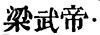

 of the
  dynasty.
 No doubt then pronounced something like
Vut-tha.
No doubt then pronounced something like
Vut-tha.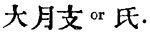
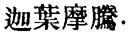
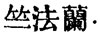


 composed between
239 and 265 A.D., no longer exists as a complete work, but a
considerable extract from it dealing with the countries of the West is
incorporated in the San Kuo Chih
composed between
239 and 265 A.D., no longer exists as a complete work, but a
considerable extract from it dealing with the countries of the West is
incorporated in the San Kuo Chih  of P'ei-Sung-Chih
 (429 A.D.). See Chavannes, translation and notes in
T'oung Pao, 1905, pp. 519-571.
(429 A.D.). See Chavannes, translation and notes in
T'oung Pao, 1905, pp. 519-571. See Chavannes, l.c. p. 550.
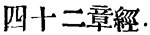 It speaks, however, in section 36 of being
born in the condition or family of a Bodhisattva (P'u-sa-chia), where
the word seems to be used in the late sense of a devout member of the
Buddhist Church.
It speaks, however, in section 36 of being
born in the condition or family of a Bodhisattva (P'u-sa-chia), where
the word seems to be used in the late sense of a devout member of the
Buddhist Church. a Buddhist author with a
strong spice of Taoism. His work is a collection of questions and
answers, somewhat resembling the Questions of Milinda. See translation
by Pelliot (in T'oung Pao, vol. XIX. 1920) who gives the date
provisionally as 195 A.D.
a Buddhist author with a
strong spice of Taoism. His work is a collection of questions and
answers, somewhat resembling the Questions of Milinda. See translation
by Pelliot (in T'oung Pao, vol. XIX. 1920) who gives the date
provisionally as 195 A.D.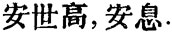 He worked at translations in Loyang
148-170.
He worked at translations in Loyang
148-170.


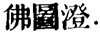 He was a remarkable man and famous in his
time, for he was credited not only with clairvoyance and producing
rain, but with raising the dead. Rémusat's account of him, based on
the Tsin annals, may still be read with interest. See Nouv. Mélanges
Asiatiques, II. 1829, pp. 179 ff. His biography is contained in chap.
95 of the Tsin
He was a remarkable man and famous in his
time, for he was credited not only with clairvoyance and producing
rain, but with raising the dead. Rémusat's account of him, based on
the Tsin annals, may still be read with interest. See Nouv. Mélanges
Asiatiques, II. 1829, pp. 179 ff. His biography is contained in chap.
95 of the Tsin  annals.
 Died 363 A.D.
 must be distinguished from Tsin
 the name of three short but legitimate dynasties.

 For this title see Pelliot in T'oung
Pao, 1911, p. 671.
For this title see Pelliot in T'oung
Pao, 1911, p. 671.
 He was canonized under the name of Wu
 and the three great persecutions of Buddhism are
sometimes described as the disasters of the three Wu, the others being
Wu of the North Chou dynasty (574) and Wu of the T'ang (845).
and the three great persecutions of Buddhism are
sometimes described as the disasters of the three Wu, the others being
Wu of the North Chou dynasty (574) and Wu of the T'ang (845). For the 25 pilgrims see Nanjio, p. 417.


 See Chavannes, "Voyage de Song
Yun dans l'Udyâna et le Gandhâra, 518-522," p. E in B.E.F.E.O. 1903,
pp. 379-441. For an interesting account of the Dowager Empress see pp.
384-5.
See Chavannes, "Voyage de Song
Yun dans l'Udyâna et le Gandhâra, 518-522," p. E in B.E.F.E.O. 1903,
pp. 379-441. For an interesting account of the Dowager Empress see pp.
384-5.


 Is celebrated in Chinese history as one
of the greatest opponents of Buddhism. He collected all the objections
to it in 10 books and warned his son against it on his death bed.
Giles, Biog. Dict. 589.
Is celebrated in Chinese history as one
of the greatest opponents of Buddhism. He collected all the objections
to it in 10 books and warned his son against it on his death bed.
Giles, Biog. Dict. 589. An important minister and apparently a
man of talent but of ungovernable and changeable temper. In 639 he
obtained the Emperor's leave to become a priest but soon left his
monastery. The Emperor ordered him to be canonized under the name Pure
but Narrow. Giles, Biog. Dict. 722. The monk Fa-Lin
An important minister and apparently a
man of talent but of ungovernable and changeable temper. In 639 he
obtained the Emperor's leave to become a priest but soon left his
monastery. The Emperor ordered him to be canonized under the name Pure
but Narrow. Giles, Biog. Dict. 722. The monk Fa-Lin  also attacked the views of Fu I in two treatises which have been
incorporated in the Chinese Tripitaka. See Nanjio, Cat. Nos. 1500,
1501.
also attacked the views of Fu I in two treatises which have been
incorporated in the Chinese Tripitaka. See Nanjio, Cat. Nos. 1500,
1501. This name has been transliterated in an
extraordinary number of ways. See B.E.F.E.O. 1905, pp. 424-430.
Giles gives Hsüan Chuang in his Chinese Dictionary, but Hsüan Tsang
in his Biographical Dictionary. Probably the latter is more correct.
Not only is the pronunciation of the characters variable, but the
character
This name has been transliterated in an
extraordinary number of ways. See B.E.F.E.O. 1905, pp. 424-430.
Giles gives Hsüan Chuang in his Chinese Dictionary, but Hsüan Tsang
in his Biographical Dictionary. Probably the latter is more correct.
Not only is the pronunciation of the characters variable, but the
character  was tabooed as being part of the Emperor K'ang
Hsi's personal name and
was tabooed as being part of the Emperor K'ang
Hsi's personal name and  substituted for it. Hence the
spelling Yüan Chuang.
substituted for it. Hence the
spelling Yüan Chuang. See Vincent Smith, Early History of
India, pp. 326-327, and Giles, Biog. Dict., s.v. Wang Hsüan-T'sê.
This worthy appears to have gone to India again in 657 to offer robes
at the holy places.
See Vincent Smith, Early History of
India, pp. 326-327, and Giles, Biog. Dict., s.v. Wang Hsüan-T'sê.
This worthy appears to have gone to India again in 657 to offer robes
at the holy places. Some of the principal statues in the caves
of Lung-men were made at her expense, but other parts of these caves
seem to date from at least 500 A.D. Chavannes, Mission Archéol. tome
I, deuxième partie.
Some of the principal statues in the caves
of Lung-men were made at her expense, but other parts of these caves
seem to date from at least 500 A.D. Chavannes, Mission Archéol. tome
I, deuxième partie. Ta-Yün-Ching. See J.A. 1913, p. 149.
The late Dowager Empress also was fond of masquerading as Kuan-yin but
it does not appear that the performance was meant to be taken
seriously.
Ta-Yün-Ching. See J.A. 1913, p. 149.
The late Dowager Empress also was fond of masquerading as Kuan-yin but
it does not appear that the performance was meant to be taken
seriously.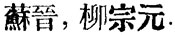

 The meaning of this name appears to vary
at different times. At this period it is probably equivalent to Kapisa
or N.E. Afghanistan.
The meaning of this name appears to vary
at different times. At this period it is probably equivalent to Kapisa
or N.E. Afghanistan.

 Some native critics, however, have doubted
the authenticity of the received text and the version inserted in the
Official History seems to be a summary. See Wieger, Textes
Historiques, vol. iii. pp. 1726 ff., and Giles, Chinese Literature,
pp. 200 ff.
Some native critics, however, have doubted
the authenticity of the received text and the version inserted in the
Official History seems to be a summary. See Wieger, Textes
Historiques, vol. iii. pp. 1726 ff., and Giles, Chinese Literature,
pp. 200 ff. and the dynasty which called
itself Southern T'ang.
and the dynasty which called
itself Southern T'ang.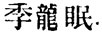 See Kokka No. 309, 1916.

 Compare the similar doctrines of Wang
Yang-Ming.
Compare the similar doctrines of Wang
Yang-Ming.
 In Tibetan Karma de bshin
gshegs-pa. He was the fifth head of the Karma-pa school. See Chandra
Das's dictionary, s.v., where a reference is given to
kLong-rdol-gsung-hbum. It is noticeable that the Karma-pa is one of
the older and more Tantric sects.
In Tibetan Karma de bshin
gshegs-pa. He was the fifth head of the Karma-pa school. See Chandra
Das's dictionary, s.v., where a reference is given to
kLong-rdol-gsung-hbum. It is noticeable that the Karma-pa is one of
the older and more Tantric sects. Yüan Shih K'ai prefixed to
this latter the four characters
Yüan Shih K'ai prefixed to
this latter the four characters 
 His real name was Wang Shou Jên


 Pan-jo (Po-jo) or Prajnâpâramitâ
 Pao-chi or Ratnakûṭa.
 Ta-chi or Mahâsannipâta.
 Hua-yen or Avatamsaka.
 Nieh-pan or Parinirvâṇa.
 Sûtras in more than one translation
but not falling into any of the above five
classes.
Sûtras in more than one translation
but not falling into any of the above five
classes. Other sûtras existing in only one translation.
 For an account of some of the scriptures
here mentioned see chap. XX.
For an account of some of the scriptures
here mentioned see chap. XX.
 Some of the works classed
under Tan-i-ching appear to exist in more than one form, e.g.
Nanjio, Nos. 674 and 804.
Some of the works classed
under Tan-i-ching appear to exist in more than one form, e.g.
Nanjio, Nos. 674 and 804. Chin Kang.
 and 530
 No. 1087. It has nothing to do with the
Pali Sûtra of the same name. Digha, I.
No. 1087. It has nothing to do with the
Pali Sûtra of the same name. Digha, I. No. 1490.
 No. 1661. For more about the Patriarchs see
the next chapter.
No. 1661. For more about the Patriarchs see
the next chapter. No. 1524, written A.D. 1006.
 No. 1482.
 No. 1640.
 Nos. 1634 and 1594.
 to be admitted to the Canton in 1062.
 Nos. 1483, 1485, 1487, and (b)
 No. 1612. For the date
of the first see Maspéro in B.E.F.E.O. 1910, p. 114. There was a
still earlier catalogue composed by Tao-an in 374 of which only
fragments have been preserved. See Pelliot in T'oung Pao, XIX. 1920,
p. 258.
No. 1612. For the date
of the first see Maspéro in B.E.F.E.O. 1910, p. 114. There was a
still earlier catalogue composed by Tao-an in 374 of which only
fragments have been preserved. See Pelliot in T'oung Pao, XIX. 1920,
p. 258.

 No. 203.
 No. 1365.
 No. 1353.
 No. 1321.
 Fa-chi-yao-sung-ching, No. 1439.
 For the relations of the Chinese
translations to the Pali Tripitaka, and to a Sanskrit Canon now
preserved only in a fragmentary state, see inter alia, Nanjio, Cat.
pp. 127 ff., especially Nos. 542, 543, 545. Anesaki, J.R.A.S. 1901,
p. 895; id. "On some problems of the textual history of the Buddhist
scriptures," in Trans. A. S. Japan, 1908, p. 81, and more especially
his longer article entitled, "The Four Buddhist Agamas in Chinese" in
the same year of the Trans.; id. "Traces of Pali Texts in a Mahâyana
Treatise," Muséon, 1905. S. Lévi, Le Samyuktâgama Sanskrit, T'oung
Pao, 1904, p. 297.
For the relations of the Chinese
translations to the Pali Tripitaka, and to a Sanskrit Canon now
preserved only in a fragmentary state, see inter alia, Nanjio, Cat.
pp. 127 ff., especially Nos. 542, 543, 545. Anesaki, J.R.A.S. 1901,
p. 895; id. "On some problems of the textual history of the Buddhist
scriptures," in Trans. A. S. Japan, 1908, p. 81, and more especially
his longer article entitled, "The Four Buddhist Agamas in Chinese" in
the same year of the Trans.; id. "Traces of Pali Texts in a Mahâyana
Treatise," Muséon, 1905. S. Lévi, Le Samyuktâgama Sanskrit, T'oung
Pao, 1904, p. 297.
 system is used in the well-known
dictionary called Yü-Pien composed 543 A.D.
system is used in the well-known
dictionary called Yü-Pien composed 543 A.D.
 See especially Hackmann, "Die Schulen
des chinesischen Buddhismus" (in the Mitth. Seminars für
Orientalische Sprachen, Berlin, 1911), which contains the text and
translation of an Essay by a modern Chinese Buddhist, Yang Wên Hui.
Such a review of Chinese sects from the contemporary Buddhist point of
view has great value, but it does not seem to me that Mr. Yang explains
clearly the dogmatic tenets of each sect, the obvious inference being
that such tenets are of little practical importance. Chinese
monasteries often seem to combine several schools. Thus the
Tz'ŭ-Fu-Ssŭ monastery near Peking professes to belong both to
the Lin-Chi and Pure Land schools and its teachers expound the
Diamond-cutter, Lotus and Shou-Lêng-Ching. So also in India. See Rhys
Davids in article Sects Buddhist, E.R.E. Hackmann gives a list of
authorities. Edkins, Chinese Buddhism (chaps. VII and VIII), may
still be consulted, though the account is far from clear.
See especially Hackmann, "Die Schulen
des chinesischen Buddhismus" (in the Mitth. Seminars für
Orientalische Sprachen, Berlin, 1911), which contains the text and
translation of an Essay by a modern Chinese Buddhist, Yang Wên Hui.
Such a review of Chinese sects from the contemporary Buddhist point of
view has great value, but it does not seem to me that Mr. Yang explains
clearly the dogmatic tenets of each sect, the obvious inference being
that such tenets are of little practical importance. Chinese
monasteries often seem to combine several schools. Thus the
Tz'ŭ-Fu-Ssŭ monastery near Peking professes to belong both to
the Lin-Chi and Pure Land schools and its teachers expound the
Diamond-cutter, Lotus and Shou-Lêng-Ching. So also in India. See Rhys
Davids in article Sects Buddhist, E.R.E. Hackmann gives a list of
authorities. Edkins, Chinese Buddhism (chaps. VII and VIII), may
still be consulted, though the account is far from clear.





 Much biographical information respecting
this and other schools will be found in Doré, vols. VII and VIII. But
there is little to record in the way of events or literary and
doctrinal movements.
Much biographical information respecting
this and other schools will be found in Doré, vols. VII and VIII. But
there is little to record in the way of events or literary and
doctrinal movements.

 Tendai in Japanese. It is also called in
China
Tendai in Japanese. It is also called in
China  Fa-hua.
 Also often spoken of as Chih-chê-ta-shih
 Officially he is often styled the fourth Patriarch of
the school. See Doré, p. 449.
Officially he is often styled the fourth Patriarch of
the school. See Doré, p. 449. In Pali Buddhism also, especially in
later works, Samatha and Vipassanâ may be taken as a compendium of the
higher life as they are respectively the results of the two sets of
religious exercises called Adhicitta and Adhipaññâ. (See Ang. Nik. III
88.)
In Pali Buddhism also, especially in
later works, Samatha and Vipassanâ may be taken as a compendium of the
higher life as they are respectively the results of the two sets of
religious exercises called Adhicitta and Adhipaññâ. (See Ang. Nik. III
88.) Tun, Chien, Pi-mi, Pu-ting, Tsang, T'ung, Pieh, Yüan. See Nanjio,
1568, and for very different explanations of these obscure words.
Edkins, Chinese Buddhism, p. 182, and Richard's New Testament of
Higher Buddhism, p. 41. Masson-Oursel in J.A. 1915, I. p. 305.
Tun, Chien, Pi-mi, Pu-ting, Tsang, T'ung, Pieh, Yüan. See Nanjio,
1568, and for very different explanations of these obscure words.
Edkins, Chinese Buddhism, p. 182, and Richard's New Testament of
Higher Buddhism, p. 41. Masson-Oursel in J.A. 1915, I. p. 305.
 The books are Nanjio, Nos. 1534, 1536,
1538.
The books are Nanjio, Nos. 1534, 1536,
1538.




 The early history of the school is
related in a work called Lien-shê-kao-hsien-ch'uan, said to date from
the Tsin dynasty. See for some account of the early worthies, Doré,
pp. 280 ff. and 457 ff. Their biographies contain many visions and
miracles.
The early history of the school is
related in a work called Lien-shê-kao-hsien-ch'uan, said to date from
the Tsin dynasty. See for some account of the early worthies, Doré,
pp. 280 ff. and 457 ff. Their biographies contain many visions and
miracles.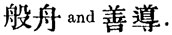
 and translated by Richard under the title of A Guide to
Buddhahood, pp. 97 ff.
and translated by Richard under the title of A Guide to
Buddhahood, pp. 97 ff.
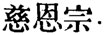 The name refers not to the doctrines of
the school, but to Tz'ŭ-ên-tai-shih, a title given to Kuei-chi the
disciple of Hsüan Chuang who was one of its principal teachers and
taught at a monastery called Tz'ŭ-ên.
The name refers not to the doctrines of
the school, but to Tz'ŭ-ên-tai-shih, a title given to Kuei-chi the
disciple of Hsüan Chuang who was one of its principal teachers and
taught at a monastery called Tz'ŭ-ên.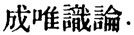 See Nanjio, Cat. Nos. 1197 and 1215.
 Also called Nan Shan or Southern mountain
school from a locality in Shensi.
Also called Nan Shan or Southern mountain
school from a locality in Shensi. Nanjio, Cat. 1493, 1469, 1470, 1120,
1481, 1483, 1484, 1471.
Nanjio, Cat. 1493, 1469, 1470, 1120,
1481, 1483, 1484, 1471.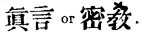
 See the account by Edkins, Chinese
Buddhism, pp. 271 ff.
See the account by Edkins, Chinese
Buddhism, pp. 271 ff.
 See China Mission Year Book, 1896, p.
43.
See China Mission Year Book, 1896, p.
43. For a specimen of devotional literature
about the heart see the little tract translated in China Branch,
R.A.S. XXIII. pp. 9-22.
For a specimen of devotional literature
about the heart see the little tract translated in China Branch,
R.A.S. XXIII. pp. 9-22. For text translation and commentary, see
De Groot, Code du Mahâyâna en Chine, 1893, see also Nanjio, No.
1087.
For text translation and commentary, see
De Groot, Code du Mahâyâna en Chine, 1893, see also Nanjio, No.
1087.
 Pai Chang is apparently
to be taken as the name of the author, but it is the designation of a
monastery used as a personal name. See Hackmann in T'oung Pao, 1908,
pp. 651-662. It is No. 1642 in Nanjio's Catalogue. He says that it has
been revised and altered.
Pai Chang is apparently
to be taken as the name of the author, but it is the designation of a
monastery used as a personal name. See Hackmann in T'oung Pao, 1908,
pp. 651-662. It is No. 1642 in Nanjio's Catalogue. He says that it has
been revised and altered.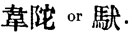 For this personage see the
article in B.E.F.E.O. 1916. No. 3, by Péri who identifies him with
Wei, the general of the Heavenly Kings who appeared to Tao Hsüan the
founder of the Vinaya school and became popular as a protecting deity
of Buddhism. The name is possibly a mistaken transcription of
Skandha.
For this personage see the
article in B.E.F.E.O. 1916. No. 3, by Péri who identifies him with
Wei, the general of the Heavenly Kings who appeared to Tao Hsüan the
founder of the Vinaya school and became popular as a protecting deity
of Buddhism. The name is possibly a mistaken transcription of
Skandha.
 See Lévi and Chavannes' two articles in
J.A. 1916, I and II, and Watters in J.R.A.S. 1898, p. 329, for an
account of these personages. The original number, still found in a few
Chinese temples as well as in Korea, Japan and Tibet was sixteen.
Several late sûtras contain the idea that the Buddha entrusted the
protection of his religion to four or sixteen disciples and bade them
not enter Nirvana but tarry until the advent of Maitreya. The
Ta-A-lo-han-nan-t'i-mi-to-lo-so-shuo-fa-chu-chi (Nanjio, 1466) is an
account of these sixteen disciples and of their spheres of influence.
The Buddha assigned to each a region within which it is his duty to
guard the faith. They will not pass from this life before the next
Buddha comes. Piṇḍola is the chief of them. Nothing is known of
the work cited except that it was translated in 654 by Hsüan Chuang,
who, according to Watters, used an earlier translation. As the Arhats
are Indian personalities, and their spheres are mapped out from the
point of view of Indian geography, there can be no doubt that we have
to do with an Indian idea, imported into Tibet as well as into China
where it became far more popular than it had ever been in India. The
two additional Arhats (who vary in different temples, whereas the
sixteen are fixed) appear to have been added during the T'ang dynasty
and, according to Watters, in imitation of a very select order of
merit instituted by the Emperor T'ai Tsung and comprising eighteen
persons. Chavannes and Lévi see in them spirits borrowed from the
popular pantheon.
See Lévi and Chavannes' two articles in
J.A. 1916, I and II, and Watters in J.R.A.S. 1898, p. 329, for an
account of these personages. The original number, still found in a few
Chinese temples as well as in Korea, Japan and Tibet was sixteen.
Several late sûtras contain the idea that the Buddha entrusted the
protection of his religion to four or sixteen disciples and bade them
not enter Nirvana but tarry until the advent of Maitreya. The
Ta-A-lo-han-nan-t'i-mi-to-lo-so-shuo-fa-chu-chi (Nanjio, 1466) is an
account of these sixteen disciples and of their spheres of influence.
The Buddha assigned to each a region within which it is his duty to
guard the faith. They will not pass from this life before the next
Buddha comes. Piṇḍola is the chief of them. Nothing is known of
the work cited except that it was translated in 654 by Hsüan Chuang,
who, according to Watters, used an earlier translation. As the Arhats
are Indian personalities, and their spheres are mapped out from the
point of view of Indian geography, there can be no doubt that we have
to do with an Indian idea, imported into Tibet as well as into China
where it became far more popular than it had ever been in India. The
two additional Arhats (who vary in different temples, whereas the
sixteen are fixed) appear to have been added during the T'ang dynasty
and, according to Watters, in imitation of a very select order of
merit instituted by the Emperor T'ai Tsung and comprising eighteen
persons. Chavannes and Lévi see in them spirits borrowed from the
popular pantheon.
 For the importance of
Ti-tsang in popular Buddhism, which has perhaps been underestimated,
see Johnston, chap. VII.
For the importance of
Ti-tsang in popular Buddhism, which has perhaps been underestimated,
see Johnston, chap. VII.
 This word, which has no derivation in
Chinese, is thought to be a corruption of some vernacular form of the
Sanskrit Upâdhyâya current in Central Asia. See I-tsing, transl.
Takakusu, p. 118. Upâdhyâya became Vajjha (as is shown by the modern
Indian forms Ojha or Jha and Tamil Vâddyar). See Bloch in
Indo-Germanischen Forschungen, vol. XXV. 1909, p. 239. Vajjha might
become in Chinese Ho-sho or Ho-shang for Ho sometimes represents the
Indian syllable va. See Julien, Méthode, p. 109, and Eitel,
Handbook of Chinese Buddhism, p. 195.
This word, which has no derivation in
Chinese, is thought to be a corruption of some vernacular form of the
Sanskrit Upâdhyâya current in Central Asia. See I-tsing, transl.
Takakusu, p. 118. Upâdhyâya became Vajjha (as is shown by the modern
Indian forms Ojha or Jha and Tamil Vâddyar). See Bloch in
Indo-Germanischen Forschungen, vol. XXV. 1909, p. 239. Vajjha might
become in Chinese Ho-sho or Ho-shang for Ho sometimes represents the
Indian syllable va. See Julien, Méthode, p. 109, and Eitel,
Handbook of Chinese Buddhism, p. 195.