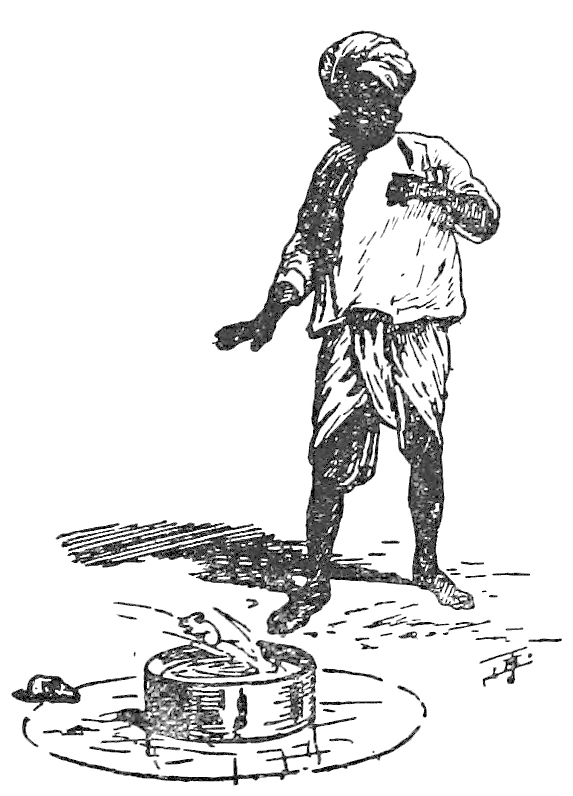
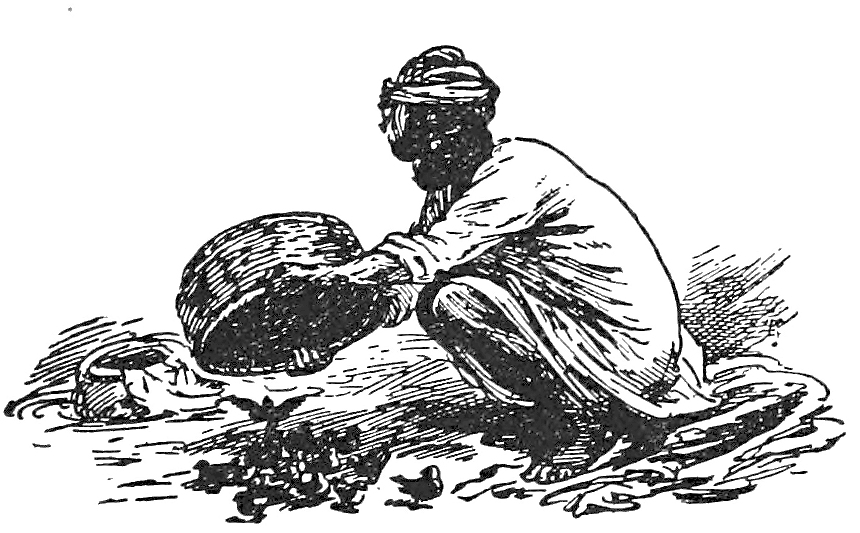
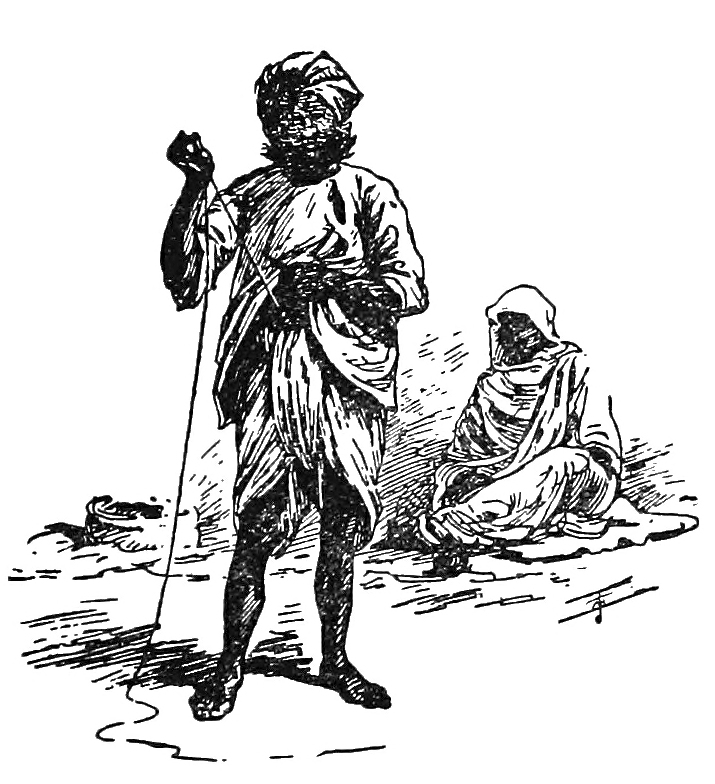
I shall begin by describing the famous mango-tree
trick—perhaps the best known of all the
feats performed by the Indian conjuror. I shall
first of all describe the performance as it would
appear to the uninitiated witness, afterwards
explaining the secret.
As the trick is usually exhibited, it is somewhat
as follows: The native comes forward,
almost nude, being covered only with a small loin
cloth, of such small compass that the onlooker can
see clearly that there is nothing hidden in or
about it or the performer. As the trick (like
almost all Indian tricks) is performed in any
locality—on the deck of a ship, in one’s own room,
etc.—all idea of pre-arrangement, trap-doors, etc.,
is precluded. The performer advances, carrying
in his hands a little earthen or tin pot containing
water, and another containing a quart or so of
dry sand. He also has with him some seeds of
the mango-tree, and a large cloth, about four feet
square. This is shaken out and both sides are
shown to the spectators, so that they may see that
nothing is concealed within it.
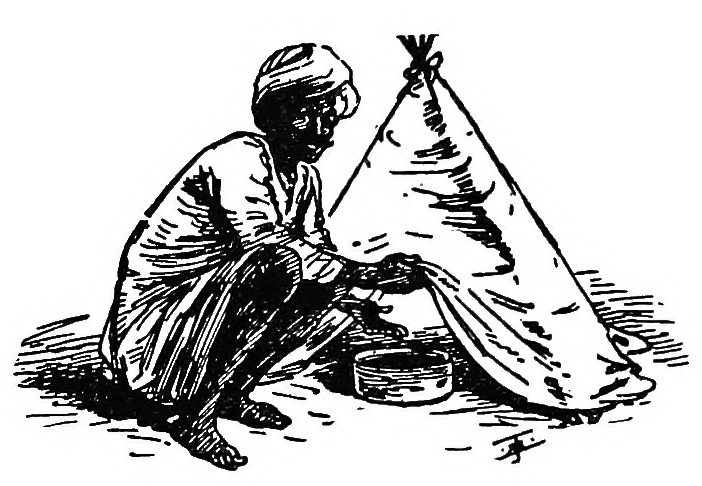
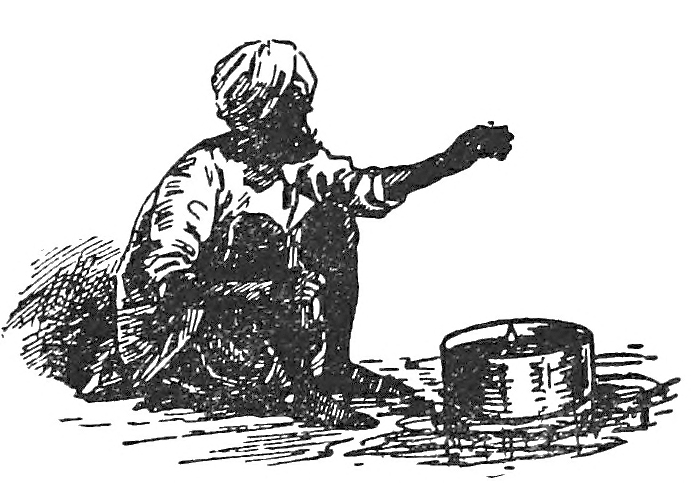
All this having been gone through, the fakir
proceeds to build up a little mud pile of his earth
and water, mixing the two together with his
fingers, and dexterously moulding them into a
pyramid of muddy earth. This may be done in
some previously examined vessel, or on the bare
earth or floor. The mango-seed is now inserted
in the soil, and covered on all sides with earth.
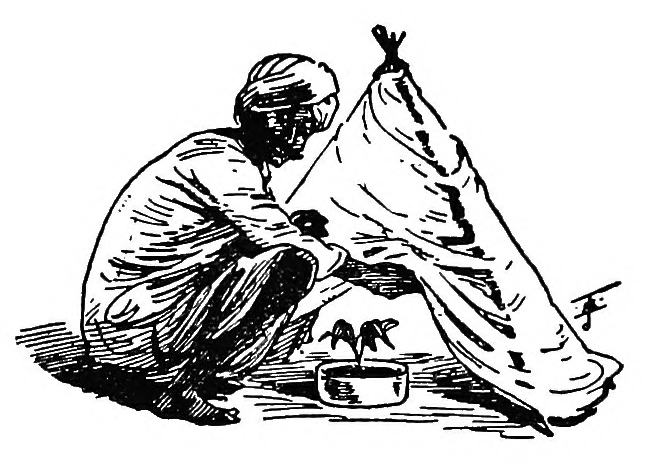
The fakir then covers the mound of earth with the
shawl or large handkerchief, and places his hands
and arms under the shawl, manipulating the seed
and the earth for some time; placing his hands
over the seed; making passes above the seed, etc.
As his hands and arms are bare, and can be seen
bare throughout this process of manipulation,
and as his hands never once approach his body, no
one has any objection to his handling the seed
and the earth in this manner, or to his placing
his hands beneath the cloth. After a few minutes
of this manipulation, the conjuror withdraws
his hands, and proceeds to make passes over the
cloth and above it, at the same time muttering
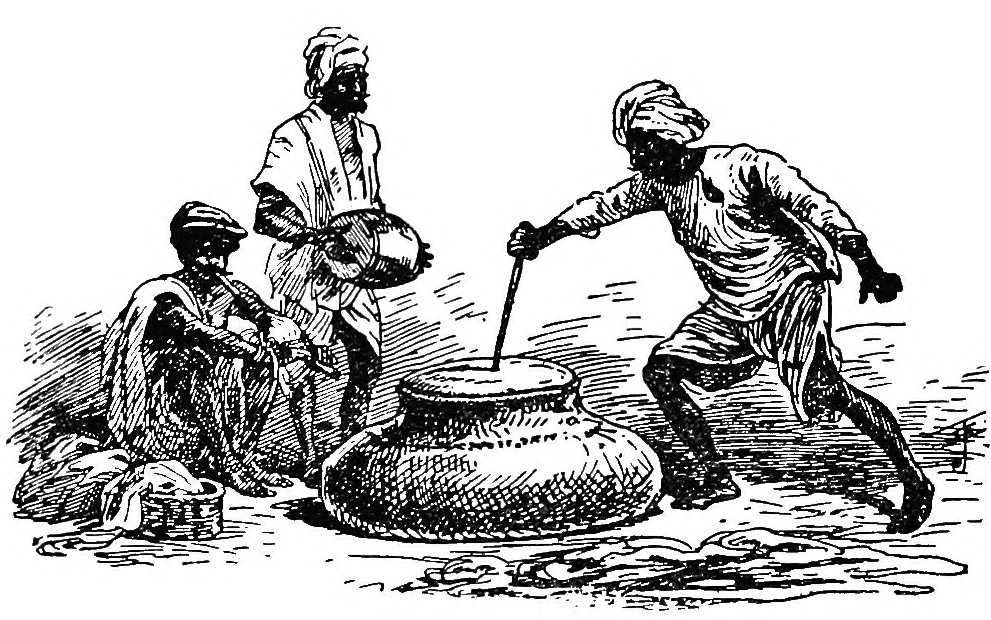
semi-articulate incantations, etc. Sometimes a
tom-tom is beaten, or other instrument is played
upon, and, after a while, the conjuror removes the
cloth, and the seed is seen to have sprouted—a
couple of tiny leaves appearing above the surface
of the earth. If the onlooker is especially skeptical,
the fakir sometimes removes the seed, and
shows the skeptic a couple of minute roots, sprouting
from the lower end of it. It (the seed) is then
replaced in the earth, the manipulations and incantations
repeated, and, after a while, the fakir
removes the cloth a second time, and the mango
is seen to have sprouted still more—now being
several inches in height. This process is repeated
five or six times, or even more, at the end of
which time the mango-tree is two feet or more in
height. It is even asserted that, in some cases,
the tree has been known to bear fruit.
So much for the effect of the trick. Now for
the explanation.
There are numerous ways of performing this
mango-tree trick—for trick it is.
In the first place, it will be noticed that it is
always a mango-tree that is made to grow, and
no other shrub. Now, why is this? Surely it is
not because the mango is the only tree in India
which is ready to the hand of the fakir, for we
know that there are numerous others that might
be made to grow. And yet it is always the mango!
The conjuror, S.S. Baldwin (from whose book,
Secrets of Mahatma Land Explained, I shall have
occasion to quote later on), asked a native conjuror
if he would make a young palm, a tea plant
or a banana tree, grow for him, and received the
response: “Nay, sahib, cannot do. Mango-tree
the only one can make.” I repeat, why is this?
The reason is that it is the peculiar construction
of the mango leaf that renders the trick, as
presented, possible at all. The leaf and twigs
of the mango-tree are exceedingly tough and
pliable, almost like leather, and can be folded or
compressed into a very small space without breaking
the stems and the leaves, and, when this
pressure is released, the leaves will resume their
former expanded condition very rapidly, without
showing any traces of the folding process. The
leaves can be turned upon themselves and rolled
into a tight ball, in which folded condition they
occupy very little space, and yet will resume their
extended condition when this pressure is released.
And this brings me to the heart of my explanation.
The mango seed that is placed in the mound
of earth is especially prepared before the performance,
by the fakir, in the following manner:
He splits the seed open, scoops out its contents,
dries it somewhat, then places within it a shoot
of a mango-tree folded and compressed so as to
fit into the mango seed. It must be remembered
that the mango seed is no small thing, but is about
two inches long (sometimes more) by an inch to
an inch and a half broad. It resembles slightly
the mussel shell found on the seashore. It will be
obvious that a seed of this size might contain a
good deal of material, and if the mango leaves
were folded into a small compass, would hold a
good-sized twig. The leaves are folded very
carefully, and are prepared in a special manner.
The upper surface of the leaf must be folded on
itself, and that surface, skillfully treated and
watered, will scarcely show a crease on a superficial
examination. The creasing which the under
surface would show is, of course, concealed from
the spectator’s view.
When the fakir places his hands beneath the
cloth the first time, then, he gets hold of the seed,
and proceeds to manipulate it in such a manner as
to extract from the upper end of the seed about
an inch or so of the plant it contains. He may
extract the seed altogether from the earth for that
purpose, and replace it in the earth again at the
conclusion of this manipulation, banking up the
earth around the seed again before removing his
hands. The fakir then removes both hands, and
proceeds with the playing of his tom-tom, and
whatever other mummeries he may see fit to
perform, in order to impress his onlooker. After
a while the cloth is removed, and the seed is found
to have sprouted, and an inch or so of the stem
and the first green leaves are seen to be sprouting
from the earth. The illusion is perfect, and the
onlookers are more taken up with gazing in
wonder at the miraculous growth and discussing
it one with another than with critically examining
the seed and the sprouting plant. If the conjuror
wishes to show the roots sprouting from the lower
end of the seed, he merely has to place these roots
in the seed before the performance begins, and
extract them in the course of his manipulation of
the seed, previously explained. The preparation
of the seed is concealed by the fact that a duplicate
seed is first exhibited to the spectators, and that
seed is frequently examined by them. Before the
seed is placed in the ground, however, the conjuror
finds occasion to change it for another, prepared
in the manner described. No one thinks of examining
the seed after the performance is concluded.
To return, however, to the method of working
the trick. After the conjuror has shown the
growth from the seed the first time, he covers the
seed with a shawl and again places his hands beneath
the cloth and works out a little more of the
mango; then repeats his incantations and his tom-tom
playing; finally showing the shoot a second
time, when it is found to have grown a considerable
amount in the interval. Amazement is correspondingly
great! This performance is gone
through several times, until the folded mango
shoot is all worked out of the seed, the growing
tree being covered each time by the shawl. When
the shoot is all worked out of the seed, there is a
fair-sized shrub standing before you.
But there are some cases in which the mango-tree
is reported to have grown to a height of
several feet, and even to bear fruit; and the explanations
offered would not explain such cases,
it may be said. That is admitted; and I shall now
endeavor to explain how these more marvellous
feats are performed.
It must be remembered that Hindu fakirs
seldom or never travel singly, but always in troupes
of threes and fours; and, during the performance
of one of the fakirs, the others assist him by
passing him the articles he uses in his performance—jars,
water, earth, etc. Now, every time the
conjuror moves the shawl from the growing plant,
he tosses the shawl to his assistant, and shows his
hands empty. When receiving the shawl back
from his assistant, he also shows his hands empty;
then shakes out the shawl and shows both sides of
it—showing, in this way, that nothing is concealed
in the shawl, and that he introduces nothing under
cover of the said shawl. To all appearances,
nothing could be fairer. And, indeed, nothing is
fairer at first; but the conjuror shakes the shawl
less and less vigorously every time he places it
over the mango-tree, until, towards the end (the
seventh or eighth time, let us say) he hardly
shakes it at all. The spectators, having seen it
empty so many times, get into the habit of mind of
thinking it is empty as a matter of course, and pay
no attention to this part of the performance, after
the first few times. Their thoughts and attention
are centered upon the mango-tree and its growth.
So, when the conjuror has worked out all the shoot
from the seed, he must perforce introduce a fresh
shoot of larger proportions; and he does this in
the following manner: He passes on word to his
assistant, by means of a secret sign, that he has
reached the end of his present stock of “occult
vitalizing influence”—in other words, the mango
shoot—and the assistant, in passing him back the
shawl or cloth this time passes him back another
cloth, which he has secretly exchanged for the
original one—the one the conjuror began operations
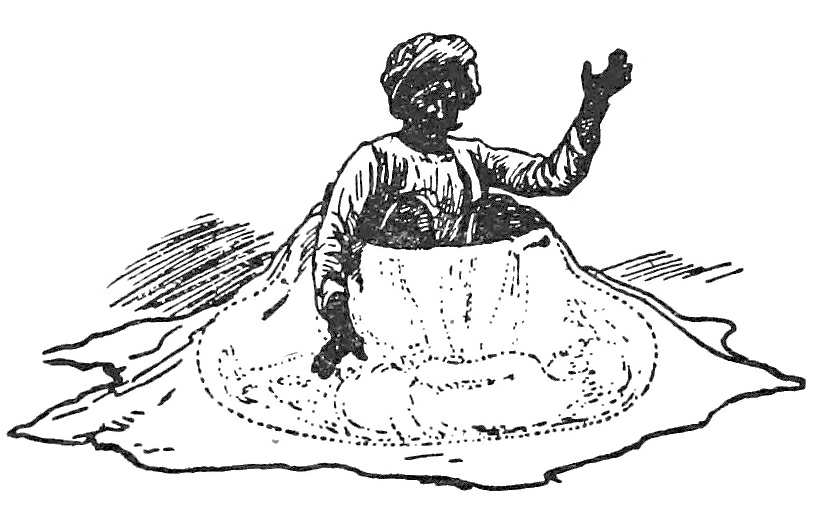
with. This second cloth is double, and contains
a very large mango shoot, more or less
doubled up in the manner of the first shoot that
was placed within the mango seed. A slit in the
cloth enables the conjuror to extract the second
shoot, and place it in the mound of earth, working
this shoot out to its natural size with his fingers.
When this large shoot is worked out to its full
limit it is a very large tree, and the conjuror has
only to remove the cloth to display it to his
astonished onlookers. The cloth just employed is
exchanged for the original while the eyes of the
spectators are fascinated by the huge tree just
exhibited to them, and when the trick is concluded
this cloth is handed for examination; and, of
course, no trickery is discovered in connection with
it. The whole performance is a very pretty chapter
in the psychology of deception.
As to the cases in which, it is asserted, fruit
grows upon the tree grown in this manner, I have
no exact explanation of that fact, and I frankly
confess my disbelief in its occurrence. I have
diligently searched for any first-hand account of
this fact, and have never found one; nor have I
been enabled to meet anyone who could assert that
he had seen it himself. It seems to rest on the
same hazy foundation as the famous rope exploit,
to be discussed later on.
I may say that my father was an old Anglo-Indian,
having lived ten years in Calcutta, but he
never saw this finale to the trick, though he had
many times seen the mango-tree trick performed,
as described above. Nor had he ever met anyone,
in all that time, who could state that he had
witnessed the feat with his own eyes. It would
seem, therefore, to be one of those “grand finale”
flourishes which happened to be placed at the end
of some magazine writer’s description of the
mango-tree trick, in order to make it appear as
wonderful as possible—and gained wide credence
on that account!
There is then, so far as I have been enabled
to discover, no first-hand account of fruit growing
upon the mango-tree, that has been made to grow
in the manner described; and until such evidence
be forthcoming, I think we are entitled to say
that it has never been done. However, there
are certain considerations which might make us
admit that such was the case—and yet the fruit
might be obtained and placed there by fraudulent
means! One such method would be for the fruit
to be introduced under the cloth, in the act of
covering the mango-tree. The introduction of the
fruit would be comparatively easy if some of
the methods about to be explained were employed.
At all events, this feat is no more difficult—certainly
no more “miraculous”—than that performed
by Kellar, in which roses are made to grow
from empty flower pots—which roses are cut and
distributed to the audience immediately. In this
instance, two empty flower pots are shown (they
may be examined, if desired) and filled with
earth. Seeds are then sprinkled over the earth,
and watered. A tube, open at both ends, is then
shown empty, and examined by the audience. It
is made of card-board, and everyone can see that
it is quite unprepared. First one flower pot and
then the other is then covered with this tube, and
upon removing the tube, the seeds are found to
have sprouted into full-grown bushes, fully
eighteen inches in height, and covered with roses—at
least fifty, on both plants. These roses are
cut off immediately, and distributed among the
audience, who testify to their genuine character.
In a very similar illusion, on a small scale, a glass
tumbler is filled with earth, and covered for a
moment with a borrowed hat; upon removing
which it is found that the seeds have blossomed
into a plant about six inches high. If flowers
can be made to grow under such circumstances,
therefore, why not fruit upon mango-trees, grown
under similar conditions, and before far less critical
audiences, who have already had their critical
faculties blunted, moreover, by a succession of
unexplained marvels?
So far, I have described only one method of
performing this mango-tree trick, and there are
several other methods, which I shall now briefly
enumerate—since the method above described is
the one in general use, without a doubt. Another
very good method, however, is the following,
which was first made public, if I remember
rightly, by Mr. Charles Bertram, the conjuror, to
whom I am indebted for the secret, in this instance.
In this case the conjuror makes his mound of
earth as in the last instance, and has a prepared
seed, which he exchanges for an examined seed at
a convenient moment. The seed in this case is,
however, prepared in a slightly different manner.
It is split in two, and emptied of its contents.
Then one end of it is wedged open by means of
a small wedge of wood, and several small pieces
of string are inserted into the other end, which,
when hanging down from the seed, after being
placed in the mud, exactly resemble roots. The
seed is then fastened together, so that the two
sides or halves will not fall apart. This seed the
conjuror exchanges for the examined seed at
some convenient moment, and this is the one
placed in the ground.
The juggler then hands round for inspection
four bamboo sticks, and a piece of thin cloth.
After the sticks are handed back to him, he places
them in the ground, slanting towards a common
centre, and ties the tops of the sticks together
with a bit of string. Around these sticks is now
stretched the cloth, thus making a sort of tent,
about three feet in height and open at the back.
The thinness of the cloth allows the interior to be
dimly seen through it. The mound of earth, containing
the seed, is within this tent, it having
been built round it, in fact. The juggler suddenly
appears to notice that the cloth is too thin, allowing
the interior to be seen through it, and proceeds
to cover the tent with a thicker piece of cloth.
The conjuror in this case has a rag doll, which he
uses very much as our Western magicians use
their wands; and with this he proceeds to make
passes over the tent, about the seed inside the
tent, etc. He also waters the seed several times.
After a time, the cloth is lifted up, and the spectators
see that the tree is several inches in height.
This performance is repeated several times, the
passes, waterings, etc., being gone through each
time, and generally a wait of several minutes is
necessitated, during which waits the conjuror performs
some other trick, such as the diving duck,
the cups and balls, or the colored sands, all of
which I shall explain later on. At the conclusion
of the performance the juggler removes the cloth,
and the mango is found to have grown to a very
respectable height.
Now for the explanation:
In the first place, the rag doll which the conjuror
uses is hollow, and contains, folded up within
it, a shoot of the mango-tree. In the course of
making passes over the seed he extracts this
shoot, and inserts it in the wedged-open end of
the seed, where it remains until removed. The
conjuror could now show this shoot, but it would
lose in effectiveness to show it so soon, and for
that reason he performs the minor tricks in the
interval. When he returns to the tent and raises
the cloth, this shoot is seen sprouting from the
ground. The conjuror then lets the cloth fall to
the ground again, and proceeds to make more
passes over the seed. During these passes he manages
to extract the small shoot from the seed,
and replace it in the rag doll again. He then
places a much larger shoot of the tree in the slit
end of the mango seed. This larger branch was
concealed in the second cloth which the conjuror
placed around his tent, after discovering, apparently
by accident, that the first cloth was so thin
as to be semi-transparent. Within the folds of
this second cloth was contained the mango-tree
shoot of larger size. The tree is now grown to its
full size and might be shown immediately, but,
for effect, the conjuror again waits for several
minutes before showing the growth to his onlookers.
Sometimes the tree is made to disappear
altogether at the end of the performance, like the
palace in the Arabian Nights. When this is the
case, the conjuror has extracted the branch from
the seed, and managed to conceal it under the
carpet on which he was sitting. This is gathered
up and removed at the close of the entertainment.
There are, doubtless, other methods of performing
this mango-tree trick. Kellar describes
a method in which the performer concealed several
shoots of the tree of various sizes within his
sleeves, and produced them in turn, under cover
of the cloth. As, however, Hindu fakirs seldom
wear robes of the kind, I think we may say that
this is a method seldom used. Some conjurors
cover the growing seed with a basket; and when
this is the case there is probably room for concealment
of shoots of the tree within secret compartments
of the covering basket.