Punctually at ten o'clock the next morning
Dr. Abernethy stood before the door, with
a neat phaeton behind him; and the girls
were summoned from the piazza, where Rose
was taking her French lesson.
"My dears," said Miss Wealthy, "are you
ready? You said ten o'clock, and the clock
has already struck."
"Oh, yes, Cousin Wealthy!" cried Hildegarde,
starting up, and dropping one book on
the floor and another on the chair. "We
are coming immediately. Rose, nous allons
faire une promenade en voiture! Répétez cette
phrase!"
"Nous allong—" began Rose, meekly; but
she was cut short in her repetition.
"Not allong, dear, allons, ons. Keep your
mouth open, and don't let your tongue come
near the roof of your mouth after the ll. Allons!
Try once more."
"You need not wait, Jeremiah," said Miss
Wealthy, in a voice that tried not to be
plaintive. "I dare say the young ladies will
be ready in a minute or two, and I will stand
by the Doctor till they come."
Hildegarde heard, smote her breast, flew
upstairs for their hats and a shawl and pillow
for Rose. In three minutes they were in the
carriage, but not till a kiss and a whispered
apology from Hildegarde had driven the
slight cloud—not of vexation, but of wondering
sadness; it seemed such a strange thing,
not to be ready and waiting when Dr.
Abernethy came to the door—from Miss
Wealthy's kind face.
"Good-by, dear Cousin Wealthy!" and
"Good-by, dear Miss Bond!" cried the two
happy girls; and off they drove in high
spirits, while Miss Wealthy went back to the
piazza and picked up the French books,
wiped them carefully, and then went upstairs
and put them in the little bookcase in Hildegarde's
room.
"She is a very dear girl," she said, shaking
her head; "a little heedless, but perhaps all
girls are. Why, Mildred—oh! but Mildred
was an exception. I suppose," she added,
"they call me an old maid. Very likely.
Not these girls,—for they are too well-mannered,—but
people. An old maid!" Miss
Wealthy sighed a little, and put her hand up
to the pansy breastpin,—a favorite gesture
of hers; and then she went into the house,
to make a new set of bags for the curtain-tassels.
Meanwhile the girls were driving along,
looking about them, and enjoying themselves
immensely. Jeremiah had given them directions
for a drive "just about so long," and
they knew that they were to turn three
times to the left and never to the right.
And first they went up a hill, from the top
of which they saw "all the kingdoms of the
earth," as Rose said. The river valley was
behind them, and they could see the silver
stream here and there, gleaming between its
wooded banks. Beyond were blue hills, fading
into the blue of the sky. But before
them—oh! before them was the wonder.
A vast circle, hill and dale and meadow,
all shut in by black, solemn woods; and beyond
the woods, far, far away, a range of
mountains, whose tops gleamed white in the
sunlight.
"There is snow on them," said Rose.
"Oh, Hildegarde! they must be the White
Mountains. Jeremiah told me that we could
see them from here. That highest peak must
be Mount Washington. Oh, to think of it!"
They sat in silence for a few moments,
watching the mountains, which lay like
giants at rest.
"Rose," said Hildegarde, at length, "the
Great Carbuncle is there, hidden in some
crevice of those mountains; and the Great
Stone Face is there, and oh! so many wonderful
things. Some day we will go there,
you and I; sometime when you are quite,
quite strong, you know. And we will see
the Flume and the wonderful Notch. You
remember Hawthorne's story of the 'Ambitious
Guest'? I think it is one of the
most beautiful of all. Perhaps—who knows?—we
may find the Great Carbuncle." They
were silent again; but presently Dr. Abernethy,
who cared nothing whatever about
mountains or carbuncles, whinnied, and gave
a little impatient shake.
"Of course!" said Hildegarde. "Poor
dear! he was hot, wasn't he? and the flies
bothered him. Here is our turn to the left;
a pine-tree at the corner,—yes, this must
be it! Good-by, mountains! Be sure to
stay there till the next time we come."
"What was that little poem about the
Greek mountains that you told me the other
day?" asked Rose, as they drove along,—"the
one you have copied in your commonplace
book. You said it was a translation
from some modern Greek poet, didn't you?"
"Yes," said Hildegarde; "but I don't
know what poet. I found it in a book of
Dr. Felton's at home."
She thought a moment, and then repeated
the verses,—
"'Why are the mountains shadowed o'er?
Why stand they darkened grimly?
Is it a tempest warring there,
Or rain-storm beating on them?
"'It is no tempest warring there,
No rain-storm beating on them,
But Charon sweeping over them,
And with him the departed.'"
"Look!" she cried, a few moments after.
"There is just such a cloud-shadow sweeping
over that long hill on the left. Is it true, I
wonder? I never see those flying shadows
without thinking of 'Charon sweeping over
them.' It is such a comfort, Rose, that we
like the same things, isn't it?"
"Indeed it is!" said Rose, heartily. "But,
oh! Hilda dear, stop a moment! There is
some yellow clover. Why, I had no idea
it grew so far north as this!"
"Yellow clover!" repeated Hildegarde,
looking about her. "Who ever heard of
yellow clover? I don't see any."
"No, dear," said Rose; "it does not grow
in the sides of buggies, nor even on stone-walls.
If you could bend your lofty gaze
to the ditch by the roadside, you might
possibly see it."
"Oh, there!" said Hildegarde, laughing.
"Take the reins, Miss Impudence, and I will
get them." She sprang lightly out, and returned
with a handful of yellow blossoms.
"Are they really clover?" she asked, examining
them curiously. "I had no idea
there were more than two kinds, red and
white."
"There are eight kinds, child of the city,"
said Rose, "beside melilot, which is a kind
of clover-cousin. This yellow is the hop-clover.
Dear me! how it does remind me
of my Aunt Caroline."
"And how, let me in a spirit of love inquire,
does it resemble your Aunt Caroline?
Is she yellow?"
"She was, poor dear!" replied Rose. "She
has been dead now—oh! a long time. She
was an aunt of Mother's; and once she had
the jaundice, and it seems to me she was
always yellow after that. But that was
not all, Hilda. There was an old handbook
of botany among Father's books, and I used
to read it a great deal, and puzzle over the
long words. I always liked long words, even
when I was a little wee girl. Well, one day
I was reading, and Aunt Caroline happened
to come in. She despised reading, and
thought it was an utter waste of time, and
that I ought to sew or knit all the time,
since I could not help Mother with the
housework. She was very practical herself,
and a famous housekeeper. So she looked
at me, and frowned, and said, 'Well, Pink,
mooning away over a book as usual? Useless
rubbish! yer ma'd ought to keep ye
at work.' I didn't say anything; I never
said much to Aunt Caroline, because I knew
she didn't like me, and I suppose I was rather
spoiled by every one else being too good to
me. But I looked down at my old book,
which was open at 'Trefolium: Clover.' And
there I read—oh, Hilda, it is really too bad
to tell!—I read: 'The teeth bristle-form'—and
hers did stick out nearly straight!—'corolla
mostly withering or persistent; the
claws'—and then I began to laugh, for it
was exactly like Aunt Caroline herself; she
was so withering, and so persistent! And I
sat there and giggled, a great girl of thirteen,
till I got perfectly hysterical. The
more I laughed, the angrier she grew, of
course; till at last she went out into the
kitchen and slammed the door after her.
But I heard her telling Mother that that gal
of hers appeared to be losing such wits as
she had,—not that 't was any great loss,
as fur as she could see. Wasn't that dreadful,
Hildegarde? Of course I was wheeled
over to her house the next day, and begged
her pardon; but she was still withering
and persistent, though she said, 'Very excusable!'
at last."
"Why, Rose!" said Hildegarde, laughing.
"I didn't suppose you were ever naughty,
even when you were a baby."
"Oh, indeed I was!" answered Rose;
"just as naughty as any one else, I suppose.
Did I ever tell you how I came near
making poor Bubble deaf? That wasn't
exactly naughty, because I didn't mean to
do anything bad; but it was funny. I must
have been about five years old, and I used
to sit in a sort of little chair-cart that Father
made for me. One day Mother was washing,
and she set me down beside the baby's
cradle (that was Bubble, of course), and told
me to watch him, and to call her if he
cried. Well, for a while, Mother said, all
was quiet. Then she heard Baby fret a
little, and then came a queer sort of noise,
she could not tell what, and after that
quiet again. So she thought what a nice,
helpful little girl I was getting to be;
and when she came in she said, 'Well,
Pinkie, you stopped the baby's fretting,
didn't you?'
"'Oh, yes, Mother!' I said, as pleased as
possible. 'I roared in his ear!' You may
imagine how frightened Mother was; but
fortunately it did him no harm."
Here the road dipped down into a gully,
and Dr. Abernethy had to pick his way
carefully among loose stones. Presently the
stone-walls gave place to a most wonderful
kind of fence,—a kind that even country-bred
Rose had never seen before. When
the great trees, the giants of the old forest,
had been cut, and the ground cleared for
farm-lands and pastures, their stumps had
been pulled up by the roots; and these
roots, vast, many-branched, twisted into
every imaginable shape, were locked together,
standing edgewise, and tossing their
naked arms in every direction.
"Oh, how wonderful!" cried Hildegarde.
"Look, Rose! they are like the bones
of some great monster,—a gigantic cuttlefish,
perhaps. What huge trees they
must have been, to have such roots as
these!"
"Dear, beautiful things!" sighed Rose.
"If they could only have been left! Isn't it
strange to think of people not caring for
trees, Hilda?"
"Yes!" said Hilda, meekly, and blushing
a little. "It is strange now; but before
last year, Rose, I don't believe I ever looked
at a tree."
"Oh, before last year!" cried Rose, laughing.
"There wasn't any 'before last year.'
I had never heard of Shelley before last
year. I had never read a ballad, nor a
'Waverley,' nor the 'Newcomes,' nor anything.
Let's not talk about the dark ages.
You love trees now, I'm sure."
"That I do!" said Hildegarde. "The oak
best of all, the elm next; but I love them all."
"The pine is my favorite," said Rose.
"The great stately king, with his broad arms;
it always seems as if an eagle should be sitting
on one of them. What was that line you
told me the other day?—'The pine-tree
spreads his dark-green layers of shade.'
Tennyson, isn't it?"
"Yes," replied Hildegarde. "But it was
'Cranford' that made me think of it. And
it isn't 'pine-tree,' after all. I looked, and
found it was 'cedar.' Mr. Holbrook, you remember,—Miss
Matty's old lover,—quotes
it, when they are taking tea with him.
Dear Miss Matty! do you think Cousin
Wealthy is the least little bit like her,
Rose?"
"Perhaps!" said Rose, thoughtfully. "I
think—Oh, Hilda, look!" she cried, breaking
off suddenly. "What a queer little house!"
Hildegarde checked Dr. Abernethy, who
had been trotting along quite briskly, and
they both looked curiously at the little house
on their left, which certainly was "queer,"—a
low, unpainted shanty, gray with age, the
shingles rotting off, and moss growing in
the chinks. The small panes of glass were
crusted with dirt, and here and there one
had been broken, and replaced with brown
paper. The front yard was a tangle of ribbon-grass
and clover; but a tuft of straggling
flowers here and there showed that it
had once had care and attention. There
was no sign of life about the place.
"Rose!" cried Hildegarde, stopping the
horse with a pull of the reins; "it is a
deserted house. Do you know that I have
never seen one in my life? I must positively
take a peep at it, and see what it is
like inside. Take the reins, Bonne Silène,
while I go and reconnoitre the position."
She jumped out, and making her way as
best she might through the grassy tangle,
was soon gazing in at one of the windows.
"Oh!" she cried, "it isn't deserted, Rose!
At least?—well, some one has been here.
But, oh, me! oh, me! What a place! I
never, never dreamed of such a place. I—"
"What is the matter?" cried Rose. "If
you don't tell me, I shall jump out!"
"No, you won't!" said Hildegarde.
"You'd better not, Miss! but oh, dear!
who ever, ever dreamed of such a place?
My dear, it is the Abode of Dirt. Squalid
is no word for it; squalor is richness compared
to this house. I am looking—sit
still, Rose!—I am looking into a room about
as big as a comfortable pantry. There is a
broken stove in it, and a table, and a stool;
and in the room beyond I can see a bed,—at
least, I suppose it is meant for a bed. Oh!
what person can live here?"
"I am coming, Hilda," said Rose. "The
only question is whether I get out with your
help or without."
"Obstinate Thing!" cried Hildegarde, flying
to her assistance. "Well, it shall see the
lovely sight, so it shall. Carefully, now;
don't trip on these long grass-loops. There!
isn't that a pretty place? Now enjoy yourself,
while I get out the tie-rein, and fasten
the good beast to a tree."
In hunting for the tie-rein under the seat
of the carriage, Hildegarde discovered something
else which made her utter an exclamation
of surprise. "Luncheon!" she cried.
"Rose, my dear, did you know about this
basket? Saint Martha must have put it in.
Turnovers, Rose! sandwiches, Rose! and, I declare,
a bottle of milk and a tin cup. Were
ever two girls so spoiled as we shall be?"
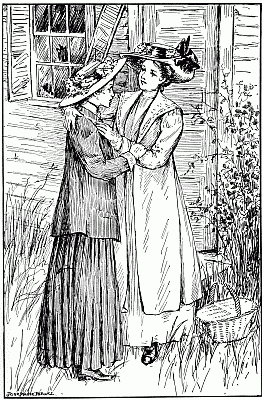 "THEN THEY HUGGED EACH OTHER A LITTLE."
"How kind!" said Rose. "I am not in
the least hungry, but I should like a cup of
milk. Oh, Hildegarde!"
"What now?" asked that young woman,
returning with the precious basket, and applying
her nose once more to the window.
"Fresh horrors?"
"My dear," said Rose, "look! That is the
pantry,—that little cupboard, with the door
hanging by one hinge; and there isn't
anything in it to eat, except three crackers
and an onion."
Both girls gazed in silence at the forlorn
scene before them. Then they looked at
each other. Hildegarde gave an expressive
little shake to the basket. Rose smiled and
nodded; then they hugged each other a little,
which was a foolish way they had when
they were pleased. Very cautiously Hildegarde
pushed the crazy door open, and they
stood in the melancholy little hovel. All was
even dirtier and more squalid than it had
looked from outside; but the girls did not
mind it now, for they had an idea, which
had come perhaps to both at the same moment.
Hilda looked about for a broom, and
finally found the dilapidated skeleton of one.
Rose, realizing at once that search for a duster
would be fruitless, pulled a double handful
of long grass from the front yard, and
the two laid about them,—one vigorously,
the other carefully and thoroughly. Dust flew
from doors and windows; the girls sneezed
and coughed, but persevered, till the little
room at last began to look as if it might
once have been habitable.
"Now you have done enough, Rosy!"
cried Hildegarde. "Sit down on the doorstep
and make a posy, while I finish."
Rose, being rather tired, obeyed. Hildegarde
then looked for a scrubbing-brush,
but finding none, was obliged to give the
little black table such a cleaning as she could
with the broom and bunches of grass. Behind
the house was a lilac-bush, covered
with lovely fragrant clusters of blossoms;
she gathered a huge bunch of them, and
putting them in a broken pitcher with water,
set them in the middle of the table. Meanwhile
Rose had found two or three peonies
and some sweet-william, and with these and
some ribbon-grass had made quite a brilliant
bouquet, which was laid beside the one
cracked plate which the cupboard afforded.
On this plate the sandwiches were neatly
piled, and the turnovers (all but two, which
the girls ate, partly out of gratitude to Martha,
but chiefly because they were good)
were laid on a cluster of green leaves. As
for the milk, that, Hildegarde declared, Rose
must and should drink; and she stood over
her till she tilted the bottle back and drained
the last drop.
"Oh, dear!" said Rose, looking sadly at
the empty bottle; "I hope the poor thing
doesn't like milk. It couldn't be a child,
Hildegarde, could it? living here all alone.
And anyhow he—or she—will have a better
dinner than one onion and—" But here she
broke off, and uttered a low cry of dismay.
"Oh, Hilda! Hilda! look there!"
Hildegarde turned hastily round, and then
stood petrified with dismay; for some one
was looking in at the window. Pressed
against the little back window was the face
of an old man, so withered and wrinkled that
it looked hardly human; only the eyes,
bright and keen, were fixed upon the girls,
with what they thought was a look of anger.
Masses of wild, unkempt gray hair surrounded
the face, and a fragment of old straw hat
was drawn down over the brows. Altogether
it was a wild vision; and perhaps it was not
surprising that the gentle Rose was terrified,
while even Hildegarde felt decidedly uncomfortable.
They stood still for a moment,
meeting helplessly the steady gaze of the
sharp, fierce eyes; then with one impulse
they turned and fled,—Hildegarde half
carrying her companion in her strong arms.
Half laughing, half crying, they reached the
carriage. Rose tumbled in somehow, Hildegarde
flew to unfasten the tie-rein; and the
next moment they were speeding away at
quite a surprising rate, Dr. Abernethy having,
for the first time in years, received a smart
touch of the whip, which filled him with
amazement and indignation.
Neither of the girls spoke until at least
a quarter of a mile lay between them
and the scene of their terror; then, as
they came to the foot of a hill, Hildegarde
checked the good horse to a walk,
and turned and looked at Rose. One look,—and
they both broke into fits of laughter,
and laughed and laughed as if they never
would stop.
"Oh!" cried Hildegarde, wiping the
tears which were rolling down her cheeks.
"Rose! I wonder if I looked as guilty as I
felt. No wonder he glowered, if I did."
"Of course you did," said Rose. "You
were the perfect ideal of a Female Burgler,
caught with the spoons in her hand; and I—oh!
my cheeks are burning still; I feel as
if I were nothing but a blush. And after all,
we were breaking and entering, Hilda!"
"But we did no harm!" said Hilda, stoutly.
"I don't much care, now we are safe out of
the way. And I'm glad the poor old glowering
thing will have a good dinner for once.
Rose, he must be at least a hundred! Did
you ever see anything look so old?"
Rose shook her head meditatively. "It's
dreadful to think of his living all alone there,"
she said. "For he must be alone. There
was only one plate, you know, and that
wretched bed. Oh, Hilda!" she added, a
moment later, "the basket! we have left
the basket there. What shall we do? Must
we go back?"
"Perish the thought!" cried Hildegarde,
with a shudder half real, half playful. "I
wouldn't go back there now for the half of
my kingdom. Let me see! We will not
tell Cousin Wealthy to-day—"
"Oh, no!" cried Rose, shrinking at the
bare thought.
"Nor even to-morrow, perhaps," continued
Hildegarde. "She would be frightened, and
might expect you to be ill; we will wait a
day or two before we tell her. But Martha
is not nervous. We can tell her to-morrow,
and say that we will get another basket.
After all, we were doing no harm,—none
in the world."
But the best-laid plans, as we all know,
"gang aft agley;" and the girls were not
to have the telling of their adventure in their
own way.
That evening, as they were sitting on the
piazza after tea, they heard Miss Wealthy's
voice, saying, "Martha, there is some one
coming up the front walk,—an aged man,
apparently. Will you see who it is, please?
Perhaps he wants food, for I see he has a
basket."
Hildegarde and Rose looked at each other
in terror.
"Oh, Hilda!" whispered Rose, catching
her friend's hand, "it must be he! What
shall we do?"
"Hush!" said Hildegarde. "Listen, and
don't be a goose! Do? what should he do to
us? He might recite the 'Curse of Kehama,'
but it isn't likely he knows it."
Martha, who had been reconnoitring
through a crack of the window-blind, now
uttered an exclamation. "Well, of all!
Mam, it's old Galusha Pennypacker, as sure
as you stand there."
"Is it possible?" said Miss Wealthy, in a
tone of great surprise. "Martha, you must
be mistaken. Galusha Pennypacker coming
here. Why should he come here?"
But for once Martha was not ready to
answer her mistress, for she had gone to
open the door.
The girls listened, with clasped hands and
straining ears.
"Why, Mr. Pennypacker!" they heard
Martha say. "This is never you?"
Then a shrill, cracked voice broke in,
speaking very slowly, as if speech were an
unaccustomed effort. "Is there—two gals—here?"
"Two gals?" repeated Martha, in amazement.
"What two gals?"
"Gals!" said the old man's voice,—"one
on 'em highty-tighty, fly-away-lookin', 'n'
the other kind o' 'pindlin'; drivin' your hoss,
they was."
"Why—yes!" said Martha, more and
more astonished. "What upon earth—"
"Here's their basket!" the old man continued;
"tell 'em I—relished the victuals.
Good-day t' ye!"
Then came the sound of a stick on the
steps, and of shuffling feet on the gravel;
and the next moment Miss Wealthy and
Martha were gazing at the guilty girls with
faces of mute amazement and inquiry which
almost upset Hildegarde's composure.
"It's true, Cousin Wealthy!" she said
quickly. "We meant to tell you—in a
little while, when you would not be worried.
We thought the house was deserted, and I
went and looked in at the window. And—it
looked so wretched, we thought we
might—"
"There was only an onion and three
crackers," murmured Rose, in deprecating
parenthesis.
"We thought we might leave part of our
luncheon, for Martha had given us such a
quantity; and just when we had finished,
we saw a face at the window—oh, such a
dreadful old face!—and we ran away, and
forgot the basket. So you see, Martha," she
added, "it was partly your fault, for giving
us so much luncheon."
"I see!" said Martha, chuckling, and
apparently much amused.
But Miss Wealthy looked really frightened.
"My dear girls," she said, "it was a very imprudent
thing to do. Why, Galusha Pennypacker
is half insane, people think. A dreadful
old miser, who lives in filth and wretchedness,
while he has plenty of money hidden away,—at
least people say he has. Why, it terrifies me
to think of your going into that hovel."
"Oh! Cousin Wealthy," said Hildegarde,
soothingly, "he couldn't have hurt us, poor
old thing! if he had tried. He looks at
least a hundred years old. And of course
we didn't know he was a miser. But surely
it will do no harm for him to have a good
dinner for once, and Martha's turnovers
ought really to have a civilizing effect
upon him. Who knows? Perhaps it may
make him remember nicer ways, and he
may try to do better."
Miss Wealthy was partly reconciled by
this view of the case; but she declared
that Rose must go to bed at once, as she
must be quite exhausted.
At this moment Martha, who was still
holding the basket, gave an exclamation
of surprise. "Why," she said, "there's
things in this! Did you leave these in the
basket, Miss Hilda?"
"I? No!" cried Hildegarde, wondering.
"I left nothing at all in it. What
is there?"
All clustered eagerly round Martha, who
with provoking deliberation took out two
small parcels which lay in the bottom of
the basket, and looked them carefully over
before opening them. They were wrapped
in dirty scraps of brown paper.
"Oh! there is writing on them!" cried
Hildegarde. "Martha dear, do tell us what
it says!"
Martha studied the inscriptions for some
minutes, and then read aloud: "'The fly-away
gal' and 'the pail gal.' Well, of
all!" she cried, "it's presents, I do believe.
Here, Miss Hilda, this must be for
you."
Hildegarde opened the little parcel eagerly.
It contained a small shagreen case, which in
its turn proved to contain a pair of scissors
of antique and curious form, an ivory tablet,
yellow with age, a silver bodkin, and a
silver fruit-knife, all fitting neatly in their
places; the whole case closing with a
spring. "It is the prettiest thing I ever
saw!" cried Hildegarde. "See, Cousin
Wealthy, isn't it delightful to think of
that poor old dear—But what have you,
Rose-red? You must be the 'pail gal,' of
course, though you are not pale now."
Rose opened her parcel, and found, in a
tiny box of faded morocco, an ivory thimble
exquisitely carved with minute Chinese figures.
It fitted her slender finger to perfection,
and she gazed at it with great delight,
while Miss Wealthy and Martha shook
their heads in amazement and perplexity.
"Galusha Pennypacker, with such things
as these!" cried one.
"Galusha Pennypacker making presents!"
exclaimed the other. "Well, wonders will
never cease!"
"The thimble is really beautiful!" said
Miss Wealthy. "He was a seafaring man
in his youth, I remember, and he must have
brought this home from one of his voyages,
perhaps fifty or sixty years ago. Dear me!
how strangely things do come about! But,
my dear Rose, you really must go to bed
at once, for I am sure you must be quite
exhausted."
And the delighted girls went off in triumph
with their treasures, to chatter in their rooms
as only girls can chatter.