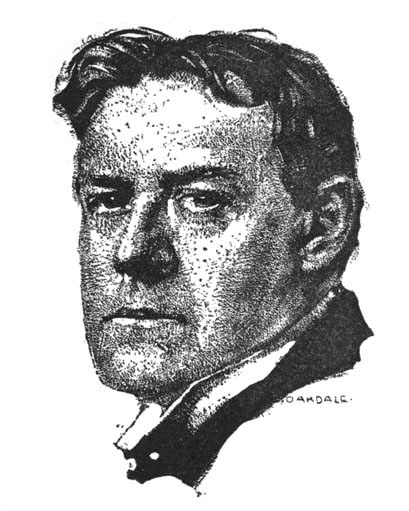
The beginning of Mr. Belloc's literary career was in history. He took a
first in the school of modern history at Oxford, and his first important
work was a study of the career of Danton. A study of Danton's career, be
it noted, and not a biography: for this book deals more with so much of
the French Revolution as is reflected in its subject's actions than with
its subject's actions in themselves.
It is, then, as an historian that he begins and mainly as an historian
that he continues. His activities are varied, but all are related to a
conception of the world, its growth and destiny, which is founded on a
conception of universal history. He sees in man a political animal,
whose distinguishing function is not commerce or art, but politics.
History is the record of man exercising this distinguishing function.
Our own politics are based on the results of the exercise of this
function in the past, and cannot be properly understood without a
knowledge of the details of that exercise. To link up the argument: man
is a political animal and finds his expression in the work of politics;
he can only be fitted for that work by the study of history. Mr. Belloc,
then, regards this as the most important of all studies.
A casual glance at his essays will reveal some sentences or other
testifying to the strength with which this opinion is rooted in his
mind. Take this from First and Last:
Of those factors in civic action amenable to civic direction,
conscious and positively effective, there is nothing to compare
with the right teaching and the right reading of history.
Or again from On Anything, regarding the matter from a somewhat
different point of view:
History may be called the test of true philosophy, or it may be
called in a very modern and not very dignified metaphor the
object-lesson of political science, or it may be called the great
story whose interest is upon another plane from all other stories
because its irony, its tragedy and its moral are real, were acted
by real men, and were the manifestation of God.
Wherever you turn over these pages, you are more likely than not to find
some such earnest and emphatic sentence: this opinion is essential to
Mr. Belloc's life and thought. With the practical and business-like
position of the first of these quotations it is our affair to deal in
this chapter: and the more spiritual and poetic view expressed in the
second will receive consideration in a later place.
In this chapter it is our purpose to outline as briefly and as clearly
as possible Mr. Belloc's conception of the growth of Europe, from the
prehistoric men who knew how to make dew-pans which "are older than the
language or the religion, and the finding of water with a stick, and the
catching of that smooth animal the mole," to the outbreak of the present
war. From this we shall omit, to a large extent, the development of
England, which, as it is singular in Europe, is singular in Mr. Belloc's
scheme of things, and must be considered separately.
We shall endeavour, as far as possible, to piece together from a great
number of books and writings on various subjects a continuous view of
European history, which we believe to be Mr. Belloc's view, but which he
has never, as yet, stated all together in one place. We shall draw our
material from such varied sources as Esto Perpetua, The Old Road,
Paris, The Historic Thames, and inevitably the essays: inevitably,
for all practical purposes, from all the books that Mr. Belloc has ever
written. At some future time, it is very seriously to be hoped, Mr.
Belloc will do this himself. It should be his magnum opus: "A General
Sketch of European Development," let us suppose. In the meanwhile, we
conceive that we shall serve a useful purpose if we make a consistent
scheme out of the hints, allusions and detached statements which occur
up and down in Mr. Belloc's books. For some such scheme, existing but
unformulated, is, beyond all doubt, the solid sub-structure of all his
thinking.
In the essay On History in Travel, Mr. Belloc says: "It is true that
those who write good guide-books do put plenty of history into them, but
it is sporadic history, as it were; it is not continuous or organic, and
therefore it does not live." It is living, organic history that is
necessary, he would consider, to the proper understanding of present
problems and the proper furnishing of the human mind. He desires to see
and grasp the development of Europe as a symmetrical whole, not as a
conglomeration of unco-ordinated parts or a succession of unrelated
accidents. He believes that Europe has developed from prehistoric man by
way of the Roman Empire, the Christian religion, and the French
Revolution, in an orderly, organic manner. He believes, far more than
Freeman, in a real unity of history.
And from this observation of continuous history he draws certain morals.
He sees, or believes that he sees, in Carthage a wealthy trading
plutocracy, ruling a population averse from arms: and he sees this
society falling to utter ruin before the Roman state, a polity of
peasant proprietors with a popular army. From that spectacle he draws
certain conclusions. He sees the Roman Empire and the way in which it
governed Europe, and from that huge organization and its mighty remains
he also draws certain lessons of wonder and reverence. From the decline
of the Empire, the growth of a slave, and economically enslaved, class,
the growth of a wealthy class, he again deduces something. All these
conclusions he applies constantly and unrelentingly to our own problems
and institutions: he cannot forbear from mentioning imperial Rome when
he comes to discuss our war in the Transvaal. He cannot forbear from
seeing the counterpart of the Peabody Yid in imperial Rome. All history
is to him a living and organic whole. And as individuals can judge in
present problems what they shall do only by reference to their own
experience and what they know of that of others, so also societies and
races. There is no guide for them but recorded history. This
accumulated experience, however, requires to be set out and interpreted.
Mr. Belloc's view and conception of the history of Europe begins with
Rome. All the roads of his speculation start from that nodal point in
the story of man. Let us take a grotesque example:
Do you not notice how the intimate mind of Europe is reflected in
cheese? For in the centre of Europe, and where Europe is most
active, I mean in Britain and in Gaul and in Northern Italy, and in
the valley of the Rhine—nay, to some extent in Spain (in her
Pyrenean valleys at least)—there flourishes a vast burgeoning of
cheese, infinite in variety, one in goodness. But as Europe fades
away under the African wound which Spain suffered or the Eastern
barbarism of the Elbe, what happens to cheese? It becomes very flat
and similar. You can quote six cheeses perhaps which the public
power of Christendom has founded outside the limits of its ancient
Empire—but not more than six. I will quote you 253 between the
Ebro and the Grampians, between Brindisi and the Irish channel.
I do not write vainly. It is a profound thing.
That passage illustrates admirably how Mr. Belloc's mind, playing on all
manner of subjects, remains true to certain fixed points. In two phrases
there he gives us our starting-point: "the public power of Christendom"
and "the limits of its ancient Empire." For Rome is to him the beginning
of Europe, and Christianity inherited what Rome had stored up in public
power, public order, and public intelligence.
He sees in Rome the power which established a unity among the Western
races which lay already dormant in them. We can trace this idea very
clearly in Esto Perpetua, where he speaks repeatedly of the Berbers,
as having fallen easily under the power of Rome because they are "of our
own kind." We can trace it again inversely in The Path to Rome, in
such a passage as this:
Here in Switzerland, for four marches, I touched a northern,
exterior and barbaric people; for though these mountains spoke a
distorted Latin tongue, and only after the first day began to give
me a Teutonic dialect, yet it was evident from the first that they
had about them neither the Latin order nor the Latin power to
create, but were contemplative and easily absorbed by a little
effort.
It is in this order, this power to create, that Mr. Belloc sees the
greatness of Rome and the innate gifts of our Western race. And if one
objects that a certain power of order would seem to reside also in
Prussia, undoubtedly a Northern, exterior and barbaric country, Mr.
Belloc would reply that the power to create was lacking, the power to
make their order living and to inform it with a spirit.
It is his opinion, we say, or rather one of the articles of his creed,
that Rome first beat and welded into unity the kindred peoples that
inhabit Western Europe. What name he gives to this Western race, if any,
he has not yet explained. Professor Müller and his contemporaries used
to talk about the Indo-Germanic race, and Professor Sergi came forward
with a more plausible Mediterranean race, and all sorts of people talk
with the utmost possible vagueness about the Celtic race, that
rubbish-heap of ethnological science or pretence. Whatever name he may
give to this race, or however ethnologically he may justify his
conception of it, Mr. Belloc believes that it exists and that Rome first
discovered it and gave it expression.
Like all large and generalized conceptions, this idea of the Western
race is best explained in a contrast, and Mr. Belloc finds a sharp
example of such a contrast in the struggle between Rome and Carthage. He
sets it out in Esto Perpetua:
It [the Phœnician attempt] failed for two reasons: the first was
the contrast between the Phœnician ideal and our own; the second
was the solidarity of the Western blood.
The army which Hannibal led recognized the voice of a Carthaginian
genius, but it was not Carthaginian. It was not levied, it was
paid. Even those elements in it which were native to Carthage or
her colonies must receive a wage, must be "volunteer"; and
meanwhile the policy which directed the whole from the centre in
Africa was a trading policy. Rome "interfered with business"; on
this account alone the costly and unusual effort of removing her
was made.
The Europeans undertook their defence in a very different spirit:
an abhorrence of this alien blood welded them together: the allied
and subjugated cities which had hated Rome had hated her as a
sister.
The Italian confederation was true because it rested on other than
economic supports. The European passion for military glory survived
every disaster, and above all that wholly European thing, the
delight in meeting great odds, made our people strangely stronger
for defeat.
It is in the European spirit, the spirit of "our people," that Mr.
Belloc finds the mission and the justification of Rome. It is on a
belief in the reality of this spirit that he founds his views of all
subsequent developments, of our own present and of our future. The work
of Rome has been minimized in common estimation by our extraordinary
habit of telescoping the centuries and viewing history, as we say, in a
perspective. There is no perspective in a right view of history: the
centuries do not diminish in length as they recede from our own day. The
perception of this very simple fact has not come to many of our
historians or to any of our politicians. It should be, indeed, the first
sentence in every school history-book, and the don should begin each
course of lectures with it.
The reasons for the overlooking of so elementary a maxim are fairly
clear. Time simplifies. The later centuries are more full of detail, and
that detail is more confused: much of it, moreover, relates more
directly to the urgent detail of our own life than the similar events of
earlier times. But for a sound conception of the historical development
of the world, we must make an effort to overcome these delusive
influences: we must realize that from the accession of Augustus to, say,
the death of Julian the Apostate was as long a period of time as the
period from the accession of Queen Elizabeth to the death of Edward VII.
Only a false perspective has so telescoped these years together as to
make them seem a short and rapid period of decline, filled up with wars,
massacres and human misery. Gibbon has given the greatest weight of
authority to these errors and shown the Empire as a period of decay and
horror.
Under the reign of these monsters [he says] the slavery of the
Romans was accompanied with two peculiar circumstances, the one
occasioned by their former liberty, the other by their extensive
conquests, which rendered their condition more wretched than that
of the victims of tyranny in any other age or country.[1]
Even Mommsen closed his history of the Republic with the gloomy
assertion that Cæsar could only secure for the dying ancient world a
peaceful twilight.
As a matter of fact, during the first four centuries, the Empire was the
most successful, satisfactory and enduring political institution which
the world has yet seen, and a recognition of this is essential
to the proper understanding of Mr. Belloc's theories. We should, as he
says, attempt "to stand in the shoes of the time and to see it as must
have seen it the barber of Marcus Aurelius or the stud-groom of
Sidonius' palace."
We know what was coming [he continues],[2] the men of the time knew
it no more than we can know the future. We take at its own estimate
that violent self-criticism which accompanies vitality, and we are
content to see in these 400 years a process of mere decay.
The picture thus impressed upon us is certainly false. There is
hardly a town whose physical history we can trace, that did not
expand, especially towards the close of that time.
... Our theory of political justice was partly formulated, partly
handed on, by those generations; our whole scheme of law, our
conceptions of human dignity and of right.... If a man will stand
back in the time of the Antonines and look around him and forward
to our own day, the consequence of the first four centuries will at
once appear. He will see the unceasing expansion of the paved
imperial ways. He will conceive those great Councils of the Church
which would meet indifferently in centres 1,500 miles apart, in the
extremity of Spain or on the Bosphorus: a sort of moving city whose
vast travel was not even noticed nor called a feat. He will be
appalled by the vigour of the Western mind between Augustus and
Julian when he finds that it could comprehend and influence and
treat as one vast State what is, even now, after so many centuries
of painful reconstruction, a mosaic of separate provinces.
The reader has there a handy conspectus of Mr. Belloc's view on a period
he considers cardinal in the history of what he would call "our own
kind." This is one of the pillars of his conception of the world: what
the other pillars are will appear later in this chapter.
In pursuing the story, he insists on minimizing the effect and extent of
the barbaric invasions. He does not indeed regard the auxiliary troops
of the Empire who set up kingdoms in the West as invaders at all. The
Wandering of the Peoples which assumes such a dreadful aspect in
Gibbon, is, to him, until after Charlemagne at least, certainly a sign
of decay and certainly an element of disorganization, but neither the
one nor the other to the extent which we are accustomed to believe. Here
we have a sign of a definite attitude towards historical fact, an
attitude which is open to question but which is still permissible. He
believes that the civilization of Rome endured for the main part,
particularly in Gaul, until the ninth century. In The Eye-Witness he
states roundly that Charlemagne came of an old family of wealthy and
powerful Gallo-Roman nobles. In Paris, an earlier work, he declines to
estimate the exact amount of German blood in this ruler's veins.[3]
In any case, he believes that the German auxiliaries partly replaced and
partly allied themselves with a rich, powerful and long-established
aristocracy; that they did in truth separate the State into fragments;
but that they touched very little the main social fabric, and only at
most hastened the elements of change. He perpetually insists on the
fewness of the invaders who settled, and he believes that the Western
race, welded almost into one people by the vast political action of
Rome, was, in bulk, but little affected by the Northern barbarians.
Not until the ninth century will he admit anything approaching the death
of Roman influence in her Western provinces, except in Britain. Here, in
the ninth century, under the invasions of the Danes and the onslaughts
of the Arabs, civilization is in peril and the West suffers its most
serious wounds at the hands of the barbarians. And here already, the new
influence, the Roman Church, which began to show itself in the
coronation of Charlemagne, first takes up its inheritance of the
œcumenical power of the Empire. The ninth century saw the climax of
"the gradual despair of the civil power; the new dream of the Church
which meant to build a city of God on the shifting sands of the
invasions."[4]
The new dream was but beginning to take on reality and the civil power
had in all fullness despaired. The old civilization, which had lasted so
long and changed so gradually, required to be refreshed by catastrophe:
even as some men believe of our own times. The catastrophe came, and,
through the struggle with the North and with Asia, the transformation
took place unseen in that lowest ebb of humanity. Europe had reached the
crest of one wave in the height of the Empire under the power of the
Roman government. It was to reach another in the thirteenth century
under the influence of the Roman Church.
The most of Mr. Belloc's conception of the Middle Ages is to be found in
his book Paris, where it is really incidental though profoundly
important. We cannot too often insist upon this fact, that the brief and
insufficient historical sketch presented in this chapter is a piecing
together often of mere indications as well as of detached statements.
The reader will do well to bear in mind that in this exposition we are
laying before him to the best of our powers what we take to be the
definite scheme of events undoubtedly present in our author's mind, but
never as a whole expressed by him. It is frequently necessary to infer
from what he states, the precise curve of his thought: this skeleton of
history is deduced only from a few bones.
In the book Paris, then, we find the best guide to his conception of
the Middle Ages. It is naturally in principle a work of topographical
and architectural purpose. But architecture is a guide to history.
It is the capital art of a happy society. (And, incidentally, an art
that is, in a definite and positive manner, dead in the present age.)
Athens, at her climax, built: and the grandeur of Rome has been
preserved in arches and aqueducts. For Mr. Belloc, the progress of the
upward curve from the ninth century to the thirteenth reaches its
culmination in the best of the Gothic. He sees in that structural time
one of humanity's periods of achievement, and he will not assent to the
common theory of a gradual upward curve from the Dark Ages to the
Renaissance.
The progress of the Middle Ages was a progress towards unity, less
successful but more spontaneous than that which was achieved under the
compelling hand of the Roman armies. Christianity, wounded and
threatened by the advance of the heathen, of a power opposed to them by
religion and by race, was shocked into feeling the existence of
Christendom. The Western spirit, which had rallied to the Republic
against Carthage, now gathered under the flag of the Church and
expressed itself in the Crusades.
The levying of Europe for a common and a noble purpose began the process
which was continued by the intellectual stimulation of these wars. It
flowered briefly but exquisitely in the Gothic, in the foundation of the
universities and the teaching of philosophy, and in the establishment of
strong, well-ordered central governments in the feudal scheme.
The merits of the Middle Ages, to Mr. Belloc, lie not only in their
artistic and philosophical achievements, but also and especially in
their security. He has the French, the Latin attachment to a vigorous
central power, and, of all political forms, he most fears and hates an
oligarchy. To others, to Dr. Johnson and to Goldsmith, for example, it
has seemed very clear that the interests of the poor lie with the king
against the rich. Mr. Belloc sees in the feudal system strongly
administered from a centre, with the villein secured in his holding and
the townsman controlled and protected by his guild, if not a perfect, at
least a solidly successful polity. He applauds therefore those ages in
which central justice was effective, the ages of Edward I in England and
St. Louis in France.
But [he says] the mediaeval theory in the State and its effect on
architecture, suited as they were to our blood, and giving us, as
they did, the only language in which we have ever found an exact
expression of our instincts, ruled in security for a very little
while; it began—almost in the hour of its perfection—to decay;
St. Louis outlived it a little, kept it vigorous, perhaps, in his
own immediate surroundings, when it was already weakened in the
rest of Europe, and long before the thirteenth century was out the
system to which it has given its name was drying up at the
roots.[5]
Why, then, was this crest of the curve so much less durable than that on
which the Empire rode safely through four ordered centuries? To that
there are many possible answers. Some might suppose that the binding
spiritual force of the Roman Church was weaker than the physical force
of the Roman army. Mr. Belloc suggests that the mediaeval system came
too suddenly into flower and had not enough strength to deal with new
problems. He offers also other reasons, such as these[6]:
First, the astounding series of catastrophes ... especially in the
earlier part; secondly, its loss of creative power. As for the
first of these, the black death, the famines, the hundred years'
war, the free companies, the abasement of the church, the great
schism—these things were misfortunes to which our modern time can
find no parallel. They came suddenly upon Western Europe and
defiled it like a blight.... They have made the mediaeval idea
odious to every half-instructed man and have stamped even its
beauty with associations of evil.
So for two hundred years the curve continued evilly downwards, and at
last, after a period of horror, rose in the lesser crest of the
Renaissance, a time more splendid than solid, more active than
beneficent. In this period occurred the Reformation, an event which Mr.
Belloc, a Catholic, frankly regards as evil.
He thinks that it tore in two the still expanding body of Christendom.
But, with the exception of one province, it left to the See of Rome all
those Western countries which the Empire of Rome had governed. Britain
was torn away in the process, but the remainder of the Western races was
left, if not united, at least with a bond of unity.
So the course of history went into the welter of religious wars which
gradually merge into dynastic wars and confuse the record of the
sixteenth, seventeenth and eighteenth century. At the end of the last of
these divisions of time came the Revolution.
This event is the third of the three pillars on which Mr. Belloc
supports his notion of Western history: the Roman Empire, the thirteenth
century, and the Revolution. He sees in it the principle result of the
Reformation, but an event which also undid and increasingly nullified
the effects of that schism.
He regards the Reformation as having not only disturbed the unity of
Europe, but also having encouraged the growth of those wealthy and
selfish classes of whom he has a particular dread. He speaks—in his
Marie Antoinette, which becomes for some little distance here our
principal guide—of how "the attempt to force upon the French doctrines
convenient, in France as in England, to the wealthy merchants, the
intellectuals and the squires was met by popular risings." He believes
that to the Catholic tradition descended from the Roman Empire that idea
of the State which is always the salvation of the people as opposed to
the rich. The violent adhesion of France to the Church—only tempered by
some jealousy of Austria—saved the Faith for Europe: France thus became
the capital stronghold of the Western idea, whence it issued in renewed
force at the Revolution.[7] The Revolution itself was a drastic return
to the ideas of universality and equality which are essentially Roman.
It has been Mr. Belloc's task and delight to reconcile the principles of
the Revolution with his own faith. He would show that the two were
opposed only by this intellectual accident or that political blunder:
that the dogmas of each are capable of being held by the same mind. And,
in the revival of religion in our own times, which "may be called,
according to the taste of the scholar, the Catholic reaction or the
Catholic renaissance," he sees not only the first and most beneficent
result of the principles of the Revolution, but also a sign that the
wounds then inflicted are beginning to be healed.
His clearest and most connected exposition of these things is to be
found in the little book which is called The French Revolution, of
which the object, he says, is "to lay, if that be possible, an
explanation of it before the reader."
He begins by making a detailed explanation of the democratic theory,
which is drawn from Rousseau's treatise Le Contrat Social. Let us
select one significant passage on the doctrine of equality:
The doctrine of the equality of man is a transcendent doctrine: a
"dogma" as we call such doctrines in the field of transcendental
religion. It corresponds to no physical reality which we can grasp,
it is hardly to be adumbrated even by metaphors drawn from physical
objects. We may attempt to rationalize it by saying that what is
common to all men is not more important but infinitely more
important than the accidents by which men differ.
On such a simple statement does he found his explanation of the greatest
event of the modern world, an upheaval and a remoulding which
astonishes us equally whether we consider how far it fell short of its
highest intentions or how much it actually accomplished.
Now he proceeds from the obvious and historical fact of the quarrel
which actually took place between the Revolution and the Church, and
asks: "Was there a necessary and fundamental quarrel between the
doctrines of the Revolution and those of the Catholic Church?" And he
replies:
It is impossible for the theologian, or even for the practical
ecclesiastical teacher, to put his finger upon a political doctrine
essential to the Revolution and to say, "This doctrine is opposed
to Catholic dogma or to Catholic morals." Conversely, it is
impossible for the Republican to put his finger upon a matter of
ecclesiastical discipline or religious dogma and to say, "This
Catholic point is at issue with my political theory of the State."
So much for the negative argument which at that point in that book was
enough for Mr. Belloc's purpose. He proceeds to explain the material
accidents and causes which nullified this argument. But we must attempt
further to discover from the general trend of Mr. Belloc's character and
thought the positive grounds by which he reconciles these two principles
which have so far shown themselves divided in practice.
The two things are of Latin, that is to say of Roman origin. The Church
is "the ghost of the Roman Empire sitting crowned and throned on the
grave thereof": it is a new manifestation (and a higher one) of the
political and social ideal which inspired the Roman people. Also the
French have inherited most of the Latin passion for reason, law and
order: under Napoleon they strove to make a new empire, and they carried
together a code of law and the idea of equality all over Europe.
In both the Faith and the Revolution there are secure dogmas on which
the mind can rest. Fundamental unprovable things are established by
declaration, and fruitless argument about them is cut off at the roots.
In the clear certitude of such doctrines is a basis for action and for
civilization.
The purpose and the scope of work of both these ideas was much the same.
Each proposed to establish a European community, in which the peoples of
kindred blood might rest together and develop their resources. The
Revolution might well have restored that unity of the Western race which
vanished with Rome and which the Reformation forbade the Church to
accomplish.
That conception of Europe as an entity so far only conscious of itself,
as it were, by lucid intervals in a long delirium, is very dear to Mr.
Belloc. We have dwelt on it at the beginning of this chapter and must
return to it now, for, if one idea can be said to underlie all his
historical writings, this is that one idea. The notions which we have
described as the three pillars of his historical scheme are three
expressions of this vision, and the vision is of something transcendent,
like the dogmas on which his mind rests, something which is a reality,
but cannot be proved in words or seized by any merely physical metaphor.
He begins Marie Antoinette with these words: "Europe, which carries
the fate of the whole world ..."
This fundamental point in its three expressions is the point which Mr.
Belloc would have his public grasp before beginning to discuss the
problems which await it in the polling-booths and in the everyday
conversations which more weightily mould the fate of the world. He is a
propagandist historian, and his work has the liveliness given by an air
of eagerness to convince.
His bias, the precise nature of his propaganda, are frankly exposed. He
would have the State and European society, especially the society of
England, revived by a return to the profession and the practice of his
own faith. In Prussia also historians compose their works with such a
definite and positive end in contemporary affairs.
But between them and Mr. Belloc lies this great difference. He writes,
as we have said, candidly, in a partisan spirit, with the eagerness of a
man who wishes to convince. In the University of Berlin the
indoctrination of the student is pursued under the cloak of a baleful
and gloomy pedantry, laughably miscalled "the scientific method." The
propaganda of Frederick is not obvious and many are deceived.
The Catholic historian lies in England under a grave suspicion. Lingard,
who wrote, after all, one of the best histories of the English nation,
certainly more readable than Freeman and less prejudiced than Froude, is
neither studied nor mentioned in our schools. Even poor Acton, whose
smug Whig bias is apparent to the stupidest, who nourished himself on
Lutheran learning, "mostly," as he says, pathetically "in octavo
volumes," is thought of darkly by the uninstructed as an emissary of the
Jesuits. But who can either suffer from or accuse the Catholic bias of
Mr. Belloc?
He says to you frankly in every page: "I am a Catholic. I believe in the
Church of Rome. For these and these reasons, I am of opinion that the
Reformation was a disaster and that the Protestant peoples are still a
danger to Europe." Can you still complain of the propagandist turn of
such a man? As well complain of a professed theologian that he is
biassed as to the existence of God. He warns you amply that he has a
particular point of view, and he gives you every opportunity to make
allowance for it. When you have done so, you will find that his
narrative and interpretation are still astonishingly accurate and just.
And he has a corrective to bias in his vivid poetic love of the past,
which we shall analyse in the succeeding chapter.
This also is made a reproach against him by scholars. It is true that in
his serious historical works, Robespierre, Danton, and Marie
Antoinette, he introduces more of romance than is commonly admitted by
serious writers. He is apt to give his descriptions something of the
positive and living character which we more usually expect in a novel.
The charge is made against him, under which Macaulay suffers justly and
Prescott, the American, with less reason, of having written historical
romances. Let us grant that it is not usual to give so much detail or so
much colour as that in which Mr. Belloc takes delight.
Is his accuracy thereby spoilt? He insists on seeing all the events and
details of Cardinal de Rohan's interview with the pretended Queen of
France. But it does not of itself testify that Mr. Belloc cannot judge
whether this interview took place or interfered with his estimate of its
importance. We contend, very seriously and very gravely, that these
books will be found to show a singularly high level of accuracy and
justice. In the interpretation of facts bias will show: in Acton equally
with Froude. If it did not, if the historian were an instrument and
humanly null, what effect would either his narrative or his reading have
on the student? He could not convey to another mind even his
comprehension of the bare facts. Mr. Belloc invests his narrative with a
living interest, and how he does this and why it is the surest guarantee
of accuracy and impartiality, we shall endeavour to show in the
succeeding chapter.