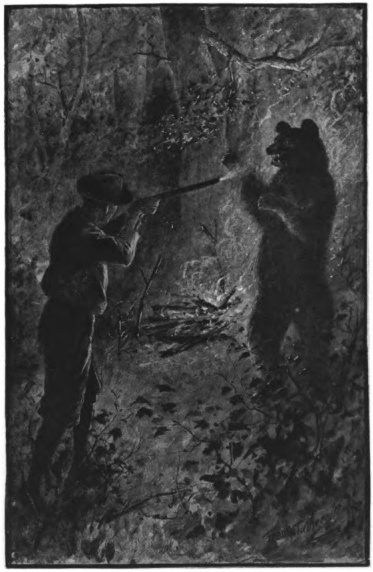
The ease with which Margie and Sallie adapted themselves to the hard and often
rough tasks of homestead life surprised their neighbours who had beheld their
stylish clothes and hands that very evidently were unaccustomed to labour,
with many a shaking of the head. And when they found that the girls were
really natural and unaffected, the sturdy settlers took them to their hearts.
Rare was the day that some of the neighbours were not calling upon or
receiving visits from Mrs. Porter and her daughters, for the boys had insisted
upon their learning to ride the ponies that Mr. Hopkins had loaned.
In spare moments the young people practised with their firearms until they all
became good shots, even the little mother overcoming her aversion enough to
learn to fire both a rifle and a revolver with fair marksmanship.
As the season advanced, the young homesteaders irrigated their fields every
week, with the result that their crops grew splendidly. But as Phil and Ted
watched them mature with pride, their neighbours watched them with jealousy.
Of this feeling, Chester was the first to learn, and when he did, he lost no
time in seeking out Andy.
“Simmons is at the bottom of this,” declared the new land agent, when the fire
lookout had imparted the unpleasant information.
“It certainly sounds like his work, but he has appealed to the settlers’
pockets, and that means trouble,” returned Chester. “Aren’t the boys’ crops
far enough along so that they can give up irrigating them without injury?”
“Perhaps—I haven’t been over for a couple of days. But it makes my blood
boil to think that these other homesteaders, who have had plenty of
opportunity in years past to build irrigating plants and never did so, should
start trouble now that Phil and Ted are taking advantage of the water supply.”
“That’s just it, Andy. So long as none of the others irrigated, no one thought
about it. But now that two boys, without experience, take up a claim and, by
irrigating, produce crops far and away ahead of any in the region, the others
realize their mistake. It isn’t fair, but it’s true. You, as land agent, are
the only person who can handle the situation, and you’ve got to hurry!”
As though to emphasize the fire lookout’s words, two horsemen drew rein in
front of the Land Office, dismounted, and entered.
From their faces Andy and Chester realized they were in no pleasant mood.
“’Lo, Hall. ’Lo, Perkins,” greeted the land agent, affably. “Haven’t seen you
for a long time. Sit down and have a cigar. Oh, you needn’t be afraid of
them,” he added, as neither man took one from the proffered box; “they are
some Si Hopkins sent me.”
“We ain’t come to chin, we come on business,” grunted Hall, still refusing to
accept a cigar.
With a snap Andy closed the cigar box, and replaced it in a drawer of his
desk, while the newcomers glowered in silence.
“Why don’t you get to it?” he demanded, when several moments had passed
without anything being said.
Quickly Hall and Perkins exchanged glances, then the latter snapped:
“We want our rights!”
“But I haven’t got them,” blandly replied Andy.
“Now don’t get funny,” growled Hall. “You know what we mean.”
“Unfortunately, I don’t,” returned the land agent, quietly.
Irritated by Andy’s calmness, Hall fairly screamed:
“Them kids has been stealing Perkins’ and my water. They got to stop
irrigating, and they got to pay us for ruining our crops by stealing our
water. They—”
“Simmons made a mistake there—” began Andy, only to be interrupted by Perkins.
“Simmons? Simmons? Who said anything about him? We’re talking about
our water rights.”
“Which you would never have thought of if Simmons had not put the idea into
your heads. But, as I said, he has made a mistake. The Porter boys are
entitled to a certain amount of water, and I know they have not used more than
their share because I helped them build their irrigating plant, and I made the
sluice of such size that if they irrigated twice a week they would not quite
use up their lawful allowance. As it is, they have irrigated only once a week,
so, you see, your water rights have not been infringed.”
“But they dammed the stream—they ain’t no right to do that,” stammered
Perkins, much of his bravado gone.
“Oh, yes, they have, provided, of course, they do not check the natural flow
of the brook except on the days when they are entitled to the water for
irrigation purposes.”
“Come on, Jerry. I told you in the first place, Andy was in with ’em,”
exclaimed Hall.
Reluctantly his companion obeyed, but as they reached the door, Perkins
turned.
“This ain’t the last of the matter, not by a long shot. We want our
water—and we’re going to get it.”
In silence the friends of the young homesteaders watched the two angry
settlers mount and ride away.
“Looks like trouble for the Porters,” commented Chester. “Wish the women folks
hadn’t come out so soon. What you going to do?”
“Ride over to E 1, and then ‘feel out’ the other settlers. It is evident
Simmons has a hand in the business. If I can only get proof of that fact from
some of the neighbours, I will soon put an end to this ‘water rights’ talk.”
The Porters were at supper when the land agent and the fire lookout arrived
and, quietly putting up their horses, they entered the house.
“Hello, folks. Want some mail?” he asked, and in response to the eager hails,
he handed several letters to Mrs. Porter.
“Here’s a letter for you, Phil, from Boscow: the rest are for the girls.”
“Wonder what is going on in Weston,” said Ted, but Sallie and Margie refused
to open their letters until Phil read the report from the experiment station.
It began:
We have read your letter and examined the specimens of soil with interest. If
one of our experts had inspected your section and advised you as to what crops
to plant, he could not have made a better selection.
If you do not make the mistake of being afraid to irrigate, we see no reason
why you should not reap handsome crops. Be careful not to let a crust form
while the plants are small. Never irrigate until you have broken the crust.
We should be glad if you would inform us of your yield per acre of wheat, corn,
alfalfa, and potatoes.
When we have these data, we will advise you as to the best crops for rotation.
One of our farmers will call upon you before very long. If you ever have the
opportunity, we should be pleased to have you visit our experiment station at
Boscow.
Please do not hesitate to consult us upon any problems that trouble you—that
is what we are for, to aid farmers to increase their yields and to advise them
in their difficulties.
With best wishes for your success,
(Signed) Andrew Harris,
Supt. Government Experiment Station at Boscow.
“That letter lowers my opinion of the government’s experts,” scoffed Sallie.
“They can’t tell luck in happening to put the right seed in the right kind of
soil from real knowledge of conditions. I wonder they don’t ask you to accept
positions as expert farmers on their stations.”
“It wasn’t all luck that Phil and Ted planted as and where they did,” returned
Andy, surprised at the girl’s sarcasm. “Mr. Hopkins gave them a lot of points
on the way out here—and they remembered them.”
“To say nothing of all you told and showed us,” added Phil.
“The more you know Sallie, the less attention you will pay to her opinions,”
declared Ted. “Bet there’s something in one of her letters that has made her
mad, and she’s taking it out on us. ’Fess up, now, Sallie, isn’t it so?”
“It is. Nell and Tom say they are coming out to visit us.”
At the announcement the younger boy danced about in impish glee.
“I knew it. I knew it was something like that!” he chuckled.
“Write and say we can’t have them. Say we’re sick or starving—anything that
will make them stay at home,” snapped Phil.
To Andy, Joy, and Jennie this outburst was incomprehensible, for it seemed to
them that a visit from their friends in the East would be most welcome, and in
her ingenuousness Jennie asked:
“Aren’t they nice people that you don’t want them?”
“They are nice, Jennie, very nice,” laughed Ted, who enjoyed the situation
thoroughly. “That’s not the trouble. But I’ll tell—”
“Keep quiet,” growled Phil.
“Not much, I won’t. The trouble is, until they came out here, Phil thought
Nell was the nicest girl in the world, and Sallie thought—”
“Momsy, won’t you make that imp hold his tongue?” demanded the girl.
But Ted, satisfied with the mischief he had wrought, as evidenced by the
flushed faces of Joy and Andy, took to his heels, shouting back: “Shall I go
over to Chikau to telegraph Tom and Nell to come at once?”
Awkward, indeed, was the situation, and Mrs. Porter was wondering how she
could best relieve it, when Margie cried:
“You needn’t worry about Tom and Nell. Beth says they are all going up to a
camp in the Adirondacks and that they will postpone their visit to us until
next year.”
“Thank goodness,” exclaimed Phil.
The embarrassment relieved by Margie’s information, Andy said:
“I have received word that your application for entry has been accepted, Mrs.
Porter. Here is the paper which secures your claim. In due time the homestead
will be granted to you.
“I have also seen Mr. Jackson. Petersen has made a full confession, which
implicates Simmons in the effort to drive your sons from E 1.
He also has returned the money he stole from the camp, and here it is.”
Gratefully the mother accepted it.
“But why did he confess to so much?” asked Margie. “Won’t it make his
sentence more severe?”
“That remains to be seen. We have long suspected he was but a tool in Simmons’
schemes. Undoubtedly he reasoned that, by making a clean breast of it, he
would prove a valuable witness against Simmons and thus perhaps escape
punishment. In the morning I want to look over your crops. Chester tells me
that they are ahead of any others about here. The settlers are all talking
about them, and declaring that you are cutting off their water supply by so
much irrigating. I may as well tell you that two complaints have been filed.
While I believe they are prompted by jealousy, I desire to look over the
ground myself. By learning conditions, I shall be able to prevent any serious
trouble.”
At Andy’s words consternation seized the family, and the boys related in
detail their method of breaking the crust and then irrigating once a week.
“Who is making the complaints, Andy?” asked Joy.
“Oh, let’s forget about them—they don’t amount to anything.”
“I was only wondering if it were Jerry Perkins and Lafe Hall.”
“What makes you mention them?”
“Because I saw them riding to Bradley with Simmons yesterday.”
Glad were the land agent and fire lookout that it was twilight, and that the
expressions on their faces at this information could not be seen.
“Much obliged for telling me, Joy,” returned Andy, quietly. “And now let’s
think of something else. By the way, I’ve some good news that I almost forgot.
Si wrote that he might be over this way any day now.”
“Oh, I hope he comes before we begin to harvest. I want him to see our alfalfa
standing,” exclaimed Ted.
The mention of the harvest brought up the question of method, and Mr. Jay
offered the boys the use of his mowing-machine and reaper in return for their
assistance in garnering his crops.
“Why don’t you rent E 2 to Phil and Ted, Jasper?” inquired Chester.
“Mebbe I will—if they ask me to. They’d make a mighty purty farm, E 1 and 2
would.”
This suggestion roused a train of possibilities that the young people
discussed until Mrs. Porter declared they would never get up in the morning
unless they retired at once. And with brains awhirl with big thoughts, they
exchanged “good-nights.”
To Ted it seemed that he had only just closed his eyes when his shoulder was
shaken and Margie’s voice sounded in his ear.
“I saw two men at the head gate of our ditch,” she breathed.
“You’re dreaming,” retorted her brother. “How could you see them when you were
in bed?”
“But I wasn’t. I got up for a drink of water. Something made me look out the
window—and I saw them. I know I did. Shall we wake the others?”
“And have them laugh at us? Not much. We’ll sneak up there ourselves. I’ll
make you go as punishment for setting me on such a chase at this time of
night. But mind, not a word to any one. I don’t want to be guyed, even
if you do. Go dress and wait for me.”
Stealthily the boy got into his clothes, then took his pistol and his rifle,
and joined his sister, who also carried rifle.
“Better leave that here. You’ll have an attack of nerves and fire it and wake
everybody.”
Margie, however, refused to relinquish the weapon, and together they stole
from the house.
The silence of the night, together with that indescribable effect bright
moonlight produces upon trees and land, enhancing shadows and making startling
forms and figures out of every bush and rock, awed the brother and sister.
Unconsciously they drew closer together, holding their rifles at the “ready,”
the while they peered intently toward the head gate.
“Do you see that thing, there to the left of the gate? It’s moving,” gasped
Margie, her teeth chattering so she could scarcely enunciate.
Though his heart seemed in his mouth, Ted stopped, raised his rifle to his
shoulder, and sighted along the barrel. But even as he did so, he beheld a
spurt of flame, then heard a report—and a bullet “pinged” over their heads.
Instantly Ted fired his rifle, then whispered hoarsely: “Drop to the ground.
Crawl back to the house and get the boys. I’ll crawl to the head gate.”
The two reports, rending the stillness, waked Andy and Chester. With a bound
they were out of bed, dressed hurriedly, seized weapons, and ran out.
“Some one at the dam,” called Ted. “Come on.”
“Stay where you are. We’ll pour in a few volleys,” exclaimed Andy.
By this time the women had been aroused.
“Don’t come out,” ordered Chester. But, arming themselves, they insisted, and
were made to lie down and shoot in the volleys with the others.
Three times responses came from the dam, then there were no more.
“They’ve taken to the woods. Let’s follow,” cried Ted.
“Which is just what they want,” returned Andy. “We’ll at least wait until
daylight.”
Never did time seem to go so slowly as to the anxious watchers, for none of
them could be persuaded to return to bed. But at last dawn broke, and they
cautiously advanced upon the dam.
Three axes, as many crowbars, and some dynamite lay about on the right side of
the gate. But no harm had been done to it.
“You got that drink of water just in the nick of time, Margie,” exclaimed
Chester. “If it hadn’t been for you, E 1 would be minus an irrigation plant
this morning.”
“Let’s trail them right now. Here’s a bully track!” cried Phil.
Andy, however, insisted that they have breakfast first.
“But the fiends may get away with so long a start,” protested Sallie.
“It is hardly necessary to try to track them,” returned the land agent. “I’ve
an idea who the three are.”
When breakfast had been eaten, however, the young homesteaders insisted upon
taking the trail.
In vain Andy and Chester sought to dissuade them, then, finding they could
not, left Jasper to guard the womenfolk, and all four rode forth.
Going to the head gate, they picked up the trail and followed it toward E 2
for a mile. At the highway the miscreants separated, and their pursuers did
likewise, Andy and Chester taking two of the tracks and the young homesteaders
the other.
“We’ll ride till ten o’clock,” said the land agent. “If we don’t find our men
by then, we’ll go back to the cabin. If we see them, the one so doing will
fire three times in rapid succession.”
But no sight of their quarry did any get, and at ten the boys turned homeward.
Their course had taken them beneath a cliff on the Jay farm. As they repassed
it, Phil drew rein.
“Look at that dark streak in the rock, Ted. It looks like blood,” he
exclaimed.
Dismounting, both boys scrambled a few feet up the face of the cliff to the
streak.
“It isn’t blood, but it’s queer,” said Ted. “Here’s a chunk I can get. It will
make a good paper-weight.” And after much prying and rapping with his
hunting-knife, he succeeded in obtaining a piece of the curious-looking quartz
as large as a hen’s egg. “My, but it’s heavy,” he announced, as he put it in
his pocket and then promptly forgot it.
At the cabin they found not only Andy and Chester and their family anxiously
awaiting them, but Mr. Hopkins.
“Thank goodness, you are back safe,” exclaimed Mrs. Porter. “I was so
worried.”
“It was a bit risky for you two boys,” commented the wealthy wheat-grower.
“The miscreants would probably have been more glad to hurt you than your dam.”
“Don’t baby them, Mr. Hopkins,” exclaimed Margie. “I don’t believe they
searched at all. Probably they hid until it was time to come back. I
know I could have found something if—”
“Is that so, Miss Smarty? Well, we did find something; see?” flared Ted. And
he drew the chunk of quartz from his pocket, displaying it mockingly.
Amused, the others gazed at the stone, then suddenly Andy exclaimed:
“Let me see it.”
“Look out, it’s heavy,” laughed the boy, as he tossed it to the agent.
As he caught it, Andy hefted it, then examined it closely, scraping it with
his knife.
“Where did you find it?” he asked, in evident excitement.
Catching his eagerness, the others closed in, asking, “What is it? What is
it?”
“It’s gold—that is, it’s quartz-bearing gold.”
“Gold. Oh my, and I thought it was blood,” cried Phil, and quickly he told of
the manner of the discovery.
“Pretty good work, I call it,” said Mr. Hopkins. “You set out to find some
‘bad men’ and ran onto a gold mine.”
“But it’s on Joy’s land,” declared Phil.
“But you found it,” returned the girl.
“H’m! Guess you’d better arrange a partnership, Jasper,” smiled the
millionaire. “Phil found it and Joy owns it.”
“We’ll leave that to the young people,” chuckled the old settler. “But first
let’s all go see the vein.”
Quickly the blacks were harnessed into the big wagon, hay, rugs, and pillows
thrown in, and soon they were excitedly discussing the surprising and
delightful discovery, as they jolted along.
It was impossible to drive to the spot, but when they reached the cliff Andy,
after a hurried examination, declared that it was a real vein of gold.
“I knew there was gold in this country, but I didn’t know where to look for
it,” commented the millionaire. And on their return he related numerous
experiences he and his agents had had prospecting.
Arrived at the cabin, they found Petersen, who lost no time in declaring that
Hall, Perkins, and Simmons were the ones who had tried to blow up the dam.
“Sure you weren’t there too?” demanded Mr. Hopkins.
“Yes, sir. I’m good now. I prove by catching Hall, Perkins, and Simmons,
yes?”
“You certainly will, if you deliver them to the sheriff at Bradley,” declared
Andy.
“Good. I do it.” And he galloped away.
“When can we begin mining?” asked Ted.
“After the harvest. The gold will keep, but your crops won’t,” smiled the
millionaire.
“Besides, we’ll need the harvest money to buy tools to work the mine,”
interposed the ever practical Sallie.
“As to that, I shall be glad to finance the company,” returned Mr. Hopkins.
“Jasper, now we’ve learned there really is gold there, how about that
partnership?”
“I said we’d leave it to the young people, Si.” Eagerly all eyes were turned
upon Phil and Joy. Blushing furiously, the boy and girl looked at one another,
then Phil said:
“I think we can arrange it.”
THE END