It almost necessarily follows that in a book such as this, which in
brief compass attempts to take some account of every interesting or
charming spot in a large tract of country, there must be certain
omissions. To the stranger the survey may seem adequate; but it is a
hundred to one that a reader whose home is in Sussex will detect a
flippancy or a want of true insight in the treatment of his own village.
Nor (rightly) does he sit silent under the conviction.
I find that, with the keenest desire to be just in criticism, I have
been unfair to several villages. I have been unfair, for example, to
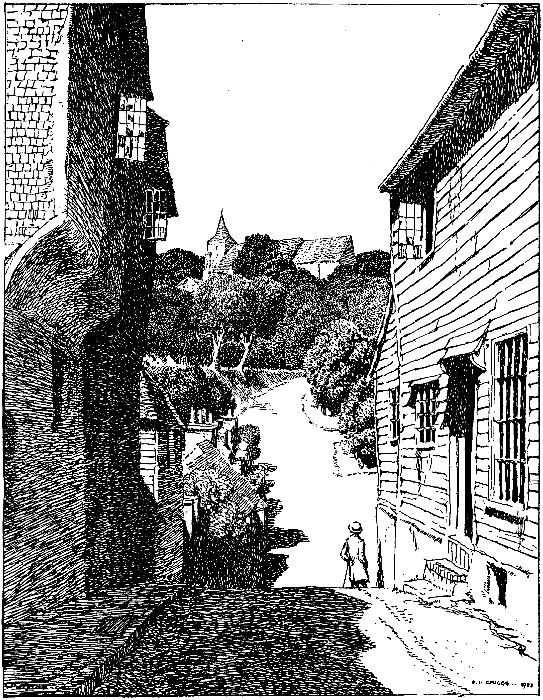
Burpham, which lies between Arundel and Amberley and of which nothing is
said; and more than one reader has discovered unfairness to East Sussex.
For this the personal equation is perhaps responsible: a West Sussex
man, try as he will, cannot have the same enthusiasm for the other side
of his county as for his own. For me the sun has always seemed to rise
over Beachy Head, the most easterly of our Downs.
The call for a second edition has however enabled me to set right a few
errors in the body of the book, and in this additional chapter to
amplify and fortify here and there. The result must necessarily be
disconnected; but a glance at the index will point the way to what is new.
Concerning Aldworth in Tennyson's poetry (see page 12), there is the
exquisite stanza to General Hamley:
"You came, and looked, and loved the view
Long known and loved by me,
Green Sussex fading into blue
With one gray glimpse of sea."
"Green Sussex fading into blue"—it is the motto for every Down summit,
South or North.
SHELLEY AND TRELAWNY
With reference to Shelley and Sussex, my attention has been drawn to an
interesting account of Field Place by Mr. Hale White, the author of the
Mark Rutherford novels, in an old Macmillan's Magazine. Says Mr.
White, "Denne Park [at Horsham] might easily have suggested—more easily
perhaps than any part of the country near Field Place—the well-known
semi-chorus in the Prometheus which begins
'The path through which that lovely twain
Have passed, by cedar, pine, and yew,
And each dark tree that ever grew
Is curtained out from heaven's wide blue.'
The Prometheus, however, was written when Horsham was well-nigh
forgotten"—by its author.
Owing to a curious lapse of memory, I omitted to say that Sompting, near
Worthing, should be famous as the home of Edward John Trelawny, author
of The Adventures of a Younger Son, and the friend of Shelley and
Byron. In his Sompting garden, in his old age, Trelawny grew figs,
equal, he said, to those of his dear Italy, and lived again his
vigorous, picturesque, notable life. Sussex thus owns not only the poet
of "Adonais," but the friend who rescued his heart from the flames that
consumed his body on the shores of the Gulf, and bearing it to Rome
placed over its resting place in the Protestant cemetery the words from
the Tempest (his own happy choice):—
"Nothing of him that doth fade,
But doth suffer a sea-change
Into something rich and strange."
The old man, powerful and capricious to the last, died at Sompting in
1881, within a year of ninety. His body was removed to Gotha for
cremation, and his ashes lie beside Shelley's heart in Rome.
Among the wise men of Lewes I ought not to have overlooked William
Durrant Cooper (1812-1875), a shrewd Sussex enthusiast and antiquary,
who as long ago as 1836 printed at his own cost a little glossary of the
county's provincialisms. The book, publicly printed in 1853, was, of
course, superseded by Mr. Parish's admirable collection, but Mr. Cooper
showed the way. One of his examples of the use of the West Sussex
pronoun en, un, or um might be noted, especially as it involves
another quaint confusion of sex. En and un stand for him, her or it;
um for them. Thus, "a blackbird flew up and her killed 'n"; that is to
say, he killed it.
THE ANGEL'S FAN
Among the Harleian MSS. at the British Museum is the account of a
supernatural visitation to Rye in 1607. The visitants were angels, their
fortunate entertainer being a married woman. She, however, by a lapse in
good breeding, undid whatever good was intended for her. "And after that
appeared unto her 2 angells in her chamber, and one of them having a
white fan in her hand did let the same fall; and she stooping to take it
upp, the angell gave her a box on the eare, rebukinge her that she a
mortall creature should presume to handle matters appertayninge to
heavenlie creatures."
ROBERTSON OF BRIGHTON
It was an error to omit from Chapter XVII all reference to Frederick
William Robertson—Robertson of Brighton—who from 1847 until 1853
exerted his extraordinary influence from the pulpit of Trinity Chapel,
opposite the post-office, and from his home at 9, Montpellier Terrace.
Of Robertson's quickening religion I need not speak; but it is
interesting to know that much of his magnetic eloquence was the result
of the meditations which he indulged in his long and feverish rambles
over the Downs. His favourite walk was to the Dyke (before exploitation
had come upon it), and he loved also the hills above Rottingdean.
Robertson, says Arnold's memoir, "would walk any man 'off his legs,' as
the saying goes. He not only walked; he ran, he leaped, he bounded. He
walked as fast and as incessantly as Charles Dickens, and, like Dickens,
his mind was in a state of incessant activity all the time. There was
not a bird of the air or a flower by the wayside that was not known to
him. His knowledge of birds would have matched that of the collector of
the Natural History Museum in his favourite Dyke Road."
Robertson often journeyed into Sussex on little preaching or lecturing
missions (he found the auditors of Hurstpierpoint "very bucolic"), and
his family were fond of the retirement of Lindfield. On one occasion
Robertson brought them back himself, writing afterwards to a friend that
in that village he "strongly felt the beauty and power of English
country scenery and life to calm, if not to purify, the hearts of those
whose lives are habitually subjected to such influences."
Mr. Arnold's book, I might add, has some pleasant pages about Sussex and
Brighton in Robertson's day, with glimpses of Lady Byron, his ardent
devotee, and, at Old Shoreham, of Canon Mozley.
And here I might mention that for a very charming account of a still
earlier Brighton, though not the earliest, the reader should go to a
little story called Round About a Brighton Coach Office, which was
published a few years ago. It has a very fragrant old-world flavour.
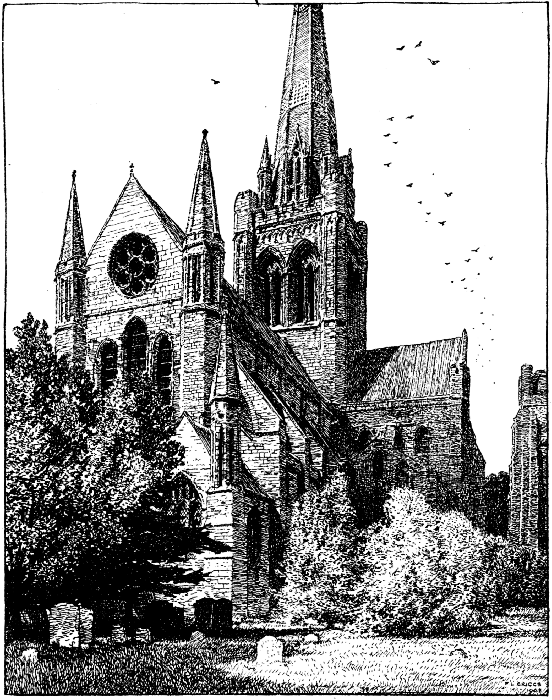
To Chichester, I should have recorded, belongs a Sussex saint, Saint
Richard, Bishop of Chichester in the thirteenth century, and a great
man. In 1245 he found the Sussex see an Augæan stable; but he was equal
to the labour of cleansing it. He deprived the corrupt clergy of their
benefices with an unhesitating hand, and upon their successors and those
that remained he imposed laws of comeliness and simplicity. His reforms
were many and various: he restored hospitality to its high place among
the duties of rectors; he punished absentees; he excommunicated
usurers; while (a revolutionist indeed!) priests who spoke indistinctly
or at too great a pace were suspended. Also, I doubt not, he was hostile
to locked churches. Furthermore, he advocated the Crusades like another
Peter the Hermit.
Richard's own life was exquisitely thoughtful and simple. An anecdote of
his brother, who assisted him in the practical administration of the
diocese, helps us to this side of his character. "You give away more
than your income," remarked this almoner-brother one day. "Then sell my
silver," said Richard, "it will never do for me to drink out of silver
cups while our Lord is suffering in His poor. Our father drank heartily
out of common crockery, and so can I. Sell the plate."
Richard penetrated on foot to the uttermost corners of his diocese to
see that all was well. He took no holiday, but would often stay for a
while at Tarring, near Worthing, with Simon, the parish priest and his
great friend. Tradition would have Richard the planter of the first of
the Tarring figs, and indeed, to my mind, he is more welcome to that
honour than Saint Thomas à Becket, who competes for the credit—being
more a Sussex man. In his will Richard left to Sir Simon de Terring
(sometimes misprinted Ferring) his best palfrey and a commentary on the
Psalms.
SAINT RICHARD
The Bishop died in 1253 and he was at once canonised. To visit his grave
in the nave of Chichester Cathedral (it is now in the south transept)
was a sure means to recovery from illness, and it quickly became a place
of pilgrimage. April 3 was set apart in the calendar as Richard's day,
and very pleasant must have been the observance in the Chichester
streets. In 1297 we find Edward I. giving Lovel the harper 6s. 6d.
for singing the Saint's praises; but Henry VIII. was to change all this.
On December 14th, 1538, it being, I imagine, a fine day, the Defender of
the Faith signed a paper ordering Sir William Goring and William Ernely,
his Commissioners, to repair to Chichester Cathedral and remove "the
bones, shrine, &c., of a certain Bishop —— which they call S.
Richard," to the Tower of London. That the Commissioners did their work
we know from their account for the same, which came to £40. In the
reformed prayer-book, however, Richard's name has been allowed to stand
among the black letter saints.
BISHOP WILBERFORCE
Under Chichester I ought also to have mentioned John William Burgon
(1813-1888), Dean of Chichester for the last twelve years of his life
and the author of that admirable collection of half-length
appreciations, The Lives of Twelve Good Men, one of whom, Bishop
Wilberforce, lived within call at Woollavington, under the shaggy
escarpment of the Downs some ten miles to the north-east. Dean Burgon
thus happily touches off the Bishop in his South Down retreat:—
... "But it was on the charms of the pleasant landscape which surrounded
his Sussex home that he chiefly expatiated on such occasions, leaning
rather heavily on some trusty arm—(I remember how he leaned on
mine!)—while he tapped with his stick the bole of every favourite
tree which came in his way (by-the-by, every tree seemed a favourite),
and had something to tell of its history and surpassing merits. Every
farm-house, every peep at the distant landscape, every turn in the road,
suggested some pleasant remark or playful anecdote. He had a word for
every man, woman, and child he met,—for he knew them all. The very
cattle were greeted as old acquaintances. And how he did delight in
discussing the flora of the neighbourhood, the geological formations,
every aspect of the natural history of the place!"
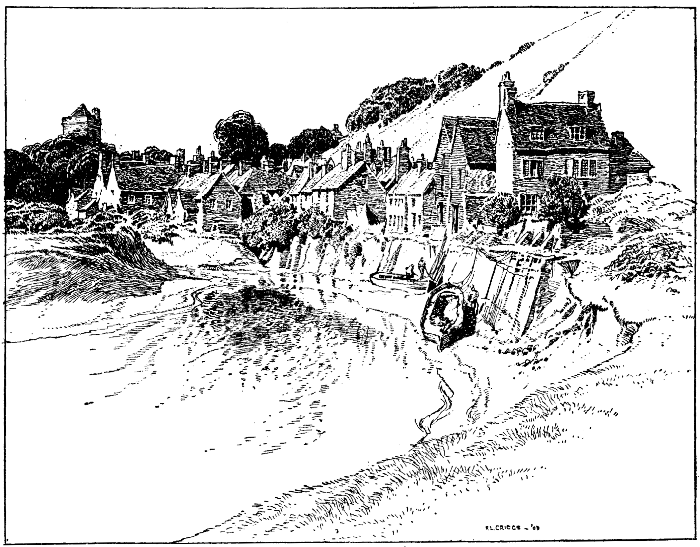
BURPHAM AND HARDHAM
A very properly indignant friend has reminded me of the claims of
Burpham in the following words. "Two miles up the Arun valley from
Arundel is Burpham, a pretty village on the west edge of the Downs and
overhanging the river. Between South Stoke and Arundel the old course of
the Arun runs in wide curves, and in modern times a straight new bed has
been cut, under Arundel Park and past the Black Rabbit, making, with the
old curves, the form of the letter B. Burpham lies at the head of the
lower loop of the B, and while there is plenty of water in the loop to
row up with the flood tide and down with the ebb, the straight main
stream diverts nearly all the holiday traffic and leaves Burpham the
most peaceful village within fifty miles of London. The seclusion is the
more complete because the roads from the South end in the village and
there is no approach by road from East or West or North. The Church
contains a Lepers' window, and passengers by the railway can see, to the
right of the red roofs of the village and over the line of low chalk
cliffs, a white path still called the Lepers' Path, which winds away in
to the lonely hollows of the Downs.
"A curious feature of Burpham is a high rampart of earth, running
eastward from the cliff by the river, which according to local tradition
was constructed in the days of the Danish pirates. It is said to be
doubtful whether the rampart was erected by the Saxon villagers for
their own protection, or by the Danes as their first stronghold on the
rising ground after they had sailed up the Arun from Littlehampton. The
fine name of the neighbouring Warningcamp Hill, from which there is a
great outlook over the flat country past Arundel Castle to Chichester
Cathedral and the cliffs of the Isle of Wight, suggests memories of the
same period."
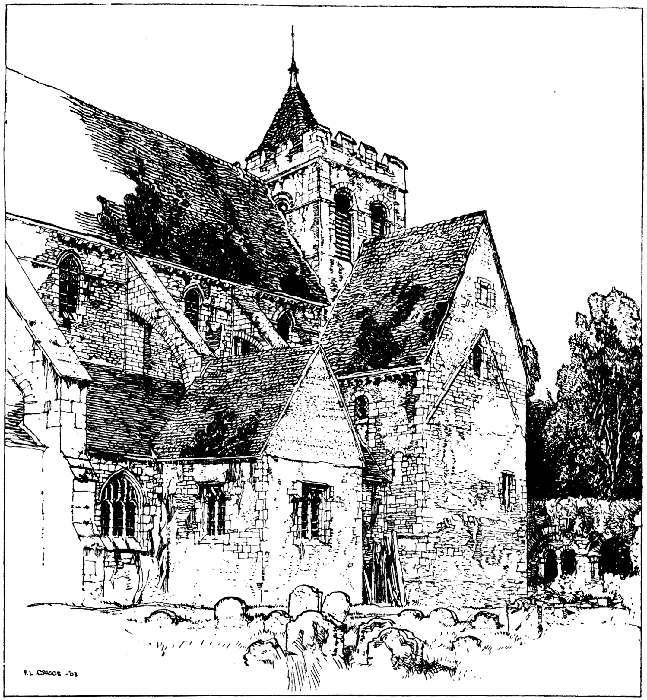
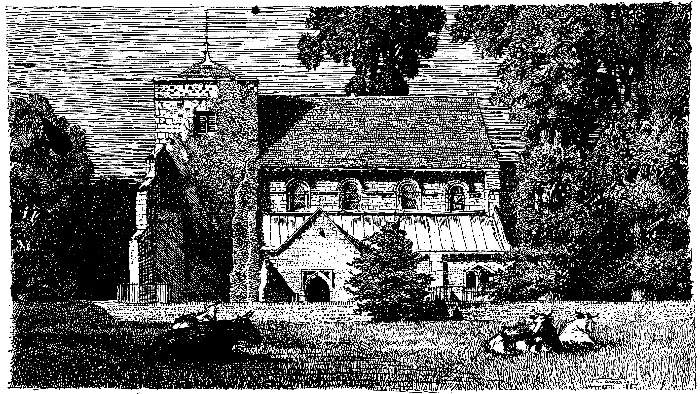
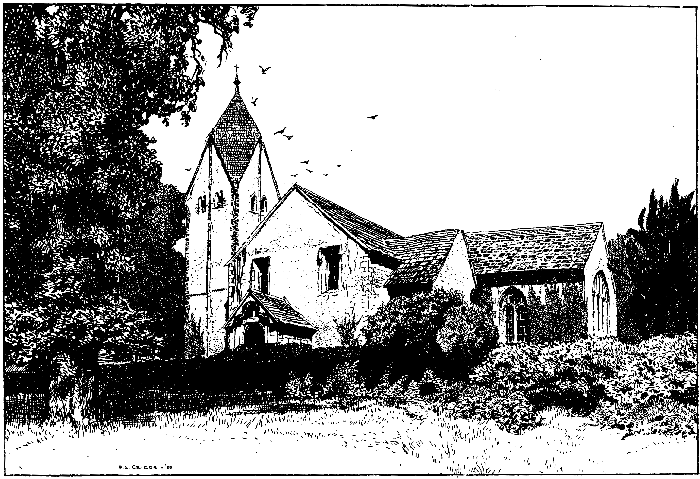
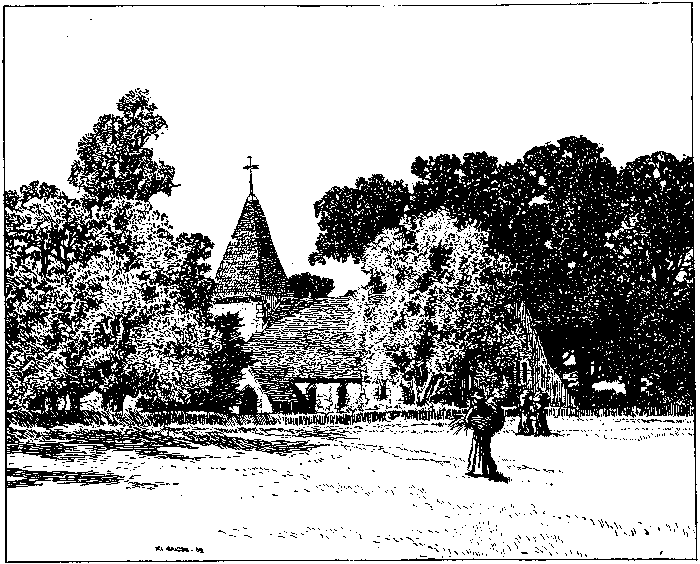
Of the little retiring church of St. Botolph, Hardham, lying among low
meadows between Burpham and Pulborough, I ought also to have spoken, for
it contains perhaps the earliest complete series of mural painting in
England. The church dates from the eleventh century, and the paintings,
says Mr. Philip Mainwaring Johnson, who has studied them with the
greatest care, cannot be much less old. The subjects are the
Annunciation, the Nativity, the appearance of the Star, the Magi
presenting their Gifts, and so forth, with one or two less familiar
themes added, such as Herod conferring with his Counsellors and the
Torments of Hell. There are the remains also of a series of Moralities
drawn from the parable of Dives and Lazarus, and of a series
illustrating the life of St. George. The little church, which perhaps
has every right to call itself the oldest picture gallery in England,
should not be missed by any visitor to Pulborough.
THE TIPTEERS
At West Wittering in the Manhood Peninsula, a little village on which
the sea has hostile designs, is still performed at Christmas a
time-honoured play the actors of which are half a dozen boys or men
known as the Tipteers. Their words are not written, but are transmitted
orally from one generation of players to another. Mr. J. I. C. Boger,
however, has taken them down for the S. A. C. The subject once again, as
in some of the Hardham mural paintings, is the life of St. George, here
called King George; and the play has the same relation to drama that the
Hardham frescoes have to a picture. I quote a little:—
Third Man—Noble Captain:
In comes I, the Noble Captain,
Just lately come from France;
With my broad sword and jolly Turk [dirk]
I will make King George dance.
Fourth Man—King George [i.e., Saint George]:
In comes I, King George,
That man of courage bold,
With my broad sword and sphere [spear]
I have won ten tons of gold.
I fought the fiery Dragon
And brought it to great slaughter,
And by that means I wish to win
The King of Egypt's daughter.
Neither unto thee will I bow nor bend.
Stand off! stand off!
I will not take you to be my friend.
Noble Captain:
Why, sir, why, have I done you any kind of wrong?
King George:
Yes, you saucy man, so get you gone.
Noble Captain:
You saucy man, you draw my name,
You ought to be stabb'd, you saucy man.
King George:
Stab or stabs, the least is my fear;
Point me the place
And I will meet you there.
Noble Captain:
The place I 'point is on the ground
And there I will lay your body down
Across the water at the hour of five.
King George:
Done, sir, done! I will meet you there,
If I am alive I will cut you, I will slay you,
All for to let you know that I am King George over Great Britain O!
[Fight: King George wounds the Noble Captain.]
Until the close is almost reached the West Wittering Tipteers preserve
the illusion of mediæval mummery. But the concluding song transports us
to the sentiment of the modern music hall. Its chorus runs, with some
callousness:—
"We never miss a mother till she's gone,
Her portrait's all we have to gaze upon,
We can fancy see her there,
Sitting in an old armchair;
We never miss a mother till she's gone."
GRANDMOTHER FOWINGTON
THE PHARISEES
Mark Antony Lower's Contributions to Literature, 1845, contains a
pleasant essay on the South Downs which I overlooked when I was writing
this book, but from which I now gladly take a few passages. It gives me,
for example, a pendent to William Blake's description of a fairy's
funeral on page 64, in the shape of a description of a fairy's revenge,
from the lips of Master Fowington, a friend of Mr. Lower, who was one
that believed in Pharisees (as Sussex calls fairies) as readily and
unreservedly as we believe in wireless telegraphy. Mas' Fowington had,
indeed, two very good reasons for his credulity. One was that the
Pharisees are mentioned in the Bible and therefore must exist; the other
was that his grandmother, "who was a very truthful woman," had seen them
with her own eyes "time and often." "They was liddle folks not more
than a foot high, and used to be uncommon fond of dancing. They jound[4]
hands and formed a circle, and danced upon it till the grass came three
times as green there as it was anywhere else. That's how these here
rings come upon the hills. Leastways so they say; but I don't know
nothing about it, in tye,[5] for I never seen none an 'em; though to be
sure it's very hard to say how them rings do come, if it is'nt the
Pharisees that makes 'em. Besides there's our old song that we always
sing at harvest supper, where it comes in—'We'll drink and dance like
Pharisees.' Now I should like to know why it's put like that 'ere in the
song, if it a'nt true."
MAS' MEPPOM'S ADVENTURE
Master Fowington's story of the fairy's revenge runs thus:—
"An ol' brother of my wife's gurt gran'mother see some Pharisees once,
and 'twould a been a power better if so be he hadn't never seen 'em, or
leastways never offended 'em. I'll tell ye how it happened. Jeems
Meppom—dat was his naüm—Jeems was a liddle farmer, and used to thresh
his own corn. His barn stood in a very elenge lonesome place, a
goodish bit from de house, and de Pharisees used to come dere a nights
and thresh out some wheat and wuts for him, so dat de hep o' threshed
corn was ginnerly bigger in de morning dan what he left it overnight.
Well, ye see, Mas' Meppom thought dis a liddle odd, and didn't know
rightly what to make ant. So bein' an out-and-out bold chep, dat didn't
fear man nor devil, as de saying is, he made up his mind dat he'd goo
over some night to see how 'twas managed. Well accordingly he went out
rather airly in de evenin', and laid up behind de mow, for a long while,
till he got rather tired and sleepy, and thought 'twaunt no use a
watchin' no longer. It was gittin' pretty handy to midnight, and he
thought how he'd goo home to bed. But jest as he was upon de move he
heerd a odd sort of a soun' comin' tóe-ards the barn, and so he stopped
to see what it was. He looked out of de strah, and what should he catch
sight an but a couple of liddle cheps about eighteen inches high or
dereaway come into de barn without uppening the doores. Dey pulled off
dere jackets and begun to thresh wud two liddle frails as dey had brung
wud em at de hem of a rate. Mas' Meppom would a been froughten if dey
had been bigger, but as dey was such tedious liddle fellers, he couldn't
hardly help bustin right out a laffin'. Howsonever he pushed a hanful of
strah into his mouth and so managed to kip quiet a few minutes a lookin'
at um—thump, thump; thump, thump, as riglar as a clock.
"At last dey got rather tired and left off to rest derselves, and one an
um said in a liddle squeakin' voice, as it might a bin a mouse a
talkin':—'I say Puck, I tweat; do you tweat?' At dat Jeems couldn't
contain hisself no how, but set up a loud haw-haw; and jumpin' up from
de strah hollered out, 'I'll tweat ye, ye liddle rascals; what bisness a
you got in my barn?' Well upon dis, de Pharisees picked up der frails
and cut away right by him, and as dey passed by him he felt sich a queer
pain in de head as if somebody had gi'en him a lamentable hard thump wud
a hammer, dat knocked him down as flat as a flounder. How long he laid
dere he never rightly knowed, but it must a bin a goodish bit, for when
he come to 'twas gittin' dee-light. He could'nt hardly contrive to
doddle home, and when he did he looked so tedious bad dat his wife sent
for de doctor dirackly. But bless ye, dat waunt no use; and old Jeems
Meppom knowed it well enough. De doctor told him to kip up his sperits,
beein' 'twas onny a fit he had had from bein' a most smothered wud de
handful of strah and kippin his laugh down. But Jeems knowed better.
'Tā-ünt no use, sir,' he says, says he, to de doctor; 'de cuss of de
Pharisees is uppán me, and all de stuff in your shop can't do me no
good.' And Mas' Meppom was right, for about a year ahtawuds he died,
poor man! sorry enough dat he'd ever intafēred wud things dat didn't
consarn him. Poor ol' feller, he lays buried in de church-aird over
yender—leastways so I've heerd my wife's mother say, under de bank
jest where de bed of snow-draps grows."
FAIRY RINGS AND DEW PONDS
All who know the Downs must know the fairies' or Pharisees' rings, into
which one so often steps. Science gives them a fungoid origin, but
Shakespeare, as well as Master Fowington's grandmother, knew that Oberon
and Titania's little people alone had the secret. Further proof is to be
found in the testimony of John Aubrey, the Wiltshire antiquary, who
records that Mr. Hart, curate at Yatton Keynel in 1633-4, coming home
over the Downs one night witnessed with his own eyes an "innumerable
quantitie of pigmies" dancing round and round and singing, "making all
manner of small, odd noises."
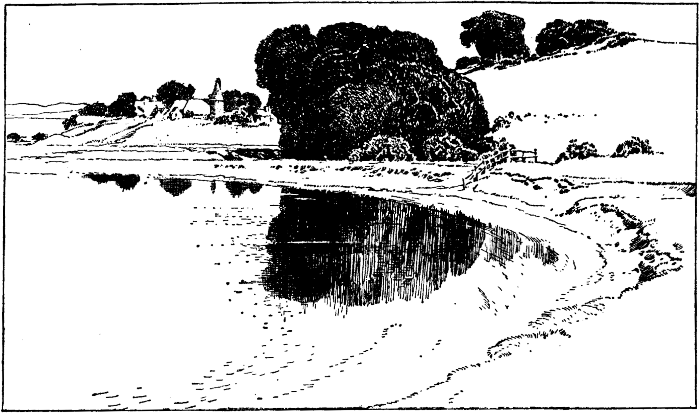
A word ought to have been said of the quiet and unexpected dew-ponds of
the Downs, upon which one comes so often and always with a little
surprise. Perfect rounds they are, reflecting the sky they are so near
like circular mirrors set in a white frame. Gilbert White, who was
interested in all interesting things, mentions the unfailing character
of a little pond near Selborne, which "though never above three feet
deep in the middle, and not more than thirty feet in diameter, ... yet
affords drink for three hundred or four hundred sheep, and for at least
twenty head of cattle beside." He then asks, having noticed that in May,
1775, when the ponds of the valley were dry, the ponds of the hills were
still "little affected," "have not these elevated pools some unnoticed
recruits, which in the night-time counterbalance the waste of the day?"
The answer, which White supplies, is that the hill pools are recruited
by dew. "Persons," he writes, "that are much abroad, and travel early
and late, such as shepherds, fishermen, &c., can tell what prodigious
fogs prevail in the night on elevated downs, even in the hottest part of
summer; and how much the surfaces of things are drenched by those
swimming vapours, though, to the senses, all the while, little moisture
seems to fall."
Kingsley has a passage on the same subject in his essay, "The
Air-Mothers"—"For on the high chalk downs, you know, where farmers make
a sheep pond, they never, if they are wise, make it in the valley or on
a hillside, but on the bleakest top of the very highest down; and there,
if they can once get it filled with snow and rain in winter, the blessed
dews of night will keep some water in it all the summer thro', while
ponds below are utterly dried up." There is, however, another reason why
the highest points are chosen, and that is that the chalk here often has
a capping of red clay which holds the water.
NICK COSSUM'S HUMOUR
To the smuggling chapter might have been added, again with Mr. Lower's
assistance, a few words on the difficulties that confronted the London
revenue officers in the Sussex humour. To be confounded by too swift a
horse or too agile a "runner" was all in the night's work; but to be
hoodwinked and bamboozled by the deliberate stealthy southern fun must
have been eternally galling. The Sussex joker grinds slowly and
exceeding small; but the flour is his. "There was Nick Cossum the
blacksmith [the words are a shepherd's, talking to Mr. Lower]; he was a
sad plague to them. Once he made an exciseman run several miles after
him, to take away a keg of yeast he was a-carrying to Ditchling!
Another time as he was a-going up New Bostall, an exciseman, who knew
him of old, saw him a-carrying a tub of hollands. So he says, says he,
'Master Cossum, I must have that tub of yours, I reckon!' 'Worse luck, I
suppose you must,' says Nick in a civil way, 'though it's rather again'
the grain to be robbed like this; but, however, I am a-going your road,
and we can walk together—there's no law again' that I expect.' 'Oh,
certainly not,' says the other, taking of the tub upon his shoulders. So
they chatted along quite friendly and chucker[6] like till they came
to a cross road, and Nick wished the exciseman good bye. After Nick had
got a little way, he turned round all of a sudden and called out: 'Oh,
there's one thing I forgot; here's a little bit o' paper that belongs to
the keg.'
'Paper,' says the exciseman, 'why, that's a permit,' says he; 'why
didn't you show me that when I took the hollands?' 'Oh,' says Nick, as
saucy as Hinds, 'why, if I had done that,' says he, 'you wouldn't a
carried my tub for me all this way, would you?'"
ANOTHER PARISH CLERK
The story, at the end of Chapter XIX, of the clerk in Old Shoreham
church, whose loyalty was too much for his ritualism, may be capped by
that of a South Down clerk in the east of the county, whose seat in
church commanded a view of the neighbourhood. During an afternoon
service one Sunday a violent gale was raging which had already unroofed
several barns. The time came, says Mr. Lower, for the psalm before the
sermon, and the clerk rose to announce it. "Let us sing to the praise
and glo—Please, sir, Mas' Cinderby's mill is blowed down!"
ANOTHER MILLER
Another word on Sussex millers. John Oliver, the Hervey of Highdown
Hill, had a companion in eccentricity in William Coombs of Newhaven,
who, although active as a miller to the end, was for many years a
stranger to the inside of his mill owing to a rash statement one night
that if what he asseverated was not true he would never enter his mill
again. It was not true and henceforward, until his death, he directed
his business from the top step—such is the Sussex tenacity of purpose.
Coombs was married at West Dean, but not fortunately. On the way to the
church a voice from heaven called to him, "Will-yam Coombs! Will-yam
Coombs! if so be that you marry Mary —— you'll always be a miserable
man." Coombs, who had no false shame, often told the tale, adding, "And
I be a miserable man."
Coombs' inseparable companion was a horse which bore him and his
merchandise to market. In order to vary the monotony of the animal's own
God-given hue, he used to paint it different colours, one day yellow and
the next pink, one day green and the next blue, and so on. But this
cannot have perplexed the horse so much as his master's idea of mercy;
for when its back was over-loaded, not only with sacks of flour, but
also with Coombs, that humanitarian, experiencing a pang of sympathy,
and exclaiming "The marciful man is marciful to his beast," would lift
one of the sacks on to his own shoulders. His marcy, however, did not
extend to dismounting. Our Sussex droll, Andrew Boorde, when he invented
the wisdom of Gotham, invented also the charity of Coombs. But the story
is true.
Coombs must not be considered typical of Sussex. Nor can the tricyclist
of Chailey be called typical of Sussex—the weary man who was overtaken
by a correspondent of mine on the acclivity called the King's Head Hill,
toiling up its steepness on a very old-fashioned, solid-tyred tricycle.
He had the brake hard down, and when this was pointed out to him, he
replied shrewdly, "Eh master, but her might goo backards." Such
whimsical excess of caution, such thorough calculation of all the
chances, is not truly typical, nor is the miller's oddity truly typical;
and yet if one set forth to find humorous eccentricity, humorous
suspicion, and humorous cautiousness at their most flourishing, Sussex
is the county for the search.
LONDON TO CHICHESTER
It ought to be known that those Londoners who would care to reach Sussex
by Roman road have still Stane Street at their service. With a little
difficulty here and there, a little freedom with other people's land,
the walker is still able to travel from London to Chichester almost in a
bee-line, as the Romans used. Stane Street, which is a southern
continuation of Erming Street, pierced London's wall at Billingsgate,
and that would therefore be the best starting point. The modern
traveller would set forth down the Borough High Street (as the
Canterbury Pilgrims did), crossing the track of Watling Street near the
Elephant and Castle, and so on the present high road for several not too
interesting miles; along Newington Butts, and Kennington Park Road, up
Clapham Rise and Balham Hill, and so on through Tooting, Morden, North
Cheam, and Ewell. So far all is simple and a little prosaic, but at
Epsom difficulties begin. The road from Epsom town to the racecourse
climbs to the east of the Durdans and strikes away south-west, on its
true course again, exactly at the inn. The point to make for, as
straight as may be (passing between Ashstead on the right and Langley
Bottom farm on the left), is the Thirty-acres Barn, right on the site.
Then direct to Leatherhead Down, through Birchgrove, over Mickleham
Down, and so to the high road again at Juniper Hall. Part of the track
on this high ground is still called Erming Street by the country folk;
part is known as Pebble Lane, where the old Roman road metal has come
through. The old street probably followed the present road fairly
closely, with a slight deviation near the Burford Bridge Inn, as far as
Boxhill Station, whence it took a bee-line to the high ground at
Minnickwood by Anstiebury, four miles distant, a little to the west of
Holmwood. This, if the line is to be followed, means some deliberate
trespassing and a scramble through Dorking churchyard, which is partly
on the site.
Hitherto the Roman engineer has wavered now and then, but from
Minnickwood to Tolhurst Farm, fifteen miles to the south, the line is
absolute. Two miles below Ockley (where it is called Stone Street), at
Halehouse Farm, the road must be left again, but after three miles of
footpath, field, and wood we hit it once more just above Dedisham, on
the road between Guildford and Horsham, and keep it all the way to
Pulborough, through Billingshurst, thus named, as I have said, like
Billingsgate, after Belinus, Stane Street's engineer. At Pulborough we
must cut across country to the camp by Hardham, over water meadows that
are too often flooded, and thence, through other fields, arable and
pasture, to the hostel on Bignor Hill, which once was Stane Street;
passing on the right Mr. Tupper's farm and the field which contains the
famous Bignor pavements, relic of the palatial residence of the Governor
of the Province of Regnum in the Romans' day; or better still, pausing
there, as Roman officers faring to Regnum certainly would in the hope of
a cup of Falernian.
The track winding up Bignor Hill is still easily recognisable, and from
the summit half Sussex is visible: the flat blue weald in the north,
Blackdown's dark escarpment in the north-west, Arundel's shaggy wastes
in the east, the sea and the plain in the south, and the rolling turf of
the downs all around. Henceforward the road is again straight, nine
unfaltering miles to Chichester, which we enter by St. Pancras and East
Street. For the first four miles, however, the track is over turf and
among woods, Eartham Wood on the right and North Wood on the left, and,
after a very brief spell of hard road again, over the side of Halnaker
Down. But from Halnaker to Chichester it is turnpike once more, with the
savour of the Channel meeting one all the way, and Chichester's spire a
friendly beacon and earnest of the contiguous delights of the Dolphin,
where one may sup in an assembly room spacious enough to hold a Roman
century.
BY ROMAN ROAD
Or one might reverse the order and walk out of Sussex into London by the
Roman way, or, better still, through London, and on by Erming Street to
the wall of Antoninus. Merely to walk to London and there stop is
nothing; merely to walk from London is little; but to walk through
London ... there is glamour in that! To come bravely up from the sea at
Bosham, through Chichester, over the Downs to the sweet domestic
peaceful green weald, over the Downs again and plunge into the grey city
(perhaps at night) and out again on the other side into the green again,
and so to the north, left-right, left-right, just as the clanking
Romans did; that would be worth doing and worth feeling.
JOHN HORNE
The best knower of Sussex of recent times has died since this book was
printed: one who knew her footpaths and spinneys, her hills and farms,
as a scholar knows his library. John Horne of Brighton was his name: a
tall, powerful man even in his old age—he was above eighty at his
death—with a wise, shrewd head stored with old Sussex memories: hunting
triumphs; the savour of long, solitary shooting days accompanied by a
muzzle-loader and single dog—such days as Knox describes in Chapter V;
historic cricket matches; stories of the Sussex oddities, the
long-headed country lawyers, the Quaker autocrats, the wild farmers, the
eccentric squires; characters of favourite horses and dogs (such was the
mobility of his countenance and his instinct for drama that he could
bring before you visibly any animal he described); early railway days
(he had ridden in the first train that ran between Brighton and
Southwick); fierce struggles over rights-of-way; reminiscences of old
Brighton before a hundredth part of its present streets were made; and
all the other body of curious lore for which one must go to those whose
minds dwell much in the past. Coming of Quaker stock, as he did, his
memory was good and well-ordered, and his observation quick and sound.
What he saw he saw, and he had the unusual gift of vivid precise
narrative and a choice of words that a literary man should envy.
A favourite topic of conversation between us was the best foot route
between two given points—such as Steyning and Worthing, for example, or
Lewes and Shoreham. Seated in his little room, with its half-a-dozen
sporting prints on the wall and a scene or two of old Brighton, he
would, with infinite detail, removing all possibility of mistake,
describe the itinerary, weighing the merits of alternative paths with
profound solemnity, and proving the wisdom of every departure from the
more obvious track. Were Sussex obliterated by a tidal wave, and were a
new county to be constructed on the old lines, John Horne could have
done it.
A SUSSEX ENTHUSIAST
Of his talk I found it impossible to tire, and I shall never cease to
regret that circumstances latterly made visits to him very infrequent.
Towards the end his faculties now and then were a little dimmed; but the
occlusion carried compensation with it. To sit with an old man and,
being mistaken by him for one's own grandfather, to be addressed as
though half a century had rolled away, is an experience that I would not
miss.
To the end John Horne dressed as the country gentlemen of his young days
had dressed; he might have stepped out of one of Alken's pictures, for
he possessed also the well nourished complexion, the full forehead, and
the slight fringe of whiskers which distinguished Alken's merry
sportsmen. His business taking him deep into the county among the farms,
he was always in walking trim, with an umbrella crooked over one arm,
his other hand grasping the obtuse-angled handle of a ground-ash stick.
These sticks, of which he had scores, he cut himself, his eye never
losing its vigilance as he passed through a copse. Under the handle,
about an inch from the end, he screwed a steel peg, so that the stick,
when it was not required, might hang upon his arm; while a long, stout
pin, with a flat brass head, was also inserted, in case his pipe needed
cleaning out. Thus furnished, with umbrella and stick, pipe and a sample
of his merchandise, John Horne, in his wide collar, his ample coat with
vast pockets over the hips, his tight trousers, and his early-Victorian
headgear, has been, these fifty years, a familiar figure in the Weald as
he passed from farm to farm at a steady gait, his interested glances
falling this way and that, noting every change (and perhaps a little
resenting it, for he was of the old Tory school), and his genial
salutation ready for all acquaintances. But he is now no more, and
Sussex is the poorer, and the historian of Sussex poorer still. I
believe he would have liked this book; but how he would have shaken his
wise head over its omissions!
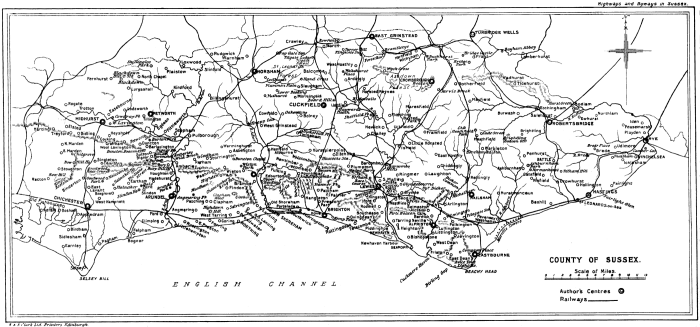
CLICK HERE FOR LARGER VERSION