The prettiest High Street in the south of England.—Guilou, Wey, and
Wye.—The Castle.—A legend of murder.—Looking at St.
Christopher.—Royal hunters.—Stephen Langton.—Cloth and how to
stretch it.—Aubrey scents a swindle.—King Monmouth after
Sedgmoor.—A pike for a baby.—The keeper at Bramshill.—Mysterious
windows.—Admirable calm.—The Queen's.—The Regent and the
Apse.—St. Mary's Wall-paintings.—An ancient school.—The
Angel.—Pepys at the Red Lion.—Sparagus for supper.—A Vanished
Heart.—The undaunted clockmaker.
To arrive at Guildford by train is like walking into a garden over a
rubbish heap. In the grace of its building, the charm of its colour, the
fascination of the prospects of its hillside High Street, no town in
Surrey, and perhaps only Oxford in England, is comparable with it. But
between the railway station and the High Street it is desolation and
blank walls. A few pretty old cottages jut out over a narrow pavement;
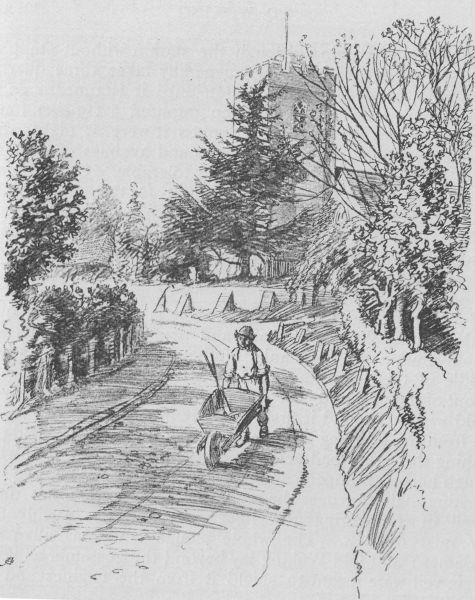
beyond a huddled roof or two rises the tower of St. Nicholas' Church,
umber and solid; nearly all else is tumbled down ugliness, broken
brickwork, mud and shaggy grass. A clear space, a level green, a bed of
flowers—what an introduction that might be to Guildford. But,
doubtless, the rubbish heap is, or some day will be, too valuable as
building land.
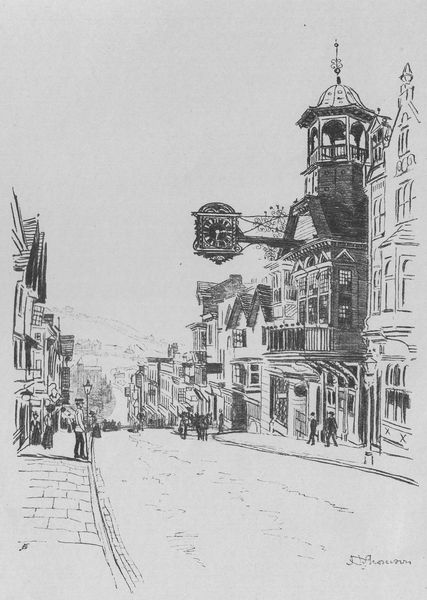
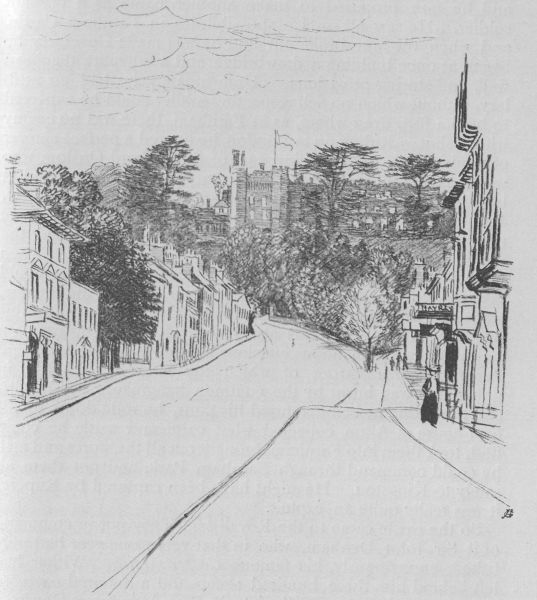
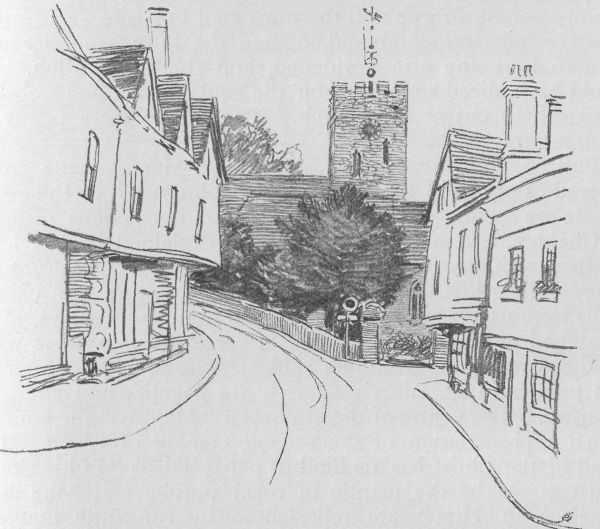
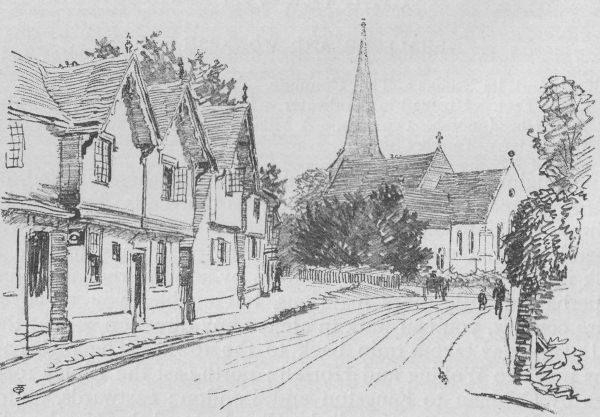
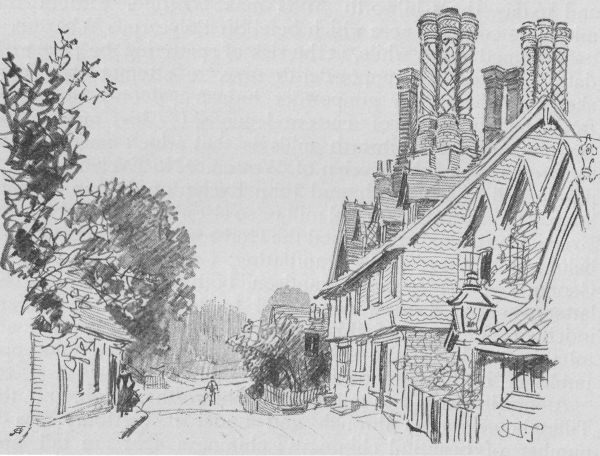
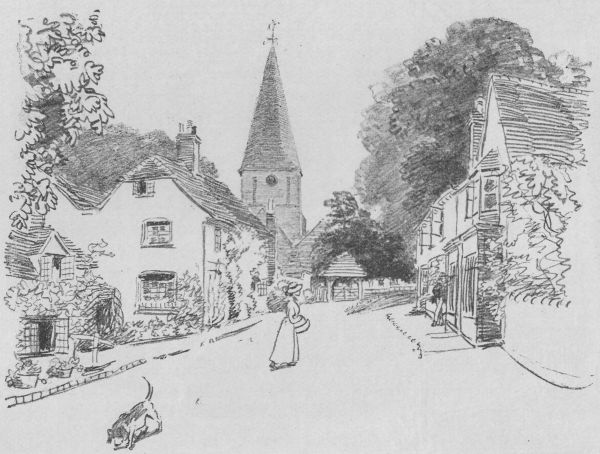
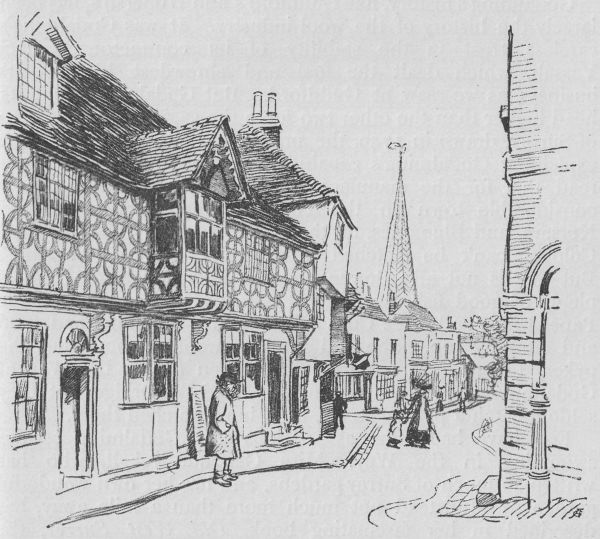
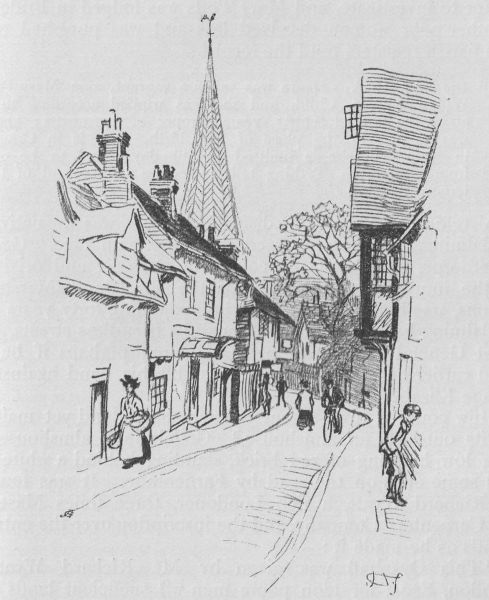
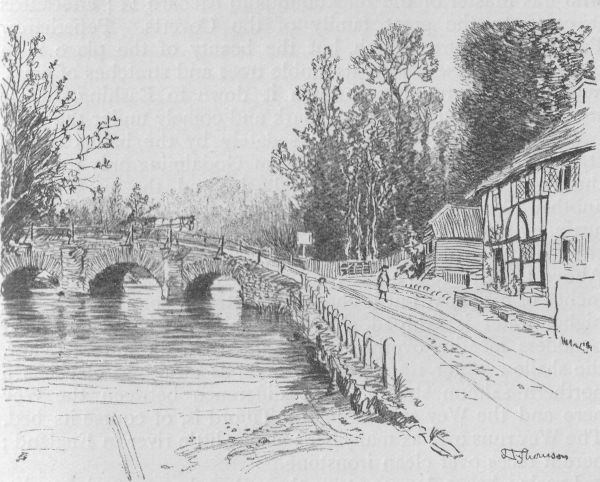
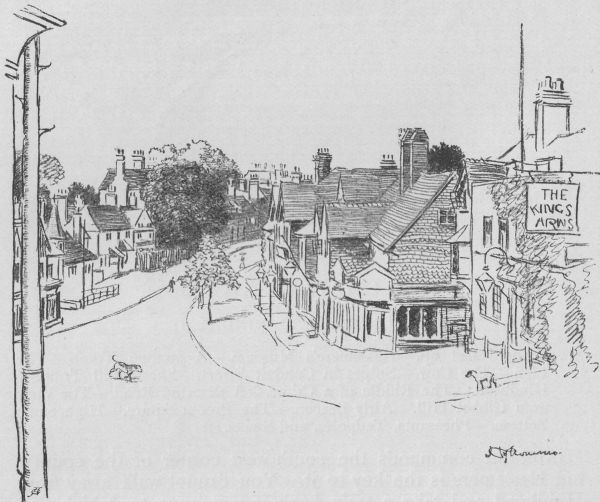
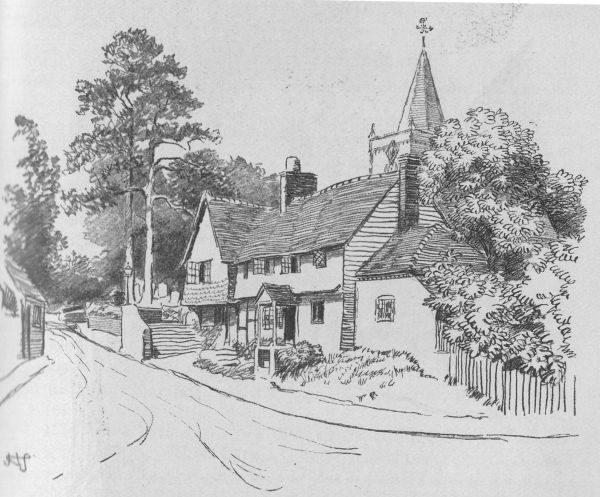
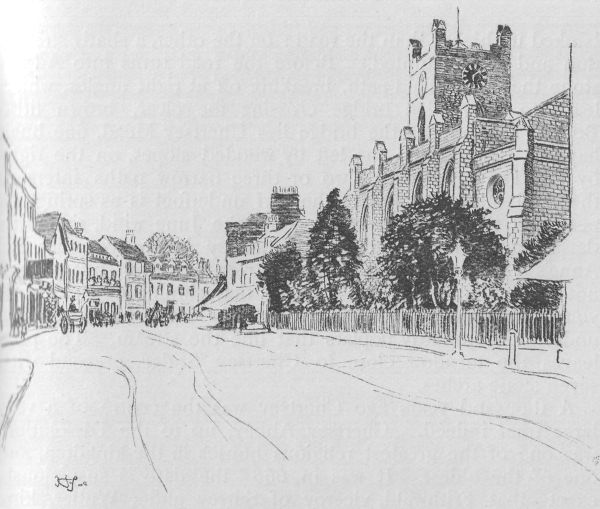
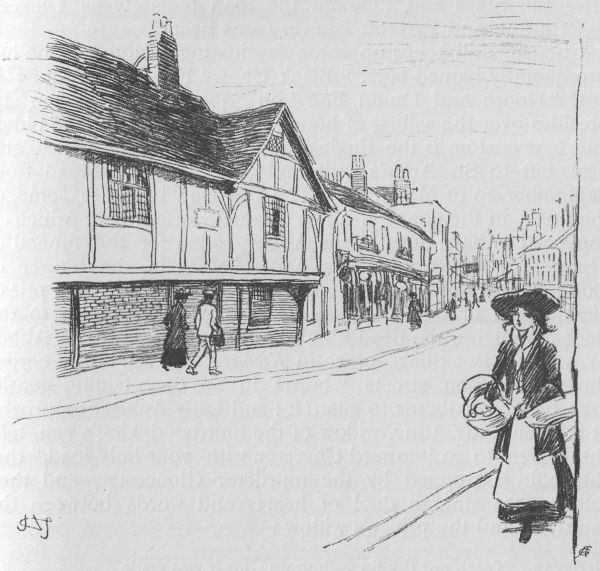
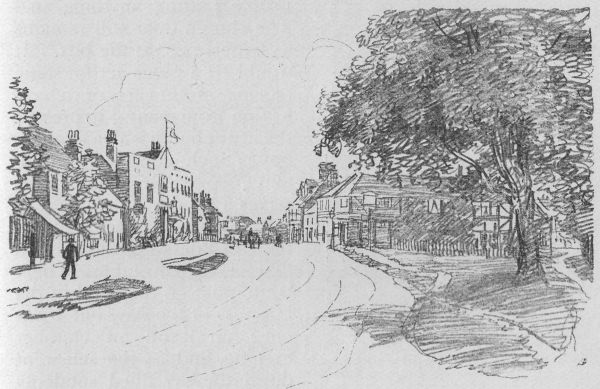
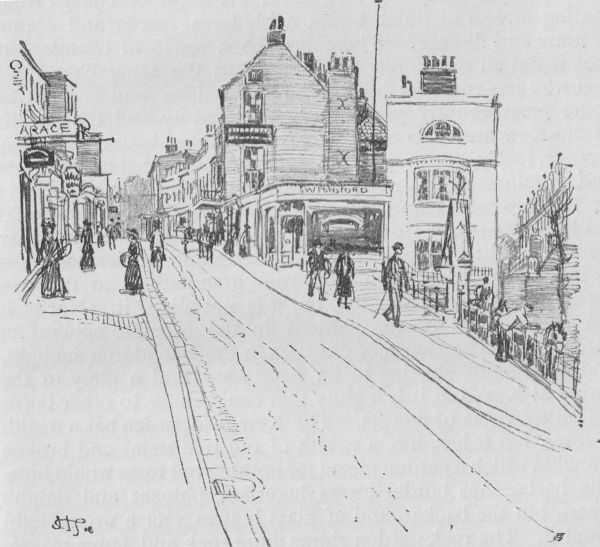
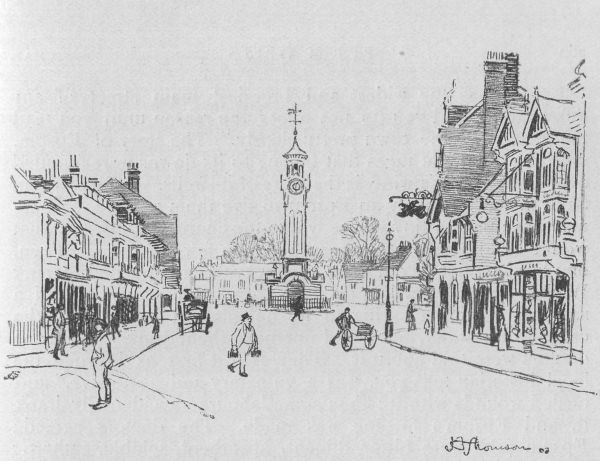
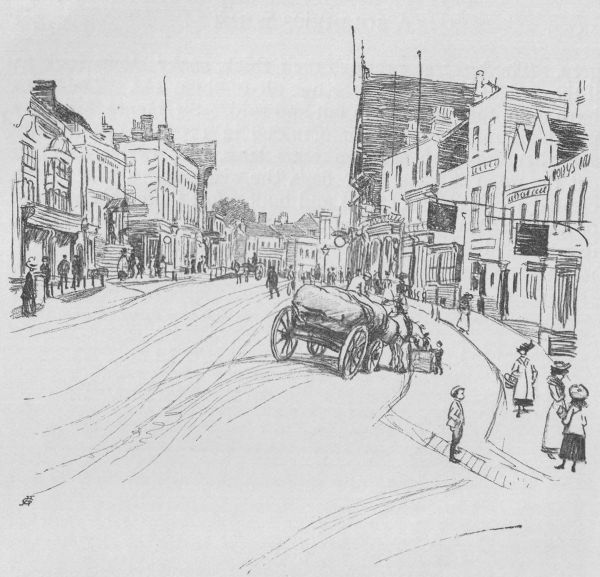
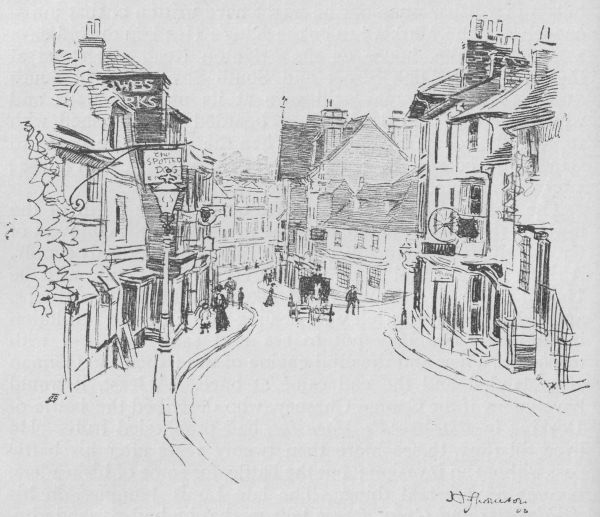
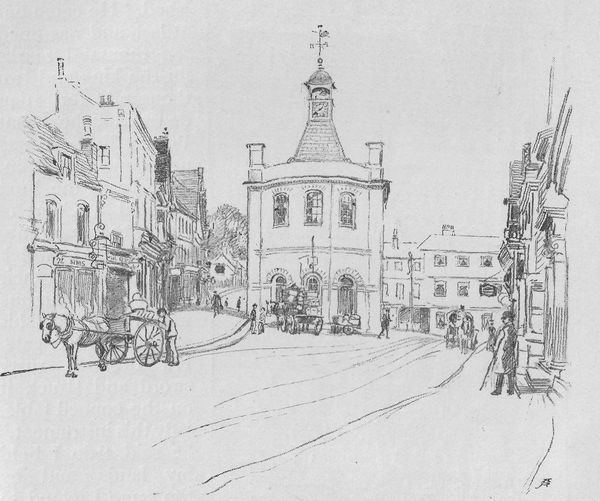
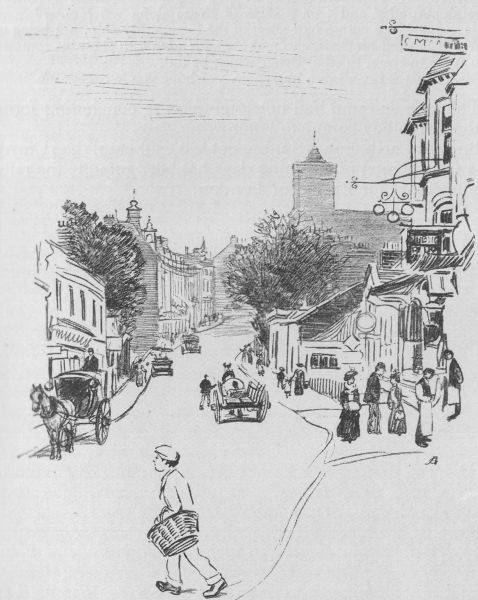
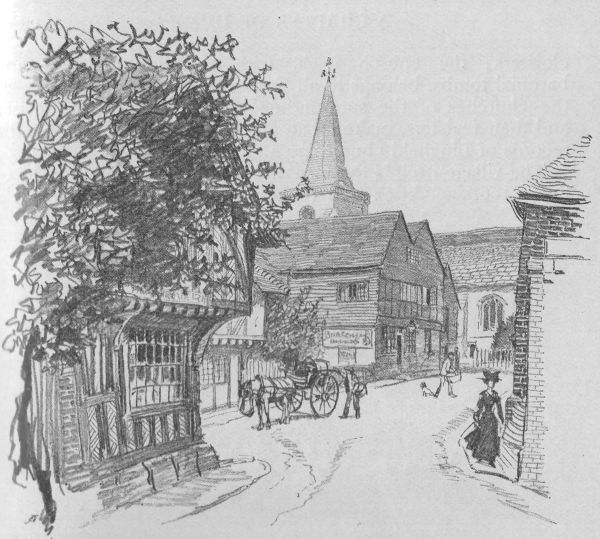
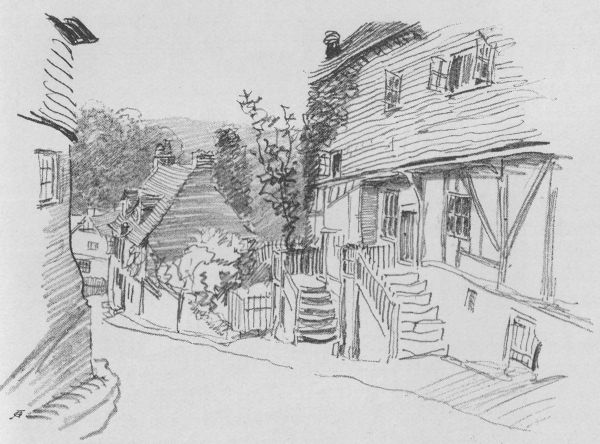
Beyond the turn of the road is the most delightful street in the south
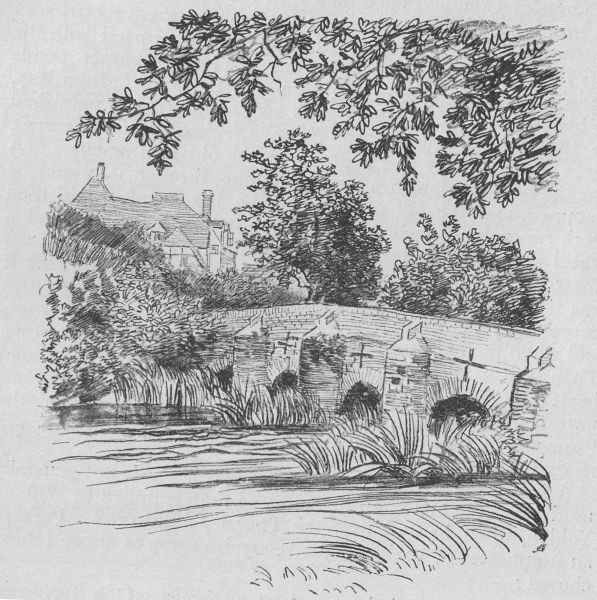
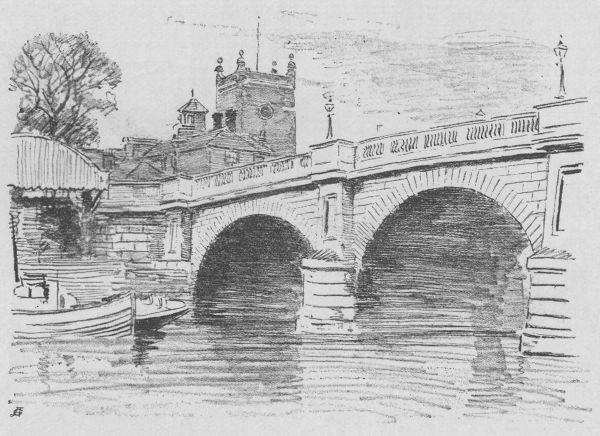
of England. It rises from the bridge crossing the Wey steep into blue
air over the hill. Each side of it is a stairway of roofs up the slope,
a medley of façades, a jumble of architecture astonishing in sheer
extravagance and variety. Gabled houses, red-tiled and gay with
rough-cast and fresh paint; dull, sad-faced houses with sleepy windows
like half-shut eyes; square, solid Georgian houses for doctors with
white chokers and snuff-boxes, and prim old ladies with mittened wrists;
low, little dolls'-houses, red brick neatly pointed; tall, slim houses
graceful with slender casements and light shafts of wood; casements
nobly elaborate in wood-carving and heavy with leaded panes; bay windows
which should belong to nurseries and high, square-latticed windows which
should light a library, delicately fastened with wrought iron; painted
pillars supporting window seats for cats and demure young ladies;
broad-stepped entrances to hotel halls, and archways under which barrels
roll to bursting cellars; Guildford High Street is a model of what the
High Street of an English town should be. Has it a single dominating
feature, or is its air of distinction merely compact of the grace and
old-worldliness of its shops and houses? Perhaps the single extreme
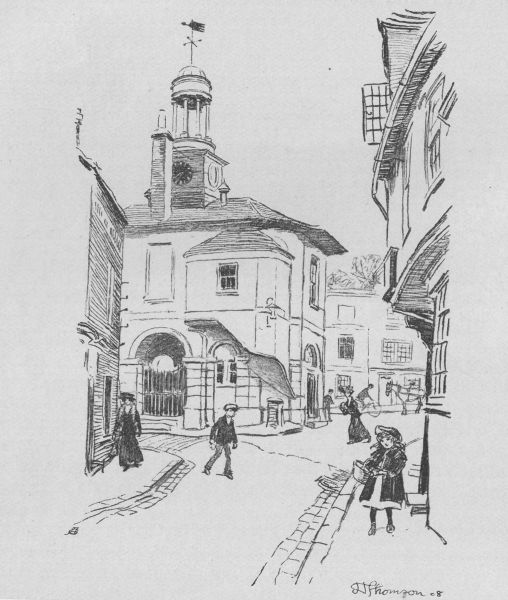
impression left by the High Street is its clock, swung far out over the
road. Massive, black and gilt, and fastened to the face of the old Town
Hall with an ingenious structure of steel stays, it has told Guildford
the time for two centuries and a quarter.
Guildford High Street has its landmarks of history in its Hospital, its
School, and its Town Hall, but its oldest standing record is in one of
its churches. The tower of St. Mary's church, indeed, contains the most
ancient piece of building in the town, perhaps in the county.
Archæologists are to be found who will argue that part of it, at least,
belongs to the reign of Alfred, though there is little evidence to show
that stone was used for building in Surrey before the eleventh century.
Alfred, at all events, mentions Guildford in his will; he spells it
"Guldeford," one of the dozen old ways of spelling a name that has
always been a puzzle and a pleasure to the etymologists. What does
Guildford mean? Naturally "The Ford of the Guild." The town had a guild
of merchants, and there was a ford; nothing could be simpler. But the
simple explanations are usually wrong; and the most convincing
derivation is one which has been suggested by Mr. Ralph Nevill, who
discovered a river named Guilou in Asser's Deeds of Alfred, and points
to several other names along the Wey which may be traced to the same
source. There is Willey House, and Willey Mill near Farnham; Wilsham
Farm near Alton, and Willey Green on another branch of the river.
Guildford, then, is probably the "ford of the Guilou," which in Welsh is
presumably Gwili. Where, then, did the name Wey come from? It may
originally have been Wye. The corruption would be easy; indeed, Cockney
boating parties very likely get the right pronunciation, by accident,
to-day.
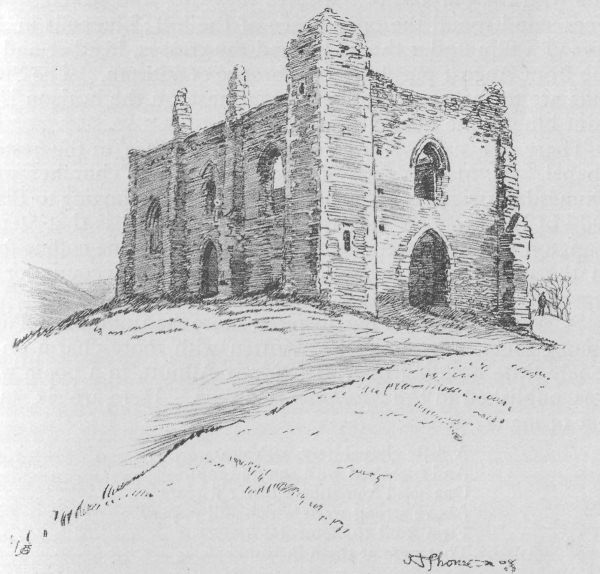
Older than St. Mary's tower in associations, if not in stone-work, is
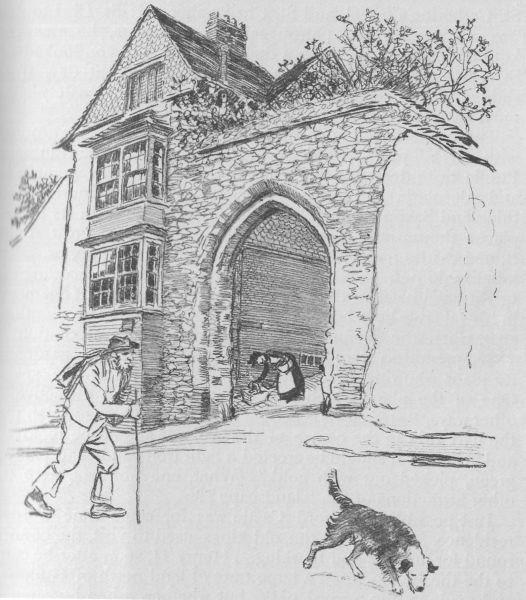
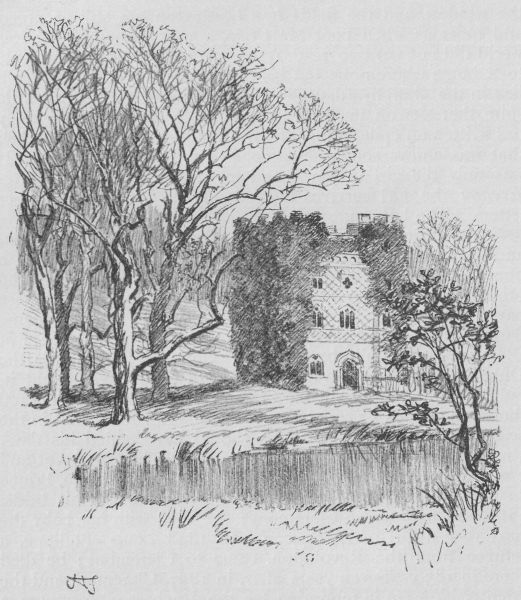
Guildford Castle. The Castle stands on a mound, partly natural, perhaps,
and almost certainly partly artificial. Originally, perhaps, the mound
was used for an early English fortification; it was heightened by
scraping up earth from a ditch at its bottom, and round it was built up
a palisade of wood; possibly there was a wooden house on the top of it,
and then it would have looked precisely like one of the fortified mounds
in the Bayeux Tapestry. Later, it was enclosed in a shell keep; later
still, a Norman square keep was built inside the shell keep; to-day,
except the walls of the square keep, almost all the Castle is gone. It
was never a Castle in much more than name. It has no associations of
great battles; it never stood a siege; it never even held a royal
prisoner. In King John's reign it was already used as a gaol, and a gaol
it remained until James I, in 1612, gave it to one Francis Carter of
Guildford, who used it as a private residence. Four hundred years before
it had seen all its fighting. That was when the French Dauphin, invited
by John's angry barons, marched against it and took it from defenders
who seem to have cared little whether they kept it or not.
But the Castle still has its legend—a legend only—of cruelty and
bloody massacre. In 1036, when Harold Harefoot was king, Alfred the son
of Ethelred was travelling from Normandy to join his mother at
Winchester. He landed in Kent, and was marching with his Normans along
the Way, whether or not with the intention of eventually trying to
recover his father's kingdom is uncertain; at all events, at Guildford
he was seized and put to death. So much is history; legend supplies a
dreadful embellishment. Early in the morning after their capture,
Alfred's followers were led out into the street and condemned to death.
Nine out of every ten men were butchered, until out of six hundred
Normans sixty only were left alive. That was not enough to glut their
captors' fury. The sixty were gone through again, and all but six were
ferociously tortured to death. Alfred himself was given to Harold, who
put out his eyes, loaded him with chains, and threw him into prison,
where he died. Fortunately, nobody need believe the story.
An environment of meaner modern buildings has spoiled the setting in
which the castle should stand. Seen from certain points, especially from
below, the keep is not a very imposing structure; you cannot get far
enough away from it. Far the best view is to be had from the rising
ground to the south-east, where you can set the castle in outline
against the sky. Then it takes on something of the romance of a Norman
ruin, with its tumbling masses of ivy, its broken battlements, and the
mixed greys and ochres of its masonry. The interior is uninteresting,
except for the sad little carvings left by prisoners on the walls, among
them a crucifix, a hermit, St. Catherine's wheel, and St. Christopher.
If St. Christopher was not exactly the patron saint of prisoners, he was
the kindliest saint to carve on a dungeon wall. If you looked on St.
Christopher you were safe, at least for that day, from sudden death. How
many thousand days of "safety" he must have brought to the Guildford
prisoners!
The castle enceinte is now laid out as a pleasure ground, with all a
public garden's advantages and disadvantages. Public taste demands
"bedding out," even though geraniums and calceolarias fit unhappily
enough with masonry fourteen feet thick and Saxon earthworks. A bowling
green is in its proper place; thorns and old rose-trees have a right to
grow round ruined castles; wallflowers belong to stones and mortar. But
lobelias do not. Still, something even worse than bedding-out might have
befallen the Castle grounds. Dr. G.C. Williamson, in his valuable little
book Guildford in the Olden Time, mentions that, when the grounds were
bought for the Corporation in 1886, premiums were offered to various
landscape gardeners for plans showing the best means of laying out the
space. One of the plans which was rejected, although attractive in other
ways, "started its schedule of work with a suggestion that the ugly ruin
in the centre of the grounds should be removed, and in lieu of it should
be erected a light iron bandstand painted green, picked out with gold."
What, one wonders, were the other attractions of the "landscape"?
Just possibly Guildford Castle was for some time a royal residence.
Nearly all the old kings used to visit the country round for hunting and
hawking. Henry II, soon after he came to the throne, enclosed a large
tract of land north of Guildown and made it into a royal park, but
whether, when he came to hunt, he stayed at the Castle itself or at the
palace which was built in the park, none of the chroniclers say. The
palace has long since disappeared, though it is said that the outline
can be traced when the land on which it stood is under corn. The corn is
supposed to turn a different colour along the lines of the foundations.
In later days, the kings certainly stayed at the palace, and not at the
Castle. John was at Guildford nineteen times in eleven years, and kept
Christmas there in 1200 "with uncommon splendour and magnificence."
Henry III had his wines stored at Guildford, probably in the caverns
near the Castle, and once, with a capital eye for business, ordered that
no other wines should be sold in the bailiwick of Surrey until his had
found a buyer. Edward I, according to an untrustworthy story, brought
Adam Gordon, a highway robber, to Guildford after he had fought and
beaten him with his own royal hands, and forgiven him afterwards. The
next two Edwards were often at the palace; Henry VI and Edward IV lay
there; Henry VII made Sir Reginald Bray, ancestor of Surrey's historian,
keeper of the Park and Manor; Henry VIII hunted in the park, and
Elizabeth travelled about so frequently between the royal residences at
Guildford and elsewhere that the county actually framed a remonstrance
against having to pay so much for her carriages and horses. She was
probably the last of the sovereigns to ride through the town from north
to south, though Charles II was feasted there at the Restoration and
presented with a service of plate, a proceeding which swamped the
Corporation in debt.
One other distinction Guildford owes to its associations with kings. It
has been selected as the scene of a remarkable novel by a remarkable
writer. Martin Tupper, in his preface to Stephan Langton, takes a
devoted public into his confidence as to the manner in which such a book
should be, and indeed actually was, completed. He set out to write a
historical novel dealing with Guildford in the days of King John,
weaving into it various local legends and a love-story of an abbess and
an archbishop; he "began the book on November 26, 1857, and finished it
in exactly eight weeks, on January 21, 1858, reading for the work
included." The list of books which he consulted in Mr. Drummond's
library at Albury must be read in full for the mere physical labour of
the business to be appreciated; but after such abstruse searchings, to
have crammed into ninety thousand words of solid print such a
concatenation of murders, arsons, slayings, swoonings, drownings and
burnings must always remain a considerable achievement. The story itself
is sad stuff.
Apart from palaces, Guildford's history, until comparatively recent
times, has been the history of the wool trade and cloth manufacture. The
beginnings of the industry go back to the settlement in the south of
England, in the reign of Edward III, of Flemish weavers and dyers.
Guildford naturally attracted the trade, for sheep could be successfully
farmed on the downs, water-power for the fulling-mills could be had from
the Wey, and the best fuller's earth in the country was to be had from
Nutfield and elsewhere, only a few miles away. The fuller's teazle, and
woad for dyeing, also grew, and still grow, I learn from Dr. Williamson,
though I have not found either, in the neighbourhood. Before the end of
the fourteenth century the cloth industry had come to the dignity of
legislation. Nobody might buy cloth before it had been "fulled and fully
performed in its nature"; this was to prevent dishonest people from
stretching the cloth and so giving the public short measure. Later,
under the Tudors, nobody might manufacture cloth except in a market-town
where cloth had been manufactured for ten years past. This was no doubt
for the convenience of the ulnagers, officers deputed to measure and
seal all cloth brought to market. It was highly illegal to stretch cloth
in any way. Thomas West, of Guildford, in 1607, was charged with having
used "a certain instrument (a tenter) and other engines wherewith 100
cloths of white wool called kerseys, rough and unwrought and made for
sale at Guildford, were stretched and strained in breadth and length."
On another occasion five clothiers were summoned to answer a charge of
having used "a certaine engine called a rope" to stretch their cloth. So
important a part of Guildford's life had clothmaking become under
Elizabeth that the Corporation required special acknowledgment of the
fact from the innkeepers, doubtless because prosperity in the town meant
full tankards emptied at the inns. Every alehouse keeper had to have a
signboard hung above his door with a woolsack painted on it, under a
fine of six-and-eightpence; he had to buy the sign from the hall warden
at the Town Hall, and pay two shillings for it. Woolsacks were added to
the borough arms. Yet the prosperity of the trade was short-lived, after
all. The pride of Guildford's industry fell. Less than fifty years after
the alehouse signs swung woolpacks to guide thirsty clothiers, the
business came down with a run. Godalming, Farnham, and Wonersh were
other flourishing centres of the trade, and in 1630 one Samuel Vassall,
the merchant who took the Godalming and Wonersh cloth for shipment
abroad, failed his customers. He was under arrest, and no one else could
be found to take up his contracts. All the Godalming eggs were in one
basket, and Guildford and Farnham suffered in sympathy. Three thousand
workers were in distress; it was the beginning of the end. It could not
have happened, of course, if Samuel Vassall's failure had been the only
difficulty. That would have been got over somehow. But there was another
agent at work. The real cause of the destruction of the Surrey cloth
industry was the fact that for years the Company of Merchant Adventurers
and the London Drapers' Company had been working to get the cloth trade
into their own hands, and they had practically succeeded. Godalming held
on for a time; but Guildford, Wonersh, and Farnham went under.
Aubrey is not content with so simple an explanation. He scents a
swindler. The trade of Wonersh, he writes, "chiefly consisted in making
blue cloth for the Canary Islands; the decay and indeed ruin of their
trade was their avaricious method of stretching their cloth from 18
yards to 22 or 23, which being discovered abroad, they returned their
commodity on their hands and it would sell at no market. The same
fraudulent practice caused the decay of the Blews at Guildford." He
probably muddled up musty scandals with the effect of pure business
competition. He is not the last to make mistakes connected with a
vanished trade. There still lingers a superstition at Guildford that
Rack Close, not far from the Castle, is the place where unfortunate
prisoners (perhaps the Jews whom Martin Tupper describes as suffering
agonies of enforced dentistry and other tortures) were stretched upon
the rack. It is, of course, the plot of ground on which were set up the
wooden racks, or frames, on which the Guildford blue cloth was stretched
and dried in the wind and sun.
Guildford was singularly happy in its lack of history during the
Parliamentary wars. The battles over Farnham Castle we have seen.
Guildford Castle was not thought worth holding. Surrey gentlemen and
Surrey towns had been as backward as the rest of England in supplying
Charles with his ship-money; but during the whole of the war not a shot
was fired within hearing of the county capital. There was a question of
safeguarding the powdermills at Chilworth, and these were secured for
the Parliamentary Army. Otherwise, Guildford heard nothing more of the
war than the rattle of accoutrements; there were a few levies stationed
in the town, and a troop or two of horse rode through it. Perhaps
Guildford's unhappiest memory of war is an echo of Sedgmoor, forty years
later. The Duke of Monmouth, leaving his colliers and ploughmen to do
their best against the King's cannon, had ridden off the field into
Hampshire, turned his horse loose at Cranbourne Chase, and tried to hide
himself in some rough ground near Ringwood. Lord Lumley and Sir William
Portman were after him with the Militia; there was a reward of five
thousand pounds on his head, and for a day and a night he was hunted
through undergrowth and standing crops. Dogs were run through the high
oats and peas, and except oats and peas he had nothing to eat. He was
caught in the morning, shivering and grey-bearded, in a ditch; two days
later, he was on his way from Ringwood to London, his coach guarded by
strong bodies of troops, and sitting opposite him in the coach an
officer whose orders were to stab him if there was an attempt at rescue.
So they rode into Guildford on a Saturday afternoon, and that night the
terrified prisoner lay under the roof of Abbot's Hospital. Perhaps he
slept; perhaps he could only stride about the room feverishly scribbling
letters of abject entreaty to the King and the great courtiers; staring
wild-eyed at the early July sunlight beyond the hospital chimneys, and
wondering whether he should see another Sunday dawn. It was his last; on
the Wednesday morning his head was hacked from his shoulders.
Abbot's Hospital has pleasanter memories. Foremost must be the memory of
its founder, Guildford's greatest citizen, the stern, kindly old
Archbishop Abbot, son of a poor clothworker of the town, scholar of
Balliol College, Vice-Chancellor of Oxford University, and predecessor
to Laud in the See of Canterbury. It was a great career, and, according
to an old family story, it had a curious beginning. Aubrey gives this
version:—
"His mother, when she was with child of him, dreamt, that if she
should eat a Jack or Pike, her son in her womb would be a great
man, upon this she was indefatigable to satisfy her longing, as well
as her dream: she first enquired out for the fish; but accidentally
taking up some of the river water (that runs close by the house) in
a pail, she took up the much desired banquet, dress'd it, and
devour'd it almost all: This odd affair made no small noise in the
neighbourhood, and the curiosity of it made several people of
quality offer themselves to be sponsors at the baptismal fount when
she was delivered; this their poverty accepted joyfully, and three
were chosen, who maintained him at school, and at the university
afterwards."
The great archbishop's days ended in gloom. He was shooting deer in Lord
Zouch's park at Bramshill, and by an unlucky accident killed a keeper,
one Peter Hawkins. Kingsley has pictured the scene:—
"I went the other day" (he writes in a letter from Eversley) "to
Bramshill Park, the home of the seigneur de pays here, Sir John
Cope. And there I saw the very tree where an ancestor of mine,
Archbishop Abbot, in James the First's time, shot the keeper by
accident! I sat under the tree, and it all seemed to me like a
present reality. I could fancy the noble old man, very different
then from his picture as it hangs in our dining room at Chelsea. I
could fancy the deer sweeping by, and the rattle of the cross-bow,
and the white splinters sparkling off the fated tree as the bolt
glanced and turned—and then the death shriek, and the stagger, and
the heavy fall of the sturdy forester—and the bow dropping from the
old man's hands, and the blood sinking to his heart in one chilling
rush, and his glorious features collapsing into that look of
changeless and rigid sorrow, which haunted me in the portrait upon
the wall in childhood. He never smiled again!"
In those jealous days, an archbishop was not forgiven an accident.
Bishops refused to be consecrated by a prelate with blood upon his
hands. A free pardon was granted him; but he never recovered his spirit,
and fasted once a month on Tuesday for the rest of his life. Peter
Hawkins's widow was by no means so disconsolate. The Archbishop settled
an annuity of £20 upon her, and she got another husband at once.
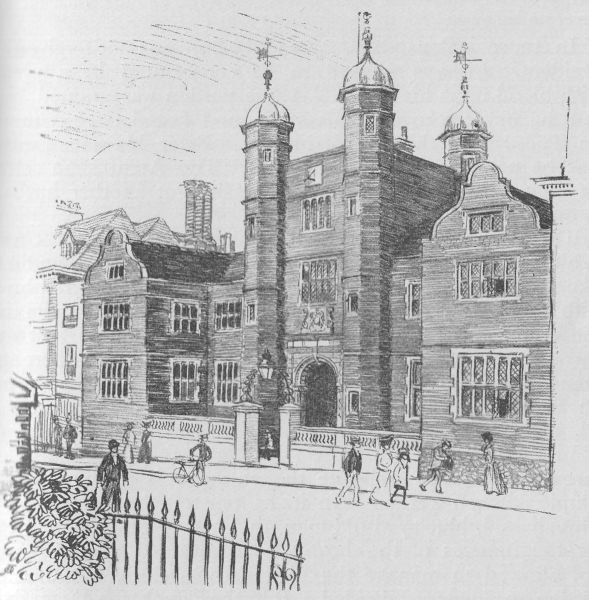
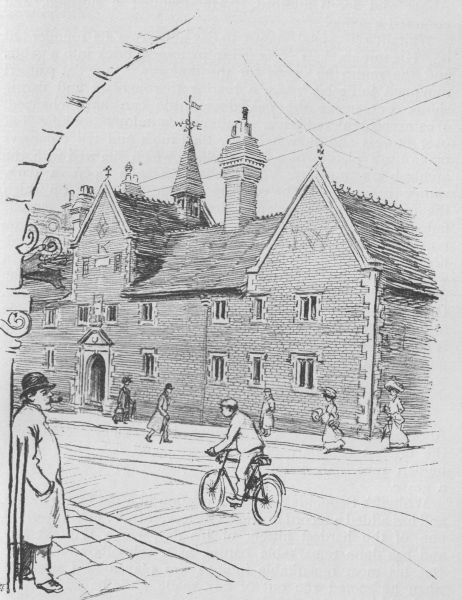
The Archbishop's great legacy is the Hospital. Unlike Whitgift's
Hospital at Croydon, it has charming surroundings; like it, it is quiet
and old and solid, of good dark red brick, with mullioned windows and
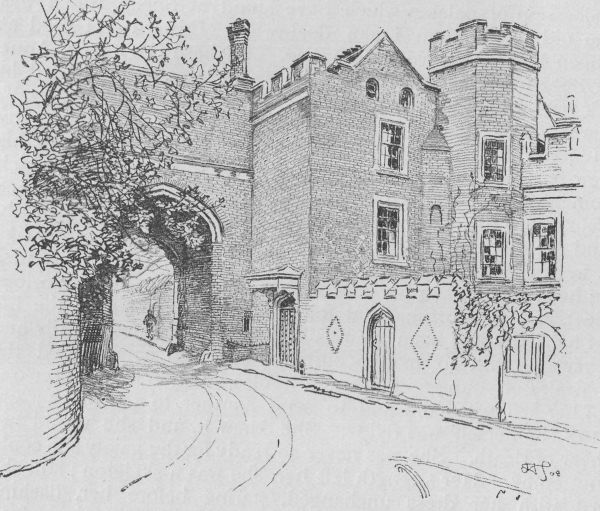
latticed panes, four turrets over the entrance gate, and the most
graceful chimneys that ever carried up smoke from pensioners'
fireplaces. There are many delightful groups of chimneys in Surrey
villages and on Surrey mansions, but Guildford's chimneys are best of
all.
In summer, the quadrangle is bright with geraniums, and through a
passage opposite the entrance is a glimpse of a simple kitchen garden.
In it, as one of the pensioners, a white-haired, blue-eyed old man, told
me, vegetables are grown for the inmates of the hospital. I gathered
that they were not allowed to manage the garden themselves, but that the
garden produce was divided. But they cook for themselves. The pride of
the hospital, however, is not the garden, but the old oak of the
staircases and dining hall and board room, the settle and table, the
copper caldron and the windows with their punning legend "Clamamus Abba
Pater." I am not sure if my old pensioner could read it, but he pointed
it out to me, and when I read it, approved. In the chapel, where there
are a number of Latin verses telling the story of the painted windows,
it was easier for him; he handed me a written explanation. But the
explanation matters very little; the real thing is the superb colour.
The story, which is of Jacob, Esau and Laban, is told on two windows,
with nine lights. There are purples and greens in those windows at which
you might gaze through a dozen sermons; but there is one robe of
burning, translucent orange that would light a cathedral.
The history of these windows would be worth knowing. They were evidently
not wholly made for the tracery, though parts of them may have been.
According to one account, they were purchased by Archbishop Abbot from
the Dominican Friary which used to stand at the end of Guildford North
Street, and which was converted into a Manor House after the dissolution
of the monasteries. But the glass belongs to more than one period, and
some of it was evidently added by the Archbishop, for among the heraldic
devices above the Jacob and Esau lights are the Abbot arms impaling the
Canterbury arms. Also—a point which the antiquarians have no doubt
noticed, but I can find no reference to it in any book—the initials
S.R., which appear in the centre top opening of the north window under
the date 1621, are evidently part of another inscription. On the left
side of the S is part of a V or U, as if the end of a Latin word ending
in "us" had had its tail chopped off. The letters must have been
selected from the original inscription for some definite reason; what
can it have been?
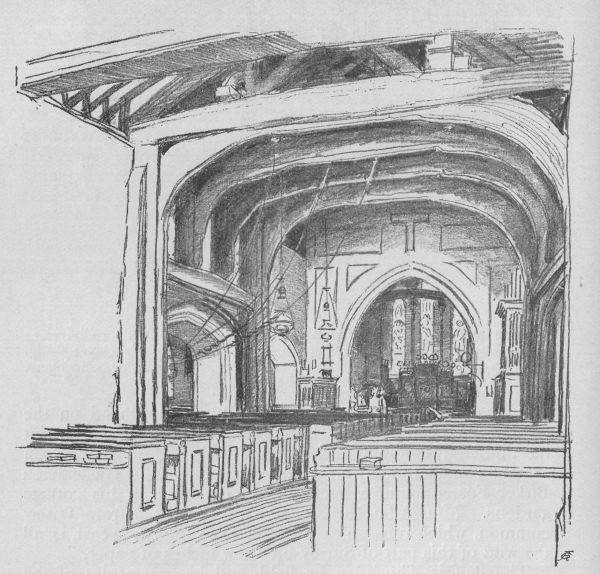
Archbishop Abbot's bones lie opposite his hospital, in the church of
Holy Trinity. Of the three churches which stand on the High Street,
Trinity Church is the highest up the hill, and was called the Upper
Church in the days when Puritanism preferred not to mention dedications.
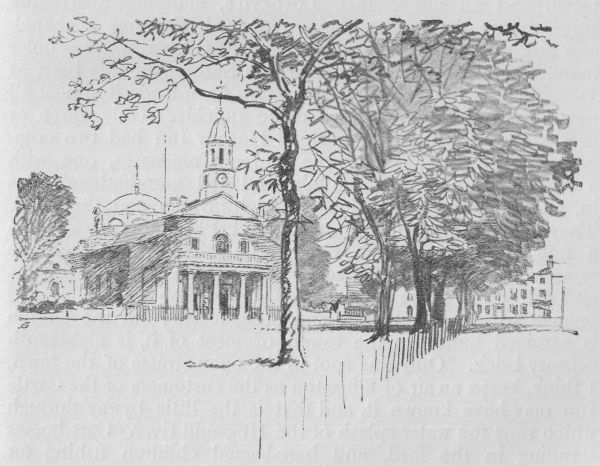
It is, comparatively speaking, a modern building, red-brick and heavy;
it was built after the old church fell down in 1740. An admirable calm
must have pervaded the citizens of Guildford on that occasion. Russell,
one of Guildford's historians, observes that the inhabitants, "desirous
of improving" the church, had recently repaired it at a cost of £750. He
then adds, reflectively, that "As the arches and pillars which supported
the steeple were then taken away, it was soon after supposed to be in a
very ruinous condition." On April 18, 1740, an order was given for the
church to be inspected. On the 19th it was inspected, and the steeple
was reported to be very unsafe. On the 20th, therefore, which was
Sunday, service was performed for the last time. On the 23rd the steeple
fell in and took the roof with it; the workmen had left the church a few
minutes before. Even then there was at least one untroubled soul in
Guildford. The verger was told that the steeple had fallen. "That cannot
be," he replied, "I have the key in my pocket."
The vault in which the archbishop lies was accidentally opened in 1888,
when the church was being repaired, and some brickwork fell away.
Through the gap, it is said, the coffin could be seen on the floor; the
form of the body was distinct, and the beard was still there. The vault
was sealed again; it had been unopened for more than two hundred and
fifty years. It was during these alterations that the cenotaph standing
over the vault was removed further east to where it now stands. It is a
typical piece of Renaissance work, florid, intricate, insistent on the
ghastliness of death. The effigy of the archbishop, stern and noble,
lies on its marble bed supported by stacks of gilt-clasped books;
underneath, a grating reveals a medley of human bones, carved with the
minutest detail. The artist evidently enjoyed the work. But it is better
worth looking at, for all that, than the monument on the other side of
the church, where the recumbent form of Sir Arthur Onslow is apparently
giving vague directions to an imaginary audience. Wrapped in a Roman
toga, he waves a sleeveless right arm; his left is propped by a set of
Journals of the House of Commons. It is a relief to pass beyond such
tawdry pomposities into the solemn little chapel, sacred to one of the
great regiments of the Army, the Queen's, the old Second of the Line.
Their badge, the Lamb and Flag, and their name they get from Katherine
of Braganza, Charles the Second's queen. Later, as Kirke's Lambs, they
added to a dreadful fame at Sedgmoor; but rebellion breeds brutality,
and Kirke was probably no more ferocious than others who have had to
deal with insurgents. Since Sedgmoor, the Queen's, or to give them their
other and less distinctive name, the Royal West Surrey Regiment, have
served in practically every important campaign in which the Army has
been engaged. Their tattered banners, with the broken, proud
inscriptions of campaigns and battles, droop above long lists of dead.
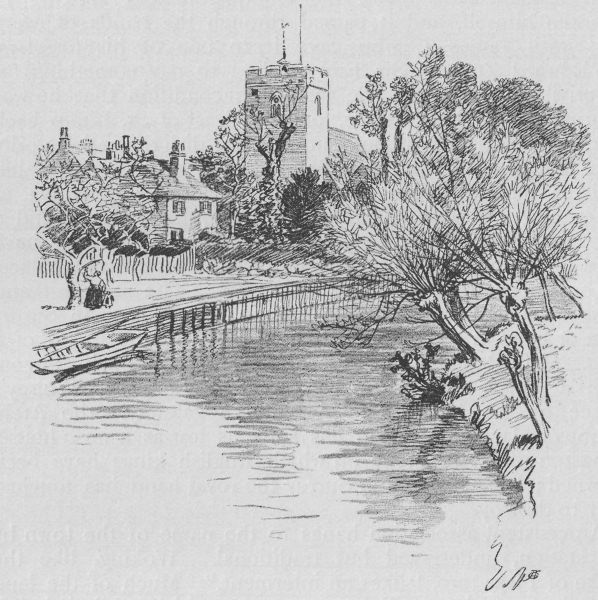
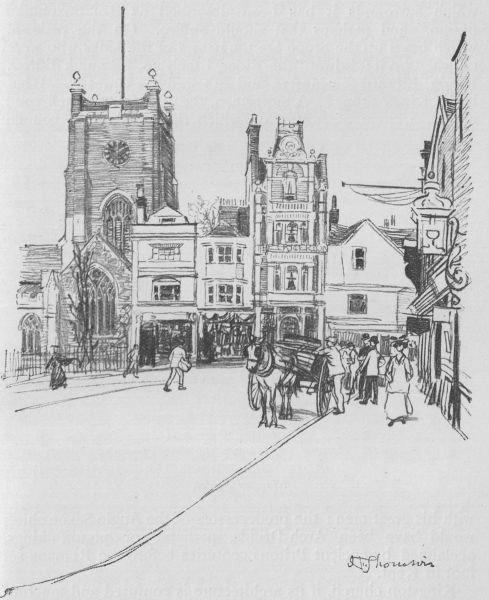
Of the two other great Guildford churches, the lower, or Church of St.
Nicholas, stands at the bottom of the High Street on the far side of the
Wey. Probably it is the fourth church that has stood on this site; there
are at all events, records of three previous demolitions, though each
demolition has left one feature standing—the Loseley Chapel, belonging
to the Mores of Loseley Park. With the exception of this chapel, with
its brasses and monuments, dating back to the fourteenth century
memorial of Arnold Brocas of Beaurepaire (surely a name of names!), the
church is chiefly interesting as being a really satisfying piece of
modern architecture. It was built in 1875, and, though the interior,
with its modern glass and high colouring, has none of the quiet of age,
it dulls to the right tone at dusk.
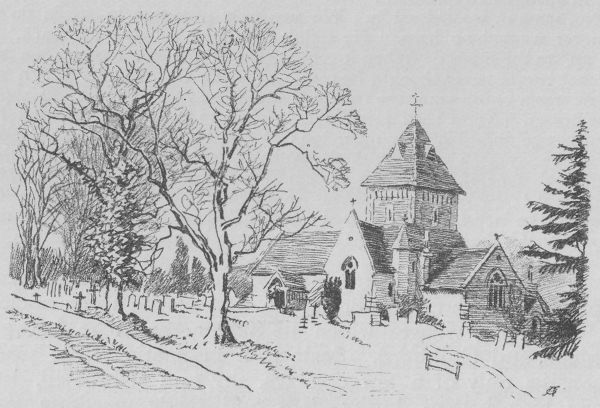
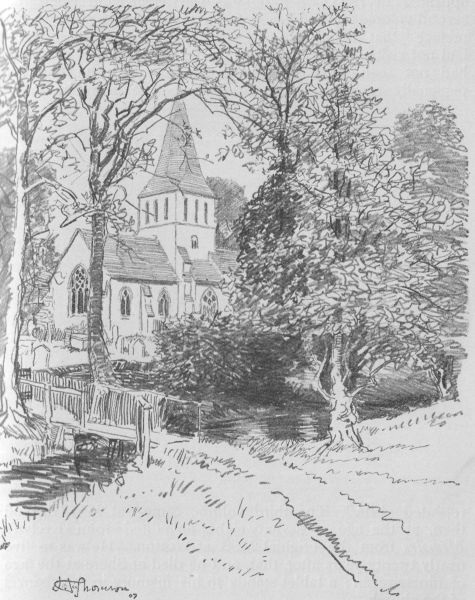
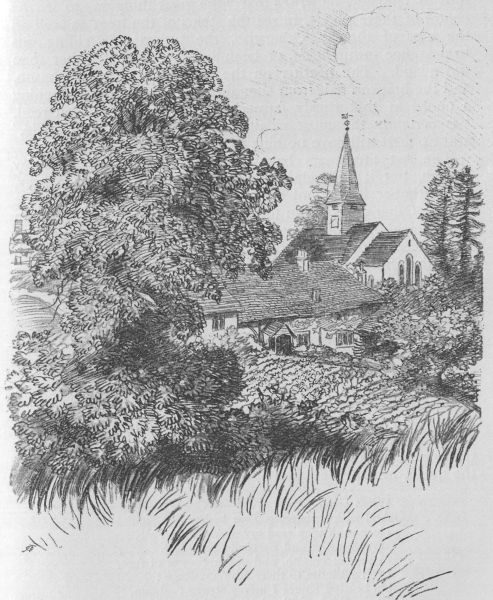
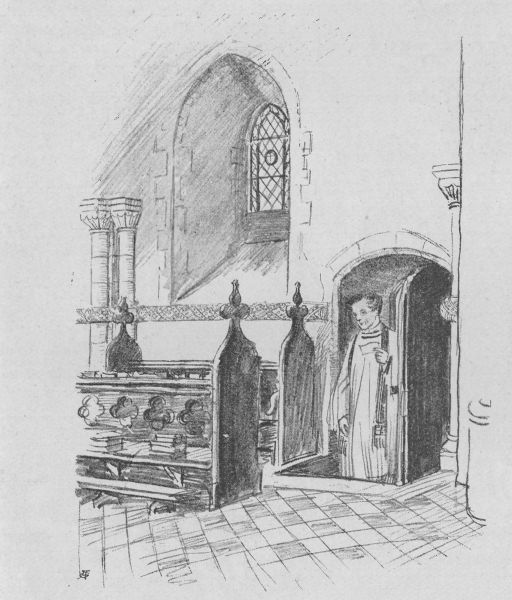
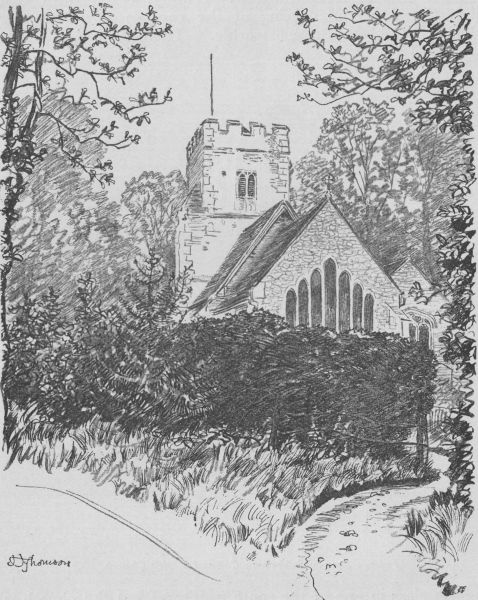
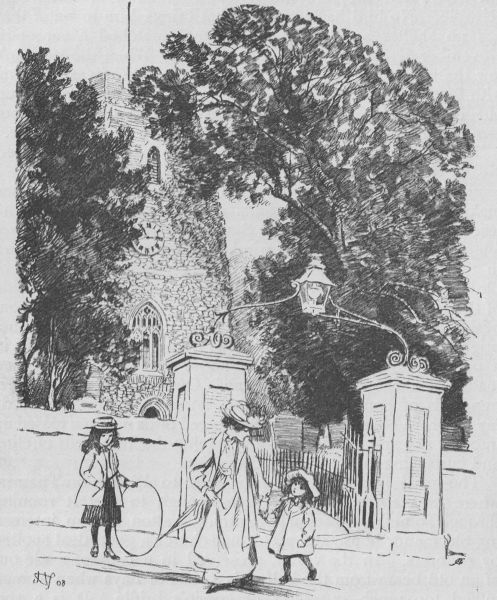
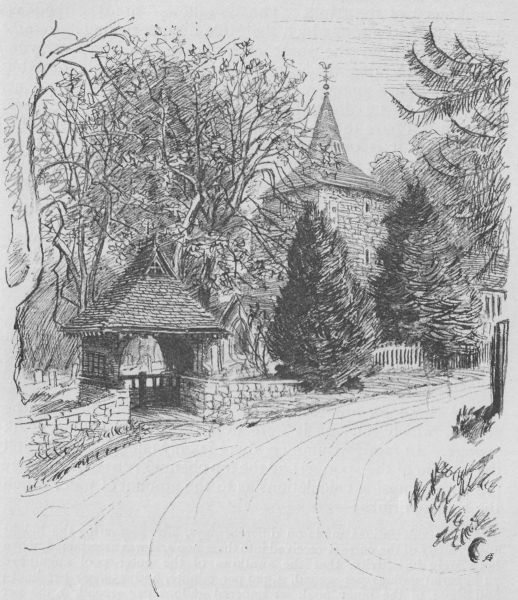
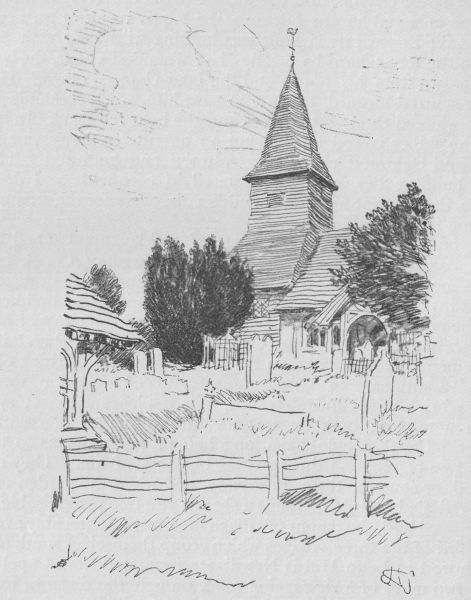
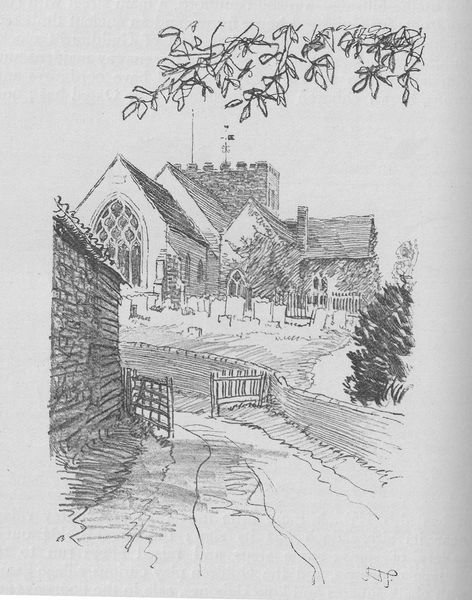
The Middle Church, St. Mary's, is the most interesting of the three. The
tower was built before the Conquest, possibly originally for defence: at
all events, there are two windows looking north and south which are
doubly splayed, after Saxon fashion, a good deal above the ground
level. The rest of the church has been built at different times,
beginning with the chancel, which is pure Norman, and there are actually
three levels to the floor, which gives rather an odd effect. The
proportions of the church have been spoiled by the cutting off of the
apse of the chancel—an entirely unwarrantable piece of destruction. The
history of the mutilation is characteristic of the days of the Regency.
George, Prince of Wales, used to drive down to Brighton, and perhaps his
coach stuck in Quarry Street, which must have been horribly narrow,
between the apse of St. Mary's and the town gaol opposite. He swore as a
Georgian prince should, offered the town a good round sum to have the
street widened, and the Corporation, who could have sliced something off
the gaol and harmed nobody, preferred to cut at the church. They never
got a penny of George's money.
But the most interesting feature of St. Mary's is the group of
wall-paintings in the chapel of St. John, north of the nave. These are
second in importance only to the famous painting at Chaldon, and have
been admirably explained by Mr. J.G. Waller, writing in the Surrey
Archæological Collections. They belong to that curious age when
paintings on church walls were used as texts and preached from on
Sundays, to be scratched and whitewashed out of recognition in later
years by destroyers and "restorers" alike. The subjects chosen by the
painter in St. Mary's Church are peculiar and strangely grouped. The
centre of the group is a "Majesty," the conventional representation of
the second coming of Christ. The head of the Christ has its nimbus; that
He is "in his glory" you can see by the mantle of royal purple, and "the
holy angels with Him" are represented by two little cramped figures, set
apart to make room for other drawings. Altogether there are six
medallions besides the "Majesty," and there are also designs in the
spandrils above the arch, but these are separate from the subjects of
the medallions. The medallions, Mr. Waller explains, represent certain
scenes in the lives of John the Baptist, and John the Evangelist, though
only two of the stories depicted belong to the Bible. One of them, next
to the "Majesty," shows the Evangelist seated in a caldron of boiling
oil, in which he is being held by a hideous tormentor with a pitchfork,
while a seated figure of Christ confers protection upon the Saint. In
another medallion the Evangelist is seen raising to life the dead
Drusiana, a lady of Ephesus who died just before the Apostle came to the
city; he is also shown turning sticks and stones into gold and jewels,
which he did in illustration of a sermon preached against riches. In a
third medallion the Saint drinks harmlessly from a chalice of poison
which has just killed two malefactors dead at his feet; and in a fourth
the other John, the Baptist, is painted with a rope round his neck,
dragged by an executioner before Herod. The executioner next beheads the
saint, and evidently sees some terrible portent on doing so, for his
hair stands on end, and his hand flies up in horror. The two other
medallions are separate subjects. In one, a figure with a rope round his
neck is dragged before Christ by demons; other demons, one red and one
white, scream and hold out threatening claws; perhaps their question is
"Art Thou come hitherto torment us before the time?" The other subject
is obscure. A Jew, apparently, is being baptised; and a deed with seals
is being examined by another figure, over a stream of water and blood.
Mr. Waller thinks that the reference is to a legend of a Jew who
desecrated an image of Christ with a spear, in imitation of the story of
the crucifixion, when out of the wound there gushed a stream of blood
and water. This miracle converted the Jew and his friends, who
immediately made over their synagogue to the Christian Church. That
would explain the sealed deed.
Other paintings in the spandrils—pictures of Soul-weighing and
Punishment—belong to other theologies. St. Michael holds the balance,
and a demon tries to press down one of the scales so that the soul being
weighed may kick the beam. But the subject of the painting is, of
course, older than St. Michael. The doctrine that souls are weighed, and
that devils and angels strive for the possession of them, is one of the
oldest in the history of the world's religions. It finds a place in all
the creeds; it belongs to Brahminism, to Buddhism, to Mahommedanism; it
is identical with the Ritual of the Dead of Egyptian mythology, in which
the souls of men are weighed before Osiris, and pray for mercy as they
are weighed. As at Chaldon, in another part of the painting the
condemned souls are being taken away. A demon carries them off, tied up
in a bundle, to the fires of hell. Doubtless the Guildford
congregations, listening Sunday after Sunday to the exposition of such
potent texts, came to have little taste for theology that was not served
up hot and strong.
Guildford has had other teachers besides theologians. The school, a
grey, venerable building, which fronts on the High Street above Trinity
Church, is the oldest in the county. It was founded in 1509, by one
Robert Beckingham, a rich London grocer, who owned property in
Guildford. But his benefactions did not permit any great latitude in
building, and it was not until Edward VI had given the school a charter
and a grant, and other great Guildford men had provided funds for
building and endowment, that the school, nearly at the end of the
sixteenth century, found itself in full working order. Since then it has
educated some famous scholars. Guildford's greatest man, George Abbot,
Archbishop of Canterbury; his brother, Robert Abbot, Bishop of
Salisbury; another brother, Sir Maurice Abbot, Lord Mayor of London;
John Parkhurst, Bishop of Norwich; Henry Cotton, Bishop of Norwich, and
his brother, William Cotton, Bishop of Exeter; Arthur Onslow, Speaker of
the House of Commons; Richard Valpy, author of the Greek grammar; and
Sir George Grey, the Colonial statesman, Governor in 1846 of New Zealand
and in 1855 of the Cape, are among its distinguished pupils. Of late
years, perhaps, Charterhouse has drained away some of the supply of
future Abbots and Onslows. But the school still flourishes, and the
memory of its "great" headmaster, Dr. Merriman, is kept green by
middle-aged Guildfordians.
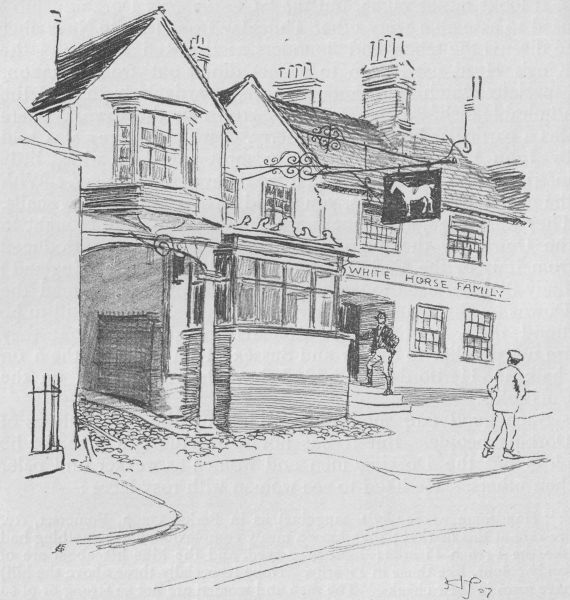
Guildford's inns have been famous for centuries. Guildford is the only
town in Surrey which Camden mentions in his Britannia, as having good
inns; John Aubrey remarks that they are "the best perhaps in England;
the Red Lion particularly can make fifty beds, the White Hart is not so
big, but has more noble rooms." John Taylor, the Water Poet, in his
Catalogue of Taverns in Ten Shires near London, made in 1636, goes out
of his way to mention particularly that Guildford "hath very faire Innes
and good entertainment at the Tavernes, the Angell, the Crowne, the
White hart, and the Lyon"; and Guildford only, of all the towns he
mentions, has all its inns either still standing or represented under
the same names, wholly or partially rebuilt. The Angel has kept more of
what is old than the others, including a panelled hall with a
seventeenth century clock, and some fine timber and brickwork best seen
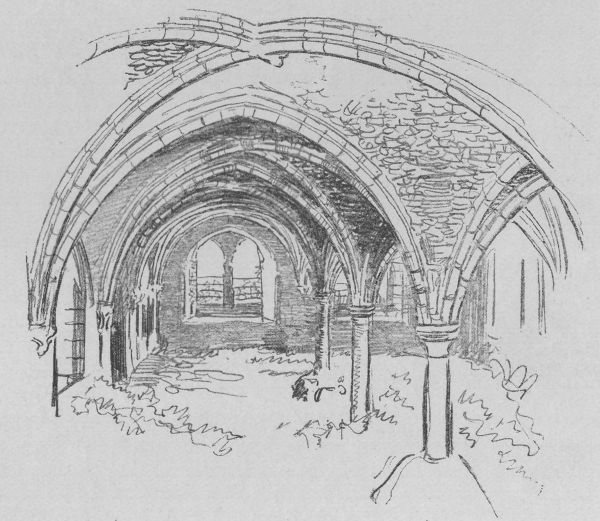
from the inn yard. Under the Angel, too, lies one of a pair of vaulted
crypts which have puzzled all the archæologists. The two crypts lie on
opposite sides of the street, and are beautiful examples of fourteenth
century work in chalk; in one of them, too, there was evidently once
some fresco work, but that has nearly all been rubbed away. What were
the crypts for? No one knows for certain. Mr. Thackeray Turner thinks
they were without doubt the undercrofts of merchants' houses; but there
is better reason for supposing that they are remains of some religious
foundation, perhaps of White Friars. At one time there stood in the
centre of the High Street, between the two crypts, the "Fyshe Crosse,"
which John Russell, the Guildford historian, tells us carried on its
summit a flying angel carved in stone, and was erected by the White
Friars in 1345. There is no evidence to prove that this was so, though
it may have been; in any case, the "Fyshe Crosse" was demolished in 1595
as being abominably in the way of the street traffic. If the White
Friars ever had a convent near the cross, possibly the Angel was
originally their guest-house, afterwards turned into an inn.
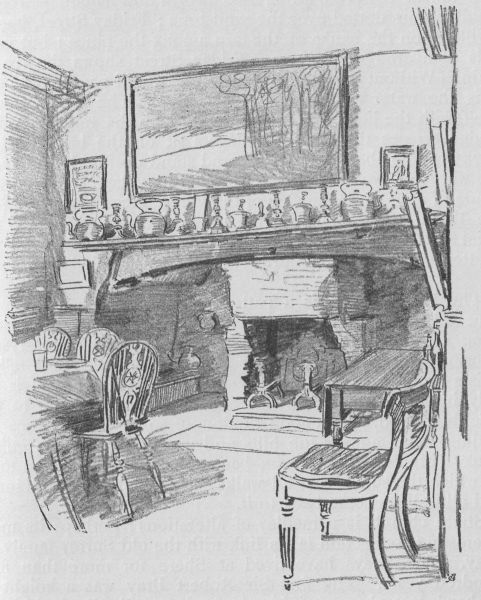
The Red Lion was the best inn, according to Pepys. It was at the Red
Lion that he "lay in the room the King lately lay in," which would have
pleased Pepys; and it was with the drawers of the inn, one Saturday
night, that he and Mr. Creed made merry over the minister of the town,
who had a girdle as red as his face, but preached next day a better
sermon than Pepys had looked for. The inn had a garden, out of which on
another occasion the gossiping little Admiralty official cut "sparagus
for supper—the best that ever I ate but in the house last year."
Doubtless the host of the Red Lion liked Pepys's recommendation, but
Pepys and his wife must have occasionally been rather noisy guests. It
was in the same inn garden that he and Mr. Creed "played the fool a
great while, trying who could go best over the edge of an old fountain
well; and I won a quart of sack of him." Afterwards, at supper, "my wife
and I did talk high, she against and I for Mrs. Pierce (that she was a
beauty) till we were both angry." Pepys's journeys to Portsmouth, where
his Admiralty business took him, seem generally to have been broken at
Guildford, which was the first stopping place after leaving "Fox Hall"
as he calls Vauxhall. The roads must have been pretty bad, for on one
occasion the coach lost its way for "three or four miles" about Cobham.
However, they ended as usual at the Red Lion, and "dined together, and
pretty merry" and so back to Fox Hall.
A gentler traveller through Guildford used to drive along the Hog's Back
in the early morning, breakfast at the Lion or the Angel, and reach
Sloane Street at half-past six or so in the evening, when she was glad
to get to bed early. That was when Jane Austen was writing at Chawton.
One of her letters, very typical of her in its regard for the pleasant
little minutiæ of a day's business, describes a drive from Chawton up to
London. At Guildford she was "very lucky in my gloves—got them at the
first shop I went to, though I went into it rather because it was near
than because it looked like a shop, and gave only four shillings for
them; after which everybody at Chawton will be hoping and predicting
that they cannot be good for anything." She was then at work on Emma,
whom we meet again at Leatherhead.
Guildford High Street has kept its main features for centuries. But the
town has lost one of its chief buildings, which only survives in the
name of Friary Street, and in one or two other names, such as Walnut
Tree Close. This was the old Dominican Friary probably founded by Black
Friars in the first half of the thirteenth century. Not a stone of the
old Friary remains in its place, but the building saw in its time a good
deal of Guildford history. Prince Henry, the eldest son of Edward I and
Eleanor of Castile, died there of an illness which not even the skill of
the friars could abate, though they tried their utmost and sent
messengers riding to London for syrups and candies. The friars had a
good deal to do with royalty, and had many presents from the kings.
Edward I gave them oak trees for fuel and timber; Edward II gave them
eight shillings; Henry IV and his family lodged with them and gave them
forty shillings; Henry VII let them gather fallen wood in his park, but
never gave them a penny; Henry VIII gave them many presents, of which
the largest were two of five pounds, and his daughter, Princess Mary,
gave them seven shillings and sixpence. But the friary fell, of course,
at the Dissolution and after that, apparently, Henry used the building,
which he enlarged, for his own purposes when he came to Guildford to
hunt. Later, probably before the time of James I, the old friary
buildings were demolished and another house built which went with the
Guildford Park estate through several families. One of its owners was
Daniel Colwall, a founder of the Royal Society, who conferred on its
annals the dismal distinction of a suicide. He pistolled himself in an
armchair, and the chair is still shown, black with blood, in the
master's quarters of the Abbot's Hospital. Later still, the house was
used as cavalry barracks, and three years after Waterloo, when perhaps
barracks seemed less necessary than before, the buildings were pulled to
pieces.
Guildford once had nine "gates"; eight have disappeared. They are marked
on an old map of the borough, classically described as the "Ichnography
or ground plan of Guildford." Of six "gates" or streets south of the
High Street, Ratsgate, Bookersgate, Tunsgate, Saddlersgate, Bakersgate,
and Shipgate, only Tunsgate remains; and on the north side Swangate,
Bull's Head Gate, and Coffeehouse Gate have vanished. The charm of the
chief buildings remains, but here and there modern needs have spoiled
the smaller houses. In the High Street, for instance, Number 25, not
much more than a hundred years ago, must have been a quite perfect
little house, with its large casements and their curious iron
fastenings, its noble staircase, and its delightful doorway. It was once
the private residence of the Martyr family, who were hereditary town
clerks of Guildford, but unfortunately it has now been turned into a
shop. The proprietor very courteously allows visitors to examine the
interior, but much of the fascination of the ground floor, with its
panels under the windows and its delicate iron railing, has vanished
altogether, and can only be recovered in imagination with the help of an
old drawing. This house, by the way, a century ago contained a strange
relic, strangely lost. When Peter de Rupibus, the great Bishop of
Winchester, died at his castle at Farnham, his body was buried in
Winchester Cathedral, but the heart was taken to Waverley Abbey. About
1730 it was accidentally dug up among the Abbey ruins, and brought to
Guildford, where Mr. John Martyr kept it at Number 25, safe in its
original lead case. A hundred years later the heart disappeared. No one
knows how it vanished, or where it lies.
One building has altered very little. That is the old town hall, whose
clock swings out over the road, and has been sketched more often,
perhaps, than any clock in Surrey. The original town hall belongs to the
time of Elizabeth, and was probably built into the present structure,
which dates from 1683. It is in some ways the chief feature of the High
Street, with its heavy balcony, supported by monstrous black oak
brackets, and its cupola and bell-turret. The clock has a separate
history. In the year when the town hall was built, one John Aylward, a
clockmaker, came to Guildford and asked leave to set up in business. He
was a "foreigner," that is, he came from another part of England, and
the Gild-merchant refused permission. Undaunted, he retired and set up
his shop outside the borough, made a great clock, presented it to the
governing body, and so obtained the freedom of the town.