"Infinite riches in a little room."
"The great city has an unbroken history of 1,000 years, and
has never been sacked by an enemy."—Sir Walter Besant.
"Great are your privileges. For you is collected in the
public palaces of London all that human genius has ever
achieved, all that power and wealth can procure. For you has
been dug from the earth all that remains of mighty empires
and long-vanished civilisations. The arts of Greece and
Rome, and Egypt and Assyria, and the not less wonderful arts
of India, are all contributory to your pleasures. The whole
art and mystery of painting is unfolded for you on the walls
of our National Gallery.... You are rich indeed, for you are
the heirs of all the Ages."
Are picture-galleries, museums, and such-like treasures of the
metropolis, to be described as London's Highways, or as its Byways?
That they ought to be the former, is certain; as certain as that they
are but too often used as the latter, or are, at any rate, regarded as
refuges and shelters from the inclemency of the outer air. For Art,
like Religion, has a tendency in this respect, to serve not so much as
a cloak, as in the capacity of an umbrella. And it is sometimes
conveniently adapted to yet other profane uses: "This 'ere ain't a
gymnasium, nor yet a refreshment room," I have heard a much-enduring
officer of the law remark, more in sorrow than in anger, to a
too-presuming visitor, who, seated opposite the Ansidei Madonna, was
placidly feeding such of her offspring as were not engaged
in playing leap-frog over the chairs, with crumbly bath-buns.
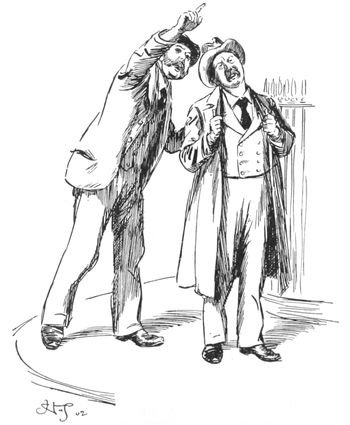
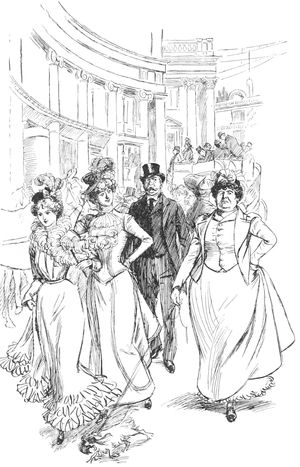
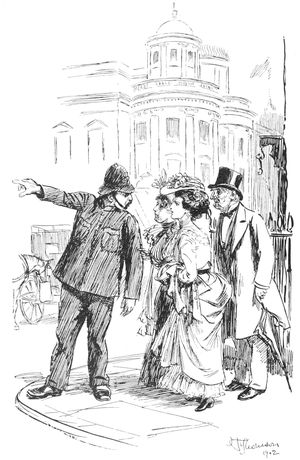
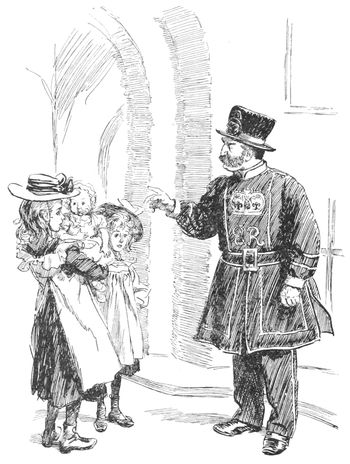
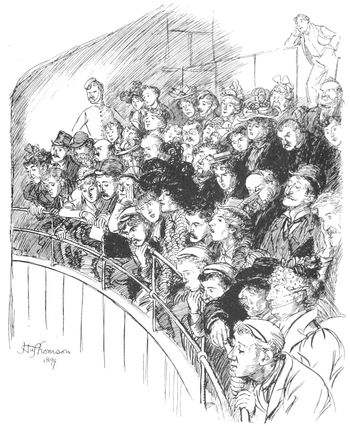
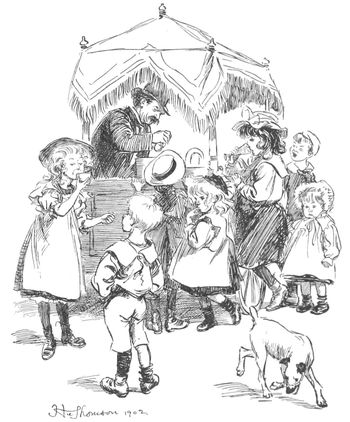
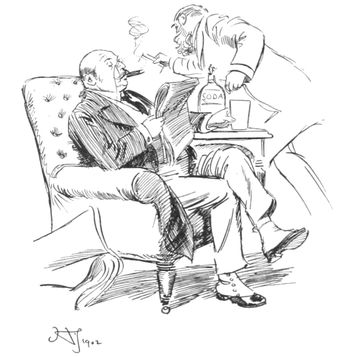
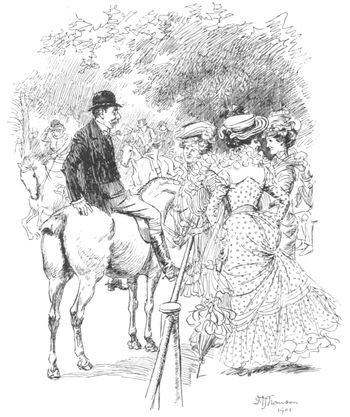
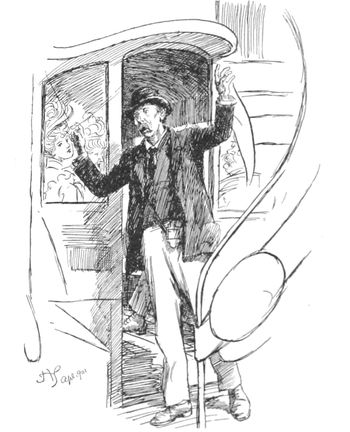
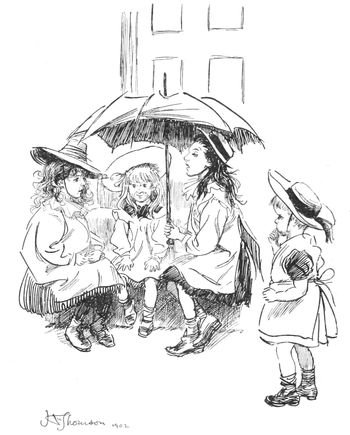
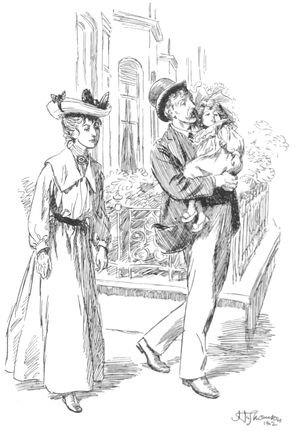
A Sketch in Trafalgar Square.
These, however, are varieties in the human species that are ever with
us. "Fear not to Sow because of the Birds," says the Koran; and the
widespread sowing of culture has so far shown results, that every year
the British Museum, the National Gallery, and other kindred
institutions, are growing more popular and more frequented. In Art and
Knowledge, as in other directions, it takes time for "the People" to
appreciate fully their oldest, much less their newest, heritage. Such
treasures in our vast metropolis are still too much hidden,
still undiscovered by the majority. Even the educated visitor fresh
from the country does not immediately realise the fact that he is free
at any time to walk the marble halls of the National Gallery, to hear
the fountain plashing in the Pompeian hall of the riverside palace
raised by Sir Henry Tate to modern British Art, or to follow the
strange instincts and laws of Nature in the beautifully arranged
Natural History Museum of Kensington. The recent movement for "Sunday
opening," now more or less widespread, has tended greatly to the
popularisation of the national collections, and does a good deal,
also, to the mitigation of the too utter gloom of the stranger's
"Sunday in London." Even M. Taine, who in the "sixties" compared the
metropolis of his day to "a well-ordered cemetery," or "a large
manufactory of bone-black closed on account of a death," would surely
have been less severely splenetic had but a museum or two been open to
beguile his tedium. In our present year of grace, the British Museum,
from two till four, is thronged by the lower middle-class, who, if
their affection for mummies is a trifle out of proportion to the
interest they take in the Elgin Marbles, and their love of historic
missals is sometimes too subordinate to the intricacies of the
neighbouring World's Unique Stamp-Collection, yet show in their way an
intelligent and praiseworthy desire for knowledge.
These treasure-houses of London,—what wealth do they not
represent,—what unimagined riches do they not contain? London, the
richest city in the world, yet for so long a period far behind other
capitals in representative art, has in the last century equalled, if
not surpassed them all. Some fifty or more years ago, the great
"Pan-Opticon" of Leicester Square, the precursor of the present
Biograph and Cinematograph, was the chief "artistic" glory of London.
In the days of our grandfathers, people were for ever taken to see
this "Pan-Opticon," a great building with endless galleries, on the
site of the present "Alhambra"; where you saw all the things
of the world and the glory thereof. Now this baby-show is superseded
by museums and galleries filled with the most priceless gems of art
and of history: yes, the London collections may in this sense be
regarded as variations of the Pan-Opticon—Pan-Opticons of a nobler
kind. London's National Gallery is now a collection of pictures worthy
of so great a nation, her museums are filled with the best of the
spoils of ancient Greek art. If London has been late in awaking to her
artistic responsibilities, at any rate she takes them seriously enough
at the present day. And, of late years, her art treasure has been
enormously and continuously enriched, not only by the expenditure of
public moneys, but by private bequest and private munificence. Rich
men, with true patriotism, have spent their lives in painfully
searching for, and collecting, beautiful things, to leave them,
afterwards, freely to the nation. Millionaires, too, have, it would
seem, their uses. And we are thus all, in a sense, millionaires, for
we inherit the priceless treasures of others, and we enjoy the fruits
of their lifelong toil.
It is in London, more than anywhere, that the real poetry of living
may be enjoyed, and that every passing artistic whim may be indulged.
Does your mind require stimulating by the study of Greek art? the
galleries of the British Museum are open to you; or
"Dost thou love pictures? we will fetch thee straight
Adonis painted by a running brook;
Or Cytherea, 'mid the sedges hid,
That seem to move and wanton with her breath."
Or do you feel that what your mood needs is the contemplation of
beautiful eighteenth century French furniture, and Fragonard's
pictures? Go then, to Hertford House in quiet Manchester Square, and
see the world-famed Wallace Collection. The "Wallace Collection," that
pearl of great price, of which the bequest has recently so convulsed
the art world, is the latest expression of the patriotism of wealth.
Collected mainly by the third Marquess of Hertford,—the "Lord Steyne"
of Thackeray's novel,—and his successor the fourth
Marquess, Attaché at the Paris Embassy,—the treasure, since its
formation, has met, at one time or another, with strange and unique
adventures. In Paris, the fourth Marquess, Richard Seymour Conway,
built for his collection "a stately pleasure house," fitted and
designed after his own sumptuous taste; living meanwhile, his wealth
no doubt crippled by his vast "unearned increment," not, indeed, as a
miser, but in a degree of seclusion that almost amounted to
eccentricity. During the Commune, the bulk of that collection that we
now admire was even, it is said, buried in underground cellars for
safety. The beautiful French furniture,—the bric-à-brac, blazing with
enamels and precious stones,—one can well imagine these the constant
delight of the old collector, with whom the love for such things had
become a ruling passion. Yet, by the irony of fate, this fourth Lord
Hertford suffered from a painful disease, a continual affliction
which, they say, only the news of victories achieved in sale rooms, by
his agents, over some rival collector, at all tended to alleviate.
Though reproached during his lifetime as an "absentee landlord," a
nobleman who preferred residence in Paris to a home in his native
land, Lord Hertford has certainly, in the upshot, been proved to have
deserved as well as any man of his country. Time's revenges are slow,
but they are effective; and the fourth Marquess, the flouted foreign
resident, has proved, indirectly, the greatest patriot of his age.
But, while the old nobleman's sentiment appears to have been mainly
negative (as shown, for instance, by his decision that the collection
should not enrich the Louvre), it was really Sir Richard Wallace, his
successor, faithful friend, and co-collector (some say, also near
kinsman), who should have the largest share of the nation's gratitude.
Sir Richard Wallace, Lord Hertford's sole heir, deciding, after the
imminent dangers of the Commune, that it was rash to leave the
inheritance thus at the mercy of vandalism, removed it, in
1872, to London, where, for three years, it filled the Bethnal Green
Museum; being removed to Hertford House, the London residence of the
family (by then arranged to receive it), in 1875. Sir Richard, whose
only son had meanwhile died, left in his turn the whole of the
property to his wife, a French lady, whose loyalty to her husband's
country should cause her name, for all time, to be writ large on the
roll of honour. Here, in Hertford House, a few years after Sir
Richard's death, Lady Wallace died; and, in accordance with her
husband's secret wish, bequeathed the whole of the immense property to
the British nation. And now, for future ages, Hertford House, with all
its myriad treasures, a collection perfect as it stands, fresh from
the arrangement and taste of the collector, will be the glorious
heritage of the nation.
One of the greatest charms of Hertford House is that it suggests none
of the red-tapeism, or of the dull uniformity of a museum, and,
consequently, does not affect visitors, as so many museums do, with a
primary sense of fatigue and boredom. The rooms of the palatial
mansion are still arranged mainly as they were in the owner's time;
the long suites of reception saloons, through which the reflected
sunlight glitters,—vistas of French tapestries, pictures,
lapis-lazuli, enamels, and Sèvres china,—convey all the suggestion,
even in prosaic London, of a fairy palace. Even a Countess d'Aulnoy,
with her wealth of imagery, could hardly have imagined a finer setting
for her Gracieuse and Percinet, or any of their dainty royal line.
There is an intime air, almost as of home, even about the long
picture gallery where the Gainsboroughs and Sir Joshuas smile sedately
upon us. The sweet presentments of fair dead ladies, seen here in
their proper setting; the Pompeian central courtyard and plashing
fountain, whence, it is said, the aged Lady Wallace was daily to be
seen, leaning from the balcony that projects from the upper rooms, to
feed her crowd of birds, eager pensioners, with their breakfast of
crumbs; these combine to give an atmosphere of human charm,
a thing quite apart from the usual cold aloofness of museums. It is
again the idea of the Soane Museum, but on a very magnificent scale.
Beautiful in its publicity, how mysteriously lovely must it not have
been in the days of its seclusion! One can almost share the feelings
of that old retainer who said, on the last sad day before the opening;
"Ah, Sir! the Wallace Collection, as it was, you and I will never
see again—for the common people are going to be let in!"
Londoners, in this instance, at any rate, fully appreciate the
magnificence of the gift made them. Hertford House is, on fine days,
usually thronged; all classes are represented there; but there is
noticeably more of the "smart world" to be seen there, than is usually
to be found in London galleries. The "smart world," as distinguished
from the scholarly; but the scholarly world is to be met there too,
and will still visit Hertford House, after the "Good Society" has
forsaken it, and betaken itself to some newer haunt of fashion. In
each of London's picture galleries and museums, its special
clientèle may very easily be detected; and, at any rate, that of
Hertford House is certainly, so far, the best-dressed. Among the crowd
are often to be seen groups of young girls, demurely following in the
wake of some feminine leader, who discourses to them about the
pictures, and the various schools of painting,—a thing, this, that
surely requires some courage in a mixed community. It is not to be
denied that the visitor is often sadly in need of some guide: "Are all
these pictures hand-painted?" I have myself heard a well-dressed and
(presumably) well-educated young girl say, at the National Gallery.
Perhaps it is a felt want, for one never knows what extra "following"
one may not, unconsciously, attract: I myself once saw an unhappy lady
lecturer, carried away by the enthusiasm of the subject, turn round
and give an eloquent peroration and summary of it to a policeman, a
deaf old lady, and a nursemaid carrying a vacant looking baby:
"Now," said the lady cheerfully, "just to show what you have
learned, tell me, in your own words, what you consider to have been
the influence of Giotto on Early Italian Art?"
No one answered; but the vacant baby, apparently thinking it a
challenge, wailed.
And, in Hertford House, the custom lends itself to additional dangers;
for peripatetic classes are many, and in the nooks and unexpected
corners of the mansion, it is fatally easy to lose your special crowd
of students altogether, and to attach yourself, again unconsciously,
to some one else's flock; who, by the chilly indifference with which
they receive your well-intentioned homilies, soon make you
unpleasantly aware of your mistake. Like "Little Bo-Peep," you then
vainly pursue your wandering sheep, from one gallery into another,
feeling, perhaps, that the pursuit of pupils, as of Art, has its
drawbacks; and that tea, in the shape of the nearest "Aerated," is all
too distant.
The "sheep" in question are, however, discovered at last, placidly
gloating over the wonderful collection of jewelled snuff-boxes—was
there ever such a marvellous display of miniatures and of brilliants?
Truly, the eighteenth century was a luxurious age!... Surely, no one
can ever have dared to sit comfortably on those priceless chairs, or
to have taken tea out of a Sèvres cup, at one of those marvellously
inlaid, jewel-encrusted tables?
The pictures, however, are the chief delight of Hertford House. It is
easy to admire porcelain, armour, bric-à-brac; but to really enjoy it
in the best sense, one must be more or less learned in the cult; while
pictures, though their full appreciation implies a certain amount of
education, are better understanded of the multitude. But, though the
British and foreign schools are well represented, it is the unrivalled
collection of French pictures of the eighteenth and early nineteenth
centuries, works by Watteau, Lancret, Fragonard, Greuze, and all the
noted painters of the French school, that the great world,
primarily, flock to see at Hertford House. Twenty-one pictures by
Greuze alone will delight the lovers of that painter's work, and bring
their minds back to the eternally-charming affectations of that
eighteenth century in which so many of our modern poets yearn to have
lived. One can imagine, for instance, Mr. Austin Dobson echoing
Campbell's lovely lines to the pretty, typical girl-face that Greuze
loved so well:
"Transported to thy time I seem,
Though dust thy coffin covers—
And hear the songs, in fancy's dream,
Of thy devoted lovers."...
Here, naïve as always, yet never quite without a certain faint
meretriciousness of effect, the "girl-child" of Greuze looks down on
the visitor in every costume and attitude.
In the long picture-gallery that forms one side of the great
quadrangle, there are large canvases by Reynolds, Gainsborough,
Romney, Rembrandt, Rubens, Van Hals, Murillo, and many others. Here is
a charming picture of "Miss Bowles" by Reynolds,—the little girl with
round eyes, cuddling a dog, so long familiar to us by engraving or
print; and here, too, is Frans Hals's Laughing Cavalier, whose
infectious laugh lingers so long in the memory.
Sir Richard Wallace offered his collection, with his house, to the
nation before his death; the Government, however, after the usual
manner of Governments in such matters, raised objections; and the
affair subsided, till the surprise of the widow's legacy came, and
showed the long and serious intention of the gift. One little picture,
The Peace of Münster, by Terburg, a small historical panel of untold
and unique value, was, indeed, given by Sir Richard to the National
Gallery before his death; yet even this gift had a narrow escape of
being rejected; for the would-be donor, unrecognized, and wearing
shabby clothes, was ill received by Sir William Boxall, the then
Director, and was all but sent away with contumely, with his
picture, till he made it and himself known:
"My name is Wallace," said the stranger quietly, "Sir
Richard Wallace; and I came to offer this picture to the
National Gallery." "I nearly fainted," said Boxall when he
told the story.... "I had nearly refused The Peace of
Münster, one of the wonders of the world!"
Nevertheless, the little scene is in its way truly typical of the
nation's treatment of its would-be benefactors!
The story of the foundation of the British Museum, the classic edifice
in Bloomsbury that has arisen on the site of the old historic Montague
House, is not unlike that of Hertford House. For, the first beginnings
of the enormous museum collections originated very much in the same
manner as the Hertford Bequest. Sir Hans Sloane, the Sir Richard
Wallace of his day, Chelsea magnate, physician, naturalist, and
philanthropist, determined his large library collections to the
nation, offering them by his will, at a fourth of their estimated
value; desiring, like Sir Richard, that, if possible, the collections
should remain in his house,—Henry VIII.'s historic Chelsea
manor-house. This wish, however, was not in his case carried out; the
ancient building was demolished, and, in its stead, the British Museum
was founded.
At the British Museum the lady-lecturer, with her tribe of earnest
students, is occasionally also to be met with. Here she is often
youthful and attractive, and is generally to be found,—strange
contrast of associations!—either in the Mausoleum Room, or among the
Elgin Marbles: her little band of eager pupils scribbling in their
note-books at a respectful distance. Last March I saw a charming,
Hypatia-like lady, tall and fair, gray-eyed and gray-robed, holding
thus her little court, by the lovely figure of Demeter; I would fain
have joined myself to the small gathering, and posed as a pupil, but
that my courage failed.... I felt, however, glad to think that, in
this case, the study of Art had not, as some declare, tended to make
the young lady regardless either of her appearance or of
neatly-fitting tailor-made clothes. But she went on with her following
to the Nereid's Tomb, and I saw her no more.
In the long galleries of the British Museum is generally to be found a
motley gathering of visitors, in which the poor, and the children of
the poor, largely predominate. Rows of chattering little girls in
pinafores, corresponding batches of little boys in knickerbockers,
greet one at every turn. And the more ragged the children, the more
astonishingly erudite and profound are sometimes their utterances.
This is a surprising testimony to the efficacy of the Board Schools,
as well as to the advance of learning generally. The visitor who "lies
low" and listens, in any of the Greek Marble Rooms, will often find
cause to marvel at youthful and ragged intelligence. Girls are more
flippant, perhaps, than boys: "'Ere's the Wenus," one will say: "you
can always tell 'er, 'cos she seems to be lookin' around and sayin':
'Ain't I pretty'?" Yet, though to hear unkempt and neglected waifs
talking wisely about Greek marbles does, I must confess, puzzle me, I
must, in fairness, own that there appears to be another side to the
question, and that the officials on guard appear to entertain no very
high views as to juvenile erudition. "So far as I've noticed," a
kindly British Museum policeman once said to me, "the street children
don't get much real good out of going to the Museum. They bring a lot
of dirt out of the streets in with them, their fingers are generally
sticky, and they look about 'em—oh, yes! but not usually with any
object, just vacantly."
This was depressing. (Did the accompanying dirt, I wondered, at all
affect this particular policeman's outlook?) "But I saw a small crowd
of boys and girls looking hard at the King Alfred documents and
missals," I murmured.
"Oh, and so you might have done; but didn't you notice," said the
stern guardian of the law, "that a lot of ladies and gentlemen had
been lookin' at 'em just before? They wouldn't have troubled about 'em
without that.... And King Alfred's all the thing now....
Children always come, like bees, where other people are lookin'; and
try and squeeze the older folks out just to see what they've been
a-lookin' at.... Yes," he owned, in reply to my incredulous
interjection, "the children might have heard the name of Alfred in
their history books, but no more; that wouldn't be the cause of
their crowding up. Their mothers often send 'em into the Museum when
they want to go out themselves, or perhaps just to get rid of 'em for
a time. Children are more indulged, and not half so well-behaved, as I
was when I was a boy."
But the chatter of the children is stilled, or, at any rate, lost
among the vast marbles of the collection, where so many sounds mix and
mingle in a soothing aloofness. Here, in the long galleries, where the
faint light, "that kind of light," as Rossetti said, "that London
takes the day to be," slants down on Roman bust and Greek god, may
sometimes be heard charitable ladies explaining to dirty little
street-arabs the influence of Phidias on Early Italian sculpture; or
one of the elegant Hypatia-like girl-lecturers already described,
discourses, while a motley crowd of pupils:
—"school-foundations in the act
Of holiday, three files compact—"
—draw near to listen.... And who can tell where the grain may fall?
Sunday is now the great "People's Day" at the British Museum. Those
who cavil at "Sunday opening" should really visit the Museum then,
when, from two till four, the galleries are dotted with intelligent
sightseers. (For the Museum, be it noted, is not so often used as a
mere shelter from rain, "jes' to pass the toime away," or as the
"refreshment-room" already referred to, as it used to be.) Perhaps the
greatest crowd is to be found upstairs, where the mummy-room is
greatly beloved, both of small boys and of honey-mooning couples.
Young couples, I notice, either in the "courting" or
newly-married stage, have ever a strong affinity for mummies;—and as
to boys!... While you are, perchance, reflecting over the decaying
embroideries of a mummy-case, and wondering what was the life and fate
of its once-lovely occupant, after the manner of Sir Edwin Arnold:
"Tiny slippers of gold and green!
Tied with a mouldering golden cord!
What pretty feet you must have been
When Cæsar Augustus was Egypt's lord'—
"'Ere, look 'ere, Jimmy," one of those demon boys will break in,
interrupting your reverie: "you can see the corpse's 'ole fice! My!
ain't 'e jes' black! Blimy if 'e aint 'ad 'is nose bruk in a fight, as
'e ain't got but the 'alf of it left," &c., &c.
"See wot this lydy's got wrote on 'er, 'Arry," the blooming betrothed
of a speechless young man will strike in, unconsciously carrying on
the chorus: "Three thieusand years old! My! 'ow-ever could they a kep'
'er all that time! She's a bit orf colour, certingly—but sich good
clothes to bury 'er in—I call it nothin' but sinful waste," &c., &c.
Yet I can tell a more touching story, in another sort, of the Mummy
Room. Once I happened to watch a small boy—a very decidedly "earthly"
small boy, too; one would not have expected it of him—on whom the
mummies seemed to exercise a quite indescribable fascination. He even
stopped half-way through his stale Museum bun, and gazed at them with
a species of horror. Then, after a five-minutes' silence, he breathed
hard, and said to his companion, in an awe-struck whisper:
"They don't know we're looking at them!"
The "Jewel Room" is another favourite haunt. Here only some twenty
people are allowed in at one time, and the policemen are doubly
reinforced; and indeed, since the accident to the Portland Vase, it is
certainly a necessary precaution. This beautiful vase, lent in 1810 by
the Duke of Portland, was smashed by a semi-lunatic in 1845.
This man, suddenly and without motive, deliberately aimed a brick at
it, and crashed it into fragments, from which it has been cleverly
restored as we see it at present.
People who find the British Museum exhausting—and they are many—take
too much of it at one time. It is therefore small wonder that they
often suffer from a kind of mental indigestion—"Museum headache" it
has been appropriately termed. A pretty young girl complained to me of
just such a headache the other day: "I wanted," she said, "to go to
"Niagara," but T— insisted on taking me to that dreadful Museum
instead, and I had to walk past rows and rows of awful headless things
for two hours!" Poor thing! But many people share her feelings without
possessing her frankness. And to walk through the long, gloomy
galleries of the Museum without due object, preparation, or intention,
is, no doubt, exhausting. It is true that we are there "heirs of all
the ages," but it is equally true that nobody can satisfactorily
inherit all the ages at one and the same time. If we content ourselves
with but one department for the day, it is wonderful how interested we
may become. Mr. Grant Allen—who, by the way, was generally unkind
about London, must have experienced the boredom that comes with a
mental surfeit.
"The British Museum" (he says) "is indeed a place to despair
in—or else to saunter through carelessly with a glance
right and left at what happens to catch your eye or take
your fancy. I must add" (he continues unpleasantly), "that a
certain blight of inexplicable shabbiness hangs somehow over
the vast collection; whether it is the gloom of Bloomsbury,
the want of space in the galleries, the haphazard mode of
acquisition, or what, I know not; but certainly, for some
mysterious reason, the objects here exhibited are far less
interesting, relatively to their intrinsic scientific and
artistic worth, than those of the Louvre, the Vatican, the
Munich galleries, or any other great European museum.
Dinginess and stinginess are everywhere conspicuous."
Mr. Grant Allen was, evidently, a West Ender. And as he elsewhere
calls St. Paul's "bare, pretentious, and unimpressive," and
London generally "a squalid village," we need the less mind his
calling the British Museum "a gloomy and depressed looking building."
He had evidently never seen the pillared portico shining in the May
sun, its flocks of pretty pigeons feeding on the green plots that line
the enclosure, and the lately-planted young plane-trees bursting into
vivid green,—a new "boulevard" along its outer line of railings.
Mr. Allen was, of course, thinking of the more romantic surroundings
of foreign galleries, housed in ancient palaces, with all the
adornments of parquet, mosaic, and often tropical gardens. There is,
however, a faint glimmer of truth in what he says. We in London have
not the consummate art of the foreigner in the arrangement and
setting-off of beautiful objects. In the Louvre, for instance, all the
galleries lead to a final star, shining through the long vista of
space,—the Venus of Milo; in the Vatican, all the noble
chefs-d'œuvre glimmer in alcoves round a central fountain. Here,
in our Museum, per contra, you seem rather to be in a Gallery of
Instruction. It is not only in shops that we in England have to learn
how to "dress our windows." But at any rate, no one will deny that we
have of late made enormous advances in the art.
Nevertheless, the beauty and grandeur of the British Museum
collections, beauty on which I have already touched in the Bloomsbury
chapter, impress us in spite of fog, and grime, and dull London
galleries. And the feeling for the suitable arrangement and disposal
of our artistic treasures grows upon our directors year by year. Thus,
the gigantic figure of Mausolus, as he stands driving his triumphal
car, a wonder of the world, is effectively placed; and though it is
but seldom light enough to view the Assyrian Bull-gods thoroughly in
their dark corner, they form, doubtless, an imposing entrance to the
old Greek marbles. The Egyptian Hall is also impressive, and the
enormous scarab, called irreverently by an American visitor, "about
the biggest bug in Europe," is advantageously placed, as
also that Grammar of Hieroglyphic, the "Rosetta Stone."
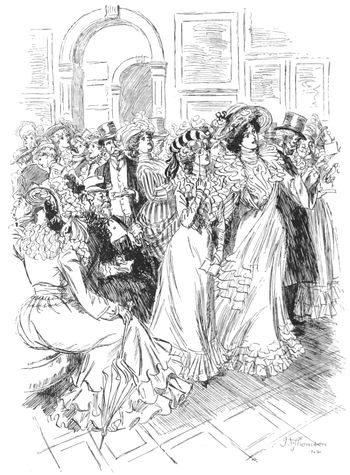
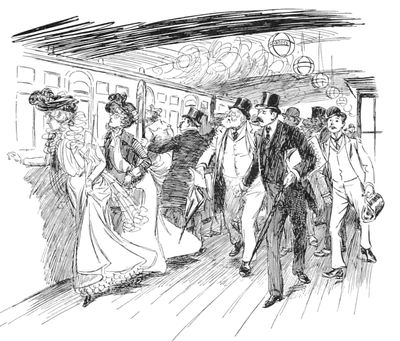
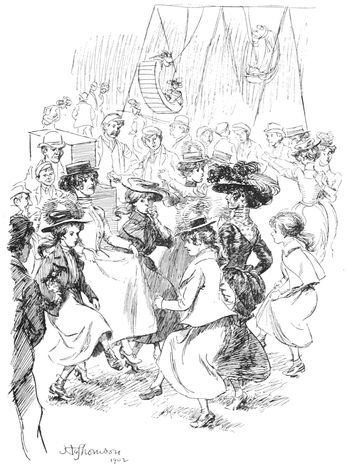
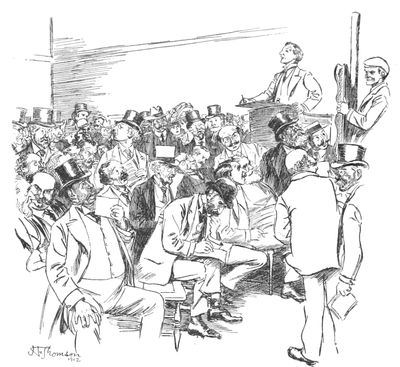
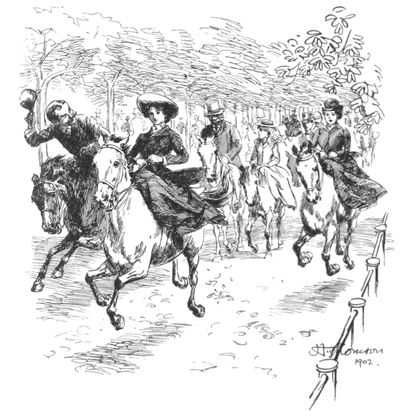
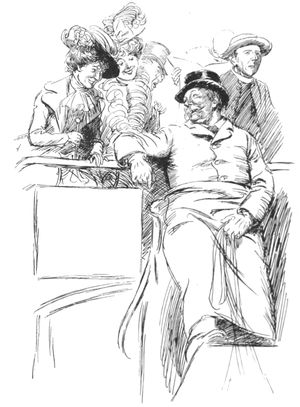
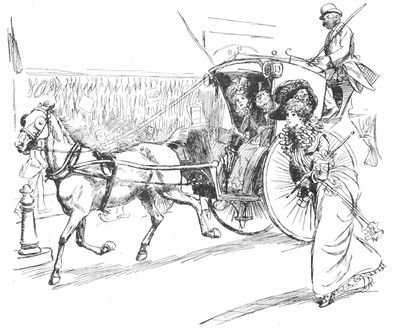
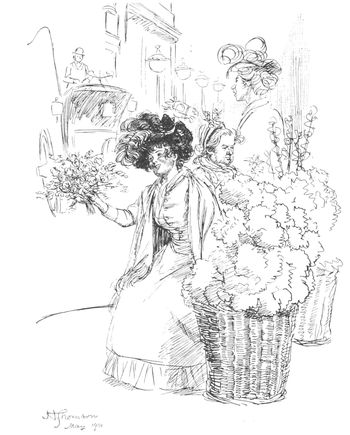
At the Royal Academy.
The collection of Tanagra figurines, on the upper floor, near the
Jewel Room, is one of the most interesting departments in
the Museum. Here, in a small compass, you may follow the whole
development of the plastic art, from the rudest clay effigies and
caricatures, to the most lovely realisation of the Greek feeling for
beauty. Some of the ladies, with their palm-leaf fans and "Liberty"
draperies, seem hardly to come to us from the tomb; have we not met
and loved them in our own day? Their dresses, their attitudes, are so
modern, even their hair is arranged in the present styles. Especially
charming are two damsels in tea-gowns, leaning earnestly towards one
another, enjoying some choice bit of gossip. And there are two figures
in this particular gallery, in which I claim to take a quite special
interest; having seen them, so to speak, in their transition stage. It
happened thus: When I was in Athens some few years back, a waiter,
taking us no doubt for "rich English milors," said, in a stage
whisper, that he had some fine things to dispose of. He kept them, he
said, for safety in the cellar. So to the cellar he went, and
produced, from many wrappings of cotton-wool, the treasures:—that
very winged Eros and that same pirouetting ballet-dancer that now
adorn one of the central wall-cases. Alas, in our case, that waiter
was doomed to disappointment. He wanted no less than £40 for the Eros
and £30 for the ballet dancer; and they were returned to their
cotton-wool and to the cellar. But, a twelvemonth passed, and behold!
one fine day we recognised with joy our old friends in the familiar
surroundings of the British Museum!
Many of the British Museum treasures have, like that winged Eros,
endured strange vicissitudes of fortune. The great "Elgin"
marbles,—those sculptures from the Parthenon so long furiously raged
over in print on the much-vexed charge of vandalism in appropriation,
and still more furiously threatened by the rage of the sea on their
transit from the Acropolis,—were, indeed, shipwrecked on their way
here. Then there are the contents of the "Mausoleum" Room, the whole
story of the discovery of which, by Sir Charles Newton at
Halicarnassus, in 1856 is like one long romance. Other objects recall
various stories. The familiar bust called "Clytie," for instance, so
admired by Carlyle, and so familiar in drawing schools, was the most
cherished possession of Mr. Townley, who "escaped with it in his arms
when he was expecting his house to be sacked during the Gordon riots."
"Fortunately," says the chronicler, "the attack did not take place,
and Mr. Townley's wife, as he called her, returned to her companions."
The corridors of the British Museum, that suggest such boredom to the
uninitiated, are full of such stories. So much we know, but, ah! if
these stones could only tell their histories, and let the full light
into their chequered past!
The South Kensington Museum, now officially, by order of the late
Queen, termed "the Victoria and Albert Museum," is well known to all
dwellers in, and visitors to, London. The large and wonderful
collections that it contains have been for many years so overcrowded
and so irregularly arranged, as to lose half their attraction. For
long it existed partly in shanties and temporary buildings, and a
hideous iron structure, nicknamed the "Brompton Boilers," was for long
the disgrace of a rich and a beauty-loving nation. All these have at
length been swept away; the terribly inadequate main entrance (in the
Brompton Road) is being done away with, and a new façade is rising,
which will soon effect great changes and improvements. Mr. Ruskin, who
was always a victim of moods, was apparently in his day made very
cross by the general muddle, and expressed his feelings on the subject
in the following burst of pathetic eloquence:
"At South Kensington" (he says), "where I lost myself in a
Cretan labyrinth of military ironmongery, advertisements of
spring blinds, model fish-farming, and plaster bathing
nymphs with a year's smut on the noses of them; and had to
put myself in charge of a policeman to get out again."
Indeed, in its vast size, its involved construction, and its
encyclopædic scope, the South Kensington Museum much
resembles a maze, and, once inside it, it is difficult indeed to know
the points of the compass. Yet, everything can be seen here, if only
you know where to look for it. It is, itself, a "General Exhibition"
on no mean scale. And here is more than ever exemplified the great
truth, that the most beautiful objects lose in effect in proportion to
the unsuitableness of their immediate surroundings. Even the model of
the Pisan pulpit, crowded as it is among so many incongruous objects,
seems here a sort of glorified stove-pipe, while the carved front of
Sir Paul Pindar's old house almost suggests a magnified dolls'-house
awaiting sale, and plaster casts jostle on all sides with the valuable
treasures of antiquity. Here again are the groups of feminine students
with their guides, and also many isolated toilers, "working up" some
special branch of knowledge in the different sections, such as
Ivories, Porcelain, Lace, Musical Instruments, or Italian woodwork.
(The students are here, I may add, a trifle better dressed than those
at the British Museum; they are also, on an average, a thought
cleaner, and their hair has, perhaps, a tendency to be neater.) The
"omnium-gatherum," as it has been called, of South Kensington, should,
like any other Exhibition, be taken piecemeal, and on the first visit
the stranger should merely try, if possible, to see the historic
Raphael cartoons, and those most interesting pictures of the British
School that form the famous "Sheepshanks" collection.
The neighbouring Natural History Museum, Waterhouse's vast edifice of
terra-cotta, is, internally, a most beautifully planned building, and
the arrangement of its various classes of specimens is no less
excellent. Nothing could be better done, either for purposes of
entertainment or of instruction, than the groups in the Great Hall of
the building, where animals, birds, and insects, are shown charmingly
mounted and in their own natural surroundings; and where, by careful
and well-selected illustration, such strange living mysteries as
"melanism" and "albinism" are demonstrated and explained.
One of the most striking glass cases of all is that which illustrates
"Protective Resemblances and Mimicry," a subject which is attracting
much notice at the present day among naturalists (see the late
Professor Henry Drummond's Tropical Africa for further curious
information on this interesting subject). Some of the strange natural
imitations shown here, such as of dead leaves by butterflies, or of
bits of straw by insects, are wonderful indeed.
The new Tate Gallery, raised by the munificence of one of our merchant
princes for the enshrinement of modern British Art, is a building of
quite another kind. This edifice, in the Greek style, was built by the
late Sir Henry Tate, on the site of old Millbank Prison, at
Westminster. When this Gallery was first opened, in July, 1897, its
approaches were always thronged by private carriages, and powdered
footmen waited in the muddy, half-finished roads (for the whole
locality was then in a state of incompleteness). But this was in the
early days of its fame; the vagaries of fashion are of short duration,
and although even yet "smart" people are to be met with occasionally
in the Tate Gallery, they are now in a decided minority; they have,
most likely, betaken themselves to the still newer exhibition of
Hertford House.
It is the artisan, the small shopkeeper, the great "lower
middle-class," that frequent chiefly the Tate Gallery. Not by any
means the same class, for instance, that you see at the National
Gallery; the visitors to the Tate Gallery are mainly the lovers of
"the human interest" in a picture, and not the earnest students. Here
the sightseers roam, like butterflies, from flower to flower; not so
much to gather the honey, as just to enjoy the moment. Therefore, at
Millbank, they are but rarely gowned in angular "art serge," and are
but seldom be-spectacled and be-catalogued. Neither are the
Hypatia-like girl-lecturers at all evident. Sir Henry Tate used to
take an evident pleasure in walking about the galleries that his
munificence had provided. Only a short time before his
death, he was to be seen there, benevolent and urbane as ever, the
type of what Mr. Ruskin has called "the entirely honest merchant."
The Tate Gallery is considered, administratively, as part of the
National Gallery; and many pictures of the modern British school have,
as every one knows, been removed to Millbank from the older
collection. But the earlier pictures of the British School, and the
Turners, are still in Trafalgar Square.
The wealth of foreign pictures now to be seen in the National Gallery
of London renders it the Mecca of every visitor, both from our own
country, and from overseas. The National Gallery, fine as it is, is
but a comparatively modern growth. Founded in 1824 by the purchase of
the Angerstein Collection, it slowly, very slowly at first, crept into
fame and distinction. Only some forty-five years ago, Mr. Ruskin said
of it that it was "an European jest!" Since 1887 its pictures have
nearly doubled in number and it is now, if not one of the finest, at
least one of the most representative, collections in the world. The
internal arrangement of the Gallery leaves little to be desired, and
its spacious entrance hall and staircase, adorned with coloured
marbles, has a solid dignity, with a cheerfulness and brightness
usually somewhat lacking in London. A fine bust of Egyptian porphyry,
called the "Dying Alexander," (a copy of one in the Uffizi), presented
by Mr. Henry Yates Thompson, forms an effective centre-piece for the
Entrance Vestibule.
Once inside the magic portals of the National Gallery, a very paradise
is opened to the art-loving visitor. He will soon forget, revelling in
those soft Italian skies, that glowing southern colour, that outside
his shelter hums the London of the twentieth century. The pictures are
finely arranged, and they are not crowded. A hint has been taken from
the Louvre, and the famous "Blenheim Raphael," the Ansidei Madonna
(bought by the nation for such a tremendous price from the
Duke of Marlborough), greets the entering visitor from the far end of
a long vista. The walls on which the pictures are hung are covered in
Pompeian red or sober green, with a wall-covering that has the
soothing effect of rich Venetian brocade, and that even improves in
tone with years.
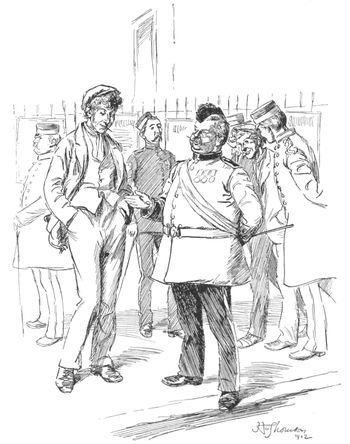
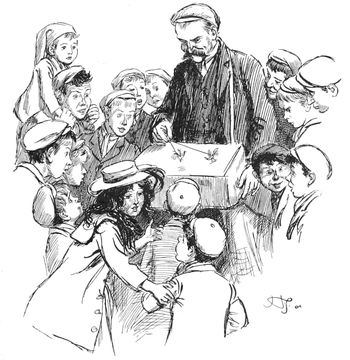
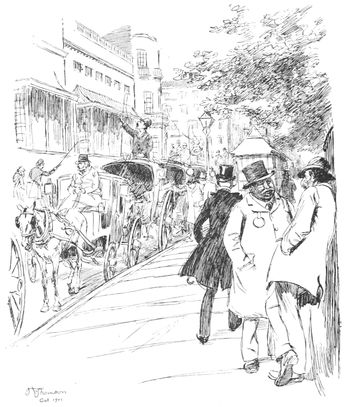
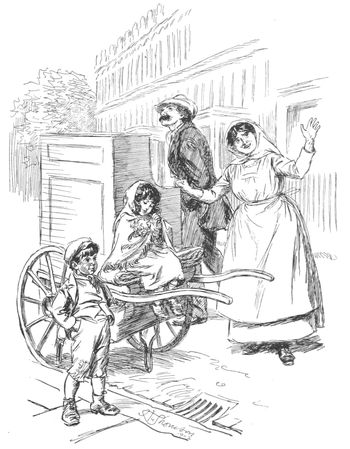
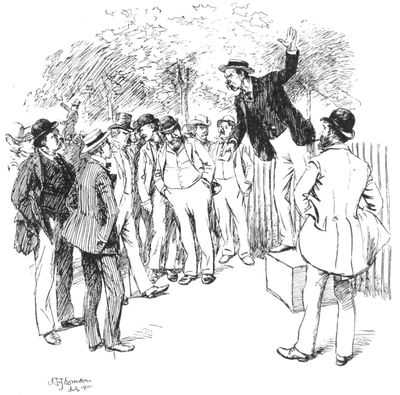
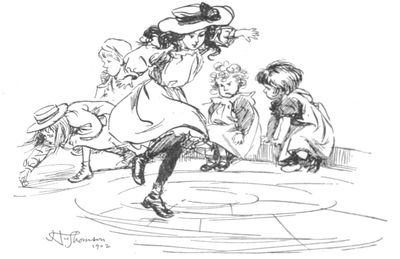
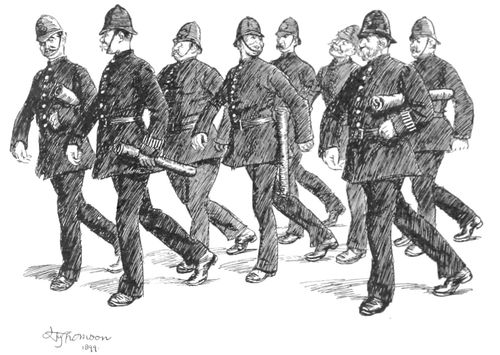
Recruiting Serjeants by the National Gallery.
The National Gallery cannot be seen in one visit. For any
real appreciation of the vast collections, ten, twenty visits rather
are needed; visits that need never, now, be other than a pleasure; the
improved conditions making the place itself attractive, and whatever
light is obtainable in London finding its way to those large and lofty
galleries. The mass of "the People" mainly frequent the British
Schools; and, even in the larger portion of the building occupied by
the Foreign Schools, every room has usually, like the London
collections generally, its special votaries. For instance, in the
little room devoted to the Early Sienese painters, you will nearly
always find a few earnest students, making pencil marks on note-books
or in elaborate catalogues; in the long Italian Gallery they are,
perhaps, just a trifle less severe, but are still more or less of the
same type, sitting in rapt contemplation and still with catalogues;
but the Dutch School is already more flippant, and but few catalogues
survive into the Spanish and French Schools.
The romance of the National Gallery,—what volumes might not be
written on the fascinating subject! If, here again, old pictures could
tell stories of their past, what adventures could they not relate! The
long corridors of the National Gallery, filled with masterpieces from
all nations and ages, would of themselves furnish as copious records
as many a shelf in the British Museum Library. What stories might
these pictures tell: of their painting, their owners, the generations
to which they have served as the Lares and Penates, the families whose
vicissitudes they have shared! This, maybe, had hung for years,
blackened and tarnished, in a pawnbroker's shop till some vigilant eye
rescued it from its oblivion; that, perhaps, had saved its owner's
life, or redeemed the fortunes of a nation. This, again, formed the
"wedding-chest" of a beautiful dark-eyed bride, dust long ago; that
caused the imprisonment, almost the death, of its author. Unhappily,
old pictures are "silent witnesses" of history. We can, indeed,
discover, through much searching in dusty archives, the
provenance of a few of our most celebrated pictures, or read,
perhaps, one or two of the stories relating to them; but how many are
there of which we have not been able to find a record? It depends
mainly on chance what stories survive, and what do not. Then, such as
are known are often not widely known; they lie hidden, for the most
part, in musty blue-books, or in tomes of ancient lore, attainable by
the student only. The mere title, The Cornfield or The Repose,
tells so little. Does it not add to our interest in the pictures to
know that the one was thought by Constable to be his best work, and
that the scene of the other was laid among the hills of Titian's own
country? In connection with the inscriptions on the frames, most
visitors, I fancy, will share the disappointment I felt, when on
revisiting the Gallery one day I found the familiar "Raphael"
disguised as "Sanzio," "Tintoret," as "Robusti" and so forth; but this
somewhat pedantic innovation has now been partially remedied.
The early Italian pictures were usually painted to adorn particular
places; some, perhaps, to decorate a wooden chest for the furnishing
of a room, as Benozzo Gozzoli's Rape of Helen; others to consecrate
an altar, as Raphael's Madonna; many to assist in the carrying out
of some architectural design, as in Crivelli's pictures, or Fra
Filippo Lippi's Vision of St. Bernard. All, at any rate, were
painted, not to hang in rows in a gallery, but for particular persons,
places, and occasions, far removed from the present environment of
them. Perhaps our only pictures specially painted with a view to the
Gallery which they now adorn, are those in which Turner's rivalry with
Claude is immortalised. Visitors may wonder why, in a room devoted to
the French School of Painting, they are suddenly confronted with two
large canvases of Turner's. The fact is that Turner painted them in
direct competition with Claude. The great modern landscape-painter
determined to beat the ancient on his own classical ground. Whether he
has conquered is indeed a question; but the pictures still
hang side by side in unconscious rivalry, telling the pathetic story
of the dead man's ambition. Turner, who left these two pictures, among
many others, to the nation, expressly stipulated that they should hang
between those two by Claude. In vain, during his life, large sums were
offered for them; he steadily refused to sell. "What in the world,
Turner, are you going to do with it?" his friend Chantrey asked,
referring to the Carthage. "Be buried in it," Turner replied grimly,
keeping its real destination a secret.
There are in the National Gallery some pictures actually painted for
the sitters to be buried in. These are the early Græco-Egyptian
portraits, which glare down upon us in the vestibule. A few years ago
a workman's spade, digging in the Fayoum, accidentally struck against
a mummy-case. Affixed to the outside covering, in a position
corresponding to the head of the corpse, was a portrait of a man in
his habit as he lived. That "find" led to others. Some dozen tombs,
closed 1,500 years ago, were rifled in order to supply a fresh link in
the historical development of art as exhibited in our National
Gallery.
Just above these old-world pagans hangs Spinello Aretino's Fall of
the Rebel Angels, with devils and dragons galore. If you gaze at the
mummy faces long enough, you can quite imagine the dead men's faces
looking at you; as Spinello, who was an imaginative Florentine, used
to think his devils did. Spinello's picture was painted to decorate
the church of Sta. Maria degli Angeli, in his native town of Arezzo;
and he laboured hard to make the chief fiend, Lucifer, as hideous as
possible. So much did this idea prey upon him, that one night he had a
terrible dream. The demon he had painted appeared to him in his sleep,
demanding to know why the painter had made him so ugly. Spinello, it
is said, did not survive the shock, which is a warning to those who
take liberties with the devil. The Greek painter, who, when confronted
with an unpleasing sitter, said frankly, "Paint you? Who
would paint you, when no one would even look at you?" was wiser.
Seeing the pictures in the National Gallery is like reading bits of
old biographies. All true artists put their life into their work, and
leave it there. Take Marco Marziale's work—The Circumcision of
Christ (No. 803)—it is wonderful in respect of the faithful labour
put into things that the modern painter would generalise as mere
accessories. An amateur embroideress could easily copy the elaborate
cross-stitch of Marziale's lectern border, and find no stitch in its
wrong place. He who did this was only a second-rate Venetian painter,
and a label painted on the canvas fixes the date and makes it probable
that this was his first important commission; therefore, Marco spared
no trouble, and crowded his picture with all the most beautiful
textures and patterns known to the Venice of his day. People did not
scamp work in those times.
The painter-poet, William Blake, with his charming insanity, has left
us glimpses of his strangely warped mind in his mysterious painting of
Pitt Guiding Behemoth, which hangs on the walls in another part of
the gallery. The more one looks at this little picture, the more its
green and gold hues and the tongues of its flames have fascination. It
is dark and unattractive at a first glance: but, to show how fatally
easy it is to attract a "following," and also how much in need the
average visitor is of a pilot to the Gallery, one only has to draw up
a chair and seat one's self before this small canvas to collect an
inquisitive crowd. People, even educated people, are strangely
imitative! Besides this picture, there are only one or two minor works
by Blake in our National Gallery. Instead of his Canterbury
Pilgrims, we have here that of his contemporary Stothard, who took
the idea from Blake and supplanted him. Stothard's Canterbury
Pilgrims caused a quarrel between himself and Blake; a quarrel which
was never healed; and Blake criticised his rival's painting freely on
its exhibition. Hoppner, the artist, praised it; adding that
Stothard had "contrived to give a value to a common scene, and very
ordinary forms." Thereupon Blake, in criticising the critic, said that
this was Hoppner's only just observation; "for it is so, and very
wretchedly so indeed. The scene of Mr. S.'s picture," he adds, "is by
Dulwich hills, which is not the way to Canterbury; but perhaps the
painter thought he would give them a ride round about, because they
were a burlesque set of scarecrows, not worth any man's respect or
care." Tantæne animis cælestibus iræ?
Among the works of the Lombard School is a picture by Parmigiano, The
Vision of St. Jerome (No. 33), which shows how the artist can forget
himself in his work. For Parmigiano was engaged on this very picture,
in Rome, during the German sack of the city in 1527. Vasari says that
the painter was so intent on his work that, even while his own
dwelling was filled with the German invaders, he continued
undisturbed; and that when they arrived in his room and found him so
employed they stood amazed at the beautiful paintings, and wisely
permitted him to continue. Parmigiano's picture is thus, in the truest
sense, historical.
There is another class of pictures that is associated with incidents
in history. First, we have that priceless little painting by Gerard
Terburg, The Peace of Münster (896), mentioned before in connection
with Hertford House. It hangs in the Dutch Room, and is so small that
one might easily overlook it. Small as it is, it cost at its last sale
£8,800; £24 for every square inch of canvas. The Dutch painter has
represented one of the turning-points of his country's history; the
ratification, in 1684, of the Treaty of Münster, by which the long war
between Spain and the United Provinces was ended. The numerous heads
are all portraits, and, in the background, the painter has introduced
himself. There is about this painting a photographic truth, a minute
fidelity, which makes it doubly interesting. Terburg would not part
with it during his life. Afterwards, amid many vicissitudes, it passed
into the possession of Prince Talleyrand, and was actually
hanging in the room of his hotel, under the view of the Allied
Sovereigns, at the signing of the Treaty of 1814. Not less interesting
in its way is the painting by Holbein of the Duchess Christina of
Denmark. Among Holbein's duties, as Court painter and favourite of
Henry VIII., was that of taking the portraits of the ladies whom the
King proposed to wed. This young Christina was prime favourite after
the death of Jane Seymour, and Holbein was despatched to Brussels to
paint her. The picture pleased his Majesty; but, for political
reasons, the match was broken off. The story of Christina's message to
the King, that she had but one head, but that if she "had two one
should be at the service of his Majesty," is now discredited; but the
Duchess seems to have had a character of her own.
Peace and War, by Rubens, an allegorical canvas (46), is another
picture designed to sway the fate of nations. Rubens painted it when
he came over to England, in 1630, as ambassador to negotiate a peace
with Spain. He produced an elaborate allegory showing forth the
Blessings of Peace, and presented it, with much diplomacy, to Charles
I. It was sold, after the King's death, for £100; to be bought back
again for £3,000. With regard to Charles I.'s pictures generally, much
might be said of the strange irony of history. The large equestrian
picture of the King by Vandyck (1172), bought for the nation at the
Blenheim sale for £17,000, was, after his death, sold by Parliament,
for a paltry sum; and Correggio's famous Mercury, Venus, and Cupid,
(10), also included in Charles's collection, was sold and bought again
by successive Parliaments.
Among the early Florentine pictures in the Gallery, Botticelli's
Nativity of Christ (1034), is history in the sense of showing the
force of the religious revival in Savonarola's time. Botticelli, at
the age of forty, fell under the preacher's influence, and, forsaking
the world's pleasures, made a "mourner" of himself until his
death. This is the picture that, as Mr. Lang says, was:
"Wrought in the troublous times of Italy
By Sandro Botticelli, when for fear
Of that last judgment, and last day drawn near,
To end all labour and all revelry,
He wept and prayed in silence."
The painting is full of theological symbolism, and its Greek
inscription, being translated, runs: "This, I, Alexander, painted at
the end of the year 1500, in the troubles of Italy, in the half-time
after the time during the fulfilment of the eleventh of St. John, in
the second woe of the Apocalypse, in the loosing of the Devil for
three years and a half. Afterwards he shall be chained, and we shall
see him trodden down, as in this picture." Botticelli had already,
earlier in life, got into religious trouble by his reforming
tendencies. When quite a young man, he had painted, for a Florentine
citizen, Matteo Palmieri, a large picture called The Assumption of
the Virgin, which also hangs in our Gallery (No. 1126). Palmieri had
adopted Origen's strange heresy that the human race was an incarnation
of those angels who, in the revolt of Lucifer, were neither for God
nor for his enemies; and, as he and Botticelli, in working out the
design of the picture, had made amendments in theology, they fell into
disgrace. Suspected of heresy, Botticelli's work was covered up; and
the chapel for which it had been painted was closed until the picture
left Florence for the Duke of Hamilton's collection and was bought by
the nation in 1882. "The story of the heresy interprets," Mr. Pater
says, "much of the peculiar sentiment with which Botticelli infuses
his profane and sacred persons, neither all human nor all divine."
Most interesting, too, is Carpaccio's Venetian painting of the Doge
Giovanni Mocenigo (750), which faithfully represents a page of the
history of Venice. The doge is shown kneeling before the Virgin, and
begging her protection, on the occasion of the plague in
1478. Medicaments and nostrums against the epidemic are contained in a
gold vase on the altar before the throne; and a blessing (according to
the inscription below) is asked on them: "Celestial Virgin, preserve
the City and Republic of Venice, and the Venetian State, and extend
your protection to me, if I deserve it." Simple and modest indeed was
Venice in the good days of her prosperity! Compare with this kneeling,
crownless doge, the new and elaborate frescoes in the Vatican, where
the Pope is represented in his grandest robes, benevolently granting
to the Madonna an audience, with masters of the ceremonies standing
by, and obsequious pages holding his gold-laced train.
Some of the greatest ornaments of our Gallery are those which have
been thrown off easily in the magnanimity of art. Chief of these is
the Veronese called The Family of Darius (294). This large painting,
with its splendid architecture, gem-like colour, and wonderful
composition, was painted while Veronese was detained by an accident at
the Pisani Villa at Este. Having left it behind him there, he sent
word that he had left wherewithal to defray the expense of his
entertainment; and his words were more than verified. The picture,
whose golden tones Smetham, the artist, so much admired, turned really
to gold afterwards. The Pisani family sold it to the National Gallery,
in 1857, for £13,650. Veronese's lavishness in giving away his
masterpieces was almost equalled, however, by our own Gainsborough,
who gave his Parish Clerk (760) to a carrier who had conveyed his
pictures from Bath to the Royal Academy.
The wanderings and vicissitudes of celebrated pictures have been many
indeed. The celebrated Van Eyck, Jan Arnolfini and his Wife (186),
painted five hundred years ago, has had, for instance, an eventful
history. At one time a barber-surgeon at Bruges presented it to the
Queen Regent of the Netherlands, who valued it so highly that she
pensioned him in consideration of the gift. At another, it must have
passed again into humbler hands; for General Hay found it in
the room at Brussels to which he was taken in 1815 to recover from the
battle of Waterloo. The story of Michael Angelo's Entombment is also
curious. It was once in the gallery of Cardinal Fesch, which was sold
and dispersed after the cardinal's death. Being in a neglected
condition and unfinished it attracted little attention, and was bought
very cheaply by Mr. Macpherson, a Scotchman sojourning in Rome. After
the dirt had been removed, it was submitted to competent judges, who
pronounced it to be by Michael Angelo. This caused a great sensation;
and a lawsuit was instituted against Mr. Macpherson for the recovery
of the picture, a suit which ultimately ended in his favour. He
removed the picture to England, and sold it to the National Gallery
for £2,000.
The pictures that were the favourites of great men gain an additional
value in our eyes from that fact. Vandyck's Portrait of Rubens (49),
Bassano's Good Samaritan (277), and Bourdon's Return of the Ark
(64), were all owned and much-prized by Sir Joshua Reynolds, who would
often admire, to his Academy pupils, the "poetical style" of the
Bourdon. Vandyck himself singled out the Portrait of Gevartius as
his masterpiece, and used to "carry it about from court to court and
from patron to patron, to show what he could do as a
portrait-painter." There is, too, a pretty story of how Sir George
Beaumont valued a little landscape by Claude (61), so highly that he
made it his travelling companion. He presented it to the National
Gallery in 1826; but, unable to bear its loss, begged it back for the
rest of his life. He took it with him into the country; and on his
death two years later, his widow restored it to the nation.
I might go on multiplying picture-stories for ever; for the romance of
the National Gallery is inexhaustible. Times, and men, change; we live
our little day, and are gone; but here, upon our walls, live souls
embodied in canvases, monuments of human spirits which from age to age
are still instinct with life. "Paul Veronese," James Smetham
writes, "three hundred years ago, painted that bright Alexander, with
his handsome flushed Venetian face, and that glowing uniform of the
Venetian general which he wears; and before him, on their knees, he
set those golden ladies, who are pleading in pink and violet; and
there is he, and there are they in our National Gallery; he, flushed
and handsome, they, golden and suppliant as ever. It takes an oldish
man to remember the comet of 1811. Who remembers Paul Veronese, nine
generations since? But not a tint of his thoughts is unfixed; they
beam along the walls as fresh as ever. Saint Nicholas stoops to the
Angelic Coronation, and the solemn fiddling of the Marriage at Cana is
heard along the silent galleries of the Louvre ('Heard melodies are
sweet, but those unheard are sweeter')! yes; and will be so when you
and I have cleaned our last palette, and, 'in the darkness over us,
the four-handed mole shall scrape.'"
Paul Veronese and his contemporaries knew how to make their works
last. We in our day are not so fortunate. It is sad to think how many
pictures of our own English School are gradually fading away; how many
men have put their best powers into pictures which are now (among them
some of Sir Joshua Reynolds's most beautiful creations) rapidly
becoming "ghosts of ghosts." With Turner the general wreck is more
complete. "Turner," Constable said, "seems to paint with tinted
steam,—so evanescent, and so airy." Alas! evanescent indeed. Reynolds
devoted much time and attention to finding out durable pigments.
Trying to discover the secret, he even cut up some old Italian
pictures. It was a vain quest. The old masters are long ago buried,
and they have carried their secret to the grave.
Sadder still is the case of those artists whose pictures themselves
have not faded, but the fashion for whose pictures has gone. Sir
Benjamin West, who died some sixty odd years ago, enjoyed very great
fame during his life. He painted many large historical
canvases, all painstaking, and, in their way, of undoubted merit. They
gained high prices in their day, and are now mostly consigned either
to cellars or to the darkest rooms of suburban galleries.
Time is, after all, the greatest of art critics, and its judgment is
sure. The best of all the centuries adorns the walls of the National
Museum. It is the best only that survives. To us, in all our painful
twentieth-century newness, it is given to inherit the mystery and
magic of the old Greeks and Egyptians; the charming imagery of
Raphael, filled with simple faith and sweet imagination; the quaint
beauty of Botticelli, and of the early Florentines, whose art was a
part of their life; the gay voluptuousness of the later Venetians;
"the courtly Spanish grace" of Velasquez; the charming affectations of
Sir Joshua Reynolds, shown in the fair ladies whose portraits, in
their beauty, once filled the halls of England. All is given to us,
unsparingly. For us and for the enrichment of the walls of our
National Gallery, did the rude barbarians, in the sack of Italian
cities, stay the hand of destruction; for us the treasures of art were
wrested from many a palace of antiquity; it was for the delight of
thousands of modern Londoners that the monasteries of the Middle Ages
were plundered. Altar-pieces painted for adoration in the private
chapel of some patron saint are now seen dimly, through London fog and
smoke, hanging, maybe, next to some pagan Bacchus and Ariadne, or
Venus and the Loves. For our sake were battles fought, to include
masterpieces among the spoils; for us did the Italian nobles sell
their treasures into the hands of money-lenders. Could Botticelli,
that fervent follower of Savonarola, he who "worked and prayed in
silence," have guessed that his beloved Nativity of Christ would,
centuries hence, be removed to barbarous London, and be stared at by
crowds of wondering Philistines, who should see in it only the curious
uncouthness of its gestures,—he would, surely, have held his hand.
The National Gallery is the natural haunt of such dreams.
Sitting there in the quickly-growing twilight, how easily it becomes
peopled with ghosts, ghosts even more intangible than Reynolds's. Our
thoughts wander back into the past, the walls grow dim, they seem to
melt away into distance; we hear the sound of music, and see the
glimmer of gay banners, as Cimabue's Madonna is carried past, amid the
acclamation of a multitude; or a gay court appears before our eyes,
filled with fine ladies, grandees, and inquisitors; and, apart from
all, a great King conversing eagerly with a little dark painter, whose
only ornament, beyond his lace ruffles, is the red cross of the Order
of Santiago on his breast; or we seem to be in Italy, in a poetic
"Romeo and Juliet" time and atmosphere, in a rich noble's house,
bright with splendid hangings and works of art; a painted
wedding-chest, or cassone, has just been presented, on the occasion
of a marriage, and the young bride herself gazes down lovingly into
its depths, which she has just stored with rich silks and brocaded
velvets, and all her treasures; just such a chest as Ginevra might
have hid and perished in; just such a bride as Ginevra herself. Or the
scene changes again to a dusty gallery in a dingy street, with a
little ugly old man mounted high on a stool, painting furiously away
amid a horde of tailless cats; and anon a transformation, and we see a
brilliant illumination of Queen Mab's Grotto, with fairies in
wonderful gondolas, gliding to and fro; a ball in Venice.... We, too,
are invited, but, as we hesitate to trust ourselves to Turner's airy
structures, a voice sounds in our ear,—a prosaic voice, however:
"Closin' time, ma'am, closin' time!"