With apologies to Dame History for having taken liberties
with some of her famous characters, I would ask the Reader to
remember that this story is fiction and not history.
I have made use of some of the most romantic episodes in the
life of Robert Burns, such as his courtship of Mary Campbell and
his love affair with Jean Armour, “the Belle of Mauchline,” and
many of the historical references and details are authentic.
But my chief purpose in using these incidents was to make
“Highland Mary” as picturesque, lovable and interesting a character
in Fiction as she has always been in the History of Scotland.
Clayton Mackenzie Legge.
In the “but” or living-room (as it was termed in
Scotland) of a little whitewashed thatched cottage
near Auld Ayr in the land of the Doon, sat a quiet,
sedate trio of persons consisting of two men and a
woman. She who sat at the wheel busily engaged in
spinning was the mistress of the cot, a matronly,
middle-aged woman in peasant’s cap and ’kerchief.
The other two occupants of the room for years
had been inseparable companions and cronies, and
when not at the village inn could be found sitting
by the fireside of one of their neighbors, smoking
their pipes in blissful laziness. And all Ayrshire
tolerated and even welcomed Tam O’Shanter and his
cronie, “Souter Johnny.”
Tam was an Ayrshire farmer, considered fairly
well-to-do in the neighborhood, while Souter (shoemaker)
Johnny was the village cobbler, who seldom,
if ever, worked at his trade nowadays. All the
afternoon had they sat by the open fireplace, with its
roomy, projecting chimney, watching the peat burn,
seldom speaking, smoking their old smelly pipes, and
sighing contentedly as the warmth penetrated their
old bones.
Mrs. Burns glanced at her uninvited guests occasionally
with no approving eye. If they must inflict
their presence on her, why couldn’t they talk, say
something, tell her some of the news, the gossip of
the village? she thought angrily; their everlasting
silence had grown very monotonous to the good
dame. She wished they would go. It was nearing
supper time, and Gilbert would soon be in from the
field, and she knew that he did not approve of the
two old cronies hanging around monopolizing the
fireplace to the exclusion of everyone else, and she did
not want any hard words between them and Gilbert.
Suddenly with a final whirl she fastened the end of
the yarn she was spinning, and getting up from
her seat set the wheel back against the whitewashed
wall.
Then going to the old deal dresser, she took from
one of the drawers a white cloth and spread it
smoothly over the table, then from the rack, which
hung above it, she took the old blue dishes and quickly
set the table for their evening meal. At these preparations
for supper the old cronies looked eagerly
expectant, for none knew better than they the excellence
of the Widow Burns’ cooking, and a look of
pleasant anticipation stole over their sober faces as
they perceived the platter of scones on the table ready
to be placed on the hot slab of stone in the fireplace.
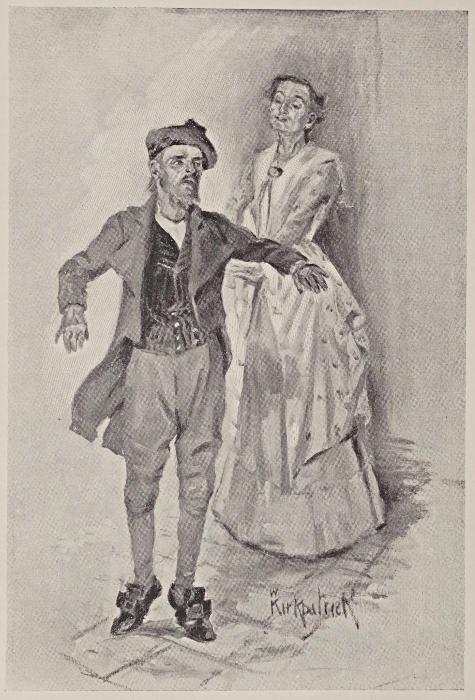
Knocking the ashes from his pipe, Tam rose
unsteadily to his feet, and standing with his back
to the fire, he admiringly watched the widow as she
bustled to and fro from table to dresser. “Ah, Mistress
Burns, ye’re a fine housekeeper,” he remarked
admiringly. “An’ ye’re a fine cook.”
Mrs. Burns turned on him sharply. “So is your
guidwife,” she said shortly, glancing out through the
low, deep, square window to where her second son
could be seen crossing the field to the house. She
hoped he would take the hint and go.
“Aye, Mistress, I ken ye’re recht,” replied Tam,
meekly, with a dismal sigh. “But it’s a sorry bet o’
supper I’ll be gang hame to this night, an’ ye ken
it’s a long journey, too, Mistress Burns,” he insinuated
slyly.
“Sure it’s a lang, weary journey, Tam,” said Souter
Johnny, commiseratingly. “But think o’ the
warm welcome ye’ll be haein’ when ye meet your guidwife
at the door,” and a malicious twinkle gleamed in
his kindly but keen old eyes.
“How is your guidwife, Tam O’Shanter?” inquired
Mistress Burns, as she placed some scones on
the hot hearthstone to bake.
“She’s a maist unco woman, Mistress,” replied
Tam sorrowfully. “There’s no livin’ wi’ her o’
late. She’s no a help or comfort to a mon at a’!” he
whined. Here Tam got a delicious whiff of the baking
scones, and his mouth as well as his eyes watered
as he continued pathetically, “If she could only
cook like ye, Mistress. Oh, ’twas a sorry day for
Tam O’Shanter when he took such a scoldin’ beldame
for wife,” and Tam sat down, the picture of abject
distress.
Souter regarded his cronie with a grim smile. He
had no pity for Tam, nor for any man, in fact, who
would not or could not rule his own household.
(Souter, by the by, had remained a bachelor.) However,
he did his best to console Tam whenever his
marital troubles were discussed.
“Never mind, Tam,” he said sympathetically,
helping himself to a scone while Mistress Burns’ back
was turned. “Ye ken where ye can find all the comfort
and consolation ye can hold, if ye hae the tippence.”
Tam wiped away a tear (tears came easily to
the old tyke in his constant state of semi-intoxication)
and gave a deep, prolonged sigh. “Aye, Souter, an’
I feel mair at home in the Inn than I do with my guidwife,”
he answered mournfully. “I dinna mind telling
ye, she’s driven me to the Deil himsel’, by her daur
looks an’ ways. The only friend I hae left is Old
John Barleycorn,” and he wailed in maudlin despair.
“He’s your best enemy, ye mean,” retorted Souter
dryly, relighting his pipe, after having demolished,
with evident relish, the last of his stolen scone.
“Waesucks, mon,” he continued, assuming the
tone of Dominie Daddy Auld, who had tried in vain
to convert the two old sinners, much to their amusement
and inward elation. “Your guidwife told ye
weel. Ye’re a skellum, Tam, a blethering, blustering,
drunken blellum,” and the old rogue looked slyly at
Mistress Burns to note the effect of his harangue.
“Aye, ye’re right, Souter Johnny,” said the good
dame, nodding approval to him, and going up to
Tam, who was still sitting groaning by the fireside,
she shook him vigorously by the shoulder. “Stop
your groaning and grunting, ye old tyke, and listen
to me,” she said sharply. “Take your friend’s advice
and gi’ old John Barleycorn a wide berth.”
Here her voice dropped to a whisper, “or some day
ye’ll be catched wi’ warlocks in the mire, Tam
O’Shanter.” He stopped his noise and straightened
up in his chair.
“Aye, and ghosties and witches will come yelpin’
after ye as ye pass the auld haunted kirk at Alloway,”
added Souter sepulchrally, leaning over Tam
with fixed eyes and hand outstretched, clutching spasmodically
at imaginary objects floating before Tam’s
suspicious, angry eyes. Tam, however, was not to
be so easily frightened, and brushing Souter aside, he
jumped to his feet. “Souter Johnny, dinna ye
preach to me, mon,” he roared menacingly. “Ye
hae no reght. Let Daddy Auld do that! I dinna
fear the witches or ghosties, not I.” He staggered
to the window and pointed to an old white horse
standing meekly by the roadside.
“Do ye see any auld faithful Maggie standin’ out
there?” he cried triumphantly. Not waiting for
their answer, he continued proudly, “Nae witches can
catch Tam O’Shanter when he’s astride his auld
mare’s back, whether he is drunk or sober,” and he
glared defiantly at his listeners. At that moment
the door from the “ben” opened, and Gilbert Burns
entered the room. An angry frown wrinkled his
forehead as his gaze fell upon the two old cronies. A
hard worker himself, he could not abide laziness or
shiftlessness in another. He strode swiftly up to Tam,
who had suddenly lost his defiant attitude, but before
he could speak the bitter, impatient words which
rushed to his lips, his mother, knowing his uncertain
temper, shook her head at him remonstratingly. “Ah,
lad, I’m fair ye hae come in to rest a while, an’ to hae
a bit o’ supper,” she hurriedly said. “Set ye doon.
I hae some scones for ye, an’ Mollie has some rabbit
stew. Noo gie me your bonnet and coat, laddie,” and
taking them from him she hung them on the peg
behind the door, while Gilbert with a look of disgust
at the two old cronies sat down and proceeded
to butter his scones in moody silence. Tam and Souter,
however, did not appear in any wise abashed, and
perceiving they were not to be invited to eat with
Gilbert, they resumed their seats each side of the
fireplace and heaved a disconsolate sigh.
Mrs. Burns, who had left the room for a moment,
now entered bearing a large bowl of the steaming
stew, which she set before her son, while directly after
her appeared old Mollie Dunn, the half-witted household
drudge. The time was when Mollie had been
the swiftest mail carrier between Dumfries and
Mauchline, but she was now content to have a home
with the Burns family, where, if the twinges of rheumatism
assailed her, she could rest her bones until
relief came. She now stood, a pleased grin on her
ugly face, watching Gilbert as he helped himself to a
generous portion of the stew which she had proudly
prepared for the evening meal.
“Molly,” said her mistress sharply, “dinna ye
stand there idle; fetch me some hot water frae the
pot.”
Molly got a pan from the rack and hurried to the
fireplace, where Tam was relighting his pipe with
a blazing ember, for the dozenth time. Molly
had no love for Tam, and finding him in her way,
she calmly gave a quick pull to his plaidie, and Tam,
who was in a crouching position, fell backward,
sprawling on the hearth in a decidedly undignified attitude.
With the roar of a wounded lion, he scrambled
to his feet, with the assistance of Souter, and shaking
his fist at the laughing Molly, he sputtered indignantly,
“Is the Deil himsel’ in ye, Molly Dunn?
Ye’re an impudent hussy, that’s what ye are.” Molly
glared at him defiantly for a moment, then calmly proceeded
to fill her pan with hot water, while the old
man, bursting with indignation, staggered over to the
dresser where Mistress Burns was brewing some
tea.
“Mistress Burns,” he remonstrated almost tearfully,
“ye should teach your servants better manners.
Molly Dunn is a——” but he never finished his
sentence, for Molly, hurrying back with the hot
water, ran into him and, whether by design or accident
it was never known, spilled the hot contents of the pan
over Tam’s shins, whereupon he gave what resembled
a burlesque imitation of a Highland fling to the
accompaniment of roars of pain and anger from
himself and guffaws of laughter from Souter and
Molly. Even Mrs. Burns and Gilbert could not
resist a smile at the antics of the old tyke.
“Toots, mon,” said Molly, not at all abashed at
the mischief she had done, “ye’re no hurt; ye’ll get
mair than that at hame, I’m tellin’ ye,” and she nodded
her head sagely.
“Molly, hold your tongue,” said Mistress Burns
reprovingly, then she turned to Tam. “I hope ye’re
nae burnt bad.” But Tam was very angry, and turning
to Souter he cried wrathfully, “I’m gang
hame, Souter Johnny. I’ll no stay here to be insulted;
I’m gang hame.” And he started for the
door.
“Dinna mind Molly; she’s daft like,” replied Souter
in a soothing voice. “Come and sit doon,” and
he tried to pull him toward the fireplace, but Tam
was not to be pacified. His dignity had been outraged.
“Nay, nay, Souter, I thank ye!” he said firmly.
“An’ ye, too, Mistress Burns, for your kind invitation
to stay langer,” she looked at him quickly,
then gave a little sniff, “but I ken when I’m insulted,”
and disengaging himself from Souter’s restraining
hand, he started for the door once more.
“An’ where will ye be gang at this hour, Tam?”
insinuated Souter slyly. “Ye ken your guidwife’s
temper.”
“I’m gang over to the Inn,” replied Tam defiantly,
with his hand on the open door. “Will ye
gang alang wi’ me, Souter? A wee droppie will cheer
us both,” he continued persuasively.
Souter looked anxiously at Gilbert’s stern, frowning
face, then back to Tam. “I’d like to amazin’
weel, Tam,” he replied in a plaintive tone, “but ye
see——”
“Johnny has promised me he’ll keep sober till
plantin’ is over,” interrupted Gilbert firmly; “after
that he can do as he likes.”
“Ye should both be ashamed o’ yoursel’s drinkin’
that vile whisky,” said Mrs. Burns angrily, and she
clacked her lips in disgust. “It is your worst enemy,
I’m tellin’ ye.”
“Ye mind, Mistress Burns,” replied Souter, winking
his left eye at Tam, “ye mind the Scriptures
say, ‘Love your enemies.’ Weel, we’re just tryin’ to
obey the Scriptures, eh, Tam?”
“Aye, Souter,” answered Tam with drunken gravity,
“I always obey the Scriptures.”
“Here, mon, drink a cup of tea before ye gang
awa’,” said Mrs. Burns, and she took him a brimming
cup of the delicious beverage, thinking it might
assuage his thirst for something stronger. Tam
majestically waved it away.
“Nay, I thank ye, Mistress Burns, I’ll no’ deprive
ye of it,” he answered with extreme condescension.
“Tea doesno’ agree with Tam O’Shanter.” He
pushed open the door. “I’m off to the Inn, where
the tea is more to my likin’. Guid-day to ye all,” and,
slamming the door behind him, he called Maggie to
his side, and jumping astride her old back galloped
speedily toward the village Inn. The last heard of
him that day was his voice lustily singing “The
Campbells Are Coming.”
After he left the room Mistress Burns handed
Souter the cup of tea she had poured for Tam, and
soon the silence was unbroken save by an occasional
sigh from the old tyke as he sipped his tea.
Presently Gilbert set down his empty cup, rose
and donned his coat. “Here we are drinking tea,
afternoon tea, as if we were of the quality,” he observed
sarcastically, “instead of being out in the fields
plowing the soil; there’s much to be done ere sundown.”
“Weel, this suits me fine,” murmured Souter
contentedly, draining his cup. “I ken I was born
to be one o’ the quality; work doesno’ agree wi’ me,
o’er weel,” and he snuggled closer in his chair.
“Ye’re very much like my fine brother Robert in
that respect,” answered Gilbert bitterly, his face
growing stern and cold. “But we want no laggards
here on Mossgiel. Farmers must work, an’ work
hard, if they would live.” He walked to the window
and looked out over the untilled ground with hard,
angry eyes, and his heart filled with bitterness as he
thought of his elder brother. It had always fallen to
him to finish the many tasks his dreaming, thoughtless,
erratic brother had left unfinished, while the latter
sought some sequestered spot where, with pencil
and paper in hand, he would idle away his time writing
verses. And for a year now Robert had been in
Irvine, no doubt enjoying himself to the full, while
he, Gilbert, toiled and slaved at home to keep the poor
shelter over his dear ones. It was neither right nor
just, he thought, with an aching heart.
“Ye ken, Gilbert,” said Souter Johnny, breaking
in on his reverie, “Robert wasna’ born to be a
farmer. He always cared more, even when a wee
laddie, for writin’ poetry and dreamin’ o’ the lasses
than toilin’ in the fields, more’s the pity.”
Mrs. Burns turned on him quickly. “Souter
Johnny, dinna ye dare say a word against Robert,”
she flashed indignantly. “He could turn the best
furrough o’ any lad in these parts, ye ken that
weel,” and Souter was completely annihilated by the
angry flash that gleamed in the mother’s eye, and it
was a very humble Souter that hesitatingly held out
his cup to her, hoping to change the subject. “Hae
ye a wee droppie mair tea there, Mistress Burns?”
he meekly asked.
Mrs. Burns was not to be mollified, however.
“Aye, but not for ye, ye skellum,” she answered
shortly, taking the cup from him and putting it in
the dishpan.
“Come along, Souter,” said Gilbert, going to the
door. “We hae much to do ere sundown and hae
idled too long, noo. Come.”
“Ye’re workin’ me too hard, Gilbert,” groaned
Souter despairingly. “My back is nigh broken;
bide a wee, mon!”
A sharp whistle from without checked Gilbert as
he was about to reply. “The Posty has stopped at
the gate,” exclaimed Mistress Burns excitedly, rushing
to the window in time to see old Molly receive
a letter from that worthy, and then come running
back to the house. Hurrying to the door, she
snatched it from the old servant’s hands and eagerly
held it to the light. Molly peered anxiously over her
shoulder.
“It’s frae Robbie,” she exclaimed delightedly.
“Keep quiet, noo, till I read it to the end.” As she
finished, the tears of gladness rolled down her smooth
cheek. “Oh, Gilbert,” she said, a little catch in her
voice, “Robert is comin’ back to us. He’ll be here
this day. Read it, lad, read for yoursel’.” He took
the letter and walked to the fireplace. After a slight
pause he read it. As she watched him she noticed
with sudden apprehension the look of anger that
darkened his face. She had forgotten the misunderstanding
which had existed between the brothers since
their coming to Mossgiel to live, and suddenly her
heart misgave her.
“Gilbert lad,” she hesitatingly said as he finished
the letter, “dinna say aught to Robert when he
comes hame about his rhyming, will ye, laddie?”
She paused and looked anxiously into his sullen face.
“He canna bear to be discouraged, ye ken,” and she
took the letter from him and put it in her bosom.
Gilbert remained silent and moody, a heavy frown
wrinkling his brow.
“Perhaps all thoughts of poesy has left him
since he has been among strangers,” continued the
mother thoughtfully. “Ye ken he has been doin’
right weel in Irvine; and it’s only because the flax
dresser’s shop has burned to the ground, and he
canna work any more, that he decides to come hame
to help us noo. Ye ken that, Gilbert.” She laid her
hand in tender pleading on his sunburnt arm.
“He always shirked his work before,” replied
Gilbert bitterly, “and nae doot he will again. But
he maun work, an’ work hard, if he wants to stay
at Mossgiel. Nae more lyin’ around, scribblin’ on
every piece of paper he finds, a lot of nonsense,
which willna’ put food in his mouth, nor clothe his
back.” Mrs. Burns sighed deeply and sank into the
low stool beside her spinning wheel, he hands folded
for once idly in her lap, and gave herself up to her
disquieting thoughts.
“Ye can talk all ye like,” exclaimed Souter,
who was ever ready with his advice, “but Robert
is too smart a lad to stay here for lang. He was
never cut out for a farmer nae mair was I.”
“A farmer,” repeated Mrs. Burns, with a mirthless
little laugh. “An’ what is there in a farmer’s
life to pay for all the hardships he endures?” she
asked bitterly. “The constant grindin’ an’ endless
toil crushes all the life out o’ one in the struggle
for existence. Remember your father, Gilbert,”
and her voice broke at the flood of bitter recollection
which crowded her thoughts.
“I have na forgotten him, mither,” replied Gilbert
quietly. “Nor am I likely to, for my ain lot in
life is nae better.” And pulling his cap down over
his eyes, he went back to the window and gazed moodily
out over the bare, rocky, profitless farm which
must be made to yield them a living. There was silence
for a time, broken only by the regular monotonous
ticking of the old clock. After a time Mrs.
Burns quietly left the room.
“Oh, laddie,” whispered Souter as the door closed
behind her, coming up beside Gilbert, “did ye hear
the news that Tam O’Shanter brought frae Mauchline?”
“Do you mean about Robert an’ some lassie
there?” inquired Gilbert indifferently, after a brief
pause.
“Aye!” returned Souter impressively, “but she’s
nae common lass, Gilbert. She’s Squire Armour’s
daughter Jean, called the Belle of Mauchline.”
“I ken it’s no serious,” replied Gilbert sarcastically,
“for ye ken Robert’s heart is like a tinder
box, that flares up at the first whisper of passion,”
and he turned away from the window and started for
the door.
“I canna’ understand,” reflected Souter, “how
the lad could forget his sweetheart, Highland Mary,
long enough to take up wi any ither lassie. They
were mighty fond o’ each ither before he went awa’ a
year ago. I can swear to that,” and he smiled
reminiscently.
A look of despair swept over Gilbert’s face at the
idle words of the garrulous old man. He leaned
heavily against the door, for there was a dull, aching
pain at his heart of which he was physically conscious.
For a few moments he stood there with white drawn
face, trying hard to realize the bitter truth, that at
last the day had come, as he had feared it must come,
when he must step aside for the prodigal brother who
would now claim his sweetheart. And she would go to
him so gladly, he knew, without a single thought
of his loneliness or his sorrow. But she was not to
blame. It was only right that she should now be
with her sweetheart, that he must say farewell to those
blissful walks along the banks of the Doon which for
almost a year he had enjoyed with Mary by his side.
His stern, tense lips relaxed, and a faint smile softened
his rugged features. How happy he had been
in his fool’s paradise. But he loved her so dearly
that he had been content just to be with her, to listen
to the sweetness of her voice as she prattled
innocently and lovingly of her absent sweetheart.
A snore from Souter, who had fallen asleep in his
chair, roused him from the fond reverie into which he
had fallen, and brought him back to earth with a start.
With a bitter smile he told himself he had no right
to complain. If he had allowed himself to fall in
love with his brother’s betrothed, he alone was to
blame, and he must suffer the consequence. Suddenly
a wild thought entered his brain. Suppose—and his
heart almost stopped beating at the thought—suppose
Robert had grown to love someone else, while
away, even better than he did Mary? He had heard
rumors of Robert’s many amourous escapades in
Mauchline; then perhaps Mary would again turn to
him for comfort. His eyes shone with renewed hope
and his heart was several degrees lighter as he left
the house. Going to the high knoll back of the cottage,
he gazed eagerly, longingly, across the moor
to where, in the hazy distance, the lofty turrets of
Castle Montgomery, the home of the winsome dairymaid,
Mary Campbell, reared their heads toward the
blue heavens.
Ye banks and braes and streams around
The Castle of Montgomery,
Green be your woods and fair your flowers,
Your waters never drumlie,
There summer first unfolds her robes,
And there the langest tarry,
For there I took the last farewell
O’ my sweet Highland Mary.
At the foot of the hill on which stood Castle Montgomery
flowed the River Doon, winding and twisting
itself through richly wooded scenery on its way
to Ayr Bay. On the hillside of the stream stood the
old stone dairy, covered with ivy and shaded by overhanging
willows. Within its cool, shady walls the
merry lassies sang at their duties, with hearts as
light and carefree as the birds that flew about the
open door. Their duties over for the day, they had
returned to their quarters in the long, low wing of
the castle, and silence reigned supreme over the
place, save for the trickling of the Doon splashing
over the stones as it wended its tuneful way to join
the waters of the Ayr.
Suddenly the silence was broken; borne on the
evening breeze came the sound of a sweet, high
voice singing:
“Oh where and oh where is my Highland laddie gone,”
sang the sweet singer, plaintively from the hilltop.
Nearer and nearer it approached as the owner followed
the winding path down to the river’s bank.
Suddenly the drooping willows were parted, and there
looked out the fairest face surely that mortal eyes
had ever seen.
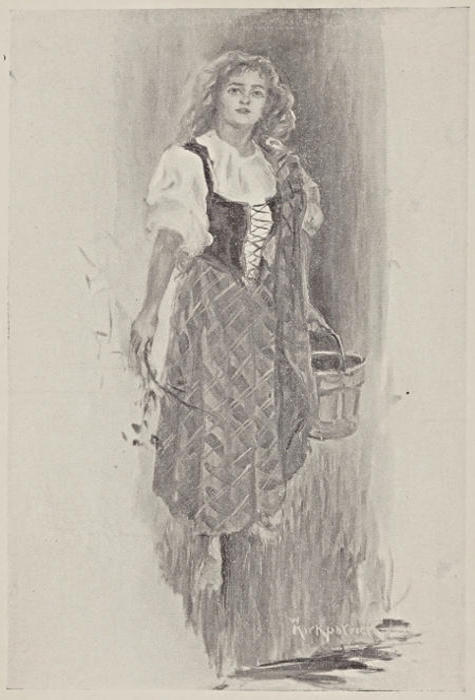
About sixteen years of age, with ringlets of flaxen
hair flowing unconfined to her waist, laughing blue
eyes, bewitchingly overarched by dark eyebrows, a
rosebud mouth, now parted in song, between two
rounded dimpled cheeks, such was the bonnie face
of Mary Campbell, known to all around as “Highland
Mary.” Removing her plaidie, which hung
gracefully from one shoulder, she spread it on the
mossy bank, and, casting herself down full length
upon it, her head pillowed in her hand, she finished
her song, lazily, dreamily, letting it die out, slowly,
softly floating into nothingness. Then for a moment
she gave herself up to the mere joy of living,
watching the leaves as they fell noiselessly into the
stream and were carried away, away until they were
lost to vision. Gradually her thoughts became more
centered. That particular spot was full of sweet
memories to her. It was here, she mused dreamily,
that she and Robert had parted a year ago. It was
here on the banks of the Doon they so often had
met and courted and loved, and here it was they had
stood hand in hand and plighted their troth, while
the murmuring stream seemed to whisper softly,
“For eternity, for all eternity.” And here in this
sequestered spot, on that second Sunday of May,
they had spent the day in taking a last farewell.
Would she ever forget it? Oh, the pain of that
parting! Her eyes filled with tears at the recollection
of her past misery. But she brushed them quickly
away with a corner of her scarf. He had promised to
send for her when he was getting along well, and she
had been waiting day after day for that summons,
full of faith in his word. For had he not said as he
pressed her to his heart:
“I hae sworn by the heavens to my Mary,
I hae sworn by the heavens to be true.
And so may the heavens forget me,
When I forget my vow.”
A whole year had passed. She had saved all
her little earnings, and now her box was nearly filled
with the linen which she had spun and woven with
her own fair hands, for she did not mean to come dowerless
to her husband. In a few months, so he had
written in his last letter, he would send for her to
come to him, and they would start for the new
country, America, where gold could be picked up in
the streets (so she had heard it said). They could
not help but prosper, and so the child mused on happily.
The sudden blast of a horn interrupted her
sweet day dreams, and, hastily jumping to her feet,
with a little ejaculation of dismay she tossed her
plaidie over her back, and, filling her pail from the
brook, swung it lightly to her strong young shoulder.
“An’ it’s o’ in my heart, I wish him safe at home,”
she trilled longingly, as she retraced her steps up the
winding path, over the hill, and back to the kitchen,
where, after giving the pail into the hand of Bess, the
good-natured cook, she leaned against the lintel of the
door, her hands shading her wistful eyes, and gazed
long and earnestly off to where the sun was sinking
behind the horizon in far-off Irvine. So wrapped was
she in her thoughts she failed to hear the whistle of
Rory Cam, the Posty, and the bustle and confusion
which his coming had created within the kitchen. The
sharp little shrieks and ejaculations of surprise and
delight, however, caused her to turn her head inquiringly.
Looking through the open door, she saw Bess
in the center of a gaping crowd of servants, reading a
letter, the contents of which had evoked the delight of
her listeners. “An’ he’ll be here this day,” cried Bess
loudly, folding her letter. “Where’s Mary Campbell?”
she demanded, looking around the room.
“Here I am, Bess,” said Mary, standing shyly at
the door.
“Hae ye heard the news, then, lassie?” asked Bess,
grinning broadly.
“Nay; what news?” inquired Mary, wondering
why they all looked at her so knowingly.
“I’ve just had word frae my sister in Irvine, an’
she said——” Here Bess paused impressively.
“She said that Rob Burns was burnt out o’ his place,
an’ that he would be comin’ hame to-day.” Bess, who
had good-naturedly wished to surprise Mary, was
quite startled to see her turn as white as a lily and
stagger back against the door with a little gasp
of startled surprise.
“Are ye sure, Bess?” she faltered, her voice shaking
with eagerness.
“It’s true as Gospel, lassie; I’ll read ye the
letter,” and Bess started to take it out, but with
a cry of joy Mary rushed through the door like a
startled fawn, and before the astonished maids could
catch their breath she had lightly vaulted over the
hedge and was flying down the hill and over the moor
toward Mossgiel farm with the speed of a swallow,
her golden hair floating behind her like a cloud of
glorious sunshine. On, on she sped, swift as the
wind, and soon Mossgiel loomed up in the near distance.
Not stopping for breath, she soon reached
the door, and without pausing to knock burst into the
room.
Mrs. Burns had put the house in order and, with a
clean ’kerchief and cap on, sat patiently at her wheel,
waiting for Robert to come home, while Souter quietly
sat in the corner winding a ball of yarn from the
skein which hung over the back of the chair, and
looking decidedly sheepish. When Mary burst in
the door so unceremoniously they both jumped
expectantly to their feet, thinking surely it was
Robert.
“Why, Mary lass, is it ye?” said Mrs. Burns in
surprise. “Whatever brings ye over the day? not
but we are glad to have ye,” she added hospitably.
“Where is he, Mistress Burns, where’s Robbie?”
she panted excitedly, her heart in her voice.
“He isna’ here yet, lassie,” replied Mrs. Burns,
with a sigh. “But sit ye doon. Take off your
plaidie and wait for him. There’s a girlie,” and she
pushed the unresisting girl into a chair.
“Ye’re sure he isna’ here, Mistress Burns?” asked
Mary wistfully, looking around the room with eager,
searching eyes.
“Aye, lassie,” she replied, smiling; “if he were
he wouldna’ be hidin’ from ye, dearie, and after
a year of absence, too. But I ken he will be here
soon noo.” And she went to the window and looked
anxiously out across the moor.
“It seems so lang since he left Mossgiel, doesna’
it, Mistress Burns?” said Mary with a deep sigh of
disappointment.
“An’ weel ye might say that,” replied Mrs. Burns.
“For who doesna’ miss my laddie,” and she tossed
her head proudly. “There isna’ another like Robbie
in all Ayrshire. A bright, honest, upright, pure-minded
lad, whom any mither might be proud of.
I hope he’ll return to us the same laddie he was when
he went awa’.” The anxious look returned to her
comely face.
An odd little smile appeared about the corners
of Souter’s mouth as he resumed his work.
“Weel, noo, Mistress Burns,” he asked dryly,
“do ye expect a healthy lad to be out in this sinful
world an’ not learn a few things he didna ken
before? ’Tis only human nature,” continued the
old rogue, “an’ ye can learn a deal in a year, mind
that, an’ that reminds me o’ a good joke. Sandy
MacPherson——”
“Souter Johnny, ye keep your stories to yoursel’,”
interrupted Mrs. Burns with a frown. Souter’s
stories were not always discreet.
“Irvine and Mauchline are very gay towns,” continued
Souter reminiscently. “They say some of
the prettiest gurls of Scotlan’ live there, an’ I hear
they all love Robbie Burns, too,” he added slyly,
looking at Mary out of the corner of his eye.
“They couldna help it,” replied Mary sweetly.
“An’ ye’re nae jealous, Mary?” he inquired in a
surprised tone, turning to look into the flushed, shy
face beside him.
“Jealous of Robert?” echoed Mary, opening her
innocent eyes to their widest. “Nay! for I ken he
loves me better than any other lassie in the world.”
And she added naïvely, “He has told me so ofttimes.”
“Ye needna fear, Mary,” replied Mrs. Burns,
resuming her place at the wheel. “I’ll hae no ither
lass but ye for my daughter, depend on’t.”
“Thank ye, Mistress Burns,” said Mary brightly.
“I ken I’m only a simple country lass, but I mean
to learn all I can, so that when he becomes a great
man he’ll no be ashamed of me, for I ken he will be
great some day,” she continued, her eyes flashing,
the color coming and going in her cheek as she predicted
the future of the lad she loved. “He’s a
born poet, Mistress Burns, and some day ye’ll be
proud of your lad, for genius such as Rabbie’s
canna always be hid.” Mrs. Burns gazed at the
young girl in wonder.
“Oh, if someone would only encourage him,” continued
Mary earnestly, “for I’m fair sure his heart
is set on rhyming.”
“I ne’er heard of a body ever makin’ money writin’
verses,” interposed Souter, rubbing his chin reflectively
with the ball of soft yarn.
“Ah, me,” sighed Mrs. Burns, her hands idle for
a moment, “I fear the lad does but waste his time
in such scribbling. Who is to hear it? Only his
friends, who are partial to him, of course, but who,
alas, are as puir as we are, and canna assist him in
bringin’ them before the public. The fire burns out
for lack of fuel,” she continued slowly, watching the
flickering sparks die one by one in the fireplace. “So
will his love of writin’ when he sees how hopeless it
all is.” She paused and sighed deeply. “He maun
do mair than write verses to keep a wife and family
from want,” she continued earnestly, and she looked
sadly at Mary’s downcast face. “And, Mary, ye
too will hae to work, harder than ye hae ever known,
even as I have; so hard, dearie, that the heart grows
sick and weary and faint in the struggle to keep the
walf awa’.”
“I am no afraid of hard work,” answered Mary
bravely, swallowing the sympathetic tears which rose
to her eyes. “If poverty is to be his portion I shall
na shrink from sharin’ it wi’ him,” and her eyes
shone with love and devotion.
Mrs. Burns rose and put her arms lovingly about
her. “God bless ye, dearie,” she said softly, smoothing
the tangled curls away from the broad low brow
with tender, caressing fingers.
“Listen!” cried Mary, as the wail of the bagpipes
was heard in the distance. “’Tis old blind
Donald,” and running to the window she threw back
the sash with a cry of delight. “Oh, how I love the
music of the pipes!” she murmured passionately, and
her sweet voice vibrated with feeling, for she thought
of her home so far away in the Highlands and the
dear ones she had not seen for so long.
“Isna he the merry one this day,” chuckled
Souter, keeping time with his feet and hands, not
heeding the yarn, which had slipped from the chair,
and which was fast becoming entangled about his
feet.
“It’s fair inspirin’!” cried Mary, clapping her
hands ecstatically. “Doesna it take ye back to the
Highlands, Souter?” she asked happily.
“Aye, lassie,” replied Souter. “But it’s there
among the hills and glens that the music of the
pipes is most entrancin’,” he added loyally, for he
was a true Highlander. The strains of the “Cock
of the North” grew louder and louder as old Donald
drew near the farm, and Mary, who could no
longer restrain her joyous impulse, with a little excited
laugh, her face flushing rosily, ran to the
center of the room, where, one hand on her hip, her
head tossed back, she began to dance. Her motion
was harmony itself as she gracefully swayed to and
fro, darting here and there like some elfin sprite,
her bare feet twinkling like will-o’-the-wisps, so
quickly did they dart in and out from beneath her
short plaid skirt. With words of praise they both
encouraged her to do her best.
Louder and louder the old piper blew, quicker and
quicker the feet of the dancer sped, till, with a gasp
of exhaustion, Mary sank panting into the big armchair,
feeling very warm and very tired, but very
happy.
“Ye dance bonnie, dearie, bonnie,” exclaimed Mrs.
Burns delightedly, pouring her a cup of tea, which
Mary drank gratefully.
“Oh, dearie me,” Mary said apologetically, putting
down her empty cup, “whatever came o’er me?
I’m a gaucie wild thing this day, for true, but I
canna held dancin’ when I hear the pipes,” and she
smiled bashfully into the kind face bent over her.
“Music affects me likewise,” replied Souter, trying
to untangle the yarn from around his feet, but
only succeeding in making a bad matter worse.
“Music always goes to my feet like whusky, only
whusky touches me here first,” and he tapped his head
humorously with his forefinger.
“Souter Johnny, ye skellum!” cried Mrs. Burns,
noticing for the first time the mischief he had
wrought. “Ye’re not worth your salt, ye ne’er-do-weel.
Ye’ve spoiled my yarn,” and she glared at the
crestfallen Souter with fire in her usually calm eye.
“It was an accident, Mistress Burns,” stammered
Souter, awkwardly shifting his weight from one foot
to the other in his efforts to free himself from the persistent
embrace of the clinging yarn.
With no gentle hand Mrs. Burns shoved him into a
chair and proceeded to extricate his feet from the
tangled web which held him prisoner. Soon she freed
the offending members and rose to her feet. “Noo
gang awa’,” she sputtered. “Ye’ve vexed me sair.
Gang out and help Gilbert. I canna bide ye round.”
Souter took his Tam O’Shanter, which hung over the
fireplace, and ambled to the door.
“Very weel,” he said meekly, “I’ll go. Souter
Johnny can take a hint as weel as the next mon,”
and he closed the door gently behind him and slowly
wended his way across the field to where Gilbert was
sitting, dreamily looking across the moor.
“Why doesna he come, Mistress Burns?” said Mary
pathetically. They had come down to the field where
Gilbert was now at work the better to watch for their
loved one’s approach. “Twilight is comin’ on an’
’tis a lang walk to Castle Montgomery at night. I
canna wait much langer noo.”
“Never ye mind, lassie; ye shall stay the night
with me,” replied Mrs. Burns soothingly, “if Robert
doesna come.”
“I’ll take ye back, Mary,” said Gilbert eagerly,
going up to her. Perhaps Robert was not coming
after all, he thought with wildly beating heart.
“Thank ye, Gilbert, but I’ll wait a wee bit longer,”
answered Mary hopefully; “perhaps he’ll be here
soon,” and she dejectedly dug her bare toes into the
damp earth.
“Well, lassie, I canna waste any mair time,”
said Mrs. Burns energetically. “Ye can stay
here with Gilbert, while I return to my spinning.
Come, Souter, there’s some firewood to be split,”
and she quickly walked to the house, followed more
slowly by the reluctant Souter.
Gilbert, with his soul in his eyes, feasted on the
pathetic loveliness of the sweet face beside him, gazing
wistfully toward Mauchline, and his aching heart
yearned to clasp her to his breast, to tell her of his
love, to plead for her pity, her love, herself, for he
felt he would rather die than give her up to another.
He drew closer to her.
“What is the matter, Gilbert?” asked Mary anxiously,
noting his pale face. “Are ye in pain?”
“Aye, Mary, in pain,” he answered passionately.
“Such pain I’ll hope ye’ll never know.” He bowed
his head.
“I’m so sorry, lad,” she replied innocently. “I
wish I could help ye,” and she looked compassionately
at the suffering man.
He raised his head suddenly and looked into her
eyes.
“Are ye goin’ to marry Robert this summer, when
he returns?” he asked abruptly, his voice husky with
emotion.
“Aye, if he wishes it,” answered Mary simply,
wondering why he looked so strangely white.
“He has been gone a year, ye ken,” continued
Gilbert hoarsely. “Suppose he has changed and no
langer loves ye?” She looked at him with big, frightened
eyes. She had never thought of that possibility
before. What if he did no longer love her? she
thought fearfully. She looked about her helplessly.
She felt bewildered, dazed; slowly she sank down on
the rocky earth, her trembling limbs refusing to support
her. Her fair head drooped pathetically, like
a lily bent and bruised by the storm.
“If Robert doesna want me any more,” she murmured
after a pause, a pathetic little catch in her
voice, “if he loves someone else better than he does
his Highland Mary, then I—I——”
“Ye’ll soon forget him, Mary,” interrupted Gilbert
eagerly, his heart throbbing with hope. She
raised her eyes from which all the light had flown
and looked at him sadly, reproachfully.
“Nay, lad, I wouldna care to live any longer,”
she said quietly. “My heart would just break,”
and she smiled a pitiful little smile which smote him
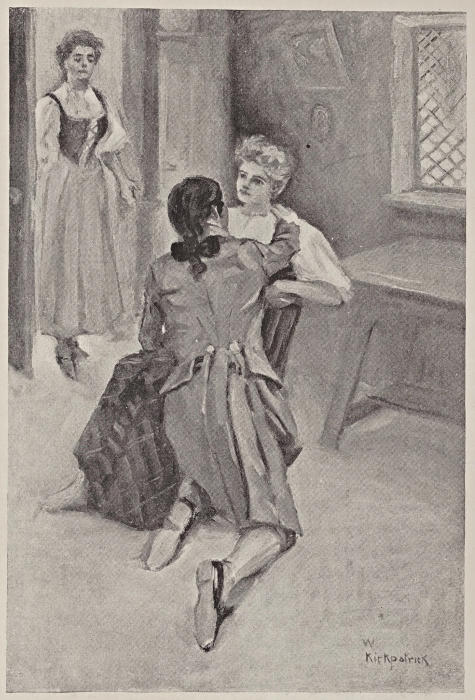
like a knife thrust. He caught her two hands in
his passionately and pressed them to his heart with
a cry of pain.
“Dinna mind what I said, lass,” he cried, conscience
stricken; “dinna look like that. I dinna
mean to grieve ye, Mary, I love ye too well.” And
almost before he realized it he had recklessly, passionately,
incoherently told her of his love for her, his
jealousy of his brother, his grief and pain at losing
her. Mary gazed at him in wonder, scarcely understanding
his wild words, his excited manner.
“I’m fair pleased that ye love me, Gilbert,” she
answered him in her innocence. “Ye ken I love ye
too, for ye’ve been so kind and good to me ever
since Robert has been awa’,” and she pressed his
hand affectionately. With a groan of despair he
released her and turned away without another word.
Suddenly she understood, and a great wave of sympathy
welled up in her heart. “Oh, Gilbert,” she
cried sorrowfully, a world of compassion in her
voice. “I understand ye noo, laddie, an’ I’m so
sorry, so sorry.” He bit his lips till the blood came.
Finally he spoke in a tone of quiet bitterness.
“I’ve been living in a fool’s paradise this past
year,” he said, “but ’tis all ended noo. Why, ever
since he went awa’ I have wished, hoped, and even
prayed that Rob would never return to Mossgiel,
that ye might forget him and his accursed poetry,
and in time would become my wife.” He threw out
his hands with a despairing gesture as he finished.
“Oh, Gilbert,” she faltered, with tears in her
eyes, “I never dreamed ye thought of me in that
way. Had I only known, I——” she broke off
abruptly and looked away toward the cottage.
“Ye see what a villain I have been,” he continued
with a bitter smile. “But ye have nothin’
to blame yoursel’ for, Mary. I had no right to
think of ye ither than as Robert’s betrothed wife.”
“I’m so sorry, lad,” repeated Mary compassionately.
Then her downcast face brightened. “Let
us both forget what has passed this day, and be
the same good friends as ever, wi’na we, Gilbert?”
And she held out her hand to him with her old winning
smile.
“God bless ye, lassie,” he replied brokenly. Quietly
they stood there for a few minutes, then with a sudden
start they realized that deep twilight had fallen
upon them. Silently, stealthily it had descended,
like a quickly drawn curtain. Slowly they wended
their way back to the cottage. When they reached
the door Mary suddenly turned and peered into the
deepening twilight.
“Listen!” she said breathlessly. “Dinna ye hear
a voice, Gilbert?” He listened for a minute.
Faintly there came on the still air the distant murmur
of many voices.
“’Tis only the lads on their way to the village,”
he replied quietly. With a little shiver, Mary drew
her plaidie closely about her, for the air had grown
cool.
“I think I’ll hae to be goin’ noo,” she said dejectedly.
“He willna be here this night.”
“Very well,” answered Gilbert. “I’ll saddle the
mare and take ye back. Bide here a wee,” and he
left her. She could hardly restrain the disappointed
tears, which rose to her eyes.
Why didn’t Robert come? What could keep him
so late? She so longed to see her laddie once more.
She idly wondered why the lads, whose voices she now
heard quite plainly, were coming toward Mossgiel.
There was no inn hereabouts. By the light of the
rising moon she saw them on the moor, ever drawing
nearer and nearer, but they had no interest for her.
Nothing interested her now. She leaned back against
the wall of the cottage and patiently awaited Gilbert’s
return.
“He’s comin’! he’s comin’!” suddenly exclaimed
the voice of Mrs. Burns from within the cottage.
“My lad is comin’! Out of my way, ye skellum!”
and out she ran, her face aglow with love and excitement,
followed by Souter, who was shouting gleefully,
“He’s comin’! he’s comin’! Robbie’s comin’!”
and off he sped in her footsteps, to meet the returned
wanderer.
“It’s Robbie! it’s Robbie!” cried Mary joyously,
her nerves a-quiver, as she heard the vociferous outburst
of welcome from the lads, who were bringing
him in triumph to his very door.
“Welcome hame, laddie!” shouted the crowd, as
they came across the field, singing, laughing and
joking like schoolboys on a frolic.
“Oh, I canna’, I darena’ meet him before them a’,”
she exclaimed aloud, blushing rosily, frightened at the
thought of meeting him before the good-natured
country folk.
She would wait till they all went away, and, turning,
she ran into the house like a timid child. Quickly
she hid behind the old fireplace, listening shyly, as
she heard them approach the open door.
“Thank ye, lads, for your kind welcome,” said
Robert as he reached the threshold, one arm around
his mother. “I didna’ ken I had left so many friends
in Mossgiel,” and he looked around gratefully at the
rugged faces that were grinning broadly into his.
“Come doon to the Inn and hae a wee nippie for
auld lang syne,” sang out Sandy MacPherson, with
an inviting wave of the hand.
“Nay, an’ he’ll not gang a step, Sandy MacPherson,”
cried Mrs. Burns indignantly, clinging
closely to her son.
“Nay, I thank ye, Sandy,” laughingly replied
Robert. “Ye must excuse me to-night. I’ll see ye
all later, and we’ll have a lang chat o’er auld times.”
“Come awa’ noo, Robert,” said Mrs. Burns lovingly,
“an’ I’ll get ye a bite and a sup,” and she
drew him into the house.
“Good-night, lads; I’ll see ye to-morrow,” he
called back to them cheerily.
“Good-night,” they answered in a chorus, and
with “three cheers for Robbie Burns” that made the
welkin ring, they departed into the night, merrily
singing “Should auld acquaintance be forgot?” a
song Robert himself had written before leaving
Mossgiel.
“Ah, Souter Johnny, how are ye, mon?” cried Robert
heartily, as his eyes rested on the beaming face of
the old man. “Faith, an’ I thought I’d find ye here
as of old. ’Tis almost a fixture ye are.”
“Ah, weel,” replied Souter nonchalantly, as he
shook Robert’s outstretched hand, “ye ken the
Scripture says, ‘an’ the poor ye have always wi’
ye.’” Robert laughed merrily at the old man’s
sally.
“Thank goodness, they’ve gone at last,” said Mrs.
Burns with a sigh of relief, as she entered the room.
“Why, laddie, ye had half the ne’er-do-weels of Mossgiel
a-following ye. They are only a lot of leeches
and idle brawlers, that’s a’,” and her dark eyes
flashed her disapproval.
“I’m sure they have kind hearts, mither, for a’
that,” replied Robert reproachfully.
“Ye’re so popular wi’ them a’, Robbie,” cried
Souter proudly.
“Aye, when he has a shillin’ to spend on them,”
added Mrs. Burns dryly. “But sit doon, laddie;
ye maun be tired wi’ your lang walk,” and she gently
pushed him into a chair beside the table.
“I am a wee bittie tired,” sighed Robert gratefully
as he leaned back in the chair.
“I’ll soon hae something to eat before ye,” replied
his mother briskly.
“I’m nae hungry, mother,” answered Robert.
“Indeed, I couldna’ eat a thing,” he remonstrated
as she piled the food before him.
“’Tis in love ye are,” insinuated Souter with a
knowing look. “I ken the symptoms weel; ye canna’
eat.”
“Ye’re wrong there,” replied Robert with a bright
smile. “Love but increases my appetite.”
“Aye, for love,” added Souter sotto voce.
“Ah, mother dear, how guid it seems to be at hame
again, under the old familiar roof-tree,” said Robert
a little later, as he leaned back contentedly in his
chair and gazed about the room with eager, alert
glances. As he sits there with his arms folded let
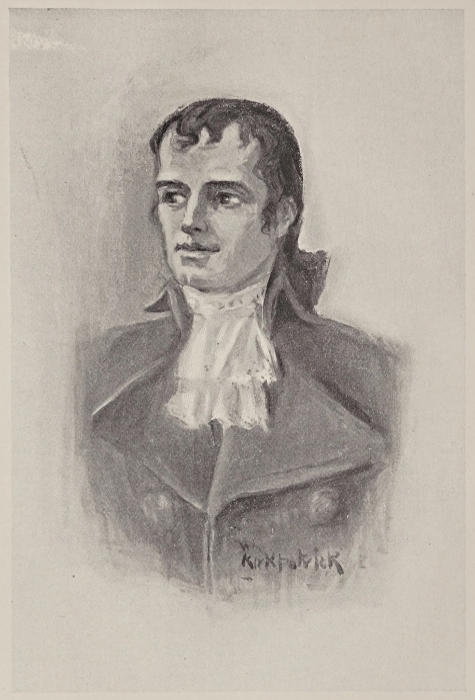
us take a look at our hero. Of more than medium
height, his form suggested agility as well as strength.
His high forehead, shaded with black curling hair
tied at the neck, indicated extensive capacity. His
eyes were large, dark, and full of fire and intelligence.
His face was well formed and uncommonly interesting
and expressive, although at the first glance his
features had a certain air of coarseness, mingled with
an expression of calm thoughtfulness, approaching
melancholy. He was dressed carelessly in a blue
homespun long coat, belted at the waist, over a buff-colored
vest; short blue pantaloons, tucked into long
gray home-knit stockings, which came up above his
knee, and broad low brogans, made by Souter’s hands.
He wore a handsome plaid of small white and black
checks over one shoulder, the ends being brought
together under the opposite arm and tied loosely
behind.
“’Tis a fine hame-comin’ ye’ve had, laddie,” cried
old Souter proudly. “Faith, it’s just like they
give the heir of grand estates. We should hae had
a big bonfire burnin’ outside our—ahem—palace
gates,” and he waved his hand grandiloquently.
“Dinna’ ye make fun of our poor clay biggin’,
Souter Johnny,” cried Mrs. Burns rebukingly. “Be
it ever so poor, ’tis our hame.”
“Aye, ’tis our hame, mother,” repeated Robert
lovingly. “An’ e’en tho’ I have been roaming in
other parts, still this humble cottage is the dearest
spot on earth to me. I love it all, every stick and
stone, each blade of grass, every familiar object that
greeted my eager gaze as I crossed the moor to this
haven of rest, my hame. And my love for it this
moment is the strongest feeling within me.”
His roving eyes tenderly sought out one by one
the familiar bits of furniture around the room, and
lingered for a moment lovingly on the old fireplace.
It was there he had first seen Mary Campbell. She
had come to the cottage on an errand, and as she
stood leaning against the mantel, the sunlight gleaming
through the window upon her golden hair, he
had entered the room. It was plainly love at first
sight, and so he had told her that same day, as he
walked back to Castle Montgomery with the winsome
dairymaid. The course of their love had flowed
smoothly and uneventfully; he loved her with all the
depth of his passionate emotional nature, and yet
his love was more spiritual than physical. She was
an endless source of inspiration, as many a little song
and ode which had appeared in the Tarbolton weekly
from time to time could testify. How long the
year had been away from her, he mused dreamily.
To-morrow, bright and early, he would hurry over
to Castle Montgomery and surprise her at her
duties.
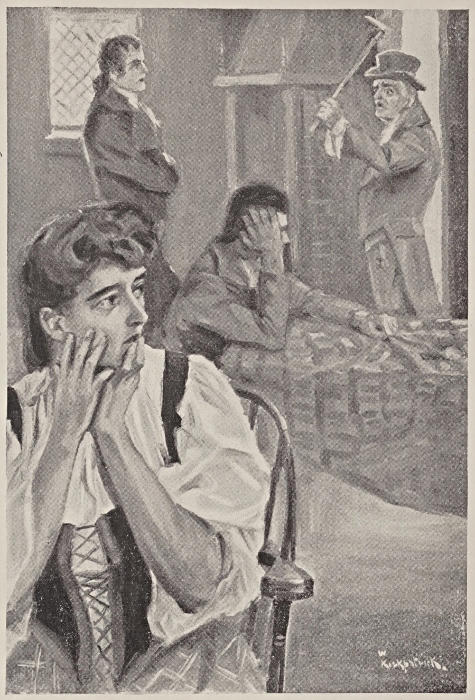
“Gazed straight into the startled eyes of Robert.”
Mary, from her hiding place, had watched all that
happened since Robert had come into the room.
She had not expected to remain so long hidden, she
thought wistfully. She had hoped that Mrs. Burns
would miss her, and that she, or Robert, or someone
would look for her, but they had not even
thought of her, and her lips trembled piteously at
their neglect. And so she had stayed on, peeping out
at them, whenever their backs were turned, feeling
very lonely, and very miserable, in spite of the pride
that thrilled her, as she watched her lover sitting
there so handsome in the full strength of his young
manhood. Perhaps they didn’t want her here to-night.
Perhaps it was true, as Gilbert said, “that
Robert didn’t love her any more.” The tears could
no longer be restrained. If she could only slip out
unobserved she would go home. She wasn’t afraid,
she thought miserably. She wondered what they
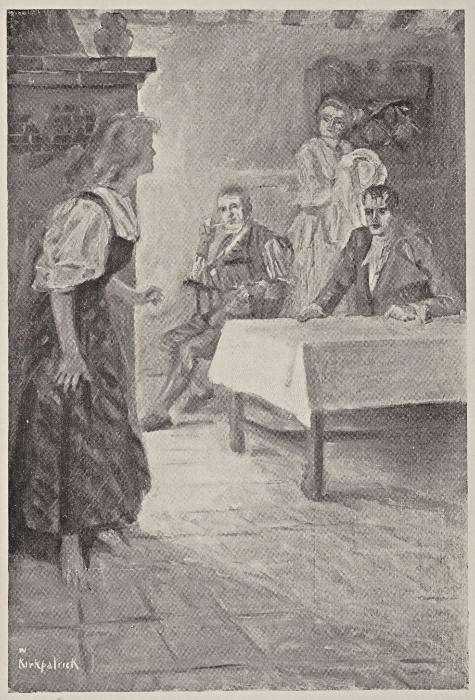
were doing now, they were so quiet? Peering shyly
around the mantel, she gazed straight into the
startled eyes of Robert, who with a surprised ejaculation
started back in amazement.
“Why, Mary Campbell!” cried his mother remorsefully,
as she caught sight of Mary’s face, “I
declare I clear forgot ye, lass.” With a glad cry
Robert sprang toward her and grasped her two hands
in his own, his eyes shining with love and happiness.
“Mary, lass, were ye hidin’ awa’ from me?” he
asked in tender reproach. She dropped her head
bashfully without a word. “’Tis o’er sweet in ye,
dear, to come over to welcome me hame,” he continued
radiantly. “Come an’ let me look at ye,” and
he drew her gently to where the candle light could
fall on her shy, flushed face. “Oh, ’tis bonnie ye’re
looking, lassie,” he cried proudly. He raised her
drooping head, so that his hungry eyes could
feast on her beauty. She stood speechless, like a
frightened child, not daring to raise her eyes to his.
“Haven’t ye a word of welcome for me, sweetheart?”
he whispered tenderly, drawing her to him
caressingly.
“I’m—I’m very glad to hae ye back again,” she
faltered softly, her sweet voice scarcely audible.
“Go an’ kiss him, Mary; dinna’ mind us,” cried
Souter impatiently. “I can see ye’re both asking
for it wi’ your eyes,” he insinuated. And he drew
near them expectantly.
“Hauld your whist, ye old tyke,” flashed Mrs.
Burns indignantly. “Robbie Burns doesna’ need ye
to tell him how to act wi’ the lassies.”
“I’ll not dispute ye there,” replied Souter dryly,
winking his eye at Robert knowingly.
Robert laughed merrily as he answered, “Ye ken
we’re both o’er bashful before ye a’.”
“Ah, ye’re a fine pair of lovers, ye are,” retorted
Souter disgustedly, turning away.
“So the neighbors say, Souter,” responded Robert
gayly, giving Mary a loving little squeeze.
And surely there never was a handsomer couple,
thought Mistress Burns proudly, as they stood there
together. One so dark, so big and strong, the other
so fair, so fragile and winsome. And so thought
Gilbert Burns jealously, as he came quietly into the
room. Robert went to him quickly, a smile lighting
up his dark face, his hand outstretched in
greeting.
“I’m o’er glad to see ye again, Gilbert,” he cried
impulsively, shaking his brother’s limp hand.
“So ye’ve come back again,” said Gilbert, coldly.
“Aye, like a bad penny,” laughingly responded
Robert. “Noo that I am burned out of my situation,
I’ve come hame to help ye in the labors of the
farm,” and he pressed his brother’s hand warmly.
“I fear your thoughts willna’ lang be on farming,”
observed Gilbert sarcastically, going to the
fireplace and deliberately turning his back to Robert.
“I’ll struggle hard to keep them there, brother,”
replied Robert simply. His brother’s coldness had
chilled his extraordinarily sensitive nature. He
walked slowly back to his seat.
“I ken ye’d rather be writin’ love verses than
farmin’, eh, Robert?” chimed in Souter thoughtlessly.
“’Tis only a waste of time writin’ poetry, my lad,”
sighed Mrs. Burns, shaking her head disapprovingly.
“I canna’ help writin’, mother,” answered the lad
firmly, a trifle defiantly. “For the love of poesy
was born in me, and that love was fostered at your
ain knee ever since my childhood days.”
She sighed regretfully. “I didna’ ken what seed
I was sowing then, laddie,” she answered thoughtfully.
“Dinna’ be discouraged,” cried Mary eagerly,
going to him. “I’ve faith in ye, laddie, and in
your poetry, too.” She put her hand on his shoulder
lovingly, as he sat beside the table, looking
gloomy and dejected. “Some day,” she continued,
a thrill of pride in her voice, “ye’ll wake to find
your name on everybody’s lips. You’ll be rich and
famous, mayhap. Who kens, ye may even become
the Bard o’ Scotland,” she concluded in an awestruck
tone.
“Nay, Mary, I do not hope for that,” replied
Robert, his dark countenance relaxing into a smile
of tenderness at her wild prophecy, although in his
own heart he felt conscious of superior talents.
“Waesucks,” chuckled Souter reminiscently. “Do
you mind, Robbie, how, a year ago, ye riled up the
community, an’ the kirk especially, over your verses
called ‘Holy Willie’s Prayer’? Aye, lad, it was an
able keen satire, and auld Squire Armour recognized
the truth of it, for he threatened to hae ye arrested
for blaspheming the kirk and the auld licht religion.
He’ll ne’er forgive ye for that,” and he shook his
head with conviction.
“He’s an auld Calvinistic hypocrite,” replied Robert
carelessly, “and he deserved to be satirized alang
wi’ the rest of the Elders. Let us hope the verses
may do them and the kirk some good. They are
sadly in need of reform.” Then with a gay laugh
he told them a funny anecdote concerning one of
the Elders, and for over an hour they listened to
the rich tones of his voice as he entertained them
with jest and song and story, passing quickly from
one to the other, as the various emotions succeeded
each other in his mind, assuming with equal ease the
expression of the broadest mirth, the deepest melancholy
or the most sublime emotion. They sat around
him spellbound. Never had they seen him in such
a changeable mood as to-night.
“And noo, laddie, tell us about your life in Irvine
and Mauchline,” said Mrs. Burns.
Robert had finished his last story, and sat in meditative
silence, watching the smoldering peat in the
fireplace.
He hesitated for a moment. “There is little to
tell, mother,” he answered, not looking up, “and that
little is na worth tellin’.”
“I ken ye’ve come back no richer in pocket than
when ye left,” remarked Gilbert questioningly. As
his brother made no answer, he continued with sarcastic
irony, “But perhaps there wasna’ enough
work for ye there.” He watched his brother’s face
narrowly.
“There was work enough for a’,” replied Robert
in a low tone, an agony of remorse in his voice. “An’
I tried to fulfill faithfully the uncongenial tasks set
before me, but I would sink into dreams, forgetting
my surroundings, my duties, and would set me doon
to put on paper the thoughts and fancies which came
rushing through my brain, raging like so many devils,
till they found vent in rhyme; then the conning o’er
my verses like a spell soothed all into quiet again.”
A far away rapt expression came over his countenance
as he finished, and his dark glowing eyes
gazed dreamily into space, as if communing with
the Muses. Mrs. Burns and Mary both watched him
with moist, adoring eyes, hardly breathing lest they
should disturb his reverie. Gilbert stirred in his
chair restlessly.
“Ye will never prosper unless ye give up this day
dreaming,” he exclaimed impatiently, rising from his
chair and pacing the floor.
Robert looked up, the fire fading from his eyes,
his face growing dark and forbidding. “I ken that
weel, Gilbert,” he answered bitterly. “An’ I despair
of ever makin’ anything of mysel’ in this world,
not e’en a poor farmer. I am not formed for the
bustle of the busy nor the flutter of the gay. I’m
but an idle rhymster, a ne’er-do-weel.” He walked
quickly to the window and stood dejectedly looking
out into the night.
“Nay, ye’re a genius, lad,” declared old Souter
emphatically, patting him affectionately on the
shoulder. “I havena’ watched your erratic ways for
nothin’, an’ I say ye’re a genius. It’s a sad thing to
be a genius, Robert, an’ I sympathize wi’ ye,” and the
old hypocrite shook his head dolefully as he took his
seat at the fireplace.
“I’m a failure, I ken that weel. I’m a failure,”
muttered Robert despairingly, his heart heavy and
sad.
“Nay, laddie, ye mustna’ talk like that,’tis not
right,” cried Mary, bravely keeping back the sympathetic
tears from her eyes and forcing a little
smile to her lips. “Ye are only twenty-five,” she
continued earnestly. “An’ all your life is stretchin’
out before ye. Why, ye mustna ever think o’
failure. Ye must think only of bright, happy things,
and ye’ll see how everythin’ will come out all right.
Noo mind that. So cheer thee, laddie, or ye’ll make
us all sad on this your hame-comin’. Come, noo,
look pleasant,” and she gave his arm a loving little
shake. As his stern face melted into a sad smile,
she laughed happily. “That’s right, laddie.” With
a little encouraging nod she left him, and running
to Mrs. Burns, she gave her a hug and a kiss, until
the old lady’s grim features relaxed. Then like a
bird she flitted to the other side of the room.
“Souter Johnny,” she saucily cried, “how dare
ye look so mournful like. Hae ye a fit o’ the gloom,
man?”
“Not a bit o’ it,” retorted Souter energetically,
jumping lightly to his feet. “Will I stand on my
head for ye, Mary, eh?”
Mary laughed merrily as Mrs. Burns replied in
scathing tones, “Your brains are in your boots, noo,
Souter Johnny.”
“Weel, wherever they are,” responded Souter with
a quizzical smile, “they dinna’ trouble me o’er much.
Weel, I think I’ll be turnin’ in noo,” he continued,
stretching himself lazily. “Good-night to ye all,”
and taking a candle from the dresser, he slowly left
the room.
“Come, lads,’tis bedtime,” admonished Mrs.
Burns, glancing at the old high clock that stood in
the corner. “Mary, ye shall sleep with me, and,
Robert, ye know where to find your bed. It hasna’
been slept in since ye left. Dinna’ forget your
candle, Gilbert,” she called out as he started for the
door. He silently took it from her hand. “Dinna’
forget your promise,” she whispered anxiously to him
as he left the room in gloomy silence.
The look on his face frightened her. There was
bitterness and despair in the quick glance he gave
the happy lovers, who were standing in the shadow
of the deep window. “The lad looked fair heart-broken,”
she mused sorrowfully. For a moment she
looked after him, a puzzled frown on her brow.
Then suddenly the truth dawned on her. How blind
she had been, why hadn’t she thought of that before?
The lad was in love. In love with Mary Campbell,
that was the cause of his bitterness toward his
brother. “Both in love with the same lass,” she
murmured apprehensively, and visions of petty meannesses,
bitter discords, between the two brothers,
jealous quarrels, resulting in bloody strife, perhaps;
and she shuddered at the mental picture her uneasy
mind had conjured up. The sooner Robert and
Mary were married the sooner peace would be
restored, she thought resolutely. They could start
out for themselves, go to Auld Ayr or to Dumfries.
They couldn’t be much worse off there than here.
And determined to set her mind easy before she retired,
she walked briskly toward the couple, who now
sat hand in hand, oblivious to earthly surroundings,
the soft moonlight streaming full upon their happy
upturned faces. She watched them a moment in silence,
loath to break in upon their sweet communion.
Presently she spoke.
“Robert,” she called softly, “ye’d better gang to
your bed noo, lad.”
With a start he came back to earth, and jumping
up boyishly, replied with a happy laugh, “I forgot,
mother, that I was keeping ye and Mary from your
rest.” He glanced toward the recessed bed in the
wall where his mother was wont to sleep. “Good-night,
mither, good-night, Mary,” he said lovingly.
Then taking his candle, he started for the door, but
turned as his mother called his name and looked at
her questioningly.
“Laddie, dinna’ think I’m meddling in your affairs,”
she said hesitatingly, “but I’m fair curious
to know when ye an’ Mary will be wed.”
Robert looked inquiringly at Mary, who blushed
and dropped her head. “Before harvest begins,
mither,” he answered hopefully, “if Mary will be
ready and willing. Will that suit ye, lassie?” And
he looked tenderly at the drooping head, covered with
its wealth of soft, glittering curls.
“I hae all my linen spun and woven,” she faltered,
after a nervous silence, not daring to look at him.
“Ye ken the lassies often came a rockin’ and so helped
me get it done.” She raised her head and looked in
his glowing face. “’Tis a very small dowry I’ll be
bringin’ ye, laddie,” she added in pathetic earnestness.
He gave a little contented laugh. “Ye’re bringin’
me yoursel’, dearie,” he murmured tenderly.
“What mair could any lad want. I ken I do not
deserve such a bonnie sweet sonsie lassie for my wife.”
He looked away thoughtfully for a moment. Then
he continued with glowing eyes, “But ye mind the
verse o’ the song I gave ye before I went awa’?”
he said lovingly, taking her hand in his. His voice
trembled with feeling as he fervently recited the
lines:
“We have plighted our troth, my Mary,
In mutual affection to join,
And cursed be the cause that shall part us,
The hour and moment o’ time.”
She smiled confidingly up into his radiant face,
then laid her little head against his breast like a
tired child. “Always remember, sweetheart,” he
continued softly, as if in answer to that look, “that
Robbie Burns’ love for his Highland Mary will remain
forever the tenderest, truest passion of his unworthy
life.”
Life at Mossgiel passed uneventfully and monotonously.
Robert had settled down with every appearance
of contentment to the homely duties of
the farmer, and Gilbert could find no fault with
the amount of labor done. Morning till night he
plowed and harrowed the rocky soil, without a
word of complaint, although the work was very hard
and laborious. Planting had now begun and his
tasks were materially lightened. He had ample
leisure to indulge in his favorite pastime; and that
he failed to take advantage of his opportunities for
rhyming was a mystery to Gilbert, and a source of
endless regret to Mary. But his mother could tell of
the many nights she had seen the candle light gleaming
far into the night; and her heart was sore
troubled when in the morning she would see the evidence
of his midnight toil, scraps of closely written
paper scattered in wild disorder over his small table,
but she held her peace. The lad loved to do it, she
mused tenderly, and so long as he was not shirking his
work, why disturb his tranquillity?
A few weeks after the return of our hero Mary
and Mrs. Burns were seated in the living-room,
Mrs. Burns as usual busy at her wheel, while Mary
sat sewing at the window, where she could look out
across the fields and see her sweetheart, who, with
a white sheet containing his seed corn slung across
his shoulder, was scattering the grain in the earth.
She sang dreamily as she sewed, her sweet face beaming
with love and happiness. No presentiment
warned her of the approaching tragedy that was
soon to cast its blighting shadow over that happy
household—a tragedy that was inevitable. The
guilty one had sown to the flesh, he must reap corruption.
The seed had been sown carelessly, recklessly,
and now the harvest time had come, and such a harvest!
The pity of it was that the grim reaper must
with his devouring sickle ruthlessly cut down such a
tender, sweet, and innocent flower as she who sat
there so happy and so blissfully unconscious of her
impending doom.
Suddenly, with an exclamation of astonishment, she
jumped excitedly to her feet. “Mistress Burns,”
she cried breathlessly, “here are grand lookin’
strangers comin’ up the path. City folk, too, I
ken. Look.”
Hastily the good dame ran to the window. “Sure
as death, Mary; they’re comin’ here,” she cried in
amazement. “Oh, lack a day, an’ I’m na dressed
to receive the gentry.” A look of comical dismay
clouded her anxious face as she hurriedly adjusted
her cap and smoothed out her apron. “Is my cap
on straight, Mary?” she nervously inquired. Mary
nodded her head reassuringly. “Oh, dear, whatever
can they want?” Steps sounded without. “Ye
open the door, Mary,” she whispered sibilantly as
the peremptory knock sounded loudly through the
room. Timidly Mary approached the door. “Hist,
wait,” called Mrs. Burns in sudden alarm. “My ’kerchief
isna’ pinned.” Hastily she pinned the loose end
in place, then folding her hands, she said firmly, “Noo
let them enter.” Mary slowly opened the door, which,
swinging inward, concealed her from the three
strangers, who entered with ill-concealed impatience
on the part of the two ladies who were being laughingly
chided by their handsome escort. With a
wondering look of admiration at the richly dressed
visitors, Mary quietly stole out and softly shut the
door behind her.
With a murmur of disgust the younger of the two
ladies, who was about nineteen, walked to the fireplace,
and raising her quilted blue petticoat, which
showed beneath the pale pink overdress with its Watteau
plait, she daintily held her foot to the blaze.
A disfiguring frown marred the dark beauty of
her face as her bold black eyes gazed about her
impatiently.
“It’s a monstrous shame,” she flashed angrily,
“to have an accident happen within a few miles of
home. Will it delay us long, think you?” she
inquired anxiously, addressing her companion.
“It depends on the skill of the driver to repair
the injury,” replied the other lady indifferently.
She appeared the elder of the two by some few years,
and was evidently a lady of rank and fashion. She
looked distinctly regal and commanding in her large
Gainsborough hat tilted on one side of her elaborately
dressed court wig. A look of amused curiosity
came over her patrician face as she calmly surveyed
the interior of the cottage. She inclined her head
graciously to Mrs. Burns, who with a deep courtesy
stood waiting their pleasure.
“We have just met with an accident, guidwife,”
laughingly said the gentleman, who stood in the
doorway brushing the dust from his long black
cloak. He was a scholarly looking man of middle
age, dressed in the height of taste and fashion.
“While crossing the old bridge yonder,” he continued,
smiling courteously at Mrs. Burns, “our
coach had the misfortune to cast a wheel, spilling us
all willy-nilly, on the ground, and we must crave
your hospitality, guidwife.”
“Ye are a’ welcome,” quickly answered Mrs.
Burns with another courtesy. “Sit doon, please,”
and she placed a chair for the lady, who languidly
seated herself thereon with a low murmur of thanks.
“Allow me to introduce myself,” continued the
gentleman, coming into the room, his cloak over
his arm. “I am Lord Glencairn of Edinburgh.
This is Lady Glencairn, and yonder lady is Mistress
Jean Armour of Mauchline.”
The young lady in question, who was still standing
by the fireplace, flashed him a look of decided
annoyance. She seemed greatly perturbed at the
enforced delay of the journey. She started violently
as she heard Mrs. Burns say, “And I am
Mrs. Burns, your lordship.” Then she hurried to
the old lady’s side, a startled look in her flashing eyes.
“Mistress Burns of Mossgiel Farm?” she inquired
in a trembling voice.
“Yes, my lady,” replied Mrs. Burns. The young
lady’s face went white as she walked nervously back
to the fireplace.
“My dear Jean, whatever is the matter?” asked
Lady Glencairn lazily, as she noticed Jean’s perturbation.
“Is there anything in the name of Burns to
frighten you?”
“No, your ladyship,” replied Jean falteringly,
turning her face away so that her large Gainsborough
hat completely shielded her quivering features.
“I—I am still a trifle nervous from the
upset, that is all.” She seemed strangely agitated.
“Was it not unlucky?” replied Lady Glencairn
in her rich vibrating contralto. “’Twill be a most
wearisome wait, I fear, but we simply must endure it
with the best possible grace,” and she unfastened her
long cloak of black velvet and threw it off her
shoulders, revealing her matchless form in its tightly
fitting gown of amber satin, with all its alluring
lines and sinuous curves, to the utmost advantage.
“It willna’ be long noo, your ladyship,” replied
Mrs. Burns, smiling complacently. She had quietly
left the room while the two were talking, and seeing
Souter hovering anxiously around, trying to
summon up courage to enter, she had commanded
him to go to the fields and tell the lads of the accident,
which he had reluctantly done.
“My lads will soon fix it for ye,” she continued
proudly. “Robert is a very handy lad, ye ken. He
is my eldest son, who has just returned from Mauchline,”
she explained loquaciously in answer to Lord
Glencairn’s questioning look.
Jean nervously clutched at the neck of her gown,
her face alternately flushing and paling. “Your
son is here now?” she asked eagerly, turning to Mrs.
Burns.
“Aye, he’s out yonder in the fields,” she answered
simply.
“Oh, then you know the young man?” interrogated
Lady Glencairn, glancing sharply at Jean.
“Yes, I know him,” she answered with averted
gaze. “We met occasionally in Mauchline at dancing
school, where we fell acquainted.”
Lady Glencairn looked at her with half-closed eyes
for a moment, then she smilingly said, “And I’ll
wager your love for coquetting prompted you
to make a conquest of the innocent rustic, eh,
Jean?”
Jean tossed her head angrily and walked to the
window.
“Lady Glencairn, you are pleased to jest,” she retorted
haughtily.
“There, there, Jean, you’re over prudish. I vow
’twould be no crime,” her ladyship calmly returned.
“I’ll wager this young farmer was a gay Lothario
while in Mauchline,” she continued mockingly.
“Oh, no, your ladyship,” interrupted Mrs. Burns
simply. “He was a flax dresser.”
“Truly a more respectable occupation, madame,”
gravely responded Lord Glencairn with a suspicious
twinkle in his eye.
“Thank ye, my lord,” answered Mrs. Burns with
a deep courtesy. “My lad is a good lad, if I do say
so, and he has returned to us as pure minded as when
he went awa’ a year ago.”
Lady Glencairn raised her delicately arched eyebrows
in amused surprise. Turning to Jean, she
murmured drily, “And away from home a year, too!
He must be a model of virtue, truly.”
Jean gazed at her with startled eyes. “Can she
suspect aught?” she asked herself fearfully.
“Could I be getting ye a cup of milk?” asked Mrs.
Burns hospitably. “’Tis a’ I have to offer, but
’tis cool and refreshing.”
“Fresh milk,” repeated Lady Glencairn, rising
with delight. “I vow it would be most welcome, guidwife.”
“Indeed it would,” responded her husband. And
Mrs. Burns with a gratified smile hurried from the
room.
“My dear, don’t look so tragic,” drawled Lady
Glencairn carelessly, as she noticed Jean’s pale face
and frightened eyes. “We’ll soon be in Mauchline.
Although why you are in such a monstrous
hurry to reach that lonesome village after your delightful
sojourn in the capital, is more than I can
conjecture,” and her keen eyes noted with wonder
the flush mount quickly to the girl’s cheek.
“It is two months since I left my home, your ladyship,”
faltered Jean hesitatingly. “It’s only natural
I should be anxious to see my dear parents
again.” She dropped her eyes quickly before her
ladyship’s penetrating gaze.
“Dear parents, indeed,” sniffed Lady Glencairn to
herself suspiciously as she followed their hostess to
the door of the “ben.”
With a nervous little laugh Jean rose quickly from
her chair by the window and walked toward the door
through which they had entered. “The accident has
quite upset me, Lady Glencairn,” she said constrainedly.
“Would you mind if I stroll about the fields
until my nerves are settled?” she asked with a forced
laugh.
“No, child, go by all means,” replied her ladyship
indolently. “The air will do you good, no
doubt.”
“I warn you not to wander too far from the
house,” interposed Lord Glencairn with a kindly
smile. “We will not be detained much longer.”
With a smile of thanks she hastily left the room just
as Mrs. Burns entered from the “ben” bearing a
large blue pitcher filled with foaming milk, which she
placed on the table before her smiling visitors.
Jean breathed a sigh of relief as she closed the
door behind her. She felt in another moment she
would have screamed aloud in her nervousness. That
fate should have brought her to the very home of
the man she had thought still in Mauchline, and to
see whom she had hurriedly left Edinburgh, filled
her with wonder and dread. “I must see him before
we leave,” she said nervously, clasping and unclasping
her hands. But where should she find him? She
walked quickly down the path and gazed across the
fields, where in the distance she could see several men
at work, repairing the disabled coach. Anxiously
she strained her eyes to see if the one she sought
was among them, but he was not there. Quickly she
retraced her steps. “I must find him. I must speak
with him this day,” she said determinedly. As she
neared the cottage she turned aside and walked toward
the high stone fence which enclosed the house
and yard. Swiftly mounting the old stile, she looked
about her. Suddenly she gave a sharp little exclamation,
and her heart bounded violently, for there before
her, coming across the field, was the man she sought,
his hands clasped behind him, his head bent low in the
deepest meditation. With a sigh of relief she sank
down on the step and calmly awaited his approach.
Robert flung the last of his seed corn into the earth
with a sigh of thankfulness, for though he gave the
powers of his body to the labors of the farm, he refused
to bestow on them his thoughts or his cares.
He longed to seek the quiet of his attic room, for his
soul was bursting with song and his nervous fingers
fairly itched to grasp his pencil and catch and hold
forever the pearls dropped from the lap of the Goddess
Muse into his worshipful soul, ere they faded and
dissolved into lusterless fragments. Mechanically he
turned his footsteps toward the cottage, plunged in
deep reverie. As he walked slowly along his mind suddenly
reverted to the year he had spent in Mauchline.
It had been his first taste of town life. Blessed with
a strong appetite for sociability, although constitutionally
melancholy, and a hair-brained imagination,
he had become an immediate favorite and welcome
guest wherever he visited. Vive l’amour and vive la
bagatelle had soon become his sole principle of action.
His heart, which was completely tinder, was
eternally lighted up by some goddess or other, and it
was not long before he regarded illicit love with levity,
which two months previously he had thought of
with horror. Poesy was still a darling walk for his
mind, but it was only indulged in according to the
humor of the hour. Having no aim in life he had been
easily led from the paths of virtue into many forms
of dissipation, which, when indulged in, afterwards
plunged him into the deepest melancholy. A few
months after his advent into the village he had met
Jean Armour, the daughter of a master builder.
She was one of the belles of Mauchline, a wild,
willful, imprudent lass, whose sensual charms soon
ensnared the susceptible heart of the unsophisticated
farmer lad. The fatal defect of his character
was the comparative weakness of his volition,
and his passions, once lighted up, soon carried him
down the stream of error and swept him over the
precipice he saw directly in his course.
Such being their temperaments, it was not to be
wondered at when their procedure soon became decidedly
irregular, their intimacy becoming the common
talk and gossip of Mauchline.
A few months before Robert returned to Mossgiel
farm Jean had received an invitation from her
god-parents, Lord and Lady Glencairn, to visit Edinburgh,
which she had accepted with eagerness, for she
was becoming tired of her latest conquest and longed
for the gay life of the capital.
Robert saw her leave Mauchline with no pangs of
regret at her inconstancy and caprice. He was in
a state of profound melancholy at the time, the
thoughts of how he had fallen from the paths of
truth and virtue, the thoughts of the pure love of
his sweetheart at home, filling his heart with grief
and remorse. He was thinking of all this as he
approached the stile. How wretchedly weak and
sinful he had been to forget his sworn vows to Mary,
he thought remorsefully. “May no harping voice
from that past ever come to disturb her peace of
mind,” he prayed fervently.
Jean watched him, drawing ever nearer, with eyes
filled with sudden shame and dread at what she had to
tell him. Why had her brief infatuation for the poverty-stricken
farmer led her into such depths of imprudence
and recklessness? she thought angrily. As
he reached the bottom of the stile she softly spoke
his name, and noted with chagrin his startled look of
surprise and annoyance as he raised his eyes to hers.
“Jean Armour?” he cried in amazement.
“Aren’t you glad to see me?” she asked coquettishly,
his presence exercising its old fascination for
her.
“What has brought ye to Mossgiel?” he asked
abruptly, ignoring her outstretched hand.
“An accident,” she replied flippantly. “I was
on my way home and would have been there ere this
had it not been for a fortunate mishap.”
“Fortunate mishap?” he repeated questioningly.
“Yes,” she retorted amiably, “otherwise I should
have missed seeing you,” and she smiled down into
his pale startled face.
“I dinna understand why ye left Edinburgh,” he
began, when she interrupted him.
“Because I thought you were still in Mauchline,”
she explained quickly. He look at her questioningly.
“I left Edinburgh for the sole purpose of seeing you,
Robert,” she announced quietly, making room for him
to sit beside her, but he did not accept the invitation.
“Well, noo, that was very kind of ye, Jean,” he
replied a little uneasily. “But I’m not so conceited
as to believe that. I ken the charms o’ Edinburgh
town, with its handsome officers, soon made ye forget
the quiet country village, and a’ your old flames,
including your bashful humble servant,” and he
made her a mocking bow.
His tone of satirical raillery made her wince.
“Forget?” she cried passionately, jumping to her
feet. “I wish to heaven I might forget everything,
but I cannot—I cannot.” The sudden thought of
her predicament caused her haughty, rebellious spirit
to quail, and covering her face with her hands, she
burst into a paroxysm of tears and sank heavily down
upon the step.
He regarded the weeping woman silently. Was
her attachment for him stronger than he had believed?
Could it be possible she still entertained a passion for
him? he asked himself anxiously. But no, that couldn’t
be; she had left him two months ago with a careless
word of farewell on her laughing lips. Yet why
these tears, these wild words she had just uttered?
A wave of pity for her swept over him as he realized,
if such were the case, that he must repulse her
advances gently but none the less firmly. He had
done with her forever when he said his last farewell.
There could be no raking over of the dead ashes.
Jean angrily wiped away her tears. She must not
give way to such weakness. She had an errand to
perform which would need all her courage. He was
evidently waiting for some explanation of her strange
behavior, she told herself with a vain effort to steel
her heart. Now was the time to tell him all, she
thought fearfully, peeking out from behind her small
linen ’kerchief, with which she was dabbing her eyes,
at his cold, wondering face. The sooner it was done
the sooner she would know what to expect at his
hands. How should she begin? After a long, nervous
pause she faltered out, “Have you forgotten
the past, Robert, and all that we were to each other?”
“Nay, Jean, I remember everything,” he answered
remorsefully. “But let us not speak of that noo,
please. Ye ken that is all ended between us forever.”
He turned away pale and trembling, for her presence,
her looks and words recalled many things he wanted
to forget, that shamed him to remember.
“Ended?” she repeated, an angry flush rising to
the roots of her black hair. She looked at him in
amazement. He, the poverty-stricken farmer, had
repulsed her, the belle of Mauchline? Could she have
heard aright? He who had always been at her beck
and call, two months ago her willing slave, could
it be that he was over his infatuation for her? She
had not thought of that possibility. She had expected
him to be humble, gratefully flattered by her
condescension in seeking him out. If he should
refuse the proposal she had come so far to make! she
thought in trepidation. “He must not refuse, he
shall not refuse,” and her face grew hard and set.
But perhaps he was piqued because she had left him
so unceremoniously two months ago, because she had
not written him. Her tense lips relaxed into a smile.
Oh, well, she would be nice to him now; she would
make him think she was breaking her heart for him,
work on his sympathy, then perhaps it would not be
necessary to confess her humiliating plight. No
farmer doomed to lifelong poverty would be averse
to winning the hand of the daughter of the rich
Squire Armour. These thoughts, running through
her mind, decided her next move, and with a fluttering
sigh she rose from her seat and descended the step.
She drew close to him and looking languishingly up
into his face, murmured, “Why should it be ended,
Robert? I love you just the same as I did in the
past,” and she threw her arms about his neck, clinging
to him passionately. “You do love me a little,
tell me you do.”
“Jean, ye must be daft,” he panted, vainly trying
to disengage himself from her embrace.
But she continued softly, alluringly, “Think of
the old days, when I lay in your arms like this, Robbie.
Think of those happy hours we spent together
on the banks of the Doon. You were not cold to me
then. Oh, let us live them all over again. How
happy we will be. Kiss me, Rob,” and she lifted
her flushed, piquant face, her crimson lips pursed
temptingly, close to his. The warmth of her seductive
body, the white bare arms in their short sleeves,
which embraced his neck, the half-closed passionate
eyes gazing invitingly, languorously into his own,
fired his naturally ardent blood, making his senses to
reel from the contact. Slowly his arms, which had
been restraining her amorous embrace, tightened
their hold on her, drawing her closer and closer,
while the drops of sweat poured down his white,
yielding face, as with wild bloodshot eyes he battled
with the temptations which beset him so wantonly,
so dangerously. With a thrill of elation not unmixed
with desire she felt him yielding to her
embrace, and knew that she had won him again.
With a cooing cry of delight she was about to press
her warm lips to his, when suddenly a bird-like voice
singing in the distance arrested her impulse.
“Oh where and oh where is my Highland laddie gone?”
rang out the voice of the singer plaintively. With a
cry of brief and horror Robert tore the clinging arms
from about his neck and threw her madly from him.
“What is the matter, Robert?” she cried fearfully,
looking at him in amazement.
“I think ye had better go noo, Jean,” he answered
harshly, not looking at her. “’Twill be best for us
both. Oh, how I despise my weakness, I had no
right, no right noo.” And there was an agony of
shame and remorse in his voice.
“Do you mean,” she asked white with rage.
“That you are not free to do as you like?” He remained
silent a moment.
Then his face grew calm and peaceful. “The lass
whom ye hear singing is Mary Campbell, my betrothed
wife,” he answered simply. “We are to be
married when the plantin’ is done. We have been
sweethearts for years, and if I have in my weakness
forgotten my sworn vows to her, by God’s help I’ll
strive to be more faithful in the future.” His voice
vibrated with intense feeling as he made the resolution.
Then he continued softly and tenderly, “And
the love I bear my faithful Mary will never cease as
long as this crimson current flows within me.” A
mocking laugh greeted his words as he finished.
“I tell you, Robert Burns,” cried Jean threateningly,
“she shall never be your wife, for I
will——” But the angry words died suddenly on
her lips at an unlooked-for interruption.
“Jean, Jean,” called a lazy voice. Turning
quickly she saw with apprehension Lady Glencairn
standing in the open doorway of the cottage, beckoning
leisurely to her. Had she heard her imprudent
words? she asked herself in terror. But no, that were
not possible. She had not raised her voice. For a
moment she hesitated, not knowing what to do.
Should she tell him the truth now? It would only
mean a hurriedly whispered word or two, but as she
looked at him standing there so proudly erect, the
angry, puzzled flush which her last hasty words had
occasioned still mantling his swarthy face, she felt
her courage slipping away from her. Why not wait
and write him? she temporized; that would be much
better than creating a scene now, with the sharp eye
of Lady Glencairn fastened upon them. Yes, she
would do that, she decided hastily. She turned calmly
and mounted the stile and without one backward
glance descended to the other side. “Are you coming?”
she asked indifferently over her shoulder, and
without waiting for his answer walked quickly toward
the house. Robert after a moment’s indecision
gravely followed her, the look of puzzled concern
still wrinkling his forehead.
“Oh, I beg your pardon; I didn’t know you were
indulging in a tête-à-tête,” said Lady Glencairn
frigidly as they reached the door.
“Lady Glencairn, this is Mr. Robert Burns,” stammered
Jean nervously, with a flush of embarrassment
at her ladyship’s sarcastic smile.
“Oh, indeed, delighted I’m sure,” said her ladyship,
with a careless nod, which changed to surprised
interest as Robert with simple, manly dignity removed
his Tam O’Shanter and bowed low before the
haughty beauty. “What an air for a peasant,” she
mused. “What dignity,” and she surveyed him
critically from the top of his head, with its black
clustering locks which gleamed purple in the sunshine,
to the tip of his rough leather brogans;
noting with admiration his stalwart frame, the well-shaped
head and massive neck, the strength suggested
in the broad shoulders, the deep chest, the
herculean limbs with the swelling muscles displayed
to such advantage within the tightly fitting breeches
of doe skin. “What a handsome creature,” she
thought with a thrill of admiration, as she took the
mental inventory of his good points. “And decidedly
interesting, I’ll wager, if not dangerous,” she
added, smiling contemplatively as she caught the look
of respectful admiration which gleamed in his wonderfully
magnetic eyes.
“Oh, James,” she called languidly reëntering the
room, “here is the young man who has so kindly
assisted in repairing the coach—the young man who
has just returned from Mauchline,” she added significantly.
“Nay, your ladyship, ’tis my brother Gilbert you
must thank for his assistance, not me,” replied Robert,
flushing. As the deep tones of his sonorous voice
fell on her ear she felt an indefinable thrill of emotion
steal over her that startled her. She looked at him
wonderingly. What peculiar magnetism was there in
this farmer’s voice that could so easily move her, who
had always prided herself on her coldness, her indifference
to all men, including her husband, who was
blissfully unconscious of his beautiful wife’s sentiments
regarding him?
“Your brother had no easy task, I fear, Mr.
Burns,” remarked Lord Glencairn genially. Then he
turned smilingly to Jean, who was standing impatiently
in the doorway. “What have you been doing
all this time, my dear Jean?” he asked lightly.
“Ask Mr. Burns,” insinuated Lady Glencairn
with an odd little smile at Jean’s embarrassed
countenance. He looked inquiringly at the surprised
face of the young farmer.
“Miss Armour has done me the honor of listening
to some of my rhyming,” quietly replied Robert with
a quick glance at Jean, his ready wit coming to her
rescue.
“So then you are a poet,” murmured Lady Glencairn,
with a smile. “Do you write love sonnets to
your sweethearts, or does the muse incline at this season
to songs of springtime?”
“Aye, my lady, he has the gift indeed,” spoke up
Mrs. Burns deprecatingly. “But I dinna’ ken if
it amounts to aught.”
“My mother doesna’ care for my poetry,” said
Robert simply, turning to her ladyship.
“Dinna’ say that, laddie,” replied his mother
earnestly. “Ye ken I’m o’er fond of those verses
to Highland Mary, but——”
“‘Highland Mary’? what a dear name,” interrupted
Lady Glencairn sweetly, smiling at Robert.
“Who is she, may I ask?” and she leaned forward
questioningly in her chair.
“She is a—a friend,” he replied, flushing to the
roots of his hair. Then he continued, softly, his eyes
lighting up with love and devotion, “An’ she is as
sweet and fragrant as a sprig of pure white heather
plucked from her native Highlands.”
“Aye, and she’ll make a fine wife for Robert,”
added Mrs. Burns complacently.
“Aye, finer than I deserve, mither,” he replied,
looking uneasily at Jean, who had started violently,
then quickly leaned back against the door post, pale
and trembling.
“Marry her? Never! He cannot, he must not,”
she muttered to herself, frantically.
“Why, Jean!” cried Lady Glencairn, going to her
in sudden alarm. “What ails you, why do you look
so wild?”
“I—I’m—a pain gripped my heart most suddenly,”
she faltered. “I find it over warm here,”
she gasped. “I’ll await you without,” and she left
the room, a strange, frightened look on her pale
face.
With a puzzled frown Lady Glencairn turned and
sank thoughtfully into a chair. Looking up suddenly,
she caught Robert’s eye fastened upon her
face in eager scrutiny. “Let me see, what were we
speaking about?” she inquired indifferently.
“Ye were kind enough to ask me about my
poetry,” answered Rob quietly. Jean’s queer behavior
troubled him. What did it all mean? He
feared she had aroused suspicion in her ladyship’s
mind.
“Oh, to be sure, and I vow I’m curious,” she replied
brightly. “I should like to read one of your
poems, Mr. Burns, if you have one at hand.”
“He has bushels of them in the attic, your ladyship,”
eagerly spoke Mrs. Burns.
“Aye, mother,” laughed Robert, “all waiting for
the publisher. Here is one I but this day scribbled
off, if—if ye really care to read it,” he added
bashfully, taking a scrap of paper from the pocket
of his loose shirt and handing it to Lady Glencairn.
She took it with a smile of amused indifference.
A farmer and a poet! the idea was absurd. With an
almost imperceptibly sarcastic lifting of her delicate
eyebrows she read the title, “‘Flow gently, sweet
Afton, among thy green braes.’” Then she read the
verse in growing wonder and astonishment. She had
thought to please him with a word of praise, even if
they were laughably commonplace and prosaic; but it
was with genuine enthusiasm that she heartily cried,
“Really, ’tis a gem, Mr. Burns, so charming withal,
such beautiful sentiment, and writ in most excellent
style. Read it, James,” and she handed it to Lord
Glencairn, who carefully perused it with apparent
delight in its rhythmic beauty of composition.
“Thank ye, my lady,” replied Robert, flushing.
“Your praise is o’er sweet to my hungry ear.” She
gazed at him in open admiration.
“Here, Robert, are some more,” cried Mrs. Burns,
entering the room with a box, which she placed
before her son. “Show his lordship these, laddie,”
and she hovered nervously around, her face flushed
with excitement, watching anxiously every look and
expression that passed over the faces of their guests.
Robert opened the box and selected a few of the
poems at random, which he handed to Lord Glencairn
without a word.
“‘A man’s a man for a’ that,’ ‘Willie brewed
a peck of malt,’ ‘Holy Willie’s Prayer,’ ‘The Lass
of Balbehmyle,’” read Lord Glencairn slowly,
glancing over their titles. Then he read them
through earnestly, his noble face expressing the interest
he felt; then with a sigh of pleasure he passed
them to Lady Glencairn, who devoured the written
pages eagerly, her face flushed and radiant. When
she had finished, she leaned back in her chair and fixed
her luminous eyes upon her husband’s beaming face.
“James,” said she decidedly, “you will please me
well if you will influence some publisher to accept this
young man’s poems and place them before the public.
I’m sure he is most deserving, and—he interests me
greatly.” There was a peculiar glitter in her half-closed
eyes as she gazed intently at Robert with an
enigmatic smile parting her red lips. The gracious
lady with her high-bred air, her alluring smile, her
extreme condescension, was a revelation to the country-bred
lad, who was brought in close contact for the
first time with one so far above his station in life.
He felt his awkwardness more than he had ever
thought possible as he felt her critical eyes fastened
upon him and heard her honeyed words of praise and
encouragement.
“Mr. Burns,” said his lordship earnestly,
“your poems interest me greatly, and I declare such
genius as you display should be given an opportunity
to develop. It will afford me much pleasure to take
these verses, with your permission, back with me to
Edinburgh and submit them to Sir William Creech,
who is the largest publisher there, and a personal
friend of mine, and if he accepts these poems as a
criterion of your artistic ability, without the least
doubt your success will be at once assured.” He put
them carefully in the large wallet he had taken from
an inside pocket while he was talking, and replaced it
within his coat.
Robert looked at him, hardly daring to believe his
ears. “I—I canna find words to express my unbounded
gratitude to you, my lord,” he faltered, his
voice low and shaking.
“I’d advise you to make a collection of your
poems, my lad,” continued Lord Glencairn quietly,
touched by the sight of Robert’s expressive features,
which he was vainly trying to control. “Chiefly
those in the Scottish dialect; they are new and will
create a sensation. Have them ready to forward
to town when sent for.” There was a tense silence
for a moment when he had finished.
Robert dared not trust his voice to speak, to
utter his thanks. Finally he burst out. “My
lord, how can I ever thank ye for this unlooked-for
generosity to an absolute stranger!” he cried
brokenly. “For years I have been praying for a
publisher to edit my songs, but I could see no silver
lining to the dark clouds of obscurity hanging over
my unhappy, friendless head, clouds which threatened
to engulf me in their maddening embrace.
But now,” he continued eloquently, his voice ringing
with gladness, “the bright sunlight is peeping
around the fast disappearing cloud, warming my
very soul with its joyous rays. Oh, my lord, if
ever the name of Robert Burns should e’en become
familiar to his countrymen,’twill be through your
graciousness, your benevolence, to a poor unknown,
humble plowman,” and his eyes filled with tears of
love and gratitude for his noble benefactor.
Lord Glencairn took a pinch of snuff from the
small oblong box he held in his hand, and used his
handkerchief vigorously to conceal the tears of sympathy
which had welled up in his eyes as he listened
to the recital of Robert’s ambitions, his hopes and
fears.
“My dear lad,” he said, trying to speak lightly,
“I have done nothing as yet to deserve such fulsome
words of thanks. ’Tis but a trifling thing I
propose doing, and it pleases me, else perhaps I
might not trouble myself to speak in your behalf.”
“Ah, noo, sir,” cried Mrs. Burns, wiping away
the tears of joy, “’tis your big, noble heart which
prompts ye to assist a struggling genius to something
better, higher, and nobler in this life. God
bless ye for it.”
The door opened, and Gilbert Burns quietly
entered the room. Removing his Tam O’Shanter, he
bowed respectfully to Lord Glencairn and said
briefly, “Your Lordship’s coach is repaired.”
With a word of thanks Lord Glencairn rose and
assisted his wife into her cloak.
“Thank goodness we can proceed on our journey
while it is yet light,” she said animatedly, going to
the door.
“I assure you, Mistress Burns, we have enjoyed
your hospitality amazing well,” said Lord Glencairn,
turning to their hostess. “Believe me, we’ll not forget
it.”
They left the house, followed by their admiring
hosts. Suddenly Lady Glencairn gave a little cry
of delighted surprise as her eyes rested on the drooping
figure of Highland Mary, sitting disconsolately
on a large rock beside the old well. “What a sweet,
pretty flower of a lass!” she cried enthusiastically.
“Come here, child,” she called aloud. Mary looked
up quickly with a little gasp of surprise, for she had
not noticed them come out. She rose bashfully to her
feet and stood hesitating, her eyes timidly fixed on a
piece of heather she was holding in her hand.
Lady Glencairn laughed amusedly. “I vow ’tis
an uncommon modest shy wildflower truly,” she said
to her husband. “Come here, child, I’ll not bite you,”
and she held out her hands toward the wondering
girl.
With a little silvery, timid laugh Mary walked
quickly toward her. “I’m no afraid, my lady,” she
replied quietly, but her heart was beating very fast,
nevertheless, as she stood before the great lady, who
was watching the flower-like face, with the delicate
pink color coming and going, with such apparent
admiration.
“That’s our Highland Mary,” triumphantly
cried Souter, who had just come upon the scene.
“Oh, indeed,” replied her ladyship brightly. “So
you are Highland Mary.”
“Yes, my lady,” answered Mary with a quaint
little courtesy.
“Isn’t she a dear,” said Lady Glencairn aloud to
her husband.
She turned to Robert, who was proudly watching
Mary, with eyes aglow with love and happiness. “No
wonder, Mr. Burns,” she said, a sigh involuntarily
escaping her as she noted his rapt gaze, “that you
have sought to portray in song and verse the sweet
loveliness of this fair maiden.” Then she turned
suddenly to Mary.
“You’re a very pretty child,” she said carelessly.
“But I suppose you know that well ere this.” She
laughed cynically and turned away.
“She isna used to such compliments, your ladyship,”
said Robert, noticing the embarrassed blush
that mounted to Mary’s cheek. “She’s o’er shy, ye
ken.”
“That’s the kind we raise in the Highlands,”
declared Souter with a satisfied air.
“Come, James, it grows late,” wearily said Lady
Glencairn, taking her husband’s arm. “And here is
the coach.” As the vehicle with its prancing black
horses champing restlessly at their bits drew up to
the gate, she turned to Mary and said condescendingly,
“Good-by, child; I suppose some day, when Mr.
Burns is the Bard of Scotland, we’ll see you in town
with him. Be sure to come and see me at Glencairn
Hall.”
“Thank ye, my lady,” replied Mary, courtesying
deeply, fortunately not discerning the sarcasm in the
tired tones of the great lady’s voice.
Lord Glencairn helped her into the coach, and
then turned to Robert with outstretched hand. “My
lad,” he said cordially, “you may expect to hear
from me or Sir William Creech very shortly.
Good-by.”
“Good-by, sir,” replied Robert, “and may Heaven
bless you.”
“Oh, Lud,” cried Lady Glencairn as they were
about to start, “we’re forgetting Jean.”
“The young lady strolled alang,” answered Gilbert
quietly. “She said you would overtake her on
the road.”
Lady Glencairn thanked him with a careless nod,
and then leaned far out of the door to Robert. “Remember,
Mr. Burns,” she said softly, pressing his
hand, “I expect to see you in Edinburgh very soon,
don’t forget,” and with another lingering look, full
of meaning, she withdrew into the coach, and soon
they were gone in a cloud of dust, while he stood there
gazing after them like one in a dream with the last
rays of the setting sun lighting up his dark, passionate
face.
“Hurra! ’tis luck ye’re in, laddie,” shouted
Souter in his ear. “The gentry have noticed ye.
Ye should be dancing for joy, mon. I’m off to tell
the lads of your good fortune,” and away he sped
to the village, eager as any old gossip to spread the
glorious news.
“Isna it all like a dream, Mary?” sighed Mrs.
Burns rapturously, leading the way into the house,
followed by the two lovers, who entered hand in hand
and seated themselves in blissful silence on the high-backed
settle under the window, their favorite seat.
For a few moments they sat motionless, regarding
each other with moist eyes. It almost seemed too
good to be true. In a few weeks perhaps Robert
would be a great man, thought Mary proudly.
“Weel, I always did have faith in Robert’s poetry,”
suddenly declared Mrs. Burns with conviction.
Robert smiled at his mother’s words. “They
would all say that now,” he thought, but without
bitterness, for it was only the way of the world after
all.
“Ye’ll soon hae riches noo,” said Mary happily.
“Aye, then ye shall hae a fine new gown, and—and
we will be married noo, instead of waiting,” answered
Robert, taking her tenderly in his arms.
“’Tis a bonnie, bonnie pair ye make,” said Mrs.
Burns lovingly. “May God bless ye,” and she softly
stole away, leaving them to their feast of love.
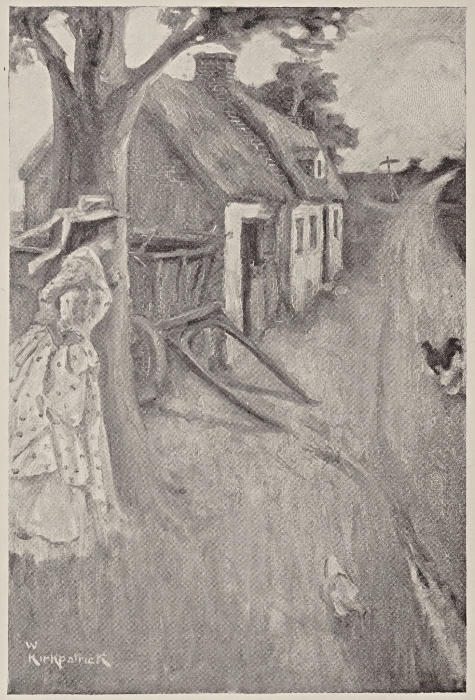
“Slipped quickly behind an old beech tree.”
Jean left the house filled with terrified dismay. Robert
going to marry another? then what would
become of her? She would be disgraced and ruined.
The thought drove her frantic. “He shall not marry
her; he shall give me the protection of his name, for
the time being at least,” she said to herself angrily.
Afterward, the marriage could be easily annulled; she
did not want him. She did not want to be tied for life
to any farmer, not she. She would then return to
Edinburgh. But suppose he would not consent to
such an arrangement? Well she would scare him into
it. He was as much to blame as she was anyway.
She would not wait to write him after all; she would
tell him now. There was nothing to fear. She would
wait until the others had started, then come back and
force her claim. If they went on without her, it
did not matter much; it was not far to the Inn, she
mused determinedly. She stopped in her rapid walk
and retraced her steps. As she neared the cottage
the door opened and her god-parents came out, and
with them were Robert and the others. Before they
could perceive her, however, she slipped quickly behind
an old beech tree back of the well and nearest
the house. Breathlessly, impatiently, she waited while
they talked, and talked, till she thought they would
never go. Then when the coach came and the attendant
excitement of its departure, like a guilty
creature she stole noiselessly across the intervening
space to the cottage, slipped through the open door,
and hid herself behind the fireplace, where Mary had
concealed herself some weeks before.
After Mrs. Burns left the room Jean came boldly
out from her hiding place and stood before the
startled couple, who gazed at her in amazement. She
looked at them insolently, a sneer on her full lips.
“Sorry to disturb you, Mr. Burns,” she interrupted
sarcastically. The color slowly faded from
his ruddy face. Was she going to expose that
shameful page in his past history to this innocent
child? Would she dare, could she be so reckless, so
shameless? he asked himself fearfully.
“I thought ye had gone,” he said, dangerously
calm, stepping up to her.
“I could not go till I had delivered a message,”
she explained, dropping her eyes before the determined
light in his.
“What is it?” he asked, puzzled by her tone and
manner.
“It is of great importance and for your ears
alone,” she replied glibly. “I’m sure this lady—Miss
Campbell, is it not?—will not mind leaving us
for a moment,” and she smiled amiably into Mary’s
innocent inquiring face.
He led Mary gently to the door. “It’ll be only
for a moment, Mary,” he said quietly.
“I dinna’ mind,” she answered brightly. “’Tis
near time for me to be going hame, ye ken,” and with
a smile she left them together.
“Noo, then, what is your message?” he said with
calm abruptness, as the door closed.
“This!” and she threw back her head defiantly.
“You must give up this Mary Campbell.”
He looked at her in amazement. “What do ye
mean?” he gasped, opening his eyes in bewilderment.
“I mean you must make me your wife.” Her pale
and agitated face made him wonder if she had gone
quite daft. Before he could answer she continued
stridently, “You must marry me now, before it is
too late, too late to save my name from dishonor and
disgrace. Now do you understand?”
A look of incredulous horror slowly blanched his
face to ashy whiteness. Had he heard aright? Surely
she was jesting; it could not be possible—and yet,
why not? His haggard eyes searched her colorless
face as though he would read her very soul. Calmly
she bore the scrutiny and then, with a groan of
anguish, he sank into a chair, weak and trembling.
“I canna, I willna, believe,” he muttered hoarsely.
“It’s a lie, it’s a lie, Jean Armour!”
“It’s the truth, I tell you,” she cried passionately,
wringing her hands. “What else think you would
force me, the rich Belle of Mauchline, to humble my
pride and stoop to plead to a poverty-stricken farmer
to wed me?” She laughed wildly.
“Can it be true, can it be true?” he whispered to
himself dully. He felt dazed by the suddenness, the
total unexpectedness, of the blow. He closed his eyes
wearily. What was it she wanted him to do, he
could not think. He sat dumbly waiting for her to
speak again.
“You must write out an acknowledgment and
sign your name to it,” she continued, her voice low
and insistent. “It is an irregular marriage I know,
but it will save me from my father’s wrath, when I
can keep my plight from him no longer.” He still remained
silent, his face hidden in his hands. “Will
you do this?” she demanded anxiously, “or,” and
her voice grew hard and threatening, “or shall I
appeal to the Parish officers to help me save my good
name from disgrace?” Quickly he raised his head.
At his look of indignant scorn she winced and
turned away, flushing angrily.
With a mirthless little laugh he retorted with
bitter emphasis, “Your good name, indeed!”
She turned on him defiantly. “I was no worse
than other girls,” she flippantly retorted. “Only
more unfortunate. Will you do what I ask? Quick,
tell me, someone is coming!” She nervously caught
his hand. He did not speak. His face grew haggard
and old-looking as he stood motionless, forming
his resolution. It seemed to her an eternity before
he answered her.
“So be it,” he answered hoarsely, drawing his hand
away from hers and moving slowly to the door. “I’ll
send ye the lines by the posty to-morrow.”
With a cry of delight she gratefully held out
her hand to him. But he quietly opened the door,
and, without a word or look at her, stood silently
holding it back, his head bowed low on his bosom, his
face cold and repellent. Slowly Jean walked past
him out into the deepening twilight. She felt a
dawning pity in her heart for the wretched lad. She
could not quite forget those old, happy days, those
stolen walks and trysts along the banks of the Ayr.
No one could make love so ardently as he, she
thought with a sigh. Of all her lovers he had been
the favorite, he was so ingenuous, so trustful and confiding,
and yet so reckless, so imprudent and weak.
She knew well he had never really loved her, and the
thought had made her strive all the harder to win him.
He was flattered by her open preference for him, and
soon became an easy victim, a slave, to her seductive
charms and sophisticated fascinations, for he was only
human. And now the heart of that little dairymaid
would be broken. A quick pang of shame and regret
stole over her, but she instantly stifled it. She must
think of self first, she told herself uneasily. Anyway
she only wanted the marriage lines in case people
should point an accusing finger at her. Later—well,
the marriage could be annulled privately, and no one
be the wiser, for marriages were easily annulled in
Scotland. She walked briskly to where the coach was
standing, for they were waiting for her, determined
to cast all gloomy, depressing thoughts from her for
the time at least.
Robert mechanically closed the door behind her
and walked slowly to the dresser. Taking from it a
bottle of ink and a quill, he carried them to the table,
and placing them upon it, sank heavily in a chair.
Long he sat there, pen in hand, the victim of the
profoundest melancholy, the deepest despair. The
thought that it was his own fault, his indifference to
consequences, his recklessness, his weak, sinful folly,
that had plunged himself and others into the awful
abyss of grief and sorrow, was like the bitterness of
death to him. As he sat there with drawn and haggard
face, while bitter regret gnawed deeply at his
conscience, the plaintive tones of Mary’s voice came
through the window, singing softly:
“Ye banks and braes of bonnie Doon,
How can ye bloom sae fresh and fair?”
A groan of agony escaped the grief-stricken
man at the sound of the voice, which was sweeter than
all else in the world to him.
“Mary, my lost Highland Mary!” he cried aloud,
“how can I give ye up forever?” and throwing himself
across the table he wept bitter tears of anguish
and remorse.
“How can ye chant, ye little birds,
An’ I sae weary, fu’ o’ care?”
continued the sweet voice in mournful cadence.
Softly the words floated to the ears of the sorrowing
man, like the echo of his own harrowing thoughts.
As Mary reached the open window she paused
and gazed into the room eagerly. As she sees her
lover sitting there so silent and alone, her smile is
very sweet and tender.
“Dear laddie; asleep,” she whispers softly. “He
must be o’er tired after his hard day’s work. God
bless my laddie,” and with a smile of ineffable sweetness,
she wafted a kiss to the bowed head and quickly
passed on, wending her lonely way back to Castle
Montgomery, while the man sitting there in agonized
silence, with clenched teeth and tense muscles,
slowly raised his head to listen, in heart-broken silence,
to her sweet voice floating back to him in silvery
melody, as she took up the broken thread of her
song:
“Thou’lt break my heart, thou warbling bird,
That wantons thro’ the flow’ring thorn.
Thou minds me o’ departed joys,
Departed, never to return.”
The song died away in the distance.
“God pity her, God pity me,” he murmured
brokenly.
From the huge, low ceilinged kitchen of Castle
Montgomery, which was ablaze with light, came the
gladsome sound of mirth and revelry, for
“Some merry countre folks togither did convene,
To burn their nits and pou’ their stocks, and hold their hallowe’en,
For blythe that night.”
For miles around the annual invitations had been
sent broadcast, and to-night the capacious kitchen
was taxed to its utmost. It was, however, a singularly
good-natured, if over-hilarious, gathering that had
assembled to do justice to old Bess’s cooking, and to
test their fate through the medium of the many
charms so well known to all the peasantry.
There was Poosie Nancy in her stiffly-starched
frilled cap and her new kirtle, complacently nodding
here and there to all of her acquaintances as
they flocked about her. Poosie Nancy was a merry
old soul. For years she had been the mistress of the
Arms Inn, the public house on the high road, where
Souter and Tam O’Shanter were wont to idle away
their time and, incidentally, their “siller.” Standing
on one foot behind her was Molly Dunn. Molly was
consciously resplendent in a new plaid frock, made by
her own unskilled hands, and while it was certainly
not a thing of beauty, it surely was a joy forever, to
the lassies, who laughingly twitted her about her
handiwork. But she heeded not their good-natured
jibes. She was admiringly watching Daddy Auld,
the little old minister, who sat in the midst of an
admiring group of his parishioners at the other side
of the room, who evidently stood in no awe of him,
judging from the bursts of laughter which greeted his
frequent attempts at jocularity.
“Where is Tam O’Shanter, Souter Johnny?” suddenly
asked old Bess, who was proudly doing the
honors as mistress of ceremonies. Souter was
assiduously paying court to the comely Poosie Nancy
in the opposite corner with an eye to future possibilities.
“He willna be here till late,” he replied impatiently,
addressing the crowd. “I left him at the Arms Inn,
an’ if he drinks much mair whisky, he will na’ be here
at all, I’m thinkin’,” and he turned eagerly to his
inamorata, who was fanning herself indifferently with
a plantain leaf.
“He’ll fall into the Doon some night an’ be
drowned, sure as fate,” said she, carelessly dismissing
the subject.
“Take your partners for the reel!” shouted big
Malcolm Macræ stentoriously, at this juncture. Old
Donald tuned up his fiddle with gleeful alacrity.
Souter ceremoniously offered Poosie his arm,
which she condescendingly accepted, and majestically
they walked to the middle of the floor. With
much laughing and joking and good-natured rivalry,
they were all quickly paired off, and soon the
rafters rang with the happy voices of the hilarious
dancers as they merrily sang to the tune that blind
Donald was scratching out on his old and faithful,
though unmelodious, fiddle.
Mary had taken no part in the merrymaking, for
she felt heavy and sad at heart. From her seat in
the corner, where the light was the dimmest, she had
watched the door with patient anxiety, hoping
against hope that Robert would come, but she had
waited in vain, and now the evening was nearly spent
and soon they would be going home, happy and tired
after their sport and entertainment, while she would
steal away to her quarters over the kitchen and cry
herself to sleep, as she had done for many nights
past. Souter Johnny, who was in his element and the
merriest of them all, had tried vainly to induce her to
join the revelers in their sport, and many an honest
laddie had sought her hand in the dance, only to
be shyly refused. So gradually she was left in peace,
and soon forgotten amid the excitement of their diversions.
They had tried some of the famous charms,
which decided the destinies of many of the lads and
lassies that night, and now old Bess brought forth
her long-hoarded bag of nuts, which she divided
among them. Amid shouts of mirth and laughter,
they proceeded to test the most famous of all the
charms. As they rushed pell-mell to the fireplace
and laid each particular nut in the fire, for which
they had named the lad or lassie of their choice,
and stood there eagerly watching, open-mouthed, to
see how they would burn, Mary, with a quickly beating
heart, stole unperceived close to the front row of
watchers, and with a little prayer, quietly threw her
pair into the fire. For a moment they burned slowly
side by side, then with a hop and a jump they popped
madly about, and finally at opposite sides of the
fireplace they glowed redly for a time, then expired
altogether. With a little, suppressed sob, unheeded
in the general excitement, she hurried back to her
seat, pale and trembling. It was as she had feared:
the course of their love was never again to run
smoothly, the charm had spoken. It had never been
known to predict wrongly. Why had she sought to
find out her fate? she asked herself pathetically.
Unheeding the merry songs and dances going on
around her, of which they never seemed to weary, and
the unco tales and funny jokes, she sat there thinking
her sweet, sad thoughts, and patiently waiting till
they should depart for their homes, that she might
seek the quiet of her bed, where her aching heart
might find relief in the tears which nowadays were
so hard to control. Suddenly the laughter subsided,
and Mary with a start raised her head to see all eyes
turned on her.
“Mary, come here, lass,” called Souter Johnny,
who was fanning himself vigorously.
“It’s your turn noo, Mary,” they cried boisterously.
“So gie us a dance or a song,” and they
all pressed around her with good-natured suggestions.
Old Bess took the shrinking girl by the hand, and
leading her forward, with a deep courtesy announced,
“Hieland Mary will favor us wi’ a song,”
then she left Mary standing in the center of the room
suffering agonies of dread as she raised her frightened
eyes to the group of laughing, good-natured,
gaping faces about her.
“I canna’ sing, I canna’ sing, Souter,” she faltered,
turning to him beseechingly.
“Yes, ye can, dearie, just a—a verse, there’s a
girlie,” he answered encouragingly. “Come and
stand beside me, if that’s any inspiration to ye,” he
added, smiling good-humoredly.
She ran to his side, and clutching him by the arm,
tried to muster up her courage, for the good-natured
audience were clamorously demanding a song. With
a frightened little gasp she began to sing the first
thing that came to her mind. “Oh, where, and oh,
where is my Highland laddie gone?” she faltered
out. A little titter passed through the crowd, for
they knew that “Rab Burns was nae longer sweet
on Mary Campbell,” as they told each other in loud
whispers. At the cruel sound Mary, whose lips had
trembled ominously as she thought of her recreant
lover, with an indignant look at the thoughtless ones,
burst into a flood of tears. Quickly Souter led her
sobbing to a seat, while the others anxiously crowded
round, conscience-stricken at their thoughtless levity.
“What’s happent? what’s happent? Has she
fainted?” they asked in helpless confusion, gazing
from one to the other.
“She’s only a wee bittie tired,” answered old
Souter, tenderly smoothing the hair of the sorrowing
lass. “Let her alone an’ she’ll be all right.
Donald,” he called, “start your fiddle; we’re gang
to hae anither dance.”
The blind old patriarch smiled serenely, and raising
his fiddle to his chin began to play, and soon the
mirth and fun grew fast and furious as the dancers
reeled and set, and crosst and cleekit.
While old Donald was playing, and the dance was
well started, Souter quietly led Mary out in the open
air, and sitting down on the doorstep, he drew her
gently beside him. “Noo, Mary, what is the matter?”
he inquired kindly. “Winna ye tell old Souter
Johnny your trouble?”
“Ye ken why I am unhappy, Souter Johnny,”
answered Mary apathetically. He sighed and remained
silent.
“Have ye an’ Robert quarreled?” he asked
presently.
“No,” she answered sadly.
“Weel, come tell old Souter; it may ease your
mind, lassie,” and he drew her plaid about her
shoulders, for the night air was keen.
“Well, ye ken, Souter,” she faltered, a pitiful
little break in her voice, “Robbie an’ I were to be
married after the plantin’ was o’er, and ’tis noo
harvest time, but ne’er a word has he spoke of our
marriage since that day. He is so changed, Souter,
I—I canna understand him at all,” and she leaned
wearily against his shoulder like a tired child.
“That Armour lass is at the bottom of it all, I
ken,” thought Souter angrily, drawing her close to
him.
“Perhaps,” continued Mary sadly, “perhaps he
has grown tired of his Highland Mary.” She plucked
idly at the fringe of her plaid, a look of resignation
on her sweet face.
“Tired o’ ye?” repeated Souter incredulously.
“A man would be a most fearful fool to gie up such
a bonnie, sweet lassie as ye are. Noo, if I were only
younger, Robbie Burns wouldna hae things all his
own way, I tell ye,” and he nodded his head vigorously.
“I ken he has some trouble,” said Mary, not heeding
his jocular efforts to cheer her, “that makes
him so unhappy like; if he would only let me share
that trouble wi’ him, whate’er it is, how gladly I
would do it.”
Souter rubbed his bearded chin reflectively.
“Weel, Mary, ye ken Robert’s a genius,” he
answered soberly. “An’ ye can ne’er tell how a
genius is gang to act, therefore ye must ne’er be
surprised, Mary, at whate’er he does, for genius is
but anither name for eccentricity an’—an’ perverseness,”
and he sighed deeply, his kind old face wrinkled
with perplexity.
“I feel, Souter,” she continued, pathetically calm,
“that I am slowly, but surely, drifting out o’ his
life forever.” She gazed suddenly into the face bending
over her solicitously.
“Dinna ye know the cause, Souter?” she asked
beseechingly.
He brushed his hand across his eyes and slowly
shook his head. She sighed patiently and turned
away her head and gazed listlessly into space. For a
few moments there was deep silence, broken only
by the bursts of laughter which came to them at
intervals from within.
“Lassie, listen to me,” finally said the old man,
his voice cheery and hopeful once more. “Ye
mustna be so down-hearted; there is a cause for
everything in this world, an’ I ken Robert loves ye
wi’ all his heart, just the same as ever. Why, ye
can see the glimmer o’ love in his e’e whene’er he
looks at ye.” He smiled approvingly as Mary’s face
brightened, then continued decidedly, “Robert is well-nigh
daft that he hasna heard frae Lord Glencairn
all this time; that is why he is sae worrid an’ nervous,
sae moody an’ neglectful; noo cheer thee, lassie, it’ll
all come right in time,” and he patted her shoulder
lovingly.
“Oh, I feel sae much better, Souter,” she murmured,
pressing his hand gratefully. “An’ noo I’ll
na borrow trouble any mair, thinkin’ Robert doesna’
love me.” She smiled happily and jumped lightly to
her feet.
“Whist, Mary, why dinna ye make sure o’ that?”
whispered Souter, looking around him mysteriously.
She looked at him wonderingly. “’Tis Hallowe’en,
ye ken, an’ a’ the witches an’ fairies are about this
night an’ will grant any wish made. Try a charm,
lassie.”
“I did try one,” replied Mary with a sigh. “I
burned the nuts, but it didna’ come out right; that’s
what made me sad.”
“Ah, weel, try anither; go pull a stock.”
“Oh, nay, I’m afraid to go out in the field at
night,” she replied timidly, drawing back. “But
I’ll go if ye’ll come wi’ me.” She held out her hand
to him.
“Nay, thank ye, Mary,” he said grimly. “I
dinna’ care to see the face o’ my future wife just
yet; I fear I couldna’ stand the shock.”
“Well, I darena’ go alone,” answered Mary decidedly,
her hand on the latch. “Think of anither
charm, one I can do indoors.”
“An’ do ye think the fairies will come around
where ’tis light?” he cried in amazement. “Och,
no, ye must go to the darkest place ye can find.”
His little round eyes gazed into hers with solemn
earnestness.
Mary shivered with apprehension and peered into
the darkness. “Oh, Souter, think o’ the witches,”
she said nervously.
“They willna’ hurt ye,” he answered a little impatiently.
“Ye maun sow a handful of hempseed
an’ harrow it o’er wi’ anything ye can draw after
ye, an’ repeat o’er and o’er,” assuming a guttural
monotone:
“Hempseed, I sow thee; hempseed, I sow thee,
And him that is to be my true love,
Come after me and draw thee.”
“And will I see him then?” whispered Mary
eagerly, drawing near to him.
“Aye,” returned Souter hoarsely. “Look over
your left shoulder an’ ye’ll see your future husband
pullin’ hemp. Noo, off wi’ ye; ye’ll find some
seed in the barn.” Mary tried to summon up her
courage, for she was highly superstitious, like all the
peasantry, and was anxious to test the potency of
the charm, and finally succeeded in taking a few
faltering footsteps in the direction of the barn,
when suddenly the door behind them opened, and
Molly Dunn appeared in the doorway. She held in
one hand a lighted candle, while in the other she carried
a broken piece of looking-glass, into which she
was gazing intently, her eyes fixed and staring.
Behind her, crowding through the doorway, followed
the now noiseless revelers, who were stifling their
laughter to breathlessly watch the outcome of the
well-known charm, whose power Molly had decided
to put to a test, though believing staunchly in its
potency. Molly majestically walked down the steps
and across to the well, where, depositing her mirror
on the curbing, she took from the pocket of her
skirt a round, red apple, from which she bit a
goodly piece and began vigorously to chew upon it,
the while holding her candle above her head and anxiously
watching her reflection in the mirror.
“Molly’s eatin’ the apple at the glass,” chuckled
Souter to Mary softly. “She’s lookin’ for the face
o’ her future husband. Let’s hae some fun wi’ her.”
He motioned to them all to keep silent, and stealing
softly over to the unconscious Molly, intoned in a
deep sepulchral voice, “Molly Dunn, if ye would see
your future husband, dinna’ ye dare turn your head
this way.”
Molly gave a shriek of terror, thereby choking
herself with the piece of apple she was industriously
eating, and falling on her knees, her teeth
chattering in fear, she cried frantically, “The
witches! the witches!”
“Nay, I’m the Deil himsel’,” answered Souter in
awe-inspiring accents. Molly groaned aloud, in mortal
terror, not daring to turn around. “An’ I’ve
come for ye, Molly Dunn,” slowly continued her
tormentor.
“Nay, nay!” cried Molly, her eyes staring wildly
in front of her. “I want naught to do wi’ ye; gang
awa’, gang awa’!” and she wildly waved her hands
behind her.
“Not till ye’ve seen the face o’ the man ye’ll
wed,” replied the voice. “Beauteous fairy of Hallowe’en,
come forth,” he commanded majestically,
beckoning to Mary to come nearer. She did so.
“Speak, kind fairy.” He whispered to her what to
say to the awestruck Molly.
Thus admonished, Mary, who was once more her
old light-hearted winsome self, raised her sweet voice
and spoke in a high falsetto, “Gaze in the looking-glass,
Molly Dunn; eat o’ the apple, think o’ the one
ye desire to see, an’ his face will appear beside
yours.”
“Behold, I pass the magic wand o’er your head,
ye faithless woman,” added Souter threateningly.
Hurriedly Molly complied with the injunctions,
and patiently she knelt there, apple in hand, the
candle light glaring full on her eager, ugly face, and
the wisp of faded hair tied tightly on top of her head,
which was waving wildly about, while she waited for
the face to appear beside her own reflection in the
glass.
“Do ye see him yet?” asked Mary eagerly,
forgetting her rôle of “The Fairy of Hallowe’en,”
and speaking in her natural tone, while the group
at the doorway drew closer to the kneeling woman in
their excited curiosity.
“Nay, not yet,” replied Molly in an awestruck
whisper.
“Hold the candle higher,” admonished Souter,
“an’ eat quicker.” Molly did so. “Noo do you
see your handsome lover?” He crept up slyly behind
Molly, and bending over her shoulder, peered
into the glass, where he beheld the shadowy reflection
of his own face looming up beside that of the wondering
Molly. With a gasp of pleasure not unmixed
with fear, she dropped the glass, and turning quickly
grabbed the surprised Souter and held him close. As
she raised her candle to see whom the fairies had sent
to her, she recognized her tormentor, and with a
shriek of rage, she clouted the laughing Souter over
the head with her candlestick, amid peals of laughter
from the delighted spectators, until he called for
mercy.
“Dinna I suit ye, Molly?” he asked in an injured
tone, nursing his sorely punished head.
“Ye skelpie limmer’s face, ye, how dare ye try
sich sportin’ wi’ me?” she cried angrily.
“The glass canna’ lie,” called out old Bess with
a shake of her frilled cap.
“An’ ye seen Souter’s face there, Molly,” laughed
Poosie Nancy loudly. “There’s no gainsaying
that.”
“I want a braw mon, a handsome mon,” whimpered
Molly. “Ye’re no a mon at all, ye wee skelpie
limmer.” The burst of laughter which greeted this
sally was very disconcerting to Souter, whose height,
five feet two inches, was distinctly a sore subject.
“Try anither charm, Molly,” said Mary, feeling
sorry for the poor innocent.
“Aye, I will,” replied Molly eagerly, drying her
tears with the back of her hand.
“Then come alang,” said Souter, ready to make
amends. “Come an’ pull a stock. Gie me your
hand.” She did so eagerly. “Noo shut your eyes
tight; that’s it; come along noo.” But Molly braced
herself and refused to move.
“I’m afeered o’ the dark an’ the witches,” she faltered,
her teeth chattering, her eyes so tightly closed
that her face was drawn into a mass of deep wrinkles.
They all crowded round the couple with words of
praise and encouragement, and presently Molly was
persuaded to take a step forward and then another,
and finally the two moved slowly away and were
swallowed up in the darkness.
Meanwhile the rest of the revelers, after a whispered
consultation, hurried to the outhouse, amid
smothered shrieks of laughter.
Molly and Souter walked slowly and timidly toward
the field of corn, which looked unreal and shadowy
in the pale moonlight. Molly’s few remaining teeth
were now chattering so loudly that Souter began
to grow nervous. He jerked her arm impatiently.
“Be a mon, Molly,” he hoarsely whispered, his
voice a little shaky.
“I’m afeered to,” she answered, opening her eyes
and looking fearfully around. They took a few
more stumbling step, then stopped.
“Och, get off my foot, ye towsie tyke!” cried
Souter. Molly hastily removed the offending member
and on they went again. Suddenly they stopped,
rooted to the spot in terror. A low, blood-curdling
moan had rent the stillness. Again it came, chilling
the very blood in their veins by its awful weirdness.
“The witches! the witches!” gasped Molly in
abject fear.
Turning, they beheld a sight that caused their
hair to stand on end, “the marrow to congeal
in their bones,” as Souter afterward explained the
sensation which came over him. Coming toward
them was a score or more of hideous apparitions with
fire blazing from their eyes and their horribly grinning
mouths, and groaning and moaning like lost
souls. With a mortal cry of terror, the frightened
couple sped on wings of fear back to the friendly
light of the kitchen, the ghostly figures darting after
them with diabolical bursts of laughter. As they
slammed the door of the house behind them their pursuers
stopped and quickly blew out their Jack-o’-Lanterns
and then threw them to one side.
“I didna ken mortal mon could e’er run so fast,”
snickered Poosie Nancy to the others as they noiselessly
entered the kitchen in time to hear the wonderful
tale of Souter’s hairbreadth escape from the
witches.
Another hour of mirth and jollity, of dance and
song soon sped around. Souter and Molly were still
the center of an admiring group, for they had seen
the witches with their own eyes, and that distinction
was theirs alone that night. Suddenly the old clock
struck twelve, then began a merry scrambling for
bonnets and plaids. Having donned them, they
noisily crowded around their hostesses, who were
lined up against the wall, waiting ceremoniously to
be thanked for their hospitality and to bid their parting
guests godspeed. As the darts of homely wit
and repartee flew back and forth among them, causing
the lads to burst into uproarious laughter or
to grin in awkward bashfulness, and the lassies to
turn their heads away blushingly or to toss their
curls coquettishly, the door burst in suddenly, and
Tam O’Shanter staggered to the center of the floor,
pale, wild-eyed, and disheveled.
“Tam O’Shanter!” they cried, gazing at him in
startled amazement. Souter quickly reached his old
cronie’s side.
“What’s the matter, mon? hae ye seen a ghost?”
he asked concernedly.
“Aye, worse than that, much worse,” hoarsely
replied Tam, wiping the sweat from off his forehead
with a trembling hand.
“What’s happened?” cried old Bess fearfully.
“Calm yoursel’ an’ tell us, Tam,” said Souter
soothingly. They brought him a chair, for he trembled
like an aspen leaf. Throwing himself into it,
he gazed about him fearfully, the while struggling
to regain his breath.
“Well,’tis this way, Souter,” he began presently
in a husky whisper. “I left the Arms Inn about an
hour ago or thereabouts an’ started for hame, for
’tis a long ride to Carrick, ye ken, an’ a most uncanny
ride e’en in the daylight.”
“That’s true,” affirmed Poosie Nancy with a nod
of conviction to the others.
“Weel,” continued Tam impressively, “a few
miles beyond the Maypole road ye have to pass a
dark, uncanny spot, the cairn where the hunters
found the murdered bairn. Ye ken the spot, Souter?”
turning to him for confirmation.
Souter nodded his head quickly. “Aye, Tam, I
ken it weel, for ’twas near there old Mingo’s mother
hanged hersel’.” Old Bess looked over her shoulder
nervously.
“Aye,” eagerly assented Tam, then he continued,
“Weel, a weird sight awaited me there; my blood
runs cold noo. Suddenly I heard a sound o’ music
and revelry, and Maggie stopped still, frightened
stiff. I looked up, and glimmering thro’ the trees
was auld Kirk Alloway all a blaze o’ light.” He
paused to note the effect of his astounding statement.
They looked at each other disbelievingly. Some
turned angrily away, muttering to themselves. Was
old Tam making sport of them?
“Go alang, mon,” cried Poosie Nancy with an
incredulous sniff of her pug nose. “’Tis naught but
an old tumbled down ruin.”
“I’m telling ye gospel truth,” replied Tam earnestly.
They crowded around again, ready to be
convinced, though still eying him distrustfully.
“Well, I was nae afraid,” continued Tam bashfully,
“for I was inspired by bold John Barleycorn,
so I rode Maggie close to the wall an’ there thro’
the openin’, I saw inside, and wow! I saw an unco
sight!” Tam was becoming warmed up with his
recital. The eager, excited faces crowding around
him had restored his courage and flattered his vanity.
He paused impressively, his eyes fixed and
staring, gazing straight past the faces of his
listeners as though he saw the unco sight again. He
noted with pleasure the frightened glances they gave
over their shoulders. Then he proceeded slowly in a
sibilant whisper, “There were warlocks and witches
dancin’ hornpipes and jigs around the Kirk, dressed
only in their sarks. There were open coffins standin’
around like clothespresses, an’ in each coffin stood a
corpse holdin’ in its cauld hand a burnin’ light. An’
by that light I saw two span-lang wee unchristened
bairns, white and cold upon the holy table.” Tam
wiped the sweat off his brow and moistened his dry
lips; then he proceeded with his harrowing tale.
“Beside the bairns lay a bloody knife wi’ gray hairs
still sticking to the heft an’——”
But with a shudder of fear, their faces blanched
and drawn, they exclaimed in doubting horror,
“Nay!” “Stop!” “Out on ye, mon!” “It’s nae
true!” etc. Tam was not to be cut off in the midst
of his tale so unceremoniously.
He rose excitedly from his seat and continued
rapidly. “The dancers were twisting and turning
like snakes, and there in a winnock-bunker sat Auld
Nick himsel’, in the shape of a beast, playing the
pipes. Och, friends, it was an inspirin’ sight, and in
my excitement I yelled out——”
“What?” cried the lads in unison.
“‘Well done, Cutty Sark!’” shouted Tam,
proudly, well pleased at his own temerity.
They boisterously applauded him for his courage,
but the lassies still clung to each other nervously.
“Then what happened, Tam?” asked Souter quizzingly.
He could not quite bring himself to believe
Tam’s improbable tale, he knew the old sinner so
well.
“Weel, the lights went out in an instant,” continued
Tam dramatically. “I had no sooner turned
Maggie’s head than out poured those unco witches
like bees buzzin’ in anger. I didna’ stop to meet
them, for Maggie, knowing her danger, bounded off
like a terrified deer and plunged off desperately
through the trees toward the brig with all these
witches followin’ wi’ eldritch screeches, close to her
heels till I could feel their breath on my clammy neck.
Oh, what an awful moment for me! but I knew if I
could but reach the keystone of the auld brig I
would be safe, for witches darena cross a running
stream, ye ken. Mag did her speedy utmost, but old
Nannie pursued close behind and flew at me with tooth
and nail, but she didna’ know my Maggie’s mettle,”
Tam laughed gleefully, “for with one grand leap
she reached the brig and saved her master’s life,
just as that Carline Nannie caught her by the
rump, an’ my poor Maggie left behind her old gray
tail.”
As he finished his recital he gazed around him
triumphantly. There was an audible sigh of relief
from all.
“That’s a burning shame,” said old Bess sympathetically,
alluding to the loss of Maggie’s tail.
“What a wonderful experience ye had, Tam,”
cried Poosie Nancy admiringly. They all congratulated
him on his narrow escape and pressed food and
drink on him, showered him with words of praise, and
in short made him out a daring hero, much to Souter’s
disgust. He sat apart from the rest in dignified
silence, his heart wounded and sore, for was not his
late ghostly exploit completely ignored and forgotten?
“Le Roi est mort, vive le Roi,” he might have
said to himself.
“Listen,” cried Tam, jumping to his feet, his face
tense with eagerness. Faintly the patter, patter of
a horse’s hoofs was heard drawing nearer and
nearer.
“’Tis only someone comin’ alang the highway,”
said Souter carelessly.
“’Tis my Maggie,” cried Tam almost tearfully.
“She’s comin’ back for her master,” and with a
bound he reached the open doorway. A few steps
took him to the stone wall along the other side of
which ran the King’s Highway. “She’s comin’, she’s
comin’, my faithful Maggie is comin’,” he cried joyfully.
“She must be an unco sight wi’out a tail, Tam,”
sneered Souter. A roar of laughter greeted this
sarcastic retort.
“Dinna’ ye dare laugh,” cried Tam, turning on
them furiously. The hoofbeats stopped suddenly.
In the misty moonlight they caught a glimpse of
a huge white creature, looking very spectral and
ghost-like, impatiently tossing its head from side to
side as if in search of something or someone. With
a glad cry Tam vaulted the fence, old as he was,
and dashed down the road, calling lovingly, “I’m
comin’, Maggie, I’m comin’ to ye.” A whinny of
delight, a snort of pleasure, greeted him as he reached
his old mare’s side. Then like a phantom, the old
gray mare and her rider sped swiftly past them on
into the night and away toward Carrick.
Silently they watched them, while the hoofbeats
grew fainter and fainter and then were lost to sound.
Such was Tam O’Shanter’s tale, the fame of which
soon spread throughout all Ayrshire.
In a sequestered spot beside the brook which runs
through the lower end of the big field at Mossgiel
farm, Robert sat dreamily watching the shallow brook
at his feet slowly trickle along over the stones. He
had left the field, his heart filled with anger against
his brother, who had been reproving him for his
thoughtlessness, his absent-mindedness; but gradually
his temper had melted, and removing his bonnet from
his fevered brow, he had given himself up to his
reveries. A little later Gilbert found him there, his
loose unbleached linen shirt open at the neck,
eagerly writing on a scrap of paper he held in his
hand.
The last few weeks Gilbert had thrown off his
cloak of habitual reserve, and had treated his brother
with less harshness, less severity. He had watched
the slowly drifting apart of the lovers with wonder
and delight. Could it be that they were tiring of each
other? he asked himself over and over again. If
that were so then perhaps some day—but he would
not permit himself to think of the future. He would
be happy in the present. For he was comparatively
happy now, happier than he had ever expected to be.
Since Robert’s avoidance of her, Mary had again
turned to him for sympathy, and once more they were
on their old friendly footing. True she was a sad,
despondent companion, but he was blissfully happy
just to walk beside her from kirk, to listen to the
sound of her sweet voice, even though his brother was
the only topic of conversation, to feel the touch of
her little hand as he helped her over the stile. He
thought of all this now as he regarded his brother in
thoughtful silence. Presently he called his name.
Receiving no answer, he strode through the overhanging
willows and touched him quietly on the shoulder.
With a start Robert looked up into his brother’s
face, then he turned slowly away. “What is wrong
noo, Gilbert?” he asked bitterly. “It seems I will
be doing nothing right o’ late.”
“Nothin’ is wrong, lad,” replied Gilbert, his face
reddening. “I—I only came to tell ye I am sorry I
spoke sae harshly to ye just noo.”
“Say no more, brother,” replied Robert quickly,
rising with outstretched hand, his face bright and
smiling. So ready was he to forgive any unkindness
when his pardon was sought. “’Tis all forgot. I
ken I do try your patience sore wi’ my forgetfulness
and carelessness, but I couldna’ help it. The voice of
the Goddess Muse, whom I adore, suddenly whispered
in my ear and I forgot my work, my surroundings,
and stood enraptured, entranced behind my patient
steed, catchin’ the thoughts and fancies that were
tumblin’, burstin’ from my brain, eager to be let
loose, and this is the fruit o’ my inspiration almost
perfected.” He handed his brother the paper on
which he had been writing.
“Is it a song of harvesting?” asked Gilbert sarcastically
without glancing at it.
“Nay,” replied Robert softly. “’Tis called the
‘Cotter’s Saturday Night,’ an’ ye will recognize, no
doubt, the character and the theme, for ’tis partly
of our own and of our father’s life I have written.
’Tis my best work, Gilbert, I ken truly.” He eagerly
watched his brother’s face as he slowly read the verses
through.
“May the light of success shine on it,” he said
kindly, when he had finished. “But it seems o’er
doubtful noo that the world will e’er see this, or any
of your verses, for not a word hae ye heard from
Edinburgh since ye sent Sir William Creech your
collection of poems.”
Robert raised his head and regarded his brother
in despairing hopelessness. “I ken it weel, brother,”
he replied. “And my heart grows sick and weary,
waitin’, waitin’, for tidings, be they good or bad.
Two lang months have passed since I sent him my
collection, an’ still not a word, not a sign. Nae doubt
they were thrown in a corner, overlooked an’ neglected.”
For a moment he stood there gazing across
the fields, his vision blurred by the tears of disappointment
which filled his eyes. “Oh, why did Lord
Glencairn raise my hopes so high?” he cried passionately,
“only to have them dashed to the ground
again.” Gilbert remained silent, his eyes cast down.
The sight of his brother’s misery touched him keenly.
But there was nothing he could say. “I believed him
and trusted to his honor, his promise,” continued
Robert dejectedly, “an’ for what?” He put on his
bonnet and clasping his hands behind him in his
characteristic attitude, slowly walked toward the cottage,
a prey to his gloomy thoughts.
“Be patient, Rob, yet a while,” said Gilbert
encouragingly, as he walked along beside him.
“Who kens what the morrow will bring forth?”
“The morrow?” repeated Robert grimly. “Methinks
I’ll ne’er know peace an’ tranquillity again
on this earth.”
They strode on in silence. As they neared the
cottage Gilbert laid his hand on his brother’s shoulder,
bringing him to a standstill. “Robert,”
he said quietly and firmly, “I want to speak to ye
about Mary.”
Robert turned his head away abruptly. “What
of her?” he asked in a low voice.
“What are your intentions toward her?” demanded
Gilbert earnestly. “Do ye intend to marry
her, or are ye but triflin’ idly wi’ her affections?”
Robert turned on him quickly. “Triflin’?” he
repeated indignantly. “Nay, Gilbert, ye wrong me
deeply.”
“Forgive me, but ye ken Mary is not like other
lassies to think lightly o’,” said Gilbert, his eye
searching his brother’s face keenly.
“Heaven forbid,” ejaculated Robert in a low,
tense voice.
“I canna’ understand your conduct o’ late,” continued
Gilbert earnestly. “I fear your stay in
Mauchline is responsible for the great change in ye,
for ye are not the same lad ye were when ye left
hame. I fear ye have sadly departed from those
strict rules of virtue and moderation ye were taught
by your parents, Robert.”
“What mean ye, Gilbert?” inquired Robert,
startled.
“Ah, Rob,” responded Gilbert, shaking his head
sadly, “I ken mair than ye think; reports travel e’en
in the country.”
The thought that his wild escapades were known
to his narrow-minded though upright brother, and
perhaps to others, filled Robert with sudden shame.
“Weel, Gilbert,” he replied, trying to speak lightly,
“Ye ken that I have been fallin’ in love and out
again wi’ a’ the lassies ever since I was fifteen, but
nae thought of evil ever entered my mind, ye ken that
weel.”
“Aye, I ken that,” answered Gilbert quickly,
“until ye went to Mauchline. And noo ye have
come back a changed lad, your vows to Mary forgotten.
If I thought ye would try to wrong
her——” he stopped abruptly, for Robert had faced
him, white and trembling, his eyes flashing indignantly.
“Stop, Gilbert!” he commanded, intensely calm.
“Mary Campbell’s purity is as sacred to me as an
angel’s in heaven. I would sooner cut my tongue
out by the roots than to willingly say aught to cause
her a moment’s misery or sorrow. Ye cruelly misjudge
me, Gilbert.” He turned away, feeling hurt
and angry that he should be so misunderstood by his
brother, and yet was he misjudging him, was he not
indeed causing her much sorrow? he asked himself
bitterly.
Soon the whole guilty truth must be disclosed,
his faithlessness, his unworthiness. If she suffered
now, what would be her misery when she learned
that an insurmountable barrier had arisen between
them, cruelly separating them forever. The thought
filled him with unspeakable anguish.
“Forgive me, Rob, for my hasty words,” said
Gilbert remorsefully. “But ye ken Mary is very
dear to—to us all; that is why I spoke so plainly.”
At that moment the door of the cottage opened and
the object of their discussion stepped into view. The
poor little moth could not help fluttering around the
candle, and so she was to be found at Mossgiel whenever
her duties would permit her to steal away.
“Oh, here ye are, lads,” she called out to them,
her face brightening. “Will ye be comin’ in to tea
noo?” They did not answer. “My, what long
faces ye both have,” she continued, smiling. “This
isna’ the Sabbath Day, so there’s no need of such
sorrowful faces.”
“I didna’ ken ye were here,” answered Gilbert,
going toward her.
Robert sat down by the well, the look of pain on
his melancholy face deepening as he listened to her
gentle voice. He closed his eyes wearily and leaned
back against the curbing, the paper held loosely in
his hand. It was so hard to realize that never again
would he press that form to his aching heart, that he
must renounce her utterly. Oh, if he could only die
now, how much better it would be for them all, he
weakly told himself.
“I’m going to stay here to tea wi’ ye this night,”
said Mary wistfully. Why didn’t Robert speak to
her just one word of greeting? she thought sadly.
“Your mother bade me tell ye supper is waiting
whenever ye are ready.” She took a few halting
steps toward the well. “Are ye comin’ in, Robert?”
she inquired timidly.
“In a wee,” he answered quietly, without looking
at her. “After I have finished my poem.” Mary
turned back, crushed to the heart by his apparent
coldness.
“Weel, lads,” cried Mrs. Burns brightly, stepping
out on the low, broad stoop followed by Souter, who
held a cup of steaming tea in one hand and some oatcakes
in the other, on which he nibbled with evident
relish. “I heard your voices and couldna’ stay
within,” and she beamed on them lovingly.
“Ye’re at it again, I see, Robert,” observed Souter
tactlessly. Robert flushed angrily. He was
easily irritated in his present state of mind. “Ye’ll
write yoursel’ into the grave, mon; ye’re not lookin’
very peart the noo.”
Mrs. Burns regarded her eldest son with anxious
eyes. “Aye, I fear, laddie, ye are too intent on your
rhymin’,” she said solicitously. His abstracted moods,
his melancholy moroseness had filled her loving heart
with gloomy forebodings. “Sae much livin’ in the
clouds, my son, is unhealthful, an’ does but make ye
moody an’ uncertain in temper. Is it worth while
to wreck body, mind an’ soul to gain a little fame
an’ fortune, which, alas, seem so very far off?” she
asked, putting her hand lovingly on his bowed head.
“Ye dinna’ understand, mither,” he replied sadly.
“I love to write. ’Tis my very life; thought flows
unbidden from my brain.” He rose to his feet and
pointing to the stream, which could be faintly seen
at the foot of the hill, continued with mournful finality,
“Why, mother, I might as well try to stop the
waters of yonder rushin’ brook as to attempt to
smother the poetic fancies that cry for utterance.
Nay, ’tis too late noo to dissuade me from my purpose,”
and he turned and watched the setting sun
slowly sink behind the distant hills in a flood of golden
splendor.
Souter noticed with uneasiness the gloom which
had settled upon them all as the result of his careless
words. Why was he such a thoughtless fool?
Ah, well, he would make them forget their troubles.
“Och, Mistress Burns,” he cried, smacking his
lips with apparent relish, “’tis a mighty fine cup
of tea, a perfectly grand cup. It fair cheers the
heart of mon,” and he drained it to the bottom.
“An’ where do ye think the oatcakes were made,
Souter?” asked Mary brightly.
“Weel, I’m no’ a good hand at guessin’,” he answered,
thoughtfully scratching his head; “but by
their taste an’ sweetness, I should say that Mistress
Burns made them hersel’.”
The good dame regarded him witheringly. “I
didna’ ken that oatcakes were sweet, Souter,” she
retorted.
Mary laughed softly at his discomfiture. “Weel,
they come frae my sister in Applecross.”
“Applecross!” he repeated, his face lighting up
with pleasure. “Noo I mind they did have the Highland
flavor, for true.”
“Aye, an’ ye finished the last one for that reason,
no doubt,” replied Mrs. Burns wrathfully. “Ye’re
a pig, mon. Come awa’, lads, your supper will be
gettin’ cold,” and she led the way inside, followed
meekly by Souter. Gilbert waited for Mary to
enter, but she stood wistfully gazing at Robert.
With a sigh he left them together, and Robert entered
the cottage.
Mary slowly approached Robert as he stood looking
across to the distant hills, and patiently waited
for him to speak to her, but he stood there in tense
silence, not daring to trust himself to even look
at the pure flower-like face held up to his so pleadingly.
“Robbie,” she said timidly after a pause, which
seemed interminable to them both, “willna’ ye let
the sunlight enter your heart an’ be your old bonnie
sel’ once mair? It will make us all sae happy.”
She put her hand on his arm lovingly. “Why are
ye sae changed, laddie? Dinna’ ye want me to love
ye any mair?”
At the gentle touch of her fingers an uncontrollable
wave of passionate love and longing came over
him, sweeping away all resolutions resistlessly.
“Oh, my Mary, my Mary,” he cried hoarsely. “I
do want your love, I do want it noo an’ forever,”
and he clasped her lovingly to his aching heart.
Blissfully she lay in his strong arms while he showered
her flushed and happy face with the hungry,
fervent, loving kisses which he had denied
himself so long, and murmured little caressing words
of endearment which filled her soul with rapture and
happiness. “How I love ye, Mary,” he breathed in
her ear again and again as he held her close.
“An’ how happy ye make me once mair, laddie,”
she answered, nestling against him lovingly.
“An’ how happy we will——,” he began, then
stopped pale and trembling, for grim recollection
had suddenly loomed up before him with all its train
of bitter, ugly facts; and conscience began to drum
insistently into his dulled ear. “Tell her the truth
now, the whole truth,” it said. But the voice of the
tempter whispered persuasively, saying, “Why tell
her now? wait, let her be happy while she may, put
it off as long as possible.”
“What is it, Robbie?” cried Mary fearfully.
“Tell me what is troublin’ ye; dinna’ be afraid.”
His bowed head bent lower and lower.
“Oh, Mary, I’m sae unworthy, sae unworthy of all
your pure thoughts, your tender love,” he faltered
despairingly, resolved to tell her all. “Ye dinna’ ken
all my weakness, my deception, and into what depths
of sin I have fallen.” She sought to interrupt him,
but he continued rapidly, his voice harsh with the
nervous tension, his face pallid from the stress of
his emotions. “I have a confession to make ye——”
“Nay, nay, laddie,” cried Mary, putting her hand
over his trembling lips. “Dinna’ tell me anything.
I want nae confession from ye, except that o’ your
love,” and she smoothed his cheek tenderly. “Ye
ken that is music to my ears at all times, but if ye
are deceivin’ me, if ye have na always been true
to me, an’ your vows, why, laddie, keep the knowledge
to yourself’. I am content noo, and ye ken
happiness is such a fleetin’ thing that I mean to cling
to it as long as I can.” She took his hands in both
her own and held them close to her heart. “Ye ken,
Robbie, ill news travels apace and ’twill reach my
ears soon enough,” she continued with a mournful
little quaver in her voice. “But no matter what
comes, what ye may do, my love for ye will overlook
it all; I will see only your virtues, my love, not your
vices.”
Robert bowed his head in heart-broken silence.
Grief, shame, and remorse like tongues of fiery flames
were scorching and burning into his very soul.
Quietly they sat there engrossed in their thoughts,
till the voice of Mrs. Burns calling to them from the
cottage to come to supper roused them from their
lethargy.
“We’re comin’ right awa’,” answered Mary
brightly. “Come, laddie, we mustna’ keep the folks
waitin’.”
She took his listless hand and drew him gently to
the door and into the cottage.
Silently they took their places at the table, around
which the others were already seated.
“By the way,” said old blind Donald, the fiddler,
who had dropped in on his way to Mauchline for a
bite and a cup, “Poosie Nancy told me to tell ye,
Mistress Burns, that she wa drop in to see ye this
night.”
“We’ll be glad to see her,” replied Mrs. Burns
hospitably.
“And Daddy Auld says he’ll be along, too,” continued
Donald, grinning broadly. “That is, if he
isna’ too busy convertin’ souls.”
“Convertin’ souls,” sneered Souter incredulously.
“Aye, ye should see the Jolly Beggars he was
haranguin’. They were jumpin’, an’ rantin’, an’
singin’ like daft Methodists.”
“The auld hypocrites!” cried Mrs. Burns, buttering
a scone which she placed in the old man’s tremulous
hand. “They didna’ go to the manse for conversion;
’tis a square meal they are after. They ken
the kind old heart o’ Daddy Auld.”
Souter leaned back in his chair and smiled reminiscently.
“That reminds me o’ a guid story,” he began,
chuckling.
“Never mind that story noo,” remonstrated Mrs.
Burns, who was in constant dread of Souter’s risque
stories. “That’ll keep.”
“I never can tell that damn story,” ejaculated Souter
wrathfully.
They had finished their meager supper, and now
sat comfortably around the fire, Mrs. Burns and
Mary busy with their knitting, the men contentedly
smoking, while old Donald discordantly tuned up his
fiddle.
“Noo, Donald,” said Souter briskly, “play us
something lively.”
“Aye, I’ll play ye the Highland Fling, Souter
Johnny, an’ ye can dance. Come alang noo,” and
he started to play vigorously, keeping time with his
foot.
“Aye, get out on the floor, Souter,” said Gilbert,
pulling him out of his chair.
“Nay, nay, lad,” expostulated Souter fretfully,
“I be too old to fling the toe noo.”
“Go alang wi’ ye, mon,” retorted Mrs. Burns
encouragingly; “a Scotsman, and a Highlander besides,
is ne’er too old to——”
“To learn,” interrupted Gilbert brightly, swinging
the old man to the middle of the floor. “Let her
go.”
“I havena danced for years,” said Souter apologetically.
Carefully knocking the ashes out of his
pipe he deposited it in the pocket of his capacious
waistcoat and proceeded to divest himself of his coat.
“Ye ken I was the champion dancer of my clan, Clan
McDougal, when I was a young lad,” he announced
boastingly. “An’ mony a time I have cheered an’
amused the lads, while tentin’ on the fields of Culloden,
before the big battle. An’ that reminds me o’
a guid——”
“Never mind the story,” said Gilbert impatiently.
“Gie us a dance.”
After a few preliminary movements Souter caught
the swinging measure of the dance, and once started
he limbered up surprisingly. On he danced nimbly,
and untiringly, soon ably proving to his delighted audience
that he had not forgotten his old-time accomplishment.
“I’ll show these Lowlanders what a
Highlander can do,” thought the old man proudly.
Panting with excitement and eagerness he failed to
hear the metallic patter of horses’ hoofs drawing
near the cottage. Nearer and nearer they came
unheeded by all save one.
From his seat by the fireplace, where he sat in
melancholy silence, Robert heard the sound, but gave
it no heed. Suddenly it ceased. He raised his head
to listen. Someone had surely stopped at the gate,
he thought, straining his ears eagerly, but the noise
of the fiddle and the dancing drowned all sound
from without. He glanced quickly at the smiling
faces of the others as they good-naturally watched
the dancer. “I must hae been mistaken,” he muttered
uneasily. Suddenly he leaned forward, grasping
his chair hard; surely he had heard his name
faintly called. He listened intently. Yes, there it
was again; this time the voice was nearer. A woman’s
voice, too. What could it mean? He rose to his
feet, his heart thumping fiercely, his muscles alert
and tense, his eyes fixed on the door, his mind filled
with gloomy presentiment.
At that moment an imperative knock sounded
loudly through the room, and almost at the same time
the door flew open violently, and Jean Armour impetuously
dashed in. Closing the door quickly behind
her she leaned back against it, pale and
exhausted. Her riding habit of green and gold was
splashed and discolored with mud. The large hat
with its gleaming white plume hung limply over her
shoulder, while her black disheveled hair streamed
over her face and down her back in bewildering confusion.
She had evidently ridden fast and furious,
for she stood there with her eyes closed, her hand on
her heart, gasping for breath.
Quickly Mrs. Burns led the exhausted girl to a
seat. In a few moments she raised her drooping head
and with wild frightened eyes searched the room till
her gaze fell on Robert, who was leaning white and
speechless against the fireplace, a great fear in his
heart.
She rose quickly and going to him said in a tense,
rapid whisper, “Robert, my father knows all, but
through no fault of mine. Some idle gossip reached
his ear to-day, and when he returned home and learned
my condition his rage was terrible. He cursed you
like a madman, and would have done me bodily harm
had I remained within sight. But I feared for my
life, and fled before I had explained the truth to him.
I have come to you to protect me.”
He listened to her in stony silence. The blow had
fallen so suddenly, so unexpectedly, it found him
totally unprepared to ward off its paralyzing effects.
He tried to speak, but the words refused to leave his
parched tongue. He felt benumbed and cold, all the
blood in his body seeming to have suddenly congealed.
As he stood there with the eyes of all riveted upon
him he felt like the veriest criminal that walked the
earth.
For a moment there was a tense silence. Jean
stood there anxiously gazing into Robert’s stricken
face, as he vainly strove to utter a sound. Mary
had watched the little scene before her in growing
wonder and alarm and now leaned back against the
wall, her heart beating with some unknown, nameless
fear. What did this highborn lady want with her
laddie? she asked herself jealously.
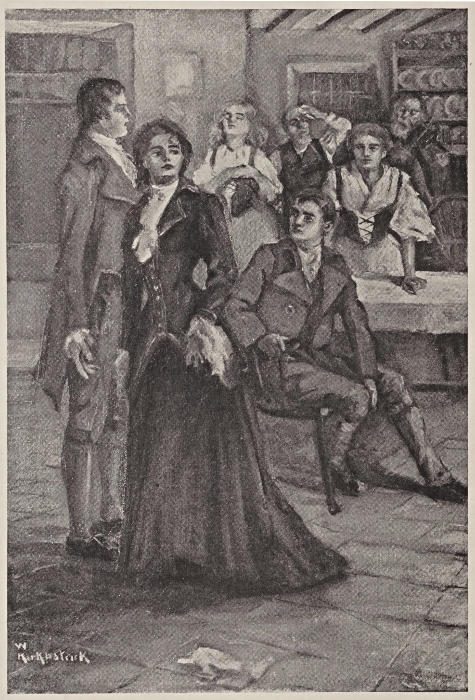
“‘She is my wife, mither.’”
Mrs. Burns stood grimly waiting for some explanation
of the scene she had just witnessed, but
had not heard nor understood. “Robert, my son,”
she said finally, her voice cold and firm, “what
does Squire Armour’s daughter want of ye?” There
was no answer. “What is she to ye, Robert?”
she sternly insisted. Slowly he raised his head. As
she saw his wild and haggard face, from which all
the life and youth had fled, she started back in
horror, a startled exclamation on her lips.
With a despairing, heart-broken look at Mary’s
wondering face, he bowed his head and falteringly
uttered the fatal words, “She is my wife, mither.”
Had a thunderbolt from a clear sky unroofed
the humble cot, it would not have created the consternation,
the terror which those few words struck
to those loving hearts.
Mrs. Burns was the first to rally from the shock.
“Your wife?” she repeated incredulously, looking
from one to the other.
With a cry of grief and pain Mary sank weak
and trembling into a chair, like a deer wounded unto
death. She gazed at them heart-brokenly, while her
little hands nervously fluttered about her face. No,
no, he could not mean it. They were only joking,
surely. “Not that, Robbie, ye dinna mean that,
dearie?” she gasped piteously, holding out a beseeching
hand to him. His bowed head bent lower.
“Do ye mean ye have legally married this lass?”
asked Gilbert eagerly. Mary would be free then,
he thought wildly. Free to be wooed and won.
“We were married a few weeks ago,” answered
Robert dully. “I had not the courage to tell ye
before.”
“Besides,” interposed Jean, arranging her disordered
toilet, “I wished to keep the marriage from my
father for a—a time.” She blushed crimson.
“I willna believe my son ever married ye of his
own free will,” cried Mrs. Burns bitterly, “fine
rich lady that ye are. He loves only that sweet
lass, Mary Campbell.” Quickly she reached Mary’s
side, and, raising the stricken child in her motherly
arms, she kissed her tenderly and pressed the golden
head gently against her loving heart.
Jean looked at them, a look of resentment in her
flashing eyes. “I know that full well,” she answered
sullenly. “I know Robert hasn’t married me because
he wanted to, but because——” she looked down
shame-faced. “Because there was no alternative.
Now you know the truth,” she concluded bitterly.
“Ye shameless creature!” cried Mrs. Burns, her
eyes blazing with indignation. “Ye have trapped
him into this marriage, but ye shall na stay beneath
this roof, ye limmer,” and she glared at the flushed
defiant girl in righteous anger.
“Mither, mither!” cried Robert distractedly,
“dinna, for God’s sake; she is my wife in truth, an’
she must stay wi’ me noo till I can prepare anither
hame for her. Dinna make it harder for me.” He
gazed pleadingly in his mother’s stern and angry
face.
Mary pressed her lips to the quivering cheek.
“Mistress Burns,” she said softly, “what is to be,
will be. I forgive them both wi’ all my heart.” She
paused and sighed with gentle resignation. Then she
continued, “An’—an’ I hope they will both find peace
in their new life.” She turned quietly to Jean, who
was nervously tapping her whip against her skirt.
“I ken ye’ll make Robert a good wife,” she said
earnestly. “So dinna let any thought o’ me sadden
your heart, or—or yours, Robert.” She turned and
looked at him tenderly. “I—I forgive ye,” she
whispered. Turning to Mrs. Burns again, she continued
pleadingly, “Ye must welcome Robert’s wife
to her new hame, Mistress Burns. We all maun make
this a merry hame-comin’ for—the—bride.” Her
plaintive voice broke abruptly, and the burning tears
welled up to her eyes, but she dashed them quickly
away and continued bravely, a pathetic little smile
hovering about her trembling lips, “I’ll go out noo
an’ make some fresh tea for ye, and ye’ll all stay
right here, till I come back, an’ Donald shall play
for ye again—an’ we’ll—all—be—sae merry—won’t
w-we? I’ll bring it w-when—it’s quite—ready.”
She smiled at them through her tears. Then she took
the teapot from the dresser and softly left the room.
“God bless her brave and noble heart,” breathed
Robert brokenly.
As she left the room Mrs. Burns drew herself
sternly erect, and after a moment’s hesitation turned
slowly to Jean. “I bid ye welcome to Mossgiel
Farm,” she said coldly. “I am sorry I spoke so
bitterly to ye just noo. I—I will try to love ye as
Robert’s wife, but noo I—I can only think o’ Mary
an’ her sorrow. I’ll leave ye for a bit; Mary may need
me.” Her voice faltered and broke, and with a sob
of grief she hurriedly left the room.
Ever since the morning she had received her marriage
lines Jean had been trying to summon up
sufficient courage to tell her father the whole truth
about her secret marriage to Robert, to throw herself
upon his mercy, but each time when she had
approached him in fear and trembling, her courage
had ignominiously failed her. She knew only too
well her father’s irascible temper and uncertain
moods. And so days passed into weeks and still
she procrastinated, but she knew she could not conceal
from his observing eyes her condition much
longer. But whether to confess all and run the
risk of being thrown from her father’s door like
some abandoned outcast, or to contrive some excuse
to leave home to pay a visit to some friend, and
then, when it was all over, to return, that was the
question which disturbed her waking thoughts. If
she did the latter, she thought, she could easily have
her marriage annulled and no one would be the wiser.
But did she really want to have her marriage annulled?
she asked herself thoughtfully. She didn’t understand
herself at all these days. He had strangely
stirred her heart at their last meeting, to its very
depths. She knew he did not love her, that he
loved the little dairymaid, but almost imperceptibly
a great change was taking place in her feelings toward
him. At times a great longing came over her
to go to him, throw herself at his feet and beg to
share his hardships, his poverty, with him. But she
had not the courage, and so she battled with the conflicting
emotions that constantly beset her day and
night. Her temper soon became moody and uncertain,
she was in constant fear of her mother’s anxious,
watchful eyes, and yet she felt she would go daft if
she remained alone in her chamber with her disturbing
thoughts. So day after day she could be found in
her saddle madly galloping over the country, trying
to get away, far away, from her trouble. But all in
vain; it was always before her; there was no escaping
it. But at last the day came when she knew she
must make her decision, and almost in desperation
she decided on her course of procedure. Hastily
galloping home, she left her horse at the door, and
going to her room, scribbled a short note to her father
and left it on the table in his study. Then she had
slipped guiltily past the room where her mother sat
peacefully sewing, and sped swiftly along the hall to
the door. As she reached it, it burst inward and she
staggered back half fainting, for there on the threshold
stood her father, his face white with rage, his
jaw set and determined. He seized her roughly by
the arm, and thrusting her back into the house, had
taken one understanding look at her figure in its
tight-fitting habit, then with an outburst of bitter
anger and shame he cursed her and the author
of her disgrace, cursed her like a madman, cursed
her till he was spent with the force of his passion.
She tried to explain, to tell him the truth, that she
was a wife, but the words froze on her lips. His
words and manner struck terror to her very soul;
she feared for her very life’s safety. With all her
despairing strength she freed herself from his
clutch and stood cowering, panting, her hands raised
to shield herself from the blow she expected every
moment to fall on her defenseless body from the
insane man. As he approached her with hand upraised,
she gave one quick shriek, one wild look
around and darting under his arm reached the door.
Quickly she opened it and sped like a swallow to the
side of her waiting horse. With one bound she was
on his back, and away she galloped like the wind,
leaving her astonished father standing in the doorway
shaking his fist after her in impotent anger.
She had given rein to her horse, not heeding or
caring where he took her. Her one and only thought
was to get away, far away; so she rode on and
on, over brook and brush, through bog and mire
till gradually her fear had subsided, and, reining
in her horse, she looked around, and with a thrill
of joy and wonder she saw Mossgiel Farm in the
distance. Surely fate had guided her horse’s footsteps
in this direction, she thought eagerly. Her
course was clear now, she would go to him, to her
husband, he would protect her. So she had continued
her journey to the cottage, where she brought naught
but misery and sorrow to its inmates.
As Mrs. Burns left the room Jean gazed after her
in bitter silence. She wished she had not come. She
knew she was not welcome. Far better to have faced
her father’s anger. “But the die is cast. I have
made my bed,” she told herself wearily. She realized
how futile it was to repine over the past, and she felt
too exhausted, too miserably unhappy to think of the
future. She would stay here perhaps a night, then
she didn’t know, couldn’t think what would happen.
At all events she could never return to her father’s
home now. He had spurned her from him, and she
was not wanted here. Nobody wanted her now. Her
lips quivered convulsively and big tears of self-pity
rolled quietly down her pale cheeks.
Gilbert looked uneasily from his brother’s grief-stricken
face to the weary, wan face of the bride.
How long were they going to sit there side by side
without a word to each other? he thought uneasily.
He felt a great wave of pity well up in his heart for
the unwelcome, unloved addition to their family.
True she was mostly to blame for her present misfortune.
Her imprudence, her misconduct had been
well known to many, before his brother had gone to
Mauchline to live. He felt sorry for Robert, too,
even while he bitterly reproached him for being the
author of Mary’s unhappiness. They must make the
best of things now, he thought philosophically. “Ye
had better take off your bonnet, lassie,” he said
kindly, breaking the oppressive silence. “Ye’ll be
staying here the night.” She raised her head and
looked at him with flashing eyes.
“Full well I know that all here hate and despise
me,” she burst forth bitterly, not heeding his request.
Robert slowly raised his head and looked at her.
There was sorrow and compassion in his dark melancholy
eyes. “Jean,” he said quietly, “our lives
have been linked togither by a stern, inexorable fate.
We have both been guilty of a grievous sin, and noo
we must face the results bravely.” He rose and
walked to her and stood humbly by her side. “I
hope ye’ll forgive me, Jean, for wreckin’ your life
and plungin’ ye into sae much misery.”
Slowly Jean bowed her head, her face flushing
guiltily. Surely she had the more need to ask his
forgiveness. She had not expected to find such nobility
of character, and it moved her deeply.
“There is naught to forgive,” she cried in a low
stifled voice. “I alone am to blame. I am unfit,
unworthy to be your wife. Oh, I’m so miserable, so
unhappy,” and she burst into tears.
Souter led old Donald silently out of the room.
There was nothing either one could say to the
wretched couple, so they sat outside and talked it
all over in the way old men have. They had not
been seated long, however, when they espied coming
toward them, at a furious gallop, a horse and rider.
As they drew near Souter perceived with sudden
apprehension that it was none other than Squire
Armour. He rose anxiously to his feet.
“Do ye ken wha’ it is, Souter?” inquired Donald
in a quavering voice.
“It’s Squire Armour himsel’,” whispered Souter
cautiously.
“Ma certie!” ejaculated Donald, shaking his
white locks in mild alarm.
“I’d better warn the lass,” said Souter hastily,
as the Squire drew up to the gate. Going to the
door he quickly told them of the newcomer, then
turned to intercept the irate visitor, who was coming
swiftly up the walk.
“Heavens, my father here!” cried Jean in a
frightened whisper. “Oh, I dare not face his wrath.
Protect me, Robert,” and she clung to him fearfully.
“Out o’ my way, mon!” they heard the harsh
voice of Squire Armour shouting. “Out o’ my
way,” and pushing aside the courageous little man he
strode wrathfully into the room.
“Weel, I’ll stay and see the fun through,” said
Souter to himself grimly.
“So, my lass,” cried the old Squire triumphantly,
“I’ve found ye just where I expected ye’d be, in the
arms o’ your dissolute lover. Come awa’, ye shameless
bairn.”
He started toward her, but Robert passed
her quickly behind him.
“Keep back, Squire Armour,” he said firmly.
“I’m nae a mild-mannered man, an’ ye may learn it
to your cost.”
Squire Armour glanced at him savagely. “Dinna
ye dare talk to me, ye libertine, ye blasphemous
rhymster. Ye dare to stand there wi’ my daughter,
proclaiming her dishonor to my very eyes?”
“There is no dishonor, Squire Armour,” replied
Robert calmly, “for your daughter is—my wife.”
“Your wife!” echoed the old man, staggering
back in amazement. “I’ll nae believe it. It’s a lie.
I’d rather see my daughter disgraced forever than be
your wife.”
“Father, are you mad?” gasped Jean in horrified
accents.
“An’ ye an Elder in the Kirk, a so-called ‘God-fearin’
man’!” cried Robert scathingly, his eyes
blazing with scorn. “I tell ye, Squire Armour, she
is my wife, an’ all your bitter, unreasoning hatred
o’ me canna’ alter that unhappy fact.”
For a moment the old man stood gazing at them
in helpless rage. Then he turned to Jean, his voice
trembling with suppressed emotion. “What proofs
have ye?” he asked hoarsely.
“I have my marriage lines, father,” she answered
quickly.
“Where were ye married?”
“Why, father, we——” began Jean hesitatingly.
“Was it in the Kirk?” he interrupted sternly.
“No,” she faltered. “It was——”
“Not in the Kirk?” he cried, his voice rising
menacingly. “Who was the minister? Who married
ye?”
“There was no minister, father.”
“Nae minister!” he exclaimed in horror.
“Wait, father, you don’t understand,” cried Jean
quickly; “’twas a Scotch marriage; ye ken what that
is—and,” she bowed her head guiltily, “why it is.
And here are my lines signed by Robert acknowledging
me as his wife.” She took from the bosom of her
gown a folded paper which she handed to her father.
He read it through carefully. “This is na legal
or binding,” he exclaimed angrily.
“’Tis perfectly legal, Squire Armour,” replied
Robert calmly, “even if it is irregular, and is as binding
as though we were married in Kirk.”
“It shall be set aside,” fumed the old man. “I
will not have it so. Ye shall both renounce it, I
tell ye.”
“Oh, father,” cried Jean tearfully, going to his
side. “’Tis too late now; would you shame me in
the eyes of the world?”
“Do these few written lines make your shame
any the less?” he shouted wrathfully. “Will not
all the neighbors know why he had to give them to
ye? Ye would throw awa’ your life on this poverty-stricken,
shiftless rhymster, but ye shall not do it;
ye must give him up, do ye hear?” and he raised
his arm menacingly.
“No, no, no, father,” she exclaimed frantically,
falling on her knees beside him; “I cannot give
him up now, I cannot.” After all the weary weeks
of anxious fears and doubts she knew at last that
she had found her heart, and now asked no greater
happiness than to be allowed to remain with her husband
to share his humble life, to be the mother of his
family. All the old ambitious thoughts were gone
forever. She wondered that they ever existed.
“Ye shameless bairn, ye must an’ shall!” he replied
fiercely. “This is the end o’ it all,” and he
vindictively tore into little bits the paper Jean had
given into his hands. “We’ll hear nae mair of that,
my lass, an’ I swear ye shall never see Robert Burns
again, make up your mind to that.”
With a cry of despair Jean sank half fainting
into a chair.
As he witnessed Squire Armour’s fiendish act
Robert’s heart gave a great bound that sent the
blood coursing madly through his veins. The marriage
lines were destroyed; then he was free, free!
Oh, the music in that word! Free to do as he
wished. A sob of anguish caused him to look around
at the kneeling figure of the unfortunate girl.
Quickly the eager light died out of his face as he
noted her suffering. Going to the kneeling girl he
raised her gently to her feet, and holding her by the
hand faced the inhuman father. “Squire Armour,
ye would condemn your ain flesh an’ blood to shame
an’ disgrace because o’ your hatred for me,” he said
quietly, “but it shall not be. I defy ye. Come,
Jean, we will go to the Kirk at once and Daddy Auld
will marry us.” They turned to go, but the old man
stepped between them and the door, his arms upraised,
his eyes wild and glaring.
“I’d sooner see her in her grave than bear the
accursed name of Robert Burns,” he cried with
solemn intensity. “Great though her imprudence
has been, she can still look to a higher, an’ better
connection than a marriage with ye.” Turning to
Jean he continued sternly, “Speak, lass, say that
ye’ll obey me, or the bitter curse o’ your parents
will haunt an’ follow ye all the rest o’ your
days.”
“Think of the disgrace, father,” wailed the unhappy
girl, clinging to his arm beseechingly.
“We’ll forget and forgive it all if ye’ll come
back,” he replied, the great love for his child revealing
itself in his eager tones. “Ye’re nae longer that
man’s wife. Come an’ none will ever know o’ your
dishonor.”
“My God, mon!” exclaimed Robert in horrified
accents, “where is your father’s pride, your ain
honor, your manhood!”
But Squire Armour heeded him not. “Come, my
daughter, come,” he said tenderly, leading the weak,
wavering girl to the door.
“Ye canna expect to keep this a secret from the
world, Squire Armour,” cried Robert indignantly.
“Matters have gone too far for that; soon your
daughter’s name will be blasted irretrievably, while
mine will be coupled with that of blackguard. It
must not be. Ye must let Jean go to the Kirk wi’
me this very night or I shall inform the Elders in the
Kirk.”
“Ye’ll have no time to turn informer, my laddie,”
snarled Squire Armour, turning on him fiercely;
“for I mean to have ye brought before the Kirk
sessions, an’ ye’ll be punished as ye deserve for the sin
ye have committed, an’ ye shall sit on the cutty
stool, where all your friends an’ neighbors can jeer
an’ scoff at ye. This very night will I send the
parish officers after ye, Robert Burns. Ye can take
this warning or no, just as ye please, but I hope they
find ye here. Come, lass, we’ll go hame to your
mither, noo.” He drew the terrified, half-fainting
girl firmly through the door and down the path to the
road.
“Ye’re an old hypocrite!” hooted Souter, following
them to the gate, where he stood shaking his fist
angrily after the departing visitors, and shouting his
frank opinion of the Squire in no mild or flattering
terms.
“I alone am to blame,” cried Robert despairingly,
as he watched them gallop madly away into the
threatening night. “An’ only the bitterest sorrow,
the most poignant grief will I know until that wrong
is righted.”
“What will ye do noo, lad?” asked Mrs. Burns,
breaking in upon the melancholy sadness which enveloped
him like a pall. (She had entered the room
in time to hear Squire Armour’s parting injunction.)
“Ye heard what the Squire threatened. Oh, dinna
disdain the littleness of prudence, my son.”
“I willna, mother,” replied Robert dully, after a
pause. “I have decided to go awa’ from Mossgiel.”
“Go awa’?” she repeated fearfully. “Nay, nay,
laddie, ye mustna! I fear for ye in your present
state o’ mind.”
“I must, mother,” he answered wildly. “I willna
sit on the cutty stool to be made the laughing stock
o’ the whole neighborhood, to bring shame on ye
all.” He walked restlessly up and down the room
as he continued feverishly, “I willna stay here to
skulk from covert to covert under all the terrors
of a jail, for I ken that in a little while the merciless
pack of the law will be baying at my heels
like bloodhounds.” He turned to her suddenly,
“Mother, I mean to leave Scotland, perhaps forever.”
“Oh, nay, nay, my bairn; I canna, I willna, let ye
go,” answered his mother, clinging to him passionately.
“There, there, mither, dinna make it harder for
me.” He put his arm around her tenderly and pressed
her to him for a moment. “Noo, mother,” he said
quietly, “will ye pack my chest? I have nae time to
spare,” and he led her gently to the door.
“Where will ye be goin’?” inquired Gilbert.
“To the Indies, to Jamaica,” replied Robert
quickly. “Ye ken Dr. Douglas has a place for me
there as overseer of his plantation. He has offered
it to me mony times.” He turned in nervous haste
to his mother, who stood in the doorway anxiously
watching him. “Hurry, mither, please, I am in torture
o’ mind.”
“Very well, laddie,” she answered sorrowfully.
“God will direct your footsteps aright,” and she
closed the door behind her and quickly made her way
to his chamber.
“Will ye see Mary before ye go, Robert?” asked
Gilbert.
He felt an infinite pity for his brother, who was
leaving behind him everything he held dear.
“If she will come to me,” faltered Robert. “Tell
her I’m goin’ an’ that I will go wi’ a lighter heart
if she bids me godspeed. Watch o’er an’ protect
her, Gilbert,” he continued, placing his hand on his
brother’s shoulder. “An’ I hope one day she may
forget faithless Robert Burns, an’—an’ ye, Gilbert,
will be made happy.” He turned away as he
finished, grief gnawing at his heart.
An eager light flashed in Gilbert’s eyes as he answered
fervently, “I would lay doon my life to serve
her,” and with a quick look into the averted face he
quietly left the room.
Mechanically Rob took his bonnet from the peg
and throwing his long plaid around him went out into
the air, and silently, sorrowfully he stood there
watching the gloomy clouds that hung low in the
heavens through eyes misty with tears. His soul
was filled with unutterable sorrow at the coming
parting, with dread of the unknown future to be
passed alone in a strange, inhospitable foreign land.
Oh, the agony of that thought, alone! Suddenly
there came floating softly, peacefully, borne on the
back of the south wind, which was blowing gently
against his face, the alluring, seductive voice of the
Goddess Muse. Insistently she urged her way into
the dulled and listless ear of the grief-stricken man.
Not for long was she denied admission, however.
With a cry of joy, that even in that dreaded hour of
parting his Goddess had not deserted him, he eagerly
opened the book he held in his hand, his favorite book,
“Tristam Shandy” by Sterne, and wrote quickly,
lovingly on the flyleaf the impassioned words which
were being whispered in his ear. Hungrily the pencil
sped over the paper, till, with a sigh of regret,
he dropped his hand, the voice was hushed, the message
was finished. As he stood there eagerly reading
his verses by the light which streamed through
the window, the door softly opened and Mary came
swiftly to his side, her pure face pitiful in its childlike
sorrow.
“Is it true ye are gang awa’ frae Scotland, Robbie?”
she asked breathlessly. He bowed his head.
“Oh, my heart beats heavy for ye, laddie.” There
was infinite compassion in her voice. “But ye maun
be brave noo if ever ye were.” She nestled her little
hand in his. He clasped it fervently.
“O, Mary, my Highland lassie!” he cried passionately,
“I want to hear ye say before I go that ye
forgive me for the sorrow I have brought into your
pure young life.”
“Hush, laddie,” she answered softly, “there is
naught to forgive; ye had to do your duty like
an honorable mon. I hae been very happy wi’
ye, laddie, an’ the memory o’ that happiness will
be wi’ me always.” She leaned against him for a
brief moment, then slowly drew herself away and
looked tenderly up into his face. “In this sad parting
hour,” she faltered, “I can tell ye without shame
that I love ye wi’ a’ my being, an’ will until I
dee.”
“Heaven bless ye, Mary,” he whispered brokenly.
“The thought of your love will gie me courage to
bear my exile bravely.”
“Exile!” she repeated shuddering. “Oh, what a
drear word, to think ye must be exiled in your noble
youth, that ye maun leave your hame, your country,
to live alone in some foreign clime.” The tears
streamed down her pallid cheeks. “We will a’ miss
ye sair, lad,” she continued bravely, “and we will
pray for ye, an’—an’—oh, ’twill be sae hard to say
good-by, perhaps forever.” She threw her arms
about his neck and clung to him passionately.
He held the weeping child in his strong, loving
embrace, his face close to hers. “Oh, why was I
born, only to bring sorrow, pain an’ disgrace to
those I hold dear?” he cried in an agony of grief
and remorse. “Bitterly am I atonin’ for my act
o’ imprudence; an exile, a failure,” he gave a mirthless
little laugh; “aye, a failure, for e’en the hopes
of success held out to me have a’ vanished in disappointment.
Oblivion has enveloped me in its darkening
pall, for whichever way I turn naught but
darkest gloom, with not e’en a ray of light, meets
my wretched gaze.” A flash of lightning pierced
the darkness, followed shortly by a heavy, prolonged
roll of thunder. She nestled closer to his
side.
“Be not discouraged, laddie,” she said; “’tis always
darkest before dawn, an’ who kens what may
yet happen?”
“Ah, nae, nae,” he interrupted with a despairing
shake of his head, “e’en the elements conspire against
me, for I maun face this coming storm on foot to
reach Greenock. ’Tis all a part of my just punishment.”
The wind had risen and with it a driving mist
which soon enveloped them in its damp embrace. But
they heeded it not.
“Bide a wee, dinna go to-night,” she pleaded,
while the wind tossed her tangled curls seductively
around his neck and in his sorrowing face. “Listen
to the wind. Oh,’tis a bad night to start on a journey,”
and she clung to him tighter, her skirts flapping
about his limbs like some live thing, thrilling
him by their touch.
“Before ye came out, lassie,” he replied quietly,
stilling the tumult in his heart, “I wrote some verses
in this book as a parting song; how appropriate they
are for this occasion ye will see. Listen,” and holding
the book up to the light he began to read:
“The gloomy night is gathering fast,
Loud roars the wild inconstant blast;
Yon murky cloud is foul with rain,
I see it driving o’er the plain;
Chill runs my blood to hear it rave,
I think upon the stormy wave,
Where many a danger I must dare,
Far from the bonnie banks of Ayr;
’Tis not the surging billows’ roar,
’Tis not that fatal deadly shore,
Tho’ death in every shape appear,
The wretched have no more to fear;
But round my heart the ties are bound,
That heart transpierced with many a wound;
These bleed afresh, these ties I tear,
To leave the bonnie banks of Ayr.”
The wind had risen rapidly and the old beech tree
was shrieking and groaning overhead as its branches
strove like maniac arms with the tempest. The Ayr
could be plainly heard roaring its diapason on its
rocky banks in the darkness below, while the thunder
crashed overhead and the lurid glare of lightning
ever and again lit up the yard.
Unheeding its warning he continued, his melancholy
sonorous voice, with its mournful cadences,
floating out with passionate longing, filling his listener
with unutterable sadness:
“Farewell, old Coila’s hills and dales,
Her heathy moors and winding vales;
The scenes where wretched fancy roves,
Pursuing past unhappy loves.
Farewell my friends, farewell my foes,
My peace with thee, my love with those;
The bursting tears my heart declare,
Farewell the bonnie banks of Ayr.”
As his voice died away he heard the sound of
sobbing, and looked up, to see his mother standing in
the doorway.
“Come awa’, lad, come in out of the night air!”
she called tenderly, controlling her sobs.
Silently they entered the cottage. Robert crossed
the room to his brother’s side.
“Gilbert,” he said quietly, “ye take the songs an’
verses ye will find on my table an’ send them to Mr.
Aiken. Mayhap they will bring you in a bit o’ money
to help ye in your struggle wi’ poverty, an’ forgive
me that I maun leave ye to battle wi’ misfortune
alone.” Turning to Mary he continued, lovingly,
“Mary, lass, will ye accept my Bible as a parting
gift?” She looked at him with shining eyes. “Ye’ll
find it in the oak box with the glass lid in the attic.”
“I’ll prize it for aye, Robert,” she sobbed gratefully,
pressing his hand, “an’ our prayers will follow
ye to that far distant land, where I hope
success awaits ye.”
He drew her to him gently and pressed a kiss on
her pure brow. “Farewell, lassie, may ye be happy,”
he breathed fervently. Turning again to Gilbert
he spoke rapidly, “Farewell, brother, give my love
to the dear brothers an’ sisters when they come hame.”
He shook his hand warmly.
“God keep ye, Robert,” answered Gilbert quietly.
Gently Robert drew his weeping mother into his
arms. Tenderly he pulled down the apron which
she had flung over her head to hide her sorrow, and
wiped away her tears. “Noo, mother,” he whispered
brokenly, “I—I maun say good-by; the day
has drawn to its close an’ I maun start on my journey
to Greenock. Dinna greet, dear mither.” He let
her weep on unconstrainedly a few moments.
Finally her bitter sobbing ceased and looking up
into his face she cried passionately, “I canna give
ye up, my son, never to see ye again.” She took
his cheeks lovingly between her hands.
“Ye’re making it hard for me to go, mither,”
he cried, utterly distracted. “But the die is cast,
my hands are on the plow, an’ I canna turn back
noo. Ye ken there is naught but disappointment
an’ disgrace to look forward to here, an’——”
Suddenly a loud cheer from outside the cottage
interrupted him. They listened in silent wonder.
Above the noise of the wind, which had risen to a
gale, and the swish of the rain, which now beat in
swirling gusts about the cottage, came the voices of
Souter and Donald shouting and cheering like boys
on a frolic. Quickly they opened the door. A gust
of wind dashed the rain fiercely in their faces.
Through the mist and gloom they could vaguely make
out the outlines of a coach standing at the gate,
which had approached unheard in the storm.
“Robert, Robert!” cried Souter, looming up out
of the darkness and looking decidedly weatherbeaten.
“’Tis news I have, great and glorious
news.”
“News?” they all repeated in wonder.
“What is it, mon?” asked Rob, trembling with
excitement.
“It can speak for itsel’,” replied Souter gleefully,
“for here it is.” He pointed behind him. They
looked down the path and saw rapidly approaching
the door a tall man, enveloped in a long cloak,
escorted by a servant in livery. At that moment the
light fell on his wet face and they started forward in
amazement.
“Lord Glencairn?” cried Robert incredulously,
his heart throbbing with a strange new-born hope.
“Aye, my lad, and near drowned,” laughed the
visitor genially. Robert grasped his outstretched
hand and drew him to the door.
With words of welcome and delight they made
room for him to enter. Quickly he removed his wet
cloak from his shoulders and threw it to his servant,
who hung it beside the fire, while descanting on the
inclemency of the weather. Nervously and anxiously
they waited for the great man to speak his errand.
Presently he turned from the fireplace, and, addressing
Robert, he said brightly, “Well, Mr. Burns,
you see I have not forgotten you.”
“Oh, my lord,” faltered Robert, his face white
with suppressed feeling, “I—I had despaired of
seein’ you mair; do ye—bring me—hope? Is it—am
I——” his faltering voice stopped abruptly, but
his eager eyes continued to search the noble face
which was looking so kindly into his, as if he would
draw the news from him.
“It is good news,” answered Lord Glencairn,
smiling brightly, “and you are famous; yes, my
lad, your poems are at last published and already
have become the rage in Edinburgh; the name of
Robert Burns is on the tongue of all, high and low,
prince and peasant.”
“Thank God,” cried Mary softly, a look of
rapture on her face.
Mrs. Burns turned excitedly to her son, her hands
clasped nervously. “Oh, laddie, laddie, ye’re a great
mon, noo!” she exclaimed proudly.
For a moment Robert stood there speechless, a
look of incredulous wonder on his face. “My
lord,” he faltered at last, “can it be true, what
you’re telling me, that my songs are—accepted, read
an’—praised in Edinburgh?” Lord Glencairn
bowed. “Oh, sir,” he continued, with a nervous
catch in his voice, “it seems too good to be true, too
good.”
Gradually the warm color came back to the pale
face, the hurried breathing, which seemed almost to
smother him, became calmer, the nervous, excited
tension relaxed, and, with a smile of rapture and
content on his upturned face, he exclaimed fervently,
“At last my hopes and ambitions are realized, the
bright sunlight of success has crowned my efforts;
my verses are known an’ loved in Edinburgh! Oh,
do ye hear that, my loved ones?” He stretched
out his arms lovingly to them. “Nae mair poverty
for us noo, mither, nae—nor disappointments.”
He turned to Lord Glencairn, who was being assisted
into his cloak. “Oh, sir, I canna tell ye what is in
my heart,” he continued earnestly, “but ’tis overflowing
wi’ love an’ gratitude to ye.”
“There, there, my lad, time is precious,” replied
Lord Glencairn kindly, buttoning up his cloak.
“’Tis late and we have far to go and the postchaise
is awaiting us. I came here not only to bring you
news, Mr. Burns, but to take you back with me to
Edinburgh.” He laughed heartily at the look of
startled amazement that appeared on the faces before
him.
“To Edinburgh!” gasped Robert unbelievingly.
“Aye, lad,” replied his lordship earnestly, his
eyes flashing with admiration for the modest young
genius. “To Edinburgh, where fame and fortune
await you, where society stands with outstretched
arms to receive you as a conquering hero come to
claim his own. To the capital city, where all unite
in paying homage to the wonderful genius of Robert
Burns, our Scottish Bard. Will you come?” and
he held out his hand invitingly to the wondering lad,
who was gazing at him, his soul in his eyes.
“Am I dreaming?” he cried slowly, looking about
him for some confirmation of his fears. “Go to
Edinburgh wi’ ye, sir, as the Bard of Scotland?
O God, can this be true? My wildest hopes ne’er
held out such dreams o’ greatness, such happiness.”
His voice vibrated with feeling. He paused and took
a deep breath, then he continued joyfully, all the sorrows
of the past forgotten in his excitement, “A few
moments ago, my lord, I was bidding farewell to
these, my loved ones, forever. I was about to start
for the Indies, a wretched exile, a disappointed failure,
and noo fate once mair alters my destiny.”
With a glad laugh he seized Lord Glencairn’s outstretched
hand, and, turning to his loved ones, he
cried, his voice ringing out clear and strong, a
conscious thrill of pride running through it, “Nae
more tears, mither, except those of happiness, nae
more sorrow or care, for I can leave ye all wi’ a light
heart noo, wi’ joy instead o’ sadness. ’Tis true
I go from here an outcast, but I’ll return to ye
a hero.”