Grammar is the right method of expressing the ideas
of things by signs and sounds adapted for the sensation
of the eye and ear, according to their hieroglyfic
nature, forms, and modes, and that εντελεχεια or intelligent
echo, with which man was originally endued by his
Creator.
It consists of three parts or sorts of names, viz. letters,
considered as characters or the figures of things, and as signs
of articulate sounds; their combination into particles and
nouns; and their construction into phrases, propositions, and
sentences. And, according to the present state of languages,
etymology may be admitted as a fourth division of
grammar.
Letters, as γραμματα or characters, either really or emblematically
personate, and represent things and ideas; and
as notes of articulate sounds signify internal conceptions, and
express them to others. They consist of various sorts, such
as simple characters to denote elements or principles; compounds
to express complex ideas, and things; the dividers of
parts; actives, energies, and affirmatives; and privatives, and
negatives. These are the smallest or elementary parts of
language, as atoms are of matter and action of motion; an
assemblage thereof form particles, as of atoms do those of
matter; and a combination of either form more sensible bodies,
and so on to the construction of larger forms, masses or
sentences; letters having been formed in their shapes and sounds,
agreeable to ideas and things, and having a natural connection
therewith; and length and breadth affecting the eye
in the same manner as their vibrations do the ear, and
a combination of both the human will and perception.
Characters, which consist of irregular lines, circles, or
curves, are incapable of general signs or meanings, or representing
many things; but strait lines, and circles, and their
division and multiplication, like the Roman, only are capable of
that hieroglyfic, universal representation and meaning, which
the first universal language must be supposed to express, and as
most other characters seem to be only deviations from the
Roman, from mere affectation, or for the conveniency of
sculpture, there seems to be no great absurdity in supposing
that Adam was furnished with those characters, and instructed
in their sounds; that they continued in general use until the
confusion of Babel, when mankind began to make use of the
noise or sounds of cattle instead of human voices; and that
the Romans were furnished with those characters by the
Tuscans on their arrival in Italy. Nor does it seem in the least
probable that those nations which had been destined by Providence
to be the possessors of the most distant countries westward
from Asia, who made their way thither accordingly, along
the Mediterranean coasts, through Crete, Greece, Sicily,
Egypt, Mauritania, Tuscany, Spain, Gaul, and Britain,
were in Asia at the time of the confusion. And as those
characters are adapted only for the Celtic, Phrygian, or
British language, which resolves the names of places of
the several countries through which it passed, preferable to
the more modern dialects thereof, and Cæsar thought that
Druidism began in Britain; it seems very probable that Mercury,
Gomer, or Hermes, and other Druids, leaders of the
western colonies, were always possest of those secret characters;
it being certain that the Gauls before Cæsar’s time
had the use of letters. Besides, ancient history takes notice
of the hieroglyfics, as consisting of the figures of animals,
parts of human bodies, and mechanical instruments invented
by Thoth the first Hermes, which were afterwards translated
into Greek, and deposited in books in the Egyptian
temples, and which the learned supposed to be sacred
characters.
The characters of the first language were without doubt
simple, requiring but few rules for their combination and
construction; and yet must have been expressive of all the natural
signs and sounds of things; for such certainly ought
to be the construction of a language proposed for an universal
assent; and such in my opinion is the English, whose vocables
are hieroglyfic; and their meaning agreeing with the picturesque
combination. These were the ancient characters, engravings,
or γραμματα; and their sounds were the στοιχα, the
chief sounds; and which we shall here proceed to explain, together
with the Greek characters.
| Eng. Welsh. and Roman. |
Greek. |
Greek names. |
| a, ɑ. |
α. |
Alpha, the call upon parts. |
| b. |
β, ϐ. |
Beta, upon the beasts of the fields. |
| c, k, q. |
κ. |
Kappa, the action upon parts. |
| d, dd. |
δ. |
Delta, the division or race of things. |
| e, ɛ, h, ɜ. |
ε, η, ϶, Η. |
Epsilon and Heta, the clitoris, erectors, and all the interjectory generative springs. |
| f, ff. |
φ. |
Phi, the penis in action and generative qualities. |
| g. |
γ, Γ. |
Gamma, the testicles, or an action about the mother. |
| i, j. |
ι. |
Jota, the rays of the sun upon things. |
| l, ll. |
λ. |
Lamda, things extended or place. |
| m. |
μ. |
Mv, man’s body, and things about as surrounding man. |
| n, ng. |
ν. |
Nv, in man, or betwixt his thighs, human will and the negatives. |
| o. |
ο, ω, Ω. |
Omicron and Omega, the little and great circle of space, place, and motion. |
| p. |
π, Ψ, ψ. |
Pe and Psi, the penis not in action, and animal and other dead parts. |
| r. |
ϱ, ρ. |
Rho, the eccho or sound of animals, &c. |
| s, ſ, z. |
σ, Ζ, ζ. |
Zigma and Zeta, sounds in general. |
| t, T, th. |
τ, Θ. |
Tau and Theta, man’s possessions, properties, extension, &c. |
| v, u, U, w. |
υ, Υ. |
Upsilon, the upper springs, as man’s face, &c. |
| x, ch, wh. |
Ξ, ξ, χ. |
Chi or χi, animal, gutteral, and sounds of superior actions. |
Transcriber’s Note: This table is included as an image
here, as some of the characters in it may have more
than one interpretation.
This alphabet consists of seven vowels or voices, which in
their own nature, actively, and without any super-addition,
yield compleat articulate sounds, particles, or names, and
hieroglyfically represent the elementary or active parts of
the human body, and nature, as similar thereto, namely,
a, e or h, i, o, u, w or ω, Υ; and of other characters or
letters, which are called consonants from their yielding articulate
sounds only in company with vowels. Of these b, c, d,
f, g, l, m, p, t, are also hieroglyfic representations of the
various parts of the human body and other things as similar
thereto; and they are mutable and inflectory in the pronominal
cases, from the less animate, slow, and almost silent
radical state, both as to the sense and sound, to the rougher,
louder, and more animate and active sounds and things; as
for instance, c, p, τ, the most silent, as expressive of material
or passive substances or local inanimate actions inflect
into g, b, d, which are somewhat louder and rougher,
as being expressive of the higher and more active things and
actions of men and animals; and those again into the still
louder and rougher sounds of ch, ff, th, as those are expressive
of the most energic actions or modes of motion; but
when g, b, d, are the radicals of inflection, they again inflect into
ng, f, m, dd, n, and in some dialects the l and r have the
aspirates ll and rh for the radicals, as has been shewn in my
former treatises. To the loss of these inflections may in a
great measure be imputed the great variety and confusion of
languages; new dialects having been formed by changing the
radicals and misapplying the inflectories, as father for pater,
brother for frater, and mother for mater. b, c, d, j, k, p,
q, t, as yielding little or no sounds, without the assistance of
vowels, are called mutes; l, m, n, r, f, s, as having imperfect
obscure sounds without the company of vowels, have been
distinguished as semivowels; and l, m, n, r, also as liquids from
their flowing in particles, as in, îf, îl, îm, în, îr, the flow
of the sun’s rays, light, motion, liquid, and life or qualities
upon the lower world of beings and things; but the distinctions
of mutes and semivowels seem trifling, as most letters
seem to be vowels in some degree.
Here, before we proceed to explain the figures and powers
of letters, it may not perhaps be improper to observe that the
parts, affections, and ideas of the human pair, incorporated,
as in the figures at the end of this essay, were the
archetypes or patterns of the original characters, whose
figures and sounds are descriptive of the universe; that letters
and particles have two sounds, the masculine and feminine,
the active and passive, or the short and long; that a particle
or syllable cannot in the genuine sense of language consist of
more than two letters; and that there are not in fact any such
things as dipthongs; those now supposed to be such, being
two or three particles of one vowel each, which formerly
was a common method of composition, as appears by the following
piece of ancient poetry; in which there is no consonant
made use of, the r being only a letter of sound.
Oer iu yr eira ar yr yri,
Oi riu or awyr i rewi;
Oer iu yr ia oi riu ri
Ar eira oer iu yr yri.
Thus Englished.
From its high hill cold is ice,
Cold is the snow on Snowden;
Its nature from the sky to freeze
On snow so cold is Snowden.
The letter o is an indefinite circle, signifying the universe,
motion, space, the sun’s figure and motion, and all or ol,
extension of length, breadth, and thickness; and it is
expressible of parts only by a diminution of its general sense;
as in b-ol, a ball or part of all, or-b, a circle part, w-or-l-d,
a man’s circle part or place of life, b-or-d-er the circle part of
the possessions and 10, one circle, which being repeated
comprehends all numbers. This, like all other original letters,
has two sounds, the long and the short, as in on, one,
ton, tone; and its shape or figure was taken from the circumference
of the human pair close together, face to face, which
is man’s chief circle place, signified by the term world. The
Greek ω is a double υ as has been explained in my former
treatise.
The letter i is an indefinite line, representing man in his
primitive state of innocence, as it does still his body, as a
line, without its extension, and his head and senses by its
dot; and in a secondary sense are expressed by this line and
dot, length or heighth towards the sun, the sun-beams, fire,
heat, and other qualities both spiritual and animal, as still
flowing upon man, and other things as relative to him, and
originally perhaps centering in himself, and since his fall
only relatively. But though man and nature have been impaired
by original sin, they still seem to be invested with certain
springs, energies, or returns of those ilations and qualities,
as, thinking, willing, voice articulate, powers generative
and growth; whereby the human species may be extended,
and acquire so much knowledge and virtue, as, with
the blessing of Providence, to be capable of being reinstated.
The chief of which springs is expressed by the letter u, a
compound of two i’s signifying man’s compound of male and
female, and spirit and matter, with a c at their bottom,
springing them upwards; by y as to the generative and vegetative
parts, which also is expressive of woods and other
growth; it being a compound of i j, and half of the spring c,
as not being expressive of the spirit of man. The i also expresses
man as an upright line placed in the centre of all
worldly beings and substances, to whom they bear a relation,
as shall be shewn under adverbs. The u vowel seems to derive
its figure from the human face, the seat of the voice, and
the heart, and the feminine or consonant v from the vagina,
if it be an original letter, but, from its sound, it seems to
supply the place of the digamma. The y or Υ resembles trees,
plants and vegetables, and the j consonant is the half of it, and
sometimes made use of instead of g, to express some of the
generative parts and qualities. These vowels have each two
sounds, the high and low, long and short, or grave and
acute, viz. i, as in, in, high, or i, go thou; the u vowel,
as, in, unction, united; and the y as the u in unction and y in
hyssop; but the w has only one long sound, as in woman,
womb, wood, and it is mostly applicable to spirituals, man,
and things belonging to him; the wh has the gutteral sound
of the Welsh ch, or the Greek χ as in where, why; the j
consonant has the sound of g in generation; and the v consonant
that of the soft flowing f of the Welsh, or as in verb,
vice; thus supplying the softer sound and meaning of the
digamma.
The letters a, e, h, ε, η, Η, in their primary sense signify the
male and female posteriors, the clitoris, erectores, &c. the impulse
and springs of generation, and the earth and water place of
man; whence a came to be an expression for the element
earth or matter and things hard, rough, or interjectory, and
ε for the element of water and any feminine, soft, or passive
parts or things, but the interjectory aspirate e or he is
masculine, and the ε has one spring resembling that of
rain. The a has properly two sounds, as in animal, have,
or name, but not that of o or the northern a in all; the masculine
e or he has an aspirate sound, as in hero, and a mute
one, as in echo; and the feminine ε was originally sounded
soft, like the French cedill ç, as in fleece, vice, and the use of
this character and sound ought to be continued or the soft c
should be marked with a cedill to prevent the confusion
of the hard and soft sounds of c; but more of this elsewhere.
The letters c, k, q, g, γ, wh, ch, κ, χ, Ξ, ξ signify
actions of different sorts and degrees, viz. c as the half of o,
signifying motion, and k and q, as significant of its sound,
signify the modes of common local motions or actions; and
the hard c also represents half the round of the posteriors, as
o doth the whole of the male and female together, as the
feminine or soft c doth the other half; g or γ represent the
testicles or half the gamma, f being the other half, and the generative
and growing parts of man and nature; and the rest
are their gutteral inflections expressive of animal sounds and
actions. The palatals should be sounded hard and short, as
in quick, the soft c in some cases as the feminine ε before explained,
and s before the vowel i, the superlative gutteral
sorts, as the wh in where, why, and the Welsh chwa, chwant,
and g or γ as in egg, edge. All these characters are nothing
more than compounds of c, h, s, as will be shewn hereafter.
The letters d and b put together, thus, db, as compounds of
i and o, or length and breadth, are expressive of man and
woman’s body part, from the thigh to the part of the body
which the elbow reaches, and all other living beings so extended,
as τ does the extension of matter, but being again
divided into d and b, they express living things, or the qualities
of parts and diminutives of bodies, and emblematically
spirits and privatives, as p does parts of matter, as divisor of
τ. The d and b ought to be sounded alike in all languages,
as, de, be, and dd, as the, but letters are farther explained in
the former treatise.
T represents man’s legs together, with the feet upwards,
and both toes turned outwards as upright and traverse lines,
extension and man in his temporal state, turned out of paradise,
under the sky, topsy turvy, and all things as relative to
him, and the line upon which time or the manner of reckoning
the distances of actions are measured. T sounds alike in
all languages, and th and θ as in the, Thebes, and those are
the inflections of T.
The letters p, ph, ff, f, π, φ, ψ, signify material or
dead parts, or their qualities, as p divides T; ph is p high,
up, or active; the digamma φ or f, the p inflecting the
gamma; and ψ actions of a lesser nature, as growth.
The p and π sound alike in all languages, ph, ff as φυω,
fusee, or fun, ψ as in Psalms, it being only a compound of p,
and f as the v consonant in verb, but these letters are farther
explained in the former treatise.
m represents a man’s body and arms or wings from the
top of b and d, or the elbow part of the body, up to the neck,
and the world, forms, and things, as surrounding and belonging
to man, as shall be further explained amongst the particles.
It sounds the same in all languages. n is the thighs,
with the parts above them, forming a traverse line, and the
vacancy betwixt the same when extended, signifying to be in,
or in existence or possession, having f and d for its auxiliaries,
but before the vowels or springs it expresses a negative or privative;
and it has no particular sound.
Ỻ, L, λ, are T or man’s legs, once put together, separated,
and as divisors of T, which signifies space or extension,
are expressive of particular lengths and breadths, and their
places, qualities, &c. The L or λ is sounded as eel or îl
and Ỻ has an aspirate hissing sound in the Welsh, Spanish,
and some other dialects.
The letters r, ϱ, ρ, Ρ, R, represent animals and their parts,
and their mouths as the place of sound; S being added to P, as
a sound, forms R, the sound as well as part of an animal; and
they are all to be sounded as in viper, except where they happen
to be radical letters, and then with an aspirate h as in
rhyme. The S, σ, Z, are also letters of sound, but express
no part of man, and are rather the shape of some animal
of the serpentine kind, the waving of the breath or
water, &c. They have two sounds, the hard and soft, as
in loss, zone. This explanation of letters, together with
what has been given already in my former treatises, and shall
be added amongst the particles, will, it is to be hoped, be
deemed satisfactory, as to the sense and origin of letters, and
the sacred characters; notwithstanding the pretensions lately
set up for those of irregular lines, curves, and windings,
which can express but few things, and the remarks of another
ingenious gentleman, as to the non-entity or insignificancy
of the Hieroglyfics; his enquiry having been confined to the
vulgar sorts, or the paintings or engravings of animals, &c.
when it now appears the Hieroglyfics consisted only of those
few sacred or secret characters. The hints and specimens here
given of the method of combining the hieroglyfic figures,
being as compleat as the press will admit of; and a process
thereof, thro’ the whole of the English language, considering
the corrupt state of languages, tho’ the English is as capable
of an hieroglyfic combination as any, requiring much loss of
time, trouble, and expence, and perhaps the aid of a Hunter
and a Hill, and some other reasons occurring, the author hopes
he shall be excused for proceeding no further at the present,
in the combination of characters.
A Particle is a simple articulate sound and sign of one
or two characters or letters; but a syllable sometimes
by the cutting off of vowels, becomes a combination
of more letters, which is yet commonly pronounced
as a simple articulate sound; there being a natural relation
and agreement betwixt the signs and sounds of letters, and
ideas and things. Particles and syllables were originally framed
according to their hieroglyfic shape, the natural sounds of
ideas and things, and the sense and value of letters, as has
been already explained; and therein the quantity of the
action of sound was measured and proportioned to the motion,
action, or energy of the thing to be expressed, as the high,
loud, acute, or short accent, for an active or energic particle,
and the low, grave, and long, for a passive, substantive,
or a negative one.
And altho’ some letters, as a, e, y, p, t, and some particles
in words are so fixed by the addition of y, ty, ive, and
other terminations, as of themselves to be always substantive
and long, as to quantity and accent; yet those passive and
long letters and particles, by the addition of an active vowel,
consonant, or particle, will become active and short. Hence
the best way of spelling or pronouncing must be to divide the
particles of compound names according to the original manner
of their combination, sense, and sounds, and when a vowel
is cut off, its consonant, with the remaining vowel, or with
the most valuable, if there should be any doubt, as in the
following examples, ex-ec-ra-ble, co-re-spond-ing, pro-ble-m-at-ic-al-ly,
un-ec-spect-ed-ly, prin-ce, o-af, o-ther, o-ver,
ub-iqu-i-ty. Those sorts of names and their compounds according
to their significations and nature in language, are
distinguishable into the following sorts, viz. Articles to substantive
and identify names; nouns substantive, or the names
of substances; pronouns, which collectively express nouns
and antecedent parts of sentences; adjectives, which are
added to the names of substances, to express their qualities
and accidents; actives, or the names of actions, verbs, energies,
and affirmatives of being, acting, and feeling; adverbs
or additional words, to express quantities, qualities, distances,
modes, and energies of actions and things, with their degrees;
prepositions to denote and connect situations, and
conjunctions or connectives of names, proportions, and sentences.
As the right apprehension of the hieroglyfic primitive language
very much depends on a clear illustration of particles,
which as sorts of compound letters, together with the primitive
hieroglyfic letters, comprehend all the materials of the first
universal language, the following addition is here made to
what has been already published on the etymology of particles;
the radicals being placed in each class before their inflections
and transponents. Ab, eb, af, ef; ba, be, fa, fe. These express
the generas and species, as well as causes and effects
of animal life, beings, and growth of the earth and water,
both male and female, as in ab-ba, eb-riety, af-ect, ef-ect,
ba-by, be-an, fa-ther, fe-male, fa-ar-am-er, ba-ar-en-ess.
Ib, if, bi, fi. These are expressive of the qualities flowing
from above, like the sun’s rays upon man and inferior
beings, and their return of life, as in l-ib-eral, l-îf, bi-le,
fi-eld.
Ub, uf, bu, fu. These are the springs or returns of
the above qualities in man and other beings, as in ub-erty,
h-uf, bu-d, fu-el, ub or springing upwards.
Ob, of, bo, fo. These signify out of, or from the circle
of life or sight, or dead, as in ob-lation, ob-livion, of-fering,
of, bo-dy, bo-ne, fo-reign.
Ac, ec, ag, eg, ach, ech, ang, eng, ca, ce, ga, ge, cha,
che, nga, nge. The first sort of particles denote the several
motions and actions of earth and water or matter, both
animate and inanimate, and their transponents express their
contraries, such as, rest, confinement, shuts or inclosures, as
in, ac-t, ec-stacy, ec-ho, ag-ain, eg-g, ach-ieve, ach-os
or cause, spe-ech, bre-ech, ech-uin or a loan, ang-er,
eng-age, ca-ab-age, ca-ge, ce-iling, ce-ll, ke-ep, ga-te,
ge-ld, cha-os, che-st, che-fn or her back, gnad or gned, or
finished, kna-ve, kne-ad.
Ic, ig, ich, ing, ci, gi, chi, ngi. These are the principles,
qualities, and beginning of motion, the first or chief
action, or creation of heat, man, and things, and their returns,
as in h-ic, or the man action, ig-menos or proceeded,
ig-neous, h-igh, wh-ich, ich-od, ing or acting, as a man in
the line of possession, th-ing, k-ing or ci-ing, the chief in the
line of possession, the rest are the inflections of ci or chief
inflected thus, ci, a chief, gi, his chief, chi, her chief, ngi,
my chief.
Uc, ug, uch, ung, cu, qu, chu, ngu. These are the
springs or returns of those acts from man and other beings
upwards, and the species of generations, productions, and
energies therefrom, as in uc, uc’s-or, cl-uck, h-ung, ug-ly,
ug-ies, uch-el, cu-san or kiss, cu-r or care, cu-b, Cu-pid,
gu-ide, gu-ilt, gu-st, gu-t, chuck, chu-rl, chu-ith or breath,
know-ledge, gnu-eid or making.
Oc, og, och, ong, co, go, cho, ngo. These are the
most occult actions as proceeding from the hind part of the
human circle, or from the sight part of the circle, occurrences,
and coalescence of actions and motions circular, and
their species and productions, as in oc-ult, oc-currence,
og-le, och-i-my or filth to me, och or oh fie, th-ong,
co-alescence, co-herence, go-re, cho-ler, ngo or my memory.
Ad, add, ed, edd, da, dda, de, dde. These are expressive of
diminution, privation and division of earth, water, matter,
growth, parts, and other things; and as such an addition to
the goods and possessions of man, as in add, ad-eg or de-crease,
had or seed, ed-ible, da or goods, dda his goods,
de-arth, de-ath, de, dde, the or a thing. Id, idd, di, ddi,
signify the division, qualities, and action of man, or the
human intellect, spirits, and privatives, as in, id-ea, idd-o,
or the human properties, di-vision, di-minish, yn ddi-rgel or
secretly.
Ud, udd, du, ddu. These are the spring or return of
human intelligence, as divided or exercised, and their species
and negatives, as in, h-ud or fascination, cy-h-udd-o, to
confess one’s crimes, du-bious, du-ll or judgment, du-tifull,
i-ddu-n, to a man.
Od, odd, do, ddo. These signify the division of the circle
of motion, or a circle of actions called time, present and
past, as in, oed or age, od or life, odd or the past action or
age, do or it has been done, or it is past, ddoe or yesterday.
Ah, eh, ih, oh, uh, ha, he, hi, ho, hu. These express
the different impulse or energies of the human passions
and affections, and are explained amongst the adverbs;
of which species of names they seem to be.
Ai, ei, ii, oi, ui, and their transponents, signify motions
local as of moving, walking, or driving, actions and affections
of generation and growth, man out of possession, man’s
visage, and affirmations of yea, and the sun’s motion darting
its rays by io; but an h is commonly added to the radical as
an additional energy.
Al, el, la, le. The extension of earth and water, or place
in general, and qualities and animal sounds as extended, as
al high in alps and altus, el low or in hell, el-egy, la-nd or
surface, le or p-la-ce, terresti-al, aquati-le, c-all, kn-ell, la-ment,
le-gible.
Il, li, signify an ilation and extension of the sun’s rays, so
as to cause light, with its returns, effects, or lights below;
and all intentional qualities, and emblematically intelligence
as proceeding from the divine censory, as in îl-ation,
îl-um-ine, ho-îl the sun or the glorious light, h-îl, its flowing
rays and the human race, li-ght, li-u or colou-r, li-ke, or
the action of light, îl-ustrate. Ul, lu, signify the return or
spring of the human light as extended by male and female in
their rays and race, and in a more compounded manner than
li, as in v-ul-tus or visage, r-ule or the light, lu a
family.
Ol, lo, signify all or place, or space extended, and the circle
of motion, as in oll or all, b-oll or ball, lo-cus place
lo-st.
Am, em, ma, me. These express the existence, forms,
and modes of man, earth, and water, as material beings, as
in, am, the about or existences, am-bit, am-ple, mam, mater
or mother, ma-es a field, ma-ith and ma-int, quantity,
size, and extensiveness.
Im, mi, are expressive of man’s present existence or state
in this world, with respect to his superior and more excellent
qualities, than his animal state, as in im-agination,
im-mense, im-mortal, im-pulse, im-pio to shoot upwards,
im-adel to depart, mi, me, mi-di-le, me in the divided
place, that is, the line betwixt his superior and inferior
beings, myn or mi-in, by my life.
Um, mu, signify man’s spring of enlarging himself in his
present state, and at last, through death, of returning to an
immortal one, as in um-pire, h-um-an, h-um-ble, n-um-erous,
mu-te, d-um-b, mu-af, the greatest, mu-ch, mu-l-tiply,
mum, mu-my, mu-se.
Om, mo, signify all forms, modes, and species, as in
om-in-is all in the lower parts, ombredd or abundance, omnific,
mo-on, mo-ns or mo-untain, mo-r the sea, mo-ral, mo-re.
An, en, na, ne. These signify the existence of earth and
water or matter, and the negative, as in an-y, the earth in,
an-au, natural growth, en the firmament, en-d, en-crease,
na no matter, ne-b, nobody, or being, ne-st.
In, ni, are affirmative of existence and non existences, generally
as, in, include, in-carnation, ni or not, ni-d-ulation,
ni-ght, ni-m.
Un, nu, as in and ni are affirmations, relative to man,
spirits, beings and things unseen, as, un, one or the uni-verse,
un-ite, un-i-versal, un-i-form, nu-gacity, nu-de,
nun or nu-un.
Ap, ep, af, ef, pa, pe, pha, phe. These are the divisors
of T, signifying the extension of this system, into parts of
earth and water, or material substances and things, as, ap,
from, ap-erture, pa what part, pe-th or pa-rt, ep, ef, or
eph, privatives and used as terminations as parts of water, as
are op and oph; it being absurd to suppose O all to be a part,
or ip, up, or ub, which imply no extension and are springs
upwards, to be divisible. See the Postscript.
Ar, er, ra, re, signify earth and water or matter, as in
ar-able, ac-ar, bran-ar, fallow-land, e-ar-th, or the elements
of both earth and water, ab-er, running water or harbour,
go-er, a rivulet or shore, ra-bet, ra-ble, er-uption,
re-turn, re-flow, re-nt.
Ir, ri, are the sun beams or rays, heat and fire; also
heighth, length, distance, and direct motion, as in ir-a or
ir-e, f-ir-e, h-ir or length, ri heighth, ri-ght, ri-fe, pelyd-ir
the rays of the sun.
Ur, ru, signify man inclusive of all his energies, springs,
and superior qualities, as ur-tue or virtue, t-ru-th, ur-th,
worth or value, ur-d or word, ur-dd, hon-ur, or honour,
ur-ship or worship, ru-in-wedd, divine property, ru-ler, rue.
Or, ro, are the circle of extension, place and distance
from the line of possession, as in b-or-der, or, a circle, f-or
the things within the borders of possession, or-der, or from,
or-b, ro-me, from me, round.
As, es, is, os, us, sa, se, si, so, su. These are expressive
of earth and water, men and things seen and sounded,
the earth’s surface, the place of rest or lowest place; sound
and sight in general, as is and si; os and so a greater extension
thereof; us and iu, the human, sweet, or persuasive
sound or person.
At, et, ath, eth, ta, te, tha, the. These express entities,
properties, extensions, possessions, and limits of earth
and water, and other things under the sky, as in at, ath-wart,
et-ernal, eth-icks, ta-me, ta-n or fire, ta-acs or tax,
te-rm, te-mpest, te-mple, te-mion, tha-n, tha-t, the, the-m,
the-re, the-nce, the-ory.
It, ith, ti or ty, thy. These are expressive of entities, properties,
extensions, and existences in general under the firmament,
as it, ith or thine, time, thi-ef, thy, thing, thi-s, ti-ll,
it-in-e-rant.
Ut, uth, tu, thu, are the return, spring or extension of
man and things in growth, generation, and volition by labor,
industry, and wisdom, as in ut as, ut-most, ut-erus, ut-ility,
ut-terly, mo-uth, tu or thou, aber-thu, to sacrifice, tu a
house or possessions, tu-tor, tu-g. Ot, oth, to, tho, are the
circle and extent of possessions, properties, motions, and
things, as in hot, oth, from thy possession, to, top, to-il,
to-parch, tho, tho-rough, tho-ught.
Ou is woe or a man out of the circle of life; and UU or w
is the spring of springs.
Of those sorts of names are formed the more complex, such
as those names, phrases, or propositions called words merely
by a combination of the proper sorts, either with or without an
elision of consonants. In the latter case, the less expressive,
valuable, or necessary may be cut off when two vowels occur
in composition, as its consonant will in some measure preserve
its sound in company with a more worthy vowel; and
all active radical vowels ought to be dropped in the names of
substances and things, as appears by the following examples,
viz. blackish or b-li-ack-ish, a thing without light; blessedness
or bi-il-ess-ed-in-ess, life flowing down upon the world;
brutish, or ab-ru-ti-ish, he is from the property of truth; clamorous
or ac-al-am-or-us, a great calling action about us; cliverly,
or ci-liv-erly, like the water clan; creating or ac-ci-ir-at-ing,
the chief or first motion to extension and action; crocodile or
ac-ir-oc-o-di-il, an angry acting, deceitful water animal; dread
or id-ir-ad, at the fire; flow or af-il-ow, a spring of the rays of the
sun; frost or af-oer-st, the lower parts at a stand from the cold; and
cold is from ac-ol-id to be without sun; glorifying or ag-lo-ri-fying,
the doing of an high action in an extensive place; gnaw or
ag-in-w, the acting in of an animal; grass or ag-ar-as, the
action upon the ground; place or p-la-ce, a part of the earth’s
extension; property or pe-or-pe-er-ty, entity or possession of
the parts of land and water or of this globe; scull or si-cau-al,
the sight shut; sky or is-kay, the covering of below; slack or
is-al-ack, a low or slow action; small or is-am-il, the rays of
the sun about below; snail or si-in-na-il, it is in without light;
speak or si-pe-ak, the action of the sound part; spy or si-pe-y,
the seeing thing; star or sta-ir, the standing fires; trace or tir-race,
the land race; and race or ir-ace, is a long action.
The article, αρθρα, partakes of the nature of pronouns;
and in apposition or concord with another name, either
active or substantive, determines it to be a substantive, or the
name of a substance, with its identity and number.
There are two sorts of articles, viz. the and an; an becomes
a or any before a consonant, and either of them being placed
in apposition to an active convertible name, convert it into a
substantive, as to form into a form, to chase into a chase. And,
names being first formed in the plural number, both these
then stood as signs of the singular number; but since plural
names have been taken as singular, and new signs have been
added thereto to form plurals, the is also put in apposition to
plural names, to indentify the person or thing meant or
spoken of.
Example; Some may still imagine the signification of an article
or a letter, and perhaps more compound names to be indefinable,
and the article to be useless; tho’ the definitions
here given thereof evidently shew the contrary; and the Greeks
and Romans not only made use of the genders ο, η, το, and
hic, hæc, hoc, but also of a declining article at the end of
nouns, as the Welsh did un and yr, which last before a
consonant sunk into y the, inflecting with the following radical
consonant; and other nations have made use of the article.
To dispute the utility of the article seems therefore absurd,
but it may be a dispute, whether either determine any
particular individual, or only some third person alluded to,
pointed at, meant or spoken of in discourse, or in the line of
possession; ο, η, το, hic, hæc, hoc, this, that, yr, un, le,
ein and der expressing as much.
A Noun Substantive denotes a substance, as a spirit, an
animal, a vegetable, or any other thing that may be conceived
to subsist, as agreeableness, agility, acceleration; which,
tho’ their qualities, agreeable, agile, accelerate, are indefinite
or indeterminate, yet by the signs, ness, ty, ion, signifying
substances, properties, and the sun’s motion, acquire such a
determinate meaning as to become substantives, and to shew
their meaning without being joined with any other word.
And all names, whether of substances, qualities, or other
things, to which the articles an or the, or any other substantive
signs are joined or set in apposition, are nouns substantive.
There are in the English language more substantive names
than seem to be necessary for an universal language, besides
the synonymas of various other dialects, which are incongruous
in sense, with the hieroglyfic signs, and tend to darken
and confound the natural sense and sounds of names and
things. Tho’ the English vocables are explained elsewhere,
we shall here take notice of some peculiarities of that nature in
the English substantives.
Bl-ab, b-abe; ebb, gl-ebe; rib, tr-ibe; kn-ob, gl-obe;
t-ub, t-ube; where the final e should be dropped, and the
remaining vowel marked with a grave accent, as tub, tùb.
B-ack, b-ake; b-eck, b-eke; l-ick, like, link; p-ock,
p-oke, m-uck, p-uke. These might be wrote as lic,
lìc.
Ax, sex, ra-dix, ox, ux, as acs or ach as formerly.
Ach, be-ach, spe-ech, st-ich, l-och, n-och, touch.
M-atch, l-etch, itch, b-otch, sm-utch.
H-ac, ar-se, ace, dice, d-oce, d-uce.
H-ag, l-eg, g-ig, l-og, h-ug.
Age, b-adge, coll-ege, edge, se-ige, br-idge, d-oge,
l-odge, subterf-uge, b-udge.
Aight, eight, f-ight, f-ought, o-ught. These eight last
classes are made use of to express the three subsisting sorts of
actions, viz. the local or inanimate, the generative and energic,
when the first might be expressed by c, the second by
g, and the third by ch, as, ac, àc, and aç with a cedille,
that is, the acute, the grave, and soft or feminine; ag, àg,
āg for the short, long, and soft of the generative species of
motion; and ach, àch, and āch, the last to be sounded like
the Welsh ch or the English wh in what or where, for the
acute, grave, and gutteral of energies and animal motions;
so that these three letters, which the Welsh inflect so as to
express the cases and genders by the difference of acute,
grave, and gutteral, might very well serve for all the uses of
the eight last classes of names, should the whole be deemed
necessary. But, those of the third, fifth, eighth, and
ninth classes are compound sounds expressed by a combination
of characters, which ought not to be kept together but
in terminations; they having been corruptly introduced into
languages by the Greeks and Romans, in order to express
qualities and pleasant sounds contrary to the nature of
things.
Bre-ad, bl-ade, br-ed, br-eed, ma-id, si-de, c-od, c-ode,
b-ud, pr-ude, should be wrote and accented as ud, ùd.
St-af, st-ave, be-ef, be-eve, l-ife, ol-ive, beho-of, beho-ove,
c-ave, might be made staff and stàf, as formerly.
An-im-al, male, h-ell, h-eel, circ-le, Apr-il, v-ill,
b-ile, car-ol, par-ole, c-ull, b-ull, m-ule, might be wrote
and accented al, àl, el, èl, il, ìl, not eel, ol, òl, ul, ùl;
or as the Welsh and Spanish aspirate ll.
H-am, l-ame, sarc-asm, anth-em, th-eme, apoth-egm,
cla-im, cl-ime, quiet-ism, wisd-om, h-ome, mikrocosm,
ch-um, h-ume, usm. Here the final e might be dropped,
and the Greek compounds have no particular meaning;
all being alike expressive of the forms of substances and
things.
Me-an, m-ane, g-ang, p-en, obsc-ene, chall-enge, p-in,
p-ine, th-ing, mo-ti-on, t-ong, b-un, b-ung. These
signify various existences and things, and are properly accented;
but the final e might be exchanged in writing, for
the grave accent, màn.
Attend-ance, abstin-ence, prov-ince, sc-once, d-unce.
These may do as to orthography and accent, and signify
the ens or essence of various things, as, ance of earthly substances,
ens those of water, ince of things in general,
once of motion, and unce of man, as in dunce or di-unce a
privative of the human essence.
Ant, ag-ent, m-int, f-ont, h-unt, signify the possession
of the earth and water or property, properties in
general, the property of motion and human property, that is
of hunting or driving to and fro in the possessions.
G-ap, g-ape, sle-ep, p-eep, tr-ip, tr-ipe, h-op, h-ope,
s-up, d-upe, shap, ship, shop. Here the grave accent
might serve for the final e; the meaning thereof being the
division generally of matter into substances or parts, except
the terminations shap, ship, and shop, signifying from high
or high.
Cell-ar, c-are, be-er, p-er, or pear, f-ir, fire, clam-or, st-ore,
c-ur, cens-ure, am-our or am-ur, here the final e might be
dropped; and ar signifies upon, àr earth, er since, èr water,
ir high or to, ìr fire, or from, òr an extension of possession,
or a circle, ur or wr a man.
Lam-as, ass, g-aze, ash, be-ast, actr-ess, sque-ese, fl-esh,
ap-ish-ness, apt-ness, ch-est, bl-iss, s-ize, f-ish, l-ist, m-oss,
d-oze, osh, c-ost, b-uss, f-uze, bush, b-ust, might be all
expressed and accented as, as, às, ash, ast to express the
affirmations and energies of affections, properties, and
things.
P-at, p-ate, p-et, def-ete, b-it, b-ite, kn-ot, m-ote,
c-ut, mute, p-ath, t-eeth, fa-ith, m-oth, mo-uth. These
express the identity and property of different parts or things,
and the final e might be exchanged for the grave accent.
Abili-ty, agili-ty, ami-ty, du-ty, antipa-thy, apa-thy,
sympa-thy. These signify different general properties and
qualities of things.
Aristocra-cy, oligar-chy, ordina-ry, mason-ry, orator-y,
lecher-y, grocer-y, orthodox-y, ha-y, ho-y. The cy and
chy signify different qualities, and the y is the Welsh
the.
Ma-w, me-w, mo-w, and s or es for substantives of a
plural nature. This w signifies different springs.
Substantives are distinguished by grammarians into appellatives
or general names of things common to many individuals,
as man, river, month, wind; and proper names, appropriated
only to individuals, as, George, Britain, London,
October, Libs, which admit of neither articles or plurality of
numbers. But all words, excepting one or an, according to
their natural meaning seem to me to be appellative and
capable of being applied to things of a plural nature, were
their primitive sense understood, as for instance, George,
which originally signified a chief of the circle nation, as an appellative
name of a magistrate, in the same manner as King,
Prince, Duke, or any other; but when its original meaning
was lost, and it came to be adopted as a Christian name by
different families, it was thence supposed to be a mere arbitrary
term, imposed as the name of an individual; and so as to
Britain, London, October, Libs, Thames, Avon, which
were originally appellatives or common expressions for the sea
coast, long towns, the eighth month from the spring, the west
south-west, or Libian wind, the limits of the Iceni, and
Rivers. So that these names, so long as their original meanings
were understood, were as much appellative or common
expressions, as man, river, month, wind, or any other common
names, and as capable too of a plural or singular sense, in
concord with the articles or demonstrative pronouns; as, a,
the, this, or that, chief of the circle nation or long town, &c.
Hence the distinction of common and proper names seems to
be frivolous and unnecessary.
All substantives were originally appellative and plural, and
the articles and demonstrative pronouns were set in apposition
or as terminations thereto, to determine their singular nature
as well as the identity of the individual. But as they are
now mostly understood as the signs of single things, the English
method of adding s or es as a plural termination, should be
generally followed as the best method; unless substantives
and their articles should be restored to their original sense and
use; but in either case the particles, an or en, as terminations
of plural names, when the sense will admit of their being singular,
and en does not express the male and female of the
same kind, as men does both man and woman, seem to be
improper. Nor is it best so to continue the use of such plurals,
as mice, lice, teeth, feet, geese, but rather mus, lus, toth,
fot, gus, which are so in their nature, as expressing the little
eaters, the little family, the grinders, the movers and the
water nation. It is however certain that the numbers of
nouns are in their nature but two, singular and plural, one
and two or many, but whether they are expressed by one or
an, and two or as and es seems not to be very material, tho’
as and es were the primitive signs, as, as signified the
masculine gender, and es the feminine. And numbers and
genders ought to be the same.
There were originally no other distinction of genders of
nouns than the masculine and feminine, and which were distinguishable
only by the signification of vocables; and whatever
other arbitrary modes and distinctions as to genders of
nouns and their declensions or inflections have been arbitrarily
made by other nations, the English still in fact adhere to the
original masculine and feminine genders, the only distinction
of nature, as and es; for were the meaning of substantives
precisely understood, they would all appear to be either masculine
or feminine, at least, as relative to man and woman,
or according to their active and passive, or hard and soft sounds.
Nor do the English adjectives or pronouns vary as to genders,
numbers, or cases, as has been supposed; but naturally agree
in concord, without any variation or inflection thereof, from
their primitive state.
Indeed if the Welsh modes of inflection derive their origin
from the original language, which was musical, and vocables
could be reduced to their true primitive state, perhaps it might
be the best way, but as that might be impracticable or too
arduous a task, we may as well stick to our old English
voices, which deviate so very little from the primitive
language.
And, as to any variation of cases or the declension of nouns,
the English still remains in the primitive state of language
without any; their prepositions being fully expressive of the situation
and direction of actions and things, and those of other
nations being altogether arbitrary and calculated more for the
sake of variety and preservation of vocables, than from any
necessity, as their prepositions and vocables might in their
primitive state be as expressive, and agree in concord, like
the English, which has no other state or case, than that in
which names were originally formed, or the nominative, as
will appear to any one, that will be at the trouble of a deliberate
consideration of the origin, frame, and construction of
the English language, whatever may have been advanced by
our modern grammarians, as to the variation of the genitive
or possessive case.
Pronouns, so called from their being supposed to be mere
substitutes of nouns, ought according to their signification
to be deemed either substantives or adjectives; for as general
signs they serve to personate, demonstrate, relate, and interrogate
persons, things, and parts of discourses; and being all
demonstrative and interrogative, they are properly distinguishable
only into the following sorts, viz.
|
Personals. |
Possessives. |
Relatives. |
| 1. |
I, me, myself; |
my - own, mine; |
one, any, none. |
| 2. |
Thou or you, thee, thyself; |
thy - thine; |
this, each, every, either. |
| 3. |
He, she, it, him, her, himself, herself; |
her, its - hers; |
that, some, another, such. |
| 4. |
We, us, ourselves; |
our - ours; |
who, whose, whom. |
| 5. |
Ye or you, yourselves; |
your - yours; |
which. |
| 6. |
They, them, themselves; |
their - theirs; |
what. |
Tho’ the English, Welsh, Greek, and Latin pronouns
are, with the other parts of speech, all defined in the vocabulary
at the end of this essay, it may not be improper here to
observe in general, as to their signification, that the first personal
pronoun substantively, and not substitutionally signifies
man as an indefinite line placed alone or by himself in the centre
of things before his extension or division into U the male and
female spring; the 2d, the-o-U or y-o-U, the off man or woman;
3d, man extended into T, or in his race and possessions;
and hi and shi, the male and female forms and existences;
4th, mankind; 5th, the first and second female persons;
6th, all mankind, persons, and things, except the first second
and third persons singular. The possessives express all
things to be in man, as one universal possessor; and to relate to
his descendents as their qualities and properties. The relative
and interrogative which is a compound of wch-ich signifying
the above action, as ich means the first act of motion or creation,
and uch man’s utmost return of that act or spring upwards.
And so used as a general relative and interrogative of
all actions, as who is of persons, and what of things, and as
to the rest they are particularly explained in the vocabulary.
The personal pronouns and such of the possessives and
relatives as will not join with substantives in construction,
are substantives, and the rest are adjectives; and pronouns
like other English nouns, have no variation or declension
of person, number, gender, or case, but each is an
original, distinct name. So that to attempt any further
distinction of pronouns, like all other unnecessary distinctions,
would tend to the confusion, rather than the illustration of
language, and they perhaps might be better distinguished by
1, 2, 3, 4, 5, 6, or their original signification of 1st, 2d, 3d,
persons singular and plural; tho’ such names as have no foundation
in nature, may require more arbitrary rules towards
their explanation.
Adjective and participle nouns are added to substantives
and propositions, as expressive of the attributes or qualities,
affections, and accidents of things, as in the following example;
The preying beast was daring; the astonished guese are fled,
lost, or stolen; and he is still pursuing a fled, lost, or stolen gus,
in order to make a sweet morsel of its garbage; but all such
sensations are nauseous to human nature. But qualities were
originally expressed by the verbal actives, with few particles,
and the compounded sorts were adjected thereto.
And qualities being the effects of light, heat, and motion,
flowing upon, warming or penetrating bodies differently modified
in various degrees, and the sensations thence produced
in us, as those of colours, tastes, sounds and feeling,
rather than any internal offences or properties of matter or substances,
adjectives assert or express their subsistence as the
attributes of various substances and things, as the following
specimen of English adjectives shews.
There are no adjectives terminating in b except ib, which
signifies life to beings, as in glib liquid, and bib to drink;
for ab, eb, ob, ub, signifying from or out of life, would be
improper to express life to things, as descending upon, and
penetrating them, so as to give them motion, growth, generation,
and sensation. Nor is there any adjective terminating
in the letter p, it being expressive only of the parts of matter,
as divisor of a, e, o, and t.
Ac, ec, ic, oc, uc, and their softer inflections, are expressive
of the different modes of motion, as local, generative,
and energic actions and their contraries, as in, weak, our
action, black, shut from the light, slack and lag, a low or
earthly action, meek, a feminine action, epic, an action past, like
the first action of light, high, man acting, light, its active property,
coasting, acting along the edge or lower part of the possessions,
big, a thing swoln with heat, nigh, acting in, mock,
the motion of the cheek, strong, the property of the sun’s motion
below, much, the upper parts.
Ad, ed, id, od, ud, signify an addition and division of qualities
emanating on men, animals, and substances of earth
and water, as in bad, an earthly life, broad, an addition of
country, dead, matter without the addition of quality, sad, a
low addition or quality, glad, that of being high, mad, the addition
of being dumb, or, a brute, red, a diminution of the
colour of light, aged, a past or diminished action, cold, the passive
quality of being deprived of the sun’s action, blind, deprived
of animal light, mid, dividing the center of existence, insipid, a
thing deprived of the internal taste, arid, the earth deprived,
calid, deprived of a covering from the heat, tid, property diminished,
acid, deprived of action, acrid, depraved action of fire,
wild, deprived of volition, odd, deprived of or out of the circle of
possession, ward, the spring or the division of man and woman,
rude, the privation of truth, crude, a rude action.
Af, ef, if, uf, with the inflections ave and ive, affirm the
various state and situation of men and things in life, as, deaf,
he is deprived of sense, safe, he is standing, slavish, he is low,
brave, he is a warm or spirited being, chief, he is the first,
active, it is the property of action, dative, he or it is giving to,
accusative, it is acting at us, abusive, he is from us, captive,
he is taken, abortive, he is from the border of possessions, adjective,
it is cast to, gruff, he is an angry man, bluff, he is an hairy
man.
Al, el, il, ol, ul, express the qualities of earth and water,
as to the parts of extension and place, the ilation of the sun’s
light thereon, all extension and human intelligence, as in,
actual, upon or in the state of action, aerial, in the state of air,
adverbial, in the state of an adverb, real, upon the return of
matter, usual, upon the state of us, genial, in the state of generation,
bestial, upon the property of the lower beings, annual, upon
the return of the year, able, from hell, or being deprived of
light, ample, an extensive place, genteel, the first race, level, the
place of the female extension, single, acting in a place, little, an
extension of the rays of light, agile, the acting light, chill, without
light, civil, a race living together, evil, privation of light,
idle, about a place, oll or all, a circle extended, whole,
man’s place of action, full, man enlightened, artful, the light of
man upon properties, dull, without human light.
Am, im, om, um, are expressive of the different forms,
modes, and existences of the circumambient bodies, as lame,
the mode of crawling, warm, man covered about, dim, without
extension, firm, the fire about, some, the things seen and sounded,
dumb, an earthly being.
An, en, in, on, un, signify existences of earth, water,
and motion in general, and of man, as, mean, me in earth,
human, an earthly one, sane, sound one, profane, from purity,
clean, an action of light upon matter, ashen, the lower one, oak
being the higher, even, springing, serene, the stars in, divine,
God in, supine, the low and up in, benign, being in,
twain, two in, one or un, the spring or man in, alone, in the
state of one, none, no one in, boon, the food one, wrong, a man
from acting upright, dun, the daily one, young, the growing one.
Ar, er, ir, or, ur, are properties of earth, water, fire,
extension, and human nature, as in clear, the action of light
upon, dear, upon thee, near, the not upon, bitter, the biting
water, eager, water from action, tender, thin water, dire,
he is hot, intire, in possession, sore, from the lower, future, the
man in embrio to be born, pure, a man’s part, immature, too
soon at man.
As, es, is, os, us, affirm the different qualities of mankind
and things, as, base, a low or earthy thing, adverse, a spring
downwards, diverse, a divided spring, worse, a low man, aguish,
it is from a spring, apeish, he is a son, wise, he is man, actuose,
it is all active, close, it is all shut, globose, it is all round
as a ball, jocose, it is all joy, noise, it is all nose, as voice is
all vocal, or the sound of the cheeks, upish, he is up, abstruse,
from our property, astonish, it is the tone of an ass or brutes,
babish, that of a baby, copious, a copy of man, ingenious,
internally generated in us.
At, et, it, ot, ut, with their inflections and compounds
signify property or in possession and existence, as, great, the
action of fire at or upon the possessions, last, upon the lowest possession,
agast, acting upon the lowest possession, past, a thing in
the lowest possession or existence, vacant, a thing without possession
or property, radiant, a division of rays upon the possessions, sweet
and secret, female properties, absent, without possession or
property, agent, acting in possession, fit, it is property, apt,
a proper thing, first, the fire of life to the lower possessions, instinct,
in action within, white, the upper property, or the firmament, hot,
the action of the sun on things, absorpt, without a part of the
circle of possession, both, man and woman, moist and most,
things on the ground, abrupt, from the earth up into the possessions,
just, the property of mankind, curst, a man’s action of the lower
property, occult, actions without the property of light, ancient,
one first in possession, decent, fair in possession, acute, a springing
property.
Y, ly, ty, thy, are expressive of properties, existences,
and qualities generally, as in, any the one in action or possession,
many, the more in action or possession, dry, the thing without water,
airy, the air, ashy, the ash, barrenly, the barren race, brotherly, the
brother race, happy, the hap, holy, the high all, sappy, the
sap, forty, the four tyes, times, rounds or tens, swarthy, the
men of lower property, wry, from upright; and thus are definable
all other English, Greek, Welsh, and Latin adjectives.
These have been taken at random, and the Greek and Latin
terminations of adjectives being all in as, es, eis, os, òs, oos,
ous, us, on, and er, are mere affirmatives, by the sight,
sound, spring, and motion of things.
So that adjectives and participles are names, which imply
assertions and attributes, as those of qualities, affections, and
properties of substances and things generally; but making
no compleat sense, nor determining any particular thing
without being joined to another word as a daring, a daring
man. In the English language they are not varied in respect
to genders, numbers, cases, or otherwise, except as to the
degrees of comparison.
The three degrees of comparison mentioned by grammarians,
are the positive, comparative, and superlative; the
positive is the state in which the name was originally put;
the comparative is formed by adding er, a spring beyond the
original state, to the quality, where they will agree in concord,
as, deep, deeper, deepest, high, higher, highest, sweet,
sweeter, sweetest; est signifying a spring beyond the limits of
the possessions; forming the superlative degree; but where those
syllables will not so agree with the names and in participles,
as in aerial, ingenious, copious, daring, loving, loved, the comparative
must be formed, by setting more, that is, mo-er a great
spring, in apposition to the name; and the superlative by
the addition of most, signifying a spring beyond the limits of
the possessions.
A Preposition is a substantive part of speech set before other
names, most commonly substantives, either in apposition,
as, before a noun, or in composition, as, preposition, to denote
the situation or place of action, or rest of the things, to
which they are joined; at the same time implying their similar
relations or kindred; and connecting the names of substances,
as, from this book, with the pen of the writer; or
from thence, it may be inferred that prepositions are of themselves
significant of things. But the use of prepositions or
the names of cases are best understood from the following explanation
thereof.
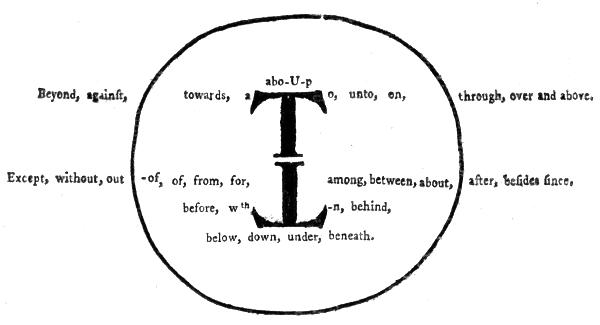
It is observable that O is an universal expression for the circle
of motion and extension; that i signifies a perpendicular
line or man placed in its center; and that this line, with a
traverse one, expressed by T or ⊥ and signifying mankind
and other beings and things as extended, and the properties
of man denote the nominative case, or that in which they
were first named; and all the other cases, as they happen
upon, up or down, or to or from either of these lines, are
distinguished as in the following example.
These prepositions are definable as follows.
In, with, within, to, into, unto, at, towards. In, signifies
man placed in the center of existences, as a middle
being, partaking of, and connecting matter with spirit; with
is the spring of i into male and female, and T their possessions
inflected; within is the same in the circle of possession: to
is T-O, the property of motion from T to the circle of motion;
into the same within the possessions; unto, at, and
towards, the same towards man or the line of possession;
afore, before, against, signify things or parts in and out of
the borders of possession.
After, behind, since, according to. After is off T or the
border of possession; behind is to be after man in possession;
since, having been in possession; according to, agreeing together
in acting; between, betwixt, among, amongst, for,
from, about; for, the parts or things of the circle of possession;
about and from the parts or things within the circle
of possessions of men; between and betwixt, the line i dividing
the possessions; among and amongst, the things about the
circle of possession. Above, up, on, upon; above, the upper
spring of the human sight; up, the spring part, on and
upon the sky.
Under, below, beneath, down. Under, not sprung within
or up the possessions; down, not sprung in; below, from
being up; beneath, to be not in possession.
Out, of, from, out of, without. Out, from the possessions
of men and things; of, the things within the borders;
from, the surrounding parts therein; without, out of possession.
By, through, over, over and above, besides, beyond, except,
until. By, the part; besides, below the part; beyond, by
the upper covering; thro’, from the possessions; over, from
the spring of sight; except, acting out of the possession part;
until, during the spring or possession of light; the two last
names serve also for conjunctions.
A Conjunction is an active part of speech, that connectively
or disjunctively joins together words and sentences,
as the names of actions, as prepositions do those of substances.
They have been divided by grammarians into various sorts;
tho’ the only significant distinction seems to be into copulatives,
connectives, and disjunctives, as the two former sorts
absolutely connect and coalesce both the sentences and their
meaning, or when the expression is only of mere local or inanimate
motion, barely move on, connect, and continue the
sentence or discourse, without any compatibility of meaning;
and the latter sorts conditionally, exceptionably, or interrogatively
do the same. Of the first class are, and or ond, on
in division or discourse, but, be it as or by man and things soon,
yet, it is or springs, also, on so, likewise, the same way, still,
light on things, altho’, upon to, notwithstanding, not opposing
the former action, however, be the spring of action as it may,
nevertheless, without any spring, as, the earth seen, as well as,
its surface or under it out of sight, for, the part in the circle,
therefore, the parts and spring within the circle, wherefore,
the parts in which circle, because, by our own actions, that,
towards possession. And the disjunctives are the following;
or, the promiscuous things within the circle of possession, either,
action or matter, nor, not the things promiscuously within the circle
of possession, neither, no action or rest, till or untill, during
the spring of light on the possessions, whilst or while, the action of
the upper light on the possessions, if, life or is it life? unless, my
spring out, except, acting from the parts of possession, besides,
by the side; and with which sense the Welsh, Greek and
Latin conjunctions correspond, as appears by an analysis
thereof at the end of this essay.
An example of their use and construction.—Was it pride
and folly, or avarice and envy, that caused the confusion of
human speech? It was neither the one or the other, but the
effect of some supernatural cause, as, the scripture informs
us. Nor is it probable, that so great a deviation could have
naturally happened; unless there was some very great wilful
perversion of the original language, whilst mankind were
contending for possessions as well as power. Nevertheless the
first language is still recoverable, notwithstanding its many divisions
and great disguise, if the subject be adverted, after a
right method. And altho’ it may be also attended with some
labor to mankind, except those already skilled in languages,
yet it may be attained by any English reader, that will endeavour
it, for, however languages may differ, as to the manner
of combination or construction of names and sentences, they
are certainly one and the same in their principles, and likewise
in their particles; because the letters and particles of all languages
appear by this essay to be still the same. Besides, as human
speech derives its origin from a supernatural cause, its
various dialects cannot differ as to their materials. Wherefore
then so many different opinions concerning these matters,
but from our own remissness? Let us therefore exert our faculties
in the laudable undertaking of recovering the first
universal language, that we may be thereby restored to our
senses, which seem to be equally perverted.
Verbs are either simple or compound. The simple are
those springs or energic signs in human speech, which,
mark the relation and connection of the subject and attribute
of a proposition; and affirm or deny the agreement or disagreement
betwixt things, as, man is an animal. Compound or
concrete verbs also include adjectives and participles; or the
qualities and attributes of the subject of a proposition, as,
man thinks or think is; sometimes only the subject, as mae,
eimi, I am, or sum; and frequently the subject, affirmation
and attribute, as, walketh, man is upon action. In
some dialects verbs have been so modified, as to denote or imply
the modes, times, persons, genders, and numbers of the
things affirmed; and nominally distinguished, as verbs active,
passive, neuter, personal, impersonal, regular, irregular,
auxiliary, and substantive; tho’ according to their real use
and signification, all verbs seem to be substantive and auxiliary,
and either singly, or conjunctively, with adjectives
or participles, formed into attributive or compound verbs, express
all modes of actions and affirmations, as appears by the
following instances; sum, I am, or, it is man’s existence, es,
the second person created or the feminine gender, est, the
second, first, and a third person born of the first and second,
fui, I have lived or been, fuisti, thou hast lived or been, fuit, he
the person born, hath lived or been; amo, I love or am for
a woman, the first person, amas, the feminine the second
person, amat, the third person produced, the third person,
am-avi for ui in fui, he has loved or been loved, the past tense;
doceo, I teach or give the lowering action to man, the first person,
doc-es, the second person or feminine gender, doc-et the
third proceeding from the other two, doc-ui, as in fui, I have
lived or been taught, the past tense; lego I read or recall,
the first person, leg-is the second, leg-it the third, and leg-i,
man read the past; audio, I hear, or, spring the passive sense,
au-di-is, au-di-it and au-di-vi, I have lived or been heard;
and the conjugating particles seem to be the degrees of comparison,
as, a, e, i, or as, es is, male, female, mankind,
or earth, water and fire, or motion and existences in general;
and the persons of U man, and thence all things of the masculine
gender the first person, as, es, or is signifying the feminine
in different degrees and qualities, the second, and at, et,
it, the rest of mankind and things, the third person, am-us,
em-us, im-us, all men of the male kind of the first person
plural, atis, etis, itis, all except the first person singular of
the second, and ant, ent, int, all mankind and things in different
degrees, except the first and second person singular,
of the third person plural; and thus may be explained all the
Latin and Greek modes of conjugating verbs.
Verbs are farther distinguished by grammarians into active,
passive, and neuter, as being expressive of actions, passions,
or neither the one or the other, but mere being or existing,
as, I love, am loved, live, walk, or stand; tho’ according to
the signification of words, there does not seem to be any real
ground for the latter distinction, for to love, to be loved, to
live, sleep or rest, must signify either actions, active passions
and energies, or their privation and passiveness. So that the
distinction in this respect might be more properly made into
active and passive only, agreeable to the masculine and feminine,
the only proper distinction of nouns as to genders; all
actions, substances, and things, at least, as having relation to
mankind, being either masculine or feminine, and the distinctions
made by the Greeks and Romans being mostly arbitrary
and contrary to the meaning of words which ought to
determine the genders of nouns.
Verbs have a designation of person, corresponding with the
personal pronouns; of number with the singular and plural of
nouns, of tenses as representing present, past, and future actions
and things; and of modes or the manner in which
they ought to be expressed. But whatever necessity there
may be for a great variety of modes and tenses in dialects,
constructed upon arbitrary principles, it does not appear that
any more than one is needful for a natural language, or that
the modes of conjugating verbs or any other, are in fact expressible
by human speech any otherwise than by the whole
form or order of inflection and things. And tho’ present,
past, and future, seem to be necessary expressions, according to
our present mode of conception, yet they are not in reality
any representation of time, but of our manner of dividing
or reckoning the changes of motions or number of
actions in extension, which in the eternal state of spirits, or
perhaps in a vacuum, might be deemed as one intire action or
the present tense.
Simple verbs or affirmatives are all substantive and incapable
of being inflected themselves, but serve as auxiliaries in
the affirmations and inflections of compound verbs, tho’
alone, without the assistance of compound verbs sufficient to
express every mode of affirmations, of actions and things, and
fully correspond with the nouns and pronouns, as for instance,
I am doing, have done, may, can, will, shall, must, or ought
to do; thou, art doing, hast done, &c; he, she, a man, or,
John is doing, hath done, speaks, speaketh, &c. We are or
were doing, have done, &c; besides, id, ed, with their inflections
ith and eth, and also is, added as affirmations in the
third person singular to compound verbs; which express attributes,
affirmations, and persons, and sometimes the subject
and number, tho’ the number is commonly implied by the
noun or pronoun. In the following specimen of conjugating
verbs, the persons, number, and actions or tenses are expressed
by different words, with very few variations of terminations.
| Numbers. |
Persons. |
The present, |
past, |
and future tenses. |
|
|
Absolute. |
Conditional. |
Absolute. |
Conditional. |
Absolute. |
Conditional. |
| Singular. |
1 |
I |
am, be, have, do, love, teach, hear. |
may, can, would, should or ought, to be, have, do, love, teach, read, hear. |
was, have been, had, did, loved, taught or teached, read, heard. |
might, could, would, should, ought to have been, had, done, loved, taught or teached, read, heard. |
shall, will, or must be, had, done, loved, taught, read, heard. |
shall, will, or must have been, had, done, loved, taught, read, heard. |
| 2 |
you |
are, be, have, do, love, teach, read, hear. |
|
|
|
|
|
| 3 |
he |
is, hath, doth, loveth or loves, teaches, reads, hears. |
|
was, or hath been, had, done, loved, taught, read, heard. |
|
|
|
| Plural. |
1 |
we, |
are, be, have, do, love, teach, read, hear. |
|
were, or have been, had, done, loved, taught, read, heard. |
|
|
|
| 2 |
ye, |
| 3 |
they, |
| Imperative. |
| Singular. |
1 |
|
Let me be, have, do, love, teach, read, hear. |
Let us be, have, &c. |
Plural. |
| 2 |
Be, have, do, love, teach, read, hear thou |
Be, have, &c. ye |
| 3 |
Let him be, have, do, love, teach, hear. |
Let them be, have, &c. |
| Infinitive. |
Participle. |
|
| To be, have, do, love, teach, read, hear. |
Being, having, doing, loving, &c. |
present. |
| To have been, had, done, loved, taught, read, heard. |
Been or having, had, &c. |
past. |
The feminine or endearing inflections of the second persons
thou and ye have been omitted, as needless, since they all
agree with the pronouns you and ye, and the only changes
are from are and be to art and beest, have to hast, were to
wert, shall and will to shalt and wilt, and might to mightest, and
do to dost; but to make use of them in the masculine gender,
would be depreciating it. And the participle perfect, being superfluous,
it has been likewise omitted; for as ing the present is
compleat, so is ed for the past or the privative of springs or actions.
The signification of the conjugating verbs in the four languages
is as follows, viz. 1. Am, mae, ειμι, sum, in full
form of existence; be, fi, φυω, fio, I live; can, dichon,
δυναμαι, possum, in act or able to act; may, amhay, ωμει,
sim, about acting; would, could, should, might, ought,
buasun, ειην, essem, the will or act sprung or past; shall, will,
must, byddaf, εσομαι, ero, the lower acting up, the spring
of human light, the lower things sprung up; was oeddun, ῆν,
eram, man or spring past; have been, bum, ῆμην, fui, acted
in life. 2. Are, ere, or art, beest, wit, or idwit, εις, es,
the lesser spring, and it is the spring of life. 3. Is, it is, fi, id,
idiu, εστι, est, it is seen, sounded, smelt, &c; hath, it acts;
had or ha-ed, action past; hadst, a female action past; do or
dost, motion past. 4. Are, ym, εσμην, sumus, men in the
spring; were, buasom, εμεθα, eramus, men sprung. Let,
bydd, εστο, esto, extend or take thy place; to be, bod,
ειναι, esse, the property of motion to beings, which converts
substantives into adjectives; ing, in action; it is not, nid,
ουκ εστι, non est, there is no motion.
All English verbs which vary from this mode of inflection
being erroneous and irregular, ought not to be established
by grammatical rules, but restored to the primitive state in the
present tense, and marked in the past tense with the proper
accent; or if it should appear to be necessary, to add proper
conjugations. But as verbs lose their qualities or active state
in the past tense, the English verbs ending in d and t in the
past tense, have been very properly diminished and substantived,
and accordingly contracted in their sounds, of ed to that
of d and t, as taught from teached, when the ch was accented
hard, and a like the German a or o, felt for feeled, checkt
for checked, slept for sleeped, left for leaved, gilt for gilded,
bled for bleeded, fed for feeded, had for haed, fed for feeded,
fled for flyed, sold for selled, and such others as are so contracted
without any other variation, that are capable of a past
tense, except, let, put, do, think, and other imperatives,
which can form no perfect past tense, without the aid of the
auxiliary verb have, to express some degree of human energy
or return to the creative fiat. And as all other tenses seem to
be arbitrary and indefinite, the best way of expressing the
minuter divisions of actions must be by adverbs or numerals.
And as there is no sort of foundation or necessity for the
participle perfect, the best way of correcting those verbs which
are supposed to be irregular therein, would be to drop it as
superfluous, and fully as well expressed by the past tense, as
help, helped, without holpen, cleave, cleaved, or cleft, instead
of cleave, clave, clove and cloven, hang hanged, for
hang hung. And as to the forming a regular past tense,
by reducing irregular verbs to their primitive state in the present
tense, the following may perhaps be no improper observation,
viz. all in fall, before the corrupt sound of the northern
a, as that of o, was, as it ought to be, accented, like
ale in pale, and marked with a long accent, as signifying from
high; its past tense accented short, as all in shall; and
wrote fall and not fell; the e not having then taken the place
of a, nor a, that of o; shake, signifying a passionate action of
a subject, is properly accented and wrote in the present tense,
but its past tense having partaken of the northern accent, it
then came to be wrote and accented shook, instead of shaked,
which, notwithstanding its long establishment by vulgar custom
ought to be rectified accordingly; and so as to swear,
heave, freeze, abide, strike, dig, and various other instances,
where the e has assumed the place of a, a of o, o of a, e, i,
or u, of i, or any other change of vowels from the present,
to form the past tense; except such as do and did, which are
different words, and of themselves incapable of any inflection.
And the English terminations an and en, borrowed from the
northern dialects, add nothing to the meaning of our names,
but the English, or Engli-Saxon names, are of a southern or
Celtic origin, and as fully expressive of the meaning to which
they are applied without them; except where they are added
to form the singular number, or to active names as substantiving
articles, as in all other Celtic dialects.
Adverbs are certain energic or active particles or additional
verbs added to, or joined with other names in
propositions, to denote the degrees and manner of things, as
to quantity, situation, quality, motion, and rest. Of quantity,
as less, lesser, least, much, more, most, great, greater, greatest,
long, longer, longest, short, shorter, shortest, broad, broader,
broadest. Of situation or place, as where, whither? up,
down, above, below, high, higher, highest, here, there,
yonder, far, farther, farthest, within, without, upwards,
downwards, forwards, backwards, and such as are expressive
of the situation of bodies in motion, or at rest. Of qualities,
as wisely, knowingly, sensibly, decently, likely, fairly,
warmly, foolishly, beastly, coldly, hardly, and such as
express intentional qualities. Of motion and rest; as comprehending
affirmatives, interrogatives, interjectories, and those
improperly called adverbs of time, as, when? now, anon,
then, yesterday, to-day, to-morrow, henceforwards, ever,
never, how often? often, oftener, oftenest, once, twice,
thrice, seldom, however, away, begone, adieu, speedily,
slowly, verily, yes, yea, no, why, however, perhap, alternately,
as, alack, ha, alas, ho, oh.
There are no other sorts of adverbs, expressive of the order,
time, or manner of things, as appears by the definition of
those of the four languages in the vocabulary; nor does it
thence appear that there is in fact above three sorts of adverbs,
namely, quantity or extension or bulk of bodies; quality
or an illation of light, heat and motion thereon, and penetrating
the same, expressed by ly, as ty does extension in substantiving
qualities; and motions energic, animate, and local,
with the contraries, as privation, rest, and matter. And
the degrees, like adjectives, are compared by adding er and est,
as comparative and superlative, to the positive or the state or
degree of beings and things in act, or putting more or
most in apposition thereto.
The degrees of distance and situation, are reckoned like
prepositions, upon lines, upright, across, or slantways, extended
from the centre of action or existence in our system
where man is supposed to stand; or upon man as a mikrocosm
standing up with arms extended; his head representing the
unseen celestial system, being the superlative degree upwards,
the extent of his sight or the sky, the comparative, his body
or the world, the positive, upwards, downwards, and crosswise,
his limbs below the parts of generation, as representing
the parts below the earth’s surface or growth part, the
comparative downwards, and beyond it the superlative, the
extent of view, the comparative sideways, and beyond it the
superlative, as appears by the definition of Adverbs in the vocabulary.
And tho’ interjections are supposed to add nothing
to the sentence, they certainly express the sorts and degrees of
energy with which the whole is affirmed.
Having thus explained the several parts of a rational
grammar, it now remains only to lay down some general
rules for their construction, into simple and compound
sentences, according to their natural concord, government,
and arrangement.
All the parts of speech, which were originally only particles
of one or two letters, having naturally coalesced and
united, in more complex names, and words or propositions,
without the assistance of art, so in all languages, like the
English, in which respect both the simple and complex
names still retain their primitive state, without any loss of
their natural powers of construction, by any arbitrary addition
or combination of artificial signs or modes of concord,
like the Greek and Latin, the parts both simple and complex
being precisely understood, will still be governed by their
meaning, and naturally coincide in sentences, in the same
manner as the ideas of a person unacquainted with the artificial
rules of logick, are by their natural relation logically
connected and formed into regular thesises, hypothesises and
synthesises. As for instance; a person, who perfectly knows
the meaning of the parts, can in his mind form and express
the following sentences; two and two of any thing are, is or
is to be sounded four, and not three; and should they happen
to be horses, whether with or without shoes, they must
be the horses of some man, rather than those of a cow; but
if they are delivered, in whatever place they stand, it must be
to and from some place, and by and to some body, or if they
should only be called, it ought to be done by their right
names. Or; supposing Adam, i, or any one know myself
or himself to be the first man, inhabiting space, and that his
length and breadth of extension, was at all times or upon all
motions, and as much more, as he or i might by the extension
of the arms acquire, without dispossessing another, were
our own property, i might, as the first existence and proprietor
here of the kind, call myself the first, one, or i. If I
had a wife and a son, who had a wife and a son, and had
been taught to tell seven in English, with their precise meaning,
I might as my next relation, as well as the second person
in existence, name my wife two or thou, my son, as the
third in being and possession, I might name he, him, or
three, which make up the number of the singular stock; and
as to the plural number or stock, the first and second person of
the singular, and the son which sprung from them, with his
son being four in number, and the first spring of the second
stock might be named we, as the first person plural; the two
wives ye, the second persons plural of the kind or genders;
and all other persons excepting those of the singular number, as
the grandson and his offspring, the sixth person from the first
or the third in the second generation or plural number, they.
Then if the first man or any other perfectly understood the
meaning of all other names and energies, which appear to be
as equally related to the nature of things as these, he could
have no difficulty of putting them together according to true
concord, as the meaning and signification would not permit
him to err; nor indeed is the English to be taught by any
other significant rules. The parts of speech being precisely
understood, the best way then of acquiring the right English
construction, is carefully to observe the manner and
style of the best English writers, and to procure an habit
thereof by reading and writing, rather than be perplexed
by innumerable tedious and unmeaning rules of phrases,
sentences, distinctions, and variations of names, from their
natural order; for which there is no sort of foundation in
the English, or any other language of nature.
But since the English language is that here proposed as
an universal one, it may not however be improper to take
some little farther notice of the rules of English Syntax. In
all languages to form a right sentence the words must agree in
construction with one another, as to case, number, gender,
and person, either according to the natural order of things, or
some arbitrary mode of concord and government, by a variation
of the terminations substituted in lieu thereof in particular
languages. But the English doth so only from the sense
of the words, without any variation of terminations, except
that es or s signifying the feminine gender, is sometimes added
to form the plural number of substantives, and the substantive
verb is, or the pronouns it, with its inflections, to
form the third person singular of verbs, and as and es in some
instances, to express the masculine and feminine genders.
And though it has no other case but the nominative, or any
variation of cases at all, yet all English verbs agree with the
substantives in number and person, without any exception;
and the state or situation of substantives are expressed by prepositions
set in apposition thereto in the same manner as the
articles; nor have the adjectives any variations, besides the
degrees of comparison; and yet both they and participles
agree with the substantives in gender, number and case; and
when two substantives of different sorts of things come together,
the place, state, or case of the last is expressed by the
preposition of or-’s, signifying of his; unless the latter substantive
is of the same sort with, or explains the former; in
which case they are both of the same case, state, or situation.
Conjunctions, adverbs, and relatives, serve to connect sentences,
as prepositions do words. The relatives who, what,
and which, and all other English names as well as things,
must agree with the antecedents as their originals, whether
persons, actions, or substantives. When two verbs come together,
the latter is to be in the infinitive mode.
An additional vocabulary of primitive nouns defined, with a separate
explication of pronouns, adverbs, conjunctions, and prepositions;
which compleats what has been already published, of the
English, Welsh, Greek, and Latin primitive names, and fully
explains the nature and origin of all the vocables and parts of
those several languages.
Abhor, Detest, Hate; Cashau, Troi Ymaith;
Mudasomai, Stugeo, Aversor, Odio Habeo.
These signify to turn from one with a scornful note of exclamation,
or scornful motion or manner.
Able; Gallu, Dichoni; Dunamai, Possum. To
be up or high in existence.
Accept, Take, Snatch; Cymeryd, Derbyn, Cipio;
Dechomai, Lambano, Arpaso; Accipio, Capio,
Rapio. To enter into possession of places and
things.
Accurate; Dyfal, Manwl; Akribos; Exquisitus.
Active in running to, seeing small things, and above
active in things.
Acorn; Mes; Balanos; Glans, the lesser or beast
food.
Act, Do, Make; Ag, Egni, Gwneid; Ago,
Poieo; Ago, Facio, the moving or acting quality or
property.
Add, Give, Put; Rhoi, Dodi, Dodiat; Didomi,
Tithemi, Epitithemi; Do, Addo, Pono, to act,
put, or add, from one thing to another.
Admire, Wonder; Rhyfeddu, Anrhyfeddi;
Agao, Thumaso; Demiror, Admiror, to divide or
advert the action of the great high light or the sun.
Adorn, Deck, Dress; Harddu; Kosmeo, Kazo,
Agallo; Orno; to add to, or upon the lower
covering.
Adverb; Rhagferf; Epirrema; Adverbium, signify
additional or increased verbs. See the vocabulary of adverbs.
Agreeable, Grateful, Thankful; Diolchgar;
Laros; Gratus, acting together with equal spring or
warmth, or equally in the division of the high light.
Air; Auir; Aer; Aer, water and fire, the earth’s
spring.
Ale, Beer; Corw; Zuthos; Cerevisia, the nourishing,
feeding, and rejoicing liquid in a secondary sense.
All or Oll, Whole; Oll, Cubol; Pas, Olos;
Omnis, Totus, all space, extension, and existence.
Am, to be; Bod, Mae; Eimi; Sum, to live or be in
existence.
Amazement, Astonishment; Syndod; Thambos;
Stupor, the lower existences or beings without
sight.
Anchor; Angor; Ankura; Anchora, from acting.
Another; Ail, Naill, Arall; Allos, Eteros;
Alius, Alter, from their possessions, or the country, or
luminaries from in a primary sense.
Ant, Pismire; Myrgryg; Myrmos; Formica,
the community, or the little active millions in a secondary
sense.
Ape, Monkey, Baboon; Epa, Monci; Pithex,
Kerkopithekos; Cerkopithecus, Cynocephalus,
a man dog, an offspring or a dog like man.
Apple, Pupil of the Eye; Gleini; Glene; Pupilla,
our action, spring, or part of light.
Arrive, Come; Dyfod, Cynhyrchu; Erchomai;
Venio, to be together upon one spot or possession.
Arrow, Dart, Javelin; Saeth, Piccell, Tafl;
Oistos, Belos, Atos; Sagitta, Telum, Jaculum,
upon the line, stretch or spring.
Artery; Rhedweli; Aorte; Arteria, the spring
of life.
As much; Cymaint; Tosos; Tantus, the first
action or motion seen in extension.
Ash; Onen; Oreine; Ornus, Fraxinus, the
lowest, highest, or brittle one.
Ask, Seek, Search; Ceisio, Chwilio, Dymuno;
Erotao, Dizo, Etazo, Deomai, Zeteo; Quæro,
Examino, Quæso, acting after, seeing for, &c.
Assembly, Company, Multitude; Cynlleidfa,
Llios, Turfa, Cymanfai; Omilos, Agele, Plethos;
Cætus, Grex, Turba, many living or being
together in the same part, place or country.
Assiduous, Diligent; Divid, Parhaus; Lipares,
Epimeles; Assiduus, Diligens, it is slavish, everlasting
or never-failing.
Banquet, Feast; Cyfeddach; Euochia; Convivium,
living high together.
Bashfulness; Gwilder; Aidos; Verecundia,
a man full low and inactive.
Bastard; Ordderchfab; Nothos; Nothus, a
lesser son of the house, as born of a concubine, dwelling
in the house, and not spurious, as when the father is unknown.
Be, be Born, Go; Bod, Wyf, Myned; Geinomai,
Eo, Tunchano; Sum, Fio, to be, move or live within
the circle of existence.
Beake, Bill; Pig, Gylfin; Rhunchos; Rostrum,
the place of food, the nose or small divided end or edge.
Beehive; Cychgwenyn; Kupsele; Alveare, a
shut upon bees.
Beetle; Chwil; Kantharos; Scarabæus, the
blast race.
Beg; Gofyn Elusen; Lissomai; Imploro, acting
or asking earnestly for food or the palace gift.
Beguile; Twillo; Deleo; Decipio, to be without
light or sight.
Blameless; Digwl; Amumon; Inculpatus, to
be unculled, or without detraction.
Bold or Bald; Hy; Ites; Audax, the high and
active.
Bond-servant or Slave; Gwas Caeth; Latris;
Servus, a confined servant.
Bosom; Mynwes; Kolpos; Sinus, the hollow inside
part of man.
Branch; Cangen; Ernos; Ramus, a spring on a
lower.
Brandish; Cynhyrfu; Pallo; Vibro, to lift up
or move the foot, arm, or other thing, with a spring so as
to give it a shake.
Brightness; Disgleirdeb; Aigle; Splendor, the
action of the high light on the lower parts.
Broil; Crasu; Optao; Torreo, to heat without
water.
Brush, Yscubo; Koreo; Vereo, to spring upon the
lower parts.
Bug or Woodlouse; Cynrhon; Loris; Cimex, a
thing with a spear end acting into another thing.
Cabbage; Bresych; Krombe; Brassica, a shut upon
the springing up.
Cable; Rhafangor; Kalos; Rudens, a shut from
acting.
Canal; Canol, Cafn; Solen; Canalis, a shutting
in.
Canon; Canon; Kanon; Canon, a shut upon
action.
Card; Cribo; Knapto; Carmino, acting into a
thing with an edge.
Carve; Carfio; Glapho; Sculpo, acting into or
upon a thing.
Cattle; Anifaltyn; Ktenos; Jumentum, the
acting or drawing animals.
Cavil; Cellwar; Skopto; Cavillor, acting or
seeking to catch one slyly by words.
Cavity; Ceuedd; Kotule; Cavitas, a place shut
from sight.
Chafe or be Angry; Digio; Echtheo; Indignor,
to be heated or fired.
Chapel; Capal; Klisia; Capella, the primitive
places of devotion being open and uncovered like Stonehenge,
these signify such places covered at the top.
Chapman; Merchnatur, Porthmon; Emporos;
Mercator, the portman or marketman, or the chief of
buying and selling, formerly set over all sorts of sales and
markets.
Chariot; Cerbyd; Rhaidon, Arma; Currus,
Rheda, the running or fighting car or carriage.
Chaste; Dihalog; Agnos; Castus, undefiled or
covering or keeping close the female property.
Chicken; Ciw; Polos; Pullus, the first of the animal.
Closet; Cell; Muchos; Cella, a shut out of
sight, or the resort of the Muses.
Coal; Glo; Anthrax; Carbo, a thing that has
the action of the sun or fire, that is, a burning thing.
Coffer, Coffin; Arch, Cist; Kibotos; Arca,
a covering upon man or other thing.
Comb; Crib; Kteis; Pecten, see Card.
Come; Cynhyrchu; Ikneomai; Venio, to be together
in one place.
Conduit; Mynediad; Amara; Meatus, a water
shut so inclosed as to go together.
Cone; Cyn; Conos; Conus, a thing high and
solid.
Conjunction; Cysylltiad; Suzeuxis; Conjunction,
a joining together. See the list of conjunctions
hereafter.
Crab, Cranc; Karkinos; Cancer, an inclosed
thing in the water.
Crier; Rhyngyll; Kerux; Præco, one that calls
or speaks between.
Crow; Bran; Korax; Corvus, a braying or croaking
animal.
Crowd; Gyr; Aguris; Coetus, a company of men
or animals.
Crude or Crystal; Crysial; Krustallos; Crystallus,
a shining thing with the crust or covering
upon.
Cube; Cyfochor; Kubos; Cubus, equal sides.
Damage; Damuen, Colled; Blabe; Damnum,
for the place of the cattle.
Danger; Perygl; Kindunos; Periculum, a place
where the fire acts upon the parts.
Dash; Ysigo, Taro; Proskrouo; Allido, to act or
throw from high to the ground.
Daughter; Merch; Thugater; Filia, my race
or female offspring.
Defile, Halogi; Miaino; Fædo, to act in or upon
one, or deprive one of his daughter.
Depth; Dyfnder; Bathos; Profunditas, the ground
of a dark part.
Dinner; Cinio; Aristos; Prandium, a meal at
the breaking up of the first plowing of the day.
Dissipate; Difrodi; Diaspao; Dissipo, to deprive
the country.
Distaste; Cawdd; Ptaisma; Offensa, separate
or go off this part?
Do; Gwneid; Ago; Ago, to act or move.
Dowry; Cynesgaeth; Pherne; Dos, the female gift.
Drone; Eiliw, Diffigr; Phukos; Fucus, one deprived
of his sight or other energic force.
Drought; Sychder; Auchmos; Sicutas, the action
of the firmament upon the lower parts, or being deprived
of water.
Dwarf; Cor, Nar; Nanos; Nanus, one not high
grown, or just upon the ground.
Endevor; Ymgais; Peiraso; Conor, to get up
from being down or below.
Enrage; Swmbylu; Kenteo; Stimulo; to act or
prick into.
Equal; Gwastad, Cystal; Omalos; Æquus,
even, upon the same stand or together.
Establish; Sefydlu; Bebaio; Stabilio, to rest
the beast, or make them stand upon a particular part or
spot.
Eternity; Tragwyddoldeb; Aidios, Aion;
Æternitas, the circle of motion or action in extension,
this world or during all spring.
Excuse; Esgusodi; Apologeomai; Excuso, to
speak for the absent.
Exercise; Ymarfer; Askeo; Exerceo, to be out
upon the spring.
Extinguished; Difod; Sbennuo; Extinguo, to put
a thing out of its existence.
Fable; Chwedl; Ainos; Apologus, speaking of
actions past.
Fabricate; Gwneithr; Teucho; Fabrico, the
action or work of a man, or man’s hand, or in building.
Fade; Gwifo; Maraino; Maresco, to be from
springing, or growing, or dying.
Fan; Wyntyll; Likmos; Ventilabrum, wind
sprung by the hand.
Fasting; Imprydiol; Nestis; Jejunus, lessening
food or the season of feeding.
Fasten or Fix; Ymwthio; Pegnuo; Compingo,
acting a thing lower in.
Fate; Coel, Damwain; Aisa; Sors, where the
action stands still or the thing falls.
Father; Tad; Pappas, Pater; Pappa, Pater,
the seeding property, or a part of our property.
Female; Benw; Thelus; Femina; signify the mother
of the male.
Festival; Gwil; Eorte; Festum, the
season.
Fetter; Troedog; Pede; Pedica, a shut upon
the feet.
Fibre; Manwythi; Is; Fibra, the sounding small
veins within.
Field; Maes; Agros; Ager, pasture or ploughed
ground.
File; Llif; Rhine; Lima, the sharp flower.
Fill; Llenwi; Ado; Satio, adding to place or extended
parts.
Fillet; Talaith; Kredemnon; Vitta, upon or
about the head.
Filth; Bydreddi; Tholos; Sordes, the things
along the ground.
Finish; Dibenu; Anuo; Perficio, to be in.
Firtree; Fynidwydd; Elate; Abies, the long
strait growth.
Fleas; Chwain; Psullos; Pulex, the leapers or
flyers.
Flourish; Blodeuo; Thallo; Floreo. See the
next.
Flow; Llifo; Rheo; Fluo, in a primary sense signify
an ilation of the sun’s rays, or of its return of life, as
growth, the flowing or reflowing of water, and other similar
things.
Fly; Hedeg; Iptamai; Volo, to spring forward or
lengthwise.
Fly; Gwybed; Muia; Musca, the blown things.
Forbid; Gwahardd; Eirgo; Veto, the action of
woe, or stopping upon an action of driving.
Form; Furf; Morphe; Forma, things in the circle
of life or existence in their primitive sense.
Foundation; Sylfaen; Themelon; Fundamentum,
the quality of things, or the origin of property.
Four; Pedair; Tessares, Tetor; Quatuor, are
expressive of the firmament or light, mentioned in Genesis
to be the work of the fourth day of the creation, as appears
by my former treatise upon this subject.
Free; Rhydd; Eleutheros; Liber, in their primary
sense signify the action or flow of the sun’s rays.
Friend; Cyfall; Philos; Amicus, another equal.
Frighten; Dychrynu; Atuso; Terrefacio, from
the action of the high fire or thunder.
Fringe; Godre; Krossos; Fimbria, the edge round
a thing.
Froth; Ewin; Aphros; Spuma, springing on the
water.
Full; Llaun; Pleos; Plenus, in their primary
sense signify the hand or other things extended with bodies.
Funeral; Angladd; Kterea; Exequiæ, an interring.
Fury; Cynddaredd; Erinnus; Furia, an infusion
of fire.
Garden; Gardd; Orchos; Hortus, were the
first inclosed grounds, which in Britain and other countries
from an apprehension of deluges, were at first on the
entrances of mountains, promontories or garths.
Gather; Cityrru; Ageiro; Congrego, to heap
together.
Gaze; Ymsynied; Theaomai; Contemplor, to
think or look on a thing or place.
Gird; Gregisu; Zonnuo; Cingo, about a man’s
lower covering.
Glebe; Glyb, Porfa; Bolos; Gleba, the place of
feeding or growth.
Glitter; Disgleirio; Amarusso; Fulgo, the
action of the high light upon the lower parts.
Gnash; Rhincian; Rhoigeo; Strideo, the sound
of acting between two things.
Go or Move; Myned; Baino; Eo, man going, moving
or springing.
Good; Daionus; Agathos or Evs; Bonus, the root
or spring of us.
Grape; Grawnwidd; Staphule; Uva, a growth
from fire and the spring of life.
Grasshopper or Locust; Locust or Ednogun;
Akris; Locusa, things or generations that cover the
ground.
Greedy; Awyddus; Labros; Avidus, for growing
or increasing.
Grove; Llwyn; Alsos; Lucus, a part extended
with woods.
Ground; Llawr; Oudas; Solum, the part of the
earth under and round about us.
Guest; Lleteiwr; Xenos; Hospes, a lodger and
boarder for a short time.
Half; Haner; Hemisus; Dimidius, divided in
the middle.
Halter; Tenyn; Phimos; Camus, a thing to draw
up.
Hammer; Morthyl; Sphura; Malleus, a great
stroke to drive in a lower thing.
Happy; Dedwydd; Olbios; Felix, a joyful thing
or springing property to man, all life and high life.
Hearth; Ailwyd; Eschara; Focus; a thing under
or covered by fire.
Height; Uchelder; Upsos; Altitudo, the high
possession or the parts seen upwards.
Helm; Lliw; Oiax; Gubernaculum, the driver or
chief of a family, country, a ship or other thing.
Helmet; Helm; Korus; Galea, a covering upon
the upper part.
Help; Cymorth; Onemi; Juvo, to assist one up, or
with food, or other comforts of life.
Hoarseness; Crygder; Brangchos; Racedo, a
stoppage in the throat.
Hobgoblin or Elf; Ellyll; Mormo; Larva,
light or appearances in the night.
Hogshead; Cerwin; Keramos; Dolium, a large
vessel, a wine vessel, or the head or chief vessel.
Hope; Gobeth; Elpis; Spes, the future, high or all
joyful thing.
Hostage; Gwistyl; Omeros; Obses, a pledge
guest.
Howl; Udo; Ololuso; Ululo, the noise of a dog,
an owl, &c.
Humming; Bwm; Bombos; Bombus, a low noise or
sound, which has not the least resemblance to the human
voice, like that of a bittern or heron.
Humble; Ufedd; Iketes; Supplex, from being
high.
Iambic; Troed-io; Iambos; Iambus, the principles
of speech and music, the short and long feet, or the
Iopæan song and dance.
Javelin; Picell; Akon; Jaculum, a thing acting
up or darting.
Jaundice; Crydmelun; Ikteros; Icterus, the
yellow shaking.
Implore; Imofyn; Lissomai; Imploro, acting
with force about, or earnestly seeking things.
Infant; Ifanc; Nepion; Infans, life just in action
or existence.
Innumerable; Aniben; Murios; Infinitus, without
end.
Interpret; Deongli; Ermeneuo; Interpretor,
to prate between, or to divide or distinguish a confused mass
of speech or things.
Intire; Cyfan; Oulos; Integer, together or in
one place of existence.
Isthmus; Isdwifor; Isthmos; Isthmus, the land
betwixt two waters or seas.
Itch; Crach; Psora; Scabies, a covering upon,
from the lower parts.
Judge; Barnu; Dikaso; Judico, the bar one or the
chief speaker.
Kernel; Cnyllun; Puren; Nucleus, the inclosed
pure one, or part of the nut.
Kick; Puio; Paio; Ferio, to spring the paw or foot.
Kneel; Camuglin; Oklaso; Genuflecto, to bend
the knee.
Knot; Colwm; Kombos; Nodus; shut altogether.
Knuckles; Cymalbys; Kondulos; Digiti Articulus,
the joints of the finger.
Leake; Trwyddo; Katarreo; Perfluo, to go
through.
Lean; Cul; Ischnos; Macer, a thing acting or
growing only in length.
Leather; Croen; Bursa; Corium, the skin or
covering of an animal stretched.
Leaven; Surdoes, Chwydddoes; Zume; Fermentum,
the sour, swoln, or heating paste.
Length; Hyd; Mekos; Longitudo, action or extension
lengthwise.
Leisure; Seguryd; Schole; Otium, being without
motion or sound.
Level; Gwastadhai; Nasso; Æquo, to be standing
together, even, either high or low, or up or down.
Like; Cyfelib; Alingkios; Similis, in their primary
sense signify life and light, which are alike.
Loin; Lwyn; Ischis; Lumbus, upon an animal
within.
Loiter; Ymaros; Iauo; Commoror, to stand still
without motion.
Luxury; Trythyllwch; Strenos; Luxus, acting
beyond the power or property of man.
Meadow; Gwergladd, Leimon; Pratum, the
place of the greater growth or spring.
Mechanick, Artificer; Saer; Banausos; Mechanicus,
a worker in arts.
Melt; Toddi; Meldo; Liquefacio, to diminish
or destroy the compactness of a body, to make it flow or resemble
honey.
Member; Aelod; Arthron; Membrum, the spring
parts, branches or shanks about a man.
Mercury; Moriwr; Ermes; Mercurius, the
great seaman, his wings alluding to the sails of ships and
their swift motion.
Mercy; Trugaredd; Eleos; Misericordia, in
their primary sense is to help one over or out of the water,
and emblematically out of any other trouble. It may be
no improper phrase to be made use of to the old carrier of
Acheron.
Middle; Canol; Mesos; Medius, the most inclosed
or shut of all.
Mild; Gwar; Praos; Mitis, a thing without much
fire or action.
Milt; Bleddyn; Splen; Splen, the life or spring
of the human flood or its circulation.
Mind, Soul; Meddwl, Enaid; Thumos, Nous;
Animus, the life and light of man.
Mingle; Cymysgu; Kerannumi; Commisceo, to
be together in, or possessing one place.
Misfortune; Anfortyn, Anddamwen; Daimon;
Infortunium, no force, strength or comfort to man.
Monster; Angenfil; Pelor; Monstrum, a man
with a female belly or a privative male.
Myrtle; Myrwydd; Myrtos; Myrtus, numerous
leaves on its top.
Neck; Gwddf; Auchen; Cervix, the breath inclosure.
Necklace; Aurdorch; Ormos; Monile, surrounding
the neck or a golden torques.
Neighbour; Cymydog; Geiton; Vicinus, living
in the same place or together.
Nerves; Giau; Neuron; Nervus, the spring of
growth or life.
Nipple; Tiden; Thele; Papilla, the flowing
part.
Noise; Troest; Doupos; Strepitus, the sound of
the two feet.
Numbness; Ferdod; Malke; Frigus, a great privation
of heat.
Oar; Rhwyf; Eretmos; Remus, the rank or order
of rowing.
Oath; Llw; Orkion; Juramentum, upon the
light of man.
Obscure; Tywyll; Amauros; Obscurus, the
circumambient air without light.
Ointment; Irad; Muron; Unguentum, a softening
at the fire.
Old Age; Henaint; Geras; Senectus, acting to
the last or utmost action.
Onion; Winwyn; Krommuon; Cæpe, a round,
inclosed or shut thing.
Organ; Organ; Organon; Organum, the human
tone, song or music.
Overtake; Cyrhaedd; Orego; Porrigo, acting
or reaching the confines or borders.
Page; Gwas Troed; Akolouthon; Pedissequus,
a foot-servant, a follower, or a horse follower.
Palpitate; Llamu; Pallomai; Palpito, to leap.
Pavement; Palment; Dapedon; Pavimentum, a
good footing in the house or possessions.
Peace; Hedduch; Hesuchia; Pax, from action.
Pebble; Carregan; Kochlax; Lapillus, a little
stone.
Peel; Rhisglo; Olopto; Decortico, all off the
covering or lower part.
Penthouse; Pentys; Geison; Suggrunda, the
top of the lower house.
Perforate; Tyllu; Trupao; Perforo, in, to
or through a thing.
Perfume; Perarogli; Thumiao; Suffio, sweet
smelling exhalations, as those of fruit, flowers, &c.
Person; Person; Prosopon; Persona, are defined
in the former Lexicon, to signify sweet sound from pêr-son;
but pêr also signifies an apple or any other ripe sweet fruit, as
figgs or figes, according to the Welsh, which resemble that which
perhaps gives man the denomination of person, or the sound
of the apple; and the word vices seems to derive its origin
from figes; the v consonant and the digamma being of the
same signification, and g its other half, only the inflection of
the radical c, and diafal and fall, the Welsh names of the
devil or fallen angel, being from afal an apple, as the English
word fall seems to be.
Pitcher; Dyfr Lesdr; Krossos; Hydria, a water
vessel.
Please; Llonni; Iliao, Adeo; Placeo, Propitius
Sum, an ilation, emanation or addition of good qualities
from above on the lower parts.
Plow; Aru; Aroo; Aro, to spring or dig up the
earth.
Pluck; Deori; Drepo; Decerpo, acting or drawing
a thing up or from.
Pocket; Cod; Pera; Pera, a thing to shut upon.
Pool; Pwll or Llyn; Limne; Stagnum, the part
of standing water.
Potage; Cawl; Zomos; Jusculum, the pot action,
the common or kitchen right, and culinaries.
Pound; Pwis; Litra; Libra, one round or a small
thing.
Praise; Mawl; Ainos; Laus, a great spring of light
upwards from below.
Precipice; Gorwared; Kremnos; Præcipitium,
up downward, or from an high part to a lower part.
Preposition; Rhagthodiad; Prothesis, Prepositio,
a thing or word put before another word or thing,
with which it has some relation or connection.
Present; Offrwm; Prosphora; Oblatum, a
thing sent before a visit by way of gift, as anciently accustomed,
or an offering for an altar.
Prince; Brenin; Koiranos; Princeps, the chief
or first in action or most ancient.
Promise; Addewid; Enguesis; Sponsio, a saying
or answering for a thing in action.
Prone or Ready; Parod; Prenes; Pronus, the
part from in.
Pronoun; Rhagenw; Antonumia; Pronomen,
instead of a noun; or rather a primitive or first noun.
Provoke; Gyrru; Eretho; Irrito, to heat or
fire.
Prow; Yblaen; Prora; Prora, the part from
before.
Puff; Chwiff; Pnoe; Flatus; a flowing up from
a man with his breath.
Push; Gutheo; Otheo; Pello, to spring the foot
or put from.
Quarrel; Imrafaelio; Erescheleo; Rixor, the
lower acting for being higher.
Quick; Cuit; Okus; Velox, the action of the
upper light.
Rage; Cynddaredd; Lussa; Rabies, a great
growth or action of heat.
Rain; Umbredd; Ombros; Imber, the water
springing all about.
Raw; Amrwd; Omos; Crudus, without boiling
or fire.
Refuse; Ymwrthod; Anainomai, Renuo, to
spring back.
Remain; Aros; Meno; Maneo, to be upon or within
a thing or place.
Remember; Atgofio; Mnaomai; Recordor, to
spring back to the mind or memory.
Resound; Atsynio; Antecheo; Resono, to spring
back, or return a sound or echo.
Return; Troiat; Nesteo; Redeo, to spring towards
or nearer to.
Ribband; Rhymin; Ampux; Vitta, a thing about
the upper part of a man, or the high band.
Rise; Dechreu; Phuomai; Orior, Assurgo, to
spring up.
Road; Fordd; Poreia; Via, Aditus, the part
from to.
Rod; Guialen; Rapis; Virga, the springing one.
Rope; Rhaf; Ampron; Funis, about a lower thing.
Salute; Cyfarch; Aspasomai; Saluto, to bow
the head or knee, or to meet together with the like
address.
Scarify; Fleimio; Skariphaomai; Scarifico, to
act into the lower parts or into man.
Search; Chwilio; Ichneuo; Scrutor, to be upon
the action of seeing or looking.
Sect; Tyb Neulltuol; Airesis; Secta, a flying
or differing from the general opinion.
Sell; Gwerthu; Poleo; Vendo, to put a price or
value upon animals.
Seven; Saith; Epta; Septem, action standing
still.
Shoot; Brigin; Phryganon; Surculus, its end
out of the earth in existence.
Shrub; Pryswydd; Thamnos; Frutex, the lower,
lesser or underwood.
Sigh; Ochain; Goao; Gemo, the acting or sounding
of woe, or the interjection O.
Sign; Arwydd; Sema; Signum, the sight or view
of any thing within.
Simple; Implyg; Aploos; Simplex, one part, place
or action.
Slander; Enllibio; Stembo; Calumnior, to
lessen in the land.
Slow; Diofal; Glichros; Lentus, being from a
high spring or not alert.
Sneeze; Tissio; Ptairo; Sternuo, acting or sounding
up in the lesser sounding past.
Snow; Odi; Nipho; Ningo, the privative water.
Sob; Ebychio; Luso; Singultio, man’s sounding or
springing upwards.
Sock; Soch; Embates; Soccus, a shut or covering
about the foot or lower parts.
Sole; Plan, Gwadan; Pesa; Planta, a thing
upon the surface of the ground.
Some; Rhiw; Enios; Quidam, one spring or existence.
Somebody; Rhiw Un; Amos; Aliquis, one person
or man.
Something; Rhiw Beth; Ti; Aliquid, some extension
or property.
Somewhat; Ychydigbeth; Oligon; Aliquantulum,
a little or a thing.
Son in Law; Chwegr; Gambros; Gener, born before
marriage.
Sovereignty; Penaduriath; Arche, Principatus,
the chief of the land.
Southwind; Deheuwint; Notos; Notus, the wind
of the right or sunside.
Sparkle; Gureichionen; Spinther; Scintilla,
a single springing out of the fire.
Spectator; Edrichwr; Theoros; Spectator,
the man acting to see things.
Sphere; Pel; Sphairon, Sphaira, the extension of
parts as seen.
Spider; Pryfgop; Arachnes; Aranea, the acting
or inclosing worm.
Spot or Blemish; Man, Bricheun; Kelis; Macula,
the place one stands or acts upon in its first sense, and
allusively any hidden part or blemish.
Spouse; Priodasen; Nympha; Sponsa, our rib or
female part.
Spring; Guredd; Ear; Ver, the action of man and
of the lower parts upwards, or the return of intentional qualities
ilating and penetrating bodies.
Sprinkle; Ysgeintio; Skedaso; Spargo, the lesser
parts of water acting upwards.
Spunge or Sponge; Ysbong; Madr; Spongos;
Spongia, a heap growing on a lower thing.
Squeeze; Gwascu; Blitto; Exprimo, to bring
things from, out, to, in or together, and squeeze is from
ex-weeze.
Stake; Cledr; Skolops; Palus, inclosed parts or
things.
Stammering; Atal; Psellos; Balbus, a stop from
speaking up.
Stamp; Sathru; Katapateo; Proculco, to stand
upon a thing or place.
Stick; Bach, Pastwn; Bakton; Baculus, a thing
to shut upon another thing.
Strait; Union, Jawn; Ortho; Rectus, signify
the rays of light darting in a direct line upon, and giving increase
to our globe for the common utility of man and beast;
which being the distribution of Providence gives a general
title to the benefit, use, and enjoyment thereof, as tenants
in common, but so as not to exclude any co-partner of his
existence. But when mankind became corrupted and fond of
dominion and distinction, Providence was pleased to divide
the earth amongst different families or nations, as appears in
Genesis, and ancient authors; and those nations and families
have granted their possessions and rights to one another, which
seems to be the only natural origin of exclusive rights and dominion;
though political rights may derive their origin from
conveniency.
Strangle; Tagu; Ancho; Strangulo, to flatten
the neck.
Stray; Crwydro; Alaomai; Vagor, to be upon
the round in the country.
Street; Cwm; Kome; Vicus, long villages, in which
tribes or certain portions of the people co-inhabited.
Strew; Tanu; Storeo; Sterno, to extend upon
the surface of the ground under the sky.
Stumble; Tripio; Ptaio; Cæspito, the foot up
from the possession of the lower parts.
Such; Cyfriw; Toios; Talis, the above and below
equal.
Suffer; Goddef; Pacho; Patior, it is an action
of woe.
Sunbeam; Pelydr; Aktin; Radius, the action of
the firmament towards the earth.
Supplant; Bachellu; Sphallo; Supplanto, to
spring the foot or lower part.
Suppose; Dodi Dan; Upolithemi; Suppono, to
put the lowest or last, up or first.
Suspect; Edrych at; Anablepo; Suspecto, to
look at our actions.
Sward or Surface; Arwyneb; Epipole; Superficies,
at the place of the foot, upon the face of the earth or
downward.
Swarm; Haid; Smenos; Examen, it is gone, or all
about.
Swear; Tyngu; Omnumi; Juro, by man or all his
internal property.
Sweetness; Melysder; Deukos; Dulcedo, the
property of the high great light on things below.
Sword; Cleddyf; Xephos, Aor; Ensis, a thing
to act with or keep from.
Think; Meddylio; Ennoeo; Cogito, the action
or exercise of the internal light.
Thirst; Syched; Dipsa; Sitis, the water drawn
up by fire.
Thong; Carai; Imas; Lorum, a shut about an
under thing.
Threshold; Rhiniog; Belos; Limen, the limits
between the ins and outs.
Throw; Taflu; Ballo; Jacio, to spring a thing
up or slantwise.
Tiara; Talaith; Kidaris; Tiara, a covering
upon the chief actor or proprietor.
Tie; Tido; Deo; Ligo. These in their primary sense
signify the property or attraction of the firmament.
Tongue; Tafod; Glossa; Lingua, the flow of
things.
Top; Crib; Kolophon; Fastigium, the sky or
covering the high end.
Touch; Cnithio; Thego, Psallo; Tango, acting
upon the upper covering or skin.
Track; Ol; Ichnos; Vestigium, the shadow or
sign of a person or other thing going before another, or a
continued action upon the ground.
Tread; Troedio; Pateo; Calco, to put the foot
upon the ground or pat.
Trifle; Overbeth; Leros; Nugamentum, possession
without place, or a thing without spring.
Triumph; Gorfoledd; Thriambos; Triumphus,
the praise of a man.
Troublesome or Difficult; Caled; Chalepos;
Difficilis, the high part of a rock.
Trumpet; Utgorn; Salpingx; Tuba, the springing
horn.
Trunk; Cyff; Kormos; Truncus, an animal inclosure
or shut; or what is used as such.
Tumb or Tomb; Bedd; Taphos; Tumba, the
covering or inclosing of a body.
Twig; Blaguryn; Lugos; Vimen, a growth up.
Twin; Ill Deuodd; Didumos; Geminus, a double
offspring or race.
Vehement; Angerthol; Sphodios; Vehemens,
a great action or the property.
Vein; Withen; Phleps; Vena, the place of life,
as containing the water of life.
Venerable; Urddasol; Aidesimos; Venerabilis,
a good and high acting man.
Ugly; Anfoddus; Amorphos; Deformis, without
form.
Vial; Fiol; Phiale; Phiala, upon food.
Victual; Bwyd; Sitia; Sibaria, the chief property
or support of life.
Violet; Llys-ion; Ion; Viola, the palace of Jove.
Viper; Wiber; Echis; Vipera; the little hot
stinger.
Virtue; Gwredd; Arete; Virtus, the spring or
property of man
Undergo; Mynedtan; Upduomai; Subeo, to
move below an upper.
Unjust; Anghyfiawn; Adikos; Injustus; unequal
right, or an unequal division of that property inherently
in man.
Vulgar; y Cyffredin, y Bobl; Plethos, oi Polloi;
Vulgus, Plebs, those of cattle understanding or
living together without distinction.
Walk; Cerdded; Baino; Ambulo, a man upon
action.
Wanton; Anllad; Aselges; Lascivus, living
with women.
War; Cad; Mache; Pugna, at action, upon the
spring, great action or the paws in action.
Waistcoat; Hug; Chiton; Tunica, under the
upper or lower coat.
Weave; Gwei; Uphao; Texo, acting the web, or
making or covering the lower.
Web; Gwe, Ystof; Istof; Stamen, Tela, the
lower strata or its covering.
Weep; Wylo; Klaio; Fleo, to be from the rays of
light, as plants weeping.
Wet, Water; Dyfrio; Deuo; Rigo, to spring up
water.
Whale; Morfil; Ketos; Coetus, the chief or
greatest sea animal.
Whetstone; Hogalen; Akone; Cos, acting upon
the edge or upper part of a thing.
Whey; Maidd; Orros; Serum, the water part of
the cattle liquid, after a separation of the coagulated parts.
Whisper; Sisial; Thrullos; Susurrus, a lesser or
lower sound than calling or talking.
Whistle; Chwibanu; Poppiso; Sibilo, the pipe
sound of man or other animal.
Wicked; Isgeler; Alitros; Scelestus, below
heaven.
Willow; Helig; Itea; Salix, the water kind.
Wild Beast; Gwyddfil, Ther; Fera, the wood
or country animal.
Wine; Gwin; Oinos; Vinum, a divine liquid.
Wing; Aden; Pteron; Ala, a thing towards the sky,
or from below, up or high. Ala or Machale also signify
the arm-pit, or below the arm or wing of man; from whence
the wings of birds are named.
Witness; Tyst; Martyr; Testis, a dying for his
country.
Womb; Croth; Metra; Uterus, the mother earth
or covering of the human species.
Wonder; Rhyfeddu; Thaumaso; Miror, the
energy of man and animals on beholding or contemplating
the sun, with its emanation upon the lower orb.
Wood, Wild; Coed, Wyllt; Hyle; Sylva,
the place of the highest growth or spring; and emblematically
the origin of the spring, flow or growth of human speech, or
articulate sounds or voice, as coming from the tree of knowledge
of good and evil; mankind being probably before the
fall capable of seeing each others ideas or thoughts, so far as
they were capable of conversing or disputing in the state of
innocence. And this sort of converse may be that of the
Serpent and Eve, and may not be improperly termed species,
gwedd or eidos, whence idiom, iaith, and idioma.
Worm; Pryf; Skolex, Vermis, the first form of
existence.
Worship; Addoli; Threskeuo; Colo, to the holy,
or holy Trinity.
Above, on, up, upon; ar, gar, ub; ari, uper;
super, supra. Ar hieroglyfically means a man’s arse
and in a general sense the earth upon which we are, as er does
the females, and the passive element water; hence ari; up, ub,
is the spring of p or the higher parts; on, is the circle of
motion and possession; so that upon is to be upon the spring or
in motion; super, uper and supra is the spring from below
up; above, the upper spring or bounds of the human sight.
Below, beneath, under, down; tan, odditan, ob, obri;
kato, upo, upenerthe; sub, subter, infra. Under, not
sprung up the possessions; down, from springing or being
up; below, from being up; beneath, a thing not in the
possessions; infra, in the earth part; sub, below up; subter,
below the upper possessions; upo, from up; kato from the
top covering; upenerthe, from springing to the top; obri,
from springing; ob, from life; tan, under the surface of
the earth; and some of those in the hieroglyfic sense also
signify the generative parts.
In, with, within, into, unto, at, to, towards; in, cyn,
oddifewn, intho, at, i, tuagat; en, xun, entos, para, es,
pros; in, cum, intus, inter, intra, apud, ad, versus. In,
signifies man placed in the middle of existences, and as betwixt
matter and spirit; with, from U-T or th by inflection,
is the spring of i, man, into male and female, and his line,
race and possessions; within, is the same in the circle of possession;
to, is the circle of motion and property under the
sky; into, the same within the possessions; unto, at, ad, towards,
the same, springing to man or the line of possession,
or at T or the tree; inter, into, intra, intho, oddifewn,
entos, signify in the possessions; tuagat acting towards;
cum, xun, together as one; i, the line of life towards the
sun, or man in an hieroglyfic sense; para, the part upon;
pros, the part upon from; versus, a spring towards us.
Out, of, from, out of, without; O, or, oddiwrth, oddiallen;
ek, extos, peu, apo; ex, de, a, ab, extra, sine.
Ut, signifying the part a man possesses, out, is from the part
man possesses or stands upon; O is the circle of view from
any place one is upon or possesses; or, is a material sound
upon O, signifying a border; of, the border or possession
part; from, the surrounding parts; without, out of the line
or circle of possession; oddiwrth, oddiallan, and the rest, signify
out of the possessions or parts.
About, for; am, amfi; amphi; circum. About, is the
things within the circle of man’s possession; am is duration
and existences, beings and things about him in this life or
world; amfi, amphi, the things about me; circum, things
together, surrounding or acting about a man; for, is the
things of the circle of possession.
Afore, before, against; rhag, cin, oflaen, erbyn; pro, gar,
anti; pro, præ, ante. Cin is action in or the chief or first action
or motion; rhag, the fire, or first action or motion, afore and
before, in or from the borders of possession; gar, acting before;
pro and præ the first possessions or countries; erbyn, the seen
in or springing before; anti and ante, the first or beginning
of earthly possessions; contra, far from being together within.
After, behind, since, according to; gwedi, arol, tuol,
ynol; upo, epi, usteron, epithen, kâta; post, ex, secundum.
The Greek terms signify the parts from; after, from
T or the possession; behind, to be after hi or man in the
possessions; since, to be after being together; according to,
agreeing together in acting; post the part from the possessions,
ex, out of action; ar ol, upon the shade or the part
covered from the sun behind a person; tu ol, the shade or
form from; yn ol, in the shade; gwedi, an action past.
By, through, over, over and above, besides, beyond, except;
wrth, trwy, eithr, tros, tros hynu, ond hynu, draw,
tu draw; dia, ana, peri, pros, atar, pera; per, trans,
præter, ultra. By, the living or dwelling part; with, the
possessions by man; dia, the part of the earth possessed; per
peri, præter, pera, the part upon either of earth or water;
trwy and through, possessions of land and water beyond the
circle of view; over, from the view of the part upon; tros,
trans and pros, the part from both of earth and water; except,
taking out; ond hynu, but that; drau or tu drau, the other
side or off the side of the part one possesses or place he stands
upon; besides, by the side or below the parts; ultra, beyond
the possessions or parts seen; beyond, by the upper
covering.
Between, betwixt, among, amongst; rhyng, ymysg; ei,
en, metaxu; inter. These signify the line i, dividing the
things in the circle of possession, and the things in and about
the circle of possession.
And; a, ac, ag; te, kai; et, que. And or ond, on
in division or discourse; ac, and ag, its inflection, and
also, a, dropping the c and g before a consonant, signify actions
in general; te, et, yet, and the Welsh etto, signify,
again; kai and que, signify an action.
If, unless, except; os, ai, oni; ei, me; si, nisi. Ai, ei,
is it the action of the earth or water? If, life, or is it life? Os,
is it seen off or from? Si, is it, or is it seen. Nisi, is it not?
Unless, my spring out; except, taking from the parts of
the possession; Oni, not from; Me, from me.
But, yet, still, also, likewise, notwithstanding, although;
ond, etto, erhyn, eisoes, yn lleiaf; aute, eti, omos, alla;
autem, sed, tamen, quoque, etiam, lix, licet, etsi, saltem. But,
by man and things seen; etto and yet, it is or it springs;
hence, eti, aute, autem, tamen, etiam; also, on so; ond, it
is moving; likewise, the same way; still, light on things,
although, upon to; notwithstanding, not opposing the former
action; however, be the spring of action as it may; nevertheless,
without any spring; erhyn, eisoes and omos, hitherto;
sed, see it or if it be seen; quoque, acting therein, or
and in which; the rest signify to be above ground at least.
For, because, therefore, as, as well as; er, am, mor,
fel, am hynu, or achos, herwydd; eri, gar, dia, oti, os,
ara, ar ou; propter, nam, tam, tamquam, quia, ergo; for,
is the proving by the evidence of the things within the circle
of possession or in the world; there, in therefore, er, eri and
herwydd, signify the spring, and, therefore, the parts and
spring within the circle; as, the earth seen; as well as, its
surface or under it out of sight; wherefore, the parts in which
circle; gar and ara, by the earth growth; am, am hynu,
nam, tam and tamquam, by all things existing about us; os,
by the visible circle of things; dia and oti, by the things possessed;
quia, by your own existence; ou, by the spring
of the circle; because, by the actions of the visible things of
this world or our own actions; mor, by the things about the
circle or world; fel, by the light; or achos, by the actions of
the part of the world about us.
Or, either; neu, ai, aill; nai, eite; næ, aut, vel, sive.
Or, signifies the circle of possession and of and from, as it is
at a distance from us, but in this respect the things therein
promiscuously, either the one thing or the other, as have any
relation to each other; either, ai, eite and aut, action or matter;
vel, sight or light; aill, action or light; sive, seen or
not; neu and næ, in or spring.
Nor, neither; na, nac, nid, nis; mete, oude, oute;
nec, neque, neu. Nor, not in the world or existence, neither,
no action or rest; na, no matter; nac, no action or
matter; nid and nis, no sight or sound, or it is not; mete,
oude or oute, the privation of things; neu, no spring; nec
and neque, no action.
Till, until; tra, cyd; eos ke, eoke; usque ad; till or
until, during the spring of light upon the possessions; cyd,
so long as things remain together; tra, during the possession
of the earth; the rest signify during the co-existence of
things.
I, me, mine; mi, fi, fy; ego, eme, emos; ego, me,
meus; i at first represented man, as a line, without his extension
in matter, or in his first spiritual state, but now, as
having relation to, and connection with matter; me, mi,
and eme, from am-i or iam, signify this i or line, existing
or extended with its ambient possessions. Hence T, which
is this line extended, under heaven, came to be the hieroglyfic
expression for extension and general things; and P its
divider, for possessions, properties, terrestial parts and particular
things; ego or egu, the springing U or man; emou
and mei, its genitive or possessive case, signify the things
and possessions about man; mine is my in, in me or my
property; emos and meus signify the things seen about us;
fi and fy inflect from mi.
You or thou, thee, thine; ti, dy; su, sos; tu, tuus.
You from y-o-u signifies the off man, thou from th-o-u, the
off man or woman; thee, ti, and tu, are the same; thine, is
the off man’s in or possessions; dy, thy possession; su the
female U or woman; tuus, and sos, the female possessions.
He, she, him, her, his, hers, it; fe or fo, hi, ith or ei;
autos, aute, auto; ille, illa, illud, is, ea, id, ipse, ipsa,
ipsum, suus, sua, suum. He or hi, the higher acting man;
she, the lesser, lower, or female man; him, the higher man
about; her, the more passive spring; his, of man; hers of a
woman; it, ith, id, ille, autos, &c. signify man’s extension
in his race and possessions.
We, us, ours; ni, ein; hemeis, hemeteros; nos, noster.
We or wi, those in possession; us, the men seen; ours,
of man; ni, the men in possession; ein, belonging to us;
emeis, the men about; nos or nus, in us; noster, our possessions;
emeteros, our surrounding possessions; o-ur, being
the circle of man.
Ye, you, yours; chwi, eich; umeis, umeteros; vos,
vester. Chwi, the from us; ye, those from; umeis, the
females about; vos, those from; yours, of those from; eich,
of the from us; umeteros and vester, the female possessions.
They, them, theirs; hwynt, eu; autoi, ekeinoi, spheteroi;
illi, isti. These signify mankind, their race, spring,
and possessions. Thus far as to the personal and possessive
pronouns; now as to the demonstratives and relatives.
This, that; hwn, hon, hyn; autos, aute, touto, ekeinos;
hic, is, ille. This, the man seen; that, the possession
at; hwn, the man acting in; hyn, he in action; hic, the
man acting; is and ille, the man seen; ekeinos, the man
seen acting in the circle of possession; autos the same.
Any, some, one; un, yr un, peth; ostis, eis, enios, deina;
aliquis, quidam, quicunque, ullus. Un signifies man in
existence, as a mikrocosm representing our system of beings;
one, is from un; any, is the earth in existence; some, the seen
existences; yr un the one spring of existence; enios and eis, in
existence; ullus, a man seen; aliquis, another man seen;
ostis, the things about in the possessions; peth, a part or thing.
None; neb; outis, oudeis; nullus. Nullus, no man
seen; outis and oudeis, no thing or possession; none, no
one; neb, nobody.
Another; arall; allos, eteros; alius, alter, uter. Arall, allos,
alius, signify the second; alter, uter and another, the second
possession.
Who, which, what, that; pwi, pa, pa un; os, he, o,
poios, poia, poion, tis, os, ti; qui, quæ, quod, quis,
quæ, quid, is, ea, id. These as interrogatives signify which
one, and what part or thing, and that one or thing? and as
relative pronouns serve to express any antecedent part, member
or thing in a sentence, as who or wch-U, the above man,
which or wch-ich, the above action and what or wch-at, at
the above; qui or uch-i, the above man, quæ or uch-æ, the
above woman, and quod, the above thing.
Within, here, endwise, straight, upright; in tho
yma, ofeun, tu fewn, insyth, cyfing, ar inion;
endon, entautha, orthos, stenos, en brachei, eiso; intus,
introrsum, hic, vere, arrecte, strictim, anguste. Within,
intho, endon, intus and introrsum, signify the line of man’s
existence, as his house, possession, or the part of space occupied
by him, or taken up by his extension; endwise towards
the sky or bounds of view; cyfin, shut close together, in
length without breadth; strait, aright, arrecte and strictim,
to be shut or pent up from roving to and fro; orthos, the
possessions within the borders; stenos, to be within the possessions;
en brachei, in the high country; inion, in the line;
in syth, in the place standing upon; here, the length possessed
by one; hic, him acting; ima, man or the line in the centre
of existences or things; entautha, things in possession; eiso,
within the circle or borders of the possessions.
Above, aloft, atop, upwards, lengthwise, longwise;
uchod, bri, ar hyd, ar fynu, ar dyn, ar hir bell; uperthen,
ano, elkedon; supra, sursum, sublime, tractim, longule.
Tractim, the sun’s property of drawing upwards, above, from
or beyond the bounds of view; bri, the high country or the
firmament part; ar fynu, upon the upright; ar hyd, upon
the length; ar dyn, upon the sun’s attracting property, or
upon a draft; uperthen, the upper part of the line of possession;
elkedon, the line of fire drawing upwards; ano, the
sky; supra, above the earth; sursum, above the part possessed,
or man standing up; sublime, up in the region of light;
aloft, high from or above the part possessed; atop, at the top
or the sky; upwards, upon the spring up; up, the spring
of p.
Beneath, below, aground, down, under; isod, obri, tan,
ilawr; upo, upenerthe, arden; sub, subter, humi, deorsum,
funditus. Isod, below the circle of possessions; ilawr, to
the ground; arden, from being up; funditus the bottom;
deorsum and humi, from or below the part a man is upon;
the rest are explained under the prepositions.
Out, without, outwards, abroad, of, from, around; o,
allan, oddiallan, o amglych; exo, ektos, exothen, thurase,
amphi; ex, foras, circum, extrorsum. Extrorsum, out of the
border of a man’s inhabited possessions; allan, above the
place inhabited; O, the circle of possessions; around, the
circle of the earth inhabited; abroad, from the neighbourhood;
foras, below the part of the circle; exothen, out
of the inhabited possessions; the rest are explained under the
prepositions.
Before, facing, onwards, forwards, ahead, throughly;
mlaen, rhagbron, ir trwyn, oflaen, peneithaf; pros, porro,
panuge; coram, prorsum, porro, penitus. Before, the part
from man’s view; facing, the part seen in action; porro,
the part from; prorsum, the part from man’s standing or
being; coram, the border of the possessions; peneithaf and
penitus, the farthest end; ir trwyn, to the end of the possessions.
Behind, astern, after all; in ol, yn olaf; ta ustata;
postremo. Yn ol, in the shade of the man in possession;
yn olaf its superlative degree; after all, off the possession
of the shade; astern, below the possessions upon; behind, to
be at the back; postremo, the last part of the place possessed;
ta ustata, the last possessions.
Near, nigh; agos; engus; prope. Prope, the part
from; agos, engus, and nigh, the first motion or action from;
near, in the part upon.
Far, far away; o lar bid, imhell, hirbell; porrothen, apothen,
makran; longe, procul, ultra, ulterius, eminus.
These signify beyond the neighbourhood or the part inhabited
upwards and sideways; as far, from the part upon; o lar
byd, from the dwelling place; imhell, out of the sight upon
the line of life; hirbell, very much so; porrothen, a part
from the place inhabited; longe, an extensive place; procul,
the upper country; ultra and ulterius, the country seen
above.
Amongst, amidst, intermixedly, astray, largely, widely,
hither and thither; rhong, rhoth, amisg, ar led, inganol,
ima a thraw; metaxu, ana meson, deuro, kakeise, plateos,
dapsilos; large, late, intermixte, ample, medie, huc atque
illuc. Amysg, amidst, amongst, metaxu and intermixte,
separating the things in the lower circle of possessions;
astray, acting below the possessions; hither and thither,
from the part possessed to the firmament; rhong, dividing
the things within the circle of possession; inganol, inclosing
all; ar lêd, large, late, upon a wide place at large
about the ground; ima a thraw the part upon, and
that from; dapsilos, the coasts from the part upon; rhoth
and euros, the extension of the particles of light below;
medie, dividing the parts possessed, as earth and water; huc
atque illuc, to the man in possession, and him out of possession,
the race of man or him in the sky; ample, the place about.
There, thereabout; yno, aco, o amgylch; ekei, autothi;
illic, ibi. There, upon T or in the firmament;
illic, ibi, and circiter, the firmament; os, osonte, ekei and
autothi, the circle of the possessions in the sky; y no, aco
and o amgylch, the circle of the possessions about a man.
Hence; oddiyma; enthende; hinc. Oddiyma, from the
possessions about a man; hinc and hence, from him in possession
or action; enthende, from the part in possession.
Thence; oddiyno; autothen; illinc. Illinc, from the place
in the firmament here; thence, from the sky; O ddiyno and
autothen, from the possessions yonder. Hither, hitherward,
homeward, toward this way, hitherto, hereabout; tu ima, tu
ac ima, fordd ima, dyro; proseti, entha, deuro, mechri, taute;
huc, adhuc, hactenus, horsum, aliquorsum, retro, erga,
versus. Tu ima, this side of the possessions; tu ac ima, the
side of the possessions acting here; fordd ima, the way to
these possessions; hyd yma, upon the length here; proseti,
the part from to the possessions; entha, into the possessions;
dyro and deuro, acting or coming here; mechri, about acting
into the possessions; taute, the possession from that of
man; huc and adhuc, acting towards man; hactenus, that
part into possession; horsum, he from, to where man is;
aliquorsum, another, which is from, to where man is; retro,
returning from the possessions from; hither, from the
firmament here; towards and the rest signify upon the spring
to or home.
Thither, thitherto, that way; tu aco, fordd aco; ekeise,
tede, ode; illuc, istuc. Thither and thitherto, from the
sky or top of T, to the possessions at its bottom; tu aco, to
the possessions from the sky; ekeise, from the possessions in
the sky lower; tede, from the high possessions at T; ode,
from the circle of T; illuc, from the place of light hither;
istuc, from the place above to the lower possessions.
Where, somewhere, any where, whither, somewhither,
which way, wherein, whereto; pale, ible, tuafle, i riw le,
tua riw le, i riw fan; pou, poi, poi ti ophelos, epiachou,
pothi; ubi, quid, quo, quoquo, quorsum, aliquo, aliquorsum,
alicubi, uspiam. Where, somewhere and any where,
acting or springing upwards from the part one is upon; whither,
somewhither, wherein, whereto and which way, acting
upwards from one part, place or possession to another;
the Welsh signify, what place, to what place, towards what
place, to one place and to some place, and are fully explained
elsewhere; poi and pou the part from up; poi ti ophelos,
the part from up, towards what or some place; epiachou,
from the part acting upwards; pothi, the part from the possessions;
ubi, springing to the high parts; quo, from upwards;
quorsum, from the place of man’s existence upwards;
aliquorsum, from another place of man’s existence upwards;
alicubi and uspiam, from the part of man’s existence upwards
above the sky.
Elsewhere; yn lle arall, yn yr uchelder; allachou, allathi;
alibi. Elsewhere, from the lower place to the upper firmament;
yn lle aral, in another or high place; yn yr
uchelder, in the firmament; allachou, in the place above;
allathi, in the high possessions; alibi, the high firmament.
Across, askant, askew, awry, aslant, aslope, athwart,
crosswise, traverse, oblique; yn groes, ar wyr, ar osgo, ar
draws, ar gam; plagios, parableden, endiastrophos; oblique,
ex obliquo, torte. Torte is a top one on the upright line;
oblique, from being an upright line; endiastrophos, an horizontal
or meridian line; parableden, a traverse or contrary to
an upright line; plagios, a plane one; ar gam, one upon
the superficies of the earth; ar draws, one upon the traverse;
ar osgo, upon the slope; ar wyr, from an upright; traverse,
turned towards the surface; athwart, at the earth part; aslope,
low to the place part; aslant, low towards the ground;
awry, from an upright spring; askew, acting lower than the
spring; askant, acting low towards the ground.
Apart, asunder, aside, besides, separately, severally, apiece;
urtho i hun, ar neilldu, ar ben i hun, heb lau hyn,
ar ddidol; choris, idia, kath ekaston, epi toutois, alla
te; seorsim, seperatim, singulatim, præterea. Apart, a
divided piece of earth or thing; asunder, the ground under;
aside, the part by the side; separate, a part of the earth or
thing out of or below the possessions; several, below the high
spring; urtho i hun, a man by the side of the possessions; ar
neill du, upon the other side; ar ben i hun, at his own end;
heb lau hyn, without the assistance of this hand; ar ddidol,
upon the division of place or culling; choris, below the borders;
idia, the divided part; kath ekaston, by himself below
the possessions; epi toutois, above the extent of the lower
possessions; alla te, the upper or another possession; seorsim,
below the circle or borders of the parts possessed; singulatim,
the low inhabitant beholding or contemplating immensity;
præterea, before the possessions of earth and water.
Everywhere; pob, pob lle, pob man; pantachou; ubique.
These seem to express space, as pob, the parts from;
pob lle and pob man, the parts of extension and existence of
matter; pantachou, all upwards; ubique, beyond the higher
parts, though inadequate to the ideas of space or extension.
No where; nid yn un man, nid yn un lle; oudame, oudamou;
nusquam. These signify in no part or place, or
the negatives of where, which have been already explained.
When, whence; pan, pa bryd, or hyn, o hyn amser;
otan, opothen; quando, quum, unde. Pan,
the part in; pa bryd, the part in season; o hyn amser, from
this circle upon; otan, the circle in possession; opothen, the
circle from the possession; when and whence, springing or
acting in; unde, the spring in possession; hence quum and
quando.
How long? how often? pa hyd, cynfynyched, pa sal
gwaith? mechri ou, posakis? quamdiu, quoties? How long,
what length of spring or action; how often, what action
above in; pa hyd, what length of action or possession;
cynfynyched, how often from the first; pa sal guaith, what
spring of action; mechri ou, what acting about from the first;
posakis, what acting and standing still; quamdiu, what rounds
of the division of the spring; quoties, in what possession.
Once, only, only but; un waith, un amser, yn unig;
apax, monon; semel, tantum, solummodo. Once, one
action; only, one quality; un waith, one action, or going;
un amser, one round of what is upon; yn unig, in one action;
apax, from the action or first action; monon, the
motion of the circle or one motion; semel, upon the lower
round; tantum, whilst in possession.
Twice, secondly; dwywaith, ailwaith; dis, deuteron;
bis, secundo. These signify a division of the lower circle of
motion or action.
Thrice, thirdly; teirgwaith, yn drydydd; treis, triton;
ter, tertio. These signify the action of the third day’s creation,
viz. the division or separation of land and water.
Four times, fourthly; pedairgwaith, yn bedwaredd; tetrakis,
tetartos; quater, quarto. The division of the luminaries
or the action of the fourth day.
Often, oftentimes, many times; mynych, llaergwaith; pollakis,
polloston, sunachos; sæpe, multoties, sæpenumero. Often
off or above ten; oftentimes, above ten times; many times,
the small things; mynych, bordering on the highest; llawar
gwaith, the action of the circle of the hand upon the fingers,
as well as a part of the action of the whole circle; pollakis, a
part of all the lower action; polloston, a part of the lower
possessions; sunachos, from the first action; sæpe, a thing,
from standing still; sæpenumero, a thing from standing still
in the spring of existence.
So often; cynfynyched; tosakis; toties. So often, the
lower circle above ten; cynfynyched, the first action bordering
on the highest; tosakis and toties, the action of the
lower or lesser circle of life.
Yesterday; doe; echthes; heri. Heri, the action from;
yesterday, or yest-heri-day, the action of the day past; doe,
the division or day from or past; echthes or ech-doe, the d
inflecting into th, the action of the past division.
Erst, at first, in time past, formerly, before hand, before
time, heretofore, yore, aforetime, agone, long ago, a great
while ago, laterally; erhyn, cynt, cynhyn, or blaen, er
ys talm, ymlaen llaw, gynt oll, er ys meitin; archen,
protos, emprothen, pro tou prin, apotoude, enteuthen,
palai; primo, antehac, olim, antea, abhinc, jamdudum,
pridem. Jamdudum, during the spring of time; prin, primo,
protou, protos, first, emprothen and pridem, from the beginning
of fire or motion in the lower existences; er, the
spring; erst, the spring of the lower possessions; formerly,
the spring of forms; ago, the action from; while, the flowing
of the upper light; cynt, the first action of worldly possessions;
cyn hyn, before this time or existence; or blaen,
ymlaen, and ymlaen llaw, from or before the existence of
this place; gynt oll and olim, before all existence here; antehac
and antea, in the possession before the present; archen,
the beginning of the present earth; er ys meitin, er ys talm
and er hyn, this spring or possession; abhinc, from the beginning
of action; yore, the circle of time from; palai, the
part upon action.
Betimes; yr inion bryd; en deonti; tempore. These signify
directly in season.
Now, already, ever, evermore, always; yn aur, erioed, aur
hon, byth, pob amser, yn wast adol, pryd hyn, yndragywydd;
nun, aei, diapantos, ede; nunc, jam, jamjam, semper, sempiternum,
perpetuo. Now, nun, and nunc, yn aur, aur hon, ever
and evermore, in the spring; byth, the life; pryd hyn, the
part upon the length; yn dragywydd, in the duration of the
spring; yn wastdol, in the state of all things; jam, the
existence; semper, the existence part; already, ready up;
always, upwise; aei, motion or action; hede, the length;
diapantos, all possessions; erioed, the spring of age.
Never; erioed ni fu, byth ni bu; oude pote, mede
pote; numquam. These signify not in life, spring or
existence.
To-day, in the morning, to-morrow; heddiw, yn y
bore, y fory; temeron, proi, aurion; hodie, mane, cras.
Day, heddiw and hodie, is the division of action; temeron,
the part in action; morning, bore and fory, the spring of all
terrestial existences; proi, the part from in; aurion, the
spring in motion; mane, the spring in the earth; cras, the
action of the sun or light below.
A night; yn y nos; nuktos; nocte. In y nos, in no sight
or light; noctu and the rest, in no firmament act.
Next; ong, nesaf; engistos; proxime. Ong, moving
on; next, the out to us; nesaf, the thing from us;
the rest are the same.
Still, yet, also, item, likewise, alike, again, eftsoon,
encore, afresh, anew, while, well nigh, almost; hyd hyn,
etto, hefyd, ymhellach, yn debig, drachefn, eilwaith, yn
newydd, tra, hyd tra, hyd oni, cyd ac, trwy, pan, pryd,
agos, oddieithr ych ydig, haeach; eti, alla, all’ ede, omos,
all’omos, omoios, mechri tou, mechri nun, proseti, au,
authis, empalin, neosti, achris, an, eos an, mikron dein,
para mikron; adhuc, tamen, etiam, similiter, dum, iterum,
rursum, item, nove, recenter, fere, ferme. Still, an
emanation of light upon the lower parts; yet, etto, eti,
etiam, item and iterum, the firmament upon the lower
parts; also, another sound or sound up; again, acting
in; eilwaith, another action; au, a spring; authis,
the spring of the lower possessions; empalin, things up
in existence; pan, a part or thing in existence; alla,
being up; all’ ede, it is up; omos, all together;
all’omos, up all together; mechri tou, until this time;
mechri nun, until now; proseti, from the first to this
time; neosti, newydd, nove and anew, it is in spring, action,
or possession; an, the earth in; eos an, the from in;
while, the emanation of the high light; well nigh, springing
up in action; almost, up from below the surface; hyd hyn,
this length; tra, the earth’s duration; hyd tra, so long as
the earth endures; hyd oni, so long as life or motion;
cyd ac, action together; truy, the duration of spring;
pryd, the part upon the length; agos, the action from;
haeach, the action from; oddieithr ych ydig, little
from the possession; mikron dein, until in possession; para
mikron, until the part upon; adhuc, to this time; tamen,
the parts about in; dum, the spring of matter; rursum, the
return of spring to the parts about man; fere and ferme, the
spring about; recenter, a return of action upon the possessions.
Anon, forthwith, immediately, presently, quickly, soon;
ar frys, ar fyned, yn fuan, yn gyflym, ar fyr; autothen, parautika,
autika de mala, amesos, tacheos; illico, protinus,
immediate, statim, cito. Anon, upon moving or going;
cito, together; soon, so on; forthwith, from the possessions
with; immediate and immediately, me at thee in the line of
possession; presently, before sent for; quickly, acting to
you; ar frys, upon haste; ar fyned, upon going; yn fyan,
speedily; yn gyflym, hastily; ar fyr, shortly; autothen,
springing from hence; para autika, springing from any part
to him in possession; autika de mala, springing to the possession
from any place of existence; amesos, in the midst;
tacheos, on the same part together; illico, from hence;
protinus, the part from to the possessions; statim, from any
part or coast to the possessions.
Henceforth, henceforward, hereafter; o-hyn-allan, ynol
hyn, rhag llaw; apo, toutou, exes; dehinc, deinceps.
These signify from hence, from this time, and from hence
below or forward.
Then; yno; tote, tunc. Tunc, the things or possessions in
action; then, the things or possessions in; tote, the things
in the circle of beings; yno, in the circle.
Thence, thereafter, thenceforward, thenceforth; othyno,
ar ol hynu; autothen, opote; illinc, posteaquam. These
are defined before.
Soon after; yn fuan arol; oligo; paulo post. Oligo,
after the action from; paulo post, little after; the rest are
explained before.
Somewhile, awhile, sometimes, longwhile; rhiw amser,
ambell waith, weithia, enyd o amser, yn hir o amser; epi
chronon, pote, makran den; aliquamdiu, aliquando, longe
diu. Rhiu amser, the spring of existence; chronon, the
round of existence; makran, things acting about; the rest
are explained before.
Seldom; yn anaml, yn anfynych; spanios; raro. Spanios,
a less part in motion; seldom, less acting about; yn
anaml and yn anfynych, things and existences less numerous;
raro, things from the earth.
Prematurely, oversoon; cin tymor; prooros; præmature.
Cin tymor, before the circle of existence; prooros, before
the term; præmature, before the things in possession; oversoon,
an action before its spring or season.
Annually, yearly; pob blwyddyn; kat etos; quotannis.
Yearly, every spring upon earth; annual, every spring up of
the earth’s existence; kat etos, every spring of motion, age
or action; pob blwyddyn, every life or existence upon the
spring.
Alternately, one after another; pob yn ail; enallax; alternatim.
Pob yn ail, every other in; enallax, in another
action; alternatim, another into possession.
At length, lastly, finally, ultimately; mhen enyd; yn
olaf, yn ddiweddaf; yr diwedd; pote, talentaion, ta ustata,
echatos; tandem, postremo, ultimo. Mhen enyd,
at the end of a length; yn olaf, the aftermost; yn
ddiweddaf, the endmost; yr diwedd, the end; pote, out
of possession; ta ustata, the last part of possession; echatos,
the utmost round; tandem, after or below the part in
possession; postremo, after the things or possessions in being;
ultimo, futurity or last time; at length, the end of a line,
possession or other thing; lastly, the place of the lowest possessions.
How many, how much; pa nifer, pa rifedi, pa sawl
un, pa gymaint; posi, oson, poson; quot, quantum.
These signify the parts of springs, actions and things interrogatively.
So much, so many; yn gymaint, cynifer; toson, tosouton;
tantum, tot. These signify the parts and actions seen.
More; mwy; mallon; magis. These signify a greater
spring of many and much.
Less; llai; elatton; meion; minor. These signify the
beginning of action or the edge of place.
Absolutely, wholly; yn hollal; entallos; absolute. These
signify the whole or all, as quality; the qualities of the different
sorts of things being expressed by al, el, il, ol, ul,
and their transponents, according to the nature of the expression,
and generally in the English, by ly the flow of the sun’s
rays, or y the, to form Adverbs from Adjectives.
Adjectively; yn adroedd; epitheton; adjective. These
signify something cast to, as its quality to a substantive.
Affectionately, passionately, pathetically; yn hoffus, yn ofydus;
yn wynfydus; pathetikos, agapetos; pathetice. These
are expressive of the qualities or energies of those passions.
Agedly; yn henaidd; palaios; seniliter, the qualities of
age or being long in action.
Articulately; yn gymalog; enarthros; articulatim, articulate
sounds, or the sounds of the joints.
Bodily; yn gorphorol; somatikos; corporaliter, like the body.
Cirumstantially; yn amgylcheddol; peristatikos, circumstantialiter,
like standing about.
Coldly; oerlyd; psuchros; frigide, as deprived of the
sun’s heat.
Fiercely; yn fyrnig; agrios; ferociter, as the action of fire.
Naturally; yn naturiol, anianol; kata physin; naturaliter,
as the internal properties of things diffused towards man.
Usually; yn arferol; koine; usualiter, as usual.
Wisely; yn fynwyrol; sophes; sapienter, like the sight
of man.
Worthily; yn yrddasol; axios; digne, like the property
or value of man.
As; mal; os; ut, the surface of the ground, the possessions
extended or the earth seen.
Why, wherefore; pa achos; par o; cur, what action,
motion or spring.
Therefore; felly; outos; ita, ergo, the action, spring or
thing as seen.
Alack, alas; och, ai ho, gwae fi; ai, O, omoi, ouai; ah,
eh, hei, heu, ehu, væ. These are interjections or energies
of the passions of dislike and lamentation.
Aha: aha, wi; euge; euge, a good spring or pleasing
interjection.
Adieu, hail, farewell; bydd iach; vale, salve, live well,
spring and enjoy the ilation of the sun.
Amen; amen; amen, outos genoito; amen, ita fiat.
Am-en for heaven, and let it be so.
Some sketches of the creation, the original and present state
of men and animals in our system of beings, the fall of man
and other obscure scenes of antiquity, have been drawn from
the sacred characters made use of by the Priests and Druids to
preserve their original, ancient and secret knowledge, in
order to illustrate the present subject, and setting the present
confused, deluded, or enchanted state of language and knowledge
in a right course and direction. But the press not admitting
of their being exhibited in that order and mode,
which seemed to be necessary for a compleat transmission of
the sacred hieroglyfics, the following specimen must suffice
for the present.
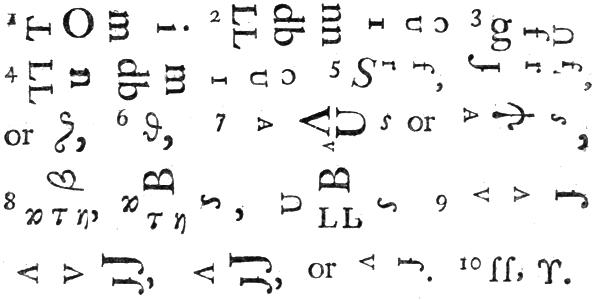
1. The state of man previous to the formation of Eve and his essential modes.
2. His compound state or the nonessential modes and division into parts and
actions. 3. Emblems of concupiscible appetites, innate parental traces, energies
and passions acquired by the fall. 4. The state of man and woman after the
fall, as enchanted and confined to place or matter. 5. The Serpent, an emblem
of speech. 6. A theta instead of the Coptic kei, an emblem of man’s primitive
state, &c. 7. Birds; but the round U is made use for the Coptic e. 8. Beasts
and Bulls. 9. Fishes. 10. Twigs and trees. But more of this hereafter.
And as all letters are thus deriveable from the parts of man, resembling all
other things, Adam might be very well instructed, in their use in paradise;—And,
the divisions of time appear to have been made from the days of the creation. See
the former treatise.
O’er plants celestial, that fell below,
And grafs of serf which now together grow,
With her sword flaming round the living stem,
Guarding its fruit upon the side of Shem,
Expatiate free! ’tis the scene of man,
A mighty maze! beyond my present plan;
‘A wild where weeds and flowers promiscuous shoot;
Or garden, tempting with forbidden fruit.
Together let us beat this ample field;
Try what the open, what the covert yield.’
Here to dispel prolific nature’s charm,
Prudence forbids; tho’ far from real harm;
And science shuns the Sympathetic touch;
So here we finish, lest we feel too much.
Withall affirming of the birth of tongue.
If Hiero’s right, others must be wrong.
FINIS.
Transcriber’s Note: Changes made to the text to correct probable
printer errors are listed below. 1760s spelling remains unchanged.
Greek ligatures (and mid-word ϛ) have been modernised to separate
letters (and στ). Greek letters were occasionally printed reversed
or upside down, probably because the typesetter wasn’t familiar with
the alphabet, and this has been corrected without further note.
Page 13, “elitoris” changed to “clitoris” (the clitoris, erectors, and)
Page 17, upper case Ψ changed to ψ for consistency with the other letters
in the list.
Page 21, “frem” changed to “from” (proceeding from the hind part)
Page 32, “diminition” changed to “diminution” (a diminution of the colour)
Page 33, italics added (a circle extended)
Page 39, “particples” changed to “participles” (with adjectives or participles)
Page 42, verb “read” added to table, under first person present absolute. The reader should also note the likelihood that the
future absolute is incorrect.
Page 43, “or” changed to “for” (for as ing)
Page 43, “or” changed to “of” (it is the spring of life)
Page 43, “loose” changed to “lose” (as verbs lose their qualities)
Page 60, vocabulary entry “Neiighbour” changed to “Neighbour”
Page 64, “distrubution” changed to “distribution” (the distribution of Providence)
Page 75, “Extrorsium” changed to “Extrorsum” (Extrorsum, out of the border)