(The figures in brackets after each name give the population in
1901, and those at the end of the sections give the references
to the text.)
Abbot’s Langley (3342), a village situated on the Gade,
with a station on the North-Western Railway; it was bestowed
in the time of Edward the Confessor upon the then abbot of
St Albans, whence its name. Hunton Mill, on the Gade, was
granted to Sir Richard Lee in 1544, and both this and Nash
Mills were farmed from the abbot of St Albans between 1349
and 1396. The present church, dedicated to St Lawrence, cannot
be traced farther back than the close of the twelfth century. A
west tower was added about 1200. (pp. 72, 90, 105, 149.)
Aldenham (2437), a village and manor lying to the north-east
of Watford. It has a grammar school; and near by is
Aldenham Abbey, the seat of Lord Aldenham. In 1898 two
Roman kilns were discovered in the parish. The church, which
has been restored, contains one small twelfth-century window; no
trace of the chancel remains.
The Amwells—Great Amwell (1421), and Little
Amwell (930)—small villages not far from the Rye House.
Amwell is associated with the name of the Quaker poet, John
Scott, who lived there for some time after 1740. Near by is
Haileybury, formerly the training college for the officials of the
East India Company, but now a public school. (p. 135.)
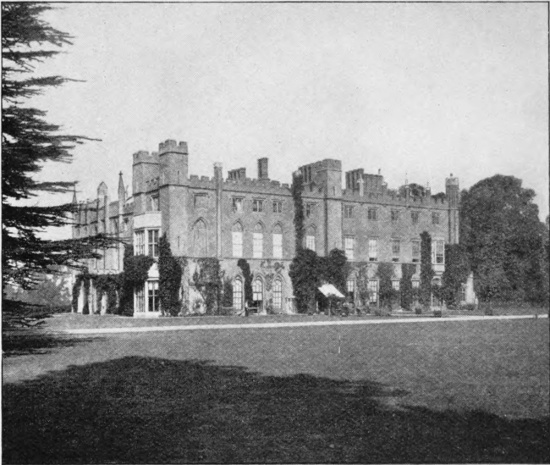
Ashridge, a domain in Little Gaddesden parish, situated on
the Buckinghamshire border of the county, and celebrated for its
splendid beech woods. It was formerly the property of the
Dukes of Bridgewater, being acquired by the Egertons in 1604,
but it is now owned by Earl Brownlow. A building, formerly the
porter’s lodge, includes some remains of an old monastic college.
The present house, which stands partly in Buckinghamshire, was
built by the eighth Earl of Bridgewater. (pp. 115, 142.)
Ashwell (1281), a village on the Cambridgeshire border of
the county, with a station some distance away on the Royston and
Cambridge branch of the Great Northern Railway. Ashwell,
which was formerly a town, had a fair and a market in the time
of William the Conqueror. It was severely visited by the plague.
Its church-tower is the only one in the county built wholly of
stone. (pp. 92, 113.)
Baldock (2057) is a market-town on the Icknield Way, to
the north-west of Hitchin, with a station on the above-mentioned
branch of the Great Northern Railway. It dates from Norman
times, when it was known as Baudok. During the Crusades,
Baldock, like St Albans, Berkhampstead, and Hoddesdon, had a
lazar-house for lepers, who were at that time numerous all over
England. The list of Rectors is complete from the days of the
Knights Hospitallers in 1317. The church contains much
Decorated and Perpendicular work. (pp. 90, 94, 128.)
Barkway (661), originally Berkway, is a small town and
manor situated a few miles to the north-east of Buntingford.
(p. 96.)
Barnet, or Chipping Barnet, originally Chipping Bernet
(7876), a large and important market-town near the Middlesex
border of the county, with a station (High Barnet) on a branch of
the Great Northern Railway. Near by are New Barnet and East
Barnet, with a station on the main line, and having a population
of 10,024. The name Barnet is a corruption of the Saxon
Bergnet, signifying a little hill; the site of the town then forming
a small rising in the midst of the great forest; the prefix Chipping
= market is a word of Scandinavian origin, represented in the
Swedish Jonköping and the Danish Kjøbenhavn = (Copenhagen).
Barnet was the scene of a battle in 1471, when
the Yorkists defeated the Lancastrians, killing their leader,
Warwick the king-maker. The market was famous for its cattle;
and in addition to this there is an annual horse-fair, which
formerly attracted dealers from all parts of the country. (pp. 9,
53, 54, 82, 99, 128.)
East Barnet (2867), known as La Barnette in the thirteenth
century, and Low Barnet in the fifteenth century, is situated on
the stream known as Pymmes’ Brook, on the western side of the
valley of which stands the almost deserted old parish church.
Bayford (330), a village nearly midway between Hatfield and
Hoddesdon. In the churchyard is buried William Yarrell the
naturalist. Bayfordbury is celebrated for its collection of portraits
of members of the Kitcat Club painted by Sir Godfrey Kneller.
(p. 147.)
Bengeo (3063), formerly Bengehoo, a village in the valley
of the Beane one mile north of Hertford. The old church, now
little used, is one of the oldest in the county, dating apparently
from the early Norman period. Together with Great Wymondley
church, it is peculiar, so far as Hertfordshire is concerned, in
having an apsidal chancel. In place of a tower, it has a wooden
bell-cote. Panshanger, formerly the property of the late Lord
Cowper, is near by.
Bennington (522), a market-town and manor, situated on
the Beane, from which it takes its name; it was an important
place in the ninth century, when it was the residence of the kings
of Mercia. The church is fourteenth century. (pp. 53, 54, 56,
78, 111.)
Berkhampstead, or Berkhampstead Magna (5140),
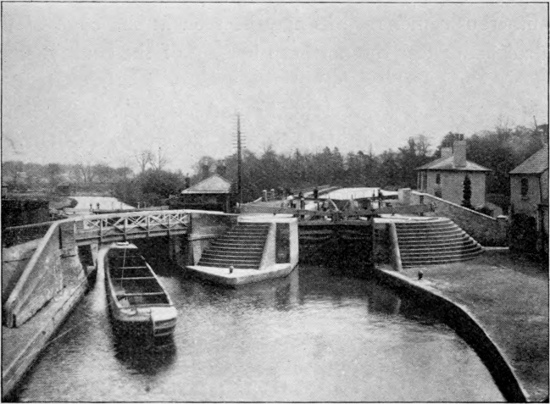
an important market-town[3] on the London and North-Western
Railway and Grand Junction Canal, and one of the oldest in the
county, the castle dating from Norman times, and being possibly
on the site of an earlier Saxon edifice. It was here that the crown
of England was offered to William the Conqueror. The manor
and castle were granted first to Piers Gaveston and subsequently
to Edward the Black Prince, but were afterwards annexed to the
Duchy of Cornwall. Berkhampstead, which is now a petty-sessions
town, and has an ancient grammar school, formerly
returned burgesses to Parliament. Its almshouses were built in
1684. Cowper was born here. Berkhampstead Parva and
Berkhampstead St Mary’s—the latter now generally known as
Northchurch—are villages in the neighbourhood. The church
dates from the thirteenth century; it contains the beautiful
Torrington tomb. (pp. 2, 7, 63, 80, 81, 82, 91, 92, 109, 111,
131, 132, 141.)
Bishop’s Stortford (7143) is the most important town on
the Essex border of the county, and has a station on the main
line of the Great Eastern Railway, and a bridge over the Stort.
The town, which has a market, possessed a considerable trade in
Saxon times, and was the property of the Bishop of London, and
to protect this, and for the purpose of consolidating his own
rights, William the Conqueror built a small castle here. Bishop’s
Stortford has a grammar school, and formerly returned members
to Parliament. The church, which dates from the tenth century,
is an imposing Perpendicular edifice, and stands on the site of an
earlier building. (pp. 23, 24, 79, 92, 112, 132, 144.)
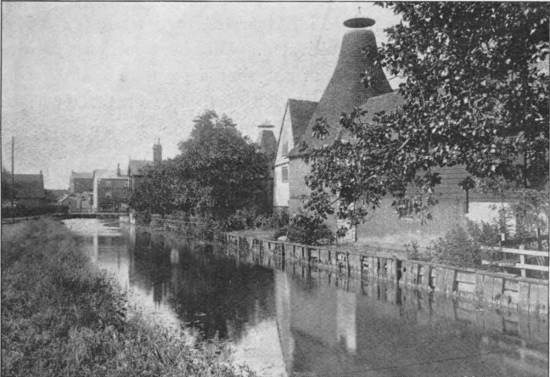
Bishop’s Stortford, and the River Stort
Boxmoor (1127), a small town on the Grand Junction
Canal and North Western Railway. A Roman villa was discovered
here some years ago. (pp. 132, 133.)
Braughing (930), a village to the north-west of Stortford,
on the Cambridge road, with a station on the Great Eastern
Railway, situated in the valley of the Quin. It dates from Saxon
times, when it was known as Brooking; and it was granted a
market by Stephen. A Roman sarcophagus and many Roman
coins have been discovered in the parish. (pp. 22, 113, 136.)
Broxbourne (748) is also a village on the Great Eastern
Railway, to the south of Hoddesdon: it contains an almshouse for
poor widows founded in the year 1728. The village is intimately
connected with the Rye House Plot. (pp. 128, 142.)
Buntingford (1272) is a market-town, with almshouses, on
a branch of the Great Eastern Railway running northwards from
Stortford. It was granted a market by Edward III. (pp. 54, 128.)
Bushey (2838), a parish in the south of the county, separated
from Watford about 1166. The village is now the site of the
Herkomer Art School. The church was “restored” in 1871,
when a late Gothic window was removed.
Bygrave (148), a small market-town a short distance north-east
of Baldock.
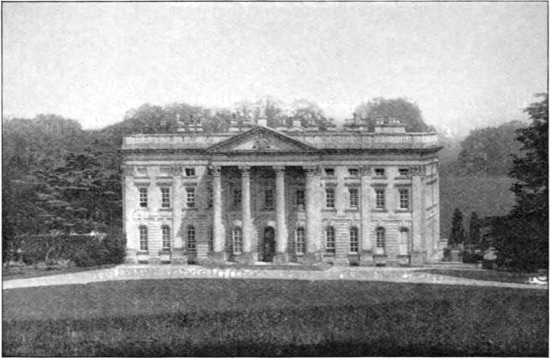
Cassiobury, a park and mansion at the north-west of
Watford which has for many generations been the residence of
the Earls of Essex. The present house is modern. (pp. 20, 21,
45, 84, 85, 136.)
Cheshunt (12,292) is a large market-town in the south-eastern
corner of the county, nearly north-west of Waltham
Abbey, with a station on the Great Eastern and some distance
from the town itself. It is celebrated for its nursery gardens,
roses being especially cultivated. Within Cheshunt parish is
situated Theobald’s Park, at one time a royal residence. Cheshunt
Park is on the opposite, or north side of the town; and
near by are the remains of an old nunnery. (pp. 43, 99, 100, 128.)
Codicote (1145), a small village to the north-west of
Welwyn. The church was an ancient one, but a drastic “restoration”
in 1853 destroyed much of the evidence of the age of its
constituent portions. (pp. 43, 128, 130.)
Elstree (1323), a village on the southern border of the
county lying a little west of the Midland Railway, on which it
has a station. It is rapidly becoming a suburb of London.
(pp. 7, 11, 52, 126, 132.)
Flamstead (1039), a village near the Watling Street to the
north of Redbourn. The name is supposed to be a corruption of
Verlampstead, the Ver flowing in the valley below the village.
The Thomas Saunders almshouses were built in 1669. Beechwood,
the seat of the Sebright family is in the parish.
Great Gaddesden (746), a village in Dacorum Hundred
to the north of Hemel Hempstead. Gaddesden Place, which was
burnt down in 1905 and rebuilt, is the seat of the Halsey family,
who possessed the neighbouring “Golden Parsonage” so long ago
as 1544. The church probably dates from the twelfth century.
(pp. 19, 35, 42.)
The Hadhams—Much Hadham (1199), Little Hadham
(655)—two villages lying respectively to the south-west and
north-west of Bishop Stortford, and known to have been in
existence in the time of the Conqueror. The manor of Hadham
Hall was granted by the crown to the Bishops of London at the
time when the survey recorded in Domesday books was made.
(pp. 12, 117.)
Harpenden (4725), a large village or small town on the
Midland Railway, almost exactly half-way between St Albans
and Luton. During the last twenty years Harpenden (“the
valley of nightingales”) has nearly doubled in size, and is rapidly
increasing. Within the parish is the agricultural experiment-station
of Rothamsted; the laboratory being situated on the
borders of the village itself. About a mile to the north is Shire-Mere,
a small green partly in Hertfordshire and partly in
Bedfordshire, and in consequence a favourite site for prize-fights
in the old days. Harpenden has branch-lines connected with the
Great Northern and the North-Western Railways. With the
exception of the more modern tower, the church, which was
largely Norman, was pulled down and rebuilt in the sixties.
A Norman arch remains in the tower. (pp. 7, 36, 37, 38, 43, 45,
47, 66, 67, 75, 96, 117, 130, 132.)
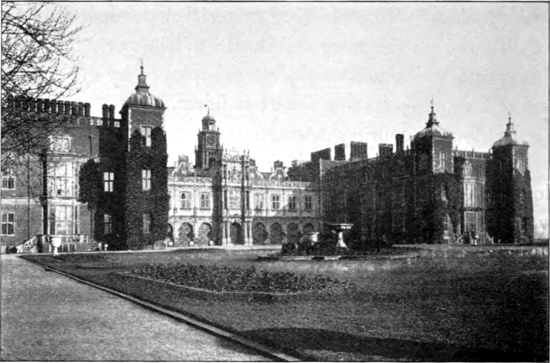
Hatfield, or King’s Hatfield (4330), is a small town on
the main line of the Great Northern Railway, chiefly noteworthy
on account of its connection with Hatfield House, the seat of the
Cecils, Marquises of Salisbury. As mentioned above, Hatfield was
at one time a royal palace; but the original building is now used as
a stable and riding-school, the present house being of Jacobean
date. The residence at Hatfield of Queen Elizabeth is connected
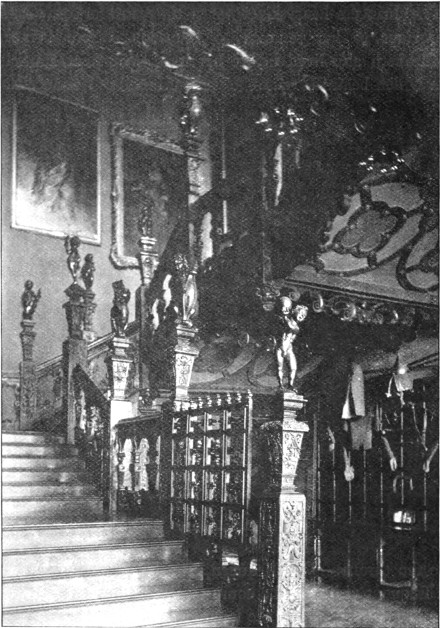
with the old palace. Among the features of Hatfield House are
the marble hall, its oak-panelled walls hung with tapestry, and its
panelled ceiling painted; the grand staircase, hung with portraits;
the long gallery, with its armour and pictures; King James’s
drawing-room, a magnificently decorated apartment; the great
dining-room, with a bust of Lord Burleigh; the armoury; and
the beautiful chapel, with its exquisite Flemish window and a
marble altar-piece. Hatfield is an important railway centre for
the county, the Great Northern having branches to Hertford,
St Albans, and Harpenden and Luton. Petty sessions are held in
the town. In the church are the monuments of the Cecil family,
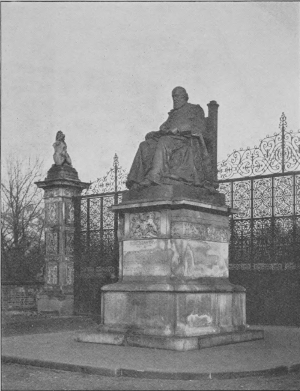
and a statue of the late Lord Salisbury, erected by county subscription,
stands at the park entrance. (pp. 20, 23, 31, 34, 43,
83, 115, 116, 128, 132, 142.)
Hemel Hempstead (11,264) is an ancient borough and
market-town on the western side of the county connected with the
main line of the North-Western Railway at Boxmoor, and also
served by a branch joining the main line of the Midland at
Harpenden. In addition to a mayor, Hempstead has a borough
official known as the high bailiff[4]. The town, which is situated
in the Gade valley, and formerly returned members of its own to
Parliament, is remarkable for the length of its main street—part
of which is known as Marlowes. Its market-day is Thursday,
and there is an annual wool-sale. Corn and cattle are its chief
trade, the straw-plait industry having nearly died out; but near
by is Nash Mills, the site of a large paper factory. The
church, which stands to the west of the main street, is a fine
example of a cruciform twelfth-century parish church; it was
commenced about 1140 and finished some 40 years later. There
is no evidence of any earlier building on the site. (pp. 43, 47,
101, 102, 122, 131, 132, 133, 138, 147.)
Hertford (9322), although by no means the largest town as
regards the number of its population, occupies the first place, as
being the county-town, and the only one in Hertfordshire where
assizes are held. It is also a market-town and borough (with a
mayor and corporation), and formerly returned members of its
own to Parliament, although now it is only the centre of a
parliamentary division of the county. In addition to the assizes
for the whole county, quarter-sessions for the eastern division of
Hertfordshire are held in the Shire Hall. The site of Hertford
Castle—a building of great antiquity—is now used as the Judges’
lodgings in assize time. Hertford has branches of Christ’s
Hospital, for both boys and girls; and within a short distance is
Haileybury College, now a public school, but formerly the training-place
for the civil service of the old East India Company.
Hertford is served by branches of both the Great Eastern and
Great Northern Railways, and has also water communication
with London by way of the Lea. It is a centre of the waning
malting industry. The old church was burnt down some years
ago. (pp. 3, 20, 31, 34, 79, 81, 84, 92, 94, 111, 126, 134, 136,
138, 139, 141, 147.)
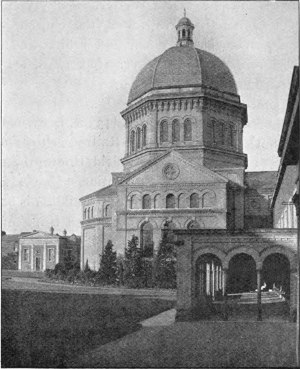
The College Chapel, Haileybury
Hertingfordbury (733), a village on the railway to the
west of Hertford, dating from Norman times. The manor of
Roxford was granted by William the Conqueror to Goisfrede
de Beck for good service rendered.
Hexton (155), a village in a small parish of Cassio Hundred
on the north border of the county jutting into Bedfordshire.
Ancient coins have been found in the parish, which includes the
old earthwork known as Ravensburgh Castle. Hexton seems to
have been granted on two occasions to the monastery of St Alban.
Hitchin (10,072) is one of the most ancient towns in the
county, and is now an important railway centre, as it is the
starting point of the Royston and Cambridge branch of the Great
Northern Railway, on the main line of which the town itself is
situated. Hitchin is one of the four parliamentary centres of the
county, and is noted for its corn and cattle market, and also as
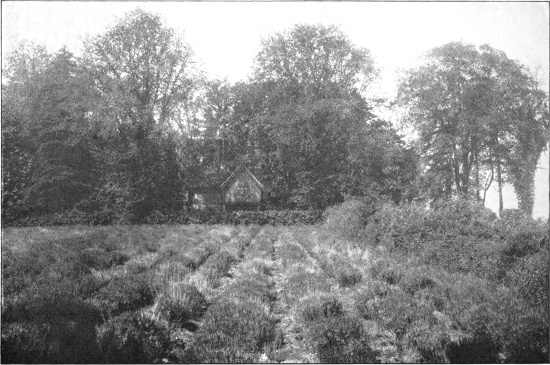
being one of the few places in England where lavender is cultivated
for commercial purposes. Hitchin preserves the remnant of an
ancient monastery in the almshouses known as the Biggin, and
teems with buildings and sites of antiquarian interest. Petty
sessions are held in the town. The parish church is one of great
beauty and interest, mainly of the Decorated and Perpendicular
styles. A picture of the Adoration of the Magi presented in
1774 is believed to be by Rubens. (pp. 14, 68, 69, 74, 105, 106,
108, 120, 128, 136, 141, 142, 145, 149.)
Hoddesdon (4711), an ancient market-town on the eastern
border of the county, approached from either the Broxbourne
or Rye House stations of the Great Eastern Railway. It is
intimately connected with the story of the Rye House Plot (see
page 85). It may be mentioned here that the “great bed of
Ware” is now preserved at the Rye House. (pp. 85, 86.)
The Hormeads—Great Hormead (376), Little Hormead
(128)—two villages, near the Quin about two miles east of
Buntingford, while the latter is about half a mile south of the
same. Both date from the time of the Conqueror.
Ippolits or Hippolits (840), a village in the Hundred of
Hitchin, dedicated to St Hippolytus patron saint of horses.
Travellers used to take their horses to the high altar, where
miracles were performed on untamed colts.
Kensworth (516), a small and ancient village in Dacorum
Hundred dating from the time of Edward the Confessor, and
formerly belonging to St Paul’s Cathedral. The small church
dates from about the year 1100, although the tower is later.
(pp. 88, 90, 98.)
King’s Langley (1579), a village on the North-Western
Railway notable as the site of the ancient Tudor Palace of
Langley, and of a friary of which portions still remain. The
royal palace and park date at least from 1299. The friary
belonged to the Dominican order. (pp. 81, 82, 107, 141.)
Layston (983); the original village is now represented only
by the ruined church of St Bartholomew, situated a short distance
from Buntingford, and of great antiquity.
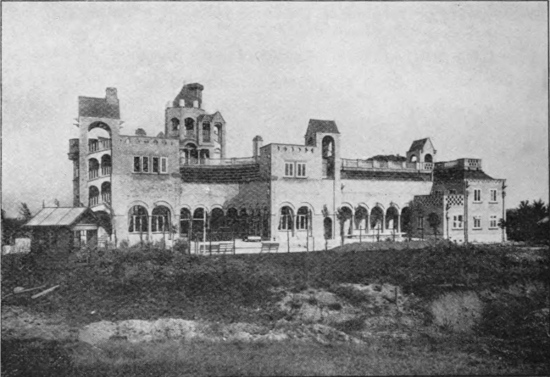
Letchworth, till recently a very small village on the Great
Northern Railway a little north of Hitchin, has now sprung into
importance as the site of the “Garden City”; an endeavour to
aid in bringing the population back to the land.
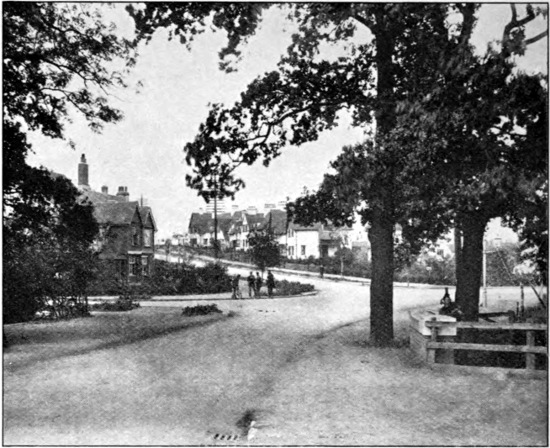
Letchworth, Open Air School
North Mimms (1112), a village on the North road, situated
some distance to the south-east of St Albans. A manor of North
Mimms was in existence at the Conquest. The parish includes
three large parks, Brookman’s, Potterells, and North Mimms.
The church, which is rich in monuments, dates from the fourteenth
century.
Offley (1001), or Great Offley, which lies on the Bedfordshire
border of the county, between Luton and Hitchin, takes its name
from Offa II, king of Mercia, who died there in his palace. The
church of St Mary Magdalene is built in the Perpendicular style,
with an apsidal chancel. Mrs Thrale, the friend of Dr Johnson,
lived as a girl at Offley Place. (pp. 14, 105, 128, 141, 147.)
Redbourn (1932), a village on the Chester and Holyhead
road, in the valley of the Ver, about four miles north-west of
St Albans; it has a station on the Harpenden and Hemel Hempstead
branch of the Midland Railway. The manor of Redbourn
was given to St Albans’ Abbey in the reign of Edward the Confessor.
The church, which is some distance from the main street,
was dedicated between 1094 and 1109, but the chancel appears to
have been rebuilt about 1340. Near Church End are the ancient
earthworks known as the Aubreys. (pp. 12, 67, 72, 126.)
Rickmansworth (5627), at the junction of the Colne, Gade,
and Chess rivers, is a town in the south-western corner of the
county, close to the Bucks and Middlesex borders. It has several
ancient almshouses, of which one dates from 1680. Immediately
to the south-east is Moor Park, the seat of Lord Ebury, where
Lord Anson formerly lived. This once belonged to the abbots
of St Albans, but was given by Henry VII to the Earl of Oxford,
and in the reign of Henry VIII was the property of Cardinal
Wolsey. The present house is of comparatively modern date.
The Bury is an excellent specimen of an early seventeenth century
mansion. The church appears to have been rebuilt in the fifteenth
century. Rickmeresworth was the old name of the town. There
are a number of manors in the parish. (pp. 20, 31, 71, 73,
131, 132.)
Royston (3517) is situated on the Icknield Way, actually on
the Cambridgeshire border, and is served by a station on the
Cambridge branch of the Great Northern. The town, which has
a market, stands just at the foot of the chalk downs; it has the
honour of giving the name to one of the species, or races, of
British birds, to wit, the Royston crow. The church is that of
an Augustinian priory now demolished. James I had a hunting
seat here. (pp. 32, 33, 45, 93, 128.)
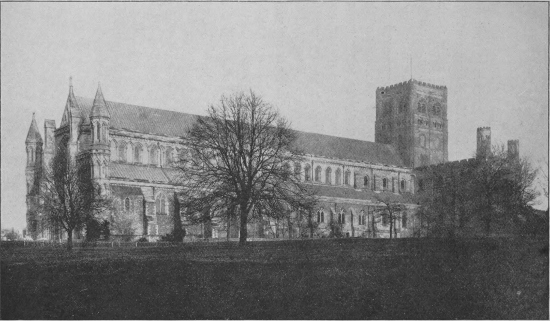
St Albans (16,019), situated about twenty miles north-west
of London by rail, enjoys the distinction of being the only
town in Hertfordshire entitled to style itself a “city.” It is the
direct modern successor of the Roman city of Verulamium, lying
on the opposite side of the Ver, and itself dates from Saxon times,
its ancient monastery having been founded by the Mercian king
Offa II in 793, in memory of Alban, the first English Christian
martyr. The city has a mayor and corporation, and was formerly
a parliamentary borough in its own right, although at the present
day it forms the centre of an electoral district returning one
member to the House of Commons. It is also the centre of the
western division of Hertfordshire;—a division corresponding in
the main to the old Liberty of St Albans, the area lying within
the jurisdiction of the abbot. Quarter-sessions for the western
division of the county are held in the Court House, and likewise
petty-sessions for the St Albans division of the county, as well as
city petty-sessions for St Albans itself. At these last the city
magistrates sit; the cases being brought before them by the local
police force, which is distinct from that of the county. The city
is the see of the bishopric of St Albans, and its crowning glory
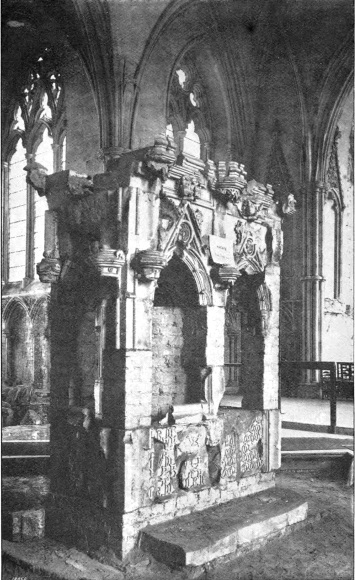
is its Abbey, now raised to the dignity of a cathedral. Offa’s
abbey was attacked and plundered by the Danes, and a rebuilding
of the monastic church was contemplated by Ealdred, the eighth
abbot, who collected building materials from Verulam. The
long-deferred work, on a new site, was however not undertaken
till the time of Paul of Caen, the first Norman abbot (1077–93).
This abbot rebuilt the church and nearly all the monastic buildings
with the materials collected by his predecessor; and apparently
made a clean sweep of the original structures. Although the
fabric appears to have been completed by Abbot Paul, the
consecration did not take place till 1115. Between 1195 and
1214 Abbot John de Cella commenced a new west front, but only
part of the original design was carried out. In 1257 the eastern
end was in a dangerous condition, and the two easternmost bays
were pulled down; and eventually a presbytery and a Lady
Chapel with vestibule were added. Extensive alterations and
rebuilding were carried out previous to 1326, and again between
1335 and 1340. Other works were carried out by John de
Wheathampstead between 1451 and 1484, including the rebuilding
of St Andrew’s chapel. In 1553 the abbey was sold to the
Mayor and Burgesses as a parish church, when the Lady Chapel
was cut off from the rest of the building by a public passage and
used as a grammar school. This passage remained till about
1870, when the Lady Chapel was once more rejoined to the main
fabric. About this time a restoration of portions of the building
was undertaken by a county committee, when the low-pitched
roof of the nave was replaced by a high-pitched one on the lines
of a much earlier structure. Soon after, the tower was in danger
of collapsing, owing to crush in the supporting pillars, and the
whole structure had to be shored up previous to underpinning.
Finally, the late Lord Grimthorpe undertook the completion of
the “restoration,” which was carried out in substantial but drastic
style. His most notable work comprised the complete rebuilding
of the west front in a peculiar style, the repointing of the tower,
and the replacing of its brick turrets by stone “pepper-pots.”
165
Shrine of St Amphibalus, St Albans’ Abbey
166
The clock-tower in the centre of the city, from which the
curfew was rung till the sixties, is another interesting building,
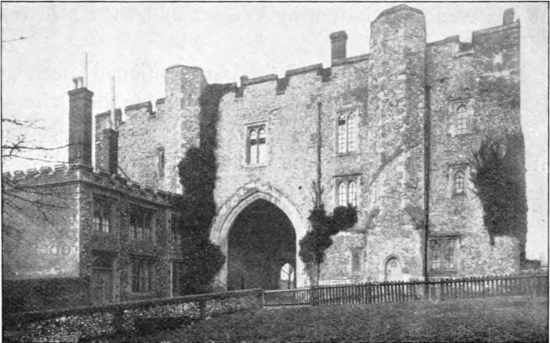
as is also the old gateway of the monastery, now used as a
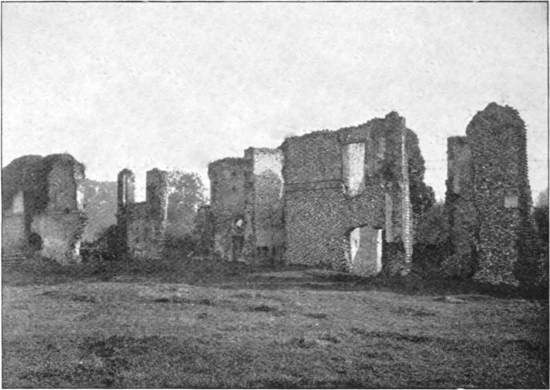
grammar school. Near by the city are the ruins of Sopwell
nunnery. The city has three parishes, those of the Abbey, St
Peter, and St Michael, but it is also extending into the parish
of Sandridge. On the further side of the Ver is situated St
Stephen’s. St Albans is rapidly increasing as a residential district,
and also as a manufacturing centre, a number of industrial
establishments from London having been recently set up in its
environs. Straw-plait still remains, however, the chief trade,
although the actual plaiting of the straw has been killed by
foreign competition. A market is held every Saturday. St
Albans has a museum, unfortunately not restricted to local
antiquities and natural history objects. There are three railway
stations, one on the Midland, the second the terminus of a
branch line from the North-Western at Watford, and the third
that of a branch of the Great Northern from Hatfield. St Peter’s
church stands on the site of a Saxon church built in the latter
half of the tenth century; this was replaced in less than 200 years
by a Norman edifice, remains of which were found during the
alterations carried out by the late Lord Grimthorpe. St Michael’s
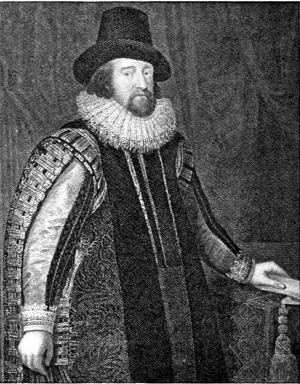
church contains Bacon’s tomb.
Two notable battles were fought at St Albans during the
Wars of the Roses. In 1455 the Yorkists and in 1461 the
Lancastrians were victorious. (pp. 14, 18, 35, 57, 59, 60, 61,
71, 72, 75, 80, 81, 82, 84, 94, 98, 102, 103, 104, 105, 107, 123,
124, 126, 128, 130, 137, 138, 140, 141, 142, 149.)
Sawbridgeworth (2085), pronounced Satsworth, is a town
on the eastern border of the county, to the south of Bishop’s
Stortford, with a station on the Great Eastern Railway. It was
originally known as Sabricstworth, being the seat of the family of
Say, or de Say. It has a history dating from the Conquest.
(pp. 113, 132.)
Shenley (1120) a village about four miles to the southward
of St Albans; the manor in the time of Stephen belonged to the
de Mandeviles, who had also the church.
Standon (1577), a village and manor, with a station on the
Great Eastern Railway about midway between Buntingford and
Stanstead Abbots. Standon Lordship was the seat of the Lords
Aston of Forfar, who inherited it from the Sadler family. The
living originally belonged to the Knights Templars.
Stanstead Abbots (1484), now a parish and manor, but
formerly a borough, is a village lying east of Hertford, near
St Margaret’s station on the Great Eastern Railway.
Stevenage (3957), a market-town on the Great North
Road and Great Northern Railway, between Welwyn and Hitchin.
The town originally stood near to the church of St Nicholas, now
half-a-mile distant; but after a disastrous fire, a new settlement
sprang up on each side of the North Road, which runs to the
south-west of the old church. The fortieth, and last, abbot of
St Albans was Richard Boreham de Stevenage, elected in 1538,
and dismissed the following year on the dissolution of the
monasteries. Elmwood House, now pulled down, was the home
of Lucas, the Hertfordshire hermit. (pp. 14, 39, 116, 128, 129.)
Tring (4349) forms the extreme western outpost of Hertfordshire,
being situated in the peninsula projecting from this part
of the county into the heart of Buckinghamshire. It has a station
on the North-Western Railway some considerable distance from
the town itself; and of late years has become well-known in the
scientific world on account of the private natural history museum
established by the Hon. Walter Rothschild in Tring Park, the
seat of Lord Rothschild. Tring was formerly one of the centres
of the straw-plait industry. (pp. 18, 42, 46, 47, 54, 72, 90, 99, 105.)
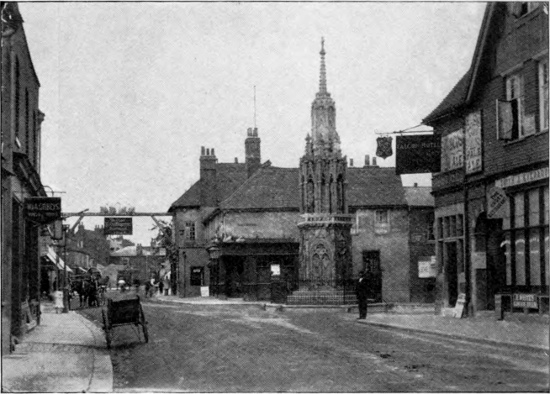
Waltham Cross (5291), a town on the Essex border of the
county, with a station on the Great Eastern Railway, which takes
its name from one of the crosses erected at the resting-places on
the funeral route of Queen Eleanor from Grantham. (pp. 124,
125.)
Ware (5573), an ancient town to the north-east of Hertford,
situated on the river Lea (which is here navigable), and on a
branch of the Great Eastern Railway. Ware, which is associated
with the story of “John Gilpin,” is the chief centre of the malting
industry in the county; the grant of a market was made by
King Henry III in the year 1254. (pp. 5, 44, 70, 80.)
Watford (29,327) is by far the largest town in the county,
being the only one with a population which exceeded 20,000 at
the census of 1901. It is situated in the south-western corner of
the county, and is traversed by the Colne; it has a station on the
North-Western Railway, from which a branch line runs to
St Albans. A market has existed since the time of Henry II,
and is stated to have been granted by Henry I. Watford played
an important part in Wat Tyler’s rising. The Grove, the seat
of the Earls of Clarendon, and Cassiobury, that of the Earls of
Essex, are situated in the vicinity of the town. Watford is the
centre of the West Herts parliamentary division and has numerous
mills and factories. The parish church contains some magnificent
monuments by Nicholas Stone. (pp. 6, 31, 34, 44, 99, 122, 123,
131, 132, 141.)
Watton or Watton-at-Stone (710), a village in the
valley of the Beane, near the centre of the county, taking its
name from the number of springs in the neighbourhood—Wat, in
Saxon, signifying a moist place. Watton, which was in existence
as a manor in the time of the Conqueror, was the home of the
ancient family of Boteler, whose seat was the present Woodhall
Park, now the property of the Abel Smith family. Near by is
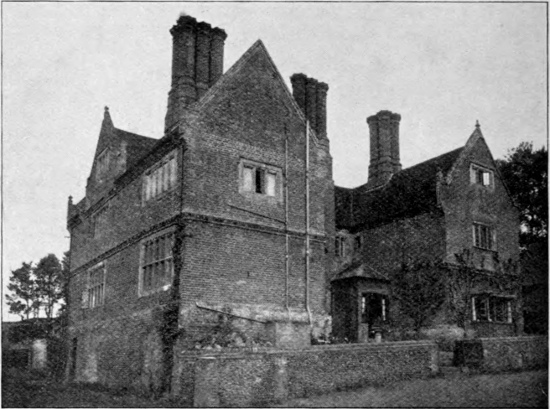
the manor house of Aston Bury, a fine example of a sixteenth
century house, also once belonging to the Botelers, with tall,
twisted chimneys, a magnificent staircase, and an upper room
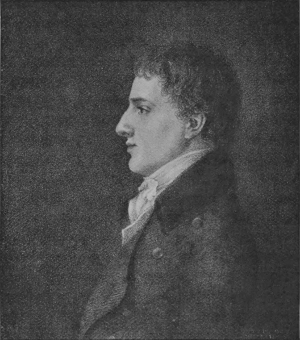
occupying the whole width of the building. (p. 113.)
Welwyn (1660), a village on the Great Northern Railway
between Hatfield and Stevenage. Young, who was born near
Bishop’s Waltham in Hampshire, became Rector of the place,
wrote his Night Thoughts here, and is buried in the churchyard.
Two centuries ago Welwyn was celebrated for its chalybeate
springs. (pp. 62, 128, 149.)
Wheathampstead (2405), a village in the valley of the
Lea, between Luton and Hatfield, with a station on the Luton and
Dunstable branch of the Great Northern Railway. The parish
originally included Harpenden, which was separated about 1860.
One of the oldest buildings is Wheathampstead Place, or Place
Farm, which dates back to the time of Queen Elizabeth, and has
some fine Tudor chimneys; it was formerly the property of the
Brockett family, whose monuments are in the church. The
church itself, which is a cruciform edifice with a central tower,
is dedicated to St Helen, and was judiciously restored in the
sixties; the chancel with its three beautiful lancet windows was
built about 1230, the tower was rebuilt towards the close of the
thirteenth century, and the north transept between 1330–40.
The parish includes the manors of Mackery End and Lamer; the
latter taking its name from the de la Mare family, by whom
it was held in the fourteenth century. Lamer House was rebuilt
about 1761. (pp. 38, 67, 90, 97, 101.)