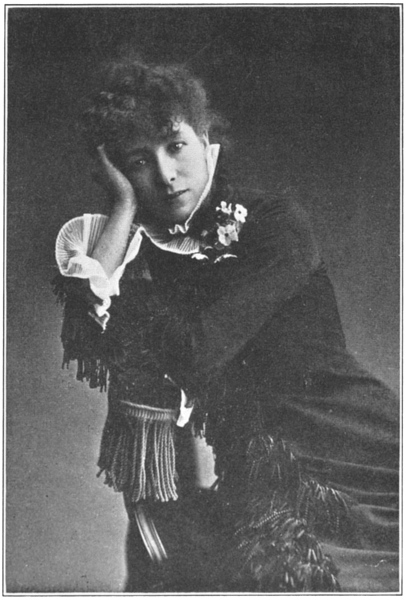
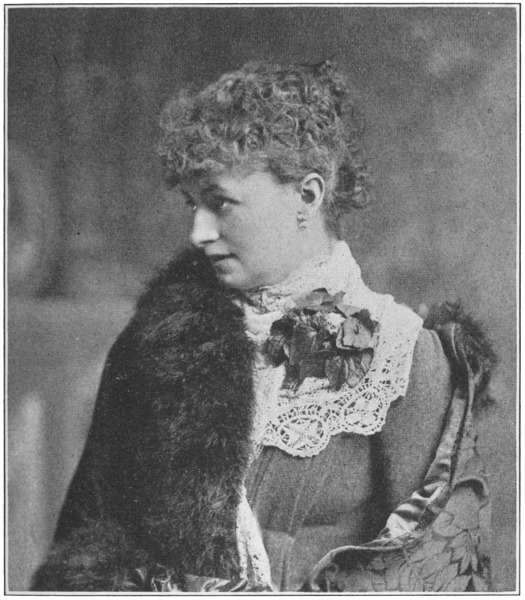
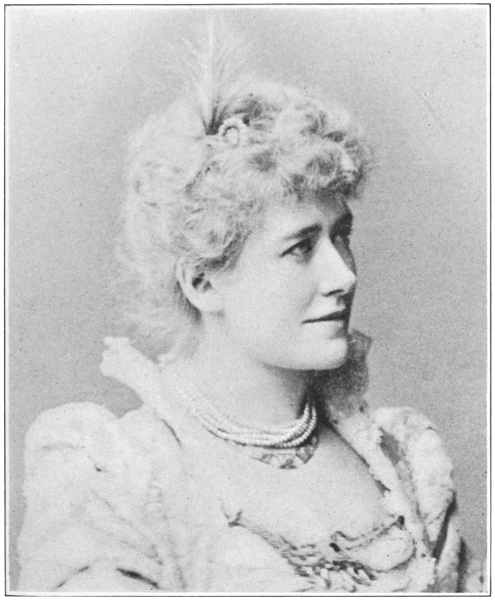
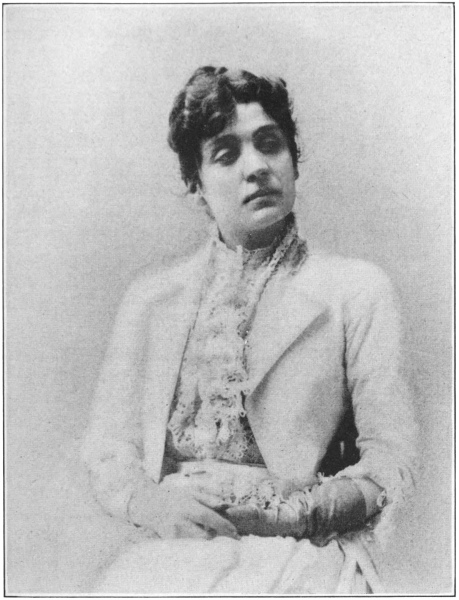
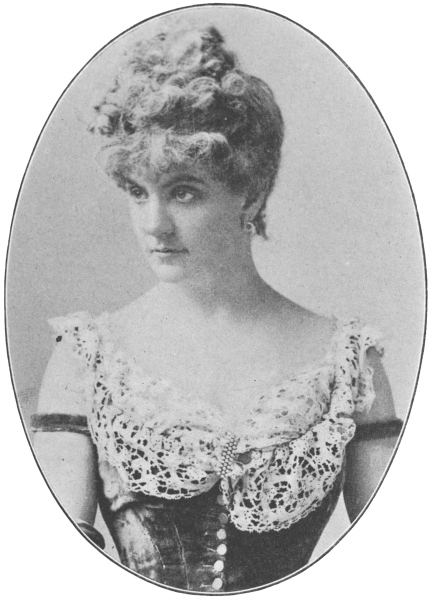
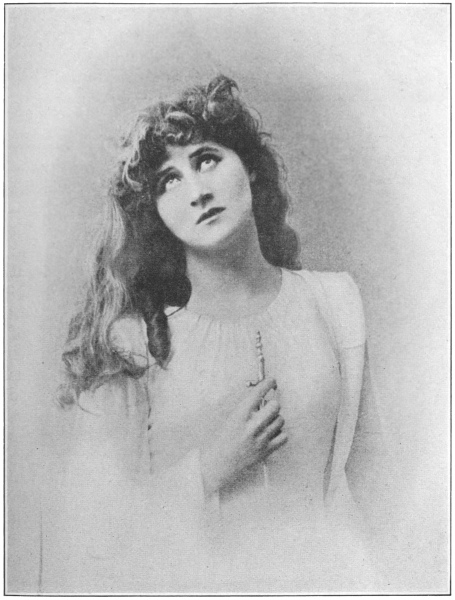
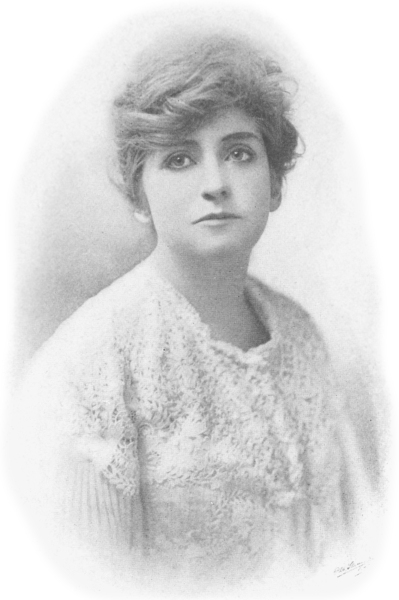
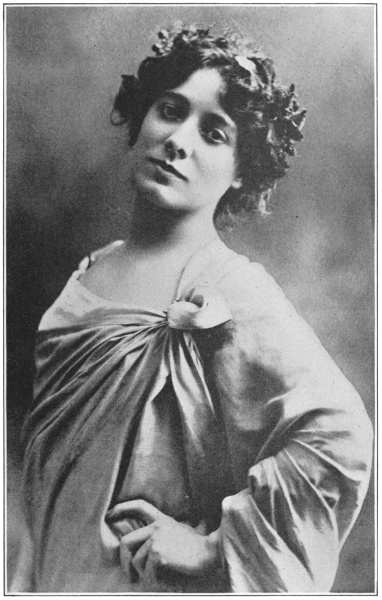
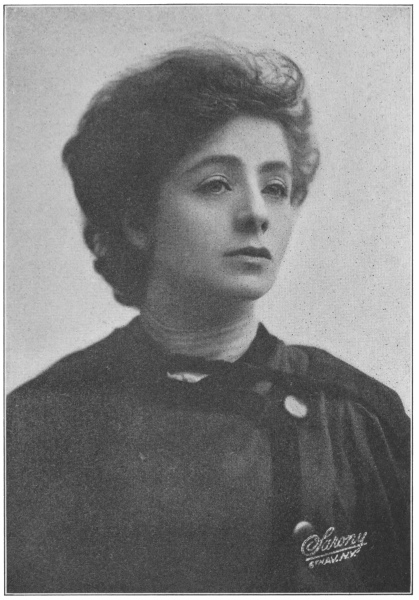
A certain Frenchman once voiced the feeling
of his fellow Parisians concerning Réjane
by calling upon all good French provincials,
who would learn the language of the
Boulevards in a single lesson, and all children
of other lands curious as to the pleasures, tastes,
and manners of Paris, to harken while he gave
them this advice: “Go and see Réjane. Don’t
go to the Opéra, where the music is German;
nor to the Opéra-Comique, where it is Italian;
nor yet to the Comédie Française, where the
sublime is made ridiculous, and the heroes and
heroines of Racine take on the attitudes of bull-fighters
and cigarette-makers; nor to the Odéon,
nor to the Palais-Royal, nor here, nor there, nor
elsewhere: go and see Réjane. Be she at London,
Chicago, Brussels, St. Petersburg—Réjane
is Paris. She carries the soul of Paris
with her, wheresoever she listeth.”
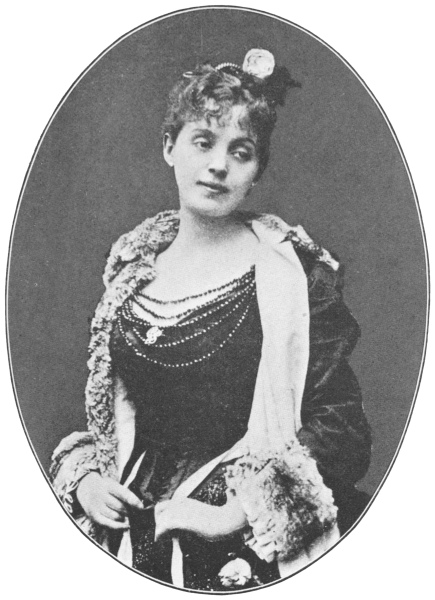
GABRIELLE RÉJANE
Madame Réjane—the Parisienne: they are interchangeable
terms. And what is a Parisienne?
Let our sprightly French friend—M.
Dauphin Meunier—tell us; he does it well:91
“A fabulous being, in an everyday human
form; a face, not beautiful, scarcely even pretty,
which looks upon the world with an air at once
ironical and sympathetic; a brow that grows
broader or narrower according to the capricious
invasions of her aureole of hair; an odd little
nose, perked heavenward; two roguish eyes,
now blue, now black; the rude accents of a street-girl,
suddenly changing to the well-bred murmuring
of a great lady; abrupt, abundant gestures,
eloquently finishing half-spoken sentences;
a supple neck—a slender, opulent figure—a
dainty foot, that scarcely touches the earth
and yet can fly amazingly near the ceiling; lips,
nervous, sensuous, trembling, curling; a frock,
simple or sumptuous, bought at a bargain or
created by a Court-dressmaker; a gay, a grave
demeanor; grace, wit, sweetness, tartness;
frivolity and earnestness, tenderness and indifference:
such is Woman at Paris: such is the
Parisienne.
“No need for her to learn good manners, nor
bad ones: she’s born with both. According to
the time or place, she will talk to you of politics,
of art, of literature—of dress, trade, cookery—of
finance, of socialism, of luxury, of starvation—with
the patness, the sure touch, the absolute
sincerity, of one who has seen all, experienced
all, understood all. She is as sentimental as a
song, wily as a diplomat, gay as folly, or serious
as a novel by Zola. What has she read?
Where was she educated? Who cares? Her
book of life is Paris; she knows her Paris by
heart; and whoso knows Paris can dispense
with further knowledge.”
Réjane was from the beginning a veritable
child of Paris. She was born on June 6, 1857,
at 14 Rue de la Duane, in a business section of
the city. This street had been “one of the storm
centers for almost every great riot known to the
Paris of the last century and a half.” The little
Gabrielle Charlotte Réju passed her infancy in
that busy part of Paris between Porte Saint-Martin
and Place Château d’Eau.
Her parents were poor. Her father had
earlier been an actor and at one time had directed
a theatre at Arras.92 When Gabrielle was
born, and during the years of her infancy, he
was the ticket-taker and the keeper of the buffet
at the Ambigu. In the work of dispensing refreshments
Madame Réju, who came of a good
Valenciennes family, actively assisted, and even
Gabrielle herself, when she grew old enough, was
pressed into service.93
With the home life virtually transferred to the
lobbies of the Ambigu, it was inevitable that
Gabrielle, breathing the mystery-filled atmosphere
of a theatre, should at once feel its strong
influence. Like Ellen Terry and Mrs. Fiske,
and unlike her compatriot the great Sarah, Réjane
was, from the beginning, of the theatre.
She was an amiably mischievous child, possessed
of an immense curiosity about life behind the
scenes. She remembers vividly those early
days, in which she divided her time between her
small duties, napping in corners, and revelling
in the delights that presented themselves over
the footlights. There she saw many of the stars
of the day, Jane Essler, Frédérick Lemaître,
Marie Laurent, Adèle Page. On the night of a
new production, between the acts, she would go
to her mother and recount the story of the play
and give childish imitations of the various players.
To imitate the fine gowns she saw on the
stage, she would make a train from the buffet
napkins. One of the memories of her childhood
is the enchantment that possessed her when she
saw herself, dressed in a velvet robe and a royal
diadem, reflected in Adèle Page’s splendid
cheval glass.
When Gabrielle was about five, her father
died, and mother and daughter were thrown on
their own resources. Mme. Réju secured a position
at one of the other theatres, and Gabrielle
went to school. She was to some extent in the
care of a friend, but she was privileged with extraordinary
liberties. Her mother gave her a
franc each morning with which to buy her evening
meal, and it was with immense pride that
she would go forth alone to take her dinner at a
restaurant. Often she would save enough from
her franc to buy an orange which she would take
with her into the balcony of the Ambigu, where
she was still privileged to go. There she would
tarry to see an act of the play before she went
home.
It is clear that she was a precocious, clever
child. She was already, indeed, an actress.
Her evening walk would invariably take her past
her beloved Ambigu. She made an event of this
passage, putting on her best attitudes and smiles
for the artists who might be seated in the terrace
of the café.
This café of the Ambigu was the scene of one
of the oft-repeated episodes of Réjane’s childhood.
The proprietor, a relative of some sort,
was in the habit of beating his wife. One evening,
Gabrielle, who knew what to expect, happened—as
was not unusual—to be in the café.
Soon the poor woman’s cries were heard as her
lord and master belabored her. A patron demanded
of Gabrielle what the terrible noises
meant. “Oh, that, Monsieur,” she said.
“Why, they’re rehearsing upstairs.”
Soon the mother changed her work, and took
up the painting of fans. Between sessions of
the school, and all day on Thursdays, little Gabrielle
helped in this work and proved herself
adept. They received for this work about fifty
cents per dozen fans. Madame Réju seems to
have been sensitive as to her new work. She and
her young daughter, too proud to have it known
that they were doing work of that sort, or perhaps
for fear of offending certain rich relatives,
took a neighbor into their confidence and paid
her for delivering the fans to la maison Meyer.
If mother and daughter had continued to live
in the immediate neighborhood of the Ambigu
it is not unlikely that the already lively ambition
of the girl would have found its outlet at that
theatre. We have seen something of her enthusiasm
for the Ambigu and her close relationship
with its entourage. Once launched upon
her career there as an actress of popular drama,
she would very likely have remained there and
missed the valuable training that she was to
receive at the Conservatoire. As it happened,
however, when she was about ten her mother
moved from Rue de Lancry to 17 Rue Notre-Dame-de-Lorette,
and in large measure the influence
of the Ambigu was removed.
On the same floor with Madame Réju and her
daughter in their new quarters lived a lady with
whom they gradually formed a close friendship.
When the war of 1870 broke out, the new friend
left Paris, leaving her apartment in charge of
Mme. Réju and Gabrielle. There the windows,
unlike those of Mme. Réju’s own suite, overlooked
the street. When the Commune brought
the terrors of civil war to Paris, it was from
these windows that the child witnessed what
was to her a terrible and long-remembered
sight, a street battle between the government
troops and the Communists. The bodies of
slain men, carried past under those windows,
gave her her first glimpse of death.
The war past, Gabrielle, now fourteen, returned
to school at the Pension Boulet, Rue
Pigalle. She applied herself diligently to her
somewhat neglected studies, and to such good
purpose that the mistress of the school, with
whom Gabrielle had become a favorite, offered
her a position as an assistant with the younger
pupils. She was to be paid forty francs a
month, and her luncheon. To her mother this
seemed to be the opening of an honorable career.
Not so Gabrielle herself, who cherished constantly
her already fixed ambition to be an
actress. She was, however, fond of children,
and to tide affairs over she took a class of the
younger pupils. She got along well enough
with them with their ordinary lessons, but her
own instruction in sewing and embroidery had
been neglected, and she had to have the help of
the older of her pupils, to bridge the gap.
Occasionally, of a Sunday evening, Gabrielle
was taken by her mother to the house of a friend
who gathered about herself a modest salon.
There came such men as Félicien David, the
composer, Joseph Kelm, the writer, and the
architect, Frantz Jourdain. Gabrielle, young
as she was, with her natural gayety and spontaneity
at once took her place in the circle. She
would sing for the assembly the popular songs
of the day—compositions often full of doubtful
meanings that she very imperfectly understood.
Her little successes naturally strengthened her
longing to be an actress, to stir great houses as
she amused this little circle of friends.
To Gabrielle’s increasing ambition her mother
set herself in opposition. To her mind the forty
francs per month was not lightly to be sacrificed.
And she said she did not care to be the mother
of an actress. She lived to own herself in the
wrong.
One evening, as mother and daughter were
passing the Théâtre Français, they saw a crowd
at the stage door. They questioned a bystander
and were told that this had been the farewell
performance of Regnier. Gabrielle insisted on
waiting to see him come out. She had never
seen him, but every one knew of Regnier, great
artist and lovable personality. Soon he appeared,
a little, old man, who got up into his
carriage and acknowledged the ovation with a
modest and confused air. Gabrielle never forgot
her first and touching glimpse of the man to
whom she was soon to owe so much.
The struggle with her mother over her cherished
plan to go on the stage went on for another
year. A Mlle. Angelo, a friend of Mme.
Réju, attempted to make peace by offering
Gabrielle a dot of 10,000 francs if she would
accept a plan to marry as a solution of the difficulty.
But Gabrielle refused to be bought off,
and steadfastly clung to her ambition, with the
result that the mother at last gave in.
The friend from whose windows Gabrielle had
seen the battling Communists had returned to
Paris and now took up the girl’s cause. She introduced
Gabrielle to Charles Simon,94 who knew
well the actor Regnier, now an honored teacher
at the Conservatoire. The girl was duly introduced
to Regnier, who received her affably but
tried to dissuade her from attempting the career
of an actress. He was unable to overcome the
ardent resolution of Gabrielle, and finally consented
to receive her, for two months, on the condition
that if at the end of the time she failed
to convince him of her calling she would promise
to give up the attempt for good and all.
Sure of success, she promised.
Regnier’s first task was to cure his pupil of
a thickness of diction. For hours every day she
practiced enunciation, but found her master
hard to please. Nevertheless he must have seen
promise in her, for during the summer (of
1872) he wrote to Charles Simon that when
classes assembled he would receive Gabrielle as
a regularly enrolled pupil. When the Conservatoire
reopened, she passed her entrance examination
by reading the rôle of Henriette in Les
Femmes Savantes, and was admitted. Here
began, when she was fifteen, the serious work
of her career.
She was an ardent pupil. Not content with
the regular course, she and her mother squeezed
their narrow means that the girl might amplify
her studies with a number of private lessons
with Regnier at his house. He gave her the
lessons, but when she offered to pay, he refused
to accept. “One does not accept pay,” he said,
“when he is privileged to deal with the temperament
of an artist.” And, thus, the trial months
past, Regnier, instead of sending Gabrielle
packing, engaged himself to teach her as best
he could, gratis, till her period as a student
should end.
In January (1873), came the annual elimination
examination. Gabrielle, like the rest, submitted
to the test that weeded out the less promising
pupils. She had a rôle—that of Agnes—not
altogether suited to her, her dress was not
too well chosen, she was at the most awkward
of ages, and she was by no means the prettiest
girl of the lot. Gazing at her, Edward Thierry,
director of the Comédie Française, said in a
doubtful tone to Regnier, “Do we keep this?”
“Yes,” promptly replied Regnier, “she is in my
class and she stays.” At the end of the school
year came the annual competition. For her part
in the preliminary examination Regnier chose
L’Intrigue Épistolaire. Thierry, again one of
the judges, failed to recognize her and said,
“This child is charming! She is the hope of
the competition.” And, imitating his colleague’s
former doubting tone, Regnier now
said, “We keep this, then?”
In the competition itself Gabrielle, in this
same scene of L’Intrigue Épistolaire, fell just
short of a prize and received a premier accessit,
or honorable mention,—not bad for a
girl just turned sixteen and a mere beginner.95
In this competition Mlle. Legault won the
first prize in comedy and with it a post at the
Comédie Française. Her departure left vacant
a scholarship of 1,200 francs. In the same
competition her successor to the scholarship
was to be determined. Regnier had resolved
to get the scholarship, if possible, for Gabrielle.
The professors who sat in judgment
were forbidden by a rule of the Conservatoire
to impart personally any news of the outcome.
Such information was to come only from the
administration. Regnier, however, conspired
with his favorite pupil to relieve her of suspense.
If she were the successful candidate
for the scholarship he was to rub his nose as
he left the building. After the meeting, therefore,
she stood anxiously in the porte-cochère,
awaiting her teacher and the behavior of his
index finger. Imagine the importance of the
moment to the rather shabbily dressed, not too
well-fed, nervously anxious girl. To stay her
hunger as she waited she was eating bits from
a long loaf tucked under her arm. First came
M. Legouvé, who, by a curious chance, rubbed
his nose briskly as he left the building. Then
came MM. Beauplan and Ambroise Thomas, and
each, oddly enough, suddenly gave his nose a
vigorous rub. Gabrielle wondered, but could
not believe that all these demonstrations were
for her. Finally, out came Regnier, smiling,
and slowly rubbing his nose with the end of his
forefinger. For the moment the loaf of bread
had been forgotten. Now she waved it aloft,
dancing about in an ecstasy of joy.
The winning of the scholarship made it possible
for Gabrielle to go on with her studies in
the two months’ interval that preceded the reopening
of the Conservatoire.
Francisque Sarcey was discerning enough to
note the promise in this sixteen year old girl.
He said of her, in speaking to the playwright
Meilhac: “She has a face you would know as
Parisian a mile off ... and she is full of the
devil. If this girl doesn’t make her way, I shall
be much surprised.... She is charming; she is
piquant; and if I were a manager I would engage
her out of hand.”
To eke out the family income, Gabrielle had
two pupils, youngster though she was. They
were young girls from Gascony, and it was her
task to cure them of their un-Parisian accent.
She remembers that one day when she was on
her way to her pupils, the omnibus passed a
church. The crowd about the door, and the
numerous flowers, denoted a funeral. “They
are burying Desclée,”96 said a fellow passenger.
Gabrielle had seen Desclée in some of her notable
successes:—Froufrou, La Femme de
Claude, La Princesse Georges—and had been
stirred to renewed ambition by her art. So now
she was tempted to alight and pay her respects
to the dead actress’ memory; but she
remembered her lesson, and went on to her pupils.
Her last year (1873–4) at the Conservatoire
Mme. Réjane remembers not only for its months
of hard study but for an incident or two that,
trivial in themselves, had considerable importance
in her youthfully ambitious mind. One
morning Regnier called on her to recite “La
Fille d’Honneur,” a poem she had memorized
by hearing it often spoken by a fellow pupil.
She was horribly nervous. Her own two pupils
were present, as auditrices, and Gabrielle feared
the usual frequent interruption of Regnier, who
as a rule made his pupils repeatedly go back
over imperfectly recited passages. This time,
however, he allowed her to proceed to the end,
which agitated her still more, and then he said
in a solemn tone as if pronouncing a final judgment
on her: “C’est très bien, ma petite;
descends, tu seras une grande artiste.” Réjane
says that the intense joy of that instant never
was equaled afterwards, even in the moments
of her greatest triumphs.
The pupils of the Conservatoire were permitted
to accept engagements to play on Sundays
at the little theatre of the Tour-d’Auvergne.
There it was that Gabrielle made her
first public appearance. The play was Les
Deux Timides, and in acting it she had the inexpert
assistance of Albert Carré. In the middle
of the piece M. Carré was seated at a desk, writing
a letter, when his nose began to bleed. He
bolted from the stage, leaving the débutante
alone to face her first audience in the midst of
a staggering contretemps. Advice was hoarsely
whispered from the wings to do this or that, to
walk off, to sit down, to wait for Carré; Gabrielle
coolly seated herself and took up the
writing of the letter until, a moment later, the
bleeding stopped, Carré returned.97
When the concours of 1874 arrived—the annual
prize contest of the Conservatoire—Gabrielle’s
progress had been such that her fellow-students
and her professor all thought her sure
of the first prize in comedy. Regnier chose for
her one of Roxelane’s scenes in Les Trois Sultanes.
When she had finished she felt that she
had done herself scant justice. Then the unexpected
happened. She was also to appear in
a dialogue called La Jeunesse, by Emile Augier.
A youthful couple met at a fountain. The
young man says: “Cyprienne!” She exclaims:
“Ah! Mon Dieu!” Gabrielle delivered this
commonplace speech with such a sincerity and
intensity of emotion that the audience broke
into applause. Reassured, she played the dialogue
through to the end with a command of
emotional acting that surprised even her
friends, for she had been thought of as only a
comédienne, a soubrette.
When the prizes were announced, Gabrielle
found that she had not only missed getting the
first comedy prize, but that she was to get only
a share of the second; the other half was to go
to Mlle. Jeanne Samary, she “of the perfect
laugh.”
Regnier was chagrined. “Malfaiteurs,” he
called the judges. And some of the newspaper
comment showed a recognition of unusual merit
in the young Réjane. Sarcey, the reigning king
of the Paris critics, had again been present, and
Le Temps rang with his praises of her. And
his praises were perhaps better than official
prizes. A score of years later, M. Meunier
wrote:
“To-day, as then, though twenty years have
passed, there is no possibility of success, no
chance of getting an engagement, for a pupil on
leaving the Conservatoire, unless a certain all-powerful
critic, supreme judge, arbiter beyond
appeal, sees fit to pronounce a decision confirming
the verdict of the Examining Jury.... He
smiles or frowns, the Jury bows its head. The
pupils tremble before this monstrous Fetich—for
the Public thinks with him, and sees only
through his spectacles; and no star can shine
till his short sight has discovered it. This puissant
astronomer is Monsieur Francisque Sarcey....
“Monsieur Sarcey smiled upon and applauded
Réjane’s début at the Conservatoire. He consecrated
to her as many as fifty lines of intelligent
criticism; and I pray to Heaven they may
be remembered to his credit on the Day of Judgment.
Here they are, in that two-penny, half-penny
style of his, so dear to the readers of
Le Temps:
“‘I own that, for my part, I should have
willingly awarded to the latter (Mlle. Réjane)
a first prize. It seems to me that she deserved
it. But the Jury is frequently influenced by
extrinsic and private motives, into which it is
not permitted to pry. A first prize carries with
it the right of entrance into the Comédie Française;
and the Jury did not think Mademoiselle
Réjane, with her little wide-awake face, suited
to the vast frame of the House of Molière.
That is well enough; but the second prize which
it awarded her authorized the director of the
Odéon to receive her into his company; and that
perspective alone ought to have sufficed to dissuade
the Jury from the course it took....
Every one knows that at present the Odéon is,
for a beginner, a most indifferent school....
Instead of shoving its promising pupils into it
by the shoulders, the Conservatoire should forbid
them to approach it, lest they should be lost
there. What will Mademoiselle Réjane do at
the Odéon? Show her legs in La Jeunnesse de
Louis XIV, which is to be revived at the opening
of the season? A pretty state of things.
She must either go to the Vaudeville or to the
Gymnase. It is there that she will form herself;
it is there that she will learn her trade,
show what she is capable of, and prepare herself
for the Comédie Française, if she is ever to
enter it.... She recited a fragment from Les
Trois Sultanes.... I was delighted by her
choice. Les Trois Sultanes is so little known
nowadays.... What wit there is in her look,
her smile! With her small eyes, shrewd and
piercing, with her little face thrust forward, she
has so knowing an air, one is inclined to smile
at the mere sight of her. Does she perhaps
show a little too much assurance? What of it?
’Tis the result of excessive timidity. But she
laughs with such good grace, she has so fresh
and true a voice, she articulates so clearly, she
seems so happy to be alone and to have talent,
that involuntarily one thinks of Chenier’s line:
“Sa bienvenue au jour lui rit dans tous les
yeux.”... I shall be surprised if she does not
make her way.’”
Second prize or first, it mattered not, really;
for she had, almost at once, offers from three
theatres: the Odéon, the government theatre
that by the conditions of the award had a right
to her services, and also from the Vaudeville
and the Gymnase. M. Duquesnel of the Odéon
proposed, as Sarcey had predicted, that she take
a part in the impending La Jeunesse de Louis
XIV. Réjane, however, declined to cut short
her studies at the Conservatoire, which had yet
a few weeks to run.
Her choice fell to the Vaudeville, as the
theatre best suiting her methods and sympathies.
Also, the pay there was to be four
thousand francs per year, and costumes, as
against one hundred and fifty francs per month
at the Odéon. With the directors of the Vaudeville
she signed a provisional contract, by the
terms of which she was to join their forces if the
Odéon did not press home its claim to her.
Weeks passed, the October openings came
round, and still there was no summons. In her
anxiety she went to the office of the Minister of
Fine Arts and from him obtained a letter releasing
her, in two days’ time, from her obligations
to the Odéon. Before the two days were
up, however, she received from Duquesnel a summons
to a rehearsal of La Jeunnesse. Réjane
hastened to see him. “Well,” he said, “we
shall rehearse to-morrow at one.” Réjane replied
that she had one at the Vaudeville at the
same hour. Duquesnel objected to the loss of
his promising recruit and showed an official letter
bestowing her services upon the Odéon.
Gabrielle in turn showed the letter from the Minister.
Duquesnel was forced to yield, but afterwards
lodged a suit in which the Odéon was
awarded damages. “So,” said Réjane to Jules
Huret, “if the Odéon can to-day boast its velvet
chairs, it has me to thank for them.”
And so Réjane began her career, when she
was less than eighteen, with a two years’ engagement
at the Vaudeville. Her first few
rôles98 were unimportant, and in them she attracted
no particular notice, but in September
(1875) she appeared in Madame Lili, a one-act
play in verse, to such good purpose that Sarcey
wrote of her: “Mademoiselle Réjane is charming,
with her roguery, her ingenuousness, her
tenderness. This pretty and piquant girl is
spirited to her fingertips. What a piece of good
luck it is that she cannot sing; for if she had
a voice operetta would gobble her up.”
Yet Regnier wrote to her in the following
April, on the day following her appearance in
Le Premier Tapis (in which she sang an interpolated
song by Lecocq): “I was really astonished
by your singing. You had better cultivate
this talent, which I didn’t know you had.”
Offenbach also heard her in this piece, and liked
her singing so well that he offered her twenty
thousand francs a year for her signature to a
contract at the Variétés. Luckily she made no
attempt to break her contract with the Vaudeville.
That contract she renewed again and again
until she had played eight seasons at the theatre
of her first choice. The best guide to her growing
art, and to the beginnings of her fame, are
found in her letters from Regnier, who followed
her career with loving watchfulness, and often
with frank, kindly comment on her work. Their
correspondence forms a charming chapter of
her youth.
Regnier’s birthday fell on the first of April.
Every year Réjane wrote to him on March 31
and sent him some small gift. In the year when
she was beginning her work at the Vaudeville
he wrote her:
“Ought you really send me presents, my
child? Do I need assurances of your affection?
Do follow my advice, dear girl, save your money
and give me nothing but your friendship. That
is the only present I desire from you and, I warn
you, it is the only one I shall accept in the future.
You hope to be able to celebrate my birthday
for many years to come. I hope so too.
You will never have a better friend, a better adviser,
and no one, save only your mother, will
ever bear your welfare more at heart. I thank
you, none the less, and with all my heart I embrace
you.”
At the close of a health-seeking trip she took
in Holland and Belgium in the summer of 1875
he wrote: “I knew you would get many new
impressions. You must always be on the search
for like ones, for your spirit, your ideas, your
taste, your talent will thus find themselves.
Frequent our museums, stimulate your mind,
read a great deal, even do a little writing.
Such is the intellectual regimen that will profit
your soul as the exercises I have advised will
benefit your gentle body.”
Less exalted advice comes after Le Verglas
and Le Premier Tapis, besides the commendation
of her singing in the latter piece: “Keep
at your study and your work and let me repeat
that it is the simple and the veracious that brings
the true effect. But I was more than satisfied
with you yesterday. But, please remember
your carriage—don’t waddle on one leg and
then on the other; don’t swallow your syllables
and your words. Pronounce everything without
affectation, but also without negligence. I
embrace you.”
After she had been a year and a half in harness,
he was still emphasizing the fundamentals.
After Le Perfide comme l’Onde he wrote (November
26, 1876): “You are very pretty and
very amusing in your rôle.... You are a comédienne,—that
you have proved. Between ourselves,
the other young ladies frightened me a
bit. Do not you allow yourself to fall into the
general carelessness of carriage and pronunciation.
Really talk to those to whom your words
are addressed, and when your eyes peer into the
auditorium remember it is a vacuum, and never
talk to any one therein. You know how to
avoid this fault, so look out for it, and remain
natural. But you played well, were applauded,
and deserved to be.”
Her work must have pleased the directors of
the Vaudeville, for when the time came to renew
her contract she signed for nine thousand
francs, a considerable advance over four thousand.
Her mother, however, had set her heart
on nine thousand six hundred francs, and her
objections threatened to break off the negotiations.
Réjane promised, however, unknown to
her mother, to repay the disputed six hundred
francs during the engagement.
“I economized on cress,” she relates. “Instead
of getting two boxes at three sous apiece,
I got two boxes at five sous. From time to time
I put fifteen centimes into my boots. And one
fine day I carried to the managers one hundred
and fifty laboriously collected francs. I must
say, to their credit, that they wouldn’t take the
money. But my mother never knew, and sometimes,
endeavoring to crush me with the superiority
of a strong-minded woman, she would
say: “There now! Without me, you would
never have had those six hundred francs.”
In the summer of 1877 she grew nervous over
the forthcoming production of Pierre. She
wrote Regnier from Abbeville: “If you could
only give me one hour for the third act of
Pierre. The nearer the time approaches, the
more I fear that act—all sentiment. If I am
unsupported by your good advice, my dear master,
I cannot answer for myself.”
Regnier was eager to help her; and in his response
he gives her more fatherly advice: “My
greatest wish is to help you in your work....
But is it necessary for you to go to La Bourbelle,
where you will stay hardly two weeks? The
time seems to me much too short for serious
treatment. Can’t you simply betake yourself to
the waters of Enghien?
“Talk this over with your doctor: ask him
if it is really good for the nerves that that
abominable musk or amber odor which perfumes
your letters should permeate your whole
system. No doubt the odor is agreeable, but
still that is a matter of taste.”
The première of Pierre proved the first crowning
success for the young actress. Immediately
after the performance, unable to restrain her
overflowing joy, she wrote to Regnier this enthusiastic
letter:
“I have just had a grand succès, and I don’t
wish to sleep before thanking you, to whom I
owe it. I have never been so happy as I am
tonight, and I believe that, if such a thing is
possible, even my affection for you has grown.
One thing alone distresses me, and that is my
inability to repay you for all you have done.
At each burst of applause, I thought of you,
dear master, who have given me your time and
made sure for me my future. No affection has
ever been more profound nor any gratitude so
sincere, believe me. Without you I would have
been nothing, but with you—two hours ago they
told me I was an artist! I can open my heart to
you. You cannot imagine how much is included
in that one word “artist” especially to a young
girl, who yesterday had doubts about the future
and had need of reading all your letters in order
to give courage.... I am doubly happy. Do
not mistake for vanity the effects of the great
joy I have been experiencing. How I would
work, dear master, to do you the honor of registering
a multitude of such nights!”
But good parts fell to Réjane’s lot only infrequently.
The reigning queen of the Vaudeville
was Mme. Bartet, and it was she, naturally, who
got most of the leading rôles. The public had
begun to like the young newcomer, whom it
had come to know in her small but repeated successes;
but nevertheless she was kept more or
less in the background, encouraged only by Regnier
and patiently waiting her opportunities.
It was in this fashion that she spent the remaining
time at the Vaudeville until she left it
in the spring of 1882. That period, whatever
dissatisfactions it brought to her, is not without
its high lights. In Le Club she has “un vrai
rôle,” and played it, with gratifying success, a
hundred times. In April, 1879, Mme. Bartet
fell suddenly ill, and with only a few hours notice
Réjane assumed the older woman’s rôle in
Les Tapageurs. When Les Lionnes Pauvres
was revived, in November 1879, her Séraphine
aroused one of those artistic controversies which
delight the French mind. Sarcey disapproved,
for once. M. Defère advised her to change her
costumer. M. Barbey d’Aurevilly on the other
hand said she recalled Rachel and was a true
artist; Augier, the author of the play, sustained
her; and stanch old Regnier wrote her at length,
discoursing on the art of acting and of his affection
véritable. Her Mimi in La Vie de Bohème
again saw the critics at odds about her.
Altogether in her eight seasons at the Vaudeville,
she had played more than a score of parts,
some of them genuine successes. Yet she had
not won genuine recognition at the hands of the
directors, and her position in the company was
hardly in accord with her promise and deserts.
Sardou and the others responsible for the affairs
of the Vaudeville seemed strangely blind
to the fact that in Réjane they had a comédienne
of the first order. But though she was by her
superiors much of the time either kept idle or employed
in almost insignificant parts, the rest of
Paris speedily knew her for what she was. She
was in keen demand for all the special, semi-informal
performances that make up so large
a part of the artistic life of the normal Paris.
The “spectacles” of the Cercle de la rue Royale,
the revues at the Epatant, the dramatic trifles
that were the adjuncts of authors’ readings, all
found in Réjane a willing and able helper. She
took these artistic informalities seriously, rehearsed
for them and costumed them with care,
and was so particularly well adapted to the work
that she became a marked favorite with the very
social and artistic circles to which the Vaudeville
catered.
As the directors, however, continued to give
her insignificant parts, it is not strange that she
listened to those friends, like Pierre Berton,
who urged her to shake the dust of Vaudeville
from her feet. “You are a star,” Berton told
her. It happened that a star was the quest just
then of M. Bertrand of the Variétés and with
him she signed a three years’ contract.
This moment may be said to mark the definite
arrival of Réjane. She was no longer to cool her
heels in the greenroom or at home, and henceforth
she was to play, as a rule, principal parts.
Moreover, the agreement with the Variétés was
elastic enough to allow appearances at other
theatres, often in plays of more import than the
light material of which the Variétés was the
avowed medium. And when she returned, on
occasion, to the Vaudeville, it was not in minor
rôles. Réjane had assumed her due place on the
stage of Paris.
It had not been a difficult rise. Though it is
not possible to overlook the elements of steadfast
ambition, patience, and hard work in
Réjane’s early career, it is true that her native
spirits, her flair, and the training and friendship
of Regnier made inevitable her right to a
prominent place on the stage of Paris.
With that place assured, we see her thenceforth
steadily enlarging it, progressing from
part to part, appearing now in this theatre of
Paris and now in that, shortly venturing into
the other capitals of Europe, then making a
tour—to be later repeated—in America, and
finally acquiring a theatre of her own in Paris,—an
international figure, a queen of comedy.
M. Porel, whom Réjane afterward married,
has given a graphic account of one of her
earlier triumphs—and a typical Parisian first
night. The play was de Goncourt’s Germinie
Lacerteux, the date, 1888; the theatre the Odéon.
“Oh, that première! The beautiful theatre
was crowded to the last inch with an audience
that was restless and seemed none too good-natured.
The journalists were furious because
the dress rehearsal had been behind closed
doors. The women were puzzling themselves
about the subject of the play, and some of the
literary gossips were loudly telling all they
thought they knew. The cafétiers of the neighborhood,
disgruntled because the usual five entr’actes
had been cut down to two, were protesting
to the claque against the change, which
interfered with the sale of the usual five bocks.
Amid the confusion of the lobbies were heard
remarks that the piece was impossible.
“The curtain rises; Réjane makes her appearance,
with her arms as red as those of a
kitchen-girl. In the ball gown of a servant-maid
she is indeed amazing. This little scene
she plays well, and wins applause. In the scene
of the fortifications, some of the hissers are in
evidence before she enters; and then Réjane, so
prettily modest, plays her idyllic scene so well
that the delighted audience breaks into cries of
‘Bravo!, and the curtain is raised and raised
again.... In one of the following scenes, some
of the audience refuse to listen to Mme. Crosnier;
she becomes confused, loses her head and
begins over again. Some cry aloud, some laugh,
some hiss. Without Réjane the piece will go on
the rocks. A gesture, a poignant, sincere cry,
and Réjane has the house with her again. They
applaud her, they recall her again and again.
During the entr’acte, there is a stormy time.
Antoine is indignant over the sneering of his
neighbors and calls them scoundrelly imbeciles.
There is shaking of fists, challenges are exchanged,
some hiss, others applaud. It is in
this atmosphere that the scene in the creamery
begins. Then it was that she quite won the
house. She is again recalled again and again,
applauded by the whole audience. She is acclaimed
again, after the fall of the curtain in
the scene of the Rue du Roiher. The ladies
were completely upset; they wept, they clapped
their hands. Even without Réjane, the two last
scenes finished themselves somehow. After
that, de Goncourt’s play was to live more than
one night; and after that Réjane was assuredly
a great comédienne.”
Two years later, when Ma Cousine, a comedy
in three acts by Henri Meilbac, was produced,
Paris saw that Réjane had again made extraordinary
progress. “Playing,” says M. Huret,
“in a vast auditorium, a rôle that demanded
large dramatic power, she responded to that
demand, and, exhibited new poise, control of
voice, and exactness of articulation. She who
had heretofore almost expired of apprehension
at each new impersonation, was now calm, sure
of herself, almost indifferent. She sensed the
authority that had come to her; she held the
audience in her hand. In Décoré, in Monsieur
Betsy, she had been one of a remarkable trio
of actresses; now, in Ma Cousine, she outshone
her confrères at all points. The author had set
her the difficult task of playing an act three quarters
of an hour long without rising from her
couch. But she was equal to the occasion, and,
by the intelligence and sprightliness of her inflections,
gestures and facial expression, she
made that chair itself a miniature theatre.” It
was in Ma Cousine that Réjane introduced on
the boards of the Variétés, after careful study,
a bit of dancing like that on view at the Elysée-Montmartre;
“she seized on and imitated the
grotesque effrontery of Mlle. Grille-d’Egout.”
In other words the sprightly Gabrielle performed
a veritable can-can.
A little later M. Meunier, who was not remarkable
for his kindness in print to the dean
of his craft, wrote: “Sarcey’s exultation knew
no bounds when, in 1890, Réjane again appeared
in Décoré. Time, that had metamorphosed the
lissom critic of 1875 into a round and inert mass
of solid flesh, cruel Father Time, gave back to
Sarcey, for this occasion only, a flash of youthful
fire, which stirred his wits to warmth and
animation. He shouted out hardly articulate
praise; he literally rolled in his stall with pleasure;
his bald head blushed like an aurora borealis.
‘Look at her!’ he cried, ‘See her malicious smiles,
her feline graces, listen to her reserved
and biting diction; she is the very essence
of the Parisienne! What an ovation
she received! How they applauded her! and
how she played!’ From M. Sarcey the laugh
spreads; it thaws the skepticism of M. Jules
Lemaître, engulfs the timidity of the public, becomes
unanimous and universal, and is no longer
to be silenced.”
The day of Réjane’s greatest and most lasting
success came with the production, in 1893,
of Madame Sans-Gêne, by Sardou, the latest of
the Parisian dramatists to answer the call of
the great comédienne in their midst.
“Just as the first dressmakers of Paris measure
Réjane’s fine figure for the costumes of her
various rôles, so the best writers of the French
Academy now make plays to her measure,”
wrote M. Meunier in 1894. “They take the size
of her temperament, the height of her talent, the
breadth of her acting; they consider her taste,
they flatter her mood; they clothe her with the
richest draperies she can covet. Their imagination,
their fancy, their cleverness, are all put at
her service. The leaders in this industry have
hitherto been Messrs. Meilhac and Halévy, but
now M. Victorien Sardou is ruining them. Madame
Sans-Gêne is certainly, of all the rôles
Réjane has played, that best suited to bring out
her manifold resources. It is not merely that
Réjane play the washerwoman, become a great
lady, without blemish or omission; she is Madame
Sans-Gêne herself, with no overloading,
nothing forced, nothing caricatured. It is portraiture;
history.
“Many a time has Réjane appeared in cap,
cotton frock, and white apron; many a time in
robes of state, glittering with diamonds; she
has worn the buskin or the sock, demeaned herself
like a gutter heroine, or dropped the stately
curtsey of the high-born lady. But never, except
in Madame Sans-Géne, has she been able to
bring all her rôles into one focus, exhibit her
whole wardrobe, and yet remain one and the
same person, compress into one evening the
whole of her life.”
What sort of woman presented herself to the
gaze of her Parisian admirers—and soon to
American eyes—at this, the time of her greatest
triumph? Whatever other gifts she brought to
her work, sheer beauty was not one of them.
“Is it her beauty?” asked M. Filon, seeking the
source of her power, and of her perfect understanding
with her audiences. “Certainly not.
She is not pretty; one might even say ... but
it is more polite not to say it. To quote a famous
mot, ‘She is not beautiful, she is
worse.’”99
Though Réjane never had the least claim to
Mr. Vance Thompson’s rhapsodic description
of her as “amazingly and diabolically beautiful,”
she really has no quarrel with the fate
that made her as she is. Comedy was to be her
mission, and if Wilde was right in his dictum
that “what serves its purpose is beautiful,”
beautiful she is, after all. For plain though it
be, her face is a true comedy mask. “There is
comedy in every line of her face, in the arched
eyebrows, the well opened, dancing eyes, the tip-tilted
nose, and the wonderful, mobile, expressive
mouth,” says William Archer. “This
mouth is unquestionably the actress’ chief feature;
it conditions her art. With a different
mouth she might have been a tragedian or a
heroine of melodrama, which would have been
an immense pity. It is not a beautiful feature
from the sculptor’s point of view; even from the
painter’s it is not so much a rose-bud as a full-blown
rose. It has almost the wide-lipped expansiveness
of a Greek mask, but it is sensitive,
ironic, amiable, fascinating.”
To others, her eyes have been her chief charm.
They are large and gray, changeful with the
flexibility of Réjane’s whole nature, surmounted
by extraordinarily lofty and expressive brows,
and often half covered by eyelids almost languorous.
Her hair is, or at least was, golden
brown. She is not tall. She is by no means
commanding in figure. There is nothing of the
imposing stage queen about her; yet, in figure, as
in face, she has been perfectly equipped for her
work as comédienne de Paris. Being just that,
she makes her hands and her body means to her
histrionic ends. Those who have repeatedly
studied her art have found the subtlety, the distinction,
and the perfect command of her gestures
and her poses more than a match for even
the brightness, or the sadness or the tenderness
of her face. In every critique of Réjane there
crops out a pointed reference to her wonderful
fluency and flexibility of style, her fertility of
invention of expressive detail, the naturalness
of her transitions of mood. “Elasticity, dexterity
and rapidity she has in a superlative degree,
and with them grace and geniality, together
with simple pathos and honest heat of
temper. And of course she possesses that peculiar
fineness of taste which belongs to her nation
and which is very apparent in Madame
Sans-Gêne, whose heroine may be crude and uncultivated,
but is never boorish or clownish, is
awkward but not ugly. Her voice is clear and
pleasant, but her elocution is less distinct than
that of many other French artists, although her
tones mark unmistakably the spiritual and intellectual
differences which fluctuate through her
speeches. She has an unfailing regard for the
proportions of her scenes, and never obtrudes
herself into a prominent place just because she
is the star of the company.”100
We have heard much of the comic finesse of
Réjane’s Madame Sans-Gêne. Now listen to
one acute observer (Arthur Symons) of another
side of her genius: “Réjane can be vulgar, as
nature is vulgar; she has all the instincts of the
human animal, of the animal woman, whom man
will never quite civilize.... Réjane, in Sapho
or Zaza for instance, is woman ... loving and
suffering with all her nerves and muscles, a
gross, pitiable, horribly human thing, whose
direct appeal, like that of a sick animal, seizes
you by the throat at the instant in which it
reaches your eyes and ears. More than any
actress she is the human animal without disguise
or evasion; with all the instincts, all the natural
cries and movements. In Sapho or Zaza she
speaks the language of the senses, no more....
In being Zaza, she is so far from being herself
(what is the self of a great actress?) that she
has invented a new way of walking, as well as
new tones and grimaces. There is not an effect
in the play which she has not calculated; only,
she has calculated every effect so exactly that
the calculation is not seen.”
M. Filon confessed himself baffled by the question
of whether Réjane’s marvelous liquidness
of mood and method is due to something essential
in her nature, or merely to an incomparable
power of imitation. “If I shut my eyes,” he
says, “I sometimes think I can hear the nasal
intonation, the little squeaky voice which belonged
to Céline Chaumont. A minute later this
voice has the cadence, the sustained vibration,
the artistic break with which Sarah Bernhardt
punctuates her diction, and the transition is so
skillfully managed that all these different women—the
woman who mocks, the woman who trembles,
the woman who threatens, the woman who
desires, the woman who laughs, and the woman
who weeps—seem to be one and the same
woman. For the matter of that, I have set myself
a problem which I should not be able to
solve even with the help of Réjane herself.
Let us be content with what lies on the surface.
I am inclined to think that her resources consist
of a host of petty artifices, each more ingenious
and more imperceptible than the last.
If one studied her secret one might draw up a
whole set of rules for the use of comédiennes.”
With Sans-Gêne among her achievements,
more and more word of her became known outside
of France. Unmitigatedly French though
she was, though there was little in her to suggest
the universal appeal that has made world
artists of other actresses, by the sheer merit
of the thing she did, and because she was so
complete an epitome of one phase of her nation’s
art, she was bound to become an international
figure. Her first appearance in London was in
June, 1894. Her Sans-Gêne there instantly
won her the recognition she deserved. America
had not long to wait. On February 27, 1895
she appeared in Madame Sans-Gêne in New
York. She remained there several weeks, playing
in Divorçons, Sapho, Ma Cousine, the one
act play Lolotte, and Maison de Poupée (Ibsen’s
A Doll’s House), besides Sans-Gêne.
Ten years later101 she made her second and last
tour in America. In the meantime Belgium,
Denmark, Holland, Germany, Russia, Austria,
Roumania, Italy, Spain and Portugal had all
seen her. Regnier’s nose rubbing had assuredly
been to good purpose.
One may as well admit at once that Réjane’s
tours in the United States were not successful,
in the sense that continuously crowded houses
indicate success. The language was, of course,
one stumbling block, for a keen understanding
of the foreign tongue was more necessary for a
taste for Réjane than for the broad effects, say,
of a Bernhardt or a Salvini. And if the language
fell on baffled ears, the essence of the
plays, in some cases, antagonized the more puritanical
of our public. For the pieces Réjane
played reflected a society and a point of view
for which many Americans found it hard to
muster much sympathy. So meager was the
American response to Réjane’s art during her
first visit that she forswore us forever. Nine
years sufficed to make her change her mind.
“But now (1904) as then,” said the New York
Times, “she is hampered by the moral bias of
American audiences, and by the fact that the
manners she so searchingly studies and exquisitely
depicts are exotic—foreign alike to
our sympathies and our experience.”
Whatever her popular success in America
may or may not have been, Réjane—in some of
her parts at least—won the enthusiastic praise
of the critics and of the restricted public that
knew its French well enough to meet her on
something like Parisian terms. The pièce de
résistance of the first tour was Madame Sans-Gêne.
Like most of Sardou’s later dramas, it
was a “tailor-made” play, written to suit the
personality and methods of its principal actress.102
A secondary object was evident in the
effort to take advantage of the revival of interest
in Napoleon that marked, for no evident reason,
the early nineties. Technically the play
was interesting chiefly as showing the author
in a new phase, for it was surprising to find
Sardou, a notorious disciple of Scribe, writing
a piece that was little more than a series of
sketches. But Réjane lifted the whole affair
to a height at which it could be regarded only
as one of the triumphs of the nineteenth century
theatre.
Réjane’s freshness, naturalness, tenderness,
and charmingly subtle sense of comedy as Catherine
Hubscher in Madame Sans-Gêne was instantly
recognized and celebrated in every
American city that she visited. In Ma Cousine,
a light farce, she acted the soubrette Riquette
with an abandon, a cleverness, a joyousness,
that emphasized her new public’s admiration
of her. Her Nora, however, in Maison de
Poupée (Ibsen’s A Doll’s House), revealed
her in a new and more serious light, demonstrating
at once her genuine versatility and her considerable
emotional power. Even the unsavory
Sapho she made something new and different,
“moderating its excesses and enhancing its
better moods. Less pathetic directly than by
suggestion, she often moved by simple means
a sympathy which Sapho ill deserved.”
Just before Réjane began her second American
tour she had an unhappy experience in
Havana. She gave there a series of eight performances,
the total result being chronicled in
the American papers as a “fiasco.” She had
a welcome such as no actor or actress had ever
before received in Cuba. Thousands gathered
at the pier as a private steamer went out to
meet her and bring her ashore; formal addresses
of welcome and bouquets were showered
on her; and the Havana papers were full of
odes and eulogies. The first-night audience
that gathered to see Sapho was the most brilliant
ever seen in Havana, and the applause that
greeted Réjane’s entrance was prolonged and
hearty. But the audience grew colder and
colder as the play progressed. The next day
began a festival period for the dramatic critics
of Havana. They pounced upon Sapho and
Daudet, its author, and declared that while his
sort of “esoteric rot” might be what Frenchmen
regard as the product of genius, they rejoiced
that such stuff could not pass as art in
Havana.103 Matters grew worse with La Pétite
Marquise and Zaza, the company and the mediocre
productions were abused (“What did the
actress mean by leaving everything except her
costumes in New York?” the papers asked.
“Does she believe that ‘any old thing’ is good
enough for Havana?”), and the young ladies
of Havana were all kept away from Réjane’s
improper plays. Personalities became frequent
in the papers, and one critic boldly asserted
that Réjane’s star had set. Her manager
made matters worse by revoking the
passes of one paper, the lady herself provoked
more criticism by her refusal to be a guest at
a reception at the Athenæum, and altogether
affairs reached such a pass that every one was
immensely relieved when Réjane and her company
sailed away for New York. The whole
incident indicated more than anything else the
narrow outlook of the Cubans. “We are making
our political independence apply to everything,”
wrote one of the critics. “America for
the Americans, and Cuba for the Cubans! Let
the foreigner get out!”
When Réjane reached America her audiences
found that she could not altogether conceal the
traces left by the flight of time—she was now
forty-seven—but that she had suffered no loss
of her vivacity and power. The tour of 1904–05
was not, however, the improvement over that of
ten years earlier that had been hoped for. The
enthusiasm of American audiences was not to
be won over by the cynicism and frankness of
such pieces as Amoureuse, though the critics
were not slow to recognize the subtle and convincing
quality of Réjane’s work even in that
play, which Mr. Winter gently characterized as
“filthy trash.”
An unexpected circumstance gave new emphasis
to the half-heartedness of her welcome
in the United States. It was simply a bit of
bad luck for Réjane, an injustice to a distinguished
woman and artist, and an illustration
of the influence of American newspaper publicity.
James Hazen Hyde, then in the public
eye because of his share in the insurance scandals,
was—as he has always since been—a generous
patron of the American study of French
literature. He gave a dinner in New York to
honor the actress whose claim to honor none
knew better than he. It was said that on behalf
of himself and his guests he gave her a diamond
crown. Accurately or not, it was reported
next day—and the news was not slow in
traveling,—that Réjane’s gratefulness and Gallicism
took the form of her doing a sprightly
dance on the table. The incident was not important,
but the wide publicity given it did not
tend to increase Réjane’s hold on that part of
the public to which she had, on her merits, so
good a claim.
To get all the scandal over with at once, let
us dispose of Réjane’s husband. In 1892 she
had married M. Porel, who had been an actor,
then director of the Odéon, and then of Grand-Théâtre.
Soon after the marriage he became
co-director of the Vaudeville and the Gymnase.
Early in the marriage there were two children,
a daughter and a son. On more than one occasion
Madame Réjane began divorce proceedings,
which were halted when friends intervened
and kept the couple together in the interest of
the children or of the parents’ professional welfare.
Finally both sued for divorce. After
many preliminaries the husband was granted
the decree, though, eventually at least, the children
were left with the mother.
Naturally, the Vaudeville was no longer open
to her. But, as Arnold Bennett (then not yet
the distinguished novelist) wrote in P. T. O.,104
though “Réjane may now and then suffer a
brief eclipse, she can be absolutely relied upon
to emerge in a more blinding glory. Exiled
from her proper home, the Vaudeville, she naturally
wanted a theatre. She has got it. She
took hold of the Nouveau Théâtre, the unlikeliest
and one of the most uncomfortable theatres
in Paris—the Lamoureaux concerts alone have
succeeded there. She removed everything from
within its four walls, and presently frequenters
of the Rue Blanche observed that the legend
Théâtre Réjane had been carved on its façade.
Last week she announced to her friends (that
is to say, to Paris) that she would be ‘at home’
on such and such a night. The invitation added,
‘Comedy will be played.’ Her friends went,
and discovered the wonderfullest theatre in the
town, incredibly spacious, with lounges as big
as the auditorium, wide corridors, and a scheme
of decoration at once severe and splendid.
Réjane was written all over it, even in the costumes
of the women attendants. Paris was
charmed, astounded, electrified; and now
Réjane flames a more brilliant jewel than ever
in the forehead of the capital.”
There, during the past ten years, she has appeared
in more than a score of new plays, none
of them, perhaps, a new Sans-Gêne or Marquise,
but each serving to keep in vigorous use one of
the rarest talents of the time. During this
time, too, she has acted in South America
(1909), and occasionally, and as recently as the
spring of 1915, she has gone to London, where
she has always been appreciated, sometimes to
act in the regular theatres, and sometimes to
give in the music halls one-act pieces like
Lolotte, and scenes from the longer plays.105
“Madame Réjane long since announced to the
world, by publicly going about with a grown-up
daughter, that she meant no more to depend
for even the smallest part of her charm
and her power upon the semblance of youthfulness,”
wrote Mr. Bennett in 1906. “She is a
middle-aged woman, and she doesn’t care who
knows it.” She is now even more certainly a
middle-aged woman, but she still has much of
her essential vitality, and of the force of a distinguished
personality.
Off the stage Madame Réjane has always been
a gracious and likable woman, of a gentle, polished
manner and lovable disposition that do
not always go with a pronounced and much applauded
personality. She has a summer place,
“Petit Manoir,” a large, semi-Elizabethan villa
at Hennequeville, near Trouville, on the Normandy
coast. There it has been her habit to
live quietly whenever her engagements permitted,
with her daughter Germaine and her
son Jacques. She has always indulged a taste
for objets de vertu. “When not with her
children or at the theatre,” says Huret, “she
is likely to find time to go in search of paintings,
or books or fine fabrics, a curious old fan, a bit
of unique lace, or a rare flower or jewel, with
the joyous ardor that she puts into everything
and, as in her art, spending immense energy to
achieve the exquisite and the delicate, in a word,
everything that makes for the joy of working
and of life.” The “joie de travaille” is one
characteristic of the great comédienne that is
likely to escape the casual public. But work
hard she did, and she made her company work
hard. “On the road” it was the regular thing
to have daily rehearsals, no matter what familiarity
with the plays had been attained.
“The amazing variety of her artistry has
been expressed,” says Huret, “by two famous
portraits of her, one by Chartran, the other by
Besnard. You could paint nothing more strikingly
truthful than these portraits, yet you cannot
dream how unlike they are.... Besnard
has retained only those traits of his sitter which
give her an expression that is energetic, even a
little brutal and sensual,—the popular Réjane,
the Réjane of the Ambigu, of realistic drama,
the Réjane of La Glu and Germinie Lacerteux.
Despite her silk gown and all her finery, Besnard
has seen her with the down-at-heel cloth
boots that Germinie wore to third-rate balls,
and in the white floss-silk gloves which, to get
a realistic touch, she had borrowed from her
servant-maid. That Réjane he has caught admirably!
“But it is not thus that she has appeared to
Chartran. He has seen her in a dainty lace
head-dress adorned with a rose-colored ribbon,
her hair loose over her eyes, her mobile mouth,
her gracious oval face. Above all he has seen
her extraordinary and complex eyes, now quick,
now velvety, now perverse beneath their large,
languorous eyelids: eyes that are mocking, ardent,
sparkling and dreamy. This is the
Réjane of Meilhac’s plays, the Réjane who is
of the line of comédiennes of the eighteenth century;
it is Ma Cousine who is about to become
Amoureuse.
“And this astonishing complexity of temperament
is reflected in her childhood, in her
life, and in her tastes to-day. The youngster
who passed her evenings in the balcony of the
Ambigu sucking an orange, who stood in ecstasy
before the glass of Adèle Page, and who for
years dreamed of such a life as the acme of
luxury,—her one sees in the portrait by Besnard.
But the young lady of the Conservatoire,
the favorite pupil of Regnier, who won her first
success in L’Intrigue Épistolaire, the elegant
and finished interpreter of the life of the salons
and cercles, the full-grown artiste of Marquise:
all these live in the painting of Chartran.”
“Ces deux jolis noms d’une seule et même
personne: Réjane, Madame Sans-Gêne”; thus
one of her countrymen happily characterized
her. But another was just as right when he
called her “the innumerable Réjane.”