Frontispiece
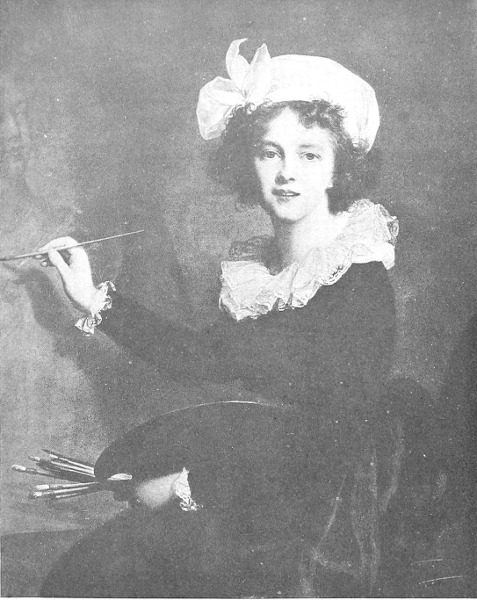
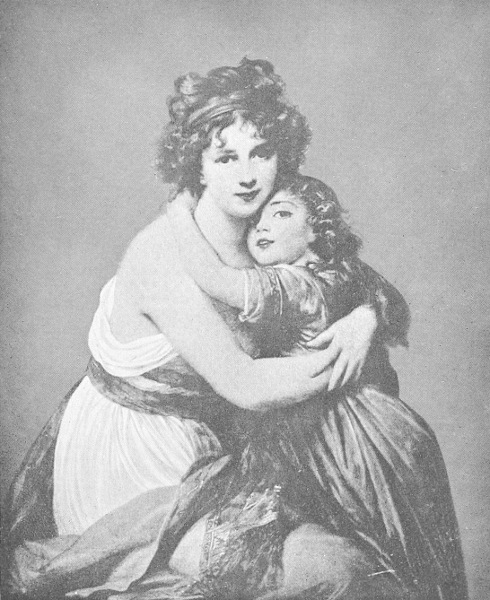
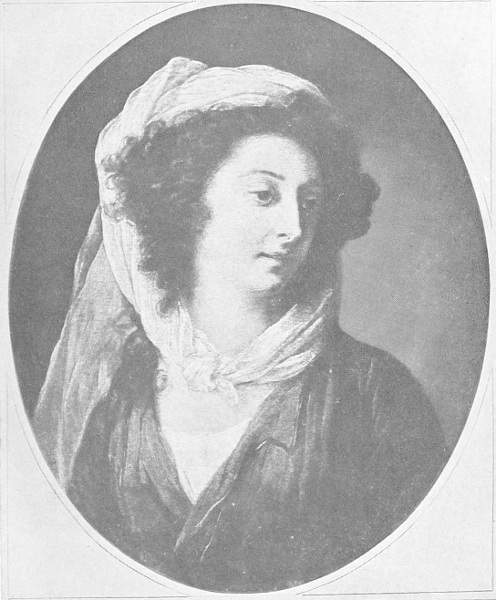
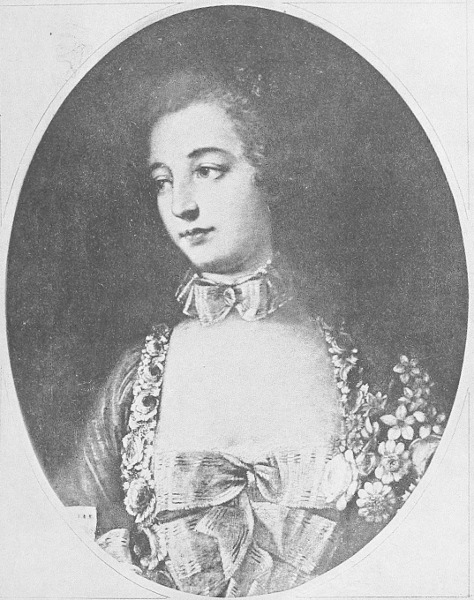
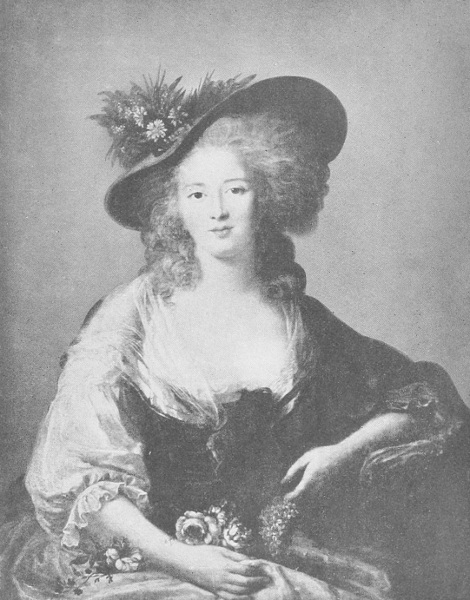
MADAME LE BRUN Painted by herself. Uffizi, Florence
IN THE COURT, THE REVOLUTION
THE EMPIRE, AND THE RESTORATION
By
Mrs. Bearne Author of “A Queen of Napoleon’s Court,”
“Early Valois Queens,” etc., etc.
ILLUSTRATED
NEW YORK E. P. DUTTON AND COMPANY 31 WEST TWENTY-THIRD STREET
MCMVII
(All rights reserved.)
THIS BOOK
IS DEDICATED
TO
ANNA AND KATE
PREFACE — FOOTNOTE: — CONTENTS — LIST OF ILLUSTRATIONS
IN the histories of the four women whose lives
are here related, I have tried, as far as is
possible in the limited space, to give an idea of the
various ways in which the Revolutionary tempest
at the close of the eighteenth century and the
eventful years which preceded and followed it,
affected, and were regarded by, persons of the
different parties and classes to which they belonged.
The characters of the four heroines form as
strong a contrast as their circumstances, principles,
and surroundings.
In Mme. Le Brun, the most gifted of all, we see
a beauty, a genius, and a woman unusually charming
and attractive, thrown, before she was sixteen,
into the society of the magnificent, licentious court
of Louis XV. Married to a dissipated,
bourgeois
spendthrift, for whom she had never cared; sought
after, flattered, and worshipped in all the great
courts of Europe; courted by fascinating, unscrupulous
men of the highest rank, without the
protection of family connections and an assured
position; yet her religious principles, exalted
character, and passionate devotion to her art,
carried her unscathed and honoured through a
life of extraordinary dangers and temptations.
She emigrated early, and far from being, as in
most cases, a time of poverty and hardship, her
exile was one long, triumphant career of prosperity.
Owing to her brilliant success, to the affection
and friendship which surrounded her wherever she
went, to her absorbing interest in her art, the delightful
places and society in which she spent her
time, and also to her own sunny, light-hearted
nature, her long life, in spite of certain serious
domestic drawbacks and sorrows, was a very happy
one. Her wonderful capacity for enjoyment, her
appreciation of beauty in nature and art, the great
interest she took in matters intellectual and political,
her pleasure in the society of her numerous friends,
and her ardent devotion to the religious and
royalist principles of her youth, continued undiminished
through the peaceful old age which
terminated her brilliant career.
With the same religious and political principles,
the conditions of life which surrounded the Marquise
de Montagu were totally different. A contrast
indeed to the simple, artistic household, the early
grief, poverty, and hard work, the odious step-father,
the foolish mother, the worthless husband and
daughter, the thousand difficulties and disadvantages
which beset Mme. Le Brun, were the state
and luxury, the sheltered life, the watchful care, and
powerful protection bestowed upon the daughter
of the house of Noailles; her mother, the saintly,
heroic Duchesse d’Ayen, her husband the gallant,
devoted Marquis de Montagu.
She also was thrown very early into society; but
she entered it as a member of one of the greatest
families in France, surrounded by an immense
number of relations of the highest character and
position.
Neither a genius nor yet possessed of any great
artistic or intellectual talent, without worldly ambition,
little attracted by the amusements of society,
she was a sort of mixture of a
grande dame and a
saint.
The lofty asceticism of her theories and practice
was perhaps almost too severe for ordinary mortals
living in the world, and in some respects better
adapted for a monastic than a secular life; her
emigration, so long delayed, was no time of success
and happiness: long years of terror, danger, poverty,
fearful trials, and sorrows endured with heroic
fortitude and angelic patience, passed before she
was restored to France and to the ancient castle
which was the home and refuge of her later life.
In Mme. Tallien we have a woman exactly opposite
to the other two in character, principles, and
conduct. Differing from both of them in birth and
circumstances—for she was the daughter of a
Spanish banker of large fortune—with extraordinary
beauty, the hot, passionate blood of the south, a
nature, habits, and principles undisciplined by
authority and unrestrained by religion, she was
early imbued with the creed of the revolutionists,
and carried their theories of atheism and licence to
the logical consequences.
Yet the generosity and kindness of her heart, and
the number of victims she saved, outweighed,
though without effacing, the disorders of her earlier
life,
[1]
during the latter part of which, as the wife of
a Catholic, royalist prince, whose love she returned
and to whose opinions she was converted, she
deeply regretted the errors of Notre Dame de
Thermidor.
In Mme. de Genlis we have a fourth and more
complex type, a character in which good and evil
were so mingled that it was often hard to say which
predominated. With less beauty than the other
three but singularly attractive, with extraordinary
gifts and talents, with noble blood and scarcely any
fortune, she spent a childhood of comparative
poverty at her father’s château,
where she was only
half educated, and at seventeen married the young
Comte de Genlis, who had no money but was
related to most of the great families of the kingdom.
From this time began her brilliant career.
Essentially a woman of the world, delighting in
society and amusement, though always praising the
pleasures of solitude and retirement, she entered the
household of the Duchesse d’Orléans, wife of the
infamous Philippe-Égalité, and while constantly
declaiming against ambition managed to get all her
relations lucrative posts at the Palais Royal, and
married one if not both her daughters to rich men
of rank with notoriously bad reputations.
Perpetually proclaiming her religious principles
and loyalty to the throne, she was suspected of
being concerned in the disgraceful libels and
attacks upon the Queen, was on terms of friendship
with some of the worst of the revolutionists, rejoiced
in the earliest outbreaks of the beginning of
the Revolution, and while she educated the Orléans
children with a pompous parade of virtue and
strictness, was generally and probably rightly
looked upon as the mistress of their father.
She was a strange character, full of artificial
sentiment, affectation, and self-deception, and,
unlike the first three heroines of this book, the
mystery and doubts which hung over her have
never been cleared up.
Against the saintly Marquise de Montagu no
breath of scandal could ever be spoken. Such
calumnies as were spread against Mme. Le Brun,
the work of the revolutionists, who hated her only
for her religion and loyalty, never believed by those
whose opinion would be worthy of consideration,
soon vanished and were forgotten.
The liaisons of Mme. Tallien had nothing
doubtful about them.
But the stories against Mme. de Genlis have
never been cleared up. Much that was said about
her was undoubtedly false, but there remain serious
accusations which can neither be proved nor disproved;
and that a long, intimate friendship
between a prince of the character of Philippe-Égalité
and a young, attractive woman who was
governess to his children should have been no
more than a platonic one, passes the bounds of
credibility.
The history of Mme. de Genlis in the emigration
differs from the other two, for having contrived to
make herself obnoxious both to royalists and
republicans her position was far worse than
theirs.
But the deep affection she and her pupils displayed
for each other, the devotion and kindness
she showed them during their misfortunes, the
courage and cheerfulness with which she bore the
hardships and dangers of her lot, and the remorse
and self-reproach which, in spite of the excellent
opinion she usually entertained of herself, do occasionally
appear in her memoirs, prove that many
good qualities existed amongst so much that was
faulty.
As to her writings, then so much in vogue, they
were mostly works intended either to explain, assist,
or illustrate the system of education which was the
hobby of her life and which, if one may judge by
“Adèle et Théodore,” one of the most important
of her tales, can only be called preposterous.
That the false sentiment, the absurd rules of life,
the irksome, unnecessary restrictions, the cramping
and stifling of all the natural affections and feelings
of youth here inculcated should have been regarded
with approval, even by the sourest and most solemn
of puritans, seems difficult to believe; but that in
the society of Paris at that time they should have
been popular and admired is only another example
of the inconsistency of human nature. She had a
passion for children, but kindness to animals does
not seem to have been one of the virtues she taught
her pupils. We may hope that the fearful little
prigs described as the result of her system never
did or could exist.
I have endeavoured to be accurate in all the
dates and incidents, and have derived my information
from many sources, including the “Mémoires
de Louis XVIII., recueillis par le Duc de D——,”
Mémoires de la Comtesse d’Adhémar, de Mme.
Campan, MM. de Besenval, de Ségur, &c., also
the works of the Duchesse d’Abrantès, Comtesse de
Bassanville, Mme. de Créquy, Mme. de Genlis, Mme.
Le Brun, MM. Arsène Houssaye, de Lamartine,
Turquan, Dauban, Bouquet, and various others,
besides two stories never yet published, one of
which was given me by a member of the family to
which it happened; the other was told me in the
presence of the old man who was the hero of it.
[1]
Tallien, on hearing of her proposed marriage with the Prince
de Chimay, remarked, “Elle
a beau faire, elle sera toujours
Madame Tallien.”
The childhood of Lisette—Extraordinary talent—The convent—The
household of an artist—Death of M. Vigée—Despair of Lisette—Begins her
career—Re-marriage of her mother—The Dauphine
Brilliant success of Lisette—Love of her art—The Vernet—Life
in Paris before the Revolution—Mme. Geoffrin—Marriage of Lisette to
M. Le Brun—A terrible prediction
Marie Antoinette—Birth of Mme. Le Brun’s daughter—The
Royal Family—Brussels—Antwerp—The charms of
French society—The Opera ball—An incident in the
terror—A Greek supper—Le jeu de la
Reine
The theatre—Raincy—Chantilly—Calonne—Attempt to ruin
the reputation of Mme. Le Brun—Two deplorable
marriages—Fate of Mme. Chalgrin—Under the shadow
of death—Mme. Du Barry
End of the ancien
régime—Foretaste of the Revolution—Threatened—Resolves
to emigrate—Another alarm—Preparations—“You
are wrong to go”—A terrible journey—Safe across the frontier
Turin—Parma—The Infanta—Florence—Rome: Delightful
life there—Artistic success—Social life—The French
refugees—The Polignac—Angelica Kaufmann—An Italian
summer—Life at Gensano—The Duchesse de Fleury
Naples—Lady Hamilton—Marie Caroline, Queen of
Naples—Mesdames de France—Their escape—Les
chemises de Marat—Rome—Terrible news from France—Venice—Turin—The
Comtesse de Provence—The 10th August—The
Refugees—Milan—Vienna—Delightful society—Prince
von Kaunitz—Life at Vienna
Dresden—St. Petersburg—The Empress Catherine
II.—Orloff—Potemkin—Russian hospitality—Magnificence of society
at St. Petersburg—Mme. Le Brun is robbed—Slanders
against her—The Russian Imperial family—Popularity
and success of Mme. Le Brun—Death of the Empress Catherine
Paul I.—Terror he inspired—Death of the mother of Mme.
Le Brun—Marriage of her daughter—Moscow—The
Tsarevitch Alexander—Assassination of Paul I.—“I
salute my Emperor”—Mme. Le Brun returns to Paris—Changes—London—Life
in England—Paris—Separated
from M. Le Brun—Society during the Empire—Caroline
Murat—Switzerland—Fall of the Empire—Restoration—Death
of M. Le Brun—Of her daughter—Travels in
France—Her nieces—Conclusion
The House of Noailles—The court of Louis XV.—The
Dauphin—The Dauphine—An evil omen—The Queen—The
Convent of Fontevrault—Death of Mme. Thérèse—The
Infanta—Madame Henriette and the Duc d’Orléans—Mesdames
Victoire, Sophie, and Louise
The Greatest Names in France—The Maréchale de
Noailles—Strange proceedings—Death of the Dauphin—Of the
Dauphine—Of the Queen—The Children of France—Louis
XIV. and Louis XV.
The Duchesse d’Ayen—Birth and death of her sons—Her five
daughters—Their education at home—Saintly life of the
Duchess—Marriage of her eldest daughter to the Vicomte
de Noailles—Of the second to the Marquis de la Fayette—Of
the Dauphin to the Archduchess Marie Antoinette—The
Comtesse de Noailles—Marriages of the Comtes de
Provence and d’Artois to the Princesses of Sardinia—Death
of Louis XV.—Unhappy marriage of the third
daughter of the Duc d’Ayen to the Vicomte du Roure—Afterwards
to Vicomte de Thésan—Paulette and Rosalie
de Noailles—Adrienne de la Fayette—Radical ideas of
the Vicomte de Noailles and Marquis de la Fayette—Displeasure
of the family and the King—La Fayette and
de Noailles join the American insurgents—Grief and
heroism of Adrienne—Marriage of Pauline to the Marquis
de Montagu
The Marquis de Montagu rejoins his regiment—Life of Pauline
at the hôtel de Montagu—Affection
of her father-in-law—Brilliant society—Story of M. de Continges—Death of
Pauline’s child—Marriage of Rosalie to Marquis de Grammont—Birth
of Pauline’s daughters—The court of Louis
XVI.—The royal family—Dissensions at court—Madame
Sophie and the storm—Extravagance of the Queen and
Comte d’Artois—The Comte d’Artois and Mlle. Duthé—Scene
with the King—Le petit Trianon—The
Palace of Marly—A sinister guest
Weak character of Louis XVI.—Quarrels at court—Mme. de
Tessé—Forebodings of Mme. d’Ayen—La Fayette—Saintly
lives of Pauline and her sisters—Approach of the
Revolution—The States-General—Folly of Louis XVI.—Scenes
at Versailles—Family political quarrels—Royalist
and Radical—Death of Pauline’s youngest child
The Château de Plauzat—Varennes—Increasing danger—Decided
to emigrate—Triumphal progress of La Fayette—The
farewell of the Duchesse d’Ayen—Paris—Rosalie—A
last mass—Escape to England
M. de Montagu returns to Paris—M. de Beaune—Richmond—Death
of Noémi—Aix-la-Chapelle—Escape of the Duc
d’Ayen and Vicomte de Noailles—La Fayette arrested in
Austria—The Hague—Crossing the
Meuse—Margate—Richmond—Hardships
of poverty—Brussels—Letter from
Mme. de Tessé—Joins her in Switzerland—Murder of M.
and Mme. de Mouchy—Goes to meet the Duc d’Ayen—He
tells her of the murder of her grandmother, Mme. de
Noailles, her mother, the Duchesse d’Ayen, and her eldest
sister, the Vicomtesse de Noailles—Mme. de la Fayette
still in prison
Illness—Leaves Switzerland with Mme. de Tessé—They settle
near Altona—Hears of Rosalie’s safety—Life on the farm—Release
of Adrienne—Her visit—Farm of Wittmold—Peaceful
life there—Rosalie and Adrienne—Birth of
Pauline’s son—He and her other children live—Release
of La Fayette—Their visit to Wittmold—Meeting of
Adrienne, Pauline, and Rosalie at the Hague
Return to France—The inheritance of the Duchesse d’Ayen—Loss
of the Noailles property—Inherits the Castle of
Fontenay—Death of Mme. de la Fayette—Prosperous
life at Fontenay—Conclusion
Térèzia Cabarrus—Comes to Paris—Married to the Marquis
de Fontenay—Revolutionary sympathies—Unpopularity
of royal family—The wig of M. de Montyon—The
Comte d’Artois and his tutor—The Comte de Provence
and Louis XV.
The makers of the Revolution—Fête à la Nature—Tallien—Dangerous
times—An inharmonious marriage—Colonel
la Mothe—A Terrorist—The beginning of the emigration—A
sinister prophecy
Divorced—M. de Fontenay escapes to Spain—The mistress of
Tallien—Her influence and his save many lives—Robespierre—Singular
circumstances at the birth of
Louis XVII.—The vengeance of the Marquis de —— —Enmity
of Robespierre—Arrest of Térèzia—La Force
The Bastille—Prisons of the Revolution—Les
Carmes—Cazotte—The
Terrorists turn upon each other—Joséphine
de Beauharnais—A musician in the Conciergerie—A
dog in prison—Under the guardianship of a
dog—Tallien tries to saves Térèzia—A dagger—La Force—The
last hope—The Tocsin—The 9th Thermidor
“Robespierre is dead!”—Notre Dame de Thermidor—End of
the Terror—The prisons open—Decline of Tallien’s power—Barras—Napoleon—“Notre
Dame de Septembre!”—M.
Ouvrard—Separates from Tallien—He goes to Egypt—Consul
in Spain—Dies in Paris—Térèzia stays in Paris—Ingratitude
of some she had saved—Marries the Prince
de Chimay—Conclusion
Birth of Félicité Ducrest—Château de Saint-Aubin—Made
chanoinesse—Story of her uncle
and her mother—Her childhood—Comes to Paris—Goes into society—Evil
reputation of the hôtel Tencin
M. de la Haie—Death of the Dauphin—M. de Saint-Aubin
goes to St. Domingo—Taken prisoner by the English—Returns
to France—Imprisoned for debt—His death—Difficulties
and poverty—Félicité marries the Comte de
Genlis—His family—The Abbesse de Montivilliers and
the robbers—Life in the convent—Birth of a daughter
La Muette—Sunrise—Italy—Nocturnal adventure—Governess
to the children of Orléans—Scandalous reports—Marriages
of her daughters—Death of the elder one—The
Comte de Valence
A wandering life—“The tyrant is no more”—Marriage of
Henriette—Hamburg—Berlin—Antwerp—Brussels—Returns
to France—Terrible changes—Shattered fortune—Literary
success—The Empire—Napoleon—Mme.
de Genlis and her friends—Death of Mme. de Montesson
Interesting society—Anecdotes of the past Terror—Casimir—The
Restoration—Madame Royale—Louis XVIII.—The
coiffeur of Marie Antoinette—The
regicide—Return of the Orléans family—An astrologer—A faithful servant—Society
of the Restoration—Isabey—Meyerbeer—Conclusion
The ancien
régime—Close of the reign of
Louis XIV.—The Regent Orléans—The court of Louis XV.—The philosophers—The
artists—M. Vigée.
WHEN Elisabeth Louise Vigée was born at
Paris, April, 1755, the French court and
monarchy were still at the height of their splendour
and power.
Only a few years since, the chronicler Barbier had
remarked, “It is very apparent that we make all
Europe move to carry out our plans, and that we
lay down the law everywhere.”
[2]
Louis XV. was upon the throne; the manners and
customs of the ancien régime
were in full force,
though mitigated and softened by the growing
enlightenment and liberalism which were spreading
not only in the literary and professional circles, but
amongst the younger generation in all classes.
Middle-aged men and women had seen Louis XIV.,
Louis le Grand,
“le Roi Soleil,” as an old man; old
people could remember him in the prime of his life,
the most magnificent King with the most stately
court in Christendom. The Cardinal de Luynes, the
Maréchal de Croz, the Duc de Richelieu and other
grands seigneurs who preserved the
manners and traditions of that time, were looked upon as models
of courtly manners and high-breeding by those who
complained that in the reaction and licence of the
regency and court of Louis XV., vice and corruption
were far more unrestrained, more scandalous,
less disguised and altogether more indecorous than
under the ceremonious and stately rule of his great-grandfather.
[3]
The Queen, Marie Leczinska, daughter of Stanislaus,
ex-King of Poland, was a harmless, uninteresting
woman, who had no ambition, no talent, no
influence, and a great many children.
The King had been married to her when he was
fifteen and she two-and-twenty; and after the
first few years had lived in an open immorality
which was very general at his court, and for a long
time did not much affect his popularity with the
nation, though every now and then caricatures and
epigrams more witty than prudent appeared; as,
for instance, the following, written upon the base
of the pedestal of an equestrian statue of him,
around which were grouped the figures of Strength,
Prudence, Justice, and Peace:
Louis, however, was more selfish and indifferent
than cruel. He was by no means like Frederic
William of Prussia, a savage to his family and his
subjects, or like three out of the four Georges of
England, who were not only outrageously immoral
themselves, but brutal tyrants to their wives
[5] and
bitter enemies of their parents and children.
His court was the most splendid, the most
extravagant, and the most licentious in Europe;
the cruelty and oppression of many of the great
nobles and especially the princes of the blood, were
notorious; the laws were harsh and unjust to a
frightful extent, but they were not of his making.
He neglected the Queen, but did not ill-treat her;
he was fond of his children and indulgent to them;
while, far from being disliked by his subjects, he
was called Louis le Bien-aimé.
Barbier, writing in December, 1758, gives another
sarcastic verse going about in society, which, as it
was directed against the King’s all-powerful mistress,
the Marquise de Pompadour, attracted general
attention, irritated the King, and caused the author,
who was discovered to be an officer of the guards,
to be sentenced to a year’s imprisonment, after
which to be banished to Malta, as he belonged to
the order of St. John of Jerusalem.
The lines are as follows, and refer to a
château
then being built by Louis for the Marquise de
Pompadour, whose original name was Jeanne
Antoinette Poisson:
“Fille d’une sangsue,
et sangsue elle-même
Poisson d’une arrogance
extrême,
Étale en ce château
sans crainte et sans effroi
La substance du peuple
et la honte du Roi.”
Barbier, a lawyer and man of the world, whose
journal of eight volumes gives a vivid impression of
the life of that time, after remarking that the sentence
was a very lenient one,
[6]
that the château
was not so
large as that of many a fermier général,
and that the building thereof gave employment to many poor
people, goes on to say, “As for ‘shame,’ ... if it
is because the King has a mistress, why who has
not? except M. le duc d’Orléans.
[7]... The Comte
de Clermont, Abbé de Saint-Germain-des-Près,
openly keeps Mlle. le Duc, who was an opera
dancer; she spends three-quarters of the year at
Berny, the Abbé’s country house, where she does
the honours. She has a fine house in the rue de
Richelieu, where the Prince often spends a week.
The fathers of the abbey who have business with
him go to him there in the morning, for he does
not lodge in the palace of the abbey. This goes on
in sight of every one, and nobody says a word
about it.
“For more than twenty years M. le Comte de
Charolois has detained in captivity, against her will,
Mme. de Conchamp, wife of a Maître-des-Requêtes,
whom he carried off, and who would have been
much happier in her own house. Fifteen out of
twenty men at the court do not live with their
wives but have mistresses, and even amongst private
people at Paris, nothing is more frequent; therefore
it is ridiculous to expect the King, who is absolutely
the master, to be in a worse position than his subjects
and all the kings his predecessors.”
There had, in fact, been a strong reaction against
the restraint and dullness of the last few years of the
reign of Louis XIV., when the magnificent, pleasure-loving
King, whose victorious armies had devastated
Europe, who had made princes of his illegitimate
children, lavished the riches of the country upon
his mistresses, and yet in his stately beauty and
fascination been the idol of France; had changed
into a melancholy old man, depressed and disillusioned,
looking with uneasiness upon the past,
with fear upon the future; while the brilliant
beauties and splendid festivities of bygone days had
given place to virtue, strict propriety, and Mme. de
Maintenon.
When Louis XIV. died, people were very tired of
this altered state of things. For some time they had
been extremely dull and were eager for change and
amusement.
With a King of five years old, and such a Regent
as the Duke of Orléans, they were tolerably sure of
both. The reign of pleasure, luxury, and licence
began with enthusiasm. Never, during the life of
Louis le Grand, had the atmosphere of the Court
been what it became under the regency, and under
his great-grandson.
The Regent Orléans was not, like the Princes of
Condé, Conti, Charolois, and others of the blood
royal, cruel, haughty, or vindictive; on the contrary,
he was good-natured, easy, and indulgent; but he
was dissipated, extravagant, and licentious to such a
degree that he himself, the court, and his family
were the scandal of Europe. The same frenzied
pursuit of enjoyment, the same lavish, sensual, reckless,
luxurious life, characterised the whole of the
reign of Louis XV.
In reading the memoirs and chronicles of that
time one scarcely realises the existence of the many
families and households, especially among the
noblesse de province[8] or country gentlemen, and the
middle classes, amongst whom the principles of
order and religion were observed; and of an increasing
circle of literary and philosophic persons
who inveighed against the crimes, vices, and abuses
of the age.
Those whose ideas of France in the eighteenth
century are derived only from such books as
Dickens’ “Tale of Two Cities,” or even from a
casual acquaintance with a few of the histories and
chronicles of the time, are apt vaguely to picture to
themselves a nation composed partly of oppressed,
starving peasants, and partly of their oppressors, a
race of well-bred ruffians and frivolous, heartless
women; all splendidly dressed, graceful, polite, and
charming in their manners amongst themselves; but
arrogant, cruel, and pitiless to those beneath them.
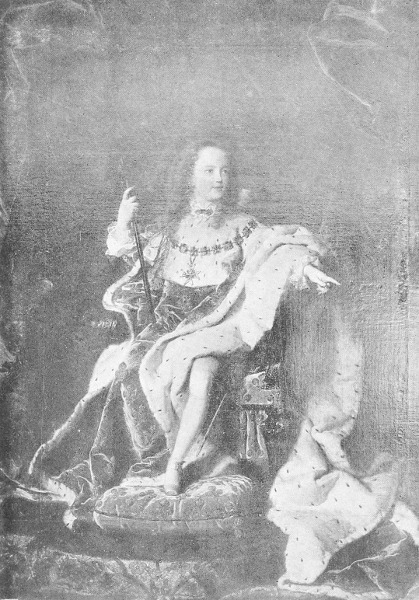
Rigaud
LOUIS XV.
Many such undoubtedly there were; the laws
were terribly oppressive, the privileges of the
favoured classes outrageously unjust; while as for
public opinion, Barbier himself remarks that the
public is a fool, and must always be unworthy of
the consideration of any man.
But still, in all ages human nature is the same,
and has to be reckoned with under all circumstances,
and that people in general are much better
than the laws which govern them is evident.
If the cruel, unjust marriage laws of England,
which until a few years ago were in force, had been
universally and fully carried out, making the husband
an almost irresponsible tyrant and the wife
a helpless, hopeless slave, domestic life would
have been hell upon earth. But as the great
majority of men had no wish to ill-treat their
wives, confiscate their money, deprive them of their
children or commit any of the atrocities sanctioned
by the laws of their country, families upon the
whole went on in harmony and affection. It was
only now and then, when a man did wish to avail
himself of the arbitrary power placed in his hands,
that the results of such iniquitous laws were brought
before the public. At the same time, however, the
knowledge of their existence and the tone of
thought, prejudices, and customs which consequently
prevailed, had an influence upon men who
were not the least tyrannically inclined, but merely
acted in accordance with the ideas and opinions of
every one around them.
And amidst all the oppression, vice, and evil of
which we hear so often in France of the eighteenth
century, there was also much good of which
we hear little or nothing. The reason is obvious.
Good people are, unfortunately, seldom so amusing to
write or read about as bad ones. Has any one ever met
with a child who wanted to be told a story about a
good little girl or boy? And is it not true, though
lamentable, that there are many persons who would
rather read a book about a bushranger than a
bishop?
The noblesse d’epée was
the highest, most brilliant,
and most scandalous in France; but in its
ranks were to be found heroic examples and
saintly characters; while far away in the convents
and châteaux scattered over
the country and in
quiet bourgeois families
in the towns lives were led
of earnest faith, devotion, and self-denial.
Many an abbess, many a châtelaine
spent time and money amongst the rich and poor; and there
were seigneurs who helped and protected the
peasants on their estates and were regarded by
them with loyalty and affection. To some extent
under the influence of the ideas and prejudices
amongst which they had been born and educated,
yet they lived upright, honourable, religious lives,
surrounded by a mass of oppression, licence, and
corruption in the destruction of which they also
were overwhelmed.
Amongst the philosophic set, the “encyclopædists,”
so-called from the encyclopædia which
had been started by Diderot, and to which Grimm,
d’Alembert, Buffon, Marmontel, and many other
well-known men were contributors, there was a
spirit of passionate revolt against the cruelties and
abuses of the time, an ardent thirst for liberty,
much generous sympathy with the poor and oppressed,
and desire to alleviate the sufferings of
humanity.
They were, as usual, men of all sorts, shades,
and aims. Many, inspired with lofty but unpractical
enthusiasm, dreamed of an impossible republic
founded upon that of Plato; the ideal of others
was a constitutional monarchy and free parliament
such as existed in England; there were also, of
course, numbers who desired to upset the present
order of things so that they might usurp the power
and seize the property of everybody for themselves.
But besides their hostility to religion, the private
characters of these philosophers did not, in many
cases, by any means correspond with their writings
and professions.
Rousseau, notwithstanding his assumption of
superior virtue, his pretence of being a leader and
teacher thereof, his especial exhortations and instructions
to parents about the care and education
of their children, and his theories on friendship
and love, was absolutely without gratitude for the
help and kindness of his friends, ill-tempered, conceited,
and quarrelsome; saw no degradation in his
liaison with a low, uneducated woman, and abandoned
all his children in their infancy at the gate of
the enfants trouvés.
Freethinkers, deists, or open atheists most of
them were, delighting in blasphemous assaults
and attacks, not only upon the Church and religion
in general, but upon God himself; and so outrageous
and scurrilous was their habitual language
upon such subjects that they found it necessary to
disguise, by a sort of private slang known only to
each other, their conversation in public places
where it might be not only offensive to their hearers,
but dangerous to themselves.
The salon of the famous Mme. Geoffrin was
the great resort of philosophers, literary men of
different kinds, painters, musicians, and celebrities
of various countries, people distinguished in the
political world, or belonging to the court and the
great noblesse, French and foreign.
In art, as in everything else, it was still the age of
the artificial. The great wigs and flowing drapery
of the last reign had given place to powder and
paint, ribbons and pompons,
pink roses, and pale
blue satin or velvet, à la Pompadour.
When people in Parisian society thought of the
country, they thought of lambs with ribbons round
their necks, shepherdesses in fanciful costumes with
long crooks, or a “rosière”
kneeling before the
family and friends of the seigneur to be crowned
with flowers and presented with a rose as the reward
of virtue, in the presence of an admiring crowd of
villagers; of conventional gardens, clipped trees,
and artificial ruins; but wild, picturesque mountain
scenery was their abhorrence.
The taste of the day was expressed in the pictures
of the favourite artists, Watteau and Greuze, who
painted the graceful groups and landscapes every
one admired: charming women sitting in beautiful
gardens dressed in costumes suitable for a ball or
court festivity, or anything on earth but being out
of doors in the country.
Fragonard, the Provençal, had more depth and
dramatic feeling, the passion of the south and
the love of nature in his work gave a stronger,
truer, more impressive tone to his pictures; but
Boucher, the favourite painter of Louis XV., the
Marquise de Pompadour, and the court would
seem from his pictures to have looked upon everything
in life as if it were a scene in a carnival or
fête. His
goddesses and saints, even the holy
Virgin herself, were painted from models from the
theatre, and looked as if they were; his gardens,
roses, silks, satins, nymphs, fountains, and garlands
were the supreme fashion; every one wanted him
to paint their portrait; he had more commissions
than he could execute, and his head was turned
by the flattery lavished upon him.
David, Chardin, the celebrated genre painter, Van
Loo, Gérard, La Tour, Joseph Vernet, and many
others were flourishing. Louis Vigée was also an
artist. He painted portraits in pastel, of which his
daughter says that they were extremely good, many
of them worthy of the famous La Tour; also charming
scenes after the style of Watteau, in oil.
Although not a great painter he was absolutely
devoted to his art, in which he would become so
absorbed as to forget everything else. On one
occasion he was going out to dinner and had
already left the house, when he remembered something
he wanted to do to a picture upon which he
was working. He therefore went back, took off the
wig he was wearing, put on a night-cap, and began
to retouch the picture. Presently he got up, went
out again, forgetting all about the night-cap which
he still had on, and which formed a singular contrast
to his coat trimmed with gold braid, and the
sword at his side; and would certainly have
presented himself at the party to which he was
going in this costume had he not fortunately met
a neighbour, who stopped him and pointed out the
strangeness of his appearance.
[2]Journal de Barbier, “Chronique de la Régence,”
1741.
[3]
Louis XV. was five years old when he succeeded
this great-grandfather, Louis XIV. (1715).
[8]
It is, however, true that such
of the noblesse de province as were
inclined to be tyrannical were worse than the great nobles who
belonged to the court; and their oppression was more felt.
CHAPTER II — FOOTNOTES:
The childhood of Lisette—Extraordinary talent—The convent—The
household of an artist—Death of M. Vigée—Despair of
Lisette—Begins her career—Re-marriage of her mother—The
Dauphine.
THE early years of the childhood of Elisabeth
Vigée were peaceful and happy enough, and
already at a tender age the genius which was to
determine and characterise her future life began to
appear. According to the usual custom she was
placed in a convent to be educated, and though
only six years old when she was sent there, she had
then and during the five years of her convent life,
the habit of drawing and scribbling perpetually and
upon everything she could lay her hands on, much
to the displeasure of the good Sisters and of her
companions.
For nothing was safe from her pencil: her books,
her copy-books, even those of her schoolfellows, the
walls of the dormitory, every available space was
covered with heads, figures, and landscapes in
crayon or charcoal, and when out in the playground
she drew with a stick upon the sand.
Little did the other children who made complaints
that their books were “spoiled,” or the nuns
who gave reproofs and decreed punishments,
imagine what valuable possessions these scribbled,
spoilt books and papers would have become in
future years if they had taken care of them, for the
artistic genius was in them even then. One evening,
when she was seven or eight years old, the child
drew the head of a man with a beard which she
showed to her father. Transported with delight, he
exclaimed:
“Tu seras peintre, mon enfant, ou jamais il n’en
sera.”
[9]
She always kept this drawing, her foretaste of the
brilliant success that began so early and never
forsook her.
Lise, or Lisette, as she was generally called, was
a delicate child, and her parents, who were devotedly
fond of her and very anxious about her, frequently
came and took her home for a few days, greatly to
her delight. With them and her brother Louis,
their only child besides herself, she was perfectly
happy. Louis was three years younger, and did
not possess her genius for painting, but the brother
and sister were always deeply attached to one
another.
Her mother was extremely beautiful, of rather an
austere character, and very religious. With her the
children attended High Mass and the other offices
of the Church, especially during Lent; and upon
the sensitive, impressionable girl the solemn beauty
of the music, and especially the deep notes of the
organ, produced an almost overpowering effect.
Often as she sat or knelt by her mother the rich,
melodious tones echoing through choir and nave in
the dim, religious gloom would throw her into a
kind of rapture, and end in a passion of tears which
she could not always conceal. This intense feeling
for music, especially religious music, lasted all her life.
But her greatest love was for her father; it was
almost adoration. Louis Vigée was exactly opposite
in disposition to his wife, to whom he was, however,
devoted. Kindly, affectionate, light-hearted, and
thoughtless, his love for her did not interfere with
his admiration for other women; a pretty grisette
was quite able to turn his head, and on New Year’s
day he would amuse himself by walking about
Paris, saluting the prettiest young girls he met, on
pretence of wishing them a happy new year.
Among his friends he was universally popular;
every evening at his house were to be found some
of the artists, poets, and other literary men who
formed the society in which he delighted, and came
to the suppers the gaiety and pleasantness of which
were quite appreciated by the child who was always
allowed to be of the party, but not to sit up after the
dessert was upon the table. She would lie awake
in her room, listening to the laughter and songs
which she enjoyed without understanding, long
after she was in bed.
The days were as happy as the evenings, for they
were spent in her father’s studio, where he allowed
her to paint heads in pastel and to draw all day long
with his crayons.
At eleven years old Lisette was taken from the
convent to live at home, after having made her first
Communion. She had so outgrown her strength
that she stooped from weakness, and her features
gave at present little promise of the well-known
beauty of her after-life. Her brother, on the contrary,
was remarkably handsome, full of life and
spirits, distinguished at his college by his talents
and intelligence, and the favourite of his mother,
while the father’s preference was for the daughter
whose genius was his pride and delight, and to
whom his indulgence and tenderness made up for
the strictness or inequality she observed in the
dealings of her mother with her brother and herself.
Speaking in her “Souvenirs”
[10] of her deep
affection for her father, she declares that not a word
he ever said before her had she forgotten.
Amongst the friends who frequented their house
her surprising talent naturally excited much attention
and interest. One of those she liked best was
the historical painter, Doyen,
[11] a man full of culture,
information, and good sense, whose remarks upon
persons and things, as well as upon painting, she
found very useful.
Poinsinet, the author, was a man of very different
calibre. That he had plenty of ability was proved
by the fact that on the same evening he obtained
three dramatic successes, i.e.,
Ernelinde at the Opera,
Le Cercle at the Français,
and Tom Jones at the
Opéra-Comique. But his absurd credulity made
him the object of continual practical jokes, or
mystifications as they were called.
On one occasion his friends made him believe
that there existed the post of “fire-screen to the
King,” and that it might possibly be given to him.
In order to qualify himself, they persuaded him to
stand frequently before the fire until his legs were
quite scorched, assuring him when he wished to
move away that if he did not persevere he would
never be able to fill that post.
Yet his delineation of the society of the day was
so true that somebody remarked about his play,
Le Cercle,
that Poinsinet must have been listening at
the doors. He was drowned in Spain while crossing
the Guadalquivir.
Caresne was a painter and poet whose poems and
pictures were bad, but his conversation amusing.
He wrote the following verses to Lisette, whose
rapid progress and intelligence made her seem to
be already passing out of childhood into girlhood:
Plus n’est le temps, où de mes seuls couplets
Ma Lise aimait à se voir célébrée.
Plus n’est le temps où de mes seuls bouquets
Je la voyais toujours parée.
Les vers que l’amour me dictait
Ne répétaient que le nom de Lisette,
Et Lisette les écoutait.
Plus d’un baiser payait ma chansonette,
Au même prix qui n’eût été poëte?
He gave Lisette lessons in oil-painting for which his
wife used to come and fetch her. They were so
poor that on one occasion when she wished to
finish a head she was painting, and accepted their
invitation to stay and dine, she found the dinner
consisted only of soup and potatoes.
Time passed only too quickly in the happy
sheltered life of the gifted child in her father’s
house. The days were full of delight as she sat
absorbed in the work which was a passion to her in
the studio of the father she idolised. The evenings
were full of pleasure, interest, and variety, as she
listened to the brilliant conversation, artistic, intellectual,
and political, of her father and the friends
of many different ideas and opinions with whom
he associated.
Louis Vigée was neither in principles nor tastes
at all in sympathy with the new philosophic party;
on the contrary, he looked with disapproval and
uneasiness upon the future, from which they were
so eagerly expecting their millenium.
Returning home one day after dinner with Diderot,
d’Alembert, Helvetius, and others of their set, he
seemed to be so out of spirits that his wife asked if
anything were the matter.
“Ma chère amie,”
he replied, “all that I have been
hearing makes me think that the world will very
soon be upside down.”
He was not, however, to live to see the realisation
of his fears. Not much more than a year after
Lisette’s return from her convent, a terrible calamity
befell her in the loss of the father whose love and
protection had made the sunshine of her life, and by
whose death her lot was entirely changed and her
happiness ruined.
The illness of Louis Vigée was caused by a fish-bone
which he had swallowed, and which had
become fixed in the stomach. Although the mania
for operations amongst English doctors of the
twentieth century, which in this country adds a
new terror to illness, did not exist at that time
in France; under the circumstances, nevertheless,
more than one operation was considered necessary;
in spite of, or perhaps because of which,
although the most skilful surgeon was employed,
and was a personal friend who bestowed devoted
and incessant care and attention upon the invalid,
it soon became apparent that he had not long to
live. Heartbroken, Lisette stood by her father’s
bedside with her mother and brother to receive his
last blessing and farewell, and an hour afterwards
he breathed his last.
With her father’s death vanished for ever the
bright, unclouded happiness of her childhood; her
life henceforth was chequered with brilliant success,
artistic and social, and acute sorrows in her
domestic life; like a picture in which the brightness
of the lights seem to deepen the gloom of
the shadows. They were very badly off, for Louis
Vigée had left scarcely any provision for his
family, and Lisette for some time was so stunned
with the shock and grief that she seemed to be sunk
in despair, taking no interest in anything, and giving
up even the painting which had been her passion.
Doyen, amongst other friends of Vigée, used to
come to see them; his visits were the greatest
consolation to them all, especially to the young girl,
who appreciated the affection he had always shown
for her father, and by him she was persuaded to
resume the studies and work which alone had
power to divert her mind in some degree from her
sorrow. She began to paint from nature, and did
several portraits both in oil and in pastel, working
chiefly with another young girl about a year older
than herself, Mlle. Boquet, whose father kept a
curiosity shop in the rue
Saint Denis where he lived,
and where Lisette used to go in the evenings to
draw from casts by candlelight with her friend.
Very often in the mornings the two girls went
together to the artist Briard, who had a studio in
the Louvre, and who, though an indifferent painter,
drew well, and had several other young girls as
pupils.
Lisette and her friend used to stay there all day,
taking their dinner in a basket, and had an especial
weakness for certain slices of excellent bœuf à la
mode which they bought of the concierge of one of
the doors of the Louvre. Lisette always declared
in after life that she could never get any so good.
Lisette was now rapidly becoming very pretty, to
the great satisfaction of her mother, who, seeing
that in spite of her busy life and deep interest in her
work, her spirits still suffered from the loss of her
father, tried to give her all the distraction possible.
She would take her to walk in the Tuileries gardens,
where the beauty of both mother and daughter
attracted much attention; and what pleased her
most, to see all the picture galleries possible. They
often went to the Luxembourg, in the galleries of
which were then the Rubens and many others of
the old masters now in the Louvre; besides which
they saw all the good private collections. By far
the best at that time was the gallery of the Palais
Royal, collected by the Regent, Duc d’Orléans.
These pictures were sold in the Revolution. Many
of them were bought by Lord Stafford.
Besides her delight in wandering through these
galleries where she would stand before her favourite
pictures, never tired of studying them, absorbed in
their beauty, she copied heads from Rubens, Rembrandt,
Vandyke, Greuze, and others, and although
she was only fourteen years old, the portraits she
painted were not only becoming known, but were
the principal support of the family, besides paying
for the school expenses, books, and clothes of her
brother.
But however hard she worked, the family finances
did not become sufficiently flourishing to satisfy
Mme. Vigée, who, driven to desperation by their
poverty, and of course anxious about the future,
everything depending upon the work of a delicate girl
of fourteen, resolved to marry again, and unfortunately
selected a rich jeweller of her acquaintance,
to whose house in the rue
St. Honoré she removed
with her children after the marriage.
She had far better have remained in her old home,
poor and free; for directly they were married she
discovered the real character of her second husband:
an ill-tempered, avaricious man, who refused his
wife and step-children even the necessaries of life,
although Lisette was foolish enough to give him all
she earned by her portraits. She hated him still
more because he had taken possession of her father’s
clothes, which he wore, to her grief and indignation.
Joseph Vernet, who, like many of her old friends,
still interested himself in her, was furious at all this,
and represented to her that she ought to pay a
certain pension to her odious step-father and keep
the rest of the money herself; but she feared such a
suggestion might make matters worse for her
mother, and therefore went on allowing herself to
be robbed.
She really cared very little for the money she so
easily made, all her love was for her art, which alone
had the power to raise her above the petty miseries
and troubles of her present life.
Her step-father was continually doing something
or other to annoy and distress them. Their new
home was immediately opposite the gardens of the
Palais Royal, which in those days were not only
very extensive but extremely beautiful, with great
forest-trees whose deep shade the sun could not
penetrate.
The great avenue was a fashionable promenade on
Sundays and fêtes,
and to Lisette and her friend
Mlle. Boquet, both of whom grew prettier every
year, it was a great amusement to walk there with
the mother and step-father of the former. The
Grand-Opéra being close by, when the performance
was over, which then was at half-past eight, it was
the fashion, on summer nights, for every one to come
out and walk about these gardens, where sometimes
until two o’clock in the morning it was a scene of
enchantment. People belonging to the court and
society, bourgeois,
actors, musicians, the demi-monde
all went there. Every well-dressed woman in the
evening carried a large bouquet of flowers, the scent
of which filled the air, groups of people scattered
about sang or played the harp, violin, or guitar,
especially on moonlight nights; amateurs and
artistes too, the delicious music of Saint Georges, Alsoredo
and Garat often attracted crowds of listeners.
The demi-monde
at that time kept themselves
apart from the rest of the company; Frenchmen of
good position and manners did not appear with
them in public. If they were with them at the theatre
it was in a closed box; though in her “Souvenirs”
Mme. Le Brun declares that the fortunes made by
them and the men ruined by their extravagance far
surpassed anything of the kind after the Revolution.
The beautiful and notorious Mlle. Duthé was
often to be seen, amongst others, attended by
an Englishman who was not so scrupulous about
appearances, and whom Mme. Le Brun saw again
with the same person eighteen years afterwards at a
theatre in London.
Besides the gardens of the Tuileries, Luxembourg,
and Palais Royal, there were plenty of other places
to which the Parisians resorted for amusement.
There was the Colysée, an immense place in the
Champs-Elysées, with a lake on which were held
regattas and round which were walks with seats
placed about; also a large concert-room with
excellent music, as the orchestra was a fine one and
many of the best singers were to be heard there.
A flight of steps led up to the portico which was
the entrance to this concert hall, and was the
favourite lounge of the idle, dissipated young men
of fashion, who would stand there in groups,
making insolent remarks upon the women who
came in and out. One evening as Lisette was
coming down the steps with her mother, the
Duke of Orléans, afterwards the infamous Philippe-Égalité,
stood there with the Marquis de Genlis,
both making outrageous remarks to annoy whoever
passed them. To the relief of Lisette, however, the
Duke, as he pointed her out to his friend, only
remarked in a loud voice:
“Ah! there is nothing to be said against that one.”
A fashionable promenade was the boulevard du
Temple, where every day, especially Thursdays,
hundreds of carriages were to be seen driving up
and down or standing under the shade of trees now
replaced by houses, shops, and cafés.
Young men rode in and out amongst them, notorious members
of the demi-monde
tried to surpass every one in
the splendour of their dress and carriages. A certain
Mlle. Renard had her carriage drawn by
four horses, their harness studded with imitation
jewels. It was not an age of imitation. In those
days as a rule lace was real lace, jewels were real
jewels, and if tawdry imitations and finery were
worn it was by women of this class. Respectable
people would never have dreamed of bedizening
themselves with the sort of cheap rubbish with
which the modern women of the lower classes
delight to disfigure their houses and their dress.
On one side of the boulevard
were rows of chairs on which sat many old ladies of fashion, highly
rouged, according to the privilege of their class.
For only women of a certain rank were allowed to
wear it. There was also a garden with seats raised
one above the other, from which people could see
the fireworks in the evenings.
The odious step-father, whose name by the by,
was Jacques François Le Sèvre, was annoyed at the
universal admiration excited by the beauty of his
wife and step-daughter. At one time he tried to
put a stop to their walks, and told them he had
hired a country place where they would go from
Saturday till Monday during the summer.
Lisette rejoiced at this announcement, for she
fancied she would like to live in the country, at
any rate for a part of the year.
But when they saw the place, which was at
Chaillot, it was a miserable little house in a still
more miserable little garden, without a tree or any
shelter from the sun except a deplorable looking
arbour against which nothing would grow properly,
while in the next plots of ground were shop boys
shooting at birds according to the odious fashion
one still sees in the south.
Lisette was in despair when she saw it, but
fortunately some friends of her mother’s came one
Sunday to dine there with them, and were so
shocked that they used often to fetch her away and
take her out with them on long excursions to all the
parks, châteaux,
and delightful places in the neighbourhood.
The one she liked best was Marly-le-Roi, a
royal palace entirely destroyed in the Revolution.
It was then an abode of enchantment, and she
always spoke with rapture of the
château with its
six pavilions, its trellised walks covered with jasmin
and honeysuckle, its fountains, cascades, canal, and
pools upon which floated tame swans, its lawns
shaded by enormous trees, its terraces and statues,
everything recalling Louis XIV. Here for the first
time she saw Marie Antoinette, then Dauphine,
walking in the gardens with several of her ladies, all
dressed in white.
Lisette and her mother were turning back, but
the Dauphine stopped them, and speaking in the
kindest manner to them begged them to continue
their walk wherever they liked.
In 1802 Mme. Le Brun revisited this enchanting
place, or rather the ground where it used
to be. It was entirely swept away; only a stone
marked the spot where had been the centre of the
salon.
When the summer came to an end they gave up
their visits to the horrible little villa, to the infinite
joy of Lisette and her mother.
[9]
“Thou wilt be a painter, my child, or never will there be one.”
[10]“Souvenirs de Mme. Vigée Le Brun,”
t. 1, p. 8.
[11]
Gabriel François Doyen, b. 1726, d. 1806. Painted “La Mort
de Virginie,” “Sainte-Geneviève des Ardente,” “La Mort de Saint-Louis,”
&c.
CHAPTER III — FOOTNOTES:
Brilliant success of Lisette—Love of her art—The Vernet—Life
in Paris before the Revolution—Mme. Geoffrin—Marriage
of Lisette to M. Le Brun—A terrible prediction.
IN after life Mme. Le Brun used to say that her
girlhood had not been like that of other young
girls. And indeed it was not. By the time she was
fifteen she was already not only a celebrated portrait
painter, but very much sought after in society.
A portrait of her mother, which she painted when
she was not yet fifteen, excited so much admiration
that the Duchesse de Chartres, who had often
looked at her with interest from the gardens of the
Palais Royal, opposite which she lived, sent for her
to paint her portrait, and was so delighted with
the pretty, gentle girl whose talents were so
extraordinary that she spoke of her to all her
friends.
The beautiful Comtesse de Brionne and her
daughter, the Princesse de Lorraine, who was also
very pretty, then came to call on her, and their visit
was followed by those of all the court and faubourg
Saint Germain. She also knew all the great artists
and literary people, and had more invitations than
she could accept.
In her brilliant career, although the odious step-father
was still a great disadvantage and annoyance,
it was impossible that he could inflict much of his
company upon her, full and absorbed as her life
now was with her professional work and social
engagements. The most celebrated foreign visitors
to Paris generally came to see her, amongst the
first of whom were Count Orloff, one of the
assassins of Peter III., whose colossal height and
the enormous diamond in his ring seem to have
made a great impression upon her; and Count
Schouvaloff, Grand Chamberlain, who had been
one of the lovers of the Empress Elizabeth II.,
but was now a man of sixty, extremely courteous,
pleasant, and a great favourite in French
society.
Her first great dinner-party was at the house of
the sculptor Le Moine, where she met chiefly
artists and literary people. It was the custom to
sing at dessert, a terrible ordeal for young girls,
whose alarm often spoilt their song, but who were
obliged to sing all the same.
Joseph Vernet had a little son of whose talent for
drawing he was very proud; and one day at a party
where his friends joked him on his infatuation, he
sent for the child, gave him a pencil and paper, and
told him to draw.
He began at once to draw a horse so well and so
boldly that murmurs arose.
“Well! Very well! But he has begun too low
down, he will have no room for the legs.”
The boy, however, drew on with unconcern,
finished the body of the horse, drew the upper
portion of the legs, and then with a few strokes of
the pencil indicated water at the bottom of the
sheet, and gave the impression of a horse bathing
his legs and feet.
[12]
But as dinner-parties then took place in the day-time,
often as early as two o’clock, Lisette soon
found it impossible to spare the time to go to them.
What finally decided her to give them up was an
absurd contretemps that happened one day when
she was going to dine with the Princesse de Rohan-Rochefort.
Just as she was dressed in a white satin
dress she was wearing for the first time, and ready
to get into the carriage, she, like her father in former
days, remembered that she wished to look again at a
picture she was painting, and going into her studio
sat down upon a chair which stood before her easel
without noticing that her palette was upon it. The
consequences were of course far more disastrous
than what had befallen her father; it was impossible
to go to the party, and after this she declined as a
rule all except evening invitations, of which she had
even more than enough.
These evening parties were usually delightful;
those of the Princesse de Rohan-Rochefort were
especially so. The intimate friends of the Princess,
the Comtesse de Brionne, Princesse de Lorraine,
Duc de Choiseul, Duc de Lauzun, Cardinal de
Rohan, and M. de Rulhières, a distinguished literary
man, were always present, and other pleasant
and interesting people were to be met there.
The evenings were spent in brilliant conversation
and music, supper was at half-past ten, ten or
twelve guests being the usual number at the table.
It speaks well for Lisette that her head was not
the least turned and her reputation blameless, considering
that at an age when girls in our own day
are at their lessons in the schoolroom, she, young,
pretty, attractive, and celebrated, was constantly
thrown into a society the most corrupt and the
most fascinating that has perhaps ever existed.
But although fully enjoying the amusement and
admiration that fell to her lot, she passed unscathed
through the temptations and dangers around her.
The strength and devotion of her religious principles,
the deep love of her art, which was the
ruling passion of her life, her affection for her
mother, who was always with her, and to whom she
confided all her affairs, were her only safeguards.
She was constantly surrounded by perils and
temptations which to many would have been irresistible.
Admiring eyes followed her at the theatre,
people crowded round her in the gardens and
places of entertainment, men of rank who wanted
an opportunity of making love to her had their
portraits painted by her for that purpose; but she
treated them all with indifference, and when she
noticed that their looks and glances were too
expressive she would coolly remark: “I am painting
your eyes now,” or would insist on the portrait
being done with the eyes looking in another direction.
The Marquis de Choiseul had just married a very
pretty American of sixteen years old, which did not
prevent his entertaining a violent passion for Lisette,
and trying to make love to her on all possible occasions,
but greatly increased her indignation at his
doing so.
In fact she had given her whole heart to her
work. She thought and dreamed of nothing but
painting, her career as an artist was her life, and
her affection for her mother, her brother, and her
friends sufficed for her domestic happiness; she
wanted neither love intrigues nor even marriage to
disturb the state of things she found so entirely
satisfactory.
So little did the idea of love enter into her life
that until after her marriage she had never read a
single novel. Then she read “Clarissa Harlowe,”
by way of a beginning, and found it intensely
interesting. Before, she only read Lives of the
Saints, and various religious or instructive books.
It is difficult for those who are accustomed to
think of Paris only as it is now, to picture to themselves
at all what it was like in the eighteenth
century; for until years after the Revolution it was,
to all intents and purposes, a mediæval city.
Paris without the wide streets of enormous houses,
the broad, shady boulevards, the magnificent shops
and crowded pavements, the glare and wealth and
luxury of the nineteenth and twentieth centuries;
Paris of old France, of the Monarchy, with its
ancient towers and buildings, its great hôtels and
convents with vast gardens above whose high walls
rose stately trees; its narrow, crooked, ill-paved
streets, mostly unsafe to walk in after dusk, through
which troops of cavalry clattered in gay uniforms,
scattering the foot-passengers right and left, and
magnificent coaches drawn by four, six, or eight
horses lumbered heavily along.
The fêtes
and pageants of the Church and court
were most gorgeous and impressive. Even to see
the King, royal family and court set off for Versailles,
Fontainebleau, or any other of the country
palaces was a splendid spectacle, the immense
number of state coaches which conveyed the King,
[13]
the Dauphin,
[14] Mesdames de France,
[15] their numerous
households and those of the other Princes of
the blood, made a procession which seemed interminable.
It was the custom that on these occasions
the court should be in full dress, and Mme. Le
Brun, in her “Souvenirs,” mentions that a few years
later, after her marriage, she went to see the last of
these departures in state for Fontainebleau, and
observes that the Queen, the unfortunate Marie
Antoinette, covered with diamonds which flashed
in the sunshine, and with her regal air and majestic
beauty, looked like a goddess surrounded by her
nymphs.
[16]
The Parisians delighted in any shows or festivities,
and the royal family were received with acclamations
whenever they appeared from the mob, which
twenty years later was yelling and howling with
savage fury for their destruction.
Arnault, in his memoirs, relates that he was
brought up at Versailles, where he was at school
from 1772 to 1776, and often saw Louis XV. pass in
his carriage. The King had a calm, noble face and
very thick eyebrows. He took not the slightest
notice of the shouts of Vive
le roi from the boys
drawn up in a line, or from the people; neither did
Louis XVI. when he succeeded him.
A post in one of the royal households was an
object of general ambition. Duruflé, though a
poet and well-known literary man who had received
a prize from the Academy, applied for and obtained
the appointment of valet
e chambre to the young
Comte de Provence, second grandson of the King,
afterwards Louis XVIII., and was in consequence
obliged to put on his stockings, in doing which he
accidentally hurt him.
“How stupid you are!” cried the young prince,
angrily.
“I did not know, Monsieur,” replied he, “that
one was stupid because one did not put on a
stocking well.”
“People are stupid,” answered the prince, “who
have not the sense to do properly what they undertake
to do.”
Duruflé, who did not like this sort of thing,
hastened to sell the post he had been so anxious to get.
[17]
Most people at that time, like those before the
flood, had no idea of the possibility of the coming
destruction.
Only the encyclopædists and such persons of
advanced opinions had any presentiments of the
overwhelming changes at hand, and they were far
from anticipating the horrible calamities and crimes
they were helping to bring about.
Their great stronghold was the
salon of Mme.
Geoffrin, where all the radical, atheist, and philosophic
parties congregated. D’Alembert, Condorcet,
Turgot, Diderot, Morellet, Marmontel, and many
other celebrated names were amongst the intimate
friends of the singular woman, who although possessing
neither rank, beauty, talent, nor any particular
gift, had yet succeeded in establishing a
salon
celebrated not only in France but all over Europe.
Owing to her want of rank she could not be presented
at court, and yet amongst her guests were
many of the greatest names in France, members of
the royal family, strangers of rank and distinction.
She knew nothing of art or literature, but her
Monday dinners and evenings were the resort of
all the first artists of the day, and her Wednesdays
of the literary and political world.
Her salon
had been famous from 1750, before
Lisette was born, and now, as an old woman, she
came to visit the young girl of whose artistic genius
she had heard enough to excite her curiosity. She
arrived in the morning and expressed great admiration
for the beauty and talent of her young hostess.
To Lisette she seemed to be about a hundred
years of age, though she was not really very old,
but her costume, a dark grey dress and a cap over
which she wore a large hood tied under her chin,
and her bent figure, increased the appearance of age.
Mme. Geoffrin
[18] was born 1699: her father a
valet de chambre
of the Dauphin. He and her mother
died young and left her and her brother to the
guardianship of their grandmother, a certain Mme.
Chemineau, a woman of strong, upright character,
and a devout Catholic, but narrow and without much
education. She brought up her grandchildren with
care and affection, and married the girl when about
fourteen to M. Geoffrin, a rich and worthy commercial
man of forty-eight. With him Thérèse lived
in tranquil obscurity until she was about thirty,
when she became acquainted with the celebrated
Mlle. Tencin, sister of the Cardinal, over whose
house and salon
she presided, and who, like Mme.
Geoffrin, lived in the rue St. Honoré.
M. Geoffrin did not altogether approve of his
wife’s perpetual presence at the hôtel
Tencin, which
had by no means a good reputation; and when she
also began to receive in her own house a few of the
literary men whom she met there, philosophers,
freethinkers, and various persons upon whom he
looked with suspicion, he at first strongly objected.
But it was useless. His wife had found the sixteen
years of her married life remarkably dull; she had
at length, by good fortune, discovered the means of
transforming her monotonous existence into one
full of interest, and the obscurity which had hitherto
been her lot into an increasing celebrity. She
turned a deaf ear to his remonstrances, and after a
good deal of dissension and quarrelling the husband
gave way and contented himself with looking after
the household and being a silent guest at the famous
dinners given by his wife, until at length, on some
one asking her what had become of the old gentleman
who was always there and never spoke, she
replied—
“It was my husband; he is dead.”
Although stupid, M. Geoffrin was harmless, good,
and charitable. Their only child, the Marquise de
la Ferté Imbault, adored her father, whom she
preferred to her mother. She was a pretty, high-spirited
girl, an ardent Catholic, hated her mother’s
atheist friends, and always declared that she had
forced her into her marriage, which, although a great one,
was not a happy one.
When Lisette was about twenty, her step-father
retired from business and took an apartment in the
rue de Cléry
in a large house called hôtel Lubert,
which had recently been bought by the well-known
picture dealer, M. Le Brun.
Lisette was enchanted at this, as she knew that
M. Le Brun had rooms full of the most splendid
pictures of all the different schools, to which she
would thus have constant access. And her anticipations
were more than realised, for M. Le Brun
was completely fascinated by her, and only too
delighted not only to show her the pictures, but to
lend her any she liked to copy.
For six months she worked with enthusiasm,
perfectly happy and engrossed with her painting,
never noticing that her landlord, who was a good-looking,
pleasant, but exceedingly dissipated man,
was paying her great attention, having fallen violently
in love with her.
It was therefore a surprise, and not altogether an
agreeable one, when at the end of the six months he
asked for her mother’s consent to marry her.
Lisette at first wished to refuse this offer. She
did not at all dislike M. Le Brun, but she was by no
means in love with him, and as she could make
plenty of money by her profession, she had no
anxiety about the future and no occasion to make
a mariage de
convenance. But her mother, who
seems to have had the talent for doing always the
wrong thing, and who fancied that M. Le Brun was
very rich, did not cease to persecute her by constant
representations and entreaties not to refuse such an
excellent parti,
and she was still more influenced by
the desire to escape from her step-father, who, now
that he had no occupation, was more at home and
more intolerable than ever.
So after much hesitation she consented, but so
reluctantly, that even on her way to the church
where the marriage was to be celebrated,
[19] she still
doubted and said to herself, “Shall I say Yes or
No?” The wedding, however, took place, and
she even agreed to its being a private one, and
being kept secret for some time, because M. Le
Brun was engaged to the daughter of a Dutchman
with whom he had considerable dealings in pictures,
and whom he continued to deceive in this
matter until their business affairs were finished.
The dishonourable nature of this transaction does
not seem to have occurred either to her mother or
to Lisette herself. She was rather glad to keep her
own name a little longer, but not at all pleased
when, it being rumoured that she was engaged to
M. Le Brun, everybody began to warn her on no
account to marry him.
M. Auber, jeweller to the Crown, said: “You
had better fasten a stone to your neck and throw
yourself into the river than marry Le Brun.”
The Duchesse d’Aremberg, Mme. de Canillac,
and Mme. de Souza, then Ambassadress to Portugal,
all young and pretty, all friends of Lisette’s,
came to warn her not to marry the man whose
wife she had already been for a fortnight.
“In Heaven’s name don’t marry him,” cried the
Duchess. “You will be miserable.”
And they proceeded to tell her a number of
stories, many of which she did not believe, until
she found out to her cost that they were true; but
which, nevertheless, filled her mind with uneasy
suspicions; while her mother sat by with tears in
her eyes, repenting of the new folly by which she
had again ruined the happiness of her child.
However, there was no help for it. The marriage
was shortly acknowledged, and Lisette, whose mind
was full of her painting, did not allow her spirits to
be depressed; more especially as M. Le Brun, although
he gambled and ran after other women, was
not disagreeable or ill-tempered like her step-father,
from whose odious presence she was now set free.
Her husband spent all the money she made, and
even persuaded her to take pupils, but she did not
much mind. She never cared about money, and
she made great friends with her pupils, many of
whom were older than herself. They put up a
swing, fastened to the beams in the roof of the
studio, with which they amused themselves at
intervals during the lesson.
During the March that followed the marriage a
kind of mission or religious revival went on at Paris;
a sort of wave of religious devotion seemed to have
arisen in opposition to the atheism and irreligion
of the day. Notre Dame and most of the other
churches were thronged during the frequent services,
religious processions passed through the
streets amidst excited crowds, friars preached
and people knelt around them regardless of the
bitterly cold weather. Strange to say, one of those
who fell victims to their imprudence was Mme.
Geoffrin, who, in spite of her infidel friends and
surroundings, had never really abandoned her
belief in God, or the practice of her religious
duties, but had always gone secretly to mass,
retained a seat in the Church of the Capucines,
and an apartment in a convent to which she
occasionally retired to spend a retreat. A chill
she got at this mission brought on an attack of
apoplexy, and she remained partly paralysed
during the remaining year of her life. Her
daughter, the Marquise de la Ferté Imbault, took
devoted care of her, refusing to allow any of her
infidel friends to visit her, and only admitting
those whose opinions were not irreligious.
There was at this same time a perfect rage for
fortune-telling, second sight, and every sort of
occult knowledge and experiences.
The Comtesses de Flahault and de Marigny, two
sisters, both young, thoughtless, and eager for
adventures, were anxious to see and consult a
certain wizard, then very much the fashion, about
whom their curiosity was greatly aroused by the
stories told of him.
It was not altogether easy in those days for two
women of their age and class to go out unattended
and unseen, and if they had been discovered it
would have caused gossip and scandal. So
one dark night they disguised themselves as
grisettes, put on large cloaks with hoods and let
themselves out through a side door in the garden
of the hôtel.
After a long walk they arrived, very
tired and rather frightened, at a dirty house in
a bad quarter, on the fifth floor of which the
wizard lived. They rang a dirty-looking bell, a
dingy servant appeared with a smoky lamp, and
led them into a dimly-lighted room adorned with
deaths’ heads and other weird-looking symbols.
As they looked round them with misgiving a
concealed door suddenly opened and the wizard
stood before them dressed in a long flame-coloured
robe, with a black mask, and began to make passes
in the air with an ivory wand, using strange words
they could not understand, while blue sulphur
flames played around him.
The two sisters clung to each other in terror, but
the man, who saw quite well that they were no
grisettes, came forward respectfully, saying to
Mme. de Marigny, “Alas! Mme. la Comtesse,
why consult destiny? It is pitiless. Nothing will
succeed with you; you will die young.”
With a cry of alarm she tried to draw her sister
away, but the wizard, taking her hand, seemed to
study it carefully, and suddenly dropped it with a
strange exclamation.
“Speak,” said the Comtesse de Flahault. “Speak!
Whatever my future is to be, let me know it. Tell
me. I have strength and courage to hear. Besides,
who can assure me that what you say is
true?”
“Have you then such a love of falsehood,
Madame, that you must have it at any price?
Poor woman! she has not the courage to say she
believes and fears.”
“Well, yes! I believe and am afraid. Will you
speak now?”
The sorcerer hesitated, and only after much
persuasion said slowly and gravely—
“Monsieur le Comte, your husband, will lose
his head on the scaffold; you will leave France
to live without resources in a foreign land; you
will work for your living, but after long years
of exile you will return to France. You will
marry an ambassador, but you will have other
vicissitudes.”
Such prophecies in the height of their prosperity
seemed so absurd that they laughed, gave the
wizard a large fee, and returned home, thinking
the whole adventure very amusing.
However, the predictions were fulfilled. Mme. de
Marigny, after many misfortunes, died young. The
Comte de Flahault was guillotined during the
Terror, and the Comtesse escaped with her son
to England, where she lived in great poverty
in a village near London, until a friend of hers,
the Marquis ——, also an emigré,
suggested to her that she should write a novel. That same night
she began “Adèle de Senanges,” which she sold
for £100 to a publisher in London, and after which
she continued by her writing to support herself and
educate her boy at a good English school. When
she returned to France she lived at a small
hôtel in
an out-of-the-way part of Paris until she married
M. de Souza, the Portuguese Ambassador.
[12]
“Carle” or Charles Vernet, son of the landscape and marine
painter Joseph, was a figure painter and father of Horace Vernet
the battle painter.
Marie Antoinette—Birth of Mme. Le Brun’s daughter—The Royal
Family—Brussels—Antwerp—The charms of French society—The
Opera ball—An incident in the Terror—A Greek
supper—Le jeu de la Reine.
IN 1779 Mme. Le Brun painted for the first time
the portrait of the Queen, then in the splendour
of her youth and beauty.
Madame
Vigée Le Brun
MARIE ANTOINETTE, QUEEN OF FRANCE
Marie Antoinette was tall, well-formed, with
perfectly shaped arms, hands and feet, a brilliant
complexion, bluish-grey eyes, delicate though not
regular features, a charming expression and a most
imposing air, which very much intimidated Mme.
Le Brun during the first sitting. But the kindness
and gentleness with which the Queen talked
to the young artist soon set her at ease, and when
the portrait, which was to be presented to the
Emperor Joseph II., was finished, she was desired
to make two copies of it; one to be sent to the
Empress Catherine of Russia, the other to be
placed in the royal apartments, either at Versailles
or Fontainebleau. After these she painted
several portraits of the Queen, one of which, in a
straw hat, was, when exhibited in the Salon, 1786,
declared by one of those malicious slanders then
becoming frequent, to be the Queen
en chemise.
There was by this time a perfect rage to be
painted by Mme. Le Brun. At a performance at
the Vaudeville, called “La Réunion des Arts,”
Painting was represented by an actress made up
into an exact copy of Mme. Le Brun, painting the
portrait of the Queen.
Mme. Le Brun was present, having been expressly
invited to the box of some friends who wanted to
surprise her, and was deeply gratified and touched
when all the audience rose and turned towards her
with enthusiastic applause.
Her first child, the only one that lived, was born
in February, 1780.
Her extraordinary carelessness about everything
but her painting, caused her to make no sort of
preparations for this event; and even the day her
child was born, although feeling ill and suffering at
intervals, she persisted in going on working at a
picture of Venus binding the wings of Love.
Mme. de Verdun, an intimate friend of hers, came
to see her in the morning, and regarding her with
disapprobation, asked whether she had got everything
ready that she would require; to which
Lisette, still occupied with her picture, replied with
a look of astonishment that she did not know what
she would require.
“There you are exactly!” cried her friend; “you
are just like a boy. Well, I warn you that you will
be confined this evening.”
“No! No!” exclaimed Lisette, “I have a sitting
to-morrow. I shan’t be confined to-day.”
Mme. de Verdun said no more, but went away and
sent the doctor. Lisette dismissed him, but he
remained concealed in the house until night. The
child was born about ten o’clock, and Lisette was at
once passionately fond of it, and as unfortunately
foolish in her management of it as she was in the
way she conducted all her affairs except her painting.
She indulged and spoilt it in so deplorable a manner
that she ruined her daughter’s disposition and her
own comfort and happiness.
She had another daughter a year or two later that
only lived a short time.
Mme. Le Brun took the greatest pleasure in
her intercourse with the Queen. Having heard
that she had a good voice and was passionately
fond of music, Marie Antoinette asked her to sing
some of the duets of Grétry with her; and scarcely
ever afterwards did a sitting take place without
their playing and singing together.
Besides all these portraits of the Queen, Mme.
Le Brun painted the King, all the rest of the royal
family except the Comte d’Artois; the Duke and
Duchess of Orléans, the Princesse de Lamballe, the
Duchesse de Polignac, and, in fact, almost everybody.
Louis XVI., who liked talking to her about her
pictures, said one day—
“I know nothing about painting, but you make
me like it.”
The last time Marie Antoinette ever sat to her was
at Trianon, when she painted her head for the
great picture in which the Queen is represented
with her children, the first Dauphin,
[20] Madame
Royale,
[21] and the Duc de Normandie,
[22] which was
hung in the Salon of 1788, and excited universal
admiration. It was afterwards taken to Versailles
and hung in one of the salons
through which the Queen always passed on her way to mass.
After the death of her eldest boy, the sight of this
picture so affected the Queen that she had it
removed, taking care to explain to Mme. Le Brun
that this was done only because she could not bear
to see it, as it so vividly recalled the child whose
loss was at that time such a terrible grief to her.
The days were rapidly approaching when she
would be thankful that an early death had saved him
from the fate of his brother.
In 1782 business took M. Le Brun to Flanders,
and his wife, who had never travelled, was delighted
to accompany him.
They began by attending the sale of a magnificent
collection of pictures at Brussels, and were received
with great kindness and attention by the Princesse
d’Aremberg, Prince de Ligne, and many of the most
distinguished persons in society.
The Prince de Ligne invited them to see his
splendid gallery of pictures, chiefly Rubens and
Vandyke; they also visited him at his beautiful
country place, and after enjoying themselves in
Brussels, which was extremely gay, they made a
tour in Holland. Mme. Le Brun entered with
enthusiasm into all she saw. The quiet, ancient
towns of North Holland, with their quaint streets of
red-roofed houses built along canals, with only such
narrow pavements on each side that no carts or
carriages could come there, traffic being carried on
by the great barges and boats gliding down the
canals, or on foot and on horseback as the pavements
permitted; and Amsterdam with its splendid
pictures; after seeing which they returned to
Flanders to look again at the masterpieces of
Rubens in public and private collections.
The most important part of the tour to Mme. Le
Brun was her visit to Antwerp, then a mediæval
city of extraordinary beauty and interest, which
have only, in fact, of comparatively recent years
been destroyed by the vandalism of its inhabitants.
So striking was its appearance, with its walls, gates,
and forest of towers rising from the broad Scheldt,
that Napoleon, enchanted with its beauty, said it
looked like an Arab city, and he gazed upon it with
admiration.
E. H. Bearne
ANTWERP
The walls and fortifications were demolished
within the last fifty years, and before and since then
many a beautiful historic tower and gateway, many
a lovely old house and interesting bit of architecture
has vanished before the destroying mania of a stupid
town council devoid of either education to comprehend
or taste to appreciate and preserve the
characteristic beauty which, if they had carefully
restored and maintained all that was possible of the
old, and carried out the new buildings in harmony
with them, would have made their city the pearl
of Belgium, as Nuremberg is of Germany.
But what to Mme. Le Brun was of great importance
during her stay at Antwerp was a portrait by
Rubens, the famous Chapeau
de Paille, then in a
private collection, where she saw and was fascinated
by it. The effect of light and shade caused by the
arrangement of the two different lights, the ordinary
light and the sunlight, was what chiefly struck her,
and having studied the picture with deep attention
she proceeded, on returning to Brussels, to paint
her own portrait with the same kind of effect: wearing
a straw hat with a wreath of wild flowers, and
holding a palette in her hand.
It had great success at the Salon, was engraved by
Müller, and was one of those amongst her works
which decided Joseph Vernet, shortly after her
return, to propose her as a member of the Royal
Academy of Painting. She was duly elected, in
spite of the opposition of M. Pierre, who was
painter to the King, and a very bad painter too.
The following lines were circulated by Mme.
Le Brun’s friends upon the occasion:
“Au salon ton art vainqueur
Devrait être en lumière
Pour te ravir cet honneur,
Lise, il faut avoir le cœur
De Pierre, de Pierre, de Pierre.”
Mme. Le Brun now worked so hard that she
made herself ill, often having three sittings a day,
and she soon became so thin and out of health that
her friends interfered, and by order of the doctor
she henceforth, after working all the morning and
dining in the middle of the day, took a siesta, which
she found invaluable all her life. The evenings
were always devoted to society.
She still lived in the rue
de Cléry, where M. Le
Brun had a large, richly furnished apartment, but as
he used nearly the whole of it as a picture gallery,
his wife had only two simply furnished rooms for
herself, which, however, on her at-home nights
were thronged with everybody of any distinction,
either at court or in the town, in fact, so great was
the crowd that people were to be seen sitting on
the floor, from which, on one occasion, the Maréchal
de Noailles, being very old and fat, could hardly be
got up again.
Such brilliant assemblies are not to be seen in
these days. Not only the great political and social
personages, but all the celebrated literary and
scientific men, poets, painters, composers, musicians,
and actors, were to be found there, and the music
was the best to be heard in Paris.
Often the composers Grétry, Sacchini and Martini
had portions of their operas performed there before
their first representation at the theatre, the singers
were Garat, Asvédo, Richer, Mme. Todi, and
many well-known amateurs. Cramer and Hulmandel
played the piano, Salentin the hautbois,
Viotti, Jarnovick, Maestrino, and Prince Henry of
Prussia the violin.
In those days, as Mme. Le Brun remarks in one
of her letters, “people had both time and inclination
to amuse themselves,” and the love of music was
just then so strong and so general that the disputes
between the rival schools of Glück and Piccini
sometimes even amounted to quarrels. She herself
was a Glückist, but the Queen and many others
preferred the Italian music to the German.
The four women who were her most intimate
friends, and were always to be found at her parties,
were the Marquise de Grollier, Mme. de Verdun,
the Marquise de Sabran, and Mme. le Couteux du
Molay. Of the rest of her numerous acquaintances
she would ask a few at a time to the suppers she
constantly gave. People arrived about nine o’clock,
they amused themselves with conversation, music, or
acting charades, supper was at ten and was extremely
simple. As it was not considered necessary to give
costly entertainments on every occasion, people of
moderate and small fortune were able to receive
and amuse their friends as often as they liked, without
half-ruining themselves. A dish of fish, a
chicken, a salad, and a dish of vegetables was the
supper Mme. Le Brun usually provided for the
twelve or fifteen people who were her guests, but
those who went to these parties really amused themselves.
“No one can judge of what society in France
was,” wrote Mme. Le Brun in her old age, “who
has not seen the times when after the affairs of the
day were finished, twelve or fifteen agreeable people
would meet at the house of a friend to finish the
evening there.”
The ease and gentle gaiety which pervaded these
light evening repasts gave them a charm which was
never found in a dinner-party; there was a kind of
intimacy and confidence amongst the guests, who,
being perfectly well-bred people, knew how to
dispense with all formality and restraint.
Society was much smaller, people knew each
other, or at any rate knew much more about each
other, than could be the case after the revolution.
The Comte d’Espinchal was the most extraordinary
instance of this essentially social life. He passed
his days and nights in going from one party or
visit to another; he knew all about everything going
on, important or trivial. He appeared to know
every one not only at the parties to which he went,
but in all the boxes at the Opera, and nearly everybody
he met in the streets, so that it was quite
inconvenient for him to walk in them, as he was
stopped every minute. Not only people at court and
in society, but grisettes, employés of the theatres,
persons of every class; but though a perfect mine
of gossip, he never made mischief.
One evening he was at the Opera ball, then
frequented by people in good society. Masked or
not, they were equally known to M. d’Espinchal,
who as he walked through the rooms saw a man
whom he actually did not know, wandering about
with distracted looks. He went up to him, asking
if he could be of any use, and was told by the
perplexed stranger that he had just arrived from
Orléans with his wife, who had insisted on coming
to the Opera ball, that he had lost her in the crowd,
and that she did not know the name of the
hôtel
or street where they were. “Calm yourself,” said
M. d’Espinchal, “Madame, your wife is sitting by
the second window in the foyer.
I will take you to her,” which he did. The husband overwhelmed him
with thanks and asked how he could possibly have
known her.
“It is perfectly simple,” replied the Count.
“Madame being the only woman at the ball whom
I did not know, I concluded she had just arrived
from the provinces.”
Balls were not then the crushes they afterwards
became. The company was not nearly so numerous;
there was plenty of room for those who were not
dancing to see and hear what was going on. Mme.
Le Brun, however, never cared for dancing, but
preferred the houses where music, acting, or conversation
were the amusements. One of her
favourite salons
was that of the chargé d’affaires of
Saxony, M. de Rivière, whose daughter had married
her brother Louis Vigée. He and her sister-in-law
were constantly at her house. Mme. Vigée acted
very well, was a good musician, and extremely
pretty. Louis Vigée was also a good amateur actor;
no bad or indifferent acting would have been tolerated
in the charades and private theatricals in which
Talma, Larive, and Le Kain also took part.
And so the time passed, each day full of interest
and pleasure, in the gayest and most delightful
capital in the world; while the witty, charming,
light-hearted society who sang and danced and
acted and talked so brilliantly, felt, for the most
part, no misgivings about the future, no doubt that
this agreeable, satisfactory state of things would go
on indefinitely, although they were now only a very
few years from the fearful catastrophe towards
which they were so rapidly advancing, and in which
most of them would be overwhelmed. Death, ruin,
exile, horrible prisons, hardships, and dangers of all
sorts were in store for them, and those who escaped
by good fortune, by the devotion or kindness of
others, and occasionally by their own courage,
foresight, or presence of mind, met each other again
years afterwards as if they had indeed passed through
the valley of the shadow of death.
Amongst the latter was the singer Désaugiers, a
friend of Grétry, well known for his quick and
ready answers. Being still in Paris during the
Terror, although never of Republican opinions he
was obliged, of course, to wear the tricolour cockade.
One day he forgot to put it on and presented
himself without it at the gate of the Tuileries in
order to go into the gardens, but was brusquely
stopped by the official, who asked why he was not
wearing it; while a crowd of sinister faces at once
began to gather round him. Désaugiers saw his
danger, but with his usual presence of mind showed
neither fear nor confusion. Taking off his hat he
looked at it slowly with an air of surprise, saying as
if to himself—
“It is true! I have not my cocarde! No doubt
I must have forgotten it and left it on my night-cap.”
Most of the rabid mob believed him to be so
fanatical a republican that he wore the tricolour
by night as well as by day; a few, who guessed the
truth, admired his presence of mind and let him
escape.
Poppo, the celebrated violinist, was also seized
and dragged before the bloodthirsty comité de salut
public.
It was only to be expected that her brilliant
success, both professional and social, would expose
Lisette to a considerable amount of gossip, scandal,
and jealousy, the usual penalty of distinction of any
kind; and she was constantly being annoyed by
some false accusation or preposterous story being
circulated about her.
Amongst other absurd inventions it was reported
that she had given a supper in the Greek style which
had cost twenty thousand francs. This story had
been repeated first at Versailles, then at Rome,
Vienna, and St. Petersburg, by which time the sum
mentioned had risen to eighty thousand francs.
The truth was that this famous supper, which did
take place, cost about fifteen francs, and consisted
of a chicken and a dish of eels, both dressed after
Greek recipes, taken from the “Voyages d’Anacharsis,”
which Louis Vigée had been reading to his
sister; two dishes of vegetables, a cake made of
honey and little currants, and some old Cyprus
wine, which was a present to her.
The idea was suddenly suggested to the brother
and sister by the book they were reading, and as
she expected several people to supper, she arranged
the rooms with draperies after the ancient Greek
fashion, borrowed from the Comte de Parois, who
lived in the house and had a collection of Greek
things, all the vases, pitchers, pots, and cups she
wanted, arranged the table in the same style, and as
her friends arrived, proceeded to dress them one
after another in Greek costumes, which she took
from the mass of costumes and draperies in her studio.
The poet Le Brun-Pindare, dressed in a long
purple cloak, represented Anacreon. The other
guests were M. and Mme. Vigée, her brother,
M. de Rivière, Mme. Chalgrin, daughter of Joseph
and sister of Charles Vernet, Mme. de Bonneuil and
her pretty child, afterwards Mme. Regnault de Saint-Jean
d’Angely, the Marquis de Cubières, the Comte
de Vaudreuil, M. Boutin, M. Ginguéné, and the
famous sculptor Chaudet.
Mme. Le Brun was asked by several persons of
importance to repeat this supper, but always declined.
That the Marquis de Cubières was present proved
to be fortunate, as the King, vexed by the reports
he heard of the enormous expense of this supper,
spoke to him about it and was promptly undeceived.
However, in the earlier days of Marie Antoinette,
especially while she was still Dauphine, the play
that went on at court, and in which she took a
conspicuous part, was high enough to give rise to
grave scandal.
The Queen was in the habit of playing
pharaon
every evening, and on one occasion she noticed that
M. de Chalabre, who kept the bank, whilst he was
picking up the money of those who had lost, took
advantage of a moment when he thought nobody
was looking, to put a rouleau
of fifty louis into his
pocket.
When every one was leaving she signed to him to
remain, and when they were alone said to him—
“Monsieur de Chalabre, I wish to know why you
took from the game to-night a rouleau of fifty
louis?”
“A rouleau, Madame!”
“Yes, Monsieur; you put it into the right-hand
pocket of your coat.”
“Since your Majesty saw me, I must inform the
Queen that I removed that rouleau of gold because it is false.”
“False! Your proof, Monsieur?”
Taking the rouleau
out of his pocket, he tore the
envelope and showed that it was lead skilfully
worked.
The Queen turned pale.
“Did you notice who put it on the table?” she
asked.
M. de Chalabre at first denied, but on the Queen’s
insisting confessed that it was the young Comte
de ——, whose father was an ambassador, and was
then abroad. The Queen desired him to keep the
affair secret, and the next evening when the young
Count approached the tables she said, smiling—
“Monsieur le Comte, I promised Madame, your
mother, to take you under my guardianship during
her absence. Our play is too high for a young
man; you will play no more pharaon at Court.”
The lad understood, blushed crimson, and retired,
profoundly grateful for being let off so easily.
Neither was the lesson lost upon him; after this
he played no more.
[24]
[22]
Afterwards Dauphin and then the unfortunate Louis XVII.
[23]
“Your name?”
“Poppo.”
“Your profession?”
“I play the violin.”
“What did you do in the time of the tyrant?”
“I played the violin.”
“What do you do now?”
“I play the violin.”
“And what shall you do for the nation?”
“I shall play the violin.” —“Salons
d’Autrefois” (de Bassanville).
The theatre—Raincy—Chantilly—Calonne—Attempt to ruin the
reputation of Mme. Le Brun—Two deplorable marriages—Fate
of Mme. Chalgrin—Under the shadow of death—Mme. Du Barry.
THE theatre was a passion with Mme. Le
Brun, and all the more interesting to her
from her friendships with some of the chief actors
and actresses, and her acquaintance with most of
them, from the great geniuses such as Talma, Mlle.
Mars, and Mlle. Clairon to the
débutantes like Mlle.
Rancourt, whose career she watched with sympathetic
interest. For Mme. Dugazon, sister of Mme.
Vestris and aunt of the famous dancer Vestris, she
had an unmixed admiration; she was a gifted artist
and a Royalist heart and soul. One evening when
Mme. Dugazon was playing a soubrette, in which
part came a duet with a valet, who sang:
“J’aime
mon maître tendrement,”
to which she had to answer:
“Ah,
comme j’aime ma maîtresse;”
as she sang these words she laid her hand upon
her heart and, turning to the Queen’s box, bowed
profoundly. As this was in the beginning of the
Revolution, there were many who wished to revenge
themselves in consequence, and tried to force her
to sing one of the horrible revolutionary songs
which were then to be heard constantly upon
the stage. She refused indignantly, and left the
theatre. Her husband, Dugazon, the comic actor,
on the contrary, played an atrocious part during
the Revolution. Although he had been loaded
with benefits by the royal family, especially the
Comte d’Artois, he was one of those who pursued
them to Varennes. Mme. Le Brun was told by an
eye-witness that he had seen this wretch at the
door of the King’s carriage with a gun upon his
shoulder.
It was impossible to spare much time to be absent
from Paris, but Mme. Le Brun often spent two or
three days at the magnificent châteaux to which she
was invited, either to paint a portrait or simply as a
guest.
For the former reason she spent some time at
Raincy,
[25]
then the residence of the Duke of Orléans,
father of Philippe-Égalité, where she painted his
portrait, and that of his morganatic wife, Mme.
de Montesson. While she was there the old Princesse
de Conti came one day to see Mme. de
Montesson, and much to her surprise always
addressed Mme. Le Brun as “Mademoiselle.” As
it was shortly before the birth of her first child, this
rather startled her, and she then recollected that it
had been the custom in former days for grandees of
the court so to address their inferiors. It was a
survival that she never met with but upon this occasion,
as it had quite come to an end with Louis XV.
Mme. Le Brun never cared to stay at Raincy,
which she found uncongenial; but she delighted in
several of the other châteaux where she stayed,
above all in Chantilly, where the Prince de Condé
gave the most magnificent fêtes, and where the
grandeur of the château and the beauty of the
gardens, lakes, and woods fascinated her.
Another place at which she liked staying was
Gennevilliers, which belonged to the Comte de
Vaudreuil, a great friend of hers, and one of the
subjects of malicious gossip about her. Gennevilliers
was not so picturesque as the other places, but
there was an excellent private theatre. The Comte
d’Artois and all his society always came to the
representations there.
The last at which Mme. Le Brun was present
was the Mariage de Figaro,
played by the actors
of the Comédie Française; but, as she observes in
one of her letters, Beaumarchais
[26] must have intolerably
tormented M. de Vaudreuil to induce him to
allow the production of a piece so improper in
every respect. Dialogue, couplets, all were directed
against the court, many belonging to which were
present, besides the Comte d’Artois himself. Everybody
was uncomfortable and embarrassed except
Beaumarchais
[27] himself, who had no manners and
was beside himself with vanity and conceit, running
and fussing to and fro, giving himself absurd airs,
and when some one complained of the heat, breaking
the windows with his stick instead of opening
them.
Shortly after this he called upon the Comte
de Vaudreuil at Versailles one morning just after he
was up, and confided to him a financial scheme by
which he expected enormous profit, ending by
offering M. de Vaudreuil a large sum of money if
he would undertake to make it succeed.
The Count listened quietly to all he said, and
then replied—
“Monsieur de Beaumarchais, you could not have
come at a more favourable moment; for I have had
a very good night, I have a good digestion, and I
never felt better than I do to-day. If you had made
me such a proposal yesterday I should have had
you thrown out of the window.”
Another of the people declared to be in love
with Mme. Le Brun, and about whom there was so
much gossip as to cause her serious annoyance,
was M. de Calonne, the brilliant, extravagant, fascinating
Finance Minister of Louis XVI.
[28]
What made this all the more provoking was that
M. de Calonne was not even, like M. de Vaudreuil,
a great friend of hers. She did not know him at
all intimately, and in fact only once went to a party
given by him at the Ministère des finances, and that
was because the soirée was in honour of Prince
Henry of Prussia, who was constantly at her house.
The splendid portrait she painted of Calonne was
exhibited in the Salon of 1786. Mlle. Arnould
remarked on seeing it, “Mme. Le Brun has cut his
legs off to keep him in the same place,” alluding to
the picture being painted to the knees.
All sorts of preposterous stories were circulated
about it and about them. Some said M. de Calonne
had given Mme. Le Brun a number of bonbons,
called papillottes,
wrapped up in bank-notes; others
that she had received in a pasty a sum of money
large enough to ruin the treasury: the truth being
that he had sent her, as the price of his portrait,
four thousand francs in notes in a box worth about
twenty louis, and this was considered by no means
a high price for the picture. M. de Beaujon had
given her eight thousand francs for a portrait of the
same size a short time before, without anybody
finding the least fault. The character of Calonne
was such that no woman who cared about her
reputation would wish her name to be connected
with his.
The first step in his rapid rise he is said to have
owed to having left about some compromising
papers of his friend Chalotais on a bureau, where
they were found, and the disclosure of their contents
caused the ruin and imprisonment of Chalotais
and others, about the year 1763. After this he
continued to prosper financially, politically, and
socially, until another intrigue raised him to the
height of power.
Madame Vigée Le Brun
CHARLES ALEXANDRE DE CALONNE
He was deeply in love with Mme. d’Harvelay,
whose husband was the banker and intimate friend
of M. de Vergennes, then Foreign Minister. Mme.
d’Harvelay, who returned his passion and carried
on a secret liaison with him, used her influence with
her husband to induce M. de Vergennes to push
him on. The husband, who was fascinated by
Calonne and did not know or suspect what was
going on, was persuaded by his wife one day to
write a confidential letter to Vergennes on the
subject of the general alarm then beginning to be
felt about the disastrous state of the finances and
the peril threatening the Monarchy itself, in which
he declared Calonne to be the only man who could
save the situation. The Court was then at Fontainebleau,
and it was contrived that this letter
should be shown to the King in the evening, after
he had retired to supper with his family.
Next day the destinies of France were in the
hands of Calonne.
Dissipated, unscrupulous, with no money and
owing 200,000 écus,
the new Contrôleur-général des
Finances found an empty treasury, an enormous
mass of debt, alarm and perplexity in the Government,
and gathering fury and suspicion amongst
the populace.
As to the plans he proposed to meet this grave
state of affairs, Louis Blanc declares that his frivolity
was only upon the surface,
[29] and that his designs
were wise, bold, and strongly conceived. Other
historians assert that he had no plan at all except
to borrow money, spend it, and then borrow more.
However that might be, he spent enormous sums,
lavished money upon the Princes and the Queen,
for whom Saint Cloud was bought, and to whom
he said upon one occasion—
“Madame, si c’est possible c’est fait; si c’est impossible,
cela ce fera.”
[30]
He and Vergennes were said to have wasted the
revenues of France, but at any rate he spent money
like a gentleman, and when, in 1787, he was dismissed
from office, he did not possess an écu.
He was one of the earliest to emigrate, and at
Coblentz he met his old love, Mme. de Harvelay,
now a rich widow and willing to marry him. He
spent her fortune, and later on tried to get employment
under Napoleon, who would have nothing to
do with him, and he died in comparative obscurity.
The royalist sympathies and associations of Mme.
Le Brun made her particularly obnoxious to the
Radical party, to whom lies and calumnies were
all welcome as weapons to be used against political
opponents. She was therefore assailed by shoals of
libels, accusing her of a liaison with M. de Calonne,
by people who were absolutely unknown to her.
One Gorsas, a violent Radical whom she had
never seen or heard of, was especially violent in the
atrocities he poured forth against her for no reason
whatever. He was a political writer and afterwards
a Jacobin, but met with his due reward, for he was
arrested by the Revolutionists he admired so greatly,
and guillotined.
M. Le Brun was just then building a house in the
rue Gros-Chenet,
and one of the reports spread was
that M. de Calonne paid for it, although both
M. and Mme. Le Brun were making money enough
to afford themselves much greater expenditure than
that.
Lisette complained bitterly to her husband, who
only told her to let them talk, and treated the
matter with indignant contempt.
But Lisette fretted and made herself unhappy,
especially when a deliberate attempt was made to
destroy her reputation by a certain Mme. S——,
who lived in the rue
Gros-Chenet, to which she
herself had not yet removed.
Mme. S—— was carrying on a liaison with
Calonne, who was very much in love with her and
very often at her house; she was also sitting for
her portrait to Mme. Le Brun, who looked upon
her as a pretty, gentle, attractive woman, but
thought the expression of her face rather false.
One day, while she was sitting to Mme. Le Brun,
Mme. S—— asked her to lend her carriage to her
that evening to go to the theatre. Mme. Le Brun
consented, but when she ordered the carriage next
morning at eleven o’clock she was told that neither
carriage, horses, nor coachman had come back.
She sent at once to Mme. S——, who had passed
the night at the hôtel
des Finances and had not yet
returned. It was not for some days that Mme.
Le Brun made this discovery by means of her
coachman, who had been bribed to keep silent, but
had nevertheless told the story to several persons in
the house.
It was, of course, obvious that this was done in
order that the carriage and servants of Mme.
Le Brun being seen at night at the hôtel des
Finances, the scandal might be diverted from
Mme. S—— to the innocent owner of the carriage.
Whether this dastardly trick was done out of
mere spite and envy, or only in order to save the
reputation of the guilty woman at the expense of
the innocent one, Mme. Le Brun never knew, and
of course had no more communication with the
person in question.
Mme. Vigée, or rather Mme. le Sèvre, had certainly,
by her obstinate folly, succeeded in ruining
first her own life, then her daughter’s; for the two
deplorable marriages she had arranged, both of
them entirely for mercenary reasons, had turned
out as badly as possible. Her own was the worst,
as the husband she had chosen was the more
odious of the two men, and she had no means of
escaping from him; but Lisette’s was disastrous
enough.
M. le Brun, though neither disagreeable nor
ill-tempered, was impossible on account of the
dissipated life he led. Always running after other
women, always gambling and in debt, spending
not only his own money but all his wife’s earnings,
another woman would have left him or led a
miserable life. Not so Lisette. She lived in his
house on friendly terms with him, though their
marriage had long been one only in name.
She cared so little for money, and her dress, her
entertainments and requirements were so simple,
that she let him spend all she earned; whilst her
occupations, professional and social, were so engrossing,
and her life so full of interest, excitement,
and enjoyment, that she was content to make the
best of things and let her husband go his way,
while she followed her own career among the
friends and pursuits she loved.
Besides the immense number of her friends and
acquaintance of later years, she kept up faithfully
those of her early days. Her old fellow student,
Mlle. Boquet, had given up the profession in which
she was getting on so well, and married a M. Filleul,
whom the Queen had made her concierge de la
Muette.
[31]
With the Vernet family, too, she was on intimate
terms. The landscape painter, Joseph Vernet, was
always a kind friend to her. His son Charles, or
Carle, as he was called, was also an artist, and his
daughter Émilie, the wife of M. Chalgrin, was
constantly at her house.
The Vernet
[32] were staunch Royalists, and watched
with horror and dread only too well justified the
breaking out of the Revolution.
Carle was a captain in the garde nationale, and
lodged with his family in the Louvre when, on the
10th of August, 1792, the mob attacked the
Tuileries. As the windows began to break and
the shots to rattle round them it was evident that
they were all in great danger. Carle caught up in
his arms his youngest child, Horace,
[33] then three
years old, and mounted his horse, his wife accompanying
him carrying their little daughter.
As he rode across the Carrousel Carle was a
conspicuous mark for the mob, who took him for
one of the Swiss guards, as he had unfortunately
taken off his uniform, and not having time to put it
on, was wearing a white vest with a red collar. He
was several times fired at, and wounded in the
hand, but succeeded in reaching a place of safety
with his wife and children.
His sister Émilie was not so fortunate. Arrested
upon some frivolous pretext, she was thrown into
prison. In desperate anxiety Carle flew to David,
who, though a terrorist himself, was a comrade and
friend of his, and would surely use his influence to
help them. David, however, either could or would
do nothing; Mme. Chalgrin was dragged before
the revolutionary tribunal, convicted of having
corresponded with the princes, condemned, and
executed.
One of David’s most rising pupils before the
Revolution was young Isabey, son of a peasant of
Franche Comté, who had made money and was
rich.
Old Isabey had a passion for art, and having two
boys resolved to make one a painter, the other a
musician; and as Louis, the elder one, was always
scribbling upon walls and everywhere figures of all
sorts, his father, regardless of the fact that the
drawings were not at all good, assured his son that
he would be a great artist, perhaps painter to the
King; and as the younger boy, Jean-Baptiste,
[34] was
constantly making a deafening noise with trumpets,
drums, castagnettes, &c., he decided that he should
be a musician.
As the lads grew older, however, their talents
developed in exactly opposite directions, so that
their father found himself obliged to consent to a
change of plans with regard to their education.
Louis, in fact, became ultimately first violinist to
the Emperor Alexander of Russia, while Jean-Baptiste,
casting aside his noisy musical instruments,
studied painting with enthusiasm, went to Paris in
1786, and with much difficulty succeeded in getting
into the studio of David, from which he was shortly
afterwards on the point of being expelled, because
he made a picture of David as a wild boar, surrounded
by his pupils in the form of little pigs; all
excellent likenesses.
Having no money young Isabey supported himself
at Paris by making designs for snuff-boxes and
buttons. The Comte d’Artois saw the buttons,
which had become very much the fashion, admired
them, and desired that Isabey should be presented
to him. He was also presented to the Comtesse
d’Artois, rapidly got commissions, painted portraits
of different members of the royal family and court,
and was becoming more and more prosperous
when the Revolution broke out, and he was
apparently ruined.
One day he and other pupils of David had the
fancy to spend an idle hour in listening to the
debates in the Assemblée, where every one went in
and out at their pleasure.
But they were very little edified by what they
heard and saw. The Abbé Maury was speaking,
and the outrageous behaviour, the rows and
quarrels, the discreditable manner in which the
discussions were carried on, so shocked them that
they allowed their disgust to be more apparent than
was prudent.
Presently they observed a strange, ugly-looking
man, who was watching them with a mocking
smile.
“What gives you the right to laugh at us, Monsieur?”
asked one of them, with irritation.
“Your youth, mes
amis; and above all your
naïveté.
Laws are like sauces: you should never
see them made.”
He bowed and turned away; it was Mirabeau.
The acquaintance thus begun was a fortunate one
for Isabey. In despair at the disappearance of the
court and apparently of his own chance of getting
on with his profession, he was thinking of giving it
up. Mirabeau advised him to stick to it and gave him
the commission to paint his own portrait.
He persevered accordingly, passed safely through
the Revolution, and was a favourite court painter
during the Empire and Restoration.
One dark, gloomy day, during the height of the
Terror, he was sitting in his studio early in the morning,
busily making up the fire in his stove, for it was
bitterly cold. There was a knock at the door, and
a woman wrapped in a large cloak stood on the
threshold, saying—
“You are the painter, Isabey?”
“Yes. What do you want of me?”
“I want you to do my portrait at once.”
“Diable!
At once? You are in great haste,”
said he, smiling.
“It is not I who am in haste; it is the
guillotine,” replied the stranger. “To-day I am on
the suspected list, to-morrow I shall no doubt be
condemned. I have children. I wish to leave them
a remembrance of me, that is why I come to ask
you to paint my portrait. Will you?”
“I am ready, Madame,” he said, beginning at
once to prepare his palette and brushes. “In what
costume do you wish to be painted?”
“In this,” she answered; and throwing off her
hood and cloak, he saw a woman still young and
pretty, her hair powdered and covered with a simple
little cap, a grey silk dress, green apron, high-heeled
shoes, and a carton in her hand.
“I am Mme. Venotte,” she went on. “I had
the honour to be marchande de dentelles
to la sainte
reine whom they have sent to God. I wish my
children always to see me in the costume I used to
wear when Marie Antoinette deigned to admit me to
her presence.”
Though he painted this portrait in haste, with
tears in his eyes, it was one of the best ever done by
Isabey.
[35]
In 1786 Mme. Le Brun received an invitation to
paint the portrait of Mme. Du Barry, the once lovely
and all powerful favourite of Louis XV. With
great curiosity she went down to the château of
Louveciennes, given to his mistress by the late
King, where she still lived in luxury but almost in
solitude, for of the courtiers and acquaintances who
had crowded round her in the days of her prosperity
scarcely any remembered her now.
Louveciennes
[36]
was near Marly and Versailles.
The château
built by Louis XV. was in a delightful
park, but there was a melancholy feeling about the
whole place.
The career of Jeanne Vaubernier, Comtesse Du
Barry, was a most extraordinary one. Her father
was a workman, and she, after being a milliner’s
apprentice for some years, lived under the name of
Mlle. Lange, in a house of bad fame, where she
became the mistress of Count Jean Du Barry, who
in 1769 presented her to Louis XV., who was deeply
fascinated by her wonderful beauty, and over whom,
after having gone through the form of marriage
with the brother of Jean Du Barry, she reigned
supreme during the remainder of his life. But
her day of power and splendour was only a short
one, for the King died five years afterwards (1774),
when she was, of course, immediately obliged to
leave the court and live in retirement; probably
much sooner than she expected, for Louis XV. was
only sixty-three when he fell a victim to small-pox.
The twelve years had been spent in her
château,
where the Duc de Brissac took the place of his
royal predecessor.
Mme. Du Barry received Mme. Le Brun with the
greatest politeness and attention; she was now
about forty-two, and still extremely handsome.
The brilliant beauty of her complexion had begun
to fade, but her face was still charming, her features
beautiful, her figure tall and well-made, and her hair
fair and curled like that of a child.
Her way of living was very simple; she walked
about the park summer and winter, visited the poor,
to whom she was most kind and generous, wore
muslin or cambric dresses, and had very few visitors.
The only two women who came much to see her
were Mme. de Souza, the Portuguese Ambassadress,
and the Marquise de Brunoy. M. de Monville, a
pleasant, well-bred man, was frequently there, and
one day the Ambassador of Tippoo Sahib arrived to
visit her, bringing a present of a number of pieces
of muslin richly embroidered with gold, one of
which she gave to Mme. Le Brun. The Duc de
Brissac was of course there also, but, though
evidently established at the château, there was
nothing either in his manner or that of Mme.
Du Barry to indicate anything more than friendship
between them. Yet Mme. Le Brun saw plainly
enough the strong attachment which cost them
both their lives.
Under her own room, which looked out towards
Marly, Mme. Le Brun discovered a gallery in
which were huddled together all sorts of magnificent
marbles, busts, vases, columns, and other
costly works of art, the relics of former grandeur.
Every day after dinner, they had their coffee in
the splendid pavilion of Louis XV. It was decorated
and furnished with the greatest luxury and
magnificence, the chimney-piece, doors, and locks
were precious works of art.
The first time they entered it Mme. Du Barry
said, “It was in this room that Louis XV. used to
do me the honour to dine. There was a tribune
above for the musicians who played and sang
during dinner.”
Mme. Le Brun generally spent the evening alone
with Mme. Du Barry by the fireside. The latter
would sometimes talk of Louis XV. and his court,
always with respect and caution. But she avoided
many details and did not seem to wish to talk about
that phase of her life. Mme. Le Brun painted three
portraits of her in 1786, 1787, and in September, 1789.
The first was three-quarters length, in a peignoir
with a straw hat; in the second, painted for the
Duc de Brissac, she was represented in a white
satin dress, leaning one arm on a pedestal and
holding a crown in the other hand. This picture
was afterwards bought by an old general, and when
Mme. Le Brun saw it many years later, the head
had been so injured and re-painted that she did not
recognise it, though the rest of the picture was
intact.
Painted by herself
MADAME LE BRUN ET SA FILLE
The third portrait Mme. Le Brun retained in her
own possession—for she had begun it in September,
1789, when the terrors of the Revolution were beginning.
As she painted at Louveciennes they
could hear the thunder of the cannonades, and the
unfortunate Mme. Du Barry said to her—
“If Louis XV. were alive all this would certainly
not have happened.”
When she had painted the head and sketched out
the arms and figure, Mme. Le Brun was obliged to
go to Paris. She intended to come back to finish
her work, but she found the murder of Foulon and
Berthier had just taken place, and the state of
affairs was so alarming that her one object was to
get out of France. The portrait fell into the hands
of Count Louis de Narbonne, who restored it to her
on her return—when she finished it.
The fate of Mme. Du Barry is well known. She
escaped to England where she was kindly received,
and where the great value of her diamonds enabled
her to live quite well herself, and also to help many
of the emigrés,
to whom she was most generous.
But the Duc de Brissac had remained concealed at
Louveciennes, and she insisted on going back to
him. The friends she made in England pointed
out the danger of doing so, and did all they could to
dissuade her—they even unharnessed the horses of
her travelling carriage. It was all useless, she would
go. Soon after her return to Louveciennes the Duc
de Brissac was seized and carried away from her to
be taken to Orléans. On the way he and his companions
were attacked and murdered by the mob
and his head brought to Mme. Du Barry. Then
she herself was betrayed and denounced by a little
negro named Zamore, who was in her service, and
had been loaded with benefits and kindness by
Louis XV. and by herself. In consequence of the
denunciation of this wretch she was thrown into
prison, tried, and executed at the end of 1793.
In all those terrible days she was the only woman
whose courage failed at the last. She cried and
entreated for help from the crowd around the
scaffold, and that crowd began to be so moved
by her terror and despair that the execution was
hurried on lest they should interfere to prevent it.
Mme. Le Brun, alluding to this circumstance,
remarks that in all probability the very heroism and
calmness of the victims helped to prolong this
horrible state of things.
“I have always been persuaded,” she says in one
of her letters, “that if the victims of that time of
execrable memory had not had the noble pride to
die with courage, the Terror would have ceased
much sooner. Those whose intelligence is not
developed have too little imagination to be touched
by silent suffering, and it is much easier to arouse
the compassion than the imagination of the
populace.”
[25]
Raincy was afterwards bought by Junot, Duc d’Abrantès, who
sold it again to Napoleon.
[27]
Beaumarchais was the son of a watchmaker born at Paris 1732.
His talent for music led to his giving lessons to
Mesdames de
France. He made a fortune by his financial talents, and was
famous as an author. He wrote “The Marriage of Figaro,” “The
Barber of Seville,” &c., was a freethinker, revolutionist, and at
first member of the Commune of Paris; but he fell out of favour,
was ruined, imprisoned in the Abbaye during the Terror, narrowly
escaped with his life, and died some years afterwards.
[28]
Son of the President of the Parliament of Flanders. He rose, it
is said, by questionable means to a high position in finance.
[29]“Histoire de la Révolution Française”
(Louis Blanc).
[30]
Alluded to in letter from the Queen to Mercy d’Argenteau, in
the Archives of Vienna.
End of the ancien régime—Foretaste
of the Revolution—Threatened—Resolves
to emigrate—Another alarm—Preparations—“You
are wrong to go”—A terrible journey—Safe across the
frontier.
THE year 1788 was the last of the old
régime.
Mme. Le Brun was now thirty-two and at the
height of her fame and prosperity. She had more
commissions than she could execute, more engagements
than she could keep, more invitations than
she could accept, but her mind was full of gloomy
presentiments. She passed the summer as usual
between Paris and the country houses where she
stayed.
As she drove with a friend down to Romainville to
stay with the Comte de Ségur, she noticed that the
peasants they met in the roads did not take off their
hats to them, but looked at them insolently, and
sometimes shook their sticks threateningly at them.
While she was at Romainville there was a most
awful storm, the sky which had become deep yellow
with black clouds of alarming appearance, seemed
to open and pour forth flash after flash of lightning,
accompanied by deafening thunder and enormous
hailstones, which ravaged the country for forty
leagues round Paris. Pale and trembling, Mme. de
Ségur and Mme. Le Brun sat looking at each other
in terror, fancying that they saw in the awful tempest
raging around them, the beginning of the fearful
times whose approach they now foresaw.
When the storm had subsided the peasants were
crying and lamenting over the destruction of their
crops, and all the large proprietors in the neighbourhood
came most generously to their assistance.
One rich man distributed forty thousand francs
among them. The next year he was one of the
first to be massacred.
As time went on and affairs became more and
more menacing, Mme. Le Brun began to consider
the advisability of leaving the country, and placing
herself and her child out of the reach of the dangers
and calamities evidently not far distant.
Early in 1789 she was dining at La Malmaison,
which then belonged to the Comte de Moley, a
rabid Radical; he and the Abbé de Sieyès and
several others were present, and so fierce and violent
was their talk that even the Abbé de Sieyès said
after dinner—
“Indeed, I think we shall go too far;” while the
Comtesse du Moley and Mme. Le Brun were horror-stricken
at the terrible prospects unfolded to them.
After this, Mme. Le Brun went for a few days to
Marly to stay with Mme. Auguier, sister of Mme.
Campan, and attached like her to the Queen’s
household.
One day as they were looking out of a window
into the courtyard which opened on to the road,
they saw a man stagger in and fall down.
Mme. Auguier sent her husband’s valet
de chambre
to help him up, and take him into the kitchen.
Presently the valet
returned, saying, “Madame is
indeed too kind; that man is a wretch. Here are
some papers which have fallen out of his pocket.”
He gave them several sheets of papers, one of which
began, “Down with the Royal Family! down with
the nobles! down with the priests!” and all of
which were filled with a tissue of blasphemies,
litanies of the Revolution, threats and predictions
horrible enough to make their hair stand on end.
Mme. Auguier sent for the maréchaussé, four of
whom appeared, and took the fellow in charge;
but the valet de
chambre who followed them unperceived,
saw them, as soon as they thought themselves
out of sight, singing and dancing, arm in
arm with their prisoner.
Terror-stricken, they agreed that these papers
must be shown to the Queen, and when, a day or
two afterwards, Mme. Auguier was in waiting,
she took them to Marie Antoinette, who read and
returned them saying—
“These things are impossible. I shall never
believe they meditate such atrocities.”
Mme. Auguier’s affection for the Queen cost her
her life. In the fury of the Revolution, knowing
her to be without money, she lent Marie Antoinette
twenty-five louis. This became known, and a mob
rushed to her house to take her to prison and execution.
In a frenzy of terror Mme. Auguier threw herself
out of the window, and was killed on the spot.
[37]
The last time Mme. Le Brun saw the Queen was
at the last ball given at Versailles, which took place
in the theatre, and at which she looked on from one
of the boxes. She observed with indignation the
rudeness of some of the young Radical nobles; they
refused to dance when requested to do so by the
Queen, whose agitation and uneasiness were only too
apparent. The demeanour of the populace was
becoming every day more ferocious and alarming;
the drives and streets were scarcely safe for any but
the lower classes. At a concert given by Mme. Le
Brun, most of the guests came in with looks of
consternation. They had been driving earlier in
the day to Longchamps, and as they passed the
barrière de l’Étoile,
a furious mob had surrounded
and insulted everybody who passed in carriages.
Villainous looking faces pressed close to them,
horrible figures climbed on to the steps of the
carriages, crying out, with infamous threats and
brutal language, that next year they should be in
the carriages and the owners behind them.
The continual terror in which she now lived
began to affect the health of Lisette. She knew
perfectly well that she herself was looked upon
with sinister eyes by the ruffians, whose bloodthirsty
hands would soon hold supreme power in
France. Her house in the rue
Gros-Chenet, in
which she had only lived for three months, was
already marked; sulphur was thrown down the
grating into the cellars; if she looked out of the
windows she saw menacing figures of
sans-culottes,
shaking their fists at the house.
If she had not got away in time there can be no
doubt as to what would have been her fate; fortunately
her fears made her act with prudence. M.
Brongniart, the architect, and his wife, friends of
hers, seeing her so pale and altered, persuaded
her to go and stay with them for a few days at
the Invalides, where they had rooms; she gladly
accepted and was taken there by a doctor attached
to the Palais Royal, whose servants wore the
Orléans livery, the only one that was now
respected, and in whose carriage she consequently
arrived safely. Her kind friends nursed
and tried to comfort her; made her take Bordeaux
and soup as she could eat nothing, and tried to
reassure her, being amongst those who did not
believe in the perils to come. It was no use.
When they went out they heard the threats and
violent talk of the mob, and the discussions they
held with each other; by no means calculated to
give comfort to those who were listening.
Mme. Le Brun returned home, but dared not
stay there, so she accepted the invitation of her
brother’s father-in-law, M. de Rivière, in whose
house she thought she would be safe, as he was
a foreign minister. She stayed there a fortnight,
treated as if she were a daughter of the house, but
she had resolved to get out of France before it was
too late.
It would in fact have been folly to stay any
longer; already the mob had set fire to the
barrière
at the end of the rue Chaussée-d’Antin, where M.
de Rivière lived, and had begun to tear up the pavement
and make barricades in the streets. Many
people disapproved of emigrating, some from patriotic
reasons, others as a matter of interest. To many
it was of course a choice between the certainty of
losing their property and the chance of losing their
lives; and rather than become beggars they took
the risk and stayed, very often to the destruction of
themselves and those dearest to them. To Lisette
there was no such alternative. Wherever she went
she could always provide herself with money without
the least difficulty; she had always longed to
see Rome, now was the time.
She had numbers of orders, and of portraits half
finished, but she was too nervous and agitated to
paint, and she had a hundred louis which some one
had just paid for a picture—to herself fortunately,
not to M. Le Brun, who generally took everything,
sometimes never even telling her it had been paid,
at other times saying he must have the whole sum
for an investment, or to pay a bill owing.
This hundred louis would take her to Rome with
her child and nurse, and she began in haste to pack
up and prepare for the journey.
It was the evening before the day fixed for their
departure, the passport was ready, her travelling
carriage loaded with luggage, and she was resting
herself in her drawing-room, when a dreadful noise
was heard in the house, as of a crowd bursting in;
trampling of feet on the stairs, rough voices; and as
she remained petrified with fear the door of the
room was flung open and a throng of ruffianly-looking
gardes nationaux with guns in their hands,
many of them drunk, forced their way in, and
several of them approaching her, declared in coarse,
insolent terms, that she should not go.
In reply to her observation that she had a perfect
right to go where she chose, they kept repeating—
“Vous ne partisez pas, citoyenne, vous ne partisez
pas.”
At last they went away, but in a few moments two
of them whose appearance was different from the
rest returned and said—
“Madame, we are your neighbours; we have
come back to advise you to go, and to start as soon
as possible. You cannot live here, you are so
changed that we are sorry. But do not travel in
your carriage; go by the diligence, it is safer.”
Lisette thanked the friendly gardes with all her
heart, and followed their advice. She sent to take
three places in the diligence, but there were none
to be had for a fortnight, as so many people who
were emigrating travelled by it for greater safety.
Those of her friends who were Radicals blamed
Lisette for going, and tried to dissuade her. Mme.
Filleul, formerly Mlle. Boquet, said to her—
“You are quite wrong to go. I shall stay, for I
believe in the happiness the Revolution will bring us.”
She remained at La Muette until the Terror began.
Mme. Chalgrin, of whom she was an intimate friend,
came there to celebrate very quietly the marriage of
her daughter. The day after it, both Mme. Chalgrin
and Mme. Filleul were arrested by the revolutionists
and guillotined a few days later, because they were
said to have “burnt the candles of the nation.”
Lisette paid no attention to the dissuasions of her
friends; in spite of all they said she knew quite
well that she was in danger. No one could be safe,
however innocent, if any suspicion or grudge against
them was in the minds of the ruffians who were
thirsting for blood.
“Although, thank Heaven, I have never done
harm to anybody,” she said. “I agree with the
man who said: ‘They accuse me of having stolen
the towers of Notre Dame; they are still in their
place, but I am going, for it is clear that they have a
grudge against me.’”
“What is the use of taking care of one’s health?”
she would say when her friends were anxious about
her. “What is the good of living?”
It was not until the 5th of October that the places
in the diligence could be had, and on the evening of
the 4th Lisette went to say goodbye to her mother,
whom she had not seen for three weeks, and who at
first did not recognise her, so much had she changed
in that short time and so ill did she look.
They were to start at midnight, and it was quite
time they did so.
That very day the King, Queen, and royal family
were brought from Versailles to Paris by the frantic,
howling mob. Louis Vigée, after witnessing their
arrival at the Hôtel
de Ville, came at ten o’clock to
see his sister off, and give her the account of what
had happened.
“Never,” he said, “was the Queen more truly a
Queen than to-day, when she made her entry with so
calm and noble an air in the midst of those furies.”
It was then she made her well-known answer to
Bailly, “J’ai tout
vu, tout su, et tout oublié.”
Half beside herself with anxiety and fear for
the fate of the royal family and of all respectable
people, Lisette, her child, and the nurse or nursery
governess went to the diligence at midnight, escorted
by M. Le Brun, Louis Vigée, and M. Robert, the
landscape painter, an intimate friend of theirs, who
never left the diligence, but kept close to its doors
as it lumbered along through the narrow dark streets
to the barrière
du Trône. For the terrible faubourg
Saint Antoine had to be passed through, and Lisette
was dreadfully afraid of it.
However, it happened on that night to be unusually
quiet, for the inhabitants had been to
Versailles after the King and Queen, and were so
tired that they were asleep.
At the barrier came the parting with those she
was leaving in the midst of perils. When they
would meet again, if they ever did at all, it was
impossible to guess.
The journey was insupportable. In the diligence
with them was a dirty, evil-looking man, who openly
confessed that he was a robber, boasting of the
watches, &c., that he had stolen, and speaking of
many persons he wished to murder
à la lanterne,
amongst whom were a number of the acquaintances
of Mme. Le Brun. The little girl, now five or six
years old, was frightened out of her wits, and her
mother took courage to ask the man not to talk
about murders before the child.
He stopped, and afterwards began to play with
her; but another Jacobin from Grenoble, also a
passenger, gave vent to all kinds of infamous and
murderous threats and opinions, haranguing the
people who collected round the diligence whenever
they stopped for dinner or supper; whilst every
now and then men rode up to the diligence,
announcing that the King and Queen had been
assassinated, and that Paris was in flames. Lisette,
terrified herself for the fate of those dear to her,
tried to comfort her still more frightened child,
who was crying and trembling, believing that her
father was killed and their house burnt. At last
they arrived safely at Lyon, and found their way
to the house of a M. Artaut, whom Lisette did not
know well. But she had entertained him and his
wife in Paris on one or two occasions, she knew
that their opinions were like her own, and thought
they were worthy people, as indeed they proved
to be.
They did not know her at first, for besides her
altered looks she was dressed as an
ouvrière, having
just exhibited in the Salon her portrait which she
had painted with her child in her arms, and fearing
she might be recognised.
They spent three days in the Artaut family,
thankful for the rest, the quietness and the kindness
they received. M. Artaut engaged a man he
knew to take them on their journey, telling him
that they were relations of his, and recommending
them to his care. They set off accordingly, and,
this journey was indeed a contrast to the last.
Their driver took the greatest care of them, and
they arrived in safety at the bridge of Beauvoisin,
the frontier of France.
Never, would Mme. Le Brun say in after years,
could she forget or describe the feelings with which
she drove across that bridge to find herself at the
other side—safe, free, and out of France.
Henceforth the journey was a pleasure, and with
feelings of admiration and awe she gazed upon the
magnificent scenery as she ascended the mighty
Mont Cenis; stupendous mountains rising above
her, their snowy peaks buried in clouds, their steep
sides hung with pine forests, the roar of falling
torrents perpetually in her ears.
“Madame should take a mule,” said a postillion
coming up to her, as she walked slowly up the
precipitous mountain path. “It is much too tiring
for a lady like Madame to go up on foot.”
“I am an ouvrière,”
she replied, “and am accustomed
to walk.”
The man laughed.
“Ah!” he said, “Madame is no ouvrière; it is
very well known who she is.”
“Well, who am I, then?”
“You are Mme. Le Brun, who paints with such
perfection, and we are all very glad to know that
you are far away from those wicked people.”
“I could never guess,” said Lisette, “how the
man knew me. But this proved the number of
spies the Jacobins had everywhere. However, I
was not afraid of them now; I was out of their
execrable power. If I had no longer my own
country, I was going to live where art flourished
and urbanity reigned—I was going to Rome, Naples,
Berlin, Vienna, and St. Petersburg.”
[37]
Her daughters were brought up by her sisters Mesdames
Campan and Rousseau at the celebrated school of the former; one
married Marshal Ney.
CHAPTER VII — FOOTNOTE:
Turin—Parma—The Infanta—Florence—Rome: Delightful life
there—Artistic success—Social life—The French refugees—The
Polignac—Angelica Kaufmann—An Italian summer—Life
at Gensan—The Duchesse de Fleury.
PASSING through Chambéry, the little party
arrived at Turin in pouring rain, and were
deposited late at night in a bad inn, where they
could get nothing to eat; but the next day the
celebrated engraver, Porporati, insisted on their
removing to his house, where they spent five or
six days. At the Opera they saw the Duc de
Bourbon and his son, the unfortunate Duc
d’Enghien, whose murder was the blackest stain
upon the fame of Napoleon. The Duc de Bourbon
looked more like the brother than the father of his
son; he was only sixteen when the Duc d’Enghien
was born.
Taking leave of the excellent Signor Porporati
and his daughter, they proceeded to Parma, where
the Comte de Flavigny, Minister of Louis XVI., at
once called upon Mme. Le Brun, and in his society
and that of the Countess she saw everything at
Parma. It was her first experience of an ancient,
thoroughly Italian city, for Turin cannot be considered
either characteristic or interesting.
But the pictures and churches filled Lisette with
delight, especially the masterpieces of Correggio,
the glory of Parma.
In the huge mediæval palace the Infanta, sister
of Marie Antoinette, held her court, and to her
Mme. Le Brun was presented by M. de Flavigny.
Much older than the unfortunate Queen of
France, and possessing neither her beauty nor
charm, Mme. Le Brun did not take a fancy to
her, although she received her very well. She
was a strange person, with masculine manners
and habits; her great pleasure apparently was
riding. Very pale and thin, wearing deep mourning
for her brother, the Emperor Joseph II., even
her rooms being hung with black, she gave the
impression almost of a spectre or a shadow.
After a few days at Parma, Lisette went on to
Modena, Bologna, and Florence, under the escort
of the Vicomte de Lespignière, a friend of M. de
Flavigny, whose carriage kept close behind her
own. As M. de Lespignière was going all the
way to Rome—a journey not very safe for a
woman with only a governess and child—this
was an excellent arrangement; and they journeyed
on pleasantly enough through Italy; the calm,
sunny days, the enchanting scenes through which
they passed, the treasures of art continually
lavished around them, the light-hearted courtesy
of the lower classes, the careless enjoyment and
security of their present surroundings, contrasting
strangely with the insolence and discomfort, the
discontent and bitterness, the gloom and terror
from which they had so recently escaped.
They lingered for a while at Florence, unable
to tear themselves away from that enchanting city,
with its marvellous wealth of art and that beauty
of its own, of walls and towers and palaces and
ancient streets then undestroyed.
The long galleries of pictures and statues, the
lovely churches filled with gems of art, the stately
palaces and gardens, the cypress-crowned heights
of San Miniato, and the whole life there, were
enchanting to Lisette. She had been made a
member of the Academy at Bologna; she was
received with great honour at Florence, where
she was asked to present her portrait to the city.
She painted it in Rome, and it now hangs in the
Sala of the great artists in the Uffizi. In the
evening she drove along the banks of the Arno—the
fashionable promenade, with the Marchesa
Venturi, a Frenchwoman married to an Italian,
whose acquaintance she had made. Had it not
been for her anxiety about what was going on in
France she would have been perfectly happy, for
Italy had been the dream of her life, which was
now being realised.
E. H. Bearne
IL PONTE VECCHIO, FLORENCE
With reluctance she left Florence, but after all
her supreme desire was Rome, and when at length
in the distance across the plain over which they
were travelling, the dome of St. Peter’s rose before
them, she could hardly believe she was not dreaming,
and that Rome lay there. Through the Porta
del Popolo, across the piazza, down the
Corso,
and up to the entrance of the French Academy
they drove, and the long journey was finished.
M. Ménageot, the Director, came out to the
carriage, offered her a little apartment for herself,
her child, and governess, and lent her ten louis,
for she had not enough left to pay her travelling
expenses. Then having installed her in her rooms,
he went with her to St. Peter’s.
The next day, just as she was starting for the
Vatican Museum, the students of the Academy
came to visit her, bringing her the palette of
Drouais, a talented young painter whom she had
known in Paris, and who had lately died. He
had dined with her the evening before he started
for Rome, and she was much touched at the
recollection of him and at the request of the lads
that she would give them some old brushes she
had used.
It was necessary in the next place to look for a
permanent abode, and this seemed to be difficult.
The apartment in the French Academy was too
small, though every one who knows Rome will
understand what a temptation its magnificent
situation must have been to stay there.
So she took rooms in the
Piazza di Spagna,
which is, of course, one of the most convenient
and animated situations in Rome; but the noise,
which never seems to inconvenience Italians, was
insupportable to her. Carriages and carts, groups
of people singing choruses, lovely in themselves,
but distracting when they went on all night, made
sleep impossible, and drove her to another dwelling, a
small house in a quiet street which took her fancy.
The whole house was so charming that, with her
usual carelessness about money, she hastened to pay
the ten or twelve louis for the month’s rent, and
took possession. She went to bed rejoicing in the
silence, only broken by the splash of a fountain in
the little courtyard; but in the middle of the night
a horrible noise began which woke them all up and
prevented any more sleep till the morning, when the
landlady explained that there was a pump fastened
to the wall outside, which was constantly being used
by the washerwomen, who, as it was too hot to
work in the day, began the washing at two o’clock
in the morning. Accordingly Mme. Le Brun
removed into a small palace, which she found damp
and cold, as it had been uninhabited for nine years;
it was also infested by armies of rats. She stayed
there six weeks and then moved, this time on
condition of sleeping one night in the house
before paying the rent; but the beams of the
ceilings were full of little worms, which gnawed
all night long and made such a noise that she
declared she could not sleep, and left the next
day.
At last, in spite of her being unlucky or
fanciful, or both, she succeeded in finding a
dwelling-place, and as directly she arrived, visits
and commissions began to pour upon her, she
soon had plenty of money and plenty of society.
One of her first portraits was that of the Polish
Countess Potocka who came with the Count, and
directly he had gone away said to Mme. Le
Brun: “That is my third husband, but I think
I am going to take the first back again; he suits
me better, though he is a drunkard.”
Lisette now settled down into that Roman life
which in those days was the most enchanting
that could be imagined. M. Le Brun being
no longer able to take possession of her money,
she had enough for everything she wanted, and
in fact during the years of her Italian career she
sent him 1,000 écus
in reply to a piteous letter,
pleading poverty; and the same sum to her
mother.
She had only to choose amongst the great
personages who wanted their portraits painted;
and she spent the time when she was not working
in wandering amid the scenes to visit which had
been the dream of her life. Ruins of temples,
baths, acqueducts, tombs, and monuments of the
vanished Empire, gorgeous churches and palaces of
the Renaissance, huge never-ending galleries of
statues and pictures, the glories of Greek and of
mediæval art; Phidias and Praxiteles, Raffaelle,
Michael Angelo, and Leonardo; the picturesque
beauty of Rome, as it was then, the delicious
gardens, since swept away by the greedy vandalism
of their owners; the mighty Colosseum; the solemn
desolate Campagna; all filled her mind and imagination
and distracted her thoughts from France
and the horrors going on there. At Rome in those
days there certainly seemed to be everything that
could be wished for to make life a paradise upon
earth. Besides the natural beauty, the historical
and archæological interest, and the treasures
of art, the magnificence of the ecclesiastical
functions, church services, stately processions, and
entrancing music were a perpetual delight to her.
“There is no city in the world,” she wrote to a
friend, “in which one could pass one’s time so
deliciously as in Rome, even if one were deprived
of all the resources of good society.”
Among the new friends she found most interesting
was Angelica Kaufmann, who lived in Rome,
and whose acquaintance she had long desired to
make. That distinguished artist was then about
fifty years old; her health had suffered from
the troubles caused by her unfortunate marriage
with an adventurer who had ruined her earlier
years. She was now the wife of an architect, whom
Lisette pronounced to be like her
homme d’affaires.
Sympathetic, gentle, and highly cultivated, Lisette
found her conversation extremely interesting,
although the calmness and absence of enthusiasm
in her character contrasted strongly with her own
ardent, imaginative nature. She showed her
several both of her finished pictures and sketches,
of which Lisette preferred the latter, the colour
being richer and more forcible.
Mme. Le Brun painted the portraits and went
to the parties of the chief Roman families, but did
not form many intimate friendships amongst them,
for most of her spare time was spent with the
unfortunate refugees from France, of whom there
were numbers in Rome during the years she lived
there. Many of them were her friends who had,
like herself, managed to escape. Amongst these
were the Duke and Duchess de Fitz-James and
their son, also the Polignac family, with whom
Mme. Le Brun refrained out of prudence from
being too much seen, lest reports should reach
France that she was plotting with them against
the Revolution. For although she was out of
the clutches of the Radicals and Revolutionists her
relations were still within their reach, and might be
made to suffer for her.
However they were none of them in the same
danger that she would have been had she remained
at Paris. None of them were at all conspicuous,
and as far as any one could be said to be tolerably
safe in France under the new reign of Liberty,
Equality, and Fraternity, they might be supposed
to be so.
Amongst others who arrived were the Duchesse
de Fleury and Princesse Joseph de Monaco. The
latter was a gentle, charming woman, whose devotion
to her children was the cause of her death.
After having escaped from France and arrived
safely in Rome, she was actually foolish enough
to go back to Paris with the idea of saving the
remains of her fortune for her children. The
Terror was in full force; she was arrested and
condemned. Those who wished to save her
entreated her to declare herself
enceinte, by which
many women had been spared. She would anyhow
have gained a reprieve, and as it happened her
life would have been saved, as the ninth Thermidor
was rapidly approaching. But her husband was
far away, and she indignantly refused, preferring
death to such an alternative.
Quite another sort of woman was the Duchesse
de Fleury, with whom Lisette formed an intimate
friendship. The Duchess, néeAimée de Coigny,
was a true type of the women of a certain set at
the old French court, and her history was one
only possible just at the time in which it took
place.
Beautiful, both in face and form, imaginative,
brilliant, and fascinating; with charming manners
and lax morality, her passionate love of art and
natural beauty attracted her to Lisette, who found
in her the companion she had long wished for.
They spent their evenings at the Maltese embassy,
where the soirées
of the Ambassador, Prince Camilla
de Rohan, Grand Commander of the Order of
St. John of Jerusalem, were frequented by all the
most intellectual and distinguished people in Rome.
They made excursions to all the enchanting places
within reach—Tivoli, Tusculum, Monte Mario, the
Villa Adriano, and many another ancient palace or
imposing ruin; and when the hot weather made
Rome insupportable, they took a house together at
Gensano, and spent the rest of the summer in those
delicious woods. They hired three donkeys to
make excursions, and took possession with delight
of the ancient villa which had belonged to Carlo
Maratta, some of whose sketches might still be seen
on the walls of one of its great halls.
All that country, Frascati, L’Ariccia, Castel
Gandolfo, Albano, Gensano, is a dream of beauty
and romance. Lakes, mountains, and forests,
picturesque towns and villages perched high upon
the steep sides of precipices, rocks crowned with
ruined towers or convents, ancient villas like huge
palaces, with colonnades, fountains, and loggie,
buried among deep woods of ilex and chestnut, in
whose cool shade they could spend the bright, hot,
glowing days.
In the evenings they rode or walked, watching
the gorgeous sunset and afterglow; and in those
radiant Italian nights, when the whole country
lay white and brilliant under the light of the
southern moon, they would wander through the
woods glittering with glow-worms and fireflies, or
perhaps by the shores of Lake Nemi, buried
deep amongst wooded cliffs, a temple of Diana
rising out of its waters.
The Duchesse de Fleury, who had attached
herself with such enthusiastic affection to Mme.
Le Brun, was scarcely sixteen, although in mind,
character, and experience she was far older than
her years.
Her mother having died in her early life, she was
brought up by her father, the Comte de Coigny, at
his château
at Mareuil, an enormous place built
by the celebrated Duchesse d’Angoulême (whose
husband was the last of the Valois, though with
the bend sinister), who died in 1713, and yet was
the daughter-in-law of Charles IX., who died
1574.
[38]
Married when a mere child to the Duc de Fleury,
great-nephew of the Cardinal, there was no sort of
affection between her husband and herself, each
went their own way, and they were scarcely ever
in each other’s society. He had also emigrated,
but he was not in Rome, and Mme. Le Brun, who
was very fond of her, foresaw with anxiety and
misgiving the dangers and difficulties which were
certain to beset one so young, so lovely, so attractive,
and so unprotected, with no one to guide
or influence her. Full of romance and passion,
surrounded with admiration and temptation, she
was already carrying on a correspondence, which
could not be anything but dangerous, with the
Duc de Lauzun, a handsome, fascinating
roué, who
had not quitted France, and was afterwards
guillotined.
It is difficult to understand how anybody who
had escaped from France at that time should have
chosen to go back there, except to save or help
somebody dear to them.
As Mme. Le Brun remarked in her own case:
“It is no longer a question of fortune or success, it
is only a question of saving one’s life,” but many
people were rash enough to think and act otherwise,
and frequently paid dearly for their folly. Mme. de
Fleury returned to Paris while, or just before, the
Terror was raging, and availed herself of the revolutionary
law, by which a husband or wife who had
emigrated might be divorced. But soon after she
had dissolved her marriage and resumed the name
of Coigny she was arrested and sent to St. Lazare,
one of the most terrible of the prisons of the
Revolution, then crowded with people of all ages,
ranks, and opinions.
Aimée de Coigny was no saint or heroine, like
the Noailles, La Rochejaquelein, and countless
others, whose ardent faith and steadfast devotion
raised them above the horrors of their surroundings,
and carried them triumphantly through danger,
suffering, and death to the life beyond, upon
which their hearts were fixed; nor yet a republican
enthusiast roughly awakened from dreams
of “humanity,” “universal brotherhood,” and
“liberty” under the rule of “The People,” whose
way of carrying out these principles was so surprising.
Neither had she the anxiety and care for others
which made heroes and heroines of so many in
those awful times. She had no children, and the
only person belonging to her—her father—had
emigrated. She was simply a girl of eighteen
suddenly snatched from a life of luxury and
enjoyment, and shrinking with terror from the
horrors around and the fate before her. Amongst
her fellow-prisoners was André Chénier, the republican
poet, who was soon to suffer death at the
hands of those in whom his fantastic dreams had
seen the regenerators of mankind. He expressed
his love and admiration for her in a poem called
“La jeune Captive,”
of which the following are
the first lines:—
“Est-ce
à moi de mourir? Tranquille je m’endors,
Et
tranquille je veille, et ma veille aux remords,
Ni mon
sommeil ne sont en proie.
Ma bienvenue
au jour me rit dans tous les yeux;
Sur des
fronts abattus, mon aspect dans ces lieux
Ramène
presque de la joie.”
Mon beau
voyage encore est si loin de sa fin;
Je pars,
et des ormeaux qui bordent le chemin,
J’ai passé
les premiers à peine.
Au banquet
de la vie à peine commencé
Un instant
seulement mes lèvres ont pressé
La coupe
en mes mains encore pleine.
Je ne suis
qu’au printemps, je veux voir la moisson;
Et comme
le soleil, de saison en saison,
Je veux achever
mon année.
Brilliante
sur ma tige, et honneur du jardin,
Je n’ai vu
luire encor que les feux du matin;
Je veux achever
ma journée.”
*****
Another of her fellow-prisoners, equally fascinated
by her and able to render her more practical service,
was M. de Montrond, a witty, light-hearted sceptic,
a friend of Talleyrand.
It having come to his knowledge that a plot was
preparing for another massacre in the prisons on
pretence of conspiracy among the prisoners, whose
names and lives were at the mercy of the spies
within and the police and gaolers without, he
contrived by paying a hundred louis to get his
own and Mme. de Coigny’s liberation, and after
the Terror was over they married and went to
England for their honeymoon. At the end of
two months they were tired of each other,
came back to Paris and were divorced, and the
Baronne de Montrond again resumed the name of
Coigny.
When the Restoration took place and her father
returned she devoted herself to him during the
rest of his life; and as her first husband returned
too and had an appointment in the household of
Louis XVIII., she was always liable to meet him
as well as her second husband in society.
In spite of all her social success hers was not
a disposition to be happy. She was too excitable,
emotional, and unreasonable. A liaison with
a brother of Garat brought her much unhappiness,
and her unfortunate marriages and love affairs
caused the Emperor Napoleon to say to her one
day at some court entertainment—
“Aimez vous toujours les hommes?”
To which she replied—
“Oui, Sire, quand ils sont polis.”
Her last and only constant love affair was with
the poet Lemercier, whose devotion never changed
until her death in 1820, when she was forty-two
years of age.
[38]Charles de Valois, Duc d’Angoulême, Comte d’Auvergne et
Ponthieu, son of Charles IX. and Marie Touchet, b. 1572, m. 1644
second wife, Françoise de Mareuil.—“Early
Valois Queens,” p. 6 (Bearne). “Créquy Souvenirs.”
CHAPTER VIII — FOOTNOTES:
Naples—Lady Hamilton—Marie Caroline, Queen of Naples—Mesdames
de France—Their escape—Les
chemises de Marat—Rome—Terrible
news from France—Venice—Turin—The
Comtesse de Provence—The 10th August—The Refugees—Milan—Vienna—Delightful
society—Prince von Kaunitz—Life
at Vienna.
IN the autumn of 1790 Lisette went to Naples,
with which she was enchanted. She took a
house on the Chiaja, looking across the bay to
Capri and close to the Russian Embassy. The Ambassador,
Count Scawronski, called immediately and
begged her to breakfast and dine always at his
house, where, although not accepting this invitation,
she spent nearly all her evenings. She painted
his wife, and, after her, Emma Harte, then the
mistress of Sir William Hamilton, as a
bacchante,
lying on the sea-shore with her splendid chestnut
hair falling loosely about her in masses sufficient to
cover her. Sir William Hamilton, who was exceedingly
avaricious, paid her a hundred louis for the
picture, and afterwards sold it in London for three
hundred guineas. Later on, Mme. Le Brun, having
painted her as a Sybil for the Duc de Brissac after
she became Lady Hamilton, copied the head and
gave it to Sir William, who sold that also!
Another time she made a charcoal sketch of two
heads on the door of a summer-house by the sea,
lent to her by Sir William Hamilton. Years afterwards
to her astonishment she saw them in England.
He had cut them out of the door and sold them to
Lord Warwick!
Mme. Le Brun found Lady Hamilton, as she
became shortly afterwards—though extraordinarily
beautiful—ignorant, ill-dressed, without
esprit or
conversation, ill-natured, and spiteful in her way
of talking about other people, the only topic she
seemed capable of discussing. She herself enjoyed
Naples, as she did every other pleasant episode in
her delightful life. From the
loggia opening out of
her bedroom she looked down into an orange
garden; from her windows she could see constantly
some picturesque or beautiful scene. The
costumes of the washerwomen who gathered round
the fountain, peasant girls dancing the
tarantella,
the fiery torches of the fishermen scattered over the
bay at night, all the life and colour and incident
of southern life spread like a panorama before her;
and often she would go out in a boat by moonlight
or starlight upon the calm sea, looking back upon
the town rising like an amphitheatre from the
water’s edge.
She found as usual plenty of friends, the Princesse
Joseph de Monaco and Duchesse de Fleury amongst
others, and the Baron de Talleyrand, then French
Ambassador. They made excursions to Vesuvius,
Pompei, Capri, Ischia, and all the lovely places in
the neighbourhood.
One day the Baron de Talleyrand announced that
the Queen wished her to paint the portraits of her
two eldest daughters, whose marriages she was just
going to Vienna to arrange.
[39]
Lisette liked the Queen of Naples much better
than her elder sister, the Infanta of Parma. Though
less beautiful than her younger sister, Marie
Antoinette, yet she bore a strong resemblance to
her, and had the remains of great beauty.
Mme. Le Brun describes her as affectionate,
simple, and royally generous. Hearing that the
French Ambassador to Venice, M. de Bombelle, was
the only one who refused to sign the Constitution,
thereby reducing himself and his family to poverty;
she wrote to him that all sovereigns owed a debt of
gratitude to faithful subjects, and gave him a pension
of twelve thousand francs. Two of his sons became
Austrian ministers at Turin and Berne, another
was Grand-Master of the household of Marie
Louise.
The most infamous calumnies were circulated
about Marie Caroline when Napoleon wanted her
kingdom for Caroline Murat; but she had a brave,
strong character and plenty of brains. The government
was carried on by her, for the King could or
would do nothing but loiter about at Caserta.
Lisette painted the two Princesses and the Prince
Royal before returning to Rome, where she had no
sooner arrived than she had to go back to Naples
to paint the Queen.
She had had great success in the number of
important pictures she painted at Naples; and her
career at Rome was equally prosperous. She had
plenty of money now, and nobody to meddle with
it, and if it had not been for the constant anxiety
about France she would have been perfectly happy.
But French news was difficult to get and bad when
it was obtained.
E. H. Bearne
ROME
Mesdames de France, the two last remaining
daughters of Louis XV., arrived in Rome and at
once sent for Mme. Le Brun, who was delighted to
see them again. They had with great difficulty
succeeded in getting away, and had been most
anxious to take their niece, Madame Elizabeth, with
them. In vain they entreated her to come, she
persisted in staying with the King and Queen, and
sacrificed her life in so doing.
Mesdames Adélaïde and Victoire set off early in
1791. Their whole journey was a perpetual danger.
After getting their passports signed with difficulty
by the Commune, they were denounced at Sèvres
by a maid-servant, stopped by the Jacobins and
accused of being concerned in plots and of taking
money out of the country, and detained for a fortnight,
when they managed to get permission to go
on, and left at 10 o’clock on a Saturday night,
arriving on Sunday morning at Fontainebleau,
where they were again stopped and threatened by
the mob, who were just going to be joined by the
gardes nationaux
when a hundred Chasseurs de
Lorraine, luckily quartered there, charged the mob,
opened the gates, and passed the carriages on. At
Arnay-le-Duc they were detained for eleven days,
and only allowed to proceed when the Comte de
Narbonne appeared with a permission extorted by
Mirabeau from the revolutionary government at
Paris.
They hurried away just in time, crossed the
Mont Cenis, which was covered with snow, and
at the foot of which they were met by their nephew,
the Comte d’Artois. The King of Sardinia, husband
of their niece,
[40] the eldest sister of Louis XVI. had
sent four hundred soldiers to clear away the snow,
and escorted by the Comte d’Artois they arrived
safely at Turin where all the
noblesse were assembled
to receive them at the entrance of the royal palace.
They arrived at Rome in April.
The disgraceful proceedings and cowardly, preposterous
fear of two old ladies, which had made
the radical government contemptible and ridiculous,
caused the following absurd story to be published
in a French newspaper:—
“Les chemises de Marat, ou l’arrestation de
Mesdames, tantes du Roi à Arnay-le-Duc.
“Marat avait dit dans un journal que les chemises
de Mesdames lui appartenaient. Les patriotes de
province crurent de bonne foi que Mesdames
avaient emporté les chemises de Marat, et les
habitants d’Arnay-ci-devant-le-duc sachant qu’elles
devaient passer par là, decidèrent qu’il fallait les
arrêter pour leur, faire rendre les chemises qu’elles
avaient voleés.... On les fait descendre de
voiture et les officiers municipales avec leurs habits
noirs, leur gravité, leurs écharpes, leur civism et
leurs perruques, disent à Mesdames:
“(Air: ‘Rendez-moi mon écuelle de bois.’)
“Donnez-nous les chemises À Marat,
Donnez-nous les chemises;
Nous savons à n’en douter pas
Que vous les avez prises.
“Mme. Adélaïde, étonnée d’un tel propos répond
sur le même air:
“Je n’ai point les chemises De Marat,
Je n’ai point les chemises;
Cherchez, Messieurs les magistrats
Cherchez dans nos valises.
“Mme. Victoire dit à son tour:
“Avait-il des chemises, Marat?
Avait il des chemises?
Moi, je crois qu’il n’en avait pas,
Où les aurait-il prises?
“MM. les magistrats, connaissant de réputation
les chemises de l’écrivain, répondent avec une gravité
toute municipale:
“Il en avait trois grises Marat,
Il en avait trois grises,
Avec l’argent de son fatras
Sur le Pont Neuf acquises.
“La municipalité se met alors en devoir de fouiller
dans les malles de Mesdames, en disant:
“Cherchons bien les chemises À Marat
Cherchons bien les chemises
C’est pour vous un fort vilain cas
Si vous les avez prises.
“Enfin, ne pouvant pas distinguer, parmi tant de
chemises lesquelles appartenaient à Marat, et les
tantes du roi persistant à nier qu’elles eussent,
derobé celles du grand homme, la municipalité
d’Arnay-ci-devant-le-duc, accorda à Mesdames la
permission de continuer leur voyage après les avoir
retenues prisonnières l’espace de dix jours.”
Mme. Le Brun painted the portrait first of
Madame Adélaïde, then of Madame Victoire.
The latter, during her last sitting, said to her—
“I have received some news which fills me with
joy; I hear the King has escaped from France, and
I have just written to him, only addressing—To His
Majesty the King of France. They will know very
well where to find him,” she added smiling.
Mme. Le Brun returned home and told the good
news to her daughter’s governess. But while they
were rejoicing over it they, in the evening, heard one
of their servants singing below, a sullen, gloomy
fellow who never used to sing, and whom they
knew to be a revolutionist. Looking at each other
in terror they exclaimed—
“Some misfortune has happened to the King.”
Next morning they heard of the arrest of the royal
family at Varennes.
Most of the servants were bribed by the Jacobins
to spy upon their masters, and knew much better
than they what was going on in France. Many of
them used to go and meet the courrier who told
them much more than was contained in the letters
he brought. After having lived two years and a
half in Italy, chiefly in Rome, Mme. Le Brun
began to think of returning to France.
How she could have entertained so mad an idea
seems inexplicable; but in fact, bad as the French
news was, she was far from understanding the
frightful state of the country. In those days news
travelled slowly, important events only became
partially known long after they had taken place;
and as to private letters, people dared not put in
them anything which might endanger either themselves
or their friends.
Her mother, brother, and sister-in-law, to all of
whom she was strongly attached, were in France,
and she was anxious to see them; so, with deep
regret and many tears, she left Rome and turned
her steps northward, of course with her child and
governess.
They left Rome late in April, 1792, and travelled
slowly along by Perugia, Florence, Siena, Parma,
and Mantova to Venice, where they arrived the eve
of the Ascension, and saw the splendid ceremony of
the marriage of the Doge and the Adriatic. There
was a magnificent fête
in the evening, the battle of
the gondoliers and illumination of the
Piazza di San
Marco; where a fair as well as the illumination went
on for a fortnight.
Venice was crowded with foreigners, amongst
whom was one of the English princes; and Lisette’s
friend, the Princesse Joseph de Monaco, whom she
saw for the last time, she also being on her way
to France, where she met her death.
She also met an acquaintance, M. Denon, who
introduced her to the Comtesse Marini, of whom he
was then the cavalière servente;
and who at once
invited her to go that evening to a
café.
Lisette, to whom such an invitation was unfamiliar,
accepted however; and the Countess
then said—
“Have you no friend to accompany you?”
“I have no one with me,” replied she, “but my
daughter and her governess.”
“Oh, well!” said the Countess, “you must anyhow
appear to have somebody; I will lend you
M. Denon all the time you are here; he will give
you his arm, I will take somebody else’s arm, and
people will think I have quarrelled with him, for
you can’t go about here without un ami.”
E. H. Bearne
VENICE
The arrangement proved entirely satisfactory.
Lisette went about all day with M. Denon, in
gondolas, and to see everything—churches, pictures,
palaces; every one who knows Venice even now,
knows it as a place of enchantment, unlike anything
else on earth; and in those days the Doge still
reigned, modern desecrations and eyesores were
not, and the beauty of the life and surroundings
of the Queen of the Adriatic was supreme.
Lisette frequented chiefly the society of the
Spanish Ambassadress, with whom she went to the
Opera at the far-famed Fenice, and finally left
Venice and went by Padova, Vicenza, and Verona
to Turin, where she had letters of introduction from
Mesdames to the Queen, whose portrait they wished
her to paint for them.
In former years, before the marriage of the Queen,
Mme. Le Brun had seen her, as a very young girl, at
the court of her grandfather, Louis XV., when she
was so fat that she was called le gros Madame. She
was now pale and thin, whether from the austerities
of devotion she now practised, or from her grief at
the misfortunes of her family and anxiety for her
sister, Madame Elizabeth, and her eldest brother,
the King of France.
She would not have her portrait done, saying that
she was very sorry to refuse her aunts, but as she
had renounced the world she could not have her
picture taken. She had cut her hair short and her
dress was very simple. The King looked nearly as
pale and thin.
They received Mme. Le Brun very kindly, and
she next went to see the Comtesse de Provence,
for the second and third brothers, the Counts of
Provence and Artois, had taken refuge at their
sister’s court.
The Comtesse de Provence was delighted to see
Mme. Le Brun again, and arranged various excursions,
which they made together into the mountains,
in spite of the intense heat, for the summer was at its
height. After spending some time in Turin, Signor
Porporati offered to lend Mme. Le Brun a farm in
the country, where he had a few rooms furnished
for himself, and where he used often to go in hot
weather. This exactly suited her, for the heat was
overpowering, her little girl was made quite ill by
it; and with joyful haste, she, with the governess,
child, and servants, established themselves amongst
the meadows, woods, and streams which surrounded
the farm house.
There she rested, spending the days out of doors
in the cool green country, and looking forward to
her approaching return to France; when one
evening a letter was brought her from M. de
Rivière, the brother of her sister-in-law, which told
her of the horrible events of the 10th of August, the
attack on the Tuileries, the imprisonment of the
Royal Family, the massacres and horrors of all kinds
still going on.
Overcome with grief at this terrible news, and
filled with self-reproach for the peaceful happiness
of her own life, the solitude of the place became
insupportable, and she at once returned to Turin.
Had not this been sufficient to put a stop to all
idea of going to France, the sights which met them
as the little party entered Turin would have
done so.
The streets and squares were thronged with
French refugees, who had fled, and were still
flying, from France. They arrived by thousands,
men, women, and children of all ranks and ages,
most of them without luggage, money, or even
food; having had no time to take anything with
them or think of anything but saving their lives.
The old Duchesse de Villeroi had been supported
on the journey by her maid, who had enough
money to get food for ten sous a day. Women, who
had never been in carts before, were prematurely
confined on the road, owing to the jolting; children
were crying for food, it was a heartrending spectacle.
The King gave orders that food and lodging should
be found for them, but there was not room to put
them all in; the Comtesse de Provence was having
food carried about the streets, and Lisette, like the
rest, gave all the help in her power, going round
with the equerry of Madame to look for rooms and
get provisions.
Seeing a handsome, noble-looking old officer,
wearing the Cross of St. Louis, leaning against the
corner of a street, with despair in his face, asking
for nothing, but evidently faint with hunger, they
went up and gave him what little money they had
left, which he took, thanking them with a voice
broken by sobs. The next morning he and several
others were lodged in the King’s palace, no other
rooms being forthcoming.
The weeks following were terrible for Lisette, the
anxiety and agitation she was in being increased by
the non-appearance of M. de Rivière, who had told
her to expect him at Turin. At last, a fortnight
later than the day fixed, he arrived, so dreadfully
changed that she hardly recognised him. As he
crossed the bridge of Beauvoisin he had seen the
priests being massacred, and that and all the other
atrocities he had witnessed had thrown him into a
fever, which had detained him for some time at
Chambéry.
With fear and trembling Lisette inquired for her
relations, but was assured that her mother was well,
and never left Neuilly, that M. Le Brun was all right
at Paris, and that her brother and his wife and child
were safe in hiding.
Having decided to stop at Turin and wait for
further news, she took a little house in a vineyard
near the town. M. de Rivière lodged with her, and
gradually recovered amongst the peaceful surroundings.
Even the sight of the honest, quiet, peaceable
peasants did them good. They walked among the
vineyards, or in a neighbouring wood, where steep
paths led to little churches and chapels, in which
they attended mass on Sundays; and Lisette resumed
her work, painting amongst other things a picture,
“Une baigneuse,”
which she sold at once to a
Russian prince, and a portrait of his daughter as a
present to Signor Porporati.
After a time she went to Milan, where she was
received with great honour. The first evening she
was serenaded by all the young men of the chief
Milanese families, but, not knowing that all this
music was on her account, she sat listening and
enjoying it with composure, until her landlady came
and explained. She made an excursion to the
lakes, and on her return to Milan decided to go to
Vienna, seeing that France would be out of the
question for an indefinite time.
At a concert in Milan she made the acquaintance
of the Countess Bistri, a beautiful Pole, who was
also going to Vienna with her husband. They
arranged to travel together, and this was the
beginning of a long and intimate friendship.
The Count and Countess were kind, excellent
people, who had just brought with them a poor old
emigrant priest, and another younger one, whom
they had picked up on the road after he had
escaped from the massacre of the bridge of Beauvoisin.
They had only a carriage with two places,
but they had put the old man between them and the
young one behind the carriage, and had taken
the greatest care of them.
They travelled from Milan to Vienna through the
magnificent scenery of Tyrol and Styria, and arrived
safely at the Austrian capital, where Mme. Le Brun
spent two years and a half happily and prosperously.
Every one was eager to invite her to their houses,
and the numerous portraits she painted made her
sojourn in Austria as profitable as it was pleasant.
She brought, of course, many letters of introduction,
of which the first she availed herself was
to the Countess von Thoum, at whose
soirées she
met all the most important personages in Vienna,
and also many French emigrés amongst whom, to
her great joy, was her old friend the Comte de
Vaudreuil.
Never, she afterwards remarked, had she seen so
many pretty women together as in the salon of
Mme. de Thoum; but what surprised her was that
most of them did needlework sitting round a large
table all the evening. They would also knit in their
boxes at the opera; but it was explained that this
was for charity. In other respects she found
society at Vienna very much the same as at Paris
before the advent of the Revolution.
Another of her introductions was to Prince von
Kaunitz, the great Minister of Maria Theresa, whose
power and influence had been such that he was
called le cocher de l’Europe;
[41] and whose disinterested
single-minded patriotism was shown in his answer,
when, having proposed a certain field-marshal as
president of the council of war, the Empress
remarked—
“But that man is your declared enemy.”
“Madame,” he replied, “that man is the friend of
the State, which is the only thing that ought to be
considered.”
Kaunitz was now eighty-three years old, tall, thin,
and upright. His great intellect, taste, and judgment
seemed unimpaired, and he prided himself on
his perfect seat on horseback. In costume and
appearance he resembled the splendid cavaliers
of the court of Louis XIV.
His life at Vienna was that of a
grand seigneur
of the most illustrious order, and on New Year’s
day and on his fête,
the crowd that flocked to his
house to congratulate him was so enormous that he
might have been supposed to be the Emperor himself.
He was extremely kind to Mme. Le Brun,
whom he always called “ma bonne amie”; she was
often at his house, though she did not care for the
great dinners of never less than thirty people, which
were always at seven o’clock—in those days
considered a late hour.
Lisette, in fact, liked to paint all the morning,
dine by herself at half-past two, then take a siesta,
and devote the latter part of the day and evening to
social engagements.
Prince von Kaunitz desired that her picture of the
Sibyl should be exhibited for a fortnight in his salon,
where all the court and town came to see it. Mme.
Le Brun made also the acquaintance of the celebrated
painter of battles, Casanova.
One evening at a dinner-party of Prince von
Kaunitz, when the conversation turned upon
painting, some one was speaking of Rubens being
appointed ambassador.
An old German baroness exclaimed—
“What? A painter ambassador? Doubtless it
must have been an ambassador who amused himself
by painting.”
“No, Madame,” replied Casanova, “he was a
painter who amused himself by being ambassador.”
One of her new friends was the Countess Kinska,
who, as she observed, was “neither maid, wife, nor
widow,” for she and her husband had been married
according to their parents’ arrangement, without
ever having seen each other, and after the ceremony
Count Kinska, turning to her, said—
“Madame, we have obeyed our parents. I leave
you with regret, but I cannot conceal from you that
for a long time I have been devoted to another
woman. I cannot live without her, and I am going
back to her.”
So saying, he got into the carriage that was waiting
at the church door, and she saw no more of him.
The Countess was extremely pretty, attractive,
and amiable. One day while she was sitting for
her portrait, Mme. Le Brun had occasion to send
for Mme. Charot, her nursery-governess, who came
in looking so pleased that she asked what had
happened.
“I have just had a letter from my husband,” she
said; “he tells me that they have put me on the list
of emigrés.
I shall lose my eight hundred francs
de rente,
but I console myself for that, as there I
am on the list of respectable people.”
A few minutes later the Countess said that Mme.
Le Brun’s painting blouse was so convenient she
wished she had one like it; and in reply to her offer
to lend her one said she would much rather Mme.
Charot made it, for which she would send the
linen. When it was finished she gave Mme. Charot
ten louis.
M. de Rivière was also at Vienna, and took part
in all the private theatricals and diversions going on.
Mme. Le Brun painted a remarkable portrait of
Mlle. Fries, the great banker’s daughter, as Sappho,
she being an excellent musician. Also of the Baron
and Baroness Strogonoff with whom she became
very intimate.
At a State ball she first saw again the Empress,
Marie Thérèse, daughter of the Queen of Naples,
whom she found much changed in appearance.
She had painted her portrait in 1792.
She also was overjoyed to meet the Comtesse de
Brionne, Princesse de Lorraine, one of the earliest
friends who had shown her unvarying kindness at
the beginning of her career—and she resumed her
old habit of going often to supper with her. The
Polignac, too, had a place near Vienna, in fact,
wherever she went Lisette met numbers of her
unfortunate countrymen and acquaintance driven
into exile, watching in despair the course of events
in France.
She scarcely dared read the newspapers, since one
day on opening one she had seen in the death list
the names of nine persons of her acquaintance;
and all her Austrian friends tried to prevent her
from hearing or knowing what was going on. A
letter from her brother, however, brought her the
fatal news of the murder of the King and Queen.
She was as happy at Vienna as she could be
anywhere under the circumstances. During the
winter she had the most brilliant society in Europe,
and for the summer she had taken a little house at
Schönbrunn, near the Polignac, in a lovely situation,
to which she always retired when Vienna became
too hot, and where she took long solitary walks by
the Danube, or sat and sketched under the trees.
Here she finished the portrait of the young
Princess von Lichtenstein, as Iris. As she was
represented with bare feet, her husband told Mme.
Le Brun that when it was hung in his gallery, and
the heads of the family came to see it, they were all
extremely scandalised, so he had placed a pair of
little shoes on the ground under it, and told the
grand-parents they had dropped off.
[39]
The eldest married the Emperor Francis II., the second the
Grand Duke of Tuscany.
[40]
Madame Clotilde, eldest daughter of the Dauphin, son of
Louis XV., married the King of Sardinia.
Dresden—St. Petersburg—The Empress Catherine II.—Orloff—Potemkin—Russian
hospitality—Magnificence of society at
St. Petersburg—Mme. Le Brun is robbed—Slanders against
her—The Russian Imperial family—Popularity and success of
Mme. Le Brun—Death of the Empress Catherine.
TWO years and a half had passed and Mme. Le
Brun had no desire to leave Vienna, when
the Russian Ambassador and several of his compatriots
urged her strongly to go to St. Petersburg,
where they said the Empress Catherine II. would
be extremely pleased to have her.
She had a great wish to see this Empress, whose
strange and commanding personality impressed her,
besides which she was convinced that in Russia she
would soon gain enough to complete the fortune
she had resolved to make before returning to
France.
On Sunday, April 19, 1795, therefore, she left
Vienna and went by Prague to Dresden, where she
was of course enraptured with the world-famed
gallery, and above all with the chef d’œuvre of
Raffaelle, the Madonna di San Sisto—that vision of
beauty before which every other seems dim and
pale. She spent five days at Berlin, stayed a few
days more at the castle of her old friend Prince
Henry of Prussia, and arrived at St. Petersburg late
in July, very tired and exhausted with the journey
in an uncomfortable carriage over roads so bad that
she was jolted and flung about from one great stone
to another from Riga to St. Petersburg, until her
only longing was to be quiet and rest.
But she had not been more than twenty-four
hours in the Russian capital when the French Ambassador
was announced; his visit was succeeded
by others, and that evening the Empress sent to say
that she would receive Mme. Le Brun at Czarskoiesolo
[42]
the next day at one o’clock.
The French Ambassador, Count d’Esterhazy, said
that he would come at ten and take her to
déjeuner
with his wife, who was just then living at Czarskoiesolo.
For the first time during her wandering
life from court to court, Lisette felt intimidated,
and trembled. This was so different from any
of her former experiences. At every other court
she had been en pays de connaissance.
Austrian society was very like Parisian, Rome was the centre
of Christendom, the sovereigns of the lesser Italian
states were the near relations of her own King
and Queen, their religion was the same.
But here, in this half-barbarous country, at an
immense distance from everywhere she had ever
been before, with a different church, a language
incomprehensible to her and a sovereign mysterious,
powerful, autocratic, whose reputation was sinister,
and to whose private character were attached the
darkest suspicions, an additional uneasiness was
added to her reflections owing entirely to her
habitual careless absence of mind in not having
provided herself with a proper toilette for the
occasion.
Accustomed all her life to be surrounded by
friends, to be made much of and allowed to do as
she liked wherever she went, she had followed her
own fashion of wearing a certain style of dress,
artistic, characteristic, but inexpensive. Nobody
had objected to the simple toilettes of soft muslin,
gracefully arranged, nor to the scarves and handkerchiefs
she twisted in her hair. But she became
suddenly conscious that they were by no means
suitable to appear before the formidable personage,
whom she pictured to herself as tall, dark, gloomy,
and terrible, moreover the Countess Esterhazy
looked at her in astonishment, and with much
hesitation said—
“Madame, have you not brought any other
dress?”
With much confusion she replied that she had
not had time to have a proper dress made, but she
was aware of the impossibility of explaining why,
coming straight from Vienna, she had not brought
one with her; and the dissatisfied looks of the
Ambassadress increased her alarm when it was time
to go to the Empress.
The Ambassador gave her his arm, told her to be
sure to kiss the hand of the Empress, and they
walked across the park to the palace, where, through
a window on the ground floor, they saw a girl of
about seventeen watering a pot of pinks. Slight
and delicate, with an oval face, regular features,
pale complexion, and fair hair curling round her
forehead and neck, she wore a loose white tunic
tied with a sash round her waist, and against the
background of marble columns and hangings of
pink and silver, looked like a fairy.
It was the Grand-Duchess Elizabeth, wife of
Alexander, eldest grandson of Catherine II., and as
Mme. Le Brun muttered, “It is Psyche!” she came
to meet her, and with the most charming courtesy
said that she had so longed to see her that she had
even dreamed of her, and detained her talking for
some time. A few moments afterwards Lisette
found herself alone with the Empress Catherine.
CATHERINE II., EMPRESS OF RUSSIA
The Semiramis of the North, as she was called,
received her so graciously, that all her fears and
embarrassments disappeared.
She took no notice of her toilette, expressed her
deep satisfaction at her arrival in Russia, hoped she
would be happy and stay there a long time, and
ordered an apartment in the palace to be prepared
for her during the rest of the summer.
This, however, was not done, owing to some
palace intrigue, and greatly to the relief of Mme.
Le Brun, who much preferred to live by herself in
her own way.
The Empress was not in the least like what she
had imagined. Short and stout, though exceedingly
dignified, her white hair was raised high above her
forehead, her face, still handsome, expressed the
power and genius which characterised her commanding
personality, her eyes and her voice were
gentle, and her hands extremely beautiful. She had
taken off one of her gloves, expecting the usual
salute, but Lisette had forgotten all about it till
afterwards when the Ambassador asked, to her
dismay, if she had remembered to kiss the hand of
the Empress.
Whatever might be her private character,
Catherine II. was a great sovereign, a wise ruler, and
beloved by the Russian people. In her reign
Tartary, Lithuania, the Caucasus, Courland, and
part of Poland were added to the vast Muscovite
Empire; the Russian share of Poland alone added
six millions to her subjects. Every branch of the
service, every corner of the empire, canals, mines,
agriculture, commerce, received her consideration
and supervision; art and literature were encouraged
and advanced; the progress made by Russia under
her rule was enormous.
Catherine was the daughter of Prince Christian of
Anhalt-Zerbst, and was sixteen years old when she
was brought from the old castle among the lakes
and forests of Germany to be married to Peter, son
of Charles Frederic, Duke of Holstein-Gottorp, and
Anne, eldest daughter of Peter the Great;
[43] who had
been adopted as heir by the Empress Elizabeth, his
aunt, youngest daughter of Peter the Great, with
whose grandson, Peter II.,
[44] the male line had
ended.
Peter of Holstein-Gottorp was seventeen; and
was no attractive husband for a young girl with
an impetuous nature, strong passions, and an
enthusiastic love of pleasure and magnificence. He
was sullen, tyrannical, violent-tempered, brutal,
often intoxicated, and besides terribly disfigured by
the small-pox.
He carried on an open liaison with the Countess
Woronsoff, while Catherine, who regarded him with
dislike and repugnance, consoled herself with Prince
Soltikoff, the hero of Russia from his victory over
Frederic the Great, King of Prussia, and then with
Prince Stanislas Poniatowski.
The Empress Elizabeth, whose own life was a
constant succession of love intrigues, disapproved
nevertheless of this open and public scandal,
particularly when her nephew was reported to be
about to divorce his wife in order to marry his
mistress.
She sent the Countess Woronsoff to her father’s
estates in the country, dismissed Poniatowski from
St. Petersburg, and tried to reconcile the ill-matched
couple; but in vain. She died soon afterwards, and
Peter III., a German at heart, proceeded on his
accession to make himself hated in Russia by his
infatuation for everything Prussian; Prussia being
the nation of all others disliked by his subjects.
He discarded the French and Austrian alliance,
attached himself to Frederic, King of Prussia, and
besides all the unpopular changes he made in his
own army, accepted the rank of an officer in that of
Prussia, wore the Prussian uniform, and declared
that he preferred the title of a Prussian Major-General
to any other he possessed!
He quarrelled with the clergy and the nobles, and
tried to re-model everything after the German
fashion. Even such changes as were beneficial he
carried out in a manner so intolerable that very soon
a powerful party was formed against him, of which
Catherine was the head.
For she was as much loved as he was detested.
German though she was she identified herself with
the nation whose crown she wore, she carried on
the traditions of Peter the Great and Elizabeth;
made friends of the church, the army, and the
nobles, and yet had prudence enough to avoid by
any open defiance hastening the vengeance of Peter,
who, in spite of the warnings of the King of Prussia,
despised his enemies, disbelieved in his unpopularity,
and occupied himself with projects for adopting as
his heir the unfortunate Ivan VI., whom Elizabeth
had dethroned and imprisoned, disowning his son,
divorcing his wife, and marrying the Countess
Woronsoff. Whilst he loitered away his time with
the latter at Oranienbaum, the conspiracy broke
forth; headed by the brothers Orloff, five men of
gigantic stature, powerful and capable in mind and
body. They were all in the Guards, and succeeded
in bringing over that and six other regiments.
Catherine and one of her ladies left the palace
in a cart disguised as peasants, then, changing into
officers’ uniforms, arrived at the barracks, where
Catherine was hailed with enthusiasm by soldiers,
clergy, and people as Catherine II., Empress of all
the Russias.
[45]
The troops marched to Oranienbaum, the
Emperor fled and proposed to abdicate and retire
to Holstein with the Countess Woronsoff, but he
was persuaded to go to Peterhoff in order to make
arrangements, was seized by the conspirators,
thrown into prison, where six days afterwards he
was murdered by the Orloff, who held the supreme
power in their hands.
[46] Whether or not Catherine
was consenting to this is not certain, though very
probable. She hated Peter, by whom she had been
oppressed, threatened, and ill-treated, and who had
purposed to divorce her and disinherit her son.
Gregory Orloff became her all-powerful favourite,
and although she would never agree to his preposterous
ambition and allow him to be married
to her and crowned Emperor, she loaded the Orloff
family with riches and honours, which they retained
after other favourites had succeeded the gigantic
guardsman in her affections.
Of all of them the greatest was Potemkin, a Polish
officer, to whom it was rumoured that she was
secretly married, and whom she made Generalissimo
of the Armies of Russia, Grand Admiral of the Fleet,
and supreme Hetman of the Cossacks.
Potemkin cannot be judged as a commonplace
favourite, exalted or destroyed by a caprice; he
represented the ambition of Russia in the eighteenth
century; after his death Catherine could never
replace that splendid and supple intelligence.
[47]
He had been dead about four years when Mme.
Le Brun arrived in Russia, but was still talked of as
a sort of magician. His niece, the Countess Scawronska,
said to her—
“If my uncle had known you, he would have
overwhelmed you with honours and riches.”
Amongst Lisette’s new Russian friends was the
beautiful Princesse Dolgorouki, with whom Count
Cobentzel was hopelessly in love; but as Lisette
observed, her indifference was not to be wondered
at, for Cobentzel was fifty and very ugly; and
Potemkin had been in love with her. Besides
all his other gifts he was extremely handsome and
charming, and his generosity and magnificence were
unparalleled.
When on the fête
Sainte Catherine he gave a
great banquet supposed to be in honour of the
Empress, crystal cups full of diamonds were
brought in at dessert, the diamonds being served
in spoonsful to the ladies.
The Princess remarking on this extravagance, he
said in a low voice—
“Puisque c’est vous que je fête, comment vous
étonnez-vous de quelque chose?”
[48]
For her name also was Catherine.
Another time, hearing that the Princess wanted
some shoes for a ball, he sent an express which
travelled night and day to Paris to get them.
And it was well-known that he had ordered the
assault upon the fortress of Otshakoff to be
prematurely made because she wished to see it.
The lavish, almost barbaric hospitality of the
great Russian nobles both at St. Petersburg and
Moscow astonished Mme. Le Brun. Many of
them possessed colossal fortunes and kept open
house. Prince Narischkin, Grand Equerry, had
always a table to sit five-and-twenty or thirty guests.
Mme. Le Brun found society at the Russian
capital extremely amusing, and was, if possible,
received with even more enthusiasm than in the
other countries in which she had sojourned. She
went to balls, dinners, suppers, or theatricals every
night, and when she could manage to spare the time
from the numerous portraits she painted, she went
to stay in the country houses and palaces near,
where in addition to other festivities they had
fêtes
on the Neva by night, in gorgeously fitted
up boats with crimson and gold curtains, accompanied
by musicians.
Financially, in spite of the large sums she gained,
Lisette was at first unfortunate. She placed 45,000
francs in a bank which broke immediately afterwards.
Returning at one o’clock one morning from some
theatricals at the Princess Menzikoff, she was met
by Mme. Charot in consternation announcing that
she had been robbed by her German servant of
35,000 francs, that the lad had tried to throw
suspicion upon a Russian, but the money having
been found upon him he had been arrested by the
police, who had taken all the money as a proof,
having first counted the gold pieces.
Mme. Le Brun blamed her for having let the
gold go, and just as she said, she never got its value
again, for although the same number of pieces were
returned, instead of the Austrian gold coins they
only gave her ducats, worth so much less that she
lost 15,000 francs by them. Then she heard that
the boy was sentenced to be hanged, and as he was
the son of a concierge
and his wife belonging to the
Prince de Ligne, excellent people who had served
her in Vienna with attention and civility, she was
in despair, hurried to the governor to obtain his
pardon, and with much difficulty succeeded in
getting him sent away by sea; for the Empress had
heard of it, and was very angry.
To her joy she met her old friend Doyen, the
painter. He had emigrated two years after her, and
arrived at St. Petersburg with no money. The
Empress came to his assistance and offered him the
directorship of the Academy of Arts. He settled in
the Russian capital, where he got plenty of employment,
painting both pictures and ceilings for the
Empress, who liked him, and for the Russian
nobles. The Empress gave him a place near her
own box at the theatre, and used often to talk to him.
While she was still in Vienna, Lisette had been
told by the Baronne de Strogonoff of the Greek
supper at Paris, which she said she knew cost
80,000 francs.
“You astonish me!” said the Baronne, when the
affair was explained to her; “for at St. Petersburg
we were told about it by one of your countrymen,
M. L——, who said he knew you very well, and
was present at the supper.”
To which Lisette replied that she did not know
M. L—— at all except by name; and the matter
ended.
A few days after her arrival at St. Petersburg,
where M. L—— did not suppose she would ever
come, Mme. Le Brun went to see Mme. de Strogonoff,
and as she was not well, went into her bedroom
and sat down by the bed.
Presently M. L—— was announced, and Mme.
Le Brun having hidden herself behind the curtains,
Mme. de Strogonoff ordered him to be shown in,
and said to him—
“Well, you must be very glad, for Mme. Le Brun
has just arrived.”
M. L—— began to hesitate and stammer,
while his hostess continued to question him; and
Mme. Le Brun, coming out from behind the
curtain, said—
“Then you know Mme. Le Brun very well,
Monsieur?”
“Yes,” he replied.
“Well, that is very strange,” she observed;
“because I am Mme. Le Brun, whom you have
calumniated, and I now see you for the first time
in my life.”
At this he rose, his legs seeming to tremble under
him, and taking his hat he left the room and was
seen no more, for in consequence of this he was
excluded from all the best houses.
When the Empress returned from Czarskoiesolo
she desired Mme. Le Brun to paint the portraits
of the Grand Duchesses Alexandrine and Helena,
daughters of the Tsarevitch, then fourteen and
thirteen years old, and afterwards that of the Grand
Duchess Elizabeth, wife of Alexander, eldest
grandson of the Empress, the young girl she had
seen on her first visit to Czarskoiesolo, by whom
she was completely fascinated.
The Imperial family, with whom she soon
became well acquainted, consisted of the Tsarevitch,
afterwards Paul I., his wife, Marie of Wurtemburg,
a tall, fair, noble-looking woman, whom
every one liked and respected, their sons, the wives
of the two elder ones, and their daughters.
They were all entirely under the domination of
the Empress, against whose will nobody dared to
rebel, though Paul as a child used to ask his tutor
why his father had been killed and why his mother
wore the crown which ought to have been his.
He was the only one of the Imperial family
Lisette was at all afraid of, for the Empress was
unceasingly good to her, and the princes and
princesses were all very young.
Alexander, afterwards Alexander I., resembled
his mother in beauty and charm of character; but
Constantine was like his father, whose eccentric,
gloomy disposition seemed to foreshadow the fate
which lay before him. His strange, unbalanced
nature alternated between good and evil; capricious
and violent, he was yet capable of kindness and
generosity.
Constantine, although very young, was married
to the Princess Anne of Coburg, of whom Mme.
Le Brun remarked that without being so lovely as
the Grand Duchess Elizabeth, she was still very
pretty, very lively, and only sixteen years old. She
was not happy with Constantine, from whom she
separated after a time and went back to her own
family.
Neither of the young wives were altogether
fortunate, for some years later two beautiful Polish
girls, whose father had been killed in the Polish
war, were brought by their mother to the Russian
court. The eldest and prettiest was only sixteen,
and was married to Prince Narischkin, but the
overpowering passion which she inspired in the
Emperor Alexander is well known; whilst her
sister captivated the terrible Constantine.
Mme. Le Brun saw Mme. de Narischkin and
her sister before she left Russia, for though she
only intended to be there for a short time, she
remained for six years, making an immense number
of friends, and apparently no enemy but Zuboff,
the last favourite of the Empress Catherine, an
arrogant, conceited young man of two-and-twenty,
whom she supposed she had offended by not paying
court to him; and therefore he tried all he could to
injure her with the Empress.
She lived opposite the palace, and could see the
Empress open a window and throw food to flocks
of crows that always came for it; and in the
evenings when the salons
were lighted up she could
watch her playing hide-and-seek and other games
with her grandchildren and some of the court.
For she adored her grandchildren, whom she
kept entirely under her own control, allowing their
parents to have no voice in their education,
which she certainly directed with great care and
wisdom.
Every one crowded to the studio of Mme.
Le Brun on Sundays to see the portraits of the
Grand Duchesses. Zuboff, seeing the crowd of
carriages which, after leaving the palace, stopped
before her house, remarked to the Empress—
“See Madame, people go also to pay their court
to Mme. Le Brun. They must certainly be
rendezvous
which they have at her house.”
But his insinuations made no impression upon
the Empress. She liked Mme. Le Brun and paid
no attention to him.
The climate of Russia Lisette became gradually
accustomed to. The absence of spring and
autumn, the short, hot summer, not beginning
until June and ending in August, were at first very
strange to her. The first May she spent there the
half-melted snow was on the ground and the
windows still closed up, while enormous blocks of
ice came crashing down the Neva with a noise like
thunder.
The splendid ceremony of the benediction of the
Neva by the Archimandrite, in the presence of the
Empress, the Imperial family, and all the great
dignitaries, deeply impressed her.
One day at the end of May when she and her
daughter were walking in the summer gardens, they
noticed that all the shrubs were covered only with
buds. Taking a long walk round the gardens and
returning to the same place, they found all the buds
had burst into leaf.
The cold of the long winters she found, as every
one says, much more supportable than in other
countries whilst indoors, the heating of the houses
being so perfect. And sledging parties were added
to the other amusements of her life.
The hot weather she used to spend at some house
she took or had lent to her in the country near
St. Petersburg.
One Sunday in October, 1796, Lisette went, after
mass, to the palace to present the portrait she had
just finished of the Grand Duchess Elizabeth.
After expressing her satisfaction, the Empress
said—
“They are absolutely resolved that you shall do
my portrait. I am very old, but still, as they all
wish it, I will give you the first sitting this day
week.”
The following Thursday morning the Empress
did not ring as usual at nine o’clock. They waited
till after ten, and then the first
femme de chambre
went in and found her lying on the floor struck by
apoplexy.
Lisette was at home with her daughter, who was
just recovering from an illness, when the news was
brought to her.
Filled with alarm and sorrow, she hurried to the
Princess Dolgorouki, where Count Cobentzel
brought them constant news from the palace,
where desperate but fruitless efforts were being
made to revive the Empress.
Everywhere was nothing but consternation, grief,
and alarm; for all ranks and classes not only
adored Catherine, but were terrified at the advent
of Paul.
In the evening Catherine II. died and Paul
arrived. Lisette hardly dared leave the Princess
Dolgorouki’s, to go home, as every one was saying
there would be a revolution against Paul. The
streets were filled with people, but there was no
disorder. The crowds reassembled next day before
the palace of Catherine, calling her their mother,
with cries and tears.
For six weeks she lay in state in a great room in
the palace, which was illuminated day and night.
The Emperor had his father, Peter III., brought
from the convent where he was buried to be taken
at the same time as Catherine to the fortress where
all the Russian monarchs are interred. He obliged
the assassins of his father to carry the corners of
the funeral pall, and himself, bareheaded, with the
Empress and all the ladies of the court, with long
trains and veils, walked through the snow and fearful
cold in the procession from the palace to the
fortress.
[43]
It has been, however, confidently asserted that Peter was not
and could not have been the son of the Duke of Holstein-Gottorp,
but of a Swedish Colonel named Bruhmer, with whom by the
advice of her mother (Catherine I.), the Duchess carried on an
intrigue.—“Catherine II.” (Castera).
[44]
Son of Alexis the Tsarevitch, who was put to death by his
father, Peter the Great.
[45]
Catherine II. was adored by the army and knew how to
appreciate the prowess of her soldiers. After a great victory of
General Souvaroff she sent him a
courrier with simply an empty
envelope on which was written “Au
Maréchal Souvaroff.”
[48]
Since it is in your honour, why should anything surprise you?
CHAPTER X — FOOTNOTE:
Paul I.—Terror he inspired—Death of the mother of Mme. Le
Brun—Marriage of her daughter—Moscow—The Tsarevitch
Alexander—Assassination of Paul I.—“I salute my Emperor”—Mme.
Le Brun returns to Paris—Changes—London—Life in
England—Paris—Separated from M. Le Brun—Society during
the Empire—Caroline Murat—Switzerland—Fall of the
Empire—Restoration—Death of M. Le Brun—Of her daughter—Travels
in France—Her nieces—Conclusion.
FROM Catherine II. to Paul I. was indeed a
fearful change. The sudden accession to
supreme power after a life of repression increased
the malady which was gaining ground upon him.
It was evident that his brain was affected, and the
capricious violence and cruelty which he was now
free to exercise as he pleased left nobody in peace
or safety.
PAUL, EMPEROR OF RUSSIA
Nobody could feel sure when they got up in the
morning that they would go safely to bed at night;
the slightest offence given to the Emperor meant
imprisonment or Siberia, and his orders were so
preposterous that it was difficult not to offend him.
He commanded every one to salute his palace,
even when he was not there. He forbade round
hats, and sent police about with long sticks to
knock off any they met.
There were spies everywhere; people never dared
mention him, and began to be afraid to receive their
friends at all, or if they did, carefully closed the
shutters; if a ball took place, the carriages were
sent away for fear of attracting attention.
The order was given for every one to wear
powder, but as Mme. Le Brun did not like it in
portraits, and was painting that of Prince Bariatinski,
she begged him to come without it. One
day he arrived in her studio pale and trembling.
“What is the matter?” she exclaimed.
“Ah!” cried he. “I have just met the Emperor
as I came to you. I had only time to rush
under a portico and am dreadfully afraid he recognized
me.”
One night, at a masked ball, a young man accidentally
in a crowd pushed against a woman, who
cried out.
Paul turned to one of his aides-de-camp, saying—
“Take that gentleman to the fortress and come
back and tell me when he is safely shut up
there.”
The aide-de-camp
returned, saying that he had
executed the order, but adding—
“Your Majesty must know that that young man
is extremely shortsighted; here is the proof.” And
he held out his spectacles, which he had brought.
The Emperor tried them on and exclaimed
hastily—
“Run quick and fetch him and take him to his
parents. I shall not go to bed till you tell me he is
safe at home.”
Lisette was dreadfully afraid of him, for although
he liked her, and was always extremely polite and
pleasant to her, she never felt that she could trust
him.
He gave orders that every one, women as well as
men, should get out of their sledges or carriages
when he passed. It was dreadfully cold, with deep
snow, and he was always driving about, often almost
without escort, so that he was not at once recognised;
but it was dangerous to disobey.
One day Lisette was driving, and seeing him
coming when her coachman did not, she called
out—
“Stop! Stop! It is the Emperor!” But as
she was getting out, he descended from his sledge
and hastened to prevent her, saying with a most
gracious air that his orders did not apply to
foreigners, above all, not to Mme. Le Brun.
He continued the kindness of Catherine II. to
Doyen, who was now very old, and lived prosperous
and happy, and, as Mme. Le Brun said, if her
father’s old friend was satisfied with his lot at St.
Petersburg, she was not less so.
She now painted the whole day except when on
Sundays she received in her studio the numbers of
people, from the Imperial family downwards, who
came to see her portraits; to which she had added
a new and great attraction, for she had caused to
be sent from Paris her great picture of Marie
Antoinette in a blue velvet dress, which excited the
deepest interest. The Prince de Condé, when he
came to see it, could not speak, but looked at it and
burst into tears.
Society was so full of French refugees that
Lisette remarked she could almost fancy herself
in Paris.
The Emperor desired her to paint the portrait of
the Empress, whom she represented standing in full
court dress, with a crown of diamonds. Lisette
used to declare that she was like a woman out of
the Gospel, and that she was the only woman she
knew whom no calumny ever attacked. One day
she brought her two youngest sons to the sitting,
the Grand Dukes Nicolas and Michael, then children.
Of the Grand Duke Nicolas, afterwards Emperor,
Mme. Le Brun declared that she had never seen a
more beautiful child, and that she could paint from
memory his face, which had all the characteristic
beauty of Greece.
But amidst all this professional and social
prosperity Mme. Le Brun was now to experience
two severe domestic sorrows, one of which was the
loss of her mother, of whose death her brother sent
her the news from France. The other, related
to her daughter, was entirely owing to her own
infatuated folly, and was not at all surprising.
For Mme. Le Brun had so brought up the girl that
it would have been a miracle if she had not turned
out, as she did, utterly selfish, vain, and heartless.
Jeanne Le Brun was, according to her mother,
pretty, clever, extremely well-educated, charming in
manner, and universally admired. Allowing for
her infatuation, it was probable that her daughter
was attractive. She was now seventeen, and went
into society with her mother, whose foolish admiration
and flattery encouraged all her faults.
Mme. Le Brun allowed her to have her own way
in all things; made herself a slave to her caprices,
as she had always done; and when her friends
remonstrated with her upon her folly, paid no
attention to them, or replied that everybody loved
or admired her child. Being engaged all day and
unable to go out much with Jeanne, she allowed
her to go on sledging parties with the Countess
Czernicheff, and often to spend the evenings at her
house, where she met and fell in love with the
Count’s secretary, M. Nigris, a good-looking man of
thirty with neither fortune, talent, character, connections,
or any recommendation whatever.
In vain Mme. Le Brun tried to dissuade her
from this deplorable marriage, the spoilt young
girl, accustomed to have everything she chose,
would not give way; the Czernicheff and other
objectionable friends she had made supported her
against her mother, the worst of all being her
governess, Mme. Charot, who had betrayed the
confidence of Mme. Le Brun by giving her daughter
books to read of which she disapproved, filling her
head with folly, and assisting her secretly in this
fatal love-affair.
After being tormented and persecuted for some
time, Mme. Le Brun yielded, gave her consent,
obtained that of M. Le Brun, and provided a handsome
dot,
trousseau, and jewels for the intolerable
girl, who did not show the slightest gratitude or
affection to her mother, but behaved throughout in
the most insolent, heartless manner.
A fortnight after the marriage she no longer cared
about her husband, and soon afterwards she caught
the small-pox.
Mme. Le Brun nursed her through it with a
devotion she did not deserve, and then ill, exhausted,
and out of spirits, set off for Moscow,
where she arrived after a long journey full of hardships,
bad roads, and thick fogs. The sight of
Moscow, the ancient splendid capital, before it was
devastated by the fire and sword of the invader,
with its huge palaces and thousands of domes surmounted
with gold crosses, filled her with admiration
and delight.
She was received with the hospitality and
distinction she always experienced, met many old
acquaintances, and passed several months very
pleasantly.
Society was much larger here than at St.
Petersburg, where it seemed almost to form one
family, every one being related to each other.
It was with difficulty that she tore herself away
when, in March, 1801, she wished to return to St.
Petersburg, and it was upon her journey thither
that she heard of the assassination of Paul I.
She had stopped to change horses and found that
she could get none, as they were being sent all over
the country to convey the news. She was consequently
obliged to remain all night in her carriage,
which was drawn up by the roadside close to a
river, from which blew a bitterly cold wind.
When at length she arrived in St. Petersburg
she found the city in a frenzy of delight. They
danced in the streets, embracing each other, and
exclaiming—
“What a deliverance!”
Indeed, many houses had been illuminated, such
was the terror he had inspired and the cruelty of
his actions.
For some time the character of Paul had become
more and more gloomy and menacing; his mind
was filled with the darkest suspicions, even to the
extent of believing that the Empress and his
children were conspiring against his life; which was
all the more terrible for the Empress Marie, as they
had for many years, as long as the Empress
Catherine lived, been very happy together, and in
spite of everything she still remained deeply
attached to him.
This was all the more inexplicable as he not only
suspected and accused her of conspiracy, but made
no pretence of being faithful to her, and had taken
away Mme. Chevalier, the mistress of his devoted
valet de chambre,
Koutaivoff. The doors between
his own apartments and those of the Empress he
had caused to be double-locked, thereby preventing
his own escape when the conspirators forced their
way into his room, headed by Zuboff, whom he had
first exiled, then loaded with favours.
They had systematically augmented his suspicions
till they induced him to sign an order for the arrest
of the Empress, the Tsarevitch, and the Grand
Duke Constantine, and this document they showed
the Tsarevitch, saying: “You see that your father
is mad, and you will all be lost unless we prevent it
by shutting him up instead.”
Alexander, seeing the fearful danger hanging over
his mother, his brother, and himself, was silent;
and Pahlen, who was the director of the plot, took
care that it should go much further than restraint.
When Alexander heard of the assassination of his
father his grief and horror left no doubt of his
ignorance of what had been intended and carried
out; and when, on presenting himself to his mother
she cried out, “Go away! Go away! I see you
stained with your father’s blood!” he replied with
tears—
“I call God to witness, mother, that I did not
order this dreadful crime!”
When the affair was fully explained to her she
threw herself at his feet, exclaiming—
“Then I salute my Emperor.”
The strong affection between Alexander I. and
his mother lasted as long as she lived.
The young Emperor and Empress showed the
same kindness and friendship to Mme. Le Brun as
their parents and grandmother, but the time had
come when she was resolved to return to France,
and in spite of the entreaties of the Emperor and
Empress, of her friends, and of her own regret at
leaving a country to which she had become
attached, she started in September, 1801, for Paris,
leaving her ungrateful daughter, her unsatisfactory
son-in-law, and her treacherous governess behind.
She was received with delight at her house
in the rue du Gros-Chenet,
by M. Le Brun, her
brother, her sister-in-law, and their only child, the
niece who was to fill her daughter’s place. The
house was beautifully furnished and filled with
flowers, and that same evening a grand concert in
her honour was given in the large
salon of a house
in a garden adjoining, which also belonged to
M. Le Brun, who told her that he had during the
Revolution, when the churches were closed, lent this
salon to celebrate mass.
The applause with which she was welcomed on
entering the salon
so overcame her that she burst
into tears. Next day those of her friends who had
survived the Revolution began to flock to see her.
Her old friend, Mme. Bonneuil, was among the
first, and invited her to a ball the following night
given by her daughter, now the celebrated beauty,
Mme. Regnault de Saint-Jean-d’Angely, to which
she went in a dress made of the gold-embroidered
India muslin given her by the unfortunate Mme.
Du Barry.
There she met many old friends, and saw many
new beauties, amongst others Signora Visconti, the
mistress of Berthier, and another by whom she was
so attracted that she involuntarily exclaimed—
“Ah, Madame! Comme vous étes belle!”
It was Mme. Jouberthon, afterwards the wife of
Lucien Buonaparte.
Macdonald, Marmont, and other generals were
pointed out during the evening; it was a new
world to her.
Madame Buonaparte came to see her, recalled
the balls at which they had met before the Revolution,
and asked her to come some day to breakfast
with the First Consul. But Mme. Le Brun did
not like the family or surroundings of the Buonaparte,
differing so entirely as they did from the
society in which she had always lived, and did
not receive with much enthusiasm this invitation
which was never repeated.
The Louvre, then filled with works of art—the
plunder of the rest of Europe—was naturally a
great attraction, in fact so absorbed was Lisette
in the wonders it contained that she was shut in
when it closed, and only escaped passing the night
there by knocking violently at a little door she discovered.
The aspect of Paris depressed her; still
in the streets were the inscriptions, “Liberty,
Equality, and Fraternity,” which in France bore
so horrible a meaning. Many of the friends for
whom she inquired had perished on the scaffold;
nearly all who survived had lost either parents,
husband, wife, or some other near relation. The
change in dress gave her a gloomy impression;
the absence of powder, which she was accustomed
to see in other countries, the numerous
black coats which had displaced the gorgeous
velvets, satin, and gold lace of former days—in
her opinion made a theatre or an evening party
look like a funeral; the manners and customs of
the new society were astonishing and repulsive
to her.
Still, there was at first much to attract her. The
friends who had survived were delighted to have
her again amongst them. Many of her foreign
friends arrived in Paris; she began again to give
suppers which were as popular as ever. She even
gave a ball at which the celebrated dancers, M. de
Trénis, Mme. Hamelin, and Mme. Demidoff, excited
general admiration. She also gave private theatricals
in her large gallery.
The peace of Amiens had just been signed,
society was beginning to be reorganised. The
Princess Dolgorouki who, to Lisette’s great joy,
was in Paris, gave a magnificent ball, at which,
Lisette remarked, young people of twenty saw
for the first time in their lives liveries in the
salons
and ante-rooms of the ambassadors, and
foreigners of distinction richly dressed, wearing
orders and decorations. With several of the new
beauties she was enchanted, especially Mme.
Récamier and Mme. Tallien. She renewed her
acquaintance with Mme. Campan, and went down
to dine at her famous school at Saint Germain,
where the daughters of all the most distinguished
families were now being educated. Madame Murat,
sister of Napoleon, was present at dinner, and the
First Consul himself came to the evening theatricals,
when “Esther” was acted by the pupils, Mlle.
Auguier, niece of Mme. Campan, afterwards wife
of Marshal Ney, taking the chief part.
The brothers of Napoleon came to see the
pictures of Mme. Le Brun, which Lucien especially
greatly admired.
The Princess Dolgorouki came to see her after
being presented to Napoleon, and on her asking
how she liked his court, replied, “It is not a court
at all; it is a power.”
The scarcity of women at that time and the
enormous number of soldiers of all ranks gave
that impression to one used to the brilliant
Russian court.
But the changed aspect of Paris, the loss of so
many she loved, and perhaps most of all the ungrateful
conduct of her daughter, depressed Mme.
Le Brun so that she lost her spirits, had a perpetual
craving to be alone, and for this purpose took a
little house in the wood of Meudon, where, except
for the visits of the Duchesse de Fleury and one or
two other friends who lived near, she could to a
certain extent indulge in her new fancy for solitude.
After a few months, however, finding that she did
not become accustomed or reconciled to her surroundings,
she resolved to go abroad again, and as
she had never seen England she chose that country
for her next wanderings, and set off in April, 1802,
accompanied by a companion she had taken to live
with her, named Adélaïde, who soon became a dear
and indispensable friend. She intended to spend
only a few months in England, but as usual, when
she arrived there, she soon made so much money
and so many friends that she remained for three
years, dividing her time between London and the
country houses, where she was always welcome.
Society in London she found
triste after the
splendour of St. Petersburg and the brilliant gaiety
of Paris and Vienna, declaring that what struck
her most was the want of conversation, and that
a favourite form of social entertainment was what
was called a “rout,” at which no sort of amusement
or real social intercourse was offered or
expected, the function merely consisting of an
enormous crowd of people walking up and down
the rooms, the men generally separate from the
women.
However, she had plenty of interests, and made
many English friends besides the numerous French
emigrés
she found there. She painted the portraits
of the Prince of Wales, Lord Byron, the Comtesse
de Polastron, adored by the Comte d’Artois, who was
inconsolable when she died soon afterwards, and
many others—English, French, Russian, and German—and
made the acquaintance of the first musicians,
actors, and singers of the day; also of the painters,
many of whom were extremely jealous of her.
The Duc de Berri, second son of the Comte
d’Artois, was often at her house, and she met also
the sons of Philippe-Égalité, the eldest of whom
was afterwards Louis-Philippe, King of France.
She was in London when the news came of the
murder of the Duc d’Enghien, and witnessed the
outburst of horror and indignation it called forth.
His father, the Duc de Bourbon, came to see her
a month later, so changed by grief that she was
shocked. He sat down without speaking, and then
covering his face with his hands to conceal his tears,
he said, “No! I shall never get over it.”
Mme. Le Brun went to all the chief watering-places—Bath,
Brighton, Tunbridge Wells, Matlock,
&c.—she found English life monotonous, as it
certainly was in those days, and hated the climate
of London; but she had gathered round her a
congenial society, with whom she amused herself
very well, and whom she left with regret when she
decided to return to France, partly because her ungrateful
daughter had arrived there, and was being
introduced by her father to many undesirable
people.
She embarked with Adélaïde for Rotterdam, and
on arriving at Paris found her daughter, who had
neither lost her good looks nor her social attractions,
but was otherwise as unsatisfactory as ever.
For her husband she had long ceased to care at
all. They had come to Paris to engage some artists
for Prince Narischkin, and when M. Nigris returned
to Russia, his wife refused to accompany him.
However, Mme. Le Brun was overjoyed to see
Jeanne, and to keep her in Paris, although she
refused to live with her, because the people with
whom she persisted in associating were so objectionable
that her mother would not meet them.
Mme. Le Brun was now virtually separated from
her husband, with whom it would have been impossible
for her to live unless she were prepared to
allow him to spend her fortune, and reduce her
to beggary. She soon collected round her a large
society of friends, and resumed the
soirées at which
they amused themselves as far as possible after their
old fashion, acting tableaux vivants, &c.
Madame Vigée Le Brun
COMTESSE D’ANDLAU
Catalani, then young and beautiful, was one of
her new friends, and used to sing at her parties.
She painted her portrait, and kept it as a
pendant
to the one she had done of Grassini in London.
Grassini had sung at her London parties, and
comparing these two great singers and actresses—both
young, beautiful, and celebrated—Mme. Le
Brun found that although the voice of Catalani
was in its beauty and compass one of the most
extraordinary ever known, Grassini had more
expression.
Amongst other old friends whom she now frequented
was the Comtesse de Ségur, who equally
disliked the alterations in social matters.
“You wouldn’t believe,” she said to Lisette, who
came to see her at eight o’clock one evening, and
found her alone, “that I have had twenty people to
dinner to-day? They all went away directly after
the coffee.”
She observed also that it was now usual for all
the men to stand at one side of the room, leaving
the women at the other, as if they were enemies.
The Comte de Ségur was made Master of the
Ceremonies by Napoleon when he became Emperor,
after which his brother used to put on his cards,
“Ségur sans cérémonies.”
Most of the great painters were to be found at the
house in the rue du Gros-Chenet,
where the suppers were as gay and pleasant as of old.
Vien, who had been first painter to the King;
Gérard, Gros, and Girodet, the great portrait painters
(all pupils of David), and her old friend Robert,
were constant guests. With David she was not on
friendly terms; his crimes and cruelties during the
Revolution caused her to regard him with horror.
He had caused Robert to be arrested, and had done
all he could to increase the horrors of his imprisonment.
He had also tried to circulate the malicious
reports about Calonne and Mme. Le Brun, of
whom he was jealous, though his real love for his
art made him acknowledge the excellence of her
work.
One day Lisette met him at the house of Isabey,
who, having been his pupil, kept friends with him
out of gratitude, although his principles and actions
were abhorrent to him. It happened that she was
his partner at cards, and being rather
distraite, made
various mistakes, which irritated David, who was
always rude and ill-tempered, and exclaimed angrily,
“But you made me lose by these stupid mistakes.
Why didn’t you play me your king of diamonds?
Tell me that, I say!”
“Why?” answered she contemptuously; “because
I know to what fate you condemn kings!”
David turned pale, made his escape, and for a
long time would not go to the house for fear of
meeting her.
[49] She was afterwards told by Gros
that David would like to go and see her, but her
silence expressed her refusal. Soon after the return
of Mme. Le Brun, Napoleon sent M. Denon to order
from her the portrait of his sister, Caroline Murat.
She did not like to refuse, although the price given
(1,800 francs) was less than half what she usually
got, and Caroline Murat was so insufferable that it
made the process a penance. She appeared with
two maids, whom she wanted to do her hair while
she was being painted. On being told that this was
impossible, she consented to dismiss them, but she
kept Mme. Le Brun at Paris all the summer by her
intolerable behaviour. She was always changing her
dress or coiffure,
which had to be painted out and
done over again. She was never punctual, and often
did not come at all, when she had made the appointment;
she was continually wanting alterations
and giving so much trouble, that one day Mme. Le
Brun remarked to M. Denon, loudly enough for her
to hear—
“I have painted real princesses and they have
never tormented or kept me waiting.”
In 1808 and 1809 Mme. Le Brun travelled in
Switzerland, with which she was enraptured; after
which she bought a country house at Louveciennes,
where in future she passed the greater part of the
year, only spending the winter in Paris.
The pavilion of Mme. Du Barry had been sacked
by the Revolutionists, only the walls were standing,
while the palaces of Marly, Sceaux, and Bellevue
had entirely disappeared.
But the woods, the meadows, the Seine, and the
general beauty of the landscape delighted Mme.
Le Brun, who, after all her wanderings, began to
have a longing for rest, became more and more
attached to her home as the years passed, and spent
more and more of her time there.
The decline and fall of the Empire were no
calamity to her, and she witnessed with heartfelt
joy the return of the King, although she was
seriously inconvenienced by the arrival of the
Allies at Louveciennes in 1814. Although it was
only March, she had already established herself
there, and on the 31st at about eleven o’clock she
had just gone to bed when the village was filled
with Prussian soldiers, who pillaged the houses,
and three of whom forced their way into her
bedroom, accompanied by her Swiss servant Joseph,
entreating and remonstrating in vain. They stole
her gold snuff-box and many other things, and
it was four hours before they could be got out of
the house.
Next morning she escaped to St. Germain,
and then to Paris, leaving Joseph to take what care
he could of her property, but the wine was all
drunk out of the cellar, the garden and courtyard
ravaged, and the house ransacked. To all remonstrances
the Prussians replied that the French had
done much worse things in Germany; which was
true enough.
With tears of joy Lisette witnessed the entry into
Paris of the Comte d’Artois on April 12th and of
Louis XVIII. shortly afterwards. By his side sat
the Duchesse d’Angoulême, whose smiles mingled
with sadness amidst the shouts of
“Vive le Roi”;
recalled the remembrance that she was traversing
the route by which her mother had passed to the
scaffold.
By the King and royal family Mme. Le Brun
was received with especial favour and kindness,
most of the returned emigrés were her friends, and
Paris was now again all that she wished.
From the horrors of the Revolution she had fled
in time; with the Empire and its worshippers she
had never had any sympathy; the episode of the
Hundred Days was a new calamity, but when it was
past and the King again restored her joy was
complete.
The great picture of Marie Antoinette and her three
children, which under Napoleon had been hidden
away in a corner at Versailles, was taken out and
exhibited at the Salon, where every one crowded to
look at it. Again she painted the portraits of the
royal family, contrasting the simple, gracious politeness
of the Duchesse de Berri, of whom she did
two portraits, with the vulgar, pretentious airs of
Caroline Murat.
Her favourite picture, the Sibyl, was bought by
the Duc de Berri, to whom she parted with it
rather reluctantly. In 1813 M. Le Brun died.
His death was rather a melancholy regret than
a real sorrow to her, as they had long been separated
by mutual consent.
But that of her daughter, who still lived in
Paris, and who in 1819 was seized with a sudden
illness which terminated fatally, was a terrible
grief to her at the time; though in fact that selfish,
heartless woman had for many years caused her
nothing but vexation and sorrow, and it seems
probable that after the first grief had subsided
her life was happier without her, for the place
she ought to have occupied had long been filled
by the two nieces who were looked upon by her
and by themselves as her daughters—her brother’s
only child, Mme. de Rivière, and Eugénie Le Brun,
afterwards Mme. Tripier Le Franc.
By their affectionate and devoted love the rest of
her life was made happy, even after the far greater
loss in 1820 of the brother to whom she had always
been deeply attached.
Louis Vigée was a charming and excellent man,
well known in literary circles. He had been
imprisoned for a time in Port Libre, but afterwards
released.
After his death, in order to distract her mind from
the sorrow of it, she made a tour to Orléans, Blois,
Tours, Bordeaux, &c., accompanied by her faithful
Adélaïde; after which she returned home and
resumed her usual life, a happy and prosperous one,
continually occupied by her beloved painting,
surrounded by numbers of friends and adored by
the two nieces, her adopted children. Eugénie Le
Brun was like herself, a portrait painter, and
although not, of course, of world-wide fame like
her aunt, she was nevertheless a good artist, and
made a successful career, which gave an additional
interest to the life of Mme. Le Brun.
Her winters were spent at Paris, where her
house was still the resort of all the most distinguished,
the most intellectual, and the pleasantest
people, French and foreign; the summers at her
beloved country home at Louveciennes.
Thus happily and peacefully the rest of her life
flowed on; her interest in all political and social
matters—art, science, and literature—remaining
undiminished, her affection for old friends unaltered,
while new ones were constantly added to the
number, until on May 29, 1842, she died at the
age of eighty-seven.
She had painted 662 portraits, 15 pictures, 200
landscapes, many of them in Switzerland, and many
pastels.
[49]“Salons d’Autrefois” (Comtesse de Bassanville).
II
LA MARQUISE DE
MONTAGU
CHAPTER I — FOOTNOTES:
The House of Noailles—The court of Louis XV.—The Dauphin—The
Dauphine—An evil omen—The Queen—The Convent of
Fontevrault—Death of Mme. Thérèse—The Infanta—Madame
Henriette and the Duc d’Orléans—Mesdames Victoire, Sophie,
and Louise.
ANNE PAULE DOMINIQUE DE NOAILLES
was by birth, character, education, and surroundings
a complete contrast to our last heroine.
She belonged to the great house of Noailles, being
the fourth of the five daughters of the Duc d’Ayen,
eldest son of the Maréchal Duc de Noailles, a
brilliant courtier high in the favour of Louis XV.
The Duchesse d’Ayen was the only daughter of
M. d’Aguesseau de Fresne, Conseiller d’état, and
grand-daughter of the great Chancellor d’Aguesseau.
From her mother, daughter of M. Dupré,
conseiller
du parlement, she inherited a fortune of 200,000
livres de rente,
in consequence of which her family
were able to arrange her marriage with the young
heir of the Noailles, then Comte d’Ayen.
The d’Aguesseau, qualifiés barons in 1683, were
amongst the most respected of the
noblesse de robe,
but their position was not, of course, to be compared
to that of the de Noailles, and Mlle.
d’Aguesseau was all the more pleased with the
brilliant prospect before her, since her future
husband was violently in love with her, and
although a lad of sixteen, two years younger than
herself, was so handsome, charming, and attractive,
that she, in her calmer way, returned his
affection.
And a lad of sixteen at the court of Louis XV.
was very different from the average lad of that
age in these days and this country, a shy, awkward
schoolboy who knows nothing of the world or
society, can only talk to other boys, and cares for
nothing except sports and games. In the France, or
at any rate the Paris, of those days, he was already
a man and a courtier, probably a soldier, sometimes
a husband and father.
[50]
Likewise girls at fourteen or fifteen and even
younger, who, with us, wear their hair down their
backs, their petticoats half way up to their knees,
and spend their time in lessons and play, were
wives, mothers, court beauties, and distinguished
members of society at the French Court of those
days.
The marriage took place in February, 1755, when
the cold was so intense that the navigation of the
Seine was stopped by the ice, which at that time,
when traffic was carried on chiefly by means of
the rivers, was a serious inconvenience.
[51] After
the wedding the Comte and Comtesse d’Ayen went
to live with his parents at the stately
hôtel de
Noailles, now degraded into the
hôtel St. James,
while the vast, shady gardens that surrounded it
[52]
have long disappeared; shops and houses covering
the ground where terraces, fountains, beds of
flowers, and masses of tall trees then formed a
scene of enchantment.
The family of Noailles was a large and powerful
one, and, as Louis XVIII. remarks in his Mémoires,
“Les Noailles ...
etaient unis comme chair et ongle,”
[53]
and having been loaded with favours by Louis XIV.
and Louis XV., seemed to think they had a natural
right to all the best posts and highest honours.
[54]
In the family of Noailles there had been six
Marshals of France, and at the time of the marriage,
the old Maréchal de Noailles, grandfather of the
Count, was still living.
[55] At his death, his son, also
Maréchal, became of course Duc de Noailles, and
his son, the husband of Mlle. d’Aguesseau, Duc
d’Ayen, by which name it will be most convenient
to call him to avoid confusion, from the beginning
of this biography.
The Duc d’Ayen, though always retaining a deep
affection for his wife, spent a great part of his time
away from her. He was one of the most conspicuous
and brilliant figures at the court, and
besides entering eagerly into all its pleasures, dissipation,
and extravagance, was a member of the
Academy of Science; and although by no means
an atheist or an enemy of religion, associated
constantly with the “philosophers,” whose ideas
and opinions he, like many of the French nobles
in the years preceding the Revolution, had partly
adopted, little imagining the terrible consequences
that would result from them.
Not so the Duchess, his wife. Brought up first
in a convent and then under the care of her father,
whose household, like those of many of the noblesse
de robe, was regulated by a strictness and gravity
seldom to be seen amongst the rest of the French
nobles, Mme. d’Ayen cared very little for society,
and preferred to stay at home absorbed in religious
duties, charities, and domestic affairs, while her
husband amused himself as he chose.
The power, security, and prosperity of the throne
and royal family of France seemed to be at that
time absolute and unassailable; and although of the
ten or eleven children of Louis XV. and Marie
Leczinska, the Dauphin was the only son who had
lived to grow up, the succession to the crown
appeared to be in no danger, as he had already two
boys, the Ducs de Bourgogne and Berri; the
Comte de Provence was born in November, 1755,
and his birth was followed by that of the Comte
d’Artois, besides the Princesses Clotilde and Elizabeth,
who by the Salic law were excluded. The
Queen, who was seven years older than the King, was
already fifty-two. A woman of blameless character,
she had never been pretty, attractive, or even
sensible. D’Argenson, writing in 1750, says of her
that she was very stupid, made silly remarks,
reproved her children for trifles, and passed over
serious faults. They were all so fond of eating
that Mesdames kept port wine, ham, and other
things in a cupboard, and ate and drank at all
hours.
Louis XV., at this time about forty-five, extremely
handsome, immersed in a life of pleasure, magnificence,
and vice, was then under the domination of
the Duchesse de Châteauroux, maîtresse en titre,
the youngest of the five daughters of the Marquis
de Nesle, four of whom had been for a longer or
shorter period the mistresses of Louis XV. That
such a father as the King should have had such
a son as the Dauphin is astonishing indeed. The
author of some fascinating memoirs of the day
writes of him, “If I have not yet spoken of M. le
Dauphin, do not suppose that it is from negligence
or distraction, it is because the thought of his death
always envelopes my mind like a funeral pall. His
premature end is ever present with me, and is a
subject of regret and affliction which I cannot
approach without terrible emotion. He was so
grievously mourned for, he has been so universally
and justly praised, that there would not be much
left me to tell you if I were not to speak of his
perfect beauty, which was the least of his perfections,
and which perhaps for that very reason, the
writers of his time never mention.... His face and
figure were perfectly formed; and he had, especially
in the movement of his lips and the gentle, melancholy
pride of his great black eyes, an expression
which I have never seen unless perhaps in some
old picture of the Spanish school ... he might
have been an archangel of Murillo.... He carried
with him the happiness of France and the peace
of the world, but one felt that it would have
been perfect happiness, and that one would never
experience it. The subjects, perhaps the family
of the King his father had provoked such terrible
chastisements, that we may sorrowfully say that
France and the French of the eighteenth century
were not worthy to be ruled by the Dauphin Louis.”
[56]
Of the Dauphine, Marie-Josèphe de Saxe, as well
as of his father, their son the Comte de Provence,
afterwards Louis XVIII., writes in his Memoirs as
follows: “His pure soul could not rest on this
earth, his crown was not of this world, and he died
young. France had to mourn the premature death
of a prince, who, if he had lived might perhaps have
saved the kingdom from the catastrophe of a blood-stained
revolution, and his family from exile and
the scaffold.
“My mother, worthy to be the wife of the
Dauphin ... was, like him, good, pious, indulgent,
attached to her duties, caring only for the happiness
of others, loving the French as her own family.
Her character, naturally grave and melancholy, was
not without a gentle gaiety, which lent her an
additional charm.... With all the philosophy of
which some narrow minds have accused me as of
a crime ... I have sometimes found myself, in the
midst of great calamities, invoking the holy spirit of
my mother and that of my august father.”
[57]
The Dauphin’s eldest son, the Duc de Bourgogne,
died in early childhood, leaving a fearful inheritance
to his next brother, the Duc de Berri, afterwards
Louis XVI. From his very birth ill-luck seemed to
overshadow him. The Dauphine was at Choisy-le-roy
when he was born, and none of the royal family
arrived in time to be present. The courier sent to
Paris to announce the news fell from his horse at
the barrière
and was killed. The Abbe de Saujon,
sent for to baptise him privately, was stricken with
paralysis on the great staircase at Versailles. Of the
three wet-nurses chosen for him two died within
the week, and the third was seized with small-pox
in six weeks.
“All this is not of good omen,” said the King, his
grandfather, “and I don’t know how it can have
happened that I have made him Duc de Berri; it is
an unlucky name.”
[58]
“Mesdames de France,” the King’s daughters, of
whom there had been seven or eight, were now
reduced to five, four of whom were unmarried.
Nothing is more characteristic of the period than
the way these princesses were brought up and
educated; and the light thrown upon manners and
customs early in the eighteenth century gives
interest to all the details concerning them.
The Queen had bad health and saw very little of
them, although she loved them in her apathetic way,
but she was too much occupied with her devotions,
her nerves, and her health to trouble herself much
about them. If there was going to be a thunder-storm,
or she was nervous and could not go to sleep,
she would make one of her ladies sit by her bed all
night, holding her hand and telling her stories. On
one occasion, after the death of the King’s mistress,
the Duchesse de Châteauroux, she was dreadfully
afraid lest she should see her ghost, and so tormented
the lady-in-waiting who sat by her, that she
at last exclaimed—
“But your Majesty must remember that even if
the Duchess were to return to re-visit us, it would
not be your Majesty she would come after.”
The King was very fond of his daughters, but had
no idea of bringing them up properly. The four
younger ones were sent to the convent of Fontevrault,
in Anjou, to be educated, and as they never
came home and were never visited by their parents,
they were strangers to each other when, after twelve
years, the two youngest came back. As to the
others, Madame Victoire returned when she was
fourteen, and Madame Thérèse, who was called
Madame Sixième, because she was the sixth
daughter of the King, died when she was eight
years old at Fontevrault.
A fête
was given to celebrate the recovery of the
King from an illness; at which the little princess,
although very unwell, insisted on being present.
The nuns gave way, though the child was very
feverish and persisted in sitting up very late. The
next day she was violently ill with small-pox, and
died.
The three eldest princesses, who had always remained
at court, were, Louise-Elizabeth, called
Madame;
[59]
handsome, clever, and ambitious; who
was married to the Duke of Parma, Infant of Spain,
a younger son of Philip V., consequently her
cousin.
[60]
Next came her twin sister, Henriette, from whom
she had parted almost heart-broken, when she
reluctantly left France for Parma. Henriette was
the King’s favourite daughter, the best and most
charming of all the princesses. Lovely, gentle, and
saintly, the Duc de Chartres
[61] was deeply in love
with her and she with him. The King was disposed
to allow the marriage, but was dissuaded by
Cardinal Fleury. If the Infanta had been in
question she would have got her own way, but
Henriette was too yielding and submissive. She
died at twenty-five years of age, of the small-pox,
so fatal to her race (1752) to the great grief of
the court and royal family, and especially of the
King, by whom she was adored.
At the time of the marriage of the young M.
and Mme. d’Ayen, the Princesse Adélaïde had to
some extent, though never entirely, succeeded the
Princesse Henriette in the King’s affection, and was
now supposed to be his favourite daughter. She
had, however, none of her elder sister’s charm,
gentleness, or beauty; being rather plain, with a
voice like that of a man. She had a strong, decided
character, and more brains than her younger sisters,
Victoire, Sophie, and Louise; she was fond of study,
especially of music, Italian, and mathematics.
Two or three years before the marriage of the
young M. and Mme. d’Ayen, his father the Duke,
who was captain in the gardes-du-corps,
[62] was consulted
by one of the guards of his regiment, who in
much perplexity showed him a costly snuff-box
which had been mysteriously sent him, and in
which was a note as follows: “Ceci vous sera précieux;
on vous avertira bientôt de quelle main il
vient.”
[63]
The Duke, whose suspicions were aroused, told
the King, who desired to see the snuff-box, and
recognised it as one he had given to Madame
Adélaïde. It appeared that that young princess,
then twenty years old, had taken a fancy to the
garde-du-corps,
who was very good-looking. The
King gave him a pension of 4,000 louis to go away
for a long time to the other end of the kingdom,
and the affair was at an end.
[64]
Nattier
MADAME ADÉLAÏDE
Each of the princesses had her own household,
and when mere children they gave balls and
received the ambassadors. It was the custom that
in the absence of the King, Queen, and Dauphin, the
watchword should be given to the sentinel by the
eldest princess present. On one occasion when
this was Madame Adélaïde, her governess, then the
Duchesse de Tallard, complained to Cardinal Fleury
that it was not proper for the princess, being a
young girl, to whisper in a man’s ear. The Cardinal
spoke to the King, who decided that although
Madame Adélaïde must still give the
consigne, she
should first ask her governess the name of which
saint she was to say.
Madame Victoire was very pretty, all the rest
except the two eldest, were plain; and her parents
were delighted with her when she returned from the
convent. The King and Dauphin went to meet her
at Sceaux and took her to Versailles to the Queen,
who embraced her tenderly. Neither she nor her
younger sisters were half educated, but the Dauphin,
who was very fond of them and had great influence
over them persuaded them to study.
When first Madame Victoire appeared at court
her sisters, Henriette and Adélaïde, and her brother
the Dauphin, who were inseparable, were inclined to
find her in the way and treat her as a child, but they
soon became very fond of her, and she at once had
her own household and took part in all the court
gaieties as her sisters had done from the earliest age.
The Queen, too indolent to write to them
separately, on one occasion when she was at
Compiègne and they at Versailles, wrote as
follows:—
“J’embrasse la gracieuse souveraine,[65] la sainte
Henriette, la ridicule Adélaïde la belle Victoire.”
Henriette and Adélaïde were devoted to their old
governess, the Duchesse de Ventadour. They got
her an appartement
next to theirs at Versailles, and
in her salon,
amongst her friends, they always spent
an hour or two every evening after supper. Madame
Henriette used to say it was the happiest part of her
day. The Duchesse de Ventadour was an excellent
woman, though she had been rather galante[65] in her
youth. She and her mother had brought up twenty-three
“Children of France.” The mother was said
to have saved the life of Louis XV. by giving him a
counter-poison.
[50]“Journal de Barbier, Chronique
de la Régence, 1755.”
[51]
The Duc de Bourbon
was only sixteen when his son, the
unfortunate Duc d’Enghien, was born.
[60]
Philippe V., grandson of Louis XIV., second son of Louis, le
Grand Dauphin. His right to the crown of Spain was disputed in
the War of Succession.
[61]
Afterwards Duc d’Orléans,
grandson of the Regent.
[62]
The lang="fr" xml:lang="fr">gardes-du-corps
were all gentlemen.
[63]
This will be precious to you; you will soon be told from whom
it comes.
[65]lang="fr" xml:lang="fr">“Mesdames de France” (Barthélemy).
CHAPTER II — FOOTNOTES:
The Greatest Names in France—The Maréchale de Noailles—Strange
proceedings—Death of the Dauphin—Of the Dauphine—Of
the Queen—The Children of France—Louis XIV. and
Louis XV.
“THE first family in France after the royal
family, is evidently that of Lorraine; the
second without dispute that of Rohan, and the third
La Tour d’Auvergne, or Bouillon-Turenne, after that
La Trémoille,”
[66] and then come a whole string of
illustrious names, Mailly-de-Nesle, Créquy, Harcourt,
Clermont-Tonnerre, Saint Jean, Thoury; Sabran,
La Rochefoucauld, Montmorency, Narbonne-Pelet,
Béthune, Beauvoir, Beauffremont, Villeneuve (premier
Marquis de France), and many others.
The writer of these fascinating memoirs of the
time proceeds, after speaking of various noble names
and regretting many that were extinct, such as
Lusignan, Coucy, Xaintrailles, Châtillon, Montgommery,
&c., to say, “One thing that has always
given me the best opinion of the Noailles, is the
protection they have never ceased to grant to all
gentlemen who can prove that they have the honour
to belong to them, no matter what their position
nor how distant the relationship.” He (or she)
[67]
goes on to relate that a family of much less consideration,
the Montmorin, being envious of the
Noailles, asserted that they were not of the ancient
noblesse, and pretended that they possessed a piece
of tapestry on which a Noailles was depicted serving
a Montmorin as a maître d’hôtel, with the date 1593.
But as the Noailles were known to have possessed
the estate and castle bearing their name in the
twelfth century, and that in 1593 the Seigneur de
Noailles was also Comte d’Ayen, and of much more
consequence than the Montmorin, this spiteful fabrication
fell to the ground.
Nobody ever saw the tapestry in question because
it did not exist, and Louis XV., speaking of the
story, said scornfully, “Have there ever been such
things as tapestries chez lesMontmorin?”
For no one knew better than he did the histories
and genealogies of his noblesse, and that he did not
hesitate to explain them even when to his own disadvantage,
the following anecdote shows:—
A discussion was going on about the great difficulty
of proving a descent sufficiently pure to gain
admittance into the order of the Knights of Malta.
“You think me de très bonne maison, don’t you?”
said the King; “well, I myself should find difficulty
in entering that order, because in the female line I
descend in the eighth degree from a
procureur.”
There was a general exclamation of dissent, but
the King replied—
“I am not joking, Messieurs, and I am going to
give you the proof of what I say. Griffet, the
procureur,
who was one of my ancestors, made a large
fortune and gave his daughter in legitimate marriage
to a Sieur Babou de la Bourdoisie, a ruined gentleman,
who wanted to regild his shield. From this
union was born a daughter who was beautiful and
rich, and married the Marquis de Cœuvres. Everyone
knows that of la
belle Gabrielle, daughter of this
Marquis, and Henri IV., was born a son, César de
Vendôme; he had a daughter who married the
Duc de Nemours. The Duchesse de Nemours had
a daughter who married the Duke of Savoy, and of
this marriage was born Adélaïde of Savoy, my
mother, who was the eighth in descent of that
genealogy. So after that you may believe whether
great families are without alloy.”
[68]
The Noailles, unlike most of the great French
families, although they lived in Paris during the
winter, spent a portion of their time on their estates,
looked after their people, and occupied themselves
with charities and devotion. The Maréchal de
Mouchy de Noailles, brother of the Duc d’Ayen,
even worked with his own hands amongst his
peasants, while his wife and daughter, Mme. de
Duras, shared his views and the life he led, as did
his sons, the Prince de Poix and the Vicomte de
Noailles, of whom more will be said later.
With these and all the different relations of her
husband, Mme. d’Ayen lived in the greatest harmony,
especially with his sister, the Duchesse de
Lesparre, a calm, holy, angelic woman after her
own heart.
With his other sister, the Comtesse de Tessé, she
was not at first so intimate. For Mme. de Tessé, a
brisk, clever, amusing, original person, was not only
a friend of Voltaire, and a diligent frequenter of the
salons
of the philosophers, wits, and encyclopædists,
but, although not going to their extreme lengths,
was rather imbued with their opinions.
But the most extraordinary and absurd person in
the family was the Maréchale de Noailles, mother of
the Duc d’Ayen, whose eccentricity was such that
she might well have been supposed to be mad. It
was, however, only upon certain points that her
delusions were so singular—otherwise she seems to
have been only an eccentric person, whose ideas of
rank and position amounted to a mania.
She had a large picture painted by Boucher, in
which all her grandnephews were represented as
Cupids, with nothing on but the Order of the Grand
Cross of Malta, to show their right to belong to it.
None of the family could look at or speak of it with
gravity. But what was a more serious matter was
her passion for stealing relics and objects of
religious value. She even mixed one into a
medicine for her son, the Duc d’Ayen, when he
had the measles. This had been lent her by
some nuns, who of course could never get it back
again. The nuns were very angry, so were the
Archbishop of Paris and the Bishop of Chartres;
she had also stolen a beautiful chalice and they
refused to give her the Holy Communion. Her
family were much disturbed and had considerable
trouble in getting her out of the difficulties and
trying to hush up the affair.
She also used to write letters to the holy Virgin,
which she hid in a dovecote, in which she always
found answers, supposed to be written by her priest.
On one occasion she complained that the way of
addressing her, “Ma
chère Maréchale,” was not quite
respectful in une
petite bourgeoise de Nazereth, but
observed that as she was the mother of our Saviour
she must not be exacting; besides, St. Joseph
belonged to the royal house of David, and she
added, “I have always thought St. Joseph must have
belonged to a younger branch, sunk by injustice or
misfortune.”
The Abbess of the Abbaye-aux-Bois, hearing that
a pilgrim was in the habit of coming into the Abbey
Church during dinner time when nobody was there,
had her watched, and discovered that it was the
Duchesse de Noailles, who would stand for an interminable
time before a statue of the Virgin, talking
and even seeming to dispute with it.
One day she arrived, and after many bows and
speeches began to address her prayers to the holy
Virgin, and it appeared that what she asked for
was in the first place a sum of eighteen hundred
thousand livres for her husband, the Maréchal, then
the Order of the Garter, which he wanted because it
was the only great order not possessed by his family,
and finally the diplôme of a Prince of the Holy
Roman Empire, because it was the only title he
did not already bear.
Suddenly a shrill voice was heard from the altar,
saying, “Mme. la Maréchale, you will not have the
eighteen hundred thousand francs that you ask for
your husband, he has already one hundred thousand
écus de rente,
and that is enough; he is already
Duke, Peer, Grandee of Spain, and Marshal of
France; he has already the orders of the Saint-Esprit
and the Golden Fleece; your family is
loaded with the favours of the court; if you are
not content it is because it is impossible to satisfy
you; and I advise you to renounce becoming a
princess of the Empire. Your husband will not
have the garter of St. George either.”
The Maréchale thought it was the Holy Child
Himself speaking, and called out to Him to be
quiet and let His Mother speak; when a burst of
laughter was heard from behind the altar. It was
the Vicomte de Chabrillan, one of the Queen’s
pages, the little nephew of the coadjutrice of the
Abbey, who had hidden there to play a trick.
But fantastic and ridiculous as she was, the old
Maréchale went bravely to the scaffold years afterwards
and died without fear.
Her daughter-in-law seems to have got on very
well with her, and with all her husband’s family.
Besides the Maréchal de Mouchy, there was another
brother, the Marquis de Noailles, and numbers of
other relations, nearly all united by the strongest
affection and friendship.
The year 1765 witnessed the death of the
Dauphin, and soon after that of the Dauphine,
who was broken-hearted at his loss. The Dauphin
died of a wasting illness, to the great grief of the
King, who stood leaning against the doorway of
his son’s room, holding by the hand the Duc de
Berri, until all was over. Then, turning away, he
led the boy to the apartment of the Dauphine to
acquaint her with what had happened, by giving
the order to announce “the King and Monseigneur
le Dauphin.”
[69]
The Queen died three years later. Her death
did not make much difference to the court, but
devotion to religion in the royal family now
seemed to be concentrated in the households of
Mesdames.
From the care of the Dauphin and Dauphine,
who had exercised the most affectionate supervision
over them, their children passed to that of
their grandfather, who, though he was fond of his
daughters, cared very little about his grandchildren,
never inquiring about their studies, conduct or
habits. He only saw them at the hours required
by etiquette, when he embraced them with ceremony;
but he took care that they were treated
with all the homage due to the “Children of
France,” and gave orders that their wishes were
always to be gratified.
The late Dauphin was said to have regarded with
especial affection the unlucky Duc de Berri, who
was awkward, plain, brusque, and dull; but the
favourite of Louis XV. was his youngest grandson,
the handsome, mischievous Comte d’Artois, in
whom he recognised something of his own disposition,
and upon whom he was often seen to
look with a smile of satisfaction.
COMTE D’ARTOIS, AFTERWARDS CHARLES X.
Between Mesdames and their nephews and nieces
there was always the most tender affection. They
had adored their brother, were inconsolable for his
loss, and devoted to his children, whom they spoilt
to their hearts’ content, giving them everything they
liked, and allowing any amount of noise, disturbance,
and mischief to go on in their presence.
Madame Adélaïde, who was extremely fond of the
eldest boy, would say to him, “Talk at your ease,
Berri, shout like your brother Artois. Make a
noise, break my porcelaines, but make yourself
talked about.”
Madame Victoire’s favourite was the Comte de
Provence. She found that he had the most sense
and brains, and prophesied that he would repair
the faults his brothers would commit.
The King, after the death of Mme. de Pompadour,
of whom he had become tired, lived for some years
without a reigning favourite, in spite of the attempts
of various ladies of the court to attain to that post.
His life was passed in hunting, in the festivities of
the court, and in a constant succession of intrigues
and liaisons
for which the notorious Parc aux cerfs
was a sort of preserve. His next and last recognised
and powerful mistress was Mme. Du Barry.
Amongst other contrasts to be remarked between
Louis XIV. and Louis XV., was the opposite way
in which they treated their numerous illegitimate
children.
Those of the Grand Monarque were brought
up in almost royal state, magnificently dowered,
raised to a rank next to the princes of the blood,
amongst whom they were generally married, and with
whom they kept up constant quarrels and rivalry.
The King regarded them with nearly, if not quite,
as great affection as his legitimate children, and even
tried, though in vain, to alter the laws of succession
in their favour, and allow them to inherit the crown
failing his lawful issue.
This, however, neither the Princes of the blood,
the nobles, nor the French nation would stand, and
the project had to be relinquished; but the rapacity
and outrageous arrogance and pretensions of “les
bâtards,” as they were called, had aroused such
irritation and hatred that Louis XV. took care to
go into the opposite extreme. Unlike his predecessor,
he cared nothing for the children of his
innumerable liaisons, which were of a lower and
more degraded type than those of his great-grandfather.
He seldom recognised or noticed these
children, made only a very moderate provision for
them, and allowed them to be of no importance
whatever.
[67]
The fascinating volumes, called “Souvenirs de la Marquise de
Créquy,” are said not to be by any means entirely written by that
celebrated woman. But they contain much curious information
and many amusing anecdotes of that day, and present a vivid
picture of the eighteenth century in France.
[69]
There are one or two different accounts of this.
CHAPTER III — FOOTNOTES:
The Duchesse d’Ayen—Birth and death of her sons—Her five
daughters—Their education at home—Saintly life of the
Duchess—Marriage of her eldest daughter to the Vicomte
de Noailles—Of the second to the Marquis de la Fayette—Of
the Dauphin to the Archduchess Marie Antoinette—The
Comtesse de Noailles—Marriages of the Comtes de Provence
and d’Artois to the Princesses of Sardinia—Death of Louis XV.—Unhappy
marriage of the third daughter of the Duc
d’Ayen to the Vicomte du Roure—Afterwards to Vicomte
de Thésan—Paulette and Rosalie de Noailles—Adrienne
de la Fayette—Radical ideas of the Vicomte de Noailles
and Marquis de la Fayette—Displeasure of the family and
the King—La Fayette and de Noailles join the American
insurgents—Grief and heroism of Adrienne—Marriage of
Pauline to the Marquis de Montagu.
TWO years after her marriage the Duchesse
d’Ayen had a son who, to her great grief,
lived only a few months, and whose death was
followed by the birth of Louise, called Mlle.
de Noailles, Adrienne Mlle. d’Ayen, Thérèse Mlle.
d’Epernon, Pauline Mlle. de Maintenon, and
Rosalie Mlle. de Montclar.
In 1768, a year after the birth of her youngest
girl, she had another boy, and at the same time was
dangerously ill of small-pox. The Duke, in terror
for her life, would not allow her to be told what was
the matter, and even insisted on the children all
being admitted to her room, for fear of arousing
her suspicions and alarming her. However, she
recovered and none of them took it. The baby
lived and for some time appeared quite well;
though after a few months it began to fade, and
soon died of consumption.
This was a severe disappointment to the Duke,
who had already begun to occupy himself with his
son’s future, but the Duchess, whose saintly mind
had been tormented with misgivings about the
future life of the boy whose prospects then seemed
so brilliant and so full of temptations, and who
did not probably consider the Duke, her husband,
a very promising or trustworthy guide and example,
resigned herself to the loss of the heir, whom she
had even in her prayers entreated God to take out
of this world rather than allow him to be tainted by
the vice and corruption with which she foresaw he
would be surrounded in it.
She considered that the death of the child was the
answer to her prayer; never, from the moment he
began to ail, having the least hope of his recovery,
subduing her grief with all the strength of her
character and religious fervour, and devoting herself
entirely to the care and education of her
daughters.
They were not, according to the general custom,
sent to a convent, but brought up at home under her
constant supervision. The frequent absence of the
Duke, who was usually either at Versailles or with
the army,
[70]
left them to her undivided care. They
had an excellent governess, but the Duchess herself
superintended their studies, they went to mass with
her every morning at the Jacobins or St. Roch,
dined with her at three o’clock, and spent always
some time afterwards in her room, which was
very large, was hung with crimson and gold
damask, and contained an immense bed.
The Duchess sat by the fire in her armchair,
surrounded by her books, her work, and her
gold snuff-box; the children sat round her, also
reading, working, or talking of anything that
interested them.
Every now and then they made excursions to
Meudon, where they rode upon donkeys, or they
visited their grandfathers, M. d’Aguesseau, at
Fresne, and the Duc de Noailles at Saint Germain-en-Laye,
when they delighted in playing
and wandering in the forest.
Often in after years did they look back to the
happy, sheltered childhood that passed too quickly
away, and contrast its peace, security, and magnificence
with the sorrows, dangers, and hardships of
their later lives.
They were all, during their early youth, rather
afraid of their father, of whom they saw so little
that he was a stranger to them in comparison with
the mother they all adored, who, exalted as were her
religious principles, austere and saintly her rule of
life, yet knew how to gain her children’s confidence
and affection, and understood thoroughly their different
characters and tendencies. People wondered
at the goodness of Mme. d’Ayen’s children, and it
was remarked that the Duchess “had brought up
a company of angels.”
Louise, whose fate was so closely linked with her
mother’s, was one of those gentle, saintly characters,
who scarcely seem to belong to this earth; whose
thoughts, interests, and aspirations are in another
world. But perhaps the most striking amongst
them was Adrienne, the second girl, who besides
being very handsome, was the most intellectual and
talented of the sisters, and of whom the Duchess
was as proud as the severity of her ideas permitted
her to be.
While Louise and Adrienne were still children
projects of marriage for them were, of course,
discussed, and they were only about thirteen and
fourteen when two sons-in-law were approved of
and accepted by their parents, with the condition
that the proposed arrangements should not be
communicated to the young girls for a year, during
which they would be allowed often to meet and
become well acquainted with their future husbands.
The one proposed for Louise was the second son
of her uncle, the Maréchal Mouchy de Noailles, a
lad of sixteen, who bore the title of Vicomte de
Noailles, and was in rank, fortune, and character an
extremely suitable marriage for her.
For Adrienne, the Marquis de la Fayette, a boy
who when first the marriage was thought of by the
respective families was not fifteen years old, whose
father was dead, who had been brought up by his
aunt in the country, and who was very rich. He
was plain, shy, awkward, and had red hair, but
he and Adrienne fell violently in love with each
other during the time of probation. Louise and her
cousin had, of course, always known each other,
and now that they were thrown constantly
together they were delighted with the arrangements
made for them.
The marriages accordingly took place when
Louise was sixteen and Adrienne fifteen years
old.
Their aunt, the Maréchale de Mouchy, called then
the Comtesse de Noailles, was about this time
appointed first lady of honour to the Archduchess
Marie Antoinette of Austria, whose approaching
marriage with the Dauphin was the great event
of the day; and was sent with the other distinguished
persons selected to meet her at the frontier.
This alliance was very unpopular with the royal
family and court, who disliked Austria and declared
that country to be the enemy of France, to whom her
interests were always opposed. Madame Adélaïde
especially, made no secret of her displeasure, and
when M. Campan came to take her orders before
setting off for the frontier with the household of the
Dauphin, she said that she disapproved of the
marriage of her nephew with the Archduchess, and
if she had any order to give it would not be to fetch
an Austrian.
The Comtesse de Noailles was a most unfortunate
choice to have made for the post in question; for
although a woman of the highest character, religious,
charitable, and honourable, she was so stiff, precise,
and absolutely the slave of every detail of court
etiquette that she only tormented and estranged the
young girl, who was ready to be conciliated, and
whom she might have influenced and helped. The
Dauphine, however, an impetuous, thoughtless girl
of fifteen, accustomed to the freedom of her own
family life at the court of Vienna, hated and ridiculed
the absurd restrictions of the French Court,
called the Countess “Madame l’Etiquette,” and took
her own way.
The ill-luck which seemed to follow the Dauphin
had not forsaken him; a terrible catastrophe
marked the fêtes
given in honour of his wedding.
Some scaffolding in the place Louis XV. caught
fire. The flames spread with fearful rapidity, a
scene of panic and horror ensued, hundreds were
burned or trampled to death by the frantic horses
or maddened crowd; and with this terrible
calamity began the married life of the boy and girl,
the gloom and darkness of whose destiny it
seemed to foreshadow.
[71]
The Comtes de Provence and d’Artois were
married to the two daughters of the King of
Sardinia, to whose eldest son the Princess Clotilde
was betrothed.
The King associated all his grandchildren with
Mme. Du Barry just as he had his daughters with the
Duchesse de Châteauroux and her sisters de Nesle,
and affairs went on at court much in the usual way
until, in 1774, he caught the small-pox in one of
his intrigues and died, leaving a troubled and
dangerous inheritance to the weak, helpless,
vacillating lad, who had neither brains to direct,
energy to act, or strength to rule.
In 1779 Mlle. d’Epernon, third daughter of the
Duc d’Ayen, married the Vicomte du Roure. She
was a gentle, affectionate girl of less decided
character than the others, and less is known of her,
for her life was a short one passed in domestic
retirement. This marriage was unhappy, as the
Vicomte cared very little for his wife. However, he
died in two years, and in 1784 she married the
Vicomte de Thésan, an ardent Royalist who was
devoted to her.
[72]
Married or single, the five sisters were all strongly
attached to one another. The married ones were a
great deal with their family, either at Paris or
Versailles, while Pauline and Rosalie, between
whom there was only a year’s difference, were
inseparable.
The real names of Mlle. de Maintenon were Anne
Paule Dominique, which, sonorous as they sound,
were those of a poor old man and woman of the
labouring class whom the Duchess had chosen to be
her daughter’s godfather and godmother.
Pauline was very pretty, a brunette with dark eyes
and masses of dark hair, of an impetuous, affectionate,
hasty disposition, which she was always
trying to correct according to the severe, almost
ascetic, counsels of her mother and younger sister,
whom one cannot but fancy, though equally admirable,
was perhaps less charming.
Rosalie was rather plain, with irregular but
expressive features, small eyes and a chin inclined
to be square and decided; she was precocious for her
age, but good-tempered, calm, and possessing great
strength of character.
She married, in 1788, the Marquis de Grammont.
The anxieties and sorrows of life were already
gathering round the girls thrust so early into the
burden and heat of the day.
Adrienne, who with more intellectual gifts had
also more human passion in her nature than her
saintly elder sister, adored her husband, under
whose shy, awkward manner she had discovered all
sorts of excellent qualities, an enthusiastic love of
liberty, talents and aspirations with which she
ardently sympathised.
His devotion to herself was only interfered with
by his political ideas; but it soon appeared that this
interference was a very serious matter, for in 1777
he announced his intention of going to America to
fight for the colonies then in rebellion against
England.
Of course this spread consternation in the family
of Noailles, usually so united that nothing of
importance was ever done by them without a family
council. And it was certainly irritating enough, that
for no reason whatever except his own fancy he
should desert his wife who adored him, who had
one child and was about to have another, the
management of his estates and all his duties in his
own country, and exile himself for years to fight
against a friendly nation and meddle in a quarrel
with which neither he nor France had anything
whatever to do. Besides, his example and influence
had induced his brother-in-law, the Vicomte de
Noailles, and his cousin, the Comte de Ségur, to
adopt the same plans. All three young men
declared they would go to America to fight for
liberty.
The King heard of it, and formally forbade them
to go, which, as far as de Noailles and de Ségur
were concerned, put a stop to the plan for the
present. But La Fayette was his own master and
had plenty of money, so he made the excuse of
going to England with his cousin, the Prince de
Poix, and on his way back escaped in a Spanish
ship and landed in Spain en route for America.
The Duc d’Ayen got a lettre de cachet from the
King to stop him, but it was too late. Letters were
sent by the family to say that Adrienne was very ill,
and by this he was so far influenced that he set out
on his journey homewards, but finding from other
letters he received that she was in no danger at all,
he turned back again.
Adrienne had never opposed his going. Divided
between her grief at their separation, her sympathy
with his dreams and ideas, and her dislike to oppose
his wishes, she, though nearly heartbroken, pretended
to be cheerful, stifled her tears, and forced herself to
smile and laugh, though her love for him was such
that she said she felt as if she would faint when he
left her even for a short time, a few hours.
The years of separation while he was in America
were most trying, and her sister, Louise de Noailles,
shared her anxiety, as the Vicomte de Noailles and
Comte de Ségur joined the Americans in 1779.
The high rank, great connections, and splendid
fortunes of the daughters of the Duc d’Ayen caused
them to be much sought after, and many brilliant
marriages were suggested for Pauline, amongst which
they chose a young officer of the regiment of Artois,
proposed to them by a relation of his, the Princesse
de Chimay, daughter of the Duc de Fitzjames. The
young Marquis Joachim de Montagu was then nineteen,
had served in the army of Spain, and belonged
to one of the most ancient families of Auvergne.
All the preliminaries were arranged by the families
without anything being said upon the subject to the
proposed bride, nor probably to the bridegroom
either, and when everything was settled it was
decided that now nothing was left to do but “to
consult the personal inclinations of the young
people,” in preparation for which Pauline was
informed in one of the usual family councils of
her approaching introduction to her fiancé.
One wonders what would have happened if the
young people had not happened to like each other
after all these arrangements; but it appears to have
been taken for granted that they would not be so
inconsiderate as to disappoint the expectations of
their relations, who had taken so much trouble.
They would have felt like an Italian lady of our
own time, who, in reply to the question of an
English friend as to what would happen should a
young girl of her family not like the husband
selected for her, exclaimed in a tone of horror—
“Not like the husband her grandmamma has
chosen!”
Her elder sisters, who knew all about it, were
much amused at the embarrassment of Pauline
when this announcement was made to her. Completely
taken by surprise, she did not like even to
ask questions about the Marquis de Montagu, but
her mother reassured her, told her everything she
wished to know, and said that the young man and
his father were coming to dine next day.
Accordingly at seven o’clock the Duc and Duchesse
d’Ayen were seated in their salon with Pauline and
Rosalie, dressed alike in blue and white satin;
Pauline, who had not slept all night, very pale and
dreadfully frightened, especially when the sound of
a carriage was heard in the courtyard, and a few
minutes afterwards M. le Vicomte de Beaune and
M. le Marquis de Montagu were announced.
Neither of the young people dared speak to or
look at the other, but at last M. de Beaune
[73] got up
to be shown a portrait of Washington by de Noailles
and La Fayette, who were present, and she took the
opportunity of looking at him. He was not handsome,
but had an attractive face, and at the end of
the evening she told her mother that she was quite
willing to marry him.
[74]
The wedding took place in the spring of 1783,
before her seventeenth birthday. The presents and
corbeille
were magnificent, and every day, between
the signing of the contract and the marriage,
Pauline, in a splendid and always a different dress,
received the visits of ceremony usual on these occasions.
As her family and her husband’s were related
to or connected with every one of the highest rank
in France, all the society of Paris passed through
the hôtel
de Noailles on those interminable evenings,
which began at six o’clock and ended with a
great supper, while Pauline sat by her mother, and
was presented to every one who came.
The young Marquis and Marquise de Montagu
remained for two days at the hôtel de Noailles after
the marriage had been celebrated at St. Roch, and
then Pauline, with many tears, got into the splendid
blue and gold berline
which was waiting for her, and
drove to the hôtel Montagu, where her father-in-law
met her at the foot of the great staircase, and conducted
her to the charming rooms prepared for her.
[70]
The Duc d’Ayen was in 1755 Colonel of the regiment of
Noailles—cavalry raised by his grandfather at his own expense
during the War of the Spanish Succession; he had made four
campaigns in the Seven Years’ War, and was now Lieut.-General
and Captain of the Gardes-du-corps.
[71]
The Empress Maria Thérèsa once asked a person who had the
reputation of having second sight to tell her the destiny of this,
her youngest child. He looked at her, suddenly hesitated, turned
pale, and on the Empress repeating her question, he replied, with
much agitation, “Madame, there is a cross for every one to
bear.”
[72]
In the souvenirs of the Marquise de Créquy the following
paragraph occurs:—“My Aunt de la Trémoille
was the last of the
ancient house of La Fayette, which must not be confounded with that
of the philosophic, republican Marquis, who has just been fighting
in America. Marie Madeline, heiress and Marquise
de la Fayette, Duchesse de la Trémoille and Thouars, died in 1717 at the age of
twenty-eight; and it was at this time that a gentleman of
Auvergne named Motier took it into his head to adjust the name of
La Fayette, which had just become extinct, to the fine name of
Motier, which was that of his family. He gave as his reason that
several persons of the true house of La Fayette had borne the
name of Moztier or Moustier in the seventeenth century.... The
Maréchal de Noailles told me that Louis XV. had said to him
apropos
of the genealogy of this pretended Marquis: ‘Have you
read the romance of the Motier family? It will never equal that of
Mme. de la Fayette’ (author of ‘La Princesse de Clèves’). We
could never understand how the MM. de Noailles
could give one of
their daughters to that little Motier; but they assured us that he
was gentleman enough not to be hanged, very rich, and a very
good fellow.”
[73]
By a family arrangement the father was called Vicomte de
Beaune.
[74]Anne-Paule-Dominique de Noailles,
Marquise de Montagu.
CHAPTER IV — FOOTNOTES:
The Marquis de Montagu rejoins his regiment—Life of Pauline at
the hôtel de
Montagu—Affection of her father-in-law—Brilliant
society—Story of M. de Continges—Death of Pauline’s child—Marriage
of Rosalie to Marquis de Grammont—Birth of Pauline’s
daughters—The court of Louis XVI.—The Royal Family—Dissensions
at court—Madame Sophie and the Storm—Extravagance
of the Queen and Comte d’Artois—The Comte d’Artois
and Mlle. Duthé—Scene with the King—Le petit Trianon—The
Palace of Marly—A sinister guest.
AT the end of seven weeks her husband went
back to rejoin his regiment, and Pauline was
left with her father-in-law and her new aunt, Mme. de
Bouzolz, a very young, lively woman, whose husband
had also just returned to the army. Both were very
kind and fond of her, but their ideas were not so
strict as those of the Duchesse d’Ayen.
Mme. de Bouzolz delighted in novels, balls, and
all the amusements natural to her age; was affectionate,
good-hearted, rather thoughtless, but with
no harm in her. She soon became devoted to
Pauline, and fell a great deal under her influence.
M. de Beaune was an excellent man, rather hasty-tempered,
but generous, honourable, delighted with
his daughter-in-law, and most kind and indulgent to
her. He took the deepest interest in her health, her
dress, and her success in society, into which he
constantly went, always insisting upon her accompanying
him.
And society was very fascinating just then: all the
stately charm and grace of the old régime mingled
with the interest and excitement of the new.
Pauline never cared much for society, and her
tastes were not sufficiently intellectual to enable
her to take much part in the brilliant conversation
or to enter with enthusiasm into the political
ideas and principles discussed at the various houses
to which she went with Mme. de Bouzolz, who did
not trouble herself about philosophy or “ideas”;
and M. de Beaune, who was a strong Conservative,
and held revolutionary notions in abhorrence.
They frequented the society of the Queen, went
to balls, theatricals, and to suppers given by the
esprits forts,
such as the Maréchale de Luxembourg,
the old Duchesse de la Vallière, a great friend of
M. de Beaune, who was a Noailles, and a contemporary
of Louis XIV.
[75]; also of the Maréchale de
Mirepoix, a leading member of society.
An amusing anecdote is related by Mme. de
Bassanville
[76] concerning the marriage of a certain
Mlle. de Mirepoix, who belonged to that family,
but apparently to a younger and poorer branch of it.
The Marquis de Continges, a dissipated
roué of
the court of Louis XV., an encyclopædist and friend
of Voltaire, finding in the reign of Louis XVI. that
he was getting old, thought he would marry. He
was noble, rich, and a good parti; but after making
many inquiries he could not hear of any one he
especially fancied. One evening he appeared at a
great party given by the Princesse de Lamballe, at
which every one of importance was present, dressed
in black velvet, with lace ruffles, a sword by his
side, and in his hand an embroidered hat full of
mysterious tickets.
“What is that, M. le Marquis?” asked his hostess.
“I have come to consult Destiny in your temple,
Madame, if your Highness permits,” said he with
a bow.
“Have you found means to conciliate her?”
asked the Princess amidst the laughter aroused
by this speech.
“I hope so, Madame. In my hat are 100,000
livres de rente, a Marquisate, and a dowry, besides
my heart and my hand. Thus I put myself into
a lottery: here is a heap of tickets of which only
one is black, the winning one. So let all the
young ladies who wish to marry come and
choose one.”
All the young girls, laughing and treating it as
a capital joke, crowded round to draw. One of
the last drew the black; it was Mlle. de Mirepoix,
a dark, handsome girl of five-and-twenty, who was
poor and had not yet found a husband.
“Mademoiselle,” said the Marquis, “what you
have won there is myself, your very humble
servant, who, if you will allow him, will become
your husband. I put myself into my hat, with all
my fortune; accept both, for they are yours.”
Mlle. de Mirepoix thought at first that he was
joking, but finding the transaction was serious,
fainted with joy. They were married and belonged
to the Queen’s intimate circle, but the union did
not turn out any more happily than might have
been expected. Soon the Revolution swept all
away; they emigrated, but not together; he went
to Germany, she to England. When afterwards
he came to London, his wife went to Italy.
Pauline went out a great deal, more as a duty
than a pleasure. What she really cared for most
were the interviews with her mother twice a week,
and the time she snatched to be with her sisters
when she could.
When Mme. de Bouzolz had a baby, she nursed
her devotedly, and took the deepest interest in the
child. But the height of bliss seemed to be attained
when soon after she had a daughter herself, with
which she was so enraptured and about which she
made such a fuss, that one can well imagine how
tiresome it must have been for the rest of the
family. She thought of nothing else, would go
nowhere, except to the wedding of her sister,
Mme. du Roure, with M. de Thésan; and when
in the following spring the poor little thing died
after a short illness, she fell into a state of grief
and despair which alarmed the whole family, who
found it impossible to comfort her. She would
sit by the empty cradle, crying, and making drawings
in pastel of the child from memory after its
portrait had been put away out of her sight. But
her unceasing depression and lamentation so
worried M. de Beaune that, seeing this, she left off
talking about it, and he, hoping she was becoming
more resigned to the loss, proposed that she should
begin again to go into society after more than a
year of retirement. She consented, to please him,
for as he would not leave her his life was, of course,
very dull. But the effort and strain of it made her
so ill that the next year she was obliged to go to
Bagnères de Luchon. M. de Beaune, who was
certainly a devoted father-in-law, went with her.
Her mother and eldest sister came to visit her
there; her husband travelled three hundred leagues,
although he was ill at the time, to see how she
was getting on, and in the autumn she was much
better, and able to go to the wedding of her
favourite sister, Rosalie, with the Marquis de
Grammont.
In 1786-8 she had two daughters, Noémi and
Clotilde, soon after whose birth the family had to
mourn the loss of Mme. de Thésan, who died
before she was five-and-twenty, and who was
certainly, as events soon proved, taken away from
the evil to come.
The same may be said of Pauline’s young aunt,
Mme. de Bouzolz, who died the same year.
M. de Montagu, remembering his wife’s proceedings
with the former baby, insisted upon the
others being brought up in the country, and Pauline
again went out with her father-in-law, receiving a
great deal of admiration which delighted him, but
about which she cared very little. She was very
pretty, considered very like what the Duchess, her
mother, had been at her age, and perfectly at her
ease in society, even when very young, and timid
with her new relations; not being the least nervous
during her presentation at Versailles, which was
rather a trying and imposing ceremony.
People were presented first to the King, then to
the Queen, in different salons; of course magnificently
dressed. The King, now that he was
Louis XVI., very often did not speak but always
made a friendly, gracious gesture, and kissed the
lady presented, on one cheek only if she was a
simple femme de qualité;
on both if she was a
duchess or grande d’Espagne,
or bore the name of
one of the families who possessed the hereditary
right to the honours of the Louvre and the title of
cousin of the King.
Soon after his accession the young Marquise de
Pracontal, who was very pretty, very dévote, and
very timid, was presented to Louis XVI., who
kissed her with such fervour on one cheek that
she was dreadfully embarrassed and frightened;
and was just going to kiss her other cheek, when
the Duc d’Aumont threw himself between them,
exclaiming in consternation that she was not a
duchess.
When presented to the Queen it was customary
to bow low enough to appear to kneel in order to
take up the edge of her dress, but her Majesty never
allowed that to be carried to the lips of the lady
presented, but let it fall with a slight movement of
her fan, which Marie Antoinette always executed
with singular grace. A duchess or grande d’Espagne
then seated herself before the Queen, but only for
a moment, a privilege known as the tabouret. After
retiring, of course backwards, with a mantle the
train of which had to be eight ells on the ground,
people went to be presented to all the other princes
and princesses of the royal family.
It consisted, at the death of Louis XV., of the
King, aged nineteen; the Queen, eighteen; the
Comte de Provence, eighteen; the Comtesse de
Provence, twenty; the Comte d’Artois, seventeen;
and the Comtesse d’Artois, eighteen. Of Mesdames
Adélaïde, Victoire, Sophie, and Louise, the last of
whom was a Carmelite nun, and whose ages were
from thirty-eight to forty-three.
Mesdames de France were in many respects
excellent women: religious, charitable to the poor,
strict in their duties. The three elder ones had
stayed by their father in his fatal illness, by which
Adélaïde and Sophie had caught the small-pox.
Louise was a saintly person; and all of them were
devoted to their family and friends. But they were
narrow-minded, obstinate, and prejudiced to an
extraordinary degree, and they allowed their
hatred of the house of Austria to include their
niece, the young Queen; their unjust animosity
against whom was the cause of incalculable
mischief.
From her first arrival they set themselves against
the Dauphine, they exaggerated the faults and follies
which were only those of a thoughtless, wilful child
of fifteen, and by their unjustifiable spite gave
colour to the infamous and false reports circulated
by her enemies. They tried to sow dissension
between her and the Comtesse de Provence, hoping
by means of his wife to engage their second nephew
in a party against her. The fault was chiefly that
of Madame Adélaïde, for Madame Victoire was far
more gentle and easygoing, and Madame Sophie so
dreadfully shy and nervous that she was incapable
of taking a leading part in anything.
Nattier
MADAME SOPHIE
She was so terribly frightened at a thunderstorm
that once when visiting the Comte and Comtesse
de Provence, as she stayed rather long and they
wanted to go out, the Count had some heavy thing
rolled on the floor of the room above, which she
took for distant thunder and hurried away to reach
home before the storm.
The young princes and princesses, however, in
spite of the disputes, jealousies, and quarrels that
occurred amongst them, agreed in amusing themselves
very well together. They gave balls, theatricals
and fêtes
of all kinds; the Queen was very fond
of cards, and gambling went on to an extent which,
with the money spent on fêtes and in other still
more reprehensible ways, especially by the Comte
d’Artois, though it could have passed as a matter of
course under former reigns, now increased the irritation
and discontent which every year grew stronger
and more dangerous. For the distress amongst the
lower orders was terrible; for years marriages and
the birthrate had been decreasing in an alarming
manner; the peasants declaring that it was no use
bringing into the world children to be as miserable
as themselves.
The young princes and princesses could not
understand that the resources of the State were not
inexhaustible, or that they might not draw whatever
they liked from the Treasury when they had spent
all their own allowances.
The Comte d’Artois had an affair with Mlle.
Duthé, who had ruined numbers of people, and
thought her liaison
with a fils de France would open
the Treasury to her rapacity. She contracted enormous
debts at all the great shops in Paris, and very
soon bills for plate, pictures, jewels, furniture,
dresses, &c., &c., poured in upon the Prince, who,
finding himself utterly unable to pay them, sent for
Turgot, then Contrôleur-Général, and asked him to
get him out of the difficulty.
Turgot replied coldly that as the money in the
treasury did not belong to him, he could not dispose
of it without the King’s permission.
The Comte d’Artois flew into a passion with
Turgot, who went to the King and laid the matter
before him.
Louis XVI., the only one of the family who saw
the necessity of order and economy, was furious,
and declared that the treasury of the State should
not be squandered to satisfy the fancies of a prostitute,
that the Comte d’Artois must manage as he
could, that he forbade Turgot to give him the
money, and that the Comte d’Artois was to be sent
to him at once.
The whole affair was an exact specimen of the
mingled extravagance, folly, vice, and weakness
which were leading to the terrible retribution so
swiftly approaching.
There was a violent scene between the two
brothers, the Comte d’Artois threatened to borrow
the money he could not extort, and the King, after
reproaching him for his conduct, ordered him to
his own apartment, intending to punish him by
means of a lettre de cachet. But then, as always,
the irresolution and weakness of Louis XVI. more
than counterbalanced his good intentions.
The Comte d’Artois appealed to the Queen and
the Comte de Provence, who went to intercede
for him with the King. Louis, irritated by the
vehemence with which Marie Antoinette took the
part of the Comte d’Artois, asked her whether she
knew what he wanted the money for, and on her
replying that she did not, proceeded to tell her.
The Queen looked thunderstruck, gave way to a
torrent of indignation against the conduct of the
Comte d’Artois, and left the room. But Louis,
instead of abiding by the decision he had so
vehemently announced, allowed himself to be persuaded
by the Comte de Provence and his aunts to
revoke everything he had said, and do everything
he had inveighed against. The Comte d’Artois was
not punished and the disgraceful debts were paid.
The King had given le petit Trianon to the Queen,
who delighted in the absence of restraint and
formality with which she could amuse herself there,
and if she had been satisfied with the suppers and
picnics with her family and friends in the little
palace and its shady gardens, it would have been
better for her and for every one. But she gave
fêtes
so costly that the King on one occasion, hearing
that he was to be invited to one that was to cost
100,000 francs, refused to go, and on the Queen,
much hurt at his decision, assuring him that it
would only cost a mere trifle, he told her to get the
estimates and look at them. However, as usual, he
was persuaded to yield and be present at the
fête.
E. H. Bearne
LE PETIT TRIANON
Then the Comte d’Artois insisted on having a
place of the same kind, and on its being made and
finished in a week; which at enormous expense he
succeeded in accomplishing, besides winning from
the Queen a bet of 100,000 francs made upon the
subject.
The Comte d’Artois did not hesitate to give
1,700 louis for a race horse, or to lose four or
five hundred thousand francs in an evening at
cards; and the Emperor Joseph II., when under
the name of Count von Falkenstein he paid the
celebrated visit to France and his sister, wherein he
made himself so disagreeable and gave so much
offence, was well justified in the contemptuous
sarcasm with which he spoke of the squandering
of the revenues in racing and gambling.
It was, perhaps, worst of all at Marly, beautiful
Marly, so soon to be utterly swept away; for there
such was the relaxation of etiquette that any
decently-dressed person might enter the
salon and
join in the play, with the permission of the ladies
of high rank to whom they gave part of their
winnings. People came there in crowds, and on
one occasion the Comte de Tavannes, coming up
with a look of consternation to the Comte de
Provence, whispered—
“Ah! Monseigneur! What an indignity! Do
you see that man near that console? a man in a pink
coat with a waistcoat of blue and silver, wearing
spectacles?”
“Yes; and there is nothing in his appearance to
justify your horror.”
“You don’t know who the person is, Monseigneur,
or your hair would stand on end.”
“Can it be the ——”
“The executioner? You have guessed it, Monseigneur,
and that fearful name explains the state of
mind in which you see me.”
“Do not say a word to any one,” said the Prince.
“I will undertake to turn out the insolent fellow
without making a scandal, unless you will do it
yourself.”
Tavannes drew back, and just then, seeing Prince
Maurice de Montbarrey, Colonel of the
Cent-Suisses
of his guard, the Comte de Provence sent him to
tell the man to go. Saint-Maurice obeyed, without
knowing who the man was, and the Comte de Provence
saw him turn pale and cast a terrible look at
Saint-Maurice. He retired in silence, and not many
years afterwards Saint-Maurice fell under his hand.
[75]
She died May 11, 1784, at the age of ninety-nine years, seven
months, and six days.
Weak character of Louis XVI.—Quarrels at Court—Mme. de
Tessé—Forebodings of Mme. d’Ayen—La Fayette—Saintly
lives of Pauline and her sisters—Approach of the Revolution—The
States-General—Folly of Louis XVI.—Scenes at
Versailles—Family political quarrels—Royalist and Radical—Death
of Pauline’s youngest child.
THERE was a striking contrast between the
position of Louis XVI. and that of his predecessors
on the throne of France.
Everybody was afraid of Louis XIV., and even of
Louis XV. At any rate, they ruled. They commanded,
and their subjects obeyed.
But nobody was afraid of Louis XVI., and when
he did command he was by no means sure of
obedience. He had ascended the throne with the
most excellent intentions, abolished all sorts of
abuses, and wanted to be the father of his people.
But a father who cannot be respected is very likely
not to be loved, and a ruler who cannot inspire fear
cannot inspire respect either, and is not so fit to be
a leader as one who possesses fewer virtues and
more strength and courage.
When Louis XV. remarked that it was a pity the
Comte de Provence was not the eldest of his grandsons,
that he knew what he was saying is evident
from the fact that though all three of them inherited
the crown, the Comte de Provence was the only
one who succeeded in keeping it.
Louis XVI. was the most unsuitable person to
rule over the French, a nation more than any other
alive to, and abhorrent of, any suspicion of ridicule
or contempt. And to them the virtues and faults of
Louis were alike ridiculous. When he interfered in
the love affairs of the Prince de Condé, and ordered
the Princesse de Monaco to retire into a convent,
the Prince de Condé became his enemy, and people
laughed. When he spent hours and hours shut up
alone making keys and locks they shrugged their
shoulders, and asked if that was a diversion for the
descendant of Henri IV. and Louis le Grand.
Besides the conflict between the new and old
ideas, the extravagant hopes of some and the
natural misgivings of others, the court was disturbed
by the quarrels and jealousies of many of
the great nobles who, not contented with occupying
the posts they held, aimed at making them
hereditary in their families.
The Marquis de Noailles was one of the gentlemen
of the household of the Comte de Provence,
who did not much like the Noailles, and said that
the Marquis was a true member of that family,
eager after his own interests and those of his relations.
Even the saintly Duchesse de Lesparre,
when she resigned her place of dame d’atours to
the Comtesse de Provence, was much aggrieved
that the latter would not appoint another Noailles,
but chose to give the post to the Comtesse de Balbi,
a personal friend of her own.
The Maréchale de Mouchy was furious because
the Queen had created or revived an office which
she said lessened the importance and dignity of
the one she held, and after much fuss and disturbance
she resigned her appointment. All the
Noailles took her part and went over to the opposition.
Although the riches, power, and prestige of
that family were undiminished, they were not nearly
so much the favourites of the present royal family
as they had been of Louis XIV. and Louis XV.,
which was natural, as they were so much mixed up
with the ultra-Liberals, whose ranks had been
joined by so many of their nearest relations.
Mme. de Tessé, younger sister of the Duc d’Ayen,
was well known for her opinions. La Fayette, de
Noailles, and de Ségur had returned from America,
and their ideas were shared by Rosalie’s husband,
de Grammont, and to a certain extent, though with
much more moderation, by M. de Montagu. All
the remaining daughters of the Duc d’Ayen except
Pauline shared the opinions of their husbands;
M. de Thésan and M. de Beaune were opposed
to them, as was also the Duchesse d’Ayen, whose
affection for her sons-in-law did not make her
share their blind enthusiasm and unfortunate
credulity.
Inheriting the cool head, calm judgment, and
commonsense of her father and grandfather, she
did not believe in these extravagant dreams of
universal happiness and prosperity. On the contrary,
her mind was filled with gloomy forebodings,
and during a severe illness that she had, she called
her daughters round her bed and spoke to them of
her fears for the future with a sadness and earnestness
only too prophetic, and with which Pauline
was more strongly impressed than her sisters.
Adrienne especially believed implicitly in her
husband, who was now the supreme fashion
amongst the Liberals, fêted, flattered by high and
low, and just at this time the idol of the people; a
popularity which soon gave place to hatred, and
which did no good while it lasted.
For La Fayette was neither a genius, nor a great
man, nor a born leader; the gift of influencing
other people was not his; he had no lasting power
over the minds of others, and as to the mob, he led
them as long as he went where they wanted to go.
When he did not agree with all their excesses they
followed him no longer.
A man full of good qualities, brave, disinterested,
honourable, a good husband, father, and friend,
full of enthusiastic plans and aspirations for the
regeneration of society and the improvement of
everybody, La Fayette was a failure. He did more
harm than good, for, like many other would-be
popular leaders, he had gifts and capacity enough
to excite and arouse the passions of the populace,
but not to guide or control them.
He was, in fact, a visionary, credulous enthusiast,
with an overweening vanity and belief in his own
importance; obstinate and self-confident to a degree
that prevented his ever seeing the fallacy of his
views. His own conceit, and the flattery and
adulation of his family and friends, made him
think that he, and no other, was the man to save
and direct France. His very virtues and attractions
were mischievous in converting others to his
unpractical and dangerous views.
His Utopian government and state of society
would have been all very well if they had been
attainable, but he had no knowledge or comprehension
of the instruments and materials of which
they were to be composed, no insight into character,
no correctness of judgment, no decision or
promptitude in emergencies, and what he did or
helped to do was that most dangerous of proceedings,
to set in motion a force he could not control.
In spite of all their engagements, Pauline and
her sisters found time for an immense amount of
charitable work of all sorts. They all took an
active part in one way or another, and Pauline
even managed to make use of the evenings she
spent in society, for she collected money at the
houses to which she went to help the poor during
the hard winters. During that of 1788 she got a
thousand écus
in this way. M. de Beaune used to
give her a louis
every time he won at cards, which
was, or he good-naturedly pretended to be, very
often.
She and Mme. de la Fayette used also to visit
the prisons, which in those days required no little
courage, owing to the squalor, cruelty, and misery
with which they were thus brought into contact.
Pauline also had something like what would now
be called by us a district at Montmartre, not far
from the rue
Chantereine, where she lived; but
she had poor pensioners all over Paris to whom
she gave food, firing, clothes, doctors, everything
they wanted, and whom she visited constantly. Old
and young, good and bad, beggars, prisoners, every
sort of distress found a helper in her.
But neither her children nor her charitable and
religious duties, absorbing as they were to her,
could exclude her from intense excitement and
interest in the political events going on around
her. The questions discussed were so vital, and
the changes so sweeping, that every phase of life
was affected by them.
The provincial assemblies were sitting all over
France in 1787-8 in preparation for the States-General
which were soon to be summoned with
such fatal results. The Duc d’Ayen was president
of the assembly of Limousin, M. de Beaune of that
of Auvergne; nearly all the men of her family sat in
one or the other, and were eager for the reforms
which, if they could have been properly carried out
and had satisfied the nation, would have indeed
been the beginning of a new era of prosperity
and happiness.
The abolition of lettres de cachet, liberty of the
press, the strict administration of justice, the
equalisation of taxation, the abolition of the
oppressive privileges of the nobles; all these and
others of the kind were hailed with acclamations
by the generous, enthusiastic young nobles who
imagined that they could regenerate and elevate to
their lofty ideals the fierce, ignorant, unruly populace
who were thirsting, not for reform and good
government, but for plunder and bloodshed.
Never in the world’s history was a stranger
mingling of generosity and folly, unpractical learning
and brutal ignorance, misguided talents and
well-meaning stupidity, saintly goodness and
diabolical wickedness, heroic deeds and horrible
crimes, than in the years ushered in with such
triumph and joy by the credulous persons so truly
described in later years by Napoleon: “Political
economists are nothing but visionaries who
dream of plans of finance when they are not fit
to be schoolmasters in the smallest village....
Your speculators trace their Utopian schemes upon
paper, fools read and believe them, every one
babbles about universal happiness, and presently
the people have not bread to eat. Then comes a
revolution.... Necker was the cause of the
saturnalia that devastated France. It was he who
overturned the monarchy, and brought Louis XVI.
to the scaffold.... Robespierre himself, Danton,
and Marat have done less mischief to France
than M. Necker. It was he who brought about
the Revolution.”
The party who, like the more sensible and moderate
reformers, wished only for the abolition of
abuses, and for such considerable reforms in the
government and laws as should give freedom and
gradual prosperity to the whole nation, without destroying
or plundering one class for the benefit of
another, vainly imagined that they would establish
a constitution like that which in England had been
the growth of centuries, in a few days or weeks,
amongst a people totally different in every characteristic,
quite unaccustomed to freedom, self-government,
or calm deliberation, and exasperated by
generations of tyranny.
What they wanted was a free and just government
under a constitutional king, but they failed to realise
that their party was far too small and too weak to
have any chance of carrying out their plans, and
that behind them was the savage, ignorant, bloodthirsty
multitude with nothing but contempt and
derision for their well-intentioned projects of reform
and law and just government, pressing onwards to
the reign of anarchy and devastation which they
themselves were doing everything to help them to
attain.
The States-General were to open on May 5th, and
the day before M. de Beaune and M. de Montagu
went to Versailles to be present, Pauline remaining
in Paris to nurse a sick servant.
Those who had dreaded the summoning of the
States-General at a time when the public were in so
inflamed and critical a state, were soon confirmed
in their opinions by the disputes between the three
orders, and the general ferment. Disloyal demonstrations
were made, the King sent for more troops
and dismissed Necker, who, like La Fayette, was
unable to quell the storm he had raised; everything
was becoming more and more alarming. Just before
the fall of the Bastille, Pauline, who was not well at
the time, was sent to Bagnères again, where, after
stopping at Toulouse to see her little orphan niece
Jenny de Thésan, she arrived so dangerously ill
that she thought she was going to die, and wrote a
touching letter to her sister Rosalie, desiring that
her children might be brought up by Mme. de
Noailles, but commending them to the care of all
her sisters.
Her illness was of course aggravated by the
accounts from Paris, and she heard with dismay
that La Fayette had been made commander of the
garde-nationale,
which she dreaded to see him
leading against the King. He had then reached the
height of his power.
[77]
The Revolution had begun indeed, and was
advancing at a fearful rate. The King and Queen,
seeing the danger they were all in, at this time
thought of escaping from Versailles. The Queen
told Mme. de Tourzel to make preparations quietly
to start. Had they done so it might probably have
saved them all, but the King changed his mind and
they stayed.
[78]
The Chasseurs de Lorraine
and regiment de
Flandre having been sent to Versailles on account
of the crimes and murders daily committed there,
the gardes-du-corps
gave them a splendid banquet
in the Salle de Comédie,
to which all the troops,
including the gardes-nationales, were invited.
The King, Queen, and Dauphin appeared, and
there was an outburst of loyalty in which the
gardes-nationales
joined. The band struck up Richard o
mon roi; the ladies of the Court who had come into
the boxes tore up their handkerchiefs into white
cockades, the young officers climbed up into the
boxes to get them; the evening finished with a ball,
and in a frenzy of loyalty.
Again the King let slip a golden opportunity, for
he could have left that night in perfect safety with
a strong escort, and placed himself and the royal
family in safety, if only he had taken advantage of
the favourable disposition of the troops, but the
chance was lost, the demonstration infuriated and
alarmed the Revolutionists, who succeeded in corrupting
part of the regiment de Flandre, made La
Fayette head of the National Guards, and carried the
King and royal family to Paris.
Even then they had a third chance of escape, for
when the announcement of what was intended
arrived, the King was out hunting, the horses were
just being put into the carriage of the Dauphin who
was going out for a drive, and if the Queen, her
children, and Madame Elisabeth had got into the
carriage and joined him, they could have fled
together. But the idea did not occur to them; they
waited till the King returned, and were taken
prisoners to Paris next day, escorted by La Fayette,
who, though able to protect them from personal
violence, was powerless to prevent the horrors and
crimes committed by his atrocious followers.
The King would not even try to defend himself or
those belonging to him. Narbonne Fritzlard begged
him to let him have troops and guns with which he
would soon scatter the brigands, who could only
pass by Meudon and the bridges of Sèvres and St.
Cloud. “Then, from the heights I will cannonade
them and pursue them with cavalry, not one shall
reach Paris again,” said the gallant soldier, who
even then would have saved the miserable King in
spite of himself.
[79]
But Louis refused, and when the ruffians surrounded
the château, forbade them to be fired on,
which order, when they heard, they began to
massacre the gardes-du-corps, who were not allowed
to defend themselves!
In reading the history of these events one cannot
help feeling that all one’s sympathy is for Marie
Antoinette and her children, but that a King whose
conduct was so despicable, who shrank from shedding
the blood of infamous traitors and murderers,
while he allowed them to massacre his faithful
soldiers and friends, was not worth dying for.
When it was too late he ordered a carriage and
tried to leave, but was stopped by the
gardes-nationales
and servants. La Fayette on his white
horse rode with the cavalcade, full of uneasiness,
for he saw that he could not control the followers
with whom he had imagined himself to be all-powerful,
their crimes and cruelties were abhorrent
to him, and the fearful position of the King and
royal family alarmed and distressed him.
The royalists were just now all the more bitter
against La Fayette, as he was supposed to have
been partly the cause of the death of M. de Favras,
who was engaged in a plot for the liberation of the
King, which was unfortunately discovered. The
King and Queen tried in vain to save him; he was
condemned and put to death.
Mme. de Tourzel asserts that La Fayette helped
to irritate the mob against him, and that he was
afraid of de Favras’ intrigues against himself, as
he was accused of plotting to murder Necker,
Bailly, and La Fayette.
Pauline recovered from her illness and returned
to Paris during the terrible days of October. Everything
was changed, the streets were unsafe to walk
in, murders were frequent, bands of ruffians went
about threatening and insulting every one whom
they suspected or disliked. She fetched her two
children back to the rue Chantereine, and resumed
her charitable expeditions, though it was dangerous
to walk about.
Society was split into opposing parties, infuriated
against each other, quarrels and reproaches
took the place of the friendly conversations and
diversions of former days. It was not to be wondered
at, and her own family once so united was
now divided and estranged.
M. de Beaune not only refused to receive or
speak to the Vicomte de Noailles and La Fayette,
but would scarcely allow Pauline to see her sisters,
at any rate in his hôtel. When they were announced
anywhere he took up his hat and left the house,
and the banging of doors in the distance proclaimed
his displeasure. It was worse when she was alone
with her husband and his father in the evenings.
Ever since the fall of the Bastille M. de Beaune
had been anxious to emigrate with his family, and
Pauline, who shared his opinions, had the same
wish. But her husband disapproved of it, and the
endless discussions and altercations, in which M. de
Beaune was irritated and violent, and his son quiet
and respectful though resolute, made her very unhappy.
Not that M. de Montagu shared the opinions of
his brothers-in-law, he saw to what they had led.
But he thought as many others did and still do, that
emigration was a mistake, at any rate for the present,
that precipitation in the matter would irritate
moderate men and many who were still undecided,
and drive them into the ranks of the Revolutionists,
especially if they saw the emigrés preparing to
return with a foreign army to fight against their
countrymen. What he hoped for was a rapprochement
between the royalists and the moderate constitutional
party, who, if united, might still save
both the monarchy and the reforms. M. de Beaune
laughed at the idea, and events prove him to be
right; finally, as he could not convince his son, he
set off alone.
Pauline remained at Paris with her husband, and
in February they lost their younger child, Clotilde.
The morning after she died, Pauline, who had been
up with her all night, was told that Rosalie, who
was living at the hôtel de Noailles, had just given
birth to her first child.
She dressed, and doing all she could to remove
the traces of tears, she prepared, in spite of her
husband’s remonstrances, to go to her sister, sat
with her, talked with apparent cheerfulness, but exhausted
by the effort, fell fainting to the ground,
when she left her room.
The Château de Plauzat—Varennes—Increasing danger—Decided
to emigrate—Triumphal progress of La Fayette—The farewell
of the Duchesse d’Ayen—Paris—Rosalie—A last mass—Escape
to England.
PAULINE was so ill after this that her husband
took her and their remaining child to Aix-les-Bains,
and then to their château of Plauzat in
Auvergne, a curious, picturesque building, part of
which dated from the twelfth or thirteenth century,
which dominated the little town of the same name,
and was surrounded by the most beautiful country.
Hearing that the peasants, still attached to them,
and untouched by revolutionary ideas, were about
to receive them in the old way, with cross and
banner and the ringing of the bells, they thought it
better to arrive in the middle of the night, but the
first thing in the morning the château was surrounded
by the people, who were eager to see
them.
In this remote and delightful home they decided
to stay for the present, and Pauline as usual spent
much of her time looking after and helping the
peasants, who followed her with their blessings as
she went about.
They also made expeditions to several other
castles in the neighbourhood, which belonged to the
family, amongst others that of Beaune and the
ancient castle of Montagu.
Plauzat was a stately and comfortable, besides
being a picturesque abode, with its immense hall
hung with crimson damask and family portraits,
out of which opened Pauline’s great bedroom, the
walls of which were covered with blue and white
tapestry worked by M. de Montagu’s grandmother,
Laure de Fitzjames, grand-daughter of James II.
of England.
The months they spent there were the last of the
old life. The vintage went on merrily, the peasants
danced before the château, little Noémi played with
the children, M. de Montagu rode about his farms,
meeting and consulting with other owners of neighbouring
châteaux, and the news from Paris grew
worse and worse. The Duc d’Ayen was safe, he
had been denounced but had escaped to Switzerland,
and was living at Lausanne, where Pauline
had been to see him from Aix.
The Comtes de Provence and d’Artois and their
wives had got safely over the frontier to Brussels,
but the news of the flight and capture of the King,
Queen and royal family, came upon them like a
thunderbolt. Again it was probable that the fiasco
was caused by Louis XVI. Not only had he
deferred the flight till it was nearly impossible to
accomplish it, but he persisted in their all going
together, instead of allowing the party to be divided;
if he had consented to which, some of them at least
might have been saved. It does not seem really at
all impossible that the Dauphin might have been
smuggled out of the kingdom, but their being so
many diminished fearfully their chance of escape.
Then he kept the carriage waiting for an hour
or more when every moment was precious. The
whole thing was mismanaged. The time necessary
for the journey had been miscalculated. Goguelat
went round a longer way with his hussars; they
ought to have been at a certain place to meet
the royal family, who, when they arrived at the
place appointed, found no one. After the arrest
at Varennes a message might have been sent to
M. Bouillé, who was waiting further on, and would
have arrived in time to deliver them. Such, at any
rate, was the opinion of persons who had every
opportunity of judging of this calamitous failure.
[80]
Madame Elizabeth, who might have been in security
with her sister at the court of Turin, where their
aunts had safely arrived, had stayed to share the
captivity and death of the King and Queen.
Nothing could be worse or more threatening.
Revolutionary orators came down to Plauzat and
soon the whole aspect of the place was changed.
Peasants who before wanted to harness themselves
to draw their carriage, now passed with their hats
on singing Ça ira.
Châteaux began to be burnt
in the neighbourhood, revolutionary clubs were
formed, municipalities and gardes-nationales were
organised, and although the greater number of
their people would not join in them; cries of “À
la lanterne” were heard among the hedges and vine-yards
as they walked out, from those concealed, but
as yet fearing to show themselves.
This perilous state of affairs added to a letter
Pauline received from her cousin, the Comtesse
d’Escars, who had arrived at Aix-la-Chapelle, had
seen M. de Beaune there, and heard him speak with
bitterness and grief of his son’s obstinacy, which he
declared was breaking his heart, at length induced
him to yield to his father’s commands and his wife’s
entreaties. He consented to emigrate, but stipulated
that they should go to England, not to Coblentz, and
went to Paris to see what arrangements he could
make for that purpose. While he was away La
Fayette and his wife passed through the country,
receiving an ovation at every village through which
they passed. The King had accepted the constitution,
and La Fayette had resigned the command of
the National Guard and was retiring with his family
to his estates at Chavaniac, declaring and thinking
that the Revolution was at an end.
How it was possible, amidst the horrors and
excesses going on throughout the land, to have such a
delusion was incredible to Pauline; but the credulous
infatuation of her husband was shared by Adrienne,
who was delighted to get away from public life into
the country, and proposed that they should stop with
her sister on the way.
But Pauline knew well enough that the Vicomte
de Beaune would never tolerate the presence of
La Fayette in his house, nor forgive her if she
received them there. Having explained this to her
sister, she met her secretly at a little roadside inn
where she knew they would stop to change horses.
She found La Fayette as usual very affectionate
to her, very much opposed to their emigrating,
quite confident in the virtues of the mob, who were
burning, robbing, and murdering all over the
country, and whose idol he still was.
The interview was short and sad; the sisters
promised to write frequently, and parted with
many tears. Adrienne proceeding on her triumphal
progress to establish herself with her husband
and children at Chavaniac, Pauline to wait in loneliness
and terror at Plauzat for the return of her
husband, making preparations to escape with him
and their child at the earliest opportunity. But
one unspeakable happiness and comfort was given
to Pauline before she went forth into exile. The
Duchesse d’Ayen came to stay with her for a
fortnight on her way to see Adrienne at Chavaniac.
It was a time never to be forgotten by Pauline;
through all the troubled, stormy years of her after
life, the peaceful, holy recollections of that solemn
intercourse remained deeply impressed upon her.
On those wild autumn days she would sit in the
great tapestried room working while her mother
read and discoursed to her of the great truths of
religion, the power and mercy of God, and the
faith and courage which alone could support them
amidst the trials and perils gathering around them; of
the sufferings and victories of the saints and martyrs;
of the swiftly passing trials and shadows of this
world, the glory and immortality of the life beyond.
And Pauline hung upon her mother’s words, for
she knew that they might be the last she would ever
hear from that beloved voice, and her courage failed
when she tried to tell her of her approaching exile.
Mme. d’Ayen would every now and then address
her counsels and instructions to the little grand-daughter
who adored her; and the mother and
daughter would unite their prayers amidst the
rushing of the tempests or the clamours of the
Jacobin club set up close to the château. All
around was changed and terrible; they thought
anxiously of those absent, and looked sadly at the
church where they no longer went, as the curé
was assermenté;
and as the time drew near for her
mother’s departure Pauline continually resolved to
tell her of her own, but she could never bring herself
to do so.
At last the day arrived; the Duchess was to start
at ten o’clock. Pauline persuaded her to stay till
twelve and breakfast with her. She forced herself
to be calm, but all the morning her eyes followed
her mother about as she came and went and helped
her pack, listening to every sound of her voice,
gazing as if to impress her face upon her memory,
for she had been seized with a presentiment that
she should see her no more. She pretended to
eat, but could touch nothing, and then, thankful
that her mother did not know of the long
separation before them, went down to the carriage
with her arm in hers. She held up her child for a
last kiss, and then stood watching the carriage as it
bore her mother out of her sight for ever in this
world.
Then she fled to her own room and gave way
to her grief, and to the forebodings which filled
her mind, and still hung over her like a cloud,
during the preparations and journey to Paris, where
M. de Montagu soon wrote for his wife and child
to join him without delay.
On arriving at Paris she found to her great sorrow
that her eldest sister was away. Rosalie de Grammont
was there but was ill and suffering, expecting
her confinement. Pauline wanted to stay with her
till it was over, but Rosalie said that emigration
was becoming more difficult and dangerous every
day, that those who were going had no time to
lose, and that she would not hear of Pauline’s
running any additional risk by delaying her journey
for a single day.
It was fixed, therefore, for the 8th of December;
Rosalie helped her sister with all the necessary
purchases and packing, so that the servants might not
discover where she was going, and, on the morning
of the day before their parting, the two sisters went
at the break of day through the falling snow to
receive the Communion at a secret Oratory, going
a long way round for fear their footprints in the
snow should betray them. The day was spent in
finishing their preparations, and after her child was
in bed Pauline wrote her farewell to her mother
and eldest sister. The night was far advanced when
the letters were finished, and her eyes still bore
traces of tears when, before morning dawned, she
rose and prepared to start.
Rosalie arrived, her pelisse all covered with snow;
the wind raged and it was bitterly cold. Pauline
gave her sister the letters for the Duchesse d’Ayen
and Vicomtesse de Noailles, neither of whom she
was ever to see again, awoke her child who was
astonished to be taken up and dressed by candle-light,
and gave her to M. de Montagu, who took
her to the carriage, and then came back and, saying
“Everything is ready,” pressed the hand of his
sister-in-law without any further leave taking than
if they were going into the country, as the servants
were standing about.
Mme. de Grammont wished him “bon voyage,”
and then drew her sister back to the fire for a few
last words.
“Are you sure you have forgotten nothing?
Have you got your diamonds?”
“No; what is the good? I shall not wear them.
We are not going to a fête.”
“My poor dear, that’s all the more reason,” said
Rosalie. “Of course you must take them.”
Pauline understood, fetched her jewel-case, hid
it under her cloak, and sending away her two maids,
threw herself into her sister’s arms. Rosalie clung
to her in a passion of tears and sobs, they exchanged
a lock of their hair, and Pauline, tearing herself
away, hurried to the carriage in which her husband
and child were waiting.
They reached Calais on the evening of the day
following, and the same night embarked for England.
[80]
It appears that the catastrophe was chiefly caused by Goguelat
first miscalculating the time required for the journey, then not
keeping the appointment with his escort; and some said at Varennes
he ought to have charged through the small number of people and
pushed on to join Bouillé.
CHAPTER VII
M. de Montagu returns to Paris—M. de Beaune—Richmond—Death
of Noémi—Aix-la-Chapelle—Escape of the Duc d’Ayen
and Vicomte de Noailles—La Fayette arrested in Austria—The
Hague—Crossing the Meuse—Margate—Richmond—Hardships
of poverty—Brussels—Letter from Mme. de Tessé—Joins
her in Switzerland—Murder of M. and Mme. de
Mouchy—Goes to meet the Duc d’Ayen—He tells her of the
murder of her grandmother, Mme. de Noailles, her mother,
the Duchesse d’Ayen, and her eldest sister, the Vicomtesse de
Noailles—Mme. de la Fayette still in prison.
DIRECTLY M. and Mme. de Montagu got to
London they heard of the death of Pauline’s
aunt, the Duchesse de Lesparre, another grief for
her; but really at that time for any one to die
peacefully among their own people was a subject
of thankfulness to them all.
Pauline, who was very delicate, never took proper
care of herself, and was always having dreadful trials,
began by being very ill. When she was better they
established themselves in a pretty cottage by the
Thames at Richmond. But in a short time her
husband, who hated emigrating, heard that the
property of emigrants was being sequestrated, and
in spite of his wife’s remonstrances, insisted on
returning to France, hoping to save his fortune;
and begging his wife to be prepared to rejoin him
there if he should send for her when she had
regained her strength.
No sooner had he gone than his father arrived
unexpectedly from the Rhine, where he had commanded
the Auvergne contingent in the army of
Condé, composed almost entirely of gentlemen of
that province.
His first question was for his son, and Pauline
really dared not tell him where he was, but when
he asked whether he would be long absent, replied
“No.” She felt very guilty and unhappy because she
was deceiving him; but fortunately he only stayed
in London a short time during which he was out
day and night; and suddenly he went away on
business to another part of England. Meanwhile
Pauline thought she would start for France, leaving
a letter to M. de Beaune to confess the whole
matter.
But just as she was getting ready for the journey
her little daughter was taken ill. She recognised with
despair the fatal symptoms of her other children.
She could not speak English or the doctor French,
but Mme. de la Luzerne and her daughter,
emigrées
and friends of the Duchesse d’Ayen, hastened from
London, took up their abode at Richmond, stayed
with her until after the death of the child, and then
took her to London and looked after her with the
greatest kindness and affection until M. de Montagu
arrived, too late to see his child, distracted with
grief and anxiety for his wife, and sickened and
horrified with the Revolution and all the cruelties
and horrors he had seen.
He now proposed to enter his father’s regiment,
and Pauline said she would go with them. As they
were in great want of money she sold her diamonds,
worth more than 40,000 francs, for 22,000, and they
went first to Aix-la-Chapelle, where she remained
while her husband and his father proceeded to the
camp at Coblentz.
Aix-la-Chapelle was crowded with
emigrés, among
whom she found many friends and relations. They
met chiefly in the salon of her cousin, the Comtesse
d’Escars; every one had relations with the army of
Condé, in prison, in deadly peril, or even already
murdered. The society was chiefly composed of
old men, priests and women, whose lives were a
perpetual struggle with poverty hitherto unknown
to them.
In the ill-furnished, dilapidated hôtel salon of
Mme. d’Escars Pauline came in the evenings, after
a day spent in the poor lodging upon the scanty
food she could get, passing her time in reading, in
devotion, and in doing what she could to help
others.
There she heard continually of the terrible scenes
going on in Paris, and incidentally got news of one
or other of her family, and now and then she
received a letter from one of them with details
which filled her with grief and terror.
Her great uncle, the old Maréchal de Mouchy,
had never left the King on the terrible day of the
20th of June, but had stood by him making a rampart
of his own body to protect him from the hordes of
ruffians who were invading the palace; her father,
on hearing of these events, had left his refuge in
Switzerland and hurried back to the King; so did
her cousin, the Prince de Poix. Both of them had
sympathised with the earlier Liberal ideas at first;
but now, horrified at the fearful development of
their principles, they bitterly regretted their folly
and came to place their lives at the service of their
King.
The Duc d’Ayen spent the terrible night of
August 9th in the Tuileries, and both of them followed
the King to the Assembly. Even M. de Grammont,
who had been strongly infected with the
ideas of the time, and even belonged to the
National Guard, ran great risk of his life by his
support of the King on that day.
As to La Fayette, he had rushed to Paris,
violently reproached the Assembly for the attack
on the Tuileries, demanded the punishment of the
Jacobins, and offered to the King the services which
were of no value, and which, as long as they had
been of any use, had been at the disposal of his
enemies.
Again one remembers the words of Napoleon to
the grandson of Necker, who said that his grandfather
defended the King—
“Defended the King! A fine defence, truly!
You might as well say that if I give a man poison,
and then, when he is in the agonies of death,
present him with an antidote, I wish to save him.
For that is the way your grandfather defended
Louis XVI.”
The same remarks apply equally to La Fayette,
whom, by the bye, Napoleon could not bear, and
would have nothing to do with.
Pauline received a letter from Rosalie, written on
the night of August 10th. They had left the hôtel
de Noailles, which was too dangerous, and were
living in concealment. “My father,” wrote Rosalie,
“only left the King at the threshold of the Assembly,
and has returned to us safe and sound ... but I
had no news of M. de Grammont till nine o’clock in
the evening.... I got a note from my husband
telling me he was safe (he had hidden in a chimney).
Half an hour later he arrived himself....
I hasten to write to you at the close of this
terrible day....”
The Duc d’Ayen succeeded in getting away to
Switzerland, and the Prince de Poix, who was
arrested and being conducted to the Abbaye, contrived
to escape on the way, remained hidden in
Paris for six months, and then passed over undiscovered
to England, where Pauline met him afterwards.
Pauline, who firmly believed in the ultimate
success of the royalist army, and whose heart and
soul were with the gallant soldiers of Condé and
the heroic peasants of La Vendée, waited at Aix-la-Chapelle,
studying English and German and corresponding
with her mother and sisters under cover of
an old servant.
It was a thousand pities that they did not emigrate
like the rest, but as they were not actually
proscribed, they did not like to leave the old Duke
and Duchess de Noailles, who were feeble and
dependent on their care.
La Fayette, accused and proscribed by his late
admirers, had found himself so unwilling to trust
to their tender mercies that he fled to Liége. But
having made himself equally obnoxious to both
sides, he had no sooner escaped from the hands of
his friends than he fell into those of his enemies,
and was arrested by an Austrian patrol and detained,
arbitrarily say his friends—but why arbitrarily?—was
taken to Wesel, and had now to undergo a
mild form of the suffering he had caused to so
many others.
The Vicomte de Noailles was also proscribed, and
fled to England, whence he kept writing to his wife
to join him; but she would not leave her mother
and grandmother.
Amongst the emigrés themselves there were disputes.
Those who had emigrated at first looked
down upon the later ones, considering that they
had done so, not out of principle, but to save their
own lives. They, on the other hand, maintained
that if there had been no emigration at all things
would never have got to such a pitch. M. de Montagu
openly wished he had stayed and been with
the royal family during the attack on the Tuileries.
M. de Montagu was now with the troops of the
Duc de Bourbon, and hearing he was to pass
through Liége, Pauline went there to see him, and
waited at an inn to which she knew he would go.
Though he was overjoyed at this unexpected meeting,
he had to leave the same day, as an engagement
was imminent, and he remarked that those who
were accused of being the last to join the army
must not be last on the battlefield.
Sadly she returned to Aix-la-Chapelle, where the
news which she had heard at Liége of the September
massacres had already arrived, and where,
besides their own horror and grief, the emigrés had
to listen to the disgust and contempt everywhere
expressed by those of other nations for a country
in which such atrocities could be perpetuated without
the slightest resistance.
At the end of September she heard that Adrienne
had been thrown into prison. She trembled for
her fate and for that of her mother, Louise, and
Rosalie. The campaign ended disastrously for the
Royalists, and for days she did not know the fate of
her husband and father-in-law. However, M. de
Beaune arrived, and a few days later M. de Montagu.
They decided to stay at Aix for the present, and
had just taken and furnished a small apartment
when they heard the French army, under Dumouriez,
was advancing upon Aix.
There was no time to lose; the furniture, &c.,
was sold at a loss, they packed up in haste, found a
carriage with great difficulty, and on a cold, bright
day in December they set off, they knew not whither.
The French army had overrun Belgium, everyone
was flying towards Holland; the road was
encumbered with vehicles of all kinds. Old post-chaises,
great family coaches, open carts, were
filled with fugitives; many went down the Rhine
in boats.
At Cologne Pauline met her cousin, the Comtesse
de Brissac, still in mourning for their relation the
Duc de Brissac, late Governor of Paris, and Colonel
of the Cent-Suisses,
murdered in the streets of
Versailles.
They went down the left bank of the Rhine,
passing the fortress of Wesel, where La Fayette was
imprisoned. With tearful eyes Pauline gazed from
the window of the carriage, but dared not ask to
stop. M. de Beaune made no remark and pretended
not to notice her agitation; but he made no
objection to the window being wide open in the
bitter cold, as he would usually have done.
They were kept a fortnight at the Hague by the
storms and shipwrecks going on, but early in
January they decided to embark for England. The
cold was fearful, and, wrapped in fur cloaks, fur
boots and caps, they set off to drive seven or eight
leagues perched on the top of open baggage waggons,
seated upon the boxes, so unsafe that the
Baron de Breteuil, who was with them, fell off and
put his wrist out.
The Meuse was frozen and must be crossed on
foot. Pauline, who was again enceinte, managed,
leaning upon her husband’s arm, slipping and stumbling,
to get as far as the island in the middle.
M. de Montagu insisted on her being carried the
rest of the way by a sailor. M. de Beaune was
helped by his only servant, Garden, a tiresome
German boy of fifteen. They got to Helvoetsluys
after dark, crossed next day, and after about a week
found a cottage at Margate with a garden going
down to the sea, which they took, and with which
they were delighted. It stood between the sea and
the country, and near them lived the family of
M. Le Rebours, President of the Parliament of
Paris, faithful Royalists who were happy enough all
to have escaped, father, mother, grand-parents, six
children, and three old servants. He himself had
just then gone to Paris to try to save some of his
fortune. They had turned a room into a private
chapel where mass was said by an old Abbé; all
attended daily, and, needless to say, the prayer for
the King was made with special fervour.
The day the fatal news of his death arrived,
the Abbé stopped short and, instead of the usual
prayer, began the De Profundis with a trembling
voice. All joined with tears, but when, at the end
of it, the old priest was going on to the other
prayers, one of the congregation said aloud—
“We have not come to that, Monsieur l’Abbé.
The prayer for the King!”
And the loyal subjects joined in supplication
for the captive, desolate child who was now
Louis XVII.
They were not long left in peace. War was
declared with France, and all refugees were
ordered to retire inland for greater security.
The two families therefore moved to Richmond,
where they found themselves surrounded by old
friends.
M. de Beaune was cheerful enough when the
day was fine, as he spent his time in visiting them;
but when it rained he stayed at home fretting,
grumbling, and adding unintentionally to the
troubles of those he loved. He took to reading
romances aloud to Pauline, who could not bear
them, partly, perhaps, from over-strictness, but probably
more because in those days, before Sir
Walter Scott had elevated and changed the tone of
fiction, novels were really as a rule coarse, immoral,
and, with few exceptions, tabooed by persons
of very correct notions. However, she knew M. de
Beaune must be amused, so she made no objection.
But her household difficulties were serious. Any
persons who have passed their youth in ease and
comfort, and then find themselves obliged to
arrange their lives upon a totally different scale,
will understand this. The petty economies which
their soul abhors, the absurd mistakes they continually
make, often with disastrous results, the
perplexity caused by few and incompetent servants,
and the doubt as to whether, after all, their expenses
will not exceed their resources, hang like
millstones round their inexperienced necks in any
case.
But the condition of Pauline, brought up in all
the luxury and magnificence of the hôtel de Noailles,
and suddenly cast adrift in a country the language
and habits of which were unknown to her, with
very little money and no means of getting more
when that was gone, was terrifying indeed. She
did not know where anything should be bought,
nor what it should cost; money seemed to her to
melt in her hands. She consulted her husband,
but he could not help her. If she tried to make
her own dresses, she only spoilt the material, as one
can well imagine. Their three servants, the German
boy, a Dutch woman, and after a little while
an English nurse, could not understand each other,
but managed to quarrel perpetually and keep up
the most dreadful chatter. Her child, this time a
son, was born on March 30th, Easter Day. She
had looked forward to celebrating that festival at
the new church then to be opened, at which many
of the young people were to receive their first Communion.
Pauline, like all the rest of the French
community, had been intensely interested and occupied
in the preparations. Flowers were begged
from sympathising friends to decorate the altar,
white veils and dresses were made for the young
girls by their friends, all, even those whose faith
had been tainted and whose lives had been irreligious,
joining in this touching and solemn festival,
which recalled to them their own land, the memories
of their childhood, and the recollection of those
they had lost.
The first register in the little chapel was of the
baptism of Alexandre de Montagu, whose godparents
were the Duke de la Rochefoucauld-Dondeauville
and Mme. Alexandrine de la Luzerne.
At the beginning of August, Pauline, after making
up the accounts, told her father-in-law that she had
enough money left only to carry on the household
for three months longer, but that if they returned to
Brussels it would last twice as long, for they could
live there much better at half the cost.
So it is in the present day and so it was a
hundred years ago; and the little party set off again
on their wanderings. They landed in Belgium just
as the Prince of Orange had been beaten near
Ypres, the Dutch army was retreating in disorder,
the shops were shut, every one was flying, it was
impossible to get a carriage, and it was not for
many hours that they could get away from Bruges
upon a sort of char-à-banc with a company of
actors, with whom they at last entered Brussels.
Pauline took refuge with Mme. Le Rebours who
was just establishing herself there with her family.
She found letters from her mother and sister, a month
old, telling her of the death of her great aunt, the
Comtesse de la Mark, and her grandfather, the Duc
de Noailles. Here she also heard of the murder of
the Queen, and all these hardships and shocks made
her very ill.
Paul Delaroche
MARIE ANTOINETTE
When she was better she and M. de Montagu
took a small furnished apartment and dined at
Mme. Le Rebours’, paying pension of 100 francs
a month for themselves, the child and nurse. M.
de Beaune went to live at a pension set up by the
Comtesse de Villeroy, where for a very moderate
price he had good food, a good room, and the
society of a salon in Paris. He grumbled no more,
and they were all much more comfortable than in
England.
Brussels was crowded with refugees, many of
them almost destitute, who sold everything they had,
gave lessons in languages, history, mathematics,
writing, even riding, but there was so much competition
that they got very little.
Still they waited and hoped, as week after week
went by. Early in the spring affairs had looked
more promising. The coalition against France had
formed again under the influence of England. La
Vendée and Bretagne had risen, supported by insurrections
all over the South of France. Lyon,
Toulon, Bordeaux, even Marseilles, and many districts
in the southern provinces were furnishing
men and arms to join in the struggle. But gradually
the armies of the Republic gained upon them, the
south was a scene of blood and massacre, and the
last hopes of the Royalists were quenched with the
defeat of the heroic Vendéens at Savenay (December
23, 1793).
Pauline was almost in despair. Her child died,
as all the others had done; letters from home had
stopped, she did not know what had become of her
mother, sisters, and grandmother; they were in the
middle of winter and had only enough money for
another month; more and more emigrés were
crowding into Brussels, flying from the Terror,
which had begun.
But one day she received a letter from her aunt,
Mme. de Tessé, inviting her to come and live with
her at Lowernberg in the canton of Fribourg.
Mme. de Tessé had managed to preserve part
of her fortune and was comparatively well off. She
had more than once suggested that her niece should
come to her, but Pauline would not leave her
husband and father-in-law as long as she was necessary
to them. Now, she saw that it would, as they
were in such difficulty, be better to do so. Mme.
de Tessé, suspecting that her niece was much worse
off than she would tell her, sent her a gold snuff-box
that had belonged to Mme. de Maintenon, which
she sold for a hundred pounds. M. de Montagu
decided to ask for hospitality with his maternal
grandfather, the Marquis de la Salle who was living
at Constance, and M. de Beaune said he would find
himself an abode also on the shores of that lake.
The Marquis de la Salle was more than eighty
years old, and had been Lieutenant-General and
Governor of Alsace; he was now looked upon with
the utmost deference by all the
emigrés around.
His whole family were with him, except one son,
who was with the army of Condé; wife, children,
single and married, and grandchildren. They received
M. de Montagu with great kindness and
affection and wanted also to keep Pauline; but as,
though not beggared, they were poor and obliged
to economise and work to gain sufficient money for
so large a household, she would only stay there a
fortnight; then, taking a sorrowful leave of her
husband, she went on to her aunt, Mme. de Tessé.
Now Mme. de Tessé was an extremely clever,
sensible person, who knew very well how to manage
her affairs; and, unlike many of her relations and
friends, she did not leave her arrangements and
preparations until her life was in imminent danger,
and then at a moment’s notice fly from the country,
abandoning all her property, with no provision for
the future, taking nothing but her clothes and jewels.
Having decided that she would have to leave
France, she took care to provide herself with securities
sufficient to ensure her a fortune large enough
to live upon herself, and to help others wherever she
went.
She had bought a farm near Morat, which she
managed herself, which paid very well, gave her the
occupation she required, and supported several
helpless people. Her husband, M. de Tessé, grand
d’Espagne de première classe,
chevalier des orders,
lieutenant-général des armées du Roi,
premier écuyer
de la Reine, &c., a quiet man, remarkably silent in
society; M. de Mun, an old friend, whose wit and
conversation she found necessary for her amusement,
and his son, had composed the family before
the arrival of her niece; there were also three old
exiled priests whom she supported by the produce
of her kitchen garden.
Pauline and her aunt were extremely fond of
each other, though their ideas did not agree at all.
Mme. de Tessé adored La Fayette, and the deplorable
result of his theories from which they were all
suffering so severely did not prevent her admiring
them.
Pauline went to confession to one of the old
priests, and tried in every way to help her aunt, with
more good will than knowledge, for when diligently
watering the vegetables and flowers she watered the
nettles besides, to the great amusement of Mme.
de Tessé.
Three weeks after her arrival a letter from
London brought the news that the Maréchal de
Mouchy and his wife, uncle and aunt of Mme.
de Tessé, great-uncle and great-aunt of Pauline, had
been guillotined on the 27th of June. For the crime
of giving help to some poor priests they were
arrested and sent to La Force, whence they were
transferred to the Luxembourg where they were the
object of universal reverence and sympathy. When,
after a time, they were summoned to the Conciergerie,
which was the vestibule of the tribunal, and
was looked upon as the gate of death, the Maréchal
begged that no noise might be made as he did not
wish Mme. la Maréchal to know of his going, for
she had been ill.
“She must come too,” was the answer, “she is
on the list; I will go and tell her to come down.”
“No,” said the Maréchal, “if she must go I will
tell her myself.”
He went to her room and said as he entered—
“Madame, you must come, it is the will of God,
let us bow to His commands. You are a Christian,
I am going with you, I shall not leave you.”
The news spread through the prison and caused
general grief. Some of the prisoners got out of the
way because they could not bear to see them pass,
but most stood in a double row through which they
walked. Amidst the murmurs of respect and
sorrow a voice cried out—
“Courage, Monsieur le Maréchal!”
“A quinze ans,”
said the old soldier, firmly, “j’ai
monté à l’assaut pour mon roi; à prés de quatre-vingts
ans je monterai à l’échafaud pour mon
Dieu.”
The news fell like a thunderbolt upon the little
household. To Pauline it seemed as if this blow
were a forecast of another still more terrible. It
was long since she had heard anything of her
mother, grandmother, and sisters, and she lived
in a state of feverish suspense almost impossible
to bear.
It was on the 27th of July, 1794, that she started on
a journey to see her father, who was living in the
Canton de Vaud, near the French frontier. For
two nights she had not slept from the terrible
presentiments which overwhelmed her. Young
de Mun went with her, and having slept at Moudon,
they set off again at daybreak for Lausanne. As
they approached the end of their journey they were
suddenly aware of a char-à-banc coming towards
them in a cloud of dust, driven by a man with a
green umbrella, who stopped, got down and came
up to them. It was the Duc d’Ayen, now Duc de
Noailles, but so changed that his daughter scarcely
recognised him. At once he asked if she had heard
the news, and on seeing her agitation, said hastily
with forced calmness that he knew nothing, and
told M. de Mun to turn back towards Moudon.
In an agony of terror Pauline sprang out of the
carriage and implored him to tell her the worst, for
she could bear it.
The Duke put her back in the carriage and sat
holding her in his arms; of what passed during
their drive she never had a clear recollection, except
that in a voice almost inaudible she ventured to ask
if Rosalie was still alive, to which her father replied
upon his word of honour that he had heard nothing
of her. More, she dared not say, frightful visions
rose before her eyes, she fancied herself seated
upon the tumbril bound with other victims, and the
thought was almost a relief to her.
At last they arrived at Moudon, her father led her
into a room in the inn, closed the door and began
by telling her as gently as possible that he had just
lost his mother, the Maréchale de Noailles. He
stopped, seeing the deadly paleness of his daughter,
who knew by his face that he had not told all.
“And I, father?” she cried, clasping her hands
together. He told her that he was not without fear
for the fate of the Duchess and even for that of the
Vicomtesse de Noailles.
Then she knew that the worst had happened, and
with a terrible cry she threw herself into her father’s
arms, and with tears and sobs wished she had been
in the place of her sister.
The Duke took her back to Lowernberg, where
M. de Mun, who had preceded them, had already
taken the fatal news to Mme. de Tessé. She
received her brother and niece with transports of
grief and affection, and did everything she could to
comfort them. The list of victims in the paper
from Paris contained the names of the Maréchal
de Noailles, the Duchesse d’Ayen and the Vicomtesse
de Noailles, but it was some time before they could
get any details.
After the death of the old Maréchal de Noailles in
August, 1793, the Duchesse d’Ayen and her eldest
daughter moved to Paris with the Maréchale, who
was old and feeble and whose reason, always very
eccentric, as will be remembered, was becoming
still more impaired. Had it not been for her and
their devoted kindness to her, the lives of both
the Duchess and her daughter might have been
saved. Everything was prepared for the flight of
the Vicomtesse to England, where her husband was
waiting for her, intending to embark for America.
The Duchess would probably have succeeded in
making her escape also, but she would not leave
her old mother-in-law, and Louise would not leave
her.
Rashly they went to Paris in September, 1793,
and were soon detained as “suspected” in their
own house, where Father Carrichon, a priest, who in
disguise carried on the work of his sacred calling,
succeeded in visiting them frequently; and from
the news he brought them they were before long
convinced that their lives would be sacrificed, and
prepared with courage and resignation to meet their
death.
As they were talking one day on the subject to
Father Carrichon, the Duchess asked him if he
would promise to be with them at the foot of the
scaffold. He did so, adding that he would wear a
dark blue coat and a red carmagnole.
In April, 1794, they were sent to the Luxembourg
where they found the de Mouchy, who had been
there five months, and who were lodged in a room
over the one in which the Maréchale de Mouchy
was born. They had also been married at that
palace. The three de Noailles were put in the
room above them.
E. H. Bearne
PALAIS DU LUXEMBOURG
There was a great difference amongst the prisons
of Paris, and the Luxembourg was perhaps the best,
most comfortable, and most aristocratic of all,
though the Convent
des Oiseaux, the Anglaises, and
Port Libre,
were also very superior to others.
Amongst many other acquaintances they found
the excellent Duchesse d’Orléans, already widow of
the infamous Égalité, who was very ill and had a
wretched bed. Mme. d’Ayen gave her her own
which was better and nursed her, while Louise took
care of her grandmother night and day, made the
beds, and washed the plates and cups.
Twice a week at a certain hour she went on
pretence of taking the air to a place from whence
she could see her three children, whom their tutor,
devoted to her and her family, brought into the
garden below. Now and then she received and
sent notes to and from him, by one of which they
learnt that Adrienne was in the prison called Plessis,
one of the worst.
“God gives me strength,” she wrote to him, “and
He will support me; I have perfect confidence in
Him. Adieu; the feeling for all I owe you will
follow me to heaven; do not doubt it. Without
you what would become of my children? Adieu,
Alexis, Alfred, Euphémie. Let God be in your
hearts all the days of your lives. Cling to Him
without wavering; pray for your father: do all
for his true happiness. Remember your mother,
and that her only wish has been to keep you for
eternity. I hope to find you again with God, and
I give you all my last blessing.”
With calmness they received the order to go to
the Conciergerie, which was, they knew, their
death sentence. When they were sent for, the
Duchess, who was reading the “Imitation of
Christ,” hastily wrote on a scrap of paper, “My
children, courage and prayer,” put it in the place
where she left off, and gave the book to the
Duchesse d’Orléans to give to her daughters if
her life were spared. As she said their names, for
once her calmness gave way. The book was wet
with her tears, which left their mark upon it always.
The Conciergerie was crowded, but one of the
prisoners, Mme. Laret, gave up her bed to the old
Maréchale; Mme. d’Ayen laid herself upon a
pallet on the floor, and the Vicomtesse, saying,
“What is the use of resting on the eve of
eternity?” sat all night reading, by the light of
a candle, a New Testament she had borrowed,
and saying prayers.
Perfectly calm and undisturbed, she helped her
mother dress, remarking—
“Courage, mamma; we have only an hour
more.”
Father Carrichon, warned by M. Grelet the tutor,
was ready. As he walked by the car of the victims
they recognised him with joy, and a fearful storm
that was going on helped to disguise his gestures
and proceedings, and when an opportunity offered
he turned to them, raised his hand, and pronounced
the words of absolution amidst thunder and lightning
which scattered the crowd, but did not prevent
their hearing him distinctly nor drown their thanks
to him and message of farewell to those they loved.
“God in His mercy calls us. We shall not forget
them; may we meet in heaven!”
CHAPTER VIII
Illness—Leaves Switzerland with Mme. de Tessé—They settle near
Altona—Hears of Rosalie’s safety—Life on the farm—Release
of Adrienne—Her visit—Farm of Ploen—Peaceful life there—Rosalie
and Adrienne—Birth of Pauline’s son—He and her
other children live—Release of La Fayette—Their visit to
Ploen—Meeting of Adrienne, Pauline, and Rosalie at the
Hague.
THIS fearful shock brought on so violent an
attack of illness that Pauline’s friends feared
for her reason. Her aunt nursed her with the
deepest affection, her husband arrived to comfort
her with his love and sympathy, and the anxiety
about Rosalie gave her a new object of interest.
The Duke went to see the Princesse de Broglie,
who had just come to the neighbourhood from
France; she knew nothing; but a smuggler was
found who knew all the paths of the Jura, and
who was willing to go to Franche Comté, promising
not to return without knowing the fate of
Mme. de Grammont.
The government of Fribourg had begun to
annoy Mme. de Tessé about her niece, objecting
to her receiving her, and Pauline thought it best
to go for a time to Constance. While she was
there the smuggler returned, having discovered
Mme. de Grammont, who was safe in Franche
Comté, and had with her the children of the
Vicomtesse de Noailles and their faithful tutor.
She had written to her father and sister on handkerchiefs
sewn inside the smuggler’s waistcoat,
and was thankful to find they were alive; but she
could not, as they begged her to do, get out of
France just then, as her husband was not sufficiently
recovered from an illness to undertake a
journey.
Mme. de Tessé, alarmed by the conduct of the
government of Fribourg, sold her property there,
and resolved to go far north, as the French
armies seemed to be spreading all over central
and southern Europe.
The little party left Lowemberg at five o’clock
one morning before there was much light, except
the reflections from the snow upon the mountains;
spent a few days at Berne, and went on to Schaffhausen,
where M. de Montagu met them, and took
his wife to Constance to say goodbye to the La
Salle. She stayed four days, and then rejoined her
aunt, and went on to Ulm and Nuremberg, where
her husband had to leave her, and return to
Constance. The rest proceeded to Erfurt, spent
a month there among many old friends who had
taken refuge in that quiet, ancient town. Finally
they crossed the Elbe and arrived at Altona, where
in Danish territory they hoped to be able to live in
peace and security.
They found a farm, settled themselves in it, and
after a time M. de Montagu was added to the household,
for he came to see his wife, and their joy at
meeting so touched Mme. de Tessé, that she said he
had better stay altogether.
For with care and good management she contrived
to live simply, but quite comfortably. Not
that farming or life in the depth of the country
were at all her fancy; no, what she liked was a
town and a salon
frequented by clever, amusing
people of the world whose conversation she could
enjoy. But she knew well enough that if she
settled in a town and had a salon, before very
long she would be nearly ruined, whereas at her
farm she found no difficulty in supporting herself
and those dependent upon her, and helping many
others besides.
As to Pauline, she spent her whole time in working
for and visiting those unfortunate
emigrés within
reach who were in poverty and distress.
Not far from them she found Mme. Le Rebours,
whose husband had persisted in going to France, and
had been guillotined. She and her family, amongst
whom was the brave, devout spirit, were overjoyed
to meet her again.
She was happier now than she had been for a
long time; she heard every now and then from
her father and Rosalie, her husband was with her,
and her love for the aunt, who was their good
angel, ever increased. But still the terrible death
of her mother, sister, and grandmother cast its
shadow over her life, added to which was her
uncertainty about Adrienne.
Whatever may be said for or against emigration,
one thing is apparent—those who emigrated early
saved not only their lives, but, if they were
commonly prudent, part of their property also.
Those who emigrated late saved their lives, but
lost all their property; while those who remained,
or returned, were most likely to lose their liberty,
if not their lives.
If the King had taken the opportunity on the
night of the banquet at Versailles, gained the coast,
and escaped to England, he would have saved
himself and his family from misery and destruction,
as his brothers did.
In Pauline’s family those who, like herself and
those about her, got out of the country, were safe
from everything but the poverty caused partly by
their own improvidence. But of those who remained
there was scarcely one who escaped death
or the horrors of a revolutionary prison. Only M.
and Mme. de Grammont had managed to keep
quiet in a distant part of the country, and, of
course, at the peril of their lives.
At last a letter came to say that Adrienne was
free. She had been the last to be released from
Plessis after the death of Robespierre had, to a
great extent, stopped the slaughter and opened the
prisons. Her captivity had lasted from October,
1793, till February, 1795; and now, very soon after
her letter, Adrienne arrived with her two young
daughters at Altona.
The two sisters had not met since the interview
at the inn during the triumphal progress of the
La Fayette. It was a mercy that Pauline had not
believed in their Utopia nor taken their advice.
Even now Adrienne was only exchanging one
prison for another, for she was shortly going to
Austria to obtain leave to share that of La Fayette.
Long and touching were the conversations and
confidences of the sisters when they were alone
together.
Overcome with emotion at first they looked at
each other in silence; then, in a voice broken
with sobs, Pauline asked, “Did you see them?”
“I had not that happiness,” replied Adrienne.
But she knew all the details of their fate; she had
seen M. Grelet and Father Carrichon, who had gone
to the scaffold first with their great uncle and aunt,
de Mouchy, then with her grandmother, mother, and
sister. In the prison of Plessis she had found her
cousin, the Duchesse de Duras, daughter of the de
Mouchy, and they had consoled each other under
the awful calamity that each had undergone. Only
a few days more and the Noailles would have been,
like their uncle, the Marquis de Noailles, youngest
brother of the Duc d’Ayen, saved by the death of
Robespierre. The Duchesse de Duras was at once
liberated with the rest; but the spite and hatred of
Legendre, governor of Plessis, against the very name
of La Fayette, caused Adrienne to be detained until
the exertions of Mme. de Duras procured her
freedom.
She sent her boy to America under the name of
Motier, to be brought up under the care of Washington,
and then went to Auvergne to see her old
aunt, fetch her daughters, and settle her affairs;
she had borrowed some money from the Minister
of the United States and some diamonds from
Rosalie, and had bought back her husband’s
château
of Chavaniac with the help of the aunt who had
brought him up, and who remained there.
She met her daughters in a mountain village near
Clermont, and the deep, fervent joy of their restoration
to each other out of the shadow of death was
increased by finding that the priest had just ventured
to reopen the village church, where on the next day,
Sunday, they again attended mass in that secluded
place, and where Virginie, the younger girl, made
her first Communion. And she had seen Rosalie,
for Mme. de Grammont heard of her sister’s release,
and resolved to join her. Having very little money,
and travelling by public conveyances being still
unsafe, taking her diamonds she rode a mule with
her three children in paniers, and her husband
walking by her side. Thus they journeyed by
steep mountain paths, or country lanes, but always
by the most secluded ways possible. When they
reached Paris, Adrienne was gone, but they resumed
their primitive travelling, followed her to Auvergne,
and came up with her at the little town of Brionde.
Adrienne had brought Pauline a copy of their
mother’s will, and, not being an emigrée, had taken
possession of the castle and estate of Lagrange, left
to herself. She only spent a short time at Altona,
and started for Austria.
Her farm near the Baltic did not altogether satisfy
Mme. de Tessé, and before long they again moved,
to be in the neighbourhood of a residence she had
heard of, and hoped to get after a time.
It was by the lake of Ploen, and they were obliged
to pass the winter at the little town of that name, for
it was October when the cavalcade arrived—M. and
Mme. de Tessé, the Montagu, the de Mun, and the
priests, to whom another had been added.
There Pauline had a son, and to her great joy he
and the children she afterwards had lived to grow
up. The farm Mme. de Tessé wished for was called
Wittmold, and lay at the other side of the lake upon
a plain covered with pasture and ponds, as far as the
eye could reach. The house stood on a promontory
jutting out into the lake, and was surrounded by
fields, apple trees, and pine woods. They crossed
the lake in boats, and established themselves there.
They could live almost entirely upon the produce of
the place, for there was plenty of game, plenty of
fish in the lake: the dairy farm paid extremely well,
the pasture produced rich, delicious milk; they had
a hundred and twenty cows, and made enormous
quantities of butter, which they sold at Hamburg.
It was pleasant enough in the summer, but in winter
the lake was frozen, the roads covered with snow,
and the cold wind from the Baltic raved round the
house. However, they were thankful for the shelter
of a home that most of their friends would have
envied, and they lived peacefully there for four
years, during which Pauline organised and carried
on a great work of charity which, with the assistance
of one or two influential friends, soon spread all
over Europe. It was a kind of society with branches
in different countries, to collect subscriptions for the
relief of the French exiles, and it involved an enormous
amount of letter-writing, for, if the subscriptions
poured into Wittmold, so did letters of entreaty,
appealing for help. But Pauline was indefatigable
not only in allotting the different sums of money,
but in finding employment, placing young girls as
governesses, selling drawings and needlework, &c.
M. de Beaune paid them one or two visits, and in
October, 1797, La Fayette, his wife, and daughters,
were released from captivity, and arrived at Wittmold
with his two faithful aides-de-camp. The
brother of one, the Comte de Latour-Maubourg,
soon after married Anastasie, his eldest daughter.
Pauline heard the trumpet of the postilion in the
little town, and hurried across the lake to meet
them. They all crossed in a procession of little
boats to the other shore, where Mme. de Tessé
was waiting for them.
La Fayette was still an exile. Too
Jacobin for
Austria, too royalist for France, he took a place
near Wittmold. The wedding of his eldest daughter
took place the following May, and a few days afterwards
a daughter was born to Pauline and christened
Stéphanie.
Mme. de Tessé, who knew nothing about a sick
room, was very anxious and busy, and insisted on
helping to nurse Pauline. In spite of her free-thinking
professions, she would be observed to
make the sign of the cross behind the curtain of
the bed. She made various mistakes, and in her
haste poured a bottle of eau de Cologne instead of
water over the head of the new-born infant.
Georges de la Fayette, now nineteen, came over
from America, and arrived at Wittmold, to the
delight of the little colony, after his long separation
from his family, and his return was the great
event of the winter and the delight of his mother.
But the sufferings of the last seven years had
terribly injured Adrienne’s health, and it was not
till she had a little recovered that La Fayette moved,
with all his family, to Viane, a small Dutch town
near Utrecht, where they settled for a time to
watch the course of events.
It was necessary to settle the succession to the
estates of the Duchesse d’Ayen, and it was impossible
to arrange this without the meeting of the
family. The Vicomte de Noailles was in America,
the Marquis de Thésan in Germany, Mme. de
Montagu was on the list of emigrées, and could
not enter France. Her part of the inheritance
had been confiscated, but M. Bertémy, the old
family lawyer, had bought and transferred it to
the rest of the family, to be given her in better
times.
It was decided that the three sisters should meet
at Viane, where Pauline and her husband went,
with post-horses provided by Mme. de Tessé. It
was eight years since Pauline and Rosalie had
met, and Pauline said it was a foretaste of Heaven.
They all boarded at the La Fayette, but as they
were very poor there was very little to eat. They
would dine upon œufs à la neige, and spend the
evening without a fire, wrapped in fur cloaks to
keep out the cold of the early spring. M. de
Montagu always had declared he had only had one
good dinner in Holland, and that was one night
when he dined with General Van Ryssel.
Mme. d’Ayen had left property in the department
of Seine-et-Marne to the children of the Vicomtesse
de Noailles, the estate and castle of Lagrange to
Mme. La Fayette, an estate between Lagrange and
Fontenay to the daughter of Mme. de Thésan, the
old castle and lands of Fontenay to Mme. de Montagu,
and an estate called Tingri to Mme. de
Grammont.
But as long as Pauline remained on the list of
emigrées
the affairs could not be wound up.
Before parting, after a month spent together, the
three sisters composed a beautiful litany to be said
by them in remembrance of their mother, sister, and
grandmother. It opened with that sublime passage
of scripture beginning with the words, “The souls
of the righteous are in the hands of God; there
shall no torment touch them.”
Reluctantly they separated in May, Pauline returning
to Wittmold with more luggage than she
brought from there, namely, a large box of clothes
from America, a present from George de la Fayette
to the emigrés
at Wittmold, and a trunk full of
clothes belonging to M. de Beaune, which Mme.
de la Fayette had found and brought from
Auvergne, and which, though they were somewhat
old-fashioned, he was delighted to get.
CHAPTER IX — FOOTNOTES:
Return to France—The inheritance of the Duchesse d’Ayen—Loss
of the Noailles property—Inherits the Castle of
Fontenay—Death of Mme. de la Fayette—Prosperous life
at Fontenay—Conclusion.
THE time had now come when the friendly
farm at Wittmold, which had sheltered
them in adversity, must be given up. The
emigrés
were returning; Mme. de la Fayette and Mme. de
Grammont urged their sister to do the same, and
Mme. de Tessé was longing to see Paris again.
Mme. de Montagu started first with her husband,
leaving her boy with her aunt and her girl with a
friend. As they were still on the proscribed list
they travelled under the names of M. et Mme.
Mongros. They took up their quarters in Paris
at a small house kept by an old servant of M. de
Thésan, where they found their cousin, the Duchesse
de Duras and the Doudeauville, living under their
own names, in little rooms very clean, but so
scantily furnished that if any visitors arrived they
had to borrow chairs from each other.
To walk about Paris was at first most painful to
Mme. de Montagu. The sound of carts in the
streets made her shudder, the churches were
mostly in ruins or closed. The few that were
open were served by prêtres assermentés.
Her nephews, Alexis and Alfred de Noailles
came to see her, and she went down to Lagrange
where the La Fayettes were restoring the
château,
planting and repairing. She soon got her name
taken off the proscribed list, then those of her husband,
her aunt, her father, her father-in-law, and
various other friends, who soon arrived in Paris.
Mme. de Tessé took a house near which Pauline
and her husband found an apartment, and their
first endeavour was to regain possession of the
hôtel de Noailles,
which had not been sold but was
occupied by the Consul Le Brun, who had just
left the Tuileries, now inhabited by Napoleon.
They did not succeed, however, in getting it back
until the Restoration. One day, having to go to
the Temple to see one of the young le Rebours,
who had come back without permission, was
imprisoned there, and whose release she soon
procured, Pauline passed through the now deserted
corridors and rooms which had been the
prison of the royal family. Looking about for
any trace of them she found in a cupboard an old
blue salad-bowl which had belonged to them, and
which she carried away as a precious relic.
The Duc de Noailles, her father, finding he could
not recover his hôtel, returned philosophically to
Switzerland, and bought a house on the Lake of
Geneva. He had married the Countess Golowskin,
which at first was a grief to his daughters, but after
a time they were reconciled to the idea, and got on
very well together.
Pauline had another daughter in May, 1801, and
after her recovery and a few weeks with Mme. de
Grammont and at the baths at Louèche, she went
to the district of Vélay with her husband to see if any
of the property of his father could be recovered.
Their fortunes were, of course, to some extent
restored by Pauline’s inheritance from her mother,
and the fine old château of Fontenay
[81] made them
a charming home for the rest of their lives.
They stopped at Puy, where they found awaiting
them at the inn a certain old Dr. Sauzey, who had
been born on an estate of M. de Beaune, and
cherished a deep attachment for the Montagu
family. He still practised in the neighbourhood
where he attended the poor for nothing, knew
every man, woman, and child for miles round,
was beloved by them all, and very influential
among them. He knew all the peasants and
country people who had bought land belonging
to the Montagu family, and had so lectured and
persuaded them that numbers now came forward
and offered to sell it back at a very moderate price.
The good old doctor even advanced the money to
pay them at once, and having settled their affairs in
Vélay they passed on to Auvergne.
The castles and estates of their family had all
passed into the hands of strangers, the Château de
Bouzolz was in ruins, so was Plauzat, where all the
town came out to meet and welcome them with
the greatest affection, and where they succeeded in
buying back a good deal of land, but the château
in which they had spent such happy days was
uninhabitable.
They went on to Clermont, the capital of the
province, where M. de Beaune had a house in the
town and a château
and estate named Le Croc just
outside it. They had passed into the hands of
strangers, but all the furniture and contents of the
château
had been saved by the faithful concierges,
the Monet, who, with the help of their relations
and friends, had during the night carried it all
away, taking beds to pieces, pulling down curtains
and hangings, removing all the wine from
the cellars, and hiding safely away the whole of it,
which they now restored to its owners.
M. de Beaune, who came later on to take a farewell
look at the ruined home of his ancestors,
chose part of it to furnish the house he had
bought to make his home at Lyons. He also
found an old carriage in which he departed to
that city. The property of the Maréchal de
Noailles, who died in 1793, had all been confiscated
and sold, except some remains which were
swallowed up by creditors. All that remained was
the ruined castle of Noailles, which Pauline would
never sell, though after her father had placed it in
her hands she was offered two thousand
écus for
it. Mme. de Tessé bought a charming house,
which was always filled with her nephews, nieces,
and friends, and though again she had plenty of
cows, she no longer had occasion to sell the milk.
As she grew older her ideas became more devout
and her faith stronger, to the great consolation of
her nieces, especially of her favourite Pauline.
The first great sorrow was the death of Mme. de
la Fayette on Christmas Eve, 1808, at the age of
forty-eight. Her health had been completely undermined
by the terrible experiences of her imprisonments;
and an illness caused by blood-poisoning
during her captivity with her husband in Austria,
where she was not allowed proper medical attendance,
was the climax from which she never really
recovered. She died as she had lived, like a saint,
at La Grange, surrounded by her broken-hearted
husband and family, and by her own request was
buried at Picpus, where, chiefly by the exertions of
the three sisters, a church had been built close to
the now consecrated ground where lay buried their
mother, sister, grandmother, with many other
victims of the Terror.
The wanderings and perils of Pauline were now
at an end. From henceforth her home was with
her husband and four children in the old
château of
Fontenay, which they repaired and put in order.
It was a fortress built in the reign of Charles VI.,
and afterwards inhabited and decorated by the Duc
d’Epernon. The great tower of the castle still bore
his name, and the blue and gold ceiling of his bedroom
still remained. It had an immense park and
lakes, and a great avenue of chestnut-trees led up to
the château.
The Abbé Cartier, curé of Fontenay,
was a man after her own heart. He had known
her mother, for he came very young to the parish,
which he loved with all his heart, and which he
had only once left, on the approach of a revolutionary
mob. Leaving the presbytère with all his own
things at their mercy, he hid the cross and all the
properties of the church, and as to the statues of
the saints which he could not remove, he painted
them all over, turning them into National Guards
with swords by their sides. He was only persuaded
by his people to escape when already the
drums of the approaching ruffians were heard in
the village, in which they quickly appeared, and
rushed into the church. But they found it empty,
except for the statues, with which, in their republican
garb, they dared not meddle, so they turned
their fury upon the presbytère, and when the good
Abbé returned he found the church uninjured, but
all the contents of his house stolen or destroyed.
As far as possible, M. and Mme. de Montagu led
the simple patriarchal life they preferred at Fontenay,
where they were adored by the people, to
whom they devoted their time, money, and attention.
Under the trees before the castle stone
benches were placed for the peasants who came
on Sunday evenings to sit about and dance, and
the young people with whom the old château was
always filled joined eagerly in their festivities.
The harmony and affection that had characterised
the daughters of the Duchess d’Ayen were equally
conspicuous among her grandchildren, and the
numerous relations—sons, daughters, nephews,
nieces, and cousins—formed one united family.
If there existed differences of opinion, they did
not interfere with the affection between those who
held them.
The daughter of the Vicomtesse de Noailles was
married to the Marquis de Vérac. Of the sons,
Alexis, between whom and Pauline there was an
especially deep affection, and whose principles
entirely agreed, refused to accept any employment
under the government of Buonaparte. In consequence
of the part he took in favour of the Pope
he was imprisoned, and only released by the
influence of his brother Alfred, an ardent soldier
in the Imperial army, who, after distinguishing
himself and winning the favour of the Emperor,
was killed in the Russian campaign.
Though her winters were generally spent in Paris,
Pauline only went out quietly amongst her own
friends, not entering at all into the society of the
imperial court, which was altogether objectionable
to her.
The Restoration was received with rapture by
her and most of her family, not even La Fayette
himself holding aloof from the welcome to the
King.
Alexis de Noailles, who had left France during
the reign of Napoleon, entered Paris with the
Comte d’Artois; the King and the Duchesse
d’Angoulême received with distinguished favour
those who had suffered so much in their cause;
the Duc de Noailles came from Switzerland and
took possession of the hôtel de Noailles, just vacated
by the Arch-treasurer of the Empire.
But as the size and grandeur of such a residence
was no longer suitable to the altered fortunes of its
master, he sold it, and only occupied the part called
the petit hôtel de Noailles,
where Mme. de Montagu
also had an apartment.
The rest of her life was spent in peace amongst
her family, by whom she was adored, in the practices
of charity and devotion, which had always
made her happiness.
Mme. de Tessé died in 1813, only a week after the
death of her husband, without whom she said that
she did not think she could live.
Severe as was her loss to Pauline a more terrible
calamity happened to her in 1824, in the death of
her only son Attale, who was killed by an accident
when out shooting, leaving a young wife and
children to her care.
Her daughters
[82]
all married, and in them her sons-in-law,
and grandchildren she found constant interest
and happiness: the Duc d’Ayen also, after the
death of his second wife, gave up his Swiss house
and came to end his days with his favourite daughter
at Fontenay.
The death of her husband in 1834 was her last
great sorrow, she survived him five years, and died
in January, 1839, at the age of seventy-three, surrounded
by those she loved best, who were still
left her.
She neither feared death nor desired it, her life
was spent for others not for herself, she regretted to
leave them, but the thought of the other world, and
of those who had gone before her, drew her heart
towards that radiant, immortal future, the thought of
which had ever been her guide and consolation.
Rosalie de Grammont survived her for thirteen
years, and died at the age of eighty-five—the last of
the five sisters.
[82]Mme. de la Romagère, the Comtesse d’Auberville and the
Comtesse du Parc.
III
MADAME
TALLIEN
CHAPTER I — FOOTNOTES:
Térèzia Cabarrus—Comes to Paris—Married to the Marquis de
Fontenay—Revolutionary sympathies—Unpopularity of Royal
Family—The wig of M. de Montyon—The Comte d’Artois and
his tutor—The Comte de Provence and Louis XV.
AN abyss of separation lies between the two
women whose life-histories have just been
related, and the one of whose stormy career a sketch
is now to be given.
In education, principles, conduct, and nationality,
they were absolutely different, but each of them was
typical of the time, the class, and the party to which
she belonged.
Térèzia Cabarrus was a Spaniard, though she had
also French blood in her veins. Her father,
director of an important bank in Madrid, distinguished
himself in the financial world, and was
created Count by Charles IV.
Térèzia was born at Madrid about the year 1772,
and was the only daughter of Count Cabarrus,
whose fortunes had rapidly risen, and who being
a man of sense and cultivation was resolved to give
his children the best possible education.
Térèzia studied Latin with her brothers, spoke
Spanish, Italian, and French, with almost equal
fluency, conversed with ease and vivacity, sang and
danced enchantingly. Besides all this she was so
extraordinarily beautiful, that she attracted general
attention.
She was still very young when her father sent her
to Paris with her brothers to complete their education,
in the charge of an old abbé, their tutor, but
to be also under the care of the Marquis de Boisgeloup
and his wife, old friends of their father, in
whose family they were to live. When they arrived
they found that the Marquis de Boisgeloup,
Seigneur
de la Manceliève and
conseiller du Roi et du parlement,
had just died.
Mme. de Boisgeloup, however, received the
children with the greatest kindness, her two boys
were companions for the young Cabarrus, and as for
Térèzia, she loved and treated her like a daughter.
They lived in the rue d’Anjou, and when the following
year her father arrived at Paris and bought a
hôtel
in the place
des Victoires she still spent less of
her time with him than with her.
It was in the days when the Queen was giving
fêtes
at Trianon, when the court quarrelled about
the music of Gluck and Piccini, and listened to the
marvels related by the Comte de Saint-Germain,
when every one talked about nature, and philosophy,
and virtue, and the rights of man, while swiftly and
surely the Revolution was drawing near.
That the head of an excitable, thoughtless girl not
sixteen, should be turned by the whirl of pleasure
and admiration into which she was launched, cannot
be surprising.
Among the numbers of men who made love to
her more or less seriously, two were especially conspicuous,
the Prince de Listenay and the Marquis
de Fontenay.
About the former, who was deeply in love with
her, and most anxious to make her his wife, she did
not care at all. She found him tiresome, and even
the prospect of being a princess could not induce
her to marry him. Besides, she had taken a fancy
to the Marquis de Fontenay, whom she had first
met at the house of Mme. de Boisgeloup, who was
much older than herself, and as deplorable a
husband as a foolish young girl could choose.
He also had been Conseiller du parlement, first at
Bordeaux, then at Paris; though by no means a
young man, he was exceedingly handsome, fascinating,
and a well-known viveur, added to which he
was an inveterate gambler. It was said that when
he was not running after some woman he was
always at the card-table; in fact his reputation was
atrocious. But his charming manners and various
attractions won Térèzia’s heart. Mme. de Boisgeloup
wrote to Count Cabarrus, who was then in
Madrid, saying that the Marquis de Fontenay
wished to marry his daughter, and did not care
whether she had any fortune or not; the wedding
took place, and the young Marquise was installed at
his château of Fontenay near Paris.
[83]
At first all went on prosperously. The Marquis
de Fontenay did not belong to the haute noblesse,
but his position amongst the noblesse de robe was
good, and his fortune was at any rate sufficient to
enable Térèzia to entertain lavishly, and to give
fêtes
which caused a sensation even at Paris, while
her beauty became every day more renowned.
Whatever religious teaching she may have received
she had thrown off its influence and principles, and
ardently adopted the doctrines of the Revolution.
Freedom, not only from tyranny, but from religion,
law, morality, restraint of any kind, was the new
theory adopted by her and by the party to which
she belonged.
She was surrounded by those who talked of virtue,
but practised vice; her husband was amongst the
most corrupt of that vicious society; they soon
ceased to care for each other; and she was young,
beautiful, worshipped, with the hot Spanish blood
in her veins and all the passion of the south in her
nature, what but one result could be expected?
The King, the royal family, but especially the
Queen, were becoming every day more unpopular,
the reforms introduced seemed to do no good, only
to incite the populace to more and more extortionate
demands. The King, having neither courage nor
decision, inspired neither confidence nor respect.
The Comte de Provence, his brother, remarks in
his souvenirs: “The court did not like Louis XVI.,
he was too uncongenial to its ways, and he did not
know how to separate himself from it, and to draw
nearer to the people, for there are times when a
sovereign ought to know how to choose between
one and the other. What calamities my unfortunate
brother would have spared himself and his family,
if he had known how to hold with a firm hand the
sceptre Providence had entrusted to him.”
[84]
Nothing but reforms were talked of when
Louis XVI. and Marie Antoinette came to the
throne; but of course everything proposed excited
the opposition and ridicule of one party or the
other.
The following song, one of the many circulating
at the time, is a specimen of the least objectionable
of its kind:
The Queen had no idea of economy, and the
Comte d’Artois was still more extravagant and heedless.
Many were the absurd stories told of him,
harmless and otherwise. Of the first description
is the affair of the wig of M. de Montyon.
Arriving early one morning to speak to him, and
seeing no servants about, he mistook the door and
walked unannounced into a room where he saw a
young man in his shirt sleeves, with his hair all
rough and his toilette very incomplete, who, astonished
at the sudden entrance of a magistrate in
an enormous wig, asked him brusquely what he
was doing there.
M. de Montyon, taking him for a
valet de pied,
called him an insolent rascal for daring to speak to
him in such a manner; but no sooner were the
words spoken than the young man snatched off his
wig, rubbed it over his face and ran away with
shouts of laughter.
M. de Montyon was furious, he flew into a rage,
called till he succeeded in attracting attention, and
then, discovering that the young man he had called
an insolent rascal was his royal Highness,
Monseigneur
le Comte d’Artois, hurried away in dismay.
The King hearing of the affair was much amused,
but desired his brother to make it right with M. de
Montyon, which he did to such good effect, that
shortly after he gave him an appointment in his
household. The Prince and the excellent magistrate
afterwards met again in exile.
Another and more reprehensible episode took place
when the Comte d’Artois, then a lad of sixteen, was
just going to be married to the younger sister of the
Comtesse de Provence, daughter of the King of
Sardinia.
It was before the death of Louis XV., the court
was at Compiègne, and the young Prince, since his
marriage was decided, had been less strictly looked
after by the Comte de Montbel, his
sous gouverneur,
who would not usually allow him to go alone into
the thicker parts of the forest, not because of wild
beasts but of other not less dangerous encounters
which were possible.
For some little time the Comte d’Artois had been
regarding the sister of one of his valets de pied with an
admiration which she was evidently quite ready to
return. Finding some difficulty in getting an interview
with her, he applied to her brother who, delighted
at the fancy of the Prince for his sister, and
the probable advantages it might bring, promised
his assistance, and arranged that the young girl, who
was extremely pretty, should meet him dressed as
a peasant in the cottage of a forester of Compiègne.
D’Artois accordingly told M. de Montbel that he
wished to make an excursion into the forest, but
when the carriage came round which had been
ordered for him, he said he would rather walk, and
took care to go so far out of the way that his tutor
was very tired.
The Prince, who was not tired at all, and who
had arrived in sight of the cottage, said he would
like some milk and would go and see the cows
milked.
“You stay here and rest, Montbel,” he continued.
“I will come back in a few minutes.”
M. de Montbel had waited for nearly an hour,
when suddenly a suspicion seized him. Springing
up suddenly he ran to the cottage, opened the door
of one room, then another, then a third, and stood
still with a cry of consternation.
“Monsieur,” said the Prince, coolly, “was there
no one to announce you?”
Launching into angry threats against the valet de
pied and his sister, and indignant reproaches to his
pupil, M. de Montbel conducted him back to the palace
and went straight to the King. But Louis XV., with
a fellow-feeling for the grandson whom he considered
the most like himself, could not restrain his
laughter, ordered fifty louis to be given to the
young girl, and dismissed the affair.
The alliances with the House of Savoy were much
more popular with the court than that with the
House of Austria and Lorraine,
[86] and caused continual
jealousies and disputes. Foreseeing that
such would be the case, Louis XV., before the
marriage of the Comte de Provence, thought it
necessary to caution him on the subject. Louis
XVIII. gives in his memoirs
[87] the following account
of the interview:—
“When my alliance with the Princess of Piedmont
was decided, the Duc de Vauguyon told me
that the King desired to speak to me. I trembled a
little at an order which differed entirely from the
usual regulations, for I never saw Louis XV. without
d’Artois, and at certain hours. A private audience
of his Majesty without my having asked for it gave
me cause for anxiety....
“Louis XV. stood leaning against a great inlaid
bureau near the window. My grandfather was just
then playing with a beautiful sporting dog of which
he was very fond. I approached the King with
timidity and embarrassment, but I soon perceived
that he was in a good humour....
“‘Bonjour, Provençal,’
[88] he said. ‘You are
looking very well, and that is so much the better,
ma foi!
for it has never been of more importance
to you. You are going to be married.’
“‘Your Majesty’s orders have been communicated
to me.’
“‘They may have left out something,’ replied he,
laughing. ‘I have no time to lose, and I tell you
that I wish to be a great-grandfather as soon as
possible.’
“‘Sire, I know that it is my duty to obey your
Majesty in all things.’
“‘I have no doubt of it; and if circumstances
favour you, I hope you will leave M. le Dauphin
far behind.’
“I bowed with a half-smile that seemed to amuse
the King. But resuming his usually grave and
majestic air, he added—
“‘I particularly wished to see you, to warn you
that you must take great care that your future wife
never forgets what will be due from her to the
Dauphine. Their two houses are divided, but all
rivalry must be forgotten here, which would disturb
the tranquillity of Versailles, and would supremely
displease me. I know that you have sense beyond
your age, therefore I flatter myself that you will not
do, nor allow to be done, anything with regard to
the Dauphine which might displease her. Besides,
your brother would not suffer it; he loves his wife,
and is determined that she shall be respected as she
deserves. Keep watch, therefore, upon yours; in
fact, see that things go on in such a manner that I
am not obliged to interfere.’
“I replied to the King that this would be all the
easier to me as I had no greater wish than to be on
good terms with my brother and sister-in-law;
adding: ‘I know the respect which I owe your
Majesty, and that which the heir to the throne has a
right to expect from me; in which I hope never to
be accused of having failed.’
“‘Very well,’ replied the King; ‘but what I fear
is, that notwithstanding your good intentions, you
will be surrounded by persons whose influence will
mislead you, and owing to evil counsellors, your
own abilities may perhaps even lead you to commit
follies.’
“‘I am certain, sire,’ I answered hastily; ‘that
nobody about me will be able to make me deviate
from the line my own reason has already marked
out. But as your Majesty has introduced the
subject, may I be permitted to suggest that my
sister-in-law has already near her some one who is
scarcely calculated to maintain a good understanding
in the family; I fear the partiality of the
Abbé de Vermont for the House of Austria.’
“‘Yes, my dear son,’ said the King, making use
for the first time of that paternal expression; ‘I
know as well as you do that this abbé is not well-disposed
towards us; but can I take him away from
a young woman whom he has educated,
[89] and who
requires somebody to confide in? Besides, she
might choose worse; he is a man without personal
ambition, religious and upright, in spite of his
leaning to the House of Austria. It will be the
Dauphin’s business to keep him within proper
limits; and now I have warned you about what
made me most uneasy I feel more satisfied, for I
desire above all things that the peace of my family
should never be troubled.’”
The interview closed to the mutual satisfaction of
the King and his grandson, neither of them with the
slightest idea of any more serious calamity than the
quarrels at court between the Houses of Lorraine
and Savoy being likely to interfere with the secure
and magnificent tranquillity of their lives. But it
wanted only eighteen years and a few months to
the fall of the Bastille, and though the small-pox
cut short the life of Louis XV. before the evil days,
they were seen by many of his courtiers as old or
older than himself.
But nothing would ever have induced him as
long as he lived to allow the States-General to be
summoned. He regarded them with an unchanging
abhorrence which seems prophetic.
One evening, during his coucher, the conversation
turning upon difficulties in the financial situation
owing to the refusal of the parliaments of the
different provinces to enregister certain taxes, a man
highly placed in the King’s household remarked—
“You will see, sire, that all this will necessitate
the assembly of the States-General”: whereupon
Louis XV., abandoning the calm repose of his
usual manner, seized him by the arm, exclaiming
vehemently—
“Never repeat those words! I am not bloodthirsty,
but if I had a brother and he were capable
of offering such advice I would sacrifice him in
twenty-four hours to the duration of the monarchy
and the tranquillity of the kingdom.”
[90]
It was remarked later that under Louis XIV. no
one dared think or speak; under Louis XV. they
thought but dared not speak; but under Louis XVI.
every one thought and spoke whatever they chose
without fear or respect.
[83]
Not to be confounded with Fontenay-Trésigny. There are a
number of places named Fontenay.
[89]
The Abbé de Vermont
was the confessor of Marie Antoinette.
[90]
Campan, “Mémoires des Marie Antoinette,
&c., &c.,” t. i, p. 392.
CHAPTER II — FOOTNOTES:
The makers of the Revolution—Fête à la Nature—Tallien—Dangerous
times—An inharmonious marriage—Colonel la
Mothe—A Terrorist—The beginning of the emigration—A
sinister prophecy.
AS M. Arsène Houssaye truly remarks, the
French Revolution was not made by the
people. They imagine that they made it, but the
real authors were Voltaire, Condorcet, Chamfort,
the two Mirabeau, La Fayette and his friends,
Necker, Talleyrand, Barras, Saint-Just, &c., nearly
all gentlemen, mostly nobles; by Philippe-Égalité,
Duke of Orléans and prince of the blood; by Louis
XVI. himself.
MARIE DE VICHY-CHAMBRON, MARQUISE DU DEFFAND
The new ideas were the fashion, people, especially
young people, believed with enthusiastic fervour in
the absurd and impracticable state of things they
imagined they were about to establish, but meanwhile,
though they talked of the rights of man and
the sufferings of the people, they went on just the
same, lavishing enormous sums upon dress, luxury,
and costly entertainments.
The stately order, the devotion and charity which
filled the lives of the sisters de Noailles; the absorbing
passion for her art which made the happiness,
the safety, and the renown of Louise Vigée,
were not for Térèzia. Her very talents were an
additional danger and temptation, for they increased
the attraction of her extraordinary beauty; and in
the set of which her friends were composed there
could be no principles of right and wrong, because
there was no authority to determine them. For if
God did not exist at all, or only as a colourless
abstraction, then the words “right” and “wrong”
meant nothing, and what, in that case, was to
regulate people’s lives? Why not injure their
neighbours if it were convenient to themselves to
do so? Why should they tell the truth if they
preferred to tell lies? To some it would seem
noble to forgive their enemies; to others it would
seem silly. To some, family affection and respect
for parents would appear an indispensable virtue;
to others an exploded superstition. It was all a
matter of opinion; who was to decide when one
man’s opinion was as good as another? But,
however such theories might serve to regulate the
lives of a few dreamy, cold-blooded philosophers
occupied entirely with their studies and speculations,
it seems difficult to understand that any one
could really believe in the possibility of their controlling
the average mass of human beings; who, if
not restrained by the fear of a supernatural power
which they believe able to protect, reward, or
punish them, are not likely to be influenced by
the exhortations of those who can offer them no
such inducements. Nevertheless, these ideas were
very prevalent until Napoleon, who regarded them
with contempt, declared that without religion no
government was possible, and, whether he believed
in it or not, re-established Christianity.
Meanwhile, those who could not believe in God,
set up as their guide the abstraction they called
Nature, which, if they had followed to the logical
consequences, would have led them back to the
state of savages. There were, in fact, some who proposed
to live out of doors with very scanty clothing,
and who had begun to cut down a tree and light a
fire when their plans of life were suddenly frustrated
by the appearance of the police.
But these were not the directions in which the
guidance of Nature led most of her followers. It
was not to a life of primitive simplicity and discomfort
that Térèzia and her friends felt themselves
directed; no, the hôtel de Fontenay, in the
rue de
Paradis, and the château of the same name in the
country were the scene of ceaseless gaiety and
amusement. La Rochefoucauld, Rivarol, Chamfort,
La Fayette, the three brothers de Lameth, all of
whom were in love with their fascinating hostess;
Mirabeau, Barnave, Vergniaud, Robespierre, Camille
Desmoulins—all the leaders of the radical party
were to be met at her parties, and most of them
were present at a splendid entertainment given by
the Marquis and Marquise de Fontenay to the
Constituants
at their château, and called, after the
fashion of Rousseau, a fête à la Nature.
The guests were met at the park gates by young
girls dressed in white, who gave them bouquets of
flowers; they dined out of doors under the shade
of chestnut-trees, while a band played airs from
“Richard Cœur-de-Lion,” “Castor et Pollux,” etc.;
the only contretemps
being a sudden gust of wind
which took off the wigs of some of the guests:
Robespierre amongst the number. Many beautiful
women were present, but none could rival their
lovely hostess. Toasts were drunk to her beauty,
verses improvised to her Spanish eyes, her French
esprit;
she was declared the goddess of the fête,
queen being no longer a popular word.
In all her life she never lost the recollection of
the enchantment of that day, and many years later,
in her altered surroundings, would say to her
children, “Ah! that day was the fête de ma
jeunesse!”
FRANÇOIS MARIE AROUET DE VOLTAIRE
The first meeting of Térèzia with the man who
was to play the most important part in her life took
place in the studio of Mme. Le Brun, to be painted
by whom was then the height of fashion. Mme. Le
Brun, enraptured with her beauty and dissatisfied
with her own representation of it, was a long time
altering and retouching, and every day saw some
new improvement to make.
Mme. de Fontenay became impatient, for the
sittings appeared to be interminable, and at last
M. de Fontenay begged several of his friends to go
and look at the portrait of his wife and give their
opinion while it was still in the studio. It was in
consequence more crowded than usual one day
when M. de Fontenay, being also present, was
joining in a conversation going on about David
and his pictures.
“You will see,” said Rivarol, “that these haughty
Romans whom M. Louis David has brought into
fashion with his cold, hard painting, will bring us
through a period of Cato and Brutus. It is the law
of contrast. After the solemn airs of Louis XIV.,
the orgies of Louis XV.; after the suppers of
Sardanapalus-Pompadour, the milk and water
breakfasts of Titus—Louis XVI. The French
nation had too much esprit, they are now going
to saturate themselves with stupidity.”
“And do you imagine,” cried Mme. Le Brun,
“that it is David who has given the taste for the
antique? It is not: it is I! It was my Greek
supper, which they turned into a Roman orgy,
which set the fashion. Fashion is a woman. It
is always a woman who imposes the fashion, as the
Comtesse Du Barry said.”
“Apropos,”
exclaimed Mme. de Fontenay; “have
not you begun her portrait?”
“The poor Countess! I am representing her
reading a romance with the arms of the King.
She is the only person who holds to the
King now.”
The conversation was presently interrupted by a
young man whom nobody seemed to know.
As Mme. Le Brun had not many servants, he had
found nobody to announce him, but entered without
the least shyness, and walking up to M. de Rivarol,
said that he wanted to speak to him about a pamphlet
of his, now being printed at the establishment in
which he was employed. There was a passage in
it which they could not read or did not understand,
and M. de Rivarol’s servant having told him where
his master was to be found, he had come after him.
There had been a sudden silence when he entered;
no one saluted him but Mme. Le Brun, who greeted
him with a smile, but all regarded him with curiosity.
His dress was not like those of the gentlemen present,
nor of their class at all; it had a sort of Bohemian
picturesqueness which rather suited his handsome,
striking, sarcastic face; he was very young, not
more than about twenty, but he spoke and moved
with perfect unconcern amongst the uncongenial
society into which he had fallen. Mme. Le Brun,
tired of the stupid, contradictory remarks of the
amateurs who then, as now, were eager to criticise
what they knew nothing about, and nearly always
said the wrong thing, exclaimed impatiently—
“You are all bad judges—
“Détestables flatteurs, présent le plus funeste,
Que puisse faire aux arts la colère céleste!
“I do not believe one word of your opinions. I
am like Molière, I would rather appeal to my
servant, but as she is not here I will, if you do not
object, ask that young man, who does not look like
a flatterer: he will tell us the truth.” And turning
to him, she said—
“Monsieur, I have just been hearing so much
nonsense about this portrait, that really I don’t
know whether I have been working like an artist
or a sign-painter.”
“I will tell you, Madame,” replied the young man,
with an assurance that surprised every one present.
They looked at him with astonishment, and he
looked at the portrait, and still more earnestly at
the Marquise de Fontenay, upon whom his long,
ardent gaze made a strange impression. After a few
moments’ silence, Mme. Le Brun said—
“Well, Monsieur, I am waiting for your criticism.”
“My criticism, Madame, is this. It seemed to me
just now that they accused you of having made the
eyes too small and the mouth too large. Well, if you
will believe me, you will slightly lower the upper
eyelids and open imperceptibly the corner of the
lips. Thus you will have almost the charm of that
sculpturesque and expressive face. The eyes will
be still brighter when their brilliance shines from
between the eyelids like the sun through the
branches.”
With a few more words of mingled criticism and
compliment, he bowed slightly and turned again to
M. Rivarol.
It was Tallien.
The next time they met he was secretary to
Alexandre de Lameth. Térèzia was standing on the
steps of their hôtel with Mme. Charles de Lameth
when he came with his hands full of letters.
Telling him that Alexandre was not in, Mme. de
Lameth asked him to gather a bunch of roses for
Mme. de Fontenay, which he did, and picking up
one that fell, he kept it, bowed silently, and
went in.
Térèzia questioned her friend about him, and was
told that he was a good secretary, clever but idle,
and of so bad a reputation that M. de Lameth was
waiting for an opportunity to get rid of him.
Tallien was the acknowledged son of the
maitre-d’hôtel
of the Marquis de Bercy, but strongly
suspected of being the son of the Marquis himself,
who was his godfather and paid his expenses at a
college from which he ran away when he was
fifteen. Already an atheist and a revolutionist,
besides being a lazy scoundrel who would not work,
he was, after a violent scene with the Marquis, abandoned
by him, after which he quarrelled with his
reputed father, a worthy man with several other
children, who declined to support him in idleness,
and threatened him with his curse. “Taisez-vous,
mon père, cela ne se fait plus dans le monde,” was the
answer of the future septembriseur. His mother,
however, interposed, and it was arranged that he
should continue to live at home and should study
in the office of a procureur. Step by step he rose
into notoriety, until he was elected a member of the
commune of Paris, where he was soon recognised
as one of the most violent of the revolutionists.
In spite of his friendships with the leaders of the
Revolution, his adoption at first of many of their
ideas, and the fête Constitutionelle he gave in
their honour, M. de Fontenay, like many others,
began to see that things were going much further
than he expected or wished. He was neither a
young, foolish, generous enthusiast like La Fayette,
de Ségur, de Noailles, and their set, nor a low
ruffian thirsting for plunder and bloodshed, nor a
penniless adventurer with everything to gain and
nothing to lose; but an elderly man of rank,
fortune, and knowledge of the world, who, however
he might have tampered with the philosophers and
revolutionists, as it was the fashion to do, had no
sort of illusions about them, no sympathy whatever
with their plans, and the greatest possible objection
to being deprived of his title of Marquis, his property,
or his life. In fact, he began to consider
whether it would not be more prudent to leave the
country and join M. Cabarrus in Spain, for he was
not separated from his wife, nor was there any open
disagreement between them. They simply seem to
have taken their own ways, which were not likely to
have been the same. Térèzia was then much more
inclined to the Revolution than her husband, believing
with all the credulity of youth in the happiness
and prosperity it was to establish. Of her life
during 1791 and the first part of 1792 little or
nothing is known with any certainty, though Mme.
d’Abrantès relates an anecdote told by a Colonel
La Mothe which points to her being in Bordeaux,
living or staying with her brother, M. Cabarrus, and
an uncle, M. Jalabert, a banker, each of whom
watched her with all the jealousy of a Spanish
duenna, the brother being at the same time so
disagreeable that it was almost impossible to be in
his company without quarrelling with him.
Why, in that case, Térèzia should have allowed
them to interfere with her appears perplexing, as
they would, of course, have had no authority to do
so. M. La Mothe proceeded to say that he and a
certain M. Edouard de C——, both of whom were
in love with her, accompanied them to Bagnères de
Bigorre. There he and Edouard de C—— quarrelled
and fought a duel, in which he, M. La Mothe, was
wounded; whereupon Térèzia, touched by his
danger and returning his love for her, remained to
nurse him, while his rival departed; and informing
her uncle and brother that she declined any further
interference on their part, dismissed them. That
the uncle returned to his bank in Bayonne, and
the brother, with Edouard de C——, to the army;
that Cabarrus was killed the following year; and
that, after some time, M. La Mothe and Térèzia were
separated by circumstances, he having to rejoin his
regiment, while she remained at Bordeaux.
[91] But
however the principles she had adopted may have
relaxed her ideas of morality, they never, as will be
seen during the history of her life, interfered with
the courage, generosity, and kindness of heart
which formed so conspicuous a part of her
character, and which so often met with such
odious ingratitude.
In the latter part of the summer of 1792 she was
in Paris, which, in spite of her revolutionary professions,
was no safe abode even for her, certainly
not for her husband. The slightest sympathy shown
to an emigré,
a priest, a royalist, or any one marked
as a prey by the bloodthirsty monsters who were
rapidly showing themselves in their true colours,
might be the death-warrant of whoever dared to
show it. So would any word or gesture of disapproval
of the crimes these miscreants were
ordering and perpetrating. Their spies were everywhere,
and the least accusation, very often only
caused by a private grudge, was enough to bring a
person, and perhaps their whole family, to prison
and the scaffold. In the early days of the Terror,
the well-known actor Talma, hearing an acquaintance
named Alexandre, a member of his own profession,
giving vent in a benign voice to the most
atrocious language of the Terrorists, indignantly
reproached him.
“Que tu es bon!”
exclaimed Alexandre, drawing
him aside. “Do you think I mean all that?”
“Then why say it?”
“Because that Terrorist is listening.”
“Who do you mean.”
“Who? Why that little Bouchiez,” indicating one
of the officials of the theatre. “Whenever he is
near me I say the same sort of things. I should
say more if I could.”
“And why?”
“Because, if I spoke differently, he would denounce
me to the Jacobins and have me guillotined.”
“What does that prove? Do not all these brutes
say tu nowadays?”
“Well, but you call yourself friends.”
“That’s true; but I don’t like him any the better
for that, the wretch! Ah, I hate him! how I hate
him! how I hate him! But there he is coming
back, so I shall begin again!” And so he did.
[93]
To escape from France was now both difficult
and dangerous. The first to emigrate had been the
Comte and Comtesse d’Artois and their children,
the Prince de Condé, Duc de Bourbon, Duc
d’Enghien, Mlle. de Condé, Prince de Lambesc,
Maréchaux de Broglie et de Castries, Duc de la
Vauguyon, Comte de Vaudreuil, and a long string
of other great names—Mailly, Bourbon-Busset,
d’Aligre, de Mirepoix, all the Polignac and Polastron,
the Abbé de Vermont, &c. They left at night under
borrowed names. The Queen fainted when she
parted from the Duchesse de Polignac, who was
carried unconscious to the carriage by the Comte
de Vaudreuil.
[94]
The grief of the Duchesse de Polignac was
aggravated by the recollection of a sinister prophecy
which, although at the time it seemed incredible,
was apparently being fulfilled in an alarming
manner. The circumstances were as follows:—
The Comtesse d’Adhémar, who held a post in the
Queen’s household, received one day a note from
the Duchesse de Polignac, “Governess of the
Children of France,” asking her to go with her to
consult a fortune-teller of whom every one was
talking. For many persons who declined to believe
in God were ready and eager to put confidence in
witchcraft, fortune-telling, spiritualism, or any other
form of occult proceedings.
Carefully disguising themselves, they set off
together—of course, at night—taking only the
Duchess’s maid, Mlle. Robert, who, though devoted
to her mistress, had been silly enough to persuade
her to this folly, and by an old porter belonging to
the palace, who knew the way.
Through many little, narrow streets they at last
got out into the country, and arrived at the filthy,
ruinous cottage where lived the fortune-teller.
They gave her each an écu, not wishing by too
lavish a payment to betray themselves, and the
Comtesse d’Adhémar was the first to place her
hand in the dirty, wrinkled one of the old gipsy,
who, after telling her that she had had two
husbands, and would have no more, added, “You
are now in the service of a good mistress, who loves
you; but before long she will send you away
against her will, but she will no longer be free to
do as she chooses.”
Then, taking the hand of Mme. de Polignac she
turned it over several times, examining it carefully,
and said: “You are, like the other, in the service of
the same lady, who loves you so much that she
confides to you her most precious jewels. You
love her just as much, but still, in a short time
you will leave that lady in haste, and what is more,
you will not feel tranquil until you have put three
great rivers between you and her. She will cry
bitterly when you leave her and yet be very glad of
the separation.”
Mme. de Polignac shuddered; exclaiming that
she would never of her own accord leave her
mistress, or if an absence was necessary to her health
it should be a short one.
“Oh! for that matter,” said the gipsy, “it will
have no limit.”
“What! Shall I never see my mistress again?”
“No.”
“Why?”
“Because she will die.”
A cry of horror escaped the two friends and Mlle.
Robert began to threaten the gipsy.
“Hold your tongue, tête-qui-roule,” she cried
angrily. “Your body will be food for dogs.”
Horror-stricken and frightened they hurried from
the cottage, but the prophecies were all fulfilled.
Marie Antoinette rejoiced at their parting as they
were going to safety. The three rivers were apparently
the Seine, Rhine, and Danube which
Mme. de Polignac crossed on her way to Vienna.
As to Mlle. Robert, she paid with her life for her
faithful affection for her mistress. Insisting on
remaining in Paris to look after her interests she
was arrested on the 10th of August and perished in
the September massacres.
The Queen and the Comte d’Artois were the most
hated and threatened of the royal family. Now, as
always, they urged the miserable Louis to defend
himself as his forefathers would have done; the
Prince de Condé was of their opinion. Let the
King defend himself when his palace was attacked,
and, if necessary, sally out at the head of his loyal
followers and either save his crown and his life, or, if
that could not be, fall gloriously with his sword in
his hand like a son of Henri IV., instead of being
taken by his own subjects like a rat in a hole.
Such were the exhortations which at one time or
another were poured into the King’s ears and to
which he would never listen.
[95] There was no more
to be said. The Comte d’Artois declared he would
never leave his brother unless expressly ordered to
do so. Louis gave that command, desiring the
Prince to escape with his wife and children to their
sister Clotilde at Turin; and then with tears and
sobs the Comte and Comtesse d’Artois embraced
the King and Queen and tore themselves away.
The Comte de Provence did not emigrate so
soon. He had been more inclined to liberal ideas
and was less unpopular than the Comte d’Artois.
It was not until the time of the unfortunate attempt
on the royal family that he also resolved to escape,
and his plans, being well-arranged and properly
carried out, succeeded perfectly.
He was then living in the Luxembourg, and
having made all preparations, he went to bed as
usual and drew the curtains; the valet-de-chambre,
who always slept in a bed rolled into his room,
went away to undress. When he was gone, the
Comte de Provence got up, passed into his dressing-room,
where his devoted friend and confidant,
M. d’Avaray, awaited him and helped him to dress.
Passing out by a small door that was not guarded,
they got into a carriage waiting for them in the
courtyard of the Luxembourg and drove away.
He met the Comtesse de Provence as they had
arranged, having taken the precaution of escaping
separately. They arrived at Brussels in safety, and
afterwards joined their brother and sister at the
court of the Countess’s father at Turin, where they
were joyfully received by the Princess Clotilde, and
afterwards rejoined by their aunts.
[96]
[92]Tutoyer
is an expression impossible to translate. It means the
use of the second person singular, “thou,” instead of “you,” and is
a mark of the greatest intimacy.
[95]
At one of the most terrible crises in 1792, the Queen went into
the King’s room and found him mending a lock and key. “Since
you are so well used to handling steel!” she exclaimed, “why do
you not take a sword?” “A sword!” he said, mechanically.
“You have played Titus,” she went on, “now show yourself the
descendant of Henry IV., the time has come, if you love your life
you must, as chief of your race, try to conquer your kingdom!”
“You look on the dark side of things,” said he, “things are going
badly, but with time passions will calm down and then——”
“Another family will be on your throne, Sire,” said she, throwing
herself on her knees. “In the name of God, of your children, of your
subjects, of your poor sister who has sacrificed herself to stay with
us, cease to persist in this fatal apathy.”... With a voice broken
by sobs and tears she went on with her entreaties. The King laid
down his tools, looked at her with sorrowful embarrassment, and
said it was not his fault, she must have patience!!
When, after being forced to hear in the Assembly the deposition
of the King, Marie Antoinette exclaimed, “Ah! Sire, it would
have been better to have died all together in the Tuileries”
(“Souvenirs de Comtesse d’Adhémar”).
[96]“Souvenirs d’un Sexagenaire” (Arnault). “Souvenirs de
Louis XVIII.”
CHAPTER III — FOOTNOTES:
The 10th of August—The September massacres—Tallien—The
emigrant ship—Arrest at Bordeaux—In prison—Saved by
Tallien.
ON the 10th of August, 1792, as every one knows,
the fury of the Revolution broke out in the
attack upon the Tuileries. For the third time
Térèzia saw Tallien soon after that carnival of
horror and bloodshed of which he was one of the
leading spirits; when a few days after it she sat
in one of the tribunes of the Assembly and
applauded the fiery speech in which he defied the
enemies of France, for the armies of the allies and
the emigrés
were gathering on the frontier, eager
to avenge the atrocities which had been and
were being committed, and rescue the royal family.
Unluckily it was another failure. The incompetence
of the leaders, the delays, the mismanagement,
the mistakes, the disasters, cannot of course be
entered into in a sketch like this, but the effect it
had upon the fate of those still in prison and in
danger who remained in the hands of the tigers
thirsting for their blood, was terrible indeed.
No sooner had the news of their first ephemeral
successes at Longwy and Verdun arrived at Paris,
and at the same time the rising in La Vendée become
known, than there was a rush to arms, to the
frontier, to drive back the invaders from the soil of
France. The revolutionists seized their opportunity
to declare that the royalists left in France would
help the invaders by conspiring at home. It was
enough. The thirst for blood and slaughter, never
equalled or approached by any other civilised
nation, which characterised the French Revolution,
burst forth with unheard of atrocity. The September
massacres were the result, and of the order for
this horrible crime Tallien and Danton were chiefly
accused.
Danton did not attempt to deny the part he had
taken, but declared that it was necessary to strike
terror amongst their opponents and that he accepted
the responsibility.
Tallien had stepped into the place of Guy de
Kersaint, deputy of Versailles, who, though a revolutionist,
objected to massacres.
[97] He tried to explain
and excuse them by the fury and excitement of the
time when he perceived the horror with which they
were regarded, not only by the civilised world at
large, but by many of the revolutionists, even by
some of his own colleagues. However, the brand
of infamy remained attached to his name, notwithstanding
his endeavours to clear himself from
the suspicion and accusation which have nevertheless
always clung to him.
“There are many,” he said in one of his speeches,
“who accuse me of being a murderer of the 2nd of
September, to stifle my voice because they know I
saw it all. They know that I used the authority I
possessed to save a great number of persons from
the hand of the assassin, they know that I alone in
the midst of the Commune, dared throw myself
before the sanguinary multitude to prevent their
violating the depôts entrusted to the Commune. I
defy any one to accuse me of crime or even of weakness.
I did my duty on that occasion....” But
the name of “septembriseur” clung to him for ever
in spite of his protestations.
Through all this time it is not clear exactly where
Térèzia was, probably at Paris and at Fontenay, but
the relations between herself and her husband did
not improve, and without any violent enmity
between them, she had several times thought of
getting a divorce from him.
She had not done so, however, and had even
consented to his plan of their both leaving France
and taking refuge with her father in Spain. She
wished no harm to M. de Fontenay, and although
in spite of all that had happened she still believed in
the Revolution, its principles, and future results, she
was horrified at the cruelty and atrocities going on
around her at present.
She was conscious also that her own position
was not safe. She had many friends amongst the
Girondins, and now terrified at their fall she felt
that she was compromised by her association with
them; her husband was an additional peril to her,
for the new abomination called loi contre des suspects
was aimed at those against whom no tangible thing
could be brought forward, but who might be
accused of “having done nothing for the Republic”
and would certainly apply to him. M. de Fontenay
had hidden himself for a time and then re-appeared,
and seeing they were both in great danger she agreed
to his proposal and they went first to Bordeaux, intending
shortly to put the Pyrenees between themselves
and the Revolution. But swiftly and suddenly the
danger that had struck down so many of their
acquaintances fell like a thunderbolt upon them.
They were staying with an uncle of hers at
Bordeaux when she heard one day that an English
ship with three hundred passengers, chiefly royalists
of Bordeaux, but all of them persons flying from
France, was on the point of sailing, but was detained
because the captain, whose conduct in this matter
one cannot help saying few Englishmen indeed
would not have despised, refused to sail until he had
received three thousand francs wanting to the sum
owing by the emigrants.
Indignant at the avarice which risked the lives of
the unfortunate passengers, Térèzia, disregarding
the remonstrances and warnings of her husband and
uncle, ordered a carriage, drove to find the captain,
paid him the three thousand francs, and returned in
triumph with a list of the passengers which she had
made the captain give her instead of the receipt he
wished to write.
But while Térèzia congratulated herself that she
had happened to be at Bordeaux, the story got
about, and the fierce populace were infuriated at
the escape of their intended prey. Their first
revenge was directed towards the captain, through
whose unguarded talk about “a beautiful woman
who looked like a grande dame, and had suddenly
appeared and paid him the money,” was the cause
of the mischief. They made a furious attack upon
him, several of them rushing at him to drag him to
the guillotine. But if he was avaricious the English
captain was brave and strong, so, drawing his sword
with shouts and threats he wounded three or four,
drove back the rest, regained his ship, and set sail
for England.
As Térèzia was walking in the town with her two
uncles they were suddenly surrounded by a furious
crowd, who, with shouts of “La voilà! La voilà!
celle qui a sauvé les aristocrates,” surrounded her,
and in a moment she was separated from her
uncles, her mantilla torn off, while angry voices,
with fierce threats, demanded the list of fugitives.
“What do you want with me?” she asked coolly,
“I am not an enemy of the people; you can see by
my cockade that I am a patriot.”
“Let her give us the list!” was the cry.
Seeing at once what was the question, she
answered: “You are mistaken, citoyens, those who
embarked were not contre-revolutionnaires.”
“Well, then, give us the list for you have it in
your bosom!” And one brutal fellow tried to tear
her corsage to get it.
Thrusting him away she pulled out the list,
held it up to the sans-culottes, and exclaimed with
defiance—
“I will never give it you! If you want to get it,
kill me!” And she swallowed it.
At that moment Tallien, who had been sent to
Bordeaux by the Revolutinary authorities, appeared
upon the scene.
“Stop!” he cried; “I know that woman.”
He did not, in fact, recognise her at all, but he
wished to save her. Turning to the crowd, he
said—
“If she is guilty she belongs to justice. But you
are too magnanimous to strike an unarmed enemy,
above all, a woman.”
Just then Lacomb, president of the tribunal, who
had been told that the aristocrats who went with
the English captain were saved by her, came up and
ordered her arrest.
At the same time Tallien recognised the Marquise
de Fontenay.
Térèzia, therefore, found herself in one of the
horrible prisons of that Revolution whose progress
she had done everything in her power to assist. In
the darkness and gloom of its dungeon she afterwards
declared that the rats had bitten her feet.
In a very short time, however, she was summoned
out of the prison and conducted by the gaolers into
the presence of Tallien.
In the fearful tragedy of the French Revolution,
as in many earlier dramas in the history of that
nation, one can hardly fail to be struck by the
extreme youth of many, perhaps most, of the
leading characters, good or bad. And the hero
and heroine of this act in the revolutionary drama
were young, and both remarkable for their beauty.
Tallien, the member of the Assembly, the blood-stained
popular leader, the pro-consul before whom
every one trembled in Bordeaux, was five-and-twenty.
The Marquise de Fontenay, who stood before him,
knowing that her life was in his hands, was not yet
twenty.
The position was changed indeed since their first
meeting, when, unknown and unconsidered, he was
invited, in a manner that could scarcely be called
complimentary, to criticise the portrait of the
beautiful, fashionable woman who now stood before
him as lovely as ever, her face pale, and her soft
dark eyes raised anxiously to his, but without any
symptom of terror.
From the first moment of this interview Tallien
was seized with an overpowering passion for her,
which he was compelled to conceal by the presence
of the gaoler, who waited to re-conduct the prisoner
to her cell, and before whom if he showed either
pity or sympathy, in spite of all his power as a
leader of the Revolution, he would endanger his own
safety and increase her danger. Therefore he only
bowed, signed to her to sit down, and took a chair
opposite her.
“You recognised me?” she asked.
“Yes, citoyenne;
why are you at Bordeaux?”
“Because every one is in prison at Paris; even
the revolutionists. And I am a revolutionist.”
“We are not blind,” said Tallien. “We only
strike the enemies of the Republic.”
“The prisons are blind, then,” retorted Térèzia;
“for both at Paris and here true republicans are
groaning in fetters.”
She spoke in the inflated style of the time, which
belonged especially to the ranting, extravagant,
theatrical phraseology of that strange collection of
individuals who now held supreme power in the
country so recently the most civilised and polished
in the world.
“If the prison is blind, the tribunal is not. Of
what are you accused, citoyenne?”
“Of everything, I suppose, since there is nothing
they can bring against me.”
“I heard you were intending to emigrate with the
ci-devant Marquis de Fontenay.”
“Emigrate? I never thought of such a thing.
We were going to Spain to see my father, who is
there.”
“Well, citoyenne,
I shall give orders for your trial
to come on at once before the tribunal. If the
citoyen
Fontenay is not guilty you are not either.
In consequence you will be able to go on and see
your father at Madrid.”
“Good God!” cried Térèzia; “appear before
your tribunal! But I am condemned beforehand!
A poor creature who is the daughter of a count,
the wife of a marquis, with a hand like this, which
has never done any work but prepare lint for the
wounded of the 10th of August.”
“You are wrong, citoyenne, to doubt the justice of
the tribunal, we have not created it to assassinate in
the name of the law, but to avenge the republic and
proclaim innocence.”
He spoke in the pompous jargon of the Revolution,
the language of his paper, L’Ami des Citoyens.
Then turning to the gaoler he sent him away upon
a message. When the door had closed behind the
spy of his party, in whose presence even he himself
dared not speak freely, he took the hand of Térèzia
and said in a gentle voice—
“We are not tyrants.”
To which astounding assertion she replied in
those terms of flattery in which alone it was safe to
address the individuals who “were not tyrants,”
and whose motto was “Liberty, equality, and
fraternity.”
“I suppose he who writes so eloquently in
L’Ami des Citoyens
is also the friend of the citoyennes?
If you are my friend, for the sake of the
citoyenne, Lameth,
[98] do not make me appear before
that odious tribunal, on which you do not sit.”
“I cannot help it,” answered he; “the eyes of
France are upon me. If I betrayed my commission
for the sake of a beautiful woman like you,
Robespierre would not have thunderbolts enough
to strike me with.”
“Just so,” she said; “you all strike because you
are afraid of being struck yourselves.”
“Well; what do you want?”
“You know. I want liberty.”
“I understand.”
“And the liberty of M. de Fontenay.”
“Of that I wash my hands,” he exclaimed hastily.
Then softening his voice: “I was told you were
divorced?”
“Perhaps so; but at this moment I am more than
ever the wife of my husband.”
“But if he is guilty and you are not?”
“Then I will be guilty too.”
There was a moment’s silence, then Tallien spoke.
“Well! it is worthy of the days of antiquity.
But in these times it is not to a husband but to the
nation that a citoyenne should sacrifice herself. If
you have done any wrong to the Republic, it is in
your power publicly to expiate it. In public affairs
women must preach and set the example. If I ask
for your liberty it must be on condition that you
promise to be the Egeria of the Montagne, as the
Roland was of the Gironde.”
“I know neither the Montagne nor the Gironde.
I know the people, and I love and serve them.
Give me a serge dress and I will go to the hospitals
and nurse the sick patriots.”
“Sister of Charity, is that it? No, no; you must
take a more active part; you must stand in the
tribune, and kindle the sacred fire in those who
are not already burning with the religion of the
Revolution. Already I can feel the fire of your
words.” And he drew nearer to her.
“It is settled, then, citoyen, is it not? You will
give the order for my release? We will start this
evening for Spain, and you shall never hear of me
again.”
Tallien’s face fell.
“Well! you take everything for granted,” he
said. “I am glad to see that if ever you become
powerful favours will fall from your hands as if by
miracle.”
“I only care for power for the sake of mercy,”
she replied. “But now I am not appealing to your
clemency, but to your justice.”
“Justice belongs to the people,” replied Tallien,
coldly.
The Marquise felt that she had gone too far.
“It is a mistake,” she exclaimed. “If I appealed
to justice it would be too slow; but the beauty of
clemency is that it is quick.”
And she threw herself upon her knees before
him.
“Rise, Madame!” exclaimed the young pro-consul.
“I risk my head in this, but what does it matter?
You are free.”
And he clasped her in his arms.
At this moment the gaoler returned, accompanied
by the aide-de-camp
for whom Tallien had sent.
“Adieu, citoyenne,”
said Tallien, resuming his
official manner. “My aide-de-camp will go at once
to the revolutionary tribunal, while I myself explain
to the Comité
the error of which you are the
victim.”
He signed to the gaoler, who conducted Mme. de
Fontenay back to her cell; and then sat down to
write to Robespierre.
“Every one betrays the Republic. The citoyen
Tallien is granting pardon to aristocrats.”
[99]
[97]
Guy de Kersaint, after the September massacres, sent in his
resignation, saying “If the love of my country has made me endure
the misfortune of being the colleague of the panegyrists and
promoters of the assassinations of the 2nd of September I will at
least protect my memory from being their accomplice.”—“Notre Dame de Thermidor” (Arsène Houssaye).
[99]
The whole account of the arrest of Mme.
de Fontenay and the
interview with Tallien
is taken from “Notre Dame de Thermidor,”
by M. Arsène Houssaye,
who derived his information from her
children, her letters, and other writings.
CHAPTER IV — FOOTNOTES:
Divorced—M. de Fontenay escapes to Spain—The mistress of
Tallien—Her influence and his saves many lives—Robespierre—Singular
circumstances at the birth of Louis XVII.—The
vengeance of the Marquis de —— —Enmity of Robespierre—Arrest
of Térèzia—La Force.
THE next day was the divorce. M. de Fontenay
hurried away towards the Pyrenees and disappeared
from France and from the life and concerns
of the woman who had been his wife.
And Térèzia, released from a marriage she had
long disliked and to which no principle of duty or
religion bound her, although she could scarcely be
called free, fulfilled the conditions and accepted the
part offered her willingly enough. She loved
Tallien, who worshipped her with a passionate
adoration which, far from concealing, they gloried
in proclaiming.
Térèzia became a power in Bordeaux. She
appeared everywhere in public wearing those scanty
Greek draperies so well calculated to display the
perfection of her beauty; affecting the attitude of
the Goddess of Liberty, with a pike in one hand
and the other resting upon the shoulder of Tallien.
The populace cheered as she drove about Bordeaux
in a magnificent carriage which, had it belonged to
a royalist, would have excited their rage. She
harangued the Convention with bombastic speeches
about women and virtue and modesty, which, to
persons not besotted with frantic republicanism, must
appear singularly out of place; mingling her exhortations
with flattery so fulsome and preposterous
that she did not fail to command sympathetic
acclamations, especially when she said that she was
not twenty years old and that she was a mother but
no longer a wife.
Over the whole proceedings of Tallien and Térèzia
there was, in fact, an atmosphere and tone that can
be best described as “flash”; for no other word
seems to be so thoroughly characteristic of themselves,
their friends, their sentiments, their speech,
and their lives at this time.
That Térèzia was infinitely superior to her lover
was not only shown by the progress of years and
events, but was obvious in the early days of her
liaison with Tallien. For her speeches in public
and private were not merely empty bombastic talk.
She really did everything in her power to rescue
from danger and help in trouble the unfortunate
people with whom she was surrounded. For she
hated cruelty and bloodshed, and saw no reason or
excuse for it; in spite of the sophisms and theories
of her republican friends. It made no difference to
her to what party or class they belonged; she would
help any one who was in trouble and appealed to
her. And her power was immense, for Tallien, who
held life and death in his hands, was her slave, and
even the savage Lacomb and Ysabeau, his colleagues,
bowed before the charm of her influence.
The Comité de
salut public was composed of
Barère, Carnot, Couthon, Billaud-Varennes, Collot-d’Herbois,
Robert Lindet, Prieur, Jean-Bon Saint-André,
Saint-Just, and Maximilian Robespierre; as
bloodthirsty a gang of miscreants as ever held an
unfortunate country in their grip.
Of these ruffians the most powerful and influential
was Robespierre, who, though cruel, treacherous,
and remorseless, was severely moral and abstemious,
and whose anger was deeply aroused by the reports
he received from Bordeaux.
The life of luxurious splendour and open scandal
Tallien led with his mistress irritated him nearly as
much as the escape of the victims so frequently
spared by his mercy, or rather by the all-powerful
influence of the woman to whom all Bordeaux now
looked for help and protection; besides which the
popularity they both enjoyed at Bordeaux excited
his jealous uneasiness.
But he did not at that time recall him to Paris,
preferring that he should be a satrap at Bordeaux
rather than a conspirator in the Convention; and
remarking contemptuously—
“Those sort of men are of no use except to revive
vices. They inoculate the people with the licentiousness
of the aristocracy. But patience; we will
deliver the people from their corrupters, as we have
delivered them from their tyrants.”
[100]
By caresses, by tyranny, by stratagems, Térèzia
opened prison doors, obtained pardons, delivered
victims from the guillotine. Immense numbers of
people were saved by her exertions. Several times
her influence dissolved the Revolutionary Committee;
under her reign people began to breathe
freely at Bordeaux, and the Terror for a time
seemed nearly at an end.
Horrified at the hôtel of Tallien being in the place
de l’Échafaud, she exclaimed—
“I will not come here again!”
“Well, I will come and live at your
hôtel.”
“No, I shall come back here. It is not you who
will go away, it is the scaffold.”
To divert his thoughts and attention from the
rigours and cruelties, for the perpetration of which
he had been sent to Bordeaux, she persuaded him
to have his portrait done, and induced him and the
artist to prolong the sittings on pretence of making
the picture a chef d’œuvre, but in reality to occupy
his time and attention; in fact, he was found by
some one who called to see him reclining comfortably
in a boudoir, dividing his attention between
the artist who was painting the portrait and Térèzia,
who was also present.
The Marquis de Paroy, a royalist, whose father,
a Girondist, had just been arrested, wrote to ask for
an interview, sending an illustrated petition, in the
taste of the day, to the “goddess of Bordeaux,”
with a Cupid he called a sans-culotte, &c. Having
received an invitation, he went to her house, where,
in the ante-rooms, crowds were waiting with petitions
in their hands. Presently folding doors were
thrown open and Térèzia appeared, exquisitely
dressed, asked for the citoyen Paroy, and invited
him to come into her boudoir, which was filled
with the traces of her pursuits. Music was upon
the open piano, a guitar lay upon a sofa, a harp
stood in a corner of the room, an easel, a half-sketched-out
miniature, a table covered with drawings,
colours, and brushes, an embroidery frame, a
writing table piled with petitions, notes, and papers.
After the first greeting she said—
“I think I remember meeting you at the house of
the Comte de l’Estaing with my father, and I hope
you will come and see me as often as you can. But
let us speak of your father. Where is he in prison?
I hope to obtain his release from the
citoyen Tallien.
I will give him your petition myself, and present
you to him.”
She did so on the following day, and Tallien
advised him to wait.
“Your father must be a little forgotten in order
to save him. It all depends on the president of the
tribunal, Lacomb.”
Térèzia asked him to supper to meet the mistress
of Ysabeau, whom she thought might influence
Ysabeau in his favour. During the supper one of
the revolutionary guests, observing a ring with a
Love painted on it, and the inscription—
“Qui que tu sois, voilà ton maître
Il l’est, le fut, ou bien doit l’être,”
kissed the ring, and handed it round to be kissed by
all the rest, who little supposed that it was a portrait
of the unfortunate Louis XVII.
The breathing time given to unhappy Bordeaux
came to an end. Tallien was recalled, and his place
filled by the ferocious Jullien.
But his position at Paris was too powerful and
his friends too numerous to allow him to be at once
attacked with impunity. It was Térèzia who was to
be the first victim. Robespierre dreaded her influence,
her talents, her popularity, her opinions, and
the assistance and support she was to Tallien.
The crimes and horrors of the Revolution had
now reached their climax. Paris was a scene of
blood and terror. No one’s life was safe for an
hour, houses were closed, the streets, once so full of
life and gaiety, were now paraded by gangs of
drunken ruffians, men and women, bent on murder
and plunder, or re-echoed to the roll of the tumbrils
carrying victims to the scaffold. The prisons were
crammed, and yet arrests went on every day. The
King, the Queen, and the gentle, saintly Madame
Elizabeth, had been murdered; the unfortunate
Dauphin, now Louis XVII., and his sister were
kept in cruel captivity.
It had been remarked that at the moment of the
birth of this most unfortunate of princes, the crown
which was an ornament on the Queen’s bed fell to
the ground, which superstitious persons looked
upon as a bad omen.
Still more strange was the incident related by his
uncle, the Comte de Provence, heir presumptive to
the crown, which he afterwards wore. It happened
immediately after the birth of the first Dauphin,
elder brother of Louis XVII., whose early death
saved him from the fate of his family.
“The same evening I found on my table a
letter carefully enclosed in a double envelope,
addressed—
“‘Pour Monsieur seul.’
“I inquired in what manner the letter had arrived
there, but all those in my service declared they
knew nothing about it.
“When I was alone I opened the mysterious
letter, and by the light of my lamp I read as
follows:—
“‘Console yourself. I have just cast the horoscope
of the child now born. He will not deprive
you of the crown. He will not live when his father
ceases to reign. Another than you, however, will
succeed Louis XVI.; but, nevertheless, you will
one day be King of France. Woe to him who
will be in your place. Rejoice that you are without
posterity; the existence of your sons would be
threatened with too great calamities, for your family
will drink to the dregs the most bitter contents of
the cup of Destiny. Adieu! Tremble for your life
if you try to discover me.—I am
“‘Death.’
“I got up and made a copy of this letter ...
but on fixing my eyes on the letters in white ink on
black paper ... I saw them disappear. I recognised
in this phenomenon a chemical preparation
by which the mysterious characters would become
absorbed after a certain time.”
[101]
No trace was ever found of the person who wrote
or conveyed the letter.
It is easy to see that the present state of affairs in
France offered the most dangerous and the strongest
temptation to private vengeance. Any one who
had an enemy or who had been offended by any
one else, or even who wished to remove some person
whose existence was inconvenient to them, had
only to “denounce” them for some trifle which
they might or might not have said or done; they
were sure to be arrested, and most likely to be put
to death.
The following story is an example of the
kind.
The Marquis de ——, a proud, stern man of a
reserved and apparently cold temperament, had a
young wife whom he adored. Their married life
went on prosperously for some years, at the end of
which the young Marquise was seized with a fatal
illness. When on her death-bed she confessed to
her husband, who was nearly frantic with grief, that
she had once, several years since, been unfaithful to
him, that remorse in consequence had poisoned her
happiness, and that she could not die in peace
without his forgiveness. The Marquis consented
to pardon her fault on condition that she would
tell him the name of her seducer, which she did,
after having extorted from her husband a solemn
promise that he would not challenge him to a duel,
as she feared the blood of one or the other might
rest upon her soul.
After her death the Marquis, who had no intention
of either breaking his oath or foregoing his
vengeance, shut up his château and went to Paris,
though it was in the height of the Terror; for he
had heard that his enemy was there, and was
resolved to find him. He was a cousin of the
young Marquise, the Chevalier de ——, who had in
the early days of their marriage stayed a good deal
at the château of the Marquis de ——, and had
requited the unsuspicious trust and hospitality of
his host by making love to his wife. Then, influenced
by the remorse and entreaties of the
Marquise, he had gone to Paris, and not been heard
of for some time, but was believed to be living there
in concealment.
The death of his wife and the revelation she had
made to him, plunged the Marquis de —— into
such a fearful state that at first his reason was
almost overcome; and as he gradually recovered
his self-possession the idea occurred to him to take
advantage for his own purposes of the rumour circulated,
that grief for the loss of his wife had
affected his reason.
Accordingly he pretended to be mad, and wandered
all day about the streets of Paris, wearing an
old Court dress and an enormous wig, talking
extravagantly, making foolish jokes, but all the time
looking for the Chevalier ——.
His plan succeeded perfectly. He was soon well
known to the police as an ex-noble driven mad by
the death of his wife, and being considered harmless,
was allowed to go where he pleased unmolested.
It was the only safeguard he could have found,
as his rank and well-known opinions would have
otherwise marked him for destruction.
At last, one day in the rue St. Honoré, he came
suddenly face to face with his enemy, disguised as a
workman.
Rushing to him, he threw his arms round his
neck, exclaiming—
“Eh! how are you, mon ami? I am delighted
to see you, my dear Chevalier de——”
The Chevalier tried in vain to escape. The
apparent madman seized him by the arm.
“Let me go!” he cried. “You are mistaken. I
don’t know you.”
“You don’t remember me? Your friend, your
relation, the Marquis ——?”
“Yes, I remember you now; but let me go.”
A crowd began to gather, and he went on in a
loud voice—
“I recognised you directly in spite of your dress,
your beard, your dyed hair, and false scar.”
“Do you wish me to be lost?”
“Lost? Certainly not. I have only just found
you, and shall not let you go. I am going to take
you to dine with me, my dear Chevalier de ——”
“Speak lower,” implored the Chevalier. “Are
you mad?”
“Ah! you, too, call me mad. It is an insult!”
The Chevalier tore away his arm, the Marquis
struck him a furious blow, the police interfered,
and took them both to the Commissaire de la section.
The Marquis was released and the Chevalier ——
sent to the Luxembourg.
His friends, hearing of his arrest, organised a plot
for his release, established communications with
him, and so skilfully arranged that one morning the
Chevalier de —— left the Luxembourg disguised
as a soldier, passed into the streets, and thought he
was saved.
But his enemy stood before him with a smile of
triumph.
“Again that wretched madman!” muttered the
Chevalier. “Is it God’s justice that puts him always
in my way to destroy me?”
“I am enchanted to see you again, my dear
Chevalier de ——, and I hope you are in a better
humour to-day. Instead of the dinner you refused,
accept the déjeuner I offer you this morning.”
“For God’s sake, hold your tongue and let me
pass,” said the Chevalier in a low voice. “My life
depends upon it. Do you hear? do you understand?
I have just escaped from prison; I am
condemned to death. If you hold your tongue
and let me pass I am saved, but if you keep me and
call out my name you will kill me.”
“What the devil of a story are you telling me,
Chevalier de ——?” cried his tormentor. “Where
did you have supper last night? I believe you have
drunk too much.”
“Come, Marquis, try to have a spark of reason.
It is my life I ask of you—my life.”
“Parbleu,
let us live merrily! that is my motto;
and let us begin by breakfasting. At any rate, I
shall not leave you. Where you go I shall follow,
if you run I shall run after you, calling out, ‘Let us
go to breakfast, Chevalier de ——’”
Seeing that attention was being attracted to them,
the Chevalier in despair put his arm into that of the
Marquis, saying—
“Very well, let us go to breakfast then, but keep
quiet, I beseech you. Not that way,” as his companion
turned towards the Luxembourg.
“Yes, yes! I know the way to the restaurant!”
and as he dragged him along in an iron grasp some
guards, who had discovered the escape of the
prisoner, recognised and seized him.
The Chevalier was taken back to his cell, and,
knowing that he had now only a few hours to live, he
made his will and wrote the history of this terrible
adventure, saying that he could not but forgive the
Marquis as he was mad. These papers he confided
to a fellow prisoner, and a few hours later was
summoned to execution with a number of others.
As the fatal car passed through the streets, for the
third time his relentless enemy stood before him,
and as a slight delay stopped the car close to him,
he called out—
“Ah! Chevalier de ——, where are you going in
that carriage? Perhaps to see your mistress, the
Marquise de ——?” and the look of triumph and
hatred revealed the truth to the victim of his
vengeance.
It was dearly bought, however. For some time,
for prudence sake, the Marquis kept up his pretence
of madness, but after the fall of Robespierre and the
Terror he resumed the apparent use of his reason.
But the next heir had taken possession of the estates
of the family in consequence of the declared madness
of its head. The Marquis appealed to the law,
but his own notoriety and the last will and letter of
the Chevalier —— decided the case against him.
He was shut up in the asylum of Charenton, where
he lived for many years, resigning himself after a
time to his fate, and dying in extreme old age.
Not many days after the Convention had applauded
with enthusiasm an extravagant speech
about charity, full of absurdities and bombastic
sentimentalities, made by Térèzia, Robespierre
demanded her arrest of the Comité de salut public.
It has been said that the arrest was made at the
end of a fête
she had been giving at which Robespierre
himself was present, and which he had only
just left, with professions of the sincerest friendship.
The incident accords so well with the habitual
treachery of Robespierre, that if not true it may be
called ben trovato; but in fact it is not really certain
that it took place.
But it is confidently affirmed that Robespierre
pursued Térèzia, with even more than his usual
vindictiveness. He begged the Marquis de la
Valette, a ci-devant noble and yet a friend of his, to
prevent the escape of this young woman whom
they both knew, “for the safety of the Republic.”
But M. de la Valette, although he was not ashamed
so far to degrade himself as to be the friend of
Robespierre, shrank from being the instrument of
this infamy; and not only warned Térèzia but
offered her the shelter of his roof, which, for some
reason or other, she declined. She was arrested and
sent to La Force, one of the worst prisons of the
Revolution, with the additional horror of being
au secret.
She had too many and too powerful
friends to be sacrificed without difficulty and risk,
and it was, in fact, his attack upon her that gave
the finishing blow to the tottering tyranny of
Robespierre.
MAXIMILIEN ROBESPIERRE
Robespierre sent Coffinhal, one of his tools, to
question her, and she was offered her liberty if she
would denounce Tallien, which she indignantly
refused to do. Far more than in her former experience
at Bordeaux, did she feel that she was
already condemned. For then she had only to
dread the general cruelty of the Revolutionists,
whose rage was certainly excited by the escape of
their prey, but who had, beyond doubt, no personal
spite against her.
But now she had an enemy, powerful, vindictive,
remorseless, and bent upon her destruction. His object
was that her trial should take place the next day;
but her friends were watching her interests. M. de
la Valette and M. Verdun managed to prevent this,
and next day a friend of Tallien, meeting him
wandering in desperation about the Champs-Elysées,
said to him—
“You have nothing to fear for the citoyenne
Cabarrus; she will not be brought before the
tribunal to-day either.”
To gain time in those days was often to gain
everything.
In the horrible dungeon in which Térèzia was
shut up, she could receive no communications from
without; but after a day or two she was told by the
gaoler that she had leave to go down into the
courtyard in the evening, after the lights were out.
To whom she owed this consolation she was not told,
but the first evening as she stood enjoying the fresh
air, a stone fell at her feet, and on picking it up she
found a paper with writing fastened to it. As she
could not see to read it by the light of the moon,
she had to wait till after sunrise next morning, and
then, although the writing was disguised, she
recognised the hand of Tallien as she read these
words—
“I am watching over you; every evening at nine
you will go down to the courtyard. I shall be
near you.”
She tried to question the gaoler when he brought
her breakfast of black bread and boiled beans, but
he only put his finger on his lips. Every evening
she went down to the courtyard and a stone with a
note from Tallien was thrown to her. He had
hired an attic close by, and his mother had, under
another name, gained the gaoler and his wife. But
at the end of a week the gaoler was denounced
by the spies of Robespierre, and Térèzia transferred
to the Carmes.
[100]“Histoire des
Girondins,” t. 7, p. 266 (Lamartine).
[101]“Mémoires de Louis XVIII.,” t. ii., pp. 275-7.
CHAPTER V — FOOTNOTES:
The Bastille—Prisons of the Revolution—Les Carmes—Cazotte—The
Terrorists turn upon each other—Joséphine de Beauharnais—A
musician in the Conciergerie—A dog in prison—Under
the guardianship of a dog—Tallien tries to save Térèzia—A
dagger—La Force—The last hope—The Tocsin—The
9th Thermidor.
VOLUMES of denunciation, torrents of execration
have been and are still poured forth
against the Bastille, the tyranny and cruelty it
represented, the vast number and terrible fate of
the prisoners confined there and the arbitrary,
irresponsible power of which it was the instrument.
Many of the stories told and assertions made
upon the subject are absolutely false, others greatly
exaggerated; although nobody who has ever
studied the history of any country would imagine
that any prison ever existed anywhere, until within
the last few years, without a record of crime,
oppression, and cruelty.
When the Bastille was destroyed, and the officers
who were accused of nothing but defending the
post entrusted to them were murdered, that prison
contained seven prisoners, of whom one was detained
by the request of his family, four were forgers, one
was an idiot, the other unknown.
[102]
Three years later, under the rule of the apostles
of liberty, fraternity, and equality, there were
thousands of prisons of the State crammed with
prisoners, besides the supplementary prisons hastily
arranged in the ancient convents, palaces, and
colleges of Paris.
The hardships and horrors of these prisons,
though always terrible, were much worse in some
than in others. Far the best were the Luxembourg,
Portroyal, then called Port Libre, the convents of
the Bénédictins
anglais, the convents des Oiseaux and
des Anglaises,
and one or two others, which, in the
slang of the day, were called prisons muscadines.
[103]
There were congregated most of the prisoners of
rank and refinement, although in most of the
prisons there was a mixture of classes and opinions.
There the food and accommodation was much
better and the officials more civil, or rather, less
brutal, and for a long time the prisoners were
allowed to go into the gardens, orchards, avenues,
and courts belonging to them, also to amuse
themselves together until a certain hour of the
night.
At this time, however, everything even in these
prisons had become much worse,
[104] the restrictions
were severe, the number executed far greater, the
gaolers more brutal, and the perils and horrors of
those awful dwellings more unheard of.
The Carmes was one of the bad ones, as regards
accommodation, but in it were many prisoners belonging
to good society, delicate, refined, bearing
bravely the privations and dangers of their lot. It
was supposed to be one of the aristocratic prisons,
though less comfortable than the rest.
If Térèzia had been in immediate danger she would
have been sent to the Conciergerie, which was
looked upon as the gate of the guillotine; and
she knew that the important thing was to gain
time. Many had thus been saved; amongst others
Mlle. de Montansier, formerly directress of a
theatre. She was imprisoned in the Abbaye, and
was condemned with a number of others to be
guillotined on the following day.
But she was so ill that she could not stand, and
as she lay delirious upon her pallet in a high fever,
one of her fellow prisoners called to M. Cazotte,
who was also imprisoned there, and was famous for
having predicted many things which had always
come true, especially for his prophecy at the
notorious supper of the Prince de Beauvau, at
which he had foretold the horrors of the Revolution
and the fate of the different guests, now being, or
having been, terribly fulfilled.
[105]
“Well, Cazotte,” said the other, “here, if ever, is a
case for you to call your spirit up and ask him if
that poor dying creature will have strength to mount
the horrible machine to-morrow.”
He spoke half jokingly, but Cazotte saw no joke
at all, but went into a corner without speaking,
turned his face to the wall, and remained there in
silence for a quarter of an hour, after which he
came back with a joyful look.
“La brave
fille will not be guillotined at all,” he
said, “for I have just seen her die in her bed at an
advanced age.”
All laughed at the vision, but the next day she
was so ill that her execution was put off, she continued
to be so ill that she could not be moved and
was forgotten till the 9th Thermidor came and she
was saved. She died, as Cazotte had predicted, in
her own bed at a great age.
Cazotte himself, after being saved by his daughter
from the massacre, was re-arrested as he always
foretold. His friends asked in vain why he did not
hide, escape, save himself; he only replied—
“What is the use, if my hour has come?”
He was executed as he foretold.
Térèzia was much better off at the Carmes, for
she was no longer au
secret, but mixed in the day
with the rest of the prisoners and shared a cell at
night with the Duchesse d’Aiguillon and Joséphine
Vicomtesse de Beauharnais, whose husband, a
revolutionary general and a thoroughly contemptible
character, had lately been guillotined by his
republican friends.
For the only consolation was that now the
monsters were turning on each other; there were,
in fact, more republicans than royalists in the
prisons. Every now and then some blood-stained
miscreant was brought in amongst those whose
homes he had wrecked, whose dear ones he had
murdered, and whose fate he was now to share;
while all shrunk in horror from him, or mocked
and triumphed as he passed. When Chaumette, the
high priest of the Revolution, one of the most
blasphemous and blood-stained wretches of all, was
brought to the Luxembourg, the prisoners would
look through the little guichet where he was shut up,
asking each other, “Have you seen the wolf?”
When Manuel, one of the authors of the September
massacres, was taken to the Conciergerie
and stood before the tribunal, a group of prisoners
standing by, regardless of the gendarmes, pushed
him against a pillar, still stained with the blood shed
on that fearful day, with cries of “See the blood
you shed,”
[106]
and through applause and “bravos”
he passed to his doom.
In the cell of Térèzia and her companions had
been massacred a number of priests on that
occasion, and still upon its wall were the
silhouettes
marked in blood, where two of the murderers had
rested their swords.
And yet amidst all the horrors and miseries even
of the six last and most awful weeks of the Terror,
in daily peril of death and amongst the most frightful
hardships, laughter and jokes were heard in the
prisons, friendships and love affairs were formed;
every one was the friend of every one.
Those who were going to their death, dined
cheerfully for the last time with their companions,
and bade them a brave and cheerful farewell.
A young musician, waiting at the Conciergerie for
the gendarmes
to take him to the tribunal which
was his death sentence, remembering that a friend
wanted a certain air, went back to his room, copied
it, and took it to his friend, saying—
“Mon cher,
here is what you wanted; the music is
all right, I have just tried it on my flute. I am
sorry not to be able to get you some more; I shall
not be alive to-morrow.”
[107]
There were a thousand prisoners in the Luxembourg
alone, and strange romances, thrilling escapes,
fearful tragedies, and touching stories could indeed
be told of what passed within the walls of those
gloomy prisons.
Mme. de la Chabaussière was imprisoned at Port
Libre, and her dog stayed with her all the time, her
only comfort. He was well-known and a favourite
in the prison, he knew all the gaolers and officials,
and which of them were kind to his mistress. Of
these he was very fond; but those who were not
good to her he flew at, biting their legs and fighting
with their dogs. However, all the officials liked
him and let him stay during the whole time she
was imprisoned. When the gaoler came to open
the door of her cell he jumped up and licked his
hands; when she walked, as at Port Libre they could,
in the cloisters and gardens, he went with her;
when she came back he rushed in and hid himself
in her cell.
Port Libre was a large building—several buildings,
in fact—with great corridors warmed by stoves;
many of the rooms had fireplaces and there was a
great salon
where the richer prisoners dined. In
the evening there were concerts, games, lectures,
&c., or people read, wrote, and worked. Collections
were made to pay for wood, lights, stores, extra
furniture, water—the richer paid for the poorer.
Every one brought their own lights and sat round a
great table; a few sans-culottes were there, but the
society for the most part was extremely good.
Little suppers were given by different prisoners to
their friend, better food could be got by paying, also
books, letters, parcels, and newspapers. At 9 p.m.
was the appel,
but they might afterward return to
the salon,
meet in each other’s rooms, or even get
leave from the concierge
to visit their friends in the
other buildings. Outside were three walks: the
garden, the cloisters, and the cour de l’accacia, with
palisades and a seat of grass under a great accacia.
Often they sat out till eleven at night, and those
whose rooms were close by sometimes spent the
whole night out of doors.
This was one of the best prisons, but during the
six weeks before Thermidor even this was much
changed for the worse, brutal ruffians taking the
place of milder gaolers, and food unfit to eat being
supplied.
Many heroic people, women especially, managed
to get stolen interviews with those belonging to them
shut up in the different prisons. Mme. de Beuguot
used to visit her husband disguised as a washer-woman,
and through her devotion, courage, and
good management he was ultimately saved. Some
bribed or persuaded the more humane gaolers, and
one man was visited through all his imprisonment
by his two little children who came with no other
guardian than their large dog. The faithful creature
brought them safe there and back every day,
watching carefully that they were not run over.
The prison of the Carmes was a very different
abode to Port Libre, and it was just at its worst
time, but still Térèzia used afterwards to declare
that she, after a time, got accustomed to the horrors
of the prison. The constant presence of death
made them more and more callous, and they would
play games together like children, even enacting the
scenes of execution which they had every prospect
of going through in reality. Their room, or cell,
looked out into the garden, through a grating,
into which, however, they could not go; a single
mattress in a corner served for their bed.
The Duchesse d’Aiguillon had obtained leave to
have a thimble, needles, and scissors, with which
she worked. Joséphine read and worked; Térèzia
told stories and sang.
GEORGES DANTON
The hand of Charlotte Corday had sent Marat to
his own place; Danton and Camille Desmoulins,
beginning to have some slight glimmerings of
mercy and humanity, had been denounced and
executed; Robespierre was still triumphant, with
his friends and satellites, Couthon, St.-Just and
David. With them and Foulquièr-Tinville, Paris
was like hell upon earth. Long lists of victims,
numbers of whom were women, went every
day to the guillotine; the populace were getting
weary of blood and slaughter. Again Tallien
made an attempt to get the release of Térèzia,
even suggesting that it was time to stop the murder
of women. Even David agreed; but Robespierre
was inexorable.
On the morning of the 4th Thermidor a dagger
had been mysteriously sent to Tallien, without a
word of explanation. No one knew who had
brought it; there it was upon his table. But he
knew the dagger, and what it meant. It was a
Spanish poignard which belonged to Térèzia. It
was then that he went and made his last and useless
appeal to Robespierre. Térèzia had again been
removed to La Force, and on the 7th Thermidor
he received a letter from her.
“La citoyenne
Fontenay to the citoyen Tallien,
rue de la Perle, 17.
“The administrateur
de police has just left; he
has been to tell me that to-morrow I go to the
tribunal, which means to the scaffold. It is indeed
unlike the dream I had last night, that Robespierre
was dead and the prisons open; but thanks to your
incredible cowardice, there will soon be nobody left
in France capable of realising it.”
He answered immediately—
“Have as much prudence as I will have courage,
but calm your head.”
Then he went to find Barras and Fréron.
But Térèzia had nearly lost all hope. She had
waited and waited, always expecting help—for
Tallien was powerful among the leaders of the
government. But when she was taken from the
Carmes back to La Force, she knew that her time
had come, and now the gaoler had told her that it
was not worth while to make her bed, as it was to
be given to another.
With anguish she saw one cartload of prisoners
leave, and she trembled every moment lest she
should hear the sound of the wheels of a second in
the courtyard of the prison.
But the next day passed and she was not called
for. All day she waited in a feverish, terrible suspense
that can well be imagined; night came and
she was still spared. Morning dawned, the morning
of the 9th Thermidor. The weather was frightfully
oppressive, and in all the prisons in Paris they were
stifling from the heat, for the late cruel restrictions
had put an end, even in the more indulgent prisons,
to the possibility of walks in garden or cloister
and the chance of fresh air. But as the long, weary
day wore on, there seemed to be some change
approaching; there was an uneasy feeling about,
for there had lately been rumours of another
massacre in the prisons, and the prisoners, this
time resolving to sell their lives dearly, had been
agreeing upon and arranging what little defence
they could make. Some planned a barricade made
of their beds, others examined the furniture with a
view to breaking it up into clubs, a few brought
carefully out knives they had managed to conceal
in holes and corners from the prison officials, some
filled their pockets with cinders and ashes to fling in
the faces of their assailants, and so escape in the
confusion, while others, republicans and atheists,
felt for the cabanis, a poison they carried about
them, and assured themselves that it was all safe
and ready for use.
They waited and listened. There was certainly
more noise in the streets, something was evidently
going on; but there was no attack upon any of the
prisons; on the contrary, it was the gaolers who
were undoubtedly alarmed. Their whole tone and
manner changed from brutal insolence to civility
and indulgence. When evening approached they
were running about from one room to another with
looks of dismay, while the terror of the prison spies
was uncontrolled.
In the Luxembourg, between six and seven in the
evening, a prisoner whose room was at the top of
the palace came down and said that he heard the
tocsin. In breathless silence all listened, and
recognised that fearful sound. Drums were beating,
the noise and tumult grew louder and
nearer, but whether it meant life or death to
them they could not tell; only the discouraged
and anxious demeanour of the officials gave
them hope. In spite of the opposition of the
gaolers several of them rushed up the stairs and
got out on the roof to see what was going on.
In the rue Tournon
they saw an immense crowd with
a carriage in the midst, which by the clamour
around it they knew must contain some important
person. It stopped before the Luxembourg, the
name of Robespierre was spoken; it was sent on
with him to the Maison Commune.
The clamour died away; all night reassuring
proclamations were heard about the streets.
The next morning all was changed. The cringing,
officious, timid civility of their tyrants left but
little doubt in their minds. They clasped each other’s
hands, even then not daring to speak openly or show
their joy, until the news, first a whisper, then a
certainty, assured them that Robespierre was dead.
Then Térèzia knew that she was safe, and that
Tallien, for her sake, had overthrown the monster
and broken the neck of the Terror. Soon he
appeared in triumph to throw open the gates of
La Force, and the following day Térèzia, accompanied
by Fréron and Melun de Thionville, went
herself to the club of the Jacobins and closed it
without any one venturing to take the keys from
her.
When Pitt heard of it he remarked, “That woman
is capable of closing the gates of hell.”
[103]
A slang word of the time for aristocrat, dandy,
élégant.
[104]
It was six weeks before the 9th Thermidor, the day of
deliverance, that these restrictions and hardships were increased.
[105]
The story of this supper is given in “A Leader of Society
at Napoleon’s Court” (Bearne), and in the Memoirs of La
Harpe, the Comtesse d’Adhémar, and others who were present
at it.
“Robespierre is dead!”— Notre Dame de Thermidor—End of the
Terror—The prisons open—Decline of Tallien’s power—Barras—Napoleon—“Notre
Dame de Septembre!”—M. Ouvrard—Separates
from Tallien—He goes to Egypt—Consul in Spain—Dies
in Paris—Térèzia stays in Paris—Ingratitude of some she
had saved—Marries the Prince de Chimay—Conclusion.
ROBESPIERRE was dead, and Tallien, for the
time, reigned in his stead; and with him and
over him, Térèzia, or, as she may be called, Mme.
Tallien, for although Tallien before spoke of her as
his wife, it was only after the 9th Thermidor that
some sort of marriage ceremony was performed.
But the name she now received, amongst the
acclamation of the populace, was “Notre Dame
de Thermidor.” For it was she who had brought
about the deliverance of that day; for her and by
her the Terror had been broken up; and although
the Thermidoriens,
led by Tallien, Barras and Fréron,
had re-established or continued the Comité de Salut
Public, the greater number of the blood-stained
tyrants who ruled the Revolution still remained,
and many horrors and tyrannies for some time
longer went on; still there was at once an enormous
difference. The revolutionary gang had, of course,
not altered its nature, those of whom it was composed
were the same, cruel, remorseless, and
steeped in crimes; but however much they wished
it they could not continue to carry on the terrorism
against which the anger of the populace was now
aroused.
The people had had enough; they were tired of
blood and murder. Even before Thermidor they
had begun to murmur as the cars of victims passed
through the streets; a reaction had begun.
The prisons were thrown open, the Directoire was
far milder than the Convention, pardons were
obtained in numbers, especially by Térèzia, who,
when she could not succeed in saving persons in
danger in any other way, had often risked her own
safety to help and conceal them.
Paris seemed to be awaking into life again; the
streets were more animated, the people to be seen
in them were more numerous and did not all look
either brutal or terror-stricken. Art, literature, and
social gaiety began to revive.
One of the odious, inevitable republican
fêtes
was, of course, given to celebrate the events of
Thermidor. Mme. Tallien opened a salon, where,
as in the others then existing, the strange, uncouth
figures of the sans-culottes mingled with others
whose appearance and manners showed that they
were renegades and traitors to their own order and
blood.
Conspicuous amongst these was Barras, who,
though his hands were deeply dyed in the blood of
the Terror, belonged to one of the noblest families
in Provence.
“Noble comme un
Barras,” was, in fact, a common
saying of the country.
His was the leading salon of Paris at that time,
and Mme. Tallien was the presiding genius there.
Music, dancing, and gambling were again the rage,
the women called themselves by mythological
names and wore costumes so scanty and transparent
that they were scarcely any use either for warmth
or decency; marriages, celebrated by a civic functionary,
were not considered binding, and were
frequently and quickly followed by divorce. Society,
if such it could be called, was a wild revel of disorder,
licence, debauchery, and corruption; while
over all hung, like a cloud, the gloomy figures of
Billaud-Varennes, Collot d’Herbois, Barère, and
their Jacobin followers, ready at any moment to
bring back the Terror.
So it was on a volcano that they feasted and sang
and danced and made love, and Térèzia was the
life and soul of the pandemonium which had taken
the place of the graceful, polished, cultivated society
of the ancien régime.
Her first care had been to release from the
Carmes her fellow-prisoners, Joséphine de
Beauharnais and Mme. d’Aiguillon, who now
formed an intimate part of her society and that of
Barras. To them also came Mme. de Stael, wife
of the Swedish Ambassador, the beautiful Mme.
Regnault-de-Saint-Jean-d’Angely, Mme. Cambys,
and many others thankful to escape from the
shadows of prison and death to the light of liberty
and pleasure. The restraints of religion and
morality were, of course, non-existent;
liaisons and
licence were the order of the day, and Térèzia was
not likely to be an exception to the general custom.
She had, besides her daughter by Tallien, other
children, who, as no other name belonged to them,
were called Cabarrus. And her being or calling
herself Tallien’s wife was no reason why she should
renounce her natural right to love any one else
where, when, and as often as she pleased.
And Barras pleased her. His distinguished
appearance and manners contrasted with those of
her present surroundings, and recalled the days
when she lived amongst people who were polite
and well-bred, knew how to talk and eat and enter a
drawing-room, and behave when they were in it;
and who wore proper clothes and did not call each
other “citoyen,”
or any other ridiculous names, and
conversation was delightful, and scenes and
memories of blood and horror unknown. It may
well have been at this time that she began to yearn
after that former existence she had been so rashly
eager to throw away.
Her love for Tallien was beginning to wane. It
had never been more than a mad passion, aroused
by excitement, romance, and the strange circumstances
which threw them into each other’s way;
and kept alive by vanity, interest, gratitude, and
perhaps above all by success. She wanted Tallien
to be a great power, a great man; and she was
beginning to see that he was nothing of the sort.
If, when Robespierre fell, instead of helping to set
up a government composed of other men, he had
seized the reins himself, she would have supported
him heart and soul, shared his power, ambition,
and danger, and probably her admiration and pride
might have preserved her love for him. But Tallien
had not the power to play such a part; he had
neither brains nor character to sway the minds of
men and hold their wills in bondage to his own.
And now he was in a position which in any line of
life surely bars the way to success: he was neither
one thing or the other.
Between him and the royalists were the September
massacres, rivers of blood, crimes and
blasphemies without end.
Between him and the Jacobins, the death of
Robespierre and the destruction of the Montagne.
And he saw that his influence was declining and
with it the love of the woman to whom he was still
devoted.
Of course there were disputes and jealousies as
time went on. It is of Tallien that is told the story
of his complaint to his wife—
“Tu ne me tutoies
plus!” and of her answer—
“Eh bien! va-t-en.”
Their first house in Paris was a sort of imitation
cottage, after the execrable taste of the day, in the
Champs-Elysées,
from which they moved into a hôtel
in the rue de la
Victoire, which was for some time
the resort of all the chiefs of their political party,
and the scene of constant contention between the
Thermidoriens and the remnants of the Montagne.
The discussions were generally political, and often
violent; they would have been abhorrent to the
well-bred society of former days.
Barras was the leading spirit in this society, and
for some time he was at Térèzia’s feet. But if
Tallien was not a great man, neither was Barras;
amongst all the unscrupulous ruffians of the
revolutionary party there did not appear to be one
superior enough to his fellows to command or lead
them.
And yet there was one: “a young, pale, sickly-looking
Italian,” who lived in a third-rate inn, wore
a shabby uniform, and frequented the parties of
Barras and the rest. He was not a conspicuous
figure nor a particularly honoured guest; his
military career had been apparently ruined by the
spite of his enemies; he seemed to have no money,
no connections, and no prospects. But in a few
years all of them—all France and nearly all Europe—were
at his feet, for it was Napoleon Buonaparte.
NAPOLEON
His career, however, was even now beginning;
and not long after Térèzia, in the height of her
beauty and power with Paris at her feet, rejected
his love-making but accepted his friendship, he
was sent to Italy and began the series of triumphs
which were to raise him to the throne of France.
As time went on Térèzia found that her influence
as well as that of Tallien was rapidly declining.
Her salon
was not at all likely to last long. Those of
the court and of society before the Revolution had
been of an entirely different order; held by women
who, besides their beauty or other attractions, were
in an assured position, surrounded by well-known
connections and friends, forming an intimate
society sure to be met at their houses, and always
ready to carry on conversation, avoid all topics
likely to give offence, and make themselves generally
agreeable. Nobody was admitted there who
was not accustomed to the usages of the world or
who would interfere with the harmony and general
tone of the house. People went there, not to
engage in political discussions or to make love to
their hostess, but to spend a pleasant evening and
meet the friends they knew and liked. These
salons
continued to be frequented by their usual guests
year after year without any more change than the
lapse of time inevitably brings.
Laure Permon, Duchesse d’Abrantès, than whom
no one was a better judge of these matters,
observes—
“To ‘receive’ is to have an open house, where
one can go every evening with the certainty of
finding it lighted up and inhabited, the host ready
to receive one with pleasure and courtesy. For
that, it is not an absolute necessity to have a
superior intellect, to descend from Charlemagne, or
to possess two hundred thousand livres de rentes;
but it is absolutely necessary to have knowledge of
the world and cultivation, qualities which everybody
does not possess.”
The sort of people who frequented the salon of
Mme. Tallien had no such ideas. They were a
miscellaneous horde collected from the most opposite
sources, many of whom were strangers to each
other or disliked and feared each other, and who
went there for different reasons. When Tallien
became less powerful her salon became less and less
full; when men ceased to be in love with her they
left off going there.
The infatuation of Barras for her began also to
cool. He left off going to her as at one time to
consult her about everything. If he wished to see
her, or she to see him, she must go to him at the
Luxembourg.
And step by step she was drawing away from the
Revolution. She had had enough of it, and she
began to feel that disgust and horror were taking
the place of the frantic admiration she had entertained
for it in former years. And the finishing
stroke was put by hearing herself called, as she
walked with Tallien in Cours la Reine one evening,
“Notre Dame de Septembre.”
Tallien heard it too, and it was like a blow to
him. Do and say what he might, he could never
shake off the stain of the September massacres, and
time only increased the horror with which they
were regarded.
The name, applied to Térèzia, was a cruel injustice,
and, with the ingratitude so often to be met
with, now that she was less powerful and people
were not in need of her protection, they forgot or
neglected or slandered her, and that accursed name
was frequently to be heard.
In her altered state of mind Tallien was associated
with all the horrors she longed to forget, and she
began to wish to free herself from a marriage which
in her eyes was only a contract entered into for
mutual convenience, to be ended when no longer
desirable.
Tallien had saved her life twice, and she had
given him her youth and beauty and fortune; she
probably thought they were quits. Her connection
with him had lasted five years, and now her passion
both for him and for the Revolution had burnt
itself out, she was in all the splendour of her beauty
and not more than five-and-twenty years old. Most
of her life lay before her.
If she no longer cared for Barras nor he for her,
there were plenty of others ready to worship her.
M. Ouvrard, a millionaire who was under an obligation
to her, heard her complain that she had no
garden worth calling one. Some days later he
called for her in his carriage, and took her to the
door of a luxurious hôtel in the
rue de Babylone.
Giving her a gold key, he bade her open the door,
and when she had given vent to her raptures over
the sumptuous rooms and shady garden, he told
her that her servants had already arrived; she was
at home—all was hers.
Tallien had no wish to separate from Térèzia.
He cared more for her than she for him, but he
saw that her love was gone; he had failed with her
as with everything else. He submitted, and begged
to be allowed to accompany Napoleon to Egypt,
why, no one could understand, unless he feared he
might share the fate of Billaud-Varennes, Collot
d’Herbois, Barère, and other of his regicide friends,
meditating at Cayenne upon the result of the
Revolution.
[108]
Térèzia remained at Paris, which was soon transformed
by the wonderful genius who rose to
supreme power upon the ruins of the chimeras
with which she and her friends had deluded themselves.
The men of the Revolution, regicides and
murderers, fled from the country. Napoleon was
an enemy of a different kind from Louis XVI., and
he was now the idol of the people. His strong
hand held the reins of government, his mighty
genius dominated the nation and led their armies
to victory; the fierce, unruly populace quailed
before him. He scorned the mob and hated the
Revolution.
“Saturday—of Messidor!” he exclaimed, when
ordering the Moniteur to be dated on a certain day.
“We shall be laughed at! But I will do away with
the Messidor! I will efface all the inventions of
the Jacobins!”
[109]
Barras fled to Brussels; Tallien, his part played
out and his power and position gone, returned to
France, the last link broken between him and
Térèzia. He did not wish for a divorce, but he
was obliged to consent to one. And he had himself
been one of its most fervent advocates.
Napoleon gave him a consulship at Alicante,
where he spent some years. Before he went,
Ouvrard offered him the cottage in the
Champs-Elysées
and a pension of twelve thousand francs,
which he refused with indignation. He was again
a journalist, and would live by his pen.
He returned to Paris when he left Spain, and
lived there, poor, sickly, and forgotten by all but
Térèzia, then Princess de Chimay. She was nearly
his only friend. She visited him often, and though
he would never take money from her, she persuaded
him to accept a refuge in the house in the
Champs-Elysées
called the Chaumière,
their first dwelling in
Paris.
For some years Térèzia continued to live at Paris,
where she had witnessed so many transformations
and passed through the extremes of prosperity and
adversity.
Many friends were about her; her beauty and
fascination were as remarkable as ever. From
numbers of people she met with the affection and
gratitude which, however they might deplore and
disapprove of the laxity of her morals, no one who
was not altogether contemptible would fail to
render to a woman who had saved their life or the
lives of those they loved.
Others there were who showed the basest ingratitude.
The Marquise de —— had been saved by
Mme. Tallien, and hidden for three weeks in her
boudoir. Not even her maid knew of her presence
there. Térèzia herself not only brought her food
and waited upon her, but obtained her pardon and
got part of her fortune restored to her. For some
time she appeared very grateful, and as long as
Tallien was powerful she came constantly to see
Térèzia, often asking for fresh favours.
When Tallien had fallen and Napoleon was
supreme she ceased to go near her.
A man of her acquaintance, disgusted by her
conduct, remarked one day—
“Mme. Tallien is indignant at your ingratitude;
she saved your life, and I advise you to go and see
her.”
To which she replied, “Comment donc! I have a
horror of ingratitude. Of course I intend to go and
see her. I owe her a great deal, and I will prove
it by doing so. But you understand that I am
obliged to consider appearances for the sake of my
family, and her reputation forces me to show a
reserve which I regret. If you will ask her when I
shall find her alone I shall go and see her at once.”
“Tell her,” said Mme. Tallien, “that I am
désolée
not to be able to receive her, but I am never alone,
because I am always surrounded by those to whom
I have had the happiness to be of use.”
Mme. de Boufflers, Mme. de Sabran, and their
families, on the other hand, were always assiduous
in their attentions to her, and would refuse other
invitations to go to her.
Joséphine, now the wife of Napoleon, and head
of society in Paris, had not forgotten her, and was
anxious to receive her at court, but this Napoleon
would not allow, greatly to the disappointment and
sorrow of them both.
Joséphine cried and entreated in vain, pointing
out the ingratitude he was forcing her to display;
but though he always retained his private friendship
for Térèzia, he told Joséphine that only respectable
women could be received by the wife of the
First Consul.
In 1805 she again married, and this time her husband
was in every respect the incarnation of all
that she had hitherto opposed and objected to.
A royalist, an emigré, a Prince; but the only man
she never ceased to love, and of whom she said,
“He was her true husband.”
Joseph, Comte de Caraman, who soon after their
marriage became Prince de Chimay, was the third
son of the Duc de Caraman, Governor of Provence.
He emigrated with the Princes, and, being an excellent
musician, gained his living by his violin. He
established himself at Hamburg, and there gave
lessons.
After the Revolution he returned with the other
emigrés,
and soon after received the inheritance of
his uncle, the fourteenth Prince de Chimay, and of
the Holy Roman Empire and Grandee of Spain.
They went to live at the ancient castle of Chimay,
[110]
where they led an intellectual and splendid life,
surrounded by the great artists, musicians, and
literary men of the day, and by many devoted
friends. They spent their winters in Brussels, but
a bitter drop in Térèzia’s cup of happiness was the
absolute refusal of the King and Queen to receive
her at court. The Prince, who was the King’s
Chamberlain, had to go without her.
He always adored her, saying she was the good
genius of his house. They passed their lives
happily together until her death, which took place
at Chimay in January, 1835, surrounded by her
children, whom she adored. They had several
besides her former ones, whom she neither concealed
nor separated from.
Tallien’s daughter, one of whose names was
“Thermidor,” married a Narbonne-Pelet. Another
daughter, the Marquise de Hallay, inherited her
beauty, and was an extraordinary likeness of herself.
One of her sons, Dr. Edouard Cabarrus, was
with her amongst the rest when she died, and the
last words she spoke to her children were in the
soft caressing Spanish of her early youth.
[108]“Notre Dame de Thermidor,”
p. 456 (Arsène Houssaye).
Birth of Félicité Ducrest—Château de Saint-Aubin—Made
chanoinesse—Story of
her uncle and her mother—Her childhood—Comes
to Paris—Goes into society—Evil reputation of
the hôtel Tencin.
THE last of the four French heroines whose
histories are here to be related, differed in
her early surroundings and circumstances from the
three preceding ones. She was neither the daughter
of a powerful noble like the Marquise de Montagu,
nor did she belong to the finance or the bourgeoisie
like Mme. Le Brun and Mme. Tallien. Her father
was noble but poor, her childhood was spent, not in
a great capital but in the country, and as she was
born nearly ten years before the first and six-and-twenty
years before the last of the other three, she
saw much more than they did of the old France
before it was swept away by the Revolution.
Félicité Stéphanie Ducrest de Saint-Aubin was
born January 25, 1746, at Champcéry, a small estate
in Burgundy which belonged to her father, but
which two years afterwards he sold, and bought
the estate and marquisat[111] of Saint-Aubin on the
Loire.
The château,
built close to the river, was large,
picturesque, and dilapidated, with immense court-yards
and crumbling towers; on the opposite bank
was the Abbaye de
Sept-Fonts, where Félicité and
her brother were often taken for a treat, crossing
the Loire in a boat and dining in the guest-room of
the abbey.
These children, of whom she was the elder by a
year, were the only ones who survived of the four
born to their parents, and were devotedly fond of
each other; the remembrance of their happy childhood
together in the rambling old château
and the great garden with its terrace over the Loire always
remained vividly impressed upon the mind of
Félicité.
They were in the habit of spending part of every
summer at Étioles, with M. le Normand, fermier
général des postes, husband of Mme. de Pompadour,
then the mistress of Louis XV. After one of these
visits, when Félicité was about six years old, it
having been decided to obtain for her and for one
of her little cousins admission into the order of
chanoinesses
of the Noble Chapter of Alix; the
two children with their mothers travelled in an
immense travelling-carriage called a berline, to
Lyon, where they were detained for a fortnight,
during which the Comtes
de Lyon examined the
genealogical proofs of their noble descent. Finding
them correct and sufficient for their admission
into the order, they proceeded to Alix, at some
distance from Lyon; where, with the huge abbey
and church in the centre were, grouped, in the
form of a semi-circle, the tiny houses, each with its
little garden, which were the dwellings of the
chanoinesses.
Boucher
LA MARQUISE DE POMPADOUR
On the day of the ceremony the children, dressed
in white, were brought into the church, where the
grand prior, after making them say the creed and
answer certain questions, cut off a lock of their hair,
tied a piece of black and white material on their
heads, put a black silk girdle round their waists,
and hung round their necks the red cordon and
enamelled cross of the order. After a short exhortation,
followed by high mass, the children were
embraced by the chanoinesses, and the day ended
with suitable festivities.
The chanoinesses
all bore the title of Countess;
that chosen for Félicité was Comtesse de
Lancy, her father being Seigneur of Bourbon-Lancy.
The chanoinesses
were free to take vows or not,
either at the prescribed age or later. If they did
not, they had only the honour of the title of
Countess and the decorations of the order. If they
did, they got one of the dwellings and a good
pension, but they could not marry, and must spend
two out of every three years there; with the other
year they could do as they liked. They might also
adopt as a niece a young chanoinesse on condition
she always stayed with them and took the vows
when she was the proper age. Her adopted aunt
might leave her all her jewels, furniture, &c., as well
as her little house and pension. One of them
wished to adopt Félicité, but her mother would not
consent. They stayed there six weeks and then
went home, Félicité in despair at leaving the nuns,
who petted and loaded her with bonbons, but much
consoled by being called “Madame.”
They then returned to Lyon, where they parted
company; Félicité’s aunt and cousin returning to
Paris, while she and her mother went back to
Burgundy.
After a time a governess was engaged for her, a
certain Mlle. de Mars, a young girl of sixteen,
whose chief instruction was in music, in which she
excelled, but beyond the catechism and a few
elementary subjects, knew little or nothing. She
was a gentle, devout, sweet-tempered girl, and
Félicité soon became passionately attached to her,
and as her mother, occupied with her own pursuits
and paying and receiving visits, troubled herself
very little about the studies of her daughter, the
child was left almost entirely to Mlle. Mars and the
maids, who, however, were trustworthy women and
did her no harm, beyond filling her head with
stories of ghosts with which the old château might
well have been supposed to be haunted. M. de
Saint-Aubin kept a pack of hounds, hunted or
fished all day, and played the violin in the evening.
He had been in the army, but had resigned his
commission early in consequence of some foolish
scrape.
Félicité’s mother was the daughter of a most
odious woman.
She had first married M. de Mézières, a man of
talent and learning, who possessed an estate in
Burgundy, and was early left a widow.
After a very few months she married the Marquis
de la Haie, who had been the page and then the
lover of the infamous Duchesse de Berri, eldest
daughter of the Regent d’Orléans.
The Marquis was celebrated for his good looks,
and was very rich; but her marriage with him was
disastrous for the son and daughter of her first
husband, to whom she took a violent and unnatural
dislike. She sent her son to America to get rid of
him when he was thirteen, and when he arrived
there he escaped to Canada, took refuge with the
Indians, and made them understand that he had
been abandoned by his mother and wanted to live
with them, to which they consented on condition
of his being tattooed all over.
The courage, strength, and vigour of the boy
delighted the Indians, whose language he soon
learned and in whose sports and warlike feats he
excelled. But, unlike most Europeans who have
identified themselves with savages, he did not forget
his own language or the education he had received.
Every day he traced upon pieces of bark verses or
prose in French and Latin, or geometrical problems;
and so great was the consideration he obtained
among the Indians that when he was twenty he
was made chief of the tribe, then at war with the
Spaniards. Much astonished at the way in which
the savages were commanded by their young leader,
the Spaniards were still more surprised when, on
discussing terms of peace, he conversed with them
entirely in Latin. Struck with admiration after
hearing his history, they invited him to enter the
Spanish service, which, when he had arranged a
satisfactory treaty for his Indian friends, he did;
made a rich marriage, and being one of those men
who are born to lead, rose as rapidly to power
among the Spaniards as among the Indians, and at
the end of ten or twelve years was governor of
Louisiana. There he lived in prosperity and
happiness on his estates in a splendid house in
which he formed a magnificent library; and did
not visit France until the death of his cruel mother,
after which he spent some time in Paris to the great
satisfaction of his sister and niece. The latter, who
was then at the Palais Royal, describes him as a
grave, rather reserved man, of vast information and
capacity. His conversation was intensely interesting
owing to the extent of his reading in French,
Spanish, and Latin, and the extraordinary experiences
of his life. He used to dine with her nearly
every day, and through his silk stockings she could
see the tattooed serpents of his Indian tribe. He
was an excellent man, for whom she had the
greatest respect and affection.
Mme. de la Haie treated her daughter as badly
as her son. She placed her at six years old in a
convent, seldom went to see her, when she did
showed her no sign of affection, and at fourteen
insisted upon her taking the veil. But the irrevocable
vows were not to be pronounced for
another year, by which time the young girl declared
that they might carry her to the church but that
before the altar she would say no instead of yes.
The Abbess declared that so great a scandal could
not be permitted, the enraged mother had to give
way, and the young girl joyfully resumed the secular
clothes now much too small for her.
But she was left to live in the convent without
ever leaving it, and her lot would have been deplorable
indeed but for the affection and sympathy
she met with from every one, above all, from the
good abbess, Mme. de Rossgnol, who had taken
care of her education, and with whom she dined
and spent the whole day.
Thus time passed on till she was six-and-twenty,
when she formed an intimate friendship with the
Marquise de Fontenille, a widow who had come to
live in the convent. M. Ducrest, then de Champcéry,
a good-looking man of thirty-seven, who had lately
left the army, was a relation of Mme. de Fontenille,
and often came to the parloir to see her. He also
saw Mlle. de Mézières, with whom he fell in love,
and whom he proposed to marry. He had a few
hundreds a year, the small castle of Champcéry, and
a little property besides; while Mlle. de Mézières
had less than two thousand pounds, her mother
having seized all the rest of the fortune of her
father. But such was her unnatural spite against
her daughter that she refused her consent for three
months, and although she was at last obliged to
give it, she would give neither dot, trousseau, nor
presents, all of which were provided by the good
Abbess.
She came to the wedding with the son and
daughter of her second marriage; the latter was
afterwards the celebrated Mme. de Montesson.
But she managed permanently to cheat her elder
daughter out of nearly the whole of the property of
her father, and always behaved to her and to her
children with the most heartless cruelty.
The mania for education which characterised
Félicité through life began at an early age. While
still a child she had a fancy to give instruction to
the little boys who came to cut reeds growing by
the pond or moat at the foot of the terrace of the
château.
As the window of her room looked upon the
terrace, and was only five feet from the ground, she
let herself down by a cord, taking care to choose
the days when there was a post, Mlle. de Mars
was busy writing to her friends, and her mother
out of the way. Leaning upon the low wall of the
terrace she instructed the little boys who stood
below in what she happened to know herself, i.e.,
the catechism, the beginning of the principles of
music, and certain tragedies which she and they
declaimed, and as these instructions were mingled
with cakes, fruit, and toys which she threw over the
wall to them, they were very well attended, until
Mlle. de Mars one day surprised them, and laughed
so heartily at the verses recited in patois by the little
boys that the class came to an end.
From her earliest childhood Félicité had shown a
remarkable talent for music and acting, of which
her mother was so proud that she did her best to
spoil the child by bringing her forward on every
occasion to display her talents. She learned to
sing, to play the harp, to recite verses; she was
dressed up as an Amour or a Hebe, she acted
Iphigenia and Hector and Zaire, and the constant
flattery and notice she received evidently and
naturally turned her head and laid the foundation
of that vanity and self-satisfaction which appears so
conspicuously in the records of her life.
When she was about twelve years old she left
Burgundy with her mother and Mlle. de Mars.
They travelled partly by boat on the Loire, partly
with their own carriage and horses, to Paris, where
they established themselves, and where Félicité
pursued her musical studies with increased ardour.
She must have been a precocious young person, for
when she was eleven years old the son of the neighbouring
doctor fell in love with her, managed to
give her a note, which she showed to Mlle. Mars,
and meeting with indignant discouragement, he ran
away for three years, after which he came home and
married somebody else.
M. de Saint-Aubin, meanwhile, whose affairs,
which grew worse and worse, were probably not
improved by his mismanagement nor by the
residence of his wife and daughter in Paris, stayed
in Burgundy, coming every now and then to see
them. Mlle. de Mars had left them, to the great
grief of Félicité, who was now fourteen, and whom
the Baron de Zurlauben, Colonel of the Swiss
Guards, was most anxious to marry; but, as he was
eighty years old, she declined his offer, and also
another of a young widower who was only six-and-twenty,
extremely handsome and agreeable, and had
a large fortune.
By this time, however, she had made up her mind
to marry an homme
de qualité, who belonged to the
court. What she then wished was to marry a
certain M. de la Popelinière, whom she thought
combined the advantages she desired, though he
was nothing more illustrious than a fermier général,
besides being an old man. However, her admiration
was not sufficiently returned for him to be of
the same opinion.
Since the departure of Mlle. de Mars the vanity
and thirst for admiration fostered by her mother’s
foolish education had greatly increased, but between
Mme. de Saint-Aubin and her daughter, though
there was affection, there was neither ease nor
confidence; the young girl was afraid of her
mother, but adored her father. The society into
which she was thrown formed her character at an
early age, and the artificial, partly affected, partly
priggish tone which is apparent in all her
voluminous writings detracted from the charm of
her undoubtedly brilliant talents.
She already played the harp so remarkably as to
excite general admiration, and amongst those who
were anxious to be introduced to and to hear her
was the philosopher d’Alembert.
Félicité was very much flattered when she heard
this, and very much disgusted when she saw him,
for he was ugly, common-looking, had a shrill
voice, and told stories that displeased her.
D’Alembert was one of the most constant and
intimate habitués
of the salon of Mme. Geoffrin,
then the stronghold of the philosophers and
encyclopædists, as that of the Duchesse de
Luxembourg was of the aristocratic beau monde.
There was also the salon of Mme. du Deffand,
who, while more decidedly irreligious and
atheistical than Mme. Geoffrin, was her superior
in talent, birth, and education, and always spoke
of her with the utmost disdain, as a bourgeoise
without manners or instruction, who did not know
how to write, pronounce, or spell correctly, and saw
no reason why people should not talk of des z’haricots.
D’Alembert, one of the leading encyclopædists,
like most of them, intensely vain, and about whose
origin nothing was known, claimed to be the
illegitimate son of the Marquise de Tencin, of
scandalous reputation. Mme. de Créquy, in her
“Souvenirs,” scorns the idea, saying also that much
of the evil spoken of Mme. de Tencin was untrue;
but it is certain that many dark and mysterious
rumours clung to the hôtel
Tencin, the garden of
which extended over what is now the rue de la
Paix. Originally intended for the cloister, Mlle. de
Tencin refused to take the vows at Grenoble, and
was a conspicuous figure in the wild orgies of the
Regency. An intimate friend of the notorious
John Law, then controller-general of finance, she
succeeded, partly by his influence, in getting her
brother made Cardinal and Archbishop of Embrun,
and during his lifetime did the honours of his hôtel,
where, during the days of his power, John Law was
a leading spirit. Fortunes were lost and won there
in a night, but darker secrets than those of the
gambling table were whispered concerning the
hôtel Tencin,
its inhabitants and guests. More than
ordinary scandals, even in the days of the Regent
Orléans and his shameless daughters, were circulated,
and even the murder of one of her lovers
was so far believed that Mme. de Tencin was
arrested, though shortly afterwards acquitted.
After her brother’s death she lost much of her
prestige, and held her salon in the rue St. Honoré,
most of her habitués,
after her death, transferring
themselves to the house of Mme. Geoffrin.
[111]
An estate which carried a title with all the seigneuriaux rights.
CHAPTER II — FOOTNOTES:
M. de la Haie—Death of the Dauphin—M. de Saint-Aubin goes to
St. Domingo—Taken prisoner by the English—Returns to
France—Imprisoned for debt—His death—Difficulties and
poverty—Félicité marries the Comte de Genlis—His family—The
Abbesse de Montivilliers and the robbers—Life in the
convent—Birth of a daughter.
THE Marquis de la Haie, uncle of Félicité by
the second marriage of her grandmother,
strongly disapproved of the way in which his
mother treated his half-sister and her children.
He vainly tried to influence her to behave better to
them, and showed them much kindness and affection
himself. Unfortunately he was killed at the battle
of Minden. A strange fatality was connected with
him, the consequences of which can scarcely be
appreciated or comprehended. He was one of the
gentilhommes de la manche[112] to the Duc de
Bourgogne, eldest son of the Dauphin, and elder
brother of Louis XVI., who was extremely fond of
him. One day he was playing with the boy, and
in trying to lift him on to a wooden horse he let
him fall. Terrified at the accident, and seeing that
the Prince had not struck his head, had no wound
nor fracture nor any apparent injury, he begged
him not to tell any one what had happened. The
Duc de Bourgogne promised and kept his word,
but from that day his health began to fail. None of
the doctors could find out what was the matter
with him, but, in fact, he was suffering from
internal abscesses, which ultimately caused his
death. Not till after La Haie had fallen at Minden
did he confess, “It is he who was the cause of my
illness, but I promised him not to tell.”
This young Prince possessed talent and spirit.
Had not his life been sacrificed, the weak, unfortunate
Louis XVI. would never have been King,
and who can tell how vast might have been the
difference in the course of events?
Mme. de Saint-Aubin had found an old friend
from her convent, Mme. de Cirrac, who introduced
her to her sister, the Duchesse d’Uzès, and others, to
whose houses they were constantly invited to supper,
but the young girl, with more perception than her
mother, began to perceive, in spite of all the
admiration lavished upon her, that it was her singing
and playing the harp that procured her all these
invitations, and that she could not afford to dress
like those with whom she now associated, and this
spoilt her pleasure in going out. While her mother
was in this way striving to lead a life they could not
afford, her father, whose affairs grew more and
more unprosperous, went to St. Domingo on
business.
He did no good, and on his way home was taken
prisoner by the English and carried to England.
There, amongst other French prisoners, he met the
young Comte de Genlis, an officer in the navy who
had distinguished himself at Pondicherry, been
desperately wounded, and gained the cross of
St. Louis. They became great friends, and M. de
Genlis expressing great admiration for a miniature
of Félicité which her father constantly wore, M. de
Saint-Aubin poured into his ears the manifold
perfections of his daughter, and read to him the
letters he frequently received from her. When
M. de Genlis soon afterwards was set free, he
used all the means in his power to obtain the
release of his friend, and, in the meanwhile,
called upon Mme. de Saint-Aubin at Paris, bringing
letters from M. de Saint-Aubin, who three
weeks afterwards was set at liberty, and returned
to France; but his affairs were in such a state
that he was induced to give a bill which, when
it fell due, he could not meet. Six hundred
francs was all that was required to execute the
payment, and Mme. de Saint-Aubin wrote to her
half-sister, who had married a rich old man, M. de
Montesson, asking her to give or lend her money.
She refused to do so, and M. de Saint-Aubin was
arrested and imprisoned. His wife and daughter
spent every day with him for a fortnight, at the end
of which, the money being paid, he was released.
But his health seemed to decline, and soon afterwards
he was seized with a fever which ended
fatally, to the inexpressible grief of Félicité, who
always laid his death at the door of Mme. de
Montesson, whether with justice or not it is
impossible to say, though, at any rate, her refusal
to help the sister who had been so shamefully
treated, and who was in distress, sounds exceedingly
discreditable.
Félicité and her mother took refuge in an apartment
lent them by a friend in a Carmelite convent
in the rue
Cassette, where they received the visits of
different friends in the parloir. Amongst the most
assiduous was the Baron d’Andlau, a friend of the
late M. de Saint-Aubin, a man of sixty, very rich
and of a distinguished family. He wished to marry
Félicité, who refused him, but so great were the
advantages of such an alliance that her mother
desired her to reconsider the matter. As she still
declined, he turned his attentions to her mother,
and married her at the end of a year and a
half.
Meanwhile they stayed on at the convent, where
Mme. de Saint-Aubin embroidered and wrote
romances, one of which she sent to Voltaire, who
wrote her several flattering letters; Félicité played
the harp to amuse the nuns and to assist in the
services of the chapel, made friendships in the
convent, and adored the good sisters, who passed
their time in devotion and charity, and amongst
whom reigned the most angelic harmony and
peace.
When they were obliged to give up their rooms in
this convent, they moved to that of St. Joseph,
in which Mme. de Saint-Aubin hired an apartment.
Mme. du Deffand then occupied one in another
part of the building, but at that time they had no
acquaintance with her. The philosophers and the
atheistic set had never at any time in her life the
least attraction for Félicité, who held their irreligious
opinions in abhorrence.
Very near this convent lived the sister of her
father, the Marquise de Sercey, and her family, with
whom she spent much of her time.
The young Marquis, her cousin, was starting for
St. Domingo, and the day before his departure a
fête de famille
took place, exceedingly characteristic
of the France of the eighteenth century.
Félicité composed some verses all about flowers
and friendship, which were pronounced to be “very
touching,” and which she sang dressed up as a
shepherdess, having first presented him with a
bouquet. She next appeared in a Spanish costume
singing a romance composed by her mother, and
finally she played the harp, which seems to come in
like a chorus throughout all her eventful life.
Meanwhile, she and M. de Genlis had fallen in
love with each other, and resolved to marry. As he
had neither father nor mother, there was nobody
whose consent he was absolutely bound to ask; but
a powerful relation, M. de Puisieux, who was the
head of his family, had already, with his consent,
begun to negotiate his marriage with a rich young
girl. Instead of telling M. de Puisieux the state of
the case while there was still time to retire without
difficulty, M. de Genlis said nothing, but proposed
that they should at once marry secretly, to which
neither Félicité nor her relations seem to have
made any objection. She had no money, and had
refused all the marriages proposed to her; here was
a man she did like, and who was in all respects
unexceptionable, only that he was not well off.
But his connections were so brilliant and influential
that they could soon put that right, and it was
agreed that the marriage should take place from the
house of the Marquise de Sercey.
It was celebrated in the parish church at midnight,
and the day was publicly announced, and the
young Countess and her harp consigned to the care
of her husband.
The announcement caused a tremendous uproar
in his family, and the only relations who would have
anything to do with them were the Count and
Countess de Balincourt, who called at once and
took a fancy to the young wife, who was only
seventeen, clever, accomplished, attractive, and
pretty. Mme. de Montesson also, pleased with the
marriage of her niece, paid them an early visit,
liked M. de Genlis, and invited them to her house.
But the other relations of M. de Genlis would
neither return his calls, answer his letters, nor
receive him, with the exception of his elder brother,
the Marquis de Genlis, who invited them to go
down to Genlis, which they did a few days after
their wedding.
The young Comte de Genlis had left the navy, by
the advice of M. de Puisieux, who had got him
made a Colonel of the Grenadiers de France.
[113] He
had only a small estate worth about four hundred a
year and the prospect of a share in the succession to
the property of his grandmother, the Marquise de
Droménil, who was eighty-seven and lived at
Reims.
M. de Puisieux was furious at being not only
deceived and treated without consideration, but
actually made a fool of, and that he was by no
means a person to be trifled with the elder brother
of the Comte de Genlis had found to his cost.
No lad ever started in life with more brilliant
prospects than the Marquis. At fifteen he already
possessed the large estate of Genlis, free from debt
or mortgage, that of Sillery was settled upon him,
and he was already a colonel, owing to the influence
of M. de Puisieux, his guardian, and a great favourite
of Louis XV.
“Conduct yourself properly,” said he; “you will
make a great marriage. Being colonel at your age,
you have a splendid military career before you, and
as I look upon you as my son I will get the King to
make Sillery into a duchy on the occasion of your
marriage.”
All this was a certainty supposing he had possessed
the most moderate talents, and behaved with
common decency. But at seventeen he was already
notorious, even at the court of Louis XV., for his
vicious life; an incorrigible gambler, and over head
and ears in debt. His guardian reproached him,
and his debts were paid, but the same thing kept
happening until, when he was twenty years old, he
lost in one night five hundred thousand francs,
his debts besides amounting to another hundred
thousand.
Having lost patience, and seeing nothing but
ruin before him, M. de Puisieux appealed to
the King, got a lettre
de cachet, and shut up his
hopeful ward at the Château de Saumur, where he
remained for five years, while half of what he owed
was being paid off. At the end of this time he was
ordered to Genlis, where an allowance of fifteen
thousand francs was made to him while the remainder
of his debts were gradually paid, after
which he was allowed to spend three months of
the year at Paris, but M. de Puisieux refused to
remove the “interdict” until he had made a good
marriage. That the lettres
de cachet had their abuses
is incontestable, but they had their advantages too.
Félicité found the Marquis very pleasant, frivolous,
amusing, light-hearted, and of unalterable
good temper.
Some weeks after their marriage the Comte de
Genlis had to rejoin his regiment, which was at
Nancy, and as it was then not the custom for
officers’ wives to accompany them, and he thought
Félicité too young to be left by herself at a court
such as that of Louis XV., he decided to take an
apartment for her at Origny, in a convent where he
had relations, as people often did in such cases.
Félicité cried bitterly when her husband left her,
but she soon dried her tears, and made herself
happy in her new home. She had charming
rooms in the interior of the conventual buildings,
which were immense; she had her maid with her,
and her manservant was lodged with those of the
Abbess in the exterior part of the abbey. She
dined with the Abbess, and her déjeuner was
brought to her own apartment, which consisted,
of course, of several rooms.
The abbey was very beautiful, and there were
more than a hundred nuns besides the lay sisters
and the pensionnaires
(children and young girls
being educated there).
The Abbess was always of a noble family, the one
at that time being Mme. de Sabran, and although
no proofs were exacted, the nuns nearly all belonged
to families of good blood.
Each nun had a comfortable cell, and a pretty
little garden of her own in the enclosure of the vast
garden of the abbey. One nun, who was considered
especially fortunate, had in her garden a rock from
which came a spring of delicious water.
The Abbess might receive in her apartment and
at dinner whatever guests she chose, men or women,
but no men might go to the cloisters or any other
part of the abbey. She had a carriage, horses, and
servants of her own, and might go out when and
where she pleased, taking with her any nuns she
chose. She often drove to see different farms, &c.,
belonging to the abbey, and to visit sick people.
The state and power of some of these abbesses,
and the comfortable, cheerful security of their
lives at that time made the position much sought
after. It was a splendid provision for the daughters
of great houses, and a happy life enough if they did
not wish to marry. The following anecdote is given
by Mme. de Créquy, and, although it happened
rather earlier in the eighteenth century, perhaps
forty or fifty years before the time now in question,
it is so characteristic of the state of things
that still prevailed that it may not be out of place
to give it.
The Abbesse de Montivilliers was one of the
greatest abbesses in France, and was at the time
this happened Mme. du Froulay, whose niece,
Mme. de Créquy, then a pensionnaire in the
abbey, relates the story.
“The huissiers
and valets de porte, who lived
outside the enclosure, had permitted a poor
beggar to take shelter every night under a lofty
arch leading into the first court of the abbey. He
was an unfortunate man, who had neither arms
nor legs, and a poor woman, young and, they said,
almost pretty, used to come and fetch him each
morning with a sort of wheelbarrow, and establish
him on the high road to beg. They had bread,
soup, and cider given them at the abbey, but very
often did not finish them.
“Two murders had been committed upon that
same high road; the tribunal of the Abbess had
discovered nothing, and terror spread through
the country-side.... The peasants declared they
were committed by evil spirits.
“One autumn night, after ten o’clock, the beggar
had not come in. They supposed the woman who
took care of him had neglected to fetch him, and
charitably waited till half-past. The sister cellarer
sent for the keys, to take them, as usual, to the
prioress, who would put them under her pillow.
She was a demoiselle de Toustain, who, par parenthèse,
had had the golden ball of her prioress’s staff
engraved with the motto of her family, ‘Tous-teints-de-sang’
(‘All stained with blood’), which my aunt
had thought out of place on an emblem of religious
and pastoral office. She had remarked to the
Prioress, ‘My dear daughter, a war-cry is always
improper for a bride of Jesus Christ....’
“Instead of the keys of the abbey strange news
was brought to Mme. de Toustain. A rich and
vigorous farmer had just been attacked on the
high road. He had stunned with his club one
of his assailants whom the soldiers of the maréchaussée
had brought with his accomplice to the
archway. They asked for the prison to be opened
to put them in, and for the farmer to be allowed to
pass the night in the precincts, that he might not
fall into the hands of the other robbers. The
Prioress having replied that it was too late, they
woke the Abbess, who ordered all the doors to
be opened that the brigadier required, but the old
Prioress was so obstinate about the rules that the
Abbess had to get up herself and demand the keys,
which otherwise she would not give up.
“As an Abbess of Montivilliers is not rigorously
cloistered, my aunt, who was perfectly charitable
and courageous, thought herself obliged to go out
to the first court, and did so, at any rate with a
cortège suitable to her dignity.
“She was preceded by a cross-bearer between
two acolytes bearing tall candles, and followed by
a dozen assistants, with veils down and crossed
hands; all the lay sisters of the abbey were
ranged round their ladies in large grey capes,
carrying lighted torches in those beautiful gothic
lanterns, with the arms of the royal abbeys
emblazoned in stained glass, which are used in
processions at night round the cloisters. Never
in modern romances have I seen anything so
romantic and picturesque as that nocturnal
scene.
“Mme. de Montivilliers ordered the gates of the
prison to be thrown open, which no one but herself
would have dared to do against the orders of the
Prioress. She gave shelter and a cordial to the
brave farmer, and ordered her surgeon to examine
the wounded robber, who was a young man dressed
in woman’s clothes, and it was then learned from
the farmer that the other criminal was that infernal
beggar who had been sheltered beneath the porch
of the abbey, before which he now lay on a litter
waiting to be put in the dungeon. He had the torso
of a giant, but no legs or arms, only a kind of stump
of one arm. His head was enormous....
“When everything was disposed for the general
safety Mme. de Montivilliers raised her veil, and
every one knelt to receive her benediction.”
The robbers, who were both executed, were
father and son. Their plan was for the cripple
to beg for money to be dropped into his hat, then
with his stump he pulled down a heavy weight
hung in the tree above him which stunned the
victim, who was then finished by the other. The
farmer had been too quick for them. In the
hollow or small cellar under the arch where he
slept were found gold, ornaments, hair cut off the
nuns, which was always sold for the profit of the
Order of the Saint-Rosaire, daggers, and knives.
How he got them all was never discovered.
The young Comtesse de Genlis was very happy
at Origny, and amused herself like a child amongst
the nuns. She ran about the corridors at night
dressed like the devil, with horns; she put rouge
and patches on the nuns while they were asleep,
and they got up and went down to the services in
the church in the night without seeing themselves
thus decorated; she gave suppers and dances
amongst the nuns and pupils to which no men
were, of course, admitted; she played many tricks,
and wrote constantly to her husband and mother,
the latter of whom came to spend six weeks with
her. When her husband came back they went to
Genlis, where her brother, who had just gone into
the Engineers, paid them a long visit, to her great
joy.
Then they went to Paris, where her first child, a
daughter, was born.
[112]
An office in the household of the eldest son of the heir to the
throne, only given to young men of distinction. It was abolished
after the death of the Duc de Bourgogne. It was the same as
les menins du Dauphin
under Louis XIV.
[113]
The Grenadiers de France had twenty-four colonels.
CHAPTER III — FOOTNOTE:
Presentation at Versailles—La Rosière—Father and son—Mme. de
Montesson—A terrible scene—The Comtesse de Custine—Mme.
de Genlis enters the Palais Royal.
AFTER her confinement the Maréchale d’Etrée
came to see Félicité, brought her a present of
beautiful Indian stuffs, and said that her parents,
M. and Mme. de Puisieux, would have the pleasure
of receiving her when she was recovered. Also that
Mme. de Puisieux would present her at Versailles.
To this she looked forward with some trepidation,
being dreadfully afraid of Mme. de Puisieux,
who at first did not like her, and was extremely
stiff. She drove down to Versailles in her carriage
alone with her, Mme. de Puisieux saying very little,
but criticising the way she did her hair. They
slept at Versailles, in the splendid apartment of
the Maréchal d’Etrée, who was very kind and
pleasant to Félicité, and with whom she felt more
at home. The next day she was obliged to spend
such an enormous time at her toilette that by the
time they started she was nearly tired out. Her
hair was dressed three times over; everything was
the object of some tiresome fuss, to which policy
obliged her to submit in silence.
At last, however, it was finished, and she stood
in the presence of Louis XV. He was no longer
young, but she thought him handsome and imposing.
He had intensely blue eyes, a short but not
brusque manner of speaking, and something royal
and majestic about his whole bearing which distinguished
him from other men. He talked a great
deal to Mme. de Puisieux, and made complimentary
remarks about Félicité, after which they
were presented to the Queen, who was lying in a
reclining chair, already suffering from the languor
of the fatal illness caused by the recent death of her
son, the Dauphin. Then came the presentation to
Mesdames, and to the “Children of France,”
and in the evening they went to the “jeu de
Mesdames.”
After this Félicité and her husband returned to
Genlis, where they spent the summer with the
Marquis and the wife he had recently married.
They passed their time in all the amusements of
the vie de château in those days.
The brothers went out shooting; there were visits,
dances, village fêtes;
they dressed up, wrote verses,
acted plays, and went to see the “Rosière,” an
institution which, in this century, would be an
impossibility, and which even then many people
were beginning to find silly and useless, as may be
shown by the remarks of a M. de Matigny, a magistrate
and bailli,
who was staying in the house for
some theatricals, and whom they tried to persuade
to stop another day.
“I can’t,” he said. “I am obliged to go to
another village.”
“What for?”
“Oh! for that nonsense they do every year.”
“What nonsense?”
“I have to go there as a judge to hear all the
rubbish and gossip you can imagine for forty-eight
hours.”
“What about?”
“A most stupid thing, as I will tell you. It is not
to adjudge a house, or a field, or an inheritance, but
a rose!”
“How? A rose? You are to give a rose?”
“Eh! Mon Dieu!
Yes, it is I who have to
decide this important affair. It is an old custom
established there in barbarous times. It is astonishing
that, in a century so enlightened as ours, they
should not have done away with a folly that gives
me a journey of ten or twelve leagues every summer,
through abominable cross-lanes, for I have to make
two journeys for that absurdity.”
“A rose does not seem to me particularly barbarous.
But who do you give it to?”
“To the peasant girl declared to be the most
virtuous and obedient to her parents.”
“And they assemble to give her a rose in
public?”
“Yes. A fine reward for a poor creature who
perhaps has not bread to eat, isn’t it? I shall have
to go to-morrow to hear the evidence ... and
again in a month for what they call the coronation.
It might amuse you to see it once.... But the
strangest thing is the importance these good people
attach to the ceremony, and the exultation of the
relations of the ‘rosière.’ One would think they
had gained a valuable prize. It may amuse one for
the moment, but when one has to see it every year,
it is a ridiculous thing for a reasonable man.”
Félicité soon managed to make friends with all
her husband’s relations. M. and Mme. de Puisieux
not only got over their prejudice against her, but
were devoted to her. She spent months together
with them at Sillery, and was a great deal with them
at Paris, where her great delight was to know every
one who could remember the court of Louis XIV.,
for which she had the most ardent admiration.
There were, of course, still those to be met with
whose appearance, manners, and ways recalled that
stately, magnificent court, which long afterwards
was the beau
ideal Napoleon vainly tried to realise.
Amongst others was the Duc de Richelieu, one of the
most brilliant, the most polished, the most dissipated,
and the most heartless figures of the courts of Louis
XIV. and Louis XV. His son, the Duc de Fronsac,
was, though not equally attractive, quite as vicious as
his father, and they entertained for each other a
hatred they generally veiled, at any rate in public,
under the most polished sarcasm.
On one occasion the Duc de Richelieu so far
departed from his usual habit as to recommend to
the Duc de Fronsac a lad who bore a strong resemblance
to himself, begging him to give him a post
in his household and look after him. Fronsac,
struck with jealousy of this protégé of his father’s,
did all he could to corrupt and ruin him, taught
him to be a gambler and reprobate, and finally led
him into collision with himself in some love intrigue,
challenged him to a duel, and killed him.
Shortly afterwards, passing his father in the great
gallery at Versailles, the Duc de Richelieu said to
him—
“Monsieur, you have killed your brother.”
“I knew it,” replied Fronsac, and passed on.
Within the first few years of her marriage, Félicité
had three children—two girls and a boy.
The Comte de Genlis passed part of his time with
her and the rest with his regiment, during which
Félicité lived at Paris or stayed with his relations,
chiefly the de Puisieux, leading a life of gaiety
mingled with study and music, and going constantly
into society, which has, perhaps, never been
equalled in fascination and charm.
Her aunt, Mme. de Montesson, had, since her
marriage, been on very friendly and intimate terms
with her, although the two had never any real affection
for each other, and now, M. de Montesson
having died, his widow was aiming at nothing less
than becoming the Duchess of Orléans, and found
her niece a most useful and sympathetic confidant.
For it had suited Mme. de Montesson to have a
niece so well placed in society and so much sought
after as the young Comtesse de Genlis. Félicité,
on her part, was by no means blind to the advantage
of having her aunt married to the first prince
of the blood, and did everything in her power to
forward her plans. The Duke had long been an
admirer of Mme. de Montesson, who encouraged
his devotion, was continually in his society, but had
no intention whatever that their love-making should
end in any way but one. It was an ambition that
seemed barred with almost insuperable difficulties,
and yet it succeeded, though not to the full extent
she desired.
The excellent M. de Puisieux died, and Félicité
found her life still more taken up by his widow,
with whom she now passed much of her time. Just
then took place the marriage of the Duc de Berri,
now Dauphin, with the Archduchess Marie Antoinette.
Mme. de Puisieux would not go herself, but
sent Félicité to see the fireworks in the place
Louis XV.
As M. de Genlis was with his regiment, she went
with a friend, the Marquise de Brugnon, who was
also young and pretty, MM. de Bouzolle and de
Nedonchel. A room had been lent them on the
ground floor of a new house from which to see the
fête,
and, fearing there would be a great crowd,
they arrived directly after dinner. There was
some delay before the fireworks began, and Félicité,
who was, with all her talents, very often extremely
silly and affected, declared that she had waited so
long she did not care to see the fireworks, and
persisted in keeping her eyes shut until they were
over.
The two gentlemen then went to look for the
carriage, which had not come. They were away
a long time. A fearful noise seemed to be
going on in the place
Louis XV., and when, after
midnight, they did return, they assured the anxious,
rather frightened young women that they could not
find either carriage or servants, that the crowd was
fearful, and there would be no chance of getting
away for at least two hours, so they had brought
them some cakes and a chicken for supper. They
did not tell them of the fire, the horrible confusion,
and the people being crushed to death in the
place.
But presently groans and cries were heard just under
their window, and, looking out, they saw two old
ladies in full evening dress, with paniers—the
Marquise d’Albert and the Comtesse de Renti, who,
while trying to get to their carriage, had got separated
from their servants and carried along by the
crowd. As it was impossible to get them to the
door, they leaned out of the window and drew them
up with great difficulty. Mme. d’Albert was covered
with blood, as some one in the crowd had snatched
out one of her diamond ear-rings.
Their carriage never came, so Mme. de Genlis
had to take them home in hers, which appeared
about two o’clock, and it was half-past three when
she arrived at the hôtel de Puisieux, where everybody
was up and in a fever of anxiety, thinking she
was killed, for they knew what she did not, that
hundreds, perhaps thousands, of persons had
perished.
Mme. de Puisieux was in tears on the staircase,
and saw her come in with transports of joy. She
had, for the first time since her widowhood, gone to
supper with Mme. d’Egmont, daughter of the Duc
de Richelieu, close to whose hôtel there was a
corps
de garde, to which numbers of bodies had been
brought. The next day was one of desolation,
especially among the artisans and the people of the
lower classes, most of whom had lost some relative
or friend. Mme. de Genlis’s maid had to go to the
Morgue to identify the body of her sister; the
maître
d’hôtel lost a cousin. The place Louis XV., fated to
be the scene of the murder of Louis XVI., Marie
Antoinette, and so many innocent victims, had been
a scene of death and horror at the celebration of
their wedding fêtes.
No wonder people said it was
an unlucky beginning, especially those who were
only too glad to find evils attending the Austrian
marriage.
[114]
The enthusiasm of Félicité for the court of
Louis XIV. found worthier objects of admiration
than the Duc de Richelieu, in the excellent Maréchal
de Balincourt, and his friends, the Maréchal de Biron
and the Marquis de Carrillac. This last was ninety-one
years old, Biron was eighty-six or seven, and
Balincourt not more than seventy. He used to
speak with envy of Biron, saying: “He was thirty
years old at the death of the late king.” When
hearing them talk together she felt herself transported
into the days of that magnificent reign.
They had all of them the stately courtesy, the
chivalrous gallantry, and the delicate sense of
honour which made them so bright a contrast to
the vice and depravity around them.
Just after the last recorded incidents Félicité
experienced a great sorrow in the loss of her friend,
the Comtesse de Custine, an angelic woman, who,
in spite of her beauty and youth (she was only
twenty-four), lived as far as she could apart from
the world, fearing the corruption and vice around
her, and devoting herself to her religious and
domestic duties. Her husband, who adored her,
was necessarily absent with his regiment for long
periods. Her brother-in-law, the Vicomte de
Custine, of a character as bad as that of his brother
was admirable, professed openly the most violent
passion for Mme. de Genlis, who did not care at all
for him, gave him no encouragement, but was rather
flattered by the excess of his devotion and despair.
When the Comtesse de Custine died, after a short
illness, her husband was away with his regiment,
and did not arrive in time to see her alive. During
the first days of his despair, while looking over her
papers, he came upon a packet of letters which
proved beyond all doubt the infamous treachery of
the Vicomte, who had made his pretended love for
Mme. de Genlis a shield to hide his real passion for
his brother’s wife, which had been the horror and
torment of her life, and which she had dreaded to
reveal to her husband, whose temper was violent
when aroused.
For some time Félicité had been wishing to
obtain a place at court, and it had been suggested
that she should be placed in the household of the
comtesse de Provence, whose marriage with the
second fils
de France was about to take place.
But her aunt, Mme. de Montesson, was most
anxious that she should enter the service of the
Duc de Chartres, who was the eldest son of the
Duc d’Orléans, and very much opposed to Mme. de
Montesson’s designs upon him.
It appeared after a time that the post in the
household of the Comtesse de Provence was not
attainable, and in the first disappointment of this
refusal, Mme. de Montesson told her niece that she
had only to ask and she would receive an appointment
at the Palais Royal.
Mme. de Custine, whom she consulted, was
absolutely opposed to it, and after urging the
strongest reasons against it, added that it was
evidently her duty to stay and take care of Mme.
de Puisieux as long as she lived.
However, she allowed herself to be persuaded:
she went with her aunt constantly to Raincy, the
country place just bought by the Duc d’Orléans;
she was attracted by the gentle, charming Duchesse
de Chartres, she listened to the representations of
the advantages she might secure for her children,
and at length she laid the case before Mme. de
Puisieux, who, unselfishly putting away the consideration
of her own grief at their separation, and
thinking only of the advantages to Félicité and her
family, advised her to accept the position offered her.
Félicité seems, however, to have always considered
that she made a mistake, or, indeed, as she says,
committed a fault, one of the greatest in her life,
by doing so; if so, it does not appear to be a surprising
one, as the plan certainly would have offered
strong attractions and inducements even to a
woman less vain and ambitious than she was, but
it is certain that it caused many calamities and
exercised an evil influence for which no advantages
could compensate. She left the hôtel de Puisieux
before Madame was up in the morning, as she
dreaded the parting, and as her apartment in the
Palais Royal was not ready she was lodged in one
that had belonged to the Regent, with a door into
the rue de
Richelieu. She nearly had an accident
before she got out of the carriage, and felt low-spirited
and unhappy, wishing herself back in her
own room at the hôtel
de Puisieux as she looked
round the luxurious boudoir lined with mirrors,
which she did not like at all, and which seemed
associated with the orgies of the Regency, of which
it had been the scene.
She felt that she had exchanged security, the
protection of a beautiful and well-ordered home,
and the society of those she loved and respected,
for dependence and danger.
[114]
In an old German town is a large and ancient house belonging
to one of the principal families of the place. It contains a beautiful
ball-room in the Venetian style, white and gold, with numbers of
mirrors. But it is never used, being supposed to be unlucky, as
the only occasions on which people have danced there were two:
first, when Marie Antoinette passed through the town to be married
to the Dauphin, when the room, which had been decorated on
purpose for her, was only just finished in time, the Italian workmen
leaving the ball-room as she entered it. The second time it was
used was by Marie Louise, her niece, as she was on her way to
marry the Emperor Napoleon. I have myself seen the room and
been told the story.—Note by Author.
CHAPTER IV — FOOTNOTES:
Society of the Palais Royal—Philippe-Égalité—An Apparition—Mlle.
Mars—M. Ducrest—Marriage of Mme. de Montesson—Marly—The
Prime Minister of France.
THE society of the Palais Royal was at that
time the most brilliant and witty in Paris,
and she soon became quite at home there. The
Comtesse de Blot, lady of honour to the Duchesse
de Chartres, was pleasant enough when she was not
trying to pose as a learned woman, at which times
her long dissertations were tiresome and absurd;
she was also ambitious, and what was worse,
avaricious.
Mme. de Clermont had been married at fifteen to
the Comte de Choisi, who was much older than
herself, and of whom she was dreadfully afraid;
but he was killed at the battle of Minden, and she
had just married the Comte de Clermont, who was
deeply in love with her. She was young, pretty,
very capricious, and a friend of Mme. de Montesson,
and with all her faults never dull or tiresome,
but full of merry talk and amusing stories; the
Comtesse de Polignac and the Marquise de Barbantour
were also among the ladies of the household
with whom Félicité was now associated; two much
older ones were the Comtesses de Rochambault and
de Montauban.
The Duchesse de Chartres, née Mlle. de Penthièvre,
was an angel of goodness and kindness.
She had conceived so violent a passion for the Duc
de Chartres, when she had met him for the first
time, that she declared she would either marry him
or take the veil. It was a most unfortunate choice
to have been made, especially by so saintly a personage,
for the court and society of Louis XV. did
not include a more corrupt and contemptible
character than the notorious Philippe-Égalité.
The attraction he felt for Mme. de Genlis, which
had such a powerful influence upon her life and so
disastrous an effect upon her reputation, had not
begun when she first took up her abode at the
Palais Royal.
It was said by his illegitimate brothers, MM. de
Saint-Far and Saint-Albin, to have begun on a
certain evening when a quadrille arranged by Mme.
de Genlis, in which each couple represented proverbs,
went to the Opera ball, as the custom of
those days permitted, and was suddenly disarranged
by an enormous cat, which, mewing and clawing,
rolled itself suddenly into the midst of the dancers.
The cat proved to be a little Savoyard boy, dressed
up in fur, dreadfully frightened at the abuse and
kicks he received.
This elegant trick was traced to the Duc de
Chartres and his friends; and the good temper
and general demeanour of Mme. de Genlis on
this provoking occasion struck the Duke with
admiration and compunction. Philippe-Égalité,
contemptible as his disposition undoubtedly was,
had also been very badly brought up, and when
he was fifteen his father had given him a mistress
who was afterwards notorious as Mlle. Duthé; he
was always surrounded with a group of the fastest
young men at court, the Chevalier de Coigny, MM.
de Fitz-James, de Conflans, &c.
“The social existence of Mme. de Genlis,” writes
Mme. d’Abrantès,
[115]
“is always a problem difficult to
resolve; it is composed of a mass of contradictions,
one more extraordinary than the other. Of a noble
family, whose name and alliances gave her the right
to be chanoinesse
of the Chapter of Alix, she was
called until her marriage Comtesse de Lancy. She
married M. de Genlis, a man of high rank, nearly
related to most of the great families in the kingdom,
and yet Mme. de Genlis had never in society the
attitude of a grande
dame.... The important
part this woman played in the destinies of France
is of such a nature that one must notice it, more
especially as she denies a mass of facts, the most
notorious of the time in which her name is mixed
up, ... pretending never to have spoken to men
of whom she must not only have been an acquaintance
but a friend. Long before the first
outbursts of the Revolution, Mme. de Genlis helped
to prepare the influence which afterwards burst like
an accursed bomb, covering with its splinters even
the woman who had prepared the wick and perhaps
lighted the match.
“It was an eccentric existence that she led in her
youth, it must be confessed. That wandering,
restless life had a character all the more strange
because at that time it was so unusual; going
perpetually from one château to another, roaming
about the country disguised as a peasant, playing
tricks on everybody, eating raw fish, playing the
harp like Apollo, dancing, acting, fencing....”
And now she was dame
pour accompagner to the
Duchesse de Chartres, and her influence was soon
felt in the society of the Palais Royal.
On the nights when there was an opera, the
Palais Royal was open to any one who had been
presented there. The first invitation to supper
meant a standing one for those days, therefore the
Palais Royal was then crowded with guests; and
on other evenings the petits soupers, generally consisting
of eighteen or twenty guests, were composed
of those of the intimate society of the Duke and
Duchess, who also had a general invitation.
The Duchesse de Chartres continued for a long
time very fond of Mme. de Genlis, who was exceedingly
attractive, not only because of her beauty,
talents, and accomplishments, but because she was
so interesting and amusing that it was impossible to
be dull in her company. And though she had
many faults she had also many excellent qualities.
She was very affectionate and kind to those for
whom she really cared, she was charitable, good
tempered, and courageous; her reputation so far
was good, and her respect for religion made her
shun the atheistical philosophic set whose opinions
on those points she detested. One friend she had
among them, the Comte de Schomberg, was an
exception to this rule. He was a friend of Voltaire,
and a pronounced atheist, but it was an understood
thing that no religious subject should be discussed
between them, and no word of impiety spoken in
her presence. The events of the Revolution converted
M. de Schomberg, and he died some years
after it an ardent Christian.
Many of these disbelievers in Christianity were
terribly afraid of ghosts. “Je n’y crois pas, mais je
les redoute,” as somebody once remarked.
She made one or two journeys to Holland and
Belgium when she wished for a change, but in 1775
a terrible grief overtook her, in the death of her son,
now five years old. The children were living near,
and her mother was then with them when she
herself caught measles, and as often happens when
they are taken later in life than is usual, she was
extremely ill, and it was impossible to tell her that
her children had the same complaint.
E. H. Bearne
AMSTERDAM
M. de Genlis, who had also a post at the Palais
Royal, was nursing her, and her mother came every
day to see her.
The child died at five o’clock one morning. “At
the same hour,” she writes, “of the same day, I was
alone with my nurse, and, raising my eyes to the
canopy of my bed, I distinctly saw my son in the
form of an angel ... holding out his arms to me.
This vision, without exciting any suspicions, caused
me great surprise. I rubbed my eyes several times,
but always saw the same figure. My mother and
M. de Genlis came at about eleven; they were
overcome with grief, but I was not surprised, for I
knew I was ill enough to make them very anxious.
I could not help looking always at the canopy of
my bed with a sort of shudder, and my mother,
knowing that I was afraid of spiders, asked if I saw
one ... at last I said I would not tell them what
I saw lest they should think my brain was deranged,
but they pressed me until I told them.”
They concealed the calamity for five weeks, and
then brought her a miniature of the child as an
angel.
Félicité recovered, and went to Spa, and to travel
in Belgium. After her return, as she was walking
one day in the Palais Royal gardens, she met a
young girl with a woman of seven or eight and
thirty, who stopped and gazed at her with an earnest
look. Suddenly she exclaimed—
“It is Mlle. Mars!” Embracing each other with
joy, they arranged to meet the following day, and
Mlle. Mars presented herself accordingly at the
Palais Royal, where they spent the morning talking
of old times and of present circumstances. Mlle.
Mars was not very happy where she now lived, and
Félicité succeeded in placing her as governess to
the children of the Princess Louise de Condé,
meanwhile seeing her every day. She married
soon afterwards.
About this time she arranged for her brother an
excellent marriage which turned out very happily.
She had the young people to live with her at first,
and M. de Genlis was extremely kind to them; but
at the end of some months Mme. de Montesson, in
whom she had contrived to arouse an interest in
them, took them to live permanently with her.
As Saint-Aubin had long been sold, her brother
now called himself M. Ducrest.
In her “Memoirs,” Mme. de Genlis says that the
years she spent at the Palais Royal were the most
brilliant and the most unhappy of her life.
The brilliant social success, and the life, a perpetual
scene of pleasure, excitement and intense interest,
were chequered with all sorts of annoyances. The
envy she excited by her social triumphs, the favour
of the Duchess, and later, of the Duc de Chartres,
displayed itself as usual in slanders, misrepresentations,
and different spiteful actions; while the
hostility she aroused caused her more astonishment
than would have been expected in a woman
possessing so much knowledge of the world, and
more unhappiness than one might suspect in one so
entirely self-satisfied.
And although she was undoubtedly maligned, like
many persons who gave less opportunity for gossip;
still it was the consequence of her own act in
placing herself in such a position, and identifying
herself with such a crew. Her futile attempts to
whitewash Philippe-Égalité can deceive nobody: he
was too well-known. When she lays all his faults
to his being badly brought up and surrounded with
bad companions, one recollects the numbers of
men and of women too, who, brought up and living
under the same conditions, suffered and died with a
heroism and loyalty that redeemed the faults and
follies of their past.
And as to Mme. de Genlis, it appears more than
probable that if she had followed the advice of
Mme. de Custine, as she promised to do, and remained
at the hôtel de Puisieux she would still
have been a great literary and social success and
also a better and happier woman.
Mme. de Montesson had so far succeeded in her
plan that she had, in 1773, been privately married to
the Duke of Orléans. The marriage was celebrated
at midnight in the presence of a small number of
persons of high position. But the marriage, though
known and recognised in society, was only a morganatic
one. Louis XV. would never hear of her
taking the rank and title of Duchess of Orléans,
or any precedence that would have been the consequence.
This was of course a continual grievance
to her, but she was obliged to resign herself and
make the best of the position, at any rate far more
exalted than any to which she had the least pretension
to aspire. She had an unbounded influence
over the Duc d’Orléans, in whose household and
amongst whose friends she was always treated as a
princess, and with whom she led a life of unbounded
luxury and magnificence. Like Mme. de Maintenon
after her morganatic marriage with Louis XIV. she
renounced the title of Marquise and was known as
Mme. de Montesson, possibly thinking like the hero
of the well-known incident: “Princesse je ne puis
pas, Marquise je ne veux pas, Madame je suis.”
[116]
The year after the marriage Louis XV. died, but
Louis XVI. would not depart from the attitude his
grandfather had assumed, with regard to the morganatic
marriage of the Duc d’Orléans.
The journeys of the court to the different country
palaces, Versailles, Compiègne, Fontainebleau,
Marly, &c., were affairs of enormous expense, and
ceremony so preposterous, that, for instance, there
was one sort of court dress for Versailles, and
another, equally magnificent and uncomfortable, for
Marly. On the 1st of January Louis XV. always
arranged with care and consideration the journeys
for the year to the different palaces, of which there
were a great number. Mme. Campan
[117] in her
“Mémoires,” says that Marly, even more than
Versailles, transported one vividly to the reign of
Louis XIV.; its palaces and gardens were like a
magnificent scene in an opera; fountains, pavilions,
statues, marble basins, ponds and canals, thickets of
shrubs, groups of tall trees, trellised walks and
arbours, amongst which the ladies and gentlemen
of the royal households and court walked about in
full dress; plumes, paniers, jewels, and trains making
any enjoyment of the country out of the question,
but impressing with awe and admiration the crowds
who were admitted to the gardens, and to the
suppers and gambling at night. Every trace of
this palace and gardens disappeared in the Revolution.
During the latter part of the reign of Louis XV.
the rule of perpetual court dress at Marly was given
up, and when Louis XVI. came to the throne he
tried, but without success, to discourage the gambling,
which he hated; but what Marie Antoinette disliked
was the stiffness, fatigue, and restraint of these
journeys, and she insisted that at Trianon, which the
King had given her, she should be free from the
intolerable gêne
of the etiquette which the last two
reigns had so increased as to be an intolerable
burden, in former centuries unknown at the court
of France.
The party in opposition to the Queen, absolutely
unscrupulous and vindictive, hesitated at no
calumny or exaggeration that might do her
injury; and everything seemed to create fresh
enemies for her.
When she received the ladies of the Court on her
accession, Mme. de Clermont-Tonnerre, a thoughtless
girl of sixteen, sat on the carpet all the time,
hidden by the ladies of the household who stood
before her, making grimaces behind her fan, whispering
nonsense, pulling the dresses of her companions
and making them all, even the Queen
herself, unable to restrain their laughter; so that
great offence was given and the blame of course laid
on the Queen. The King was very angry, sent for
Mme. de Clermont-Tonnerre and reprimanded
her; whereupon she turned all her spite against the
Queen, and all the Clermonts went into opposition.
When first he succeeded to the throne and the
question arose who was to be prime minister,
Madame Victoire wrote to Louis XVI., recommending
M. de Machault, then exiled from Paris.
The King accordingly wrote a letter summoning
him; but meanwhile Madame Adélaïde, supported
by her two youngest sisters, Mesdames Sophie and
Louise, and having persuaded the Queen to join
them, appealed to him in favour of M. de Maurepas,
a man as stupid, prejudiced, and incapable as
could be found.
However, the King soon began to yield.
“But my letter has gone,” he said; “what shall
I do?”
“I hope not,” said the Queen, “we shall see.”
And she rang the bell. “Campan, the King has an
order to give you.”
“Go,” said Louis XVI. in a tone of vexation,
“and tell the page of the grande écurie to bring
me back the letter I gave him.” “But Madame,”
turning to the Queen, “I warn you that if he
is gone it is all the better for M. de Machault. I
cannot recall my confidence when he holds the
proof in his hand.”
[118]
Campan ran; the page was already in the saddle,
but was altering a stirrup, which changed the
destiny of France. The letter was brought back.
When Maurepas received this summons he
jumped and capered with joy; danced round the
room with his wife and told his cat it should have
the entrée
at Versailles. Thus he prepared to govern
the kingdom of France.
[115]“Salons de Paris,” t. 1, p. 435 (Duchesse d’Abrantès, ed.
Garnier).
[116]
It was one of the family of Rohan who said: “Roi ne puis,
prince ne daigne, Rohan je suis.”
[118]“Souvenirs de Marie Antoinette,”
t. 2, p. 11 (Adhémar).
CHAPTER V — FOOTNOTE:
La Muette—Sunrise—Italy—Nocturnal adventure—Governess to
the children of Orléans—Scandalous reports—Marriages of
her daughters—Death of the elder one—The Comte de
Valence
ONE of the Royal palaces was La Muette, and it
was on one of the journeys there that the
Queen took it into her head to see the sun rise. It
appeared a harmless fancy enough, and she suggested
it to the King.
“Indeed,” he said, “you have a strange fancy.
Night is made to sleep in; however, if it amuses you
I have no objection so long as you do not expect
me to be of the party.”
Mme. de Noailles, to whom it was also necessary
to speak of the proposed plan, was much perturbed.
“Really,” she said, “this question seems to me
very difficult to solve. A Queen go to see the sun
rise! I do not know whether in the days of Louis
XIV. it would not have been thought——”
“Eh! Madame,” cried the Queen impatiently,
“spare us ceremonial in the face of nature.”
“However, it is impossible to dispense with an
escort of equerries, pages, valets de pieds to carry
torches, piqueurs,
gardes du corps, and a detachment
of the maison rouge.”
“Comtesse de Noailles, you forget the
grand-aumônier,
to bless the rising sun after having
exorcised the spirits of darkness.”
The Comtesse de Noailles frowned.
“Ah! Madame l’Etiquette,” cried Marie
Antoinette, laughing, “God made patience the
virtue of kings.”
Directly the Duc de Chartres heard of the project
he came to ask to be of the party, and as he was
not as yet the open enemy of the royal family, his
request was granted.
On the night fixed upon the party, consisting of
the Queen, the Comtes and Comtesses de Provence
and d’Artois and some ladies and gentlemen of their
households, started at three in the morning for
Meudon, where a banquet was prepared, after which
they went out on the terraces to see the sun rise.
It was a lovely night, lamps were scattered about
the gardens, guards were posted everywhere, the
Queen’s ladies followed her closely. There was a
splendid sun rise and all passed off well; but a
few days afterwards came out an infamous libel
called “l’Aurore,”
containing accusations and statements
so atrocious that the King, taking it to the
Queen, said—
“Madame, do you know what it costs to wish for
once in one’s life to see the sun rise? Read that and
tell me what you think of the poetry of our friends.”
The Queen read it, burst into tears, and demanded
justice and vengeance, which the King, throwing
down and trampling on the infamous paper,
promised; but said it was difficult to find the
persons guilty of writing and selling it—it seemed
to have been printed in Holland and the authorship
was guessed to be one of the Radical set: Voltaire,
Brissot, or perhaps the Duc de Chartres.
Marie Antoinette spoke to the latter about it, and
of course he indignantly denied all complicity, but
confessed that the libel had been sent him in an
envelope, adding that he had thrown it into the
fire, and if any of his people had been more
imprudent he would dismiss them at once.
For the first circulation had been traced to some
of his household. He sent away two men in his
service, but it was well known that he paid them
their wages all the time and soon took them back
again.
It was asserted by one person that she had seen
the MS. of the “Aurore”
on the table of Mme. de
Genlis, but it is not likely that she would have been
guilty of mixing herself in such an infamy; it was
one of the slanders, probably, of which she complained,
but was the result of associating intimately
with such a man as the Duc de Chartres.
E. H. Bearne
NICE
The Count and Countess de Genlis accompanied
the Duke and Duchess de Chartres to Bordeaux,
where he embarked, after a naval review; and the
Duchess proceeded on a tour in Italy. To Félicité
this was a time of enchantment. The journeys at
that time were adventurous, and the
Cornice road
was then an affair of difficulty if not danger. They
went by sea to Nice, spent a week in that delicious
climate, and determined to make what she called
“the perilous journey” from Nice to Genoa. They
went on mules over the pass by Turbia, and found
the Cornice
as she says truly a corniche—so narrow
that in some places they could hardly pass singly,
and often they had to get down and walk. They
slept at Ospedaletto, the Duchess, Félicité, and
the Countess de Rully in one room; the Duchess
on a bed made of the rugs of the mules, the others,
on cloaks spread upon a great heap of corn. After
six days of perils and fatigues, and what they called
horrible precipices, they got to Genoa.
They went to Rome, Venice, Naples, and all the
little Italian Courts, at which they were received with
great honour.
Félicité flirted and amused herself as usual, and at
the court of Modena, the Comte de Lascaris took
a violent fancy to her. He was surintendant of
the palace, and arranged the distribution of the
different apartments, and Félicité found her room
was at a great distance from that of the Comte de
Genlis, and lined with mirrors.
After supper one evening she had retired to her
room and was sitting up late, writing; when one of
the mirrors moved, and from a door behind it
entered M. de Lascaris, and threw himself at her feet.
She sprang up with a cry, the table fell upon him,
the lamp went out, her maid rushed in—alarmed by
her mistress calling loudly for her—in her nightdress
candle in hand, while M. de Lascaris disappeared
through the door he had came in by, with a cut on
his cheek from the table, which excited the curiosity
and laughter of the court. To Félicité Italy was
one long enchantment, and with reluctance she
came back to France.
For some years Mme. de Genlis had been dame
pour accompagner la Duchesse de Chartres, though it
was suggested that it was more the Duke than the
Duchess whom she accompanied; but she now
exchanged this designation for that of “governess
to the Princesses of Orléans.” The Duchess, who
had always longed for a daughter, was delighted
with these two and Mme. de Genlis, who wished
to have charge of them from the first.
As, during the first years of their lives, even
Félicité herself could not begin to instruct them,
she paid a daily visit of an hour to them, and
occupied herself in writing a book on education
for their use and that of her own children. She
also wrote “Adèle et Théodore,” and numbers of
other books, novels, essays, plays, treatises on
education, &c., which had great success.
When the twin daughters of the Duc de Chartres
were five years old, one of them caught the measles,
got a chill and died, to the great grief of the Duchess
and the remaining twin, Madame Adélaïde d’Orléans.
One day the Duc de Chartres came to consult
Félicité, as he was in the habit of doing on all
occasions; and on this one he confided to her
that he could not find a tutor he liked for his
boys, that they were learning to speak like shop
boys, and that he wished she would undertake
their education as well as that of their sister; to
which she agreed. It was arranged that the Duke
should buy a country house at Belle Chasse, where
they should spend eight months of the year; the
Duchesse agreed to the plan, all was settled, and
Mme. de Genlis embarked on the career of education,
which had always been a passion with her,
and which she could now pursue with every
advantage.
The three young Orléans princes were, the Duc
de Valois, afterwards Louis Philippe, the Duc de
Montpensier, and the Comte de Beaujolais. The
eldest was eight years old.
Besides, she educated her own two daughters, her
nephew, César Ducrest, whose mother died and
whose father (her brother) was given a post at the
Palais Royal, a young cousin, Henriette de Sercey,
and later on one or two other children she adopted.
But what caused considerable speculation and
scandal was the sudden appearance of a little
girl, who was sent, she said, from England, to
speak English with the other children amongst
whom she was educated. On perfectly equal terms
with the Princes and Princesses of Orléans, petted
and made much of by every one, she was, and still
is supposed by many, perhaps by most people, to
have been really the daughter of Mme. de Genlis
and the Duc de Chartres. At any rate, no English
relations were ever forthcoming, and it was never
clearly established where she came from, except
that she was announced to have been sent over
from England at the request of the Duc de Chartres.
She was remarkably beautiful and talented, and
Mme. de Genlis brought her forward, and did
everything to make her as affected and vain as
she had been made herself.
The life at Belle Chasse was, as she says, delicious.
She had supreme authority, she was dispensed
from the trouble of paying visits to any one but
Mme. de Puisieux; she had her mother and children
to live with her; her husband and brother had posts
in the household of the Duc de Chartres.
She could receive her friends as she pleased; her
literary reputation stood very high; the Duchesse
de Chartres was still infatuated about her; while
the Duke——
Mme. de Genlis made a great display of disinterestedness,
she refused the 20,000 francs a
year offered her by the Duke as governess to his
children, declaring that she would educate them
for nothing; she refused also the diamonds sent
by the Duke and Duchess as a wedding present to
her daughter, neither of which refusals there was
the slightest occasion to make, but theatrical, unnecessary
things were always what she preferred to
do. And at the same time she and her family were
becoming very rich. Of course her books, bought
by all her friends at court, in society, and everywhere,
brought her a good deal, but she always
had money for everything she wanted. She was
promised for her eldest daughter on her marriage,
her own former place at the Palais Royal, and a
regiment for her son-in-law, her relations were
placed and provided for, and she, of course, lived
in state and luxury with the Orléans children,
amongst whom her own were educated.
Her eldest girl, Caroline, was of a charming disposition,
and remarkably beautiful. She inherited
her own musical talents and was extremely clever
and accomplished. When she was fourteen she was
married to a Belgian, the Marquis de Lawoestine;
and the wedding was celebrated with great state
at the Palais Royal, the Maréchal Prince de Soubise
acting as father to the bridegroom. She gave the
young girl a magnificent trousseau, diamonds,
plate, porcelaines, &c., and after the ceremony
her daughter was left under her care for two
years more.
In many ways it is probable that no one was
more capable of giving a first-rate education than
Mme. de Genlis, who had herself so much knowledge
and experience, such superior talents and
genuine love of art, books and study. She was
also careful and strict in the religious education
of her pupils, and perfectly free from any of the
atheistic opinions of the day.
But her practice cannot be said to have been
altogether in accordance with all the professions
and talk about virtue and duty, which she made
such a parade.
She was so talked about with the Duc de Chartres
that the Queen would not receive her at her balls,
[119]
for Marie Antoinette was trying to bring some
reform into the licence prevalent at court, where
there was no end to the scandalous incidents that
kept happening.
One or two of the gentlemen-in-waiting were
found stealing the valuable porcelaines de Sèvres
in the ante-rooms, to the great anger of the King.
A gentleman of the court came home late one
night, and could not get into his wife’s room,
because the maid, who slept in an ante-room,
could or would not be awakened. As he was
going very early in the morning to hunt, he
changed his clothes in a hurry without going to
bed, and on arriving at the place of meeting
was greeted by his friends with a shout of laughter,
and inquiries if he wished to exchange his
hunting dress for the costume of the Queen’s
pages; as he had put on in haste and half-darkness
the haut-de-chausse of one of them,
which certainly had no business to be in his
room.
Like many other persons, Mme. de Genlis,
though she chose to act in a way that she must
have known to be suspicious, even if there had
been no real harm in it, made a great outcry when
the remarks were made, and conclusions drawn
that might have naturally been expected.
She posed as a victim, talked of jealousy, slander,
ingratitude, &c., and went on with her intimacy
with the Duc de Chartres, who was at that time
engaged in the most abominable intrigues and
secret attacks upon the Royal Family, especially
the Queen; and whether rightly or wrongly,
Mme. de Genlis was supposed to be mixed up
with them.
There had been no disunion or quarrel between
her and the Comte de Genlis; they had always
been attached to one another, and no break
occurred between them; she continued to be
devotedly loved by Mme. de Puisieux, whose
death she now had to lament.
But all kinds of stories were in circulation about
her, which, of course, she indignantly denied. One
of them concerned the marriage she now made for
her second daughter with M. de Valence, a man of
high rank, large fortune, and remarkably bad
character, who, moreover, had been for years, and
continued to be, the lover of her aunt, Mme. de
Montesson. It was positively declared that the
Duke of Orléans, going unexpectedly into the
room, found Valence on his knees before Mme.
de Montesson, who with instant presence of
mind, exclaimed—
“See this absurd Valence, on his knees to me,
asking for the hand of my niece.”
“And why not grant it?”
“Can I grant it without consulting you?”
“Well! we will promise it him; yes, we will
promise him.”
And the marriage was decided.
Mme. de Genlis in her “Memoirs” denies this
story, but goes on to say with that half candour,
which is perhaps the most deceptive, that she cannot
but confess that her ambition overruled her
in this matter; that she thought what was said
about Mme. de Montesson and M. de Valence
might not be true, or if it were, this marriage
would put an end to the liaison; and what seems
contradictory, that she believed the reason her
aunt was so eager for the marriage was, that she
thought it would be a means of attaching to her
for ever the man she loved. But that her daughter
had great confidence in her, and would be guided
by her in the way she should behave.
Now Mme. de Genlis had without the least doubt
many good and distinguished qualities, and as we
all know, human nature is fallible and inconsistent;
but it would surely have been better that a woman,
who could coolly and deliberately arrange such a
marriage for her young daughter, simply and solely
from reasons of worldly ambition, should not talk
so much about disinterested virtue, contempt of
riches, and purity of motives.
It is probable that she deceived herself more than
she did other people, and her life in fact, between
the Duke and Duchess and their children, could
not have been anything but a constant course of
deception.
Mme. de Genlis, however she might blind herself,
must have known quite well the real character
of Philippe-Égalité, and if she had all the desire she
professed for the virtue and welfare of her pupils,
she can hardly have thought that the example of
one of the most dissipated scoundrels in France,
whose health, as she owns, was early impaired by
his vices, would be desirable for them to follow.
But yet she took every opportunity of impressing
his virtues upon them, telling them what an excellent
father they had, and insidiously winning their
affection away from their mother, under the form
and pretence of the deepest respect and submission.
The marriages of her daughters which had so
delighted her ambition, had not brought her all the
happiness she expected.
Mme. de Lawoestine, the elder one, whom she
describes as an angelic creature in whom no fault
could be seen, died at one and twenty in her
confinement. It was a terrible shock to her, and,
it appears, also to the husband, although the contents
of certain tablets of his wife’s, which he
found and gave to Mme. de Genlis some days
after her death, would seem to imply that he
would not be inconsolable.
One cannot help seeing in the sentiments expressed
and the manner of expressing them, the
artificial, affected tone which with Mme. de Genlis
had become her second nature, and which she had
evidently inculcated into her daughter.
The tablets had two columns, over one of which
was written, “Calculations of the infidelities of my
husband during the five years of our marriage.”
They were written down year by year, and when
all added up, came to twenty-one.
Over the other column was written, “Let us see
mine,” and these were represented by a column
of noughts. At the bottom was written, “Total:
Satisfaction!!”
“And she really loved her husband!” exclaimed
Mme. de Genlis in a fervour of admiration.
Countless were the inconsistencies of the faddists
of the party to which she belonged, and in the
crotchets of which she had educated her daughter,
but what duty or reason or “satisfaction” could
there be in such a calculation as this?
And what could be more contradictory to the
jargon about Nature, whose guidance, impulses, feelings,
&c., were to be so implicitly obeyed, than the
spectacle of a woman in the height of her youth
and beauty, loving her husband, and yet amusing
herself by writing in her pocket-book in this cold-blooded
manner, a long list of his infidelities and
ending by expressing her satisfaction?
As to the other daughter, Mme. de Valence, her
marriage had turned out just as might have been
foretold by any one of common sense. M. de
Valence did not change his conduct in the least, he
was still one of the most dissipated men in Paris
though he never stooped to the dishonour of
Philippe-Égalité. He remained always the favourite
of Mme. de Montesson, who at her death left her
whole fortune to him.
Mme. de Valence seems to have accepted the
situation, but by no means with the Griselda-like
“satisfaction” of her sister. Very soon her reputation
much resembled that of her husband, and many
were the anecdotes told to illustrate the manners and
customs of their ménage.
Calling one day upon Mme. de Montesson, Mme.
de Valence was told by a new servant who did not
know her, that Mme. de Montesson could not be
seen; she never received any one when M. de
Valence was there.
“I am sorry for that,” she observed, as she gave
her cards to the man, “especially as M. de Valence
is my husband.”
De Valence was very handsome and a brave
soldier; he emigrated but refused to fight against
France; returned, obtained the favour of Napoleon,
and retained that of Mme. de Montesson, who more
than once paid his debts. He was supposed to be
the son of a mistress whom his father adored, and
to have been substituted for a dead child born to
his father’s wife, who always suspected the truth,
never would acknowledge him as her son, nor leave
him more money than she could help doing as she
had no other children.
Speaking of Pulchérie in her journal, Mme. de
Genlis, it may be remarked, does not venture to
lavish upon her the unstinted praises which she
pours upon her sister; but remarks that when she
left her care and entered society on her marriage,
she had the most excellent ideas and sentiments, the
purest mind, and the highest principles possible.
It does not seem to occur to her that it was she
herself who caused the destruction of all this purity
and principle by giving her child to a man of
notoriously bad character; but without taking any
blame to herself she goes on to say that Pulchérie
was, and always would be in her eyes, gentle, sweet-tempered,
kind-hearted, and easy to live with—which
she probably was.
[119]“Souvenirs de Marie Antoinette,”
t. ii. p. 164 (Ctsse. d’Adhémar).
CHAPTER VI — FOOTNOTES:
Death of the Duc d’Orléans—M. de Genlis—Sillery—Coming of
the Revolution—The Bastille—Anger of the Duchesse d’Orléans—Dissensions.
THE Duke of Orléans died 1785, and Mme.
de Montesson, having been forbidden by
Louis XVI. to put her household into mourning or
assume the position of a Duchess Dowager of
Orléans, retired for a few weeks into a convent and
then returned to her usual life, having inherited a
great fortune from the late Duke.
Philippe-Égalité was now Duc d’Orléans, and
his eldest son Duc de Chartres. That young prince
was about seventeen, and like all the Orléans family,
except the Duchess and the Comte de Beaujolais,
was thoroughly indoctrinated with the detestable
spirit that prevailed at the Palais Royal.
The Maréchale d’Etrée, daughter of M. de
Puisieux, died, and left all her large fortune, not to
the spendthrift Marquis de Genlis, but to the Count,
who, finding himself now very rich, wished to retire
from the Palais Royal and live on his estates, and
tried to induce his wife to accompany him. He
said with truth that her proper and natural place
was with him, and he tried by all means in his
power to persuade her to do what one would suppose
a person constantly talking of duty, virtue, self-sacrifice,
and the happiness of retirement, would
not have hesitated about.
That she persistently refused proves how much
all these professions were worth, and this time she
does in her memoirs blame herself for her conduct;
in fact, she declares that she felt ever afterwards a
remorse that never left her, and that would be
eternal; as she considered herself the cause of the
death of her husband. If she had gone with him as
he entreated her to do and as she acknowledged
that she ought to have done, she could have induced
him to leave France with her, he had sufficient
money to enable them to live comfortably abroad,
and his life would have been saved.
However, she refused to leave Belle Chasse,
influenced by affection for her pupils, jealous of
any one who might succeed her with them, fear of
losing the prestige of having educated them, as she
says; and, of course, of being separated from the
Duc d’Orléans, which she does not say. At any
rate she took her own way, and after a journey to
England where she was extremely well received, she
resumed her usual occupations. The Revolution
was drawing nearer and nearer, though people did
not realise its approach. A few more far-seeing
persons foretold troubles and dangers in the future,
but nobody except the well-known Cazotte, had any
notion of the fearful tempest about to break over the
unhappy kingdom of France.
Meanwhile, many who would have shrunk from
the crimes and horrors for which in their folly they
were preparing the way as fast as possible, went on
playing with fire, by encouraging the disloyalty that
was in the air, sympathising with the outrageous
demands put forward by the Radical leaders, circulating
libels and inventing lying stories against the
Queen and royal family, joining noisily in the abuse
of everything that had hitherto been held sacred or
respectable, and doing everything in their power to
inflame the evil passions and excite the cupidity
and violence of the mob.
One cannot help feeling intense satisfaction in
reflecting that most of those who did all this mischief,
at any rate, suffered for it, when the danger,
ruin, and death they had prepared for others came
upon themselves. One of the most abominable of
the revolutionists, who had fallen under the displeasure
of his friends and been condemned by
them to be guillotined with his young son, begged
to be allowed to embrace him on the scaffold; but
the boy sullenly refused, saying, “No; it is you who
have brought me to this.”
Among the Palais Royal set, it was the fashion to
find fault with everything done by the royalists, to
go as seldom as possible to Versailles and to pretend
to find it a great bore when it was necessary to
do so.
If a play was popular at Versailles it was sure to
be hissed at Paris; a disgraced minister was the idol
of the mob; the only liveries not insulted were
those of Orléans.
For the Duc d’Orléans was aiming at the crown,
and it is impossible to believe Mme. de Genlis was
not aware of it. He suggested to the Queen that
Madame Royale should be married to his eldest son,
which proposal Marie Antoinette decidedly refused,
remarking afterwards that to marry her daughter to
the Duc de Chartres would be to sign the death
warrant of her son.
[120]
Mme. de Genlis states that one evening while the
States-General were sitting, the Duc d’Orléans, who
was in her salon,
declared that they would be of no
use and do nothing; not even suppress the lettres
de cachet. Mme. de Genlis and the Duc de Lauzun
were of a different opinion, and they bet each other
fifty louis
on the subject. The bet was put into
writing and Mme. de Genlis showed it to more than
fifty people of her acquaintance, all of whom
declared a Revolution to be impossible. The Abbé
Cesutti, one of the free-thinking school, was editor
of a paper called La
feuille villageoise, intended for
the people. He asked Mme. de Genlis to write for
it, and she sent some papers called “The Letters of
Marie-Anne,” in which she introduced doctrines
and principles of religion. Soon after the Abbé
came and asked her in future only to speak of
morality and never to mention religion. Knowing
what that meant she declined to write any more for
that paper.
However, she was so far identified with the
Revolutionary party as not only to rejoice at the
infamous attack of the mob upon the Bastille, but
to consent to her pupils’ request to take them to
Paris to see the mob finishing the destruction of
that beautiful and historic monument.
In the “Souvenirs,” written in after years, when
her ideas and principles had been totally changed by
her experience of the Revolution, the beginning of
which had so delighted her, she was evidently
ashamed of the line she had taken, and anxious to
explain it away as far as possible.
“I was of no party,” she writes, “but that of
religion. I desired the reform of certain abuses,
and I saw with joy the demolition of the Bastille,
the abolition of lettres
de cachet, and droits de chasse.
That was all I wanted, my politics did not go
farther than that. At the same time no one saw
with more grief and horror than I, the excesses
committed from the first moments of the taking of
the Bastille.... The desire to let my pupils see
everything led me on this occasion into imprudence,
and caused me to spend some hours in Paris to see
from the Jardin de Beaumarchais the people of
Paris demolishing the Bastille. I also had a
curiosity to see the Cordeliers Club.... I went
there and I saw the orators, cobblers, and porters
with their wives and mistresses, mounting the
tribune and shouting against nobles, priests,
and rich people.... I remarked a fishwoman....”
This pretty spectacle to which she was said
to have taken her pupils, was, of course, approved
of by the Duke of Orléans, who made the Duc de
Chartres a member of the Jacobin Club, “by the
wish of the Duc d’Orléans, assuredly not by mine;
but, however, it must be remembered that that
society was not then what it afterward became,
although its sentiments were already very exaggerated.
However, it was a pretext employed to
estrange the Duchess of Orléans from me.”
And small wonder! Was the Duchess of Orléans—a
woman of saintly character and the great grand-daughter
[121]
of Louis XIV.—to tolerate the governess
of her children being seen in a den of blasphemy
and low, unspeakable vice and degradation like the
Cordeliers Club, or their being themselves shown
with rejoicing a scene of horror and murder, and
join in the triumph of ruffians who were attacking
their religion, and the King and Queen, who were
also their own cousins? Was it possible that anybody
in their senses would tolerate such a governess?
Added to which the Duchess was now
aware of the terms on which Mme. de Genlis and
the Duke stood to each other. It could no longer
be said of her—
“The Duchess sees nothing, or will not see anything,
but even shows a strange predilection for
Mme. de Genlis, which made Mme. de Barbantane
say that it is a love
[122] which would make one believe
in witchcraft.”
The Duc de Penthièvre, who knew his son-in-law
and distrusted Mme. de Genlis, foresaw what
would happen and opposed her entrance into the
Palais Royal; but the influence of Mme. de Montesson
had prevailed, and she was soon not
only all-powerful herself, but had placed the
different members of her family in lucrative posts
there. And, though they did not follow their party
to the extreme excesses to which they were already
tending, they were, so far, all tarred with the same
brush.
In the “Memoirs of Louis XVIII,” he remarks,
after the dismissal of Necker: “A report was
spread that the Queen and the Comte d’Artois had
given orders for a general massacre, to include the
Duke of Orléans, M. Necker, and most of the
members of the National Assembly. Sillery,
Latouche, Laclos, Voidel, Ducrest,
[123] Camille
Desmoulin, and all those who came from the Duc
d’Orléans, were the first to spread these lies.”
[124]
After her proceedings at the Bastille and the
Cordeliers, and considering her connection with
the revolutionary party, Mme. de Genlis (or Sillery,
as she was also called) need not have expressed the
surprise and indignation she did at the arrival of a
body of police to search her house for arms,
reported to be stored there. They were sent by
La Fayette, who had done even more mischief than
she had; but for some reason they did not like
each other. The touchy, conceited Republican poet,
Marie Joseph Chénier, who ranted against religion,
royalty, and everything and everybody superior to
himself, began to make love to Mme. de Genlis,
and when she objected to his impertinent
familiarity, said furiously: “You are right; I am
neither a grand seigneur nor a duke!”—which
specimen of the manners of her party disgusted
her extremely. In her “Mémoires” she relates of
this worthy that he was accused of having
participated in the condemnation of his brother
André, also a poet, executed under the Terror.
This was, however, almost certainly untrue, but it
was said that he could have saved him if he had
made use of the influence he possessed with the
Terrorists, but that he either feared or did not care
to do so. The celebrated actress, Mlle. Dumesnil,
then old and infirm, received one day a visit from
him, during which he tormented her to recite something
for him. She was ill in bed, but nevertheless
he went on begging that she would recite only one
line that he might say he had heard her, when,
turning towards him with a violent effort
she said—
“Approchez-vous,
Néron, et prenez votre place!”
The first personal encounter of Mme. de Genlis
with the Revolution was one afternoon in 1790. She
had driven with Mademoiselle d’Orléans, the Comte
de Beaujolais, Henriette de Sercey, and Pamela, to a
village about twelve miles from Paris, where,
unluckily, a fair was going on and a great many
people collected together. They took it into their
heads that the party were the Queen, Madame
Royale, and the Dauphin trying to escape, and,
surrounding them with anger, forced them to get
out of the carriage and refused to believe their
explanations.
A young lieutenant of the Garde-Nationale hurried
up, harangued them, and with difficulty persuaded
the savage crowd to allow him to take them into
his own house, around which a drunken, furious
crowd kept guard while cries of “A la lanterne!”
were every now and then heard. They would not
believe anything they said; they threatened to hang
any one who should go to Paris to make inquiries;
they forced their way into the house and garden,
but suddenly a friendly voice said in the ear of
Mme. de Genlis: “I was a gamekeeper at Sillery;
don’t be afraid. I will go to Paris.” At last the
crowd of ruffians dispersed, leaving a dozen to
guard their prisoners; the mayor of the village
gravely demanded that all her papers should be
delivered to him, upon which Mme. de Genlis gave
him four or five letters, and when she begged him
to read them he replied that he could not read, but
took them away.
At five o’clock in the morning the gamekeeper
came back from Paris with an order of release
from the municipality, and at half-past six they
arrived at Belle Chasse.
This foretaste of the Revolution Mme. de Genlis
did not like at all, and she began to think she would
rather not be in France now that the plans and
friends so lately her admiration were succeeding so
well.
Just then her mother died after a short illness,
which was a great shock to her; she had lived with
or near her for many years since the death of her
second husband, and had been the object of her
devoted care.
But now at last an end had come to the
Palais Royal life of prosperity and power.
The patience of the Duchess of Orléans, which
had for many years been so extraordinary, and her
blindness, which had been the wonder of everybody,
had for more than a year been worn out,
and now had come to a decided conclusion.
There is such a thing as being too angelic, and
gentle, and unsuspicious. If those who have to
live in the world go about acting as if other
people were angels instead of men and women,
believing all they are told, trusting every one, and
knowing as little as they can of what is going on
around them, no good ever comes of it.
How the Duchess could ever consent to and
approve of her children being entirely given up to
the care of a woman whose principles were
absolutely opposed to her own, is astonishing
indeed; and perhaps it is still more so that for
many years she did notice the infatuation of her
husband, and the vast influence Mme. de Genlis
had over him. But her eyes had at last been
opened, Mme. de Genlis declares, by a Mme. de
Chastellux, who was her enemy, and was jealous of
her. However that might be with regard to the
connection between Mme. de Genlis and the Duc
d’Orléans, no enlightenment was necessary about
the Bastille, the Cordeliers Club, and other
revolutionary proceedings. That was surely quite
enough; besides which the Duchess had long been
awakened to the fact that the governess about whom
she had been so infatuated had not only carried on
an intrigue with and established an all-powerful
influence over her husband, but had extended that
influence also over her children to such an extent
that her daughter at any rate, if not her two elder
sons, probably preferred her to their mother.
As to the Comte de Beaujolais, he was fond of
her, as all her pupils were, for she was extremely
kind to them, but he hated and abhorred the
principles which his father and she had succeeded
in instilling into his brothers and sister, longed to
fight for the King and Queen, and took the first
opportunity when he met the Comte de Provence
in exile to tell him so and make his submission; he
had sent him messages of explanation and loyalty
directly he could. For more than a year, then,
there had been coldness and estrangement between
the Duchess and Mme. de Genlis, who, of course,
as usual, posed as an injured saint. What had she
done? Why this cruel change in the affection and
confidence of years? Had she not sacrificed herself
to her pupils? Was she not the last person to
alienate their affection from their illustrious and
admirable mother? Did not all the virtues of her
whole life forbid her being suspected or distrusted
in any way?
She wrote pages and pages to the Duchess, who
would not answer the letters except by a few short
lines, and refused to enter into the matter at all, but
declined to receive Mme. de Genlis at the Palais
Royal to dine as usual. Here is an example of
what the Duchesse d’Abrantès and others have said
about Mme. de Genlis having nothing of the dignity
that she might have been expected to possess.
Her behaviour contrasts strongly with that of the
Duchesse d’Orléans, who, however foolish and
credulous she may have been, showed at any rate
that she was a Princess of France. It was not for
her to discuss or dispute with Mme. de Genlis about
her influence with her husband and children; it
was for her to give orders and for the governess of
her children to obey them. But these late proceedings
were different and tangible, and Mme. de
Genlis herself owns in her “Mémoires,” written
long after, that the objections of the Duchess,
which she then thought so exaggerated and unjust,
were right and well-founded. She declares that she
had no idea how far the Revolution would go,
that she was strongly attached to the Monarchy and
to religion, which latter was certainly true, and
there is no reason to suppose she contemplated a
Republic, while the horrors that took place were
odious to her.
But that she should have been and still be
accused, especially with regard to the Duke of
Orléans, she had no right to complain. After all,
those who wish to play the world’s game must play
by the world’s rules. Certain ways of acting always
cause certain conclusions to be drawn, and what
else was likely between a man like Philippe-Égalité
and a fascinating woman he admired, and with
whom he was thrown into constant and intimate
association, but the liaison every one might expect,
and which it is impossible not to believe in.
She declared that she would have resigned before
had it not been for the calumnies, injustice, and
persecution (!) carried on against the Duc d’Orléans;
she hoped his return would dispel the clouds; she
pictured the grief her pupils would feel, &c., &c.
The Duke was at his wits’ end, there were
scenes and interviews and negotiations without
end, but he and Mme. de Genlis were forced to
give way.
The Duchess threatened a separation, the
position was impossible; Mme. de Genlis withdrew,
at any rate for a time, intending to go to England.
But Mademoiselle d’Orléans, who was then thirteen,
and devoted to her governess, when she found she
was gone, cried and fretted till she became so ill
that every one was alarmed; she was sent for to
come back again, and did so on condition that they
should go to England together as soon as it could
be arranged.
She was herself most anxious to get out of
France, but in spite of her representations the
journey kept being put off on various excuses until
the autumn, when one day M. de Valence, who had
also a post in the Palais Royal, told her that the
Duke was going to England that night, which he
did, leaving her a note saying he would be back in
a month.
However, he stayed a year, much to the surprise
of Mme. de Genlis, in the first place that he should
have kept her in ignorance of his plans, and in the
second that he should break his promise to her.
His flight had also the result of preventing their
journey, for it had irritated the mob, who were
now, under their brutal and ferocious leaders, the
rulers of France, and they watched with suspicion
all the rest of the Orléans family; it would not
have been safe for them to attempt to travel. Such
was the freedom already achieved by the efforts of
their father and his friends.
It was naturally impossible that Mme. de Genlis
should be a conspicuous member of the Orléans
household and yet not mix herself up with
intimacies and friendships amongst the Revolutionists,
especially as some of them at that time
had not shown themselves in their true colours.
She corresponded with Barèze, who wrote to her
about her books, and whose letters were full of the
simple life of the peasants and the beauties of
nature in the Pyrenees, but who soon developed
into one of the monsters of the Terror. She could
not be blamed for that, as she did not know
his real character; but the same cannot be said
with regard to her friendship with Pétion, whom
she received in her salon and for whom she
declared that up to the time of the King’s murder
she had “a true esteem.” Now Pétion was a
vulgar, brutal ruffian, as any one knows who has
read the account of his behaviour during the
miserable affair of the return of the royal family
from Varennes; and yet after that she accepted his
escort to England, and said that she “remained
persuaded that he had a most honest, upright soul,
and the most virtuous principles.” There are some
people who make the very names of virtue and
duty obnoxious to one, and of this number was
certainly Mme. de Genlis. In spite of her outcries
about the injustice and falsehood of the suspicions
and odium attached to her concerning her conduct
at this time, and causing her afterwards considerable
annoyance and difficulties, her friendships
with and praises of such characters as Philippe-Égalité,
Pétion, and others, added to the way in
which she displayed her rejoicing in the earlier
excesses of the Revolutionary party, and her constant
association with the authors of the disgraceful
libels and attacks upon the Queen and royal family,
amply justified whatever might be said against her.
There can be no doubt that, as always happens in
these cases, a great deal was said that was neither
true nor possible. It was inevitable that it should
be so; but her way of going on, both politically
and in other ways, was decidedly suspicious.
At length the Duke of Orléans came back, and in
consequence of the persuasions of Mme. de Genlis
he arranged that his daughter should be ordered by
the doctors to take the waters at Bath, and they set off;
Mademoiselle d’Orléans, Mme. de Genlis, Pamela,
and Henriette de Sercey, with their attendants,
furnished with a passport permitting them to stay
in England as long as the health of Mademoiselle
d’Orléans required. They started October 11, 1791,
slept at Calais, and remained a few days in London
in the house the Duc d’Orléans had bought there;
they went to Bath, where they stayed for two
months.
They next made a tour about England, including
Portsmouth, the Isle of Wight, Derbyshire, Cambridge,
several visits to different country houses, and
to the Ladies of Llangollen.
[120]
It does not, however, appear why this should have been the
consequence of the marriage, for Madame Royale would not have
succeeded to the throne in any case.
[121]
Her father, the Duc de Penthièvre, was the son of the Comte
de Toulouse, illegitimate son of Louis XIV. by Mme. de Montespan.
[123]
M. Ducrest, however, resigned all his appointments at the Palais
Royal when he realised the excesses into which Philippe-Égalité
was proceeding, gave up his appointment of Chancellor to the
House of Orléans, left France before the worst time had come,
and went to America.
In England—Sheridan—Strange adventure—Raincy—Farewell to
Philippe-Égalité—Proscribed—Tournay—Pamela—Death of
the King.
WHILE Mme. de Genlis was safe and enjoying
herself in England terrible events were
happening in France. The Duke of Orléans, already
infamous in the eyes of all decent people, was beginning
to lose his popularity with the revolutionists.
“He
[125]
could not doubt the discredit into which he
had fallen, the flight of his son
[126] exposed him to
dangerous suspicions; it was decided to get rid of
him. He had demanded that his explanations
should be admitted, but he was advised to ‘ask
rather, in the interest of your own safety, for a decree
of banishment for yourself and your family.’
“I have said before, I think, that the Comte de
Beaujolais did not share the opinions of his family,
and I have pleasure in quoting a paragraph on this
subject written by Marie Antoinette in a letter to her
sister the Archduchess Christine, governess of the
Low Countries.
“‘The young Comte de Beaujolais, in the innocence
of his soul, has always remained a Bourbon,
and this amiable boy feels a tender sympathy for my
misfortunes. The other day he sent me in secret a
person named Alexandre, a valet de chambre of good
education. This worthy man, whose open expression
impressed me in his favour, knelt down when he came
near me, wiped away some tears and gave me a letter
from the young prince, in which I found the most
touching words and the purest sentiments. The
good Alexandre begged me to keep this a profound
secret, and told me that the Comte de Beaujolais
often talked of escaping from his father and dying
in arms for the defence of his King.
“‘How I regret that the death of this young prince
deprived me of the happiness of opening the gates
of France to him and rewarding his noble sentiments.’”
[127]
The Duc de Chartres now also looked with disapproval
upon his father’s conduct. In his
“Mémoire’s” Louis XVIII. quotes a letter of
M. de Boissy, who says that the only republican
amongst the sons of Égalité was the Duc de Montpensier.
[128]
The latter part of the sojourn of Mme. de Genlis
in England was overshadowed by anxieties, annoyances,
and fears.
Like all other nations, the English were horror-stricken
at the crimes and cruelties going on in
France, and exasperated against their perpetrators,
more especially against the Duke of Orléans, who
was regarded with universal hatred and contempt.
The general indignation was extended to all who
had, or were believed to have, any complicity in the
horrors committed, or any connection with the
miscreants who were guilty of them; and now
Mme. de Genlis began to feel the consequences of
the line of conduct she had chosen to adopt.
Anonymous letters filled with abuse and threats
poured in upon her; she was told the house would
be set on fire in the night, she heard her name cried
in the streets, and on sending out for the newspaper
being sold, she saw a long story about herself and
M. de Calonne, giving the history of an interview
they had at Paris the preceding evening! She sent
it to Sheridan, who was a friend of hers, begging
him to write to the paper saying that she did not
know Calonne, and had not been at Paris for many
months, which he did.
Of course she thought all these denunciations
most unjust and astonishing. Why, she asked,
should they call her a “savage fury,” and abuse her
in this way?
“I never carried on a single intrigue. I loved
the Monarchy, and I spared no efforts to soften and
moderate M. le Duc d’Orléans,” not realising that
the way to escape suspicion was not to try to soften,
but to have nothing to do with him; and that if
she loved the Monarchy she had shown her affection
in a very strange manner. But she was a strange
mixture of great talents and many good qualities with
frivolity, inconsistency, and shallowness. For example,
when she was told that the Monarchy (which
she says she loved) had fallen, and the Republic
been declared, her first exclamation was—
“Eh! What! Then Athalie will never be played
any more; that masterpiece will be lost to the French
stage!”
Seeing in the French papers that a party, with
sinister intentions, were agitating for the trial of the
King and Queen, Mme. de Genlis wrote a letter of
six pages to Pétion remonstrating, advising, and
quoting the ancient Romans who did not murder
the Tarquins but only banished them. The letter
was published, but of course did no good, but drew
upon her the hatred of the Terrorists.
The King and Queen were doomed. Even so
late as between the 20th of June and the 10th of
August, there was a last chance of escape, a plot for
their flight, each one separately. They might, or
some of them might, have escaped. One cannot help
fancying that the children at any rate might have
been saved; they could not have been so well known
and might so well have been disguised. This was
spoilt by the Queen, who refused to be separated
from the Dauphin. After that there was no
hope.
Just after the September massacres Mme. de
Genlis received a letter from the Duc d’Orléans
desiring her to bring his daughter back to France
at once, to which she replied that she should do
nothing of the sort, and that it would be absurd to
choose such a time for entering France.
She heard there was a plot to carry off Mademoiselle
d’Orléans, which made her uneasy, and
several other things happened which rather alarmed
her.
Early in November the Duc d’Orléans sent
M. Maret with a summons to Mme. de Genlis either
to bring Mademoiselle back to France or to give
her into his care as her escort. Mme. de Genlis,
not liking to desert the young girl, though most
unwilling to return to France, agreed to accompany
her, and before they left, Sheridan, who had fallen
violently in love with Pamela, proposed to her and
was accepted. It was settled that they should be
married in a fortnight, when Mme. de Genlis expected
to be back in England.
It was not a marriage that promised much happiness.
Sheridan was forty-six and a confirmed spendthrift.
He was a widower, and the extraordinary
likeness of Pamela to his first wife had struck him.
Not that his first marriage had been altogether successful,
for his wife had, after a time, had a
liaison
with Lord Edward Fitzgerald.
They started at ten in the morning in two carriages,
the first with six horses, the second, which contained
the servants, with four. They had only two men,
one French servant of their own, the other hired for
the occasion, as they had sent four back to Paris.
Their servant, Darnal, observed after a time that
they were not going along the Dover road, by which
he had been before, and pointed this out to Mme.
de Genlis, who spoke to the postillions. They made
some excuse, assuring her that they would get back
on to the road, but they did nothing of the kind but
went on at a rapid pace, saying they would soon be
at a village called Dartford, which for a time reassured
Mme. de Genlis. However, they did not
arrive at Dartford, and presently two well-dressed men
passed on foot and called out in distinct French—
“Mesdames,
you are being deceived, they are not
taking you to Dover.”
It was difficult to make the postillions stop, but
after a time Darnal forced them to do so, assisted
by the cries of the terrified travellers who were then
passing through a village. The strange servant did
nothing. They got out, and on asking how far they
were from Dartford they were told twenty-two miles.
Mme. de Genlis hired a man from the village to
go with them, and with his help and that of Darnal
forced the postillions, who were very insolent, to
return to London.
Sheridan took the matter up, the postillions were
examined, but all they said was that a strange
gentleman had taken them to a public-house and
bribed them to take the road they had followed.
The hired servant had disappeared. Not wishing to
spend the time or money necessary to bring this
mysterious affair into a law court, they did nothing
more about it, and never understood why it had
happened, or what was intended, or anything
concerning it.
They stayed a month with Sheridan at Isleworth,
and then he saw them off at Dover, and they landed
safely in France. Immense crowds assembled to
greet Mademoiselle d’Orléans, but at Chantilly they
were met by a messenger of the Duke, who gave
Mme. de Genlis a note saying—
“If you have not crossed yet, stay in England
till fresh orders; if my courrier meets you on the
road in France wait wherever you are and do not
come to Paris. A second courrier will instruct you
what to do.”
Paying no attention to this order, Mme. de Genlis
continued her journey to Belle Chasse, where she
found her husband, the Duke, and five or six
others.
An air of gloom was over them all. Mademoiselle
d’Orléans was crying bitterly. Mme. de Genlis, as
she restored her to her father’s care, in the presence
of the rest, told him that she resigned her post of
governess, and should start for England the next
morning.
The Duke with an air of consternation asked her
to come into another room alone with him, and
there with much embarrassment told her that his
daughter, who was now fifteen, was by a new law
placed in the list of emigrées for not having returned
at the time appointed; that it was her fault for not
bringing her back when he first sent for her; that
he was sure to be able to make it all right by getting
her placed in a list of exceptions to be made, but
that meantime she must go and wait in some neutral
country; that he implored Mme. de Genlis to take
her to Tournay; that the decree of exception would
certainly be out in a week, and then he would come
himself and fetch his daughter, and she (Mme. de
Genlis) should be free.
She replied that she would go to Tournay on condition
that if the decree was not out in a fortnight,
the Duke would send some one else to take her
place with his daughter, which he promised to do.
M. de Sillery (Comte de Genlis) proposed that
they should go to his box at the theatre to cheer
their spirits. Among the audience was Lord Edward
Fitzgerald, who, on seeing Pamela, was struck, as
Sheridan had been, with her extraordinary likeness
to Mrs. Sheridan, and like him, fell in love with
her, and got a friend to present him in their box.
The next morning they went to Raincy, where
the Duke and M. de Sillery spent the whole of the
day with them. The infatuation between the Duke
and Mme. de Genlis seems to have been at an end,
if we may trust her account of that last day.
“He seemed,” she says “distrait, gloomy, and
preoccupied, with a strange expression which had
something sinister in his face; he walked up and
down from one room to another, as if he dreaded
conversation or questions. The day was fine. I
sent Mademoiselle, my niece, and Pamela into the
garden; M. de Sillery followed: I found myself
alone with M. le Duc d’Orléans. Then I said something
about his situation, he hastily interrupted me
and said brusquely that he had pledged himself to the
Jacobins. I replied that after all that had happened
it was a crime and a folly; that he would be their
victim.... I advised him to emigrate with his
family to America. The Duke smiled disdainfully
and answered as he had often done before, that I
was well worth being consulted and listened to
when it was a question of historical or literary
matters, but that I knew nothing about politics....
The conversation became heated, then angry, and
suddenly he left me. In the evening I had a long
interview with M. de Sillery. I entreated him with
tears to leave France; it would have been easy
for him to get away and to take with him at least
a hundred thousand francs. He listened with
emotion; told me he abhorred all the excesses of
the Revolution, but that I took too gloomy a view
of the outlook. Robespierre and his party were too
mediocre to keep their ascendancy long; all the
talent and capacity was among the moderates, who
would soon re-establish order and morality (they
were all put to death soon afterwards); and that he
considered it criminal for an honest man to leave
France at this moment, as he thereby deprived his
country of one more voice for reason and humanity.
I insisted, but in vain. He spoke of the Duke of
Orléans, saying that in his opinion he was lost,
because he was placing all his hopes in the Jacobins,
who delighted in degrading him in order to destroy
him more easily....”
“We started the next morning; M. le Duc
gave me his arm to the carriage; I was much
agitated, Mademoiselle burst into tears, her father
was pale and trembling. When I was in the
carriage he stood in silence by the door with his
eyes fixed upon me; his gloomy, sorrowful look
seeming to implore pity.
“‘Adieu,
Madame!’ he said; and the changed
tone of his voice so increased my agitation that I
could not speak. I held out my hand which he
took and pressed tightly in his; then, turning
hastily to the postillions he signed to them, and we
started.”
M. de Sillery, M. Ducrest, and the Duc de
Chartres went with them to the frontier of Belgium;
and they arrived safely at Tournay, where they
were followed by Lord Edward Fitzgerald, who
was eager to marry Pamela. And now, as before,
he was the successful rival of Sheridan, whom
she threw over for his sake. They were married
at Tournay and departed to England, where she was
received with great kindness by his family.
Weeks passed away and still no one came from
the Duc d’Orléans; Mme. de Genlis wrote several
times, and he always begged her to wait a few days
longer.
The Duc de Chartres came and joined them at
Tournay, where Mademoiselle d’Orléans was taken
dangerously ill with a bilious fever. She recovered
slowly, but in January, 1793, letters from France
brought the news of the execution of Louis XVI.,
of the infamous part played by Philippe-Égalité,
and of the imminent danger of M. de Sillery.
The Duc de Chartres was horror-stricken at the
crime, at his father’s share in it, and at the
hypocritical letter in which he excused his baseness,
speaking of his lacerated heart, his sacrifice to
liberty, and the welfare of France, &c.
Very different was the letter of M. de Sillery.
He, at any rate, if he had been wrong and mistaken,
was ready and willing to pay the penalty.
He sent a number of the printed copies of his
“opinion on the King’s trial,” desiring that
some might be forwarded to England. It was as
follows:
“I do not vote for his death; first, because he
does not deserve it; secondly, because we have no
right to judge him; thirdly, because I look upon
his condemnation as the greatest political fault
that could be committed.” He ended his letter
by saying that he knew quite well that he had
signed his own death-warrant, and, beside himself
with horror and indignation, he actually went to
the Abbaye and gave himself up as a prisoner.
It was the act of a madman, for he might very
likely have escaped, and his wife consoled herself
with the idea that as there was nothing against
him he would only suffer a short imprisonment.
Though several members had voted against
the murder of the King, he was the only one
who had had the courage of his opinions.
Condorcet gave as a reason that he disapproved
of all capital punishment, the rest made different
excuses.
Mme. de Valence, daughter of Mme. de Genlis
came to them at Tournay, but very soon had
to hurry back to France as the Austrian army was
coming up.
Like Mme. Le Brun, Mme. de Genlis had no
reason to fear poverty in exile, her writings would
always be sufficient to provide for her; but she
was just then short of money; and, unfortunately,
in her haste, though she had brought with her a
good many of her valuable possessions from Belle
Chasse, she had left a great deal that she might
have taken. Mme. de Valence went to Belle
Chasse and saved her piano, some pictures, and
various other things which her mother gave to her,
the rest were mostly confiscated.
It was very difficult just then to get money
from France, and she had even to advance some
for Mademoiselle d’Orléans. Remembering what
had happened to La Fayette, she was very much
afraid of falling into the hands of the Austrians;
on the other hand she could not go into France
without a permission, which she was silly
enough to ask for, but luckily for herself, could
not get.
The Duc de Chartres wrote to his father saying
that he never wished to return to France, and
wanted to get leave from the Convention to
expatriate himself, but the Duke replied that there
was no sense in it, and forbade him to write.
The Duc de Montpensier came to Tournay
to see his brother and sister and then left for
Nice.
Flight and danger—Mons—Zurich—Zug—The Convent of Bremgarten—Death
of M. de Sillery—Of Égalité—Mademoiselle
d’Orléans and the Princesse de Conti.
OBLIGED to leave Tournay, they took refuge
at a small town called Saint Amand, but they
soon found themselves forced to fly from that also,
and Mme. de Genlis, alarmed at the dangers and
privations evidently before them, began to think
that Mademoiselle d’Orléans would be safer without
her, in the care of her brother.
The camp of Dumouriez lay close at hand, and
he had been very good to them; but there would
probably be fighting very shortly, and it was said
that he and many of his officers had been proscribed
by the Convention. It would, she thought, be safer
for Mademoiselle d’Orléans to go and give herself
up at Valenciennes, when she would most likely
only be exiled, if that; than to be taken with Mme.
de Genlis, as they would then be sent prisoners to
Valenciennes and to the scaffold. And it was a
great chance if they could pass the French posts.
However, the tears of Mademoiselle d’Orléans and
the entreaties of her brother prevailed; and at the
last moment she got into the carriage leaving all her
luggage behind except her watch and harp. Mme.
de Genlis, however, had got hers so could supply
her, for they could not wait to pack.
In the carriage were Mademoiselle d’Orléans, Mme.
de Genlis, her niece, and M. de Montjoye, a young
officer who had escaped from France, and was
very sensibly going to live in Switzerland, where
he had relations. He spoke German very well,
and it was agreed that he should say the others
were English ladies he was escorting to Ostende.
They went by lanes and cross-roads which
were so bad that the carriage broke down, and
they had to wait for an hour and a half in a
tavern full of volunteers, who cast sinister glances
at them, asked many questions, but finally allowed
them to go on. It was very cold, night was
approaching, the roads got worse and worse,
and at last they had to get out and walk.
After going about three miles they were suddenly
arrested by a captain of volunteers whose attention
had been attracted by the lantern carried by their
guide.
Dissatisfied with their answers, he said he suspected
them of being emigrés and should take them
to Valenciennes. Mme. de Genlis thought they
were lost, but with admirable presence of mind,
she put her arm within his and walked briskly by
his side, chaffing him in an almost unintelligible
jargon about his want of politeness, laughing, and
appearing quite fearless and indifferent.
Presently he stopped; said it was evident that
she was an Englishwoman, that he did not wish
to cause them any further inconvenience; they
could continue their journey, but he advised them
to put out the lantern as it might be dangerous.
He showed them a bye way by which they could
reach the Austrian outposts without meeting any
more French troops.
As she left Belgium, Mme. Genlis who, with
her faults had also many good qualities, began, she
says, to reflect upon the horror of her position.
“I saw for myself personally a future darker
than it proved to be; I felt that party spirit and
the misfortune of having been attached to the
house of Orléans would expose me to all kinds
of calumnies and persecutions; I resigned myself
in submission to Providence, for I knew that I
deserved it, because if I had kept my promise to
my friend, Mme. de Custine, if I had done my
duty and remained with my second mother, Mme.
de Puisieux, instead of entering the Palais Royal,
or if, at the death of the Maréchale d’Etrée, I had
left Belle Chasse as my husband wished, no
emigrée
could have been more peaceful and happy than I in
foreign countries; with the general popularity of
my books, my literary reputation, and the social
talents I possessed.”
The commandant, Baron Vounianski, received
them with great kindness, and suddenly as she
raised her veil, exclaimed “Ah, Princess!” At first
she feared he recognised Mademoiselle d’Orléans,
but soon found out that an extraordinary likeness
to a Moravian, Princess von Lansberg, made him
suppose her to be that person, and no denial on her
part altered his conviction. He gave them a supper
à la
Hongroise enough for twenty people, and
while it was going on talked of public affairs with
violent expressions of hatred and curses against
the Duke of Orléans. Mademoiselle d’Orléans
grew paler and paler, and Mme. de Genlis was
in terror lest she should faint or in any way betray
herself, but she did not.
The next morning the Baron himself brought up
the tray with their breakfast, still declaring Mme.
de Genlis was the Princess, and among the escort
he gave them to Mons were two young cadets from
Moravia, who had been pages to the Princess, by
whom they had been specially recommended to
the Baron. They both kissed her hand, and recognized
her as Princess von Lansberg.
Mons was full of soldiers, they could only get
bad rooms in the inn, and in the night Mademoiselle
d’Orléans, who slept in Mme. de Genlis’s room, did
nothing but cough and moan. Going into the
adjoining room to tell her niece, Mme. de Genlis
found her in the same state; the girls had both got
measles.
Here was a terrible position. They had no maid,
the manservant was a new one, the servants of the
inn could do nothing to help as the inn was
crowded; they could not get a doctor till the
evening, or a nurse for four days. Mme. de Genlis,
however, understood perfectly well how to treat
them, and nursed them till they recovered.
One day, as she was going to fetch the medicine
from the doctor, who luckily lived close by, she
met upon the stairs the Prince de Lambese.
Recognising her at once, he looked at her with
an indignant, contemptuous expression, passed on
without speaking and went to the Governor, Baron
von Mack, to denounce her, guessing also that the
daughter of Philippe-Égalité was with her.
The Prince de Lambese had every reason to
abhor Mme. de Genlis. He belonged to the house
of Lorraine, was related to Marie Antoinette, and
devoted to her. It was he, who, in July, 1789, at
the head of the Royal Allemand Regiment, cleared
the mob out of the place
Louis XV., and galloped
with his troops into the Tuileries Gardens. He
emigrated and entered the Austrian service.
In Mme. de Genlis he recognised the woman who
was supposed to have been concerned in the infamous
libels against the Queen; and who, with the
wretched Égalité and his children, was seen watching
from the Palais Royal the procession, which,
headed by the disloyal La Fayette, and surrounded
by the drunken, howling ruffians, his followers,
brought the royal family prisoners to Paris.
Baron von Mack came to see them, told Mme. de
Genlis they were recognised, but was very kind,
said they might stay as long as they liked, and
when the two girls were well enough to move,
gave them passports to Switzerland.
This journey they made in safety; though for a
few hours they skirted along the French outposts,
saw in the distance a village on fire across the
Rhine, and heard the continual roar of the guns.
They were thankful indeed to find themselves at
Schaffhausen, where they were joined by the Duc
de Chartres. It was fortunate for his sister that she
did not remain with him; he had been obliged to
fly with Dumouriez two days after she left, through
firing and dangers of all kinds; and what would
have become of a girl of sixteen, in a violent illness,
with no one to look after her?
They stayed at Schaffhausen till they were rested,
after seven days’ journey, and then proceeded to
Zurich, where they thought of establishing themselves.
But directly the magistrates heard the now
accursed name of Orléans, all negotiations were at
an end; besides which the place was full of
emigrés,
and they could not go out without being insulted
and annoyed.
They, therefore, removed to the little town of
Zug, on the lake of that name, professing to be an
Irish family and living in the strictest retirement.
To any one who has seen the little town of Zug,
it must, even now, appear remote and retired, but
in those days it had indeed the aspect of a refuge
forgotten by the world. Sheltered by the mighty
Alps, the little town clusters at the foot of the steep
slope covered with grass and trees, along the shores
of the blue lake. A hundred years ago it must
have been an ideal hiding place.
They took a little house in a meadow looking
down on the lake, and not even the authorities of
the place knew who they were.
Mme. de Genlis, however, found an opportunity
of writing to the Duchess of Orléans in France;
the Duke was by this time arrested.
Mme. de Genlis declares that at this time the
Duchess was still free, and insinuates that she displayed
indifference to her daughter in not replying
to her letters.
But Louis XVIII. in his Memoirs says:
“A first decree, dated 4 April (1793), ordered the
arrest of Madame la Duchesse d’Orléans, that woman,
so virtuous, so worthy of a better fate; then of
Mme. de Montesson, of Mme. de Valence, daughter
of Mme. de Genlis, and her children. A special
clause added: The citoyens Égalité and Sillery
cannot leave Paris without permission.”
[129]
And M. Turquan,
[130] in his life of Mme. de Montesson,
says:
“Mme. de Montesson was arrested ... in virtue
of a decree of the Convention of 4 April, 1793, ...
and on the 17th ... was taken to the prison of
La Force, from there she was transferred to the
Maison d’arrêt Dudreneux, opposite her own
hôtel.
From the windows of her new prison she had the
consolation, if it was one, of contemplating her
own garden, into which she could no longer put
her foot. She had another, less bitter, her première
femme de chambre would not be separated from her,
but followed her to prison, and in spite of many
obstacles rendered her many services.... This
admirable, devoted woman (Mme. Naudet) had left
her children to follow her mistress to prison.”
It is therefore evident that at the time of which
Mme. de Genlis is writing, the middle of May, the
Duchess of Orléans was in prison. Also that the
Marquis de Sillery, her husband, had not been
detained in the Abbaye, as from his letter she had
supposed, but was only under supervision till the
7th of April.
But with regard to dates Mme. de Genlis is
exceedingly inaccurate; in fact her statements are
sometimes impossible. For instance, she says that
they left Mons the 13th of April, arriving at Schaffhausen
on the 26th of May, and that their journey took
seven days! Also that they arrived at Schaffhausen
on the 26th of May, and then that they left that
place for Zurich on May 6th ... and went to Zug
May 14. At any rate they appear to have been
there late in May. The Duchess
[131] was then in the
prison of the Luxembourg, and the Duke and his
two younger sons were imprisoned at Marseilles.
It was no wonder they got neither money nor
letters from the Orléans family, but Mme. de Genlis
began to be uneasy about money matters. She
could not get any remittances either; and although
her writings would certainly ultimately support her,
she could take no steps about them while she was
afraid to disclose her name.
The story of her exile is indeed a contrast to that
of Mme. Le Brun, who, with none of her advantages
of rank and fortune, nothing but her own genius,
stainless character, and charming personality, was
welcomed, fêted, and loved in nearly every court
in Europe, whose exile was one long triumphant
progress, and who found friends and a home
wherever she went.
But Mme. de Genlis discovered, when too late,
that by her attempts both to run with the hare
and hunt with the hounds, she had succeeded in
making herself detested by both parties; and now
she waited in daily perplexity about money matters,
and fear of the recognition which was not long in
coming.
They only went out to church and to take
country walks, but after a time some emigrés arrived
at Zug, who, though they did not know them personally,
had seen the Duc de Chartres at Versailles,
recognised him, and spread the news all over the
place.
Mme. de Genlis had before pointed out to him
this danger, but he was very anxious to be with
his sister, the only one of his nearest relations left
to him, and she did not like to press the matter.
But he soon saw that they must separate. The
magistrates at Zug behaved very well, saying that
the little family gave no reason for complaint, on
the contrary were kind to the poor, harmless and
popular.
But in a few days there were articles about them
in the German papers; letters from Berne to the
authorities of Zug reproached them for receiving
the son and daughter of the infamous Égalité; the
people of Zug disliked the attention so generally
drawn upon them, the chief magistrate became
uneasy, and as politely as he could asked them
to go away.
It was time. The day before they left a stone was
thrown in at the window just where Mademoiselle
d’Orléans had been sitting; if it had struck her it
might have killed her. It struck her hat which she
had hung on the top of a chair. A shower of stones
followed, breaking the windows and arousing the
Duc de Chartres and their only manservant, who
had gone to bed, and who rushed out into the
garden, but only in time to hear the hurrying foot-steps
of the escaping rascals.
The next day they left Zug. M. de Chartres went
to Coire, in the Engadine, where for fifteen months
he gave lessons in mathematics in a college under
an assumed name, while Mme. de Genlis and her
two charges took refuge in a convent near the
little town of Bremgarten, where they were admitted
through M. de Montesquieu, another of the radical
nobles obliged to flee from the tender mercies of
his radical friends, of whom they had heard through
M. de Montjoye, now living with his relations in
Bâle, when he had paid them a visit.
In the convent they were safe and at peace, except
for another illness of Mademoiselle d’Orléans, which
left her so weak that Mme. de Genlis was afraid to tell
her of the execution of her father in the November
of 1794. She persuaded her not to read the French
papers, telling her they were full of blasphemies and
indecencies not fit for her to see. She had already
received news of the execution of her husband,
M. de Sillery, by which she was prostrated for a
time.
Philippe-Égalité had wearied Robespierre with
his petitions to be released, and that worthy remarked
to Fouquier-Tinville—
“It seems that Égalité is tired of the fish of
Marseilles that Milon appreciated so much. He
wants to come to Paris.”
“Why prevent his coming back? his affair will
be settled all the sooner,” was the answer.
[132]
It was said that a locksmith, who was executed
on the same day, would not get into the same cart
with him, fearing that he “might be thought the
accomplice of such a man.”
Mme. de Genlis put Mademoiselle d’Orléans into
mourning, telling her that it was for the Queen,
which she must of course wear, and it was some
time before she discovered the truth.
She had written to ask a refuge of her uncle, the
Duke of Modena, who sent her some money, but
said political reasons prevented his receiving her in
his duchy. The poor child, naturally merry and
high-spirited, had grown quiet and sad, though she
bore without complaining the hardships of her lot.
At last they heard that the Princesse de Conti
was living near Fribourg, and it was arranged that
she should take charge of her niece. She wrote an
affectionate letter, and sent the Comtesse de Saint-Maurice-de-Pont
to Bremgarten to fetch her.
Mme. de Genlis, dreading the parting, shut herself
up in her room on the morning of her departure,
leaving a message that she had gone out for the
day to avoid that grief. She had not told her the
night before that the time had come for their
separation.
It was a great sorrow to them both, but was
inevitable. Mademoiselle d’Orléans was rightly
placed in the care of her own family, and the wandering,
adventurous life led from this time by
Mme. de Genlis was not desirable for the young
princess.
A wandering life—“The tyrant is no more”—Marriage of
Henriette—Hamburg—Berlin—Antwerp—Brussels—Returns
to France—Terrible
changes—Shattered fortune—Literary success—The
Empire—Napoleon—Mme. de Genlis and her friends—Death
of Mme. de Montesson.
IT will not be possible in a biography so short as
this, to give a detailed account of the wandering,
adventurous life led by Mme. de Genlis after
the severance of her connection with the Orléans
family.
She had now only her niece, Henriette, with her,
and they set out again upon their travels. M. de
Valence, after serving the revolutionists, had been
proscribed by them, and was living in exile at
Utrecht. There, accordingly, they joined him, and
set up a joint ménage,
first there, afterwards at
Altona and at Hamburg.
It was whilst Mme. de Genlis was in Altona that
she heard of the fall of Robespierre and the deliverance
of her daughter. She was then living in a
boarding-house, or inn, kept by a certain Mme.
Plock, where she spent a good deal of time; and
about one o’clock one morning she was sitting up
in her room, writing, when she suddenly heard a
violent knocking at her door, and the voice of M. de
Kercy, a peaceable friendly acquaintance of hers,
whose room was close by, called out—
“Open the door! Open the door! I must
embrace you.”
Thinking he must have lost his senses she did
nothing of the sort, and again he cried out—
“It is you who will embrace me! Open the
door! Open the door!”
At length she did so, and M. de Kercy, flinging
himself upon her neck, exclaimed—
“The tyrant is no more! Robespierre is dead!”
Mme. de Genlis some time afterwards married her
niece, Henriette de Sercey, to a rich merchant in
Hamburg, after which she went to Berlin, but
where she was denounced to the King, accused,
without truth, of receiving the Abbé de Sieyès,
then in Berlin, and ordered to leave the Prussian
territory.
Then she went back to Hamburg, where she
found her niece happy and prosperous, and where
Lady Edward Fitzgerald, who was always devoted
to her, came to pay her a visit, greatly to her
delight.
Next she went to Holstein with M. de Valence
who left her in an old castle, with the owners of
which she formed an intimate friendship, and after
staying there some weeks she took rooms in a farm
in the neighbourhood where she lived for a considerable
time; she had with her then as companion
a young girl called Jenny, to whom she was much
attached, and who nursed her devotedly through an
illness.
Thus she wandered from place to place during
the rest of her nine years of exile, generally under
an assumed name; going now and then to Berlin,
after the King’s death, and to Hamburg, which was
full of emigrés,
but where she met M. de Talleyrand
and others of her own friends. Shunned and
denounced by many, welcomed by others, she made
many friends of different grades, from the brother
and sister-in-law of the King of Denmark to worthy
Mme. Plock, where she lodged in Altona, and the
good farmer in Holstein, in whose farmhouse she
lived. The storms and troubles of her life did not
subdue her spirits; she was always ready for a new
friendship, enjoying society, but able to do without
it; taking an interest in everything, walking about
the country in all weathers, playing the harp,
reading, teaching a little boy she had adopted and
called Casimir, and writing books by which she
easily supported herself and increased her literary
reputation.
It was in the year 1801 that she received permission
to return to France.
Taking leave of her friends, who implored her not
to leave them, she started for Brussels, accompanied
by her niece Henriette and Pamela, who went part
of the way with her. At Antwerp she met her son-in-law,
M. de Lawoestine, who had been to visit her
when she was living in Holstein. With her two
sons-in-law she was always on the most friendly and
affectionate terms.
At Brussels she found her nephew, César Ducrest,
and, after nine years’ separation, was reunited to her
daughter, who accompanied her to Paris.
Mme. de Valence, whatever may have been the
follies of her youth, was a woman generally beloved
for her kind, affectionate, generous disposition, she
was devoted to her mother and children, and Mme.
de Genlis in her joy at seeing her and France again,
to say nothing of the other relations and friends
whose affection made so large a part of her
happiness, was consoled for the sorrows of her past
life.
But her first impressions were very painful, notwithstanding
her emotion when first she heard the
people around her speaking French, saw the towers
of Notre Dame, passed the barrière, and found herself
again driving through the streets of Paris.
It was all so terribly changed, she could hardly
believe that this was indeed the Paris of her youth,
the ancient capital of a great monarchy, the centre
of magnificence, elegance, and refinement. The
churches were mostly closed, if not in ruins; the
statues of the saints were replaced by those of
infidel philosophers; the names of the streets were
changed into others, often commemorating some
odious individual or theory or deed of the Revolution;
as to the convents the very names of
“Jacobin,” “Cordeliers,” and others were associated
with horror and bloodshed. The words palais and
hôtel
having been forbidden by the Terrorists,
maison ci-devant
Conti, maison ci-devant Bourbon,
&c., were written upon the once splendid dwellings
of those who were now murdered, wandering in
exile or, like herself, just returning to their ruined
homes, with shattered fortunes and sorrowful hearts.
Everywhere, on walls and buildings were inscribed
the mocking words liberté, égalité, fraternité, sometimes
with the significant addition, ou la mort.
On the other hand things were much better than
when, nine years ago she had driven out of Paris to
Raincy on the eve of her long exile. The powerful
arm of Napoleon had swept away the most horrible
government that has ever existed in civilised times
or countries; people now could walk about in
safety, and live without fear.
If religious processions, and splendid carriages
with six or eight horses preceded by piqueurs, were
no longer to be seen in the streets, neither were
mobs of drunken, howling, bloodthirsty ruffians,
who would have been made short work of by the
great First Consul who so firmly held the reins which
had dropped from the feeble hands of Louis XVI.
Unscrupulous, heartless, remorseless, yet he was
a saint and angel compared to the frantic, raving,
blood-stained miscreants whom he had displaced,
and whose work he was now occupied in undoing
as fast as he could.
It required time and caution, even with him, in
the disturbed state of the country; but already some
of the churches were beginning to open; Madame
Buonaparte held something extremely like a court
at the Tuileries, at which any of the returning
emigrés
who would go there were welcomed. And
they were now returning in crowds, as fast as they
could get themselves rayés.
[133]
Mlle. Georgette Ducrest, a cousin of Mme. de
Genlis, had emigrated with her family, who were
protected by Mme. de Montesson and Joséphine,
and now applied for radiation.
M. Ducrest accordingly went with the usual
request to Fouché, then minister of police, who
replied—
“Will you give me your certificate of residence?
all the emigrants have them and prove to me every
day that they have never left France.”
“I cannot do that, citoyen ministre, I have no
papers to show you except an old passport under
another name, which I bought for twelve francs at
Hamburg. I have been away from France eleven
years.”
“What! You have no means of proving to me
that you have been unjustly placed on the list?”
“Mordieu! no.”
“Well in that case I will have you rayé immediately
for I am persuaded you have never left your
country. All those who emigrated have given me
so many proofs to the contrary that I am sure you
are imposing upon me in an opposite sense, and that
you never left Paris. You will receive your
radiation in two days.”
Even the proscribed arms and liveries were beginning
here and there to appear, and the leader in
this revival was Mme. de Montesson.
Far from being forced, as formerly, to keep in the
background her marriage with the Duke of Orléans,
it was for that very reason that she was high in the
favour of the First Consul and the more en évidence
she made it, the better it was for her.
She did not bear the title, which indeed would
not then have been permissible; but the well-known
arms and blue liveries of Orléans re-appeared on
her carriages and in her hôtel, the royal arms of
Orléans were embroidered on the fine Saxon linen
of her household, the gold plate and delicate Sèvres
china denounced by the Terrorists was to be seen at
the princely entertainments at her hôtel in the rue
de Provence, where everything was done with the
stately magnificence of former days, and whither
every one of the old and new society was eager to be
presented.
The First Consul had restored her fortune to her,
and treated her with more deference than he
showed to any other woman; she assumed royal
prerogatives, never returning visits or rising to
receive them, in fact she was considered and often
called in society, the Duchess Dowager of Orléans.
Mme. de Genlis went with M. de Valence to see
her two days after her return, and was coldly
received, but their relations to each other quickly
returned to their usual terms.
Mme. de Genlis had taken rooms close to the
Chaussé d’Antin, and began to look after her affairs,
which were in a most dilapidated state. Nearly all
the property she left at Belle Chasse had been confiscated,
she could not get her jointure paid by the
persons who had got hold of it, and though Sillery
had been inherited by Mme. de Valence, to whom
she had given up all her own share in it, Mme. de
Valence had let her spendthrift husband waste the
fortune and afterwards sell the estate to a General
who married one of his daughters, and who partly
pulled down the château and spoiled the place.
She was therefore very badly off, though her
writings were always quite successful enough to
provide for her, but she could not be happy without
perpetually adopting children: even now she had
not only Casimir, who was always like a son to her,
but an adopted daughter called Stéphanie Alyon,
and another whom she sent back to Germany.
For more than a year she did not dare to pass
the Palais Royal or to cross the place Louis XV.,
too many phantoms seemed to haunt and reproach
her for the past.
But time and circumstances were obliterating
crimes and injuries by the side of which her faults
were as nothing. Though it is satisfactory to think
that numbers of the Revolutionists received the
punishment due to their deeds, there were others
who for some reason or other managed not only
to escape but to prosper; and with Fouché in a
place of power and authority, what, might one ask,
had become of all ideas of justice and retribution?
Mme. de Genlis, finding Paris too dear, moved to
Versailles where she lived for a time, during which
she had the grief of losing her nephew, César
Ducrest, a promising young officer, who was killed
by an accident.
She grew tired of Versailles, and returned to Paris,
where the First Consul gave her an apartment at the
Arsenal and a pension.
A new era of prosperity, though of quite a different
kind from the luxury, excitement, and splendour of
her earlier life, now began for Mme. de Genlis.
She opened a salon which was soon the resort of
most of the interesting and influential people of the
day. In the society of the Consulate and Empire
her early opinions and proceedings were not
thought about, and her literary reputation was now
great; and besides countless new acquaintances
many of her old friends were delighted to welcome
her again.
With Talleyrand she had always been on friendly
terms.
Napoleon had insisted upon his marrying Mme.
Grandt, his mistress, who had always received his
guests during the loose society lately prevalent:
people said that since he had done so, his salon was
not nearly so amusing. She was a pretty but
extremely stupid person, always making some
mistake. On one occasion the celebrated traveller,
M. Denon, was going to dine with them, and
Talleyrand told her to be sure to talk to him about
his travels, adding—
“You will find his book on the third shelf in the
library; look it over.”
Mme. de Talleyrand went to look for the book,
but had by this time forgotten the title. Turning
over several she came upon “Robinson Crusoe,”
thought that must be it, and read it eagerly; in consequence
of which, during dinner, she began to ask
him about his shipwreck and the desert island, and
to inquire after the faithful Friday.
M. Denon, who could not imagine what she
meant, looked at her in astonishment, only saying—
“Madame?”—when Talleyrand heard and interposed.
Like all the other emigrées Mme. de Genlis was
horrified at the strange manners and customs of the
new society, largely composed of vulgar, uneducated
persons, often enormously rich, exceedingly
pretentious, and with no idea how to conduct
themselves.
Many of them occupied the old hôtels of the
ruined families of the ancien régime, in which their
rough voices, strange language, manners and
appearance contrasted as much with those of the
former owners, as the new furniture, all gilding,
costly stuffs and objects mixed incongruously
together, did with the harmonious tapestries, ancient
heirlooms, and family portraits which they
replaced.
In the streets people recognised their own
carriages turned into hackney coaches; the shops
were full of their things; books with their arms,
china, furniture, portraits of their relations, who
had perhaps perished on the scaffold. Walking
along the boulevard one day soon after her return to
Paris she stopped at a shop, and on leaving her
address, the lad who was serving her exclaimed—
“Eh! you are at home then!”
It was the hôtel
de Genlis, which for fifteen years
had been the residence of her brother-in-law. She
did not recognise it, as all the ground floor was
divided and turned into shops!
Another day she received the visit of a woman
who got out of a carriage the door of which was
opened and shut by a negro dwarf, and who was
announced as Mme. de Biras.
Her dress was a caricature of the latest fashion,
her manner was impertinently familiar. She first
made a silly exclamation at being addressed as
“madame”
instead of “citoyenne,” then she turned
over the books on the table and when at length
Mme. de Genlis politely explained that being very
busy she could not have the honour of detaining
her, the strange visitor explained the object of her
visit.
Her husband was a miller, who had, apparently
by his manipulation of contracts given him for the
army and by various corrupt practices, made an
enormous fortune. He and his wife wished to
enter society, but not having any idea what to
do or how to behave, they wanted Mme. de Genlis
to live with them as chaperon and teach them the
usages of the world, offering her 12,000 francs
salary and assuring her that she would be very
happy with them as they had a splendid hôtel in the
rue St. Dominique,
and had just bought an estate
and château
in Burgundy. She added that M. de
Biras knew Mme. de Genlis, as he had lived on
her father’s lands. He was their miller!
[134]
It was no wonder that Napoleon was anxious to
get his court and society civilised, and the person
to whom he chiefly turned for help and counsel in
this matter was Mme. de Montesson, who knew all
about the usages of great society and court etiquette.
Neither Napoleon nor any of his family had at all
the manners and customs suitable to the position in
which he had placed them, and he was quite aware
of the fact. His mother, as he said, could speak
neither French nor Italian properly, but only a
kind of Corsican patois, which he was ashamed to
hear. He did everything he could to win over the
emigrés
and those of the old noblesse who had remained
in France; his great wish was to mingle
the new noblesse
he soon began to create with the
faubourg
St. Germain, and his great disappointment
and anger was excited by the non-success of
his attempts. From the time he rose to supreme
power he contemplated a court and a noblesse for
the country and a crown for himself. And that a
court formed out of the materials supplied by his
generals and their families would be ridiculous he
knew, and meant to avoid.
“Above everything in France ridicule is to be
avoided,” he had remarked.
Therefore he encouraged and promoted the
marriages of his officers with the penniless
daughters of the old families; therefore he sent
the only sister who was young enough to the
school of Mme. Campan, formerly femme de
chambre to Marie Antoinette, and gave that clever,
astute woman his support and approbation.
For the same reason he had, at the beginning
of his career, married Joséphine, Vicomtesse de
Beauharnais; it was true, as he afterwards declared
that he loved her better than he ever loved
any woman; but all the same he had decided that
his wife must be of good blood, good manners,
and good society; and although Joséphine was by
no means a grande
dame, she was in a much better
position than himself; and her children’s name, her
social connections, her well-bred son and daughter,
the charming manners and savoir faire of all three
were then and for long afterwards both useful and
agreeable to him.
Always eager to marry his officers, he was often
very peremptory about it.
At the time of the expedition to St. Domingo he
desired to send Leclerc, the husband of his second
sister, Pauline. Leclerc hesitated, then said he
should be glad to go, but he had a tie which
bound him to France.
“Paulette?” said Napoleon. “But she will
follow you. I approve of her doing so; the air
of Paris does not agree with her, it is only fit for
coquettes, a character unbecoming her. She must
accompany you, that is understood.”
It was not Paulette, explained Leclerc, he would
be distressed to leave her, but she would be safe
and surrounded by her family. It was his young
sister, now at school at Mme. Campan’s, whom
he could not leave unprotected, perhaps for ever.
“I ask you, General, how can I?”
“Of course,” replied Napoleon, “but you should
find a marriage for her at once; to-morrow; and
then go.”
“But I have no fortune, and——”
“What of that? Cannot you depend upon me?
I desire you to make immediate preparations for
your sister’s marriage to-morrow. I cannot say
yet to whom, but she shall be married, and well
married.”
“But——”
“Have I not spoken plainly? Say no more
about it.”
Leclerc withdrew, and a few minutes afterwards
Davoust came in to announce his intended marriage.
“With Mlle. Leclerc? I think it a very suitable
match.”
“No, General, with Mme. ——”
“With Mlle. Leclerc! I not only find the
marriage suitable, I insist on its taking place
immediately!”
“I have long loved Mme. ——, she is now free;
nothing shall make me give her up.”
“Nothing but my will!” said Napoleon sternly.
“You will go at once to Mme. Campan’s school
at Saint-Germain; on your arrival you will ask
for your intended bride, to whom you will be
presented by her brother, General Leclerc, who
is now with my wife, and will accompany you.
“Mlle. Aimée shall come to Paris to-night. Order
the wedding presents, which must be most costly,
as I am to act as the young lady’s father on the
occasion. I shall provide the dot and wedding-dress,
and the wedding will take place as soon
as the legal formalities can be arranged. You now
know my wishes, and have only to obey them.”
He rang the bell, and sent for Leclerc.
“Well! Was I wrong? Here is your sister’s
husband. Go together to Saint-Germain, and don’t
let me see either of you until everything is arranged.
I hate all talk of money affairs.”
Mute with astonishment they obeyed, and went
to Saint-Germain, where Davoust was presented to
Mlle. Leclerc, whom he did not like at all. The
marriage took place a few days afterwards.
It was a change indeed from Louis XVI. Every
one trembled before Napoleon except his brother
Lucien; and perhaps his mother, who, however,
never had the slightest influence over him. He required
absolute submission; but if not in opposition
to his will, he liked a high spirit and ready answer
in a young man, or woman either, and detested
weakness, cowardice, and indecision.
When he offered posts in the army to two
brothers, who belonged to the old noblesse, and
they refused, preferring to accept places at court,
he exclaimed angrily—
“I have been deceived! It is impossible that
those gentlemen can be descended from the
brave C——”
Another time a certain M. de Comminges, who
had been with him at the École militaire, in reply
to his question—
“What have you been doing during the Revolution?
Have you served?”
“No, Sire.”
“Then you followed the Bourbons into exile?”
“Oh! no, Sire! I stayed at home and cultivated
my little estate.”
“The more fool you, monsieur! In these times
of trouble every one ought to give his personal
service one way or the other. What do you
want now?”
“Sire, a modest post in the octroi of my little
town would——”
“Very well, you shall have it; and stay there!
Is it possible that I have been the comrade of
such a man?”
For the Revolution, the royalists themselves
could scarcely have entertained a deeper hatred
and contempt. He would speak with disgust of
its early scenes, of the weakness of the authorities,
which he despised, and of the mob, which he
abominated.
Young and unknown, he had been present with
Bourrienne on the 20th June, and seen the raving,
frantic mob rushing upon the Tuileries. He
followed with Bourrienne in a transport of indignation,
and saw with contempt Louis XVI. at
the window with a red cap on. He exclaimed—
“How could they let that canaille pass in!
They should sweep away four or five hundred
with cannon; the rest would run.”
He was then twenty-three.
Mme. de Genlis never went to the Imperial
court, but led a quiet literary life; quiet, that is
to say, so far as the word can be applied to one
whose salon
was the resort of such numbers of
people.
Most of the Imperial Family used to go to her,
but her chief friend among them was Julie, Queen of
Spain, wife of Joseph Buonaparte, Napoleon’s eldest
brother. She was also very fond of Julie’s sister,
Désirée, wife of Marshal Bernadotte, afterwards
Queen of Sweden. For Bernadotte she had the
greatest admiration, saying that his appearance and
manners were those of the old court.
The Princess de Chimay, once Mme. Tallien,
was also received by her with gratitude and friendship;
she never forgot that she had saved the life
of Mme. de Valence, and in fact put an end to the
Terror.
[135]
Mme. Le Brun, speaking of Mme. de Genlis, says,
“Her slightest conversation had a charm of which
it is difficult to give an idea.... When she had
discoursed for half an hour everybody, friends and
enemies, were enchanted with her brilliant conversation.”
Mme. de Montesson died in February, 1806,
leaving the whole of her fortune to M. de Valence,
except one or two trifling legacies and 20,000 francs
to Mme. de Genlis, and, as her brother was then not
well off, Mme. de Genlis added her 20,000 francs
to his.
[134]“Salons de Paris,”
t. iv. p. 85 (ed. Gamin), Duchesse d’Abrantès.
[135]
She said the Princess was still beautiful, extremely interesting,
told thrilling stories of what she had seen in her strange life, but
never spoke against any one.
CHAPTER X — FOOTNOTES:
Interesting society—Anecdotes of the past Terror—Casimir—The
Restoration—Madame Royale—Louis XVIII.—The coiffeur of
Marie Antoinette—The regicide—Return of the Orléans family—An
astrologer—A faithful servant—Society of the
Restoration—Isabey—Meyerbeer—Conclusion.
ALL the great artists, musicians, actors, and
literary people who had returned to Paris
after the Terror came to the salon of Mme. de
Genlis; and many were the strange and terrible
stories they had to tell of their escapes and adventures.
Talma had, in the kindness of his heart, concealed
in his house for a long time two proscribed men.
One was a democrat and terrorist, who had denounced
him and his wife as Girondins. For
after the fall of Robespierre the revolutionary
government, forced by the people to leave off
arresting women and children, let the royalists
alone and turned their fury against each other.
Besides this democrat who was hidden in the
garret, he had a royalist concealed in the cellar.
They did not know of each other’s presence, and
Talma had them to supper on alternate nights
after the house was shut up. At last, as the
terrorist seemed quite softened and touched and
polite, Talma and his wife thought they would
venture to have them together. At first all went
well, then after a time they found out who each
other were; and on some discussion arising, their
fury broke forth—
“Only a royalist would say that!”
“Only a terrorist could speak so!”
“You speak like a villain!”
“You think like a scoundrel!”
“If ever we get the upper hand!”
“If ever we get our revenge!”
They both sprang up, declaring it was better to
die than to stay with such a monster, and left
the room.
After this Talma kept them separate; they were
in the house several weeks unknown to each other
until it was safe for them to be let out.
[136]
Even among the revolutionists there was sometimes
a strange mixture of good and evil. The
Auvergnat deputy Soubrany was proscribed by his
friends, and met Fréron in the street, who said—
“What are you doing here? We have just
proscribed you!”
“Proscribed me?”
“Yes. Save yourself; come to my house, you
can hide safely; they won’t look for you there.
Only make haste.”
“I can’t. I must go home.”
“Why? It will be putting your head in the
wolf’s mouth.”
“I must go back to my house. An emigré is
hidden there. I alone know the secret of his
hiding-place; if I do not let him out he will be
starved to death.”
He returned in time to save the emigré, but not
himself.
[137]
Mme. de Genlis was very happy at the Arsenal
with Casimir and a little boy named Alfred, whom
she had adopted.
Casimir was already seventeen, a great comfort,
and very popular. He had been on a visit to
London, when, as he returned with Prince Esterhazy,
who had a boat of his own, he had a message
at Dover from Pamela begging him to go to her.
Since the arrest and death of Lord Edward Fitzgerald,
she had married Mr. Pitcairn, American
Consul at Hamburg, but was overwhelmed with
debts, and for some reason insisted on coming to
Paris. She was hiding from her creditors, and
appealed to Casimir, who gave her fifty louis and
hid her on board the boat. She had with her her
daughter by Lord Edward Fitzgerald, and stayed
some time at Paris, in spite of the representations
of Mme. de Genlis that she ought to go back to her
husband at Hamburg.
For nine years Mme. de Genlis lived at the
Arsenal, and then moved to another apartment,
but was always surrounded with friends and consideration.
Except amongst her immediate relations
and adopted children, she was not so deeply
loved as Mme. Le Brun, or even the eccentric
Mme. de Stael, but her acquaintance and friendship
was sought by numbers of persons, French
and others, who were attracted by her books,
conversation, musical, and other talents.
With the fall of the Empire departed her pension
and all assistance from the Government.
She had long renounced and repented of her
proceedings of former days, and was now extremely
royalist, but the daughter of Marie Antoinette was
not likely to receive one who had been, if not
implicated, at any rate hand-and-glove with the
enemies of her mother.
With the deepest reluctance Louis XVIII. yielded
to what he was assured to be an absolute necessity
and allowed, as Napoleon had found it necessary to
allow, more than one even of the regicides, who
had survived and were powerful, to hold office
during his reign. Their powerful support was
declared to be indispensable to the safety of the
monarchy, and the union of parties which he
hoped to achieve.
But, except in cases of absolute political necessity
and at the entreaty of him, who was now not
only her uncle and adopted father, but her king,
the Duchesse d’Angoulême would receive no one
who had in any way injured her mother. She
would have nothing to do with Mme. de Stael,
and would not even receive Mme. Campan, because
she did not believe she had been always
thoroughly loyal to her; though in that many
people said she was mistaken. Mme. Campan, in
her memoirs, professes the greatest affection and
respect for her royal mistress, and during the
Empire, she always kept in her room a bust of
the Queen.
On the other hand, any one who had been
faithful and loyal to her parents, now met with
their reward.
There was at Versailles a certain Laboullé,
coiffeur
to Louis XV., and to Marie Antoinette
when the Dauphine. He invented a perfume
which he called eau
Antoinette, and which was so
much in vogue that he opened a perfume shop
at Versailles, which was patronised by Louis XVI.
and Marie Antoinette when they came to the
throne. He married, and the Queen was very
kind to his wife, whom she used to employ in
her various charities; and was devoted to her.
It is satisfactory to know that the brutal, dastardly
conduct of the Versailles populace was at any rate
punished, in a way they probably had not thought
of. The departure of the King and court ruined
the place, before so prosperous. The population
shrunk to a third of its former numbers.
The Laboullé moved to Paris, and opened a shop
at 83, rue de
la Roi, afterwards rue Richelieu, which
soon became the centre of Royalist plots.
During the captivity of the Queen, Mme. Laboullé
was always trying to get to her and very often succeeded;
when she always took her some of the
perfume. These excellent people saved the lives
of numbers of royalists, and how they themselves
escaped the guillotine, only Providence
can tell. When the surviving members of the
royal family returned, the Duchesse d’Angoulême
sent for her, expressed her deep gratitude, and
always loved and protected her.
The saintly character of the Duchess, however,
made her forgive and even help those who repented
and suffered, even though they had been
the bitterest enemies of her family.
[138]
During her exile in England, she was in the
habit of visiting and helping the French who were
poor or sick, and one day being in a hospital, and
seeing a French soldier evidently very ill, she spoke
to him with compassion and offered him money,
which he refused, with a strange exclamation,
apparently of horror.
“Take it, mon
ami,” she said, “I am your country-woman,
you need not be ashamed to receive a little
help from me.”
“I know you are French, Madame,” he muttered
with embarrassment.
“You know me, then?”
“Yes, Madame.”
“Well, then, that is all the more reason why you
should not refuse what I offer you.”
“On the contrary, Madame——” he stammered.
“Comment! on the contrary? What do you
mean? Tell me.”
“I cannot explain,” said the man uneasily.
“I entreat you to tell me; have you anything
against me?”
The soldier burst into tears.
“You are suffering,” said the Duchess; “come
confide in me, we are both French in a foreign
land, and ought to help and comfort each
other.”
[139]
“Alas! Madame, the sight of you recalls to me a
recollection so fearful, that I would give my life to
blot it out of my memory. I was one of those who
beat the drums in the place de la Révolution on the
27th January.”
The Princess turned pale, trembled, and held out
the gold, saying—
“In the name of him who is gone, I bring you
this help; he loved all Frenchmen.”
And she turned away, leaving the soldier in tears.
When Madame Royale was at last released from
prison, she did not know the fate of her brother
and her aunt, Madame Elizabeth. On hearing
that they were dead, she declared that she did
not wish to live herself; but her heart soon
turned to her French relations, and her one wish
was to get to them.
Madame
Vigée Le Brun
MADAME ROYALE
She was, however, first sent to her mother’s
family in Austria, where she was received, of
course, with great affection, but kept as much as
possible from seeing even the French emigrés, of
whom there were so many in Austria. The
Austrian plan was to marry her to one of the
archdukes, her cousins, and then claim for her
the succession to Burgundy, Franche Comté, and
Bretagne; to all of which she would, in fact, have
had a strong claim if France could have been
dismembered; as these provinces all went in the
female line, and had thus been united to the
kingdom of France.
Of course the plan was visionary, and the
provinces had been so long incorporated into
France, that even if the allies had consented to
the dismemberment, the nation would never have
submitted to it.
It would have perhaps been no wonder if, after all
she had suffered in France, she had identified herself
with her mother’s family, and in another home
and country forgotten as far as she could the land
which must always have such fearful associations
for her. But it was not so. Her father had told her
that she was to marry no one but her cousin, the
Duc d’Angoulême, who, failing her brother, would
succeed to the crown; and had written to the same
effect to his brother the Comte de Provence.
The Princess had therefore, as soon as she could
get away from Austria, joined her uncles and aunts
and married the Duc d’Angoulême, concentrating
all her affection upon those remaining members of
her family, who received her with the deepest joy
and tenderness.
Louis XVIII. says of her—
“Madame Royale united all the virtues of her
own sex with the energy of ours. She alone would
have been able to reconquer our sceptre if, like her
grandmother, Marie Thérèse, she had had the
command of an army....”
Of their entry into Paris, he says—
“I was in an open carriage with Madame Royale
by my side,
[140]
MM. de Condé were opposite; my
brother and the Duc de Berri rode by us ...
the Duc d’Angoulême was still in the south.... I
saw nothing but rejoicing and goodwill on all
sides; they cried ‘Vive
le Roi!’ as if any other
cry were impossible.... The more I entreated
Madame Royale to control her emotion, for we
were approaching the Tuileries, the more difficult
it was for her to restrain it. It took all her
courage not to faint or burst into tears in the
presence of all these witnesses.... I myself was
deeply agitated, the deplorable past rising before
me.... I remembered leaving this town twenty-three
years ago, about the same time of year at
which I now returned, a King.... I felt as if I
should have fallen when I saw the Tuileries. I
kept my eyes away from Madame Royale for fear
of calling forth an alarming scene. I trembled
lest her firmness should give way at this critical
moment. But arming herself with resignation
against all that must overwhelm her, she entered
almost smiling the palace of bitter recollections.
When she could be alone the long repressed
feelings overflowed, and it was with sobs and a
deluge of tears that she took possession of the
inheritance, which in the natural course of events
must be her own.
“How thankful I was to find myself alone in the
room occupied first by my brother, then by Buonaparte,
to which I came back after so long an absence:
absolute solitude was a necessity to my
mind. I prayed and groaned without interruption,
which relieved me; then I resolved irrevocably to act
in such a manner as never to expose France or my
family to the Revolution which had just ended....
I lay down in the bed of Buonaparte, it had also
been that of the martyr king, and at first I could
not sleep ... like Richard III. I saw in a vision
those I had lost, and in the distance enveloped
in a sanguinary cloud I seemed to see menacing
phantoms.”
[141]
With the King returned those that were left of
the Orléans family. The best of the sons of Égalité,
the Comte de Beaujolais had died in exile, so
also had the Duc de Montpensier. The Duchess
Dowager, saintly and good as ever, Mademoiselle
d’Orléans and the Duc de Chartres remained.
Both the latter had made their submission and expressed
their repentance to the King, who in accepting
the excuses of the Duc de Chartres said—
“Monsieur, you have much to do to repair the
crimes of your father. I have doubtless forgotten
them, but my family, but France, but Europe will
find it difficult not to remember them.... In
accepting the name of Égalité you left the family
of Bourbon, nevertheless I consent to recall you
into it.... Duc d’Orléans, it is finished, from
to-day alone we will begin to know each other.”
The Duke wished to make his excuses to Madame
Royale, but she said it would be long before she
could bear to see him.
[142]
Mme. de Genlis was received with affection by
her old pupils, and had a pension from them
during the rest of her life.
The Duc d’Orléans, leaving the room when she
came to see them, returned, bringing his young
wife, who said graciously, “Madame, I have always
longed to know you, for there are two things I love
passionately, your pupils and your books.”
Mme. de Genlis, though she did not go much
into society, being now exceedingly royalist, was
presented at court, and must have recalled those
far off days when she drove down to Versailles
with Mme. de Puisieux to be presented to the
magnificent Louis XV.
A curious story is told, that at the time when
Louis XIV. was building the palace of Versailles,
his then all-powerful mistress, Mme. de la Vallière,
said to him that he must, according to the
custom, have the horoscope cast of the palace. He
laughed at her superstition, but told her he would
leave the matter to her. She accordingly consulted
an astrologer, who said, “After a hundred years the
kings of France will leave Versailles.”
“Will they ever return?” she asked, to which he
replied—
“No; the people will not allow it.”
Louis XIV., to whom the idea of the people
“allowing” the King to do anything he chose
must have appeared ludicrous, replied that their
love for their King would, indeed, be excessive if
they would not bear him out of their sight, and
ended by saying—
“I envy my successors!”
The tone of society was entirely different during
the Restoration from that of the Empire. The
lavish expenditure in entertainments, dress, and
daily life was no longer the fashion. An expensive
toilette at any but a very great festivity was
no longer correct, and even at court the extravagant
splendour of the costumes of the Imperial
court was not encouraged. The principal people
were no longer those who possessed enormous
fortunes which they were eager to spend; the
nobles and gentlemen whose names were the most
distinguished at the court of Louis XVIII. being
most of them nearly if not quite ruined.
Their property had been confiscated, their estates
seized, and their hôtels and châteaux either burnt or
sold.
In some cases it was possible to recover part,
though often only a fragment of their possessions;
in other cases not: it depended to a great extent
what or who the forfeited estates belonged to.
Sometimes, as in the case of the Duchess d’Ayen,
people who had not emigrated, were allowed,
even if they were murdered, to leave their estates
to their families; but the whole state of things
seemed an inextricable confusion impossible to
explain; especially in a work of this kind.
Many cases there were of romantic devotion and
loyalty, by which the property of a family had
been partly saved for the owners by their faithful
servants. Such was the story of the Marquis
de ——, whose castle was burnt, and who with
his wife perished in the flames. Their two boys
managed to escape, but not together. One took
refuge in England; the other in Germany, neither
of them knowing of the existence of the other.
When the Revolution was over, they both came
back to France and strange to say, met and
recognised each other at the ruins of their own
château.
While they stood mournfully gazing at
them, a regiment of cavalry passed by. The eyes
of the commander fell upon them, and suddenly he
ordered the regiment to halt, and calling the two
young men, said—
“Are you not the MM. ——?”
On hearing that they were, he remarked—
“I am afraid, Messieurs, that you are very badly
off.”
They could not deny this; and to their astonishment
the officer, hurriedly saying that he was born
on their estate, pressed a purse of gold into the hand
of one and marched off. The country was still in a
state of anarchy and they never could discover who
their benefactor was.
They stood in astonishment looking after the
soldiers, and then turning, walked sorrowfully back
to the ruins, where a decently dressed working man
who had been observing them, came up and again
asked them the same question.
“Are you not the MM. de ——?”
“Yes, we are,” replied the brothers.
“Well, I am ——. I was head-gardener at the
château
in the old time, and now, Messieurs, if you
will honour me by coming to my house and
accepting some refreshment, I will show you
something that will surprise you.”
The young men gladly went in, and after giving
them an excellent déjeuner, their host lighted a
candle, took a spade, and told them to follow
him. He led them into the garden, cleared away
some earth with his spade, and uncovered a stone.
This he lifted up, disclosing an underground
passage through which he led the way. It
ended in a cavern in which lay the whole of
their family plate and valuables which this excellent
man had saved and concealed during all these
years.
“Here is the family plate which I was able to
secure for you,” said he. “I always kept it in hope
of your return.”
Overcome with joy and gratitude the eldest
brother, to whom according to the custom of their
family it all belonged, divided the property, which
was immensely valuable, into three portions, giving
one to his brother, one to the faithful gardener, and
keeping one himself, with the proceeds of which
they each bought an estate. The sons of the
gardener, who were educated with their own,
became, one a successful merchant, the other an
officer in the French Navy.
[143]
There was, of course, a great mixture of new and
old, many quarrels and much ill-feeling: increased
by the extreme animosity and pretensions on both
sides.
The emigrés
were not likely to forget the murder
of those dear to them, their long years of poverty
and exile, and to see with patience their homes
and possessions in the hands of strangers.
The newly risen were uneasy and jealous of the
emigrés,
and not unnaturally irritated at the provocation
they often gave them and the scorn with
which they were not seldom treated.
Louis XVIII. had enough to do to hold the
balance between those who wanted everything put
back exactly as it was before ‘89, and those who
were in continued fear of the revival of the old
state of things. However, he managed to do so,
and kept his crown, which unfortunately his
successor could not.
It is a singular thing that all the three races,
Capétien, Valois, and Bourbon should have ended
with three brothers.
The Marquis de Boissy, a devoted Royalist with a
long pedigree, went to one of the court balls in the
dress of a Marquis of the court of Louis XV.
On one of the princes of the blood observing to
him—
“That is a curious dress of yours, Monsieur,” he
replied, looking round the ball room:
“It is a dress that belonged to my grandfather,
Monseigneur; and I think that if every one here
had got on the dress of his grandfather, your
Highness would not find mine the most curious
in the room.”
Gérard
JUDITH PASTA
Mme. de Genlis had friends amongst old and
new, French and foreign. The Vernets, Mme. Le
Brun, Mme. Grollier, Gros, Gerard, Isabey,
Cherubini, Halévy, all the great singers and
musicians were among her friends. She lived to
see the first years of the brilliant, too short career
of Malibran. Pasta, Grassini, Talma, Garat, and
numbers of other artistic celebrities mingled with
her literary friends. The household of Isabey was
like an idyl. He had met his wife in the Luxembourg
gardens, a beautiful girl who went there to
lead about her blind father. They married and
were always happy though for a long time poor.
But the fame of Isabey rose; he was professor of
painting at the great school of Mme. Campan, where
every one under the Empire sent their daughters.
He painted Joséphine and all the people of rank
and fashion, and received them all at his parties in
his own hôtel.
Mme. Isabey lived to be eighty-eight,
always pretty and charming. Her hair was
white, she always dressed in white lace and muslin,
and had everything white in her salon, even to an
ivory spinning wheel.
They went a great deal into society and to the
court balls under Napoleon; and Isabey used to
design her dresses and make them up on her in this
way: when her hair was done and she was all
ready except her dress, he would come with a great
heap of flowers, ribbons, gauze, crêpe, &c., and
with scissors and pins cut out and fasten on the
drapery according to his taste so skilfully that it
never came off, and looked lovely. On one occasion
when they were not well off he cut out flowers of
gold and silver paper and stuck them with gum
upon tulle; it was pronounced the prettiest dress in
the room.
Before the coronation of Napoleon, the latter
said to him, “Make two large water-colour sketches
of the procession with correct costumes, every one
in their right place. I will send them to study
your designs, which will be exhibited in the great
gallery of the Tuileries, so that there may be no
confusion.”
“Sire, when are these two pictures to be
exhibited?”
“The day after to-morrow.”
Isabey bought boxes full of little dolls, masses of
materials and pins; dressed them all from the
Empress to the last page, and after working two
days and nights went to the Tuileries.
“Ah! there you are, Isabey. You have brought
me the designs I ordered?”
“A peu près,
Sire,” and he pointed to a heap of
enormous cases in the courtyard, which in about an
hour he had arranged in the gallery in perfect
order, much to the delight of the Emperor, who
burst into a fit of laughter when he saw
them.
After the alarms of the Hundred Days and all the
misfortunes involved, it took some time to restore
order and security. For a long time the
Champs-Elysées
were not safe to walk in after dark.
One morning the concierge of an isolated house
there was asked by a tall, thin man in black, with a
strange look whether there was not a pavilion in
the garden to let.
“Yes, sir.”
“Is it quite out of the way of every one?”
“Very far, sir.”
“So that one would be quite alone? No one
could hear anything that went on there?”
The concierge
did not half like this, but winter
was coming on and a pavilion in the middle of a
large garden was difficult to let.
“I will take it for three months, here is the rent
in advance and a louis besides. Keep the key. I
will come in this evening. If any friends arrive
before, take them there and ask them to wait till
I come.”
“Monsieur has forgotten to tell me his name.”
“Name! Oh! my name is the devil,” and he
hurried away.
After dark a man wrapped in a great cloak, under
which he carried some large thing, his hat pulled
over his eyes, rang and said “The Devil.”
The pavilion was pointed out, and several others
followed, all with cloaks concealing more large
objects.
“It cannot be Satan,” said the wife of the
concierge,
“but it may be conspirators.”
“It is a gang of assassins,” said he, “bringing
bodies of victims to bury in the garden.” Just then
the man who had hired the pavilion came in; the
wife followed him and rushed back pale with
terror.
“Go and fetch the police! go quick! They are
murdering some one. I heard cries, groans, and
chains! Run, if you want to save him from these
wretches!”
Hurrying away, the concierge soon re-appeared
with the police and two soldiers. They proceeded
to the pavilion; the door was locked, and just then
a strange cry arrested their attention. They beat
at the door ordering it to be opened, which it
immediately was by a man, who said—
“What are you doing here? What do you
want?”
“What are you about yourself? I am a police
officer, and I arrest you in the King’s name as a
criminal.”
“You arrest me as a criminal? and for what?”
while a burst of laughter was heard inside.
“Come, Monsieur,” said the police official,
“I see there is some mistake. What is your
name?”
“Meyerbeer, but that does not tell you much.”
“But what is your country and profession?”
“I am German, a composer of music, I see no
harm in all that.”
“Nor I either,” said the police officer, laughing;
“but why then did you say you were the devil, and
what are you and your companions doing?”
They let him in, and he saw musicians with desks
and instruments, practising for the infernal scene in
“Robert le Diable,” which Meyerbeer was going to
bring out, and which sufficiently accounted for the
chains, groans, and cries of that celebrated
chorus.
Mme. de Genlis lived to see her great-grandchildren,
and also to see her pupil, the Duc de
Orléans, upon the throne. She had never, of course,
again the life of riches and splendour which for
many years she had enjoyed; but she was philosophical
enough not to trouble herself much about
that; she had the interest of her literary pursuits,
a large circle of acquaintances, the affection of her
family and of her adopted children. Alfred turned
out extremely well, and Casimir made an excellent
marriage, settled at Mantes and devoted himself to
good works, so that his adopted mother said his
household was saintly. She was always welcome
there.
The errors of her youth she abandoned and
regretted, and her latter years had by no means the
dark and gloomy character that she had pictured to
herself, when she left the Palais Royal and fled from
France and the Revolution, in whose opening acts
she had rejoiced with Philippe-Égalité.
[141]“Mémoires de Louis XVIII.,”
t. ix. pp. 57-61.
[142]“Souvenirs de Louis XVIII.,”
t. vii. pp. 395-7. This interview
took place at Mittau at the intercession of the Duchess Dowager
of Orléans and the Emperor of Russia.
[143]
This story, which has never before been published, was told me
by a member of the family of the Marquis in question. Although
many of the worst of the revolutionists were domestic servants,
there were numbers who displayed the most heroic loyalty and
affection. I myself saw many years ago, when dining in Paris at
the house of a legitimist, the Duc de ——, an old butler who was
pointed out to me by one of the family as having been employed
when six years old in La Vendée to carry food to a priest hidden
among the hills. On one occasion he was caught by a party of
revolutionist soldiers who threatened him with instant death
unless he betrayed the priest’s hiding place.
Pour Dieu et le Roi
(For God and the King) was all the child would say, and one of the
men, touched by his tender age, spared him. (Note by author.)
The Gresham Press,
UNWIN BROTHERS, LIMITED,
WOKING AND LONDON.
Transcriber's Note:
The original spelling, hyphenation, and punctuation have been retained,
with the exception of apparent typographical errors which have been
corrected.
Punctuation and spelling were made consistent when a predominant
form was found in this book; otherwise they were not changed.
Mid-paragraph illustrations have been moved between paragraphs
and some illustrations have been moved closer to the text that
references them. The list of Illustrations paginations were
changed accordingly.
Footnotes were moved to the end of chapters and numbered in one continuous
sequence.
Corrections:
p. 100: Lanzun changed to Lauzun “the Duc de Lauzun.”
p. 325: Beauvan changed to Beauvau “the Prince de Beauvau.”