A man went down to Panama,
Where many a man had died,
To slit the sliding mountains
And lift the eternal tide:
A man stood up in Panama,
And the mountains stood aside.
Percy Mac Kaye.
WHEN a boy has a name like George Washington Goethals he must have
something out of the ordinary about him to let it pass with his
companions on the playground. Should he prove a weakling, should the
other boys discover any flaw in the armor of his self-confidence, such a
name would be a mockery and a misfortune.
Is there any one who cannot recall certain rarely uncomfortable moments
of his childhood when he wished that the fates had provided him with a
Christian name that the other chaps couldn’t send back and forth like a
shuttlecock, with a new derisive turn at each toss? One expects to
endure a certain amount of “Georgie Porgie” nonsense, which has the
excuse of rime if not of reason, but when one also has a last name that
nobody ever heard of before, he finds himself wishing sometimes that he
had been born a Johnson or a Smith.
“I don’t believe that I quite like our name,” remarked little George
Goethals in the confidence of the family circle one evening. “It is a
bit queer, isn’t it?”
“It’s a name to be proud of, son,” was the reply. “It’s a name to live
up to. For more than a thousand years it has been borne by strong, brave
men. It belongs to the history of more than one country and century, and
the way it was won makes a pretty story.”
“Tell me the story!” begged the boy, breathlessly, his eyes dark with
interest.
“In the days when knights were bold, a man named Honorius, whose courage
was as finely tempered as his sword, went with the Duke of Burgundy from
Italy into France. In a fierce battle with the Saracens he received a
terrible blow on the neck which would have felled most men to the
ground, but his strength and steel withstood the shock and won for him a
nickname of honor—Boni Coli (good neck). Later, when he was rewarded
for his valor by a grant of land in the north country which is now
Holland and Belgium, this name was changed after the Dutch fashion into
Goet Hals (good or stiff neck), and became the family name of all
that man’s descendants, who made it an honored name in Holland. When
your ancestors came to America they hoped that it would become an
honored name in the new country, and it must be your part to help bring
that to pass.”
The boy’s eyes grew thoughtful. “For more than a thousand years it has
been the name of brave men,” he repeated to himself. “But it is an
American name now, isn’t it?” he added anxiously.
“Yes, son, it is just as American as it can be made,” his father
returned with a laugh. “We call it Gō´thals,—there is nothing more
truly American than a thing that has go, you know,—and we’ve given
you the name of the first American to go with it.”
“I’ll show that an American Goethals can be as brave as any Dutch one,”
George boasted.
“Strong hearts and brave deeds speak for themselves, son,” he was
reminded, “and they are understood everywhere, whether the people speak
Dutch, English, or Chinese.”
As the boy’s school-days went by, it seemed that he had made that truth
his own. In his studies he showed that common sense and thoroughness
are better than mere dash and brilliancy. On the playground he let
others do the talking, content to make his reply when he had his turn at
the bat—or not at all. And the knightly baron of old who won the name
of Good Neck could not have held up his head and faced his world with a
stronger and more resolute bearing than did this American school-boy.
To those who knew him it was no surprise when he entered West Point; and
it was no surprise to any one when he graduated second in his class.
“Of course, he wouldn’t be first,” one of his classmates said; “that
would have been too showy for G. W. I don’t know any one to whom just
the honor of a thing means less. He’s glad to have done a good job, and
of course he’s glad to be one of the picked few to go into the engineer
corps.”
As if unwilling to part with the young lieutenant, West Point kept him
as an instructor for several months before sending him on to Willett’s
Point, where he remained in the Engineering School of Application for
two years. He soon proved that he had the virtues of the soldier and
the leader of men—loyalty and perseverance; loyalty, that makes a man
able to take and give orders without becoming a machine or a tyrant; and
perseverance, that makes him face each problem with the resolution to
fight it out to the finish.
There were years when he was detailed to one task after another. Now it
was the development of irrigation works for vast tracts of land in the
West where only water was needed to make the section a garden spot of
the continent. Then, when his system of ditches was fairly planned out,
he was ordered off to cope with another problem, the building of dikes
and dams along the Ohio River to curb the spring floods and to make the
stream a dependable servant to man. Always he was “on the battle-front
of engineering,” facing nature in her most obstinate moods and
conquering obstacles that stood in the way of achievement.
Sometimes when he was sent to a new point on the firing-line, leaving
others to carry his work to completion, he would say to himself a bit
ruefully, “What would it be like, I wonder, to stay by a job till the
day of results?” But always his experience was the same. This year,
orders took him to canal work along the Tennessee River; the next,
perhaps, found him detailed to the work of coast fortifications at
Newport. He was sent for a time to the Academy at West Point as
instructor in civil and military engineering, and for a while he was
stationed at Washington as assistant to the chief engineer of the army.
Everywhere he showed a love of work for the work’s sake, a passion for a
job well done. But what was rarer still, he showed a reach of
understanding that was as broad as his practical grasp was firm. He
always saw the relation between his own job and a greater whole.
“While he keeps his eye on the matter in hand, it doesn’t shut out a
glimpse of the things of yesterday and to-morrow. That’s why he’s so
reasonable and why his men will follow wherever he leads,” it was said.
When the Spanish-American war broke out he went to Porto Rico as chief
engineer of the First Army Corps. There his initial task was to
construct a wharf where supplies could be landed, while a war vessel,
which had been detailed for the purpose, stood guard over the
operations. When the chief engineer looked at the heavy surf breaking on
the beach his eye fell upon some flat-bottomed barges which had been
captured by the warship, and a plan for quick and effective construction
recommended itself on the instant.
“Fill the barges with sand, and sink them as a foundation for the
wharf,” was his order.
Only one, however, had been so appropriated when the amazed admiral in
command of the man-of-war sent his aide to direct the engineer to call a
halt in his extraordinary proceedings.
“I am acting upon orders from my commanding officer and can take none
from any one else,” replied Major Goethals, while the work with the
second barge went on merrily. In a trice the aide returned with the
warning that unless the orders were obeyed, the man-of-war would open
fire on the rash offender.
“You’ll have to fire away, then,” was the reply, “for we shall not stop
until we have completed the work we were sent here to do and landed the
stores.”
The admiral did not send a shot after his threat, but he did forward a
complaint to the engineer’s commanding officer, who directed that lumber
be employed instead of the barges.
Major Goethals sent back the reply that there was no lumber to be had,
and, while the offended admiral darkly threatened a court-martial,
completed the wharf.
“It was pretty uncomfortable during the time the admiral passed by
without speaking, was it not?” a brother officer asked the major.
“Well—we landed the supplies,” returned the engineer, quietly, as if
that was the only thing that mattered after all. As usual, he was
content to let results speak for themselves.
All of the work that this master engineer had done up to this time,
however, was really unconscious preparation for a mighty task that lay
waiting for a man great enough to face with courage and commanding mind
and will the difficulties and problems involved in the biggest
engineering job in America, or, indeed, in the whole world—the digging
of the Panama Canal. Ever since Columbus made his four voyages in the
vain hope of finding a waterway between the West and the East, ever
since Balboa, “silent upon a peak in Darien,” gazed out over the
limitless expanse of the Pacific, it had seemed as if man must be able
to make for himself a path for his ships across the narrow barrier of
land that nature had left there as a challenge to his powers. At first
it seemed that it must be as simple as it was necessary to cut a canal
through forty miles of earth, but time showed that the mighty labors of
Hercules were but child’s play compared to this.
Before Sir Francis Drake, the daring pirate whom destiny and patriotism
made into an explorer and an admiral, died in his ship off the Isthmus
in 1596, a survey had been made of the trail along which the Spanish
adventurers had been carrying the plunder of their conquests in South
America across the narrow neck of land from the town of Panama to Porto
Bello, where it could be loaded on great galleons and taken to Spain.
For three centuries men of different nations—Spain, France, Colombia,
and the United States—made surveys and considered various routes for a
canal, but when they came face to face with the project at close range,
the tropical jungle and the great rocky hills put a check on their
ventures before they were begun.
In 1875, however, when the Suez Canal was triumphantly completed by the
French canal company it seemed as if Count de Lesseps, the hero of this
enterprise, might well be the man to pierce the New World isthmus.
Blinded by his brilliant success, the venerable engineer (de Lesseps was
at this time seventy-five years old) undertook the leadership of a vast
enterprise to dig a similar canal across Panama. A canal was a canal; an
isthmus was an isthmus. Of course, the man who had made a way for ships
through Suez could join the waters of the Atlantic and Pacific at
Panama. No one seemed to realize that the digging of a ditch through one
hundred miles of level, sandy desert was an entirely different problem
from cutting a waterway through solid rock and removing mountains, to
say nothing of diverting into a new channel the flow of a turbulent
river and reconciling the widely different tides of two oceans.
Other engineers realized that the difficulties in the way of a
sea-level ditch were stupendous and that the lock canal was the type for
Panama. Trusting, however, in the careless plans of Lieutenant Lucien
Napoleon Bonaparte Wyse of the French Navy, who did not cover in his
hasty survey more than two thirds of the territory through which the
canal was to pass, Count de Lesseps estimated that the work could be
completed for $120,000,000, and promised that in six years the
long-sought waterway to the Pacific and the East would be open. None
could doubt that the tolls paid by ships which would no longer be
compelled to round Cape Horn in order to reach the western coast of the
continents of North and South America, the islands of the Pacific, and
the rich trading centers of the Orient, would repay tenfold the people
who supplied the money for the great enterprise.
Trusting in the magic name of the engineer who had brought glory to
France and wealth to those who had supported his Suez venture, thousands
of thrifty people throughout France offered their savings in exchange
for stock in the canal company. But the only persons who ever made any
money out of the enterprise were the dishonest men in high positions who
took advantage alike of the unsuspecting optimism of de Lesseps and the
faith of the public in his fame. They drew large salaries and lived like
princes, while, for want of proper management the money expended for
labor and machinery on the isthmus was for the most part thrown away.
Many of the tools imported were suited to shoveling sand, not to
removing rock. The matter of transportation for men and supplies seemed
not to have been considered at all. And the engineers and workmen fell
prey in large numbers to yellow fever and malaria, for at that time it
was not known that the mosquito was responsible for the spread of these
diseases. Even the splendid hospitals built by the French provided
favorable breeding-places for the carriers of the fever germs.
The success of any large enterprise depends above everything else on the
skilful handling of the problems of human engineering. For the quality
of any work depends on the character of the workers. This means that a
master of any great undertaking that involves the labor of many must
first of all be a master of men. The successful engineer of the Panama
Canal had not only to secure the loyalty and coöperation of all the
workers of many races and prejudices, but also to provide comfortable
houses, wholesome food, and healthful living conditions, alike for body
and mind, of his army of workers. The French did not know the country in
which they worked—the difficulties and dangers it presented. They did
not know the men who worked for them—their needs and how to meet them.
They did not know the men they worked with—their inefficiency and graft
and how to forestall them. The de Lesseps enterprise was, therefore,
doomed to failure. After expending $260,000,000 (more than twice as much
as the entire cost of Suez) in nine years, less than a quarter of the
canal was dug and the chief problems, presented by the unruly Chagres
River and the floods of the rainy season, were still untouched.
This is not the place to describe the disorderly retreat of the French
forces, who hastily abandoned work and workers, tools and machines, like
so much wreckage of a hopeless disaster. Some of the rascals and
swindlers were punished; many others escaped. The aged de
Lesseps—acclaimed as a hero yesterday, denounced as a traitor
to-day—died of a broken heart. Thousands of poor people lost their
little savings and with them their hope of comfort in their old age.
When the United States offered to pay forty million dollars for all that
the French company had accomplished, and all that it possessed in the
way of equipment, plans, and privileges, the stockholders were only too
glad to close the bargain.
The whole story of how the United States went about this world job makes
one of the most interesting chapters of our history. It is, however,
“another story.” We cannot here go into the matter of how Panama became
a republic independent of Colombia, and how the United States purchased
for ten million dollars a strip of land ten miles wide, five miles on
either side of the canal, across the isthmus. This Canal Zone is “as
much the territory of the United States as the parade-ground at West
Point,” the ports of Balboa and Cristobal are

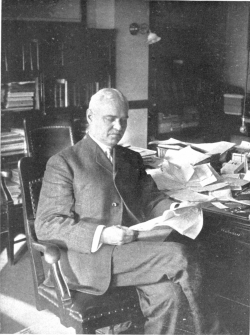 Underwood & Underwood
Major Goethals, as Chairman of the Isthmian Canal Commission,
Washington, D. C., 1908
American, and the United States holds the right to enforce sanitary
regulations in the cities of Panama and Colon at either end of the canal
and to preserve order when the Panama authorities prove unequal to the
task.
The shout went up from all over America: “Make the dirt fly! Show what
the spirit of ‘get there’ and Yankee grit can do!” Of course, the
temptation to produce immediate results was great. But the clear-seeing
men in control said: “There must be no headlong rush this time. We will
be content to make haste slowly and take steps to prevent the evils that
have defeated those who have gone before. We must clean the cities,
drain the swamps, make clearings in the rank growth of the jungles. We
must make a place even in the tropics where health and happy human
living are possible.”
But the “clean-up” slogan was not able alone to conquer the specter of
disease. Yellow fever still haunted the sanitary streets and byways.
Only through the heroism of brave men who loved their neighbors better
than themselves and who were willing to die that others might live was
the secret learned. The experiments to which they gladly offered up
their lives proved that the bite of a particular kind of mosquito was
responsible for the spread of the disease, and that, if this insect
could be destroyed, yellow fever would be destroyed with it. Colonel
Gorgas, the chief sanitary officer, whose watchword was “First prevent,
then curb, and, when all else fails, cure,” was the leader in the fight
for healthful conditions on the isthmus.
But all this time we have been talking much about the battle-ground and
little about the general who led the forces to victory.
It was clear that the time was ripe. The moment cried out for a man of
power—one whose might as an engineer could command the forces of earth
and ocean, and whose understanding of the even more difficult problems
of human engineering would make him a true leader of men.
In 1905 Mr. Taft, who was at that time secretary of war, journeyed to
Panama to see how the work was going forward and to plan for the
fortifications of the canal. He took with him an officer of engineers,
a tall, vigorous man of forty seven, with gray hair, a strong, youthful,
bronzed face, and clear, direct, blue eyes. No trumpet sounded before
Major Goethals to announce the man of the hour—the one whom destiny and
experience had equipped for the great work. He studied every phase of
the giant enterprise, and, when he returned to Washington, prepared a
report that showed not only a thorough understanding of every detail,
but also a broad comprehension of the problems of the whole. His
recommendation of a lock canal was submitted by the secretary of war to
the President, and with it went Mr. Taft’s recommendation of Major
Goethals for the position of chief engineer. Experience had proved that
divided authority and changes in policy through changes in management
were serious drawbacks.
“If I can find an army officer equal to the job, he will have to fight
the thing out to the finish,” said President Roosevelt. “He must manage
the work on the spot, not from an office in Washington. He must be given
full power to act and to control; and he must be a man big enough to
realize that large authority means only large responsibility.”
After carefully considering Major Goethals’ record and reports and then
talking with the man himself, the President became convinced that he had
found the right chief for the work and the army of workers. But when it
was generally known that an army officer was to command at Panama,
people shook their heads. “The high-handed methods of the military will
never succeed there,” they said. “Shoulder-straps cannot do the work!”
On the occasion of Major Goethals’ first appearance before his staff of
engineers and other assistants it was very clear that they looked upon
the departure of their late chief, Mr. Stevens, with regret that became
keener as they anticipated the formality and rigors of military control.
When it was the new leader’s turn to speak they faced him silently.
Major Goethals stood tall and firm like a true descendant of the “Good
Neck” of old, but he looked them in the eyes frankly and pleasantly.
“There will be no militarism and no salutes in Panama,” he said. “I have
left my uniform in moth-balls at home, and with it I have left behind
military duties and fashions. We are here to fight nature shoulder to
shoulder. Your cause is my cause. We have common enemies—Culebra Cut
and the climate; and the completion of the canal will be our victory. I
intend to be the commanding officer, but the chiefs of division will be
the colonels, the foremen the captains, and no man who does his duty has
aught to fear from militarism.”
Let us see how they went against the first enemy, Culebra Cut; the
channel that was to be made through the formidable “peak in Darien”
known as Culebra Mountain. It is only seven o’clock, but the chief
engineer—Colonel Goethals, now—is at the station ready to take the
early train.
“Suppose we walk through the tunnel,” he remarks. “You know the
dirt-trains have right of way in Panama. We should hesitate to delay one
even for the President of the United States or the Czar of all the
Russias.”
At the end of the tunnel a car that looks like a limousine turned
switch-engine is waiting on a siding for the “boss of the job.” Painted
light yellow, like the passenger-cars of the Panama Railroad, it is
known among the men as the “Yellow Peril,” or the “Brain-wagon.” But if
any one expects, as a matter of course, to see the colonel in the
“Yellow Peril,” he is as likely as not doomed to disappointment. The
chief engineer drops off, now to see men drilling holes for dynamite,
now to watch the loading of the dirt-trains from the great
steam-shovels.
As we see the solid rock and rocklike earth of Culebra we realize that
without dynamite the canal would be impossible. Let us watch for a
moment the tearing down of the “everlasting hill.” Deafening
machine-drills pierce the rock or hard soil with holes from three to
thirty or forty feet in depth. These holes, which have been carefully
arranged so as to insure the greatest effect in an earth-quaking,
rock-breaking way, are filled with dynamite and then connected with an
electric wire so that the pressure of a button will set off the entire
charge. A rumble and then a roar—the earth trembles—heaves—then great
masses of rock, mud, and water are hurled high in the air. A fraction of
Culebra larger than a six-or seven-story building is frequently torn
down by one of these explosions and the rock broken into pieces that can
be seized by the steam-shovels and loaded on the dump-cars.
It is interesting to see how, through an ingenious arrangement of the
network of tracks, the loaded cars always go on the down grade and only
empty trains have to crawl up an incline. Much of the rock taken from
the cut is used to build the great Gatun Dam, that keeps the troublesome
Chagres River from flooding the canal. The rest goes to the construction
of breakwaters at the ends of the waterway or to the filling of swamps
and valleys.
The “brain-wagon” is going along without the head. He is climbing
blithely over the roughest sort of ground, now dodging onrushing
dirt-trains, now running to shelter with the “powder-men” at the moment
of blasting. A question here, a word there, and on he goes. It seems as
if even the steam-shovels know that there is a masterhand at the helm
and vie with one another to see which can take up the most earth at a
bite. You would think any man would be completely played out after such
constant jumping and climbing under the hot rays of a tropical sun, as
the hours draw near to noon, but the colonel pulls up the long flight of
steps that lead from the cut and remarks briskly, “Nothing like a little
exercise every morning to keep your health in this climate!”
“There never was such a man for being on the job!” exclaimed one of his
foremen, admiringly. “The only time the colonel isn’t working is from
ten P.M. to five A.M., when he is asleep.”
No despotic monarch in his inherited kingdom ever had more absolute
power than had the Man of Panama. The men from the chiefs of divisions
down to the last Jamaican negro on the line realized that he was master
of the business and that his orders sprang from a thorough understanding
of conditions and a large grasp of the whole. He was a successful
engineer, however, not only because he knew the forces of nature that
they were working to conquer in Panama, but also the human nature he
was working with. He knew that no chain is stronger than its weakest
link, and that no matter how perfect his plans and how powerful his
huge machines and engines, the success he strove for would depend first
of all on the character and the coöperation of the workers.
“The real engineer must above all feel the vital importance of the human
side of engineering work,” he declared. “The man who would move
mountains and make the flow of rivers serve human ends must first be a
master of human construction.”
He knew that if there were to be able and willing workers in Panama,
they must be provided with the means of comfortable and contented
living. It was not enough to defeat death in the form of plague and
fever; it was necessary to make life worth while. For man could not live
by work alone in a land of swamps and jungles. Houses with screened
porches, with gardens, and all the comforts and conveniences to be found
at home were provided for the five thousand American engineers, clerks,
and foremen. Ships with cold-storage equipment brought food supplies
from New York or New Orleans, and every morning a long train of
refrigerator-cars steamed across the isthmus carrying fresh provisions
to all the hotels, town commissaries, and camps.
“You needn’t pity us because we live in the Zone,” said Mrs. Smith. “We
get just as good meat and green vegetables as you can in market and at
wholesale prices. Our house is rent free, with furniture, linen, and
silverware provided. We have electric lights and a telephone. We even
have ice-cream soda and the movies!”
The Man of Panama knew that all work and no play would not only make
Jack a dull boy, but also a poor workman. Recreation buildings were
provided where one could enjoy basket-ball, squash, bowling, or read the
latest books and magazines. There were clubs for men and for women, band
concerts, and a baseball league.
“The colonel not only gave time and thought to the things that kept us
contented and fit,” one of the engineers said, “but he always had time
for everybody who felt he wanted a word with him. The man who was
handling the biggest job in the world nevertheless seemed to think it
was worth while to consider the little troubles of each man who came
along. Have you heard the song they sing in Panama?
“Don’t hesitate to state your case, the boss will hear you through;
It’s true he’s sometimes busy, and has other things to do,
But come on Sunday morning, and line up with the rest,—
You’ll maybe feel some better with that grievance off your chest.
See Colonel Goethals, tell Colonel Goethals,
It’s the only right and proper thing to do.
Just write a letter, or, even better,
Arrange a little Sunday interview.”
The colonel’s Sunday mornings were remarkable occasions. You might see
foregathered there the most interesting variety of human types that
could be found together anywhere in the world—English, Spanish, French,
Italians, turbaned coolies from India, and American negroes. One man
thinks that his foreman does not appreciate his good points; another
comes to present a claim for an injury received on a steam-shovel. Mrs.
A. declares with some feeling that she is never given as good cuts of
meat as Mrs. B. enjoys every day. Another housewife doesn’t see why, if
Mrs. F. can get bread from the hospital bakery, she can’t as well;
because she, too, can appreciate a superior article!
“Of course, many of the things are trivial and even absurd,” said the
colonel; “but if somebody thinks his little affair important, of course
it is—to him. And that is the point, isn’t it? He feels better when he
has had it out; and if it makes the people any happier in their exile to
have this court of appeal, that is not a thing to be despised. Besides,
first and last. I come to understand many things that are really
important from any point of view.”
“He is the squarest boss I ever worked for,” declared one of the
locomotive engineers, “and I’ll tell you the grafters don’t have any
show with him. He had a whole cargo of meat sent back the other day
because it wasn’t above suspicion. I happen to know, too, that he turned
back a load of screening on a prominent business house who thought that
they could save a bit on the copper—that for a government order it
would never be noticed if it was not quite rust-proof.”
The canal was finished not only in less time than had ever been thought
possible, but also with such honest and efficient administration of
every detail that nowadays, when the statement is sometimes made that no
great public enterprise can be carried through without more or less
mismanagement and jobbing, the champion of Uncle Sam’s business methods
retorts, “Look at Panama!”
The colonel’s quiet mastery in moments of stress was perhaps the most
interesting phase of his human engineering. The representatives of a
labor union threaten a strike unless he orders the release of one of
their number who has been convicted of manslaughter. “When will we get
our answer?” asked the spokesman.
“You have it now,” replied Colonel Goethals. “You said that if the man
was not out of the penitentiary by seven this evening you would all
quit. By calling up the penitentiary you will learn that he is still
there. That is your answer. It is now ten minutes past seven.”
“But, Colonel, you don’t want to tie up the whole work?” protested the
leader.
“I am not proposing to tie up the work—you are doing that,” was the
reply.
“But, Colonel, why can’t you pardon the man?”
“I will take no action in response to a mob. As for your threat to leave
the service, I wish to say that every man of you who is not at his post
to-morrow morning will be given his transportation to the United States,
and there will be no string to it. He will go out on the first steamer
and he will never come back.”
There was only one man who failed to report the following day, and he
sent a doctor’s certificate stating that he was too ill to be out of
bed.
Human engineering was especially called into play when the Man of Panama
faced committees of inquiry and investigation from Congress. A pompous
politician once demanded in a challenging tone and with a sharp eye on
the colonel, “How much cracked stone do you allow for a cubic yard of
concrete?”
“One cubic yard,” was the reply.
“You evidently do not understand my question,” rejoined the investigator
in the manner of one who is bent on convicting another through his own
words. “How much cracked stone do you allow for a cubic yard of
concrete?”
“One cubic yard.”
“But you don’t allow for the sand and concrete.” The implied accusation
was spoken with grave emphasis.
“Those go into the spaces among the cracked stone,” was the unruffled
reply. The smile that went around the room was felt rather than heard,
but the pompous politician had no further questions.
This master of men, who was never known to yield his ground when he had
once taken a stand, was always a man of few words. He preferred to let
acts and facts do the talking.
“You know, Colonel Goethals,” said a prominent statesman on one
occasion, “a great many people think we are never going to carry this
job through to the finish. What would you say when diplomats of the
leading powers come at you with questions and declare it will never be
done?”
“I wouldn’t say anything,” was the reply.
On another occasion the boss of the job said: “Some day in September,
1913, I expect to go to Colon and take the Panama Railroad steamer and
put her through the canal. If we get all the way across, I’ll give it
out to the newspapers—if we don’t, I’ll keep quiet about it.”
It was said of old that if one had faith enough he could move mountains.
We cannot doubt that the Man of Panama carried through his great work
because he had faith—not a passive faith that hoped and waited, but an
active faithfulness that worked in full confidence that destiny worked
with him. And this faith and loyalty was a living power that enkindled
like faithfulness in those who worked with him.
The Man of Panama is General Goethals now, but when any admirer would
imply that his generalship—his administration and human
engineering—was the chief factor in the success of the great work, he
invariably replies that he was but one man of many working shoulder to
shoulder in a common cause. The simple greatness of the
“prophet-engineer” and leader of men was shown in the words with which
he accepted the medal of the National Geographic Society:
“The canal has been the work of many, and it has been the pride of
Americans who have visited the isthmus to find the spirit which has
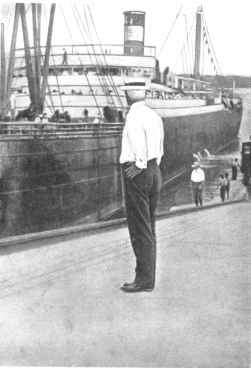 Photo by Brown Bros.
The “Man of Panama” at Panama
animated the forces. Every man was doing the particular part of the work
that was necessary to make it a success. No chief of any enterprise ever
commanded an army that was so loyal, so faithful, that gave its strength
and its blood to the successful completion of its task as did the canal
forces. And so in accepting the medal and thanking those who confer it,
I accept it and thank them in the name of every member of the canal
army.”
Since the completion of the canal, its master-builder has been called to
serve his country in more than one great crisis. At the time of the
threatened railroad strike in the fall of 1916, he was made chairman of
the commission of three appointed by President Wilson to investigate the
working of the eight-hour law for train operators, which was the subject
of dispute between the managers of the roads and the men who ran the
freight-trains. In March, 1917, he was selected by Governor Edge of New
Jersey to serve as advisory engineer on the construction of the new
fifteen-million-dollar highway system of that State.


