Among those whose contributions to physics have immortalized their
names in the annals of science, there is none that holds a more
prominent position in the history of the world than Benjamin Franklin.
At one time a journeyman printer, living in obscure lodgings in
London, he became, during the American War of Independence, one of the
most conspicuous figures in Europe, and among Americans his reputation
was probably second to none, General Washington not excepted.
Professor Laboulaye says of Franklin: "No one ever started from a
lower point than the poor apprentice of Boston. No one ever raised
himself higher by his own unaided forces than the inventor of the
lightning-rod. No one has rendered greater service to his country than
the diplomatist who signed the treaty of 1783, and assured the
independence of the United States. Better than the biographies of
Plutarch, this life, so long and so well filled, is a source of
perpetual instruction to all men. Every one can there find counsel and
example."
A great part of the history of his life was written by Franklin
himself, at first for the edification of the members of his own
family, and afterwards at the pressing request of some of his friends
in London and Paris. His autobiography does not, however, comprise
much more than the first fifty years of his life. The first part was
written while he was the guest of the Bishop of St. Asaph, at Twyford;
the second portion at Passy, in the house of M. de Chaumont; and the
last part in Philadelphia, when he was retiring from public life at
the age of eighty-two. The former part of this autobiography was
translated into French, and published in Paris, in 1793, though it is
not known how the manuscript came into the publisher's hands. The
French version was translated into English, and published in England
and America, together with such other of Franklin's works as could be
collected, before the latter part was given to the world by Franklin's
grandson, to whom he had bequeathed his papers, and who first
published them in America in 1817.
For a period of three hundred years at least Franklin's family lived
on a small freehold of about thirty acres, in the village of Ecton, in
Northamptonshire, the eldest son, who inherited the property, being
always brought up to the trade of a smith. Franklin himself "was the
youngest son of the youngest son for five generations back." His
grandfather lived at Ecton till he was too old to follow his business,
when he went to live with his second son, John, who was a dyer at
Banbury. To this business Franklin's father, Josiah, was apprenticed.
The eldest son, Thomas, was brought up a smith, but afterwards became
a solicitor; the other son, Benjamin, was a silk-dyer, and followed
Josiah to America. He was fond of writing poetry and sermons. The
latter he wrote in a shorthand of his own inventing, which he taught
to his nephew and namesake, in order that he might utilize the sermons
if, as was proposed, he became a Presbyterian minister. Franklin's
father, Josiah, took his wife and three children to New England, in
1682, where he practised the trade of a tallow-chandler and
soap-boiler. Franklin was born in Boston on January 6 (O.S.), 1706,
and was the youngest of seventeen children, of whom thirteen grew up
and married.
Benjamin being the youngest of ten sons, his father intended him for
the service of the Church, and sent him to the grammar school when
eight years of age, where he continued only a year, although he made
very rapid progress in the school; for his father concluded that he
could not afford the expense of a college education, and at the end of
the year removed him to a private commercial school. At the age of ten
young Benjamin was taken home to assist in cutting the wicks of
candles, and otherwise to make himself useful in his father's
business. His enterprising character as a boy is shown by the
following story, which is in his own words:—
There was a salt marsh that bounded part of the mill-pond, on the
edge of which, at high-water, we used to stand to fish for minnows. By
much trampling we had made it a mere quagmire. My proposal was to
build a wharf there fit for us to stand upon, and I showed my comrades
a large heap of stones, which were intended for a new house near the
marsh, and which would very well suit our purpose. Accordingly, in the
evening, when the workmen were gone, I assembled a number of my
play-fellows, and working with them diligently, like so many emmets,
sometimes two or three to a stone, we brought them all away and built
our little wharf. The next morning the workmen were surprised at
missing the stones, which were found in our wharf. Inquiry was made
after the removers; we were discovered and complained of; several of
us were corrected by our fathers; and, though I pleaded the usefulness
of the work, mine convinced me that nothing was useful which was not
honest.
Until twelve years of age Benjamin continued in his father's business,
but as he manifested a great dislike for it, and his parents feared
that he might one day run away to sea, they set about finding some
trade which would be more congenial to his tastes. With this view his
father took him to see various artificers at their work, that he
might observe the tastes of the boy. This experience was very
valuable to him, as it taught him to do many little jobs for himself
when workmen could not readily be procured. During this time Benjamin
spent most of his pocket-money in purchasing books, some of which he
sold when he had read them, in order to buy others. He read through
most of the books in his father's very limited library. These mainly
consisted of works on theological controversy, which Franklin
afterwards considered to have been not very profitable to him.
"There was another bookish lad in the town, John Collins by name, with
whom I was intimately acquainted. We sometimes disputed, and very fond
we were of argument, and very desirous of confuting one another, which
disputatious turn, by the way, is apt to become a very bad habit,
making people often very disagreeable in company by the contradiction
that is necessary to bring it into practice; and thence, besides
souring and spoiling the conversation, is productive of disgusts and
perhaps enmities when you may have occasion for friendship. I had
caught it by reading my father's books of dispute about religion.
Persons of good sense, I have since observed, seldom fall into it,
except lawyers, university men, and men of all sorts that have been
bred at Edinburgh."
At length Franklin's fondness for books caused his father to decide to
make him a printer. His brother James had already entered that
business, and had set up in Boston with a new press and types which
he had brought from England. He signed his indentures when only twelve
years old, thereby apprenticing himself to his brother until he should
attain the age of twenty-one. The acquaintance which he formed with
booksellers through the printing business enabled him to borrow a
better class of books than he had been accustomed to, and he
frequently sat up the greater part of the night to read a book which
he had to return in the morning.
While working with his brother, the young apprentice wrote two
ballads, which he printed and sold in the streets of Boston. His
father, however, ridiculed the performance; so he "escaped being a
poet." He adopted at this time a somewhat original method to improve
his prose writing. Meeting with an odd volume of the Spectator, he
purchased it and read it "over and over," and wished to imitate the
style. "Making short notes of the sentiment in each sentence," he laid
them by, and afterwards tried to write out the papers without looking
at the original. Then on comparison he discovered his faults and
corrected them. Finding his vocabulary deficient, he turned some of
the tales into verse, then retranslated them into prose, believing
that the attempt to make verses would necessitate a search for several
words of the same meaning. "I also sometimes jumbled my collection of
hints into confusion, and after some weeks endeavoured to reduce them
into the best order, before I began to form the full sentence and
complete the paper. This was to teach me method in the arrangement of
my thoughts."
Meeting with a book on vegetarianism, Franklin determined to give the
system a trial. This led to some inconvenience in his brother's
house-keeping, so Franklin proposed to board himself if his brother
would give him half the sum he paid for his board, and out of this he
was able to save a considerable amount for the purpose of buying
books. Moreover, the time required for meals was so short that the
dinner hour afforded considerable leisure for reading. It was on his
journey from Boston to Philadelphia that he first violated vegetarian
principles; for, a large cod having been caught by the sailors, some
small fishes were found in its stomach, whereupon Franklin argued that
if fishes ate one another, there could be no reason against eating
them, so he dined on cod during the rest of the journey.
After reading Xenophon's "Memorabilia," Franklin took up strongly with
the Socratic method of discussion, and became so "artful and expert in
drawing people, even of superior knowledge, into concessions, the
consequence of which they did not foresee," that some time afterwards
one of his employers, before answering the most simple question, would
frequently ask what he intended to infer from the answer. This
practice he gradually gave up, retaining only the habit of expressing
his opinions with "modest diffidence."
In 1720 or 1721 James Franklin began to print a newspaper, the New
England Courant. To this paper, which he helped to compose and print,
Benjamin became an anonymous contributor. The members of the staff
spoke highly of his contributions, but when the authorship became
known, James appears to have conceived a jealousy of his younger
brother, which ultimately led to their separation. An article in the
paper having offended the Assembly, James was imprisoned for a month
and forbidden to print the paper. He then freed Benjamin from his
indentures, in order that the paper might be published in his name. At
length, some disagreement arising, Benjamin took advantage of the
cancelling of his indentures to quit his brother's service. As he
could get no employment in Boston, he obtained a passage to New York,
whence he was recommended to go to Philadelphia, which he reached
after a very troublesome journey. His whole stock of cash then
consisted of a Dutch dollar and about a shilling's worth of coppers.
The coppers he gave to the boatmen with whom he came across from
Burlington. His first appearance in Philadelphia, about eight o'clock
on a Sunday morning, was certainly striking. A youth between seventeen
and eighteen years of age, dressed in his working clothes, which were
dirty through his journey, with his pockets stuffed out with stockings
and shirts, his aspect was not calculated to command respect.
"Then I walked up the street, gazing about till near the market-house
I met a boy with bread. I had made many a meal on bread, and,
inquiring where he got it, I went immediately to the baker's he
directed me to, in Second Street, and ask'd for bisket, intending such
as we had in Boston; but they, it seems, were not made in
Philadelphia. Then I asked for a threepenny loaf, and was told they
had none such. So, not considering or knowing the difference of money,
and the greater cheapness, nor the name of his bread, I bad him give
me three-penny-worth of any sort. He gave me, accordingly, three great
puffy rolls. I was surpriz'd at the quantity, but took it, and having
no room in my pockets, walk'd off with a roll under each arm, and
eating the other. Thus I went up Market Street as far as Fourth
Street, passing by the door of Mr. Read, my future wife's father; when
she, standing at the door, saw me, and thought I made, as I certainly
did, a most awkward, ridiculous appearance. Then I turned and went
down Chestnut Street and part of Walnut Street, eating my roll all the
way, and, coming round, found myself again at Market Street Wharf,
near the boat I came in, to which I went for a draught of the river
water; and, being filled out with one of my rolls, gave the other two
to a woman and her child that came down the river in the boat with us,
and were waiting to go further."
In Philadelphia Franklin obtained an introduction, through a gentleman
he had met at New York, to a printer, named Keimer, who had just set
up business with an old press which he appeared not to know how to
use, and one pair of cases of English type. Here Franklin obtained
employment when the business on hand would permit, and he put the
press in order and worked it. Keimer obtained lodgings for him at the
house of Mr. Read, and, by industry and economical living, Franklin
found himself in easy circumstances. Sir William Keith was then
Governor of Pennsylvania, and hearing of Franklin, he called upon him
at Keimer's printing-office, invited him to take wine at a
neighbouring tavern, and promised to obtain for him the Government
printing if he would set up for himself. It was then arranged that
Franklin should return to Boston by the first ship, in order to see
what help his father would give towards setting him up in business. In
the mean while he was frequently invited to dine at the governor's
house. Notwithstanding Sir William Keith's recommendation, Josiah
Franklin thought his son too young to take the responsibility of a
business, and would only promise to assist him if, when he was
twenty-one, he had himself saved sufficient to purchase most of the
requisite plant. On his return to Philadelphia, he delivered his
father's letter to Sir William Keith, whereon the governor, stating
that he was determined to have a good printer there, promised to find
the means of equipping the printing-office himself, and suggested the
desirability of Franklin's making a journey to England in order to
purchase the plant. He promised letters of introduction to various
persons in England, as well as a letter of credit to furnish the
money for the purchase of the printing-plant. These letters Franklin
was to call for, but there was always some excuse for their not being
ready. At last they were to be sent on board the ship, and Franklin,
having gone on board, awaited the letters. When the governor's
despatches came, they were all put into a bag together, and the
captain promised to let Franklin have his letters before landing. On
opening the bag off Plymouth, there were no letters of the kind
promised, and Franklin was left without introductions and almost
without money, to make his own way in the world. In London he learned
that Governor Keith was well known as a man in whom no dependence
could be placed, and as to his giving a letter of credit, "he had no
credit to give."
A friend of Franklin's, named Ralph, accompanied him from America, and
the two took lodgings together in Little Britain at three shillings
and sixpence per week. Franklin immediately obtained employment at
Palmer's printing-office, in Bartholomew Close; but Ralph, who knew no
trade, but aimed at literature, was unable to get any work. He could
not obtain employment, even among the law stationers as a copying
clerk, so for some time the wages which Franklin earned had to support
the two. At Palmer's Franklin was employed in composing Wollaston's
"Religion of Nature." On this he wrote a short critique, which he
printed. it was entitled "A Dissertation on Liberty and Necessity,
Pleasure and Pain." The publication of this he afterwards regretted,
but it obtained for him introductions to some literary persons in
London. Subsequently he left Palmer's and obtained work at Watts's
printing-office, where he remained during the rest of his stay in
London. The beer-drinking capabilities of some of his fellow-workmen
excited his astonishment. He says:—
We had an alehouse boy who attended always in the house to supply the
workmen. My companion at the press drank every day a pint before
breakfast, a pint at breakfast with his bread and cheese, a pint
between breakfast and dinner, a pint at dinner, a pint in the
afternoon about six o'clock, and another when he had done his day's
work. I thought it a detestable custom, but it was necessary, he
suppos'd, to drink strong beer, that he might be strong to labour.
I endeavoured to convince him that the bodily strength afforded by
beer could only be in proportion to the grain or flour of the barley
dissolved in the water of which it was made; that there was more flour
in a pennyworth of bread; and therefore, if he would eat that with a
pint of water, it would give him more strength than a quart of beer.
He drank on, however, and had four or five shillings to pay out of his
wages every Saturday night for that muddling liquor; an expense I was
free from. And thus these poor devils keep themselves always under.
Afterwards Franklin succeeded in persuading several of the compositors
to give up "their muddling breakfast of beer and bread and cheese,"
for a porringer of hot-water gruel, with pepper, breadcrumbs, and
butter, which they obtained from a neighbouring house at a cost of
three halfpence.
Among Franklin's fellow-passengers from Philadelphia to England was an
American merchant, a Mr. Denham, who had formerly been in business in
Bristol, but failed and compounded with his creditors. He then went to
America, where he soon acquired a fortune, and returned in Franklin's
ship. He invited all his old creditors to dine with him. At the dinner
each guest found under his plate a cheque for the balance which had
been due to him, with interest to date. This gentleman always remained
a firm friend to Franklin, who, during his stay in London, sought his
advice when any important questions arose. When Mr. Denham returned to
Philadelphia with a quantity of merchandise, he offered Franklin an
appointment as clerk, which was afterwards to develop into a
commission agency. The offer was accepted, and, after a voyage of
nearly three months, Franklin reached Philadelphia on October 11,
1726. Here he found Governor Keith had been superseded by Major
Gordon, and, what was of more importance to him, that Miss Read, to
whom he had become engaged before leaving for England, and to whom he
had written only once during his absence, had married. Shortly after
starting in business, Mr. Denham died, and thus left Franklin to
commence life again for himself. Keimer had by this time obtained a
fairly extensive establishment, and employed a number of hands, but
none of them were of much value; and he made overtures to Franklin to
take the management of his printing-office, apparently with the
intention of getting his men taught their business, so that he might
afterwards be able to dispense with the manager. Franklin set the
printing-house in order, started type-founding, made the ink, and,
when necessary, executed engravings. As the other hands improved under
his superintendence, Keimer began to treat his manager less civilly,
and apparently desired to curtail his stipend. At length, through an
outbreak of temper on the part of Keimer, Franklin left, but was
afterwards induced to return in order to prepare copper-plates and a
press for printing paper money for New Jersey.
While working for Keimer, Franklin formed a club, which was destined
to exert considerable influence on American politics. The club met on
Friday evenings, and was called the Junto. It was essentially a
debating society, the subject for each evening's discussion being
proposed at the preceding meeting. One of the rules was that the
existence of the club should remain a secret, and that its members
should be limited to twelve. Afterwards other similar clubs were
formed by its members; but the existence of the Junto was kept a
secret from them. The club lasted for about forty years, and became
the nucleus of the American Philosophical Society, of which Franklin
was the first president. This, and the fact that many of the great
questions that arose previously to the Declaration of Independence
were discussed in the Junto in the first instance, give to the club a
special importance. The following are specimens of subjects discussed
by the club:—
"Is sound an entity or body?"
"How may the phenomena of vapours be explained?"
"Is self-interest the rudder that steers mankind, the universal
monarch to whom all are tributaries?"
"Which is the best form of government? and what was that form which
first prevailed among mankind?"
"Can any one particular form of government suit all mankind?"
"What is the reason that the tides rise higher in the Bay of Fundy
than the Bay of Delaware?"
"Is the emission of paper money safe?"
"What is the reason that men of the greatest knowledge are not the
most happy?"
"How may the possessions of the Lakes be improved to our advantage?"
"Why are tumultuous, uneasy sensations united with our desires?"
"Whether it ought to be the aim of philosophy to eradicate the
passions."
"How may smoky chimneys be best cured?"
"Why does the flame of a candle tend upwards in a spire?"
"Which is least criminal—a bad action joined with a good intention,
or a good action with a bad intention?"
"Is it consistent with the principles of liberty in a free government
to punish a man as a libeller when he speaks the truth?"
On leaving Keimer's, Franklin went into partnership with one of his
fellow-workmen, Hugh Meredith, whose father found the necessary
capital, and a printing-office was started which soon excelled its two
rivals in Philadelphia. Franklin's industry attracted the attention of
the townsfolk, and inspired the merchants with confidence in the
prospects of the new concern. Keimer started a newspaper, which he had
not the ability to carry on; Franklin purchased it from him for a
trifle, remodelled it, and continued it in a very spirited manner
under the title of the Pennsylvania Gazette. His political articles
soon attracted the attention of the principal men of the state; the
number of subscribers increased rapidly, and the paper became a source
of considerable profit. Soon after, the printing for the House of
Representatives came into the hands of the firm. Meredith never took
to the business, and was seldom sober, and at length was bought out by
his partner, on July 14, 1730. The discussion in the Junto on paper
currency induced Franklin to publish a paper entitled "The Nature and
Necessity of a Paper Currency." This was a prominent subject before
the House, but the introduction of paper money was opposed by the
capitalists. They were unable, however, to answer Franklin's
arguments; the point was carried in the House, and Franklin was
employed to print the money. The amount of paper money in Pennsylvania
in 1739 amounted to £80,000; during the war it rose to more than
£350,000.
"In order to secure my credit and character as a tradesman, I took
care not only to be in reality industrious and frugal, but to avoid
all appearances to the contrary. I drest plainly; I was seen at no
places of idle diversion. I never went out a-fishing or shooting; a
book, indeed, sometimes debauch'd me from my work, but that was
seldom, snug, and gave no scandal; and, to show that I was not above
my business, I sometimes brought home the paper I purchas'd at the
stores thro' the streets on a wheelbarrow. Thus being esteem'd an
industrious, thriving young man, and paying duly for what I bought,
the merchants who imported stationery solicited my custom; others
proposed supplying me with books, and I went on swimmingly. In the
mean time, Keimer's credit and business declining daily, he was at
last forc'd to sell his printing-house to satisfy his creditors."
On September 1, 1730, Franklin married his former fiancée, whose
previous husband had left her and was reported to have died in the
West Indies. The marriage was a very happy one, and continued over
forty years, Mrs. Franklin living until the end of 1774. Industry and
frugality reigned in the household of the young printer. Mrs. Franklin
not only managed the house, but assisted in the business, folding and
stitching pamphlets, and in other ways making herself useful. The
first part of Franklin's autobiography concludes with an account of
the foundation of the first subscription library. By the co-operation
of the members of the Junto, fifty subscribers were obtained, who each
paid in the first instance forty shillings, and afterwards ten
shillings per annum. "We afterwards obtained a charter, the company
being increased to one hundred. This was the mother of all the North
American subscription libraries, now so numerous. It is become a great
thing itself, and continually increasing. These libraries have
improved the general conversation of the Americans, made the common
tradesmen and farmers as intelligent as most gentlemen from other
countries, and perhaps have contributed in some degree to the stand so
generally made throughout the colonies in defence of their
privileges."
Ten years ago this library contained between seventy and eighty
thousand volumes.
Franklin's success in business was attributed by him largely to his
early training. "My circumstances, however, grew daily easier. My
original habits of frugality continuing, and my father having, among
his instructions to me when a boy, frequently repeated a proverb of
Solomon, 'Seest thou a man diligent in his business? he shall stand
before kings; he shall not stand before mean men,' I from thence
considered industry as a means of obtaining wealth and distinction,
which encourag'd me, tho' I did not think that I should ever
literally stand before kings, which, however, has since happened;
for I have stood before five, and even had the honour of sitting
down with one, the King of Denmark, to dinner."
After his marriage, Franklin conceived the idea of obtaining moral
perfection. He was not altogether satisfied with the result, but
thought his method worthy of imitation. Assuming that he possessed
complete knowledge of what was right or wrong, he saw no reason why he
should not always act in accordance therewith. His principle was to
devote his attention to one virtue only at first for a week, at the
end of which time he expected the practice of that virtue to have
become a habit. He then added another virtue to his list, and devoted
his attention to the same for the next week, and so on, until he had
exhausted his list of virtues. He then commenced again at the
beginning. As his moral code comprised thirteen virtues, it was
possible to go through the complete curriculum four times in a year.
Afterwards he occupied a year in going once through the list, and
subsequently employed several years in one course. A little book was
ruled, with a column for each day and a line for each virtue, and in
this a mark was made for every failure which could be remembered on
examination at the end of the day. It is easy to believe his
statement: "I am surprised to find myself so much fuller of faults
than I had imagined; but I had the satisfaction of seeing them
diminish."
"This my little book had for its motto these lines from Addison's
'Cato':—
"'Here will I hold. If there's a Power above us
(And that there is, all Nature cries aloud
Thro' all her work), He must delight in virtue;
And that which He delights in must be happy.'
"Another from Cicero:—
"'O vitæ Philosophia dux! O virtutum indagatrix expultrixque vitiorum!
Unus dies ex præceptis tuis actus, peccanti immortalitati est
anteponendus.'
"Another from the Proverbs of Solomon, speaking of wisdom and virtue:—
"'Length of days is in her right hand; and in her left hand riches and
honour. Her ways are ways of pleasantness, and all her paths are
peace.'
"And conceiving God to be the fountain of wisdom, I thought it right
and necessary to solicit His assistance for obtaining it; to this end
I formed the following little prayer, which was prefixed to my tables
of examination, for daily use:—
"'O powerful Goodness! bountiful Father! merciful Guide! increase in
me that wisdom which discovers my truest interest. Strengthen my
resolutions to perform what that wisdom dictates. Accept my kind
offices to Thy other children as the only return in my power for Thy
continual favours to me.'
"I used also sometimes a little prayer which I took from Thomson's
Poems, viz.:—
"'Father of light and life, Thou Good Supreme!
Oh teach me what is good; teach me Thyself!
Save me from folly, vanity, and vice,
From every low pursuit; and fill my soul
With knowledge, conscious peace, and virtue pure;
Sacred, substantial, never-failing bliss!'"
The senses in which Franklin's thirteen virtues were to be understood
were explained by short precepts which followed them in his list. The
list was as follows:—
"1. Temperance.
"Eat not to dulness; drink not to elevation.
"2. Silence.
"Speak not but what may benefit others or yourself; avoid trifling
conversation.
"3. Order.
"Let all your things have their places; let each part of your business
have its time.
"4. Resolution.
"Resolve to perform what you ought; perform without fail what you
resolve.
"5. Frugality.
"Make no expense but to do good to others or yourself; i.e. waste
nothing.
"6. Industry.
"Lose no time; be always employed in something useful; cut off all
unnecessary actions.
"7. Sincerity.
"Use no hurtful deceit; think innocently and justly; and, if you
speak, speak accordingly.
"8. Justice.
"Wrong none by doing injuries, or omitting the benefits that are your
duty.
"9. Moderation.
"Avoid extremes; forbear resenting injuries so much as you think they
deserve.
"10. Cleanliness.
"Tolerate no uncleanness in body, clothes, or habitation.
"11. Tranquillity.
"Be not disturbed at trifles, or accidents common or unavoidable.
"12. Chastity.
"13. Humility.
"Imitate Jesus and Socrates."
The last of these was added to the list at the suggestion of a Quaker
friend. Franklin claims to have acquired a good deal of the
appearance of it, but concluded that in reality there was no passion
so hard to subdue as pride. "For even if I could conceive that I had
completely overcome it, I should probably be proud of my humility."
The virtue which gave him most trouble, however, was order, and this
he never acquired.
In 1732 appeared the first copy of "Poor Richard's Almanack." This was
prepared, printed, and published by Franklin for about twenty-five
years in succession, and nearly ten thousand copies were sold
annually. Besides the usual astronomical information, it contained a
collection of entertaining anecdotes, verses, jests, etc., while the
"little spaces that occurred between the remarkable events in the
calendar" were filled with proverbial sayings, inculcating industry
and frugality as helps to virtue. These sayings were collected and
prefixed to the almanack of 1757, whence they were copied into the
American newspapers, and afterwards reprinted as a broad-sheet in
England and in France.
In 1733 Franklin commenced studying modern languages, and acquired
sufficient knowledge of French, Italian, and Spanish to be able to
read books in those languages. In 1736 he was chosen Clerk to the
General Assembly, an office to which he was annually re-elected until
he became a member of the Assembly about 1750. There was one member
who, on the second occasion of his election, made a long speech
against him. Franklin determined to secure the friendship of this
member. Accordingly he wrote to him to request the loan of a very
scarce and curious book which was in his library. The book was lent
and returned in about a week, with a note of thanks. The member ever
after manifested a readiness to serve Franklin, and they became great
friends—"Another instance of the truth of an old maxim I had learned,
which says, 'He that has once done you a kindness will be more ready
to do you another than he whom you yourself have obliged.' And it
shows how much more profitable it is prudently to remove, than to
resent, return, and continue inimical proceedings."
In 1737 Franklin was appointed Deputy-Postmaster-General for
Pennsylvania. He was afterwards made Postmaster-General of the
Colonies. He read a paper in the Junto on the organization of the City
watch, and the propriety of rating the inhabitants on the value of
their premises in order to support the same. The subject was also
discussed in the other clubs which had sprung from the Junto, and thus
the way was prepared for the law which a few years afterwards carried
Franklin's proposals into effect. His next scheme was the formation of
a fire brigade, in which he met with his usual success, and other
clubs followed, until most of the men of property in the city were
members of one club or another. The original brigade, known as the
Union Fire Company, was formed December 7, 1736. It was in active
service in 1791.
Franklin founded the American Philosophical Society in 1743. The
head-quarters of the society were fixed in Philadelphia, where it was
arranged that there should always be at least seven members, viz. a
physician, a botanist, a mathematician, a chemist, a mechanician, a
geographer, and a general natural philosopher, besides a president,
treasurer, and secretary. The other members might be resident in any
part of America. Correspondence was to be kept up with the Royal
Society of London and the Dublin Society, and abstracts of the
communications were to be sent quarterly to all the members. Franklin
became the first secretary.
Spain, having been for some years at war with England, was joined at
length by France. This threatened danger to the American colonies, as
France then held Canada, and no organization for their defence
existed. Franklin published a pamphlet entitled "Plain Truth," setting
forth the unarmed condition of the colonies, and recommending the
formation of a volunteer force for defensive purposes. The pamphlet
excited much attention. A public meeting was held and addressed by
Franklin; at this meeting twelve hundred joined the association. At
length the number of members enrolled exceeded ten thousand. These all
provided themselves with arms, formed regiments and companies, elected
their own officers, and attended once a week for military drill.
Franklin was elected colonel of the Philadelphia Regiment, but
declined the appointment, and served as a private soldier. The
provision of war material was a difficulty with the Assembly, which
consisted largely of Quakers, who, though they appeared privately to
be willing that the country should be put in a state of defence,
hesitated to vote in opposition to their peace principles. Hence it
was that, when the Government of New England asked a grant of
gunpowder from Pennsylvania, the Assembly voted £3000 "for the
purchasing of bread, flour, wheat, or other grain." Pebble-powder
was not then in use. When it was proposed to devote £60, which was a
balance in the hands of the Union Fire Company, as a contribution
towards the erection of a battery below the town, Franklin suggested
that it should be proposed that a fire-engine be purchased with the
money, and that the committee should "buy a great gun, which is
certainly a fire-engine."
The "Pennsylvania fireplace" was invented in 1742. A patent was
offered to Franklin by the Governor of Pennsylvania, but he declined
it on the principle "that, as we enjoy great advantages from the
inventions of others, we should be glad of an opportunity to serve
others by any invention of ours; and this we should do freely and
generously." An ironmonger in London made slight alterations, which
were not improvements, in the design, and took out a patent for the
fireplace, whereby he made a "small fortune." Franklin never contested
the patent, "having no desire of profiting by patents himself," and
"hating disputes." This fireplace was designed to burn wood, but,
unlike the German stoves, it was completely open in front, though
enclosed at the sides and top. An air-chamber was formed in the middle
of the stove, so arranged that, while the burning wood was in contact
with the front of the chamber, the flame passed above and behind it on
its way to the flue. Through this chamber a constant current of air
passed, entering the room heated, but not contaminated, by the
products of combustion. In this way the stove furnished a constant
supply of fresh warm air to the room, while it possessed all the
advantages of an open fireplace. Subsequently Franklin contrived a
special fireplace for the combustion of coal. In the scientific
thought which he devoted to the requirements of the domestic
economist, as in very many other particulars, Franklin strongly
reminds us of Count Rumford.
The next important enterprise which Franklin undertook, partly through
the medium of the Junto, was to establish an academy which soon
developed into the University of Philadelphia. The members of the club
having taken up the subject, the next step was to enlist the sympathy
of a wider constituency, and this Franklin effected, in his usual way,
by the publication of a pamphlet. He then set on foot a subscription,
the payments to extend over five years, and thereby obtained about
£5000. A house was taken and schools opened in 1749. The classes soon
became too large for the house, and the trustees of the academy then
took over a large building, or "tabernacle," which had been erected
for George Whitefield when he was preaching in Philadelphia. The hall
was divided into stories, and at a very small expense adapted to the
requirements of the classes. Franklin, having taken a partner in his
printing business, took the oversight of the work. Afterwards the
funds were increased by English subscriptions, by a grant from the
Assembly, and by gifts of land from the proprietaries; and thus was
established the University of Philadelphia.
Having practically retired from business, Franklin intended to devote
himself to philosophical studies, having commenced his electrical
researches some time before in conjunction with the other members of
the Library Company. Public business, however, crowded upon him. He
was elected a member of the Assembly, a councillor and afterwards an
alderman of the city, and by the governor was made a justice of the
peace. As a member of the Assembly, he was largely concerned in
providing the means for the erection of a hospital, and in arranging
for the paving and cleansing of the streets of the city. In 1753 he
was appointed, in conjunction with Mr. Hunter, Postmaster-General of
America. The post-office of the colonies had previously been conducted
at a loss. In a few years, under Franklin's management, it not only
paid the stipends of himself and Mr. Hunter, but yielded a
considerable revenue to the Crown. But it was not only in the conduct
of public business that Franklin's merits were recognized. By this
time he had secured his reputation as an electrician, and both Yale
College and Cambridge University (New England) conferred on him the
honorary degree of Master of Arts. In the same year that he was made
Postmaster-General of America he was awarded the Copley Medal and
elected a Fellow of the Royal Society of London, the usual fees being
remitted in his case.
Before his election as member, Franklin had for several years held the
appointment of Clerk to the Assembly, and he used to relieve the
dulness of the debates by amusing himself in the construction of magic
circles and squares, and "acquired such a knack at it" that he could
"fill the cells of any magic square of reasonable size with a series
of numbers as fast as" he "could write them." Many years afterwards
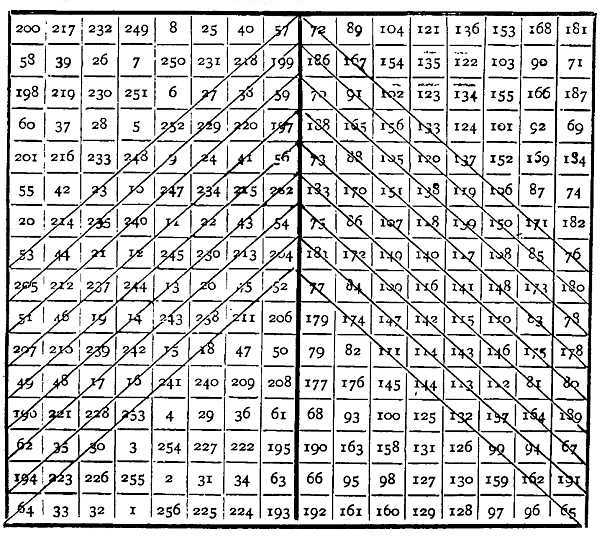
Mr. Logan showed Franklin a French folio volume filled with magic
squares, and afterwards a magic "square of 16," which Mr. Logan
thought must have been a work of great labour, though it possessed
only the common properties of making 2056 in every row, horizontal,
vertical, and diagonal. During the evening Franklin made the square
shown on the opposite page. "This I sent to our friend the next
morning, who, after some days, sent it back in a letter, with these
words: 'I return to thee thy astonishing and most stupendous piece of
the magical square, in which——;' but the compliment is too
extravagant, and therefore, for his sake as well as my own, I ought
not to repeat it. Nor is it necessary; for I make no question that you
will readily allow this square of 16 to be the most magically magical
of any magic square ever made by any magician."
The square has the following properties:—Every straight row of
sixteen numbers, whether vertical, horizontal, or diagonal, makes
2056.
Every bent row of sixteen numbers, as shown by the diagonal lines in
the figure, makes 2056.
If a square hole be cut in a piece of paper, so as to show through it
just sixteen of the little squares, and the paper be laid on the magic
square, then, wherever the paper is placed, the sum of the sixteen
numbers visible through the hole will be 2056.
| 200 | 217 | 232 | 249 | 8 | 25 | 40 | 57 | 72 | 89 | 104 | 121 | 136 | 153 | 168 | 185 |
| 58 | 39 | 26 | 7 | 250 | 231 | 218 | 199 | 186 | 167 | 154 | 135 | 122 | 103 | 90 | 71 |
| 198 | 219 | 230 | 251 | 6 | 27 | 38 | 59 | 70 | 91 | 102 | 123 | 134 | 155 | 166 | 187 |
| 60 | 37 | 28 | 5 | 252 | 229 | 220 | 197 | 188 | 165 | 156 | 133 | 124 | 101 | 92 | 69 |
| 201 | 216 | 233 | 248 | 9 | 24 | 41 | 56 | 73 | 88 | 105 | 120 | 137 | 152 | 169 | 184 |
| 55 | 42 | 23 | 10 | 247 | 234 | 215 | 202 | 183 | 170 | 151 | 138 | 119 | 106 | 87 | 74 |
| 203 | 214 | 235 | 246 | 11 | 22 | 43 | 54 | 75 | 86 | 107 | 118 | 139 | 150 | 171 | 182 |
| 53 | 44 | 21 | 12 | 245 | 236 | 213 | 204 | 181 | 172 | 149 | 140 | 117 | 108 | 85 | 76 |
| 205 | 212 | 237 | 244 | 13 | 20 | 45 | 52 | 77 | 84 | 109 | 116 | 141 | 148 | 173 | 180 |
| 51 | 46 | 19 | 14 | 243 | 238 | 211 | 206 | 179 | 174 | 147 | 142 | 115 | 110 | 83 | 78 |
| 207 | 210 | 239 | 242 | 15 | 18 | 47 | 50 | 79 | 82 | 111 | 114 | 143 | 146 | 175 | 178 |
| 49 | 48 | 17 | 16 | 241 | 240 | 209 | 208 | 177 | 176 | 145 | 144 | 113 | 112 | 81 | 80 |
| 196 | 221 | 228 | 253 | 4 | 29 | 36 | 61 | 68 | 93 | 100 | 125 | 132 | 157 | 164 | 189 |
| 62 | 35 | 30 | 3 | 254 | 227 | 222 | 195 | 190 | 163 | 158 | 131 | 126 | 99 | 94 | 67 |
| 194 | 223 | 226 | 255 | 2 | 31 | 34 | 63 | 66 | 95 | 98 | 127 | 130 | 159 | 162 | 191 |
| 64 | 33 | 32 | 1 | 256 | 225 | 224 | 193 | 192 | 161 | 160 | 129 | 128 | 97 | 96 | 65 |
In 1754 war with France appeared to be again imminent, and a Congress
of Commissioners from the several colonies was arranged for. Of
course, Franklin was one of the representatives of Pennsylvania, and
was also one of the members who independently drew up a plan for the
union of all the colonies under one government, for defensive and
other general purposes, and his was the plan finally approved by
Congress for the union, though it was not accepted by the Assemblies
or by the English Government, being regarded by the former as having
too much of the prerogative in it, by the latter as being too
democratic. Franklin wrote respecting this scheme: "The different
and contrary reasons of dislike to my plan makes me suspect that it
was really the true medium; and I am still of opinion that it would
have been happy for both sides of the water if it had been adopted. The
colonies, so united, would have been sufficiently strong to have
defended themselves; there would then have been no need of troops from
England; of course, the subsequent pretence for taxing America, and
the bloody contest it occasioned, would have been avoided."
With this war against France began the struggle of the Assemblies and
the proprietaries on the question of taxing the estates of the latter.
The governors received strict instructions to approve no bills for the
raising of money for the purposes of defence, unless the estates of
the proprietaries were specially exempted from the tax. The Assembly
of Pennsylvania resolved to contribute £10,000 to assist the
Government of Massachusetts Bay in an attack upon Crown Point, but the
governor refused his assent to the bill for raising the money. At this
juncture Franklin proposed a scheme by which the money could be raised
without the consent of the governor. His plan was successful, and the
difficulty was surmounted for the time, but was destined to recur
again and again during the progress of the war.
The British Government, not approving of the scheme of union, whereby
the colonies might have defended themselves, sent General Braddock to
Virginia, with two regiments of regular troops. On their arrival they
found it impossible to obtain waggons for the conveyance of their
baggage, and the general commissioned Franklin to provide them in
Pennsylvania. By giving his private bond for their safety, Franklin
succeeded in engaging one hundred and fifty four-horse waggons, and
two hundred and fifty-nine pack-horses. His modest warnings against
Indian ambuscades were disregarded by the general, the little army was
cut to pieces, and the remainder took to flight, sacrificing the whole
of their baggage and stores. Franklin was never fully recouped by the
British Government for the payments he had to make on account of
provisions which the general had instructed him to procure for the use
of the army.
After this, Franklin appeared for some time in a purely military
capacity, having yielded to the governor's persuasions to undertake
the defence of the north-western frontier, to raise troops, and to
build a line of forts. After building and manning three wooden forts,
he was recalled by the Assembly, whose relations with the governor had
become more and more strained. At length the Assembly determined to
send Franklin to England, to present a petition to the king respecting
the conduct of the proprietaries, viz. Richard and Thomas Penn, the
successors of William Penn. A bill had been framed by the House to
provide £60,000 for the king's use in the defence of the province.
This the governor refused to pass, because the proprietary estates
were not exempted from the taxation. The petition to the king was
drawn up, and Franklin's baggage was on board the ship which was to
convey him to England, when General Lord Loudon endeavoured to make an
arrangement between the parties. The governor pleaded his
instructions, and the bond he had given for carrying them out, and the
Assembly was prevailed upon to reconstruct the bill in accordance with
the governor's wishes. This was done under protest; in the mean time
Franklin's ship had sailed, carrying his baggage. After a great deal
of unnecessary delay on account of the general's inability to decide
upon the despatch of the packet-boats, Franklin at last got away from
New York, and, having narrowly escaped shipwreck off Falmouth, he
reached London on July 27, 1757.
On arriving in London, Franklin was introduced to Lord Granville, who
told him that the king's instructions were laws in the colonies.
Franklin replied that he had always understood that the Assemblies
made the laws, which then only required the king's consent. "I
recollected that, about twenty years before, a clause in a bill
brought into Parliament by the Ministry had proposed to make the
king's instructions laws in the colonies, but the clause was thrown
out by the Commons, for which we adored them as our friends and the
friends of liberty, till, by their conduct towards us in 1765, it
seem'd that they had refus'd that point of sovereignty to the king
only that they might reserve it for themselves." A meeting was shortly
afterwards arranged between Franklin and the proprietaries at Mr. T.
Penn's house; but their views were so discordant that, after some
discussion, Franklin was requested to give them in writing the heads
of his complaints, and the whole question was submitted to the opinion
of the attorney- and solicitor-general. It was nearly a year before
this opinion was given. The proprietaries then communicated directly
with the Assembly, but in the mean while Governor Denny had consented
to a bill for raising £100,000 for the king's use, in which it was
provided that the proprietary estates should be taxed with the others.
When this bill reached England, the proprietaries determined to oppose
its receiving the royal assent. Franklin engaged counsel on behalf of
the Assembly, and on his undertaking that the assessment should be
fairly made between the estates of the proprietaries and others, the
bill was allowed to pass.
By this time Franklin's career as a scientific investigator was
practically at an end. Political business almost completely occupied
his attention, and in one sense the diplomatist replaced the
philosopher. His public scientific career was of short duration. It
may be said to have begun in 1746, when Mr. Peter Collinson presented
an "electrical tube" to the Library Company in Philadelphia, which was
some time after followed by a present of a complete set of electrical
apparatus from the proprietaries, but by 1755 Franklin's time was so
much taken up by public business that there was very little
opportunity for experimental work. Throughout his life he frequently
expressed in his letters his strong desire to return to philosophy,
but the opportunity never came, and when, at the age of eighty-two, he
was liberated from public duty, his strength was insufficient to
enable him to complete even his autobiography.
It was on a visit to Boston in 1746 that Franklin met with Dr. Spence,
a Scotchman, who exhibited some electrical experiments. Soon after his
return to Philadelphia the tube arrived from Mr. Collinson, and
Franklin acquired considerable dexterity in its use. His house was
continually full of visitors, who came to see the experiments, and, to
relieve the pressure upon his time, he had a number of similar tubes
blown at the glass-house, and these he distributed to his friends, so
that there were soon a number of "performers" in Philadelphia. One of
these was Mr. Kinnersley, who, having no other employment, was induced
by Franklin to become an itinerant lecturer. Franklin drew up a scheme
for the lectures, and Kinnersley obtained several well-constructed
instruments from Franklin's rough and home-made models. Kinnersley and
Franklin appear to have worked together a good deal, and when
Kinnersley was travelling on his lecture tour, each communicated to
the other the results of his experiments. Franklin sent his papers to
Mr. Collinson, who presented them to the Royal Society, but they were
not at first judged worthy of a place in the "Transactions." The paper
on the identity of lightning and electricity was sent to Dr. Mitchell,
who read it before the Royal Society, when it "was laughed at by the
connoisseurs." The papers were subsequently published in a pamphlet,
but did not at first receive much attention in England. On the
recommendation of Count de Buffon, they were translated into French.
The Abbé Nollet, who had previously published a theory of his own
respecting electricity, wrote and published a volume of letters
defending his theory, and denying the accuracy of some of Franklin's
experimental results. To these letters Franklin made no reply, but
they were answered by M. le Roy. M. de Lor undertook to repeat in
Paris all Franklin's experiments, and they were performed before the
king and court. Not content with the experiments which Franklin had
actually performed, he tried those which had been only suggested, and
so was the first to obtain electricity from the clouds by means of the
pointed rod. This experiment produced a great sensation everywhere,
and was afterwards repeated by Franklin at Philadelphia. Franklin's
papers were translated into Italian, German, and Latin; his theory met
with all but universal acceptance, and great surprise was expressed
that his papers had excited so little interest in England. Dr. Watson
then drew up a summary of all Franklin's papers, and this was
published in the "Philosophical Transactions;" Mr. Canton verified the
experiment of procuring electricity from the clouds by means of a
pointed rod, and the Royal Society awarded to Franklin the Copley
Medal for 1753, which was conveyed to him by Governor Denny.
We must now give a short account of Franklin's contributions to
electrical science.
"The first is the wonderful effect of pointed bodies, both in drawing
off and throwing off the electrical fire."
It will be observed that this statement is made in the language of the
one-fluid theory, of which Franklin may be regarded as the author.
This theory will be again referred to presently. Franklin electrified
a cannon-ball so that it repelled a cork. On bringing near it the
point of a bodkin, the repulsion disappeared. A blunt body had to be
brought near enough for a spark to pass in order to produce the same
effect. "To prove that the electrical fire is drawn off by the
point, if you take the blade of the bodkin out of the wooden handle,
and fix it in a stick of sealing-wax, and then present it at the
distance aforesaid, or if you bring it very near, no such effect
follows; but sliding one finger along the wax till you touch the
blade, and the ball flies to the shot immediately. If you present the
point in the dark, you will see, sometimes at a foot distance or more,
a light gather upon it like that of a fire-fly or glow-worm; the less
sharp the point, the nearer you must bring it to observe the light;
and at whatever distance you see the light, you may draw off the
electrical fire, and destroy the repelling."
By laying a needle upon the shot, Franklin showed "that points will
throw off as well as draw off the electrical fire." A candle-flame
was found to be equally efficient with a sharp point in drawing off
the electricity from a charged conductor. The effect of the
candle-flame Franklin accounted for by supposing the particles
separated from the candle to be first "attracted and then repelled,
carrying off the electric matter with them." The effect of points is a
direct consequence of the law of electrical repulsion. When a
conductor is electrified, the density of the electricity is greatest
where the curvature is greatest. Thus, if a number of spheres are
electrified from the same source, the density of the electricity on
the different spheres will vary inversely as their diameters. The
force tending to drive the electricity off a conductor is everywhere
proportional to the density, and hence in the case of the spheres will
be greatest for the smallest sphere. On this principle, the density of
electricity on a perfectly sharp point, if such could exist, on a
charged conductor, would be infinite and the force tending to drive it
off would be infinite also. Hence a moderately sharp point is
sufficient to dissipate the electricity from a highly charged
conductor, or to neutralize it if the point is connected to earth and
brought near the conductor so as to be electrified by induction.
Franklin next found that, if the person rubbing the electric tube
stood upon a cake of resin, and the person taking the charge from the
tube stood also on an insulating stand, a stronger spark would pass
between these two persons than between either of them and the earth;
that, after the spark had passed, neither person was electrified,
though each had appeared electrified before. These experiments
suggested the idea of positive and negative electrification; and
Franklin, regarding the electric fluid as corresponding to positive
electrification, remarked that "you may circulate it as Mr. Watson has
shown; you may also accumulate or subtract it upon or from any body,
as you connect that body with the rubber or with the receiver, the
common stock being cut off." Thus Franklin regarded electricity as a
fluid, of which everything in its normal state possesses a certain
amount; that, by appropriate means, some of the fluid may be removed
from one body and given to another. The former is then electrified
negatively, the latter positively, and all processes by which bodies
are electrified consist in the removal of electricity from one body or
system and giving it to another. He regarded the electric fluid as
repelling itself and attracting matter. Æpinus afterwards added the
supposition that matter, when devoid of electricity, is
self-repulsive, and thus completed the "one-fluid theory," and
accounted for the repulsion observed between negatively electrified
bodies.
It had been usual to employ water for the interior armatures of Leyden
jars, or phials, as they were then generally called. Franklin
substituted granulated lead for the water, thereby improving the
insulation by keeping the glass dry. With these phials he contrived
many ingenious experiments, and imitated lightning by discharging them
through the gilding of a mirror or the gold lines on the cover of a
book. He found that the inner and outer armatures of his Leyden jars
were oppositely electrified. "Here we have a bottle containing at the
same time a plenum of electrical fire and a vacuum of the same
fire; and yet the equilibrium cannot be restored between them but by a
communication without! though the plenum presses violently to
expand, and the hungry vacuum seems to attract as violently in order
to be filled." The charging of Leyden jars by cascade, that is by
insulating all the jars except the last, connecting the outer armature
of the first with the inner armature of the second, and so on
throughout the series, was well understood by Franklin, and he knew
too that by this method the extent to which each jar could be charged
from a given source varied inversely as the number of jars. The
discharge of the Leyden jar by alternate contacts was also carried out
by him; and he found that, if the jar is first placed on an insulating
stand, it may be held by the hook (or knob) without discharging it.
Franklin, in fact, appears to have known almost as much about the
Leyden jar as is known to-day. He found that, when the armatures were
removed from a jar, no discharge would pass between them, but when a
fresh pair of armatures were supplied to the glass, the jar could be
discharged. "We are of opinion that there is really no more electrical
fire in the phial after what is called its charging than before, nor
less after its discharging; excepting only the small spark that
might be given to and taken from the non-electric matter, if separated
from the bottle, which spark may not be equal to a five-hundredth part
of what is called the explosion.
"The phial will not suffer what is called a charging unless as much
fire can go out of it one way as is thrown in by another.
"When a bottle is charged in the common way, its inside and
outside surfaces stand ready, the one to give fire by the hook, the
other to receive it by the coating; the one is full and ready to throw
out, the other empty and extremely hungry; yet, as the first will not
give out unless the other can at the same time receive in, so
neither will the latter receive in unless the first can at the same
time give out. When both can be done at once, it is done with
inconceivable quickness and violence."
Then follows a very beautiful illustration of the condition of the
glass in the Leyden jar.
"So a straight spring (though the comparison does not agree in every
particular), when forcibly bent, must, to restore itself, contract
that side which in the bending was extended, and extend that which was
contracted; if either of these two operations be hindered, the other
cannot be done.
"Glass, in like manner, has, within its substance, always the same
quantity of electrical fire, and that a very great quantity in
proportion to the mass of the glass, as shall be shown hereafter.
"This quantity proportioned to the glass it strongly and obstinately
retains, and will have neither more nor less, though it will suffer a
change to be made in its parts and situation; i.e. we may take away
part of it from one of the sides, provided we throw an equal quantity
into the other."
"The whole force of the bottle, and power of giving a shock, is in the
glass itself; the non-electrics in contact with the two surfaces
serving only to give and receive to and from the several parts of
the glass, that is, to give on one side and take away from the other."
All these statements were, as far as possible, fully substantiated by
experiment. They are perfectly consistent with the views held by
Cavendish and by Clerk Maxwell, and, though the phraseology is not
that of the modern text-books, the statements themselves can hardly be
improved upon to-day.
One of Franklin's early contrivances was an electro-motor, which was
driven by the alternate electrical attraction and repulsion of leaden
bullets which discharged Leyden jars by alternate contacts. Franklin
concluded his account of these experiments as follows:—
Chagrined a little that we have been hitherto able to produce nothing
in this way of use to mankind, and the hot weather coming on, when
electrical experiments are not so agreeable, it is proposed to put an
end to them for this season, somewhat humorously, in a party of
pleasure, on the banks of Skuylkil. Spirits, at the same time, are to
be fired by a spark sent from side to side through the river, without
any other conductor than the water—an experiment which we some time
since performed, to the amazement of many. A turkey is to be killed
for our dinner by the electrical shock, and roasted by the
electrical jack before a fire kindled by the electrified bottle,
when the healths of all the famous electricians in England, Holland,
France, and Germany, are to be drunk in electrified bumpers, under
the discharge of guns from the electrical battery.
Franklin's electrical battery consisted of eleven large panes of glass
coated on each side with sheet lead. The electrified bumper was a thin
tumbler nearly filled with wine and electrified as a Leyden jar, so
as to give a shock through the lips.
Franklin's theory of the manner in which thunder-clouds become
electrified he found to be not consistent with his subsequent
experiments. In the paper which he wrote explaining this theory,
however, he shows some knowledge of the effects of bringing conductors
into contact in diminishing their capacity. He states that two
gun-barrels electrified equally and then united, will give a spark at
a greater distance than one alone. Hence he asks, "To what a great
distance may ten thousand acres of electrified cloud strike and give
its fire, and how loud must be that crack?
"An electrical spark, drawn from an irregular body at some distance,
is scarcely ever straight, but shows crooked and waving in the air. So
do the flashes of lightning, the clouds being very irregular bodies.
"As electrified clouds pass over a country, high hills and high trees,
lofty towers, spires, masts of ships, chimneys, etc., as so many
prominences and points, draw the electrical fire, and the whole cloud
discharges there.
"Dangerous, therefore, is it to take shelter under a tree during a
thunder-gust. It has been fatal to many, both men and beasts.
"It is safer to be in the open field for another reason. When the
clothes are wet, if a flash in its way to the ground should strike
your head, it may run in the water over the surface of your body;
whereas, if your clothes were dry, it would go through the body,
because the blood and other humours, containing so much water, are
more ready conductors.
"Hence a wet rat cannot be killed by the exploding electrical bottle
[a quart jar], while a dry rat may."
In the above quotations we see, so to speak, the germ of the
lightning-rod. This was developed in a letter addressed to Mr.
Collinson, and dated July 29, 1750. The following quotations will give
an idea of its contents:—
"The electrical matter consists of particles extremely subtile, since
it can permeate common matter, even the densest metals, with such ease
and freedom as not to receive any perceptible resistance.[1]
"If any one should doubt whether the electrical matter passes through
the substance of bodies or only over and along their surfaces, a shock
from an electrified large glass jar, taken through his own body, will
probably convince him.
"Common matter is a kind of sponge to the electrical fluid.
"We know that the electrical fluid is in common matter, because we
can pump it out by the globe or tube. We know that common matter has
near as much as it can contain, because when we add a little more to
any portion of it, the additional quantity does not enter, but forms
an electrical atmosphere."
To illustrate the action of a lightning-conductor on a thunder-cloud,
Franklin suspended from the ceiling a pair of scales by a twisted
string so that the beam revolved. Upon the floor, in such a position
that the scale-pans passed over it, he placed a blunt steel punch. The
scale-pans were suspended by silk threads, and one of them
electrified. When this passed over the punch it dipped towards it, and
sometimes discharged into it by a spark. When a needle was placed with
its point uppermost by the side of the punch, no attraction was
apparent, for the needle discharged the scale-pan before it came near.
"Now, if the fire of electricity and that of lightning be the same, as
I have endeavoured to show at large in a former paper ... these scales
may represent electrified clouds.... The horizontal motion of the
scales over the floor may represent the motion of the clouds over the
earth, and the erect iron punch a hill or high building; and then we
see how electrified clouds, passing over hills or high buildings at
too great a height to strike, may be attracted lower till within their
striking distance; and lastly, if a needle fixed on the punch, with
its point upright, or even on the floor below the punch, will draw the
fire from the scale silently at a much greater than the striking
distance, and so prevent its descending towards the punch; or if in
its course it would have come nigh enough to strike, yet, being first
deprived of its fire, it cannot, and the punch is thereby secured from
its stroke;—I say, if these things are so, may not the knowledge of
this power of points be of use to mankind, in preserving houses,
churches, ships, etc., from the stroke of the lightning, by directing
us to fix, on the highest parts of those edifices, upright rods of
iron made sharp as a needle, and gilt to prevent rusting, and from the
foot of those rods a wire down the outside of the building into the
ground, or down round one of the shrouds of a ship, and down her side
till it reaches the water? Would not these pointed rods probably draw
the electrical fire silently out of a cloud before it came nigh enough
to strike, and thereby secure us from that most sudden and terrible
mischief?"
Franklin goes on to suggest the possibility of obtaining electricity
from the clouds by means of a pointed rod fixed on the top of a high
building and insulated. Such a rod he afterwards erected in his own
house. Another rod connected to the earth he brought within six inches
of it, and, attaching a small bell to each rod, he suspended a little
ball or clapper by a silk thread, so that it could strike either bell
when attracted to it. On the approach of a thunder-cloud, and
occasionally when no clouds were near, the bells would ring,
indicating that the rod had become strongly electrified. On one
occasion Franklin was disturbed by a loud noise, and, coming out of
his bedroom, he found an apparently continuous and very luminous
discharge taking place between the bells, forming a stream of fire
about as large as a pencil.
A very pretty experiment of Franklin's was that of the golden fish.
A small piece of gold-leaf is cut into a quadrilateral having one of
its angles about 150°, the opposite angle about 30°, and the other two
right angles. "If you take it by the tail, and hold it at a foot or
greater horizontal distance from the prime conductor, it will, when
let go, fly to it with a brisk but wavering motion, like that of an
eel through the water; it will then take place under the prime
conductor, at perhaps a quarter or half an inch distance, and keep a
continual shaking of its tail like a fish, so that it seems animated.
Turn its tail towards the prime conductor, and then it flies to your
finger, and seems to nibble it. And if you hold a [pewter] plate under
it at six or eight inches distance, and cease turning the globe, when
the electrical atmosphere of the conductor grows small it will descend
to the plate and swim back again several times with the same fish-like
motion; greatly to the entertainment of spectators. By a little
practice in blunting or sharpening the heads or tails of these
figures, you may make them take place as desired, nearer or further
from the electrified plate."
By the discharge of the battery, Franklin succeeded in melting and
volatilizing gold-leaf, thin strips of tinfoil, etc. His views on the
nature of light are best given in his own words.
"I am not satisfied with the doctrine that supposes particles of
matter called light, continually driven off from the sun's surface,
with a swiftness so prodigious! Must not the smallest particle
conceivable have, with such a motion, a force exceeding that of a
twenty-four pounder discharged from a cannon?... Yet these particles,
with this amazing motion, will not drive before them, or remove, the
least and lightest dust they meet with.
"May not all the phenomena of light be more conveniently solved by
supposing universal space filled with a subtile elastic fluid, which,
when at rest, is not visible, but whose vibrations affect that fine
sense in the eye, as those of air do the grosser organs of the ear? We
do not, in the case of sound, imagine that any sonorous particles are
thrown off from a bell, for instance, and fly in straight lines to the
ear; why must we believe that luminous particles leave the sun and
proceed to the eye? Some diamonds, if rubbed, shine in the dark
without losing any part of their matter. I can make an electrical
spark as big as the flame of a candle, much brighter, and therefore
visible further; yet this is without fuel; and I am persuaded no part
of the electrical fluid flies off in such case to distant places, but
all goes directly and is to be found in the place to which I destine
it. May not different degrees of the vibration of the abovementioned
universal medium occasion the appearances of different colours? I
think the electric fluid is always the same; yet I find that weaker
and stronger sparks differ in apparent colour, some white, blue,
purple, red: the strongest, white; weak ones, red. Thus different
degrees of vibration given to the air produce the seven different
sounds in music, analogous to the seven colours, yet the medium, air,
is the same."
Mr. Kinnersley having called Franklin's attention to the fact that a
sulphur globe when rubbed produced electrification of an opposite kind
from that produced by a glass globe, Franklin repeated the experiment,
and noticed that the discharge from the end of a wire connected with
the conductor was different in the two cases, being "long, large, and
much diverging when the glass globe is used, and makes a snapping (or
rattling) noise; but when the sulphur one is used it is short, small,
and makes a hissing noise; and just the reverse of both happens when
you hold the same wire in your hand and the globes are worked
alternately.... When the brush is long, large, and much diverging, the
body to which it is joined seems to be throwing the fire out; and when
the contrary appears it seems to be drinking in."
On October 19, 1752, Franklin wrote to Mr. Peter Collinson as
follows:—
As frequent mention is made in public papers from Europe of the
success of the Philadelphia experiment for drawing the electric fire
from clouds by means of pointed rods of iron erected on high
buildings, etc., it may be agreeable to the curious to be informed
that the same experiment has succeeded in Philadelphia, though made
in a different and more easy manner, which is as follows:—
Make a small cross of two light strips of cedar, the arms so long as
to reach to the four corners of a large thin silk handkerchief when
extended. Tie the corners of the handkerchief to the extremities of
the cross, so you have the body of a kite; which, being properly
accommodated with a tail, loop, and string, will rise in the air like
those made of paper; but this being of silk is fitter to bear the wet
and wind of a thunder-gust without tearing. To the top of the upright
stick of the cross is to be fixed a very sharp-pointed wire, rising a
foot or more above the wood. To the end of the twine, next the hand,
is to be tied a silk ribbon, and, where the silk and twine join, a key
may be fastened. This kite is to be raised when a thunder-gust appears
to be coming on, and the person who holds the string must stand within
a door or window, or under some cover so that the silk ribbon may not
be wet, and care must be taken that the twine does not touch the frame
of the door or window. As soon as any of the thunder-clouds come over
the kite, the pointed wire will draw the electric fire from them, and
the kite, with all the twine, will be electrified, and the loose
filaments of the twine will stand out every way, and be attracted by
an approaching finger. And when the rain has wetted the kite and twine
so that it can conduct the electric fire freely, you will find it
stream out plentifully from the key on the approach of your knuckle.
At this key the phial may be charged, and from electric fire there
obtained spirits may be kindled, and all the other electric
experiments be performed which are usually done by the help of a
rubbed glass globe or tube, and thereby the sameness of the electric
matter with that of lightning completely demonstrated.
Having, in September, 1752, erected the iron rod and bells in his own
house, as previously mentioned, Franklin succeeded, in April, 1753, in
charging a Leyden jar from the rod, and found its charge was negative.
On June 6, however, he obtained a positive charge from a cloud. The
results of his observations led him to the conclusion "That the
clouds of a thunder-gust are most commonly in a negative state of
electricity, but sometimes in a positive state."
In order to illustrate a theory respecting the electrification of
clouds, Franklin placed a silver can on a wine-glass. Inside the can
was placed a considerable length of chain, which could be drawn out by
means of a silk thread. He electrified the can from a Leyden jar until
it would receive no more electricity. Then raising the silk thread, he
gradually drew the chain out of the can, and found that the greater
the length of chain drawn out the greater was the charge which the jar
would give to the system, and as the chain was raised, spark after
spark passed from the jar to the silver can, thus showing that the
capacity of the system was increased by increasing the amount of
chain exposed.
In 1755 Franklin observed the effects of induction; for, having
attached to his prime conductor a tassel made of damp threads and
electrified the conductor, he found that the threads repelled each
other and stood out. Bringing an excited glass tube near the other end
of the conductor, the threads were found to diverge more, "because the
atmosphere of the prime conductor is pressed by the atmosphere of the
excited tube, and driven towards the end where the threads are, by
which each thread acquires more atmosphere." When the excited tube was
brought near the threads, they closed a little, "because the
atmosphere of the glass tube repels their atmospheres, and drives part
of them back on the prime conductor." A number of other experiments
illustrating electrical induction were also carried out.
In writing to Dr. Living, of Charlestown, under date March 18, 1755,
Franklin gave the following extracts of the minutes of his experiments
as explaining the train of thought which led him to attempt to obtain
electricity from the clouds:—
"November 7, 1749. Electrical fluid agrees with lightning in these
particulars: 1. Giving light. 2. Colour of the light. 3. Crooked
direction. 4. Swift motion. 5. Being conducted by metals. 6. Crack or
noise in exploding. 7. Subsisting in water or ice. 8. Rending bodies
it passes through. 9. Destroying animals. 10. Melting metals. 11.
Firing inflammable substances. 12. Sulphureous smell. The electric
fluid is attracted by points. We do not know whether this property is
in lightning. But since they agree in all the particulars wherein we
can already compare them, is it not probable they agree likewise in
this? Let the experiment be made."
Another experiment very important in its bearing on the theory of
electricity was described by Franklin in the same letter to Dr.
Living. It was afterwards repeated in a much more complete form by
Cavendish, who deduced from it the great law that electrical repulsion
varies inversely as the square of the distance between the charges.
The same experiment was repeated in other forms by Faraday, who had no
means of knowing what Cavendish had done. Franklin writes:—
I electrified a silver fruit-can on an electric stand, and then
lowered into it a cork ball of about an inch in diameter, hanging by a
silk string, till the cork touched the bottom of the can. The cork was
not attracted to the inside of the can, as it would have been to the
outside, and though it touched the bottom, yet, when drawn out, it was
not found to be electrified by that touch, as it would have been by
touching the outside. The fact is singular. You require the reason? I
do not know it. Perhaps you may discover it, and then you will be so
good as to communicate it to me. I find a frank acknowledgment of
one's ignorance is not only the easiest way to get rid of a
difficulty, but the likeliest way to obtain information, and
therefore I practise it. I think it is an honest policy.
A note appended to this letter runs as follows:—
Mr. F. has since thought that, possibly, the mutual repulsion of the
inner opposite sides of the electrized can may prevent the
accumulating an electric atmosphere upon them, and occasion it to
stand chiefly on the outside. But recommends it to the further
examination of the curious.
The explanation in this note is the correct one, and from the fact
that in the case of a completely closed hollow conductor the charge is
not only chiefly but wholly on the outside, the law of inverse
squares above referred to follows as a mathematical consequence.
On writing to M. Dalibard, of Paris, on June 29, 1755, Franklin
complained that, though he always (except once) assigned to
lightning-rods the alternative duty of either preventing a stroke or
of conducting the lightning with safety to the ground, yet in Europe
attention was paid only to the prevention of the stroke, which was
only a part of the duty assigned to the conductors. This is followed
by the description of the effect of a stroke upon a church-steeple at
Newbury, in New England. The spire was split all to pieces, so that
nothing remained above the bell. The lightning then passed down a wire
to the clock, then down the pendulum, without injury to the building.
"From the end of the pendulum, down quite to the ground, the building
was exceedingly rent and damaged, and some stones in the
foundation-wall torn out and thrown to the distance of twenty or
thirty feet." The pendulum-rod was uninjured, but the fine wire
leading from the bell to the clock was vaporized except for about two
inches at each end.
Mr. James Alexander, of New York, having proposed to Franklin that the
velocity of the electric discharge might be measured by discharging a
jar through a long circuit of river-water, Franklin, in his reply,
explained that such an experiment, if successful, would not determine
the actual velocity of electricity in the conductor. He compared the
electricity in conductors to an incompressible fluid, so that when a
little additional fluid is injected at one end of a conductor, an
equal amount must be extruded at the other end—his view apparently
being identical with that of Maxwell, who held that all electric
displacements must take place in closed circuits.
"Suppose a tube of any length open at both ends.... If the tube be
filled with water, and I inject an additional inch of water at one
end, I force out an equal quantity at the other in the very same
instant.
"And the water forced out at one end of the tube is not the very same
water that was forced in at the other end at the same time; it was
only one motion at the same time.
"The long wire, made use of in the experiment to discover the velocity
of the electric fluid, is itself filled with what we call its natural
quantity of that fluid, before the hook of the Leyden bottle is
applied at one end of it.
"The outside of the bottle being at the time of such application in
contact with the other end of the wire, the whole quantity of electric
fluid contained in the wire is, probably, put in motion at once.
"For at the instant the hook, connected with the inside of the bottle,
gives out, the coating or outside of the bottle draws in, a
portion of that fluid....
"So that this experiment only shows the extreme facility with which
the electric fluid moves in metal; it can never determine the
velocity.
"And, therefore, the proposed experiment (though well imagined and
very ingenious) of sending the spark round through a vast length of
space, by the waters of Susquehannah, or Potowmack, and Ohio, would
not afford the satisfaction desired, though we could be sure that the
motion of the electric fluid would be in that tract, and not
underground in the wet earth by the shortest way."
In his investigations of the source of electricity in thunder-clouds,
Franklin tried an experiment which has been frequently repeated with
various modifications. Having insulated a large brass plate which had
been previously heated, he sprinkled water upon it, in order, if
possible, to obtain electricity by the evaporation of the water, but
no trace of electrification could be detected.
During his visit to England, Franklin wrote many letters to Mr.
Kinnersley and others on philosophical questions, but they consisted
mainly of accounts of the work done by other experimenters in England,
his public business occupying too much of his attention to allow him
to conduct investigations for himself. In one of his letters, speaking
of Lord Charles Cavendish, he says:—
It were to be wished that this noble philosopher would communicate
more of his experiments to the world, as he makes many, and with great
accuracy.
When the controversy between the relative merits of points and knobs
for the terminals of lightning-conductors arose, Franklin wrote to Mr.
Kinnersley:—
Here are some electricians that recommend knobs instead of points on
the upper end of the rods, from a supposition that the points invite
the stroke. It is true that points draw electricity at greater
distances in the gradual silent way; but knobs will draw at the
greatest distance a stroke. There is an experiment which will settle
this. Take a crooked wire of the thickness of a quill, and of such a
length as that, one end of it being applied to the lower part of a
charged bottle, the upper may be brought near the ball on the top of
the wire that is in the bottle. Let one end of this wire be furnished
with a knob, and the other may be gradually tapered to a fine point.
When the point is presented to discharge the bottle, it must be
brought much nearer before it will receive the stroke than the knob
requires to be. Points, besides, tend to repel the fragments of an
electrical cloud; knobs draw them nearer. An experiment, which I
believe I have shown you, of cotton fleece hanging from an electrized
body, shows this clearly when a point or a knob is presented under
it.
The following quotation from Franklin's paper on the method of
securing buildings and persons from the effects of lightning is worthy
of attention, for of late years a good deal of money has been wasted
in providing insulators for lightning-rods. A few years ago the vicar
and churchwardens of a Lincolnshire parish were strongly urged to go
to the expense of insulating the conductor throughout the whole height
of the very lofty tower and spire of their parish church. Happily they
were wise enough to send the lightning-rod man about his business. But
this is not the only case which has come under the writer's notice,
showing that there is still a widespread impression that
lightning-conductors should be carefully insulated. Franklin says:—
"The rod may be fastened to the wall, chimney, etc., with staples of
iron. The lightning will not leave the rod (a good conductor) to pass
into the wall (a bad conductor) through these staples. It would
rather, if any were in the wall, pass out of it into the rod, to get
more readily by that conductor into the earth."[2]
The conditions to be secured in a lightning-conductor are, firstly, a
sharp point projecting above the highest part of the building, and
gilded to prevent corrosion; secondly, metallic continuity from the
point to the lower end of the conductor; and, thirdly, a good
earth-contact. The last can frequently be secured by soldering the
conductor to iron water-pipes underground. Where these are not
available, a copper plate, two or three feet square, imbedded in clay
or other damp earth, will serve the purpose. The method of securing a
building which is erected on granite or other foundation affording no
good earth-connection, will be referred to in a subsequent
biographical sketch.
The controversy of points versus knobs was again revived in London
when Franklin was in Paris, and the War of Independence had begun.
Franklin was consulted on the subject, the question having arisen in
connection with the conductor at the palace. His reply was
characteristic.
"As to my writing anything on the subject, which you seem to desire, I
think it not necessary, especially as I have nothing to add to what I
have already said upon it in a paper read to the committee who ordered
the conductors at Purfleet, which paper is printed in the last French
edition of my writings.
"I have never entered into any controversy in defence of my
philosophical opinions. I leave them to take their chance in the
world. If they are right, truth and experience will support them; if
wrong, they ought to be refuted and rejected. Disputes are apt to
sour one's temper and disturb one's quiet. I have no private interest
in the reception of my inventions by the world, having never made, nor
proposed to make, the least profit by any of them. The king's changing
his pointed conductors for blunt ones is, therefore, a matter of
small importance to me. If I had a wish about it, it would be that he
had rejected them altogether as ineffectual. For it is only since he
thought himself and family safe from the thunder of Heaven, that he
dared to use his own thunder in destroying his innocent subjects."
The paper referred to was read before "the committee appointed to
consider the erecting conductors to secure the magazines at Purfleet,"
on August 27, 1772. It described a variety of experiments clearly
demonstrating the effect of points in discharging a conductor. This
was a committee of the Royal Society, to whom the question had been
referred on account of Dr. Wilson's recommendation of a blunt
conductor. The committee decided in favour of Franklin's view, and
when, in 1777, the question was again raised and again referred to a
committee of the Royal Society, the decision of the former committee
was confirmed, "conceiving that the experiments and reasons made and
alleged to the contrary by Mr. Wilson are inconclusive."
Though Franklin's scientific reputation rests mainly on his electrical
researches, he did not leave other branches of science untouched.
Besides his work on atmospheric electricity, he devoted a great deal
of thought to meteorology, especially to the vortical motion of
waterspouts. The Gulf-stream received a share of his attention. His
improvements in fireplaces have already been noticed; the cure of
smoky chimneys was the subject of a long paper addressed to Dr.
Ingenhousz, and of some other letters. One of his experiments on the
absorption of radiant energy has been deservedly remembered.
"My experiment was this: I took a number of little square pieces of
broad-cloth from a tailor's pattern-card, of various colours. There
were black, deep blue, lighter blue, green, purple, red, yellow,
white, and other colours or shades of colours. I laid them all out
upon the snow in a bright, sun-shiny morning. In a few hours (I cannot
now be exact as to the time) the black, being warmed most by the sun,
was sunk so low as to be below the stroke of the sun's rays; the dark
blue almost as low, the lighter blue not quite so much as the dark,
the other colours less as they were lighter; and the quite white
remained on the surface of the snow, not having entered it at all.
"What signifies philosophy that does not apply to some use? May we not
learn from hence that black clothes are not so fit to wear in a hot,
sunny climate or season, as white ones?"
Franklin knew much about electricity, but his knowledge of human
nature was deeper still. This appears in all his transactions. His
political economy was, perhaps, not always sound, but his judgment of
men was seldom at fault.
"Finally, there seem to be but three ways for a nation to acquire
wealth. The first is by war, as the Romans did, in plundering their
conquered neighbour: this is robbery. The second by commerce,
which is generally cheating. The third by agriculture, the only
honest way, wherein man receives a real increase of the seed thrown
into the ground, in a kind of continual miracle wrought by the hand of
God in his favour, as a reward for his innocent life and his virtuous
industry."
When Franklin reached London in 1757 he took up his abode with Mrs.
Margaret Stevenson, in Craven Street, Strand. For Mrs. Stevenson and
her daughter Mary, then a young lady of eighteen, he acquired a
sincere affection, which continued throughout their lives. Miss
Stevenson spent much of her time with an aunt in the country, and some
of Franklin's letters to her respecting the conduct of her "higher
education" are among the most interesting of his writings. Miss
Stevenson treated him as a father, and consulted him on every question
of importance in her life. When she was a widow and Franklin eighty
years of age, he urged upon her to come to Philadelphia, for the sake
of the better prospects which the new country offered her boys. In
coming to England, Franklin brought with him his son William, who
entered the Middle Temple, but he left behind his only daughter,
Sarah, in charge of her mother. To his wife and daughter he
frequently sent presents from London, and his letters to Mrs. Franklin
give a pretty full account of all his doings while in England. During
his visit he received the honorary degrees of D.C.L. from the
University of Oxford, and LL.D. from that of Edinburgh. At Cambridge
he was sumptuously entertained. In August, 1762, he started again for
America, and reached Philadelphia on November 1, after an absence of
five years. His son William had shortly before been appointed Governor
of New Jersey. From this time William Franklin became very much the
servant of the proprietaries and of the English Government, but no
offer of patronage produced any effect on the father.
Franklin's stay in America was of short duration, but while there he
was mainly instrumental in quelling an insurrection in Pennsylvania.
He made a tour of inspection through the northern colonies in the
summer of 1763, to regulate the post-offices. The disorder just
referred to in the province caused the governor, as well as the
Assembly, to determine on the formation of a militia. A committee, of
which Franklin was a member, drew up the necessary bill. The governor
claimed the sole power of appointing officers, and required that
trials should be by court-martial, some offences being punishable with
death. The Assembly refused to agree to these considerations. The ill
feeling was increased by the governor insisting on taxing all
proprietary lands at the same rate as uncultivated land belonging to
other persons, whether the proprietary lands were cultivated or not.
The Assembly, before adjourning, expressed an opinion that peace and
happiness would not be secured until the government was lodged
directly in the Crown. When the Assembly again met, petitions to the
king came in from more than three thousand inhabitants. In the mean
while the British Ministry had proposed the Stamp Act, which was
similar in principle to the English Stamp Act, which requires that all
agreements, receipts, bills of exchange, marriage and birth
certificates, and all other legal documents should be provided with an
inland revenue stamp of a particular value, in order that they might
be valid. As soon as the Assembly was convened, it determined to send
Franklin to England, to take charge of a petition for a change of
government. The merchants subscribed £1100 towards his expenses in a
few hours, and in twelve days he was on his journey, being accompanied
to the ship, a distance of sixteen miles, by a cavalcade of three
hundred of his friends, and in thirty days he reached London. Arrived
in London, he at once took up his abode in his old lodgings with Mrs.
Stevenson. He was a master of satire, equalled only by Swift, and
during the quarrels which preceded the War of Independence, as well as
during the war, he made good use of his powers in this respect.
Articles appeared in some of the English papers tending to raise an
alarm respecting the competition of the colonies with English
manufacturers. Franklin's contribution to the discussion was a
caricature of the English press writers.
"It is objected by superficial readers, who yet pretend to some
knowledge of those countries, that such establishments [manufactories
for woollen goods, etc.] are not only improbable, but impossible, for
that their sheep have but little wool, not in the whole sufficient for
a pair of stockings a year to each inhabitant; that, from the
universal dearness of labour among them, the working of iron and other
materials, except in a few coarse instances, is impracticable to any
advantage.
"Dear sir, do not let us suffer ourselves to be amused with such
groundless objections. The very tails of the American sheep are so
laden with wool that each has a little car or waggon on four little
wheels to support and keep it from trailing on the ground. Would they
caulk their ships, would they even litter their horses with wool, if
it were not both plenty and cheap? And what signifies the dearness of
labour, when an English shilling passes for five and twenty? Their
engaging three hundred silk throwsters here in one week for New York
was treated as a fable, because, forsooth, they have 'no silk there to
throw!' Those who make this objection perhaps do not know that, at the
same time, the agents for the King of Spain were at Quebec, to
contract for one thousand pieces of cannon to be made there for the
fortification of Mexico, and at New York engaging the usual supply of
woollen floor-carpets for their West India houses. Other agents from
the Emperor of China were at Boston, treating about an exchange of raw
silk for wool, to be carried in Chinese junks through the Straits of
Magellan.
"And yet all this is as certainly true as the account said to be from
Quebec in all the papers of last week, that the inhabitants of Canada
are making preparations for a cod and whale fishery this summer in the
upper Lakes. Ignorant people may object that the upper Lakes are
fresh, and that cod and whales are salt-water fish; but let them know,
sir, that cod, like other fish when attacked by their enemies, fly
into any water where they can be safest; that whales, when they have a
mind to eat cod, pursue them wherever they fly; and that the grand
leap of the whale in the chase up the Falls of Niagara is esteemed, by
all who have seen it, as one of the finest spectacles in nature."
One of Franklin's chief objects in coming to England was to prevent
the passing of Mr. Grenville's bill, previously referred to as the
Stamp Act. The colonists urged that they had always been liberal in
their votes, whenever money was required by the Crown, and that
taxation and representation must, in accordance with the British
constitution, go hand-in-hand, so that the English Parliament had no
right to raise taxes in America, so long as the colonists were
unrepresented in Parliament. "Had Mr. Grenville, instead of that act,
applied to the king in Council for such requisitional letters [i.e.
requests to the Assemblies for voluntary grants], to be circulated by
the Secretary of State, I am sure he would have obtained more money
from the colonies by their voluntary grants than he himself expected
from the sale of stamps. But he chose compulsion rather than
persuasion, and would not receive from their good will what he thought
he could obtain without it." The Stamp Act was passed, stamps were
printed, distributors were appointed, but the colonists would have
nothing to do with the stamps. The distributors were compelled to
resign their commissions, and the captains of vessels were forbidden
to land the stamped paper. The cost of printing and distributing
amounted to £12,000; the whole return was about £1500, from Canada and
the West Indies.
The passing of the Stamp Act was soon followed by a change of
Ministry, when the question again came before Parliament. Franklin
submitted to a long examination before a Committee of the whole House.
The feeling prevalent in America respecting the Stamp Act may be
inferred from some of his answers.
"31. Q. Do you think the people of America would submit to pay the
stamp duty if it was moderated?
"A. No, never, unless compelled by force of arms.
"36. Q. What was the temper of America towards Great Britain before
the year 1763?[3]
"A. The best in the world. They submitted willingly to the
government of the Crown, and paid, in their courts, obedience to the
Acts of Parliament. Numerous as the people are in the several old
provinces, they cost you nothing in forts, citadels, garrisons, or
armies to keep them in subjection. They were governed by this country
at the expense only of a little pen, ink, and paper; they were led by
a thread. They had not only a respect, but an affection, for Great
Britain—for its laws, its customs and manners, and even a fondness
for its fashions, that greatly increased the commerce. Natives of
Britain were always treated with particular regard; to be an
Old-Englandman was, of itself, a character of some respect, and gave
a kind of rank among us.
"37. Q. And what is their temper now?
"A. Oh, very much altered.
"50. Q. Was it an opinion in America before 1763 that the Parliament
had no right to lay taxes and duties there?
"A. I never heard any objection to the right of laying duties to
regulate commerce; but a right to lay internal taxes was never
supposed to be in Parliament, as we are not represented there.
"59. Q. You say the colonies have always submitted to external
taxes, and object to the right of Parliament only in laying internal
taxes; now, can you show that there is any kind of difference between
the two taxes to the colony on which they may be laid?
"A. I think the difference is very great. An external tax is a
duty laid on commodities imported; that duty is added to the first
cost and other charges on the commodity, and, when it is offered to
sale, makes a part of the price. If the people do not like it at that
price, they refuse it; they are not obliged to pay it. But an
internal tax is forced upon the people without their consent, if not
laid by their own representatives. The Stamp Act says we shall have no
commerce, make no exchange of property with each other, neither
purchase, nor grant, nor recover debts; we shall neither marry nor
make our wills, unless we pay such and such sums; and thus it is
intended to extort our money from us, or ruin us by the consequences
of refusing to pay it.
"61. Q. Don't you think cloth from England absolutely necessary to
them?
"A. No, by no means absolutely necessary; with industry and good
management they may very well supply themselves with all they want.
"62. Q. Will it not take a long time to establish that manufacture
among them? and must they not in the mean while suffer greatly?
"A. I think not. They have made a surprising progress already. And I
am of opinion that, before their old clothes are worn out, they will
have new ones of their own making.
"84. Q. If the Act is not repealed, what do you think will be the
consequence?
"A. A total loss of the respect and affection the people of America
bear to this country, and of all the commerce that depends on that
respect and affection.
"85. Q. How can the commerce be affected?
"A. You will find that, if the Act is not repealed, they will take a
very little of your manufactures in a short time.
"86. Q. Is it in their power to do without them?
"A. I think they may very well do without them.
"87. Q. Is it their interest not to take them?
"A. The goods they take from Britain are either necessaries, mere
conveniences, or superfluities. The first, as cloth, etc., with a
little industry they can make at home; the second they can do without
till they are able to provide them among themselves; and the last,
which are much the greatest part, they will strike off immediately.
They are mere articles of fashion, purchased and consumed because the
fashion in a respected country; but will now be detested and rejected.
The people have already struck off, by general agreement, the use of
all goods fashionable in mournings, and many thousand pounds' worth
are sent back as unsaleable.
"173. Q. What used to be the pride of the Americans?
"A. To indulge in the fashions and manufactures of Great Britain.
"174. Q. What is now their pride?
"A. To wear their old clothes over again till they can make new
ones."
The month following Franklin's examination, the repeal of the Stamp
Act received the royal assent. Thereupon Franklin sent his wife and
daughter new dresses, and a number of other little luxuries (or toilet
necessaries).
In 1767 Franklin visited Paris. In the same year his daughter married
Mr. Richard Bache. Though Parliament had repealed the Stamp Act, it
nevertheless insisted on its right to tax the colonies. The Duty Act
was scarcely less objectionable than its predecessor. On Franklin's
return from the Continent, he heard of the retaliatory measures of the
Boston people, who had assembled in town-meetings, formally resolved
to encourage home manufactures, to abandon superfluities, and, after a
certain time, to give up the use of some articles of foreign
manufacture. These associations afterwards became very general in
the colonies, so that in one year the importations by the colonists of
New York fell from £482,000 to £74,000, and in Pennsylvania from
£432,000 to £119,000.
The effect of the Duty Act was to encourage the Dutch and other
nations to smuggle tea and probably other India produce into America.
The exclusion from the American markets of tea sent from England
placed the East India Company in great difficulties; for while they
were unable to meet their bills, they had in stock two million pounds'
worth of tea and other goods. The balance of the revenue collected
under the Duty Act, after paying salaries, etc., amounted to only £85
for the year, and for this a fleet had to be maintained, to guard the
fifteen hundred miles of American coast; while the fall in East India
Stock deprived the revenue of £400,000 per annum, which the East India
Company would otherwise have paid. At length a licence was granted to
the East India Company to carry tea into America, duty free. This, of
course, excluded all other merchants from the American tea-trade. A
quantity of tea sent by the East India Company to Boston was destroyed
by the people. The British Government then blockaded the port. This
soon led to open hostilities. Franklin worked hard to effect a
reconciliation. He drew up a scheme, setting forth the conditions
under which he conceived a reconciliation might be brought about, and
discussed it fully with Mr. Daniel Barclay and Dr. Fothergill. This
scheme was shown to Lord Howe, and afterwards brought before the
Ministry, but was rejected. Other plans were considered, and Franklin
offered to pay for the tea which had been destroyed at Boston. All his
negotiations were, however, fruitless. At last he addressed a memorial
to the Earl of Dartmouth, Secretary of State, complaining of the
blockade of Boston, which had then continued for nine months, and had
"during every week of its continuance done damage to that town, equal
to what was suffered there by the India Company;" and claiming
reparation for such injury beyond the value of the tea which had been
destroyed. The memorial also complained of the exclusion of the
colonists from the Newfoundland fisheries, for which reparation would
one day be required. This memorial was returned to Franklin by Mr.
Walpole, and Franklin shortly afterwards returned to Philadelphia.
During this visit to England he had lost his wife, who died on
December 19, 1774; and his friend Miss Stevenson had married and been
left a widow.
In April, 1768, Franklin was appointed Agent for Georgia, in the
following year for New Jersey, and in 1770 for Massachusetts, so that
he was then the representative in England of four colonies, with an
income of £1200 per annum.
In 1771 he spent three weeks at Twyford, with the Bishop of St. Asaph,
who remained a fast friend of Franklin's until his death. In 1772 he
was nominated by the King of France as Foreign Associate of the
Academy of Sciences.
During his negotiations with the British Government Franklin wrote two
satirical pieces, setting forth the treatment which the American
colonists were receiving. The first was entitled "Rules for Reducing a
Great Empire to a Small One," the rules being precisely those which,
in Franklin's opinion, had been followed by the British Government in
its dealings with America. The other was "An Edict by the King of
Prussia," in which the king claimed the right of taxing the British
nation; of forbidding English manufacture, and compelling Englishmen
to purchase Prussian goods; of transporting prisoners to Britain, and
generally of exercising all such controls over the English people as
had been claimed over America by various Acts of the English
Parliament, on the ground that England was originally colonized by
emigrants from Prussia.
Before Franklin reached America, the War of Independence, though not
formally declared, had fairly begun. He was appointed a member of the
second Continental Congress, and one of a committee of three to confer
with General Washington respecting the support and regulation of the
Continental Army. This latter office necessitated his spending some
time in the camp. On October 3, 1775, he wrote to Priestley:—
Tell our dear good friend, Dr. Price, who sometimes has his doubts
and despondencies about our firmness, that America is determined and
unanimous; a very few Tories and placemen excepted, who will probably
soon export themselves. Britain, at the expense of three millions, has
killed a hundred and fifty Yankees this campaign, which is £20,000 a
head; and at Bunker's Hill she gained a mile of ground, half of which
she lost again by our taking the post on Ploughed Hill. During the
same time sixty thousand children have been born in America. From
these data his mathematical head will easily calculate the time and
expense necessary to kill us all and conquer our whole territory.
In 1776 Franklin, then seventy years old, was appointed one of three
Commissioners to visit Canada, in order, if possible, to promote a
union between it and the States. Finding that only one Canadian in
five hundred could read, and that the state of feeling in Canada was
fatal to the success of the Commissioners, they returned, and Franklin
suggested that the next Commission sent to Canada should consist of
schoolmasters. On the 4th of July Franklin took part in the signing of
the Declaration of Independence. When the document was about to be
signed, Mr. Hancock remarked, "We must be unanimous; there must be no
pulling different ways; we must all hang together." Franklin replied,
"Yes, we must indeed all hang together, or most assuredly we shall all
hang separately."
In the autumn of 1776 Franklin was unanimously chosen a Special
Commissioner to the French Court. He took with him his two grandsons,
William Temple Franklin and Benjamin Franklin Bache, and leaving
Marcus Hook on October 28, crossed the Atlantic in a sloop of sixteen
guns. In Paris he met with an enthusiastic reception. M. de Chaumont
placed at his disposal his house at Passy, then about a mile from
Paris, but now within the city. Here he resided for nine years, being
a constant visitor at the French Court, and certainly one of the most
conspicuous figures in Paris. He was obliged to serve in many
capacities, and was very much burdened with work. Not only were there
his duties as Commissioner at the French Court, but he was also made
Admiralty Judge and Financial Agent, so that all the coupons for the
payment of interest on the money borrowed for the prosecution of the
war, as well as all financial negotiations, either with the French
Government or contractors, had to pass through his hands. Perhaps the
most unpleasant part of his work was his continued applications to the
French Court for monetary advances. The French Government, as is well
known, warmly espoused the cause of the Americans, and to the utmost
of its ability assisted them with money, material, and men. Franklin
was worried a good deal by applications from French officers for
introductions to General Washington, that they might obtain employment
in the American Army. At last he framed a model letter of
recommendation, which may be useful to many in this country in the
present day. It was as follows:—
"Sir,
The bearer of this, who is going to America, presses me to give him a
letter of recommendation, though I know nothing of him, not even his
name. This may seem extraordinary, but I assure you it is not uncommon
here. Sometimes, indeed, one unknown person brings another equally
unknown, to recommend him; and sometimes they recommend one another!
As to this gentleman, I must refer you to himself for his character
and merits, with which he is certainly better acquainted than I can
possibly be. I recommend him, however, to those civilities which every
stranger, of whom one knows no harm, has a right to; and I request you
will do him all the good offices and show him all the favour that, on
further acquaintance, you shall find him to deserve.
I have the honour to be, etc.
Captain Wickes, of the Refusal, having taken about a hundred British
seamen prisoners, Franklin and Silas Deane, one of the other
Commissioners, wrote to Lord Stormont, the British ambassador,
respecting an exchange. Receiving no answer, they wrote again, and
ventured to complain of the treatment which the American prisoners
were receiving in the English prisons, and in being compelled to fight
against their own countrymen. To this communication Lord Stormont
replied:—
The king's ambassador receives no applications from rebels, unless
they come to implore his Majesty's mercy.
To this the Commissioners rejoined:—
In answer to a letter, which concerns some of the most material
interests of humanity, and of the two nations, Great Britain and the
United States of America, now at war, we received the enclosed
indecent paper, as coming from your Lordship, which we return for
your Lordship's more mature consideration.
At first the British Government, regarding the Americans as rebels,
did not treat their prisoners as prisoners of war, but threatened to
try them for high treason. Their sufferings in the English prisons
were very great. Mr. David Hartley did much to relieve them, and
Franklin transmitted money for the purpose. When a treaty had been
formed between France and the States, and France had engaged in the
war, and when fortune began to turn in favour of the united armies,
the American prisoners received better treatment from the English
Government, and exchanges took place freely. In April, 1778, Mr.
Hartley visited Franklin at Passy, apparently for the purpose of
preventing, if possible, the offensive and defensive alliance between
America and France. Very many attempts were made to produce a rupture
between the French Government and the American Commissioners, but
Franklin insisted that no treaty of peace could be made between
England and America in which France was not included. In 1779 the
other Commissioners were recalled, and Franklin was made Minister
Plenipotentiary to the Court of France.
In a letter to Mr. David Hartley, dated February 2, 1780, Franklin
showed something of the feelings of the Americans with respect to the
English at that time:—
You may have heard that accounts upon oath have been taken in
America, by order of Congress, of the British barbarities committed
there. It is expected of me to make a school-book of them, and to
have thirty-five prints designed here by good artists, and engraved,
each expressing one or more of the horrid facts, in order to impress
the minds of children and posterity with a deep sense of your bloody
and insatiable malice and wickedness. Every kindness I hear of done by
an Englishman to an American prisoner makes me resolve not to proceed
in the work.
While at Passy, Franklin addressed to the Journal of Paris a paper
on an economical project for diminishing the cost of light. The
proposal was to utilize the sunlight instead of candles, and thereby
save to the city of Paris the sum of 96,075,000 livres per annum. His
reputation in Paris is shown by the following quotation from a
contemporary writer:—
I do not often speak of Mr. Franklin, because the gazettes tell you
enough of him. However, I will say to you that our Parisians are no
more sensible in their attentions to him than they were towards
Voltaire, of whom they have not spoken since the day following his
death. Mr. Franklin is besieged, followed, admired, adored, wherever
he shows himself, with a fury, a fanaticism, capable no doubt of
flattering him and of doing him honour, but which at the same time
proves that we shall never be reasonable, and that the virtues and
better qualities of our nation will always be balanced by a levity, an
inconsequence, and an enthusiasm too excessive to be durable.
Franklin always advocated free trade, even in time of war. He was of
opinion that the merchant, the agriculturist, and the fisherman were
benefactors to mankind. He condemned privateering in every form, and
endeavoured to bring about an agreement between all the civilized
powers against the fitting out of privateers. He held that no
merchantmen should be interfered with unless carrying war material. He
greatly lamented the horrors of the war, but preferred anything to a
dishonourable peace. To Priestley he wrote:—
Perhaps as you grow older you may ... repent of having murdered in
mephitic air so many honest, harmless mice, and wish that, to prevent
mischief, you had used boys and girls instead of them. In what light
we are viewed by superior beings may be gathered from a piece of late
West India news, which possibly has not yet reached you. A young angel
of distinction, being sent down to this world on some business for the
first time, had an old courier-spirit assigned him as a guide. They
arrived over the seas of Martinico, in the middle of the long day of
obstinate fight between the fleets of Rodney and De Grasse. When,
through the clouds of smoke, he saw the fire of the guns, the decks
covered with mangled limbs and bodies dead or dying; the ships
sinking, burning, or blown into the air; and the quantity of pain,
misery, and destruction the crews yet alive were thus with so much
eagerness dealing round to one another,—he turned angrily to his
guide, and said, 'You blundering blockhead, you are ignorant of your
business; you undertook to conduct me to the earth, and you have
brought me into hell!' 'No, sir,' says the guide, 'I have made no
mistake; this is really the earth, and these are men. Devils never
treat one another in this cruel manner; they have more sense and more
of what men (vainly) call humanity.'
Franklin maintained that it would be far cheaper for a nation to
extend its possessions by purchase from other nations than to pay the
cost of war for the sake of conquest.
Two British armies, under General Burgoyne and Lord Cornwallis, having
been wholly taken prisoners during the war, at last, after two years'
negotiations, a definitive treaty of peace was signed on September 3,
1782, between Great Britain and the United States, Franklin being one
of the Commissioners for the latter, and Mr. Hartley for the former.
On the same day a treaty of peace between Great Britain and France was
signed at Versailles. The United States Treaty was ratified by the
king on April 9, and therewith terminated the seven years' War of
Independence. Franklin celebrated the surrender of the armies of
Burgoyne and Cornwallis by a medal, on which the infant Hercules
appears strangling two serpents.
When peace was at length realized, a scheme was proposed for an
hereditary knighthood of the order of Cincinnatus, to be bestowed upon
the American officers who had distinguished themselves in the war.
Franklin condemned the hereditary principle. He pointed out that, in
the ninth generation, the "young noble" would be only "one five
hundred and twelfth part of the present knight," 1022 men and women
being counted among his ancestors, reckoning only from the foundation
of the knighthood. "Posterity will have much reason to boast of the
noble blood of the then existing set of Chevaliers of Cincinnatus."
On May 2, 1785, Franklin received from Congress permission to return
to America. He was then in his eightieth year. On July 12 he left
Passy for Havre, whence he crossed to Southampton, and there saw for
the last time his old friend, the Bishop of St. Asaph, and his family.
He reached his home in Philadelphia early in September, and the day
after his arrival he received a congratulatory address from the
Assembly of Pennsylvania. In the following month he was elected
President of the State, and was twice re-elected to the same office,
it being contrary to the constitution for any president to be elected
for more than three years in succession.
The following extract from a letter, written most probably to Tom
Paine, is worthy of the attention of some writers:—
I have read your manuscript with some attention. By the argument it
contains against a particular Providence, though you allow a general
Providence, you strike at the foundations of all religion. For without
the belief of a Providence that takes cognizance of, guards, and
guides, and may favour particular persons, there is no motive to
worship a Deity, to fear His displeasure, or to pray for His
protection. I will not enter into any discussion of your principles,
though you seem to desire it. At present I shall only give you my
opinion, that, though your reasonings are subtle, and may prevail with
some readers, you will not succeed so as to change the general
sentiments of mankind on that subject, and the consequence of printing
this piece will be a great deal of odium drawn upon yourself, mischief
to you, and no benefit to others. He that spits against the wind spits
in his own face.
But were you to succeed, do you imagine any good would be done by it?
You yourself may find it easy to live a virtuous life without the
assistance afforded by religion; you having a clear perception of the
advantages of virtue and the disadvantages of vice, and possessing
strength of resolution sufficient to enable you to resist common
temptations. But think how great a portion of mankind consists of weak
and ignorant men and women, and of inexperienced, inconsiderate youth
of both sexes, who have need of the motives of religion to restrain
them from vice, to support their virtue, and retain them in the
practice of it till it becomes habitual, which is the great point
for its security. And perhaps you are indebted to her originally, that
is, to your religious education, for the habits of virtue upon which
you now justly value yourself. You might easily display your
excellent talents of reasoning upon a less hazardous subject, and
thereby obtain a rank with our most distinguished authors. For among
us it is not necessary, as among the Hottentots, that a youth, to be
raised into the company of men, should prove his manhood by beating
his mother.
I would advise you, therefore, not to attempt unchaining the tiger,
but to burn this piece before it is seen by any other person; whereby
you will save yourself a great deal of mortification by the enemies it
may raise against you, and perhaps a good deal of regret and
repentance. If men are so wicked with religion, what would they be
if without it? I intend this letter itself as a proof of my
friendship, and therefore add no professions to it; but subscribe
simply yours.
During the last few years of his life Franklin suffered from a painful
disease, which confined him to his bed and seriously interfered with
his literary work, preventing him from completing his biography.
During this time he was cared for by his daughter, Mrs. Bache, who
resided in the same house with him. He died on April 17, 1790, the
immediate cause of death being an affection of the lungs. He was
buried beside his wife in the cemetery of Christ Church, Philadelphia,
the marble slab upon the grave bearing no other inscription than the
name and date of death. In his early days (1728) he had written the
following epitaph for himself:—
The Body
of
BENJAMIN FRANKLIN,
Printer,
(like the cover of an old book,
its contents torn out
and stript of its lettering and gilding,)
lies here, food for worms.
but the work shall not be lost,
for it will (as he believed) appear once more
in a new and more elegant edition,
revised and corrected
by
THE AUTHOR.
When the news of his death reached the National Assembly of France,
Mirabeau rose and said:—
"Franklin is dead!
"The genius, which gave freedom to America, and scattered torrents of
light upon Europe, is returned to the bosom of the Divinity.
"The sage, whom two worlds claim; the man, disputed by the history of
the sciences and the history of empires, holds, most undoubtedly, an
elevated rank among the human species.
"Political cabinets have but too long notified the death of those who
were never great but in their funeral orations; the etiquette of
courts has but too long sanctioned hypocritical grief. Nations ought
only to mourn for their benefactors; the representatives of free men
ought never to recommend any other than the heroes of humanity to
their homage.
"The Congress hath ordered a general mourning for one month throughout
the fourteen confederated States on account of the death of Franklin;
and America hath thus acquitted her tribute of admiration in behalf of
one of the fathers of her constitution.
"Would it not be worthy of you, fellow-legislators, to unite
yourselves in this religious act, to participate in this homage
rendered in the face of the universe to the rights of man, and to the
philosopher who has so eminently propagated the conquest of them
throughout the world?
"Antiquity would have elevated altars to that mortal who, for the
advantage of the human race, embracing both heaven and earth in his
vast and extensive mind, knew how to subdue thunder and tyranny.
"Enlightened and free, Europe at least owes its remembrance and its
regret to one of the greatest men who has ever served the cause of
philosophy and liberty.
"I propose, therefore, that a decree do now pass, enacting that the
National Assembly shall wear mourning during three days for Benjamin
Franklin."