WHEN Benjamin Franklin was a little boy he lived in Boston, where his
father was a maker of soap and candles. Little Ben was only ten years
old when his father took him out of school and set him at work in his
shop. Dipping candles all day long is hard, disagreeable work and Ben,
who loved books, often wished that he was back in school. His uncle
Benjamin sometimes tried to cheer the lad at his tiresome toil by
telling him: “It is not so much what you do in life as how you do it.”
One day Ben’s uncle brought a Bible into the smoky soapfat room and read
from it: “Seest thou a man diligent in his business? He shall stand
before kings.”
Ben Franklin was a thoughtful boy. While he was bending over the little
vat of hot tallow all that long day, he could not help thinking of what
his uncle had read to him. Half smothered by the burning grease he
whispered to himself: “ ‘Stand before kings?’ I’m so tired, and my back
is so lame when night comes that I can hardly stand at all!”
After Ben had worked at home for two long years, his father said to him,
“My son, you have been so faithful that I cannot bear to let you dip
candles all your life. You are fit for something better. What trade
would you like to learn?”
Ben was delighted. He was so fond of books that he felt sure he would
like to learn how to make them. He answered his father’s question by
saying, “I would like to be a printer.”
When a boy went to learn a trade in those days, he had to serve as an
apprentice. That is, he was bound out by law to work for a master until
he was twenty-one. At first he received nothing for his work but his
board and clothes, and when he was nineteen or twenty he was given very
small wages. At that time James Franklin, Ben’s older brother, had a
printing office in Boston. It was soon arranged that Ben should be his
brother James’s apprentice, and work for nine years to learn the
printing business.
Ben was clever and willing. The work of a printing office boy was very
hard. More than this, James Franklin was a hard master. He sometimes
boxed Ben’s ears and treated him very unkindly. The more the young
brother tried to please, the crosser James seemed to be.
Ben bore this abuse for five years. He soon learned to set type well,
and to run the “hand”—or foot—press, which was hard even for a man to
do. James was so mean to him at home that the boy asked for just half
the money it cost his brother to feed him, so that he might board
himself. Of course, James was pleased with such a bargain.
The boy was so eager to learn that he saved half of that small sum to
buy books. He ate no meat—only bread and a few plain vegetables.
Instead of going out, as the men and the other apprentices did, to get a
good dinner, he stayed in the shop at noon to eat his dry bread and
read. Benjamin Franklin liked books, which other boys thought too dry,
even better than good things to eat.
Besides being studious, Ben was ingenious. He had the knack of finding
out what was wrong with things and making them right. When the printing
press would not work, he fixed it and set it going again. He soon wrote
pieces for his brother’s newspaper. He was so bright, willing, and
useful that every one praised him—except his brother, who, instead of
being proud of Ben, was jealous, and treated him worse than ever.
So Ben had to run away—not to sea, but to Philadelphia, where he could
get printing work to do. He quickly found a place there and worked with
a royal will. If ever a young man was “diligent in his business,” it was
Benjamin Franklin. When he was about twenty-one, he became the owner of
the largest printing business in America. He was soon editing and
publishing the best newspaper in the country. Before long he also
started “Poor Richard’s Almanac,” a sort of yearly magazine containing
Franklin’s maxims, or short, wise sayings. These have been translated
into many languages and are quoted all over the world.
Franklin founded the first library in Philadelphia, and started the
University of Pennsylvania. He kept on improving and inventing useful
things. He made printers’ type and presses better than they were before.
One night his whale-oil lamp smoked. He went to work to fix it. To do
this he had to find out what made it smoke like that. Before he finished
he had invented the best lamp in the world. With his new knowledge of
the action of drafts, he went on and invented a stove, to take the place
of the fireplace, which before this time was generally used for heating
and cooking.
Many people thought the most striking thing that Franklin did was to
make a silk kite with a steel wire projecting from the end of the long
cross-stick to fly in the clouds during a thunderstorm. When the
lightning struck the steel wire, it ran down the kite string to a big
iron key which Franklin had hung there for that purpose. He then put the
key into a big, wide-mouthed glass jar. This was like catching the
lightning in a trap. In this simple way, Benjamin Franklin proved that
lightning is nothing but electricity flashing up in the clouds.
Thus, by studying into things every chance he had, Benjamin Franklin
became not only one of the most learned men in the world, but the
greatest inventor of his time. He was honored with the title of Doctor
of Philosophy by the greatest universities in Europe. Better than this,
he was known and loved by the people all over the world.
While the War for Independence was under way, the leaders of the new
nation, called the United States of America, came to Doctor Franklin and
urged him to go to France and persuade the king and the people to help
the United States. Doctor Franklin said he would see what could be done.
When he reached Paris he received a more wonderful welcome than was ever
given to a king. “The good Doctor Franklin’s” portrait and his stove
were seen in nearly every home in France. He became “the fashion” in
Paris, “the city of fashion.” Storekeepers were selling “Franklin” hats,
“Franklin” canes, “Franklin” snuffboxes and so on. While he was
entertained by the king of France, the kings of four other nations came
to see him. Not only did he “stand before kings,” but he sat at table
with the rulers of five great nations of Europe. The French government
supplied him with money, men, and ships to help to win the independence
of the United States. Then he stayed in France and signed the treaty of
peace, which he brought home to America.
He arrived at the old wharf in Philadelphia where he had landed many
years before—a poor, hungry lad of seventeen, running away from his
cruel brother. This time he was welcomed by thousands of people,
cheering. Cannon were booming. The bells of the city were ringing. Above
them all tolled the great Liberty Bell of Independence Hall. The happy
people shouted to one another—
“Hurrah for Doctor Franklin! Hurrah for peace!”
And Benjamin Franklin told some of them about the words his uncle had
read to him when he was a boy:
“Seest thou a man diligent in his business? He shall stand before
kings.”
WHEN George Washington was a little boy there was no such country as the
United States. The part of America where he was born was called
Virginia, but it was not a state then. It was a colony, or new country,
settled by people from England.
These colonists lived along the eastern shore. Back from the sea coast
were beautiful valleys and high hills covered with woods. That region
was called a “howling wilderness,” because there were tribes of Indians
roaming through its forests, hunting bears and wolves, war-whooping, and
killing and scalping one another. Sometimes they stole up to a lone
cabin or settlement to murder a few white people who were brave enough
to try to live there, and set fire to their little home.
The wealthy Virginia colonists built handsome houses on their large
estates. “The First Families of Virginia,” as they came to be called,
owned negroes that had been stolen from the jungles of Africa and sold
to the planters. These slaves worked in the tobacco fields and did other
work on the farms. Then there were also white men who had broken the
laws in England, and were condemned to hard labor in the fields of
Virginia instead of being shut up in the prisons of England. As most of
the labor on their farms and plantations was done by black slaves and
white convicts, the young gentlemen of the colony thought all that kind
of work was too low for them to do. So, instead of laboring to improve
their new country, as men did in other colonies, the strong young men of
Virginia led lives of ease—drinking, carousing, gambling, and horse
racing.
Little George Washington’s father was a wealthy planter who owned three
plantations. He was a member of a great English company buying up vast
tracts of land in the new country. He also owned a big interest in some
iron mines. And besides all these, he was owner and master of a ship
which took his tobacco and iron to London and brought back cargoes of
silks, furniture, tea, coffee, and many other things not then made or
raised in Virginia. Mr. Washington sometimes sailed to England on his
ship and commanded his crew. From this he was called “Captain.”
Captain Washington’s oldest son, Lawrence, fourteen years older than
George, had enlisted in the army while at school in England, and was now
a captain fighting the Spaniards under Admiral Vernon.
When George was seven years old the Washington house was burned down,
and the family had to move about fifty miles in a sailboat to another
estate named “Ferry Farm,” on the Rappahannock River. From there George
went to school, riding several miles a day on his own pony.
The schoolhouse was a mere shed in the center of a wornout tobacco
field. George did not learn much there, but he did have a great time
playing soldier. Small as he was, he was captain of the “white men.” The
other “men” were Spaniards, French, or Indians, for England was at war
with all these people most of the time. So, just then, there were three
“captains” in the Washington family—Augustine, the father, Lawrence,
the soldier son, and George, the school leader.
When George was eleven his father died, leaving the best part of his
wealth to Lawrence. By English law the most of the property went to the
eldest son; so the people of Virginia felt that this was the right thing
to do. But George’s mother thought it was all wrong, when the oldest son
of her husband’s first wife was made a rich man and her oldest son was
left a poor boy by their father’s will. As for George, he believed it
must be right because his father had willed it so. Instead of being
jealous or grudging his half-brother such good fortune, George began to
plan how to earn his own living. In this way the boy George Washington
was preparing for the great War for Independence.
To keep his little brother from going to work, Lawrence persuaded his
stepmother to let him find George a good place where he might become an
officer in the English navy. He could do so through Admiral Vernon, for
whom Lawrence had named the mansion he had built where his father’s
house had burned down. But when the time came for parting with her
oldest son and stand-by, stern, dignified Mary Washington broke down and
cried, pleading with George not to leave his mother alone in her
widowhood and poverty. It was so hard for George to give up what he
thought was his only chance in life, that his face turned white. But for
his mother’s sake, he gave it all up. Taking

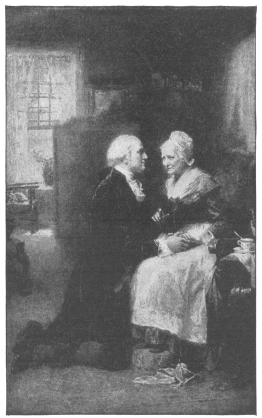 Washington’s farewell to his mother.
off his bright “middy” uniform, he folded it away in his new sailor
chest, never to be worn again. When he saw the warship, which had been
anchored below Mount Vernon, sailing away in the morning sunshine, young
George Washington’s future looked as dark as ever it could to a
heartbroken lad of fifteen. But who would have led the colonists in
their rebellion against England if George Washington had entered the
English navy then, and had later become a British admiral instead of
commanding general of the American army?
By the time George was twenty-one his brother Lawrence was dead and, as
his father had willed it, most of the property, including “Mount
Vernon,” belonged to the oldest son of the second wife. George at once
provided for his mother against worry or want in future. But he had to
tell her that he was a man now and that his devotion to country must
come first—even before his duty to his mother.
The English governor of Virginia sent him, still little more than a boy,
as messenger of the British government to the French and Indian
commanders in the distant Ohio region. This was a lonely journey of many
hundred miles through frozen and pathless forests full of cruel savages.
George had several hairbreadth escapes, once from drowning in an icy
river, and once from being shot by a treacherous Indian guide. A great
writer says of his wonderful success on this difficult and dangerous
errand through that western wilderness: “He went in a schoolboy, he came
out the first soldier in the colonies.”
The brave youth was appointed Major Washington, and given command of a
little army to fight the French and Indians. He soon gained a victory
which was called “the first blow” in a war which lasted, in America and
Europe, more than fifty years. As a member of General Braddock’s staff
young Washington saved the remaining part of the British army at Fort
Duquesne.
He was Colonel Washington when he was sent to the Congress which adopted
the Declaration of Independence. While there he was made
commander-in-chief of the Continental Army in the War for Independence.
His faith and courage and patience endeared him so to the country that
no other man could be thought of for the first President of the United
States except the “Father of his Country.”
ON the little island of Nevis, in the West Indies, lived a small boy who
had lost his mother, a bright young woman from France. His father, James
Hamilton, who was a Scotch planter, soon left the island, and the boy,
Alexander, heard little of him after that. No one knows to-day what
became of the father of Alexander Hamilton, but his grandfather was a
Scottish laird, or lord.
The next that is known of Alexander is that he was a clerk in the store
of a merchant on Santa Cruz, a smaller island, and that the lad was not
contented there. When he was twelve he wrote back to a friend in Nevis,
“I would be willing to risk my life, but not my character, to exalt my
station.”
Alexander studied with a minister of Santa Cruz who did all he could to
help the boy to improve his position in life. As Alexander was a devout
lad it is believed that the good man was trying to fit him to be a
minister.
The first thing young Hamilton did to win credit was to write a
wonderful description of a hurricane, or violent wind storm, that did
great damage on the island. The article was printed in a London
newspaper. When the people who knew the lad read his account, they could
hardly believe that one so young could have written it and several
wealthy planters decided to give such a bright boy a chance “to exalt
his station” by sending him to school in America.
Soon the little Scotch lad who could speak French and write splendid
stories in English was on his way to Boston in a British packet boat. It
is stated that on that voyage he first heard of George Washington. When
Alexander Hamilton reached Boston, he found the people up in arms
because the British government had sent soldiers to keep order in that
rebellious city; but the boy had been brought up to think that the king
and the great men of England were always right.
The little Britisher from the West Indies was first sent to a grammar
school not far from New York to prepare for college. He was so keen and
studied so hard that he was fitted to enter King’s College in New York
City at the age of sixteen. After the war against the king the name of
the college was changed from King’s to Columbia.
After a year in college, the British-bred youth went to Boston again.
This was about the time when the “Sons of Liberty” dressed up as Indians
and threw the taxed tea overboard into Boston harbor. This act was
intended to show the king and the English statesmen that the Americans
would not pay taxes when they had nothing to say in the government as
to what taxes they should pay. No doubt Alexander, while studying for
college, had learned something of the history and the spirit of the
people in America, so that he did not feel so sure that all the king did
was right. After he returned to New York, there was a great mass meeting
in “the Fields” to talk about the unjust acts of the king of England. In
the city were many Tories, loyal to the king. Young Hamilton went down
from college to hear the discussion, and it was not long before he was
answering a rich Tory in a sharp, vigorous way. The people shouted to
him to go up on the platform, and the brilliant West Indian youth of
seventeen made a strong speech that became the talk of New York City.
A little while after this the students called on the president of King’s
College. He was a Tory, and very bitter against the people who were
fighting for their rights as British subjects. He scolded the students
roundly, calling them traitors, rascals, and other hard names. This made
the young men so angry that it might have gone hard with the old
gentleman if young Hamilton had not jumped up on the porch and spoken
earnestly in his defense. The president, seeing who was speaking, and
thinking that the youth was talking against the Tories again, put his
angry red face out of an upper window and shouted: “It’s a lie! Don’t
believe a word that rogue says. He’s crazy!”
As Hamilton was really taking their foolish president’s part, this made
the students shout and laugh. The young orator, taking advantage of
this, kept on talking till the old Tory made his escape by a back way to
a British man-of-war in the river near by. After this Hamilton wrote
pamphlets and newspaper articles about the rights of the people. Events
began to happen thick and fast. Washington was elected
commander-in-chief of the Continental Army and drove the British
soldiers out of Boston. Then the Americans decided to separate from
England; so the Declaration of Independence was written and signed.
Young Hamilton was soon in the midst of the fight—in command of an
artillery company. When Washington and his ragged Continentals were
retreating from New York, he saw a youth in charge of a battery keeping
the red-coats from crossing a wide river, so that the American
commander-in-chief and his little army could keep on their way to
Philadelphia.
“Who is that young man?” asked Washington.
“That, your Excellency, is Alexander Hamilton.”
The great general was so pleased with the skill and courage of the young
officer that he soon invited him to become his aide and secretary,
with the rank of lieutenant-colonel. The commander-in-chief liked to
have bright young men around him. Colonel Hamilton was now twenty.
Colonel Aaron Burr was a year older. “Light-Horse Harry” Lee was about
the same age; and General Lafayette, who was added to General
Washington’s staff that summer, was only nineteen. Colonel Hamilton was
such a discreet and faithful secretary that it was said, “The pen of the
army is held by Hamilton.” In some ways Hamilton’s pen was mightier than
his sword.
At Brandywine, where Lafayette was wounded, Hamilton’s horse was shot
under him; but he kept at the head of his regiment, on foot. At Valley
Forge young Hamilton had occasion to remember the language his mother
used in talking with him when he was a baby on the island of Nevis, for
he often spoke French with young Marquis de Lafayette. The West Indian
colonel was welcome wherever
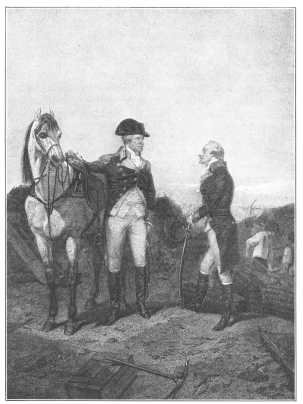 The first meeting between Washington and Hamilton.
From an old print
he went. He was thoughtful and kind to the sick, writing beautiful
letters home for disabled and dying soldiers.
One day when the young staff officer was hurrying to meet his chief,
Lafayette detained him. Finally breaking away from the friendly young
Frenchman, Hamilton found Washington waiting for him. The
commander-in-chief said, “Colonel Hamilton, you have kept me waiting
these ten minutes! I must tell you, sir, that you treat me with
disrespect.”
The young aide flushed scarlet and replied: “I am not conscious of it,
sir; but since you have thought it necessary to tell me so, we part.”
“Very well, sir, if it be your choice,” said Washington.
With face still aflame, Hamilton turned and left the commander-in-chief.
Within an hour the general was sorry he had been so severe with “my boy”
as he called his aide, and sent for him, asking that their too hasty
words might be forgotten. But even then Hamilton could not quite forgive
his chief for reproving him. So Alexander Hamilton was placed in command
of a detachment in the south, where “Light-Horse Harry” and Lafayette
were officers also. At Yorktown, the last battle in the War for
Independence, Colonel Hamilton was the first man of the American army to
mount the wall before the town, where he was quickly followed by his
devoted men. Within a very few minutes the American flag was floating
over Yorktown.
After the war, Hamilton returned to New York City to practise law. He
had married the daughter of General Schuyler, one of the richest men in
that state. Attorney Hamilton soon became successful and prosperous.
When the time came to frame the Constitution which was to bind the
thirteen states into one Union and make them true to their name, the
United States, Alexander Hamilton was one of the leaders in that great
undertaking.
After that, his former chief was elected the first President. One of the
first acts of President Washington was to send for Alexander Hamilton to
be the first Secretary of the Treasury. The young Secretary had to
create success for the new nation, like making “bricks without straw.”
There was no national treasury. Continental money was without value, so
that when anything was considered worthless it was said to be—“not
worth a continental.”
Rival states had been jealous of one another, and as there was no head,
nothing was owned in common by the whole country—but debts. Money had
been borrowed of other nations, and of patriotic people in America, to
carry on the War for Independence. Many good people thought it would be
impossible for the new government, just starting, to pay its debts,
besides building up a new government and meeting the running expenses.
But Alexander Hamilton, still a young man, saw that a country in debt
could never be independent, and that if the government of the United
States did not pay all it owed, it could not go on, any more than a
bankrupt business which could not pay its bills. The only way to secure
credit was to pay every dollar it owed.
Hamilton devised ways and means to do all this with such success that,
in the street parades which the people arranged in different cities to
celebrate the new Constitution, wherever a float represented the
Constitution, the only man’s name on the ship of state was “Hamilton.”
The plans of the young Secretary of the Treasury worked like magic, and
the new government was soon on a solid foundation.
Daniel Webster, the greatest orator who ever lived in America, in
speaking of Hamilton’s work, compared it to two miracles told of in the
Bible; one, that of Moses when he drew water from a rock for the thirsty
Israelites in the wilderness; the other, the raising of a dead man to
life by Elijah. These are Webster’s words:
“Hamilton smote the rock of the national resources and abundant streams
of revenue gushed forth. He touched the dead corpse of public credit,
and it sprang upon its feet.”
Alexander Hamilton continued to act as the first President’s private
secretary. It is generally believed that it was he who wrote out
Washington’s immortal “Farewell Address.” When he gave up the office of
Secretary of the Treasury, Hamilton returned to the practise of law. He
had gladly given up a large income and served his country for about
one-third the amount of money he had been receiving from his law
business.
In New York Hamilton’s chief rival was Aaron Burr, whom Washington had
disliked and allowed to retire from his military staff. But Colonel Burr
was a brilliant lawyer and a popular politician. When Thomas Jefferson
was elected President of the United States by the House of
Representatives, Aaron Burr might have been chosen President if three
men had voted the other way. Burr was bitterly disappointed, and blamed
Hamilton for his defeat. Nursing revenge in his heart Burr practised
shooting. As Hamilton continued to oppose Burr’s schemes, Burr easily
found an excuse to challenge him to fight a duel.
Dueling was still a common means of deciding questions of honor.
Hamilton’s eldest son had been killed in that way. As a man was called a
coward if he did not fight, Hamilton accepted Burr’s challenge, though
he felt sure it would mean death to himself. The place chosen for the
shooting was the spot where Hamilton’s son had lately been killed. When
the signal was given, Alexander Hamilton pointed his pistol upward and
fired into a tree to avoid hitting Burr, whose aim was as true as when
shooting at a target. Hamilton fell, face downward, and died next day,
declaring that he forgave the enemy who had planned and practised to
kill him.
This duel did more than anything else to show the wickedness of the duel
as a way of settling disputes. Aaron Burr later was accused of being a
traitor to the country which Hamilton had given his great and noble life
to place upon a firm foundation. What is true of dueling is also true of
war—the unworthy party may succeed by wicked means. But America
remembers Aaron Burr as a curse, and Alexander Hamilton as a blessing to
his country.
THOMAS JEFFERSON was born on his father’s many-thousand-acre farm near
Charlottesville, Virginia, on the banks of River Anna, whose name was
shortened to “Rivanna.” Thomas’s father, Colonel Peter Jefferson, had
come over the sea from Wales, and his mother was Jane Randolph, a
daughter of one of the “F. F. V.’s,” or First Families of Virginia.
The Jefferson boy grew up tall, thin, awkward, freckled and red-haired.
His father, like George Washington’s, was a wealthy planter, who died
while Thomas was yet a lad. But young Jefferson’s mother was not left
poor like Washington’s; she was able to send her son to William and
Mary College. Though Thomas was always reading and studying, he was very
fond of playing the violin. Several stories are told about Jefferson and
his “fiddle,” as they called it then. One is that he played duets with
Patrick Henry; another is that he once performed with George Washington,
who played quite well on the flute.
Thomas was so eager to learn and so afraid of wasting time in college
that he took the four years’ course in two years, graduating at
nineteen. Besides the regular college branches, he studied architecture,
and after graduating devoted some time to that profession before fully
deciding to study law.
Young Jefferson was not admitted to practise law until five years after
finishing his college course. This was because he was not content merely
with “reading law,” but he read many books on other subjects and
continued his study of music.
While he was attending court at Charlottesville, his home at Shadwell
was burned to the ground. An old negro house-servant came to tell the
young master all about the fire. Lawyer Jefferson thought first of his
large library and asked if his precious books had been saved.
“No, massa,” said the old slave. “Dem books is all burnt up, but de fire
didn’t cotch your dear old fiddle. I carried dat out, myse’f, I did.”
Perhaps the best story of all that are still told of Jefferson and his
fiddle is that about two young men admirers of the young and beautiful
widow Skelton. They called on her one evening and found “Tom” Jefferson
there already. He was playing his violin while she accompanied him on
her spinet—an old-fashioned piano. They listened a moment and laughed.
“We won’t play ‘second fiddle’ or break up their duet,” said one of the
callers. So they went away without leaving their names. It was not long
before Thomas Jefferson, like George Washington, married a wealthy widow
and brought her to live on one of the largest and finest estates in old
Virginia.
Thomas Jefferson had planned and built a new house in place of the one
which had been burned down. He chose a high hill on the plantation, from
which, across the surrounding country, the town of Charlottesville could
be seen miles away. He named the estate “Monticello,” the Italian word
for “little mountain.”
About the time the Jeffersons were married the whole country was stirred
by the Stamp Act and other taxes demanded by England of the American
colonies. These taxes seemed unjust, because the people were not allowed
the right to send men from America to help make the laws which they had
to obey. Jefferson wrote a pamphlet on the subject, which he called “A
Summary View of the Rights of British America.” In it he said, “The God
who gave us life gave us liberty at the same time.”
When the people of the colonies in America were fully aroused, they sent
men to the Continental Congress at Philadelphia to decide what to do
about the unjust acts of the British king and his wrong advisers. George
Washington, Thomas Jefferson, and Richard Henry Lee were among the men,
called delegates, sent from “Old Virginia.”
One day in the Congress, Richard Henry Lee arose and made this motion:
“Resolved, That these United Colonies are, and of right ought to
be, free and independent states.”
After discussing Lee’s resolution for three days, the
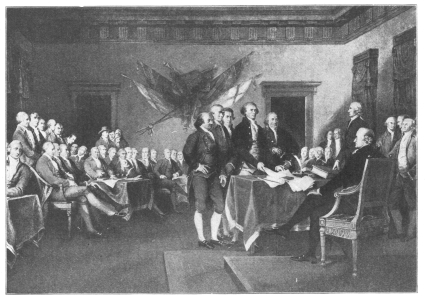 The signing of the Declaration of Independence, that
historic document of which Jefferson was the author.
The signing of the Declaration of Independence, that
historic document of which Jefferson was the author.
Congress voted to have a statement drawn up to send to King George the
Third, declaring that the people of the United Colonies could not stand
wrong treatment any longer. Thomas Jefferson was appointed chairman of a
committee of five to write this paper, which came to be called the
Declaration of Independence. This is one of the four greatest legal
papers ever written. In it were these lines, which will be repeated as
long as there are people living in the world who love liberty:
“We hold these truths to be self-evident—that all men are created
equal; that they are endowed by their Creator with certain
unalienable rights; that among these are life, liberty and the
pursuit of happiness.”
“We mutually pledge to each other our lives, our fortunes and our
sacred honor.”
When the War for Independence was won, Thomas Jefferson was sent to
France to represent the young American republic. Then when Washington
was President he was called home to be Secretary of State. After
Washington died, Thomas Jefferson was elected the third President of the
United States. Instead of being fond of show in using the power given to
him by the people, Thomas Jefferson was very simple in his tastes. When
he came to be inaugurated President he did not drive through the streets
of Washington in a coach with six horses and outriders and escorts, as
other Presidents had done, but walked with a few friends from his
boarding-house to the new Capitol, then building, where he delivered his
Inaugural Address and took the oath of office.
This so-called “Jeffersonian simplicity” seemed strange then, because he
was a man of wealth and lived in a beautiful mansion. Many people did
not like his simple ways. They thought the President of the United
States should show more dignity. The minister from Great Britain was
offended because, when he came to present his respects and those of the
king of England, President Jefferson received him in a dressing-gown and
slippers and heavy yarn socks. But the sensible people thought so much
of the man who wrote the Declaration of Independence that they did not
mind what kind of stockings Thomas Jefferson wore.
While he was President, Jefferson saw that the country’s interests would
be hampered while New Orleans, near the mouth of the Mississippi River,
belonged to France. It was like having another nation own and control
the south door of the United States. So Jefferson sent men to purchase
from the French government New Orleans and the right of way out of the
Mississippi. Napoleon was then in power, and as he needed money to carry
on his war with England, he offered to sell to the United States, for
fifteen million dollars, not only New Orleans, but all the western
country which France had claimed since the days of La Salle and other
explorers. This was a great bargain and the men whom President Jefferson
had sent bought the land without waiting to hear from home. This was
called the Louisiana Purchase, and the people were more than glad to
approve what the President had done.
The expedition of Lewis and Clark was sent out by Jefferson to explore
and make maps of the Louisiana Purchase.
So Thomas Jefferson not only wrote the Declaration of Independence but
he was the means of doubling the size and wealth of the country, making
it extend from the Great Lakes to the Gulf of Mexico and from the
Atlantic to the Pacific Ocean.
ABOUT ten years before the signing of the Declaration of Independence,
two Irish linen weavers, Andrew and Elizabeth Jackson, came across the
Atlantic to a backwoods settlement in North Carolina. There the young
settlers built a cabin, but before they had lived long in their rude
little home, Andrew Jackson died, leaving his wife with two small sons,
Hugh and Robert. The young widow went to live with a sick sister a few
miles away, and when the third baby boy was born to her here, she named
him Andrew for his dead father. The house in which little Andrew Jackson
was born was so near the boundary line between North and South Carolina
that years afterwards both states claimed him as their son.
Elizabeth Jackson had to keep house for her sister to support herself
and her three little boys. Andrew was in his tenth year when the War for
Independence broke out in the north. Three years later the British came
to fight near the Jacksons’ home in the south. Hugh, the oldest, now a
lad of seventeen, fought in the battle of Stono, and died, soon after,
of heat and exhaustion.
Then the British troops came nearer, and Widow Jackson, with Robert and
Andrew, was driven from her poor home. These terrible experiences
developed in the tall, red-haired, freckled, thirteen-year-old
Scotch-Irish lad a deep hatred of the “red-coats,” as the British
soldiers were called.
As if Andrew had not already reasons enough for hating his enemies, a
squad of dragoons surprised him with his brother Robert and a cousin,
Lieutenant Thomas Crawford, at the home of the Crawfords, where they had
brought Tom, wounded and ill, for his mother’s care. After capturing
the young American “soldiers three,” the British cavalrymen broke the
Crawfords’ dishes, tore their clothing, ripped open feather beds,
insulted the frightened mother and abused the little children. Then, as
if for a crowning insult, the British officer ordered Andy to clean his
boots. The young Irish soldier drew himself up and said proudly,
“Sir, I am not a servant, but a prisoner of war, and I claim to be
treated as such.”
The angry dragoon struck at the youth’s head with his saber. Andy threw
up his hand and saved his own life by breaking the force of the stroke,
but received deep cuts on his forehead and hand. He wore the two scars
to his dying day.
Andrew’s brother Robert was commanded to perform the same low service
and refused with the same proud spirit; he also received a sword-cut on
his head which nearly killed him. The two Jackson youths were then taken
away to a prison pen at Camden, South Carolina, where American soldiers
were treated like beasts and where many were already dying of smallpox.
While the Jackson brothers were in this prison, a battle was fought near
by. Young Andrew whittled a hole through a board with an old razor, so
that he could watch the battle that was raging around them.
When the poor mother heard that her wounded sons were confined in a
filthy prison where they were exposed to smallpox, she walked forty
miles to Camden and managed to have them exchanged for some British
soldiers the Americans had captured. Begging the use of two horses, she
placed Robert on one of them, as he was very ill with smallpox. She rode
the other horse to hold her son in his saddle; and young Andrew, “weak
and wounded, sick and sore,” staggered along behind them on foot.
Robert died two days after reaching home, but Andrew recovered after a
long and severe illness.
After nursing her only remaining son back to health, that brave,
unselfish mother heard that many American soldiers were sick and dying
in the British prison ship in the harbor of Charleston, South Carolina.
She walked more than one hundred and fifty miles to nurse and help them
as she had nursed her own sons. She took the ship fever and died, giving
her devoted life for freedom and for country.
So Andrew Jackson, now a tall, thin youth of fourteen with a “shock of
sandy hair,” was without father, mother, brothers, money, or near
friends—but with a bitter grudge against Britain as the cause of all
his troubles and sorrows. His life was made better by his deep love of
his brave, noble mother’s memory. When he grew up and became the most
popular man in the United States, Andrew Jackson often said with a smile
of pride:
“That I learned from my good old mother!”
Andrew Jackson had but few chances to go to school, and then only a few
weeks at a time. He learned the saddler’s trade and studied when he
could take the time from hard work. Little as he learned from books, he
knew more than most of his neighbors. He taught school sometimes to add
to what he earned at his trade, so that he could study law. Even North
Carolina, wild as that new country was, became too “civilized” for
Andrew Jackson, and he crossed the mountains into Tennessee and settled
at Nashville, where he began to practise law. In that rough country he
soon became a leader. In the midst of the wild life in which the chief
“sports” were horse-racing, Indian shooting, fighting duels, and the
like, young “Judge” Jackson was “hail-fellow, well met!” He soon was
elected to Congress, but he found life at the capital entirely too
“genteel” for him. When the southern Indians went on the warpath and
massacred white settlers, General Jackson and his troops from Tennessee
drove them from place to place and killed nearly all the savage
murderers. He was called the Hero of the War of 1812, because he won the
Battle of New Orleans, the greatest land victory in that war.
The people loved General Jackson because he was a bluff, warm-hearted
man, and because, whether he fought with the Indians or the British, “he
thrashed ’em every time!” He was named “Old Hickory” because he was
about as tough in fiber and as rough on the outside as the hickory tree.
He was probably the most popular hero that ever lived in America, for
more boys were named Andrew Jackson than even George Washington or
Abraham Lincoln. January eighth, the date of Jackson’s victory at New
Orleans, is still celebrated as Jackson Day. Jackson was called “the Man
of the People,” including the “rough and ready” people of the great, new
west; Jefferson represented the more educated classes; while Washington
was the man of the upper class of people. Still, Jackson stood for the
white people only. It was Abraham Lincoln who came thirty years later
and stood for all the people, black and white.
General Jackson was elected and carried to the White House by a great
wave of popularity. The people were so pleased to have him for their
President that they crowded into the White House and stood on the new
satin covered furniture in their muddy boots. They broke the china and
glassware and spilled punch on the velvet carpets. In their
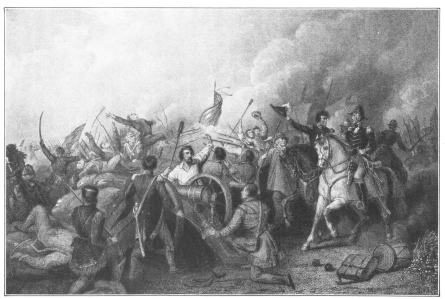 General Jackson at the Battle of New Orleans.
From the painting by D. M. Carter
frantic efforts to shake hands with their hero-president they nearly
crushed him to death.
President Jackson treated his political enemies as he did the Indians
and the English. He turned thousands of men out of office and appointed
his friends in their places. “To the victors belong the spoils,” he
said, but most people to-day believe the warlike President had the wrong
idea in treating public service as “spoils of war.” After serving his
country as President, Andrew Jackson lived at the Hermitage, a beautiful
mansion he had built near Nashville, Tennessee.
When the aged ex-President knew he was dying, he called his friends and
slaves around his bed and told them he wanted them all to meet him in
heaven. When the simple but grand old hero died, they found his dead
wife’s miniature close to his heart where he had worn it for many years.
Then they remembered that, rough and violent as he often had been with
men, he had never spoken a cross or cruel word to his wife or any of his
own household.
“The bravest are the tenderest.”
“THERE were giants in those days,” a hundred years ago in the United
States of America; not giants in body, but in mind and heart. Besides
the Presidents and the generals in the War of 1812 and the Indian wars,
the greatest men in America were Webster, Clay, and Calhoun, who were in
Congress together. Daniel Webster was the man of New England, Henry
Clay of the west, and John C. Calhoun of the south.
Daniel Webster was born among the hills of New Hampshire, the ninth of
the ten children of his father. He had a huge head, a high forehead, and
great, deep, inquiring eyes. Webster once said that he did not remember
when he could not read the Bible. He learned chapter after chapter of it
by heart and remembered them all his life.
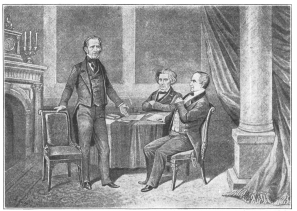 Clay, Calhoun and Webster, “The Statesmen of the
Compromise.”
Clay, Calhoun and Webster, “The Statesmen of the
Compromise.”
(From left to right.)
From the painting by A. Tholey
Daniel’s father lived on a rocky farm in New Hampshire and had a hard
time to educate his growing family. He was called Captain Webster
because he had been an officer in the War for Independence. His children
used to delight in hearing about General Washington. After Daniel grew
to be a great man he was proud to tell how the Father of his Country had
trusted his father. Once he said,
“I should rather have it said upon my father’s tombstone that he had
guarded the person of George Washington and was worthy of such a trust,
than to have carved upon it the greatest title that the world could
give.”
Captain Webster said to his son one day after a gentleman who was riding
by had stopped to speak to him:
“Dan, that man beat me by a few votes when I ran against him for
Congress, and all because he had a better education. For that reason I
intend you shall have a good education, and I hope to see you work your
way up to Congress.”
Daniel’s next older brother’s name was Ezekiel. He was larger and
stronger than Daniel who, because of his poor health, was not expected
to do hard work on the farm. This gave Daniel time to read and improve
his mind. Yet he was not allowed to be idle; he was expected to do
“chores” and other light work about the place. One day Captain Webster
went away, after giving both boys a certain task to do while he was
gone. The lads, boy-like, spent the day having a good time, so that when
their father came home he found the work not done.
“Zeke,” he said sternly, “what have you been doing all day?”
“Nothing,” said Zeke sheepishly.
“And what have you been doing, Dan?” asked Captain Webster.
“Helping Zeke!” said the younger boy with a grin.
After that when any one was idle, it was said that he was “helping
Zeke.”
When the time came for Father Webster to send Daniel away to school, as
he had promised, the younger boy said he would not go unless Zeke could
have the same chance. So Captain Webster mortgaged the farm to raise the
money to educate both boys. Even then the sons had to stay out of school
at times to earn money to help themselves through the academy and
college.
In mental work Daniel proved stronger and better able to earn money than
his older brother. A good story is told of Daniel’s coming, after
teaching a term of school, to see Ezekiel at college and giving his
brother one hundred dollars—nearly all he had earned, keeping only
three dollars for himself until he could earn more. That was Daniel
Webster’s best way of “helping Zeke.”
Daniel was the more brilliant of the two, so that he was through college
as soon as his brother, though he had not spent so much time there.
Their father explained one difference between the two sons:
“Ezekiel could not tell half he knew; but Daniel could tell more than he
knew.”
By the time Daniel was out of college his father had become a county
judge, and was able to offer his youngest son a position as clerk of the
court at fifteen hundred dollars a year, which was a large salary for
that time and place. But Daniel refused the place, saying: “I intend to
be a lawyer myself and not to spend my life jotting down other men’s
doings.”
“ ‘A bird in the hand is worth two in the bush,’ ” said Judge Webster,
reminding his son that there were already too many lawyers for them all
to make a good living.
“There’s always room at the top,” said young Daniel Webster.
He went to Boston to study law, and his fame as attorney and orator
spread far and wide. The two sons soon paid their father’s debts, and
proud old Judge Webster soon saw his son Daniel not only in Congress,
but acknowledged to be the greatest man in the Senate.
Ezekiel Webster did not have so brilliant a career as his younger
brother, but Daniel always yielded to “Zeke’s” better judgment, even in
the greatest public affairs. Ezekiel did not live to see Daniel’s
highest success, and it was said that a new look of sadness came into
the great Webster’s face, and never left it, after hearing of “Zeke’s”
sudden death.
Although Daniel Webster was not six feet tall, his high, full, square
brow and dignified bearing made him seem a giant. Carlyle, the great
Scottish philosopher, met him in London and said: “Webster is a walking
cathedral!”
When Daniel Webster was still a small boy on his father’s “rock-ribb’d”
farm in New Hampshire, a thin, homely youth of fifteen came into the
Court of Chancery in Richmond, Virginia. He was so awkward and bashful
and dressed so queerly that the clerks winked at one another and
snickered behind his back. That youth, whose name was Henry Clay, had
come to Richmond from a low, swampy region called “the Slashes,” where
he lived with his widowed mother. Because he used to ride a poor old
horse to a mill near his home to get a little corn ground, Henry Clay
was afterward called “the Mill Boy of the Slashes.”
Henry’s mother married again and moved out to Kentucky when it was still
a western wilderness. Young Clay stayed in Virginia to study law and was
soon admired because of his brightness. He improved his time, as well as
his appearance, so that when he was eighteen, he was a popular orator
and “the bright, particular star” of the Richmond Debating Society.
Then, instead of finding “room higher up” in his home state, Henry went
west to be near his mother, and to “grow up with the country.” The
twenty-one-year-old attorney hung out his sign in the new and growing
town of Lexington, Kentucky. He was good-natured and thoughtful. He
understood law very well for so young a man. As he was an eloquent
speaker, he became a successful attorney. He married and settled down on
a 600-acre estate which he named “Ashland.” This estate is still known
all over the world as “the home of Henry Clay.”
The year before the War of 1812 began, Henry Clay was sent to Congress
from Kentucky and was elected Speaker of the House of Representatives.
He raised his eloquent voice against England and bore a strong part in
supporting President Madison in carrying on the war. He was so earnest
in this that he was known as a leader of “the War Hawks.” When the war
was over, Henry Clay was one of five men sent to Europe by the United
States to arrange the terms of peace with Great Britain—a peace which
has not been broken for more than a hundred years.
Henry Clay was three times a candidate for the presidency. He had done
so much for the country that he had made enemies of many whom he had to
oppose at different times. So each time he was defeated by a man not
nearly so great or powerful, but for whom more people were willing to
vote.
While Webster and Clay were leaders in Congress there was great
excitement because that body passed a tariff law which the southern
people did not like. Many of the southern leaders, especially those of
South Carolina, said that Congress had no right to pass such a law and
that each state might declare the objectionable law null and void or of
no effect within its borders. Such action by a state was called
“nullification.” There was talk that some of the states would withdraw
from the Union if the President tried to enforce the hated law. Such
withdrawal on the part of a state was called “secession.”
About the time these mutterings of disunion were in the air, Robert Y.
Hayne, a great orator from South Carolina, made a strong speech in the
Senate of the United States, maintaining the right of his state to
“nullify” and withdraw from the Union. Daniel Webster, the champion of
the Union, delivered one of the greatest appeals ever made by any
orator, in his famous reply to Hayne. It closed with these now familiar
words:
“Let my last feeble and lingering glance behold the glorious ensign
of the republic, now known and honored throughout the earth, still
full high advanced, its arms and trophies streaming in their
original luster, not a stripe erased or polluted, not a single star
obscured; bearing for its motto no such miserable question as,
‘What is all this worth?’ or those other words of delusion and
folly, ‘Liberty first and Union afterwards;’ but everywhere, spread
all over in characters of living light, blazing in all its ample
folds, as they float over the sea and over the land, that other
sentiment, dear to every true American heart—Liberty and Union,
now and forever, one and inseparable.”
The greatest leader in the south and champion of the right of his state,
South Carolina, was John C. Calhoun. He also was an eloquent speaker. He
declared in the Senate of the United States, in speaking of the tariff
law meant to tax goods which people needed, “We look upon it as a dead
law, null and void, and will not obey it.” South Carolina nullified the
tariff law and threatened to secede from the Union.
General Andrew Jackson, the bluff old Indian fighter and hero of the War
of 1812, was then President. He declared, “The Union must and shall be
preserved!” John C. Calhoun and all others acquainted with “Old
Hickory,” as the President was nicknamed, knew that he meant just what
he said. It seemed that civil war was about to begin when Henry Clay,
who loved the Union, averted the danger by proposing a plan of
compromise which both sides could accept.
LITTLE Abe Lincoln lived in a log cabin in Kentucky. When he was seven,
his family moved across the Ohio River into Indiana, and lived all
winter in an open shed called a “half-faced camp,” before his father
built a better cabin, with bare earth for its floor. Tom Lincoln, Abe’s
father, was “a mighty hunter.” He liked to shoot game better than the
hard work of clearing land and farming. He thought Abe was timid because
he did not like to kill harmless animals or see them suffer.
During the fourteen years Abe lived in southern Indiana, he went to
school a few weeks at a time—less than a year in all. A girl who went
to school when he did, used to tell, after she became an old woman, that
Abe’s first “composition” was against cruelty to animals. She always
remembered how he read this sentence in it: “An ant’s life is as sweet
to it as ours is to us.”
One day Abe caught several lads laughing at a turtle as it moved slowly
about, showing, as well as a dumb animal could, the misery it was in.
For there were burning coals on its back, and the biggest boy stood by
with a smoking shingle in his hand. This showed Abe how the hot coals
came upon the terrapin’s back. Snatching the shingle from the big
bully’s hand, he brushed them off and began
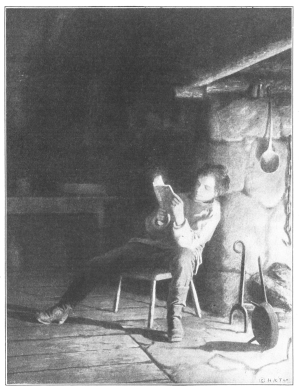 The boy Lincoln reading by the firelight in the log cabin
in which he was born.
The boy Lincoln reading by the firelight in the log cabin
in which he was born.
to paddle the cruel boy with it, calling him a cowardly fellow for
hurting a helpless turtle.
Just before Abe was twenty-one, Father Lincoln moved to newer country in
Illinois. Abe’s step-sisters were now married, so there was a big family
going west in a lumbering wagon drawn by two yoke of oxen. One of the
step-sisters took with her a pet dog. It was in the midst of winter, and
some of the rivers they had to cross were covered with ice. One day the
little dog strayed away from the wagon and failed to come back until the
Lincoln party had forded a shallow stream. After crossing, Abe, who was
then driving the oxen, saw the poor little fellow jumping about and
whining, afraid of being left behind. It was growing dark and they had
to make their camp for the night. All the others were for leaving the
“troublesome cur” to its fate. Mr. Lincoln, in telling of their moving
to Illinois, said of this:
“But I could not endure the idea of abandoning even a dog. Pulling
off shoes and socks, I waded across the stream and triumphantly
returned with the shivering animal under my arm. His frantic leaps
of joy and other evidences of a dog’s gratitude amply repaid me for
all the exposure I had undergone.”
Many other stories are told of Abraham Lincoln’s kindness of heart. When
he was a country lawyer he had to ride from one county seat to another,
attending court. The judge and several attorneys rode from place to
place where court was to be held. Lawyer Lincoln was the most popular
man of them all, because of his good nature and his ready fund of funny
stories.
The Illinois roads were then nearly always very dusty or very muddy. One
day their party saw a hog stuck in a deep mudhole, squealing loudly. The
party rode by and laughed at the pig’s plight, but no one took the
trouble to help it out. But those despairing squeals touched the heart
of Abraham Lincoln.
He soon fell behind and galloped back to rescue the animal. Taking
several rails from the roadside fence, he used one to pry over, and
another to lift the pig out. By taking care and plenty of time, he
managed to place the end of a rail under the hog without hurting it. The
animal was now so weak that this took a long time, and Lawyer Lincoln’s
clothes were badly smeared with mud.
At last, when the pig realized that it was free, it started off toward
the farmhouse where it belonged, flopping its big ears and grunting
gratefully. Mr. Lincoln did not catch up with his friends until they had
arrived at the tavern in the next town.
When they saw his mud-plastered clothes, they all began to laugh, for
Lawyer Lincoln did not often have a new suit of clothes. When they
stopped chaffing him about helping his “dear brother” in distress,
Lincoln said soberly,
“That farmer’s children might have to go barefoot next winter if he lost
his hog.”
Another day Lincoln was missing. One of the party explained,
“I saw him an hour ago over the fence in a grove with a young bird
screaming in each hand, while he was going around hunting for their
nest.”
It took a long time to find it. Lawyer Lincoln had to let one bird go
while he climbed the tree to put the other in its nest. Then he had to
climb up again to put the other bird in. So it was after dark when he
rejoined his friends at the tavern table. It seemed so absurd for a big
man like Lincoln to waste hours on two birds that had fallen out of
their nest, that even the judge scolded him. Mr. Lincoln replied with
deep feeling,
“Gentlemen, you may laugh, but I could not have slept well to-night if I
had not saved those birds. Their cries would have rung in my ears.”
The spring after he was twenty-one, Abraham Lincoln helped to build a
flatboat and went on it to New Orleans to buy stock for a store in the
village. While in the southern city with two companions, he witnessed
the sale of a mulatto girl in a slave market. The sight filled his
righteous soul with wrath. Clenching his fists, he exclaimed:
“Boys, let’s get away from this. If I ever get a chance to hit that
thing (slavery) I’ll hit it hard!”
So Lawyer Lincoln became the champion of the negro and lifted his voice
against slavery. “This country cannot exist half slave and half free,”
he exclaimed. His ringing words in the famous debates with Senator
Douglas pleased the people of the north so much that Lincoln was elected
President next time. Within six weeks after he went to live in the White
House, the Civil War broke out.
The tender heart of President Lincoln was often hurt when the news of a
battle came to Washington with its list of killed and wounded. He tried
to keep up his own spirits and the heart of the nation by his constant
flow of stories which made the people smile through their tears. To him
it was an awful thing for his brothers in the north to be fighting and
slaying their brothers down south.
When Abraham Lincoln saw that the time was right, he gave out the
Emancipation Proclamation—his order to free four million slaves. He now
had “a chance to hit that thing,” and he did “hit it hard.”
Grand as it was to write that great paper and free all the slaves, it
was even greater to show the people of the United States and of the
whole world how to look on the bright side of the hardest trials, and
even to laugh in the face of trouble.
President Lincoln had the supreme joy of seeing the purpose of the war
accomplished. His Gettysburg Address—which every boy and girl should
know by heart—and the words from the Second Inaugural, “With malice
toward none; with charity for all,” are ever-living witnesses of the
kind heart and unselfish spirit of Abraham Lincoln.
William Cullen Bryant, one of the first of American poets, wrote these
lines for the Martyr President’s funeral:
“O, slow to smite and swift to spare,
Gentle and merciful and just!
Who in the fear of God didst bear
The sword of power, a nation’s trust.
Pure was thy life; its bloody close
Has placed thee with the Sons of Light,
Among the noble hearts of those
Who perished in the cause of Right.”
“THIS poor little boy has no name!” exclaimed Miss Simpson, the aunt who
was visiting the Grant family at Point Pleasant, overlooking the Ohio
River, about twenty miles east of Cincinnati.
The rest of the family agreed that it would be a shame to let the baby
go a day longer without a name.
“Let’s name him now,” said the aunt; “let’s vote on it.”
The others consented, and each wrote a preferred name on a bit of paper.
Then a hat was passed and all put their
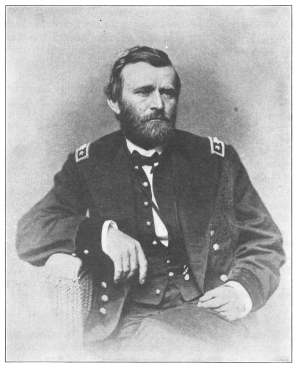 General Ulysses S. Grant.
slips in it. The aunt took out a ballot which read, “Ulysses.” This name
was on several slips, because Grandfather Grant had just been reading
the story of the siege of Troy. “Hiram” and “Albert” were on two other
ballots. At last they decided to call the baby Hiram Ulysses Grant.
When “Baby Lysses,” as the family called him, was about a year old, the
Grants moved to Georgetown, a village about ten miles farther from
Cincinnati, and ten miles back from the Ohio. Here little Ulysses grew
and began to go to school, and some of the boys called him “Hug,” from
his initials, H. U. G. Other boys, just to be funny, called him
“Useless.”
Ulysses’ father was a tanner and leather worker. The boy did not like
tanning hides because it was dirty, bad-smelling work; but he did like
horses. Besides his tannery, Mr. Grant owned a small farm. So Ulysses,
while he was a boy, learned to plow and harrow, and to haul logs to the
creek near by, where they were floated to the sawmill to be cut up into
boards and timber. The lad found a good way to make a horse do the heavy
work of lifting or rolling logs on to the sled, so that he and the horse
could do that better than two or three men.
A visitor in Georgetown was astonished one day to see a boy dash by,
standing on the back of a horse on the run.
“Circus rider?” the stranger asked.
“No—only ‘Useless’ Grant,” was the reply.
When a circus did come to Georgetown, the Grant boy was there to see the
trained horses and the fancy riding. There was a trick pony that had
been trained not to allow a man or even a boy to stay on its back. The
manager came to the side of the ring and called out that a prize of five
dollars in gold would be given to any one who could ride the pony five
times around the ring. Some of the men and boys in the crowd shouted,
“Lyss Grant can do it. Try it! Oh, go ahead, Lyss!”
Although Ulysses was a bashful lad and hated to make a show of himself,
the prize and his desire to see what he could do were too tempting to
resist. So he went to the ringside and began to pat the pony. Then he
sprang lightly upon its back. The vicious little beast began to rear and
tear around to shake or rub the rider off, but Ulysses hung on in spite
of all its frantic efforts. He won the prize, but that five dollars was
of small value compared with the lesson he learned of trying hard and
not giving up anything he attempted.
The Grant boy’s mastery of horses and his way of finishing whatever he
started out to do made his services valuable to the neighbors. He rode
hundreds of miles on important business errands. One time he was driving
two young ladies and their baggage on a long journey where they had to
ford a swollen stream. The ladies, seeing the horses were swimming and
that the wagon was full of water, began to scream and take hold of his
arms.
“Keep quiet, please,” said Ulysses calmly. “I’ll take you through safe.”
And the Grant lad was as good as his word.
Sometimes he was asked to break a horse to trot or to pace. The wildest
animal would soon become tame and gentle and would do whatever he
wished. People thought he would be a horse-trainer or jockey, or keep a
racing stable, but Ulysses Grant, much as he enjoyed training horses,
had a mind above doing that all his life.
He was studious at school and excelled in games and sports. One day,
while playing with a neighbor boy, he batted the ball through the
window of a neighboring house. Instead of running away or pretending
that another boy had done it, Ulysses went at once and knocked at the
door of the house, and said to the lady when she came out, “I have
broken your window, but I’m going to get a pane of glass and have it put
right in.”
The woman, who had seen how it happened, told the Grant boy to go back
and play, and she would attend to the glass. In telling about the
accident, she said Ulysses was no more to blame than the other boy, and
ended her story with, “I like Lyss Grant; he’s such a square, manly
little fellow.”
The school at Georgetown was not advanced enough to suit Ulysses’
father; so the lad was sent away to a private school at Marysville. When
he came home, though he did not like the tannery, he worked faithfully
there. He told his father plainly that he would work at tanning hides
until he was twenty-one—“but not one day after that!”
“What would you like to do?” his father asked.
“I’d like to be a planter, or a river merchant, or—or—get an
education,” stammered the boy.
Father Grant smiled and sent his son off to another school. He knew it
would be very wrong to expect a real man to work all his life at
something he did not like. While Ulysses was away this time, his father
obtained an appointment for his son to go to West Point. Ulysses himself
has written about this:
“I was attending school at Ripley, only ten miles distant from
Georgetown, but spent the Christmas holidays at home. During this
vacation my father received a letter from the United States Senator
from Ohio. When he read it he said to me, ‘Ulysses, I believe you
are going to receive the appointment.’
“ ‘What appointment?’ I inquired.
“ ‘To West Point. I have applied for it.’
“ ‘But I won’t go,’ I said.
“He said he thought I would, and I thought so too, if he did!”
Young Grant had such a high idea of the requirements at West Point that
he was sure he could never pass the entrance examinations. He began to
study algebra and other branches to fit him better, but he said he never
gave up hoping something would happen—even that the Military Academy
might burn down!—so he would not have to go. He was afraid he would
fail. The neighbors also thought his father was making a mistake to send
the boy to West Point when he seemed so little fitted for a soldier.
But, soon after his seventeenth birthday, the neighbors bade Ulysses
good-bye, expecting him to come home because he could not pass.
Ulysses found the West Point buildings still standing when he arrived.
He registered, and, to his surprise, was permitted to enter as a cadet.
They made a mistake in recording his name, writing it Ulysses S.,
instead of H. Ulysses Grant. He was tired of being called “Hug,” and, as
it seemed too much trouble to correct the error, he let it go, accepting
the S. for his middle initial. As his mother’s maiden name was Simpson,
he let them name him Ulysses Simpson Grant, in honor of the U. S.
government and his little mother. But even then the boys made fun of his
initials, “U. S.,” calling him “United States” and “Uncle Sam” Grant.
From this he was nicknamed “Sam.”
Cadet Ulysses did well enough in his studies, and developed a taste for
drawing and painting. He thought he would rather be a water-color artist
than a soldier. The idea of shooting at men was shocking to him. The
sight of blood made him sick—“Just like a girl!” the fellows said. But
there were horses at the Academy, so the young cadet managed to be quite
happy. He learned to ride like an Indian and to leap from one horse to
the back of another as he met it running in the opposite direction. The
one thing for which he was remembered by the other cadets was the great
feat of jumping York, a huge horse, over a bar. Every one was afraid the
vicious horse, if forced to clear such a height, might kill his rider.
“I can’t die but once,” remarked Cadet Grant coolly, and made the horse
jump over the bar without the least harm to horse or rider. The record
of “Grant on York,” then made, has never been beaten since.
The people of Ulysses’ home town had changed their minds about him when
he came home after two years, in his mid-course furlough, as a cadet in
full uniform with gold lace and gilt buttons. After he had been
President of the United States, Ulysses S. Grant said this summer
vacation was the happiest time in his whole life, because every one was
so kind, and his family were so proud of him.
When he finished his course at the Military Academy and was graduated,
it was said of him: “There is ‘Sam’ Grant. He is a splendid fellow; a
good, honest man against whom nothing can be said, and from whom
everything may be expected.”
Lieutenant Grant went home for a while, and then entered military
service near St. Louis. Here he became acquainted with Miss Julia Dent,
who afterward became Mrs. Grant, wife of the great general and President
of the United States. He had the usual experiences of young army
officers in the southwest, with wild beasts and savage Indians. He tells
of being wakened early one morning by hearing shots near at hand.
Getting up, he learned that two men had been fighting a duel. He
afterward wrote:
“I don’t believe I ever could have the courage to fight a duel. If
I should do another man such a wrong as to justify him in killing
me, I would make any reasonable amends in my power, if convinced of
the wrong done. I place my opposition to dueling on higher grounds.
No doubt, most of the duels have been fought for want of moral
courage, on the part of those engaged, to decline.”
Lieutenant Grant’s friends thought it strange for the bravest man they
ever met to say, “I don’t believe I ever could have the courage to fight
a duel.” But some things that seemed heroic to others did not seem so to
Ulysses S. Grant. He spoke almost with scorn of mere physical courage.
It is moral courage that counts—the heroism that will face a sneer and
bravely say, “That is not right and I will not do it.” He had shown this
kind of courage as a boy, when other lads dared him to come out with
them at night and disobey his little mother.
In the Mexican War, while fighting desperately in Monterey, the
Americans ran short of powder. Who would dare to go back through the
streets of the town held by the enemy, and carry the request for more
ammunition and reinforcements? “Sam” Grant volunteered, and rode, Indian
fashion, keeping his horse between him and the Mexicans’ bullets. He
made the dangerous run with both his horse and himself unhurt, relieved
the Americans, and thus helped to save the day at Monterey.
When the Civil War broke out, Captain Grant was in business. He had
withdrawn from the army, and had been mentioned as a “military dead
beat,” working in his father’s leather store at fifty dollars a month.
He at once enlisted as a volunteer, and was sent to command a brigade in
Missouri. Within a year the name of General U. S. Grant was on every
tongue. He had won the battles of Fort Donelson and Fort Henry, and had
made his famous demand of “Unconditional Surrender,” words which meant
that they were to yield without asking any favors. After that, people
said his initials, U. S., stood for “Unconditional Surrender” Grant. He
went from one triumph to another until his enemies in the west were
beaten. Then President Lincoln called him to end the war in the east, a
thing which five northern generals before him had failed to do.
Though he won great victories for his country and became the most
successful general of his day, the greatest thing General Grant ever
said was, “Let us have peace,” When Richmond was captured he refused to
enter the city as its conqueror. When General Lee surrendered, the
northern commander treated the enemy general as a friend and a brother.
A grateful nation elected General Grant twice to the presidency of the
United States. After he left the White House, he and Mrs. Grant made a
trip around the world and became the guests of kings, queens, princes,
prime ministers, and peoples.
Wherever General Grant went, he went as a man of peace. When he visited
Prince Bismarck, “the man of blood and iron” who taught the Germans that
everything they did would be right if they only had the power to do it,
General Grant apologized for his record as a soldier. In this way, the
greatest living general became the foremost man in the world for peace.
He had learned to regard war as a duel between nations. He thought that
was quite as wrong as dueling between men, and that war was due to moral
cowardice rather than to courage.
General Grant gave this as his belief:
“Though I have been trained as a soldier and have taken part in
many battles, there never has been a time when, in my opinion, some
way could not have been found to prevent the drawing of the sword.”
ROBERT E. LEE’S father, Colonel Henry Lee, was a hero of the
Revolutionary War. He was commander of the famous company known as
“Lee’s Legion.” He was called “Light-Horse Harry” because he was so
ready and alert with his cavalry regiment. He was such a friend of the
commander-in-chief that it was said: “General Washington loves Harry Lee
as if he were his own son.”
Therefore, when the Father of his Country died, Robert E. Lee’s father
was chosen by Congress to deliver the great oration in his memory. It
was in this brilliant address that Colonel Henry Lee used the now
familiar words describing Washington as “First in war, first in peace,
and first in the hearts of his countrymen.”
Like George Washington, Robert Lee was born in Virginia, near the
Potomac River, in a huge brick house which looked like a mansion, a
castle, and a fort, all in one. When Robert was four, his father moved
to Alexandria, near the new city of Washington, to send the boy, with
his brothers and sisters, to school.
The next year the War of 1812, often called the Second War for
Independence, was declared. The father’s rank was raised at once from
Colonel to General Henry Lee. But General Lee was badly hurt while
defending a friend from a mob in Baltimore. It was very hard for a brave
man like “Light-Horse Harry” to be sent away for his health instead of
leading in another fight for his country’s liberties. The general did
not become better and, after five years of absence and longing, he
started home to die. But the end came while he was on his way, and the
Lee children were told, one sad day, that they would never see the dear
father’s face again.
Robert was now eleven, the same age as George Washington when he lost
his father. Mrs. Lee was not left so poor as Washington’s mother, but
she was an invalid.
The oldest Lee son was in Harvard College, and the next was a midshipman
in the Naval Academy at Annapolis. So Robert was left at home to take
care of his mother. He nursed her
“With a hand as gentle as woman’s,”
yet in his strong, manly arms he carried her out to the family coach,
when she was well enough to go for a drive. No mother ever had more
reason to be proud of her tall, handsome son than the widow of Henry
Lee. Feeling that his mother could not afford to send him to college,
young Robert studied hard to enter West Point Military Academy. Because
the country was still new and settlers had to defend their homes and
lives from Indians, and also because the nations were always at war,
such boys as George Washington and Robert Lee said to themselves, “When
I’m a man I’ll be a soldier.”
When Robert was eighteen he became a West Point cadet. After he left
home his brave little mother exclaimed, “How can I do without Robert?
He is both son and daughter to me!”
Cadet Lee’s life was without doubt the bravest any young man ever led at
West Point. Young Jefferson Davis, who was there at the same time, fell
off a cliff and nearly lost his life while breaking the rules of the
Academy. Young Ulysses Grant wrote home ten years later that it was
impossible to get through at West Point without demerits. But Robert E.
Lee went through the whole four years without a single “black mark”!
More than this, he did
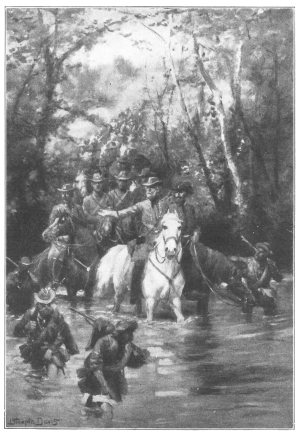 Lee’s invasion of the North.
From the painting by J. Steeple Davis, © 1897, by The Woolfall Co
not drink, though young gentlemen of that day thought the serving of
wine necessary in polite society. He did not even smoke.
It was a wonder that the other cadets did not hate a young man who
seemed to feel that he must behave better than the rest of them. What
kept them all from calling him a “goody-goody boy,” a snob or a prig? It
was the love of his kind heart, which they could see shining through his
strange courage. Robert Lee fully realized that he had come to West
Point to learn, at his country’s expense, how to be a soldier, and that
the first duty of a soldier is to obey. If he had left his post and
sneaked off the Academy grounds to drink, or gamble, or break some other
rule, he would have been a deserter who, in real army life, would have
deserved to be shot. But he never acted as if he felt above the rest,
and so his fellow cadets did not sneer at Robert E. Lee. One of them
said of him afterward:
“He was the only one of all the men I have known who could laugh at the
faults and follies of others without losing their affection.”
At graduation, Lieutenant Lee was the most popular man at West Point; he
ranked second in his class, and received the highest military honor in
the course.
The physical courage of Robert E. Lee was put to the supreme test in the
Mexican War. On a dark night he found the way across a dangerous lava
field cracked in all directions by deep crevices—“without light,
without a companion or guide, where scarcely a step could be taken
without fear of death.” General Scott, then chief in command, reported
this act to be “the greatest feat of physical and moral courage
performed by any one in the campaign.” In his official statement about
the whole war, this general stated that the United States’ “success in
Mexico was largely due to the skill, valor, and courage of Robert E.
Lee, the greatest military genius in America.”
Colonel Lee’s high military reputation made it natural for President
Lincoln to offer him the highest command of the United States army when
the Civil War broke out. But Colonel Lee did not accept the honor. He
did not believe in slavery, and did not think it was right for any of
the states to secede, or leave the Union. But he was a Virginian, and he
could not bring himself to lead an army to burn his own home or to kill
or drive out his relatives, friends, and neighbors. He had heard his
father, who was once governor of the state, say with deepest feeling,
“Virginia is my country; her will I obey, no matter how sad my fate may
be.” So, when his native state went out of the Union, Robert E. Lee
resigned as colonel in the United States army and went with her.
The southern people soon made Lee their general and it became, as he
thought, his duty to defend the homes and lives of the people not only
of Virginia, but also of the other states of the south.
General Lee soon proved that he was, as General Scott had said, “the
greatest military genius in America.” With smaller armies and poorer
supplies and weapons than those of the north, he gained great
victories—the second battle of Manassas, or Bull Run, Fredericksburg,
and Chancellorsville. He defeated five northern generals, one after
another. It took Grant, the sixth general sent against him, a whole year
to “hammer” and surround Lee’s ragged, starving heroes, and capture them
at last, when they were almost as helpless as a little flock of shorn
sheep. And so noble and dignified was his character that he was honored
and admired by north and south alike.
The motto of West Point Military Academy is “Duty, Honor, Country.” All
through his life, in all that he did, Robert E. Lee showed that he
respected Honor, loved his Country, and almost worshiped Duty. He
expressed this thought when he wrote, “Duty is the sublimest word in our
language.”
AFTER the War of Independence, there lived in a cabin among the
mountains of Tennessee a Spaniard named Farragut, who had come to
America to help the people in their fight for liberty. He had married a
brave little Scotch woman. While her husband was away one day several
skulking Indians hung around and watched for a chance to get into the
cabin. The mother had seen them and sent her two little boys up under
the roof, while she stood inside the door for hours, with an ax in her
small hands, to kill the first Indian who tried to enter. After a long
watch, the red men stole away, as much afraid of the fire in that little
woman’s eye as of the ax in her hands. One of the two boys who crouched
in almost breathless silence up in the cabin loft was Davy Farragut.
When this lad was seven his father was appointed sailing master in the
navy, and moved with his family to live by the large lake near New
Orleans. When off duty, Farragut took his boys sailing on the lake. One
day when he was out fishing he found an old man lying in the bottom of a
rowboat, alone and unconscious. Farragut took the sick man home for his
wife to nurse. In a few days the stranger died of yellow fever. The good
wife caught the dread disease and died, too. The poor father was left to
care for five motherless children under ten years of age.
It turned out that Captain David Porter, who was then in command of the
naval station at New Orleans, was the dead man’s son. In gratitude for
the care of his dying father, Captain Porter offered to adopt one of the
Farragut boys. David was chosen, and the naval officer took the sturdy
little lad to his home in New Orleans, and afterward to Washington,
where he was sent to a good school.
In Washington the Secretary of the Navy saw what a bright, honest,
pleasant-faced lad Davy Farragut was and, when he was ten years old,
appointed him a midshipman on his adopted father’s ship. This was early
in the War of 1812. After Porter’s warship, the Essex, had captured a
British ship, the Alert, Middy Davy, lying awake in his hammock, saw a
sailor of the Alert standing near, with a cocked pistol in his hand.
Davy pretended to be asleep and the man passed on. The boy got up, crept
into Captain Porter’s cabin, and whispered to him what he had just seen.
“Fire! Fire!” shouted the captain, and the sailors of the Essex came
scrambling up on deck. Porter ordered them down to capture the
imprisoned sailors of the Alert, who were preparing to kill the
American crew and take the ship to England. Before any damage was done,
the astonished Britishers were all in irons, thanks to the wide-awake
shrewdness of eleven-year-old Midshipman Farragut.
Captain Porter was ordered to sail around South America into the Pacific
Ocean to warn American crews that there was a war going on between the
United States and Great Britain. He was also to capture British ships as
prizes. Over one of these ships he placed in command David
Farragut—then a boy of twelve. When Davy ordered the British sailors to
“fill away the maintopsail,” the former captain of the ship was angry.
It was bad enough to be captured and have his ship taken into a South
American port as a prize; but to have his crew ordered about by an
American boy of twelve seemed too much for an English captain to bear.
Shouting that he would shoot any Englishman who dared to touch a rope
without his orders, the former captain went below to get his pistols to
carry out his threat. Captain Farragut sent one of his men to follow the
swearing captain down and tell him that if he came back on deck with a
pistol in his hand he would himself be shot and pitched overboard. The
man decided not to come back. Young David brought the British ship into
port and reported to his proud foster-father what he had done.
The Essex fought a great battle with two British warships, and
Farragut himself has left a description of the sights in his first great
sea fight:
“I shall never forget the horrid impression made upon me at the
sight of the first man I had ever seen killed. It staggered me at
first, but they soon began to fall so fast that it all appeared
like a dream, and produced no effect on my nerves.
“Some gun-primers [for loading the cannon] were wanted and I was
sent after them. In going below, while I was on the ward-room
ladder, the captain of the gun directly opposite the hatchway was
struck full in the face by an eighteen-pound shot, and fell back on
me. We tumbled down the hatch together.
“I lay for some moments stunned by the blow, but soon recovered
consciousness enough to rush up on deck. The captain, seeing me
covered with blood, asked if I were wounded; to which I replied, ‘I
believe not, sir.’
“ ‘Then,’ said he, ‘where are the primers?’ This brought me to my
senses, and I ran below again and brought up the primers.”
After being powder boy and doing all sorts of service on a man-of-war,
the little middy was taken prisoner, but was released at the close of
the war.
When Farragut was fifteen he went on a cruise in the Washington to
watch for pirates in the Mediterranean Sea. While anchored off Naples he
witnessed an eruption of the great volcano, Vesuvius. A naval chaplain,
then American consul at Tunis, begged to have the Farragut youth stay
with him, and study French, Italian, literature, and mathematics. While
on a horseback journey to the Desert of Sahara, David suffered a
sunstroke, which hurt his eyes so that he was unable to read much
afterwards.
On his return home, Farragut passed the necessary examinations and at
eighteen received the rank of lieutenant in the navy. Then he went to
New Orleans and found that his father was dead and that his own sister
did not know him. Here he was exposed to yellow fever and was very ill
of it in a hospital after his return to Washington.
Lieutenant Farragut was married, soon after his recovery, and spent most
of his time on shore until the breaking out of the Civil War. At that
time he was living in Norfolk, Virginia. He did not, however, approve of
the act of Virginia in withdrawing from the Union. People told him, that
if he thought that, it would not be safe for him to live in Virginia. He
replied coolly, “Well then, I can live somewhere else”; and he and his
wife packed up and went to live on the Hudson River above New York City.
Though born and bred in the South, Farragut was a Union man and offered
his services to his country. He was appointed to take New Orleans. It
was the largest city in the South, and an important seaport. Its capture
would cut short the war by preventing the South from selling cotton.
Also, it would open the Mississippi, so that the western states could
have that outlet to the sea. It was a dangerous undertaking, but
Farragut was glad of the chance to risk his life for his country. He
said as he started out, “If I die in the attempt, it will only be what
every officer has to expect.”
Captain Farragut now commanded a fleet of forty-eight ships, carrying
over two hundred guns. In six days and nights his mortars threw nearly
six thousand shells on the two forts barring his way, one on each side
of the Mississippi. The enemy sent five blazing rafts to set fire to his
fleet, but Farragut’s men either dodged the burning craft or towed them
out of the way. One heroic deed was the cutting, under fire from the
forts, of the great chain which had been stretched across the
Mississippi to keep the ships from coming up to New Orleans.
This was one of the greatest naval battles in the war; for, with a few
wooden ships, Farragut ran against the current and past the two forts,
meeting fire-rafts and fighting with a large fleet above the forts. Two
of the enemy’s warships were ironclads. He finally captured the city of
New Orleans after great loss of life on both sides. The next day the
happy victor wrote home:
“My Dearest Wife and Boy:
“I am so agitated that I can scarcely write, and shall only tell
you that it pleased Almighty God to preserve my life through a fire
such as the world has scarcely known. He has permitted me to make a
name for my dear boy’s inheritance, as well as for my comfort and
that of my family.”
“The Hero of New Orleans” was soon made Rear Admiral for this, splendid
service to the country. But there was to be still another test of the
courage of David Glasgow Farragut. It came two years later in Mobile
Bay, which he entered with fourteen ships and four monitors, or small
ironclad boats. He saw his monitor, the Tecumseh, sinking with all on
board.
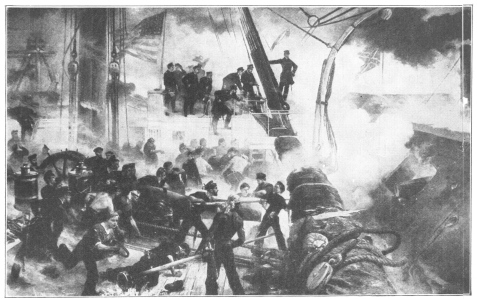 Farragut in the rigging at the battle of Mobile Bay
“What’s the trouble?” came through his speaking trumpet to the men on
the monitor nearest the sinking craft.
“Torpedoes!” was the reply.
What was to be done? Should he risk the whole fleet in a harbor filled
with lurking mines? The good admiral sought help from above. “O God,” he
whispered, “direct me what to do.”
Farragut heard the answer in his heart. Without an instant’s delay he
shouted to the captain of his own ship, the Hartford, “Go ahead! give
her all the steam you’ve got.”
The Hartford took the lead and became the chief target of forts and
batteries on shore as well as of the Southern gunboats in the harbor. As
if that was not dangerous enough, the heroic admiral took his place in
plain sight high above the deck, where he could better direct the
battle; and so that he could still keep his commanding place if struck
by a cannon-ball, his devoted men lashed him to the rigging.
That is one of the heroic pictures in the history of patriotism: Admiral
Farragut tied up in the rigging of his flagship and borne amid the
whizzing of cannon-balls and the bursting of shells, carrying the
Stars-and-Stripes through the fire and smoke of battle to one of the
grandest victories ever won in naval warfare.
THEODORE ROOSEVELT’S father was a well-to-do business man in New York
City. His forefathers were Dutchmen from Holland, who had come over when
the country was new. The Roosevelts had been wealthy and well known for
two hundred years. Though Theodore’s
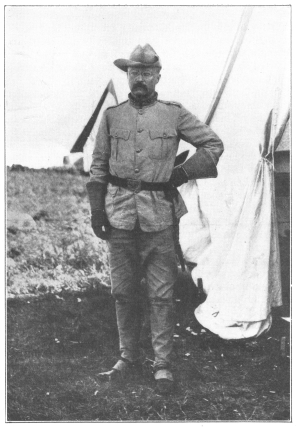 Theodore Roosevelt as Colonel of the Rough Riders.
father was able to give his family everything they needed or desired, he
could not give this little son health and strength, for the baby was
born frail and weakly. He suffered so with asthma that his anxious
parents feared he could not live long. One dark night when Baby Teddy
was gasping for breath, they took him driving fifteen miles into the
country where he could have pure air.
While yet in his childhood, Theodore Roosevelt began the long, sturdy
fight to conquer his weak body and “make the most of himself.” He was a
“self-made man” even more than if he had been born poor but healthy in a
log cabin. As a tiny child he tried to do what he saw well, strong boys
do. As soon as he could run about the house he would climb up and
perform such daring feats that the neighbors were often frightened. His
father fitted up a gymnasium on a porch for him so that he could have
fresh air while taking his health exercises.
It was a long, hard fight, but young Theodore’s brave spirit won the
victory over his frail body. While his body grew big and strong his
brave heart seemed to grow larger too, and he showed a broad, unselfish
spirit. Thus his big, warm, strong heart conquered his poor, puny body.
Almost in babyhood Teddy began to read. His sister tells how he came to
her one day, still wearing a stiff white dress and his curly hair long,
dragging a book that was too big to carry in his little arms, to ask her
what “foraging ants” were. While learning to walk, ride horseback, and
swim, Theodore Roosevelt was reading books and finding out all he could
about birds, butterflies, and other insects by watching and catching
them. He and several other small boys at Oyster Bay, where the family
spent many summers, collected and mounted specimens, and started what
the boys called the “Roosevelt Museum of Natural History.”
While preparing a butterfly for his “museum,” Theodore happened to look
at it through a small glass and found that he could not see as well as
other boys. His father had spectacles fitted to his eyes, and everything
looked so much clearer and brighter that he went about laughing and
shouting “I can see!—I can see!”
The year when Theodore was eleven, the family traveled in Europe and
Egypt. During their trip up the Nile he made quite a collection of the
bright birds of that country for his “museum.” His brother scolded
because Theodore kept live specimens and mounting materials in the
washbowls and pitchers in the rooms of the hotels where they were
staying. The boys lived and studied in Germany long enough for Theodore
to learn to speak German quite well.
At sixteen, young Roosevelt went to Harvard University. He was a good
student, yet he spent much of his time in athletic sports. He would tie
his glasses tight to his head and box with the biggest fellows he could
find who would fight with him. Of these “misfit matches” the other
students said, “Roosevelt has a bad handicap, but what he lacks in size
and strength he makes up in pluck.”
He spent his college vacations in the backwoods of Maine, and when he
was graduated, at twenty-one, he had not only shown himself to be a good
student, but he had gained much in health and strength. Also he read
much more than was required in his college studies, and had begun to
write his first big book, “The History of the Naval War of 1812.”
After graduation, Theodore began to study law, and decided to go into
politics. Many of the ward headquarters of New York City were in
saloons. As he went about with the ward workers, they expected their
“silk stocking” candidate, as they called young Roosevelt, to favor the
saloons and to use his “roll” (of money) freely. But instead of this,
Theodore Roosevelt told them plainly that, if elected, he would fight
against them and their bad methods.
He was elected and he kept his word. He began as a reformer, exposing
and opposing bribery and other wicked things that were being carried on
in politics. As Police Commissioner of New York he found much that was
wrong and fought and struggled to make it right. He was Assistant
Secretary of the Navy when the war was declared against Spain. He could
not rest day or night because he found so much to do in getting ready to
carry on the war. It was he who sent the word to Admiral Dewey on the
other side of the world which prepared him for battle and helped the
United States with the famous victory of Manila Bay. He was so keen and
active that President McKinley said to his Cabinet: “Roosevelt has the
whole program of the war mapped out.” But he resigned from his office to
become a colonel of the Rough Riders, and was soon leading his brave
company of cowboys and college men up San Juan Hill in the face of a
blazing Spanish battery.
Although Colonel Roosevelt was by no means highest in military rank, he
became the hero of the United States’ war with Spain. When that war was
over he was elected governor of New York. All the “bosses” hated this
man who would not consent to their robbing or cheating the people. They
asked him to run for Vice-President of the United States, thinking that
his hands would be tied, for a vice-president has very little to say as
to how the government shall be conducted. But in a few months President
McKinley, with whom Roosevelt was elected Vice-President, was shot and
killed. This made Theodore Roosevelt President of the United States.
Four years later he was elected President again. His courageous spirit
and true heart, with his active brain and tireless body, made him one of
the greatest presidents of the United States.
He had kept himself in good health and spirits by his constant labors
and many risks as a cowboy on his own ranches, and by hunting grizzly
bears and other big game in the Far West. Even while living in the White
House, he showed his friends and fellow-workers in the government what
he meant by “the strenuous life.”
Many expressions first used by Theodore Roosevelt are now heard in
common conversation. This is the first use he made of the words, “the
strenuous life”:
“I wish to preach, not the doctrine of ignoble ease, but the
doctrine of the strenuous life—the life of toil and effort.”
The “square deal” was another expression of his, as in this statement:
“The labor unions shall have a square deal, and the corporations
shall have a square deal, and, in addition, all private citizens
shall have a square deal.”
The “big stick,” another phrase of Roosevelt’s, was not so well
understood. He said of this:
“There is a homely old adage which runs, ‘Speak softly and carry a
big stick and you will go far.’ ”
Other words of his—such as “mollycoddle,” “pussyfoot,” “hit the line
hard,” and “one hundred per cent American”—almost explain their own
meanings.
A year after leaving the White House, Colonel Roosevelt went hunting big
game—elephants, lions, rhinos, and so forth—through the heart of
Africa. On the way back he was the guest of kings, emperors, and
important citizens of Europe.
After his return home he went on a dangerous trip of adventure and
discovery in South America. From all these hunting trips he brought home
many rare specimens for collections called by his name in the finest
Natural History museum in the United States. It was even proposed to
name the wonderful Panama Canal, which he did most to put through, the
“Roosevelt Canal.”
His last years were spent in urging the patriotic men and women of
America to take the part of human freedom, and force the “square deal”
among the nations of Europe. Among his last words were: “He who is not
willing to die for his country is not worthy to live in his country.”
He believed in preventing war by being fit and prepared to fight. One of
the best things he did was to help in arranging the peace treaty between
Japan and Russia. Theodore Roosevelt’s life motto, as expressed by his
actions, was:
“In time of peace prepare for war; and in time of war prepare for
peace.”
MISS CLARA BARTON, a quiet little old lady, used to tell stories of her
childhood among the hills of central Massachusetts. She remembered how
she was taken to the village school for the first time, and how the
teacher, a tall, kind-looking man, put her in the spelling class with
the smallest children, to study such words as dog and cat.
“I don’t spell there,” said little Clara; “I spell in Artichoke.” And
the small three-year-old showed her contempt for words of three letters
by turning the leaves of her spelling book till she came to a page of
wide three-syllable columns beginning with “Artichoke.” The teacher had
to hide his smile from the small girl who could spell such long words.
Clara was very fond of her handsome big brother. “My brother David was
very fond of horses,” she said, telling about him in later life. “He was
the ‘Buffalo Bill’ of that part of the country. It was his delight to
take me, a little girl five years old, to the field, seize a couple of
beautiful young horses, and, gathering the reins of both bridles in one
hand, throw me on the back of one colt, then spring upon the other
himself; catching me by one foot, and bidding me ‘cling fast to the
mane,’ we would go galloping away over field and fen, in and out among
the other colts, in wild glee like ourselves.
“They were merry rides we took. This was my riding school. I never had
any other, but it served me well. To this day my seat on a saddle or on
the bare back of a horse is as secure and tireless as in a
rocking-chair—and far more fun!
“Sometimes, in later years, when I found myself suddenly on a strange
horse in a trooper’s saddle, flying for life or liberty, I blessed my
baby lessons and wild gallops among the beautiful colts.”
By the words, “riding for life on a strange horse in a trooper’s
saddle,” Miss Barton referred to her life as an army nurse, when she,
with the mounted soldiers, sometimes found herself in great danger when
the enemy’s cavalry was close behind.
At the age of eleven, Clara had her first chance to learn to be a nurse
and fit herself for her life work. Her brother
 Clara Barton, “The Angel of the Battlefield.”
David, then a young man, fell from the ridgepole of a large barn he was
helping to build. The shock of this fall affected his mind, besides
making him ill in body. He wanted no one near him but the brave little
sister he had taught “to ride like the wind.”
So Clara stayed with her big brother, day and night, for two long years.
She was thirteen when he was well again. Miss Barton told, long
afterward, of the strange feeling she had at that time:
“I was again free, my work done, I wondered that my father took me to
ride so much, and that my mother hoped she could make me some new
clothes now—for in those two years I had not grown an inch!
“My shut-in life had made me the more bashful. I had grown even more
timid, shrinking, and sensitive in the presence of others; also I was
afraid of giving trouble by making my wants known. Instead of feeling
that my freedom gave me time for play, it seemed to me like time wasted,
and I looked about, anxious to find something useful to do.”
Then the family sent Clara away to school, hoping to conquer her painful
shyness. She studied so hard that, at the age of fifteen, she became a
teacher. There were not many public schools in those days, twenty-five
years before the Civil War; and the few free schools were looked down on
by well-to-do people as “charity” schools.
Clara Barton began with one of these schools where she had at first only
six poor children to teach. But she was such a good teacher that before
long six hundred came there to be pupils under her charge. She tried
very hard to help everyone she could; at the end of eighteen years’
service as a teacher she had become almost an invalid and had lost her
voice.
Still she could not bear to be idle while she had the use of her hands.
From early girlhood her handwriting had been plain and neat. This, with
her great desire to work, helped her to find a place in the Patent
Office in Washington. Clara Barton was one of the first women to hold a
position in the employ of the United States government. This gave
offense to some of the men in that department. In those days most people
thought it improper for a woman to work in an office; so these men
stared at the new clerk, making remarks in her hearing about “brazen,
strong-minded, ‘woman’s-rights’ women,” adding that such a creature was
not fit to associate with gentlemen like themselves.
Sensitive and shrinking though she was, Miss Barton kept on. She was
soon promoted to a position of trust. It was not long before she found
that some of the very men who had insulted her were “patent thieves,”
guilty of selling government secrets. Her duty to the country, rather
than a wish for revenge, obliged her to report the wrongs that these
ungallant “gentlemen” had done, and they were promptly dismissed from
the service they had betrayed.
During the years of her humdrum life as a government clerk, Miss Barton
was thrilled by the stories she read in the newspapers of the noble work
of Florence Nightingale, the famous nurse in the Crimean War between
Great Britain and Russia. It was said that the English soldiers adored
Nurse Nightingale almost as if she were an angel from heaven, and some
of them kissed her shadow when it fell upon their pillows as she passed
by.
When Fort Sumter was fired on and President Lincoln began calling for
soldiers to defend the country, Clara Barton was soon found at the
front, in places of great danger. Fitting up a house or even an old barn
for a hospital, she went about on the battlefields looking for wounded
men, and doing all she could to relieve and help them. She ministered to
the dying, writing many a last letter to give comfort to the sorrowing
ones at home. Corresponding with newspapers in the north, she did
wonders in obtaining medicines, hospital supplies, and comforts for her
sick and wounded brothers in the army. She was appointed “lady manager”
of all the hospitals at the front in Virginia. Those who knew most about
her great work declared that her services to her country were wider
reaching even than those of Florence Nightingale, the greatest nurse the
world had yet known. Then it was that the grateful soldiers called Clara
Barton “the Angel of the Battlefield.”
During the last weeks of his life, President Lincoln sent for Miss
Barton and asked her to undertake the difficult task of finding out in
as many cases as possible what had become of the eighty thousand
soldiers reported missing from the Union army. At this memorable meeting
the Great Heart of the White House stood face to face with one of the
greatest-hearted women in the world of that day.
Clara Barton spent four years more tracing out the fate of thirty
thousand missing men. To her great joy she learned that thousands upon
thousands of those who had been reported as deserters had bravely given
their lives for their country.
Miss Barton then went to Europe to rest awhile and regain the health she
had lost by overwork. While there she studied the work of a Swiss who
was trying to found a new society for nursing and caring for the sick
and wounded soldiers of all nations. Because it had a red cross on a
white ground for badge and flag, it was named the Red Cross Society.
When war broke out between France and Prussia, Clara Barton became known
as “the Angel of the Battlefields” of France. After her return to the
United States she began to organize the American Red Cross Society,
which has since become the greatest power in the world for the relief of
suffering.
Wherever there was a calamity or a pestilence—the great forest fire in
Michigan; the earthquake at Charleston, South Carolina; yellow fever in
Florida; the Johnstown flood in Pennsylvania; the Turkish massacres in
Armenia—there Clara Barton, though now an old woman, was always “the
first to come and the last to go.”
Though she was seventy-seven in the year of the war with Spain, she was
active in sharing the hardships of the American soldiers in Cuba,
nursing Roosevelt’s Rough Riders along with the rest of the sick and
wounded at the front.
Though she lived to be over ninety, honored and beloved by millions for
her constant labors of love and mercy, Clara Barton did not live to see,
in the World War, the most wonderful carrying out of all her plans for
soldiers on the field and in the hospital. The beautiful woman known as
“the World Mother,” pictured on the poster displayed to raise money and
supplies for the Red Cross work in America, might well have been the
portrait of Clara Barton, for no woman in all history has done more to
relieve and heal the sufferings of mankind. The millions upon millions
of men, women, and children now numbered in the membership of the
American Red Cross Society, by giving, knitting, rolling bandages, or
buying Red Cross stamps and Christmas seals, are carrying on the work
begun by the frail, sickly, bashful little girl whose yearning heart and
busy hands gave her the name of the “Angel of the Battlefield.”
LIVING in Portland, Maine, a town of rare beauty, Henry Wadsworth
Longfellow could hardly have helped being a poet, even if he had tried.
He was born in a big, square, three-story house, close to the edge of
Casco Bay, one of the largest and loveliest harbors in the world.
Portland stands on several wooded hills, overlooking the bay, which is
said to contain three hundred and sixty-five small islands—one for
every day in the year. On the blue water the green islands sparkle like
emeralds on a shining sea of sapphire.
From the highest point on Great Diamond, one of the larger islands in
the harbor, little Henry could see, sometimes, as the sun was setting
behind the hills of Portland, the hazy blue and pink outlines of the
White Mountains, more than a hundred miles away. Any boy with eyes and
heart to take in the deep meaning of it all would have wanted to be a
poet. Henry’s inner nature throbbed in response to the beauties of
Nature without, and because he had the gift of putting his feelings into
words, he was a poet long before he or those around him realized it.
Like the boy Benjamin Franklin and the boy George Washington, who lived
about a hundred years before him, the Longfellow boy had the best
chances to hear the sailors who came into port tell their tales of the
sea—of pirates and hairbreadth adventures.
Henry’s grandfather—his mother’s father—was bluff old General Peleg
Wadsworth, a hero of the Revolutionary War. He could tell stories of the
struggle for independence that would have fired the soul of any boy.
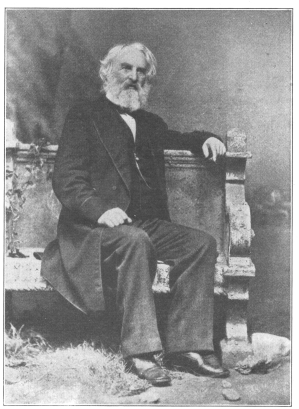 Henry Wadsworth Longfellow.
In the War of 1812, when the little Longfellow lad was only five, a
company of American soldiers was stationed in the fort at Portland to
defend the town against attacks from British warships. Young as Henry
was, he understood what all the excitement meant. When he was in his
seventh year, he heard the booming of the cannon in the great sea battle
between the American brig Enterprise and the British schooner Boxer.
Both commanders were killed and buried on one of the hills of Portland.
There was a sensation when the Enterprise towed the Boxer into port
as a prize of war. In the poem, “My Lost Youth,” nearly fifty years
after the battle, Longfellow wrote:
“I remember the sea-fight far away
How it thundered o’er the tide!
And the dead captains as they lay
In their graves o’erlooking the tranquil bay
Where they in battle died.”
Out near Hiram, Maine, where the Wadsworth family lived, there was a
little lake known as Lovell’s Pond. On one of his visits to his
grandfather’s, young Henry heard the story of a battle which had taken
place there during the French and Indian War. When he was thirteen he
wrote four stanzas which he named “The Battle of Lovell’s Pond.” Signing
it “Henry,” he left it at the office of the Portland Gazette, telling
only his sister what he had done. A writer has told a story of the way
Henry’s first published poem was received:
“In the morning how slowly the father unfolded the damp sheet, and how
carefully he dried it at the open fire before he began to read it! And
how much foreign news there seemed to be in it!
“At last, Henry and the sister who shared his secret peeped over their
parent’s shoulder—and the poem was there! They spent most of the day
reading it. In the evening they went to play with a son of Judge Mellen,
and while the judge was sitting by the fire in the twilight with the
young folk and a few older neighbors around him, he said,
“Did you see the piece in to-day’s paper? Very stiff, remarkably stiff!
Moreover, it is all borrowed—every word of it!”
When Henry was fifteen, his father sent him to Bowdoin College, at
Brunswick, Maine, with his older brother, Stephen. Though the father was
himself a graduate of Harvard, he was a director of this new college in
his own state. Henry was graduated at eighteen and, young though he was,
the trustees of the college invited him to come back, a few years later,
as their professor of modern languages.
So the young graduate traveled in Europe to gain a speaking knowledge of
all the languages he would have to teach. At the age of twenty-two, he
became a professor at Bowdoin.
After five years at his own college, Henry Wadsworth Longfellow was
chosen Professor of Modern Languages at Harvard. He spent the first year
in Europe. The next year he began his work as a Harvard professor. He
boarded at the Craigie mansion, which had been General Washington’s
headquarters during the first year of the War for Independence, sixty
years before. Indeed, he slept in the same room occupied by the Father
of his Country as a bedroom.
Although he had published several books of poetry, Longfellow’s poems
did not begin to be popular till “A Psalm of Life” was published, in
his thirty-third year. This poem made many people talk about him.
Ministers preached about it, and the lines were set to music. Here is
one stanza of this famous poem:
“Lives of great men all remind us
We can make our lives sublime,
And, departing, leave behind us
Footprints in the sands of time.”
Then such short poems as “Excelsior,” “The Village Blacksmith,” “The
Rainy Day,” “The Arrow and the Song,” “The Day Is Done,” and many
others, were recited in schools and sung in thousands of homes.
Of Longfellow’s longer poems, “Evangeline” and “The Courtship of Miles
Standish” are, perhaps, the most popular. It is said that more people
know of the Pilgrim Fathers of Plymouth through the latter poem than by
reading the history of the country. It is a story of the lovely
Priscilla and her true lover, John Alden, who came to ask her to marry
Miles Standish. That little captain was brave enough to fight with
savages, but he shrank from the bright eyes of Priscilla Mullens. John
Alden was a true soldier and delivered his captain’s message, but
Priscilla, knowing his loyal heart, only smiled at him and asked: “Why
don’t you speak for yourself, John?” And one of the
great-great-great-grandsons of John Alden and his lovely wife,
Priscilla, was the poet Longfellow!
“Hiawatha,” the poem about the Indian tribes, is also a great favorite,
especially with the children. This is because of its descriptions of
Indian customs and legends. It is the life history of the Indian boy,
Hiawatha, from the time when he was a funny little papoose till he had
grown to sturdy manhood.
When the little Indian boy was old enough he was sent out on a lone hunt
through the wilderness to fit himself to become a true Indian brave.
Here is what he did and saw and heard at that time:
“Forth into the forest straightway
All alone walked Hiawatha
Proudly, with his bow and arrows;
And the birds sang round him, o’er him:
‘Do not shoot us, Hiawatha!’
Sang the robin, the Opeechee,
Sang the bluebird, the Owaissa,
‘Do not shoot us, Hiawatha!’
“Up the oak-tree close behind him,
Sprang the squirrel, Adjidaumo,
In and out among the branches,
Coughed and chattered from the oak-tree,
Laughed, and said between his laughing,
‘Do not shoot me, Hiawatha!’ ”
Some of the Indian tribes of the Great Northwest were so delighted with
“Hiawatha” that they voted to make the poet one of their great chiefs;
and after Longfellow himself had gone to the “Happy Hunting Grounds”
across the River of Death, the Indians went through a formal service
making the poet’s daughter Alice a girl chief.
It must have been because he was so fond of children that Longfellow
became known as the “Children’s Poet.” In the hall of quaint old Craigie
House, which became the poet’s home, stood the stately “Old Clock on the
Stairs,” solemnly ticking: “Forever, never! Never, forever!” In the
early morning the spacious rooms were made bright with the merry
laughter of Longfellow’s three little daughters, running down to spend
an hour with their kindly, white-haired poet father. Of this he wrote in
a poem named “The Children’s Hour”:
“From my study I see in the lamplight,
Descending the broad hall stair,
Grave Alice, and laughing Allegra,
And Edith with golden hair.”
Longfellow’s last poem was about “The Bells of San Blas,” which appeared
in print just a few days before he died. The close of this—the last
poetry he ever wrote—were these three lines:
“Out of the shadow of night
The world rolls into light—
It is daybreak everywhere.”
![[cover image not available]](images/cover_lg.jpg)


