 N his History of Botany, Kurt Sprengel
first used the honoured title, “The
German Fathers of Botany,” to describe
a group of herbalists—Brunfels,
Bock, Fuchs and Cordus—whose work
belongs principally to the first half of
the sixteenth century.
N his History of Botany, Kurt Sprengel
first used the honoured title, “The
German Fathers of Botany,” to describe
a group of herbalists—Brunfels,
Bock, Fuchs and Cordus—whose work
belongs principally to the first half of
the sixteenth century.
The earliest of these was Otto
Brunfels [Otho Brunfelsius], who is said to have been born
in 1464. His surname is derived from the fact that
his father, who was a cooper, came from Schloss Brunfels,
near Mainz. When Otto grew up, he became a Carthusian
monk. We do not know how long his monastic career
lasted, but eventually his health appears to have broken
down, and, at the same time, his faith in the Roman Catholic
Church was undermined by the acquaintance which he
began to make with protestant doctrines. He fled from
the monastery, and took up his abode in Strasburg, where
he was for nine years headmaster of the grammar school.
He wrote various theological works, but ultimately turned
his attention to medicine, and, before his death in 1534, he
had become town physician at Bern. As evidence of his
medical studies we have his fine herbal, which is still full
of interest, whereas his other works, which he probably
regarded as much more serious contributions, have fallen
into oblivion.
![Text-fig. 22. “Walwurtz männlin” = Symphytum, Comfrey [Brunfels, Herbarum vivæ eicones, Vol. I. 1530]. Reduced.](https://openoldbooks.sgp1.digitaloceanspaces.com/books/herbals/images/i_079.png)
Text-fig. 22. “Walwurtz männlin” = Symphytum,
Comfrey [Brunfels, Herbarum vivæ eicones,
Vol. I. 1530]. Reduced.
![Text-fig. 23. “Helleborus Niger” = Helleborus viridis L., Green Hellebore [Brunfels, Herbarum vivæ eicones, Vol. I. 1530]. Reduced.](https://openoldbooks.sgp1.digitaloceanspaces.com/books/herbals/images/i_080.png)
Text-fig. 23. “Helleborus Niger” = Helleborus viridis L., Green Hellebore
[Brunfels, Herbarum vivæ eicones, Vol. I. 1530]. Reduced.
A new era in the history of the herbal may be said to
date from the year 1530, when the first part of Brunfels’
work, the ‘Herbarum vivæ eicones,’ was published by
Schott of Strasburg. In this book, with its beautiful and
naturalistic illustrations, there is, as the title indicates, a
real return to nature; the plants are represented as they
are, and not in the conventionalised aspect which had
become traditional in the earlier herbals, through successive
copying by one artist from another, without reference to the
plants themselves. The blocks for the ‘Herbarum vivæ
eicones’ were executed by Hans Weiditz, who was probably
also the draughtsman. Examples are shown in Text-figs.
22, 23, 24, 25, 82, 83 and 84.
The illustrations of Brunfels’ herbal are incomparably
better than the text, which is very poor, and largely borrowed
from previous writers. Brunfels’ knowledge of botany was
chiefly derived from the study of certain Italian authors,
Manardus and others, who spent their time in trying to
identify the plants they saw growing around them with
those described by Dioscorides. This was by no means
unreasonable in their case, since it was the plants of the
Mediterranean region that Dioscorides had enumerated.
When, however, Brunfels attempted to employ the same
methods in his examination of the flora of the Strasburg
district, and the left bank of the Rhine, many difficulties
and discrepancies arose. He had no understanding of the
geographical distribution of plants, and did not realise that
different regions have dissimilar floras. It is curious that
this should have been so, when we remember that Theophrastus,
more than eighteen hundred years earlier, had
clearly pointed out that the provinces of Asia have each
their own characteristic plants, and that some, which occur
in one region, are absent from another.
Hieronymus Bock, who in his Latin writings called himself
Tragus (Text-fig. 26), was a contemporary of Brunfels,
though his botanical work was somewhat later in date.
He was born in 1498, and destined by his parents for the
cloister. But he proved to have no vocation for the
monastic life, and, having passed through a university
course, he obtained, by favour of the Count Palatine
Ludwig, the post of school teacher at Zweibrücken, and
overseer of the Count’s garden. After his patron’s death
he removed to Hornbach, where he preached the gospel,
and also had an extensive medical practice, devoting
his spare time to botany. But he got into some trouble,
apparently owing to his protestantism, and was obliged to
leave Hornbach. He was in serious straits until Count
Philip of Nassau, whom he had previously cured of a severe
illness, gave him shelter and support in his own castle.
He was eventually able to return to Hornbach, where he
filled the office of preacher until his death in 1554.
![Text-fig. 24. “Synnaw” = Alchemilla, Ladies’ Mantle [Brunfels, Herbarum vivæ eicones, Vol. II. 1531]. Reduced.](https://openoldbooks.sgp1.digitaloceanspaces.com/books/herbals/images/i_082.png)
Text-fig. 24. “Synnaw” = Alchemilla, Ladies’ Mantle [Brunfels, Herbarum
vivæ eicones, Vol. II. 1531]. Reduced.
![Text-fig. 25. “Caryophyllata” = Geum, Avens [Brunfels, Herbarum vivæ eicones, Vol. III. 1540]. Reduced.](https://openoldbooks.sgp1.digitaloceanspaces.com/books/herbals/images/i_083.png)
Text-fig. 25. “Caryophyllata” = Geum, Avens [Brunfels,
Herbarum vivæ eicones, Vol. III. 1540]. Reduced.
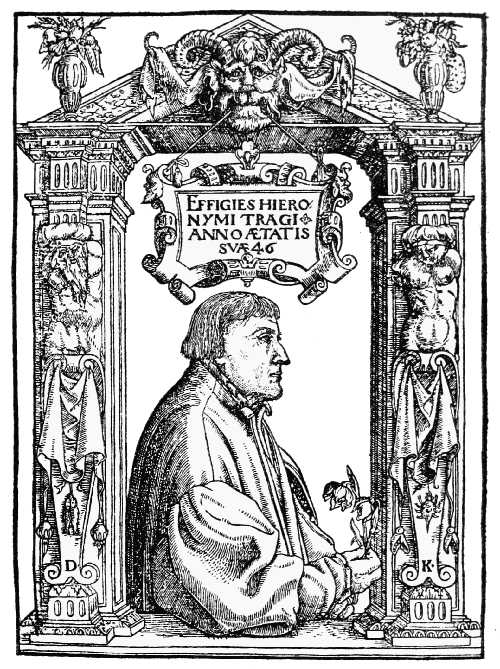
Text-fig. 26. Hieronymus Bock or Tragus, 1498-1554 [Engraving
by David Kandel. Kreuter Bůch, 1551].
![Text-fig. 27. “Erdberen” = Fragaria, Strawberry [Bock, Kreuter Bůch, 1546].](https://openoldbooks.sgp1.digitaloceanspaces.com/books/herbals/images/i_085.png)
Text-fig. 27. “Erdberen” = Fragaria, Strawberry [Bock, Kreuter
Bůch, 1546].
Bock’s great work is the ‘New Kreutterbuch,’ a herbal
which first appeared in 1539, printed at Strasburg by
Wendel Rihel. In subsequent editions the title was
abbreviated to ‘Kreuter Bůch.’ The first edition was
without illustrations, but a second, containing many wood-cuts,
followed in 1546. The majority of the figures are
said to have been copied on a reduced scale from those in
Fuchs’ magnificent herbal, which appeared in 1542, between
the first and second editions of Bock’s work. Fuchs’
figures must have been used with great discretion, for the
plagiarism is often not obvious (see Text-figs. 27, 90, 91).
A considerable number of the figures are new, being
drawn and engraved by David Kandel, whose initials
appear on the portrait of Bock, reproduced in Text-fig. 26.
The wood-cuts of trees in the third part of the book are
particularly noticeable (see Text-figs. 28 and 92) and are
often made more interesting by the introduction of figures
of men and animals.
Bock’s chief claim to remembrance, however, does not
lie in his figures, but in his descriptions, which were a
great advance on those previously published. He was
careful also to note the mode of occurrence and localities
of the plants mentioned, and in this feature his work
showed some approach to a flora in the modern sense of
the word. Bock seems to have been a keen collector,
although hampered by ill-health, and a great point in his
favour is that he described only those plants which had
come under his own personal observation. The Royal
Fern (Osmunda) was traditionally supposed to bear seed
upon St. John’s Eve, though ferns were generally believed
at that time to have no organs of fructification. To test
this statement, Bock four times spent the night in the
forest. He found “small black seed like poppy seed,” in
spite of the fact that he “used no charm, incantation or
magic character,” but went upon his search without superstition.
![Text-fig. 28. “Pimpernuss” = Pistacia, Pistachio-nut [Bock, Kreuter Bůch, 1546].](https://openoldbooks.sgp1.digitaloceanspaces.com/books/herbals/images/i_087.png)
Text-fig. 28. “Pimpernuss” = Pistacia, Pistachio-nut
[Bock, Kreuter Bůch, 1546].
![Text-fig. 29. “Tribulus aquaticus” = Trapa natans L., Bull-nut [Bock, De stirpium, 1552].](https://openoldbooks.sgp1.digitaloceanspaces.com/books/herbals/images/i_088.png)
Text-fig. 29. “Tribulus aquaticus” = Trapa natans L.,
Bull-nut [Bock, De stirpium, 1552].
Bock’s freedom from the credulity which permeated the
work of so many of the early botanists is one of his most
remarkable characteristics. His chapters on Verbena and
Artemisia reflect clearly the independence of his thought.
He points out that the former plant is collected rather for
purposes of magic than for medicine, and he can hardly
contain his scorn at the “monkey tricks and ceremonies”
connected with the use of the latter.
Leonhard Fuchs [or Fuchsius], the third of the Fathers
of German Botany (see Frontispiece), belonged to the same
generation as Hieronymus Bock, though he was a little
younger and produced his chief work three years later.
He was born in 1501 at Membdingen in Bavaria, and at
an early age he became a student of the University of
Erfurt, where he is said to have taken a bachelor’s degree
in his thirteenth year! After a period of school teaching,
he resumed his studies, this time at the University of
Ingolstadt, where he devoted himself chiefly to classics, and
became a Master of Arts. After this he turned his
attention to medicine, and took a doctor’s degree. At
Ingolstadt he came under the influence of Luther’s writings,
which won him over to the reformed faith.
Fuchs began to practise as a physician at Munich, but
in 1526 he returned to Ingolstadt as Professor of Medicine.
He seems to have been of a restless temperament, which
was probably accentuated by the persecution to which his
protestant opinions exposed him. His career for more
than forty years consisted of periods of active practice,
alternating with periods of university teaching. In 1535
he was appointed to a professorship at Tübingen, and,
while he held this post, he declined a call to the University
of Pisa, and also an invitation to become physician to the
King of Denmark. It is clear that, both as a physician and
a teacher, he was in great demand. He acquired a widespread
reputation by his successful treatment of a terrible
epidemic disease, which swept over Germany in 1529.
A little book of medical instructions and prayers against
the plague, which was published in London in the latter
half of the sixteenth century, shows that his fame had
extended to England. It is entitled, ‘A worthy practise of
the moste learned Phisition Maister Leonerd Fuchsius,
Doctor in Phisicke, most necessary in this needfull tyme of
our visitation, for the comforte of all good and faythfull
people, both olde and yonge, both for the sicke and for
them that woulde avoyde the daunger of contagion.’
![Text-fig. 30. “Brassicæ quartum genus” = Cabbage [Fuchs, De historia stirpium, 1542]. Reduced.](https://openoldbooks.sgp1.digitaloceanspaces.com/books/herbals/images/i_090.png)
Text-fig. 30. “Brassicæ quartum genus” = Cabbage [Fuchs, De historia
stirpium, 1542]. Reduced.
In spite of his professional activity, Fuchs found time
to produce a botanical masterpiece, which appeared in
1542 from the press of Isingrin of Basle, under the title
‘De historia stirpium.’ This was a Latin herbal dealing
with about four hundred native German, and one hundred
foreign plants, and was followed in the succeeding year by
a German edition, called the ‘New Kreüterbůch.’ Of all
the botanists of the Renaissance, Fuchs is perhaps the one
who deserves most to be held in honour. He is notably
superior to his two predecessors in matters calling for
scholarship, such as the critical study of the plant nomenclature
of classical authors. His herbal rivals, or even
surpasses, that of Brunfels in its illustrations, and that of
Bock in its German text. The letter-press of the Latin
edition is, on the whole, inferior to the German, the brief
descriptions being often taken word for word from previous
writers.
The Latin edition opens, however, with a long and
most interesting preface, in singularly pure and fine Latin.
Fuchs is keenly indignant at the ignorance of herbs displayed
even by medical men. His outburst on this subject
may be literally translated as follows:—“But, by Immortal
God, is it to be wondered at that kings and princes do not
at all regard the pursuit of the investigation of plants, when
even the physicians of our time so shrink from it that
it is scarcely possible to find one among a hundred who
has an accurate knowledge of even so many as a few
plants?”
That Fuchs’ work was indeed a labour of love is a
conviction that must force itself upon everyone who studies
his herbal, and it is further borne out by his own words in
the preface—words which bear the stamp of a lively
enthusiasm: “But there is no reason why I should dilate
at greater length upon the pleasantness and delight of
acquiring knowledge of plants, since there is no one
who does not know that there is nothing in this life
pleasanter and more delightful than to wander over woods,
mountains, plains, garlanded and adorned with flowerlets
and plants of various sorts, and most elegant to boot, and
to gaze intently upon them. But it increases that pleasure
and delight not a little, if there be added an acquaintance
with the virtues and powers of these same plants.”
![Text-fig. 31. “Polygonatum latifolium” = Solomon’s Seal [Fuchs, De historia stirpium, 1542]. Reduced.](https://openoldbooks.sgp1.digitaloceanspaces.com/books/herbals/images/i_092.png)
Text-fig. 31. “Polygonatum latifolium” = Solomon’s Seal [Fuchs, De
historia stirpium, 1542]. Reduced.
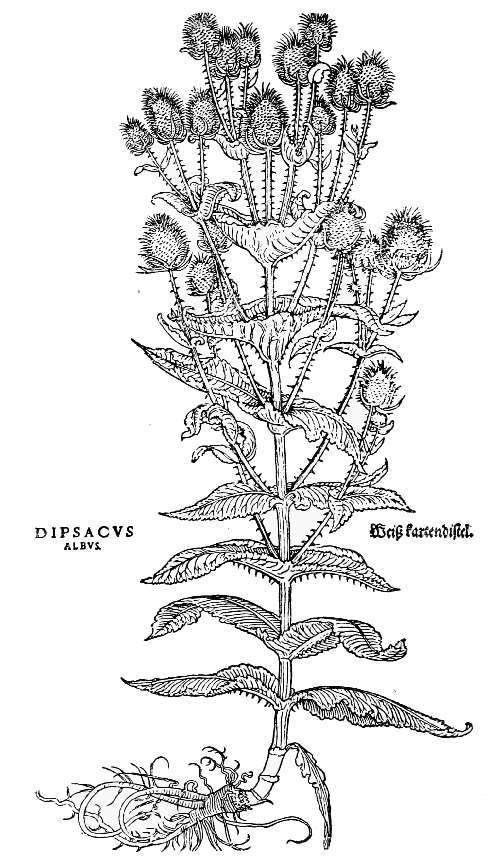
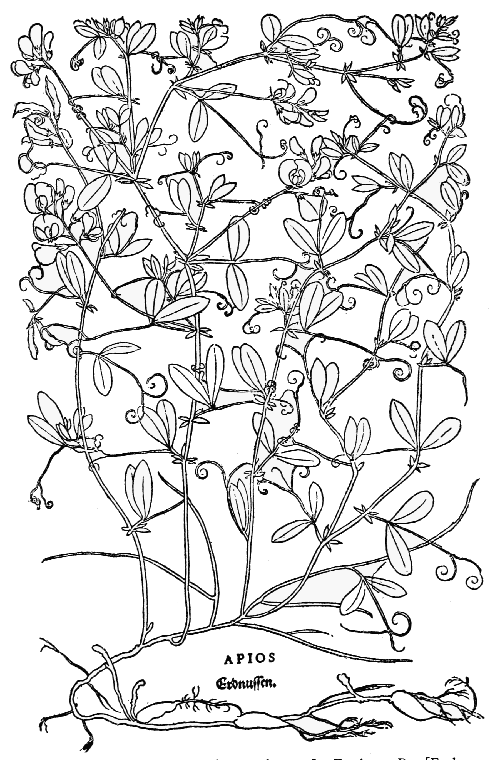
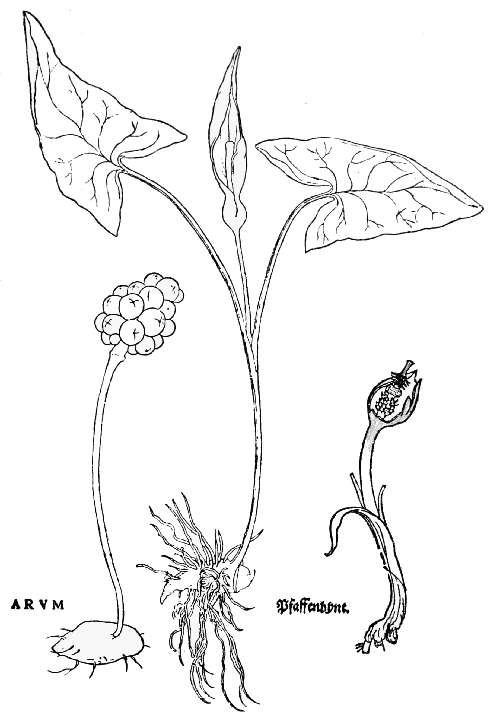
The wood-cuts which illustrate Fuchs’ herbal are of
extraordinary beauty (Text-figs. 30, 31, 32, 58, 70, 86, 87,
88). Some of them gain a special interest as being the
first European figures of certain American plants, e.g.
Indian Corn (Zea mais L.) and the Great Pumpkin
(Cucurbita maxima Duch.) (Text-fig. 32). These wood-cuts
became familiar in England in the second half of the
sixteenth century, being used on a reduced scale (borrowed
from the octavo edition) in both William Turner’s herbal
and Lyte’s Dodoens, two books which we shall consider
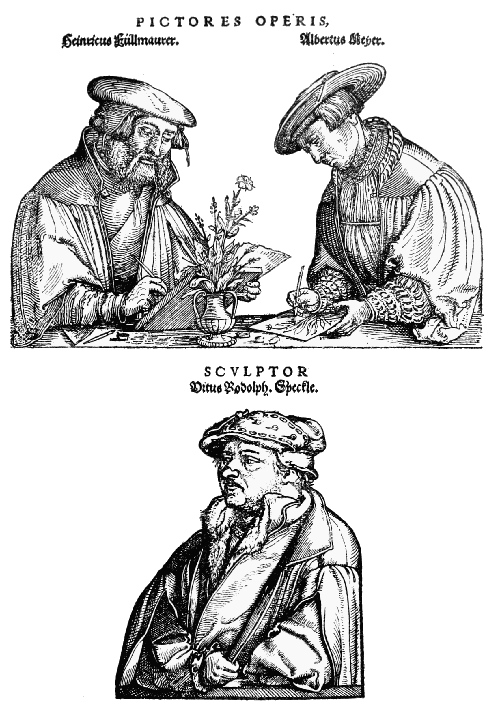
a little later. In Fuchs’ great work we are fortunate in
possessing, in addition to the botanical drawings, a full-length
portrait of the author himself, holding a spray of
Veronica, on the verso of the title-page (see Frontispiece),
and, at the end of the work, named portraits, which are
generally supposed to represent the artist who drew the
plants from nature, the draughtsman whose business it was
to copy the outline on to the wood, and the engraver who
actually cut the block (Text-fig. 89). It has also been
suggested that the first of these is perhaps engaged in
colouring a printed sheet. These portraits are powerfully
drawn, and remarkably convincing. It is pleasant to think
that we know not merely the names, but the very features
of the men who collaborated to give us what is perhaps
the most beautiful herbal ever produced.
The influence of Fuchs’ illustrations is more strongly
felt in later work than that of his text. The majority of
the wood engravings in Bock’s ‘Kreuter Bůch’ (1546),
Dodoens’ ‘Crǔÿdeboeck’ (1554), Turner’s ‘New Herball’
(1551-1568), Lyte’s ‘Niewe Herball’ (1578) and Jean
Bauhin’s ‘Historia plantarum universalis’ (1651), are copied
from Fuchs, or even printed from his actual wood-blocks,
while a number of his figures reappear in the herbals of
Egenolph, d’Aléchamps, Tabernæmontanus, etc., and the
commentaries of Ruellius and Amatus Lusitanus on Dioscorides.
![Text-fig. 32. “Cucumis turcicus” = Cucurbita maxima Duch., Giant Pumpkin [Fuchs, De historia stirpium, 1542]. Reduced.](https://openoldbooks.sgp1.digitaloceanspaces.com/books/herbals/images/i_094.jpg)
Text-fig. 32. “Cucumis turcicus” = Cucurbita maxima Duch., Giant
Pumpkin [Fuchs, De historia stirpium, 1542]. Reduced.
Fuchs arranged his work alphabetically, making no
attempt at a natural grouping of the plants, and his herbal
is therefore without importance in the history of plant
classification. His influence on methods of plant description
was, however, considerable, as is shown by the fact
that Dodoens, in his ‘Crǔÿdeboeck,’ took Fuchs’ herbal
as a model for the order of description of each plant. Fuchs’
text, as well as his figures, may thus be said to have had an
effect, even if an indirect one, on British botany, since the
herbals of Lyte and of Gerard are based on the work of
Dodoens, in which, as we have just shown, the influence
of Fuchs is clearly felt.
The publisher Christian Egenolph of Frankfort, though
not himself a botanical writer, must be mentioned at this
stage, because he brought out, in 1533, a set of plant illustrations
which became particularly well known (e.g. Text-figs.
33 and 85). They do not reflect any great credit on
Egenolph, since they were mostly pirated from Brunfels.
They were not even used to illustrate a new herbal, but
merely a new edition of the old German Herbarius, enlarged
and improved by Dr Eucharias Rhodion, and issued under
the name of ‘Kreutterbůch von allem Erdtgewåchs].’
Egenolph was evidently a keen man of business, for he
made his figures do duty over and over again. He used
them not only as illustrations to the herbal, but as a
separate publication, without any letter-press, and also in
conjunction with an entirely unrelated text, such, for example,
as a Latin version of Dioscorides. Many later
editions of the Kreutterbůch appeared, and to these a
number of figures were added, chiefly copies, on a reduced
scale, from those of Bock, who had himself made considerable
use of the drawings in the octavo edition of Fuchs’
herbal. The editions produced under the auspices of Adam
Lonicer, the publisher’s son-in-law, are particularly well
known. No other botanical works of the period had a
success comparable to that of this long series of books, of
which Rhodion’s ‘Kreutterbůch’ was the prototype. This
success was, however, achieved in the teeth of much adverse
contemporary criticism. Fuchs, in the preface of his
‘Historia stirpium’ (1542), referred with unsparing touch
to Egenolph’s botanical mistakes. His trenchant indictment
may be rendered into English as follows—“Among
all the herbals which exist to-day, there are none which
have more of the crassest errors than those which
Egenolph, the printer, has already published again and
again.” This statement Fuchs supports by means of actual
examples.
It must nevertheless be admitted that, even if their
quality was poor, the herbals published by Egenolph and
his successors did good service in disseminating some
knowledge of the plant world among a very wide public.
There is, in the British Museum, a beautiful copy of the
1536 edition, with a binding stamped in gold and bearing
the arms of Mary, Duchess of Suffolk, daughter of
Henry VII. The duchess may perhaps have inherited
a taste for herbals from her father, for the British
Museum also possesses a copy of Vérard’s translation of
the ‘Ortus Sanitatis,’ which is known to have been purchased
by him.
![Text-fig. 33. “Erdöpffel” = Ranunculus ficaria L., Lesser Celandine [Rhodion, Kreutterbůch, 1533].](https://openoldbooks.sgp1.digitaloceanspaces.com/books/herbals/images/i_096.png)
Text-fig. 33. “Erdöpffel” = Ranunculus ficaria L., Lesser
Celandine [Rhodion, Kreutterbůch, 1533].
Among the German Fathers of Botany, Sprengel includes
a comparatively little known name, that of Valerius
Cordus (1515-1544), a man whose actual achievement
was small, but who, if he had not died so young, would
probably have become one of the most famous of the earlier
herbalists. His father, Euricius Cordus, was a physician,
botanist, and man of letters, so Valerius was brought up in
a fortunate environment. At sixteen he graduated at the
University of Marburg, and, after studying in various towns,
he passed from the position of pupil to that of teacher, and
expounded Dioscorides at the University of Wittenberg.
He travelled widely in search of plants, and visited many
of the savants of the period. He is known to have made
a stay at Tübingen, and it is highly probable that he became
personally acquainted with Leonhard Fuchs.
Cordus had always longed to see, under their native
skies, the plants about which the ancients had written, and,
in fulfilment of this dream, he undertook a long excursion
into Italy. He visited many of the towns, amongst others
Padua, Bologna, Florence and Siena, travelling partly on
foot and partly on horseback, and generally accompanied
by his friend Hieronymus Schreiber. The journey was
a very trying one to men accustomed to a more northerly
climate. Wild and difficult country had to be traversed
in the height of summer, and the exposure and fatigue led
to a tragic conclusion. Cordus was injured by a kick from
a horse, which brought on a fever, and his companions
had great difficulty in getting him as far as Rome. He
rallied, however, and his friends were deceived into the
belief that he was on the road to recovery. They even
thought it safe to leave him, while they made an excursion
to Naples, but he did not survive until their return. His
fate, like that of Keats, was to see Rome and die.
None of the botanical works of Valerius Cordus were
published during his life-time, but his commentaries on
Dioscorides and his ‘Historia stirpium’ were edited by
Gesner after his death. The great merit of the ‘Historia’
lies in the vividness of the descriptions. The author seems
to have examined the plants for their own sake—not merely
in the interest of the arts of healing.
Cordus did noteworthy service to medicine, however,
for when he passed through Nuremberg on his travels he
was able to lay before the physicians of that town a
collection of medical recipes, chiefly selected from earlier
writings. This work, which had for some time been in use
in Saxony in manuscript form, was considered so valuable
that, after it had been examined and tested under the
auspices of the town council, it was published officially as
the Nuremberg ‘Dispensatorium,’ probably in 15469. This
is said to be the first work of the nature of a pharmacopœia
ever published under government authority.
![Text-fig. 34. “Ocimoides fruticosum” = Silene fruticosa L. [Camerarius, Hortus medicus, 1588].](https://openoldbooks.sgp1.digitaloceanspaces.com/books/herbals/images/i_098.png)
Text-fig. 34. “Ocimoides fruticosum” = Silene fruticosa L.
[Camerarius, Hortus medicus, 1588].
A passing reference may be made at this point to
Jacob Theodor of Bergzabern (1520-1590), a herbalist
whose work was perhaps of no very great importance,
but who is closely connected with the German Fathers of
Botany, having been the pupil both of Otto Brunfels and
of Hieronymus Bock. In his books he called himself
Tabernæmontanus.
Like the majority of the herbalists, Theodor was a
medical man, and his study of botany was a hobby which
extended over many years. He projected a herbal, but
was unable for a long time to carry the idea into effect,
being deterred by the cost of the illustrations. This
difficulty was eventually overcome, chiefly through the
generosity of Count Palatine Frederick III, and of the
Frankfort publisher, Nicolaus Bassæus. The herbal first
appeared in 1588, under the title ‘Neuw Kreuterbuch,’ and
in 1590 the illustrations were published without any text
as the ‘Eicones plantarum.’ The herbal is a large and very
finely illustrated work. The figures, however, are for the
most part not original, but are reproduced from Bock,
Fuchs, Dodoens, Mattioli, de l’Écluse and de l’Obel. This
collection of wood-blocks became familiar in England a few
years later, when they were acquired by the printer John
Norton, and used to illustrate Gerard’s ‘Herball’ which
appeared in 1597.
There is still another German herbalist of the sixteenth
century whose work must not be overlooked. This is
Joachim Camerarius10 the younger (Plate VI). His father
was a celebrated philologist, and a friend of Melanchthon.
The son, who was born in 1534, was attracted to botany
in his early youth. He studied at Wittenberg and other
universities, and travelled in Hungary and Italy. He spent
some time in the latter country, and took a doctor’s degree
in medicine at Bologna. At Pisa, he became acquainted
with Andrea Cesalpino. Finally he returned to Germany,
and settled down at Nuremberg. Here he cultivated a
garden which was kept supplied with rare plants by his
friends, and the Nuremberg merchants.
Plate VI
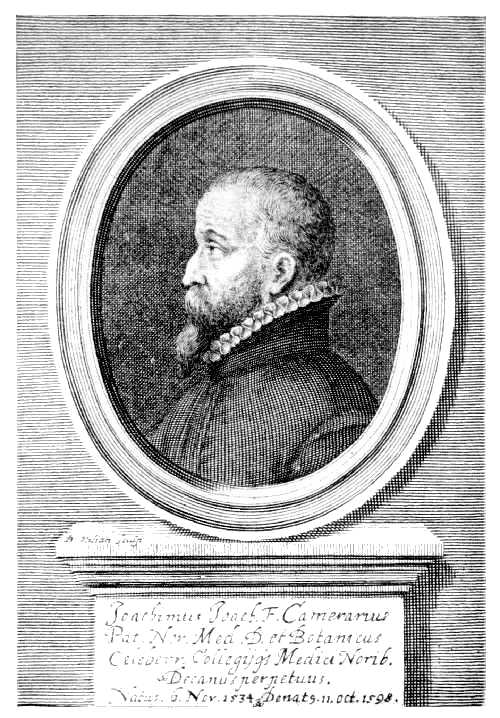
JOACHIM CAMERARIUS, the younger (1534-1598).
[Engraving by Bartholomæus Kilian, probably between 1650
and 1700. Department of Prints and Drawings, British
Museum.]
Camerarius brought out an edition of Mattioli (‘De plantis
Epitome’), but his chief work was the ‘Hortus medicus et
philosophicus,’ which appeared in 1588. The illustrations
to this book consist partly of drawings by Gesner, which
the author had bought a few years previously, and partly
of original figures. It is impossible to discriminate with
any exactness between the work of the two men. These
wood-cuts, of which Text-figs. 34, 35, 71 and 100 are
examples, will be discussed more fully in Chapter VII.
From the botanical point of view, they represent a considerable
advance, since the details of floral structure are
often shown on an enlarged scale. Camerarius was a good
observer, and his travels furnished him with much information
regarding the localities for the plants which he
described.
![Text-fig. 35. “Palma” = Seedlings of Phœnix dactylifera L., Date Palm [Camerarius, Hortus medicus, 1588].](https://openoldbooks.sgp1.digitaloceanspaces.com/books/herbals/images/i_102.png)
Text-fig. 35. “Palma” = Seedlings of Phœnix dactylifera L.,
Date Palm [Camerarius, Hortus medicus, 1588].
In the sixteenth century, the Herbal flourished exceedingly
in the Low Countries. This was due in part to the
zeal and activity of the botanists of the Netherlands, but
perhaps even more to the munificence, and love of learning
for its own sake, which distinguished that prince of
publishers, Christophe Plantin of Antwerp. In these
qualities he forms a notable contrast to Egenolph of
Frankfort, to whose shortcomings we have already drawn
attention.
Plantin’s life extended from about 1514 to 1589, and
thus included the central years of that wonderful century.
He was a native of Touraine, and studied the art of printing
at Caen and other French towns. Towards 1550, he and
his wife, Jeanne Rivière, settled in Antwerp, where he
worked at book-binding, and his wife sold linen in a little
shop. Later, he returned to the profession of printing,
and his business in this direction gradually developed, and
was eventually transferred to the famous Maison Plantin.
Christophe’s reputation grew to such an extent that great
efforts were made, in various quarters, to tempt him from
Antwerp. The Duke of Savoy and Piedmont, for instance,
did all he could to persuade him to come to Turin, promising
him extensive printing works and all necessary funds—but
he remained faithful to the city of his adoption. Perhaps
the most potent factor in his success was his keen judgment
of men, which enabled him so to choose his subordinates
that he gathered around him an unrivalled staff.
One of Plantin’s daughters married Jean Moretus, her
father’s chief assistant and successor, and from him the
business descended through eight generations of printers
to Édouard Jean Hyacinthe Moretus, the last of his race,
from whom, in 1876, the citizens of Antwerp purchased the
Maison Plantin and its contents. The house had remained
practically unchanged since the days when Christophe
Plantin lived and worked there, and it is now preserved as
the Musée Plantin-Moretus. It is built round a rectangular
courtyard, and its beauty, both in proportion and in detail, is
such, that one feels at once that Plantin achieved the ambition
he expressed in his charming sonnet—‘Le Bonheur de ce
Monde’—“Avoir une maison commode, propre et belle.”
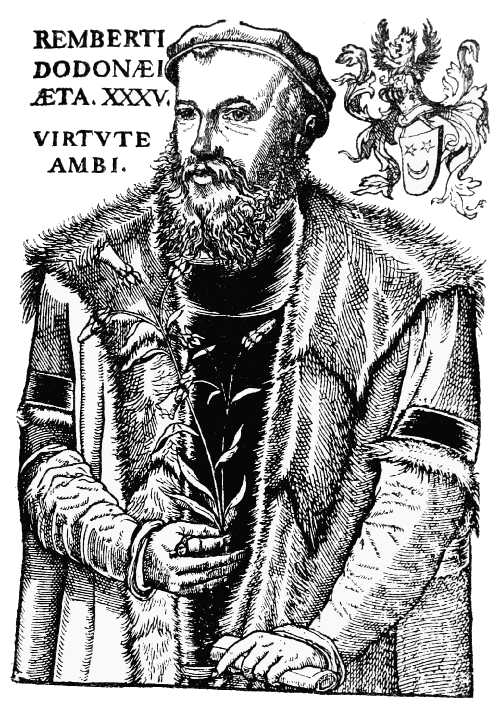
Text-fig. 36. Rembert Dodoens, 1517-1585 [A Niewe Herball,
translated by Lyte, 1578].
The pictures, furniture and hangings, and not only the
very presses, fonts, and furnaces for casting the type, but
even the old account books and corrected proof-sheets
are still to be seen, all in their appropriate places. The
wage-books are preserved, showing the weekly earnings of
compositors, engravers and book-binders, throughout a
period of three centuries. In short, the Maison Plantin
beggars description, and a visit there is an infallible recipe
for transporting the imagination back to the time of the
Renaissance, when printing was in its first youth, and was
treated with the reverence due to one of the fine arts.
The first Belgian botanist of world-wide renown was
Rembert Dodoens [or Dodonæus] (Text-fig. 36). He was
a contemporary of Plantin, having been born at Malines in
151711. He studied at Louvain, and visited the universities
and medical schools of France, Italy and Germany, eventually
qualifying as a doctor. He was successful in his
profession, being physician to the Emperors Maximilian II
and Rudolph II, and finally becoming Professor of Medicine
at Leyden, where he died in 1585. His interest in the
medical aspect of botany led him to write a herbal, and,
in order to illustrate it, he obtained the use of the wood-blocks
which had been employed in the octavo edition of
Fuchs’ work. To these a number of new engravings were
added. The book was published in Dutch in the year
1554 by Vanderloe, under the title ‘Crǔÿdeboeck.’ The
text is not a translation of Fuchs, as is sometimes supposed,
although Dodoens took Fuchs as his model for the order
of description of each plant. The method of arrangement
is his own, and he indicates localities and times of flowering
in the Low Countries, information which clearly could not
have been derived from the earlier writer. Almost simultaneously
with the first Dutch edition, a French issue
appeared under the title of ‘Histoire des Plantes.’ The translation
was carried out by Charles de l’Écluse, with whose
own work we shall shortly deal. Dodoens supervised the
production of the book, and took the opportunity to make
some additions. It became known in England through
Lyte’s translation, which will be discussed in a later section
of this chapter.
![Text-fig. 37. “Capparis” = Capparis ovata L. [Dodoens, Pemptades, 1583].](https://openoldbooks.sgp1.digitaloceanspaces.com/books/herbals/images/i_106.png)
Text-fig. 37. “Capparis” = Capparis ovata L. [Dodoens,
Pemptades, 1583].
The last Dutch edition of the herbal, for which the
author himself was responsible, was printed by Vanderloe
in 1563. The publisher then parted with Fuchs’ blocks,
which were probably acquired by the printer of Lyte’s
Dodoens in England. This circumstance put great difficulties
in the way of Dodoens’ wish to reproduce his herbal
in Latin. However it proved a blessing in disguise, for
he had the good fortune to meet, in Christophe Plantin, “un
homme qui ne reculait devant aucune dépense, pour donner
aux ouvrages qui sortaient de ses presses toute la
perfection et le mérite dont ils étaient susceptibles.” Plantin
undertook to produce a much modified Latin translation of
the herbal, and to have new blocks engraved for it, whilst
Dodoens, on his side, engaged to supply the artists with
fresh plants, and to superintend their labours. The work
proceeded slowly, and was published in parts. It was finally
completed in 1583, and was produced in one volume, under
the name of ‘Stirpium historiæ pemptades sex sive libri
triginta.’ In this work, by far the larger number of the
figures are original (see Text-figs. 37, 38, 96 and 97); some,
however, were borrowed from de l’Écluse and de l’Obel.
This arose from the fact that Plantin was also the publisher
for both these writers, and as he bore the expense of their
blocks, he had an agreement with the three authors that
their illustrations should be treated as common property.
A few of Dodoens’ figures were based upon those in the
famous manuscript of Dioscorides, now at Vienna (see
pp. 8, 85, 154).
In the ‘Pemptades,’ the botanist in Dodoens was more
to the fore, and the physician less in evidence than in his
earlier work. It is particularly difficult to appraise with any
exactness the services which Dodoens rendered to botany.
Between him and his two younger countrymen, de l’Écluse
and de l’Obel, there was so intimate a friendship that they
freely imparted their observations to one another, and permitted
the use of them, and also of their figures, in one
another’s books. To attempt to ascertain exactly what
degree of merit should be attributed to each of the three,
would be a task equally difficult and thankless.
Plate VII
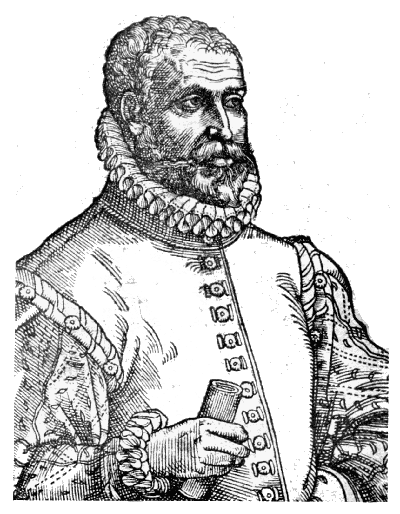
CHARLES DE L’ÉCLUSE (1526-1609).
[Print in the Botany School, Cambridge.]
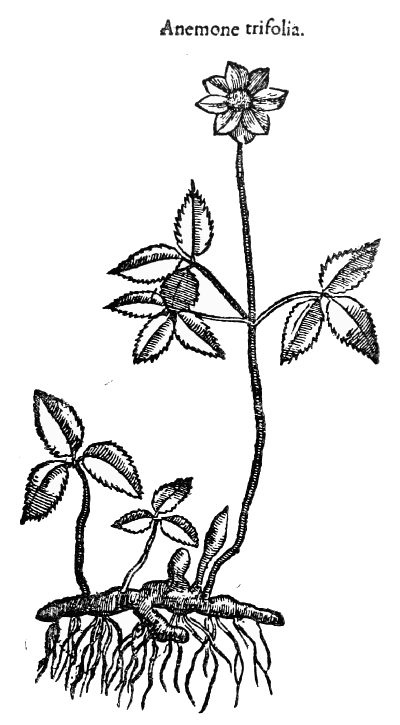
Text-fig. 38. “Anemone trifolia” [Dodoens,
Pemptades, 1583].
Charles de l’Écluse [or Clusius12] (Plate VII) was born
at Arras in the French Netherlands in 1526; like Dodoens,
he passed the closing years of his life at Leyden. He
studied at Louvain, and other universities, including Montpelier,
where he came under the influence of the botanist,
Guillaume Rondelet, who also numbered d’Aléchamps,
de l’Obel, Pierre Pena and Jean Bauhin among his pupils.
De l’Écluse was an enthusiastic adherent of the reformed
faith, to which he was converted by the influence of Melanchthon,
and he suffered religious persecution, which brought
even actual martyrdom to some of his relatives. Though he
did not himself lose his life, he was deprived of his property,
and, between poverty and ill-health, his career seems to
have been a melancholy one. He passed a nomad existence,
attached at one time as tutor to some great family, while,
at others, he was occupied in writing or translating for
Rondelet, Dodoens or Plantin, or undertaking precarious
employment at the court of Vienna. The University of
Leyden finally appointed him to a professorship. It is
interesting to note that he paid more than one visit to
England, and that he was intimate with Sir Francis Drake,
who gave him plants from the New World.
De l’Écluse had a reputation for versatility scarcely
exceeded by that of his contemporary, the “Admirable”
Crichton. He is said to have had a wide knowledge of Latin,
Greek, French, German, Flemish, Spanish, law, philosophy,
history, geography, zoology, mineralogy and numismatics,
besides his chosen subject of botany. Since his botanical
début was made as the translator of Dodoens, we may with
reason look upon him as a disciple of the latter.
The first original work de l’Écluse produced was an
account of the plants which he had observed while on an
adventurous expedition to Spain and Portugal with two
pupils. This was so successful botanically that he brought
back two hundred new species. The description of his
finds was published by Plantin in 1576, under the title of
‘Rariorum aliquot stirpium per Hispanias observatarum
Historia.’ Wood-blocks were engraved purposely for this
book (see Text-figs. 39, 59 and 98), but, for the confusion of
the bibliographer, some of them were also used to illustrate
Dodoens’ work in the interval while the Spanish flora of
de l’Écluse awaited publication. In 1583 appeared our
author’s second work, which did the same service for the
botany of Austria and Hungary as the previous volume
had done for the botany of Spain. These two works,
together with some additional matter, were republished in
1601 as the ‘Rariorum plantarum historia.’ In this book,
the species belonging to the same genus are often brought
together, but, beyond this, there is little attempt at systematic
arrangement.
![Text-fig. 39. “Lacryma Iob” = Coix lachryma-Jobi L., Job’s Tears [de l’Écluse, Rariorum ... per Hispanias, 1576].](https://openoldbooks.sgp1.digitaloceanspaces.com/books/herbals/images/i_112.png)
Text-fig. 39. “Lacryma Iob” = Coix lachryma-Jobi L., Job’s Tears
[de l’Écluse, Rariorum ... per Hispanias, 1576].
De l’Écluse was weak in the synthetic faculty, his
strength lying rather in his powers of observation. Cuvier
reckons that he added more than six hundred to the number
of known plants. It is characteristic of his versatile mind,
that his botanical interests were not confined, like those
of most of the early workers, to flowering plants. A
manuscript is preserved in the Leyden Library13 containing
more than eighty beautiful water-colour drawings of fungi,
executed under the direction of de l’Écluse, by artists
employed by his great friend and patron, Baron Boldizsár
de Batthyány. This gentleman is said to have been so
enthusiastic a botanist, that he set a Turkish prisoner at
liberty, on the condition that he should obtain plants for
him from Turkey.
De l’Écluse seems to have been a man of wide friendships,
and his botanical correspondence was very large.
He did much for horticulture, and is called by his friend,
Marie de Brimen, Princesse de Chimay, “le père de tous
les beaux Jardins de ce pays.” He deserves especial
gratitude for one benefit of a very practical nature, namely
the introduction of the Potato into Germany and Austria.
It is worthy of note that de l’Écluse, unlike the majority of
the herbalists, was not a physician, and although he laid
considerable stress on the properties of plants, he was not
preoccupied with the medical side of the subject. He
studied plants for their own sake, and abandoned the futile
effort to identify them with those mentioned by the ancients.
The third of the trio of botanists whom we are now
considering is Mathias de l’Obel [de Lobel or Lobelius],
who was born in Flanders in 1538, and died in England,
at Highgate, in 1616 (Plate VIII). He studied at Montpelier,
under Guillaume Rondelet, who, finally, bequeathed
to him his botanical manuscripts. Here also he became
acquainted with a young Provençal, Pierre Pena, with whom
he afterwards collaborated in botanical work. De l’Obel
took up medicine as his profession, and eventually became
physician to William the Silent, a post which he held until
the assassination of the Stadtholder. Later on, he and Pena
came to England, probably to seek a peaceful life under the
prosperous sway of Queen Elizabeth, which was so favourable
to the arts and sciences. Their principal work was
dedicated to her, in terms of hyperbolic praise. De l’Obel
seems to have been well received in this country, for he was
invited to superintend the medicinal garden at Hackney,
belonging to Lord Zouche, and he eventually obtained the
title of Botanist to James I.
Plate VIII
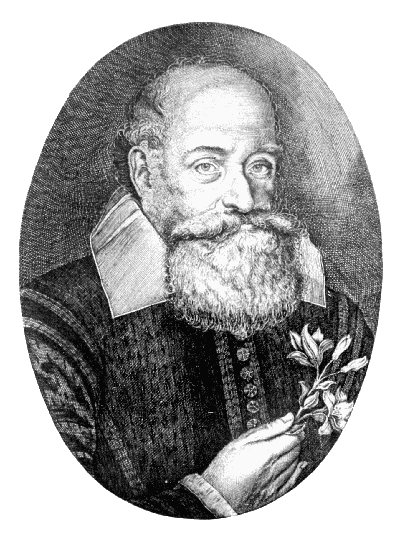
MATHIAS DE L’OBEL (1538-1616).
[Engraving by François Dellarame, 1615. Department
of Prints and Drawings, British Museum.]
De l’Obel’s chief botanical work was the ‘Stirpium
adversaria nova14,’ published in 1570, with Pena as joint
author. Pena does not appear to have been a botanist
of much importance, and he eventually quite forsook the
subject in favour of medicine. It has been suggested,
however, that de l’Obel was inclined to minimise the value
of his colleague’s work. The system of classification, upon
which de l’Obel’s reputation really rests, is set forth in
this book. The main feature of his scheme is that he
distinguishes different groups by the peculiarities of their
leaves. He is thus led to make a rough separation between
the classes which we now call Dicotyledons and Monocotyledons.
The details of his system will be considered in
a later chapter.
In 1576 the work was enlarged, and republished as the
‘Plantarum seu Stirpium Historia’; it was also translated
into Flemish, and appeared under the title of ‘Kruydtbœck’
in 1581, dedicated to William of Orange, and the Burgomasters
and other functionaries of Antwerp. The blocks
(see Text-fig. 67) used to illustrate this work were taken
from previous books, especially those of de l’Écluse. Immediately
after the publication of the Kruydtbœck, Plantin
brought out an album of the engravings it had contained,
which, although they had been also used to illustrate the
herbals of Dodoens and de l’Écluse, were now grouped
according to de l’Obel’s arrangement, which was recognised
as the best.
The Italian botanists of the Renaissance devoted themselves
chiefly to interpreting the works of the classical
writers on Natural History, and to the identification of
the plants to which they referred. This came about quite
naturally, from the fact that the Mediterranean flora, which
they saw around them, was actually that with which the
writers in question had been, in their day, familiar. The
botanists of southern Europe were not compelled, as were
those whose homes lay north of the Alps, to distort facts
before they could make the plants of their native country
fit into the procrustean bed of classical descriptions.
One of the chief of the commentators and herbalists of
this period was Pierandrea Mattioli [or Matthiolus] (Text-fig.
40), who was born at Siena in 1501, and died of the
plague in 1577. We realise something of the frightful
extent of this scourge, when we remember that it claimed as
victims no less than three of the small company of Renaissance
botanists, Gesner, Mattioli and Zaluzian. Leonhard
Fuchs was brought into fame by his successful treatment of
one of these epidemics. It should also be recalled that,
while Gaspard Bauhin, one of the best known of the later
herbalists, was practising as a physician at Basle, no less
than three of these terrible outbreaks occurred in the town.
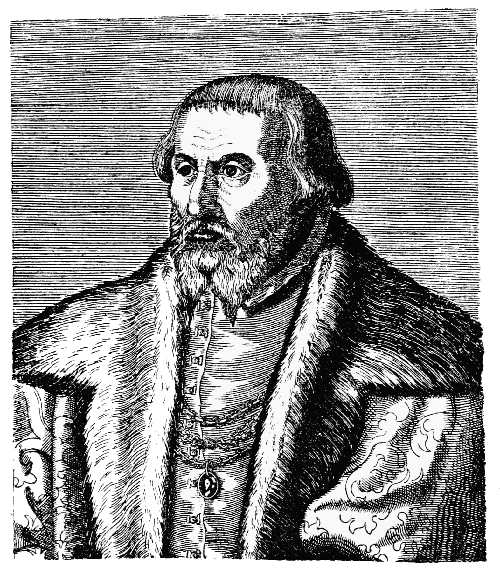
Text-fig. 40. Pierandrea Mattioli, 1501-1577 [Engraving by Philippe
Galle. Virorum Doctorum Effigies, Antwerp, 1572].
Mattioli was the son of a doctor, and his early life was
passed in Venice, where his father was in practice. He was
destined for the law, but his inherited tastes led him away
from jurisprudence to medicine. He practised in several
different towns, and became physician, successively, to the
Archduke Ferdinand, and to the Emperor Maximilian II.
![Text-fig. 41. “Pyra” = Pyrus communis L., Pear [Mattioli, Commentarii, 1560].](https://openoldbooks.sgp1.digitaloceanspaces.com/books/herbals/images/i_118.png)
Text-fig. 41. “Pyra” = Pyrus communis L., Pear
[Mattioli, Commentarii, 1560].
![Text-fig. 42. “Avena” = Oats [Mattioli, Commentarii, 1560].](https://openoldbooks.sgp1.digitaloceanspaces.com/books/herbals/images/i_119.png)
Text-fig. 42. “Avena” = Oats [Mattioli, Commentarii, 1560].
Mattioli’s ‘Commentarii in sex libros Pedacii Dioscoridis,’
his chef-d’œuvre, the gradual production and improvement
of which occupied his leisure hours throughout
his life, was first published in 1544. It was translated into
many languages and appeared in countless editions. The
success of the work was phenomenal, and it is said that
32,000 copies of the earlier editions were sold. The title
does not do the book justice, for it contains, besides an
exposition of Dioscorides, a Natural History dealing with
all the plants known to Mattioli. The early editions had
small illustrations only (Text-figs. 41, 42, 93 and 94), but,
later on, editions with large and very beautiful figures were
published, such as that which appeared at Venice in 1565
(Text-figs. 43, 44, 95).
![Text-fig. 43. “Trifolium acetosum” = Oxalis [Mattioli, Commentarii, 1565]. Reduced.](https://openoldbooks.sgp1.digitaloceanspaces.com/books/herbals/images/i_120.png)
Text-fig. 43. “Trifolium acetosum” = Oxalis [Mattioli, Commentarii,
1565]. Reduced.
Mattioli’s descriptions of the plants with which he deals
are not so good as those of some of his contemporaries.
He found and recorded a certain number of new plants,
especially from the Tyrol, but most of the species, which he
described for the first time, were not his own discoveries,
but were communicated to him by others. Luca Ghini,
for instance, had projected a similar work, but handed over
all his material to Mattioli, who also placed on record the
discoveries made by the physician, Wilhelm Quakelbeen,
who had accompanied the celebrated diplomatist, Auger-Gislain
Busbecq, on a mission to Turkey.
![Text-fig. 44. “Malus” = Pyrus malus L., Apple [Mattioli, Commentarii, 1565]. Reduced.](https://openoldbooks.sgp1.digitaloceanspaces.com/books/herbals/images/i_121.png)
Text-fig. 44. “Malus” = Pyrus malus L., Apple [Mattioli, Commentarii,
1565]. Reduced.
Busbecq brought from Constantinople a wonderful collection
of Greek manuscripts, including Juliana Anicia’s copy
of the Materia Medica of Dioscorides, now in the Vienna
Library (see pp. 8 and 154). He discovered this great
manuscript in the hands of a Jew, who required a hundred
ducats for it. This price was almost prohibitive, but Busbecq
was an enthusiast, and he successfully urged the Emperor,
whose representative he was, “to redeem so illustrious an
author from that servitude15.” His purpose in buying the
manuscript seems to have been largely in order to communicate
it to Mattioli, who would thus be able to make use of
it in preparing his Commentaries on Dioscorides.
The personal character of Mattioli does not appear to
have been a pleasant one. He engaged in numerous controversies
with his fellow botanists, and hurled the most
abusive language at those who ventured to criticise him.
Another Italian herbalist, Castor Durante, slightly later
in date than Mattioli, should perhaps be mentioned here,
not because of the intrinsic value of his work, but because
of its widespread popularity. At least two of his books
appeared in many editions and translations.
Durante was a physician who issued a series of botanical
compilations, bedizened with Latin verse. The best known
of his works is the ‘Herbario Nuovo,’ published at Rome
in 1585 (Text-figs. 45 and 103). A second book, the
original version of which is seldom met with, has survived
in the form of a German translation, by Peter Uffenbach.
The German version was named ‘Hortulus Sanitatis.’
As an illustration of Durante’s charmingly unscientific
manner, we may take the legend of the “Arbor tristis”
which occurs in both these works. The figure which
accompanies it (Text-fig. 45) shows, beneath the moon and
stars, a drawing of a tree whose trunk has a human form.
The description, as it occurs in the ‘Hortulus Sanitatis,’
may be translated as follows:
“Of this tree the Indians say, there was once a very
beautiful maiden, daughter of a mighty lord called Parisataccho.
This maiden loved the Sun, but the Sun forsook
her because he loved another. So, being scorned by the
Sun, she slew herself, and when her body had been burned,
according to the custom of that land, this tree sprang from
her ashes. And this is the reason why the flowers of this
tree shrink so intensely from the Sun, and never open in
his presence. And thus it is a special delight to see this
tree in the night time, adorned on all sides with its lovely
flowers, since they give forth a delicious perfume, the like
of which is not to be met with in any other plant, but no
sooner does one touch the plant with one’s hand than its
sweet scent vanishes away. And however beautiful the
tree has appeared, and however sweetly it has bloomed at
night, directly the Sun rises in the morning it not only fades
but all its branches look as though they were withered and
dead.”
![Text-fig. 45. “Arbor Malenconico” or “Arbor tristis” = Tree of Sorrow [Durante, Herbario Nuovo, 1585].](https://openoldbooks.sgp1.digitaloceanspaces.com/books/herbals/images/i_123.png)
Text-fig. 45. “Arbor Malenconico” or “Arbor tristis”
= Tree of Sorrow [Durante, Herbario Nuovo, 1585].
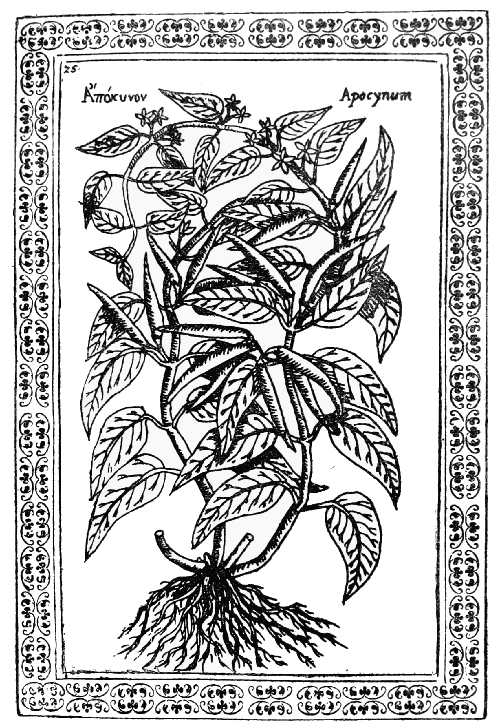
Text-fig. 46. “Apocynum” [Colonna, Phytobasanos, 1592].
Much more famous than Durante was Fabio Colonna,
or, as he is more generally called, Fabius Columna (Plate
IX), who was born at Naples in 1567. His father was a
well-known littérateur. Fabio Colonna’s profession was
that of law, but he was also well acquainted with languages,
music, mathematics and optics. He tells us in the preface
to his principal work that his interest in plants was aroused
by his difficulty in obtaining a remedy for epilepsy, a disease
from which he suffered. Having tried all sorts of prescriptions
without result, he examined the literature on the
subject, and discovered that most of the writers of his time
merely served up the results obtained by the ancients, often
in a very incorrect form. So he went to the fountain head,
Dioscorides, and after much research identified Valerian as
being the herb which that writer had recommended against
epilepsy, and succeeded in curing himself by its use.
This experience convinced Colonna that the knowledge
of the identity of the plants described by the ancients was
in a most unsatisfactory condition, and he set himself to
produce a work which should remedy this state of things.
This book was published in 1592, under the name of
‘Phytobasanos,’ which embodies a quaint conceit after the
fashion of the time. The title is a compound Greek word
meaning “plant torture,” and was apparently employed by
Colonna to explain that he had subjected the plants to
ordeal by torture, in order to wrest from them the secret of
their identity. But it must be confessed that Colonna
himself is by no means free from error, as regards the names
which he assigns to them.
The great feature of the ‘Phytobasanos,’ however, is the
excellence of the descriptions and figures. The latter are
famous as being the first etchings on copper used to illustrate
a botanical work (Text-figs. 46 and 105). They were an
advance on all previous plant drawings, except the work of
Gesner and Camerarius, in giving, in many cases, detailed
analyses of the flowers and fruit as well as habit drawings.
We owe to Colonna also the technical use of the word
“petal,” which he suggested as a descriptive term for the
coloured floral leaves16.
By means of his wide scientific correspondence, Colonna
kept in touch with many of the naturalists of his time,
notably with de l’Écluse and Gaspard Bauhin.
Plate IX
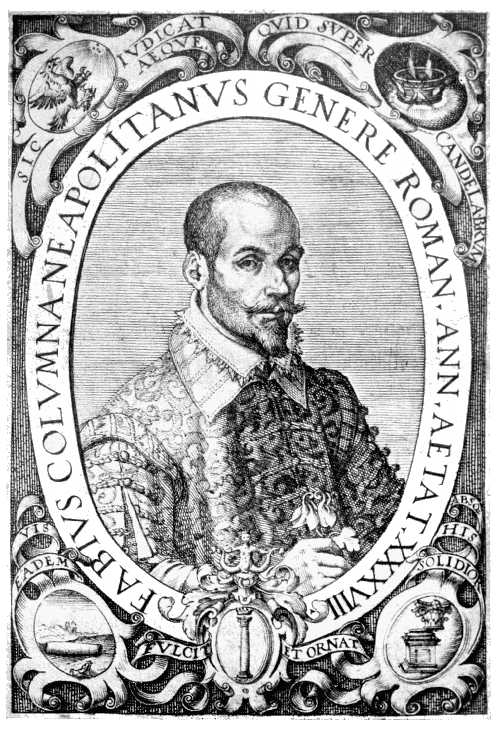
FABIO COLONNA (1567-1650).
[Ekphrasis, 1606.]
![Text-fig. 47. “Kalli” = Salicornia, Glasswort [Prospero Alpino, De plantis Ægypti, 1592].](https://openoldbooks.sgp1.digitaloceanspaces.com/books/herbals/images/i_128.png)
Text-fig. 47. “Kalli” = Salicornia, Glasswort [Prospero Alpino, De plantis
Ægypti, 1592].
A passing reference may be made here to a book which
is rather of the nature of a local flora than a herbal, entitled
‘Prosperi Alpini de plantis Ægypti,’ which was published
at Venice in 1592. It contains a number of wood-cuts,
which appear to be original. The one reproduced (Text-fig.
47) represents Salicornia, the Glasswort. The author
was a doctor who went to Egypt with the Venetian consul,
Giorgio Emo, and had opportunities of collecting plants
there. He is said to have been the first European writer
to mention the Coffee plant, which he saw growing at Cairo.
Prospero Alpino eventually became Professor of Botany at
Padua, and enriched the botanical garden of that town with
Egyptian plants.
Among the many scientific men, whose names are
associated with Switzerland, one of the most renowned is
Konrad Gesner (Plate X), who was born at Zurich in 1516,
the son of a poor furrier. His taste for botany was due,
in the first instance, to the influence of his uncle, a protestant
preacher. Konrad went to France to study medicine, but
in Paris, the richness of the libraries, and the delight of
associating with learned men, tempted him away from his
special subject into a course of omnivorous reading. After
an interval of school teaching at Zurich, he betook himself
to Basle, where he entered more methodically upon the
study of medicine, at the same time attempting to support
himself by working at a Latin dictionary. However, after
a short period of student life, he found the expense too
great, and was obliged to abandon it, and to take a post as
teacher of classics in Lausanne. He had received assistance
at different times from his native town, which again came
to his help at this juncture, and generously allotted to him
a “Reisestipendium,” for the continuance of his medical
studies. He indeed owed much to Zurich, for, after taking
his doctorate, he was appointed first to the professorship of
Philosophy there, and then to that of Natural History,
which he held until he died of the plague in his forty-ninth
year.
![Text-fig. 48. “Lachryma Iob” = Coix lachryma-Jobi L., Job’s Tears [Simler, Vita Conradi Gesneri, 1566].](https://openoldbooks.sgp1.digitaloceanspaces.com/books/herbals/images/i_130.png)
Text-fig. 48. “Lachryma Iob” = Coix lachryma-Jobi L.,
Job’s Tears [Simler, Vita Conradi Gesneri, 1566].
Gesner’s most remarkable characteristic was his versatility
and encyclopædic knowledge; he has been called
the Pliny of his time. His work on bibliographical and
linguistic subjects was of importance, and he also wrote on
medicine, mineralogy, zoology and botany. The botanical
works published during his life were not of great importance,
but, at the time of his death, he had already prepared a
large part of the material for a general history of plants,
which was intended as a companion work to his famous
‘Historia Animalium.’ In order to illustrate it, he had
collected 1500 drawings of plants, the majority original,
though some were founded on previous wood-cuts, especially
those of Fuchs. The undertaking was so far advanced that
some of the figures had been drawn upon the wood, and
certain blocks had even been engraved. The whole collection,
and the manuscripts, he bequeathed for publication to
his friend Caspar Wolf. Wolf seems to have made an
honest effort to carry out Gesner’s wishes, and he succeeded
in publishing a few of the wood-cuts, as an appendix
to Simler’s ‘Vita Conradi Gesneri’ (e.g. Text-fig. 48).
Unfortunately he was hampered by weak health, and the
task, as a whole, proved beyond his powers. He sold
everything to Joachim Camerarius the younger, with the
proviso that the purchaser should make himself responsible
for the publication. Camerarius failed to fulfil the spirit of
this obligation. It is true that he brought a large number
of Gesner’s figures before the public, but he did this only
by the indirect method of using them, among his own
drawings, to illustrate an edition of Mattioli, and a book of
his own.
Finally, about a hundred and fifty years after the death
of Camerarius, Gesner’s drawings and blocks came into the
possession of the eighteenth-century botanist and bibliographer,
Christoph Jacob Trew, who published them, thus
giving Gesner his due so far as was possible at that late
date. Such blocks as were in good condition were printed
directly, and, from the drawings, a number of copper engravings
were made, coloured like the originals. The drawings
were of unequal merit, some of them being on a very small
scale and lacking in clearness. In one point, however,
Gesner shows a marked advance on the methods of his
contemporaries—namely in giving detailed, analysed studies
of flower and fruit structure, as well as a drawing showing
the habit of the plant. It must not be forgotten that,
even in Trew’s edition, it is impossible to discriminate
with certainty between the work of Gesner and that of
Camerarius.
Unfortunately, we have no knowledge of the text of
Gesner’s manuscript, but his letters make it clear that his
interest in botany was thoroughly scientific. If his work
were extant, he would probably shine as a discoverer of
new species, especially among alpines, for his figures indicate
that he was acquainted with a number of plants which
de l’Écluse, Gaspard Bauhin and others were the first to
describe.
Plate X
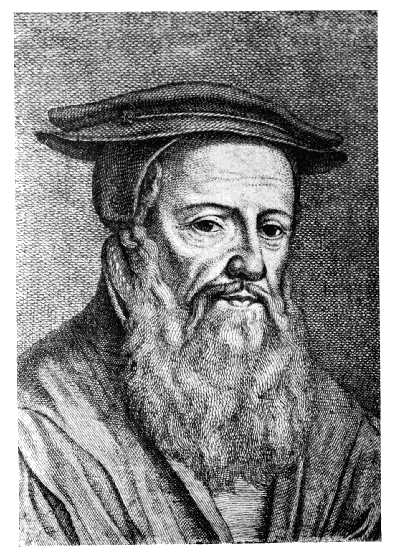
KONRAD GESNER (1516-1565).
[Print in the Botany School, Cambridge.]
Among Gesner’s numerous scientific correspondents was
Jean Bauhin, a brilliant young man, twenty-five years
his junior. Their acquaintance began when Bauhin was
only eighteen, but, in spite of his friend’s youth, Gesner
consulted him in botanical difficulties, describing him as
“eruditissimus et ornatissimus juvenis.”
Jean Bauhin was the son of a French doctor, a native
of Amiens, who had been converted to protestantism by
reading the Latin translation of the New Testament
prepared by Erasmus. In consequence of his change
of faith, he was subjected to religious persecution, which
he avoided by retreating to Switzerland, where his sons
Jean and Gaspard were born. The medical tradition seems
to have been remarkably strong in the family. Both Jean
and Gaspard became doctors—Gaspard, whose sons also
entered the profession, being, in fact, the second of six
generations of physicians. For two hundred years, an
unbroken succession of members of the family were
medical men.
After Jean Bauhin had studied for a time at the
University of Basle, he went to Tübingen, where he
learned botany from Leonhard Fuchs. From Tübingen
he proceeded to Zurich, and accompanied Gesner on some
journeys in the Alps. After further travel on his own
account, and a period at the University of Montpelier, he
reached Lyons, where he came in contact with d’Aléchamps,
who engaged him to assist with the ‘Histoire des plantes.’
Bauhin began to occupy himself with this work, but his
protestantism proved a stumbling-block to his life there,
and he was obliged to quit France.
Jean Bauhin’s chief botanical work, the ‘Histoire
universelle des plantes,’ was a most ambitious undertaking,
which he did not live to see published. However, his
son-in-law Cherler, a physician of Basle, who had helped
him in preparing it, brought out a preliminary sketch of it
in 1619, and, in 1650 and 1651, the magnum opus itself
was published, under the name of ‘Historia plantarum
universalis.’ This book is a compilation from all sources,
and includes descriptions of 5000 plants. The figures, of
which there are more than 3500, are small and badly
executed. A large proportion of them are ultimately
derived from those of Fuchs.
Jean Bauhin’s more famous brother, Gaspard [or Caspar]
(Plate XI), was born in 1560, and was thus the younger
by nineteen years. Gaspard studied at Basle, Padua,
Montpelier, Paris and Tübingen. He also travelled in
Italy, making observations upon the flora, and becoming
acquainted with scientific men. Unfortunately he missed
being a pupil of Leonhard Fuchs, since his sojourn at
Tübingen took place some years after the death of the
famous herbalist, who had been his brother’s teacher. The
illness and death of his father in 1582 made it necessary
for him to settle in Basle, where he became Professor of
Botany and Anatomy, and eventually of Medicine.
Inspired by the example of his brother, he conceived
the plan of collecting, in a single work, all that had been
previously written upon plants, and, especially, of drawing
up a concordance of all the names given by different
authors to the same species. His extensive early travels
served as a good preparation for this task, since he had
not only observed and collected widely, but had established
relations with the best botanists in Europe. He formed
a herbarium of about 4000 plants, including specimens
from correspondents in many countries, even Egypt and
the East Indies. Besides study bearing directly on his
great project, he accomplished a considerable amount of
critical and editorial work, which also had its value in
relation to his main plan. He produced new editions of
Mattioli’s Commentaries, and of the herbal of Tabernæmontanus,
and published a criticism of d’Aléchamps’ ‘Historia
plantarum.’
There is a marked parallelism between the careers of
the Bauhin brothers, for Gaspard’s great work underwent
much the same vicissitudes as that of Jean. The main
part of Gaspard’s chief work never saw the light at all,
although his son brought out one instalment of it, many
years after his father’s death. Gaspard was however more
fortunate than Jean, in that he lived to see the publication
of three important preliminary volumes, as the result of his
researches, and it is on these that his reputation rests.
Plate XI
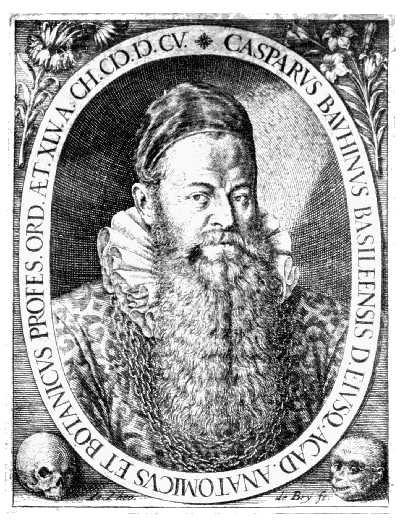
GASPARD BAUHIN (1560-1624).
[Theatrum Anatomicum, 1605.]
![Text-fig. 49. “Solanum tuberosum esculentum” = Potato [Bauhin, Prodromos, 1620].](https://openoldbooks.sgp1.digitaloceanspaces.com/books/herbals/images/i_138.png)
Text-fig. 49. “Solanum tuberosum esculentum” = Potato
[Bauhin, Prodromos, 1620].
The ‘Prodromos theatri botanici’ of 1620 consisted of
descriptions of 600 species, which the author regarded as
new, although several had, as a matter of fact, been already
described by de l’Écluse. Figures of about 140 species
are given, two of which are here reproduced (Text-figs. 49
and 62). One of these, the Potato (Text-fig. 49), still
retains the name of Solanum tuberosum which Bauhin
gave to it. He had previously published a description
of this plant in an earlier work, the ‘Phytopinax’ of
1596.
In 1623, Gaspard Bauhin brought out his most important
botanical book, the ‘Pinax17 theatri botanici.’ By
this date, owing to the number of different names bestowed
upon the same plant by different authors, and the varying
identifications of those described by the ancients, the subject
of plant nomenclature had been reduced to a condition of
woeful confusion. Bauhin’s ‘Pinax’ converted chaos into
order, since it contained the first complete and methodical
concordance of the names of plants, and was so authoritative
as to earn for the author the title of “législateur en botanique.”
The work, which dealt with about 6000 plants,
was recognised as pre-eminent for many years. Morison
criticised the scheme of arrangement on which it was based,
but adopted its nomenclature, as also did Ray. Tournefort
also retained, as far as possible, the names of the genera and
species used in the ‘Pinax.’ As Sachs long ago pointed
out, this work is “the first and for that time a completely
exhaustive book of synonyms, and is still indispensable for
the history of individual species—no small praise to be
given to a work that is more than 250 years old.”
Gaspard Bauhin deserves great honour as the first who
introduced some degree of order into the chaotic muddle of
nomenclature and synonymy. The special merits of his
work, more especially his power of concise and lucid
description, and his faculty for systematic arrangement,
may perhaps be attributed to his French blood, since such
qualities are markedly characteristic of French scientific
writing.
It is much to be regretted that the two brothers Bauhin
should have carried on their work independently and
separately, considering that they had in view practically
identical objects—objects in which each only achieved
a partial success. It seems as if a work of much greater
value might have resulted if they had joined forces.
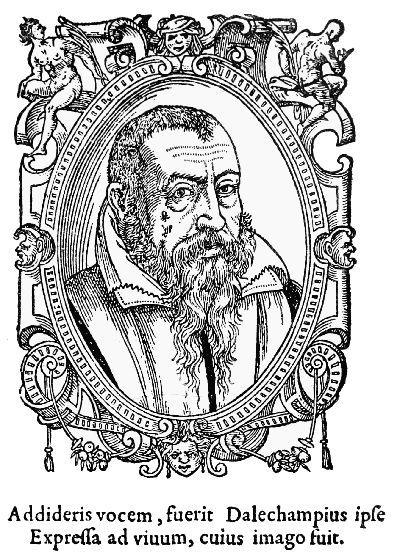
Text-fig. 50. Jacques d’Aléchamps, 1513-1588 [Enlarged from wood-cut,
circa 1600, Department of Prints and Drawings, British Museum].
France (excluding the French Netherlands) does not
seem, at first sight, to have contributed a great deal towards
the development of the Herbal in the sixteenth and seventeenth
centuries, but it must be remembered that Jean and
Gaspard Bauhin, and the publisher, Christophe Plantin,
were French by extraction, though Switzerland and
Holland were their countries by adoption. Most of the
important herbals published in other languages were
translated into French quite early in their history, sometimes
in a modified form, so that France in the sixteenth
century was probably by no means backward in botanical
knowledge. One such adaptation was ‘L’Histoire des
Plantes,’ by Geofroy Linocier, which was founded, in part,
on the works of Fuchs and Mattioli.
A well-known name among the earlier French writers
is that of Jean Ruel, or Joannes Ruellius, as he is commonly
called (1474-1537). He was a physician, and a professor
in the University of Paris, and chiefly devoted himself to
the emending and explaining of Dioscorides. He also
wrote a general botanical treatise, ‘De Natura Stirpium,’
which first appeared in Paris in 1536. This work, which is
without illustrations, is intended mainly to elucidate the
ancient writers.
The most famous of the French herbalists was Jacques
d’Aléchamps (Text-fig. 50), whose magnum opus, which
appeared in 1586, formed a compendium of much of the
material which had been contributed by the different
nations. He was born at Caen in 1513, and after studying
medicine at Montpelier, entered upon the practice of it at
Lyons, where he remained until his death in 1588.
D’Aléchamps’ great work is generally called the
‘Historia plantarum Lugdunensis.’ Curiously enough,
the author’s name is not mentioned on the title-page.
From the preface one would gather that Johannes Molinäus
(or Desmoulins) was the chief author. However, judging
by the way in which the book was quoted by contemporary
writers, there appears to be little doubt that d’Aléchamps
was really responsible for it, though assisted at different
times by Jean Bauhin and Desmoulins.
The ‘Historia plantarum’ had numerous faults, but it
was, at the time, the most complete universal flora that
existed. It contained about 2700 figures (two of which are
reproduced in Text-figs. 51 and 101), but, both in drawing
and wood-cutting, they show marked inferiority to much of
the earlier work.
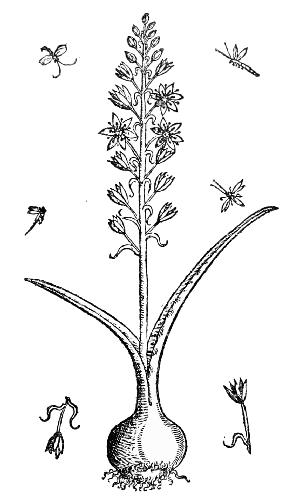
Text-fig. 51. “Ornithogalum magnum” [d’Aléchamps,
Historia generalis plantarum, 1586].
The greatest name among British herbalists of the
Renaissance period is that of William Turner, physician
and divine, the “Father of British Botany.” He was a
north-countryman, a native of Morpeth in Northumberland,
where he was born probably between 1510 and 1515. He
received his education at what is now Pembroke College,
Cambridge. Pembroke deserves to be especially held in
honour by botanists, for a hundred years later, Nehemiah
Grew, who was as pre-eminent among British botanists of
the seventeenth century as Turner was among those of the
sixteenth, also became a student at this college.
Like so many of the early botanists, William Turner
was closely associated with the Reformation. He embraced
the views of his friends and instructors at Cambridge,
Nicholas Ridley and Hugh Latimer, and fought for the
reformed faith throughout his life, both with pen and by word
of mouth. His caustic wit was also used, with almost equal
vehemence, to attack the abuses which crept into his own
party. A ban was put upon his writings in the reign of
Henry VIII, and for a time he suffered imprisonment, but,
when Edward VI came to the throne, his fortunes improved,
and, after a long and tedious period of waiting for preferment,
he obtained the Deanery of Wells. Difficulty in
ejecting the previous Dean caused much delay in obtaining
possession of the house, and Turner lamented bitterly that,
in the small and crowded temporary lodging, “i can not go
to my booke for ye crying of childer & noyse yt is made in
my chamber.”
A clergyman’s life must have been full of unwelcome
vicissitudes in those days, if Turner’s career was at all
typical. During Mary’s reign he was a fugitive, and the
former Dean of Wells was reinstated. However, when
Elizabeth ascended the throne, the position was reversed,
and Turner came back to Wells, “the usurper,” as he calls
his rival, being ejected. But his triumph was short-lived,
for in 1564 he was suspended for nonconformity. His
controversial methods were violent in the extreme, and he
seems to have been a thorn in the flesh of his superiors.
The Bishop of Bath and Wells wrote on one occasion that
he was “much encombred wth mr Doctor Turner Deane of
Welles, for his undiscrete behavior in the pulpitt: where
he medleth wth all matters, and unsemelie speaketh of all
estates, more than ys standinge withe discressyon.”
Christian doctrine was by no means the only subject
that occupied Turner’s attention. He had taken a medical
degree either at Ferrara or Bologna, and, in the reign of
Edward VI, he was physician to the Duke of Somerset, the
Protector. He had travelled much in Italy, Switzerland,
Holland and Germany, at the periods when his religious
opinions excluded him from England. One of the great
advantages, which he reaped from his wanderings, was the
opportunity of studying botany at Bologna under Luca
Ghini, who was also the teacher of Cesalpino. Another
savant, with whom he became acquainted on the Continent,
was Konrad Gesner, whom he visited at Zurich, and with
whom he maintained a warm friendship. He also corresponded
with Leonhard Fuchs.
Turner’s earliest botanical work was the ‘Libellus de
re herbaria novus’ (1538), which is the first book in which
localities for many of our native British plants are placed on
record. In 1548 this was followed by another little work,
‘The names of herbes in Greke, Latin, Englishe, Duche
and Frenche wyth the commune names that Herbaries and
Apotecaries use.’ In the preface to this book, Turner tells us
that he had projected a Latin herbal, and had indeed written
it, but refrained from publishing it because, when he “axed
the advise of Phisicianes in thys matter, their advise was
that I shoulde cease from settynge out of this boke in latin
tyll I had sene those places of Englande, wherein is moste
plentie of herbes, that I might in my herbal declare to the
greate honoure18 of our countre what numbre of sovereine
and strang herbes were in Englande that were not in other
nations, whose counsell I have folowed deferryng to set out
my herbal in latin, tyl that I have sene the west countrey,
which I never sawe yet in al my lyfe, which countrey of all
places of England, as I heare say is moste richely replenished
wyth all kyndes of straunge and wonderfull workes and
giftes of nature, as are stones, herbes, fishes and metalles.”
He explains that while waiting to complete his herbal, he
has been advised to publish this little book in which he has
set forth the names of plants. He adds, “and because
men should not thynke that I write of that I never sawe,
and that Poticaries shoulde be excuselesse when as the
ryghte herbes are required of them, I have shewed in what
places of Englande, Germany, and Italy the herbes growe
and maye be had for laboure and money.”
Turner’s chef-d’œuvre was his ‘Herball,’ published in
three instalments, the first in London in 1551, the first and
second together at Cologne in 1562, during his exile in the
reign of Mary, and the third part, together with the preceding,
in 1568. The title of the first part runs as follows,
‘A new Herball, wherin are conteyned the names of
Herbes ... with the properties degrees and naturall places
of the same, gathered and made by Wylliam Turner,
Physicion unto the Duke of Somersettes Grace.’ The
figures illustrating the herbal are, for the most part, the
same as those in the octavo edition of Fuchs’ work, published
in 1545.
The dedication of the herbal, in its completed form, to
Queen Elizabeth, throws some light on Turner’s life, and
incidentally on that illustrious lady herself. The doctor
recalls, with pardonable pride and perhaps a touch of
blarney, an occasion on which the Princess Elizabeth, as
she then was, had conversed with him in Latin. “As for
your knowledge in the Latin tonge,” he writes, “xviii yeares
ago or more, I had in the Duke of Somersettes house
(beynge his Physition at that tyme) a good tryal thereof,
when as it pleased your grace to speake Latin unto me:
for although I have both in England, lowe and highe
Germanye, and other places of my longe traveil and
pelgrimage, never spake with any noble or gentle woman,
that spake so wel and so much congrue fyne and pure
Latin, as your grace did unto me so longe ago.”
Turner defends himself against the insinuation that
“a booke intreatinge onelye of trees, herbes and wedes,
and shrubbes, is not a mete present for a prince,” and
certainly, if we accept his account of the state of knowledge
at the time, the need for such a book must have been most
urgent. He explains that, while he was still at Pembroke
Hall, Cambridge, he endeavoured to learn the names of
plants, but, “suche was the ignorance in simples at that
tyme,” that he could get no information on the subject,
even from physicians. He claims that his herbal has considerable
originality—a claim which seems well founded.
In his own words—“they that have red the first part
of my Herbal, and have compared my writinges of plantes
with those thinges that Matthiolus, Fuchsius, Tragus, and
Dodoneus wrote in ye firste editiones of their Herballes,
maye easily perceyve that I taught the truthe of certeyne
plantes, which these above named writers either knew not
at al, or ellis erred in them greatlye.... So yt as I learned
something of them, so they ether might or did learne somthinge
of me agayne, as their second editions maye testifye.
And because I would not be lyke unto a cryer yt cryeth
a loste horse in the marketh, and telleth all the markes and
tokens that he hath, and yet never sawe the horse, nether
coulde knowe the horse if he sawe him: I wente into Italye
and into diverse partes of Germany, to knowe and se the
herbes my selfe.”
This herbal contains many evidences of Turner’s independence
of thought. He fought against what he regarded
as superstition in science with the same ardour with which
he entered upon religious polemics. The legend of the
human form of the Mandrake receives scant mercy at his
hands. As he points out, “The rootes which are conterfited
and made like litle puppettes and mammettes, which
come to be sold in England in boxes, with heir, and such
forme as a man hath, are nothyng elles but folishe feined
trifles, and not naturall. For they are so trymmed of crafty
theves to mocke the poore people with all, and to rob them
both of theyr wit and theyr money. I have in my tyme
at diverse tymes taken up the rootes of Mandrag out of the
grounde, but I never saw any such thyng upon or in them,
as are in and upon the pedlers rootes that are comenly to
be solde in boxes.” Turner was, however, by no means
the first to dispute the Mandrake superstition; in the
Grete Herball of 1526 it is definitely refuted, and it is
ignored in some works that are of even earlier date. The
hoax was long-lived, for we find Gerard also exposing it in
1597.
Turner had a fine scorn for any superstitious notions
he detected in the writings of his contemporaries, and
seems to have been particularly pleased if he could show
that in any disputed matter they were wrong, while the
ancients, for whom he had a great reverence, were right.
For instance he has a great deal to say about a theory, held
by Mattioli, in opposition to the opinions of Theophrastus
and Dioscorides, that the Broomrape (Orobanche) could
kill other plants merely by its baneful presence, without
any physical contact. He declares that this view is against
reason, authority and experience, and points out that the
figure which Mattioli gives is faulty, in omitting to show
the roots, which are the real instruments of destruction.
He triumphantly concludes, “And as touchynge experience,
I know that the freshe and yong Orobanche hath commyng
out of the great roote, many lytle strynges ... wherewith it
taketh holde of the rootes of the herbes that grow next
unto it. Wherefore Matthiolus ought not so lyghtly to
have defaced the autorite of Theophrast so ancient and
substantiall autor.” Turner’s work is largely occupied with
the opinions of early writers, especially Dioscorides, and his
respect for their authority is a somewhat curious trait in a
character which seems, in other directions, to have been so
unorthodox. He did not however treat their books as the
last word on the subject, and the third part of his herbal is
occupied with plants “whereof is no mention made nether
of ye old Grecianes nor Latines.”
Turner’s herbal is arranged alphabetically, and does
not show evidence of any interest in the relationships of
the plants. It is as individuals, and essentially as “simples,”
that he regarded them. His descriptions of them were
often vividly expressed, though not markedly original.
It must be remembered that botany was not the only
science which he studied. He wrote about birds, and also
contributed information about English fishes to Gesner’s
‘Historia Animalium.’
![Text-fig. 52. “Tabaco” = Nicotiana, Tobacco [Monardes, Joyfull newes out of the newe founde worlde, 2nd ed. 1580].](https://openoldbooks.sgp1.digitaloceanspaces.com/books/herbals/images/i_148.png)
Text-fig. 52. “Tabaco” = Nicotiana, Tobacco [Monardes,
Joyfull newes out of the newe founde worlde, 2nd ed. 1580].
Before discussing the next herbal which appeared in
this country, we may refer in passing to a botanical book
which hardly comes under this heading, but which is of
interest in relation to the history of the time. Nicolas
Monardes, a Spanish physician, had published, in 1569
and 1571, some account of the plants which had lately
been brought to Europe from the recently discovered West
Indies, and this work was translated into English by John
Frampton in 1577, under the title of ‘Joyfull newes out of
the newe founde worlde.’ This book contains a good
figure of the Tobacco plant (Text-fig. 52), perhaps the first
ever published, and also a long account of its virtues. The
reader is told that the Negroes and Indians after inhaling
tobacco smoke “doe remaine lightened, without any wearinesse,
for to laboure again: and thei dooe this with so
greate pleasure, that although thei bee not wearie, yet thei
are very desirous for to dooe it: and the thyng is come to
so muche effecte, that their maisters doeth chasten theim
for it, and doe burne the Tabaco, because thei should not
use it.”
Twenty-seven years after the appearance of the first
part of Turner’s herbal, a translation of Dodoens’ work,
made by Henry Lyte, appeared in England. Lyte was
born about 1529, and, towards the end of the reign of
Henry VIII, he became a student at Oxford. He was
a man of means, addicted to travel, and his temperament
seems to have been much milder and less revolutionary than
that of his predecessor Turner. He did not perhaps add
very greatly to the knowledge of English botany, but he
did a valuable service in introducing Dodoens’ herbal into
this country. His book, which was published in 1578, was
professedly a translation of the French version of Dodoens’
Crǔÿdeboeck of 1554, which had been made by de l’Écluse
in 1557. Lyte’s copy of this work, with copious manuscript
notes, and, on the title-page, the quaint endorsement,
“Henry Lyte taught me to speake Englishe,” is preserved
in the British Museum. This copy proves that Lyte was
no mere mechanical translator, for the work is annotated
and corrected with great care, references to de l’Obel and
Turner being introduced.
The title of Lyte’s book is as follows: ‘A Niewe
Herball or Historie of Plantes: wherin is contayned the
whole discourse and perfect description of all sortes of
Herbes and Plantes: their divers and sundry kindes: their
straunge Figures, Fashions, and Shapes: their Names,
Natures, Operations, and Vertues: and that not onely of
those which are here growyng in this our Countrie of
Englande, but of all others also of forrayne Realmes,
commonly used in Physicke. First set foorth in the
Doutche or Almaigne tongue, by that learned D. Rembert
Dodoens, Physition to the Emperour: And nowe first
translated out of French into English, by Henry Lyte
Esquyer.’ The illustrations used in the book were the
same as those which had appeared in the translation by
de l’Écluse, and were for the most part copies of those in
the octavo edition of Fuchs’ herbal, with some additional
blocks, which had been cut specially for Dodoens. The
result is that many of the same figures occur both in Turner
and in Lyte. There are said to be 870 figures in Lyte’s
herbal, of which about thirty are new. Of the latter
Centaurea rhaponticum is an example (Text-fig. 53).
![Text-fig. 53. “Reubarbe” = Centaurea rhaponticum L. [Lyte, A Niewe Herball, 1578].](https://openoldbooks.sgp1.digitaloceanspaces.com/books/herbals/images/i_150.png)
Text-fig. 53. “Reubarbe” = Centaurea rhaponticum L.
[Lyte, A Niewe Herball, 1578].
Lyte occasionally adds a criticism of his own in a
different type from that used in the main body of the text.
At the beginning of the book, there is a long set of doggerel
verses “in commendation of this worke,” which imply that
Rembert Dodoens himself made additions to the English
translation. The most important stanza is the following:—
“Great was his toyle, whiche first this worke dyd frame.
And so was his, whiche ventred to translate it,
For when he had full finisht all the same,
He minded not to adde, nor to abate it.
But what he founde, he ment whole to relate it.
Till Rembert he, did sende additions store.
For to augment Lytes travell past before.”
We now come to John Gerard19 (Plate XII), the best
known of all the English herbalists, but who, it must be
confessed, scarcely deserves the fame which has fallen to
his share. Gerard, a native of Cheshire, was a “Master
in Chirurgerie,” but was better known as a remarkably
successful gardener. For twenty years he supervised the
gardens belonging to Lord Burleigh in the Strand, and
at Theobalds in Hertfordshire, besides having himself a
famous garden in Holborn, then the most fashionable
district of London. In 1596 he published a list of the
plants which he cultivated in Holborn, which is interesting
as being the first complete catalogue ever published of the
contents of a single garden.
Gerard’s reputation rests however on a much larger
work, ‘The Herball or Generall Historie of Plantes,’ printed
by John Norton in 1597, but the manner in which this book
originated does the author little credit. It seems that Norton,
the publisher, had commissioned a certain Dr Priest to
translate Dodoens’ final work, the ‘Pemptades’ of 1583,
into English, but Priest died before the work was finished.
Gerard simply adopted Priest’s translation, completed it,
and published it as his own, merely altering the arrangement
from that of Dodoens to that of de l’Obel. He adds
insult to injury by gratuitously remarking, in an address to
the reader at the beginning of the herbal, that “Doctor
Priest, one of our London Colledge, hath (as I heard) translated
the last edition of Dodonæus, which meant to publish
the same; but being prevented by death, his translation
likewise perished.” After the manner of the period, the
herbal is embellished with a number of prefatory letters,
in one of which, written by Stephen Bredwell, a statement
occurs which is so inconsistent with Gerard’s own remarks
that he certainly committed an oversight in allowing it to
stand! In Bredwell’s words—“D. Priest for his translation
of so much as Dodonæus, hath hereby left a tombe
for his honorable sepulture. Master Gerard comming last,
but not the least, hath many waies accommodated the whole
worke unto our English nation.”
Plate XII

JOHN GERARD (1545-1607).
[The Herball, 1636.]
The ‘Herball’ is a massive volume, in clear Roman
type, contrasting markedly with the black letter used in the
works of Turner and Lyte, and giving the book a much
more modern appearance. It contains about 1800 woodcuts,
nearly all from blocks used by Tabernæmontanus in his
‘Eicones’ of 1590, which Norton obtained from Frankfort;
less than one per cent. are original. There is an illustration
representing the Virginian Potato, which appears to be
new, and is perhaps the first figure of this plant ever
published (Text-fig. 60). Gerard did not know enough
about botany to couple the wood-blocks of Tabernæmontanus
with their appropriate descriptions, and de l’Obel was
requested by the printer to correct the author’s blunders.
This he did, according to his own account, in very many
places, but yet not so many as he wished, since Gerard
became impatient, and summarily stopped the process of
emendation, on the ground that de l’Obel had forgotten his
English. After this episode, the relations between the
two botanists seem, not unnaturally, to have become somewhat
strained.
Gerard evidently aimed at conveying information in
simple language, for in one place, where he speaks of a
preparation being “squirted” into the eyes, he apologises
for the colloquialism, explaining that he does not wish “to
be over eloquent among gentlewomen, unto whom especially
my works are most necessary.”
The value of Gerard’s work must inevitably be at a
discount, when we realise that it is impossible, from internal
evidence, to accept him as a credible witness. His oft-quoted
account of the “Goose tree,” “Barnakle tree,” or the
“tree bearing Geese,” removes what little respect one may
have felt for him as a scientist, not so much because he
held an absurd belief, which was widely accepted at the
time, but rather because he went out of his way to state
that it was confirmed by his own observations! He gives
a figure to illustrate the origin of the Geese (Text-fig. 54),
which is not, however, original.
Gerard relates how trees, actually bearing shells which
open and hatch out barnacle geese, occur in the “Orchades20,”
but he states that on this point he has no first-hand
knowledge. He proceeds, however, to remark, “But what
our eies have seene, and hands have touched, we shall
declare. There is a small Ilande in Lancashire called the
Pile of Foulders, wherein are found the broken peeces of
old and brused ships, some whereof have beene cast thither
by shipwracke, and also the trunks or bodies with the
branches of old and rotten trees, cast up there likewise:
wheron is found a certaine spume or froth, that in time
breedeth unto certaine shels, in shape like those of the
muskle, but sharper pointed, and of a whitish colour;
wherein is conteined a thing in forme like a lace of silke
finely woven, as it were togither, of a whitish colour; one
ende whereof is fastned unto the inside of the shell, even
as the fish of Oisters and Muskles are; the other ende
is made fast unto the belly of a rude masse or lumpe, which
in time commeth to the shape and forme of a Bird: when
it is perfectly formed, the shel gapeth open, and the first
thing that appeereth is the foresaid lace or string; next
come the legs of the Birde hanging out; and as it groweth
greater, it openeth the shell by degrees, till at length it is
all come foorth, and hangeth onely by the bill; in short
space after it commeth to full maturitie, and falleth into the
sea, where it gathereth feathers, and groweth to a foule,
bigger then a Mallard, and lesser than a Goose.”
The fable of the Goose Tree was rejected in the later
editions of Gerard’s ‘Herball,’ published after the author’s
death. It reappears, however, late in the seventeenth
century, in the ‘Historia Naturalis’ of John Jonston. The
legend is of respectable antiquity, being found in various
early chronicles. Sebastian Muenster, for example, in his
‘Cosmographia21,’ printed at Basle in 1545, refers to it
as recorded by previous writers, and figures a tree with
pendent fruits, out of which geese are dropping into a lake
or stream.
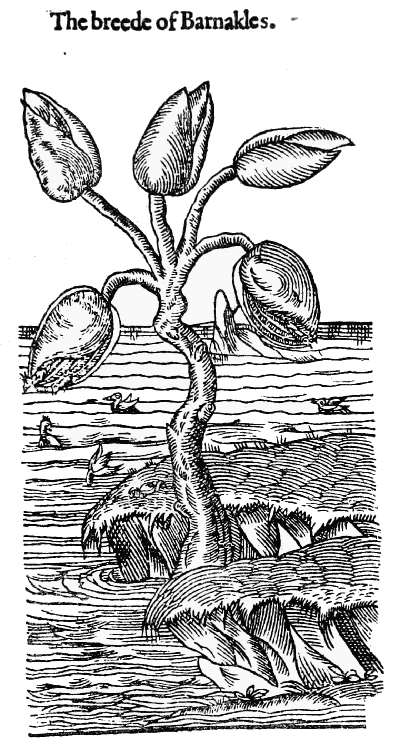
Text-fig. 54. “The breede of Barnakles”
[Gerard, The Herball, 1597].
Hector Boethius [Boece] in his Scottish Chronicle
gives a quaint account of the origin of geese from driftwood
in the sea, “in the small boris and hollis” of which
“growis small wormis. First thay schaw thair heid and
feit, and last of all they schaw thair plum is and wyngis.
Finally quhen thay ar cumyn to the iust mesure and
quantite of geis, thay fle in the aire, as othir fowlis
dois22.”
It is rather surprising to find that William Turner
was a believer in the same myth, although, unlike Gerard,
he took great pains to satisfy himself of the truth of the
story, which he seems to have approached with quite an
open mind. His account is as follows:—
“When after a certain time the firwood masts or planks
or yard-arms of a ship have rotted on the sea, then fungi,
as it were, break out upon them first, in which in course of
time one may discern evident forms of birds, which afterwards
are clothed with feathers, and at last become alive
and fly. Now lest this should seem fabulous to anyone,
besides the common evidence of all the long-shore men of
England, Ireland, and Scotland, that renowned historian
Gyraldus, ... bears witness that the generation of the
Bernicles is none other than this. But inasmuch as it
seemed hardly safe to trust the vulgar and by reason of
the rarity of the thing I did not quite credit Gyraldus, ... I
took counsel of a certain man, whose upright conduct,
often proved by me, had justified my trust, a theologian
by profession and an Irishman by birth, Octavian by name,
whether he thought Gyraldus worthy of belief in this affair.
Who, taking oath upon the very Gospel which he taught,
answered that what Gyraldus had reported of the generation
of this bird was absolutely true, and that with his own eyes
he had beholden young, as yet but rudely formed, and
also handled them, and, if I were to stay in London for a
month or two, that he would take care that some growing
chicks should be brought in to me23.”
The Goose Tree is also figured by de l’Obel and
d’Aléchamps, but it is refreshing to find that Colonna in
his ‘Phytobasanos’ (1592) flatly denies the truth of the
legend.
The importance of Gerard’s ‘Herball’ in the history of
botany is chiefly due to an improved edition, brought out
by Thomas Johnson in 1633, thirty-six years after the
work was originally published. Johnson was an apothecary
in London, and cultivated a physic garden on Snow Hill.
His first botanical work was a short account of the plants
collected by members of the Apothecaries’ Company on an
excursion in Kent. This is of interest as being the earliest
memoir of the kind published in England. Later on,
descriptions of botanical tours in the west of England, and
in Wales, appeared from his pen. But it is as the editor
of Gerard that he is chiefly remembered. He greatly enlarged
the ‘Herball,’ and illustrated it with Plantin’s wood-cuts.
His edition contained an account of no less than
2850 plants. Johnson also corrected numerous errors, and
the whole work, transformed by him, rose to a much higher
grade of value. It was reprinted, without alteration, in
1636.
When the Civil Wars broke out, Johnson, who is said
to have been a man of great personal courage, joined the
Royalists. He took an active part in the defence of Basing
House, and received a shot wound during the siege, from
which he died.
John Parkinson (1567-1650) may be regarded as the
last British herbalist, of the period we are considering,
whose work was of any great interest from the botanical
point of view. His portrait is shown in Plate XIII. Like
Gerard and Johnson, he cultivated a famous garden in
London. In these days of bricks and mortar, it is hard
to realise that gardens of such importance flourished in
Holborn, Snow Hill, and Long Acre respectively. Another
important London garden of the period was that at
Lambeth, belonging to John Tradescant, gardener to
Charles I.
Parkinson became apothecary to James I and botanist
to Charles I. The earlier of the two books, by which he
is remembered, was rather of the nature of a gardening
work than of a herbal. It appeared in 1629 under the
title, ‘Paradisi in Sole Paradisus Terrestris. A Garden
of all sorts of pleasant flowers which our English ayre
will permitt to be noursed up ... together With the right
orderinge planting and preserving of them and their uses
and vertues.’ It has lately become accessible in the form
of a facsimile reprint. The words “Paradisi in Sole” form
a pun upon the author’s name, and may be translated “Of
park-in-sun.” The book was dedicated to Queen Henrietta
Maria, with the prayer that she will accept “this speaking
Garden.”
![Text-fig. 55. “Barberry” = Berberis [Part of a large wood-cut, Parkinson, Paradisus Terrestris, 1629].](https://openoldbooks.sgp1.digitaloceanspaces.com/books/herbals/images/i_159.png)
Text-fig. 55. “Barberry” = Berberis [Part of a large
wood-cut, Parkinson, Paradisus Terrestris, 1629].
The preface to this work is entirely at variance with
the idea that scientific knowledge has only been gradually
acquired by the human race. In Parkinson’s words:—“God,
the Creator of Heaven and Earth, at the beginning
when he created Adam, inspired him with the knowledge
of all naturall things (which successively descended to Noah
afterwardes, and to his Posterity): for, as he was able
to give names to all the living Creatures, according to
their severall natures; so no doubt but hee had also the
knowledge, both what Herbes and Fruits were fit, eyther
for Meate or Medicine, for Use or for Delight.”
Plate XIII
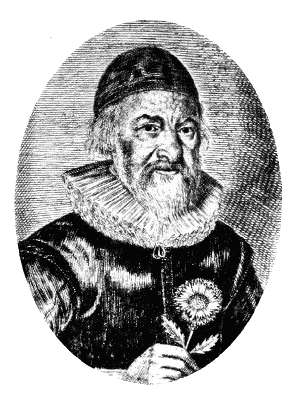
JOHN PARKINSON (1567-1650).
[Theatrum botanicum, 1640.]
Elaborate directions for the planting and treatment of
a garden precede an account of a large number of plants
cultivated at that time, with some mention of their uses.
The book is illustrated with full-page wood engravings
of no great merit, in each of which a number of different
plants are represented (Text-fig. 55 is taken from part of
one illustration). The figures are partly original and partly
copied from the books of de l’Écluse, de l’Obel and
others.
In 1640, Parkinson followed up this work with a much
larger volume, dealing with plants in general, and called
the ‘Theatrum botanicum: The Theater of Plants. Or, an
Herball of a Large Extent.’ He complains that the publication
of the work has been delayed, partly through the
“disastrous times,” but chiefly through the machinations
of “wretched and perverse men.” According to the
preface to the ‘Paradisus Terrestris,’ the author’s original
idea was merely to supplement his description of the
Flower Garden by an account of “A Garden of Simples.”
This scheme grew into one of a more extensive and general
nature, but without losing the predominant medical interest,
which would have characterised the work as originally
planned. In accordance with this intention, the virtues of
the herbs are dealt with in great detail.
Parkinson’s herbal is in some ways an improvement on
that of Johnson and Gerard. Almost the whole of Bauhin’s
‘Pinax’ is incorporated, with the result that the account
of the nomenclature of each plant becomes very full and
detailed. Many of de l’Obel’s manuscript notes are also
inserted. The scheme of classification adopted is, however,
markedly inferior to that of de l’Obel.
Occasionally, in spite of his comparatively late date,
Parkinson displays an imagination that is truly mediæval.
He is eloquent on the subject of that rare and precious
commodity, the horn of the Unicorn, which is a cure for
many bodily ills. He describes the animal as living “farre
remote from these parts, and in huge vast Wildernesses
among other most fierce and wilde beasts.” He discusses,
also, the use of the powder of mummies as a medicine, and
his description is enlivened with a picture of an embalmed
corpse.
The illustrations to the Theatrum Botanicum are of no
importance, being chiefly copied from those of Gerard.
The great British botanists who follow next upon
Parkinson, in point of time, are Robert Morison (b. 1620)
and John Ray (b. 1627), but as their chief works appeared
after the close of the period selected for special study in
this book (1470-1670), and as they were botanists in the
modern sense, rather than herbalists, we will not attempt
any discussion of their writings.
While Morison and Ray were advancing the subject
of Systematic Botany, Nehemiah Grew and the Italian,
Marcello Malpighi, born respectively in 1641 and 1628,
were laying the foundations of the science of Plant Anatomy.
Their work, also, is outside the scope of the present book,
and it is only mentioned at this point in order to show that
the latter part of the seventeenth century witnessed a
considerable revolution in the science. From this period
onwards, with the opening up of new lines of inquiry, the
importance of the herbal steadily declined, and though books
which come under this heading were produced even in
the nineteenth century, the day of their pre-eminence was
over.
The subject of Aristotelian botany scarcely comes
within the scope of a book on Herbals, but, at the same
time, it cannot be sharply separated from the botany of the
herbalists. It therefore seems desirable to make a brief
reference at this point to its chief sixteenth-century exponent,
the Italian savant, Andrea Cesalpino (1519-1603),
and to one or two other writers whose point of view was
similar. We have already shown that, in the Middle Ages,
Albertus Magnus carried on the tradition of Aristotle and
Theophrastus. At the time of the Renaissance, there was
again a revival of this aspect of the study, as well as of the
branch with which we are here more immediately concerned,
that, namely, which deals with plants from the standpoint
of medicine and natural history. Cesalpino (Plate XIV),
it is true, was largely concerned, like the herbalists, with
the mere description of plants, but the fame of his great
work, ‘De plantis libri XVI’ (1583), rests upon the first
book, which contains an account of the theory of botany
on Aristotelian lines.
Plate XIV
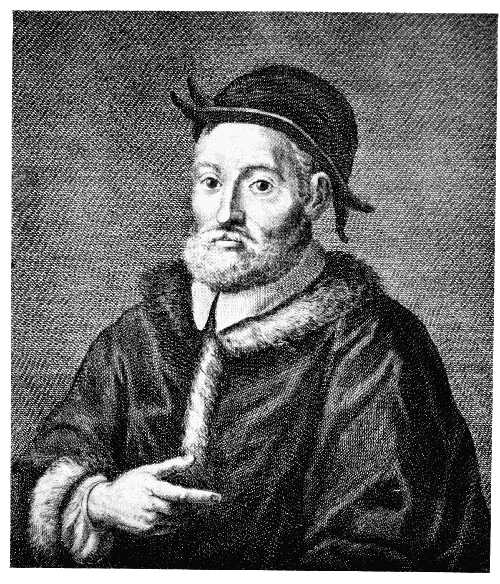
ANDREA CESALPINO (1519-1603).
[Drawn by G. Zocchi and engraved by F. Allegrini, 1765, after an old
portrait in the Museum of the Botanic Garden at Pisa. Print in the
Botany School, Cambridge.]
Cesalpino’s strength lay in the fact that he took a
remarkably broad view of the subject, and approached it as
a trained thinker. He had learned the best lesson Greek
thought had to offer to the scientific worker—the knowledge
of how to think. He had, however, the defects of his
qualities, and his reverence for the classics led him into an
inelastic and over literal acceptance of Aristotelian conceptions.
The chief tangible contribution, which Cesalpino
made to botanical science, was his insistence on the prime
importance of the organs of fructification. This was the
idea on which he chiefly laid stress in his system of classification,
to which we shall return in a later chapter.
A botanist who had something in common with
Cesalpino was the Bohemian author, Adam Zaluziansky
von Zaluzian (1558-1613). His most important work was
the ‘Methodi herbariæ libri tres,’ published at Prague in
1592. As a herbal it does not rank high, since Zaluziansky
neither recorded any new plants, nor gave the Bohemian
localities for those already known. But it opens with a
survey of botany in general, which is of interest as showing
an approach to the modern scientific standpoint, in so far
as the author pleads for the treatment of botany as a
separate subject, and not as a mere branch of medicine.
His remarks on this point may be translated as follows:—“It
is customary to connect Medicine with Botany, yet
scientific treatment demands that we should consider each
separately. For the fact is that in every art, theory must
be disconnected and separated from practice, and the two
must be dealt with singly and individually in their proper
order before they are united. And for that reason, in order
that Botany (which is, as it were, a special branch of
Physics) may form a unit by itself before it can be brought
into connection with other sciences, it must be divided and
unyoked from Medicine.”
Guy de la Brosse, a French writer of the seventeenth
century, discusses the souls of plants and related topics,
quite in the manner of the Aristotelian school. In his
book ‘De la Nature, Vertu, et Utilité des Plantes,’ dedicated
to “Monseigneur le tres-illustre et le tres-reverand
Cardinal Monseigneur le Cardinal de Richelieu,” he treats
of variation within single species, the sensitiveness of plants,
their chemistry and properties, and many other topics. His
work is full of interest, but a discussion of it would lead
us beyond the bounds of our present subject.

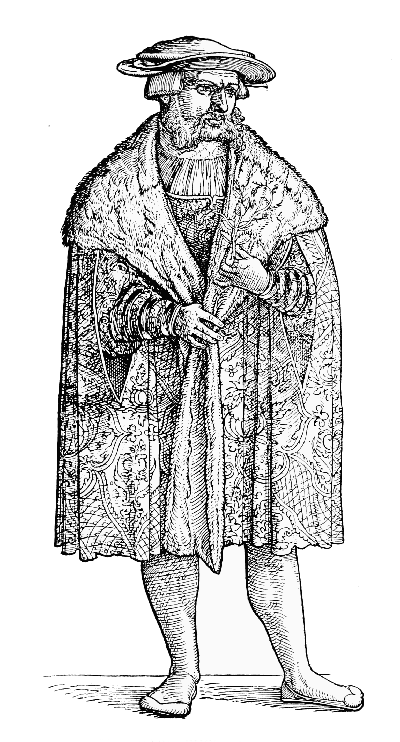
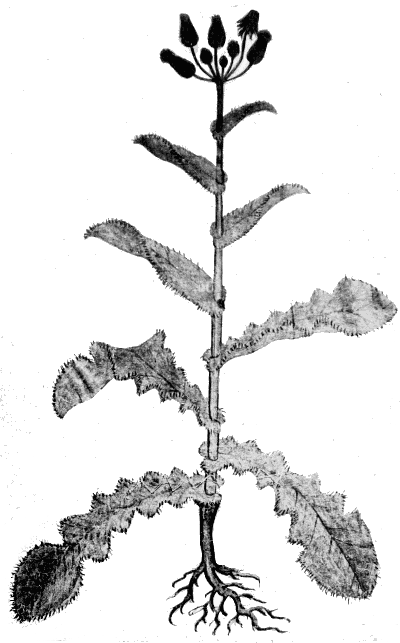
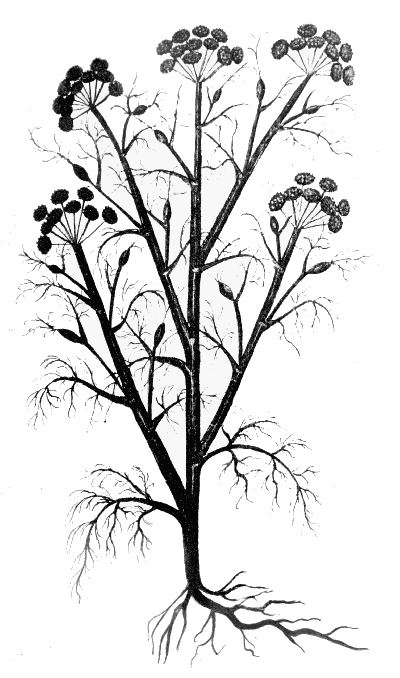
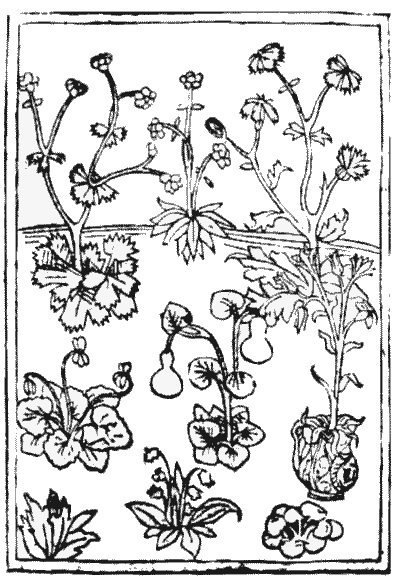
![Text-fig. 1: “Plantago” = Plantain [Herbarium Apuleii Platonici, ? 1484].](https://openoldbooks.sgp1.digitaloceanspaces.com/books/herbals/images/i_039.png)
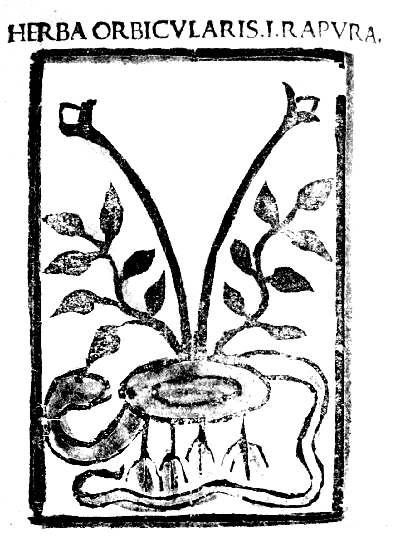
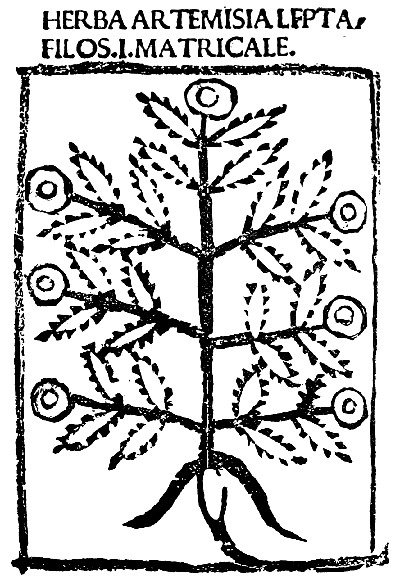
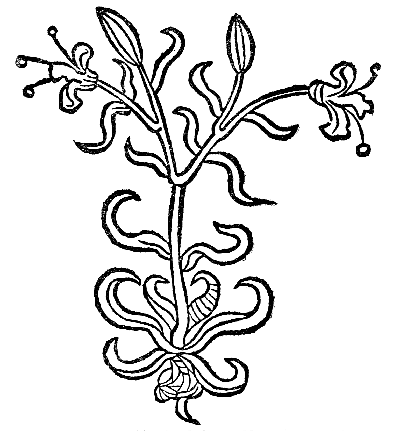
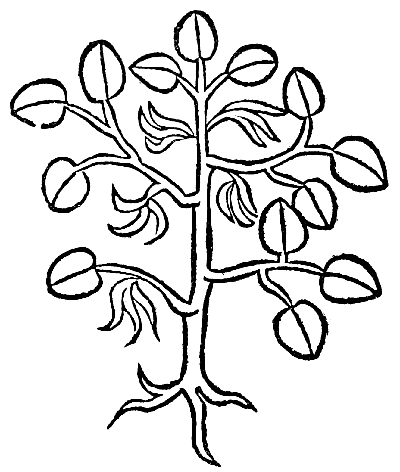
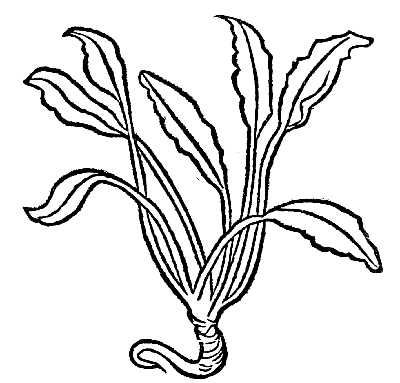
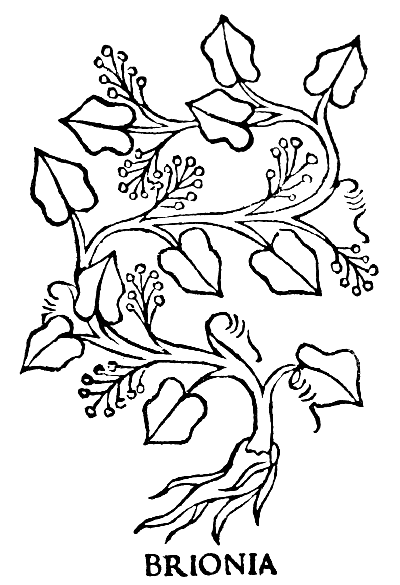
![Text-fig. 7. “Acorus” = Iris [Herbarius zu Teutsch, Mainz, 1485].](https://openoldbooks.sgp1.digitaloceanspaces.com/books/herbals/images/i_052.png)
![Text-fig. 9. “Daucus”=Carrot [Ortus Sanitatis, Mainz, 1491].](https://openoldbooks.sgp1.digitaloceanspaces.com/books/herbals/images/i_055.png)
![Text-fig. 10. “Passer” = Sparrow [Ortus Sanitatis, Mainz, 1491].](https://openoldbooks.sgp1.digitaloceanspaces.com/books/herbals/images/i_056a.png)
![Text-fig. 11. “Pavo” = Peacock [Ortus Sanitatis, Mainz, 1491].](https://openoldbooks.sgp1.digitaloceanspaces.com/books/herbals/images/i_056b.png)
![Text-fig. 12. “Arbor vel lignum vite paradisi” = Tree of Paradise [Ortus Sanitatis, Mainz, 1491].](https://openoldbooks.sgp1.digitaloceanspaces.com/books/herbals/images/i_057.png)
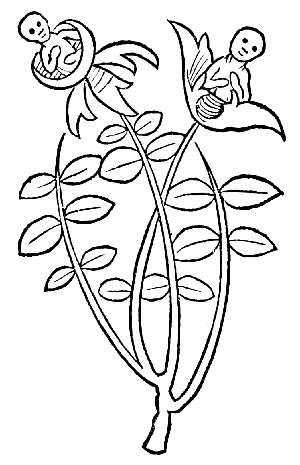
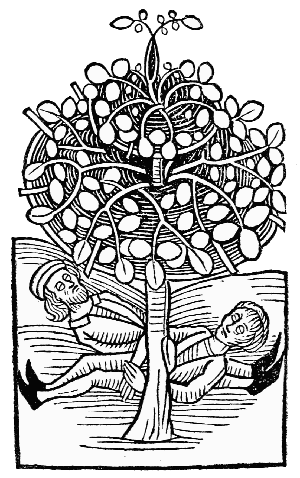
![Text-fig. 15. “Panis” = Bread [Ortus Sanitatis, Mainz, 1491].](https://openoldbooks.sgp1.digitaloceanspaces.com/books/herbals/images/i_060.png)
![Text-fig. 16. “Ambra” = Amber [Ortus Sanitatis, Mainz, 1491].](https://openoldbooks.sgp1.digitaloceanspaces.com/books/herbals/images/i_061.png)
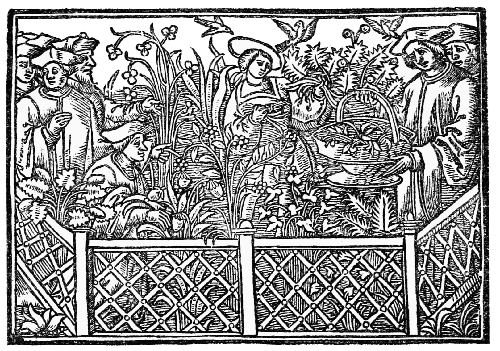
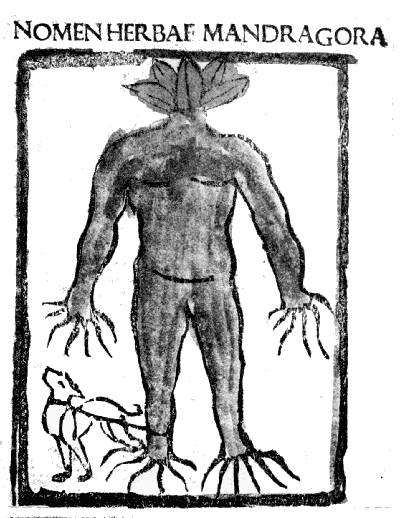

![Text-fig. 19. Wood-cut of Plants [Bartholomæus Anglicus, Liber de proprietatibus rerum, Wynkyn de Worde, ? 1495]. Reduced.](https://openoldbooks.sgp1.digitaloceanspaces.com/books/herbals/images/i_068.png)
![Text-fig. 20. “Yvery” = Ivory [The Grete Herball, 1529].](https://openoldbooks.sgp1.digitaloceanspaces.com/books/herbals/images/i_073.png)
![Text-fig. 21. “Nenufar” = Waterlily [The Grete Herball, 1529].](https://openoldbooks.sgp1.digitaloceanspaces.com/books/herbals/images/i_075.png)
![Text-fig. 56. “Cardamomum” = ? Solanum dulcamara L., Bittersweet [Ortus Sanitatis, Mainz, 1491].](https://openoldbooks.sgp1.digitaloceanspaces.com/books/herbals/images/i_170.png)
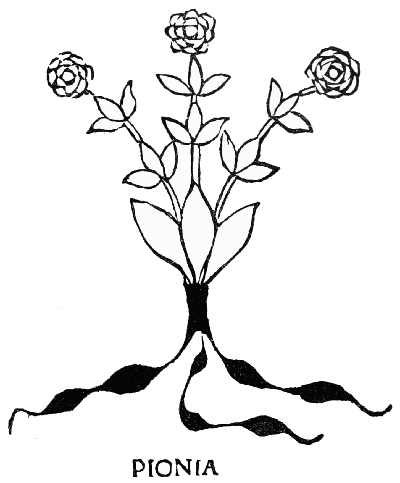
![Text-fig. 58. “Petasites” = Butterbur [Fuchs, De historia stirpium, 1542]. Reduced.](https://openoldbooks.sgp1.digitaloceanspaces.com/books/herbals/images/i_175.png)
![Text-fig. 58. “Petasites” = Butterbur [Fuchs, De historia stirpium, 1542]. Reduced.](https://openoldbooks.sgp1.digitaloceanspaces.com/books/herbals/images/i_177.png)
![Text-fig. 60. “Battata Virginiana” = Solanum tuberosum L., Potato [Gerard, The Herball, 1597].](https://openoldbooks.sgp1.digitaloceanspaces.com/books/herbals/images/i_178.png)
![Text-fig. 61. “Rose Ribwoorte” = an abnormal Plantain [Gerard, The Herball, 1597].](https://openoldbooks.sgp1.digitaloceanspaces.com/books/herbals/images/i_180.png)
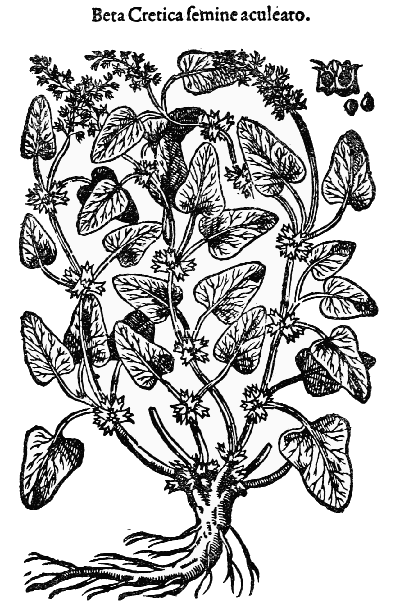
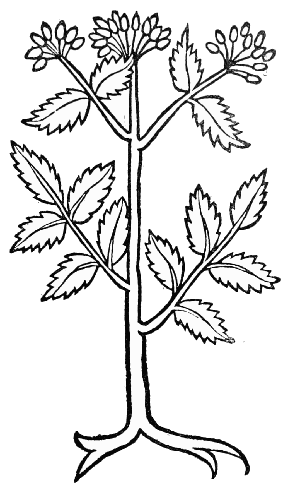
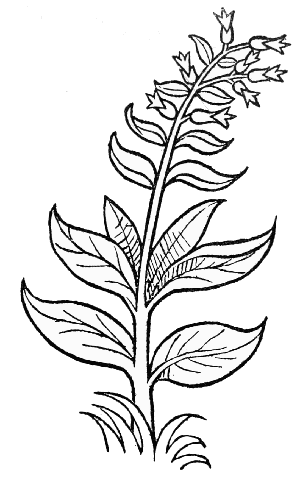
![Text-fig. 65. “Nenufar” = Waterlily [Arnaldus de Villa Nova, Tractatus de virtutibus herbarum, 1499].](https://openoldbooks.sgp1.digitaloceanspaces.com/books/herbals/images/i_188.png)
![Text-fig. 66. “Nenuphar” = Nymphæa alba L., White Waterlily [Brunfels, Herbarum vivæ eicones, Vol. I. 1530]. Reduced.](https://openoldbooks.sgp1.digitaloceanspaces.com/books/herbals/images/i_190.png)
![Text-fig. 67. “Gele Plompen” = Nuphar luteum Sm., Yellow Waterlily [de l’Obel, Kruydtbœck, 1581].](https://openoldbooks.sgp1.digitaloceanspaces.com/books/herbals/images/i_191.png)
![Text-fig. 68. “Ninfea” = Waterlily [Durante, Herbario Nuovo, 1585].](https://openoldbooks.sgp1.digitaloceanspaces.com/books/herbals/images/i_193.png)
![Text-fig. 69. “Tussilago” = Tussilago farfara L., Coltsfoot [Fuchs, De historia stirpium, 1542]. Reduced.](https://openoldbooks.sgp1.digitaloceanspaces.com/books/herbals/images/i_196.png)
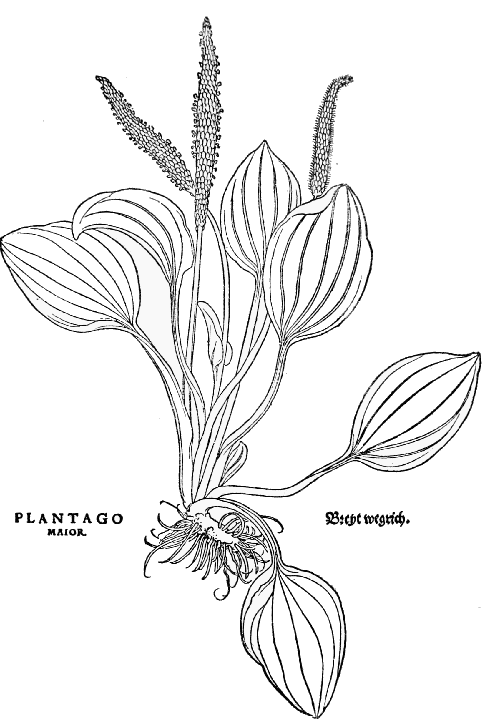
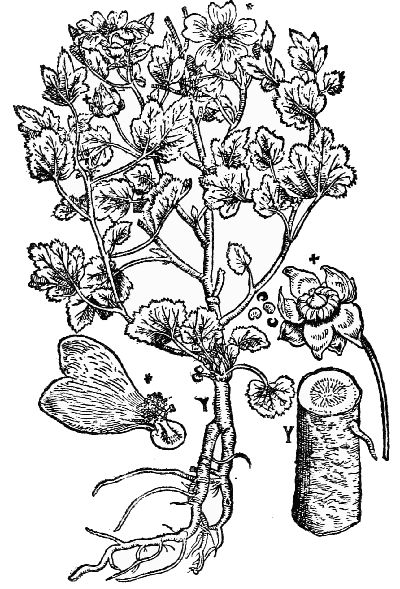
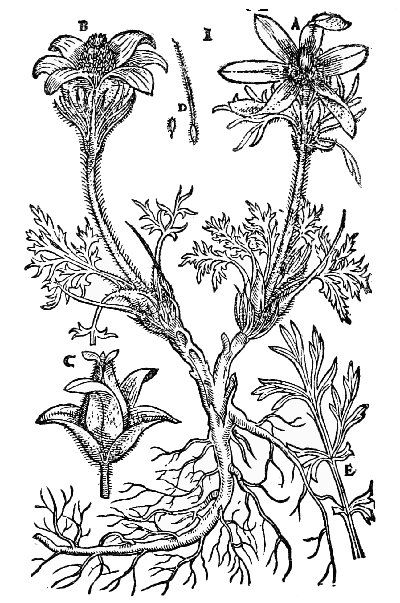
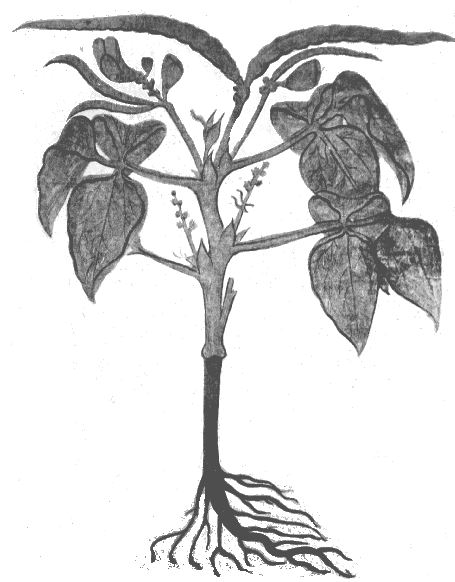
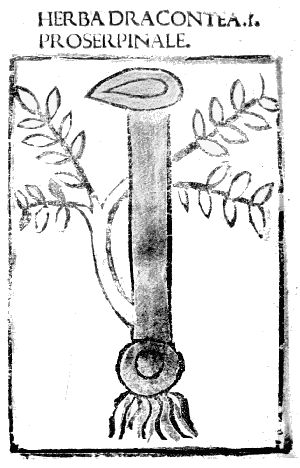
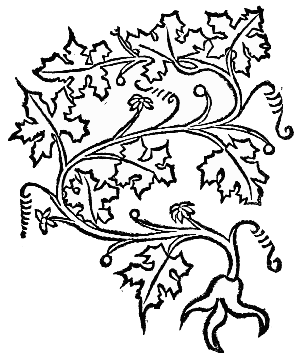
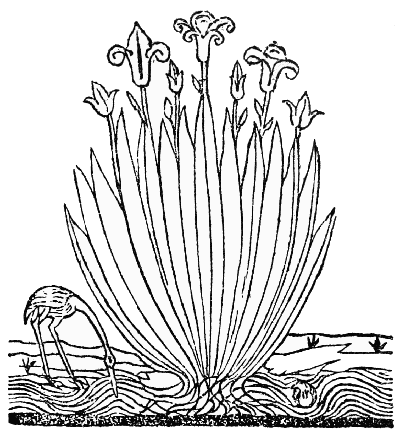
![Text-fig. 75. “Capillus Veneris” = Maidenhair Fern [Arnaldus de Villa Nova, Tractatus de virtutibus herbarum, 1499].](https://openoldbooks.sgp1.digitaloceanspaces.com/books/herbals/images/i_213.png)
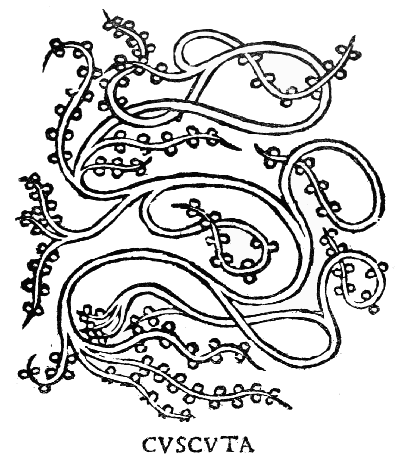
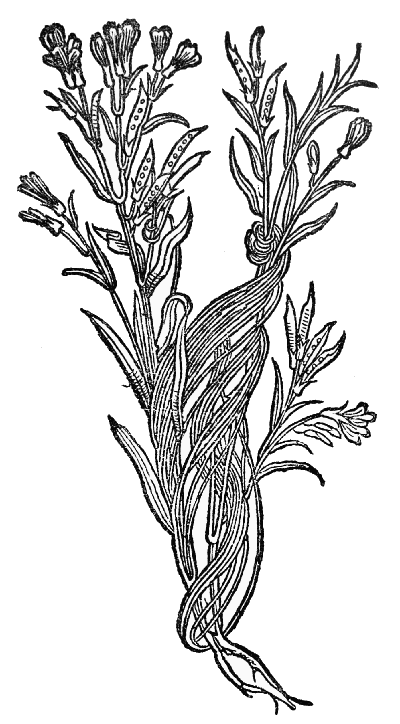
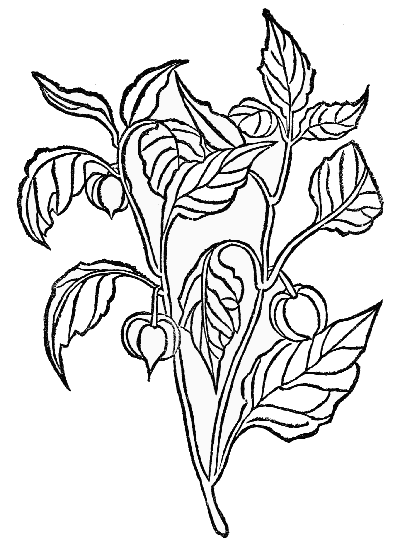
![Text-fig. 79. “Alkekengi” = Physalis, Winter Cherry [Ortus Sanitatis, Mainz, 1491].](https://openoldbooks.sgp1.digitaloceanspaces.com/books/herbals/images/i_218.png)
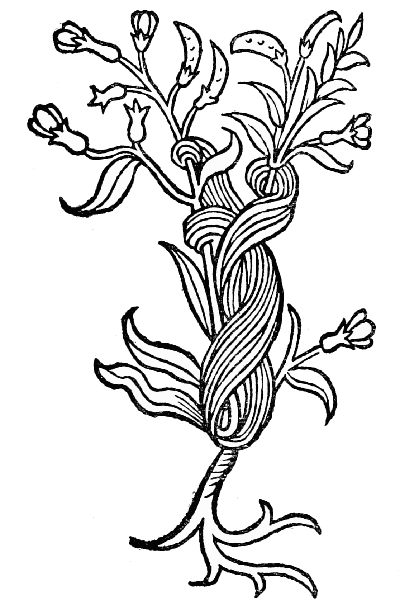
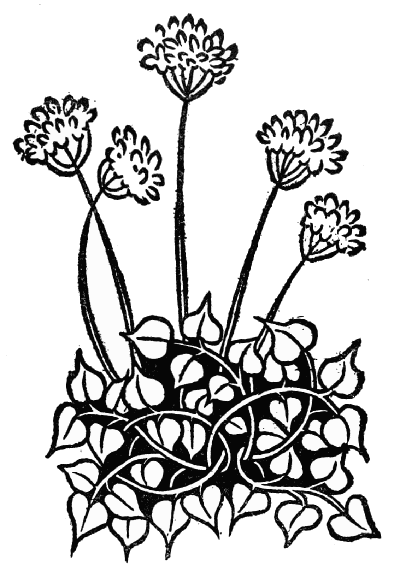
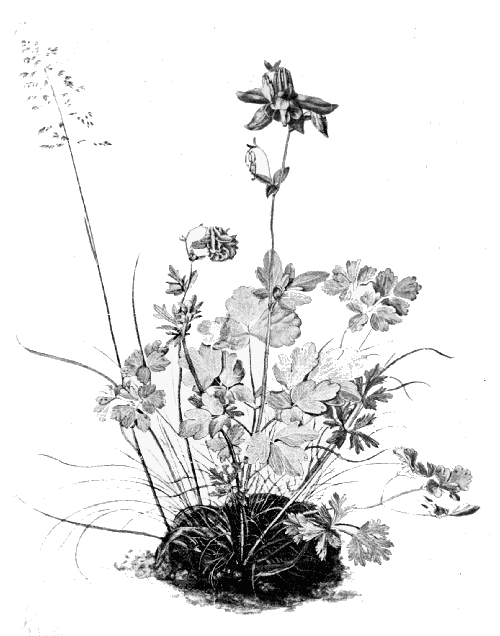
![Text-fig. 82. “Asarum” = Asarabacca [Brunfels, Herbarum vivæ eicones, Vol. I. 1530]. Reduced.](https://openoldbooks.sgp1.digitaloceanspaces.com/books/herbals/images/i_224.png)