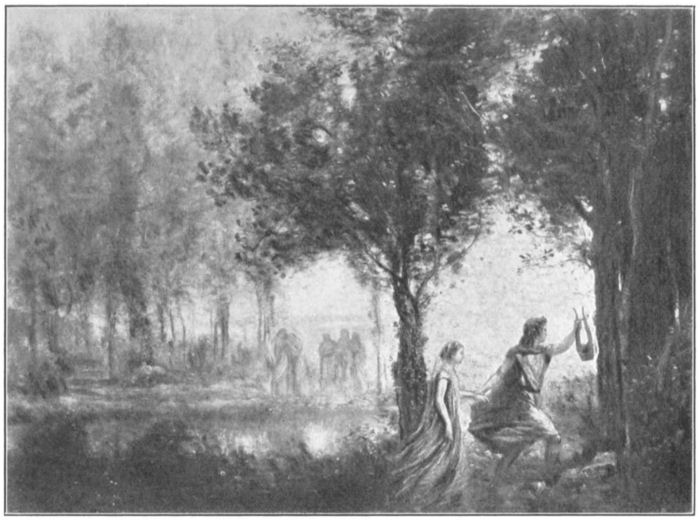
INTRODUCTION THE LAND OF THE HEROES
One look at the map of Greece will show us
that it is the smallest of European countries.
For many hundreds of years it was inhabited
by the handsomest, bravest, and most intelligent
people in the world. But these people,
the Greeks, or Hellenes, as they called themselves,
had not always lived in the country.
Thousands of years before the Hellenes came
to Greece it was a perfect wilderness of mountains,
narrow valleys, torrents, and tangled forests.
It was a land of wild beasts, and they
were so numerous and fierce that there was
almost no room for men.
Yet men did live there, but we know nothing
about them or what they were like, except that
they hid in caves and had hardly got beyond
the art of making fire, trapping and killing the
less dangerous animals with sticks or little arrows
pointed with stones, and using their meat
for food and hides for clothing.
xii]
Then the new people, the Greeks, began to
come into the country. They came in boats
from across the sea and on foot from the north,
through numberless mountain-passes. They
did not come all at once, but in small detachments,
in single tribes, so that it took them
many years to spread over the country.
The new race was nobler than the old, more
advanced in knowledge and in the arts of civilized
life. It was not a race to be content with
caves and forest-dens, but each tribe, after it
had chosen a district and taken possession of
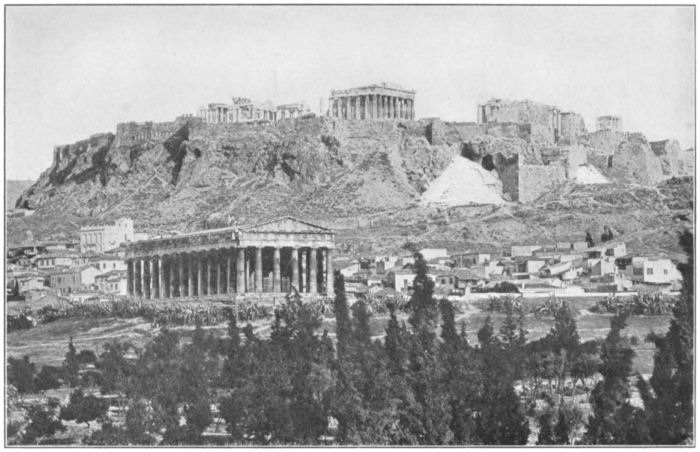
it, selected some high hill, built rude dwellings
upon it and temples to its patron gods, a public
treasure-house also, and enclosed the hill with
strong walls. It had become a fortress, and
was called Acropolis, in their language.
Each tribe, of course, had its leaders, usually
belonging to some family which had earned the
gratitude and loyalty of the people by brave
and affectionate service, and the leadership descended
from father to son. These were the
kings and they resided within the Acropolis.
Around it and under the protection of its
walls the people built their own huts and began
to clear the land. They sowed various crops,
planted the vine and the olive, and raised herds
of sheep and goats. There was room enough
xiii]
within the walls for all the families, with their
herds, to find shelter in the Acropolis in times
of danger, from the attacks of the wild natives
or of the still wilder beasts of the forests and
fields.
Now these latter were by far the most dangerous
enemies of the new settlers, who soon
found that they could venture but a few miles
from their small home-farms without encountering
huge and ferocious animals which the
increased herds attracted and which their miserable
weapons were utterly insufficient to slay
or even put to flight.
Each small district had its particular terror,
just as many districts of India now have a man-eating
tiger, which makes miles and miles of
country around unsafe for man or beast.
It became a question which of the two, the
men or the wild animals, would remain in possession.
Then young and courageous men,
sons of the ruling families, athletes in strength,
practised in the arts of war, commanding
through their greater wealth the use of better
weapons, felt it their duty to their people to do
for them what the poor herdsmen and laborers
had neither the strength nor the skill to do for
themselves.
From all the central royal cities they started
xiv]
singly or in small troops, a bevy of young
heroes, as eager for the delights of adventure
as for the public good. Year after year they
wandered across country seeking the most impassable
wildernesses, directed by the stories
they heard on their way to the dens of the
cruel monsters, which they usually overcame
by force or cunning.
Then they would return to their homes triumphant,
bearing the proof of their incredible
prowess, the hides, or horns, or heads of the
monsters they had slain. Thus they put new
heart into their people. Their trophies seemed
to say: “You see these creatures were not so
terrible as they might have been; what we
have done others can do.” So they did a
double good—one immediate by the destruction
of the dreaded foes and by the opening of the
land to the planters and the tillers; the other
even more far-reaching and more beneficent
in its results by raising men’s spirits, inspiring
them with confidence and with the ambition to
show that they were not mere helpless boors,
cowed and dependent on their betters.
The Greek nation in years to come proved
itself a nation of heroes and was so called by
fame. But who can tell how much these heroes
were indebted for this honorable distinction
xv]
which has remained by them to this day, to the
early vigorous education which those doughty
champions of old imparted to them, not by
preaching or advice, but by their own dauntless
example.
Can we wonder if their people’s passionate
gratitude and unselfish admiration survived
those glorious men through ages? Can we
wonder if after centuries had come and gone
the memory of their deeds and persons appeared
to later generations through a halo of
wonder and awe?
Deeds of a remote past always assume gigantic
proportions. “Surely,” men would say,
“surely, those heroes were more than ordinary
mortals! They had more than human strength,
endurance, wisdom. Neither iron fang nor
claw of steel could harm them. They died, indeed,
but of their nature they must have been
half divine; their mothers were human, but
surely the gods themselves were their fathers.”
And thus it was settled, and for many, many
hundreds of years the Greeks continued to
honor their ancient heroes as half-divine men,
or demi-gods, and to erect altars to them and
come to them with prayers and offerings. The
Greek had to grow in mind and soul high
enough to grasp the truth that there can be
xvi]
only one God, and that no man, high as he may
tower above his kind, can be more than human.
But it was a beautiful and ennobling belief,
and at first sight it seems a pity that it was
ever lost, yet in reality it was a great gain, for
men may think they have an excuse for not
putting forth their bravest efforts if they believe
that the gods only can achieve deeds of
courage. There is no reason why men may
not aspire to any height of bravery which has
been gained by other men.
The undying energy embodied in the characters
of these old heroes is the inheritance of
every child. The children of America are not
born the sons of ruling houses. But they are
destined to be the guardians and rulers of their
native land. And if the children take into their
future lives the heroism they first realize in ancient
story, they will find themselves, when the
time comes, armed with the same courage, endurance,
and love of human beings which have
made the heroes of all lands and ages.
CHAPTER I THE BABE HERAKLES
1]
HERAKLES
AND OTHER HEROES OF THE MYTH
Far away in the land of Argos there once
lived a beautiful maiden, the daughter of a
brave king. She was tall and fair and her
name was Alkmene. Her father was rich in
the possession of many oxen.
Her husband also owned great herds of
oxen. He had so many that he could not tell
them from those of the king. So he quarrelled
with the king and slew him. Then he took
Alkmene and fled from his native land. They
came to Thebes and made it their home.
Here Herakles was born, the babe who was
stronger than the strongest of men. The goddess,
Hera, hated Herakles. She was the wife
of Zeus, the Lord of Thunder and King of
Heaven. Hera was angry because Zeus loved
him, and she was jealous because Zeus had
2]
foretold that Herakles would become the
greatest of men. More than that Zeus had
deceived Hera and sent the infant Herakles to
her to be nursed that he might be made strong
and god-like by tasting divine milk.
So Hera sent two large snakes to devour the
babe when she found out what child it was
that she had fed. Herakles lay asleep in the
great brazen shield which his father carried in
battle, for he had no other cradle. The fearful
serpents crept up with open mouths into
the shield with the sleeping babe.
As soon as Alkmene saw them she was terribly
frightened and called in a loud voice for
help. His father, hearing the outcry of Alkmene,
ran into the house with his sword drawn
and a great many warriors came with weapons
in their hands.
Herakles was only eight months old, but before
his father could reach him he sat up in his
bed and seized the serpents by their necks
with his little hands. He squeezed and choked
them with such force that they died.
When Alkmene saw that the two snakes
were dead and that Herakles was safe, she rejoiced
greatly. But Hera’s heart was filled
with wrath and she began to plan more mischief
against the child.
3]
Herakles had his free will as long as he was
a boy. His teachers were celebrated heroes
who taught him boxing, wrestling, riding, and
all kinds of games. He learned to read and
write and to hurl the spear and shoot with
bows and arrows. Linos taught him music.
Herakles had a violent temper, and one day
as Linos was teaching him to play the lute,
the good teacher had reason to punish him.
Herakles flew into a rage at this and struck
Linos and killed him. Then his father sent
him to the hills and left him to the care of
herdsmen.
The boy grew to be very large and strong.
While he was yet a youth he slew a lion of
great size that had killed many of his father’s
cattle. He went home wearing the lion’s
skin as a sign of his victory.
Because he was so brave the King of
Thebes gave his daughter to him in marriage
and he lived happily with her for many years.
But a sudden insanity came upon him during
which he mistook his wife and children for
wild beasts and shot them down with his bow
and arrows. When Herakles recovered from
his insanity and saw what he had done his
grief was boundless.
CHAPTER II HERAKLES IS DOOMED TO SERVE EURYSTHEUS
The wrath of Hera followed Herakles.
When Zeus saw that Hera’s heart was filled
with anger toward Herakles, he mused within
his own mind how he might best appease her
resentment and protect the young man.
So he called the gods together in council and
they advised that Herakles be placed in bondage
to his uncle Eurystheus, to serve him as a
slave, and they ordained that he should perform
twelve hard tasks, after which he would
be numbered among the gods.
Eurystheus was a mean fellow, stupid and
cowardly. He was glad enough to have a
chance to bully a man wiser and stronger than
himself. He was born in Tiryns, a great fortress
with many castles, built upon a large rock,
but he had been made King of Argos and lived
in the capital, Mykenæ, and he resolved to keep
Herakles as far away from the kingdom as possible,
for in his heart he was afraid of him.
Herakles was grieved at being compelled to
serve a man so much below him in strength
and character, so he consulted the oracle at
5]
Delphi to see if there was any escape, but he
did not murmur, for he was willing to obey the
law of the gods.
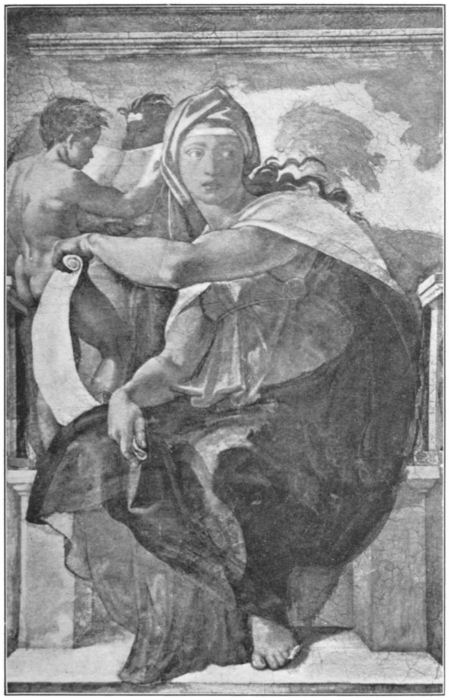
The oracle of Delphi was a mysterious influence,
a divine spirit which expressed itself
through a priestess living in a sacred temple.
It was supposed to be the voice of the god
Apollo using this human agency for making
known his will to men. The priestess became
inspired to utter Apollo’s holy laws by sitting
on a golden tripod (or stool with three legs)
over a chasm in the rock, from whence arose a
sacred, sulphurous vapor which she breathed
in as the breath of the god, and which caused
her to breathe out his commands in wonderful
sayings.
The chasm from which the vapor issued was
called The Chasm of the Oracle, and was in a
large apartment or room in the temple. This
celebrated temple had many columns of marble
and splendid rooms made beautiful with thousands
of marble statues. It stood on the side
of Mount Parnassos, whose snow-covered head
reaches into the clouds and looks down into
the blue Gulf of Corinth below it to the
south.
It was here that Apollo killed the great
dragon, Pytho, which had been the scourge of
6]
the land for many years, and the grateful people
built the temple in his honor. The oracle
bade Herakles go forth to be the slave of Eurystheus
and so atone for all his sins, but it gave
him as a compensation a dear friend, Iolaos,
who was also his young nephew. Wherever
Herakles went Iolaos went with him and
helped him.
CHAPTER VI THE FOURTH LABOR—THE ERYMANTHIAN BOAR
Elis is a beautiful plain lying to the north
and west of Arcadia. Here once in five years
there was a great festival in honor of Zeus,
when all the men and boys ran races, wrestled,
boxed and played all sorts of games. Between
Arcadia and Elis there is a high mountain-range,
called Erymanthos. There a terrible
Boar had its lair.
The Boar frequently left its den and came
down into the plains and killed cattle, destroyed
fields of grain and attacked people.
Eurystheus, having heard of this Boar, made
up his mind that he wanted the beast alive, and
so ordered Herakles to bring it to him.
The hero put on his lion skin once more and
started for the mountain. On his way he
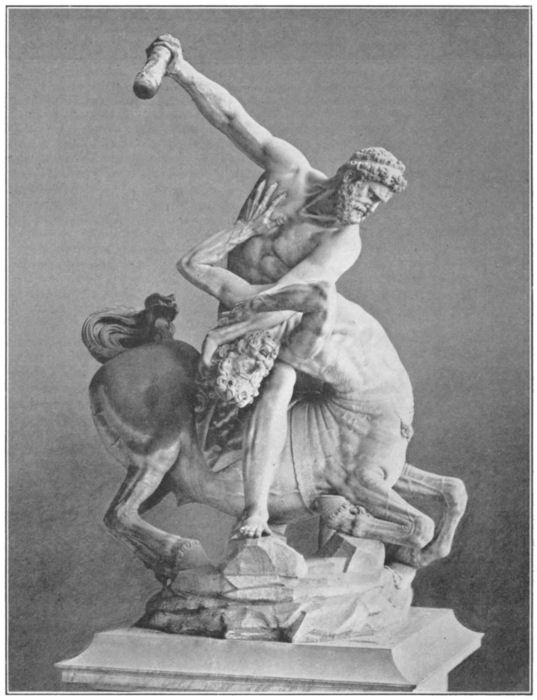
stopped at a little town where the Centaurs had
their home. These strange people were half
man and half horse. We have heard that they
were really men, but such good riders that they
seemed to be one with their mountain ponies.
Their home was just on the edge of a high
plain, covered with oak-trees and looking down
16]
across a wild valley, through which flowed the
Erymanthos River. There were many forests
and little streams and dreadful gorges in the
valley, where these horsemen used to hunt
and fish.
The Centaur Chief, Pholos, received Herakles
as a guest and gave him cooked meat to
eat, while he ate it raw himself, after the Centaurs’
custom.
When Herakles had eaten his fill, he said to
Pholos: “Thy food is indeed good and tasteful.
But I should enjoy it still more if I could
have a sip of wine, for I am very thirsty.” To
which Pholos replied: “My dear guest, we
have very fine and fragrant wine in this mountain,
and I should like nothing better than to
give thee some of it. But I am afraid to do so,
because it has a strong aroma, and the other
Centaurs, if they smelt it, might come to my
cave and want some. They are very fierce and
lawless, and might do thee great harm.”
“Let not that trouble thee,” said Herakles.
“I am not afraid of the Centaurs.” So the
wine was placed before him and he drank of it.
In a little while a great noise was heard outside
of the cave, a shouting of many wild
voices and a stamping of many horses’ feet.
What Pholos feared had come to pass.
17]
The Centaurs had smelt the fragrance of the
wine and in full armor had made for the cave
of Pholos. Then began a terrible fight. The
Centaurs fell upon Herakles with pine-branches,
rocks, axes, and fire-brands, and the clouds,
their mothers, poured a flood of water on him.
But Herakles was too clever for them. He put
two to flight, prevented others from entering
the cave, and shot the rest down with his arrows.
Pholos was a kind-hearted chief, and hearing
one of the Centaurs crying for help outside of
his cave, went out to him and tried to pull the
arrow from his wound, wondering at the same
time that so slight a weapon could cause his
death. But the arrow slipped out of his hand
and struck his own foot. It made only a
scratch, but it could not be healed, for the
arrow was one of those which Herakles had
dipped in the blood of the Hydra, and poor
Pholos breathed his last.
The death of his kind host was a great sorrow
to Herakles, for in those times, when there
was so little safety in travelling, the bond of
kindness and gratitude between host and guest
was one of the closest and most sacred, often
more so than that between members of the
same family. In all their later lives, host and
18]
guest could never meet as enemies, and if the
chances of war brought them face to face as
foes, they were not expected to fight. They
exchanged greetings and gifts and drove off in
different directions.
Herakles therefore sincerely mourned his
friend, performed over him the proper funeral
rites, and buried him with all due honors in the
side of the mountain. There he left him, sore
at heart, but comforted by knowing that he
had done all he could do to reconcile the shade
of Pholos, and that his soul would bear him no
grudge in Spirit Land.
Then Herakles went on his way in search of
the Boar. He soon spied him in a dense
thicket and chased him to the very top of the
mountain. The mountain-top was covered with
deep snow, which prevented the Boar from
running fast enough to escape. So Herakles
ran up to him, caught him in a net, threw him
over his shoulder and carried him off alive to
Mykenæ.
It is said that Eurystheus hid himself in a
large brazen bowl when he heard Herakles
approaching the city, and that Herakles threw
the Boar into the same brazen bowl as the
safest place in which to keep him. How astonished
Eurystheus must have been to find
19]
himself in such terrible company! And we
can fancy that he scrambled out with all possible
haste.
CHAPTER XII THE TENTH LABOR—THE CATTLE OF GERYON
Iberia, now called Spain, lies at the farthest
end of Europe, and beyond it, in the Atlantic, is
an island which was once the home of Geryon,
a famous giant. His body was as large around
as three other men’s bodies put together. He
had three heads and three pairs of legs and six
31]
arms. He had huge wings also and carried
dangerous weapons.
Geryon was the lord of many herds of cattle.
He had one herd of red oxen, as red as
the sky at the setting of the sun, and they were
guarded by a trusty herdsman and a fierce two-headed
dog. Eurystheus ordered Herakles to
bring the cattle to Mykenæ.
Herakles having overcome numberless difficulties,
wandering through wild deserts and
unknown lands, finally reached the open ocean,
the end of all. There he erected as a monument
two pillars opposite each other, one on
the African shore, and one in Europe. These
were called the Pillars of Herakles in those
days, but now they are known as the Rocks of
Ceuta and Gibraltar.
Helios, the Sun, admiring the bravery of
Herakles, lent him his golden skiff, shaped like
a cup. Helios always sailed round the world
every night from west to east in this cup, and
Herakles, although he feared a storm, took his
place in the strange boat and started for the
island where Geryon tended his red cattle.
The world, as the Greeks saw it, was in the
form of a great plate, and the ocean was a river
surrounding it as the rim surrounds the plate.
When the two-headed dog saw Herakles he
32]
rushed at him with fury, and the herdsman also
attacked him at the same time. Herakles slew
them both with his club, took the cattle and
fled toward the boat. Then Geryon sprang
upon him and forced him to fight for his life.
They had a dreadful battle, in which Herakles
drew his bow and shot at the giant with one of
his deadly arrows and Geryon died.
Herakles at once drove the oxen down to
the boat, and after a safe voyage landed them
in Iberia. Then he started for home on foot,
driving his cattle northward over the Pyrenees
into Gaul or France. Here he was attacked
by hundreds of people who wanted to rob him
of his cattle.
Herakles shot at them with his arrows and
killed great numbers, and they stoned him
in return with large stones. Herakles would
have lost the battle but Zeus sent down a
shower of rocks of vast size, and Herakles
hurled them at his foes, driving them away
like frightened sheep. These enormous rocks
are still to be seen in the south of France.
After this adventure Herakles drove his cattle
over the Alps and down into Italy across
the Tiber, and they came to the Seven Hills of
Rome. In one of these hills there was a cave,
the home of a lawless giant named Cacus.
33]
He was a creature of iron strength, and was
hideously ugly. He breathed out fire and
smoke, often killing people in this way, and
everybody in all the country about feared him.
Cacus saw Herakles coming with his cattle
over the river and among the hills, and he determined
to steal the cattle and hide them in
his den.
So when Herakles was asleep and the cattle
were grazing quietly, Cacus slipped out of his
cave and, seizing great numbers of them by the
tails, dragged them backward into the cavern
that their tracks might point away from the
cave and not toward it. When Herakles awoke
he missed his cattle and began to look for
them. He found their tracks and went in the
direction they seemed to point out, getting
farther and farther from their place of hiding.
The oxen bellowed, and their noises were muffled
by the rocks of the cavern, but Herakles
heard them and returned to the Seven Hills.
Listening intently he traced them to the right
hill, but Cacus had braced a stone slab against
the opening and it could not be moved from
the outside.
Herakles went around to the other side of
the hill and, tearing the stones away, forced a
new entrance. He sprang into the cave and
34]
seized the terrible monster by the throat. Cacus
blew flames into the hero’s face and tried
to burn him to death, but Herakles held on and
strangled the giant to death. A volume of
black smoke came from his mouth and a stream
of melted lead as he fell back dead. Herakles
tore the slab from the door of the cave and
threw the body of Cacus out on the hill, and
all the people came to see it and rejoice that
their foe was slain. And they built an altar to
Herakles and instituted games to be held every
year in his honor.
Herakles left the Seven Hills and drove his
cattle southward. Being tired, he lay down
to rest on a mountain near Locri, and the grasshoppers
came around him singing in such shrill
tones that he could not sleep. He prayed to
the gods to drive them away, and the gods
swept them out of that region so that they
never came back.
One of the wild oxen ran away to the southwest
and escaped to an island. Herakles followed,
driving the whole herd over to the island.
The cattle swam across, and Herakles,
sitting on the back of one of the oxen and holding
on by its horns, was safely taken over. He
captured the runaway and wandered for a long
time through the island, enjoying the fresh
35]
water of the springs and the kindness of the
people. Then he drove his cattle back to Italy
and passed up the shores of the Ionian Sea.
But Hera sent gadflies to make the cattle
wilder than they were before, and they scattered
over the mountain-heights as clouds are
scattered by a hot wind. They fled far to the
east, until they came to Thrace. There Herakles
gathered together as many as he could
and brought them to Mykenæ, where Eurystheus
sacrificed them to Hera.
CHAPTER XIII THE ELEVENTH LABOR—THE GOLDEN APPLES OF HESPERIDES
When the wedding between Zeus and Hera
was celebrated all the gods brought presents.
Mother Earth brought some apple-trees as her
gift. These trees bore precious golden apples,
and Zeus and Hera were so pleased with their
wonderful wedding-present that they appointed
four maidens, called the Daughters of the
West, to guard the apples, and also they placed
a dragon there with a hundred heads, who
never slept.
36]
The fruit was so inviting that even the maidens
would have been tempted to eat it if the
terrible dragon had not kept close to the tree.
A roar like thunder came out of each of his
hundred mouths and frightened everything
away that dared approach the trees, and lightning
darted from his eyes to strike down intruders.
The trees grew more and more beautiful
from year to year, and the apples were so
heavy that the boughs bent beneath the golden
load. They grew in the Garden of the Hesperides,
in islands way off to the west, and
were watered by springs of nectar which had
their rise near the throne of Zeus.
Eurystheus had heard of the apples and he
ordered Herakles to bring them to him. For
a long time Herakles wandered about in various
lands until he came to the river Rhone,
where the water-goddesses or nymphs advised
him to ask counsel from the ancient lord of the
deep sea, who knew all the secrets of the ocean
depths and whose wisdom was beyond that of
the gods. He is called by many names, but
his gentlest name is Nereus, and he does not
like to be questioned unless he can take any
shape he pleases.
He usually escapes intruders, but to those
37]
who are not afraid and who manage to grasp
and to hold him, he freely opens the store of
his wisdom. This was what Herakles did.
Nereus took on the form of a lion, a serpent,
a fish, a stream of water, and at last, of an old
man, but Herakles held him close and learned
from him the road to the Garden of the Hesperides.
Leaving Nereus, Herakles travelled south into
Africa, where he met Antæos, a huge giant who
lived in the desert. Antæos was a son of Earth
and Ocean, and he was as strong as the terrible
sand-storms. He was cruel to all travellers
who crossed his domains and slew them, but
he loved and protected the tiny Pygmies that
lived all around him. No one had ever been
able to vanquish him in battle, for Mother
Earth gave him new strength and vigor every
time he lay down or touched the ground.
Herakles wrestled with him and threw him
down many times, but Antæos sprang up
stronger than ever. At last Herakles caught
him up with one hand, and holding him high in
the air where he could not receive help from
Mother Earth, squeezed him to death.
Herakles was tired out with this tremendous
exertion and lay down in the desert to
rest. But he did not sleep long, for a whole
38]
army of the little people, seeing their beloved
giant lying dead, came with their weapons to
attack Herakles. He found himself covered
with them from head to foot. He sprang up, and
quickly gathering up his lion’s skin, crushed a
multitude of the Pygmies and killed them.
Then he hurried away toward the east,
going through many countries until he came
to India, and finding himself travelling in the
wrong direction, turned to the north and west
and came to the Caucasus Mountains. Here
he found Prometheus chained to the rocks of a
high mountain-peak. Prometheus had taught
mankind the use of fire and how to build
houses and had otherwise interfered with the
work of the gods, thereby bringing this punishment
upon himself. Herakles took pity on
him and set him free. In return for this kindly
act Prometheus told him the most direct
way to the Garden of the Hesperides, which
was through Scythia and the region of the
Hyperboreans at the back of the North Wind.
On his way Herakles stopped to visit Atlas,
who as a punishment for once having rebelled
against the gods was obliged to carry the
heavens on his shoulders. “Let me relieve
thee for awhile, friend Atlas,” said Herakles,
after greeting him in a most cordial manner.
39]
“Let me take the heavens on my shoulders and
I will let thee do me a great service in return.
I must have the Golden Apples that grow in
the Garden of the Hesperides to take to Eurystheus,
and thou canst bring them to me.”
Atlas gladly placed the heavy firmament on
Herakles’ shoulders and took his way to the
Garden. There he contrived to put the many-headed
dragon to sleep and then slay him.
Taking possession of the Golden Apples, he
returned with them to Herakles.
“I thank thee very much, friend Atlas,”
said Herakles. “Take thy place again and
give me the apples.”
“Nay, I have borne the weight of the
heavens for a long time,” answered Atlas.
“Thou hadst better keep my place and I will
carry the Golden Apples to Eurystheus.”
Herakles was taken aback at this reply and
began to consider how he might escape from
this unexpected dilemma. At last he spoke.
“Very well, I will willingly remain in thy
place, friend Atlas,” he said. “One thing only
I must first ask of thee. Take the heavens
back just for a moment while I get a pad to
put on my head so that the weight may not
hurt it. Otherwise the heavens will fall and
crush us both.”
40]
Poor, simple old Atlas agreed to this, and
putting the Golden Apples on the ground he
again took the firmament on his shoulders.
Herakles picked up the apples and went off
saying, “We must not bear malice toward
each other, friend Atlas. Good-by.”
With this he departed and hastened back to
Mykenæ.
CHAPTER XV THESEUS, THE HERO OF ATHENS
The land of Attica is very different from
Arcadia. It was cleared at a much earlier time
than the southern part of Greece, which could
be done the more easily as the soil being
naturally rather barren was not covered with
the thick, bristling forests which there sheltered
so many dangerous animals, and made it
such hard work for the peasants to clear the
smallest patch of farm.
Then, although the land offers but scanty
pasture for cattle and bears but few kinds of
trees and crops, it happens that those which it
does bear are the very ones that were the
greatest favorites with Greek farmers—the
olive and the vine. Besides which, being a
peninsula, and therefore almost entirely surrounded
by the sea, fish and other sea-food
was very plentiful, and trade with more or less
distant neighbors very easy.
Attica has no very high mountains, but those
that there are supply the country with beautiful
marbles, both white and colored. The people,
having such lovely material within reach,
44]
became from the earliest times the most skilful
of builders. Their Acropolis, for which nature
itself supplied them with a beautiful, tall
rock, of bright-colored stone, soon became
their greatest pride. It was the envy of their
neighbors, because of the splendid marble
palaces and temples which they could raise
there at so little cost.
The city which grew up at the foot of the
Acropolis was named Athens, after the goddess
of wisdom and cunning craft, Athena, the
favorite daughter of Zeus. It is clear from this
that the Athenians considered themselves more
civilized and in every way superior to the other
Greeks. Indeed, they were all that, and even
as far back as the heroic times their city began
to be famous above others.
In this favored land of Attica, at the same
time that Herakles astonished the world with
his miraculous deeds, there reigned a king,
Ægeus, who, having no child to succeed him
on the throne, was grieved at heart. So Ægeus
went to Delphi to consult the Oracle, and the
priestess told him that he should go to Trœzene,
where he would find a beautiful and gentle
wife, the Princess Æthra, daughter of Pittheus,
the King of Trœzene. And the Oracle
promised that his wife should bear him a son
45]
whose name would become famous over all the
world.
So Ægeus took his way to Trœzene, where
he found Pittheus, the wise old king, who received
him hospitably and gave him his daughter,
Æthra, in marriage. Ægeus grew very
fond of his wife, but after awhile he had to
think of returning to his own kingdom, which
he could not leave to itself forever. Æthra’s
father was old and feeble, and she did not like
to leave him to the care of slaves; so Ægeus
agreed to let her stay with him.
But before Ægeus departed he took Æthra
to an out-of-the-way place and dug a pit in
which he hid his sword and sandals. Then he
rolled a large stone over the pit and said to his
wife: “Listen, Æthra; take good care of the
son which the gods are about to send us, but
do not tell him who his father is. When he
has grown to be a youth, bring him to this
spot, and if he is able to lift the stone, let him
take the sword and the sandals and come to
me with them.” After saying these words,
Ægeus kissed his wife, and bidding her an affectionate
farewell, returned to Athens.
When Theseus was born, Æthra rejoiced
greatly, and brought him up with great care,
as she had promised Ægeus she would do.
46]
He was the pride of his grandfather’s court,
and the good old king had him trained in all
kinds of games and athletic exercises and in
the use of the lyre. When he had grown up,
Æthra led him to the rock, and after having
told him the name of his father, she said to
him: “My son, lift up this heavy stone. You
will find under it what your father left for you.
Take his gift and go to Athens with it.”
Theseus, without any difficulty, raised the
stone with his strong arms, and Æthra hung his
father’s sword over his shoulder and tied the
sandals to his feet. Then Theseus was ready to
set out for Athens. Æthra advised him to go
by sea. It was the quickest and safest way.
The woods by land were everywhere full of
dangers from wild beasts and wicked men.
But Theseus, having heard of the great deeds
of Herakles and envying the fame of the hero,
said: “Herakles was set the task to destroy the
wicked and to cleanse the land and sea from
evil-doers; and so I will not shirk tasks which
lie under my very feet and I will not shame my
father, fleeing ingloriously over the sea, where I
can perform no noble deeds by which I might
prove myself a worthy son to him, and do honor
to my mother’s wisdom in bringing me up in
the way she has done.”
47]
Theseus kissed his mother and grandfather
and started on his journey by land. The worst
part of his road lay across the Isthmus of
Corinth, which was so narrow that it gave little
chance for escape.
CHAPTER XVIII THE ADVENTURES OF THESEUS — III. Theseus Kills the Minotaur
The ship reached Crete and Minos ordered
the weeping youths and maidens to be thrown
into the den of the Minotaur and Theseus
with them. By a lucky chance Ariadne, the
daughter of the king, saw Theseus and was
moved with pity and a wish to save him. She
slyly gave him a ball of yarn and told him to
fasten one end of it to the inside entrance to
the Labyrinth and then wind it off as he
walked along that he might find his way back
again.
Theseus took the ball and went with his
companions into the Labyrinth. He fastened
one end of the thread firmly to the inside of
the entrance, and as he walked along the thread
caught and held on to the bushes. They could
hear the bellowing of the Minotaur as they
approached the cave, and the companions of
Theseus hid themselves in the bushes, trembling
with fright. But Theseus approached
fearlessly, and rushing upon the Minotaur,
57]
thrust his sword through him and the monster
fell dead.
The youths and maidens came out from their
hiding-places, and surrounding Theseus, kissed
his hands and called him their preserver.
Theseus, guided by the thread which Ariadne
had given him, led his companions safely to
the entrance of the Labyrinth. And when
they were free from its entanglements, Theseus
gratefully raised up his hands to heaven and
offered a prayer of thanks to the gods for their
escape.
Theseus and the companions whom he had
saved reached the sea-shore unhindered, hurried
their vessel into the water, unfurled the
sail, and rowed with all their might in order
to escape as quickly as possible from Crete
and return to their own beloved country. The
wind was favorable and the vessel cut through
the sea like a swan. They passed through the
midst of the islands of the sea and first landed
at Delos, the home of the god, Apollo. This
beautiful land was like a floating star and was
said to be surrounded by a wall of pure gold.
Theseus offered a sacrifice to Apollo and
danced with the youths and maidens a dance
in which they represented the winding passages
of the Labyrinth. But in their great joy
58]
neither he nor the pilot thought of unfurling
the white sail. Old Ægeus came every day to
the sea-shore to watch for the return of the
ship. There he sat on a high cliff and gazed
over the wide waters; he hoped to see the
boat coming with the white sail hoisted, and
was in great agony of mind for fear he should
see it coming with the black sail up.
At last he espied, one day, a ship coming
from afar. The nearer it came the greater
grew the old king’s anxiety. Soon he recognized
the boat. It was the one which had
borne away his beloved Theseus. But alas!
the ship still carried the black sail, the sign of
sorrow.
“My son is dead!” exclaimed the unhappy
king. “My only son is dead! My beloved
Theseus!”
The grief of Ægeus was beyond bounds and
his reason left him. In despair he threw himself
from the cliff into the sea and was drowned,
and from that time all that water has been
called the Ægean Sea.
The ship entered the port near Athens and
Theseus brought the thanksgiving offerings
which he had promised the gods when he left
the port, and he sent a herald into the city to
announce their safe return.
59]
The Athenians, as soon as they learned that
Theseus and the seven youths and seven maidens
had returned safely, hastened to the palace,
men, women, and children, and received him
with joy and honors. But Theseus’ pleasure
changed to grief when he learned that his
father had died on account of his great love
for his son.
The Athenians led him forth, however,
amidst the greatest demonstrations of enthusiasm
and proclaimed him their king. Thus
Theseus became King of Athens not only because
he was of royal descent but because
he was manly and loved his country better
than himself. The court of Theseus became
celebrated for its splendor and he ruled with
prudence. The villages of the plain of Attica
had formerly been at war with each other.
Now they united under one government, with
Athens as the chief city. Theseus founded
festivals and encouraged education, and was in
every way a good and wise leader.
Long after his death there was a beautiful
temple erected in his honor, and it stands in
Athens to this day. The stories of his great
deeds are carved in its stones, which are much
worn by time. There you can see the hero
slaying Prokrustes, Skiron, the Minotaur, and
60]
Periphetes. And you can see the capture of
the wild Bull of Marathon. There, too, are the
stories of Herakles, in stone, as he slew the
lion and hydra and performed other valiant
deeds.
We speak of these heroes as if they had once
lived in the flesh and died like mortals, but no
one can tell whether or not they are purely
Heroes of the Myth.
CHAPTER XX JASON CLAIMS HIS THRONE
More than a hundred miles northwest of
Athens is Thessaly, the most northern country
of Greece. The greater part of it consists of
mountains, the highest and steepest of all
Greece. Among these the loftiest is Mount
Olympos, whose summit, with its three snowy
peaks standing out like glittering marble
against the blue sky, rises high above the surrounding
ridges. So glorious and so pure and
so high did it appear to the ancient Greeks,
that they imagined it to be the dwelling-place
of the gods. It seemed the very end of the
world as it rose up and shut off this horizon;
and they believed the throne of Zeus, himself,
to be on its summit.
64]
When the shining crest was obscured by
clouds, pious people from many countries
around turned to it in awe and said that the
Lord of Heaven had hid his face, and waited
for him to hurl his lightnings and speak in
thunder. And the people of Thessaly loved to
walk in the Vale of Tempe, where the wild fig-tree
and wild grape, the willow, and ivy clung
with tough roots to the rugged rocks at the
foot of the mountain.
The most mountainous portion of Thessaly
was, of course, wild and inhospitable. The
Centaurs were said to dwell in its gorges and
caves, and it was claimed that they were wiser
and gentler than the Centaurs of Arcadia.
They were said to have gathered much lore
of herbs and forest things, and to have been
excellent surgeons. The same was told by
fame of the Thessalian mountain-women, who,
while as rugged and fierce as the men, were
said to be extremely handsome and great mistresses
in the art of making ointments and
magic waters and juices for the casting of
spells; in short, they were famous all over
Greece as the most knowing and dangerous
witches.
The land changed wonderfully where it
sloped down to the sea. The narrow valleys
65]
spread out into broad plains. The moisture,
gathered and treasured by the forests and protected
by their shade, filtered through the soil,
keeping the grass green for the large herds
which at that time were the greatest wealth,
both of farmer and king; while the thousand
rivulets and streamlets that hurried down the
mountain-side in brooks and torrents ran together
and formed handsome rivers which
scarcely ever became dry or even shallow, as
did the small and stony streams of Attica.
Many of the rivers of Attica are so small that
they never reach the sea at all, but run into the
sand and waste themselves, while the Thessalian
rivers all carry their waters to the sea.
The largest of them, that which flows through
the richest and most fertile country, is the Peneus,
famed in song and story. In this beautiful
land of Thessaly lived a king, Pelias. He
really had no right to the throne, for he had an
older brother. But that brother, being of a
peaceful nature, allowed Pelias to take the
crown from him, while he himself retired to
some land he had in the mountains. His son,
Jason, a handsome youth of great promise, he
sent for his education to the wise Centaur,
Chiron, who made his home in the deepest
mountain-caves.
66]
When Jason was twenty years old and his
education in manly sports and in the art of
war, in song and in music, was such as to do
honor to his master, Chiron, he was directed
by an Oracle to go straight to his uncle Pelias
and boldly claim his father’s kingdom. This
was an undertaking after his own heart.
Shortly after this Pelias celebrated the yearly
festival of Poseidon, the God of the Sea, by
solemn sacrifices offered on the shore. This
was a grand national occasion, so he invited
everyone around and did not dare to leave
Jason out.
Jason accepted the invitation. He donned
the skin of a panther which he had killed himself,
and taking two long spears, started on his
way. Now Pelias had learned from an Oracle
that he should lose his kingdom, and he was
always in fear. The Oracle had said that a
descendant of Œolus would take his crown
and throne from him, and that this person
would come to him with only one sandal on.
Pelias, therefore, was always on the lookout
for the man with one sandal.
As Jason came along he saw an old woman
sitting on the bank of a river which he had to
cross. She begged him to take her over. The
young Greeks were taught that their first duty
67]
was to be helpful and respectful to old people.
Jason willingly took the old woman in his arms
and carried her over as if she had been a child.
She thanked him and wished him good luck.
The current of the river was strong and
rapid and it swept away one of Jason’s sandals.
He set the old woman down on the shore after
crossing and then stood in doubt as to whether
he had better go back to look for his sandal.
The old woman, however, advised him to proceed
on his way. Then she disappeared. This
meeting turned out to be of much greater importance
to the young man than he could have
imagined, for it was the goddess Hera, the
Queen of Heaven, herself, who had taken the
shape of an old woman to test his kindness and
good-breeding. Being pleased with both, she
remained his friend and protector.
The public square was full of people when
Jason arrived. His face was comely, his figure
heroic, and his long hair hung down to the
panther’s skin on his shoulders. He carried
two long spears and walked like a king. Everybody
turned in wonder to gaze at him, and
some of them said to one another, “This stranger
is no mortal man—he must be Apollo in
disguise.” Others said, “No, it is the God of
War. Look at his powerful, athletic frame.”
68]
Just at this moment Pelias came driving by
on his chariot drawn by two fleet-footed mules.
His eyes were also attracted by the beauty of
the youthful stranger, but when he noticed that
he wore only one sandal he trembled with fear.
Pelias, being old and crafty, concealed his
anxiety and received his young kinsman with
cordial friendliness seemingly. Jason at once
announced his right to the king’s throne, and
Pelias admitted his claim.
But Pelias told him that he was too young
to take such a responsible place, and suggested
that so stalwart a youth ought to do some valiant
deed to win the respect and admiration of
his people before coming into power. “The
people would not care for thee,” he said, “if
thou shouldst take the crown as a birthright
and not because of thy prowess.”
Then King Pelias proposed, as a suitable and
honorable test of Jason’s qualities as hero and
leader, that he should cross the Black Sea
and bring from Kolchis the golden fleece of
Phrixos’ ram. The wily old man had judged
Jason at a glance and knew that no words or
offer of his could appeal more powerfully to the
young hero’s generous instincts; he also knew
that the danger of such an undertaking would
be attractive to his youthful imagination. But
69]
he smiled wickedly under his beard when Jason
delightedly agreed to his proposal. Pelias
thought to himself, “No sane man would ever
go on such an expedition, and not the bravest
man could return alive. He will never come
back, and I shall remain the King of Iolkos.”
CHAPTER XXI THE EXPEDITION
Jason cared little about the motives of the
king in sending him after the Golden Fleece.
His courage ran high and the anticipation of
seeing other countries and doing valiant deeds
filled his mind. He set about building a large
ship, the finest the world had ever seen, and to
do this he employed Argos, a famous shipbuilder.
No expense or labor was spared, and
when the ship was finished it was named the
Argo in honor of the builder. It was the largest
ship that had ever sailed from Greece.
When the ship was ready Jason assembled
the noblest heroes of all Hellas, Herakles,
Kastor and Pollux, Meleagros, Peleus, Admetos,
Theseus, Orpheus and two sons of
Boreas, and many others of great renown.
Jason invited them to go with him on this
70]
expedition, and they gladly accepted the invitation.
They praised the ship; it was such a
remarkable piece of work, and said that Athena
must have advised and helped Argos, for no
human being could make such a good boat.
Jason was to be the captain, and all those who
embarked on it with him would receive the
name Argonauts, which means those who sail
in the Argo.
Before sailing, the heroes gathered around
the altar of Zeus, and Jason offered up a sacrifice
and prayed for a sign of good luck, if the
God looked favorably on their undertaking.
Zeus answered with a peal of thunder and a
flash of lightning, which pleased Jason and
gave the heroes courage. At first the voyage
went so smoothly that it seemed like a grand
holiday trip. As they sailed out from the
olive-clad plains surrounding Iolkos, Orpheus
with his god-like voice and magic lyre quieted
the wild waves of the sea, and inspired the men
on the Argo with love for battle.
In this way they sailed along until they came
to the island of Lemnos, where they were received
in kindly fashion and remained a long
time enjoying the new scenes and the festivals.
Then they set sail again and came to a small
island where they stayed a short time. Herakles
71]
had broken his oar and he wanted to replace
it. He left the ship, taking with him a
beautiful youth, Hylas, and they went into the
woods to cut down a tree to make a new oar.
But the wood-nymphs saw Hylas and said to
each other, “We will keep this beautiful youth
to ramble with us in the forest, for he is gentle
and kind and would be an agreeable companion.
He is strong and will protect us against
the rude creatures that cause us alarm.” So
they carried Hylas away and hid him, and
Herakles would not leave the island without
him. Then the Argo sailed on toward Kolchis,
and the heroes mourned the loss of their two
comrades.
They landed again soon on another island,
where lived a king who was known to fame as
a great boxer. He was cruel to travellers.
He challenged them to boxing matches and
killed them in the sport. The Argonauts asked
him to give them a supply of fresh water for
their ship, and in return he asked them to box
with him. Pollux accepted the challenge, and
gave him such a beating that his bones were
broken. Then they took all the fresh water
they needed and went back to the ship. After
this, Pollux, instead of the cruel and boastful
king, was known as the great boxer.
72]
The Argo sailed on across the Ægean Sea
and through the Hellespont, where the unfortunate
Helle was drowned, and reached the
straits of the Bosporus. There were the immense
Symplegades, two high cliffs that were
not solidly rooted in the ground, but clashed
together under the power of the winds, making
the passage through the sea dangerous. It
seemed impossible for the Argo to pass them
without being crushed.
But they were saved from this peril by the
advice of Phineus, the blind old king of the
district, who was also a soothsayer. Phineus
had long suffered a terrible penalty, which the
gods had sent on him for some unkindness, and
he had been punished quite enough. Whenever
he sat down to a meal the Harpies pounced
upon his food, devouring the most of it and polluting
the rest of it so that it was unspeakably
filthy. When the Argonauts asked him to direct
them past the Symplegades, he promised
to do so if they would free him from the Harpies.
This the Argonauts promised to do.
They set a table before him laden with food,
and the Harpies rushed down with great cries,
perching on the table, eating greedily and
snatching the food with their brazen claws.
Then the winged sons of Boreas, who were
73]
with Jason, rose into the air and pursued the
Harpies with swords. The feathers of the
Harpies flew like dirt in a windstorm as they
rushed screaming this way and that. They fled
from that region, and so Phineus was rescued.
Phineus showed the Argonauts how to steer
their ship. He advised them to let a pigeon
fly across the Symplegades, and if the bird
passed unhurt they should quickly follow.
When the Argonauts had come near the rocks
they let a pigeon loose from the prow of their
ship. It flew through between the cliffs, and
the clashing together of the rocks caught only
the end of its tail. Watching for the moment
when the rocks should open and swing away
from each other, the Argonauts sailed between
them, rowing with all their might.
They called on Hera for assistance, and the
goddess bade the rocks move slowly. The
cliffs did not have time to close together upon
the ship, and she got through safely, except
that a small portion of the rudder was broken
off. From that time on the Symplegades became
one rock and remained firm. After this
the Argonauts sailed along the whole coast of
the Black Sea toward the east, and finally
reached Kolchis.
CHAPTER XXII JASON FINDS THE GOLDEN FLEECE
When the Argonauts had drawn their ship
up on the beach, Jason presented himself before
the king and said: “Oh, king, we have come
to ask thee for the Golden Fleece, which belongs
to the Greeks at Iolkos. The ram which
it covered was given to Phrixos and he dedicated
it to Zeus; but the Fleece he hung up
in the garden sacred to Ares. Moreover, the
King of Iolkos has sent me to bring it back to
Hellas.”
The king answered: “Oh, stranger, thou art
welcome to the Fleece. Take it back to Hellas,
I pray thee. But first thou must yoke two
wild bulls, which no one has ever yet been
able to manage, to a plough, and turn up furrows
in a field and sow it with dragons’ teeth. The
bulls snort fire with every breath and have
brass hoofs. Beware lest they turn upon thee
and burn thee to death with the fire of their
nostrils, and trample thee into the earth.”
Jason did not know how to tame the terrible
bulls, and began to ponder. But Medea, the
daughter of the king, saw Jason and pitied
75]
him. Medea was very much of a witch and
could make all sorts of charms and mixtures of
enchantment. She gave a magic ointment to
Jason and said: “Stranger, I would gladly
help thee to tame the wild bulls. Take this
box of magic ointment and anoint thyself, also
the end of thy spear and thy shield. It will
make thee proof against fire and steel for one
day, so that they cannot harm thee.
“And thou shouldst know that out of the
dragons’ teeth which thou art to sow, men will
spring up all clad in armor. Hide thyself
where these men cannot see thee, and when
they stand close together throw stones among
them.” Jason took the drug and did as he was
told. He anointed himself and his spear and
shield, and went in search of the fiery bulls.
As soon as he found them he went boldly up
and hitched them to a plough. They breathed
fire at him and tried to strike him with their
brazen hoofs. But he ploughed the field, turning
back furrow after furrow. Then he went
back to sow the field with dragons’ teeth and
hid himself nearby. Soon armed giants arose
out of the ground. Jason threw a large stone
into the midst of them, which made them think
that some one of their own company was attacking
the others. They began fighting among
76]
themselves, and became so furious with one
another that they did not see Jason approach.
He took his sword and slew them all. Then
he returned to the king to receive the Golden
Fleece.
But the king was surprised, for he had no intention
of keeping his promise. He expected
that Jason would be slain and never come back.
And he was contriving a plot to burn the ship
Argo, and kill Jason’s companions.
Jason had done all that the king had required
of him and would not give up the idea of taking
the Fleece, and the king refused to let him have
it. Then Jason went back to Medea for advice.
Her admiration for the hero was greater than
ever, since she had seen how fearlessly he went
about his tasks.
She led him to the grove where hung the
Golden Fleece, and with her magic drugs put
the watchful dragon that guarded it to sleep.
Jason snatched the Fleece and made for the
ship, taking Medea, who had promised to be
his wife, with him. When the old king missed
his daughter he was very angry, and gave pursuit.
But Jason and his companions pushed
the boat out into the sea, and unfurling the
sails, they swiftly took their way over the
waters toward their own land.
77]
After many wanderings and perils, the Argonauts
came to the Greek coast, and the Argo
entered again the sea of their own beloved
country. They reached Iolkos, bringing the
world-famous Golden Fleece with them, and
the people received them in triumph. But
Pelias still refused to give up the throne to
Jason, although he gladly took the Golden
Fleece which the young hero had brought
him. So Jason slew him and made himself
King of Iolkos; and as Medea’s father had
once reigned in Corinth, he added that country
to his kingdom.
Jason lived in peace ten happy years in Kolchis,
and his kingdom prospered; but a great
trouble came upon his household. Medea,
with her black arts of witchery and enchantment
and her evil heart, could not always
please him or hold his affections. He went to
Corinth, where he met the gentle-hearted
Kreusa, and her peaceful, kindly disposition
won his heart. Now in those days a man was
not despised and looked upon as a law-breaker
if he married more than one wife, for the people
had a different standard of right and
wrong from that of the present day. And
Jason in an unlucky hour took Kreusa for his
wife.
78]
Medea was maddened with jealousy when
she heard of this, and she consulted the evil
spirits of her witchcraft to find out how she
could do away with Kreusa. She took a beautiful
dress and a crown, and having sprinkled
them with an enchanted juice, sent them to
Kreusa. Her rival accepted the gifts and put
them on, but she could never get them off
again. They clung to her and burned into her
flesh, so that she died. Then Medea took further
revenge by burning Kreusa’s home; and
when she found that Jason was angry with her
she slew her children and fled from Iolkos in a
fiery chariot drawn by winged serpents. Poor
Jason, beside himself with grief, went to his
good ship Argo, which was now kept as a
sacred place for the worship of the gods, and
there he died.
CHAPTER XXIV PELOPS, THE HERO OF THE PELOPONNESOS
Some of the heroes famed in Greek song and
story, and whose descendants lived in Greece,
had come from foreign countries, many of them
from Asia Minor. Greece and Asia Minor had
always been closely connected. Travellers
from each were in the habit of visiting the
other country. Sometimes they traded together
and sometimes made war on each other.
One of the most powerful kingdoms of Asia
Minor was Phrygia, and it was ruled by a king
of the name of Tantalos, who had at first governed
wisely and in the fear of the gods. He
was made arrogant by prosperity, and at length
grew so overbearing and cruel even to his own
son, Pelops, that the gods determined to make
an example of him. They sent him living to
Tartaros, the portion of Hades reserved for the
very worst offenders, there to endure a terrible
punishment forever.
He was placed up to his waist in the midst
of running water, clear and cool, under hanging
boughs laden with lovely fruit. Yet he
could not reach the water or the fruit, and was
84]
always faint with hunger and thirst. Whenever
he bent down to get a drink of water it
rapidly rushed away from him, and if he lifted
up his hand to pluck some of the ripe fragrant
fruit, a sudden gust of wind tossed the branches
high up into the air. Poor Tantalos never
came nearer than this to quenching his thirst
or satisfying his hunger.
To make his misery more unbearable, a huge
block of rock was poised above his head, so
lightly that it moved with every breeze, and he
was in perpetual fear of its falling down on him.
Pelops, the son whom he had abused in childhood,
became a great favorite with the gods,
and they wished to make up to him for his
father’s cruelty. They gave him a shoulder of
ivory to replace the shoulder of which his father
had deprived him. When he grew up the gods
helped him to leave his native land, where he
had been ill-treated, and they guided him across
the Ægean Sea, and around the southern point
of Greece to Elis, where Herakles had cleaned
out the stables of Augeias. The capital of Elis
was the city of Pisa, where a king ruled who
had a beautiful daughter named Hippodameia.
She must have been very fond of sports and
athletics, for her name means “The Tamer of
Horses.”
85]
Hippodameia had many suitors, but her
father, Œnomaos, had heard that he would be
dethroned by his daughter’s husband, and so
he did not wish her to marry. He was very
warlike, being a son of Ares, the God of War,
and he determined to kill all the suitors. So
he proposed a chariot race with each of the
wooers, and promised that the one who succeeded
in winning the race should have his
daughter in marriage; on the other hand, if the
suitor lost the race he should be put to death
by the king.
Œnomaos was a famous charioteer, and he
had steeds which were swifter than the wind.
The race-course began at Pisa, and stretched as
far as the Isthmus of Corinth to the altar of
Poseidon. Œnomaos believed in himself and
in his own skill. So great was his self-reliance,
and so sure was he of the swiftness of his horses,
that whenever a suitor came along he let him
go ahead with his chariot drawn by four horses,
while he himself first sacrificed a ram to Zeus,
and only at the end of the ceremony mounted
his chariot, having as driver, Myrtilos, and being
armed with a strong spear. Then he would
overtake the suitor and kill him. Thus he had
already killed a great many.
Pelops, on his arrival at Pisa, saw
86]
Hippodameia, and at once had a strong desire to make
her his wife. When he saw that he could not
conquer Œnomaos by fair means he planned a
trick. He secretly approached the king’s charioteer,
Myrtilos, and said to him: “Myrtilos,
hear what I have to say to thee. Help me to
win the race and I will give thee half the kingdom
when I become King of Pisa.”
Hippodameia, too, who greatly admired the
young man, advised the charioteer to lend them
his aid. Myrtilos accepted the proposal of
Pelops. On the day of the race Œnomaos
again waited to sacrifice a ram to Zeus, leaving
Pelops to drive on ahead, and only mounted
his chariot after the offering was over, being
sure that he should overtake the suitor as he
had done with the others.
But suddenly a wheel flew off from the king’s
chariot, and Œnomaos fell to the ground, hurting
himself badly. Myrtilos had removed the
pin which held the wheel on to the axle. Thus
Pelops reached the Isthmus before the king
and won the race.
Œnomaos died of his injuries, and Pelops
married Hippodameia, and took possession of
the kingdom. Then Myrtilos demanded half
the kingdom as it had been promised him by
Pelops. But Pelops carried him to the sea and
87]
cast him into it. On account of this crime the
descendants of Pelops, the Pelopides, had to
suffer many misfortunes. Crime and craft may
answer an immediate purpose, but they are followed
by divine wrath.
Pelops instituted the famous Olympic games,
which were celebrated every fourth year, and
lasted five days. And he did many other things
which were of great use to his people. In
honor of Pelops, the great peninsula, south of
the Isthmus of Corinth, was called Peloponnesos,
which means Pelops’ Island. The name
was not quite correct at the time, for the land
was not an island but a peninsula. But after
all these thousands of years it has curiously
come to pass that the old name is a true one,
for it was only a few years ago that the Isthmus
of Corinth was cut in two, and the Peloponnesos
was in truth made an island.
CHAPTER XXV PERSEUS, THE HERO OF ARGOS
Less than sixty miles in a straight line to the
southwest of Athens there is a barren, swampy
plain. It is in the Peloponnesos and is bounded
on all sides by mountains except to the south,
88]
where it is bounded by the sea. In this plain
lies the market-town, Argos, at the foot of a lofty
hill, its acropolis, Larisa. There is a citadel on
this acropolis which looks off to a high mountain
at the north near the Isthmus of Corinth,
and the white-streaked hills beyond. And
nearer to the citadel, on the north, is a higher
mountain, the highest of the Peloponnesos,
where the people used to pray to Zeus and Hera
for rain. To the southeast the Larisa looks
over a great prison on a fortified mountain.
We have said that the Peloponnesos was the
shape of a man’s hand. The thumb of this hand
is a peninsula pointing toward the east and
south. In more ancient times this thumb was
called the peninsula of Argos. The town, Argos,
shares its name with the barren plain in which
it is situated, and in olden times it shared it with
the peninsula also. The peninsula of Argos
was quite separate from a larger district, called
Argolis, until the Romans conquered Greece.
But now it is one with the entire district, and
Argos the town, and Argos the plain, and
Argos the peninsula, are all in Argolis.
Hera, wife of Zeus and goddess of the
heavens, was the patron deity of Argos. It is
said that she had a contest with Poseidon to see
which should name the land, and as she brought
89]
the most valuable gift, the honor fell to her. The
river Inachos flows through Argos the plain.
The first king of Argos was a son of the river-god,
Inachos, and the ocean-nymph, Melia, was
his mother.
The earliest people of Argos must have
worked hard to keep the country rightly irrigated.
They were called Danaæ, doubtless
because their work resembled that of the
Danaïds, who were said to be punished in the
lower world by carrying water in pitchers to
fill a broken cistern. As fast as they poured
water in the cistern it ran out through the
cracks at the bottom. So, too, the Danaæ carried
water to the sandy soil, but it ran into the
earth without doing very much good.
The Danaæ came from Egypt and were accustomed
to farming in the sand. They knew
the unsparing pains that must be taken to conquer
it, and kept at work until the land became
fertile enough to repay them. But in modern
times the plain has lost its fertility because the
farmers do not take the same trouble in cultivating
the soil.
One of the earliest of the Argive kings,
Danaos, sent his daughters out to search for
springs as he would have sent them to bring
water from the Nile if they had remained in
90]
Egypt. Poseidon, seeing how fair one of them
was, loved her and caused a spring to flow at
Lerna, and it is called by her own name, Amyone,
to the present time. It was this spring that
created the marsh where the terrible Hydra
was slain by Herakles.
Danaos had many descendants, one after
another succeeding him as king. The fifth successor
was Akrisios and he had a daughter,
Danäe. Some oracle had told him that he
would be slain by a son of Danäe if she ever
had one. This worried the king and he determined
that she should never marry. He built
a high tower of brass and shut her up in it so
that no one could get to her.
Danäe grew very lonely, shut up in the tower,
and she used to watch from the window to try
to catch a glimpse of the people below. No one
looked up to notice her, but Zeus saw her from
his abode in the heavens and was struck with
her beauty and loneliness. He sent a golden
shower of sunbeams to console her in her prison,
and a little babe was born to her, and she called
him Perseus, the son of Light.
Akrisios, the king, heard the child’s voice
and called his daughter to a holy sanctuary and
bade her tell the truth about the babe. This
she did, but the king would not believe her.
91]
He put her into a box and the child with her
and cast the box into the sea to sink or float.
The box did float and the kind waves carried it
to the island of Seriphos. A good old fisherman
caught it in a net and took it to his own
little hut, and thus Danäe and her babe were
saved.
Perseus grew up to be a strong, handsome lad,
and was often seen with his beautiful mother
wandering over the island. As Perseus grew
older he became his mother’s protector and
champion and could never do enough for her.
They continued to live at the cottage of the
fisherman, who had adopted them as members
of his own family.
The fisherman had a brother, Polydektes,
who was king of the island, and he was as
proud and cruel as the fisherman was simple
and kind. Polydektes saw the beautiful Danäe
and resolved to add her to his possessions and
make her subject to his whims. He feared
Perseus, however, and studied how to get him
out of the way. So he called his friends together,
among them Perseus, and said that he
was looking for quaint gifts to send to the wedding
of Hippodameia, the daughter of Œnomaos.
All the young men came to the court of the
92]
king and listened to his request, and each one
promised to go on some quest and find a present
worthy of the princess. Perseus wanted
to outdo all the others, and said he would
bring the head of Medusa if the king desired
it. Polydektes took him at his word and
ordered him to go for it at once.
CHAPTER XXVII PERSEUS RESCUES ANDROMEDA
On his way back to the island of Seriphos,
Perseus met with many adventures. He visited
Atlas, expecting the hospitality which the
Greeks consider due to all strangers. But
Atlas did not receive him with courtesy, and
Perseus in return held up the Gorgon’s head
for Atlas to gaze at. Atlas was turned into a
rocky mountain, and there he stands and always
will stand with the firmament resting on his
head.
In his flight Perseus reached Ætheopia, where
King Kepheus reigned. There he saw an immense
rock on the coast and a charming maiden
was chained to the rock. Perseus approached
her in pity and said, “Tell me, oh maiden, why
thou art bound to this rock! What is thy name
and which is thy country?” “I am a princess,
96]
the daughter of King Kepheus,” answered the
girl, “and my name is Andromeda. My mother
praised my beauty above that of the daughters
of Nereus, displeasing the nymphs themselves
and offending the god.
“The Nereids complained to Poseidon, and
in his wrath he sent a sea-monster on shore to
destroy the people and their flocks and herds
and devastate the country. The king, my
father, inquired of the Oracle how the country
might be freed from this calamity. The Oracle
made reply that the country would be delivered
if the king would give up his own
daughter to be devoured by the monster.
When the people of Ætheopia heard of the
answer of the Oracle they forced my father to
accede to the terms. They themselves chained
me to this rock, and every moment I expect the
monster to come and tear me to pieces.”
No sooner had Andromeda finished her tale
than the monster appeared in the distance.
Her father and mother saw him too and wept
in despair. Crying out to their beloved child,
with extended hands they bewailed her fate.
“A truce to tears!” cried Perseus. “The
brave man sheds no tears in the face of danger!
He wastes no words but dares! Shall Perseus,
the son of Zeus and Danäe, having slain
97]
Medusa, quail before a sea-serpent? I will save
thy daughter, but thou must give her to me to
be my wife!”
“Thou shalt have our daughter for thy wife
and our kingdom as well,” cried the king, “if
thou wilt save her!”
The waves rose higher and higher around
the cliff and the sea-monster came roaring and
hissing, with open jaws showing his savage
teeth, his neck outstretched, and his head reared
high above the breakers. Over the waves rose
his tremendous back covered with thick, heavy
scales, and he lashed the waters to a foam with
his coiling tail.
Then Perseus, with the aid of his winged
sandals, rose up into the air and attacked the
monster from above. The beast plunged this
way and that, leaping up and striking at Perseus
with his fangs, diving again into the water
and springing out, bellowing in a frightful
manner.
Time after time Perseus thrust his sword
into the monster, until a stream of black blood
ran from its throat, and it grew motionless and
died. Perseus quickly flew to Andromeda and
took off the chains that bound her, and she
sprang into her father’s arms with a cry of joy.
The king and queen threw their arms around
98]
their beloved daughter and covered her with
kisses, and they clasped the hand of Perseus
with gratitude which they could not express.
Then they returned to the grand castle of
Kepheus, promising to celebrate the nuptials of
Perseus and Andromeda. The wedding took
place amidst great pomp and splendor, but
while they were in the midst of their festivities
the din of arms and battle-cries resounded
through the hall. Phineus, the brother of the
king, had come with a crowd of warriors to
steal the bride. For Andromeda, before her
misfortunes, had been promised to him in marriage,
but in the hour of danger he had left her
to her fate, a prey to the sea-monster.
Now that she was safe again and in favor,
Phineus had come to claim her. He said petulantly
to Perseus, “Andromeda belongs to me.
I come to get her. Neither thy winged sandals
nor thy father Zeus shall save thee from my
wrath. Thou art a robber trying to take my
bride from me.”
Then the king answered him angrily. “Phineus,”
he said, “thou art a boastful coward.
In no way does Perseus rob thee of Andromeda.
Thou hast lost her through thine own
fault, for when she was in peril thou didst
desert her like a coward, and she would have
99]
been devoured by the sea-monster before now
if this noble youth had not saved her. My
daughter shall wed the man who has saved her
from a terrible death.”
But Phineus would not yield. Wishing to
kill Perseus, he shot an arrow at him. At the
same time he ordered his band of followers to
rush upon him. The arrow did not hit Perseus,
who fought single-handed against them all, but
as soon as he struck down one foe a new one
sprang up in his place. Perseus saw that he
could keep on fighting for all time, and never
conquer this army, which could furnish a new
warrior as often as one was slain. Having
thus fought alone against great numbers until
he saw it was hopeless, Perseus took the head
of Medusa out of the pouch where he had kept
it and held it up for Phineus and his warriors
to gaze upon. Instantly everyone of them
was changed to stone, and Perseus, taking his
bride, returned to the island of Seriphos.
CHAPTER XXVIII PERSEUS BECOMES KING OF TIRYNS
When Perseus reached home he did not find
the glad welcome to which he had looked forward
with all the ardor of a youth who has
been for the first time on an important errand.
His mother had taken refuge in a temple at
the altar of Zeus to escape the persecutions of
King Polydektes, who had begun to ill-treat her
as soon as Perseus had departed in search of
Medusa. His brother, the fisherman, had tried
to protect her and had used hot words in
warning the king to desist from his unmanly
purpose. But Polydektes turned his wrath
upon his brother also, and he, too, could find no
refuge save the sacred altars.
Perseus went at once to the king and announced
his arrival. The king was uneasy,
and yet he did not believe that Perseus had
been able to keep his word. He called all the
nobles of his court together to listen to what
Perseus had to say. Perseus came before
them, and taking the fearful head from its covering,
held it up for them to look at. At once
they became stone images, a ghastly court of
101]
petrified men. Even the frogs and beetles and
other animals in the castle and its grounds
were turned to stone.
Then Perseus flew to his mother, who was
still a beautiful woman in spite of all her sorrows.
She had long prayed for her son’s return,
almost without hope, and now that he
had really come her joy was boundless. Perseus
established the fisherman as king of the
island in his brother’s place, and the people
rejoiced that they had been freed from the
tyrant, Polydektes.
Perseus now gave up his winged sandals to
Hermes, and asked him to carry the helmet
and mantle to the nymphs, but the head of
Medusa he gave to Athena, who wore it on
her shield ever after.
Perseus could not remain idle at Seriphos.
He set out for Argos to visit his grandfather,
taking his mother and Andromeda. Akrisios,
suspecting that he would come, for the words
of the Oracle often came to his mind, had gone
to Thessaly. There at Larissa he had built a
home and established himself, hoping that his
grandson would be contented to remain in
Argos.
But Perseus went on until he came to Thessaly,
and finding some games going on he took
102]
part in them. He threw a discus which accidentally
struck his grandfather’s foot, giving
him a painful wound which could not be cured.
Thus the Oracle was fulfilled. Learning whom
he had killed and that Akrisios had died according
to an old prophecy, he mourned for him
and buried him with honors outside of the city.
Perseus then returned to Argos, where he had
left his wife and mother, and he became king
of the country in the place of his grandfather,
Akrisios. But the thought of sitting on a
throne whose rightful king he had accidentally
killed was distasteful to him, so he exchanged
kingdoms with Megapenthes of Tiryns.
It is said that the Persian kings claimed to
be descendants from Perses, a son of Perseus
and Andromeda. However this may be, Perseus
has certainly inspired many a poet and
artist and hero to express great actions and
courage in word and deed.
CHAPTER XXIX TRIPTOLEMOS, THE HERO OF ELEUSIS, AND DEMETER, THE EARTH-MOTHER
Twelve miles to the west of Athens is a
beautiful hill which ends abruptly close to the
sea. It is the acropolis or highest point of
Eleusis and is covered with splendid blocks of
marble, the ruins of wonderful temples which
stood there in ancient times. The greatest of
these temples was called The Temple of the
Mysteries. Demeter, the Earth-Mother, was
worshipped there.
The principal road leading to the acropolis
of Eleusis begins at the acropolis at Athens
and is called The Sacred Way. Over this
road, thousands of years ago, went the stately
processions of loose-robed Greeks, their beautiful
garments fluttering in the winds. Their
heavy chariot-wheels left deep prints in the
rocks, and there they are at the present time.
There are ruins of temples to the gods along
The Sacred Way, and the little lambs and kids
skip playfully about among them.
A narrow pass between the hills admits you
into a flowery meadow. It was here that
104]
Persephone played when a child. There are two
salt lakes in the plain in which only priests
were allowed to fish in the olden times. There,
too, is a well where you stop for a cup of water
as people have done through the long ages.
The plain of Eleusis is separated from Attica
by a range of low hills clad with fields of wheat
and barley. At the foot of the acropolis is the
sickly little village of Eleusis, but the Island
of Salamis rises across the blue waters of the
bay like a fairyland shining through a delicate
atmosphere of violet tint. This was the kingdom
of Keleos and his son Triptolemos, the
Hero of Agriculture, and it was the scene of
the story of Demeter and Persephone, the
story which brings us to the Hero of Eleusis.
It is said that Kronos and Rhea were the
father and mother of the greatest of the gods,
Zeus, Poseidon, and Hades or (Pluto) and their
sister Demeter, the mother of fertility. Though
men might plough the fields and the rain moisten
the swelling seed-grains, it was Demeter
who gave the vital touch which caused the
new life to spring up.
Demeter had one beloved daughter, Persephone,
on whom she bestowed all the tenderness
of her divine mother-heart. One day
Persephone went out into the blooming meadows
105]
to play with her companions. The fields
were gay with roses, violets, and lilies. The
yellow crocus, the asphodel, and the purple and
pink narcissus made bank and by-path seem
like a soft carpet and filled the air with sweet
fragrance.
Persephone stooped to pluck a flower of unusual
beauty, when the earth suddenly opened
and Hades appeared with a splendid chariot
drawn by fiery black horses. He seized Persephone,
and placing her on his chariot, drove
away to his kingdom under the earth. Persephone
uttered piercing cries, praying to the
gods and imploring men to come to her rescue.
But all in vain. Zeus looked on with approval,
for he knew that his good brother ought not
to be condemned to reign alone in the dread
realms of darkness.
Now there was a goddess of the night, a
torch-bearer who lived in a dark cave. Her
name was Hekate and she knew the secrets of
lonely forests and cross-roads and the gloomy
underground world. She heard the shrieks of
the maiden when Hades seized her; and Helios,
too, the sun-god who sees everything, saw
him bear her away.
The mother, Demeter, also, heard the cries
of her daughter, and an unspeakable grief
106]
took possession of her. She wandered from
place to place, taking neither food nor sleep,
beseeching everyone to tell her where she
could find her child. But no one could give
her any information. She yoked her winged
snakes to her car and drove with lighted torch
through every country. Wherever she went
she was received gladly by the people, for she
stopped to teach them something of agriculture
and left her blessing with them when she
departed.
CHAPTER XXX DEMETER’S GRIEF
On the tenth day of her wanderings she met
Hekate, who said: “Lovable Demeter, who
hath robbed thee of thy daughter and plunged
thee into sorrow? I heard her cries when she
was carried off, but I could not see who it was
that took her. There is one, however, who
sees everything, Helios, and he may tell thee
where thy daughter is concealed.”
Demeter gladly took the hint, and with Hekate
she set out to find Helios, and when they
saw his horses and chariot they stationed themselves
where they could speak to him. The
107]
venerable goddess said to him: “If ever, oh,
Helios, I have pleased thee in word or deed, I
pray thee look down from the heavens and tell
me truly whether it is a god or a mortal that
hath stolen my daughter.”
“Honored Queen,” replied Helios, “I willingly
tell thee all I know. Hades hath taken
thy daughter and led her into the gloomy
kingdom below. But Zeus is the author of
this deed, for he gave his permission to Hades
to make Persephone his wife. Yet thou hast
no need to grieve, for Hades is a loving husband
and hath given thy daughter an honorable
place as queen of his realm.”
When Demeter heard this her grief was
unbounded and her anger terrible. She left
the abode of the gods on Mount Olympos and
went down to earth, where she assumed the
form of a mortal woman. In her travels on the
earth she reached Eleusis, and sat down on a
stone near a spring, from which the people
drew water.
As she sat there two beautiful maidens,
daughters of Keleos, the King of Eleusis, came
to the spring to fill their bronze pitchers with
water. They saw the stately woman in garments
of mourning, and, approaching her, asked
with sympathy whence she came and why she
108]
sat alone so far from the city instead of coming
to the houses, where the women would gladly
show her every kindness in word and deed.
Demeter replied: “May the Olympian gods
bestow all good gifts upon you, my daughters.
Have pity on me and lead me to the house of
some chief, where I may be a servant, doing
such work as an old woman can perform. I can
take care of a new-born babe, guard the house,
tend the beds, and teach serving-women housework.”
“Venerable lady,” answered one of the
daughters, “I thank thee for thy good wishes,
and I will tell thee the names of the foremost
men of the city. There are several chiefs of
note in Eleusis, but our father is the king and
he will give thee royal welcome. Let us take
thee to our mother, Metaneira, and she will
not let thee go into a strange house. She has
a little son, and if thou wilt bring him up well
she will give thee rich gifts.”
Demeter consented to go, and the girls, after
filling their jugs, hastened home, where they
told the queen, their mother, what they had
seen and heard. The beautiful Metaneira sent
them to call in the aged woman, and they ran
back to the spot where they had left her.
They took her by the hand and led her to
109]
their home, where they presented her to their
mother.
Metaneira had her baby in her arms and
received Demeter kindly. “Welcome, my
dear woman,” she said, “thou hast come in
good time. But I cannot treat thee as a servant,
for thou dost appear like a princess.
“The gods often visit us with misfortunes,
which we must bear as best we can. Let this
home be thine and I will trust this babe of mine
to thee, that thou mayst rear him. We had no
hope of his living when he was born, but the
gods had pity on me and let him live. For
this reason he is much dearer to me. Care for
him most lovingly and I will give thee a fitting
reward.”
“My greeting I give to thee, too, dear lady,”
answered Demeter. “May the gods give thee
all thy desires. I will tend thy child with affection
as if he were my own.”
Demeter made herself at home in the large
hall of Keleos and undertook the bringing up
of the boy. She gave him no other food but
ambrosia, that he might never grow feeble
with old age. The child throve wonderfully
and was a joy to everybody. The father and
mother were astonished at his rapid growth
and handsome face.
110]
But one night Metaneira wished to see how
her son was getting along, and, going into the
room where Demeter was tending him, saw a
strange sight, for the supposed old woman held
him over a fire like a brand. Metaneira, terribly
frightened, cried out, “Oh, my child, the
stranger is burning thee!”
But the goddess grew angry, took the child
out of the fire, and setting it down on the
ground, made reply: “Surely mortals are blind
and incapable of telling good from evil. I vow
to thee by the waters of the Styx that I have
rendered thy beloved son immortal. I put him
on the fire that it should render his mortal flesh
impervious to the ills of men. For thee it is an
eternal honor that I have lived in thy house
and let thee sit in my presence.”
At that instant Demeter threw off her disguise
as an old woman and appeared in all her
glory as a goddess. Her face shone like the
sun, and a heavenly odor was shed from her
robe, and her golden hair glittered as it fell
over her shoulders.
“Know that I am the goddess Demeter,” she
said, “who am honored by mortals and immortals.
Thou shalt hasten to bid the whole
populace of Eleusis to build me a great temple
above the spring on the mountain.”
111]
Metaneira was speechless with astonishment
at what she had heard and seen. She began to
tremble and did not even take heed of her
child, who sat on the floor looking at them with
wonder. She went at once to her husband and
told him all that had happened. King Keleos
called his people together in a general assembly
and ordered a beautiful temple to be built on
the acropolis in honor of Demeter.
The people loved their king and believed his
words, and they went to work at once to build
the temple. They set about it with such zeal
that it was finished in one day, for the goddess
gave them divine strength and directed the
work. Demeter took up her abode in the
temple and remained away from the other gods,
still mourning over the loss of her daughter.
CHAPTER XXXI DEMETER’S JOY
Persephone did not return, and the angry
goddess grew more angry. She determined to
punish the gods, even though it brought suffering
to mankind. Indeed there was no other
way to punish them. So she forbade the earth
to bring forth any more fruit, and there was a
112]
great famine. In vain did the oxen pull the
plough through the field. In vain did the
farmer sow the grain. The land was covered
with stubble. No flower sprang up on the
parched earth; the starving people had no sacrifice
to offer to the gods, and their altars were
left without the incense arising from sacred
offerings.
Now the gods loved the praises of men, and
the incense from their altars was most precious
to them. They complained to Zeus because
they were deprived of their incense, and Zeus
saw the cause of it. He sent the rainbow-winged
Iris to call Demeter back to Mount
Olympos.
The beautiful messenger flew like a sunbeam
through the space between heaven and earth,
and soon reached Eleusis. She found Demeter
in her temple and said to her, “Dear Mother, I
bring a message to thee from the great god
Zeus. He commands thee to return to the
abode of the immortal gods, and his command
no one dares to disobey.”
But Demeter received the command with
scorn, so Zeus sent all the gods, one after another,
to entreat her to return, and he sent
promises of beautiful gifts and courtly honors,
but Demeter remained unmoved. “The earth
113]
shall yield no fruits,” she said, “nor will I return
to the company of the gods until I behold
with mine own eyes my beautiful daughter.”
Then Zeus sent Hermes to Hades to persuade
him with sweet words to give up his wife
and send her back to her mother since Demeter’s
anger could not be appeased without her.
Hermes went down to the under-world to the
King of the Dead, and said to him: “Immortal
Hades, father Zeus has charged me to take thy
wife from this dark realm back to the light of
day that her mother may see her, for the anger
of the goddess cannot be appeased. In her
wrath she is starving men and depriving the
gods of the honors that mortals bestow on
them. She hath left the home of the gods and
will not abide with them. Neither will she
speak to them, but lives alone in her temple at
Eleusis.”
The grim king smiled and said to his wife,
“Persephone, my queen, go to thy blue-robed
mother and appease her wrath. The winter is
over and thou must see the light of the sun.
But first thou shalt eat with me of the pomegranate,
the apple of love, for thou dost love
me and this shall keep thee in remembrance of
me.”
Then Persephone took from the king the
114]
pomegranate and ate it, for the grim Hades had
made her truly a queen and had done honors to
her. But she was glad to return to her mother
and the blessed light of the day. She mounted
the chariot. Hermes took the reins and the
whip, and the horses flew over the stony road
that led from Hades. On and on they went
until they reached the Eleusinian plains and the
temple of Demeter.
There they emerged from the cave close to
the temple, and a fig-tree burst into budding as
they came. Demeter stood with outstretched
arms at the mouth of the cave to receive her
daughter. Hermes helped her from the chariot
and Persephone sprang into her mother’s arms
as the flowers of May spring forth on the bosom
of earth with the early showers.
No one can describe Demeter’s joy as she
beheld once more her beloved child, and pressed
her to her heart, covering her with kisses. The
whole earth smiled and burst into verdant
growth. The fields were covered with grain.
The meadows bloomed with gay flowers. The
birds sang and the people rejoiced.
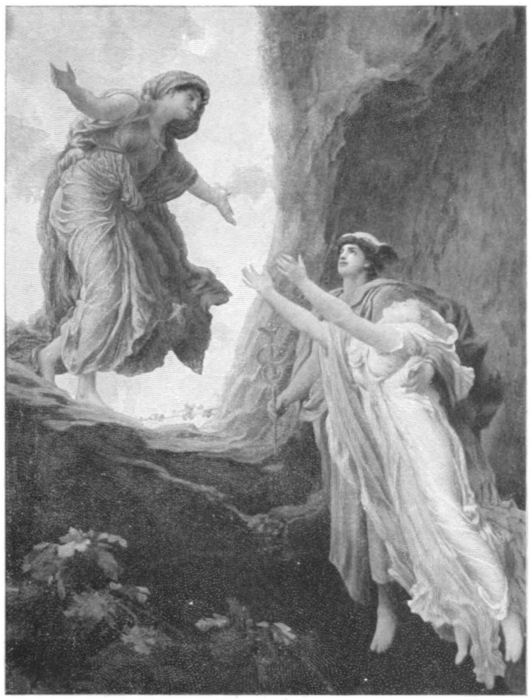
THE RETURN OF PERSEPHONE.
(Lord Leighton.)
Demeter drew her daughter into the holiest
sanctuary of her great temple and they talked
over all that had happened during Persephone’s
long absence. She told her mother how Hades
115]
had stolen her away from the meadows while
she gathered flowers, and how he had treated
her while she stayed with him in the lower
world. She had only words of love and honor
for the dread King of the Dead.
A whole day mother and daughter passed
in an affectionate embrace and in exchanging
words of love, each pitying the other on account
of the long separation. Then Zeus sent Rhea
to bring Demeter and Persephone to Mount
Olympos. And he told them that Persephone
might remain with her mother until the winter
months came back again.
To this Demeter seriously objected, for she
dreaded the separation and the loneliness. But
Zeus replied: “If thy daughter hath eaten of
the pomegranate she is truly wedded to Hades
the King of the Dead, and must go back to him
to stay during the winter. For the pomegranate
is the apple of love, and having shared it with
him, he hath part in her affection and can claim
her as his wife. But if she hath not eaten of
the fruit she shall remain with thee and go no
more to the gloomy realms below.”
Demeter was satisfied with these terms and
promised that Persephone should return to her
honored husband during the winter months, for
Persephone had told her that she had eaten
116]
with him of the pomegranate and that she loved
him in spite of his gloomy surroundings. Then
Demeter forgave Zeus for his part in allowing
the abduction of Persephone, and the mother
and daughter descended once more to Eleusis
to bestow blessings upon the inhabitants, and
from that time on the earth was clad in flowers
and foliage as long as Persephone stayed with
her mother. But it was brown and barren
when she returned to the regions of the Dead.
And the good Hades warmed the earth from
below by virtue of his divine power, helping
it to produce more abundantly the precious
grains and the fragrant flowers.
CHAPTER XXXIV PROMETHEUS UNBOUND
Prometheus was securely bound with iron
fetters and fastened to the solid rock. The
servants of Hephæstos increased his tortures
with their bitter speeches. But Prometheus
bore his sufferings and their taunts with heroic
indifference and courage. As long as they
were near not a sound came from his lips.
Only when Hephæstos and his servants were
gone did he begin to bewail his unjust punishment.
The winds carried the sound of his moans
far off to the shore of the sea. The sea maidens,
daughters of old Ocean, heard them and
were moved to tearful pity. They hastened on
the wings of the salt breeze like a swarm of
123]
birds to comfort and cheer him. Nay, more,
old Ocean himself came from afar, and rising
up from his watery abode, stationed himself
near Prometheus to speak to him.
“I am grieved to the heart, dear Prometheus,”
he said, “for all that thou hast to suffer.
I am thy kin, and it breaks my heart to see thee
like this. Even apart from our kinship there
is no one whom I honor as much as thee. Tell
me, is there any way in which I can help thee?”
Prometheus, hearing what Okeanos said,
made reply: “What do my eyes behold, friend
Okeanos? Hast thou come to see me in my
misery? I fear me I have only bitter words in
exchange for thy kindly greeting. See in
what manner Zeus treats me, his friend, who
hath assisted him to gain possession of the
throne of the world!”
Okeanos felt the truth of his words, but
thought it better to try to persuade Prometheus
to submit to Zeus, and so he answered
pleadingly: “Curb such overbearing speeches,
dear Prometheus, and I will myself try to appease
the anger of Zeus.” But Prometheus
quickly replied: “I have done no evil that I
know of, and I will not bow to tyranny and injustice.
“My fault is this: I loved mankind too well
124]
to let them lie helpless in stupidity and ignorance.
I found them in a pitiable plight. They
had eyes but could not see. They had ears but
could not hear. Not one thing did they know
until I taught them. I told them to observe
the rising and the setting of the sun, moon, and
stars. I taught them how to count, and write,
and remember.
“I taught them to yoke oxen to their ploughs
instead of dragging them themselves. And I
showed them how to harness horses to the
chariots likewise. I helped them to make boats
with oars for the rivers, and ships winged with
white sails to traverse the seas. I taught them
the healing power of plants to relieve them in
their sickness. From me they learned how to
mine for silver and copper, and how to work
them. Indeed, friend Okeanos, thou mayst
well say that all the arts men know how to apply
they have learned from Prometheus.”
Zeus sat uneasily on his throne, angry when
he saw that the spirit of Prometheus was unbroken.
“He still defies me, but I will conquer
yet,” said the Thunderer; and he sent a cruel
vulture to tear and eat his vitals every day.
At night they grew again and he was healed.
But each morning the vulture came and renewed
his terrible feast.
125]
Two thousand years the large hearted, man-loving
Prometheus passed in suffering in the
Caucasus. At length Herakles came that way
in his wanderings, when he was trying to find
his way to the Garden of the Hesperides. He
broke the iron bands like egg shells and set
Prometheus free.
To tell the truth, Prometheus was too wise
for Zeus to have him as an enemy forever, for
he knew one thing which Zeus did not—he
knew the future. Zeus was aware that there
were many important secrets concerning the
future which he could learn from no one else. It
is supposed that Zeus may have hoped to force
Prometheus to yield up his secrets by these
punishments, and that on finding out his mistake
he slyly connived at his victim’s liberation
because he could not afford to be unreconciled
to him any longer.
Prometheus has been loved and honored
through all the ages. On an island belonging
to Greece the people built an altar to him at
the foot of a burning mountain. Once a year
they put out all their fires and sent a ship to
Delos to bring a fresh light. They used this
new flame for kindling again the fires they had
extinguished.
At Athens, Prometheus was held in sacred
126]
honor. People held torch-light festivals in
memory of him. And on frosty nights, as they
sat by the fire, they praised the great Prometheus,
who could endure long enough to conquer
destiny, the hero who had brought them
mental balance, “The Gift of Equilibrium.”
CHAPTER XXXV DEUKALION, THE CHAMPION OF A NEW RACE
Deukalion was the son of Prometheus, and
a just and god-fearing man. In the time of Deukalion,
Zeus destroyed the human race by means
of a great flood. People had become wicked and
godless; they did not fear the gods, and the
meaner classes paid no respect to the better, and
all of them loved every manner of wickedness.
This state of affairs reached the ears of Zeus.
But wishing to take the evidence of his own
eyes and see if the stories that came to him
were really true, he took the form of a mortal
man and went down from his Olympian home
to the Earth.
One evening after sunset he reached Arcadia
and asked for a night’s shelter in the palace of
Lykaon, the king. Lykaon was famous for his
wickedness. Some of the people seemed to see
127]
some signs that Zeus was a god and went down
on their knees to him, but Lykaon laughed at
their credulity and said: “Stay till I find out
whether he be a god or a man!”
Lykaon had a stranger in his palace who had
been sent to him as a messenger. Lykaon had
the stranger killed and served up as food for
his guest. When the dreadful feast was placed
before Zeus, he arose at once in anger and left
the table, and he shattered the house with a
thunder-bolt. Lykaon betook himself to flight
with all speed. He fled to the fields howling
like a wild beast.
Lykaon tried to speak, but his human voice
had left him. His skin turned into a wolf’s
pelt, his hands into paws. He rushed furiously
among the herds and began to tear and bite
cattle and sheep. He had been changed into a
wolf.
Zeus, having seen with his own eyes that
things were even worse than had been told him,
returned to Olympos. He called the gods together
in council and related to them the wicked
deeds he had seen. He ended by saying: “The
whole race of man must surely perish,” and the
other gods consented to his judgment.
At first Zeus thought it best to send thunder-bolts
to destroy the evil race, but he feared that
128]
the flames might reach from earth into the
heavens and burn the whole firmament. He
therefore laid aside his thunder-bolts and resolved
to drown the earth’s inhabitants by
means of a flood. So he ordered the God of the
Winds to shut Boreas and all the other winds in
his cave, save Notos, only, the wet south wind,
who was to go free.
Then Notos flew forth with his damp wings.
A thick cloud hid his face like a veil and darkness
hung around his head. Water ran down
from his brow and his hair. Cloud-bursts broke
from the sky and sent cataracts of water over
the earth, flooding it in every direction. The
work of the farmers was stopped and their
hopes destroyed in an instant.
But Zeus was not satisfied with that. He
called Poseidon, Lord of the Seas, to his assistance.
Poseidon came quickly. He spoke to
all the rivers in a loud commanding voice.
“Leave your beds,” he cried, “and rush wildly
over your banks and flood the world!” The
rivers obeyed, and Poseidon himself struck the
earth with his trident. The earth quaked and,
bursting open in many places, let forth torrents
of water.
The waters rose higher and higher. The
valleys became one wide lake, and soon the tops
129]
of the trees were no longer above the water.
Man and herds were drowned. The altars of
the gods were swept away. When a house
remained standing it was soon covered with
water. The highest towers disappeared in the
flood. Land and sea were no longer separated.
The world was all sea—a long, shoreless sea.
Seals gambolled where goats had formerly
grazed. Dolphins swam over the cities that
were buried beneath the waves. Wolves and
sheep, lions and tigers huddled close together
and swam about as long as they could keep
afloat, when they sank below the waters. The
deer could no longer find ground for his fleet
foot. The birds flew on tired, trembling wings
searching for a place on which to perch and
finally fell into the sea with worn-out wings.
The people tried to save themselves in any
possible way. Some fled to the hills and
mountains. Some took refuge in ships and
sailed over the fields where formerly the plough
had moved. By and by the mountain-tops
were swept by the waves, and the ships were
whirled about by the terrible currents and
wrecked.
Deukalion and his wife, Pyrrha, were the
only ones to be saved. He had taken the advice
of his father, Prometheus, to build himself
130]
a floating-house in the form of a box and to
store in it a great amount of food; when the
flood came he entered this house with his wife.
The house was carried about nine days and
nine nights by the winds. Only the two peaks
of Parnassos remained above water. On this
mountain the floating-house stuck fast.
When Zeus cast his eyes down to earth he
saw that everything was covered with water,
on the surface of which floated trees and
grasses and thousands of animals and people
who had perished in the flood. And he saw
Deukalion and his wife safely anchored on the
heights of Parnassos.
Then Zeus gave commands to Boreas to
chase away the black clouds. The sun shone
again and the waters retreated from the earth,
which was soon dry again. Poseidon laid
aside his trident and the rivers ran in their old
channels. Woods sprang up and the fields
bloomed with flowers.
Deukalion and Pyrrha looked around them.
Everywhere was loneliness and silence. It
was like the solitude of death. Deukalion
wept and said to his beloved Pyrrha: “My
dear wife, I do not see a living soul far or near
in any direction. Thou art my only companion.
All the friends we have known have
131]
perished in the flood. We are the only inhabitants
of the earth. What will life be worth to us,
since we must live alone in the world with no
fellow-men. I should like better to live if we
had other people whom we might love and help
and with whom we could enjoy ourselves. But
we will give thanks to Zeus for saving us.”
They walked along a little way and came to
an altar of the Goddess of Justice. There they
fell on their knees and said: “Oh, divine Justice,
tell us how we may revive the human race
which has perished. Oh, help us and restore
our lost ones to us.” They listened for the
goddess to answer and soon they heard a soft
voice reply: “Veil your faces, oh, Deukalion
and Pyrrha. Go down the mountain, and as
ye go throw backward over your shoulders
the bones of your mother.”
Deukalion and his wife were puzzled at
these words and at first they could not tell
what they meant. But after some meditation
Deukalion said: “My dear wife, the earth is
our mother and her bones are the rocks. As
we go down the mountain we will cast behind
us the stones which we find in our pathway.”
So they started forth, the founders of a new
race, throwing the stones and rocks which
they met over their shoulders and out of sight.
132]
From the stones which they cast there sprang
up living men and women; the stones which
Deukalion threw became men and those which
Pyrrha cast became women.
Deukalion and Pyrrha had many children.
One of their sons was called Hellen. Hellen’s
children and grandchildren spread over Greece
and were called Hellenes, and they gave the
name Hellas to Greece.
CHAPTER XXXVI DÆDALOS, A HERO OF INVENTION
Dædalos was a native of Athens and descended
from one of the most ancient kings of
Attica. It was he who constructed the labyrinth
in which King Minos of Crete locked up
the monster Minotaur. Dædalos was the greatest
artist of his time and was master of many
useful crafts. He produced wonderful pieces
of work in a great many places of the world.
His statues were so cleverly made that they
were taken for living beings. It was thought
that they could see and walk about. For while
the artists before him sculptured their statues
with closed eyes, with their hands crossed over
their breasts, and their feet turned sidewise,
133]
Dædalos made statues with open eyes, outstretched
arms, and feet pointing forward into
space.
Dædalos had Talos for a disciple, a clever
and intelligent youth, who, though but a mere
boy, had invented several tools of great usefulness.
One day, finding the jaw-bone of a snake
he began to cut a piece of wood with it. It
was hardly sharp enough to answer his purpose,
so he constructed a saw of iron on the
same plan.
Dædalos was so jealous of the boy that he
pushed him off from the Acropolis and the lad
died of the injury. When Dædalos saw what
he had done he went to Talos, but found him
dead, so he hurried to bury him. He was surprised
in the act and brought before the court
which met on the hill called Areopagus. He
was condemned to death by the court, and in
order to save himself he fled to Crete.
At that time Minos was king in Crete. He
received the famous artist very kindly and
held him in great honor. There Dædalos did
many fine works for Minos besides the famous
labyrinth for the Minotaur.
After he had stayed some time in Crete he
wanted to go away. But Minos did not wish
to let him go, and when Dædalos concealed
134]
himself, the king searched for him everywhere
and gave the order that no ship should take
him away from the island.
The ingenious Dædalos then meditated a
plan of flight. Suddenly he exclaimed, “Minos
may watch the sea and the land, but he cannot
watch the air. That is still free. I will make
me wings and fly away.”
Dædalos constructed two large wings and
fastened them to his body with wax. Moving
them with his arms and hands he was able to
fly like a bird. He made another pair of wings
for his son Ikaros, fastened them to the boy’s
body and taught him how to move them. Then
he instructed Ikaros to keep close to him and
not to fly too high lest the wax should be
melted by the heat of the sun, nor to keep too
near the surface of the sea, as he might dip his
wings into the water and render them too
heavy for flight.
After he had given this advice, he flew up
first and his son followed. Away they went,
cutting through the air like two eagles, and soon
the high mountains of Crete were left far behind
them. Below them the wide sea stretched out
its great expanse. The sailors looked up from
their boats and wondered what these strange
beings were.
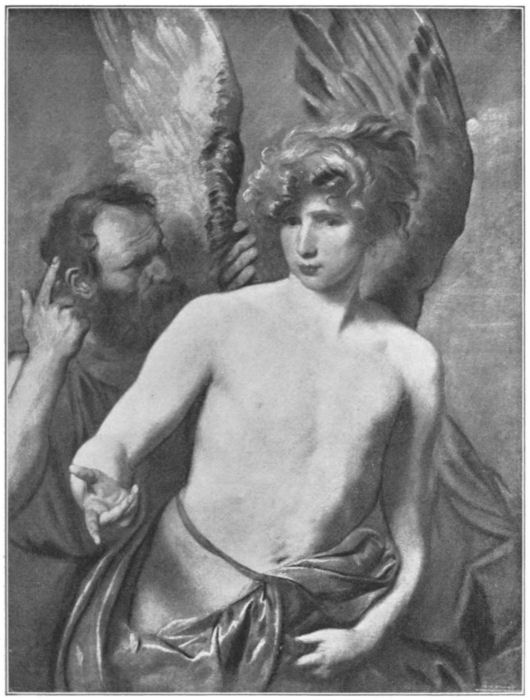
DÆDALOS AND IKAROS.
(From the painting by Van Dyck.)
135]
They flew over fields where farmers were
ploughing, and the farmers gazed up with
astonishment. But Dædalos and Ikaros flew
on and on, heedless of all that was going on
below. The fishermen forgot to take in their
fish and the farmers forgot to urge their oxen
on with the goad, but kept gazing into the sky
until the flying people were out of sight.
At first Ikaros kept close in the wake of his
father, but when his confidence grew stronger
he rose up higher. He forgot his father’s advice
and flew very high into the air. Up, up
to the sun as nearly as he could go. The wax
melted. The wings parted and fell to pieces,
and Ikaros was precipitated like a stone into
the sea.
Dædalos missed the boy in a short time and
turned back to look for him. He could not
see him anywhere, so he called: “Ikaros,
Ikaros, my son, where art thou?” But Ikaros
made no answer. Dædalos flew about in great
agony, and at last he saw the wings of his son
floating on the surface of the sea.
Then Dædalos knew that his beloved Ikaros
was drowned. He descended to an island and
searched the cliffs, and at length he found the
body of Ikaros, which the waves had washed
ashore. With tears and lamentations Dædalos
136]
buried his only son, and thus was he punished
for the death of his disciple, Talos. And the
sea in which Ikaros was drowned was called
the Icarian Sea from that time.
CHAPTER XXXVII PHAETHON, A HERO OF BAD FORTUNE
Helios, the god of the Day, had a famous
son whose name was Phaethon. Helios drove
the chariot of the Sun through the heavens,
and Phaethon played by the sea-shore where
his mother lived. She was a daughter of Old
Ocean and had many daughters of her own.
Phaethon grew to be a youth of great promise,
but he had one fault, an excessive conceit.
When he had grown to be a young man he
left his mother’s home and went to his father
to receive the more manly instructions which
belong to those of heavenly descent. When
he reached the wonderful palace of Helios,
which was built of gold and precious stones, he
sat down and rested near the glittering columns,
his self-pride growing with the thought
of being one of the heirs to such an estate.
He rose and entered the silver gates which
shone like mirrors. He found Helios in the
137]
palace surrounded by a flood of light, sitting
on a throne shaped out of an emerald. To the
right and left of Helios stood Hemera (the
Day), Men (the Month), Etos (the Year), the
Æones (the Seasons), and at equal distance
from one another the Horæ (Hours), and Ages
unnumbered. There also stood Spring adorned
by a wreath of flowers, Summer with ears of
grain in his hands, Autumn laden with juicy
fruits, and Winter with his white hair.
Phaethon halted in awe. But Helios, as
soon as he perceived him, welcomed him to
his palace. He took the crown of golden rays
from his own head lest its dazzling splendor
should blind the eyes of Phaethon, and then
called him to come nearer.
Phaethon approached with fear and trembling,
but Helios called him his son and reassured
him with endearing words. When
Phaethon’s eyes had grown somewhat accustomed
to the blinding splendor, Helios said to
him with fatherly love: “What has brought
my dear child into the heavenly palace of his
father? Surely this is hardly the place for anyone
who is accustomed to the cool earth.”
Phaethon answered: “Oh, my royal father,
I am very unhappy. I am the subject of much
gossip and derision. People taunt me because
138]
my father lives in the heavens and does not
abide in our home on earth. They say that I
am not thy son at all, and I have come to thee
to get the proof from thee that I am really thy
son.”
Now if Helios had lived upon earth everything
would have been burned up in the light
of his glittering rays, but he felt sorry for his
son and said: “Thou art my dear son, indeed.
I would gladly leave this palace to come and
abide in thy home by the sea. But I must
drive the chariot of the Day. Even the gods
are not exempt from duty.”
Then said Phaethon: “If thou art indeed my
father, thou wilt grant me the boon which I ask
of thee.” “Ask what thou wilt,” replied Helios,
“and I swear to thee by the waters of the Styx,
that I will give it to thee.”
Then Phaethon made answer: “Let me
drive thy chariot for one day and all these
people who despise me will see that I am thy
son.”
Helios was dismayed when he heard the audacious
and unexpected demand of his son.
“What words hast thou spoken, my dear
Phaethon!” he said. “Thou dost ask for thine
own destruction. Thou dost request a thing
that no one of the gods would dare to undertake,
139]
not even Zeus himself. No one but myself
is able to drive my chariot.”
But Phaethon would not be persuaded.
“Thou dost not love me, my father,” he said
with tears. “I see that thou dost not love me.
If thou didst thou wouldst let me have thy
chariot in order that the whole world might
see that I am indeed thy son.”
“Foolish boy,” responded Helios, “just because
I love thee shall I let thee destroy thyself?
Ask any other boon but this.”
“Nay, I want the chariot and nothing else,”
replied Phaethon.
Helios was stricken with grief, but he had
bound himself by the Great Oath of the Gods,
which cannot be broken. He took Phaethon
by the hand and led him to his chariot and
placed him in it.
The chariot was a wonderful piece of workmanship
done by Hephæstos. The seat and
axle were made of gold. Golden also were the
tires of the wheels and the spokes were of silver.
While Phaethon was yet gazing with wonder
at the glittering chariot of his father, the rosy-fingered
Dawn opened the dazzling gates of
the East, the stars, one after another, set—last
of all the Morning Star, and the light of the
Moon died out.
140]
Helios ordered the Hours to harness up his
immortal steeds, which were always fed on
nectar and ambrosia. The Hours brought the
horses up from the stables and yoked them
to the chariot. While this was done Helios
anointed the face of his son with heavenly oil,
lest he might be scorched by the fiery rays.
Then he placed his radiant crown upon Phaethon’s
head, and sighing bitterly, gave his son
this parting advice:
“My son, do not touch the horses with the
whip, but hold on to the reins with all thy
might. The horses are impetuous and thou
wilt find it hard to hold them. Keep them well
in hand when making the ascent as well as in
the descent. First thy course is steeply upward,
and on the other side it descends rapidly.
“Do not go near the earth lest thou burn it,
and do not rise too high or thou wilt set fire to
the heavens. The twilight is waning. Go,
my son, for mortals are looking for the light of
Helios. At the last moment I pray thee to
change thy mind and hand the reins to me.”
But the son, exulting with joy, gathered up
the reins, and taking leave of his disconsolate
father, boldly drove off.
CHAPTER XXXVIII THE DEATH OF PHAETHON
The horses darted forward to their long race,
and their first few leaps brought them above
the highest mountains. Before the eyes of the
youth the whole extent of land and sea lay outstretched.
The deer already had left their shelters and
gone up on the heights. All nature seemed to
awake. The quiet woods resounded with the
songs of the birds, which seemed to greet the
rising sun. Glittering dewdrops hung on the
leaves and flowers and shone like diamonds
with the light of Helios. Hares and rabbits
left their hiding-places and came forth for food.
Bees flew humming from flower to flower,
gathering their precious sweets. The shepherd
led forth his bleating flocks into the green
pastures, the farmer plodded off into the fields
with his rural tools. Smoke began to rise
from the cottage chimneys.
Only the owls and other night-birds, unable
to bear the light of the sun, flew back to their
lonely hiding-places, and a few timid flowers
closed their petals, but the sun-flowers turned
142]
their faces with joy toward the rising sun.
Phaethon was entranced by the sight of the
glorious beauty of awakening nature.
The horses soon perceived that they were
not held by the powerful hands of Helios; they
also felt that they were not drawing their accustomed
burden, and as a ship that does not
carry the necessary ballast is tossed about by
the waves, so the chariot was jolted through
the air, rising and falling as if it were empty.
The horses strayed from their path. Phaethon
tried to rein them in. He did not know
the way and was not strong enough to curb the
restive steeds. They ran this way and that, to
right and left, under the uncertain guidance of
their new driver.
On they flew. They were near the middle of
the sky where the road was steepest. Phaethon
looked down from the tremendous height
upon the earth. He became dizzy; his hands
trembled and his knees knocked together. He
let the reins go loose; the horses darted forward
like arrows. He pulled them back, and
they plunged and stood on their hind feet. He
wanted to speak to them, but he did not know
their names.
Overcome at last by fear, he threw the reins
down on the backs of the horses and clung to
143]
the chariot. Having no guidance whatever the
horses now started on a wild race. They approached
the earth and turned everything into
a desert; woods and meadows, cities and villages
were burnt to ashes. The rivers were
dried up and the sea was boiling.
Again the chariot was borne up to an immeasurable
height and the earth was relieved
of the terrible heat. But now the firmament
was in danger of being destroyed by fire.
Curses and prayers rose to heaven from the
suffering people on earth, and cries of fright
resounded through Olympos.
Zeus heard the sighs and wailings and cries,
and to save the world from destruction he
hurled his thunder-bolt at the unfortunate
Phaethon, who fell from the dizzy heights to
earth. With tears and lamentations his mother
searched for the body of her wayward son.
She found him near the mouth of a great river
which had been burned dry.
There she buried him, and the sisters of the
unfortunate youth shed bitter tears over his
grave. They could not bear to go away from
the tomb and leave him lying there alone, so
they remained kneeling and motionless until
Zeus took pity on them and changed them into
weeping willows. Even then they kept on
144]
weeping, but their tears were dried by the sun
and carried away by the streams into the great
sea, where they became jewels of amber.
Kyknos, too, a friend of Phaethon’s, mourned
his loss and could not be comforted; so Zeus,
in kindness, changed him into a swan. Helios,
in his fatherly grief, refused to drive the chariot
of the Sun any longer, and the earth was
left in darkness for a whole day. But the gods
entreated him to take the reins again and men
prayed for light, and from that time on the Sun
has kept its true course through the heavens,
under his wise guidance.