The Pennsylvania town of New Munich was
electrified by the sudden and entirely unlooked-for
announcement of the betrothal of Daniel Leitzel,
Esquire; but his two maiden sisters with whom he lived,
and to whom the news was also wholly unexpected, were
appalled, confounded. That Danny should have taken
such a step independently of them (who did all his thinking
for him outside of his profession) was a cataclysmal
episode. Of course it never would have happened without
their knowledge if Danny had not been temporarily away
from his home on business and far removed from their
watchful care—watchful these twenty years past that no
designing Jezebel might get a chance at the great fortune
of their petted little brother—though it must be admitted
that Danny was by this time of a marriageable age, being
just turned forty-five.
"To think he'd leave us learn about it in the newspapers
yet, sooner 'n he'd come home and face us with it! Yes,
it looks anyhow as if he was ashamed of the girl he's picked
out!" exclaimed Jennie, a stern and uncompromising
spinster of sixty, as she and her sister Sadie, sitting in the
elaborately furnished and quite hideous sitting-room of
their big, fine house on Main Street, stared in consternation
at the glaring headlines of the New Munich Evening
Intelligencer, which announced, in type that to the sisters
seemed letters of flame, the upsetting news of their
idolized brother having been at last matrimonially trapped.
Being confronted with his betrothal in print seemed to
make it hopelessly incontrovertible. They might have
schemed to avert the impending catastrophe of his
marriage (in case Danny had been taken in by an Adventuress)
did not the Intelligencer unequivocally state (and the
Intelligencer's statements were scarcely less authoritative
to Jennie and Sadie Leitzel than the Bible itself) that
Danny would be married to the Unknown inside of a month.
If the Intelligencer said so, it seemed useless to try to
stop it.
"To think he'll be married to her already before we get
a chance, once, to look her over and tell him if she'd suit
him!" lamented Sadie who was five years younger than
Jennie.
"Well," pronounced Jennie, setting her thin lips in a
hard line, "she'll find out when she gets here that she ain't
getting her fingers on our Danny's money! She'll get
fooled if she's counting on that. She'll soon learn that she'll
have to do with just what he likes to give her and no
more! And of course Danny'll consult us as to just how
much he ought to leave her handle. When she finds out,"
Jennie grimly prophesied, "that our Danny always does
the way we advise him to and that she'll have to keep on
the right side of us, I guess she won't like it very well!"
"We can only hope that she ain't such a bold, common
thing that just took our Danny in, that way!" sighed
Sadie.
"But why would he hurry it up so, like as if he was
afraid we would mebby put a stop to it? She put him up
to fixing it all tight before he could change his mind!"
Jennie shrewdly surmised.
"It does look that way!" fretted Sadie.
Jennie, the elder sister, was tall, gaunt, and rawboned.
Though approaching old age, her dominating spirit and
grasping ambitions had preserved her vigour, physically
and mentally. Her sharp face was deeply lined, but the
keenness of her eyes was undimmed, her shoulders were
erect, her hair was thick and black. The expression of her
thin slit of a mouth was almost relentlessly hard.
Sadie, five years younger, had also a will of her own,
but happily it had always operated on a line so entirely
in harmony with that of her sister, that they had lived
together all their lives without friction, the younger woman
unconsciously dominated by the elder. Indeed, no one
could abide under the same roof with Jennie Leitzel who
ventured openly to differ with her. Fortunately, even
Sadie's passion for dress did not clash with Jennie's
miserliness, for Sadie, too, was miserly, and Jennie loved to see
her younger sister arrayed gorgeously in cheap finery, her
taste inclining to that of a girl of sixteen. A dormant
mother-instinct, too, such as must exist, however obscurely,
in every frame of woman, even in that of a Jennie Leitzel,
found an outlet in coddling Sadie's health and in ministering
to and encouraging a certain plaintiveness in the
younger woman's disposition. So, these two sisters,
depending upon and complementing each other, of congenial
temperaments, and with but one common paramount
interest in life, the welfare of their incomparable younger
brother whom they had brought up and of whom they
were inordinately proud, lived together in the supreme
enjoyment of the high estate to which their ambitions and
their unflagging efforts had uplifted the Leitzel family—from
rural obscurity to prominence and influence in their
county town of New Munich.
To be sure, the sisters realized that they held what they
called their "social position" only as appendages to
Danny—Danny who had been to college, who was the head of a
great corporation law firm, who was enormously rich and a
highly eligible young man; that is, he used to be young;
and though New Munich regarded him as a confirmed old
bachelor, his sisters still looked upon him as a dashing
youth and a great matrimonial prize. They were not
ashamed, but proud, of the fact that people tolerated them
because they were Danny's sisters.
It may seem strange that anything calling itself
"society" could admit women so crude as Jennie and Sadie,
even though they were appendages to a bait so dazzling
as Danny Leitzel, Esquire. But in communities where
the ruling class is descended from the Pennsylvania Dutch,
"society" is remarkably elastic and has almost no closed
doors to the appeal of wealth, however freighted it may be
with vulgarity and illiteracy; and, be it known, Danny's
sisters were not only financially independent of Danny,
but even wealthy, quite in their own right.
In spite of this fact, however, what social footing they
had in the little town of New Munich had not been
acquired so easily as to make it appear to them other than a
very great possession.
As to the big, fine house in which they lived, it had been
Danny's money which, in the early days of his prosperity,
had, at his sisters' instigation, built this grand dwelling
on the principal street of New Munich, to dazzle and catch
the town.
The room in which the sisters sat to-night would have
seemed to one who knew them a perfect expression of
themselves—its tawdry grandeur speaking loudly of their
pride in money and display, and of, at the same time, their
penuriousness; the absence of books and of real pictures,
but the obtrusive decorations of heavy gilt frames on
chromos; the luridly coloured domestic carpets; heavy,
ugly upholstered furniture, manifesting the unfortunate
combination of ample means with total absence of
culture. It would seem that in a rightly organized
social system women like these would not possess
wealth, but would be serving those who knew how to use
wealth.
"To think our Danny'd marry a stranger, yet, from
away down South, when he could have picked out
Congressman Ocksreider's daughter, or Judge Kuntz's oldest
girl—or Mamie Gundaker and her father a bank president!
Any of these high ladies of New Munich he could have!"
wailed Sadie. "They'd be only too glad to get our Danny!
And here he goes and marries a stranger!"
"It ain't like him that he'd up and do this thing
behind our backs, without askin' our adwice!" Jennie
exclaimed.
"Think of the grand wedding we could have had here
in New Munich!" Sadie sighed.
"And we don't even know if she's well-fixed or poor!"
cried Jennie in a wildly worried tone.
"But I hardly think," Sadie tried to comfort her, "that
Danny would pick out a poor girl. Nor a common one,
either, so genteel as what we raised him!"
"But men get so easy fooled with women, Sadie! If
she's smart, she could easy come over Danny."
"Unless he got stubborn-headed for her."
"Well," admitted Jennie, "to be sure Danny can get
awful stubborn-headed sometimes. But if she's smart and
found out how rich he is, she'd take care not to get him
stubborn-headed."
"Yes, that's so, too," nodded Sadie. "I wonder if she's
a fancy dresser?"
Sadie's love of clothes was second only to her devotion
to Danny. She was dressed this evening in a girlish
Empire gown made of red cheesecloth.
"What will folks say to this news, anyhow?" scolded
Jennie. "I'll have a shamed face to go on the street, us
not knowing anything about it, not even who she is yet!
If folks ast us, Sadie, we must leave on we did know—we'll
just say, 'Oh, it ain't news to us!'"
"But how could we know much when Danny himself
has knew her only a little over a month, Jennie?"
"Yes, don't it, now, beat all?"
"Yes, don't it!"
"That shows what she is—marrying a man she knew
only a month or so!"
"Well, to be sure, it wouldn't take her even a month,
Jennie, to see what a catch our Danny is."
"If she does turn out to be a common person," said
Jennie with her most purse-proud look and tone, "she's
anyhow got to act genteel before folks and not give Danny and
us a shamed face here in New Munich—high up as we've
raised our Danny and hard as we worked to do it yet!"
"Yes, the idea!" mourned Sadie.
"Yes, the very idea!" nodded Jennie vindictively.
"I shouldn't wonder," she added anxiously, always
concerned for her sister's health which was really quite
remarkably perfect, "if this shock give you the headache,
Sadie!"
"I shouldn't wonder!" Sadie shook her head sadly.
"Read me off the piece in the paper and see what it
says all," Jennie ordered. "But sit so the light don't
give you the headache."
Sadie, adjusting her spectacles and turning on the electric
table lamp at her elbow, read the glaring article which
had that evening appeared on the first page of their daily
paper and which every household in New Munich was,
they knew, now reading with feelings of astonishment,
curiosity, disappointment or chagrin, as the case might be,
for the sisters were sure that many heartaches among
the marriageable maidens of the town would be caused by
the news that Danny was no longer within their possible
reach. These twenty-five years past he and his gold had
been dangling before them—and now to have him
appropriated, without warning, by a non-resident!
The article was headed in large type:
"ONE MORE VICTIM OF CUPID'S DARTS—
DANIEL LEITZEL LED LIKE A LAMB
TO HYMEN'S ALTAR."
Sadie breathed heavily as she read:
In a communication received at this office to-day
from our esteemed fellow-citizen, Daniel Leitzel, Esquire,
sojourning for the past four weeks in the balmy South, we
are informed of his engagement and impending marriage
to "a young lady of distinguished Southern lineage," one
who, we may feel sure, will grace very acceptably the social
circle here of which Mr. Leitzel is such a prominent,
prosperous, and pleasant member. The news comes to our
town as a great surprise, for we had almost begun to give
Danny up as a hopeless bach. He will, however, lead
his bride to Hymen's altar early next month and bring
her straightway to his palatial residence on Main Street,
presided over by his estimable sisters, Miss Jennie and Miss
Sadie. New Munich offers its congratulations to her
esteemed fellow-citizen, though some of us wonder why he
found it necessary to go so far away to find a wife,
with so many lovely ladies here in his native town
to choose from. Love, however, we all know, is a
capricious mistress and none may guess whither she may
lead.
The happy and fortunate lady, Miss Margaret Berkeley
of Berkeley Hill, a distinguished and picturesque
old colonial homestead two miles out of Charleston,
S.C., is, we are informed, a lineal descendant on her
mother's side of two governors of her native state and the niece
of the learned scholar and eminent psychologist, the
late Dr. Osmond Berkeley, with whom Miss Margaret
made her home at Berkeley Hill until his decease a year
ago, since which sad event she has continued to reside
at this same homestead, her married sister and family
living with her, this sister being the wife of a Charleston
attorney with whom Daniel Leitzel, Esquire, has been
conducting some legal railroad business in Charleston and
through whom our esteemed fellow-citizen, it seems, met
his happy doom.
New Munich's most aristocratic society will anticipate
with pleasurable interest the arrival of the happy bride
and groom, Mrs. and Mr. Daniel Leitzel. No doubt
many very elegant society events will take place this
winter in honour of the newcomer among us; for New
Munich is noted for its hospitality.
"It don't say," Jennie sharply remarked, "whether
she's well-fixed—though to be sure if she comes from such
high people they'd have to be rich."
"But her grand relations are all deceased, the paper
says," returned Sadie despondently. "You may better
believe, Jennie, if she had money, Danny would have told
the noospapers."
"It says in the paper she's living with her married sister,
and it looks to me," Jennie shrewdly surmised, "as if her
brother-in-law (that lawyer Danny had dealings with)
wanted to get rid of her and worked her off on our Danny.
Or else that she took up with Danny to get a home of her own."
"Do you think Danny could be so easy worked?" Sadie
doubtfully inquired.
"He's a man," Jennie affirmed conclusively (though
there were those among Danny's acquaintances who would
not have agreed with Jennie); "and any man can be
worked."
"You think?"
"To be sure. Danny would have been roped in long
ago a'ready if I hadn't of opened his eyes to it, still, when
he was being worked."
"Yes, I guess," agreed Sadie. "Say, Jennie, what'll
Hiram say when he hears it, I wonder!"
Hiram was their brother next in age to Jennie, who,
upon the family's sudden, unexpected access to wealth
thirty-five years before, through the discovery of coal on
some farm land they owned, had been a young farmer
working in the fields, and had immediately decided to use
his share of the money obtained from leasing the coal land
to prepare himself for what had then seemed to him a
dizzy height of ambition, the highest human calling, the
United Brethren ministry. For twenty years now he
had been pastor of a small church in the neighbouring
borough of Millerstown. His sisters were very proud to have
a brother who was "a preacher." It was so respectable.
They never failed to feel a thrill at sight of his printed
name in an occasional number of the Millerstown New
Era—"Rev. Hiram Leitzel." But Hiram did not, of
course, hold Danny's high place in their regard; Danny,
their little brother whom they had reared and who had
repaid them by such a successful career in money-making
that he had, at the age of forty-five, accumulated a
fortune many times larger than that he had inherited.
"Hiram will take it awful hard that Danny's getting
married," affirmed Jennie. "He'd like you and me an
Danny, too, to will our money to his children. He always
hoped, I think, that Danny wouldn't ever get married, so's
his children would get all. To be sure the ministry ain't
a money-making calling and Hiram has jealous feelings
over Danny that he's so rich and keeps getting richer.
Hiram likes money, too, as much as Danny does."
"I wonder," speculated Sadie, "if Danny's picked
out as saving and hard-working a wife as what Hiram's
got."
The characteristic Leitzel caution that Hiram had exercised
in "picking out" a wife had prolonged his bachelorhood
far into middle life. He had now been married ten
years and had four children.
Keenly as the Leitzels loved money, none of them, not
even Hiram himself, had ever regretted his going into the
ministry. It gave him the kind of importance in the little
borough of Millerstown that was manna to the Leitzel
egotism. Hiram really thought of himself (as in his
youth he had always looked upon ministers) as a kind of
demigod; and as the people of Millerstown and even his
own wife treated him as though he were one, he lived in
the complacent enjoyment of his delusion.
He had greatly pleased his sisters and his brother Daniel
by marrying the daughter of the richest man in his congregation,
and they all approved of the frugality by which he
and his wife managed to live on the little salary he drew
from his church, letting his inherited wealth and that of
his wife accumulate for the children.
"It ain't likely," Jennie replied to Sadie's speculation,
"that Danny's marrying as well as Hiram married, when
he's acting without our adwice."
"No, I guess anyhow not," agreed Sadie. "Say,
Jennie!" she suddenly whispered mysteriously.
"Well, what?"
"Will we leave Mom know about Danny's getting
married?"
"Well, to be sure she'll have to find it out," Jennie
curtly answered. "It'll mebby be printed in the County
Gazette and she sees that sometimes."
"Say, Jennie, if Danny's wife is a way-up lady, what'll
she think of Mom yet, with her New Mennonite garb and
her Dutch talk that way, and all! My goodness!"
"Well, a body can't help for their step-mothers, I
guess!"
"But she's so wonderful common and ignorant. I
guess Danny would be ashamed to leave his wife see her.
And his wife would laugh so at her clothes and her talk!"
"But how would his wife ever get a chance to see her?
We don't ever have Mom in here and we never take any
one out to see her."
"That's so, too," Sadie acquiesced.
"I guess Hiram'll press it more'n ever now that we'd
ought to put Mom to the poorhouse and rent our old
home. The land would bring a good rent, he says, and
we've no call to leave her live on it free any longer. But
I tell Hiram it would make talk if we put her to the
poorhouse. Hardly any one knows we got a step-mother, and
we don't want to start any talk."
"Yes, well, but how could they blame us when she ain't
our own mother?" Sadie protested.
"But you know how she brags about us so proud to her
neighbours out there in Martz Township—just as if we
was her own sons and daughters—and tells 'em how
grand we live and how much Danny is thought of and how
smart he is and what fine sermons Hiram preaches and
how she kep' us all when we were little while Pop drank
so and we hadn't anything but what she earned at the
wash-tub! Yes," said Jennie indignantly, "she tells it
all right out perfectly shameless and anybody to hear her
talk would think we was her own flesh and blood!"
"Yes, it often worries me the way the folks out there
talk down on us and say she always treated us like her
own and we always treated her like a step-mother!" fretted
Sadie.
"Well, I guess we needn't mind what such common, poor
country folks say about us!" sneered Jennie. "All the
same"—she suddenly lowered her voice apprehensively—"we
darsent start folks talking, or first thing we know
they'll be saying we cheated Mom out of her widow's third
because she was too ignorant to claim it!"
"How would they have dare to say that when the land
come from our own mother in the first place?" pleaded
Sadie. "And Danny always says we've got our moral
right to all the money even if we haven't the legal right."
"Yes, and he always says, too, that if we ain't awful
careful we'll have a lawsuit yet, and be forced to give a
lot of our money over to Mom! Yes, I often say to Hiram,
'Better leave sleeping dogs lay,' I say, 'and not go tryin'
to put Mom into the poorhouse.'"
"Yes, I guess anyhow then!" breathed Sadie.
"By to-morrow"—Jennie veered off from the precarious
topic of their step-mother, for here was ice too thin for
even private family handling—"we'll be getting a letter
from Danny giving us the details. Say, Sadie, if he don't
offer to pay our way, I ain't using my money to travel that
far to his wedding."
"Nor me, either," said Sadie. "Do you think, Jennie,"
she anxiously asked, "folks will talk at our still keeping
house for Danny when he's married? You know how
Danny always made us promise we'd stay by him, married
or single?"
Jennie sniffed. "As if he could get along without us!
As if any one else could learn his ways and how he likes
things—and him so particular about his little comforts!
He wouldn't leave us go away! And look at what he
saves with us paying half the household expenses!"
"And as for his wife's not liking it——" began Sadie.
"As for her," Jennie sharply put in, "she's coming here
without asking us if we like it—she'll be put in her place
right from the start."
"But if she's got money of her own mebby," Sadie suggested
doubtfully, "she could be independent, too, then."
"Well, to be sure she'd put her money in her husband's
care, wouldn't she?—and him a lawyer."
"A body couldn't be sure she'd do that till they saw
once what kind of a person she was, Jennie."
"Well," Jennie stoutly maintained, "Danny'll see that
she does."
It will be noted that the story of Miss Berkeley's
"distinguished lineage" did not greatly impress Jennie and
Sadie Leitzel. They did not quite understand it. They
knew nothing about such a thing as a distinguished
lineage; New Munich "aristocrats" certainly did not have
any; and the sisters' experiences being limited to life as it
was in New Munich, whose "first families" were such
only by reason of their "means," Sadie and Jennie were
ignorant of any other measure of excellence. To be poor
and at the same time of any significance, was a combination
unknown to them.
As the newspapers did not state how closely those
ancestral governors were related to Miss Berkeley, the
relationship was undoubtedly so distant as to be negligible.
The one thing that would have softened their attitude
toward their new relative would have been an unequivocal
statement as to the firm financial standing of her family.
And on that point the newspaper, though furnished by
Daniel himself with the facts, was ominously silent. The
conclusion was unmistakable. She was certainly penniless.
It was not greatly to be wondered at that the Leitzels
worshipped money. It was money that had done everything
for them: it had rescued them from a fearful struggle
for a bare existence on a small, heavily mortgaged farm;
it had freed them from the grind of slavish labour; from an
obscurity that had been bitterly humiliating to the
self-esteem and the ambition which was characteristic of every
one of them. It was money that had given them power,
place, influence; that made their fellowmen treat them with
deference and relieved them from the necessity of treating
any one else with deference. They knew of no worth in life
unpurchasable by money. They did not, therefore, know
of their own spiritual pauperism; their abject poverty.
The betrothal and impending marriage of Daniel
Leitzel was the only topic of discussion that
evening at the New Munich Country Club dance.
Certainly New Munich had a Country Club. "Up to
date in every particular." There was nothing in the way
of being smartly fashionable that the town of New Munich
lacked. Well, if up to the present it had lacked old
families of "distinguished lineage," who, in these commercial
days, regarded that kind of thing? Anyway, was not
that lack (if lack it had been) now to be supplied by the
newcomer, Mrs. Daniel Leitzel?
Not only at the Country Club dance, but wherever two
or three were gathered together—at the mid-week Prayer
Meeting, at the Woman's Suffrage Headquarters, at the
Ladies' Literary Club, at the Episcopal Church Vespers,
at the auction bridge given at Congressman Ocksreider's
home—Danny Leitzel's betrothal was talked about.
"Just imagine this 'daughter of a thousand earls——'"
"Governors, not earls," corrected Mr. Schaeffer, the
whist partner of the first speaker who was Miss Myrtle
Deibert, as supper was being served at eleven o'clock on
the card tables at Congressman Ocksreider's. "A
thousand governors and highbrows—shy-lologists, or
something like that—whatever they are!"
"Well, just imagine such a person living at the Leitzels!"
"But you don't suppose Danny's sisters will still live
with him after he's married!" exclaimed Mr. Bleichert, the
second young man at the table.
"If he thinks it more economical, they certainly will,"
declared Miss Myrtle Deibert.
"Whew!" exclaimed Mr. Bleichert. "Good-night!"
"Who would have supposed any nice girl would have
married old Danny Leitzel!" marvelled Mr. Schaeffer.
"Oh, come now," protested Mr. Bleichert who was a
cynic, "why have all the girls, from the buds just out, up
to the bargain-counter maidens in their fourth 'season,'
been inviting Danny Leitzel to everything going, and running
after him heels over head, ever since he built his ugly,
expensive brick house on Main Street? Tell me that,
will you?"
It should be stated here that it was an accepted social
custom in New Munich for the people at one card table to
discuss the clothes, manners, and morals of those at the
next table.
"You know perfectly well," retorted Miss Deibert,
"that at least two girls in this town, when it came to the
point of marrying Danny, chucked it."
"I should think they might," said Schaeffer. "Why,
he isn't a man, he's a weasel, a rat, a money-slot!"
"Well, of course, the girl or old maid, 'bird or devil,'
that has caught him at last, isn't marrying him for himself,
but for his money," serenely affirmed Myrtle Deibert.
"When she meets his two appendages, Miss Jennie and
Miss Sadie, she'll wish she was single again!" predicted
Mr. Bleichert.
"They'll probably think it their business to manage
Danny's wife the way they manage him," Miss Deibert
declared.
"I hope she's a spendthrift," shrugged Mr. Schaeffer.
"It would give Dan Leitzel the shock he needs to find
himself married to a spendthrift."
"She won't be one after she's Mrs. Daniel Leitzel!"
Miss Deibert confidently asserted.
"But of course she's rich—Dan Leitzel wouldn't marry a
dowerless woman," said Bleichert.
"Well, then he won't let her spend her money," Miss
Deibert settled that.
The second young lady at this card table, a pale,
serious-looking girl, did not join in the discussion, but sat with
her eyes downcast, toying with her food, as the rest
chattered. The other three did not give Miss Aucker credit
for remaining silent because she found their gossip vulgar
and tiresome (which was indeed her true reason) but
attributed her disinclination to talk to the fact that during
the past year Daniel Leitzel had been rather noticeably
attentive to her; so much so that people had begun to look
for a possible interesting outcome. Miss Deibert,
Mr. Schaeffer, and Mr. Bleichert, therefore, all considered her
demeanour just now to be an indelicately open expression
of her chagrin at the news they discussed.
"He was her last chance," Miss Deibert was thinking.
"She must be nearly thirty."
"One would think she wouldn't show her
disappointment so frankly," Mr. Schaeffer was mentally criticising
her.
"You know," chuckled Miss Deibert as she dabbed with
her fork at a chicken croquet, "Danny, away from his
sisters and his awful house and among strangers, would
appear so like a perfect gentleman, even if he is 'a rat, a
weasel, a money-slot,' that I think even the descendant of
earls or governors might be deceived. You see he's had so
many advantages; he was only ten years old when they
discovered coal on their land and got rich over night.
And from the first, his sisters gave him every advantage
they could buy for him, sending him to the best private
schools, and then to college, and then to the Harvard Law
School; and every one knows that Danny Leitzel is no fool,
but a brilliant lawyer. So I do think that, detached from
his setting here, there's nothing about Danny that would
lead an unsuspecting South Carolina bride to imagine such
contingencies as Jennie and Sadie and that Main Street
house. I suppose she lives in an ancestral colonial place
full of antique mahogany, the kind we all buy at junk
shops when we have money enough."
"What kind of a woman would it be that could stand
Dan Leitzel's penuriousness?" Mr. Schaeffer speculated.
"He makes money like rolling down hill and I've heard
him jew down the old chore woman that scrubs his office
and haggle over a fifty-cent bill for supper at the club.
He's the worst screw I ever knew. And mind you, his
bride's a Southern woman, accustomed to liberality and
gallantry and everything she won't find at Danny's
house!"
"Do you know (not many people in New Munich do
seem to know) that the Leitzels' mother is living?" said
Miss Deibert.
"What?"
"I know a woman that knows her. She lives in the
Leitzels' old farmhouse out in Martz Township."
"But Miss Jennie and Miss Sadie are too old to have a
mother living."
"It's their step-mother. But she brought them up from
little children and I heard she even took in washing to
support them when their own father drank—and now
they're ashamed of her and don't have anything to do with
her. I was told she's a dear old soul and never speaks
against them, but is as proud of their rise in the world as if
she were their own mother. The neighbours out there
say she has a hard time getting on and that they don't do a
thing for her except let her live in their old tumble-down
farmhouse. Isn't it a shame, as rich as they are!"
"You can't believe everything you hear."
"But it would be just like them!" affirmed Bleichert.
"Mary!" Miss Deibert suddenly laid her hand playfully
on that of the silent Miss Aucker. "Congratulations
on your escape, my dear!"
"I was never in the least danger, Myrtle. Aren't we
gossiping rather dreadfully? I've been wondering"—she
looked up with a smile that transformed her seriousness
into a gentle radiance—"what a newcomer like Mr. Leitzel's
wife, doomed to live here, will do with us and our
social life, if she really is a woman of breeding and culture.
I wonder whether it would be possible this winter to make
our social coming together count for something more than—well,
than just an utter waste of time. What is there in
it all—our afternoon teas, auction bridge, luncheons,
dinners, dances. The dances are of course the best thing
we do because they are at least refreshing and rejuvenating.
But don't you think, Myrtle, that we might make it
all more worth while?"
"There's the Ladies' Literary Club," Myrtle suggested,
"for those that want something 'worth while,' as you put
it. I think it's an awful bore myself."
"Of course it is," Mary agreed.
"But what would you suggest then?"
"I suppose it is after all a question of what is in
ourselves. A dozen literary clubs at which we read abstracts
from encyclopedias wouldn't alter the fact that when we
get together we have so little, so little to give to each
other!"
"Oh, I don't know!" protested Myrtle. "We all read
all the latest books and magazines and talk about them,
and——"
At an adjoining table another phase of the agitating
news was being threshed out.
"If she's what the papers say she is, I suppose she'll
turn up her nose at New Munich," said the daughter of
the Episcopal rector.
"Oh, I don't think she need put on any airs!" said Miss
Ocksreider, the hostess's daughter. "I've visited down
South and I can tell you we're enough more up to date
here in New Munich. Nearly every one down there, even
their aristocrats, is so poor that up here they wouldn't be
anybody. It's awfully queer the way those Southerners
don't care anything about appearances. They tell you
right out they can't afford this and that, and they don't
seem to think anything of wearing clothes all out of style.
There was an awfully handsome new house in the town
where I stopped, and when I asked the hotel clerk who lived
in it and if they weren't great swells, he said: 'Oh, no, they
are not in society; they're not one of our families, though
they're very nice people, of course, members of church and
good to the poor and all like that.' 'Not in society in a
little town like this Leesburg, and living in a mansion like
that?' I said. Yes, that's the way they are down there."
"How queer!" came from two of her table companions
to whom, like herself, any but money standards of value
were rather vague and hazy.
"But if they don't care for money down there, then
what's this girl marrying Dan Leitzel for?" one of the men
candidly wondered.
"Well, you know there's no accounting for tastes."
"I could excuse any woman's marrying for money—in
these days it's only prudent," said the candid one; "but I
certainly couldn't respect a woman that married Dan
Leitzel for anything else."
"It's to be hoped she's an up-to-date girl and not a
clinging vine, for Danny will need very firm handling to
make him part with enough money to keep her in gloves
and slippers and other necessary luxuries," said Miss
Ocksreider.
"Yes, if it were only her husband that she'll have to
manage; but there are Miss Jennie and Miss Sadie, too!"
cried the rector's daughter. "Danny doesn't so much as
put on a necktie without consulting them. They even
tie it for him and part his hair for him."
"That may be," said one of the men, "but let me tell
you that any one who thinks Dan Leitzel hasn't any force
of character better take another guess. If he lets his
sisters choose his neckties for him, it's because he doesn't
want to do it himself. He's the most consummately
selfish individual I've ever known in the whole course of my
long and useful life and the most immovably obstinate.
Weak? Why, when that fellow takes a notion, he's a mule
for sticking to it. Reason with him? Go out in your
chicken yard and reason with your hens. It wouldn't be
as futile!"
"He may be independent of his sisters, but his wife
won't be!" prophesied the rector's daughter darkly.
"Anyway," said Miss Ocksreider, "it will be interesting,
won't it, to look on this winter at the drama or comedy or
tragedy, as the case may be, of Danny Leitzel's marriage?"
"Won't it!" exclaimed in chorus her hearers.
But at one of the other tables a man was at this moment
remarking: "You may all laugh at Dan Leitzel—he's
funny of course—but he's all the same a man of brains and
education, of wealth and influence and power. In short,
he's a successful man. And in Pennsylvania who asks
anything more of a man?"
Meantime, several hundred miles away, the two
objects of all this criticism and speculation were
not so apprehensive for their future as were the
gossips of New Munich, though it must be confessed that
the prospective bridegroom, in spite of his jubilant
happiness, did have one or two misgivings on certain points,
and that the bride, while wholly ignorant of the real calibre
of the man she was about to marry, and having no conception
of such a domestic and social environment as that
from which he had sprung, nevertheless did not even
imagine herself romantically in love with him.
That a girl like Margaret Berkeley could have become
involved in a love affair and an actual betrothal with a
man like Daniel Leitzel, while apparently inexplicable,
becomes, in view of her unique history and present
circumstances, not only plausible, but almost inevitable.
Her entanglement with him may be dated from a certain
evening just twenty-four hours before she met or even heard
of him, when a little episode, trivial enough in itself, opened
her eyes to an ugly fact in her relation with her sister to
which she had been rather persistently blind.
She had been radiantly happy all that day because of
the unusual circumstance that she had something delightful
to anticipate for the evening. Her godmother, who
lived in Charleston, had 'phoned out to Berkeley Hill to
invite her to go with her to see Nazimova in "Hedda
Gabler"; and as Margaret had seen only three plays in all the
twenty-five years of her life (though she had avidly read
every classic drama in the English and French languages)
she was greatly excited at the prospect before her. So
barren had her girlhood been of youthful pleasures, so
sombre and uneventful her daily routine, and so repressed
every natural, restless instinct toward brightness and
happiness, that the idea of seeing a great dramatic performance
loomed big before her as an intoxicating delight. All
day, alone in her isolated suburban home, in charge of her
elder sister's three small children and of the two rather
decrepit negro servants of the great old place, she had gone
tripping and singing about the house. She had been quite
unable to settle down to the prosaic work of mending the
week's laundry, or of wrestling with the intricacies of Henry
James' difficult style in "The Golden Bowl" in which,
the night before, she had been passionately absorbed.
She could scarcely wait for her sister Harriet to come
home from town, where she was attending a young matrons'
luncheon party, so eager was she to tell her of the
treat she was going to have.
"She will be so glad for me. I've scarcely been
outside the hedge for a month, and she has been having
such a gay time herself—she's so popular. She'll be so
glad I'm going!" she repeated to herself, trying to ignore
the doubt in her heart on that point.
But when at half-past four in the afternoon Harriet
returned, the blow fell upon Margaret.
"Harriet, dear!" she exultantly greeted her sister with
her splendid news the moment the latter came into the
house, "Aunt Virginia is going to take me to see Nazimova
to-night! Oh!" She laughed aloud, and danced about the
spacious hall in her delight, while her sister, a very comely
young matron of thirty-five, leisurely removed her wraps.
"But Walter and I are going," Harriet casually remarked
as she tossed her cloak over a carved, high-backed
chair. "The editor of the Bulletin gave Walter two tickets
as part payment for some legal business Walter did for
him. Of course you and I can't both be away from the
children. Has the baby had her five o'clock bottle?"
"It isn't quite five yet."
"Will you see that she gets it, dearie? I'm so dead
tired, I'll have to rest before dinner if I'm going into the
city again to-night. Will you attend to it?"
"Yes."
"That's a dear. I'm going up to lie down. Don't
let the children come to my room and wake me, will you,
dear?" she added as she started languidly upstairs.
"But, Harriet!"
"What?" Harriet asked, not stopping.
"I accepted Aunt Virginia's invitation and she is
coming out in her motor for me!"
"Too bad! I'm awfully sorry. You'd better 'phone
at once or she will be offended. Tell her that as we are
much too poor to buy tickets for the theatre, we can't
possibly refuse to use them on the rare occasions when they're
given to us!" Harriet laughed as she disappeared around
the curve of the winding stairway.
Margaret sprang after her. "Oh, Harriet! I can't
give it up!" Her voice was low and breathless.
"But if you 'phone at once Aunt Virginia won't be cross.
You know, dearie, you shouldn't make engagements without
first finding out what ours are." And Harriet moved
on up the stairs to her bedroom.
Margaret was ashamed of her childishness when at
dinner that evening Walter, her brother-in-law, inquiring,
in his kind, solicitous way, the cause of her pallor and
silence, she burst out crying and rushed from the table.
Walter, looking shocked and distressed, turned to his
wife for an explanation. But Harriet's face expressed
blank astonishment.
"Why, I can't imagine! Unless she's tired out from
having had the children all day. I was at Mrs. Duncan's
luncheon, you know. I didn't get home until nearly five.
I'll tell Margaret to go to bed early to-night and rest up."
Walter Eastman, searching his wife's face keenly,
shrugged his big shoulders at the impenetrability of its
innocent candour. No use to try to get at the truth of
anything from Harriet. She wasn't exactly a liar, but she had
a genius for twisting facts to suit her own selfish
ends—and all Harriet's ends were selfish. Even the welfare of
her children was secondary to her own comfort and
convenience. Walter had no illusions about the wife of his
bosom and the mother of his three children. He knew
perfectly well that she loved no one as she loved herself,
and that this dominating self-love made her often
cold-blooded and even sometimes a bit false, though always,
he was sure, unconsciously so. He was still quite fond of
her, which spoke well for them both, considering that they
had been married nine years. Of course, after such a length
of time they were no longer "in love." But Harriet was
an easy-going, good-natured woman, when you didn't
cross her; and as he was also easy-going and good-natured,
and never crossed her when he could avoid it, they got on
beautifully and had a pretty good time together.
Walter wondered sometimes what Harriet would do if
placed in circumstances where her own inclinations would
have to be sacrificed for those of another. For instance,
if she and Margaret had to change places.
"Take Margaret to the play with you to-night and I'll
stay home with the kiddies, Harriet," he suggested, looking
at his wife across their beautifully appointed dinner-table
with its old family china and silver. Harriet, in her
home-made evening gown, graced with distinction the
stately dining-room furnished in shining antique mahogany,
its walls hung with interesting portraits. "If Margaret's
had charge of the children all day, she ought not
to have them to-night."
"No." Harriet shook her head. "Margaret ought not
to go out to-night, she's too tired. And I want you with
me, dear. Margaret is not my husband, you know.
That's the danger of having one of your family living with
you," she sighed. "It is so apt to make a husband and
wife less near to each other. I am always resisting the
inclination, Walter, dear, to pair off with Margaret instead
of with you. I resist it for your sake, for the children's
sake, for the sake of our home."
"I shall feel a selfish beast going to a play and leaving
that dear girl alone here with the babies. They're our
babies, not hers, you know."
"She loves them like her own; she's crazy about them.
They are the greatest pleasure she has, Walter."
"Because she hasn't the sort of young pleasures she
ought to have. And because she's so unselfish, Hat, that
she lets herself be imposed upon to the limit! I've been
thinking, lately, that we ought to do more than we do for
Margaret; she ought to know girls of her own age; she
ought to have a bit of social life, now that the year of
mourning is over. It's too dull for her, sticking out here
eternally, minding our children and seeing after the house."
"But she's used to sticking out here and seeing after
the house. When she lived here with Uncle Osmond she
had a lot less diversion and life about her than she has
now, and you know how deadly gloomy it was here then.
We've brightened it up and made it a home for Margaret."
"The fact that she had to sacrifice her girlhood for your
uncle is all the more reason why she shouldn't sacrifice
what's left of it for our children."
"If Margaret doesn't complain, I don't see why you
need, dear."
"She'd never complain—she never thinks of herself.
Your Uncle Osmond took care not to let her form the
habit! For that very reason we should think for her a
bit, Hattie, dear. I say, we've got to let Margaret in for
some young society."
"When I can't afford to keep up my social end, let alone
hers? And if we should spend money that way for
Margaret, where would the children come in?"
"Oh, pshaw!" said Walter impatiently. "You're bluffing!
You care no more about the money side of it than
I do. You're not a Yankee tight-wad! Margaret need
not live the life of a nursemaid because we're not rich, any
more than you do, honey. It's absurd! And it's all
wrong. What you're really afraid of, Hat, is that if she
went about more, you'd have to stay at home now and
then with your own babies. Eh, dear?"
But he was warned by the look in his wife's face that he
must go no further. He was aware of the fact that Harriet
was distinctly jealous of his too manifest liking for
Margaret. Being something of a philosopher, he had felt
occasionally, when his sister-in-law had seemed to him
more than usually charming and irresistible, that a wife's
instinctive jealousy was really a Providential safeguard to
hold a man in check.
He wondered often why he found Margaret so tremendously
appealing, when undoubtedly his wife, though ten
years older than her sister, was much the better looking
of the two. He was not subtle enough to divine that it
was the absolutely feminine quality of Margaret's
personality, the penetrating, all-pervasive womanliness which
one felt in her presence, which expressed itself in her every
movement, in every curve of her young body—it was this
which so poignantly appealed to his strong virility that at
times he felt he could not bear her presence in the house.
He would turn from her and look upon his wife's much
prettier face and finer figure, only to have the fire of his
blood turn lukewarm. For he recognized, with fatal
clearness, that though Harriet had the beautiful,
clear-cut features and look of high breeding characteristic of
the Berkeley race, her inexpressive countenance betrayed
a commonplace mind and soul, while Margaret, lacking
the Berkeley beauty, did have the family look and air of
breeding, which gave her, with her countenance of
intelligence and sensitiveness, a marked distinction; and Walter
Eastman was a man not only of temperament, but of the
poetic imagination that idealizes the woman with whom he
is at the time in love.
"The man that marries Margaret will never fall out of
love with her—she's magnetic to her finger-tips! What's
more, there's something in her worth loving—worth loving
forever!"
At this stage of his reflections he usually pulled himself
up short, uncomfortably conscious of his disloyalty.
Harriet, he knew, was wholly loyal to him, proud of him,
thinking him all that any woman could reasonably expect
a husband to be—a gentleman of old family, well set up
physically, and indeed good-looking, chivalrous to his
wife, devoted to his children, temperate in his habits,
upright and honourable. She did not even criticise his
natural indolence, which, rather than lack of brains or
opportunity, kept his law practice and his earnings too
small for the needs of his growing family; but Harriet
preferred to do without money rather than have her
husband be a vulgar "hustler," like a "Yankee upstart."
It was this same indolence of Walter's, rather than want
of force of character, which led him to stand by passively
and see his sister-in-law constantly imposed upon, as he
distinctly felt that she was, though he realized that
Margaret herself, dear, sweet girl, never seemed conscious
of it. Her unexpected outburst at dinner to-night had
shocked and hurt him to the quick. He was sure that
something really outrageous on Harriet's part must have
caused it. Yet rather than "raise a row" with Harriet,
he acquiesced in her decision to leave Margaret at home.
It must be said in justice to him that had his astute wife
not kept him in ignorance of their Aunt Virginia's invitation
to Margaret he would undoubtedly have taken a stand
in the matter. Harriet, carefully calculating the limit of
his easy forbearance, knew better than to tell him of that
invitation; and she could safely count upon Margaret not
to put her in the wrong with Walter.
Margaret, meantime, locked in her room, had quickly
got over her outbreak of weeping and was now sitting
upright upon her bed, resolutely facing her quandary.
It was Harriet's assumption of authority, with its
implication of her own subservient position, that was
opening Margaret's eyes this evening to the real nature of her
position in her sister's household.
"Suppose I went straight to her just now, all dressed
for the theatre, and told her in an off-hand, careless,
artistic manner that I couldn't possibly break my engagement
with Aunt Virginia!"
Margaret, perched Turk-fashion on the foot of her bed,
her hands clasped about one knee, her cheeks flushed, her
eyes very bright, contemplated in fancy Harriet's
consternation at such an unwonted procedure on her
part—and she knew she would not do it. Not because, like
Walter, she was too indolent to wrestle with Harriet's
cold-blooded tenacity; nor because she was in the least
afraid of her sister. After living eight years with Uncle
Osmond she would hardly quail before Harriet! But it
was that thing Harriet had said to her this afternoon—that
awful thing that burned in her brain and heart—it
was that with which she must reckon before she could take
any definite stand. "You should not make any engagements
without first finding out what ours are," Harriet
had said, which, in view of all the circumstances, simply
meant, "Being dependent upon us for your food and
clothes, your time should be at our disposal. You are no
more free to go and come than are the cook and butler."
Now of course Harriet would never admit for an instant
that she felt like that. Margaret knew perfectly well that
her sister did not begrudge the little it cost to keep her
with them. Harriet was not so thrifty as that. This
attitude, then, was probably only a pretext to cover
something else which Harriet was no doubt unwilling to admit
even to her own soul, that something else which Margaret,
herself, had tried so long not to see, which made her
presence at Berkeley Hill unwelcome to both Walter and
Harriet. And Harriet, too proud to acknowledge her true
reason for wishing her sister away, pretended to an
economic one.
"Suppose I said to her, 'You must not make engagements
without first finding out what mine are?' Now if
she had only said, 'We should not make engagements without
first consulting with each other.' But she put all the
obligation where she tries to persuade herself that it belongs."
When presently Margaret heard her sister and Walter
leave the house to go to the theatre she got up from her
bed and went to Harriet's room adjoining the nursery, to
keep guard over the three sleeping children until their
parents came home.
Lying on a chintz-covered couch at the foot of Harriet's
huge four-posted bed, she thought long and earnestly upon
every phase of her difficult situation, determined that
before she slept she would solve the apparently impossible
problem of how she might leave Berkeley Hill.
Nine years ago it was that Margaret, a girl of
sixteen, had come out from Charleston to live at
Berkeley Hill as nurse, amanuensis, housekeeper,
and companion to her sickly, irritable, and eccentric old
Uncle Osmond Berkeley, eminent psychologist, scholar,
and author, who at that time owned and occupied the
Berkeley homestead. It was the death of her father and
Harriet's immediate marriage that, leaving her homeless
and penniless, had precipitated upon her those years of
imprisonment with an irascible invalid. Indeed so
completely stranded had she been that she had accepted only
too thankfully her uncle's grudging offer to give her a home
with him on condition that she give him in return every
hour of her time, making herself useful in every variety of
occupation he saw fit to impose, and to do it all with entire
cheerfulness and absolutely no complaining. That was
the chief of his many "unqualified conditions "—a cheerful
countenance at all times, no matter what her fancied
reason for dissatisfaction, and no matter how gloomy he
might be.
"I'm never cheerful," he had affirmed, "and that's why
I require you always to be so. If that seems to you
unreasonable and illogical, you're stupid. Give the matter
a little thought and light may come to you. You'll have
plenty of chance, living with me, to develop what little
thinking powers you may have—much more chance than
you'd ever have in a school for young ladies, where you no
doubt think I ought to send you for the next two or three
years. Schools for young ladies! Ha!" he laughed
sardonically. "Ye gods! Thank me for rescuing you from
the fate of being 'finished' at one of them! Well named
'finishing schools!' They certainly are a girl's finish so
far as common sense, capacity for usefulness, and ability
to think for herself are concerned! And there actually
are parents of daughters who seriously regard such schools
as institutions of 'education!' Yes, education, by God!
You'll get more education, my girl, from one week of my
conversation than you would from a decade of one of those
parasite factories!"
It was in the library at Berkeley Hill, the stately old
country home which for seven generations had belonged
to the Berkeley family, that this preliminary interview had
taken place, her uncle in his reclining chair before a great
open hearth, the firelight playing upon his pallid,
intellectual face crowned with thick, white hair, and upon the
emaciated hands clasping a volume on his knee. Repellently
harsh he seemed to the shrinking maiden standing
before him in her deep mourning, to be inspected,
appraised, and catechised; for in spite of the fact that she
had been born and brought up in the city of Charleston,
only two miles away, her uncle had never seen enough of
her to know anything about her.
Perceiving, now, how the girl shrank from him, his eyes
sparkled; there was something ghoulish in his love of
cowing those who served him. For the past ten years he had
had no woman near him save hired attendants who cringed
before his bullying.
"A human creature who lets itself be bullied deserves no
better," was his theory, and he never spared a sycophant.
"The day I have you weeping on my hands," he warned
his niece as she stood pale and silent before him, "or even
looking as though you were trying not to weep, out you go!"
The fact that the girl was scarcely more than a child,
that she was alone and penniless, did not soften him.
"She's old enough to show her mettle if she has any.
If she hasn't, no loss if she's crushed in the grind of serving
me, for I'm useful, and shall be while I breathe and think."
"Well, what have you to say for yourself, wench?" he
demanded when she had heard without a word his
uncompromising statements as to what he would require of her
in return for the "home" he would give her.
"I accept all your unqualified conditions, Uncle
Osmond," she answered quietly, no tremor in her voice; and
the musical, soft drawl of her tone fell with an oddly
soothing and pleasing effect upon the invalid's rasped nerves;
"if you'll accept my one condition."
Her uncle's white head jerked like a startled animal's.
"What? What?" he ejaculated after an instant's stunned
silence. "Your condition? Huh! You making a
condition, upon my word! What pertness is this? A
'condition' upon which you'll accept my charity!"
"Not your 'charity.' The self-supporting position of
your cheerful, uncomplaining, industrious, capable, untiring,
companionable, intelligent chattel," came the musical,
lazy drawl in reply. "My condition is that you solemnly
promise never again to call me a 'wench.'"
"I'll call you what I see fit to call you! If you're so
damned squeamish, I won't have you near me! I'd be
hurling books at your head!"
"I'm not 'damned squeamish,' Uncle Osmond, indeed
I'm not. I really rather like the way you swear, it's so
manly and exciting. But I won't be called a 'wench.'"
"Why not? I won't have my liberty of speech hampered!"
"Very well, then, Uncle Osmond, dear, I won't come."
"You shan't come! I wouldn't have you in the house,
Miss Pernicketty!"
"Good-bye, then. I'm very sorry for you, Uncle Osmond.
I'm sure the loss is yours. I would have been
very kind to you."
"Sorry for me! You think well of yourself, don't you,
wench?"
"At least so well that I'll go out sewing by the day, or
stand in a store, or go on the stage, or turn evangelist
(I've heard there's money in that) before I'll be called a
wench!"
"What in hell do you imagine the word means?"
"I don't know what it means, but I won't be addressed
as a wench."
"Get the dictionary. Look it up."
"But I won't be called a wench no matter what it means."
"Won't be called one! You dictate to me? Understand,
girl, nobody dictates to me! Read Shakespeare's
sonnet, Lucrece:
"'Know, gentle wench, it small avails my mood.'
No offence in the word, you see, my authority being our
greatest English poet."
"Good-bye, Uncle Osmond," she said, turning away
and walking toward the door.
"Come back and behave yourself!"
She came back at once. "All right—and don't ever
forget your promise."
"I promised nothing. I never make promises."
"Your acceptance of my condition is a promise."
"Acceptance of your condition!" He choked and
spluttered over it.
"And it's a mighty small condition considering all I'm
going to do for you with cheerfulness, amiability, a
pleasant smile——"
"Hold your tongue and speak when you are spoken to!"
he growled, apparently furious, but secretly exulting at the
child's refreshing fearlessness with him.
It had been an instinct of self-preservation that had led
Margaret to demonstrate to her uncle, in that very first
hour with him, that the line would have to be drawn
somewhere in his browbeating. And the word "wench" had
served her purpose. Thereafter, in the eight years that
she lived with him, docile and patient as she always was,
he never forgot, and she never had to remind him, that
there was a limit past which he could not safely venture in
the indulgence of his tendency to tyrannize.
But her life was hard; most girls would have found its
monotony and self-sacrifice unbearable; its gloomy
environment in the great empty barn of a house too depressing;
its close confinement within the narrow limits of the
unkept grounds, overgrown with weeds and bushes, and dark
with big trees and a high hedge of hemlocks, as bad as any
jail. There were sometimes weeks at a stretch during
which she saw no human being save her uncle and the old
negro couple who had lived on the place for a quarter of a
century; for though Harriet and her husband lived in
Charleston, her uncle would spare her so seldom to visit
them, and was so exacting as to her speedy return to him
that she soon fell into the way of confining her intercourse
with her sister almost entirely to a weekly exchange of
letters.
In spite, however, of her isolation Margaret felt that
there were compensations in her lot. She had resources
within herself in her love of books, and she found in her
uncle's rich intellectual equipment, of which he freely gave
her the benefit in their daily association, a stimulus, a
variety, and even an excitement that meant much more to
her than the usual girl's diversions of frocks, parties, and
beaus would have meant. It is true she often longed for a
congenial companion of her own age, she hungered for
affection, she suffered keenly in her occasional feverish
paroxysms of restlessness, and there were times when the
surging fountains of her youth threatened to break down
the barriers that imprisoned a nature that was both large
and impassioned.
"She's temperamental enough!" was her uncle's early
conclusion as, from day to day, the girl's mind and heart
were unfolded to his keen observation.
Her rare periods of passionate discontent, however,
though leaving her spent and listless for a time after they
had passed over her, did not embitter her. There was a
fund of native sweetness in Margaret's soul that even her
life with cynical old Osmond Berkeley could not blight.
That philosopher marvelled often at his inability to spoil
her, remarkably open as he found her young mind to the
ideas and theories which he delighted in impressing upon
her. It was indeed amazing how readily she would
select from the intellectual feast daily spread before her
what was wholesome and pure and reject what was morbid.
"That's right," he would approve when she would
frankly refuse to accept a dogma laid down to her.
"Better think for yourself, even though you think wrongly,
than do as the other females of the species do—believe
whatever they are told to believe—or, worse, what it suits
their personal interests to believe. Be everlastingly
thankful to me that I encourage you to think for yourself, to
face the facts of life. George Meredith writes, 'The
education of girls is to make them think that facts are their
enemies.' You shall not escape some knowledge of facts
if I can help it!"
"It's awfully nice of you to care so much about my mind,
Uncle Osmond," she gratefully responded. "To really
care for anything about me. I do love to be mothered
and coddled and made much of!"
"Huh! 'Mothered and coddled and made much of!' You're
at the wrong shop! And don't let me hear you
misuse that word 'nice.'"
"I insist upon being pleased at your caring at least
about my mind! I'd be grateful even to a dog that was
good to me."
"I'm not a dog, and I'm never so 'good' to any one that
you could notice it particularly."
"Don't try to make yourself out worse than you are;
you're bad enough, honey, in all conscience!"
"Hold your impudence and bring me Volume Third
of Kant's 'Critique.'"
"Oh, dear!" Margaret sighed as she obeyed, "is it
going to be that awful dope to-day? I hoped up to the last
you'd choose an exciting novel. Do you know I don't
think it's womanly to understand Kant's 'Critique.'"
"I've no desire to be womanly. Do as I tell you."
In addition to finding his niece capable and patient as a
nurse and housekeeper, Margaret interested him more than
any individual he had known in many years. He secretly
blessed the hour when she had come into his sombre life
to enliven and, yes, enrich it. Not for worlds, however,
would he have let her know what she was to him.
There were rare moments when he was actually moved
to an expression of gratitude and tenderness for his
long-suffering victim; but Margaret's touchingly eager response
to such overtures (heart-hungry as she was in her loneliness)
while gratifying him, had always the effect of making
him promptly withdraw into his hard shell again and to
counteract, by his most trying exactions, his momentary
softness; so that in time she learned to dread any least sign
of amiability.
She did not know the full extent of her uncle's selfishness
in his treatment of her: how ruthlessly he schemed to avert
the danger which he thought often threatened him of losing
her to some one of the half-dozen middle-aged or elderly
gentlemen of learning who had the habit of visiting him in
his retirement and who, to the last man of them, whether
married or single, adored his niece. It seemed that no
man could lay eyes on her without promptly loving her
(what men called love). Even his physician, happily
married and the father of four lusty boys, was, Berkeley could
see, quite mad about her, though Margaret never discovered
it; she only thought him extremely agreeable and kind
and liked him accordingly. Indeed the only fun she ever
got out of this train of admirers was an occasional hour of
liberty while they were closeted with her uncle; for he took
care, as soon as he realized how alluring she was to most
men, to have her out of the way when his acquaintances
dropped in, a deprivation to his own comfort for which the
visitor paid in an extra dose of pessimism and irony.
"When that child falls in love," Berkeley once told
himself, "as of course so temperamental a girl is bound to do
sooner or later, it will go hard with her. Let her wait,
however, until I'm gone. Time enough for her then. I need
her. Couldn't endure life without her now that I'm used
to her!"
So he not only gave her no opportunity to meet
marriageable men, he tried to unsex her, to engraft upon her
mind his own cynicism as to the thing named love, his
conviction of its gross selfishness, his scorn of sentimentality
and of "the hypocrisy that would idealize an ephemeral
emotion grounded in base, egoistic appetite."
"All 'love,' all attraction of whatever nature, is grounded
in sex," he would affirm. "The universe is upheld and
constantly recreated by the ceaseless action of so-called
love. A purely natural, physical phenomenon, therefore.
There is not in life such a thing as a disinterested love."
"A mother's love?" Margaret once suggested in reply
to this avowal.
"Entirely selfish. She loves her child as part of herself;
all her pride and ambition for it are because it is hers."
"Well, if you call a mother's love selfish, there's no use
saying anything more."
"And not to mince matters," he reaffirmed, "I want
you to know for your own protection that a man's love for
a woman is that of a beast of prey for its victim!"
"But I'm so safe here, I don't need such protection; I
never see a man. No one but learned scholars ever come
here."
"'Learned scholars' are not men, then, in your category?"
"Not the interesting wild kind that you warn me
against."
"The man, woman, or 'learned scholar,' who has not a
devil as well as an angel in his soul, a beast as well as a god,
is too limited a creature to see life whole and big and
round."
"Am I, then," she inquired with interest, "a devil and a
beast as well as an angel and a goddess, do you think?"
"Mostly devil, you! I couldn't stand the angel-goddess
combination. Even you, my girl, are wholly selfish; you
would not stay with me for one day if it were not that I
give you a home. Come, now," he invited, and evidently
expected a protest against this assertion.
"Why, of course I shouldn't. Why would I?"
He looked rather blank at this, though privately he
never failed to find her honesty refreshing.
"I never understood," she added, "that it was a question
of affection between you and me, did you, my dear?"
"'Affection!'" he sneered bitterly. "Affection for
ourselves!"
"Of course. You wouldn't give me a bright and happy
home like this if you did not need me to wait on you thirty-six
hours out of the twenty-four with a cheerful, Cheshire-cat
smile, and all for my food, bed, and two new frocks
and hats a year."
"Have you no appreciation, girl, of the liberal education
it is for you to be with me, to be permitted to read to me,
to have such a library as mine at your command?"
"Yes, indeed, Uncle Osmond."
"Well, then?"
"But I don't stay here for the pleasure of your amiable
society, dear," she assured him, patting his hand. "You're
far too much like your old Scotch Thomas Carlyle that
you admire so much. My goodness, what a life Jane must
have led with that old curmudgeon!"
"Hold your impudent tongue!"
"Yes, dear."
"Don't speak to me again to-day!"
"Thanks; I'm so glad you don't also require me to be
brilliantly conversational. I'd really have to charge extra
for that, Uncle Osmond."
"Get me my eggnog!"
In spite of all Osmond Berkeley's precautions, however,
Margaret did, of course, go through the intense and fiery
ordeal of "falling in love"; for when a maiden's budding
soul begins to unfold to the beauty of life, to throb and
thrill before the wonder and mystery of the universe, no
walled imprisonment can check the course of nature—she
is bound to suffer the bitter-sweet experience of becoming
enamoured of something, it doesn't much matter what;
a cigar-shop Indian will suffice if nothing more lively comes
her way. For circumstances are, after all, nothing but
"machinery, just meant to give thy life its bent." Berkeley,
priding himself on his knowledge of sex-psychology,
knowing that girls isolated in boarding-schools fall in love
with their woman teachers, and in colleges with each other,
nevertheless persuaded himself that he could, in this
instance, defeat nature; that Margaret was being
safeguarded too absolutely to admit of her finding any outlet
whatever for the pent-up emotional current of her womanhood.
But there came to Berkeley Hill one day a stranger, an
earnest young minister of Charleston, who, having read a
magazine article of Osmond Berkeley's in which "the
hysterical, unwholesome excitement of evangelistic
revivals" was demonstrated to be purely physiological,
wished to remonstrate with its author and point out to him
that he was grievously mistaken.
One keenly appraising, glance at the embarrassed,
awkward young man as he was shown into the library where
Berkeley sat in his armchair before the fire, with Margaret
at his side reading to him from a just published work by
Josiah Royce, made her uncle decide that it would be
superfluous to send her from the room—"on account of a
creature like this, with no manners, no brains, and an
Adam's apple!"
But it was the young man's deadly earnestness in the
discussion between these two unequal protagonists that
impressed itself upon Margaret's hungry imagination; his
courage in coming with what he conceived to be his
burning message of truth to such a formidable "enemy to
truth" as the famous scholar, Dr. Osmond Berkeley.
Evidently, the young man's conscience, in spite of his
painful shyness, had lashed him to this visit, more dreadful
than a den of lions. There were still, even in these days,
it seemed, martyrs for religion.
Now, while Margaret of course recognized the intellectual
feebleness of the young minister's side of the question
which was under fire, nevertheless, before his visit
was concluded, his brow wore for her a halo; his thin little
voice was rich music to her quivering nerves; his
unsophisticated manner the outward sign of a beautiful
simplicity; his Adam's apple a peculiar distinction.
Berkeley, as soon as he found his visitor a bore, made
short work of him and got rid of him without ceremony.
In Margaret's eyes the young man stood up to his rebuffs
like a hero and a martyr.
Her uncle did not notice, upon her return to the library
after seeing the young man into the hall, how bright were
her eyes, how flushed her cheeks, how sensitive the curve
of her lips.
"Ha, ha!" he laughed sardonically, "wouldn't you
rather go to hell than have to hear him preach?"
"You laugh like a villain in a melodrama!" retorted
Margaret.
"I haven't laughed for twenty years except at damned
fools. When did you ever see a melodrama?"
"Aunt Virginia took Harriet and me to see The Two
Orphans once."
"Damned presumption of the fellow to come here and
take up my time! He isn't even a gentleman."
"I thought you prided yourself on not being a snob,
Uncle Osmond."
"Don't be stupid. Breeding is breeding."
"Well, what is good breeding if it isn't being courteous
in your own house? You may call that young man
common, but I doubt whether he bullies women!"
"You're cross!" he snapped at her. "Look pleasant!"
he commanded, bringing his hand down heavily on the
arm of his chair.
"I won't!" And for the first and only time in all the
eight years of her life with him, Margaret turned upon him
with a stamp of her foot.
He stared at her incredulously.
"You call that good breeding, do you, stamping your
foot at your benefactor?"
"'Benefactor?'" Margaret flew across the room and
violently turned the pages of the dictionary on a stand in
the corner. "'Benefactor,'" she read, '"a doer of kindly
deeds; a friendly helper.' You see, I'm your benefactor,
according to the Standard."
"You're begging the question: is it well-bred for a young
lady to stamp her foot?"
"I'm ashamed that I did it, Uncle Osmond, and I beg
your pardon."
"Your tone is not contrite!" he objected. But an
unwonted flash in her eyes made him see that this was one of
the places where he would have to "draw the line."
"You are tired," he said abruptly. "No wonder, after
listening to the braying of that evangelical ass for nearly
an hour! Put on your wraps and take a run about the
grounds."
As with a look of relief Margaret turned to leave the
room, he added in a tone that was almost gentle, "Put
on your heavy coat, child, the air is very raw."
"Thank you, Uncle Osmond."
"And come back looking cheerful."
"I shall have to turn Christian Scientist if I'm to be
cheerful under all circumstances—and you say you hate
Christian Scientists because they are always so damned
pleasant."
"You can't turn Christian Scientist and live in the same
house with me!"
"But, Uncle Osmond, dear, I'm beginning to see that a
Christian Scientist is the only thing that could live in the
same house with you!"
With that she left him, to a half-hour of anxious consideration
of her final thrust; for the one dread that hung over
his life was the possibility of Margaret's deserting him.
Margaret's suddenly conceived passion for the
young minister went through all the usual phases.
It was not, of course, the individual himself, but
her impossible inhuman ideal of him, of which she was
enamoured, the man himself was as unknown to her as
though she had never seen him; his image merely served as
a dummy to be clothed with her rich imaginings. The
thought of him dwelt with her every moment of the day,
making her absent-minded and listless, or feverishly
talkative. She made excuses to go frequently to town, to a
dentist, to a doctor, to see Harriet, just for a chance to
drive past the minister's parsonage, for even if she did not
catch a glimpse of him, it was manna to her soul to look
upon the place of his abode. She would have delighted to
have lain her cheek upon the doorsill his foot had pressed.
The actual sight, once or twice, of his ungainly figure on
the street, set her heart to thumping so that she could not
breathe. Her discovery, through a paragraph in the
religious news of a daily paper, that he was married, did
not affect her, for she was not conscious of any desire to
marry him; she only wanted to see him, to hear him, to
feel herself alive in all her being, in his presence.
Even the sermon she managed to hear him preach one
Sunday morning, when a visit from one of the scholarly
gentlemen whom her uncle considered dangerous, gave
her a free half day, even her recognition, through that
sermon, of the man's mental barrenness, did not quench
her passion.
What did finally kill it, after three months of mingled
misery and ecstasy, was an occasion as trivial as that
which had given birth to it. One day, in front of a
grocery shop, where some provisions were being piled into her
phaeton, and where, to her quivering delight, the Object
of her adoration just chanced at that moment to come to
make some purchases, she heard him say to a negro
employee of the grocer, "Yes, sir, two pecks of potatoes and
a head of cabbage; no, sir, no strawberries."
To say "sir" to a negro! The scales fell from Margaret's
eyes. Her heart settled down comfortably in her
bosom. Her nerves became quiet. The young minister
stood before her as he was. His Adam's apple was no
longer a peculiar distinction, but an Adam's apple. For
this was South Carolina.
Thereafter, her uncle found her a much more comfortable
companion. But keenly observant though he was,
he had never suspected for a moment, during those three
months of Margaret's obsession, that she was actually
experiencing the thing he was so persistently trying to
avert; for it would not have been conceivable to him that
any woman, least of all his niece, Margaret Berkeley,
could fall in love with "a milksop" like "Rev. Hoops,"
as the poor man's printed visiting card proclaimed him.
Never in all the rest of her life could Margaret laugh at
that youthful ordeal. That she could have been so
insanely deluded was a mystery to wonder over, to speculate
about; but the passion itself, the depth, the height, the
glory of it, its revelation of human nature's capacity for
ecstasy—all this was a reality that would always be
sacred to her.
At the same time, her discovery that an emotional
experience so intense and vital, so fundamental, could grow
out of an absolute illusion and be so ephemeral, made her
almost as cynical about love as was her uncle himself; so
that always after that the seed of skepticism, which he so
earnestly endeavoured to plant in her mind, fell on
prepared soil.
Had Margaret adopted indiscriminately her uncle's
philosophical, ethical, social, political, or even literary
ideas, it would certainly have unfitted her for living in a
society so complacent, optimistic, and conventional as that
of most American communities. As it was, the opinions
she did come to hold, from her intercourse with this fearless,
if pessimistic, thinker, and from her wide and varied
reading with him, and also the ideals of life she formed in
the solitude which gave her so much time for thought,
were unusual enough to make her unique among women.
One aspect of this difference from her kind was that she
was entirely free from the false sentimentality of the
average young woman, and this in spite of the fact that she was
fervently imaginative and, in a high degree, sensitive to
the beauty and poetry of life. Another and more radical
point of difference was that she had what so very few
women do have—spiritual and intellectual fearlessness.
And both of these mental attitudes she owed not only to
her own natural largeness of heart and mind, but to the
strong bias given her by her uncle toward absolute honesty.
While, by reason of her more than ordinary mentality,
as well as because of a very adaptable disposition, Margaret
bore her life of self-sacrifice and isolation with less
unhappiness than most girls could have done, there was
one phase of it which was vastly harder upon her. Her
nature being unusually strong in its affections, it took hard
schooling indeed before she could endure with stoicism the
loveless life she led. It was upon her relation with her
elder sister Harriet, the only human being who really
belonged to her, that she tried to feed her starved heart,
cherishing almost with passion this one living bond; idealizing
her sister and her sister's love for her, looking with an
intensity of longing to the time when she would be free
to be with Harriet, to lavish upon her all her unspent love,
to live in the happiness of Harriet's love for her.
Harriet's lukewarmness, not manifest under her easy,
good-natured bearing, was destined one day to come as a
great shock to Margaret.
It was one night about five months before her uncle's
sudden death that he talked with her of his will. They
were together in the library, waiting for Henry, the negro
manservant, to finish his night's chores about the place
before coming to help the master of the house to bed.
"I trust, Margaret," Berkeley, with characteristic
abruptness, broke a silence that had fallen between them,
"that you are not counting on flourishing as an heiress
when I have passed out?"
"I must admit," said Margaret apologetically, "that
I never thought of that, stupid as it may seem to you,
Uncle Osmond. Now that you mention it, it would be
pleasant."
"'Pleasant?' To have me die and leave you rich?"
"I mean only the heiress part would be pleasant—and
having English dukes marrying me, you know, and all
that."
"How many English dukes, pray? I fancy they are a
high-priced commodity, and my fortune isn't colossal."
"I shouldn't want a really colossal fortune."
"Modest of you. But," he added, "if I did mean to do
you the injury of leaving you all I have, it would be more
than enough to spoil what is quite too rare and precious
for spoiling"—he paused, his keen eyes piercing her as he
deliberately added—"a very perfect woman."
"Meaning me?" Margaret asked with wide-eyed
astonishment.
"So I don't intend to leave you a dollar."
"Suit yourself, honey."
"You are like all the Berkeleys, entirely lacking in
money sense. Now the lack of money sense is refreshing
and charming, but disastrous. I shall not leave my money
to you for four reasons." He counted them off on his
long, emaciated fingers. "First, because you wouldn't
be sufficiently interested in the damned money to take care
of it; secondly, you'd give it away to your sister, or to her
husband, or to your own husband, or to any one that knew
how to work you; thirdly, riches are death to contentment
and to usefulness and the creator of parasitism; fourthly,
I wish you to be married for your good, sweet self, my dear
child, and not for my money."
"But if I'm penniless, I may have to marry for money.
From what you tell me of love, money is the only thing left
to marry for. And if it has to be a marriage for money,
I prefer to be the one who has the money, if you please,
Uncle Osmond."
"Well, you won't get mine. I tell you you are worth
too much to be turned into one of these parasitical women
who are the blot on our modern civilization. In no other
age of the world has there been such a race of feminine
parasites as at the present. Let me tell you something,
Margaret: there is just one source of pure and unadulterated
happiness in life, and that I bequeath to you in
withholding from you my fortune. Congenial work, my girl,
is the only sure and permanent joy. Love? Madness and
anguish. Family affection? Endless anxiety, heartache,
care. You are talented, child; discover what sort
of work you love best to do, fit yourself to do it
preëminently well, and you'll be happy and contented."
"But my gracious! Uncle Osmond, what chance have I
to fit myself for an occupation, out here at Berkeley
Hill, taking care of you? These years of my youth in
which I might be preparing for a career I'm devoting
to you, my dear. So I really think it would only be
poetic justice for you to leave me your money, don't
you?"
Her uncle, looking as though her words had startled
and surprised him, did not answer her at once. Considering
her earnestly as she sat before him, the firelight
shining upon her dark hair and clear olive skin, the peculiar
expression of his gaze puzzled Margaret.
"That," he said slowly, "is an aspect of your case I
had not considered."
"Of course you had not; it wouldn't be at all like you
to have considered it, my dear."
"Well," he snapped, "my will is made. I'm leaving
all I have, except this place, for the founding of a college
which shall be after my idea of a college. Berkeley Hill,
however, must, of course, remain in the family."
"Don't, for pity's sake, burden the family (that's
Harriet and me) with Berkeley Hill, Uncle Osmond, if
you don't give us the wherewithal to keep it up and pay
the taxes on it!" protested Margaret.
Again her uncle gazed at her with an enigmatical stare.
"Huh!" he muttered, "you've got some money sense
after all. More than any Berkeley I ever met."
"I know this much about money," she said sententiously:
"that while poverty can certainly rob us of all
that is worth while in life, wealth can't buy the two
essentials to happiness—love and good health."
"Since when have you taken to making epigrams?"
"Why, that is an epigram, isn't it! Good enough for
a copybook."
"I tell you, girl, if I leave you rich, I rob you of the
necessity to work, and that is robbing you of life's only
worth. The most pitiable wretches on the face of the
earth are idle rich women."
"If it's all the same to you, Uncle Osmond, I'd rather take
my chances for happiness with riches than without them."
"I am to understand, then, that you actually have the
boldness to tell me to my face that you expect me to leave
to you all I die possessed of?"
"Yes, please."
"It's wonderfully like your damned complacency!
Well, as I've told you, I've already made my will."
"Here's Henry to take you upstairs. But you can
make it over, or add a codicil. Which shall I bring you
to-night, an eggnog or beer?"
"I'm sick of all your slops. Let me alone."
"Yes, dear. Good-night," she answered with the
perfunctory, artificial pleasantness which she always
employed, as per contract, in responding to his surliness; and
the absurdity, as well as the audacity, of that
bought-and-paid-for cheerfulness of tone, never failed to entertain the
old misanthrope.
Five months later the will which Osmond Berkeley's
lawyer read to the "mourners" gave Berkeley Hill to
Margaret and her sister, Mrs. Walter Eastman, while all
the rest of the considerable estate was left to a board of
five trustees to be used for the founding of a college in
which there should be absolute freedom of thought in
every department, such a college as did not then exist on
the face of the earth.
Harriet's husband, being a lawyer, offered at once to
secure for Margaret, through process of law, a reasonable
compensation for her eight years of service. But
Margaret objected.
"You see Uncle Osmond didn't wish me to have any of
his money, Walter."
"Don't be sentimental about it, Margaret. Your
uncle had a lot of sentiment, didn't he, about your
sacrificing your life for him?"
"He had his reasons for not giving me his money. He
sincerely thought it would be better for me not to have it.
He really did have some heart for me, Walter. I'm not
sentimental, but I couldn't touch a dollar he didn't wish
me to have."
"Then you certainly are sentimental," Walter insisted.
Almost immediately after the funeral Harriet and her
family moved out from Charleston to live at Berkeley
Hill with Margaret, retaining the two old negroes who
for so many years had done all the work that was done on
the estate.
"We couldn't rent the place without spending thousands
in repairing it, so we'll have to live on it ourselves."
The sentiment that Margaret and Harriet cherished for
this old homestead which had for so long been occupied by
some branch of the family was so strong as to preclude any
idea of selling the place.
It was Margaret's wish, at this time, to go away from
Berkeley Hill and earn her own living, as much for the
adventure of it as because she thought she ought not to
be a burden to Walter. But the Southerner's principle
that a woman may with decency work for her living only
when bereft of all near male kin to earn it for her led
Walter to protest earnestly against her leaving their
joint home.
Harriet, too, was at first opposed to it.
"You could be such a help and comfort to me, Margaret,
dear, if you'd stay. Henry and Chloe are too old and have
too much work to do on this huge place to help me with
the children; and out here I can't do as I did in
Charleston—get in some one to stay with the babies whenever I
want to go anywhere. So you see how tied down I'd be.
But with you here, I should always feel so comfortable
about the children whenever I had to be away from them."
"But for what it would cost Walter to support me,
Harriet, dear, you could keep a nurse for the children."
"And spend half my time at the Employment Agency.
A servant would leave as soon as she discovered how
lonesome it is out here, a half mile from the trolley line.
It's well Henry and Chloe are too attached to the place to
leave it."
"So the advantage of having me rather than a child's
nurse is that I'd be a fixture?" Margaret asked, hiding
with a smile her inclination to weep at this only reason
Harriet had to urge for her remaining with her.
"Of course you'll be a fixture," Harriet answered
affectionately. "Walter and I are only too glad to give
you a home."
So, for nearly a year after her uncle's death, Margaret
continued to live at Berkeley Hill.
Harriet always referred to their home as "My house,"
"My place," and never dreamed of consulting her younger
sister as to any changes she saw fit to make in the rooms
or about the grounds.
It was during these first weeks of Margaret's life with
Harriet that she suffered the keen grief of finding her own
warm affection for her sister thrown back upon itself in
Harriet's want of enthusiasm over their being together;
her always cool response to Margaret's almost passionate
devotion; her abstinence from any least approach to
sisterly intimacy and confidence. It was not that Harriet
disliked Margaret or meant to be cold to her. It was only
that she was constitutionally selfish and indifferent.
So, in the course of time, Margaret came to lavish all
the thwarted tenderness of her heart upon her sister's three
very engaging children.
But before that first year of her new life had passed over
her head she came to feel certain conditions of it to be
so unbearable that, in spite of Walter's protests (only
Walter's this time), she made a determined effort to get
some self-supporting employment. And it was then that
she became aware of a certain fact of modern life of which
her isolation had left her in ignorance: she discovered that
in these days of highly specialized work there was no
employment of any sort to be obtained by the untrained.
School teachers, librarians, newspaper women, even
shopgirls, seamstresses, cooks, and housemaids must have
their special equipment. And Margaret had no money
with which to procure this equipment. There is, perhaps,
no more tragic figure in our strenuous modern life than the
penniless woman of gentle breeding, unqualified for
self-support.
The worst phase of Margaret's predicament was that
it had become absolutely impossible for her to continue
to live longer under the same roof with Walter and
Harriet. The simple truth was, Harriet was jealous of
Walter's quite brotherly affection for her—for so Margaret
interpreted his kindly attitude toward her. Having no
least realization of her own unusual maidenly charm, the
fact that her brother-in-law was actually fighting a grande
passion for her would have seemed to her grotesque,
incredible; for Walter, being a Southern gentleman,
controlled his feelings sufficiently to treat her always with
scrupulous consideration and courtesy. Therefore, she
considered Harriet's jealousy wholly unreasonable. Why,
her sister seemed actually afraid to trust the two of them
alone in the house together! (Margaret did not dream
that Walter was afraid to trust himself alone in the house
with her.) And if by chance Harriet ever found them in
a tête-à-tête, she would not speak to Margaret for days,
and as Walter, too, was made to take his punishment,
Margaret was sure he must wish her away. Of course,
since she had become a cause for discord and unhappiness
between Harriet and Walter, she must go. A way must
be found for her to live away from Berkeley Hill.
It was this condition of things which she faced the night
she lay on the couch in her sister's room keeping guard over
her sleeping children while Harriet and Walter were seeing
Nazimova in "Hedda Gabler."
Walter Eastman, on his way to town next
morning, to his law office, considered earnestly
his young sister-in-law's admonition given him
just after breakfast, that he must that day borrow for her a
sufficient sum of money to enable her to take the course of
instruction in a school for librarians, giving as security a
mortgage on her share in Berkeley Hill. And the
conclusion to which his weighty consideration of the
proposition brought him was that instead of mortgaging
their home, he would bring Daniel Leitzel, Esquire, out to
Berkeley Hill to dinner.
"Margaret's never had a chance. She's never in her
life met any marriageable men. It's about time she did.
She hasn't the least idea what a winner she'd be, given her
fling! And the sooner she's married," he grimly told
himself, "the better for me, by heaven!"
Walter was too disillusioned as to the permanence and
reality of love to feel any scruples about letting Margaret
in for matrimony with a man twenty years her senior
and of so little personal charm as was the prominent
Pennsylvania lawyer, Mr. Leitzel, so long as the man was
decent (as Leitzel so manifestly was) and a gentleman. It
would have taken a keener eye than Walter Eastman's
to have perceived, on a short, casual acquaintance, that
the well-mannered, able, and successful corporation lawyer
was not, in Walter's sense, a gentleman. For Daniel had,
ever since the age of ten, been having many expensive "advantages."
And so it came to pass that that same evening found
Mr. Leitzel, after a dainty and beautifully appointed
dinner at Berkeley Hill, alone with his host's young
sister-in-law, in the wonderfully equipped library of the late
eminent Dr. Osmond Berkeley.
His comely hostess, Mrs. Eastman, had excused herself
after dinner to go to her babies, and Eastman himself had
just been called to the telephone.
Daniel, always astutely observant, recognized their
scheme to leave him alone with this marriageable young
lady of the family, while Margaret herself never dreamed
of such a thing.
Daniel was always conscious, in the presence of young
women, of his high matrimonial value. He had always
regarded his future wife, whoever she might be, as a very
fortunate individual indeed. His sisters, in whom his
faith was absolute, had, for twenty-five years, been
instilling this dogma into him. Also, Daniel was mistaking
the characteristic Southern cordiality of this family for
admiration of himself. Especially this attractive girl,
alone with him here in the great, warm, bright room,
packed with books and hung with engravings and prints,
manifested in her attentive and pleasant manner how
irresistible she found him. Daniel loved to be made much
of. And by such a girl as this! The blood went to his
head as he contemplated her, seated before him in a low
chair in front of the big, old-fashioned fireplace, dressed
very simply all in white. How awfully attractive she
was! Odd, too, for she wasn't, just to say, a beauty.
Daniel considered himself a connoisseur as to girls, and
he was sure that Miss Berkeley's warm olive skin just
escaped being sallow, that her figure was more boyish
than feminine, and her features, except, perhaps, her
beautiful dark eyes, not perfect. But it was her arresting
individuality, the subtle magnetism that seemed to hang
about her, challenging his curiosity to know more of her,
to understand her, that fascinated him in a manner unique
in his experience of womankind. Subtle, indeed, was
the attraction of a woman who could, in just that way,
impress a mind like Daniel's, which, extraordinarily keen
in a practical way, was almost devoid of imagination.
But everything this evening conduced to the firing of
what small romantic faculty he possessed: the old
homestead suggestive of generations of ease and culture, the
gracious, soft-voiced ladies, their marked appreciation of
himself (which was of course his due), the good dinner
served on exquisite china and silver in the spacious
dining-room (Daniel, in his own home, had never committed
the extravagance of solid mahogany, oriental rugs, and
family portraits, but he had gone so far as to price them
and therefore understood what an "outlay" must have
been made here). And then the beautiful drawing-room
into which he had been shown upon his arrival, furnished
in antique Hepplewhite, the walls hung with Spanish
and Dutch oils. And now this distinguished looking
library in which they sat. Almost all the books Daniel
possessed, besides his law books, were packed into a small
oak bookcase in his own bedroom. But here were books
in many languages; hundreds of old volumes in calf and
cloth that showed long and hard usage, as well as shelves
and shelves of modern works in philosophy, science, history,
poetry, and fiction. What would it feel like to have
been born of a race that for generations had been educated,
rich, and respectable—not to remember a time when your
family had been poor, ignorant, obscure, and struggling
for a bare existence? In New Munich the "aristocracy"
was made up of people who kept large department or
jewellery or drug stores, or were in the wholesale grocery
business; even Congressman Ocksreider had started life
as an office boy and Judge Miller's father had kept a
livery stable. This home seemed to stand for something
so far removed from New Munich values! And these two
ladies of the house—he was sure he had never in his life
met any ladies so "elegant and refined" in their speech,
manner, movements, and appearance.
Daniel's recognition of all this, however, did not humble
or abash him. He had too long enjoyed the prerogative
that goes with wealth not to feel self-assured in any
circumstances, and his attitude toward mankind in general was
patronizing.
It never occurred to him for an instant that a family
living like this could be poor. Wealth seemed to him so
essentially the foundation of civilization that to be
enjoying social distinction, ease, comfort, and even luxury,
with comparative poverty, would have savoured of anarchy.
Margaret, meantime, was regarding "Walter's odd little
lawyer-man," who had been quite carelessly left on her
hands, with rather lukewarm interest, though there were
some things about him that did arrest her curious attention:
the small, sharp eyes that bored like gimlets straight
through you, and the thin, tightly closed lips that seemed
to express concentrated, invincible obstinacy.
"No wonder he's a successful lawyer," she reflected.
"No detail could escape those little eyes, and there'd be
no appeal, I fancy, from his viselike grip of a victim.
He'd have made even a better detective."
The almost sinister power of penetration and strength
of will that the man's sharp features expressed seemed to
her grotesquely at variance with his insignificant physique.
"There never has been a great woman lawyer, has
there?" she asked him, "except Portia?"
"'Portia?' Portia who? I had not—you mean,
perhaps, some ancient Greek?" asked Daniel. "Ah!" he
exclaimed, '"The quality of mercy is not strained!' Yes.
Just so. Portia. "Merchant of Venice," he added,
looking highly pleased with himself. "I studied drama
in my freshman year at Harvard."
"Did you?"
"Yes. My sisters had me very thoroughly educated.
Very expensively, too. But this 'Portia'—she was of
course a fictitious, not a historic, character, if I remember
rightly. Women haven't really brains enough, or of the
sort, that could cope with such severe study as that of the
law." He waved the matter aside with a gesture of his
long, thin fingers.
"I'm not sure of that," Margaret maintained.
"But the courtroom is no place for a decent woman,"
said Daniel dogmatically.
"But she could specialize. These are the days, I'm
told, when to succeed is to specialize. She wouldn't need
to practise in the criminal courts."
"I trust," said Daniel stiffly, "you are not a Suffragist.
You don't look like one."
"How do they look?"
"I never saw one, for we don't have them in New
Munich, where I live. But I'm sure they don't look so
womanly as you do."
"I hope that to look womanly isn't to look stupid,"
said Margaret solicitously.
"Why should it?—though to be sure a woman does just
as well if she isn't too bright."
"If to be womanly meant all that some men seem to
think it means, we'd have to have idiot asylums for
womanly females," declared Margaret. "I suppose"—she
changed the subject and perfunctorily made conversation—"a
lawyer's work is full of interest and excitement?"
"Well," Mr. Leitzel smiled, "in these days, a lawyer
for a corporation has got to be Johnny-on-the-spot."
"I have always thought that a general practitioner
must often find his work a terrible strain upon his
sympathies," said Margaret.
"Oh, no; business is business, you know."
"And necessarily inhuman?"
"Unhuman, rather. A man must not have 'sympathies'
in the practice of the law."
"He can't help it, can he?—unless he's a soulless
monster."
Daniel looked at her narrowly. What a queer expression
for a young lady to use: "a soulless monster."
"Your brother-in-law, for instance," he inquired with
his thin, tight little smile, "does he, as a general
practitioner, find his cases a great strain on his sympathies?
"Oh, he hasn't enough cases to find them a great strain
of any kind."
"So?" Daniel lifted his pale eyebrows. It was, then,
inherited wealth, he reflected, that maintained this
luxurious home, and if so, this Miss Berkeley, probably,
shared that inheritance. His heart began to thump in
his narrow chest. His calculating eye scanned the girl's
figure, from her crown of dark hair to her shapely foot.
Now it is necessary to state just here that Daniel's one
vulnerable spot being his fondness for young pets of any
species and especially for children, together with his
deep-seated aversion to the idea of his money going to the
offspring of his brother Hiram (for, of course, he would
never will a dollar of it away from the Leitzel family), this
shrewd little man never appraised a woman's matrimonial
value without considering her physical equipment for
successful motherhood. He had even read several books
on the subject and had paid a big fee to a specialist to
learn how to judge of a woman's health and capacity for
child-bearing. The distinguished specialist had laughed
with his amante afterward at the way he had "bluffed and
soaked the rich little cad."
"I certainly did make him pay up!" he had chuckled.
"And as he'll never find just the combination of physical
and mental endowments I've prescribed for him, I've
saved some woman from the fate of becoming his wife!
Money-making is his passion—a woman will never be—and
his interest in it is matched only by his keenness and
his caution. He's a peculiar case of mental and spiritual
littleness combined with an acumen that's uncanny, that's
genius!"
It was, in fact, Daniel's failure to discover a maiden
who answered satisfactorily to all the tests with which
this specialist had furnished him, together with his sister's
helpful judgment in "sizing up" for him any possible
candidate for his hand, that had thus far kept him
unmarried; that had, he was sure, saved him from a
matrimonial mistake.
As to his view of his own fitness for fatherhood, had he
not always led a clean and wholesome life? Was he not
expensively educated, clever, industrious, honest within
the law, and eminently successful? What man could give
his children a better heritage?
Yet the day came when the wife of his bosom wondered
whether she committed a crime in bearing offspring that
must perpetuate the soul of Daniel Leitzel.
"This estate," Daniel cautiously put out a feeler to
Miss Berkeley, "belonged to your grandfather?"
"To several of my grandfathers. It came to us from
my uncle."
"A lawyer?"
"Dr. Osmond Berkeley, the psychologist," Margaret
said, thinking this an answer to the question, for she had
never in her life met any one who did not know of her
famous uncle. "My goodness!" she exclaimed as she saw
that Mr. Leitzel looked unenlightened, "you don't know
who he was? He's turning in his grave, I'm sure!"
"I never heard of him," said Daniel sullenly.
Margaret smiled kindly upon him as she said
confidentially: "Between ourselves, I don't myself know just
exactly what a psychologist is. I've been trying for nine
years to find out—though my uncle earned his living by
it—and a good living, too."
"Didn't he ever explain it to you?"
"Oh, yes. He told me a psychologist was 'one who
studies the science which treats inductively of the
phenomena of human consciousness, and of the nature and
relations of the mind which is the subject of such
phenomena.'"
Daniel looked at her uncertainly. Was she laughing at
him? "It's just mental science, you know," he ventured.
"I studied a little mental science at college. It was
compulsory. But I studied it so little, I didn't really know
very much about it."
"If you had studied it a lot, say under William James
or Josiah Royce, I'm sure you'd know even less about it
than you do now. My own experience is that the more
one studies it, the less one knows of it."
"Are you a college graduate?" Daniel asked with sharp
suspicion; he didn't care about tying up with an intellectual
woman. The medical specialist had said they were usually
anæmic, passionless, and childless.
"No," Margaret admitted sadly. "I never went to
school after I was sixteen." Daniel breathed again and
beamed upon her so approvingly that she hastened to
add: "But I lived here with Uncle Osmond, so I could
not escape a little book-learning. I'm really not an
ignorant person for my years, Mr. Leitzel."
"I can see that you are not," Daniel graciously allowed.
"Are you fond of reading?" he added, conversationally,
not dreaming how stupid the question seemed to the
young lady he addressed.
"Well, naturally," she said.
"Yes, I suppose so, with such a library as this in the
house. It belongs to—to you?"
"What? The books?" she vaguely repeated. "They
go, of course, with the house. Do you accomplish much
reading outside of your profession, Mr. Leitzel?"
"No."
"Not even an occasional novel?"
"I never read novels. I did read 'Ivanhoe' at Harvard
in the freshman English course. But that's the only one."
Margaret stared for an instant, then recovered herself.
"I see now," she said, "why you have done what they
call 'made good.' You have specialized, excluding from
your life every other possible interest save that one little
goal of your ambition."
"'Little goal?' Not very little, Miss Berkeley! The
law business of which I am the head earns a yearly
income of——"
But he stopped short. If this girl were destined to the
good fortune of becoming Mrs. Leitzel, she must have no
idea of the size of his income. Nobody had, not even his
sisters. He often smiled in secret at his mental picture
of the astonishment and delight of Jennie and Sadie if
suddenly told the exact figures; and certainly his wife
was the last person in the world who must know. It
might make her extravagant.
"The annual earnings of our law-firm," he changed the
form of his sentence, "are sufficient to enable me to invest
some money every year, after paying the twenty-five
lawyers and clerks in my employ salaries ranging from
twenty-five hundred dollars a year down to five dollars
a week. So you see my 'goal' was not little."
"I suppose even your five-dollar-a-week clerks have to
be especially equipped, don't they?" Margaret asked,
with what seemed to him stupid irrelevance, since he was
looking for an exclamation of wonder and admiration at
the figures stated.
"Of course, we employ only experienced stenographers,"
he curtly replied.
"This specializing of our modern life, narrowing one's
interests to just one point; one can't help wondering what
effect it's going to have upon the race."
"Eugenics," Daniel nodded intelligently. "You are
interested in eugenics?" he politely inquired. "It's quite
a fad these days, isn't it, among the ladies, and even among
some gentlemen, if one can believe the newspapers."
"It's not my fad," said Margaret.
"You like children, I hope?" he quickly asked.
"Do I look like a woman who doesn't?" she protested,
not, of course, following his train of thought. She rose,
as she spoke, and went across the room to turn down a
hissing gas-jet. Daniel's eyes followed her graceful,
leisurely walk down the length of the room, and as she
raised her arm above her head, he took in the delicate
curve of her bosom, her rather broad, boyish shoulders,
the clear, rich olive hue of her skin. The specialist he
had consulted years ago had said that a clear olive skin
meant not only perfect health, but a warm temperament
that loved children.
"Anyway," thought Daniel with a hot impulse the like
of which his slow blood had never known, "she's the
woman I want! I believe I'd want her if she didn't have
a dollar!"
It was upon this reckless conclusion that, when she had
returned to her seat, he suddenly decided to put a question
to her that would better be settled before he allowed his
feelings to carry him too far.
"But," thought he as he looked at her, "I've got to
put it cautiously and—and delicately."
"Miss Berkeley?"
"Yes, Mr. Leitzel?"
"I've been thinking of buying myself an automobile."
"Have you?"
"A very handsome and expensive one, you know."
"Ah!"
"Yes. But now I'm hesitating after all."
"Are you?"
"Yes. Because there's another expense I may have to
meet. I'm going to ask you a question. Which, in a
general way, do you think would cost more to keep—an
automobile or—or a—well, a wife?"
"Oh, an automobile!" laughed Margaret.
Daniel grinned broadly as he gazed at her; evidently
she suspected the delicate drift of his idea and was
advising him for her own advantage. Nothing slow about
her!
"Wives are cheap compared to automobiles," she
insisted.
"You really think so?" He couldn't manage to keep
from his voice a slight note of anxiety. "Living here
with your married sister, you are in a position to
judge."
Margaret began to wonder whether this man were a
humourist or an idiot. But before she could reply, their
tête-à-tête, so satisfactory to Mr. Leitzel, was interrupted.
Mr. and Mrs. Eastman returned to the library.
Now as the formality of chaperoning was not practised
in New Munich, Daniel, with all his "advantages," had never
heard of it. When, therefore, the Eastmans settled
themselves with the evident intention of remaining in the room,
their guest found himself feeling chagrined, not only
because he preferred to be alone with Miss Berkeley, but
because the conclusion was forced upon him that he must
have been mistaken in assuming that they had designedly
left him with her after dinner.
This conclusion was confirmed when Miss Berkeley,
quite deliberately leaving the obligation of entertaining
him to her elders, changed her seat to a little distance
from him, and in the conversation that followed took
very little part. She even seemed, in the course of a
half-hour, rather bored and—Daniel couldn't help seeing
it—sleepy. Could it be, he wondered with a sinking heart,
that she was already engaged to another man? How else
explain this indifference?
But as the evening moved on, and the married pair, in
spite of some subtle hints on his part, still sat glued to their
chairs, though he could see that they, too, were tired and
sleepy, he surmised that their "game" was to hinder
Miss Berkeley's marriage!
"They'd like to keep her money in the family for their
children, I guess!" he shrewdly concluded.
The easy indifference to money that was characteristic
of the whole tribe of Berkeleys would have seemed an
appalling shortcoming to Daniel Leitzel had he been
capable of conceiving of such a mental state.
With a mind keen to see minute details, interpreting
what he saw in the light of his own narrow, if astute, vision,
and incapable of seeing anything from another's point of
view, he came to more false conclusions than a wholly
stupid and less observant man would have made.
When after another half-hour Miss Berkeley, evidently
considering him entirely her brother-in-law's guest, rose,
excused herself, said good-night and left the room, Daniel
could only reason that Mr. Eastman had purposely withheld
from her all knowledge as to who his dinner guest was.
"I'll circumvent that game!" he concluded, opposition,
together with the indifference of the young lady herself,
augmenting to a fever heat his budding passion. "I'll
let her know who and what I am!"
Indeed, by the time he left Berkeley Hill that night, so
enamoured was he with the idea of courting Miss Berkeley,
he did not even remember that in a matter so important
he had never in his life gone ahead without first consulting
his sisters' valuable opinion. That phase of the situation,
however, was to come home to him keenly enough later on.
Margaret was surprised next morning at breakfast
when a humorous reference on her part to
"Walter's funny little Yankee" met with no
response.
"But, Walter, he's a freak! Didn't you find him so,
Harriet?"
"Oh, I don't know. Walter says he's a wonder in his
knowledge of the law."
"He has one of the keenest legal minds I've ever met,"
declared Walter, "though of course——" He looked at
Margaret uncertainly. "Well, Margaret, after your eight
years with a highbrow like your Uncle Osmond, most
other men must seem, by contrast, rather stupid to you.
Even I," he smiled whimsically, "must feel abashed
before such a standard as you've acquired. But really,
one can't despise a man who has reached the place in his
profession that Leitzel has attained, even if he is a
bit—eh, peculiar."
It never occurred to Walter to recommend Leitzel by
mentioning that he was a millionaire, the man's prominence
in his profession being, in Eastman's eyes, the measure
of his value.
"It's going to be rather rough on your husband,
Margaret," Walter teased her, "to have to play up to the
intellectual taste of a wife that's lived with Osmond
Berkeley."
"But, Walter, other things may appeal to me: kindness
and affection, for instance. My life, you know," she said
gravely, "has been pretty devoid of that."
There was a moment's rather awkward silence at the
table, which Margaret herself quickly broke. "This
Mr. Leitzel—there's something positively uncanny in the way
he seems to see straight through you to your back hooks
and eyes; and I'm quite sure if there was a small safety
pin anywhere about me last night where a hook and eye
should have been, he knew it and disapproved of it. I'm
certain that details like safety pins interest him; he has
that sort of mind, if he is a great lawyer."
"Not great," Walter corrected her. "I didn't say great.
He's able and skillful; but, I must admit, very limited in
his scope, his field being merely the legal technicalities
involved in the management of a corporation. However,
he's a nice enough little fellow. Didn't you find him so?"
"I'm afraid I found him rather absurd and tiresome."
"Take care, Margaret!" Harriet playfully warned her,
"or else—oh! won't you have to be explaining away and
apologizing for the things you are saying about that man.
He's smitten with you!"
Margaret's eyes rested upon Harriet for a moment,
while her quick intuition recognized just why her joking
remarks about Mr. Leitzel had met with no response in
kind: her sister was actually seeing in this queer little man
a possible means of getting rid of her, and Walter was
abetting her!
She turned at once to the latter, swallowing the lump
that had risen in her throat. "Have you done anything,
Walter, about securing me a loan on our property?"
"I'm doing my best for you, Margaret."
"Thank you. Any chance of success?"
"I think so." He looked at her with a smile that was
rather enigmatic, and she saw that he was really evading her.
"You know, Margaret," spoke in Harriet, "I shouldn't
consent for a moment to have a mortgage put on my property."
"Tut, tut, Harriet," Walter checked his wife. "Leave
it to me. Perhaps a mortgage won't be necessary."
He rose hastily, made his adieus, and departed for his
office.
"Margaret, dear," Harriet began as soon as they were
alone, "I assure you that to an unprejudiced observer,
last night, the state of Mr. Leitzel's mind was only too
manifest! You'd have seen it yourself if you weren't so
inexperienced."
"What are the signs, Harriet? I confess I'd like to be
able to recognize them myself."
"You sat almost behind him and he nearly cracked his
neck trying to keep you in view. And when Walter drove
him to the trolley line he talked of you all the way: said
he liked your 'colouring' and your 'motherly manner,'
and your hair and your voice and your smile and your
walk! I'm not making it up—he's simply hard hit,
Margaret."
"You'd like Mr. Leitzel for a brother-in-law, would you,
Harriet?"
"I shouldn't see much of him, living 'way up in
Pennsylvania."
Margaret, who had not yet given up craving wistfully
her sister's affection, turned her eyes to her plate and
stirred her coffee to hide the sensitive quiver of her lips.
"We'd see each other very seldom, certainly, if I lived
in Pennsylvania," she found voice to say after a moment.
"I'll go up to the baby, now, Harriet, and let Chloe come
down."
When later that morning a delivery wagon left at
Berkeley Hill two boxes, one containing violets, the other
orchids, and a boy on a bicycle arrived with a five-pound
box of Charleston's most famous confectionery, all from
Mr. Leitzel to Miss Berkeley, Margaret was forced to take
account of the situation.
Of course she could not know (fortunately for her
admirer) that the lavishness of his offerings had been
carefully calculated to impress upon her the fact which he
suspected her relatives of concealing from her—the
all-persuasive fact that he was rich.
A telephone call inviting her to go automobiling with
him that afternoon was answered by Harriet, who at once
accepted the invitation for her without consulting her.
"I'm perfectly willing, dear, to give up Mattie
St. Clair's auction bridge this afternoon and chaperon you,"
Harriet graciously told her after informing her of the
engagement she had made for her. "Chloe will have to
keep the children."
Margaret made no reply. All these manifestations of
Harriet's eager anxiety to be rid of her stabbed her
miserably. She went away to her own room, just as soon as
her regular domestic routine was accomplished, and shut
herself in to think it all out.
The fact that she had, because of the secluded life she
had led, reached the age of twenty-five without ever having
had a lover, must account for her feelings this morning
toward Daniel Leitzel, her sense of gratitude (under the
soreness of her heart at her sister's attitude to her) that
any human being should like her and be kind, to the
extent of such munificence as this which filled her room with
fragrance and beauty. No wonder that for the time being
she lost sight of the little man's grotesqueness in her keen
consciousness of his kindness, and of the novelty of being
admired—by a man. Yes, her momentary blindness
even saw him as a man. Not even the cards which came
with his offerings—the one in the candy box marked
"Sweets to the Sweet," and that with the flowers labelled,
Thou shalt not lack
The flower that's like thy face.—SHAKESPEARE.
gave her more than a faint, passing amusement.
"The flower that's like thy face'; he should have sent
me a sunflower or a tiger-lily," she ruefully told herself as
she glanced at her dark head in a mirror. But she
recalled something she had once said to her Uncle Osmond:
"I'd be grateful even to a dog that liked me."
It was Harriet, not Margaret, who was shocked that
afternoon at the revelation of poor Daniel's "greenness"
when he found that Mrs. Eastman expected, as a matter
of course, to chaperon her young sister.
Daniel interpreted this unheard-of proceeding as another
proof of his sharp surmise of the previous night—the
penurious determination of the Eastmans to keep Miss
Berkeley unmarried. He resented accordingly the
interference with his own desires and the persecution of the
young lady. He would show this greedy sister of Miss
Berkeley that he was not the man to be balked by her
scheming, and incidentally he would win the admiration
and gratitude of the girl herself by his clever foiling of
the designs of her relatives.
"I'm very good to you and my sister, Mr. Leitzel," Harriet
assured him as she and Margaret shook hands with him in
the hall, both of them wrapped up for riding. "I am
giving up an auction bridge this afternoon to go with you."
"To go with us? But—but you misunderstood my
invitation, I invited only Miss Berkeley," explained
Daniel frankly.
"Oh, you have another chaperon then? If only you
had told me so when you 'phoned this morning I needn't
have given up my bridge party."
"Told you what, Mrs. Eastman?"
"That you already had a chaperon."
"Had a—what?"
"Haven't you a chaperon, Mr. Leitzel?"
"'Chaperon?' But this isn't a boarding-school,
Mrs. Eastman!"
Harriet turned away to hide her face, but Margaret
laughed outright as she asked him: "Don't they have
chaperons in Pennsylvania, Mr. Leitzel, to protect guileless
and helpless maidens of twenty-five from any breach
of strict propriety while out alone with dashing youths
like you?"
"If my sister went out alone with you in Charleston,
Mr. Leitzel," explained Harriet with dignity, "she would
be criticised."
"But—but," stammered Daniel indignantly, "I'm a
trustworthy man, Mrs. Eastman! A perfectly
trustworthy gentleman!"
"My dear Mr. Leitzel, I know you are! It's only a
custom among us that—oh, come on, let us start! I'm
sorry, Mr. Leitzel, but I'm afraid you'll have to put up
with me."
"Yes, do let us start; we don't want to miss a minute
of this lovely day!" said Margaret brightly, moving
toward the door and drawing her sister with her. "I very
seldom get a chance to ride, and I love it. You are so
kind, Mr. Leitzel," she chatted as they went down the
steps to the waiting car, "to give me this pleasure, besides
the beautiful flowers and delicious candy!" And thus
Daniel, though inwardly fuming, and wondering at Miss
Berkeley's amiable submission to such unwarrantable
meddling in her personal affairs, was forced to accept
with what grace he could command the doubt cast upon
his "trustworthiness."
As he assisted the two ladies into the automobile,
Harriet of her own accord took the front seat with the
chauffeur; and Daniel, as he realized how entirely isolated
with Miss Berkeley this arrangement left him, felt himself
thoroughly puzzled by the whole incomprehensible proceeding.
As on the previous evening Miss Berkeley's Southern
cordiality of manner was interpreted by Daniel during
this drive to be a gushing warmth of feeling for himself,
which fanned the flame of his egotism no less than that of
his passion.
While the car moved swiftly through the picturesque
roads outside of Charleston he discoursed volubly; for
Daniel's idea of an enjoyable conversation was a prolonged,
uninterrupted exposition, on his part, to a silently
absorbed listener, of his personal interests, achievements,
excellencies of character, and general worthiness. He knew
no greater joy in life than this sort of expansion before an
admiring or envious companion. He fairly revelled this
afternoon in the steady, monotonous stream of self-eulogy
which flowed from his lips. It was meant to impress
profoundly the maiden at his side, and it did.
"People call me lucky, Miss Berkeley, but it isn't luck;
it's deep thinking. Nobody could be lucky that didn't
use his judgment and keep a sharp lookout for the main
chance. To have the wit to see and seize the main chance,"
he reiterated with an accent that made Margaret see the
words in large capitals, "that's the secret of success.
Don't you think so?"
"Yes, indeed—the point of importance being not to
confuse one's values—material success and spiritual
defeat not always being recognized, Mr. Leitzel, as twin
sisters. We don't want to miss the main chance to grow
in grace and—dear me!" she pulled herself up. "It
sounds like Marcus Aurelius, doesn't it? Did you make
his acquaintance at Harvard?"
"Who?"
"The Roman Emerson."
"Oh, but Emerson was a New Englander, not a Roman,"
he kindly set her right; "known as the Sage of Concord,
Massachusetts," he informed her, looking pleased with himself.
Harriet in the front seat could not resist turning her
head to meet for an instant Margaret's eye.
"I had to read a 'Life of Emerson' in my Sophomore
year at Harvard," continued Daniel. "Do you know that
his writings never yielded him more than nine hundred
dollars a year! Well educated as he was, he never made
good. A dead failure. Missed the main chance, you see.
Now I have always turned every circumstance and
opportunity, no matter how trifling, to my own advantage.
Why, from the time I first began to practise law, I refused
to take any case that I didn't see I was surely going to
win; so, in no time at all, I got a reputation for winning
every case I took. See? I didn't take a case I didn't
feel sure of winning. Good scheme, wasn't it? Well, that
far-sighted policy reaped for me, very early in my career,
a big harvest; for when I was just beginning to be known
as the lawyer who never lost a case, there was, one night,
a shocking crime committed in New Munich: a young
girl, daughter of a carpenter, was supposed to have been
foully and brutally murdered by her lover, the son of a
petty grocer on one of our side streets. (My own residence
is on Main Street, our principal resident street, a very
fashionable street; house cost me twenty-five thousand!—one
of the finest residences in the town—so considered by
all.) Well, the evidence against the lover was
overwhelming (I couldn't give you the details, Miss Berkeley,
it would not be proper, you being a young, unmarried
lady), and early on the morning after the murder the
grocer came to see me on behalf of his son, begging me
to take the case. He gave me all the facts and I saw very
soon that the young man had not committed the crime.
But I saw, also, that it would be very difficult to prove
his innocence to a jury, and I knew the sentiment in the
town to be furiously against the young man, especially
among the women, so that I'd be apt to make myself very
unpopular if I took his case; and that even if I cleared
him there would be many who would continue to think
him guilty and to think that I had simply cheated the
law by my cleverness; cheated moral justice, too, and left
a foully murdered female go unavenged, all for the sake
of a fee. So I, of course, refused to take the case, though
the grocer, believing me to be the one lawyer who could
clear his son (such was my growing reputation), offered
me a very large fee; he was ready to mortgage his store
and house if only I'd take the case and save his son. The
fee he offered certainly did make me hesitate; but you see,
I was never one to let present profit blind me to future
advantage. Most young men, less far-seeing and sharp,
would have thought this a great opportunity to make a
hit by clearing a falsely accused and perfectly innocent
boy. But I saw much deeper into the situation, and so
refused the case."
"Oh!" Margaret cried. "There you surely missed the
'main chance,' unless you afterward saw your mistake in
time to change your mind."
"No, indeed, I didn't change my mind! And to show
you how right I was in refusing the case, hear, now, of the
immediate reward I reaped for my careful thoughtfulness.
Hardly had the father left my office when a delegation of
women of the U. B. Missionary Society (I am a member
and liberal supporter of the U. B. Church of New Munich,
my brother Hiram being an ordained U. B. minister) called
at my office to protest against my taking the case for the
young man's defence, the delegation including two very
wealthy and prominent ladies. A false report had gone
forth that I had taken the case. The ladies pointed out
to me that I would be untrue to my Christian professions
and unchivalrous to womanhood if for gold I stood up in
court and defended the brutal murderer of an outraged,
innocent female. 'Ladies,' I said to them, 'the case was
offered to me, true; with a fee which some lawyers would
have considered sufficient to justify their accepting even
such a case as this. But, ladies, I refused to touch the
case!' and, Miss Berkeley," said Daniel feelingly, a little
quiver in his voice, "I wish you could have seen the look
of admiration on the faces of those ladies, especially on
Miss Mamie Welchan's, one of the two unmarried members
of the Missionary Society, daughter of Dr. Welchans,
our leading physician. Well, I certainly had my reward!
And that night the New Munich Evening Intelligencer
came out with a long article commending my fearless and
self-sacrificing devotion to duty; and the Missionary
Society passed resolutions of gratitude to me in the name
of Womanhood, as did also the Y.W.C.A., the Epworth
League, the Girls' Friendly of the Episcopal Church (our
most fashionable ladies are members of that Girls' Friendly),
also several of the Christian Endeavour Societies of our
town. You may imagine how glad I was I had refused the
case. Just suppose I had accepted it!" he said in reminiscent
horror of such a false step. "For, of course, I had not
foreseen such an ovation as this. While I had seen the bad
effects of accepting, I had not seen the good results of
refusing it. Why, from that very hour, Miss Berkeley, my
success was assured! You see, people believed, then, that I was
conscientious, and they trusted me with their business, and
my practice grew so fast that—well, it was only a few years
before I rose to be the leading lawyer of New Munich, and
a few more when I secured the cinch I've got now."
"Was the young man hanged?" asked Margaret in a
low voice, not looking at him.
"Oh, he," returned Daniel, surprised and chagrined at
her ignoring the real point of his story, which certainly
had nothing to do with the fate of the young man; "they
failed to convict him, though every one believed him
guilty. He had to leave New Munich."
"Couldn't you have proved his innocence?"
"But, Miss Berkeley, don't you see I'd have ruined
myself if I had tried, and I made myself by refusing that
case; I have always considered that episode the turning-point
of my career, the pivot on which my success turned
uppermost; my brother Hiram, who is a theologian,
considered it Providential."
"'Providential' that a young girl should be brutally
murdered and a young man falsely accused so that you
might—'succeed?'"
"I should say, rather, that by the ruling of Providence
the chance was given me to refuse the case and thereby
win the enthusiastic approval and endorsement of the best
class of our community."
Margaret was silent.
"She isn't as bright as I had supposed she was,"
thought Daniel, disappointed at her want of admiration
of his yarn. "I wonder if she'd bear me stupid children!
If I thought so, I certainly wouldn't marry her."
"Early in my career," he, however, resumed his
monologue, "I took a stand for temperance. I'm a total
abstainer, Miss Berkeley, and I have found that on the
whole it has been to my advantage, for besides being more
economical, it has seemed more consistent with my
Christian professions. To be sure, when the liquor men of
our precinct practically offered to send me to Congress
if I would uphold their interests, I did regret that I had
taken such a decided stand for temperance that I couldn't
becomingly diverge from it. I would have liked well
enough to go to Congress. Jennie and Sadie would have
liked, too, to have me a Congressman, and my brother
Hiram thought if I were in Congress I could maybe work
him in as chaplain of the Senate. He doesn't get a very
big salary from his church at Millerstown, Pa., though
he manages to live on it without touching his capital.
But no! I told the liquor men I would not go back on
the principles for which I had stood for so many years.
You might think I was foolishly standing in my own light,
Miss Berkeley, but I ask you, how would it have looked
for a church member, a consistent, practical Christian, an
upholder of and contributor to the Woman's Temperance
Union, to turn around and stand for the liquor interests?
How would it have looked? Why," exclaimed Daniel,
"it would have looked pretty inconsistent, and I wouldn't
risk it. Anyway, see what I saved in the past twenty
years by not standing for treats? 'Come and have a drink
on me,' says a grateful client, when I've won his case for
him, and I always say, 'I don't drink'; but if I did drink,
to be sure I'd have to take my turn at the treats, too,
don't you see, and that kind of thing does go into money.
I've saved a good income by standing for temperance,
besides earning the approval of an excellent element in
the community. But it isn't always easy to say, 'I don't
drink.' Some men take offence at it, and some laugh at
you. I'll never forget how embarrassed I was the first
time Congressman Ocksreider's daughter invited me to a
fashionable dinner at her home and they served wine. I
didn't know how they'd take it if I declined to drink, and
I wanted to stand in with them. I was, at that time,
very much complimented at their inviting me; they were
the most prominent people in New Munich. And yet,
sitting opposite me at the table, was a prominent member
of the U. B. Church, who would certainly have a laugh
on me if I took wine. He wasn't temperance. Now
wasn't that a fix for me? My, but I was embarrassed!
Well, Mrs. Congressman Ocksreider, a lady of very kind
feelings, came to my help; the minute she saw how
mixed-up I was, she told the waiter to pour grape juice
into my glass. It's sickening stuff, but I was willing to
drink it rather than forswear my principles right before
my fellow church member. Yes, it takes moral courage,
Miss Berkeley, to stand by your principles as I have always
stood by mine. And now I see my further reward in sight,
for look how things are swinging my way: temperance,
Governors, Congressmen, Presidents! I may yet get to
Congress on the local option issue. It looks that way."
He paused to get his breath. Margaret made no
comment on his long harangue, and Harriet did not turn
her head. For a while they rode in silence. But at last
Margaret, feeling it incumbent upon her to talk to her
entertainer, roused herself from her rather unpleasant
reverie.
"You spoke of two women, Mr. Leitzel—'Jennie and
Sadie'—are they relatives of yours?"
"My sisters who raised and educated me, who made
me what I am!" he replied in a tone of admiration for this
remarkable feat his sisters had wrought. "All I am I
owe to them!"
"They are to be congratulated."
"Thank you, Miss Berkeley." Daniel bowed.
"You're welcome, Mr. Leitzel. Shall we go home now?
I feel ill."
"Motor riding makes you ill?" inquired Daniel solicitously.
"Under some circumstances. To-day it does."
Daniel at once gave the order to the chauffeur to return
to Berkeley Hill.
Harriet, on the front seat, wondered, as she stared
thoughtfully at the long, straight road ahead of her,
whether "the game was up."
"I'm afraid he's more of a dose than Margaret can
swallow!" she thought anxiously.
When they reached home, however, she invited Mr. Leitzel
to stop and dine with them. Margaret looked at
her reproachfully as he eagerly accepted the invitation.
It was two long hours before dinner time.
"You will have to excuse me. I shall have to go
upstairs and lie down," Margaret hastily said as they
entered the house; and before any one could reply, she
flew upstairs and shut herself in her own room.
Harriet, to her consternation, found herself with
Mr. Leitzel on her hands—and Walter not due at home for an
hour and a half!
"I'll have the children brought down," she quickly
decided. "That will help me out."
Little did she dream that by this simple manoeuvre of
introducing the children into the comedy she was turning
the tide of her sister's life and settling her fate.
Three weeks later, when Margaret came to review
the course of events which had strangely led to
the almost unbelievable fact of her betrothal to
Daniel Leitzel, she realized that the "turn for the worse,"
as she called it, had come to her upon watching
Mr. Leitzel with Harriet's children on that evening after
the automobile ride which had made her spiritually ill.
Squatting on the floor with the three babies gathered
about him, he had actually become human and tender
and self-forgetful; and he had exhibited a cleverness in
entertaining and fascinating the bright, eager children
that had evoked her admiration and almost her liking.
She had not come downstairs until just a half-hour
before dinner, and as she had entered the library, dressed
in a low-necked, short-sleeved summer gown of pale pink
batiste, she had noted, without much interest, Mr. Leitzel's
countenance of vivid pleasure as, from his place on
the floor, unable to rise because of the children sprawling
all over him, he had gazed up at her. But when, after
watching him play for a half-hour with the babies, she
had presently relieved him of the youngest to give it its
bottle, she really began to feel, before the ardent look he
fixed upon her as she sat holding the hungry, drowsy
infant to her heart, a faint stirring of her blood.
"The Madonna and the Child!" he had said adoringly,
and Margaret was astonished to find herself blushing; to
discover that this man could bring the faintest warmth
to her cheeks!
In the course of that evening, during dinner and later
when the children had been taken to bed by Harriet, and
Mr. Leitzel was again, as on the previous night, left on
her hands, she could not be indifferent to the novel
experience of finding herself the object of a fixity and
intensity of admiration which, from a man so self-centred,
suggested the possession on her part of an unsuspected
power.
Even his occasional conversational faux pas did not
break the peculiar spell he cast upon her by his devotion.
"Have you read many of these books?" he asked her,
glancing at the shelves near him. "Here are about
twenty books all by one man—James. Astonishing!
What does he find to write about to such an extent?"
"They are the works of the two Jameses, the brothers
Henry and William, the novelist and the psychologist,
you know; only, Uncle Osmond insisted upon cataloguing
Henry, also, with the psychologists."
"The James brothers? I've heard more about Jesse
than about the other two. Jesse was an outlaw, you
remember. The other two, then, were respectable?"
"'Respectable?' Henry and William James? I'm sure
they would hate to be considered so!"
Daniel nodded knowingly. "Bad blood all through, no
doubt."
"Yes," said Margaret gravely, "of the three I prefer
Jesse. He at least was not a psychologist, nor did he
write in English past finding out! By the way, I remember
Uncle Osmond used to say," she added, a reminiscent
dreaminess in her eyes which held Daniel's breathless gaze,
"that only in a very primitive or provincial society was a
regard for respectability paramount, and that in an
individual of an upper class it bespoke either assinine
stupidity or damned hypocrisy."
Daniel started and stared until his eyes popped, to hear
that soft, drawling voice say "damned," even though
quoting. Why, one would think a nice girl would be
embarrassed to own a relative who used profane language,
instead of flaunting it!
"Wasn't your uncle a Christian?" he asked dubiously.
"Oh, no!" she laughed.
Now what was there to laugh at in so serious a question?
Daniel was finding Miss Berkeley's conversation
extremely upsetting.
"He died unsaved?" he asked gravely.
"I suppose a mediæval theologian would have said he
did."
"I trust he didn't influence you, Miss Berkeley!"
"But of course, I got lots of ideas from him, for which
I'm very thankful. If it had not been for his interesting
mind, I could never have lived so long with his devilish
disposition, or, as he used to call it, his 'hell of a
temper.'" ("If he's going to fall in love with me," Margaret was
saying to herself, as she saw his shocked countenance,
"he's got to know the worst—I won't deceive him.")
"I'm addicted to only two vices, Mr. Leitzel: profanity
and beer."
Daniel smiled faintly, she looked so childishly innocent.
"You are different from any girl I ever met. As a
conversationalist especially. New Munich girls never talk the
way you do."
"You mean they are not profane?"
"You're only joking, aren't you?" asked Daniel
anxiously. "I didn't refer merely to your using oaths,
but the ideas you occasionally express; that, for instance,
about 'respectability,' I'm sure I never heard our New
Munich young ladies say things like that. However," he
added, his face softening and beaming, "nothing you could
do or say could ever counteract for me the impression
you made upon me as you sat there to-night holding that
baby!"
"You are very fond of children, aren't you, Mr. Leitzel?"
she asked graciously.
"Well, I should say! I'd like to have a large family,
even if it is expensive!"
"So should I," said Margaret frankly; and Daniel had a
moment's doubt as to the maidenly modesty of this reply,
much as he approved of the sentiment.
After that evening, during the next three weeks, the
course of Daniel's love ran swiftly, if not always smoothly;
for his usually unreceptive soul was so deeply penetrated
by the personality of this maiden whom he desired that
he actually felt, intuitively, her aversion to certain phases
of his mind the worthiness of which he had never before
had a doubt, and he therefore curbed, somewhat, the
expression of his real self, adapting his discourse, though
vaguely, to the evident tastes of the woman whose favour
he sought. Also, his genuine interest in her made him
less obnoxiously egotistical. Indeed, all his most offensive
traits were, at this time, and unfortunately for poor
Margaret's fate, kept so much in abeyance, and so
strongly did she, quite unconsciously, bring out the little
best that was in him, that her earlier impression of him
was speedily coloured over by the more gracious effect
he produced as a self-effacing and worshipful lover—a
lover to one who, for many years, had not been treated
with even common consideration.
Had Daniel had the least idea how little Margaret was
touched by the material value of the gifts he daily laid
at her feet, he would certainly have saved himself some
of the heavy expenditure he considered necessary for the
accomplishment of his courting. If he had known that it
was only the attention, the thoughtfulness, the devotion
showered upon her constantly that meant so much to her
whose life had hitherto been one long siege of self-sacrifice,
he would surely have limited the quality, if not the
quantity, of his offerings.
As Margaret came to realize that she was drifting surely,
fatally, into the arms of Daniel Leitzel, her conscience
forced her to try to justify her selling herself for a home.
"To marry without love? But I might have married
'Reverend Hoops' for love! And he was so much worse—less
possible," she amended her reflections, "than Daniel
is. It was really love that I felt for that poor, bow-legged
Hoops! Yes, the sort of love that would make marriage
a madness of ecstasy! Too great, indeed, for a human
soul to bear! And even if one did not presently discover
one's mate to be a delusion with an Adam's apple, who
said 'Yes, sir,' to a negro, even if he continued to seem to
you a worthy object of love, such an intoxication of
happiness as I felt over my imaginary Hoops could not
possibly continue, one's strength couldn't sustain it—one
would end with nervous prostration!
"Hattie and Walter, when they married, were romantically
in love, and now, what could be more prosaic than
their jog-trot relation? So much for love." She
missed that phase of the question.
But there was another aspect of a loveless marriage
that had to be reckoned with.
"How would I be better than a woman of the streets?
Yes I would be better, for I would bear children. But
children born outside of love? Well, Reverend Hoops
might have been the father of my children even after I,
recovered from 'loving' him, and every one of my children
might have had an Adam's apple. Better, it seems to me,
to marry with eyes open and not blinded by love.' Then,
at least, one would not have to suffer a dreadful flop
afterward. The higher one's ideal in marriage, the more
certainly does one seem doomed to bitter disillusionment.
Probably the jog-trot, commonplace relation between a
man and woman, recognized and accepted as such, is the
only one likely to endure. Insist upon romance, and the
end, I verily believe, is divorce. Daniel couldn't make me
unhappy any more than he could make me happy—there's
that comfort at least.
"As for a great passion of the soul, the man capable of
it is certainly a rara avis and isn't likely to come my way.
If I thought," said Margaret to herself, her heart beating
thickly at the vision she called up from the depths in her,
"that life held anywhere for me such a great spiritual
passion, given and returned——" Her face turned white,
she closed her eyes for an instant upon the too dazzling
light of the vision. "But then," she resumed her
self-justification, "if the highest ideal of marriage is
unrealizable, should one compromise with a lower ideal, or
avoid marriage altogether? I remember Uncle Osmond
once said it was a psychological fact that a woman was
happier even in a loveless marriage than in a single life.
And, dear me, the race can't stop because poets have
dreamed of a paradise which earth does not know!"
It seemed to be another trick of the irony of fate that
while everything in Margaret's environment and in her
education conduced to make her walk blindly into such a
marriage as this with Daniel Leitzel, nothing in her whole
life had in the least fitted her for meeting and coping with
that which was before her as the wife of such a man as
Daniel really was.
She was glad that the form which her lover's proposal
of marriage assumed obviated any necessity on her part
for salving over her own lack of sentiment.
"Of course, you have surmised ere this, Miss
Berkeley—Margaret—that I intended to make you an offer of
marriage, to ask you to become—my beloved wife!" he
said impressively, and Margaret checked her inclination
to beg him not to make it sound too much like a
tombstone inscription. "My proposal may seem to you
precipitate; I am aware it is unusual to propose on so
short a courtship; you perhaps think I ought to keep on
paying attentions to you for at least several months
longer. But I can spare so little time away from my
business. And to court you by correspondence—well, I
am certainly too much of a gentleman to send typewritten
letters, dictated to my stenographer, to a lady, especially
one so refined as you are and one whom I want to make
my wife. And to write out letters myself, that's
something I have neither time nor inclination for. And
something I'm not used to either. So, I thought that while
I'm down here on the spot, I might as well stay and
conclude the matter. That is why I have been so pressing
in my attentions to you—not to lose time, you see, which
is money to me and should be to every man. So with as
much haste as was consistent with propriety and tact,
Miss Berkeley, I've been leading up to this present
hour in which I offer you my hand and heart and,"
he added, his tone becoming sentimental, "my life's
devotion."
It sounded for the most part like a lawyer's brief,
Margaret thought, as, sitting white and quiet, she listened
to him.
"You have given me every reason to think, Miss
Berkeley, by your reception of my assiduous attentions,
that my suit was agreeable to you and that you would
accept me when I asked you to, in spite of the evident
opposition of your sister and her husband."
"But they are not opposed to you. Why, what could
have made you think so? They have been very kind to
you, Mr. Leitzel."
"To me personally, yes; kind and hospitable. But as
your suitor? No. Have they not persistently put
themselves in the way of my seeing you alone, and thus tried
to interfere with my taking from them you and your—taking
you from them?" he hastily concluded.
Daniel had been, all through this courtship, strangely,
and to himself incomprehensibly, shy about making any
inquiries as to Margaret's dowry, though he fairly suffered
in the repression of his desire to know what she was
"worth." He wondered what it really was that made
him tongue-tied whenever he thought of "sounding" her?
Perhaps it was that she, on her side, was so persistently
reticent not only as to her own property but with regard
to his possessions. Never had she even hinted any
curiosity as to his income, though he had several times
led up to the subject in order to give her the necessary
opportunity. The matter would, of course, have to be
talked out between them some time. Daniel was all
prepared with his own story; he knew just exactly what
statements he was going to "hand out" to his future wife
and what he was not going to tell. But the strange
thing was she didn't seem to feel the least interest in the
matter.
When Margaret tried just now to assure him that her
relatives' supposed interference with his attentions to her
was wholly imaginary, she received her first glimpse of
the notorious obstinacy of the little lawyer, and she
recognized, with some consternation, that when once an
idea had found lodgment in his brain, it was there to
stay; no reasoning or proof could dislodge it.
"Since your relatives are opposed to your marrying,"
he reiterated his conviction at the end of her proofs to
the contrary, "I think it would be well if we got married
before I returned to New Munich. This would not only
save me the expense of another trip South, but would
avert any further plotting on the part of your family.
I'm afraid to leave the spot," he affirmed, "without
taking you with me. Anyway, I can't." His face flushed
and he fairly caught his breath as he gazed at her. "I'm
thinking of you day and night, every hour, every minute!
If I went back without you I couldn't work. I'm just
crazy about you!"
It was this outburst of feeling that just saved the day
for Daniel, his cold-blooded dissection of his penurious
motives in his swift lovemaking having almost turned the
tide against him.
"If we marry at all," said Margaret in a matter-of-fact
tone, "I agree with you that it might as well be at once."
"'If at all?' Ah!" said Daniel almost coquettishly,
"that's to remind me that you haven't accepted me yet?
I'm going ahead too fast, am I? My feelings ran away
with me, Margaret, for the moment because it's simply
unthinkable to me that you should refuse me—I mean, I
could not think of life without you now that I know and
love you."
"Very well, I'll marry you, Mr. Leitzel. I might as
well. But if it is to be done, we shall have to have a
quiet wedding, you know."
Calmly as she spoke, the colour dyed her cheeks as she
realized the fatal finality of the words she uttered. Deep
down in her soul, not clearly recognized by herself, was
a vague sense of guilt in the thing she was doing, all her
logic to the contrary notwithstanding. For every normal
woman feels instinctively that the human relation which
may make her a mother, if it is not a sacred and ennobling
relation, must be a degrading one, and no experiences of
life, however embittering, can ever wholly obliterate this
profound intuition. Cynical as were Margaret's theories
of love and marriage, she could never have given herself
to Daniel Leitzel had she not felt goaded to it by her
unfitness to earn her living, and by her sister's desire to
have her away. And even these two driving circumstances
could not wholly exonerate her to herself from the charge
before her conscience of unworthy weakness in taking an
easy way out instead of grappling with her difficulty and
conquering it, as great souls, she very well knew, have ever
done.
It was the day after Daniel's "proposal" that, as
Margaret stood before her bureau in her bedroom
dressing to receive her lover, Harriet, who had been
quite unable to disguise her satisfaction over the betrothal,
knocked at her door and came into her room.
"Can't I help you dress, dear?" she asked kindly.
"Will you hook this thing up the back, please, Hattie?"
"Oh, but you are rash to wear this new chiffon waist,
Margaret; chiffon mashes so easily, you know."
"But I'm not going out; I shall not be putting a
wrap over it," said Margaret, looking at Harriet in
surprise.
"I know you're not going out, but, Margaret, chiffon
mashes so easily!"
"Well, I'll try to remember not to hold any of the
children, though I'd rather mash the waist than forego
that pleasure. Still, clothes are scarce and I've got no
money for a trousseau——"
"Donkey! This will be your first tête-à-tête with
Mr. Leitzel since your engagement, and he's quite crazy about
you—and chiffon is most perishable."
Margaret looked at her blankly.
"Do you see no connection between the two facts, you
goose?" demanded Harriet.
"Oh!" exclaimed Margaret. "Now I see what you mean!"
"Really?"
"But, Hattie, dear, you needn't be so—so explicit."
"'Explicit!' I nearly had to draw a diagram! Look
here, Margaret, you're too thin; there's no excuse for
anybody's looking as thin as you do when cotton wadding
is so cheap."
"Recommend it to Mr. Leitzel; he's thinner than I am."
"I came in to tell you that Walter has ordered the
wedding announcements and they will be finished in ten
days; you and I and Mr. Leitzel can meantime be
addressing the envelopes. I've drawn up a list of names;
you can look over it and see whether I've forgotten any
one. You must get Mr. Leitzel's list to-day."
"Very well."
Margaret turned away to her closet to hide the quick
tears that sprang to her eyes at her sister's quite
cold-blooded eagerness to speed her on her way. Harriet
seemed to be almost feverishly fearful that something
might intervene to stop the marriage if it were not quickly
precipitated.
It was when her betrothed gave her, that evening, a
diamond ring, that Margaret's strongest revulsion came
to her, so strong that when she had conquered it, by
reminding herself again of all the arguments by which she
had brought herself to this pass, she had overcome for good
and all any last remaining hesitation to accept her doom.
"You may think I was very extravagant, Margaret,"
Daniel said, as he held her hand and slipped the beautiful
jewel upon her finger. "It cost me three hundred dollars.
But you see, dear, a diamond is always property; capital
safely invested. I'm only too glad and thankful that I
can afford to give my affianced bride a costly diamond
engagement ring. Is it tight enough?" he anxiously
inquired. "I'm afraid it is a little loose; you better have
it made tighter; no extra charge for that, they told me at
the jeweller's. You might lose it if it's loose."
Margaret had a momentary impulse to tear the ring
from her finger and fling it in his face, and such impulses
were so foreign to her gentle disposition that she
marvelled at herself.
"I'm glad it's property, Daniel," she returned with a
perfunctory facetiousness, "for if you don't use me well,
I can sell out to Isaac or Israel and run off! Or, if
business got dull with you, we could fall back on our
diamond ring!"
"My business get dull!" he laughed. It was rather
delightful to know she was marrying him with so little idea
of his great possessions; another proof of the fascination he
had always had for ladies, according to Jennie and Sadie.
He was beginning to feel a little nervous at the thought
of his sisters. Jennie, especially, would not like it that
he was going ahead and getting married without
consulting her. Of course, she and Sadie would both see,
as soon as they came to know Margaret, that he had,
even without their help, "struck a bonanza" in getting
such a wife; so sweet-tempered and unselfish, so lovely
looking, so healthy, such "a perfect lady," so "refined,"
except when she said "damn" and "devilish." He must
warn her not to forget herself before his sisters—they'd
never get over the shock. He had no doubt that eventually
Jennie and Sadie would be as delighted with his
"choice" as he was himself. He had told them so in his
letter to them that day, assuring them that they would
find his bride possessed of every quality they had always
insisted upon in the girl he made his wife.
It did seem strange not to be able to tell them what
Margaret's fortune was. He knew how eager they must
be to know. He was beginning to feel very restive himself
at not being enlightened on that score.
"Funny how I can't bring myself to ask her about it!"
he wondered at himself for the hundredth time. "But
she seems so disinterested in her love for me, how can I
seem less so in mine for her? It would not look well!"
"Harriet wants you to draw up your list," Margaret
here reminded him, "for the wedding announcements;
she'd like to have it to-day."
"Harriet wants—— Is she running this wedding?" he
asked suspiciously.
"Yes, quite so. You and she and I have got to address
envelopes all day to-morrow, you know."
"Very well. I have already made out my list. It took
a good deal of careful and thoughtful discrimination," he
said, drawing a document from his pocket and unfolding
it, "though not nearly so much as it would if I were being
married in New Munich and having a large wedding.
Mere announcements—one doesn't have to draw the line
so carefully, you know, as in the case of invitations to
one's house."
"'Draw the line?'" repeated Margaret questioningly;
for social caste in South Carolina, being less fluid than in
Pennsylvania, her family for generations had scarcely
even rubbed against people of any other status than its
own; and the gradations and shades of social difference
with which Daniel had wrestled in making his list was
something quite outside her experiences.
"Well, you see, every one we send announcements to,"
Daniel elucidated his meaning, "is bound to call on you;
only too glad of the chance. And, naturally, you don't
want undesirable people calling on you. If you didn't
return their calls, you would make enemies of them; and
while I am so fortunately situated that that would not
make any material difference to us, still it is better to
avoid making enemies if possible."
"But—I don't understand. How do you happen to
have acquaintances that are 'undesirable,' and in what
sense undesirable—so much so as to make it awkward to
have to return their calls?"
"Well, for instance, the clerks employed in my office.
I think they may perhaps club together and give us a
handsome wedding-present if we send them cards. And if
they do, I suppose their wives will feel privileged to call."
"And their wives are 'undesirable?' Yes, I suppose I
see what you mean. How awfully narrow our lives are,
aren't they? I imagine it might be a very broadening and
interesting experience to really make friends with other
classes than our own. I've never had the shadow of a
chance to."
Daniel's glow of pride in realizing that he was marrying
a woman whose aristocratic ignorance of other classes
than her own was so absolute as to make her suppose
naïvely that it might be "broadening and interesting" to
know such, quite counteracted the disturbing effect of this
absurd suggestion. He had only to remember his sisters'
long struggle for recognition and their present precarious
foothold in New Munich "society" to appreciate to the
full the (to him) wonderful fact that his wife and all her
"kin," as they called their relatives, "could have it to
say" they had always been "at the top."
That such a wife might find his sisters "undesirable"
did not occur to him, his sense of his sisters' crudities
being dulled by familiarity with them, and his standard of
value being so largely a financial one.
"When folks call on you in New Munich, Margaret,"
said Daniel, "Jennie and Sadie will be a great help to you
in telling you whom of your callers you must cultivate
and whom you must not."
"But aside from your employees and their wives there
would be only your family's friends, of course?" Margaret
asked, again puzzled.
"Well, some people prominent in our church, but not
in society, and a few others, may bother us some. You
need not worry about it; Jennie and Sadie will separate
the sheep from the goats for you," he smiled.
"You have told me so little of your people. Your
sisters live in New Munich?"
"I ought to have mentioned before this, dear, that my
sisters keep house for me. They will continue to live
with me."
"Oh!" Margaret's heart bounded with a great relief
at this information, though even to her own secret
consciousness it seemed disloyal to rejoice that she was not
going to be thrown alone upon the society of Daniel
Leitzel; the prospect had already begun to seem rather
appalling.
"No use in our setting up a separate establishment,"
continued Daniel; "it's so much cheaper for us all to live
together, my sisters being such excellent managers."
Margaret, not gathering from this that his sisters shared
with him the expense of the "establishment," but
concluding, rather, that they were dependent upon him,
hastened to assure him that she would not wish him, on
her account, to assume the support of two households.
"To tell you the truth, Margaret, I shouldn't know
how to get on without Jennie and Sadie, they understand
me and all my little habits so well, and they do take such
care of my comforts, which is a great thing to a man who
constantly uses his brain so strenuously as I do."
Again Margaret inwardly congratulated herself that it
would not devolve upon her to take care of his comforts
and learn all his "little habits," which occupation appeared
to her a pitiable waste of a woman's life—in the case of any
but a great man.
"When I did it for Uncle Osmond," she reflected, "it
seemed worth while because of what he was giving to the
world almost up to the day of his death."
"The work of a corporation lawyer," she asked Daniel,
"is it anything more than a money-making job?"
"Anything more?" repeated Daniel, shocked at the
suggestion that it could be anything more. "Isn't that
enough?"
"Dear me, no! When two women spend their lives
keeping a man fit for his work, they surely want to know
that his work is worth such a price; that it is benefiting
society."
"Well, of course, any money-making 'job,' as you
call it (I would hardly call my legal work a 'job') must
benefit society; if I make money, I not only can support
a family but can give to public charities, and to the
church."
"There's nothing in that, Daniel; I have studied enough
social and political economy to know, as you, too,
certainly must know, that society has outgrown the
philanthropy and charity idea; has learned to hate philanthropy
and charity; people are demanding the right to earn their
own way and keep their self-respect."
"I'm afraid, Margaret," said Daniel gravely, "your
irreligious uncle gave you some rather unladylike ideas.
However," he smiled, "my Christian influence on you, as
fond of me as you are, will soon make you forget his
infidel teachings. For goodness' sake, dear, don't forget
yourself and repeat such atheistic thoughts before my sisters
or indeed to any one in New Munich. Our best society
is very critical."
It flashed upon Margaret to wonder, with a sudden
sense of despair, what her uncle would have said to her
marrying Daniel Leitzel.
"If I don't do it quickly, I can't hold out!" she miserably
thought.
But she realized that she confronted a worse fate in the
alternative of remaining with Hattie.
"How old are your sisters?" she asked.
"They are both elderly women, though as vigorous as
they ever were."
Margaret told herself that she would be so much kinder
to them than Hattie had ever been to her. "They shall
never feel unwelcome in my home," she resolved.
"Are they your only relatives in New Munich?" she
inquired.
"In New Munich, yes. But Hiram lives in Millerstown
nearby."
"Your parents are not living?"
"My mother—no, my parents are not living."
"You seem not quite sure," she smiled.
Daniel coloured uncomfortably. The thought of his
Mennonite step-mother gave him his first humiliating
sense of inferiority to a Berkeley of Berkeley Hill. What
a shock it would be to "a perfect lady" like Margaret if
she ever met the old woman! He would try to avert such
a stab to his self-respect.
"I suppose," he thought with some bitterness, "I can't
get out of telling her about mother; she's bound to hear
of her some time, and even perhaps meet her."
"I have a step-mother," he said testily.
"She lives in New Munich?"
"No, fifteen miles out in the country. We don't see
much of her."
"I don't see her name here," said Margaret, glancing
down the list he had given her.
"No; it won't be necessary to send her a card."
"You are not friendly with her? She was not a good
step-mother to you?"
"Oh, yes; no one could be unfriendly with her—that is,
she's an inoffensive, good-hearted old woman. But—well,
we see very little of her; she's not a blood-relative, you
know."
"But surely, if you are not at daggers' points with her,
you would send your father's widow an announcement of
your wedding!"
"But—we don't think very much of her, Margaret;
we're not, just to say, intimate with her."
"You say, though, that she is 'inoffensive and
good-hearted,' and she was your father's wife?" repeated
Margaret, looking mystified.
"Oh, well," Daniel gave in, "I'll add her name if you
think I—I ought to. She'll be so pleased; she'll tell it all
over the township! I mean"—he pulled himself up—"well,
you see, she's old and no use to any one and I'm
afraid she's going to be, after a while, something of a
burden to us all."
Margaret remained silent, as Daniel took a pencil from
his vest-pocket and scribbled at the end of his wedding list.
"There," he said, handing the paper back to her.
"Anything to please you, my dear!"
"Daniel?"
"Well, dearest?"
"I don't like the way you speak of that old lady."
"But haven't I consented to send cards to her, Margaret?"
"Yes. And I'm sure that a man who loves children as
you do, who gives money to charities and the church, as
you tell me you do, couldn't be thoughtless of the aged.
I don't want to believe you could."
"No, indeed! I gave one hundred dollars last year to
our U. B. Church Home for Old Ladies." He drew out
his purse, extracted a newspaper clipping, and passed it
to her, "My name heads the list, you see."
"Oh, Daniel, and you were going to neglect to send an
announcement of your wedding to the 'aged, inoffensive,
kind-hearted, but useless and burdensome' widow of your
father!"
"But, Margaret," he protested, his self-esteem wincing
at her disapproval, "if ever you see her, you'll not blame
me! You'll understand. Anyway, family sentiment
among you Southerners is so much stronger, I've always
been told, than with us in the North."
"I'm sure it must be."
"My step-mother is too poor, too, to send us a wedding
present," he added as a mitigating reason for his "neglect."
Margaret, having no conception of his penuriousness
(he seemed so lavishly generous to her), took such speeches
as this for a childish simplicity, the eccentricity of legal
genius, perhaps. Had she known that he actually felt it
wasteful to invest an expensively engraved card and a
stamp where there would be no return of any kind, she
would have advised him to consult an alienist.
Little did she and Daniel dream that the sending of that
wedding announcement to old Mrs. Leitzel of Martz Township
was going to make history for the entire Leitzel family.
The marriage of Daniel Leitzel took place in the
fall, and during all the following winter New
Munich kept up its lively interest in the bride,
and discussed freely and constantly her personality, looks,
manner, clothes, opinions, and, most impressive of all,
her unique style of speech on occasions; it also speculated
boldly and with the keenest curiosity as to how she "got
on" with Danny and her "in-laws."
As the Weekly Intelligencer had predicted, many "social
events" celebrated the marriage. To entertain the bride
and groom came to be such a social distinction that people
vied with each other in the extravagant elaborateness of
their parties; and not to have met Mrs. Leitzel proved
one to be socially obscure.
To the men of New Munich it was a "seven days'
wonder" that a woman of such charm and distinction
should have "tied up" with a man like Dan.
"How did a weasel like Dan Leitzel ever put it over a
girl like that? Why, he's at least twice her age!"
But the women, noting that the bride's clothes with the
exception of her two evening gowns, however graceful and
becoming, were home-made, and that though the lace on
some of them was real and rare, it was very old, did not
wonder so much at the marriage.
"She is certainly making a hit with New Munich," was
the verdict at first. "Isn't she the very dearest thing that
ever happened?"
Margaret's amiable, sympathetic manner, her simplicity,
her occasional drollery, the distinction of her fine breeding,
fascinated these people of a different tradition and
fibre.
"No wonder Danny Leitzel looks like another man!"
his acquaintances commented. "Why, he's taking on
flesh! He looks ten years younger! Do you notice how
spryly he walks? And how radiantly he beams on everybody,
the old skinflint! Yes, he certainly had his usual
luck when he got that young wife of his!"
It was another cause for wonder and widespread comment
that the maiden sisters, too, looked brighter and
younger since the advent of their brother's bride.
"They're awfully proud of her and of the fuss being
made over her and Danny! Who would have dreamed
that Miss Jennie and Miss Sadie could get on peaceably
with their brother's wife, living in the same house with
her! It seems unbelievable."
"Oh, wait! She's a new thing just now, but wait! We
shall presently see and hear—what we shall see and hear!
If they get on peaceably, I'll warrant it's not because Miss
Jennie and Miss Sadie are angels. It's Mrs. Danny that's
so awfully easy-going they can't quarrel with her. But of
course it can't possibly last. If she is easy-going, she
isn't a jelly-fish. They're bound to clash after a while.
You'll see what you'll see!"
"Even the bride herself looks happy," one maiden
pensively remarked. "I shouldn't think she would. I
couldn't have married Dan Leitzel."
"You don't know what you might have done if tempted,"
a friend of the maiden pointedly suggested.
"But she seems to be devoted to Danny. She really
acts so."
"Oh, that's just her Southern warmth of manner.
Don't take that seriously. As if a stunning girl like that
could be in love with him!"
"But I heard she was poor and dependent and that
Danny's devotion and goodness to her made her just adore
him! An old man's darling, you know!"
There were only one or two people who, more observant
than communicative, noted that Mrs. Leitzel, though
lazily good-humoured and apparently happy, had a
strained expression in her large, soft eyes, a veiled, elusive
look of trouble, almost of suffering.
Meantime, the people of New Munich were not more
astonished than were Daniel's sisters themselves at the
relation which they found themselves sustaining toward
his wife. It had taken only a few days of association with
Margaret to disarm them of their stiffness, suspicion, and
jealousy of their brother's devotion to her. They found
her so surprisingly willing to take second place in her
husband's house, so disinclined to usurp any of the
prerogatives which they had so long enjoyed (and which they
knew most people would think should now be hers) that
in spite of many things about her which they could not
understand or approve, they presently succumbed to the
subtle spell of her magnetism and her docility and became
almost as enthusiastic about her as was Danny himself.
Long and earnest were the discussions they held in secret
over her.
"Her clothes are so plain," lamented Sadie. "You could
hardly call 'em such a trussoo, could you? All she's got
is just her travelling suit with two silk waists, two house
dresses, one afternoon dress, and two evening dresses.
And her underclothes ain't fancy like a bride's. When I
asked her to show me her wedding underclothes, she said
she didn't get any new, she hadn't needed any! To be
sure, what she has got is awful fine linen and hand
embroidered, but it ain't made a bit fancy and no coloured
ribbons at. All plain white," said Sadie in a tone of keen
disappointment.
"And her evening dresses," said Jennie; "she says the
lace on 'em she 'inherited.' Putting old second-hand
lace on your wedding outfit yet! I told her I'd anyhow
think she'd buy new for her wedding outfit. And she
said, 'But I couldn't afford to buy lace like this. My
great-grandmother wore this lace on a ball gown.'"
"She ain't ashamed to say right out she can't afford this
and that," said Sadie wonderingly.
"Well, to be sure, that's just to us, and we're her folks
now. She'd know better than to say it outside."
"Well, I guess anyhow then!" Sadie fervently hoped.
"But it looks as if she didn't have much, don't it?"
"I'm afraid it does." Sadie shook her head.
"What I want to know is, did she or didn't she bring
Danny anything?" Jennie worried.
"It's hard to say," sighed Sadie.
"I don't like to ask her right out, just yet anyhow.
After a while I will mebby," said Jennie.
"She's wonderful genteel, the most genteel lady I ever
saw," remarked Sadie. "And how she speaks her words
so pretty! Buttah for butter; and haose for house. It
sounds grand, don't it?"
"It's awful high-toned," Jennie granted. "I wonder
what Hiram's Lizzie will have to say when she sees her
once. Won't Lizzie look common anyhow, alongside of
her?"
"Well, I guess!"
"Hiram will have more jealous feelings than ever when
he sees what a genteel lady Danny picked out; ain't?"
"Yes, anyhow!"
"And that makes something, too, being high-toned that
way; it makes near as much as money," said Jennie
thoughtfully.
"Still, I don't believe Danny would have married her if
she hadn't anything," Sadie speculated.
"Well, I guess not, too, mebby. I hope not. It's next
Sabbath we're invited to Millerstown to spend the day at
Hiram's, you mind?" she told Sadie; "if only you don't
take the cold or have the headache," she added, insisting
always upon regarding Sadie as an invalid to be coddled.
"You know, Jennie, Danny always says he has so
ashamed for our Hiram's common table manners. I
guess he won't like it, either, before Margaret that Hiram
eats so common, for all he's a minister."
"Yes, well, but supposing she met Mom by chance,
what would she think? Danny better consider of that
before he worries over our Hiram."
"Yes, I guess, too," Sadie agreed.
Meantime, Margaret, during these first months after
her marriage, was living through a succession of spiritual
upheavals and epochs which, under a calm and even
phlegmatic exterior, were completely hidden from those
about her.
Her earliest impressions in her new and strange
environment at the Leitzels' home in New Munich were confused
and bewildering; for so isolated and narrow had her life
hitherto been, that vulgarity in any form had never, up to
this time, touched or come nigh her, and she did not
understand it, did not know how to meet or cope with it.
But the second stage of her experience, as the situation
became less confused, more definite, was, in spite of Daniel's
devotion to her, for which she was grateful, a transitory
sense of humiliation, of mortification, that she had
married into a family that was "straight-out common"—she,
a Berkeley. It was probably the first time in her
life that she had ever given a thought to the fact that she
was a Berkeley. But since to a Southerner of good
family, to be well-born was a detail of inestimable
importance, she had naturally assumed that any man whom
Walter brought into his home and presented to her and
Hattie must be worthy of that honour. It was on this
assumption that so many of Daniel's peculiarities had
failed to mean to her what she could now see they
meant—sheer commonness. Why had Walter taken it for granted
so easily that because a man was a successful and
prominent lawyer he was a gentleman? Yes, her own sister's
husband had let her go so far as to marry into a family of
whom he knew either too little or too much!
"I trusted Walter so entirely, I didn't even think of
questioning him on such a matter!" she reflected with
some bitterness upon his willingness to sacrifice her in
order to preserve the peace of his own home.
"There are two kinds of lower class people, common
people and people who are only just plain," she
philosophized. "If Daniel's family were just plain, I could
take them to my heart and be glad for the broadening
experience of knowing and loving them. I could get over
my prejudices about blood—I recognize that they are
prejudices—and I wouldn't even mind his sisters'
peculiarities. But they are not just plain. They are—— Oh,
my good Lord!" she almost moaned, covering her face
with her hands.
However, all the experiences of Margaret's life had
taught her, through very severe discipline, to accept
philosophically whatever circumstances fell to her lot and to
extract from alien conditions whatever of comfort could
possibly be found in them. So, the third stage of the
strenuous crisis through which she was passing was more
cheerful. She found herself so interested in the novelty
of the life and characters about her that it began to seem
like the open page of an absorbing story. Indeed, so
interested did she become, that for a time she forgot to
think of it all in its relation to her own life. That phase
was destined to be forced upon her later with added
poignancy. But for the time being, even the fearfully
vulgar taste of Daniel's house and its furnishings, the like
of which she had never beheld, and Sadie's youthful
toilettes—her empire gowns, middie blouses with Windsor
ties, and hats with little velvet streamers down the
back—served only to greatly entertain her.
"Sadie was always such a fancy dresser that way,"
Jennie would explain with pride. "Yes, she's a girl that's
wonderful for dress."
Jennie's invariable reference to her younger sister as
"a girl" seemed intended to carry out the idea of Sadie's
sixteen-year-old style of dress.
"I suppose one couldn't make Sadie understand,"
thought Margaret, "that she'd be better dressed with one
frock of good material, simply and suitably made, than
with all that huge closet full of cheap trash."
But she was wise enough not to attempt reforms, or
even suggestions, in any direction, in her new home.
In view of the fact that Daniel's sisters lived here
dependent upon him, as Margaret supposed, Sadie's abundant
finery seemed to her rather extravagant. "He's a very
indulgent brother," she decided.
Walter's wedding gift to her had been a check for fifty
dollars, which she was sure he must have borrowed on his
life insurance. She was at present using this for pocket
money. It was characteristic of her not to give one
anxious thought to the time when it would all be spent.
She was scarcely aware of the fact that the subject of
money had never yet come up between her and Daniel,
and she would have been amazed indeed to know how
often her husband tried in vain to broach the topic which
was to him of such paramount importance, and to her so
negligible a detail in a life full of interests that had nothing
to do with money.
The attitude of Daniel's sisters toward him seemed to
Margaret not by any means the least of the curiosities of
her new life: their obsequious admiration of him, their
abject obedience to every least wish of his, their minute
attention to his physical comforts and to the fussy details
of his daily routine, from his morning bath up to his glass
of hot milk at bedtime.
"And they've done this all his life! No wonder he's
a——"
But she checked, even to her own consciousness, any
admission of what she really thought he was.
Daniel, meantime, discovering through the many social
affairs to which he took his bride that she was so greatly
admired by the men of his world as to make them look
upon him with envy (and to be looked upon with envy
was sweet to his soul), opened up his heart and his purse
to the extent of suggesting to his wife and his sisters that
they celebrate his marriage and return the lavish hospitality
that had been extended to them in New Munich
by giving a large reception.
It was one Saturday afternoon as they all sat together
in the "sitting-room" after their midday dinner, Daniel's
offices being closed on Saturday afternoon to give his large
staff of clerks a half holiday. Jennie had pushed Daniel's
own easy-chair to the open fire for him, and he was
lounging in it luxuriously.
"And I'm going to do it up in style. I'll have a caterer
from Philadelphia," he announced, to the astonishment
of his sisters.
"Oh, Danny, a caterer yet!" breathed Sadie, awestruck.
"It'll come awful high, Danny!" Jennie warned him.
"I know it will. I know that. But all the same I'm
going to do it!" responded Daniel heroically.
"Well," said Jennie, "I hope you'll tell the caterer,
Danny, not to give us one of these lap-suppers the kind
they had at Mrs. Congressman Ocksreider's, you mind.
I like to sit up to a table when I eat. Mrs. Ocksreider's
so stout, she hasn't got a lap, and it looked awful
inconvenient to her. Oh, it was swell enough, to be sure, but
you didn't get very full. We didn't overload our stomachs,
I can tell you."
"We'll have small tables, then," Daniel agreed.
"Sadie," Jennie suddenly ordered her sister solicitously,
"sit out of the window draft or you'll get the cold in your
head yet."
Sadie obediently pulled her chair away from the window.
"I'm thirsty," Daniel announced; and at the word
Jennie rose.
"I'll fetch you a drink, Danny."
In a moment she returned and stood by her brother's
chair while he leisurely sipped the water she had brought
him. This spectacle, a man's remaining seated while a
woman stood, to which Margaret was becoming accustomed,
had at first seemed to her quite awful.
"And you, Margaret," Daniel said as he sipped his
water, "must have a new dress—gown, as you call it—for
the party. You have worn those same two evening
dresses of yours to about enough parties, I guess. Let
Sadie help you choose a new one. And get something
elegant and showy. I won't mind the cost. Sadie,
you'll know what she ought to get; her own taste is too
plain. I want her to do me credit!" he grinned, returning
the empty glass to Jennie, who took it away.
"I'll help you pick out just the right thing," responded
Sadie, eager for the orgy of planning a new evening
costume, while Margaret, as she glanced at Sadie's
ill-fitting, gay plaid blouse of cheap silk, made by a cheap
seamstress, and at the coquettish patch of black court
plaster off her left eye, concealed her amusement at her
vision of herself in a garb of her sister-in-law's devising.
"Daniel," she suddenly said, wishing to divert the talk
from clothes, and curious, also, to "try out" her husband
on a certain point, "I'm thirsty."
Daniel, not yet very far recovered from the attentive
lover stage, jumped up at once to get her a drink, quite
as he would have done before their marriage, and Margaret
smiled as she saw Jennie and Sadie look shocked at what
she knew they felt to be her very unwifely attitude.
"My dears," she told them while Daniel was gone,
"I've got to try to keep him in training, you spoil him so
dreadfully."
"How high dare she go, Danny, for her new dress?"
Sadie inquired when her brother returned with the water.
"Well, what do you pay for a party dress?"
"My new white silk cost me sixteen-fifty."
"That's a showy, handsome dress all right. You may
spend twenty dollars, Margaret," he said magnanimously.
"We'll go downtown right after breakfast on Monday
morning, Margaret," said Sadie, "and pick out the goods
and take it to Mrs. Snyder, my dressmaker. She charges
five dollars to make a dress, but she gives you your money's
worth; she makes them so nice and fancy. Your dresses
ain't fussed up enough, Margaret."
Margaret wondered what would be the effect upon them
if she told them that just the mere making of one of her
"plain" gowns, by a good dressmaker, had cost nearly
twice what Daniel "allowed" her for the goods, "findings,"
and making of a new one. But she decided to spare
them the shock.
"Simple clothes suit me better," she said. "Unless I
go to a high-priced dressmaker, I can do much better
making my gowns myself."
"But I don't begrudge the high price, Margaret,"
urged Daniel; "you let Sadie's Mrs. Snyder make you a
dress."
"Yes," said Jennie with decision, "you can't appear
among our friends any more, Margaret, in such plain-looking
dresses as you've been wearing. It would really
give me a shamed face if you weren't so—well, even in
plain clothes, you're awful aristocratic looking, and you'll
look just grand in the dress Sadie's Mrs. Snyder will make
you for five dollars."
Though Margaret was perfectly willing to take a
subordinate place in her husband's household, she no more
dreamed of his sisters interfering in her personal affairs
than she thought of interfering with theirs, so in spite of
Jennie's authoritative tone, she answered pleasantly:
"Too bad you don't like my Mennonite taste, for you
know, I'd love to adopt the 'plain' garb of these Mennonite
women and girls one sees on the streets on market days.
What could be more quaint and fetching than their spotless
white caps on their glossy hair? Ah, I think they're
a sly lot, these Mennonite girls. Don't tell me they don't
know how bewitching they look in their unworldly garb
intended to put down woman's natural vanity! So I
won't get a new gown just now."
"Why not, when Danny offers you the money?" asked
Sadie, astonished, while Jennie frowned disapprovingly.
"Here," said Daniel, taking a bank book and a fountain
pen from his pocket, and rapidly making out a check,
"you take this, Margaret, and let Sadie's Mrs. Snyder
make you a nice party dress."
Margaret laughed a little as she took the check, feeling
it useless to explain to them how impossible it would be to
buy with twenty dollars, even at a bargain sale, anything
so beautiful as her two gowns made by a skilled and
artistic designer and trimmed with her great-grandmother's
Brussels rose point.
Daniel looked chagrined and his sisters rather indignantly
surprised that she did not thank him for the money.
He thought he was being tremendously generous. But
Margaret, inasmuch as they had been married two months
and this was the first money he had offered her, received
it as a matter of course; her husband had, at the altar,
endowed her with his "worldly goods" and what was his
was hers; that was her quite simple view of their financial
relation.
"I don't want to spend this on a gown, Daniel," she
said to the consternation of her hearers, as she tucked it
into the bosom of her blouse, "for I don't need any; the
ones I have are really all right, my dear; far better than
anything I've seen on any woman in New Munich."
"But I gave it to you for a frock!" Daniel exclaimed,
his eyes bulging. "I want you to have a fancy, dressy
frock for our reception."
"My dear," Margaret patted his bald head, "you know
a lot more about law than about a woman's frocks. You
leave that to me."
Before he could reply, the one maid of the household
entered the room, and presented a card-plate to Jennie.
"More callers—what a pile!" said Jennie as she took
ten cards from the plate.
"Yes, and it's only one lady in the parlour settin'!"
exclaimed the Pennsylvania Dutch maid. "It wonders
me that she gives me so many tickets!"
"Well, would you look, Danny! If it ain't Miss
Hamilton!" exclaimed Jennie with a contemptuous shrug.
"Ain't she got nerve!"
"What! Well, well! Tut, tut, tut!—my stenographer
calling on my wife! Yi, yi! Because she and her parents
sent us a little bit of a vase for a wedding gift, she has the
presumption to think she can make your acquaintance, my
dear!"
"That exquisite little Venetian glass vase!" said Margaret
eagerly. "It's one of the loveliest gifts we received."
"It looks as if it cost fifty cents," commented Jennie.
"And they're not just to say poor either; her father is the
high school principal and her mother's the Episcopal
Church organist."
"But why ten cards," asked Daniel, "if she came by
herself?"
"Her father's and mother's cards as well as her own;
and for all of us," explained Margaret as she glanced over
them.
"And is that the proper way to do?" asked Daniel, impressed.
"It is in South Carolina; I can't answer for New
Munich."
"Her puttin' on airs like that!" wondered Sadie, "when
they ain't in society."
Margaret rose to go to the parlour. "Are you coming?"
she asked of Jennie and Sadie.
"We are not acquainted with our Danny's hired clerk,"
said Jennie primly, "and don't wish to be. I'll call the
hired girl back and tell her to excuse you, Margaret, and
us, too."
"No, I want to meet Miss Hamilton. I've been anxious
to make the acquaintance of the giver of that rare little
vase; she must be a person of taste. Shall I, then, excuse
you?" she asked the other two women, moving a step
toward the door. But Daniel took her hand to detain
her. "Have yourself excused; I'd rather you did; it's not
well to mix business and society. It was bold of Miss
Hamilton to come here, and we must not encourage her
to come again."
Strangely enough, this sort of a contingency had not
arisen before, for the simple reason that on every occasion,
hitherto, when people had called whom Jennie and Sadie
considered undesirable acquaintances for her, Margaret
had happened to be out. They had either just thrown
away the cards of such visitors, or had explained to
Margaret that she must not return their visits. Margaret
had not discussed the matter with them, but had kept
the addresses of every visitor of whom she was informed,
intending, of course, to call upon them all as soon as New
Munich "society" would cease from its siege of entertaining
her.
"But, Daniel," she patiently answered him, "I'm quite
serious in telling you that a person who could select such
a thing of beauty as that Venetian vase, I'm sure I shall
find much more interesting than—than some of the people
I've been meeting, kind and hospitable though they've
been."
"But it's very bad policy to encourage familiarity in
subordinates. She works for me, Margaret."
"Don't you see, Daniel, that's why it behooves me
not to be excused to her?" she smiled, withdrawing her
hand, patting his cheek, and sailing out of the room.
"But, Margaret!" he called after her, only to hear her
voice in the room beyond greeting, with her Southern
cordiality, his hired secretary.
Daniel looked the annoyance and astonishment he felt.
If she would see Miss Hamilton, against his expressed
wish, she needn't treat her like an equal—actually gush
over her. Why! hear the two of them laughing and
chattering over there in the parlour! She might at least be
reserved and on her dignity with people beneath her.
"For goodness' sake, tell your wife, Danny," spoke in
Jennie, voicing his own thought, "not to make herself so
friendly and common to everybody. Your wife don't
have to! She has the right to be a little proud with people.
I tell her, still, when callers come, 'To this one you can
be as common as you want; but to this one, not so
common.' But she don't seem to understand; leastways,
she don't listen to me; she's the same to everybody,
whether or no. Or else she's just as likely as not to make
herself common with a person like this Miss Hamilton
and be awful quiet and indifferent-like with Mrs. Congressman
Ocksreider and her daughter, or Judge Miller's
family! You better talk to her and tell her what's what."
"It's funny," said Daniel, puzzled, "that she wouldn't
know that much without being told."
"Yes, I think, then!" said Jennie, "and her as tony a
person as what she seems to be."
"Yes, anyhow!" corroborated Sadie.
"Her being so friendly with everybody," continued
Jennie, "is likely to make trouble when we come to send
out invitations for your grand party. To be sure, the
ones she made herself so common with will look to be
invited; ain't?"
"But I want the party to be very exclusive, mind!"
warned Daniel.
"To be sure you do. Trust me to see to that," promised
Jennie.
"Will you hear those two in there laughing together like
two school-girls!" wondered Sadie. "My goodness! And
Miss Hamilton working for you for eight dollars a week!"
"I've had to raise her to ten," said Danny ruefully.
"A lawyer in Lancaster offered her fifteen, and I couldn't
let her go, she's too useful; so much better educated than
the general run of stenographers. If she didn't prefer to
live in New Munich with her parents, I'd have to compete
with big city prices to keep her."
"Is she that smart, Danny?" Jennie asked, a touch of
respect in her tone, her estimate of Miss Hamilton rising
just two dollars' worth. "They say, too, that her father's
such a smart high school teacher. Yes, they say the school
board had to raise his salary, too, to keep him."
"It's very bad," said Daniel thoughtfully, "to have
people who work for you know how valuable they are to
you. Miss Hamilton knows she's worth money to me
and so she gives herself airs—acts sometimes as though
she hired me at ten dollars a week!—and then has the
presumption to come here and call on my wife! I'd fire
her if I could get any one half as good. But she knows
she's got the whip-handle. It's much better, much
better, for an employee to feel uncertain of his or her
place. By the way," he added, drawing a purse from his
pocket and taking a dollar from it, "you know we're all
to go to Millerstown to have dinner at Hiram's to-morrow,
so you'd better go out this afternoon, girls, and buy some
presents for the four children. Here's a dollar—that's
from Margaret and me; and if you each give fifty cents,
that will make two dollars: enough to buy a nice little
present for each one of them from all of us."
"All right, Danny," responded Jennie, taking the dollar.
"I can get red booties for the baby, a hair ribbon for
Naomi, a game for Zwingli, and a story book for Christian.
Won't they be pleased?"
"And now," said Daniel, taking out his watch, "I've
got just an hour to spare—let us make out the list of names
for our party; for when Miss Hamilton goes, I'm going
to 'phone for an automobile and take Margaret out for a
little ride, and talk to her about some things."
Margaret's instinct for self-preservation, being
rapidly educated along new lines since her
marriage, closed her lips in the presence of Jennie
and Sadie upon the great delight she found in her new
acquaintance, her husband's secretary; for though the
standards of value which the Leitzels held as to most things in
life had at first seemed to her incomprehensible, she was
of late beginning to have a glimmering understanding of
them. So, upon returning to the sitting-room after Miss
Hamilton's call, she repressed any expression of her
happiness, and not until she and Daniel were alone in the
automobile which he had hired this afternoon for her
pleasure, and incidentally for his own, did she speak of it.
She had not yet learned the necessity of hiding from him,
also, almost everything that she felt and thought.
"This is a red letter day for me, Daniel. I've found a
friend! I've never had an intimate girl friend—oh! but
I've yearned for one! Of all the many people I've met
since I came here, there hasn't been one except that Miss
Mary Aucker, who has since gone to Boston for the winter,
whose society I'd prefer to that of a book or solitude. I'm
not naturally a very good 'mixer,' I'm afraid, but in ten
minutes Miss Hamilton and I—well, we simply found
each other, deep down where we both live! It's such a
novel and wonderful experience to me!" she softly
exclaimed, her eyes shining. "It's going to give me the
greatest happiness I've ever known!"
"The greatest happiness you've ever known! Why,
Margaret——"
"I mean that I've ever known with a woman," she said
soothingly.
"But, my dear!" he exclaimed, "what can you be thinking
of? You can't make a friend of my secretary!"
"If she is a lady?"
"But she isn't. They don't go anywhere, these Hamiltons!"
"They are a cultured New England family, Daniel, and
if they don't go into society here, it is probably because
they don't want to. I'm sure I can't imagine why they
should want to. I don't mean, dear," she quickly added,
not at all sincerely, "to cast any reflection upon your New
Munich society; I'm speaking of society in general. It
is rather unsatisfactory, isn't it? I wouldn't give up the
friendship I'm going to have with Miss Hamilton for all
the rest of New Munich society, I assure you."
"But you must give it up! Why, my dear, the Hamiltons
are renters!"
"'Renters?'"
"Yes, renters!"
"What are 'renters?'"
"You know what I mean—they don't own the house
they live in, they rent it."
"Oh!" Margaret fell back laughing against the seat of
the car. "Of course if I had known that, Daniel, I
shouldn't have found Miss Hamilton congenial,
sympathetic, and companionable. Oh, Daniel!" she gasped
with laughing.
But Daniel's sense of humour was not developed.
"You must be on your guard more, my dear," he gravely
warned her, "or you will be getting yourself involved most
uncomfortably with troublesome people. Do let Jennie
and Sadie be your guides as to whom you should cultivate
here and whom keep at a proper distance."
"Jennie and Sadie be my—select my friends for me?"
"Instruct you as to those among whom you may select
for yourself," he amended it. "They know New Munich
and you don't."
"And they," thought Margaret wonderingly, "think
themselves 'above' a cultured, sophisticated, well-bred girl
like Miss Hamilton—they!"
"But, Daniel," she asked, genuinely puzzled, "that
nice little woman that called yesterday, that I liked so
much, said her husband was a grocer. I confess it rather
shocked me. But you all seemed to approve of her. In
New Munich is a grocer better than a teacher?"
"He's a wholesale grocer, which makes a vast difference,
of course."
"Does it? And was the drygoods person who was with
her also wholesale?"
"Mrs. Frantz? No, but she's rich, very rich. They
own their handsome home at the head of our block.
Listen, Margaret! While you were in the parlour with
Miss Hamilton, Jennie and Sadie helped me make up
the list for our party, and even I myself could not have
discriminated more astutely than they did (Jennie
especially) as to whom we ought to invite and whom we ought
not. On Monday I'll have one of my office clerks address
the envelopes for the invitations on a typewriter."
"Oh, my God, Daniel! You can't send typewritten
invitations!"
"For goodness' sake, Margaret, cut out swearing! I'd
be horribly mortified if any one heard you!"
Margaret was silent.
Daniel turned to glance at her uneasily, fearing he had
offended her, but she was red with suppressed laughter
and as she met his eye it broke forth in a little squeal.
"Oh, Daniel," she sighed, "swearing isn't as bad as
slang, dear. I'd much rather hear you say 'Damn it'
than 'cut it out.'"
She looked so pretty in her sable furs, another inheritance
from an ancestor, that, the automobile being covered,
he seized her face in his two hands and held his lips to
hers for a long minute.
"Daniel," she said when he at last released her, "remind
me to look over the list before you send the invitations.
I may want to add some names."
"I don't think you will, dear. We drew up the list
very carefully."
"I'll glance over it."
"But, Margaret," he firmly insisted, "the list is
complete as it stands. You can't add any name to it that
would not be objectionable to my sisters and me."
"I understand that the party is to be a large general
affair, not small and exclusive? In that case, you know,
we shall have to invite every one who has called and sent
us gifts."
"Impossible! Why, our butcher sent us a gilt-framed
Snow-Scene! and Sadie's dressmaker a souvenir spoon!"
"Then at least we must invite every one who has called
on me."
"By no means. Wait until you have lived here long
enough to have gotten your bearings and you'll see how
right Jennie and Sadie and I are in drawing the line so
carefully."
Margaret wisely desisted from further discussion of the
matter, though she felt troubled by her conviction that
she would certainly not find on that list the names of the
few women of the town who had really interested her and
who were probably "renters" or self-supporting or
something else which, by the Leitzel standard, would class
them with "dogs and sorcerers." But it was she and
Daniel who were giving the party, and even though Jennie
and Sadie did keep house for them, she was of course the
nominal mistress of her husband's home and responsible
for the courtesy or discourtesy extended to their
acquaintances; and she did not like the idea of being made to
appear a petty snob in the eyes of the few people of New
Munich for whose opinion of her she cared. But what
could she do about it?
"The people they seem to approve of have been the most
vulgar who have called on me," she reflected. "And the
few persons of breeding and education I've met here they
have flouted. Yet I recognize the delicacy of their
position—Jennie's and Sadie's—living here in their brother's
house and dependent upon him. I don't want to assert
myself in a way to make them feel their dependence.
What can I do?"
"Another thing, Margaret," said Daniel in a tone of
authority, "I want to ask you not to make yourself
common with people beneath you."
"Make myself 'common?'"
"Why, you are as common with my secretary as you
are with Mrs. Ocksreider or Mrs. and Miss Miller!"
"I'm 'common?'"
"Don't you think you are?"
"Well, in Charleston we weren't considered just to say
common people, Daniel, though perhaps we were
over-estimated."
"Good heavens, Margaret, I don't mean that you
yourself are common; I certainly wouldn't have married you
if I had thought that. I mean you make yourself—well,
too democratic. That's what I mean, too democratic."
"The prerogative of the well-born, Daniel, who don't
feel the necessity for snobbishness. Have you fixed the
date for the party?"
"Yes, the twenty-second; three weeks from yesterday.
I'll have the house decorated by a Lancaster florist and
I'll have a caterer from Philadelphia." He repeated with
relish his astonishing intention.
"But, Daniel, are you sure we can afford all that?"
He laughed exultantly. "Well, my dear, I've never
given a large party and I'm going to impress the town!
It will be the swellest thing that was ever given here!
Why shouldn't it be? I can afford it—that is," he pulled
himself up, "I can afford it once in a while, and," he added
with feeling, "I'm celebrating the happiest event of my
whole life. You're worth all that it will cost, Margaret!"
"Thanks!"
"You're welcome, my dear."
"We must invite your step-mother to the party, Daniel."
A slight start expressed Daniel's disturbed surprise at
this unexpected suggestion.
"She's too old and too—well, too unworldly."
He winced from the discovery that Margaret must
some time make, that his step-mother was a Mennonite,
talked Pennsylvania Dutch, was wholly uneducated and,
in short, a disgrace to the Leitzel family.
"We must send her a card, Daniel, whether she comes
or not."
"No, no; she might take a notion to come!"
"But that would be lovely! I am so fond of old ladies.
Why do you say 'No?'"
"I don't want her 'round!" he snapped fretfully. "Don't
send her an invitation! She lives only fifteen miles from
here and I do believe she'd come if she were invited, she's
so proud of being related to us! You see, Margaret,"
he added, preparing the way a bit, "she's not exactly
our equal, I'm sorry to tell you."
"Then," thought Margaret, "she's undoubtedly a very
superior woman!"
"Daniel!" she suddenly proposed, "if she lives only
fifteen miles away, let's motor out to see her."
"We haven't time," said Daniel shortly.
"Some other time then? I'd like to meet her."
"Perhaps."
"Won't she be at Hiram's to-morrow at the family
party at Millerstown?"
"No."
"Why not?"
"Because Hiram won't invite her. We have very little
to do with her, my dear, except to give her her home."
"You do that?" She wondered at the number of people
he supported.
"Well, she lives in our old home near our coal lands.
We don't charge her any rent."
"I'm going out to see her some time, Daniel. Since
you don't care to visit her, I'll take Miss Hamilton. I'd
like to see your coal lands and your old home."
Daniel looked apoplectic. "Margaret!" he gasped.
"Listen to me! Don't speak to any one of my
step-mother! Hardly any one knows we have one and we
don't want them to know it."
"Gracious! Why not?"
"We're ashamed of her, Margaret. She's not a lady,
though I don't see why that should reflect on us, since
she isn't a blood relation. And as to Miss Hamilton,
haven't I made it clear to you that it would humiliate
me unbearably to have my wife seen in company with
my stenographer?"
"Oh, but, Daniel, my dear, because her family are
'renters?' There, there," she patted him, "don't worry
about me. I'm twenty-five years old, you know, and am
surely competent to choose my own friends. And it's
better to be renters than rotters. Let us go home, now,
will you? It's getting late, and I'm cold—and hungry.
Jennie promised us buckwheat cakes for supper. Tell
me all about your brother Hiram's family," she added
when Daniel had ordered the chauffeur to turn home.
"How many children has he? I'll be so glad to get some
children into my arms again—I'm so awfully homesick
for Hattie's babies!"
There was a little catch in her voice and Daniel
answered sympathetically: "I'd like to see Hattie's babies
again myself! They certainly are nice little children—the
most aristocratic looking children, Margaret, I ever
saw. I hope," he lowered his voice, "that our children
will be as aristocratic looking."
Margaret closed her eyes for an instant as though to
shut out some things she did not wish to see.
"How many children?" she repeated after a moment.
"Four: Zwingli, Naomi, Christian, and Daniel. Daniel,
the baby, is my namesake of course. You see, Hiram
had about decided I wasn't going to marry and that
having no children of my own, I'd do well by my namesake.
But," Daniel chuckled, "I fooled him, didn't I?"
"Do you like his wife?"
"Oh, yes, he did very well, very well indeed. Lizzie's
worth thirty thousand dollars."
He paused expectantly. Here was Margaret's chance
to speak up and tell him what she was worth.
"If she's worth that much," was Margaret's comment,
"she certainly ought to be all wool and a yard wide. But
I asked whether you liked her."
"Why, yes, she's a good wife," returned Daniel,
disappointed, his tone dejected. Why couldn't he make
Margaret talk property? "Hiram married the richest
woman in Millerstown. And she's a very capable and
economical woman, too. You'll hear my brother preach
to-morrow," he added with pride, cheering up a bit.
"He's a fine preacher. So considered in Millerstown.
If he had gone into the ministry younger, he'd have made
his mark in his profession just as I have done in the law;
but he was nearly thirty when he began to study. Yes,"
said Daniel as the car drew up at their door, "you'll hear
a great sermon when you hear my brother Hiram preach."
It was the next day on the train on their way to
Millerstown, to visit Hiram's church and his family,
that an illuminating little incident occurred in the
matter of the gifts they were taking to the children.
"What's that package you have, Margaret?" Jennie
inquired, rather in the tone of a demand, as the four of
them sat in two facing seats of a day coach, Jennie and
Sadie having both offered Daniel the seat by the window
and regarding Margaret with evident disapproval because
she had not offered hers.
"A book for the children," Margaret replied, thinking
Jennie's question and tone both somewhat surprisingly
impertinent. "An illustrated book of Bible stories. I
found very little to choose from in the New Munich shops;
this was the best thing I could find. I'm sure your brother
Hiram will approve of such a proper book, though it's
at the same time one that even naughty little boys will
love—just full of gruesome pictures. That's why I got it."
"But Hiram's boys ain't naughty; they're awful
well-behaved," Sadie corrected this unjust aspersion.
"I hope not too well-behaved, or I shan't feel at home
with them. I like 'the dear, delightful bad ones,' as
Riley calls them."
"You had no need to buy them a present, Margaret,"
Jennie reproved her. "Danny gave me a dollar yesterday
for you and him, and then I and Sadie each put fifty
cents at—and I got nice presents for the children from us
all together."
"What did you pay for the book, Margaret?" asked
Daniel. "It looks large."
"I forget exactly; three dollars, I believe, or two-fifty."
"Tut, tut!" exclaimed Daniel hastily. "You're too extravagant!"
"My goodness! Two-fifty or three dollars yet!" cried
Jennie. "Money must be a-plenty with you, Margaret."
"I'll tell you what," suggested Daniel fussily: "keep
back the presents you brought along, Jennie, and give the
book from us all, and then the next time we come to Hiram's
we can use those other presents."
"Yes, well, but," objected Jennie, "then I and Sadie
won't have paid our full share if Margaret gave two-fifty
or three dollars for the book yet."
"Which was it, Margaret?" Daniel inquired a bit
sharply. "Surely you know whether you paid two-fifty
or three dollars for the book?"
"Does it matter? If you require the exact statistics
I remember the price of the book was three-fifty, and they
offered it to me for three."
"Then, Jennie," said Daniel, "you and Sadie each give
a quarter more and we'll save back the other things until
the next time."
And to Margaret's unspeakable astonishment her husband's
sisters opened their purses, counted out twenty-five
cents each and passed it over to Daniel, who serenely
received it and dropped it into his own purse.
"If you're playing a game," said Margaret, holding out
her hand, "I'll take my share, please—two and a quarter."
"But you and I are one," said Daniel jocularly, "and
what's mine is——"
"Your own?" asked Margaret as he hesitated.
Daniel laughed with appreciation of this witty retort.
It was discouraging to Margaret that he always laughed
when she was fatuous and never when she said a thing she
considered rather good.
"And, my dear," he admonished her, "remember after
this that we always put together to buy for Hiram's
children. We can do better that way, not only for the
children, but it comes lighter on each one of us."
Margaret did not reply. The incident, somehow,
struck a chill to her heart.
"It must be," she concluded, "that Jennie and Sadie
have some little income of their own and are not entirely
dependent upon Daniel."
If this were true, she felt it would exonerate her from
some of the forbearance she had been so carefully practising.
As they reached Millerstown just in time for the opening
of the service at Hiram's church, Margaret first saw
her brother-in-law from the front pew, as he stood before
his congregation in his pulpit.
"You take notice," Jennie had warned her on their way
from the station to the church, "how the folks in Hiram's
church look when we come in and walk up to the front pew."
"At me?"
"Well, at you, mebby, this Sunday, because this is the
first time they are seeing you. But it's Danny they look
at mostly, such a way-up lawyer as he is, coming into their
church. And every year he gives them a contribution yet."
There actually was a stir in the congregation as the
party of four was ushered to the pew reserved for them,
and Margaret noted curiously the look of satisfaction it
brought to the faces of her husband and his sisters.
The village volunteer choir was singing a "selection"
as they entered:
"We're going home to glory
In the good old-fashioned way."
In Hiram's prayer, which followed, he informed God,
whom he addressed in epistolary style as "Dear God,"
that "the good old-fashioned way" was plenty good enough
for the members of the Millerstown United Brethren
Church.
Margaret, unable to keep her mind on the rambling
discourse intended to be a prayer, noted that the speaker's
accent and diction, while not illiterate, were very crude,
that he took a manifest pleasure in the hackneyed
religious phrases which rolled stentoriously from his lips,
and that he wore an expression, as he prayed, of smug
self-satisfaction. She also observed that, like Daniel,
he was small, slight, and insignificant looking; and she
suddenly realized, with a sinking of her heart, that in this
uncouth village preacher she really saw her husband as
he would assuredly appear if stripped of the veneer which
an earlier training and a college education had given him.
As they sat down after the prayer, Sadie whispered to
her: "That's Hiram's Lizzie over there with three of the
children." And glancing across the aisle, Margaret
saw in the opposite front pew a buxom, matronly young
woman, dressed somewhat elaborately in clothes of
village cut and with a rather heavy but honest and
wholesome countenance; her three children, shining from soap
and water, and dressed also elaborately in village style,
were gathered with her in the pew.
In the sermon that Hiram preached Margaret couldn't
help suspecting that he was, this morning, doing some
"special stunts" to impress her, so often did his complacent
glance wander down to meet her upward, attentive gaze.
For indeed she couldn't help listening to him, so astonishing
did his so-called sermon seem to her, so colossal his
self-approval.
His theme was Lot's unfortunate career in Sodom, and
in his extraordinary paraphrasing of the scriptural story
he gave it as his opinion that probably one of the causes
leading to Lot's downfall was the ambition of Mrs. Lot
and her daughter to get into Sodom's Four Hundred.
From the Lot family as social climbers in Sodom, the
preacher launched forth into a denunciation of the idle,
dissipated lives of fashionable women (with which he
assumed a first-hand intimacy), a denunciation that seemed
rather irrelevant as spiritual food for his simple village
hearers. He hauled into his discourse, without regard to
sequence of ideas, time, space, or logic, Martha and Mary
of the New Testament, saying that some one had once
asked him which of the two he'd have preferred to marry.
"Martha before dinner and Mary after dinner," had been
his response, and his congregation rippled with
amusement and almost applauded. A few moments later he
was moving them to tears by his deep-toned, solemn
references to death and the grave and "the hollow sounds of
clods of earth falling upon the coffin lid."
Before pronouncing the Benediction he asked the
congregation to "tarry a moment for social intercourse";
and in the exchange of greetings which followed, Margaret
could see how Daniel, Jennie, and Sadie revelled in the
obsequiousness of most of these shy villagers before their
pastor's distinguished brother and his two elaborately
arrayed sisters; for Jennie and Sadie looked very expensive
indeed in their near-seal coats which they were sure none
but an expert could distinguish from sealskin.
When they presently went over to the parsonage,
Jennie informed Margaret that Lizzie's father had
"furnished for her." The parlour which they entered was fitted
out in heavy old-gold plush sofa and chairs, a marble-topped
centre table, a gilt-framed motto over the mantel,
"Welcome," and a rug in front of the sofa stamped with
the words, "Sweet Home."
At the abundant and well-cooked dinner to which they
all gathered immediately after church and which was served
without any superfluous ceremony, since "Hiram's Lizzie"
kept but one "hired girl," Hiram entirely monopolized
the table talk, even Daniel being no match in egotism for
his clerical brother, and Jennie managing with difficulty
to wedge in an occasional warning to Sadie to refrain from
eating certain things that might give her "the indigestion."
As for the children, they sat in awed silence under the
double spell of their father's flow of speech and the
presence of a stranger, their new aunt. They were all three
rather dull, heavy children, from whom Margaret's
friendly and playful overtures could extract very little
response.
Hiram boasted about himself so shamelessly that
Margaret wondered why his wife, sensible woman as she
appeared to be, did not blush for him. But Lizzie's
Pennsylvania German sense of deep loyalty to her spouse, her
reverence for him as a minister, no less than her natural
simplicity and stupidity, blinded her to his painfully
obvious weaknesses and made her see in him only those
things in which he was her superior. He, on his part,
patronized her kindly. She could not have suited him
better if she had been made to order.
"Yes, I'm often told by folks who hear me preach or
lecture that I'm a born orator. That's what they say I
am—a born orator. No credit to me—comes natural.
You noticed, sister-in-law, my sermon this morning was
entirely extemporaneous. Only a few notes to guide me.
Nothing at all but a few notes. And did I pause for a
word, sister-in-law, did I?"
"I didn't hear you pause, brother-in-law," responded
Margaret, adding to herself, "You big wind-bag! If you
ever did pause for a word, your words might occasionally
mean something."
"You might think I spent a great deal of time in the
preparation of my sermons," continued Hiram. "Any
one would think so that heard me. But I can prove it by
Lizzie that I don't have to. Give me a text and get me
started and it's like rolling down hill for me. Natural
gift. Couldn't help it if I wanted to. Have my people
laughing one minute, crying the next—story of Mary
and Martha—clods of earth falling on coffin lid—humour
and pathos alternately. That's oratory, sister-in-law.
Why, they think here in Millerstown that they can't
have any kind of a celebration without me to
speak—Fourth of July, Memorial Day, Lincoln's and
Washington's Birthday celebrations, Y.M.C.A. meetings,
Y.W.C.A. rallies, W.C.T.U. gatherings, S.P.C.A. anniversaries.
I'm constantly in demand, constantly. Nothing
quite right unless Reverend Leitzel's there to speak!
Ain't it so, Lizzie?"
"Yes, indeed, it's something wonderful the way they're
after him all the time to speak," said Lizzie with pride.
"When I take my month's vacation in the summer and
they have to listen to a substitute for four Sundays, oh,
my, but then you hear them growl! 'The substitute may
be a good enough preacher' they say to me, 'but he won't
be our Reverend Leitzel.' And when I come back to
them again—well, the way they flock to hear me the very
first Sunday, and the way they tell me, 'That substitute
never made us laugh once; he never made us shed a tear.
There's no sermons like yours, Reverend Leitzel!' Ain't
they always glad to see me back again, Lizzie, after my
vacation?"
"Well, I guess!" replied Lizzie, holding a large slice
of bread on her palm and spreading it with butter for
Zwingli.
"I'm even invited to New Munich sometimes to give
an address and to Lebanon and even to Reading yet, and
that's a big place. You see they know I have the power
to hold an audience. I never fail to hold my audience.
Did you ever see me fail to hold my audiences, Lizzie?"
"No, indeed, they're always sorry when he stops
preaching!" affirmed Lizzie.
"I was once approached by some men who offered to
finance me as an evangelist, and if I had consented I'd
be as rich a man to-day as brother Daniel is, for there ain't
a more money-making profession to-day than Evangelism,
every one knows that. Look at Billy Sunday's rake-offs!
But I had to refuse them because they wanted me to do a
certain thing that my conscience wouldn't leave me do:
they said a feature of my evangelistic campaign would
have to be addresses to audiences of Women Only, on
Eugenics; that you couldn't have a swell, up-to-date
evangelistic campaign without that big drawing card.
Well, I said I could easy do that; so that part was all right.
But when they told me that in order to make it a go, I'd
have to interduce into my talk to Women Only, one or two
sudgestive remarks, I refused!" said Hiram heroically.
"Not one sudgestive remark will I make, I told them.
'Take me or leave me, but I won't make one sudgestive
remark to an audience of Women Only!' So," he concluded
grandly, "by standing up for my principles, you
see, I lost a fortune!"
Margaret glanced, now and then, at Daniel and his
sisters to learn from their faces whether they considered
Hiram sane; but they, far from looking alarmed or
disgusted, seemed to regard the bouquets he flung at himself
as a personal tribute to themselves, his near relatives, who
could at least inhale their fragrance.
"Yes, Hiram's a born preacher, that I will say,"
remarked Jennie.
"Yes, from a little boy, yet, he always wanted to be a
preacher," added Sadie.
"He's got the gift all right," affirmed Daniel emphatically.
An expectant pause, just here, made Margaret realize
that they were waiting for her to cast her bouquet at
Hiram's feet. She was an amiable creature and would
have been perfectly willing to oblige them if her wits
had been more agile; but for the life of her she could
think of nothing to say that would not too deeply perjure
her soul.
Her silence, however, in no way daunted Hiram.
"How did you like my sermon this morning, sister-in-law?"
he frankly inquired.
"It was the best—of its kind—I ever heard," responded
Margaret, looking at him without blinking.
"Thank you," he bowed. "I'm sure you are perfectly
sincere, too, in your complimentary opinion."
"Perfectly sincere," said Margaret.
"In what church were you raised?"
"My family has a perpetual life ownership of a pew in
the oldest Episcopal Church in Charleston, but I must
admit that it isn't often occupied."
"You are a Christian, I trust?" said Hiram gravely.
Margaret did not think a reply necessary, or perhaps
advisable. So she made none.
"Are you a Christian, sister-in-law?" Hiram solemnly
repeated.
"I'm a Democrat, a Suffragist, a Southerner—I don't
know what all!" said Margaret flippantly.
"Do you mean to tell me, sister-in-law, that you ain't a
Christian?"
"I consider that a very personal question, and if you call
me 'sister-in-law' again, I'll—I'll steal your little girl
here," she added, slipping her arm about the unresponsive
child at her side, "and take her home with me. Do you
want to come to New Munich with your new aunt, my
dear?" she asked the child.
"Yes, ma'am."
This digression diverted the talk for a time from the
all-engrossing topic of Hiram's oratorical prowess, and
as there now ensued the distracting clatter of clearing the
laden table for dessert, the respite continued a bit longer.
But after dinner, when they were again gathered in the
parlour, Hiram continued his monologue with unabated
relish, pacing the length of the room as he talked, his
well-disciplined, or utterly phlegmatic, children sitting in
silence among their elders, Daniel fondly holding on his
knee Christian, the youngest of the three (there was a
rather new baby upstairs), and letting him play with his
big gold watch.
Having got the impression that Margaret was an
"unbeliever," Hiram entered upon a polemic in defence of
"the faith once delivered to the saints," sweeping from
the earth with one fell stroke all the results of German
scholarship in Biblical criticism, refuting in three sentences
the arguments (as he understood them) of Darwin, Spencer,
and Huxley, putting Matthew Arnold severely in his
place as "a back number," rating Emerson as "a gross
materialist," and himself as a godly and spiritually minded
favourite of Almighty God.
Margaret soon began to feel very restive under this
continued deluge. She would have liked a chance to
cultivate the children, or to talk to Lizzie and try to
discover whether that good, sensible face had anything behind
it besides an evidently doting belief in her husband.
"Probably not," she mused, while Hiram continued to
blow his trumpet. "A merciful Providence, foreseeing
her marriage to this unspeakable ass, made her brainless.
Oh! What would Uncle Osmond have done with a
creature like this Hiram? What would happen, I wonder,
if I said 'damn' before him? If it weren't for the feelings
of Daniel and his sisters, I'd certainly try it on him. If
I find myself alone with him, I'm going to swear! I'll
swear at him! I'll say, 'You little damn fool!'"
It was not until the hour for leaving Millerstown,
when Margaret was taken by her hostess to an
upstairs' bedroom to rearrange her hair before starting,
that she and Hiram's wife were given an opportunity for
a word together. What, then, was her chagrin to have
Lizzie at once take up her husband's eulogistic harangue
where he had left it off.
"Daniel and Jennie and Sadie always say their New
Munich preacher seems so slow and uninteresting after
they've heard Hiram. I guess you'll think, too, next
Sunday, their minister's a poor preacher towards what
Hiram is."
"I don't go to church every Sunday. To tell you the
truth, Lizzie, I'm not awfully fond of sermons."
"Oh, ain't you? I do like a good sermon, the kind
Hiram preaches."
"You never get tired of them?"
"Not of Hiram's," said Lizzie, shocked.
"Of course not of Hiram's," Margaret hastily concurred.
"Does Danny insist you go along to the U. B. Church,
or do you attend the Episcopal?"
"The Episcopalians are trying to gather me into their
fold and Daniel seems to want me to go there."
"It's so much more tony than at the U. B. Church,"
nodded Lizzie understandingly. "Yes, Danny often said
already that if he hadn't a brother that is a U. B. preacher,
he'd join to the Episcopals. But it wouldn't look nice
for him to leave the U. B's when Hiram's minister of the
U. B. Church, would it?"
"It wouldn't look nice for him to leave it for the other
reason you mentioned."
"That the Episcopals are so tony that way? Well,
but Danny thinks an awful lot of that—if a thing is tony
or not. Don't you, too? You look as if you did."
"The word isn't in my vocabulary, Lizzie. Let me
have another look at the baby before I go, won't you?"
"He looks like Hiram—ain't?" said the mother fondly
as they stood beside the crib in her bedroom and gazed
down upon the sleeping infant. "I hope he gives as smart
a man as what his father is."
"But, Lizzie, don't you think the room is too close for
him?" Margaret gasped, loosening the fur at her throat
in the stifling atmosphere of the chamber.
"Yes," Lizzie whispered, "but Jennie and Sadie are so
old-fashioned that way, they think it's awful to have fresh
air at a baby. When they go, I open up."
"But," asked Margaret, surprised, "why do you have
to be 'old-fashioned' because they are?"
"Hush—sh! They're coming upstairs to get their
coats and hats. A person darsent go against them,
especially Jennie. Haven't you found that out yet? I've
been wondering how you were getting on with them;
they'll want to boss you so!"
"Oh, I was bossed for nine years by the uncle with whom
I lived, so I've learned how to—I'm used to it," she
judiciously returned.
"Do you think you can stick it out with them?" Lizzie
whispered. "Don't you think mebby one of these days
they'll go too far and you'll answer them back? And I
guess they often bragged to you already, didn't
they—how they never get over an insult?"
"I trust I shall never insult them!"
"Well, I'm as peaceable as most," said Lizzie, "but I
often felt glad already that we live a little piece away from
Jennie and Sadie, though I know I oughtn't to say it.'
"But I still don't see, Lizzie, why you keep this room
air-tight because they don't like fresh air," said Margaret,
puzzled. "Do you mean you'd rather damage your
baby than have them quarrel with you?"
"Well, I open up as soon as they go. You see if they
ever get mad at me, they'd cut our children out of their
will."
"Their will? I thought Daniel supported them."
Lizzie stared incredulously. "Danny supported them?"
she repeated hoarsely. "Och, my souls! You thought
that! As if he would!"
Lizzie looked so contemptuous of Margaret's intelligence
that the latter realized their opinion of each other's
brilliancy was mutual.
"But," Margaret argued, "Daniel would have to support
them if they were penniless. They are too old to
support themselves."
"They have their own good incomes this long time already,"
stated Lizzie. "Do you mean to say," she asked
wonderingly, "that you thought they hadn't anything
and yet you didn't mind Daniel's keeping them at his
house with you there?"
"Why should that make any difference to me—their
'having' anything?"
"Say!" said Lizzie, her dull eyes wide open. "I always
heard how in the South it gives easy-going people, but I
never thought they would be that easy-going!"
"Suppose your husband wanted his sisters to live here,"
Margaret asked curiously, "you would not consent to it?
You'd oppose Hiram, would you? I can't seem to see you
doing that, Lizzie."
"But Hiram wouldn't want Jennie and Sadie to live
here! He'd know better. He'd know that, peaceable as I
am, I couldn't hold out with them; and to be sure, Hiram
and I would both feel awful bad to have them get down on
us. Why, they've got, anyhow, a hundred thousand
dollars apiece!"
"And wear near-seal coats," said Margaret thoughtfully,
"and rhinestone rings! How queer!"
"Yes, ain't their coats grand? They paid fifty dollars
apiece for them! Maybe Danny will get you one like
them some time."
"God forbid! I'd get a divorce if he did! Come, Lizzie,
don't you be a coward—let some air into this room. I'll
stand by you and take your part!" she said, holding up
her muff as if it were a revolver and aiming toward the
next room, in which they could hear the voices of Jennie
and Sadie. "Advance at your peril!" she dramatically
addressed the closed door between the two rooms.
Lizzie stared in dumb wonder and slowly shook her
head. "No, I darsent get Jennie mad at me. Wait
till you have a baby once and you will see how they'll
want to tell you the way to raise it. You'll have to mind
them if you want your children to inherit from them."
"Oh, Lizzie, it doesn't pay to sell one's soul for a mess of
pottage!"
Scarcely had she spoken when she looked for Lizzie to
respond, "You married Danny!" But this bright retort
did not apparently occur to Lizzie, for she only stared at
Margaret dumbly.
"Well," thought Margaret, "of course a woman who
considered Hiram a prize wouldn't think Daniel needed
to be apologized for."
"Lizzie," she changed the subject abruptly, "have you
ever seen your husband's step-mother?"
"Once or twice or so, yes."
"I've been in New Munich two months and have not
yet met her, though, you know, she lives only fifteen miles
away."
"Yes, well, but we don't associate with her much.
She's very plain and common that way, and Jennie and
Sadie are so proud and high-minded, you know. They're
ashamed of their step-mother."
"And you, Lizzie, are you ashamed of her?"
"Oh, well, me, I'm not so proud that way. But Hiram
he would not like for me to take up with her, he feels it
so much that they have to leave her live rent free in their
old home when she ain't their own mother; but Daniel
and the girls won't put her to the poorhouse for fear it
would make talk, and that wouldn't do, you see, Daniel
being such a consistent church member and Hiram a
minister. She used to come here to see us once in a while
and Hiram used to be ashamed to walk with her to the
depot when she would go away, because she is a Mennonite
and dresses in the plain garb, and it looks so for a
United Brethren minister to walk through the town with
a Mennonite. People would have asked him, next time
they saw him, who she was. So he used to make Naomi
walk with her to the depot. Naomi didn't like it either,
she was afraid her girl friends might laugh at her
grandmother. But her father always made her go. And then
after a while grandmom she stopped coming in to see us
any more. You see," Lizzie lowered her voice, "the
Leitzels don't want folks to know about their step-mother."
"Because she is 'plain and common?'"
"Yes, and because it could make trouble. I don't
rightly understand, but I think they're afraid some one
might put her up to bringing a law-suit about the property.
But I tell Hiram he needn't be afraid of that; no one could
make her do anything against any of them, she's too proud
of them and she's such a good-hearted old soul, she wouldn't
hurt a cat."
Margaret was silently thoughtful as she drew on her
gloves.
"About six months back," Lizzie continued, "she surprised
us all by coming in again to see us; it was so long
since she'd been to see us, we never looked for her. And
to be sure, we never encouraged her to come, either, Hiram
feeling the way he does. Well, she come in to tell us she
didn't feel able to do for herself any more out there alone
on the old place—she supported herself raising vegetables
in the backyard—and now, she said, she's too old any
more to do it, and wouldn't we give her a home, or either
Hiram, or either Danny and the girls. Well, the girls
and Danny wouldn't hear to it. Me, I said if she was
strong enough to help me with the work a little, I could
send off my hired girl and take her. But Hiram said she
wouldn't be able to do the washing like our hired girl did,
and we couldn't keep her and the hired girl; and anyhow
he couldn't have her living with us, her being a Mennonite.
'It stands to reason!' Hiram said. So she went back home
again and I haven't seen her since. I pity her, too, livin'
alone out there, as old as what she is. I can't think how
she makes out, either! What makes it seem so hard is
that she was such a good, kind step-mother to them all
while they were poor, and it was only her hard work that
kept a roof over them for many years while their father
drank and didn't do anything for them."
Margaret still made no comment, though she was looking
very grave and thoughtful.
"Would it mebby make you ashamed, too," asked
Lizzie, "before your grand friends in New Munich, to
have her 'round, she talks so Dutch and ignorant?"
"No," Margaret shook her head, "I'm not 'proud and
high-minded' like Jennie and Sadie."
"Well," admitted Lizzie confidentially, "I'm not, either;
I told Hiram once, 'You have no need to feel ashamed of
her. Wasn't Christ's father nothing but a carpenter?' But
Hiram answered me, 'Och, Lizzie, you're dumb!
Joseph was no blood relation to Christ.'. 'Well,' I said,
'neither is your step-mother your blood relation.'"
"I suppose," Margaret speculated, "if their step-mother
had money to leave them, they wouldn't feel so
'high-minded' about her, would they?"
"Oh, no," Lizzie readily assented; "that would make all
the difference! But, you see, she hasn't a thing but what
she gets from the vegetables she can raise."
"I do begin to see," nodded Margaret.
"Danny never told us," Lizzie ventured tentatively,
curiosity evidently getting the better of delicacy, "what
you're worth!"
"What I'm 'worth?' He hasn't tried me long enough
to find out. But I hope I'll be worth as much to him as
you are to Hiram—giving him children and making a home
for him."
"But I mean," explained Lizzie, colouring a little at
her own temerity, but with curiosity oozing from every
pore of her, "what did you bring Danny? I guess Jennie
and Sadie told you already that I brought Hiram thirty
thousand. And I'll get more when my father is deceased."
"Are both your parents living?" asked Margaret with
what seemed to Lizzie persistent evasion.
"My mother died last summer," she returned in a
matter-of-fact, almost cheerful tone of voice. "Pop had
her to Phil-delph-y and she got sick for him, and he had
to bring her right home, and in only half a day's time, she
was a corpse already!" said Lizzie brightly.
"As though she expected me to say, 'Hurrah! Good
for Mother!'" thought Margaret wonderingly.
"Did you inherit, too, from your parents?" persisted
her inquisitor.
"All my virtues and all my vices, I believe," answered
Margaret, turning away and walking to the door. "Shall
we go down now?"
Lizzie took a step after her: "Maybe you think I spoke
too soon?" she asked anxiously.
"'Spoke too soon?'"
"Asking you what you're worth. To be sure it ain't
any of my business. But I thought I'd ask you once.
Hiram would be so pleased if after you go I could tell him.
He wonders so, did his brother Danny do as well as he
did. But I guess I spoke too soon."
She paused expectantly.
"Never mind," said Margaret dully, again turning away.
"Say!" said Lizzie solicitously, "you look tired and a
little pale. Would you feel for a cup of tea before you
go?"
"No thank you, Lizzie."
Just here the door opened softly and Jennie and Sadie
came into the room and went to the crib of the slumbering
baby.
"Yes, he looks good," nodded Jennie approvingly.
"You have got the room nice and warm, Lizzie. Just
you keep the air off of him and he'll never get sick for you.
There's a doctor's wife lives near us and you ought to
see, Lizzie, the outlandish way she raises that baby!
Why, any time you pass the house you can see the baby-coach
out on the front porch standing, whether it's cold
or warm! A doctor's wife, mind you, exposing her young
baby like that! Till they're anyhow eight months old
already, they shouldn't be taken into the air, winter or
summer. If you didn't keep little Danny in the house all
the time, you'd soon see how he'd ketch cold for you!"
Lizzie looked at Margaret solemnly, with an expression
that might have been interpreted as a wink.
"He certainly is a fine boy!" murmured Sadie fondly,
looking upon the little pink and white baby with a vague
yearning in her old face.
"Yes," said Jennie pensively, "babies are such nice
little things. I often think it's such a pity there ain't a
more genteel way of getting them."
Lizzie nudged Margaret behind Jennie's back.
"It's a pity they have to grow up to be men," said
Margaret.
As they all went downstairs, Lizzie held Margaret back
for an instant to whisper to her: "I don't know what
loosened up my tongue to-day, to say the things to you I
did! Hiram would be cross if he knew how free I told
you things."
"About his step-mother, you mean?"
"No, I mean about Jennie and Sadie. You might go
and tell them what I said!"
"Yes, I might, if I were the villainess of a play and
wanted to make them cut your children out of their
wills!"
"You won't tell, will you?" Lizzie pleaded. "It ain't
that I'd care so much (though to be sure, I'd like to think
the children would inherit all they could), but it's Hiram
would be so displeased at me talking to you the way I did."
"Don't give yourself any anxiety, Lizzie; of course I
shall not 'tell.'"
Margaret reflected, on the way home, as, quiet and
rather white, she leaned back in her seat in the train,
pleading fatigue and a headache to escape conversation,
that this day, somehow, marked an epoch in her understanding
of the Leitzel family. She had suddenly, after
two months of incredible obtuseness, recognized that they
measured everything in life—duty, friendship, religion,
love—by just one thing.
"Yet Daniel married a dowerless wife!" she marvelled.
The wild suspicion crossed her mind that Walter might
have misled Daniel into thinking her an heiress, even as
he had let her assume that her lover was well-born.
But she was instantly ashamed of herself for even
conceiving of such treachery on Walter's part.
Sadie Leitzel looked as though she were about
to collapse with the pressure of all that she had to
communicate to Jennie when next morning she
returned alone, at noon, from a shopping excursion upon
which she had started out just after breakfast with Margaret.
Dropping her bundles upon the centre table in the
sitting-room, where Jennie sat in the bay window darning
Daniel's socks, she dropped herself upon the sofa with a
long breath of mingled excitement and exhaustion.
"Well, did she get her dress? And where is she at?"
Jennie inquired.
"No, she didn't get her dress!" breathed Sadie, taking
off, one by one, her veil, gloves, hat, furs, overshoes, and
coat. "I guess she didn't have an intention of getting a
dress when she started out with me! I had the hardest
time to get her to even look at their things at
Fahnestock's. She seems to think, Jennie, that New Munich
hasn't anything good enough for her to wear!"
"Did she say that?" demanded Jennie.
"Well, when she had only just gave a careless glance at
some of their ready-made evening dresses, she shook her
head and said to me, 'There's nothing here; I'll have to
wait until I go to Philadelphia some time.' And when I
wanted her, then, to get goods and take it to Miss Snyder,
she said Fahnestock's had such a cheap, poor quality of
goods, not worth making up!"
"Well," pronounced Jennie, "I guess if our New Munich
stores are good enough for you and me, they're plenty good
enough for as plain a dresser as what she is! Our clothes
are a lot dressier than hers! The idea!"
"Yes, the very idea!"
"And after Danny's telling her he wanted her to have a
new dress! And me telling her that her dresses that she's
got give us all a shamed face!"
"All she got new for herself," said Sadie, "was another
pair of those long white kid gloves at four-fifty a pair.
I told her silk ones would do just as good, and them you can
wash. But she didn't listen to me; she just took my hand
and held it out to the saleslady and told her to measure
it and," added Sadie, a veiled pleasure coming into her eyes,
"she got me a pair of long white kid gloves, too, and paid
for them out of that twenty-dollar check Danny gave her!"
"Oh!" cried Jennie, shocked, "when Danny gave it to
her for a dress yet! What'll he say anyhow?"
"She knows he's so crazy about her, she don't seem
afraid to do anything!" said Sadie.
"He'll soon stop giving her money if she spends it on
other ones instead of for what he tells her to buy!"
"Yes, I guess! But me—I never had any long white
kid gloves before, Jennie!" Sadie could not repress her
beaming pleasure. "They'll feel grand, I guess."
"Four-fifty is too much to put into a pair of gloves;
your white silk ones would do plenty good enough."
"But she got you a pair, too, Jennie! Here they are,"
added Sadie, fumbling among her packages on the table.
"She asked me your size and got you a pair, too."
"I won't wear them! I'll get the money back and give
it to Danny!" declared Jennie, who, according to her
lights, was as scrupulous as she was "close." "It ain't
right to Danny for her to squander his money like that.
My gracious! Thirteen-fifty for just gloves! You ought
to take yours back, too, Sadie!"
"But the saleslady tried one of mine on and stretched
them," returned Sadie, not very regretfully. "And mind,
Jennie," she hastily diverted her sister from her suggestion,
"mind what she did with the rest part of the twenty
dollars!"
"What?" demanded Jennie.
"She spent every cent of it buying presents for her
sister's children in Charleston! When I told her Danny
wouldn't like it at all for her to do that, she said, 'Oh, but
Daniel loves my little nephew and nieces; he will be glad
to have me send them something from us both'; and she
put in the package a card, 'From Daniel and Margaret
for the three dearest babies in the world.'"
"My souls!" Jennie exclaimed. "What'll Danny say
yet—her using up all that twenty dollars and nothing to
show for it!"
"Except three pairs of white kid gloves." Sadie shook
her head pensively, but still with a covert gleam of
pleasure in her own share of the "rake-off."
"Well," said Jennie with emphasis, "I'll certainly give
her a piece of my mind! Where is she at?"
"She said as it was twelve o'clock, she'd go to Danny's
office and walk home with him for dinner; and what do
you think she gave me as her reason for doing that?"
"Well, what?"
"She said she wanted a chance to see that Hamilton
girl again that works for our Danny! Did you ever?—when
we all told her already she can't associate with Danny's
clerk!"
"Well, Sadie," said Jennie grimly, "Margaret's easy-going
and she thinks we're the same. She'll have to learn
her mistake, that's all. She ain't going to run with that
Hamilton girl, and that's all there is to it! Enough said!"
"Och, Jennie, if you'd been along this morning you'd
have wondered at her the way she acts, speaking so awful
friendly and pleasant to the girls that waited on us in the
store and even saying, 'Thank you, my dear,' to a little
cash-girl! Yes, making herself that familiar! And then
when Mrs. Congressman Ocksreider come along through
the store and I poked Margaret that she should stop and
speak to her, Margaret just nodded and walked right
a-past her, though you could see that Mrs. Ocksreider was
going to stop and talk to us! And, Jennie, I wanted the
store-girls to see us conversing with Mrs. Ocksreider.
I would have stopped and talked with her myself, whether
or no, but she looked mad and sailed right a-past me the
way Margaret had sailed a-past her, and I heard two girls
at the button counter tittering and saying, 'Did you ever
get left?' I was so cross at Margaret, I told her, 'You
hardly spoke to her and she's Mrs. Congressman Ocksreider
and worth a half a million dollars!' and Margaret
answered me, 'I didn't think she was worth two cents any
time I've talked with her. But if she's a member of
Congress! Why, Sadie, you are deceiving me, Pennsylvania
is not yet a Suffrage state!' she said, and I told her I
didn't say it was and certainly hoped it never would be.
'But,' I said, 'that's neither here nor there, whether
Pennsylvania's a Suffrage state! What I wish is that if
you have to cut any one, let it be cash-girls and not our
most high-toned lady-friends,' I said."
"And what," asked Jennie, "did she answer to that?"
"She said, 'Oh, Sadie, I feel quite too humble to want
to 'cut' any one, even pretentious people like your
Congressman's ordinary little wife!' 'Well,' I said. 'You're
got no need to feel humble, now that you're married to our
Danny!' But, Jennie," said Sadie, looking bewildered,
"think of calling Mrs. Ocksreider 'ordinary little wife!'"
"Well, I think! It was enough to give you the headache,
Sadie, such a morning as you've had!"
"But do you think, mebby," Sadie asked, a little awe-struck,
"that Governors are higher than Congressmen—Margaret
thinking herself better than Mrs. Ocksreider yet!"
"It would look that way," said Jennie, also impressed.
"Here she and Danny come!" Jennie announced at
the sound of the opening of the front door. "They're
laughing; so I guess he don't know yet about that twenty
dollars!"
"And I guess she listened to me after all," added Sadie,
"about going in there to his office and acting familiar with
Miss Hamilton, or else Danny wouldn't be laughing with
her!"
Had they known what had really taken place in Daniel's
office while they had been sitting here discussing Margaret
(who, to tell the truth, was far more of an enigma to them
than they were to her), they would have considered Daniel's
laughter, just now, as he entered the house with her,
to be nothing short of lunacy.
A half-hour earlier Daniel, on returning to his private
office from a tour of inspection through his other offices,
had heard, to his surprise, from the adjoining room where
his secretary was supposed to be working, her voice in
earnest conversation with some one. The door between
his room and hers was ajar and he could distinctly hear
what she was saying, the character of which was so far
removed from any phase of the legal business of his office
that Daniel was dumbfounded. It was sacrilege to
introduce here anything that did not pertain strictly to the
work of the firm.
"The religious introspection," Miss Hamilton was
saying, "so widely engendered by Emerson's writings in
men and women of a high type, has come to seem to us, in
these days, rather morbid; we consider it as unwholesome,
now, to think too much about our spiritual, as about our
physical, health. Then, too, the struggle for existence
being sharper, people have less time to sit down and
investigate their souls; they've got to keep going, or be left
behind in the race."
"In their effort to win in the race, however—what they
call winning—they're very likely to lose their own souls;
and 'What profiteth it a man?'" spoke another voice
in reply, a voice that brought a quick flush to Daniel's
face; a flush of strangely mingled emotions: of anger that
she was here with his secretary, and of the joy with which
the sound of her voice, the mere ripple of her skirts, never
failed to thrill him.
"The art of Mrs. Humphry Ward," Miss Hamilton was
again speaking (he had missed a connecting link through
the shock of discovering Margaret's presence), "has been
a steady, upward growth and development: every novel
produced by her is more artistic than its predecessor.
But though her art is now at its climax, she is no longer
read as she used to be, because her point of view is one
that the world has passed by; the women of her books
are the ideal feminine creations of fifty years ago and
they don't interest us any longer. Now most of us have
not yet grown up to Bernard Shaw's point of view, yet
we are nearer to him than to Mrs. Ward. To my mind
the whole feminist problem is an economic one. No man
or woman can be spiritually free who is economically
dependent, Emerson and Marcus Aurelius and the Christian
Scientists to the contrary notwithstanding. Even the
vote isn't going to help women until they make up their
minds to 'get off of men's backs,' as Charlotte Perkins
Gilman says."
"How about married women who are bearing children?"
asked Margaret. "They've got to be financially
dependent on some one."
"Since the state does not support women who are giving
citizens to it and who are thereby disabled from self-support,
they should have a legal right over a fair proportion
of their husband's income."
"But in America men don't need to be coerced by laws
to treat women generously," suggested Margaret.
"That's your Southern idea. A self-respecting human
being does not want generosity; she does not want to
stretch out her hand and ask for what she needs. It is
humiliating, degrading. Fancy a grown woman asking a
man, 'May I buy a hat to-day?' I'd rather take in stairs
to scrub!"
"Well," Margaret returned, "I shall educate all my
daughters to professions, because, quite apart from the
economic side of it, women become such drivelling fools
when they live in aimless idleness, when they have no
definite interest in life. And they are so discontented and
restless. An occupation, an interest, surely makes for
happiness and for a higher personal development."
"I believe," said Miss Hamilton, "that a mother wrongs
a daughter, just as much as she would wrong a son, when
she fails to educate her for a self-supporting occupation.
Look at these women of New Munich who live only to
kill time—how they lack the personal dignity, the character,
that a life of service, of producing, gives to either
man or woman! Of course mere work doesn't ennoble—beasts
of burden can work—it's work that vitally interests
us, as you say, and that we love for its own sake, that is the
joy and health of any soul."
"Do you love being Mr. Leitzel's secretary like that?"
"Of course not. Being Mr. Leitzel's secretary is two
thirds drudgery and only one third humanly interesting.
I'm threatening to take to the platform to expound the
Truth that women who have to support themselves are
invariably overworked, while women who live on men
haven't enough to do to keep them wholesome. Middle-aged
married women, for instance, whose children are
grown up, go almost insane for want of an interest in life.
No wonder human creatures so situated grow fretful and
petty and small-souled."
"Perhaps the window-smashing Suffragette is only
reacting from too long want of occupation," suggested
Margaret. "The emptiness of her life makes her hysterical
and she shrieks with rage and throws things! But,
my dear, why do you, clever as you are, remain in a
position that is two thirds drudgery? Drudgery is for dull
people, who of course prefer it to work that would tax them
to think."
"It is a stepping-stone for me to the bigger work I shall
some day do, Mrs. Leitzel."
"What is that?"
"Something splendid!" Miss Hamilton responded in a
voice of quite girlish delight. "Something in which you
shall have a share, if you will, a very big share! I'll tell
you all about it one of these days. We haven't time now.
It's lunch time and I have only a half-hour."
"When can we get together again?" Margaret eagerly
asked. "I am just living for these times with you!"
"And you must know," responded Miss Hamilton with
feeling, "what they mean to me, starved as I've been for
companionship in a place like New Munich! Well, I'm
free every evening. And we could take walks any
afternoon between five and seven that you were not engaged."
"Then as soon as people have finished giving parties in
my honour, I shall be free to be with you as much as you'll
let me be, Miss Hamilton. I shan't have to go to parties
that are not given specially for me."
"Of course not. You couldn't keep it up. For a
woman like you it would be too deadly."
This, to Daniel, was a new and upsetting point of view;
he was so sure that all women in Miss Hamilton's position
were envious of the social rioting of women placed as his
wife was. And here was Margaret planning to discard
"society" for evenings and rambles with his stenographer!
As if Miss Hamilton were not uppish enough already from
her constant offers of higher salaries! Why, even as it
was, he could hardly put up with her air of independence;
and if he permitted his wife to take her up as an intimate
friend—well, of course he would have to emphatically
put a stop to the thing. He thought he had expressed
himself definitely enough to Margaret last Saturday while
they were automobiling, but evidently he had not.
"I'll make myself unmistakably clear this time!" he
resolved. "I'll let Margaret know that I am not accustomed
to having my wishes set aside as of no importance!"
Ten minutes later he and Margaret sat facing each
other from either side of his flat-topped office-desk.
Miss Hamilton's conscience-clear self-possession as she
had passed through his office to go to her luncheon, and
his wife's equally guiltless aspect as she had greeted him
with cheerful affection, had been a little disarming, it is
true, to his determined purpose. But Daniel was not
readily diverted from a line he had decided upon, and
Margaret's easy indifference to his expressed wish as to
her associating with Miss Hamilton had aroused his
obstinacy. And Daniel's obstinacy was a snag to be reckoned
with.
So, seated opposite her at his desk, he had expounded
to her very forcibly his reasons for prohibiting any social
relations whatever with any one of his office staff.
"And now," he concluded his harangue, "I lay my
command upon you, my dear."
"Oh, but, my dear!" laughed Margaret, "that's rather
absurd, you know! Now listen, Daniel. If you warned
me against Miss Hamilton as a person who was immoral
or illiterate or ill-bred, I should of course see the
reasonableness of your objection to her. But when she is really
superior in every respect to every one of the people you
do want me to be intimate with: better born, better bred,
more intelligent; when my intimacy with her is going to
mean to me more than I have words to express—a close
friendship with a congenial and stimulating mind and
character—you can't expect me to give it up for such
reasons as you offer me, Daniel, chief among them being
that she works for her living. But in the South we are
so used, since the war, to seeing gentlewomen work for
their living, and we are so unused to meeting, socially,
people like the Ocksreiders and the Millers, who tell me
(one of them did) that her house is 'het by steam' and who
say, 'Outen the light'—well, dear, you see," she concluded,
rising, "it is ridiculous to discuss it. Let us go home to
luncheon."
"Sit down, Margaret."
"But I'm famishing, Daniel. I'm weak with hunger.
You'll have to take me home in a taxicab if you don't
take me soon."
"Sit down! You've got to promise to obey me in this
matter, Margaret."
"Oh!" her voice rippled with laughter, "this is the
twentieth century A.D., not B.C., Daniel. You're mixed in
your dates! And you seem to forget you married me,
you didn't adopt me."
"You must drop at once any further relations with my
secretary."
"But, dear," she exclaimed in surprise, "haven't I yet
made it clear to you that I don't intend to?"
"I am accustomed to being obeyed, Margaret!"
"By whom? Your wives?"
"Come, come, I want your promise."
"Daniel," she plead with him, "please don't be so
tiresome! I am sure that you, clever lawyer that you are,
must recognize that my position is quite impregnable and
yours weak and indefensible, asking me to be friends with
people who 'outen the light' and to cut one with whom I
can have such improving conversations as that to which
you ignominiously listened just now! Why didn't you
honourably close your door? Could you understand our
deep remarks, Daniel?"
"I'm waiting for your promise, Margaret."
Again Margaret rose. "I'm hungry and I'm going
home."
"Margaret," said Daniel incredulously, "surely you are
not deliberately refusing what I ask of you?"
"As surely as I'd refuse to walk a tight-rope at your
behest, my lord."
"You defy me?" he asked quietly, his lips white.
It was her turn, now, to look incredulous. "But,
Daniel, how can you take it to heart like this? How can
you suppose yourself better qualified than I am to choose
my friends? Next thing," she laughed, "you'll be telling
me what books I may not read!"
"Do you intend to obey me?"
"I hope I know my wifely duty too well to spoil you,
my dear. 'Obey' you indeed!" She tweaked the tip of
his nose derisively.
"You will obey me, Margaret, or——" He paused helplessly.
"Obey me!" she mocked him, "or die, woman! Well,
Daniel, if it comes to force"—she looked at her pink finger
nails—"I can scratch!"
She suddenly bent and kissed his forehead. "Do come
home!"
"When I've had your promise."
"Daniel, a woman in these days who 'obeys' her husband
ought to be ostracized, or arrested and confined in an
institution for dangerous lunatics!"
Daniel looked at her meditatively. "I'm certainly up
against it!" he was saying to himself. "I could be firm
against tears or temper; but when she just jokes about it
and laughs at me and goes on doing as she pleases, what
can I do with her?"
"Margaret," he said, "I've never quarrelled with any
one in my life, but," he added, a little icy gleam in his
eyes that did chill her for the moment, "I've always had
my own way!"
"Which has, of course, been dreadfully bad for you.
It's well you've married a wife that is going to be very firm
with you!"
Daniel bit his lip to keep from laughing. Not for an
instant did he think of yielding. The difficulty of the
situation served only to aggravate his obstinacy. There
was more than one way of getting a thing, and Daniel
was not at all above resorting to cunning. Half the
successes of his career had been the result of his cunning. He
did not call it that; he named it subtlety, far-sightedness.
"I want to ask you something, Margaret; sit down."
She sighed and dropped again into the chair opposite him.
"You bought your new dress—frock—gown, this
morning?"
She shook her head, too weary and hungry to speak.
"You didn't?"
"I told you I didn't intend to get anything."
"But we all told you to! I wish you to!"
"Can't get anything in New Munich. Don't suppose
you'd want me to go to Philadelphia or Lancaster just now,
for a gown, with the expense of the party on your hands?"
"That would be an unnecessary extravagance."
"I shall buy no clothes in this village while I have what
I have."
"And that twenty dollars I gave you?"
"What about it?"
"I gave it to you for a gown."
"I know you did. But I told you last Saturday I
didn't want one."
"Did you cash the check?"
"Yes."
"Where is the money?"
"Spent."
"What! Spent for what?"
"Oh, Daniel, you busybody! Well, it was spent for kid
gloves and presents for Hattie's babies from you and me.
We needed the gloves; I didn't need a gown; you seemed
anxious to have me squander twenty dollars, so I sent six
dollars' worth of things to the babies in Charleston."
"Without consulting me!"
"But there was nothing to consult about. And you
seemed so determined to have me spend twenty dollars."
"For a frock."
Margaret flopped her head wearily on her hand and did
not answer.
"You say 'we' needed the gloves. Did you buy me
some? I don't need any."
"I bought some for Jennie and Sadie," she answered
mechanically.
Daniel's face turned red. "What did you spend on
them?"
"I don't know—twice four-fifty. You multiply it."
"Nine dollars for gloves for them! Good heavens!
But, Margaret, they have their own money."
"That's nice of them—I mean for them. Ah, Daniel,
won't you come home?"
"The time has come, Margaret, when you and I must
come to an understanding about your—your income."
"Won't it do after dinner?"
"It is a matter for private discussion and we are here
alone now. Let us settle it. In the first place," he
said impressively, "it is time that I took over the
management of your finances. Does Walter have them in
charge?"
"Daniel," said Margaret gravely, a faint colour coming
to her cheeks, "Walter surely did not give you to
understand that I had any money?"
"No. You did."
"I? How?"
"You said you were one of your uncle's heirs."
"Only to the old homestead, Berkeley Hill. Nothing else."
They looked at each other across the table, Daniel's
small, keen eyes meeting steadily her faintly troubled
ones.
"Did you think I had money, Daniel?"
"What is the homestead supposed to be worth and how
many heirs are there?"
"Hattie and I own it. I don't know what it is worth.
It is awfully out of repair, you know."
"But Walter pays you rent, of course, for your share in
it?"
"Oh, no, he couldn't afford to."
"Couldn't afford to? When they live like millionaires!
Oriental rugs, a butler to wait on the table, solid silver,
and expensive china—anyway, it looked expensive. And
they can't afford to pay you rent?"
"All those things were inherited, Daniel, along with the
place, the butler included."
"Then you own those rugs and that silver and china?"
"Jointly with my sister, yes."
"But that's property, Margaret. How, then, are you
receiving your share?"
"I'm not receiving it."
"Why not? I hate that slipshod Southern way of
doing business! You ought, of course, to be drawing an
income from your half of that place."
"But it yields no income."
"Isn't any of the land cultivated?"
"The land consists of two square miles of woodland
about the house. Walter says the place, as it is, couldn't
even be rented; and none of us have any money to spend
in fixing it up; so there you are. It's a home for Hattie's
family, that's all."
"Gracious!"
"Is it a shock to you to find me penniless?" asked
Margaret gravely. "Wouldn't you have married me if
you had known?"
She was acutely conscious of the fact that since she had
married him for a home, she certainly could not judge him
very critically if he had married her for a supposed fortune.
Daniel looked at her speculatively. Would he have
married her if he had known? Well, he was pretty
certain that he would have; that at that time, incredible as
it might seem, her charm for him outmeasured any dower
a wife might have brought him. But now? Did he rue
his "blind and headlong" (so he considered it) yielding
to her fascination?
His eyes swept over her appraisingly, over her dark
hair, her soft dark eyes, the curve of her red lips, her
broad, boyish shoulders, her fine hands clasped on the top
of the desk, and he knew that he adored her. Not even
in the face of the shock he felt at learning of her
pennilessness, and on the head of her audacious defiance of his
wishes, could he regret for an instant that she was his—his
very own. And it suddenly came to him, with a force
that sent the blood to his face, that her being comparatively
penniless (for of course he'd insist on getting something
out of that Berkeley Hill estate), her present absolute
dependence upon him made her all the more his
own, his property, subject to his will. If she were penniless,
he held her in his power. It was with the primitive
instinct of a savage that he gloated over his possession, the
most precious of all his possessions.
"I shall teach her this much about the value of money
(of which she seems as ignorant as a child): that the price
of her board and clothing is obedience to me!"
"Yes, Margaret," he at length replied, "I would have
married you if I had known you were penniless. I
married you because I loved you."
She did not tell him that there he had the advantage
of her. She envied him his clear conscience in the
matter. A shade of respect for him came into her countenance
as she looked at him, a respect she could not feel for
herself on the same score.
He took a small blank book from his desk and a crisp
ten-dollar bill from his purse and laid them before her.
"This is the first of the month, I shall give you ten
dollars a month for pocket money, and you will keep an
account of your expenditures in this book and show it to
me at the first of each month. Anything you need to
buy which this allowance won't cover you can ask me
about. You seem to know nothing of the value of money,
and it's time you learned. I can't trust you with more
than a small sum, since you at once go off and squander it
on other people instead of spending it for yourself—or
for what you were told to spend it for. No more of that,
my dear! Your allowance is for your own needs. When
you want to make gifts, you consult me."
She dropped the money into her bag, but she did not
pick up the blank book.
Daniel took it up and held it out to her. She hesitated,
but dreading further discussion with him if she informed
him that she had no intention of accounting to him, like
a school-girl, for her use of ten dollars a month, she tucked
the book also into her bag.
"You must sign over to me the power of attorney to
collect rent from your brother-in-law for your half of that
estate. I shall look into the matter, and if I feel that the
property justifies it, I'll expend some money on it, and
then we can rent it at a high rate, too high, probably, for
Walter's means. He'll have to move out and live elsewhere."
Again she did not contradict him, while she privately
determined to write to Walter herself that very day and
warn him that she was not a party to any suggestions
which Daniel might make as to Berkeley Hill.
And Daniel was privately telling himself that it would
not be any time at all before he would contrive to get over
into his own hands that entire estate.
"Also," he said to her, "I shall claim for you one half of
all the contents of the house, the books, pictures, china,
silver, furniture——"
"Butler," inserted Margaret.
"Well, we'll leave them the butler," grinned Daniel.
"He appeared to be more out of repair than anything else
on the place."
The bare suggestion of bringing their family heirlooms
into such a setting as that of Daniel's New Munich house
seemed to Margaret like horrible sacrilege.
"I'd like to see anybody make Harriet strip Berkeley
Hill of half its belongings!" she smiled.
"But if half its belongings are yours?"
"Uncle Osmond never meant them to be taken from the
old home."
"His will doesn't say so, does it?"
"Of course not. He gave us credit for a few decent
feelings."
Daniel regarded her in perplexity. How was it that
she could weakly let herself be so absurdly imposed upon
by her sister and brother-in-law as to her own property,
all she had in the world, and yet, when it came to a matter
like this of his secretary, be so hard to manage by a man
of his resolution?
"He gave you credit, too, it seems, for having no
business sense. Well, fortunately for you, you've got me
to take care of that end for you now. I'll make that
estate yield something to your sister's advantage as well
as yours. And now," he concluded, rising, slipping into
his overcoat, and picking up his hat, "just one more word:
understand, my dear, that when you act like a naughty,
disobedient, small girl"—he punctuated his words by
tapping her shoulder with his derby—"you will be treated
like one and have your allowance cut off. Eh? So I trust
we'll hear no more of this nonsense about my secretary."
"I trust so, too."
"Good!"
"But," added Margaret as they went forth together to
the street, "I don't just see how you're going to get out of
supporting your legal wife, so long as I consent to let you
support me."
"You 'consent' to let me? Now what do you mean by
that nonsense? Some of that 'Feminist' talk, is it, that
Miss Hamilton was trying to stuff you with?"
"Never mind," said Margaret. "I won't explain what
I mean, for if I do, you'll begin to argue with me; and I
refuse to argue any more about anything until I have had
a good, square meal."
And so it was that in spite of the revelations of the past
hour in Daniel's office, and the talk so illuminating to them
both, Jennie and Sadie had the surprise of hearing them
come into the house together, laughing and talking as
though nothing whatever had occurred to call for their
brother's solemn displeasure with his heedless and
irresponsible wife.
Margaret did not, of course, think for an
instant of giving up her friendship with Catherine
Hamilton; but when she suggested the Hamilton
family and a few other people whom she liked, but
whose names were not on the invitation list, be invited to
their big reception, she met with an opposition to which she
was obliged to yield.
"To invite such folks as those Hamiltons, that don't
even own their own home, little as it is—well, it would just
lower the tone of the party, that's all!" Jennie pronounced.
"But I'll be responsible for keeping up the tone of the
party!" Margaret gayly volunteered.
She quickly recognized, however, that in a matter like
this, coöperation or compromise between the Leitzels and
her was impossible and that she must stand aside and let
them give their party in their own way. She carried her
self-obliteration so far as to even refrain from suggesting,
on the auspicious day of the party, the removal from
the dining-room sideboard of the life-sized, navy-blue
glass owl which was a water pitcher, and the two orange-coloured
glass dishes that stood on easels on either side of
the owl.
She did spend rather a troubled half-hour in wondering
how, since the invitations were of course in her name and
Daniel's, Catherine Hamilton would regard the fact that
she was not invited. But the absurdity of the Leitzels'
delusion that they could withhold or bestow social
recognition upon her friend must be so manifest to Catherine
that surely she could not take it seriously. It seemed to
Margaret that to let this trifling, vulgar episode cast even
a shadow upon the ideal friendship into which she and
Catherine were growing was to belittle and dishonour it.
"I can't offer her any explanation. I can only trust to
her large-minded understanding of my situation."
She had an uncomfortable consciousness that it was a
situation which Catherine herself would not have tolerated.
"Even 'Hiram's Lizzie' considers it unbearable," she
reflected. "Why, I can't offer any least hospitality to
any one unless my sisters-in-law approve of the individual!
I can't ask Catherine Hamilton to dine or lunch with me!
Which means, of course, that I can't accept her hospitality.
It's rather grotesque!"
Yet when she considered how devotedly Daniel's sisters
served him, how minutely they attended to every little
detail of his comfort, in a way most men, she was sure,
would have found harassing, but which to Daniel seemed
essential to his well-being, she knew that he would never
be able, without great misery, to live apart from them,
and that he certainly would not entertain the idea for a
moment.
"And as for them, their occupation, their purpose in
life, would be taken from them, if they didn't have Daniel
to fuss over."
Two days before the date of the reception the evening
papers gave New Munich a lurid description, furnished
by Jennie and Daniel, of every detail of it, the Philadelphia
caterer and the Lancaster florist being advertised in
headlines that made Margaret's flesh creep. She had a vision
of the consternation of her Charleston relatives should
they ever see that paper, and she was thankful that the
distance that separated her from them precluded the possibility
of their learning of her association with such blatant
vulgarity—unless (awful thought!) Daniel should be
visited with the idea of mailing them a marked copy!
When, the next afternoon, Margaret was out for a
country walk with Catherine Hamilton after office hours,
she decided that it would be better to refer casually to the
prospective party, rather than so obviously avoid
mentioning it.
"Fancy me to-morrow night, Catherine, lined up with
Mr. Leitzel and his sisters for two or three hours to shake
hands with over one hundred people and make to each one
precisely the same inspired remark: 'Mrs. Blank, how
do you do? I am glad to see you. I am so glad you got
here!' If I could only vary it a bit! But no, I shall have
to say those self-same words exactly one hundred and seven
times. Isn't it deplorable?"
A faint tremor in her voice as she asked the question
caused her friend to turn and look into her face; and something
in the strained expression of the beautiful eyes which
Catherine Hamilton was growing to love moved this
rather austere young woman to a sudden pity; for Catherine,
though a girl of keen wit and of a strong, independent
spirit, was full of feeling; a combination of qualities which
gave her a charm for those of her own sex that she did not
have for men.
Obeying an impulse of her heart, she suddenly stopped
in the woodsy path where they walked, put her arms
around Margaret and clasped her close.
And Margaret, at the unexpected touch of understanding
love, almost the first she had ever known in her life,
held herself rigid in her friend's embrace that she might
not burst into passionate crying, while she clenched her
teeth to choke down the pent-up emotion which in this
moment could hardly keep its bounds.
She released herself quickly, and for an instant turned
away.
When she again spoke, her voice was even and natural.
She had not let herself shed one betraying tear.
"You promised to tell me, Catherine, about that career
of yours, you know, to which your present work is a
stepping-stone, and what my part is to be in it."
Catherine, eager to launch forth upon her hobby to her
new friend, glowed with enthusiasm as she talked.
"I have come from a race, Margaret, that for generations
have been teachers, college professors, ministers,
public school superintendents—the pedagogue seems to be
born in every one of us. And it's in me strong. So I am
going to devote my life to the establishing of a school for
girls in which all the training shall converge to one
ideal—that of service—as over against that of the usual
finishing school, whatever that ideal is! And, Margaret, here's
my point: I'm going to make my school fashionable, a
formidable rival of those futile, idiotic institutions in
which girls from the country are taught how they must
enter a drawing-room or step into an automobile, and are
quite incidentally instructed, cautiously and delicately,
in every 'branch' in the whole category of learning, so
that they may be able to 'converse' on any subject whatever
without betraying the awful depths of their ignorance!—the
vast expanse of their shallowness. My school shall
teach girls that life is meant for earnest work, because
work means physical and spiritual health and happiness.
My school shall make girls ashamed to admit they've
ever been to the other sort of 'finishing' school. It's
going to put that sort of school out of business, Margaret!
I tell you, the coming woman is going to be the efficient
woman. The unqualified of our sex will take a back seat,
just as unqualified men do."
"I'm of course entirely in sympathy with your idea,
Catherine, but I hope your 'service' education includes
home-making and motherhood. Leave us a few of the
old-fashioned women, won't you?"
"My dear, don't worry about homes and husbands and
babies. It is the futile fashionable woman, not the
disciplined, thoughtful, college-bred woman, that refuses to
have children. I've never known an earnest woman that
didn't love children and yearn for motherhood. The
trouble is, men are afraid of the earnest kind. They
marry the frivolous, parasitical women, who live upon
them like lotus flowers, sapping their vitality and giving
nothing in return. Yet you'll find men opposing college
education for women, not realizing that a woman who has
stood the discipline of a college course has developed a
force of character that does not shrink for a moment from
the further discipline and burden of motherhood, but welcomes
it as her privilege and blessing, while the so-called
'society woman' will none of it. You know," Catherine
continued, "in the days when home-making was necessarily
an absorbing occupation, it lent to women a dignity
of character quite wanting in our present-day large class
of feminine parasites, a class that has grown out of the
new and easier domestic conditions and the too-great
concentration of wealth in the hands of a few. That's
the explanation of woman's latter-day restlessness; she's
fighting against the deterioration which comes with
idleness and too-easy conditions of life. She's fighting for
her very life! That's what the 'feminist movement'
means."
"And my part in your fine scheme?" asked Margaret,
her face glowing with responsive enthusiasm.
"As a rich and influential woman, you will countenance
and patronize my school; perhaps send me your daughters;
be a stock-holder in it; you can even be fitting yourself,
meantime, if you like, to be a teacher in it."
"But, Catherine—'rich and influential?' I? I am neither!"
Catherine looked at her curiously. "What do you call
'rich,' Margaret?"
"Oh, I don't know. I've never handled money in my
life. I've always had everything I actually required right
at my hand. I am afraid I am absurdly ignorant about
money. I never had any of my own."
As Margaret spoke, she glanced up to meet in
Catherine's eyes a puzzled, questioning expression which she
failed to interpret.
"But surely you know that Mr. Leitzel is very rich?"
said Catherine.
"It is such a relative term. My sister's family think
themselves awfully poor, but they live more comfortably
and spend money more freely than the Leitzels do. Of
course I understand that you Northerners are all more
frugal than Southerners are," she ended vaguely.
Catherine laughed oddly. "You are an innocent!"
"I'm beginning to realize that I am," nodded Margaret,
feeling a something behind Catherine's tone and
countenance that she did not quite get.
"I might have been reared in a convent for all I've seen
of life, Catherine."
"Yet you've not lacked the essentials," returned Catherine
with evident relief at turning the talk from the subject
of money.
"The essentials to what?"
"To making you a truly fine and charming woman.
You've lived in an environment of culture, of big ideas; and
you've had no sordid money cares to embitter you or blunt
the sensitive fineness of your spirit."
"But my life has lacked one great essential,
Catherine—affection, love."
"Your uncle must have loved you, dear, he must have.
For you are lovable, you know. Well, rather!"
"He loved me as his handmaid who kept him comfortable.
If ever I tried to be affectionate with him, he would
act like a hyena!"
"If he was human, he loved you!"
"He wasn't human, that was it. He had all run to
intellect and hadn't a vulnerable spot left."
"Did you love him?"
"I wanted to, but he wouldn't have it. When he died,
I did miss him keenly, he had grown to be a habit with me;
a stimulant, too. No one could live with Uncle Osmond
and not keep very much alive. So of course my life
seemed suddenly very empty without him: he had been
my chief care and thought for so many years. I suppose
I shall never quite get over missing him. But I can't say
I ever really grieved for him."
When about a half-hour later, at the end of an exhilarating
and satisfying time together which put a new seal upon
their friendship, the two young women parted to go to
their homes, Catherine considered, as she walked slowly,
to give herself time to think, how strange it was that she,
as Mr. Daniel Leitzel's confidential secretary, knew so
very much more about him and his affairs than did his own
wife.
"She actually does not know that she has married a
multi-millionaire. And I don't believe it would impress
her greatly to discover that she had. She is unique! For
a woman like Margaret to find herself tied up with those
Leitzels, oh!" Catherine laughed to herself at what seemed
to her the extreme absurdity of the combination. "But
it is so tragic, too! Why on earth did she marry him if
not for his money? Will she, I wonder, ever reach the
point of telling me why she did? No," she shook her head
conclusively, "not so long as she continues to live with
him will any one ever hear one disloyal syllable from her,
I'm sure. If she ever came to the point of rectifying by
divorce the blunder she made in marrying him, for whatever
mysterious reason, then perhaps she'll explain herself
to me."
Catherine wondered how long it would take Margaret
to find out that she was married to one of the richest men
in the state.
"If I ever see her inconvenienced by lack of funds, I'll
enlighten her with some facts and figures known only to
her husband and myself," she resolved. "Even I don't
know all he has, though I do know what the public doesn't
dream of."
She was aware that her employer had, before ever
trusting her with any knowledge of his financial affairs,
tested and proved her to be a very safe repository of his
secrets.
"But his wife, supposed to be one with himself and
endowed with all his worldly goods, has a right to know the
extent of them. If I don't supply her with any actual
facts (which would, of course, roll from her like drops of
mercury, leaving no least impression), I can, without
treachery to Mr. Leitzel, give her to understand that her
husband doesn't spend, in the course of a year, more than
one thirtieth of the interest on his capital."
She doubted, however, whether even a succinct statement
like that would make any difference to Margaret
unless she became a mother; for Catherine believed she
had succeeded, though with some difficulty, in impressing
upon her friend her own theory that the divine right of
motherhood ought to make a woman, by law, a full and
equal partner in all her husband's "worldly goods."
"I certainly did have a time persuading her that my
theory is of any importance in our modern social economy.
Wait until the poor child learns to know the Pennsylvania
Dutch idea of woman's economic position, and until she
begins to get a little acquainted with the man she has
married!"
She drew a long breath as she reached the front door of
her "rented" home. "Well," she concluded, "my intimacy
with my employer's wife promises some excitement!"
In spite of the forbearance which Margaret felt she
had exercised in her desire to be scrupulously
considerate of Daniel and his sisters in everything
pertaining to the party, the night of this much-advertised
"social event" found her in serious disfavour not only with
her sisters-in-law, but with her husband himself; first,
because of her persistence in ignoring their dictation as
to the sort of gown she should wear; secondly, their
discovery that she was taking daily walks with Miss Hamilton;
for though Margaret would not stoop to any secrecy
as to her relation with Daniel's secretary, yet she had not
gone out of her way to publish it, and so the walks had
been going on for some time before her three monitors
learned of them; thirdly, the exception they had taken to
her telling some callers, by whose patronage they felt
honoured, that she could not afford a new set of furs!
Mrs. Ocksreider had spoken admiringly of the furs she had
seen Margaret wearing one day and had asked where she
had bought them, and Margaret had replied that she had
never bought any furs in her life; that she had always been
too poor (Danny's wife admitting poverty!), and that
these furs had been her grandmother's!—telling
Mrs. Ocksreider, of all people, that she wore her grandmother's
old clothes!
But Mrs. Ocksreider's reply had been puzzling to Jennie
and Sadie:
"Oh, but my dear Mrs. Leitzel, to have had a
grandmother who wore sable! It ought to admit you to the
D.A.R's! No wonder you flaunt them and refuse to
buy new ones!"
Then Margaret had further mortified them before this
same formidable social leader of New Munich by refusing
her invitation to join the Women's Auxiliary of the
Episcopal Church, which, as Jennie and Sadie well knew,
was made up of New Munich's "leading society ladies";
so what was their horror to hear Margaret reply, "It's
very charitable of you to fancy that I'd be of the least use
to you. But I've always hated Women's Auxiliaries!" And
she said it with such a musical drawl that
Mrs. Ocksreider, instead of showing how offended she must be,
had laughed as though she found it funny. But the idea
of saying you hated Women's Auxiliaries! It was next
thing to saying that you hated the Bible! Never had
Jennie and Sadie experienced such a painful half-hour
as that of this call.
Fourthly, Daniel's sisters had at last discovered, through
persistent prying, that his wife did not have an independent
income; and Margaret, her wits sharpened by her new
environment to recognize things at first unthinkable to
her, saw that this discovery made Jennie and Sadie feel
more free than ever to dictate to her and interfere with her
liberty.
All these little episodes combining to bring upon her the
displeasure of the household, the night of the party found
her in a not very cheerful frame of mind, though the deep
satisfaction that was hers in the great friendship that had
come into her life, the most vital human relation that she
had ever known, made it impossible for these smaller
things to disturb her fundamentally, as otherwise they
might have done.
There had been one event of that day that had somewhat
brightened for her the gloom of the home atmosphere:
a belated wedding-gift had come from Daniel's
step-mother—a patchwork quilt—accompanied by a letter
addressed to Daniel and his wife, written for the old
woman by the district school teacher.
"'It's a very humble present I am sending you,'" Daniel
had read the letter aloud at the breakfast table. "'But
it's the work of my old hands, dear children, the last I'll
ever do—and the love of my heart went into every stitch
of it. I was so proud that you sent me such a notice of
your wedding; to remember your old mother, Danny, when
you were so happy yourself. I've been working on the
quilt ever since I got the notice about the wedding
already, and now I'd like so well to see your wife, Danny.
I'll try, if I am strong enough, to take the train in, one of
these days, and see you both. I'll come back the same
day so as not to make any of you any extra work or
trouble. I would like to see the lady you married, Danny,
before I die, and give her an old woman's wishes for a
happy, useful life with my good son that I am so proud of.
I wish I could live long enough to see your first baby,
Danny, but I guess it won't be many months any more
before I must go to my long home.'"
"Yes, that's always the way she talks—she 'hasn't long
to live' just to work on our feelings so as to make us give
her more!" Jennie commented. "She has no need to
come in here to see Margaret. She makes herself very
bold to offer to. And she can't spare the car fare, little
as what she has to go on. What's Margaret to her anyhow?
And she's likely to be too feeble to get back if she
comes in. Then we'd have her on our hands yet!"
But Margaret had spent an hour of the morning in
writing to Mrs. Leitzel, acknowledging her gift, telling
her how glad she would be to see one who had done so
much for Daniel when he was a boy. For their step-mother's
self-sacrificing devotion to them all in their
childhood had been made known to Margaret through
many an unwitting, significant remark dropped in her
presence. She concluded her letter:
I am coming out to see you very soon, certainly some day next
week. Daniel will bring me if he has time. If not, I'll go myself.
Until then; with my heartfelt thanks for the work of your dear
hands, which I shall use with pride and with grateful thoughts of
you,
I am your affectionate daughter,
MARGARET BERKELEY LEITZEL.
All that day, through the constant little rasping
antagonisms which Margaret, despite her good intentions,
seemed unable to avert in any intercourse between herself
and the Leitzels, she felt that consolatory bit of kindness
and good will which had come to her from the old woman
in the country. And when she stood at night with her
husband and his sisters to receive their guests (Sadie in
pink satine) the friendly spirit of her aged mother-in-law
was with her still in the background of her consciousness,
softening the light of her eyes and making human the
perfunctory smile of her lips as she repeated her
conventional formula of greeting over and over; so that people
marvelled at the apparent continued tranquillity of this
incongruously assorted household.
When later in the evening Margaret was free to move
about among her guests, Daniel's cold displeasure with
her was greatly modified as he witnessed again to-night,
as on many previous occasions, how attractive she
undoubtedly was to the men of his world. His uncannily
keen little eyes read in the faces of his male guests, as they
approached and talked with Margaret, the covetousness
they felt for this rare possession of his. No acquisition
of all his acquisitive career had ever given him a more
delectable joy than his realization of the worth, in other
men's eyes, of his charming wife.
Had he overheard the view of her which was ventilated,
though surreptitiously, by some of the guests over their
supper, his satisfaction might have been somewhat modified.
"I think she's a scream!" declared Myrtle Deibert to
the group at her table. "Did you hear what she said
to me as we were leaving the Country Club dance last
Wednesday evening, when I remarked to her, 'Your
husband is so awfully in love with you, Mrs. Leitzel;
just see how he is beaming on you from clear across the
room!' 'Scowling at me, you mean,' she corrected me.
'Don't you hear our taxicab registering out there while I
linger to talk to you?"
This anecdote was met with a shout of laughter, the
point of which would certainly have remained obscure to
Daniel Leitzel.
"Of course you all heard of her telling mother," said
Miss Ocksreider, "that she hated Women's Auxiliaries?
And that she wore her grandmother's old furs because she
couldn't afford to buy new ones? Mother says"—she
lowered her voice and the group at the table closed in a
bit closer to catch her words—"that it was a perfect circus
to see the consternation of Miss Jennie and Miss Sadie
when she said she was poor. Isn't it queer how they are
so proud of their money and yet so afraid to spend it?"
"Did you hear," inquired Mrs. Eshelman, "what Mrs. Leitzel
said to me last Sunday after church when I told
her I'd put a five-dollar gold piece on the collection plate
in mistake for a nickel and I had half a mind to ask the
usher to let me have it back. 'You might as well,' she
said, 'for you know the Lord won't give you credit for
more than five cents.'"
"She certainly does go to the ragged edge," Mr. Eshelman
added his quota; "I asked her this evening whether
she had been to hear the evangelist's address to Women
Only, and she said no, what she wanted to hear was a talk
to Men Only!"
"What do you think she said to me when I told her,"
said Mrs. Hostetter, "what a bad boy the son of the
Presbyterian pastor is. 'This proverbial badness of
minister's children,' she said, 'is often, I think, just the
hypocrisy of the minister breaking out.' 'But all ministers
are not hypocrites,' I said to her, shocked. 'Of course,
unconsciously hypocrites,' she answered. 'They don't
deceive any one else as they deceive themselves.' Isn't
she queer?" added Mrs. Hostetter, genuinely puzzled.
"She's a peach!" declared Mr. Hostetter.
"Danny must think so," declared Mr. Eshelman, "to
open up like this in her honour!" indicating the elaborate
supper provided by the city caterer. "Terrapin, mind
you, at Danny Leitzel's!"
"And the 'floral decorations!'" breathed Miss Deibert
with an appreciative glance at the roses and palms that
decorated the dining-room. "It doesn't seem possible,
does it?"
"This party is costing Danny something!" grinned
Hostetter.
"And to think," said Mrs. Hostetter, "that Dan Leitzel
has married a penniless bride—as she certainly gives it
out that she is! It doesn't seem possible."
"The power of one little woman!" said Mr. Hostetter
pensively. "I tell you that girl's eyes, and her voice, and
her figger, and her teeth and lips, would melt any man's
heart, even one of flint like Dan Leitzel's!"
"That will do, Jacob!" stiffly admonished Mrs. Hostetter.
"Will you look at that blue glass owl on the sideboard,"
said Miss Ocksreider. "Wouldn't you think Mrs. Leitzel
would have removed it before this party?"
"She wouldn't dare! Miss Jennie thinks it's choice!"
responded Mrs. Eshelman. "She got it ten years ago at
the ninety-nine-cent store for Danny's Christmas present,
and she told me at the time that she knew it was an awful
price to pay for a mere pitcher, but that they needed a
handsome ornament for the top of their sideboard. No,
indeed, Mrs. Leitzel wouldn't dare discard that old owl!"
"How she manages to steer her way peaceably among
the three members of this household!" murmured Miss
Deibert.
"She's a wonder!"
"And she certainly knows how to keep her opinions to
herself," said Mrs. Hostetter. "No one gets a word out
of her as to what she thinks of her in-laws!"
"Then she is a wonder!" volunteered Hostetter.
"Wouldn't I like to be her father confessor!" exclaimed
Miss Deibert. "I don't know what I wouldn't give for an
X-ray view of her mind!"
It was a curious fact that the only person present at the
Leitzels' notable party who was quite unimpressed by the
expensiveness of the affair was Margaret herself.
What did impress her, as she chatted with her guests
and ate her supper, was the subtlety with which one can
be penetrated by the spiritual atmosphere of a given group;
she felt so acutely that of this gathering to-night as
compared with the fine aroma of any social collection of her
Southern environment, with its old inherited simplicity
and culture. She had thought, in the first weeks of her
New Munich life, that the difference must be only
external, for she was not only democratically disposed by
nature, but the rather socialistic theories with which her
uncle had imbued her inclined her to a large view of any
social discrepancies.
To-night, however, it was borne in upon her that she
was an alien in this company; that she could more readily
find a real point of contact and sympathy with the plainest
sort of day-labouring people; with, for instance, the
Leitzels' cook, who was at least genuine and not
pretentious, than with these people who knew no ideals except
those of material possession and whose purpose in life
seemed to be, on the part of the women, to outshine their
acquaintances and kill time; and on that of the men to
make money enough to allow the women to pursue this
useful and exalted career.
"People who are poor enough to be obliged to work,"
she spoke out her reflections to the lawyer, Henry Frantz,
who happened to be sipping coffee with her, "have really
purer and more wholesome views of life than—than we
have" (she indicated, by a turn of her hand, the company
at large). "I begin to understand, Mr. Frantz, why, in the
history of nations, we see decay set in just as soon as a
climax of prosperity has been reached. To survive the
deadening influence of great wealth, well, it's only the
fittest among nations and individuals who are strong
enough to do it, isn't it?"
"But it is only where there is a leisure class that we find
art and culture," suggested Mr. Frantz.
"The great minds and the great characters of the world,
however, have never come from an environment of wealthy
leisure. In our own country, has any one of our really
great Presidents been educated in private schools? Nearly
every citizen of eminent usefulness is a public school
product."
"A notable exception—your husband," he replied.
"'Citizen of eminent usefulness,'" she musingly experimented
with her phrase. "Would Mr. Leitzel come under
that head?"
"He's a lawyer of state-wide, if not national, reputation,
Mrs. Leitzel."
"I know. Are they an eminently useful class—corporation
lawyers? I merely ask for information. My ignorance
on most subjects is unfathomable."
"Well, we couldn't get along without them."
"Corporations couldn't. But aren't we beginning to
think we could get along without corporations?"
"Boneheads may think so. It is civilization that has
built up corporations, and every time a corporation is
dissolved we take a backward step in civilization."
"If public utilities," said Margaret dogmatically,
quoting her Uncle Osmond, "were conducted for the benefit
not of corporations, but by the Government for the benefit
of the whole people, we'd have a full treasury without
taxing the people."
Mr. Frantz looked at her and broke into irrepressible
laughter. "Excuse me, Mrs. Leitzel, but that anything
looking so girlish and pretty, that anything even remotely
associated with my good friend Danny Leitzel, should be
giving out remarks like that—well, it's a little too much
for me, you see! Did you and my friend Danny exchange
views on social economics before you were married?"
"We didn't have time to exchange views on anything.
We knew each other just six weeks before we were married."
"And have been getting acquainted since?"
"I'm inclined to think a six weeks' acquaintance just
as good as a lifetime one for finding out what kind of a
mate your lover is going to make."
"Exactly. No good at all, eh?"
"Not much," she smiled.
"I wonder," speculated Mr. Frantz, eying her curiously,
"if there was ever a married pair whose ideal of each other
grew higher after marriage. Think so?"
"Surely. Their lives being a daily unfolding of new
beauties and excellences to each other."
"Oh, but I'm afraid you're a sentimentalist."
"Southerners generally are, but they're saved, you know,
by their unfailing sense of humour," she responded, turning
from him to give some attention to the man seated on
the other side of her at the little supper table.
Mrs. Leitzel's adroitness in avoiding thin ice was the
despair of the gossips of New Munich.
Margaret's radiant happiness in the discovery
she made on the very day after the party, that
she was embarked on the wonderful passage to
motherhood, fraught with its strangely mingled suffering
and bliss, was somewhat tempered by the consciousness that
the coming child would have to be a Leitzel; there was no
escaping that catastrophe. She tried to persuade herself
that the Leitzel characteristics, if properly educated,
might not be so very lamentable; but her deep-down
conviction that her child ran the risk of inheriting a small,
mean soul gave her no little anxiety and self-reproach.
"My penalty for trying to compromise with life's
austerities!" she grimly told herself with sad misgiving.
Her husband's joy and pride in the prospect of being a
father consoled her somewhat, it was so human and normal
of him; though even here the taint of greed entered in, he
was so inordinately pleased that his money would not
have to be left to Hiram's children.
Indeed, during the earlier weeks of her pregnancy,
Margaret tried hard to keep her mind off the topics
discussed in the bosom of the family, so fearful was she of the
effect, upon her child, of her own recoil from the Leitzel
view of life.
She found that they never would get done talking about
the cost of that party; it was evidently going to occupy
them for the rest of their mortal lives. The worst of it
was they so insisted upon impressing it upon her.
"Hiram never spent that much for a party for his Lizzie,
and she brought her husband thirty thousand dollars.
It ain't many husbands that would so spend for a wife
that—well, don't you think, too, Margaret, that Danny's
awful generous considering?"
"Considering what, Jennie?"
"Ach, Margaret, don't be so dumb! Considering you
ain't got anything."
"Oh, yes, I have something—youth and health and
intelligence and good temper. I'm a prize. Daniel thinks
so."
"But you see," interposed Sadie, "our Danny could
have had any of our rich town girls here."
"And yet preferred me. His good taste. The only
instance of it I've ever noticed."
She knew the puzzled despair of her husband's sisters
over their inability to make her humbly grateful for that
she, a penniless bride, had been "chosen" by their brother.
But that she should fail to appreciate the expenditure for
the party given in her honour was too much.
"Why, Danny's bills come to three hundred dollars
yet!" Jennie told her with heat. "And Sadie ain't well
yet from over-eating that rich supper we had that night
off of the Philadelphia caterer!"
"Yes, I feel it yet," said Sadie plaintively. "Just to
think, Margaret, that Danny spent three hundred dollars
for the party for you!"
"Did he get off so easily as that? The flowers were so
abundant and the supper so nice, I would have supposed
they would have cost more than that, if I had thought
about the cost."
"Well, why didn't you think about the cost, when it was
all for you?"
"I didn't think about it, my dears, because the cost of
things doesn't interest me; I have so many more interesting
things to think about. This, for instance," she said,
holding up the dainty baby dress on which she had been
sewing as they all sat together in the sitting-room, awaiting
Daniel's coming home to his noon dinner.
"But it's a wife's place to——"
Daniel's entrance cut short Jennie's admonitions. The
dinner-table talk, however, scarcely relieved the tension on
Margaret's nerves.
Daniel was always expansive as to his business "deals"
when he felt complacent, and to-day his state of mind was
one of unusual satisfaction, for just before dinner Margaret
had displayed to him (surreptitiously, to spare the virgin
squeamishness of Jennie and Sadie) the baby things upon
which she had been working, and his delight in them was
like unto that of a woman. He was therefore talkative
and confidential over his roast beef.
"Well, Margaret, you can be proud of the way your
husband upholds Christian principles in this community.
I received in my morning's mail a letter from the Board of
Managers of the Y.W.C.A. thanking me for the stand I
took at the meeting yesterday afternoon of the
stockholders of the Country Club on the question of Sunday
sports. Some of the men want tennis and golf allowed on
Sunday, but I stand for the sanctity of the Sabbath, and I
wouldn't give in one inch. I'm the biggest stockholder of
the club and they can't go against my vote in anything.
I may say I rule the Country Club. One fellow, Abe
Meyers, got up and declared he'd organize a new country
club before he'd 'submit to the tyranny of one hidebound
Pharisee!' What do you think of that?" chuckled Daniel.
"'The tyranny of one hidebound Pharisee!' Sour grapes,
of course. He hasn't the cash or the influence to organize
another club. I told them that so long as I was a member
of that club, the sanctity of the Sabbath should be
preserved. Golf and tennis six days of the week, but on the
Sabbath, no sports; and I said I knew I had behind me the
support of our Christian community. You see, Margaret,
if I withdrew, the club couldn't go on."
"That very fact," said Margaret, her voice rather weak,
"ought, I should think, make you unwilling to impose your
theories upon the other members. Noblesse oblige, you
know."
But Daniel was incapable of seeing this point of view.
"The evening papers," he continued, his eyes gleaming
with satisfaction, "will give a full account of the meeting
yesterday and publish, also, the letter of thanks sent to
me by the Y.W.C.A. I handed that letter to a reporter
of the Intelligencer. You'll see it in to-night's paper,
Margaret."
"Oh!" breathed Jennie and Sadie, awe and admiration
in their tones, and worship in the glances sent across the
table to Daniel. "Here, Emmy," Jennie ordered the
maid, "don't you see Mr. Danny's milk glass is empty?
Fill it up. Do you like these pickles, Danny? They're
the first I opened yet."
"They're of just precisely the degree of sourness I like,"
Daniel nodded approvingly.
"Danny's so much for sour," Jennie informed Margaret.
"Yes, you took notice already, I guess, how he eats sour
all the time at his meals, even up to his pie. I have to
put up a lot of pickles and Chili sauce and chow-chow for
him. Ain't, Danny? And he says no one's sour tastes
so good to him as what mine does. I don't know what he
would do," she said in consternation, "if I was taken and
he couldn't have his sour any more."
"There's Heinz's fifty-seven varieties," said Margaret.
"Heinz!" scoffed Jennie. "Our Danny eat that Heinz
stuff, used as he is to good home-made sour! Well,
Margaret, you don't mean to tell me you'd feed that to
our Danny! I'd turn in my grave!"
"I'd 'feed him' Heinz's fifty-seven varieties and tell
him I'd made them myself; a plan, you see, which would
make Daniel happy while it saved my time and energies
for something more useful than pickles."
"You'd deceive him?" exclaimed Sadie, scandalized.
"Tell a lie to your own husband yet!"
"Is a lie ever justifiable?" asked Margaret ponderously.
"History and psychology answer, Yes; to the insane, the
nervously distorted, and to spoiled and pampered men
creatures."
"Well, you'd have a hard time fooling our Danny! He
ain't so easy fooled. A good thing he's got us to look after
him if you wouldn't even put up sour for him!"
"Now I begin to see," said Margaret, "that the man,
Heinz, creator of 'sour,' is a human benefactor and should
have a noble monument erected to him by put-upon wives.
I'll start the movement."
"A stroke of luck," Daniel here broke into the dispute,
"came to me to-day. You remember, Margaret, the
leather store on the corner of Third and Prince streets?"
"Yes."
"Danny owns near that whole block," Jennie quickly
informed her, though Margaret's persistent indifference to
such facts was a constant irritation to her and Sadie.
"I've been getting one hundred dollars a month rent
for that store," Daniel stated, while his sisters listened
breathlessly to such fascinating statistics. "Three months
ago, George Trout, the renter, came to me and said he'd
have to have more storeroom for his growing business and
wanted me to extend the room back into the lot. He laid
it off to me how I ought to do this for him because he had
rented that room from me for the past fifteen years and
had never been a day late with his rent, not even when I
had suddenly and unexpectedly raised his rent two years
ago from seventy-five to one hundred dollars a month;
and he argued that he himself had paid for the repairs and
the upkeep of his storeroom for the past eight years; that
his successful leather shop had increased the value of my
property; and that I certainly owed it to him to extend
the floor space. Well, I simply told him that if the place
was too small for him, he was perfectly welcome to move;
that I certainly wouldn't incur the expense of enlarging
the store when I could so easily rent it any time as it was.
He argued and fussed 'round my office and said he'd been
my faithful tenant for fifteen years and I had never done
a thing for him and that I knew perfectly well he couldn't
move his business, for there wasn't another vacant
storeroom in the town in a location that wouldn't kill his
business dead. Yes, I said I knew that all right. 'And,' said
he, 'I absolutely require more floor space.' 'Yes, I know
that, too,' I said, 'but it's no concern of mine; I have no
stock in your business, Mr. Trout. I'm your landlord,
and you know business is always strictly business with me.
I can rent that storeroom the very hour you move out of
it.' He tried to tell me again about his keeping up the
repairs, but I cut that short and said he'd got my answer
and now I was busy. Well, I certainly was amused to
see how mad he looked as he flung himself out of my office.
But," said Daniel, his eyes narrowing to the look of
cunning from which Margaret was learning to wince as from a
touch on a bared nerve, "the affair has turned out just as
I foresaw it would! That's the secret of my success,
Margaret, as Jennie and Sadie can tell you. I look at
every proposition, no matter how small a one, to find in it
the main chance—the chance for me. I saw there'd be
only one thing for Trout to do: enlarge the store at his own
expense. No more than right that he should. No least
reason why I should do it."
"Of course not!" exclaimed Jennie and Sadie in one
breath, while Margaret, looking rather wan, did not raise
her eyes from her plate, for the self-complacency of her
husband's countenance, as he told his yarn, was more than
she could stand.
"So, last week," Daniel went on, "when the changes in
the storeroom were completed, I went in and took a look
around. Trout spent about eight hundred dollars on the
job. Of course this enlargement increases the value of
the property and demands higher rent. So, yesterday,"
Daniel smiled, "I notified him that his rent was raised
twenty-five dollars a month. He came storming into my
office and said the bills for the repairs should be sent to
me. I pointed out to him that I couldn't be held legally
responsible for them, as I had not had them made; and
that he could take his choice: pay the increased rent or
get out. Well, you see, there was nothing else for him to
do but pay the higher rent. Anything else spelt ruin for
him. He knew that as well as I did. He had to swallow
the pill," grinned Daniel, "though it did go down hard!
Yes, that's the way I turn things, even little things,
right around to my profit, Margaret. Pretty cute, isn't it?"
"If I were Mr. Trout," Margaret returned, looking
white, "I'd set fire to your damned store and burn it to the
ground!"
There was an instant's silent, awful consternation, when
Margaret suddenly laid down her napkin and rushed from
the room, every nerve in her sick and quivering with the
physical and moral disgust she felt.
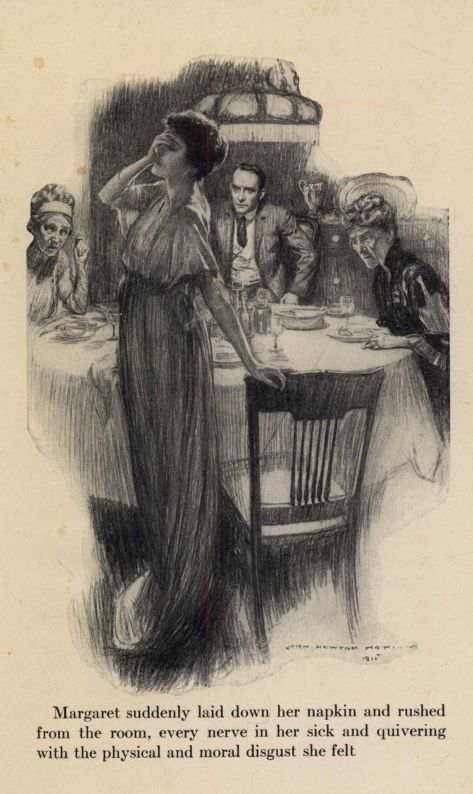
Margaret suddenly laid down her napkin and rushed from the room, every nerve in her sick and quivering with the physical and moral disgust she felt
When before returning to his office Daniel went to
their bedroom, where Margaret, weak and despairing, lay
prone upon the bed, he found the door locked against him.
"I insist upon coming in, Margaret!"
"Go away!" she faintly called.
"Open the door!" he commanded.
"I won't! I can't! I don't dare to! I'm dangerous!
Go away from me!"
"Get up and open this door!"
"If I did, I'd—I'd scratch you! Keep away from me!"
Daniel telephoned for the doctor.
"My gracious!" exclaimed Jennie, as they all awaited
the coming of the physician in the sitting-room, "Hiram's
Lizzie never carried on like this when she was expecting!"
"No, she certainly didn't," echoed Sadie; "for all she
might have had a little more right to; while Margaret,
here, coming to Danny without nothing at all, up and
sasses him like what she did at dinner yet! Don't it
wonder you?"
Daniel, lounging in his own big chair before the fire,
pouted like a thwarted, spoiled child.
"What got into her, anyhow, to act so hystericky all of a
sudden?" Sadie speculated.
"Saying she'd set fire to Danny's store!" exclaimed
Jennie indignantly. "And swearing yet! My gracious!"
"It certainly does, now, beat all!" said Sadie mournfully.
"I certainly didn't think she'd turn out like this!"
scolded Jennie. "You hadn't ought to have picked out a
wife, Danny, without me looking her over for you
first."
"I can't do anything with her!" snapped Daniel
spitefully. "Nothing I can say will make her stop running
with Catherine Hamilton. She tells me to my face she
won't give her up. And she won't, either!"
"Och, Danny, I wouldn't take it off of her!" said Jennie
harshly.
"Well, what can a man do?" he fretfully demanded.
"Discharge Miss Hamilton."
"She's invaluable to me. She's in my confidence in a
business way. I can't discharge her. It wouldn't matter
to her anyway. Every lawyer in town that has any practice
would like to employ her. What I'm afraid of is that
she'll resign. Oh, if she were afraid of losing her job, then
I could easily fix Margaret!"
"It looks, Danny, as if Margaret took up with your
clerk just to spite and worry you; for what else would she
run with her for?"
"Well, if you'd hear them talking together once!"
Daniel sullenly responded.
"Well, if we did?" questioned Jennie curiously.
"You wouldn't understand a word they were saying!"
snapped her brother.
"Do they talk so dumb?" asked Sadie wonderingly.
"They seem to think it means something—the stuff
they get off to each other!"
"It certainly does spite me, Danny," said Jennie with
sympathetic indignation, "to have your wife use you like
this! And when I think how you could have married most
anybody!"
"Here comes the doctor," announced Sadie. "Supposing
she won't leave him in her room?"
"Och, but that would make talk!" exclaimed Jennie.
"I'll go up and tell her she has to open!"
Margaret, meantime, her sudden gust of passion subsided,
realized how foolishly she was acting.
"I can't say I didn't marry him with my eyes open,"
she prodded herself. "I have no right to scorn him and
fly out at him. I see that well enough, alas! I owe him
everything I can reasonably give him to make up for my
lack of love."
Her sense of her obligation to Daniel did not, however,
and never could, include the denial of such fundamental
principles as her friendship with Catherine Hamilton, or
her own personal freedom in so far as it did not clash with
his just rights.
Margaret was not so stupid as to suppose for a moment
that she could, by any utmost effort on her part, lead
Daniel to see a case like that of George Trout's store rent
as she saw it. That he could flaunt and boast of such
"deals" proved him too hopelessly obsessed.
"If he were ashamed of it and tried to hide it, there
might be some hope of redeeming him. As it is, I
certainly shan't waste myself in any such futile endeavour.
But if I outlive Daniel, I shall pay to George Trout or his
heirs that eight hundred dollars on the very day that I
get possession of my widow's third. Or, if I have a son,
he shall discharge that debt!"
However, by the time Jennie knocked on her door demanding
admission for the doctor, she was in a sufficiently
chastened frame of mind to receive both him and her husband
with all the outward semblance of a dutifully happy wife.
Accustomed as Margaret was to the Southern
ideal of the chivalry due to a pregnant wife;
reared in a state where a fundamental principle
of marriage is that the husband's share in the burden and
sacrifice of bringing a child into being shall consist in
cherishing the mother of his child with reverence and
tenderness, so that her difficult ordeal be made as bearable
as unselfish love can make it, and that she be upheld
throughout her trial by the man's strength and devotion;
and that the husband who did not so regard his wife was
a cur to be horsewhipped—Margaret had to learn, during
her weary, waiting months, that this attitude of the
Southern gentleman would have seemed to the average
Pennsylvania German ridiculous sentimentality, his view being
that woman was created, in the Providence of God, to be a
breeder and that was all there was to it; that in merely
fulfilling her natural function she was in no more need of
sympathy or help or compassion than a cow in the same
condition; that her inclination during pregnancy to tears,
tantrums, fretfulness, indolence, a muddy complexion, a
phlegmatic indifference to everything except the making
of baby clothes, not even her husband getting, at this time,
any consideration to speak of at her hands—these things
were recognized by him as burdens to be borne either with
stoicism, or, for the sake of the child, peremptorily
prohibited.
So, it was a matter of wonder to Margaret, rather than
of distress, that Daniel should be so extremely moderate
in his expression of concern or sympathy for her condition.
So used as he was to being taken care of by his sisters, it
would have been a wholly unnatural attitude on his part,
she saw, to be actively solicitous for a woman. He
would have felt he lowered his dignity and made himself
absurd if he had put himself out for her comfort in the
many little ways he might have done and which she had at
first looked to see him do.
But, as Daniel told her one day when she expressed
some of the wonder she felt at his lack of chivalry toward
her, he had never seen Hiram bother about Lizzie when she
was in that condition, and it was after all only Nature.
"A baby's teething is only Nature, but we help and
comfort it, don't we? I did expect you'd get a little
bit excited over my health! It would all be so much
easier to bear," she spoke rather to herself than to him,
knowing his impenetrability, "if one were treated as a
woman!"
"As a woman?" Daniel inquired, puzzled.
"Yes, instead of as a cow."
"A cow?"
"Treated as a Southerner treats a woman."
"Now I should think," was Daniel's complacent reply,
"that when a husband acts toward his wife as I saw
your brother-in-law act toward your sister, like a butler
or a porter, she wouldn't respect him."
"The mediæval peasant idea that if her husband doesn't
beat her, he doesn't love her," said Margaret.
But the dreariness of mind Daniel's attitude caused her
she, with a sort of mediæval superstition, almost welcomed
as being at least some expiation for the sin of her loveless
marriage.
Margaret was disappointed to find, as the days passed
over her head, that because of her inability to ride on the
cars without great physical distress, she was obliged to
postpone the promised visit to her mother-in-law; and at
last, when her appearance made the little trip no longer
possible, she wrote to Mrs. Leitzel and explained the
reason for her not keeping her promise.
"But just as soon as your grandchild is able to travel,"
she concluded her letter, "I shall bring it (not knowing its
gender) out to see you."
It seemed to Margaret that, unaggressive though she
was, the weeks before her confinement were constantly
marked by contentions, apparently inevitable, between
her and Daniel about the many things of life which they
viewed from diametrically opposed standpoints. Her
monthly account of her expenditures with her ten dollars
allowance was one of these points of difference. The first
time Daniel asked her to produce the little account book
he had given her she took it from her desk, scribbled a
few words in it, and cheerfully handed it to him, and he
read on one page, "Daniel gave me ten dollars," and on
the opposite page, "All spent. Balances exactly."
Daniel looked up from the book inquiringly.
"That's as much of an account as you'll ever get from
me, Daniel, as to what I did with ten dollars in a whole
month! Did you actually suppose I'd give you the items,
like a little school-girl?"
And no amount of persuasion, or of fretting and fuming
on his part, could induce her to submit to him an itemized
account of her allowance.
Her South Carolina property was another bone of contention.
"I can't get a word from that brother-in-law of yours
in reply to my letter to him!" Daniel complained one
September evening when they were alone in their bedroom
just after supper, Margaret, in a pink silk negligé,
lying on a couch at the foot of the bed and Daniel seated
in an armchair beside her. "The slipshod business ways
of those Southerners! What does the man mean?"
"He's such a procrastinator! I must admit Walter's
rather lazy. Clever, though. He's considered a mighty
intelligent lawyer."
"A clever lawyer has some sense of business, which he
does not seem to have!"
"Don't you be so sure of that!"
"What do you mean?"
"Oh, nothing."
"Well, he does seem to have enough sense of business
about him to defraud you out of what belongs to you!"
snapped Daniel.
"Walter is an honourable gentleman," Margaret quietly
affirmed, "with a sense of honour, Daniel, that to you
would be as incomprehensible as a Sanscrit manuscript,
or a page of Henry James."
"The quixotic 'sense of honour' of a South Carolinian!"
scoffed Daniel. "Oh, I know all about that. Impracticable
moonshine! Nothing in it, Margaret. Has no market value."
"No, thank God, it has no market value."
"You're a little simpleton, my dear, about 'values' of any
kind, and I wish you wouldn't swear!"
"Can't one thank God except in church and at the vulgar
hour of feeding?"
"Be reverent!" Daniel, looking shocked, reproved her.
"And I don't see where his sense of honour comes in in his
behaviour as to your property!"
"Don't bother about my property, Daniel," Margaret
wearily advised. "It's not worth bothering about."
"It's all you have, though," Daniel ruefully retorted.
Margaret offered no reply to this.
"I want you to write to Walter, Margaret, and see
whether you can get an answer out of him."
"What about?"
"What about? Haven't I just been telling you? You
write and demand of him why I receive no answer from
him to my repeated inquiries as to your property."
"But I have told you all there is to know about it,
Daniel."
"Margaret," Daniel patiently answered, "I have already
explained to you how I can make that estate yield you
a handsome income."
"By depriving my sister of a home? No, thank you."
"Naturally your sister would also profit by what I
would do for the estate."
"Profit at your expense? Not if you could help it,
Daniel."
Daniel laughed appreciatively at this flattering tribute
to his business acumen.
"I think I see, Daniel, how you would manage the
'deal.' You'd improve the estate, rent it at a high figure,
and keep the rent (at least my share, if not my sister's)
to pay you for what you had spent."
"Pretty good, my dear! You have some business
cleverness yourself, I see, after all! Sufficient, at any rate,
to recognize that you ought to be getting your share
of your uncle's bequest. Just inform your brother-in-law,
in your letter, that you are going to sign over to me the
power of attorney to manage your affairs. That will bring
him to time and fetch an answer!"
"But I'm not."
"Not what?"
"Not going to sign away any 'power' I may have. I
didn't know I had any. It's a pleasant surprise. I shall
certainly hold on to it. I need it, whatever it is."
"Without power of attorney to act for you, Margaret,
I can't help you. You'll have to give it to me," said Daniel
firmly. "I'll bring up a paper from the office on Monday
and Jennie and Sadie will witness your signature. Can't
you get up and write to Walter now? I'll dictate the
letter."
"I wouldn't rise from this comfortable couch, Daniel, if
the house were on fire."
"It's very bad, very bad indeed, I'm sure, for you to lie
about so much."
"If you were carrying a weight of several tons, I guess
you wouldn't be on your feet when you didn't have to."
"'Several tons?' That's a gross exaggeration, Margaret."
"I never was strong on figures or statistics," Margaret
admitted.
"Won't you try to get up and write the letter? I very
much wish you to," urged Daniel, still quite unable to
credit the fact which in these days frequently confronted
him, that any feminine member of his household could fail
to jump at his least bidding.
"What do you want me to write?" Margaret parried.
"Great heavens!" Daniel cried, exasperated. "I've
told you only about a dozen times!"
"A dozen? A gross exaggeration, I'm sure. And to
call upon the heavens is irreverent. There, there, I won't
tease you," she patted his hand; and he immediately
clasped and held it, for he still adored her. "But as I've
told you, Daniel, that I won't sign over to you the power
of attorney, there's nothing to write to Walter about."
"Is this your idea of not 'teasing' me? I've said that
without the power of attorney, I can't help you."
"I don't want that kind of help, my dear, thank you very
much."
"Will you write the letter before I go to the office
to-morrow morning?"
"Telling Walter I'm not signing over to you the power
of attorney? Is that necessary?"
"Very well, Margaret." Daniel rose with dignity and
turned away from her. "I'll dictate to my stenographer
what I wish you to say to Walter and I'll bring the letter
up from the office for your signature."
"Daniel!" Margaret suddenly exclaimed at mention of
his stenographer.
He turned about and looked at her.
"Did you give Catherine the note I sent her this morning?"
"I certainly did not."
"Why not?"
"You ask me to play the messenger boy to my own clerk!
I read your silly note, my dear, and burned it."
Margaret, sinking a bit lower among the cushions of the
couch, did not trust herself to answer.
"Now, my dear," said Daniel, "since you can no longer
go out, you can take advantage of the chance that fact
gives you, to drop this unseemly intimacy, which no doubt
by this time you find burdensome enough, especially as
you have seen how exceedingly annoying it is to my sisters
and to me. We are willing to overlook your having
flouted our wishes if you'll now——"
"Has Miss Hamilton been to see me and been turned
away?" demanded Margaret, who for the past two weeks
had neither seen nor heard a word from her friend, her
notes and telephone calls having both failed to bring any
response. She had been deeply wounded and worried
at Catherine's seeming unfaithfulness to her in her time of
dire need; and she had suffered keenly from the deadly
loneliness that had engulfed her; for she had, through almost
daily association for many weeks, become so deeply bound
to Catherine that she felt she could never again know
happiness if she lost her. While she had indeed suspected
that some treachery on the part of the Leitzels was
keeping Catherine away, yet she did not understand how her
friend could possibly have failed to receive at least some
of the communications she had sent to her; letters which
she would have supposed must bring Catherine to her side,
if she had to storm the house to get there.
"Have your sisters sent my friend away when she came
to see me and kept it from me that she was here?" Margaret
repeated in a tone so quiet that Daniel never
suspected the volcano it covered.
"She has been told by Jennie every time she called that
you wished to be excused. This unseemly intimacy is
to cease! You will have to understand, Margaret, that
I am not a man to be trifled with by a mere woman—a
mere girl, I might say!"
"Brave and manly of you, Daniel, certainly."
"If you don't watch out, you will be the cause of my
losing the most valuable clerk in New Munich and one to
whom I have confided important private business matters,
for, if I must, I shall tell her straight that I object to her
running after my wife!"
"Oh!"
"I have already hinted to her that you are at last coming
to your senses and getting over your silly infatuation for
her. I intimated to her that it was only your appreciation
of her valuable services to me which had led you to be very
nice and friendly to her."
"Do you suppose for an instant, Daniel, that she was
idiot enough to believe that?"
"Why shouldn't she believe it?"
"Because she knows me—and she also knows you."
But though Margaret assured herself many times in
the course of the wakeful, restless night which followed
that Catherine would not believe Daniel's absurd story
nor let the family attitude toward her come between
them, she really suffered an agony of doubt and fear
lest the friendship so precious to her should not be
able to stand under the pressure brought to bear upon
it.
"Surely Catherine will think I am asking too much of
her, to expect her to stick to me through all this! But
oh! I can't give her up, I can't! I will not let them
separate us!"
The next morning, as soon as Daniel had left the house
for his office, she hurried to the telephone and called up
Miss Hamilton, knowing that her only chance of getting
Catherine was when Daniel was not in his office. She
actually trembled with apprehension for fear she should
be told that Miss Hamilton had not yet reached the office.
But to her joy it was Catherine's own voice that answered
her.
"Oh, Catherine! It's Margaret! Catherine, listen!
I've been wanting you so! I didn't know why you didn't
come, and I only learned last night. Catherine, I'm
coming right down to the office, now, in a taxicab, and I
want you to come out with me for an hour, for I must see
you to straighten things out. Tell the powers that be
that you've a headache or small-pox symptoms or
something and just come. Will you?"
"I will, dear. I'll leave a note on my desk and walk
out now, and meet you at the door when you get here."
"I'll be as quick as I can."
She hung up the receiver. But just as she was going to
lift it again, to call the taxicab office, her eyes fell upon
Jennie and Sadie congregated a few feet away from her,
Sadie staring at her in consternation and Jennie in wrath
and indignation.
"Margaret!" Jennie suddenly came to her and forcibly
pushed her from the telephone. "You ain't to call a
taxicab, so you ain't, Margaret! Our Danny ain't to be
spited so when I'm close by!"
"Very well," answered Margaret coolly, "I'll go next
door and use Mrs. Kaufman's telephone."
"But," gasped Sadie, "that'll make talk yet!"
Margaret, not replying, started for the door.
"Margaret!" cried Jennie sharply, hurrying after her
and catching her arm, "how that'll look yet—you going
into the neighbours' to 'phone! You darsent go round to
our neighbours' making talk!" she commanded. "I won't
leave you do it.'"
"Then will you let me use the telephone here?"
"No, I won't, not for no such a purpose—to go down to
see our Danny's clerk when he don't give you dare to.
You're near worrying my poor brother to death with the
way you act!"
"Please let go my arm, Jennie."
"You pass me your promise, then, that you'll behave
yourself. You're all the time raising excitements in our
peaceful home that gives Sadie the indigestion!"
Margaret wrenched herself free and went to the front
door; but Jennie got there first, turned the key and
removed it from the lock.
"I ain't leaving you disgrace us with our neighbours!"
she indignantly affirmed.
Margaret, looking white but resolute, went to a side
window, raised it, and called into the Kaufmans' dining-room
where the family was then breakfasting, while Jennie
and Sadie, foiled, but horrified and incredulous of her
audacity, fell back.
"Will you please be so very kind, Mrs. Kaufman,"
Margaret called across the space between the two windows,
when Mrs. Kaufman had raised hers, "as to 'phone for a
taxicab for me at once. I have to hurry down to
Mr. Leitzel's office. I shall be so much obliged, and I'm very
sorry to trouble you at breakfast."
"We're just done, Mrs. Leitzel, and I'll be very glad to
oblige you. Nothing wrong, I hope?"
"No, but I must get to the office as quickly as I can.
Will you please tell them to hurry with the taxicab,
Mrs. Kaufman?"
"Yes, of course I will—don't mention it! Your telephone
out of order?"
"I can't use it," said Margaret, and with a nod and a
smile, she closed the window.
She turned slowly and looked at her sisters-in-law.
They, almost leaning upon each other for support, were
regarding her as though she were a dangerous lunatic.
Without a word, she went past them and upstairs to get
her wraps. When she came down five minutes later the
taxicab was at the door and Jennie was at the 'phone calling
up Daniel's office.
Margaret found, however, that the front door was now
unlocked. They evidently felt too uncertain of her to
try her any further.
Margaret wondered whether, if Jennie
succeeded in warning Daniel of her coming, he
would again contrive to prevent Catherine's
seeing her.
"Wouldn't it make a good Movie! I might have it
copyrighted!" she shrugged.
But she told the chauffeur to hurry, hoping that she
might, even yet, get to the office before Daniel got there.
"If I don't, and if he tries to keep Catherine from
coming down to me—well, if I didn't look such a sight, I
would go right up into the office!"
When, however, the taxicab drew up before the building
of which the second floor was occupied by Daniel's law
offices, and she leaned for an instant out of the cab window,
she saw her husband coming down the street. Jennie,
then, had been too early for him. Margaret looked about
hastily for Catherine, but she saw nothing of her. She
shrank far back, then, in the cab to prevent Daniel's
seeing her, for he was now close by.
She saw him hesitate at the door of the building and
glance inquiringly at the cab; then, curiosity moving him,
for Daniel had the petty curiosity of an unoccupied
woman, he came over to the curb and looked into the window
of the cab.
Margaret met his glance calmly. All she cared about
was that he should not prevent her meeting Catherine.
"Why, Margaret! You out of doors! What for? You
came for me? Is anything wrong?"
"I came out for some fresh air."
"But to come out on the street!" he protested, scandalized.
"I'm not exposed to view."
"But the chauffeur has seen you!" whispered Daniel,
actually colouring with embarrassment.
"He doesn't mind it nearly as much as you do, Daniel.
I think he'll recover; he looks robust."
"But what have you come down to my office for?"
As Margaret at this moment saw Catherine coming
out of the building, she promptly answered, "To see Miss
Hamilton and clear matters up with her. Here she is
now."
Daniel turned about sharply, and Catherine, nodding a
cheerful good-morning to him, stepped into the cab and
bent over Margaret to kiss her.
"But, Miss Hamilton," cried Daniel as his clerk settled
Herself comfortably beside his wife, "why are you not at
your desk?"
"I left a note on your desk, Mr. Leitzel, asking you to
excuse me for an hour. I shall be back before ten," she
replied, drawing the cab door shut and speaking to him
through the open window.
"To the park," Margaret ordered the chauffeur.
"Good-bye, Daniel."
"Miss Hamilton," faltered Daniel, but before he could
collect his wits to decide how he ought to meet so unprecedented
a situation, the car started and whirled down the
street.
Slowly and thoughtfully he turned into his office building.
Never before in all his life had his will been so
frustrated as by this young wife of his hearth and home upon
whom he showered every comfort, every luxury and
indulgence. That any one whom he supported should
disobey, defy, and thwart him! It was beyond belief. How
did she dare to do it?
"But what's a man to do with a wife who doesn't care
for his displeasure any more than if he were an old cat!"
he raged. "Oh, well," he tried to console himself, "it
won't be long, now, until the baby comes, and then surely
she'll be different. She'll have to be! I'll find some means
of teaching her that my wishes can't be disregarded!"
Miss Hamilton's note which he found on his desk stated
succinctly that she had an imperative engagement this
morning which would make her an hour late.
Daniel, sinking limply into his desk-chair, crushed the
note in his long, thin fingers and tossed it into his
waste-basket, with the murderous wish that it was his clerk's
head he was smashing.
"What will they be when they get the vote?" he groaned.
"Women," he said spitefully but epigrammatically, "are
the pest of men's lives!"
Margaret, meantime, without once directly referring
to her husband and his sisters, had managed to convey to
Catherine an explanation of the silence and desolation that
had existed between them during the past two weeks; and
she was now making a compact with her which she felt
must insure them both against any future misunderstanding.
"Tell me first, Catherine, that our friendship means
more to you than—than any petty considerations! Please,
Catherine, tell me that it does! For I just must have you,
you know! You are more to me than I can possibly be
to you, for you have your mother, while I——"
She hesitated and Catherine said, "And you, Margaret,
will soon have your child. Will that make you need me
any less? I don't believe it will, dear. And my other
dear ones can't in the least fill your place in my life. I
can't give you up any more than you can spare me.
Nothing," she said with decision, "shall separate us."
"Then," said Margaret, pressing Catherine's hand,
"hereafter, when you come to see me, ring the bell four
times by twos, and I, knowing about the hour to look for
you, will be on hand to let you in myself."
"All right. I will."
"Catherine! You are large-minded!"
"My dear!" protested Catherine, "'large-minded' to
be indifferent to the eccentricities of—well," she closed
her lips on the rest of her sentence, "two illiterate, vulgar
old women," was what she had nearly said; but she left
it to Margaret's imagination to finish her remark.
"While you are ill in bed, I suppose I shan't be able to
get near you," she ventured. "It will be dreadful if I
have to wait nearly a month before I can see that baby!
It's going to be awfully dear to me, Margaret! Next
thing to having one of my own."
"I couldn't wait a whole month to show it to you. I'll
ask the doctor to bring you to me."
"We'll manage somehow," affirmed Catherine.
Margaret, looking rather pale, did not answer, and
Catherine suddenly put her arms about her and kissed
her.
"You poor child!" she said tenderly.
"I'm not a good fighter," Margaret sadly shook her
head. "And there are so many, many adjustments to be
made, I——"
She stopped short and bit her lips to keep back the
tears that sprang to her eyes.
"At least," said Catherine encouragingly, "you seem
to be coming to your ordeal, dear, with plenty of courage;
and that's the main thing just now."
"Oh, Catherine, I'm willing to go through a lot for the
sake of holding a baby of my own to my heart!"
"Then you think, Margaret, that motherhood is going
to be all that it's cracked up to be?"
"Under ideal conditions," said Margaret, "I can see
nothing greater to be desired."
"But do the ideal conditions ever exist?"
"I suppose they seldom do."
"Sometimes I've had my doubts," said Catherine.
"The male poets and painters exalt the beauty, the
holiness of motherhood, and the women bear the burden and
pain of it."
"But when women whose lives have had the largest
horizon—women like Elizabeth Barrett Browning and
Margaret Fuller—have declared that their motherhood
was the crown and climax of all their experiences of life,
I suppose the poets and painters are not very wrong
about it, Catherine."
"I hope they are not, since all my instincts about it are
entirely primitive and I feel that nothing in the world will
compensate me if I've got to go through life childless."
"There would be one compensation," said Margaret
earnestly.
"What?"
"Sometimes, since I've known I was going to have a
child, the responsibility, the almost crushing responsibility,
has seemed more than I could bear. That's what I
meant when I spoke of ideal conditions."
Catherine held back her mental reply to this, which was,
"Yes, we should be careful whom we marry, and why did
you tie up with a little rat like Danny Leitzel?"
What she did say was: "You didn't feel this crushing
sense of responsibility until after you found yourself
pregnant?"
"No. Before that I thought only of my own happiness
in having a baby to cherish. But, Catherine, when we
look about us and see what life can do to us, I wonder
how we ever dare, under any conditions, to bring a child
into this awful world!"
"We can't question the foundations of the universe,
however."
"No, but we can question modern civilization, which
produces a huge population of criminals, lunatics,
degenerates, and incapables."
"Think of pleasant things, my dear!"
"I try to. To tell you the truth, in spite of my heavy
sense of responsibility, I can hardly wait, Catherine, until
I have my baby! I want to show you the lovely little
embroidered dress Harriet sent me. Will you come in
to see it and me this afternoon after four o'clock?"
"Yes."
"I'll be on the watch."
"All right," Catherine nodded.
"The baby received another present, the other day,
which touched me very much," added Margaret. "A
cunning pair of socks from its grandmother which she
knit herself."
"Its grandmother? But——"
"I mean Mr. Leitzel's step-mother."
"Oh!"
"Did you ever happen to see her, Catherine?"
"Once. She came to the office once to see Mr. Leitzel."
Catherine's tone of withdrawal, as though she feared to
be questioned, piqued Margaret's interest.
"What was your impression of her?"
"Margaret, your husband's mother has an unforgettable
face! There's a benediction in it, such sweetness,
refinement, and simplicity shine in her countenance.
When she had talked to me for a while, I felt as a good
Catholic must who has been blessed by the Pope. Just
the sort of person (with a heart too tender to hurt a fly)
to be herself easily victimized by the human vultures that
prey upon the too confiding."
"Has anybody victimized her?" Margaret casually inquired.
Catherine hesitated an instant before she answered:
"Righteousness is sometimes a breastplate to protect the
otherwise defenceless. It is that dear old woman's
extraordinary conscientiousness that has saved her from being
entirely devoured by the vultures, though she has certainly
been gnawed at pretty hard. I can't explain to you, now,
just what I mean. Some day, perhaps."
"Oh, do tell me, Catherine."
Again Catherine hesitated before she replied: "She
made a certain promise to her husband on his deathbed
which her conscience has never allowed her to break,
though she has always believed that she was acting against
her own interests in keeping it. But it's her loyalty to
her promise that's been her breastplate; that has saved her
from the vultures."
Margaret considered in silence this suggestive bit of
information. It was rather more lucid to her than
Catherine suspected. But she was impressed with the sudden
realization she had of her friend's intimate knowledge of
Daniel's affairs and it flashed upon her that perhaps his
seemingly unreasonable objections to their intimacy might
have quite another explanation than that he had given it.
In this, however, she was mistaken. Daniel entirely
trusted the discretion of his clerk. Not so much because
he believed her bound in honour to keep his secrets as
because it was the part of a first-class clerk (which she
was) to be discreetly silent as to her employer's business
operations.
"And now, my dear," Catherine broke in on her thoughts,
"since we've threshed things out and have made a
compact that we will not again misunderstand each other, I
think I'd better get back to my 'job.'"
Margaret gave the order to the chauffeur; and when a
little while later, alone in the taxicab on her way home,
she found her heart overflowing with a sense of the fulness,
the richness of life, and considered how strenuously Daniel
and his sisters tried to take from her the comfort, the
happiness, of companionship with Catherine and how
impossible it would be to make them see what that
companionship meant to her, she felt greatly strengthened in
her resolve to resist, steadily and persistently, their
aggressions upon her personal liberty.
At her own door, as she opened her purse to pay for the
cab, she found she had remaining of her monthly allowance
only two dollars and the chauffeur's price was three
dollars. She hesitated an instant, then telling the man
to charge the cab to Mr. Leitzel, she got out hastily and
went indoors.
"Rather hard on Daniel to make him pay the costs of
my plots gotten up to circumvent his plots! He won't
like it. Ah, I've a bright idea! I'll tell him to deduct
the three dollars from my next 'allowance.' That will
appease him."
But on second thoughts she realized that that same
bright idea would surely occur to Daniel without any
suggestion from her.
Margaret felt an impersonal curiosity as to
what Daniel would say to her when he came
home to his dinner at noon. Jennie and Sadie
were also curious as to that. But Daniel himself was
curious, too. How was a husband to meet such unnatural
behaviour in a wife? Did other men's wives so
disregard their husbands' wishes and commands? If women
got much more independent it would break up the holy
estate of matrimony altogether.
He finally decided, on his homeward walk, that about
the only course open to him was to take refuge in a dignified
silence, though now that Margaret's time was drawing
near, he felt sufficiently apprehensive of the outcome to be
very leniently inclined toward her. Funny how he cared
for her when she treated him the way she did! He could
not help it, somehow. She certainly had a way with her!
Well, when she was over her trial and quite herself again,
he'd have another try at bringing her to a proper sense of
the confederation to which he was accustomed and which
was his due.
He wondered uneasily what the people of the town
thought of this incongruous intimacy between his clerk
and his wife. It certainly passed his comprehension as
much as it did that of his sisters that a girl as
"high-toned" as Margaret was should insist upon being intimate
with his stenographer. That Miss Hamilton was equally
"high-toned," he was incapable of recognizing. Jennie
had voiced his own sentiments when a few days before
she had exclaimed, "When she could run with anybody, she
goes and picks out an office clerk! It's nothing else,
Danny, but that she's bound to act contrary, to show
us she don't care if she didn't bring you a dollar to her
name!"
However, a letter which he found on the hall table when
he reached home diverted not only his own attention,
but that of the whole household, from Margaret's case.
It was from the school teacher of Martz Township, who
wrote in behalf of his step-mother; and after dinner, as
the family sat together, as was their custom, in the sitting-room,
for an hour before Daniel went again to his office—Jennie
and Sadie fussing about him to make him comfortable,
adjusting the window-blind, placing his chair, handing
him the newspaper, retying his necktie, brushing his
coat collar—Daniel presently opened and read the letter
he had received.
Margaret listened to it and to the lengthy discussion
which followed with an attention that was to bear early
and abundant fruit.
"DEAR FRIEND:
"I am writing for Mrs. Leitzel, to leave you know she had it
so bad in her lungs here the past couple weeks the neighbours
thought it would give pneumonia, but she got better and now
she's up again, but very weak, and I'm leaving you know that
we think she ought not to live alone a half a mile away from her
nearest neighbour, because if she got so sick that she couldn't
help herself, she might die before her neighbours found it out yet
that she needed help. And she's too feeble any more to make
up her fires and fetch her water from the spring and chop her
wood. The house not having any modern improvements, and
so much out of repair, it makes it harder, too, for such an old
woman. And she has hardly anything to live on. The neighbours
say she had either ought to have some one with her, or you
ought to take her to your home to live. If not, she'll have to
go the poorhouse, and that of course you would not want, either.
"She is better now and says to tell you not to worry, but I
warn you she may get down sick again any time, as old as what
she is. And I think you have got good cause to worry, though I
told her I'd tell you not to. If it hadn't been for the neighbours
doing for her this last couple weeks, she'd have died.
"Yours truly,
"MAYBELLE RAUCH.
"P.S. She says she sends her love to all and that you have
got no need to worry."
But Daniel and his sisters did seem to think they had
"need to worry" very much, at the startling revelations of
this letter, not the revelations as to their step-mother's
sufferings and needs, but as to the neighbourhood publicity
given to their neglect of her.
"To think she'd go and have that busybody teacher
and all her other neighbours in and complain to 'em all
like this, so's they write to us yet and ask for help for her!
Well, this beats all! She never went this far before!"
scolded Jennie.
"Yes, I don't see why she couldn't leave us know herself
if she's got any complaints, and not put it out to the whole
township like this!" Sadie worried.
"It certainly will make talk out there!" Daniel frowned.
"Enough to get into the newspapers if she doesn't
watch out!"
"But how," Margaret ventured a question, "could she
let you know except in the way she's taking, since she
can't write herself? And how could she help having the
neighbours in if she was ill and helpless and alone?"
"She could anyhow have sent us a postal card to say
she was sick and wanted one of us to come out," said
Jennie.
"Would you have gone to her?"
"Of course one of us would have gone."
"Maybe she couldn't even write a postal card, or get
out to mail it if she did write it, if she's so old and feeble,
and was ill."
"If that was the case," said Daniel, "then to avoid a
repetition of the occurrence, I don't see what else we are
to do but put her into a home."
"You know how she's against that, Danny," said
Jennie. "If you decide to do it, you'll have a time with
her! And those neighbours all taking her part!"
"This impertinent teacher," said Daniel, tapping the
letter he held, "has the face to reproach us, you notice,
for not keeping the place in repair! It wasn't our business
to keep it in repair when we never get any rent for it."
"Yes, it does seem as if Mom might have kept it in
repair when she was getting it rent free," said Jennie. "I
don't see why she has not been able to save something in
all these years from what she's earnt from her vegetable
garden."
"She certainly hasn't managed good," said Sadie.
"And to think of the cheek of those neighbours!" said
Jennie wrathfully. "Saying we had ought to take her in
here to live with us yet! As if she was our own flesh and
blood!"
"What would Hiram say to something like this coming!"
Sadie speculated; "when he thinks we did too much in not
charging her rent."
"Well," Daniel suddenly announced with a magnanimous
air that seemed to swell his chest, "I'll send her a
check. I'll send her five dollars. Maybe I'll make it
ten."
"Ten dollars yet, Danny!" said Sadie, regarding her
brother with affectionate admiration.
"I'm not sure I'll send as much as ten. But anyhow
five."
"She'll be sure to show the check around to prove to
those neighbours how good you are to her."
"And there will be some among them," said Daniel
indignantly, "that will be ready enough to call it stingy!"
"Oh, well, some folks would say it was stingy if you sent
her twenty-five dollars yet!"
"If you and Sadie want to put a little to what I send,"
Daniel tentatively suggested, "we might make it ten or
fifteen."
"Well," said Jennie reluctantly, "it ain't fair for you to
pay all, either. What do you say, Sadie?"
"Well," Sadie hesitatingly agreed; "for all, I did want
to get a new fancy for my white hat. How much will you
give, Jennie?"
"Well, if you and I each give two-fifty to Danny's five
or ten, that ought to stop her neighbours' talking out
there."
"All right," Sadie pensively agreed.
"No use asking Hiram to contribute," Daniel growled,
"when he thinks we ought to charge her rent for the place.
He gets angry whenever he hears I gave her a little. I
told him once, 'If I can better afford than you can to give
her a little, and I don't ask you to help out, what are you
kicking about?' 'It's the principle of it,' he said. 'If
you give her money, it's admitting you owe it to her, or
you wouldn't give it to her. Now I contend that we don't
owe her anything.' 'Well, then,' I said, 'when I give her
a little now and then, I'll put it down on my accounts
under Christian Charities. Will that satisfy you?' But
no, even that didn't satisfy him. He's all for putting her
to a home. And it looks now as if that's what we'll have
to do pretty soon," Daniel concluded, rising to go to his
office.
Margaret looked on in silence as Jennie and Sadie each
counted out carefully from their purses two dollars and
a half and passed it over to their brother.
"I'll send a check, then, to mother for fifteen dollars,"
he said as he put the money into his own purse. "I'll
make it fifteen," he nodded. "I'm willing to make it
fifteen. That will certainly settle the gossips out there
and keep her going for a while comfortably."
He came across the room to Margaret's chair by the
window.
"Good-bye, my dear," he said, bending to kiss her; and
it took all her self-control not to shrink in utter repugnance
from his caress.
"Oh!" she inwardly moaned as she turned to gaze out
of the window when he had gone, "what crime have I
committed in marrying a man I——"
But even her innermost secret thought recoiled from
the admission that she despised her husband, the father of
her child.
She went upstairs to her room to spend the time, while
she waited for the hour of Catherine's arrival, in putting
some last touches to the baby outfit she had made and in
writing a note to Daniel's step-mother expressing her
sympathy with her recent illness and reiterating her
promise to come to see her as soon as possible after her
confinement.
"I'll mail it myself," she decided as she sealed and
stamped her letter, "or give it to Catherine to mail."
At four o'clock, feeling a little nervous, but quite
determined, she went downstairs to await the signal ring at the
door. As it was ten days since Catherine had been to the
house, Margaret hoped that Emmy, the maid, was off her
guard, unless the episode of this morning had caused
Jennie and Sadie to renew their watchfulness.
"It's so stupid of them, to say the least, to imagine I'd
submit to such interference in my own personal affairs!"
she reflected.
She knew their suspicions would be aroused if they found
her in the parlour, for of late she spent most of her time in
her own room. But she felt quite ready to deal with them
as effectively as she had done that morning.
She had not been downstairs long when a ring at the
door-bell brought her to her feet, only to sink down again
trembling, for it was not the four by twos agreed upon
between her and Catherine; and a moment later
Mrs. Ocksreider was shown into the parlour. Jennie and Sadie
came directly into the room to receive with much
satisfaction this distinguished and now frequent visitor who,
until Daniel's marriage, had confined her calls on them to
once a year; and they looked surprised to see Margaret
already there.
"Were you expecting Mrs. Congressman Ocksreider
that you're down already?" Jennie suspiciously inquired,
when the sisters had greeted Mrs. Ocksreider obsequiously.
"No, but I'm expecting Miss Hamilton," Margaret
quietly announced. "I have an appointment with her at
four-thirty. When she comes, I shall have to ask you all
to excuse me."
Jennie and Sadie looked the consternation they felt at
Margaret's audacity, not to say disrespect, in asking such
a person as Mrs. Ocksreider to excuse her because of an
appointment with that Hamilton girl!
"It's to be hoped," Jennie rapidly thought, "that
Mrs. Ocksreider will think it's a business appointment she's
got with our Danny's clerk," while Sadie ostentatiously
consulted her new wrist-watch to see how soon they might
expect the objectionable Miss Hamilton.
"You and your husband's stenographer seem to be great
friends," said Mrs. Ocksreider with what seemed to
Margaret a rather malicious enjoyment of her sisters-in-law's
evident discomfiture.
"We are," said Margaret.
"I've always heard those Hamiltons very well spoken
of, as very nice, worthy people," Mrs. Ocksreider said in a
tone of kindly condescension. "Where do they live,
Mrs. Leitzel?"
That Mrs. Ocksreider shouldn't even know where they
lived, put them of course outside the pale. Jennie and
Sadie suffered acutely at Margaret's reply.
"They live in a small rented house on Green Street,"
she said, and added: "One of the few really distinguished
homes in our town."
"'Distinguished?'" repeated Mrs. Ocksreider, puzzled.
"I mean, rather, it is a home that has distinction, by
reason of its inmates and its furnishings."
"Its furnishings?" questioned Mrs. Ocksreider, still
puzzled.
"Its pictures and books and general good taste. One of
the few households that have pictures and books."
"Oh, but we all have pictures and books, Mrs. Leitzel!"
"Real pictures, I mean, and real books, too."
"But I'm sure most families of our class have the classics
in their homes," Mrs. Ocksreider protested.
"The classics' do help to furnish a room nicely, don't
they?" Margaret granted. "But the Hamiltons have
books which they read. French and German as well as
English."
"Well, of course, a public school teacher's home would
be likely to have all kinds of books," Mrs. Ocksreider
conceded, "that society people wouldn't buy."
"Of course," Margaret agreed.
"But I don't see why that should make their little home
on Green Street what you called it—'distinguished.'"
"But I said the furnishings and the inmates gave it
distinction. You see, I know because I am very intimate
with them."
"I have heard that you were. It is so nice for your
husband's little stenographer that you should take her up
like that. It's so unusual, too. She's very fortunate, I'm
sure."
"It's rather she that has taken me up. I'm quite proud
that she thinks me worth the time she gives me. You see
she's more than Mr. Leitzel's stenographer: she's an able
law clerk. Mr. Leitzel says she's indispensable to him."
"Then he and his sisters share your enthusiasm over
the Hamiltons?" Mrs. Ocksreider inquired in a tone of
polite skepticism.
"I am the only one of us all who is intimate with them,"
Margaret complacently stated.
"I didn't see them at your reception last fall, did I?"
"They didn't come," Margaret readily answered.
"You know they don't go into society at all."
Jennie and Sadie felt cold as they heard these shameless
admissions, their Danny's wife bragging of her intimacy
with people whom she openly advertised as living in a
rented house on a side street and as not going into society!
Not to go into society was, in the Leitzels' eyes, to be so
abjectly unimportant as to make you want to get off the
earth. And Margaret flaunted it!
"Ain't she the contrary piece though!" Jennie inwardly
raged.
"Ah!" Margaret almost jumped from her chair as the
door-bell at this moment rang "four by twos."
"That's Miss Hamilton now," she announced, rising
and walking as quickly as she could (which was not very
quick) across the room. "Will you please excuse me,
Mrs. Ocksreider? I am sorry, but it is an appointment——"
But as she reached the door which opened into the hall,
she saw the front door closed abruptly by Emmy, the
maid.
Instantly stepping back into the parlour, Margaret
hurried to the window, rapped upon it, then raised it and
leaned out to speak to Miss Hamilton on the pavement.
"Emmy made a mistake; I am at home, Catherine. Come
back, and I'll open the door."
She closed the window and again made her way heavily
across the room, smiling in a friendly way upon
Mrs. Ocksreider as she passed her. "A mistake of the maid's.
I'm seeing so few people just now," she dropped an
explanation on her way.
Mrs. Ocksreider's subsequent description of the scene,
in which the Leitzel sisters' horror at Mrs. Leitzel's
innocent candour about "those Hamiltons," and the young
woman's clever outwitting of her two would-be "keepers,"
afforded most delectable entertainment to New Munich
society for two months to come.
It was late in October that the twins were born, a boy
and a girl, and Margaret did not rise from her bed for
a month. It was six weeks before she got downstairs.
Long before the trained nurse left her, she realized what,
before her confinement, she had dimly foreseen, the
struggle to the death which she would certainly have with
Jennie's strong prejudices in favour of old-fashioned
country methods of taking care of a baby. It was only
the doctor's powers of persuasion that induced the nurse,
harassed beyond endurance by Jennie's interference with
her methods, to remain with her patient until she was no
longer needed.
"You poor thing, you certainly are up against it!"
was her parting bit of sympathy to Margaret. "She'll
kill off those precious twinlets for you, or she'll kill you.
One of you has got to die! The woman's a holy terror,
my dear! And the other one, that wears Mother
Hubbards and Kate Greenaways and Peter Thompsons and
Heaven knows what, she's nearly as bad as her sister about
these babies. I don't know what you're going to do!
You may be able to protect them when you're with them;
but you've got to get out sometimes for an airing without
dragging the baby-coach along, and those two"—indicating,
with a twirl of her thumb, the twins' redoubtable
aunts—"will certainly kill off your babies for you while
you're out."
"If you're sure of that I'll never go out."
"And you can't look for your husband to help you any,"
continued the nurse. "Crazy as he is over the twinnies,
he'll help the old ladies kill them off, because he thinks
their ancient ideas are right. The old ladies, for that
matter, are nearly as crazy over the babies as he is. You'd
think nobody but Mr. Danny Leitzel had ever had twins
before. I never saw such a looney lot of people. But
it's their love for those children that's going to make them
kill them, for it does beat all the way you can't knock a
new idea into any of them."
In the very hour of the nurse's departure, Jennie,
supported by Sadie as always, swooped down upon Margaret
to insist, with the triple force of conviction, of tyranny, and
of her love for Danny's precious babies, that they be
brought up as she knew how babies should be, and not by
the murderous modern methods of exposing them to the
night air, of bathing them all over every day even in winter,
of feeding them, even up to the age of one year, on nothing
but milk, of taking them outdoors every day in winter as
well as in summer.
"Many's the little green mound in the cemetery that
hadn't ought to be there!" Sadie sentimentally warned
Margaret. "So you let us teach you how to take care of
Danny's babies!"
Well, the conflict or convictions between the mother, on
the one side, and the aunts and the father on the other,
was not settled in a day, nor yet in a week. It was,
indeed, prolonged to the inevitable end. But while the
strife and tumult of battle raged, the mother's will was
carried out, at the cost to her of a nervous energy she
was in no wise strong enough to expend.
The fact that the twins thrived wonderfully under
Margaret's régime did not in the least modify the Leitzels'
prejudice against it. Daniel could not help believing
profoundly in the wisdom of his sisters, since they had
made such a success of him. And never once in his life
had he failed to "come out on top" when following their
advice. He admired and respected them; and he felt as
much affection for them as he was capable of feeling for
any one. So that, with his loyalty to them challenged by
that force which to most men is the strongest in life—the
love of a woman—the atmosphere of his home was, just at
present, rather uncomfortably surcharged.
But in spite of this and of his actual bewilderment at the
continued obstinacy of a wife who, though tenderly
beloved, indulged, and petted, dared to stand out against
not only his sisters but against himself, Daniel was so
radiantly proud and happy at finding himself the father
of a son and daughter at one stroke that he discussed
with every one he met the charms, the characteristics,
the food, and the habits of his offspring; told his colleagues
in business what food-formula agreed with his girl baby,
who was being brought up on the bottle, the mother being
able to nurse only one child and that one being, of course,
by his wish, the boy; delivered to every one who would
hear him his views on Modern Fallacies in the Care of
Infants; and invited the opinions even of his employees as
to suitable or desirable names for the daughter, the son
being of course Daniel, Junior.
It was one mild day in January, when, after a siege of
more than usually bitter opposition on Jennie's part to
the twins being kept on the piazza all the morning,
Margaret found herself, during the afternoon, in a blessed
solitude in the family sitting-room, Jennie and Sadie
having gone out calling. So tired and heartsick was she
that she did not even feel any desire to call up Catherine
and ask her to share her few hours of freedom from
interference and fear of harm to her babies. The twins were
again healthily sleeping on the porch outside the sitting-room
and Margaret gave herself up to the sweet peace of
this respite, reading, dreaming, resting, when presently
the door-bell rang, and a moment later Emmy ushered into
the sitting-room a feeble old woman dressed in the plain
religious habit of the Mennonites.
Margaret instantly knew who the visitor was, and as she
went to her, took her two hands in both her own, kissed
her and looked down into the motherly old face with its
expression of childlike innocence and sweetness, she was
thankful that the rest of the family was not at home and
that she could for a little while bask in the warmth of
this kindly human countenance.
When she had made her visitor comfortable in Danny's
big easy-chair before the fire and had had Emmy bring in
some hot tea and toast, the old woman's beaming gratitude
betrayed how unlooked-for were such attentions in this
home of her step-children.
"I'll soon get my breath," she feebly said as she sipped
her tea. "I do get out of puff so quick, still, since my lungs
took so bad this fall."
"It was really too much of a trip for you to take, and all
alone," said Margaret solicitously. "I was just this very
day deciding that I would go out to see you some time this
week, if I could manage it. It's very hard for me to get
away or I should have been to see you before this."
"Well, my dear, what brang me in to-day was that I
just had to see Danny and the girls on a little business, and
so my neighbour fetched me in in his automobile. I
couldn't spare the money to come by train. But," she
said tremulously, "he made his automobile go so unmannerly
fast, I didn't have no pleasure. He said he ain't
commonly got the fashion of going so fast, but, you see,
he raced another automobile. He took me along for
kindness, but indeed I'm sorry to say I didn't enjoy myself."
"It was a strain on you, I can see," said Margaret
sympathetically.
"But the tea's making me feel all right again," said
Mrs. Leitzel reassuringly. "It's wonderful kind of you to give
it to me; but I didn't want to make no bother. I seen
Danny down at his office, and when he told me the girls
wasn't home this after, I came up here on the chanct of
seein' you alone, and them dear little twinses! Indeed I
felt I got to see them two twin babies before I died a'ready.
You see I knowed by your nice letters to me that you'd
treat me kind, and indeed I had afraid to try to go back
home alone on the train; I conceited that mebby you'd
take me to the depot," she said with timid wistfulness,
"and put me on the right train, and then I wouldn't have been
so afraid. Danny thinks I went straight off home by
myself. But indeed I didn't darst to."
"Of course I'll take care of you. But you must not
think of leaving before to-morrow when you've had a
chance to get thoroughly rested."
"Oh, but, my dear," said Mrs. Leitzel nervously,
"Danny give me the money to pay my way back home and
he thinks I went. And you see, it would put the girls
out to have to make up the spare bed just for me."
"But who could be more important than you—you who
took care of them all when they were children? Indeed
I shan't let you go a step to-day."
"Did they tell you I took care of them, my dear?" asked
Mrs. Leitzel, puzzled. "Because they never talked to
me that way. And Danny tried to show me this after,
when I put it to him that now I couldn't hold out no longer
to support myself gardening on the old place—he said I
hadn't no claim on him. I don't know," she added sadly,
"what I'll do. I'm too old and feeble to work any more,
my dear. God knows I would if I could. I'd work for all
of them as well as for myself, the way I used to, if I had
strength to. But I come in to-day to tell Danny that at
last I'm done out. Yes, the doctor says I got tendencies
and things and that I got to be awful careful."
"'Tendencies?'" asked Margaret.
"He says I got somepin stickin' in me."
"Something sticking in you! Do you mean that you
swallowed a bone or something?"
"No, my dear, I didn't swallow nothin'. I got a tendency
stickin' in me that might give pneumonia. So I
come to ask Danny to-day if—if he couldn't mebby spare
me something," she faltered, "to live on for the little time
I got left, so that"—a childlike fear in her aged eyes—"I
don't have to go to the poorhouse!"
"When you told Danny all this," asked Margaret, laying
her hand on Mrs. Leitzel's, "he said you had no claim on
him?"
The old woman's lips quivered and she pressed them
together for an instant before she answered.
"He told me he'd talk it all over oncet with Hiram and
the girls. But," she shook her head, "I'm afraid Hiram's
less merciful than any of my children and he'll urge 'em
to put me to such a home for paupers; and, oh, Margaret—dare
I call you Margaret?"
"What else would you call your son's wife, dearie?"
"I have so glad Danny has such a sweet wife! I
wouldn't of believed he'd marry a lady that would be so
nice and common to me. It wonders me! I can't hardly
believe it!"
"But you are good to me, making me that lovely quilt
and the baby socks. I use the quilt all the time and one of
the twins is wearing the socks now. How could even
Hiram be hard to you?"
"But Hiram and the others is wery different to what you
are." Mrs. Leitzel shook her head. "Danny says if he
did pay me a little to live on, Hiram would have awful cross
at him. You see, my dear, the reason I ain't got anything
saved, as they think I had ought to have, is that I never
could make enough off of the wegetables I raised in the
backyard to keep myself and pay for all the repairs on the
old place, for all I done a good bit; enough anyhow to keep
the old place from fallin' in on me. I don't know how I'd
of lived all these years if it hadn't of been for the kindness
of my neighbours. And now Danny says if I can't keep
myself at all no more——" Again she pressed her lips
together for an instant. "He don't see nothing for it
but that I go to a old woman's home. He calls it a old
woman's home, but he means the poorhouse."
"Mother," said Margaret, clasping the hand she held,
"I wish you would tell me the whole story of your life
with Daniel and Hiram and 'the girls.' Begin, please,
away back at 'Once upon a time.'"
Mrs. Leitzel smiled as she looked gently and gratefully
upon Daniel's young wife who wasn't too proud to call
her "Mother."
"Well, my dear, I married John Leitzel when Danny
was only six months old, because them children needed a
mother. John drank hard and it was too much for them
young folks to earn the living and keep house and take
care of a baby. I married John because I pitied 'em all
and so's I could take hold and help. Jennie was fifteen,
Sadie ten, and Hiram five, and then the baby, Danny. I
sent the three older ones to school and I took in washings
and kep' care of the baby and did the housekeeping and
the sewing. I kep' Jennie in school till she could pass the
County Superintendent's examination a'ready and get
such a certificate you mind of, and get elected to teach the
district school. And with all my hard work, I kep' her
dressed as well as I otherwise could. For I was always
handy with the needle and Jennie and Sadie was always
so fond for the clo'es. Well, when at last Jennie come
home with her certificate to teach, my but we was all
proud! Indeed, I wasn't more proud when Hiram got his
paper that he was now a real preacher—sich a seminary
preacher, mind you!—though that was a long time afterward.
Well, I thought it would go easier for me, mebby,
when Jennie got her school. But you see, she had so
ambitious to dress nice and do for Danny (he was such a
smart little fellah) that I had still to take in washings and
go out by the day to work. Hiram he worked the little
farm we had and I helped him, too, in the busy seasons to
save the cost of a hired man, for our place had such a
heavy mortgage that the interest took near all we could
scrape together. Yes, for nine years and a half we
struggled along like that, and then at last John died. And
mind you, the wery next month after he died, we all of a
suddint found coal on our land! Yes, who'd ever of
looked for such an unexpected ewent as that! Ain't?"
"To whom did the land belong?" asked Margaret.
"It had belonged to my husband's first wife, but she
had willed it over to him before she died. So it was hisn."
"Oh, but, my dear, then you were entitled to one third
of it, if you didn't sign away your rights."
"Indeed, no, I didn't sign nothing. Leave me tell you
something, my dear: John on his deathbed he thanked
me for all I done and his dying orders to me was, 'Don't
you never leave Jennie and the rest get you to sign away
your rights in the farm that you worked so hard to keep
in the family. If it wasn't for you,' he said, 'we would of
been sold out of here long ago, and the children all bound
out and me in the poorhouse! And if I had the money for
a lawyer, I'd sign the whole farm over to you before I die.' 'No,
John,' I said, 'that wouldn't be right, neither, to give
it to me over your children's heads.' 'Well, anyway,' he
says, 'it's too late now, so you just pass me your solemn
promise on my deathbed that you'll never leave 'em
persuade you to sign nothing without you first leave one of
your Mennonite brethren look it over and say you ain't
signin' away your rights.' So I passed my promise and
I've kep' it, though it has certainly went hard for me to
keep it. Danny worried me often a'ready these thirty
years back, to sign a paper, and it used to make him
wonderful put out when I had to tell him, still, that I'd
sign if he'd leave one of our Mennonite brethren read it
first and say if I was breakin' my word to John or no.
Danny always said he didn't want our affairs made so
public and the Mennonite brother would have too much
to say. So then I had to say I couldn't sign it; I couldn't
break my word to John on his deathbed. Many's the
time I was sorry I passed that promise to John—they all
have so cross at me because I won't sign nothin'. You
see, they always was generous to me, giving me the house
and backyard to live in without rent. But to be sure I
couldn't break my word to my dying man!"
Margaret saw that there had been no self-interest in
her refusal to sign away her rights, but that the binding
quality of a deathbed promise was to her a fetish, a
superstition. And it was this, no doubt, that Catherine had
meant in speaking of her "breast-plate of righteousness,"
her conscientious devotion to her solemn vow had shielded
her from the snare of the fowler; from "the greed of the
vulture," Catherine had said.
"And lately," Mrs. Leitzel continued her story, "Danny
didn't bother me no more to sign nothing. But to-day,"
she concluded, suddenly looking very weak and helpless,
as she leaned far back in her chair, "to-day he ast me
again, and he said it couldn't make no matter to me now
when I was so near my end, and if I'd sign a paper he'd
not leave the others put me to the poorhouse. But I
told him if I was so soon to come before my Maker, I
darsent go with a broken promise on my soul. If only
I hadn't never passed that promise, my dear! John
meant it in kindness to me, but you see," she suddenly
sobbed, "it's sendin' me to the poorhouse to end
my days!"
"Oh, but my dear!" exclaimed Margaret, her face
flushed with excitement, "why didn't you, from the very
first, get your one third interest in those coal lands? You
were and are entitled to it!"
"Well," said Mrs. Leitzel, "right in the beginning when
they first found the coal, they got me to say I'd be satisfied
to take the house and backyard for my share; not to keep,
of course, but to live on for the rest of my life; and seeing
the land had been their own mother's, that was a lot
more'n I had the right to look for. To be sure," she
gently explained, "you couldn't expect your step-children
to care for you as your own flesh and blood
might."
"You cared for them as though they were your own flesh
and blood. Tell me, you did not sign an agreement, did
you, to accept the house and backyard in lieu of your one
third interest in the estate?"
"No, for that would of been breakin' the promise I
passed to John. For you see, Danny never would leave
one of the brethren look over the paper he wanted me to
sign, and say whether I could do it without breakin' my
word. So I never signed nothing."
"Then the only thing you need to establish your absolute
right in one third of the income of the coal lands (now
enjoyed by your step-children and excluding you) is the
proof that the title to those lands was vested absolutely
in your husband at the time of his death. If it wasn't,
you have no case. If it was, you've plenty of money!
You see, my brother-in-law is a lawyer and I've imbibed a
little bit of legal knowledge. But I have an intimate
friend, Miss Catherine Hamilton, who knows nearly as
much law as Daniel does and I'll get her to look up the
court-house records for your husband's title to that land,
and then, my dear, if we find it—— Oh, my stars!"
"But, Margaret," the old woman protested fearfully,
"you'll get 'em all down on you if you go and do somepin
like that!"
"You see," Margaret gravely explained, "I am living
on this money which belongs to you, and my children will
be living on it, inheriting it. I couldn't bear that, of
course."
"Do you mean," faltered Mrs. Leitzel, "you think they
cheated me? There's others tried to hint that to me and
I wouldn't never listen to it. Why, Hiram's a Christian
minister and they're all church members and professin'
Christians! They wouldn't steal, my dear—and from an
old woman like me!"
"It's been done, however, by church members and
professing Christians. We'll investigate it, my dear,"
Margaret firmly repeated.
"But I wouldn't want to be the cause of you and Danny's
fallin' out, little girl! That I certainly wouldn't. And,
dear me!—if you got Jennie down on you yet!"
"She couldn't be much more down on me than she is.
And during all these years, you know, you've stood up to
them for the sake of a sacred promise. I hope I haven't
less courage."
"Don't you think Danny's too smart a lawyer, my dear,
for you to get 'round him?" Mrs. Leitzel anxiously tried
to avert the disaster which Margaret's suggestion surely
presaged.
"My brother-in-law is a smart lawyer, too. I'll write
to him this very night, put the case to him (omitting names)
and ask his advice. Oh," she suddenly lowered her voice,
"here come 'the girls.' Do not breathe a word of what
I've said to you!"
"Oh, no, indeed I won't. I know how cross they'd have
at me! My dear," she added, clinging to Margaret's
hand, "stay by me, will you? Please! Jennie and Sadie
won't like it so well that I come. I conceited I'd get away
before they got back, and they're likely to scold me some,
my dear, and——"
Margaret stooped over her impulsively and kissed her
forehead. "Come out to the porch with me and see the
babies."
When a moment later Jennie and Sadie came into the
room they saw, through the long French window opening
on to the porch, their step-mother bending over the sleeping
infants in the big double coach, and Margaret standing
at her side, her arm about her waist.
"Why!" exclaimed Jennie as she grudgingly shook
hands with her step-mother when Margaret
returned with her to the sitting-room. "You
here! We saw Danny downtown just now and he said he
gave you money to get home."
"Yes," added Sadie, also shaking hands reluctantly,
"we didn't look to see you here. Anyhow Danny thought
you went to the depot from his office."
"But," smiled Margaret, "she gave me the pleasant
surprise of a call. I am so glad, because I wanted so much
to know her, my husband's mother and the babies' grandmother!
How pretty your flowers look, Sadie!" she added
diplomatically and quite insincerely, for she groaned
inwardly at the bunch of little artificial roses Sadie
girlishly wore on the lapel of her coat.
"What is this to do?" Jennie suddenly demanded as
her eyes fell upon the tea-table.
"We've been having tea and toast."
"Well!" breathed Sadie.
"Upon my word!" exclaimed Jennie. "You stopped
Emmy in her Sa'urday's work to make tea and toast in the
middle of the afternoon yet!"
"It took her just fifteen minutes."
"She ain't ever to be hindered in her Sa'urday's work!
She has a cake to bake for Sunday then!"
"But you know," said Margaret patiently, "you stopped
her on wash day to make tea for Mrs. Ocksreider."
"Well, but Mom ain't used to tea in the afternoon and
Mrs. Ocksreider is. Anyhow, who's keeping house here,
Margaret?"
"But surely I may have a cup of tea with your mother if
I wish to, in this house!"
"But it up-mixes my accounts when you do somepin
like this. Danny pays half of all the expenses here and
Sadie and I pay half."
"Oh, I see," Margaret breathed rather than spoke.
"But after all, Jennie, it's quite a simple matter—charge
the tea, sugar, milk, bread, and butter to Daniel's
side of your account and I'll take the responsibility of
it."
Jennie turned abruptly to her step-mother. "It's
getting late on you, Mom, to get out home. You don't
want to get there after dark, with a half a mile to walk from
the station yet. Before I take off my coat and hat, I
better see you on the street car that'll take you to the
depot for the five o'clock train."
"Yes, Jennie," the old woman submissively answered,
"I was just a-goin' to start to go when you come."
She rose with an effort from the comfortable chair
before the fire in which Margaret had again placed her.
But Margaret at once pressed her back into her seat.
"You will be glad to know, Jennie, that I have
persuaded mother to spend the night with us," she said, "as
she is too tired from her journey to go back before
to-morrow."
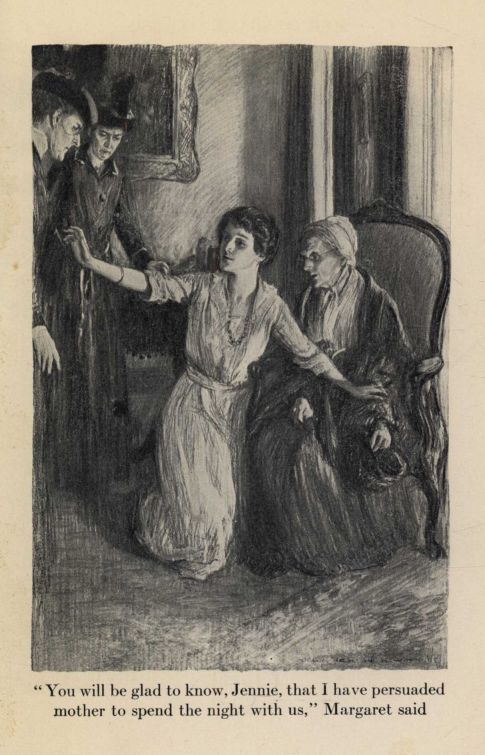
"You will be glad to know, Jennie, that I have persuaded mother to spend the night with us," Margaret said
"She never stops the night with us, Margaret," Jennie
coldly returned. "Come on, Mom, I'll put you on the
street car."
"But isn't it nice," cried Margaret, holding her arm
around Mrs. Leitzel to keep Jennie off, "that I've
succeeded in coaxing her to stay to-night? Such a pleasant
surprise for Daniel when he comes home, to find you here,
dear! What is home without a grandmother? Good
discipline for Daniel, too, to have to give up this armchair
for one evening! Even I have to get out of it when he
wants it. But naturally he can't put his mother out of the
only really comfortable chair in the house."
"But Danny paid for that chair," explained Sadie.
"It would be funny—ain't?—if he couldn't sit in his own
chair when he wants!"
"The spare-room bed ain't made up," Jennie frowned at
Margaret. "And nobody has time to make it up at four
o'clock on Saturday afternoon! Anyhow, strangers
stopping over night is apt to give Sadie the headache. And
Mom never wants to be away from her own bed. She
won't can home herself in a strange bed, can you, Mom?"
But Margaret spoke before Mrs. Leitzel could reply.
"I'll make up the guest bed. It won't take me ten minutes.
Mother"—she patted Mrs. Leitzel's shoulder—"I'll
be right downstairs again in ten minutes."
But Mrs. Leitzel clung to her hand. "Don't let me
alone with—stay by me, Margaret——" she pitifully
pleaded.
"You shall come upstairs with me, then, to my room,"
Margaret said, helping her, now, to rise to her feet.
"No, Margaret, Mom's to go back on the five o'clock
train," affirmed Jennie peremptorily. "Our Danny give
her the money to go back. It ain't for you to be using our
clean linens to make up the spare bed. Come on, Mom."
Jennie laid an ungentle grasp upon her step-mother's
arm, but Margaret, her face suddenly ablaze with
indignation, confronted her.
"Jennie! This is my husband's home, and his feeble
mother shall be his guest and mine until to-morrow morning."
"She ain't his mother, she ain't even a blood relation.
And what right have you, I'd like to know, to meddle in
our family affairs?" Jennie fiercely demanded. "It's
just your contrariness that makes you want to do everything
that you see will spite us; for what other reason would
a person like you have for taking up with an uneducated
old woman like Mom? You wouldn't look at a person
like her if it was not to spite us!"
"What right have I? The right of the humane to
protect the helpless from brutality, under any and all
circumstances, without exception. She shall not leave this
house to-day!"
"Now, Mom," Sadie turned on her step-mother, "you
see what you make by coming here like this, without
leaving us know! Ain't you worrying us enough all the
time, without raising more trouble between us and Danny's
wife yet?"
"Yes, yes, I'll go. Please, my dear"—she turned to
Margaret,—"leave me go. I'd rather die on the way home
than stay and make it unhappy for you, Margaret! Danny
will take up for them, you know, so I can't stay and make
trouble. Leave me go, my dear!"
"But if you don't make your mother welcome here,"
Margaret addressed both Jennie and Sadie, "I shall have
to go with her. I can take her to Catherine Hamilton's
for the night. Or," she added with sudden inspiration,
"to Mrs. Ocksreider's, and ask her if she won't give her a
bed until the morning. She shall not take that journey
to-night!"
Jennie glared in baffled fury, while Sadie turned white
with dismay.
"Danny won't leave you do such an outrageous thing!"
the elder sister said hoarsely.
"Daniel can't stop me. Come, mother."
"You don't mean to say you'd do as mean a thing as
that—take Mom to Mrs. Ocksreider's!"
"But I am so sure that Mrs. Ocksreider is the very
person who would be very glad to receive her for the night."
"You up and tell me to my face you'd disgrace us like
that!"
"But where would the disgrace come in?" asked Margaret
innocently.
"Where would the disgrace come in?" repeated Jennie
hotly. "Don't you see any disgrace in telling Mrs. Ocksreider
that we won't leave our mother (even if she is our
step-mother) sleep at our place over night?"
"Then you admit that you are acting disgracefully in
turning her out?"
"You wait till Danny comes home and he'll show you
if you can go against me like this in his house!" Jennie
violently threatened, more furious than ever at being
trapped by her own words. "Now you leave Mom be till
I take her out to the car!"
"No, Jennie, if she goes I go with her—to our friend,
Mrs. Ocksreider. Therefore, it behooves you——"
But it was just at this instant that the sitting-room door
opened and Daniel walked into their midst.
"Margaret! I've got an automobile at the door. Get
your hat——"
He stopped short in astonishment at sight of his step-mother,
at Margaret's attitude of shielding her against the
evidently furious antagonism of Jennie and the cold
disapproval of Sadie.
"Well?" he demanded testily. "What's up? How did
you get up here, mother?"
"Yes, how did she, when you gave her the money to go
home yet?" scolded Sadie.
Margaret, leaving the statement of the situation to
Jennie, remained silent.
"Who brought you up here?" Daniel inquired of the
old woman.
"I come by myself, Danny. I wanted to see your wife
and the twinses, and I conceited I'd be gone before the
girls got home. But I'll go right aways now. I'm sorry
I come. I didn't want to make no trouble—I——"
She made a movement from Margaret's side, but the
latter clasped her firmly.
"Margaret," commanded Daniel, "let her go."
"I have invited her to spend the night here, Daniel.
She is not able to go home to-night."
"I'll take care of that—this is not your affair. Let her
alone! Take your hands off her!"
"Will you let her spend the night here?"
"I said I would take care of that. Take your hands off
her."
Margaret obeyed.
"Now come here, mother."
Mrs. Leitzel walked feebly toward him, but Margaret
walked beside her.
"Now, you see, Danny, how contrary she acts!" Jennie
broke forth. "I wanted to take Mom out to the trolley
car and Margaret would not leave her come along, when
Mom said she wanted to come, too!"
"Well, I'm here now," returned Daniel grimly. "I'll
take you to the station, mother," he pronounced
conclusively, taking the old woman's arm.
"Daniel! Your mother can't go home alone this
evening! It will be cruel of you to send her!"
Daniel, ignoring her, led his mother to the hall.
"I tell you I'm going to stop this cruelty!" cried
Margaret, darting upstairs to get her wraps.
She was down again almost immediately, her coat over
her arm, but when she reached the sidewalk the automobile
containing her husband and his mother was beyond her
reach.
"I may be able to get to the station before that five
o'clock train!" she thought, starting almost on a run to go
the length of the town to the depot, putting on her coat
and gloves as she went. "I believe his mother will die on
the way if she goes, and has to walk that half-mile alone in
the dark, after being subjected to all this horrible scene!
Oh, my God! What people they are!"
She realized, on her way, that her purse was empty, her
monthly allowance having been spent, and that she had
not even money for trolley car fares—a serious handicap
in her efforts to help Mrs. Leitzel.
When, panting for breath, a sharp pain in her side, she
reached the station, the train to Martz was just pulling out.
Daniel, smiling blandly, came toward her along the
platform.
"God help me!" was the cry of her heart, "that I cannot
even hate him—he is too utterly pitiable! If I could
hate him, there might be some hope for us!"
"Want to take a little ride, my dear?" he inquired,
waving his hand to the waiting automobile.
"Take me home," she returned weakly, feeling suddenly
collapsed and helpless.
"You know," he said as he helped her into the car, "you
ought not to excite yourself like this—it's bad for Daniel
Junior's milk—about something, too, that is no concern of
yours. And I want to warn you also," he added, lowering
his voice so that the chauffeur might not hear him, as the
car turned into the street, "that you've got to refrain from
offending Jennie and Sadie so constantly. They have a
lot of money to leave to our children. Keep on offending
them as you are doing and they'll will all they have to
Hiram's children!" said Daniel in a tone that expressed
all the horror that such a possibility contained for him.
Margaret did not reply.
"You get me?" Daniel inquired.
"Considerations like that, Daniel, have never entered
into my philosophy of life, thank God!"
"Margaret, you really must break yourself of this
dreadful habit of swearing! It's so unladylike! And so
unchristian!"
"Oh, my good Lord, Daniel! Don't dare to talk to
me about anything's being 'unchristian,' when you have
just done a cruel, cruel thing to your aged, helpless mother!
I don't profess and loudly flaunt my 'Christian principles,'
but I do believe in the Golden Rule. Evidently you don't.
Don't speak to me!"
"Hoity-toity! Cut out these tantrums, Margaret;
they're bad for the boy, you know."
"Why don't you tell the Y.W.C.A. about your smart
'deal' with your tenant, George Trout, and your
treatment of your step-mother? Maybe they'd send you
another congratulatory letter that you could have
published in the Intelligencer."
"You heed my warning about offending Jennie and
Sadie," was Daniel's reply.
"At the time of your father's death was the title of the
farm at Martz vested absolutely in him?"
Margaret had the satisfaction of seeing Daniel start and
turn red at her question, as he turned abruptly and looked
at her.
"What makes you ask that?" he nervously demanded.
"Was it?" she repeated.
"Why do you wish to know?"
"It was," she affirmed.
"How do you know?" he sharply questioned.
"That same old Woman's Intuition."
"I insist on your answering me intelligibly! What do
you know of business matters like that anyhow?"
"Not much, but a little."
"Understand, Margaret, once and for all, that my business
affairs and that of my folks are no least concern of
yours!"
"Yours are."
"They are not!"
"Oh, yes, they are, Daniel. You and I are life partners
and I am the mother of your heirs. Therefore, I have
everything to do with your business. Neither I nor my
children shall live on stolen money."
"Stolen money! You talk to me of 'stolen money,'
when I stand in this community as the one honest,
upright, Christian lawyer! Gracious, Margaret, I certainly
expected that after the children were born I'd have back
again the sweet girl I married! I'm beginning to feel
that I've been awfully taken in!"
Margaret leaned back in the automobile, closed her
eyes, and did not answer. During the remainder of the
ride the silence between them was unbroken.
Immediately after dinner Margaret went to her
room, got into a negligé, and sitting down to her
writing-desk, began a letter to Walter.
She stated the case of the Leitzel coal lands under the
guise of Western gold mines and asked her brother-in-law
to give her all possible light on the legality of the case for
the benefit of the "grandmother."
"If the laws governing such a case differ greatly in the
different states," she wrote, "please give me all the general
information on the subject that you can. This is a very
important matter to me, Walter, though I can't tell you
why; nor can I explain to you why I consult you rather
than Daniel on a question of law. The fact is, I am
preparing a little surprise for Daniel."
At this point in her letter she paused, resting her elbow
on her desk and her head on her hand. "Walter will see
right through my disguises and subterfuges," she reflected.
"He will understand perfectly what the surprise is that I
am preparing for Daniel. And in his reply he will
undoubtedly tell me what the law of Pennsylvania is
governing such a case as I've outlined. Well," she drearily
sighed, "I can't help it if he does see through it, I can't be a
party to defrauding that old woman, as I would be if I
consented to live here on money that ought to be hers."
She took up her pen again and dipped it into her ink,
but the bedroom door opened and Daniel entered.
She looked so pretty in the dainty pink negligé which she
wore, and with her abundant dark hair hanging in two
heavy braids down her back, that Daniel, despite the
coldness which had prevailed at dinner, came to her side, put
his bony arm about her shoulders and patted her bare arm.
"Writing to Walter, I see," he remarked; and quickly
she covered her letter with a blotter.
"Yes," she answered.
"Glad you are. I've not yet got an answer out of him.
Are you, my dear, repenting of your unwifely behaviour
and writing to him what I want you to?"
"I'm doing what I consider my wifely duty, yes."
"Good! I knew I'd get my sweet girl back again! Let
me see what you've written. All this!" he exclaimed,
reaching across the desk to pick up her letter; but
Margaret, looking at him in startled amazement, held him off.
"I haven't said you could read my letter, Daniel."
"Do you have secrets from me, Margaret?"
"Do you have any from me, Daniel?"
"That's neither here nor there. Come, let me see your
letter, my dear!"
"I don't wish to. Why do you want to?"
"You are writing something to your brother-in-law you
don't want me to know about?" he accused her, his
narrow gaze piercing her.
Margaret quickly decided to resort to guile.
"Daniel," she smiled upon him, "I'm preparing a little
surprise for you."
"A surprise?" he repeated suspiciously.
"Yes. Now, while I am finishing my letter, I want you
to do something for me. Will you?"
"What?"
"Is there any way of finding out by telephone or telegraph,"
she asked, her eyes big and sad, her lips drooping,
"whether your poor mother is by this time safe at home?
I shan't sleep a wink to-night from worrying over that
half-mile walk she had to take after dark!"
"She didn't have to take the half-mile walk. I arranged
for that. I gave her a quarter to pay for a 'bus ride from
the station to her house and I 'phoned to Abe Schwenck
to meet her train with the 'bus. Could I have done
more?"
"You really did all that?" she asked, her face lighting
up with relief.
"I did all that. So you see I'm not 'cruel' and
hard-hearted. I did all that for one who is no relation to me
and has no claim on me."
"The claim of gratitude?" Margaret suggested; "or
of mere humanity?"
"As for gratitude, haven't we repaid her for her ten
years' service for us by our thirty years of taking care of
her?"
"Taking care of her?"
"We've never charged her a cent of rent for the only
home she has had for thirty years."
"Why wouldn't you let her stay here to-night?"
"Because we don't want to start that kind of thing,
or she'd be here on our hands all the time. Once we take
her in, we'll never be able to shake her off, and we don't
want her."
"I see."
"Of course you see. Now give me a kiss, and promise
me you will turn over a new leaf and not be so stubborn
about the care of the babies and about Catherine Hamilton
and about all the other little matters in which you tease
me so that I've got indigestion!" he said fretfully.
"I act only as I must, Daniel," said Margaret sadly.
"It gives me worse than indigestion!"
"Look at Hiram's Lizzie! She never antagonizes the
girls the way you do!" he complained, genuine anxiety in
his voice.
"She doesn't live with them."
"Well, but don't you see that's where we have the
advantage over Hiram? They'll get more attached to our
children because they'll see more of them. If you acted
toward my sisters as you should, as your duty to me and
to your children requires that you should, they might
leave nearly all they have to our children, giving Hiram's
children merely small bequests."
"If I should let them have their way with our babies,
they certainly would leave all their money to Hiram's
children, for there wouldn't be any babies in this house.
They'd kill them off with slow torture."
"Hiram's children haven't died and Lizzie does with
them as Jennie and Sadie have always advised her to do."
"Exceptions to every rule," Margaret briefly replied,
perfectly willing to shield Lizzie.
"Well," said Daniel emphatically, "you keep up your
present injudicious course, and the day will come when
your children themselves will reproach you for having
deprived them, by your sheer perversity, of what was justly
their due."
"I hope to bring them up too well for that."
"And I hope to bring them up to have a little more
judgment about money than you have, my dear! Well, I
should say so! or they would be ill-prepared to take care
of all they will inherit!"
"They will inherit a great deal, will they?" Margaret
casually inquired.
"Enough to need some common sense in the management
of it."
"Couldn't you spare a little from what they'll inherit to
keep that dear old step-mother of yours for her remaining
years?"
"Margaret!" said Daniel curtly, "I tell you again I
want no interference from you in my family affairs!"
"Well, then, can you, or can you not, afford to give me
more than ten dollars a month for pocket money? I find
it embarrassing to be out of money so often as I am. It is
my right to know what you can afford to let me have."
"If you would keep an account and submit it to me, I
could judge better of the justice of your request for more.
Ten dollars a month seems to me considerable money for a
woman to spend on nothing, for you are not expected to
buy your clothing and food with your allowance!"
Margaret, toying with her pen, her eyes downcast, did
not answer.
"If I did increase your allowance, it would be just like
you to pass it on to my step-mother! Positively, I
believe that's what you do want to do with it!"
"You are giving me credit I don't deserve. I was asking
for the money for myself. I am so often embarrassed
for lack of money. I had to borrow a dollar from Catherine
Hamilton yesterday to pay Mrs. Raub for washing my
hair. Catherine said she'd collect it from you."
"Jennie and Sadie wash their own heads."
"My hair is so thick I can't dry it myself and, you know,
it would be bad for the baby's food if I took cold."
"Adopt the rule which helped to make my success,
Margaret: never let yourself get entirely out of money.
And, my dear, if you'd do what I ask you to—give me
power of attorney—you'd have a little income of your
very own. Why, don't you feel under some obligation
to do something for me, in return for all I do for you?"
"Have I done nothing for you? I have given you a
son and a daughter. Can anything you ever have or ever
will do for me cover that debt?"
"Well," Daniel smiled, patting her neck, "you did pretty
well by me in that instance, I must admit; and I promise
you this: when you can persuade Walter Eastman to do
what's fair by you as to Berkeley Hill, I will increase your
allowance."
Margaret lifted her eyes, grave and melancholy, to
Daniel's face bent smilingly above her. "Catherine
Hamilton mentioned yesterday, Daniel, when I was obliged
to borrow a dollar from her, that she felt safe in lending it to
me as you were a millionaire and your income was twenty
times (or fifty, I forget her figures) more than you
spent."
"She has no business discussing my finances!"
"She didn't discuss them. She quite casually dropped
the remark (which I confess I found rather startling in
view of some things) that you were a millionaire and could
not begin to spend even a small part of your enormous
income. Yet you let your old step-mother suffer and
subject me to the embarrassment of borrowing money to
pay a hairdresser!"
"It's your own bad management that obliges you to
borrow at any time," Daniel coolly returned, not at all
disturbed. "And your constant disregard of my wishes,
my dear, would justify my cutting off your allowance
altogether! But I don't do it, do I? As for Miss Hamilton,
she's not the excellent clerk I took her for! She has
no sort of business to discuss my income and my
expenditures."
"I envy her!" Margaret suddenly cried out passionately.
"She is at least independent, self-supporting, not a miserable
parasite! I wish I were in her place, working honestly
for wages that you would have to pay me, instead of being
in the degrading position of having to ask you for money
which you refuse me! I'd better have gone and worked
in a factory than have done what I did!"
Her face fell on her arms and wild sobs shook her.
"Margaret!" Daniel cried in alarm and distress, his
arm about her. "My dear! You'll injure yourself and
Daniel Junior, if you do so! Stop going on so! Oh!" he
exclaimed, "you've waked the babies with your noise!"
A little cry from the adjoining nursery brought Margaret
to her feet. Daniel, infatuated quite humanly with his
beautiful babies, followed her eagerly, as, forgetful
instantly of her own troubles, she went to minister to her
children.
In reply to her letter to her brother-in-law, Margaret
received from him, a week later, a telegram that
puzzled her greatly.
Charleston, S.C.
Important Berkeley estate business brings me to New Munich
Thursday, February tenth.
WALTER.
She had ten days before his coming to anticipate with
some uneasiness the shock he would certainly get in making
the acquaintance of her husband's sisters and in seeing
the kind of home she lived in.
"If only I could dispose of that navy blue owl on the
sideboard!" she worried. "And of all that imitation
onyx in the parlour! And the 'oil-paintings' in the
sitting-room! As for Jennie and Sadie themselves—— Oh,
what can Walter be coming here for? I don't suppose
they've discovered coal on our estate. I hope not, such a
dirty mess as it would make! More like our luck to
discover we don't, after all, own the place."
But she found, when she announced her brother-in-law's
prospective visit, that she herself had not yet got all
the shocks and surprises the Leitzels were capable of
affording her. Her Southern sentiment of hospitality
received another unexpected blow in discovering that
Jennie and Sadie quite seriously objected to entertaining
her brother-in-law at their home.
"We ain't used to comp'ny stopping here," Jennie explained
to her. "Danny's business acquaintances always
go to the hotel. It wouldn't suit me just so well. We
ain't so young as we used to be, and it would certainly be
a worry to me to have company stopping here. You'd
best not begin that kind of thing, Margaret. If your
brother-in-law slep' and eat here, it would mebby give our
Sadie the headache."
That New Munich hospitality, instead of being a condition
of daily life as with Southerners, was so specialized
an occasion as to cause the upsetting of a household and
the expenditure of the nervous energy of a whole family,
Margaret had come to recognize. People did not "keep
open house"; they "entertained." But how was she to
spring such a thing upon Walter, who knew no other
standard of hospitality than that of the open Southern
home? How explain to him upon his arrival that her
home and her husband's was not open to him, and that he
must stop at a hotel?
She had not at all solved the problem when in a wholly
unlooked-for way it was solved for her. Confined to bed
one day with a violent headache, and quite helpless to
protect her babies from Jennie's hygienic theories, the
twins were kept by their aunt in a hot, airtight room such
as Jennie considered their proper environment, with
the result that they cried all day; and the next day had
heavy colds—their first disorder of any kind since their
birth. But when Margaret, herself recovered, insisted
upon taking them, suffering from influenza as they
were, out into the chill air of a cold day in January,
Jennie's thwarted will, thwarted affection, and wild
anxiety for these babies of Danny's whom she loved
almost fiercely, broke all bounds, and she gave Margaret
her ultimatum.
"Or either you keep those children in the house till
they're well already, or either I and Sadie leave this house
where we have to look on at such croolities, and go to keep
house by ourselves! Yes, this very day we go!"
Margaret paused in the strenuous work of getting little
Daniel's arms into his coat sleeves, preparatory to his
outing, and gazed up at Jennie with such a light of joyful
hope in her eyes that Jennie, had she not been too blindly
furious to see it, would certainly have withdrawn this
proffered happiness from her now heartily detested
sister-in-law.
"If Danny wasn't in Philadelphia to-day, I'd 'phone to
his office and have him make you keep them in!" she raged
frantically. "They'll get pneumonia, so they will!"
"Daniel couldn't make me, Jennie. I act under the
doctor's orders. Daniel's a lawyer, not a physician. I'm
taking the babies out to save them from having pneumonia."
"Daniel couldn't make you, couldn't he? Well, I can!
Yes, and I mean what I say! You take these babies out
on a day like this when they're sick, and I and Sadie
move out this very day!" she harshly reiterated, under the
delusion that Margaret would never put her to the test:
for not only was Jennie incapable of realizing Margaret's
utter indifference to the economic advantage of their
joint housekeeping, but it also seemed to her wholly
incredible that her sister-in-law could subject her devoted
and indulgent husband to the suffering he would certainly
undergo if deprived of his sisters' constant ministrations
to his comforts.
"And when Danny comes home from Philadelphia to-night
and finds us gone and our half of the furniture being
moved out, what do you think he'll say to you for driving
us out?"
Margaret, realizing that she must conceal the heaven
opened up by this unexpected ultimatum, quickly cast
down her eyes, that her tormentor might not see her
quivering eagerness.
"I'll goad her to moving out!" she desperately resolved.
"Oh! if only I can make it impossible for her to back down
from her threat."
She suddenly raised her eyes again and laughed
sarcastically. "Oh, you can't scare me with your threats!
You'll not go!"
"You'll see whether we won't! You just dare to take
those sick children outside this house, and you won't find
I and Sadie here when you come home!"
"That won't worry me. You'll be back soon enough.
Catch you leaving your brother's house! Oh, no, my dear,
you don't fool me for one minute. Why, where on earth
would you go?"
"Maybe you don't know," put in Sadie triumphantly,
"that Jennie and me own the nice empty house at the
corner that the tenants moved out of because we wouldn't
repaper!"
"Yes," exclaimed Jennie, "we own it and it's empty;
and it's all been cleaned only last week a'ready. So then
you see if we couldn't move out of here perfectly convenient!"
Margaret's hopes rose higher, while at the same time
she suffered fearful misgivings lest by any inadvertency
on her part they be dashed.
"Ha!" she laughed derisively and most artificially.
"You'd never move in there and lose the rent of that house!
You can't fool me! I'm not scared. Come, baby dear,
other little arm now!" she said, tugging at Daniel Junior's
coat. "Fancy your moving out! Ha!"
Her utterly unnatural tone of taunting sarcasm ought
not to have deceived even so slow a mind as Jennie
Leitzel's, but the woman's rage dulled what penetration she
ordinarily had and she was completely misled.
"I'm not trying to fool you!" she almost screamed.
"I tell you that sure as you go out the door with those two
twins, my brother, when he comes home this evening, will
find us and our furniture gone, never to come back! I'll
prove it to you, I'll prove it! And we'll take Emmy along,
and there'll be no dinner for my poor brother when he
comes home!"
"Oh, yes, there will," Margaret laughed quite sardonically.
"There will be dinner and there will be two dear,
devoted sisters. If you do take your departure, you'll be
back soon enough!" Her unnatural tones kept it up,
every phrase carefully calculated to force the
consummation she so devoutly wished, though inwardly her very
soul was sick at the part she played; for deep down in her
heart there was an undercurrent of pity for these poor
creatures so limited in their capacity for happiness and yet
capable of fiercely loving the babies so dear to them all
and the brother they had cherished from babyhood.
"You'll see, then, if we'll come back again!" Jennie
hoarsely harked back at her. "Yes, you'll see! And
you'll see what Danny'll——"
Margaret having tucked the babies warmly into their
coach, laughed again devilishly as she wheeled them out
to the porch.
"You'll be back! Bye-bye until I see you again!" And
with a peal of mocking laughter, so cleverly
melodramatic that she marvelled at her own hitherto
unsuspected histrionic talent, she disappeared.
And so it transpired that the marriage of Daniel Leitzel
afforded one more sensation to New Munich's not yet
surfeited taste for gossip concerning their notable
townsman; for when Daniel got home that evening at seven
o'clock he found a dismantled and disordered house, no
dinner, no cook, no sisters; only two sweetly sleeping
babies in the nursery and a wife with a face uplifted with
a new-born happiness and peace. So deep was the serenity
that had settled upon her and upon the servantless,
dismantled, and disordered household, that Daniel's rage
and grief, his bitter reproaches, his lamentations over
the extra expense his home would now be to him passed
over her head as though it were nothing more than the
somewhat irritating cackle of an old hen.
Daniel, after a call on his sisters at their new home down
at the corner and a long and painful interview with them,
in which they affirmed that unless he exercised his marital
and scriptural authority to make Margaret apologize and
promise that in the future she would treat them and their
wishes with the consideration which was their due, they
would not return to his house, though from this close
proximity to him they could and would continue to see
after his comforts—after this most unsatisfactory and
upsetting conversation with his sisters, Daniel went to his
bed very late that night, feeling, for the first time in his
life, that he was abused of Fate; but Margaret lay awake
long, revelling ecstatically in the realization that now at
last she had a home of her very own; two lovely babies
on whom she could expend the pent-up riches of her heart
and in whom her own highest ideals might perhaps be
wrought out; a friend who deeply shared her life and whom
now she could freely bring into the sanctum of her own
home. Oh, life was full and rich! She was young, she
was strong, she was happy.
The husband asleep at her side was a negligible quantity
in her estimate of her blessings; he was a responsibility
she had incurred and to which she certainly meant to be
faithful. It was not in his power to make her very unhappy.
But Margaret was, in fact, rejoicing a little too soon.
Jennie and Sadie had gone out from her home, but they
had not yet gone out of her life, as she was to realize later.
Daniel's anger was not modified when, next morning,
he was obliged, for the first time in his life, to get up and
attend to the furnace and the kitchen range. Margaret
judiciously repressed her amusement at his plight.
"Oh, well, dear, you are not the only one. It's the first
time in my life I ever had to get up and get breakfast,"
she offered what seemed to him most irrelevant consolation.
"Marriage," she reflected philosophically when, without
kissing her good-bye, he left her to go to his office,
"must be an adjusting of one's self to, and acceptance of,
the inevitable, Daniel being the Inevitable!"
She decided, as she called up the Employment Office,
that she needed three servants, but she did not have the
temerity to engage more than one. For here was a point
at which Daniel held the whip-hand: he could refuse to
pay the wages of those he considered superfluous, and she
had no money of her own.
"As Jennie and Sadie paid half of Emmy's wages,"
she reflected, "it will go hard with Daniel to have to pay
the maid entirely himself. Anyway," she rejoiced, "I
shan't now have to send Walter to a hotel."
Margaret bent all her energies to readjusting
the household—her household now—in preparation
for Walter's visit, to which she could, under
these changed conditions, look forward with eager
pleasure. But here again she ran upon a snag.
"Every cloud has a silver lining," Daniel sentimentally
remarked, preparatory to the discussion of the new
furniture necessary to replace what his sisters had removed.
"You can now have your own things sent up from the
Berkeley Hill home. Half of all that old mahogany, silver,
rugs, books, and pictures. I couldn't afford to buy such
valuable furniture as you've got there. And solid silver,
too."
"Strip Berkeley Hill, my sister's home! and bring those
things into this house!" Margaret almost gasped. "But
don't you see, Daniel, this isn't the sort of house for old
colonial furniture? It would be incongruous. What
this house needs is early Victorian."
"The freightage on your things won't come to nearly
so much as new furniture would cost, even though we
bought the grade of stuff the girls had here. And you can
tell your sister Harriet that I'll pay for the crating and
packing. It isn't right that I should, for they've had the
use of your things all this time, but you can tell her I'm
perfectly willing to do that. Or, never mind writing to
her; we can arrange it with Walter when he comes."
So strong was Margaret's sentiment for Berkeley Hill
that it would have hurt her as much to see its familiar
furnishings in this alien setting in New Munich as it would
have hurt Harriet to strip her home. She did not,
however, pursue the discussion with Daniel. Walter would
be privately informed as to her wishes in the matter; and
the places left bare by Jennie's and Sadie's departure would
remain bare until Daniel saw fit to buy furniture to fill
them.
Meantime, she managed, though with difficulty, to
prepare, with what furniture she had, a comfortable room
for her brother-in-law.
"If Daniel were poor, I'd feel I ought to help him out,
painful as it would be to me to see any part of Berkeley
Hill installed here. But he doesn't need to be helped out.
Far from it!"
Daniel assumed Walter's visit to mean that at last this
slow-moving Southerner had got round to the point of
noticing his insistent demands for a settlement of
Margaret's share in Berkeley Hill. So he awaited his arrival
with much complacency.
Walter Eastman reached New Munich at ten o'clock
one Wednesday morning and Margaret met him at the
station. By the time Daniel came home to luncheon at
one o'clock the "important Berkeley Hill business" of
which Walter had telegraphed was entirely concluded
between him and Margaret, as were also a few other items
of importance.
"For the present, Walter, I prefer not to tell Daniel
about this news you have brought me," she suggested at
the end of their interview, which, by the way, found her
rather white and agitated.
"But of course you understand, my dear," returned
Walter, "that you can't keep him in ignorance of it long?"
"Of course not. Just a few days. Perhaps not so long."
"Any special reason for deferring such a pleasant
announcement?"
"I want to spring it on him as a palliative, a sort of
compensation, for something else which won't prove so
pleasant."
"Ah, by the way," said Walter with apparent irrelevancy,
crossing his long legs as they sat together on a sofa
of the now very bare sitting-room, "what was the meaning,
Margaret, of all that bluff you put up on me about Western
gold mines owned by a friend of yours who thought
perhaps his step-mother had a legal claim, and so forth.
Quite a case you made out!"
"It's a true case. I'm much interested in it. And
Daniel's clerk happened to know that the land was vested
in the step-mother's husband at the time of his death and
that he died without a will. What I want you to tell me
now is this: can any power on earth keep that widow from
her one third interest in those coal—gold mines, if she
claim her share?"
"No, if she has never signed away her rights."
"She hasn't done that."
"You say your husband's clerk was working on the case?
Then it's the case of a client of his?"
"Yes, the case of a client of his."
"And a friend of yours, you said?"
"Yes. His clerk wasn't exactly working on it; she
simply told me, when I asked her, that she knew the mining
land to have been vested absolutely in the husband."
"And you wrote me that the step-mother has not had
her share because she's too ignorant to claim it, and that
she's in want. That right?"
"Yes."
"I should say, then, no mercy should be shown those
who have defrauded her. They should be made to pay
up, especially as it was this old woman's hard labour and
self-sacrifice in the first place (so you wrote) that saved
the home and land for the family."
"Tell me, Walter, dear, how shall the old woman set
about getting her dues?"
"Simply hire a lawyer to bring suit."
"But her religion forbids her to go to law."
"Then you're stumped. Nothing to be done."
"But I've learned that sometimes the New Mennonites
allow some one else to bring suit for them."
"Aha!" laughed Walter. "All right. Let her have her
lawyer bring suit for her."
"Can he surely recover her share?"
"Surely, if all the facts you've given me are correct,
her share can be reclaimed without a struggle."
"I'm certain that all the facts I've given you are correct."
"You seem to be certain of a good deal about these
far-distant acquaintances of whom I never heard, Margaret."
Margaret cast down her eyes, her face flushing; but
after an instant: "Thank you, Walter," she said. "I'm
very much indebted to you. One more favour: kindly
refrain from mentioning this case of the silver mines to
Daniel."
"'Silver' mines?"
"Gold mines. Ah, here he comes now! And not a
word, remember, of the news you've brought me!"
"All right, my dear."
"And as for the furnishings of Berkeley Hill; sit tight
and don't argue. Daniel always comes round to my way
in the end, but it takes a bit of time and diplomacy."
"Poor Daniel, he's like the rest of us, henpecked lot that
we are!" Walter teased her. "He comes round to your
way because he's got to; no escape! But if I know your
Pennsylvania Dutch Daniel, Margaret, and his letters
to me have been very self-revealing, he wishes sometimes
that the good old wife-beating days were with us yet!"
"No, Daniel isn't like that; he isn't a bit brutal—at
least in the sense of rough. He's very gentle, really."
Daniel, now knowing his brother-in-law to be an
impecunious and, by Leitzel standards, rather an incapable,
unimportant sort of a man, manifested in his curt greeting
of him the small esteem he felt for him.
But he found, during his noon hour of respite, that his
repeated efforts to talk business with this discounted
individual were very skilfully parried.
"We have a pretty big bill, Eastman, against that
South Carolina estate," he began over his soup. "A
whole year's rent, you know, for Margaret's half of the
house, land, and furniture. But Margaret is willing to
waive that, in fact, quite willing, and I concur in her
willingness. We shan't press that. We'll let that go,
especially now that you've come to settle up. If you'd
waited much longer, we might not have been so willing
to waive the year's rent. Eh, Margaret?"
"Please, Daniel!" Margaret murmured, hot with shame
as she saw Walter's crimson embarrassment and rising
anger.
"Well, of course, I don't mean," said Daniel, who
considered himself a remarkably tactful man, "that Margaret
would have gone so far as to bring suit. Not against her
own sister, certainly. Nor would I, either, sanction such
an extreme measure. But right is right, you know, and
law is law."
"I've got a case on my hands," retorted Walter, avoiding
Margaret's eye, "of a widow who for over thirty years has
received no rent for her third share of some mines—oh,
silver mines."
"You ought to draw a big fee for a case like that!"
exclaimed Daniel, his eyes gleaming. "A regular big haul;
enough to set you up for life! Silver mines! Well, I
should say!"
"I don't expect to get much out of it."
"You'll never get much out of anything," grumbled
Daniel, "the way you do business!"
"Sometimes, however, business men are so extremely
devoted to their own interests, to the exclusion of all
human appeal and all natural ties, that their 'vaulting
ambition o'erleaps itself.'"
"Ah, Shakespeare!" nodded Daniel. "Very aptly
quoted. Yes, but the prudent, astute business man looks
ahead and on all sides before he 'vaults.' I've never
taken one hasty, ill-considered step in my life. And look
at the result! I've a—a very comfortable living," he
concluded, with a furtive glance at his wife.
"The modern rule for getting rich," Walter, having
quite recovered his equanimity, casually remarked, "seems
to be to skin other people."
"Ah, but you go about it too clumsily, my friend!"
returned Daniel, grinning. "Don't try to skin people who
have all the law and, I may say, all the brains on their
side!"
Walter stared. "I try to skin people!"
"Well, it wouldn't be very civil of me, would it, when
you are my guest at my own table, to accuse you of trying
to skin my wife and me of her half of Berkeley Hill? I
hope I am a man of too much tact to commit a breach of
hospitality and etiquette like that! But this I will
say——"
Margaret, however, seeing her husband to-day with
Walter's eyes, was so swept with shame that she could not
endure it. "Daniel!" she interposed, fearing that Walter,
with Southern heat, would rise and slay her husband, "do
let me enjoy Walter for one day without bothering about
business, won't you? Wait until to-night to talk things
out."
"As I'm obliged to get back to the office by two o'clock,
I suppose I shall have to wait until this evening. But
I've already waited over a year!" said Daniel, glancing
at Walter to note the embarrassment he expected his
brother-in-law to feel at this thrust.
But Walter was, by this time, beyond feeling anything
but wonder and amusement at Leitzel's conversation,
with, also, a sense of consternation at his fresh realization
of poor Margaret's fate in being saddled to a "mate" like
this, who, apparently, let her have none of the
compensations which his huge wealth might have afforded
her.
"But you know," he trivially replied to Daniel's thrust,
"'all things come to him who waits.' You waited pretty
long for a wife, didn't you, Mr. Leitzel, and now you've
got one—very much so!—a hotheaded little Southerner,
with ideals of chivalry and honour and honesty which I
fear must make your hair stand up sometimes, you bloated
capitalist! Yes, in these days, when a man marries, he
finds himself very much married, eh, Leitzel?" he inquired
with a lightness which Daniel thought extremely unbecoming
under the circumstances.
"Well," he retorted irritably, "I'll admit that sometimes
I do think I'm a little too much married!"
"I'm afraid we've lost the art of keeping them within
their 'true sphere'; they've got rather beyond us in these
days, haven't they?"
"They're not nearly so womanly as they used to be!"
said Daniel sullenly.
"But what are we going to do about it, poor shrimps
that we are? Suppose, for instance, that a man's wife
has a quixotic idea of honour, eccentric scruples about
using money she thinks was not come by in quite an ideal
way, what's a corporation lawyer going to do about it,
if she sets up her will, eh?"
"There are the quite easy divorce courts," said Daniel
darkly.
"But there is also alimony."
"The marriage laws of our land," affirmed Daniel,
"ought to be revised."
"They will be, as soon as women get the vote," said
Walter. "And then——"
But Margaret, fearing the lengths to which her brother-in-law
might go in this reckless mood, brought the talk
abruptly to an end.
"It's a quarter to two, Daniel. You'll be late to your
office. I'll have dessert brought in at once. And you
know it always takes you fifteen minutes to say good-bye
to the children. It feels so grand, Walter, to refer to
'the children!' In the plural! I can't yet believe or
realize it! And as for Daniel—well, he's a Comic
Supplement, you know, about those twins," she rattled on,
keeping the talk, during the remainder of the luncheon, away
from thin ice. So that at last, when Daniel rose to go
away, the suspicion roused by his brother-in-law's remarks
had been brushed aside and lost sight of; for the time being,
at least.
Daniel Leitzel's marriage had revealed to
him a trait in himself of which he had never before
been conscious, a trait which no circumstances of
his life, hitherto, had roused into action; he discovered,
through his love for Margaret, that he could be intensely
jealous. Any least bit of her bestowed otherwhere than
upon himself was sure to arouse in his heart this most
painful emotion. He was jealous of her passion for books;
of her friendship for Catherine Hamilton; of her devotion
to the twins; and now, to-day, of her evidently chummy
relation with her brother-in-law. It was, then, not only
his eagerness to get down to real business with Walter
Eastman that made him hurry through his office work and
get home an hour earlier than usual, but it was also the
uncomfortable jealousy he felt for Eastman, together
with a return, during the afternoon, of the vague suspicion
Eastman's rambling, enigmatical remarks at luncheon had
roused in his mind, that goaded him.
The fact was that some things Walter had said, as they
kept recurring to Daniel, were coming to have a sinister
significance.
To his keen disappointment and chagrin, however, he
found, when he got home, that neither his wife nor their
guest was in the house.
Seeking out the very capable maid Margaret had succeeded
in securing, he discovered her in a state of sulky
indignation that would scarcely vouchsafe to him a civil
or intelligible answer to his inquiries.
"Where is Mrs. Leitzel, Amanda?"
"I don't know where your wife's at. She went out with
that fellah," the girl crossly replied.
"'Fellah?'" repeated Daniel, indignant in his turn at
what, even in a New Munich servant, seemed very rude
familiarity.
"The fellah you're eatin' and sleepin' here," elucidated
Amanda.
"Did she take the twins with her?"
"No, sir, she did not; she left 'em in my charge!"
"Why, then, are you not with them?" Daniel asked in
quick anxiety.
"I was with 'em till them two women come in here
interferin'!"
"Two women? Ah, my sisters! Are they here?
Where are they?"
"Out there on the porch wakin' up them two babies your
wife left asleep, with me in charge of 'em! If them women
hadn't of been two of them to one of me, they wouldn't
of got the chanct to wake up them twinses, you bet you!"
Daniel banged the kitchen door spitefully and started
for his sisters, his sore and lacerated soul crying out for
the sympathy, the consolation their own aggrieved spirits
would offer to his wrongs and worries at the hands of a
wife who, owing him everything, seemed to find her chief
occupation in irritating and thwarting him.
He found Jennie and Sadie bending solicitously over the
twins, who, roused from their regular sleep, were wailing
fretfully.
"Yes, Danny, no wonder your poor babies cry!" Jennie
exclaimed as he appeared. "All alone out here in the
cold, on a day like this yet! Yes, this is where we found
'em when we come in! This is where you can find 'em
most any time!"
"We saw Margaret start out walking with a strange
young man, Danny," Sadie explained, "and we come
right over to see whatever had she done with these poor
babies; and this is where we found them—alone out here
in the cold."
"They wasn't alone, no such a thing!" Amanda shouted
from the doorway whither she had followed Daniel. "I
was right in here with my eye on 'em every minute, like
Missus give me my orders before she went out a'ready!
I'm a trustworthy person, I'd like you to know, if I am
a poor workin' girl, and I ain't takin' no insults!"
"Nobody is blaming you," Daniel snapped back at her.
"Yes, they are, too! These here two women come in
here and begun orderin' me round like as if they was
hirin' me! I take my orders from one Missus, not from
three!"
"We told her to bring the coach indoors and she flatly
refused!" cried Jennie.
"My orders," said Amanda, folding her arms and standing
at defiance, "was to leave 'em out. When Missus tells
me to bring 'em in, I'll bring 'em in. Not till."
"Amanda," said Daniel impressively, "these ladies are
my sisters and when they tell you to do a thing, you must
do it."
"Do they hire me and pay me my wages?"
"I hire you and pay you your wages."
"Then have I got four bosses yet at this here place?
Not if I know it!"
"Take this coach into the house!" ordered Daniel.
"When Missus tells me to. See?"
"Danny," Sadie offered a suggestion, "leave me take
the babies over to our house while their mother is away.
The idea of her going off like this and leaving these poor
infant twins in the care of a hired girl that she ain't had
but a week and don't know anything about! Don't it
beat all!"
"I'd thank you not to pass no insinyations against my
moral character!" Amanda retorted. "If them twinses
own mother could trust 'em to me, I guess it's nobody
else's business to come in here interferin'. I wasn't told,
when I took this place, that I'd be up against a bunch like
this, tryin' to order me round and passin' insults at me!"
"That will do, Amanda," said Daniel with dignity.
"Go out to your kitchen."
Amanda flounced away, as Sadie wheeled the baby-coach
down the paved garden path to the sidewalk, followed by
anxious cautions from Jennie to "go slow" and not strain
her back pushing that heavy coach.
"You poor Danny!" Jennie commiserated with him as
they together entered the parlour. "The way Margaret
uses you, it most makes me sick! Even her hired girl
she teaches to disrespect you! Ain't?"
"My life with Margaret is not exactly a 'flowery bed of
ease,'" Daniel ruefully admitted.
"If only you hadn't of been so hasty to get married
already, Danny! You could of done so much better than
what you did!"
"But with all Margaret's faults," Daniel retorted, his
pride of possession pricked by the form of Jennie's
criticism, "she's the most aristocratic lady I ever met."
"Oh, well, but I don't know about that either, Danny.
It seems to me she has some wonderful common ways. I
never told you how one day when our hired girl was crying
with a headache, Margaret went and put her arm around
her yet and called her 'my dear,' and made her lay down
till she rubbed her head for her! I told her afterward,
she could be good to Emmy without making herself that
common with her."
"And what did she say?"
"Och, she just laughed. You know how easy she can
laugh. At most anything she can fetch a silly laugh."
Jennie walked into the sitting-room as she talked,
inspecting Margaret's makeshift arrangements to conceal
the gapes caused by the removal of the furniture which
was hers and Sadie's.
"I'm awful sorry, Danny, that you'll have the expense
of new furniture, when if Margaret had treated us right,
we never would have left you. And the very day you can
make her pass her promise that she'll act right to us, we'll
be right back."
"I'll never get her to," Daniel pouted. "She's too glad
you're gone."
"'Glad!'" echoed Jennie, horrified at the idea that her
act of vengeance in her sudden departure with her things
an act so fearfully expensive and inconvenient to her and
Sadie, should be affording joy to her enemy.
"She was working you all the time to get you to go.
She's half crazy with delight at keeping house by herself.
I certainly can't get her to promise anything that would
bring you back."
"Oh!" Jennie gasped, her face almost gray from her
deep sense of defeat. "But look how we took all the care
of housekeeping off of her! And how it saved expense
for us to live together and——"
"She never thinks of the expense of anything!"
"And to think," said Jennie, her voice choked, "she
feels glad to put you to all that exter expense and she with
not a dollar of her own! Och, Danny, I don't know how
you take it so good-natured off of her! I can't bear to
see you used so! And to think that you'll have to spend
for furniture if she keeps on being too stubborn-headed
to apologize to us!"
"Well, as to the furniture, Jennie, her brother-in-law
is here, and I'm going to have him ship to us the furniture
that belongs to Margaret from her old home. It's very
handsome and expensive furniture. Much more expense
than I could afford to buy. It's the handsomest furniture
I ever saw."
"But I didn't know she had anything!" Jennie exclaimed
in surprise.
"She has nothing but a half interest in a tumbledown
old country place."
"And look at how lordly she wants to act to you, and
to us yet, that have our own independent incomes!"
They had reached the dining-room in their inspection
of the house, and Jennie noticed at once that the navy
blue owl which for ten years had stood on the sideboard was
not there.
"Oh!" she cried in a tragic voice, "is the owl broke?"
"No. Margaret won't have it on the sideboard."
"Won't have it on the sideboard! And haven't you
something to say if that owl shall stand on the sideboard
or no?"
"I told her you and Sadie wouldn't like it when you
found she had taken it off."
"Danny!" Jennie said in a sepulchral tone, "mebby
she's fooling you: mebby her dopplig (awkward) hired
girl broke the owl, or either Margaret broke it herself, and
is afraid to tell you. Do you think mebby?"
"No, it's up in the garret. She told Amanda to put
it clear out of sight in the garret."
"Garret! The blue owl pitcher! But why don't she
want it here?" Jennie demanded in mingled anger and
wonder.
"Margaret don't like that owl, Jennie."
"To spite you does she say she don't like it and put it in
the garret."
"I told her I would miss it. I'm so used to it."
"And don't she care if you want it on the sideboard
setting, Danny?"
"She said she'd save up and buy me a cut-glass pitcher
to take its place."
"Well, to think you haven't the dare to have your own
owl on the sideboard setting when you want it, Danny!
We'll see once if you can't!"
She suddenly strode to the door leading into the kitchen
and pulled it open.
"Amanda, go up to the garret and fetch down the blue
owl pitcher you took up there."
"When Missus sends me."
"Danny!" Jennie appealed to her brother, "do you hear
the impudence she give me?"
"Amanda," Daniel commanded, stepping to the door,
"go up to the garret and fetch down that blue glass pitcher
as my sister tells you to do."
"Missus told me to pack it away in the garret and I
done it. When she tells me to unpack it, I'll unpack it.
Not till."
"Amanda," said Daniel, looking white and obstinate,
"you'll go upstairs and bring down that owl, or you'll
pack your things and leave this house."
"I'll leave this here house when Missus sends me! I
like the place and I'm stayin' till I'm fired by her. Not
till."
"If you're not out of here in half an hour"—Daniel
took out his watch and glanced at it—"I'll send for the
police and have you ejected."
Amanda glared for an instant. "Well, my goodness!"
she exclaimed at length, "to think of my gettin' up against
a common bunch like this here, when I thought (judgin'
by Missus) that I was gettin' into a swell family, the kind
I'm used to! All right! Suits me to go. I never worked
anyhow at a house where they kep' only one maid. I'm
used to livin' with aristocrats!" she flung her parting
shaft as she cast off her white apron, stamped out of the
kitchen and upstairs to her room.
"Now," Jennie triumphed as she and Daniel went back
to the sitting-room, "when Margaret comes home, she'll
find out how nice it is to have no hired girl and us not here
to cook, and her with company to supper, and the babies
over at our place where she—can't—come!" she said with a
cold-blooded incisiveness. "Mebby, after all, Danny, she
will wish she had us back here to keep care of things for her."
"I'd like to know," Daniel pouted, "why she stays out
so long with Walter Eastman! I came home early on
purpose to talk business with him. I have several things
of importance to settle up with him. I want to get through
with it and see him off, for I'm in a hurry to get Margaret's
furniture here, and to see what can be done with her property
down there. I'm sure I can make it worth something.
I'll get Eastman's wife to give me a mortgage on
it and then I'll——"
The banging of the front door checked him. "They are
back at last," he said.
"No, it's that sassy hired girl going," said Jennie with
satisfaction as she glanced from the window and saw the
girl departing with a heavy suit-case.
"I guess," said Daniel, "I'll have to eat my supper over
at your house, Jennie, if you'll invite me. It looks as if
there wouldn't be any supper here. Or, if there is, it will be
late. And you know how I like to have my meal on time."
"Of course you do. You come right along home with
me, Danny, and get your nice, warm supper at the time
you're used to it! Emmy's making waffles for supper this
evening."
"I'll leave a note for Margaret," said Daniel, going to a
desk in a corner of the room. "She might be frightened
if she came in and found us all gone and no explanation."
"Leave her be frightened; she needs to worry about you,
Danny!"
"Yes, but it would be bad for Daniel Junior's milk to
have her get frightened."
Jennie turned away primly. The frankness of speech
upon ordinarily unmentionable topics, which had seemed
unavoidable since the advent of the twins, was a severe
strain upon her virgin sense of propriety.
"Come on, Danny, it's five o'clock and we eat at half-past.
I want for you to have your nice, hot waffles right
off the stove."
As they left the house, Daniel saw, a few pavements
off, Margaret and Walter coming leisurely toward home,
Margaret talking with eager animation and Walter
laughing in evidently keen enjoyment.
Daniel set his teeth as he whirled about and moved at
his sister's side in the opposite direction.
"All right!" he determined resentfully, looking like an
angry bantam, "I won't come home with the babies
to-night until I'm good and ready."
When again, the next morning, Daniel was obliged
to arise betimes and start up the fires, he felt
a little regretfully that perhaps he had been
a bit hasty in discharging the capable, if impertinent,
Amanda.
"She was never impertinent to me," Margaret replied
to his reason for sending away her excellent maid. "And
of course she did perfectly right in refusing to take orders
from Jennie that were directly contrary to mine."
"But from me?"
"But you say you told her she must obey your sisters
even when that meant disobeying me. But there! I
won't discuss it! Be sure, however, that I shall take steps
to protect myself against an interference with my affairs
that upsets my household. I shall instruct my next maid
that when Jennie and Sadie appear, she's to stand by her
job and 'phone for the police!"
After breakfast that morning Daniel decided that he
would not depart for his office until he had "had it out"
with his brother-in-law.
But Walter's ideas as to the obligations of hospitality
differed rather widely from Daniel's. As a guest in Daniel's
house, he could not transact the business he meant that
day to put through. So he declined emphatically his
host's invitation to come with him to the sitting-room to
"talk business."
"At your office, Mr. Leitzel."
Daniel's insistence that it suited him better to have it
over right here, "without any further procrastination,"
did not move Walter from his persistent refusal to discuss
their affairs under this roof. He felt rather sure that in
any business discussion he might have with Daniel Leitzel
he would be tempted to use language which a gentleman
cannot use to his host. After the interview, he intended
to take his suit-case and go to the Cocalico Hotel.
Arrived at Leitzel's private office (Daniel feeling not at
all amiable at being forced to this second futile postponement
of the adjustment which surely Eastman must realize
was inevitable) Walter stretched himself out lazily in a
comfortable chair by the window, lit a cigar, and waited
complacently for Daniel to open up fire.
So Daniel, feeling strong in the righteousness of his
cause, outlined elaborately his plan to improve Berkeley
Hill and rent it for the benefit of the joint owners; or, if
Walter and Harriet preferred, he would take a mortgage
against Harriet's half of the estate.
Walter heard him through without a word of comment.
"I wish," Daniel finally concluded, "to begin work on
the place at once to make it marketable. Can you give
me the names and addresses of any reliable contractors
of Charleston?"
"Plenty of them."
"Good," said Daniel, taking from his pocket a notebook
and pencil. "Well?"
"But it is quite useless for you to write to a contractor,"
said Walter, blowing a long line of smoke from his mouth:
"first, because Mrs. Eastman would not consent to
mortgage away her half of Berkeley Hill; secondly, neither
Margaret nor my wife would consent to such alterations
as you propose, which would indeed quite ruin the place;
thirdly, Margaret wishes her sister to continue to live at
Berkeley Hill."
The cool effrontery of this latter made Daniel stare.
"And you," he sharply demanded, "wouldn't you feel a
little more comfortable if you paid rent for the house you
live in?"
"But why," smiled Walter, "should my 'feeling' in the
matter interest you?"
"Bluff and impudence won't carry you through when
I'm on the job, Eastman! You'll have to come to terms
or get into trouble. We'll seize your wife's half of the
estate for back rent, and then you'll have nothing, whereas
as I propose to work this thing——"
"Your methods of 'working' business deals, Leitzel, are
perfectly familiar to me and I prefer to have nothing to do
with them."
"You prefer to continue to live in Margaret's house
without in any way compensating her? Well, I warn
you, I don't intend to stand for it. Since you take the
stand you do, I'll make you pay rent for the past year and
a half!"
"Margaret didn't tell me she had given you power of
attorney over her property. I happen to know that she
and my wife have a perfectly good understanding as to
Berkeley Hill. It isn't at all necessary for you and me to
discuss it."
"Oh, yes, it is, unless you want me to——"
"There is a much more important matter," Walter
interposed, "that we need to discuss."
Daniel's sharp little eyes bored into his like two gimlets.
"Eh? What?"
"The case of your step-mother's right to one third of
her husband's estate."
"What do you mean?"
"Your wife's conscience, which you will of course think
quixotic, but which I, being of her own class and kind and
country, quite understand, will not permit her to live on
money gotten by the defrauding of a helpless and ignorant
old woman; nor will she consent to her children's inheriting
such dishonest money. I must tell you this morning,
Mr. Leitzel, that you and your sisters and brother must
at once restore to your step-mother what is her own, or
I will bring suit for her."
Daniel, though looking white, nevertheless answered
quite steadily: "My step-mother is a New Mennonite;
they do not sue at the law."
"But get others to sue for them."
"Did Margaret send for you to come up North for this?"
Daniel demanded, a steel coldness in his voice and look.
"She did not send for me at all. I came to see her on
quite another matter—connected with the Berkeley Hill
estate."
"Indeed? But she has given you these data which you
are using as blackmail, has she, as to my father's widow,
her religion, her rights, her wrongs, her ignorance, and so
forth?"
"Margaret has not once mentioned to me your father's
widow."
"Then what do you mean? How do you know Margaret
objects to the source of my wealth? And what's
your authority for all the rest of your bluff?"
"I know she objects to the source of your wealth
because I know her, as you, Leitzel, could not know her if
you lived with her through three lifetimes, since you are
not, as I've already intimated, of her race or class or
country. I learned all the facts—the facts, notice—as to the
illegal withholding from your step-mother of her share of
her husband's estate entirely through surmise."
"'Surmise?' You surmised them! How extraordinarily
perspicuous! It's rather surprising so sharp a
lawyer has not made more of a success of himself, eh?"
"Your idea of success and mine would differ as widely as
does your understanding and mine of your wife. To get
down to business, Mr. Leitzel, you must at once restore
to your step-mother her share in her husband's estate, or
we bring suit."
"'We?' Who?"
"I, for the old woman."
"And what," Daniel asked, his lips stiff, "do you think
you are going to get out of this?"
"A reasonable fee."
"Margaret authorizes you to say all this to me?"
"She doesn't know I'm saying it. Has no least idea I
meant to say it."
"Oh, so you are acting independently, as a counterstroke
to save yourself from being forced to pay rent for
the good home you and your family enjoy?".
"I am acting independently of Margaret anyway,"
returned Walter, quite unruffled.
"Margaret will forbid it!"
"If I were not taking up this case with you this morning,
Leitzel, Margaret would herself, I am confident, put
it into the hands of another lawyer, who might not be so
interested as I am in keeping it out of the newspapers.
Margaret would probably bungle the thing and get herself
into a mess of trouble, so I've decided I'd better do it for
her and do it with a minimum of fuss and worry for her."
"She has told you she was going to put it into a lawyer's
hands?"
"She has told me nothing; at least she thinks she has
told me nothing."
"What do you mean by that—that she thinks she has
told you nothing?"
"I've said that I've surmised the facts I hold."
"Well, your 'surmises' are all wrong! Margaret would
not set a lawyer to bringing suit against me! She's not
quite a fool! She wouldn't deliberately disgrace the
father of her children!"
"She would consider, rather, her children's shame in
inheriting tainted money."
"I'll have her down here"—Daniel rose suddenly,
though his knees shook under him—"and put it to her,
and you'll see whether she is loyal to her husband or not!"
"Wait!" Walter checked him. "You will have her here
of course if you like, but don't you think she's been
subjected to about enough unpleasantness and nervous strain
since yesterday afternoon? I can give you the answer
she'd have for you: you will restore to your step-mother
her third, or she will first institute a suit to make you do
it and then (as so drastic a measure as that will make your
living together rather unendurable) she will come home to
Charleston with me."
"And the twins?"
"Would of course come with her."
"And you'd support them?" sneered Daniel.
"Margaret would be amply able to support them. She
wanted to postpone telling you what it was that brought
me North to see her just at this time, but I persuaded her
this morning to let me tell you at once. It was this: a
later will of her Uncle Osmond's has been found, in a volume
of Kant's 'Critique,' giving Margaret an annual income
of five thousand dollars. As the trustees of the estate
had not yet begun the work of founding their free-thought
college, the matter was easily adjusted. Uncle Osmond's
change of heart, he states in a note, was brought about
by a talk he had with Margaret one night in which he
discussed his will with her and she pointed out to him that
having given to him those years of her life in which a girl
might prepare herself for a career, or at least for
self-support, she would, if he left her dowerless, be stranded
high and dry. So the old curmudgeon drew up a new will
giving her a comfortable income, had it witnessed by two
psychologists from two Western universities who called
on him one day, stuck it into a damned old work on
philosophy that no one would ever dream of looking into except
by accident, and so two years and a half passed by before
it was discovered."
Under the double shock of being threatened in one
moment with a lawsuit that would rob him and his sisters
and brother of a large part of their income from their coal
lands, and in the next moment learning the joyful news
that his wife was heiress to an annual income of five
thousand dollars, Daniel felt weak, almost helpless.
He rallied after a few moments sufficiently to suggest
feebly that he would compromise in the case of his
step-mother: give her a comfortable income for the rest of her
life.
"For you see," he reasoned, "after all, the land was my
own mother's, and my step-mother has no moral right to it."
"No use for you and me to discuss the moral values of
anything, Leitzel," said Walter; "our points of view, as
I've said before, being too widely different. So we'll stick
to the legal aspect, please."
"Well, then, look at the matter practically. My step-mother
would have no use for the large income she would
receive from one third of the estate. Her needs are too
simple. It would simply be wasted."
"That's a question for her, not for her lawyer. The
more she has, the better her sons and daughters will treat
her, I guess, human nature being what it is!"
"What's more," argued Daniel, "she'd be under the
necessity of making a will, and at her time of life and in
her state of health, that would worry and tax her, and
quite unnecessarily. I can settle a nice income upon her
that will more than cover all her simple, modest needs."
"And hold it over her constantly that she is beholden
to your generosity! Your tender consideration that she
shall not be worried with the making of a will does credit
to your heart! But you've let her be worried for the past
decade with impending starvation or the poorhouse!"
"And you want to tell me," Daniel burst out, "that
Margaret hasn't talked to you!"
"Of 'a friend' of hers 'out West.' Of course I saw right
through that."
"So that," said Daniel bitterly, "was what that long
letter was about that I saw her writing to you one night,
when she threw dust in my eyes by saying she had 'a
little surprise' for me up her sleeve!"
"Aha!" laughed Walter. "Margaret always was cute!"
"'Cute!' You call it 'cute,' to be underhanded with
her own husband; to plot to rob her own children of a
large part of their inheritance; to act in every possible
way she can devise against my interests and those of my
family! And don't you see," he tackled another line of
argument, "that it will be extremely difficult to avert
a public scandal if we actually make over to my
step-mother all this money? Whereas a compromise——"
"The only rule I know for averting scandals," said
Walter, "is to live honestly. Yes, it may cause comment,
but not so much as a lawsuit would cause."
"You won't consider a compromise?"
"Not for an instant. Except this," Walter added,
lifting his hand; "we will waive a claim for the accrued
profits of past years."
There was a long silence between them, Daniel nervously
tapping his foot on the fender before which he
sat, and Walter lounging back in his chair, looking so lazy
and indifferent, it was difficult for Daniel to believe that
this man held in his hands the power to force a man like
himself, rich, influential, secure, to give up a large part of
his annual income.
Well, there seemed to be no use in prolonging the present
interview; Daniel rose slowly to bring it to an end.
"There seems nothing more to be said, Mr. Eastman."
"But I must see this thing through, Mr. Leitzel, before
I return to the South, and I've got to return soon, so
you must let me have my answer not later than to-morrow.
That will give you time to see your brother and sisters."
"Also time to see my step-mother, who, I happen to
know, will not permit you to bring suit. She will consent
to a compromise, and an easy one."
"You think so?" Walter smiled confidently, though on
this point he did not feel confident. "But whatever your
step-mother may consent to, your wife will not consent to
a compromise. She hasn't the sort of conscience that
compromises. And she considers this her concern and
her children's. I am quite sure that if you don't make full
restitution to your step-mother, Margaret will go home
with me, which, from what I have witnessed of her life
here, I think may be the best thing she can do."
"Her life here," said Daniel coldly, "is none of your
business."
He turned away abruptly, as though unable to bear
more, and walked quickly from the room.
"And from beginning to end," said Walter to himself
as he yawned and stretched himself, "I was guessing!
Wasn't absolutely sure that the case was Leitzel's
step-mother's! Well," he concluded as he rose lazily and
strolled out of the building, "I'm enjoying my visit up
here quite a lot!"
But as he went through the streets to the Cocalico
Hotel, his face was very sober.
"To think of a woman like Margaret being tied up for
life to a little spider like that! Why didn't I see it when
he came a-courting her! Ah, well," he drew a long
breath, "I'll do my darndest to make it up to her! I'll
see the poor old Leitzel woman myself this morning,
and I'll get in my good strokes there before Dan Leitzel
gets near her."
Again New Munich was shaken to its foundations
by another startling episode in the chronicles of
the Leitzels—the resurrection, as it were, of their
New Mennonite step-mother, who took up her residence
in a pretty little old stone house a few doors from Daniel's
gaudy mansion; the most expensive location in the town,
with the trained nurse, who had taken care of Mrs. Danny
Leitzel when the twins were born, established in charge of
the old woman's cozy small home, as her companion and
housekeeper.
"What would we do without you Leitzels to keep us
interested, not to say excited?" Mrs. Ocksreider remarked
to Margaret one day when she met her on the street. "I
never knew they had a step-mother."
"She has always lived out in the country at their old
home," said Margaret, "but we all thought she ought to
be nearer to us now that she is getting so feeble and
helpless; so we brought her in town."
"You mean you brought her in?"
"Mr. Leitzel and I, of course."
"Did she tell you I had called on her?" Mrs. Ocksreider
inquired rather defiantly, not wholly free from an
uncomfortable sense of embarrassment at the blatant curiosity
that had taken her there.
"No, but I saw your card there with a number of
others," said Margaret.
"You are with the old lady a great deal, aren't you? It
is so nice of you!"
"I am very fond of Mrs. Leitzel," Margaret replied.
"Well, she is a dear," said Mrs. Ocksreider heartily;
"one of the sweetest little women I ever met. How prettily
and cozily you have fixed up her house! She told me
you had done it all!"
"I did enjoy getting her settled near me," Margaret
smiled. "She's the greatest comfort and blessing to
me—to any one who has the good fortune to come into
contact with her. I have known few people in my life so
guileless, so kindly disposed toward every one! The world
needs more of such souls, doesn't it, as a little leaven in
the hardness and sordidness all about us?"
"Indeed we do!" Mrs. Ocksreider piously agreed.
"And the dear old lady is equally fond of you, my dear,"
she assured Margaret, patting her arm. "She seems so
grateful to you," she added, putting out a feeler.
"Yes?" said Margaret noncommittally.
"I see Miss Jennie and Miss Sadie going in to see her
very often, too," said Mrs. Ocksreider tentatively.
"Oh, yes, every day. They are very attentive to their
mother," Margaret replied quite soberly.
"Are they so fond of her, too?" Mrs. Ocksreider asked,
curiosity fairly radiating from her ample countenance.
"I had never in all these years of my acquaintance with
them heard them so much as refer to their step-mother."
"But you were never more than very formally acquainted
with them," Margaret returned in a tone of dismissing
the discussion. "Has Miss Ocksreider got back
from New York?"
"No, I expect her to-night. Come in to see her,
Mrs. Leitzel—she adores you! And so few of us see anything
of you at all since your babies came. You don't go
anywhere any more, do you? Society certainly does miss
you."
"You are very kind to say that. I am very much tied
down, of course."
"If you could get a good, capable nurse," suggested
Mrs. Ocksreider, again tentatively. Margaret did not know
that the town was agog at the fact, that, rich as Danny
Leitzel was, his wife kept no child's nurse for her babies.
"I am trying to get one, Mrs. Ocksreider."
"If I hear of one, I'll send her to you. Of course you
were at the luncheon yesterday, however? Every one was
at that."
"What luncheon?" asked Margaret vaguely.
"What luncheon? She asks what luncheon!" exclaimed
Mrs. Ocksreider, casting up her eyes in horror. "The
Missionary Jubilee Luncheon of course!"
"Oh!" cried Margaret, blushing, for this Missionary
Jubilee Luncheon had been an orgy of religious sentimentality
in which the entire town had united and nothing
else had been talked of for weeks. "I had forgotten all
about it. I wasn't out of the house yesterday," she added
apologetically.
"But didn't Miss Jennie and Miss Sadie tell you? I
remember seeing them in the throngs."
"They didn't speak of it," replied Margaret, not adding
the information for which Mrs. Ocksreider yearned, that
they did not, these days, tell her anything, since they "did
not speak as they passed by."
"But Mrs. Leitzel," pursued Mrs. Ocksreider, "how
could you 'forget' a thing like our Missionary Jubilee,
unless you were deaf, dumb, and blind?"
"Miss Hamilton never spoke of it to me, and I don't see
many other people. The truth is," Margaret owned up,
"she and I were not specially interested in it."
"Oh! Why not?"
"Well, I'm inclined to think that the so-called 'heathen'
religions are, in most cases, as good as, or better than, the
substitute offered by the half-educated missionaries."
"'Half-educated!' Oh, but our missionaries are not
half-educated, Mrs. Leitzel!" exclaimed Mrs. Ocksreider,
shocked. "Do you know, sometimes I think you are not
religious! And one of the women missionaries said
yesterday that a woman without religion was like a flower
without fragrance, or a landscape without atmosphere."
"Epigrammatic," nodded Margaret, undisturbed. "I
doubt whether she thought that up herself."
"Oh, but she was a beautiful speaker! I only just wish
you had heard her! You believe at least in a Supreme
Being, don't you, Mrs. Leitzel?"
The absurdity of such discussion on the sidewalk was
too much for Margaret's gravity and she helplessly laughed.
But Mrs. Ocksreider looked so grieved over her that she
sobered up and answered, "I hope I have a religion."
"What is your religion, Mrs. Leitzel?"
"Well, I have ideals. Any one with ideals is religious."
"Is that all the religion you have?"
"It's more than I can manage to live up to, and we'd
better not have very much more religion than we can live
out, do you think so?"
This was rather too deep water for Mrs. Ocksreider and
she changed the subject. "Oh, well, every one has to
settle these questions her own way. I should think," she
quickly added, evidently not willing to miss her chance of
clearing up a matter that was in her mind, "that Miss
Jennie and Miss Sadie would be rather jealous of their
mother's devotion to you. She talks so much of you and
she never speaks of them."
"I'm new, you see," said Margaret, starting to move on
as she felt the ice getting thin. How these New Munich
women could pry! "Good-bye," she nodded as she hurried
away before she could be further sounded.
"I don't wonder, though," she thought on her way home,
"that people are curious and suspicious. How Jennie and
Sadie can have the face, after years of cruel neglect of
their mother, to lavish upon her, now that she has a
fortune to will away, such obsequious and constant
attention and devotion—oh, it's nauseating! And their
mother isn't a fool; she is not taken in by it for one minute,
I can see that."
It was only that morning that, when she had run in to
see Mrs. Leitzel for a minute, she had found her just
concluding a strictly private interview with her New
Mennonite preacher and a young lawyer of the town whom
Margaret knew by sight.
"Don't tell Danny what you seen here, my dear, will
you?" the old woman nervously asked when they were
alone. "Danny would take it hard that I got another
lawyer to tend to my business. But you see, Margaret,
I have afraid Danny would lawyer my money all off of
me if he got at it."
"I'll not say a word to him," Margaret had reassured her.
"Jennie and Sadie, and Hiram when he comes to see me,
now, once a week, worries me so to make my will," she
continued in a distressed voice. "Hiram he tells me
Danny's got so much more'n what he has and you got
more'n what his Lizzie has, so I had ought to leave what
I got to his children. And Jennie and Sadie says they
can't hardly get along since they had to give up so much
to me and I had ought to leave it to them when I die,
because Danny's got a-plenty to do with a'ready and a
rich wife yet, and Hiram lives so tight he don't need more'n
what he's got. 'And, anyway,' Jennie says to me, 'of
course I and Sadie would will all we had to Danny's and
Hiram's children. You could even make your will so's
we'd have to, Mom.' And then Danny he comes in and
he says, 'You know, mother, it was my wife that has been
so kind and generous to you, persuading us all that even
if the coal lands did belong, in the first place, to my own
mother, we ought to give you your share. It was Margaret
that wouldn't leave us put you in a home, where Hiram
and Jennie and Sadie were all for puttin' you. And I
listened on Margaret, mother, and wouldn't do it; so I
don't think it would be more'n right for you to leave your
share of my mother's estate to me, seeing that it was
through my wife that you got any of it.' Well, Margaret,
they all kep' worryin' me so that now to-day I did make
my will oncet. Now I can say to 'em when they ast me
about it, that my will is made a'ready."
"It is too bad that you should be worried about it so!"
said Margaret sympathetically.
"Even Hiram's Lizzie comes to see me and asks me
about my will, for all I think it's Hiram puts her up to it;
she don't want to do it. I took notice a'ready, my dear,
you are the only one of 'em all that never spoke nothin'
to me yet how I was a-goin' to will away my money.
"We have more interesting things to talk about, haven't
we? I've run in this morning to tell you that Mary Louise
has beat Sonny cutting teeth—she has two, and he hasn't
one, the lazy fellow! I'll wager, grossmutter, she'll keep
ahead of him straight through life!"
"But Sonny's anyhow fatter'n sister," maintained the
proud grandmother, between whom and Margaret there was
kept up a constant play of favouritism as to the babies.
"Jennie says I'm letting Sonny get too fat and that
it's dreadfully unwholesome."
"Sonny ain't too fat!" the jealous grandmother retorted
indignantly; "he's wery neat!"
"If he would only draw the line at being 'neat,' but
he's getting a tummy like an alderman's!" Margaret
anxiously declared.
They laughed together over the joke and the old woman
looked up fondly into the bright, sweet face at her side.
"You always cheer me up, dearie, when you come.
The others never talk to me about nothin' except how I'm
a-goin' to make my will, and how I'm spendin' so much of
my income, and how extravagant you fitted up this house
for me with money that was rightly theirn; and oh, my
dear, I got so tired of hearin' about the money off of 'em!
The only other thing they ever want to talk about——"
She stopped short and closed her lips.
"Is the wicked, designing Jezebel that Danny has for a
wife! Oh, yes, I know. It's too bad, my dear, that they
should fret you so! But perhaps now that you can tell
them your will is made, they'll stop teasing you. I'm
going to bring the babies in to see you this afternoon.
I must run along now; I have to go downtown and get
Sonny some new booties; he chewed up the last pair and
they didn't agree with him."
Again the old woman laughed delightedly. Margaret
could not realize what a refreshment and comfort she was
to her.
"But before you go, Margaret, I want to ast you what
Hiram means by this here postal card I got off of him this
morning in the mail."
Margaret took the card offered to her and read:
"D. V. will come to see you Saturday to read the Scriptures
with you and have prayer with you.
"In haste, your affectionate son,
"REV. HIRAM LEITZEL."
"I don't know who this D. V. is that's coming," said
Mrs. Leitzel anxiously. "Do you, my dear? And I
haven't the dare to hear religious services with a world's
preacher; it's against the rules of meeting."
"'D. V.' stands for two Latin words, 'Deo volente,' 'God
willing.' Hiram means he will be here, God willing. I
hope for your sake, God won't be willing!"
"Oh, but ain't you and Hiram got the grand education!"
exclaimed Mrs. Leitzel admiringly. "Well, if he does
come, I can't leave him have no religious services with me.
Us New Mennonites, you know, we darsent listen to no
other preachers but our own, though I often did wish
a'ready I could hear one of Hiram's grand sermons. They
do say he can stand on the pulpit just elegant!"
Margaret kissed her, without comment upon Hiram's
greatness as a preacher, and came away.
She was sincerely sorry that Daniel's sisters must, in
the nature of things, continue to regard her with bitter
antagonism. She could have borne it with perfect
resignation if circumstances had not constantly brought them
together, for Jennie and Sadie came almost daily to her
home to see after their brother's little comforts and to
fondle his precious babies for an hour, though they never
in their visits deigned to recognize Margaret's existence.
They would sail past her in her own front hall, without
speaking to her, and go straight to the nursery, or to
Daniel in his "den."
Having been the means of depriving them of some of
their income, she was unwilling to take from them, also,
the pleasure they had in the babies; so beyond a mild
suggestion to Daniel that he might tell them they must
treat her with decent courtesy in her own home, or else
stay away from it, she did not interfere with their visits,
though she tried to keep out of their way when they did
come.
Daniel, on his part, was aghast at the bare suggestion
of further endangering his children's inheritance by telling
his sisters they must be civil to his wife in her own home
or stay away. He considered Margaret's sense of values
to be hopelessly distorted.
It was not surprising that Margaret and old Mrs. Leitzel
turned with infinite relief from the society of the
rest of the Leitzels to find in each other an escape from a
materialism as deadly to the soul's true life as ashes to the
palate. It was of the babies they talked mainly: of their
cunning ways; of Margaret's plans and ambitions for
them; of the new clothes she was making for them; of
Daniel's devotion to and pride in them.
Mrs. Leitzel also heard with delighted interest Margaret's
anecdotes of her sister's children: how little Walter
had called up the family doctor on the telephone to ask
whether when you got chicken-pox you got feathers, and
the doctor had said, "Not only feathers, but you crow
every morning," and now little Walter prayed every night
that he might soon have chicken-pox; also, how three-year-old
Margaret, after an operation for a swollen gland in her
neck, had informed some visitors, "I had an operation
on my neck and the doctors cut it out."
Mrs. Leitzel, in her turn, would relate to her by the
hour anecdotes of her past life, some of which proved very
illuminating to Margaret as to the Leitzel characteristics,
and gave her much food for thought.
"I used to have so afraid to be all alone—I can't tell you
what it is to me to feel so safe like what I do now, with this
here kind Miss Wenreich takin' care of me; and not bein'
afraid to take a second cup of tea when I feel fur it;
because now when my tea is all, I kin buy more; and havin'
no fear of freezin' to death if my wood gets all fur me and
I not able to go out and chop more; and not being forced
any more to eat only just what would keep me alive. To
have now full and plenty and to feel safe and at peace—and
to have you to love me! And the dear babies!
"One day, my dear, sich a sharper come to my house
out there in the country and he says, 'Where's your
husband at?' Well, he looked so wicked (fur all, he was nice
dressed) that I didn't say to him, 'I'm a widow, my
husband ain't livin'!' I had so afraid if he knowed I was
alone, he might do me somepin. So I sayed, 'You kin
tell me your business, I'm the same as Mister.' 'You run
things and handle the money, do you?' he ast me. 'Well,
then, I want you to give some fur to buy Bibles fur the
poor.' I said I didn't have no money to spare, but I
had an exter Bible I could give him. I knowed well
enough he was a sharper, but I thought mebby my old
Bible might do him some good. So I offered it to him.
But he said the Lord didn't want no second-hand stuff fur
His poor. 'You're not a Christian,' he said, 'if you won't
give any to buy new Bibles fur the poor.' And Margaret,
he looked so ugly, I had so afraid of him, I shook all over;
but I purtended to call Mister, and him dead near twenty
years. Well, but at that, the sharper took hisself off!
Goodness knows what he might of done at me if I hadn't of
purtended to call Mister! Ain't? Well," she drew a
long sigh, "them worryin' days is all over now, thanks to
you, my dear. It's as Danny says: I'd be in the
poorhouse if it hadn't of been fur you."
Margaret often marvelled, as she found herself deriving
the keenest pleasure from old Mrs. Leitzel's happiness
and deep content, how the Leitzels could so blindly miss,
in their selfish materialism, the true sources of joy in life.
When a year after she had moved into town old
Mrs. Leitzel died, it was Margaret's private
conviction that the Leitzels had worried her to death
trying to find out how she had made her will. It is said
that people of mild temper are usually obstinate, and the
fact stands that no one of them ever succeeded in getting
from the old woman the least hint as to the disposition
she had made of her large property.
"She would tell you," Daniel used to urge Margaret to
find out the coveted secret.
"But I don't care to know."
"I do. Find out for me."
"Not for any consideration on earth or in heaven, my
dear, would I lift my finger about a matter which is so
absolutely Mrs. Leitzel's own private and personal
concern and no one else's."
The suspense and impatience with which, after her
death, they awaited the reading of the will, seemed to let
loose every primitive animal instinct of covetousness, and
scarcely could they restrain, within decent bounds, their
fierce suspicions of each other and their hawklike greed
for the prey at stake.
When it was found that after a bequest to the New
Mennonite denomination, and one to the nurse, Miss
Wenreich, the entire remainder of the fortune of the
deceased was left unconditionally to Margaret, the
sensations and sentiments of the Leitzels were dynamic. Even
Daniel was more chagrined than pleased. An economically
independent wife, he had already found, was not the
sort of whom Petruchio (who expressed Daniel's idea
exactly) could have said:
"I will be master of what is mine own:
She is my goods, my chattels; she is my house,
My household stuff, my field, my barn,
My horse, my ox, my ass, my anything;
And here she stands, touch her whoever dares."
One couldn't maintain the Petruchio attitude, which
was certainly the true and orderly one, toward a wife
who had a large income of her own and was strangely
lacking in a proper respect for her husband.
It was not until Daniel discovered that Margaret had
scruples about accepting the money that he found himself
as fearful lest it should pass out of his family into the
hands of strangers as he had hitherto been eager to get it
into his own hands. The pious and solemn arguments
he employed to convince her of her duty in the matter,
far from having any weight with her, rather confirmed her
in her feeling that, having forced the Leitzels to give up a
third of their possessions to their step-mother, it put her
too much in the light of a self-interested plotter to have
the money come round eventually to her.
It was, however, Catherine Hamilton who convinced
her that she could justly keep it.
It was a trial to Catherine to be obliged, when speaking
of the Leitzels to Margaret, always to curb her tongue
to a hypocritical form of respect for them; for Margaret
would not countenance any reflections upon them. So
Catherine's remarks, in the present instance, though
clearly conveying her meaning, were veiled.
"Do you think, Margaret, that the Leitzels, for their
own spiritual discipline, ought to lose or get that money?
Was old Mrs. Leitzel wise or wrong in willing it away from
them? Will you be wronging or helping their immortal
souls—if they have any," Catherine ventured rather
fearfully to add, "if you give it back to them? Another thing:
you have already learned enough about married life to
know that only in economic independence can a woman
have any moral or spiritual freedom; can she be a personality
in herself, distinct from her husband's. With all this
money of your own, you will be free to control the
education of your children as you could not if your husband's
money had to pay for their education. Of course, in most
cases, I suppose mothers and fathers have no difficulty in
agreeing perfectly about their children's education; but
when they differ radically, what a boon to a conscientious
mother to have means at her command to do for her
children what she thinks essential for their welfare in life!
My dear, it's the solution of the whole confounded 'woman
movement' that women shall be freed from an economic
slavery which balks their efficiency as mothers, as citizens,
and even as wives. Also, with all this money of your own,
think what you can do to help me capitalize and organize
my ideal school for girls! Why, I can begin next week!"
"And we will begin next week! I've thought of another
thing: I can now use the money Uncle Osmond left me
to help educate Hattie's children. She and Walter are
the sort that will never be affluent. They care too little
about money ever to acquire any."
"And you can have an automobile of your own in which
you will now and then take my mother out for an airing
to her great benefit!" added Catherine.
"It shall be at her disposal," declared Margaret.
Another thing had occurred to her while Catherine had
been speaking: Daniel, she knew, would never allow her a
just portion of his wealth for the upkeep of their home and
the rearing of their children. Every dollar of his that she
spent would have to be discussed and argued about. This
fortune which Mrs. Leitzel had left to her was really
only her fair share in her husband's possessions, which she
could use freely and quite independently of him.
When once she was convinced that she was justified in
keeping the money, the frenzied raging of the Leitzels
affected her not at all, though Hiram's fury and agony
carried him to the length of telling her to her face
that she was stealing the money (his own mother's
money) from his children to give it to her own son and
daughter.
As for Daniel, his chagrin over his step-mother's will
swung round, in the end, to a chuckling glee over his wife's
cleverness.
"After all, Margaret, you do have some business ability!
I declare you outwitted us all with the cute way you
managed to get things into your own hands! That wasn't
a bad deal, my dear, not at all a bad deal, and I shouldn't
have supposed it was in you! You seemed to care so
little for money! And to think that all the while you were
working such a clever scheme as this! Well, I knew when
I decided to marry you that you weren't stupid. I trust
that Daniel Junior will inherit the joint business acumen
of his mother and father. He'll be some business man if
he does, won't he?"
"God forbid!" was Margaret's reply, which Daniel
thought quite idiotically irrelevant. But he was ceasing
to try to understand what seemed to him his wife's
unexplainable inconsistencies.
He even came, in time, to submit, without fretting, to
Margaret's ideas of running a household; finding her
innovations, which had at first seemed to him madly
extravagant, to be as necessary to his comfort and convenience
as to hers. But he never did get so used to them as to
cease to feel an immense pride in what Jennie and Sadie
called "Margaret's tony ways." He always covertly
watched the faces of guests in his home (for they had
guests now) to note wonder and admiration at the elegance
of its appointments, the formal service at meals, the dainty
tea table brought into the parlour every day at five, and
the many other fastidious trifles introduced into their daily
life.
It is to be noted that though the intimacy of Catherine
and Margaret continued throughout their lives, Catherine
never once found courage to put to her friend and
confidante the question to which she could not, in her
knowledge of Margaret's character, find any answer: "What
in the world was it that ever induced you to marry Daniel
Leitzel?"
It was only through motherhood, which was to Margaret
her religion, that she learned, among other great lessons,
how mistaken she had been in selling herself for a home.
And the paramount ideal which she always held up to her
boy and girl, as being the foundation of everything that
was worth while in life, was the highest conception of
mated love which she could possibly give them.
THE END