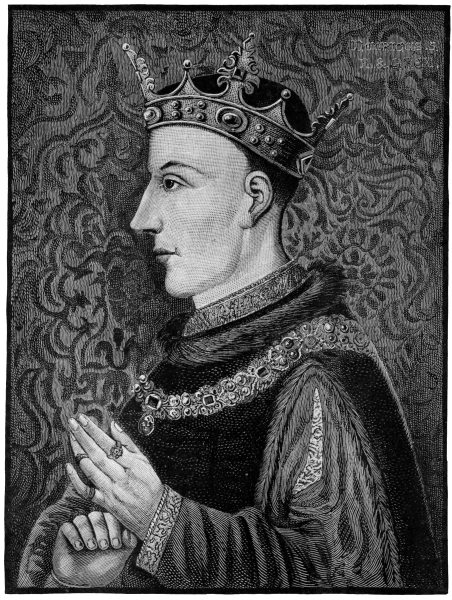
The time was now come when Henry was to make his
great effort for the conquest of France. The first
necessity was to provide for the safe passage of the
army by clearing the Channel of the enemy’s ships.
This was done by the Earl of Huntingdon. He met
nine ships, which had been hired by the French king
from the Republic of Genoa, sank three of them, and
captured three more with their admiral and a large sum
of money. On July 23rd the army started from Southampton.
In addition to one thousand pioneers and other
workmen, it numbered twenty-five thousand five hundred
and twenty-eight combatants, of whom between sixteen
and seventeen thousand were men-at-arms. The transporting
fleet consisted of about fifteen hundred ships of
all sizes.
No attempt was made to oppose the landing of the
army. The disaster of Agincourt had so far broken
the courage of the French that they had no idea of meeting
the English in the field. The plan of campaign
seems to have been that the fortified towns should be
garrisoned as strongly as possible, and the invading force
left to exhaust itself by the effort of taking them. Two
or three sieges, as costly to the conquerors as that of
Harfleur had been, would leave little to be done by way
of active operations for the defence of the country. The
plan, we shall see, failed of success. Henry was earlier in
the field than he had been in the campaign of Agincourt,
his army was better furnished for siege operations, he
had acquired new experience, and he had the advantage
of a more favourable season.
Castles and walled towns fell in rapid succession into
the hands of the English. Touques, a royal castle, which
was the first to be assaulted, offered some resistance. The
garrison made a vigorous sally upon the besiegers, and
held out for two days against the incessant cannonade
with which it was plied. But on August 3rd (the army
had landed on the first of the month) it was agreed that
if the place were not relieved in six days it should be
surrendered. Relieving force indeed there was none,
and the scattered garrisons throughout Normandy soon
realised the hopelessness of their situation. Damvilliers,
Harcourt, Evreux, and other places were surrendered
without a struggle. Monstrelet says that the other towns
in the duchy were astonished at the facility of the English
conquests, and that scarcely any place attempted a
defence. And he goes on to give a reason which must
have been at least as potent for this result as any
demoralisation caused by the remembrance of the English
victories. It was due, he says, to the divisions among
the nobles, some of whom were for the King and some
for the Duke of Burgundy, and each party was in consequence
fearful of trusting the other. Moreover, the
Constable had drawn off most of the forces in the
district to be ready to act against the Duke, who was
daily expected with a large army.
Not the least important factor in Henry’s success was
the admirable order in which he kept his army. All
violence and plunder were forbidden. Ecclesiastical
persons were put, as might be expected, under a special
protection, and to insult or rob one of this privileged class
was an offence to be punished with death. To the laity
was offered a similar protection if they would own the
English king’s authority. This policy, carried out with
the unflinching firmness which was one of Henry’s
characteristics, at once secured the kindly feeling of
the population and made the army a more effective
instrument.
About the middle of August Henry commenced the
siege of Caen. Anticipating that the garrison would
destroy the suburbs and so deprive him of the cover by
help of which he could approach the town, he sent the
Duke of Clarence with a strong force to occupy them.
The Duke was just in time to save them from being
burnt. Henry’s character for piety may have had
something to do in gaining for him another advantage.
The French forces had occupied St. Stephen’s Abbey,
which lay outside the town. On the approach of the
English they resolved to destroy it. The monks, on the
other hand, were bent on saving it; and they did so by
secretly introducing an English force.
On the King’s arrival before the town, an attempt
was made to carry it by assault. The storming parties
were repulsed with heavy loss. Henry then set his
engineers to work. Mines were carried up to the walls,
which were also battered by the cannon. When all was
ready for an assault, he offered terms to the garrison.
They were refused. The next morning the assault was
delivered, every detail of the operation having been
first carefully arranged by the King. It was completely
successful, the attacking parties making their way into
the town on both sides, and this without any great loss.
From first to last the siege did not cost the English
more than five hundred men, a number which contrasts
strongly with the almost disastrous expense that had
attended the capture of Harfleur. Henry, after duly
returning thanks in the cathedral, proceeded to deal
with the conquered town. The castle, which still held
out, was admitted to surrender on certain conditions if
not relieved in twelve days’ time. The inhabitants generally
were mercifully treated. Indeed Henry’s conduct
so raised his reputation for clemency that many neighbouring
towns at once offered to capitulate. As usual,
however, nothing was allowed to interfere with military
policy. Caen was to be made a garrison, and accordingly
fifteen hundred “women and impotent people, who
were unserviceable and useless,” were sent out of it.
After the fall of Caen, Lisieux, Alençon, and many
other places capitulated without making any attempt at
resistance. A more important gain than the possession
of any city or fortress was the adherence of the Duke of
Britanny. On October 27th this Prince came under
safe-conduct to a conference with Henry. The terms
of their agreement were not precisely known; but it
was certain that a truce was made which was to be
in force till the following Michaelmas. It was also
reported that the Duke kneeled to the King as to his
suzerain, and offered to hold Britanny as a fief under
the English crown, or rather the French crown as now
united with that of England. Falaise, which was surrendered
on January 2nd, was the last conquest of the
year 1417. The castle did not capitulate until six weeks
later.
It would be unnecessary to relate in detail the
military operations that now followed in uninterrupted
succession. During the first weeks of the new year
(1417–18) Henry was active in the field, and though, with
the devoutness which so strongly characterised him, he
spent Lent in strict retirement, his brothers were busily
employed. The great successes of the year were won at
Cherbourg and Rouen. Cherbourg was taken by the
Duke of Gloucester, aided by a force which the King
had ordered to be despatched from some of the western
harbours of England. The mere sight of its approach is
said to have determined the surrender of the garrison.
The siege of Rouen was one of the most important
operations of the war, and as it was carried on throughout
under Henry’s superintendence it demands a more
particular notice.
In May the King left Bayeux and marched up the
southern bank of the Seine. His first object was to
possess himself of the strong position of Pont de l’Arche,
situate about eight miles above Rouen, and commonly
called the Key of the River. The bridge itself was held
by the French in such strength that it could not have
been forced without a great sacrifice of men. Henry
accordingly marched some three miles lower down the
stream to a place where it was divided by an island.
The French followed him. While their attention was
distracted by a feint (one of the ingenious stratagems
with which great commanders are so ready), the island
was occupied by a small force of English gunners. A
cannonade drove away the troops that had been left
to guard the passage, and some thousands of men then
crossed without meeting any resistance. Henry now
held both banks of the Seine. He constructed a bridge
of boats to join his two camps, and in about three
weeks’ time received the capitulation of Pont de l’Arche.
Leaving a considerable garrison in it, he proceeded to
invest Rouen, which was now practically isolated from
the rest of France. It was a great, and, considering the
strength of the place, even a perilous enterprise. But
success would be of inestimable value: the possession of
Rouen would mean the acquisition of Normandy.
The place was very strong. It lay, not, as now, on
both sides of the river, always a circumstance adverse
to effective defence, but wholly on the northern side.
The walls were high and strong, and well supplied with
artillery, with cannons of a size then unusual, and with
catapults, an engine of war which the invention of
gunpowder had not yet driven out of use. The garrison
again was unusually large. There was a local
militia numbering at least fifteen thousand men, and a
force of not less than seven thousand regular troops and
artillerymen. On the other hand, the provisioning of so
large a force would in any circumstances have been
a matter of difficulty. As it was, this difficulty was
enormously increased by circumstances which Henry
had doubtless taken into account. To the usual population
of the town was added a multitude of country-folk
who had flocked in from the neighbourhood to avail
themselves of the shelter of the walls. And the siege
was begun so early that the harvest of the year could
not be secured.
Henry speedily completed the investment of the land
side of the town. Each of the six gates was commanded
by a strong fort, and these forts were connected by
palisaded trenches. The river was rendered impassable,
both above and below, to any relieving force that might
attempt to approach the town. Chains and booms were
stretched across it, and a flotilla was brought up from
Harfleur, part of which, as it would have been dangerous
to pass under the guns of the town, was dragged over
land to a point above the walls. A body of Welshmen
watched the town from the south bank of the river,
and many hundreds of Irish kernes, lightly armed and
fleet of foot, accompanied the English cavalry in their
excursions into the neighbouring country. “The greater
part of them,” says Monstrelet, “had a stocking and shoe
on one foot only, while the other was quite naked. They
had targets, short javelins, and a strange sort of knives.
Those who were on horseback had no saddles, but rode
excellently well on small mountain horses, and were
mounted on such panniers as are used by the carriers of
corn in parts of France. They were, however, miserably
accoutred in comparison with the English, and without
any arms which could much hurt the French, whenever
they might meet them.”
This miscellaneous force was kept by their general
under the strictest discipline. He was especially careful
to prevent all straggling. The men were rigidly forbidden
to lodge outside the military lines; and on one
occasion two soldiers who were discovered transgressing
this order were summarily executed.
Henry made no assault upon the town. He was too
careful of the lives of his men to waste them in so
perilous an enterprise. He contented himself with repelling
the frequent sallies of the besieged, which the
strength of his lines of circumvallation and the state of
readiness in which he always kept his troops enabled
him to do without serious loss. He kept his men
employed indeed with the construction of siege works,
with the driving of mines, and with the construction of
systematic approaches to the town; but his chief reliance
was a blockade. The vast population, military and
civil, ordinary and extraordinary, that crowded the walls
of Rouen could not be long fed on any stores that had
been laid up in this place, while effectual measures had
been taken against the throwing in of any relief.
The first-fruits of this policy of starvation were seen in
the surrender of the fortified post of the Abbey of St.
Catherine. This was given up by the force that garrisoned
it within a month of the investment of the city,
and given up because provisions had failed. Henry’s
own camp meanwhile was abundantly supplied with provisions,
furnished by stores of his own, or brought in by
the parties which ravaged the neighbouring country.
Rouen soon began to feel the pressure of famine. Its
governor made an attempt to relieve it by expelling
from the town twelve thousand non-combatants. Henry
refused to let these miserable creatures pass through his
lines, and they perished by degrees under the walls.
The story of their fate is pitiable in the extreme. Some
of them lingered on till the very end of the siege.
Many of the soldiers on either side had hearts more
tender, or perhaps it should be said intelligences less
alive to the necessities of the military situation, than the
generals who directed the attack and the defence of
Rouen. These secretly supplied the outcasts with such
provisions as they could spare. Henry himself departed
from the severity of his policy by furnishing the few
who were left alive on Christmas Day with a meal.
But neither the Governor nor the King relented. It may
be mentioned as an incident eminently characteristic of
the time, that new-born children were raised in baskets
to the top of the walls, duly baptized, and then let down
again to perish of hunger.
Henry has been severely blamed for the inhumanity
that he is said to have displayed on this occasion. It
may be allowed that there have been great soldiers who
would sooner have relinquished a military advantage
than allow such misery to exist under their eyes, but
Henry was not of this type. He was a soldier first;
and to his conception of a soldier’s duty, which was to
use every military advantage that fell in his way, he
subordinated everything. For wanton cruelty he had
no taste: it did not come within the scope of his
business; but from cruelty that was not wanton—that
is, was dictated by some consideration of necessity
or expediency—he never shrank. There is something,
it must be allowed, that is repulsive about this,
and it is made more repulsive by the contrast which it
makes with Henry’s almost ostentatious piety. This
is a contrast, however, which is apparent rather than
real. Henry’s belief that the French crown belonged to
him of right was, incredible as it may seem, a genuine
conviction, even, it may be said, a religious conviction.
This feeling, it may well be believed, still
further fortified his heart against any thought of concession
to mere human weakness. As far as regards his
military pitilessness he strongly resembles Cæsar and
Napoleon.
A messenger from the besieged succeeded in making
his way through the English lines and in reaching Paris.
He saw the Duke of Burgundy, and delivered in emphatic
terms the message of the citizens of Rouen: “If
by your negligence we are conquered by the King of
England, we shall become the worst and bitterest enemies
you have.” The Duke promised help, a promise which
greatly encouraged the town to persevere in its defence.
The oriflamme, the sacred banner of France, was indeed
taken from the Abbey of St. Denis later in the year, and
an army nominally at least intended to relieve Rouen
followed it; but it never approached the town. There
was indeed no one to act for France.
This appeal, as has been said, was made to the Duke
of Burgundy. The Dauphin meanwhile had opened
negotiations for peace with the English king.
A formal peace Henry would not make. To do so
would, he conceived, be a renunciation of his claims to the
French crown. Indeed he carefully avoided conceding
directly to the Dauphin the title of Regent of France:
in the commissions which were issued to the English
ambassadors he is the “Regent so-called.” A truce was
proposed, which was preliminary to a treaty. The
English demands included all the territories mentioned
in the great Peace of Bretigny, and Guienne as well. A
stipulation was added that if the Duke should refuse
to come into this treaty the king of England should
march with as many troops as might be necessary
to Paris, and deliver that city with the royal family into
the hands of the Dauphin. In return for this service
he was to have Flanders, a possession of the Dukes of
Burgundy.
In an interesting document Henry sets forth for the
consideration of his ambassadors various difficulties
which were involved in these proposals. Could he,
without prejudice to his right to the crown of France,
join arms with the Dauphin? Could he still receive the
Duke of Burgundy, should the Duke submit to him?
Could he justly invade Flanders while the truce was
unexpired? A number of military problems were also
suggested. Finally it was asked whether the Dauphin
was qualified to conclude a valid truce.
A supplementary commission authorised the ambassadors
to treat for the hand of the Princess Katherine;
and elaborate instructions were given to them as to their
action in case of a partial concession of their demands.
The negotiations went on for a time, if not with
success, at least without coming to a manifest end. On
one point the Dauphin returned an emphatic answer.
He would not join with the English king in acting against
the Duke of Burgundy. “I will never make peace,” he
said, “with the ancient enemy of my country in order
to destroy a vassal.”
On November 17th the French commissioners, accompanied
by the Cardinal d’Ursins, who was to act as
mediator, came to Pont de l’Arche, and there met the
English ambassadors. After a preliminary difficulty
about the language in which the proceedings of the
conference should be carried on had been disposed of,
the conditions were discussed. The French envoys
presented the King with a picture of the Princess
Katherine, a present which he is said to have received
with the greatest satisfaction. But he did not abate one
jot from his demands, which indeed it is not too much to
say he had made of set purpose impossible. He claimed
the hand of the Princess Katherine, the duchies of Normandy
and Acquitaine, and other principalities, all of
them to be held in his own right and without any
dependence on the king of France. The French commissioners
at once rejected these terms as impossible,
and the English retorted by questioning their authority
to treat. In the end nothing was done.
Rouen was now left to its fate, and that fate was
evidently close at hand. Early in December a sally was
planned, it being arranged that two thousand men
were to issue simultaneously from each of the gates.
The plan was only partially carried out, and though
some loss was suffered by the English, nothing of
real importance was effected. About the middle of
the month a definite intimation was given to the inhabitants
of Rouen that they must no longer expect
relief. The distress in the town had by that time
reached the point of agony. The richest among
the citizens were reduced to eating horse-flesh; the
poorer were glad to devour dogs and cats, rats and
mice. Terrible stories were told that some had eaten
human flesh. According to one chronicler, not less than
fifty thousand died of starvation during the six months
of the siege. The number is incredible, but it is certain
that the famine reached an intensity that has seldom
been equalled. When the last hope of relief was gone,
it became absolutely intolerable. The inhabitants rose
in revolt against the magistrates, demanding that negotiations
should be immediately opened with the besiegers.
There was indeed no reason why this should
not be done, and on January 2nd the envoys of the town
were admitted to Henry’s presence. At first he refused
to grant any terms: Rouen must open its gates and
admit its conqueror. A truce indeed for eight days was
allowed; but the days passed without any result being
attained. All that the English King would say was
that the inhabitants of Rouen must submit themselves
absolutely to his mercy. The people then formed a
desperate resolution. They would fire their town in
several places; a great length of the wall was to be
undermined and supported temporarily with props;
these were to be suddenly removed, and the whole
population was simultaneously to sally forth. All who
could bear arms were to fight their way out, while
the women and children were to endeavour to make
their escape.
Henry then relented. This purpose of the people
meant the destruction of Rouen, and he did not wish to
lose the chief city of Normandy. He renewed negotiations,
and terms of capitulation that were at least
tolerable were finally agreed upon. A ransom of three
hundred thousand crowns of gold was to be paid, and all
material of war was to be delivered to the King. The
lives of all persons in the town, with a few named
exceptions, were to be granted to them, and all who
would swear allegiance to the King should retain their
property; others might depart. One noteworthy provision,
as indicating Henry’s persuasion that he was
dealing, not with an enemy, but with rebellious subjects,
was that the King should have a space, either within
or without the walls, for the building of a palace,
but that he should duly purchase such ground from
its owners.
On January 22nd Henry entered the town with his
customary show of magnificence. It was noticed, with
much speculation as to the meaning of the symbol, that
a page rode behind him bearing a lance to which a fox’s
brush was attached after the manner of a pennon. His
first care, as usual, was to return thanks in the cathedral
for his victory. That done, he received the homage of
the citizens. All but five of the persons excepted from
the amnesty were either pardoned or released on payment
of a fine. A noted partisan leader, Alan Blanchart,
who had treated his prisoners with great cruelty, was
beheaded; and the Vicar-General, who had excommunicated
the English king, was condemned to imprisonment
for life.
The fall of Rouen was soon followed by the submission
of the rest of Normandy. Henry at once set
himself to the task of administering the province
which he had acquired. He kept his court as Duke of
Normandy, wearing the robes which belonged to that
dignity. The province was to have its proper exchequer
and coinage; a standard for measures was established,
and regulations were made for the conduct of trade. In
the brief opportunities that were given him Henry seems
to have showed himself a capable administrator of civil
affairs. His new subjects were impressed by the experience
of a government more firm and just than that
which their native rulers had exercised.