LYDIA GRENFELL
Twenty-six miles south-west of Truro, and now the last
railway station before Penzance is reached for the Land’s
End, is Marazion, the oldest, the warmest, and long the
dullest, of English towns. This was the home of Lydia
Grenfell; this was the scene of Henry Martyn’s wooing.
Running out from the town is a natural causeway, uncovered
at low tide, and leading to the most romantic spot
on a romantic coast—the granite rock known to the Greek
geographers as Ictis, and to English legend and history as
St. Michael’s Mount. Here it was that Jack slew the giant,
Cormoran; here that the Phœnician, and possibly Israelite,
traffickers found the harbour, and in the town the market,
where they bought their copper and their tin; here that
St. Michael appeared, as on the larger rock off Normandy,
to the earliest Christian hermits, followed by the Benedictines;
and here that King John made a fortress which both
sides in the Great Rebellion held and took alternately.
Since that time, possessed by the St. Aubyn family, and
open to all the world, St. Michael’s Mount has been a
unique retreat in which castle and chapel, cemetery and
garden, unite peacefully, to link the restlessness of the
nineteenth century with the hermit saintliness and angel-ophanies
of the fifth. It was the last spot of English, of
Cornish, ground seen by Henry Martyn, and he knew that
the windows of his beloved looked upon its grassy castellated
height.
In the one ascending street of Marazion on the shore,
there still stands the plain substantial Grenfell House, now
boarded up and falling to ruin for want of the freehold
tenure. Opposite it is the parish church, now on the site
of the old chapel of ease of the neighbouring St. Hilary,
which Lydia Grenfell deserted for the then warmer evangelical
service of the little Wesleyan chapel. That is
hidden in a lane, and is still the same as when she worshipped
there, or only a little enlarged. The Grenvilles,
Grenviles, or Grenfells, were long a leading family connected
with Cornwall as copper-buyers and smelters. One, Pascoe
Grenfell, was a Governor of the Bank of England. Mr.
Pascoe Grenfell, of Marazion (1729-1810), Commissary to
the States of Holland, was father (1) of Emma, who became
wife of Martyn’s cousin, Rev. T. Martyn Hitchins; (2) of
Lydia Grenfell; and (3) of Pascoe Grenfell, D.C.L., M.P.
for Marlow and Penryn. This Pascoe’s four daughters—Lydia
Grenfell’s nieces—each became the wife of a remarkable
man. The eldest, in 1825, married Mr. Carr Glyn, M.P.
for Kendal, and the first Lord Wolverton; the second, Lord
Sidney Godolphin Osborne; the third, Mr. James Anthony
Froude; and the fourth, Charles Kingsley.
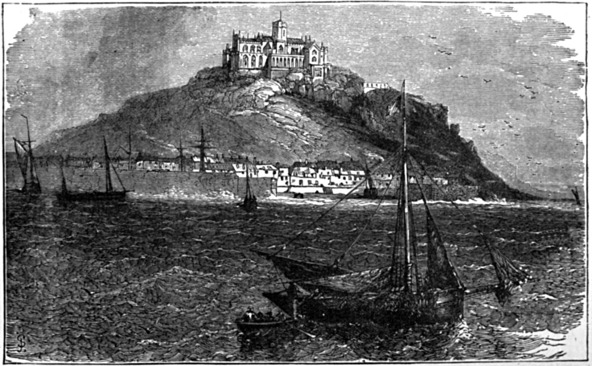 ST. MICHAEL’S MOUNT AT FULL TIDE.
Lydia Grenfell, born in 1775, died in her sister’s house,
the old Vicarage of Breage, in 1829. She was thus six
years older than Henry Martyn. As the sister of his
cousin by marriage he must have known of her early. He
evidently did not know, till it was too late, that she had
been engaged to a Mr. Samuel John, solicitor, of Penzance,
who was unworthy of her and married someone else.
This engagement and its issue seem to have weighed on
her very sensitive conscience; it became to her very much
what Henry Martyn’s hopeless love for her proved to be to
himself. In the years from October 19, 1801, to 1826, she
kept a diary not less devout, but far more morbid than
his own. The two journals form, where they meet, a
pathetic, even tragic, tale of affection, human and divine.
Her bulky memoranda[10] contain few incidents of interest,
rather severe introspections, incessant communings and
heart-searchings, abstracts of sermons, records of visits to
the sick and poor, but also a valuable residuum by which
her relations with Martyn can be established beyond controversy.
They show that she was as saintly as himself.
She weighed every thought, every action, as in the immediate
presence of God.
When Henry Martyn, at nineteen, entered on the
higher life, he must have known Lydia Grenfell as the
sister of Mrs. T.M. Hitchins, the cousin with whom his
correspondence shows him to have been on most intimate,
and even affectionate, terms. At that time the difference
of age would seem slight; her it would affect little, if at all,
while common experience suggests that it would be even
attractive to him. With the ardour of a young disciple—which
in his case grew, year by year, till he passed away—he
sought spiritual counsel and communion. On his visits
to Cornwall he found both in his younger sister, but it is
evident that, from the first, the riper spiritual life of Lydia
Grenfell attracted him to her. His triumph, at twenty, as
Senior Wrangler put him quite in a position to dream of
winning her. His unexpected poverty was relieved by his
Fellowship of St. John’s. In those days, however, that
would have ceased with marriage. When it became
more than probable that he would receive an appointment
to Bengal, through Mr. Charles Grant—either as minister
of the Mission Church founded by Kiernander, or as a
chaplain of the East India Company—he was face to
face with the question of marrying.
In these days the course followed by missionary
societies as the result of experience is certainly the best.
A missionary and a chaplain in India should, in ordinary
circumstances, be married, but it is not desirable that the
marriage take place for a year or longer, until the young
minister has proved the climate, and has learned the native
language, when the lady can be sent out to be united to
him. At the beginning of the modern missionary enterprise,
a century ago, it was difficult to find spiritual men
willing to go to India on any terms, and they did well in
every case to go out married. All the conditions of time,
distance, society, and Christian influence were then different.
If the missionary’s or chaplain’s wife is worthy of his calling,
she doubles his usefulness, notwithstanding the cares
and the expense of children in many cases, alike by keeping
her husband in a state of efficiency on every side, by
her own works of charity and self-sacrifice—especially
among the women, who can be reached in no other way—and
by helping to present to the idolatrous or Mussulman
community the powerful example of a Christian home.
Henry Martyn’s principles and instincts were right in this
matter. As a chaplain, at any rate, he was in a position
to marry at once. As India or Bengal then was, Lydia,
had she gone out with him, or soon after him, would have
proved to be a much needed force in Anglo-Indian society,
an influence on the native communities whom he sought
to bring to Christ. Above all, as a man born with a
weak body, with habits of incessant and intense application
to study and to duty, Henry Martyn required one with the
influence of a wife to keep him in life and to prolong his
Indian service. It was the greatest calamity of his whole
career that Lydia did not accompany him. But, since he
learned to love her with all the rich devotion of his passionate
nature, we cannot consider it ‘a bitter misfortune,’ as
some do, that he ever knew her. His love for Lydia, in
the fluctuations of its hope, in the ebb and flow of its
tenderness, and in the transmutation of its despair into
faith and resignation to the will of God, worked out a
higher elevation for himself, and gives to his Journals and
Letters a pure human interest which places them above the
Confessions of St. Augustine.
The first allusion to the possibility of marriage we find
in his Journal of January 23, 1803, and again in June 12
of the same year:
I was grieved to find that all the exertions of prayer
were necessary against worldly-mindedness, so soon had
the prospect of the means of competent support in India
filled my heart with concern about earthly happiness,
marriage, &c.; but I strove earnestly against them, and
prayed for grace that, if it should please God to try my
faith by calling me to a post of opulence, I might not dare
to use for myself what is truly His; as also, that I might
be enabled to keep myself single, for serving Him more
effectually. Nevertheless, this change in my circumstances
so troubled me, that I could have been infinitely better
pleased to have gone out as a missionary, poor as the Lord
and His Apostles.
His friend Sargent’s ‘approaching marriage with a lady
of uncommon excellence rather excited in me a desire
after a similar state; but I strove against it,’ he wrote on
July 10. Next day, on the top of the coach from London
to Bath, in the cold of a high wind, he was ‘most dreadfully
assailed by evil thoughts, but at the very height
prayer prevailed, and I was delivered, and during the rest
of the journey enjoyed great peace and a strong desire to
live for Christ alone, forsaking the pleasures of the world,
marriage, &c.’ At Plymouth he spent two days ‘with my
dear cousin T.H.,’ Lydia’s sister. After Truro, Kenwyn,
and Lamorran, near Truro, of which his sister Sarah’s husband
was vicar, he rode to St. Hilary.
1804, July 29. (Sunday.)—Read and prayed in the
morning before service with seriousness, striving against
those thoughts which oppressed me all the rest of the day.
At St. Hilary Church in the morning my thoughts wandered
from the service, and I suffered the keenest disappointment.
Miss L.G. did not come. Yet, in great
pain, I blessed God for having kept her away, as she might
have been a snare to me. These things would be almost
incredible to another, and almost to myself, were I not
taught by daily experience that, whatever the world may
say, or I may think of myself, I am a poor, wretched,
sinful, contemptible worm.
Called after tea on Miss L.G., and walked with her
and ——, conversing on spiritual subjects. All the rest of
the evening, and at night, I could not keep her out of my
mind. I felt too plainly that I loved her passionately.
The direct opposition of this to my devotedness to God in
the missionary way, excited no small tumult in my mind.
In conversation, having no divine sweetness in peace, my
cheerfulness was affected, and, consequently, very hurtful
to my conscience. At night I continued an hour and a
half in prayer, striving against this attachment. I endeavoured
to analyse it, that I might see how base, and
mean, and worthless such a love to a speck of earth was,
compared with divine love. Then I read the most solemn
parts of Scripture, to realise to myself death and eternity;
and these attempts were sometimes blest. One while I
was about to triumph, but in a moment my heart had
wandered to the beloved idol. I went to bed in great
pain, yet still rather superior to the evening; but in dreams
her image returned, and I awoke in the night with my
mind full of her. No one can say how deeply this unhappy
affection has fixed itself; since it has nothing selfish in it,
that I can perceive, but is founded on the highest admiration
of her piety and manners.
July 30.—Rose in great peace. God, by secret influence,
seemed to have caused the tempest of self-will to subside.
Rode away from St. Hilary to Gwennap in peace of mind,
and meditated most of the way on Romans viii. I again
devoted myself to the Lord, and with more of my will
than last night. I was much disposed to think of subjects
entirely placed beyond the world, and had strong desires,
though with heavy opposition from my corrupt nature,
after that entire deadness to the world which David
Brainerd manifested. At night I found myself to have
backslidden a long way from the life of godliness, to have
declined very much since my coming into Cornwall, but
especially since I went to St. Hilary. Sat up late, and read
the last chapter and other parts of Revelation, and was
deeply affected. Prayed with more success than lately.
July 31.—Read and prayed this morning with increasing
victory over my self-will. Romans vii. was particularly
suitable; it was agreeable to me to speak to God of my
own corruption and helplessness. Walked in the afternoon
to Redruth, after having prayed over the Epistle to the
Ephesians with much seriousness. On the road I was
enabled to triumph at last, and found my heart as pleased
with the prospect of a single life in missionary labours as
ever. ‘What is the exceeding greatness of His power to
usward who believe!’
After preaching to crowds in his brother-in-law’s church
at Kenwyn and Lamorran, on the two subsequent Sundays,
he walked to St. Hilary:
1804, August 26.—Rose early, and walked out, invited
by the beauty of the morning. Many different pleasing
thoughts crowded on my mind, as I viewed the sea and
rocks, Mount and bay, and thought of the person who
lived near it; but, for want of checking my natural spirits,
and fixing on one subject of thought, I was not much
benefited by my meditations. Walked in the evening
with Mrs. G. and Lydia up the hill, with the most beautiful
prospect of the sea, &c.; but I was unhappy, from feeling
the attachment to Lydia, for I was unwilling to leave her.
August 27.—Walked to Marazion, with my heart more
delivered from its idolatry, and enabled to look steadily
and peacefully to God. Reading in the afternoon to Lydia
alone, from Dr. Watts, there happened to be, among other
things, a prayer on entire preference of God to the creature.
Now, thought I, here am I in the presence of God, and my
idol. So I used the prayer for myself, and addressed it to
God, who answered it, I think, for my love was kindled
to God and divine things, and I felt cheerfully resigned to
the will of God, to forego the earthly joy which I had just
been desiring with my whole heart. I continued conversing
with her, generally with my heart in heaven, but every now
and then resting on her. Parted with Lydia, perhaps for
ever in this life, with a sort of uncertain pain, which I knew
would increase to greater violence afterwards, on reflection.
Walked to St. Hilary, determining, in great tumult and
inward pain, to be the servant of God. All the rest of the
evening, in company or alone, I could think of nothing
but her excellences. My efforts were, however, through
mercy, not in vain, to feel the vanity of this attachment to
the creature. Read in Thomas à Kempis many chapters
directly to the purpose; the shortness of time, the awfulness
of death and its consequences, rather settled my mind
to prayer. I devoted myself unreservedly to the service
of the Lord, to Him, as to one who knew the great conflict
within, and my firm resolve, through His grace, of being
His, though it should be with much tribulation.
August 28.—Rose with a heavy heart, and took leave
of St. Hilary, where all the happier hours of my early life
were passed. —— and —— accompanied me in the chaise
a few miles; but the moment they left me I walked on,
dwelling at large on the excellence of Lydia. I had a few
faint struggles to forget her, and delight in God, but they
were ineffectual. Among the many motives to the subjection
of self-will, I found the thought of the entire unworthiness
of a soul escaped from hell to choose its own
will before God’s, most bring my soul to a right frame.
So that, while I saw the necessity of resigning, for the
service of God, all those joys, for the loss of which I could
not perceive how anything in heaven or earth could be a
compensation, I said, Amen!
August 29.—I walked to Truro, with my mind almost
all the way taken up with Lydia. But once reasoning in
this way—If God made me, and wills my happiness, as I do
not doubt, then He is providing for my good by separating
me from her; this reasoning convinced my mind. I felt
very solemnly and sweetly the excellence of serving God
faithfully, of following Christ and His Apostles, and meditated
with great joy on the approach of the end of this
world. Yet still I enjoyed, every now and then, the
thought of walking hereafter with her, in the realms of
glory, conversing on the things of God. My mind the
rest of the evening was much depressed. I had no desire
to live in this world; scarcely could I say where I would
be, or what I would do, now that my self-will was so
strongly counteracted. Thus God waits patiently my return
from my backsliding, which I would do immediately.
If He were to offer me the utmost of my wishes, I would
say, ‘Not so, Lord! Not my will, but Thine be done.’
August 30.—Passed the morning rather idly, in reading
lives of pious women. I felt an indescribable mixture of
opposing emotions. At one time, about to ascend with
delight to God, who had permitted me to aspire after the
same glory, but oftener called down to earth by my earthly
good. Major Sandys calling, continued till dinner conversing
about India. I consented to stay a day with him
at Helston, but the thought of being so near Marazion
renewed my pain, especially taken in connection with my
going thither on the subject of my departure. After dinner,
walked in the garden for two hours, reasoning with my
perverse heart, and, through God’s mercy, not without
success. You preach up deadness to the world, and yet
not an example of it! Now is the time, my soul, if you
cannot feel that it is best to bear the cross, to trust God
for it. This will be true faith. If I were put in possession
of my idol, I should immediately say and feel that God
alone was, notwithstanding, the only good, and to Him I
should seek immediately. Again I weighed the probable
temporal consequence of having my own will gratified;
the dreadful pain of separation by death, after being united,
together with the distress I might bring upon her whom I
loved. All these things were of small influence till I read
the Epistle to the Hebrews, by which my mind, made to
consider divine things attentively, was much more freed
from earthly things. ‘Let us come boldly to the throne
of grace, that we may obtain mercy, and find grace to help
in time of need,’ was very precious and comforting to me.
I have found grace to help in this time of need; I still
want a humble spirit to wait upon the Lord. I almost
called God to witness that I duly resigned my pleasure to
His, as if I wished it to be remembered. In the evening
had a serious and solemn time in prayer, chiefly for the
influences of the Spirit, and rose with my thoughts fixed
on eternity; I longed for death, and called on the glorious
day to hasten; but it was in order to be free from the
troubles of this world.
August 31.—Passed the morning partly in reading and
writing, but chiefly in business. Rode to Rosemundy,
with my mind at first very unhappy, at the necessity of
mortifying my self-will, in the same particulars as for some
days. In conversing on the subject of India with Major
Sandys, I could not help communicating the pain I felt at
parting with the person to whom I was attached; but by
thus dwelling on the subject my heart was far more distressed
than ever. Found my mind more easy and submissive
to God at night in prayer.
St. Hilary Church, in which Henry Martyn preached,
is one of the oldest in England, containing, in the tower
of Edward III.’s reign, two stones with inscriptions of the
time of the Emperor Flavius Constantinus, who was killed
by Honorius in 411. What Lydia Grenfell thought of
Martyn’s sermon on that day, August 26, thenceforth
memorable to both, we find in her Diary of that date:
1804, August 26.—Heard H.M. on ‘Now then we are
ambassadors for Christ, as though God did beseech you
by us: we pray you, in Christ’s stead, be ye reconciled to
God. For He hath made Him to be sin (i.e. sin-offering)
for us, Who knew no sin; that we might be made the
righteousness of God in Him.’ Exordium on the honourable
employment of a minister of the Gospel. In the text
two things were implied. First, we were at enmity with
God. Second, we were unable to restore ourselves to His
favour. There were two things expressed in the text—the
means of reconciliation, and God’s invitation to be
reconciled; a threefold address to saints, backsliders, and
sinners; and a farewell address. A precious sermon.
Lord, bless the preacher, and those that heard him!
At that time, in 1804, the lady was still preoccupied,
in conscience or heart, or both, by her imaginary ties to
Mr. S. John. But six months before that she had heard of
his approaching marriage, though, in fact, that did not take
place till 1810. All that time, if she did not feel, to one
to whom her heart had been more closely united than to
any ‘earthly object,’ as she had written in her Diary, what
Mr. H.M. Jeffery describes as the attachment of a widow
with the responsibility of a wife, her scrupulous introspective
habit was an obstacle to a healthy attachment. The
preacher, younger than herself, was in 1804 evidently to
her only an interesting and gracious second cousin, or
perhaps a little more.
On his way back to London Henry Martyn again
visited Plymouth, where he learned from his cousin ‘that
my attachment to her sister was not altogether unreturned,
and the discovery gave me both pleasure and pain.’ He
left them, his thoughts ‘almost wholly occupied with
Lydia.’ London, Cambridge, his reading and his walking,
his work and even his sleep, bring him no rest from the
absorbing passion. His Journal is full of it, almost every
day. Fortescue’s poems recall the happy mornings at St.
Hilary, but his pensive meditation subsided into a more
profitable one on the vanity of the world: ‘they marry and
are given in marriage,’ and at the end of a few years what
are they more than myself?—looking forward to the same
dissolution, and expecting their real happiness in another
life. ‘The fashion of this world passeth away,’ Amen.
‘Let me do the will of God while I am in it.’
The first day of the year 1805 led him to review the
past five years, and to renew his self-dedication to God the
Father, Son, and Holy Ghost, to be His servant for ever.
The time for his departure to India was at hand, and his
last act, on leaving London for Cambridge, to complete his
arrangements for sailing, was deliberately to engage himself
to Lydia Grenfell in the following letter to her sister.[11]
It is thus referred to in his Journal:
I was in some doubt whether I should send the letter
to Emma, as it was taking a very important step, and I
could scarcely foresee all the consequences. However, I
did send it, and may now be said to have engaged myself
to Lydia.
18 Brunswick Square (London), January 11, 1805.
My dear Mrs. Hitchins,—How unaccountable must my
long silence appear to you after the conversation that
passed between us in the carriage! You may well wonder
that I could forbear, for three whole months, to inquire
about the ‘beloved Persis.’ Indeed, I am surprised at my
own patience, but, in truth, I found it impossible to discover
what it is which I wish or ought to say on the subject,
and therefore determined to defer writing till I could
inform you with certainty of my future destination. But
I have it not yet in my power to do this, for no actual
appointment has been made for me yet. I came to town
the beginning of this week to inquire into the present
state of the business, and learned from Mr. Grant that
the situation he intended to procure, and to which he had
no doubt of getting me nominated, was not in the Army,
but at Fort William, near Calcutta. Thus it pleases God
to suspend the declaration of His mind, and I can believe
that He acts wisely. These apparent delays serve to check
my youthful impetuosity, and teach me to look up to God,
and wait for Him. If the chaplaincy at Fort William
should be given me, it would seem to be His design not to
call me to the peculiar work of a missionary, but to fix my
station among the English. At present my own inclination
remains almost unbiassed, as to the particular employment
or place God shall assign me, whether to pass my days
among the natives, or the more polished inhabitants of
Calcutta, or even to remain at home.
But you will easily conceive that the increasing probability
of my being settled in a town rather tends to
revive the thoughts of marriage, for I feel very little doubt
in my own mind, that in such a situation it would be expedient
for me on the whole to marry, if other circumstances
permitted it. It is also as clear that I ought not to make
an engagement with any one in England, till I have ascertained
by actual observation in India, what state of life
and mode of proceeding would be most conducive to the
ends of my mission. But why do I mention these difficulties?
If they were removed, others would remain still
more insurmountable. The affections of the beloved object
in question must still be engaged in my favour, or even
then she would not agree to leave the kingdom, nor would
any of you agree to it, nor would such a change of climate,
it may be thought, suit the delicacy of her constitution.
Must I, then, yield to the force of these arguments, and
resolve to think of her no more? It shall certainly be my
endeavour, by the help of my God, to do it, if need be; but
I confess I am very unwilling to go away and hear of her
only accidentally through the medium of others. It is
this painful reflection that has prompted a wish, which I
do not mention without some hesitation, and that is my
wish of corresponding with her. It is possible you may
instantly perceive some impropriety in it which escapes
my notice, and indeed there are some objections which I
foresee might be made, but instead of anticipating them, I
will leave you to form your own opinion. In religion we
have a subject to write upon of equal interest to us both,
and though I cannot expect she would derive any advantage
from my letters, it is certain I should receive no small
benefit from hers. But I leave it with yourself; if you
disapprove of the measure, let the request be forgotten. It
will be best for her never to know I had made it, or if she
does, she will, I hope, pardon a liberty to which I have
been drawn only by the love of her excellence.
N.B.—I remember Leighton; take care not to forget it
nor the desired MS.
On June 1 he wrote in his Journal:
My departure from my friends, and my deprivation of
the sweetest delight in society, for ever in this life, have
rather dejected me to-day. Ah! Nature, thou hast still
tears to shed for thyself!... I seem to be hankering after
something or other in this world, though I am sure I could
not say there is anything which I believed could give me
happiness. No! it is in God above. Yet to-night I have
been thinking much of Lydia. Memory has been at work
to unnerve my soul, but reason, and honour, and love to
Christ and to souls, shall prevail. Amen. God help me!
Two days after, at the Eclectic Society, after a discussion
on the symptoms of ‘the state of the nation,’ the subject of
marriage, somehow or other, came to be mentioned.
Mr. Cecil spoke very freely and strongly on the subject.
He said I should be acting like a madman if I went out
unmarried. A wife would supply by her comfort and
counsel the entire want of society, and also be a preservative
both to character and passions amidst such scenes. I felt
as cold as an anchorite on the subject as to my own feelings,
but I was much perplexed all the rest of the evening about
it. I clearly perceived that my own inclination upon the
whole was not to marriage. The fear of being involved in
worldly cares and numberless troubles, which I do not now
foresee, makes me tremble and dislike the thoughts of such
connection. When I think of Brainerd, how he lived
among the Indians, travelling freely from place to place,
can I conceive he would have been so useful had he been
married? I remember also that Owens, who had been so
many years in the West Indies as a missionary, gave his
advice against marriage. Schwartz was never married, nor
St. Paul. On the other hand, when I suppose another in
my circumstances, fixed at a settlement without company,
without society, in a scene and climate of such temptation,
I say without hesitation, he ought to be married. I have
recollected this evening very much my feelings when I
walked through Wales; how I longed there to have some
friend to speak to; and the three weeks seemed an age
without one. And I have often thought how valuable
would be the counsel and comfort of a Christian brother in
India. These advantages would be obtained by marrying.
I feel anxious also that as many Christians as possible
should go to India, and anyone willing to go would be a
valuable addition. But yet voluntary celibacy seems so
much more noble and glorious, and so much more beneficial
in the way of example, that I am loth to relinquish
the idea of it. In short, I am utterly at a loss to know
what is best for the interests of the Gospel. But, happily,
my own peace is not much concerned in it. If this opinion
of so many pious clergymen had come across me when I
was in Cornwall, and so strongly attached to my beloved
Lydia, it would have been a conflict indeed in my heart to
oppose so many arguments. But now I feel, through grace,
an astonishing difference. I hope I am not seeking an
excuse for marriage, nor persuading myself I am indifferent
about it, in order that what is really my inclination may
appear to be the will of God. But I feel my affections
kindling to their wonted fondness while I dwell on the
circumstances of a union with Lydia. May the Lord
teach His weak creature to live peacefully and soberly in
His love, drawing all my joys from Him, the fountain of
living waters.
June 4.—The subject of marriage made me thoughtful
and serious. Mr. Atkinson, whose opinion I revere, was
against my marrying. Found near access to my God in
prayer. Oh, what a comfort it is to have God to go to.
I breathed freely to Him my sorrows and cares, and set
about my work with diligence. The Lord assisted me
very much, and I wrote more freely than ever I did. Slept
very little in the night.
June 5.—Corrie breakfasted with me, and went to
prayer; I rejoiced to find he was not unwilling to go to
India. He will probably be my fellow-labourer. Most of
this morning was employed in writing all my sentiments
on the subject of marriage to Mr. Simeon. May the Lord
suggest something to him which may be of use to guide
me, and keep my eye single. In my walk out, and afterwards,
the subject was constantly on my mind. But, alas!
I did not guard against that distraction from heavenly
things which I was aware it would occasion. On reflection
at home, I found I had been talking in a very inconsistent
manner, but was again restored to peace by an application
to Christ’s blood through the Spirit. My mind has all this
day been very strongly inclined to marriage, and has been
consequently uncomfortable, for in proportion to its want
of simplicity it is unhappy. But Mr. Cecil said to-day, he
thought Lydia’s decision would fully declare the will of
God. With this I am again comforted, for now hath the
Lord taken the matter into His own hands. Whatever
He decides upon, I shall rejoice; and though I confess I
think she will not consent to go, I shall then have the
question finally settled.
Discussion in the evening was about my marriage
again; they were all strenuous advocates for it. Wrote
at night with great freedom, but my body is very weak
from the fatigue I have already undergone. My mind
seems very active this week; manifestly, indeed, strengthened
by God to be enabled to write on religious subjects
with such unusual ease, while it is also full of this important
business of the marriage. My inclination continues, I
think, far more unbiassed than when I wrote to Mr.
Simeon.
June 7.—Oh, the subtlety of the devil, and the deceitfulness
of this corrupted heart! How has an idol been
imperceptibly raised up in it. Something fell from Dr. F.
this evening against my marriage which struck me so
forcibly, though there was nothing particular in it, that
I began to see I should finally give up all thoughts about
it. But how great the conflict! I could not have believed
it had such hold on my affections. Before this I had been
writing in tolerable tranquillity, and walked out in the
enjoyment of a resigned mind, even rejoicing for the most
part in God, and dined at Mr. Cecil’s, where the arguments
I heard were all in favour of the flesh, and so I was pleased;
but Dr. F.’s words gave a new turn to my thoughts, and
the tumult showed me the true state of my heart. How
miserable did life appear without the hope of Lydia! Oh,
how has the discussion of the subject opened all my wounds
afresh! I have not felt such heartrending pain since I
parted with her in Cornwall. But the Lord brought me
to consider the folly and wickedness of all this. Shall I
hesitate to keep my days in constant solitude, who am but
a brand plucked from the burning? I could not help
saying, ‘Go, Hindus, go on in your misery; let Satan still
rule over you; for he that was appointed to labour among
you is consulting his ease.’ No, thought I; hell and
earth shall never keep me back from my work. I am cast
down, but not destroyed; I began to consider, why am I
so uneasy? ‘Cast thy care upon Him, for He careth for
you.’ ‘In everything, by prayer,’ &c. These promises
were graciously fulfilled before long to me.
June 8.—My mind continued in much the same state
this morning, waiting with no small anxiety for a letter
from Mr. Simeon, hoping, of course, that the will of God
would coincide with my will, yet thinking the determination
of the question would be indifferent to me. When the
letter arrived I was immediately convinced, beyond all
doubt, of the expediency of celibacy. But my wish did
not follow my judgment quite so readily. Mr. Pratt
coming in, argued strongly on the other side, but there
was nothing of any weight. The subject so occupied my
thoughts that I could attend to nothing else. I saw myself
called to be less than ever a man of this world, and
walked out with a heavy heart. Met Dr. F., who alone of
all men could best sympathise, and his few words were
encouraging. Yet I cannot cordially acquiesce in all the
Lord’s dealings, though my reason and judgment approve
them, and my inclination would desire to do it. Dined at
Mr. Cecil’s, where it providentially happened that Mr. Foster
came in. To them I read Mr. Simeon’s letter, and they
were both convinced by it. So I went away home, with
nothing to do but to get my heart easy again under this
sacrifice. I devoted myself once more to the entire and
everlasting service of God, and found myself more weaned
from this world, and desiring the next, though not from a
right principle. Continued all the evening writing sermon,
and reading Pilgrim’s Progress, with successions of vivid
emotions of pain and pleasure. My heart was sometimes
ready to break with agony at being torn from its dearest
idol, and at other times I was visited by a few moments of
sublime and enraptured joy. Such is the conflict; why
have my friends mentioned this subject? It has torn open
old wounds, and I am again bleeding. With all my
honours and knowledge, the smiles and approbation of
men, the health and prosperity that have fallen to my lot,
together with that freedom from doubts and fears with
which I was formerly visited, how much have I gone
through in the last two or three years to bring my mind to
be willing to do the will of God when it should be revealed!
My heart is pained within me, and my bodily frame suffers
from it.
June 9. (Sunday.)—My heart is still pained. It is still
as a bullock unaccustomed to the yoke; the Lord help
me to maintain the conflict. Preached this morning at
Long Acre Chapel on Matt. xxviii., the three last verses.
There was the utmost attention. In the interval between
morning and afternoon, passed most of the time in reading
and prayer. Read Matthew iii., and considered the character
of John the Baptist. Holy emulation seemed to
spring up in my mind. Then read John xvii. and last chapter,
and Rev. i., all of which were blessed to my soul. I went
into the church persuaded in my feelings—which is different
from being persuaded in the understanding—that it
was nobler and wiser to be as John the Baptist, Peter, John,
and all the Apostles, than to have my own will gratified.
Preached on Eph. ii. 18. Walked a little with Mr. Grant
this evening. He told me I should have great trials and
temptations in India; but I know where to apply for grace
to help.
Cecil’s final opinion, that Lydia Grenfell’s decision
would fully declare the will of God, was not borne out by
the result, as we shall see. Meanwhile, let us trace the
steps which led to the final appointment to India, and
the farewell.
On his first visit to London at the beginning of the year
1804, by the Telegraph coach, the Cambridge recluse was
distracted by the bustle of the great city, as he walked
about the streets and called at the booksellers’. Dr.
Wollaston, the British Museum, and the Gresham Lecture
on Music, of which he was passionately fond, occupied his
first two days. At the old India House, since swept away
from Leadenhall Street, he met Mr. Charles Grant, who,
as he took him to Clapham, the evangelical centre which
Sir James Stephen has made so famous,[12] gave him much
information on the state of India, such as this:
It would be absolutely necessary to keep three servants,
for three can do no more than the work of one English;
that no European constitution can endure being exposed
to mid-day heat; that Mr. Schwartz, who was settled at
Tanjore, did do it for a time, walking among the natives.
Mr. Grant had never seen Mr. Schwartz, but corresponded
with him. He was the son of a Saxon gentleman (the
Saxon gentlemen never enter the ministry of the Church),
and had early devoted himself to the work of a missionary
amongst the Indians. Besides the knowledge of the
Malabar tongue, in which he was profoundly skilled and
eloquent, he was a good classic, and learnt the English,
Portuguese, and Dutch. He was a man of dignified and
polished manners, and cheerful.
This was the first opportunity that ‘the Clapham sect’
had to satisfy themselves that the Senior Wrangler was
worthy of the commendation of Charles Simeon. Accordingly
they dined with William Wilberforce at Broomfield.
We conversed about my business. They wished me to
fill the church in Calcutta very much; but advised me to
wait some time, and to cherish the same views. To Mr.
Wilberforce I went into a detail of my views, and the
reasons that had operated on my mind. The conversation
of Mr. Wilberforce and Mr. Grant during the whole of the
day, before the rest of the company, which consisted of Mr.
Johnston, of New South Wales, a French Abbé, Mrs.
Unwin, Mr. H., and other ladies, was edifying; agreeable
to what I should think right for two godly senators, planning
some means of bringing before Parliament propositions
for bettering the moral state of the colony of Botany Bay.
At evening worship Mr. W. expounded Sacred Scripture
with serious plainness, and prayed in the midst of his large
household.
In The Life of William Wilberforce, by his sons, we
find this passage introduced by the remark, ‘It is delightful
to contrast with his own language the observation of one
who, with as holy and as humble a soul, was just entering
on his brief but glorious course:’ Martyn ‘drank tea at Mr.
Newton’s; the old man was very civil to me, and striking
in his remarks in general.’ Next day:
Read Isaiah. At one, we went to hear the charge
delivered to the missionaries at the New London Tavern,
in Cheapside. There was nothing remarkable in it, but
the conclusion was affecting. I shook hands with the two
missionaries, Melchior Rayner and Peter Hartwig, and
almost wished to go with them, but certainly to go to
India. Returned, and read Isaiah.
From the ever recurring distractions of his soul, caused
now by ‘a despicable indulgence in lying in bed,’ and again
by the interruptions of visitors, he sought refuge frequently
in fasting and ascetic self-denial, and occasionally in writing
verse:
Composed some poetry during my walk, which often
has a tendency to divert my thoughts from the base distractions
of this life, and to purify and elevate it to higher
subjects.... On my way to Mr. Simeon’s, heard part of
the service in King’s Chapel. The sanctity of the place,
and the music, brought heaven and eternal things, and the
presence of God, very near to me.
He seems to have competed for the Seatonian Prize.
He was an ardent lover of Nature.
Walked out before breakfast, and the beauties of the
opening spring constrained me to adoration and praise.
But no earthly object or operation can produce true
spirituality of heart. My present failing is in this, that I
do not feel the power of motives.
Of another walk he writes:
I was led to think a good while on my deficiency in
human learning, and on my having neglected those branches
which would have been pleasing and honourable in the
acquisition. Yet I said, though with somewhat of melancholy,
‘What things were gain to me, those I counted loss
for Christ.’ Though I become less esteemed by man, I
cannot but think (though it is not easy to do so) that it
must be more acceptable to God to labour for souls, though
the mind remains uninformed; and, consequently, that it
must be more truly great and noble, than to be great and
notable among men for learning. In the garden afterwards
I rejoiced exceedingly at the prospect of a death fast approaching,
when my powers of understanding would be
enlarged inconceivably. They all talked to me in praise
of my sermon on Sunday night; but praise is exceedingly
unpleasant to me, because I am slow to render back to
God that glory which belongs to Him alone. Sometimes
it may be useful in encouraging me, when I want encouragement;
but that at present is not the case; and in
truth, praise generally produces pride, and pride presently
sets me far from God.
Oh, what a snare are public ministrations to me! Not
that I wish for the praise of men, but there is some fear
and anxiety about not getting through. How happy could
I be in meeting the people of my God more frequently
were it not for this fear of being unprofitable! But since
God has given me natural gifts, let this teach me that all
I want is a spiritual frame to improve and employ them
in the things of God!
Mr. K. White, of Nottingham, breakfasted with me.
In my walk was greatly cast down, except for a short
time on my return, when, as I was singing, or rather
chanting, some petitions in a low, plaintive voice, I insensibly
found myself sweetly engaged in prayer.
Such outpourings of his heart must be read in the light
of a time when even the Churches had not awoke to their
duty, and the most theologically orthodox were too often
the most indifferent, or opposed, to the Lord’s command.
1804, January 13.—Walked out in the evening in great
tranquillity, and on my return met with Mr. C., with whom
I was obliged to walk an hour longer. He thought it a
most improper step for me to leave the University to preach
to the ignorant heathen, which any person could do, and
that I ought rather to improve the opportunity of acquiring
human learning. All our conversation on the subject of
learning, religion, &c., ended in nothing; he was convinced
he was right, and all the texts of Scripture I produced were
applicable, according to him, only to the times of the
Apostles. How is my soul constrained to adore the sovereign
mercy of God, who began His work in my proud
heart, and carried it on through snares which have ruined
thousands—namely, human learning and honours: and now
my soul, dost thou not esteem all things but dung and
dross, compared with the excellency of the knowledge of
Christ Jesus my Lord? Yea, did not gratitude constrain me,
did not duty and fear of destruction, yet surely the excellency
of the service of Christ would constrain me to lay
down ten-thousand lives in the prosecution of it. My
heart was a little discomposed this evening at the account
of the late magnificent prizes proposed by Mr. Buchanan
and others in the University, for which Mr. C. has been
calling me to write; but I was soon at rest again. But
how easily do I forget that God is no respecter of persons;
that in the midst of the notice I attract as an enthusiast
He judges of me according to my inward state. Oh, my
soul, take no pleasure in outward religion, nor in exciting
wonder, but in the true circumcision of the heart.
January 16.— —— told me of many contemptuous insulting
things that had been said of me, reflecting, some on
my understanding, some on my condition, sincerity, inconsistent
conduct. It was a great trial of my patience, and I
was frequently tempted, in the course of the evening, to let
my natural spirit rage forth in indignation and revenge;
but I remembered Him of whom it was said, ‘Who, when
He was reviled, reviled not again; but committed Himself
to Him that judgeth righteously.’ As I was conscious I
did not deserve the censures which were passed upon me,
I committed myself to God; and in Him may I abide until
the indignation be overpast!
In July 1804 he again visited London on his way to
Cornwall, and to see Mr. Charles Grant.
Dined with Mr. Wilberforce at Palace Yard. It was
very agreeable, as there was no one else. Speaking of the
slave trade, I mentioned the words, ‘Shall I not visit for
these things?’ and found my heart so affected that I could
with difficulty refrain from tears. Went with Mr. W. to
the House of Commons, where I was surprised and charmed
with Mr. Pitt’s eloquence. Ah, thought I, if these powers of
oratory were now employed in recommending the Gospel!
On his way back to Cambridge, through London, he
Went to St. Paul’s, to see Sir W. Jones’s monument; the
sight of the interior of the dome filled my soul with inexpressible
ideas of the grandeur of God, and the glory of
heaven, much the same as I had at the sight of a painted
vaulted roof in the British Museum. I could scarcely
believe that I might be in the immediate enjoyments of
such glory in another hour. In the evening the sound of
sacred music, with the sight of a rural landscape, imparted
some indescribable emotions after the glory of God, by
diligence in His work. To preach the Gospel for the
salvation of my poor fellow-creatures, that they might
obtain the salvation which is in Christ Jesus, with eternal
glory, seemed a very sweet and precious employment.
Lydia then, again, seemed a small hindrance.
His duties as examiner, tutor, and in charge of Lolworth,
and home mission work in Wall’s Lane, the hospital and
almshouse, left him little leisure, and that he gave to the
Bengali grammars of Halhed and Carey, to Carey’s Bengali
New Testament, to Arabic grammars, and to the missionary
accounts in the Christian Observer, for which, also, he wrote.
Referring, evidently, to Carey’s convert, he wrote:
The account of a Brahmin preaching the Gospel
delighted me most exceedingly. I could not help blessing
God for thus glorifying Himself.... I was much pained
and humbled at reflecting that it has never yet, to my
knowledge, pleased God to awaken one soul by my means,
either in public or private,—shame be to myself.
Simeon gave me a letter from Mr. Brown of Calcutta,
which gave me great delight on many accounts. Speaking
of me, he says, ‘Let him marry, and come out at once.’ I
thought of Lydia with great tenderness, but without pain
at my determination to go out single. I found great
affection in prayer for my dear brethren at Calcutta, for the
establishing of Christ’s Kingdom among the poor Gentiles,
and for my being sent among them, if it were His will.
Thinking my mind was in need of recreation, I took up
Lord Teignmouth’s Life of Sir William Jones, and read
till tea.
Low spirits at church, through being about to preach
old sermons, which I feel so ashamed of offering to God,
that I believe I shall rather leave everything undone, than
not write one new one at least every week.
Mr. Thomason preached on Heb. xii. to my edification.
Dr. Milner and Lord C. called. I was introduced as
having been Senior Wrangler; but how contemptible did
these paltry honours appear to me! Ah, thought I, you
know not how little I am flattered by these intended compliments.
In the hall was much affected by the sight of Lord B.,
whose look of meekness and humility riveted my attention,
and almost melted me to tears. If there is one disposition
in the world I wish for more than another, it is this;
but the bias of my corrupted nature hurries me violently
against it.
Mr. Grant’s summons to him ‘to sail for St. Helena in
eight or ten days,’ reached him a month before his twenty-fourth
birthday, before which he could not legally receive
full ordination, in the Chapel Royal at St. James’s.
Felt more persuaded of my call than ever; indeed,
there was scarcely a shadow of a doubt left. Rejoice, O
my soul, thou shalt be the servant of thy God in this life,
and then in the next for all the boundless ages of eternity.
Not till August 31 was it possible for the fleet which
convoyed the East Indiamen, in that year of war with
France and Napoleon’s Continental allies, to see the last of
Ireland. The seven months were spent by Henry Martyn
in elaborate preparations for what proved to be nearly a
year’s voyage, and in repeated farewells the anguish of
which is reflected in his Journal and correspondence.
Having previously taken his M.A. degree, he received that
of Bachelor of Divinity by mandate, which required the
assent of all the heads of colleges, and then a grace to pass
the senate, and the presenting of a petition to the King.
Dr. Gilchrist, the Orientalist who had just returned from his
long career in Calcutta, where he had been a colleague of
Carey in the College of Fort William, gave him lessons
in Hindustani pronunciation.
On my mentioning my desire of translating some of the
Scriptures with him, he advised me by all means to desist
till I knew much more of the language, by having resided
some years in the country. He said it was the rock on
which missions had split, that they had attempted to
write and preach before they knew the language. The
Lord’s Prayer, he said, was now a common subject of
ridicule with the people, on account of the manner in which
it had been translated. All these are useful hints to me.
The mode of appointing to Indian chaplaincies has
varied so much since the time of Charles Grant and
Simeon, that it is interesting to see what was done in
Henry Martyn’s case.
1805, April 1.—Went to Lord Hawkesbury’s office, but,
being too early, I went into St. James’s Park, and sat down
on a bench to read my Bible. After a little time a person
came and sat down on the same bench; on entering into
conversation with him I found he had known better days.
He was about seventy years of age, and of a very passionate
and disappointed spirit. He spoke sensibly on several
subjects, and was acquainted with the Gospel; but
was offended at my reminding him of several things
concerning it. On my offering him some money, which I
saw he needed, he confessed his poverty; he was thankful
for my little donation, and I repeated my advice of seeking
divine consolation.
April 2.—Breakfasted with ——. Our conversation
was on the most delightful subject to me, the spread of the
Gospel in future ages. I went away animated and happy.
Went with Mr. Grant towards the India House. He
said that he was that day about to take the necessary steps
for bringing forward the business of the chaplains, and
that by to-morrow night I should know whether I could
go or not. In prayer at night my soul panted after
God, and longed to be entirely conformed to His image.
April 3.—After dinner, passed some time in prayer, and
rejoiced to think that God would finally glorify Himself,
whatever hindrance may arise for a time. Going to
Mr. Grant’s, I found that the chaplaincies had been agreed
to, after two hours’ debate, and some obloquy thrown upon
Mr. Grant by the chairman, for his connection with Mr.
Wilberforce and those people. Mr. G. said that though my
nomination had not taken place, the case was now beyond
danger, and that I should appear before the court in a
couple of days in my canonicals. I felt very indignant at
this, not so much, I think, from personal pride, as on
account of the degradation of my office. Mr. G. pleasantly
said, I must attend to my appearance, as I should be much
remarked, on account of the person who had nominated
me. I feel this will be a trial to me, which I would never
submit to for gain; but I rejoice that it will be for my
dear and blessed Lord.
April 4.—Went down to Cambridge.
April 6.—Passed most of the morning in the Fellows’
garden. It was the last time I visited this favourite retreat,
where I have often enjoyed the presence of God.
April 7. (Sunday.)—Preached at Lolworth on Prov. xxii.
17; very few seemed affected at my leaving them, and those
chiefly women. An old farmer of a neighbouring parish,
as he was taking leave of me, turned aside to shed tears;
this affected me more than anything. Rode away with my
heart heavy, partly at my own corruption, partly at the
thoughts of leaving this place in such general hardness of
heart. Yet so it hath pleased God, I hope, to reserve them
for a more faithful minister. Prayed over the whole of my
sermon for the evening, and when I came to preach it, God
assisted me beyond my hopes. Most of the younger
people seemed to be in tears. The text was 2 Sam. vii.
28, 29. Took leave of Dr. Milner; he was much affected,
and said himself his heart was full. Mr. Simeon commended
me to God in prayer, in which he pleaded, amongst other
things, for a richer blessing on my soul. He perceives that
I want it, and so do I. Professor Parish walked home with
me to the college gate, and there I parted from him, with
no small sorrow.
April 8.—My young friends in the University, who have
scarcely left me a moment to myself, were with me this
morning as soon as I was moving, leaving me no time for
prayer. My mind was very solemn, and I wished much to
be left alone. A great many accompanied me to the coach,
which took me up at the end of the town. It was a thick,
misty morning, so the University, with its towers and
spires, was out of sight in an instant.
April 24.—Keenly disappointed at finding no letter
from Lydia; thus it pleased God, in the riches of His grace,
to quash at once all my beginnings of entanglement. Oh,
may it be to make me more entirely His own. ‘The Lord
shall be the portion of mine inheritance, and of my cup.’
Oh, may I live indeed a more spiritual life of faith! Prayed
that I might obtain a more deep acquaintance with the
mysteries of the Gospel, and the offices of Christ; my soul
was solemnised. Went to Russell Square, and found from
Mr. Grant that I was that day appointed a chaplain to the
East India Company, but that my particular destination
would depend on the government in India. Rather may I
say that it depends on the will of my God, who in His
own time thus brings things to pass. Oh, now let my
heart be spiritualised; that the glorious and arduous work
before me may fill all my soul, and stir me up to prayer.
April 25.—Breakfasted with the venerable Mr. Newton,
who made several striking remarks in reference to my
work. He said he had heard of a clever gardener, who
would sow the seeds when the meat was put down to
roast, and engage to produce a salad by the time it was
ready; but the Lord did not sow oaks in this way. On
my saying that perhaps I should never live to see much
fruit, he answered, I should have a bird’s eye view of it,
which would be better. When I spoke of the opposition
that I should be likely to meet with, he said, he supposed
Satan would not love me for what I was about to do. The
old man prayed afterwards, with sweet simplicity. Drank
tea at C. Our hearts seemed full of the joy which comes
from the communion of saints.
April 26.—Met D. at Mr. Grant’s, and was much
affected at some marks of love expressed by the people
at Cambridge, at the time of my leaving them. He said
that as I was going down the aisle they all rose up to take
their last view.
May 4.—Waiting this morning on the Archbishop of
Canterbury at Lambeth Palace. He had learnt from
somebody my circumstances, the degree I had taken, and
my object in going to India. He spoke much on the importance
of the work, the small ecclesiastical establishment
for so great a body of people, and the state of those
English there, who, he said, ‘called themselves Christians.’
He was throughout very civil, and wished me all the
success I desired. I then proceeded to the India House,
and received directions to attend on Wednesday to be
sworn in. Afterwards walked to Mr. Wilberforce’s at
Broomfield.
May 8.—Reading Mr. Grant’s book.[13] The state of the
natives, and the prospects of doing good there, the character
of Schwartz, &c., set forth in it, much impressed my mind,
and I found great satisfaction in pleading for the fulfilment
of God’s promises to the heathen. It seemed painful
to think of myself at all, except in reference to the Church
of Christ. Being somewhat in danger of distraction this
evening, from many concurrent circumstances, I found a
very short prayer answered by my being kept steady.
Heard from Mr. Parry this evening, that in consequence of
an embargo laid on all the ships by government, who had
taken the best seamen from the Company’s ships, on account
of the sailing of the French and Spanish fleets, I should
not be able to go before the middle of June, if so soon.
May 15.—Read prayers at Mr. Newton’s, and preached
on Eph. ii. 19-21. The clerk threw out very disrespectful
and even uncivil things respecting my going to India;
though I thought the asperity and contemptuousness he
manifested unsuitable to his profession, I felt happy in the
comfortable assurance of being upright in my intentions.
The sermon was much praised by some people coming in,
but happily this gives me little satisfaction. Went home and
read a sermon of Flavel’s, on knowing nothing but Christ.
May 17.—Walked out, and continued in earnest striving
with my corruption. I made a covenant with my eyes,
which I kept strictly; though I was astonished to find the
difficulty I had in doing even this.
May 22.—Endeavoured to guard my thoughts this
morning in a more particular manner, as expecting to pass
it, with Sargent, in prayer for assistance in the ministry.
Called at Mr. Wilberforce’s, when I met Mr. Babington.
The extreme kindness and cordiality of these two was very
pleasing to me, though rather elating. By a letter from
B. to-day, learnt that two young men of Chesterton had
come forward, who professed to have been awakened by a
sermon of mine on Psalm ix. 17. I was not so affected
with gratitude and joy as I expected to be; could not
easily ascribe the glory to God; yet I will bless Him
through all my ignorance that He has thus owned the
ministry of one so weak. Oh, may I have faith to go onward,
expecting to see miracles wrought by the foolishness
of preaching. H., to whom I had made application for the
loan which Major Sandys found it inconvenient to advance,
dined with me, and surprised me by the difficulty he
started. After dinner went to the India House to take
leave. Mr. ——, the other chaplain, sat with me before
we were called in, and I found that I knew a little of him,
having been at his house. As he knew my character, I
spoke very freely to him on the subject of religion. Was
called in to take the oaths. All the directors were present,
I think. Mr. Grant, in the chair, addressed a charge to us,
extempore. One thing struck my attention, which was, that
he warned us of the enervating effects of the climate.
I felt more acutely than ever I did in my life the
shame attending poverty. Nothing but the remembrance
that I was not to blame supported me. Whatever comes
to me in the way of Providence is, and must be, for my
good.
May 30.—Went to the India House. Kept the covenant
with my eyes pretty well. Oh, what bitter experience
have I had to teach me carefulness against temptation! I
have found this method, which I have sometimes had
recourse to, useful to-day—namely, that of praying in
ejaculations for any particular person whose appearance
might prove an occasion of sinful thoughts. After asking
of God that she might be as pure and beautiful in her
mind and heart as in body, and be a temple of the Holy
Ghost, consecrated to the service of God, for whose glory
she was made, I dare not harbour a thought of an opposite
tendency.
June 6.—How many temptations are there in the streets
of London!
June 14.—Sent off all my luggage, as preparatory to its
going on board. Dined at Mr. Cecil’s; he endeavoured to
correct my reading, but in vain. ‘Brother M.,’ says he,
‘you are a humble man, and would gain regard in private
life; but to gain public attention you must force yourself
into a more marked and expressive manner.’ Generally,
to-night, have I been above the world; Lydia, and other
comforts, I would resign.
June 16.—I thought it probable, from illness, that death
might be at hand, and this was before me all the day;
sometimes I was exceedingly refreshed and comforted at
the thought, at other times I felt unwilling and afraid to
die. Shed tears at night, at the thought of my departure,
and the roaring sea, that would soon be rolling between
me and all that is dear to me upon earth.
Mrs. T.M. Hitchins, his cousin’s wife, having asked
him for some of his sermons, he replied:
London: June 24, 1805.
The arguments you offer to induce me seem not to
possess that force which I look for in your reasoning.
Sermons cannot be good memorials, because once read
they are done with—especially a young man’s sermons,
unless they possess a peculiar simplicity and spirituality;
which I need not say are qualities not belonging to mine.
I hope, however, that I am improving and I trust that—now
I am removed from the contagion of academic air—I
am in the way of acquiring a greater knowledge of men
and of my own heart—I shall exchange my jejune scholastic
style for a simple spiritual exhibition of profitable truth.
Mr. Cecil has been taking a great deal of pains with me.
My insipid, inanimate manner in the pulpit, he says, is
intolerable. Sir, said he, it is cupola-painting, not miniature,
that must be the character of a man that harangues
a multitude. Lieut. Wynter called on me last Saturday,
and last night drank tea with me. I cannot but admire
his great seriousness. I feel greatly attached to him. He
is just the sort of person, of a sober thoughtful cast, that
I love to associate with. He mentioned Lydia, I do not
know why, but he could not tell me half enough about
her, while she was at Plymouth, to satisfy my curiosity.
Whitsun-week was a time of the utmost distress to me on
her account. On the Monday at the Eclectic, Mr. Cecil,
speaking of celibacy, said, I was acting like a madman in
going out without a wife. So thought all the other ten or
eleven ministers present, and Mr. Foster among the rest,
who is unmarried. This opinion, coming deliberately from
so many experienced ministers, threw me into great
perplexity, which increased, as my affections began to be
set more afloat, for then I was less able than before to
discern the path of duty. At last I wrote to Simeon,
stating to him the strongest arguments I heard in favour
of marriage in my case. His answer decided my mind.
He put it in this way. Is it necessary? To this I could
answer, No. Then is it expedient? He here produced so
many weighty reasons against its expediency, that I was
soon satisfied in my mind. My turbulent will was, however,
not so easily pacified. I was again obliged to undergo the
severest pain in making that sacrifice which had cost me
so dear before. Better had it been if those wounds had
never been torn open. But now again, through the mercy
of God, I am once more at peace. What cannot His power
effect? The present wish of my heart is that there may
be never a necessity of marriage, so that I may henceforth
have no one thing upon earth for which I would wish to
stay another hour, except it be to serve the Lord my
Saviour in the work of the ministry. Once more, therefore,
I say to Lydia, and with her to all earthly schemes of
happiness, Farewell. Let her live happy and useful in her
present situation, since that is the will of God. How long
these thoughts may continue, I cannot say. At times of
indolence, or distress, or prevalent corruption, the former
wishes, I suppose, will occur and renew my pain: but pray,
my dear sister, that the Lord may keep in the imaginations
of the thoughts of my heart all that may be for the glory
of His great name. The only objection which presented
itself to my advisers to marriage was the difficulty of
finding a proper person to be the wife of a missionary. I
told them that perhaps I should not have occasion to search
a long time for one. Simeon knows all about Lydia. I
think it very likely that he will endeavour to see her when
she comes to town next winter.
(Addendum at the commencement, before the Address.)
I never returned my acknowledgment for the little
hymn book, which is a memento of both. It is just the
sort of thing. Instead of sending the books I intended, I
shall inclose in the tea-caddy a little Pilgrim’s Progress
for you, and another for Lydia.
July 2 was spent with Corrie in prayer, and converse
‘about the great work among the heathen.’ Martyn gave
a final sitting for his miniature for his sister, to ‘the
painter lady, who still repeated her infidel cavils; having
nothing more to say in the way of argument, I thought it
right to declare the threatenings of God to those who
reject the Gospel.’ On the 8th he sat for his picture, for
his friend Bates, to Russel. After his farewell to Sargent,
and riding back,
Though I was in good health a moment before, yet as
I was undressing I fainted and fell into a convulsive fit; I
lost my senses for some time, and on recovering a little
found myself in intense pain. Death appeared near at
hand, and seemed somewhat different and more terrible
than I could have conceived before, not in its conclusion,
but in itself. I felt assured of my safety in Christ. Slept
very little that night, from extreme debility. Tenth, I
went to Portsmouth, where we arrived to breakfast, and
find friends from Cambridge. Went with my things on
board the Union at the Motherbank. Mr. Simeon read
and prayed in the afternoon, thinking I was to go on board
for the last time. Mr. Simeon first prayed, and then myself.
On our way to the ship we sung hymns. The time
was exceedingly solemn, and our hearts seemed filled with
solemn joy.
As tidings from Lord Nelson were waited for, the fleet—consisting
of fifteen sail under convoy of the Belliqueuse,
Captain Byng—went no farther than Plymouth, and then
anchored off Falmouth.
The coast of Devonshire and Cornwall was passing
before me. The memory of beloved friends, then, was very
strong and affecting.... I was rather flurried at the singularity
of this providence of God, in thus leading me once
more to the bosom of all my friends.... I have thought with
exceeding tenderness of Lydia to-day; how I long to see
her; but if it be the Lord’s will, He will open a way. I
shall not take any steps to produce a meeting.
So he wrote on July 20. On the same day, the Rev.
T.M. Hitchins wrote to him, thus: ‘Lydia, from whom we
heard about ten days ago, is quite well. She is much
interested in your welfare.’ Mrs. Hitchins wrote: ‘Lydia,
whom I heard lately from, is well, and never omits
mentioning you in her letters—and, I may venture to say,
what you will value still more, in her prayers also.’ Martyn
wrote to Mr. Hitchins on the 23rd: ‘A great work lies
before me, and I must submit to many privations if I
would see it accomplished. I should say, however, that
poverty is not one of the evils I shall have to encounter;
the salary of a chaplain, even at the lowest, is 600 rupees
a month. Give my kind love to mama—as also to Miss
L. Grenfell.’ A postscript to the letter stated that the
writer had taken his place in the coach for Marazion:
‘Trust to pass some part of the morning at Miss Grenfell’s.’
He thus records in his Journal the interviews which
resulted in what amounted to a brief engagement:
I arrived at Marazion in time for breakfast, and met
my beloved Lydia. In the course of the morning I walked
with her, though not uninterruptedly; with much confusion
I declared my affection for her, with the intention
of learning whether, if ever I saw it right in India to be
married, she would come out; but she would not declare
her sentiments, she said that the shortness of arrangement
was an obstacle, even if all others were removed. In great
tumult I walked up to St. Hilary, whence, after dining, I
returned to Mr. Grenfell’s, but, on account of the number
of persons there, I had not an opportunity of being alone
with Lydia. Went back to Falmouth with G. I was
more disposed to talk of Lydia all the way, but roused
myself to a sense of my duty, and addressed him on the subject
of religion. The next day I was exceedingly melancholy
at what had taken place between Lydia and myself,
and at the thought of being separated from her. I could
not bring myself to believe that God had settled the whole
matter, because I was not willing to believe it.
To Miss Lydia Grenfell, Marazion
Union, Falmouth Harbour: July 27, 1805.
... As I was coming on board this morning, and
reading Mr. Serle’s hymn you wrote out for me, a sudden
gust of wind blew it into the sea. I made the boatmen
immediately heave to, and recovered it, happily without
any injury except what it had received from the sea.
I should have told you that the Morning Hymn, which I
always kept carefully in my pocket-book, was one day
stolen with it, and other valuable letters, from my rooms
in college. It would be extremely gratifying to me to
possess another copy of it, as it always reminded me most
forcibly of the happy day on which we visited the aged
saint. The fleet, it is said, will not sail for three weeks,
but if you are willing to employ any of your time in providing
me with this or any other manuscript hymns, the
sooner you write them, the more certain I shall be of
receiving them. Pardon me for thus intruding on your
time; you will in no wise lose your reward. The
encouragement conveyed in little compositions of this sort
is more refreshing than a cup of cold water. The Lord of
the harvest, who is sending forth me, who am most truly
less than the least of all saints, will reward you for being
willing to help forward even the meanest of His servants.
The love which you bear to the cause of Christ, as well as
motives of private friendship, will, I trust, induce you to
commend me to God, and to the word of His grace, at
those sacred moments when you approach the throne of
our covenant God. To His gracious care I commend you.
May you long live happy and holy, daily growing more
meet for the inheritance of the saints in light. I remain,
with affectionate regard, yours most truly,
H. Martyn.
July 28.—(Sunday.)—Preached in the morning, on
board, on John iii. 3. In the afternoon, at Falmouth Church,
on 1 Cor. i. 20 to 26.
July 29.—My gloom returned. Walked to Lamorran;
alternately repining at my dispensation, and giving it up
to the Lord. Sometimes—after thinking of Lydia for a
long time together, so as to feel almost outrageous at being
deprived of her—my soul would feel its guilt, and flee again
to God. I was much relieved at intervals by learning the
hymn, ‘The God of Abraham praise.’
The lady’s Diary has these passages, which show that
her sister, Mrs. Hitchins, had rightly represented the state
of her heart as not altogether refusing to return Martyn’s
affection:
1805, July 25.—I was surprised this morning by a visit
from H.M., and have passed the day chiefly with him.
The distance he is going, and the errand he is going on,
rendered his society particularly interesting. I felt as if
bidding a final adieu to him in this world, and all he said
was as the words of one on the borders of eternity. May
I improve the opportunity I have enjoyed of Christian
converse, and may the Lord moderate the sorrow I feel at
parting with so valuable and excellent friend—some pains
have attended it, known only to God and myself. Thou
God, that knowest them, canst alone give comfort....
Oh, may we each pursue our different paths, and meet at
last around our Father’s throne; may we often meet now
in spirit, praying and obtaining blessings for each other.
Now, my soul, return to God, the author of them.
July 26.—Oh, how this day has passed away! Nothing
done to any good purpose. Lord, help me! I feel Thy
loved presence withdrawn; I feel departing from Thee.
Oh, let Thy mercy pardon, let Thy love succour, me.
Deliver me from this temptation, set my soul at liberty,
and I will praise Thee. I know the cause of all this
darkness, this depression; dare I desire what Thou dost
plainly, by the voice of Thy providence, condemn? O
Lord, help me to conquer my natural feelings, help me to
be watchful as Thy child. Oh, leave me not; or I fall a
prey to this corroding care. Let me cast every care on Thee.
Gurlyn, July 30.—Blessed Lord, I thank Thee for
affording me the retirement I so much delight in; here I
enjoy freedom from all the noise and interruption of a
town. Oh, may the Lord sanctify this pleasure. Oh, may it
prove the means of benefiting my soul. Oh, may I watch
against the intrusions of vain thoughts; else, instead of an
advantage, I shall find solitude ruinous to my soul.
August 4.—This evening my soul has been pained with
many fears concerning an absent friend, yet the Lord
sweetly supports me, and is truly a refuge to me. It is a
stormy and tempestuous night; the stillness and retirement
of this place add to the solemnity of the hour. I hear
the voice of God in every blast—it seems to say, ‘Sin has
brought storm and tempest on a guilty world.’ O my
Father and my God, Thou art righteous in all Thy
judgments, merciful in all Thy ways. I would humbly
trust in Thee, and confide all who are dear to me into
Thy hands. The anxieties of nature, the apprehensions
of affection, do Thou regulate, and make me acquiesce in
whatever is Thy will.
August 5.—My mind is relieved to-day by hearing the
fleet, in which I thought my friend had sailed, has not left
the port. Oh, how frequently do unnecessary pains destroy
our peace. Lord, look on me to-night, pardon my sins
and make me more watchful and fight against my inward
corruption. Oh, it is a state of conflict indeed!
He thus wrote to Mrs. Hitchins:
Falmouth: July 30, 1805.
‘My dearest Cousin,—I am exceedingly rejoiced at
being permitted to send you one more letter, as the former,
if it had been the last, would have left, I fear, a painful
impression on your mind. It pleased God to restore peace
to my mind soon after I came on board—as I thought—finally.
I was left more alone with God, and found blessed
seasons of intercourse with Him. But when your letter came,
I found it so sympathising, so affectionate, that my heart was
filled with joy and thankfulness to God for such a dear
friend, and I could not refrain from bowing my knees immediately
to pray that God might bless all your words to
the good of my soul, and bless you for having written them.
My views of the respective importance of things continue,
I hope, to rectify. The shortness of time, the precious
value of immortal souls, and the plain command of Christ,
all conspire to teach me that Lydia must be resigned—and
for ever—for though you suggest the possibility of my
hereafter returning and being united to her, I rather wish
to beware of looking forward to anything in this life as the
end or reward of my labours. It would be a temptation to
me to return before being necessitated. The rest which
remaineth for the people of God is in another world, where
they neither marry nor are given in marriage. But while
I thus reason, still a sigh will ever and anon escape me at
the thought of a final separation from her. In the morning
when I rise, before prayer puts grace into exercise, there is
generally a very heavy gloom on my spirits—and a distaste
for everything in earth or heaven. You do not seem to
suppose that any objection would remain in her mind, if I
should return and other obstacles were removed—which
opinion of yours is, no doubt, very pleasing to me—but if
there were anything more than friendship, do you think it
at all likely she could have spoken and written to me as she
has? However, do not suppose from this that I wish to
hear from you anything more on this subject—in the hope
of being gratified with an assurance to the contrary. I
cannot tell what induced me to take my leave of the people
in the west when I was last there, as it was so probable we
should be detained; were it not for having bid them adieu,
I believe I should pay them another visit—only that I
could not do it without being with Lydia again, which
might not perhaps answer any good purpose, and more
probably would renew the pain.
If, in India, I should be persuaded of the expediency of
marriage, you perceive that I can do nothing less than
make her the offer, or rather propose the sacrifice. It
would be almost cruel and presumptuous in me to make
such an application to her, especially as she would be
induced by a sense of duty rather than personal attachment.
But what else can be done? Should she not, then,
be warned of my intention—before I go? If you advance
no objection, I shall write a letter to her, notwithstanding
her prohibition. When this is done no further step remains
to be taken, that I know of. The shortness of our acquaintance,
which she made a ground of objection, cannot
now be remedied.
The matter, as it stands, must be left with God—and I
do leave it with Him very cheerfully. I pray that hereafter
I may not be tempted to follow my will, and mistake it for
God’s—to fancy I am called to marriage, when I ought to
remain single—and you will likewise pray, my dear cousin,
that my mind may be always under a right direction.
His Journal thus continues:
July 31.—Went on board this morning in extreme
anguish. I could not help saying, ‘Lord, it is not a sinful
attachment in itself, and therefore I may commune more
freely with Thee about it.’ I sought for hymns suitable
to my case, but none did sufficiently; most complained of
spiritual distress, but mine was not from any doubt of God’s
favour, for I felt no doubt of that.
August 1.—Rose in great anguish of mind, but prayer
relieved me a little. The wind continuing foul, I went
ashore after breakfast; but before this, sat down to write
to Lydia, hoping to relieve the burden of my mind. I
wrote in great turbulence, but in a little time my tumult
unaccountably subsided, and I enjoyed a peace to which I
have been for some time a stranger. I felt exceedingly
willing to leave her, and to go on my way rejoicing. I
could not account for this, except by ascribing it to the
gracious influence of God. The first few Psalms were
exceedingly comfortable to me. Received a letter this
evening from Emma, and received it as from God; I was
animated before, but this added tenfold encouragement.
She warned me, from experience, of the carefulness it
would bring upon me; but spoke with such sympathy and
tenderness, that my heart was quite refreshed. I bowed my
knees to bless and adore God for it, and devoted myself anew
to His beloved service. Went on board at night; the sea
ran high, but I felt a sweet tranquillity in Him who stilleth
the raging of the sea. I was delighted to find that the
Lascars understood me perfectly when I spoke to them
a sentence or two in Hindustani.
August 5.—Went ashore. Walked to Pendennis garrison;
enjoyed some happy reflections as I sat on one of
the ramparts, looking at the ships and sea.
August 7.—Preached at Falmouth Church, on Psalm
iii. 1, with much comfort; after church, set off to walk to
St. Hilary. Reached Helston in three hours in extraordinary
spirits. The joy of my soul was very great. Every
object around me called forth praise and gratitude to God.
Perhaps it might have been joy at the prospect of seeing
Lydia, but I asked myself at the time, whether out of love
to God I was willing to turn back and see her no more.
I persuaded myself that I could. But perhaps had I been
put to the trial, it would have been otherwise. I arrived
safe at St. Hilary, and passed the evening agreeably
with R. 8th. Enjoyed much of the presence of God in
morning prayer. The morning passed profitably in writing
on Heb. ii. 3. My soul seemed to breathe seriously
after God. Walked down with R. to Gurlyn to call on
Lydia. She was not at home when we called, so I walked
out to meet her. When I met her coming up the hill, I
was almost induced to believe her more interested about
me than I had conceived. Went away in the expectation
of visiting her frequently. Called on my way (from Falmouth)
at Gurlyn. My mind not in peace; at night in
prayer, my soul was much overwhelmed with fear, which
caused me to approach God in fervent petition, that He
would make me perfectly upright, and my walk consistent
with the high character I am called to assume.
August 10.—Rose very early, with uneasiness increased
by seeing the wind northerly; walked away at seven to
Gurlyn, feeling little or no pleasure at the thought of
seeing Lydia; apprehension about the sailing of the fleet
made me dreadfully uneasy; was with Lydia a short time
before breakfast; afterwards I read the 10th Psalm, with
Horne’s Commentary, to her and her mother; she was
then just putting into my hand the 10th of Genesis to read
when a servant came in, and said a horse was come for me
from St. Hilary, where a carriage was waiting to convey
me to Falmouth. All my painful presentiments were thus
realised, and it came upon me like a thunderbolt. Lydia
was evidently painfully affected by it; she came out, that
we might be alone at taking leave, and I then told her,
that if it should appear to be God’s will that I should be
married, she must not be offended at receiving a letter from
me. In the great hurry she discovered more of her mind
than she intended; she made no objection whatever to
coming out. Thinking, perhaps, I wished to make an
engagement with her, she said we had better go quite free;
with this I left her, not knowing yet for what purpose I
have been permitted, by an unexpected providence, to enjoy
these interviews. I galloped back to St. Hilary, and
instantly got into a chaise with Mr. R., who had been awaked
by the signal gun at five in the morning, and had come for
me. At Hildon I got a horse, with which I rode to Falmouth,
meeting on the road another express sent after me
by R. I arrived about twelve, and instantly went on
board; almost all the other ships were under weigh, but the
Union had got entangled in the chains. The commodore
expressed his anger as he passed, at this delay, but I
blessed the Lord, who had thus saved His poor creature
from shame and trouble. How delusive are schemes of
pleasure; at nine in the morning I was sitting at ease, with
the person dearest to me on earth, intending to go out with
her afterwards to see the different views, to visit some
persons with her, and to preach on the morrow; four hours
only elapsed, and I was under sail from England! The
anxiety to get on board, and the joy I felt at not being left
behind, absorbed other sorrowful considerations for a time;
wrote several letters as soon as I was on board. When I
was left a little at leisure, my spirits began to sink; yet
how backward was I to draw near to my God. I found
relief occasionally, yet still was slow to fly to this refuge
of my weary soul. Was meditating on a subject for
to-morrow. As more of the land gradually appeared behind
the Lizard, I watched with my spy-glass for the Mount
(St. Michael’s), but in consequence of lying to for the purser,
and thus dropping astern of the fleet, night came on before
we weathered the point. Oh, let not my soul be deceived
and distracted by these foolish vanities, but now that I am
actually embarked in Christ’s cause, let a peculiar unction
rest upon my soul, to wean me from the world, and to
inspire me with ardent zeal for the good of souls.
To Miss Lydia Grenfell
Union, Falmouth: August 10, 1805.
My dear Miss Lydia,—It will perhaps be some satisfaction
to yourself and your mother, to know that I was in
time. Our ship was entangled in the chain, and was by
that means the only one not under weigh when I arrived.
It seems that most of the people on board had given me up,
and did not mean to wait for me. I cannot but feel sensibly
this instance of Divine mercy in thus preserving me from
the great trouble that would have attended the loss of my
passage. Mount’s Bay will soon be in sight, and recall
you all once more to my affectionate remembrance.... I
bid you a long Farewell. God ever bless you, and help
you sometimes to intercede for me.
H. Martyn.
The lady alludes thus, in her Diary, to these events, in
language which confesses her love, as she did not again
confess it till after his death:[14]
August 8.—I was surprised again to-day by a visit from
my friend, Mr. Martyn, who, contrary to every expectation,
is detained, perhaps weeks longer. I feel myself called on
to act decisively—oh how difficult and painful a part—Lord,
assist me. I desire to be directed by Thy wisdom, and to
follow implicitly what appears Thy will. May we each
consider Thy honour as entrusted to us, and resolve, whatever
it may cost us, to seek Thy glory and do Thy will.
O Lord, I feel myself so weak that I would fain fly from
the trial. My hope is in Thee—do Thou strengthen me,
help me to seek, to know, and resolutely to do, Thy will,
and that we may be each divinely influenced, and may
principle be victorious over feeling. Thou, blessed Spirit,
aid, support, and guide us. Now may we be in the armour
of God, now may we flee from temptation. O blessed Jesus,
leave me not, forsake me not.
August 9.—What a day of conflict has this been! I
was much blessed, as if to prepare me for it, in the morning,
and expected to see my friend, and hoped to have acted
with Christian resolution. At Tregembo I learnt he had
been called on by express last night. The effect this
intelligence had on me shows how much my affections are
engaged. O Lord, I lament it, I wonder at myself, I
tremble at what may be before me—but do not, O Lord,
forsake me. The idea of his going, when at parting I
behaved with greater coolness and reserve than I ever did
before, was a distress I could hardly bear, and I prayed
the Lord to afford me an opportunity of doing away the
impression from his mind. I saw no possibility of this—imagining
the fleet must have sailed—when, to my
astonishment, I learnt from our servant that he had called
again this evening, and left a message that he would be
here to-morrow. Oh, I feel less able than ever to conceal
my real sentiments, and the necessity of doing it does not
so much weigh with me. O my soul, pause, reflect—thy
future happiness, and his too, the glory of God, the peace
of my dear mother—all are concerned in what may pass
to-morrow; I can only look and pray to be directed
aright.
August 10.—Much have I to testify of supporting grace
this day, and of what I must consider Divine interference
in my favour, and that of my dear friend, who is now gone
to return no more. My affections are engaged past recalling,
and the anguish I endured yesterday, from an
apprehension that I had treated him with coolness, exceeds
my power to express; but God saw it, and kindly ordered
it that he should come and do away the idea from my
mind. It contributed likewise to my peace, and I hope to
his, that it is clearly now understood between us that he
is free to marry where he is going, and I have felt quite
resigned to the will of God in this, and shall often pray the
Lord to find him a suitable partner.
Went to meeting in a comfortable frame, but the
intelligence brought me there—that the fleet had probably
sailed without my friend—so distressed and distracted my
mind, that I would gladly have exchanged my feelings of
yesterday for those I was now exercised with; yet in
prayer I found relief, and in appealing to God. How
unsought by me was his coming here. I still felt anxiety
beyond all expression to hear if he arrived in time or not.
Oh, not for all the world could offer me would I he should
lose his passage!—yet stay, my soul, recollect thyself, are
not all events at the Lord’s disposal? Are not the steps
of a good man ordered by the Lord? Cast then this
burden on Him who carest for thee, my soul. Oh, let not
Thy name, great God, be blasphemed through us—surely
we desire to glorify it above all things, and would sacrifice
everything to do so; enter then my mind this night, and
let me in every dark providence trust in the Lord.
August 11.—A day of singular mercies. O my soul,
how should the increasing goodness of God engage thee to
serve Him with more zeal and ardour. I had a comfortable
season in prayer before breakfast, enjoying sweet liberty of
spirit before God my Saviour, God, the sinner’s friend and
helper. Went to church, but could get no comfort from
the sermon; the service I found in some parts quickening.
On my return I found a letter from my excellent friend,
dated on board the Union. Oh, what a relief to my
mind! By a singular providence this ship was prevented
sailing by getting entangled in the chain; every other
belonging to the fleet was under weigh when he reached
Falmouth, and his friends there had given over the hope of
his arriving in time. Doth not God care for His people,
and order everything, even the most trifling, that concerns
them? The fleet must not sail till the man of God joined
it;—praised be the name of the Lord for this instance of
His watchful care. And now, my soul, turn to God, thy
rest. Oh, may the remembrance of my dear friend, whilst
it is cherished as it ought, be no hindrance to my progress
in grace and holiness. May God alone fill my thoughts,
and may my regard for my friend be sanctified, and be a
means of stimulating me to press forward, and animate me
in devoting myself entirely to God. Lord, I would unfeignedly
adore Thee for all the instances of Thy loving
kindness to me this week. I have had many remarkable
answers to prayer, many proofs that the Lord watches
over me, unworthy as I am. O Divine Saviour, how shall
I praise Thee? Walked this evening to a little meeting at
Thirton Wood. I was greatly refreshed and comforted. Oh,
what a support in time of trouble is the Lord God of
Israel! I am about retiring to rest—oh, may my thoughts
upon my bed be solemn and spiritual. The remembrance
of my dear friend is at times attended with feelings most
painful, and yet, when I consider why he is gone, and
Whom he is serving, every burden is removed, and I rejoice
on his account, and rejoice that the Lord has such a faithful
servant employed in the work. Oh, may I find grace
triumphant over every feeling of my heart. Come, Lord
Jesus, and dwell with me.
August 12.—Passed a sweet, peaceful day, enjoying much
of His presence whose favour giveth life, and joy, and peace.
Visited several of the poor near me, and found ability to
speak freely and feelingly to them of the state of their souls.
My dear absent friend is constantly remembered by me,
but I find not his remembrance a hindrance to my soul in
following after God—no, rather does it stimulate me in my
course. Thus hath the Lord answered my prayers, as it
respects myself, that our regard might be a sanctified one.
Oh, bless the Lord, my soul, for ever! praise Him in cheerful
lays from day to day, and hope eternally to do so.
August 13.—Awoke early and had a happy season.
Visited a poor old man in great poverty, whose mind
seemed disposed to receive instruction, and in some measure
enlightened to know his sinful state and need of Christ; I
found it a good time whilst with him. This evening my
spirits are depressed; my absent friend is present to my
remembrance, possessing more than common sensibility and
affection. What must his sufferings be? but God is sufficient
for him. He that careth for the falling sparrow will not
forget him—this is my never-failing source of consolation.
August 15.—My soul has been cold in duties to-day.
Oh, for the spirit of devotion! Great are the things God
has wrought for me; oh, let these great things suitably impress
my soul. I have had many painful reflections to-day
respecting my absent friend, fearing whether I may not be
the occasion of much sorrow to him and possibly of
hindering him in the work. I could not do such violence
to my feelings as to treat him with reserve and distance,
yet, in his circumstances, I think I ought to. O Lord, if
in this I have offended, forgive me, and oh, do away
from his mind every improper remembrance of me. Help
me to cast my cares on Thee to-night, and help me with
peace.
Marazion, September 2.—My mind has been exercised
with many painful anxieties about my dear friend, but I
have poured out my soul to God, and am relieved; I have
left my sorrows with Him. Isaiah (41st chapter) has
comforted me. Oh, what pleasure did that permission give
me when my heart was overburdened to-day. ‘Produce
your cause’—what a privilege to come to God as a friend.
I disclose those feelings to Him I have no power to any
earthly friend. Those I could say most to seem to avoid
the subject that occupies my mind; I have been wounded
by their silence, yet I do not imagine them indifferent or
unconcerned. It is well for me they have seemed to be so,
for it has made me more frequent at a throne of grace, and
brought me more acquainted with God as a friend who
will hear all my complaints. Oh, how sweet to approach
Him, through Christ, as my God. ‘Fear not,’ He says, ‘for
I am with you: be not dismayed, I am thy God, I will
strengthen thee, yea (O blessed assurance!) I will help
thee, yea, I will uphold thee with the right hand of My
righteousness;’ and so I find it—glory be to God! Lord,
hear the frequent prayers I offer for Thy dear servant,
sanctify our mutual regard; may it continue through eternity,
flowing from our love to Thee.
September 3.—Still no letters from Stoke, and no
intelligence whether the fleet has sailed—this is no small
exercise of my patience, but at times I feel a sweet
complacency in saying, ‘Thou art my portion, O Lord.’ I
have often felt happy in saying this, but it is in a season
such as this, when creature comforts fail, that we may know
whether we are sincere in saying so. Ah! how do we
imperceptibly cleave to earth, and how soon withdraw
our affections from God. I am sensible mine would never
fix on Him but by His own power effecting it. I rest on
Thy power, O God most high, retired from human observation.
When the commodore opened his sealed despatches off
the Lizard, it was found that the fleet was to linger still
longer at Cork, whence Henry Martyn wrote again to
Lydia’s sister, Mrs. Hitchins. On Sunday, when becalmed
in Mount’s Bay, and he would have given anything to have
been ashore preaching at Marazion or St. Hilary, he had
taken for his text Hebrews xi. 16: ‘But now they desire
a better country, that is, an heavenly.’
Cork Harbour: August 19, 1805.
The beloved objects were still in sight, and Lydia I
knew was about that time at St. Hilary, but every wave
bore me farther and farther from them. I introduced what
I had to say by observing that we had now bid adieu to
England, and its shores were dying away from the view.
The female part of my audience were much affected, but I
do not know that any were induced to seek the better
country. The Mount continued in sight till five o’clock,
when it disappeared behind the western boundary of the
bay. Amidst the extreme gloom of my mind this day I
found great comfort in interceding earnestly for my beloved
friends all over England. If you have heard from Marazion
since Sunday, I should be curious to know whether the fleet
was observed passing....
We are now in the midst of a vast number of transports
filled with troops. It is now certain from our coming here
that we are to join in some expedition, probably the Cape
of Good Hope, or the Brazils; anywhere for me so long as
the Lord goes with me. If it should please God to send
me another letter from you, which I scarcely dare hope, do
not forget to tell me as much as you can about Lydia. I
cannot write to her, or I should find the greatest relief and
pleasure even in transmitting upon paper the assurances of
my tenderest love.
Cove of Cork: August 28, 1805.
My dearest Cousin,—I have but a few minutes to
say that we are again going to sea—under convoy of five
men of war. Very anxiously have I been expecting to
receive an answer to the letter I sent you on my arrival
at this port, bearing date August 16; from the manner in
which I had it conveyed to the post-office, I begin to fear
it has never reached you. I have this instant received the
letter you wrote me the day on which we sailed from
Falmouth. Everything from you gives me the greatest
pleasure, but this letter has rather tended to excite
sentiments of pain as well as pleasure. I fear my proceedings
have met with your disapprobation, and have
therefore been wrong—since it is more probable you should
judge impartially than myself.
I am now fully of opinion that, were I convinced of
the expediency of marriage, I ought not in conscience to
propose it, while the obstacle of S.J. remains. Whatever
others have said, I think that Lydia acts no more than
consistently by persevering in her present determination.
I confess, therefore, that till this obstacle is removed my
path is perfectly clear, and, blessed be God! I feel very,
very happy in all that my God shall order concerning me.
Let me suffer privation, and sorrow and death, if I may by
these tribulations enter into the kingdom of God. Since we
have been lying here I have been enjoying a peace almost
uninterrupted. The Spirit of adoption has been drawing
me near to God, and giving me the full assurance of His
love. My prayer is continually that I may be more deeply
and habitually convinced of His unchanging, everlasting
love, and that my whole soul may be altogether in Christ.
The Lord teaches me to desire Christ for my all in all—to
long to be encircled in His everlasting arms, to be
swallowed up in the fulness of His love. Surely the soul
is happy that thus bathes in a medium of love. I wish no
created good, but to be one with Him and to be living for my
Saviour and Lord. Oh, may it be my constant care to live
free from the spirit of bondage, and at all times have access
to the Father. This I now feel, my beloved cousin, should
be our state—perfect reconciliation with God, perfect
appropriation of Him in all His endearing attributes,
according to all that He has promised. This shall bear us
safely through the storm. Oh, how happy are we in being
introduced to such high privileges! You and my dear
brother, and Lydia, I rejoice to think, are often praying
for me and interested about me. I have, of course, much
more time and leisure to intercede for you than you for
me—and you may be assured I do not fail to employ
my superior opportunities in your behalf. Especially is it
my prayer that the mind of my dear cousin, formed as
it is by nature and by grace for higher occupations, may
not be rendered uneasy by the employments and cares
of this.
Hearing nothing accurately of the India fleet after
its departure from Mount’s Bay, Lydia Grenfell thus
betrayed to herself and laid before God her loving
anxiety:
1805, September 24.—Have I not reason ever, and in
all things, to trust and bless God? O my soul, why dost
thou yield to despondency? why art thou disquieted? O
my soul, put thy trust in God, assured that thou shalt yet
praise Him, who is the help of thy countenance and thy
God in Christ Jesus. My mind is under considerable
anxiety, arising from the uncertainty of my dear friend’s
situation, and an apprehension of his being ill. Oh, how
soon is my soul filled with confusion! yet I find repose for
it in the love of Jesus—oh, let me then raise my eyes to
Him, and may His love be shed abroad in my heart; make
me in all things resigned to Thy will, to trust and hope
and rejoice in Thee.
November 1.—My dear absent friend has too much
occupied my thoughts and affections, and broken my peace—but
Jesus reigns in providence and grace, and He does
all things well. Yes, in my best moments I can rejoice in
believing this, but too often I yield to unbelieving fears and
discouragements. The thought that we shall meet no
more sinks at times my spirits, yet I would say and feel
submissive—Thy will be done. Choose for my motto, on
entering my thirty-first year, this Scripture: ‘Our days on
the earth are as a shadow, and there is none abiding.’
November 4.—I think of my friend, but blessed be God
for not suffering my regard to lead me from Himself.
November 16.—I have been employed to-day in a
painful manner, writing[15] (perhaps for the last time) to too
dear a friend. I have to bless God for keeping me composed
whilst doing so, and for peace of mind since, arising
from a conviction that I have done right; and oh, that I
may now be enabled to turn my thought from all below to
that better world where my soul hopes eternally to dwell.
Blessed Lord Jesus, be my strength and shield. Oh, let
not the enemy harass me, nor draw my affections from
Thee.
November 17.—Felt great depression of spirits to-day,
from the improbability of ever seeing H.M. return. I feel
it necessary to fly to God, praying for submission to His
will, and to rest assured of the wisdom and love of this
painful event. O my soul, rise from these cares, look
beyond the boundary of time. Oh, cheering prospect, in
that blest world where my Redeemer lives I shall regain
every friend I love—with Christian love again. Be
resigned then, my soul, Jesus is thine, and He does all
things well.
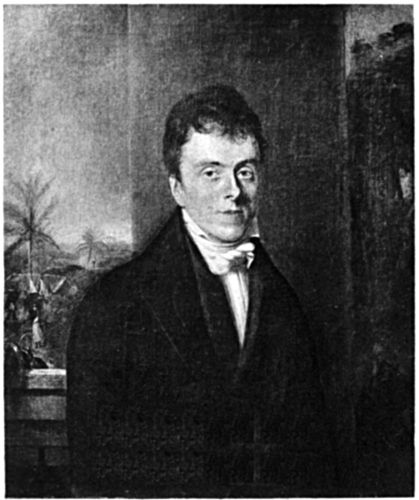 Henry Martyn.