Soils and Fertilizers
Hemp should not be grown on poor soils. To obtain good yields
and fiber of high-quality, it is necessary to have a growth of uniform
stalks 6 to 8 feet long. Short stalks, from poor nonfertile soils,
seldom produce a high-quality fiber.
Fiber hemp grows successfully on soils of the Clarion, Tama,
Carrington, Maury, Hagerstown, and Miami series, which, in general,
are deep, medium-heavy loams, well-drained, and high in organic
matter. Artificially drained areas of the Webster, Brookston, and
Maumee series also give satisfactory yields. These soils are among
the most productive soils of the Corn Belt. They produce average
yields of 50 to 70 bushels or more of corn per acre. If land will not
produce from 50 to 70 bushels of corn per acre, it should not be
planted to hemp for fiber production.
Muck or peat soils are not recommended for the production of high-quality
hemp fiber. The quantity of fiber produced per acre on these
soils may be very high, but experience has demonstrated that the
fiber lacks strength, which is the first requirement of hemp fiber for
good cordage.
The inexperienced farmer usually gets advice from an experienced
hemp-mill superintendent in the selection of the right soil. In fact,
the farmer's contract to grow hemp usually specifies the exact field
that it has been mutually agreed should be used for the hemp crop.
This type of supervision by the company contracting for hemp has
helped to prevent many crop failures.
Hemp should not be grown continuously on the same soil, for the
same reasons that many other crops are not adapted to such practices.
In Wisconsin, fields previously used for a cultivated crop are selected
for hemp planting in preference to ones upon which small grains
have been grown. In Kentucky, bluegrass sod, if obtainable, is
selected. Old pastures plowed up are well suited for hemp culture.
Fields previously cropped to soybeans, alfalfa, and clover are excellent
for hemp. A good rotation is to follow corn with hemp, and in
Kentucky a fall cereal may follow the hemp.
Although hemp requires a rich soil, it does not remove from the
farm an excess of plant-food material. Nearly all the leaves on the
hemp plants, containing much of the plant nutrients removed from
the soil, fall off during the growth and maturing of the plant. The
remaining leaves may drop off in the field during the process of
retting. Further, the plant stems lose about 20 percent in weight
of soluble and decomposed materials, which leach out upon the fields,
and the stubble may be plowed under. The plant in this manner
returns to the land a large part of the plant nutrients that it removes
during its growth.
Commercial fertilizers may be used to advantage on soils that are
not well supplied with organic matter. Ordinarily, the best fertilizer
for hemp is barnyard manure, but commercial fertilizer can
be used to advantage to supplement manure. Lime applications may
be supplied on acid soils to advantage. Consult your county agent
for recommendations as to amounts of fertilizer and lime to apply.
Seed
The period of flowering of the hemp plant may extend over several
weeks, and as a result the seed does not all mature at one time.
Hemp seed for sowing frequently contains some immature green
to yellowish-green seeds that may not germinate well. Good hempseed
for sowing should be relatively free of such seeds and should
germinate 90 percent or better. As the oil content of hempseed
usually ranges between 29 and 34 percent, the seed should be kept
cool and dry, as it spoils rapidly under warm and damp conditions.
Hemp seed seldom retains its germinating power well enough to be
used for seed after 2-years' storage.
When to Plant
Hemp should be planted in the spring just before corn. In a program
calling for small spring grains and corn, the farmer should
plan to plant his hemp between the time he plants his small grains
and the corn.
Seeding
Hemp grown for seed production should be sown in rows or hills.
The hills are commonly spaced 5 by 5 feet, with 6 to 10 seeds to the
hill, planted not more than 1/2 inch deep. The plants are thinned to
3 to 5 to a hill. If care is taken to save seed, about 11/2 pounds wall
sow an acre. Most farmers use more seed, and frequently the crop
is replanted because of late floods or failure to obtain good stands.
Hemp grown for fiber should be sown with a broadcast seeder or
with a grain drill. A drill with 4 inches between drill tubes is preferred
to one with 6 inches or more. The seed should not be planted
deeper than 1 inch, and a depth of 1/2 inch is preferred. If the
seed is planted deep, the hemp seedling is not capable of pushing its
way to the surface of the ground. A slight crust on the ground
frequently results in a poor stand. If the seedbed is loose, disks on a
seed drill may cut too deep into the soil and the seed will be sown
more than 1 inch deep. In such cases, to make certain that the disks
do not cut too deep into the seedbed, they should be tied to the seed
box.
A standard bushel of hempseed weighs 44 pounds. The rate of
seeding hemp for fiber production ranges between 3 and 5 pecks of
seed per acre. In Kentucky, where hemp is hand-broken, it has been
the practice to sow 3 pecks (33 pounds) per acre. However, when
the hemp is to go to the mill, 1 bushel per acre gives a product that
is better suited to milling. Wisconsin and other Corn Belt farmers
have commonly sown 5 pecks per acre. The lighter rate of seeding
in Kentucky produces larger stalks. These stalks are easily broken,
and the fiber is easily prepared by the hand-breaking methods that
have been used there since colonial days. Machine methods of breaking
and scutching to prepare the fiber are used in Wisconsin, and
recently to some extent in Kentucky. The machines will handle
finer stems, and the sowing of 5 pecks is advisable where hemp is to
be prepared by machine.
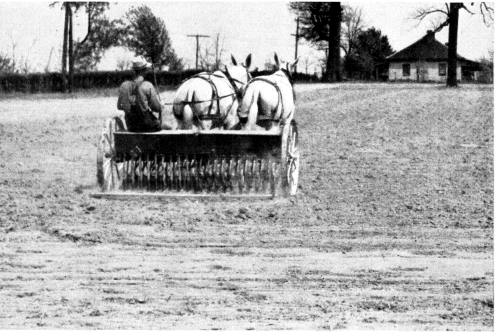
A good practice in planting hemp for fiber production is to sow
around the edge of the field next to the fence a 16- to 18-foot width
of small grains, which may be harvested before the hemp. Space
is thus provided for the harvester to enter the field and begin cutting
without injuring the hemp. It also prevents hemp plants at the
edge from growing too rank. Uniform plants are necessary for
uniform fiber quality.
Culture
Fall plowing in Wisconsin gives better results with hemp than
spring plowing.
Hemp for fiber production requires little or no cultivation or care
after planting until the harvest; but if, after seeding and before the
seedlings emerge, the ground crusts badly it may be advisable to roll
the field to break the crust. Hemp for seed production should be
cultivated the same as corn; that is, sufficiently to keep back the
weeds. Spudding out Canada thistles where they appear in dense
stands in hemp fields should be done when the hemp is only a few
inches high. In most cases hemp will compete well with weeds, if
the hemp gets off to a good start.