Hemming happened upon the city of Pernamba
on the evening of a sultry day in April. He
manifested no surprise beyond straightening his monocle
in his eye.
"Hope they have some English soda-water down
there," he said to the heavy foliage about him, "but
I suppose it would be hardly fair to expect an ice
factory so far from the coast." For a second a
vision of tall glasses and ice that clinked came to
his mind's eye. He remembered the cool dining-rooms
of his friends in Pernambuco. He spurred
his native-bred steed to a hesitating trot along the
narrow, hoof-worn path that led down to the valley.
At a mud and timber hut set beneath banana-trees,
and backed by a tiny field, he drew rein. A woman
sat before the door, looking cool and at ease in her
scanty cotton dress. A naked child chased a pig
among the bananas. Hemming greeted the woman
in Portuguese. She gave him humble greeting in
return. The pig and the baby came near to listen.
Hemming swung his feet free from the stirrups, to
straighten the kink out of his knees. He pushed
back his pith helmet, and lit a cigarette.
"What is the name of the town?" he asked, smiling
reassuringly.
The woman told him, standing respectfully on
the earthen threshold. Such square shoulders and
clear eyes as this Englishman's were not every-day
sights in Pernamba.
"May a stranger find entertainment there?" he
inquired.
"Yes," she replied, "and the great man who owns
it is generous to strangers. He is a big man, full
of wisdom, smoking eternally a yellow cigar not
of this country."
Hemming dismounted, the better to rest his horse.
Although he had ridden all that day and the day
before, he felt no fatigue himself. The tropical
sun, the narrow water-cut paths, and the clambering
vines held in the heated air and luring him with
strange flowers, brought him no terror. But he
polished his monocle and sighed uneasily, for his
store of milreis had dwindled since leaving Pernambuco
a week before to a sum equalling about eleven
pounds in English money.
"Has this man an army?" he asked.
"Truly a great army," replied the woman, "for
I have seen it myself, riding after thieves. It
numbers five hundred men, all armed, and wearing white
tunics, and all paid for by this man. He must be
richer than a king to support so grand an army."
Hemming smiled toward the white and red roofs
and clumps of foliage in the valley, thinking, maybe,
of his own old regiment, of Aldershot during a
review, of the hill batteries that had supported the
infantry advance in India, and of the fifty regiments
under canvas in Tampa.
"I crave a drink," he said,—"a finger of your
good casash in a bowl of cool water."
The woman brought it, smiling with hospitality,
and would not accept the ragged bill which he held
out to her.
"It is a pleasure," cried she, "to slake the thirst
of so distinguished a señor."
Hemming bowed gravely, a smile lifting his
upturned, pale moustache. The baby came close, on
all fours, and examined his yellow riding-boots and
straight spurs. Hemming patted the small one's
limp black hair.
"This is a kindly world," he said in English,
then to the woman: "Let thy son wear this ring,—see,
it fits his thumb. Should any man ask the
name of his friend, say it is Hemming, an Englishman."
He pushed the child gently toward its mother,
and, swinging to his saddle, rode down toward the
city. His gray eyes took in everything,—the yellowing
fruit, the fields of cane, the mud huts of the
poor, the thin horses of the charcoal-burners crowding
out of the trail to let him pass, and the patches
of manioc.
All this he beheld with satisfaction. In a thin
book he made a note, thus: "Pernamba, name of
town evidently run by a governor of independent
spirit. Army of 500, evidently mounted infantry.
Welcomed to outskirts of city by kind peasant
woman, evening of April 6, 19—. Same climate
and crops as rest of Brazil. Eleven pounds in my
pockets in Brazilian notes and small coin. What
does Pernamba hold for H.H. I wonder? A dinner
or two, perhaps, and a couple of chapters for my
book."
Presently the twisting path met a highway between
royal palms. Good-sized villas, their walls
all blue and white with glazed tiles, their roofs dusky
red, or else flat and railed about with white stones,
each in its separate garden. The gardens were
enclosed by high walls of brick, such as he had seen
many times in the resident sections of Pernambuco.
For months he had lived in just such a house, and
lolled in just such a garden.
"The old Dutch influence," he said, tossing his
cigarette over the nearest wall. A bullock-cart came
creaking along the road, the patient cattle, with
heads held low and a straight yoke across their
wrinkled necks, the driver walking at their heels,
sombre with dust, and daintily puffing a cigarette.
The cart was loaded with sacks of sugar, which sent
up a heavy, sickly smell. Hemming hailed the
driver.
"Where does the governor live, my friend?"
"The President, señor? There behind the white
panthers." With the stock of his rawhide whip,
the fellow pointed to an iron gate, set between posts
of red brick, topped with marble panthers. Each
panther held a shield between its front paws.
Hemming threw the bullock-driver a coin, and rode on
the pavement, the better to examine the armorial
design on the shields. He laughed softly.
"Familiar," he said, "ah, yes, a good enough
old Devonshire shield. I have admired it in the
dining-room of the Governor of Newfoundland.
Now I doff my hat to it at the entrance of a
president's residence. Dash it all, I have outgrown
dismay, and a jolly good thing, too." He flecked a
leaf off his knee with the tip of his glove.
"Queer I never heard about this before,—and
what the deuce is a Brazilian doing with those
arms? Can this be where that crazy American
whom old Farrington told me about hangs out?" His
brow cleared, and he bowed to the
expressionless panthers.
A sentry, who had been standing a few paces off,
with a cavalry sabre at his shoulder and a cigarette
in his mouth, now drew near and saluted. Hemming
returned the salute sharply. This same custom
of smoking on sentry-go had jarred on him
many a time in Pernambuco. He had noticed the
same thing in Bahia.
"I would see the President," he said, and passed
his card to the soldier. From a small guard-house
just inside the wall came several more white-clad
men. One of these hurried away with Hemming's
card, and presently returned. The gates were swung
wide open; Hemming rode in at a dress-parade trot,
travel-stained, straight of back, his monocle flashing
in his eye. Soldiers posted here and there among
the palms and roses and trim flower-beds stood at
attention as he passed.
He drew rein and dismounted at the foot of the
marble steps. A tall, heavily built man, dressed in
a black frock coat and white trousers, came down to
meet him. A man in livery took his horse.
"Mr. Hemming," said the large man, "I am
the President." He popped a fat, yellow cigar into
his mouth, and shook hands. "Come in," he said.
He led the way into a large tiled room, containing
a billiard-table of the American kind, a roll-top desk,
and an office chair. The windows of the room were
all on one side, and opened on a corner of the
gardens, in which a fountain tossed merrily. The
President sank into a chair in the easiest manner, and
threw one leg over the arm of it. Then he noticed,
with a quick twinkle in his blue eyes, Hemming
in the middle of the floor, erect and unsmiling.
"Mr. Hemming," he said, "I want your respect,
but none of that stiff-backed ceremony between
gentlemen. I am neither Roosevelt nor Albert Edward.
Even Morgan is a bigger man than I am, though
I still hope. You have been in the English army,
and you like to have things starched; well, so do I
sometimes. Please fall into that chair."
Hemming blushed and sat down. The man was
evidently crazy. "My name is Tetson," said the
President. He rang the bell and a native servant
entered.
"Thank you, a Scotch and soda," said Hemming.
"Ah, I knew it," laughed the other, "though I
always take rye myself."
The servant bowed and retired.
"I see the illustrated weeklies of both New York
and London," continued Tetson, "and I always
look for your articles. I like them. I know
something about your family, also, Hemming. I have
'Burke's Landed Gentry' and 'Who's Who' on
my desk. You are a grandson of Sir Bertram
Hemming of Barracker."
"Yes," replied Hemming, both surprised and embarrassed.
"Well," said the President, "I have some blood
in me, too. My mother's grandmother was a
Gostwycke. Did you notice the three stars and six
choughs?"
"I know the head of your house at home, Colonel
Bruce-Gostwycke, and another distinguished member
of it in the colonies, Sir Henry Renton," replied
Hemming. "But," he continued, briskly, twisting
his moustache, "you are something bigger than
that here. Why do you hold this little half-dead
county family so high?"
"My mother in New York taught me to," replied
Tetson, "and then this business is different.
I did it, as you Englishmen say, off my own bat.
A pile of money, a lot of gall, a little knowledge of
the weakness of men in office,—this is all about
it. Even now most of my friends think me a fool." He
gravely relit his yellow cigar. The reek of
it was worse than jerked beef to Hemming. "I
will tell you my story some day, but now you want
a shower-bath and a change. Please consider
yourself at home. Sudden friendships may not be good
form in England, but they are all right back here."
"Ah," said Hemming, "I have brushed about
a bit; I'm not such a—so English as I look."
Tetson turned to the servant: "Tell Smith to
look after Mr. Hemming. Smith is a handy man.
You will find all kinds of cigarettes in his keeping,
and we shall dine at eight. If you feel hungry in
the meantime, tell Smith."
He arose and shook hands. Hemming followed
the servant, inwardly wondering, outwardly calm.
He had met many strange people in his adventurous
life, and had become accustomed to luck of every
kind, but this big President, with the yellow cigar,
was beyond anything he had ever dreamed.
"I am glad I was born with imagination, and
have enjoyed the enlightening society of O'Rourke
in so many strange places," he thought.
Smith proved to be a clean-shaven man, all in
white and brass buttons. Hemming surveyed him
with interest.
"I see that you are an Englishman, Smith," he
said.
"No, sir," replied Smith, in faultless tones. "I
was born on the Bowery. But I have been in
London, sir, yes, sir, with Mr. Tetson. We haven't
always lived in this 'ere 'ole."
It seemed to Hemming that the h's had been
dropped with a certain amount of effort on the
man's part, and that his eyes twinkled in a quite
uncalled-for way. But it did not bother him now.
Even a valet may be allowed his joke.
Soon he was enjoying the luxury of a shower-bath
in a great, cool room, standing by itself in a
vineyard and rose garden. The shower fell about
six feet before it touched his head. The roof of the
building was open to the peak, and a subdued light,
leaf-filtered, came down through a glass tile set
in among the earthen ones. The walls and floor
were of white and blue tiles. The bath was of
marble, as large as an English billiard-table, and
not unlike the shallow basin of a fountain.
Cool and vigorous, Hemming stepped from the
bath, replaced his eye-glass, and lit a cigarette.
Swathed in a white robe, with his feet in native
slippers, he unlocked the door and issued into the
scented garden air. Smith awaited him in the
vine-covered alley, holding a "swizzle" on a silver tray.
He drained the glass, and, lifting up the hem of his
robe, followed the valet back to the dressing-room.
Chameleons darted across his path, and through
the palms floated the ringing notes of a bugle-call.
"I found your razors and your brushes in the
saddle-bags," announced Smith, "and these shirts,
sir, I bought, guessing at your size, and—"
"What is this?" interrupted Hemming, holding
aloft a white jacket heavy with gold.
"Mess jacket of our regiment, sir. The President
would feel honoured if you would wear it.
And these trousers were sent in by one of the native
officers, with his compliments," replied the valet.
Hemming curtly intimated his readiness to dress.
Smith closed the shutters, turned on the lights, and
examined a couple of razors.
Twenty minutes later, Herbert Hemming, in the
mess uniform of a colonel in the President of
Pernamba's army, was ushered into the presence of the
family, and a certain Mr. Valentine Hicks.
The President's name was Harris William Tetson.
His wife had been Mary Appleton, born of
cultured parents in Philadelphia. She welcomed
Hemming in the most friendly manner. The third
member of the family was a tall girl, with a soft
voice and an English accent. She shook hands
with Hemming, and he noticed that the pressure of
her hand was firm and steady, like that of a man's.
She wore glasses. The light from the shaded
candles glowed warm on her white neck and arms.
Hemming had not expected to find any one like this
in the interior of South America. He used to know
girls like her at home, and one in particular flashed
into his memory with a pang of bitterness. In his
agitation, he almost overlooked the extended hand
of Mr. Valentine Hicks.
The dinner was of great length. A few of the
dishes were American, but most were of the country.
Two dusky servants waited upon the diners. The
claret was to Hemming's taste, and, as he listened
to Miss Tetson describe an incident of her
morning's ride, a feeling of rest and homeliness came
to him. A little wind stole in from the roses and
fountains, and the man of wars and letters, great
dreams and unsung actions, saw, with wondering
eyes, that it loosened a red petal from the roses at
her shoulder and dropped it upon her white arm.
He looked up sharply, and only the light of genial
friendship remained in the eyes that met those of
Valentine Hicks. But Hicks looked sulky;
understanding came to the heart of Hemming. At last
the dinner came to an end, and Tetson dropped the
subject of freight on sugar, and took up the lighter
one of real estate. Coffee was brought; no one
listened to Tetson, but he prosed on, his good-natured
face turned toward the shadows in the ceiling,
a yellow cigar stuck jauntily in his mouth.
Hemming was busy with his own thoughts, wondering
into what nest of lunatics his free-lancing had
brought him. He longed for O'Rourke's help. The
girl drew something from her bodice, and laid it
before him. It was a cigarette-case.
"You may take one, if you do not bore us by
looking shocked," she said.
Hemming drew forth a cigarette, and lit it at the
nearest candle. "As to being shocked," he replied,
"why, I used to know a girl who—" he stopped
suddenly and glanced down at his coffee. "Of
course it is quite the thing now," he added, in stilted
tones.
Hicks refused a cigarette from the silver case,
and moodily puffed at a black native cigar.
Mrs. Tetson did not smoke, but entertained the others
with a description of her first and only attempt at
the recreation.
The little wind died away. Outside, the fountain
splashed sleepily. The blood-red petal fell from
the girl's arm to the whiter cloth. A flame-bewildered
moth bungled into the President's coffee.
Hemming's workaday brain was lulled to repose,
and now he was only Hemming the poet. He looked
into the eyes across the table. But he had lived
so long with men, and the foolish, evident affairs
of generals and statesmen, that Miss Tetson's
glances were as weapons for which he knew no
manual of defence. They touched him more than
he liked, awaking in his hitherto disciplined
memory a hundred fibres of broken dreams. And every
fibre tingled like a nerve with a sweetness sharp
as pain,—and time swung back, and all the healing
of his long exile was undone.
When the ladies rose from the table, Mr. Tetson
came over to Hemming and nudged him confidentially.
He looked very sly. "What d'ye say to a
game of billiards?" he whispered.
"Delighted," murmured Hemming, relieved that
his strange host had not suggested something worse.
"I like the game," continued Tetson, "but as
Hicks is a damn fool at it, I don't indulge very
often. Hicks is too young, anyway,—a nice fellow,
but altogether too young for men to associate
with. Trotting 'round with the girls is more in
his line."
"Really," remarked the newcomer, uneasily. He
was not quite sure whether or not Hicks had got
out of ear-shot.
"Fact," said the President,—"cold truth.
Marion can't play, either. I've had Santosa up
several times for a game, but he's too dashed
respectful to beat me. You'll not be that way,
Hemming?"
"I should hope not," replied Hemming, absently,
his eyes still turned toward the door through which
the rest of the party had vanished.
"What d'ye say to five dollars the game?"
Tetson whispered. The adventurer's heart sank, but
he followed his host to the billiard-room with an
unconcerned air. They played until past midnight,
the President in his shirt-sleeves, with the yellow
cigar smouldering always. A servant marked for
them, and another uncorked the soda-water. After
the last shot had been made, Valentine Hicks strolled
in, with his hands in his pockets and his brow
clouded.
"Did the old man do you?" he inquired of Hemming.
The free-lance shook his head. "I took ten
pounds away from him," he said.
The secretary whistled.
Hemming awoke with a clear head, despite the
President's whiskey, and remembered, with
satisfaction, the extra ten pounds. His windows were
wide open, and a cool dawn wind came in across
the gardens. He threw aside the sheet and went
over to the middle window, and, finding that the
ledge extended to form a narrow balcony, stepped
outside. Away to the right, he could mark a bend
of the river by the low-lying mist. He sniffed the
air. "There is fever in it," he said, and wondered
how many kinds of a fool Mr. Tetson was. He
was sorry for the ladies. They did not look like
the kind of people to enjoy being shut away from
the world in such a God-forsaken hole as this. Why
didn't the old ass start a town on the coast? he
asked himself. While engaged in these puzzling
reflections, Smith rapped at the door, and entered.
He carried coffee, a few slices of dry toast, and a
jug of shaving-water.
"Will you ride this morning, sir?" he asked.
"Why, yes," replied Hemming, and said he
would be shaved before drinking his coffee. As
the valet lathered his chin, he asked if the
President rode every morning.
"Not 'e, sir," replied the man, "but Miss Tetson
does, and Mr. 'Icks."
Hemming found his well-worn riding-breeches
brushed and folded, his boots and spurs shining
like the sun, and a new cotton tunic ready for him.
He looked his surprise at sight of the last article.
"You didn't give me any order, sir," explained
the man, "but, bein' as I'm a bit of a tilor myself,
I thought as 'ow you wouldn't mind—"
Hemming interrupted him with uplifted hand.
"It was very kind of you," he said, "and I am
sure it is an excellent fit. See if you can't find a
sovereign among that change on the table."
As he rode through the great gates, Hemming
caught sight of Miss Tetson along the road. At
sound of his horse's hoofs, she turned in her saddle
and waved her hand. He touched his little white
stallion into that renowned sliding run that had
made it famous in Pernambuco. They rode together
for over an hour. Hicks did not turn out
that morning.
Mr. Valentine Hicks was young, and an
American. Though he had been born in Boston, he lacked
something in breeding,—a very shadowy something
that would correct itself as life took him in
hand. Though he had been an undergraduate of
Harvard University for two years, he displayed to
Hemming's mind a childish ignorance of men and
books. No doubt he had practised the arts of
drop-kicking and tackling with distinction, for he
was big and well muscled. He was distantly
connected with the Tetsons, and had joined them in
Pernamba soon after their arrival in the country,
and two years previous to the opening of this
narrative, to act as Tetson's private secretary. At
first Mr. Hicks looked with suspicion upon the
wandering Englishman. He was in an unsettled frame
of mind at the time, poor fellow. He saw in
Hemming a dangerous rival to his own monopoly of
Miss Tetson. Already the lady was talking about
some sort of book the duffer had written.
A few days after Hemming's arrival, the army,
to the number of four hundred rank and file and
twenty-six officers, was drawn up for the President's
inspection. Hemming rode with Tetson, and the
little brown soldiers wondered at the frosty glitter
of his eye-glass. His mount was the same upon
which he had entered the country,—a white, native-bred
stallion, the gift of one McPhey, a merchant
in Pernambuco. Miss Tetson and Hicks, each followed
by a groom, trotted aimlessly about the waiting
ranks, much to Hemming's disgust. Tetson
lit the inevitable yellow weed.
"What do you think of them?" he asked, waving
his hand toward the troops.
"They look to me as if they were stuffed with
bran," answered the Englishman, "and their
formation is all wrong."
"Ah," said Tetson, sadly crestfallen.
Presently he touched Hemming's knee.
"If you will take them in hand,—the whole
lopsided consignment, from the muddy-faced colonel
down,—why, I'll be your everlasting friend,"
he said.
Hemming stared at them, pondering.
"It will mean enemies for me," he replied.
"No, I can answer for everything but their drill,"
said the other.
Hemming saluted, and, wheeling the white
stallion, rode alone up and down the uneven ranks.
His face was set in severe lines, but behind the mask
lurked mirth and derision at the pettiness of his
high-styled office.
"Commander-in-chief," he said, and, putting his
mount to a canter, completely circled his command
in a fraction of a minute.
"I shall begin to lick them into shape to-morrow,"
he said to Tetson.
The little officers, clanging their big cavalry
sabres, marched their little brown troops away to
the barracks. The President looked wistfully after
them, and said: "I can mount three hundred of
them, Hemming. I call it a pretty good army, for
all its lack of style."
"I call it half a battalion of duffers," said
Hemming to himself.
Later, the new commander-in-chief and the private
secretary sat together in the former's quarters.
"I do not quite understand this Pernamba idea,"
said Hemming. "Is it business, or is it just an
unusual way of spending money?"
"I don't know what the old man is driving at
myself," replied Hicks, "but of one thing I am sure:
there's more money put into it than there is in it.
The army is a pretty expensive toy, for instance.
Just what it is for I do not know. The only job
it ever tried was collecting rents, and it made a
mess of that. We don't sell enough coffee in a year
to stand those duffers a month's pay. We get
skinned right and left back here and down on the
coast. Mr. Tetson thinks he still possesses a clear
business head, but the fact is he cannot understand
his own bookkeeping. It's no fun running a
hundred-square-mile ranch, with a fair-sized town
thrown in."
Hemming wrinkled his forehead, and stared vacantly
out of the window. Below him a gray parrot,
the property of Miss Tetson, squawked in an
orange-tree.
"If I had money, I should certainly live somewhere
else. Why the devil he keeps his wife and
daughter here, I don't see."
Just then the secretary caught the faint strumming
of a banjo, and left hurriedly, without venturing
an explanation. He found Miss Tetson in her
favourite corner of the garden, where roses grew
thickest, and breadfruit-trees made a canopy of
green shade. A fountain splashed softly beside
the stone bench whereon she sat, and near by stood
a little brown crane watching the water with eyes
like yellow jewels.
The girl had changed from her riding-habit into
a white gown, such as she wore almost every day.
But now Hicks saw her with new eyes. She seemed
to him more beautiful than he had dreamed a
woman could be. Yesterday he had thought, in
his indolent way, that he loved her. Now he knew
it, and his heart seemed to leap and pause in a mad
sort of fear. The look of well-fed satisfaction
passed away from him. He stood there between the
roses like a fool,—he who had come down to the
garden so carelessly, with some jest on his lips.
"Something will happen now," she said, and
smiled up at him. Hicks wondered what she meant.
"It is too hot to have anything happen," he
replied.
"That is the matter with us,—it is too hot,
always too hot, and we are too tired," she said,
"but Mr. Hemming does not seem to mind the heat.
I think that something interesting will happen now."
This was like a knife in the man's heart, for he
was learning to like the Englishman.
The girl looked at the little crane by the fountain.
Hicks stood for a moment, trying to smile. But
it was hard work to look as if he did not care.
"Lord, what an ass I have been," he said to himself,
but aloud he stammered something about their rides
together, and their friendship.
"Oh, you can ride very well," she laughed,
"but—"
She did not finish the remark, and the secretary,
after a painful scrutiny of the silent banjo in her
lap, went away to the stables and ordered his horse.
But a man is a fool to ride hard along the bank
of a Brazilian river in the heat of the afternoon.
From one of the windows of his cool room, Hemming
watched the departure of the President's
private secretary. He remembered what Tetson had
said of the boy,—"too young to associate with
men."
But youth is a thing easily mended, thought
Hemming. Somehow—perhaps only in size—Hicks
recalled O'Rourke to his mind; and back to
him came the days of their good-comradeship. He
wondered where O'Rourke was now, and what he
was busy about. He had seen him last in Labrador,
where they had spent a month together, salmon
fishing, and up to that time O'Rourke had found
no trace of Miss Hudson. Ellis's information had
proved useless. Disgusted at the deception
practised upon him, the poor fellow had ceased to speak
of the matter, even with his dearest friend during
night-watches by the camp-fire.
Hicks came along the homeward road at dusk.
Lights were glowing above the strong walls and
behind the straight trunks of the palms. A mist
that one might smell lay along the course of the
river. Hicks rode heavily and with the air of one
utterly oblivious to his surroundings. But at the
gateway of the officers' mess he looked up. Captain
Santosa was in the garden, a vision of white
and gold and dazzling smile. He hurried to the
gate.
"Ah, my dear Hicks, you are in time for our
small cocktails, and then dinner. But for this riding
so hard, I can call you nothing but a fool."
"Thanks very much," replied the American,
dismounting slowly, "and as to what you call me,
old man, I'm not at all particular." The
woebegone expression of his plump face was almost
ludicrous.
Santosa whistled, and presently an orderly came
and took Valentine's horse. The two entered the
building arm in arm, and the secretary swayed as
he walked.
Five or six of the native officers were already in
the mess-room, swallowing mild swizzles, and talking
quietly. They greeted Hicks affectionately.
"This man," said Santosa, "had his horse looking
like a shaving-brush, and I know nothing in
English so suitable to call him as this," and he
swore vigorously in Portuguese.
"Stow that rot," said Hicks, "can't you see I'm
fit as a fiddle; and for Heaven's sake move some
liquor my way, will you?" His request was speedily
complied with, and he helped himself recklessly
from the big decanter.
The dinner was long and hot, and Valentine
Hicks, forgetting utterly his Harvard manner,
dropped his head on the table, between his claret-glass
and coffee-cup, and dreamed beastly dreams.
The swarthy Brazilians talked and smoked, and
sent away the decanters to be refilled. The stifling
air held the tobacco smoke above the table. The
cotton-clad servants moved on noiseless feet.
"These Americans,—dear heaven," spoke a fat
major, softly.
"I am fond of Hicks," said Santosa, laying his
hand on the youth's unconscious shoulder. A
slim lieutenant, who had held a commission in a
Brazilian regiment stationed in Rio, looked at the
captain.
"The Americans are harmless," he said. "They
mind their own business,—or better still, they let
us mind it for them. The President—bah! And
our dear Valentine. If he gets enough to eat, and
clothes cut in the English way, and some one to
listen to his little stories of how he used to play
golf at Harvard, he is content. But this
Englishman,—this Señor Hemming,—he is quite
different."
"Did not you at one time play golf?" asked
Santosa, calmly.
"Three times, in Florida," replied the lieutenant,
"and with me played a lady, who talked at her
ease and broke two clubs in one morning. She was
of a fashionable convent named Smith, but this did
not deter her from the free expression of her
thoughts."
"Stir up Señor Hicks, that we may hear two
fools at the same time," said the colonel.
"Take my word for it, colonel, that Valentine
is not a fool," said Santosa, lightly. "He is very
young."
"Have you nothing to say for me?" asked the
slim lieutenant, good-naturedly.
"You know what I think of you all," replied
Santosa, without heat. The conversation was
carried on in Portuguese, and now ran into angry
surmises as to the President's reason for placing
Hemming in command.
It was close upon midnight when Hicks awoke.
He straightened himself in his chair and blinked
at Santosa, who alone, of the whole mess, remained
at table.
"You have had a little nap," said the Brazilian.
Hicks looked at him for awhile in silence. Then
he got to his feet, and leaned heavily on the table.
"I'll walk home, old tea-cosey. Tell your nigger
to give my gee something to eat, will you?"
"You do not look well, my dear Valentine. You
had better stay here until morning," said Santosa.
Hicks swore, and then begged the other's pardon.
"Am I drunk, old chap? Do I look that way?"
he asked.
Captain Santosa laughed. "You look like a man
with a grudge against some one," he answered.
"Perhaps you have a touch of fever, otherwise I
know you would have good taste enough to conceal
the grudge. A gentleman suffers—and smiles."
It was past two o'clock in the morning, and
Hemming was lying flat on his back, smoking a
cigarette in the dark. He had been writing verses,
and letters which he did not intend to mail, until
long past midnight. And now he lay wide-eyed
on his bed, kept awake by the restless play of his
thoughts.
His windows were all open, and he could hear a
stirring of wind in the crests of the taller trees.
His reveries were disturbed by a stumbling of feet
in the room beyond, and suddenly Valentine Hicks
stood in the doorway. By the faint light
Hemming made out the big, drooping shoulders and
the attitude of weariness. He sat up quickly, and
pushed his feet into slippers.
"That you, Hicks?" he asked.
"Don't talk to me, you damn traitor!" said Hicks.
Hemming frowned, and tossed his cigarette into
the night.
"If you will be so good as to turn on the light,
I'll get the quinine," he said.
The secretary laughed.
"Quinine!" he cried; "you fool! I believe an
Englishman would recommend some blasted medicine
to a man in hell."
"You're not there yet," replied Hemming. He
was bending over an open drawer of his desk,
feeling about among papers and bottles for the box
of pills. Hicks drew something from his pocket
and laid it softly on the table.
"Good morning," he said. "I intended to kick
up a row but I've changed my mind. Hand over
your pills and I'll go to bed."
When he awoke next day, it was only to a foolish
delirium. The doctor looked at him, and then at
Hemming.
"I suppose you can give it a name," he said.
Hemming nodded.
"I've had it myself," he replied.
The President, followed by his daughter, came
into the room. Hicks recognized the girl.
"Marion," he said, and when she bent over him,
"something has happened after all."
She looked up at Hemming with a colourless face.
Her eyes were brave enough, but the pitiful expression
of her mouth touched him with a sudden painful
remembrance. During the hours of daylight
the doctor and Miss Tetson watched by the bedside,
moving silently and speaking in whispers in the
darkened room.
The doctor was an Englishman somewhat beyond
middle age, with a past well buried. In the streets
and on the trail his manner was short almost to
rudeness. He often spoke bitterly and lightly of
those things which most men love and respect. In
the sick-room, be it in the rich man's villa or in
the mud hut of the plantation labourer, he spoke
softly, and his hands were gentle as a woman's.
Hemming had been working with his little army
all day, and, after dining at the mess, he changed
and relieved Miss Tetson and the doctor. Before
leaving the room, the girl turned to him nervously.
"Did you see Valentine last night?" she asked.
Hemming told her that Hicks had come to his
room for quinine.
"Good night, and please take good care of him,"
she said.
The Englishman screwed his eye-glass into place,
and glared at her uneasily. "Hicks is a good sort,"
he said, "but he is not the kind for this country.
Neither are you, Miss Tetson. But it's nuts for
me,—this playing soldier at another man's expense."
He paused, and she waited, a little impatiently,
for him to go on. "What I wanted to say," he
continued, "is that there is one thing that goes
harder with a man than yellow fever. I—ah—have
experienced both. Hicks is a decent chap,"
he concluded, lamely.
Miss Tetson smiled and held out her hand.
"If he should want me in the night, please call
me. I will not be asleep," she said.
Hemming, for all his rolling, had gathered a good
deal of moss in the shape of handiness and
out-of-the-way knowledge. Twice during the night he
bathed the sick man; with ice and alcohol. Many
times he lifted the burning head and held water
to the hot lips. Sometimes he talked to him, very
low, of the North and the blue sea, and thus brought
sleep back to the glowing eyes. The windows were
open and the blinds up, and a white moon walked
above the gardens.
Just before dawn, Hemming dozed for a few
minutes in his chair. He was awakened by some
movement, and, opening his eyes, beheld Miss Tetson
at the bedside. Hicks was sleeping, with his
tired face turned toward the window. The girl
touched his forehead tenderly with her lips.
Hemming closed his eyes again, and kept them so
until he heard her leave the room,—a few light
footsteps and a soft trailing of skirts. Then, in his
turn, he bent above the sleeper.
"If this takes you off, old chap, perhaps it will
be better," he said.
But in his inmost soul he did not believe this
bitter distrust of women that his own brain had
built up for him out of memory and weariness.
While Hicks tossed about in his fever dreams,
and Hemming shook his command into form, away
on the coast, in the city of Pernambuco, unusual
things were shaping. From the south, coastwise
from Bahia, came Bertram St. Ives O'Rourke. This
was chance, pure and simple, for he had no idea of
Hemming's whereabouts. From New York, on the
mail-steamer, came a man called Cuddlehead, and
took up his abode in a narrow hotel near the
waterfront. He arrived in the city only an hour behind
O'Rourke. He was artfully attired in yachting
garb, and had been king-passenger on the boat,
where his English accent had been greatly admired,
and his predilection for card-playing had been
bountifully rewarded. In fact, when he went ashore with
his meagre baggage, he left behind at least one
mourning maiden heart and three empty pockets.
O'Rourke, upon landing, had his box and three
leather bags carried across the square to the
ship-chandler's. He would look about before engaging
a room, and see if the place contained enough local
colour to pay for a stop-over. He fell, straightway,
into easy and polite conversation with the owner
of the store. From the busy pavement and dirty
square outside arose odours that were not altogether
foreign to his cosmopolitan nose. Three men greeted
one another, and did business in English and
Portuguese, speaking of the cane crop, the rate of
exchange, the price of Newfoundland "fish," and of
gales met with at sea. Bullock-carts creaked past
in the aching sunlight, the mild-eyed beasts staggering
with lowered heads. Soldiers in uncomfortable
uniforms lounged about. Cripples exhibited their
ugly misfortunes, and beggars made noisy supplication.
O'Rourke decided that there was enough local
colour to keep him, and, turning from the open door,
contemplated the interior of the establishment. The
place was dim and cool, and at the far back of it
another door stood open, on a narrow cross-street.
Cases of liquor, tobacco, tea, coffee, and condensed
milk were piled high against the wall. Baskets of
sweet potatoes and hens' eggs stood about. Upon
shelves behind the counter samples of rope, canvas,
and cotton cloth were exhibited. Highly coloured
posters, advertising Scotch whiskey, brightened the
gloom. The back part of the shop was furnished
with a bar and two long tables. At one of the tables
sat about a dozen men, each with a glass before him,
and all laughing, talking, swearing, and yet keeping
their eyes attentively fixed on one of their number,
who shook a dice-box.
O'Rourke, who had by this time made his name
known to the ship-chandler, was given a general
introduction to the dice-throwers. He called for a
lime-squash, and took a seat at the table between a
dissipated-looking individual whom all addressed
by the title of "Major," and a master-mariner from
the North. There were several of these shellback
skippers at table, and O'Rourke spotted them
easily enough, though, to the uninitiated, they had
nothing in common but their weather-beaten faces.
Their manners were of various degrees, running
from the height of civility around to nothing at all.
There was the first officer of a Liverpool "tramp"
with his elbows on the board, his gin-and-bitters
slopped about, and his voice high in argument. Next
him sat a mariner from one of the Fundy ports,
nodding and starting, and trying to bury in whiskey
remembrance of his damaged cargo and unseaworthy
ship. Nearer sat a Devonshire man in the
Newfoundland trade, drinking his sweetened claret with
all the graces of a curate, and talking with the
polish and conviction of a retired banker. O'Rourke
glanced up and down the table, and detected one
more sailor—a quiet young man clad in white duck,
with "Royal Naval Reserve" marked upon him for
the knowing to see. These four men (each one so
unlike the other three in clothes, appearance, and
behaviour) all wore the light of wide waters in their
eyes, the peace bred of long night-watches on their
tanned brows, and the right to command on chin
and jaw. O'Rourke felt his heart warm toward
them, for he, too, had kept vigil beside the ghostly
mizzen, and read the compass by the uncertain torch
of the lightning.
The other occupants of the table were residents
of the country—two English planters, the major,
a commission-merchant, a native cavalry officer, and
several operators of the South American Cable
Company. The major remarked upon the rotten state of
the country to O'Rourke, in a confidential whisper, as
he shook the dice in the leather cylinder. O'Rourke
replied, politely, that he wasn't an authority.
"But I am, sir," blustered the major. "Dear
heaven, man, I'd like to know who has been American
consul in this hole for the last seven years, only
to get chucked out last May by a low plebeian
politician."
The speaker's eyes were fierce, though watery, and
his face was red as the sun through smoke. He
drained his glass, and glared at O'Rourke.
"Couldn't say. Never was here before," replied
O'Rourke. He counted his neighbour's throw aloud,
for the benefit of the table.
"Three aces, a six, and a five."
He was about to recover two of the dice from a
shallow puddle on the table, and replace them in
the box, when he felt a hand on his arm.
"I was American consul," hissed the major, "and,
by hell, I'm still sober enough to count my own dice,
and pick 'em up, too."
O'Rourke smiled, unruffled. "You don't mean
you are sober enough, major—you mean you are
not quite too drunk," he said. The others paused
in their talk, and laughed. The major opened his
eyes a trifle wider and dropped his under jaw. He
looked the young stranger up and down.
"Well, I hope you are ashamed of yourself," he
said, at last.
"I am sorry I was rude, sir," explained O'Rourke,
"but I hate to be grabbed by the arm that way. I
must have a nerve there that connects with my temper."
A tipsy smile spread over the ex-consul's face.
"Shake hands, my boy," he cried. They shook
hands. The others craned their necks to see.
"You've come just in time to cheer me up, for
I've been lonely since Hemming went into the bush,"
exclaimed the major.
"Hemming! Do you mean Herbert Hemming?"
asked O'Rourke, eagerly.
"That's who I mean," replied the major, and
pushed the dice-box toward him. O'Rourke made
nothing better than a pair, and had to pay for thirteen
drinks. If you crave a lime-squash of an afternoon,
the above method is not always the cheapest
way of acquiring it. As the dice-box went the
rounds again, and the attention of the company
returned to generalities, the newcomer asked more
particulars of Hemming's whereabouts.
"He started into the bush more than a week ago,
to find some new kind of adventure and study the
interior, he said," explained the major, "but my
own opinion is that he went to see old Tetson in his
place up the Plado. Sly boy, Hemming! Whenever
we spoke of that crazy Tetson, and his daughter,
and his money, he pretended not to take any stock
in them. But I'll eat my hat—and it's the only
one I have—if he isn't there at this minute, flashing
that precious gig-lamp of his at the young lady."
O'Rourke had read stories about this eccentric
millionaire in the newspapers some years before.
"Hemming is safe, wherever he lands," he said.
"He's a woman-hater."
A look of half-whimsical disgust flashed across
the old man's perspiring face. He leaned close to
O'Rourke.
"Bah—you make me sick," he cried, "with your
silly commonplaces. Woman-hater—bah—any
fool, any schoolboy can say that. Call a man an
ice-riding pinapede, and you'll display the virtue of
originality, at least. At first I suspected you of
brains."
O'Rourke was embarrassed. How could he explain
that, in using the term woman-hater, he had
meant to suit his conversation to the intellect of his
hearer. It was commonplace, without doubt, and
meant nothing at all.
"Do you think, Mr. O'Rourke," continued the
other, "that simply because I'm stranded in this hole,
on my beam-ends (to use the language of our
worthy table-mates), that my brain is past being
offended? You are wrong, then, my boy, just as
sure as my name is Farrington. Hemming would
never have called a man a woman-hater. Why, here
am I, sir, sitting as I have sat every day for years,
getting drunk, and with never a word to a woman,
white or black, for about as long as you have used
a razor. But I don't hate women—-not I. I'd
give my life, such as it is, any minute, for the first
woman who would look at me without curling her
lip—that is, the first well-bred white woman. Ask
Hemming what he thinks, and he will tell you that,
in spite of the men, women are still the finest
creatures God ever invented. No doubt he seems
indifferent now, but that's because he has loved some
girl very much, and has been hurt by her."
"You are right, major, and I gladly confess I
used a dashed stupid expression—so now, if you
don't mind, please shut up about it," replied
O'Rourke. To his surprise Farrington smiled,
nodded in a knowing way, and lapsed into silence.
While one of the mariners was relating a fearsome
experience of his own on a wrecked schooner,
Mr. Cuddlehead entered the place and seated himself
at the unoccupied table. He sipped his peg, and
studied the men at the other table with shifting
glances. He thought they looked easy, and a vastly
satisfied expression came to his unhealthy, old-young
face. Though well groomed and well clothed,
Mr. Cuddlehead's deportment suggested, however
vaguely, a feeling on his part of personal insecurity.
He glanced apprehensively whenever a voice was
raised high in argument. He started in his chair
when the man who served the refreshments came
unexpectedly to his table to deposit a match-holder.
To O'Rourke, who had an eye for things beyond
the dice, Mr. Cuddlehead's face hinted at some
strange ways of life, and undesirable traits of
character. In the loose mouth he saw signs of a once
colossal impudence; in the bloated cheeks, dissipation
and the wrecking existence of one who feasts
to-day and starves to-morrow; in the eyes cruelty
and cunning; in the chin and forehead a low sort
of courage.
Gradually the crowd at the long table thinned.
First of all the cavalry officer arose, flicked
imaginary dust off the front of his baggy trousers, and
jangled out into the reddening sunlight. The
planters followed, after hearty farewells. They had
long rides ahead of them to occupy the cool of the
evening, and perhaps would not leave their isolated
bungalows again inside a fortnight. Next the
operators announced their intentions of deserting the
giddy scene.
"Come along, major, you and Joyce promised
to feed with us to-night," said one of them, "and
if your friend there, Mr. O'Rourke, will overlook
the informality of so sudden an invitation," he
continued, "we'll be delighted to have him, too."
"Great heavens, Darlington," exclaimed the
major, "you are still as long-winded as when you
first came out," and, before O'Rourke could accept
the invitation for himself, he concluded, "of course
O'Rourke will honour you, my boy."
"Thank you, very much, it's awfully good of you
chaps," stammered O'Rourke, disconcerted by the
major's offhand manner.
Darlington smiled reassuringly. "Don't let this
old cock rattle you," he said, and patted Major
Farrington affectionately on the shoulder.
After dinner that night, in the palatial dining-room
of the house occupied by the staff of the South
American Cable Company, O'Rourke learned something
of the major's past life. It was a sad and
unedifying story. The major had been trained at
West Point, and led his class in scholarship and
drill, and had risen, with more than one distinction,
to the rank of major. But all the while he had made
his fight against drink, as well as the usual handicaps
in the game of life. He had married a woman with
wealth and position superior to his own, who had
admired him for his soldierly qualities and fine
appearance, and who, later, had been the first to desert
him. Then followed the foreign consular appointments,
the bitter and ever-increasing debaucheries,
and at last the forced retirement from his country's
service. Now he lived on a small allowance, sent
him weekly, by his family. O'Rourke began to
understand the old man's fretful and disconcerting
moods.
At a late hour the superintendent of the staff
ushered O'Rourke to a big, cool room on the second
floor.
"Make this your home," he said, "and we'll let
you in on the same footing as ourselves. Hemming
occupied this room last. There is his bed; there
is his hammock; and, by Jove, there are his slippers.
You can have your traps brought up in the morning."
Thus did Bertram St. Ives O'Rourke become an
inmate of an imposing mansion in Pernambuco, with
moderate charges to pay and good company to
enliven his hours.
Toward noon of a stifling day, the major and
Mr. Cuddlehead met in the square by the waterfront.
Cuddlehead greeted the major affably. As
the major was very thirsty he returned the salutation.
A glance through the door at his elbow displayed,
to Mr. Cuddlehead's uncertain eyes, a number
of round tables with chairs about them. He took
out his watch and examined it.
"Eleven-thirty—I always take something at
half-past eleven. I hope you will join me," he said.
"I seldom drink before lunch," replied Farrington,
"but as this is an exceptionally dry day—"
They passed through the doorway and sat down
at the nearest table.
"Now I will find out what is doing," thought
Cuddlehead, and gave his order. But for a long time
the major's tongue refused to be loosened. He
sipped his liquor, and watched his companion with
eyes of unfriendly suspicion. Cuddlehead, in the
meantime, exhibited an excellent temper, put a few
casual questions, and chatted about small things of
general interest.
Now Cuddlehead had heard, from the captain of
the mail-boat, something about a wealthy American
with a bee in his bonnet and a pretty daughter,
somewhere within reach of Pernambuco. The story had
grown upon him, and a great idea had taken shape
in his scheming mind. Why shouldn't he, if all that
people said and wrote about American girls was
true? By gad, he'd make a shot at it. He'd show
them how to spend their money in more interesting
places than the back of nowhere. As soon as the
major began to look more friendly, under the
influence of the crude whiskey, he produced his
cigar-case,—a fat black leather affair, with an engraved
silver plate on the front of it,—and offered the
old man an excellent weed of Havana. The major
took it, glancing keenly, but swiftly, at the initials
on the case as he did so. "P. doesn't stand for
Cuddlehead," he thought, but said nothing.
"Tell me something about the man who owns
a whole country, somewhere back here, in the bush,"
urged Cuddlehead, lightly. The old man's muddled
wits awoke and jerked a warning. Here was some
scum of Heaven knows where, wanting to interfere
in a better man's business.
"What's that, my boy?" he asked, looking
stupidly interested.
"Oh, it is of no importance. It just struck me
as being a bit out of the way," replied the other.
"What?" inquired the major.
"The place Mr. Tetson hangs out," laughed Cuddlehead.
"It's all that, my boy," replied Farrington,
gleefully; then he stared, open-mouthed. "At least,"
he added, "it may be, but what the hell are you
gabbing about?"
"Sorry. Had no idea it was a secret," retorted
the younger man.
The major's potations flooded to his head. His
face took on a darker shade of crimson. His hands
twitched on the table.
"Secrets! You d—n little sneak," he roared,
staggering up and overturning his chair. The expression
of insolence faded from Cuddlehead's face. He
dashed out of the place without paying for the bottle
of whiskey. On the pavement he paused, long
enough to compose his features and straighten his
necktie. Then he went to the ship-chandler and
gathered a wealth of information concerning Harris
William Tetson. But he heard no mention of
Hemming being in the country, which was, perhaps,
just as well. He was certainly a sneak, as more
than the major had called him, but he was not
altogether a duffer. He could look after himself to a
certain extent. He decided to keep Pernambuco
until later, and go now for bigger game. He made
his plans speedily, fearing another meeting with the
major, and early next morning started along the
coast, inside the reef, as a passenger aboard a native
barcassa. The voyage to the mouth of the river
Plado would take the better part of a day. He
would wait in the little village for Mr. Tetson's
steam-launch, which made weekly runs to the coast
for mail and supplies.
In Pernamba, up the Plado, life had taken on
a brighter aspect for at least two of the inhabitants.
Marion Tetson was thankful beyond the power of
speech, because the fever had left Hicks. True, it
had left him thin and weak as a baby, but his very
helplessness made him dearer in her eyes. That
one who had been so big and strong should ask
her to lift his head whenever he wanted a drink,
and should have his pillow turned for him without
displaying a sign of rebellion, stabbed her to the
innermost soul with wonder and pity. Hicks was
happy because she was near him all day, her eyes
telling what her lips were longing to say, if his
dared to question. Then he could half remember
some things which were as part of his
dreaming—wonderful, magic things with all the glamour of
dreams, free from the weariness of the fever. But
he said nothing of these just then to Marion, though
she read his thoughts like a book while he lay there
very quiet, smiling a little, his gaze following her
every movement. To Hemming also he wore his
heart on his sleeve. Of this fact he was blissfully
ignorant. Mrs. Tetson often came to his room and
gave him motherly advice about not talking too much
and not thinking too hard. Hicks felt no desire
to talk, but as for thinking, Lord, she might as well
have told him to stop breathing. He thought more
in ten minutes now than he had before in any three
hours. They were comforting thoughts, though, for
the most part, and Marion knew that they did him
more good than harm.
Hemming kept up a show of interest in the army.
He lectured the officers and drilled the men, and
dined almost every night at the mess, which he had
remodelled on the English plan. But most of the
time he kept his eye on the President. It was a
job he did not care about,—this prying into
another man's business,—but somehow he could not
put it by him, things were so obviously out of order.
He kept his monocle polished, his ears open, and
his mouth shut. He was always willing to listen
to the President's dreary conversations. The life
lacked excitement for one who had run the gauntlet
of a hundred vital dangers. He had given up all
special correspondence, but did a good deal of
fiction when the mood was on him. The longing to
return to a more active existence grew stronger
every day, but his friendship for the Tetsons and for
Hicks kept him at his post.
Hemming's morning coffee was always served in
his room at six o'clock. That left him about two
and a half hours of the cool of the day in which to
work. Breakfast, with its queer dishes of hot meats,
and claret, tea, and coffee to drink, came on about
nine. Breakfast was a family affair, and after it
every one retired for a nap. Hemming usually drank
his coffee before he dressed, but one morning Smith
found him pacing the room, booted and spurred, and
attired in stained breeches and a faded tunic. There
were cigar ashes on the floor beside the bed. A
volume of Stevenson's "Men and Books" lay open on
the pillow.
"Fill my flask," he said, "and let the President
know that I may not be back until evening."
"Very good, sir," replied the valet. "Will I
order your horse, sir?"
While the man was out of the room Hemming
pulled open a drawer in his desk, in search of
revolver cartridges. The contents of the drawer were
in a shocking jumble. In his despatch-box at large
among his papers he found half a dozen cartridges,
a cigarette from the army and navy stores at home,
and a small bow of black ribbon. He picked up the
bow, kissed it lightly, and instead of restoring it to
the box put it in his pocket.
"She liked me well enough in those days—or
else she did some—ah—remarkable acting," he
said.
Turning on his heel he found Smith in the doorway.
Your horse is ready, sir," said the man. Hemming
blushed, and, to hide his confusion, told Smith
to go to the devil. He rode away with an unloaded
revolver in his holster.
"It must be a pretty rotten country," soliloquized
the valet, "when a single-eye-glassed, right-about-turn,
warranted-not-to-shrink-wear-or-tear gent like
that gets buggy before breakfast."
The commander-in-chief rode from the gardens
by the same gate at which he had entered for the
first time only a month before. He did not return
the salute of a corporal in the door of the
guard-house. He did not notice the little brown soldier
at the gate, who stood at attention upon his
approach, and presented arms as he passed—which
was, perhaps, just as well, for a freshly lighted
cigarette smoked on the ground at the man's feet.
He turned his horse's head northward. On both
sides of the street arose the straight brown boles of
the royal palms, and high above the morning wind
sang in the stiff foliage. At the end of the street
he turned into the path by which he had first
entered the town. The country folk urged their horses
into the bush that he might pass, and he rode by
unheeding. In their simple minds they wondered
at this, for the fame of his alert perception and
flashing eye-glass had gone far and near. Of his
own accord the white stallion came to a standstill
before a hut. Hemming looked up, his reverie
broken, and his thoughts returned to Pernamba.
A woman came to the narrow doorway and
greeted him with reverence. He recognized in her
the woman who had first welcomed him to the
country. He dismounted and held out his hand.
"How is the little fellow?" he asked. At that
the tears sprang into her eyes, and Hemming saw
that her face was drawn with sorrow. He followed
her into the dim interior of the hut. The boy lay
in a corner, upon an untidy bed, and above him stood
the English doctor. The two men shook hands.
"I can clear him of the fever," said the doctor,
"but what for? It's easier to die of fever than
of starvation."
"Starvation," exclaimed Hemming, "why starvation?"
"The señor does not know," said the woman. "It
is not in his kind heart to ruin the poor, and bring
sorrow to the humble."
"But," said the doctor, looking at Hemming, "to
Englishmen of our class, a nigger is a nigger, say
what you please, and the ends-of-the-earth is a place
to make money and London is the place to spend it."
The soldier's face whitened beneath the tan.
"Don't judge me by your own standards, Scott,
simply because you were born a gentleman," he
said.
"Oh," laughed the doctor, "to me money would
be of no use, even in London. I find the
ends-of-the-earth a place to hide my head."
"But what of starvation and ruin?" asked the
other.
"I thought," replied the doctor, "that you were
in command of the army. Ask those mud-faced
soldiers of yours why this woman has nothing to
feed to her child."
"I will ask them," said the commander-in-chief,
and he ripped out an oath that did Scott's heart
good to hear. He turned to the woman.
"I am sorry for this," he said, "and will see that
all that was taken from you is safely returned. The
President and I knew nothing about it." He drew
a wad of notes from his pocket and handed it to her.
Then he looked at the doctor.
"If I did not like you, Scott, and respect you,"
he continued, "I'd punch your head for thinking this
of me. But you had both the grace and courage to
tell me what you thought."
"I don't think it now," said Scott, "and I don't
want my head punched, either, for my flesh heals
very slowly. But if I ever feel in need of a
thrashing, old man, I'll call on you. No doubt it would
be painful, but there'd be no element of disgrace
connected with it."
Hemming blushed, for compliments always put
him out of the game. The woman suddenly stepped
closer, and, snatching his hand to her face, kissed it
twice before he could pull it away. He retreated to
the door, and the doctor laughed. Safe in the saddle,
he called to the doctor.
"My dear chap," he said, "you have inspired me
to a confession. I, too, have soured on London."
"Let me advise you to try your luck again. A
girl is sometimes put in a false light by
circumstances—-the greed of parents, for instance," replied
Scott.
Hemming stared, unable to conceal his amazement.
"I have not always lived in Pernamba," laughed
Scott, "I have dined more than once at your mess.
Fact is, I was at one time surgeon in the Sixty-Second."
"You are a dry one, certainly," said Hemming.
"It is unkind of you to remind me of it when
the nearest bottle of soda is at least three miles away,
and very likely warm at that," retorted the doctor.
Hemming leaned forward in his saddle and grasped
his hand.
"I will not take your advice," he said, "but it
was kind of you to give it. Forgive me for
mentioning it, Scott, but you are a dashed good sort."
"Man," cried the other, "didn't I tell you that
I am hiding my head?" He slapped the white
stallion smartly on the rump, and Hemming went
up the trail at a canter.
Hemming got back to the village in time to change
and dine with the family. The President's mind was
otherwhere than at the table. He would look about
the room, staring at the shadows beyond the candle-light,
as if seeking something. He pushed the claret
past him, and ordered rye whiskey. His kind face
showed lines unknown to it a month before.
Mrs. Tetson watched him anxiously. Marion and the
commander-in-chief talked together like well-tried
comrades, laughing sometimes, but for the most part
serious. Marion was paler than of old, but none
the less beautiful for that. Her eyes were brighter,
with a light that seemed to burn far back in them,
steady and tender. Her lips were ever on the verge
of smiling. Hemming told her all of his interview
with the peasant woman, and part of his interview
with Scott.
"There will be trouble soon," he said.
She begged him not to stir it up until Valentine
was well enough to have a finger in it.
"You may not think him very clever," she said,
"but even you will admit that he shoots straight,
and has courage."
"I will admit anything in his favour," replied
Hemming, "but as for his shooting, why, thank
Heaven, I have never tested it."
"Wasn't he very rude to you one night?" she
asked.
He laughed quietly. "The circumstances warranted
it, but he was rude to the wrong person, don't
you think?"
"No, indeed," she cried, "for no matter how
minus a quantity your guilt, or how full of fault
I had been, it would never have done for him to
threaten me with a—" She paused.
"Service revolver?" said Hemming, "and one of
my own at that."
"Fever is a terrible thing," she said, gazing at the
red heart of the claret.
"My dear sister," said the Englishman, "a man
would gladly suffer more to win less."
They smiled frankly into one another's eyes.
"Then you do not think too badly of me?" she
asked.
"I think everything that is jolly—of both of
you," he replied.
"I like your friendship," she said, "for, though
you seem such a good companion, I do not believe
you give it lightly."
After the coffee and an aimless talk with Tetson,
Hemming looked in at Hicks and found him drinking
chicken broth as if he liked it. The invalid was
strong enough to manage the spoon himself, but
Marion held the bowl. Hemming went to his own
room, turned on the light above his desk, and began
to write. He worked steadily until ten o'clock.
Then he walked up and down the room for awhile,
rolling and smoking cigarettes. The old ambition
had him in its clutches. Pernamba, with its heat,
its dulness, its love and hate, had faded away. Now
he played a bigger game—a game for the world
rather than for half a battalion of little brown
soldiers. A knock sounded on his door, and, before
he could answer it, Captain Santosa, glorious in his
white and gold, stepped into the room. The sight
of the Brazilian brought his dreams to the dust.
"Damn," he said, under his breath.
Then he waved his subordinate to a seat.
The captain's manner was as courteous as ever,
his smile as urbane, his eyes as unfathomable. But
his dusky cheek showed an unusual pallor, and as he
sat down he groaned. Hemming eyed him sharply;
men like Santosa do not groan unless they are
wounded—maybe in their pride, by a friend's word,
maybe in their vitals by an enemy's knife. There
was no sign of blood on the spotless uniform.
"A drink?" queried Hemming, turning toward
the bell.
"Not now," said the captain, "but afterward, if
you then offer it to me." He swallowed hard, looked
down at his polished boots, aloft at the ceiling, and
presently at his superior officer's staring eye-glass.
From this he seemed to gather courage.
"I have disturbed you at your rest, at your
private work," he said, with a motion of the hand
toward the untidy desk, "but my need is great. I
must choose between disloyalty to my brother officers,
and disloyalty to you and the President. I have
chosen, sir, and I now resign my commission. I will
no longer ride and drink and eat with robbers and
liars. It is not work for a gentleman." He paused
and smiled pathetically. "I will go away. There
is nothing else for my father's son to do."
"I heard something of this—no longer ago than
to-day," said Hemming.
Santosa lit a cigar and puffed for awhile in silence.
"I winked at it too long," he said, at last, "for
I was dreaming of other things. So that I kept my
own hands clean I did not care. Then you came, and
I watched you. I saw that duty was the great thing,
after all—even for a soldier. And I saw that even
a gentleman might earn his pay decently."
Hemming smiled, and polished his eye-glass on
the lining of his dinner-jacket.
"Thank you, old chap. You have a queer way of
putting it, but I catch the idea," he said.
The captain bowed. "I will go away, but not
very far, for I would like to be near, to help you
in any trouble. Our dear friend Valentine, whom
I love as a brother, is not yet strong. The President,
whom I honour, is not a fighter, I think. The
ladies should go to the coast."
"You are right," said Hemming, "but do not
leave us for a day or two. I will consider your
resignation. Now for a drink."
He rang the bell, and then pulled a chair close to
Santosa. When Smith had gone from the room,
leaving the decanter and soda-water behind him, the
two soldiers touched glasses and drank. They were
silent. The Brazilian felt better now, and the
Englishman was thinking too hard to talk. A gust of
wind banged the wooden shutters at the windows.
It was followed by a flash of lightning. Then came
the rain, pounding and splashing on the roof, and
hammering the palms in the garden.
"That's sudden," said Hemming.
"Things happen suddenly in this country,"
replied Santosa.
Hemming leaned back and crossed his legs.
"Have you seen Hicks since the fever bowled
him?" he asked.
"No," replied the captain, "no, I have not seen
him, but he is my friend and I wish him well. Is
it not through our friends, Hemming, that we come
by our griefs? It has seemed so to me."
Hemming glanced at him quickly, but said nothing.
Santosa was a gentleman, and might safely be
allowed to make confessions.
"When I first came here," continued the captain,
"I was poor, and the Brazilian army owed me a
whole year's back pay. I had spent much on clothes
and on horses, trying hard to live like my father's
son. Mr. Tetson offered me better pay, and a gayer
uniform. I was willing to play at soldiering, for
I saw that some gain might be made from it, outside
the pay. My brother officers saw this also, and
we talked of it often. Then Miss Tetson came to
Pernamba. I rode out with her to show her the
country. I told her of my father, and of how, when
they carried him in from the field, they found that
the Order of Bolivar had been driven edgewise
through his tunic and into his breast by the blow
of a bullet. And when I saw the look on her face,
my pride grew, but changed in some way, and it
seemed to me that the son of that man should leave
thieving and the crushing of the poor to men of less
distinction.
"Sometimes my heart was bitter within me, and
my fingers itched for the feel of Valentine's throat.
But I hope I was always polite, Hemming." He
got lightly to his feet, and held out his hand.
"Young ladies talk so in convent-schools," he
said.
"Not at all," replied Hemming, gravely, "and
I can assure you that your attitude toward all
concerned has left nothing to be desired. I will look
you up at your quarters after breakfast."
Captain Santosa went through the gardens,
humming a Spanish love-song. He turned near a
fountain and looked up at a lighted window. His white
uniform gleamed in the scented dusk. He kissed
his finger-tips to the window. "The end of that
dream," he said, lightly, and his eyes were as
unfathomable as ever. The water dripped heavily on
to the gold of his uniform.
Hemming went in search of the President, and
found him in the billiard-room, idly knocking the
balls about with a rasping cue.
"Have a game, like a good chap," urged the
great man.
The commander-in-chief shook his head.
"Not now, sir. I came to tell you something
about the army," he replied. He was shocked at
Tetson's sudden pallor. The yellow cigar was
dropped from nerveless fingers and smeared a white
trail of ash across the green cloth.
"What do they want?" asked Tetson, in a husky
voice.
"Oh, they take whatever they want," replied
Hemming; "the taxes that are due you, and
something besides from the unprotected." Then he
retailed the case of the poor woman. When he had
finished Tetson did not speak immediately. His
benevolent face wore an expression that cut
Hemming to the heart.
"I must think it over," he said, wearily, "I must
think it over."
Mr. Cuddlehead's trip, though free from serious
accident, had been extremely trying. The barcassa
had cramped his legs, and the smell of the native
cooking, in so confined a space, had unsettled his
stomach. He had been compelled to wait three days
in the uninteresting village at the mouth of the
Plado, unable to hurry the leisurely crew of the
launch. But at last the undesirable journey came
to an end, and with a sigh of relief he issued from
beneath the smoke-begrimed awning, and stretched
his legs on the little wharf at Pernamba. He looked
at the deserted warehouses along the river-front, and
a foreboding of disaster chilled him. The afternoon
lay close and bright in the unhealthy valley, and the
very peacefulness of the scene awoke a phantom of
fear in his heart. What if the President were a
man of the world after all, with a knowledge of
men and the signs on their faces? Why, then,
good-bye to all hope of the family circle.
A black boy accosted Cuddlehead, awaking him
from his depressing surmises. The nigger gabbled
in the language of the country. Then he pointed
at the traveller's bag.
"Take it, by all means," said Cuddlehead.
There is one hostelry in Pernamba, on a side street
behind the military stables. It is small and not
very clean. To this place the boy led Cuddlehead,
and at the door demanded five hundred reis—the
equivalent of sixpence. Cuddlehead doubled the
sum, for after all he had done very well of late, and
a favourable impression is a good thing to make in
a new stamping-ground, even on a nigger. The
proprietor of the inn bowed him to the only habitable
guest-chamber. Here he bathed, as well as he could
with two small jugs of water and his shaving-soap,
and then changed into a suit of clean white linen.
With a cigarette between his lips and a light rattan
in his hand, Cuddlehead was himself again. He
swaggered into the narrow street and started in
search of the President's villa. He passed a group
of soldiers puffing their cigarettes in a doorway, who
stared after him with interest and some misgivings.
"Was the place to be invaded by Englishmen?"
they wondered. He saw a brown girl of attractive
appearance, rolling cigars beside an open window.
He entered the humble habitation, and, after
examining the samples of leaf, in sign language
ordered a hundred cigars. Then he embraced the girl,
and was promptly slapped across the face and pushed
out of the shop.
"What airs these d—n niggers put on," he
muttered, "but maybe I was a bit indiscreet."
Here, already, was the hand of Hemming against
him, though he did not know it; for Hemming, also,
had bought cigars from the girl, and had treated her
as he treated all women, thereby establishing her
self-respect above the attentions of men with eyes
like Cuddlehead's.
Cuddlehead found the gates open to the
President's grounds without much trouble, and was
halted by the sentry. He produced his card-case.
The sentry whistled. The corporal issued from the
guard-house, with his tunic open and his belt
dangling.
Just then Captain Santosa entered from the street,
with, in the metaphorical phrase of a certain
whist-playing poet, "a smile on his face, and a club in
his hand." He swore at the corporal, who retreated
to the guard-house, fumbling at his buttons. He
bowed to Cuddlehead, and glanced at the card.
"You would like to see the President?" he said.
"Then I will escort you to the door." He caught
up his sword and hooked it short to his belt, wheeled
like a drill-sergeant, and fitted his stride to
Cuddlehead's.
Mr. Tetson received the visitor in his airy office.
He seemed disturbed in mind, wondering, perhaps,
if this were a dun from some wholesale establishment
on the coast. He had been working on his books all
the morning, and had caught a glimpse of ruin, like a
great shadow, across the tidy pages. But he
managed to welcome Cuddlehead heartily enough.
"You must stay to dinner, sir,—pot-luck,—very
informal, you know," he said, hospitably. He leaned
against the desk and passed his hand across his
forehead. He could not keep his mind from working
back to the sheets of ruled paper.
"Ten thousand," he pondered, "ten thousand for
April alone, and nothing to put against it. The
army wanting its pay, and robbing me of all I have.
Gregory's coal bill as long as my leg. Sugar gone
to the devil!" He sighed, mopped his face, and
looked at Cuddlehead, who all the while had been
observing him with furtive, inquiring eyes. He
offered a yellow cigar, and lit one himself.
"Excuse me a moment," he said. "I have something
to see to. Here are some English papers.
I'll be back immediately, Mr. Cuddlehead, and then
maybe we can have a game of billiards."
He went hurriedly from the room.
"You are a foolish old party," remarked Cuddlehead
to the closed door, "and, no doubt, you'll be
all the easier for that. Hope your daughter is a
better looker, that's all."
He tossed the offensive cigar into the garden, and
seated himself in the chair by the desk. His courage
was growing.
At the hall door Mr. Tetson met Hemming
entering. The commander was booted and spurred.
"Are you busy?" inquired the President.
"There's a visitor in here."
The Englishman glared.
"Yes, sir, I am busy," he replied. "I've caught
my command in seven of their thieving tricks, and
have ridden thirty miles to do it. I've told the
whole regiment what I think of them, and now I
must dine at the mess, to see that they don't concoct
any schemes to murder me."
"Haven't you time for a game of billiards with
Mr. Cuddlehead?" asked Mr. Tetson.
"No, sir, I have not," replied Hemming, crisply,
and tramped away to change his clothes. "The old
ass," he muttered, under his breath.
Dinner that night was a dull affair. Hemming
and Hicks were both absent from the table.
Cuddlehead had excellent manners, and all the outward
signs of social grace, but a warning was marked on
his face. The President tried to be entertaining,
but the terror of an impending disturbance, and even
of ruin, hung over him. Mrs. Tetson, guessing
somewhat of her husband's troubles, sat pale and
fearful. Marion was polite, with a politeness that,
after two or three essays of gallantry on Cuddlehead's
part, left him inwardly squirming. After
dinner Miss Tetson described the visitor to Hicks,
mentioning the horrible mouth, the shifting eyes, and
the odious attentions.
"He must be pretty bad, for you to talk about
him," said Valentine, in wonder.
"Oh, if I had never seen men like you and
Mr. Hemming," she answered, "he would not seem so
utterly ridiculous."
Hicks was in a chair by the window, and Marion
was perched on the arm of it. His eyes were
desperate. Hers were bright and daring. Her mouth
was tremulous.
"I can understand your admiration for Hemming,"
he said. "He is the best chap on earth,
barring only you."
Marion smiled.
"I wonder," he continued, presently, "I wonder
if—that was all a dream?"
"What?" she asked.
"I wish I could see you," he said. "I believe
you are laughing at me up there."
"I am laughing," she replied, "but I don't know
why exactly."
"At my stupidity, perhaps."
"You are certainly very stupid."
"No, I'm a coward."
"What are you afraid of?"
He leaned back as far as he could, trying to see
her face.
"I am afraid you pity me—and don't love me,"
he said.
He breathed hard after that, as if he had run a
mile.
"I am not modest enough to pity you," she said,
softly, "though no doubt you are deserving of pity."
"Marion," he whispered, "for God's sake, don't.
I'm too blind with anxiety to read riddles. Tell me
straight—do you love me? Have I even the ghost
of a chance?"
"Do you believe in ghosts?" asked she, with
trembling laughter, and, bending forward, with a
hand on either of his thin shoulders, she pressed her
cheek to his.
While love had his innings in the sick-room, below
curiosity led the feet of Mr. Cuddlehead toward the
officers' quarters on the outskirts of the town. The
night was fine, and not oppressively close. A breeze
from the hills made liquid stir in the higher foliage.
Cuddlehead felt in his blood a hint of something
unusual, as he took his way through the President's
wide gardens, and out to the road. No sentinel
paced, sabre at shoulder, before the little guard-house.
The troopers stood in groups along the street,
smoking and talking. The smoke of their pungent
cigarettes drifted on the air, and the murmur of
their voices rang with a low note of menace.
Unmolested, Cuddlehead reached the long white building
where the officers of this inconsiderable army
lodged and messed. Through the open windows
glowed a subdued light from the shaded lamps above
the table. The compassing verandas were but
partially illuminated by the glow from within, and
silent men stood here and there in the shadows,
motionless and expectant. At Cuddlehead's approach,
the nearer ones hesitated for a moment, and
then drew away.
"There is something rotten," quoted Cuddlehead,
under his breath, and looked cautiously in. For a
moment the array of faultless, gaudy mess-jackets
startled him. In the sight of an apparently
civilized military mess there was, to him, a
suggestion of danger. Recovering his composure, he
looked again. The faces up and down the table were
dark, and, for the most part, sullen. At the head of
the board, with his face toward the onlooker's place
of vantage, sat Hemming. His shoulders were
squared. His eye-glass gleamed in the lamplight.
Cuddlehead stared at the commander-in-chief with
a fearful, spellbound gaze. His hands clutched at
the low window-sill. His breath seemed to hang in
his windpipe. At last he straightened himself,
moistened his craven lips with his tongue, and went
stealthily away. Safe in his own room in the quiet
inn, he took a shrewd nip of raw brandy.
"What the devil," he asked himself, "brought
that righteous, immaculate fool to this God-forsaken
place?"
Two things were uppermost in his memory—a
caning once given to a cad, and a shilling once tossed
to a beggar.
Mr. Cuddlehead did not go far afield during
the day following his glimpse of the officers'
dinner-table. Instead, he kept to his room until evening,
or at most took a furtive turn or two on the cobbles
before the inn door. After his lonely and not very
palatable dinner was over, he set out cautiously for
the President's villa. He wanted to have a talk with
Miss Tetson alone. She, no doubt, could explain
matters to him, so that he might be able to decide
on a course of action. He walked slowly, keeping
always a vigilant look-out for the trim, dauntless
figure of Herbert Hemming. At the great gateway
the brown boy on sentry-go saluted, and let him
pass without question. In return he treated the
fellow to his blandest smile and a milreis note. He
did not keep long to the drive, but turned off into
a narrow path as soon as he felt that the soldier had
ceased watching him. He took his time, traversing
winding paths between low tropical shrubs and
yellow-stemmed bamboo, but always drawing nearer
to the quiet mansion. Presently his ear caught a
welcome sound,—the soft, frivolous strumming
of a banjo. He was aware that Hemming was not
musical; in fact, he remembered that his rendering
of "Father O'Flynn" had once been mistaken for
the national anthem.
Cuddlehead found Miss Tetson on a stone seat,
near her favourite fountain. At sight of him, she
stopped her idle playing, and answered his salutation
with the coldest of bows. Her lover's kisses
still burned on her lips, and words of his impulsive
wooing still rang sweetly in her ears. Even the
little brown crane, that stood there watching the
sparkling water with eyes like yellow jewels,
reminded her of a certain evening when she had been
unkind to Valentine Hicks. The hour was not for
Cuddlehead.
Undisturbed by the coolness of his reception,
Mr. Cuddlehead seated himself at the far end of the
bench, and began to talk. He described his journey
from Pernambuco to Pernamba, and with so fine
a wit that Marion smiled. He told little anecdotes
of his past, very clever, and very vague as to dates
and scenes. The girl almost forgot the sinister
aspect of his face in the charm of his conversation,
and when he mentioned Hemming, in terms of
warmest respect, she confided to him something
of his trouble with the army.
"Perhaps I can be of some use; one Englishman
should be good for ten of those niggers," he said.
He lifted the banjo from the seat, and made it dance
and sing through the newest Southern melody. His
touch was both dainty and brilliant. He replaced the
instrument on the seat between them. He saw that
the girl was more favourably impressed with him
than she had been. For a little while they kept
silence, and her thoughts returned to Valentine
Hicks. Suddenly they heard Hemming's voice,
pitched low and sharp, in anger. He was hidden
from them by shrubs of tangled growth.
"I have given my orders," he said. "Do you
understand?"
The thick voice of the colonel made reply in
spluttering oaths.
"No more of that," said Hemming, fiercely.
Marion heard the crunch of his heels on the path
as he wheeled. Cuddlehead held his breath, the
better to hear, and a quotation about a house divided
against itself came imperfectly to his mind.
The heavy footsteps of the native officer were
heard retreating. Presently Hemming rounded the
hedge of roses, and stood by the fountain. By the
faint starlight the watchers saw that he was smiling.
He lit a cigarette with deliberate care, and dropped
the match into the shallow basin of the fountain.
He lit another match and looked at his watch. He
had the air of one keeping a tryst. Santosa came
out of the shadows beyond, booted and spurred.
The two men shook hands, and whispered together.
Their backs were turned square upon the occupants
of the bench. Then Hemming produced a long
packet of papers and gave them to Santosa.
"Mr. Tetson has signed them all," he said, "and
the major will see to the business part of it.
Impress the importance of the matter upon him, and
then hurry back, for I'm afraid these idiots intend
making this unpleasant for us. And now, old
man, good luck and God bless you. It is a fine
night for a ride."
"A beautiful night," replied Santosa, "and on
such a night I must either make love to my friends
or trouble for my enemies."
He turned on his heel and clanked away.
All this time Marion had sat as one spellbound.
Now she looked toward the other end of the stone
seat. Cuddlehead had gone. She called to
Hemming. He started at the sound of her voice. "You
here?" he said.
"Yes, and so was Mr. Cuddlehead a moment
ago. But he sneaked off, the little cad."
"Did he see the papers?" he asked.
"Yes, I'm sure he did," she replied.
"You had better run into the house," he said.
"I'll look for the spy."
Marion hastened indoors, and told Hicks all she
knew about the trouble. The young man looked
deeply concerned.
"I wish Hemming had come to us a year ago,"
he exclaimed.
"Could he have helped it?" she asked.
"I believe he would have opened our eyes, dear,
before things got into such an awful mess,"
replied her lover.
"But surely we are not in any danger," she
urged. "Surely Mr. Hemming and father can quiet
them."
"Our lives are safe enough, but the little fools
may break some windows. You see, dear, the
President and I have not watched them as we should.
We have let them rob us right and left, and now,
when Hemming tries to spoil their game, and force
them to divvy up, they evidently want to bully us.
It's in their blood, you know,—this revolution
business." Having thus unbosomed himself, Hicks
leaned weakly back in his chair.
"Dearest," he said, presently, "will you bring
me my Winchester—it's in the boot closet—and
that bag of cartridges on my writing-table."
The girl brought them, and Hicks oiled the breech
of the rifle.
A few minutes later the President and Mrs. Tetson
entered the secretary's sitting-room. They
found that gentleman sorting out heaps of
cartridges, while their daughter sat near him busily
scrubbing sections of a Colt's revolver with a
toothbrush. The President's face displayed shame and
consternation.
"God help us! we are ruined," he said, looking
from one to another with bloodshot eyes.
He produced a yellow cigar from a shabby case,
and seated himself close to the window. Suddenly
he stood up and looked out.
"Who's that?" he asked.
"Hemming," came the faint reply.
A rifle cracked, and the bullet splintered the slats
of the shutter. The President retired into the room
and turned off the lights.
"Hemming was right. They mean to force me,"
he exclaimed.
Hicks tottered to the window, rifle in hand. The
sounds of a violent scuffle arose from the flowerbeds.
Hicks could just make out a rolling, twisting
mass below.
"Hold your fire," gasped a voice which he
recognized as Hemming's. Presently the mass ceased
its uneasy movements, and divided itself into two
equal parts, one of which continued to lie among the
crushed flowers, while the other staggered along the
wall of the house and entered the dining-room by
a window. The President, carrying a revolver
awkwardly, hurried down-stairs. Presently he returned,
he and Smith leading Hemming between them.
Hemming was limp, and his pale face was streaked
with dust and sweat. Blood dripped from his left
sleeve. His monocle was gone.
"Mrs. Tetson, if you'll tie up my arm,—I'll
show you how,—I'll be fit as a fiddle," he said,
and sank into a chair.
"Gun?" queried Hicks, who knelt by the window,
with his rifle on the sill.
"Knife," replied Hemming.
Marion cut away the sleeve of his jacket. "Surely
Mr. Cuddlehead did not carry a knife," she said.
"I don't think so; I jumped on the wrong man.
Heard some one crawling through the bushes, and
thought I had him. One of my own troopers—he
stuck me in the muscles,—bleeds a bit, that's all,"
he replied.
"There's not a sound in the garden now," said
Hicks.
"Who fired the shot?" asked Tetson.
"A corporal," said Hemming. "He was behind
me when you spoke. I didn't know—any one—was
near. He'll never—fire another—shot." Then
the commander-in-chief fainted on Valentine's
bed, and Smith brought him around with cold water
and brandy. Then Smith stole away from the villa
toward the barracks. It was close upon dawn when
he returned.
"They think they'll kidnap the President and the
ladies, and take them away up-country and hold
them for a ransom; it is the stranger's idea," he
informed them.
The President turned a shade paler, and glanced
apprehensively at his wife and daughter. Hicks
swore. Hemming sat up and slid his feet to the
floor.
"They are fools,—and Cuddlehead must be
mad," he exclaimed. Tetson went over to his wife.
"Can you forgive me, dear?" he asked, huskily.
For answer she kissed him.
The villa was left undisturbed all the following
day. Again darkness came. The gardens were
deserted. Smith had crawled around the house
four times without hearing a sound or attracting
a shot. The troopers were crowded together on
and about the verandas of the officers' quarters,
listening to the heated discussions of their superiors,
Cuddlehead was with the officers, he and the colonel
pouring their whiskey from the same decanter. A
dark and silent procession moved from the
President's villa down to the river, where the little
steamer lay with her boilers hot. Mr. Tetson
carried a small bag filled with sovereigns and a basket
of food. Marion and Mrs. Tetson and two maids
followed with wraps, baskets, and firearms. Smith
scouted ahead. Hemming and Hicks walked feebly
behind, armed and alert. The things were passed
smartly aboard. The mooring-line was cleared.
Hicks steadied himself by Marion's arm.
"We will soon follow you," he said. "Then
you will think better of me than if I went now."
They were very close together, and the others
were all busy crawling under the dirty awnings, or
saying good-bye.
"I am poor as Job's turkey," he said.
"And my father is ruined," she replied.
"When will you marry me?" he asked.
"As soon as you come for me,—in Pernambuco,
or New York, or—anywhere," she answered.
Then she kissed him, and at the touch of her tear-wet
face his heart leaped as if it would leave its
place in his side to follow her.
The little steamer swung into the current, and
drifted awhile without sound. Presently a red
crown of sparks sprang from the stack, and like
a thing alive it darted away down the sullen stream.
Hemming, Hicks, and Smith turned silently and
stole back to the deserted house. During their short
absence, all the native servants had run away.
Smith, who seemed devoid of fear, buried the
dead trooper in the flower-bed upon which he had
fallen. Doctor Scott joined the garrison toward
morning, and was both relieved and surprised to
find that the Tetsons had decamped safely.
"They are not dangerous now, except to property,"
he said. "They may do a little accidental
shooting, of course, for the colonel is very drunk,
and down on you, Hemming, for spoiling his profitable
game. That new chap seems to be quite off
his head. Never heard such fool talk in all my life
as he is spouting."
"Did Santosa get away?" asked Hemming.
"Two men went after him, and only one came
back, and he is in the hospital," replied the doctor.
"Who looked after him?" inquired Hemming.
"I stitched him up before I came away," replied
Scott, casually.
The little garrison breakfasted before sunrise.
They had been busily occupied all night, securing
doors and windows against any sudden attack.
Smith made the secretary a huge bowl of beef tea,
much to that warlike invalid's disgust.
"See here, Smith," he said, "if I can fight, I
can eat."
"Miss Tetson's orders, sir," replied the man,
gravely.
The doctor laughed boisterously, and Hicks
blushed. While Hemming and Scott devoured
boiled eggs, muffins; and coffee, with Smith waiting
on them with a revolver in his pocket, Hicks retired
to another room, out of sight of temptation. The
poor fellow felt that seven eggs and a plate of
muffins would be as nothing in his huge emptiness.
He opened one of the upper front windows, and
knelt by the sill, rifle in hand. His thoughts were
gloomy. The beef tea had only sharpened his
appetite and dampened his spirits. Outside, the dawn
was quickly strengthening, filling the beautiful
gardens with magic, inviting light. He thought of
the little fountain in front of the bench, and of the
lonely crane. Suddenly he heard the brisk padding
of hoofs on the drive, and the colonel, followed by
a trooper, rode up to the great steps.
With pardonable caution, Hicks protruded his
head from the window, and addressed the Brazilian
politely.
The stout horseman saluted, and spoke thus, in
what he fondly considered to be English: "Señor,
a good morning to you, my friend. I here have a
letter, humbly which I wish a delivery in the hands
of General Hemming."
He smiled up at the man in the window, evidently
vastly pleased with his speech. It was not often
that he attempted the language of these aliens.
"If you will kindly request the gentleman with
you to poke the letter under the door, I shall be
delighted to deliver it to the general," replied Hicks,
with a wan grin.
The colonel blinked sleepily, for he had been up
late, assisting at the writing of the letter, and
emptying bottles. "Have no tremble, señor," he said,
"for see,—I am as a sheep, mild."
"I know nothing of sheep, colonel," replied
Hicks, "and all is not wool that looks greasy." The
soldiers below looked puzzled, and Hicks felt sorry
that they were his only audience. Presently the
colonel spoke to his man in Portuguese, and passed
him a long, white envelope. The little trooper
advanced upon the doorway.
"Thank you, sir," cried Hicks, and bowed, as
he turned from the window. But the colonel called
him back.
"A moment, señor," he said; "I will inquire
of the conditions of the ladies, with most respectable
regards."
"Thank you, they are very well," said Hicks,
and hurried away.
When Hicks gave the letter to Hemming, that
self-possessed gentleman and the doctor were
smoking, with their chairs pushed back, and Smith was
eating muffins with surprising rapidity.
"A letter to you?" queried Scott. "Then they
must know of Tetson's escape."
"Possibly," said Hemming, and opened the paper.
At first he smiled, as he read. Then, of a
sudden, he wrinkled his brows, stared, and looked
up.
"What is that stranger's name?" he asked,
sharply.
"Cuddlehead, sir," replied Smith, promptly.
"I doubt it," retorted the other, "for I have
reason enough to remember this handwriting."
To explain the remark, he opened the sheet on
the table, and pointed to where a line had been
crossed through and rewritten in a chirography very
different to that of the body of the manuscript.
"He seemed harmless enough, whoever he is,
from what I heard of him," remarked Hicks.
"He's a sneaking cad," said Hemming, hotly,
"and has more devil in him than you could find
in the whole of that rotten battalion put together.
His real name is Penthouse,—and, by gad, no
wonder he kept out of my sight!"
"May we read the letter?" asked the doctor,
calmly.
"Read away," said the commander-in-chief, and
got out of his chair to pace the room.
The style of the document disclosed its mongrel
extraction. It ran as follows:
"TO THE DISTINGUISHED SEÑOR HERBERT
HEMMING, LATE COMMANDER-IN-CHIEF OF THE
ARMY OF PERNAMBA.
"DEAR SIR:—We, the undersigned officers of
the Army of Pernamba (seeing in you the real
head of the presidential household), do hereby
request you to consider the following petitions.
First—We desire the sum of ten thousand dollars,
due us and our men, in back pay, as per signed
agreement with Mr. Tetson. Second—We desire
an apology from your distinguished and august
self, due us for insulting words spoken to every
officer and man of this army. Should the above
petitions not be granted within twenty-four hours,
we shall proceed, without further parley, to force
the money from Mr. Tetson and the apology from
you."
At the foot of this ridiculous but disconcerting
epistle, stood the names of all the native officers,
except, of course, Captain Santosa.
The morning passed without disturbance. The
brown soldiers moved about the fast-shut house,
smoking endlessly, and talking to one another.
The afternoon proved as unexciting as the
morning, and Smith began to long for a fight. But
Hemming would not let him even take pot-shots
at the men in the grounds. By the doctor's orders,
the secretary's diet was advanced to soft-boiled eggs.
By good luck a store of these were in the house,
all more or less fresh.
The colonel took up his position before the villa
bright and early on the morning of the 20th of
May. It was quite evident to Hemming, who
watched him from an upper window, that he had
been drinking heavily. Hemming was the first to
speak.
"What do you want?" he asked.
"I am sure you know what I want, señor," he
replied, in his own language.
"Mr. Tetson and I have decided not to consider
your so-called petitions," said Hemming, quietly.
"We would prove ourselves cowards should we
do so. Mr. Tetson owes you nothing,—in fact,
the debt is very much the other way; and I shall
never ask your pardon for having spoken the truth."
The colonel was furious.
"Consider the safety of the ladies," he shouted.
Scott, who stood behind Hemming, chuckled at
that. "What wily, open-eyed chaps they are," he
said. "I wonder if they have missed the steamer
yet?"
Hemming leaned from the window. "We can
look after the ladies, thank you," he sneered, "and,
by the way, tell your precious English friend, who
helped you write that charming letter, that if I get
my hands on him, he'll suffer more than he did the
other time. Hurry along now."
Hemming had recovered his monocle, and before
its baleful glare the colonel was silent and confused.
Just then Cuddlehead thumped into view, clinging
to the neck of Hemming's own white stallion. He
was in a far worse state than the colonel even, and
swayed in the saddle.
"Good morning, Captain Hemming," he cried,
and waved his hand.
The men in the room were startled by the expression
that crossed their friend's face. The mouth
hardened. The eyes narrowed. A deep flush burned
in his thin cheeks. He paid no heed to the stranger's
salutation.
"Pepper," he said, softly.
The stallion looked up.
"What is that pitiful object on your neck? That
nasty cad?"
Pepper hung his clever little head.
His master leaned far out of the window, and
his eyes met those of the little stallion.
"Pepper," he said, "jump."
Pepper jumped. Cuddlehead slid over his tail,
and for a full minute remained seated in the dust.
The Brazilian colonel reeled in his saddle with
choking laughter.
"Good old horse, good Pepper," called
Hemming, gently.
The stallion cantered away, riderless.
The object of the colonel's uncomfortable mirth
got painfully to his feet. His face was purple with
the fury that raged within him. He cast discretion
to the winds, and, drawing a revolver, emptied
it at the smoking-room window. He looked under
the cloud of dirty smoke, and saw Hemming's face
bent toward him, set and horrible.
"Go away," said a voice that rang like metal,
"or I will kill you where you stand. You have
crossed my trail once too often, Penthouse, and, by
God! this will be the last time. But now you may
go away, you poor fool."
Scott twitched once or twice, where he lay on
the smoking-room floor, with his head on Smith's
knee.
But he was dead, sure enough, with a hole in his
neck and another in his heart.
News of the doctor's death soon reached the
army, and the colonel's eyes were partially opened
to his foolishness. He returned to his quarters,
and tried to drown his misgivings in drink. Soon
he was as reckless and crazy as ever. It was not a
game for a sober man to play with any chance of
success. Penthouse, for it was really he, cursed
his luck when he heard of his deed, but not so much
in disgust at having killed a harmless stranger as
in having missed Hemming. Then he steadied his
nerves with a glass of brandy, and encouraged the
army to fresh efforts.
In the afternoon, Hemming opened the front
door, and stared at the men on the veranda. His
left arm was in a sling. The troopers straightened
up at sight of him, and one even went so far as to
toss away his cigarette. The slim lieutenant, with
the weakness for golf, bowed low.
"While you are waiting for that money," said
Hemming, "will you be kind enough to ask some
of your men to dig a grave over there?" He
pointed with his hand. The lieutenant gave the
order. Then he turned to Hemming.
"We regret the doctor's death," he said,
"but,—ah—well—the fortunes of war."
"You give this lawlessness rather a dignified
name," replied the Englishman.
A blush was all the Brazilian's answer.
"Do you want to kill us all, or is it only the
money you are after?" asked Hemming.
The lieutenant looked both ashamed and sulky.
He was handsome in a weak sort of way, with a
baby face and a thread of black moustache. "We
want not to kill," he began, in stilted English, then
in his own tongue he continued, "We swore long
ago to stick together and hold to our plans,—all
except Captain Santosa. We are poor, and one way
of making money seemed as good as another. We
have our pride and our honour,—we officers. You
insulted our colonel. You have called us robbers.
Now we will humble your arrogance,—and get
our pay."
Hemming translated slowly, often having to hark
back to a word and feel around for its meaning.
The troopers, who had caught something of the
conversation, awaited the commander-in-chief's
reply in expectant attitudes.
"You have your pride," he said at last; "then,
for God's sake, take it away! It reminds me of a
cur with a rotten bone. And that murderer you
have with you, surely you are proud of him. Humble
my arrogance if you can. It will stand a lot of
that sort of thing."
He looked out to where three men were breaking
the sod for Scott's grave.
"How many of you has Doctor Scott nursed
back to worthless lives?" he asked. The men
turned their faces toward the gravediggers.
Penthouse (still known to the army as Señor
Cuddlehead) sat in the colonel's bedroom in an
unenviable frame of mind. He had been a fool
to show himself to Hemming. He had been a fool
to put any faith in these niggers. Why, the little
cowards were afraid to break into the house,—afraid
to face five white men and a couple of women.
And now that Hemming had seen him again, and
again in a decidedly unfavourable light, what mercy
could he expect if Hemming ever got out of the
President's villa? Whatever he could do must be
done quickly. He looked at the colonel, who lay
in drunken half-slumber on the bed.
"You don't seem to be carrying out our plans,"
he said.
The Brazilian groaned, and muttered something
in his own tongue, which, fortunately, the other
could not translate. "We must carry off the women
to-night. Our chances of getting what we want
lessen every hour. If help comes from the coast,
then what will happen? Half a dozen men could
run your dirty army out of the country." With
every unheeded word, Penthouse's anger grew. The
colonel sprawled there, murmuring that he felt very
ill. Penthouse jumped up and shook him violently.
"Wake up, you drunken hog!" he shouted;
"wake up, and get to work."
The colonel opened his eyes.
"The ladies—they are gone. They went—long ago."
He closed his eyes again.
"You fool!" cried Penthouse, trembling with
rage and disappointment, "you fool, didn't I tell
you to put a guard on the boat, and to surround
the house?"
"The guard went—to Pedro's—to buy wine.
I did not hear till to-day. I was angry," replied
the Brazilian, in a faint and broken voice.
"To buy wine," echoed the white man, in a
tragic cry. Failure grinned at him again. Even
in battle and murder he could not succeed. He
almost found it in him to regret the vagrant, hungry
days on the London streets, when he went up and
down among familiar faces, tattered and disguised.
He was at home there, at least, and knew the tricks
of the place. But here, hunted by Hemming for
a murderer, penniless, and among strangers,—Lord,
one would be better dead.
"Hemming must never get away from that
house," he whispered to himself.
The colonel snorted and choked in his heavy
sleep. For a few minutes the broken Englishman
looked at him intently. Then he walked over to
a small table by the window. "There is still liquor
that I don't have to pay for," he said, and lifted
the bottle.
Through the President's gardens and the streets
of the little town, the troopers sauntered and
smoked, awaiting further orders from their colonel
for the undoing of the passive enemy.
"The colonel and Señor Cuddlehead are closeted
together," said a subaltern to a sergeant, "so before
dark we shall have our money."
"But the ladies have gone," replied the sergeant.
"They went away in the President's steamer while
the guard was shaking dice at Pedro's."
"How do you know that?" argued the officer.
"No one saw them go. Of course they keep away
from the windows."
"The General Hemming would see that we got
our money, if the ladies were in any danger," said
the other, conclusively. But the subaltern shook his
head.
"You don't know these fools of Englishmen as
well as I do," he said. "They would rather have
their own grandmothers shot than pay out any
money."
"But," retorted the sergeant, with a knowing
look, "it is not the general's money we want, but
the President's. He would force the old man to
pay, if the ladies were in peril. No, the women have
gone with the steamer, I am sure."
"Englishmen are stubborn brutes," replied the
officer, unconvinced, "and besides, my friend, this
Hemming believes that with his own right arm
he is able to defend the house against us. Also,
my friend, why should he give us Tetson's money
until we force him to? It may all be his some day."
The besieged wondered why more shooting was
not done. What fun could the little men find in
a smokeless revolution? Did they still cling to the
hope of receiving back pay? Did they still believe
the family to be in the villa? Hemming, seated
by the window, with his rifle across his knees,
wondered when they would begin to humble his
arrogance. Valentine Hicks, eating quinine and
prowling from room to room, and window to window,
with his Winchester under his arm, lived over and
over again his parting with Marion. Smith, armed
like a pirate, and itching for a fight, was happier
than he had ever been. He had a heavy strain of
the bulldog in him, had this valet named Smith, also
a fine respect for gentlemen, and a love of their
companionship.
It was dark in the gardens. Smith was downstairs
in the billiard-room, motionless and wide
awake. Hemming and Hicks were smoking, one
on each side of the upper hall window, which overlooked
the front steps, the driveway, and the great
gates.
"The poor fellows will be sadly disappointed
when they get in and find the Tetsons and the
money gone," remarked Hemming, calmly, "though
their stupidity in thinking them still here beats me."
"There are some things of value in the house,"
replied Hicks.
"Oh, yes; they might melt the silver," suggested
Hemming, "but the furniture would bother them.
Of course they will tear up the place, and pot us,
and try to get revenge that way."
"Yes," replied Hicks, "but I have a little stone
about me." He opened his linen tunic, and
unfastened a narrow cartridge-belt. "I wear it next
my skin," he said, "and it galls me a bit
sometimes." He drew a brass shell from one of the
loops and with his penknife extracted a cork and
a wad of cotton wool. Then he shook something
white and rough, but glowing dimly, into the palm
of Hemming's hand. He laughed softly.
"The bridegroom's gift to the bride," he
said,—"if the bridegroom gets to the church."
Hemming gazed at it in silence.
"Cut and polished, what would it be worth?"
asked its owner. His voice was low and eager. He
placed a trembling hand on his friend's knee.
"I have seen diamonds in the rough before,"
replied Hemming, "but never one as large as this.
Brazilian stones vary a good deal in quality. It
may stand for a fortune, or perhaps for nothing
more than a respectable cottage, with stables, a
paddock, and an orchard, and maybe a shooting in
Scotland."
"That would do for us," said Hicks, grinning
like a schoolboy. "Old Tetson could manage the
orchard, and Mrs. Tetson could see that he didn't
get his feet wet." For a few moments he seemed
to be following this dream of bucolic bliss.
Then he continued: "I bought it in Pernambuco
last December from a drunken sailor, a cook or
something like that, who had run away from a
wind-jammer. He didn't think much of it. It had
been given him by an old woman,—at least, so he
said, but more likely he stole it. I paid fifteen
milreis for it,—fifteen milreis, with the exchange
at ninepence."
"Put it away," said Hemming, "and keep that
belt next your hide, no matter how much it galls."
Hicks replaced the stone in the empty shell, and
the shell in his belt.
"And she thinks I haven't a cent," he whispered.
"Isn't she a brick?"
The Englishman leaned back, out of range of
the open window, and relit his cigar. Suddenly
Hicks bent forward, listening.
"Did you hear that?" he said.
But Hemming had heard no unusual sound, only
the footsteps of their guards, and the noise of men
singing at the barracks.
"It's the first time I have heard an old 'Sam
Peabody' in Brazil," said the American.
"Who?" said Hemming, wondering if his
friend's temperature had gone up again.
"It's a bird, some sort of sparrow we have in
the North," replied Hicks. He left the hall quietly,
and hung out of a window in his own room.
Presently, from the shrubbery below him, came the
familiar notes again. He wet his lips with his
tongue, and whistled the clear call himself. He
was answered immediately. He peered down into
the dim garden. The only light was that of the
stars. He could see nothing. No leaf stirred in
the shrubbery, and there was neither sight nor sound
of the enemy on that side of the house.
"If you don't intend to let us in," said a quiet
voice, "you might pass out a couple of drinks."
"Whiskey and soda for me," said the voice of
Captain Santosa.
Hicks ran down-stairs, and Hemming followed
him. They unbarred a window, and Smith stood
ready with his rifle at port. In crawled O'Rourke
and Santosa, very wet as to clothing, but very dry
inside.
"The Campbells have arrived," said O'Rourke,
brushing mud from his leggings. Hemming, for a
moment, was dumbfounded at this unexpected
appearance.
"God bless you, Bertram," he said at last, and
they shook hands warmly.
"I thought, a few days ago, that it was chance
that brought me to Brazil," said O'Rourke, "but
really, little fellow, it must have been your guardian
angel. What a chap you are for getting into silly
messes. There seems to be a row whenever you
arrive."
"This row is not Hemming's fault," protested
Hicks. O'Rourke and Hemming laughed happily,
for both felt that, together, they could pull out of
the worst scrape ever invented.
"This gentleman would come," said Santosa,
"and at a pace that nearly wore me to the bone."
Just then Smith held a tray toward the late arrivals.
"We left McPhey organizing a relief expedition
to come by land," O'Rourke informed them, after
quenching his thirst, "and the major, after doing
his business, will bring a party up by boat,—a
company or two of government troops."
"Where did you leave the horses?" asked Hemming.
"Up the trail a little way, with a dusky admirer
of yours," replied O'Rourke.
The besieged returned to the upper hall. Hicks
gave a clear though somewhat lengthy account of
the rebellion. Santosa told them of his ride to
Pernambuco and O'Rourke gave such news as he
could of the outside world. Hemming, with his
eyes on the dark blue square of the window, tried
to formulate a plan by which five men might
protect themselves and the property against five
hundred a day or two longer. He knew that, if the
colonel really intended violence, the crisis must soon
come.
Santosa kicked off his boots, and went to sleep
on the floor. Hicks, seated with his rifle across his
knees, also slipped away to the land of Nod.
"If you have no objections," remarked O'Rourke,
"I will take a bath. Hope the enemy won't make
any hostile move while I'm splashing."
Hemming lit another cigar, and continued his
watch by the open window. His arm pained him
a good deal, so it was not hard to keep awake.
He heard the guards tramping about, and now and
then a few words of conversation, or a snatch of
laughter. He heard music and shouting in the
distance, and sometimes the faint and hurried clatter
of hoofs. All the windows in the town seemed
alight. A cool wind stole across the palms. His
thoughts left the foolish, drunken men without,
and the adventurers within, and journeyed, with
the wind, far beyond the black palms and the little
city. The report of a rifle brought him to his feet
with a jump. Hicks also was out of his chair.
Santosa was pulling on his boots. They hurried
down-stairs followed by O'Rourke in a bath-towel.
"If it's a fight," said O'Rourke, "I'll dry myself
and join you. If it's just skirmishing, I'll go back
to my tub."
They found Smith at his post in the billiard-room.
"What is the trouble?" asked Hemming.
"Family quarrel, I believe, sir," replied the valet.
"Two people have been talking English for quite
awhile, just a little way off that window. Then
some one fired a shot, and they dusted. Think it
was one of the guards, sir, who fired. Drunk, I
suppose."
"What were they talking about?" asked Hemming.
"Well, sir, I couldn't catch much of it," replied
Smith, "but there was something said about
Mr. Tetson's steamer, the Alligator, and about the
firemen and engineers being prisoners. From what
I could gather, she was captured about half a mile
down-stream to-night on her way up. One of the
men said that he had got a job on her, because he
had some important business to attend to up here."
"The devil!" exclaimed Hicks. "I bet they
had a letter for me."
Morning came, and with it the colonel, on
Hemming's white stallion.
"I see," said he, in Portuguese, "that Captain
Santosa has returned."
Hemming nodded. The colonel pressed a tremulous
hand to a flushed forehead.
"Damn it," he cried, "I would not have done so.
This place is the devil. The ice factory has shut
down, and my drink has been warm for two days."
"Very interesting," replied the Englishman, "but
if you have nothing more important to tell me, you
will excuse me if I return to my bed."
The colonel raised his hand.
"One moment," said he.
Then he ordered his men out of ear-shot. He
rolled a cigarette, and lit it with unseemly
deliberation.
"I have been remarkably polite and friendly," he
said, "but now I have your steamer, and the crew
in prison, and unless, my dear fellow, we can
agree—" He stopped, and removed his hat, the
better to rub his brow. Hemming yawned.
"The army," continued the Brazilian, "is in a
dangerous mood. Unless you give me five thousand
milreis to-night,—only five thousand milreis,—I
fear that I can restrain my brave soldiers no longer.
But say nothing of it to Señor Cuddlehead."
"Give me time to shave," said Hemming, "and then—"
"And then?" asked the colonel.
"Why, and then," repeated Hemming, "tell the
little beasts not to be restrained any longer. As
for the money—you may go to the devil for that."
The colonel sighed, and mopped his neck with his
wilted handkerchief.
"It is too warm to fight," he said.
"You will find it so," retorted the Englishman.
The colonel looked up helplessly.
"My army," he sighed, "how can I restrain it?
I hate to fight, and my head aches. But my army
must have some money."
"I don't see my way to help you," said Hemming.
"The revolution is a failure unless you surrender
and pay," cried the colonel. "Don't you understand,
my dear Hemming? I do not like bloodshed,
but—well, you have ruined our gentler plan."
"You might carry away the table silver," replied
Hemming, "but there is no money. That has all
gone to the coast. No doubt the house and furniture,
and even the forks and spoons, belong by now to the
Brazilian government. It would be foolish of you
to damage government property for the sake of a
few pounds. It would mean trouble, my friend."
The colonel sagged in his saddle like a bag of
meal.
"I cannot argue," he said, listlessly. "It is too
hot to talk. My head aches—the devil take it. You
should not have sent the money."
"A touch of sun," suggested Hemming.
The fat Brazilian looked at the blue sky through
bloodshot, half-closed eyes.
"The sun," he said, "why, yes, the sun. Damn
the sun."
He swayed for a moment, and then slid in a heap
to the ground. His men had been watching him,
and now two of them ran forward and carried the
yielding, flabby body to the nearest fountain.
"Sun and whiskey," commented Hemming. Then
he returned to his bedroom and commenced to shave.
By this time the little garrison was astir. Hicks,
with a sandwich in one hand and his rifle in the
other, opened the shutters of one of the lower
windows and looked out. Not ten feet away stood a
man in a blue cotton shirt, and dirty canvas trousers.
The blotchy, grinning face and bowed legs struck
him with an unpleasant sense of familiarity.
"Hello, mister," said the stranger. "I'd like to
'ave a word wid one of you gents."
"Which one?" asked Hicks.
"There you 'ave me," replied the man. "Ye see,
I was drunk an' it were a dark night. Don't know
as I'd know 'im widout puttin' a few questions." He
took a couple of steps toward the open window.
Hicks put the remaining portion of the sandwich
into his mouth, and shifted the rifle.
"Ease off that thar gun a p'int or two," cried the
sailor.
Hicks had been taught, while young, not to talk
with his mouth full. So he made no answer.
"I ain't looking fer no trouble," said the seaman.
"All I want is ter come aboard an' 'ave a quiet jaw
wid you and yer mates, afore this blasted old craft
'awls down 'er colours."
"What about?" asked Hicks.
"That thar dimund, skipper," replied the man,
with an evil grin.
Hicks changed colour. O'Rourke stuck his head
out of the window. He glared at the man in the
blue shirt for several seconds.
"Belay that talk," he said, "and stop up the slack
of it neat and shipshape."
The man of the sea rolled his eyes in pained
astonishment.
"So it was you, Mr. O'Rourke," he sneered.
"Now that's a gentleman's trick for you."
"Yes, it was I kicked you down the hatch, if that
is what you are mentioning," replied O'Rourke,
"and I think you know enough of me to obey my
orders on the jump. I've eaten enough of your
slush-fried grub to kill a whole ship's crew, you
thieving sea-cook. I know you for too big a coward
to step out on to the foot-rope, but brave enough
to jab a marlinspike between a mate's ribs. So
clear out of this."
The seaman shuffled his feet and grinned.
"Not so quick," he retorted; "'and over that
dimund an' I'll go, Mister O'Rourke."
"Diamond, you longshore gallows-bird, I don't
know what you are talking about, but I'll hand
over something that'll make you hop, in a minute,"
cried O'Rourke, in a fury.
Hicks threw his Winchester to his shoulder.
"Come right in," he said, "or I'll blow the third
button of your dirty shirt, counting from the top,
right through your chest."
The seaman pulled a hideous face, and spat into
the dust.
"Guess I'll accept your kind invite," he said.
"It's real civil of gents like you to treat a poor
sailorman like this." But he did not move.
O'Rourke eyed him with a new interest, and Hicks
squinted along the black barrel.
"Don't trouble about that knife. We will lend
you one if we keep you to lunch," said O'Rourke.
The fellow's face widened in a sickly smile as he
entered the billiard-room by way of the open
window. After relieving him of an amazingly sharp
sheath-knife, they tied his hands and feet and locked
him safe in an empty room.
"You see, O'Rourke, I am the man he is after;
I have the diamond he talks about," explained Hicks.
O'Rourke whistled softly, and smiled inquiringly
at the big fever-thinned secretary.
"Take it from him?" he queried.
"I bought it from him," replied Hicks, "and it's
on me now."
"Hold on to it, then, old chap," said O'Rourke,
"and don't gab. He hates me, anyway, so he may
just as well keep on thinking I have the stone. He
was cook aboard a barquentine in which I made a
voyage last year. I was a passenger,—the skipper's
friend,—and when the skipper was sick I had to
interview the cook once or twice."
The colonel died that evening, at a quarter past
six, of too much rum and whiskey and not enough
medical treatment. His soldiers had done their best
to save his life. Three of them, with the best
intentions, held him upside down in a fountain for a good
fifteen minutes, at the very beginning of his illness.
Then they had carried him to his own quarters, and
watched him expire.
The Señor Cuddlehead now took command, for
the officers were in a funk. Through an interpreter
he lectured and encouraged the men. He assured
them that, should Hemming escape from the house
alive, they would all swing for it, sooner or later;
and that should they capture and bear away the
other inmates, every man would find himself rich.
What matter if the ladies had escaped, he
said—surely the friends of Mr. Hicks would gladly pay
a great ransom, should they succeed in carrying him
away to the hills.
When news of the colonel's death reached
Hemming, he sighed with relief.
"That ends it," he said. "The old man was a
fool, but he held them together."
"What about that Penthouse-Cuddlehead chap?
He seems to be taking an interest in it," said Hicks.
"He is sneak enough for anything, but he is also
a coward," replied Hemming.
"This is a poor sort of revolution," said
O'Rourke. "I have had more excitement waiting
for my mail at the window of a country post-office.
A Sunday-school treat beats it hands down. Davis
could invent a better one in his sleep."
"Please don't talk like an ass, old chap," said
Hemming. He found the revolution quite exciting
enough.
"I shall go and look at my prisoner—he may be
in a better humour than you," remarked O'Rourke,
pensively.
Hicks followed him to the door of the locked
room.
"These duffers don't want to fight. They never
did, either. It was all a bluff of the colonel's," he
said.
The other shook his head.
"Wait until we hear from Hemming's enemy. I
think he'll take a turn before we get out of this," he
replied. "He has played poor old Hemming some
low tricks before now," he added, and gave Hicks a
hint of the trouble in Hemming's past. Hicks passed
on and descended to the billiard-room, and O'Rourke
paused at the door. He turned the key and stepped
into the room. He dodged before his eyes had
warned him of danger. The huge fist landed on a
point of his left shoulder, and sent him spinning
across the room. He recovered himself in time to
partially evade the seaman's bull-like rush.
Staggered and hurt, he closed with his antagonist,
wondering dully if the fellow had broken the cords, or
had worked the knots loose. It did not occur to
him to call for help. The door had closed behind
him. The mariner's huge arms seemed to force his
very heart out of its place. The bowed, sturdy legs
wrenched at his knees. The hot, evil breath burned
against his neck. For a moment the pain of it closed
his eyes. He was bent nearly double, and pin-points
of light flashed in his brain. Then he recovered his
wits and his courage. He twisted himself so that
his shoulder caught the sailor's chin. This gave him
a chance to breathe, and eased the crushing weight
upon his ribs. It was O'Rourke's belief that, in a
rough and tumble fight, without knives, and muscles
being equal, the gentleman has always the advantage
of the plebeian. So once again he settled himself
to prove it. But this time the plebeian was unusually
desperate. He wanted a diamond, and he hated the
man his hands were upon. All his superiors were
detestable to his uncouth soul. He had feared
O'Rourke before this. Now he felt no fear—only
a mad desire to knock the breath out of that well-kept
body, and mark with blood the hard-set, scornful
face. Then for the coast again, with the stone
of fabulous price. For a minute or two O'Rourke
played a waiting game. Twice, by his quickness and
length of leg, he avoided a bad throw. His back
and neck had some close calls. After discovering
that he was in better condition than his opponent,
he began to force matters. Within ten minutes of
his entrance, he knelt upon the sailor's bulky shoulders,
and with colourless lips muttered strange oaths.
Though his eyes were bright, he was not nice to
look at.
The original savage glared exultingly from that
white face. The sailor lay still, with blood from lips
and nose staining the floor, a pitiful and ungainly
figure.
Presently O'Rourke got to his feet and staggered
from the room. Smith caught him just in time to
help him to a chair. It had been a big effort for
a warm day.
Hicks nursed the mariner back to his miserable
existence. This required only a few minutes, for
brandy had an almost magic effect upon this outcast
of the sea. He emptied one decanter, and, seeing
no chance of a second, made a dash for the
open window, taking the sill in a flying jump. But
the window was on the second floor. When Smith
went out to look at the body there was no trace
of it.
"I could have sworn," said Hicks, with a shudder,
"that I heard his neck break, but maybe it was just
the bushes giving way."
The night was bright with stars. The little
garrison sat up and smoked by the open windows. On
the lower floor, windows were shuttered and barred,
and doors were locked. If this game of war were
worth playing at all, it was worth playing well.
Shortly before midnight some one staggered up to
the front of the house, carrying a paper lantern at
the end of a stick, and singing. The guards jeered
him. It was the sea-cook, drunk and bedraggled.
He stopped his song in the middle of a line, and
waved his lantern toward the window above him.
"Come out," he bawled, "an' gimme that dimund.
Gesh you thought I couldn't jump out er
that windy, didn't yer? Gesh yer'll be jumpin' outa
it yerself perty soon."
The lantern caught fire, and the gaudy paper globe
went up in a little burst of flame. The man threw
it from him, and lurched on to the veranda. A
scattered volley broke, here and there, from the
garden. A few bullets pinged into the woodwork
of the windows. Shouts of laughter went up from
the clusters of trees and shrubs. The sailor
hammered the front door. The guards sneaked away
into the friendly shadows.
"They are all drunk," said Hicks, "and they'll
try to rush us, for sure."
"Then the colonel's death was not an unmixed
blessing," remarked O'Rourke.
Hemming ordered Smith and Hicks to windows
on the other side of the house.
"Shall we shoot over their heads, or may we
pump it right into them?" asked Hicks.
"I leave it to your own discretion," replied
Hemming.
Smith grinned. He promised himself an easy
interpretation of the word.
Hemming took the window in the upper hall,
overlooking the front steps and the driveway, himself.
There was not a figure in sight. But the glass of
the window lay broken on the floor, and the
diamond-hunter kept up his drunken disturbance on the
veranda below. The firing out of the shadows
continued, and drew nearer. Hemming extinguished his
cigar and sat on the floor. He enjoyed quite a novel
sensation when a bullet sang its way through the
open window, like a great bee, and ripped into a shelf
full of books half-way down the hall. He had never
before been under fire behind a window. All about
him he could hear the thumping of bullets against
the tiles of the outer walls. Some one shouted in
English, ordering the drunken sailor to come away
from the house.
"Yer want my dimund, that's wot yer want," he
shouted back, "but yer don't get so much ash a
peep at it, see?"
Hemming heard and frowned, as he polished his
eye-glass on his sleeve. Two shots sounded in quick
succession from a room on the left of the hall.
Hemming heard Santosa laugh, and O'Rourke
congratulate him. The firing now seemed to centre
mostly upon the front of the villa. Hemming, as
yet, had not returned a shot. Suddenly the white
man, moved by a drunken whim, left his hammering
at the door, and pranced into the starlight. The
shooting of his friends was everywhere. Elevation
had little attention from them, and an unusually low
ball found him out. He did not spring forward with
uplifted hands; neither did he clutch at his breast
and stagger onward. With an expression of pained
astonishment on his face, and a heave of his fat
shoulders, he sank to his hips, and then rolled over
and lay still. To Hemming, it looked as if his fat
legs had simply crumpled under him like paper.
A dozen men charged across the starlit driveway.
Hemming dropped two of them. The others ran
up the steps and across the veranda, and threw
themselves against the door. But they were small
men, and the door was a heavy one, and well bolted.
Hemming left the window, and at the head of the
stairs met O'Rourke.
"A brace and a half to me," said that gentleman,
lightly.
The bitter smoke drifted from doorway to
doorway through the dark. Hemming got his sword
from his bedroom, and he and O'Rourke waited at
the top of the stairs.
O'Rourke's heart was glad within him. Shoulder
to shoulder with a man like Hemming, it would be
a lovely fight. The door could not give in soon
enough to suit him. He had ten shots in his
revolvers. Then he could break a few heads with his
clubbed rifle, surely, and, after that, when they had
him down, he could kick for awhile. He did not
think of his parents in the North, his friends, his
half-written articles, nor his creditors. But he was
sorry that Miss Hudson would never hear of his
heroic finish.
"We have had some fun together, and I hope this
will not be the last," said Hemming. They shook
hands. Then the door came in with a rending,
sidelong fall. A bunch of men sprang across it and
made for the staircase, just discernible to them by
the light from the doorway.
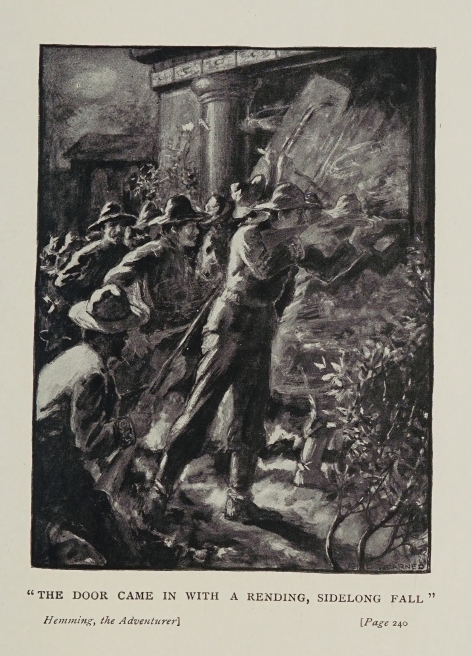
"THE DOOR CAME IN WITH A RENDING, SIDELONG FALL"
"Fire into the brown," said Hemming, quietly.
The four revolvers jumped and spit—once—twice—and
the wounded slipped back against their
comrades' legs. More men entered the hall below,
and filed wildly into the darkness above and around.
Then Hicks, Santosa, and Smith left their windows
and pumped lead into the housebreakers. The noise
was deafening. The air was unfit to breathe.
O'Rourke wondered at something hot and wet
against his leg. Hemming was angry because none
would come within cutting distance. Smith felt very
sick, but did not mention the fact. He knelt against
the bannisters, and fumbled with the hammer of his
revolver, and the blood from a great furrow in his
neck ran down one of the polished rounds that
supported the carved hand-rail. But it was dark,
and he could not see it. But presently he dropped
his revolver and felt the blood with his fingers, and
wondered, in a dim way, who it was dared to make
such a mess in Mr. Tetson's house.
The firing outside the house, which had died away
for a minute, increased suddenly, and cries of
warning and consternation rang above it. More men
came to the open doorway. They were armed with
rifles instead of the short carbines of the Pernamba
army. They discharged a volley or two into the
backs of the scrambling soldiers on the stairs.
"That ends the revolution," remarked Hemming,
calmly, removing his monocle from his eye.
"I think we could have done it without help," said
Santosa.
The men on the stairs cried for mercy.
"Are you all safe, up there?" asked a voice from
the door.
Smith clung to the rounds of the bannisters and
closed his eyes, and O'Rourke leaned against the
wall with one knee drawn up.
"The same leg," he muttered, and twisted his
face at the pain of it.
Miss Tetson and Mr. Valentine Hicks were married
in the little English church in Pernambuco. The
ex-President gave the bride away, the
ex-commander-in-chief supported the groom, and the major
supported the clergyman officiating. Mrs. McPhey
supplied the wedding breakfast, and McPhey made all
the speeches. Then the Tetsons and Hicks sailed
away for New York, leaving Herbert Hemming to
nurse Mr. O'Rourke and Smith.
The invalids were housed in cool rooms in the
McPhey mansion, on the outskirts of the city, and
they and Hemming were guests of honour for as
long as they would stay in the country.
O'Rourke's leg was in a bad way, but poor Smith's
neck was in a worse. For the first week of his
attendance the clever American surgeon who had
them both in charge felt anxious enough for the
valet's life. But modern methods and unflagging
care won the day, and a wound that, in the time
of the Crimean War, meant certain death, left
nothing but a sunken white scar.
A couple of months passed quietly. Hemming
worked at a series of short stories, and learned the
gaudy-coloured, easy-going city by heart. He
received several letters from Hicks, and heard that
the diamond had been sold at a good price.
O'Rourke pulled on his riding-boots again, and
exercised McPhey's stable, night and morning.
Hemming's white stallion was once more an inmate
of this stable. Smith recovered his strength
slowly, and spent his days in easeful meditations and
unnamed regrets for the good time of fighting and
comradeship.
One day, Captain Santosa (who, through the
influence of McPhey and the major, had procured a
commission in the cavalry regiment stationed in
Pernambuco) brought news of Penthouse's death to
Hemming. Penthouse had been found in a dying
condition in the hut of a poor woman, on the trail
above Pernamba, by a party of government troops.
He had been shot during the attack upon the President's
villa, and, crawling away from the fight, had
been found by the peasant woman, and tended by
her through his weeks of suffering. She had
explained to the officer in command that an
Englishman had been kind to her, and for his sake she had
housed and nursed this other Englishman. Thus,
through Hemming's kindness, had his enemy
received kindness.
END OF PART II.
!["'I INTEND RESIGNING MY COMMISSION, SIR'" (<i>See page 15</i>) <i>Hemming, the Adventurer</i>] [<i>Frontispiece</i>](https://openoldbooks.sgp1.digitaloceanspaces.com/books/hemming-the-adventurer/images/img-front.jpg)