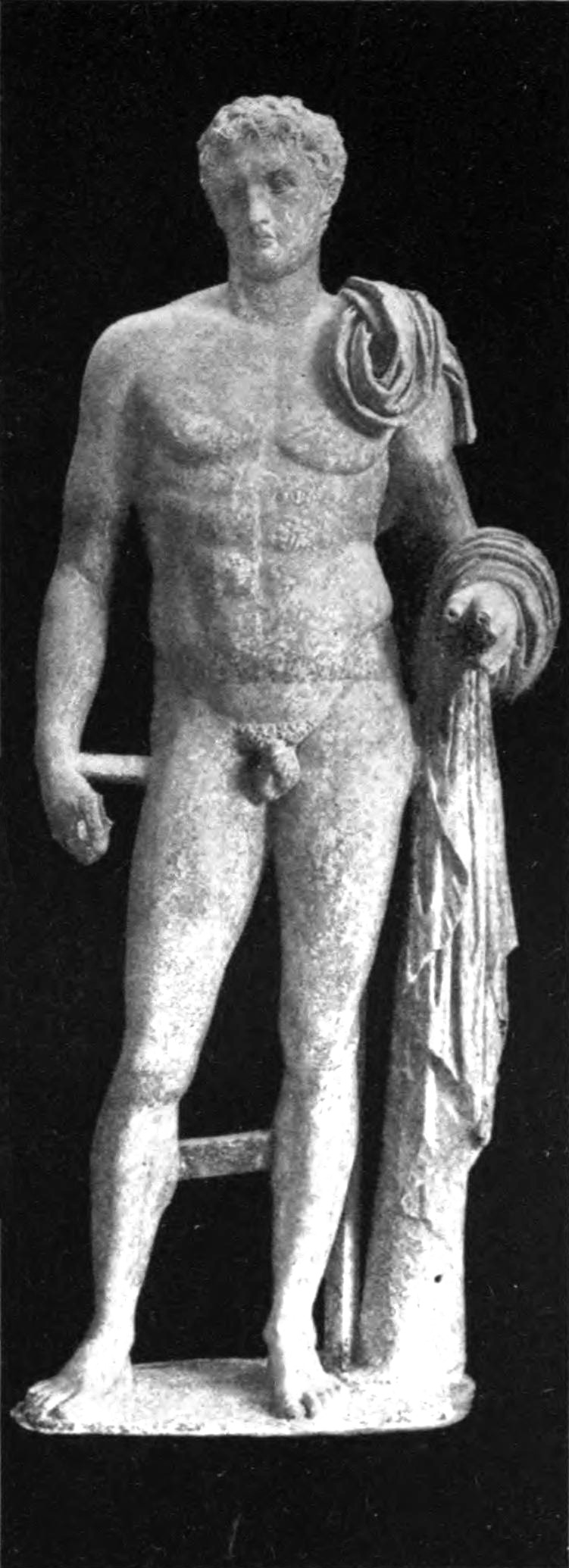
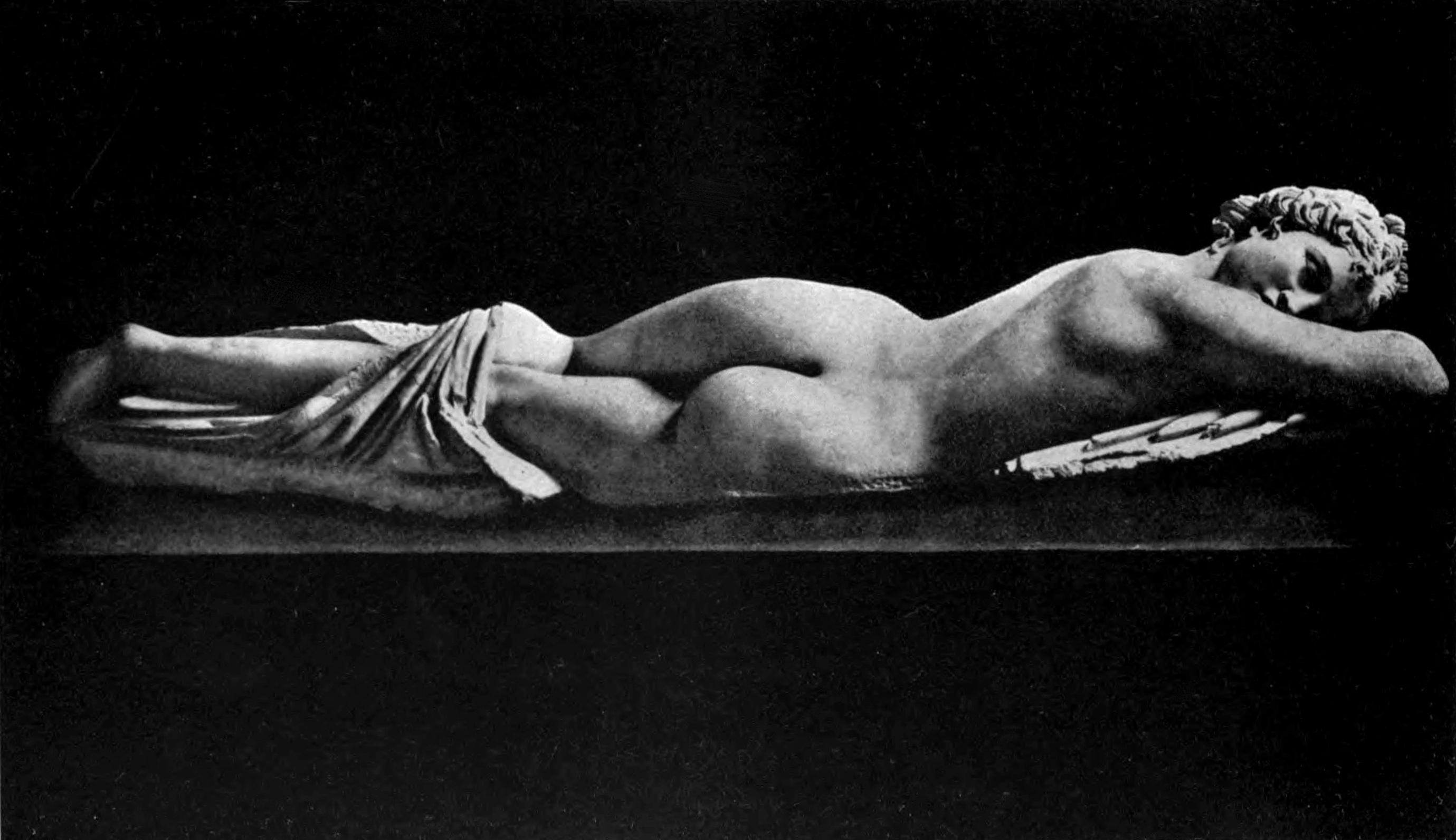
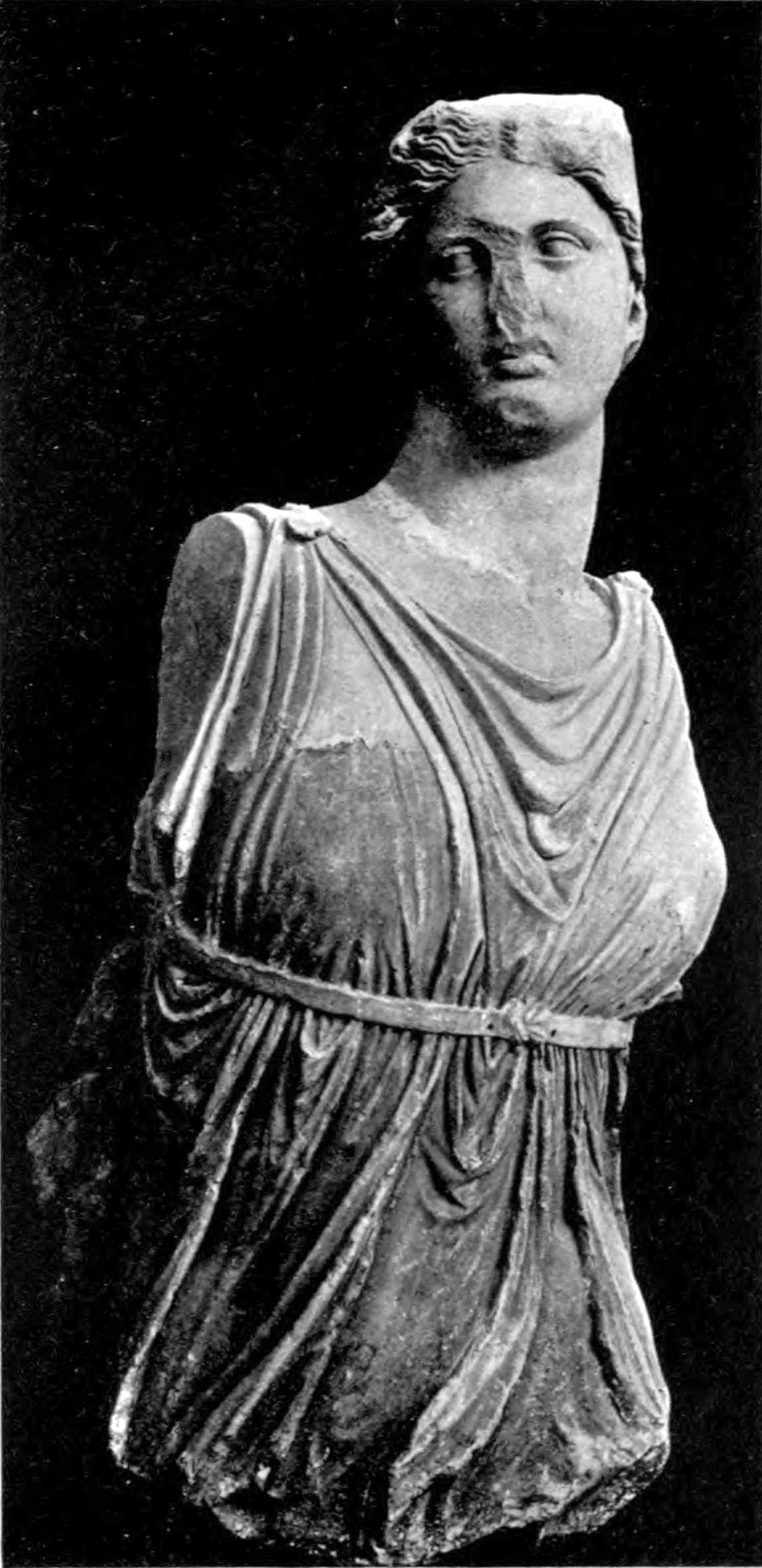
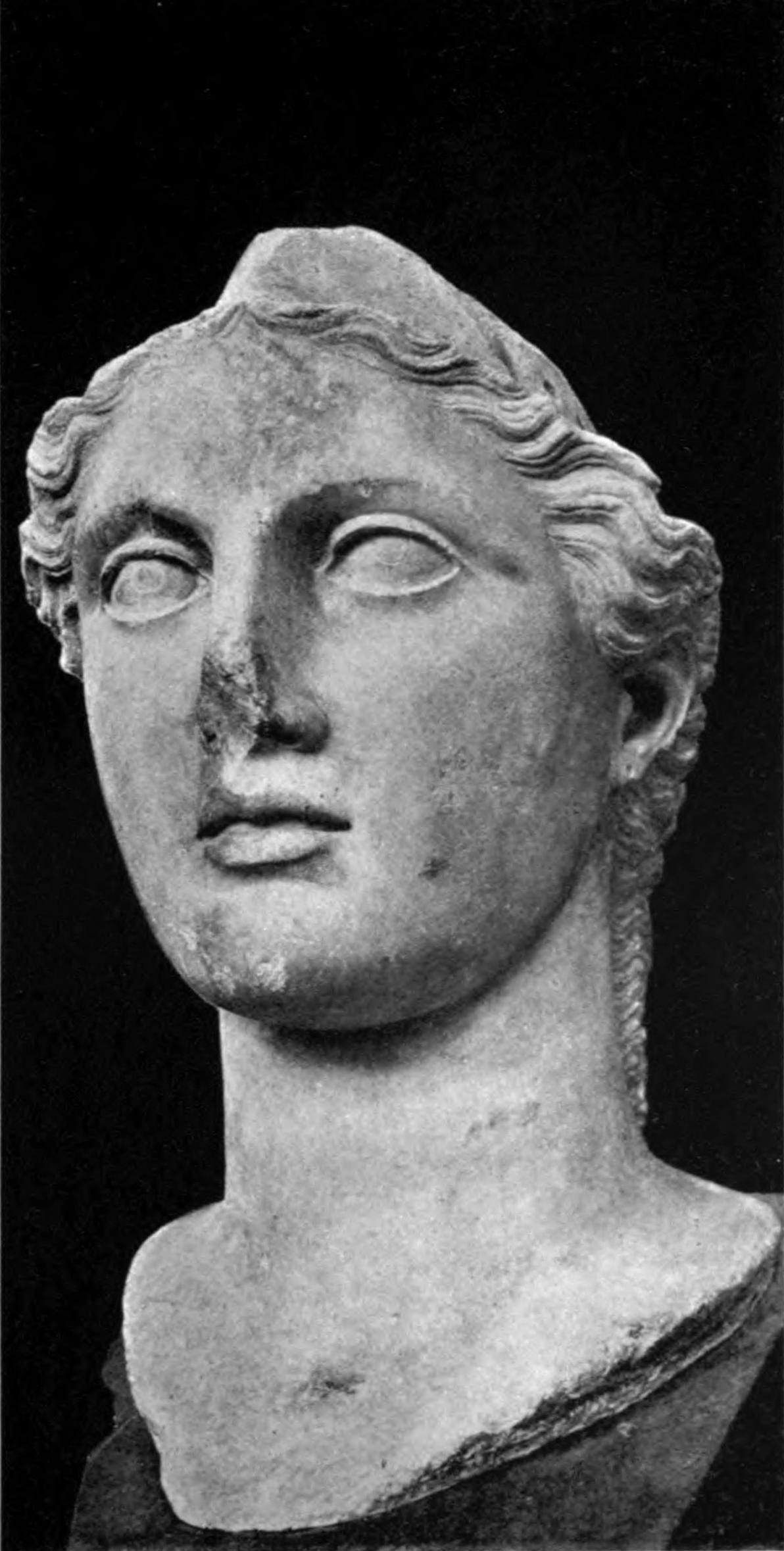
Larger versions of most illustrations
may be seen by right-clicking them and
selecting an option to view them separately, or by double-tapping
and/or stretching them.
1
2
HELLENISTIC
SCULPTURE
BY GUY DICKINS, M.A.
SOMETIME FELLOW AND LECTURER OF ST. JOHN’S COLLEGE, OXFORD
AND LECTURER IN CLASSICAL ARCHAEOLOGY IN THE UNIVERSITY OF OXFORD
WITH A PREFACE BY
PERCY GARDNER, Litt.D., F.B.A.
LINCOLN AND MERTON PROFESSOR OF CLASSICAL
ARCHAEOLOGY IN THE UNIVERSITY OF OXFORD
OXFORD
AT THE CLARENDON PRESS 1920
INTRODUCTORY NOTE
Guy Dickins wrote these chapters on Hellenistic
Sculpture as a brief sketch of the period to which he
hoped to devote years of study. They foreshadow
some of the theories which he intended to work out, and for
that reason we believe that they will be useful to the student.
There are obvious omissions, but no attempt has been made
to fill up gaps in the manuscript, such as paragraphs on the
Barberini Faun or the Attic Gaul, which were left blank in
1914.
The illustrations, which naturally must be limited in
number, have been selected by me mainly on the principle
of reproducing the less accessible pieces of sculpture while
giving references to standard works for the others.
In preparing my husband’s manuscript for publication
I have to acknowledge with gratitude the help of many
friends. To Professor Percy Gardner I am particularly
indebted for valuable advice and for his kindness in writing
a preface to the volume; to Miss C. A. Hutton for her
counsel throughout; and to Mr. Alan Wace for sending
me photographs from Athens. I have also to thank the
Hellenic Society, the Committee of the British School at
Athens, and Dr. Caskey of the Boston Museum for permission
to reproduce certain photographs.
MARY DICKINS.
Oxford, March, 1920.
PREFACE
Among the losses which Oxford has suffered from the
war, none is more to be regretted than that of the
author of this volume. As an undergraduate, twenty
years ago, Guy Dickins gave up his intention of entering the
Indian Civil Service in order to devote himself to the study
of Classical Archaeology, an allegiance from which he never
swerved. In 1904 he went as Craven Fellow to the British
School of Athens, and for five years lived mostly in Greece,
studying and exploring. In 1909 he returned to Oxford
as a Fellow of St. John’s College, and Lecturer in Ancient
History. In 1914 he was appointed University Lecturer in
Classical Archaeology; but before he could take up the
duties of the post the great call came, and he obeyed it at
once. A most efficient and able company commander, he
served in the King’s Royal Rifle Corps. In July 1916 he
died of wounds received in the battle of the Somme.
Before the war Dickins had been occupied in tasks of
research, and in preparation for a teaching career. He had
published several papers, and a volume of the catalogue of
the Acropolis Museum. He had visited most of the museums
of Europe, and brought back a large collection of photographs,
which his widow has presented to the Ashmolean Museum.
He was especially interested in Greek sculpture, and had
intended to collect materials for a history of art in the
Hellenistic Age, a subject which has been neglected, but
which is of the greatest importance. Several of his papers,
such as those on the followers of Praxiteles and on Damophon
of Messene, show in what direction his mind was working,
though at the same time he was ready to take part in all the
projects and the excavations of the School of Athens.
The present volume, alas, is the only fruit which the
study of antiquity is likely to reap from such continued and
thorough preparation. Every reader will regret that it was
not written on a far larger scale. But it was planned as part
of a complete history of ancient sculpture. No doubt, had
he lived, Dickins would have rewritten it in a more complete
form. But as it stands it is far too valuable to lose, full of
suggestion, and pointing the way to important lines of
discovery. In my opinion it contains the best that has been
written on the subject; and one rises from the reading of
it with a keen regret that the author could not bring his
harvest to completion.
Dickins possessed in a high degree two qualities necessary
for the best work in archaeology. He was distinctly
original, always preferring to look at things in a light not
borrowed from books or teachers but his own. And he was
at the same time of cool judgement and strong in common
sense. One of his fellow officers told me that whenever he
was in doubt as to the course to be followed in attack or
defence he consulted Dickins, and accepted his advice.
He did not, like many young archaeologists, delight in starting
brilliant hypotheses; but was ever content in coming nearer
to the truth, and setting it forth in orderly and sober fashion.
Such qualities would have made him an invaluable factor
in the teaching of archaeology in England. I am told that
the undergraduates of his college always felt that he set
before them a high standard, and had no sympathy with
anything which was pretentious or meretricious. The same
qualities appeared in two or three courses of lectures on
recent excavation, which he gave at the Ashmolean Museum.
I add as an appendix a list of Dickins’s published
works, with a summary of their purpose and contents. They
are not great in extent; he was not a rapid worker; but
every one of them is worthy of careful reading, and does
something to advance our knowledge of Greek art and ancient
life.
Figs. 3, 7, 8, 15, 27, 28, and 53 are taken from casts in the Ashmolean
Museum; figs. 4, 5, 11, 16, and 42 are from photographs by
Alinari; figs. 12 and 21 are from photographs by the Hellenic
Society; figs. 20, 30, 34, and 51 are from photographs by Giraudon;
figs. 23 and 26 are from photographs by Frankenstein; fig. 29 is
from a photograph by Anderson; figs. 36 and 50 are from photographs
by Brogi; fig. 45 is reproduced by permission from the
Annual of the British School at Athens, vol. xiii, Pl. XII.
I THE SCHOOL OF PERGAMON
Most of the writers on Greek art agree in calling the
Hellenistic period an age of decadence. The period
is a long one, lasting from the death of Alexander to
the Roman absorption of the Hellenistic kingdoms, i.e. from
about 320 to later than 100 B.C. The lowest limit is marked
by the Laocoon group, and the fact that some critics have
seen in that wonderful monument the climax of Greek art
may make us pause in a hasty generalization. The decadence
of the Hellenistic age is due simply to its exaggeration of
certain tendencies already present in the fourth century, tendencies
which accompany the inevitable development of all
art gradually away from the ideal and gradually closer to
realistic imitation of nature. As long as the technical skill of
the Hellenistic artist shows no sign of abating, it is unfair
and untrue to call his work decadent. The term is only justly
applicable when loss of idealism or growth of frivolity in
subject is accompanied by a decline in execution, by a want
of thoroughness, and by a desire to shirk difficulties.
It is true to say that Greek art on the mainland enters
on a period of decadence in the third century, for its execution
and expression grow steadily worse after 250 B.C., but
it is interesting to note that it reverts to a greater idealism.
The last great artist of the mainland, Damophon of Messene,
might have been a member of the school of Pheidias save
for an inadequate mastery of the chisel.
On the other hand, the schools of Pergamon, Alexandria,
and Rhodes show no falling off in technical skill as long as
they remain independent of Rome. Even their idealism does
not wholly decline, for the Gallic victories of Attalos and
Eumenes brought about an idealist revival in Pergamene art
associated with the decoration of the great altar. Rhodes
remained ever wedded to the athletic ideal. Alexandria
delighted most in scenes of genre and realistic imitations of
nature. But all turned out work of marvellous quality, and
it is mainly a vagary of fashion in criticism that now induces
so many authorities to label as decadent wonderful masterpieces
of sculpture like the Victory of Samothrace, the
kneeling boy of Subiaco, or the Silenos with the young
Dionysos. Works so full of human nature and so rich in
sympathy may well claim to replace by their romantic appeal
the classical feeling of the fifth century. It is only when
romance becomes sentimentality that it meets with just
condemnation.
The outstanding feature of the history of Greek sculpture
during the Hellenistic period is the transference of its vital
centres from the mainland to the new kingdoms of the
Diadochi on the east and south and to the great new free
state of Rhodes. The chief cause was an economic one.
Alexander’s campaigns brought about a revival of prosperity
and wealth in the Greek world, but among his friends and
not among his enemies. Athens was always his enemy and
the enemy of his Macedonian successors. Consequently
during the whole period from the death of Alexander to
the Roman conquest Athens was either under Macedonian
rule or in danger of Macedonian attack. It was Macedonian
policy to keep her weak and isolated, and her trading supremacy
began to be transferred to the island of Delos. The great
days of Attic art passed with the death of Praxiteles and the
coming of Alexander. In the Peloponnese the pupils of
Lysippos carried on into the third century the traditions of
the Sikyonian school, but we can see from such knowledge
as we possess of their activities that the wealth and fame of
the new kingdoms were already calling the artists to abandon
the impoverished towns of the mainland. The Peloponnese
also opposed Alexander and his successors, and Macedonian
garrisons held the chief fortresses of the country. We find
Eutychides of Sikyon working for Antioch, and Chares
working at Lindos in Rhodes. After the date given for the
pupils of Lysippos in 296 B.C., Pliny makes the following
significant statement: ‘cessavit deinde ars, ac rursus
Olympiade CLVI (156 B.C.) revixit.’1 For 150 years the
history of artistic development must be studied on the eastern
side of the Aegean.
After the preliminary conflicts between the successors
of Alexander for the partition of the empire a number of
new states arose, which are known to us usually as the
kingdoms of the Diadochi or Successors. Of these the three
most important were Macedonia, Syria, and Egypt, under
the rule of Antigonids, Seleucids, and Ptolemies respectively.
Of smaller importance, but quite independent and self-sustaining,
were Bithynia, Pergamon, and the island republic
of Rhodes, the latter being the only one which maintained
its Hellenic democratic institutions. The attitude of these
states towards art differs remarkably. Macedonia remained
always a military monarchy in a condition of almost constant
frontier war, and was wholly uninterested in artistic developments.
Syria seems from the first to have fallen under
Semitic and oriental influences, which destroyed its appreciation
of the purer forms of Greek art. Bithynia, Pontos, and
Cappadocia were barbarian rather than Greek. As a result,
we find that the old artistic traditions are maintained prominently
in three only of the new states: Pergamon, the home
of the very Hellenic race of the Attalids; Rhodes, whose
pure Hellenic descent was untouched; and Alexandria,
which became practically a Greek town in the midst of an
older Egyptian civilization.
The kingdom of Pergamon included the area of the old
Ionian cities, and inherited, therefore, an artistic tradition as
old as its own existence. It is no matter for surprise that its
art-loving monarchs should have founded a great library
and a great school of sculpture in open rivalry with the richer
resources of Ptolemaic Alexandria. The art of Pergamon is
well known to us from the magnificent groups and figures
of the Gallic dedications of Attalos I after his victories about
240 B.C., and from the marvellous frieze of the altar excavated
in situ by the Germans, which belongs to the period of
Eumenes II and the early second century. But before we
come to these later developments of Pergamene art, it is
important that we should discover the earliest tendencies
and predilections of the Pergamene court in the first half
of the third century. We are told2 that the most remarkable
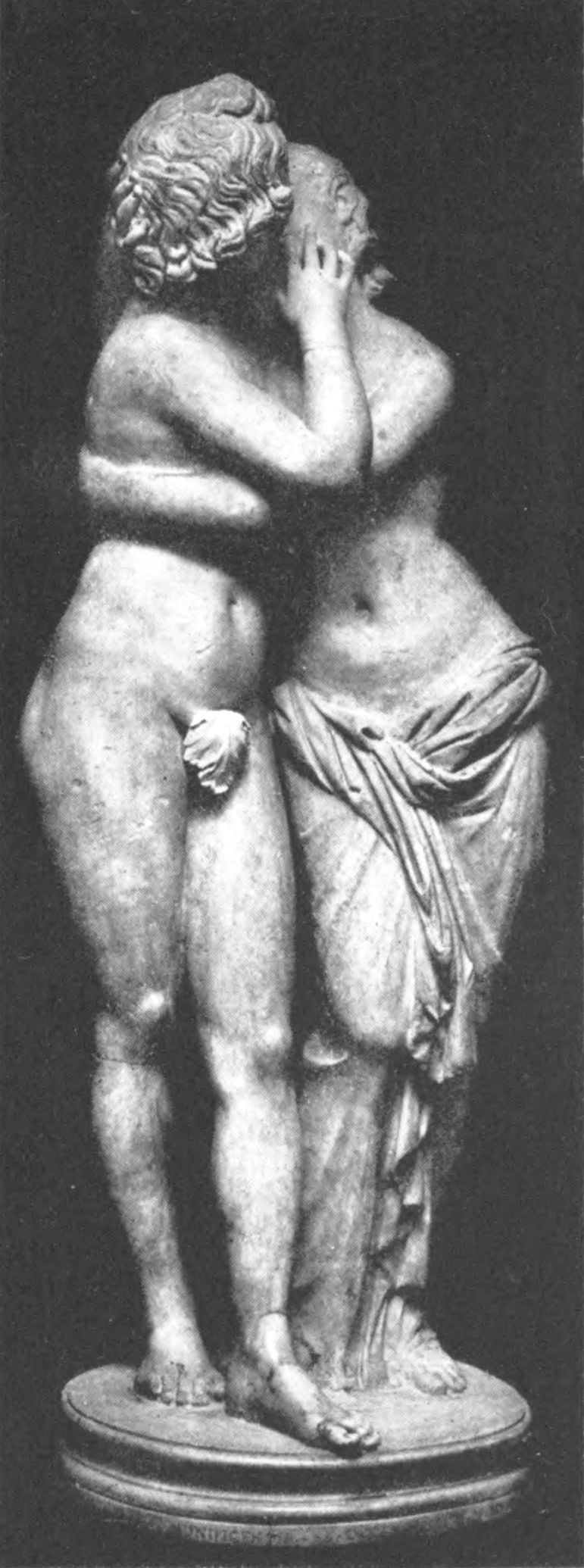
work of Kephisodotos, the son of Praxiteles, was his ‘symplegma’
at Pergamon—probably an erotic group—which
was noteworthy for its extraordinarily naturalistic rendering
of the pressure of the fingers into the flesh. Such erotic
groups of nymphs and satyrs or hermaphrodites exist in
our museums, and are ultimately derived from this type
of statue. Actual discoveries at Pergamon support this
conception of early third-century Pergamene art. The well-known
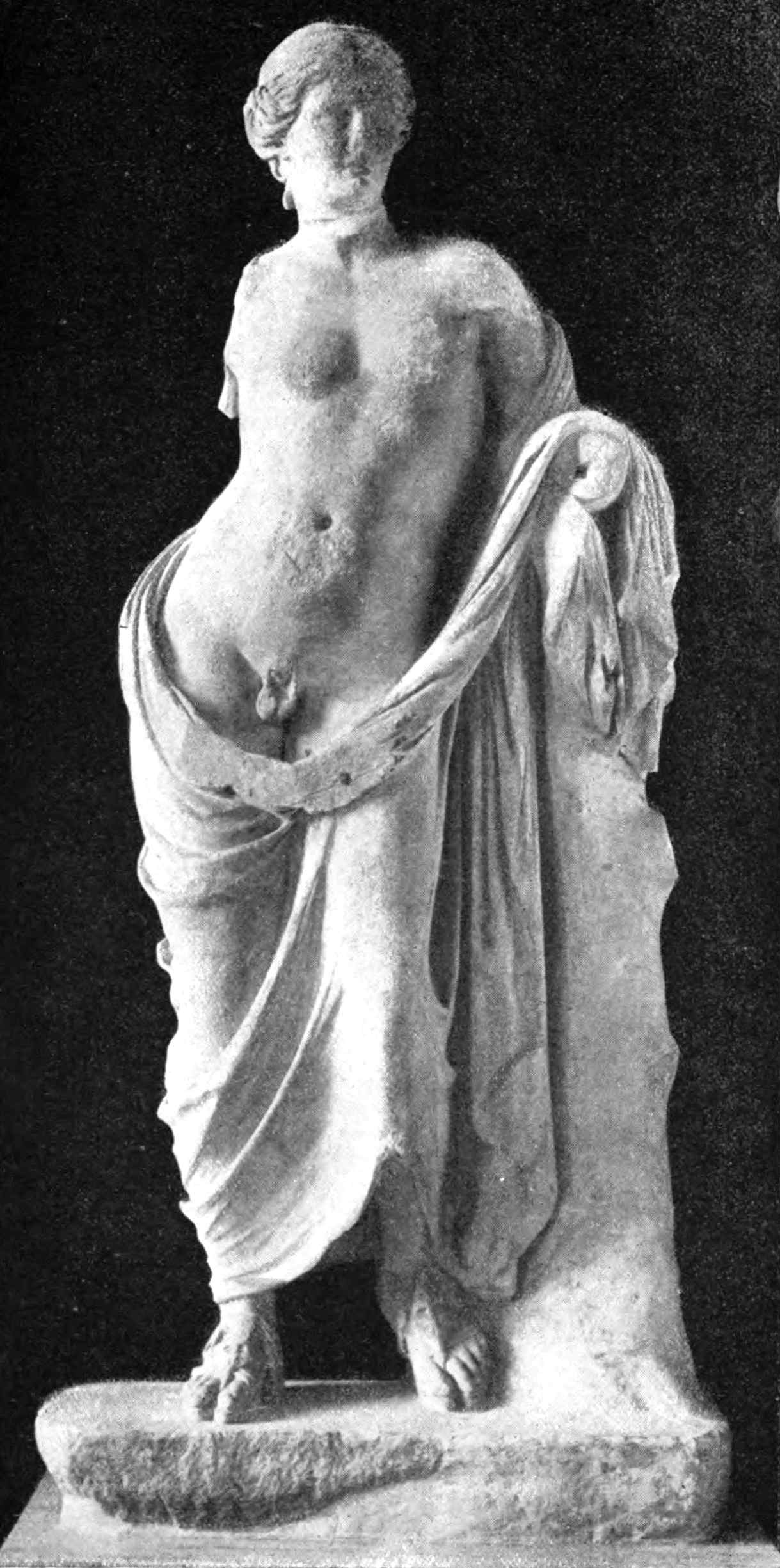
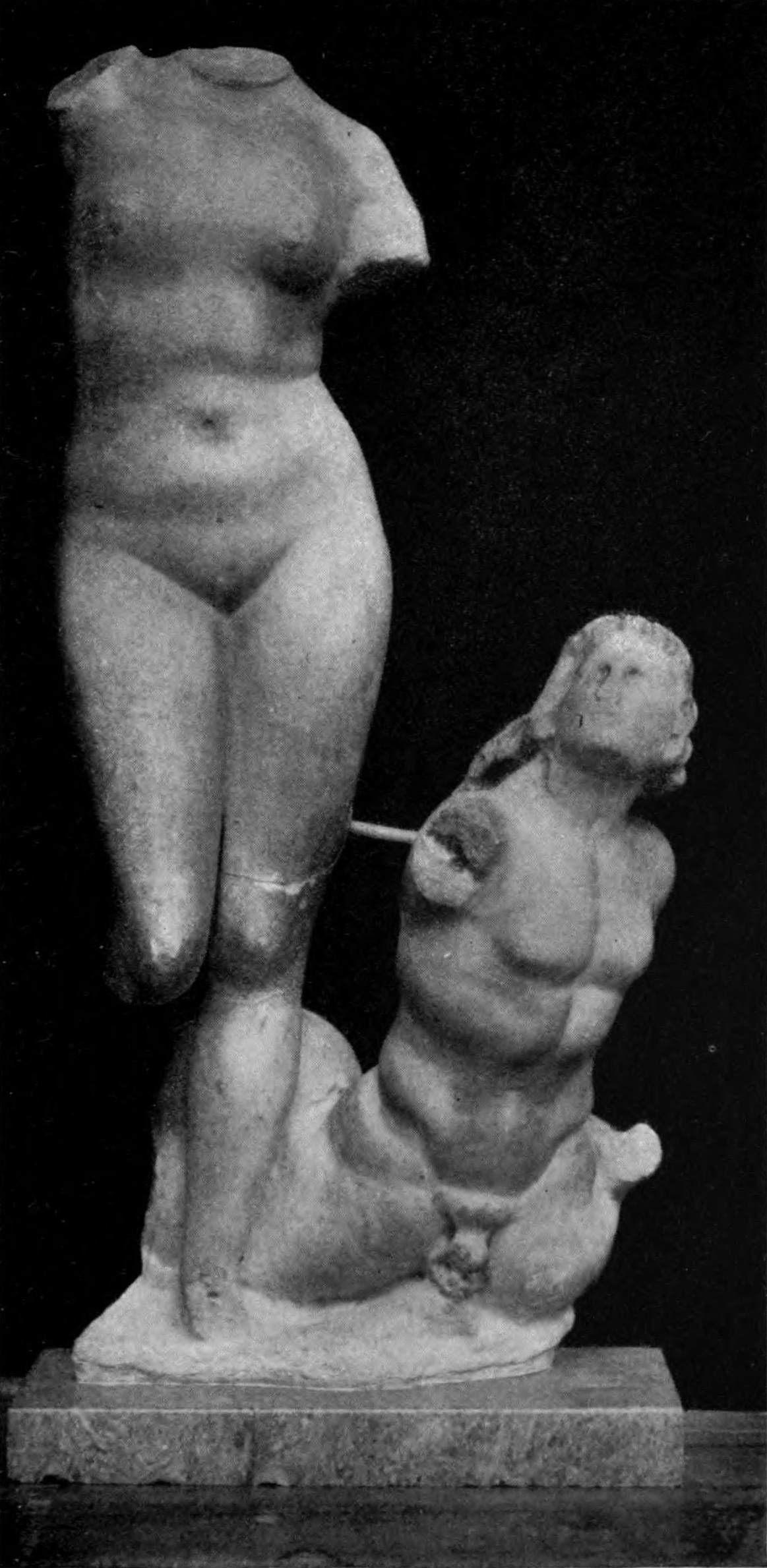
Hermaphrodite in Constantinople (Fig. 1) and a
beautiful girl’s head in Berlin3 show the extreme delicacy
in the rendering of flesh and the fondness for a sensual
body treatment which we might expect from an Ionian
version of the schools of Scopas and Praxiteles. The existence
of such a school in Ionia in the late fourth century is highly
probable. The Pergamene school of the early third century
would seem to be the later natural development of the creators
of the Ephesos columns and the Niobids. Scopaic expression
and Praxitelean flesh treatment are the hall-marks of the
school. Another work of importance for the early Pergamene
period is the Crouching Aphrodite type, so popular in Roman
times. Of this statue Pliny tells us: ‘Venerem lavantem
se Daedalus fecit.’4 This Daedalus was a Bithynian artist
of the early third century, who must have fallen under the
general influence of the prevalent Pergamene school. His
Aphrodite5 shows exactly the artistic tendencies of the early
Pergamene school. The motive is unimportant and frivolous—a
genre motive of a girl washing herself—but it is used for
the purpose of demonstrating the technical skill of the artist
in displaying the nude female form. The artist does not use
all his skill in the effort to produce a noble or even a romantic
ideal. The subject is immaterial, provided it affords a chance
of showing his technical skill. The crouching attitude is
a new one in art, and one well adapted for exhibiting the
human body in all its variety. It appears again in the
Attalid dedications, and was evidently a favourite at Pergamon.
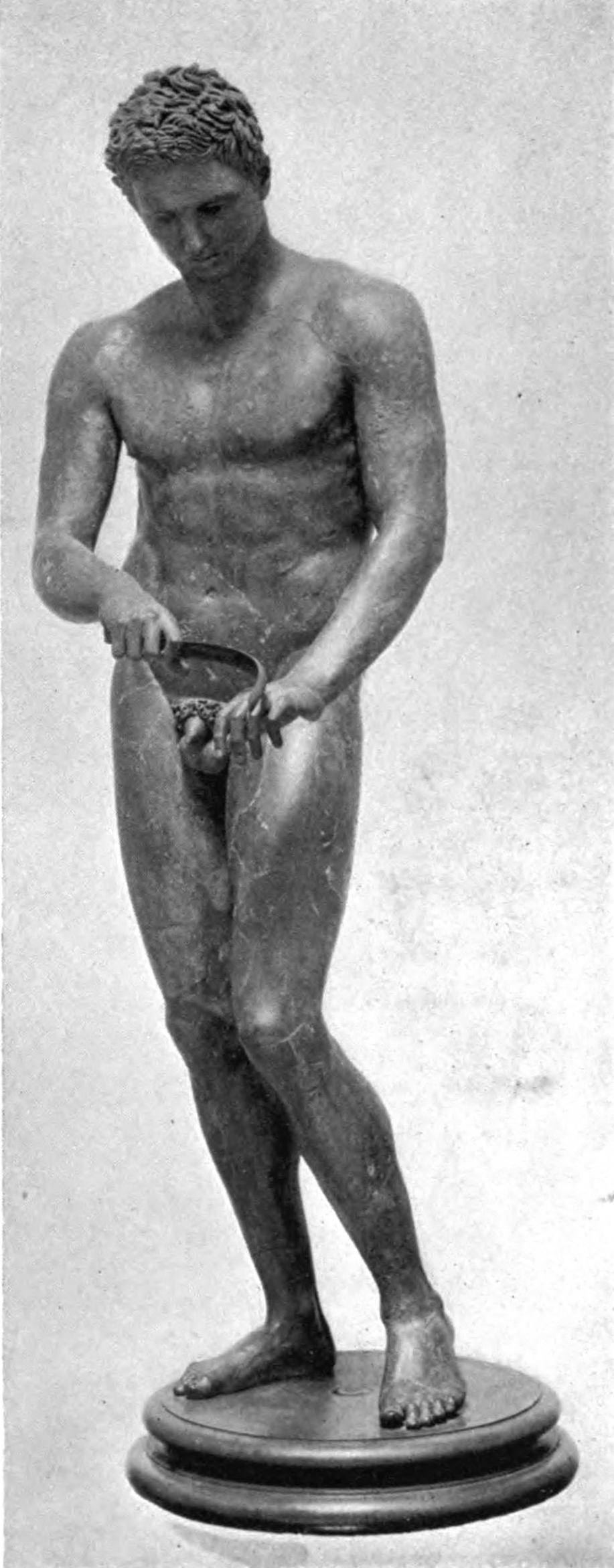
Another example is in the well-known Knife-Grinder
of the Uffizi,6 part of a great group of Marsyas,
Apollo, and the Scythian slave, which we can certainly
connect with this period of Pergamene art. The Knife-Grinder
himself is a copy and not an original. That is made
clear by his late plinth, in spite of his magnificent workmanship.
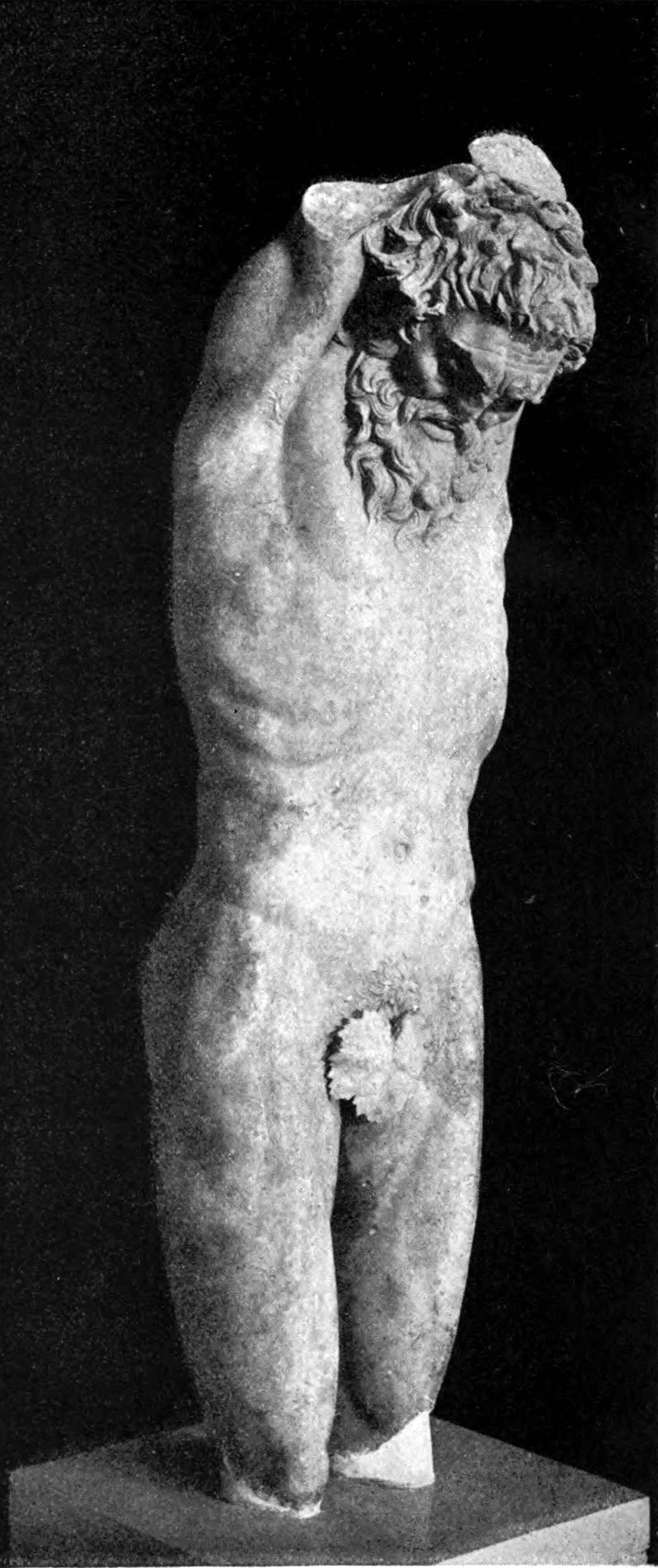
But the finer copies of the hanging Marsyas, which
belongs to the group, are in a Phrygian marble, betraying
their Pergamene origin. These copies of the Marsyas are
divided into two types: a so-called ‘red’ type (Fig. 2),
made of the Phrygian marble, in which the expression of
agony is more marked, and a white type7 in which the face
is less distorted. A theory has been put forward that the
white type represents an early third-century prototype,
while the red type is a Pergamene variation of rather later
date.8 We may, however, hesitate to see sufficient difference
in the two types to make so wide a distinction. The white
type may be merely a less masterly adaptation of the red.
An Apollo torso9 in Berlin from Pergamon with the right
hand resting on the head agrees with a marble disc in Dresden10
showing a similar figure confronted by the hanging Marsyas.
We may therefore associate this figure as the third member
of the group with Marsyas and the Knife-Grinder.11 The
Apollo is a seated figure of distinctly Praxitelean influence.
The keen expression of the Knife-Grinder and the agonized
face of the Marsyas may equally well be attributed to Scopaic
teaching. We have a good example of this mixed tradition in
early Pergamene art. Technically we are at once compelled
to notice the immense advance in realism and anatomical
study. The hanging Marsyas shows a correct appreciation
of the effects of such a posture on swollen veins and strained
abdomen. The corner of the mouth is drawn up in agony;
the forehead is corrugated with rows of wrinkles; the hair,
even on the chest, is matted with perspiration. One would
say that so remarkable a statue could only be studied from
nature, and one recalls the stories of Parrhasios, who is said
to have used an actual model for his Prometheus Bound.12
We are long past the time when sculptors worked from
memory. Even Praxiteles was said to have made his Cnidian
goddess with Phryne as a model. In the Knife-Grinder we
may perhaps detect some of the earliest traces of that exaggeration
of the muscles which will so soon affect athletic art.
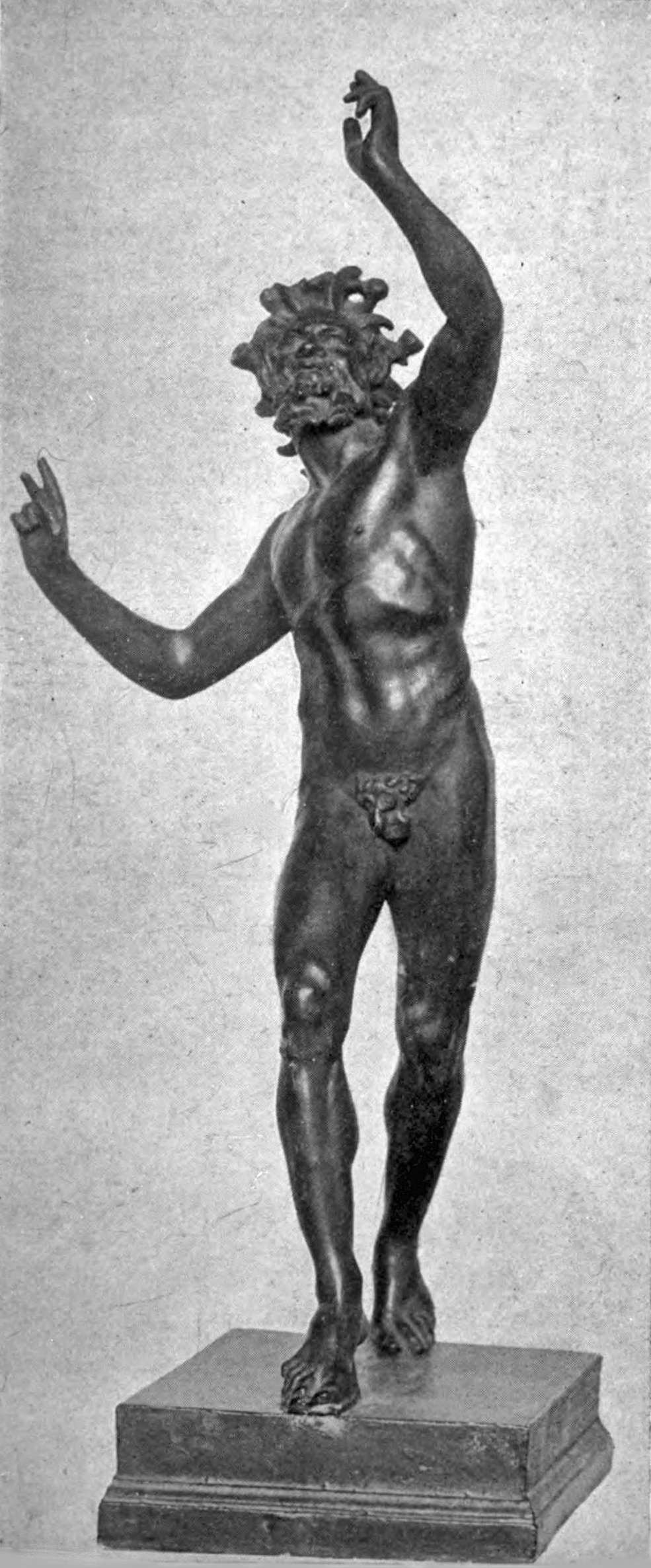
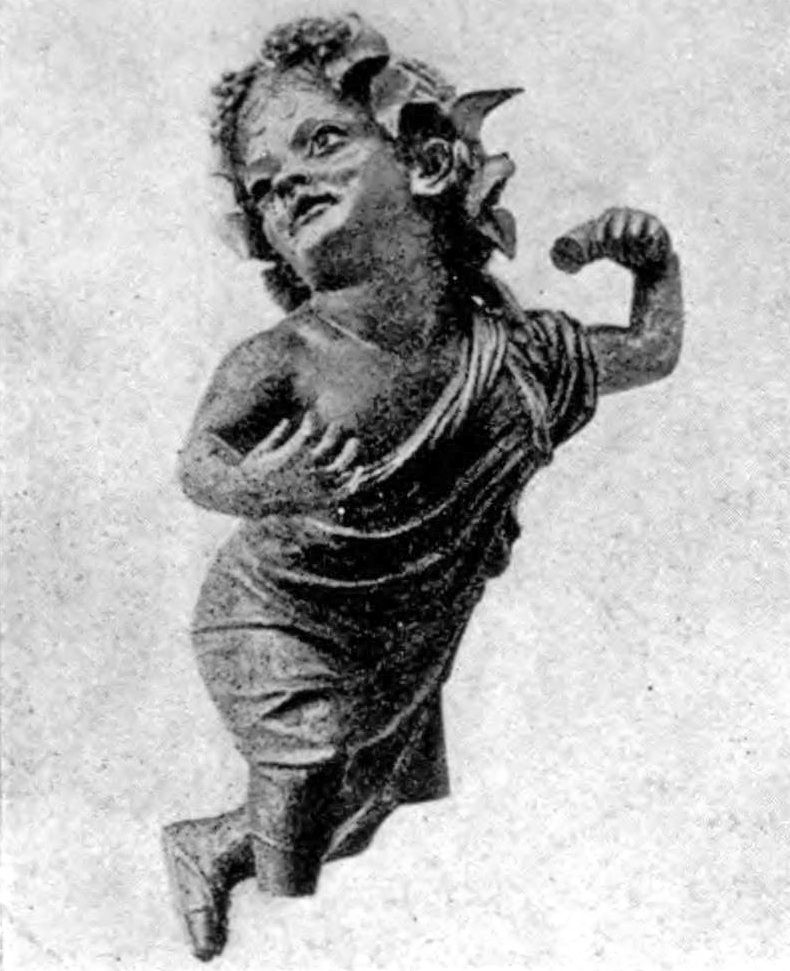
One of the most important of the Pergamon finds was the
little bronze satyr,13 which has enabled us to associate with
Pergamon a whole host of satyr types of more or less similar
style. The Dancing Satyr of Pompeii (Fig. 3) and Athens,
the Satyr of the Uffizi clashing cymbals,14 with its replica in
Dresden, and the Satyr turning round to examine his tail15
are all variants of the new artistic cult of the satyr, a cult
which seems to have had a Pergamene origin.16 The satyr
gave to the Pergamene artist just that opportunity for the
display of wild and somewhat sensual enthusiasm which he
wanted, for new and original poses, and for combination
with his nymphs and bacchanals. In Phrygia especially
orgiastic manifestations of religion were the regular practice,
and dancing was both wild and universal. The new artistic
conceptions show the clear influence of this spirit on the
more restrained art of the fourth-century schools. The
Dancing Maenad of Berlin,17 the Aphrodite Kallipygos of
Naples,18 and the famous Sleeping Hermaphrodite19 are
further examples of the marvellous flesh treatment and the
wild frenzy of movement which we learn to associate with
third-century Pergamene art.
Apart from the general spirit of Pergamene work there
are several definite technical peculiarities which enable us
to postulate a Pergamene origin for many unclassed works
of the Hellenistic age. These can be gathered from the
definitely Pergamene Gallic statues, which we have yet to
discuss, and from the satyr types already mentioned. One is
the hair tossed up off the forehead and falling in lank matted
locks of wild disordered type. The eyebrows are usually
straight and shaggy, with a heavy bulge of the frontal sinus
over the nose. The cheekbones are prominent, and the lips
thick and parted. In the body the most marked feature is
the desire to get away from the old-fashioned straight plane
for the front of the torso. The lower part of the chest usually
projects strongly, while the waist is drawn in, so that the
profile of the torso is shaped like a very obtuse z. In the
female body there is a general affection for rather heavy forms
with a good envelope of flesh. The artist’s skill is here
devoted mainly to the delineation of surface. The heads of
such female figures as we can attribute to Pergamene art
show very little expression. The hair is done on the Praxitelean
model, but the locks tend to become more rope-like
and twisted as time goes on. We cannot point to any great
peculiarities in the Pergamene treatment of women. Neither
Lysippos nor Scopas seems to have had much effect on the
feminine types of Greek sculpture. The whole Hellenistic
age is in servitude to Praxitelean ideals of women whether
in Alexandria, Rhodes, or Pergamon. The differences are
only in the details of execution, the Pergamenes tending
always towards clear cutting of hair and features, while the
Alexandrines preferred an impressionist smoothing away of
all sharp edges.
3
4
We come now to the two great dedications of Attalos
for his victories over the Gauls.20 These were made at some
time later than 241 B.C., and consist of two series of statues.
One is life-size or larger, and is represented by some of the
best-known examples of Hellenistic sculpture, such as the
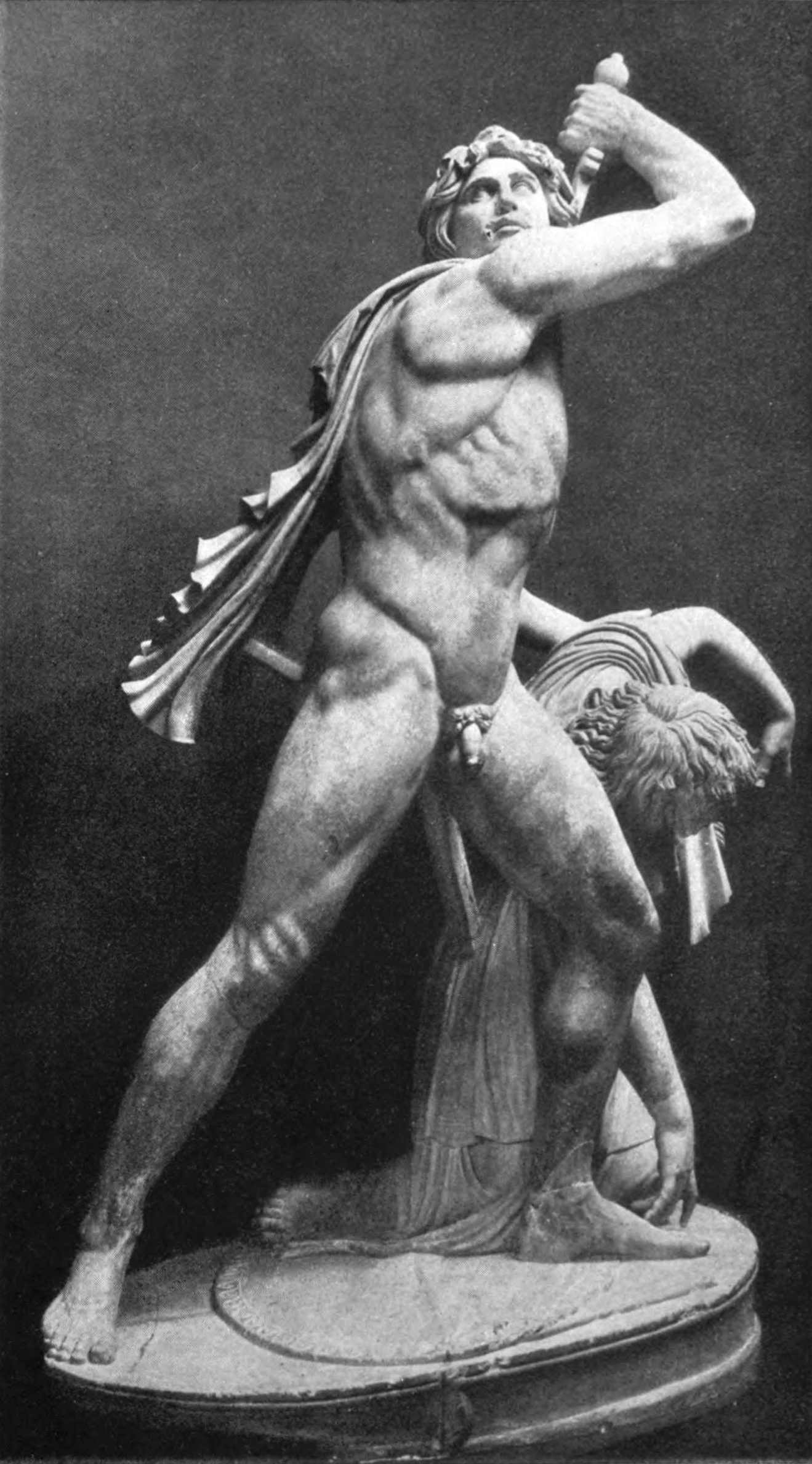
Dying Gaul21 and the Ludovisi group of a Gaul slaying his
wife and himself (Fig. 4). The other consisted of a number
of small figures about three feet high, and was dedicated by
Attalos in Athens, where they stood on the parapet of the
south wall of the Acropolis. Four battle-groups were included—a
gigantomachy, an Amazonomachy, a battle of Greeks and
Persians, and a battle of Greeks and Gauls. Several copies
from this smaller group are in existence, the best known being
in Naples.22 The originals of both groups were probably
in bronze, and we have the names of some of the artists of
the larger group, Phyromachos, Antigonos, and Epigonos
or Isigonos. Stratonicos and Niceratos of Athens may also
have taken part.23
These works all deserve careful study, as they differ
in many ways from the rather sensual and ecstatic art which
we know to have preceded them, and the very baroque and
exaggerated art which followed them in the next century
on the great altar. Eumenes and Attalos had to fight for their
lives against the Gauls, and a temporary return to an austerer
and less luxurious art would be a not unnatural result of the
great war. We certainly find in the treatment of the Amazons
or of the wife of the Ludovisi Gaul no such insistence on
sexual detail as marks the earlier studies of the feminine
form, and the expression of the male figures is distinguished
by more ideal emotions of courage or resignation than the
frenzy of the satyrs and the passions of the later gods and
giants. The Attalid dedications show some bravura of pose;
the Ludovisi Gaul is a little histrionic in his attitude; but
as a whole they are sober and restrained sculpture, when
compared with the satyrs on the one hand and the altar
frieze on the other. In that sense they represent the high-water
mark of Pergamene art, inspired with an equal skill,
but with a nobler ideal than the earlier work, and not subject
to the somewhat grotesque exaggerations of its later activities.
Greek art has few nobler figures to show than the Dying
Gaul of the Capitol, itself an admirable and closely contemporary
copy, perhaps made in Ephesos, of the bronze original
at Pergamon. The sober restraint of the torso modelling is
remarkable, and contrasts most forcibly with the altar frieze.
The pathos of the expression and attitude is not forced or
exaggerated in any way, and if the curious hair gives a touch
of strangeness to the head, we must account for it as a
naturalistic detail of the Gallic fashion of greasing and oiling
the hair. The Ludovisi Gaul is a superb work, rather more
exaggerated, both in expression and in detail, than the Capitol
figure. The right arm is perhaps wrongly restored, as it
hides the face from the front, but it is more likely that the
group should be looked at from a position farther to the left,
where the face, the fine stride, and the technical tour de force
of the cloak can all be appreciated more fully. The woman’s
face is not well finished, and her whole pose is more effective
from the other point of view. The Pergamene peculiarities
in the treatment of chest and waist are clearly visible in
this figure.
The little figures in Naples, the Louvre, Venice, and
elsewhere are partly recumbent dead figures of Persians,
giants, and Amazons, and partly crouching figures defending
themselves. None of the victorious Greeks seems to have
survived, except possibly the torso of a horseman in the
Terme Museum. They are dry, rather hard figures, much
inferior in skill to the larger group and much closer to the
bronze originals which they represent. The head of a dead
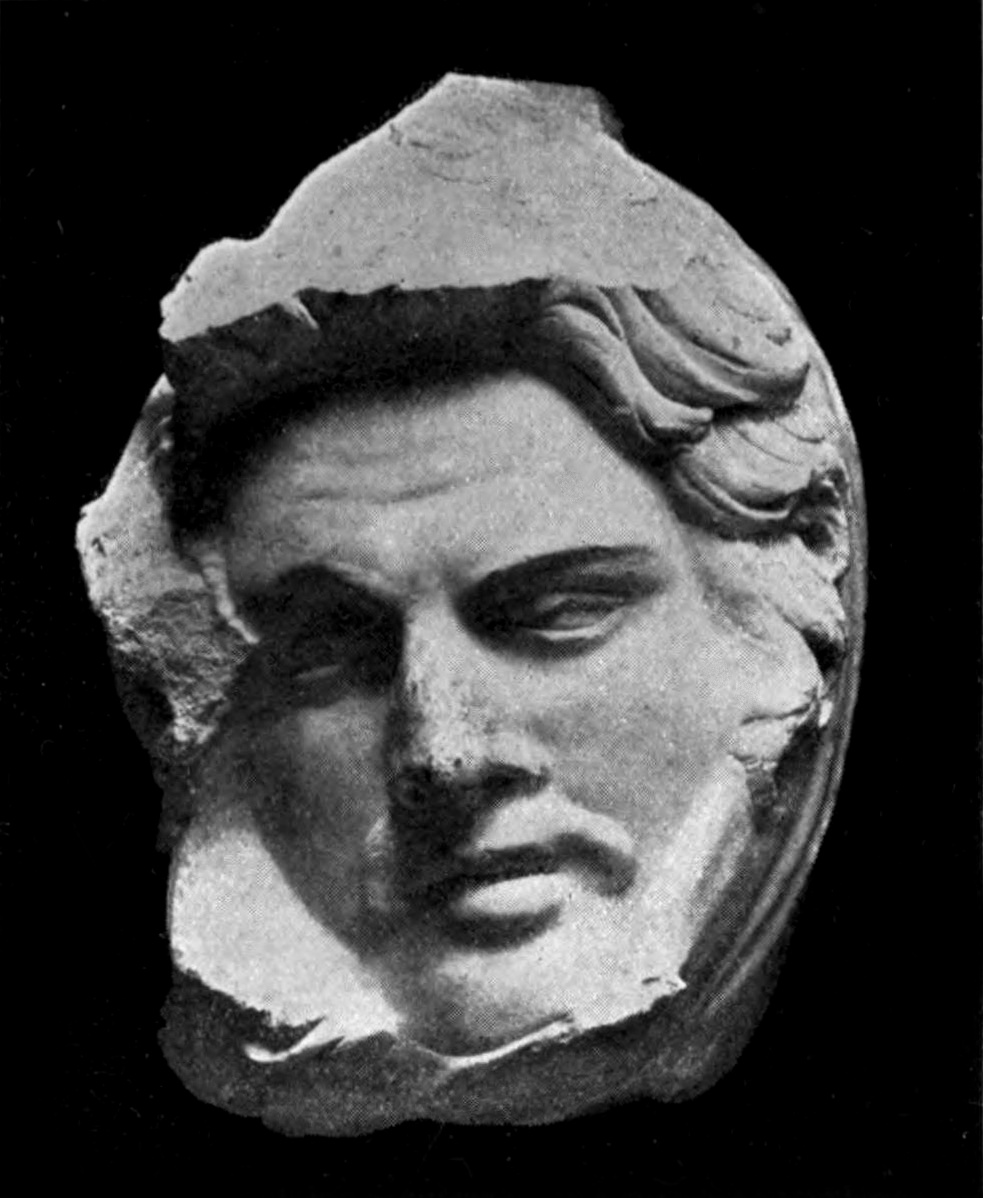
Persian in the Terme Museum (Fig. 5) is probably a more
worthy copy (on a larger scale) of one of the figures of this
series. Its type of features and its moustache resemble the
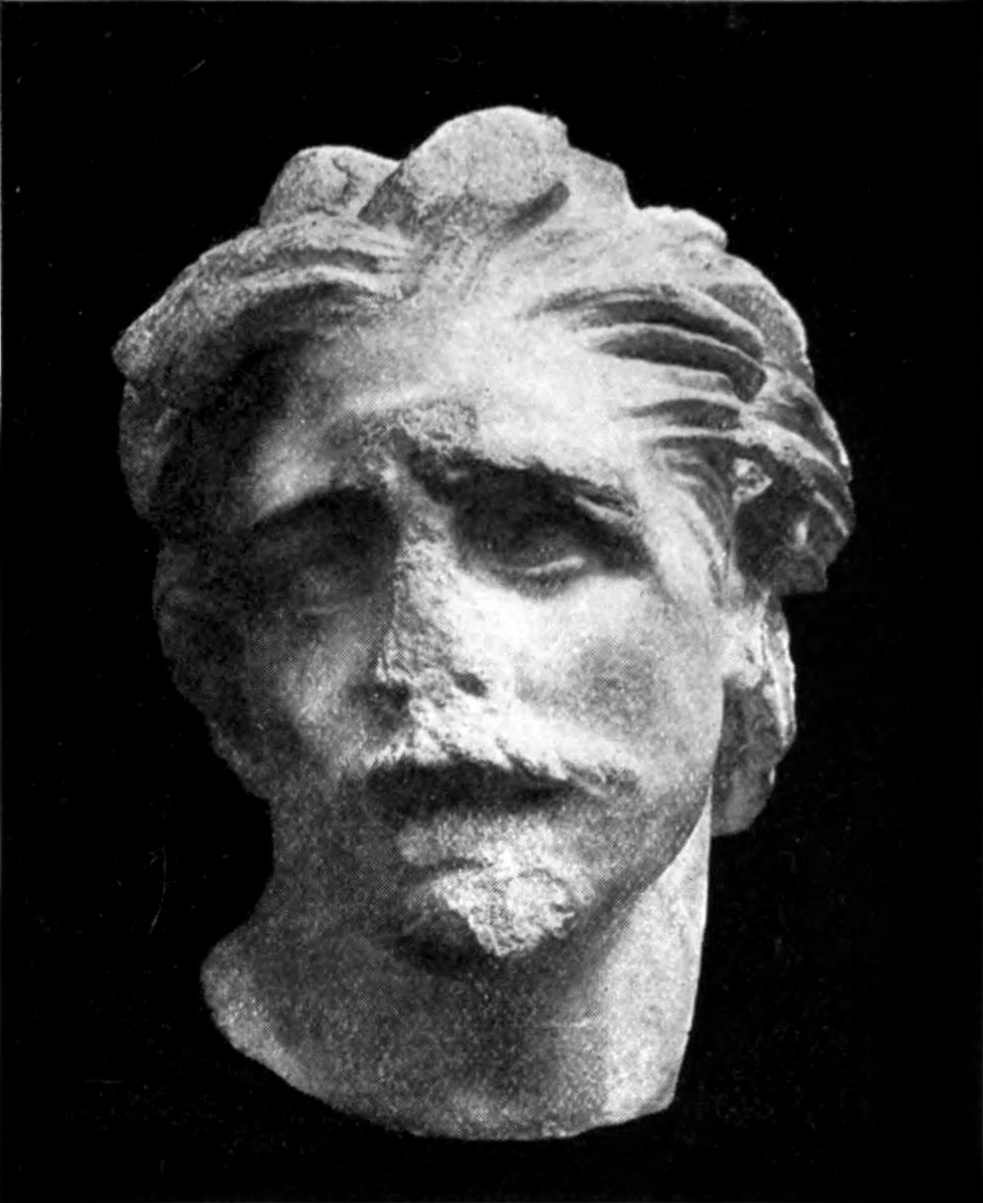
Ludovisi Gaul. Another fine Gallic head is in the Gizeh
Museum at Cairo (Fig. 6). This has been often called an
original, an Alexandrian variant of the Gallic dedications.
There is, however, no need to separate it from the others.
If it shows more emotion, that only brings it rather closer
to what we know of earlier Pergamene art. The provenance
of the Gizeh head is disputed, and it may be only a recent
importation into Egypt.24
We now come to the frieze of the great altar at Pergamon
(Fig. 7), the contribution of Eumenes II to the series of
monuments commemorating the defeats of the barbarians.
Here again we have several inscriptions of artists,25 which
are especially interesting as showing that four foreign artists
of Attic, Ephesian, and Rhodian origin all contributed to
the great monument. It is, however, quite uniform and
unique in character, and shows a baroque exaggeration of
expression and of muscular detail, which in the end becomes
monotonous and overpowering. The slight tendency towards
a histrionic attitude, which we noticed in the Ludovisi Gaul,
has now become much more pronounced. Most of the figures
are in stage attitudes of fright, ferocity, attack, or defence.
Their bodies are covered either with drapery in wild disorder,
or, if naked, with massive rolls and lumps of muscle, which
are almost comical in their exaggeration. Their hair is in
unrestrained twisted snaky locks; their faces are distorted
in fierce expressions of anger or alarm; they are in every
conceivable attitude of attack or defence. When we add to
this the colossal size of the monument and its figures, we can
well understand how its remains became known to early
Christian writers as the throne of Satan.26
5
6
7
8
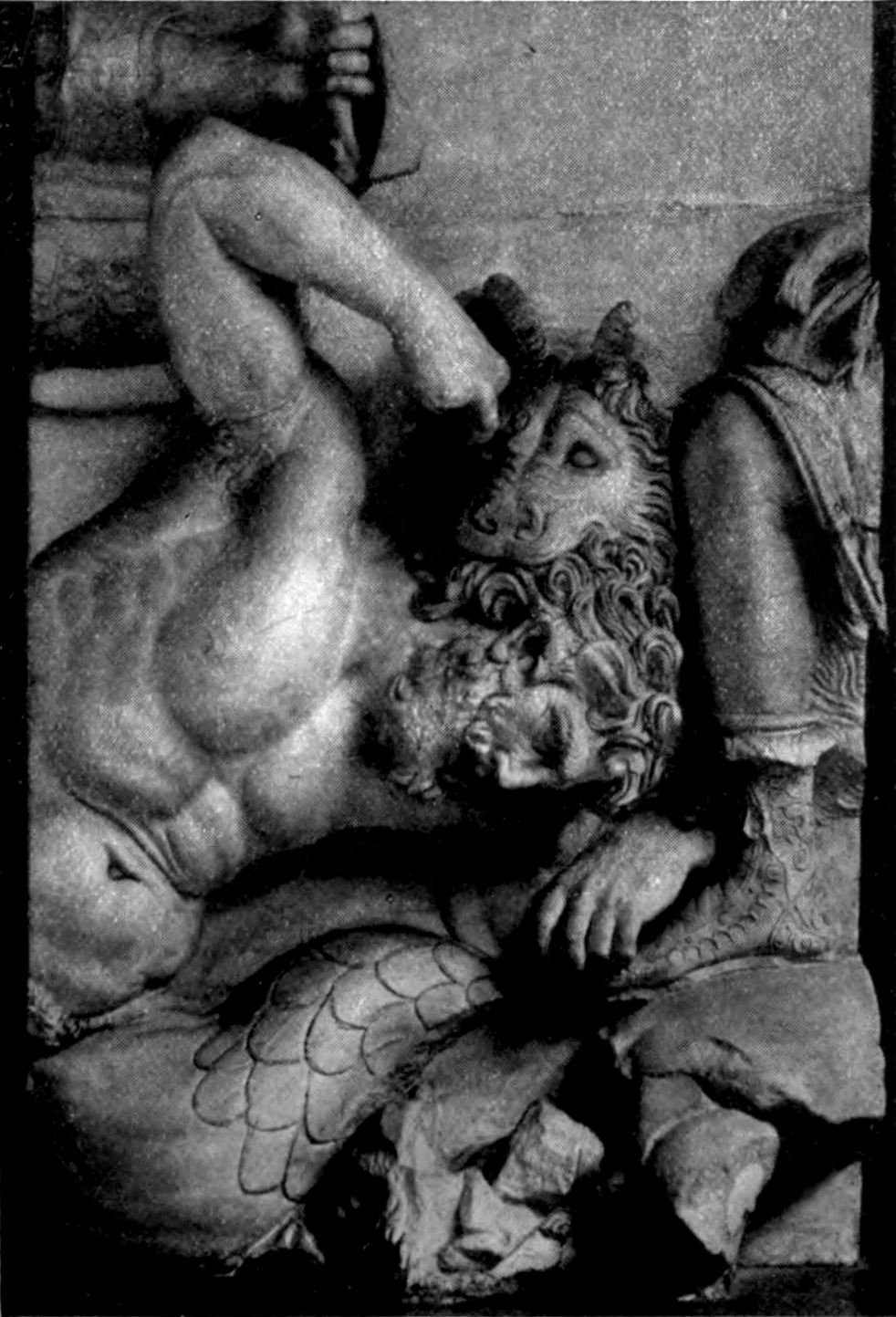
The subject of the frieze is the battle of the gods and
the giants, and the members of the Olympic Pantheon are
represented in attitudes of triumph over the serpent-footed
denizens of Tartarus. This is probably the first appearance
in sculpture of the serpent feet of the giant. Every earlier
artist had realized how such a ridiculous detail would detract
from the strength and probability of his figures, but the
Pergamene artists are so glad of the chance of displaying
extra technical skill that they pass over the artistic difficulty
without hesitation. The great frieze of the altar is like the
work of a megalomaniac. The restraint and good taste
which have accompanied all Hellenic art hitherto are quite
forgotten, and we are reminded rather of some Assyrian
scene of carnage and destruction. This is the more curious,
because the smaller frieze of the altar, the Telephos frieze,
which is contemporary with the larger one, shows altogether
a different character. It has therefore been plausibly argued,
with the support of some of the artists’ signatures, that the
main style of the work is Rhodian rather than Pergamene.27
The view would only involve us in further difficulties when
we come to consider Rhodian art. There is Rhodian influence
in the frieze, but the technical details of hair, faces, and
bodies as a whole correspond closely to Pergamene art.
Moreover, on a priori grounds, Pergamene art is much more
likely to be affected by exotic oriental influences than the
purer Rhodian. It is easier to assume a special development
of Pergamene art in this exaggerated direction for a monument
which was itself a special and exceptional memorial.
The whole character of the work is a reversion to an earlier
idealistic phase of art, though carried out on very different
artistic lines. This is no romantic or frivolous treatment of
mythological detail. It is a great conception of the victory
of right over might, of Hellas over the barbarian, and as
such the great altar of Pergamon stands quite apart from
most of the work of the Hellenistic age, and serves rather
as a connecting link between the Parthenon on the one hand
and the Imperial trophies of Augustus, like the Ara Pacis,
on the other. It demonstrates the lack of judgement and
balance in Hellenistic art, but it is a good proof that the
Hellenistic school was not wholly absorbed in questions of
bravura and technique, but could rise, even if in rather
clumsy fashion, to the level of a great occasion.
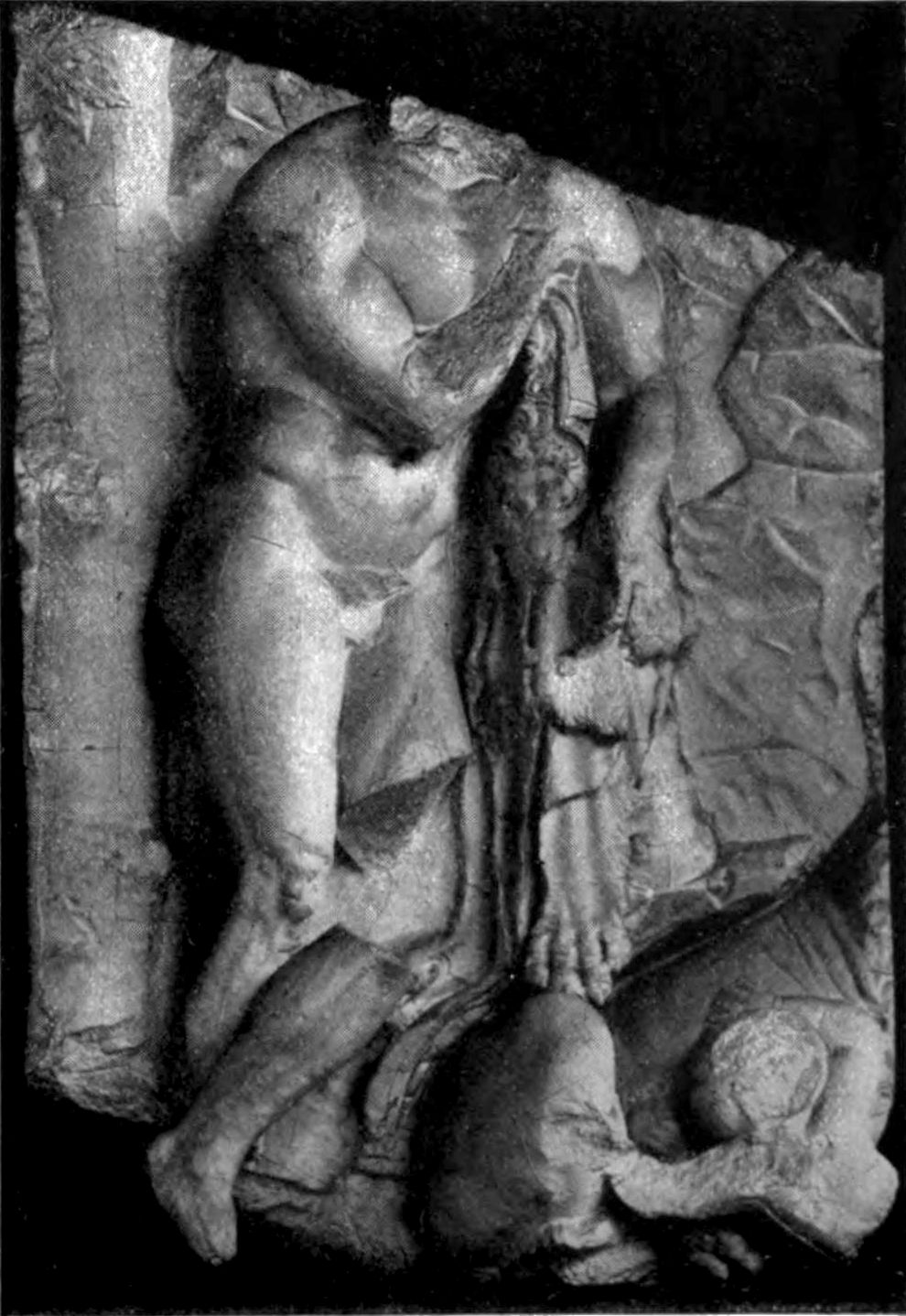
The smaller frieze of Pergamon, giving incidents in the
myth of Telephos, is of a very different type (Fig. 8). Firstly,
the subject is not a unity in time and place, but a continuous
narration of mythological episodes. It thus resembles the
setting in a continuous frieze of a number of metope-subjects.
Telephos appears in different situations in a scene which
apparently is uniform. This is a decidedly new departure
in artistic theory, and it had the profoundest effect on all
subsequent art. We need not, of course, see in the Telephos
frieze the first appearance of this custom, but it happens to
be the earliest surviving monument in which the principle
is easily remarked. Moreover, the information as to change
of scene is conveyed by means of changes in the background,
so that we see in it another new departure: the use of a
significant pictorial background instead of the blank wall
against which earlier reliefs had been set. Here again the
Hellenistic artist revives rather than originates. The pictorial
background occurs as early as the ‘Erechtheum’ poros pediment
of the Acropolis, but during the fifth and fourth centuries
the idea was dropped only to reappear at a later date.
We have already seen that relief sculpture at all stages
of its history is closely affected by the kindred art of painting.
During the fourth century painting underwent changes in
the direction of naturalism as marked as, if not more marked
than, the corresponding changes in sculpture. The late
fourth century and the third century form the great period
of Greek painting, in which the names of Parrhasios, Protogenes,
and Apelles stand supreme. A true and correct
feeling for perspective and a naturalistic scheme of colouring
were the main discoveries of the period, discoveries which
we are only able to appreciate in very roundabout methods
through Pompeian wall-paintings and mummy-cases from
the Fayum. All Hellenistic sculpture is profoundly influenced
by painting, as we shall see; but naturally the art of relief
is nearest akin and shows most clearly the effects of graphic
ideas. The Hellenistic reliefs are almost all adaptations of
pictures, and the Telephos frieze earns its main interest
and reputation because it is one of the first monuments
to show this influence very clearly. We find a true use of
perspective in part of this frieze, and a deliberate intention
to create the impression of depth.
One of the first results of these innovations was to free
relief from its subordination to architecture. It begins now
to take its place as a self-sufficing artistic object like a picture.
Greek pictures were mainly of the fresco type, and therefore
immovably fixed to walls, though easel pictures now begin
to be more frequent. There was nothing dissimilar in the
position of a relief decorating a wall-panel without architectural
significance. This idea found its earliest manifestation
in Ionia with friezes of the Assos type on an architrave
block, and therefore at variance with architectural principles.
Friezes as wall decorations appear commonly in the Ionian
buildings of the fifth and fourth centuries, like the Nereid
and Trysa monuments and the Mausoleum. We find in the
Hellenistic age the use of panels as wall decorations quite
frequent all over Asia Minor. Thus at Cyzicus we have
some curious mythological reliefs called Stylopinakia, which
appear to have been panels fixed between the columns of
a peristyle. We have the Apotheosis of Homer by Archelaos
of Priene, a clear instance of the decorative panel with
a pictorial background; we have smaller pieces like the
Menander relief in the Lateran; the visit of Dionysos to
a dramatic poet; and all the series of so-called Hellenistic
reliefs ascribed by Schreiber28 to an Alexandrian origin, by
Wickhoff29 to the Augustan age and Italian art. The reliefs,
like other sculpture of the Hellenistic age, cannot be judged
as a whole.30 Some are Augustan, like the reliefs in the
Palazzo Spada, and some are undoubtedly Alexandrian, like
the Grimani reliefs in Vienna. Others, again, show a strong
Lysippic influence, which at once connects them with
Rhodes. The Telephos frieze, however, is Pergamene, and
the Cyzicus reliefs must have fallen mainly in the Pergamene
sphere of art. We are, therefore, entitled to demand a separation
of the reliefs into just as many classes as the sculpture.
A fine piece of very high relief from Pergamon is the group
of Prometheus on the Caucasus freed by Herakles.31 Besides
the influence of pictures on relief there is also the influence of
earlier sculpture. One of the figures in the Telephos relief
reproduces the Weary Herakles of Lysippos.32 It would not
be difficult to point out other examples of the adaptation of
older types. The Marsyas group is itself a case in point.
The indifference of the Hellenistic artist to his subject made
him the readier to adapt earlier types, provided he had a free
hand for his details of execution and expression.
9
10
The figures of Pergamene art as a whole are short and
stocky with squarish deep heads. They correspond to the
Scopaic, pre-Lysippic, and Peloponnesian type, but the
Lysippic improvements in pose and swing of the body are
thoroughly appreciated and adopted. From Praxiteles are
derived the female type and the interest in the satyr as a
vehicle of sculptural expression. The athletic art of Lysippos
and the school of Sikyon is practically unrepresented at
Pergamon or in those regions of Ionia and Bithynia which
are connected with it and at which we must now glance.
From Priene we have remains of a gigantomachy and some
other sculpture.33 The influence of Praxiteles is marked,
and the work as a whole is clearly under Pergamene guidance.
From Magnesia we have remains of a great Amazonomachy
belonging to the frieze of the temple of Artemis Leucophryene
and dating from the end of the third century. The work
is dull and careless but strongly under the influence of Pergamon.
We shall in fact find no more architectural reliefs
of even tolerable quality. The new landscape or pictorial
reliefs occupied the attention of the sculptors, and temple
decoration was left entirely to workmen.
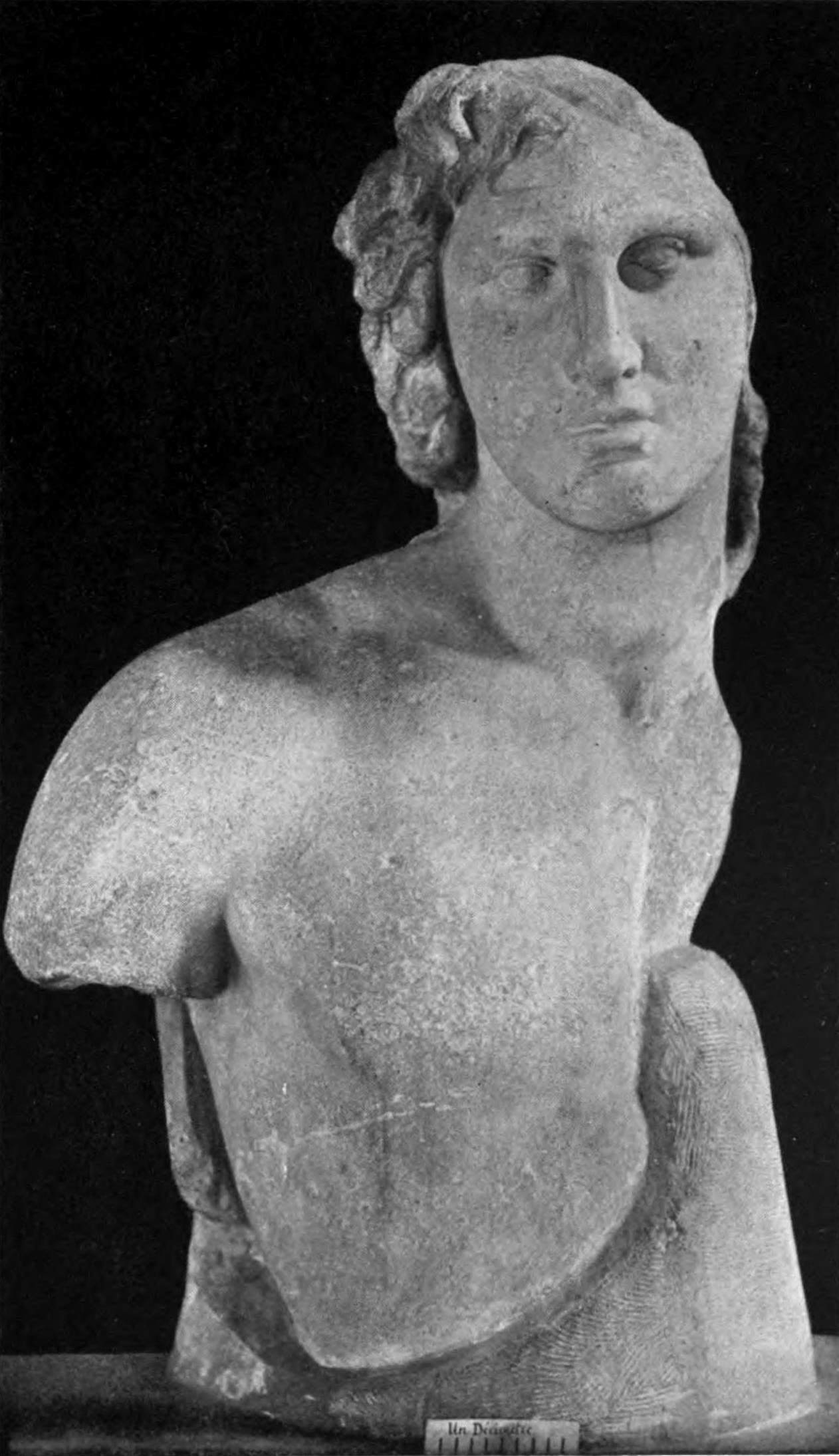
One of the great Hellenistic art centres is Tralles, whose
treasures are mainly to be seen in the Constantinople museum.
The colossal Apollo or Dionysos (Fig. 9) is closely connected
in pose and treatment with the Apollo of the Marsyas group,
and shows even more clearly than the torso in the Uffizi
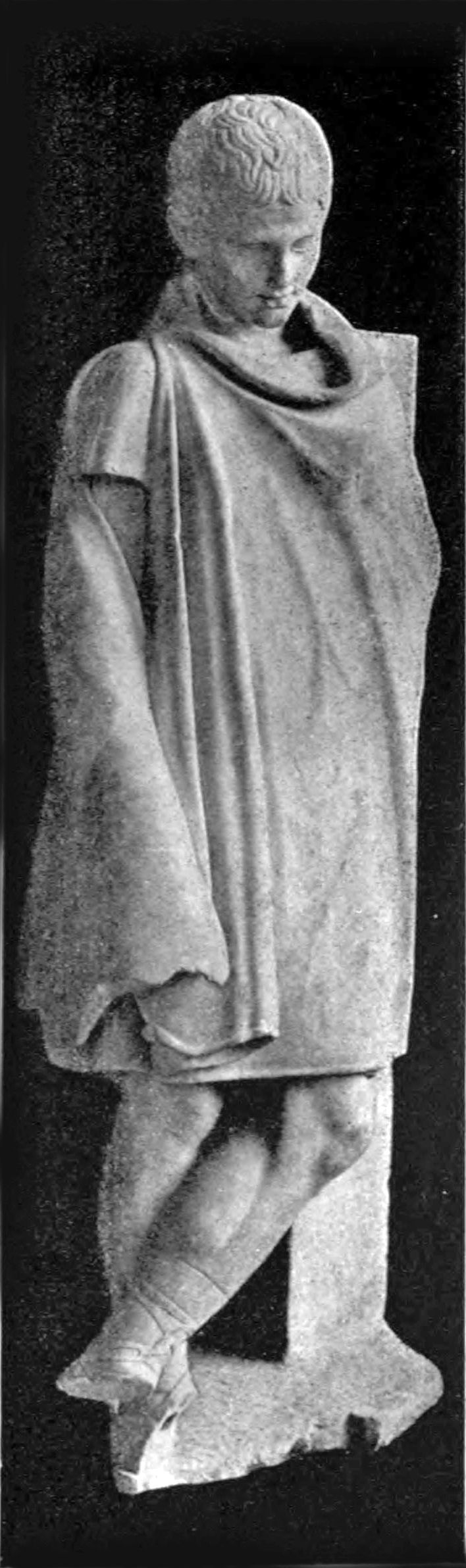
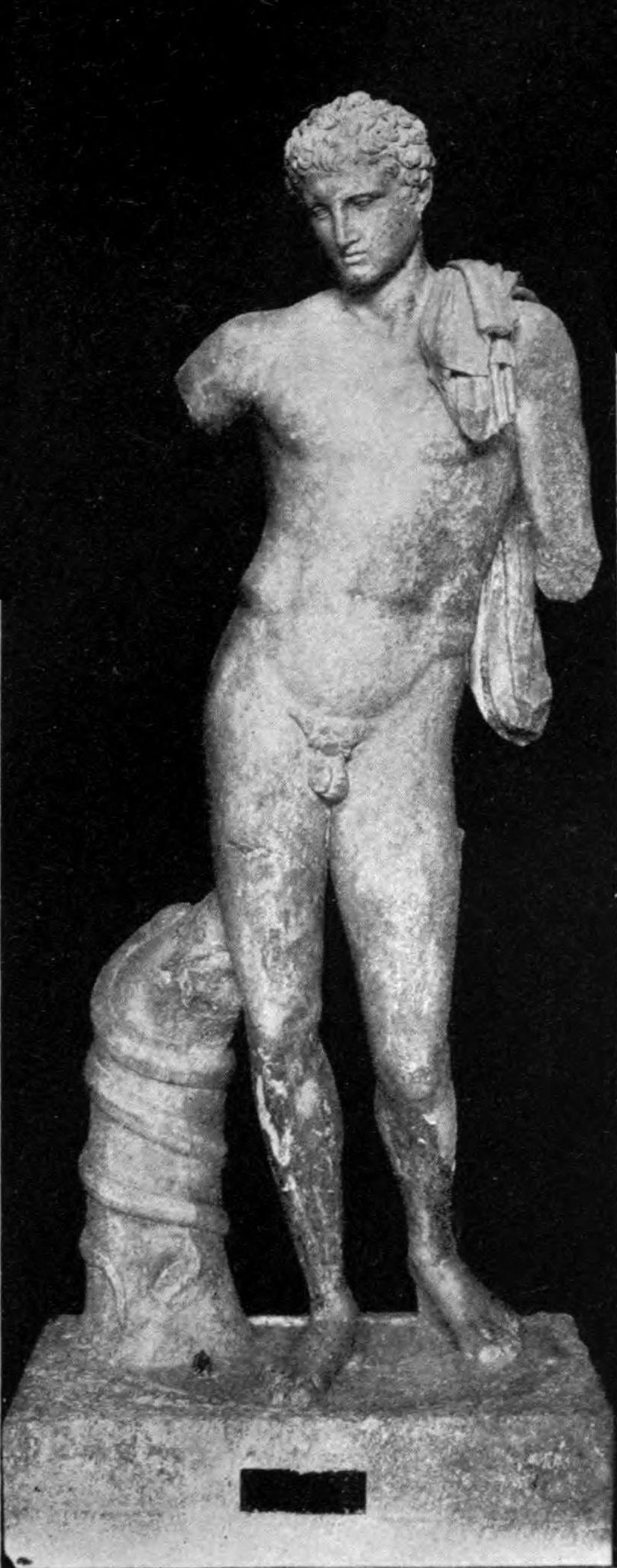
the influence of Praxiteles. The cloaked ephebe of Tralles
(Fig. 10) is a good example of the eclecticism of the age.
The leaning attitude with the crossed legs reminds us of
the satyrs of Praxiteles and his school, but the head is quite
different and is strongly reminiscent of Myron. Boethos of
Chalcedon belongs by birth to the northern or Pergamene
sphere of influence, but he worked in Rhodes and will be
more suitably considered in connexion with Rhodian art.
Pergamene influence was also strong in the islands and on
the mainland. We shall see that the school of Melos and
both Attic and Peloponnesian art during the late third and
second centuries were obviously affected by it.
II THE SCHOOL OF ALEXANDRIA
It may well be questioned whether we are really in a
position to separate the Hellenistic schools as definitely
and surely as we can separate the Attic and Peloponnesian
schools of the fifth and fourth centuries or the earlier local
schools of the sixth. In the Hellenistic age we find a far
greater uniformity and cosmopolitanism in art than ever
before. The conquests of Alexander had been in the long
run Panhellenic, and outside the mainland at any rate the
title Greek came at last to mean more than merely a man’s
city or state. It has therefore been argued by some critics
that we must not expect to find the same local distinctions
in Hellenistic art. In a cosmopolitan world with easy
communications local and separate developments were no
longer possible. This position is plausible, and so far as
the question of ideals or even types is concerned there is
little to choose between the Hellenistic schools. The so-called
Hellenistic reliefs are probably of very diverse origin;
the Hellenistic love for genre scenes and for the grotesque
appears to be universally indulged; the erotic groups of
Pergamon were certainly equally popular in Alexandria;
the influence of painting and the adaptation of earlier
sculptural types are found in all parts of the Aegean world.
But there does seem to be a distinction in technical execution
between the three great schools of the period, which is
sufficient to justify their consideration in three separate
chapters. While Pergamon is predominantly subject to
the Scopaic-Praxitelean mixed tradition with an especial
fondness for extremely clear-cut work and soft finish, Rhodes
appears to be equally faithful to the Lysippic athletic tradition,
and Alexandria to a strongly impressionist development of
Praxitelean ideas joined to a fondness for unsparing realism
in the grotesque, a combination not infrequent in the decadence
of art. For Alexandrian art, more than any of the others,
deserves the title of decadent through its abandonment of
every vestige of idealism in motive.
We know the connexion of Alexandria with Athens
was close in the late fourth century, especially during the
rule of Demetrios of Phaleron in its closing decades. It
was at this time that Bryaxis made the Sarapis (Fig. 12),
which has perhaps survived for us in the innumerable
copies of a wild-haired, heavily bearded head with shadowed
mysterious eyes. During the next century Macedonia was
the chief foe of Athens and of the Ptolemies, and all the
earlier Egyptian rulers were on close terms of friendship
with the city. Thus a predominant influence of Athens and
of the greatest of the fourth-century Athenian sculptors,
Praxiteles, is only what we should anticipate in Alexandrian
art. It has, however, been argued that we have no evidence
for a native art of Alexandria at all.34 While importing much
late Attic sculpture, she borrowed also from Pergamon
works like the Gaul’s head at Cairo,35 and from Antioch
a group like the Dresden Aphrodite with the Triton.36 She
was in fact a collecting rather than an originating centre.
11
12
13
This view is improbable on many grounds. The Egyptians
were a people with a keen artistic sense, and the sudden
introduction of a new race like the Greeks with their passion
for cultural expression could hardly fail to give an impetus to
artistic output. Moreover, a great revival in architecture is
noticeable all over Egypt. The Ptolemaic age is one of the
great building periods of the Nile valley. Further, our
authorities are unanimous on the importance and brilliance
of the Alexandrian school of painting, and we know that in
gem-cutting Pyrgoteles started a development never surpassed
in antiquity or modern times. In literature, in
criticism, and in science the museum of Alexandria held the
chief place, and it is impossible to suppose that Egypt
remained a mere collector of sculpture without any original
development of her own. We must, therefore, examine the
artistic products of Hellenistic Egypt to see if they exhibit any
technical peculiarities marking them off from other Hellenistic
centres and compelling us to credit them with a local origin.
Any study of the sculpture of Alexandrian origin reveals
one characteristic almost invariably present in serious work,
as opposed to the grotesque, and absent from the certified
products of other centres. This is that quality of slurring
over all sharp detail in the features and producing a highly
polished, almost liquidly transparent surface for which we
have borrowed the Italian term morbidezza.37 Instances of
this highly impressionist treatment are to be found in the
British Museum head of Alexander from Alexandria, and
also in the Sieglin head from the same place; in the Triton
head of the Dresden Alexandrian group of Triton and
Aphrodite; in the many Anadyomene copies which are
mostly connected with Alexandria, such for instance as the
beautiful statue recently found in Cyrenaica (Fig. 11); in
girls’ heads from Alexandria in Copenhagen and Dresden.
In most of these works and in many others the soft transparent
quality of the face is matched by a quite rough impressionist
blocking-out of the hair. Thus we find both the characteristics
of Praxitelean impressionism, the rough hair and the
soft liquid gaze, exaggerated and intensified in Alexandrian
sculpture. While the female hair of Pergamene art is invariably
clear-cut and rope-like, Alexandrian hair is normally
of the rough crinkly Praxitelean type, sometimes merely
formal, at others more complicated and complete. This
impressionist character of Alexandrian sculpture is borne
out by what we know of its painting, and is doubtless due
to some extent to the great influence of painting on sculpture
as well as to the influence of Praxiteles.
Another technical point about Alexandrian sculpture is
connected with the local conditions of the country. Egypt is
not a country of marble, and therefore the artists had to be
economical in the use of it. This is probably the reason
why so many Alexandrian heads have the faces complete
in marble but the hair added separately in stucco, where
the colouring would render the difference in material hardly
noticeable. Thus many statues of Alexandrian origin have
large pieces of the upper part of their heads smoothed away
and left for the addition of stucco. This phenomenon is
not confined to Alexandrian art, though it is much commoner
at Alexandria than elsewhere, and where we find it in combination
with the other qualities of impressionism and
morbidezza already noticed we may feel fairly confident in
claiming an Alexandrian origin for the work in question.
14
15
16
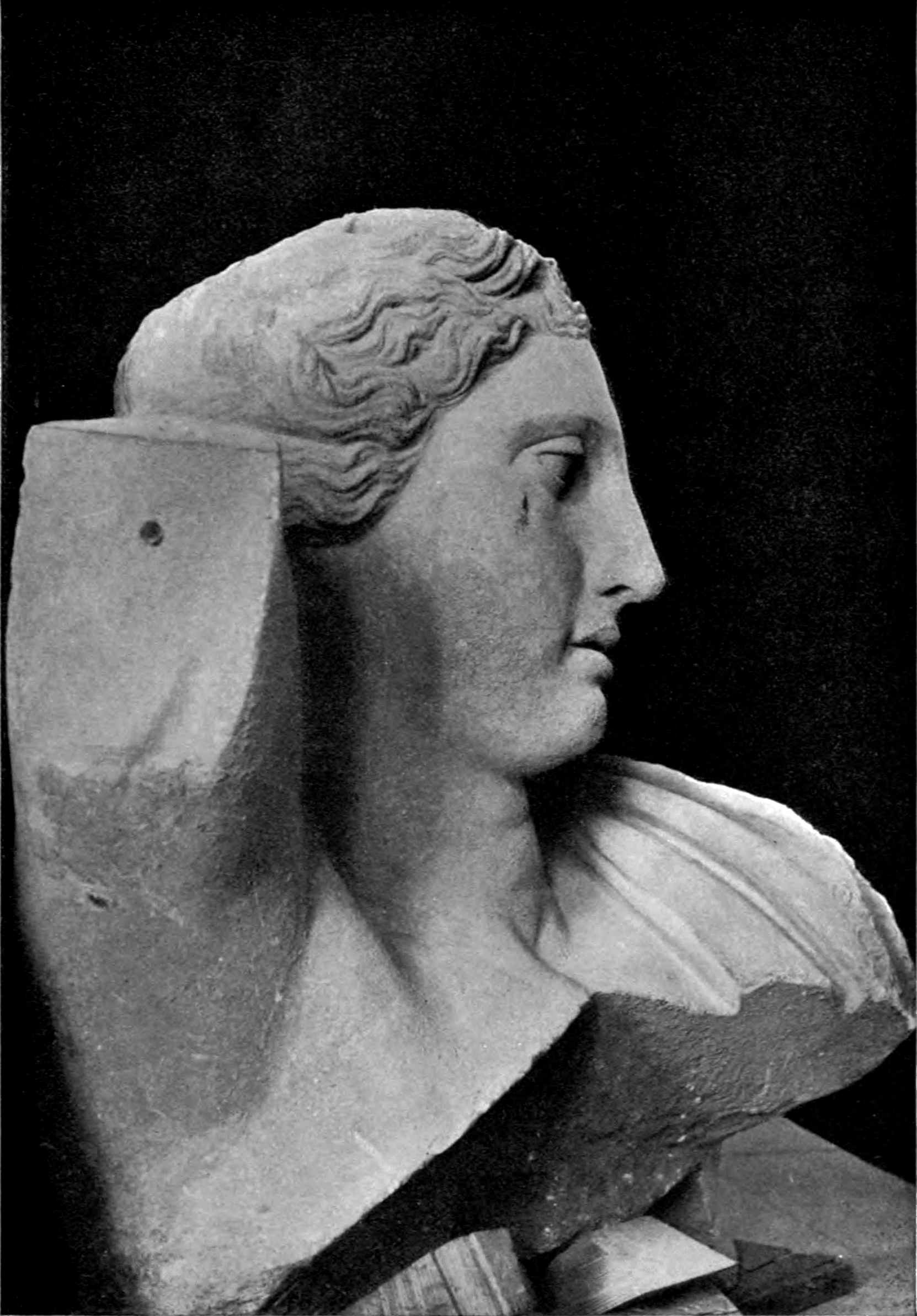
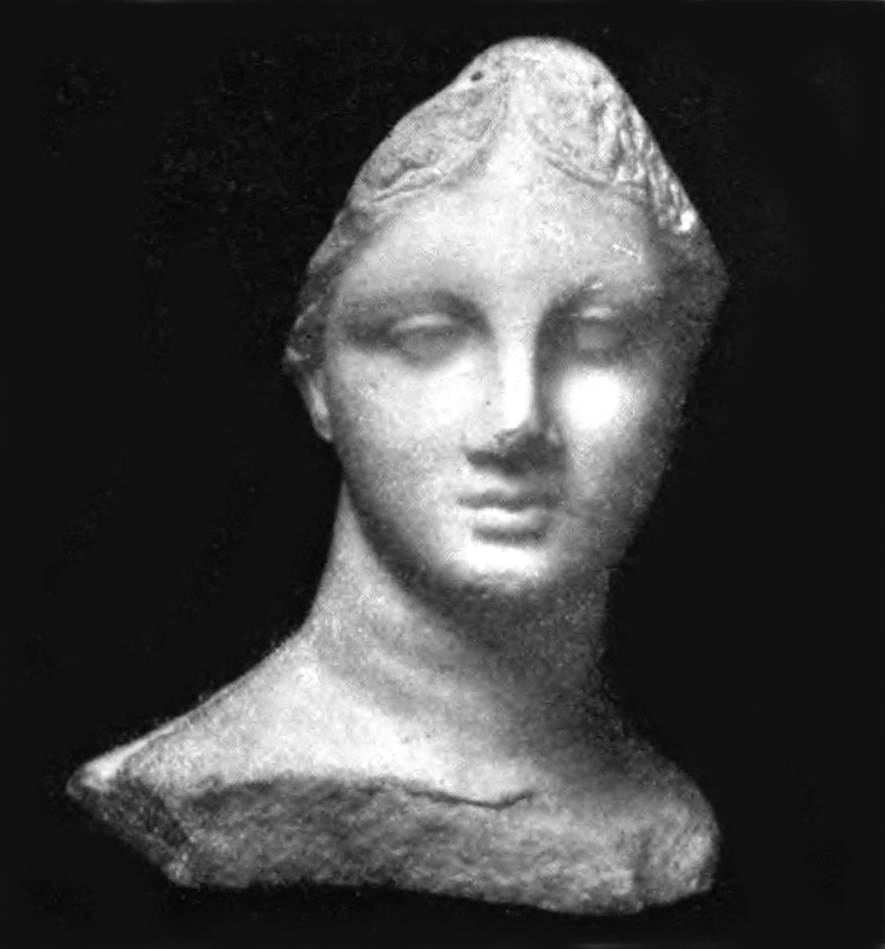
This theory is admirably illustrated in the beautiful little
head of a girl from Chios recently acquired by the Boston
Museum (Fig. 13). The head shows us an extreme degree
of morbidezza in the softening of all the sharper facial lines
such as eyelids and lips. The face is seen almost through
a slight haze, and it thus gets some of the impression conveyed
by distance. Where the head is worked it is quite rough
and formal in purely impressionist style, but most of the hair
was to be added in stucco, as the sharp cuts on the upper
part of the head demonstrate. The head has been attributed
too enthusiastically to Praxiteles himself. It is good work,
but it is not by the author of the Hermes. The too mechanical
smile and the too formal cheeks show a less masterly touch.
But it is a perfect embodiment of Alexandrian art about
300 B.C. and must be unhesitatingly attributed to its real
origin. We see a general copy of the Praxitelean long face
with eyes about the centre of the head, Praxitelean proportions,
and Praxitelean head-type.
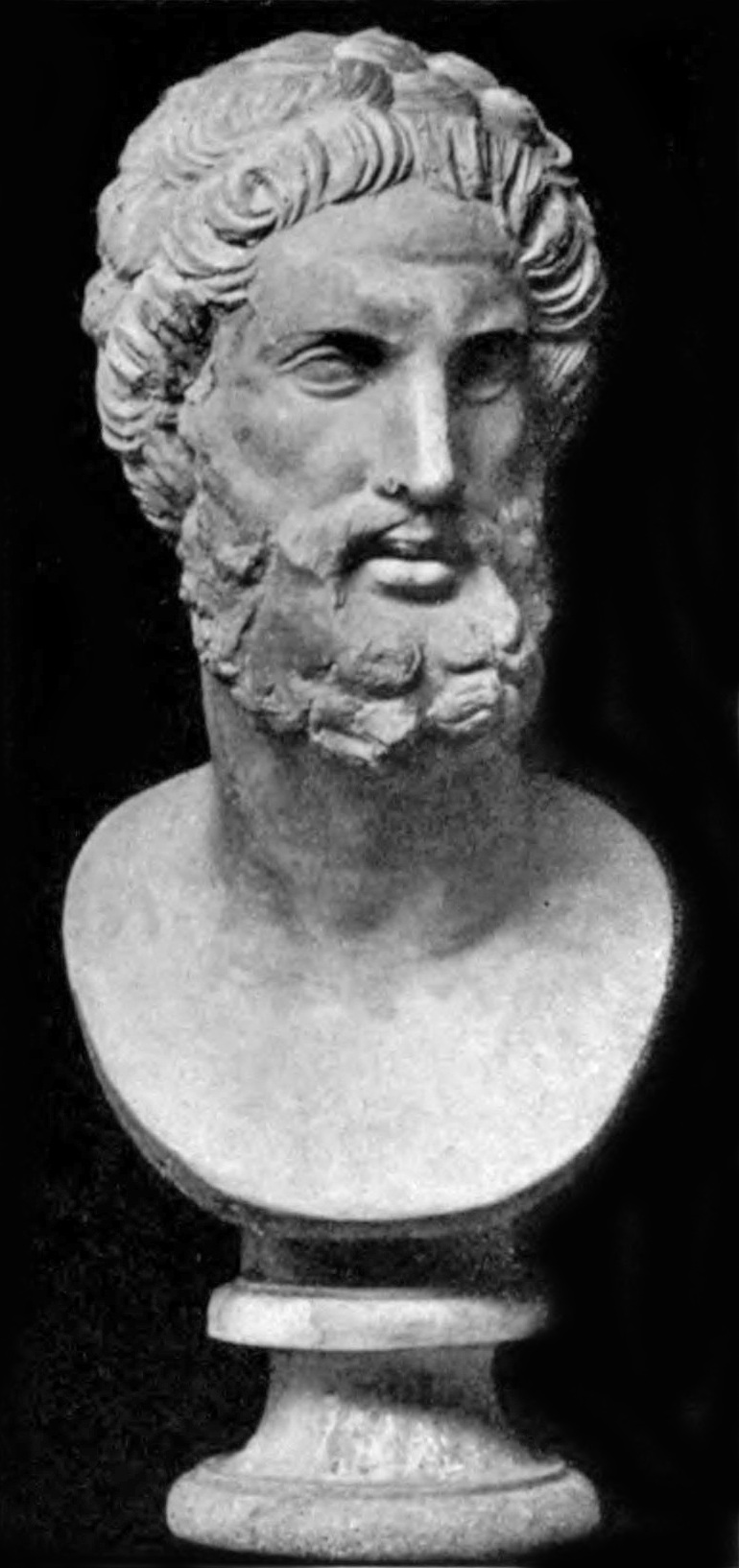
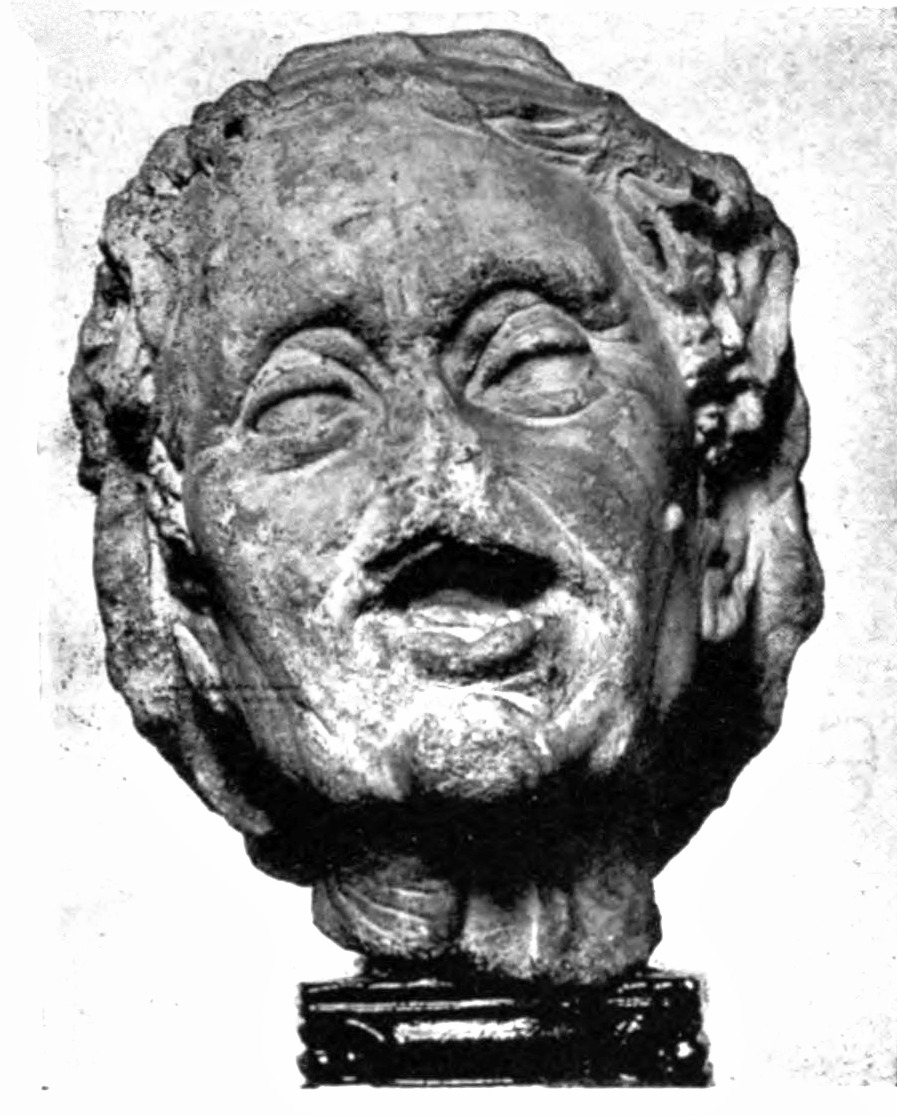
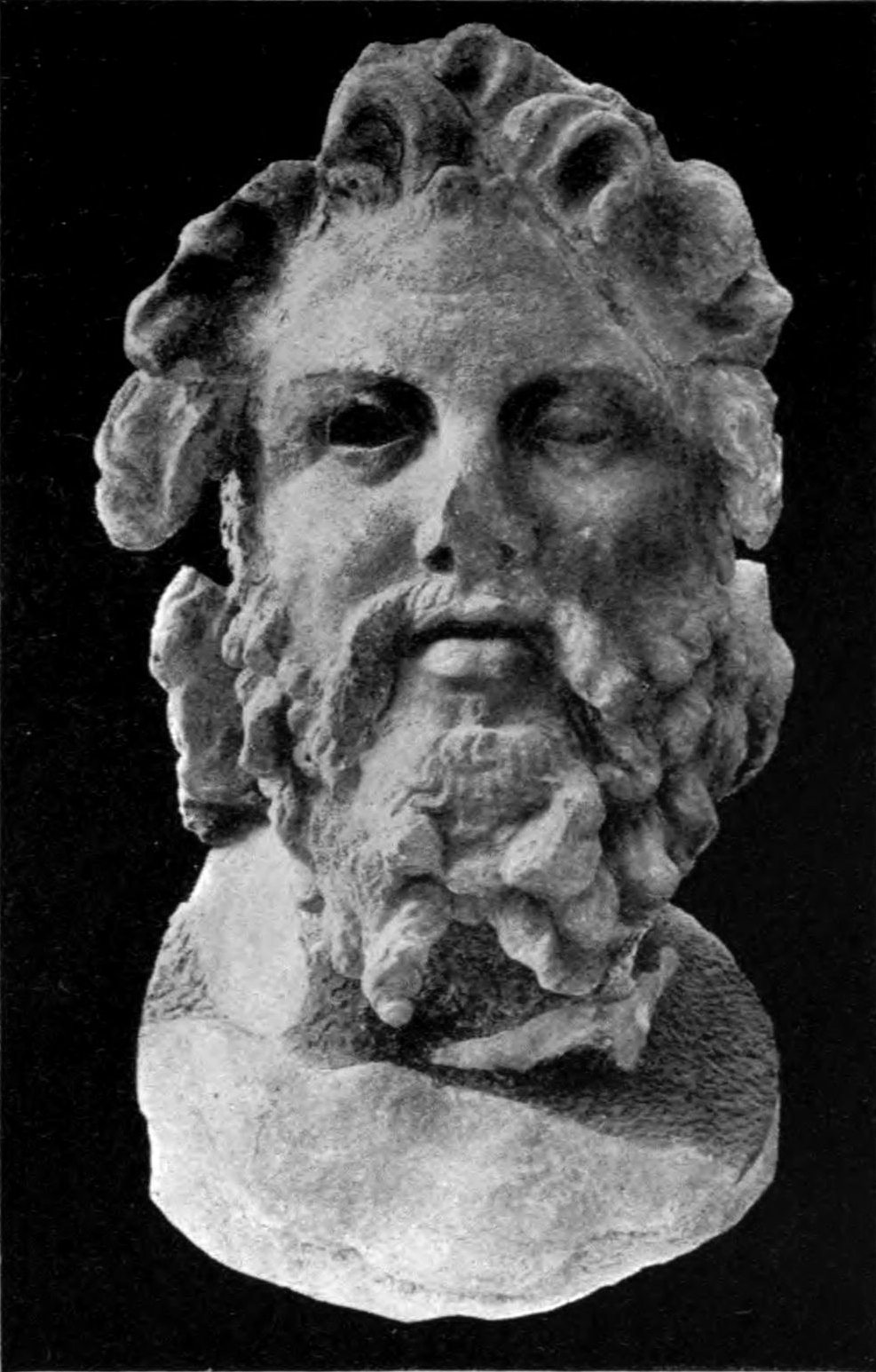
Another head of Alexandrian origin is the fine bearded
head of the Capitol Museum (Fig. 14), which is really almost
a mask with the whole of the top and sides of the head left
for stucco additions. The rough blocking of the beard shows
the artist’s impressionist leanings. The long face is purely
Attic, though perhaps closer to Bryaxis or some later artist
than to Praxiteles. The head is more or less akin to the
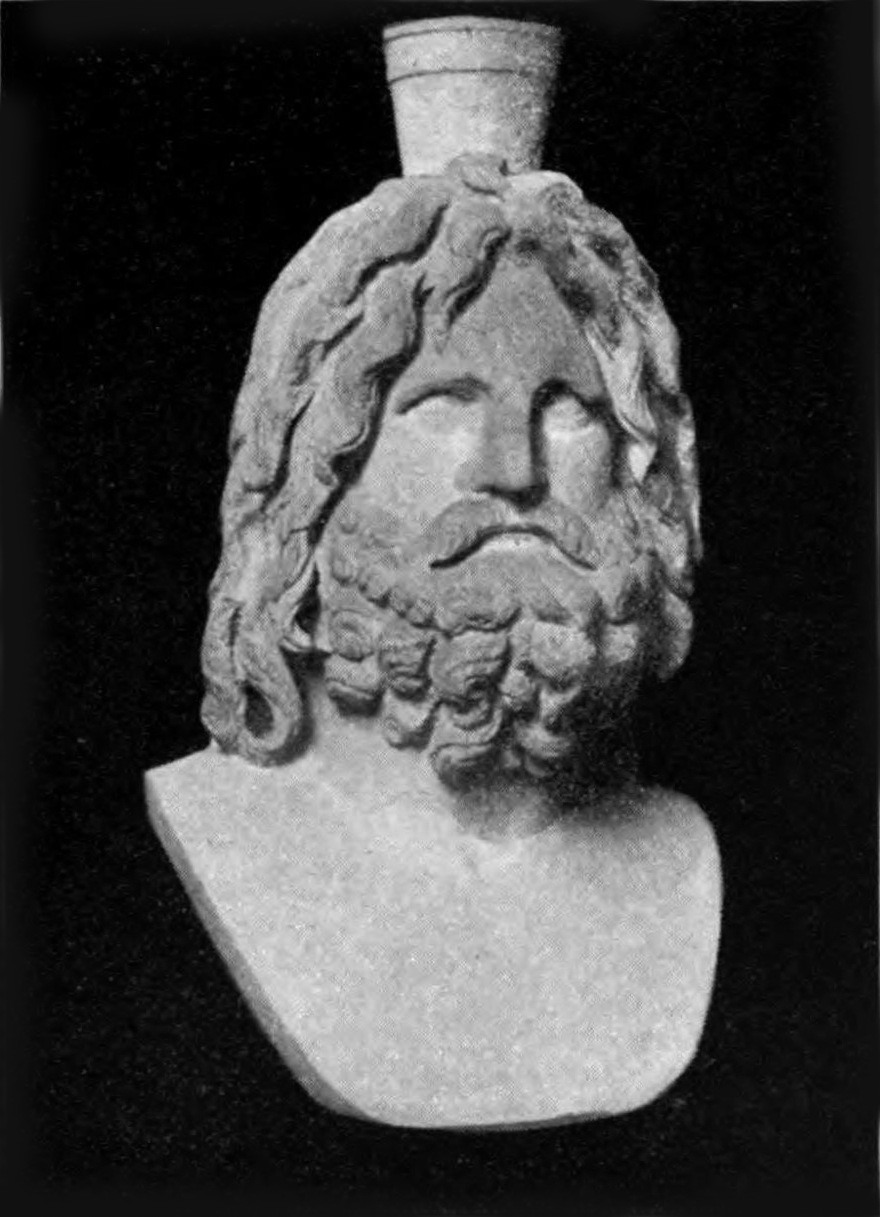
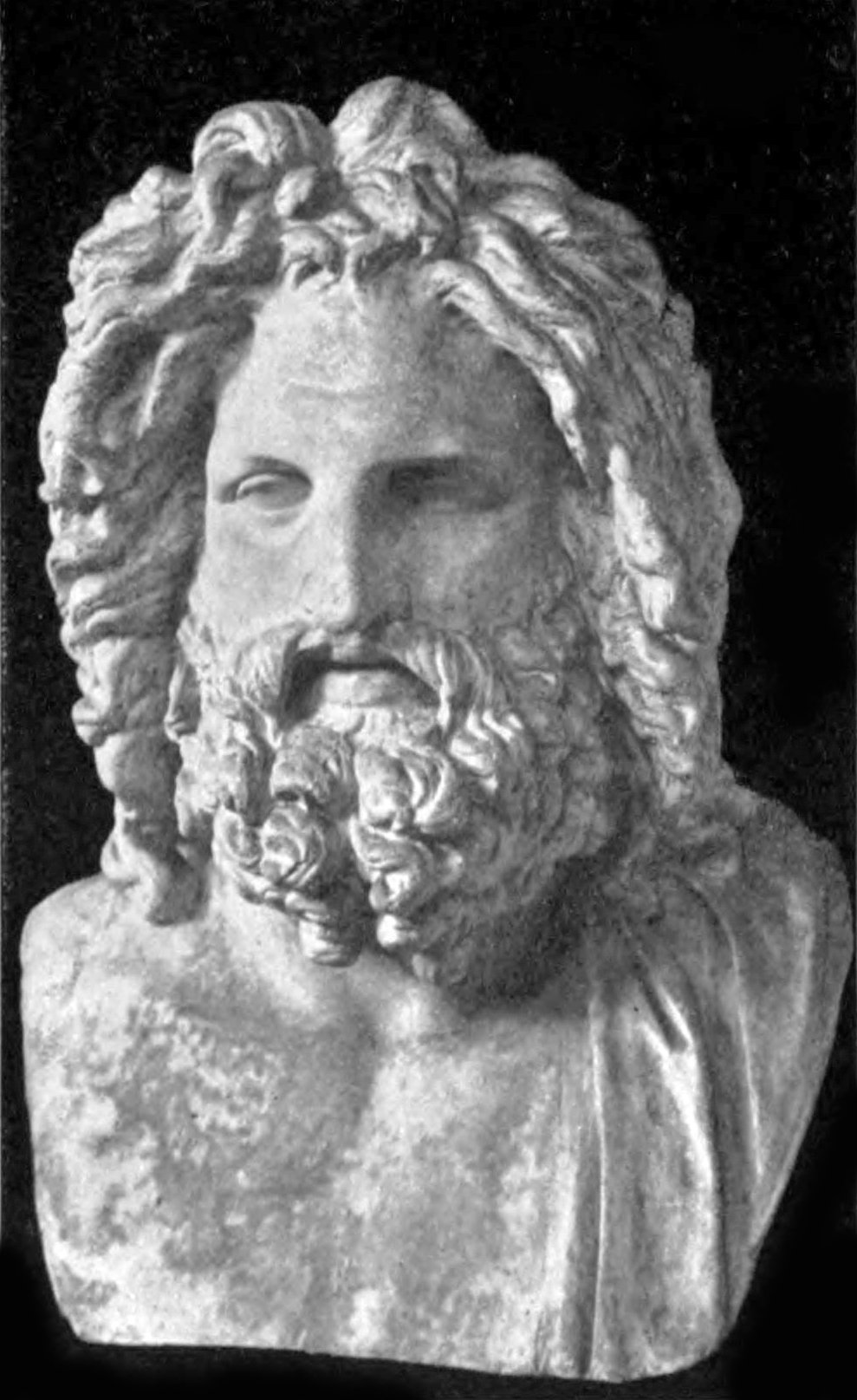
Sarapis head and to the other much finer bearded head
which stands in close relation to the Sarapis, the well-known
Zeus of Otricoli (Fig. 15). In the Otricoli head we have
a similar prominence of the cheek-bones, a similar narrowing
of the forehead above the frontal sinus—Attic features
but not Praxitelean. The Otricoli Zeus is also a marble
work cut for stucco additions, some of which are still visible,
and we should probably recognize in it another work of early
Alexandrian origin. It is perhaps not too daring to see the
prototype of these Attic-shaped non-Praxitelean Alexandrian
bearded heads in the Sarapis of Bryaxis.38 Bryaxis or some
other late Attic artist seems to have affected the bearded
male type of Alexandria much as Praxiteles influenced the
feminine ideal. Nottingham Castle contains a bearded head
from Nemi,39 which belongs to the same class of work. Here
again we have the hair added in stucco and a general resemblance
to the Otricoli type.
17
18
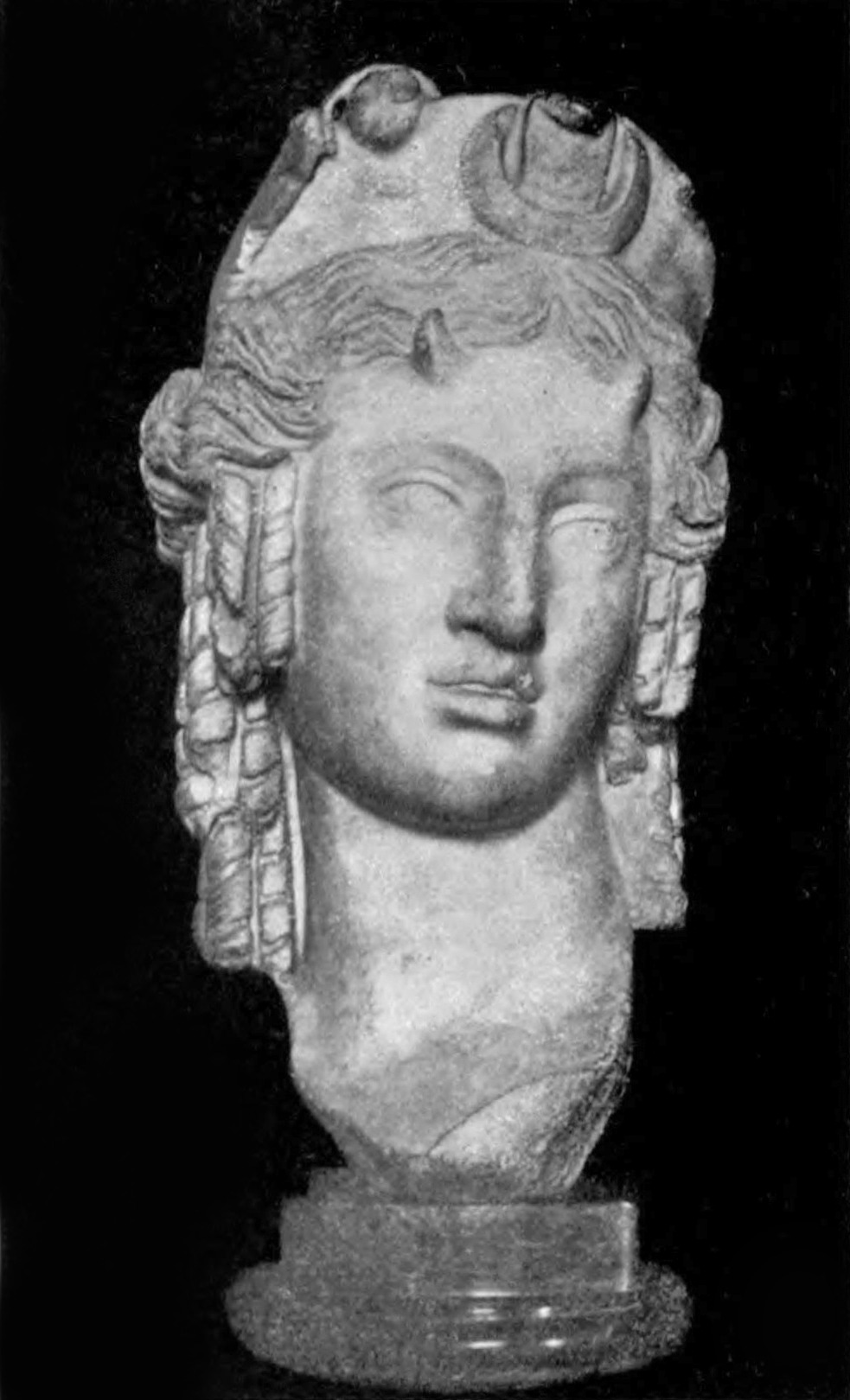
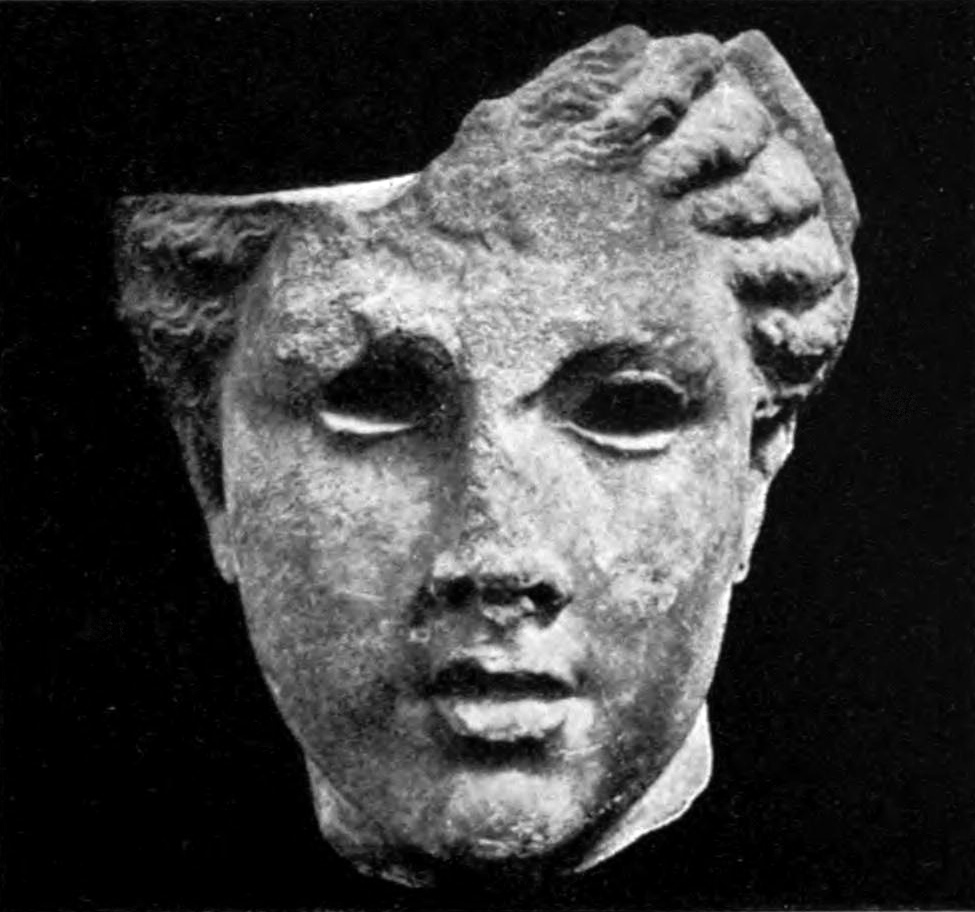
One of the new Greco-Alexandrian types was naturally
the goddess Isis. A head in the Louvre (Fig. 16) gives us
a version of this figure, which still, even in a poor Roman
copy, shows us something of the languid elegance of the
original. There is no traceable influence of Scopas in Alexandrian
art. The Praxitelean and Attic tradition was transferred
pure, and therefore the liveliness of movement and
action in Pergamene art is quite absent from the art of
Alexandria. Statues are mainly small, partly perhaps for
economy, and partly from the lack of all desire for comparison
with the gigantic masterpieces of ancient Egypt, and they are
limited to simple standing or seated poses. An interesting
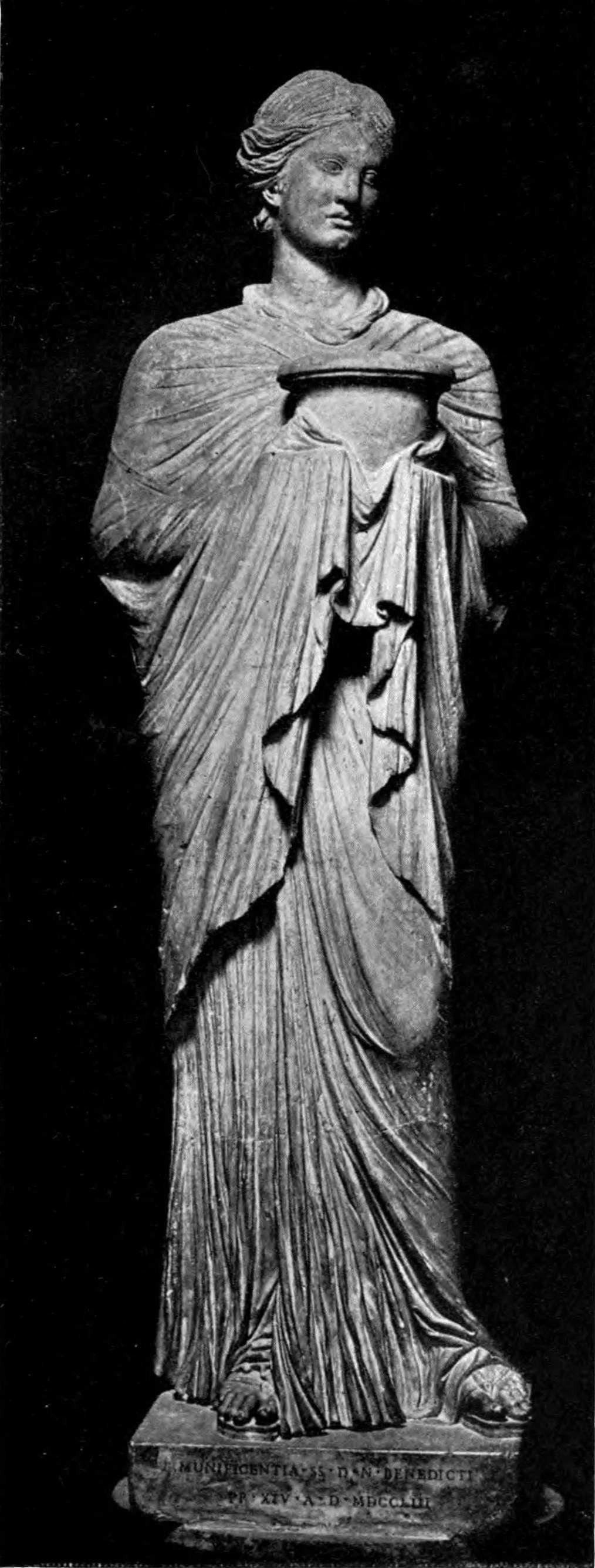
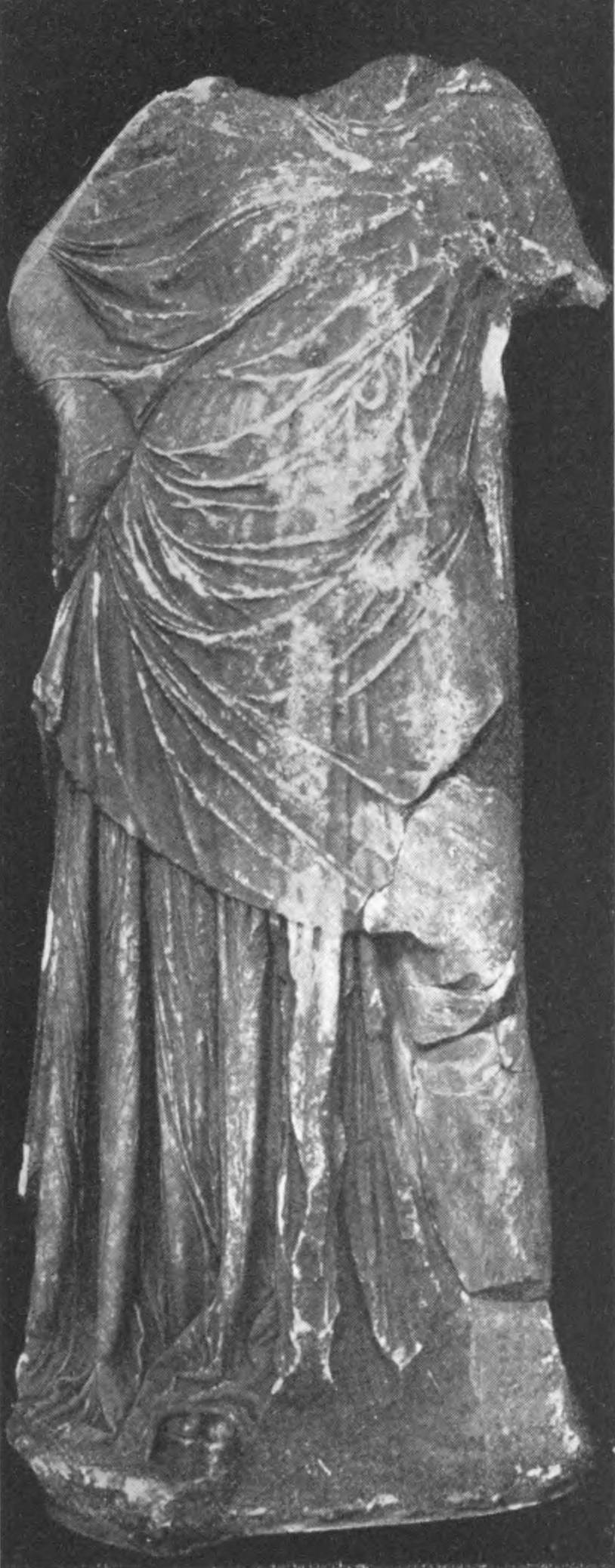
statue of obvious Alexandrian origin is the priest of Isis in
the Capitol (Fig. 17), which has been wrongly restored with
a female head. This head is itself Alexandrian, as its hair
demonstrates, but it has no connexion with the body, which is
male, though draped in a light clinging tunic.40 The tunic
is interesting as giving us a good example of Alexandrian
drapery. We may notice the very small closely set folds,
and the extreme realistic care with which the loose parts of
the drapery are distinguished from those tightly stretched.
There is an element of artificiality no doubt in the way in
which the folds radiate from the great jar carried against the
chest and in their close symmetry of design, but as a whole
the effect of texture is marvellously well secured. We have
here a good example of the naturalism which now plays a large
part in Alexandrian art.
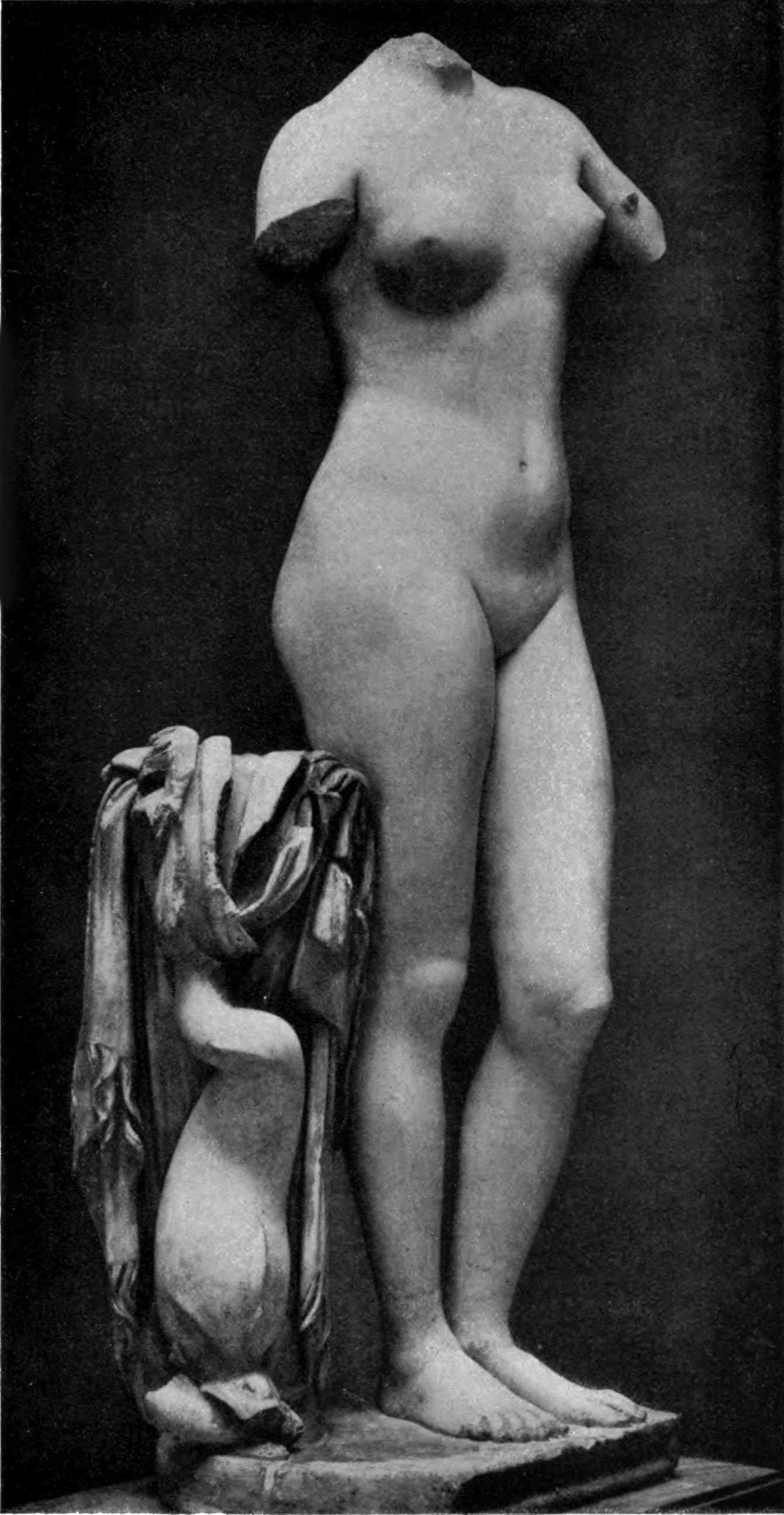
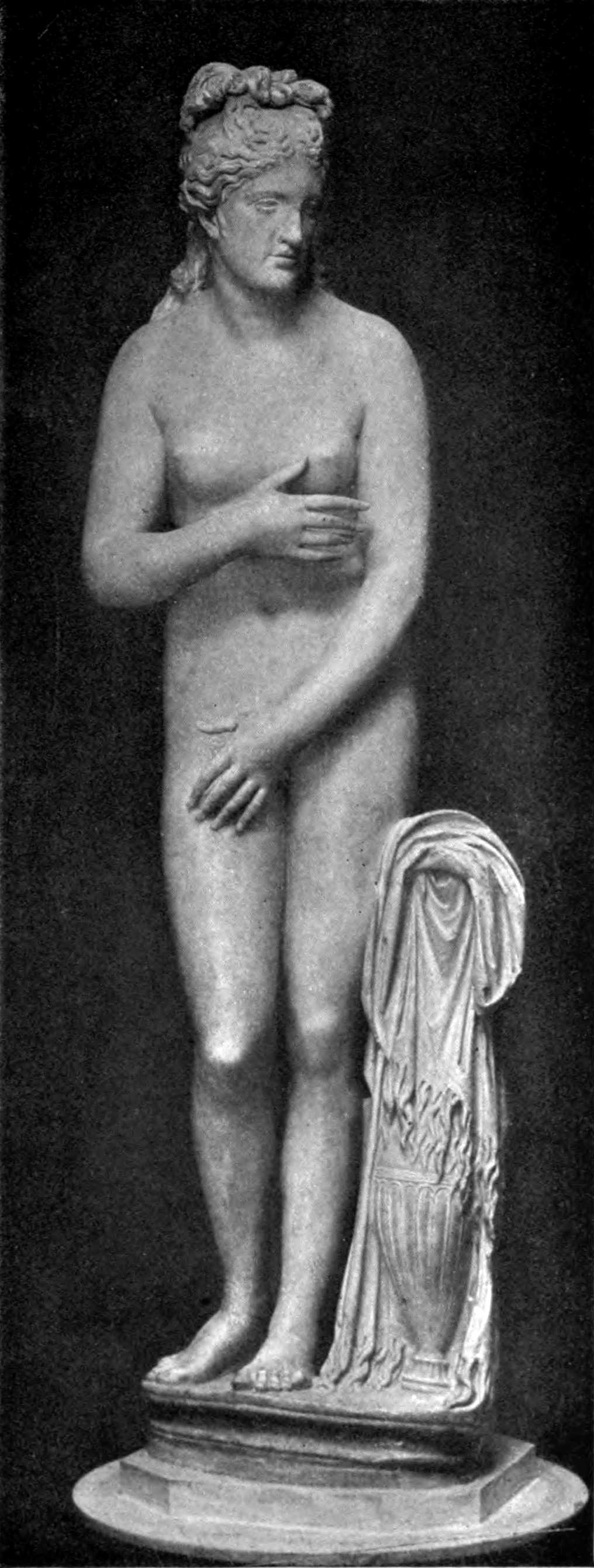
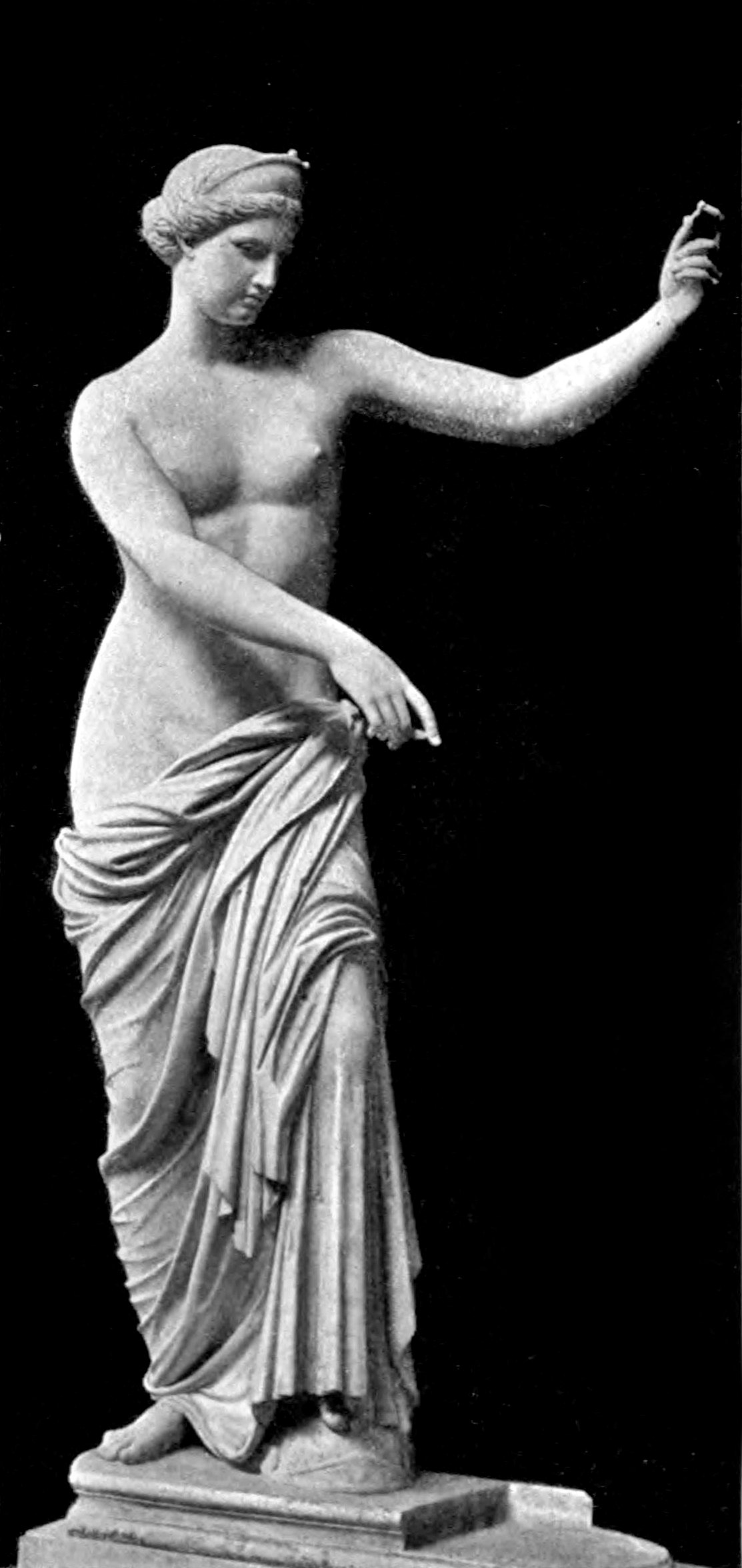
Another statue which we must claim for Alexandrian
art is the Capitoline Venus (Fig. 18), an extremely interesting
statue not only as a first-rate original but from its relation
to the Cnidian goddess of Praxiteles. The face and the hair
show the usual qualities of Alexandrian impressionism;
the fringed mantle thrown over the water-pot is the mantle
of the Egyptian Isis, and the foreshortening of the foot of
the amphora is just the pictorial touch we expect in Alexandrian
art. But the most interesting light which this
statue throws on Alexandrian art is its directness and want
of subtlety in motive. The goddess of Cnidos is naked,
but she is only half-conscious of her nakedness. Her eyes
are fixed on eternity, and the actual bath is a mere accessory
like the child of the Hermes. But the Capitoline goddess
is not thinking of eternity at all. She is stepping into her
bath, and is suddenly aware of a spectator’s gaze. She is the
classical counterpart of Susannah in Renaissance art. All
the vague beauty of the Attic statue is lost by the touch of
Alexandrian realism, which amounts almost to vulgarity.
As to the treatment of the body it is again real and not ideal.
The back in particular shows a close study of the model
without any of the selective idealism of classical art. Like
the beautiful torso in Syracuse41 it is a marvellous study
from nature, not marked by any vestige of idealism.
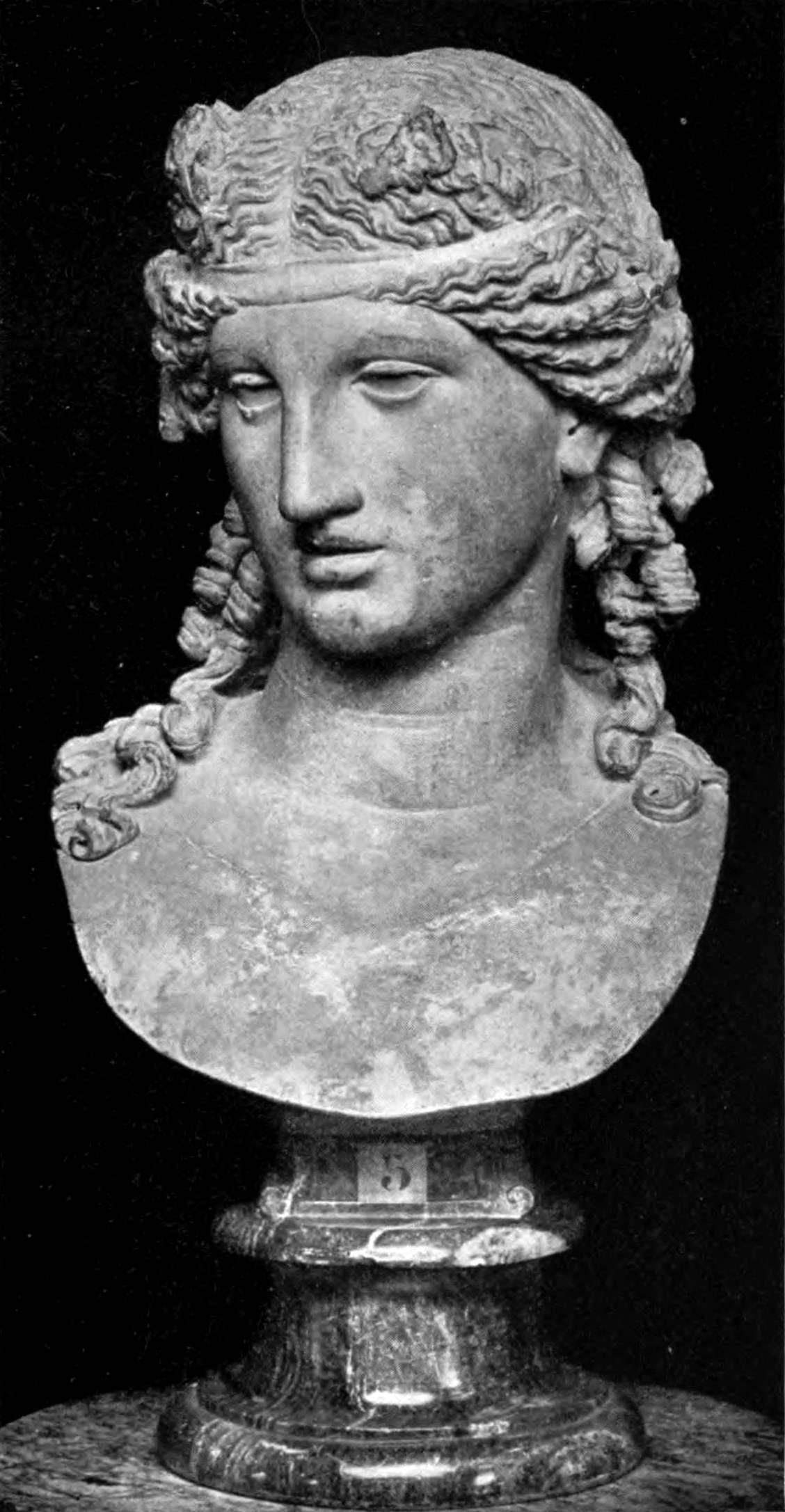
Another head in the Capitol, the so-called Ariadne
(Fig. 19), perhaps really a Dionysos, also suggests an Alexandrian
origin with its long face, eyes close together, and
crinkly hair.42 It is a very favourite Roman head often copied,
and must belong to some famous original. It wears a band,
which presses into the hair, and its sleepy languid gaze is
remarkable. This is produced by making the upper eyelid
nearly straight and the lower one well curved. The face is
long and heavy. Both eye-shape and head recall the Boston
girl from Chios and other Alexandrian statues. The surface
of the face is highly polished, the hair left crinkly and rough—an
Alexandrian procedure. If we can accept this head,
we must class with it two heads of identical facial type, the
Eubouleus of Eleusis43 sometimes attributed to Praxiteles,
and the so-called Inopos from Delos in the Louvre (Fig. 20).
Alexandrian dedications might plausibly be expected at
Delos and Eleusis. Both Inopos and Eubouleus are highly
impressionist. We have said enough to show that what we
may call the serious art of Alexandria had certain characteristics
of technique and execution, which render not
impossible an attempt to classify and arrange an Alexandrian
school of sculpture. We must now turn to another side
of Alexandrian art which, if of less artistic interest, is
nevertheless of paramount importance in our study of
Hellenistic art.
19
20
The people of Alexandria were noted in the ancient
world as scoffers and cynics. Their temper was fiery, their
jests were brutal, and reverence of any kind was unknown to
them. A cosmopolitan medley of Greek, Macedonian,
native Egyptian, Jew, and every nation of the East, they were
united only in their utter diversity of point of view and their
scepticism of all ideal obligation. To such a people caricature
and a love of the grotesque were almost second nature. By
the side of the greater art of Alexandria it is easy to discern
a lesser art of comic, grotesque, and obscene statuettes of
every description. Greek realism in portraiture went back
to the Pellichos of Demetrios with his great paunch and
scanty hair in the early fourth century.44 With the end of
the century the satyr was a recognized medium for every
variety of the baroque and the macabre in expression. But
in Alexandria above all the grotesque exaggeration of natural
defects found its true popularity. The negro, the hunchback,
the drunkard, the crétin of every kind, became popular
artistic models. As if the delineation of youth and beauty
was exhausted, the Hellenistic sculptors of Alexandria rushed
into the portrayal of disease, of old age, and of mutilation in
every form. They suffered as much as any modern decadent
from ‘la nostalgie de la boue’. Here again we must beware
of attributing to Alexandria all the grotesque figures of
Hellenistic art and all its pieces of most painful naturalism.
Pergamon, if not Rhodes, and doubtless Antioch must have
played their part in the commonest form of artistic decadence;
but we have so much of this work certified as Alexandrian,
that we are justified in regarding Egypt as its chief and most
popular home. Works of this type fall into two classes:
the purely grotesque and the extremely naturalistic. The
former class is more or less confined to statuettes, of which
a number are collected in Perdrizet’s Bronzes grecs d’Egypte
de la Collection Fouquet, and the account of the Mahdia ship
in Monuments Piot for 1909 and 1910. These include
gnomes, pygmies, dwarfs (Fig. 21), and little obscene figures
of all kinds. Needless to say, Praxitelean qualities of morbidezza
and impressionism have no place in art of this kind.
We may presume that the demand was primarily foreign
and not Greek, though all the skill of Greek sculpture is
employed in the faultless execution of many of them. Their
Alexandrian origin is better attested than that of the second
class of extremely naturalistic works.
The latter are more important and more interesting.
They include some of the most skilful works of sculpture
ever achieved. The splendid negro’s head of Berlin45 and
the fisherman of the Louvre are of undoubted Alexandrian
origin, but such works as the fisherman and the peasant
woman of the Conservatori46 or the old women of the Capitol
and of Dresden are not so clear in their origin. When we
get a statue of this type, combined with some clearly Alexandrian
quality, such as the so-called Diogenes of the Villa
Albani47—a naked beggar carried out with fine realism but
also with considerable morbidezza and impressionism—we
may claim an Alexandrian origin; but impressionism is rare
among such statues, as the artists seem to love to dwell on
every detail. We may, however, regard them as a single
class irrespective of their individual origin. The Louvre
fisherman48 deserves careful study for its absolutely unsparing
truth to nature. The slackness of skin caused by long wading
in water, the swelling of the veins through hard work, the
feebleness and hollowness of chest due to old age or disease,
the coarse peasant’s head, in which each wrinkle is faithfully
delineated, deserve our wonder if not our admiration. The
little companion pair in the Conservatori, though inferior
in workmanship as Roman copies, are also full of interest
for their vitality and truth. Finest of all perhaps is the
splendid old woman’s head in Dresden (Fig. 22), with its
marvellous mimicry of the ravages of age. Such art is
decadent, because it is pessimistic, cynical, and unhappy,
and because it refuses to select and idealize as it might do
even in studies of decay; but of its brilliant execution there
can be no doubt. Only the Chinese have made grotesques
which can rank with the products of Alexandria.
This is a convenient place for dealing with the great
series of Hellenistic reliefs, though it is no longer possible
to maintain that these have a uniform and common origin
either in Alexandria or in Imperial Rome.49 We have seen
their beginning in the Telephos frieze, the first to show us
a pictorial background and an episodic mythological treatment.
The appearance of the relief panel as a self-sufficient
whole without architectural background is an invention of
the Hellenistic age as early as the third century B.C., but it
continues as an artistic force right through Roman into
mediaeval and modern art. Certainly not even the Hellenistic
reliefs have a common origin, but it is not impossible
that Alexandria was the home of one class of them, the
pre-eminently pastoral scenes like the Grimani reliefs in
Vienna (Fig. 23). Alexandria was the greatest city of the
Hellenistic world and the farthest from any conception of
the pastoral life of the country. It is, therefore, possible
that the rise of the pastoral tendency in art was connected
with the Alexandrian craving for novelty and variety in
a sphere of which it knew nothing. It is certain that the
pastoral poems of Theocritos delighted the citizens of
Alexandria, and the Hellenistic pastoral relief is strictly
analogous to the poems of Theocritos. It shows a countryside
of the Watteau type with satyrs and nymphs to correspond
to the shepherds and shepherdesses of the court of Louis XIV.
It is an artificial country without a touch of the reality of
nature. Thus the pastoral reliefs and the poems of Theocritos
represent the one element of idealism in the materialistic
culture of Alexandria.
21
23
22
24
The Hellenistic reliefs may be divided into three classes:
the pastoral reliefs such as the scenes showing sheep and
a lioness and cubs, called the Grimani reliefs, in Vienna;
mythological reliefs like the Bellerophon and Pegasus of
the Palazzo Spada,50 or Perseus and Andromeda of the Capitol51
in Rome; and more complicated little scenes or groups
like the Menander relief of the Lateran,52 the Apotheosis of
Homer,53 the slaying of the Niobids,54 or the visit of Dionysos
to a dramatic poet.55 They are all closely related to painting—how
closely a reference to Pompeian wall-paintings or
mosaics like the famous Praenestine pavement will show—but
there are some differences between the groups which are
worthy of mention. The pastoral scenes are straightforward
and naturalistic. The little group of a countryman driving
a cow past a ruined temple in Munich is a good example of
straightforward naturalism. The mythological reliefs are
usually distinctly affected in style. The gesture with which
Perseus receives Andromeda is like that of an exquisite
handing a lady from her carriage. Bellerophon waters his
horse with a nonchalant air.56 Daedalos and Icaros57 present
a curious mixture of affectation and realism. But it may now
be regarded as certain that the Spada reliefs are Augustan
in date at the earliest, and the affectation may well be imported.
This is, indeed, partially demonstrated by a comparison
of the two copies of the Daedalos-Icaros group in
the Villa Albani, of which one is Roman, the other probably
late Hellenistic. At the same time it is remarkable that the
figures of the mythological reliefs all show the long slender
proportions of Lysippos. This at once suggests a Rhodian
connexion. Mythological groups are favourites in Rhodes,
and it is the one place where the Lysippic tradition certainly
lasted. It is not a wholly hazardous suggestion to propose
a Rhodian origin for the mythological, and an Alexandrian
origin for the pastoral, reliefs. One might be tempted,
therefore, to ascribe the most intimate and domestic scenes
to Pergamon, but there is insufficient evidence for proof
at present, though the reliefs deserve careful study with these
possible divisions in mind.
In general we can only point out their fine naturalism
and perfect execution. Their artists seem to have mastered
all the problems of perspective and to deal with the third
dimension as easily as with the other two. It is natural to
notice some advance in freedom of style. The earlier reliefs,
like the Telephos frieze, or the Dolon relief,58 are in less
pronounced relief and with less carefully conceived perspective.
Later reliefs like the so-called Menander relief
show some of the figures in part detached from the background,
while the perspective of a group is most subtly
graded. We may compare the finest of them with the bronze
doors of the Florentine Baptistery and their marvellous panels.
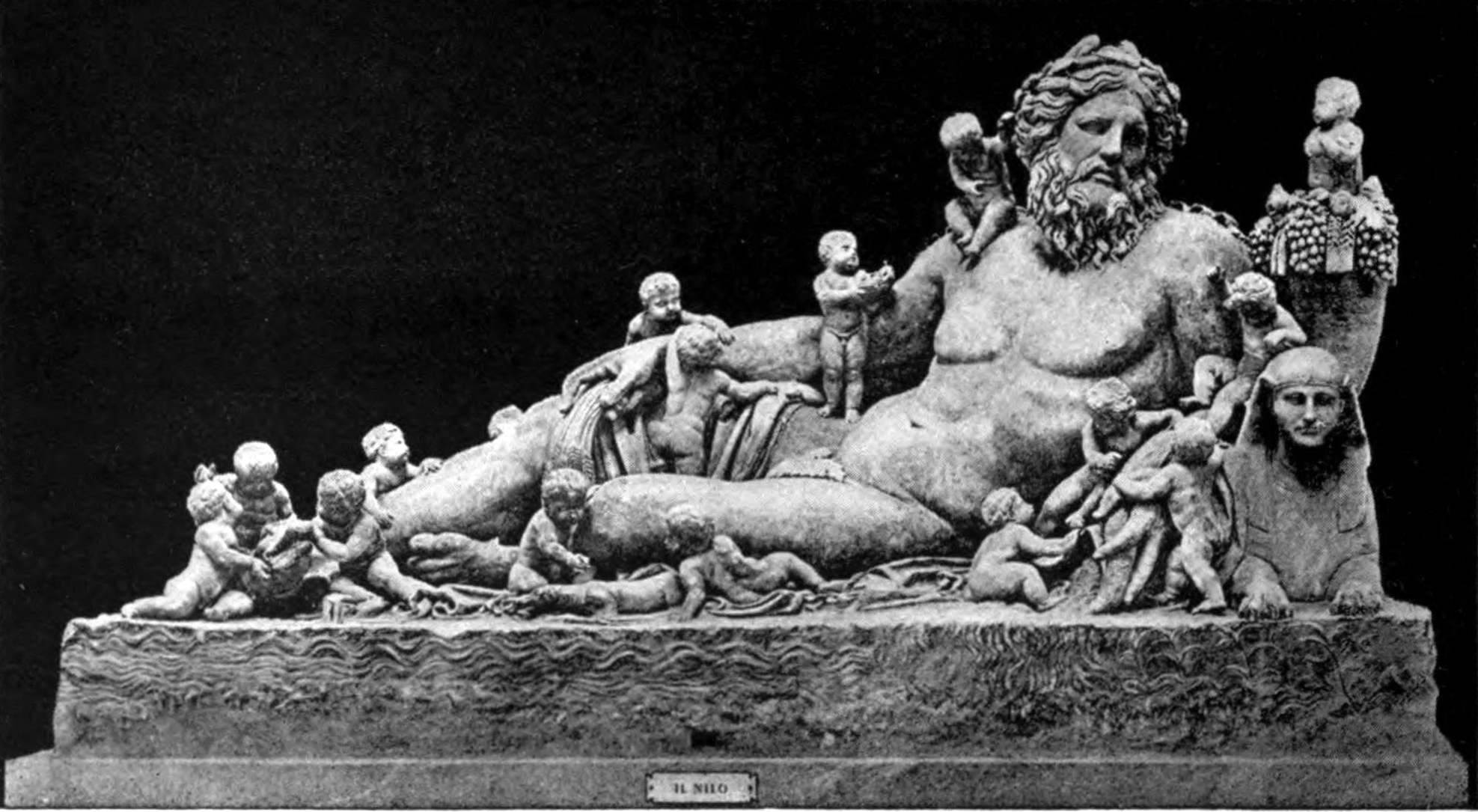
We are still left with one important monument of Alexandrian
art which perhaps can be treated most fitly in connexion
with the pastoral reliefs—the great statue of the Nile
in the Braccio Nuovo of the Vatican (Fig. 24). The god lies
out at length supported on his elbow, and little boys, representing
the cubits of his annual rise, play about over him.
The work is a Roman copy, and tells us little of technique,
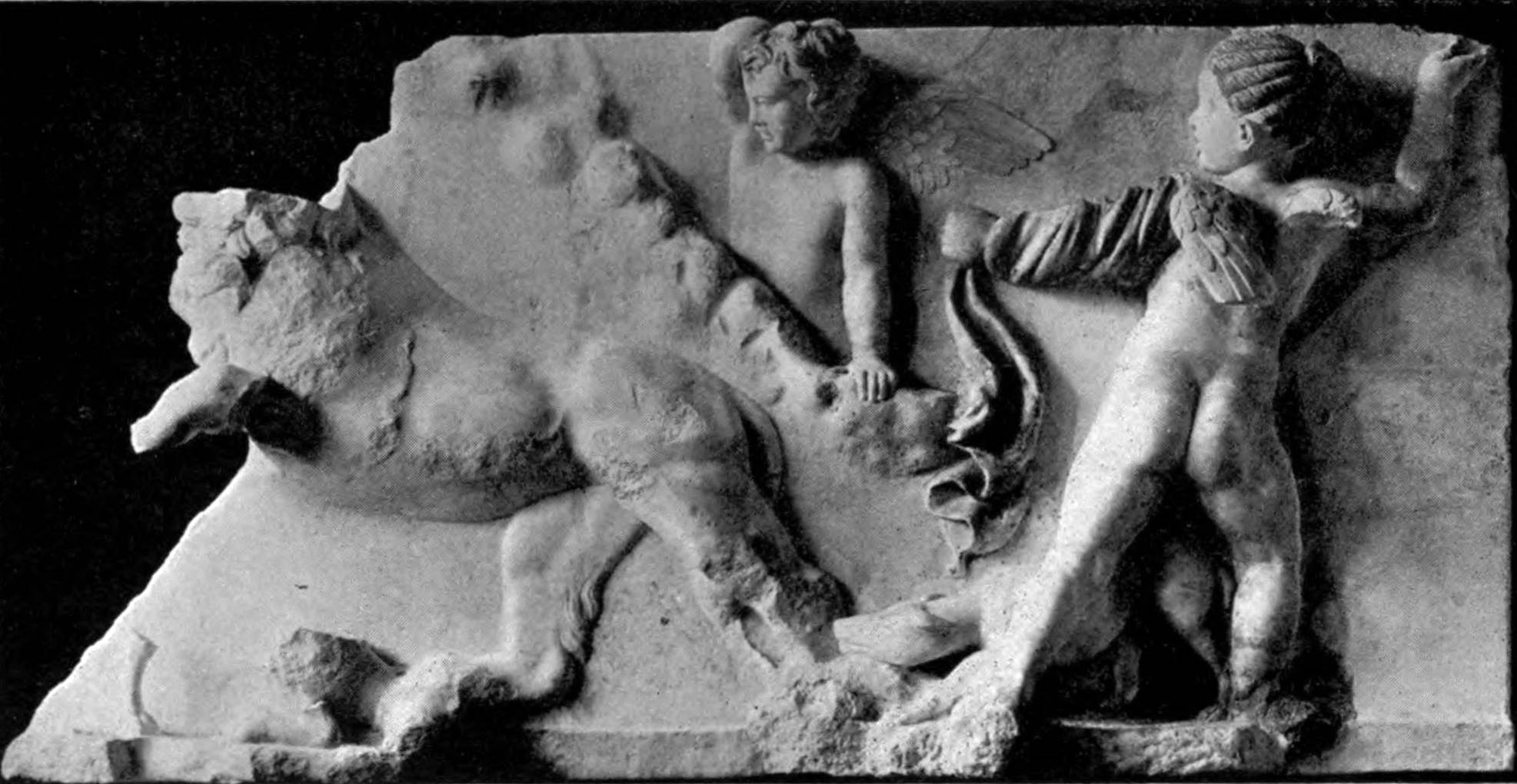
but the putti are interesting as a typical Hellenistic development.
This is the period in which Eros, who has been growing
steadily younger from the youth of Praxiteles to the boy of
Lysippos, turns finally into the chubby Roman Cupid or
Amorino of Renaissance art. As such he helps Aphrodite
in her toilet or performs all manner of tasks in the fine
frieze of Erotes at Ephesos. It is the logical ending of the
transformation of mythology into genre. Alexandrian art
is essentially mundane and frivolous, sceptical and humorous.
Her artists would have appreciated the earlier Pergamene
developments, but they would have laughed at the clumsy
idealism of the great altar frieze. Nor would they have felt
much sympathy with the athletic art of Rhodes.
We may perhaps consider here the little we know of the
art of Antioch, since it has certain points in common with
that of Alexandria. The chief monument used in all discussion
of Antiochene art is the statue of Antioch59 on the
Orontes, made by Eutychides, a pupil of Lysippos. A small
copy of this in the Vatican shows us a fine seated figure
crowned with the turreted crown, who rests her foot on
a little male figure with outstretched arms representing the
stream of the Orontes. Unfortunately the copy is too small
to give us much information about the artist, though he seems
to have used the same idea for another statue of the Eurotas.
We have, however, a figure of Aphrodite from Egypt (Fig. 25),
which shows a supporting Triton in an attitude indubitably
connected with the figure of the Orontes. This is an
Egyptian work, but it argues some artistic connexion between
Alexandria and the Seleucid capital. Another link is given
us by the statement60 that the Apollo at Daphne near Antioch
was made by Bryaxis, the author of the Alexandrian Sarapis.
Antioch, though like Alexandria in many respects—in
her turbulent population, her cosmopolitanism, her irreverence
for all authority—seems never to have developed the
cultured love of literature and the arts which we find at
Pergamon and on the Nile. She remained in all probability
a collector and not an originator of art. The glimpses which
we can get of her statues indicate a catholic taste. The
Apollo seated on the Omphalos, which decorates the Seleucid
coins, resembles the Lysippic type, and a Herakles type,
also found on Syrian coins and reproduced in the bronze
colossus of the Conservatori, has some connexion with the
later Sikyonian school. By the side of these we must place
the Apollo of Bryaxis.
Ephesos, a strong place more or less at the meeting-point
of three empires, has left us considerable remains of Hellenistic
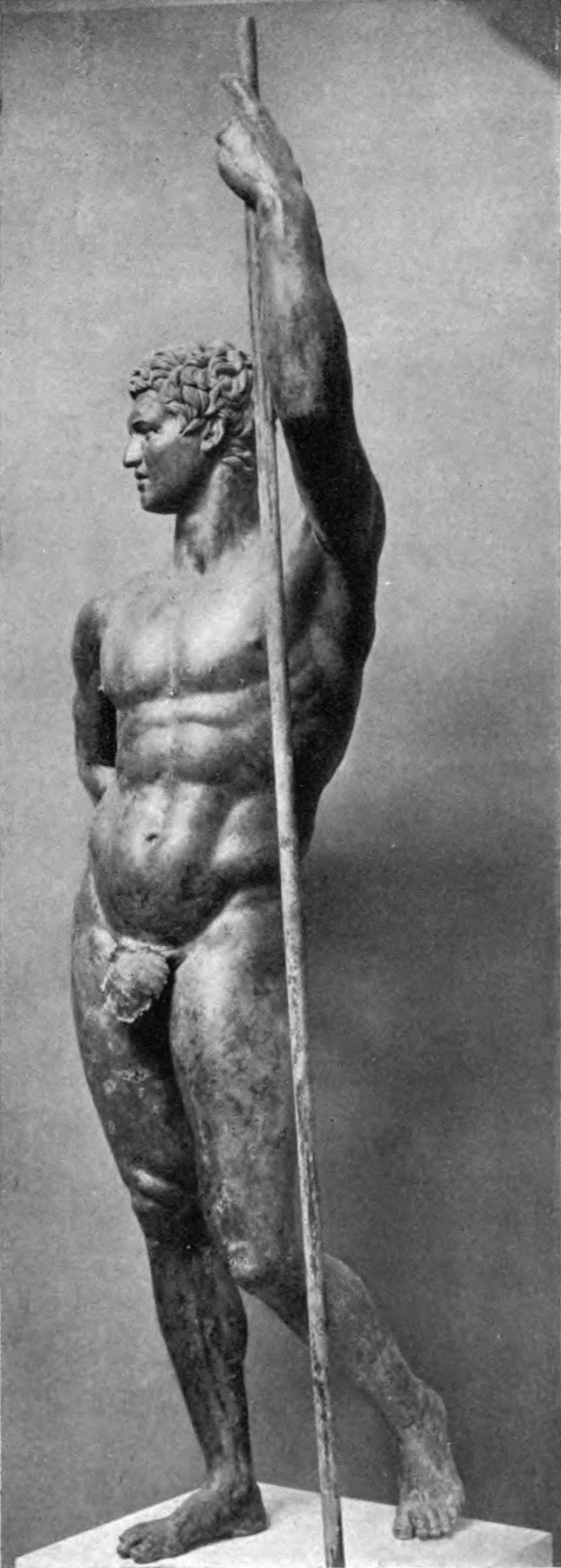
art. Her bronze athlete at Vienna (Fig. 26) belongs
to a later development of the Scopaic school; her frieze
of Erotes61 is more in the Alexandrian manner. Some
beautiful bronzes, in particular a Herakles attacking a centaur,62
are in the mixed Lysippo-Scopaic manner. There
are also traces of Praxitelean influence in her art.
These cosmopolitan collecting centres cannot tell us much
of the methods of Hellenistic art. Our best resource is to
examine more closely the works of certified origin. Ephesos
is, however, important for its school of copyists. The
marble copies of the Attalid dedications were perhaps made
here, and Agasias, the author of the Borghese Fighter,63 was
an Ephesian by birth, although a Rhodian by education.
25
26
III THE RHODIAN SCHOOL
The school of Rhodes stands on a different footing
from that of Pergamon or Alexandria. The latter
were new foundations, or at least new societies, in
which the Greek element was associated with much that was
alien and exotic. The orgiastic wildness of Phrygia went far
to influence the art of Pergamon, whether in its earlier sensuality
or its later pageantry of exaggerated triumph. In
Alexandria and in Antioch non-Greek races imported into
Hellenic art the cynicism and the world-weariness of older
and exhausted civilizations. But Rhodes was pure Greek and
a living, growing, prosperous community without recollections
of humiliation and defeat. Rhodes as a city had been born
of the union of Lindos, Kameiros, and Ialysos at the end of
the fifth century. The fourth century brought slow growth,
but the successful defence against Demetrios Poliorcetes in
its last decade opened a new chapter in Rhodian history.
Henceforward Rhodes was mistress of an empire. She
acquired possessions on the mainland; her fleet rode and
controlled her neighbouring seas; her trade stretched out
tentacles in all directions; and among the semi-barbarous
Hellenistic kingdoms she alone carried proudly the torch
of undefiled Hellenic tradition. Chares of Lindos, a pupil
of Lysippos, headed the long roll of her sculptors; her
painter, Protogenes, had but one rival in the Sikyonian
Apelles. Thus from the first she boasted great artists,
closely connected too with the school of Sikyon. Her Dorian
sympathies naturally isolated her from the Attic school and
from the mixed Praxitelean-Scopaic school of the Ionian
mainland. Her Peloponnesian and Sikyonian connexions
identified her at once with athletic art and with the school of
Lysippos. Thus while Alexandria and Pergamon patronized
marble sculpture, Rhodes now becomes the home of bronze
casting. Her vast Colossus was matched by at least one
hundred more statues of remarkable size, and the roll of her
artists as recorded in inscriptions is noteworthy for its length.
The great siege gave that impulse of idealism which is
necessary for the growth of any artistic development, and
the traditional friendship with the rising power of Rome
helped her to preserve her prosperity and independence
later than any of her neighbours. The last great work of
Rhodian art, the Laocoon, is almost as late as the Empire,
and the whole period of two hundred and fifty years between
it and the Colossus is marked by an immense output of
sculpture.
We have already suggested that the Hellenistic art of
Rhodes began under the dominant influence of the athletic
school of Lysippos. We must first examine the character
and achievements of this school. Daippos, Boedas, and
Euthykrates are said to have been sons and pupils of the great
Sikyonian. Of these Euthykrates was the best known, and
Pliny tells us that he followed his father’s carefulness
rather than his elegance, and that his style was more severe
than genial (‘constantiam potius imitatus patris quam elegantiam
austero maluit genere quam iucundo placere’).64 His
works were mainly athletic or equestrian, with a few female
subjects, and his pupil Tisicrates was a faithful copyist of
the style of Lysippos, so much so, in fact, that his works
could hardly be distinguished from the master’s. Daippos
made a perixyomenos or athlete scraping himself,65 and Boedas
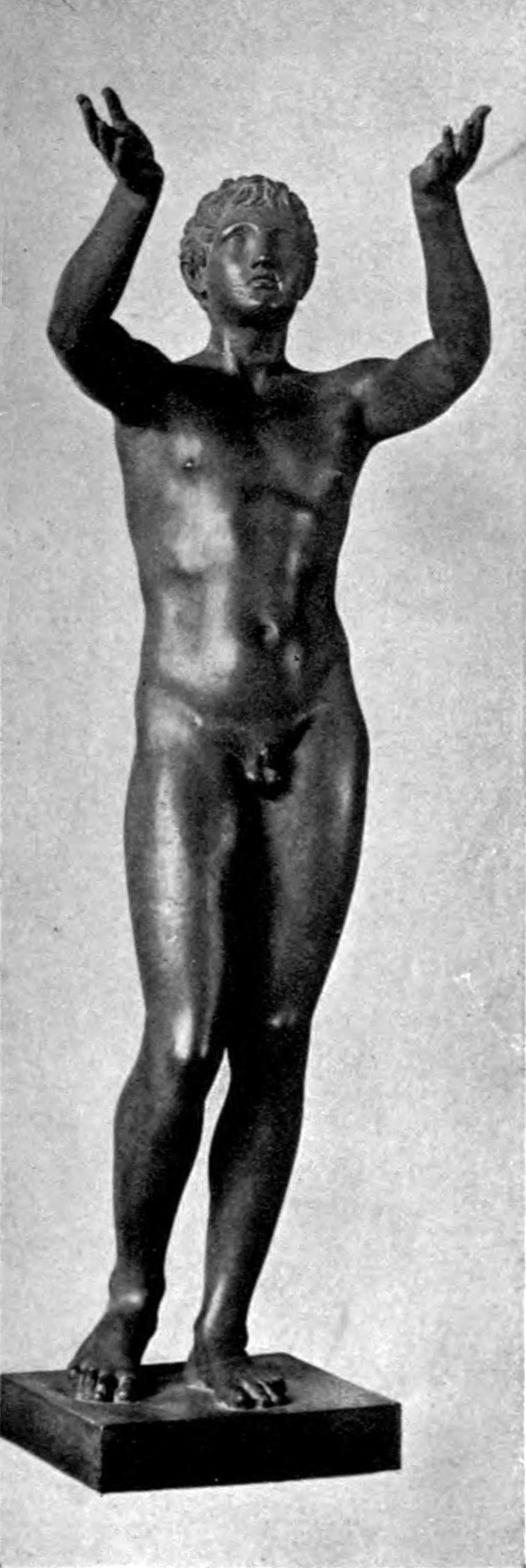
made an adorans or praying figure.66
Pliny’s description is important, because it assures us of
the faithfulness with which the pupils of Lysippos kept to
their master’s style. This is the basis for the argument of
those who see in the Apoxyomenos of the Vatican a work
of the pupil Daippos rather than the master; but the argument
is two-edged, if Lysippos’ own style is to be found in
the Agias, since the two statues have little in common. The
mention of the adorans enables us to connect two well-known
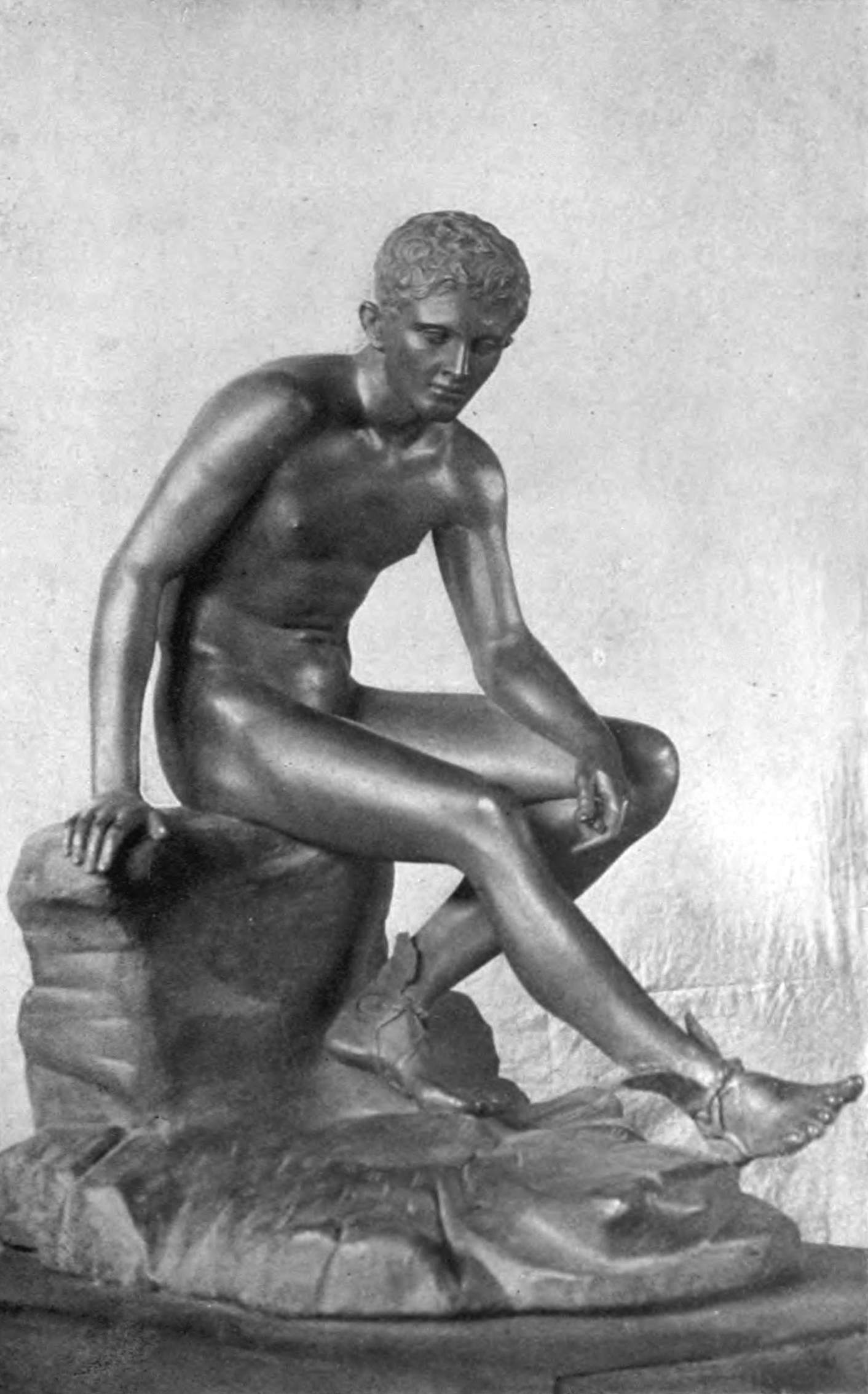
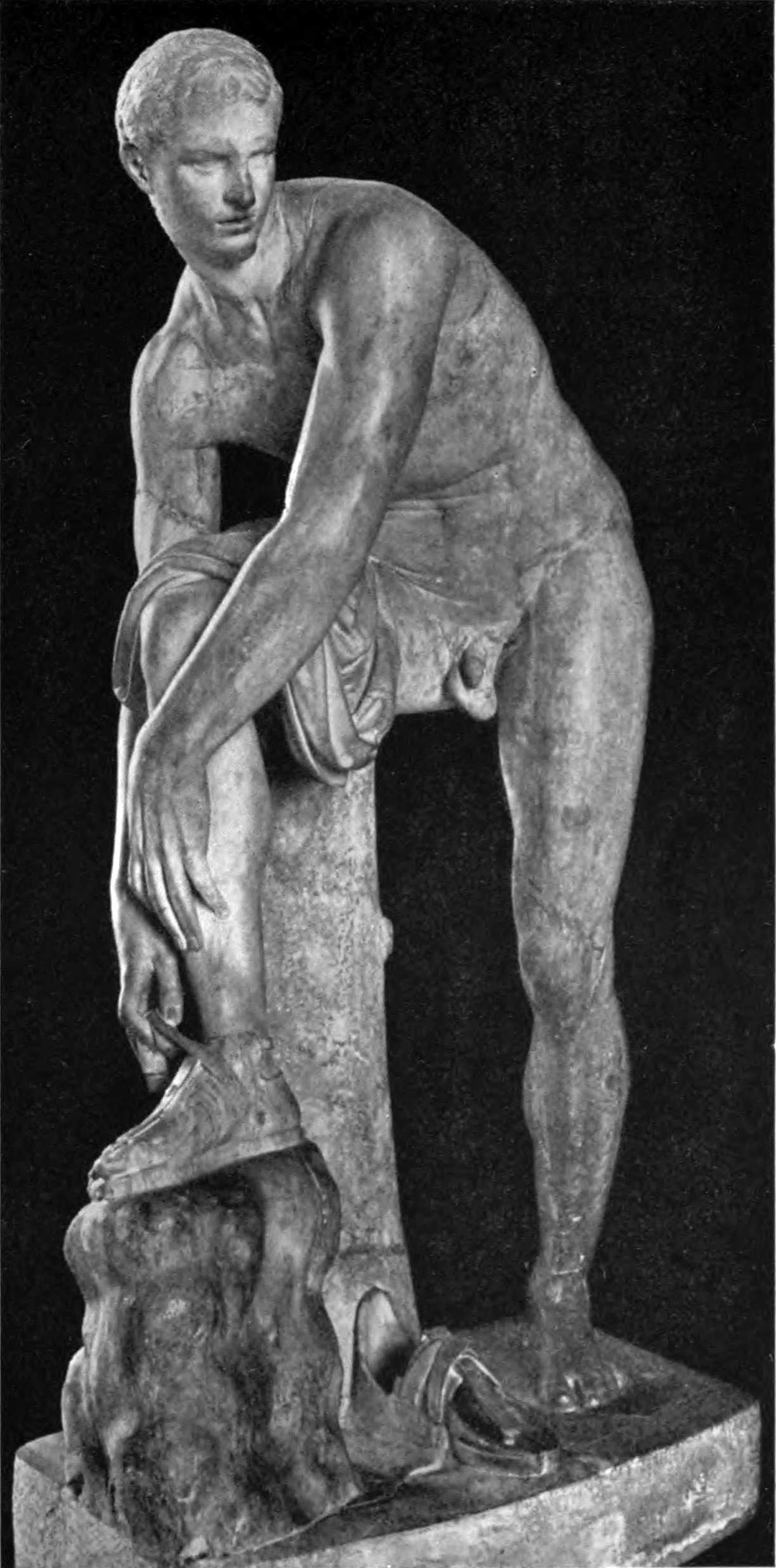
bronzes with this school—the Praying Boy of Berlin
(Fig. 27) and the Resting Hermes of Naples (Fig. 28). The
Praying Boy is a subject unparalleled elsewhere, and belongs
to the early Hellenistic age. He can hardly be other than
a copy of the statue of Boedas. The slender proportions and
small head follow the Lysippic canon, and the easy swing
of the body proves its chronological position. This figure
and the others, which we shall subsequently notice, show
a new growth of naturalism by less insistence on the outlines
of the torso muscles. The average body in repose does not
show the massive muscles of Pheidian or even of Lysippic
art, and the post-Lysippic sculptors of the third century
tend to soften and naturalize the torso to a considerable
extent. The Pergamene Dying Gaul is a good example
of this fine restraint, which was utterly abandoned by the
later Pergamene school and even by the late Rhodians, but
which in all third-century art of Rhodes is noteworthy. The
Resting Hermes is a fine copy of a post-Lysippic original,
which stood in close connexion with the Praying Boy. The
torso, slender, restrained, and full of vitality, shows the
same treatment, and must belong to the Lysippic school.
27
28
Eutychides of Sikyon, another pupil of Lysippos, is
known to us only from his Antioch.67 This figure, even in
its poor copy, is of great importance, since it is almost the
only certified draped female figure of the Lysippic school.
Our whole theory of Lysippic and early Rhodian drapery
must, therefore, rest upon it. A comparison with the
Herculaneum figure68 in Dresden will show at once a considerable
resemblance in treatment, so much so, in fact, that
it has caused the attribution of the Dresden figure to the
Lysippic school. This cannot be allowed because of the
greater resemblance to Attic grave-reliefs and the Mantinean
basis, which demonstrates the origin of the type in the school
of Praxiteles.69 But it is sufficient to show that the new
scheme of the school of Praxiteles was adopted in the main
by the pupils of Lysippos; their faithfulness to their teacher
will incline us to the belief that Lysippos used it also. This
type of drapery shows a tendency to an artificially effective
or artistic arrangement rather than to complete simplicity of
naturalism like the drapery of Praxiteles himself, but it is
important to notice that it does not become purely artificial
or stereotyped till much later, and that all the early examples
preserve a considerable share of freer naturalism. The
characteristic of the drapery is an opposition of folds in many
differing directions, so as to counteract the uniformity of
the older Pheidian type. The folds themselves are quite
natural; it is only in their arrangement that we find the
element of art.
The Antioch permits us to assume the tall figure swathed
in a long thin cloak as the female type of the Lysippic school,
and therefore of the early Rhodian school, while the Praying
Boy and the Resting Hermes give us the male type. The
close connexion postulated rests on the fact that Chares
of Lindos, the author of Rhodes’ most famous statue, the
great Colossus, was himself a member of the Sikyonian
school and a pupil of the master. But the Colossus itself
is unknown to us in any certain copy, and therefore we cannot
speak with full knowledge of his art. Some statuettes in
bronze in marked Lysippic style may well reproduce the
statue, but we cannot feel the necessary certainty in their
identification.
There is a group of athletic statues of the third century
which carry out the Lysippic tradition to its logical conclusion,
and which consequently we are practically bound to
attribute to Rhodian artists. But until we have a definite
copy of Chares’ work we must argue backwards to the first
Rhodian school, of which we have no direct information,
from the later Rhodian school, of which we know a great
deal. The Laocoon70 and the Farnese Bull71 are certified
works of Rhodian art of the first century B.C., and they show
us a type of male figure which is quite distinct from the
types of Pergamene and Alexandrian art. We are, therefore,
entitled to argue back to the Rhodian school of the third
century, and to attribute to it such athletic sculpture as is
clearly of the earlier date while offering distinct technical
and stylistic resemblances to the later groups. The male
figures of this later period differ from the Pergamene
works, with which they are most easily compared, in certain
well-defined points. The heads are smaller and rounder
and the hair is rougher and less carefully arranged. The
eyebrows have a tendency to form sharp angles with the nose
instead of the broad straight curves of the Pergamene brows.
This makes the bridge of the nose thinner and usually
substitutes vertical forehead wrinkles for the swelling frontal
sinus of Pergamene work. Except in cases of great strain
the torso muscles are treated with more restraint, but the
veins receive more careful attention, especially on the
abdomen. In the back a more broken-up system of muscles
replaces the great upright rolls on either side of the backbone,
which mark Pergamene work. Finally, the proportions are
slighter and more Lysippic.
These considerations apply most powerfully to two great
statues of the Louvre, whose third-century date is almost
certain: the Borghese Warrior72 and the Jason (Fig. 30).
The former statue is by Agasias of Ephesos, an artist whom
we can date with some degree of certainty in the middle of
the third century. The Jason comes so close to the Lysippic
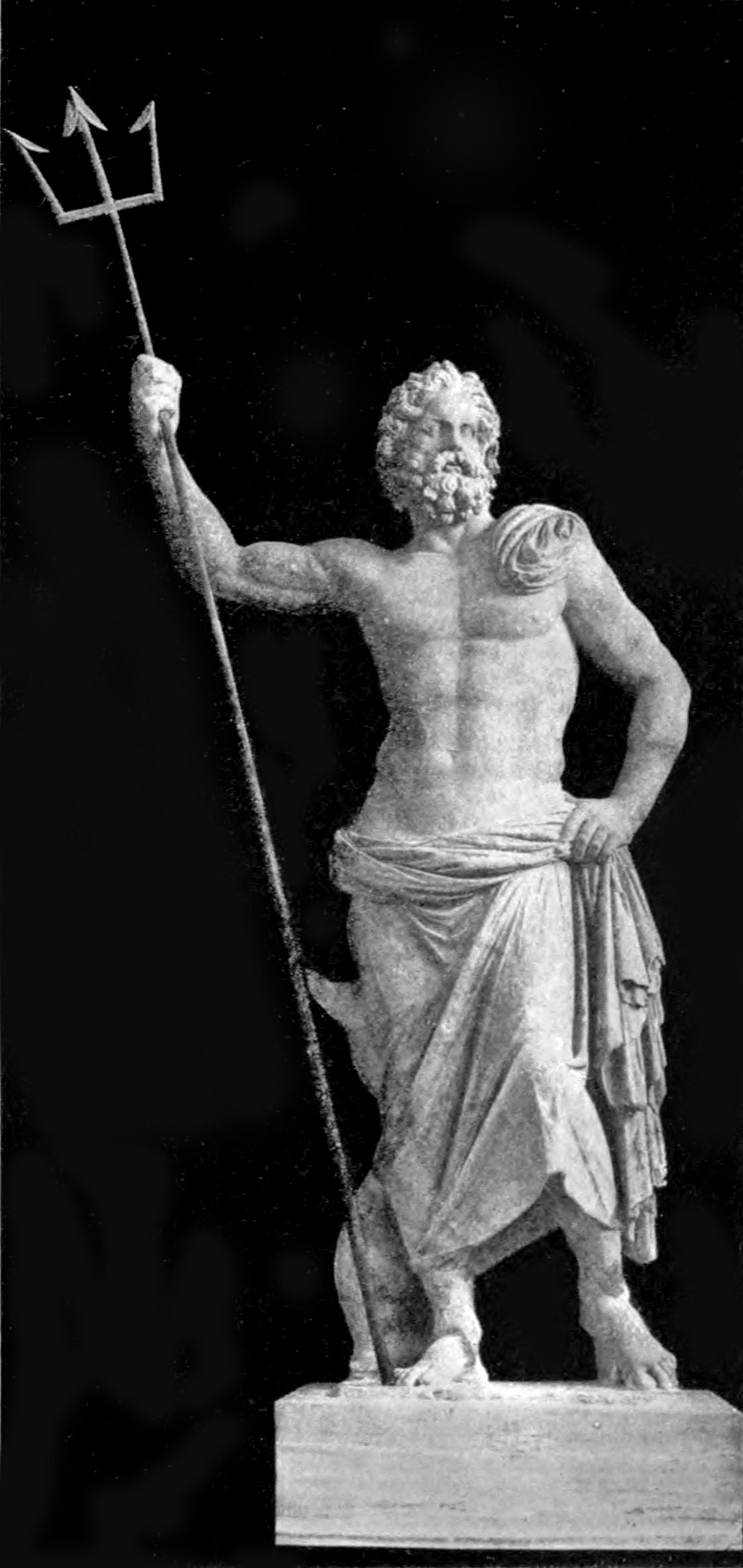
type of Poseidon on the one hand and to the Fighter of
Agasias on the other, that the Lysippic-Rhodian origin of
the two is fairly well established. The analogies of the
Borghese Warrior with the Apoxyomenos have been often
pointed out, but his resemblances to the Laocoon and the
Farnese groups require an equal recognition. Both the Louvre
statues show the influence of a later generation on the
Lysippic type. While reproducing the general proportions,
each develops Lysippic innovations to a further degree.
Lysippos made a distinct advance in anatomical skill, but
both these statues show a more exact scientific knowledge.
While their torso muscles are less prominent, they reveal
new details in abdomen, groin, and the inner side of the
thighs, unknown to the earlier sculptor. They also develop
much further the Lysippic substitution of an all-round
figure for a merely frontal one. Each of them can be regarded
effectively from any point of view, and neither has any real
front. They, therefore, represent a distinct technical advance.
But at the same time they show a decline in artistic feeling,
for there is perhaps too much science about them. They
belong to a school immensely interested in detail, and tending,
therefore, to lose its grasp on the general treatment. The
anatomical structure of the male form cannot be rendered
more perfectly than in the statue of Agasias, so well known
to all art students, but the statue affects us with a feeling
of strain and discomfort from its want of unity and repose.
All the athletic statues of the Rhodian school seem to be
restless and unsatisfied. There is none of the calm repose
about them that marked earlier Greek art. The desire to
display newly acquired scientific knowledge invariably demands
a strained and therefore disquieting motive. As we
shall see when we come to examine the Laocoon later, the
influence of the stage appears to be affecting sculpture.
Poses are histrionic, and expression begins to depend upon
grimaces and action rather than upon more subtle indications
of feeling.
With the Borghese Fighter and the Jason we may class,
perhaps, a work like the Actaeon torso in the Louvre,73 and
also that much discussed and very beautiful work, the
Subiaco Youth.74 This shows the same restraint in torso
modelling which distinguished the Praying Boy and the
Resting Hermes, but in the strain of its attitude it resembles
rather the Fighter of Agasias, especially in the twist of the
body above the waist, which Lysippos had originated and
which his pupils tend to exaggerate. One of the disquieting
features of the Borghese Fighter is that he implies the presence
of another figure which is not there. He is a fighter without
an opponent. The Subiaco Boy is in the same plight. His
attitude can hardly be other than that of a suppliant touching
chin and knee of his enemy in Greek fashion. His artistic
defect is that he again is a suppliant without an enemy, part
of a group without his counterpart. In their anxiety to study
the human figure in all positions the Rhodian artists were
apt to overlook the question of artistic unity.
29
30
Two fine bronzes in the Terme Museum may be attributed
with some certainty to Rhodian artists, in view of
the Rhodian monopoly of Hellenistic bronze casting. Both
are Greek originals—the seated boxer75 and the hero resting
on a lance (Fig. 29). The latter is commonly called a portrait
of some Hellenistic prince, but the absence of the royal
tiara or any personal indications is significant rather of a
heroic type. The face is strongly individual, but so is that
of the Boxer, the Fighter of Agasias, and even the Jason.
We have no reason to see a portrait in any of them, but
personality is beginning to affect even ideal statues in the
Hellenistic age. The hero with the lance is a fine, if rather
histrionic, figure more or less following the Lysippic type of
Alexander with the lance76 and showing a somewhat massive
and emphatic rendering of a Lysippic type. He belongs to
the later Rhodian school, into which exaggeration has crept,
rather than to the more restrained art of the third century.
The Boxer, on the other hand, brutal and coarse as his
expression is, has no trace of muscular exaggeration, and is
an earlier work. His broken nose, swollen ears, scarred face,
and blood-bespattered hair show the unsparing realism of
the artist. He is another instance of the all-round statue
of the late Lysippic school, a masterpiece of technique, if
a somewhat disagreeable work of art.
We can connect the names and the works of few of the
earlier Rhodian artists, but Boethos of Chalcedon is now
established as a worker in Rhodes,77 where he received the
honour of προξενία. Pliny mentions his Boy Strangling
a Goose,78 and the many copies of this statue in existence
give us a good idea of its popularity. Boethos was apparently
a silversmith and also a sculptor of boys. He was famous as
a maker of elaborate couches, and we are possibly the
possessors of such a couch in the fine bronze litter of the
Conservatori Museum,79 on which are little boys’ heads
strikingly similar to the Boy with the Goose. This group
is often quoted as an example of the new feeling for genre
or homely domestic detail in sculpture. It is, in fact, of great
importance for its new recognition of the comic in art, and
for the appearance of the fat chubby boy like the Erotes of
Ephesos or the little statuettes of Alexandria. The small
boy or girl now becomes a favourite subject of the sculptor,
and we may compare closely with the Boy of Boethos the
Eros and Psyche of the Capitol (Fig. 32), who are really
a little boy and girl engaged in a children’s game.
We must now turn to another very important side of
Rhodian art—the delineation of female drapery. The
followers of Lysippos favoured an austere style, and the
nude female figure has no place in Rhodian art. But while
the other sculptors of the Hellenistic world were modifying
and to some extent vulgarizing the beautiful conceptions
of Scopas and Praxiteles, the Rhodians were attacking the
draped female figure as they inherited it from Praxiteles
and Lysippos, and producing modifications just as interesting
and important as those connected with the athletic statue.
31
32
33
We know that Philiskos of Rhodes was the author of
a group of Muses which was much admired in Rome. It
has been suggested that the new type of female drapery
which appears on an altar from Halicarnassos and on the
relief of the Apotheosis of Homer by Archelaos of Priene,
certainly a member of the Rhodian school, was his work.80
This new type of drapery is to be seen also in a number of
statues of Muses, of which we have a collection from Miletos
in the museum of Constantinople.81 It may be described
most simply as an aggravation and exaggeration of the style
of drapery introduced by the school of Praxiteles. The
desire to get a series of folds at sharply contrasting angles
leads to a very artificial arrangement of the dress, which
produces an inharmonious effect. But there is a new development
which deserves our attention. Transparent drapery
had been elaborated by Alkamenes and the pupils of Pheidias,
but always with the intention of displaying the body beneath
it. The new drapery of the Muses is transparent with the
desire to display other drapery beneath it. The earlier
Greeks had used a thick mantle over a transparent chiton,
but the Rhodian author of the new drapery used a transparent
mantle over a clinging chiton. He thus doubles the subtlety
of his technique, and provides himself with a series of new
and intricate problems, just as the athletic sculptor does with
his anatomical discoveries.
This transparent mantle immediately obtained an immense
vogue, and it comes down into Roman art as a strong rival
of the late Praxitelean drapery, which, however, still prevails
by the side of the other. The greater number of Roman
female draped statues use one or the other type of garments.
The Milesian Muses are not in themselves great works of
art. The real technical possibilities of the new drapery are
better displayed by a wonderful figure from Magnesia in
Constantinople (Fig. 31), in which the new fashion is rendered
with consummate skill. It is of considerable importance
that we should date this change in drapery as accurately as
possible. The date hitherto proposed for its supposed
author Philiskos has been put about 220 B.C. The Apotheosis
of Homer is taken to be about 210 judging from a portrait
of Ptolemy IV appearing in it, and the Halicarnassos base is
put about the same time. But the portrait is by no means
certainly that of Ptolemy IV. It is more like Ptolemy II,
and might belong to any period. Philiskos himself has
nothing to do with it. A female figure by him with a signed
base has been discovered in Thasos (Fig. 33). The drapery
of this female figure follows the type of the Mantinean basis,82
and the earlier Muses group of the Vatican. The inscription
is not earlier than the first century B.C. Philiskos, then, was
a late artist who used the Praxitelean drapery. As for the
transparent drapery, it is highly improbable that it was
invented before the frieze of the great altar at Pergamon. We
know that Rhodian artists worked on this altar, and Rhodian
style is visible in some of the figures, but transparent drapery
of the Rhodian type appears nowhere on the frieze. There
seems to be no reason to date any figure wearing this drapery
earlier than 190 B.C., and we should therefore attribute it
to the second century. We have seen in the Antioch of
Eutychides the Praxitelean type taken over by the earlier
Rhodian artists in the third century. Have we any link
by which we can connect the transparent mantle with the
earlier form?
34
The answer to this question is provided by one of the
greatest statues of antiquity, the Victory of Samothrace
(Fig. 34). The date and school of this masterpiece are still
warmly disputed, and the current view tends to connect
it with the victory of Demetrios Poliorcetes in 306, by which
he won the command of the sea. Coins of Demetrios show
a trumpet-blowing Victory on the prow of a ship in an
attitude closely resembling the Louvre statue. But the
statue has no connexion with the coin, for a detailed study
of the neck and fragments of the right shoulder reveals the
impossibility of the trumpet-blowing attitude. The right
hand and arm are raised high and backwards probably with
a victor’s wreath. Moreover, the coin has a low girdle and
no cloak, the statue the high third-century girdle and a
great flapping mantle. The type is not so rare as might be
expected. We have it in small bronzes, and we have it
also in situ on a votive statue in Rhodes. The Victory of
Samothrace is a later version of the statue possibly erected
by Demetrios. Its Rhodian origin depends partly on the
extraordinary finesse and delicate naturalism of its drapery,
a study never popular in Pergamon, and partly on the strong
probability, not yet decisively proved, that the marble of
its base is Rhodian. The latter point may provide definite
proof, but the former is the one on which we must at present
rely. The Rhodian origin or at least the Lysippic connexions
of the statue are further supported by the twist above the
waist so universal among the followers of that artist and the
strong vital momentary pose, which is wrongly rendered in
the present attitude of the statue. It is not a standing figure,
but a Victory who is just alighting after flight, and it should
therefore be tilted farther forward. The only statue now
existing which presents a real parallel to the intricate folds
of the Victory’s drapery is the Magnesian statue already
mentioned,83 which belongs to the new Rhodian drapery
school. But the mantle of the Victory is older in type.
Thus the Victory’s drapery stands midway between the
Antioch figure and the new Rhodian fashion. It shows just
that scientific naturalism which we have noticed in the
anatomy of the athletic figures, and just that tendency to
miss the perfect whole by an over-anxious care for detail.
The date for such work is 250 and not 300 B.C. The Chiaramonti
Niobid84 is a work of similar tendency though of
a different school, and must fall about the same date.
We now possess some evidence for the continuous study
and development of female drapery at Rhodes parallel to
the study and development of the male form. The Rhodian
school is in fact the most industrious and the most scientific
of all the Hellenistic art centres. In mastery of detail they
are unapproachable, but they have ceased to care much for
motive or idealism in their subjects. To such art both
impressionism and romantic feeling are foreign. Rhodian
art is very versatile and very straightforward, but its constant
aspiration after the unusual renders it in the end monotonous.
The earlier and later periods of Rhodian art are separated
by the quarrel with Rome and consequent loss of the land-empire
in 167 B.C. This ended the real independence of
Rhodes, and with it disappeared the inventive genius of her
artists. She continued for another century to be the great
and almost the sole centre of art production, for both Pergamon
and Alexandria now lost all artistic importance, but
she ceased to develop and originate. The works of her
second period are brilliant in the extreme, but they are no
longer vital and progressive.
It is significant that the best-known works of this period
are great groups rather than single statues. We may notice
the Laocoon group, the Farnese Bull, the ‘Pasquino’ of
Ajax and Patroclos, the Scylla group, and the group of
Odysseus with the Cyclops. Of these the earliest is perhaps
the Farnese Bull,85 which we possess in an Antonine copy
at Naples from the Baths of Caracalla. It represents the
punishment of Dirce by Zethos and Amphion for her cruelty
to their mother Antiope. The two heroes hold the bull, to
whose horns they are about to tie the unfortunate Dirce.
It was made by Apollonios and Tauriskos of Tralles, and
brought from Rhodes to Rome by Asinius Pollio. The date
can be fixed by a comparison of inscriptions to about the
year 130 B.C. Tauriskos’ son has signed a base at Magnesia
about 100 B.C. Both Tauriskos and Apollonios were adopted
by Menecrates, son of Menecrates, one of the artists of the
Pergamon frieze. But in examining the group we must
beware of the Roman additions and restorations, which
include nearly all the landscape details together with the
figure of Antiope and the mountain god. The head of
Zethos is a portrait of Caracalla. The group has been
adapted to act as a centre-piece for the great hall of the Baths
of Caracalla, and consequently has been made square. Even
in its original form, however, it must have been a good example
of all-round sculpture. The figures are Lysippic, and the
lower part of Dirce, which is the only antique part of her,
shows more archaic drapery than usual. This is only what
we might expect from an art which has passed its prime.
Novelty of treatment is no longer a first essential. Tauriskos
also made figures called Hermerotes. These must have
been herm figures with an Eros head similar to a statue in
the courtyard of the Conservatori Museum, and comparable
with the Hermathena, which belonged to Cicero. Herms
of all kinds became very popular in Greco-Roman art, and
we see here in Rhodes perhaps the first development of the
old archaistic Dionysos herms into more modern studies.
Another dramatic group similar to that of the Farnese
Bull and the Laocoon was the lost group by Aristonides of
Rhodes, showing Athamas in remorse for the murder of
his son, Learchos. Pliny tells a foolish tale that the sculptor
mixed iron with the copper in order to portray the blush of
shame, a story told also about the Jocasta of Silanion.
A little figure of Odysseus (Fig. 35) in the Chiaramonti
gallery of the Vatican holding out a bowl of wine to the
Cyclops must be part of another mythological group of this
period. The movement and action of the hero are typically
Rhodian, and his face corresponds to the Rhodian type. The
rest of the group is lost. The group of Scylla and the sailors
of Odysseus is represented only by a much mutilated and
fragmentary copy in Oxford, which gives us little information.
We have more copies of the well-known Pasquino group
of Menelaos or Ajax and Patroclos. There are fragments
in the Vatican, and a well-preserved replica in the Loggia dei
Lanzi in Florence (Fig. 36). Here again the extraordinary
interest in anatomical forms is shown not only in the strain
and twist of the living hero—the invariable twist of all these
Rhodian figures—but in the admirable contrast between
the vivid living body and the relaxed corpse. This contrasting
of physical and mental conditions is a part of the dramatic
feeling in later Rhodian art, which has quite abandoned its
earlier simplicity and has followed on the lines of baroque
extravagance laid down by the second Pergamene school.
35
36
Of all the groups the best known and the most instructive
is the latest of all, the Laocoon.86 In this marvellous group
we see the full development of the effect of strained agony
on the human form, and we see the mature form contrasted
both with an active youth’s body and with the semi-inanimate
body of the younger boy. When we have removed the
restorations and lowered the right arm of Laocoon nearer
to his head, we get a perfect group-design unified by the
terrible serpent-coils and by the central theme of agony.
The torso muscles of Laocoon are fully developed and even
exaggerated, though not to the same extent as those of the
Pergamene frieze, but the boys’ forms are simpler, and all
reflect the basic principles of Rhodian art already enumerated.
Pain is shown by the downward sloping eyebrows with
sharp interior angles, by the half-closed eyes, wrinkled forehead,
and parted lips. The hair is wild, and all the veins
of the body stand out sharply. The twist above the waist
occurs in all three bodies. It is interesting to notice that even
in the Laocoon, the latest work of the most scientific school
of Greek sculpture, anatomical accuracy is still lacking. The
lower curve of the ribs above the abdomen follows a line
impossible in nature, and the left thumb of the elder son is
provided with three joints instead of the normal two. Neither
the Laocoon nor any one of the other Rhodian groups is
perfectly satisfactory to modern taste. There is too much
strain, too much agony, too little relief or repose. Every
inch of the group is illustrative of pain and passion. Our
sense of sympathy is deadened by excessive emphasis and
repetition. But in technical skill the group has never been
surpassed.
A close parallel to the head of the Laocoon is found in
the bearded centaur of the pair made by Aristeas and Papias
of Aphrodisias (Fig. 38). Copies of this statue existing in
the Capitol and in the Louvre show the despair of the elderly
victim of love in the guise of a centaur tormented by a little
Eros on his back. The companion figure (Fig. 37) is young
and delights in the persuasions of his rider. This group
of rather obvious allegory belongs to the Antonine age, but
the resemblance to the Laocoon proves a first-century
original, which is interesting because it is one of the earliest
examples of a corresponding pair of statues clearly designed
for house decoration. The growth of ‘cabinet pieces’, as
opposed to temple or national dedications, now develops
into the whole mass of furniture sculpture in the shape of
candelabra, table-legs, consoles, decorative herms, &c.,
which mark the imperial age.
The school of Rhodes ends in extraordinary brilliance.
There is nothing decadent in its technique, nothing paltry
in its conceptions. We have seen the very pure and slightly
finicky naturalism of the early third century give way to
a rather more baroque extravagance in detail, but in neither
its earlier nor its later stage did the purest of the Hellenistic
schools affect the exaggerations of Alexandria or Pergamon.
In Rhodes, at any rate, the steady development of Greek
sculpture reached its perfect and logical conclusion. We
have seen it start with a great idealism and no technique at
all. In the fifth century technique and idealism are almost
equally balanced. In the Laocoon the last word of technical
perfection is spoken, but there is no idealism at all, only
a man and two boys writhing in the grasp of serpents. It is
not photographic naturalism, but it is histrionic, artificial,
and dead. We cannot believe in the Laocoon as we believe
in the Hermes of Praxiteles.
37
38
IV THE MAINLAND SCHOOLS DURING THE HELLENISTIC AGE
While the full tide of artistic development was
running in the new societies of Pergamon, Rhodes,
and Alexandria, the Greek mainland became a backwater.
The rise of the kingdoms meant the decline of the
old autonomous city states. Athens in particular fell into
the background on account of her uncompromising hostility
to the power of Macedonia. In spite of some brief periods
of revival, her destiny was for the future rarely in her own
hands, and her political subordination seems to have reacted
with great rapidity upon her artistic output. She remained
for another century after the death of Alexander the home of
philosophy, but her art began to revive only after the Roman
conquest, in a new form, which will require later consideration.
Here at least the Hellenistic age is a period of rapid decadence
and decline.
The Peloponnese is in much the same position. The
pupils of Lysippos found their best clients abroad, and left
no successors of importance at home. The political loss of
power was here intensified by a growing poverty. The new
wealth which began to pour into Europe as the result of the
conquest of Asia went either to Macedonia or to those states
which had sent mercenaries to Alexander’s army. The future
prosperity of Greece was in the hands of Arcadia, Achaia,
and Aetolia rather than Argos, Sparta, and Sikyon. The new
states had few artistic traditions, and the old states had no
means of gratifying theirs. The inevitable result was a great
decline in artistic output as well as in artistic skill. Almost
the only sphere left for sculpture was the erection of formal
honorary statues to distinguished or wealthy individuals,
a type of work which does not beget great art.
39
40
41
The first half of the third century was a period of very
good work in portraiture, which is, however, a subject by
itself. The Demosthenes of Polyeuctes is dated about
280 B.C., and the statues of Aeschines, Aristotle, and others
show the existence of an admirable school of portrait sculptors
at this time in Athens. But ideal sculpture shows a sad falling-off.
The Themis of Chairestratos (Fig. 40) belongs approximately
to this period, and it is marked by a great formality,
not only in pose but in the treatment of hair and drapery.
The classical period of sculpture in Athens was followed
by what we must call an academic period. The foreign
schools were developing on lines of naturalism, but at home
sculptors tended merely to formalize the work of the fourth-century
masters, and to produce statues of mechanical
correctness without any vitality at all. We have seen the
beginning of this tendency in the drapery system of the
followers of Praxiteles. It now affects the whole of Attic
sculpture. Old types are adopted again and again, until
they become purely mechanical. Drapery styles are similarly
used up, and the increasing formality of every department
stifles entirely the possibilities of originality. The Hermes
of Andros (Fig. 39) is a good example of this kind of crystallization
of types. The statue was found in connexion with
a tomb, and it is clearly a memorial statue. Its companion
was a female figure reproducing exactly the pose and drapery
of the draped female figure from Herculaneum at Dresden.
The date would seem to be late third century. The Hermes
itself is a replica of a type known in the Antinous of the
Belvedere and other statues, and is a product of the Praxitelean
school, like the Dresden figure. But the influence of
Praxiteles is not alone in it. We have a clear use of Lysippic
proportions and some Lysippic influence in the head. This
eclecticism is an invariable mark of archaistic art. The
sculptor, who has no new message of his own to deliver,
looks back to antiquity for his types, but does not imitate
one statue directly. The only form of originality which he
is able to use is originality of combination and selection.
Consequently he absorbs details from several artists and
produces work which we label Lysippo-Scopaic, or Lysippo-Praxitelean,
&c. We have seen how the late fourth-century
artists in Asia Minor combined characteristics of Scopas
and Praxiteles. The late fourth-century and third-century
Attic artists made use of all their predecessors, and produced
statues in which we can detect the disiecta membra of half a
dozen styles. At the same time we may recognize the general
predominance of Praxitelean tradition over that of the other
artists and a universal predilection for marble instead of bronze.
One of the most interesting Hellenistic works of the Attic
school is the bronze figure from Anticythera,87 which is still
the subject of much dispute. It is a typical piece of eclecticism.
The pose and twist of the shoulder and upper part of the
torso are Lysippic, while the head is a mixture of Praxiteles
and Scopas. The result, as might be expected, is somewhat
inharmonious. In shape and profile the head is mainly
Praxitelean, and therefore on its discovery it was acclaimed
as a Praxitelean original. But looking from the front we at
once see the resemblance to the Scopaic Meleager type,88
with its broad head, slight chin, and fringe of short upright
locks like little flames. The head, and indeed the whole
statue, is not unlike the bronze athlete of Ephesos,89 which
has the same hair and facial type, together with a similar
rather heavy Lysippic body. This heaviness of the torso
in both statues shows that the Lysippic ideal is not followed
directly, but rather the Attic version of it as used in the Agias
of Delphi.90
Another Attico-Lysippic figure is preserved for us in
a number of replicas, of which the two best known are the
Hermes from Atalanta in Athens (Fig. 41) and the Hermes
Richelieu in the Louvre. Here again Lysippic proportions
are combined with a rather heavier Attic torso in a whole
which lacks something of harmony and repose. The work
has been referred back to a Lysippic original, but it seems
more likely that it is an Attic adaptation of the eclectic
school now springing into existence. The Attic grave reliefs
give us good information about Attic art down to the end of
the fourth century, but Demetrios of Phaleron prohibited
them for sumptuary reasons in 309 B.C., and in future we
have no such good guide to Attic art. Eclecticism is, however,
pretty clear in the later examples which we do possess.
The votive reliefs from the Asklepieion throw some light
on the third century, but they are not on a sufficiently large
scale to be very instructive.
42
In Greece at all times professions tended to run in one
family, and we have already seen examples of families of
sculptors, such as that of Praxiteles, in which the craft was
handed down from father to son for generations. The
Hellenistic age is full of evidence for this phenomenon in
Athens and elsewhere. Rhodes in particular gives us detailed
families of sculptors, since we are better provided with
inscriptions in Rhodes than in other centres. In Hellenistic
Athens two such families are worthy of notice. Polykles,
whom we may call Polykles I, had two sons, Timokles and
Timarchides I; the latter had two sons, Polykles II and
Dionysios; and Polykles II had a son, Timarchides II.
These are known to us from literature or from inscriptions,
and they cover more or less the second century B.C. It is
a question to which member of the house we are to ascribe
the very famous bronze Hermaphrodite mentioned by
Pliny,91 or whether it should be referred to an earlier artist
of the same name in the fourth century.92 A further question
is involved in the identification of the Hermaphrodite, since
it is commonly assumed that the Sleeping Hermaphrodite
(Fig. 42), far the most famous type now extant in numerous
copies, must have had a marble and not a bronze original.
The statue of Polykles is identified with the Berlin Hermaphrodite93
by those who would give him a fourth-century
date; with a bronze in Epinal94 by those who associate him
with Hellenistic art. The Berlin Hermaphrodite is of
Praxitelean type; the Epinal bronze resembles rather what
we have called the Pergamene type of the Turning Satyr
and the Aphrodite Kallipygos. The question is a difficult
one, but we may safely exclude Polykles II. Timarchides I,
his father, and Dionysios, his brother, worked on statues
of a marked academic tendency. The C. Ofellius of Delos
was the work of his brother, a statue of purely mechanical
taste. This Polykles is not likely to have originated a great
and famous statue. Polykles I worked as early as 200,
a much better period for original work. He is a more likely
candidate for the authorship of the type, if we suppose it
to have resembled either the Epinal bronze or the Sleeping
Hermaphrodite. On a priori grounds of its great popularity
one would distinctly prefer to connect the latter with the
statue mentioned by Pliny. It is true that it looks like a
marble statue and not a bronze one, but a marble replica
which served as the prototype for marble copies is by no means
an impossible suggestion. But this Sleeping Hermaphrodite
is a work of distinctly Pergamene tendency, intended
to bring out the artist’s skill in the rendering of soft sensual
forms. It would seem to belong to an earlier date than
200 or even 250. The Epinal bronze implies a similar date,
and therefore we are left with a double difficulty. The
best Polykles for our purpose seems to be fifty years too
late for either of the types we require. We are, therefore,
driven to suppose an intermediate Polykles about 270 B.C.
In any case we must infer a reaction of Pergamene influence
on the academic art of third-century Athens, but it was
a solitary example which seems to have left no heritage to
later artists.
43
44
The sculptor family best known to us from inscriptions is
that of Eucheir and Euboulides. We know of at least two
representatives of each name, Eucheir I about 220, Euboulides I
about 190, Eucheir II about 160, and Euboulides II
thirty years later. The first Euboulides made a statue of
Chrysophis, the second Eucheir athletes and warriors, and
a marble Hermes at Pheneos. The second Euboulides is
more important, for he was the author of a great monument
outside the Dipylon Gate, considerable fragments of which
have been recovered.
These fragments are our main evidence for the art of
Athens in the second half of the second century B.C., and
they show us that the academic art of the second half of the
third century has followed out its natural development.
The figures of Victory (Fig. 43) and Athena (Fig. 44), which
have partially survived, are grandiose without being noble
or effective. There is a distinct attempt to absorb some of
the exaggerated idealism of the second Pergamene school;
there is also an effort to recover some of the simplicity and
grandeur of Pheidias; but the result is a staid and rather
mechanical classicism, which is made only a little more
obvious by the larger size of the figures. The Athena head,
with its straightforward gaze, archaistic hair, large, wide-open
eyes, and round, heavy chin is distinctly Pheidian; the
Victory in rapid movement with head turned to the side is
more affected by Pergamene art. Her drapery shows a curious
combination of naturalism and formalism in the folds at
the girdle; each individual set of folds is well studied from
nature; but the repetition of a similar set right round the
body is purely mechanical. The group is a good example of
the limitations of the Attic artist at the end of his development.
The next century sees a totally different activity.
In the Peloponnese we have a great gap after the pupils
of Lysippos, a gap devoid of any evidence either literary
or monumental. During the whole of the third century it
would be difficult to point to any Peloponnesian art on a scale
deserving of attention. But the second century opens with
a name of some importance, Damophon of Messene. We
are in the rare and fortunate position of possessing undoubted
originals from his hand in the great group of Lycosura. These
are practically our sole monumental evidence for the Hellenistic
art of the Peloponnese.95 The date of Damophon is
now established by inscriptions for the first half of the second
century B.C., and a number of his works are more or less
attested by coin-types. He had a considerable vogue in the
last generation before the Roman conquest, and his leading
position is evidenced by the commission he received to
restore the Olympian Zeus. It may have been his hand which
touched up and restored the corner figures of the west
pediment of the temple.
The great group of Lycosura represented Demeter and
Kore enthroned between standing figures of Artemis and
a Titan Anytos. It survives in three heads and numerous
fragments of limbs and drapery, and its conjectural restoration
has been recently undertaken (Fig. 45). The discovery
of a coin representing the group on its reverse goes far to
justify the proposed design.96
45
The group is interesting from many points of view, but
mainly from the flood of light which it throws on the methods
of Peloponnesian sculpture at the very close of its development.
It thus forms a complementary picture to the remains
of the monument of Euboulides in Athens. Damophon,
like Euboulides, underwent the influence of Pergamon. The
colossal scale of his group and the wild hair of his giant
Anytos (Fig. 46) demonstrate the influence of the altar
frieze. Damophon also went back to Pheidias for inspiration.
He must have absorbed many lessons from his work at
Olympia. The seated group of his goddesses is reminiscent
of the two figures next to ‘Theseus’ in the west pediment of
the Parthenon. The simple wide-eyed grave expression of his
Demeter head goes back to the fifth-century ideal, while
his Artemis (Fig. 47) wears the melon-coiffure associated
with the school of Praxiteles. The attitudes of Artemis
and Anytos are Lysippic. Here we have every evidence
of academic eclecticism. The same feature is borne out by
three coins which reproduce the statues of Damophon. His
Asklepios at Aigion gives us a fourth-century type. He
copied the Laphria of Patras for Messene. His Herakles
in the guise of an Idaean Dactyl at Megalopolis seems to
have been a variant of the now fashionable herm figures
and to copy a Hermerakles type known by numerous extant
examples.
Damophon’s style then was academic and eclectic,
borrowing from all sources of inspiration and in general
using up over again well-known groups and poses. His
execution is even more interesting for its extraordinary
inequality. His heads are on the whole very good. The
Demeter is a dull piece of work, but both the Anytos and the
Artemis show some fancy and some power of original
expression. The girl is demure and cheerful, the giant
benevolent and rather sly. But when we come to examine
the execution of the fragments of the bodies and limbs
which survive at Lycosura, we find a very hasty and poor
technical ability. The arms and legs are nearly shapeless.
They are colossal, but practically formal in design, and details
of muscles and sinews are almost entirely omitted. The
drapery makes some effort to follow Pheidian designs, but
it is poorly carved and without effect. Only in one direction
does the artist show any skill, and that is in the great
embroidered veil (Fig. 48) worn by Despoina. This is an
extraordinary tour de force, not for its sculptural effect,
which is purely formal, but for the reproduction of a complicated
embroidered design in very low relief. A border of
tassels with bands of design about it and large embroidered
figures of Victory above the bands is rendered with consummate
art. We have a frieze of sea-monsters, nymphs, and
Erotes according to a common Hellenistic design, a curious
local dance of beast figures in human dress, a dance paralleled
by some small terra-cotta figures found in the same shrine,
and the larger figures of Victory above carrying candelabra.
It is interesting to see the total want of proportion in
the artist’s mind, who could devote so much time and
originality to a comparatively unimportant piece of decoration,
while treating the main lines of his drapery with carelessness
and monotony. It is probable that we have here
a procedure to be noticed in the Demeter of Cnidos—a head
done with great care and placed on a torso of inferior execution.
While Damophon worked the heads of all the figures
and the drapery of Despoina, he must have left the rest of
his group to a band of journeymen assistants. We know
from inscriptions that Damophon had two sons, Xenophilos
and another whose name is lost. It is, therefore, possible
that Xenophilos and Straton, the Argive sculptors, were
his sons. Their subjects were similar, and their Asklepios,
as shown on a coin, is identical with Damophon’s.
46
47
48
Thus Greek sculpture on the mainland came to a somewhat
inglorious and academic conclusion with the Roman
conquest in 146 B.C. We may examine one more centre of
artistic work before leaving it, since it forms a link between
Greece and Ionia, between the declining schools of the
mainland and the vigorous art of Pergamon and Rhodes.
Melos has left us several Hellenistic statues of interest.
The Aphrodite of the Louvre and the Poseidon in Athens
are their most important representatives. The Poseidon
(Fig. 49) is a typical work of histrionic bravura under the
influence of the second Pergamene school. He stands in
a defiant and dramatic attitude as if summoning his adversaries
to combat, and his burly hair and beard recall the giants
of the altar. But an eclectic taste is visible here also. His
pose is Lysippic, and his restrained torso owes more to
Rhodes than Pergamon. Melos is a meeting-point of trade-routes,
in which many artistic currents must have come
together.
The Aphrodite of Melos97 has attained a somewhat
undeserved position as one of the world’s masterpieces of
sculpture. Splendid piece of work as it is, it has most of the
faults of its period. Much controversy has raged even over
the actual facts of the discovery of this statue, but there
appears to be no reason to doubt that the inscribed base,
which was found with it and brought perhaps later to Paris,
is part of it, and contains the true record of its author
...sandros from Antioch on the Maeander.98 This base has
been lost, but drawings and statements exist to show that
it fitted the actual base. The missing fragment had a rectangular
hole on the upper surface, in which some additional
attribute was fitted. The restoration of this missing piece
of the base with its hole disposes of the theories occasionally
ventilated that the statue was one of a pair. The hole is
not the socket for fastening a statue, nor will it hold one of
the small herms which were found with the Aphrodite. Its
true significance has been pointed out by Furtwängler by
analogy with several other statues and designs, including
one from Melos and one actual copy of the Aphrodite herself.
It served for the fastening of a slender column or stele on
which the goddess rested her left elbow. A beautiful little
fourth-century bronze in Dresden shows a similar motive.
The restoration of the figure is now easy. With her right
hand the goddess held or was about to hold her drapery
to prevent it from slipping; her left elbow rested on the
pillar, and her left hand, palm upwards, held an apple. This
hand holding the apple was actually found with the statue,
and undoubtedly belongs to it, as well as a piece of the upper
left arm. The other hand found at the same time is alien
and on a larger scale. The position of the hand, palm
upwards, is certified by the unworked back, which would
be invisible. The apple of course is a frequent symbol of
Aphrodite, and particularly appropriate in the island to which
it gave its name.
49
50
The Aphrodite was found in a niche or exedra, which
was dedicated by one Bacchios with a second-century
inscription. The base inscription of ...sandros, whose
name we may guess to have been Agesandros, is also second
century, and therefore we cannot hesitate to accept a date
about 180–160 B.C. for the Aphrodite, especially as its style
and technique are indubitably of that period. The pose may
be described as reminiscent of Lysippos with its opposing
lines of shoulders and hips and twist of the body above the
waist. The head-type is Scopaic, but only Scopaic at
second-hand, since the influence of Pergamon is much
clearer. If we compare the head with the head of the girl
in Berlin from Pergamon,99 or with the Pergamon Hermaphrodite
in Constantinople,100 we see an identical treatment of
hair, identical head-shape, and the same type of features in
almost every detail. The drapery is interesting for yet
another source of inspiration. Its division into flattish panels
separated by groups of deeply-cut waving folds is in the
manner of Pheidias and the late fifth century, while the
naturalistic little detail on the right hip, where the lower
folds are caught up and radiate from a single point, is
thoroughly Hellenistic.
The style of the statue as well as its technique is clear
proof of its date. The attitude of the goddess has no discernible
motive. There is no reason why she should be
half naked, or why she should twist her body round so
violently from the hips. There is no explanation why her
drapery should stay up at all in so insecure a position, or
why her left foot should be raised higher than her right.
But if we compare for a moment the Melian Aphrodite with
the Capuan Venus in Naples (Fig. 50), a statue in a nearly
identical position, all these points are explained. The
Capuan Venus is half naked, because she is admiring her
beauty in the mirror of the shield of Ares. She is twisted
so as to look at herself in the shield and yet display her body
to the spectator—in itself a Hellenistic device. Her drapery
is held up, because the shield-edge holds it against her left
hip; her foot is raised, because it rests on Ares’ helmet and
thereby gives better support to the shield. The attitude of
the Melian goddess is clumsy and stiff, because it has no
motive; that of the Capuan is graceful and effective, because
its motive is clear.
Now it is noteworthy that the many examples of this
type in our possession are all copies of the Capuan and not
of the Melian figure. This is clear from the direction of
the drapery folds, which differs in the Melian from all the
other figures. The history of the type is thereby made clear.
It was an early Hellenistic or late fourth-century statue of
the Armed Aphrodite, possibly the cult statue, which appears
in identical pose on coins of Corinth. Itself a typical genre
adaptation of a very early myth, it at once gained favour
and was much copied, especially in Roman times. The
Melian goddess was a second-century Hellenistic copy, but
not a mere copy, rather an adaptation of the earlier prototype
to a figure more suitable for Melos itself. Unfortunately
the artist was unable to make the pose suit his new scheme
properly. We get another adaptation in the Augustan age
in the shape of the Victory of Brescia inscribing a roll of the
dead on the shield,101 and finally, in the second century and later,
we get a crowd of copies much closer to the original, of which
the Capuan Venus is the best.
The history of the Melian Aphrodite throws much light
on the Hellenistic art of the mainland and its neighbouring
islands. We see its artists bankrupt of new ideas, and able
only to adapt older conceptions to new requirements with
a series of eclectic modifications. The Aphrodite is a close
parallel to the monuments of Damophon and Euboulides,
although its artist is admittedly a better sculptor. All three
show a poverty of new ideas, but a strong reaction against
the excesses of the later Pergamene school. They are,
therefore, forced to look backward and make up new conceptions
out of a medley of older details. It is of the utmost
importance that we should remember this state of mind
when we come to deal with Greco-Roman art.
V GRECO-ROMAN SCULPTURE
We have now completed our survey of Greek sculpture
on the mainland, and in connexion with the
eastern kingdoms which Greece absorbed as conqueror.
We have yet one other aspect to consider: Greek
sculpture in connexion with the Roman world of the west, by
which Greece was conquered. ‘Conquered Greece led her
conqueror captive,’ and while Greek civilization as a whole
strongly modified the Italic civilization by which it was
overthrown, Greek art in particular established its mastery
over the inartistic nation which supplanted it. We have many
accounts of how Roman connoisseurs filled their galleries with
Greek statues. Mummius, Aemilius Paulus, Verres, Cicero,
Sulla, Asinius Pollio, were all robbers or purchasers of Greek
sculpture, and by the time of Pompey and Caesar the great
market for Greek sculpture was in Rome. The demand
exceeded the supply of antique marbles, enormous as the
supply must have been, for the systematic plundering of
the great shrines belongs to a later date. And as the Roman
noble could not be accommodated with originals, he had to
content himself with copies. Doubtless few of the collectors
could tell the difference. Rhodes continued to turn out
original sculpture until the time of Augustus, but Pergamon
and Alexandria had long sunk into decay. It was, therefore,
the opportunity for a new school of artists to arise in Athens,
an opportunity which was promptly taken. Athens and
Delos, Ephesos, and later Aphrodisias, became great centres
of the new industry, which was primarily commercial. There
was no longer any talk of idealism or of votive offerings to
deities. The necessity was to turn out quantities of work
suitable to the Roman taste.
Greco-Roman sculpture falls into three clear divisions.
There are copies pure and simple like the Delian Diadumenos,
a straightforward replica of the masterpiece of
Polykleitos; there are adaptations of earlier work like those
turned out by the school of Pasiteles and Arcesilaos; and
there are, finally, new works, mostly in relief, which have
been termed Neo-Attic, and which represent a new artistic
development based on an elegant and artificial archaism.
Athens is the centre of all this art, and she thus recovers in
the first century B.C. the position which she had lost for
so long.
The direct copies of this age need not be considered here.
Direct copying from the antique as distinguished from
adaptation is a new feature very eloquent of the poverty of
original ideas both in the buyer and seller of statues. But
it is important to realize that the Roman market made sculpture
for the first time a really paying business, and therefore
saved it from the possibility of extinction. Had it not been
for the new Attic school of sculptors, who sprang up in the
two preceding generations, it is hard to see how Augustus
could have secured the workmen for his great Roman
buildings, which formed the basis of a fresh artistic development
in Roman imperial sculpture. The copies of this
period are the best and most faithful which we possess.
They have still some vitality of their own, and are not the
dead and soulless caricatures produced by a later age.
But in addition to their copying work the latest generation
of Attic artists busied themselves with free adaptations from
the antique on lines laid down by contemporary art. These
productions are to be distinguished both from purely
archaistic works, which copy the style as well as the poses
of ancient sculpture, and from works like the Aphrodite of
Melos, which make a wide selection from ancient styles and
poses. Statues such as the Farnese Herakles of Glycon,102
the Apollo Belvedere,103 or the Artemis of Versailles,104 are not
eclectic at all; they are older types taken over and translated
into modern style. They show less originality than the
Melian goddess, because there is no real change of pose or
of meaning. An old statue is simply worked out with a new
technique. Thus the Farnese Herakles gives a Hellenistic
rendering of a statue by Lysippos, while the Apollo Belvedere
is perhaps a new version of a work by Leochares. The
former attempts to render the massive strength of the hero
by immense exaggeration of muscular development in a style
worse than anything perpetrated at Pergamon. The latter
attempts to outdo the elegance of its original by an ultra-refinement
of surface in every direction, and by an affected
stage-pose and gesture. In both cases we see the effect of
commercialism on art, for the artist no longer works on his
own high standard of achievement. He is bound by the
tastes of the patrons for whom he caters, and the uneducated
Roman buyer liked to see strength shown by mighty muscles
and refinement by daintiness of gesture. Both the Herakles
of Glycon and the Apollo Belvedere are fine pieces of sculpture,
but as works of art they are little short of abominable.
We have no evidence about the original of the Artemis of
Versailles, a statue of somewhat similar type to the Apollo.
We may notice how the little fold of drapery above the left
knee is turned up without any justification simply for the
purpose of displaying the outline of the leg. The Medici
Venus in Florence105 is an adaptation of the later version of
the Praxitelean nude Aphrodite, the Capitoline rather than
the Cnidian type. It is also an Attic work of this period,
finely executed, but adding a yet further degradation to the
Capitoline version by the additional elegance of its gestures.
The Torso Belvedere (Fig. 52) is another Attic work of
great technical ability. Its prototype is unknown, and considerable
controversy exists about its meaning and correct
restoration. It is a seated figure with head and upper torso
turned sharply towards its left, a position which suggests
a Lysippic original. The massive musculature of the torso
recalls Glycon’s Herakles, but the influence here is more
Rhodian than Pergamene. One of the most popular suggestions106
for its restoration makes it a Polyphemos shading his
eyes with one hand, as he looks out for Galatea, and holding
a club in the other. A similar type is known from wall
paintings. No agreement on this point has, however, been
reached.
Works of this quality of technique, even if uninspired by
high artistic feeling, show how greatly the Attic school has
improved since the days of Euboulides. In sculpture the
skill of the workman depends largely on the popularity of,
and demand for, his work. The new vogue of sculpture
soon produced a high standard of technical efficiency. But
if Greco-Roman art remained wholly and unalterably Greek,
Greece itself was not allowed the monopoly of its production.
During the early years of the first century two Greek artists
transferred their business to Rome itself, and initiated thereby
a new school of Hellenistic sculpture. These were Pasiteles
and Arcesilaos, names of high importance for Greek art.
51
52
53
Pasiteles was an artist of great versatility and scientific
attainments. He wrote a work on Greek art in five books,
which served as a primary authority for Pliny.107 He was
a goldsmith and a metal worker, and his range of sculptural
subjects was very wide. He is known to have paid special
attention to the sculpture of animals, and it is recorded that
he studied a lion from life at the Roman docks. He seems also
to have been the originator of a device, which did much to
injure the later development of marble sculpture.108 Bronze
workers had always had to prepare clay models usually
finished in wax after the invention of the cire perdue process;
metal workers of all kinds had need of the same preparation;
but in marble sculpture the use of models had hitherto been
confined to pedimental designs or similar productions prepared
by great artists and worked out by masons. The effect
on architectural sculpture had usually been unfortunate.
It is expressly told us of Pasiteles that he always made use
of clay models for all his work, that is, including his marble
sculpture. It was, no doubt, inevitable in a commercial
age, where copies were in great request, and where several
replicas were made of the one original, that the use of clay
models designed by the master and copied in marble by
pupils and workmen should become general. The ultimate
results of such a procedure were destructive to the whole
art; for workshops came to possess a stock of models and
to turn out machine-made copies on demand. The finished
statue became merely the work of masons untouched by
the original master, who devoted himself entirely to the
preparation of models and designs. The sculptor’s workshop
instead of being a studio degenerated into a factory. No
doubt Pasiteles himself was an artist who did much original
work, but in the hands of his pupils and followers statue-making
was a mere trade. Unfortunately the works of his
school, which survive for us, are almost wholly these mechanical
and commercial by-products. The works of real fancy
and charm have almost wholly disappeared. Many of the
Hellenistic reliefs, especially those of the Palazzo Spada
type, are to be attributed to the Greek sculptors in Rome.
These show an elegance and a dainty affectation quite in
keeping with the spirit of the age. The group of Appiades
(Fig. 51) by Stephanos,109 a pupil of Pasiteles, has been
recognized in the group of three nude girls holding up
a water-pot, now in the Louvre.110 The Three Graces are
also a conception of this age. Neat competent work of
a decorative type seems to sum up the original achievements
of this school, which fall more or less in line with the Neo-Attic
reliefs shortly to be considered.
But most of our remains of the school of Pasiteles belong
to a different class of statue, best illustrated by the athlete
of Stephanos, Pasiteles’ pupil, in the Villa Albani (Fig. 53).
All periods of art which are bankrupt in new ideas tend to
be archaistic; the Greco-Roman school looked backwards
for all its inspiration; but while Neo-Attics found their
models in Ionian art of the sixth century, the pupils of
Pasiteles studied their larger sculpture mainly in the light
of the early fifth-century Argive school. The athlete of
Stephanos shows the proportions, the stiff pose, and the
surface treatment of the pre-Polykleitan types of Ageladas.
He is comparable with the Ligourio bronze111 or the Acropolis
ephebe112 of Kritios for all his Lysippic slenderness and later
expression. The type was immensely popular and may have
originated with Pasiteles himself. We have it in single
examples and combined in groups, as in the Orestes and
Electra of Naples,113 where the companion figure is female, or
in the Ildefonso group114 where it is combined with another
male statue. All these figures are copied from early fifth-century
art, though the signs of eclectic archaism are sufficiently
clear. If we examine the so-called Electra of Naples,
we see an archaic early fifth-century head together with
a pose approaching the Praxitelean, transparent drapery of
the style of Alkamenes, and a low girdle and uncovered
shoulder reminiscent of Pergamon. The group of Menelaos,115
a pupil of Stephanos, in the Terme Museum, is a less archaic-looking
and a more satisfactory work. Fifth century in
detail, in style it reminds us rather of the fourth-century
grave reliefs. To the same period, or perhaps a later one,
belongs the idea of grouping well-known statues originally
separate. Thus we have in the Capitol a group of the Melian
Venus with the Ares Borghese.116 This actual group, however,
belongs to a much later time.
Arcesilaos was another well-known sculptor of the age,
a friend of Pompey and Caesar. The Venus Genetrix of
the Louvre117 was made for the House of the Julii. It bears
its fifth-century origin clearly stamped on its style. Arcesilaos
also was a great provider of clay models, which he sold outright
to workshops for manufacturing purposes, so that
a finished statue might have never been seen by the artist
responsible for its design. A series of herms in the Terme
Museum118 show a strong archaistic tendency towards fifth-century
models, but bear also in details of pose and drapery
the clear stamp of the Greco-Roman age. Statues of this
type were intended for the decoration of Roman palaces.
They are no longer self-sufficing works of art, but are subject
to the general demands of artistic decoration.
This brings us to the third division of Greco-Roman
sculpture, in reality its most original contribution to the
history of Greek art: the Neo-Attic reliefs,119 all of which are
primarily decorative in their purpose. The works with which
we have hitherto dealt—the Apollo Belvedere, the Torso
Belvedere, or the Venus Genetrix—have all been eclectic
in style, and consequently have lacked the sense of harmony
or uniformity, which is one of the conditions of great
sculpture. The same criticism applies to all the sculpture
of the mainland in the Hellenistic age. On the other
hand the schools of Pergamon, Rhodes, and Alexandria
attained a uniformity of style, and consequently were enabled
to produce masterpieces of art. Their works can be attributed
to a school, because they contain common elements of style
and technique based on a common theory of art. This
community of purpose has been wholly lacking in the works
of Euboulides, Damophon, and the Melian artists, and only
partially felt in the works of Pasiteles and Arcesilaos. All
these artists were individualists selecting and combining at
their own will and pleasure. The Neo-Attic artists are quite
different. Their names are immaterial, because their works
all bear the impress of precisely the same style. There is
no chance of mistaking a Neo-Attic work; its origin is clear
in every line. These reliefs represent the last true school
of Greek sculpture, the last monuments in which a common
line of development can be studied unaffected by individual
idiosyncrasies. They are strongly archaistic, but in spite
of this they are essentially modern. They neither copy the
antique exactly, nor adapt it to existing modes as the followers
of Pasiteles did. They rather invent a new mode and a new
style in art, but they make use of archaic technical details
for its expression. Their art is essentially artificial and symbolic,
so that they represent a reaction against the academic
classicism of the period; but it is also meticulous in detail,
so that it can merit no reproach of a loose impressionism.
The Neo-Attic artists of the first century B.C. are really the
pre-Raphaelites of Greek art, and Rossetti and Burne-Jones
are the nearest parallel to them in later art history.
Their reliefs are all decorative in purpose, for the adornment
of altars, candelabra, fountains, well-heads, or wall-panels;
and therefore they are not unnaturally attracted
by the most decorative of all the archaic schools, the late
Ionian or Attic-Ionian art of the end of the sixth century.
They make use also of later models, of the Victories of the
Balustrade, of Scopaic Maenads, of Praxitelean satyrs, but
all the models which they adopt are treated in a uniform
style, a new style of exaggerated daintiness of pose and
gesture accompanied by an archaistic formality of drapery
and modelling. In this detail they contrast strongly with the
realism of the pre-Raphaelites. Their daintiness and formality
are derived from Ionian models, but reproduced in a wholly
different setting.
The vase of Sosibios in the Louvre120 reproduces some of
their favourite types, which occur over and over again in
the decorative art of the early empire. The flute-playing
satyr, the dancing maenad, the armed dancer, and all the
other types are reproduced in every variety of combination,
but in identical form. The Neo-Attic sculptors were content
with the elaboration of a few types which they combined at
pleasure. They never attempted more intricate groups than
their variant of the two Victories with a bull from the Acropolis
Balustrade. Usually they merely group single figures
in long rows without any connexion in thought. Nothing
could bring out more clearly their essential poverty of ideas
and the purely commercial character of their art. The
designs are like so many stencil patterns which can be
applied to any form of monument.
When we examine the figures more closely, we can see
the elements which make up their characteristic style. The
figures invariably march on tiptoe. Their fingers are extended
and the little finger is usually bent back in an affected manner.
This detail is derived from the archaic pose of the hand
holding out a flower, so common in late Ionian art. The tiptoe
pose is also found on ancient reliefs. The drapery is based
mainly on that of the late fifth-century Attic school, but
with various additions and refinements. The fluttering ends
of cloaks and mantles recall fourth-century reliefs, while the
curving swallow-tail ends of flying drapery are imitated
directly from the sixth century. The drapery on the figure
itself usually hangs in straight archaic lines as in the Artemis
of Pompeii,121 where the zigzag shape of ancient folds is
reproduced with great formality; or it follows an almost
equally artificial system of wavy folds, based on the school of
the Balustrade, as in the fine relief of a dancing Maenad in
the Conservatori Museum.122 The elegant lounging poses with
bent head, which remind us somewhat of Burne-Jones
figures, are based no doubt on Praxiteles. The delineation
of the surface muscles of the nude body also follows a uniform
rule derived rather from the middle fifth-century Attic art
than from that of Ionia. The muscles of the male figures
tend to be over-emphasized, so far as that is conformable
with the elegant slenderness of their figures. But a description
of the figure-types of Neo-Attic art is incomplete
without some notice of the intricate decorative designs of
plants and animals which always frame and enshrine the
reliefs on altar or candelabrum. Archaic Greek decoration
was always formal and conventional in character. The
exquisite mouldings of the Erechtheum or of the later
Corinthian capital are not naturalistic but highly stylized.
Naturalistic floral or animal decoration begins with the
Hellenistic age, and is especially prominent in the Neo-Attic
monuments. The trailing vine, grape-clusters, wreaths of
flowers, new heraldic sphinxes, lions’ heads, &c., are carefully
worked out from nature and combined with the remnants
of the old decoration of palmettes, volutes, and tongue and
dart mouldings. The vase of Sosibios shows a combination
of the two principles, which is truly symbolic of the Greco-Roman
combined school, for naturalistic decorative designs
are just as representative of Roman art as formal ones are of
Hellenic. From the combined system of the Neo-Attic
reliefs we pass directly to the purely naturalistic floral designs
of Augustan architectural sculpture.
Our survey of Greek sculpture must conclude with the
great buildings of Augustus. In them we see for the first
time the combination of Italian with Greek principles. The
Greco-Roman art which we have noticed hitherto has been
archaistic and eclectic, but it has been purely Greek. Roman
tastes have been studied and gratified, but style and technique
have remained wholly Greek and uncontaminated. Even
in the new buildings this procedure still continued. Pliny
tells us that Augustus, who had the fashionable taste for
the archaic in Greek art, actually imported the Korai of
Bupalos and Athenis for use as acroteria on his monuments.
The Conservatori Museum contains an almost exact copy of
one of these Korai,123 which must belong to the age of Augustus,
as well as a very inferior adaptation of the same type. The
Kore figure was translated into the so-called Spes type for
mirror handles and other elements of decoration.
But Augustus was not the man to submit to a complete
extinction of Italian artistic principles. His system was
closely identified with a revival of ancient Italy in all directions,
and he was not likely to abandon Italic art. It therefore
came to pass that in the greatest sculptured monument of
his period—the Ara Pacis124 erected on the Campus Martius,
which is now being gradually and laboriously pieced together
again—we have a combination of Greek and Italian principles
of first-rate importance for the subsequent development of
Roman art. One side of the altar contained a relief of Tellus
or the Earth, which is hardly distinguishable from the
pastoral Hellenistic reliefs, but the procession which fills
the greater part of the other sides is treated in a very different
manner. The general scheme is Greek, and must have been
influenced by the Parthenon frieze, but the treatment in
detail is Italian. Thus we have the Roman toga with its
voluminous soft folds, and the Roman principle of direct
realistic portraiture in all the heads. But more important
than the portraiture is the appearance of a new development
of perspective in relief which is destined to have a great
career in the future of art, and which has been regarded by
some authorities as purely Italian.
Greek reliefs had always been represented as if against
a tangible background, at first practically in two planes only,
and then in Hellenistic times in truer perspective, but
invariably against a background of some kind. Roman art,
on the other hand, in its more developed reliefs like those
on the Arch of Titus,125 eliminates the idea of background
and regards the wall on which the reliefs are placed as nonexistent.
The reliefs are intended to give the illusion of
free sculpture, as if they were standing in the round against
a background of the sky. A much greater depth must,
therefore, enter into the principle of perspective. Just as
in the bronze reliefs of the Florentine Baptistery Ghiberti
used the principle of no background and attempted to show
a whole countryside behind his figures as if the relief were
a picture, so the artist of the reliefs of the Arch of Titus uses
a strongly diminishing perspective and a pronounced foreshortening
of his figures to produce this same effect of free
sculpture.
In Greek sculpture of the Hellenistic age it is true to
say that the depth of the background has been greatly
increased. This is visible even as early as the Telephos
frieze. But it would be hard to point to a Greek relief in
which the effect was wholly pictorial and the idea of the
background was entirely abolished. This principle, however,
does appear in the reliefs of the Ara Pacis, and therefore they
mark a new era in art. The perspective and the foreshortening
are stronger and more illusional. In the background we get
flat heads just incised in the marble to give the effect of the
depth of the crowd. The scene is in fact not a procession in
Indian file but a true crowd many ranks deep. The principle
is not altogether adequately carried out in the Ara Pacis,
but soon it is more completely mastered. The stucco
decorations of the Villa Farnesina,126 though in the lowest
possible relief, express a depth greater than any Hellenistic
landscape relief. They are purely pictorial in character.
The subordination of sculpture to pictorial ideas is
Italian not Greek. Italy through Etruria, her real artistic
pioneer, was always a patron of painting rather than sculpture,
and therefore under the Empire sculpture becomes either
wholly decorative or merely devoted to portraiture. During
the reign of Augustus Greek influence still persists, and under
Hadrian we have a Greek revival, but from Tiberius to the
Renaissance sculpture descends from a primary to a secondary
art.
Another great development of Augustan sculpture is
the free use of naturalistic floral designs. Etruscan and
Roman art was always realistic, and never tolerated conventions
when they could be eliminated. Roman architecture
and art both abandoned at once the Greek use of formal
conventional mouldings. The Ara Pacis and other monuments
of the Augustan age first give us the beautiful rendering
of purely realistic wreaths of flowers and fruit, which are
the hall-marks of Roman altars and friezes. The Imperial
art of Rome as it begins under Augustus is profoundly
indebted to Greek art for almost all its types and its technical
procedure. Doubtless the greater number of his artists
and architects were Greeks. But they were working in the
midst of a new culture and a new environment, and thus
they unconsciously absorbed new traditions and new ideas,
just as their predecessors had done in Pergamon and Alexandria.
In Greece itself no further advance was possible.
Artistic production was purely commercial, and all the
sources of inspiration were closed. In Rome, where alone
could be found a career for a creative artist, he had gradually
to submit to the genius loci. The artificers of the empire
must have long remained Greeks, and all Roman art bears
the stamp of Hellenic origin, but at the same time Greek art
is changed along the lines of pictorial illusion and pure
realism in portraiture. It loses all touch with Greek idealism
and serves to express Roman narrative history. Its gods,
its myths, and its outlook are changed. It becomes Roman,
just as Gothic art became national in each country which it
invaded.
We are left then with only one further question to discuss.
What are the permanent elements of Hellenism in Roman
art, and, after Roman art, in the art of the Renaissance and
of modern times? What is the true character of Greek
sculpture, and what has it bequeathed to all civilizations
which have followed it?
The question is a large one which cannot be easily
solved in a few phrases. Greek sculpture is not to be hastily
identified with what we call classicism in art and contrasted
with romanticism and realism. Greek art is classic, if we
mean by that term academic, only for a brief period of its
decadence. During the fourth century and the Hellenistic
age it displays all the phenomena of romantic and realistic
art. In fact Greek art as a whole comprises every form of
artistic expression, and exhibits wellnigh the whole of the
possibilities that lie between the caveman and the aesthete.
We do not, however, confuse the work of Donatello or of
Rodin or of modern impressionists with Greek sculpture,
and this clarity of distinction demands some examination.
How can we distinguish Greek work from that of every other
civilization?
The answer is not to be found in style or in technique.
It lies in the more hidden depths of psychology. If we take
the history of Greek sculpture as a whole, the attitude of
the artist to his work and of the public to art in general and
of art itself to life is different from that prevalent in any other
society. Neither under the Roman Empire nor during the
Renaissance nor in the modern world is art regarded as an
essential form of self-expression as natural as conversation
or amusement or religion. It is fair to assume that the average
modern man regards statues with indifference slightly
flavoured with amusement. Nobody would notice the
difference if he were living in a town full of statues or in
one without any. They satisfy no need in modern existence,
and they are mere excrescences on our civilization. Even
pictures, which we understand better, are mainly regarded
from the point of view of decorative furniture. Art is an
embellishment of modern life, not an essential part of it.
It is considered a means of pleasure or a means of amusement,
not as part of the serious business of life. Even in the
Renaissance, where art played a much more important rôle
in the life of the community than it now does, it was still
a by-product of man’s activity. Popes and rulers found
leisure to patronize Cellini or Michael Angelo, but their
main business in life was rather to poison each other or to
increase their landed property. The Romans looked on
art much as we do, and with the same tolerant air of showing
our superiority by a correct taste.
The attitude of the Greeks was wholly different. To
them art was bound up with religion, for their religion found
its natural expression in art rather than in any emotional
ceremonies such as Christianity introduced. The religion
of the city in particular, a stronger feeling than our modern
patriotism, could only be expressed by art. The disappearance
of the city-state was, therefore, a great blow to the
idealism of Greek art, but even after this time a man’s private
feelings could better be expressed in terms of art than in terms
of religion. The Cnidian goddess of Praxiteles was more
than a statue; it was an idea. The Victory of Samothrace
was Triumph itself, not a mere masterpiece. To a Greek
the statues he loved represented what religion means to most
Christians; not that his feelings were equally intense or
equally pure, but they expressed the same side of his nature.
In a psychological state like this both the artist and the
public are bound to regard art with very different eyes. The
Greeks could have tolerated experimental frivolity or chicanery
in art as little as we should tolerate the travesty of a religious
service. Therefore they admitted dogma in art, as we admit
dogma in religion. We lightly overthrow all established
artistic principles to introduce a new temporary fad. To
the Greek such an idea was equivalent to sacrilege. This
accounts very largely for the slow development of Greek art
and its great reluctance to admit new principles. It could
never become purely experimental or adventurous. Until
the end of the fifth century this driving-force of the religious
connexion is paramount in all Greek art. In the fourth
century and the Hellenistic age the connexion of art and
religion is shaken, but if religion passes away, the passionate
devotion to art takes its place, and art itself becomes almost
a religion. The stories of the great painters and of the intense
love of whole communities for their works of art can be
parallelled perhaps in some of the states of the Renaissance,
but they have assuredly no parallel in Roman or in modern
times. Our whole attitude towards art as an ‘extra’ and an
unessential prevents us from appreciating its vital importance
to the Greek. A community, whose ideas of art are Hellenic,
knows no abrupt distinctions between the useful and the
beautiful, because all the objects of its daily life are beautiful
of necessity; it knows nothing of good taste, because there
is no bad taste to contrast, and we may even find, as in the
case of Greece herself, that its words for ‘good’ and ‘evil’
are simply ‘beautiful’ and ‘ugly’ (καλός and αἰσχρός).
The whole fabric of Greek art goes to pieces when it is
brought into contact with a purely utilitarian nation like
Rome. It succeeded in humanizing and educating the
upper classes, but it had little effect on the mob. Art, therefore,
in Rome became a means of decorating palaces and not
a national treasure. The contact with Christianity was even
more destructive, for if the Romans had been merely indifferent,
the Christians were actively hostile. The new religion
was Semitic in origin, and cared nothing for beauty or ugliness.
If anything, it found in ugliness a means of atonement for
sin. The Greek love of beauty was the worst enemy Christianity
encountered, and the Fathers direct long pamphlets
and arguments against the pagan deities and their statues.
Nor were they content with arguments, when they could
wield a hammer or throw a stone. Early Christianity, like
Mohammedanism or the Spartan system, depended on a strict
subordination of the individual, and consequently attacked
most bitterly the artistic spirit which must be free if it is to
live at all. Of all the nations who have existed since the fall
of Greece the Chinese and Japanese have come nearest to
the Greek spirit in art owing to the lack of a religion of self-denial.
The earlier period of the Renaissance was also
Hellenic, but when artists were captured by the Church
and turned to painting saints and madonnas, their Greek
freedom left them. Parrhasios might have claimed kinship
with Botticelli’s Birth of Venus or his Pallas; he would have
seen no beauty in his Madonnas.
Another consequence of the vital importance of art in
Greek life was that artistic expression was almost wholly
confined to the human form. Just as we exclude animals
and plants from our religion, the Greek excluded them from
his art as long as its religious connexion was intact. Between
the sixth century and the Hellenistic age no Greek artist
paid any attention to any animal save the horse, whose human
associations exempted him, and even the horse had to be
content with a more or less conventional treatment. Greek
art, like Greek religion, is essentially anthropomorphic.
When we ask what is the debt of modern art to Greek
art, there is no reply. We cannot point to this idea or that,
and say this is Hellenic and that is non-Hellenic. We can
say this is Pheidian, that Scopaic, or this is Pergamene and
that Rhodian, but to say art is Greek is simply to say it is
good. For Greek art comprises every genuine effort of the
artist; every statue which is made with sincere love of
beauty and unmixed desire for its attainment is Greek in
spirit; every statue, however cunning and ingenious, which
is merely frivolous or hypocritical or untrue, is a crime
against Hellenism and a sin against the light. The Greek
bequest to later artists is nothing tangible; it is the soul and
spirit of the artist. True art cannot be attained by rule;
it demands a condition of receptivity of inspiration, in other
words, of faith, in the artist; only thus can the elements
of technique be so combined as to make something far greater
than their mere sum total. Great art must reflect something
intangible that strikes a chord of sympathy in the spectator,
and the chord, as Abt Vogler expresses it, is something far
greater than the sum of its notes:
But here is the finger of God, a flash of the will that can,
Existent beyond all laws, that made them and, lo, they are!
And I know not if, save in this, such gift be allowed to man,
That out of three sounds he frame, not a fourth sound, but a star.
APPENDIX PUBLISHED WORKS OF THE AUTHOR
The published papers of Guy Dickins may best be ranged under
three heads: (1) historic work, (2) results of travel and excavation,
(3) studies in Greek sculpture.
I. Under the first head come ‘Some points with regard to the
Homeric House’ (J.H.S., 1903).
This is Dickins’s earliest paper. The subject has attracted several
of our younger archaeologists. Dickins takes up in particular the
internal arrangement of the Megaron, and the nature and position
of the ὀρσοθύρη and the ῥῶγες. He proceeds very carefully, trying
to combine the testimony of the Palace of Tiryns with that of
Cnossus and Phylakopi.
‘The true cause of the Peloponnesian War’ (Class. Quarterly,
1911).
‘The growth of Spartan Policy’ (J.H.S., 1912, 1913).
These are detailed attempts to explain the policy of Sparta in
regard to the neighbouring states and Athens down to the time of
Archidamus and Agis. In consequence of the paucity of existing
historic records, the sketch is necessarily of a somewhat speculative
character, the more so as a chief object of inquiry is unavoidably the
motives which dominated the statesmen and the parties at Sparta.
There is good ground for the contention that down to 550 B.C. Sparta
underwent a political development, and even an artistic growth,
parallel to that in other Greek cities; but that after that time the
city developed on lines of its own, as a purely military state. This
is, as we shall see, the most interesting result established by the
recent excavations on the site. Looking for a personality to associate
with the change, Dickins finds one in Chilon, a name not prominent
in history, but suggestively mentioned by Herodotus and Diogenes
Laertius. He seems to have succeeded in raising the Ephors to
equal power with the Kings, and thenceforward, according to Dickins,
the clue to Spartan policy is to be found in the clashings of the two
powers. Until 468 the struggle was acute; and it was not until
the end of the fifth century that the supremacy of the Ephors was
established. The question of dominance over the helots, which has
by some writers been regarded as the mainspring of Spartan policy,
was less important in the fifth century than it became in the fourth.
In the paper in the Classical Quarterly it is maintained, in opposition
to some recent historians of Greece, that Thucydides is right in
saying that it was jealousy of the rising power of Athens which
brought on the Peloponnesian War.
Dickins is well versed in both ancient and modern historians,
and he writes with clearness and force; but the motives of statesmen
and the underlying causes of events are so intricate that the discussion
of them seldom leads to a really objective addition to our knowledge
of ancient history.
II. Under the second head, accounts of exploration and excavation,
come Dickins’s Reports of his work in the exploration of Laconia
and Sparta. In the years 1904–8 the British School of Athens was
engaged in the interesting task, assigned to it by the Greek Government,
of making a careful survey of Laconia, and trying by excavation
what could be recovered of the monuments and history of
ancient Sparta. Mr. R. M. Dawkins, the Director of the School,
was in charge of the excavations, and various parts of the work were
assigned to students of the school, A. J. B. Wace, J. P. Droop,
A. M. Woodward, Dickins, and others. In the Annual of the school,
vols. xi to xiv, there are several papers written by Dickins, one on
excavation at Thalamae in Laconia, others on the excavation of the
shrine of Athena Chalkioikos at Sparta, and the works of art found
on the site. It is this temple and that of Artemis Orthia which
have yielded the most important results of the undertaking. But
as the work was one executed in common by a group of students
who worked into one another’s hands, it is not desirable or possible
to separate the threads in Dickins’s hands from the others.
III. Men of strong originality usually produce more satisfactory
work on subjects as to which they have gradually acquired first-hand
knowledge than on subjects which they have merely taken up
as a task. This was notably the case with Dickins. His best papers
by far are those dealing with Sparta and Lycosura, places where
he worked on definite lines, and where he reached important
results.
His paper on the art of Sparta127 is extremely valuable; and
as it is hidden in a place little visited by classical scholars, it is
desirable to speak of it in some detail. There will before long appear
a work on the results of the excavations of the British School of
Athens at Sparta, a work which will contain some contributions by
Dickins: and of course it is possible that the excavators will modify
the views set forth ten years ago. But meantime the paper in question
is the best summary existing of the results of the excavation in
relation to Spartan art.
The current notion that from the first settlement of the Dorians
in Sparta they formed a state organized for war only has to be greatly
modified. The warlike Sparta familiar to us from Plutarch and other
writers came into existence only in the course of the sixth century.
The earlier history of Sparta had been parallel to that of other
Greek cities; and we are able now to mark out successive periods
of development in the local artistic remains. In these remains
Dickins discerns four periods. First, there is the age of geometric
art, the ninth and early eighth centuries, when art products show the
dominance of the early Dorian civilization which the Spartans
brought with them from the north. Next comes a period in which
we find oriental art invading, owing to trade with Egypt and Ionia.
In the third period we find a fusion of native Greek art with the
oriental style of importation. The fourth period, the sixth and fifth
centuries, should show us at Sparta, as in other Greek cities, a bloom
of local art; but it never had a fair chance of development, as the
rise of the military spirit and asceticism in manners blighted it in
the midst of its spring. Thenceforward Sparta is cut off from the
stream which leads to such wonderful results in the architecture and
sculpture of Argos and Athens. It is a lesson for all times. Many
of the early Spartan works of art are represented in the article. Their
character is striking: Dickins compares them with the works
found by Dr. Hogarth in the earliest strata of Ephesus; and the
Ionian influence in them confirms the tales told by the historians of
the frequent relations between Sparta and Asia Minor.
The sculptural group of Damophon of Messene at Lycosura
in Arcadia has long been an object of interest to archaeologists. We
knew that it consisted of four colossal figures, Demeter, Despoina,
Artemis, and the Titan Anytus. But there was no agreement as to
the date of the group: Damophon had been assigned by various
writers to periods as far apart as the fourth century before, and the
second century after, our era. When the site at Lycosura was
excavated in 1889–90 by the Greek archaeologists Leonardos and
Kavvadias, fragments of the statues were found, and the style
proved somewhat disappointing. The closer study of these fragments
was resumed in 1906 by Dr. Kourouniotis, who partially restored
two of the figures. But it was reserved for Dickins, in a series of
closely reasoned and masterly papers,128 to complete the restoration
of the group, and to fix definitely the date and style of Damophon.
The first paper deals with the date of Damophon, which is fixed
on the definite evidence of inscriptions to the first half of the second
century B.C., and deals so thoroughly with his historic connexion
that little is left for any future archaeologist to say in regard to it.
The architectural evidence at Lycosura confirms the date assigned.
In the second paper Dickins carries out a most detailed and convincing
restoration of the group, adding a discussion of the style
of Damophon. In the third paper he is able to confirm the accuracy
of his restoration by comparing with it a copy of the group on
a bronze coin of Julia Domna struck at Megalopolis. When the
restoration was published nothing was known of this coin; it may
therefore be regarded as independent evidence of the most satisfying
character; and its agreement in all but a few details with
Dickins’s restoration shows that his work survives that most severe
of all tests, the discovery of fresh evidence. Few conjectural
restorations of archaeologists stand on so firm a basis.
Damophon had interested Dickins even before he became his
special subject of study, for as early as 1905 he had published two
bearded heads, one in the Vatican, one in the Ny Carlsberg Glyptothek,
which resemble the head of Anytus.129
In 1906 he published a new replica of the Choiseul Gouffier
type.130 His keen eye had discerned in the Terme Museum at Rome
a detached leg of the same form and style as the left leg of the
Choiseul Gouffier figure of the British Museum. To the support
to which this leg is attached there is also attached a quiver, and this
led Dickins to conclude that the Choiseul Gouffier figure is not, as
many have thought, an athlete, but an Apollo, as Mr. Murray
always maintained.
In 1911 he published an account131 of a colossal marble sandal
in the Palazzo dei Conservatori at Rome, adorned with reliefs on
the side of the sole. Struck with the likeness of the style of these
reliefs to that of the figures on the garment at Lycosura, he boldly
suggests that it is an original work of Damophon.
In 1914 he discussed the question132 whether the noteworthy
female head at Holkham Hall can be given, as Sir Charles Walston
has suggested, to the east pediment of the Parthenon; and answered
the question with a decided negative. Another paper in the same
year suggests the identification of several sculptured heads in various
museums as portraits of kings of the Hellenistic Age, Egyptian,
Syrian, and Pergamene. The paper also discusses the portraits of
Thucydides and Aristotle. There is no more treacherous ground
in archaeology than the assignment of portraits which are uninscribed;
but the keenness of sight and the cautious method of Dickins had
made him eminently fit for such inquiries.
In 1912 appeared a work on which Dickins had expended great
labour, the first volume of the Catalogue of the Acropolis Museum at
Athens,133 comprising the sculpture down to the time of the Persian
wars. The archaic Korae and male figures which stood in lines on
the Acropolis and the pediments of the temples and shrines which
adorned it when the Persians broke in in 480 constitute one of the
most wonderful revelations of early Greek art. They have been
frequently photographed; but their scientific study had not advanced
with their popularity, and a number of difficult questions, as to
date, artistic school, and manner of drapery awaited the cataloguer.
With great care and excellent method Dickins approached these
questions; and laid down a platform of knowledge on which all
future discussions must be based. The work is in several ways
a model.
A posthumous paper on ‘The Followers of Praxiteles’, published
in the Annual of the British School,134 had been given as a lecture
at Oxford. It covers some of the ground occupied by the present
volume. This with some manuscript to be printed in the forthcoming
account of excavations at Sparta and in the forthcoming second
volume of the Catalogue of the Municipal Collections of Sculpture
at Rome, completes the list of published works. My claim is that
they should rather be weighed than measured.
Punctuation, hyphenation, and spelling were made
consistent when a predominant preference was found
in the original book; otherwise they were not changed.
Simple typographical errors were corrected; unbalanced
quotation marks were remedied when the change was
obvious, and otherwise left unbalanced.
Illustrations in this eBook have been positioned
between paragraphs and outside quotations. In versions
of this eBook that support hyperlinks, the page
references in the List of Illustrations lead to the
corresponding illustrations.
The index was not checked for proper alphabetization
or correct page references.
Page 41: “statue of Agasias” may be a misprint
for “statue by Agasias”.