The first cause, so far as it can
be determined, of the existence of this book may be found in the
following letter, written by my only married sister, and received by
me, Harry Burton, salesman of white goods, bachelor, aged twenty-eight,
and received just as I was trying to decide where I should spend a
fortnight's vacation:
"Hillcrest, June 15, 1875.
Dear Harry:—Remembering that you are always
complaining that you never have a chance to read, and
knowing you won't get it this summer, if you spend
your vacation among people of your own set, I write
to ask you to come up here. I admit that I am not
wholly disinterested in inviting you. The truth is,
Tom and I are invited to spend a fortnight with my
old school-mate, Alice Wayne, who, you know, is the
dearest girl in the world, though you didn't obey me
and marry her before Frank Wayne appeared. Well,
we're dying to go, for Alice and Frank live in splendid
style; but as they haven't included our children in
their invitation, and have no children of their own,
we must leave Budge and Toddie at home. I've no
doubt they'll be perfectly safe, for my girl is a jewel,
and devoted to the children, but I would feel a great
deal easier if there was a man in the house. Besides,
there's the silver, and burglars are less likely to break
into a house where there's a savage-looking man.
(Never mind about thanking me for the compliment.)
If you'll only come up, my mind will be completely at
rest. The children won't give you the slightest
trouble; they're the best children in the world—everybody
says so.
"Tom has plenty of cigars, I know, for the money
I should have had for a new suit went to pay his cigar-man.
He has some new claret, too, that he goes into
ecstasies over, though I can't tell it from the vilest
black ink, except by the color. Our horses are in
splendid condition, and so is the garden—you see I
don't forget your old passion for flowers. And, last
and best, there never were so many handsome girls at
Hillcrest as there are among the summer boarders
already here; the girls you are already acquainted
with here will see that you meet all the newer acquisitions.
"Reply by telegraph right away. Of course you'll
say 'Yes.'
"In great haste, your loving
"Sister Helen.
"P.S.—You shall have our own chamber; it catches
every breeze, and commands the finest views. The
children's room communicates with it; so, if anything
should happen to the darlings at night, you'll be sure
to hear them."
"Just the thing!" I ejaculated. Five minutes
later I had telegraphed Helen my acceptance
of her invitation, and had mentally selected
books enough to busy me during a
dozen vacations. Without sharing Helen's
belief that her boys were the best ones in the
world, I knew them well enough to feel assured
that they would not give me any annoyance.
There were two of them, since
Baby Phil died last fall; Budge, the elder,
was five years of age, and had generally,
during my flying visits to Helen, worn a shy,
serious, meditative, noble face, with great,
pure, penetrating eyes, that made me almost
fear their stare. Tom declared he was a
born philanthropist or prophet, and Helen
made so free with Miss Mulock's lines as to
sing:
"Ah, the day that thou goest a wooing,
Budgie, my boy!"
Toddie had seen but three summers, and
was a happy little know-nothing, with a head
full of tangled yellow hair, and a very pretty
fancy for finding out sunbeams and dancing
in them. I had long envied Tom his horses,
his garden, his house and his location, and
the idea of controlling them for a fortnight
was particularly delightful. Tom's taste in
cigars and claret I had always respected,
while the lady inhabitants of Hillcrest were,
according to my memory, much like those of
every other suburban village—the fairest of
their sex.
Three days later I made the hour and a
half trip between New York and Hillcrest,
and hired a hackman to drive me over to
Tom's. Half a mile from my brother-in-law's
residence, our horses shied violently, and the
driver, after talking freely to them, turned
to me and remarked:
"That was one of the 'Imps.'"
"What was?" I asked.
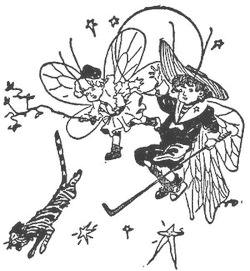
"WE CALL 'EM THE IMPS"
"That little cuss that scared the hosses.
There he is, now, holdin' up that piece of
brushwood. 'Twould be just like his cheek,
now, to ask me to let him ride. Here he
comes, runnin'. Wonder where t'other is?—they
most generally travel together. We call
'em the Imps, about these parts, because
they're so uncommon likely at mischief. Always skeerin' hosses, or
chasin' cows, or frightenin' chickens. Nice enough father an' mother,
too—queer, how young ones do turn out!"
As he spoke,
the offending
youth came panting beside our carriage, and
in a very dirty sailor-suit, and under a broad-brimmed
straw hat, with one stocking about
his ankle, and two shoes averaging about two
buttons each, I recognized my nephew, Budge!
About the same time there emerged from the
bushes by the roadside a smaller boy, in a
green gingham dress, a ruffle which might
once have been white, dirty stockings, blue
slippers worn through at the toes, and an old-fashioned
straw turban. Thrusting into the
dust of the road a branch from a bush, and
shouting, "Here's my grass-cutter!" he ran
toward us enveloped in a "pillar of cloud,"
which might have served the purpose of
Israel in Egypt. When we paused, and the
dust had somewhat subsided, I beheld the
unmistakable lineaments of the child Toddie!
"They're—my nephews," I gasped.
"What!" exclaimed the driver. "By gracious!
I forgot you were going to Colonel
Lawrence's! I didn't tell anything but the
truth about 'em, though; they're smart
enough, an' good enough, as boys go; but
they'd never die of the complaint that children
has in Sunday-school books."
"Budge," said I, with all the sternness I
could command, "do you know me?"
The searching eyes of the embryo prophet
and philanthropist scanned me for a moment,
then their owner replied:
"Yes, you're Uncle Harry. Did you bring
us anything?"
"Bring us anything?" echoed Toddie.
"I wish I could have brought you some big
whippings," said I, with great severity of
manner, "for behaving so badly. Get into
this carriage."
"Come on, Tod," shouted Budge, although
Toddie's farther ear was not a yard from
Budge's mouth, "Uncle Harry's going to take
us riding!"
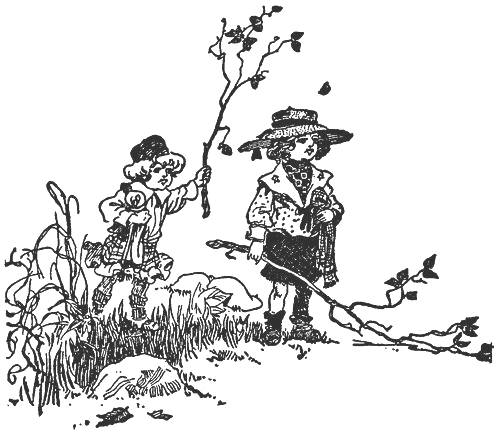
"HERE'S MY GRASS-CUTTER"
"Going to take us riding!" echoed Toddie,
with the air of one in a reverie; both the echo
and the reverie I soon learned were characteristics
of Toddie.
As they clambered into the carriage I noticed
that each one carried a very dirty towel,
knotted in the center into what is known as
a slip-noose knot, drawn very tight. After
some moments of disgusted contemplation of
these rags, without being in the least able to
comprehend their purpose, I asked Budge
what those towels were for.
"They're not towels—they're dollies,"
promptly answered my nephew.
"Goodness!" I exclaimed. "I should
think your mother could buy you respectable
dolls, and not let you appear in public with
those loathsome rags."
"We don't like buyed dollies," explained
Budge. "These dollies is lovely; mine's
name is Mary, an' Toddie's is Marfa."
"Marfa?" I queried.
"Yes; don't you know about
'Marfa and Mary's jus' gone along
To ring dem charmin' bells,'
that them Jubilees sings about?"
"Oh, Martha, you mean?"
"Yes, Marfa—that's what I say. Toddie's
dolly's got brown eyes, an' my dolly's got
blue eyes."
"I want to shee yours watch," remarked
Toddie, snatching at my chain, and rolling
into my lap.
"Oh—oo—ee, so do I," shouted Budge,
hastening to occupy one knee, and in transitu
wiping his shoes on my trousers and the skirts
of my coat. Each imp put an arm about me
to steady himself, as I produced my three-hundred
dollar time-keeper, and showed them
the dial.
"I want to see the wheels go round," said
Budge.
"Want to shee wheels go wound," echoed
Toddie.
"No; I can't open my watch where there's
so much dust," I said.
"What for?" inquired Budge.
"Want to shee the wheels go wound," repeated
Toddie.
"The dust gets inside the watch and spoils
it," I explained.
"Want to shee the wheels go wound," said
Toddie, once more.
"I tell you I can't, Toddie," said I, with
considerable asperity. "Dust spoils
watches."
The innocent gray eyes looked up wonderingly,
the dirty but pretty lips parted slightly,
and Toddie murmured:—
"Want to shee the wheels go wound."
I abruptly closed my watch, and put it into
my pocket. Instantly Toddie's lower lip
commenced to turn outward, and continued
to do so, until I seriously feared the bony
portion of his chin would be exposed to view.
Then his lower jaw dropped, and he cried:—
"Ah—h—h—h—h—h—want—to—shee—the
wheels—go wou—ound."
"Charles" (Charles is his baptismal name),—"Charles,"
I exclaimed, with some anger,
"stop that noise this instant! Do you hear
me?"
"Yes—oo—oo—oo—ahoo—ahoo."
"Then stop it."
"Wants to shee——"
"Toddie, I've got some candy in my trunk,
but I won't give you a bit if you don't stop
that infernal noise."
"Well, I wants to shee wheels go wound.
Ah—ah—h—h—h—h!"
"Toddie, dear, don't cry so. Here's some
ladies coming in a carriage; you wouldn't let
them see you crying,
would you?
You shall see the
wheels go round
as soon as we
get home."
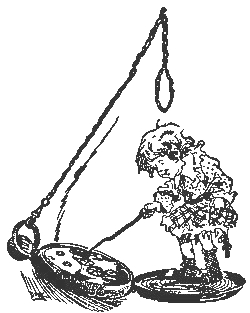
"WHEELS GO WOUND"
A carriage
containing a
couple of ladies
was rapidly approaching,
as
Toddie again
raised his voice.
"Ah—h—h—want's to shee wheels——"
Madly I snatched my watch from my
pocket, opened the case, and exposed the
works to view. The other carriage was passing
ours, and I dropped my head to avoid
meeting the glance of the unknown occupants,
for my few moments of contact with my
dreadful nephews had made me feel inexpressibly
unneat. Suddenly the carriage
with the ladies stopped. I heard my own
name spoken, and, raising my head quickly
(encountering Budge's bullet head en route,
to the serious disarrangement of my hat), I
looked into the other carriage. There, erect,
fresh, neat, composed, bright-eyed, fair-faced,
smiling and observant,—she would
have been all this, even if the angel of the
resurrection had just sounded his dreadful
trump,—sat Miss Alice Mayton, a lady who,
for about a year, I had been adoring from
afar.
"When did you arrive, Mr. Burton?" she
asked, "and how long have you been officiating
as child's companion? You're certainly a
happy-looking trio—so unconventional. I
hate to see children all dressed up and stiff as
little manikins, when they go out to ride.
And you look as if you'd been having such a
good time with them."
"I—I assure you, Miss Mayton," said I,
"that my experience has been the exact reverse
of a pleasant one. If King Herod were
yet alive I'd volunteer as an executioner, and
engage to deliver two interesting corpses at
a moment's notice."
"You dreadful wretch!" exclaimed the
lady. "Mother, let me make you acquainted
with Mr. Burton, Helen Lawrence's brother.
How is your sister, Mr. Burton?"
"I don't know," I replied; "she has gone
with her husband on a fortnight's visit to
Captain and Mrs. Wayne, and I've been silly
enough to promise to have an eye to the place
while they're away."
"Why, how delightful!" exclaimed Miss
Mayton. "Such horses! Such flowers! Such
a cook!"
"And such children," said I, glaring suggestively
at the imps, and rescuing from
Toddie a handkerchief which he had extracted
from my pocket, and was waving to
the breeze.
"Why, they're the best children in the
world. Helen told me so the first time I met
her this season. Children will be children,
you know. We had three little cousins with
us last summer, and I'm sure they made me
look years older than I really am."
"How young you must be, then, Miss Mayton!"
said I. I suppose I looked at her as
if I meant what I said, for although she inclined
her head and said, "Oh, thank you,"
she didn't seem to turn my compliment off
in her usual invulnerable style. Nothing
happening in the course of conversation ever
discomposed Alice Mayton for more than a
hundred seconds, however, so she soon recovered
her usual expression and self-command,
as her next remark fully indicated.
"I believe you arranged the floral decorations
at the St. Zephaniah's Fair, last winter,
Mr. Burton? 'Twas the most tasteful display
of the season. I don't wish to give any hints,
but at Mrs. Clarkson's, where we're boarding,
there's not a flower in the whole garden. I
break the Tenth Commandment dreadfully
every time I pass Colonel Lawrence's garden.
Good-by, Mr. Burton."
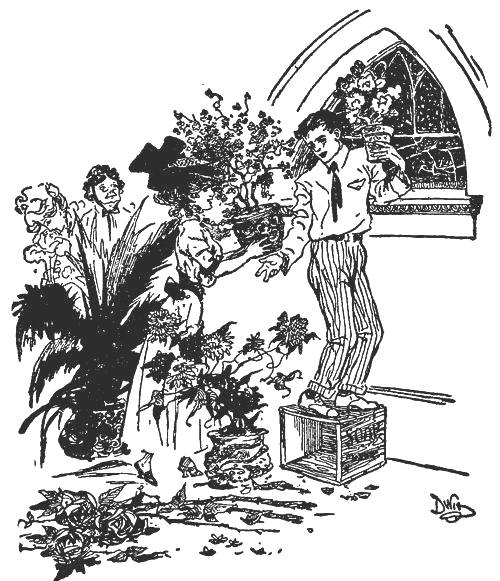
"I BELIEVE YOU ARRANGED THE FLORAL DECORATIONS"
"Ah, thank you; I shall be delighted.
Good-by."
"Of course you'll call," said Miss Mayton,
as her carriage started. "It's dreadfully
stupid here—no men except on Sundays."
I bowed assent. In the contemplation of
all the shy possibilities which my short chat
with Miss Mayton had suggested, I had quite
forgotten my dusty clothing and the two living
causes thereof. While in Miss Mayton's
presence the imps had preserved perfect silence,
but now their tongues were loosened.
"Uncle Harry," said Budge, "do you know
how to make whistles?"
"Unken Hawwy," murmured Toddie,
"does you love dat lady?"
"No, Toddie, of course not."
"Then you's a baddy man, an' de Lord
won't let you go to heaven if you don't love
peoples."
"Yes, Budge," I answered hastily, "I do
know how to make whistles, and you shall
have one."
"Lord don't like mans what don't love
peoples," reiterated Toddie.
"All right, Toddie," said I. "I'll see if I
can't please the Lord some way. Driver,
whip up, won't you? I'm in a hurry to turn
these youngsters
over to the girl,
and ask her to
drop them into
the bath-tub."
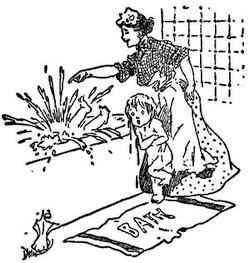
DROPPING THEM INTO THE BATHTUB
I found Helen
had made every
possible arrangement
for
my comfort.
Her room commanded
exquisite views of mountain slope
and valley, and even the fact that the imps'
bedroom adjoined mine gave me comfort, for
I thought of the pleasure of contemplating
them while they were asleep, and beyond the
power of tormenting their deluded uncle.
At the supper-table Budge and Toddie appeared
cleanly clothed and in their rightful
faces. Budge seated himself at the table;
Toddie pushed back his high-chair, climbed
into it, and shouted:—
"Put my legs under ze tabo!"
Rightfully construing this remark as a request
to be moved to the table, I fulfilled his
desire. The girl poured tea for me and milk
for the children, and retired; and then I remembered,
to my dismay, that Helen never
had a servant in the dining-room, except
upon grand occasions, her idea being that
servants retail to their friends the cream of
the private conversation of the family circle.
In principle I agreed with her, but the penalty
of the practical application, with these
two little cormorants on my hands, was
greater suffering than any I had ever been
called upon to endure for principle's sake;
but there was no help for it. I resignedly
rapped on the table, bowed my head, said,
"For what we are about to receive, the Lord
make us thankful," and asked Budge whether
he ate bread or biscuit.
"Why, we ain't asked no blessin' yet,"
said he.
"Yes, I did, Budge," said I. "Didn't you
hear me?"
"Do you mean what you said just now?"
"Yes."
"Oh, I don't think that was no blessin' at
all. Papa never says that kind of a blessin'."
"What does papa say, may I ask?" I inquired,
with becoming meekness.
"Why, papa says, 'Our Father, we thank
thee for this food; mercifully remember with
us all the hungry and needy to-day, for
Christ's sake, Amen.' That's what he says."
"It means the same thing, Budge."
"I don't think it does; and Toddie didn't
have no time to say his blessin'. I don't
think the Lord'll like it if you do it that way."
"Yes, He will, old boy; He knows what
people mean."
"Well, how can he tell what Toddie means
if Toddie can't say anything?"
"Wantsh to shay my blessin'," whined
Toddie.
It was enough; my single encounter with
Toddie had taught me to respect the young
gentleman's force of character. So again I
bowed my head and repeated what Budge
had reported as "papa's blessin'," Budge
kindly prompting me where my memory
failed. The moment I began, Toddie commenced
to jabber rapidly and aloud, and the
instant the "Amen" was pronounced he
raised his head and remarked with evident
satisfaction:—
"I shed my blessin' two timesh."
And Budge said gravely: "Now I guess
we're all right."
The supper was an exquisite one, but the
appetites of those dreadful children effectually
prevented my enjoying the repast. I
hastily retired, called the girl, and instructed
her to see that the children had enough to
eat, and were put to bed immediately after;
then I lit a cigar and strolled into the garden.
The roses were just in bloom, the air was full
of the perfume of honeysuckles, the rhododendrons
had not disappeared, while I saw
promise of the early unfolding of many other
pet flowers of mine. I confess that I took a
careful survey of the garden to see how fine
a bouquet I might make for Miss Mayton,
and was so abundantly satisfied with the
material before me that I longed to begin
the work at once, but that it would seem too
hasty for true gentility. So I paced the
paths, my hands behind my back, and my
face well hidden by fragrant clouds of smoke,
and went into wondering and reveries. I
wondered if there was any sense in the language
of flowers, of which I had occasionally
seen mention made by silly writers; I wished
I had learned it if it had any meaning; I
wondered if Miss Mayton understood it. At
any rate, I fancied I could arrange flowers to
the taste of any lady whose face I had ever
seen; and for Alice Mayton I would make
something so superb that her face could not
help lighting up when she beheld it. I
imagined just how her bluish-gray eyes would
brighten, her cheeks would redden,—not with
sentiment, not a bit of it, but with genuine
pleasure,—how her strong lips would part
slightly and disclose sweet lines not displayed
when she held her features well in hand. I—I,
a clear-headed, driving, successful salesman
of white goods—actually wished I might
be divested of all nineteenth-century abilities
and characteristics, and be one of those fairies
that only silly girls and crazy poets think of,
and might, unseen, behold the meeting of my
flowers with this highly cultivated specimen
of the only sort of flowers our cities produce.
What flower did she most resemble? A lily?—no;
too—not exactly too bold, but too—too,
well, I couldn't think of the word, but
clearly it wasn't bold. A rose? Certainly,
not like those glorious but blazing remontants,
nor yet like the shy, delicate, ethereal
tea roses with their tender suggestions of
color. Like this perfect Gloire de Dijon,
perhaps; strong, vigorous, self-asserting,
among its more delicate sisterhood; yet
shapely, perfect in outline and development,
exquisite, enchanting in its never fully analyzed
tints, yet compelling the admiration of
everyone, and recalling its admirers again and
again by the unspoken appeal of its own perfection—its
unvarying radiance.
"Ah—h—h—h—ee—ee—ee—ee—ee—oo
—oo—oo—oo!" came from the window over
my head. Then came a shout of—"Uncle
Harry!" in a voice I recognized as that of
Budge. I made no reply: there are moments
when the soul is full of utterances unfit
to be heard by childish ears. "Uncle Harray!"
repeated Budge. Then I heard a window
blind open, and Budge exclaiming:—
"Uncle Harry, we want you to come and
tell us stories."
I turned my eyes upward quickly, and was
about to send a savage negative in the same
direction, when I saw in the window a face
unknown and yet remembered. Could those
great, wistful eyes, that angelic mouth, that
spiritual expression, belong to my nephew
Budge? Yes, it must be certainly that super-celestial
nose and those enormous ears never
belonged to anyone else. I turned abruptly,
and entered the house, and was received at
the head of the stairway by two little figures
in white, the larger of which remarked:—
"We want you to tell us stories—papa always
does nights."
"Very well, jump into bed—what kind of
stories do you like?"
"Oh, 'bout Jonah," said Budge.
"'Bout Jonah," echoed Toddie.
"Well, Jonah was out in the sun one day,
and a gourd-vine grew up all of a sudden, and
made it nice and shady for him, and then it
all faded as quick as it came."
A dead silence prevailed for a moment, and
then Budge indignantly remarked:
"That ain't Jonah a bit—I know 'bout
Jonah."
"Oh, you do, do you?" said I. "Then
maybe you'll be so good as to enlighten me?"
"Huh?"
"If you know about Jonah, tell me the
story; I'd really enjoy listening to it."
"Well," said Budge, "Once upon a time the
Lord told Jonah to go to Nineveh and tell the
people they was all bad. But Jonah didn't
want to go, so he went on a boat that was
going to Joppa. An' then there was a big
storm, an' it rained an' blowed and the big
waves went as high as a house. An' the
sailors thought there must be somebody on
the boat that the Lord didn't like. An'
Jonah said he guessed he was the man. So
they picked him up and froed him in the
ocean, an' I don't think it was well for 'em to
do that after Jonah told the troof. An' a big
whale was comin' along, an' he was awful
hungry, 'cos the little fishes what he likes to
eat all went down to the bottom of the ocean
when it began to storm, and whales can't go
to the bottom of the ocean, 'cos they have to
come up to breeve, an' little fishes don't.
An' Jonah found 'twas all dark inside the
whale, and there wasn't any fire there, an' it
was all wet, an' he couldn't take off his
clothes to dry, 'cos there wasn't no place to
hang 'em, and there wasn't no windows to
look out of, nor nothin' to eat, nor nothin' nor
nothin' nor nothin'. So he asked the Lord
to let him out, an' the Lord was sorry for
him, an' He made the whale go up close to the
land, an' Jonah jumped right out of his
mouth, and wasn't he glad? An' then he
went to Nineveh, an' done what the Lord
told him to, an' he ought to have done it in
the first place if he had known what was good
for him."
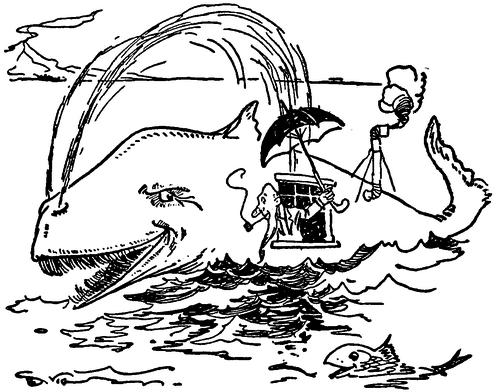
BUDGE'S IDEA OF JONAH AND THE WHALE
"Done first payshe, know what's dood for
him," asserted Toddie, in support of his
brother's assertion. "Tell us 'nudder story."
"Oh, no, sing us a song," suggested Budge.
"Shing us shong," echoed Toddie.
I searched my mind for a song, but the
only one which came promptly was "M'Appari,"
several bars of which I gave my juvenile
audience, when Budge interrupted me,
saying:—
"I don't think that's a very good song."
"Why not, Budge?"
"'Cos I don't. I don't know a word what
you're talking 'bout."
"Shing 'bout 'Glory, glory, hallelulyah,'"
suggested Toddie, and I meekly obeyed. The
old air has a wonderful influence over me. I
heard it in western campmeetings and negro
cabins when I was a boy; I saw the 22nd
Massachusetts march down Broadway, singing
the same air during the rush to the front
in the early days of the war; I have heard it
sung by warrior tongues in nearly every
southern state; I heard it roared by three
hundred good old Hunker Democrats as they
escorted New York's first colored regiment to
their place of embarkation; my old brigade
sang it softly, but with a swing that was terrible
in its earnestness, as they lay behind their
stacks of arms just before going into action;
I have heard it played over the grave of many
a dead comrade; the semi-mutinous—th
cavalry became peaceful and patriotic again,
as their bandmaster played the old air after
having asked permission to try his hand on
them; it is the same that burst forth spontaneously
in our barracks, on that glorious
morning when we learned that the war was
over, and it was sung, with words adapted to
the occasion, by some good rebel friends of
mine, on our first social meeting after the
war. All these recollections came hurrying
into my mind as I sang, and probably excited
me beyond my knowledge. For Budge suddenly
remarked:—
"Don't sing that all day, Uncle Harry; you
sing so loud, it hurts my head."
"Beg your pardon, Budge," said I. "Good
night."
"Why, Uncle Harry, are you going? You
didn't hear us say our prayers,—papa always
does."
"Oh! Well, go ahead."
"You must say yours first," said Budge;
"that's the way papa does."
"Very well," said I, and I repeated St.
Chrysostom's prayer, from the Episcopal
service. I had hardly said "Amen," when
Budge remarked:—
"My papa don't say any of them things at
all; I don't think that's a very good prayer."
"Well, you say a good prayer, Budge."
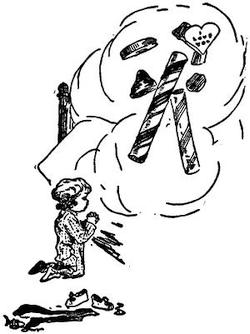
"WE HOPE HE'S GOT
LOTS OF CANDY"
"All right." Budge shut his eyes, dropped
his voice to the
most perfect
tone of supplication,
while
his face seemed
fit for a sleeping
angel; then
he said:—
"Dear Lord,
we thank you for lettin' us
have a good time to-day,
an' we hope all the little
boys everywhere have had
good times too. We pray
you to take care of us an'
everybody else to-night, an' don't let 'em
have any trouble. Oh, yes, an' Uncle Harry's
got some candy in his trunk, 'cos he said so
in the carriage,—we thank you for lettin'
Uncle Harry come to see us, an' we hope he's
got lots of candy—lots an' piles. An' we
pray you to take care of all the poor little
boys and girls that haven't got any papas
an' mammas an' Uncle Harrys an' candy an'
beds to sleep in. An' take us all to Heaven
when we die, for Christ's sake. Amen. Now
give us the candy, Uncle Harry."
"Hush, Budge; don't Toddie say any
prayers?"
"Oh, yes; go on, Tod."
Toddie closed his eyes, wriggled, twisted,
breathed hard and quick, acting generally as
if prayers were principally a matter of physical
exertion. At last he began:—
"Dee Lord, not make me sho bad, an' besh
mamma, an' papa, an' Budgie, an' doppity,[1]
an' both boggies,[2] an' all good people in dish
house, an' everybody else, an' my dolly.
A—a—amen!"
"Now give us the candy," said Budge, with
the usual echo from Toddie.
I hastily extracted the candy from my
trunk, gave some to each boy, the recipients
fairly shrieking with delight, and once more
said good night.
"Oh, you didn't give us any pennies," said
Budge. "Papa gives us some to put in our
banks, every night."
"Well, I haven't got any now—wait until
to-morrow."
"Then we want drinks."
"I'll let Maggie bring you drink."
"Want my dolly," murmured Toddie.
I found the knotted towels, took the dirty
things up gingerly and threw them upon the
bed.
"Now want to shee wheels go wound,"
said Toddie.
I hurried out of the room and slammed the
door. I looked at my watch—it was half-past
eight; I had spent an hour and a half
with those dreadful children. They were
funny, to be sure—I found myself laughing,
in spite of my indignation. Still, if they were
to monopolize my time as they had already
done, when was I to do my reading? Taking
Fiske's "Cosmic Philosophy" from my trunk,
I descended to the back parlor, lit a cigar and
a student-lamp, and began to read. I had
not fairly commenced when I heard a patter
of small feet, and saw my elder nephew before
me. There was sorrowful protestation
in every line of his countenance, as he exclaimed:—
"You didn't say 'Good-by,' nor 'God bless
you,' nor anything."
"Oh—good-by."
"Good-by."
"God bless you."
"God bless you."
Budge seemed waiting for something else.
At last he said:—
"Papa says, 'God bless everybody.'"
"Well, God bless everybody."
"God bless everybody," responded Budge,
and turned silently and went upstairs.
"Bless your tormenting honest little heart."
I said to myself; "if men trusted God as you
do your papa, how little business there'd be
for preachers to do."
The night was a perfect one. The pure,
fresh air, the perfume of the flowers, the music
of the insect choir in the trees and shrubbery—the
very season itself seemed to forbid
my reading philosophy, so I laid Fiske aside,
delighted myself with a few rare bits from
Paul Hayne's new volume of poems, read a
few chapters of "One Summer," and finally
sauntered off to bed. My nephews were slumbering
sweetly; it seemed impossible that the
pure, exquisite, angelic faces before me belonged
to my tormentors of a few hours before.
As I lay on my couch I could see the
dark shadow and rugged crest of the mountain;
above it, the silver stars against the
blue, and below it the rival lights of the fireflies
against the dark background formed by
the mountain itself. No rumbling of wheels
tormented me, nor any of the thousand noises
that fill city air with the spirit of unrest, and
I fell into a wonder almost indignant that
sensible, comfort-loving beings could live in
horrible New York, while such delightful
rural homes were so near at hand. Then
Alice Mayton came into my mind, and then
a customer; later, stars and trade-marks, and
bouquets, and dirty nephews, and fireflies
and bad accounts, and railway tickets, and
candy and Herbert Spencer, mixed themselves
confusingly in my mind. Then a vision
of a proud angel, in the most fashionable
attire and a modern carriage, came and banished
them all by its perfect radiance, and I
was sinking in the most blissful unconsciousness—
"Ah—h—h—h—h—h—oo—oo—oo—oo—ee—ee—e—"
"Sh—h—h!" I hissed.
The warning was heeded, and I soon relapsed
into oblivion.
"Ah—h—h—h—oo—oo—ee—ee—EE—ee!"
"Toddie, do you want your uncle to whip
you?"
"No."
"Then lie still."
"Well, I'ze lost my dolly, an' I tan't find
her anywhere."
"Well, I'll find her for you in the morning."
"Oo—oo—ee—I
want my
dolly."
"Well, I tell
you I'll find her
for you in the
morning."
"I want her
now—oo—oo—"
"You can't
have her now, so
you can go to
sleep."
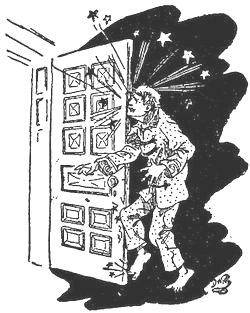
I ENCOUNTERED A DOOR AJAR
"Oh—oo—oo—oo—ee—"
Springing madly to my feet, I started for
the offender's room. I encountered a door
ajar by the way, my forehead being the first
to discover it. I ground my teeth, lit a
candle, and said something—no matter what.
"Oh, you said a bad swear!" ejaculated Toddie;
"you won't go to heaven when you die."
"Neither will you, if you howl like a little
demon all night. Are you going to be quiet,
now?"
"Yesh, but I wants my dolly."
"I don't know where your dolly is—do you
suppose I'm going to search this entire house
for that confounded dolly?"
"'Tain't 'founded. I wants my dolly."
"I don't know where it is. You don't
think I stole your dolly, do you?"
"Well, I wants it, in de bed wif me."
"Charles," said I, "when you arise in the
morning, I hope your doll will be found. At
present, however, you must be resigned and
go to sleep. I'll cover you up nicely"; here I
began to rearrange the bed clothing, when the
fateful dolly, source of all my woes, tumbled
out of them. Toddie clutched it, his whole
face lighting up with affectionate delight, and
he screamed:—
"Oh, dare is my dee dolly; turn to your
own papa, dolly, an' I'll love you."
And that ridiculous child was so completely
satisfied by his outlay of affection, that my
own indignation gave place to genuine artistic
pleasure. One can tire of even beautiful
pictures, though, when he is not fully awake,
and is holding a candle
in a draught of air; so
I covered my nephews
and returned to my own
room, where I mused upon the contradictoriness
of childhood until I fell asleep.
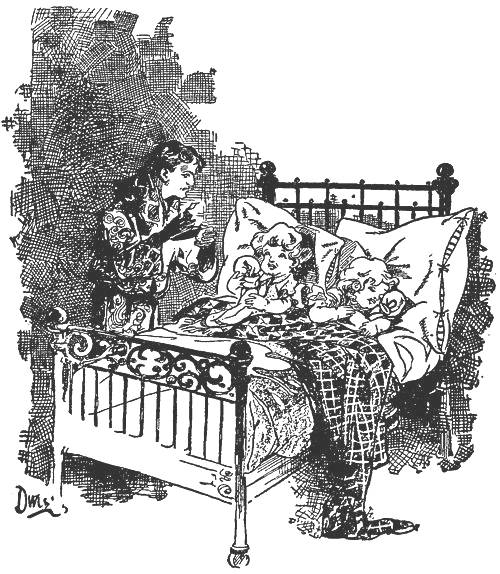
THE DOLLY FOUND
In the morning I was awakened very early
by the light streaming in the window, the
blinds of which I had left open the night before.
The air was alive with bird-song, and
the eastern sky was flushed with tints which
no painter's canvas ever caught. But ante-sunrise
skies and songs are not fit subjects
for the continued contemplation of men who
read until midnight; so I hastily closed the
blinds, drew the shade, dropped the curtains
and lay down again, dreamily thanking
Heaven that I was to fall asleep to such exquisite
music. I am sure that I mentally
forgave all my enemies as I dropped off into
a most delicious doze, but the sudden realization
that a light hand was passing over my
cheek roused me to savage anger in an instant.
I sprang up, and saw Budge shrink
timidly away from my bedside.
"I was only lovin' you, 'cos you was good,
and brought us candy. Papa lets us love him
whenever we want to—every morning he does."
"As early as this?" demanded I.
"Yes, just as soon as we can see, if we want
to."
Poor Tom! I never could comprehend
why, with a good wife, a comfortable income,
and a clear conscience, he need always look
thin and worn—worse than he ever did in
Virginia woods or Louisiana swamps. But
now I knew all. And yet, what could one
do? That child's eyes and voice, and his
expression, which exceeded in sweetness that
of any of the angels I had ever imagined,—that
child could coax a man to do more self-forgetting
deeds than the shortening of his
precious sleeping-hours amounted to. In
fact, he was fast divesting me of my rightful
sleepiness, so I kissed him and said:—
"Run to bed, now, dear old fellow, and let
uncle go to sleep again. After breakfast I'll
make you a whistle."
"Oh! will you?" The angel turned into a
boy at once.
"Yes; now run along."
"A loud whistle—a real loud one?"
"Yes, but not if you don't go right back
to bed."
The sound of little footsteps receded as I
turned over and closed my eyes. Speedily
the bird-song seemed to grow fainter; my
thoughts dropped to pieces; I seemed to be
floating on fleecy clouds, in company with
hundreds of cherubs with Budge's features
and night-drawers—
"Uncle Harry!"
May the Lord forget the prayer I put up
just then!
"I'll discipline you, my fine little boy,"
thought I. "Perhaps, if I let you shriek
your abominable little throat hoarse, you'll
learn better than to torment your uncle,
that was just getting ready to love you
dearly."
"Uncle Har—ray!"
"Howl away, you little imp," thought I.
"You've got me wide awake, and your lungs
may suffer for it." Suddenly I heard, although
in sleepy tones, and with a lazy
drawl, some words which appalled me. The
murmurer was Toddie:—
"Want—shee—wheels—go—wound."
"Budge!" I shouted, in the desperation of
my dread lest Toddie, too, might wake up,
"what do you want?"
"Uncle Harry!"
"WHAT!"
"Uncle Harry, what kind of wood are you
going to make the whistle out of?"
"I won't make any at all—I'll cut a big
stick and give
you a sound
whipping with it,
for not keeping
quiet, as I told
you to."
"Why, Uncle
Harry, papa don't
whip us with
sticks—he spanks
us."

"PAPA DON'T WHIP US WITH STICKS"
Heavens!
Papa! papa!
papa! Was I
never to have
done with this eternal quotation of "papa"? I
was horrified to find myself gradually conceiving
a dire hatred of my excellent brother-in-law.
One thing was certain, at any rate:
sleep was no longer possible; so I hastily
dressed and went into the garden. Among
the beauty and the fragrance of the flowers,
and in the delicious morning air, I succeeded
in regaining my temper, and was delighted,
on answering the breakfast-bell, two hours
later, to have Budge accost me with:—
"Why, Uncle Harry, where was you? We
looked all over the house for you, and
couldn't find a speck of you."
The breakfast was an excellent one. I
afterward learned that Helen, dear old girl,
had herself prepared a bill of fare for every
meal I should take in the house. As the
table talk of myself and nephews was not
such as could do harm by being repeated, I
requested Maggie, the servant, to wait upon
the children, and I accompanied my request
with a small treasury note. Relieved, thus,
of all responsibility for the dreadful appetites
of my nephews, I did full justice to the repast,
and even regarded with some interest and
amusement the industry of Budge and Toddie
with their tiny forks and spoons. They ate
rapidly for a while, but soon their appetites
weakened and their tongues were unloosed.
"Ocken Hawwy," remarked Toddie, "daysh
an awfoo funny chunt up 'tairs—awfoo big
chunt. I show it you after brepspup."
"Toddie's a silly little boy," said Budge,
"he always says brepspup for brekbux."[3]
"Oh! What does he mean by chunt,
Budge?"
"I guess he means trunk," replied my oldest
nephew.
Recollections of my childish delight in
rummaging an old trunk—it seems a century
ago that I did it—caused me to smile sympathetically
at Toddie, to his apparent great
delight. "How delightful it is to strike a
sympathetic chord in child nature," thought
I; "how quickly the infant eye comprehends
the look which precedes the verbal expression
of an idea? Dear Toddie! for years we might
sit at one table, careless of each other's words,
but the casual mention of one of thy delights
has suddenly brought our souls into that
sweetest of all human communions—that
one which doubtless bound the Master himself
to that apostle who was otherwise apparently
the weakest among the chosen
twelve." "An awfoo funny chunt" seemed
to annihilate suddenly all differences of age,
condition and experience between the wee
boy and myself, and——
A direful thought struck me. I dashed up
stairs and into my room. Yes, he did mean
my trunk. I could see nothing funny about
it—quite the contrary. The bond of sympathy
between my nephew and myself was
suddenly broken. Looking at the matter
from the comparative distance which a few
weeks have placed between that day and
this, I can see that I was unable to consider
the scene before me with a calm and unprejudiced
mind. I am now satisfied that
the sudden birth and hasty decease of my
sympathy with Toddie were striking instances
of human inconsistency. My soul
had gone out to his because he loved to rummage
in trunks, and because I imagined he
loved to see the monument of incongruous
material which resulted from such an operation;
the scene before me showed clearly that
I had rightly divined my nephew's nature.
And yet my selfish instincts hastened to
obscure my soul's vision, and to prevent that
joy which should ensue when "faith is lost
in full fruition."
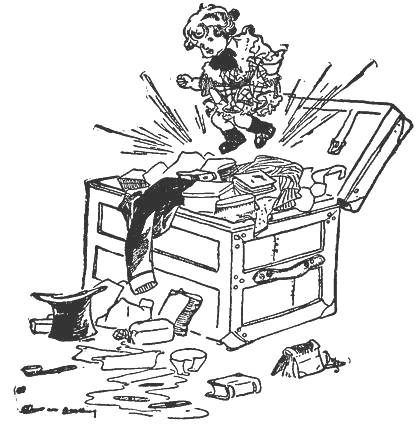
AN AMATEUR IN PACKING
My trunk had contained nearly everything,
for while a campaigner I had learned
to reduce packing to an exact science. Now,
had there been an atom of pride in my composition
I might have glorified myself, for it
certainly seemed as if the heap upon the
floor could never have come out of a single
trunk. Clearly, Toddie was more of a general
connoisseur than an amateur in packing.
The method of his work I quickly discerned,
and the discovery threw some light upon the
size of the heap in front of my trunk. A
dress hat and its case, when their natural
relationship is dissolved, occupy nearly twice
as much space as before, even if the former
contains a blacking-box not usually kept in
it, and the latter a few cigars soaking in bay
rum. The same might be said of a portable
dressing-case and its contents, bought for me
in Vienna by a brother ex-soldier, and designed
by an old Continental campaigner to
be perfection itself. The straps which prevented
the cover from falling entirely back
had been cut, broken or parted in some way,
and in its hollow lay my dress-coat, tightly
rolled up. Snatching it up with a violent
exclamation, and unrolling it, there dropped
from it—one of those infernal dolls. At the
same time a howl was sounded from the doorway.
"You tookted my dolly out of her cradle—I
want to wock[4] my dolly—oo—oo—oo—ee—ee—ee—!"
"You young scoundrel!" I screamed—yes,
howled, I was so enraged—"I've a great
mind to cut your throat this minute. What
do you mean by meddling with my trunk?"
"I—doe—know." Outward turned Toddie's
lower lip; I believe the sight of it would
move a Bengal tiger to pity, but no such
thought occurred to me just then.
"What made you do it?"
"Be—cause."
"Because what?"
"I—doe—know."
Just then a terrific roar arose from the
garden. Looking out, I saw Budge with a
bleeding finger upon one hand, and my razor
in the other; he afterward explained he had
been making a boat, and that the knife was
bad to him. To apply adhesive plaster to
the cut was the work of but a minute, and
I had barely completed this surgical operation
when Tom's gardener-coachman appeared,
and handed me a letter. It was
addressed in Helen's well-known hand, and
read as follows (the passages in brackets
were my own comments):—
"Bloomdale, June 21, 1875.
"Dear Harry:—I'm very happy in the thought
that you are with my darling children, and, although
I'm having a lovely time here, I often wish I was with
you. [Ump—so do I.] I want you to know the
little treasures real well. [Thank you, but I don't
think I care to extend the acquaintanceship farther
than is absolutely necessary.] It seems to me so unnatural
that relatives know so little of those of their
own blood, and especially of the innocent little spirits
whose existence is almost unheeded. [Not when
there's unlocked trunks standing about, sis.]
"Now I want to ask a favor of you. When we were
boys and girls at home, you used to talk perfect oceans
about physiognomy, and phrenology, and unerring
signs of character. I thought it was all nonsense then,
but if you believe it now, I wish you'd study the children,
and give me your well-considered opinion of
them. [Perfect demons, ma'am; imps, rascals, born
to be hung—both of them.]
"I can't get over the feeling that dear Budge is born
for something grand. [Grand nuisance.] He is sometimes
so thoughtful and so absorbed, that I almost
fear the result of disturbing him; then, he has that
faculty of perseverance which seems to be the only
thing some men have lacked to make them great.
[He certainly has it; he exemplified it while I was trying
to get to sleep this morning.]
"Toddie is going to make a poet or a musician or an
artist. [That's so; all abominable scamps take to
some artistic pursuit as an excuse for loafing.] His
fancies take hold of him very strongly. [They do—they
do; "shee wheels go wound," for instance.] He
has not Budgie's sublime earnestness, but he doesn't
need it; the irresistible force with which he is drawn
toward whatever is beautiful compensates for the
lack. [Ah—perhaps that explains his operation with
my trunk.] But I want your own opinion, for I know
you make more careful distinction in character than
I do.
"Delighting myself with the idea that I deserve
most of the credit for the lots of reading you will have
done by this time, and hoping I shall soon have a line
telling me how my darlings are, I am, as ever,
"Your loving sister,
"Helen."
Seldom have I been so roused by a letter
as I was by this one, and never did I promise
myself more genuine pleasure in writing a
reply. I determined that it should be a
masterpiece of analysis and of calm yet forcible
expression of opinion.
Upon one step, at any rate, I was positively
determined. Calling the girl, I asked her
where the key was that locked the door between
my room and the children.
"Please, sir, Toddie threw it down the
well."
"Is there a locksmith in the village?"
"No, sir; the nearest one is at Paterson."
"Is there a screw-driver in the house?"
"Yes, sir."
"Bring it to me, and tell the coachman to
get ready at once to drive me to Paterson."
The screw-driver was brought, and with it
I removed the lock, got into the carriage,
and told the driver to take me to Paterson
by the hill road—one of the most beautiful
roads in America.
"Paterson!" exclaimed Budge. "Oh,
there's a candy store in that town; come on,
Toddie."
"Will you?" thought I, snatching the whip
and giving the horses a cut. "Not if I can
help it. The idea of having such a drive
spoiled by the clatter of such a couple!"
Away went the horses, and up went a piercing
shriek and a terrible roar. It seemed
that both children must have been mortally
hurt, and I looked out hastily, only to see
Budge and Toddie running after the carriage,
and crying pitifully. It was too pitiful,—I
could not have proceeded without them, even
if they had been inflicted with smallpox. The
driver stopped of his own accord,—he seemed
to know the children's ways and their results,—and
I helped Budge and Toddie in,
meekly hoping that the eye of Providence
was upon me, and that so self-sacrificing an
act would be duly passed to my credit. As
we reached the hill road, my kindness to my
nephews seemed to assume greater proportions,
for the view before me was inexpressibly
beautiful. The air was perfectly clear,
and across two score towns I saw the great
metropolis itself, the silent city of Greenwood
beyond it, the bay, the Narrows, the Sound,
the two silvery rivers lying between me and
the Palisades, and even, across and to the
south of Brooklyn, the ocean itself. Wonderful
effects of light and shadow, picturesque
masses, composed of detached buildings, so
far distant that they seemed huddled together;
grim factories turned to beautiful palaces
by the dazzling reflection of sunlight from
their window-panes; great ships seeming in
the distance to be toy boats floating idly;—with
no signs of life perceptible, the whole
scene recalled the fairy stories read in my
youthful days, of enchanted cities, and the
illusion was greatly strengthened by the
dragon-like shape of the roof of New York's
new post-office, lying in the center of everything,
and seeming to brood over all.
"Uncle Harry!"
Ah, that was what I expected!
"Uncle Harry!"
"Well, Budge?"
"I always think that looks like heaven."
"What does?"
"Why, all that,—from here over to that
other sky 'way back there behind everything
I mean. And I think that (here he pointed
toward what probably was a photographer's
roof-light)—that place where it's so shiny, is
where God stays."
Bless the child! The scene had suggested
only elfindom to me, and yet I prided myself
on my quick sense of artistic effects.
"An' over there where that awful bright
little speck is," continued Budge, "that's
where dear little brother Phillie is; whenever
I look over there, I see him putting his hand
out."
"Dee 'ittle Phillie went to s'eep in a box,
and ze Lord took him to heaven," murmured
Toddie, putting together all he had seen and
heard of death. Then he raised his voice and
exclaimed:—
"Ocken Hawwy, you know what Iz'he goin'
do when I be's big man? Iz'he goin' to
have hosses an' tarridge, an' Iz'he goin' to
wide over all ze chees an' all ze houses an' all
ze world an' ewyfing. An' whole lots of
little birdies is comin' in my tarridge an' sing
songs to me, an' you can come too if you want
to, an' we'll have ice-cream an' trawberries
an' see 'ittle fishes swimmin' down in ze water,
an' we'll get a g'eat big house that's all
p'itty on the outshide an' all p'itty on the
inshide, an' it'll all be ours an' we'll do just
ewyfing we want to."
"Toddie, you're an idealist."
"Ain't a 'dealisht."
"Toddie's a goosey-gander," remarked
Budge, with great gravity. "Uncle Harry,
do you think heaven's as nice as that place
over there?"
"Yes, Budge, a great deal nicer."
"Then why don't we die an' go there? I
don't want to go on livin' forever an' ever.
I don't see why we don't die right away; I
think we've lived enough of days."
"The Lord wants us to live until we get
good and strong and smart, and do a great
deal of good before we die, old fellow—that's
why we don't die right away."
"Well, I want to see dear little Phillie, an'
if the Lord won't let him come down here, I
think he might let me die an' go to heaven.
Little Phillie always laughed when I jumped
for him. Uncle Harry, angels has wings,
don't they?"
"Some people think they have, old boy."
"Well, I know they don't, 'cos if Phillie had
wings, I know he'd fly right down an' see me.
So they don't."
"But maybe he has to go somewhere else,
Budge, or maybe he comes and you can't see
him. We can't see angels with our eyes, you
know."
"Then what made the Hebrew children in
the fiery furnace see one? Their eyes was
just like ours, wasn't they? I don't care; I
want to see dear little Phillie awful much.
Uncle Harry, if I went to heaven, do you
know what I'd do?"
"What would you do, Budge?"
"Why, after I saw little Phillie, I'd go
right up to the Lord an' give him a great big
hug."
"What for, Budge?"
"Oh, 'cos he lets us have nice times, an'
gave me my mamma an' papa, an' Phillie—
but he took him away again—an' Toddie, but
Toddie's a dreadful bad boy sometimes,
though."
"Very true, Budge," said I, remembering
my trunk and the object of my ride.
"Uncle Harry, did you ever see the Lord?"
"No, Budge; he has been very close to me
a good many times, but I never saw him."
"Well, I have; I see him every time I look
up in the sky, and there ain't nobody with
me."
The driver crossed himself and whispered,
"He's foriver a-sayin' that, an' be the powers,
I belave him. Sometimes ye'd think that
the howly saints themselves was a-spakin'
whin that bye gits to goin' on that way."
It was wonderful. Budge's countenance
seemed too pure to be of the earth as he continued
to express his ideas of the better land
and its denizens. As for Toddie, his tongue
was going incessantly, although in a tone
scarcely audible; but when I chanced to
catch his expressions, they were so droll and
fanciful, that I took him upon my lap that I
might hear him more distinctly. I even detected
myself in the act of examining the
mental draft of my proposed letter to Helen,
and of being ashamed of it. But neither
Toddie's fancy nor Budge's spirituality
caused me to forget the principal object of
my ride. I found a locksmith and left the
lock to be fitted with a key; then we drove
to the Falls. Both boys discharged volleys
of questions as we stood by the gorge, and the
fact that the roar of the falling water prevented
me from hearing them did not cause
them to relax their efforts in the least. I
walked to the hotel for a cigar, taking the
children with me. I certainly spent no more
than three minutes in selecting and lighting
a cigar, and asking the barkeeper a few questions
about the Falls; but when I turned, the
children were missing, nor could I see them
in any direction. Suddenly, before my eyes,
arose from the nearer brink of the gorge two
yellowish disks, which I recognized as the
hats of my nephews; then I saw between the
disks and me two small figures lying upon the
ground. I
was afraid
to shout, for
fear of scaring
them if
they happened
to
hear me. I
bounded across the
grass, industriously
raving and praying by
turns. They were lying
on their stomachs and
looking over the edge
of the cliff. I approached
them on tiptoe, threw
myself upon the ground, and
grasped a foot of each child.
"Oh, Uncle Harry!" screamed
Budge in my ear, as I dragged
him close to me, kissing and
shaking him alternately; "I
hunged over more than Toddie
did."
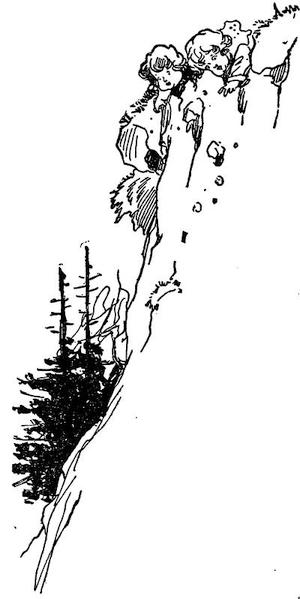
"I HUNGED OVER MORE THAN TODDIE DID"
"Well, I—I—I—I—I—I—I—hunged over
a good deal, anyhow," said Toddie, in self-defense.
That afternoon I devoted to making a bouquet
for Miss Mayton, and a most delightful
occupation I found it. It was no florist's
bouquet, composed of only a few kinds of
flowers, wired upon sticks, and arranged according
to geometric pattern. I used many
a rare flower, too shy of bloom to recommend
itself to florists; I combined tints almost as
numerous as the flowers were, and perfumes
to which city bouquets are utter strangers.
Arranging flowers is a favorite pastime of
mine, but upon this particular occasion I enjoyed
my work more than I had ever done
before. Not that I was in love with Miss
Mayton; a man may honestly and strongly
admire a handsome, brilliant woman without
being in love with her; he can delight himself
in trying to give her pleasure, without feeling
it necessary that she shall give him herself in
return. Since I arrived at years of discretion
I have always smiled sarcastically at the
mention of the generosity of men who were
in love; they have seemed to me rather to be
asking an immense price for what they offered.
I had no such feeling toward Miss Mayton.
There have been heathens who have offered
gifts to goddesses out of pure adoration and
without any idea of ever having the exclusive
companionship of their favorite divinities. I
never offered Miss Mayton any attention
which did not put me into closer sympathy
with these same great-souled old Pagans; and
with such Christians as follow their good example.
With each new grace my bouquet
took on, my pleasure and satisfaction increased
at the thought of how she would enjoy
the completed evidence of my taste.
At length it was finished, but my delight
suddenly became clouded by the dreadful
thought, "What will folks say?" Had we
been in New York instead of Hillcrest, no one
but the florist, his messenger, the lady and
myself would know if I sent a bouquet to
Miss Mayton; but in Hillcrest, with its several
hundred native-born gossips, and its
acquaintance of everybody with everybody
else and their affairs—I feared talk. Upon
the discretion of Mike, the coachman, I could
safely rely; I had already confidentially conveyed
sundry bits of fractional currency to
him, and informed him of one of the parties
at our store whose family Mike had known in
Old Erin; but every one knew where Mike
was employed; every one knew—mysterious,
unseen and swift are the ways of communication
in the country!—that I was the only
gentleman at present residing at Colonel
Lawrence's. Ah!—I had it. I had seen in
one of the library drawers a small pasteboard
box, shaped like a bandbox—doubtless that
would hold it. I found the box—it was of
just the size I needed. I dropped my card
into the bottom—no danger of a lady not
finding the card accompanying a gift of flowers—neatly
fitted the bouquet in the center
of the box, and went in search of Mike. He
winked cheeringly as I explained the nature
of his errand, and he whispered:—
"I'll do it as clane as a whistle, yer honor.
Mistress Clarkson's cook an' mesilf understhand
each other, an' I'm used to goin' up
the back way. Dhivil a man can see but the
angels, an' they won't tell."
"Very well, Mike; here's a dollar for you;
you'll find the box on the hat-rack, in the
hall."
Half an hour later, while I sat in my chamber
window, reading, I beheld Mike, cleanly
shaved, dressed and brushed, swinging up the
road, with my box balanced on one of his
enormous hands. With a head full of pleasing
fancies, I went down to supper. My new
friends were unusually good. Their ride
seemed to have toned down their boisterousness
and elevated their little souls; their appetites
exhibited no diminution of force, but
they talked but little, and all that they said
was smart, funny, or startling—so much so
that when, after supper, they invited me to
put them to bed, I gladly accepted the invitation.
Toddie disappeared somewhere, and
came back very disconsolate.
"I can't find my dolly's k'adle," he whined.
"Never mind, old pet," said I, soothingly.
"Uncle will ride you on his foot."
"But I want my dolly's k'adle," said he,
piteously rolling out his lower lip.
I remembered my experience when Toddie
wanted to "shee wheels go wound," and I
trembled.
"Toddie," said I, in a tone so persuasive
that it would be worth thousands a year to
me, as a salesman, if I could only command
it at will; "Toddie, don't you want to ride
on uncle's back?"
"No; want my dolly's k'adle."
"Don't you want me to tell you a story?"
For a moment Toddie's face indicated a
terrible internal conflict between old Adam
and mother Eve, but curiosity finally overpowered
natural depravity, and Toddie murmured:—Yesh."
"What shall I tell you about?"
"'Bout Nawndeark."
"About what?"
"He means Noah an' the ark," exclaimed
Budge.
"Datsh what I shay—Nawndeark," declared
Toddie.
"Well," said I, hastily refreshing my memory
by picking up the Bible,—for Helen, like
most people, is pretty sure to forget to pack
her Bible when she runs away from home for
a few days,—"well, once it rained forty days
and nights, and everybody was drowned from
the face of the earth excepting Noah, a
righteous man, who was saved with all his
family, in an ark which the Lord commanded
him to build."
"Uncle Harry," said Budge, after contemplating
me with open eyes and mouth for at
least two minutes after I had finished, "do
you think that's Noah?"
"Certainly, Budge; here's the whole story
in the Bible."
"Well, I don't think it's Noah one single
bit," said he, with increasing emphasis.
"I'm beginning to think we read different
Bibles, Budge; but let's hear your version."
"Huh?"
"Tell me about Noah, if you know so much
about him."
"I will, if you want me to. Once the Lord
felt so uncomfortable 'cos folks was bad that
he was sorry he ever made anybody, or any
world or anything. But Noah wasn't bad—the
Lord liked him first-rate, so he told Noah
to build a big ark, and then the Lord would
make it rain so everybody should be drownded
but Noah an' his little boys an' girls, an'
doggies, an' pussies, an' mamma cows, an'
little-boy cows, an' little-girl cows, an' hosses,
an' everything—they'd go in the ark an'
wouldn't get wetted a bit, when it rained.
An' Noah took lots of things to eat in the
ark—cookies an' milk, an' oatmeal an' strawberries,
an' porgies an'—oh, yes; an' plum
puddin's an' pumpkin pies. But Noah didn't
want everybody to get drownded, so he
talked to folks an' said, 'It's goin' to rain
awful pretty soon; you'd better be good, an'
then the Lord'll let you come into my ark."
An' they jus' said 'Oh, if it rains we'll go in
the house till it stops'; an' other folks said,
'We ain't afraid of rain—we've got an umbrella.'
An' some more said, they wasn't
goin' to be afraid of just a rain. But it did
rain, though, an' folks went in their houses
an' the water came in, an' they got on the
tops of the houses, an' up in big trees, an' up
in mountains, an' the water went after 'em
everywhere an' drownded everybody, only
just except Noah and the people in the ark.
An' it rained forty days an' nights, an' then
it stopped, an' Noah got out of the ark, an'
he an' his little boys an' girls went wherever
they wanted to, an' everything in the world
was all theirs; there wasn't anybody to tell
'em to go home, nor no Kindergarten schools
to go to, nor no bad boys to fight 'em, nor
nothin'. Now tell us 'nother story."
I determined that I would not again attempt
to repeat portions of the Scripture
narrative—my experience in that direction
had not been encouraging. I ventured upon
a war story.
"Do you know what the war was?" I
asked, by way of reconnoissance.
"Oh, yes," said Budge, "papa was there
an' he's got a sword; don't you see it, hangin'
up there?"
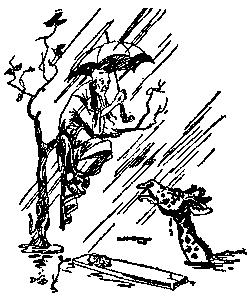
"WE'VE GOT AN UMBRELLA"
Yes, I saw it,
and the difference
between the terrible
field where last
I saw Tom's sword
in action, and this
quiet room where
it now hung, forced
me into a reverie
from which I was
aroused by Budge
remarking:—
"Ain't you goin' to tell us one?"
"Oh, yes, Budge. One day while the war
was going on, there was a whole lot of soldiers
going along a road, and they were hungry as
they could be; they hadn't had anything to
eat that day."
"Why didn't they go into the houses, and
tell the people they was hungry? That's
what I do when I goes along roads."
"Because the people in that country didn't
like them; the brothers and papas and husbands
of those people were soldiers, too; but
they didn't like the soldiers I told you about
first, and they wanted to kill them."
"I don't think they were a bit nice," said
Budge, with considerable decision.
"Well, the first soldiers wanted to kill them,
Budge."
"Then they was all bad, to want to kill
each other."
"Oh no, they weren't; there were a great
many real good men on both sides."
Poor Budge looked sadly puzzled, as he
had an excellent right to do, since the wisest
and best men are sorely perplexed by the
nature of warlike feeling.
"Both parties of soldiers were on horseback,"
I continued, "and they were near
each other, and when they saw each other
they made their horses run fast, and the bugles
blew, and the soldiers all took their
swords out to kill each other with. Just then
a little boy, who had been out in the woods
to pick berries for his mamma, tried to run
across the road, and caught his toe some way,
and fell down and cried. Then somebody
hallooed 'Halt!' very loud, and all the horses
on one side stopped, and then somebody else
hallooed 'Halt!' and a lot of bugles blew, and
every horse on the other side stopped, and
one soldier jumped off his horse, and picked
up the little boy—he was only about as big
as you, Budge—and tried to comfort him,
and then a soldier from the other side came
up to look at him; and then more soldiers
came from both sides to look at him; and
when he got better and walked home, the
soldiers all rode away, because they didn't
feel like fighting just then."
"O Uncle Harry! I think it was an awful
good soldier that got off his horse to take
care of that poor little boy."
"Do you, Budge? who do you think it
was?"
"I dunno."
"It was your papa."
"Oh—h—h—h—h!" If Tom could have
but seen the expression upon his boy's face
as he prolonged this exclamation, his loss of
one of the grandest chances a cavalry officer
ever had would not have seemed so great to
him as it had done for years. He seemed to
take in the story in all its bearings, and his
great eyes grew in depth as they took on the
far-away look which seemed too earnest for
the strength of an earthly being to support.
But Toddie—he who a fond mamma
thought endowed with art sense—Toddie had
throughout my recital the air of a man who
was musing on some affair of his own, and
Budge's exclamation had hardly died away,
when Toddie commenced to weave aloud an
extravaganza wholly his own.
"When I was a soldier," he remarked, very
gravely, "I had a coat an' a hat on, an' a
muff, an' a little knake[5] wound my neck to
keep me warm, an' it wained, an' hailed, an'
'tormed, an' I felt bad, so I whallowed a
sword an' burned me all down dead."
"And how did you get here?" I asked,
with interest proportioned to the importance
of Toddie's last clause.
"Oh, I got up from the burn-down dead,
an' comed right here. I want my dolly's
k'adle."
O persistent little dragon! If you were of
age, what a fortune you might make in business!
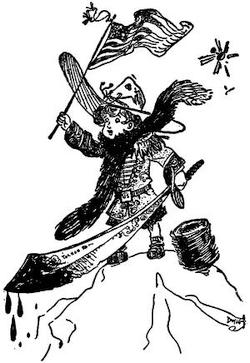
"WHEN I WAS A SOLDIER," REMARKED
TODDIE
"Uncle Harry,
I wish my papa
would come
home right
away," said
Budge.
"Why, Budge?"
"I want to love
him for bein' so
good to that
poor little boy in
the war."
"Ocken Hawwy,
I wants my
dolly's k'adle, 'tause my dolly's in it, an' I
want to shee her"; thus spake Toddie.
"Don't you think the Lord loved my papa
awful much for doin' that sweet thing, Uncle
Harry?" asked Budge.
"Yes, old fellow, I feel sure that he did."
"Lord lovesh my papa vewy much, so I
love ze Lord vewy much," remarked Toddie.
"An' I wants my dolly's k'adle an' my
dolly."
"Toddie, I don't know where either of
them are—I can't find them now—do wait
until morning, when Uncle Harry will look
for them."
"I don't see how the Lord can get along
in heaven without my papa, Uncle Harry,"
said Budge.
"Lord takesh papa to heaven, an' Budge
an' me, and we'll go walkin' an' see ze Lord,
an play wif ze angels' wings, an hazh good
timsh, an' never have to go to bed at all, at
all."
Pure-hearted little innocents! compared
with older people whom we endure, how great
thy faith and how few thy faults! How
superior thy love——
A knock at the door interrupted me.
"Come in!" I shouted.
In stepped Mike, with an air of the greatest
secrecy, handed me a letter and the identical
box in which I had sent the flowers to
Miss Mayton. What could it mean? I
hastily opened the envelope, and at the same
time Toddie shrieked:—
"Oh, darsh my dolly's k'adle—dare tizh!"
snatched and opened the box, and displayed—his
doll! My heart sickened, and did not
regain its strength during the perusal of the
following note:—
"Miss Mayton herewith returns to Mr. Burton the
package which just arrived, with his card. She recognizes
the contents as a portion of the apparent property
of one of Mr. Burton's nephews, but is unable to
understand why it should have been sent to her.
"June 20, 1875."
"Toddie," I roared, as my younger nephew
caressed his loathsome doll, and murmured
endearing words to it, "where did you get
that box?"
"On the hat-wack," replied the youth,
with perfect fearlessness. "I keeps it in ze
book-case djawer, and somebody took it
'way, and put nasty ole flowers in it."
"Where are those flowers?" I demanded.
Toddie looked up with considerable surprise,
but promptly replied:—
"I froed 'em away—don't want no ole
flowers in my dolly's k'adle. That's ze way
she wocks—see!" And the horrible little
destroyer of human hopes rolled that box
back and forth with the most utter unconcern,
as he spoke endearing words to the substitute
for my beautiful bouquet!
To say that I looked at Toddie reprovingly
is to express my feelings in the most inadequate
language, but of language in which to
express my feelings to Toddie, I could find
absolutely none. Within two or three short
moments I had discovered how very anxious
I really was to merit Miss Mayton's regard,
and how very different was the regard I
wanted from that which I had previously
hoped might be accorded me. It seemed too
ridiculous to be true that I, who had for years
had dozens of charming lady acquaintances,
and yet had always maintained my common
sense and self-control; I, who had always
considered it unmanly for a man to specially
interest himself in any lady until he had an
income of five thousand a year; I, who had
skilfully, and many times, argued that life
attachments, or attempts thereat, which were
made without a careful preliminary study of
the mental characteristics of the partner desired,
were the most unpardonable folly,—I
had transgressed every one of my own rules,
and, as if to mock me for any pretended wisdom
and care, my weakness was made known
to me by a three-year-old marplot and a hideous
rag doll!
That merciful and ennobling dispensation
by which Providence enables us to temper
the severity of our own sufferings by alleviating
those of others, came soon to my rescue.
Under my stern glance, Toddie gradually lost
interest in his doll and its cradle, and began
to thrust forth and outward his piteous lower
lip, and to weep copiously.
"Dee Lord not make me sho bad," he cried
through his tears. I doubt his having had
any very clear idea of what he was saying, or
whom he was addressing; but had the publican
of whose prayer Toddie made so fair a
paraphrase worn such a face when he offered
his famous petition, it could not have been
denied for a moment. Toddie even retired
to a corner, and hid his face in self-imposed
penance.
"Never mind, Toddie," said I sadly; "you
didn't mean to do it, I know."
"I wantsh to love you," sobbed Toddie.
"Well, come here, you poor little fellow,"
said I, opening my arms, and wondering
whether 'twas not after contemplation of
some such sinner that good Bishop Tegner
wrote:—
"Depths of love are atonement's depths, for love is atonement."
Toddie came to my arms, shed tears freely
upon my shirt-front, and finally, after heaving
a very long sigh, remarked:—
"Wantsh you to love me."
I complied with his request. Theoretically
I had long believed that the higher wisdom
of the Creator was most frequently expressed
through the medium of his most innocent
creations. Surely here was a confirmation of
my theory, for who else had ever practically
taught me the duty of the injured one toward
his offender? I kissed Toddie and petted
him, and at length succeeded in quieting him;
his little face, in spite of much dirt and many
tear-stains, was upturned with more of
beauty in it than it ever held when its owner
was full of joy; he looked earnestly, confidingly,
into my eyes, and I congratulated myself
upon the perfection of my forgiving spirit,
when Toddie suddenly re-exhibited to me my
old unregenerate nature, and the incompleteness
of my forgiveness, by saying:—
"Kish my dolly, too."
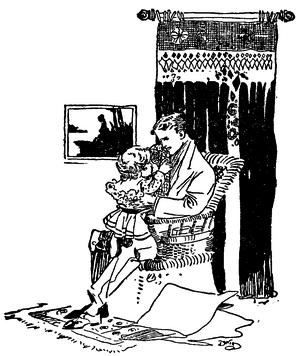
"KISH MY DOLLY, TOO"
I obeyed. My forgiveness was made complete,
but so was my humiliation. I abruptly
closed our interview. We exchanged "God
bless you's," according to Budge's instructions
of the previous night, and at least one
of the participants in this devotional exercise
hoped the petitions made by the other were
distinctly heard. Then I dropped into an
easy-chair in the library, and fell to thinking.
I found myself really and seriously troubled
by the results of Toddie's operation with my
bouquet. I might explain the matter to Miss
Mayton—I undoubtedly could, for she was
too sensible a woman to be easily offended
merely by a ridiculous mistake, caused by a
child. But she would laugh at me—how
could she help it?—and to be laughed at by
Miss Mayton was a something, the mere
thought of which tormented me in a manner
that made me fairly ashamed of myself. Like
every other young man among young men, I
had been the butt of many a rough joke, and
had borne them without wincing; it seemed
cowardly and contemptible that I should be
so sensitive under the mere thought of laughter
which would probably be heard by no one
but Miss Mayton herself. But the laughter
of a mere acquaintance is likely to lessen respect
for the person laughed at. Heavens!
the thought was unendurable! At any rate,
I must write an early apology. When I was
correspondent for the house with which I am
now salesman, I reclaimed many an old customer
who had wandered off—certainly I
might hope, by a well-written letter, to regain
in Miss Mayton's respect whatever position I
had lost. I hastily drafted a letter, corrected
it carefully, copied it in due form, and forwarded
it by the faithful Michael. Then I
tried to read, but without the least success.
For hours I paced the piazza and consumed
cigars; when at last I retired it was with
many ideas, hopes, fears, and fancies which
had never before been mine. True to my
trust, I looked into my nephews' room; there
lay the boys, in postures more graceful than
any which brush or chisel have ever reproduced.
Toddie, in particular, wore so lovely
an expression that I could not refrain from
kissing him. But I was none the less careful
to make use of my new key, and to lock my
other door also.
The next day was the Sabbath. Believing
fully in the binding force and worldly wisdom
of the Fourth Commandment, so far as it
refers to rest, I have conscientiously trained
myself to sleep two hours later on the morning
of the holy day than I ever allowed myself
to do on business days. But having inherited,
besides a New England conscience,
a New England abhorrence of waste, I regularly
sit up two hours later on Saturday
nights than on any others; and the night
preceding this particular Sabbath was no
exception to the rule, as the reader may
imagine from the foregoing recital. At about
5.30 A.M., however, I became conscious that
my nephews were not in accord with me on the
Sinaitic law. They were not only awake, but
were disputing vigorously, and, seemingly
very loudly, for I heard their words quite distinctly.
With sleepy condescension I endeavored
to ignore these noisy irreverents,
but I was suddenly moved to a belief in the
doctrine of vicarious atonement, for a flying
body, with more momentum than weight,
struck me upon the not prominent bridge of
my nose, and speedily and with unnecessary
force accommodated itself to the outline of
my eyes. After a moment spent in anguish, and
in wondering how the missive came through
closed doors and windows, I discovered that
my pain had been caused by one of the dolls,
which from its extreme uncleanness, I suspected
belonged to Toddie; I also discovered
that the door between the rooms was open.
"Who threw that doll?" I shouted, sternly.
There came no response.
"Do you hear?" I roared.
"What is it, Uncle Harry?" asked Budge,
with most exquisitely polite inflection.
"Who threw that doll?"
"Huh?"
"I say, who threw that doll?"
"Why, nobody did it."
"Toddie, who threw that doll?"
"Budge did," replied Toddie, in muffled
tones, suggestive of a brotherly hand laid
forcibly over a pair of small lips.
"Budge, what did you do it for?"
"Why—why—I—because—why, you see—because,
why, Toddie froo his dolly in my
mouth; some of her hair went in, anyhow,
an' I didn't want his dolly in my mouth, so I
sent it back to him, an' the foot of the bed
didn't stick up enough, so it went froo the
door to your bed—that's what for."
The explanation seemed to bear marks of
genuineness, albeit the pain in my eye was
not alleviated thereby, while the exertion expended
in eliciting the information had so
thoroughly awakened me that further sleep
was out of the question. Besides, the open
door—had a burglar been in the room? No,
my watch and pocket-book were undisturbed.
"Budge, who opened that door?"
After some hesitation, as if wondering who
really did it, Budge replied:—
"Me."
"How did you do it?"
"Why, you see we wanted a drink, an' the
door was fast, so we got out the window on
the parazzo roof, an' comed in your window."
(Here a slight pause.) "An' 'twas fun. An'
then we unlocked the door, an' comed back."
Then I should be compelled to lock my
window blinds—or theirs, and this in the
summer season, too! Oh, if Helen could
have but passed the house as that white-robed
procession had filed along the piazza roof! I
lay pondering over the vast amount of unused
ingenuity that was locked up in millions
of children, or employed only to work misery
among unsuspecting adults, when I heard
light footfalls at my bedside, and saw a
small shape with a grave face approach and
remark:
"I wants to come in your bed."
"What for, Toddie?"
"To fwolic; papa always fwolics us Sunday
mornin's. Tum, Budgie, Ocken Hawwy's
doin' to fwolic us."
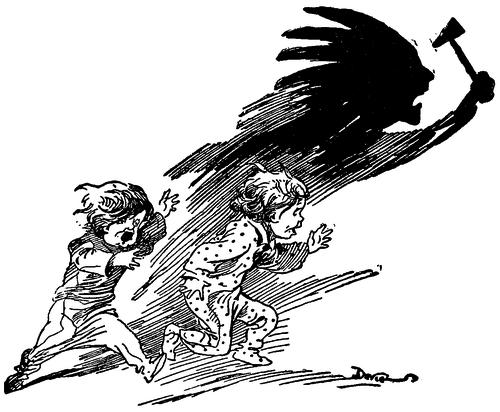
TWO LITTLE SAVAGES
Budge replied by shrieking with delight,
tumbling out of bed, and hurrying to that
side of my bed not already occupied by Toddie.
Then those two little savages sounded
the onslaught and advanced precipitately
upon me. Sometimes, during the course of
my life, I have had day-dreams which I have
told to no one. Among these has been one—not
now so distinct as it was before my four
years of campaigning—of one day meeting in
deadly combat the painted Indian of the
plains; of listening undismayed to his frightful
war-whoop, and of exemplifying in my
own person the inevitable result of the paleface's
superior intelligence. But upon this
particular Sunday morning I relinquished
this idea informally but forever. Before the
advance of these diminutive warriors I
quailed contemptibly, and their battle-cry
sent more terror to my soul than that member
ever experienced from the well-remembered
rebel yell. According to Toddie, I was
going to "fwolic" them; but from the first
they took the whole business into their own
little but effective hands. Toddie pronounced
my knees, collectively, "a horsie-bonnie."
and bestrode them, laughing gleefully at my
efforts to unseat him, and holding himself in
position by digging his pudgy fingers into
whatever portions of my anatomy he could
most easily seize. Budge shouted," I want
a horsie, too!" and seated himself upon my
chest. "This is the way the horsie goes,"
explained he, as he slowly rocked himself
backward and forward. I began to realize
how my brother-in-law, who had once been a
fine gymnast, had become so flat-chested.
Just then Budge's face assumed a more spirited
expression, his eyes opened wide and
lighted up, and shouting," This the way the
horsie trots," he stood upright, threw up his
feet, and dropped his forty-three avoirdupois
pounds forcibly upon my lungs. He repeated
this operation several times before I
fully recovered from the shock conveyed by
his combined impudence and weight; but
pain finally brought my senses back, and
with a wild plunge I unseated my demoniac
riders and gained a clear space in the middle
of the floor.
"Ah—h—h—h—h—h—h!" screamed Toddie;
"I wants to ride horshie backen."
"Boo—oo—oo—oo—!" roared Budge; "I
think you're real mean. I don't love you at
all."
Regardless alike of Toddie's desires, of
Budge's opinion and the cessation of his regard,
I performed a hasty toilet. Notwithstanding
my lost rest, I savagely thanked the
Lord for Sunday; at church, at least, I could
be free from my tormentors. At the breakfast
table both boys invited themselves to
accompany me to the sanctuary, but I declined,
without thanks. To take them might
be to assist somewhat in teaching them one
of the best habits, but I strongly doubted
whether the severest Providence would consider
it my duty to endure the probable consequences
of such an attempt. Besides I
might meet Miss Mayton. I both hoped and
feared I might, and I could not endure the
thought of appearing before her with the
causes of my pleasant remembrance. Budge
protested, and Toddie wept, but I remained
firm, although I was so willing to gratify their
reasonable desires that I took them out for a
long ante-service walk. While enjoying this
little trip I delighted the children by killing
a snake and spoiling a slender cane at the
same time, my own sole consolation coming
from the discovery that the remains of the
staff were sufficient to make a cane for Budge.
While returning to the house and preparing
for church I entered into a solemn agreement
with Budge, who was usually recognized as
the head of this fraternal partnership. Budge
contracted, for himself and brother, to make
no attempts to enter my room; to refrain
from fighting; to raise loose dirt only with a
shovel, and to convey it to its destination by
means other than their own hats and aprons;
to pick no flowers; to open no water-faucets;
to refer all disagreements to the cook, as
arbitrator, and to build no houses of the new
books which I had stacked upon the library
table. In consideration of the promised
faithful observance of these conditions, I
agreed that Budge should be allowed to come
alone to Sabbath-school, which convened
directly after morning service, he to start
only after Maggie had pronounced him duly
cleansed and clothed. As Toddie was daily
kept in bed from eleven till one, I felt that I
might safely worship without distracting
fears, for Budge could not alone, and in a single
hour, become guilty of any particular sin.
The church at Hillcrest had many more seats
than members, and as but few summer visitors
had yet appeared in the town, I was
conscious of being industriously stared at by
the native members of the congregation.
This was of itself discomfort enough, but not
all to which I was destined, for the usher conducted
me quite near to the altar, and
showed me into a pew whose only other occupant
was Miss Mayton! Of course the lady
did not recognize me—she was too carefully
bred to do anything of the sort in church, and
I spent ten uncomfortable minutes in mentally
abusing the customs of good society.
The beginning of the service partially ended
my uneasiness, for I had no hymn-book—the
pew contained none—so Miss Mayton kindly
offered me a share in her own. And yet so
faultlessly perfect and stranger-like was her
manner that I wondered whether her action
might not have been prompted merely by a
sense of Christian duty; had I been the Khan
of Tartary she could not have been more
polite and frigid. The music to the first hymn
was an air I had never heard before, so I
stumbled miserably through the tenor, although
Miss Mayton rendered the soprano
without a single false note. The sermon was
longer than I was in the habit of listening to,
and I was frequently conscious of not listening
at all. As for my position and appearance,
neither ever seemed so insignificant as
they did throughout the entire service.
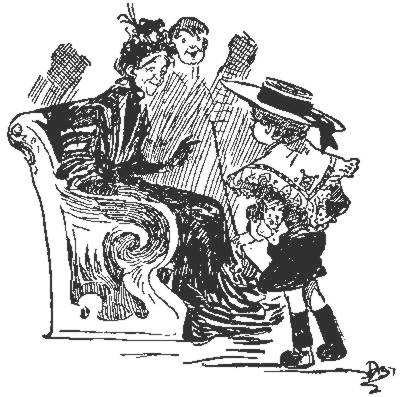
MY NEPHEW BUDGE IN HIS BEST
The minister reached "And finally, dear
brethren," with my earnest prayers for a successful
and speedy finale. It seemed to me
that the congregation sympathized with me,
for there was a general rustle behind me as
these words were spoken. It soon became
evident, however, that the hearers were
moved by some other feeling, for I heard a
profound titter or two behind me. Even
Miss Mayton turned her head with more
alacrity than was consistent with that grace
which usually characterized her motions, and
the minister himself made a pause of unusual
length, I turned in my seat, and saw my
nephew Budge, dressed in his best, his head
irreverently covered, and his new cane swinging
in the most stylish manner. He paused
at each pew, carefully surveyed its occupants,
seemed to fail in finding the object of his
search, but continued his efforts in spite of
my endeavors to catch his eye. Finally he
recognized a family acquaintance, and to him
he unburdened his bosom by remarking, in
tones easily heard throughout the church:—
"I want to find my uncle."
Just then he caught my eye, smiled rapturously,
hurried to me, and laid his rascally soft
cheek confidingly against mine, while an
audible sensation pervaded the church. What
to do or say to him I scarcely knew; but my
quandary was turned to wonder, as Miss
Mayton, her face full of ill-repressed mirth,
but her eyes full of tenderness, drew the little
scamp close to her, and kissed him soundly.
At the same instant, the minister, not without
some little hesitation, said, "Let us
pray." I hastily bowed my head, glad of a
chance to hide my face; but as I stole a
glance at the cause of this irreligious disturbance,
I caught Miss Mayton's eye. She was
laughing so violently that the contagion was
unavoidable, and I laughed all the harder as
I felt that one mischievous boy had undone
the mischief caused by another.
After the benediction, Budge was the recipient
of a great deal of attention, during the
confusion of which I embraced the opportunity
to say to Miss Mayton:—
"Do you still sustain my sister in her opinion
of my nephews, Miss Mayton?"
"I think they're too funny for anything,"
replied the lady, with great enthusiasm. "I
do wish you would bring them to call upon
me. I'm longing to see an original young
gentleman."
"Thank you," said I. "And I'll have
Toddie bring a bouquet by way of atonement."
"Do," she replied, as I allowed her to pass
from the pew. The word was an insignificant
one, but it made me happy once more.
"You see, Uncle Harry," exclaimed Budge,
as we left the church together, "the Sunday-school
wasn't open yet, an' I wanted to hear
if they'd sing again in church; so I came in,
an' you wasn't in papa's seat, an' I knew you
was somewhere, so I looked for you."
"Bless you," thought I, snatching him into
my arms as if to hurry him into Sabbath-school,
but really to give him a kiss of
grateful affection, "you did right—exactly
right."
My Sunday dinner was unexceptional in
point of quantity and quality, and a bottle of
my brother-in-law's claret proved to be the
most excellent; yet a certain uneasiness of
mind prevented my enjoying the meal as
thoroughly as under other circumstances I
might have done. My uneasiness came of a
mingled sense of responsibility and ignorance.
I felt that it was the proper thing for me to
see that my nephews spent the day with some
sense of the requirements and duties of the
Sabbath; but how I was to bring it about I
hardly knew. The boys were too small to
have Bible-lessons administered to them, and
they were too lively to be kept quiet by any
ordinary means. After a great deal of
thought, I determined to consult the children
themselves, and try to learn what their parents'
custom had been.
"Budge," said I, "what do you do Sundays
when your papa and mamma are home? What
do they read to you—what do they talk about?"
"Oh, they swing us—lots!" said Budge,
with brightening eyes.
"An' zey takes us to get jacks," observed
Toddie.
"Oh, yes!" exclaimed Budge; "jacks-in-the-pulpit,—don't
you know?"
"Hum—ye—es; I do remember some such
thing in my youthful days; they grow where
there's plenty of mud, don't they?"
"Yes, an' there's a brook there, an' ferns, an'
birchbark, an' if you don't look out you'll tumble
into the brook when you go to get birch."
"An' we goes to Hawksnest Rock," piped
Toddie, "an' papa carries us up on his back
when we gets tired."
"An' he makes us whistles," said Budge.
"Budge," said I, rather hastily, "enough.
In the language of the poet
'These earthly pleasures I resign'
and I'm rather astonished that your papa
hasn't taught you to do likewise. Don't he
ever read to you?"
"Oh, yes," cried Budge, clapping his hands
as a happy thought struck him. "He gets
down the Bible—the great big Bible, you
know—an' we all lay on the floor, an' he
reads us stories out of it. There's David, an'
Noah, an' when Christ was a little boy, an'
Joseph, an' turn back Pharo's army hallelujah——"
"And what?"
"TurnbackPharo'sarmyhallelujah," repeated
Budge. "Don't you know how Moses
held his cane out over the Red Sea, an' the
water went 'way up one side, an' 'way up the
other side, and all the Isrulites went across?
It's just the same thing as drown old Pharo's
army hallelujah—don't you know."
"Budge," said I; "I suspect you of having,
heard the Jubilee Singers."
"Oh, an' papa an' mamma sings us all
those jubilee songs—there's 'Swing Low,' an'
'Roll Jordan,' an' 'Steal Away,' an' 'My
Way's Cloudy,' an' 'Get on Board, Childuns,'
an' lots. An' you can sing us every one of
'em."
"An' papa takes us in the woods and
makesh us canes," said Toddie.
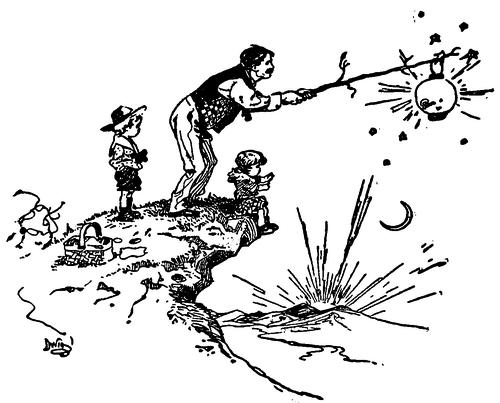
PUTTING AN EXTENSION ON THE AFTERNOON
"Yes," said Budge, "and where there's
new houses buildin', he takes us up ladders."
"Has he any way of putting an extension
on the afternoon?" I asked.
"I don't know what that is," said Budge,
"but he puts an India-rubber blanket on the
grass, and then we all lie down and make
b'lieve we're soldiers asleep. Only sometimes
when we wake up, papa stays asleep,
an' mamma won't let us wake him. I don't
think that's a very nice play."
"Well, I think Bible stories are nicer than
anything else, don't you?"
Budge seemed somewhat in doubt. "I
think swingin' is nicer," said he—"oh, no;—let's
get some jacks—I'll tell you what!—make
us whistles, an' we can blow on 'em
while we're goin' to get the jacks. Toddie,
dear, wouldn't you like jacks an' whistles?"
"Yesh—an' swingin'—an' birch—an'
wantsh to go to Hawksnesh Rock," answered
Toddie.
"Let's have Bible stories first," said I.
"The Lord mightn't like it if you didn't learn
anything good to-day."
"Well," said Budge, with the regulation
religious-matter-of-duty face, "let's. I guess
I like 'bout Joseph best."
"Tell us 'bout Bliaff," suggested Toddie.
"Oh, no, Tod," remonstrated Budge; "Joseph's
coat was just as bloody as Goliath's
head was." Then Budge turned to me and
explained that "all Tod likes Goliath for is
'cause when his head was cut off it was all
bloody." And then Toddie—the airy sprite
whom his mother described as being irresistibly
drawn to whatever was beautiful—Toddie
glared upon me, as a butcher's apprentice
might stare at a doomed lamb, and remarked:—
"Bliaff's head was all bluggy, an' David's
sword was all bluggy—bluggy as everyfing."
I hastily breathed a small prayer, opened
the Bible, turned to the story of Joseph, and
audibly condensed it, as I read:
"Joseph was a good little boy, whose papa
loved him very dearly. But his brothers
didn't like him. And they sold him to go to
Egypt. And he was very smart, and told
people what their dreams meant, and he got
to be a great man. And his brothers went to
Egypt to buy corn, and Joseph sold them
some, and then he let them know who he was.
And he sent them home to bring their papa
to Egypt, and then they all lived there together."
"That ain't it," remarked Toddie, with the
air of a man who felt himself to be unjustly
treated. "Is it, Budge?"
"Oh, no," said Budge, "you didn't read it
good a bit; I'll tell you how it is. Once there
was a little boy named Joseph, an' he had
eleven budders—they was awful eleven budders.
An' his papa gave him a new coat, an'
his budders hadn't nothin' but their old jackets
to wear. An' one day he was carrying
'em their dinner, an' they put him in a deep,
dark hole, but they didn't put his nice new
coat in—they killed a kid, an' dipped the
coat—just think of doin' that to a nice new
coat—they dipped it in the kid's blood, an'
made it all bloody."
"All bluggy," echoed Toddie, with ferocious
emphasis. Budge continued:—
"But there were some Ishmalites comin'
along that way, and the awful eleven budders
took him out of the deep, dark hole, an' sold
him to the Ishmalites, an' they sold him away
down in Egypt. An' his poor old papa cried,
an' cried, an' cried, 'cause he thought a big
lion ate Joseph up; but he wasn't ate up a
bit; but there wasn't no post-office nor choo-choos,[6]
nor stages in Egypt, an' there wasn't
any telegraphs, so Joseph couldn't let his
papa know where he was; an' he got so smart
an' so good that the king of Egypt let him
sell all the corn an' take care of the money;
'an one day some men came to buy some
com, an' Joseph looked at 'em 'an they was
his own budders! An' he scared 'em like
everything; I'd have slapped 'em all if I'd
been Joseph, but he just scared 'em, an' then
he let 'em know who he was, an' he kissed 'em
an' he didn't whip 'em, or make 'em go without
their breakfast, or stand in a corner, nor
none of them things; an' then he sent them
back for their papa, an' when he saw his papa
comin', he ran like everything, and gave him
a great big hug and a kiss. Joseph was too
big to ask him if he'd brought him any candy,
but he was awful glad to see him. An' the
king gave Joseph's papa a nice farm, an' they
all had real good times after that."
"An' they dipped the coat in the blood, an'
made it all bluggy," reiterated Toddie.
"Uncle Harry," said Budge, "what do you
think my papa would do, if he thought I was
all ate up by a lion? I guess he'd cry awful,
don't you? Now tell us another story—oh,
I'll tell you—read us 'bout—"
"'Bout Bliaff," interrupted Toddie.
"You tell me about him, Toddie," said I.
"Why," said Toddie, "Bliaff was a brate
bid man, an' Dave was brate little man, an'
Bliaff said, 'Come over here, an' I'll eat you
up,' an' Dave said, 'I ain't fyaid of you.' So
Dave put five little stones in a sling an' asked
de Lord to help him, an' let ze sling go bang
into bequeen Bliaff's eyes an' knocked him
down dead, an' Dave took Bliaff's sword an'
sworded Bliaff's head off, an' made it all
bluggy, an' Bliaff runned away." This short
narration was accompanied by more spirited
and unexpected gestures than Mr. Gough ever
puts into a long lecture.
"I don't like 'bout Goliath at all," remarked
Budge, "I'd like to hear 'bout
Ferus."
"Who?"
"Ferus; don't you know?"
"Never heard of him, Budge."
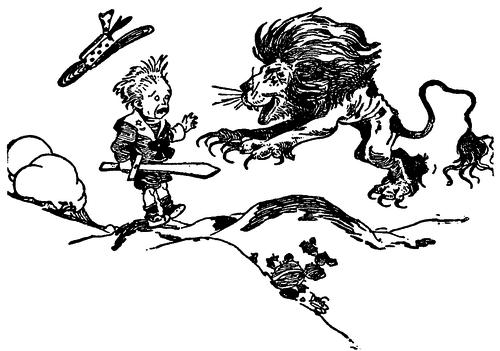
"IF I WAS ALL ATE UP BY A LION"
"Why—y—y—!" exclaimed Budge; "didn't
you have no papa when you was a little boy?"
"Yes, but he never told me about any one
named Ferus; there is no such person named
in Anthon's Classical Dictionary, either.
What sort of a man was he?"
"Why, once there was a man, an' his name
was Ferus—Offerus, an' he went about fightin'
for kings, but when any king got afraid of
anybody, he wouldn't fight for him no more.
An' one day he couldn't find no kings that
wasn't afraid of nobody. An' the people
told him the Lord was the biggest king in the
world, an' he wasn't afraid of nobody nor
nothing. An' he asked 'em where he could
find the Lord, an' they said he was 'way up
in heaven so nobody couldn't see him but the
angels, but he liked folks to work for him
instead of fight. So Ferus wanted to know
what kind of work he could do, an' the people
said there was a river not far off, where there
wasn't no ferry-boats, 'cos the water run so
fast, an' they guessed if he'd carry folks
across, the Lord would like it. So Ferus
went there, an' he cut him a good, strong
cane, an' whenever anybody wanted to go
across the river he'd carry 'em on his back.
"One night he was sittin' in his little house
by the fire, and smokin' his pipe an' readin'
the paper, an' 'twas rainin' an' blowin' an'
hailin' an' stormin', an' he was so glad there
wasn't anybody wantin' to go 'cross the river,
when he heard somebody call out, 'Ferus!'
An' he looked out the window, but he couldn't
see nobody, so he sat down again. Then
somebody called, 'Ferus!' again, and he
opened the door again, an' there was a little
bit of a boy, 'bout as big as Toddie. An'
Ferus said, 'Hello, young fellow, does your
mother know you're out?' An' the little boy
said, 'I want to go 'cross the river.'—'Well,'
says Ferus, 'you're a mighty little fellow to
be travelin' alone, but hop up.' So the little
boy jumped up on Ferus' back, and Ferus
walked into the water. Oh, my—wasn't it
cold? An' every step he took, the little boy
got heavier, so Ferus nearly tumbled down
an' they liked to both got drownded. An'
when they got across the river Ferus said,
'Well, you are the heaviest small fry I ever
carried,' an' he turned around to look at him,
an' 'twasn't no little boy at all—'twas a big
man—'twas Christ. An' Christ said, 'Ferus,
I heard you was tryin' to work for me, so I
thought I'd come down an' see you, an' not
let you know who I was. An' now you shall
have a new name; you shall be called Christofferus,
'cos that means Christ-carrier.' An'
everybody called him Christofferus after
that, an' when he died they called him Saint
Christopher, 'cos Saint is what they call good
people when they're dead."
Budge, himself, had the face of a rapt saint
as he told this story, but my contemplation
of his countenance was suddenly arrested by
Toddie, who, disapproving of the unexciting
nature of his brother's recital, had strayed
into the garden, investigated a hornet's nest,
been stung, and set up a piercing shriek. He
ran in to me, and as I hastily picked him up,
he sobbed:—
"Want to be wocked.[7] Want 'Toddie one
boy day.'"
I rocked him violently, and petted him
tenderly, but again he sobbed:—
"Want 'Toddie one boy day.'"
"What does the child mean?" I exclaimed.
"He wants you to sing to him about
'Charlie boy one day,'" said Budge. "He
always wants mamma to sing that when he's
hurt, an' then he stops crying."
"I don't know it," said I. "Won't 'Roll,
Jordan,' do, Toddie?"
"I'll tell you how it goes," said Budge, and
forthwith the youth sang the following song,
a line at a time, I following him in words
and air:—
"Where is my little bastik
[8] gone?
Said Charley boy one day;
I guess some little boy or girl
Has taken it away.
"An' kittie, too—where ish she gone?
Oh, dear, what I shall do?
I wish I could my bastik find,
An' little kittie, too.
"I'll go to mamma's room an' look;
Perhaps she may be there;
For kittie likes to take a nap
In mamma's easy chair.
"O mamma, mamma, come an' look!
See what a little heap!
Here's kittie in the bastik here,
All cuddled down to sleep."
Where the applicability of this poem to my
nephew's peculiar trouble appeared, I could
not see, but as I finished it, his sobs gave
place to a sigh of relief.
"Toddie," said I, "do you love your Uncle
Harry?"
"Esh, I do love you."
"Then tell me how that ridiculous song
comforts you?"
"Makes me feel good, an' all nicey," replied
Toddie.
"Wouldn't you feel just as good if I sang,
'Plunged in a gulf of dark despair'?"
"No, don't like dokdishpairs; if a dokdishpair
done anyfing to me, I'd knock it
right down dead."
With this extremely lucid remark, our
conversation on this particular subject
ended; but I wondered, during a few uneasy
moments, whether the temporary mental
aberration which had once afflicted Helen's
grandfather and mine was not reappearing
in this, his youngest descendant. My
wondering was cut short by Budge, who
remarked, in a confidential tone:—
TODDIE INVESTIGATING A HORNET'S
NEST
"Now, Uncle
Harry, we'll
have the whistles,
I guess."
I acted upon
the suggestion,
and led the
way to the
woods. I had
not had occasion to seek a hickory sapling
before for years; not since the war, in fact,
when I learned how hot a fire small hickory
sticks would make. I had not sought wood
for whistles since—— Gracious, nearly a
quarter of a century ago! The dissimilar
associations called up by these recollections
threatened to put me in a frame of mind
which might have resulted in a bad poem,
had not my nephews kept up a lively
succession of questions, such as no one but
children can ask. The whistles completed, I
was marched, with music, to the place where
the "jacks" grew. It was just such a place
as boys instinctively delight in—low, damp,
and boggy, with a brook hiding treacherously
away, under overhanging ferns and grasses.
The children knew by sight the plant which
bore the "jacks," and every discovery was
announced by a piercing shriek of delight.
At first, I looked hurriedly toward the brook
as each yell clove the air; but, as I became
accustomed to it, my attention was diverted
by some exquisite ferns. Suddenly, however,
a succession of shrieks announced that
something was wrong, and across a large fern
I saw a small face in a great deal of agony.
Budge was hurrying to the relief of his
brother, and was soon as deeply imbedded as
Toddie was, in the rich black mud at the bottom
of the brook. I dashed to the rescue,
stood astride the brook, and offered a hand
to each boy, when a treacherous tuft of grass
gave way, and, with a glorious splash, I went
in myself. This accident turned Toddie's
sorrow to laughter, but I can't say I made
light of my misfortune on that account. To
fall into clean water is not pleasant, even
when one is trout-fishing; but to be clad in
white pants, and suddenly drop knee-deep in
the lap of mother Earth is quite a different
thing. I hastily picked up the children, and
threw them upon the bank, and then wrathfully
strode out myself, and tried to shake
myself as I have seen a Newfoundland dog
do. The shake was not a success—it caused
my trouser-leg to flap dismally about my
ankles, and sent the streams of loathsome ooze
trickling down into my shoes. My hat, of
drab felt, had fallen off by the brookside, and
been plentifully spattered as I got out. I
looked at my youngest nephew with speechless
indignation.
"Uncle Harry," said Budge, "'twas real
good of the Lord to let you be with us, else
Toddie might have been drownded."
"Yes," said I, "and I shouldn't have
much——"
"Ocken Hawwy," cried Toddie, running
impetuously toward me, pulling me down,
and patting my cheek with his muddy, black
hand, "I loves you for taking me out de
water."
"I accept your apology," said I, "but let's
hurry home." There was but one residence
to pass, and that, thank fortune, was so
densely screened by shrubbery that the inmates
could not see the road. To be sure,
we were on a favorite driving-road, but we
could reach home in five minutes, and we
might dodge into the woods if we heard a
carriage coming. Ha! There came a carriage
already, and we—was there ever a sorrier-looking
group? There were ladies in the
carriage, too—could it be—of course it was—did
the evil spirit, which guided those children
always, send an attendant for Miss
Mayton before he began operations? There
she was, anyway—cool, neat, dainty, trying
to look collected, but severely flushed by the
attempt. It was of no use to drop my eyes,
for she had already recognized me; so I
turned to her a face which I think must have
been just the one—unless more defiant—that
I carried into two or three cavalry charges.
"You seem to have been having a real good
time together," said she, with a conventional
smile, as the carriage passed. "Remember,
you're all going to call on me to-morrow
afternoon."
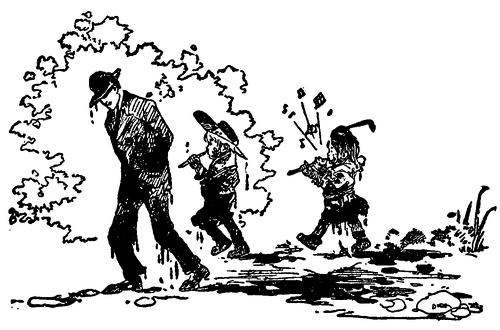
"BUT LET'S HURRY HOME"
Bless the girl! Her heart was as quick as
her eyes—almost any
other young lady would
have devoted her entire energy to laughing on
such an occasion, but she took her earliest
opportunity to make me feel at ease. Such
a royal-hearted woman deserves to—I caught
myself just here, with my cheeks growing
quite hot under the mud Toddie had put on
them, and I led our retreat with a more stylish
carriage than my appearance could possibly
have warranted, and then I consigned
my nephews to the maid with very much the
air of an officer turning over a large number
of prisoners he had captured. I hastily
changed my soiled clothing for my best—not
that I expected to see anyone, but because
of a sudden increase in the degree of respect
I felt toward myself. When the children
were put to bed, and I had no one but my
thoughts for companions, I spent a delightful
hour or two in imagining as possible some
changes of which I had never dared to think
before.
On Monday morning I was in the garden
at sunrise. Toddie was to carry his expiatory
bouquet to Miss Mayton that day, and
I proposed that no pains should be spared to
make his atonement as handsome as possible.
I canvassed carefully every border, bed, and
detached flowering plant until I had as accurate
an idea of their possibilities as if I had
inventoried the flowers in pen and ink. This
done, I consulted the servant as to the unsoiled
clothing of my nephews? She laid out
the entire wardrobe for my inspection, and
after a rigid examination of everything, I
selected the suits which the boys were to
wear in the afternoon. Then I told the girl
that the boys were going with me after dinner
to call on some ladies and that I desired that
she should wash and dress them carefully.
"Tell me just what time you'll start, sir,
and I'll begin an hour beforehand," said she.
"That's the only way to be sure that they
don't disgrace you."
For breakfast, we had, among other things,
some stewed oysters served in soup-plates.
"O Tod," shrieked Budge, "there's the
turtle-plates again—oh, ain't I glad!"
"Oo—ee—turtle pyates!" squealed Toddie.
"What on earth do you mean, boys?" I
demanded.
"I'll show you," said Budge, jumping
down from his chair, and bringing his plate of
oysters cautiously toward me. "Now you
just put your head down underneath my
plate, and look up, and you'll see a turtle."
For a moment I forgot that I was not at a
restaurant, and I took the plate, held it up,
and examined its bottom.
"There!" said Budge, pointing to the
trade-mark, in colors, of the makers of the
crockery, "don't you see the turtle?"
I abruptly ordered Budge to his seat, unmoved
even by Toddie's remark, that—
"Dey ish turtles, but dey can't kwawl
awound like udder turtles."
After breakfast I devoted a great deal of
fussy attention to myself. Never did my
own wardrobe seem so meager and ill-assorted;
never did I cut myself so many times
while shaving; never did I use such unsatisfactory
shoe-polish. I finally gave up in
despair my effort to appear genteel, and devoted
myself to the bouquet. I cut almost
flowers enough to dress a church, and then
remorselessly excluded every one which was
in the least particular imperfect. In making
the bouquet I enjoyed the benefit of my
nephews' assistance and counsel, and took
enforced part in conversation which flowers
suggested.
"Ocken Hawwy," said Toddie, "ish heaven
all like this, wif pretty f'owers? 'Cos I don't
see what ze angels ever turns out for if 'tis."
"Uncle Harry," said Budge, "when the
leaves all go up and down and wriggle around
so, are they talking to the wind?"
"I—I guess so, old fellow."
"Who are you making that bouquet for,
Uncle Harry?" asked Budge.
"For a lady—for Miss Mayton—that lady
that saw us all muddy yesterday afternoon,"
said I.
"Oh, I like her," said Budge. "She looks
so nice and pretty—just like a cake—just as
if she was good to eat—oh, I just love her,
don't you?"
"Well, I respect her very highly, Budge."
"'Spect? What does 'spect mean?"
"Why it means that I think she's a lady—a
real pleasant lady—just the nicest sort of
lady in the world—the sort of person I'd like
to see every day, and like to see her better
than anyone else."
"Oh, why, 'spect an' love means just the
same thing, don't they, Uncle Har——"
"Budge," I exclaimed, somewhat hastily,
"run, ask Maggie for a piece of string—quick!"
"All right," said Budge, moving off, "but
they do, don't they?"
At two o'clock I instructed Maggie to dress
my nephews, and at three we started to make
our call. To carry Toddie's bouquet, and
hold a hand of each boy so as to keep them
from darting into the hedges for grasshoppers
and the gutters for butterflies, was no easy
work, but I managed to do it. As we approached
Mrs. Clarkson's boarding-house I
felt my hat was over one ear, and my cravat
awry, but there was no opportunity to rearrange
them, for I saw Alice Mayton on the
piazza, and felt that she saw me. Handing
the bouquet to Toddie, and promising him
three sticks of candy if he would be careful
and not drop it, we entered the garden. The
moment we were inside the hedge and Toddie
saw a man going over the lawn with a lawn-mower,
he shrieked: "Oh, deresh a cutter-grass!"
and dropped the bouquet with the
carelessness born of perfect ecstasy. I
snatched it before it reached the ground,
dragged the offending youth up the walk,
saluted Miss Mayton, and told Toddie to give
the bouquet to the lady. This he succeeded
in doing, but as Miss Mayton thanked him
and stooped to kiss him he wriggled off the
piazza like a little eel, shouted, "Turn on!"
to his brother, and a moment later my
nephews were following the "cutter-grass"
at a respectful distance in the rear.
"Those are my sister's 'best children in the
world,' Miss Mayton," said I.
"Bless the little darlings!" replied the
lady; "I do love to see children enjoying
themselves."
"So do I," said I, "when I'm not responsible
for their well-being; but if the effort
I've expended on those boys had been directed
toward the interests of my employers,
those worthy gentlemen would consider me
invaluable."
Miss Mayton made some witty reply, and
we settled to a pleasant chat about mutual
acquaintances, about books, pictures, music
and gossip of our set. I would cheerfully
have discussed Herbert Spencer's system, the
Assyrian Tablets, or any other dry subject
with Miss Mayton, and felt that I was richly
repaid by the pleasure of seeing her. Handsome,
intelligent, composed, tastefully
dressed, without a suspicion of the flirt or
the languid woman of fashion about her, she
awakened to the uttermost every admiring
sentiment and every manly feeling. But,
alas! my enjoyment was probably more than
I deserved, so it was cut short. There were
other ladies boarding at Mrs. Clarkson's, and,
as Miss Mayton truthfully observed at our
first meeting, men were very scarce at Hillcrest.
So the ladies, by the merest accident,
of course, happened upon the piazza and each
one was presented to me, and common civility
made it impossible for me to speak to Miss
Mayton more than once in ten minutes. At
any other time and place I should have found
the meeting of so many ladies a delightful
experience, but now——
Suddenly, a compound shriek arose from
the lawn, and all the ladies sprang to their
feet. I followed their example, setting my
teeth firmly and viciously, hoping that
whichever nephew had been hurt was badly
hurt. We saw Toddie running toward us
with one hand in his mouth, while Budge ran
beside him, exclaiming:—
"Poor little Toddie! Don't cry! Does
it hurt you awful? Never mind—Uncle
Harry'll comfort you. Don't cry, Toddie,
de-ar!"
Both boys reached the piazza steps, and
clambered up, Budge exclaiming:—
"O Uncle Harry, Toddie put his fingers in
the little wheels of the cutter-grass, an' it
turned just the least little biddie, an' it
hurted him."
But Toddie ran up to me, clasped my legs
and sobbed: "Sing 'Toddie one boy day.'"
My blood seemed to freeze. I could have
choked that dreadful child, suffering though
he was. I stooped over him, caressed him,
promised him candy, took out my watch and
gave it to him to play with, but he returned
to his original demand. A lady—the homeliest
in the party—suggested that she should
bind up his hand, and I inwardly blessed her,
but he reiterated his request for "Toddie one
boy day," and sobbed pitifully.
"What does he mean?" asked Miss Mayton.
"He wants Uncle Harry to sing, 'Charley
boy one day,'" explained Budge; "he always
wants that song when he's hurt anyway."
"Oh, do sing it to him, Mr. Burton,"
pleaded Miss Mayton; and all the other
ladies exclaimed, "Oh, do!"
I wrathfully picked him up in my arms
and hummed the air of the detested song.
"Sit in a wockin'-chair," sobbed Toddie.
I obeyed; and then my tormentor remarked:—
"You don't sing the wydes [words]—I
wants the wydes."
I sang the words as softly as possible, with
my lips close to his ear, but he roared:—
"Sing louder!"
"I don't know any more of it, Toddle,"
I exclaimed in desperation.
"Oh, I'll tell it all to you, Uncle Harry,"
said Budge. And there, before that audience,
and her, I was obliged to sing that
dreadful doggerel, line for line, as Budge repeated
it. My teeth were set tight, my brow
grew clammy, and I gazed upon Toddie with
terrible thoughts in my mind. No one
laughed—I grew so desperate that a titter
would have given relief. At last I heard
someone whisper:—
"See how he loves him! Poor man!—he's
in perfect agony over the little fellow."
Had not the song reached its natural end
just then, I believe I should have tossed my
wounded nephew over the piazza rail. As it
was, I set him upon his feet, announced the
necessity of our departure, and began to take
leave, when Miss Mayton's mother insisted
that we should stay to dinner.
"For myself, I should be delighted, Mrs.
Mayton," said I; "but my nephews have
hardly learned company manners yet. I'm
afraid my sister wouldn't forgive me if she
heard I had taken them out to dinner."
"Oh, I'll take care of the little dears," said
Miss Mayton; "they'll be good with me, I
know."
"I couldn't be so unkind as to let you try
it, Miss Mayton," I replied. But she insisted,
and the pleasure of submitting to her will was
so great that I would have risked even greater
mischief. So Miss Mayton sat down to dinner
with Budge upon one side and Toddie on
the other, while I was fortunately placed opposite,
from which position I could indulge in
warning winks and frowns. The soup was
served. I signaled the boys to tuck their
napkins under their chins, and then turned to
speak to the lady on my right. She politely
inclined her head toward me, but her thoughts
seemed elsewhere; following her eyes, I beheld
my youngest nephew with his plate
upraised in both hands, his head on the tablecloth,
and his eyes turned painfully upward.
I dared not speak, for fear he would drop the
plate. Suddenly he withdrew his head, put
on an angelic smile, tilted his plate so part of
its contents sought refuge in the folds of Miss
Mayton's dainty, snowy dress, while the offender
screamed:—
"Oo-ee! zha turtle on my pyate!—Budgie,
zha turtle on my pyate!"
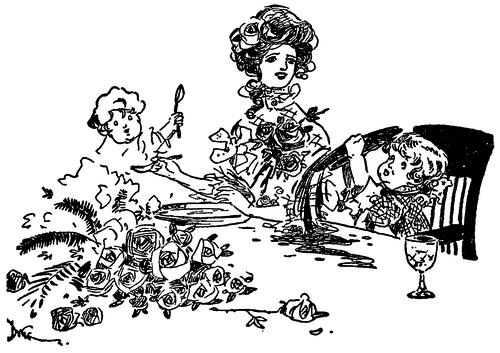
"OO-EE! ZHA TURTLE ON MY PYATE"
Budge was about to raise his plate when he
caught my eye and desisted. Poor Miss
Mayton actually looked discomposed for the
first time in her life, so far as I knew or could
imagine. She recovered quickly, however,
and treated that wretched boy with the most
Christian forbearance and consideration during
the remainder of the meal. When the
dessert was finished she quickly excused herself,
while I removed Toddie to a secluded
corner of the piazza, and favored him with a
lecture which caused him to howl pitifully,
and compelled me to caress him and undo all
the good which my rebukes had done. Then
he and Budge removed themselves to the lawn,
while I awaited Miss Mayton's reappearance
to offer an apology for Toddie, and make our
adieus. It was the custom of the ladies at
Mrs. Clarkson's to stroll about the lovely
rural walks after dinner and until twilight;
and on this particular evening they departed
in twos and threes, leaving me to make my
apology without witnesses. I was rather
sorry they went; it was not pleasant to feel
that I was principally responsible for my
nephew's blunder, and to have no opportunity
to allay my conscience-pangs by conversation.
It seemed to me Miss Mayton
was forever in appearing; I even called up
my nephews to have some one to talk to.
Suddenly she appeared, and in an instant
I fervently blessed Toddie and the soup
which the child had sent upon its aimless
wanderings. I would rather pay the price of
a fine dress than try to describe Miss Mayton's
attire; I can only say that in style,
color and ornament it became her perfectly,
and set off the beauties of a face which I had
never before thought was more than pleasing
and intelligent. Perhaps the anger, which
was excusable after Toddie's graceless caper,
had something to do with putting unusual
color into her cheeks, and a brighter sparkle
than usual in her eyes. Whatever was the
cause, she looked queenly, and I half imagined
that I detected in her face a gleam of
satisfaction at the involuntary start which
her unexpected appearance caused me to
make. She accepted my apology for Toddie
with queenly graciousness, and then, instead
of proposing that we should follow the other
ladies, as a moment before I had hoped she
would, she dropped into a chair. I accepted
the invitation; the children should have been
in bed half an hour before, but my sense of
responsibility had departed when Miss Mayton
appeared. The little scamps were safe
until they should perform some new and unexpected
act of impishness. They retired to
one end of the piazza, and busied themselves
in experiments upon a large Newfoundland
dog, while I, the happiest man alive, talked
to the glorious woman before me, and enjoyed
the spectacle of her radiant beauty. The
twilight came and deepened, but imagination
prevented the vision from fading. With the
coming of the darkness and the starlight, our
voices unconsciously dropped to lower tones,
and her voice seemed purest music. And yet
we said nothing which all the world might not
have listened to without suspecting a secret.
The ladies returned in little groups, but either
out of womanly intuition or in answer to my
unspoken but fervent prayers, passed us and
went into the house. I was affected by an
odd mixture of desperate courage and despicable
cowardice. I determined to tell her all,
yet I shrank from the task with more terror
than ever befell me in the first steps of a
charge.
Suddenly a small shadow came from behind
us and stood between us, and the voice
of Budge remarked:—
"Uncle Harry 'spects you, Miss Mayton."
"Suspects me?—of what, pray?" exclaimed
the lady, patting my nephew's cheek.
"Budge!" said I—I feel that my voice
rose nearly to a scream—"Budge, I must beg
of you to respect the sanctity of confidential
communications."
"What is it, Budge?" persisted Miss Mayton.
"You know the old adage, Mr. Burton:
'Children and fools speak the truth.' Of
what does he suspect me, Budge?"
"'Taint sus-pect at all," said Budge, "it's
es-spect."
"Expect?" echoed Miss Mayton.
"No, not 'ex,' it's es-spect. I know all
about it, 'cause I asked him. Es-spect is
what folks do when they think you're nice,
and like to talk to you, and——"
"Respect is what the boy is trying to say,
Miss Mayton," I interrupted, to prevent what
I feared might follow. "Budge has a terrifying
faculty for asking questions, and the result
of some of them, this morning, was my
endeavor to explain to him the nature of the
respect in which gentlemen hold ladies."
"Yes," continued Budge, "I know all
about it. Only Uncle Harry don't say it
right. What he calls espect I calls love."
There was an awkward pause—it seemed
an age. Another blunder, and all on account
of those dreadful children. I could think of
no possible way to turn the conversation;
stranger yet, Miss Mayton could not do so,
either. Something must be done—I could at
least be honest, come what would—I would
be honest.
"Miss Mayton," said I, hastily, earnestly,
but in a very low tone. "Budge is a marplot,
but he is a truthful interpreter for all that.
But whatever my fate may be, please do not
suspect me of falling suddenly in love for a
holiday's diversion. My malady is of some
months' standing. I——"
"I want to talk some" observed Budge.
"You talk all the whole time. I—I—when
I loves anybody, I kisses them."
Miss Mayton gave a little start, and my
thoughts followed each other with unimagined
rapidity. She did not turn the conversation—it
could not be possible that she
could not. She was not angry, or she would
have expressed herself. Could it be that——
I bent over her, and acted upon Budge's
suggestion. As she displayed no resentment,
I pressed my lips a second time to her forehead,
then she raised her head slightly, and I
saw, in spite of darkness and shadows, that
Alice Mayton had surrendered at discretion.
Taking her hand and straightening myself to
my full height, I offered to the Lord more
fervent thanks than He ever heard from me
in church. Then I heard Budge say, "I
wants to kiss you, too," and I saw my glorious
Alice snatch the little scamp into her
arms, and treat him with more affection than
I ever imagined was in her nature. Then she
seized Toddie, and gave him a few tokens of
forgiveness—I dare not think they were of
gratitude.
Suddenly two or three ladies came upon
the piazza.
"Come, boys," said I; "then I'll call with
the carriage to-morrow at three, Miss Mayton.
Good evening."
"Good evening," replied the sweetest voice
in the world; "I'll be ready at three."
"Budge," said I, as soon as we were fairly
outside the hedge-gate, "what do you like
better than anything else in the world?"
"Candy," said Budge, very promptly.
"What next?"
"Oranges."
"What next?"
"Oh, figs, an' raisins, an' dear little kittie-kitties,
an' drums, an' picture-books, an' little
bakin' dishes to make mud-pies in, an'
turtles, an' little wheelbarrows."
"Anything else?"
"Oh, yes—great big black dogs—an' a
goat, an' a wagon for him to draw me in."
ACTING UPON BUDGES' SUGGESTION
Very well,
old fellow—you
shall
have every one of
those things to-morrow."
"Oh—h—h—h—h!"
exclaimed
Budge," I guess you're something like the
Lord, ain't you?"
"What makes you think so, Budge?"
"Oh, 'cause you can do such lots of things
at once. But ain't poor little Tod goin' to
have noffin'?"
"Yes, everything he wants. What would
you like, Toddie?"
"Wants a candy cigar," replied Toddie.
"What else?"
"Don't want nuffin' else—don't want to be
boddered wif lots of fings."
The thoughts which were mine that night—the
sense of how glorious a thing it is to be a
man and be loved—the humility that comes
with such a victory as I had gained—the
rapid alternation of happy thoughts and noble
resolutions—what man is there who does
not know my whole story better than I can
tell it? I put my nephews to bed; I told
them every story they asked for; and when
Budge, in saying his prayers, said, "an' bless
that nice lady that Uncle Harry 'spects," I
interrupted his devotions with a hearty hug.
The children had been awake so far beyond
their usual hour for retiring that they dropped
asleep without giving any special notice of
their intention to do so. Asleep, their faces
were simply angelic. As I stood, candle in
hand, gazing gratefully upon them, I remembered
a sadly neglected duty. I hurried to
the library and wrote the following to my
sister:—
"Hillcrest. Monday Night.
"Dear Helen:—I should have written you before
had I been exactly certain what to say about your
boys. I confess that until now I have been blind to
some of their virtues, and have imagined I detected
an occasional fault. But the scales have fallen from
my eyes, and I see clearly that my nephews are angels—positively
angels. If I seem to speak extravagantly,
I beg to refer you to Alice Mayton for collateral
evidence. Don't come home at all—everything is
just as it should be—even if you come, I guess I'll invite
myself to spend the rest of the summer with you;
I've changed my mind about its being a bore to live
out of town and take trains back and forth every day.
Ask Tom to think over such bits of real estate in your
neighborhood as he imagines I might like.
"I repeat it, the boys are angels, and Alice Mayton
is another, while the happiest man in the white goods
trade is
"Your affectionate brother
"Harry."
Early next morning I sought the society of
my nephews. It was absolutely necessary
that I should overflow to some one—some one
who was sympathetic and innocent and pure.
I longed for my sister—my mother, but to
some one I must talk at once. Budge fulfilled
my requirements exactly; he was an
excellent listener, very sympathetic by nature,
and quick to respond. Not the wisdom
of the most reverend sage alive could have
been so grateful to my ear as that child's
prattle was on that delightful morning. As
for Toddie—blessed be the law of compensation!—his
faculty of repetition, and of echoing
whatever he heard said, caused him to
murmur, "Miff Mayton, Miff Mayton," all
morning long, and the sound gained in sweetness
by its ceaseless iteration. To be sure,
Budge took early and frequent occasions to
remind me of my promises of the night before,
and Toddie occasionally demanded the
promised candy cigar; but these very interruptions
only added joy to my own topic of
interest each time it was resumed. The filling
of Budge's orders occupied two or three
hours and all the vacant space in the carriage;
even then the goat and goat-carriage were
compelled to follow behind.
The program for the afternoon was arranged
to the satisfaction of every one. I
gave the coachman, Mike, a dollar to harness
the goat and teach the children to drive him;
this left me free to drive off without being
followed by two small figures and two pitiful
howls.
I always believed a horse was infected by
the spirit of his driver. My dear old four-footed
military companions always seemed to
perfectly comprehend my desires and intentions,
and certainly my brother-in-law's
horses entered into my own spirits on this
particular afternoon. They stepped proudly,
they arched their powerful necks handsomely,
their feet seemed barely to touch the ground;
yet they did not grow restive under the bit,
nor were they frightened, even, at a hideous
steam road-rolling machine which passed us.
As I drove up to Mrs. Clarkson's door I found
that most of the boarders were on the piazza—the
memories of ladies are usually good at
times. Alice immediately appeared, composed
of course, but more radiant than ever.
"Why, where are the boys?" she exclaimed.
"I was afraid they might annoy your
mother," I replied, "so I left them behind."
"Oh, mother hardly feels well enough to go
to-day," said she; "she is lying down."
"Then we can pick up the boys on the
road," said I, for which remark my enchantress,
already descending the steps, gave me a
look which the ladies behind her would have
given their best switches to have seen. We
drove off as decorously as if it were Sunday
and we were going to church; we industriously
pointed out to each other every handsome
garden and tasteful residence we
passed; we met other people driving, and
conversed fluently upon their horses, carriages
and dress. But when we reached the
edge of the town, and I turned into "Happy
Valley," a road following the depressions and
curves of a long, well-wooded valley, in which
there was not a single straight line, I turned
and looked into my darling's face. Her eyes
met mine, and although they were full of a
happiness which I had never seen in them
before, they filled with tears, and their dear
owner dropped her head on my shoulder.
TO SKIP ALL LOVE TALKS IN NOVELS
What we said on that long drive would not
interest the reader. I have learned by experience
to skip all love talks in novels, no
matter how delightful the lovers may be.
Recalling now our conversation, it does not
seem to have had
anything wonderful
in it. I
will only say,
that if I had
been happy on
the evening before,
my happiness
now seemed
to be sanctified;
to be favored
with the love and confidence of a simple girl
scarcely past her childhood, is to receive a
greater honor than court or field can bestow;
but even this honor is far surpassed by that
which comes to a man when a woman of rare
intelligence, tact and knowledge of society and
the world, unburdens her heart of all its hopes
and fears, and unhesitatingly leaves her destiny
to be shaped by his love. Women like
Alice Mayton do not thus give themselves unreservedly
away, except when their trust is
born of knowledge as well as affection, and
the realization of all this changed me on that
afternoon from whatever I had been, into
what I had long hoped I might one day be.
But the hours flew rapidly, and I reluctantly
turned the horses' heads homeward.
We had left almost the whole of "Happy
Valley" behind us, and were approaching
residences again.
"Now we must be very proper," said Alice.
"Certainly," I replied, "here's a good-by
to happy nonsense for this afternoon."
I leaned toward her, and gently placed one
arm about her neck; she raised her dear face,
from which joy and trust had banished every
indication of caution and reserve, my lips
sought hers, when suddenly we heard a most
unearthly, discordant shriek, which presently
separated into two, each of which prolonged
itself indefinitely. The horses started, and
Alice—blessed be all frights now, henceforth
and forevermore!—clung tightly to me. The
sounds seemed to be approaching us, and
were accompanied by a lively rattling noise,
that seemed to be made by something
wooden. Suddenly, as we approached a
bend in the road, I saw my youngest nephew
appear from some unknown space, describe
a parabolic curve in the air, ricochet slightly
from an earthy protuberance in the road, and
make a final stop in the gutter. At the same
time, there appeared from behind the bend, the
goat, then the carriage dragging on one side,
and, lastly, the boy Budge, grasping tightly
the back of the carriage body, and howling
frightfully. A direct collision between the
carriage and a stone caused Budge to loose his
hold, while the goat, after taking in the scene,
trotted leisurely off, and disappeared in a road
leading to the house of his late owner.
"Budge," I shouted, "stop that bawling
and come here! Where's Mike?"
"He—boo—hoo—went to—boo—light—his—boo—hoo—hoo—pipe,
an' I just let the—boo—hoo—whip
go against to the goat, an'
he scattooed."
"Nashty old goat scaddooed," said Toddie,
in corroboration.
"Well, walk right home, and tell Maggie to
wash and dress you," said I.
"O Harry," pleaded Alice, "after they've
been in such danger! Come here to your own
Aunt Alice, Budgie, dear,—and you, too, Toddie,—you
know you said we could pick the
boys up on the road, Harry. There, there—don't
cry—let me wipe the ugly old dirt off
you, and kiss the face, and make it well."
"Alice," I protested," don't let those dirty
boys clamber all over you in that way."
"Silence, sir," said she, with mock dignity,
"who gave me my lover, I should like to
ask?"
So we drove up to the boarding-house with
the air of people who had been devoting
themselves to a couple of very disreputable
children, and I drove swiftly away again, lest
the children should dispel the illusion. We
soon met Mike, running. The moment he
recognized us, he shouted:
"Ah, ye little dhivils,—beggin' yer pardon,
Masther Harry, an' thankin' the Howly
Mither that their good-for-nothin' little bones
ain't broke to bits. Av they saw a hippypottymus
hitched to Pharaoh's chariot
they'd think 'emselves jist the byes to take
the bossin' av it, the spalpeens!"
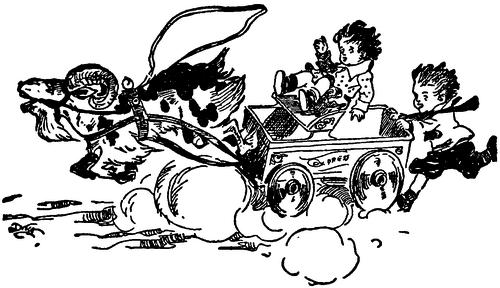
THE GOAT, THE CARRIAGE AND THE BOYS
But no number of ordinary hippopotami
and chariots could have disturbed the heavenly
tranquillity of my mind on this most
glorious of evenings. Even a subtle sense of
the fitness of things seemed to overshadow
my nephews. Perhaps the touch of my enchantress
did it; perhaps it came only from
the natural relapse from great excitement;
but no matter what the reason was, the fact
remains that for the rest of the evening two
very dirty suits of clothes held two children
who gave one some idea of how the denizens
of Paradise might seem and act. They even
ate their suppers without indulging in any of
the repulsive ways of which they had so large
an assortment, and they did not surreptitiously
remove from the table any fragments
of bread and butter to leave on the piano, in
the card-basket, and other places inappropriate
to the reception of such varieties of
abandoned property. They demanded a
song after supper, but when I sang, "Drink
to me only with Thine Eyes," and "Thou,
Thou, Reign'st in this Bosom," they stood by
with silent tongues and appreciative eyes.
When they went to bed, I accompanied them
by special invitation, but they showed no disposition
to engage in the usual bedtime frolic
and miniature pandemonium. Budge, when
in bed, closed his eyes, folded his hands and
prayed:—
"Dear Lord, bless papa an' mamma, an'
Toddie, an' Uncle Harry, an' everybody else;
yes, an' bless just lots that lovely, lovely lady
that comforted me after the goat was bad to
me, an' let her comfort me lots of times, for
Christ's sake, Amen."
And Toddie wriggled, twisted, breathed
heavily, threw his head back, and prayed:—
"Dee Lord, don't let dat old goat fro me
into de gutter on my head aden, an' let Ocken
Hawwy an' ze pitty lady be dere netst time
I dets hurted."
Then the good-night salutations were exchanged,
and I left the little darlings and enjoyed
communion with my own thoughts,
which were as peaceful and ecstatic as if the
world contained no white goods houses, no
doubtful customers, no business competition,
no politics, gold rooms, stock-boards, doubtful
banks, political scandals, personal iniquity
nor anything which would prevent a short
vacation from lasting through a long lifetime.
The next morning would have struck terror
to the heart of any one but a newly accepted
lover. Rain was falling fast, and in
that steady, industrious manner which
seemed to assert an intention to stick closely
to business for the whole day. The sky was
covered by one impenetrable, leaden cloud,
water stood in pools in the streets which were
soft with dust a few hours before; the flowers
all hung their heads, like vagabonds who had
been awake all night and were ashamed to
face the daylight. Even the chickens stood
about in dejected attitudes, and stray roosters
from other poultry yards found refuge in
Tom's coop, without first being subjected to
a trial of strength and skill by Tom's gamecock.
But no man in my condition of mind could
be easily depressed by bad weather. I would
rather have been able to drive about under a
clear sky, or lounge under the trees, or walk
to the post-office in the afternoon by the road
which passed directly in front of Mrs. Clarkson's
boarding-house; but man should not
live for himself alone. In the room next
mine, were slumbering two wee people to
whom I owed a great deal, and who would
mourn bitterly when they saw the condition
of the skies and ground—I would devote
myself to the task of making them so happy
that they would forget the absence of sunshine
out of doors—I would sit by their bedside
and have a story ready for them the
moment they awoke, and put them in such
a good humor that they could laugh, with
me, at cloud and rain.
I began at once to construct a story for
their especial benefit; the scene was to be a
country residence on a rainy day, and the
actors two little boys who should become uproariously
jolly in spite of the weather. Like
most people not used to story-making, my
progress was not very rapid; in fact, I had
got no farther than the plot indicated above
when an angry snarl came from the children's
room.
"What's the matter, Budge?" I shouted,
dressing myself as rapidly as possible.
"Ow—oo—ya—ng—um—boo—gaa!" was
the somewhat complicated response.
"What did you say, Budge?"
"Didn't say noffin'."
"Oh—that's what I thought."
"Didn't thought."
"Budge,—Budge,—be good."
"Don't want to be good—ya—A—A!"
"Let's have some fun, Budge—don't you
want to frolic?"
"No; I don't think frolics is nice."
"Don't you want some candy, Budge?"
"No—you ain't got no candy, I bleeve."
"Well, you sha'n't have any, if you don't
stop being so cross."
The only reply to this was a mighty and audible
rustling of the bedding in the boys' room,
followed by a sound strongly resembling that
caused by a slap; then came a prolonged wail,
resembling that of an ungreased wagon wheel.
"What's the matter, Toddie?"
"Budge s'apped me—ah—h—h—h!"
"What made you slap your brother,
Budge?"
"I didn't."
"You did!" screamed Toddie.
"I tell you I didn't—you're a naughty, bad
boy to tell such lies, Toddie."
"What did you do, Budge?" I asked.
"Why—why—I was—I was turnin' over
in bed, an' my hand was out, an' it tumbled
against to Toddie—that's what."
By this time I was dressed and in the boys'
room. Both my nephews were sitting up in
bed, Budge looking as sullen as an old jailbird,
and Toddie with tears streaming all
over his face.
"Boys," said I, "don't be angry with each
other—it isn't right. What do you suppose
the Lord thinks, when He sees you so cross
to each other?"
"He don't think noffin'," said Budge; "you
don't think He can look through a black sky
like that, do you?"
"He can look anywhere, Budge, and He
feels very unhappy when He sees little
brothers angry with each other."
"Well, I feel unhappy, too—I wish there
wasn't never no old rain, nor noffin'."
"Then what would plants and flowers do
for a drink and where would rivers come from
for you to go sailing on?"
"An' wawtoo to mate mud-pies," added
Toddie. "You's a naughty boy, Budgie";
and here Toddie's tears began to flow
afresh.
"I ain't a bad boy, an' I don't want no old
rain nohow, an' that's all about it. An' I
don't want to get up, an' Maggie must bring
me up my breakfast in bed."
"Boo—hoo—oo," wept Toddie, "wants
my brepspup in bed too."
"Boys," said I, "now listen. You can't
have any breakfast at all, unless you are up
and dressed by the time the bell rings. The
rising-bell rang some time ago. Now dress
like good boys, and you shall have some
breakfast, and then you'll feel a great deal
nicer, and then Uncle Harry will play with
you and tell you stories all day long."
Budge crept reluctantly out of bed and
caught up one of his stockings, while Toddie
again began to cry.
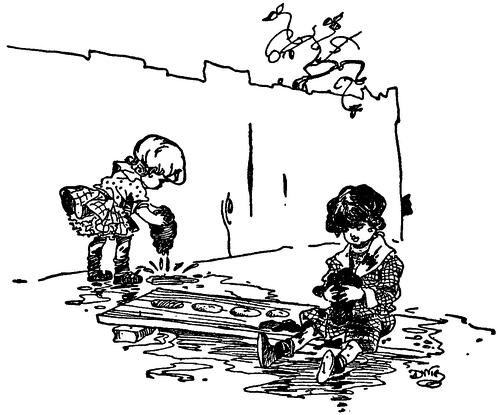
"AN' WAWTOO TO MATE MUD-PIES"
"Toddie!" I shouted, "stop that dreadful
racket, and dress yourself! What are you
crying for?"
"Well, I feelsh bad."
"Well, dress yourself, and you'll feel better."
"Wantsh you to djesh me."
"Bring me your clothes, then—quick!"
Again the tears flowed copiously. "Don't
want to bring 'em," said Toddie.
"Then come here!" I shouted, dragging
him across the room and snatching up his
tiny articles of apparel. I had dressed no
small children since I was rather a small boy
myself, and Toddies clothing confused me
somewhat. I finally got something on him,
when a contemptuous laugh from Budge interrupted
me.
"How you goin' to put his shirt on
under them things?" queried my oldest
nephew.
"Budge," I retorted, "how are you going
to get any breakfast if you don't put on something
besides that stocking?"
The young man's countenance fell, and
just then the breakfast-bell rang. Budge
raised a blank face, hurried to the head of the
stairs and shouted:—
"Maggie?"
"What is it, Budge?"
"Was—was that the rising-bell or the
breakfast-bell?"
"'Twas the breakfast-bell."
There was dead silence for a moment, and
then Budge shouted:—
"Well, we'll call that the risin'-bell. You
can ring another bell for breakfast pretty
soon, when I get dressed." Then this volunteer
adjuster of household affairs came calmly
back and commenced dressing in good earnest,
while I labored along with Toddie's
wardrobe.
"Where's the button-hook, Budge?" said I.
"It's—I—oh—um—I put it—say, Tod,
what did you do with the button-hook yesterday?"
"Didn't hazh no button-hook," asserted
Toddie.
"Yes, you did; don't you 'member how we
was a playin' draw teef, an' the doctor's dog
had the toofache, and I was pullin' his teef
with the button-hook an' you was my little
boy, an' I gived the toof-puller to you to hold
for me? Where did you put it?"
"I'd no," replied Toddie, putting his hand
in his pocket and bringing out a sickly-looking
toad.
"Feel again," said I, throwing the toad out
of the window, where it was followed by an
agonized shriek from Toddie. Again he felt,
and his search was rewarded by the tension-screw
of Helen's sewing-machine. Then I
attempted some research myself, and speedily
found my fingers adhering to something
of a sticky consistency. I quickly withdrew
my hand, exclaiming:—
"What nasty stuff have you got in your
pocket, Toddie?"
"'Tain't nashty 'tuff—it's byead an' lasses,
an' it's nice, an' Budge an' me hazh little tea
parties in de kicken-coop, an' we eats it, an'
its dovely."
All this was lucid and disgusting, but utterly
unproductive of button-hooks, and
meanwhile the breakfast was growing cold.
I succeeded in buttoning Toddie's shoes with
my fingers, splitting most of my nails in the
operation. I had been too busily engaged
with Toddie to pay any attention to Budge,
who I now found about half dressed and trying
to catch flies on the window pane.
Snatching Toddie, I started for the dining-room,
when Budge remarked reprovingly:
"Uncle Harry, you wasn't dressed when
the bell rang, and you oughtn't to have any
breakfast."
True enough—I was minus collar, cravat,
and coat. Hurrying these on, and starting
again, I was once more arrested:—
"Uncle Harry, must I brush my teeth this
morning?"
"No—hurry up—come down without doing
anything more, if you like, but come—it'll
be dinner-time before we get breakfast."
Then that imp was moved, for the first
time that morning to something like good-nature,
and he exclaimed with a giggle:—
"My! What big stomachs we'd have when
we got done, wouldn't we?"
At the breakfast table Toddie wept again,
because I insisted on beginning operations
before Budge came. Then neither boy knew
exactly what he wanted. Then Budge managed
to upset the contents of his plate into
his lap, and while I was helping him to clear
away the débris, Toddie improved the opportunity
to pour his milk upon his fish and put
several spoonfuls of oatmeal porridge into
my coffee-cup. I made an early excuse to
leave the table and turn the children over to
Maggie. I felt as tired as if I had done a
hard day's work, and was somewhat appalled
at realizing that the day had barely begun.
I lit a cigar and sat down to Helen's piano.
I am not a musician, but even the chords of
a hand-organ would have seemed sweet
music to me on that morning. The music-book
nearest to my hand was a church hymn-book,
and the first air my eye struck was
"Greenville." I lived once in a town, where,
on a single day, a peddler disposed of thirty-eight
accordions, each with an instruction-book
in which this same air, under its original
name, was the only air. For years after, a
single bar of this air awakened the most
melancholy reflections in my mind, but now
I forgave all my musical tormentors as the
familiar strains came comfortingly from the
piano-keys. But suddenly I heard an accompaniment—a
sort of reedy sound—and
looking round, I saw Toddie again in tears.
I stopped abruptly and asked:—
"What's the matter now, Toddie?"
"Don't want dat old tune; wantsh dancin'
tune, so I can dance."
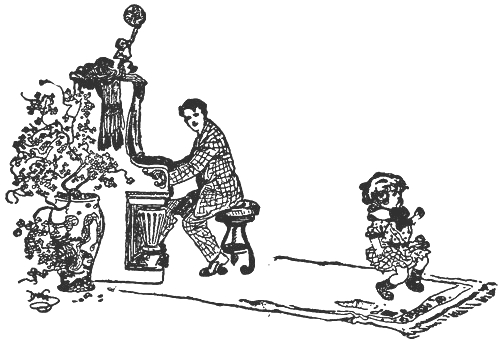
"WANTSH DANCIN' TUNE"
I promptly played "Yankee Doodle," and
Toddie began to trot around the room with
the expression of a man who intended to do
his whole duty. Then Budge appeared, hugging
a bound volume of "St. Nicholas." The
moment that Toddie espied this he stopped
dancing and devoted himself anew to the task
of weeping.
"Toddie!" I shouted, springing from the
piano stool, "what do you mean by crying at
everything? I shall have to put you to bed
again if you're going to be such a baby."
"That's the way he always does, rainy
days," exclaimed Budge.
"Wantsh to see the whay-al what fwallowed
Djonah," sobbed Toddie.
"Can't you demand something that's within
the range of possibility, Toddie?" I mildly
asked.
"The whale Toddie means is in this big red
book; I'll find it for you," said Budge, turning
over the leaves.
Suddenly a rejoicing squeal from Toddie
announced that leviathan had been found,
and I hastened to gaze. He was certainly a
dreadful-looking animal, but he had an enormous
mouth, which Toddie caressed with his
pudgy little hand, and kissed with tenderness,
murmuring as he did so:—
"Dee old whay-al, I loves you. Is Djonah
all goneded out of you 'tomach, whay-al? I
finks 'twas weal mean in Djonah to get froed
up when you hadn't noffin' else to eat, poor
old whay-al."
"Of course Jonah's gone," said Budge, "he
went to heaven long ago—pretty soon after
he went to Nineveh an' done what the Lord
told him to do. Now swing us, Uncle
Harry."
The swing was on the piazza under cover
from the rain; so I obeyed. Both boys
fought for the right to swing first, and when
I decided in favor of Budge, Toddie went off
weeping, and declaring that he would look at
his dear whay-al anyhow. A moment later
his wail changed to a piercing shriek; and,
running to his assistance, I saw him holding
one finger tenderly and trampling on a wasp.
"What's the matter, Toddie?"
"Oo—oo—ee—ee—ee—ee—I putted my
finger on a waps, and—oo—oo—the nasty old
waps—oo—bited me. An' I don't like wapses
a bit, but I likes whay-als—oo—ee—ee."
A happy thought struck me. "Why don't
you boys make believe that big packing-box
in your play-room is a whale?" said I.
A compound shriek of delight followed the
suggestion, and both boys scrambled upstairs,
leaving me a free man again. I looked remorsefully
at the tableful of books which I
had brought to read, and had not looked at
for a week. Even now my remorse did not
move me to open them—I found myself, instead,
attracted toward Tom's library, and
conning the titles of novels and volumes of
poems. My eye was caught by "Initials," a
love story which I had always avoided because
I had heard impressionable young ladies
rave about it; but now I picked it up and
dropped into an easy chair. Suddenly I
heard Mike, the coachman, shouting:—
"Go 'way from there, will ye? Ah, ye
little spalpeen, it's good for ye that yer fahder
don't see ye perched up dhere. Go 'way from
dhat, or I'll be tellin' yer uncle."
"Don't care for nashty old uncle," piped
Toddie's voice.
I laid down my book with a sigh, and
went into the garden. Mike saw me and
shouted:
"Mister Burthon, will you look dhere?
Did ye's ever see the loike av dhat bye?"
Looking up at the play-room window, a
long, narrow sort of loop-hole in a Gothic
gable, I beheld my youngest nephew standing
upright on the sill.
"Toddie, go in—quick!" I shouted, hurrying
under the window to catch him in case
he fell outward.
"I tan't!" squealed Toddie.
"Mike, run upstairs and snatch him in!
Toddie, go in, I tell you!"
"Tell you I tan't doe in," repeated Toddie.
"Ze bid bots ish ze whay-al, an' I'ze Djonah,
an' ze whay-al's froed me up, an' I'ze dot to
'tay up here else ze whay-al 'ill fwallow me
aden."
"I won't let him swallow you. Get in now—hurry,"
said I.
"Will you give him a penny not to fwallow
me no more?" queried Toddie.
"Yes—a whole lot of pennies."
"Aw wight. Whay-al, don't you fwallow
me no more, an' zen my Ocken Hawwy div
you whole lots of pennies. You must be weal
dood whay-al now, an' then I buys you some
tandy wif your pennies, an'——"
Just then two great hands seized Toddie's
frock in front, and he disappeared with a
howl, while I, with the first feeling of faintness
I had ever experienced, went in search
of hammer, nails, and some strips of board,
to nail on the outside of the window-frame.
But boards could not be found, so I went up
to the play-room and began to knock a piece
or two off the box which had done duty as
whale. A pitiful scream from Toddie caused
me to stop.
"You're hurtin' my dee old whay-al; you's
breakin' his 'tomach all open—you's a baddy
man—'top hurtin' my whay-al, ee—ee—ee!"
cried my nephew.
"I'm not hurting him, Toddie," said I.
"I'm making his mouth bigger, so he can
swallow you easier."
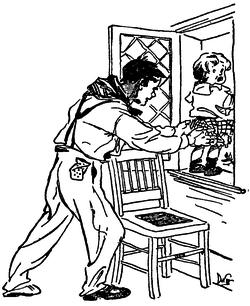
TWO GREAT HANDS SEIZED TODDIE
A bright thought came into Toddie's face
and shone through his
tears. "Then he can
fwallow Budgie too, an'
there'll be
two Djonahs—ha—ha—ha!
Make his
mouf so big
he can fwallow
Mike,
an' zen
mate it 'ittle
aden, so
Mike tan't det out; nashty old Mike!"
I explained that Mike would not come upstairs
again, so I was permitted to depart
after securing the window.
Again I settled myself with book and cigar;
there was at least for me the extra enjoyment
that comes from the sense of pleasure earned
by honest toil. Pretty soon Budge entered
the room. I affected not to notice him, but
he was not in the least abashed by my
neglect.
"Uncle Harry," said he, throwing himself
in my lap, between my book and me, "I don't
feel a bit nice."
"What's the matter, old fellow?" I asked.
Until he spoke I could have boxed his ears
with great satisfaction to myself; but there
is so much genuine feeling in whatever Budge
says that he commands respect.
"Oh, I'm tired of playin' with Toddie, an'
I feel lonesome. Won't you tell me a story?"
"Then what'll poor Toddie do, Budge?"
"Oh, he won't mind—he's got a dead
mouse to be Jonah now, so I don't have no
fun at all. Won't you tell me a story?"
"Which one?"
"Tell me one that I never heard before at
all."
"Well, let's see; I guess I'll tell——"
"Ah—ah—ah—ah—ee—ee—ee!" sounded
afar off, but fatefully. It came nearer—it
came down the stairway and into the library,
accompanied by Toddie, who, on spying me,
dropped his inarticulate utterance, held up
both hands, and exclaimed:—
"Djonah bwoke he
tay-al!"
True enough; in one
hand Toddie held the
body of a
mouse, and
in the other that animal's caudal appendage;
there was also perceptible, though not by the
sense of sight, an objectionable odor in the
room.
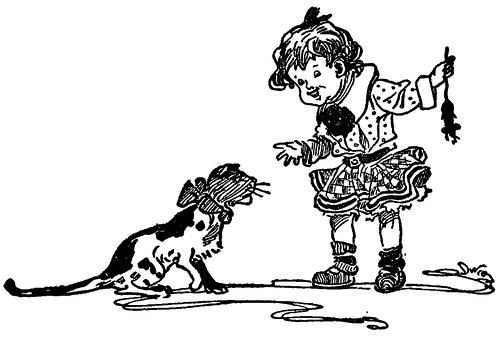
"HE'S GOT A DEAD MOUSE TO BE JONAH NOW"
"Toddie," said I, "go throw Jonah into the
chicken coop, and I'll give you some candy."
"Me too," shouted Budge, "'cos I found
the mouse for him."
I made both boys happy with candy, exacted
a pledge not to go out in the rain, and
then, turning them loose on the piazza, returned
to my book. I had read, perhaps,
half a dozen pages, when there arose and
swelled rapidly in volume a scream from
Toddie. Madly determined to put both boys
into chairs, tie them, and clap adhesive plaster
over their mouths, I rushed out upon the
piazza.
"Budgie tried to eat my candy," complained
Toddie.
"I didn't," said Budge.
"What did you do?" I demanded.
"I didn't bite it at all—I only wanted to
see how it would feel between my teeth—that's
all."
I felt the corners of my mouth breaking
down, and hurried back to the library, where
I spent a quiet quarter of an hour in pondering
over the demoralizing influence exerted
upon principle by a sense of the ludicrous.
For some time afterward the boys got along
without doing anything worse than make a
dreadful noise, which caused me to resolve to
find some method of deadening piazza floors
if I ever owned a house in the country. In
the occasional intervals of comparative quiet,
I caught snatches of very funny conversation.
The boys had coined a great many words
whose meaning was evident enough, but I
wondered greatly why Tom and Helen had
never taught them the proper substitutes.
Among others was the word "deader,"
whose meaning I could not imagine. Budge
shouted:—
"O Tod! there comes a deader! See where
all them things like rooster's tails are
a-shakin'?—Well, there's a deader under
them."
"Datsh funny," remarked Toddie.
"An' see all the peoples a-comin' along,"
continued Budge, "they know 'bout the
deader, an' they're goin' to see it fixed. Here
it comes. Hello, deader!"
"Hay-oh, deader!" echoed Toddie.
What could "deader" mean?
"Oh, here it is right in front of us," cried
Budge, "and ain't there lots of people? An'
two horses to pull the deader—some deaders
has only one."
My curiosity was too much for my weariness;
I went to the front window, and, peering
through, saw—a funeral procession! In
a second I was on the piazza, with my hands
on the children's collars; a second later two
small boys were on the floor of the hall, the
front door was closed, and two determined
hands covered two threatening little mouths.
When the procession had fairly passed the
house, I released the boys and heard two prolonged
howls for my pains. Then I asked
Budge if he wasn't ashamed to talk that way
when a funeral was passing.
"'Twasn't a funeral," said he, "'Twas only
a deader, an' deaders can't hear noffin'."
"But the people in the carriages could,"
said I.
"Well," said he, "they were so glad that
the other part of the deader had gone to
heaven that they didn't care what I said.
Everbody's glad when the other part of deaders
go to heaven. Papa told me he was glad
dear little Phillie was in heaven, an' I was,
but I do want to see him again awful."
"Wantsh to shee Phillie aden awfoo," said
Toddie, as I kissed Budge and hurried off to
the library, unfit just then to administer
further instruction or reproof. Of one thing
I was very certain—I wished the rain would
cease falling, so the children could go out of
doors, and I could get a little rest, and freedom
from responsibility. But the skies
showed no sign of being emptied, the boys
were snarling on the stairway, and I was
losing my temper quite rapidly.
Suddenly I bethought me of one of the
delights of my own childish days—the making
of scrap-books. One of Tom's library
drawers held a great many Lady's Journals.
Of course Helen meant to have them bound,
but I could easily re-purchase the numbers
for her; they would cost two or three dollars,
but peace was cheap at that price. On a
high shelf in the play-room I had seen some
supplementary volumes of "Mercantile
Agency" reports, which would in time reach
the rag-bag; there was a bottle of mucilage
in the library desk, and the children owned
an old pair of scissors. Within five minutes
I had located two happy children on the
bath-room floor, taught them to cut out pictures
(which operation I quickly found they
understood as well as I did) and to paste
them into the extemporized scrap-book.
Then I left them, recalling something from
Newman Hall's address on the "Dignity of
Labor." Why hadn't I thought before of
showing my nephews some way of occupying
their minds and hands? Who could blame
the helpless little things for following every
prompting of their unguided minds? Had I
not a hundred times been told, when sent to
the woodpile or the weediest part of the garden
in my youthful days, that
"Satan finds some mischief still
For idle hands to do?"
Never again would I blame the children for
being mischievous when their minds were
neglected.
I spent a peaceful, pleasant hour over my
novel, when I felt that a fresh cigar would be
acceptable. Going upstairs in search of one,
I found that Budge had filled the bath-tub
with water, and was sailing boats, that is,
hair-brushes.
Even this seemed too mild an offense to call
for a rebuke, so I passed on without disturbing
him, and went to my own room. I heard
Toddie's voice, and having heard from my
sister that Toddie's conversations with himself
were worth listening to, I paused outside
the door. I heard Toddie softly murmur:—
"Zere, pitty yady, 'tay zere. Now, 'ittle
boy, I put you wif your mudder, 'tause mudders
like zere 'ittle boys wif zem. An' you
s'all have 'ittle sister tudder side of you,—zere.
Now, 'ittle boy's an' 'ittle girl's mudder,
don't you feel happy?—isn't I awfoo
good to give you your 'ittle tsilderns? You
ought to say, 'Fank you, Toddie,—you's a
nice, fweet 'ittle djentleman.'"
I peered cautiously—then I entered the
room hastily. I didn't say anything for a
moment, for it was impossible to do justice
impromptu, to the subject. Toddie had a
progressive mind—if pictorial ornamentation
was good for old books, why should not
similar ornamentation be extended to objects
more likely to be seen? Such may not
have been Toddie's line of thought, but his
recent operations warranted such a supposition.
He had cut out a number of pictures,
and pasted them upon the wall of my room—my
sister's darling room, with its walls tinted
exquisitely in pink. As a member of a hanging
committee, Toddie would hardly have
satisfied taller people, but he had arranged
the pictures quite regularly, at about the
height of his own eyes, had favored no one
artist more than another, and had hung indiscriminately
figure pieces, landscapes, and
genre pictures. The temporary break of
wall-line occasioned by the door communicating
with his own room he had overcome
by closing the door and carrying a line of pictures
across its lower panels. Occasionally a
picture fell off the wall, but the mucilage
remained faithful, and glistened with its fervor
of devotion. And yet so untouched was
I by this artistic display, that when I found
strength to shout, "Toddie," it was in a tone
which caused this industrious amateur decorator
to start violently, and drop his mucilage
bottle, open end first, upon the carpet.
"What will mamma say?" I asked.
Toddie gazed, first blankly, and then inquiringly,
into my face; finding no answer or
sympathy there he burst into tears, and replied:—
"I dunno."
The ringing of the lunch bell changed Toddie
from a tearful cherub into a very practical,
business-like boy, and shouting, "Come
on, Budge!" he hurried downstairs, while I
tormented myself with wonder as to how I
could best and most quickly undo the mischief
Toddie had done.
I will concede to my nephews the credit of
keeping reasonably quiet during meals; their
tongues, doubtless, longed to be active in
both the principal capacities of those useful
members, but they had no doubt as to how to
choose between silence and hunger. The result
was a reasonably comfortable half-hour.
Just as I began to cut a melon, Budge broke
the silence by exclaiming:—
"O Uncle Harry, we haven't been out to
see the goat to-day!"
"Budge," I replied, "I'll carry you out
there under an umbrella after lunch, and you
may play with that goat all the afternoon, if
you like."
"Oh, won't that be nice?" exclaimed
Budge. "The poor goat! he'll think I don't
love him a bit, 'cause I haven't been to see
him to-day. Does goats go to heaven when
they die, Uncle Harry?"
"Guess not—they'd make trouble in the
golden streets I'm afraid."
"Oh, dear! then Phillie can't see my goat.
I'm so awful sorry," said Budge.
"I can see your goat, Budgie," suggested
Toddie.
"Huh!" said Budge, very contemptuously.
"You ain't dead."
"Well, Izhe goin' to be dead some day, an'
zen your nashty old goat sha'n't see me a bit—see
how he like zat." And Toddie made a
ferocious attack on a slice of melon nearly as
large as himself.
After lunch, Toddie was sent to his room to
take his afternoon nap, and Budge went to
the barn on my shoulders. I gave Mike a
dollar, with instructions to keep Budge in
sight, to keep him from teasing the goat, and
to prevent his being impaled or butted. Then
I stretched myself on a lounge and wondered
whether only half a day of daylight had
elapsed since I and the most adorable woman
in the world had been so happy together.
How much happier I would be when next I
met her! The very torments of this rainy
day would make my joy seem all the dearer
and more intense. I dreamed happily for a
few moments with my eyes open, and then
somehow they closed, without my knowledge.
What put into my mind the wreck scene from
the play of "David Copperfield," I don't
know; but there it came, and in my dream
I was sitting in the balcony at Booth's, and
taking a proper interest in the scene, when it
occurred to me that the thunder had less of
reverberation and more woodenness than
good stage thunder should have. The mental
exertion I underwent on this subject
disturbed the course of my nap, but as wakefulness
returned, the sound of the poorly
simulated thunder did not cease; on the
contrary, it was just as noisy, and more
hopelessly a counterfeit than ever. What
could the sound be? I stepped through the
window to the piazza, and the sound was
directly over my head. I sprang down the
terrace and out upon the lawn, looked up,
and beheld my youngest nephew strutting
back and forth on the tin roof of the piazza,
holding over his head a ragged old parasol.
I roared:—"Go in, Toddie—this instant!"
The sound of my voice startled the young
man so severely that he lost his footing, fell,
and began to roll toward the edge and to
scream, both operations being performed
with great rapidity. I ran to catch him as
he fell, but the outer edge of the water trough
was high enough to arrest his progress,
though it had no effect in reducing the volume
of his howls.
"Toddie," I shouted, "lie perfectly still
until uncle can
get to you! Do
you hear?"

HOLDING OVER HIS HEAD A RAGGED PARASOL
"Ess, but don't
want to lie 'till,"
came in reply
from the roof.
"'Tan't shee noffin'
but sky an'
wain."
"Lie still," I
reiterated, "or I'll
whip you dreadfully."
Then I
dashed upstairs,
removed my
shoes, climbed
out and rescued Toddie, shook him soundly,
and then shook myself.
"I wash only djust pyayin mamma, an'
walkin' in ze wain wif an umbayalla," Toddie
explained.
I threw him upon his bed and departed.
It was plain that neither logic, threats, nor the
presence of danger could keep this dreadful
child from doing whatever he chose; what
other means of restraint could be employed?
Although not as religious a man as my good
mother could wish, I really wondered whether
prayer, as a last resort, might not be effective.
For his good and my own peace, I would
cheerfully have read through the whole
prayer-book. I could hardly have done it
just then, though, for Mike solicited an
audience at the back door, and reported that
Budge had given the carriage sponge to the
goat, put handfuls of oats into the pump
cylinder, pulled hairs out of the black mare's
tail, and with a sharp nail drawn pictures on
the enamel of the carriage-body. Budge
made no denial, but looked very much aggrieved,
and remarked that he couldn't never
be happy without somebody having to go
get bothered; and he wished there wasn't
nobody in the world but organ-grinders and
candy-store men. He followed me into the
house, flung himself into a chair, put on a
look which I imagine Byron wore before he
was old enough to be malicious, and exclaimed:—
"I don't see what little boys was made for,
anyhow; if ev'rybody gets cross with them,
an' don't let 'em do what they want to. I'll
bet when I get to heaven, the Lord won't be
as ugly to me as Mike is,—an' some other
folks, too. I wish I could die and be buried
right away,—me an' the goat—an' go to
heaven, where we wouldn't be scolded."
Poor little fellow! First I laughed inwardly
at his idea of heaven, and then I
wondered whether my own was very different
from it, or any more creditable. I had no
time to spend, however, even in pious reflection.
Budge was quite wet, his shoes were
soaking, and he already had an attack of
catarrh; so I took him to his room and redressed
him, wondering all the while how
much similar duties my own father had had
to do for me had shortened his life, and how
with such a son as I was, he lived as long as
he did. The idea that I was in some slight
degree atoning for my early sins, so filled my
thoughts that I did not at first notice the
absence of Toddie. When it did become
evident to me that my youngest nephew was
not in the bed in which I had placed him, I
went in search of him. He was in none of
the chambers, but hearing gentle murmurs
issue from a long, light closet, I looked in and
saw Toddie sitting on the floor, and eating
the cheese out of a mouse-trap. A squeak
of my boots betrayed me, and Toddie, equal
to the emergency, sprang to his feet and
exclaimed:—
"I didn't hurt de 'ittle mousie one bittie;
I just letted him out, and he runded away."
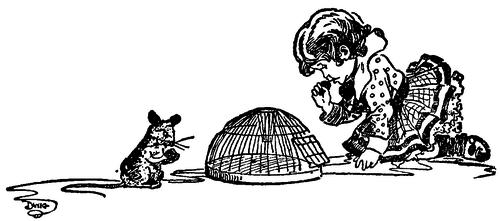
"I DIDN'T HURT DE 'ITTLE MOUSIE"
And still it rained. Oh, for a single hour
of sunlight, so that the mud might be only
damp dirt, and the children could play without
tormenting other people! But it was not
to be; slowly, and by the aid of songs, stories,
an improvised menagerie, in which I personated
every animal, besides playing ostrich
and armadillo, and with a great many disagreements,
the afternoon wore to its close,
and my heart slowly lightened. Only an
hour or two more, and the children would be
in bed for the night, and then I would enjoy,
in unutterable measure, the peaceful hours
which would be mine. Even now they were
inclined to behave themselves; they were
tired and hungry, and stretched themselves
on the floor to await dinner. I embraced the
opportunity to return to my book, but I had
hardly read a page, when a combined crash
and scream summoned me to the dining-room.
On the floor lay Toddie, a great many
dishes, a roast leg of lamb, several ears of
green corn, the butter-dish and its contents,
and several other misplaced edibles. One
thing was quite evident; the scalding contents
of the gravy-dish had been emptied on
Toddie's arm, and how severely the poor
child might be scalded I did not know. I
hastily split open his sleeve from wrist to
shoulder, and found the skin very red; so,
remembering my mother's favorite treatment
for scalds and bums, I quickly spread the
contents of a dish of mashed potato on a
clean handkerchief, and wound the whole
around Toddie's arm as a poultice. Then I
demanded an explanation.
"I was only djust reatchin' for a pieshe of
bwed," sobbed Toddie, "an' then the bad old
tabo beginded to froe all its fings at me, an'
tumble down bang."
He undoubtedly told the truth as far as he
knew it; but reaching over tables is a bad habit
in small boys, especially when their mothers
cling to old-fashioned heirlooms of tables,
which have folding leaves; so I banished
Toddie to his room, supperless, to think of
what he had done. With Budge alone, I had
a comfortable dinner off the salvage from the
wreck caused by Toddie, and then I went
upstairs to see if the offender had repented.
It was hard to tell, by sight, whether he had
or not, for his back was to me, as he flattened
his nose against the window, but I could see
that my poultice was gone.
"Where is what uncle put on your arm,
Toddie?" I asked.
"I ate it up," said the truthful youth.
"Did you eat the handkerchief, too?"
"No; I froed nashty old handkerchief out
the window—don't want dirty old handkerchiefs
in my nice 'ittle room."
I was so glad that his burn had been slight
that I forgave the insult to my handkerchief,
and called up Budge, so that I might at once
get both boys into bed, and emerge from
the bondage in which I had lived all day
long. But the task was no easy one. Of
course my brother-in-law, Tom Lawrence,
knows better than any other man the necessities
of his own children, but no children of
mine shall ever be taught so many methods
of imposing upon parental good-nature.
Their program called for stories, songs,
moral conversations, frolics, the presentation
of pennies, the dropping of the same, at long
intervals, into tin savings-banks, followed by
a deafening shaking-up of both banks; then
a prayer must be offered, and no conventional
one would be tolerated; then the boys
performed their own devotions, after which I
was allowed to depart with an interchange of
"God bless yous." As this evening I left
the room with their innocent benedictions
sounding in my ears, a sense of personal
weakness, induced by the events of the day,
moved me to fervently respond "Amen!"
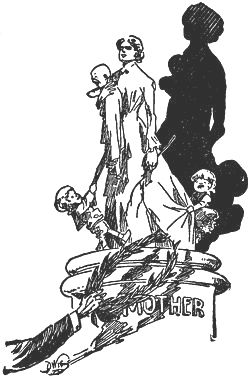
A TRIBUTE TO MOTHERS
Mothers of American boys, accept from me
a tribute of respect, which no words can fitly
express—of wonder greater than any of the
great things of the world ever inspired—of
adoration as earnest and devout as the Catholic
pays to the Virgin. In a single day, I, a
strong man, with nothing else to occupy my
mind, am reduced to physical and mental
worthlessness by the necessities of two boys
not overmischievous or bad. And you—Heaven
only knows
how—have unbroken
weeks, months, years,
yes, lifetimes of just
such experiences, and
with them the burden
of household cares,
of physical ills and
depressions, of mental
anxieties that
pierce thy hearts
with as many
sorrows as
grieved the
Holy Mother
of old. Compared
with thy endurance, that of the young
man, the athlete, is as weakness; the secret of
thy nerves, wonderful even in their weakness,
is as great as that of the power of the winds.
To display decision, thy opportunities are more
frequent than those of the greatest statesmen;
thy heroism laughs into insignificance
that of fort and field; thou art trained in a
school of diplomacy such as the most experienced
court cannot furnish. Do scoffers say
thou canst not hold the reins of government?
Easier is it to rule a band of savages than to
be the successful autocrat of thy little kingdom.
Compared with the ways of men, even
thy failures are full of glory. Be thy faults
what they may, thy one great, mysterious,
unapproachable success places thee, in desert,
far above warrior, ruler or priest.
The foregoing soliloquy passed through my
mind as I lay upon the bed where I had
thrown myself after leaving the children's
room. Whatever else attempted to affect me
mentally, found my mind a blank until the
next morning, when I awoke to realize that I
had dropped asleep just where I fell, and that
I had spent nearly twelve hours lying across
a bed in an uncomfortable position, and
without removing my daily attire. My next
impression was that quite a bulky letter had
been pushed under my chamber-door. Could
it be that my darling—I hastily seized the
envelope and found it addressed in my sister's
writing, and promising a more voluminous
letter than that lady had ever before
honored me with. I opened it, dropping an
enclosure which, doubtless, was a list of
necessities which I would please pack, etc.
and read as follows:—
July 1, 1875.
"My Dear Old Brother:—Wouldn't I like to give
you the warmest of sisterly hugs? I can't believe it,
and yet I am in ecstasies over it. To think that you
should have got that perfection of a girl, who has declined
so many great catches—you, my sober, business-like,
unromantic big brother—oh, it's too wonderful!
But now I think of it, you are just the people for each
other. I'd like to say that it's just what I'd always
longed for, and I invited you to Hillcrest to bring it
about; but the trouble with such a story would be
that it wouldn't have a word of truth in it. You always
did have a faculty for doing just what you
pleased, and what nobody ever expected you to do,
but now you've exceeded yourself.
"And to think that my little darlings played an important
part in bringing it all about! I shall take the
credit of that, for if it hadn't been for me who would
have helped you, sir? I shall expect you to remember
both of them handsomely at Christmas.
"I don't believe I am guilty of breach of confidence
in sending the enclosed, which I have just received
from my sister-in-law that is to be. It will tell you
some causes of your success of which you, with a man's
conceit, haven't imagined for a minute, and it will tell
you, too, of a maiden's first and natural fear under
such circumstances—a fear which I know you, with
your honest, generous heart, will hasten to dispel.
As you're a man, you're quite likely to be too stupid
to read what's written between the lines; so I'd better
tell you that Alice's fear is that in letting herself go so
easily, she may have seemed to lack proper reserve
and self-respect. You don't need to be told that no
woman alive has more of these very qualities.
"Bless your dear old heart, Harry,—you deserve to
be shaken to death if you're not the happiest man
alive. I must hurry home and see you both with my
own eyes, and learn to believe that all this wonderful,
glorious thing has come to pass. Give Alice a sister's
kiss for me (if you know how to give more than one
kind), and give my cherubs a hundred each from the
mother that wants to see them so much.
"With love and congratulations,
"Helen."
The other letter, which I opened with considerable
reverence and more delight, ran as
follows:
"Hillcrest, June 29, 1875.
"Dear Friend Helen:—Something has happened
and I am very happy, but I am more than a little
troubled over it, too, and, as you are one of the persons
nearly concerned, I am going to confess to you as soon
as possible. Harry—your brother, I mean—will be
sure to tell you very soon, if he hasn't done so already,
and I want to make all possible haste to solemnly
assure you that I hadn't the slightest idea of such a
thing coming to pass, and I didn't do the slightest
thing to bring it about.
"I always thought your brother was a splendid
fellow, and have never been afraid to express my mind
about him, when there was no one but girls to listen.
But out here, I have somehow learned to admire him
more than ever. I cheerfully acquit him of intentionally
doing anything to create a favorable impression;
if his several appearances before me have been studied,
he is certainly the most original being I ever heard of.
Your children are angels—you've told me so yourself,
and I've my own very distinct impression on the subject,
but they don't study to save their uncle's appearance.
The figures that unfortunate man has cut
several times—well, I won't try to describe them on
paper, for fear he might some day see a scrap of it and
take offense. But he always seems to be patient with
them, and devoted to them, and I haven't been able
to keep from seeing that a man who could be so lovable
with thoughtless and unreasonable children must
be perfectly adorable to the woman he loved, if she
were a woman at all. Still, I hadn't the faintest idea
that I would be the fortunate woman. At last the
day came, but I was in blissful ignorance of what was
to happen. Your little Charley hurt himself, and insisted
upon Har—your brother singing an odd song
to him; and just when the young gentleman was doing
the elegant to a dozen of us ladies at once, too! If you
could have seen his face!—it was too funny, until he
got over his annoyance, and began to feel properly
sorry for the little fellow—then he seemed all at once
to be all tenderness and heart, and I did wish for a
moment that conventionalities didn't exist, and I
might tell him that he was a model. Then your youngest
playfully spilt a plate of soup on my dress (don't
be worried—'twas only a common muslin, and 'twill
wash). Of course I had to change it and, as I retired,
the happy thought struck me that I'd make so elaborate
a toilet that I wouldn't finish in time to join the
other ladies for the usual evening walk; consequence,
I would have a chance to monopolize a gentleman for
half an hour or more—a chance which, no thanks to
the gentlemen who don't come to Hillcrest, no lady
here has had this season. Every time I peered
through the blinds to see if the other girls had started,
I could see him looking so distressed, and brooding
over those two children as if he were their mother,
and he seemed so good. He seemed pleased to see
me when I appeared, and coming from such a man the
implied compliment was fully appreciated; everything
he said to me seemed a little more worth hearing than
if it had come from any man not so good. Then,
suddenly, your eldest insisted on retailing the result
of a conversation he had had with his uncle, and the
upshot was that Harry declared himself; he wasn't
romantic a bit, but he was real straightforward and
manly, while I was so completely taken back that I
couldn't think of a thing to say. Then the impudent
fellow kissed me, and I lost my tongue worse than
ever. If I had known anything of his feelings beforehand,
I should have been prepared to behave more
properly; but—O Helen, I'm so glad I didn't know!
I should be the happiest being that ever lived, if I
wasn't afraid that you or your husband might think
that I had given myself away too hastily. As to other
people, we will see that they don't know a word about
it for months to come.
"Do write that I was not to blame, and make believe
accept me as a sister, because I can't offer to give
Harry up to any one else you may have picked out
for him.
"Your sincere friend,
"Alice Mayton."
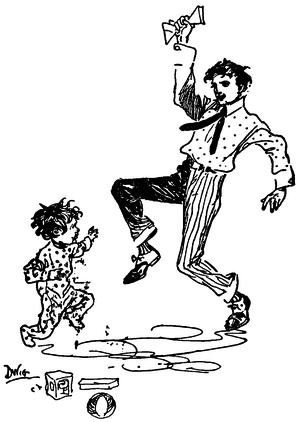
I SHOUTED "HURRAH".
Was there ever so delightful a reveille?
All the boyishness in
me seemed suddenly
to come to the surface,
and instead of saying
and doing the decorous
thing which novelists'
heroes do under similar circumstances.
I shouted "Hurrah!" and danced into the
children's room so violently that Budge sat
up in bed and regarded me with reproving
eyes, while Toddie burst into a happy laugh,
and volunteered as a partner in the dance.
Then I realized that the rain was over, and
the sun was shining—I could take Alice out
for another drive, and until then the children
could take care of themselves. I remembered
suddenly, and with a sharp pang, that
my vacation was nearly at an end, and I
found myself consuming with impatience to
know how much longer Alice would remain
at Hillcrest. It would be cruel to wish
her in the city before the end of August,
yet I——
"Uncle Harry," said Budge, "my papa
says 'tisn't nice for folks to sit down an' go
to thinkin' before they've brushed their hair
mornin's—that's what he tells me."
"I beg your pardon, Budge," said I,
springing up in some confusion; "I was
thinking over a matter of a great deal of importance."
"What was it—my goat?"
"No—of course not. Don't be silly,
Budge."
"Well, I think about him a good deal, an'
I don't think it's silly a bit. I hope he'll go
to heaven when he dies. Do angels have
goat-carriages, Uncle Harry?"
"No, old fellow—they can go about without
carriages."
"When I goesh to hebben," said Toddie,
rising in bed, "Izhe goin' to have lots of goat
cawidjes an' Izhe goin' to tate all ze andjels
a-widen."
With many other bits of prophesy and
celestial description I was regaled as I completed
my toilet, and I hurried out of doors
for an opportunity to think without disturbance.
Strolling past the hen-yard, I saw a
meditative turtle, and, picking him up and
shouting to my nephews, I held the reptile
up for their inspection. Their window blinds
flew open and a unanimous though not exactly
harmonious "Oh!" greeted my prize."
"Where did you get it, Uncle Harry?"
asked Budge.
"Down by the hen-coop."
Budge's eyes opened wide; he seemed to
devote a moment to profound thought, and
then he exclaimed:—
"Why, I don't see how the hens could lay
such a big thing—just put him in your hat
till I come down, will you?"
I dropped the turtle into Budge's wheelbarrow,
and made a tour of the flower-borders.
The flowers, always full of suggestion
to me, seemed suddenly to have new charms
and powers; they actually impelled me to try
to make rhymes,—me, a steady white-goods
salesman! The impulse was too strong to be
resisted, though I must admit that the results
were pitifully meager:—
"As radiant as that matchless rose
Which poet-artists fancy;
As fair as whitest lily-blows,
As modest as the pansy;
As pure as dew which hides within
Aurora's sun-kissed chalice;
As tender as the primrose sweet—
All this, and more, is Alice."
In inflicting this fragment upon the reader
I have not the faintest idea that he can discover
any merit in it; I quote it only that a
subsequent experience of mine may be more
intelligible. When I had composed these
wretched lines I became conscious that I
had neither pencil nor paper wherewith to
preserve them. Should I lose them—my
first self-constructed poem? Never! This
was not the first time in which I had
found it necessary to preserve words by
memory alone. So I repeated my ridiculous
lines over and over again, until the eloquent
feeling of which they were the graceless expression
inspired me to accompany my recital
with gestures. Six—eight—ten—a dozen—twenty
times I repeated these lines, each
time with additional emotion and gesture,
when a thin voice, very near me, remarked:—
"Ocken Hawwy, you does djust as if you
was swimmin'."
Turning, I beheld my nephew, Toddie—how
long he had been behind me I had no
idea. He looked earnestly into my eyes, and
then remarked:—
"Ocken Hawwy, your faysh is wed, djust
like a wosy-posy."
"Let's go right in to breakfast, Toddie,"
said I aloud, as I grumbled to myself about
the faculty of observation which Tom's children
seemed to have.
Immediately after breakfast I despatched
Mike with a note to Alice, informing her that
I would be glad to drive her to the Falls in
the afternoon, calling for her at two. Then
I placed myself unreservedly at the disposal
of the boys for the morning, it being distinctly
understood that they must not expect
to see me between lunch and dinner. I was
first instructed to harness the goat, which
order I obeyed, and I afterward watched that
grave animal as he drew my nephews up and
down the carriage-road, his countenance as
demure as if he had no idea of suddenly departing
when my back should be turned.
The wheels of the goat-carriage uttered the
most heart-rending noises I had ever heard
from ungreased axle; so I persuaded the boys
to dismount, and submit to the temporary
unharnessing of the goat, while I should
lubricate the axles. Half an hour of dirty
work sufficed, with such assistance as I
gained from juvenile advice, to accomplish
the task properly; then I put the horned
steed into the shafts, Budge cracked the
whip, the carriage moved off without noise,
and Toddie began to weep bitterly.
"Cawwidge is all bwoke," said he; "wheelsh
don't sing a bittie no more," while Budge remarked:—
"I think the carriage sounds kind o' lonesome
now, don't you, Uncle Harry?"
"Uncle Harry," asked Budge, a little later
in the morning, "do you know what makes
the thunder?"
"Yes, Budge—when two clouds go bump
into each other they make a good deal of noise,
and they call it thunder."
"That ain't it at all," said Budge "When
it thundered yesterday it was because the
Lord was riding along through the sky an' the
wheels of his carriage made an awful noise,
an' that was the thunder."
"Don't like nashty old funder," remarked
Toddie. "It goesh into our cellar an'
makesh all ze milk sour—Maggie said so.
An' so I can't hazh no nice white tea for my
brepspup."
"I should think you'd like the Lord to go
a-ridin', Toddie, with all the angels running
after Him," said Budge, "even if the thunder
does make the milk sour. And it's so splendid
to see the thunder bang."
"How do you see it, Budge?" I asked.
"Why, don't you know when the thunder
bangs, and then you see an awful bright place
in the sky?—that's where the Lord's carriage
gives an awful pound, an' makes little cracks
through the floor of heaven, an' we see right
in. But what's the reason we can't ever see
anybody through the cracks, Uncle Harry?"
"I don't know, old fellow—I guess it's because
it isn't cracks in heaven that look so
bright,—it's a kind of fire that the Lord
makes up in the clouds. You'll know all
about it when you get bigger."
"Well, I'll feel awful sorry if 'tain't anything
but fire. Do you know that funny
song my papa sings 'bout:—
"'Roarin' thunders, lightenin's blazes,
Shout the great Creator's praises?'
I don't know 'zactly what it means, but I
think it's kind o' splendid, don't you?"
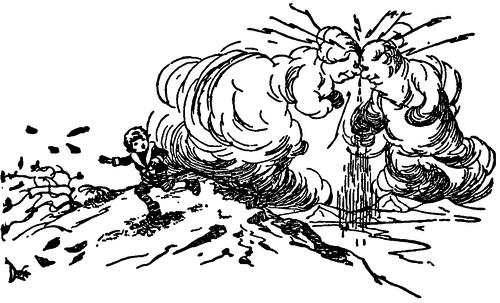
"TWO CLOUDS GO BUMP INTO EACH OTHER"
I did know the old song; I had heard it in
a Western camp-meeting, when scarcely
older than Budge, and it left upon my mind
just the effect it seemed to have done on his.
I blessed his sympathetic young heart, and
snatched him into my arms. Instantly, he
became all boy again.
"Uncle Harry," he shouted, "you crawl on
your hands and knees and play you was a
horse, and I'll ride on your back."
"No, thank you, Budge, not on the dirt."
"Then let's play menagerie, an' you be all
the animals."
To this proposition I assented, and after
hiding ourselves in one of the retired angles
of the house, so that no one could know who
was guilty of disturbing the peace by such
dire noises, the performance commenced. I
was by turns a bear, a lion, a zebra, an elephant,
dogs of various kinds, and a cat. As
I personated the latter named animal, Toddie
echoed my voice.
"Miauw! Miauw!" said he, "dat's what
cats saysh when they goesh down wells."
"Faith, an' it's him that knows," remarked
Mike, who had invited himself to a free seat
in the menagerie, and assisted in the applause
which had greeted each personation. "Would
ye belave it, Misther Harry, dhat young
dhivil got out the front door one mornin'
afore sunroise, all in his little noight-gown,
an' wint over to dhe docthor's an' picked up
a kitten lyin' on dhe kitchen door-mat, an'
throwed it down dhe well. Dhe docthor
wasn't home, but dhe missis saw him, an' her
heart was dhat tindher dhat she hurried out
and throwed boords down for dhe poor little
baste to stand on, an' let down a hoe on a
sthring, an' whin she got dhe poor little dhing
out, she was dhat faint dhat she dhrapped on
dhe grass. An' it cost Mr. Lawrence nigh
onto thirty dollars to have the docthor's well
claned out."
"Yes," said Toddie, who had listened carefully
to Mike's recital, "An' kitty-kitty said,
'Miauw! Miauw!' when she goed down ze
well. An' Mish Doctor sed, 'Bad boy—go
home—don't never turn to my housh no
more,'—dat's what she said to me. Now be
some more animals, Ocken Hawwy. Can't
you be a whay-al?"
"Whales don't make a noise, Toddie; they
only splash about in the water."
"Zen grop in ze cistern an' 'plash, can't
you?"
Lunch-time, and after it the time for Toddie
to take his nap. Poor Budge was bereft
of a playmate, for the doctor's little girl was
sick; so he quietly followed me about with a
wistful face, that almost persuaded me to
take him with me on my drive—our drive.
Had he grumbled, I would have felt less uncomfortable;
but there's nothing so touching
and overpowering to either gods or men, as
the spectacle of mute resignation. At last,
to my great relief, he opened his mouth.
"Uncle Harry," said he, "do you s'pose
folks ever get lonesome in heaven?"
"I guess not, Budge."
"Do little boy angels' papas an' mammas
go off visitin', an' stay ever so long?"
"I don't exactly know, Budge, but if they
do, the little boy angels have plenty of other
little boy angels to play with, so they can't
very well be lonesome."
"Well, I don't b'leeve they could make me
happy, when I wanted to see my papa an'
mamma. When I haven't got anybody to
play with, then I want papa an' mamma so
bad—so bad as if I would die if I didn't see
'em right away."
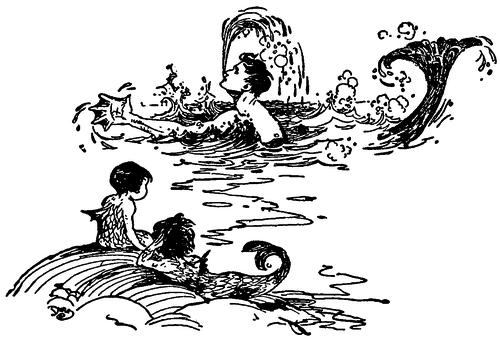
"CAN'T YOU BE A WHAY-AL?"
I was shaving, and only half-done, but I
hastily wiped off my face, dropped into a
rocking-chair, took the forlorn little boy into
my arms, and kissed him, caressed him, sympathized
with him, and devoted myself entirely
to the task and pleasure of comforting
him. His sober little face gradually assumed
a happier appearance; his lips parted in such
lines as no old master ever put upon angel
lips; his eyes, from being dim and hopeless,
grew warm and lustrous and melting. At
last he said:—
"Uncle Harry, I'm ever so happy now.
An' can't Mike go around with me and the
goat, all the time you're away riding? An
bring us home some candy, an' marbles—oh,
yes—an' a new dog."
Anxious as I was to hurry off to meet my
engagement, I was rather disgusted as I unseated
Budge and returned to my razor. So
long as he was lonesome and I was his only
hope, words couldn't express his devotion,
but the moment he had, through my efforts,
regained his spirits, his only use for me was
to ask further favors. Yet in trying the poor
boy, judicially, the evidence was more dangerous
to humanity in general than to Budge;
it threw a great deal of light upon my own
peculiar theological puzzles, and almost convinced
me that my duty was to preach a new
gospel.
As I drove up to the steps of Mrs. Clarkson's
boarding-house, it seemed to me a
month had elapsed since last I was there, and
this apparent lapse of time was all that prevented
my ascribing to miraculous agencies
the wonderful and delightful change that
Alice's countenance had undergone in two
short days. Composure, quickness of perception,
the ability to guard one's self, are
indications of character which are particularly
in place in the countenance of a young
lady in society, but when, without losing
these, the face takes on the radiance born of
love and trust, the effect is indescribably
charming—especially to the eyes of the man
who causes the change. Longer, more out-of-the-way
roads between Hillcrest and the
Falls, I venture to say, were never known
than I drove over that afternoon, and my
happy companion, who in other days I had
imagined might one day, by her decision,
alertness and force exceed the exploits of
Lady Baker, or Miss Tinne, never once asked
if I was sure we were on the right road. Only
a single cloud came over her brow, and of
this I soon learned the cause.
"Harry," said she, pressing closer to my
side, and taking an appealing tone, "do you
love me well enough to endure something
unpleasant for my sake?"
My answer was not verbally expressed, but
its purport seemed to be understood and accepted,
for Alice continued:—
"I wouldn't undo a bit of what's happened—I'm
the happiest, proudest woman in
the world. But we have been very hasty, for
people who have been mere acquaintances.
And mother is dreadfully opposed to such
affairs—she is of the old style, you know."
"It was all my fault," said I. "I'll apologize
promptly and handsomely. The time
and agony which I didn't consume in laying
siege to your heart, I'll devote to the task of
gaining your mother's good graces."
The look I received in reply to this remark
would have richly repaid me, had my task
been to conciliate as many mothers-in-law as
Brigham Young possesses. But her smile
faded as she said:—
"You don't know what a task you have
before you. Mother has a very tender heart,
but it's thoroughly fenced in by proprieties.
In her day and set, courtship was a very slow,
stately affair, and mother believes it the
proper way now; so do I, but I admit possible
exceptions, and mother does not. I am
afraid she won't be patient if she knows the
whole truth, yet I can't bear to keep it from
her. I'm her only child, you know."
"Don't keep it from her," said I, "unless
for some reason of your own. Let me tell the
whole story, take all the responsibility, and
accept the penalties, if there are any. Your
mother is right in principle, if there is a certain
delightful exception that we know of."
"My only fear is for you," said my darling,
nestling closer to me. "She comes of a family
that can display most glorious indignation
when there's a good excuse for it, and I can't
bear to think of you being the cause of such
an outbreak."
"I've faced the ugliest of guns in honor of
one form of love, little girl," I replied, "and
I could do even more for the sentiment for
which you're to blame. And for my own
sake, I'd rather endure anything than a sense
of having deceived any one, especially the
mother of such a daughter. Besides, you're
her dearest treasure, and she has a right to
know of even the least thing that in any way
concerns you."
"And you're a noble fellow, and——"
Whatever other sentiment my companion
failed to put into words was impulsively and
eloquently communicated by her dear eyes.
But oh, what a cowardly heart your dear
cheek rested upon an instant later, fair Alice!
Not for the first time in my life did I shrink
and tremble at the realization of what duty
imperatively required—not for the first time
did I go through a harder battle than was
ever fought with sword and cannon, and a
battle with greater possibilities of danger
than the field ever offered. I won it, as a
man must do in such fights, if he deserves to
live; but I could not help feeling considerably
sobered on our homeward drive.
We neared the house, and I had an insane
fancy that instead of driving two horses I was
astride of one, with spurs at my heels and a
saber at my side.
"Let me talk to her now, Alice, won't you?
Delays are only cowardly."
A slight trembling at my side—an instant
of silence that seemed an hour, yet within
which I could count but six footfalls, and
Alice replied:—
"Yes; if the parlor happens to be empty,
I'll ask her if she won't go in and see you a
moment." Then there came a look full of
tenderness, wonder, painful solicitude, and
then two dear eyes filled with tears.
"We're nearly there, darling," said I, with
a reassuring embrace.
"Yes, and you sha'n't be the only hero,"
said she, straightening herself proudly, and
looking a fit model for a Zenobia.
As we passed from behind a clump of evergreens
which hid the house from our view, I
involuntarily exclaimed, "Gracious!" Upon
the piazza stood Mrs. Mayton; at her side
stood my two nephews, as dirty in face, in
clothing, as I had ever seen them. I don't
know but that for a moment I freely forgave
them, for their presence might grant me the
respite which a sense of duty would not allow
me to take.
"Wezhe comed up to wide home wif you,"
exclaimed Toddie, as Mrs. Mayton greeted
me with an odd mixture of courtesy, curiosity
and humor. Alice led the way into the parlor,
whispered to her mother, and commenced
to make a rapid exit, when Mrs. Mayton
called her back, and motioned her to a chair.
Alice and I exchanged sidelong glances.
"Alice says you wish to speak with me,
Mr. Burton," said she. "I wonder whether
the subject is one upon which I have this
afternoon received a minute verbal account
from the elder Master Lawrence."
Alice looked blank;—I am sure that I did.
But safety could only lie in action, so I stammered
out:——
"If you refer to an apparently unwarrantable
intrusion upon your family circle,
Mrs.——"
"I do, sir," replied the old lady. "Between
the statements made by that child, and
the hitherto unaccountable change in my
daughter's looks during two or three days, I
think I have got at the truth of the matter.
If the offender was any one else, I should be
inclined to be severe; but we mothers of only
daughters are apt to have a pretty distinct
idea of the merits of young men, and——"
The old lady dropped her head; I sprang
to my feet, seized her hand, and reverently
kissed it; then Mrs. Mayton, whose only son
had died fifteen years before, raised her head
and adopted me in the manner peculiar to
mothers, while Alice burst into tears, and
kissed us both.
A few moments later, as three happy people
were occupying conventional attitudes,
and trying to compose faces which should
bear the inspection of whoever might happen
into the parlor, Mrs. Mayton observed:—
"My children, between us this matter is
understood, but I must caution you against
acting in such a way as to make the engagement
public at once."
"Trust me for that," hastily exclaimed
Alice.
"And me," said I.
"I have no doubt of the intention and discretion
of either of you," resumed Mrs. Mayton,
"but you cannot possibly be too cautious."
Here a loud laugh from the shrubbery
under the windows drowned Mrs. Mayton's
voice for a moment, but she continued:
"Servants, children,"—here she smiled, and
I dropped my head—"persons you may
chance to meet——"
Again the laugh broke forth under the
window.
"What can those girls be laughing at?"
exclaimed Alice, moving toward the window,
followed by her mother and me.
Seated in a semicircle on the grass were
most of the ladies boarding at Mrs. Clarkson's,
and in front of them stood Toddie, in
that high state of excitement to which sympathetic
applause always raises him.
"Say it again," said one of the ladies.
Toddie put on an expression of profound
wisdom, made violent gestures with both
hands, and repeated the following, with frequent
gesticulations:—
"Azh wadiant azh ze matchless woze
Zat poeck-artuss fanshy;
Azh fair azh whituss lily-blowzh;
Azh moduss azh a panzhy;
Azh pure azh dew zat hides wiffin
Awwahwah's sun-tissed tsallish;
Azh tender azh ze pwimwose tweet,
All zish, an' moah, izh Alish."
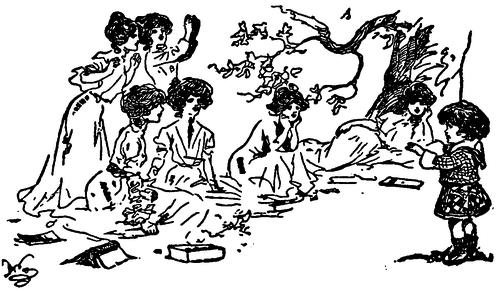
"AZH WADIANT AZH ZE MATCHLESS WOZE"
I gasped for breath.
"Who taught you all that, Toddie?" asked
one of the ladies.
"Nobody didn't taught me—I lyned[9] it."
"When did you learn it?"
"Lyned it zish mornin'. Ocken Hawwy
said it over, an' over, an' over, djust yots of
timezh, out in ze garden."
The ladies all exchanged glances—my lady
readers will understand just how, and I assure
gentlemen that I did not find their
glances at all hard to read. Alice looked at
me inquiringly, and she now tells me that I
blushed sheepishly and guiltily. Poor Mrs.
Mayton staggered to a chair, and exclaimed:
"Too late! too late!"
Considering their recent achievements,
Toddie and Budge were a very modest couple
as I drove them home that evening. Budge
even made some attempt at apologizing for
their appearance, saying that they couldn't
find Maggie, and couldn't wait any longer;
but I assured him that no apology was necessary.
I was in such excellent spirits that my
feeling became contagious; and we sang
songs, told stories, and played ridiculous
games most of the evening, paying but little
attention to the dinner that was set for us.
"Uncle Harry," said Budge, suddenly, "do
you know we haven't ever sung,—
'Drown old Pharaoh's Army, Hallelujah,'
since you've been here? Let's do it now."
"All right, old fellow." I knew the song—such
as there was of it—and its chorus, as
every one does who ever heard the Jubilee
Singers render it; but I scarcely understood
the meaning of the preparations which Budge
made. He drew a large rocking-chair into
the middle of the room, and exclaimed:—
"There, Uncle Harry—you sit down. Come
along, Tod—you sit on that knee, and I'll sit
on this. Lift up both hands, Tod, like I do.
Now we're all ready, Uncle Harry."
I sang the first line:—
"When Israel was in bondage, they cried unto the Lord,"
without any assistance, but the boys came in
powerfully on the refrain, beating time simultaneously
with their four fists upon my chest.
I cannot think it strange that I suddenly
ceased singing, but the boys viewed my action
from a different standpoint.
"What makes you stop, Uncle Harry?"
asked Budge.
"Because you hurt me badly, my boy; you
mustn't do that again."
"Why, I guess you ain't very strong: that's
the way we do to papa, an' it don't hurt
him."
Poor Tom! No wonder he grows flat-chested.
"Guesh you's a ky-baby," suggested Toddie.
This imputation I bore with meekness, but
ventured to remark that it was bedtime.
After allowing a few moments for the usual
expressions of dissent, I staggered upstairs
with Toddie in my arms, and Budge on my
back, both boys roaring the refrain of the
negro hymn:—
"I'm a-rolling through an unfriendly World!"
The offer of a stick of candy to whichever boy
was first undressed, caused some lively disrobing,
after which each boy received the
prize. Budge bit a large piece, wedged it
between his cheek and his teeth, closed his
eyes, folded his hands on his breast, and
prayed:—
"Dear Lord, bless papa an' mamma, an'
Toddie an' me, an' that turtle Uncle Harry
found; and bless that lovely lady Uncle
Harry goes ridin' with, an' make 'em take me
too, an' bless that nice old lady with white
hair, that cried, an' said I was a smart boy.
Amen."
Toddie sighed as he drew his stick of candy
from his lips; then he shut his eyes and remarked:—"Dee
Lord, blesh Toddie, an' make
him good boy, an' blesh zem ladies zat told
me to say it aden"; the particular "it" referred
to being well understood by at least
three adults of my acquaintance.
The course of Budge's interview with Mrs.
Mayton was afterward related by that lady,
as follows:—
She was sitting in her own room (which
was on the parlor floor, and in the rear of the
house), and was leisurely reading "Fated to
be Free," when she accidentally dropped her
glasses. Stooping to pick them up, she became
aware that she was not alone. A small,
very dirty, but good-featured boy stood
before her, his hands behind his back, and an
inquiring look in his eyes.
"Run away, little boy," said she. "Don't
you know it isn't polite to enter rooms without
knocking?"
"I'm lookin' for my uncle," said Budge, in
most melodious accents, "an' the other ladies
said you would know when he would come
back."
"I'm afraid they were making fun of you—or
me," said the old lady, a little severely.
"I don't know anything about little boys'
uncles. Now, run away, and don't disturb
me any more."
"Well," continued Budge, "they said your
little girl went with him, and you'd know
when she would come back."
"I haven't any little girl," said the old
lady, her indignation at a supposed joke
threatening to overcome her dignity. "Now
go away."
"She isn't a very little girl," said Budge,
honestly anxious to conciliate; "that is,
she's bigger'n I am, but they said you was
her mother, an' so she's your little girl, isn't
she? I think she's lovely, too."

MRS. MAYTON STOOPED TO PICK UP HER GLASSES
"Do you mean Miss Mayton?" asked the
lady, thinking she had a possible clue to the
cause of Budge's anxiety.
"Oh, yes—that's her name—I couldn't
think of it," eagerly replied Budge. "An
ain't she AWFUL nice—I know she is!"
"Your judgment is quite correct, considering your age," said Mrs.
Mayton, exhibiting more interest in Budge than she had heretofore done.
"But what makes you think she is nice? You are rather younger than
her male admirers usually are."
"Why, my Uncle Harry told me so," replied
Budge, "and he knows everything."
Mrs. Mayton grew vigilant at once, and
dropped her book.
"Who is your Uncle Harry, little boy?"
"He's Uncle Harry; don't you know him?
He can make nicer whistles than my papa
can. An' he found a turtle——"
"Who is your papa?" interrupted the old
lady.
"Why, he's papa—I thought everybody
knew who he was."
"What is your name?" asked Mrs. Mayton.
"John Burton Lawrence," promptly answered
Budge.
Mrs. Mayton wrinkled her brows for a moment,
and finally asked:—
"Is Mr. Burton the uncle you are looking
for?"
"I don't know any Mr. Burton," said
Budge, a little dazed; "uncle is mamma's
brother, an' he's been livin' at our house ever
since mamma and papa went off visitin', an'
he goes ridin' in our carriage, an'——"
"Humph!" remarked the old lady with so
much emphasis that Budge ceased talking.
A moment later she said:—
"I didn't mean to interrupt you, little boy;
go on."
"An' he rides with just the loveliest lady
that ever was. He thinks so, an' I KNOW she
is. An' he 'spects her."
"What?" exclaimed the old lady.
"'Spects her, I say—that's what he says.
I say 'spect means just what I call love.
'Cos if it don't, what makes him give her hugs
an' kisses?"
Mrs. Mayton caught her breath—and did
not reply for a moment. At last she said:—
"How do you know he—gives her hugs and
kisses?"
"'Cos I saw him, the day Toddie hurt his
finger in the grass cutter. An' he was so
happy that he bought me a goat-carriage
next morning—I'll show it to you if you come
down to our stable, an' I'll show you the goat
too. An' he bought——"
Just here Budge stopped, for Mrs. Mayton
put her handkerchief to her eyes. Two or
three moments later she felt a light touch on
her knee, and, wiping her eyes, saw Budge
looking sympathetically into her face.
"I'm awful sorry you feel bad," said he.
"Are you 'fraid to have your little girl ridin'
so long?"
"Yes!" exclaimed Mrs. Mayton, with
great decision.
"Well, you needn't be," said Budge, "for
Uncle Harry's awful careful an' smart."
"He ought to be ashamed of himself!" exclaimed
the lady.
"I guess he is, then," said Budge, "'cos
he's ev'rything he ought to be. He's awful
careful. T'other day, when the goat ran
away, an' Toddie an' me got in the carriage
with them, he held on to her tight, so she
couldn't fall out."
Mrs. Mayton brought her foot down with a
violent stamp.
"I know you'd 'spect him, if you knew how
nice he was," continued Budge. "He sings
awful funny songs, an' tells splendid stories."
"Nonsense!" exclaimed the angry mother.
"They ain't no nonsense at all," said
Budge. "I don't think it's nice for to say
that, when his stories are always about Joseph,
an' Abraham, an' Moses, an' when
Jesus was a little boy, an' the Hebrew children,
an' lots of people that the Lord loved.
An' he's awful 'fectionate, too."
"Yes, I suppose so," said Mrs. Mayton.
"When we says our prayers we prays for
the nice lady what he 'spects, an' he likes us
to do it," continued Budge.
"How do you know?" demanded Mrs.
Mayton.
"'Cos he always kisses us when we do it
an' that's what my papa does when he likes
what we pray."
Mrs. Mayton's mind became absorbed in
earnest thought, but Budge had not said all
that was in his heart.
"An' when Toddie or me tumbles down an
hurts ourselves, 'tain't no matter what Uncle
Harry's doin', he runs right out an' picks us
up an' comforts us. He froed away a cigar
the other day, he was in such a hurry when
a wasp stung me, an' Toddie picked the
cigar up and ate it, an' it made him awful
sick."
The last-named incident did not affect Mrs.
Mayton deeply, perhaps on the score of inapplicability
to the question before her. Budge
went on:—
"An' wasn't he good to me to-day? Just
'cos I was forlorn, 'cos I hadn't nobody to
play with, an' wanted to die an' go to heaven,
he stopped shavin', so as to comfort me."
Mrs. Mayton had been thinking rapidly
and seriously, and her heart had relented
somewhat toward the principal offender.
"Suppose," she said, "that I don't let my
little girl go riding with him any more?"
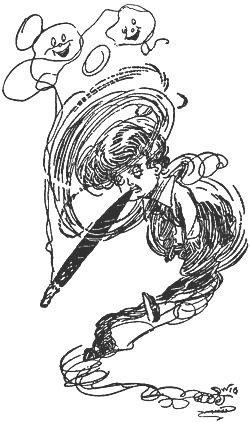
MADE HIM AWFUL SICK
"Then," said
Budge, "I know
he'll be awful,
awful unhappy,
an' I'll be awful
sorry for him,
'cos nice folks
oughtn't to be
made unhappy."
"Suppose, then,
that I do let her
go?" said Mrs.
Mayton.
"Then I'll give
you a whole
stomachful of
kisses for being so good to my uncle," said
Budge. And assuming that the latter course
would be the one adopted by Mrs. Mayton,
Budge climbed into her lap and began at once
to make payment.
"Bless your dear little heart! exclaimed
Mrs. Mayton; "you're of the same blood, and
it is good, if it is rather hasty."
As I rose the next morning, I found a
letter under my door. Disappointed that it
was not addressed in Alice's writing, I was
nevertheless glad to get a word from my sister,
particularly as the letter ran as follows:—
"July 1, 1875.
"Dear Old Brother:—I've been recalling a fortnight's
experience we once had of courtship in a boarding-house,
and I've determined to cut short our visit
here, hurry home, and give you and Alice a chance or
two to see each other in parlors where there won't be
a likelihood of the dozen or two interruptions you
must suffer each evening now. Tom agrees with me,
like the obedient old darling that he is; so please have
the carriage at Hillcrest station for us at 11:40
Friday morning. Invite Alice and her mother for me
to dine with us Sunday,—we'll bring them home from
church with us.
"Lovingly your sister,
"Helen.
"P. S. Of course you'll have my darlings in the
carriage to receive me.
"P. S. Would it annoy you to move into the best
guest-chamber? I can't bear to sleep where I can't
have them within reach."
Friday morning they intended to arrive,—blessings
on their thoughtful hearts!—and
this was Friday. I hurried into the boys'
room and shouted:—
"Toddie! Budge! who do you think is
coming to see you this morning?"
"Who?" asked Budge.
"Organ-grinder?" queried Toddie.
"No, your papa and mamma."
Budge looked like an angel in an instant,
but Toddie's eyes twitched a little, and he
mournfully murmured:—
"I fought it wash an organ-grinder."
"O Uncle Harry!" said Budge, springing
out of bed in a perfect delirium of delight,
"I believe if my papa and mamma had stayed
away any longer, I believe I would die. I've
been so lonesome for 'em that I haven't
known what to do—I've cried whole pillowsful
about it, right here in the dark."
"Why, my poor old fellow," said I, picking
him up and kissing him, "why didn't you
come up and tell Uncle Harry, and let him
try to comfort you?"
"I couldn't," said Budge; "when I gets
lonesome, it feels as if my mouth was all
tied up, an' a great big stone was right in
here." And Budge put his hand on his
chest.
"If a big 'tone wazh inshide of me," said
Toddie, "I'd take it out an' fro it at the
shickens."
"Toddie," said I, "aren't you glad papa
and mamma are coming?"
"Yesh," said Toddie, "I fink it'll be awfoo
nish. Mamma always bwings me candy fen
she goes away anyfere."
"Toddie, you're a mercenary wretch."
"Ain't a mernesary wetch; Izhe Toddie
Yawncie."
Toddie made none the less haste in dressing
than his brother, however. Candy was to
him what some systems of theology are to
their adherents—not a very lofty motive of
action, but sweet, and something he could
fully understand; so the energy displayed in
getting himself tangled up in his clothes was
something wonderful.
"Stop, boys," said I; "you must have on
clean clothes to-day. You don't want your
father and mother to see you all dirty, do
you?"
"Of course not," said Budge.
"Oh, izh I goin' to be djessed up all nicey?"
asked Toddie. "Goody! goody! goody!"
I always thought my sister Helen had an
undue amount of vanity, and here it was reappearing
in the second generation.
"An' I wantsh my shoes made all nigger,"
said Toddie.
"What?"
"Wantsh my shoes made all nigger wif a
bottle-bwush, too," said Toddie.
I looked appealingly at Budge, who answered:—
"He means he wants his shoes blacked,
with the polish that's in the bottle, an' you
rub it on with a brush."
"An' I wantsh a thath on," continued
Toddie.
"Sash, he means," said Budge. "He's
awful proud."
"An' Izhe doin' to wear my takker-hat,"
said Toddie. "An' my wed djuvs."
"That's his tassel-hat an' his red gloves,"
continued the interpreter.
"Toddie, you can't wear gloves such hot
days as these," said I.
A look of inquiry was speedily followed by
Toddie's own unmistakable preparations for
weeping; and as I did not want his eyes
dimmed when his mother looked into them I
hastily exclaimed:—
"Put them on, then—put on the mantle of
rude Boreas if you choose; but don't go to
crying."
"Don't want no mantle-o'wude-baw-yusses,"
declared Toddie, following me phonetically,
"wantsh my own pitty cozhesh, an'
nobody eshesh."
"O Uncle Harry," exclaimed Budge, "I
want to bring mamma home in my goat-carriage!"
"The goat isn't strong enough, Budge, to
draw mamma and you."
"Well, then, let me drive down to the
depot, just to show papa an' mamma I've
got a goat-carriage—I'm sure mamma would
be very unhappy when she found out I had
one, and she hadn't seen it first thing."
"Well, I guess you may follow me down,
Budge; but you must drive very carefully."
"Oh, yes—I wouldn't get us hurt when
mamma was coming
for anything."
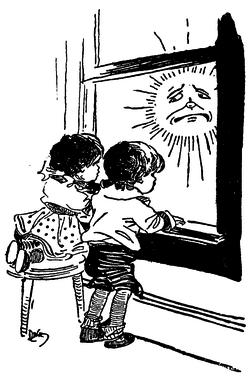
"THE SUN'LL BE DISAPPOINTED IF IT DON'T HAVE US TO LOOK AT"
"Now, boys,"
said I, "I want
you to stay in the
house and play this
morning. If you
go out of doors
you'll get yourselves
dirty."
"I guess the
sun'll be disappointed
if it
don't have us
to look at,"
suggested
Budge.
"Never mind," said I, "the sun's old
enough to have learned to be patient."
Breakfast over, the boys moved reluctantly
away to the play-room, while I inspected
the house and grounds pretty closely,
to see that everything should at least fail to
do my management discredit. A dollar
given to Mike and another to Maggie were of
material assistance in this work, so I felt free
to adorn the parlors and Helen's chamber
with flowers. As I went into the latter room
I heard some one at the wash-stand, which
was in an alcove and, on looking in, I saw
Toddie drinking the last of the contents of a
goblet which contained a dark-colored mixture.
"Izhe tatin' black medshin," said Toddie;
"I likes black medshin awfoo muts."
"What do you make it of?" I asked, with
some sympathy, and tracing parental influence
again. When Helen and I were children
we spent hours in soaking licorice in water
and administering it as medicine.
"Makesh it out of shoda mitsture," said
Toddie.
This was another medicine of our childhood
days, but one prepared according to physician's
prescription, and not beneficial when
taken ad libitum. As I took the vial—a two-ounce
one—I asked:—
"How much did you take, Toddie?"
"Took whole bottoo full—'twas nysh,"
said he.
Suddenly, the label caught my eye—it read
PAREGORIC. In a second I had snatched
a shawl, wrapped Toddie in it, tucked him
under my arm, and was on my way to the
barn. In a moment more I was on one of the
horses and galloping furiously to the village,
with Toddie under one arm, his yellow curls
streaming in the breeze. People came out
and stared as they did at John Gilpin, while
one old farmer whom I met turned his team
about, whipped up furiously, and followed
me, shouting, "Stop, thief!" I afterward
learned that he took me to be one of the abductors
of Charlie Ross, with the lost child
under my arm, and that visions of the $20,000
reward floated before his eyes. In front of
an apothecary's I brought the horse suddenly
upon his haunches, and dashed in, exclaiming:—
"Give this child a strong emetic—quick!
He's swallowed poison!"
The apothecary hurried to his prescription-desk,
while a motherly-looking Irish woman
upon whom he had been waiting, exclaimed,
"Holy Mither! I'll run an' fetch Father
O'Kelley," and hurried out. Meanwhile Toddie,
upon whom the medicine had not commenced
to take effect, had seized the apothecary's
cat by the tail, which operation
resulted in a considerable vocal protest from
that animal.
The experiences of the next few moments
were more pronounced and revolutionary
than pleasing to relate in detail. It is sufficient
to say that Toddie's weight was materially
diminished, and that his complexion was
temporarily pallid. Father O'Kelley arrived
at a brisk run, and was honestly glad to find
that his services were not required, although
I assured him that if Catholic baptism and a
sprinkling of holy water would have improved
Toddie's character, I thought there
was excuse for several applications. We
rode quietly back to the house, and while I
was asking Maggie to try and coax Toddie
into taking a nap, I heard the patient remark
to his brother:—
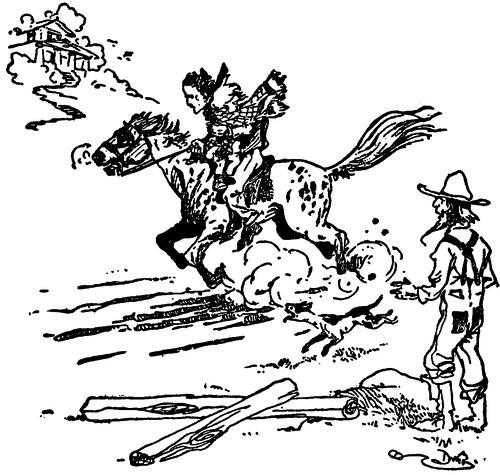
GALLOPING FURIOUSLY TO THE VILLAGE
"Budgie, down to the village I was a
whay-al. I didn't froe up Djonah, but I
froed up a whole floor full of uvver fings."
During the hour which passed before it was
time to start for the depot my sole attention
was devoted to keeping the children from
soiling their clothes; but my success was so
little, that I lost my temper entirely. First
they insisted upon playing on a part of the
lawn which the sun had not yet reached.
Then, while I had gone into the house for a
match to light my cigar, Toddie had gone
with his damp shoes into the middle of the
road, where the dust was ankle deep. Then
they got upon their hands and knees on the
piazza and played bear. Each one wanted
to pick a bouquet for his mother, and Toddie
took the precaution to smell every flower he
approached—an operation which caused him
to get his nose covered with lily-pollen, so
that he looked like a badly used prize-fighter.
In one of their spasms of inaction, Budge
asked:—
"What makes some of the men in church
have no hair on the tops of their heads, Uncle
Harry?"
"Because," said I, pausing long enough to
shake Toddie for trying to get my watch out
of my pocket, "because they have bad little
boys to bother them all the time, so their
hair drops out."
"I dess my hairs is a-goin' to drop out
pitty soon, then," remarked Toddie, with an
injured air.
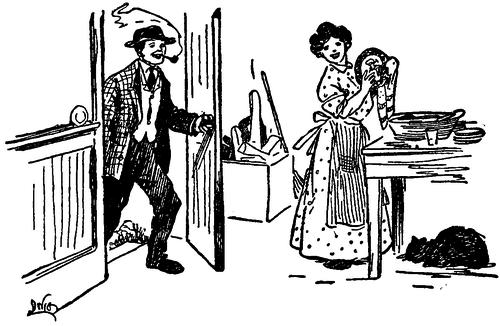
MIKE TELLING MAGGIE TO GET LUNCH
"Harness the horses, Mike!" I shouted.
"An' the goat, too," added Budge.
Five minutes later I was seated in the carriage,
or rather in Tom's two-seated open
wagon. "Mike," I shouted, "I forgot to tell
Maggie to have some lunch ready for the
folks when they get here—run, tell her, quick,
won't you?"
"Oye, oye, sur," said Mike, and off he
went.
"Are you all ready, boys?" I asked.
"In a minute," said Budge; "soon as I fix
this. Now," he continued, getting into his
seat, and taking the reins and whip, "go
ahead."
"Wait a moment, Budge—put down that
whip, and don't touch the goat with it once
on the way. I'm going to drive very slowly—there's
plenty of time, and all you need to
do is to hold your reins."
"All right," said Budge, "but I like to look
like mans when I drive."
"You may do that when somebody can run
beside you. Now!"
The horses started at a gentle trot, and the
goat followed very closely. When within a
minute of the depot, however, the train
swept in. I had intended to be on the platform
to meet Tom and Helen, but my watch
was evidently slow. I gave the horses the
whip, looked behind and saw the boys were
close upon me, and I was so near the platform
when I turned my head that nothing but the
sharpest of turns saved me from a severe
accident. The noble animals saw the danger
as quickly as I did, however, and turned in
marvelously small space; as they did so, I
heard two hard thumps upon the wooden
wall of the little depot, heard also two frightful
howls, saw both my nephews considerably
mixed up on the platform, while the driver
of the Bloom-Park stage growled in my
ear:—
"What in thunder did you let 'em hitch
that goat to your axle-tree for?"
I looked, and saw the man spoke with just
cause. How the goat's head and shoulders
had maintained their normal connection during
the last minute of my drive, I leave for
naturalists to explain. I had no time to
meditate on the matter just then, for the
train had stopped. Fortunately the children
had struck on their heads, and the Lawrence-Burton
skull is a marvel of solidity. I set
them upon their feet, brushed them off with
my hands, promised them all the candy they
could eat for a week, wiped their eyes, and
hurried them to the other side of the depot.
Budge rushed at Tom, exclaiming:—
"See my goat, papa!"
Helen opened her arms, and Toddie threw
himself into them, sobbing:—
"Mam—ma! shing 'Toddie one-boy-day!'"
How uncomfortable a man can feel in the
society of a dearly beloved sister and an incomparable
brother-in-law I never imagined
until that short drive. Helen was somewhat
concerned about the children, but she found
time to look at me with so much of sympathy,
humor, affection, and condescension that I
really felt relieved when we reached the
house. I hastily retired to my own room,
but before I had shut the door Helen was
with me, and her arms were about my neck;
before the dear old girl removed them we had
grown far nearer to each other than we had
ever been before.
And how gloriously the rest of the day
passed off. We had a delightful little lunch,
and Tom brought up a bottle of Roederer,
and Helen didn't remonstrate when he insisted
on its being drank from her finest
glasses, and there were toasts drank to
"Her" and "Her Mother," and to the Benedict
that was to be. And then Helen proposed
"The makers of the match—Budge
and Toddie!" which was honored with bumpers.
The gentlemen toasted did not respond,
but they stared so curiously that I
sprang from my chair and kissed them
soundly, upon which Tom and Helen exchanged
significant glances.
Then Helen walked down to Mrs. Clarkson's
boarding-house, all for the purpose of
showing a lady there, with a skirt to make
over, just how she had seen a similar garment
rearranged exquisitely. And Alice strolled
down to the gate with her to say good-by;
and they had so much to talk about that
Helen walked Alice nearly to our house, and
then insisted on her coming the rest of the
way, so she might be driven home. And
then Mike was sent back with a note to say to
Mrs. Mayton that her daughter had been prevailed
upon to stay to evening dinner, but
would be sent home under capable escort.
And after dinner was over and the children
put to bed, Tom groaned that he must attend
a road-board meeting, and Helen begged us
to excuse her just a minute while she ran in
to the doctor's to ask how poor Mrs. Brown
had been doing, and she consumed three
hours and twenty-five minutes in asking,
bless her sympathetic soul!
The dreaded ending of my vacation did not
cause me as many pangs as I had expected.
Helen wanted to know one evening why if
her poor, dear Tom could go back and forth
to the city to business every day, her lazy big
brother couldn't go back and forth to Hillcrest
daily, if she were to want him as a
boarder for the remainder of the season.
Although I had for years inveighed against
the folly of cultivated people leaving the city
to find residences, Helen's argument was unanswerable
and I submitted. I did even
more; I purchased a lovely bit of ground
(though the deed stands in Tom's name for
the present), and Tom has brought up several
plans for cottage-houses, and every evening
they are spread on the dining-room table, and
there gather round them four people, among
whom are a white goods salesman and a
young lady with the brightest of eyes and
cheeks full of roses and lilies. This latter-named
personage has her own opinions of the
merits of all plans suggested, and insisted
that whatever plan is adopted must have a
lovely room to be set apart as the exclusive
property of Helen's boys. Young as these
gentlemen are, I find frequent occasions to be
frightfully jealous of them, but they are unmoved
by either my frowns or persuasions—artifice
alone is able to prevent their monopolizing
the time of an adorable being, of
whose society I cannot possibly have too
much. She insists that when the ceremony
takes place in December, they shall officiate
as groomsmen, and I have not the slightest
doubt that she will carry her point. In fact,
I confess to frequent affectionate advances
toward them myself, and when I retire without
first seeking their room and putting a
grateful kiss upon their unconscious lips, my
conscience upbraids me with base ingratitude.
To think I might yet be a hopeless
bachelor had it not been for them, is to overflow
with thankfulness to the giver of
Helen's Babies.
Obvious typographical errors have been silently corrected. Other
variations in spelling, punctuation, hyphenation and accents remain
unchanged.