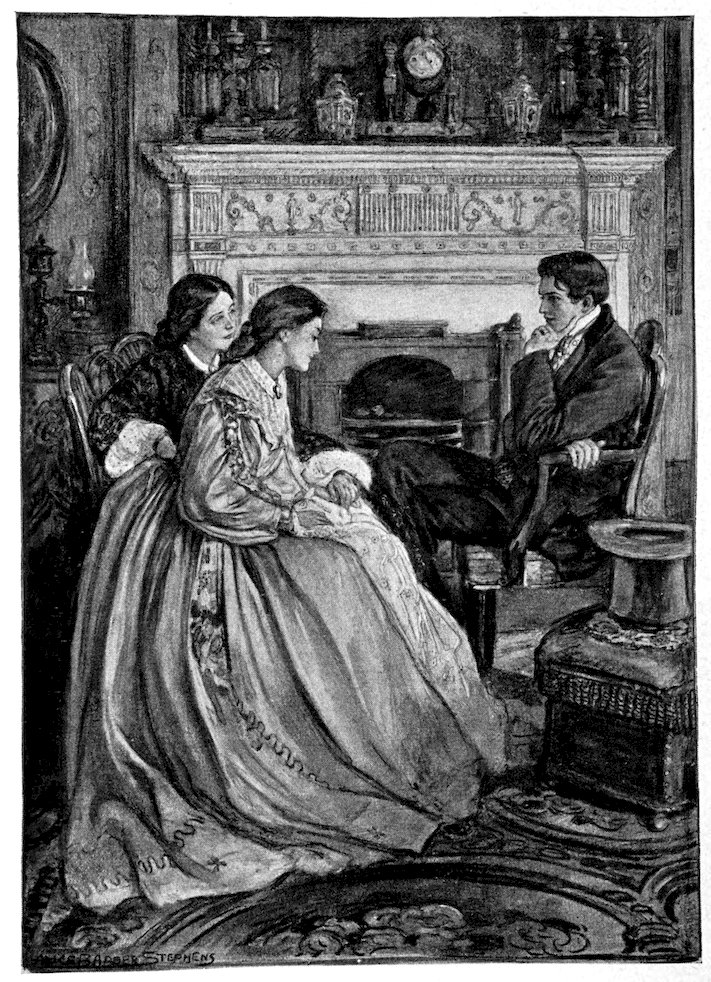
HEIMWEH [1] — I LIFE HAS NO FUTURE AT TWENTY-ONE — II HAPPINESS IS BETTER THAN CHURCH — III OPEN THE DOOR TO JOY—ALWAYS — IV WAR IS GLORIOUS AT THE BEGINNING BUT NOT AT THE END — V WE GO OUT TO FIGHT UNDER THE FLAG; WE RETURN—UNDER IT — VI GROWING OLD IS ONLY AN IDEA—UNTIL WE KNOW — VII MAKING BELIEVE BRINGS THINGS — VIII THE END OF LIFE IS AS ITS BEGINNING—SIMPLE — IX GOOD BASKETS MUST KEEP THEIR BOTTOMS — X THINGS FEEL HEAVIER IN AGE — XI BUT THE POOR-HOUSE MAY BE ONE OF THE MANSIONS IN OUR FATHER’S HOUSE
3
The neighbors called them “Betsy and
John”—her name first, always. Perhaps
because she was short and aggressive, he
tall and inclined to “lazy.” Only inclined
to lazy, understand. For, no one had ever
caught him at it. Indeed, with a certain
rustic intuition and much experience of his
kind, they knew it was “in him”—that he
had been “born to it”—and they liked him
better for his constant vanquishment of the
infirmity. They would have liked him anyhow—he
was a very likable fellow. But
Betsy they loved. Once in a while some
zealous friend of John would contend that
he was the very incarnation of industry.
John, when he came to know of that sort
4of thing, always discouraged it—and did it
firmly. He would point to the nimble fingers
of his wife—a thing he was always glad to
do—and say, sighing:
“It is that—she—it—makes me ashamed—to
lazy.”
She was twenty, he barely twenty-one,
when they were married. She was a basket-maker,
he a laborer. They lived in a little
town on “the Border.” Differing with the
utmost good nature in everything but one—in
that they were exactly alike. They had
no future—absolutely none! They refused
to have one. Strong with the vigor of youth—happy
with the unreason of happiness—content
with what came—wishing for nothing
they had not—ambitious for nothing
but a home—they lived but from day to
day again—sleeping soundly, working gayly,
thinking not. Why should they be vexed
about a future—at twenty—twenty-one?
Once in a while they went hungry—and
laughed about it. But, usually, there was
sufficient demand for her dainty wares; and
he was digging trenches in the streets of
5the adjoining town for the pipes of the new
gas company. He made as much as forty
cents a day when he worked, while she
averaged nearly twice as much. You can see
that there was no reason why they should
go hungry very often. And, indeed, once,
when he felt particularly opulent, John bought
Betsy a gold-plated brooch for her birthday.
It was in 1835.
But did I say that there was one thing
upon which they agreed—in that rejected
future? Yes. A home—they wanted a
home—a roof over their heads, they called
it—that was all. But, even this was forgotten
as the happy years went by.
“Home is wherever we are!” laughed
Betsy.
Then came the children, and John began
to talk and act and think like a very proper
father—even though Betsy laughed at him.
“Betsy,” said John, once upon a time, pulling
down his face, “we’d ought to begin thinking
of the—” Betsy began to smile, but
John went on, like a husband and father doing
his duty—“er—think of the—er—roof!”
6He almost shouted the last word—it
seemed so ridiculous when he came to it.
“At twenty-two?” said Betsy.
John was rocking the cradle.
“But when a man gits to be a father—”
“Papa!” laughed Betsy at him, and John
blushed and stopped.
But that wasn’t Betsy’s way—to chill
John with an argument so irrefutable—and
at such a distance! She flung her basket
away, snatched the baby from the cradle,
and, next, John had his whole family in his
lap. His wife was laughing, the baby was
blinking, and John was very happy.
“Roof!”—she was talking to the baby
“do you know what that is? I don’t.
You haven’t any yet—neither have I. I’ve
forgotten it. We are going to have one,
of course—after a while—if your papa
wants one—now—if he can’t wait—a
minute—”
John put his hand on her mouth. She bit
it and he kissed her. Then they were tangled
in an embrace for a moment—the baby
getting the worst of it.
7“Look here,” said Betsy, then, “don’t you
think you’ve got enough with us? Roof!”
“Yes,” confessed John, shamefacedly, “I
don’t want you to bother no more about
it.”
“I won’t,” said Betsy.
“We’ll have it—some day!” declared John,
in his lazy way, “without any bothering!”
8
Four more were born—boys all—goodly
and ruddy—like their little mother. But,
one and all, they surprised and delighted her
by growing tall like their father.
“You see, John,” said Betsy, “they are
going to be big like you, and good like me.”
Well, one by one, they went out into the
world—but never very far from the romping
comrade-mother. Away from her the
world was neither so gay nor so tender.
They never found another woman so altogether
lovely.
There was no work for any of them on Sunday,
so they would all come home. Indeed,
in the country of the Germans of Pennsylvania,
no one ever worked on Sunday in that
day and generation. And such Sundays as
they were! No going to church, I fear—a
heinous omission perhaps. But how could
9they? There was gentle revelry in the little
house from the first moment—not a soul
of them would have missed that for any
church on earth—and no church on earth
would have done them so much good—then
a feast. Sometimes—when all had work
and wages were good—a stewed turkey!
And, after it all, kisses and hugs and good-nights—till
one thought it would never
end.
And, after they were gone, Betsy would cry—and
John would take her in his lap and say
never a word—leaving her to fall asleep
there.
But once, instead of sleeping, she sat up
and took John by the throat.
“John! I’m glad they’re not girls—any
of them.” For this used to be a complaint
of Betsy’s—that none of them were girls.
“Yes,” said John, meekly.
She gripped his throat a little tighter and
shook him.
“They’d git married if they were. Girls
always do. But boys often have better sense.
Ours have, anyhow.”
10“We got married,” ventured John.
“Well—of course!” said Betsy, choking
him.
But the thing was in her mind all the week.
There seemed danger. The next Sunday, at
the table, she said:
“Look here! Why don’t some of yous git—git—married?”
Her hand shook as she dealt out the gravy
and waited for their answer.
They looked from one to the other. No
one knew.
“Funny,” laughed Ben, “but I never thought
of it.”
“Nor I,” said Bart.
“Hanged if I know,” piped Fred. “Don’t
see no girls like you—”
“Can I marry you, mammy?” laughed
Tom, putting his arm around her as she came
over to him. It was Tom she was most
afraid of. For he was the youngest—and to
her he was little short of a god. He had rebellious
yellow hair and blue eyes—and little
patches of whiskers were beginning to grow
on his face.
11“Yes,” said his mother, sweeping his girlish
lips with a kiss.
“Me, too,” said “old” Ben—and he got it.
And so on all around while John smiled in
ecstasy.
“Boys,” said the little mother, “there ain’t
no girl I ever saw that’s fit for any of yous—ain’t
so, John?”
John, of course, said yes.
Tom got up, and, after turning her back to
the rest wiped the tears from his mother’s
eyes.
“Boys,” announced the mother, “next
Sunday there will be a turkey—and oyster
stuffing!”
As she said it she went over and let her
arms glide gently around the neck of Will, who
had not spoken on the subject of marriage.
He caught her hands and drew her arms closer
while he smiled up at her—a little sadly. She
kissed him on the great forehead, and he understood.
There had been a brief love affair for
him, but it was over. Simply a successful
rival. He never spoke of it—nor did any
one else. But at least two—understood.
12
But Betsy had caught John surreptitiously
saving—to buy the roof, he explained!
“We—we’re gitting old, you know,” he
excused.
“Old!—”
Betsy caught up her dainty skirts—very
high—and pirouetted before him.
“Ein’, tswei, drei’, un’ fier. Dass macht
sivve’—”
She stopped a moment.
“John! Don’t you remember Eisenkrantz’s
husking—where I first saw you?
Oh, John, what a gawk you were! And yit—and
yit—John, do you remember how
you danced that night? Come!”
She pulled him about with her in a very
clumsy attempt at waltzing. Then she
pushed him off.
“Oh, you are gitting old. But me—”
13A few more mad whirls and she flung
herself into his arms.
“Say, John, that’s better than any roof.”
“Er—what?” asked John, whose wits
were often left behind by his wife’s.
She came close and shouted in his ear:
“Joy!”
“Oh!” said John, patting her pretty hair.
She slipped her arm about him. And
then her voice was very soft and loving.
“And our five boys! Such boys! Where
is there another such five! If we should
get old—if we should need a roof—why,
John—there are our five handsome boys!”
She cried a little, and John asked her for
the thousandth time why she did it.
“Why does a woman cry? For joy and
sorrow—life and death—good and evil!”
“Oh!” said John, once more.
“John!” His wife woke up and gripped
his throat again. “Ben needs a new horse,”—Ben
was a huckster,—“Tom wants a
drill,”—Tom was a farmer,—“and Fred
must have a new Sunday suit. How much
money have you saved, you rascal?”
14John told her. And Ben got his horse,
Tom got his drill, and Fred got his Sunday
suit—and John saved no more.
But it was so—they were brave and loving
fellows—all. And every Sunday—when
they were gone—it was a game of
hide-and-seek for Betsy and John—to find
the money and presents they had left. Of
course, they were all at places where she
might easily discover them. But she always
went shy of the most likely places at first—thus
prolonging the search—sometimes
until she was quite tired. In the pocket of
her second-best dress (she always wore her
best on Sunday)—in the frame of her
warped toilet mirror—in the drawers of
her scratched dressing bureau—in the loaves
of her new bread!
Finally, when the boys all became prosperous,
they made her stop weaving baskets,
and him stop laboring in the streets; all of
them dressed well, and they became quite a
company of ladies and gentlemen. Neither
John nor Betsy was precisely happy afterward.
Sunday was longer in coming. But
15they sighed for their idleness, laughed for their
happiness—and did as the boys told them
to do: sat still and looked pretty.
But there is such a thing as getting used
even to idleness, and joy comes whether
we work or not—if we are wise enough to
let it come. And no one in that little cheap
house ever shut the door on joy. So Betsy,
after a while, learned to wear her Sunday
clothes all the week, and John to shave every
morning. And the door was kept open
always to joy.
16
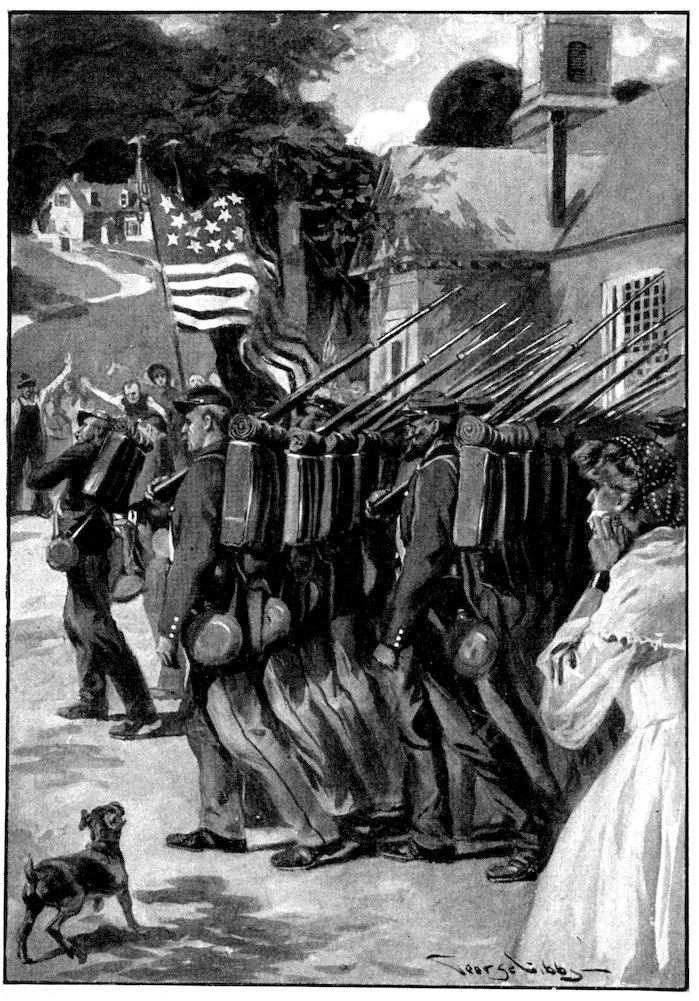
Then, one day, in ’61, they formed in the
town a “soldier company” to go to the
“front.” No one knew much about it—nor
where the front was. No one doubted that it
was to be a great frolic—no one but Betsy.
And there, in the front rank, all together, as
brothers should be, stood Betsy’s five boys.
And, as if this were not enough, there was
John, too! With yellow chevrons on his
sleeves—and a sword at his side—brave as
a lion and proud as a major-general. Company
corporal! Alas! perhaps the privates,
too, might have carried swords had there
been enough to go around.
John stood it as long as he could. For
more than a week he swore that he would
stay at home and take care of Betsy. He
was too old to frolic. But he went to the
drill ground every day. Once or twice he
17drilled with them when some one was absent.
He finally developed such a genius for military
affairs that the captain went to Betsy and
voiced John’s yearnings—it was for his country
that he wanted to fight—it was his duty
to fight—it was a privilege to fight—it was
a wife’s duty to let him fight.
She let John go, too. For, after all, it was
only a great frolic—they told her!
So they marched away to the tune of “The
Girl I Left Behind Me,” and the little mother
went home to wait. It was very lonely from
the first hour, and she willingly took up her
work again. They scolded her when she wept,
so she tried not to weep. They told her she
ought not only to be willing to let them go, but
be glad. She tried to think that she was
glad. But in her heart she rebelled dismally.
“We are coming, Father Abraham!” had been
the cry—and her boys, too, had said, with a
new light in their faces, which she, a woman,
did not, could not, would not, understand,
that they were going to fight for their country!
Go and fight for their country when they
might work for her—when they might have
18those Sunday feasts—when she could darn
their stockings—mend their clothes—have
her arms about them—theirs about her—give
them warm beds—plenty of food—while
the country would give them poor food—poor
clothes—the ground to sleep on—and
no Sundays at home! She could not understand
it. No woman who is a mother can. She
thought of possible wounds on their splendid
bodies—of them lying stark in the night
upon some shot-torn battle-field—of burial
unknown in some vast trench—of fever—and
terrors—of hospitals—and even of the
coming home—no more her boys—no more!
Soldiers, then, soldiers with rough beards and
rough voices. She never once thought of them
coming home dead.
Alas! her country was bounded by the
Rhine. This was their country!
But still, as they went, she prayed blindly:
“God bless you and keep you, my boys,
and send you back to me as you go—good
boys. Father Abraham, they are my all—everything
on earth I love. Send them back
as you receive them.”
19
It seemed cruel—it was cruel—that
her prayer should be so utterly denied her—that
they should all be killed. But so it
fell out.
One by one they came home to her and
were laid away in the churchyard of Saint
Michael’s, in their pine coffins and faded uniforms,
with the honors of war. It was heart-breaking
to have to follow them, one by one,
to their graves—to the same Dead March in
Saul—to the same muffled drums—to the
cadenced tramp of soldiers—with the Stars
and Stripes for shroud—with all the solemn
pomp of war.
She thought only of the beautiful thing in
the coffin to which she had given life. And
each time she prayed dizzily—iterating it—so
that God might perhaps the better hear:
20“Our Father, who art in heaven—keep
the rest—keep the rest—keep John.”
The last of them died at Gettysburg—in
the first day’s fight.
It was only a few miles away, and on
the third of July he came home. On the
fourth, while cannons were bursting for joy,
she was following once more the soldiers to
the tune of the Dead March. It was the last.
She had grown afraid to pray. But once
more, at the open grave, she raised her hands:
“Our Father, who art in heaven—keep
John,” she begged, in whispers.
When she got home there was a letter for
her. It spoke of the devotion of her dead
boys. It was almost as if the writer knew
them—as she did. This letter was signed
“A. Lincoln,” and read:
“Dear Madam:
“I have been shown in the files of the War
Department a statement of the Adjutant-General
of Pennsylvania that you are the
mother of five sons who have died gloriously
on the field of battle. I feel how weak and
21fruitless must be any words of mine which
should attempt to beguile you from the grief
of a loss so overwhelming. But I cannot
refrain from tendering to you the consolation
that may be found in the thanks of the Republic
they died to save. I pray that our
heavenly Father may assuage the anguish of
your bereavement, and leave you only the
cherished memory of the loved and lost, and
the solemn pride that must be yours to have
laid so costly a sacrifice upon the altar of
freedom.”
“But they are dead!” cried Betsy to the
letter. She cared nothing for the “cause”
or for “freedom.” They were dead.
22
And then, when the war was quite over,
that last pitiful prayer was answered, and
John came marching home—from the grand
review—with a captain’s straps on his
shoulders—a minié ball in his thigh—and
a perfectly proper sword—the gift of the
United States of America! It is quite certain
that John was very proud of the sword—and
perhaps even of his limp.
And Betsy was as proud as he—quite.
But not of the sword and limp. These, in
secret, she hated as much as she could hate.
Perhaps I had better say that she was only
glad. You may be sure that his glory did
not keep her off.
“I don’t care if you were in twenty-one
battles. You are only my dear old John.”
“Only your old John,” said the soldier.
“Dear, I said! And—and—you’ve got
23to make up for all the rest—one multiplied
by five, you know—that dear.”
She suddenly sobbed.
“Eh?” said John. Then—“Oh!”
He sobbed, too.
“And, as for that limp—I will cure that,
or my name is not Betsy.”
And more sobs.
But for all her trying, he limped the
more.
So that long afterward she said:
“John—I haven’t done it, and my name’s
still Betsy.”
But there was no more sobbing about it.
“It’s better,” prevaricated John.
“No,” said Betsy, “it ain’t. Something is
gone. I can’t do things any more.”
John thought a moment.
“Like when you reach out in the dark for
something you know is there and it ain’t and
you shiver,” he said then. “I used to do that
at night on the ground—reach out for—you!”
“John!” cried Betsy, in her old manner, “I
never heard you say so much at one time before—nor
so nice. What’s the matter?”
24“You don’t say so much,” said John. “I’m
evening up now.”
“Yes—yes—yes—dear John!” said Betsy,
with a tear, she did not know for what—quite.
“I must talk more.”
“We’ve lost something and we’ve gained
something—at another place,” John went on.
“I don’t know what it is—but it’s something.”
“John, I know, and I’ll tell you.”
She came and knelt at his side and tried to
reach his neck with her short arms.
“We’re falling in love again!”
John suddenly held her off and stared.
“By jiminy!”
“Yes. It was so long to wait—and there
is nobody but you and me now—and we have
got to begin all over again. Don’t you see?”
And the tears fell again.
“No! I was always in love with you.
No!”
And he was quite stubborn about it.
“Yes!” she cried.
“Yes,” John agreed.
“No!” she laughed.
25“No,” laughed John.
After a moment she released herself, and,
taking John by the throat in the old fashion,
said:
“And, John, we will begin all over again.
We’re not old! So there!”
She spread her skirts and whirled around
on her toes.
“Not a day older than in ’35,” said John,
with glistening eyes.
She flew upon him and took him again by
the throat.
“John!” she cried, “that’s a little too
much!”
But John was not convinced—though she
lifted her yellow hair and showed him where
the gray was creeping in.
“But it’s mighty sweet,” she conceded.
They did exactly as they had planned—began
all over again. John was as tender
with her as he had been after that night of
the husking. And Betsy was as devoted to
John as she had been in that halcyon time.
“Growing old is just an idea,” said the
happy John, one day.
26“Oh, of course,” agreed Betsy, busily plaiting
withes, “until you know!”
“Why, everything is just as it was thirty
years ago—ain’t it, Betsy?”
“John,” laughed Betsy, trying to plunge
upon him from her work, “did it ever occur
to you that your love-making nowadays consists
largely of recalling those other love-makings—in
’35, you know?”
John thought a moment.
“Why, so it is, Betsy—so it is.”
“All imagination.”
“That’s just as good—just as good,” said
John, stubbornly. “It’s always new.”
“Just as good,” laughed his wife, “when
you don’t know no better—and we don’t,
John, do we?”
“No, thank God,” said John, “and I don’t
want to.”
“So don’t I,” said his wife, laughing.
“Betsy,” asked John, “do you ever think of
that roof any more?”
“Yes,” answered Betsy, trying to be serious,
“and we’ll have it some of these days—never
fear.”
27
For the next twenty years Betsy made
baskets and John went in and out with his
pick and shovel. But they earned less and
less. And then the owner of their house died
and left them to the tender mercy of his heirs.
These promptly began to inquire about the
arrears of rent.
“I don’t know how much we are back, but
I guess it’s a good deal,” smiled Betsy.
John was troubled. “If we’d only kep’
on saving, we might own the house by now,
and—”
Betsy put her hand on his mouth—and
some of the fingers into it.
“We made better use of it, John, ten
thousand times better use of it! John—we
bought happiness with it! And they are all
dead, now, back there at Saint Michael’s.
And there is not a thing to regret—not one.
28Oh, thank God—thank God! If we had
saved that money, there would be something
to regret. We would have to remember that
one was denied this—the other—that. But
we’ll have the roof yet.”
John sniffled and let his arm go gently
around her.
“Betsy—forgive me. I didn’t mean—”
“Why, John, dear,” said Betsy, smiling
again, “in a little while we will not need a
house. John! ‘In my Father’s house are
many mansions’!”
“Yes,” answered John, with a caress, awed
by the light in his wife’s pretty face. “Yes—yes.”
“Who would we leave it to when we die?”
“Just so!” cried John.
“And in the mansions our boys will be!
And it will be Sunday always.”
When fall came the new owners turned
them out—and Betsy’s dainty house-things
were given to the new tenant. They went to
live in the abandoned out-kitchen of a neighbor,
and Betsy made John believe that she had
never been quite so happy. And, from making
29believe, it after a while came to be true.
She cried once or twice when John was away—the
little place was so bare and ugly. There
did not seem any way to make a home of it.
But Betsy set to work to try—with only her
small hands—and occasionally John’s big
ones—and almost no money—and surprised
herself. When it was done, she found that
she had, somehow, sewn and woven her own
happiness into the curtains and carpets and
furniture.
It took years to do it. Yet she was happy
every hour of the time.
Betsy determined, one day, to celebrate the
completion of her work. So when John came
home he was met by a glare of light from
several borrowed lamps, the smell of flowers
gathered by Betsy herself in the fields, and
a “dinner!”—as Betsy proudly announced—instead
of their usual supper.
John took off his old hat in the midst of it
and gazed speechlessly. Then he went back—outside—and
wiped again the soles of his
boots on the door-mat Betsy had woven.
Betsy laughed like a girl and pulled him inside.
30“Come! You have got to dance!”
Well—John never could dance. But she
managed to make him whirl with her dizzily
through the two tiny rooms she had made.
“John! It’s beginning all over again!
Going to housekeeping! I’m the little bride.
You can be the groom—if you like?”
“Yes,” mused John, very happily, “beginning
all over again—going to housekeeping—again.
But something—is not—”
The cradle was there—they had always
kept it—and John looked at that and
laughed guiltily.
“Not that, John—not that, John,” cried
Betsy, plunging into his arms with sobs.
“Not that—not that—talk about the roof—if
you like—anything—but—not—that!”
31
Afterward life was again to them much
the same. Only they learned to go more and
more to the churchyard on Sundays with
homely garden flowers in their hands. But,
again, they were very happy. John still maintained
that they were renewing their youth.
Betsy retorted that it was second childhood.
For there was now a quaver in John’s voice
which Betsy heard but never spoke of, and a
tremor in Betsy’s hands which John saw and
never mentioned.
The next winter Betsy slipped on the ice
and fell. To her surprise she could not get
up again. John carried her in and went for
the doctor. She had broken her thigh.
She smiled up at the physician very placidly
when he shook his head.
“Doctor, you must—must patch me up.
John needs me.”
32“John!” The doctor turned upon him
where he slunk into a corner. John hung
his head. Betsy laughed almost joyously.
It was she who answered the doctor’s look.
“He couldn’t git along without me.”
She smiled at John, and John smiled back.
The doctor caught them at this.
“In the army?” he asked John.
“Yes,” came from the corner.
“Private?”
“Captain.”
“Oh!—”
He remembered him then. He turned and
looked at him.
“You fought!”
John was silent. But Betsy’s face glowed.
It was she who answered for him. All about
him and the five. It made John blush.
“Hum—wounded?”
“Yes.”
“Often?”
“Three times.”
“Where?”
“Leg—thigh—arm.”
“That what makes you limp?”
33“Guess so.”
“Let me look.”
John uncovered.
“Hum—why didn’t you see me long
ago?”
“Dunno,” said John.
“Army surgeon. No charge to you.”
John said nothing.
“Ever apply for a pension?”
“No.”
“Why?”
“Volunteered.”
“Hell of a reason—hum!” ended the surgeon,
turning his back to him and his face
to the patient on the bed.
Presently he pulled on his gloves and
started for the door. He stopped and looked
at John once more.
“Bullet in leg myself. Going to patch you
both up. Army surgeon. Entitled to my
services. Didn’t apply for pension? You
and I are the only two who didn’t. By.”
The doctor did patch them up. But for
Betsy there was to be no more work—nor
any dancing. The chubby hands could only
34lie quietly within each other and wither.
The agile feet could not lift themselves from
the floor unless John helped them.
John put away his pick and shovel.
“I’ll have to learn to make baskets,” said
he.
Betsy raised her head from the pillow on
her chair to laugh.
“Don’t you think I kin?”
She looked at his hands and laughed again.
“But we’ll have to try—if you’re willing.
We got to do something.”
“Oh, I’m willing,” said John, hopefully.
“John!”
Two tears started down her face. John dried
them and stroked the soft, withered hands.
“Dear old John—to be my ’prentice!”
35
It was true that his wits were dull and his
hands clumsy, but there was such pleasure in
the learning that John did it very rapidly.
And whatever had gone before, and whatever
was to come after, they were certain that no
part of their lives had been happier than this
of John’s apprenticeship at eighty to the trade
of basket-making.
But his baskets were certainly clumsy as
such hands were likely to make them, and had,
besides, a way of losing their handles and
bottoms at critical moments, which was, at
least, unfortunate.
John discovered, after a while, that every
purchase was simply so much charity. And,
thus far, they had lived proudly—with the
wage-earner’s terror of dependence. One day
one of his customers told him, brutally, about
the insecurity of the baskets—and John
36decided at once that he must do something
else.
“No, John,” said Betsy, “make baskets.
But make them for play—not for use. For
the school children. Their baskets do not
need strong bottoms.”
John wanted to shout.
“I kin—I kin do that! They like me.
The children like me.”
So John entered another phase of his
strange life. And none that had preceded
it had been more beautiful. The house was
always full of children. And he could never
be seen on the streets of the town without two
or more of them clinging to his hands and the
skirts of his old uniform coat. If he happened
to meet them coming from school, they would
flock after him to his door—one or two—very
carefully chosen—to sit on either side of
the little invalid’s chair and hear stories the
most wonderful outside of story-books. But
for the sake of old times Betsy would often
have them all in—so that the little rooms
were jammed with them—and then they
might romp about her as they pleased till
37John saw that she was tired. Then he would
put them all out.
These were the best friends they ever had—the
children. But as customers for his
wares they were soon supplied and John was
idle again. And it was winter—and there
was nothing to do and John had never asked
for charity and, he had often said, never
would.
So there came a day when there was nothing
in the house for the white little wife to eat.
As for John, he could not have told exactly
when he had broken his fast. They said
nothing about it to each other—both understood.
Betsy even tried to lighten John’s
grimness by a pitiful little joke. She thought
it would show John how brave she was.
“A drink, John, please. There is plenty of
water, is there not?”
“Plenty of water—yes, plenty of water!”
said John, in a way that made Betsy
tremble. For the first time John was terrible.
She sent him out that afternoon to hunt
for work. He came back unsuccessful and
with a certain wildness in his eyes.
38But there was a supper for them. A stew
of meat steamed on the table. John brought
it and fed Betsy—wondering without question.
“You, too, John, dearest; you, too.”
Well—John was very hungry and he began
to eat. Presently he noticed that Betsy
was crying softly. It was a long time before
she succumbed to his coaxing. But then she
confessed:
“She said I ought to go to the poor-house.”
“Who?” shouted John, rising angrily.
“Mrs. Morrell, who brought the meat.”
John flung the bowl and its contents out
of the window. Betsy was awed. She had
never seen him like that.
“John!” she coaxed softly.
“That’s what Miller told me. God! Said
I wasn’t worth nothing to work no more.
I’ll show ’em—I’ll show ’em!”
But he didn’t show them—he could not.
Age had come at last, and at last he knew
this. He earned nothing—and their hunger
went on.
And, one evening, Betsy timidly resumed
the hated subject.
39“I’ve been thinking about it, John, dear,
and she meant it very kind. It is warm
there, John, and there is plenty of food.
John—”
“My God, Betsy, do you want to go—live
on charity—do you at last want to leave me—and
live on charity—do you want to separate
after sixty years—and live on charity?—Oh,
my God!”
“No—no—no! John, let us stay together
now until—the end,” said Betsy. “Forgive
me. Only I’m such a burden to you—and
it is so cold—”
John had another period of savage activity.
It brought no work. But the agitation shattered
him. He went to bed, and when he
rose again his spirit was broken.
“John,” said Betsy to him then, with an
angelic light on her face, “when you get a
little better we—will go.”
John only looked stern.
“I have thought it all over—it is best.”
“I will not go,” said John, quietly. “I am
a soldier!”
“Yes, John, dear, but—”
40“Betsy,” asked John, solemnly, “do you
want to go?”
He never knew what a hero she became
before she answered:
“Yes—John—I—I want—to go. I’m
so cold—and so hungry—”
“Very—well,” said John. But his hand
shook so that he could not put it to his eyes.
“Just till you get right on your feet again,
John, darling, just till you’re quite well. I’m
such a burden to you now. We’re such a
burden to each other. Just till things are
better with you. That will be soon, I know
it. Then, John, dear John, you shall come
for me! Think of that! It will be another
home-coming! Another beginning! Another
bride and groom!”
John listened avidly. A new and more
youthful light flashed into his face.
“Betsy—do you mean that?”
“Mean it? Every word, John, every word!”
He savagely caught her hands.
“You will come back to me?”
“No,” said Betsy, “you shall bring me
back!”
41
So, one day, a farm wagon, piled high with
straw and pillows, came and took her away.
The last thing she said was:
“Dear John! we have lived together sixty
years and you never gave me an unkind word.
Kiss me! And again! Oh, it’s like ’35,
ain’t it? And, John, come for me as soon as
things are better with you. And if I can’t do
without you that long and send for you—will
you come before?”
“Yes,” said John, chokingly. It was all he
could say.
Betsy kept her face toward John—then
toward the house—then the tallest tree—then
the steeple of the church—long after
each had successively disappeared from view.
Then she bravely turned it toward the poor-house.
And John watched the wagon as it climbed
42hill after hill and disappeared in valley after
valley till it was lost to view.
John tried his pick and shovel again. But
they were thick with rust and very heavy.
And the wounded doctor had just brought him
a crutch—saying that as he was having one
made for himself he had also had one made
for John—though he could do without it.
He smiled a little then and put away forever
his old and faithful tools. For a living he did
what he could. It was not much, and he and
hunger came to be rare intimates.
But that youthful hope which Betsy’s last
words had wrought, and its almost savage
vigor to do for her, did not depart from John.
After a while something went wrong with
his head. He fancied that she was still with
him in the little house and always had been.
Her dainty old clothing was about everywhere
to foster this. One night he dreamed of her—that
she was by his side. The dream was
so real that he reached out his arms—only to
close them on the air. Then he understood for
a little that it had all been but a fancy. He
lay for a long time shuddering and passing
43now and then his arms through the empty
air—thinking that might have been real and
this the fancy. Toward morning a wondrous
thought came to him. He remembered that
she had said he was to come for her. He was
to bring her back. There was to be another
beginning—another home-coming—another
bride and groom. He did not remember the
rest—that he was to wait until his affairs had
improved, or until she sent for him.
He pictured it all in the vivid darkness—how
he would suddenly appear before her in
his Sunday clothes—which meant his best
uniform—and say “Come!”
A wondrous voice echoed his own “Come!”
He flung himself out of the bed like a
youth. He shaved with great care—he wore
no beard and had a clean fresh face—set
everything in order in the tiny rooms—pulled
down the blinds, locked the door,
and, taking up his crutch, started away over
the road the wagon had gone to the poor-house.
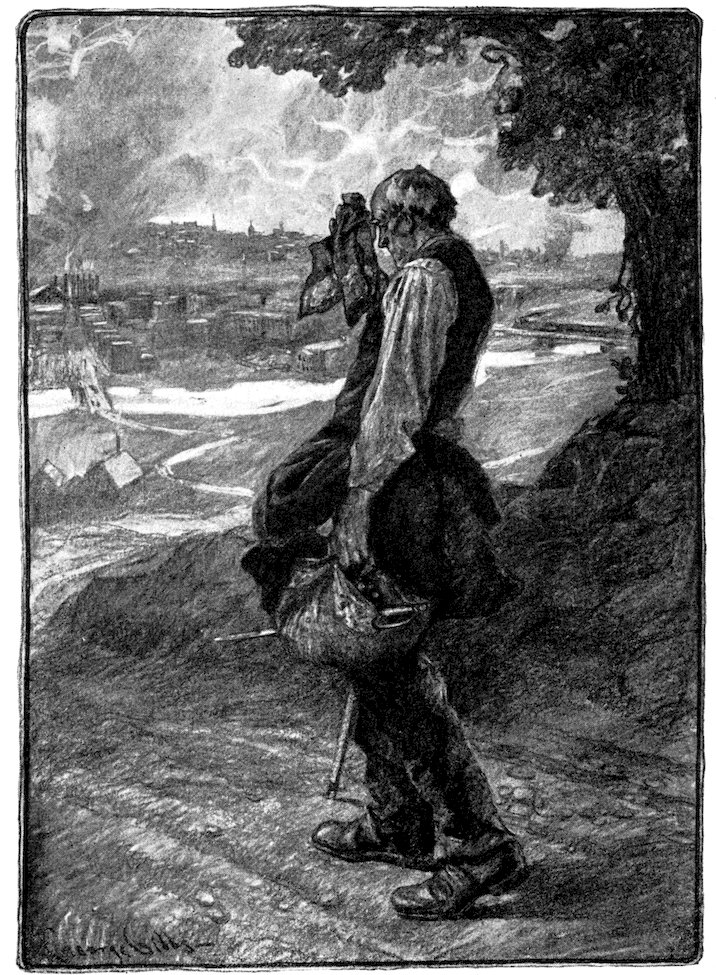
He paused on the hills and looked backward
as Betsy had done. The blinking windows
44seemed to beckon him back. But he bravely
said no to them:
“I ain’t no deserter! I’m coming back—with
her—with her. Don’t you understand?
With her! Bride and groom again.”
The windows seemed to understand, and
stopped beckoning. He waved them a farewell
and went on.
It was a long road—forty dusty miles—and
hilly. Each hill growing higher and
steeper as he approached the city—itself set
upon a hill—where the poor-house was. His
progress was very slow—sometimes not more
than half a mile a day. But he never faltered.
“It’s like climbing Zion’s hill,” said John
to himself. “Oh, when she sees me! I
shan’t care how many hills there were!”
His bundle was made up in a great red
handkerchief, from which his sword protruded,
within which was his best uniform.
Farm-houses were his sleeping places—but
that only. No more than one night for each,
though he might have stayed anywhere as
long as he wished.
“‘It’s like climbing Zion’s hill,’ said John to himself”
45“I’m going to bring her—her, you know,
home. Bride and groom. She said it. I
heard her voice in the night.”
And this was always sufficient reason for
refusing the dear, insidious hospitality pressed
everywhere upon him.
If night came and there was no farm-house
near, he would nestle in the straw of a wayside
stack, under the stars, damp with the
dew, to rise with the sun in his face. He
liked that, and could go on without breakfast.
It was all very beautiful.
His great climax grew upon him mile by
mile, until it was the only thing he had in his
poor old head.
“She will be sitting this way—with her
hands in her lap, like she always sits now,”
he would say to himself, “thinking of me. I
expect she’s thinking of me all the time. I’ll
shave and put on my uniform and my sword,
and suddenly appear before her. Attention!—you
know. Only I’ll not say that—so’s not
to frighten her. Mebby she’ll be reading
her Bible. Then she’ll not see me till I’m
right on top of her. Then I’ll say, soft, so’s
not to frighten her—about this a—way—‘B—E—T—S—Y!’”
46He whispered it lovingly.
“And she’ll just say ‘John!’” This
was a sharp cry of joy.
He never got further than this. It did not
seem necessary. What could be better?
What could be beyond that?
His journey came to an end suddenly—as
it seemed to John. It made him gulp on
something in his throat. One morning the
spires of the city lay close before him as if
they had been conjured out of a dream.
There it was against the pink clouds, within
the morning mists, glowing, like the City of
God as he had fancied it. He stood and
gazed upon it, awed and bewildered. He
had not thought of it as beautiful. To him
it was only the city of the poor-house. Perhaps
Betsy would not wish to leave a place so
beautiful.
He bravely cast out the unworthy thought.
She would leave any place for him. Heaven
itself. With his faith renewed he went up
into the city of the spires.
47
And there he found the first unkindness of
his long journey. No one offered him a place
to sleep or a bite to eat. And there he could
not see the sun when it rose in the morning.
And what had become of the glories of the
city he had seen against the clouds? This
one was not glorious.
On the third day he found the poor-house.
It was a splendid building on the top of a hill.
Before he quite reached it he did as he had
planned. There was a beautiful wood back of
the place. Here, under the trees, he shaved and
put on his uniform. There was a spot of rust
on the sword. He smiled as he thought how
Betsy would have chided him for that. He
found some soft earth and rubbed it off. The
old clothing, and everything else, he put back
into the red handkerchief and hid the bundle
48under the roots of the tree. Then he marched
up to the great and beautiful door—without
his crutch—every inch a soldier once more.
A uniformed official led him in, and at last
he was in the presence of his wife. She was
dead. Her hands were folded within each
other as he himself had often folded them.
There were—on head and breast—the dainty
cap and kerchief which she herself had long
provided against her burial. On her dear face
was the peace that passeth understanding.
Indeed, she smiled up at him as he looked.
Then John’s heart stopped. At Betsy’s
side he died. And so quietly that they who
stood near never heard the sound of his gentle
old voice.
They sleep together—Betsy and John.
Not at Saint Michael’s with their five boys.
Of them nothing was known at the poor-house.
Their graves are in the burying-ground
of the poor. There is a cheap stone
upon which somebody has carved only their
names and this text:
“IN MY FATHER’S HOUSE ARE MANY MANSIONS”
49because Betsy’s Bible, when they took it up,
fell open at that scripture—and her trembling
finger had deeply marked the words as
it followed them day after day to aid her
dimming sight.
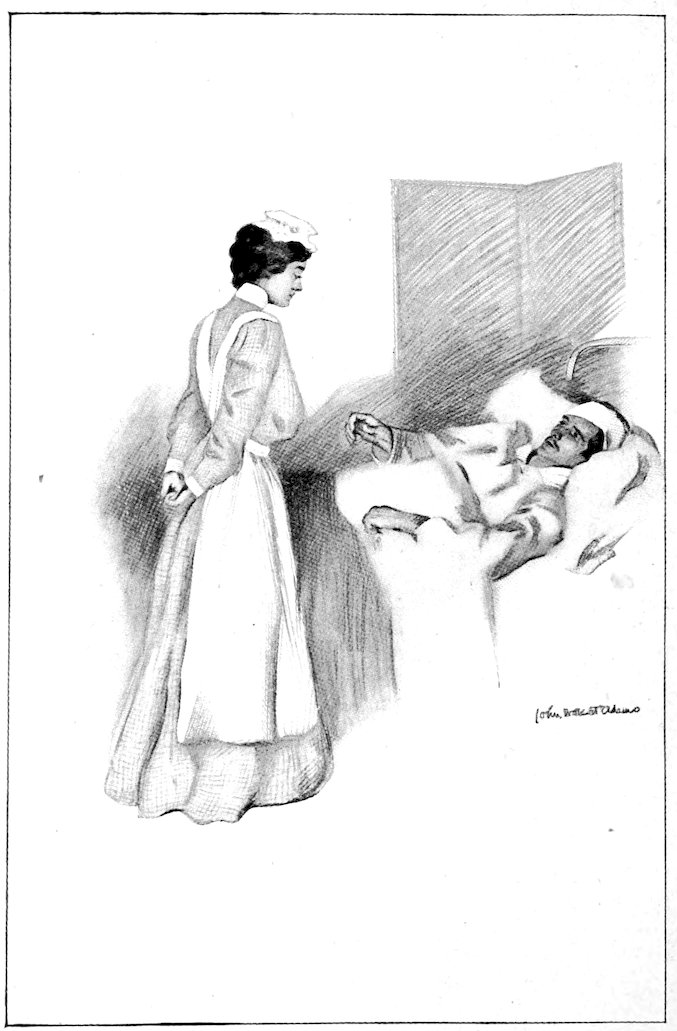
THE SIREN [2] — I BRASSID — II ON THE BOTTOM OF THE SEA — III SHE MAY HAVE HAD BROTHERS — IV BUT SHE WAS BEST OF ALL — V HIS GRANDFATHER’S COURAGE MADE HER WANT TO LOVE HIM — VI HER ANCESTORS WORE SCALES — VII STRANGE THAT LOVE SHOULD MAKE ONE AFRAID
53
They tell yet, on the porches of the Crazy-Quilt
House,—though it is two years,—how
savage Brassid met the laughing Sea-Lady,
and how, at last, he adored her laughter more
the more she laughed at him, and how she
loved his savagery more the more savage he
was to her.
And, then, on to the consequences of that
laughter and that savagery, which you are to
know at the end.
Mrs. Mouthon—the lady who uses snuff—insists
that it was all pretence: that
Brassid was not savage—in his room, and that
Miss Princeps never laughed—in her room.
Mrs. Mouthon’s room was between theirs.
Nevertheless, Miss Carat, who has the one
deaf ear, contends that it is absurd, absolutely
absurd. For, she argues, why should they
54have pretended, in the first place, and why
should they not, if they had liked, in the last
place? But, then, Miss Carat, the other five
first-class boarders whisper, always opposes
anything which proceeds from Mrs. Mouthon.
It seems that Brassid, weary and seeking
seclusion, arrived on the last train of a Wednesday
night. The man who carried his bag up
from the little station told him that the Crazy-Quilt
House was a sanatorium for women with
head-trouble. It appeared that Brassid and
the porter, who was also many other things
at the hotel, would be the only men in the
house—a state of affairs which immediately
created a subtle camaraderie between the two
men, though the porter was colored.
“Call me in time for the first train up
to-morrow morning,” said Brassid, as the
friendly porter dragged himself out of his
room.
“It goes at six o’clock, sir,” warned the
porter, perhaps wishing to detain him a little
longer, for already the porter liked Brassid
amazingly. Did I mention that every one
did this, in spite of his ferocity?
55“No matter,” said Brassid, shivering at the
thought of the unearthly hour—and of the
ladies with head-trouble—Brassid, who composed
poems in bed until ten in the morning!
“All right, sir,” said the porter, as if warning
Brassid that he would regret it.
However, that was why Brassid appeared
at the dinner-table in a dinner-coat—because
he knew that the invalid ladies would be there—and
that thus it would be easier for him.
There were six, and one vacant place—opposite.
The lady on his left put up her
lorgnon in haste. The one at the top of the
table put something like a pepper-box into
her ear and leaned to listen.
“Lovely weather!” said Brassid.
“Rheumatic weather!” said the lady with
the pepper-box.
“It’s no such thing!” said the lady who
took snuff. “It’s asthmatic!”
Something dropped with a small clatter
into Brassid’s plate. The lady on his left
flung her lorgnon to her eyes. Miss Carat
jammed her pepper-box to her ear. Some
one laughed, then checked it.
56An old locket, in the fashion of a heart,
lay in Brassid’s plate. A bit of ribbon gave
evidence of some severed attachment. Brassid
was hopelessly fitting back to its place
a flake of blue enamel.
He tried to discourage the interest in his
keepsake by covering it with his napkin.
Then he looked up. The vacant seat was occupied,
and the lady was trying to smother
her laughter.
Brassid got red and crunched the napkin
in a way which said plainly, “So it was you
who laughed!”
She did it again.
He restored the piece of napery with a
brave nonchalance, and took up the locket.
The lady’s eyes retorted as plainly as her
lips could have done, “Too late!”
He remembered precisely how they did it,—out
of the tops of their firm white lids,—with
a movement which was personal, a fascination
which was irresistible. He was to
read other speeches of these eyes, often
repeated. But he was to read this one only
once more.
57Well, Brassid broke his guard and laughed
with her.
“It is no laughing matter,” said the lady
with the lorgnon, fixing the lady who had
laughed with its stare.
It was a critical moment: the lady who
laughed might have retorted. But nothing
further happened—except to Brassid. He
was falling in love.
“I think it is,” he said in her defence.
And he said it with all Brassid’s savagery.
“Oh, well, it’s your souvenir,” said Mrs.
Mouthon, odiously.
“It is,” said Brassid.
He sprung the little case open and showed
them a savage face much like his own. But
there was a uniform with a high collar.
“My grandfather, the Indian-fighter. I
wear it around my neck.”
And the lady opposite guiltily put her head
down, permitting Brassid to see the loveliest
of blond crowns, and, now and then, the edge
of her smile; again, almost a laugh.
And so Brassid fell in love.
They cross-examined him with the precision
58and directness of barristers. He informed
them that he came from the city,
and who his parents were, and their parents,
and theirs, all of whom seemed to be known
to some of the six. The lady opposite kept
her head down, but the smile came and went,
nearer and nearer to laughter.
“Do you intend making some stay with us,
sir?” inquired the lady with the one deaf
ear.
“It is quite possible,” said Brassid, and the
lady opposite barely restrained her inclination
to look up. “It is such a delightful little
place, and the swimming must be fine.”
Now Miss Princeps did look up. She
seemed a little startled, and, then, did Brassid
detect a bit of pleasure for her in his announcement?
At the same moment all of the six
looked toward Miss Princeps and detected her.
Perhaps they more than detected her.
“Bill” (that was the porter) “said that
you were going up on the morning train.”
Brassid laughed.
“Do you, then, swim?” asked Mrs.
Mouthon.
59“I am a very good swimmer,” declared
Brassid.
Again Miss Princeps looked up, sharply
now, not caring that the six again stared at
her. She inspected Brassid with some care.
She seemed satisfied.
“Miss Princeps swims,” said Miss Carat.
Now the eyes of the lady opposite met the
eyes of Brassid in a frank stare. Brassid
blushed, as we do when we think we have
overstated our accomplishments in the presence
of some one who knows.
“There is nothing the matter with her,”
one of the invalids said, referring to head-troubles,
and Brassid answered with tremendous
conviction:
“No!”
Before the meal was over the lady with the
pepper-box asked Brassid’s first name, and
formally presented him, including the lady
opposite. But it was only as she rose to go
and swept the table with a little smiling bow
that Brassid really saw her superbness.
When she had left the room he found himself
still on his feet staring out of the door
60whence she had vanished. They caught him
in a sigh.
“Sit down!” commanded the lady who
took snuff.
And they kept Brassid there and bullied
him till he wanted to get up and fight the lot
of them man-fashion.
They informed him severally that she was
an actress; that she was a widow with a
deformed child of which she was ashamed;
that she was a deserted wife; that she had
once been married to a very wicked man of
title; that she was “strange”—sat for hours
on the beach alone, sang, swam, walked, did
everything but flock with them.
“God bless her!” said Brassid.
The lady who snuffed arose.
“Lord help you!” she said grimly.
“Eh?” said Brassid.
“What were those women who lured a man
into a cave and made a swine of him?”
Her appeal was to Brassid.
“I suppose you mean the sirens.”
“Yes, that was their name. That woman
is a siren!”
61“And you’re in love with her!” charged
the lady who was deaf, in a thick voice.
“In love!” laughed Brassid. “Ha, ha,
ha!”
“Yes, ha, ha, ha!” mimicked the lady who
snuffed.
“I never saw her till to-day,” said Brassid.
“Neither did that other man see the sirens
until he passed them on his way home.”
This convicted him before the six.
And, in the solitude of his room, it went far
toward convicting him before himself, though
he still laughed his hollow ha, ha, ha!
“Love at first sight! You! Old Brassid!
Ha, ha, ha!”
He was speaking to the gentleman who
faced him in the mirror.
At that moment she passed his door. She
was softly singing:
“They sailed away
In a gallant bark.”
He had seen her but once, yet he knew the
rustle of her silken skirts!
The next morning at ten Brassid was composing
poems in bed, quite as he did at home—about
62her! He hummed and sang the
things he fetched from within in a fashion
which lent color to Mrs. Mouthon’s theory.
Some one knocked on his door.
“Come in!” sang Brassid, happily.
But it was only the colored porter.
He was winking his eyes rapidly, fancying
that in that way he looked penitent while he
did not feel so. The rumor of Brassid’s infatuation
had reached the porter.
“I’m sorry, sir,” said the porter.
“Oh! What for, Bill?” So, suddenly had
their comradeship grown to first names!
“Everybody is sorry now and then. Brace
up!”
The porter stared.
“The six-o’clock train, sir.”
Now Brassid stared.
“I forgot it, sir.”
“Thank you,” said Brassid, and he gave the
porter a dollar for forgetting the six-o’clock
train! He had forgotten it more than the
porter.
63
They met more formally, presently, on the
bottom of the sea. Brassid plunged in the
moment he arrived at the surf, and went out
and under with a long, strong push. He saw
a face on the bottom. It stared uncannily up
at him through the wavering green water.
Brassid followed it and dragged it breathlessly
to the surface. There she laughed at
him.
“I—I—thought you were d-dead!”
gasped Brassid.
“Not at all,” smiled the Sea-Lady.
“Why, how long were you under?”
“Not long.”
“It seemed as if you had been there all
day!”
“My grandfather was a whaler,” said the
Sea-Lady, winking the water out of her eyes
solemnly, as if that explained her.
“My grandfather was an Indian-fighter,”
64cried Brassid, joyously, which was his way of
saying that the one was as intelligible as the
other.
Her laughter broke loose.
“Look at me!” commanded Brassid,
suddenly, with that savagery which he had
from his grandfather. “You are shamming—and
doing it beautifully. You were in
distress down there! And if I hadn’t come
along—”
But by that time she was doing exactly
what Brassid had asked—looking at him
with the most wonderful eyes of blue Brassid
had seen since his mother died. Brassid
funked ingloriously. Think of it!
“The lady with the lorgnon has seen us,
and is coming,” she warned.
“Yes!”
He was frightened, too.
“Let us swim a little.”
“Yes.”
They plunged in.
“Be careful,” said Brassid.
“My grandfather was a whaler,” she
laughed back as she raced away to sea.
65“Oh, you can swim!” he exclaimed joyously.
“Can you?” she laughed.
“A little,” he answered—more carefully
now.
“Come!”
After that she admitted Brassid to a precarious
intimacy, based upon swimming. In
the sea she was everything Brassid could wish.
On the land she was not.
“She’s like a fish out of water,” jested the
lady who took snuff.
“Do not be discouraged,” shouted she of the
pepper-box. “I do not think she knows yet
that you’re courting her.”
All the ladies cackled.
“Who said I was courting her?” demanded
Brassid, with ferocity.
The ladies laughed again. And when Miss
Princeps came down they surrounded her and
told her Brassid’s delightful joke.
“I’ve warned him,” said one, “that you’re
a siren—one of those ladies who—”
Well, it was his first comradeship, and it
66happened to be an extraordinarily perfect one.
It was so very blessed that, to use the words
of Mrs. Paradigm (she was the lady with the
lorgnon), he went crazy over it. And perhaps
if you had known Brassid’s Sea-Lady, you
would not have wondered—you might have
commended him for going crazy. You remember
that she had the eyes of Brassid’s blessed
mother.
“I never hoped to see them on earth again,”
he said to the face in the mirror.
Oh, she was rich and splendid and fragrant
and melodious—I am using Brassid’s book of
adjectives—and altogether more lovely in
every detail of herself than any one else on
earth! And he had constantly the ecstatic
feeling that he had discovered her, really; but
he never did. For the Sea-Lady was unlike
any one he had ever known. He literally
knew that she was wonderful in every way
that a lover could wish a sweetheart to be
wonderful, yet there was not a single admission
to go upon. Whenever she caught herself
showing Brassid her heart,—and she
would have been fond of showing this to
67Brassid if he had been a woman, perhaps,—she
went to cover—and asked him to swim!
And I am glad to think that that is the only
reason he never saw her heart—never really
discovered her.
Until that last day—that second time the
eyes said, “Too late!”
And of that I am now to tell you.
68
“By Jove!” said Brassid, that day, as he
watched her conquest of the choppy waves,
“you are something nautical! I do believe
that your ancestors wore scales!”
“Oh, Brassid! Thank you! Think of
having such a crest as that! Eight carp
gules! And the nearest I can come to it is
the whaler! Brassid, in the sea I almost
love you! And when you really begin to
‘court’ me and feel that you must propose, do
it in the water, to the diapason of the waves,
in the sight and hearing of my scaly relatives!”
“Hanged if I do!” said Brassid. “You
have got to hear that; but it will be in your
own house.”
“In evening dress?”
“Very likely.”
“On your knees?”
69“On my knees.”
“Horrid, Brassid!”
“It is your fate.”
“But why, Brassid? Why must it be?
Isn’t this lovely enough?” Miss Princeps
mourned.
“Because I love you,” said he, stoutly.
“But, Brassid dear, that’s no reason.”
“It is. Every man who loves a woman
must propose to her—if for no other reason
than to be rejected. Then and then only he
will see his finish. And I won’t see mine even
then. And, to show you that you like me
very much, at least, let me remind you that
you quite unconsciously called me ‘dear’ just
now.”
“Brassid, my grandfather was a whaler.”
“Well, what on earth has that to do with
it?”
“I don’t know.”
“You love me—that’s what it means.”
“Oh!”
“Yes!”
“I may have brothers—whom I call dear—and—so—get
used to it—”
70“Have you?” demanded Brassid, with the
ferocity that came and went so quickly.
“No, sir,” she answered obediently.
“Oh, you are the most delicious being on
earth!” laughed he. “And I won’t wait till
we get to town!”
But Brassid had forgotten to tread, and got
a generous mouthful of salt water.
“Brassid,” wailed the lady, “I’m sorry for
you; but you are punished for taking advantage
of me at a time and in an element when
I almost love you.”
“Don’t you dare to pity me! I’m not done
with you!” spluttered Brassid. “This is my
chance—you said it—in—the—sea.”
“In fun! Only in fun!” she cried. “Can’t
you see a joke?”
Before he got his chance she said:
“Brassid, we are far enough. You are
tired. Let us go back.”
“I won’t!”
“Why?”
“You are mine out here. I am going to
keep you—out here.”
“Would you come and live with me in the
71Dragon King’s palace beneath the sea, where
it is always wet?”
“Yes. Whither thou goest I will go.”
“Brassid, I am going home. You will not
be restrained.”
“And I’ll follow you. The only way to get
rid of me is to marry me.”
“Then I will never, never marry you, Brassid,”
said the Sea-Lady, leaving him that riddle,
which he never solved. For it was the
last day, and presently it would be the second
time that her eyes of blue had said, “Too
late!”
72
She pulled him out of the water, and they
bathed in the sun. Not a ship sailed the
sea.
His voice spoke first, as if he dreamed—a
fragment—“But you are best of all!”
She looked up and found his eyes upon her.
With her own she questioned him.
“Nothing is in sight, nothing can be heard,
but what God has made. This!” He waved
his hand at the immaculate sky. “That!”
The limitless sea. “The earth!” He pointed
where it stretched away from them to the
vanishing-point. “You!”
“No—you!” she laughed.
“And it is all good. God alone knows
how good. But,” he repeated, while his gaze
was fixed upon her upturned face, “you are
best of all!”
She kept her eyes upon him in wonder; for
73if he had not solved the Sea-Lady, she had not
solved him. And this was very strange from
savage Brassid.
“Yes; God made nothing so perfect as a
perfect woman—you!”
“You think me perfect?”
“Yes.”
“Oh, Brassid!”
But something clanged in her brain.
“I love you!”
“Don’t, Brassid!” she begged. “You have
touched to-day what you have never touched
before, what no one has—don’t!”
It was a mighty occasion; but she would
not have it. She fought it with her best
weapon—levity. She laughed. She made
him laugh, and it was done.
“Oh, Brassid,” she sighed, “forgive me!
But it is too lovely. And afterward we could
not swim together any more.”
“Why not?”
“Why, Brassid! Who ever heard of a rejected
lover taking the same walks with his
late beloved under the same trees by the light
of the same moon?”
74“Walks?” questioned Brassid, dully.
“Our swims are the same as walks to other
lo—”
“Aha!” cried Brassid, “you almost said
‘lovers’!”
“Did I? How stupid of me!”
“Do you mean to say that you absolutely
and positively refuse me?” shouted he,
belligerently.
“Certainly not, my dear Brassid,” she
hurried forth. “I can’t refuse what you
haven’t offered. And, dear Brassid,” she went
on caressingly, “I know that you won’t offer—because—because—”
“Out with it!” cried Brassid, still in his
ferocity.
“Because I like you so—to swim with!”
“And when there is no swimming?”
“No Brassid—”
“I tell you there will be!” he threatened.
“Well, I’m glad to hear it; for I shouldn’t
like this world so well without its Brassid—since
I know him. But, Brassid dear,—there!
the whaler again!—why must you
marry me?”
75“Because it’s every woman’s business to be
married.”
“But not every man’s, then? So that I
might marry some one else, and not bother
you with—”
“That is just the trouble!” cried the savage
in him again. “You will marry some one else
if I let you get away from me.”
“As if I were game!”
“You are. The noblest game on earth.”
“Brassid!”
“Yes. You couldn’t go long uncaptured.
How have you escaped? All the men you
knew must have been blind, deaf, dumb.”
“Ah, well,” Miss Princeps sighed, “if one
must be married some time or other, thank
God that there are Brassids! But who ever
heard of two married people swimming together!”
“We will,” still threatened Brassid.
“We?”
“Yes, we.”
“It doesn’t sound badly, Brassid.”
“Now that’s better. For you know that,
though I’m a poor enough sort, no one has
76ever adored you as I do, and that you—yes,
you—were never such a comrade with any
one else.”
“Why, Brassid!”
“Isn’t it so? Answer me!”
“Yes, sir,” she said.
They laughed together.
“Please don’t be cross, Brassid dear, just
because I can’t marry you! I’ll keep on calling
you ‘dear’ if you won’t.”
77
In the sea again, whither she dragged him
after that, far from land, as they looked back
at the people on the beach:
“Before you came,” laughed the girl, “I
had all the fun to myself. They would follow
me with their glasses, expecting me to throw
up my arms and call for help. The hotel man
actually bought a rope with straps and buckles
and things on the end to save me. They used
to bring it down every time I went in. Now
Bill uses it to pull the trunks up. And no
one ever minds us. See, not a soul is looking
this way! Brassid, it was lovely of you to
come. You are”—she laughed, and by a deft
stroke came so close as to touch him—“both
my chaperon and palladium. Of course I suppose
if we should ever get into trouble I would
have to save you. My grandfather was a
whaler. But back there they have the most
78beautiful confidence in you, just because you
are a man. I am not pleased with you in
that, Brassid. It is false pretence. I shall
let you save yourself—remember.”
“I wouldn’t allow you to save me.”
“What! You ungrateful—Brassid! I can
swim twice as far as you can. But I’m glad
to hear that.”
“When I was taught to swim, my teacher
dinned into my ears that I was never to forget
when I went out that I had to come back.
See?”
For reply she raced away from him.
“My grandfather was a whaler. I wasn’t
taught to go back.”
He followed as lustily until he had caught
her. They laughed splendidly.
“My grandfather,” he laughed, “the Virginia
ranger, you remember, was too proud to
call for help when he fought his last fight
within a hundred yards of the pickets of his
own regiment.”
“Brassid, I love that!” she cried breathlessly,
going to his side. “What happened to
him?”
79“He was killed. But when they found
him he had five dead Indians to his credit,
while his hands were clutched upon the throat
of another.”
“That’s why you adore him, isn’t it?
Otherwise you would probably never have
heard of him. That is what makes us live in
the memories of those who love us—just
that one little thing, courage!”
“No. There is another and greater thing,”
said Brassid.
She looked up in her questioning way.
He smiled affectionately.
“Love,” said Brassid.
She shook her head:
“Courage.”
“Love,” he insisted.
“Let us put them both together,” she said,
“courage and love.”
“Love and courage,” he acquiesced.
“You for love, I for courage.”
Brassid watched her glowing young face
and her strong young arms, as they struck
out, in a new wonder. He had not yet solved
the lovely Sea-Lady.
80She went on with dilated nostrils:
“Say, Brassid, that makes me want to love
you. An ancestor like that! Oh, it beats the
whaler! That’s why I speak so often of him.
It needed courage to be a whaler. Brassid,
you never were so near winning me—isn’t
that what you men call it?—as right now.
Go on, Brassid, about your Indian-fighter!”
“My grandfather probably would have won
you,” sighed Brassid.
“No; you. You are like him. I knew it
from the first. Why didn’t you tell me that
at first? You would do as he did—if there
were Indians.”
“And what would you do?”
“As your grandfather did, Brassid—if
there were Indians.”
He retreated a little from her.
“Maybe I do love love a little, Brassid
dear; but I adore the courage that dies without
weakening—rather than weaken. I can’t
help it. It was born in me. I wouldn’t do
it. And if your grandfather had called for
help, I should have hated him—and you,”
she laughed.
81And, after a silence, she said again, as if
that was what she had been thinking about:
“Brassid, I love courage more than love.”
And again:
“Brassid, your name is Courage.”
82
“For immediate evidence of my pusillanimity,”
laughed Brassid, “let us return. We
have never been half so far as this. And
while you are a mermaiden, I am only a
walrus.”
“Must we go back?”
“No,” laughed Brassid.
“Then let us go on and on and on forever!
Brassid, I am mad to-day. That about the
Indian-fighter did it. And if you knew how
close—close—you are—why—come! Out
there where it sparkles! It fascinates—calls
to me. Oh, dear Brassid, perhaps my ancestors
did wear scales! Come! Out there ask
for—anything!”
She gave him, there in the water, his first
caress—only a touch, after all.
Brassid’s tongue was loosed. He talked on
almost in strophes.
83And she answered presently:
“Brassid dear, that sounds like the big love.
I wouldn’t have any other—if I had to have
it at all. I wish I did love you. Oh, not so
much for your sake as mine! I begin to feel,
to see, to hear, what it is. Brassid, some day
I shall demand it.”
“And you shall have it.”
“But not—now—Brassid dear! Not—to-day!
Please!”
“Look here,” said he, in his ferocity, “you
do love me—and you are going to marry
me!”
“No, no, no! Brassid, really, I don’t love
you. Not a bit—yet. It is courage—courage.
But out here—to-day—Brassid,
I like you—courage or no courage, I’ll confess
that much—I like you a lot.” Then,
presently, “Brassid, do you really think I
love you?”
He nodded.
“Why don’t you speak? It is very impolite
to nod a reply to such an important—question.
I can’t—marry—you—away—out—here.”
84They faced each other, and knew that they
were out of breath.
“Out there is a bar. I have been watching
it. We can rest there.”
But Brassid did not touch her to help.
Presently they reached it. Neither could
have gone twenty yards further. Brassid
turned and looked shoreward. Something
suddenly gripped his heart. The Crazy-Quilt
House was a distant blur against the horizon.
There were people on the beach, but
they were as ants. He kept her face seaward.
A ship, hull down, was sailing from
them.
“And presently, when we are quite rested,
we shall go home.”
“I suppose so,” she said petulantly. “But,
oh, it has been so lovely to-day!”
“But I am hungry.”
“Yes. Come.”
Once more he kept her eyes seaward by
pointing out that the ship was coming
about.
“Brassid,” she laughed, “to-morrow we
shall go out to that ship!”
85“Yes,” he smiled.
She had come very close to him. She
was dancing on her toes upon the bar.
The tide was running in rapidly. The sun
was overhead in all its September glory.
She held by his arms and danced. Her hair
was confined under a pale-green scarf, save
where it escaped. Below in the green water
he could see her loveliness foreshortened.
“Brassid, you are staring at me. Do you
see the scales?
“Why are you so quiet—now?
“Brassid, I can touch bottom no longer.
See! I must be in your arms! That is
my only excuse—I am tired. Aha!”
She laughed gloriously.
“Brassid—dear—good—luck—to—you!”
she whispered.
He kissed her.
“Brassid, what does that mean?”
“That you are engaged to me—”
“Brassid, I don’t mind being engaged—that
much—out here—”
He kissed her again.
“Yes,” she said. “But remember that I
86do not love you, and that I shall never
marry you. It will be quite different when
we land. I heard the snuff lady say that
we must be engaged, or it would be very
improper to be so much alone—out—here.
So now you may tell her that—we—are
engaged—that everything is proper—and
you needn’t say that it is only a little.”
She stopped to laugh again.
“Oh, Brassid, it is glorious! And you
are lovely. And I have everything I want
now—since we are engaged a little. And
if I ever marry any one it will be some one
just like you, who can swim, and has the
big love—and courage. But I won’t love
you, Brassid, I won’t. You should not
expect that.”
“No,” laughed happy Brassid.
“Kiss me!” she commanded. “And
laugh!”
Brassid did both.
87
The fierce inrush of a wave swept him
from his feet. She spun around with a
little cry. Then she saw what Brassid had
seen and had kept from her. Fear touched
the heart which had never feared before.
“Brassid,” she whispered, “I did not know
that we had come so far!”
Brassid tried to laugh.
“The tide will help us.”
“Brassid, you kept me here—you kept
me from looking—so that I might rest—and
be—strong?”
“I kept you here,” said Brassid, “to make
you mine.”
“Brassid,” she whispered, “why did you
do so splendid a thing? Dreadful, too! I am
afraid to drown now. I wasn’t before.”
“Why are you afraid now?”
88“Because then I should never see you
again. That is what made the little fear
you saw. It all came in a flash. I know.
But I am not—afraid—not now.”
“Not now! My love!”
But he saw that panic had followed fear,
that every nerve had slackened, that every
muscle was unstrung. She swam, panting
now,—he had never seen her do that,—and
for a while conquered fear. She kept
at his side. Now and then she touched
him, and always she watched him piteously.
“Brassid—you are stronger—than I
thought—stronger than I—as a man ought
to be. I am—glad.”
“Yes,” gasped Brassid, “I am strong—and
you are brave—”
“Brassid, I don’t mind being saved by
you.”
“I should think not.”
“We will not forget the—Indian-fighter—Brassid.”
“Nor the whaler.”
“Yes; I want to live—to be—your—wife—Brassid.”
89“My wife!”
Then was silence; nothing but the beating
of their breath.
“Brassid—dear—if we do not—get home—stay
with me! I do not want—to—stay
out here—alone! Oh! Alone! Brassid—will
you—stay with me—no—matter—no
matter—”
“No matter—what!”
Perhaps it was wrong to say that. But his
love was what he had called it—the big love.
She gave up.
“Then—beloved—if you—will stay—with—me—”
She could even smile at him.
“The Indian-fighter—the whaler!” pleaded
Brassid.
“Yes.”
She responded, and again and again responded.
But he saw her first stroke fail.
Each of his own cost what seemed a life.
“I am too—tired—Brassid.”
“Courage!” gasped Brassid.
“Yes; once more. To be your wife!”
They swam silently.
90“Brassid—I am thinking—of all the dear
things you—said. I didn’t notice some of
them then. But now—as the drowning do—they
are all—very—sweet.”
“You are not drowning,” said Brassid, with
his last ferocity.
“It is so strange—that love—should make—one—afraid!
I never was—afraid—until
I loved you—Brassid—Brassid! Until
I—loved—you!”
Brassid put his arm under her to float her.
As he did so she sank away from him.
“Can’t—Brassid—dear,” she whispered.
“I—am—too—tired—too—tired—”
He saw the dear face with the green water
between them. The sun made it glorious—piteous.
“Too late!” said the eyes, as they had said
it that first night—he could read it now as
plainly as then. And another smile, as then.
Her eyes kept upon him. She was quite still.
Her arms opened to him. They closed about
him, and once more Brassid followed the lovely
Sea-Lady to the bottom.
THE LOADED GUN [3] — I THREE GENTLEMEN OF PHILADELPHIA — II AN OUNCE OF WHISKEY OR AN OUNCE OF BRAINS — III CALLING A MAN A PIG — IV HE DID NOT KNOW THAT IT WAS LOADED — V A FOOL AND HIS MONEY — VI THE OLD MAN’S LAST CENT — VII HER BIG TRUMP
93
At three o’clock in the morning, Gast,
McGill, and Ravant were going down Twentieth
street, in the vicinity of Walnut street.
They were locked together in the fashion of
a Roman phalanx. And even then their going
was unsteady. With the memory of his
classical studies somewhat revived, Ravant
repeated Cæsar’s commendation of the Roman
formation.
A little later, and a little further down the
street, where lived many of the city’s elect,
they were protesting in over-vociferous melody
that they would not go home till morning.
“Make it midday, for the sake of ver-sim-ili-tude,”
begged Gast, breathless with the
word, “for it is morning now. Behold!”
And thereupon he also remembered the invocations
94to the rising sun, in which the
ancients abound, and produced one—according
to his memory:
“Aurora leaped upon the nether hills
And flung a kiss to Bacchus—’twas a day!”
The officer on the corner of the square came
and looked on amicably.
His applause made McGill realize that the
voices of his comrades, unlike his own, had
never excelled in melody. He, therefore, attached
himself to a lamp-post, and, in the
fashion of a precentor, proposed to instruct
them in the difficulties of “Annie Laurie.”
But, in attaching himself to the lamp-post,
he had detached himself from the critical
right of the phalanx, which now floundered
dismally and then incontinently disintegrated.
The officer of the peace secured Ravant and
Gast and anchored them to McGill—and
“Annie Laurie” went terribly on.
It would have been hard enough to endure if
it had not been mixed with liquors. But since
it was so mixed it was not wonderful that
anathema was belched at them from the windows
95of that halcyon neighborhood, and that
they were then slammed violently shut.
But they were hardly prepared for a gun-shot
in their direction.
“Mac, that man’s a pil-os-per,” argued Gast.
“For, lo! these many years the sover-eign
people have sought a cure for the drink evil.
Well, he has found it. Shoot ’em. Eh,
Ravey?”
Ravant said nothing. And now they
awoke to the understanding that he had
grown heavy between them.
A cab passed. The driver, an experienced
nighthawker, drew up to them.
“Right this time,” said Gast. “This jag is
going home imperially in a cab. It’ll be about
all I’ll be able to do to walk my own to my
happy home.”
The officer assisted in getting Ravant into
the cab.
But suddenly his manner changed to savagery.
They were under the direct light of
the corner electric.
96“Which of you did this?” he demanded.
Blood slowly trickled from a wound in
Ravant’s head.
Gast had a drunken inspiration.
“That gun!” he whispered.
The officer caught upon this.
“Where was it fired from?”
This none of them in the least knew.
The officer took McGill and Gast to the
station-house, where they were ignominiously
searched. Ravant went to the hospital in a
cab.
Presently, in a lucid interval, Ravant signed
an affidavit setting forth that it was neither
McGill nor Gast who had fired the shot.
Upon this his two companions were released
“under surveillance.”
And this was so odious to Gast that he
swore to find out who it was had fired the
shot.
97
The moment Ravant awoke to sanity at the
hospital he demanded a drink of whiskey.
“The doctor has forbidden it,” said the
nurse.
“Why?” shouted Ravant.
“Your head. He thinks it would take you
much longer to get well—perhaps prevent
your recovery altogether.”
“Call him!” Still in Ravant’s terrible
voice. “I guess it’s my own head. And if
I’d rather have an ounce of whiskey—more
or less—than an ounce of brains—more or
less—it’s my business and none of his.”
The little, frightened nurse did what he
asked, and Ravant said to the doctor very
much what he had said to the nurse. And
the doctor answered him precisely what the
nurse had answered.
98“But,” he laughed in addition, “your head
is certainly your own, and you are certainly
sane enough to decide what you want done
with it, though it is rather contrary to Dunglison’s
ethics to let you. It doesn’t matter
greatly either way, though. How much are
you in the habit of taking?”
“All I can buy,” snarled Ravant.
The doctor laughed again and wrote a prescription
for an ounce of whiskey.
“You don’t care whether I live or die, do
you?” asked Ravant, odiously.
“Oh, quite as much as you do!” answered
the doctor, with a certain jolly contempt for
such a man. Then, to the nurse:
“I don’t think it will be necessary for me
to see your patient again. Take care that he
gets all he needs. My original instructions
will do till he is discharged.”
“You don’t care either,” challenged Ravant,
when the doctor had gone.
“Yes—I care—very much,” said the
brave little nurse.
Ravant stared, then said:
“Well—hurry that whiskey here!”
99And, presently, she brought it. Ravant
saw only the hand which offered it to his
famished soul. It trembled. As he took the
glass he followed the arm up to the nurse’s
face. That was very pale. When she was
certain that he would drink it, she gasped
and then choked down a bit of a sob.
“Now, what’s the matter with you?” cried
Ravant, with brutal irritation.
“Noth—nothing,” faltered the nurse.
“You lie,” said Ravant. “I told you that
it is my own head. Why don’t you want me
to drink it?”
“Drink it!” begged the nurse, now in
terror of him. “Please do!”
“I won’t! You’re both too dam’ anxious!”
He flung the frail glass against the wall,
where it was broken. Then he turned his
back upon the nurse, and, gripping the iron
rods of his bed, bent them until they doubled
and parted. He slept a little presently—breathing
like a wounded beast. When he
woke the little nurse was wiping up the
spilled liquor. The terrible fragrance infested
his very soul.
100“Open the window!” Ravant shouted.
“You are torturing me!”
The girl did this.
“Why did you make me smell the dam’
stuff?”
Then, a little more gently, before she could
answer:
“Thank you. I can’t stand the smell of it—not
the smell.”
The nurse laid a brave hand on his.
“I guess you’re the right sort,” he said
hoarsely. “Put it there!”
He gripped the hand of the nurse as he
would have done that of a man.
Afterward Ravant watched the girl as she
“went about doing good” for him—as he
gibed it. She tried to keep out of his vision.
“What in the devil are you about?” he
commanded. “I want to look at you! It
does me good—to look at you!”
She came, with a pink face, where he could
see her.
“If it does you good—why, look at me!”
She tried to do it lightly—pose there—but
her bosom heaved. Ravant saw this.
“‘I guess you’re the right sort,’ he said hoarsely. ‘Put it there!’”
101“Yes, I’ve stopped guessing. You are the
right sort—inside. And you’re not half as
ugly outside as I thought you at first. Or
else you’ve grown prettier. I think it’s that.
I suppose they make it a point to hire only
ugly girls for nurses. Else the patients would
marry ’em as fast as they could gather ’em
in, and there would never be any nurses.
But you’ve fooled ’em! Look in the
glass!”
It was useless to resist what had now
become affectionate brutality, and she did
this. It was true that there was a glow in
her hollow cheeks.
“Thank you!”
“By the Lord, you nearly laughed!” said
Ravant, with entire seriousness. “Say—I’m
going to like you. And I want you to try to
like me. If I ever ask for whiskey again,
don’t you give it to me, no matter if I curse
you up hill and down dale. And I’ll try not
to ask for it.”
The nurse stopped something which would
have been a sob at maturity.
“But for God’s sake, don’t cry,” Ravant
102went on. “I hate women who cry. And
I’m not hating you—I see that already.”
“I will not cry!” pledged the nurse.
“I believe you,” said Ravant. “Put it
there. I won’t drink!”
And for the second time they shook hands.
103
“And yet,” mused Ravant, “I make you
cry!”
There was an unwonted softness in his voice.
“I’m sorry I’m such a brute—I am a
good deal of a brute—ain’t I?”
When she did not answer he shouted at
her suddenly:
“Ain’t I?”
“Yes,” said the frightened nurse.
“And I’m a pig, too. That’s what the
doctor called me the other day when he left,
didn’t he?”
“Yes.”
“I heard him. And he’s right, too—though
not so bully as you, at saying it.”
“The doctor is mistaken,” braved the girl.
“I wouldn’t say it.”
Ravant gasped and sat up in bed.
“What?”
104The girl repeated, without fear, what she
had said.
And nothing had ever cowed Ravant as that
did. It made him stop and think. It seemed
as if he had never thought before—so primitive
were his processes.
“I’ll just live up to that girl’s estimate of
me—and fool her. I really thought I was a
pig. Heavens!” He laughed with himself
as if he were some one else. “It didn’t even
offend me! But I’m glad I’m not a pig—to
her—and I’ll stop being a brute. Especially
to women. What was it mother used to say?”
Finally he remembered it:
“Always be gentle to all women. For some
of them are mothers, and all of them are
daughters of mothers.”
He said to himself that he had better write
that out in a plain hand and paste it in his
hat. Then he said he would go the hat one
better—he would write it out and paste it in
his head.
And I think he did this in some fashion.
For he often remembered it. And at this time
it was hard for him to remember things.
105“Please!” she begged of him one day with
her hands out to his, meaning that he should
intermit his ceaseless watching of her. “I
feel like the insect under the microscope.”
She ended with that brief, halfway laugh.
“I won’t,” said Ravant. “It helps me.
And that is what you are paid for doing.”
“Yes,” said the girl, at once relapsing into
her shell. “That is what I am paid for!”
“The only thing you need to be a real
beauty is a smile. Can’t you get further than
halfway? Try it. You won’t break anything.
Smile for the drunken pig one of those smiles
that won’t come off.”
“Have you ever smiled?” retorted the girl.
“I grin all day,” answered Ravant.
“Yes—you grin.”
Ravant caught the subtlety and was both
amazed at his nurse and shocked at himself.
He remembered that it was very long since his
face had known the smile of gentleness.
“Let’s learn the art together,” he laughed.
“By the Lord, you are good for me!”
“Then I must admit that you are also good
for me.”
106“Smile!” commanded Ravant.
“I cannot,” laughed the girl.
Ravant laughed, and knew how splendid
and strange this was to him.
“If you would do that more often, it would
be good for you,” said Ravant again.
“And you would be—good!”
“Yes—” agreed the invalid, “if you would
smile so for me—”
“Oh, I meant your own smile!” cried the
blushing nurse.
Ravant looked upon this blush until it had
much the effect that looking upon the wine
when it is red used to have upon him.
“Here!” he cried.
The girl came toward him. He caught her
face between his hands and rounded it there.
“I have taken all the lines away. You
have no business to have them.”
“My life—” said the girl, simply. “Those
lines are its history. They belong there.”
“Then can you read my history in mine?”
asked the man.
“Yes.”
“Do they say that I am a brute?”
107“Yes.”
“Plainly?”
“Quite plainly.”
“My God! Why did not some one tell
me that secret before? We go about thinking
our faces conceal the very things they shout
aloud!”
He looked again at her face.
“Yes, yours speaks of sorrow—”
A silence then—
“What was it?”
“Others said what you have just said.
That I was ugly. A woman has nothing—is
nothing—without beauty. That is her one
source of power.”
Ravant laughed incredulously.
“Women like me,” added the nurse.
108
One day the nurse told him—as he insisted—the
mystery of his opulent situation.
The person who had fired the shot had
learned the effect of it from the newspapers,
and being rich and sorry, had put his fortune
at the disposal of the victim, and none of it
was to be spared if it might help in the least
to make him perfectly well again. Every cent
of the very many the person had was at his disposal.
And that his disposal of it might be the
more free from embarrassment, he preferred to
remain anonymous himself, and to make the
hospital, or the nurse herself, if the victim
preferred that, his almoner.
“Preferred to remain anonymous!” laughed
Ravant. “He preferred to keep out of jail.
I’d have him there in no time if I knew who
he was!”
“It appears,” said the nurse, “that he did
not know his pistol was loaded.”
109Ravant exploded again—first with mirth,
then with vengeance.
“The infernal old sneak and liar! To
shoot a man simply because he happened to
be drunk! Thank God a jag is not capital
yet! It is no excuse to say that he didn’t
know it was loaded. When he took up that
pistol, it was with intent to kill. And, if I
still remember any law, that is enough to
hang him—”
“But they don’t hang people,” gasped the
little nurse, “for anything but murder, do
they?”
“I was going to say if he had killed me.”
“Oh!”
“Anyhow, we’ll make it the dearest lesson
to the gentlemen who do not know it is
loaded that ever was taught! We will spend
that last cent of his. If not, we’ll throw it
away! We are going to Europe at his
expense. I need that to complete my recovery.
And even then I will always wear
this plate on my head in memory of him!
And we’ll let the newspapers have it. It
may prevent some other drunkard from such
110happiness as I am now enjoying, and teach
the idiot with an empty gun to respect it as
if it were loaded. I’ll be a missionary to
my drunken kind all the world over! What
do you say? By the way, what is your
name?”
“Brown,” said the nurse.
“Whew!” said the invalid. “We can’t
change that—can we?”
“No.”
“Marriage would do it.”
“Yes.”
“Ravant is better than Brown, eh?”
But then he laughed—he had frightened
her!
“What’s your first name?”
“Rachel.”
“Heavens! But we might call you Ray.
Ray Brown is not impossible. Did you notice
that when I spoke of going to Europe and
spending the old man’s money, I said we?”
“Yes,” said the girl.
“And it didn’t appeal to you?—make
your little heart flutter—Ray?”
“No.”
111“But you would help to try to ruin the old
man?”
“I think it just for you to punish him in
that way—but I am only a nurse.”
“Well—you are going with me—and
that is the end of it. I need you and shall
need you for a long time. In fact, I shall
need you always. But, since you won’t marry
me, as a nurse you will go!”
“Impossible! Mr. Ravant!” gasped the
girl.
“Which?” snarled Ravant, in the old manner.
“Going to Europe with you—as your
nurse—alone—”
“Well, then, we’ll take a chaperon. The
old man must pay for her too.”
The girl was silent.
“Look here. I noticed that you didn’t say
that the other thing was—impossible! Marrying
me?”
“Yes—that is impossible, too,” said the
girl.
“Oh!”
“What?”
112For his tone was sinister.
“I’ll become a sot again.”
“The doctor says that with that wound in
your head it will kill you!”
Ravant laughed—the brutal laugh once
more.
“Well, let it. You can’t open the gate of
paradise and let me get one glimpse and then
shut it in my face. I’ll go back to my own
little paradise.”
He was laughing. But she caught the note
of hopelessness under it.
“Do you mean to say that if I marry
you—”
“I will be good.”
“Understand that I do not love you! Not
at all!”
“No one does. Marry me anyhow. Marry
me to get rid of me. If you fall in love with
some one else, it is off.”
The girl sobbed. She was on her knees at
his bed. He did not like this.
“Never mind—never mind—child. I
only thought we could make it less expensive
to the old man in that way. I could then
113stop your wages, and we would not need a
chaperon. And I really fancied that this
thing inside of me which yearns for you—can’t
wait till the night is over and you and
morning come—is love. But I don’t know
what the thing is—I never had the symptoms
before—speak to the doctor about it—tell
him I have ceased to be a pig. But, perhaps
you know. Do you? Were you ever in
love?”
“No, sir,” answered the nurse.
“Stop crying!” thundered Ravant.
“Yes, sir,” said the little nurse.
114
“Well, thank God,” Ravant said, later on,
“that you didn’t refuse me because you didn’t
know me. I can’t fancy a better way of
finding a man out than being his nurse. But
I may not always be a brute. So, remember
that I want to marry you, and, when you
don’t think me too much of a brute think
sometimes about marrying me—you may get
used to it!”
“Yes, sir,” said the nurse.
“How much money have I?”
“About four dollars, sir.”
“I don’t blame you now. I thought there
was at least ten in my clothes. Four dollars
is mighty little to begin housekeeping upon.
Keep it for me, will you, until the last cent
of the gentleman who did not know it was
loaded is gone.”
Later:
“You might as well come and help to spend
the old man’s money. We will travel in
115private cars. Two maids for you, two valets
for me. Our pictures in the newspapers. A
retinue to smile welcome to us at each city.
Another to weep as we depart. We shall
leave a trail of American gold in our wake
across Europe!”
He had caught her interest. Only he
thought it was something which she said it
was not.
“Look here. You do like me a little. I
have seen you watch me while I pretended
to sleep. And I’ll try to learn what love is
and to make you love me. I think I can.”
The girl looked down.
“Look here, I was a gentleman and a
lawyer before I was a drunkard, and I can be
again, if any one cares to have me be. Please
marry me!”
“I don’t love you,” said the girl again, with
her head still down.
“I know. But I love you—I’m sure now
that that is what it is. You see, it’s one of
two things for me—you or rum. That’s why
I’m working at it overtime. You won’t regret
it—hanged if you do.”
116
Well, she did marry him, and she did not
regret it—nor did he.
To me it is a wonder that she did not. For
he had done the threatened newspapering so
well that already upon their arrival at the
steamer all the passengers were lined up to
await them. And the smile they got there
followed them to Europe, and into the most
remote corners of the globe where they penetrated
to escape it. It became at last a smile
of contempt. And he began to understand
that it was for him alone and that the world
had exempted his wife from it.
“I’m glad for that,” he told her. “If I am
to go about the world a cad and a fool, to be
laughed at—I am glad that you are—”
“To be pitied as your victim?” laughed
his happy wife. “No. I don’t want anything
that is not yours, and you shall have
nothing that is not mine.”
117If they escaped it for a day, they never did
for two. Always the servants were in line
where they arrived, with the expectation of
them in their banal faces. But always she
was excepted.
“I wish I could rise with you,” sighed
Ravant, whimsically. “I hate to be separated
from you. But they won’t have me, and
they won’t do without you. I suppose my
claws still show somewhere.”
“Whither I go, you shall go,” his wife
threatened. “I am too happy—that is what
the world sees. What care I—for anything
but joy and you!”
She kissed Ravant.
But presently her “beauty” and her “magnetism”
began to be paragraphic with him in
the newspapers—of which he said he was
glad, and was not.
“Beloved,” he told her, “it is a pity you
married me.”
“Why?—beloved also.”
“Because you might have had any one of
the effete noblemen of Europe, and escaped
newspapering.”
118“But I would only have been satisfied with
a crowned head.”
“I suppose even that is possible to the
‘prevalent goddess’”—he was reading from
a newspaper.
“I have it!” laughed his wife, touching the
plate which covered his wound.
And then, I am almost sorry to say, yet
not quite, that a little mist came into the eyes
of the Ravant who had once been a brute,
and he remembered all those hospital days.
“How splendid you have become,” he said.
“Thanks to you,” she whispered in his
arms, where still he was the savage Ravant
and always would be.
“But all I am you have made of me!”
“But, too, all I am you have made of me!”
she laughed.
“One thing I take credit for,” he joyed
with her, “smiles do become your face.”
“And thought and care yours. The lines
of which we once spoke—are gone! From
both our faces! Is not that wonderful?”
“Wonderful,” he agreed.
Suddenly she was serious.
119“I think we belong together. I thank God
always that we met. You were what I needed—the
man God meant to complete me. Before
you came I was worse than you were
before I came. Thank God we met—no
matter how!”
“Not forgetting to thank the loaded gun!
For a long time I have been sorry for the old
man. It has not seemed long—but there
are indications that the last cent has been
reached. I would pay him back if I could!”
“You never, never could!” laughed his wife.
“But how much do you suppose we have
spent?”
“Don’t know! Don’t know,” she chanted.
“That is the beauty of it. We don’t have
to! No accounts to keep! Money carefully
ahead of us at each stopping place! It is like
a slot machine! You put in a nickel and get
a thousand dollars!”
“It’s wonderful how well he has done it.
Hasn’t kicked or funked once! Well, when
I get back to America I mean to hunt him
up and get down on my knees and God bless
him!” laughed Ravant.
120“We’ll go together!” said his wife.
“Yes! And confess all! I’ll show him you!
He’ll forgive us then and won’t regret—”
“His poverty!” laughed Ravant’s happy
wife.
“Yes. Hang it! That’s the horror of it.
Once I thought it would be the joy of it!
And how he must have writhed under the
newspapering! Such a sensitive chap as he
is! It has been torture to even me. But I
deserve that punishment.”
“You do!” cooed his wife.
“Let us go home,” said Ravant, “and live
in a little house—alone!”
“Done!” cried his wife.
“We’ll change our names and the newspapers
will not be able to find us!”
“Done!”
“But—there wasn’t any money here, you
know” (it was Rouen).
“Perhaps in a day or two.”
So, at Rouen, they waited for the money to
take them home to a new happiness.
121
One day she got a big letter with the
American postmark. She laughed, made a
certain mystery of it, and kept it from him.
“And this is my nurse!” he joyed.
“Yes!” she admitted.
He was opening a letter of his own which
he was keeping from her.
“But there must be no secrets between
chums.”
She tried to take the letter, but he withheld
it.
“Ah, I must first confess? Well—how
much do you love me?”
“As much as I can,” said her husband,
seriously.
“I know that to be a great deal. How
much can you forgive?”
Now she was in his arms.
“As much as I love,” said Ravant.
122“Then I am quite safe.”
She crept a little deeper into his arms and
opened her letter.
“Dearest, I married you under an assumed
name.”
“Thank God!” laughed Ravant—“unless
it is a worse one than Brown.”
“I could have been very happy as Mrs.
Brown—as happy as I am as Mrs. Ravant.”
She ignored the rest and withdrew the contents
of the letter. They appeared to be a
deed.
“Dearest, I have a house. Are you angry
that I am so rich? Part of an inheritance.
But now it must be sold. This is from my
lawyer. He tells me that I must sign the
deed both with my proper maiden name and
as your wife”—she stooped there to kiss
him, and repeated the word—“and you
must join in it as my husband. It is a bore
to own a house, isn’t it, dearest?”
But her lightness found him full of terror.
She heard him breathe:
“What was your maiden name?”
“Ruth Fenton,” smiled his wife.
123Again that exclamation.
“What is it?” she begged.
“No,” he said. “There must be no secret
between chums. My punishment has come.
And it is greater than I could possibly have
conceived. I must read you this, and then if
you wish—go away from you.”
“Not while I am here,” she laughed, beginning
to understand. “Whither thou goest, I
will go. You can’t—cannot lose me—me,
your lawful wife!”
Though she laughed with tremendous happiness,
he read the letter through with no
abatement of his terror.
“As you know, I have been all these two
years finding the person who shot you. At
last I have her—yes, her! It is a woman.
Her name is Ruth Fenton. Her large fortune
has been exhausted by your world-renowned
extravagances, and she is now selling the last
thing she owns—her house. I hope you feel
as mean as I do—for you!
Gast.”
“Yes, I am the old man,” laughed Ravant’s
happy wife into her husband’s face.
124“Yes,” he said, and then again, “yes—you
are—the—old—man! The old man!
You! Me!”
“We!” cooed his wife.
“All those things I said about him were
about you! To you!”
“Yes! Wasn’t it funny?”
A long time they sat there, she looking up,
he down—eye to eye. But she never ceased
to smile.
He tried to go.
“Not while I am here!” she laughed, and,
slipping down, held him by the knees.
“No, beloved, after this there shall be, indeed,
no secrets between us. I was so unhappy
and alone that night that I meant to
kill myself. No one cared for me, and I had to
have some one care for me or die! My hand
must have slipped, or, perhaps, I grew afraid.
But God himself directed that bullet! You
were mine and you were passing—going away
from me! If you had gone on, we would
never have met. It was the only way to stop
you and give you to me, me to you. I went to
the hospital and paid to nurse you. They said
125you needed no nursing, only care and quiet.
And when they knew how important it was
to me, for I told them all, they broke their rules
all to pieces, and let me do it. And, now, dear
one, you must keep what I have given you,
what the good God has! You shall keep it!”
(as he tried to dislodge her) “and you shall
keep me! For I will not go! There, I am a
beggar!” She laughed gloriously. “But the
happiest beggar on earth, and you have got to
support your happy beggar wife forever hereafter.
That is to be your punishment.”
“Happy punishment!” was the thought
which flashed through Ravant.
But he grimly put it out, and for one more
last moment the old, brutal Ravant tried to
come back. Alas! she was on the floor there
before him, her elbows on his knees, her face,
halting between smiles and tears, upraised to
his, looking out of its glory of living hair,
watching the portents there.
And when they did not develop fast enough
toward joy, she locked her hands behind his
neck suddenly and drew his head down, to
the peril of a dislocation.
126“You must stay to support your beggar wife;
don’t you see?—won’t you understand?—and
perhaps her beggar—child!”
“What!” cried Ravant, everything else out
of his head in an instant.
“I always keep my biggest trump for the
last, dearest. All women do, don’t they?
It’s so lovely to play it then—when every
one thinks all is lost. Oh, beloved! smile,
laugh, shout with me! How can you go away
now when you have a beggar wife to support,
and a beggar—ch—! Ah! ha! ha!”
How could the old, brutal Ravant come
back? He never did. How could he go?
He did not.
“But we will not sell your house. We will
go back, even if it must be in the steerage,
and work together, live together, happily ever
after!”
“Dominus vobiscum!” cried Ravant’s happy
wife, leaping into his arms.
And all this, save the steerage, they did.
And at this very moment they are living as
happily as they planned.
“She was on the floor there before him, her face upraised to his”
LIEBEREICH [4] — I THE HOUSE THAT HE AND EMMY BUILT — II EMMY AND HE WERE NEVER APART — III “VERGISSNICHTMEIN” — IV THE NIGHT-SHIRT WITH THE FEATHER-STITCHING OF BLUE — V THE SECOND OPENING OF THE DOOR
129
“He’d be better off,” said Mrs. Schwalm,
referring to the possible death of old Liebereich.
“You don’t mean you’d be?” grinned Hermann
Schlimm.
He had drifted into Mrs. Krantz’s kitchen,
among the women, after the funeral. No one
gave him any attention.
Old Liebereich’s wife had just been buried,
and they were met to pay Mrs. Krantz their
respects. She had been the “next-door neighbor”
through Mrs. Liebereich’s illness.
There was some strawberry preserve presently,
and some “field tea.”
Then Mrs. Krantz said to Mrs. Schwalm:
“You had better go now.”
Mrs. Schwalm was “next door” on the
130other side. She would now housekeep for old
Liebereich for a week. Then Mrs. Engwein,
who lived next to Mrs. Krantz, would take
her turn, and so on while old Liebereich lived—which
it was thought would not be long.
For no one ever went to “the poor-house” or
“the home” from this German vicinage.
These things were so well understood that
they were not even discussed at this gathering.
But there was a well-defined understanding
that the brief management of old
Liebereich would be difficult. Mrs. Schwalm
rose to go.
“He won’t fold his britches unless you
make him,” warned Mrs. Krantz.
“And I’ve heared,” said another, “that he
never hangs ’em on the back of a cheer if he
kin put ’em on the floor.”
Old Liebereich had an odious reputation for
this sort of thing.
“You know Emmy she spoiled him.”
“If he didn’t do things, she done ’em.”
“That’s a good way to spoil ’em!”
Mrs. Krantz warned again:
“You got to keep the clock on him all the
131time, or it’s no use. At six he’s got to eat
his supper. You’ll have to push him right
in his cheer, and see that he gits things in his
mouth. If you don’t, you’ll have to clean
’em off the floor. Seven, to bed with him.
Yisterday he says to me, says he: ‘I ain’t no
dog-gone baby! Lemme alone! I kin git to
bed myself.’ But I had him asleep by that
time.”
Mrs. Schwalm sighed. It was plain that
she was going to a house of trouble. But
it was her duty, and she would do it, as they
all would.
I do not know at what point, precisely,
along the pike, east and west from old Liebereich,
the “next-door neighbor” obligation
ceased. It was very far. Nevertheless, before
the year which succeeded the death of his
wife had passed, its courtesies had been exhausted.
Each neighbor had served two
turns, and each had murmured dismally at
the prospect of a third. Finally, they all
joined in discussing out-and-out rebellion
against custom and Liebereich.
Indeed, one morning the doctor, whose
132business it was to keep the people up to their
duties, found an interregnum. He brought
Mrs. Krantz from her house to old Liebereich’s
as one does a detected criminal.
“I’ve had three turns a’ready,” she defended.
“The man has had no breakfast,” said the
doctor. “He must eat while he lives!”
“Well, he’d be better off, and so would we,
if he was—”
The doctor stopped her with a solemn up-lifted
finger:
“‘Verily I say unto you, Inasmuch as ye
have done it unto one of the least of these my
brethren, ye have done it unto me.’”
She thought it made no difference that she
gave grudgingly. But old Liebereich felt the
touch of impatience. And he saw that she
swept the dirt into a corner, stood the broom
where it did not belong, and left the stale
water in his pitcher.
“You git out!” he quavered senilely. “I
kin housekeep for myself!”
“Git your other leg in your britches, or
I’ll—”
133He did it so suddenly, in his fright, that
Mrs. Krantz’s humor returned, and she
laughed. She was dressing him. He broke
out afresh at this evidence of safety:
“I built this here house before I was
twenty-one or you was born—I did. My
mother she says, says she: ‘Bill, soon it will
be a man in the house. Don’t you think
you’d better git the house? You and Emmy’s
mighty thick.’ I took the hint. And, on the
morning I got twenty-one, here I was! And,
begosh, there”—he pointed to the other side
of the fireplace—“was Emmy! She and me
done it all—together. She drawed the plan.
You see them bricks that ain’t the right color?
Emmy laid ’em! Yessir! With her little
hands—and a trowel—and mortar! They
are all right except the color. I says, says
I, ‘Take ’em right out!’ But she threw the
mortar on me, and it went in my hair and
eyes, and she had to wash it out—that’s why
they was never changed. And I’m glad they
wasn’t. Whenever I look at ’em—one of
’em’s a little loose—I kin see my Emmy
laying ’em! Well, you never see nothing as
134nice, I’ll bet you, as Emmy laying bricks!
Old Gaertner made the bricks—out there
where the boys swim now. That was all
clay once. None of the ground clods like you
git in bricks nowadays! It’s too long for
you to remember, I expect. You not more’n
sixty-five or so.” Then his mind flew back
to the cause of his rebellion, and he was all
the more angry that he had forgotten it in
thinking of Emmy. “And now you want to
boss me! I won’t stand it. Git out! You’re
just a spring chicken.”
“You shut up!” cried Mrs. Krantz.
At this anathema he gasped in fresh
fear.
“Betsy,” he said humbly when he could
speak, “you’re too young to talk to me like
that!”
“I’m going on seventy!” snapped Mrs.
Krantz; which boast was untrue.
“So?”
Old Liebereich caught the insincerity and
turned to inspect her.
“’Tain’t so!” he said, with old-fashioned
passion against a lie. “You think you kin
135shut me up that-a-way and I’ll go to bed
easy! You git right out!”
“If you don’t take keer I will!” cried the
exasperated housekeeper. “Let’s see what
the Lord says!”
She closed her eyes and put a finger on
a text of the Bible which lay open there,
meaning, if it were favorable, to take him at
his word and leave the consequences to
heaven.
But what she read was:
“Verily I say unto you, Inasmuch as ye
have done it unto one of the least of these
my brethren, ye have done it unto me.”
136
When seven o’clock came, old Liebereich,
unrebuked, still reviled her and her housekeeping.
For the Scriptures had spoken and
the woman knew her duty. She did it.
And not a word delayed or hastened by an
instant old Liebereich’s relentless progress to
bed.
Even when he was there he said:
“You can’t keep no house! My Emmy kin
beat you all! Look at that!”
It was an andiron which had become dull.
“When my Emmy gits back you kin go
to grass!”
But the last word was mumbled in the
delicious sleep Mrs. Krantz had brought him.
Then Mrs. Krantz humbly polished the
dulled andiron, cleaned the dirt out of the
corners, restored the broom to its rightful
137corner, folded old Liebereich’s trousers and
hung them over the back of a chair, lighted
the lamp, shaded it, looked again at that
scriptural text, as if to ask whether every
cross had been borne, then went out, to return
at five in the morning. For old Liebereich
was permitted to sleep late. He was no
trouble when he slept.
Now, while old Liebereich sleeps, I shall tell
you some things you ought to know. In the
idiom of the vicinage he was considered
“funny,” which means only queer. Happiness
had made him so, they said. His most
constant and odious boast was that he had
loved his wife for eighty years. It began, he
said, when he was four and she was born.
And old Liebereich did not know that she
was dead. Something had dulled his faculties
when they told him she would die, and
now he believed (as they told him, so that
he would not “bother” them) that she was
at her sister’s in Maryland to get well, and
would be home soon. So the curious jerk of
his head toward the door by the fireplace
138meant only that he was vigilant for his
wife’s return. The neighbors thought it part
of his aberration.
But even the little intelligence he retained
made out this return to have been logically
too long delayed. It was no longer “very
soon,” as they had at first told him; it was
scarcely “soon,” as they had at last told
him.
And Christmas was coming!
“Do you think she will be here for Christmas?”
he asked each one of them.
They assured him of this.
“Then I’ll hang up the old stockings and
su’prise her!”
Here, again, I must explain that they had
always cherished the element of surprise in
their Christmas giving.
You will have seen that old Liebereich
was living too long for his neighbors. I must
be careful how I put their sentiments into
words, so that no injustice be done them. I
think I had better say that it began to seem
to them like effrontery for him to live on.
139They said oftener now and with greater
unction that he would be better off. And
they answered Hermann Schlimm’s query (in
the second paragraph of this story), when he
repeated it, with accumulating anger now.
But you are not to suppose that old Liebereich
was made unhappy by the least
knowledge of this. On the contrary, nothing
of it reached him. He found another reason
for their brusqueness. They were simply
women—and unlike Emmy.
One day, Mrs. Schwalm, wearily responding
to his questions about his wife, asked him
why he did not write to her. This at least, she
thought cunningly, would consume time, keep
him quiet, and give death added opportunity.
Now, in all his thoughts there had never
been that one.
“Why, you see,” he said, “Emmy and me
was never apart for a day. It was no need
to write. And,” he went on, “I ain’t no
scholar. But—say—you got any ink?”
The letter was a secret office which he
attended to himself. It took many days.
But he was very happy afterward, and delivered
140it to Mrs. Schwalm and Mrs. Krantz,
who were to get a stamp and mail it.
“What we going to do with it?” whispered
Mrs. Schwalm. “Burn it?”
“No. Open it.”
However, Mrs. Schwalm, who was known
to be sentimental, opposed this.
“But it’s got to be answered.”
This was so. Mrs. Krantz cumulated her
arguments.
“He’ll ask for the answer a dozen times a
day till you’re crazy!”
“Well, anyhow, let’s wait a little. He may
die any day,” was the way Mrs. Schwalm temporized.
“You’re interfering with the Lord’s business!”
chided the curious Mrs. Krantz, finally.
141
So, while they went away with this letter
which was never to be mailed, old Liebereich
sat by the fire in the fireplace which he had
built, and rocked gently, and sang old German
songs, and would not go to bed, but fell
asleep there. And even in his sleep he was
found singing:
“Blau ist ein Blümlein
Das heiszt Vergissnichtmein—”
None of us will ever agree with those old
German wives, I think. How could old Liebereich
ever be better off—how could any
one—than singing old German songs by the
fire and waiting for the coming of his wife—and
Christmas?
And he got an answer to his letter. It told
him very briefly not to worry, that she would
be home at Christmas. It was signed “Emmy.”
For the wives had said among themselves
142that God would understand. Just as if they
understood God! If He should take him, all
would be well. If not, He would find a
way.
It was because they thought God would
understand that they had opened that pitiful
letter of old Liebereich’s. He spoke of his
loneliness; how he had waited for her without
complaint; how, now, he could wait no
longer. At the end he told her, with the imperiousness
of a husband, that she must come
home. They read this; they saw the childish
blots; they knew where his half-palsied
hands had missed the line, then recovered it;
finally they read the boyish signature—with
dry eyes.
Then they wrote that reply.
I hope that neither you nor I could have
done this—with dry eyes.
But the night before Christmas arrived, and
old Liebereich’s wife had not come. Nevertheless,
he had no doubt. No one had ever
lied to him except Mrs. Krantz. And he had
never lied. And here was her letter. There
was her name.
143They came in and found him reading the
letter.
“My Emmy never fooled me yit,” he told
them exultingly. “She’ll come. Only she’s
late a little.”
He put the letter in their eyes.
“Don’t it say she’ll be home at Christmas?”
And I hope that neither you nor I have
ever had that happen to us—such a letter
thrust into our eyes!
When they whispered among themselves
he grew cunning, and pretended to sing, while
he listened. What he heard made him think
that she was already come, but was in hiding
to surprise him. Something was to happen
the moment he went to sleep. And he fancied
that they meant to bring her in at that
moment. Well, he liked that. No surprise
he had ever planned himself was quite so fine.
Emmy was to be his Christmas gift!
But what they had spoken about was the
paleness of his old face, and how he had recently
“failed.” For he could not sleep now,
or eat, for watching and waiting.
144And old Liebereich carried his cunning on
to a desperate end. He pretended to be prodigiously
sleepy. Yet, when they would have
hustled him off to bed, he suddenly and savagely
rebelled, stamped his feet, and put them
out of the house, in a specious fury they could
not withstand.
“I kin put myself to bed,” he cried happily
after them. “I ain’t no dog-gone baby.
I won’t be bossed in my own house!”
But the moment he had closed the door
upon them he laughed.
And when he pulled down the blinds he
did not know that he shut out their peeping
eyes.
It all had made him tired.
145
He unlocked the door by the fireplace, presently,
and lighted two new candles. Then he
got from the bottom drawer the night-shirt
with the blue feather-stitching about the collar,
and put it on. His trousers lay on the
floor.
“Now,” he laughed defiantly, “what will
Mrs. Schwalm say? Let her say it!”
For you must know that such things as
this adorned night-shirt had been banished to
the bottom drawer, since his commandeering,
as far too frivolous for his years. You will
also observe that old Liebereich expected Mrs.
Schwalm to see him in this garment and to
rebuke him. But it was about this that he
was so very reckless. For at the moment of
its discovery his wife would have arrived, and
then, in his own words, they might all go to
grass!
146But this obliges me to speak of old Liebereich’s
cunning plan, or, which perhaps is
better, to let him tell it for you as he now
told it to himself in the kitchen of the house
he and Emmy had built.
“They’ll bring her in that door by the fireplace,
all dressed for Christmas. And they’ll
all be crowding in behind her to see what I’ll
do. Well, they’ll see! Oh, they’ll see! I
wish it would be early morning and the sun
come through the door. I expect I kin wait
that much longer. And mebby the bells’ll
ring. They’ll sneak her right up to my bed,
and then they’ll holler, ‘Merry Christmas,
Liebereich! Wake up!’
“But I’ll fool ’em. I’ll hug Emmy right
afore ’em all, and let ’em know that I’ve
fooled ’em! And I’ll laugh at Mrs. Schwalm.
So will Emmy. And after that—” Now
what could there be after that? “After that
we’ll just be happy. That’s all.”
Meanwhile he tidied the room as it had
never been tidied before, and then fixed his
thick white hair about his face in the fashion
which Emmy liked.
147At last he held up both candles and looked
at himself in the mirror, and there were pink
spots on his cheek-bones, and the bit of blue
about his neck went very well with his faded
eyes. Old Liebereich wagged his head with
the satisfaction of a dandy at what he
saw.
Suddenly he started away from the mirror,
then back to it. Then he laughed.
“I thought it was you, Emmy. And you
looked like that first day when you saw your
face in it. Sixteen. I wouldn’t like you to
come back looking sixteen, and me eighty-four.
No, I ain’t quite ready for you yit,
Emmy; I must get clean sheets. But we
ain’t far apart now no more!”
He went close to the mirror to whisper
this. He still was not sure that he did not
see her there.
And I hope that you and I have “seen
things” in the mirror, though perhaps we
are not eighty-four and have no Emmy.
Then he went on getting ready for her till
he was very tired—more tired, he thought,
than he had ever been.
148Outside Mrs. Schwalm was whispering to
Mrs. Krantz:
“No, they ain’t far apart! He’s mighty
funny to-night. He is seeing things.”
At last he was ready to hang up their stockings
on the brass nails which had been put
into the mantel for this purpose when the
house was built.
And, for something to surprise her, he took
from behind that loose brick a gold coin. It
had the date of 1825 on it. There was a hole
in it, and through the hole a narrow blue
ribbon.
But now he stopped and his heart heaved.
“It was to cut the baby’s teeth on.”
After a while:
“We was going to call him Billy if he was
a boy—Emmy if she was a girl.”
Again:
“But there never was no baby.”
And then, at last:
“But there never was no baby.”
He put the coin in the toe of Emmy’s stocking
and went to bed and closed his eyes—to
watch. And his last words were:
149“Tired—tired—tired—Emmy!”
He dozed and made himself wake so often,
and nothing had happened, that he grew afraid
and much more tired. And the red went out
of his cheeks, and he could feel his face becoming
very cold.
He dozed a long time, at last without waking.
Then they outside, seeing this, came in—all
those neighbors—stealthily, whispering and
going toward his bed. Some one brought a
candle and held it so close to his eyes that it
scorched and tortured him. He woke; he
was tremendously terrified by their stealth,
but he did not understand at all—he who
had never had such thoughts as theirs.
They did not know that he was awake.
“He is better off,” said one of them.
“He died easy,” said another.
Then, suddenly, old Liebereich understood.
He did not quiver. But his heart was
bursting.
“I don’t know about that,” said a wary
one.
Some one took Liebereich’s hand from under
the covers.
150“’Sh! He’s only asleep,” the voice whispered.
Another sighed a disappointment.
“Touch his feet,” said one.
This was done, and the same verdict
reached. He was not yet dead.
“He still thinks she’ll come!”
There was a laugh somewhere.
“Look at the night-shirt!”
“How long is she dead now?”
They left him then, and he could breathe
a moment. They put into his stocking some
things they had brought—simple things—at
the last a spiral of pink-and-white candy.
But there was no laughter—only silence.
Once more they were doing their duty. And
once more—for only the second sad time in
his long life—old Liebereich understood.
“It ain’t much,” said a pitying one.
“It’s enough,” said another, crossly.
The last one said—to comfort both:
“He’ll never know no better.”
Then they came and looked at him again.
“Yes—only asleep.”
Another voice said:
151“In the morning, I expect. Often they sleep
away.”
A doubting young woman said:
“Mebby it just happened now and he ain’t
cold yet.”
But her elders, who had seen death often,
only frowned.
Then they went out.
Old Liebereich lay very still. He was icy
cold. The feet and hands they had touched
would not get warm. He felt yet their cold
touch. Two tears stole down his cheeks.
His heart was still filled to bursting. Yet he
lay quite still. Presently something like content
came and stayed, and smoothed the sorrow
from his face, and made it beautiful.
152
Then, without the least warning, the door
opened again, directly in his eyes, and everything
was quite as he had fancied it. Like a
picture in its frame, there stood his wife dressed
for Christmas. And she was well and happy—by
the smiles on her face. And the morning
had come, as he had wished; for, as the door
opened, the sun behind her smote away the
darkness, and it seemed as if she had come
down to him on those sheaves of glittering
javelins. And yes, closely crowding behind
her, came the very people he knew would
come, filling all the door and making a background
for his picture. Such a background!
He forgave them all at once. For he must
have dreamed those other, sadder things.
And, more,—and better still,—the bells of
the little town were jangling out their
Christmas madrigal. (You know how dear
the bells are to Germans!)
“Like a picture in its frame, there stood his wife”
153And old Liebereich, too, did everything just
as he had planned it. He lay quietly in his
bed until they shouted, “Merry Christmas,
Liebereich! Wake up!” Then he rose and
took his wife in his arms and laughed at
them,—in the very faces of them all!—and
told them how cunningly he had fooled them.
Precisely as he had planned.
And he had two recollections of the moment.
One was that Mrs. Schwalm smiled
when she saw the blue feather-stitched night-shirt;
the other was that his wife was the
prettiest of them all. After that came the
vast happiness—all as he had planned.
For all of this, from the second opening of
that door, old Liebereich had only dreamed.
But, quite as they had said, he would never
know better, for he never woke.
And when the neighbors indeed came
through that door again in the morning, with
guilt upon them, with stealth, wondering
whether he were now dead, while it was yet
dark, holding candles once more to his eyes,
old Liebereich met them with such a beautiful,
smiling, heaven-touched face that, one and
154all, they dropped to their knees. And their
eyes were not dry.
And I am no longer sure of that philosophy,
a few pages past, where we agreed that
nothing could be better than to wait for old
Liebereich’s wife—and Christmas.
Or maybe the German wives are right, and
he is better off?
For perhaps he hears sweeter music than
the Christmas bells; perhaps there is a more
glorious light than the morning sun in that
doorway; perhaps the background of his picture
is crowded with fairer faces than those of
his former neighbors. God knows! Perhaps
immortal youth has, in truth, come. Perhaps
he does, indeed, embrace his wife. Else what
is the use of heaven? God knows!
“IUPITER TONANS” [5] — I THE SERIOUS INSOMNIA OF HIER RUHET — II AND THE POLITE CANNON OF WEISS NICHT — III THE SOUP-SPRING — IV KNOCK WOOD — V AND SHOOT TO MAKE HOLES — VI WHO BROKE RUHET’S LEG? — VII POOH!
157
The Spring of The Thousand Years on
the Island of Floresnik, in the South Pacific,
has now a pink marble panel, with an ornamental
border, put up by the Society for the
Prevention of Disappointment, warning the
traveller, in Gothic letters and seven languages,
that he who drinks of it will sleep unchanged
a thousand years.
But no such warning was there on the
morning of the 15th of December, 1504, when
the Iupiter Tonans, seventy-two guns, Admiral
Hier Ruhet, from Amsterdam eighty-eight
days, bore down upon the little island. The
great new battleship had been separated from
her consorts by the thick weather following
the storm on the 12th of January of that year,
and had now been out of her reckoning and
without fresh water for twenty-three days.
158There was little attempt at discipline as the
great ship came to anchor. Indeed, none was
needed. From Ruhet down to the ship’s
boots, Jawrge, but one desire prevailed,—water.
Nor was there any waiting for boats. The
crew waded or swam ashore and drank till
they could drink no more. Nicht Wahr, the
haughty first officer, dropped to the earth by
the side of the third cook and put his face into
the enchanting pool with him—jowl by jowl.
So that around the great spring, like the
fringe on the admiral’s cap—which he had
taken off to drink—was the crew of the
Tonans. And when all were satisfied, the pool
had nearly vanished.
“Ah, Nicht Wahr,” said the admiral, to his
next in command, “now I am again filled up,
thank God!” with which he rolled over on his
back and disposed himself to sleep.
But he remembered then how the pool had
lowered as they drank and cried out humorously
to his men: “On your life, don’t no one
but me go to sleep till the ship has had her
drink. Fill everything!”
159Again he turned upon his back, whispering
to Nicht Wahr: “You know that my black
beast is insomnia, and it has never been worse
than recently. Therefore I must snatch my
sleep when I can. I never felt so much like
it in my life. Keep awake until the ship is
filled—excuse me—don’t speak to me!—and
don’t let me sleep after six o’clock.”
“Ay, ay, sir,” answered Nicht Wahr, though
his own eyelids were heavy. “But there will
be no need of that, sir. You always wake
first. Your sleeplessness is a great misfortune
to us all.”
Ruhet was already asleep.
However, by threats and persuasion, and
even beatings, Wahr kept the men at work
until everything on the ship which could hold
water was full. Then all dropped to sleep in
their tracks.
160
Now it happened that, by reason of the
admiral’s recent insomnia, he did wake first—having
slept but four hundred years and some
odd months and weeks and days. And as he
woke (the next morning, as he supposed) he
swore with ecstasy—so fine did he feel.
“Wake up, you lazy lunkers!” he cried
gayly to his men, making a prodigious yawn
himself. “I feel like a fighting cock—” or
words to that effect. I am not a nautical
person. At all events he went on addressing
them: “Unless all signs fail, something will
happen this good day. By my bay mare’s
currycomb, I pity the craft that the Tonans
falls in with to-day. For, having drunken,
we now need to eat, and there is not a rat
aboard the Tonans that might serve us for
food. Up with you!”
A few of the men who, like Ruhet, did not
161sleep well, struggled to wakefulness at his
voice. But, as to the most of them, it required
his heavy boot, and his nearly as heavy hand,
to kick and cuff them to their senses. However,
at last, all were awake, and so good had
been the admiral’s rest that his temper still
kept. And this was saying much for Ruhet.
Weiss Nicht, the second officer, came for
orders, scarcely able to conceal his yawn, for
he was one of the crew who was never
troubled with insomnia, notwithstanding the
fact that Ruhet had made it fashionable.
“Up anchor and away, Weiss Nicht. Some
ship must furnish us meat to-day, and we will
give them water in exchange.”
Each took a final drink from the spring,
which now flowed full and free once more,
and then went to their stations with as good
a will as Ruhet himself. And it required this
to get the sleepy ship under way.
For, having once drunk of the Spring of
The Thousand Years, one is immune; its
waters have no more power to cause sleep,
but, on the contrary, produce such a delightful
state of exhilaration as to approach mild
162intoxication. It was in this blissful state
that they finally set sail.
Now, they were scarce an hour under way
when this Weiss Nicht, who was the gunner’s
mate on board, and many other things at
other times and places, sighted, hull down, on
the port quarter a small, strange craft painted
green and scarcely to be distinguished from
the water itself.
This he reported, as was his duty, to his
superior, Nicht Wahr.
“Hah!” cried the proud and apparently
learned Nicht Wahr, “it is a rowing barge
upon which some one has built a small cabin
to float about in. It is good for the sun and
the rain—is a cabin like that.”
“And the night dews are bad,” agreed the
gibing Weiss Nicht.
“Go on,” commanded Nicht Wahr, who
hated the servile but critical second officer
and gunner’s mate aboard. “They have no
food. They can be of no use to us. To your
station, Nicht!”
“But it moves, you fools!” thundered
Ruhet, who had come on deck in time to hear
163the contention. “And it has neither sails
like the Egyptian craft nor oars like the
Roman. I wish I had it!”
“If your excellency will pardon Nicht
Wahr,” said the apparently learned one, with
a great bow, “he begs leave to doubt that it
moves—much.”
“Hang you! Haven’t I got a couple of
eyes?”
Now Nicht Wahr only bowed, but as he
did so he turned and smiled pityingly to
Weiss Nicht, as who should say: “Let him
have his way. But, oh! Moves! Like this
ship, for instance!”
And perhaps that is the reason he only
answered (when Ruhet had said imperiously),
“Well, then?”
“Excellency, perhaps they have in the hold
little wheels turned by the rowers. There
was talk of such a thing in Byzantium last
year. Perhaps a knot a day.”
Now there had been no such talk at Byzantium.
It was the reductio ad absurdum of the
haughty and apparently learned Wahr. He
winked at Nicht.
164But Ruhet insisted all the more because of
that saying of Wahr’s: “Ha-a! Is that so?
It must be a pretty kind of toy, then. I
want it.”
“So you shall,” said the second officer.
“For does not the great admiral get everything
he wants?”
“I have had no breakfast!”
“But you shall! Ay, before the day is
done!” supplemented Wahr.
“Well, stop talking like a dictionary and
get the toy for me. Then we’ll chase for
food. Grace before meat, you know, aha,
aha, ha!”
Nicht Wahr cast upon the unhappy Weiss
Nicht a look of superior hatred; that he had
by his impertinence rushed in where he had
feared to tread, and had brought forth that
bitter humor of Hier Ruhet’s.
“I desire, sir, that hereafter you will remain
at your station to await my orders, or
those of his excellency,” he said, “I will get
the toy for him.”
“Oh, Wahr, tut, tut!” laughed the admiral,
in high glee, because of the success of his humor.
165“Oh, Nicht, tut, tut! You must live as
brothers aboard.”
“Sir,” said the haughty next in command,
“the discipline must be maintained!”
“Well, since I think of it, that is so,” admitted
Hier Ruhet. “Get along, Nicht!”
Whereupon Nicht Wahr haughtily commanded
Weiss Nicht in addition, that a gun
be fired as politely as possible across the bows
of the little craft, by the way of invitation for
her to heave to—since the admiral desired
her—
“In case she should be moving,” he said,
with a great bow to the admiral.
“Politely, hah?” cried Ruhet. “I think
that is a mistake. It is always better to
skeer ’em. Hang politeness in a cannon!”
“It is not for that purpose, sir,” answered
that wise mate, “that I do it—to be polite.
But in order that we commit no act of piracy
on the high seas.”
Then Wahr struck an attitude in which his
back was very concave and his feet far apart.
For he was a sea lawyer, he said.
166
“Thunder and blazes!” cried Ruhet, looking
about, “who will know it? There is not
a soul in sight.”
“The law of nations first, sir. Second, our
conscience. Both are everywhere.”
“Well, where are they?” and Ruhet looked
about again as if they could somewhere be
seen. “Hang bridle,” he cried to the gunner,
“you just fire and don’t bother about being
polite with your gun. If conscience and law
are anywhere about here, they’ll let us know.”
The gunner did so at once, for he hated
the first officer as much as the first officer
hated him, when he bothered about hating
anybody, and he loved his bluff and straight-forward
admiral.
At once there broke out from the small
craft a multitude of flags.
“I told you so, excellency,” said Nicht
Wahr.
167“Well, tell me again,” said Ruhet. “Hanged
if I know what it was. I have a short
memory.”
But the first officer held a haughty silence.
Now the first flags were exchanged for
others, nearly all of redder hue.
“By the currycomb of Red Joshua, I think
they are poking fun at us. Regular sport!
If I were sure of that—”
“Pardon me, they are not, excellency,” said
Nicht Wahr.
“They are so,” cried the savage admiral.
“And by the roof of my father’s mouth, no
one ever poked fun at Hier Ruhet and lived
to poke more!”
“Let us have mercy upon them, master,”
said the hypocritical Nicht Wahr, devoutly
crossing his breast. “They are but children.
This is but a child’s toy, as I told you. We
must not kill children.” His tenderness appealed
strongly to the admiral.
“No, nor cats,” answered Ruhet, at once
convinced, “for both are unlucky. Especially
for the children and cats—ha, ha! And,
anyhow, I am getting hungrier every minute.
168That water is saline, I suppose. It makes
one thirst. Go ahead. Hang the toy—I’m
done wanting it.”
Now the cunning Nicht Wahr noticed that
the little craft had broken out several flags of
extremely sanguinary red, and he knew that
he would be asked what it meant.
To beguile the admiral while he thought
of some explanation he said: “Master, I have
heard that near this spring of water there is
another from which runs soup. Beautiful—thick—soup!”
Ruhet at once turned from the little craft—forgetting
all about it—and shouted,
“Where?”
But meanwhile the cunning Wahr had
whispered to the much less cunning Nicht,
“What do you suppose all that red means?”
Now, Nicht was one of those persons who
are wiser than they seem. More there be
who seem wiser than they are—including
the apparently learned Wahr. But not of
that sort was Nicht. Nicht was simple, yet
learned.
“Sir,” he said, saluting, “that is a declaration
169of war. All savage nations use red to
declare war.”
“What is all that red?” asked Ruhet, at
this very moment. At once Wahr turned to
Ruhet, as if he had got it all out of himself,
and said, “Sire, that means war!”
“War?” cried Ruhet. “A dare? Ho!
ho! ho!”
And they fell laughing into each other’s
arms.
When Ruhet could stop laughing, he went
on: “Well, we’ll give ’em some war! Ho!
ho! Then we’ll look for that soup-spring.
Who told you about it, Wahr? Not to hurt,
you know, but just to skeer ’em. I like to
skeer people. We’ll soon be on ’em. We
are going a great gait, anyhow. What do
you suppose it is, Wahr?”
“About six knots, excellency,” said the
great Wahr.
“Bah! By my mother’s wig, we must be
doing at least thirty by the way we are approaching
the toy!”
“Sire, six is our limit.”
Nicht Wahr looked and was puzzled
170nevertheless. The distance between them
was certainly lessening rapidly. As he went
to calculate their speed upon the slate, Weiss
Nicht stepped up to the admiral and said,
“She is approaching us at that rate, excellency.”
“Impossible,” stormed the admiral. “No
ship with sails can go as fast as ours—let
alone this little nin-comninny, with none at
all. The Tonans is the limit, sir. But, all the
same, I’ve changed my mind again—I want
it. I will have it! Don’t go away from it.
Port your helm an ell. Weiswasser [to the
steersman at the wheel], I really want the
thing. For, by the tail of the ship’s cat, it
gets prettier and prettier as we come nearer
to it.”
“And so you shall,” said the cunning Nicht
Wahr, returning, as a slap at the assurance of
the impotent Weiss Nicht, in his absence.
Now the craft was near enough to show a
gilt name on her bow.
“Nicht Wahr,” said Ruhet, “your eyes are
better than mine, and you have swallowed the
dictionary; what is she?”
171“Can you spell?” whispered Nicht Wahr
to Weiss Nicht.
Thereupon Weiss Nicht, who was so much
wiser than he seemed, spelled into the ear of
Nicht Wahr, who was not, “New Amsterdam.”
“Why,” said Nicht Wahr, “it has the
name of that Dutch place old Columbus discovered
some time ago, New Amsterdam. It
must be near here—pooh! I knew it!” He
looked all about.
“And the children are adrift and are asking
for succor—” cried Ruhet. “That’s it. Poor
things!”
172
At that moment a deep and terrible bass
voice boomed all about them, asking, “Tonans
ahoy?”
Ruhet nearly fell to the deck. Then he
looked about at the men grouped near, in
displeasure.
“Who was that?” he demanded. “Let
there be no more of it. You all know the
state of my nerves. Insomnia is awful on
the nerv—”
Again came the voice: “You ignored our
signals. Unless you give assurance to the
contrary, we will regard you as pirates and
take you.”
By this time there was no doubt that the
voice came from the little boat a mile away.
“Well, what is it?” asked Ruhet, of his
wise man. “It cannot be a human voice.”
“It is a machine,” said Nicht Wahr. “I
heard of it at Byzantium.”
173(He always spoke of Byzantium when he
didn’t know.)
“It is English,” said Weiss Nicht.
“And what is that?” asked Ruhet.
“A language,” answered Nicht Wahr, pompously.
“Spoken by a machine.”
“What does it say?”
“It says ‘Good morning,’ excellency,” answered
Nicht Wahr, “and ‘How do you do?’”
“It says ‘Surrender or I’ll shoot,’” said
Weiss Nicht, gruffly. “I understand English.”
Wahr sulked magnificently.
Ruhet believed Nicht.
“Ha, ha, ha!” he laughed. “That’s a
good joke. Keep it up. Tell ’em to surrender
first and set the example. Give ’em
the port broadside. By my mother’s lost
gold tooth, a good joke—give ’em the whole
side.”
The broadside was fired and immediately
something clipped away the Tonans’s figurehead.
“Now, who did that?” roared Ruhet.
“Nicht, bring the gunner here who was so
174careless as that, and, by my father’s smoke-pipe,
I’ll teach him a lesson.”
But alarm now seized upon Ruhet, and he
forgot the figurehead. The little craft was
seen to be sinking.
“Wahr,” he cried, “you are an infernal
blunderer. You have let them hit that little
thing, and she is going down. Man a boat
and get the youngsters out of her, you land
lunkers!”
Before this could be done the boat had
entirely disappeared.
“It was Nicht,” said Wahr.
“Never mind now,” said Ruhet, “it’s too
late. She’s gone and we’ve lost a fine toy
and some children through your thickheadedness.
Stand by to pick up the floaters.”
But, almost immediately, from the starboard
quarter, came the voice they had heard
before.
“Tonans ahoy! Have you got enough?”
“Well, by the currycomb—” began Ruhet,
“how did this ship turn clean about without
my noticing it? Look here, Wahr, do you
see that hump on her?”
175Nicht Wahr said that he did.
“Well, by the crackle of the galley fire, I
believe that’s a tin gun in there! It’s a toy
warship. Aha, ha, ha!”
“One gun,” laughed the happy Wahr, with
his admiral. “What luck!”
“Knock wood!” cried Ruhet, who was
superstitious. They did this.
“Have—you—got—enough?” cried the
great voice.
“What’s he saying, Wahr?” asked Ruhet.
But Wahr hastened below to order the boat
to pick up the children (so as not to show the
admiral how little he knew) and delayed his
return, so that no one—not even Nicht—could
tell him.
“No matter,” said Ruhet, “give her the
starboard broadside. And be sure that you
don’t hit her. I don’t want her spoiled.
Give her fits! Skeer her so terribly that
she’ll come up like a little man and shake
hands with us. Then we’ll have her. And
don’t be too dinked polite!” And the great
admiral poked his elbow into the ribs of his
great gunner and laughed. “My, but I am
176hungry!” he went on. “She may have a
little luncheon aboard. Enough for one.”
Wahr, just arrived on deck, haughtily gave
Nicht the already given order to fire. But
the impertinent, though accurate, Nicht said,
“Our guns are not carrying that far, excellency,”
ignoring Wahr for his superior.
“What?” cried Ruhet, “you rump of a
sacred cow! There is not a gun on this ship
that will not shoot half a mile and kill at
that, Wahr!”
“Precisely, sire,” said Wahr, odiously.
“Excellency, you must take my word or
his,” cried the hot Nicht. “You cannot take
both. One of us don’t know.”
“Take your choice,” said Wahr to him.
“The little ship is precisely a mile away,”
said Nicht. “I have a good eye.”
“Then,” snarled the cunning Wahr, “if that
be true, your majesty”—he would call the
admiral such things sometimes as if by mistake
when he was about to ask for something—or
wanted to puff his superior up with pride—“your
majesty will be certain to accomplish
what you wish—the skeering and not the
destruction of the plaything.”
177“By the curry—Fire—we are leaving
her behind!”
The thirty-six guns spoke at the same moment
with a noise which seemed to rend earth
and sky—such was the practice of the
gunners of the Tonans under the accurate
and admirable Weiss Nicht.
“Now, then,” cried the Wise One, leaping to
the bulwarks, “we will see whether I am right—or
Nicht.”
178
The little boat had disappeared.
“Aha!” cried Wahr, “aha!” and again
“aha!”
Weiss Nicht only turned to port and waited
for the smoke to drift away.
“But your dinked being right has lost me
my toy. Dink you, Wahr.”
From the port bow came the voice of Nicht.
“Here is your toy, all O.K., sir.”
True enough, there she was!
“Wahr,” thundered Ruhet, “you are sailing
this ship. What are you doing to her? Have
you got her on a pivot? How does she turn
in a second without me knowing anything
about it?”
“Excellency, perhaps she has lost her rudder.
I will have Weiswasser look. She certainly
turns, as you say, without us knowing it.”
But the truth is that Wahr was troubled
179in heart as he took the wheel that Weiswasser
might go aft. For, unless the wind
had changed suddenly, the ship could not have
veered. He began to think of witchcraft.
“Excellency,” said Weiss Nicht, who always
had a better chance when Wahr was at the
wheel or below, “our ship did not turn. That
one dived under us.”
“What!” roared Ruhet. “By the beard of
a turnip, what do you take me for? Wahr,
did you hear that? Aha, ha, ha!”
“I saw her sink on the starboard side, sir,
and I saw her rise on the port side, sir,”
said Nicht, doggedly. “She is a magical ship.”
“Nicht, let me tell you a little secret,” said
the admiral, with a laugh, “when a ship sinks
she sinks, and there’s an end to her—magic or
no magic. The devil himself could not raise
her again—let alone herself. But you would
have me believe that you have seen this miracle.
Well, go forward and tell in the fo’castle,
no one is there!”
“Well, sir, you’ll see, sir,” said Weiss Nicht.
“If I were you, I would fly from that craft.
There is some magic there. Excellency, I believe
180it was none of our own gunners who
clipped off the figurehead—I don’t see how
they could—but that magic thing.”
“Aha, ha, ha!” laughed Ruhet. “How,
Nicht? Did she fire herself at us? That’s as
easy as sinking herself and rising again. And
let me tell you another little secret, Nicht. No
cannon can be fired without smoke. And we
have seen no smoke from her—even if she
were big enough to carry a gun that would
reach us. Why, Nicht, look at that gun there.
With that on the deck with the toy she could
not float a minute. Nicht—Nicht—poor
chap—you must report to the doctor at once,
aha, ha, ha!”
Nicht, much hurt, left the deck, and Ruhet
laughed until the tears ran down his face.
But he stopped suddenly at last, for the
ship trembled for an instant, and then it was
known that the rudder post had been clipped
away. And Weiswasser had gone with it.
Out on the water the little boat sat as
placidly as a swan.
This was so serious that Ruhet would have
stormed at the gunners. But he remembered
181that none of his guns had been fired. Besides,
he had no time. Another piece was
clipped from the bow. Then, as quickly,
another from the stern.
The ship now began to roll backward and
forward, like a rocking-horse.
Out on the sea, apparently from the little
craft, came the voice, so much greater than
she: “Aha, ha, ha! Aha, ha, ha! Tonans
ahoy! When you have had enough say so,
and we’ll stop! Otherwise we’ll chop you
into kindling.”
“Well, by my mother’s carpet slipper!”
cried Ruhet, “it can’t be any one on this
ship!”
He looked skyward, then over the side,
then off at the innocent toy. Nothing seemed
to account for it.
Nicht Wahr left the useless wheel and came
forward.
“Nicht Wahr,” whispered Ruhet, “Nicht
thinks that toy has had something to do with
this magic.”
“Sire, I told you—”
“Wahr, you’re a liar,” said the bluff Ruhet,
182wrathfully. “You didn’t know anything to
tell me. You were never in Byzantium in
your dinked life! You said you would get
it for me. Well, why don’t you do so instead
of letting it get us—a little at a time? Now
let me see if you are good for anything. I
no longer want it. Destroy it. And quickly.
Don’t be too polite. Shoot to kill—or, at
least, to make holes. Push the Tonans right
up on her—so that you won’t miss her!”
183
This, as Wahr now began to suspect only
too well, was an impossible commission.
But with his well-known sycophancy he said,
“So you shall, sire.”
All the admiral answered was: “And then
we’ll try for the soup-spring and have something
to eat—where do you suppose it is?—and
put new ends on the ship—” forgetting
that there was nothing more in sight
now than there had been for a long time.
However, while Wahr was manœuvring the
ship, in her crippled condition, to bring her
broadside to the little craft, the clipping went
on at stern and bow until the water began to
enter in a disquieting stream. Ruhet ransacked
for the fiftieth time a locker on deck
about the mizzen-mast for some cake which
had once been there. The ship would not
come about. Wahr had nearly decided to
184become sufficiently humble, in the absence
of Nicht, to go on his knees and confess his
first failure to the admiral, and then his apparent
wisdom but real ignorance, when, to
his surprise and delight, the little craft,
seeming to apprehend his intention, put herself
exactly in the best position for the
broadside.
“My luck never deserts me,” muttered
Wahr, “even in such a dinked”—he loved
to do and say the things his master did—“distressful
time as this. I’ll sink her yet.
Now,” he cried to Weiss Nicht, so that the
admiral might hear, “I have made everything
ready for you. Get your broadside
off!”
“And, on your life, don’t miss her!” added
Ruhet.
The impudent Weiss Nicht knew Wahr well
enough to be ready, and, on the instant, the
broadside roared.
When the smoke cleared, the green craft
had disappeared.
“By my uncle’s—”
No one will ever know what wisdom the
185admiral would have uttered; for, at that
moment, the little thing reappeared, as Weiss
Nicht had anticipated, on the other side of
the ship, and he had made ready for her in
order to affront Nicht Wahr.
“The starboard broadside!” he cried impudently,
without waiting for Nicht Wahr’s
order. “Fire!”
With the accuracy of all their practice this
one went as the rest had gone—harmlessly
into the sea. The boat had dived once more.
And Nicht had seen her do it!
This was Weiss Nicht’s final test. It had
been conceived and executed magnificently
and scientifically, and it had failed. He went
on deck, and with powder-blackened face
made the following report: “Sire, it cannot
be done. And the sooner we get out of the
vicinity of that machine, the more of this
ship will be left. I saw it dive!”
But at that moment he noticed that he was
speaking to Wahr and not Ruhet.
“Where is the admiral, sir?” he asked.
“I thought you were he,” said Wahr, with
the evidence of guilt in his face.
186“And I thought you were he,” cried the
gunner’s mate, bravely.
“Where can he be?” said both.
Both were answered immediately by a
groan from the middle of the ship—which
sounded profane.
They found Ruhet there with a broken leg.
“Who broke my leg?” demanded Ruhet,
savagely.
“Not I,” said Wahr.
“Nor me,” said Nicht.
At that moment Wahr picked up the tell-tale
object of their unhappy admiral’s undoing.
“It is one of our own balls,” he said, with
an odious glance toward Weiss Nicht. “Here
is the name—Tonans.”
“Oh, you villain!” cried Ruhet, shaking his
fist at the unhappy gunner’s mate. “You
shall be hanged at the yard-arm for this. You
were always mutinous, anyway.”
But at that moment, as is the custom of
mankind, curiosity overcame pain in Hier
Ruhet, admiral, of the Iupiter Tonans.
“How did he get it here, Wahr?”
187For a moment—just a moment—Wahr
was stalled.
“Sire,” he temporized, “I have been thinking—”
“Well, stop it and tell me how he got it
here. That is what I want of you. Not
reflections. Weren’t you looking?”
“Sire,” said Wahr, hastily, before he had
time to form a real hypothesis, “the poor
man fired two broadsides in quick succession.
An unfortunate mistake of Weiss Nicht—due
to his impudence in not awaiting my order to
fire. Undoubtedly one of the cannons was
underloaded, and its ball travelled so slowly
that the ball from an overloaded cannon of
the second broadside overtook it—”
“By my mother’s nightcap!” cried Ruhet,
in disdain. “Hah!”
“Then it must have collided with one of
the balls from the other—er—ship—”
Hier Ruhet actually laughed Wahr to scorn.
“That may have happened,” said Nicht.
“Our balls travel slowly.”
The clipping at bow and stern suddenly
recommenced.
188“She’s at work again!” cried a sailor, in
panic.
Indeed, panic was now rife all through the
ship.
“Lift me up,” said Ruhet; “I will study
this magic at close quarters if I die for it.
Be calm, men! You still have Hier Ruhet!”
They lifted him up.
“Men, how did she get there?” asked the
admiral now of the common, ignorant sailors
who came, terrified, and grouped themselves
about him as their protector.
One of them said that she had jumped over
them.
Another said that she had dived under
them.
Yet others contended that she had wings—that
she had fins—that she was not a
ship, but an apparition.
Now, again, suddenly, the little boat began
to sink.
“Now I shall see,” said the wounded commander,
doubtingly. “Perhaps, after all, we
have punctured her below the water line, and
she is a goner. If they call for help, have
189the boats ready. Have them ready, anyhow.
The fact is, we need a bit of help
ourselves.”
“And,” ventured Nicht Wahr, dreamily, in
an evil way he had, when he had been too
much crossed, “they may have needles and
thread.”
“Nicht Wahr,” said the commander, in ignorance
of his irony, “do you know that I
think that little thing is made of tin—perhaps
several sheets nailed together?”
“Precisely, sire,” said Wahr.
“Tin will sink,” said the impudent Weiss
Nicht, again on deck.
“And,” went on Ruhet, ignoring the interruption,
“the ball that broke my leg might
have bounced against it and returned to this
ship.”
“Undoubtedly, sire,” said the odious Wahr,
with a triumphant leer at Weiss Nicht, “your
great and original mind has reached the correct
solution of our trouble, while we of lesser
understanding foundered in seas of doubt
and—”
“Impossible,” cried Weiss Nicht, impudent
190to the last. “I can prove that the trajectory—”
“What?” cried the commander of the Tonans.
“This is no time for big words—or—or
narrow jealousies. My leg is broke.”
191
“I think your majesty has exactly defined
the cause of your injuries,” said the caustic
Weiss Nicht, now in the style of Wahr.
“That much is settled then,” said the admiral,
“since you both agree. If it was
only mended—”
Something tore through the ship. “A hole
and nothing else!” sighed Hier Ruhet.
“Sire, I think we had better go,” said
Wahr; “we can do no further good here.
And besides, you may be unfortunate with
the other leg—and your majesty’s hunger is
not being satisfied. I believe the soup-spring
lies S.S.W., Nicht.”
“Very well, since you are so hungry,” acquiesced
the admiral, with immense testiness,
“get what is left of the Tonans under way,
and, for heaven’s sake, don’t get skeered! Be
calm!”
192This, with much distress and profanity by
everybody, they endeavored to do. But, inasmuch
as the little boat kept up its clipping, it
was not easy. However, at length, a bit of
sail was rigged, a drag attached for a rudder,
and what was left of the Tonans stood feebly
to the wind. The little craft seemed to wait
and look curiously on.
And now and then they heard that huge
voice laugh at them: “Ha, ha, ha! Ha, ha,
ha!”
Nevertheless they were making headway.
For the sails of the Tonans had not been
clipped.
A slight boom was heard presently from the
direction of the tiny boat,—the first they had
heard,—though it was now nearly out of sight,
and at once a strange missile ploughed its
way through the Tonans from the stern, and
stopped in the middle of the waist. It was
of iron, conical, prettily made, ornamented
with bright bands of metal, and about the
size of Jawrge, the boots.
The entire ship’s company gathered and
viewed it curiously.
“The entire ship’s company gathered and viewed it curiously”
193“Stand me up on my good leg,” cried Ruhet,
as curious as Jawrge. “Now, where did that
come from?” he demanded of the sailors, as
if some of them had put it there. No one
answered.
“Certainly it did not come from that little
toy. She’s out of sight.”
Not a soul spoke.
“Well, by my father’s strap—and the
buckle on its end—never saw I such a lot
of ninnikins, Nicht!”
“It came from yonder vessel,” said Nicht.
“Be careful; it contains the magic.”
Ruhet laughed once more.
“Why, Nicht, here is another secret,—the
last one I shall tell you: it is bigger than the
little vessel. Aha, ha, ha!”
“That is the magic of it, master.”
“However, it may be light,” said Ruhet.
“Lift it. Nothing but a tin can, perhaps a
present—hah! a tin can sent to us with provisions!
Open it. They are very prettily
put up, if they are to eat.”
Ruhet touched it.
“It is hot. And that suggests the soup-spring.
194Open it. Wahr, is this the soup-spring,
you rogue?”
Wahr looked wise.
Weiss Nicht withheld the men solemnly.
“Do not touch it. It is full of magic. It
is that has done the clipping.”
“Pooh!” said Wahr. “Pooh, sire!”
“Do you really think so?” whispered
Ruhet, half believing Nicht. “Well, it will
do no more. Over with it.”
Two men—then ten men—then twenty
men—grasped it.
“It is not soup, at all events,” laughed
Hier Ruhet.
“Aha, ha, ha!” echoed the odious Wahr—still
looking wise. “Not soup!”
“Over with it! Quick!” cried the impudent
Nicht, ignoring both his superior officers
in his fear.
Each was about to administer a separate
reprimand to the poor gunner’s mate.
But at that moment it exploded.
“SIS” [6] — I WHERE THE ORCHARDS SMELLED — II THE EYES THAT WEPT TILL THEY WENT BLIND — III THE GOLDEN TEAPOT WITH THE BLUE ROSE — IV THE STORY AT LAST. ATTEND! — V HILIARY LOVED BOTH AND BOTH LOVED HIM — VI SHE BELIEVED IN MIRACLES. DO YOU? — VII THAT WAS A GREAT TIME FOR KISSING — VIII WHAT MAY BE SEEN ON A DOORSTEP
197
Once there were two old ladies who lived
alone, in an old house with blue china and
straight-backed chairs. And the key-note of
that house (as every house has its key-note)
was peace. I, who lived in a city, went
there, now and then, to rest for a brief while
in its peace and grow strong. For it was in
the country, and all about it was the smell of
orchards.
One of the beautiful old ladies was blind.
The other was so frail that it seemed a marvel
how she kept going. Yet they never
rested,—in the fashion which I should have
called rest,—but were always as sentinels on
duty. I was sluggard enough to sigh, occasionally,
for a reclining chair or a couch.
There was no such thing in the house. There
198never had been. It was sufficient for them
that their ancestors had had nothing of the
kind. For this was the doctrine of their simple
lives—to be no more than (and as much as
possible what) their mother and their father
had been; to hold all good which they had
held good, and to call evil what they had
called evil; then to lie beside them at the end.
There was a curious correlation between
their several infirmities. They believed that
God designed it so. The frail one was eyes,
the blind one was strength—to both.
Now, you are not to suppose that they were
moody and melancholy and sour. On the
contrary, they loved laughter, and constantly
laughed at the queer straits into which their
limitations so often brought them; at the
equally queer contrivances by which they
were overcome. They laughed—yes—at
themselves—gently—as they did all things.
And they believed every one of those curious
things which no one believes nowadays—which
are only gibed at. (And I am not sure
that they who gibe are more wise than they
who believe—are you?) There were certain
199signs of the zodiac, movements of the constellations,
phases of the moon, and meteorological
conditions for the doing of everything—from
the medication of mortal illness to the
planting of beets in their little garden. And
they knew, and scrupulously propitiated,
every influence for good or evil luck.
Nevertheless they were curiously modern
in thought and attitude—fresh—young—interested.
They liked my glittering automobile with
its snorting terrors, and recalled Mother Shipton’s
prophecy concerning it. But they would
not ride in it. Not because they did not
trust it and me, but because they instinctively
knew that they would create an unpicturesque
anachronism. They understood that
they belonged to the world of 1850.
Yet they adored children—and the more
modern their dress and manners the more
they loved them. When the youngsters came
(they were always being invited—inveigled,
in fact), the shutters were flung wide as if the
sisters said: “Yes, the shadows are for us.
But the sunshine is for you!”
200Still nothing in that house was of a childish
sort—except those children’s clothes
packed away in the garret. It was here that
they would spend their holidays. Sitting on
the floor they would open the chests which
were before trunks, and the fragile one would
put the tiny garments into the hands of the
blind one—piece after piece—and chatter
softly:
“Hiliary’s, you know.”
“Oh, yes! The one with the blue-fringed
ruffles,” the blind one would answer.
“Mildred’s little patchwork quilt.”
“She was three, then.”
“Yes. She sat in the little rocker to sew.”
“Yes—it had blue pinks painted on the
back.”
“She used to say that she couldn’t sew
except in the little rocker.”
They would both laugh at that.
“And she would rock furiously!”
“Yes, and sew that way! Feel these savage
stitches!”
“And sing!”
“Yes.”
201The frail one would sing, then, in a small,
quavering voice; and if she had not to cry too
much, the blind one would join in the song—especially
in the refrain—with an alto that
went wrong more often than right—as they
say it did when she sang in the choir. For
both of them used to sing in the choir. And
they still loved music. Sometimes, sitting
behind their thick, black veils, in the corner
of the faded church no one ever took from
them, they would hear the old organist play
(they let him do so whenever the young lady
had a headache), “Fading, Still Fading.”
Then they would reach out and hold each
other by the hand. For that had been a
famous duet of theirs. In fact, they still
yearned to sing whenever they heard it. But
that would not do. Only the choir sang now.
Did I tell you that the husband of the frail
one had died in 1860, and that they had both
worn mourning for him ever since? It was
he who had used, sometimes, to invent a third
part to their duet—a tremendous bass.
The other precious thing in this garret was
a trousseau. Once I saw a bonnet of white
202silk—made coal-scuttle fashion—shirred (I
think that is the name)—and with a simple
red rose inside where it nestled against thick
brown hair and cheeks with pink spots in
them—at least so they are all pictured in the
old daguerreotype taken at Philadelphia.
And there was a wondrous silk dress of a
wide stripe—white, with just a dash of pink
in the moiré. It could be worn to-day. It
is not cut at all. But it is much more soft
and gentle—this fabric woven only by worms
and human hands—than those woven on
power-looms. Then there was a pair of satin
slippers with strings to cross over the ankles,
and a marvellous petticoat—all feather-stitching!
A veil, too, turned quite yellow now,
which had always wrapped some sprays of
flowers, the stems of which only remained.
But one could see that they had been orange blossoms—mock-orange
blossoms. They grew
in the front yard of the two old ladies—when
they were not old ladies at all. They grow
there still. Mock-orange blossoms.
There was, too, a pair of stockings, which,
I was often told, had come straight from
203London. Think of that! They had pink
clocks at the sides ending in rosebuds. After
that the trousseau was of intimate things I
may not mention—and which I never saw—perhaps
could not name—for when these
were likely to be uncovered the lid of the
chest was softly, deprecatingly closed in my
face. But I know that they were infinitely
adorned.
204
Their conversation has been going on all
the while they have sat there on the floor.
Listen:
“I wore this on my wedding journey.
Brides did that then.”
“A bride wished it known that she was a
bride in those days, didn’t she?”
“Yes, indeed. She was proud of it. Not
ashamed.”
“It was your first railroad journey?”
“Yes. There was only one railroad in this
part of the country then. And it was a long
time before the people got reconciled to travelling
so fast. Each one expected never to
get back alive. But we went all the way to
Philadelphia on it. And it took only three
days. There was lots of smoke from the
engine. Even Hiliary preferred the stage.
But I—Here a small cinder burnt a hole.”
The blind one would feel it.
205“You looked very pretty then, sis. I saw
you—go.”
Sis would not reply. There was not a
spark of vanity in her. But she was very
pretty at that moment. And there were the
Philadelphia daguerreotypes to prove that she
was pretty in 1857.
“We were married only three years.”
We! It meant the three of them.
It was this the blind one thought of most.
Remember that when we finally get to the
story.
“Yes, Hiliary died in 1860.”
And then the memory of the frail one would
pass the gulf of all those years and she would
touch the blind one with a caress.
“And when we got home again you had
lost your sight!”
“Yes.”
“But, sis, it wasn’t because you were so
lonely and cried so much! It couldn’t have
been that!”
It was the question she had begged a thousand
times. And the answer she was to have
she had had as often:
206“No.”
“For crying, no matter how much, will
never hurt the sight?”
“No.”
“I don’t think Doctor Massey ever understood
your case.”
“Oh, yes.”
“Well, he let it go until it was too—There
are better doctors now. They would
know?”
“Perhaps.”
“But it’s too late, isn’t it?”
The answer, too, she had always had to this,
while she had always hoped, and always
would, for a different one:
“Yes—it’s too late. It was to be so.”
“But you were lonely, dear sis? I wouldn’t
like to think that you were not.”
“Oh, yes!”
“The neighbors said that the shutters
weren’t opened all the while we were away.”
“What was the use?”
“And they heard you cry.”
“Well, of course! We had never been
separated before.”
207“And I was so happy that I didn’t even
think that you might be unhappy. But
you’ve forgiven me for that.”
“I was happy, too—for your happiness, sis,
dear.”
“Then why did you cry so? That I never
will understand.”
Nay, that the frail one would never understand
until she should reach that Heaven
where all the secrets of the earth are revealed.
For it was here alone that the blind one had
never been quite frank. Always she had
answered, always she would answer, until
they faced each other in that Heaven:
“People cry for joy as well as for sorrow,
sis, dear.”
“But not so hard that they lose their eye-sight.”
“When one is worried the weakest part
goes first. And the doctor said it was that
way with me. My eyes were weak.” And
then the fatalistic refrain: “It had to be.”
“But, sis, dear, why did you worry?”
“About you.”
I think she had told this gentle lie more
208than a thousand times. But I am sure that
the recording angel has not got it down
against her once.
“But I was happy.”
“Yes—you—were—happy—dear—dear
sis.”
“And so you never saw me after that—nor
Hiliary, nor the babies—”
“But, sis, dear, I could touch you all, and
hear your voices, and there was so much to
remember. You know that I was happier
after my blindness than before.”
“Yes, I know. And I cannot understand
that.”
That, too, she would know only in that One
Place where there are no secrets.
209
Now they had a teapot. It had come, like
everything else in that house, from their
ancestors. It was not like their other china,
blue, but golden—a coppery gold under an
iridescent glaze that made it look like real
gold at a little distance. And this teapot was
not tall—and commonplace. It was low and
long from handle to spout—and oval—with
vertical fluting. And on each side was sculptured
an imposing medallion within which
was a blue rose.
Always, when they sat at meat, this was
between the two dear old ladies. And the
one groped for it so perilously—in a certain
affright—and the hand of the other trembled
so when she poured from it, that I often interposed.
Alas! it was more to preserve than to
help; for you have perceived, no doubt, that I
coveted the teapot.
210However, the old ladies were embarrassed
by my help. They wanted to pour their tea
for themselves, as their grandmother had done,
out of this same pot. Nevertheless, they suffered
my assistance with a grace which I
remember even now for its gentleness.
211
Then, upon an idle day, searching one of
the big stores in my city for a gift for them,
I came upon the self-pouring teapot—not
unmindful of the peril of the other one. I
explained to the too polite clerk that I wanted
something for my dear old ladies, and he
assured me that I had discovered precisely the
thing—that it had been invented with dear
old ladies constantly in mind: the while he
had been giving me the most deft “demonstration”
I had ever beheld. Each act kept
pace with some telling phrase.
It was a huge, mechanical thing, of which,
if one depressed a cylinder, the air was forced
out of the spout, and ahead of it flowed the
tea. The name of it was “Eureka.”
I bought it and had the monograms of the
dear old ladies graven unreadably on its triple-plated
sides.
212On the day of its presentation I noticed a
certain lack of joyousness in the gift. But I
explained that to myself by the appalling
shining impudence of the thing in the midst
of their chaste colorlessness. I labored industriously
to quench its brilliance by passing my
hands over it at every opportunity. But the
servant—alas! there was one now—invariably
brought it to the table in a renewed
state of polish which maddened me. However,
I taught them how to “work” the
machine, and they diligently learned; so that
whenever I came it was religiously used,
though with a retrogression of skill at which
I marvelled until I learned from the maid that
it was used only when I was there, and in my
absence was made immaculate, packed in its
cotton wool, and put away in its gaudy box.
Unhappily the blind one lifted the thing
heavily to pour from it one day. I restrained
her. She flushed a little and said:
“I can’t and can’t seem to get used to it.
Seems as if I must do it as grandmother did—which
is ridiculous.”
“Why, God bless you!” I cried, “and so
213you shall. We will throw the thing into the
yard. I hate it!”
They were both so stricken with horror at
my passion that I did not—but I swear that
that is the only reason.
To comfort me the frail one said: “We—we’re
very fond of it, you know. I don’t
suppose your teapot has a story?”
Do you observe that she unconsciously said
your teapot?
I at once fancied the hideous history of the
hideous mechanism. A hissing, grinding
factory!
“No,” I answered, adopting her phrase of
proprietorship, “my teapot has no story.”
But then I added, “Has yours?”
Some guilty exchange passed between the
two old ladies in the occult way which needs
no speech. And the mystery of the bit of
clay was deepened. Most things (save the
patent teapot) are not new. But I am sure
that this question had never before been asked
them.
“Yes,” said the frail one, with the assent
of the other.
214“I guess you may tell him,” said the blind
one, huskily, looking down.
The frail one looked almost aghast.
“Why, sis!” she said breathlessly. And
then, to me, “It is the first time she has ever
let me tell it.”
“He won’t laugh,” said the blind one—and
therein voiced an affection for me of which I
shall always be glad.
Do you wonder that I hastened her to her
story? Perhaps you are glad that I am at
last come to it. Yet all I have said belongs
together if it were properly told.
Now attend!
215
“In 1757,” the frail one began, “everything
was different from what it is now—you can’t
imagine how different. There was no money
like our national bank-notes. The money of
the United States was gold and silver coin.
There was state money—‘shinplasters,’ they
were called—and such things. But most of
the money was the private notes of bankers,
and no one ever knew whether they were
good or bad. So they were always uncertain,
and people who wanted money to keep
would get it in gold or silver pieces. Sis
and I had a little money from our mother’s
estate—two thousand dollars each—and the
teapot. They gave it to us in twenty-dollar
gold pieces, mine of 1837, and sis’s of 1836—the
dates of our birth. I think one could get
them stamped at the Mint that way in those
days. Anyhow, these came from the Philadelphia
Mint.”
216See how badly my old lady tells a story!
She jumps straight from the coins to Hiliary.
“Sis and I never knew which of us Hiliary
loved. He came to see us both—and, in fact,
the whole family. And everybody liked him,
and he liked everybody. But it seemed pretty
certain that he would ask one of us to marry
him. So sis and I (we were living here alone
then—father having died the year before)
laughingly considered that we would probably
not need more than one trousseau (for Hiliary
was the only beau we both had), and that we
would put into the teapot all that we could
spare for that purpose and not count it until
Hiliary had asked one or the other of us—then
she was to have it all. Whenever we
had a levy or a fi’-penny-bit to spare, we would
drop it into the teapot. Sis put in twice
to my once, I am sure, because I had what
they called a sweet tooth in my head, and
brother Ben said that syrup water, which you
could get at the groceries then, was the only
thing that was good for it.”
The blind one stopped the story to explain
something she thought was not plain to me:
217“We thought we could only afford to have
one wedding between us, you know.”
“Why, weren’t there plenty of suitors?”
asked I.
“I guess there was only one for both of us—and
his name was Hiliary,” smiled the frail
one.
Then she went on:
“One night Hiliary was here, and sis and
I were sitting in these two chairs, close together,
as if we were afraid of him (we always
sat that way when he was here). I remember
that I had on my blue-flowered delaine, and
sis had on her black Swiss with the green
sprigs in it, just as we are in that first
daguerreotype at the left-hand corner of the
parlor mantel. Hiliary had just shown sis
one of the new coins of 1857.
“‘Well,’ he laughed, ‘I want to marry one
of you girls, but hanged if I know which
one to ask. You are both mighty lovely.
I believe I’ll turn Mormon.’
“But I thought he shied off toward sis
there as he said it, and I never felt so lonely
in my life as I did for a second or two then.
218“‘Now, you are taller than sis, here, but
she is plumper—and I like both. Your eyes
are the same—there is no choice there. But
sis’s hair is a bit redder—and I like that. It
shows a spirit. And I don’t want to be the
whole thing when I marry. But you are
extravagant,’ he said to me, ‘and I don’t like
that, because I’m poor, and a wife must help
her husband to get along.’
“I thought again that he moved a bit more
toward sis, there—who was hiding the coin.
“Just then sis cried: ‘Heads for me, tails
for sis. Which is it? Hurry! hurry!’
“‘All right,’ said Hiliary, laughing.
“Sis turned up the coin—and it was—me!
“She jumped up and ran away laughing,
then, and Hiliary sat still quite a while, as if
he weren’t exactly sure. I was hanging my
head ashamed and afraid. But then he laughed
and put his arms around me and kissed me.
He was a little bashful.
“‘I guess God put that into sis’s head,’ he
said.
“‘I want to marry one of you girls, but hanged if I know which one to ask’”
219“That is another thing people believed then—that
God commanded things in that way,
and that one would be disobeying Him not to
do them.
“My, but I was happy! I didn’t know till
that instant that I cared so much for him. I
must have fainted for a few minutes. When
I came to, sis was there again with something
damp on my face. At first I couldn’t see. I
heard Hiliary say, ‘But what if it had been
you?’
“‘I wouldn’t have had you,’ said sis.
“‘You would have broken your word?’
“‘Certainly—rather than marry you!’
“‘Oh!’
“‘I’m looking for some one better than you—better
in every way!’
“‘But you would have been going against
God, maybe?’
“‘Not even then. I want some one—better!’
“But poor sis never found her better one—though
I suppose there was one for her somewhere—as
she deserved. For she couldn’t
look for him nor see whether he was better or
worse than Hiliary if he had come. She lost
her sight. But I’m a little ahead of my story.
220“That night I heard sis saying strange
things in her sleep and sobbing. She told me
the next morning that it was for me—because
we had to part—”
“And you said,” the blind one interrupted,
“that we should never part.”
“And you insisted that it was impossible to
live together after I was married, that three
was a crowd, and that you should go and
keep house for brother Ben.”
“I only said I should go mad.”
“Yes, only think! What could you have
meant?”
The knowledge of that would have to wait,
too, until the heavens are rolled together as a
scroll.
“Anyhow, sis said—it was early in the
morning and we were not dressed yet—that
we had better go down and see how much was
in the teapot, and we did.
“There was not a cent in it!
“We never knew when it had been stolen.
Perhaps long before. But it was all gone!”
221
She approached the next part of her story
diffidently.
“Maybe you will not care for the rest.
I know you don’t believe in signs.”
“But I do,” I protested.
She brightened with delight. The blind
one said nothing. I think her head bent a
trifle lower.
“And do you believe that God helps those
who love Him when they are in distress?”
“Yes,” I said, “and some who do not love
Him as well as you do. He has helped
me—when I did not deserve it.”
She gazed a moment in wonder.
“I don’t mean indirectly?”
“Directly!” I said.
“But you surely do not believe in”—she
halted, ashamed of the ancient word for an
instant, then bravely put it at me—“miracles”?
222“I have seen miracles.”
And I told her of some that I had seen.
Do you suppose that I would cast a shadow
of doubt upon so precious a heritage? A
believer in miracles! I thanked God after I
had heard the end of her story that I need
not. Don’t you believe in miracles? Don’t
we all constantly expect the impossible?
And if we do not believe in miracles, how can
we expect that? And doesn’t the impossible
often happen? Well then!
“I wouldn’t like to tell you if you would
laugh.”
“I am more likely to cry,” I said.
Alas! I fear that she did not quite trust my
hyperbole. She continued carefully:
“Well—then—comes the—mystery.
There was no way except to pray for it.
You know people—especially women—believed
more in the efficacy of prayer then than
they do now—they used to think of that
first. And my heart was almost broken, for
I had spent nearly all my money, and that
was my only hope for a trousseau—and, of
course, no girl can be married without one—her
223husband would have no respect for her.
At least that is what was thought then. So
every night I prayed, but no miracle happened.
Then one night I slipped out of bed,
where I could do nothing but think of it, and
came downstairs to pray so that I would not
disturb sis. As I prayed I heard coin rattle
into the old teapot! I lit a candle (I had
been in the dark) and ran in to look. (It was
only in the closet in the next room.) I could
not lift the teapot down—it was so heavy.
At last, when I got it off the shelf, it slipped
out of my hands, and was only saved from
destruction by falling on the thick rug at the
hearth. It was then that it was cracked.
But the gold pieces fell and rolled about in a
veritable shower. My candle went out. I
let them all lie, and rushed up to wake sis.
It was hard to do—she was sleeping so
soundly. But when I could make her understand,
she was as surprised and happy as I
was.
“We lit another candle and stole down and
closed the shutters and locked the doors and
gathered them all up. There were exactly
224one hundred twenty-dollar gold pieces. Only
think! And all were stamped 1836.
“‘Oh, sis,’ I said, ‘some one has stolen
your money!’
“‘If any one went to the trouble to steal
my money, he would keep it, not present it to
you, never fear! Mine is safe at the bank.’
“And sure enough, when she went down to
see, the next morning early—for she was
very anxious—it was all there, quite safe,
drawing its seven per cent. For sis had put
hers there from the first, and used only the
interest. And at that time a hundred and
forty dollars a year was enough for a girl to
live on very well. But I had spent my all in
what Hiliary called riotous living.
“I thought, at first, we ought to make it
known through the paper. But sis said that
if any one had been robbed of that money, he
would be the person to make it known, as he
certainly would, and that to talk of it in that
way was to doubt that it was a miracle.
“I have never doubted that. But I did
watch the paper for a long time.”
225
“You have seen my poor old trousseau.
But it was the finest that could be had here
in those days. Sis and I did most of the
sewing—or rather sis did it. That was the
custom then. And she cried more than I did
over it, and was more pale and shaky at the
ceremony. She was my bridesmaid. But
we all lived happily together afterward. I
think sis was more happy than either Hiliary
or me. And she was more of a wife to him
than I was; more of a mother to my babies
than I was. It seemed more her vocation than
mine. The only unhappy thing about it—the
only terrible thing in all our lives—was
when we came home so happy, with a
miniature of us that we had painted in Philadelphia
for her, to have sis led out of the
dark parlor with a black bandage over her
eyes and to be told that she was—blind!
226“Blind! I remember now how she put
her hands all over my face and said that she
could feel the happiness—and not to cry.
But she didn’t want to touch Hiliary. He
had come in laughing and calling for her first.
For, as I told you, she had been the happy
one—not I!
“When he saw her, he just held her
hands as if he had turned to stone, and
the tears ran down his face—the first I had
ever seen him shed. And then he kissed her.
He had never kissed her before, though I
wouldn’t have minded it. Those were greater
times for kissing than these.
“‘She must never go away from us,’ he
said to me in an entire change of voice. In
fact, whenever he spoke to her after that it
was so. ‘And nothing must ever mar her
happiness. She is ours.’
“Of course we were all crying, no one
could speak another word—so that there
was nothing to do but put our arms about
her—and keep her—and make her happy—which
we did—didn’t we, sis?”
“Yes,” whispered the blind one.
227Then fell a long pause in which three
minds travelled back to that beautiful old
time and lived its happiness over again.
“It is very funny—what the blind can
do if they like. Sis would darn the stockings,
nurse the babies, teach them their
lessons, tie Hiliary’s stock better than he
could, or I, feel in his pocket to see whether
he had always a handkerchief, do everything
for him—and let me go gadding. It
was the very luckiest thing for Hiliary that
she never married. For it took both of us
to be a wife to him—and sis was more
than her share of her.
“And,” ended the frail one, “we are very
thankful—for we have had everything we
wanted. Only, when Hiliary died, my heart
would have broken except for sis, for you
know sis is brave, oh, sis is very brave—braver
than I!”
“Yes,” I echoed, “sis is very brave—braver
than you!”
I looked at the blind one; and I am sure
that she knew what I was thinking. Her
face was still turned to her plate. But
228high on the cheeks a flush mounted, as I
looked, which might be guilt—or something
else. And I fancied a tear under
each eyelid which she dare not shed nor
wipe away. Poor sis!
And the face of the other one was flushed,
too. But I knew very certainly that meant
joy. For her beautiful dark eyes looked
straightly and happily into mine. Yet—there
were tears there, too!
And so you see that the saying of the
dear old lady is once more proven true.
People cry for joy.
I reached across the table, scattering the
teacups as I went, and took a hand of each.
“A beautiful story,” I said.
“It is the first time,” said she, happily,
who had told it so badly. “I didn’t think
I could tell a story. But somehow I was
just carried along.”
“It shall never be told again,” I said,
“unless you permit it.”
But I pressed the hand of the blind one,
slowly, gently, until her head drooped a
little further and she responded:
229“Not until we are both dead.”
I have kept the faith. They are both
dead.
And I will not put into printed words
the thoughts of my mind. I will not spoil
the story of the dear old ladies by making
it orderly and conventional. For fifty years
the frail one had believed in the mystery
of it—had even seen God in it. A miracle!
How unquestioning was faith then! How
simple was she!
But I may tell you what I see, here, as
I write.
First, that other one, with sudden understanding
turning the coin, like an accomplished
palmist! Then again, stealing down
the stairs in her white night garments, after
her sister, and hearing that prayer of agony—then
back—for that money—all prepared—because
of the earlier prayers—but
halting—then, finally, to bed, like a
wraith, pretending sleep, having made the
supreme sacrifice of her small life.
And I can see her the next day, swearing
that prim-faced old banker, in his dusty
230office, to eternal silence and untruth—an
oath he kept with faith.
I wish I might not see her putting aside
forever that trousseau—the wedding journey—the
little hoard. For these meant
that she had been sure of Hiliary. And,
perhaps, that she and her sister were afterward
to part for her wedded happiness.
Was it not best as it happened?
And those sobs—I do not like to hear
them—so terrible as to deprive her of her
sight. The while she had to think of them
in the light and she forever in the dark.
And alone! Alone! But it is good to
know—is it not?—that they truly lived
happy ever after—that the end of all was
joy? That she lived with him she loved
and who loved her all the rest of his life—in
the sound of his voice—in the touch
of his hands—in all the gentleness of him—all
the more intimately in that she was
blind? For she might touch him then as
she pleased—and it was his duty to protect
her—sometimes he might kiss her.
For you will remember that the other one
231did not mind. And that those were greater
times for kissing than these.
And do you think that she darned even
his stockings—something that touched his
living body—without leaving on them a
kiss or a caress? I do not. And wasn’t
it splendid to live in the only happiness
there was for her—or ever could be—by
reason of that one great sacrifice! That
she might rear his children, who was to be
mother to none! That she might be almost
a wife to him—who was to be wife to no
one! That she was to have the very comradeship
her soul desired because she was
blind—not otherwise!
And, best and greatest and sweetest of
all, that she for whom it all was—the
sorrow—the penance—the sacrifice—would
never know till she should reach that Heaven
where her knowledge would only be blotted
out by the greater joy it would bring—there,
where there is neither marrying nor
giving in marriage, but where the Lamb is
the one bridegroom!
232
When the last one—the frail one—died,
the teapots were sent to me in the city.
(Had they, do you think, known of my covetousness
all the while?) The one is wrapped
in some soft, old, yellowed tissue which
might have been with the trousseau. It
smells faintly of dead rose-leaves. The little
crack is neatly filled with fresh putty. Two
of the worst chippings have been carefully
built up and modelled with the same material.
The other is resplendent in its original
cotton wool and rests in its box.
Only a little while ago I was passing a
man’s back door. On the step was a patent
teapot. It was not splendid, but like a
person in evil circumstances. And I am
sorry to say that I was glad—as I ought
not to be in the case of a person in evil
circumstances. He was pressing upon an
233air piston and expelling kerosene to fill a
lamp.
I stopped, and smiled, and said:
“‘Eureka?’”
“‘Eureka!’” he echoed, smiling also.
“It seems good—for kerosene,” I said.
“It is very good—for kerosene,” he replied.
“But not for dear old ladies,” I thought,
as I passed on.
And so I tell this little story—or the old
ladies do—because I wish that no one may
ever again buy a new teapot for old ladies.
They may have an old one with a story.
But in case any one unthinkingly should, I
have provided a better use for it—or the
man on his back doorstep has. I have
always wished that I had met him—on his
doorstep—earlier.
THOR’S EMERALD — I THE SHIBBOLETH OF LIBERTY — II WHEN THE SUMMER CAME AGAIN — III TO THE LAND OF THE BRAVE — IV THE HOME OF THE FREE — V THE QUALITY OF JUSTICE — VI THE FOOLISHNESS OF PREACHING — VII TO A HIGHER TRIBUNAL — VIII THE SHADOWS OF DEATH
237
Far out, toward the eternal ice cap, there
was once a spot of earth so glowing with delicate
verdure that it was called Thor’s Emerald.
One can scarce imagine how it came there, unless,
indeed, it dropped, by some celestial mischance,
from a Titanic diadem. It lay bedded
between the sea and mountain, and overlooked
by the glacier. Yet, these enemies were kept
at bay by a south wind rifled from an inconstant
current which visited the fjord. Fair to
the eye, it was a Dead Sea apple. One might
grind one’s heel into the soil and find the
primeval shingle left by the receding waters.
And, always, there had been the threat of the
glacier. For, when the inconstant current
should cease, at the bar itself was making
238before the mouth of the fjord, the glacier would
come down.
It was scarce fivescore acres. Yet it has
its little history, whose beginning no man
knows, whose end it is mine to relate.
In the dim past some castaways had here
found a good refuge from the icy waters, and,
having no hope of another country, had here
set up their households. Their names perished.
But their descendants, bound to the soil by an
heredity stronger than either will or circumstance,
kept their graves on the mountain side,
which outnumbered many times the living.
For, each year, the sea and the glacier
claimed their several victims.
The narrow strip of beach which led out to
the south had been wider in the time of the
castaways. Yet none had cared to pass by it
into the better world that lay beyond—nor
did they sail to it across the sea which had
been so deadly to them all.
Thus the sum of their lives had been compassed
in the Emerald of Thor. The sum of
their necessities had ever been to keep life
within and covering without their bodies.
239And these simple things had been hard to accomplish
always. For the glacier encroached
when the bar and the ice kept the warm current
away, and the fish went with the current.
That duress of fear, which held the castaways,
had passed upon their children. They
coveted no more of the world than they saw
about them. I think they scarce knew, in the
passage of time, that there was else to the
world than what they had.
In time this became patriotism. It was
their unwritten treason to wish for another
country.
This life, too, isolated in the deep heart of
nature, had bred a habitude as simple as
nature itself. They were true because they
knew no falsehood. They were good because
for them there was no evil. Wrong was the
simple negation of right and needed no defining
for the simple. Each had the obsession
of it.
More and more precarious had their life become.
In the last winter the ice had hung
over them with an ominous menace. The
current which was to bring their little summer
240was delayed very long, the fish were gone,
and hunger come, so that they had begun to
look each other in the eyes and ask:
“Brother in the Lord, is it now?”
For this was with them always—this certainty
of their blotting out.
But suddenly, almost in an hour, the summer
came. The fish returned with opulence.
The ice receded with muttered curses. The
streams fell down from it, the harvest grew,
and there was a song on every happy lip.
It was their last harvest. For, when it
was gathered, and the winds were become
chill, they hastened into the boats and out to
sea, that they might have their winter’s fish
before the glacier came back.
All went who could, but Christof and
Christine, who, though yearning to go, were
commanded to remain and care for blind Agra
and simple Lars, the old and the maimed and
the little children.
“For, Brother in the Lord,” said the priest,
when he had doffed his vestments and put
on his smock, “we may not return, and thy
charge is, therefore, greater than ours. Behold,
241I adjure thee, that thou care for them
well.”
And Christof answered that he would.
Whereupon the priest put his arms about his
shoulders and kissed his forehead, in their
simple way, and said:
“As thou doest unto them, so will the Lord
to thee. We trust in thee.”
Christof again answered with assent. For
always on their going forth was this charge
committed to some one.
But there was something greater yet.
“And, more than all,” charged the priest,
with solemn affection, “we leave thee and
Christine, that there may be successors in our
land; that the graves may be kept; that until,
in the time of God, this land shall be
blotted from the earth by the ice, there shall
be lips to praise Him, and souls to pray to Him.
Life is a hard thing here, yea! But it would
not be so if God had not so ordained it. Therefore
are we God’s children, therefore do we
obey him. For had He no purpose in keeping
us here, He would have found for us another
land. Dost thou believe this?”
242“All this I believe,” said Christof.
“Thou art the bravest, and Christine the
most splendid, our little race has yet produced.
We see in thee, again, all that our fathers
were who lived amidst the ice, when the
world was new. For that we save and keep
thee, that the issue of your loins may be the
noblest in our little world. But in thee we
see ofttimes, with sorrow, the spirit of unrest.
Thou hast said that thou wouldst wish to
try thy brawn out in that world we know
lies yonder. Thou hast said that thou art
great as any there. That much is true. Yet
be not deceived. There is no world for thee
but this. There never can be. God in His
thought designed it so. Thou canst not escape
God’s purposes. Dost thou believe this,
too?”
And Christof bowed his head.
“Wilt thou, then, obey the law, and keep
and do all this which I have charged?”
And Christof answered:
“Yea.”
“If thou dost not,” the priest said, “I do
fear the things that will come upon thee and
243our land. Yet I am sure thou wilt. I go
forth with an even heart. And all—all of
thy brethren—go forth with peace in their
hearts because of thee. And, now, farewell,
and all the grace of God Almighty stay with
thee,—so, farewell.”
He kissed the head of Christof.
And Christof answered, as the custom was:
“Fare thee all well, my Brother in the
Lord,” and kissed his head.
“Fare thee all well,” the priest said again.
“If we return no more, thou wilt be governor
and priest, and father and mother to thy
country—to the old and young, the simple
and the maimed. And so, again, beloved
Brother in the Lord, be faithful—and fare
thee all well.”
So they went forth to fish, and the sea rose
mightily between them and the land, so that
they came not back for many days. And,
even then, their wrecked boats came in before
them, wherefore, like a tender message in advance
of death, Christof and Christine knew.
Yet, all came back, each one, as if at the
end they would not be denied their land.
244But on each face the purple hue of death
had long since passed. And Christof and
Christine, and Simple Olaf and blind Agra,
and the little children, dug their graves on
the mountain side.
245
Now, when the little fickle summer came
again,—and the next year it was splendid,—two
young gentlemen sauntered up the sea
road to Thor’s Emerald and inquired, in something
very like their language, for food and a
guide into the mountain and the glacier.
They got food, such as it was,—goat’s milk
and flad bröd,—from Christine’s hands, and
Christof was their guide—there was none else.
And there could be none better. For his childhood
had been spent on the glacier and the
mountain. He had begot a legend for each crag
his fathers had neglected to provide with one.
So he led the daring young gentlemen from
the south up into the most sacred of his
caves and eyries, and, in the doing, found a
wondrous pleasure. They were his age and he
loved them; they loved him.
He was the Viking to them—archaic as
if born a thousand years before. Upon the
246mountain he was the animal snuffing rare
air. Upon the glacier he was untamed
liberty—unassailable as the nature in which
it grew. Precisely these were the young
travellers to him. For they filled the camp
at twilight, and, long after it, the fantastic
embers, with the magnificent ghosts of the
world from which they came—of which
Christof heard now first—treasuring every
word.
One evening as he came into camp with the
wood he had hardly gathered for their evening
fire, the rocks were echoing for the first
time in their hoary existence “The Star-Spangled
Banner.” The Norseman did not
understand the song, but he caught the
spirit of the singers. The fire was not made.
He leaned, rapt, against a crag, with bared
head, while they sang it for him in his own
language. After that they sang it often together
so that he learned it. And, now and
then, it came back to them in his almost terrible
Norsk words, where he shouted it to the
listening mountains. It had taken an almost
religious hold upon the guide’s fancy.
247It was exactly a week when they returned.
They ate once more of the little store of flad
bröd, were blessed by the blind Agra, and went,
singing “The Star-Spangled Banner,” back
along the sea road, as they had come, loath to
leave the young Viking who had stepped out
of the tenth century for them.
He watched them out of sight and then
choked in his throat. For, at the waving of
their hands, where the road was lost to view,
all that largess of which they had communed
was gone. He thought to run and follow
them, but he heard a song—yet turned
and strode the beach with a great exultation.
The song came nearer, but not more rapidly
than his resolution crystallized. And when
she who sang came in sight of him, he was
looking obliviously out upon the booming
ocean, his hand above his eyes, as if trying
to pierce the misty horizon which baffled his
vision, and where lay that exulting world of
liberty.
And she who sung was glad to see him
thus. For he was the goodliest being she had
ever had in her heart. His tunic was a black
248wolf’s skin—his legs were swathed in other
skins—the fur turned in—and gartered with
strips of furred hide—about his neck was a
string of wolf’s teeth—on his feet were huge
shoes of skin such as his robe—his hair was
fair and long—his head was never covered.
She ceased her song and came before him.
Yet he gazed.
“Soul of my soul, what seest thou?” she
asked.
He came back with a sigh and smile for her.
“‘The Land of the Brave and the Home of
the Free.’”
“Nay, for that thou wouldst look at thy
feet. For thou standest on the land of the
brave. And the home of the free is yonder.”
“The land of a despot,” he laughed, “asking
all, giving naught.”
“Then thou art its despot—for it is thy
land—thou art its king. Oh, it is small I
grant! But it is ours. No other land can
ever be. Our fathers dying gave it to us.”
“See!” he cried, turning what the travellers
had given him into a prodigal golden
shower from his scrip upon the ground.
249“What is it?” asked the girl.
“Money. Gold! Enough to take me to
their land. They said so.”
“To their land? You?”
At once great fear fell on her.
“It is naught. A little journey by the
sea road—a week—and one is there!
They come and go each summer. They will
come again the next.”
“But thou—thou wilt not go?”
“I will,” he nodded.
“Forsake thy country?”
“Yea.”
“That was our fathers’ basest treason.”
He laughed.
“And thou hast sworn to the priest—”
He laughed again.
“But evil will come from the breach of
thy solemn oath—it must. God is not
mocked.”
“I have not said that I will break my
oath, nor do a treason, beloved one,” he said.
“Can one not go and see this wondrous
land?”
“Yea. But temptation is in thine eyes.”
250He laughed and sighed and answered:
“Yea!”—fingering the strange coins.
Then, tempting her also, he said:
“Come with me thence?”
“I?”
The one little word told him how impossible
that was.
“Yea, there are the old and blind and
simple to be cared for. I forgot.”
“I covet not that land, my Christof,” said
she, “nor any other land than this.”
“Beloved,” said he, solemnly, “our fate
draws so near that I can see it. The ice
can little longer be held back. And that is
death to us and to our small land.”
“Yea,” said she, almost happily.
“Thou dost not wish to live?”
“I? I would live forever, asking but one
thing—thy love. Yet, I will die here willingly,
because all that I know is here—all
life—all death—all joy—all hope and
fear. Why, it is not hard, dear love. We
have been born to it. Each morning we
look first up at the glacier to read if we
shall live that day.”
251“Our fathers have done ill to keep us here.
Ill to stay themselves. What is there here?”
He swept the air with his hand. The sun
was setting on the glacier. The mountain
seemed all gold. The sea was saffron.
She saw all this and said:
“The very beauty of the Lord is here!”
“A glacier to bury us. Beloved, in a little
time the ice will be where we stand. There
will be no harvests. No fish. What then?
This has been threatened us for many years.
But now it comes soon. All creatures but
us have fled. And I must find ye first
another land, then must ye all fly with me.
And I will find it in this rich, this just, this
righteous America. That is not wrong.”
She hung her head and sighed.
“What is it in thy mind?” he asked.
All her body flushed in blushes as she
answered:
“Thou didst say that when the harvest was
taken thou wouldst marry me.”
“Yea,” he cried, touching her, “and that
is now! Come to Agra. And when we are
married, thou thyself shalt send me forth to
252seek a home for thee and them that hang
on us—in this new land.”
She was not glad for this, yet all her heart
sung at being his wife.
“I am so happy that I will not say thee
nay to-day—though I would keep thee here
to die and sleep upon the mountain with our
fathers—though it were but a little while.
Yet if thou wilt—why—yes, go—I send
thee.”
“Ah, ah,” he cried, “that is like the Viking
ladies of the olden time! This country
where I go and all its boundlessness are mine
and thine and all who come alike. And all
its wealth and houses. I will go in haste, and
when I have found a pretty nest for thee and
all of us, I will come with yet more haste,
and when the ice comes down take thee to
it. And there I shall be king as here. For
there every man is as a king. Have not the
pleasant travellers told me so?”
“Oh, Christof, I cannot help my fear! Yet
thou shalt go!”
“Look at these mighty hands,” he cried
passionately, “look at me! Will there be any
253braver there? Will any outstrip me in the
race for gold and all those things they seem
to need out there? Am I not great as they
who went away to-day? Yet they have conquered
that vast world. But a little time—think!
but a little waiting—and no more
cold or hunger—fear or death. The little
harvest and the fish now caught will give
ye food for all the while I stay. And when
I come again, yea we shall wait God’s word—But
when the ice comes down we shall leave
it rotting in its bins and go away to happiness.
Come! come to our marriage!”
And so they went away with arms entwined,
and, singing, came to blind Agra, who
married them.
254
Then came the day he was to go. They
gathered up that money, yet lying on the shore,
and put it in his scrip, and all was ready—he
in his wolfskin—she in her stole; yet she
trembled as with palsy in his arms.
“What? Hast thou changed?” he laughed.
“Ah, ah,” she sighed, “thou art my husband
now! I am a wife!”
Tears would not flow she was so terrified.
No sob rose in her throat. She only trembled
in his arms.
“Ah, this is not the lady of my dreams,”
he said. “Come! come! Out with thy shears.
Give me a tress for talisman, as the ladies of
our Vikings did, and send me forth. Let me
not stay. Call me a coward that I go.
Come! come!”
“I cannot bid thee go,” she breathed; “my
heart will not. Yea, we are poor and hungry
here, sometimes, but stay with us thy kindred,
255who love thee and will stand with thee when
dark days come. There thou wilt be alone!
A stranger in a land of strangers. Life is a
hard thing here—yea—but stay and share
it with us—make it not harder. Thou art
brave—the bravest on the earth to me.
That is why God hath left thee to care for us—of
all those who are dead. Seest thou not
His hand in this?”
“Yea.”
“Then must thou obey.”
“I see it not as thou. I see and hear God’s
will in this longing for another land—in the
coming of the travellers to tell me of it.”
Her face grew solemn.
“I did not think of that. How shallow is
my thought! And selfish. I fear all selfish.
Because I wish for thee to stay, my heart sees
in each wish to go a sin against the God. And
yet—and yet—it does not seem His will.
Oh, husband, if it is, canst thou not make it
plain to me who have little thoughts—thou
with thy eagle thought?”
“Nay—nay,” and he caressed her fondly.
“I have made thee sad. What? A sad
256bride? Even under the glacier? It shall
not be!”
But yet, the while she nestled in his arms,
she begged:
“Yet, love, speak to my soul and make all
plain to me.”
“We will obey the God, my splendid one.
I go now but to find a nest for thee and these
when God Himself doth make this land impossible.”
“Beloved, if God doth make this land impossible,
then is it His purpose that we shall
cease with the land as we began. And that is
just, as all God’s dealings are. Oh, it is
ominous that thou a man, and I a woman,
whom God made, should think to thwart His
purposes in us or in this land! Thou canst
not change the purposes of God, beloved.”
“Does not God mean that we shall use the
powers He gives us?”
“Yea—where He points the way.”
“And who points the way to me? Who
puts these things into my brain?”
This reasoning was better to her. And it
all was new—so great a thought as that.
257“I have not reasoned deep as that,” she
said in awe. “Surely, thy thought is greater
and more reverent—than mine—as, indeed,
a husband’s should be greater than a wife’s,”
she said in pretty pride of him. “I try, just
now, to think the travellers did put the
purpose in thee. Yet, somewhere, no matter
how it came to thee, it had beginning in the
mind of God. I know not,” she whispered.
“If thou thinkest it the will of God—thou
shalt go. To Him all oaths and promises
against His will are vanity and sin.”
“Beloved, if I stay, it will be alone to tread
the mill and build me and thee a house yonder
with the dead. God does not desire
that. That is our destiny—our only destiny.
To be hungry—poor—naked—to starve—to
waste—to be drowned in still waters—to
sleep in decay yonder. If I go, the very world
is mine and all it has. That is God’s will.”
“I am thy joy, Christof,” pleaded his
young wife. “So thou hast often said. And
I will give thee all my little life to make thee
happy here. I think I can. Oh, we will be
hungry—yea—and poor—but we will be
258together. There is no other life for me. Is
there for thee? Together, Christof!”
“I cannot go without thy well-wishing,” he
smiled and caressed her; “but my wife will
give me that and send me forth. She will
not make me wear a young life out here that
might be great and honored there. She has
it in her splendid head that it will be for long
and far. It is a week to the great land. A
week to find a nest. A week to come again.
Canst thou not wait and ward three weeks for
paradise? Could I fail, if that is in thy head,
when it is for the helpless ones upon our hands
and hearts and for—thee? Now, for thy talisman
of success. I will preserve it from all harm
and bring it back to thee. I swear it on this
pretty hand. Thus did our ancestors go forth.
Art thou less brave than they? Am I?”
There was a moment in which nothing was
heard but the sullen beating of the waves.
She was so sad that almost he was persuaded
to renounce ambition for her love. But his eye
caught the sun upon a distant sail.
“There!” cried he. “It shall be as swift
as that!”
259“Why, then, my husband, go. I think it
is the good God prompts thee. Else thou
couldst not go from us who need thee so.
And, if ’tis He—why—He knows thy heart—and
He will go with thee and keep thee,
and bring thee back to us. Thou art our all.
For that I pray. For that each night we all
shall pray. So—Christof—go with God.
And I, thy Christine—I will stay and keep
thine oath for thee—here in our little land—I
will not forsake one of the little ones—not
one of the old or blind or maimed or
simple ones. And I shall have joy in this—remember
that! Great joy shall I have in
keeping thy oath for thee—to the priest—thy
ancestors—thy God—until thou comest
back to keep it once again thyself. Farewell,
O sweetest lover ever woman had, farewell
until thou comest back to me again!”
She took the brazen shears which hung at
her belt and, cutting an unruly lock, she put
it in his hands while her white lips moved in
benediction.
And so he went, looking last upon her at
that turning of the road, and she, there, her
last on him.
260
There is a city which vaunts itself because
in its laws oppression and injustice are not;
where the popular shibboleth is freedom;
whence liberty throughout all the land hath
of old been proclaimed; where the proudest
boast writ upon its monuments is of the sublime
quality of its justice.
A great bell booms the hour of ten, and
at the last reverberation the judge of the
Quarter Sessions of the Peace advances from
his retiring room and takes his place upon the
bench. The crier raps the chamber to silence
and delivers the customary invitation of the
Commonwealth to the Falstaffian company
being marshalled into the receiving docks.
“Oyez! oyez! oyez! All manner of persons
who stand bound to appear before
this honorable court, holden here this day,
come forward, and ye shall be heard. And
261may God save the Commonwealth and this
honorable court.”
Instantly a felon starts forward to the
bar. An officer restrains him. The benchers
laugh. He has accepted the invitation of
the Commonwealth too literally. He cannot
come forward and be heard.
The grand jury must first second the invitation
of the State.
This body now files into its place.
“Gentlemen of the grand jury, have you
any bills of indictment to present to the
court?” the crier asks, and is rewarded with
a considerable parcel.
The clerk scrutinizes these, the court does
likewise, and then they come into the hands
of the prosecuting officer, who briskly takes
one from the top and calls a name:
“Christof Nielsen!”
Meanwhile, in seeming confusion, the grand
jury is discharged and the petit jury called,
and sworn.
“You, and each of you, do swear that you
will well and truly try, and a true deliverance
make, between the Commonwealth and the
262prisoner at the bar, whom you will have in
charge, and a true verdict render, according
to the evidence, so help you God.”
Again the crier calls:
“Put Christof Nielsen in the dock!”
At the name a haggard face emerges from
the herd in the dock. The head is hooped
about with blood-stained bandages—the face
is bruised and swollen—one arm hangs limp
and helpless at his side—with the other he
steadies himself at the spiked railing as he
obeys the court officer’s gesture to stand.
He no longer wears the wolfskin tunic—but
a worn “sack-coat” too small for him.
His neck and the circlet of wolf’s teeth are
concealed by the collar of a flannel shirt.
Trousers are on his legs instead of the skins
and cross-garterings, and on his feet, where
once were the great shoes of furred wolfskin,
are hard shoes “made in America,” which
torture his feet. His hair has lost its sunlustre
and is cut short. In his hand he carries
a small cloth cap.
“Christof Nielsen,” reads the clerk, “you
are charged in this bill of indictment with
263the larceny of one silver watch, of the value
of four dollars, the property of John Hall.
How say you, guilty or not guilty?”
The prisoner lifts his dull, sick eyes, for the
first time, when the voice of the clerk ceases,
and stares inquiringly at the officer at his
side.
“Not guilty,” answers the officer for him.
“Put him in the small dock,” commands
the prosecuting officer, and the prisoner is
marched, staggering, from the one dock to the
other, the gate clangs to behind him, and he
is upon his trial by his “peers”—the twelve
“good men and true” yonder.
There are no challenges. The prosecutor of
the pleas challenges only for the Commonwealth,
and the prisoner is not assisted by
counsel. Instead, the Commonwealth’s officer
opens his case to the jury.
“Gentlemen of the jury, the charge is
pocket picking. In the mêlée consequent
upon the arrest the prisoner assaulted an officer.
For that, also, he is indicted upon a
separate bill. I shall try both together. It
will be for you to say upon such evidence as I
264shall produce whether or not he is guilty and,
if so, of which or both offences. Officer
Gorman, take the stand.”
Gorman is emulous to oblige the attorney
for the State.
“You made this arrest. Tell the jury all
about it.”
There is much jockeying before Gorman is
brought to his pace. He would wander into
the enchanting by-paths of his adventure, to
show his heroism. But the prosecuting officer
will not permit this, and so the gist of his
testimony is in this answer:
“I arrested that man there and run him
in.”
“You searched him, of course, and what
did you find?”
“These here.”
He holds up a letter with a curl dangling
from its broken end.
The benchers laugh.
“Nothing else? No watch?”
“No. I expect he throwed that into a
sewer. They mostly do when we git after
’em.”
265“Did he escape from you?”
“He tried to. I had to both club and
shoot to git him. He’s strong.”
“You were obliged to call for assistance?”
“Yes.”
“Has he ever been arrested before?”
“Yes. Served a term of seven months five
years ago.”
“Do you identify the man?”
“Yes.”
“Let an officer inform the prisoner of his
rights,” says the district attorney, in the
meantime calling Officer Jaspar to the stand.
The “rights” of the prisoner are to cross-examine
the witness. The officer who gives
him this information must lift the prisoner’s
wounded head from his bosom to do it. And,
when he releases it again, it returns there.
Officer Jaspar is the one who assisted Gorman
to make the arrest, and, when he can be
brought into his narrative, knows nothing
which Gorman does not. He, however, had
also used his club and his pistol to subdue
the prisoner.
“It seems to me,” cries the Commonwealth’s
266officer, “that it took an extraordinary
quantity of shooting and clubbing to
take one man.”
“He’s a big un!” grins the witness.
“You seem to have used your pistols
first?”
“Yes,” admits the officer.
“You are the prosecutor,” says the district
attorney to Mr. Hall, when he is brought to
the stand. “We have not, thus far, proved
that a watch was taken out of your possession
by this man, and without that I shall not ask
for a conviction. Are you sure that it was?”
“Perfectly certain, sir,” answers Mr. Hall.
“Well, tell the facts as briefly as possible
to the jury,” says the law officer, whose hope
of an early adjournment and some golf begins
to grow doubtful.
“Well, sir, I first saw the man at Chestnut
and Tenth streets. He was walking fast,
talking to himself, and he staggered. He ran
against me and said something I could not
understand, then went on rapidly down Chestnut
Street. A moment after, when I looked
what time it was, my watch was gone.”
267“And the chain—was there a chain?”
“Yes, that was gone, too.”
“Broken?”
“No, the whole chain was taken.”
“Are you sure of that? It is not easy for
a thief to do.”
“I am quite sure of that.”
“Then, that’s my case,” yawns the happy
officer of the forum. “I shall play golf at
Bala this afternoon till six,” he says to his
assistant.
268
A young man sitting at the counsel table,
and grown diffident the moment he finds himself
on his feet, rises to address the court.
“If the court pleases,” he begins, and the
court awakes with a start from a revery of
dinner.
“Eh? Who is he?” the court whispers to
the district attorney.
The officer scowls back and answers that he
does not know.
The young man has heard.
“I am John Forrest, if the court pleases,
admitted yesterday.”
“Precisely, sir,” smiles the court, icily; “but
you are interrupting the trial of a cause.
Your motion will have to wait until it is concluded—unless
it is imperative.”
“It is imperative,” says the young lawyer.
“Ah, then, proceed,” says the judge, “and
pray be brief.”
269“I ask leave to conduct the defence of the
prisoner. I know him—I know his language—I
believe him innocent.”
The prosecuting officer leaps to his feet.
“What this extraordinary young gentleman
believes is of no consequence to us, your honor.
Let him appear for the prisoner—if the
prisoner wishes to have it so. I should consider
it extra hazardous. The constitution
countenances this sort of aberration, however,
so I suppose we must suffer it—though
the case is at an end.”
The district attorney calculates that he will
be a half-hour late at the links. The court
nods his assent, and takes up the fascinating
menu which has been sent over to him from
the Union League, to whet his appetite upon.
He will dine there to-night with the witty
Grover Club.
The young lawyer has addressed a few
words to the prisoner and has taken his hand.
Instantly the inert head rises. The fires of
life and hope once more light the eyes for an
instant. His tongue is loosed. He is the
Viking again—the lion at bay. The young
270lawyer assures him with the overconfidence of
youth that all will be well. That they have
proved nothing.
At once the eyes are dull again, the head
droops as before.
“Ah, they! It is the doom of God. They
are only instruments of God. I do not hate
them. I hate them no more than I should
hate the axe of the executioner. Last night—and,
yea, for many nights I saw Estan, the
priest. I heard him say again: ‘I do fear the
things that will come upon thee and our
land!’ Go! It is the doom of God!”
At this moment the district attorney, seeing
his time for golf being dissipated, says to
the court:
“If your honor pleases, unless the defence
is ready to proceed at once, I shall ask your
honor to give the case to the jury on its default.”
Forrest takes his place.
“I recall all the witnesses for the Commonwealth
for cross-examination,” says the young
lawyer to the court.
“Object!” shouts the district attorney, on
271his feet at once. “The prisoner failed to take
advantage of this right when it was offered to
him and his counsel sat idly by. It is too
late now. I won’t try the case all over
again.”
“I think,” says the smiling court, “that I
shall permit this. It is not your right, sir,”—to
the counsel for the prisoner—“but the
easiest way is the best, in law as well as—elsewhere.”
He smiles down upon the district attorney,
as if he were saying:
“You will get your game the sooner, I will
get my dinner hot.”
“Proceed!” is all the officer of the Commonwealth
has to say.
It is the young counsel’s first examination
of a witness.
“Officer Gorman,” he says, with a child’s
savagery, “yi—you were here—bif—before?”
“Sure!” answers the officer, with a grin,
and now the gentlemen of the bar laugh with
the benchers, and even the court lays down
the gilt menu and smiles broadly.
272But, these things are good. They crowd
upon the young champion of the prisoner a
tremendous sense of the responsibility he has
assumed. He addresses the court foolishly
but seriously:
“I shall beg in advance the indulgence of
the court. I have never before tried a case.
I shall make some blunders in trying this one.
But, sir, I have undertaken, here, upon the
instant, without preparation, the defence of
that priceless thing—a man’s liberty—nay,
his life! For he is sick and hopeless unto
death. And, unless he is taken from this
court to an hospital, upon our hands will be
not only his liberty but his life. Sir, I have
been taught, I am sure this court has been
taught, before it ascended the three steps
which lead to the bench, that liberty is a
holy thing. That it is a nobler quest, in this
forum, to stand its champion than in that
other to contend for those priceful things
which may be measured in money. Am I
wrong, sir, to do this? Do the gentlemen
of the bar laugh for that reason? If they
laugh at me, in God’s name let them do so.
273But, let no one laugh at such a solemn spectacle
as this—Look! Look at the man!
Look about! Was ever man save He that
suffered on the cross so friendless and
alone? such a stranger among strangers?”
“Proceed!” shouts the district attorney.
The court nods in assent.
“When your opportunity comes, Mr.—Mr.—”
“Forrest,” prompts the lawyer.
“—to address the jury, they may be interested
in—er—your views—upon—er—liberty.
The court—has—er—heard them
often. Proceed, sir, with your witness.”
Under this brutality John Forrest has become
the steady practitioner of a dozen years.
“You know nothing about this watch, or
its taking?”
“No.”
“Then why did you arrest him?”
“On complaint of Mr. Hall.”
“You had no warrant?”
“No.”
The lawyer turns to the court.
“Upon the testimony of the man who made
274the arrest it was an illegal seizure. He must
have had a warrant unless he saw the commission
of the offence. I move his discharge
from custody.”
“Object,” said the district attorney, and
the court instantly rules the objection sustained.
“Proceed, sir.”
“Then, I ask the court to rule upon the
question of whether or not the prisoner was
justified in resisting an illegal arrest.”
The district attorney objects again, and the
court again frankly sustains him. The easiest
way is certainly being proved the best—for
him.
Nothing is developed from the other witnesses,
who repeat their testimony. The
prosecutor remembers distinctly having his
watch, though he knew nothing of its taking.
Then the young champion puts the prisoner
upon the stand. Now, if God’s pity ever descends
to temper the rigor of human judgment,
here is its invocation—
His story is little and simple as his counsel
translates it.
275He had arrived in the city three days before.
He gave a runner his last money to
procure him work, but he did not return.
And he waited and hungered and walked the
streets, neither sleeping nor eating. He staggered
against the prosecutor—yes—blindly—in
an agony—he apologized—but the
man called out—officers came—they shot
at him—he fell—and then he opened his
eyes as they saw him—bloody—maimed in
a prison—
Then there is something which the young
attorney hesitates to translate until he is
charged with concealing testimony which will
injure his case:
“‘It is the doom of God,’” he repeats then.
“‘God meant me to stay and die in the ice.
But I defied His purposes and came here.
God is taking His vengeance. It is useless.
These things are come upon me and my country
because of sin. I must suffer them.
They must. It is the doom of God!’”
“Oh! Is he THAT sort?” laughs the district
attorney, and the benchers laugh with
him.
276The court declines to be amused. It takes
time to be amused. And he has none to
spare—before dinner.
The prosecuting officer, with a significant
smile, declines to cross-examine, and so far as
the Commonwealth is concerned, submits the
case without argument to the jury. His
assistant questions the propriety of this.
“Always wins,” he laughs. “The jury
think either that it is not worth while, or
that I think it safe, and agree accordingly.
Juries haven’t much mind, you know. Besides,
think of those idle golf sticks!” They
laugh together. “And, further, it will flabbergast
the doughty champion of the foreign
gentleman. He won’t know how to begin—since
he will have nothing of mine to answer
or suggest.”
277
This seems true. Forrest knows the trick,
and now he rises with manifest fear and
trembling.
“Although the Commonwealth does not
care to address you,” he says, “I conceive it
my duty to do so—”
“I told you he would be caught,” whispers
the district attorney to his assistant, in
glee. “There is only one counter to that
trick, and that is to submit your own case.
Then the jury is compelled to think that the
defence has as much or more confidence in its
case than the Commonwealth. For it has
more to gain from a speech.”
“—It is not proven that a watch has been
stolen, nor that an officer was assaulted, yet
that is exactly and only what the prisoner is
charged with. All that is proven is that a
man had a watch before he collided with the
278prisoner, and that he did not have it afterward.
The law in its mercy has provided that every
man shall be presumed innocent until he is
proven guilty—proven, remember!—not
guessed guilty—”
His address is now, unfortunately, to the
court, who is getting more and more hungry.
“Why, sir, if anybody be guilty here, I am
the one. But a short while ago I was his
guest in that little kingdom hedged by the
mountain and the glacier. I sang to him the
stirring songs of our country. Those songs of
which the theme is liberty alone! I thrilled
his very soul with the tales of its freedom and
justice and equality. I watched his nostrils
expand at the words of our great battle-hymn.
I beguiled him here with these things—though
I did not mean to. And he came—to
you, Columbia, land of the brave, who hold
out your arms to all the nations of the earth
and cry Come! You—you—who invited
him! And you meet him with pistol and
club and shackles; the home of the free is a
prison! He begs for a crust, and you give him
a bullet. And what has he done? He has
279but entered the door you hold open to him.
And what will you do? Sick, wounded, and
miserable—in peril of his life—at your own
hands—what is your verdict? He is in your
keeping. And as you hope for mercy at the
great day, as you respect the sanctity of your
oath, deal in justice and mercy with this
stranger who has come within your opened
gates—”
“One of the difficulties of the young lawyer
is to know when he is done,” says the district
attorney, slyly, leaning his elbow on the
bench and speaking to the judge.
The judge nods in a certain gastric irritation
which is not well for either the prisoner
or his counsel, but answers nothing.
“And to cease from college orations in
a court of law. Somewhere these things
should be taught as part of the law course.
I am not aware that they are.”
The champion perspires and plunges on—when
he had better stop—as any one but
he—even the meanest of the benchers—can
see.
“And there are others in your—keeping,
280beyond that moaning sea—beside that desolate
mountain—by that frozen glacier—on
that little spot of earth where the ice always
threatens. There they sit desolated—by the
graves of their kindred—waiting for him.
For he came to make a home for them. Will
you send him back to them? Will you send
them even the wreck you have made of him?
So that he may die there and lie with his
fathers? So that he may once more embrace
his young wife? Touch the hand of blind
Agra? Make smile again simple Lars?”
The advocate pauses a moment and his face
grows stern with the duty he has set himself.
“He thinks the doom of God is upon him.
But it is the doom of the American system.
The doom of the American administration
of justice. The doom of the American jury—which
gives never the verdict of twelve,
but of four or three or two—most often of
one. In this day of reason verdicts should
be the result of reason. But they are, as
they were in the Middle Ages, the result of
force. Twelve men are imprisoned together
until seven men yield to five. Not because
281the five have better reasons, but because they
are stronger—either in mind or body. Because
they can better endure privation and
hunger and segregation. Five are set to prey
upon seven in a place they cannot escape
from until the morality of the seven is sufficiently
broken and corrupted to vote, not for
the righteousness of justice, but for release
from incarceration. And this the judges permit
because they must hurry. Because the
hours are fixed from ten to three—and because
in that time twenty-five causes must be
heard. Because officers of courts are politicians
and must work—after hours—for the
party. Because, in short, everything is well
considered in a court but the securing of
exact justice. And in small cases such as
this—where it is a foreigner who does not
understand us or our language or procedure—what
does it matter? He is a foreigner anyhow.
This is the doom he faces and which
every one must face—until our courts concern
themselves with but the one thing for
which they are—the administration of justice—the
discovery of truth!”
282The district attorney sighs and knows that
neither the young advocate nor his cause nor
his client has a friend within hearing now.
As for him, he is indifferent, and would
gladly see the man acquitted could he but
get away to his game. What profit or honor
is there in so small a case as this?
“Are you that kind of a jury? Is this
that kind of a court? Is this the kind of
victim who has come here for sacrifice time
out of mind? Can this man’s life and liberty
be trusted to you? Is there a man among
you—five—six—twelve—who can stop and
think only of this poor captive? Can you so
far escape from the American system as to
consider pure justice and nothing else? Dare
you imagine yourselves in his place and then
consider what you would do—what you
would wish done by the twelve who sit
where you do? Have you the courage to
treat this as you would treat a ‘great’ case?—with
many ‘great’ attorneys? Dare you
defy the court—the district attorney—the
laughter of these idlers—and send this man
back to his home? I am asking much—I
283know that. It is revolution to disagree from
the court—to offend the district attorney.
But I do so now and shall always.”
And now fear and embarrassment have
fled from the young advocate and he is informed
only with his great theme. His voice
suddenly rings and thunders about the walls,
so that the judge sits uncomfortably up and
the benchers lean forward, and even the gentlemen
of the bar are silent.
“And if you will not send him back to
them, what message will you send? You
cannot escape. You must do one or the
other. And one will be infamy, the other
will be as the grace of the Lord. Listen,
each man of you twelve! It is a commandment
you hear. Something more than myself
is speaking through me. And look! Look at
him, each one of you! For you are writing
your own glorification or your own damnation
in the sentence of this humble captive. I say
to you, in the presence of God, that you cannot
escape your duty. If you will not send
this remnant of a man you have wounded
home to his country, what message will you
284send—to them that wait and wait and
wait? You! You twelve! Hope, joy, bread,
feasting, life? Or the sullen clang of the
prison door—the horrid, shuddering clang—which
is a knell of death? For your verdict,
whether you will it so or not, means life or
death not only to him who is chained there
before you—but to them!”
A juror shakes his head in protest—a
thing which the fatuous pleader should regard.
But he speaks an answer instead:
“I tell you I know. For I have seen.
There are aged heads bent low by misfortune—there
are little children, there is a wife—young
and fair and red-lipped. Do you condemn
them to hunger—to cold—to slow
death—these, huddled together, waiting—waiting—in
the long gray polar night—for
your word of fate, or do you send to them life
and hope and joy? I ask you, before God,
what message do you send? They are in
your keeping as irrevocably as he is!”
285
Counsel for the prisoner sits down overcome
by his own evocation of emotion. The
more somnolent jurors scowl at him. He
has made them uncomfortable. The court,
now having control of the matter, hastens the
adjournment.
“Gentlemen, you will find the prisoner not
guilty of assaulting an officer. It is not fully
proven. As to the charge of larceny, if you
find that he took the watch out of the possession
of the prosecutor, as he seems to think,
he is guilty, and I instruct you to find him so.
Otherwise, acquit him. If you are in doubt,
acquit him. You have been told that there is
no evidence of the larceny. That is for you,
not counsel, to say.”
The jury, thinking from this that it is not
much of a case, consult a moment, and are
ready with their verdict—while the court
286taps the bench impatiently with the gilt
menu. The crier asks for the verdict:
“Gentlemen of the jury, how say you? Is
the prisoner at the bar guilty or not guilty?”
“Guilty, with a recommendation to the
mercy of the court,” answers the foreman,
yawning.
John Forrest rises to his feet, not knowing,
in his confusion, what he ought to do.
“If the court pleases,” he begins, “I had
expected another verdict. But since—”
“Your duty is done, sir,” smiles the chilly
court, “and well done. I congratulate you,
sir.” Then he turns to the jury. “Gentlemen,
I cannot pass your recommendation to
mercy lightly. I shall not forget it. It is
better that ten guilty men escape than that
one suffer innocently. I am now in a trifle
of a hurry. I shall suspend sentence until I
can think your recommendation well over.
Crier, adjourn the court.”
The district attorney had his golf.
The judge had his witty dinner.
The recommendation to mercy was forgotten.
287The sentence of the court was never passed.
A higher tribunal claimed jurisdiction.
Christof Nielsen died in his cell.
John Hall sent this note to the judge on
the same day:
“My watch was in the pocket of my Sunday
vest. I forgot to change it on Monday.
Have that young man set free. I am sorry.”
“Let him be discharged as soon as possible,”
said the righteous judge to the district
attorney, flinging the note on his desk.
But death is swifter than justice when
her wheels turn backward.
288
Over the sea, many months after, a runner
brings a letter to those who sit beside a
failing rushlight. The faces are too white—the
eyes too brilliant for well-nourished
bodies. Signs of wolfish poverty abound.
They are but three. The rest are dead of
hunger. One is old and blind. Upon his
pathetic face the shadow of death has passed.
Another has the smile of the simple—tortured
into pain by the tight-drawn lines of
want. Another is young and fair—yes—still
young and fair—but not red-lipped now.
For these many months which might all be
years they have borne together the weariness
of this watching and cold and hunger. The
ice hangs just above their small thatch now,
and the sea is at the door. Yet more than
the hunger of their bodies—more than the
cold and terror—have been the hunger and
289the cold and the terror of their souls. They
have prayed God with agony to let their cup
pass. Is there to be no word? No sign?
If God wills—yes. They have both trusted
and doubted God.
Yet now they repent. Here, in this letter,
is the answer to their prayers. After all
God is righteous—altogether righteous! Is
it to bid them come? Is it to tell them when
he will come? If the first, they will go in
haste—for the ice is close, as he foretold.
God has spoken. If the last, he must take
them quickly, or the ice will come.
They gather a little closer about the dying
light. The blind one clasps his hands hard
on his staff to stop their shaking. The
simple face is all one ghastly smile. The
wan one—wiping her dry eyes where there
should be tears—kneels before them, and
with a quivering supplication breaks the seal.
Her face is as ashes. She has not a word
in her dry throat. The writing is not his.
At her silence a shiver creeps over the blind
one. The simple one smiles anew.
“Ha, ha!” he says, “I am hungry!”
290The enclosure falls into the lap of the wan
one. A short note in a stranger hand—that
unruly curl she cut for him the day he went—an
old letter of her own, beginning with
a love word. The note tells a brief story
ending in death.
There is nothing more. These are the
tidings. This is the answer to their prayers.
Yet still they sit there—like ghosts—until
their stony eyes are fixed—until the smile
on the simple face passes into eternal calm—until
the rushlight dies, and pitying darkness
falls.
When the fickle northern summer comes
again it lingers wonderingly about the idle
cottage doors, fixed close in the ice, pausing at
one with the reverence which befits the unclosing
of a tomb. It stays for but a little day, then
flies before the conquering ice and comes no
more.
Yet, that tomb, far out toward the eternal
ice cap, where the cottage is in the embrace
of the ice, was “made in America,” the land of
the brave and the home of the free—while
the gentlemen of the bar and the benchers
291laughed, and in that city whose proudest boast
is of the sublime quality of its justice—because
a judge was impatient for his dinner—because
a prosecuting officer would play golf.
Was it wrong? And who will right the
wrong? And where will it be righted? Is
there a forum for such causes as these? And
who will be punished for it? The judge—the
jury—the district attorney—all of them?
GUILE — I CHILLY WISDOM — II PATCHOULY — III THE CALYXLIKE BONNET — IV THE FIDDLING OF FORTUNE — V A DANGEROUS TRAIN — VI SIMILIA SIMILIBUS CURANTUR — VII THE INEFFABLE WHIRL — VIII THE LENGTH OF A MINUTE — IX AT TEN IN THE MORNING — X BY THE RIGHT OF A HUSBAND
295
“Guile,” said John Estover, savagely, to
his wife, “is as communicable as—as—tuberculosis!”
“Yes, John,” sighed his wife.
“And when there is a predisposition to it—segregation
is absolutely imperative.”
“Yes—yes! But I confessed my frivolities
before the Great Meeting, and they prayed
for me in our silent fashion—and said: Go
in peace! Does thee remember?”
Estover’s face relaxed a trifle.
“I meant our child.”
“We were bride and groom then, John,”
his little wife whispered, on seeing his softening.
She did not see, though, that he had at once
forbidden the softness to his face, and went on.
296“You didn’t care then that I was French
and had a most unquakerish name—”
“Say ‘thee,’ please, Ann (her name was
Jeanne), and when thee thinks ‘Quaker’ say
Friend.”
“Yes, John.”
It is true that the smiles the thought of
her bridehood brought had gone from her face
with the sigh which followed. But another
smile was there—for him. For she knew
perfectly what was beneath this ecclesiastical
chill. The very man who had been her bridegroom,
and had never been anything else.
“Some people blame it on heredity—their
poor parents; some upon temperament. But
it is neither thee nor me now. I think it is
nothing but temptation—the getting into
contact with evil—just as that is necessary
to contract tuberculosis.”
“But, John,” smiled the wife, “I was a
wicked little girl when thee found me in
Paris—”
“And saved thee!” thundered John.
“Yes, John. Wasn’t it queer that I should
like thee with no collar on thy coat? At
297first I think it was because thee was so different—so
very strong thee seemed.”
“It proves,” said John, with chilly wisdom,
“that if evil is communicable, goodness, also,
is, and that it is stronger than evil.”
“But what, then, brought thee to the
theatre, where I danced? I had never before
seen a Quaker there—I had never before
seen one anywhere.”
She laughed happily.
“I had heard of thee—thy grace and
beauty—and I desired to know if God permitted
such gifts to be so sadly used.”
“And then?”
“After I saw thee I wished to save thee.”
“Thank thee, my dear, dear John.”
“I think, Ann,” said John Estover, reflectively,
“that I am not telling the exact truth.
There is such a thing, thee knows, as telling
the truth without exactness.”
“Oh, yes,” admitted his wife with an alacrity
which would have alarmed any one less
good than her husband.
“I have often supposed that the exact truth
is, that, travelling to cure an illness becomes,
298when the illness is cured, a travelling for
pleasure. This, I fear, was my sinful state
when I reached wicked but beautiful Paris.
I was, therefore, the prey of all temptation.
And no temptation, we are told, is so potent
as woman. Observe the matter of Adam and
Eve, then Rahab and Jezebel—and, indeed,
countless instances, where good men have
fallen by the way at the beckoning of a
woman. I think, Ann dear, that perhaps the
world, the flesh, and the devil had an undue
grip upon my soul there in Paris, and that I
was saved by suddenly seeing what it had
made of thee. It was an example I shall
never forget. Nor shall I ever cease to return
thanks for its outcome.”
“Nor I, John dear,” laughed his little wife,
with an incontinent embrace.
“There, there,” said John, putting her off
tenderly. “Yet—it all remains to us in this
one greatest difficulty of our lives—this keeping
from our child the history of thy life.
But I am convinced that it is best. A daughter
must respect and look up to her mother. She
must seem to her to have always been immaculate.
299And this could not be if she knew
all about thee. She would not understand
how well thee has redeemed thyself. She
would despise thee, and thy precepts would be
of little avail. Yet must thou continue thy
exhortations to good.”
Ann smiled. The unwisdom of husbands
kept him from the knowledge that these exhortations
were made in each other’s arms.
This the mother not only thought likely to be
most effective, but much more lovely than
any other way.
She threatened a caress.
“Yes—yes,” said John, suppressing a suspicious
movement of the arms toward her.
“But it is of Mary Ann. She is of an age.
And she is as pretty as thee—in that day
thee speaks of. Therefore watch that she
enter not into any temptation.”
“Such as thee was to me?” laughed his
wife. “Oh, John!”
And this time John did not resist her.
“I meant our child,” said he softly, “not thee.”
Now all of this might have been said concerning
one Doctor John Rem, of whom they
300had never heard. And John Estover might
have added that, when two people predisposed
to what he had called guile met, one as
tempter, one willing to be tempted, the danger
was excessive.
Nay, had he known this Doctor Rem, he
would have taken every precaution that he
and his daughter Mary Ann should not meet.
For Rem had left behind at college an example
for the emulation of sophomore hoodlums.
And now, just returned from college, filled
with really valuable learning concerning disease,
but having no practice at all and much
idleness, it was exceedingly dull and he exceedingly
ready for amorous experiment. And
you may be sure that if it should happen to
come in the shape of a pretty Quaker, it would
be only a little more piquant.
All these sayings are necessary—though, I
admit, somewhat dull—that you may understand
the doings between this very doctor and
this very Quaker maid. For you cannot suppose
that I have them both in the same story
for any other purpose than such troublous joys
as make up that curious thing called love.
301
Now it happened that while their discussion
was at this point, the subject of it arrived.
She did not at all come as a Quaker maiden
ought, but like a breeze when the door is let
suddenly open. And, indeed, in the coming,
she had left the door open.
Her father solemnly closed it.
Meanwhile she had pounced upon her mother
and kissed her, and now she attacked her
father in the same way.
“Thank thee, daddy,” she laughed, and
when he put her off, none too strongly, she
ran up the stairs, still laughing, whence she
called downward for her mother.
John stopped Ann as she would have gone,
and, sniffing stealthily, pointed with his glasses
up the stairs, saying ominously:
“Perfume!”
She sniffed and smiled.
302“Patchouly!” she murmured. “John, it
is my fault. I told her some things about
myself the other day. They made us both
very happy. I must tell some one. I think
I mentioned patchouly. I thought it was
extinct. What a time she must have had
getting it!”
John frowned.
“Yea, yea—she takes after thee.”
“And is that so bad—as long as it is only
kisses and perfume?”
He had sat quite hopelessly in his chair,
with his head turned. Before he could resist,
her arms were about him and she had kissed
him and was gone to the steps. There she
paused—on the third step—looking as she
had looked long ago—she never seemed to
get older—as John thought she ought—and
called:
“John!”
Her husband looked. And, looking, he had
to smile. No one could have helped doing
that.
“John, I love thee, anyhow!”
And she rebelliously and defiantly sniffed
303the perfume and ran up the stair—precisely
as Mary Ann had done.
“Takes after her mother,” he sighed—and
smiled.
For another thought had come with the
smile.
“Or does her mother take after her?”
At this moment a double laugh came down
the stair. And he, down there, answered it.
So that you will understand that John Estover,
Friend and Overseer, and John Estover,
Husband, were very different individuals.
Upstairs it was hard to distinguish one
from the other of these two pretty women—which
was daughter, which mother—for
they were locked in a laughing, weeping embrace,
and the one was showing the other a
long-necked, old-fashioned bottle, labelled
“PATCHOULY.”
Well, she was like her mother, and so, when
I describe the one, you will see the other. The
daintiest of retroussé noses, eyes entirely too
large for her face, a mouth that would smile
her very thoughts—and sometimes, tell them—a
304curiously deep dimple in her chin. But
for her attire no one would have thought her
a subdued Quaker. Yet upon that even the
little mother insisted.
“First,” she said, “your father wishes it.
Second, you will never be so pretty in anything
else. Dearie, you make me think of a
blush rose hidden in the heart of a lily every
time I look into your bonnet. Think what
a surprise that will be to your prince that day
he comes! To look into the prim, gray bonnet
and find—YOU!”
And she kissed what she found there.
“And, oh, my beloved, there are ways and
ways! Men must be managed and women
must be pretty—and both are possible—even
in Quaker garments.”
“My beloved!” cried the one.
“My sweet Marian!” responded the other.
Whereby you will know what even John
Estover did not know concerning his wife and
child—that they had changed the fearful name
he had chosen, to the next best thing they
could devise, and keep the faith. For, in her
“management” of John Estover and his affairs,
305the little French woman kept so close to the
thing he insisted upon, that when her innovations
were discovered, as they sometimes were,
they were considered venial instead of criminal—and
this is just the difference between
wisdom and folly. For, upon one occasion,
when he had said:
“What was that—Marian?”
His little wife had answered:
“Mary!—Ann!” making each a staccato
note, and adding, “Will I never speak the
English?”
She spoke the language perfectly.
306
Now it was into this lily calyx that the
unregenerate Doctor John Rem looked one
day, with precisely the emotions which the
mother of Mary Ann had foretold—though,
of course, he had not time to formulate them
with such beauty. It was only a moment.
And he was bewildered.
And the wonder of it was that he had
found her with the wife of his friend Jarn,
whom they both called Bell-Bell, for no better
reason than that her name was Belle, and that
she was the wisest and brightest and best of
young wives and comrades—even though
that does sound like a certain hymn.
“In heaven’s name, Bell-Bell, what does it
mean?”
Mrs. Jarn became mysterious.
“Little boys must be seen, not heard.”
“I am not a little boy. Observe the bald
spot on my head.”
307“Any unmarried man is as a little boy
concerning women, be he as old as you.
Moral: Get married. And I wish you would
hurry. I can’t employ you till you do.
And until I employ you, you will have no
patients.”
Doctor Rem laughed good-naturedly.
“Well, you know, I have such an awful
reputation for being a brute—”
“She has never heard of you. I have been
too ashamed.”
“But she will. There’s that horrible story
of my having crippled Leggett. Some of the
newspapers said I killed him, and that story
still survives. She couldn’t miss that!”
Rem sighed hopelessly.
“She doesn’t read the newspaper—it isn’t
permitted in Quaker families, you know, until
it has been expurgated. Then it has lost all
interest for her, and her mind will fix itself
only upon the holes where the awful things
have been excised. Once or twice I have
taken the precaution to let her see what they
were in my copy. But not often—not before
I myself have been over them. For, say
308what you please, her Quaker innocence is the
loveliest attribute she will ever have—the
worldliness I shall teach her is not a half compensation—and
she shall not be spoiled—she
shall always be a Quaker. Yes, sir—but
I shall teach her just enough worldliness
to make some one—not you—want her
enough to—Oh, I haven’t mentioned you.
I have been ashamed to do it. Therefore,
she is assailable.”
“Huh! She flew away the moment I came.”
“Fear of your fascinations.”
“Say,—Bell-Bell, was it on my account?”
“It was. But not because of your fascinations.
You are a rather rude diamond. It
was because we have a deep, dark, deadly
secret from you.”
She whispered it, in quite the conspirator
fashion.
“Oh!” said Rem, stiffly. “Then I was de
trop?”
“Decidedly.”
“All right. When I hear both of you
pounding the piano, I won’t come in. She
is learning to play.”
309“I know perfectly well that the more you
hear that piano in the future, the more you
will come in.”
“It is dull practising medicine and trying
to get a reputation for steadiness. No one
thinks it possible for me,” sighed Rem.
“Poor boy! Nothing is so dreadful as
reformation. And I will continue to help
you. So shall she!”
Rem brightened at once.
“Say, Bell-Bell, will she, though?”
“Aha! Piquant, isn’t it?—an affair with
a little dove of a Quaker! Remember that
I can protect her. So you may come whenever
you hear the piano—just to help you to
reform, and we will stop and put on our other
clothes and entertain you gravely. Then
some day, when you have proved that you
are quite respectable, and are received at the
bedsides of elderly ladies, we will confess
all—what sort of crime we are up to—what
sort of clothes we wear at our rehearsals—where
and when we met. No, all that must
wait until I have her safely married and
out of your reach. For, I tell you frankly,
310she says that she has one reason for liking
you—you are tall.”
“Oh!” laughed Doctor Rem. “But, say, I
have never made love to a Quaker in my life.
However, thanks! I’m willing.”
“You are to be nothing but friends, do you
hear? I won’t have her mouth turned down
instead of up at the corners!”
Then, as a woman will, she forthwith
tempted him to his destruction:
“She’s lovely, John! The very loveliest
human being I have ever known! Oh, she and
I are old friends. And that is the only reason
I permit you and she to become old
friends. While you were busy at such nasty
things as administering the two parts of a
seidlitz powder so that ebullition would take
place in the stomach of the poor person at
your college dispensary, I was making love to
the little Quaker—who would have preferred
a man.”
“Of course,” said John Rem.
“Oh, not ‘of course.’ But if you were not
what you are, I would let you try to interest
her. Nothing would please me better.”
311“And, her—be hanged!” cried the young
physician, with enthusiasm.
“If you were not what you are—a brute.”
“Yes—she’s a Quaker,” sighed John Rem,
regretting for the first time his stormy life.
Bell-Bell, as a woman will, veered the
moment he had come to her point of view.
“She is a woman, John, dear, and sometimes
a woman likes that in a man—if it is
honest—as yours is. Now run away. I
have been indiscreet. And married six years,
too. Go!”
312
Fortune fiddled favorably for the young
physician. The next day it rained, and as he
was leisurely getting down from the uptown
train, a little exclamation arrested him,
and, withal, two hands were planted in the
middle of his back and clutched there wildly.
Turning quickly John Rem looked again into
the calyxlike bonnet.
It was plain that even in the distress of her
accident she had recognized him, as well as
that she meant to be haughty—in a Quakerish
way. She did decline his assistance. But
it was really at such moments as this that
what was finest in Rem came out.
“You are injured,” he said, with gravity
and strength, “and I must help you. I am
a doctor.”
Without more ado he carried her to the
women’s room in the station, and with the
313help of the matron attended to her injury—which
was slight.
However, she was glad to lean on his arm
as he led her to the street car which she insisted
upon taking to Bell-Bell’s, and while
this had happened to him often before, he did
not remember that he had had such interest in
the proceeding. While she, when he had left
her alone in the car, shook her head at herself
accusingly, as she said:
“Entirely too glad—entirely—to be carried!”
And she turned and watched him stalk
away.
After a week of unrest, which he blamed
upon the dulness of the practice of medicine,
he remembered the roll of music which she had
carried under her arm, and since it happened
to be the same day of the week, to give
nepenthe to his dulness he took the train
down town which they had both taken that
other day. She was there, and he fitted himself
into the seat at her side with the utmost
assurance of a welcome. She bubbled with
laughter.
314“Suppose I had told thee it was taken?”
“Impossible—for you,” he laughed.
“Why?”
“You are a Quaker, and Quakers always
tell the truth.”
“I do not,” she said.
“It was really the only vacant seat in the car.”
“I am glad,” she laughed, and knew that
there were many others, “that thee does not.”
“Oh! Glad?” But he was not sure.
“Then that is not the truth, I suppose?”
“If there had been another seat, thee would
have taken it.”
“More prevarication!” he laughed.
“Wouldn’t thee?”
“No,” he said. “If you knew what a
villain I am, you would shun me—”
“I have not been permitted to shun thee,”
she interrupted.
He persisted.
“I deliberately selected this day and this
train to go down town because I knew that
you would be on it. Now, then, what is my
punishment?”
“I thank thee.”
315“What?”
Though it was all persiflage, he could not
believe his ears.
She went on gravely, now, in quite a
Quakerish fashion:
“I have desired to thank thee for thy assistance
to me a week ago to-day. There is
no telling where such injuries may end if they
do not receive prompt attention at the beginning.
On that day—I was so—so—full
of pain—that I forgot to thank thee. Now,
at last, I do. It was very thoughtless, and I
have looked for thee every day with the purpose
of thanking thee—I had even thought
of writing thee a note.”
Rem laughed with real embarrassment—a
new emotion to him.
“I don’t believe that I am awake,” he said.
She turned her head away, and the long
bonnet hid her face from him.
“The pain was so great that I forgot—”
In reaching for something—perhaps a handkerchief—Rem
did not know where such a
thing might be concealed in such a toilette—her
hand came in contact with his, and his
316pounced upon it instinctively. For a moment
it struggled and then was regretfully released.
“The pain was—so great—” she was repeating
dreamily, and Rem could see a part of
one cheek now. It bloomed with the very roses
of June. “The—pain—was—so—great—”
“There was no pain,” laughed brutal John
Rem. “And it couldn’t have hurt after the
first minute.”
She suddenly faced him, and he was altogether
bewildered by the smiling happiness in
her eyes.
“Then I thank thee for that. It is much
better to be thankful that there was no hurt—than
that there was—does thee not think
so?”
He did.
And he followed that wandering, fluttering,
little hand until it again came under the
dominion of his, and was again—a trifle
more slowly now—withdrawn.
“My hand is not hurt,” she said.
“Heavens! I believe my heart is,” he
laughed.
“This is my station,” she said, and ran out
of the car.
317
There were other meetings on that ten-thirty
train, until Doctor Rem showed a very
moody face at the house of his friend Jarn,
one day.
“Doesn’t she come to pound the piano any
more?” asked he of Bell-Bell.
“Certainly.”
“What!”
“Certainly.”
“Then she must take another train!”
“Yes, the ten-twenty.”
“Just to avoid me!”
“I am perfectly amazed at the moral turpitude
which you and she have at this moment
disclosed. Sir, you have been meeting on the
trains!”
“One train, please,” grinned Rem, “the ten-thirty.”
“And you have both kept this a secret
from me!”
318“Certainly,” said Rem, in his turn. “You
were against me from the first. Do you suppose
that I am going to put my plans into the
hands of my enemies?”
“Plans!” shrieked Bell-Bell. “Plans!
About her! A Quaker! Doctor Rem, I demand
to know what your plans are!”
“Well, I don’t exactly know myself. I
didn’t quite mean to say plans. It slipped
out. But I suppose if I were let alone I
would do something—very—very foolish,”
sighed the physician.
At this point Bell-Bell broke into a long
laugh.
“Oh, what babes! You are both under the
impression that you have fooled me. Why,
you old brute, any one could tell that you
were seeing her if by no other way than your
gentleness. She has been good for you. She
will continue to be good for you. I have long
ago seen that that is the solution. You
must marry a Quaker. She will both steady
you and make you respectable. And if you
are hunting a Quaker—well, I shouldn’t
wonder if you have found one. For the only
319reason she gave for changing from the ten-thirty
to the ten-twenty was that it was a
dangerous train!”
They laughed together.
“And it is, poor girl! Though, I confess,
until you told me just now, I thought the
danger was in the railroad.”
“Do you really think I was the danger?”
asked Rem, happily.
“John, dear,” said Bell-Bell, “you are a
very foolish wooer.”
“Who said I was a wooer?” demanded
the young physician.
“No one but me, unfortunately,” said Mrs.
Jarn.
“Not me, be hanged!”
“No, not you. Therefore, go away and
stop bothering me. I have better things to
do—and better persons than you to see.
After all, she has not saved the brute—only
helped the wolf to put on lamb’s clothing.
Run along!”
“If you make me angry,” threatened John
Rem, “I swear I will come down town on the
ten-twenty to-morrow.”
320“I will telephone the fact to her.”
“Then I’ll take every train there is.”
“How busy you will be on that day at
least! Run away, boy.”
“And if you make me very mad, I’ll marry
her—just to spite you!”
“Poor girl! Please get very mad. No,
no, no! I mean don’t. Go away! You are
a dog in the manger. Go.”
321
Now Doctor Rem thought on these things
and in his heart decided that they were true.
But though convicted, he was nothing more.
Until that night he got Bell-Bell’s wire to go
down on the seven-thirty train.
He was going to the Charity Masque in the
costume of a Roundhead cavalier, and was as
moody as his coat. Yet when he met her, all
his moodiness fled. He held her hand in the
real forgetfulness of inchoate possession. She
drew it away angrily.
“Why—may I sit with you?” he begged
in beautiful humility.
“Thee is alone?”
It escaped out of her heart of hearts.
Rem had the misfortune to laugh.
“Oh, that was the cause of your anger!”
“That thee was alone—yes,” she countered
with tremendous aplomb. “I am very sorry—for
my anger.”
322She made the room for him at her side he
had begged for.
“Your anger was justified,” said Rem,
happily. “No one has any business to be
alone in a thing like this—and—therefore—I
am going to tempt—you—”
“I feel like a little brown sparrow among
you all,” she said with discontent, for the car
was crowded with the guests of the Masque.
“Do you suspect how many of these ladies
would like to be this little brown sparrow?”
“Not one!” she cried fiercely.
“Rebellion!” laughed he.
“No! Guile! Wickedness! Shame!” she
cried, hiding her face with her hands, and so
making herself irresistible to the cavalier.
“But I cannot help it! One of my ancestors—a
very near one—belonged to the corps—and—do
you know what I am wishing with
all my heart?”
“Yes,” he laughed.
“Thee does not. Of course not. But I
will tell thee. I am wishing to go to this
Masque! There!”
“I know. It is foreordained.”
323“You do not. And it is as bad to wish to
be wicked as to be wicked.”
“Therefore it can be no worse for you to go.”
“I dance!”
“Whew!”
“Yes! Like a little demon! Don’t stare
so. The people in the rear are looking.
They don’t take me for a Quaker at all.
They think I am costumed for the ball. I
heard them saying so before you came.”
“Listen!”
Even then a young prince on the other side
was saying to one Starlight:
“It was an exquisite idea. And the whole
costume is fine!”
“It is fate!” tempted Rem.
“Bell-Bell taught me. That is our secret.
Thee must keep it with us. No, after all,
Bell-Bell only helped a little. My feet were
born to it. For, even when I was a child, to
hear a waltz and sit perfectly still was impossible.
Often my portion was dry bread for it.
Yet I did not care. Does thee think one can
inherit such wickedness?”
“Yes, thank God, it is a law of nature.”
324“Oh, if I could once dance, dance, dance,
till I was dizzy—delirious—and wicked as
sin itself—la la la—”
She hummed the music of a waltz—
“—till I dropped in my tracks—” she
stopped to laugh a trifle piteously at the pretty
bit of slang on her tongue—“I think I should
be cured. Similia similibus curantur, thee
knows.”
She turned upon him where he gazed bewitched
and cried with flushed cheeks and
flashing, laughing, hungry eyes:
“Thee is a physician. Is not that proper
treatment?”
“It is,” he said. “I advise it.”
“Ah, it is easy to—advise! La la la! The
music is there! The dancing! I am to keep
the children for Bell-Bell.”
“No,” said John Rem. “I said I would
tempt you—remember.”
“Yes,” sighed Miss Estover. “The carriage
is to meet me at the station. If I would, I
could not. Ah, yes, it is fate.”
“As truly as anything that ever happened.
You are in costume. I am. I am alone. You
325are. Bell-Bell does not need you. There is
a nurse. Last and least, there is a carriage
made ready for us. But one thing remains,
a mask for you—and that will take exactly
the three minutes it requires to drive to
Mousson’s.”
She looked up at him with large, tempted
eyes.
“I am your physician. That is my prescription.
Come!”
“Oh, oh, oh! Get thee behind me, Satan!”
she whispered.
“Your disguise will be absolutely impenetrable!
This bonnet—a mask—”
“Ah, doctor, dear,” she whispered wistfully
back to him, “will it certainly cure? Will it
not—might it not—aggravate the complaint?
Oh, thee does not know how a great orchestra
gets into my little sinful soul!”
“I am happy to be able to guarantee my
treatment,” he said.
“I wish—almost—that I had not met
thee—my tall and splendid Satan. And will
thee take me to the pinnacle of the temple—oh,
the very pinnacle!”
326“Yes,” he laughed.
“And show me all the world of joy—then
drop me down—down—down—into disgrace
and shame?”
“No! by the earth and heaven, I will be
your faithful pal in whatever may happen to
us.”
“Hush! hush! Swear not at all. And
if I should yield to thy tempting—will thee
keep my secret always—always—forever
and ever?”
One should have seen her eyes then.
“I should deserve shooting the moment—”
And he got both the hands and would not
let them go.
A moment she thought with drooping head
while her hands remained in his. Then she
said:
“I have yielded. Oh, I do not know
whether it is more to thy tempting than to
the tempting of the dance. I yield. Take
me. For this evening I am thine. And
whatever follies I may commit—oh, I shall
not be responsible when the orchestra opens!
I shall be mad—abandoned—I feel it—know
327it—and thee—” she whispered with
her head down—“thee—must thee have thy
arm about me—to dance?”
“Undoubtedly!” cried John Rem, with
savage decision.
“Oh—well—”
She sighed and woke and spoke more
lightly:
“Whatever follies I may commit, thee will
not desert me—but will be my true knight—and,
at the end, I shall require myself of
thee less my infirmity—all this does thee
swear?”
He kissed the hilt of his sword.
“And afterward,” she went on, “we are
never to see or speak to each other—oh, I
could not—could not look thee in the face
again after such wickedness!”
“Part? Never!” he cried.
“Then I shall not. Thee makes me fear
thee.”
“Well—as you wish,” he said.
And at the disappointment in his face a
pretty light came to her own. She gave him
her hand without his asking—for the first
328time—and whispered—for the first time,
also:
“Forgive me—John.”
Then, shocked at herself, she explained:
“The Quakers use the first name, always,
thee knows.”
“I know,” said John Rem, kissing the little
thing he held.
329
And so, in time, they came into temptation
worse than his—the surge of the orchestra.
He felt her arm tremble in his and drew it
very close.
“Yes!” she gasped.
“Are you frightened?”
“I am gone mad!”
It was not yet their time, and he drew her
to a nook behind the curtain of jasmines
where they were alone.
“Why did thee bring me here?” she asked.
“I want to call you Mary Ann,” he said.
“Mad, too!” she laughed.
“For the first time in my life, I believe,” he
said, “I am embarrassed. I feel like he must
feel who has gayly stolen something and found
it immeasurably precious. But, yet—”
“Hush! Thee is mad, too. Be content.
Soon we shall wake and find it all a dream.
330But, me? Oh, John, John, John, let me dream
this one dream and ever after sleep!”
The orchestra, as if answering her wish,
opened a waltz. She cried out and put her
hands close on her ears. But even then she
swayed to the rhythm, she closed her eyes,
and slowly moved to the beating of the arch
tempting of the violins, as if it were all part of
some spell. John Rem put his arm about her
waist. She raised her head a moment and
looked with a gasp of ecstasy fair into his
eyes, then gave him her hands.
And, so, they danced—all the night.
There were—yes—other times when they
sat there behind the jasmines—but, for her,
the vibration—the mad ecstasy never ceased.
Then, at last, it was all over. The orchestra
had ceased. And they were once more
behind the jasmine pillars, quite bereft of
sense of other being than that which had been
among the violins.
The touch of the feather of his chapeau on
her cheek was enough. She lifted up her face
to him. And when he had raised the mask,
there was a look such as he had never seen
331even in his dreams of the fairest woman in
the world. Damp tendrils of her hair flowed
over her cheeks. Within its calyx of a lily
was indeed the rose. And there it blushed
and pulsed with the newest and the oldest
emotions that have ever stirred a woman’s
soul. Her lips begged kisses, hungry, insensible,
mad, and were not denied.
But then she shuddered at her deed.
“Take me home!” she cried. “I am an
outcast!”
“Yes,” whispered Bell-Bell’s voice behind
him, “take her home—you brute!”
In the carriage she shuddered away from
him.
“No!” she cried. “I am a monster!
And you have let me be one!”
But when he had brought her in and was
dejectedly taking his leave, the sudden passion
came again as it had come that moment
when he kissed her.
“Bell-Bell,” she whispered with large eyes
and feverish lips, “ought I to see him—to
the door? Just one instant, perhaps? I did
not thank him, I was unkind to him. In the
332carriage I thought I hated him. He ought to
have known better. He is of the world and
knows. I did not. At the ball he said—he
called me his—he—”
She whispered something in her very ear as
if to keep the horrid knowledge from her own
soul.
Bell-Bell nodded gravely.
“And I let him!”
The happy young wife pushed her toward
the door.
“Yes—yes, dear, I know. We cannot
help some things.”
“But—I wished him.”
“Is it possible?”
“Bell-Bell, I tempted him! I made my lips
so—so! I think I pulled him down!”
“Good heavens! What wickedness!”
“Yes! Now—does thee think I had better
let him say good-by—forever and ever?”
“Yes,” said Bell-Bell, with judicial airs,
“if you are sure it is forever and ever. Fear
not. I will wait right here—inside the door.
And if I hear a sound, I’ll be on him like a
lion. But only a minute for the brute.
333Mind!” She turned and bit her lips to
keep them in order.
“Yes—oh, yes! I will be sure to be only
a minute. And thee shall stand—I have
quite forgotten thee all the evening—such
is the result of wickedness—thee shall stand
right here—inside and—just here—and
listen to every word I say—and thee shall
call me when the minute is up—unless—I
come—before—”
“Yes, yes. Hurry!”
She went out swiftly, calling:
“John—is thee gone? Wait—wait—one
minute!”
Bell-Bell went to bed.
334
Well, there, in the vestibule, the tendrils
were still on her face, and her eyes were
greater and her voice softer than before;
and, somehow, without her will her hands
went out to him, and without his will his arm
disposed itself as it had done for dancing.
“Hush!” she whispered, putting her hand
on his mouth to shut out the very words she
hungered for, “we have only a minute, and I
wished to thank thee and to be forgiven by
thee—and—and—to forgive thee—and to
never, never meet again—as we agreed—so—so—oh,
it was wrong—wrong! But
I am so wicked that I am not sorry. No,
nor ever shall be! But thee will never tell—and—and
when thee is married—everybody
has little secrets from his wife—or—husband—my
mother has—why, do not tell thy—wife—”
335But that word was too much for either
of them to endure.
He kissed her so savagely that she lay
quiet in his arms.
“Bell-Bell,” murmured the happy and dishevelled
Quaker lady to the sleepy lady of
the house of Jarn, “I’m sorry. Forgive me.
It was more than a minute—wasn’t it?”
“I think it was an hour,” snapped Bell-Bell,
with pretended savagery.
“Bib—but thee did not call,” half sobbed
the happy one, “and—and I—forgot!”
“God bless you both!” shouted the little
wife, and in a moment had the dishevelled
head with the damp tendrils of hair on her
breast. “I am almost as happy as you.”
“Why?” questioned the Quaker lady.
“Why—didn’t he ask you to marry
him?”
“No. I don’t think he would wish to
marry a Quaker—especially one as wicked
as I am.”
She could hear the fine teeth of Bell-Bell
grind.
“Isn’t it funny that one can be so very
336wicked and so very happy at the same
time?”
“No. Go to sleep. I must think.”
“Mi—must I tell thee all that happened
in the vestibule?”
“No. I know.”
“Oh! Thi—thee saw us?”
“I went straight to bed.”
“Then, how, Bell-Bell, dear—”
“Look here, I’ve been through all that.
There are others besides John Rem. I don’t
like him a bit to-night. And I shall tell him
so very early in the morning.”
“Not so tall and strong as he, I think,
dear Bell-Bell.”
“All right. Go to bed, you wicked little
Quaker.”
“I can’t. I’ve got to talk. Bell-Bell, there
couldn’t have been any one to hold thee that
way—as if thee were never to get away
again! And—and kiss thee. That is twice!”
she wailed, with the air of a felon confessing
his felonies. “Does thee think me irreparably
wicked? He does, I know, and will never
look at me again.”
337“Never fear. They like us to be wicked—a
little—you know. Now, off to bed with
you!”
“Truly?”
“Truly. To bed!”
338
Until ten o’clock the next morning, at
which hour he rose and confided it to his
shaving-mirror, John Rem had enjoyed the
happiest day of his life. But at precisely
that hour he heard his name called out by a
newsboy on the street. In a moment more
not only his name, but his picture, was before
him in the newspaper he had bought. And
beside his own was the name and a fair
sketch of Miss Estover, Quaker.
In fact, it was all known, and, with marvellous
guesses, where fact had failed, it had
been printed. It was a piquant story, and so
it had the place of honor on the first page and
the blackest “heads.” The incident behind
the jasmines when he had lifted her mask was
given a hideous prominence, and the reporter
confessed that it was this “happy accident”
which disclosed identities to him, out for a
339story. The unusual circumstance of a dancing
Quaker would have been a sufficient story.
But in following the charming Quaker costume
for character matter he had been presented
with a sight of their unmasked faces, and the
sound of a kiss.
The final witticism of the jolly reporter was
that the pretty Quaker would undoubtedly be
called before the annual meeting, then but
three days off, to be dealt with according to
her deserts. What these might be he had
gathered from several representative Quakers,
who made them briefly but sufficiently terrible.
Doctor Rem did not shave that day. For
after he had read the part of the paper which
he and the Quaker lady occupied, he received
a telegram from Mrs. Jarn.
“She is still here. She dare not go home.
You have broken her heart. Come at once to
consult with me. You are a brute!”
340
Now, when the Great Meeting came, everything
happened precisely as the jolly reporter
had foretold—and more. The trembling sinner
was arraigned and put upon her defence.
Then John Rem rose, tall, and, with a dignity
no one thought he had, walked over and
took his place at the sinner’s side, and begged
that he might be permitted to speak for her.
And, being asked by what right he claimed to
make her defence, he answered sturdily:
“By the right of a husband,” and then went
on in a strong and determined voice, “and I
hope, sir, that I may take the place—I—”
But at that moment John Rem, notwithstanding
his experiences, was suddenly in the
midst of the most dramatic situation he had
ever known.
Slowly every head of the three thousand in
the hall drooped. He looked backward and
341forward, right and left, and saw not a face.
Only bowed heads he saw—and silence. Not
a sound. He heard the ticking of his watch.
For the first time in his strenuous life something
like terror possessed him. His face
actually went pale.
“What is it?” he whispered to his wife.
“They are praying,” she whispered back.
“For us?”
“Yes.”
“Shall we go?”
“No. We must wait until they move.”
And so they waited. Five, ten minutes.
Yet it seemed an eternity. John Rem had
never such need of endurance. The perspiration
streamed down his face. The little hand
which crept into his grew moist. His watch
continued to deafen him.
Then, in the front row, a woman’s skirt
rustled. Almost he had cried out, “Thank
God!”
Beyond this one another raised her head.
Then a little rustle passed over the vast room.
No more. John Rem knew now that, had he
looked, every mild eye would be upon him,
342and not with animadversion. In the prayer
they had placed him—her—the whole matter
before God.
The moderator, facing them, rose and said
quietly:
“John Rem, thou and thy wife, go in peace.
And the blessing of the God of our fathers go
with ye. If ye have sinned, repent.”
And, shamed and trembling, John Rem got
himself and his bride out of that place.
On the face of the father of this sudden
bride there was a deeper gloom than it bore
that day we first saw it in this story. On the
face of the gentle proselyte at his side, it
must be confessed, there was a fleeting, reminiscent
smile.
“There are some things we cannot help,
thee knows, John,” she was saying, “and it is
our duty to bear these crosses with fortitude.”
The reminiscent smile grew broader. “Thee
was exactly right in what thee said about
guile. But thee was also right in what thee
said about goodness being as communicable as
guile. This young man has not the highest
kind of a reputation for gentleness. But all
343agree that he is honest. It displeases me very
much”—and the smile was almost a laugh
now—“that they should make me a mother-in-law,
at my age, without my consent. But
if I can forgive that, thee can forgive—hem—whatever
ails thee. John, my dear husband,
let us keep them with us and try that
theory of thine which was so successful in
my case. Let us see whether we cannot
communicate our goodness to them—as
they have communicated their guile to each
other.”
John Estover sprang upon his wife and
embraced her so strongly and so suddenly that
she said happily:
“Why, John, it is just as if thee was
courting again!”
“Thee is right, Ann! Thee is a better
Quaker than I am. Thee adheres to the precepts
and does not forget them when they are
of use. There is much hope in what thee
says.”
“And—and—John—just think of our
lovely Marian—Mary Ann—leaving us! It
is not to be thought of, is it? I know thee
344feels as strongly about that as I do. And that
poor, misguided young man—”
For she had seen them coming, with fearful
faces, for their forgiveness, and he had not.
They were almost at the door now.
“Is it all agreed, John?” she cried.
“Yes,” said John, “it is all agreed. Thee
is a better Quaker than I am.”
And that is why they received a welcome
which was more hard to bear than the one they
expected.
“Now if thee were only one of us,” sighed
John Estover to John Rem, as he held his two
hands, and liked him at once for a certain big
way he had with him.
“What do you mean?” asked the younger
man. “I hope that having forgiven us, you
will not stop halfway.”
“Ah, yes, that. Look to Ann for that!
But if thee was a Friend, we might reclaim
thee—”
“I am a Friend,” shouted John Rem, tremendously
happy to remember in time what
he had not remembered much for years.
“What!”
345It came in three voices—and six hands were
laid with various expressions of tragedy upon
him.
“Not very orthodox,” confessed honest John
Rem, “perhaps a confirmed backslider. But I
claim my place in the church of my fathers,
and I mean to keep it better in the future
than in the past—with—with—the help of
my—wi—wife!—” he got it out with a
gulp—“and you. I am a Friend, sir. My
father and my mother were, God bless them!
I tried to tell it at the meeting. But they
began to pray for us.”
“My dear son John—” said John Estover
to John Rem.
Now, do you observe how right Mrs. Estover
was in her views and practices concerning
the “management” of husbands and fathers,
and churches, and other things?
6. Copyright, 1905, by The Curtis Publishing Company.
THE GAME
A TRANSCRIPT FROM REAL LIFE
By JACK LONDON
Author of “The Call of the Wild,” “The Sea-Wolf,” etc.
With Illustrations and Decorations in Colors by Henry Hutt and T. C. Lawrence
Cloth 12mo $1.50
“The Game” resembles “The Call of the Wild” very strongly
in the unity and rapidity of its action, in its singleness of purpose,
and in its conveyed impression of power. “The Game” is that
which takes place within the squared ring; included in the story is
an intensely graphic portrayal of what the prize ring stands for and
means to participants, spectators, and the general scheme of things.
THE STORM CENTRE
By CHARLES EGBERT CRADDOCK
Author of “The Prophet of the Great Smoky Mountains,” “The Story of Old Fort Loudon,” etc.
Cloth 12mo $1.50
A war story; but more of flirtation, love, and courtship, than of
fighting or history. It is a simple and pleasing tale of a wounded
Union officer in a household strongly in sympathy with the Confederate
cause. The officer falls in love with the young lady of the
house, and the son of the family, a dashing young Confederate officer,
comes back to see his family. While there the rebel officer
secures information that enables the Southern army to gain an important
strategical advantage, and the Union officer is eventually
court-martialled. The tale is light and entertaining and thoroughly
readable, and the background is that associated with Miss Murfree’s
well-earned fame.
THE HOUSE OF CARDS
A RECORD
By JOHN HEIGH
Sometime Major U.S.A.
Cloth 12mo $1.50
Glimpses of many fascinating figures are seen in this chronicle.
The old, old social warfares of Boston and Philadelphia come out
now and then amusingly. The chief character is one of the modern
kings of finance—“a promoter? Not at all! He reorganizes
railroads and things; one railway he has reorganized three times;
and these rejuvenated concerns have been very grateful to him.
He is rich beyond all decent guessing, my friend of fifty years, and
I regard him as the most dangerous man in America.” So his
story is told by his oldest friend, with little thrusts of grim humor;
yet with a very strong and sweet undercurrent of sentiment. It
has an altogether indescribable tone that is admirably in keeping
with one’s mental picture of the veteran soldier and scholar who
tells the tale to young “Waltham Eliot, late of Boston, who has
come to settle in Philadelphia, live on law, and be honest!” But in
the last analysis it is a love-story of yesterday, to-day, and forever.
MRS. DARRELL
By FOXCROFT DAVIS
Author of “Despotism and Democracy”
With Illustrations by William Sherman Potts
Cloth 12mo $1.50
“Mrs. Darrell” is a penetrating bit of analysis in the form of an
exceptionally good story of the social side of high political life in
the national capital.
Its very genuine people are sketched with a light touch, a delicacy
of expression, that make the book enjoyable reading. Those
who know the city well enough to recognize the unerring accuracy
of even its minor details will wonder over the skill which has produced
such real, interestingly varied types. It is full of highly
diverting humor without a trace of satirical sting; on the contrary,
its prevailing tone is refreshingly wholesome.
A DARK LANTERN
A STORY WITH A PROLOGUE
By ELIZABETH ROBINS (C. E. RAIMOND)
Author of “The Magnetic North,” “Below the Salt,” etc.
Cloth 12mo $1.50
This new book is one that must appeal very strongly to those
who enjoy the novel of keen social analysis. Its pictures of English
and continental society are as graphic, just, and authoritative as
any that have appeared in fiction. One of the main characters is a
young German whose rank at once excludes him from the privileges
of commonplace home life and gives him the unconscious assumption
of the overfêted man who has missed the tonic of hard work.
Another is the young specialist in “nerves,” accurate to the verge
of brutality, driven to misogyny by the trivial aggravations of encountering
most often the vague indecisions he hated most. And
between them stands Katharine Dereham, a character of strong,
unforgettable appeal to the woman who looks on modern social
life with open eyes.
The Memoirs of an American Citizen
By ROBERT HERRICK
Author of “The Common Lot,” “The Real World,” etc., etc.
With 45 Illustrations by F. B. Masters
Cloth 12mo $1.50
In his grasp on the popular interest Mr. Herrick’s mastery grows
with every new book he writes. Just because they are human, alive,
and above all sincere, they hold one as no tales of silks and swords
in an imaginary land could possibly do. The “American” of his
new story walks into the Chicago markets from Indiana, to all appearances
a tramp—in reality a country boy who has quarrelled
with his home surroundings and flung himself into the city to fight
for a future. The novel opens in time and scenes of Chicago in
1877. It includes among other incidents a glimpse of the strained
days of the Haymarket riot and the trial that followed. It is a
novel with more than a passing appeal to one’s sympathies, and
taken as a whole seems certain to be at once the most popular and
the best thing that Mr. Herrick has written.
THE SECRET WOMAN
By EDEN PHILLPOTTS
Author of “The American Prisoner,” “My Devon Year,” etc.
Cloth 12mo $1.50
“There cannot be two opinions as to the interest and the power
of ‘The Secret Woman.’ It is not only its author’s masterpiece, but
it is far in advance of anything he has yet written—and that is to
give it higher praise than almost any other comparison with contemporary
fiction could afford.”
THE LODESTAR
By SIDNEY R. KENNEDY
With Illustrations by The Kinneys
Cloth 12mo $1.50
“The novel is full of humor, a humor of a gentle, quiet, almost
wistful quality, and its effect is to make us more in love with life
and with our fellow-mortals.”—News and Courier.
THE MASTER-WORD
A STORY OF THE SOUTH TO-DAY
By L. H. HAMMOND
Cloth 12mo $1.50
“Mrs. Hammond has conceived and portrayed what is perhaps
the most difficult situation on earth.... The writer has a large
heart and wide sympathies; she has told her story freely and well,
treading both firmly and delicately on difficult ground.... She
has done some admirable work, and has achieved a striking story,
quite out of the ordinary.”—N. Y. Times.
THE GOLDEN HOPE
A STORY OF THE TIME OF ALEXANDER THE GREAT
By ROBERT H. FULLER
Cloth 12mo $1.50
“All together this is a powerful story and a vivid, correct, and
intensely interesting picture of the most prosperous days of the
Macedonian kingdom.”—The Watchman.
Typos fixed; non-standard spelling and dialect retained.
Used numbers for footnotes, placing them all at the end of the last chapter.
In the HTML version of this e-book, you can click on the [Listen] link to hear an mp3
audio file of the music. Click on the [MusicXML] link to download the notation in
MusicXML format. The music files are the music transcriber’s interpretation of the
printed notation and are placed in the public domain.