THE HOME ON THE HILL
As Otto and his sister rushed into the long hall with its stone floor,
they were met by Trina, an old and faithful servant, who held the lamp
she was carrying high above her head to avoid getting the light in her
eyes.
"You are here at last," she said half impatiently and half
indulgently. "Your mother has been wanting you, and we have all waited
for you until long after supper time."
Trina had been in the family before the children were born, and she
exercised the same authority over them as did the parents, while she
was even more indulgent. In fact, she idolized them both; but for
their good, according to her views, she did not wish them to be too
sure of it. Consequently she was always trying to be somewhat gruff
for their especial benefit.
"Out of your shoes and into your slippers!" she commanded. She put the
light down, and kneeling before Otto she unfastened his shoes and put
the dry slippers on his feet. In the meantime she was urging the
little sister to begin removing her wet shoes, but Miezi stood
listening intently to something she thought she heard from the living
room.
"Well," said Trina, "are you going to wait until next summer? Your
shoes will be dry before then."
"Hush!" warned Miezi with upraised hand; "I heard something. Who is in
the other room, Trina?"
"Only people with dry shoes are going in there," said Trina, still
kneeling before Otto.
Just then Miezi gave a startled exclamation. "There, I heard it again!
It is Uncle Max's laugh, I am sure."
"What!" exclaimed Otto, and both children rushed for the living room
door. "Let me go in first, Otto; I heard him first!" cried Miezi,
endeavoring to push herself ahead of him; but Trina picked her up in
her arms and carried her to the hall seat, where the old servant had a
hard time trying to get the wet shoes from the impatient feet. The
moment the girl was released she bounded into the living room and into
Uncle Max's arms, for it was really he, sitting in the large armchair,
looking as happy and prosperous as ever.
The children quite worshiped Uncle Max. He was their especial friend,
from whom they had no secrets. His travels kept him away much of the
time, and they seldom saw him more than once a year, but this seemed
to make his visits the more appreciated, especially as he always
brought them remembrances from the remotest parts of the world. Each
time he came seemed a holiday to the children.
To-night they were hurried to the table, where a steaming supper
awaited them. The children's excitement over the uncle's coming abated
somewhat before this enjoyment, for coasting always brought sharpened
appetites. Miezi was industriously engaged with her soup when her
father said: "I think my little girl has forgotten her papa to-night.
I missed my usual kiss and handshake."
Miezi instantly let her spoon drop and pushed her chair back to run to
the neglected parent, but he stopped her with, "No, no, you need not
trouble now."
"I didn't mean to forget you, papa," she said.
"We will make up for it after supper, Miezchen," said the father.
"What did we christen the child, anyway?" he continued. "Wasn't it
Maria?"
"I was there when she was baptized," said Max, "but I cannot remember.
It surely was not Miezchen."
"Of course you were there," asserted his sister. "You were the child's
godfather, and we called her Marie. It was papa himself who first
called her Miezchen, and Otto made it still worse."
"No, mamma, surely not worse," interposed Otto. "You see, Uncle Max,
it is like this: if she is a good little girl I call her Miezchen;
this she is so seldom, however, that I usually call her Miezi. When
she is angry and looks like a little ruffled hen, I call her Miez."
"And when Otto is angry, what does he look like?" inquired Uncle Max,
addressing Miezi.
Before she could think of a comparison, Otto answered, "Like a man!"
They all laughed so heartily that Miezi stirred her soup violently in
her confusion.
Uncle Max tactfully changed the subject: "It has been over a year
since I have seen you children, and I wish you would tell me what you
have been doing while I have been away."
Naturally the latest news was related first, and, in their eagerness
to have Uncle Max know everything, both children wished to speak at
once. Among other things they told of the fun they had in school, and
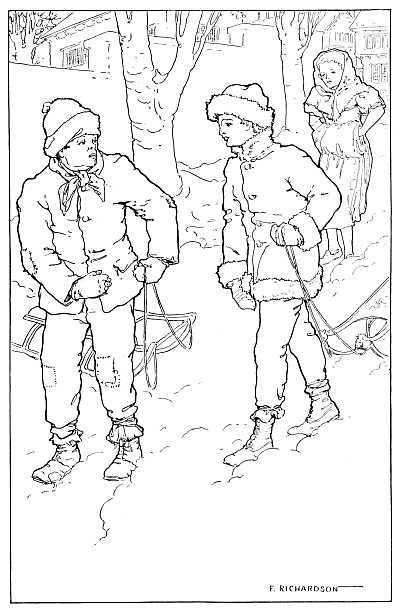
that led Otto to tell about his experience with Chappi and Wiseli; how
she had been driven into the snowdrift and rudely treated, and how,
though she had no sled, she finally had had two rides on his.
"That was right, Otto," said his father; "always take the part of the
weak and the oppressed, and honor the meaning of your name. Who is
this little girl you speak of?"
"I doubt if you know her," answered Mrs. Ritter, "but Max knew the
mother very well. You remember the frail linen weaver that lived near
us? She was his daughter and only child, and she used to come often to
the parsonage. She was a pretty girl with large brown eyes, and she
could sing beautifully. Do you remember whom I mean?"
Just at this moment Trina brought in a message: "Joiner Andreas begs
permission to speak with Mrs. Ritter, if it will not disturb her."
Quite a commotion followed this announcement. Mrs. Ritter dropped the
spoon with which she was serving, and saying hastily, "Excuse me,
please," left the room.
Otto and Miezi immediately pushed back their chairs to go also, but
Uncle Max held Miezi fast. Otto stumbled over something in his haste,
and Miezi struggled hard to free herself. "Do let me go, Uncle Max!
Let me go!" she cried.
"Why do you want to go, Miezchen?"
"To see Joiner Andreas. Let me go. Help me, papa."
"Tell me why you want to see Joiner Andreas, and I will let you go."
"My sheep has but two legs left and no tail, and only Joiner Andreas
knows how to fix it. Now let me go."
Miezi's papa and Uncle Max laughed as she ran from the room.
"Who is this man that has the whole household at his command?"
inquired Uncle Max.
"You ought to know better than I," answered Colonel Ritter. "Very
likely he is an old playmate of yours. I am sure you would enjoy
knowing him. Your sister makes us all love him. He is really the
corner stone of this household, without whom things generally would go
to rack and ruin. It doesn't matter what happens, for 'Joiner Andreas
will fix it.' In fact he is helper, adviser, comforter, and friend,
all in one."
"You may laugh," said Mrs. Ritter, who returned just then, "but I know
that Joiner Andreas is a comfort."
"So do I," said the husband, playfully.
"So do I," echoed Miezi, as she seated herself at the table.
"So do I," added Otto, who was rubbing the knuckles he had bruised in
his hasty exit.
"Then we are all agreed," said the mother. "Now I want you children to
go to bed."
"To which we are not all agreed," said Otto, teasingly.
However, Trina came and they were obliged to go. The mother followed
after a time, as was her custom, to hear the children's evening
prayer and receive their last embrace for the night. This often
required some time, for they were eager to tell her many things, and
detained her for their own pleasure. To-night she remained until they
were quiet and then returned to the gentlemen in the sitting room.
"At last," said Colonel Ritter, apparently as relieved as if he had
just conquered an enemy. "You see, Max, my wife's time belongs first
of all to Joiner Andreas, and then to the children; if there is any
left, it belongs to me."
"Oh, it's not quite so bad as that!" corrected Mrs. Ritter. "You like
Andreas just as well as the rest of us do, even though you won't admit
it. That reminds me, he told me that he had received the money from
his yearly profit and wanted your advice about investing it."
"Yes, it is a fact," said the colonel, "that I never saw a more
trustworthy or energetic man than he. I would trust him with all I
have. He is by far the most reliable and wide-awake man in our
parish."
"Now you know what he thinks of him, Max," said Mrs. Ritter, laughing.
"Yes, to be sure," said the brother, "but you have said so much about
this man that I am curious to see him. Did I ever know him?"
"Why, Max! to think of your asking!" his sister admonished him. "You
used to go to school together and you knew him well. Don't you
remember the two brothers who were in your class, the older one such a
good-for-nothing boy? Not that he was stupid, but he didn't care to
study, so the younger one was in the same class. The older one's name
was George, and he was rather striking in appearance because of his
heavy black hair. Whenever he saw us he would pelt us with stones or
apples, and he invariably called us 'aristocrat-breed.'"
Uncle Max laughed. "Yes, I should say I do remember him distinctly,"
he said. "That word I shall never forget—'aristocrat-breed.' I should
like to know how he got hold of it. I remember very well what a tyrant
he was. I interfered once when I saw him unmercifully pommeling a much
smaller boy, and he took his vengeance on me by calling me
'aristocrat-breed' at least a dozen times. Now, of a sudden, I
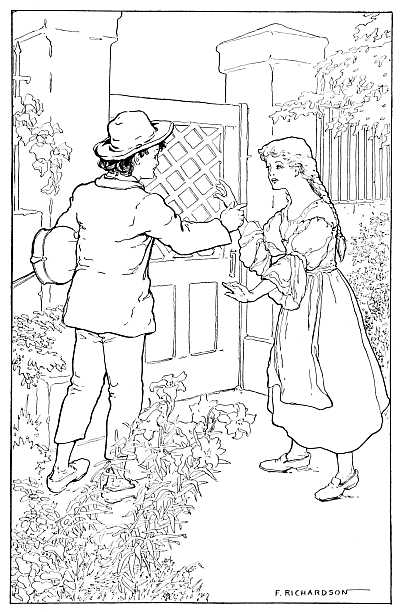
remember the other one too. Can it be that little Andreas with the
violets has become your hero? Now I comprehend the intimacy, Marie."
"The violets!" broke in Colonel Ritter. "I have heard nothing about
the violets."
"Why, I see that scene before me as if it were but yesterday,"
continued Max, "and I am going to tell you about it, Otto. You have no
doubt heard Marie tell about the teacher we had in those days, who
believed that the bad should be whipped out of children and the good
whipped into them. Consequently he was much of the time engaged in
punishing us for one or both purposes. At one time he was
administering this treatment to the little Andreas, and he struck the
boy such a heavy blow across the back that he screamed outright. Well,
my little sister, who had just begun to go to school, and who didn't
understand the teacher's well-meant methods, immediately rose from her
seat and marched down the aisle to the door.
"The teacher stopped to see what had happened, holding his rod poised
in the air long enough to ask, 'Where are you going?'
"Marie turned around and, with tears streaming down her face, answered
loud enough for the whole school to hear, 'I am going home to tell my
papa.'
"I shall never forget how the teacher left the astonished Andreas and
rushed upon Marie. 'Just wait and I'll teach you,' he threatened. He
roughly took her by the arm and forced her back to her seat,
muttering, 'I'll teach you!' That ended the scene, however, for he
sent Andreas to his seat without further punishment, and nothing more
was said to Marie.
"Andreas never forgot this kind act in his behalf, and he always
brought Marie a bunch of violets when he came to school; I used to
notice how they perfumed the schoolroom. Occasionally there would be
a cluster of strawberries or something else equally appropriate. How
the friendship has extended to the present state of affairs I shall
have to let my sister explain."
"My dear wife, I am eager to have this brought up to date," remarked
the colonel.
Mrs. Ritter laughed with the others and began: "The strawberries and
violets were given as Max said, but you have forgotten how soon
Andreas left school after I entered. He went to the city to learn the
joiner's trade. I didn't lose track of him, however, for he often came
home. When Otto and I were married and bought this place, he came to
consult us about his own purchase of some property. The owner of the
place wanted cash, and Andreas, who had lost his parents, hadn't the
money. Otto lent him the sum he needed and has never regretted it."
"I should say not," broke in the colonel. "He paid for that long ago,
and since that time has laid by a good sum of his own. He brings his
money to me, and I invest it for him. His interest is adding to his
capital, and he could now afford to build a much better house and live
with more comforts. It is a shame that he is all alone in the world."
"Hasn't he a wife? And where is George?" asked Max.
"Andreas lives all alone," answered the sister. "I think his history
is too sad for him ever to take a wife. George led a wild life around
here until Andreas refused to help him out of any more scrapes, and
now he has disappeared, for he couldn't pay his debts. People were
relieved to have him out of the neighborhood, but everybody respects
Andreas."
"What do you mean by his sad experience, Marie?" inquired Max.
"I should like to hear about that, too," said the husband.
"Why, Otto!" said Mrs. Ritter, "I have told you about it at least a
dozen times."
"Is that so? It must please me," answered the husband, laughing.
"Can you recall, Max, the girl whom we were speaking of at the table
to-night when Andreas came? We could hear her father's loom from our
garden, they lived so near us. I told you the girl was very pretty.
She had a charming manner and her name was Aloise."
"Never in my life have I known anybody by that name," asserted Max.
"I know why you say so," corrected his sister. "We never called her
that, and I am sure that you never did. We called her Wisi, much to
our dear mother's disgust. You often went over to get her when we
wanted to have some music, because she could sing so well."
"Oh, yes, I remember Wisi," said Max, "and I used to like the girl,
too; but I don't believe that I ever knew of her being named anything
else."
"I know that you used to know, Max," persisted Mrs. Ritter. "Mother so
often deplored the fact that we would not use the pretty name Aloise,
and she never liked what we did call her."
"What became of Wisi?" inquired Max.
"Well," continued Mrs. Ritter, "Wisi and I were much together, for we
were in the same class and went from grade to grade at the same time.
Andreas, through all those years, was her stanchest friend, and she
willingly accepted his attentions, often finding his friendship of
great advantage to herself.
"For one thing we were supposed to bring certain examples worked out
on our slates when we came to school in the morning, but Wisi's slate
was usually blank. She was always light-hearted and merry, and she
would put her slate on her desk in a very unconcerned way and go out
to play; when she returned, the slate was filled with neatly copied
examples.
"Once it was brought before the school that some one had broken a
windowpane, and again, that some one had shaken the teacher's fruit
trees, and I remember that we all knew it was Wisi's fault; but
Andreas took the blame upon himself and the punishment also. The rest
of us accepted it as a matter of course, for we all liked Wisi and
were used to having her escape.
"How it happened that the quietest, most earnest boy in school should
care especially about the most mischievous girl used to puzzle us, and
I often wondered if Wisi were not indifferent to Andreas's interest in
her. I asked mamma about it one day, and she said, 'I am afraid that
Aloise is somewhat vain, and that she may live to see the bad results
of her carelessness.' After that I worried about her myself.
"Some time later we had Bible studies together, preparatory to our
confirmation, and she took such an interest in them that we began to
think she had given up her mischievous ways. She regularly came to
sing with us Sunday evenings, and we liked to have her with us, for
her cheerfulness infected us all. By this time she was a very pretty
young woman, not rugged, but perfectly well; and she far surpassed the
other girls of the neighborhood in grace, beauty, and accomplishments.
Andreas was still at his trade, but he managed to come home nearly
every Sunday. We could all see how much he cared for Wisi. He was the
only one that ever called her Wiseli, and he always accented the name
so softly that we thought it was very pretty.
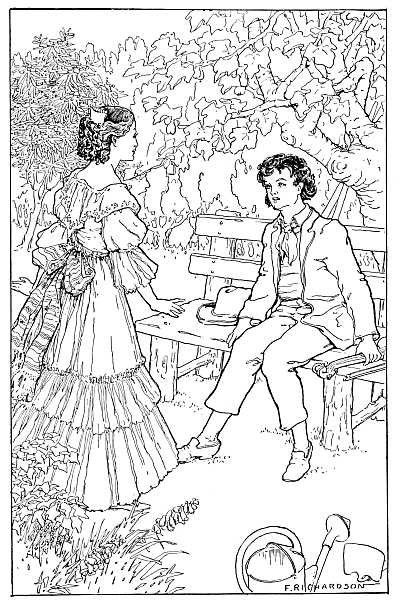
"One Sunday night, when Wisi and I were not quite eighteen years of
age, she came in radiantly happy and told us that she was soon to be
married. The man to whom she was betrothed had but recently come to
the village and was employed at the factory. I was so astonished and
grieved over the news that I could say nothing. Mother, however, asked
her to take some time to consider the matter thoroughly, because it
was too important a step to take hurriedly. Mother told her that she
was very young and that she must not forget that there was some one
else who had loved her for years, of whose intentions she could have
no doubt; then, too, her father needed her, and she ought to help him
a few years more.
"Wisi cried because mother talked so earnestly, but she said that her
father had given his consent and it was all arranged that they were to
be married in two weeks. 'Then,' said mother, 'we must make the best
of it and try to be happy. I will play our favorite melody and we will
sing the words.
"Commit thou all thy ways
And all that grieves thy heart
To Him whose endless days
Can strength and grace impart.
"He gives to wind and wave
The power to be still;
For thee He'll surely save
A place to work His will."'
"When Wisi left us that night she was as cheerful as ever, but I could
not help feeling that her happiest days were over. Then, too, I feared
for Andreas, but he said nothing, although he has never been the same
since. For several years he seemed to be far from well, but he did not
give up work."
"Poor fellow!" exclaimed Max; "and he never married?"
"Why, no, Max!" said Mrs. Ritter, impatiently, "how could he when he
is faithfulness itself?"
"How was I to know that he possessed that virtue also, dear sister? He
seems to have them all. How did Wisi get along? I should be sorry to
hear that her marriage proved a failure."
"I can plainly see that your sympathy is with her," replied Mrs.
Ritter. "To you, Andreas's fate does not matter so much."
"Not so, sister, but those pretty eyes of hers ought never to have
been spoiled with tears. Isn't she happy?"
"I fear not, Max. I have seen but little of her since her marriage.
There was a coarseness in her husband's nature that repelled me, and
he was always cross to her. Six children were born to them, and all
but one, a frail little girl, have died. She is called Wiseli, and is
about the size of our Miezchen, although she is three years older. She
is the little girl whom Otto defended this evening. Her mother has
suffered so much during all these years, that there is little hope of
her ever being well again."
"That is too bad," said Max; "we must try to do something for her.
Don't you think that we might help her?"
"I am afraid that it is too late. Wisi was much too delicate for all
the work and worry that fell to her lot."
"What is the husband doing?"
"I forgot to tell you, Max. About six months ago he had an arm and a
leg badly crushed in the factory, and he died a few weeks after being
injured. Since then Wisi has been living alone with her little girl."
"So that is her story," mused Max. "And one child is all that she has
left. What would become of her in case Wisi died? It is more likely,
though, that the mother will get well, and that Andreas will yet be
happy."
"No, I am sure it is too late for that," asserted Mrs. Ritter.
"Although Wisi repented long ago, the wrong could not be undone, and
she has suffered in silence. But we are forgetting that we must have
some sleep to-night."
Colonel Ritter had fallen asleep in his chair. It was past midnight.
Max roguishly went behind his sleeping brother and shook his shoulders
so roughly that the colonel sprang from his chair in alarm. Max
laughed and patted his shoulder by way of atonement, saying
apologetically, "I only intended to give you a gentle warning that my
sister says we must take to our beds."
A few moments later the house stood dark and quiet in the moonlight.
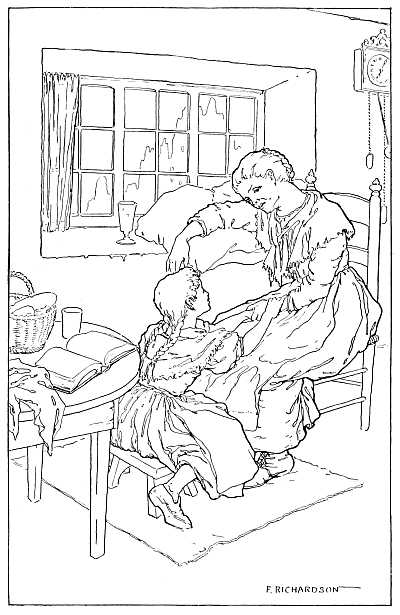
At the foot of the hill was another house where it would soon be quiet
also; from a tiny window a small lamp still sent a faint glimmer into
the night.