Grandmamma wrote the day before her arrival to let
the children know that they might expect her without
fail. Peter brought up the letter early the following morning.
As he neared the group his steps slackened, and the instant
he had handed the letter to Uncle he turned quickly away as
if frightened and ran off up the mountain.
"Grandfather," said Heidi, who had been watching him
with astonished eyes, "why does Peter always behave now
like the Great Turk when he thinks somebody is after him
with a stick; he turns and shakes his head and goes off with a
bound just like that?"
"Perhaps Peter fancies he sees the stick which he so well
deserves coming after him," answered grandfather.
Heidi set about tidying the hut, as grandmamma must
find everything clean and in good order when she arrived.
Clara looked on amused and interested to watch the busy
Heidi at her work.
Then the children dressed up and went and sat together
outside on the seat ready to receive her.
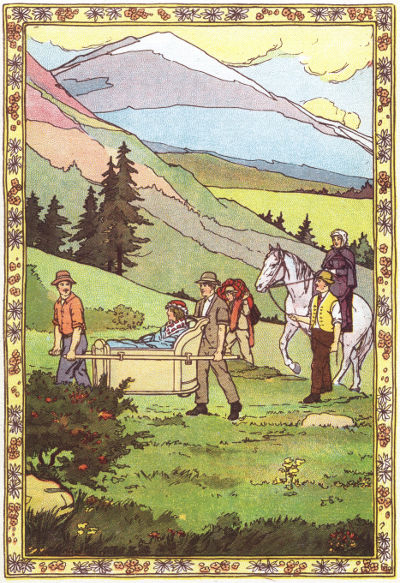
At last they saw the procession winding up the mountain
just in the order they had expected. First there was the
guide, then the white horse with grandmamma mounted upon
it, and last of all the porter with a heavy bundle on his back,
for grandmamma would not think of going up the mountain
without a full supply of wraps and rugs.
Nearer and nearer wound the procession; at last it
reached the top and grandmamma was there looking down on
the children from her horse. She no sooner saw them, however,
sitting side by side, than she began quickly dismounting,
as she cried out in a shocked tone of voice, "Why is this?
why are you not lying in your chair, Clara? What are you
all thinking about?" But even before she had got close to
them she threw up her hands in astonishment, exclaiming
further, "Is it really you, dear child? Why, your cheeks have
grown quite round and rosy! I should hardly have known
you again!" And she was hastening forward to embrace
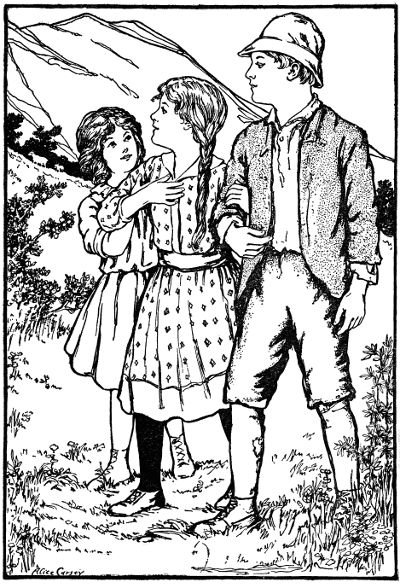
her, when Heidi slipped down from the seat, and with Clara
leaning on her shoulder, began walking along quite coolly and
naturally. Then indeed grandmamma was surprised, or
rather alarmed, for she thought at first that it must be some
unheard-of proceeding of Heidi's.
But no—Clara was actually walking steadily and uprightly
beside Heidi. Laughing and crying she ran to them
and embraced first Clara and then Heidi, and then Clara
again, unable to speak for joy. All at once she caught sight
of Uncle standing by the seat and looking on smiling at the
meeting. She went up to the old man and seized his hands.
"My dear Uncle! my dear Uncle! how much we have to
thank you for! It is all your doing! it is your care and
nursing—"
"And God's good sun and mountain air," he interrupted
her smiling.
"Yes, and don't forget the beautiful milk I have," put in
Clara. "Grandmamma, you can't think what a quantity of
goat's milk I drink, and how nice it is!"
"I can see that by your cheeks, child," answered grandmamma.
"I really should not have known you; you have
grown quite strong and plump, and taller too; I never hoped
or expected to see you look like that. I cannot take my eyes
off you, for I can hardly yet believe it. But now I must telegraph
without delay to my son in Paris, and tell him he must
come here at once. I shall not say why; it will be the greatest
happiness he has ever known. My dear Uncle, how can I send
a telegram; have you dismissed the men yet?"
"They have gone," he answered, "but if you are in a
hurry I will get Peter, and he can take it for you."
Grandmamma thanked him, for she was anxious that the
good news should not be kept from her son a day longer than
was possible.
So Uncle went aside a little way and blew such a resounding
whistle through his fingers that he awoke a responsive
echo among the rocks far overhead. He did not have to
wait many minutes before Peter came running down in
answer, for he knew the sound of Uncle's whistle. Peter
looked as white as a ghost, for he thought Uncle was sending
for him to give him up. But instead he only gave him a
written paper with instructions to take it down at once to the
post-office at Doerfli; Uncle would settle for the payment
later, as it was not safe to give Peter too much to look after.
Peter went off with the paper in his hand, feeling some
relief of mind for the present, for as Uncle had not whistled
for him in order to give him up it was evident that no policeman
had yet arrived.
So now they all sat down in peace to their dinner round
the table in front of the hut, and grandmamma was given a
detailed account of all that had taken place. How grandfather
had made Clara try first to stand and then to move her
feet a little every day, and how they had settled for the day's
excursion up the mountain and the chair had been blown
away. How Clara's desire to see the flowers had induced her
to take the first walk, and so by degrees one thing had led to
another. The recital took some time, for grandmamma continually
interrupted it with fresh exclamations of surprise
and thankfulness: "It hardly seems possible! I can scarcely
believe it is not all a dream! Are we really awake, and are we
all sitting here by the mountain hut, and is that round-faced,
healthy-looking child my poor little, white, sickly Clara?"
And Clara and Heidi could not get over their delight at
the success of the surprise they had so carefully arranged for
grandmamma and at the latter's continued astonishment.
Meanwhile Mr. Sesemann, who had finished his business
in Paris, had also been preparing a surprise. Without saying
a word to his mother he got into the train one sunny morning
and travelled that day to Basle; the next morning he continued
his journey, for a great longing had seized him to see his little
daughter from whom he had been separated the whole summer.
He arrived at Ragatz a few hours after his mother had
left. When he heard that she had that very day started for
the mountain, he immediately hired a carriage and drove as
far as Doerfli, and then started to climb the mountain. He
went on and on, but still no hut came in sight, and yet he knew
there was one where Peter lived half way up, for the path had
been described to him over and over again.
He began to wonder if he was on the right path, and
whether the hut lay perhaps on the other side of the mountain.
He looked round to see if any one was in sight of whom
he could ask the way; but far and wide there was not a soul
to be seen nor a sound to be heard. Only at moments the
mountain wind whistled through the air, and the insects
hummed in the sunshine, or a happy bird sang out from the
branches of a solitary larch tree. Mr. Sesemann stood still
for a while to let the cool Alpine wind blow on his hot face.
But now some one came running down the mountainside—it
was Peter with the telegram in his hand. He ran straight
down the steep slope, not following the path on which Mr.
Sesemann was standing. As soon as the latter caught sight
of him he beckoned to him to come. Peter advanced towards
him slowly and timidly, with a sort of sidelong movement, as
if he could only move one leg properly and had to drag the
other after him.
"Hurry up, lad," he called, and when Peter was near
enough, "Tell me," he said, "is this the way to the hut where
the old man and the child Heidi live, and where the visitors
from Frankfurt are staying?"
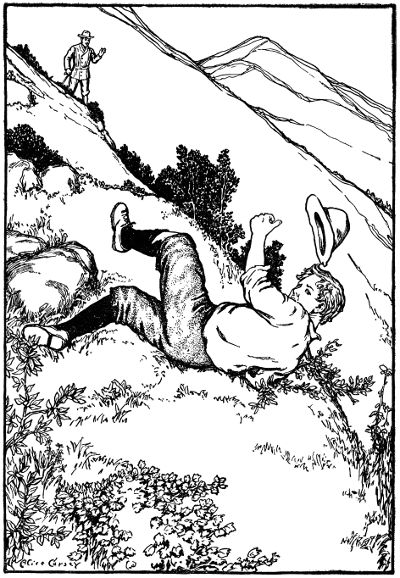
A low sound of fear was the only answer he received, as
Peter turned to run away in such precipitous haste that he
fell head over heels several times, and went rolling and bumping
down the slope in involuntary bounds, just in the same
way as the chair, only that Peter fortunately did not fall to
pieces as that had done. Only the telegram came to grief, and
that was torn into fragments and flew away.
"How extraordinarily timid these mountain dwellers
are!" thought Mr. Sesemann to himself, for he quite believed
that it was the sight of a stranger that had made such an impression
on this unsophisticated child of the mountains.
After watching Peter's violent descent towards the valley
for a few minutes he continued his journey.
Peter, meanwhile, with all his efforts, could not stop himself,
but went rolling on, and still tumbling head over heels
at intervals in a most remarkable manner.
PETER WENT ROLLING AND BUMPING DOWN THE SLOPE
But this was not the most terrible part of his sufferings
at the moment, for far worse was the fear and horror that
possessed him, feeling sure, as he did now, that the policeman
had really come over for him from Frankfurt. He had no
doubt at all that the stranger who had asked him the way was
the very man himself. Just as he had rolled to the edge of the
last high slope above Doerfli he was caught in a bush, and at
last able to keep himself from falling any farther. He lay
still for a second or two to recover himself, and to think over
matters.
"Well done! another of you come bumping along like
this!" said a voice close to Peter, "and which of you tomorrow
is the wind going to send rolling down like a badly-sewn sack
of potatoes?" It was the baker, who stood there laughing.
He had been strolling out to refresh himself after his hot
day's work, and had watched with amusement as he saw
Peter come rolling over and over in much the same way as
the chair.
Peter was on his feet in a moment. He had received a
fresh shock. Without once looking behind him he began
hurrying up the slope again. He would have liked best to go
home and creep into bed, so as to hide himself, for he felt
safest when there. But he had left the goats up above, and
Uncle had given him strict injunctions to make haste back so
that they might not be left too long alone. And he stood more
in awe of Uncle than any one, and would not have dared to
disobey him on any account. There was no help for it, he had
to go back, and Peter went on groaning and limping. He
could run no more, for the anguish of mind he had been
through, and the bumping and shaking he had received, were
beginning to tell upon him. And so with lagging steps and
groans he slowly made his way up the mountain.
Shortly after meeting Peter, Mr. Sesemann passed the
first hut, and so was satisfied that he was on the right path.
He continued his climb with renewed courage, and at last,
after a long and exhausting walk, he came in sight of his goal.
There, only a little distance farther up, stood the grandfather's
home, with the dark tops of the fir trees waving above
its roof.
Mr. Sesemann was delighted to have come to the last
steep bit of his journey, in another minute or two he would
be with his little daughter, and he pleased himself with the
thought of her surprise. But the company above had seen his
approaching figure and recognized who it was, and they were
preparing something he little expected as a surprise on their
part.
As he stepped on to the space in front of the hut two
figures came towards him. One a tall girl with fair hair and
pink cheeks, leaning on Heidi, whose dark eyes were dancing
with joy. Mr. Sesemann suddenly stopped, staring at the
two children, and all at once the tears started to his eyes.
What memories arose in his heart! Just so had Clara's mother
looked, the fair-haired girl with the delicate pink-and-white
complexion. He did not know if he was awake or dreaming.
"Don't you know me, Papa?" called Clara to him, her
face beaming with happiness. "Am I so altered since you
saw me?"
Then the father ran to his child and clasped her in his
arms.
"Yes, you are indeed altered! How is it possible? Is it
true what I see?" And the delighted man stepped back to
look full at her again, and to make sure that the picture would
not vanish before his eyes.
"Are you my little Clara, really my little Clara?" he
kept on saying, then he clasped her in his arms again, and
again put her away from him that he might look and make
sure it was she who stood before him.
Then grandmamma came up, anxious for a sight of her
son's happy face.
"Well, what do you say now, dear son?" she exclaimed.
"You have given us a pleasant surprise, but it is nothing in
comparison to what we have prepared for you, you must confess,"
and she gave her son an affectionate kiss as she spoke.
"But now," she went on, "you must come and pay your
respects to Uncle, who is our chief benefactor."
"Yes, indeed, and our little Heidi, too," said Mr. Sesemann,
shaking Heidi by the hand. "Well? are you quite well
and happy in your mountain home? but I need not ask, no
Alpine rose could look more blooming. I am glad, child, it is
a pleasure to me to see you so."
And Heidi looked up with equal pleasure into his kind
face. How good he had always been to her! And that he
should find such happiness awaiting him up here on the
mountain made her heart beat with gladness.
Grandmamma introduced him to Uncle, and while the
two men were shaking hands and Mr. Sesemann was expressing
his heartfelt thanks and boundless astonishment to
the old man, grandmamma wandered round to the back to see
the old fir trees again.
Here another unexpected sight met her gaze, for there,
under the trees stood a great bush of the most wonderful dark
blue gentians, as fresh and shining as if they were growing on
the spot.
"How exquisite! what a lovely sight!" she exclaimed.
"Heidi, dearest child, come here! Is it you who have prepared
this pleasure for me? It is perfectly wonderful!"
The children ran up.
"No, no, I did not put them there," said Heidi, "but I
know who did."
"They grow just like that on the mountain, Grandmamma,
only if anything they look more beautiful still,"
Clara put in; "but guess who brought those down today,"
and as she spoke she gave such a pleased smile that the grandmother
thought for a moment the child herself must have
gathered them. But that was hardly possible.
At this moment a slight rustling was heard behind the fir
trees. It was Peter, who had just arrived. He had made a
long round, trying to slip by unobserved. But grandmamma
had seen and recognized him, and suddenly the thought struck
her that it might be Peter who had brought the flowers and
that he was now trying to get away unseen, feeling shy about
it; but she could not let him go off like that, he must have
some little reward.
"Come along, boy; come here, do not be afraid," she
called to him.
Peter stood still, petrified with fear. After all he had
gone through that day he felt he had no longer any power of
resistance left. All he could think was, "It's all up with me
now." Every hair of his head stood on end, and he stepped
forth from behind the fir trees, his face pale.
"Courage, boy," said grandmamma in her effort to dispel
his shyness, "tell me now straight out without hesitation,
was it you who did it?"
Peter did not lift his eyes and therefore did not see at
what grandmamma was pointing. But he knew that Uncle
was standing at the corner of the hut, fixing him with his grey
eyes, while beside him stood the most terrible person that
Peter could conceive—the police-constable from Frankfurt.
Quaking in every limb, and with trembling lips he muttered a
low "Yes."
"Well, and what is there dreadful about that?" said
grandmamma.
"Because—because—it is all broken to pieces and no one
can put it together again." Peter brought out his words
with difficulty, and his knees knocked together so that he
could hardly stand.
Grandmamma went up to Uncle. "Is that poor boy a little
out of his mind?" she asked sympathizingly.
"Not in the least," Uncle assured her, "it is only that he
was the wind that sent the chair rolling down the slope, and
he is expecting his well-deserved punishment."
Grandmamma found this hard to believe, for in her
opinion Peter did not look an entirely bad boy, nor could he
have had any reason for destroying such a necessary thing as
the chair. But Uncle had only given expression to the suspicion
that he had had from the moment the accident happened.
The angry looks which Peter had from the beginning
cast at Clara, and the other signs of his dislike to what had
been taking place on the mountain, had not escaped Uncle's
eye. Putting two and two together he had come to the right
conclusion as to the cause of the disaster, and he therefore
spoke without hesitation when he accused Peter. The lady
broke out into lively expostulations on hearing this.
"No, no, dear Uncle, we will not punish the poor boy any
further. One must be fair to him. Here are all these strangers
from Frankfurt who come and carry away Heidi, his one
sole possession, and a possession well worth having too, and
he is left to sit alone day after day for weeks, with nothing to
do but brood over his wrongs. No, no, let us be fair to him;
his anger got the upper hand and drove him to an act of revenge—a
foolish one, I own, but then we all behave foolishly
when we are angry." And saying this she went back to
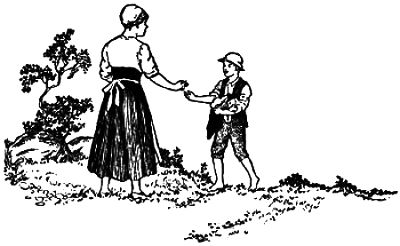
Peter, who still stood frightened and trembling. She sat
down on the seat under the fir trees and called him to her
kindly,—
"Come here, boy, and stand in front of me, for I have
something to say to you. Leave off shaking and trembling,
for I want you to listen to me. You sent the chair rolling
down the mountain so that it was broken to pieces. That
was a very wrong thing to do, as you yourself knew very well
at the time, and you also knew that you deserved to be punished
for it. But be sure of this, Peter: that those who do
wrong make a mistake when they think no one knows anything
about it. For God sees and hears everything, and when
the wicked doer tries to hide what he has done, then God
wakes up the little watchman that He places inside us all when
we are born and who sleeps on quietly till we do something
wrong. And the little watchman has a small goad in his
hand, and when he wakes up he keeps on pricking us with it,
so that we have not a moment's peace. And the watchman
torments us still further, for he keeps on calling out, 'Now you
will be found out! Now they will drag you off to punishment!'
And so we pass our life in fear and trouble, and never
know a moment's happiness or peace. Have you not felt
something like that lately, Peter?"
Peter gave a contrite nod of the head, as one who knew
all about it, for grandmamma had described his own feelings
exactly.
"And you calculated wrongly also in another way," continued
grandmamma, "for you see the harm you intended has
turned out for the best for those you wished to hurt. As
Clara had no chair to go in and yet wanted so much to see the
flowers, she made the effort to walk, and every day since she
has been walking better and better. Do not forget my words,
and whenever you feel inclined to do anything wrong, think
of the little watchman inside you with his goad and his disagreeable
voice. Will you remember all this?"
"Yes, I will," answered Peter, still very subdued, for he
did not yet know how the matter was going to end, as the
police-constable was still standing with the Uncle.
"That's right, and now the thing is over and done for,"
said grandmamma. "But I should like you to have something
for a pleasant reminder of the visitors from Frankfurt.
Can you tell me anything that you have wished very much
to have? What would you like best as a present?"
Peter lifted his head at this, and stared open-eyed at
grandmamma. Up to the last minute he had been expecting
something dreadful to happen, and now he might have anything
that he wanted. His mind seemed all of a whirl.
"I mean what I say," went on grandmamma. "You shall
choose what you would like to have as a remembrance from
the Frankfurt visitors, and as a token that they will not think
any more of the wrong thing you did. Now do you understand
me, boy?"
The fact began at last to dawn upon Peter's mind that
he had no further punishment to fear, and that the kind lady
sitting in front of him had delivered him from the police-constable.
He suddenly felt as if the weight of a mountain
had fallen off him. He had also by this time awakened to the
further conviction that it was better to make a full confession
at once of anything he had done wrong or had left undone,
and so he said, "And I lost the paper, too."
Grandmamma had to consider a moment what he meant,
but soon recalled his connection with her telegram, and
answered kindly,—
"You are a good boy to tell me! Never conceal anything
you have done wrong, and then all will come right again.
And now what would you like me to give you?"
Peter grew almost giddy with the thought that he could
have anything in the world that he wished for. He had a
vision of the yearly fair at Mayenfeld with the glittering
booths and all the lovely things that he had stood gazing at for
hours, without a hope of ever possessing one of them, for
Peter's purse never held more than five cents, and all these
fascinating objects cost double that amount. There were the
pretty little red whistles that he could use to call his goats,
and the splendid knives with rounded handles, known as
toad-strikers, with which one could do such fine whittling.
Peter remained pondering; he was trying to think which
of these two desirable objects he should best like to have, and
he found it difficult to decide. Then a bright thought occurred
to him; he would then be able to think over the matter between
now and next year's fair.
"A dime," answered Peter, who was no longer in doubt.
Grandmamma could not help laughing. "That is not an
extravagant request. Come here then!" and she pulled out
her purse and put four bright silver dollars in his hand and
then laid some dimes on the top of them. "We will settle our
accounts at once," she continued, "and I will explain them to
you. I have given you as many dimes as there are weeks in
the year, and so every Sunday throughout the year you can
take out a dime to spend."
"As long as I live?" said Peter quite innocently.
Grandmamma laughed more still at this, and the men
hearing her, paused in their talk to listen to what was going
on.
"Yes, boy, you shall have it all your life—I will put it
down in my will. Do you hear, my son? and you are to put it
down in yours as well: a dime a week to Peter as long as he
lives."
Mr. Sesemann nodded his assent and joined in the
laughter.
Peter looked again at the present in his hand to make
sure he was not dreaming, and then said, "Thank God!"
And he went off running and leaping with more even
than his usual agility, and this time managed to keep his feet,
for it was not fear, but joy such as he had never known before
in his life, that now sent him flying up the mountain. All
trouble and trembling had disappeared, and he was to have
a dime every week for life.
Later, after dinner, when the party were sitting together
chatting, Clara drew her father a little aside, and said with
an eagerness that had been unknown to the little, tired invalid,—
"O papa, if you only knew all that grandfather has done
for me from day to day! I cannot reckon his kindnesses, but I
shall never forget them as long as I live! And I keep on
thinking what I could do for him, or what present I could
make him that would give him half as much pleasure as he
has given me."
"That is just what I wish most myself, Clara," replied
her father, whose face grew happier each time he looked at his
little daughter. "I have been also thinking how we can best
show our gratitude to our good benefactor."
Mr. Sesemann went over to Uncle and taking him by
the hand said,—
"Dear friend, you will believe me when I tell you that I
have known no real happiness for years past. What good
were money and property to me when they were unable to
make my poor child well and happy? With the help of God
you have made her whole and strong, and you have given new
life not only to her but to me. Tell me now, in what way can I
show my gratitude to you? I can never repay all you have
done, but whatever is in my power to do is at your service.
Speak, friend, and tell me what I can do?"
Uncle had listened to him quietly, with a smile of pleasure
on his face as he looked at the happy father.
"Mr. Sesemann," he replied in his dignified way, "I too
have my share in the joy of your daughter's recovery, and my
trouble is well repaid by it. I thank you heartily for all you
have said, but I have need of nothing; I have enough for myself
and the child as long as I live. Of course, I am growing
old, and shall not be here much longer. I have nothing to
leave the child when I die. If you could promise me that
Heidi will never have to earn her living among strangers,
then you would richly reward me for all I have done for your
child."
"There could never be any question of such a thing as
that, my dear friend," said Mr. Sesemann quickly. "I look
upon the child as my own. Ask my mother, my daughter; you
may be sure that they will never allow the child to be left in
any one else's care! But if it will make you happier I give
you here my hand upon it. I promise you: Heidi shall
never have to go and earn her living among strangers; I will
make provision against this both during my life and after.
But now I have something else to say. Independent of her
circumstances, the child is totally unfitted to live a life away
from home; we found that out when she was with us. But she
has made friends, and among them I know one who is at this
moment in Frankfurt; he is winding up his affairs there, that
he may be free to go where he likes and take his rest. I am
speaking of my friend, the doctor, who came over here in the
autumn and who, having well considered your advice, intends
to settle in this neighborhood, for he has never felt so well
and happy anywhere as in the company of you and Heidi. So
you see the child will henceforth have two protectors near her—and
may they both live long to share the task!"
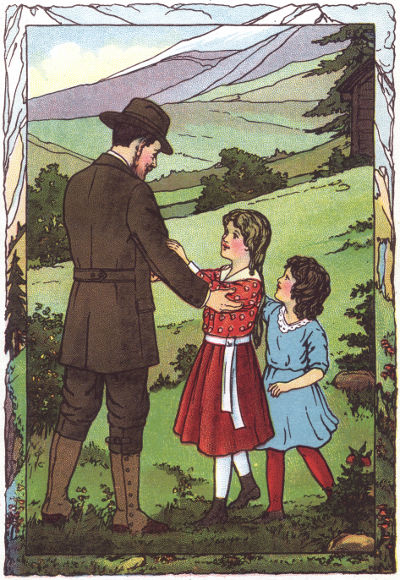
"ARE YOU REALLY MY LITTLE CLARA?"
"God grant indeed it may be so!" added grandmamma,
shaking Uncle's hand warmly as she spoke, to show how
sincerely she echoed her son's wish. Then putting her arm
round Heidi, who was standing near, she drew the child to
her.
"And I have a question to ask you too, dear Heidi. Tell
me if there is anything you particularly wish for?"
"Yes, there is," answered Heidi promptly, looking up
delightedly at grandmamma.
"Then tell me at once, dear, what it is."
"I want to have the bed I slept in at Frankfurt with the
high pillows and thick coverlid, and then grandmother will
not have to lie with her head down hill and hardly able to
breathe, and she will be warm enough under the coverlid not
to have to wear her shawl in bed to prevent her freezing to
death."
In her eagerness to obtain what she had set her heart
upon Heidi hardly gave herself time to get out all she had to
say, and did not pause for breath till she reached the end of
her sentence.
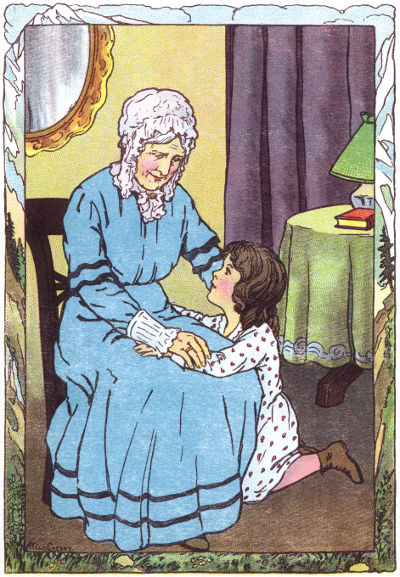
"Dearest child," answered grandmamma, moved by
Heidi's speech, "what is this you tell me of grandmother!
You are right to remind me. In the midst of our own happiness
we forget too often that which we ought to remember
before all things. When God has shown us some special
mercy we should think at once of those who are denied so
many things. I will telegraph to Frankfurt at once! Miss
Rottermeyer shall pack up the bed this very day, and it will
be here in two days' time. God willing, grandmother shall
soon be sleeping comfortably upon it."
Heidi skipped round grandmamma in her glee, and then
stopping all of a sudden, said quickly, "I must make haste
down and tell her."
"No, no, Heidi, what can you be thinking of," said her
grandfather reprovingly. "You can't be running backwards
and forwards like that when you have visitors."
But grandmamma interfered on Heidi's behalf. "The
child is not so far wrong, Uncle," she said, "and poor grandmother
has too long been deprived of Heidi for our sakes. Let
us all go down to her together. I believe my horse is waiting
for me and I can ride down from there, and as soon as I get to
Doerfli the message shall be sent off. What do you think of
my plan, son?"
Mr. Sesemann had not yet had time to speak of his
travelling plans, so he begged his mother to wait a few moments
that he might tell her what he proposed doing.
Mr. Sesemann had been arranging that he and his
mother should make a little tour in Switzerland, first ascertaining
if Clara was in a fit state to go some part of the
way with them. But now he would have the full enjoyment
of his daughter's company, and that being so he did not want
to miss any of these beautiful days of later summer, but to
start at once on the journey that he now looked forward to
with such additional pleasure. And so he proposed that they
should spend the night in Doerfli and that next day he should
come and get Clara, then they would all three go down to
Ragatz and make that their starting point.
Clara was rather upset at first at the thought of saying
good-bye like this to the mountain; she could not help being
pleased, however, at the prospect of another journey, and no
time was allowed her to give way to lamentation.
Grandmamma had already taken Heidi by the hand, preparatory
to leading the way, when she suddenly turned. "But
what is to become of Clara?" she asked, remembering all at
once that the child could not yet take so long a walk. She
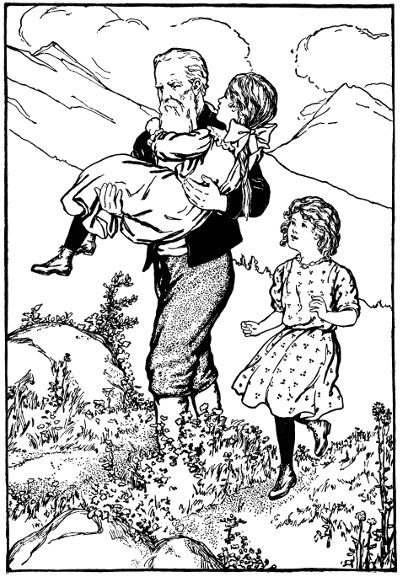
gave a nod of satisfaction as she saw that Uncle had already
taken Clara up in his arms and was following her with sturdy
strides. Mr. Sesemann brought up the rear, and so they all
started down the mountain.
Heidi kept jumping for joy as she and Mrs. Sesemann
walked along side by side, and grandmamma asked all about
Peter's grandmother, how she lived, and what she did, especially
in the winter when it was so cold. And Heidi gave
her a minute account of everything, for she knew all that
went on at grandmother's, and told her how the old woman
sat crouching in her corner and trembling with cold. She was
able also to give her exact particulars of what grandmother
had and had not to eat. Grandmamma listened with interest
and sympathy until they came to grandmother's. Brigitta
was just hanging out Peter's second shirt in the sun, so that
he might have it ready to put on when he had worn the other
long enough. As soon as she saw the company approaching
she rushed indoors.
"The whole party of them are just going past, mother,
evidently all returning home again," she informed the old
woman. "Uncle is with them, carrying the sick child."
"Alas, it is really to be so then?" sighed the grandmother.
"And you saw Heidi with them? Then they are
taking her away. If only she could come and put her hand in
mine again! If I could but hear her voice once more!"
At this moment the door flew open and Heidi sprang
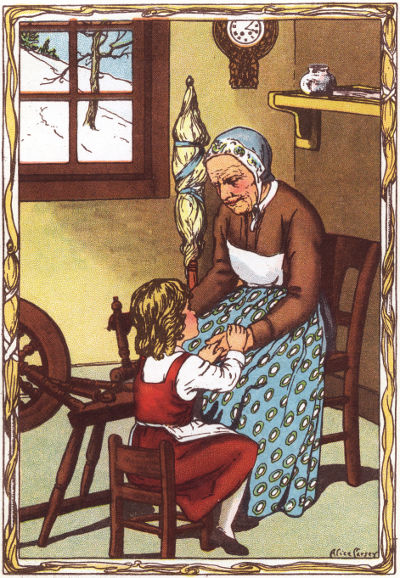
across to the corner and threw her arms round grandmother.
"Grandmother! Grandmother! my bed is to be sent from
Frankfurt with all the three pillows and the thick coverlid;
grandmamma says it will be here in two days." Heidi could
not get out her words quickly enough, for she was impatient
to see grandmother's great joy at the news. The latter
smiled, but said a little sadly,—
"She must indeed be a good, kind lady, and I ought to
be glad to think she is taking you with her, but I shall not
outlive it long."
"What is this I hear? Who has been telling my good
grandmother such tales?" exclaimed a kindly voice, and
grandmother felt her hand taken and warmly pressed, for
grandmamma had followed Heidi in and heard all that was
said. "No, no, there is no thought of such a thing! Heidi is
going to stay with you and make you happy. We want to see
her again, but we shall come to her. We hope to pay a visit to
the Alm every year, for we have good cause to offer up especial
thanks to God upon this spot where so great a miracle
has been wrought upon our child."
Then grandmother's face was lighted up with genuine
happiness, and she pressed Mrs. Sesemann's hand over and
over again, unable to speak her thanks, while two large tears
of joy rolled down her aged cheeks. And Heidi saw the glad
change come over grandmother's face, and she too now was
entirely happy.
She clung to the old woman saying, "Hasn't it all come
about, grandmother, just like the hymn I read to you last
time? Isn't the bed from Frankfurt sent to make you well?"
"Yes, Heidi, and many, many other good things too,
which God has sent me," said the grandmother, deeply
moved. "I did not think it possible that there were so many
kind people, ready to trouble themselves about a poor old
woman and to do so much for her. Nothing strengthens our
belief in a kind heavenly Father who never forgets even the
least of His creatures so much as to know that there are such
people, full of goodness and pity for a poor, useless creature
such as I am."
"My good grandmother," said Mrs. Sesemann, interrupting
her, "we are all equally poor and helpless in the eyes
of God, and all have equal need that He should not forget us.
But now we must say good-bye, but only till we meet again,
for when we pay our next year's visit to the Alm you will be
the first person we shall come and see; meanwhile we shall not
forget you." And Mrs. Sesemann took grandmother's hand
again and shook it in farewell.
But grandmother would not let her off even then without
more words of gratitude, and without calling down on her
benefactress and all belonging to her every blessing that
God had to bestow.
At last Mr. Sesemann and his mother were able to continue
their journey downwards, while Uncle carried Clara
back home, with Heidi beside him, so full of joy of what was
coming for grandmother that every step was a jump.
But there were many tears shed the following morning
by the departing Clara, who wept to say good-bye to the
beautiful mountain home where she had been happier than
ever before in her life. Heidi did her best to comfort her.
"Summer will be here again in no time," she said, "and then
you will come again, and it will be nicer still, for you will be
able to walk about from the beginning. We can then go out
every day with the goats up to where the flowers grow, and
enjoy ourselves from the moment you arrive."
Mr. Sesemann had come as arranged to take his little
daughter away, and was just now standing and talking with
Uncle, for they had much to say to one another. Clara felt
somewhat consoled by Heidi's words, and wiped away her
tears.
"Be sure you say good-bye for me to Peter and the goats,
and especially to Little Swan. I wish I could give Little
Swan a present, for she has helped so much to make me
strong."
"Well, you can if you like," replied Heidi, "send her a
little salt; you know how she likes to lick some out of grandfather's
hand when she comes home at night."
Clara was delighted at this idea. "Oh, then I shall send
a hundred pounds of salt from Frankfurt, for I want her to
have something as a remembrance of me."
Mr. Sesemann now beckoned to the children as it was
time to be off. Grandmamma's white horse had been brought
up for Clara, as she was no longer obliged to be carried in a
chair.
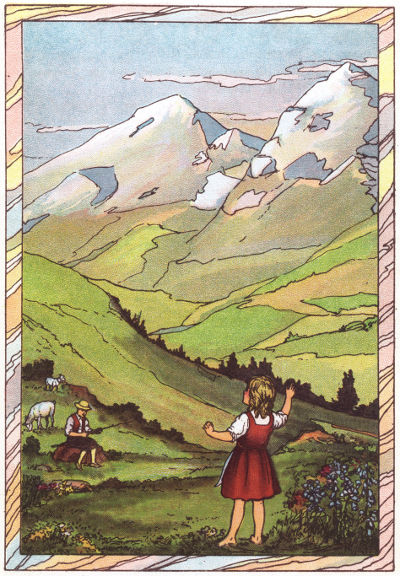
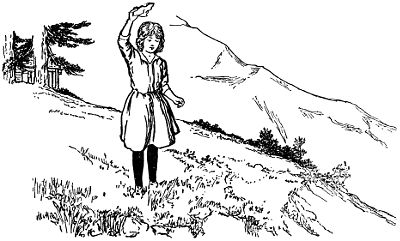
Heidi ran to the far edge of the slope and continued to
wave her hand to Clara until the last glimpse of horse and
rider had disappeared.
And now the bed has arrived, and grandmother is sleeping
so soundly all night that she is sure to grow stronger.
Grandmamma Sesemann, moreover, has not forgotten
how cold the winter is on the mountain. She has sent a large
parcel of warm clothing of every description, so that the
blind grandmother can wrap herself round and round, and
will certainly not tremble with cold now as she sits in her
corner.
There is a great deal of building going on at Doerfli. The
doctor has arrived, and, for the present, is occupying his old
quarters. His friends have advised him to buy the old house
that Uncle and Heidi live in during the winter. The doctor
is having this part of the old house rebuilt for himself, the
other part being repaired for Uncle and Heidi, for the doctor
is aware that Uncle is a man of independent spirit, who likes
to have a house to himself. Quite at the back a warm and
well-walled stall is being put up for the two goats, and there
they will pass their winter in comfort.
The two men are becoming better friends every day, and
as they walk about the new buildings to see how they are
getting on, their thoughts continually turn to Heidi, for the
chief pleasure to each in connection with the house is that
they will have the light-hearted little child with them there.
"Dear friend," said the doctor on one of these occasions
as they were standing together, "you will see this matter in
the same light as I do, I am sure. I share your happiness in
the child as if, next to you, I was the one to whom she most
closely belonged, but I wish also to share all responsibilities
concerning her and to do my best for the child. I shall then
feel I have my rights in her, and shall look forward to her being
with me and caring for me in my old age, which is the
one great wish of my heart. She will have the same claims
upon me as if she were my own child, and I shall provide for
her as such, and so we shall be able to leave her without
anxiety when the day comes that you and I must go."
Uncle did not speak, but he clasped the doctor's hand in
his, and his good friend could read in the old man's eyes how
greatly moved he was and how glad and grateful he felt.
Heidi and Peter were at this moment sitting with grandmother,
and the one had so much to relate, and the others to
listen to, that they all three got closer and closer to one another,
hardly able to breathe in their eagerness not to miss a
word.
And how much there was to tell of all the events that had
taken place that last summer, for they had not had many
opportunities of meeting since then.
And it was difficult to say which of the three looked the
happiest at being together again, and at the recollection of all
the wonderful things that had happened. Mother Brigitta's
face was perhaps the happiest of all, as now, with the help of
Heidi's explanation, she was able to understand for the first
time the history of Peter's weekly dime for life.
Then at last the grandmother spoke, "Heidi read me one
of the hymns! I feel I can do nothing for the remainder of
my life but thank the Father in Heaven for all the mercies He
has shown us!"