"Happy Britain! matchless isle,
Whose natives, like the sturdy oak,
Secure in inborn force, may smile
And mock the tempest's heaviest stroke.
"If roused in war, shall dreadful move
Britannia's vengeance on her foes; to prove,
Where'er again her banners are unfurled,
The dread and envy of the wond'ring world."—DIBDIN.
"I wonder what makes Tom so late?"
said Uncle Bob to himself, as he opened
his eyes and looked around him. "Why,"
he added, "it is precious nearly three
bells in the second dog-watch, as sure
as I'm a living sailor. Living! Well,
there isn't a deal of life about me, for the matter of
that; but I'm right about the time. The shadow of
yonder poplar tree just touches my toes at four bells,
and it doesn't want a yard of doing so now. I must
have been dozing a bit, too. It is a drowsy kind of
an evening anyhow. But it was that blackbird in the
cherry-tree that set me off, and maybe the hum o' the
bees round their hives yonder, and the whispering
of the wind in the old cedar must have helped a bit.
Heigho!"
Poor Uncle Bob yawned a little, then listened.
"Made sure I heard Tom singing just then," continued
the invalid half aloud, "but I dare say it was
the sea-gulls. They're coming inland to-night, and I'm
no seaman if it doesn't blow big guns before morning."
Uncle Bob talked to himself for the best of reasons:
there was no one else to talk to. For little Ruth, his
niece, was helping her mother in the house, and Daniel,
his brother, had gone to the Hall with a boat. No
chance of Dan being home early to-night, for the boat
required the heaviest cart for its conveyance, and the
mare had gone a bit lame lately.
To have looked at Uncle Bob's face as he lay there
in his cot, which had been wheeled out under the
shade of the trees on the daisied grass, no one would
have taken him for an invalid. His rather handsome
face, with its short brown beard and well-chiselled
features was placid and contented, nay, even happy
and hopeful-looking.
O, yes, Uncle Bob had not ceased to hope. For
seven long years and over, day after day, whenever the
sun shone, or it was dry weather, that cot upon wheels
had been hauled out of doors, where it is now in this
sweet May evening, by the sturdy and kindly hands of
Brother Dan. Yet if the boat-shed close by had taken
fire, poor Uncle Bob could not have lifted hand or foot
to save himself from destruction. The paralysis from
which this seaman suffered had been accidental. It
was this, probably, that gave him hopefulness and made
his sad life in a measure bearable. And in certain
states of the weather, strange to say, Uncle Bob could
move his fingers.
Dr. Downs used to call as he passed by to talk with
him for a few minutes, and never failed to tell Uncle
Bob that as he wasn't an old man by any means, time
might work wonders.
Mr. Curtiss, the curate, a kindly-hearted young fellow
from Yorkshire, often dropped round, and would sit and
talk to the invalid for a whole hour at a time. Nor
did he ever leave without some words of consolation
that, to say the least, were well-meant. Bob had very
much to be thankful for, the curate would say; he
wasn't in pain of any sort; he had his appetite and
the use of his eyes and ears, and everybody loved him
and was good to him.
Uncle Bob being a sailor, the curate thought it was
his duty to always introduce an allegorical ship of
some kind in his conversation with the stricken mariner.
Besides, wasn't Mr. Curtiss himself somewhat of an
authority on nautical matters? Hadn't he been down
to the sea in ships—well no, not quite that, but he had
made one long and dangerous voyage from Great
Yarmouth to London in a herring yawl, which enabled
him to talk with some degree of confidence about "green
seas," "contrary winds," "luff tackle, main sheets and
shrouds," and all the rest of it. Mr. Curtiss meant
well therefore, and he never left the invalid without
leaving him something nice to think about, without, in
fact, leaving him better in mind, if not in body, than
he had found him. But after all said and done it isn't
everyone who could have lain in a cot all these years
so peacefully as Uncle Bob had done.
Brother Dan, you must know, reader, was a
boat-builder—not of pair-oared gigs or outriggers, or any
of the beautiful dashing boats you see on the Thames
and other rivers—Dan's speciality was cobbles, or good,
honest, strongly-built, broad-beamed boats, on which
you could float on the lovely waters of the Norfolk
lakes, and at times step a mast and hoist a bit of sail,
without much danger of turning turtle, so long as you
sat to windward. Ay, and you might venture a long
way out to sea too in one of Dan's boats, and if you
kept your weather eye lifting now and then, and your
hand on the main sheet, you could crack on very
prettily indeed through a lumpy sea-way.
And Brother Dan's house was just over the way
yonder, across a little rustic private bridge that brought
you here to this half lawn, half paddock, but wholly
pleasant and tree-shaded spot, where Bob's cot was
safely moored under the shade of the cedar. After you
passed the bridge you had to turn sharp round to the
right, and on through the garden by a well-kept gravel
path, before you came to the porch of Dan's
old-fashioned, but comfortable, Norfolk cottage.
Lying out here all by himself, one might have said
that Bob looked a little lonesome this evening. And
perhaps he was, for with the exception of the blackbird
that seemed to be singing to the invalid, and to
him alone, he had no companion. Now and then the
bleating of sheep in the distance, the low contented
moan of cows, or the barking of a dog fell on his ear,
and in a small lake almost close by his cot, and over
which the shadows of some giant poplars were thrown,
half-wild ducks played at hide and seek among the
tall reeds, while occasionally a fish leapt up and made
rippling rings on the surface of the water, but that
was about all of life that was at present indicated.
In fine weather it was cheerful enough for Uncle Bob
here, because Dan worked close beside him in the
boat-shed, into which he could wheel the cot if a shower
threatened. And Brother Dan with his rosy face and
his square paper cap, hammering at a boat, or making
the white curly shavings fly from his plane was a
very cheerful figure indeed.
Over and above all this, Dan's property—he always
called it his own property—was situated on high
ground, or what is called high ground in this part of
the world, for Norfolk is not Switzerland; so that from
between the trees Bob could catch glimpses of the far-off
country side, at which he never tired looking. For
it takes very little indeed to create interest in the
mind of the confirmed invalid. The trees in front
of him were mostly tall and weirdly Scottish pines,
whose brown pillar-like stems hardly obstructed the
view. So Bob could feast his eyes on green fields,
where sheep and cattle sheltered themselves from the
sun's rays under the spreading elms; on an ancient
gray-stone hall that rose boldly above a cloudland of
foliage; on an archery lawn near it; on the shimmer
of a silvery lake or broad, and on the flashing waters
of a winding reed-bordered stream. Among the woods
to the right and left of the centre of this picture was
here and there a touch of red among the greenery of
the trees, representing the tiled roofs of farm-houses
or cottages. All combined did not make much of a
picture perhaps, but it was nevertheless a very
peaceful and very pleasant one.
Gazing dreamily at it, Uncle Bob had almost gone
to sleep again, when the voice of a young girl raised in
song, awoke him thoroughly, and looking up he saw
Ruth herself, right on the centre of the rustic bridge,
waving a handful of wild flowers towards him. In front
of her bounded a beautiful black and tan collie dog.
"Dear old Meg!" said Uncle Bob, as the animal
put her fore paws almost on his pillow and licked his
ear. "Been away for hours I'll wager, haven't you
now, Meg, ranging over the hills and fields and chasing
the squire's rabbits?"
The collie leant her cheek against her master's
breast, in that inexpressibly pretty way that such dogs
have of showing pity and affection combined.
"Hullo! Ruth, my little sweetheart, you look as
fresh and lovely as the figure head of the old Queen
Bess in a new coat of paint. Come and kiss your old
uncle, you rogue. Now I've been picturing you to
myself with your sleeves rolled up, washing plates and
things in the kitchen; 'stead o' that you've been
gathering wild flowers."
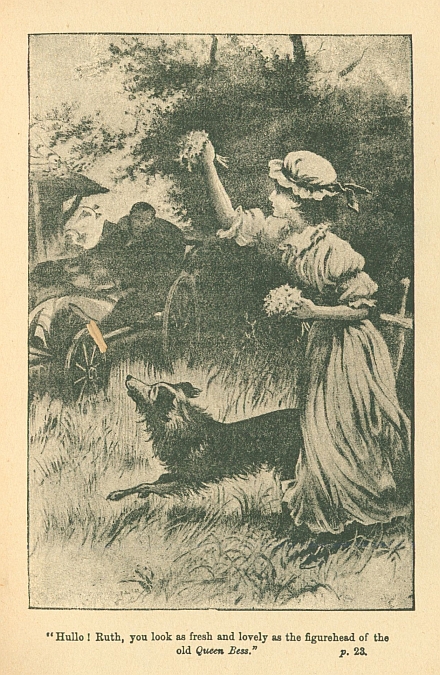
"Hullo! Ruth, you look as fresh and lovely as the figurehead of the old Queen Bess."
"All for you, Uncle Bob. Look at the buttercups
and the ox-lips, and oh, uncle, just smell those red
ragged Robins. See I've tied the posie with grass, and
I'll lay them on your breast so you can scent them."
She patted her uncle's brow, and added, "I've
wetted both my feet trying to get a yellow iris, so
I shall run and change my stockings, and get supper
ready 'gainst father and Tom comes home. Ta, ta,
uncle. Meg will stop here, so you won't feel lonely."
Ruth was a fresh-complexion, pretty girl of sweet
thirteen, with shy dark eyes, blithesome face and a
lithesome figure. Mr. Curtiss, the curate, had said more
than once, than only to see Ruth going singing about
at her work of a morning made him feel good all day.
Uncle Bob was naturally very fond of his little
niece, but between our two selves, reader, he was fonder
far of Tom; for when the boy was not away at school,
or scouring the woods and hills with Meg, he was the
invalid's constant companion.
"Tom won't be long now, Meg, will he?" said
Uncle Bob when Ruth had disappeared. "Ha! you're
cocking your ears, old lady. D'ye hear young
master?" Meg emitted just one half-hysterical bark
of joy and jumped down.
Her sharp ears had caught the sound of the boy's
footsteps on the road not far off, so away she bounded.
A few minutes after, young Tom himself, red and
dusty with running, his eyes sparkling with joyous
health and excitement, appeared upon the scene.
Instead, however, of coming quietly up behind
Uncle Bob, and kissing his brow—for the lad was
almost girlish in the affection he displayed for the
helpless invalid—Tom stood at the foot of the cot,
a Times newspaper over his head, and shouting—
"Hip, hip, hooray—ay!
"Hip, hip, hooray—ay—ay!"
"Whatever ails you, sonny? Where have you been
to, and what have you got?"
"Why The Times, Uncle Bob. I walked all the way
to the Hall, round by the broad, to borrow it, after my
tutor told me the news. 'Cause why, uncle, 'cause I
knew you'd like to read the news with your own
old-fashioned eyes. Oh! glorious news, I can tell you.
That is what Mr. Curtiss called it. The French are
going to fight again, at least he thinks so. Won't it be
glorious? won't it be fun? After supper Uncle Bob,
after supper—oh, not now. It is too good to be
scamped and hurried over; besides, I'm so hungry.
And, poor uncle, so must you be. But there! I
haven't told you all the news. The most glorious part
of it is to come. I went to the Hall, you know.
Well, I saw Lady Colemore, and she sent the footman
into the garden with me to see I should eat as many
strawberries as I could hold, and to-morrow, little
Bertha Colemore and her maid are going to bring you
a great big, big basketful all to yourself, and I'm to
feed you with them, and not eat one."
Then Tom laughed so merrily, that he was forced to
lie down on the grass and roll, and Meg was by no
means slow to follow his example.
Uncle Bob laughed too, though there wasn't anything
very special to laugh about, but the sight of
happiness in others always pleased Bob.
"Look here, you young rascal," said Uncle Bob at last.
"That's me," cried Tom, springing up.
He stood at attention, after touching his cap.
"Away aloft, young sir, and have a look round the
horizon. Take the glass, sir."
"Ay, ay, sir," said Tom. "Away aloft it is!"
And next moment he was swarming up the rigging
with all the agility of a practised sailor.
Up and up and up, hand over hand, till his head
touches the bottom of the crow's-nest, then he enters
it from below and settles himself to have a good look
round through the glass.
Now in case this last sentence should seem
enigmatical to the reader I must explain. The crow's
nest was a hugely large and strong barrel, that had
been hoisted up into one of the poplar trees, and
firmly secured at a distance of forty feet above board,
that is above the level of the lawn. The tree, which
was a very beautiful one, with one strong trunk which
reached a height of five-and-twenty-feet, then bifurcated
into two that tapered skywards for fully fifty
feet more, grew almost in the water of the little lake,
and strong ratlines or rigging, similar to that on a ship,
led upwards to the nest. Above this nest was a kind
of Jacob's ladder, up which Tom could swarm for
twenty feet higher and seat himself on what he and
Bob called the top-gallant cross-trees.
From near the bottom of the nest hung a stout rope,
and up this Tom could climb when he chose, or come
down by the run.
This out-look or crow's nest was one of the pleasures
of poor Uncle Bob's lonesome life. It was a pleasure
even to look at it when Tom wasn't there, but when
the lad did come home—and his arrival was one of the
chief events of the day with Bob—hardly had he
exchanged greetings with uncle ere the order was,
"Away aloft, lad!" Then standing in the cosy nest, or
seated high up on the cross-trees, Tom would keep the
invalid informed, for half-an-hour at a time, or even a
whole hour sometimes, of all that was going on at sea.
"Now then, lad," shouted Bob, "is the brig still
there?"
"How hard the lot for sailors cast,
That they should roam
For years, to perish thus at last
In sight of home."—DIBDIN.
"Yes, sir; and she has dropped anchor at
the tail of the Gorton Sands."
"Her skipper's mad," cried Bob; "as
mad as a March hare. Why it's coming
on to blow big guns from the south-east,
or soon will be, and if he doesn't trip
it and be off, there won't be a stick of him left together
by moon-set. Don't look at him, Tom, he's no sailor."
"Five yawls, sir, tacking through Hewett's Channel.
Foremost has got into the blue, filled, and is running
north away."
"Thank you, Tom. Fishermen, I suppose."
"There's a three-masted ship, sir, coming straight in
from the east, under all sail. But there isn't above a
capful of wind."
"Did you say a ship, Tom? Now, be careful."
"Yes, sir; I'll look again. Now she's gone about,
and I can see she's a barque."
"Bravo, Tom! But mind you this, lad, I've seen a
man had down from aloft and receive four dozen at
the grating, for just such a trifling mistake as that."
"Now," continued Tom, "I can just raise the topga'nt
sails of a ship far away north. It is a ship right
enough, sir. Appears to be on the la'board tack, and
standing over for the French coast."
"Fiddlesticks, Tom! She'll be about in half-an-hour."
"Why, sir," cried Tom presently, "four of the fishermen
are crowding all sail to the nor'ard, but the
fifth——"
"Yes, Tom. What's the matter?"
"She's luffed, and hugging the Gortons!"
"See anything strange about her, Tom?"
"Never saw a yawl so deep in the water before. She
can't be going fishing, uncle. I see something else,
sir, now."
"Well, Tom?"
"But what are you whistling for, Uncle Bob?"
"I'm whistling for the wind, lad."
"Oh, you needn't, sir! That—that—strange craft
is bringing it up with her. But I can't quite make her
out. She is long and low, not big; and carries a press
of fore-and-aft sail on two thin masts."
"That isn't a very lucid nor very seaman-like
description, Tom," cried Bob, laughing. "Has she any
top-masts?"
"Ye—es, but——"
"But what?"
"But I can hardly see them. She seems in a hurry,
but doesn't carry topsails. She puzzles me."
"Ah, lad, she's playing a game! She's the d——l
in disguise, Tom."
"Oh, uncle, if Ruth heard you!"
"That's what shore folks call these craft, Tom. Now
the brig must see the strange sail. What are they
doing?"
"Why, they're signalling to the yawl, I think."
At this moment the trees caught the wind. The
cedar rattled its great limbs as if in proud defiance of
any blast that could blow. The pine trees waved their
dark heads like the plumes on a Highlander's bonnet.
The elm trees rustled, then roared, and the tapering
poplars bent like fishing-rods before the force of the
breeze.
Uncle Bob laughed aloud.
"Hold firm there, lad," he shouted. His long illness
had not weakened his voice. "Don't get emptied out.
I knew that I could bring the wind by whistling."
"It is only a squall, I suppose, Uncle Bob?"
"That's all; but there's another to follow, and one
or two more to follow that. Then it'll settle down for
a dirty night and blow a sneezer. Look at the blackhead
gulls going shrieking round your head, Tom."
"But now, lad, tell me what's doing at sea. How
does the sea itself look, Tom?"
"Waves all flecked with froth, sir."
"With foam, Tom."
"Yes, foam I mean."
"Well, Tom, say so, else I'll have you down, sir, and
introduce you to the gunner's daughter. Liken the
waves to white-maned horses if you please, but not to
quarts o' beer with good heads on them."
Tom was very busy up in the nest for the next few
minutes. There was some little difficulty in holding
the telescope steady, owing to the breeze, and Bob
noticed that first he would direct it east and by south,
then south-east, then east by north.
"Oh, Uncle Bob," cried Tom at last, talking excitedly,
"I do wish you could come up here for a few
minutes."
"Ah! lad, I wish I could. I'd give my left eye for
that pleasure."
"Oh, I'm so sorry! I forgot you couldn't walk."
"Never mind. What's doing, my boy?"
"Why, sir, they've all gone mad."
"The brig was mad before, else she wouldn't have got
so close to the Gorton bank. What is she doing now?"
"Shaking loose her sails. And she's getting up
anchor to be off."
"And the yawl, the deep one, uncle, has put right
about, and is driving north after the fishermen. Wind's
gone two points more to the south'ard now."
"I notice that, lad. It's only the play o' the squall.
What about the d——l in disguise, Tom?"
"She's mad too. Instead of taking in sail she has
hoisted her topsails, and she's heeling over till she
looks like a paper kite, or a kite's wake."
"How's her head?"
"She's close hauled, sir, and bearing down towards
the brig."
"And the brig?"
"Just ready, sir. Going off on the sta'board tack."
"Close work, won't it be, Tom?"
"At least, I think she is——. Oh-h-h, uncle!"
"What is it, Tom? Speak, boy; tell me, quick."
"Why, she has——yes, Uncle Bob, she has missed
stays, and is driving on to the Corton sands. Oh, it's
awful, awful!"
A pause of some minutes.
"Now she has struck. Down go the masts, and the
seas are leaping over her like wild hyenas."
"Heaven help the poor ship," said Uncle Bob.
"What a lubber of a skipper. I told him, Tom—I
told him—at least, I told you. I don't know
exactly what I'm saying, Tom. But what's the yawl
doing?"
"Carrying on, sir, heading right away north. But
it's getting so dark, what with the rising clouds and
the dusk, that——."
"You're sure, Tom, the yawl is cracking on?"
"Sure, sir."
"The dastard, not to help her consort."
Tom looked down from aloft.
"The wind caught the last word, Uncle Bob," he
shouted. "I didn't."
"I said 'consort,' Tom," cried Bob. "You don't
understand the drama that's being enacted before your
eyes. Tom, it's a tragedy now. That brig is or was
a smuggler. They're not so likely to suspect lubberly
brigs of playing that game. The yawl was coming
down with a cargo to her. See, Tom. And the d——l
in disguise is a government sloop."
"I understand now. But, sir, I can just see that a
boat has been lowered from her, and is making straight
for the wreck with a bit of sail set."
"Bravo! bravo! I hope they'll save the men. The
skipper deserves to be choked in the Gorton sands.
Now, lad, come below. Here is Ruth, just heaving in
sight at the other side of the bridge. Ah! Ruth, lass,
there is terrible news. The brig we talked about in
the morning has gone on shore on the tail of the
Gorton bank. Heaven help them, little sweetheart;
but I fear by this time it is a sad case."
Ruth put the end of her apron up to her eyes as if
to shut out the terrible vision of breaking spars and
timbers, rolling surf, and waves more than houses high.
"Come, Ruth," said Tom, touching the girl on the
shoulder, "let us wheel Uncle Bob home over the
bridge. There is no time to lose."
"Why what does the boy mean?" said Uncle Bob.
"Wait, uncle, till you're in the house, and I'll tell
you. Come, Ruth, you pull and I'll shove. Heave-o-ee.
There she goes. A little more to sta'board,
Ruth. That's it. Now then, steady as you go; a
long pull and a strong pull. Ruth, you're a beauty.
What a capital sailor's wife you'll make!"
Talking thus, with Bob smiling in spite of himself,
in spite of the tragedy he knew was at that moment
being enacted on the Gorton sands, Tom and Ruth
speedily wheeled the invalid's cot towards and right
into his own wing of the cottage.
If ever a helpless man had a kind and thoughtful
brother that man was Uncle Bob. The whole aim and
object of Daniel Brundell's life, indeed, seemed to be
to make the lad—as he often called Bob—happy and
snug; and in this good work he had a most faithful
helpmeet in his wife. As regards inventing invalids'
comforts, I do believe that such a man as Dan would
in our days make his fortune. Let us follow the cot
on wheels for instance. Not into the house by the
main doorway was it taken, for it could not have been
turned, but into what was called 'Uncle's wing,' the
door of which, although surrounded by a rustic
jasmine-covered porch, opened straight into the room.
Once inside, the cot was wheeled broadside on to a
small bed of the same height, a block and tackle were
attached to the upper or hammock portion of Bob's
cot, both at the head and at the feet, Ruth hoisted
one end and Mrs. Brundell the other, and lo! in ten
seconds uncle was raised and swung easily and
carefully on to his bed.
Then the cot was wheeled out to a dry shed till it
should again be required; the invalid's head and
shoulders were raised, and he was snug and happy
for the evening. As a rule Tom fed the poor fellow,
but to-night the lad had something else on his mind.
"I'm going to drink a pint of milk," he said, "and
put some bread and cheese in my pocket to eat by the
way, then run all the road to Lunton Cave, and get
Ashley's yawl under way to go round Gorton. They'll
meet the navy boat, won't they, uncle?"
"Why, boy," said Bob, "as soon as the navy boat
saves whom she can off the brig she'll stand off for
the sloop, and be picked up."
"That she won't, uncle. I saw what you didn't."
"Well, boy?"
"Just before I came down I had another look, and
could see that the Government craft had filled sail,
and was standing right away north in pursuit of the
yawl. So, of course, her boat will run in shore and
try to land at Gorton, or head away for the north pier
at Gorleston. Am I right, uncle?"
"Why, lad, I'm proud o' you! My own bringing
up too. Right? Yes; an admiral of the fleet
couldn't be righter. Well, God speed you, Tom.
Strikes me, though, that the disguised sloop has all
her work cut out if she means to overhaul that yawl.
They'll slip their cargo over the bows without being
seen, and the lighter she is the faster she'll fly.
Besides in the dark and storm——"
"Not so dark, though, uncle. There's a big round
moon peeping up already. But, good-bye, uncle,
mother, and Ruth—I'm off."
And away he went, and certainly very little grass
grew under his feet ere he reached the fisherman's
cave.
Ashley was there himself, and his two sons also,
and Davies, a Welsh fisherman, who lived at the cave.
The yawl too was all ready in a little artificial harbour
the men had dug close to the cave in which they
lived.
Tom soon told his story, and the men were in no
way loth to try their luck at piloting, as they
phrased it.
"But," said Ashley, "it'll be a dirty night, and we'll
have to work every inch o' the way to windward.
Never mind, boys, it's to save precious life!"
"Yes, yes," said Davies, "and doubtless we will have
the king's money too, into the bargain, Mr. Ashley."
Old Ashley looked at the man and laughed.
"Take care," he said, "you don't have to take the
king's money in a way you'd little relish, now you've
married a nice young wife."
Ashley's sons laughed, and the Welshman was silent.
The owner of the yawl went up the steps to the door
of the cave, which by-the-way had once been a
smuggler's den, but was now a comfortably-furnished
house, high above the sea-level, except during very
high tides.
"You're surely not going fishing to-night!" cried
Mrs. Ashley, a tall, lanky woman, as brown as a gipsy.
"What if I were, good wife?" answered the old
man gruffly. "Haven't I been out on many a dirtier?
See to it that you have plenty of hot water, and some
supper. We're expecting company."
"Maggie," he added, addressing a young and pretty
woman, "you help mother. There's been a wreck on
the Gorton, and we're going to bear a hand in saving
life."
"All right, daddy," said Mrs. Davies.
He beckoned to her, and she followed him out.
"Is the brick cave safe?" he asked.
"Yes, daddy," she answered, surprise and alarm
depicted on her face. "But——are they friends?"
"No, not quite. Revenue."
Maggie nodded and smiled, and went indoors.
In a few minutes more the sail—all that could be
carried—was hoisted, and the yawl rushing out into
the mist and darkness of a squall, the spray dashing
inward over the bows, while the cutwater, rising and
falling, struck angrily at each advancing wave.
The Fairy yawl was a handy little craft, and, sub
rosâ, had been found handy in many ways as well
as in fishing. The Ashleys used to boast openly in
Yarmouth harbour, that in the Fairy they could go
anywhere and do anything, high water or low, blow or
fine. And everybody admitted that the Fairy's crew
were just as daring as they looked.
It really wasn't all for the sake of gain, however,
that the Fairy was now braving the dangers of this
ugly night, nor had Ashley anything at all to do with
the brig that had gone on shore. The old man really
had a good heart of his own, and he could not have
borne the thoughts of men drowning or clinging to the
hull of a wreck without his doing his best to save them.
"I don't think you should have come, boy," he said
kindly to Tom. "Here, get inside this spare oilskin, or
bury yourself in the cuddy."
"Thank you, Mr. Ashley," said Tom, putting on the
oilskin and an old sou'wester, "but I like to look about
me."
The sky soon cleared, and the moon was now well
above the horizon, and as they bore away on the
sta'board tack everything around seemed as bright as
day. Indeed to Tom the cliffs on the shore they were
soon approaching looked most dangerously near.
But to old Ashley at the helm all was plain sailing.
He could read the sea around here, and the wild sand
banks, and rock or cliff and cloud, as one reads a book.
"Be good, be honest, serve a friend,
Are maxims well enough;
Who swabs his brows at other's woe
That tar's for me your sort;
His vessel right ahead shall go
To find a joyful port."—DIBDIN.
No yacht ever sailed more closely to the
wind than did the Fairy. She needed
all her powers to-night however to beat
to windward, and indeed there must
have been times, while the squalls were
at their worst, when she was hardly holding her own.
Old Ashley, with his bronzed and wrinkled face, was
the very image of an ancient mariner. His wet oilskin
and sou'-wester glittered yellow in the moonlight,
his wet face glimmered red, his eyes positively shone
at times, despite the fact that they were almost hidden
by his bunchy eyebrows. Many and many a gale of
wind the old man had stared into, his eyes seemed
formed indeed to face the tempest and the spray from
dashing waves.
As he lay there snugly curled up in his oilskins, the
boy, young though he was—but little over ten—could
not help admiring the old man's coolness and courage,
nor the way he steered.
His sons, and Davies too, sat grimly staring ahead
and watching the sea, but ready to spring to sheet or
tackle at the first word of command.
They had been out nearly an hour and a half, and
in that time had hardly made two miles of southing.
Hardly anyone had spoken all this time, certainly
there had been no attempt at conversation, but now
just as the moon escaped from behind a great grey
snowy-edged cloud, Davies half rose, and pointing
ahead and to windward shouted:
"I was see her! I was see the boat! Look you
quick, Mr. Ashley!"
Luckily the wind had gone down between the
squalls, when they drove near the boat, a voice from
which came loudly calling for assistance. It was
answered by Ashley himself.
The sloop's boat had her mast carried away; she
was swamped, and, loaded as she was, would soon have
gone down.
Ashley passed her with a cheering word or two,
put his yawl prettily round, lowered his mainsail,
and driving down under his jibs ashiver, and little
after sail, laid the boat aboard in the neatest way
imaginable.
With some further skilful management everybody
was got on board, with the exception of two left to
bale, and the boat was taken in tow.
It was a lieutenant of the Royal Navy who came
on board with his men and prisoners—five only had
been saved off the brig—about a third of her crew.
The officer was in undress uniform, but armed with
sword and pistols, and he was proceeding to thank old
Ashley, when that ancient mariner gruffly told him
to "flop down out o' the way, else how could he
steer."
The lieutenant said no more. But presently the
yawl drew in near the shore, for she had been positively
flying before the wind.
"Stand by," roared Ashley, "to lower away."
So quickly did the Fairy come round, that the proud
lieutenant found himself down to leeward with his
sword between his feet, and his cap in the sea. Next
minute the yawl was in harbour.
"'Scuse me," said Ashley, "if I talked a bit rough.
We aren't much used to king's officers here away.
What, lost your cap? Here, take mine."
The ancient mariner pulled his own sou'-wester off
as he spoke and clapped it unceremoniously on the
lieutenant's head, almost extinguishing him. But the
officer laughed right merrily, again thanked Ashley,
and then gave orders to his men to form a guard
round the prisoners, who had already begun to cast
sheep's eyes towards the cliffs, as if they'd like to
be off.
"Come, sir," said old Ashley, "follow me up the
steps, and all your merry men. What's your name,
captain?"
"Merryweather, at your service, my good fellow."
They had just entered the lower and outer cave, a
large room with a rough deal table and wooden benches,
but well lighted with whale-oil lamps. Old Ashley
turned to his guest, and laughingly edged the brim of
the sou'-wester off his brow, exposing the whole features
of a sun-bronzed but pleasant face, slightly disfigured,
or, let us say, rendered all the more interesting, by a
white scar there over brow and cheek.
"Did you say Merryweather? Well, 'scuse me, but
durn me if ye look the least little bit like a
merry-weather sailor. Got that cut across your figure-head
by fallin' on a foot-stool in church, eh?"
And Ashley laughed at his own joke till the cave
rang again.
Meanwhile the sailors and their prisoners crowded
in sans ceremonie.
"Sit down there, lads," said Ashley; "you'll all have
bite and sup before long. Captain Merryweather, this
way, sir, please."
Up another staircase, through a short passage and
into another cave, far better furnished and more
brilliantly lighted than the last. Here, May though
the month was, a fire of peats and wood burned on a
low hearth, and Ashley pointed to a chair near it and
bade his guest sit down.
A table stood near, and presently Mrs. Davies
bustled in and laid the supper, the captain rising and
bowing to her most gallantly. A huge dish of
potatoes boiled in their skins, and a great joint of
beef, the steam from which went curling to the cave's
roof.
Ashley went to the door, and shouted down to the
under cave. "Below there, sons! see that those poor
fellows have plenty o' bread and fish and beer. Tom
Brundell, what are you doin' down there? Come up
here, quick."
Tom entered shyly, and threw down his hat.
"There, captain," cried Ashley, "that's the chap you
have to thank for savin' your life."
Tom turned as red as a beet at first, but in five
minutes he was perfectly at ease, and thought this
officer was by far and away the most pleasant
gentleman he had ever met in his life.
But it really was love at first sight with both of
them, and Merryweather was soon laughing right
heartily at Tom's description of the poplar tree rigged
like a ship's mast, and the crow's-nest and cross-trees
and all the rest of it.
"And whose idea was it, my boy?"
"Poor Uncle Bob's, sir. At least, he isn't my uncle,
sir, but he brought me home with father from Jamaica,
where I was born. Father was drowned, you know,
sir—at least not quite drowned, because he lived some
time after—and Uncle Bob's brother Dan, my daddy,
you know, reared me. He and old mother, who isn't
mother exactly——"
"Stop, stop, boy! Why I am getting mixed, or you
are getting mixed, or—— Oh, I know how it is!
Mr. Ashley, that rum of yours, that you say has never paid
duty, has gone to my noddle. Now, Tom, my brave
lad, will you begin again?"
Ashley laughed right pleasantly now.
"Why," he said, "that little birkie has a story to
tell, or there's a story to tell about him. It's too
long though; besides, here is Mrs. Davies and my old
woman waiting."
"I beg a thousand pardons," said Merryweather,
jumping up and drawing a chair towards the table.
"What a pleasant home you have, Mrs. Ashley!"
"Handy enough at times," said the old lady.
Mrs. Davies trod on her toes under the table.
"Mother means," said old Ashley, "that it is a good
habitation in fine weather; but when the sea takes
charge o' the downstairs, and sobs and sighs against
the door here, why it ain't quite so cheery. Now
heave round with the beef. The 'taties grew over your
head on the cliff-top, and, as I said afore, the rum
never paid duty. Fine thing to tell a king's officer.
Ha! ha!"
"Now Tom, birkie, fill the captain's glass."
But though this story dates back to the old drinking
days, Merryweather was a very abstemious officer. He
was very much pleased, however, with his strange
surroundings, and after supper sat long in the easy chair,
smoking and listening to stories of the time when this
had really been a smuggler's cave.
"But now," said Merryweather at last, "I must
go to my boat and try to snatch a few hours' sleep.
The little Porcupine may be back to-morrow, and
then——"
"Back to-morrow, eh?" said old Ashley, laughing.
"No, sir, not if she means crackin' on after the Dorothy
yawl."
"Yes, and my mate'll have her too," said the lieutenant.
"Oh, sir!" said Tom, blushing at his own boldness,
"do come home with me. Father and mother have a
nice little spare room, and——"
"Why, Tom, you said your father was drowned?
But come, my lad, I'll go with you, if it isn't
too far."
"Only about a mile, sir, and I'll be up and down to
the crow's nest all the morning, and will see the
Porcupine ten miles away."
"I'll go, lad."
In another minute the ancient mariner had conducted
his guest by a private staircase to the breezy
cliff-top. Merryweather shook hands, and off went
Tom and he together.
When they reached home, Meg came joyfully barking
to meet them, and there was the wagon in the
yard, and Tom could hear the mare stumping her
lame foot in the stable; so he knew that daddy had
come.
There was a light in Uncle Bob's window, and it
occurred to the boy that he might as well take
Lieutenant Merryweather in here first. So he began
to sing, which was the invariable signal to Uncle Bob
that announced his arrival.
Tom opened the door a little way and peeped
in. "May I come in, Uncle Bob, and bring—a
friend?"
"Come in, you young rascal. Wager two-pence
you've got one o' the crew o' the d——l in disguise
with you."
So in walked Tom.
And in marched the officer.
But certainly the boy was not prepared for what
followed. Uncle Bob had turned his eyes towards the
door, but they positively seemed to grow as large and
round as saucers when they alighted on the sun-browned
features of Lieutenant Merryweather. Nor
did the latter appear one whit less surprised than Uncle
Bob. But he recovered himself sooner.
"What!" he cried, "can it be possible? My old
shipmate, Bob Brundell, that sailed with me for years
in the old Turtle, and was in my own watch? Wonders
will never cease. Why I heard you were drowned ever
so long ago. Wonders never do cease; but tip us your
nipper, for auld lang syne."
Then Uncle Bob's face fell, and tears sprung to his
eyes, aye, and trickled over his face.
"Ah! sir," he said mournfully, "poor Bob is on his
beam ends, and couldn't move a toe if the ship was on
fire."
"Oh, this is inexpressibly sad," said Merryweather.
patting his old shipmate's cheek. "But there is hope,
isn't there? Ah! here comes your elder brother. I
knew him at once from you, Bob. How d' ye do, sir?
Glad to make the acquaintance of my old friend's
brother. How glad I am to see you both!"
"Tom," cried Uncle Bob, "bring my pipe and light
it for me. Sit you down, mate. Well, you were mate
you know in the dear old days, though now you're
lieutenant. Sit down, brother Dan. Thank you, Tom.
I do believe the young rascal'll soon learn to smoke
just with lighting my pipe. What's the time,
youngster?"
"Just gone one bell in the middle watch," said
Tom seriously, after consulting an old silver turnip
that he pulled with an air of manliness out of his
fob.
"Going to be a sailor, my boy?" said the lieutenant,
putting his hand on Tom's head.
Uncle Bob answered for him.
"Why, old shipmate," he said, "he's almost a sailor
already. And he was born in the service."
"Oh, by the way," cried Merryweather, "I must hear
the lad's story. It's mixed up with yours I know,
Bob. One bell in the middle watch is no time at all,
so heave round with your yarn."
"I'll heave round," said Bob; "but brother Dan's
mixed up in it too, so he'll have to put a hand to the
wheel as well. Light your pipe, Dan. Ah! if you
only knew what a dear old brother Dan is to me,
Mr. Merryweather——."
"Hush, hush," cried Dan.
But Merryweather stretched out his white, soft
hand, and squeezed the rough, red fist that Dan put in
it. "I can see it all," he said. "I can see it all. Now,
Bob, it is you to begin the story."
"If to engage they give the word,
To quarters all repair;
While splintered masts go by the board,
And shots sing through the air."—DIBDIN.
"Mr. Merryweather," Uncle Bob
began, "it's many years since the old
Turtle was re-commissioned out at
Bermuda, and you and I parted."
"That it is, Bob. Ten, if a dog-watch."
"And you stopped in the tub, as we used to call her,
and I went out to join the Billy Ruffian at Jamaica.
Now, mate—for mate I will call you, though you're a
bold lieutenant now—take a hold o' young Tom there,
and turn him round to the light. Focus the little chap
right, and see if he doesn't put you in mind o' someone
you know."
Lieutenant Merryweather did as he was told.
"Why not Miss Raymond, surely? Yet indeed he
does. The dark eyes, the small mouth and nose, and
all complete. Come, Bob, I shall listen with more
marked attention to this yarn of yours, now."
"Well, first and foremost, it must be pipe down
hammocks as far as young Tom is concerned," Bob
began.
"I'll turn in at once, Uncle Bob," said Tom.
So he bade good-night to all hands and trotted off.
"Did you say ten years, mate, since you and I
parted? Why it's going on for a round dozen. Let
me see, I'm two-and-thirty, and you can't want a
deal of thirty."
"Worse luck, Bob, and only lieutenant yet. Should
have been promoted long ago. Don't think me on
the swagger, Bob, if I say that my services have been
meritorious enough since I saw the last of you. But
I've seen youngster after youngster promoted over my
head. More interest, Bob; more interest!"
"Well, Mr. Merryweather, you were a jolly young
waterman anyhow when I left you in Bermuda. And
it was about this very Miss Raymond you fought the
duel on the very morning after the ball—aye, and
winged your soldier too."
"So it was, Bob, and I remember how sleepy I was.
But I resolved not to take life; so instead of firing at
the major, I took aim at a bunch of bananas that hung
on a tree some yards to his right."
"Yes," said Bob, laughing, "and that was why you
hit the major. If you'd aimed at the major you'd
have hit the bananas. Plucky little fellow, though, he
was, for even when the surgeon was probing his arm
with his pipe-cleaner he apologised to you most
handsomely. Think I see him yet, reclining in his second's
arms on the grass, and you standing forenenst him,
stem on, and taking all the honour and glory of that
shot. 'Sir! It was a pretty shot,' cried the major,
'and I owe you my life. A man who could rip
open his opponent's pistol arm so neatly as that could
have put his bullet through the bridge of his nose and
spoiled his beauty for life. Excuse my left hand, sir,
but I want to grasp the fist of a brave and generous
gentleman.'
"'I don't believe in taking life, major,' you drawled
out, 'when it can be avoided, and so——'
"'And so you wing your men. Bravo! I shall
remember that, and sir, you must dine with me as
soon's I'm out of the doctor's hands.'"
"Did you dine with him, Mr. Merryweather?"
"I did, Bob, and he proved a brick; but then the
bone of contention, pretty Miss Raymond, had
disappeared. I' faith, Bob, I did fall in love with that
girl, head over heels, and if she'd asked me to cut the
buttons off my coat, and pitch them at the admiral's
head, I'd have done it. But heave round, Bob."
"Well, mate, Miss Raymond came to Jamaica with
her father the colonel. There were some disturbances
in the bush, and Commander Bure was sent on shore
with a party of bluejackets to support the soldiers.
Why these Joeys were behaving about as silly as silly
could be, marching through the country with drums
and pipes, to attack an enemy that killed them right
and left from behind the scrub and the bush, but never
showed a head. We altered all that, we took the enemy
in the rear, we never piped, and we never drummed, but
we killed 'em by the score, and the prisoners we hung
like herrings on the trees. It was wild work, but it
had to be done."
"Well, mate, Bure, our good commander, was a very
active gentleman, he would push on, and he would show
himself at times when he didn't ought to; so he got
downed, ay, and would have been scuppered too, if I
and my mates hadn't rushed in and drove the butchers
off."
"Where did you drive them to, Bob?"
"Made flies' meat o' them, sir. But the commander
swore I'd saved his life, and he would make me his
servant, and have me always about him on shore or
afloat; and when he got engaged to Miss Raymond,
why, mate, it was me that carried all the billy-doos
back and fore, you know. Sometimes I'd be ashore
and off again twice in every watch. Well,
Mr. Merryweather, what with all the billing and cooing
and billy-doo-ing the commander and she got spliced
at last. Ah! that was a spree, I can tell you. And a
sweet bonnie bride the charming lady looked!"
"Hush, hush, Bob; you're opening old sores."
"Well, mate, the commander was nearly always on
shore after this, and our old captain—O'Hare was his
name—told Bure one day straight to his face that
marriage made muffs of men, and spoiled 'em for the
service."
"It was pretty nearly ten months after my good
commander's marriage that we hove up anchor and
went off east to look out for some flighty Frenchees,
that were playin' fast and loose with our merchant
ships that scorned to go in convoys. I never saw
anything in my life, mate, so affecting-like as the
parting atween the commander and his young wife—she
in tears and clinging to him, and he——, well, it
doesn't do to say that a sailor pipes his eyes, but
la! sir, I was glad when it was all over and our boat was
speedin' away towards the ship.
"For six mortal months we kept our weather eyes
open looking for the Frenchee's cruisers, and then we
came up with two. And—why they must between the
pair of them have carried twice our number of guns.
"We crowded all sail, mate, put her dead afore the
wind, and the race began. We were running away
though, and however the Frenchees didn't see through
the caper is more than I can tell. In less than half
an hour there was three-quarters of a mile betwixt the
foremost Frenchee and her consort. So we got ready
for action without making any extra fuss about it.
Then we wore ship, and the captain of that foremost
frigate must have begun to scratch his head. Seems
to me, Mr. Merryweather, he knew just as much
about navy tactics as a cow does about chess.
Presently she put about though, with signals flying
to her consort—signals of distress we called them.
When near enough we sent a round shot or two
roaring through her rigging, but if the Frenchee
thought our game was to be a stand-off fight he was
miserably mistaken. Under one pretence or another,
and always firing another shot or two, we got far
enough to windward to bear down on her with a
beam wind. Why we were near enough to shave her
stern almost when we raked her. I think her wheel
and steersman must have been blown up to the moon.
Down went her mast, and before the confusion was
over we had tacked and filled, and come up on her
port quarter. Our master laid the Ruffian aboard
as prettily as you please, and next minute we were
on the Frenchman's decks.
"It was hammer and tongs for a good five minutes,
then, on a blood-stained battle-deck, a smiling and
bowing French officer gave up his sword to our bold
Commander Bure.
"O'Hare complimented him when he returned on
board. 'Marriage,' he said, 'may make muffs of some
men, but it hasn't taken the heart of oak out of you,
Bure.'
"I must make a long story short, Mr. Merryweather,
for it's two bells if it's a tick. Almost the first man
to board us when we got back to Kingston harbour
was Colonel Raymond himself. I knew the moment
I saw him that poor Mary, as my commander called
her, was dead. But I'll never forget the state of utter
collapse—the doctor called it that—I found Bure in
when I entered his cabin.
"'Oh, Bob, Bob,' he cried, 'My poor Mary! my poor
Mary!'
"He was weeping like a school-girl, the self-same
hero that had received the French commander's
blood-stained sword.
"For months Bure never laughed or smiled. His
chief pleasure and delight was to go on shore and play
with or talk to his baby boy.
"Well, mate, we stuck together all the commission,
and did a bit o' fighting too whenever we had the
chance. To tell you the truth, after poor Mrs. Bure had
been dead about two years, there were only just two
situations in which you might have said the
commander was happy—one was when little Tom was
brought on board by his nurse, and the other when
Bure had a sword in his hand, and was boarding a
frog-eating Frenchee.
"But it was in a boat action that my dear commander
received a shot that, for the time being, seemed to have
clean knocked the life out of him, and—I do think
even now—was the beginning of the end. He lay in
hospital on shore for a long time, three months I think,
and it wasn't till the end of that time that the
doctors found the bullet. The beggarly thing had
entered his shoulder in front, and instead o' lodging
there as a respectable bullet ought, it must go on a
cruise on its own hook, and was finally fished out of
the poor fellow's side.
"'Bob,' he said to me one day, sometime after this,
'they are going to send me home with a batch of
invalids in convoy. I'm not sorry for my little lad's
sake, but, mind you, I don't think I'm going to
weather this illness.'
"I tried to laugh away his fears, but he stopped me.
"'Belay that, Bob!' he said, or words to that effect,
'and listen. I like you, Bob, because you're a good,
faithful fellow.'
"I felt ashamed like when he told me that, and
maybe he noticed it, for he spoke up.
"'Oh, yes, you have been faithful to me, Bob, and you
love my little chap Tom. Well, Bob, I'm not saying
that I can't weather this, the doctor says I may; but
just for the present, imagine that you're listening to
the words of a dying man. You're like myself, Bob,
a Norfolk man, and, singularly enough, you come from
the very coast where relations of mine have estates
that might—mind you, Bob, I only say might—eventually
belong to my little fellow. But—are you
listening, Bob?'
"'That I am, heartily, sir,' I replied.
"'Well, Bob, my cousin, who owned these estates, is
dead, only a month ago. He leaves behind him a son
some years older than Tom, and a baby daughter.
Now this baby daughter doesn't count, the son is the
owner, and the mother, who loves me, Bob, about as a
much as a Frenchman loves red-hot shot, holds the
estates in his behalf. I hear the lad is sickly, and if
anything happened to him I'd come in, if alive, and
if dead, my little Tom. If there was no little Tom,
Bob, the estates would pass to her ladyship's male
relations, second cousins of mine and hers, for there
has been marrying and inter-marrying, Bob.'
"'Well, sir?'
"'Well, Bob, you see that box?'
"'Yes, sir.'
"'Look to that, Bob, if I should die. Take it with
you to your brother's house when you go there. If
your brother is half as good as you, Bob——'
"'He's twice as good, sir,' I cried.
"'You and he will take it to my Yarmouth bankers,
and they will keep it safe for Tom.'
"He held out his hand—a thin white one it was—and
I gave him mine with a heave O! and a hearty
O! and the compact was made.
"'About little Tom, here,' he said after a pause.
'I don't want him to be a sailor you know, but if he
wants to be—why he must be.'
"'And his friends and relations, sir?' I made bold
to ask.
"The commander laughed bitterly.
"'Friends, he has none,' he replied, 'except his
father, you Bob, and perhaps your brother.'
"'Well, sir,' I said, 'I hope it won't come to that.'
"'Hush! Bob, hush!' he said, 'It is our duty in
this world to be always prepared for the unseen.'
"Well, Mr. Merryweather, I thought my poor
commander was much better after this. So indeed
he told me. 'I've relieved my mind, Bob,' he said,
'and the doctors have relieved my body.'"
"After this he would chat with me for an hour at a
time, about the quiet and happy life he meant to lead
on shore with his little son. How they would shoot
and fish on the broads throughout all the long summer
days, and how they'd live in a pretty little cottage in
the land o' poppies, all surrounded by gardens and
shrubberies, and how he himself would attend to the
boy's education, and try to make a man of him, fit to
take his place in the battle of life, whether that battle
was to be fought on shore or on the deep blue sea.
"Our voyage home in convoy was a long but not very
eventful one. It was long because the fleet o'
merchantmen guarded by the convoys was a very big one, and
some kept dropping behind, or getting lost, and as
there was always, or nearly always, a Frenchman or
two hovering like hawks about us, we had to be cautious
I can tell you.
"But long before we reached the Downs little Tom
had received his baptism o' the briny, there wasn't a
doubt about it. He was the pet of the ship, he was
dressed like a little tar, and looked it all over. I only
wonder he never tumbled overboard, for I've seen the
young nipper half-way up to the maintop, and nobody
near him.
"One day he told his father on the quarter-deck
that he was going to be 'a sailor man, and nuffin else,
and fight the Flenchman for his king and country O!'
"I daresay some of the blue-jackets had piped this
into him, but his father looked about to where I was
standing laughing—I couldn't help it—and said, 'Ah,
Bob, I'm afraid it's born in him.'
"'I'm afraid so too,' I said, and his father kind o'
sighed, but didn't say any more.
"We got into the Downs at last safe and sound, and
lay there wind-bound for a fortnight. But at last we
got just the breeze we were waiting for, and slipped
away past the North Foreland, and in a day or so more
our ship was safe in dock.
"I wrote to brother Dan here, and told him my
master and myself would start for Yarmouth within a
week in the saucy Polly Ann.
"But there, now, Dan will tell you the rest, but just
stick my pipe in my mouth first, Dan.'"
Dan cleared his throat, lit Bob's pipe, and sat down
near his bed to hold it for the poor helpless fellow,
while he himself continued the yarn.
"His form was of the manliest beauty,
His heart was kind and soft;
Faithful below he did his duty,
But now he's gone aloft."—DIBDIN.
"When I heard," said Dan Brundell, "that
there was a brig ashore on the tail of
the Gorton Sands, I had no more notion
that it was Bob's Polly Ann than I
have o' what the weather will be this
day month. I'd been down with some
oars Gorton ways, and I met old Ashley while returning.
"Would I volunteer, he said, to go in the Fairy; one
of his sons was from home, and we might, he said,
pick up a bit o' salvage, as well as flotsom.
"'She's hard and fast now,' he says, 'but is bound
to break up.'
"So I thought too, when I embarked, for it was blowing
56-pounders, and a heavy sea tearing in from the
east. It was the heavy, tearing sea that did it. 'Fore
we had got well abreast o' the Gorton Tail, we could
see in the bright moonlight the dark hull o' the brig,
both masts snapped short off, lifting and falling in the
jaws of the foaming seas like a creature in agony.
"'She can't stand it for half-an-hour," said Ashley;
'and what's more, Dan, we can't get anyw'eres near
her. There'll be widows a-weeping to-morrow mornin',
mate, at old Yarmouth docks.'
"But what we saw next astonished Ashley himself,
though, man and boy, he'd been on the water all his
life. It was a mountain sea coming swelling over the
sands and swallowing everything up before it, and lo! sir,
in a minute more, there was the dark hull of that
brig being borne bodily toward us.'
"What happened after this I can't well describe,
bein' as how I'm slow o' speech like, but in half-an-hour
all the beach for a mile and more, was strewn wi'
wreck, and many a body was washed in on the surf and
left dead, or for dead, on the sands. But lawk! sir, you
could have knocked me down with a sledge-hammer
when, on turning over one of these bodies, I found it
was poor Bob yonder, and no one else."
"He had a small deed-box alongside him, with
a piece o' manilla round it. He had come ashore with
this. I didn't doubt that, even then.
"At first I thought him dead. But he soon opened
his eyes and spoke.
"'Haul me high and dry,' he said, 'high and dry,
dear brother, for I can't move. It isn't drowned I am
at all. It's a stroke, Dan; a stroke."
"This was a sad sort of a meeting 'twixt two
brothers that had always loved each other same as Bob
and me has, and for the life of me I couldn't have
spoken then, no, never a word. I tried to swallow
back my grief and tears, as it were, and lifted the lad
right up in my arms, and carried him away beyond the
reach o' the raging surf, and there I laid him down. I
knelt beside him there in the pale moonlight. I cared
for nothing nor nobody just then, but only Bob. I
noticed though, that his eyes and head were turned
wistful-like towards the boiling sea.
"'Dan,' he said, 'bring the box and put it close by
me. Thanks, dear Dan; you were always good. Now
go at once, Dan, and look for Captain Bure and his
little boy.' It wasn't long either 'fore I found 'em.
The poor little tot of a chap with long, silken hair,
and bonnie black eyes, was weeping and wailing over
his father.
"'Oh, sailor man,' he said to me, 'poor pa! poor
pa! He's deaded! he's deaded!'
"'No, no, my little man,' I answered. 'Your father
isn't dead.' So I hurried away and got the gentlemen
into the cave. Gentle and simple, dead and maimed
and living, they all lay there, with the cold moonbeams
glinting in through the doorway, and struggling like
wi' the yellow rays of the whale oil lamp.
"In two hours' time the doctor had come, and we—the
living ones—began to gain hope and courage.
"The good man did all he could for everybody,
and next day Captain Bure, with his little boy
Tom—yes, Tom that has just gone to turn in—and poor
Bob, were fetched in the boat waggon to our cottage
here. The captain was soon able to get about, but
Bob lay quiet enough, and never yet has he lifted
hand or foot.
"But it wasn't a stroke, the doctor said, not of the
'pplexy, anyhow. 'More likely,' he said, 'it's been a
stroke with a floating spar, and the neck is injured
right smart.'
"Well, sir, it would have done your heart good to
have seen how kind and attentive the captain was to
Bob. 'He's been my nurse many's the time,' he said,
'and now, Mr. Dan, it's my turn.'
"But all the time I could see as plain's I see the
moon shining on the curtains yonder, that the poor
captain himself would soon be under the daisies and
grass."
"One morning, says the gentleman to me smiling-like,
'I'm going to charter your boat-waggon to-day,
Dan, if you'll come with me to Yarmouth, and young
Tom'll stop with Bob till we return.'
"It was a lovely day, sir, with the birds all singing
as if their hearts were swelling with the joy that was
in them, and their feelings had to find vent somewhere
in song, or in lofty flight. So we drove round by the
big hill on the broad.
"I could see the captain meant to make a day of it,
and so I drove slow.
"When I came near the hall and the pretty grounds
and the swaying trees and rookeries and things, he told
me to drive slower still, that he might enjoy every
thing, and all the beauties of nature around him.
But la! sir, I was surprised to see him so white and
pale like. At last he said, 'Drive on now, Dan as fast
ye like.' He was still white and ghastly-like, though,
so I jumped down at a pub and got a tot of rum. I
took a sip myself, more for fashion sake like, and made
him swallow the rest.
"He was better all day after that; but I remember
he laughed once or twice as he told me his feet were so
cold. 'Seems funny,' he said, 'on so fine a day.'
"I didn't answer much. I knew well there wasn't
a deal of fun in it.
"We had that deed-box with us, and we went into
the bank. We left the box there, and had a long talk
with the banker. Leastways, Captain Bure had.
"Then he turned to me, and laughed again.
"'My good Dan,' he said, 'if the cold of my feet gets
higher up and goes round the heart——'
"The tears sprang to my silly eyes, sir.
"'Oh, sir!' I cried, 'don't talk so, it grieves me to
hear it.'
"'There are times,' he said, 'when men must talk
straight. Now, I've known your brother so long, Dan,
and heard so much about you, that I want you to be a
father to little Tom—if——'
"'I know, sir!' I cried. 'Don't repeat it. My wife
and I have neither chick nor child savin' little Ruth.
We'll see to Tom.'
"He clasped my hand.
"'Mr. Mackay,' he said, 'has full instructions, and
enough money of mine to give Tom bite and sup, and a
good education. Come, Dan, and we'll buy some
comforts for poor Bob.'
* * * * *
"I am not sure," continued Dan, after a pause, "if
that isn't all the story."
"Not quite," said Mr. Merryweather. "There is the
death of Captain Bure, you know."
"Ah, sir, we won't speak of that. It happened
soon; and he lies in a quiet corner of the great
churchyard at Yarmouth. Little Tom and I go there one
Sunday every month to put flowers upon the grave."
The honest boat-builder ceased talking and lit his
pipe.
"Dear droll little Tom," he added a moment after,
"he does say such queer things. Maybe other folks
wouldn't notice 'em, but I do. 'It's only pa's body
that lies here, you know, daddy,' he said to me two
Sundays ago, 'his soul has gone up to the clouds to
live, hasn't it?'
"I didn't speak for a minute, I was thinkin' o' the
words of that song, sir—
'For though his body's under hatches,
His soul has gone aloft.'
"The little chap sat down beside the grave and
arranged the flowers, then smoothed all the long
grass out straight as if it had been hair. He took my
hand after that, and we walked quietly and silently
away.
"'Pa,' he said afterwards, 'is only afraid I'll be
drowned if I go to sea. But I think he'll be pleased
when I am a sailor all the same.'
"No, Tom never looks upon his father as really dead,
you know.
"Mr. Curtiss is our curate, and he is Tom's tutor,
though Bob there teaches him a lot, and has pretty
nearly made a sailor of him already. And I'm sure
I cannot blame poor Bob——for——"
Dan paused now, and held up his forefinger warningly,
while his eyes rested on his brother's face. He
took the pipe away and shifted the light, for the
invalid was fast asleep. Then he went silently away
on tip-toe, and Mr. Merryweather followed him, with
just one good-night glance at the sleeping form of his
old shipmate, Bob.
"The coot was swimming in the reedy pond,
Beside the water-hen so soon affrighted;
And in the weedy moat the heron, fond
Of solitude, alighted.
"The moping heron, motionless and stiff,
That on a stone as silently and stilly
Stood, an apparent sentinel, as if
To guard the water lily."—TOM HOOD.
Our little hero, Tom, was early astir next
morning. In fact he was up with the
lark. High up, too; for his first act,
after sluicing his sleepy face in a bucket
of water, and drying off with a rough
brown towel, was to swarm up into the
crow's nest and have a look around.
The morning was bright and clear, and the beach
was swarming with country people; but there was no
sign of the government vessel or of the yawl she had
gone in pursuit of. Not content with scanning the
horizon from the crow's nest, Tom must needs climb up
as high as the cross-trees, and take observations from
that coign of vantage.
The wind had gone down to the gentlest breeze, but
a heavy sea still rolled over the sands, and broke in
white surging waves upon the beach. From where he
stood, or rather hung, Tom could easily hear the boom
or roar of each mountain breaker, keeping up a kind of
deep bass to the screaming of the sea birds that floated
near him.
The sun had only just risen, and was flooding the
ocean with a strange yellow light, while bars of silvery
and crimson clouds lay parallel with the horizon, even
far away to the west.
It was indeed a lovely morning, one to make a
person feel as light and happy as the birds that sang
in every bush or thicket. But nevertheless a wave of
sadness passed over the boy's heart as he thought of
the drowned men who lay so quiet and still upon the
sands out yonder, and of their friends and relations
who were left to mourn.
It somehow seemed to Tom unnatural that so much
of sorrow should mingle with the gladsomeness of this
sunny summer's day. He had yet to learn that all the
world and all our lives are made up of light and shade,
and that even in the midst of life we are in death.
But as he walked homeward now over the rustic
bridge, he checked the song that rose to his lips. He
would not sing, with dead men lying unburied on the
sands of Yare.
* * * * *
It seemed to Tom that this morning would take a long,
long time to pass by. He got his books, and went with
Meg to the little summer-house by the lake, and tried
hard to settle down to the tasks Mr. Curtiss, his kindly
tutor, had set him to perform. But all in vain; so he
left the books on the garden seat, putting a stone over
them lest a spiteful puff of wind might blow the
leaves about. Then "Come on, Meg," he cried, "we'll
go for a row."
"Wouff—ff," barked Meg, and away they went.
For a boy of his years Tom was wonderfully well
developed, and when he stripped off his jacket and
rolled up his sleeves, the white forearm he showed
seemed as hard and round as the backstay of a gun-brig.
Meg sat forward in the bows of the little boat, with
her forelegs leaning over the gunwale that she might
bark at the fish and the birds, and make brave
pretence that she meant to jump over and catch
them.
By-and-by Tom came to a winding worm of a stream
or lead that he had some difficulty in navigating his
craft through, but he managed at last, and soon found
himself afloat in one of the most beautiful of all the
Norfolk broads.
The lake was a deep one, and not only plentifully
encircled with tall, reedy bulrushes, but in many
places lined with "wild woods thickening green," and
banks whereon grew the most lovely of wild flowers.
Tom paused often that he might inhale the
early-morning perfume of these wildlings of nature, and
watch the movements of the numerous birds that had
their homes on this peaceful broad.
And not a bird is there among them all that seems
very much afraid of the boy in his little boat or of Meg
either. Perhaps the birds know Tom, for wild creatures
are very observant, and know too that neither he nor
that gentle-faced collie will do them any harm. Indeed
Meg has dropped her bonnie head upon her paws, and
appears to have gone fast asleep.
The sky above is very blue, albeit a fleece-white
cloud is floating here and there, and the waters of this
still lake are very dark, yet clear. How richly, softly
green is the foliage on yon cloudland of trees, how
tender the tints of verdure on the rustling, whispering
reeds. Look at the pink on that flowering
rush, to which a reed-warbler is clinging as it sings
its low, sweet lilt. Only for a few moments does it
cling there, however. It is far too busy to spend all
the morning in song, for the pretty thing has a grass
hammock of a nest swung between some reeds close to
the bank. No boy in the neighbourhood knows where
that nest is save Tom, and he won't touch it, but he
marvels while he admires the freak of nature that has
almost surrounded the birdie's hammock with the bells
of the pink convolvulus.
Hark! there is a nightingale trilling its heaven-taught
song in a thicket not many yards away. How
sharp and clear is every note, and yet how pathetic and
mournful are the lower ones! But presently the bird
ceases to sing, for he too has a mate sitting close at the
foot of a bush in a nest so artfully disguised as hardly
to be discerned, and this little mate needs her breakfast
of succulent slugs and beetles.
"Cheeky—cheeky—chee—chee—chee," sings the
sedge bird, who has far too much to say, and instead
of listening reverently to the song of the nightingale,
the thrush, or the blackbird, must needs put his oar
in and throw harmony quite out of joint. But there
are many other birds that do the same, for each and
all sing for their own mates only.
Very quietly now glides Tom's little boat; very still
the boy sits too, fascinated as it would seem by the
beauty of his surroundings, and as if afraid to disturb
the privacy of the lovely feathered creatures whose
home he has invaded.
He almost holds his breath as a pair of dark-plumaged
coots with white brows go quietly sailing past ahead
of him, gazing at him with their expressive beads of
eyes, but ready to start off at the slightest movement
on his part. A little way farther on are a family of
charming water-hens, that go paddling and nodding on
across the deep dark water, so intent on their own
business that hardly do they notice the slowly-gliding
boat.
But Meg lifts her head to look about her and take
her bearings, and off scurry the coots; the water-hens
too take alarm, and in a moment more all have sought
the shelter of the whispering reeds.
More birds take the alarm here and there among
the sedges; and in the water there is plashing and
whirring and diving, while, uttering a sound that is
partly a croak and partly a cry, a great heron, that
had previously been standing as still as a statue on
the edge of a bank, goes sailing away high in air.
Tom lies on his oars now, and in a few minutes
peace and repose is once more restored to the
reed-bound brood.
"Meg," says Tom quietly, "you just go to sleep there
please, or at least pretend to."
Meg shuts one eye and gives one little wag of her
tail, and the boat forges slowly ahead. Tom pulls
more in towards the edge now, where the flat round
leaves of the water lilies are floating, with flowers
snow-white or brilliant yellow just appearing, where
the flowering ash blooms prettily, and the orange iris
shows against the fresh green of young reeds.
Though it is very early in the morning, the sun is
gaining power, and busy among the gnats and midges
that dance over the water and over the whispering
reeds, filling the air with their dreamy humming, flit
and fly the swallows and martins. They even touch
the surface at times, long enough to drink or have a
little bath, then off and away again, like chips of
lightning with the sunlight on their wings.
Tom lands at last among soft green moss, among
many a budding alder, many a silvery drooping, dwarf
birch-tree, and many a feathery fern. He warns Meg
that she is not to follow, but only lie and watch, while
he goes wading over the marsh. Oh, what beauty and
loveliness on every side! Oh, what a wealth of wild
flowers! Yonder is a bush of yellow furze, and a
rose-linnet's nest is there. The cosy wee mother sits still
on the eggs even when Tom peeps in under her scented
golden roof-tree, but the cock-bird that erst sang so
sweetly on that bush of sallow changes his notes to
a peevish cry of alarm.
Not a nest of any kind of bird that Tom does not
know where to seek and find; the titlark's and skylark's
near tussocks; the yellow bunting's in the low, close
thorn or bank; the sedge-bird's, with its warm wee eggs
and even nests of snipe, and coot, and teal—all are
known to him, but all are sacred.
The boy spends fully an hour roaming around here;
but, getting very hungry, he begins to retrace his steps
at last, yet not before he has culled a bouquet of the
choicest wild flowers, the flowers that uncle Bob loves
best.
In his way back to the boat Tom goes round by a
patch of woodland, a closely-planted thicket of pines,
the tasselled larch, the dark-nodding fir, and the sombre
spruce, each branch of the latter bedecked with points
of tenderest green. He has to pass a reedy pond,
when, as he stoops to gather some pink silenes, he
startles a wild duck that with outstretched wings goes
whirring over the water; there is a wagtail nodding
to him on the opposite bank. High in the air the
skylark sings, from bushes near come the babbling
notes of sedgelings, and soaring over the marsh he can
just distinguish a mire-snipe, its intermittent cries
sounding like bleating of a goat. He crosses a green
bog that moves and heaves under his footsteps, as if
ocean waves were all beneath. And now he enters
the thicket, and a different kind of bird-song falls on
his listening ear—the mellow notes of the blackbird,
the sweet wild lilt of the chaffinch, the mocking voice
of the mavis, and the low mournful love-croodle of
the cushat.
Tom walks through this woodland as solemnly as
if he were in church. He is almost awed by all the
beauty and loveliness he sees around him, and actually
sighs as he stands once more in the open, with the
waters of the reedy broad spread out before him like
a mirror, and only the blue unfathomable sky above.
He reaches the boat at last.
The boat is there right enough, the painter tied to
the alder bush just as he left it, but Meg has gone.
While he is wondering what could have induced her
to leave her post, he hears her glad bark in the distance,
and next minute she comes bounding over the marsh
towards him.
But not alone, for behind her, laden with a huge
and sadly-disorganised bunch or wisp of wild flowers,
comes a little blue-eyed lassie. So large are her eyes,
so small her rosebud of a mouth, that, with her hair
all afloat behind her as she runs, she might easily be
mistaken for the good fairy of this flowery marsh.
"Oh, Tom," she cries, "I'm so glad you've come'd!"
"But, dear me, Bertha, what are you doing here so
early?"
One of Bertha's legs is clothed in a pure white
woollen stocking, the foot encased in a buckled shoe;
the other leg, which, laughing roguishly, she extends
for Tom's inspection, is clad in black, slimy mud up to
the knee, and the shoe is gone.
"Such fun," she says, panting a little. "You know,
Tom, I'se been nearly dwownded. And I screamed,
and Meg come running; but I'se lost my shoe, and
perhaps ma will punish me—perhaps not, 'cause she
loves Bertha—sometimes."
"But I'm lost," she added, "and where my home is
I don't know."
"Well, Bertha," said Tom, looking very old and
serious, "I love you always, you know. And when I
grow a big rich man, with a cocked-hat and a sword,
I'll perhaps marry you—if you are good, that is."
Bertha shook her yellow hair rebelliously.
"Oh, I can't be always good," she said. "It wouldn't
be fun at all, Tom."
"Well, jump in, Bertha, and Meg and I will take
you right to your own grounds."
Bertha was happy now, and soon began to sing a
little song to herself and Meg.
With the thoughts of the shipwreck on her mind,
somehow the child's singing jarred on the boy's
feelings.
"Bertha," he said, "there was an awful thing
happened last night! A brig was knocked to pieces
on the Gorton Sands, and the dead sailors are all lying
on the beach."
"Well, silly Tom," cried Bertha, laughing, "it isn't
my fault."
Tom didn't know what to reply to this, and Bertha
commenced to sing again.
But the boy and this little light-minded maiden
were very old friends indeed. For Tom was a favourite
with Lady Colmore, and was frequently invited to the
Hall, when her ladyship was there, which she usually
was during the summer and autumn, spending most of
the winter and spring in the south of England, where
her son was at college.
Tom was a gentlemanly boy, and Mr. Curtiss had
informed Lady Colmore that there was some strange
mystery about his birth, which, however, even he was
not altogether acquainted with, though it was in some
way connected with a Jamaica marriage. But this
was quite enough. A boy of manly bearing, and big
dark eyes, evidently of gentle birth, heir, when of
age—as she had heard—to a large fortune, and with a
mystery, was a very interesting character indeed,
despite the additional surmise that his mother might
have been a Creole or half-caste.
Bertha sprang lightly on shore when the boat was
rowed alongside the bank.
"Good-bye, Tom," she cried. "After breakfast me
and Brown'll bring the strawberries to your Uncle
Bob, and then we can all go and see the rows upon
rows of dead men. Such fun! Good-bye."
Next minute Bertha, with her yellow hair and
shoeless foot, had disappeared, and Tom, after a
moment or two of thoughtfulness, made all haste
back home.
In half-an-hour, or a little over, he had once more
moored his boat. Then he hurried away aloft again
to scan the horizon.
Yes, yonder was the sloop—the something naughty
in disguise—she was tacking slowly up to windward,
still about seven or eight miles off, and there was no
yawl near her, so she had not won the race.
This was news to carry to Captain Merryweather,
anyhow.
He found that bluff, good-natured sailor walking
about on the gravel path smoking, early though it
still was.
"Oh," said Tom, saluting him military fashion, "I'm
so sorry to bring you bad news, sir."
"Bad news, youngster? What is it?"
"Well, your sloop, sir—if she be a sloop, sir—is in
sight, and she hasn't caught the yawl!"
"Ah, never mind, Tom! Better luck next."
"Yes, sir," said Tom. "I hadn't thought of that, sir."
Ruth now came blushing and smiling to call the
captain to breakfast, and he gallantly took her hand
and led her back to the cottage.
They breakfasted in Uncle Bob's wing, so that he
might join in the conversation.
And breakfast was not long over when Bertha and
her maid Brown came in with that basket of beautiful
strawberries for Uncle Bob.
"What a charming little lady!" said Merryweather,
who had been looking at Bertha. Like most sailors, he
was fond of children. "Come hither, dear, and talk
to me."
Bertha seemed used to obey, for she came at once,
and stood demurely by his side. This pensiveness of
hers, however, did not last long. She and the captain
were soon the best of friends, and he on his part hardly
knew which to admire most, her beauty or her
candour.
"Do you know," he said laughing, "you are very
pretty, Bertha?"
"Oh, yes!" she answered, her head a little on one
side, "I know well enough, but mamma says people
are not to tell me so."
"Why, dear?"
"Cause it spoils me, of course."
"Ma doesn't spoil me. No! Everybody else spoils
me, though."
Then she noticed the scar on Merryweather's brow,
and touched it tenderly with her little forefinger.
"Have you been fighting with the cat?" she asked
innocently.
"Yes, dear; a big disagreeable old cat."
Seeing her gazing admiringly at the big bunch of
seals that dangled from his fob, he pulled out his gold
watch and placed the whole in her lap.
"Is all this yours?" she asked wonderingly.
"Yes, petite."
"Your own own yours?"
"Yes, my own own."
"And your mamma doesn't take them away, and say,
'By-and-by, dear, when you're grown up'?"
"No, my mamma lets me do as I like."
"How lovely!" She was examining the seals.
"They shall be all yours," said the captain, "all your
own own yours, if you marry me."
"All my own own mine?" Her eyes were bigger
now than ever.
"Yes, dear."
"You see," she said thoughtfully, "I'se goin' to
marry Tom; and you is not so pretty as Tom."
"No, he certainly has the advantage of me in good
looks; but then I have so many nice things that
Tom hasn't, you know."
"Yes, and you spoil me. Tom doesn't."
"I daresay," she added after a pause, "I mustn't
marry both."
"Oh, no! that wouldn't be allowed in this country;
you must decide to have me or Tom."
She looked at Tom, and she looked at the jewels.
"I think," she said at last, "I must marry you, and
poor Tom can marry Brown."
"Hurrah!" cried Merryweather. "What a perfect
little woman it is! Tom, you're jilted. Now, Bertha,
get on my back, and we'll go off out into the sunshine
and spend our honeymoon."
And away they went galloping and rollicking round
the garden paths, and it was evident, from the shouts
of merry laughter, that Bertha thought very little of
her discarded lover.
"Now," she cried at last, "let us all go and see the
lovely dead men, all in rows and rows. Hoor-ay!"
The men saved from the wreck of the
brig on the Gorton sands were dealt
with in a very summary way indeed.
They were Englishmen all, and were
told by Merryweather that if they chose
to "volunteer" into the service of the
King and serve in the Royal Navy, they should receive
a free pardon; but if not, they must stand the consequences.
Four of the smuggler-sailors volunteered at once
and cheerfully. The fifth was the redoubtable skipper
of the brig, a dark-haired, eagle-eyed little fellow,
little as to stature, but of powerful build, and a
Welshman by birth.
"I refuse," he cried, "to serve your King of England.
He is not a man, but a baboon!"
The words were scarcely out of his mouth before
Merryweather struck him straight from the shoulder,
and down he rolled on the sand.
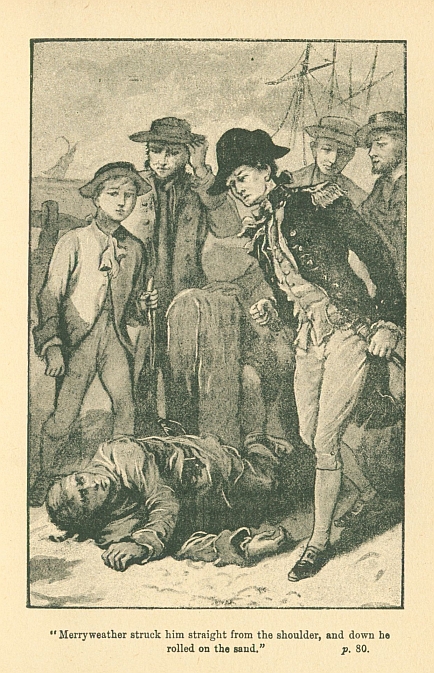
"Merryweather struck him straight from the shoulder, and down he rolled on the sand."
He got up, scowling at the lieutenant, and wiping
the blood and sand from his face.
"Coward!" he hissed, "to treat a prisoner so. But
faugh! it was always the way with the lily-livered
Saxon. See!" he added, "you daren't do it, but for
the gold swab on your shoulder, the sword by your
side, and your hired assassins around you."
Off went Merryweather's coat and his sword. He
flung them to Dan Brundell, who was standing
scratching his head and looking very puzzled.
"These good fellows," he said, "will see fair play
between us. I am no longer lieutenant in the King's
service, but plain Jack Merryweather. Stand forth,
David Jones, and see how soundly a Saxon can thrash
a Welshman."
Jones sprang upon the lieutenant almost before he
had finished the sentence.
"Like mountain cat that guards its young,
Full at the Saxon's throat he sprung."
That Welshman had arms like a gorilla, and
Merryweather was all but strangled before he got
clear away.
"Keep out of grips," shouted his own men. "Fight
fair, skipper, and good luck to you."
He didn't mean to fight fair, however, if he could
help it; but Merryweather got in one with his left
and, figuratively speaking, knocked his man clean
over the ropes. The Welshman never had another
chance. He was no sooner up than down again.
Embracing the soft sands didn't hurt him, it is true;
but Merryweather's fists were rapidly making a
mummy of him.
"I cave in," he cried at last.
"That isn't enough. Do you volunteer?"
"I do, sir," said Jones. "I've never met a harder-fisted
Saxon in my life. Shake hands, Englishman.
I volunteer on one condition."
Merryweather began to spar again.
"No more, thanks," said Jones, smiling grimly. "I
want to serve in your ship when you go to fight the
French. I want to be with a brave man. That is the
condition."
"Granted," said Merryweather, coolly putting on his
coat, "and I won't forget it."
"Neither will I," murmured David Jones; but no
one heard him except Tom.
And just at that moment a bright idea occurred to
young Tom. Why shouldn't he also sail with
Merryweather? He determined to broach it to the kindly
officer as soon as he had an opportunity, and it was
not many weeks before this opportunity came.
All haste was now made to ship the prisoners.
Prisoners now no longer, but brave "volunteers." The
sloop had quietly dropped anchor at the very time the
fight was going on between her commander and the
skipper of the wrecked brig.
Before embarking Merryweather shook hands with
Dan and Ashley, thanking them most heartily for their
hospitality. Then he shook hands with Tom.
"Good-bye, youngster," he said; "but just take my
advice. Don't be a sailor. Stay at home and plough
the fields; be an honest fisherman, be a gardener, a
hedger, or ditcher; but don't come to sea."
Young Tom was astonished at his own boldness as
he made reply: "I shan't be a ditcher, nor a hedger,
nor a gardener, nor a fisherman, and I shan't plough
the fields; but I shall plough the sea."
Merryweather laughed as he leapt into his boat. He
waved his hand again, then away he went, leaving the
people to bury the dead, and pick up the spoils of the
wreck as their reward.
* * * * *
Tom went off to school that day as usual, though he
was very late. But Mr. Curtiss forgave him. Yet
somehow he could not fix his attention upon either his
books or his sums; and probably, therefore, the curate
was just as glad when lessons were over as the boy was.
He went home more slowly than usual, and less joyfully.
He kept kicking the pebbles as he marched along the
road, a sure sign he was deep in thought, and the first
words he said to Uncle Bob on his return were these,
"I wonder if ever Captain Merryweather will come
again?"
"He is sure to, my lad. He said he would call and
see us. Besides, he has an old shipmate not a great
way off."
"What, another old shipmate as well as you, Uncle Bob?"
"Why, bless your dear heart, boy, I was only a man
before the mast when in the same craft with Mate
Merryweather, but since that time he's been in many a
ship; kicked about like a wet swab. No, Tom, his
friend is an officer and gentleman."
"Where does he live, and what is his name?"
"He lives, my lad, at Wells, or rather near it, at his
old father's parsonage at Burnham Thorpe."
"And with his mother, Uncle Bob?"
"His mother is dead, long, long ago, lad."
"Is he as tall and pretty as Mr. Merryweather?"
"What droll questions you ask, Tom. But I have
never seen Mr. Merryweather's friend. But I am told
that he is but a little man, and very delicate in health."
"Oh! then he isn't a hero like brave Captain
Merryweather. Oh, uncle, you should have seen how he
fought the skipper of the brig; and Mr. Jones didn't
know where to hit, and his nose and mouth were all
blood and sand. I'd like to be a hero like the captain.
What is the little man's name?"
"Horatio Nelson, lad."
"Oh!" said Tom. "It isn't much of a name, is it?"
But from that moment this strange boy seemed to
regain his wonted spirits. He had something to live
for. His hero, Captain Merryweather, who thrashed
the Welshman, was coming back. Hooray! and he
should count the weeks and days till he returned. So
he went about his studies more energetically now, only
one day he told Mr. Curtiss that he must teach him all
he knew about navigation, because a sailor he meant to
be and nothing else.
All that Mr. Curtiss didn't know about navigation
would have filled a big book, only he was a right good
fellow, and determined that he should at least teach
his little pupil the history of the British navy, and the
geography of the world. And I may as well say here,
that these subjects proved of great present interest to
Tom, and of future utility also.
* * * * *
It was about this period of young Tom's career that
Daddy Dan completed a project he had long had in
view, to give his poor brother Bob a little more interest
and pleasure in life. Dan, it should be remembered,
was a very hard-working man, and seldom either idle
or laid up, so that the building of a private barge for
Bob was work that he could not keep steady at.
Rome, however, was not built in one day. Indeed, I
question if that ancient city was completed in two.
But "every little helps the mickle" you know, reader,
and it is surprising what a deal one can do by degrees,
and day by day. So in the merry month of June,
much to Bob's joy and Tom's delight, the barge, Queen
of the Broads, was all finished and ready for launching.
Little saucy Bertha, who had made it all up again
with Tom, came with her maid Brown to the cottage
to christen the barge with a bottle of gooseberry wine
and she—the ship I mean—left the slips in grand style
and took the water like a duck, amidst the wild huzzas
and hoorays of the children and the neighbours,
who had gathered from all quarters to behold the
ceremony.
The Queen of the Broads was nothing much to look
at, she was square in bows and square in stern, with
no freeboard to speak of; in fact she was a kind of
punt, but so constructed that Uncle Bob's low-wheeled
cot could be run on board and on shore with the
greatest ease, and without the slightest danger. She
had a bit of a mast forward, and a little yawl mast aft,
where there was room enough for quite a party.
Moreover the barge was provided with oars and punting
poles, so it must be confessed she was pretty complete
upon the whole.
Well, after the barge herself was launched, Bob's cot
was launched on board of her, and everything passed
off so beautifully and "lovelily," as Bertha put it, that
once more wild huzzas rose from the assembled
multitude, and Meg, barking and frantic with joy,
jumped on board, and took her place in the bows,
just like a Christian.
Old Daddy Dan was so gratified that he couldn't
speak for some time after the cot was successfully run
on board. He just stood smiling and scratching his
head.
Then everybody gathered round him and shook
hands, and wished him so many good wishes that the
tears rose to his eyes, and he had to swallow a big
lump in his throat before he could make any adequate
reply.
But the day was fine, with a gentle breeze rippling
the broad, and whispering softly among the reeds, and
so with Dan at the helm sail was hoisted, and the
barge glided silently away into the open water.
This was but a trial trip, but it was a very successful
one; everybody, including Bertha and Meg, returned
happy and hungry, and Mrs. Brundell and Ruth, met
them on the quay.
Somebody else as well. You see it never rains but
it pours, and 'there, sure enough, with one arm round
Ruth's waist, as gallantly as you please, and waving
his cocked-hat in the air with the other, stood the
bold Captain Merryweather himself.
You may be sure Tom was glad to see him, and
took no pains to hide his joy either, for his eyes
sparkled like farthing candles, and he turned as red
as a ripe tomato with perfect joy.
Merryweather's "ship" was in the bay, and she had
a consort this time, no other than the smuggling yawl,
which it had taken him a whole fortnight to chase
and secure. So the gallant officer had secured not only
prize money, but several new "volunteers" for the
Royal Navy. No wonder therefore that he was
merry, or that the dinner which was partaken of on
the lawn was—as the lieutenant himself phrased
it—one of the pleasantest meals he had ever partaken of,
either on board ship or on shore.
After dinner Tom volunteered to row Bertha and
her maid home across the broads. But the child
stipulated that Captain Merryweather should come
also, and although this was a heavy cargo for the little
boat, Tom was very glad indeed to have his hero on
board.
Bertha had arranged her flirtations on a basis that
was eminently satisfactory from her own point of view.
When Mr. Merryweather was away at sea Tom was to
have her company, and as much of her affection as
could be spared from her pets and playthings; but
whenever the captain should arrive, then Tom was to
be, for the time being, thrown overboard.
And with this arrangement Tom was obliged to be
content.
Well, Mr. Merryweather, much to the boy's sorrow,
went off that very night, but promised that he would
return in about a fortnight, and then—if Mr. Curtiss
would spare him—would take Tom with him for a
trip to Wells to see
HORATIO NELSON.
"The Yarmouth Roads are right ahead,
The crew with ardour burning;
Jack sings out, as he heaves the lead,
On tack and half-tack turning,
'By the d'p eleven!'"—DIBDIN.
It is just one hundred years to-day—June
25th, 1892—since Tom started off
with his friend Merryweather in the
saucy sloop he commanded, on a visit to
the home of the man who in future was
destined to be Britain's greatest naval hero.
The weather was fine, and the short voyage quite
uneventful.
After they landed they had some distance to walk;
but it was early morning, and Tom Bure felt quite
equal to a journey of fifty miles—he told his friend—so
on they marched right cheerily, till they came to
the little village of Burnham Thorpe, and enquired for
the parsonage. It wasn't very far from the
old-fashioned, square-towered church, with its rather
dilapidated looking graveyard. Not a beautiful house by
any means, nor a large one either; little more, in fact,
than an old-fashioned, high-roofed Norfolk cottage,
with an additional wing to it, which latter, seeing the
large family that the clergyman, Horatio's father,
had, was very much needed indeed.
There were plenty of trees of a sort about the place,
however, with flowers and bushes, and a rough attempt
at a lawn, and on the whole the house looked homely,
if not neat. The first to welcome Mr. Merryweather, in
the small and curiously-furnished parlour into which
he was shown, was the old parson himself. That they
had met before was evident even to Tom.
"But, dear me, I'd hardly have known you," said
Mr. Nelson. "Time works such wonders, and, you see,
it has turned me pretty grey. Ah! well, we've got to
work in this world; we'll rest in the next. You'll
stay to dinner, of course. Horatio? Yes; and you'll
find him in the garden doing a bit of work. No, poor
lad, he is far from well, and he frets and fumes and
worries so, I wonder he is alive or so healthy as he is.
You'll find him if you go round. And this bold little
man?"
"A boy whom Horatio will be glad to see for
the sake of old times. He is determined to go to
sea."
"Go to sea, eh! Well, I pity him. Better a
millstone were placed about his neck, and he were cast
into it. But there, I shan't say a word to discourage
the youth."
Merryweather laughed, and went away to look for
Horatio. They had not to walk far to find him. In
an old coat he was; old shoes, old everything, and
looking very serious over his work of digging and
raking some ground from which potatoes had been dug
in order to stick a few cabbages in.
"Shall I run down and ask that old gardener
fellow," said Tom, "where the lad is?"
"What lad?" said Merryweather.
"The sailor. The lad his father spoke about."
"Why, that's our hero. That's the boy himself.
What ho, there, Horatio! What cheer, my hearty?"
Nelson turned towards them, pitched away his spade,
and ran up to shake hands with Merryweather.
A bright smile lighted up his whole face as he did
so. Not a smile from the lips alone, for it went
curling up round his large and expressive eyes, and
seemed to change the contour of his whole countenance.
"Come and sit down, Jack, and sniff the roses. I
heard you had been cruising round here, and doing all
sorts of nasty things to our bold boys of Norfolk, who
can neither get a drop of good rum nor a pinch of snuff
for you. There you are; bring yourself to anchor.
I'll sit on the tub."
"So you expected me?"
"Half-expected you. You always were such an
erratic customer, you know, Jack, that I couldn't be
sure of you. Seen my wife? No. Father's failing,
isn't he? Ah! it hurts me to see it. His companionship,
even more than that of my dear wife, is what
partially reconciles me to this life of inactivity. Mind,
I say more than my wife's society only for one reason—the
young you may meet again, you know; but the
old, ah! never."
Nelson kept rattling on, as Merryweather afterwards
called it, without giving him much chance of putting
an oar in. He would ask questions, and then answer
them himself supposititiously, and go from one subject
to another as quickly as he sometimes put his ship
about in action.
"Egad, Merryweather!" he continued. "After all,
you must consider yourself a very lucky fellow.
While you are bounding o'er the ocean blue, chasing
herring-boats, I'm doomed to—to plant kale. It is
hard—hard—hard, after all I've done."
Here his brows were lowered, and his face became
set and stern.
"But I have enemies at head-quarters, Jack."
"I think, Nelson," said Merryweather, getting in a
sentence edgeways, "your greatest enemy is influence,
or the want of it."
"Yes, yes, that's it, I do believe. I'm but a humble
parson's son. I possess few if any great friends.
Merit alone isn't worth a cabbage-stump. Your
lordling, your duke or duckling, your moneyed scoundrel,
your toady, your pimp, can walk into good positions,
while honest men like myself are left to shiver in the
cold. Come, we must change the subject, or I'll get
angry and kick over the tub. I even wrote to the
Admiralty to appoint me to the command of a
cockle-boat, but—no.
"Heaven save me from my friends," continued
Nelson bitterly.
"Your friends, Horace?"
"Ay, my friends. Not men like your honest self,
Jack, but those old-wife fellows, who, by a few careless
words, after dinner, for instance, can do more harm to
a man under the guise of friendship than volumes of
abuse could do. Ah, Jack Merryweather, I've known
a tiny spark light a bigger conflagration than a red-hot
shot. Why, it was only a day after my marriage that
a friend fired off the following remark: 'Poor Horatio
Nelson! Married and done for. And this marriage
loses to the navy one of the brightest and most
promising ornaments. It is a national loss, for
otherwise he might have become the greatest man in the
service.'
"But, Jack, did my marriage prevent my activity?
Did it not rather increase it, just as it did my
happiness? Did I not save to my government and
my country over a million sterling by exposing in the
West Indies the devilments of contractors and
prize-agents who were robbing right and left?
"Burn and sink 'em, Jack; but I'd——."
"Horatio!"
"What, you here, Fanny?"
It was his wife who stood smiling behind him. He
laid a gentle hand on her shoulder, and his whole
demeanour altered in a moment.
"There!" he cried, "I'm glad you've come. Entertain
my friend Jack Merryweather—Jack, my wife—till
I dig away my wrath. These cabbages ought to
go in."
Not only was Jack himself, but even little Tom,
amused at the way Nelson now threw the earth about.
He seemed burying old sores and paying off old scores.
Finally he planted the cabbages, handling them
meanwhile as tenderly as if they had been living, sentient
human beings. Then he came back his smiling old
self to his tub, beside Jack Merryweather.
"What a peevish old hulk you must think me,
Jack!" he said; "but then, you see, I'm not over
well; for really my activity of mind preys upon this
poor, puny bit of a body of mine, because it is the
only fuel within its reach. But who is this modest
but wondering young lad?"
"A sailor born, Nelson."
"I hope not."
"And I hope not too," said Mrs. Nelson. "He
is far too handsome a boy to be wasted on the
service."
"Fanny! Fanny! look at me. Behold the Herculean
proportions of this husband of yours, thrown like
pearls before the pigs."
"Horatio," said his wife, "I won't have you kick
over the tub again, so beware, sir."
"Come hither, youngster."
Tom went over and stood beside Britain's future
hero, and Nelson kindly took his hand and held it as
he looked him in the face. Tom never winced.
"I believe you're a brave boy, and I hope not a bold
one; but who is he, Jack?"
"You've heard speak of Miss Raymond?"
"Yes. Old Tom Bure wrote me about her, and
said he was going to marry the most beautiful woman
in all creation."
"And so he did," said Jack. "I was all aflame in
that quarter too; but Tom wed her. Poor Tom is
dead. Died on this very coast."
"And this is young Tom?"
"That is young Tom. Now, as an old sailor, give
him a word of good advice."
"Stay at home, my lad, and plant cabbages."
Merryweather laughed heartily, though Tom felt
ready to cry. But his friend came to his rescue.
"He won't thank you for that advice, and
between you and me, Horace, there are signs in the
air that tell me your days of cabbage planting are
nearly numbered."
"You think I'll be put under the ground myself then?"
"No, not planted that way, but planted on the
quarter-deck of a jolly ship of war."
"Wouldn't I make it hot for the enemy if I were.
But it's too good to come true."
"Well, if I turn out a correct prophet, will you
remember this boy?"
"If he comes to a ship that I command I'll be his
friend for your sake, Jack."
"Aha! Horace, perhaps Jack will be there himself,
then you'll have two to look after."
"Well, Jack, I'll show you both some fun, if the
Frenchmen will but give us a chance."
"Never fear about the chance, my friend. It is
coming; there is something in the air."
"You smell powder, then?"
"I do, and shot as well."
"So glad you've come, Jack. Come along, Tom.
Merryweather, just give Fanny a convoy. Tom and
I want to have a talk. Go right away in and tell
father to commence carving. I'm going to show Tom
a flower."
Ten minutes after the boy came in with a beaming
face, and behind him, looking contented and happy,
walked Horatio Nelson.
Tom forgot to tell his friend Jack Merryweather
what Nelson had said to him, but all the way back to
the shore that evening he could speak of no one else
except the coming hero.
"He is such a dear, nice, good man," he said more
than once, "and I don't care a bit for Bertha now.
That sailor gentleman is so brave and good! But,
Captain Merryweather, you must tell me his story. I
know he has a story, because he has been fighting, and
been at the North Pole too. He said he ran away from
a great bear; but I don't believe that. He was laughing
when he said it."
"Well, Tom, when next we go on the barge with
Uncle Robert, I promise you I'll tell you Nelson's
story; all, at least, that there is of it as yet."
"The child's the father of the man."
The broad or lake on the banks of which
Dan Brundell's property stood in days
of old has diminished considerably in
size since then; but even at that time
it was not very big, while the worm of
a stream, that led therefrom into the
larger and more beautiful lake, presented here and
there difficulties that militated against the easy
navigation of the barge. But Dan was not a man to do
anything by halves, so he hired hands to widen the
stream wherever necessary, and they did so in less
than a week. Tom, with Ruth's assistance, was then
able to guide the barge right away into the large Decoy,
and a new life seemed to open out before Uncle Bob
from the day of his first visit thereto. He even began
to move his fingers more, and there were great hopes
that in time his cure would be complete. Mr. Curtiss's
duties were very light, and he used often to take
Ruth's place in the barge. Then the party would
embark, and on the broad itself and in the barge
Tom's lessons would be conducted; Bob listening
intently, and appearing to be quite as much edified as
the boy himself.
And so the summer wore away, and autumn came
with its tints of yellows and browns, and its darker
and more sombre foliage for the trees. But the fine
weather continued, although there were, of course, dark,
rainy days now and then, which are to be expected
even in sunny Norfolk.
And one fine morning, when Tom was away aloft
in the crow's nest, telling Bob, who lay below, everything
that was going on at sea, he suddenly gave vent
to a wild whoop, that would have made a Sioux Indian
bite his lips with envy.
"The Porcupine is in sight, Uncle Bob. Hooray-ay!"
Bob was quite as much pleased as Tom, for nothing
delighted him more than a talk about old times with
his quondam shipmate.
"Are they bearing up in this direction?" he asked.
"Yes, Uncle Bob. On the larboard tack, with the
wind on the quarter, standing in shore-ways."
"Well, Tom, I don't think you can do better than
run and meet him. Take Meg with you; she wants
a run too."
Within an hour Merryweather was standing by his
old shipmate's side, and the very sight of his happy
face seemed to make Uncle Bob the happiest invalid
that ever existed.
Dan came out of the shed in his paper cap to
welcome Merryweather; Meg ran off to the house to
say that somebody had come; and Ruth herself was
very quickly on the spot; so everybody was as jolly
as jolly could be.
After an early dinner, Bob's cot was wheeled on to
the barge, and the young folks, including Meg and
Ruth, went off to spend the afternoon on the beautiful
broad.
The sun was shining very brightly to-day, and an
awning was stretched across the middle part of the
barge. She was anchored in a cosy corner, close to
the tall whispering reeds. Merryweather lit his pipe.
Tom sat down beside Uncle Bob and lit his for him,
while Meg and Ruth curled up in the bows. Then
there was silence for the interminably long space of
fifteen seconds.
"What are you all waiting for?" asked Merryweather,
"and all looking at me for?"
"Why," answered Tom, "you said you would tell us
all you know about Nelson, you know, who is going
to thrash the French, with—with my assistance."
"Bravo, Tom!" cried Bob, "you're made of the
right stuff."
HORATIO NELSON'S EARLIER LIFE.
"Well," said Merryweather, "no one in the service
has been more talked about than my friend Horatio.
Nobody who knows him can help liking him, and yet,
I believe, it is his friends who have caused him to be
overlooked so far. All I know about him has not
been gleaned from any one source, but from dozens,
but being interested in my friend, I have tried to
winnow the chaff of untruth from the solid grains
of fact, and it is these I'm going to serve out to
you."
"Well done!" cried Uncle Bob. "You were always
a regular reefer at spinning a yarn, mate. So heave
round. Cheerily does it, Mr. Merryweather!"
"Well," said Merryweather, "be that as it may, I
first knew Horatio Nelson when my grandmother took
me to that same old-fashioned village of Wells, Tom,
where you and I went the other day, though there
weren't quite so many houses there then. We went
from Cromer in a fishing-boat, and a rough sail I mind
we had. But this was nothing to me. I was a regular
sailor even then, and I wasn't five years of age. I'm
not sure that the rector of Burnham Thorpe wasn't a
distant relation of grandma's; anyhow, I know the
family were very good to us, and I know something
else, namely, that Horatio's father turned out of his
own room that we might have it. There was but little
ceremony in the Rectory; but plenty to eat, without
a superfluity of dainties. That didn't trouble me in
those days; why, I could have eaten a seagull.
"Horatio would be about ten at the time of my visit,
for he is a good five years older than I am. But he
wasn't much of a chap, and I couldn't help thinking,
young as I was, that his grandmother—for he had a
grandma as well as myself—spoiled him. My
grandmother didn't spoil me; but she often spanked me.
"Well, poor lad, he had only recently lost his
mother—about a year before, or thereabout—and this loss, I
think, was the hardest blow to the rector ever he had.
His family was a big one; eleven, if I remember
rightly, and the majority sons. Rough and right
boys they were, and though Horatio was delicate,
there wasn't a bit of the girl about him. He was as
fond of a joke as any lad in creation; but always
tender towards the inferior animals. How he would
have adored a dog like Meg there, for instance!
"I went to school at North Walsham two years after
this, and found young Nelson there. He hadn't
grown much; but he was tough—tough as regards
enduring pain. He had many a thrashing; but he
would purse up his mouth, lower his brow, and never
cry a bit. Our flogger was called Jones, and I need
hardly say he was a Welshman. The only revenge we
could take upon Jones—or rather the bigger boys, for
being but a nipper I shouldn't include myself—was
pretending he couldn't hurt us. That used to make
the Welshman wild.
"Geography, maps, and stories from history, were
young Horace's chief delight in those days. In the
house I mean; out of doors or away on the marsh and
moor, hunting for birds' nests, it was quite another
thing. He seemed born to live in the fresh air, and
I'm sure that it was doing him an injustice and
stunting his growth to keep him poring over old musty
books so constantly.
"I used to visit at the Rectory pretty often after
this, and Horatio's grandmother had always something
to tell about him, that redounded to his credit. But
she never told the same story twice the same.
"'Horace is such a brave lad,' she would say, 'I
don't believe he knows what fear is!'"
"And she would go on to exemplify this in a dozen
different ways. 'And he is a God-fearing boy too,'
she would add.
"This last I could well believe. His father is one
of the most simple-minded Christians I ever met.
His faith is like that of a little child.
"But about his not knowing what fear was I always
had my doubts. However, there was one boy whom
Horace had invited to the Rectory for a few days, and
who used to spin wonderful yarns to the old lady about
her grandson's pluck and courage. But he rather
overdid the thing, and he didn't always blend piety with the
bravery he imputed to Horace. For instance, he told
his grandma that at Downham Market, where he
and Horace were at school, there was a nasty snarly
old woman who used to paddle through the muddy
streets on high pattens, knitting stockings and mumbling
to herself. The boys used to imitate her, when off
would come one of the pattens, which she threw like
a boomerang, and always hit some of them. But one
day Horace, who happened to be in the crowd, coolly
picked up the patten, and marching home with it put
it in the fire. The old creature had to limp to her
house in one patten, and she never threw another. A
very limp yarn, I thought, and one that was so little
appreciated that Horace was told not to bring that
lying boy back again to the Rectory.
"Of course, all brave, good boys rob an orchard,
because the others are afraid; and, of course, they never
eat any of the apples themselves. Oh, no! Whenever,
Tom, you hear a story of this kind, you are safe
enough to put it down as a grandmother's yarn.
"Independent, however, of my friend Horatio's love
of freedom and stories of the sea, he was a thinking
lad, and he couldn't but notice that his father had
more than enough to do in supporting so large a family
in a semi-genteel way. He thought of this, and made
up his mind to go to sea. If he couldn't go as a
young officer he would go as a cabin boy, in the
old-fashioned style. But he had an uncle in the navy—a
rough and right true blue sailor, Captain Suckling—and
Horace induced his father to write to him in his
behalf.
"The reply came pat enough, and I have seen it.
'What on earth has poor little Horatio done,' the letter
ran, 'so weak a boy that he, above all the rest, should
be sent to rough it out at sea? Well, let him come,
and the very first time we go into action a cannon-ball
may knock his head off, and so at once provide for
him.'"
"There was a rough kind of jocularity in this; but
for all that Captain Suckling was a kindly-hearted
man.
"And now, young Nelson was destined for the
sea. He had only to wait. He returned to the
Walsham school, and in the spring of 1771, one
miserable, drizzly morning—such a morning as gives
one the shivers to think of getting up—a man came
from the Rectory to take poor Horace away.
"Were those tears, I wonder, in his eyes, as he said
'good-bye' to us all? I think they were, and I know
that as he got together his small belongings he did not
speak much, and was so nervous that some of us helped
him; but I'm sure we didn't envy him.
"His ship was the Raisonnable, 64 guns, his captain
Maurice Suckling, and Horace was rated as middie.
To add to his small outfit, and see him on the way, his
father went with him as far as London, then the poor
boy had to bundle and go all by himself to Chatham,
off which his ship was lying.
"Horace has told me that the misery of arriving in
that strange, busy port, all friendless and alone, was
about the most acute ever he suffered in his life.
There were scores, ay hundreds, of ships there,
hundreds, ay thousands, of bluejackets and marines
in the slushy streets, revelling, drinking, brawling, and
fighting. He was hustled by dockyard-men, he was
mocked and laughed at by women of the bare-headed
class; cold, damp, and hungry, yet no one knew or
cared where the Raisonnable lay. When he asked some
sailors if they knew Captain Suckling, they suggested
his standing a flowing can and they'd soon find out.
"Young Horace was hesitating what to do, when a
stern voice shouted, 'Gangway, lads.' The men saluted
and made room at once, and here, with his sword under
his arm, stood a tall naval officer.
"'Captain Suckling, my boy? I know him well.
Come along with me.'
"He led poor hungry Horace, not to his ship, but to
his own quarters in the dockyard, and gave him a good
dinner, asking him many questions about his life in
the country, his father and brothers and sisters. He
finished off by saying—
"'Well, whatever brings some boys to sea I can't
tell, though I was a boy myself once upon a time.
Never mind, lad, I'll see you off, else the rascally
boatmen will cheat you.'
"The Raisonnable lay well off in the middle of the
tideway, and braced up by the good dinner he had
eaten, he began to think a sailor's life was just the
thing for him after all. Besides, with her frowning
red-muzzled guns, her tall and tapering spars, and
spider-web of rigging, the frigate was a noble sight.
Then there were the neatly-arranged hammocks over
the bulwarks, a flash of crimson here and there, and
here and there the glitter of a bayonet.
"Horace got in over the port or larboard side, up a
rope ladder, and his box was hauled up after him.
"Then he stood there, alone in a crowd, for many an
interminably long minute. No one took any more
notice of him than if he'd been a bag of biscuit. Nor
did Horace know what to do, or what to say, or whom
to address.
"He spoke to a man in a dark blue jacket at last,
and called him 'sir.' It was only the doctor's servant,
but he answered him kindly, and in due time he found
his way to the cock-pit, and was afterwards bundled
into his own mess—the gunroom.
"Captain Suckling did not join for days after this,
so Horace had to fight his first battles single-handed.
Bloodless battles no doubt they were, for Horace was
but a weakly lad at this time, and but ill able to play
that game of fisticuffs which, Tom, I think you will
admit I played with some skill that day when the
Welsh giant, David Jones, challenged me to mortal
combat on the sands of Yare.
"No, poor Horace at this time, you must remember,
was only newly cut loose from his grandma's apron-strings.
But, Bob, your pipe is out. Tom, my hearty,
light Uncle Bob's pipe before I put another spoke in
the wheel."
"Avast! nor don't think me a milksop so soft
To be taken, for trifles, aback;
For they say there's a providence sits up aloft,
To look after the life of poor Jack."—DIBDIN.
"There is one trait in my friend Horatio's
character," continued Mr. Merryweather,
"that I think is prominent enough, and
that is decision. Mind you, Tom, lad,
I like it in a certain way, but it may
lead one wrong at times. But nevertheless,
it is better to leap than flounder in a bog,
and if you've got to do a thing there's no time
like the present. If ever Horace did rob an
orchard—and I rather think he did more than once—I feel
certain he didn't hang about long before commencing
operations, that he didn't wait to see whether the
farmer's wife was having a walk in the garden, or
whether Bouncer, the dog, was tied up or not. No,
Horace is a bad hand at waiting. He wasn't long
in the navy, however, before he found out it was
pretty nearly all waiting, that the youngsters or
griffins had to wait on their elders, and the elders to
wait on those older still. Even the captain himself
has to wait, and very often in vain, for promotion.
Horace, poor fellow, expected to find as much courtesy,
sympathy, and kindness in the behaviour towards
each other of the junior officers of ships in the navy
as was displayed among his brothers in his happy and
well-regulated home. Alas! he was sadly disappointed.
He found roughness and brutality displayed on deck,
between decks, fore and aft, and a good deal in the
wardroom as well as in the gunroom. If he expected
to meet with young gentlemen full of zeal for the
service, burning with a desire to serve their king and
country, or even to die, if need be, for their fatherland
on the blood-stained battle-deck, he was terribly
disappointed. If he expected even to find naval affairs
discussed at all in his mess, again he was disappointed.
If ambition dwelt in the hearts of the young fellows
he found around him, they kept it to themselves. It
was every man or lad for himself, and 'hang the
service'; 'hang superior officers'; 'hang etiquette';
'hang fine language'; 'hang—hang everything'; only
let the beef and the biscuit have a fair wind, and if
anybody smaller wanted the beef first, let him wait or
have a dig in the eye. Meum and tuum? There were
no such words, except in the Latin dictionary. If you
had anything to eat, I must have a bit, if 't were
only an oyster, that is, if I were bigger than you, or
harder in the shell and in the fist.
"So Horace, who was really a tender-hearted
boy, although ambitious, saw nothing but roughness
around him, and not a little sin. That he soon was
sick of all this goes without saying—that he was
not polluted by the filth among which he had fallen
is a marvel, but he never did forget his father's
teaching, nor the prayers he had learned at his
mother's knee.
"When my friend, then, joined the Raisonnable,
there were reasonable expectations that he would soon
see a little fighting, from the fact that the Spaniards
were cutting up rough about a certain harbour in
the Falkland Islands. Britain wanted that harbour;
Britain was a bigger boy than Spain, and a bigger
bully—always has been, and ever will be—so Britain
threatened to punch Spain's head if Spain didn't hand
over the harbour, quietly as well as quickly. Spain
did so, and after five months of waiting in the 64-gun
frigate, she was put out of commission; the boy's
uncle, Captain Maurice Suckling, was appointed to the
Triumph for harbour service in the Medway, and as
this did not suit Horace, who was burning to be on
blue water, his captain sent him on a voyage to the
West Indies, in a small ship commanded by John
Rathbone, who had served in the Dreadnought as
master's mate, until he had either got sick of the
service, or the service had got sick of him.
"Nevertheless, it seems that Horatio got better on
with 'old Rathbone,' as he somewhat irreverently
styled him, than with his uncle Maurice, or rather
with the idle dandies on board the guardship Triumph.
Rathbone succeeded in making a man of him, for,
mind you, Tom, even a boy can be a man—at heart.
"Perhaps Horace roughed it considerably in
Rathbone's ship. He doesn't say much, but I'll warrant
you it was 'away aloft to reef topsails' on many a
dark and stormy night.
"When my friend Horace returned, he was a sailor
every inch, 'every hair a rope-yarn, every finger a
fish-hook.'
"Indeed Horatio himself says, in speaking about this
cruise in the merchant service, 'If I didn't improve
much in my education during the voyage, I came back
a practical seaman, with a horror of the Royal Navy,
and with a saying then very common among sailors,
"Aft the most honour, for'ard the best man." It was
many weeks before I got in the least reconciled to a
man-o'-war, so deep was the prejudice rooted, and the
pains taken to instil this erroneous idea in my young
mind.'
"Well, anyhow, when Horace returned from his
delightful cruise in the West Indiaman, he came once
more under the lee of his uncle Maurice, of H.M.S. Triumph.
This gentleman, with most disinterested
kindness, did all he could—though for a time with
only partial success, to reconcile young Horace to
man-o'-war routine. As a reward for services done,
and attention to his duties, he was allowed to go
piloting in the decked long-boat or cutter to the
commanding officer's quarters at Chatham, and from
Chatham, sometimes round to the North Foreland, or
up stream to the Tower of London itself.
"But Horace stuck manfully to his duties, and
gradually came to love the Royal Navy.
"It was in the year 1773, if my memory serves me
well, that an expedition was set on foot to visit the
North Pole, or, in other words, to find out how far
north the sea was navigable in a northern direction.
"Two ships were commissioned for this purpose,
namely, the Racehorse, Captain C. J. Phipps, and the
Carcass, Captain Lutwidge.
"It was the Carcass to which, much to his joy,
Horatio was appointed. In the old Triumph he had
first been rated as captain's servant, then promoted to
midshipman, and it was as captain's coxswain he
joined the Carcass.
"His seamanship—learned, be it remembered, in the
West Indiaman—came well to the front now. He
was permitted to take his trick at the wheel, and
steered the ship safely through very heavy ice. The
ship, however, had the misfortune to get frozen in, and
the wonder is ever she got back to tell her tale.
"Horatio is very reticent as to his adventures in
Polar seas, but he told me that he was severely
reprimanded for disobeying orders. He followed a bear
into a position of imminent danger, for Horace not for
the bear. He says his gun missed fire, and that he
thought he might as well try to brain the beast with
the butt end. The bear seemed not at all reluctant to
be brained, for he came boldly on to meet the boy who
was to perform the operation. No doubt, this
particular bear had the utmost confidence in the
thickness of his own skull, and if a well-directed
bullet had not caused him to change his mind and
sheer away on another tack, Horace would never again
have planted cabbages in his father's garden at
Burnham Thorpe. (That bear's skin, by the way, Horatio
had meant to give to his father as a Christmas present).
"Well, on the paying-off of the Carcass, which, with
her consort, got safely back to England, Horace, who,
although only fifteen, was an out-and-out able seaman,
was recommended for service to Captain Farmer of
the Seahorse, a smart and saucy craft of twenty guns.
He was a watch-and-watch seaman of the foretop now,
but Farmer soon recognised his ability, and so he was
promoted to the quarter-deck and made one of the
midshipmen.
"Not only that, but he was allowed to carry on the
duty, and crack on too when he pleased—in fact he
was, to all intents and purposes, a naval officer. His
cruising ground was now the Indian Ocean and all
round about there. But in eighteen months his health
began to break down, owing, not so much to the badness
of the climate, he told me, as to the beastliness of
the beef and evil disposition of the water.
"So he was transferred to the Dolphin, and in this
ship returned for a spell to his native land."
"Not interrupting you, Mr. Merryweather," said
Bob, "mightn't you tell Tom about the gallant end
poor Captain Farmer had?"
"Ah! that was sad enough, though it was gallant,
Bob," said Mr. Merryweather. "I hadn't meant to
mention it, but here goes—
"It was on the fatal sixth of October, 1779, that
bold Captain Farmer, in the fine old frigate Quebec, of
thirty-two guns, sighted La Surveillant, off Ushant.
"This ship carried forty guns, and was more heavily
manned, as well as more heavily metalled, than the
Quebec. That didn't signify to Farmer. The drum beat
merrily to quarters, and at it the two ships went
pell-mell.
"It was a long and terrible struggle, lasting for
over three hours and a half. Both vessels were utterly
dismantled. Unfortunately in the struggle the sails
of the Quebec, shot down by the enemy, caught fire by
falling over the guns, and very soon the whole ship was
wrapped in flames.
"The brave Captain Farmer however, although grievously
wounded, refused to surrender, and was blown up
with his ship, the colours flying defiantly till the last. So
that was the glorious but terrible end of poor Farmer."
Merryweather paused here for a minute or two,
busying himself in refilling his pipe.
No one spoke, however; for even Meg seemed to
know that his story was not finished.
The midges danced above the quivering reeds, the
twittering martins went skimming to and fro, there
was a hum of insect life in the air, and all nature
seemed rapt in blissful content.
"On so lovely a day," said Merryweather at last, "I
am loth to sadden my yarn by any allusion to death or
to gloom, but the truth must be told, else you, Tom,
and you, Bob, will not understand my friend Horace's
inner character, and it is the mind, you must
remember, that prompts our every action.
"It was on board the Dolphin, then, on her homeward
voyage, that Horatio Nelson first learned to think.
The passage was not a pleasant one, for the ship was
badly found. There were many men ill on board
as well as Nelson, and it was the thoughts of getting
back to merry England that kept those poor fellows
hopeful and alive.
"When one is sick and ill, especially if tossed about
on the ocean wave, one cannot help feeling both
despondent and weary. Hear what Horatio himself
says about this:
"'I felt impressed,' he writes, 'with the idea that I
should never rise in my profession. My mind was
staggered with a view of the difficulties I had to
encounter and the little interest I possessed. I could
discover no means of reaching the object of my
ambition. After a long and gloomy reverie, in which
I almost wished myself overboard, a sudden flow of
patriotism was kindled within me, and presented my
king and my country as my patrons. "Well then," I
exclaimed, "I will be a hero, and, trusting to Providence
will brave every danger."'
"That then, Tom, was the resolve my good friend
made when still a boy. The thought of being a hero
was the star that guided him on, and that will, I trust,
guide him still to victory; for that he is the coming
man I have not a doubt.
"But, lads, I can, I think, read Horatio's mind even
better than he can do himself. You see, it was in the
hour of sickness and gloom he made this firm resolution.
He could not help remembering that he was but
of puny frame, though with a mind fitted for a far
stronger body. He might be cut down by disease at any
time. What bolder or better resolve therefore could
he make than to give his life to his king or country,
be it long, be it short. If short it were doomed
to be, the more deeds of heroism he could crowd into
it the better. 'Let us work while it is called to-day, for
the night cometh when no man can work.' These were
the words on which his father once preached a sermon,
and lying in his weary hammock Horatio remembered
them. They gave him hope, they helped to raise his
spirits, and with this new-born hope came strength and
happiness. And so far as he has had it in his power
Horatio has kept his resolve, but now that he is
lying on his beam ends at Burnham Thorpe, is it any
wonder that he chafes and fumes? He told me he felt
as if standing high and dry on a rock beholding a ship
on the sea-ridden sands, and powerless to help; for, he
added, 'Am I not witnessing the shipwreck of all my
hopes and ambition?'"
"Pardon me, mate," said Bob, "but you've kind o'
drifted away from your story. Your friend Nelson
didn't come straight away from the Dolphin to his
father's parsonage. He hasn't been planting cabbages
there since '76, I'll lay a wager."
"No, Bob, no. Thank you for bringing me up with
a round turn and holding me with a clove hitch. Just
let me, however, make one digression, Bob, and I'll go
ahead again right cheerily with my yarn. You've just
spoken, Bob, about laying a wager. When you get
well, Bob, as I trust you will, let me tell you that
the less you have to do with wagering or betting
the better. Horatio tells me that when still in his
teens he one night sat up playing cards till very late.
He thinks now that the devil must have sat by his side,
tempting him and leading him on to good luck, for
during the whole evening his winnings, and the 'devil's
picture-books' that he held in his hand, were all he
thought about. Duty, resolution, ambition itself, were
in abeyance, were far away from his thoughts. And
he rose up from the table at last, flushed and excited,
the winner of £300! 'You'll play to-morrow night,
too,' the devil appeared to whisper to him, and he
appeared to promise.
"But with the morrow came reflection. 'Oh!' he
thought, 'what, if instead of winning, I had lost. I,
without money to pay? Horrible! I should have
been broken, ruined, disgraced, and my father—I will
never touch a card again.'
"Nor has he, Tom.
"You see the devil doesn't always have his own way
in this world, no matter how alluring the bait may be
that he dangles before the eyes of his would-be victims.
"Well, then, young Nelson's next vessel was the
46-gun ship the Worcester. And with kindly Mark
Robinson as his captain, he sailed for Gibraltar across
the stormy Bay of Biscay.
"Stormy then at all events, for the wind rose and
the billows were houses high. It was indeed a fearful
night, what with guns broken loose from their
moorings, with racing shot and shifting ballast, with
boats and bulwarks broken, with rent and riven
canvas, there were few on board who hoped to see the
morning light.
"It had been the old, old story—a ship hurried away
to sea before things were properly stowed and everything
made ship-shape, with a half-drunken crew, and
officers wild with rage because the duty could not be
carried on as they desired it. Ah! many and many a
good ship has the stormy bay swallowed up at darkest
midnight from causes such as these.
"But the Worcester weathered the storm, and Captain
Robertson was not slow in telling his officers they had
done their duty in this trying time, like Hearts of Oak
or British sailors.
"Above all he thanked young Horatio.
"'I shall have quite as much confidence in you in
future,' he told him, 'as in any one of my older officers,
and, indeed, I shall feel quite easy in my mind when
you are on deck. You are a man in actions if not in
years.'
"No wonder Nelson's face glowed with pleasure and
shyness combined to hear these words of praise.
"For, Tom, your brave man is ever shy to some degree.
"We next find Nelson passing his examination as
lieutenant, which he did with flying colours. His
uncle, Captain Suckling, was the chief officer on the
examining board, nor did he spare his nephew.
"At the conclusion of the examination he put the
usual question to the other officers.
"'Are you satisfied, gentlemen?'
"'I am more than satisfied,' said a senior.
"'Hear, hear,' from all the others.
"Then Horatio was called in, and informed gravely
that he had sustained the examination.
"'And now,' added the kindly-hearted Captain
Suckling, 'let me introduce you to my nephew. My
nephew, Horatio Nelson, gentlemen.'
"They were taken aback.
"'But why,' they asked, 'didn't you let us know this
before?'
"'Well,' replied the bluff old uncle, 'I was afraid
that, had I done so, you might have favoured him. I
felt convinced he would pass a good examination, and
you see, gentlemen, I have not been disappointed.'
"Right heartily then every officer on that board
shook young Nelson by the hand, and hoped he would
be an honour to the glorious old flag under which they
all served their king and country.
"The very next day Nelson was made second-lieutenant
of the Lowestoft, which after a time sailed
for the West Indies.
"Nelson during the voyage became a great favourite
with the captain, owing to the prompt way he obeyed
all his instructions and carried on the duty.
"One day an American privateer hove in sight, and
the first-lieutenant was ordered to board and capture
her. However, the sea was so high and stormy that he
lost heart, and returned to the frigate. The captain was
wild with rage. 'Is there,' he cried, 'an officer in this
ship who can make a prize of that letter of marque?'
"Both Nelson and the master stepped up at the
same time. But Nelson had the honour, and honour it
proved. He not only reached the privateer, but boarded
and carried her, although the waves really were so
high that the boat was washed over the Yankee.
"Horatio was a greater favourite now than ever
with good Captain Locker."
"D'ye mind me, a sailor should be every inch
All as one as a piece of the ship,
And with her brave the world without offering to flinch,
From the moment the anchor's atrip.
Even when my time comes, ne'er believe me so soft
As with grief to be taken aback,
For the same little cherub that sits up aloft,
Will look out a good berth for poor Jack."—DIBDIN.
"The Lowestoft," continued Merryweather,
"arrived at Jamaica, and a proof was
given now that Captain Locker was a
true friend to Nelson. For knowing
that he was running over with zeal for
the service, he had him appointed to a
separate command. Though, had the captain consulted
his own wishes, he would much have preferred having
the bold young lieutenant with himself.
"In the saucy wee schooner, Little Lucy, Nelson could
lord it on his own quarter-deck, monarch of all he
surveyed, and, in his own words, he made himself a
complete pilot of all the passages through the islands
situated to the north of Hispaniola.
"My friend's next preferment—through the interest
of Locker—was to the third lieutenancy of the flagship
Bristol, under Admiral Parker. But he was after a
time promoted to the rank of first lieutenant. During
his cruise in the Bristol, though Nelson himself says
but little about it, he was not idle, and undoubtedly
did his share of the duty of capturing no less than
seventeen sail belonging to the enemy.
"Then Horace was appointed to the command of an
old-fashioned, sturdy brig called the Badger, and was sent
off to the coast of Mosquito and Bay of Honduras, to
make it hot for the swarms of Yankee privateers that
were cruising around there on the outlook for British
shipping.
"I fear, Bob, that if I told you how excellently well
young Nelson performed the duties required of him,
you would imagine I was trying to make my friend
too much of a hero; but if he joins our service,
Tom will soon know that the Admiralty considers the
performance of duty no act of heroism, however well
it is done. But Nelson protected the settlers on this
coast so faithfully and well, that he was not only
admired, but in reality adored by them.
"It was while still in the Badger, and lying in Montago
Bay, that the Glasgow, a 20-gun vessel, arrived. In
about two hours' time she was wrapped in vast sheets
of flame, and it was only through the extraordinary
exertions of Nelson, aided by Captain Lloyd himself,
that the crew were saved. Nelson, in speaking of the
disaster, gives Captain Lloyd his due meed of praise.
But he deserved it. There was one man on board the
poor Glasgow who richly deserved flogging first and
hanging afterwards; this was the steward."
"Was he flogged and hanged?" said Tom.
"I don't know, lad. I expect he was flogged at the
very least. The scoundrel had gone to steal rum for
himself and mates from the after hold. He succeeded
in capsizing a cask of rum, and setting fire to it with
the purser's dip he carried.
"Now the Glasgow was laden with gunpowder, and
Captain Lloyd knew that if she blew up, not only
would every one on board perish, but the magazines
and warehouses on shore would also be destroyed. He
immediately called all hands therefore, declaring that
until every cask of powder was had up and thrown
into the sea, not a man should leave the ship.
"The crew, who dearly loved their honest Welsh
commander, obeyed his instructions, and saved
themselves and him from a fearful death.
"Then Nelson came to the rescue, and the crew were
got off before the charred timbers sank hissing in the
waves.
"On the 28th of April, '79, my friend Horace, in his
bold brig Badger, carried and captured La Prudente.
"Well, Tom, I haven't time to tell you all Nelson's
brave deeds in the West Indies, and indeed I do not
remember half of them, but about this time both
France and Spain, you know or ought to know, were
at war with Britain, and what with having now no
men from America, we were not only rather
short-handed, but somewhat short of ships, and by way of
encouraging good men and officers to join the service,
Prince William Henry became a midshipman, and
many more of the scions and offshoots of nobility
followed his example.
"Nelson received his post-captaincy, and Collingwood*
became commander of the Badger. Horace was
appointed to the Hinchinbrook, and during the cruise
with the Major and Penelope took many prizes.
"But now, at the age of twenty-one, Horace had
still higher promotion, for, as it was expected that
the French admiral, Count d'Estainy, would attack
Jamaica in force, he was appointed to the command
of the batteries of Fort Charles, at Port Royal.
"But this bold count did nothing, and did it well.
"Nelson's next service was one of great importance.
General Sir John Balling had formed a plan for an
expedition against Fort St. Juan, in the Gulf of
Mexico, and the sea operations were entrusted to
Horace.
"It was the object of this expedition, by taking the
fort and obtaining command of the Rio San Juan,
running between the lake Nicaragua and the Atlantic,
to obtain possession of the cities of Granada and Leon,
and thus cut the communication of the Spaniards
betwixt their northern and southern possessions in
America.
"My friend's duty was the conveyance of the
transports and the landing of the troops.
"But Nelson was not to be satisfied with so simple
a share of the honour and glory of this expedition,
and both Sir John and Captain Polson, of the 60th,
testified in words of burning admiration to the great
skill and indomitable energy of poor Horace. 'He
was the first,' says Polson, 'on every service, whether
undertaken by day or by night, and hardly a gun was
pointed that was not laid by himself or by Lieutenant
Despard.'*
"It was a sad expedition this from beginning to end.
The game, indeed, was hardly worth the candle; but
Nelson was its real head. He not only landed with
the men, and led them on to death or glory, but piloted
them up the river, and took port after port from the
astonished Spaniards, and all this in a climate so
unhealthy, so rotten and malodorous, that pestilence
was a greater foe to success than the resistance offered
by the enemy. For on the march men fell dead in the
ranks, others were poisoned by water, they were short
of provisions, being forced to kill and eat monkeys,
while several were killed by serpents. Not since
the days of old Spanish buccaneering had any troops
suffered as did those with bold Nelson. He says
himself he carried troops a hundred miles up the river,
he boarded the enemies' outposts situated on an island
in the river, and made batteries and afterwards fought
them, and was a principal cause of the success that
attended our operations.
"Was it any wonder that in a place so pestilential
fever broke out? It was fearful, Tom. I should not
talk about such things to-day, but in Nelson's ship of
200 men, 87 were seized and confined to their beds in
one night, and 145 were buried there, only ten men
surviving the terrible expedition.
"Nelson himself was nearly dead, and but for the
kindness of Sir Peter Parker, who appointed him to
the 44-gun frigate Janus, at Jamaica, he would doubtless
have succumbed. But even the tender nursing of
Lady Parker and her little girl on shore was unable to
restore my friend to health, and on the first of
September, '80, he sailed for England with Captain
Cornwallis.
"He lay ill for a year at Bath, and was then sent on
a winter's cruise to Elsinore to protect the homeward
trade. This cruise was but little relished by Horace,
who rightly thought that his service in the West
Indies, where he fought so well and so nearly lost his
life in the service of king and country, deserved
higher recognition.
"In '82 Horace sailed with a convoy of traders for
Newfoundland, in his ship Albemarle.
"One clever action out there can be laid to Nelson's
credit. It should be remembered that he was a perfect
sailor and pilot. When chased, therefore, by three of
the French ships of the line and the Iris frigate whilst
cruising off Boston, and finding they were coming up
with him hand-over-hand, he boldly sought the shoals.
The frigate alone could follow, and Nelson made all
preparation to fight her, but the Iris refused to accept
the challenge, and sheered off.
"Horace next took a convoy to New York, and there
he joined the fleet under Lord Hood. Here he was
introduced to the Duke of Clarence—Prince William—and
each found in the other a true-blue seaman and
British sailor.
"On the return of the fleet, Lord Hood took Nelson
to St. James' Palace, where he had the high honour of
an introduction to the King. And, to use the words
of Scripture, Tom, he found 'favour in the King's
sight,' though there wasn't much to boast of in that.
* * * * *
"Peace was concluded with France in '83, and in
July of that year Nelson was placed on half-pay.
"He next went to France—not to learn to dance
Tom, but to improve his knowledge of the language.
He, however, managed to fall over head and ears in love
with a clergyman's daughter—a Miss Andrews. Many
a ship and many a fort had my friend captured, and
now, lo and behold, he himself had to haul down his
flag to a girl.
"Oh, he would have died for her I doubt not, but
she would not marry him. She showed bad taste in
my opinion, Bob, but n'importe, there was happiness
in store for Horace independently of this fair girl.
Having sailed the ocean so long, no doubt he had found
out the truth of the proverb, 'There's as good fish in
the sea as ever came out of it.'
"In France, Nelson met two naval officers, to whom
he seemed to take a dislike from the very first, for the
simple reason that they tried to keep up the dignity
of the service to which they belonged, by dressing in
a somewhat dandified fashion, and wearing epaulettes.
One of these was Captain Ball.
"Nelson, my friend and hero, is a man of deeds, and
his hatred of vain-glory and show has ever been very
marked. We did not find him digging in his garden,
Tom, and planting cabbages, with his cocked-hat on
his head and a sword by his side."
"No, sir," said Tom, laughing. "He would have
looked funny like that; but he wore very old clothes
indeed. He was droll."
"Yes, my lad, and when the Duke of Clarence
first saw him, he seems to have been droller-looking
still.
"'I was,' said his Royal Highness, 'then a midshipman
on board the Barfleur, lying in the narrows off
State Island, and had the watch on deck, when Captain
Nelson came alongside in his barge. He appeared to
be the merest boy of a captain I had ever beheld, and his
dress made me smile. He had on a full-laced uniform,
his lank, unpowdered hair was tied in a stiff Hessian
tail of an extraordinary length, and the old-fashioned
flaps of his waistcoat, added to the general quaintness
of his figure, produced an appearance which quite
riveted my attention. I had never seen anything
like this before, and could not imagine who he was or
what he had come about. My doubts were however
removed, when Lord Hood introduced him to me.
There was something irresistibly pleasing in his
address and conversation, and an enthusiasm when
talking on naval matters, that showed he was no
ordinary being.
"'I found him,' continued the Duke, 'warmly
attached to my father and singularly humane; indeed
he had the honour of the King's service, and independence
of the British Navy, particularly at heart. As
for prize money, such a thing never entered his
thoughts.'
"Now, Bob, I want you to note this, my friend
Nelson, God bless his honest heart, hated dress and
foppery, and he hated Captain Ball because he was a
fop; but, as I said once to Horace, Miss Andrews
would have thought a deal more of him, had he too
donned the epaulettes and been a little less
old-fashioned, for, Bob, the ladies are attracted by gay
colours. It is nature you know. Look even at the
birds of the air, they don't care a slug how they knock
about all winter; but as soon as spring time comes,
and they go a-wooing, behold how gay and brave they
are. They know precisely when to put on their fancy
waistcoats, and when to leave them off. But Nelson
didn't.
"Well by-and-by Horace was appointed to the
Boreas, twenty-eight guns, and sailed for Barbadoes.
"Sir Richard Hughes was then commander-in-chief
of these colonies, but he was an easy-going commander
and did not trouble his head very much about British
interests.
"But Nelson meant to do his duty maugre fear
maugre favour, although the big soldier men out there
did not thank him for his interference. So he seized
many vessels that he knew had no business at all to
trade in British colonies, and got persecuted in
consequence, as Horace himself says, 'from one island
to another.'
"Out on this station Nelson met the charming
widow Nisbet, and married her.
"Tom, the story stops here. You know pretty well
all the rest, how the Boreas came back in 1787 and
was paid off on the 4th of July, and how my dear
friend went on half-pay, and has been left high and
dry to fret and fume and 'rot,' as he calls it, ever
since, waiting in vain for the appointment that, it
seems to him, will never, never come.
"Tom, look eastward, lad, there is a storm brewing,
and we better take the advantage of the cat's paws
before it breaks and get homewards."
Tom did as he was desired, poled round the barge,
set sail and got home before the rain and high wind
ruffled the lake.
Just as they had landed, however, and Bob's cot
was being wheeled towards his own wing of the
cottage, Mr. Merryweather touched young Tom on the
shoulder.
"Tom," he said, "look eastward, there is a storm
brewing."
"Yes," said Tom, "but didn't you——"
"Didn't I tell you that before?
"Yes, lad, but I mean it now in a figurative sense.
There is a storm brewing in the east, and you'll be in
it, I'll be in it, and brave Horatio Nelson too."
"You mean war, sir?'"
"I mean war, Tom."
"Hurrah!"
"A boding voice is in my ear,
"We're parting now to meet no more."—OLD SONG.
"See yon bark, sae proudly bounding,
Soon shall bear me o'er the sea.
Hark! the trumpet loudly sounding,
Calls me far frae love and thee."—A. HUME.
It was a sad day for my hero, young
Tom Bure, when Mr. Merryweather
resigned command of the sloop, and
went on half-pay. When he came
to bid good-bye to Dan and his old
shipmate, Uncle Bob, to say nothing of
little Ruth and her mother, everyone was as sad as
sad can be. It was one of those dull, depressing days
in December; great waves tumbling in from the east
and breaking in thunder upon the sands of Yare; hosts
of seagulls flying in-land; snow in the air; general
gloom everywhere.
"Good-bye, Bob, my good fellow, I hope to see you
again, and see you well. I'm coming back from the
wars with my post-captaincy, Bob; then you and your
good brother Dan here will be the first to bid be
welcome, I know."
There was a huskiness in poor Bob's voice when he
made answer that was not difficult to account for, and
there was moisture in his eyes.
"Ah, mate," he said, "you must forgive an invalid
for showing the white feather at the last. I
didn't think, you know, I'd be so sorry to part with
you, but your presence, coming back and fore to the
cottage here, brought back old memories, and I've had
a right happy time. Good-bye, mate. Heaven preserve
you. I'll pray for you, an honest tar's prayer. But
something whispers to me—we'll meet again no more."
Ruth went as far as the rustic bridge with
Mr. Merryweather.
He kissed her as he bade her farewell.
"I'll meet many a maiden ere I return again, Ruth,"
he said, "but none more modest and fair than you, my
winsome lassie."
Ruth went away sobbing, with her apron to her face.
Tom walked as far as the beach with Merryweather,
for he was Tom's hero.
Besides, he had promised to use his influence at the
Admiralty to get Tom appointed as a middie in the
same ship as he himself joined.
"Good-bye, Tom."
"Good-bye, Mr. Merryweather."
They were now on the cliff.
"Good-bye, sir, I wouldn't cry for the world,
I—wouldn't—good-bye."
"There! there! lad. Never be ashamed of honest
tears. Just let them fall. The bravest men that ever
drew sword or wielded cutlass on the blood-slippery
battle-deck have wept when saying that little word
'good-bye.'"
He patted the boy most kindly on the shoulder.
"Tom," he said, smiling, "do you know what I'm going
to do?"
"No," said Tom, smiling himself, though his eyes
were wet.
"Well, as soon as I get up anchor and wear round
I'll fire a gun for you. And do you know what that
gun will say?"
"No, sir."
"It'll say 'Good-bye, Tom,' as plainly as ever a gun
can speak. Now sit there and look and listen."
And off ran this honest sailor, while Tom sat down
on the cliff-top to wait for developments.
He saw the boat hauled up. He heard the rattle of
the windlass as the men got up the anchor. He saw
the loosened sails fill as the little craft wore round,
then there was a quick wicked-looking puff of white
smoke, with a tongue of fire in the centre of it, and
next moment the cliffs reverberated with the sound of
the farewell gun.
Tom took off his jacket and waved it in the air; his
cap would not have been sufficient for the requirements
of so auspicious an occasion.
"Good-bye, Tom," said the gun.
And Tom went sadly home all by himself.
* * * * *
There is one method of getting over sorrow that
every boy has in his power, namely, sticking to his
books and his studies.
Many a time and oft, dear reader, has sorrow in this
world been the parent of fame, and Tom Bure found
that after a somewhat gloomy fortnight the time did
not hang so wearily on his hands.
Hadn't Mr. Merryweather assured him that war was
coming, and that he would exercise all the influence he
possessed to obtain him an appointment as midshipman.
How glorious that would be! How he wished for the
storm to break, for the war to begin. He did not think
of the fine uniform he might wear, or of the dirk that
should hang by his side. He resolved to emulate
Horatio Nelson, and despise dandyism; but whenever a
chance offered to do all kinds of daring, plucky things,
he was sure he should rise rapidly in the service, and
have his name written on the scroll of fame.
Tom had heard of the scroll of fame, but possessed
very hazy notions indeed as to what it was or wasn't.
But in an old copy-book Mr. Curtiss, his tutor, one day
discovered the following ready-made scroll of fame—
"Tom Bure, midshipman.
Lieutenant Tom Bure, R.N.
Commander Thomas Bure, R.N.
Captain the Hon. Thom. Bure, R.N.
Admiral of the Red the Hon. Thom. Bure.
Admiral of the Fleet Lord——."
The scroll of fame was left unfinished just there; it
was evident that young Tom was uncertain what title
as a lord he should confer on himself.
But he happened to enter the room just as Mr. Curtiss
was examining this scroll of fame and laughing
heartily over it. Forgetting for the moment all the
respect that was due to his tutor, Tom rushed forward,
seized the paper and tore it in pieces, his eyes flashing
with anger, his face burning like a coal.
"Oh! forgive me, Mr. Curtiss," he said immediately
after, "I didn't mean to be rude, but I really felt so
ashamed."
"Say no more, my boy, no more," said Mr. Curtiss,
"we all of us manufacture for ourselves a scroll of
fame, though we don't all transcribe it in an old
copy-book. Never be ashamed of ambition, my boy, so long
as it is honest ambition."
* * * *
Christmas of 1792 came round at last, and Tom Bure
had the distinguished honour of being included among
the invited guests to a ball given by his little inamorata,
Miss Colmore, at the Hall. This party was not held
on Christmas-day, however, else Tom, much as he
loved the fascinating fair one, would have declined the
invitation. Christmas-day was Uncle Bob's day par
excellence, for he happened to have been born on this
day of all days; so it was the one festival of the year
at Dan's cottage. The dinner was spread in Bob's own
wing, the room was specially decorated for the purpose
with evergreens and holly-berries and mistletoe nearly
a week beforehand, Bob himself superintending, Ruth
and Tom doing the work.
The table, with its snow-white cloth and sparkling
glasses, and Mrs. Dan's very best delf, was placed so
that, as Bob lay in his cot and Dan sat at the foot of
the table, the two brothers were close together, and
Dan could attend to Bob's every want.
There were always a few neighbours invited, and
mirth and jollity and songs and yarns were the rule of
the evening.
And this Christmas formed no exception. Poor Bob
was never merrier, and declared that he had been able
to move his fingers in the morning better than ever he
had done, so that a new hope was awakened within
him. No wonder he was happy.
And Bob being happy, his brother Dan's face was all
the evening brimming over with joy. Even Meg, the
collie, knew that something extra was on the tapis, and
when everybody drank to Bob, wishing him many
happy returns of the day, and Dan his brother patted
his cheek, the dog jumped up and licked his ear, then
seemed to go to sleep with her head sideways on his
chest in her old loving fashion.
This was indeed a never-to-be-forgotten evening.
Two days after the party at the Hall took place, and
though perhaps Tom was not the greatest dandy there,
he nevertheless looked as well as anyone. And, singular
to say, Bertha was kinder to Tom than ever she had
been. She gave him more dances than she gave to the
Honourable Fred Langridge, although the latter wore
silver buckles in his shoes besides silk stockings and a
satin waistcoat, and sported a bunch of seals at his
fob as large even as Mr. Merryweather's.
Tom was accordingly very happy indeed, and the
evening wore away with magical quickness. Bertha
had never looked so like a fairy before, but nevertheless
this fairy maiden even condescended to let Tom——;
but stay, I shall not tell tales out of school, and the
least said about the mistletoe the better.
But that, too, was a never-to-be-forgotten evening.
Our young hero was now in his twelfth year, and
began to think he really and truly was a man.
It being winter Uncle Bob spent nearly all his time
indoors, but Tom went often to the crow's-nest, and
came back and reported to Bob all about the weather
and how the wind was, how the sea looked and what
was in sight, and this used to make Bob so happy.
Tom often went out in the Fairy yawl with the
Ashleys. They were a rather rough lot, but really
capital seamen, and taught the boy quite a deal that
was useful to him in after life.
And with all due respect for classical education, the
knowledge of how to reef and steer and splice and
knot, and of how to look a gale of wind and dashing
seas in the teeth, is not thrown away even on a
midshipman of the present day.
* * * * *
The cold dreary winter wore away at last, and spring
began to clothe the marshes in tender green, and
scatter wild flowers everywhere. The catkins were
showered groundwards from the tall poplar trees, and
yellow-green leaves covered them like the shimmer of
evening sunshine, the tassels hung on the larches, the
gold covered the furze, gentler winds went whispering
through the young shoots of the bulrushes, and the
song of birds was heard in all the land.
Happiness, joy, and hope were universal.
Uncle Bob began to look forward now to his first
glad day on the broad in his barge. Dan his brother
was to come with him, Ruth and Meg and all were to
go, and Tom intended to invite little Bertha herself.
It was indeed to be a day of rejoicing.
One evening the stars shone with unusual brilliancy,
and yet Dan told Bob there wasn't an air of frost in it
either. Dan sat longer up with his brother that night
than usual. They were talking of dear old times
when father and mother were alive, and they were
boys together. Such joyous days those used to be, and
how free from care and thought.
When at last the old clock in the corner groaned out
the hour of twelve, Dan bade his brother a kindly
good-night, and prepared to go.
The last thing Bob asked him to do was to draw
back the curtains, that he might see the beautiful stars.
"Take the candle, brother, take the candle," Bob
said. "Good-night, dear Dan. Now I shall see the
stars. Oh, what glory!"
These were the last words ever Dan heard his brother
utter. Mayhap they were the last he ever spoke on
earth.
When Tom went in next morning he found Uncle
Bob apparently asleep. But his face was white.
Tom touched his brow; it was hard and cold.
He stood in the chamber of death.
It was Bob's wing no longer.
Tom felt for a moment as if turned to stone, then,
uttering one long and bitter cry, he sank down on his
knees beside the bed and burst into tears.
When brother Dan went in he found two mourners
there; one was little Tom, the other Bob's collie, Meg.
Her paws were on the bed, her cheek leant lovingly
against the hard, dead chest of her master.
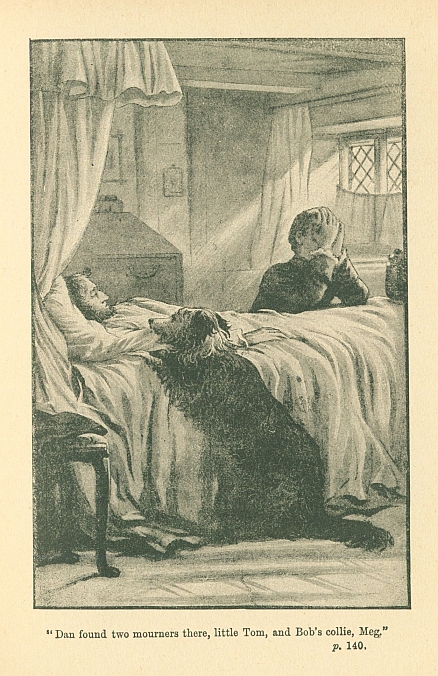
"Dan found two mourners there, little Tom, and Bob's collie, Meg."
* * * * *
A very humble funeral. Only a plain deal coffin,
and only a few friendly neighbours to follow it to its
last resting-place.
But when these neighbours looked in the face of
poor Dan, who erst was ever so cheerful, they shook
their heads.
"Dan has aged sadly," they said.
"Dan will ne'er be Dan again."