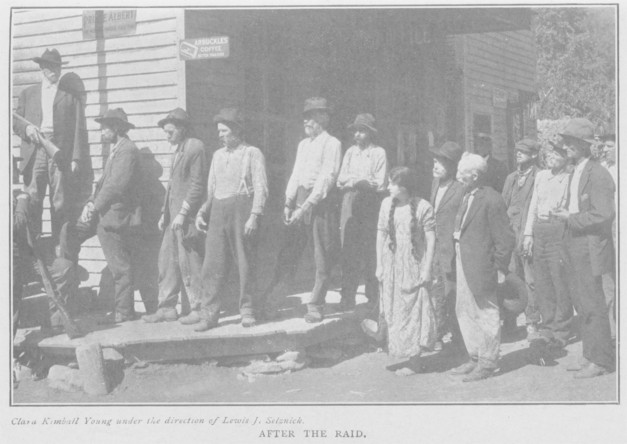
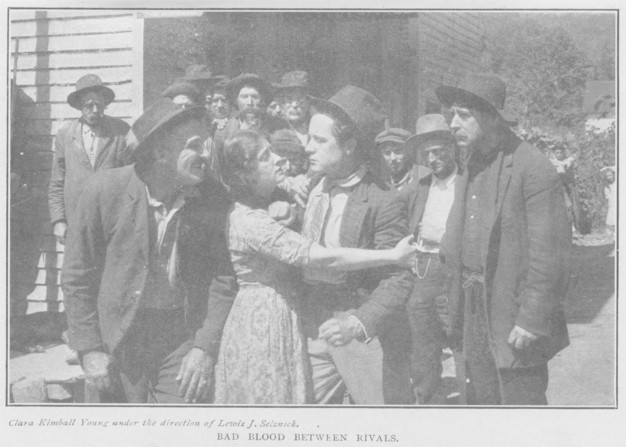
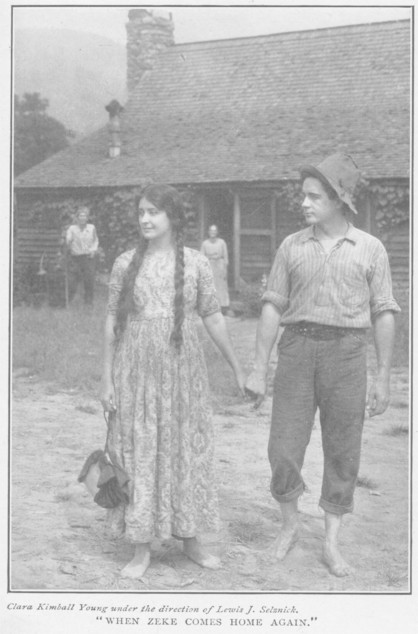
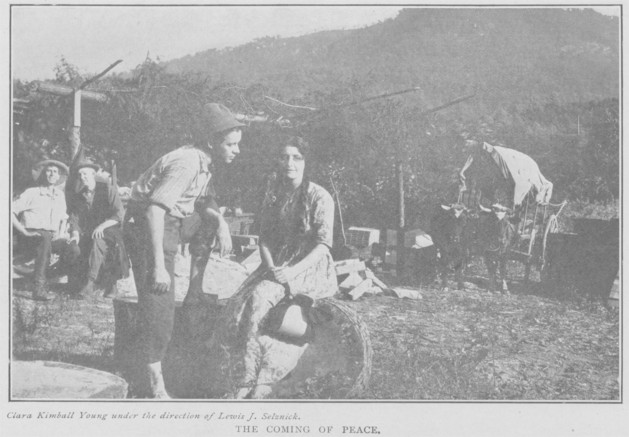
The Illustrations Shown
in this Edition are Reproductions
of Scenes
from the Photo-Play of
“Heart of the Blue
Ridge,” with Clara Kimball
Young as the Heroine,
Under the Direction of
Lewis J. Selznick, to whom
The Publishers Desire to
Express Their Thanks and
Appreciation for Permission
to Use the Pictures.
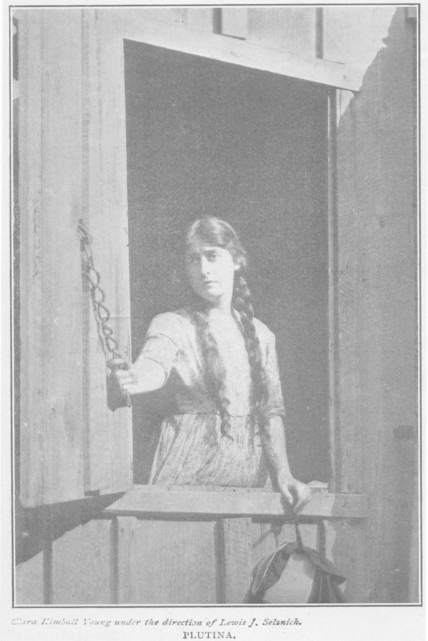
Clara Kimball Young under the direction of Lewis J. Selznick.
PLUTINA.
HEART OF THE
BLUE RIDGE
BY
WALDRON BAILY
ILLUSTRATED WITH SCENES FROM THE PHOTOPLAY,
WITH CLARA KIMBALL YOUNG AS THE HEROINE,
UNDER THE DIRECTION OF LEWIS J. SELZNICK
NEW YORK
GROSSET & DUNLAP
PUBLISHERS
Copyright, 1915, by
W. J. WATT & COMPANY
TO
Irving Bacheller
WITH THE APPRECIATION OF THE AUTHOR
Heart of the Blue Ridge
1
HEART OF THE BLUE RIDGE
CHAPTER I
Where the trail bent over a knoll, Zeke
halted, and put down from his shoulder
the hickory cudgel with its dangling
valise of black oilcloth—total of baggage with
which he was faring forth into the world. Then,
he straightened himself, and looked back over the
way he had come.
There, to the east, the dusk of night still lay
somberly, hardly touched by the coming dawn.
Through the shadows, the mountain masses loomed
formidable and mysterious, vaguely outlined against
the deeper gloom of valleys. The melancholy of the
scene seemed a fit setting for the cottage that rested
invisible within the forest, a half-mile distant from
him. In imagination, he saw the withered old
woman, his mother, still standing on the threshold,
looking toward him, even as he looked toward her,
2
her heart warm with love, her every thought a
prayer for his happiness. It was borne in on Zeke
once again that she would be very lonely in her
desolate home, where death had spared to her only
this son.... And, now, he was gone from her!
A poignant sorrow welled in him.
Zeke thrust the emotion away, lest it unman him.
He faced about, drearily enough, and stood with
downcast, unseeing eyes, in anxious pondering. And
then, presently, assuagement was granted him. He
lifted his gaze, and behold! here was another world,
all of soft splendors, of throbbing radiance.
The eager beams of the unrisen sun shimmered
above the mountain ranges of the horizon, and
streamed toward the zenith in a panoply of harmonious
hues, colorful promise of the May morning’s
joyous mood. Of a sudden, under the soothing
influence, the watcher became listener as well. His
ears noted with delight the glad singing of the birds
in the wood around about. His glance caught the
white gleam of the tiny belled blossoms that clustered
on a crooked sour-wood by the path, and the penetrant
perfume of them stirred to life a new and
subtler emotion. A flame of tenderness burned in
the clear hazel of his eyes, as he stared out over
the trail before him. Under the increasing light
his gaze could distinguish the line of the valley a
mile further on, in which the Siddon cottage lay
3
hidden. His firmly-set lips relaxed abruptly into
a smile of wistful softness. He swung stick and
bag across his shoulder once again, and set off
briskly down the slope of the knoll. His thoughts
were no longer gray over the mother who mourned
his going: they were roseate with anticipations of
beholding the girl he loved. Now, the mood of the
morning danced in his blood. The palpitant desire
of all nature in the spring thrilled through his heart.
His mind was filled with a vision of her gracious
young loveliness, so soon to be present before him
at their meeting.... Their meeting—their
parting! At thought of that corollary, a cold despair
clutched the lad, a despair that was nothing like the
sedate sorrow over leaving his mother, a despair that
was physical sickness, wrenching, nauseating, but
passed beyond the physical to rack the deeps of
being. For the first time, jealousy surged hideous
in him, born of the realization that she must be
left exposed to the wooing of other men—she, the
utterly desirable! In a fierce impulse of mingled
fear and rage, he stopped short, and cried out:
“I’ll be damned if they kin steal her! She’s
mine. She done told me so, and Plutiny wouldn’t
lie!”
From an ambush of laurel bushes close beside
the path, a tall, slender form stood forth, the lissome
figure of a girl in the budding charm of womanhood.
4
There was a lithe, curving beauty in the lines that
the scant homespun gown outlined so clearly. The
swift movement by which she revealed herself was
instinct with grace. As she rested motionless, with
arms extended in a gesture of appeal, there was a
singular dignity in the pose, a distinction of personality
that was in no wise marred by bare feet
and shapeless gown; not even by the uncouthness
of dialect, when she spoke. And winsomeness of
form and bearing was crowned by the beauty of
her face, in which the insipidity of regular features
was redeemed by exquisite coloring of rose and
white, and by the dusk brilliance of the eyes. The
tender lips were wreathed to playful reproach, as
she addressed the lover for whom she thus waited
at the dawn:
“Zekie—oh, Zekie! Ye hain’t a-cussin’ o’ me,
be ye?”
The young man, surprised, started, and regarded
the girl in confusion. The red that had suffused
his tanned cheeks deepened to a burning blush of
embarrassment, as he realized that his outburst had
been overheard by her who had been the cause of it.
But his eyes met her quizzical glance with candid
directness. After a moment, he spoke. All the
harshness was gone from his voice; its soft drawl
was vibrant with tenderness.
“No, Honey, I hain’t a’cussin’ o’ you-all. I was
5
jest a-mentionin’ some folks. But I hain’t a-feared.
Nobody hain’t a-goin’ to steal yer love from me.”
“Nobody—never, Zeke!” the girl answered, simply.
There was an infinite honesty, an unalterable
loyalty, in the curt words.
As he listened, the flush died from the lover’s
face; contentment shone in his expression.
“I knowed hit, Honey—I knowed hit all the
time. I know when I come back I’ll find ye waitin’.”
“Ye’ll come back, I reckon, with fool idees ’bout
what yer women-folks ought to wear, like them
furriners down below.” Her face relaxed into a
genial smile, which brought a dimple to shadow the
pink bloom of her cheek. But there was a trace
of pensiveness; the vague hint of jealousy in the
slow tones:
“Yes, I’ll be a-waitin’ till ye come, Zekie. An’
if the wearin’ o’ shoes an’ stockin’s ’ll make ye any
happier, why, I guess I kin stand ’em—an’ them
ladies’ straighteners, too. Yep, I’d wear ’em, if they
did squeeze me fit to bust.”
Since Plutina had thus come to meet him, there
was no need that he should follow further the trail
toward the Siddon cabin, which lay out of his
course. At the girl’s suggestion that she should
accompany him a little way on the first stage of his
journey out into the world, the two turned back
toward the broader path, which led to the southwest
6
until it met the North Wilkesboro’ road. The
two walked side by side, along this lovers’ lane of
nature’s kindly devising. They went sedately, in
all seeming, for the mountain folk are chary in
demonstrations of affection. Yet, beneath the austere
mask imposed by convention, their hearts were
thrilling with the rapture each found in the near
presence of the other. The glamour of romance was
like a golden mist over all the scene, irradiating each
leaf and flower, softening the bird-calls to fairy
flutings, draping the nakedness of distant rugged
peaks, bearing gently the purling of the limpid
brook along which the path ran in devious complacence.
Often, indeed, the lovers’ way led them
into the shallows, through which their bare feet
splashed unconcerned. The occasional prismatic
flash of a leaping trout in the deeper pools caught
their eyes. So, presently, the girl was moved to
speak—with visible effort, very shyly, for the expression
of her love in words was a thing unfamiliar,
difficult.
“I sha’n’t have nobody to make flies fer now,”
she said dully. “I jest hain’t a-goin’ arter the trout
fer fun no more till ye comes back.”
Zeke would have answered, but he checked the
words at his lips, lest the trembling of his voice
might betray a feeling deemed inconsistent with
manliness. They went forward in silence, a-quiver
7
with desire each of the other, yet mute with the
forced repression of custom. Now, too, the sorrow
of the parting so close at hand, colored their
mood more and more, so that the golden glamour
first dimmed and then changed into a sinister pall
which overhung all the loveliness of the morning.
At a turn in the path, where it topped a rise, before
descending a long slope to the highway, Zeke came
to a standstill. The girl paused obediently beside
him. He fumbled in a pocket awkwardly, and
drew forth a tiny square of coffee-colored stone,
roughly lined, which he held out toward his companion.
The tracery of the crystal formed a Maltese
cross. The girl expressed no surprise. She accepted
the token with a grave nod as he dropped it
into her palm, and she remained gazing down at it
with eyes hidden under the heavy white lids and long,
curving lashes of shadowy brown.
Zeke spoke, very earnestly:
“Hit’s fer good luck, Tiny—fer good luck to
he’p ye while we’re apart. Mebby, hit ’ll git in hits
work by softenin’ the hardness o’ yer gran’pap’s
heart agin me.”
In truth, the concentration of his thought on the
fragment of stone had been enough of itself to give
a talisman occult potence. That concentration of
desire for the girl’s well-being was not merely of
this moment. It had been with him constantly during
8
long hours of tedious clambering yesterday, when
he followed the channel of Garden Creek through
its tortuous course among the ravines of the Blue
Ridge, through the narrow defile of the Devil’s
Garden, sunless, strewn with rubble of boulders,
with a chaos of shattered rock masses—débris, superstition
said, of cataclysm—of the Crucifixion, when
the mountain crests tore themselves asunder, and
cast their pinnacles into the abyss for rage and grief.
The searcher had climbed on and on, until he reached
the nook sacred to the crystals. For concerning
these, also, the superstition had its say, and told that
the little pieces of stone, with the cross marked on
each, were, in fact, the miraculously preserved tears
shed by the fairies of these fastnesses in the dread
hour of the Saviour’s anguish. The lover had
sought long for a crystal that should be perfect.
Now that it lay within the girl’s hand, he was content
of his toil. Surely, whatever the truth concerning
its origin, it was a holy thing, for the emblem it
bore. It would serve to shield her against aught
evil that might threaten—even the grandfather’s
enmity against him, which set a barrier between
them and happiness. The crystal would abide with
her in sign of his love’s endurance, strong to save her
and to cherish her against any ill. He sighed with
relief, when she raised the crystal, and dropped it
within her bosom.
9
Still, as always, fearful of showing emotion too
openly, Zeke hastened to introduce a new topic. He
took from a pocket a book of twelve two-cent postage
stamps, to secure which he had trudged the four
miles from his mother’s cabin to the Cherry Lane
post-office. The book, in its turn, was proffered to
Plutina, who accepted it in mild bewilderment.
The lover explained:
“Honey,” he said, without any embarrassment
over the fact, “ye knows my ole mammy hain’t edicated,
an’ I want ye to write for her once a month,
arter I write to tell ye whar I’ll be.”
The girl nodded tacit acceptance of the trust, and
consigned the stamps to a resting place alongside the
crystal. And then, after a little, she spoke heavily:
“I reckon as how you-all better be a-joggin’,
Zeke.”
For answer, the lad caught the girl in his arms,
and gave her a kiss on either cheek—the hearty,
noisy smacks of the mountaineer’s courting. But,
in the next instant, he drew her close in an embrace
that crushed the two warm bodies to rapture. His
lips met hers, and clung, till their beings mingled.
Afterward, he went from her voicelessly. Voicelessly,
she let him go.... There could be no
words to comfort the bitterness of such parting.
10
CHAPTER II
When he was come within view of Joines’
mill and store on Roaring River, Zeke
halted again for a final look back toward
the wild home land, which he was now leaving for
the first time. The blackness of his mood after
parting with the girl had passed, though melancholy
still made him its own. The resilience of youth
was turning his spirits again toward the hopes that
had inspired this going forth from his own familiar
little wilderness into the vast and unknown wilderness
of the world beyond. As he stared out at the
scattered peaks, reared like conning towers over the
sprawling medley of ridge and valley, a throb of
fondness shook his heart. It was not sprung from
esthetic appreciation of the wild and romantic landscape,
though this had been sufficient to justify the
stir of feeling. His sensibility was aroused by the
dear friendliness of all the scene, where hollows and
heights had been his constant haunts through all
the days of childhood and adolescence until this
hour. Of a sudden, he realized as never before a profound
tenderness for this country of beetling crags
11
and crystal rivers, of serene spaces and balsamic airs.
Hitherto, he had esteemed the neighborhood in some
dull, matter-of-course fashion, such as folk ordinarily
give to their native territory. But, in this
instant of illumination, on the eve of separating
himself from the place, love of it surged within him.
This was his home, the dwelling of his dear ones.
He felt toward it a quick reverence as for something
strangely sacred. His eyes went to the great bulk
of Stone Mountain, which jutted just before him
to the east, its league of naked rock lying like some
monstrous guardian of the place. Somehow, the
dignity of the massive curving cliffs soothed him,
heartened him anew. The immutability of the huge
mound of stone was a prophecy. Through the ages,
it had maintained its ward steadfastly. So it would
remain. A gush of confidence washed away the last
of the watcher’s depression. He could go on his
way undismayed. These things here that were so
dear to him would abide his return. The old mother
and Plutina would rest secure against his homecoming.
The time, after all, would not be long.
Meantime, there was the great adventure. Zeke
whirled, and trudged blithely onward.
Opportunity had come to Zeke Higgins, and
he had not hesitated to seize it. His desire
for a larger life than that of the tiny, scrabbly
mountain farm had been early excited; it had persisted;
12
it had increased steadily, though the possibility
of its realization had seemed remote. Stark
poverty demanded that he remain to coax a scant
living from the soil for his mother. Yet, his determination
was fixed. He got some smattering of
education, along with Plutina, from a kindly Quaker
who came among the “Boomers” of the Blue Ridge
as a missionary school-teacher. Thus, Zeke learned
surprisingly much. His thirsty brain took up
knowledge as a sponge takes up water. So great
was his gratitude to this instructor that, when the
stranger was revealed as a revenue officer questing
illicit stills, Zeke, despite inherited prejudice, guided
the hunted man by secret trails over the mountains
into Virginia, and thereby undoubtedly saved a life.
Indeed, the disappearance of the officer was so well
contrived that the mountaineers themselves for a
time did not suspect the fact of the escape. There
is a great basin in the rock on the north side of Stone
Mountain. It has been hollowed out through centuries
by the little stream that comes leaping madly
down the ledges. The cauldron has a sinister repute.
It is deemed the sepulchre of more than one spy,
cast down into the abyss from the mountain’s brim.
It was generally believed that the false school-teacher
was of the number.
Somehow, long afterward, report had it that the
man was alive. Rumor implicated Zeke as having
13
had a share in the fellow’s escape. Old Dick Siddon,
Plutina’s grandfather, heard. He had hated the
“revenuers” always. Since the death of his only
son at their hands, his hatred had become a mania.
He was a strong man, fierce in anger. When he
bade his grandchild dismiss her favored suitor, she
feigned obedience. She, and Zeke as well, knew the
futility of fighting the old man’s prejudices. But,
with the optimism of youth, the lovers hoped for
happiness. A little older, they might at least defy
the hostile guardian. In the meantime, Zeke was
determined to attain material prosperity during the
period of waiting.
Then, Richard Sutton came into the mountains
of the Blue Ridge. He chanced on Zeke, made use
of the lad as a guide. Soon mutual liking and
respect developed. Sutton was a manufacturer of
tree-nails—the wooden pins used in ships’ timbers.
Here in the ranges was an abundance of locust timber,
the best for his need. And there was much talk
of a branch railway to come. His alert business
imagination saw that a factory located at the source
of supply would be advantageous. He saw, too, the
capacity for development in his young friend. Zeke’s
familiarity with the region might be valuable—more
valuable still his popularity and the respect accorded
him in the community. Sutton suggested to the
young man that he should come to New York
14
presently, there to learn the details of manufacture,
with the prospect of return, later on, to manage the
business in the mountains. Naturally, the project
was splendid to Zeke’s ambition. His only fear had
been lest his departure be delayed by lack of money,
for pride would not let him confess his extremity
to Sutton. There must be some cash in hand for
his mother’s support, until he should be able to send
her more. Then, as he fretted, opportunity favored
him anew, for a surveying party came to run a
railroad branch north to Stone Mountain. He was
employed as ax-man and assistant cook. His wages
solved the difficulty, so far as his mother’s need
was concerned. For the rest, he took only a small
sum to his own use, since he was minded to work
his way north on shipboard from Norfolk. It was in
accord with such high hopes that this May morning
found him tramping, barefooted, into Joines’ store,
with the black oilcloth valise slung from his shoulder.
The halt here was a necessary feature in Zeke’s
itinerary. On a previous visit to the store, he had
purchased a pair of serviceable, if rather ungainly,
shoes. Since he would have no occasion for their
use at home, he had saved himself the trouble of
carrying them to and fro.
“I reckon I’ll take them-thar shoes o’ mine,” he
said to the grizzled proprietor, after an exchange of
friendly greetings with the few loungers present.
15
These were well aware of his planned departure,
though ignorant of his definite aims.
“Ye hain’t a-goin’ to put ’em on yit, be ye?” the
storekeeper inquired, solicitously.
“Not till I git to North Wilkesboro’,” Zeke
answered, to the obvious relief of the assembly, as
he opened the bag. While he was busy stowing the
shoes, the onlookers commented cynically on the
follies of fashion.
“An’ I’ve hearn tell,” one concluded, “that durn-nigh
everybody done war shoes in the city, all year
roun’.”
Perhaps the young man felt a pleasant glow of
superiority in reflecting on the fact that such following
of city fashion would soon distinguish him. But
his innocent vanity was not to be unduly flattered.
“Ca’late to stay away till ye’ve made yer fortin,
in course, sonny?” one of the older men suggested.
He enjoyed some local reputation as a wag, the
maintenance of which so absorbed his energies that
his wife, who had lost whatever sense of humor she
might once have had, toiled both indoors and out.
“Better kiss we-uns good-by, sonny,” was the retort.
“You-all ’ll be gone quite some time.”
The sally was welcomed with titters and guffaws.
Zeke was red to the ears with mortification and
16
anger, as he shut the valise, shouldered it, and strode
to the door. But even in the time of that passing, he
mastered his mood in a measure. He had no wish
to make his farewell to these neighbors in bitterness
of spirit. So, at the door, he turned and grinned
amiably on the group.
“I want pleasant things to remember hyarabouts,
all thet-thar long time I got to be away,” he said,
with a quizzical drawl; “so I kain’t be a-kissin’ o’ ye
none. My stomick hain’t none so strong nohow,”
he added, with the coarseness that usually flavored
the humor of the countryside.
Then, abruptly, the smile left his lips; the lines
of his face hardened; the hazel eyes brightened
and widened a little. His low, slow voice came
firmly, with a note of tense earnestness. It was as
if he spoke to himself, rather than to the slouching
men, who regarded him curiously.
“I hain’t leavin’ all this-hyar ’cause I don’t love
hit,” he declared. “I do love hit, an’ I aim to come
back by-an-bye—I shore do!”
Forthwith, embarrassed anew by this unmeditated
outburst, he hurried off, amid an astonished silence
which was broken at last by the storekeeper.
“Thet-thar Zeke Higgins,” he ventured, somewhat
indistinctly through his matting of whiskers, “I
swow if he hain’t got right feelin’s, fer all he’s so
durn peart.” And his cronies nodded assent.
17
As he pressed onward, the adventurer quickly
regained his poise. The novelty of the situation
thrilled him agreeably. His thoughts were crowded
with imaginings of the strange things to come. Ambitious
vision of himself successful among the city’s
throngs made his pulses beat faster. He felt that
he had within him the power to achieve something
worth while in the world. Certainly, he would not
fail for lack of striving. But no triumph elsewhere
could ever wean him from his love for the Blue
Ridge—for his home country. Yes, it was as he
had said there in the store: He would come back.
He would come back to the cabin in the “cove” under
the shadows of Stone Mountain—back to the old
mother, back to Plutina. A warmth of exquisite
tenderness vibrated through him, as his hope leaped
to that homecoming, to the time when once again
the girl should rest clinging on his bosom. And a
great peace lay under all his joy of anticipation. His
love knew no doubt. She had given her heart to
him. Through his every wandering, whatever
might betide, her love would be with him, to comfort
him in sorrow, to crown him in happiness. A
bird’s song recalled the lilt of her laughter. He saw
again the tremulous curving of her mouth, red
against the fine warm pallor of her face at parting.
Passion welled in him. He halted yet once again,
and stood with face suffused, gazing back. It was
18
as if he were swayed by a sudden secret sense that
warned him of her misery in this hour of his exaltation—her
misery where she lay prone under the
tangle of laurel by Garden Creek, sobbing out that
anguish which is the penalty woman must pay for
love.
Zeke’s eyes fastened anew on the rounded bulk
of Stone Mountain’s cliffs. The immutability of
them, and the majesty, relieved the tenseness of his
mood. He resumed his way serenely.... But
Plutina wept on, unassuaged.
When he drew near to North Wilkesboro’, where
he proposed to make a first essay in railway journeying,
Zeke seated himself under the shade of a grove
of persimmon-trees by the wayside, there painfully
to encumber his feet with the new shoes. As he
laced these, he indulged in soliloquy, after a fashion
bred of his lonely life, on a subject born of his immediate
surroundings.
“I hain’t noways superstitious,” he mused complacently,
“but this grove ain’t no nice place, bein’ as
it must be a nigger cemetery. Uncle Dick Siddon
says they’s always niggers buried whar they’s persimmon-trees,
an’ he says the niggers come first.
An’ Uncle Dick, he ought to know, bein’ he’s eighty-odd-year
old. Anyhow, it seems reasonable, ’cause
niggers do swaller the stuns when they eats persimmons,
an’ so, o’ course, jest nacher’ly the trees ’ll
19
spring up where the niggers git planted. So
they’d be ha’nts like’s not. But I hain’t superstitious—not
a mite. Mr. Sutton, he said such things
as ha’nts an’ witch-doctors an’ such was all plumb
foolishness. Still, my mammy has seen—”
He fell silent, recalling old wives’ tales of fearsome
things seen and heard of nights. The shoes
adjusted, he took from the black bag a holster,
which sheltered a formidable-appearing Colt’s revolver.
Having made sure that the weapon was
loaded and in perfect order, Zeke returned it to
the holster, which he put on snugly under the left
arm-pit. These final preparations complete, he got
up, and hastened into the town.
One bit more of his musings he spoke aloud, just
before he entered the main street:
“No, I hain’t superstitious. But, by crickey!
I’m plumb tickled I giv Plutiny thet fairy cross.
They say them stones is shore lucky.”
At the railway station, Zeke asked for a ticket to
Norfolk.
“Want a return-trip ticket?” the friendly station-agent
suggested. He supposed the young mountaineer
was taking a pleasure excursion to the city.
But Zeke shook his head defiantly, and spoke with
utter forgetfulness of his experience in Joines’ store.
“No,” he declared stoutly, “I hain’t a-comin’ back
till I’ve made my fortin.”
20
“You’ll be a long time gone from this-here State
o’ Wilkes,” the agent vouchsafed dryly. He would
have said more, but his shrewd eyes saw in this
young man’s expression something that bade him
pause, less sceptical. The handsome and wholesome
face showed a strength of its own in the resolute
curving nose and the firmly-set lips and the grave,
yet kindly, eyes, with a light of purposeful intelligence
glowing within their clear deeps. The tall
form, broad of shoulder, deep of chest, narrow of
hip, though not yet come to the fulness of maturity,
was of the evident strength fitted to toil hugely at
the beck of its owner’s will. The agent, conscious
of a puny frame that had served him ill in life’s
struggle, experienced a half-resentment against this
youth’s physical excellence. He wondered, if, after
all, the boast might be justified by the event.
“Train in ten minutes,” he said curtly, as he
pushed out the ticket.
So, presently, Zeke, found himself seated for the
first time on the red plush seat of a railway carriage.
The initial stage of his journey was ended; the second
was begun.
21
CHAPTER III
The right of way from North Wilkesboro’
to Greensboro’ runs through a region where
every vista delights the eye with wild and
romantic scenes. The rails follow the course of the
upper reaches of the Yadkin River, with swift succession
of vicious curves and heavy grades. The
twistings of the road-bed, so advantageous for presenting
the varied loveliness of the wilds, were by
way of being a real torture to the young adventurer,
who sat in seeming stolidity near the rear door of
the smoking-car, with the black bag between his
feet. Even experienced travelers found the lunges
of the train trying to their nerves as it shot at speed
around “hairpin” bends, or hurled itself to the fall
of a steeper descent. To Zeke, who for the first
time knew the roar and jolt of such travel, this
trip was a fearsome thing. To sit movelessly there,
while the car reeled recklessly on the edge of abysses,
was a supreme trial of self-control. The racking
peril fairly sickened him. A mad impulse of flight
surged in him. Yet, not for worlds would he have
let anyone guess his miserable alarm.
22
Nevertheless, one there was who apprehended in
some measure the ordeal through which the mountaineer
was passing—happily, a kindly observer.
An elderly man, across the aisle from Zeke, regarded
his fellow passenger with particular intentness.
It seemed to him that, in some vague way, the
clean-cut face was familiar. His curiosity thus
aroused, he perceived the tenseness of expression and
attitude, and shrewdly suspected the truth. It was
with benevolent intent, rather than for the gratification
of inquisitiveness, that he finally got up and
seated himself in the vacant place alongside the
younger man.
Zeke’s perturbation caused him to start nervously
at this advent of a stranger, but a single glance into
the wrinkled, yet hale, face of the man reassured
him. The visitor’s amiable character showed plainly
in his dim blue eyes, which twinkled merrily. Moreover,
there was a sure witness of worth in the empty
sleeve, pinned to his left breast, on which showed
the cross of honor. The humor lurking in the eyes
was grotesquely manifested in his first address:
“This-hyar railroad hain’t no fitten one fer beginners,”
he announced, with a chuckle. “Hit’s
plumb likely to make a squirrel into a nut.”
Zeke smiled, somewhat ruefully. He understood
the play on words since “boomer,” the mountaineers’
own name for the red squirrel, is often
23
applied to themselves. But the distraction afforded
by the garrulous veteran was a relief. A new spur
was given to their mutual interest when, after telling
his name, it was discovered that his father had
been a company-mate with Seth Jones, the veteran,
in the Twelfth North Carolina Volunteers. The old
man’s curiosity was highly gratified by this explanation
of the inherited likeness that had puzzled him,
and he waxed reminiscent and confidential. The
diversion was welcome to his listener, where doubtless
many another might have found the narrative
of by-gone campaigns tedious in this prolix retelling.
Ultimately, indeed, the youth’s sympathies
were aroused by Jones’ tale of misfortune in love,
wherein his failure to write the girl he left behind
him had caused her first to mourn him as dead, and
eventually to marry her second choice.
“But I’ve jest got scrumptious news,” he exclaimed,
his rheumy eyes suddenly clear and sparkling.
“Seems as how Fanny’s a widder. So, I’m
a-goin’ to try my luck, an’ no shelly-shallyin’, now
I’ve got her located arter a mighty lot o’ huntin’.
Yes, sir, sonny,” he concluded, with a guffaw, “old
as I be, I’m a-goin’ a-courtin’. If I ever see ye
ag’in, I’ll tell ye how it comes out. I s’pose I seem
plumb old fer sech foolishness to a boy like you be,
but some hearts keep young till they stop. I’m
24
pretty spry fer my age, too, if I do say so as
shouldn’t.”
Zeke was not so surprised by the old man’s hopes
as he might have been, were it not for the example
of Plutina’s grandfather, who, somewhat beyond
four-score, was still scandalously lively, to the delectation
of local gossip. But, though after the departure
of Jones at a junction, Zeke reflected half-amusedly
on the rather sere romances of these two
ancient Romeos, he was far from surmising that,
at the last, their amorous paths would cross.
There was still further harrowing experience for
Zeke after reaching the Southern Railway’s terminal
on the pier at Pinner’s Point, in Virginia,
for here he was hurried aboard the ferry-boat, and
was immediately appalled by the warning blast of
the whistle. Few bear that strident din undismayed.
This adventurer had never heard the like—only
the lesser warning of locomotives and the
siren of a tannery across twenty miles of distance.
Now, the infernal belching clamor broke in his very
ears, stunning him. He quivered under the impact,
stricken to the soul for seconds of shock. But the
few careless eyes that chanced to scan the mountaineer
noted no faltering in face or form. He stood
to all appearance serenely, easily poised, his attitude
replete with the grace of physical power, his
mouth firmly closed, his widely-set eyes unwavering.
25
Even the cudgel, and the black bag still dangling
from it, could not offset a certain aloof dignity that
masked distress by stern effort of will.
Nothing further occurred for a little to afflict
the traveler’s unaccustomed nerves, and he soon
found himself pleasurably absorbed in contemplation
of the novel surroundings. The boat was nearing
the Norfolk landing when his eyes fell on a
dog, held in leash by a young woman. Both the
beast and its mistress commanded his instant attention,
in which wonder was the chief emotion. The
dog itself was a Boston bull-terrier, which was a
canine species wholly strange to the mountaineer’s
experience, limited as it had been to hounds and
mongrels of unanalyzable genealogy. The brute’s
face had an uncanny likeness to a snub-nosed, heavy-jowled
“boomer” whom Zeke detested, and he eyed
the creature askance by reason of the resemblance.
“Hit’s plumb man-faced,” was his verdict. “I
shore prefer ’em jest plain dawg.” His eyes went
then from the leash to the girl holding it, and he
hardly restrained a gasp, in which admiration was
mingled with amazement. The ordinary observer
would have seen only a pretty girl, of the fluffy
blond type, smartly tailored in blue serge, with the
skirt decorously slit. But Zeke saw a vision from
another world than that of the slatternly mountain
women, whose toil left them neither opportunity nor
26
ambition for nicety in dress, which, indeed, was
finally prohibited by ignorance as well as poverty.
This girl stood out in startling relief, marvelous
revelation from the new world he was entering.
Slowly, with concentration, the young man scrutinized
the vision, noting every detail, from the natty
turban with its swaying feather wand to the daintily
pointed ties, above which were to be glimpsed trim
silk-clad ankles. Yet, the novel charm of her failed
utterly to disturb the loyalty of his heart. His hungry
soul found exquisite satisfaction in the spectacle
of feminine refinement thus presented for the first
time, but his devotion to the roughly garbed mountain
girl was in no wise imperiled. On the contrary,
his imagination busied itself with an effort
to picture Plutina thus splendidly arrayed.
“I ’low she’s plumb handsome,” he meditated.
“But, shucks! Tiny beats her holler. In them
duds, she’d have her skun a mile.... But thet-thar
man-faced dawg! I’d shore hate like pizen to
be found daid along with thet ornery pup.”
As he mused, no hint came out of the future as
to the time when, in very truth, he would be close
to death, and that same dog an actor in the drama,
one to be deeply esteemed, not contemned. But
that time was not yet. In fact, the immediate future
was not destined to remove his prejudice
against the bull-terrier. On the contrary!
27
The fixity of Zeke’s staring penetrated the girl’s
consciousness. She turned abruptly, and her blue
eyes met his in a cool glance that seemed to pass
through him and on, as if he were something quite
invisible, altogether beneath notice. Zeke felt
the rebuke keenly, though innocent of intentional
offense. The instincts of gentlemanly blood from
which he was somewhere distantly descended made
him realize his fault in manners, though he had had
no guidance from experience. The ready blush
burned hot on brow and cheeks; he dropped his
gaze confusedly to the dog.
Even the beast, he perceived, reprobated his conduct.
It was staring up at him fiercely from red
eyes, and the hackles stood erect, though it did not
growl. Evidently, it resented undue attention to
its mistress.
There was a movement forward of the passengers,
as the ferry-boat drew into its slip. Zeke
advanced with the others, following close behind
the girl and the dog, which strained at the leash
in order still to stare menacingly at the young man.
Then, without warning, the action became swift
and violent. The ferry-boat crashed against the
yielding walls of the slip. Zeke, unprepared for
the shock, was thrown from his balance. One of
the heavy new shoes smashed down on a paw. The
dog sprang and snapped. The jaws missed, because
28
the girl tugged at the leash in the same second.
Zeke instinctively kicked at the brute in self-defense.
His foot took the animal fairly in the
jaw, and lifted it from the floor, just as the girl
turned. She cried out in shrill anger at this rough
stranger’s wanton attack on her pet, for so she
interpreted the event. She maintained her hold on
the leash bravely, lest worse follow. But her
strength was insufficient to restrain the creature of
fighting breed. It lunged forward with such suddenness
that both its mistress and its enemy were
taken unawares. The girl was dragged in tow.
Zeke would have leaped aside, but he was too late
to escape the encounter, though he mitigated it.
The iron jaws clanged shut, but in the slack of the
victim’s sturdy jeans, instead of in the flesh. The
massive mouth was locked vise-like. Because of the
cloth’s sturdiness, the dog swung clear of the floor.
The girl still strove frantically, though vainly, at
the leash, shrieking commands which were unheeded.
Zeke, confused, chagrined, ashamed,
wrathful, shook himself violently to be free, without
avail. The other passengers scurried forth,
with a panic cry of “Mad dog!”
Zeke’s wrath mounted. He had had little training
in self-restraint, and his passions were of the
primitive sort. Now, abruptly, the lesser emotions
were overwhelmed by the might of his rage. He
29
was conscious only of the humiliating fact that this
hideous man-faced dog had fastened itself on
him, and there hung. Zeke bent and twisted, his
two hands on the creature’s jaws. Then he set himself
to wrench them apart. His strength, great as
it was availed nothing against that remorseless grip.
The resistance goaded him to fury. He gave over
the effort to prise the teeth apart, and put all his
might into a frenzied pull. There were instants
of resistance, then the hissing noise of rending
cloth. A huge fragment of the stout jeans was
torn out bodily. Zeke hurled the animal violently
from him. The leash was snapped from the girl’s
hands. The dog’s body shot across the cabin,
hurtled against the wall. The indomitable brute
tumbled to the floor, and lay there stunned. But
even in defeat, he carried down with him between
rigid jaws the blue-jeans banner of victory.
With a bound, the girl crossed the space, and
fell on her knees beside the inert form, crooning
over it pitifully. In the same moment, the gust
of anger in Zeke ended. He stood motionless, except
for his quickened breathing, with eyes fast on
the girl. Remorse stabbed him as he realized her
distress, for which he was responsible. He went
toward her hesitatingly, forgetful of bag and stick,
which had fallen at the outset of the mêlée. He
ventured to address her, stammering confusedly.
30
“I ’low he hain’t daid, nor nothin’ like thet,” he
said; “jest takin’ a nap-like.” His wrath gave a
final flicker, as he looked down at the ugly face
cushioned within the girl’s hands. “An ornery
critter like thet-thar pup ought to be kept shet-up,”
he concluded spitefully.
The girl lifted a face in which blue eyes were
flaming.
“It’s you ought to be shut up, you horrible man!”
she cried. “And you will be. I’ll see to that.”
“Now, don’t be plumb foolish,” Zeke expostulated.
“The varmint hain’t hurt none—not a mite,
ma’am.”
“Beast!” the girl ejaculated, concisely.
Zeke retorted with high indignation.
“I jest nacher’ly hain’t a-goin’ to stand still an’
say ‘Thank ye!’ while I’m bein’ et up piecemeal by
no dawg—specially one with a face like his’n.”
He would have said more, but paused with mouth
agape, eyes widening, his expression horror-stricken.
For, just then, the bull-terrier snorted
loudly, and unclosed its red eyes. The clenched
jaws, too, relaxed. Thus released, the broad strip
of jeans fluttered to the floor. Its movement
caught Zeke’s gaze. He recognized the cloth. The
ghastly truth burst in his brain. In an agony of
embarrassment, he clasped his hands to that portion
of his person so fearfully despoiled. Moved by his
31
sudden silence, impressed perhaps by some subtle
impact of this new and dreadful emotion on his
part, the girl looked up. She, too, had noted subconsciously
the fall of the cloth from the dog’s
jaws. Now as she saw the young man’s face of
fire and observed his peculiar posture, she understood.
Her own crimson cheeks rivaled those of
the afflicted one. She turned and bent low over
her reviving pet. Her shoulders were shaking,
Zeke was shuddering.
32
CHAPTER IV
The conventions of dress are sometimes pestilential.
If any doubt this truth let him
remember the nightmares wherein his
nudity made torment. And, while remembering the
anguish such lack of clothing has occasioned in
dreams, let him think with pity on the suffering of
Zeke whose plight was real. It was in sooth, a
predicament to strain the savoir faire of the most
polished courtier. Perhaps, the behavior of the
mountaineer was as discreet as any permitted by
the unfortunate circumstances, and could hardly
have been improved on by the Admirable Crichton
himself. He simply retained an immobile pose,
facing the girl, with his whole soul concentrated in
desire that the earth should split asunder to engulf
him. The tide of his misery was at its flood, so that
it grew no worse when some deck-hands thrust the
forward doors open, and a policeman bounded into
the cabin, drawn revolver in hand.
But the bull-terrier was to escape the fate unjustly
inflicted on so many of its fellows. The
33
girl, crouching over the dog, barred the policeman’s
purpose.
“Get away from him, miss,” the officer directed.
“He ain’t safe, even if he’s quiet. I know mad
dogs. A bullet’s the only medicine.”
“Chub isn’t mad in the least,” the girl snapped;
“though he’s been through enough to make him
crazy—and so have I. If you’re so anxious to do
your duty, officer,” she added, bitterly, “why don’t
you arrest that horrid, hulking man over there?”
She pointed a neatly gloved, accusing finger at the
motionless Zeke, who was staring fixedly at the
point where he hoped the abyss might yawn.
“What’s he done?” the policeman inquired gruffly.
He was miffed over this lost opportunity. The
slayer of a mad dog is always mentioned as a hero
in the newspapers.
The girl stood up. The dog, at the end of the
leash, also stood up, and shook itself. It had, to
all seeming, recovered fully. It regarded Zeke intently
from its red eyes. But it did not growl. It
was plain that the bull-terrier was thinking deeply,
and that Zeke was the center around which thought
revolved. But, if the dog did not growl, its mistress
showed no lessening of hostility. She explained
succinctly to the representative of the law:
“He assaulted my dog—with his feet and his
hands.”
34
“And maybe he bit him, too!” the policeman
suggested, with heavy sarcasm. He could not forgive
this pretty girl for foiling his heroism.
The girl did not heed. Her white brow was
wrinkled in a frown. She was recalling, with an
effort, her somewhat meager knowledge of legal
terms.
“I shall charge him with homicidal assault,” she
announced firmly.
“I hope you’ll tell that to the sarge,” the officer
chuckled, his pique forgotten in appreciation of the
girl’s naïve announcement. “I’ll take this chap to
the station-house. You’ll appear against him,
miss?” The girl nodded emphatically. He turned
on Zeke, frowning. “Come on quiet, young feller,
if you know what’s good for ye.” His practiced
eye studied the young mountaineer’s physique
respectfully.
Zeke made no movement, nor answered nor
lifted his eyes. The policeman attributed this demeanor
to recalcitrancy. He put the revolver in
his pocket, drew his club and took a step forward.
Yet, he sensed something unfamiliar in the situation;
the stiff posture of the arms and hands of
the culprit attracted his attention. He felt vaguely
that something of a painful nature was toward. He
stopped short, puzzled, and spoke:
35
“What’s the matter with ye, anyhow?” he demanded
fiercely. “Hain’t ye got any tongue?”
Then, at last, Zeke raised his eyes. They went
first to the forward door, to make sure that the
girl had vanished. There were only two mildly interested
deck-hands in the cabin, beside the policeman,
though soon the place would be filled with
newly arriving passengers. He looked at the officer
squarely, with despair in his expression:
“Hit ain’t my tongue—hit’s my pants!” he said
huskily. “Hit’s the seat of my pants. Hit’s—hit’s
thar!” He nodded toward the strip of jeans left
on the floor by the dog.
The policeman stared at the fragment of cloth,
then his gaze returned appreciatively to the victim’s
hands. He threw his head back and bellowed with
laughter, echoed raucously by the deck-hands. Zeke
waited grimly until the merriment lessened a little.
“I hain’t a-stirrin’ nary a step to no jail-house,”
was his morose announcement, “unless somebody
gits me some pants with a seat to ’em.”
The policeman liked his ease too well to fight
needlessly, and he had an idea that the thews and
sinews of the boomer might make a good account
of themselves. Moreover, he was by way of being
a kindly soul, and he apprehended in a measure the
young man’s misery.
“Can you dig up a pair of jumpers?” he asked
36
the deck-hands. “You can have ’em back by calling
at the station to-morrow.”
In this manner, the difficulty was bridged. Clad
in the dingy and dirty borrowed garment, the burning
shame fell from Zeke, and he was once again
his own man. Nevertheless, he avoided looking
toward the piece of torn cloth lying on the floor, as
he went out with the policeman. He only wished
that he might with equal ease leave behind all memory
of the lamentable episode.
Zeke’s tractability increased the favorable impression
already made on the officer by the mountaineer’s
wholesome face and modest, manly bearing.
It was evident that this was no ordinary rake-helly
boomer come to town. There was, too, the
black bag to witness that the prisoner was an honest
voyager. On the way to the station, the constable
listened with unusual patience to Zeke’s curt
account of the misadventure, and the narrative was
accepted as truth—the more readily by reason of
some slight prejudice against the dog, which had
failed as an exploiter of heroism. In consequence,
the policeman grew friendly, and promised intercession
in his captive’s behalf. This was the more
effective when, on arrival at the station-house, it
was learned that the girl with the dog had not
appeared. Nor was there sign of her after a period
of waiting. The sergeant at the desk decided that
37
there could be no occasion to hold the prisoner. But
he frowned on the deadly weapon, which the usual
search had revealed.
“’Twon’t do for you to go totin’ that cannon
promiscuous,” he declared. “You shore don’t need
a gun—you shore do need breeches. What’s the
answer?... Hock the gun, and buy some
pants.”
Thus simply did an alert mind solve all difficulties
of the situation.
So in the end, Zeke issued safely from his first
bout with mischance and found himself well content,
for his dress now was more like that of the
men about him. The new trousers were full length,
which the jeans had not been, and the creases down
the legs were in the latest style. The salesman had
so stated, and Zeke observed with huge satisfaction
that the stiffness of the creases seemed to mark the
quality of the various suits visible in the streets.
And his own creases were of the most rigid! Zeke
for the first time in his life, felt that warm thrill
which characterizes any human integer, whether
high or low, when conscious of being especially well
dressed.
Followed an interval of loitering. The sights of
the town formed an endless panorama of wonder
to the lad’s eager vision. Though he was a year past
the age of man’s estate, this was his first opportunity
38
of beholding a town of any size, of seeing face to
face things of which he had heard a little, had
read more. His fresh, receptive mind scanned
every detail with fierce concentration of interest,
and registered a multitude of vivid impressions to
be tenaciously retained in memory.
And ever with him, as he roamed the streets,
went a tall slender girl, barefooted, garbed in homespun,
with great dark brown eyes that looked tenderly
on him from beneath the tumbled bronze
masses of her hair. No passer-by saw her, but the
mountaineer knew her constant presence, and with
her held voiceless communion concerning all things
that he beheld. His heart exulted proudly over the
bewildering revelations of many women, both beautiful
and marvelously clad in fine raiment—for this
girl that walked with him was more radiantly fair
than any other.
It was late afternoon when, finally, Zeke aroused
himself to think of the necessities of his position.
Then, after a hasty and economical meal at a lunch
counter near the water-front, he made haste to the
pier, where his attention was at once riveted on an
Old Dominion Liner, which was just backing out
into the river. He watched the great bulk, fascinated,
while it turned, and moved away down the harbor,
to vanish beyond Sewall’s Point, on its way toward
Hampton Roads. Immediately afterward, his attention
39
was attracted to a much smaller steamer,
which drew in on the opposite side of the wharf.
There chanced to be no one else near, and, as the
boat slid into the slip, a man in the bow hurled a
coil of rope toward Zeke, with an aim so accurate
that it fell across Zeke’s shoulder.
“Don’t dodge it, you lubber!” the man roared, in
answer to the mountaineer’s instinctive movement.
“Haul it in, an’ make fast to the punchin’.”
Zeke obeyed readily enough, hauled in the hawser,
and made the loop fast over the piling. At the
same moment, he saw two negroes, blacker from
soot and grime than nature had made them, who
leaped down from the deck, and scampered out of
sight. He heard the captain in the pilot-house
shouting down the tube.
“There go your––nigger stokers on the run.”
Zeke could both see and hear the man in the
engine-room, who vowed profanely that he would
ship a pair of white men, to sail before ten that
night. It seemed to the listener that the situation
might develop to his advantage. When, presently,
the captain descended to the dock, Zeke made bold
to accost that red-faced and truculent-appearing
person. Much to his surprise, his request for work
met with an amiable reply. The captain verified
what Zeke already knew, that the engineer had
40
need of men, and bade the inquirer get aboard and
offer himself.
In the engine-room, the harried chief scowled on
the intruder.
“What the devil do you want?” he cried harshly.
But Zeke’s purpose was too earnest to be put
down by mere ungraciousness.
“Work,” he replied with a smile.
Something in the applicant’s aspect mitigated the
engineer’s asperity.
“Ever fire a boiler?” he questioned, more affably.
“Yes, an’ no,” Zeke answered; “not any real
steam b’iler. But, when hit comes to keepin’ a
hick’ry fire under a copper kittle, an’ not scorchin’
the likker, wall, I ’lows as how I kin do hit. An’
when it comes to makin’ o’ sorghum m’lasses, I hain’t
never tuk off my hat to nobody yit. Fer the keepin’
o’ proper temp’rature folks says, I’m ’bout’s good’s
anybody in Wilkes.”
“Humph!—boomer,” the engineer grunted, and
there was silence for a moment. When next he spoke,
his manner was kindly.
“Those niggers of mine skedaddled ’cause they’re
lazy and worthless. But the stoke-hole is hell, all
right. It ain’t no place for a youngster like you.
I’ll hustle round to the gin-mills an’ get hold of a
pair of tough guys. But there’s something else,”
he went on, as Zeke’s face fell. “If you can make
41
sorghum molasses and moonshine without scorchin’
’em, you’ll fill the bill, I reckon. We cruise off the
coast for menhaddin—fat backs—for the oil in ’em.
We carry steam-jacket kettles. I’ve got a green
man now who’s no good. I’ll fire him and take you
on. Thirty a month and your board—more by-and-by,
if you suit.”
Zeke, elated at this opportunity, felt, nevertheless,
that honesty required of him some further explanation.
But the engineer dismissed consideration of
the future.
“A month will give you enough for your fare to
New York. If you ain’t pressed for time, a voyage
will do you good. But don’t let the captain get a
sight of that black bag, or it’ll go overboard. Sailors
are afeared of ’em,” he chuckled. “The Neuse,
my old ship, ran into The Blanche off Creek Beacon,
in a fog, and sunk her. We rescued officers and
crew, but the captain—Smith, his name was—couldn’t
stop cussin’ ’cause he’d allowed a nigger
mammy to go aboard as a passenger along with her
old black bag, which was the why of the wreck,
’cording to his way of thinking. Took his friends
nigh onto a year, to convince him that The Neuse
was to blame for the collision. I suspect he’ll always
have it on his conscience that he did finally collect
damages off our owners.” The engineer
42
chuckled again. “Stow your bag under your bunk
in the fore peak before the captain comes aboard.”
The Bonita was a stanchly built and seaworthy
craft with a draft of less than twelve feet under full
cargo, which made possible her use of the shorter
and smoother inland water-way from Norfolk to
Beaufort, North Carolina, where was the factory.
Zeke, who would remain idle until the first catch of
fish, went early to his bunk the first evening aboard,
wearied by the long and exciting day. He had, indeed,
scarce time to contemplate a guardian vision
of Plutina ere his senses were locked in slumber,
and his next consciousness was of a dim morning
light struggling into the gloom of the stuffy peak,
and the jolting rhythm of the engine, which announced
that the voyage was begun. When he hurried
on deck, he was at first disappointed to learn
that the boat was still some distance from the open
sea, for which he longed with all an inlander’s
curiosity over the mystery of endless waters. The
Bonita was now working forward slowly through
the old Dismal Swamp Canal, to reach the Pasquotank
River and Albemarle Sound. Zeke’s astonished
eyes perceived in every direction only the level, melancholy
expanse of the swamp. His sensitive soul
found, nevertheless, a strange charm and beauty
in the scene. There was space here, even as in the
mountains. Yet this calm was not of strength, he
43
felt vaguely, like that he had known, but the tranquillity
of nature in another, a weaker, less-wholesome
mood, apathetic, futile. The thickly dotting cypresses
and junipers, bedecked with streaming
draperies of Spanish moss, touched the vistas with
a funereal aspect. The languid movement of the
festoons under the breeze was like the sighings of
desolation made visible. The dense tangle of the
undergrowth stretched everywhere, repellent, unrelieved
by the vivid color flashes of the mountain
blossoms. Stagnant wastes of amber-hued water
emphasized the dreariness.
Zeke’s spirits were too exultant to suffer more
than a fleeting depression from this first survey of
the waste. He realized how unjust his impressions
might be when he learned that this seemingly filthy
water was highly esteemed. The deck-hand, filling
the water barrel from a pail let over the ship’s side,
explained the swamp water’s virtues.
“All the capens fill their barrels with it. Juniper
water cures chills an’ fever, an’ keeps ’em off if ye
hain’t got ’em. Some says it’s better ’n gin for the
kidneys.” But the deck-hand looked doubtful.
Zeke, still suspicious because of the unlikeness of
this liquid to the crystal-clear element of the mountains,
essayed an experimental swallow, then spat
disgustedly.
“Hit may be all right fer med’cine, or yarb tea,”
44
was his verdict, “but it needs real water to wash it
down.”
The progress was tediously slow, for a strong
southwest wind had come on, which lowered the
water in the canal, so that The Bonita often went
scraping along the bottom, and betimes stuck fast in
the mud. When they were come to the Lake Drummond
region, Captain Lee decided to tie up until a
change or falling of the wind, with its consequent
rise of water in the channel. At the point where
they finally made fast to the bank, there was an old
trail, a woods road long abandoned, running off into
the jungle. Zeke promptly set off to explore this,
and almost at once espied a wild turkey; a plump
gobbler, feeding in the path before him. There
could be no doubt as to the acceptability of such
food aboard and Zeke hastened back to The Bonita,
where the captain gladly loaned him a rifle. Thus
equipped, Zeke returned to the wilderness trail. He
was not surprised to find that the turkey had vanished,
nor disheartened, for he was sure that a little
patience would bring him in sight of game, and there
was leisure a plenty since an interval must elapse
after a change in the wind before the deepening of
the water. Within a half-hour, he shot a turkey
from its perch in a cypress. With much satisfaction,
Zeke swung the gobbler, which was big and fat, over
his shoulder, and set out to return. Almost at once,
45
however, his steps were arrested by the faint baying
of a hound. As he listened, the sound grew louder,
as if the dog drove its quarry toward him. The instinct
of the chase dominated the mountaineer. He
cast down the turkey, and waited, hopeful that a
deer or bear might cross the path within range.
Soon, he heard a noisy crackling of underbrush
a little to his right, but near at hand. With the
rifle in readiness Zeke peered from the concealment
of a cypress trunk. But it was neither the lithe
leaping form of a deer, nor the uncouth shambling
bulk of swamp bear that broke from the cover a
moment later. Instead, there lurched into view a
huge negro. The fugitive’s clothing hung in shreds,
witness of the cat’s-briar claws; his face, from the
same cause, was torn and bleeding. The breath
wheezed loudly through the open mouth; the sweat
ran in streams from the face; the eyes rolled whitely.
There was terror in his expression. He carried a
thick club. Now, as he came to a halt, it was plain to
the watcher that the runner’s fear had at last driven
him to make a stand, when he could flee no further.
Zeke had no difficulty in understanding the situation
sufficiently well. The negro was undoubtedly a
criminal who had fled in the hope of refuge from
the law in the swamp’s secret lurking places. Now
trailed by the dog, he was brought to bay. Zeke
determined, as a measure of prudence, to remain inactive
46
until the issue between man and dog should
be adjusted. Otherwise, he might find himself engaged
against both man and beast with only a single
bullet to his aid.
The querulous cries of the dog here and there
showed that the scent had been lost where the negro
had splashed through some pool. Then, abruptly, a
sharp volley announced recovery of the track. A
minute later a huge black-and-tan body catapulted
from the thicket into the open space of the trail.
From his cover, Zeke watched excitedly. The
negro, who had stood with club swung back ready
for the blow, was caught at disadvantage by the pursuer’s
emergence at an unexpected point. The
branches of the thicket projected to prevent a blow.
The dog, silent now, hurled itself straight at the
man’s throat. But the negro, alert to the peril,
avoided the charge by a swift spring to the side.
Zeke heard the great jaws of the beast click shut
as it shot harmlessly past its foe; he heard the savage
growl with which it whirled to renew the attack.
As it leaped a second time the negro’s club fell true
in a mighty stroke—caught the creature fair on the
skull, stopped it in midair, dropped it dead to the
ground.
Zeke’s turn in the action was come, at last. Even
as the negro stood gloating over his victory, the
mountaineer, with leveled rifle, stepped from the
47
concealment of the cypress, and cried a sharp command:
“Drop thet-thar club, an’ stand still whar ye be,
if ye don’t want to be kilt!”
The effect on the exultant negro was almost pitiful.
Where had been the assurance of final escape
was now the certainty of capture. The shock of
contrasting emotions was too much for the fellow’s
strength, coarse-fibered and hardened as he was. He
stared at Zeke with protruding eyes, his face grown
gray. His thrilling joy in the slaying of the dog
was lost in the black despair of defeat. The club
fell from the trembling fingers, and in the next
moment the man himself sagged to the ground and
crouched whimpering, whining, in a child-like abandon
to fatigue and grief. Then, presently, while the
captor watched in some perplexity, the moaning
ceased. In its stead came a raucous rhythm—the
sleep of utter exhaustion.
A sound of footsteps on the path caught Zeke’s
ear. He turned, and saw close at hand a short,
stockily built, swarthy-complexioned man of middle
age, who came swinging forward at a lope. The
newcomer halted at sight of the mountaineer.
“Seen anything of a big nigger or a hound passing
this way?” he demanded.
Zeke nodded, gravely.
“Ye’ll find the two of ’em right thar.” He raised
48
the rifle, which the other man now observed for the
first time, and with it pointed to where, beyond the
cypress-tree, the negro huddled, breathing stertorously,
beside the dead body of the dog.
49
CHAPTER V
Dun clouds of tragedy, crimson-streaked with
sinister romance, shadow the chronicles of
the forty-mile square that makes the Dismal
Swamp. Thither, aforetime, even as to-day,
men fled into the labyrinthine recesses to escape the
justice—or the injustice—of their fellows. Runaway
slaves sought asylum within its impenetrable
and uncharted mazes of thicket and quaking earth,
of fetid pool and slithering quicksands. Such fugitives
came no more after the emancipation. Instead
of slaves, there were black men who had outraged
the law, who fled into the steaming, noxious waste
in order to evade the penalty for crime. For a time,
these evil-doers were hunted through the tortuous
trails in the canebrakes with blood-hounds, even as
their predecessors had been. But the kennels of the
man-hunting dogs were ravaged by the black tongue,
soon after the ending of the Civil War. Poisoners,
too, took toll of the too intelligent brutes. The
strain rapidly grew less—became extinct. Whereat,
the criminals of Dismal Swamp rejoiced in unholy
glee. Their numbers waxed. Soon, they came to be
50
a serious menace to the peace and safety of the communities
that bordered on the infested region.
One sufferer from these conditions so resented the
depredations of marauders that he bought in England
two splendid stag-hounds, keen of scent, intelligent,
faithful to their task, strong enough to
throttle their quarry, be it deer or man. By the aid
of these creatures, many criminals were captured.
Their owner, by the intrepidity of his pursuit, was
given a nickname, “Cyclone” Brant. The speed and
force and resistlessness of him justified the designation.
Together with his dogs, Jack and Bruno, he
won local fame for daring and successful exploits
against the lurking swamp devils. It was this man
who now, canvas-clad, with rifle in hand, looked in
the direction indicated by Zeke. He was dripping
wet, plastered with slime of the bogs. For a few
seconds, he stood staring in silence. Then a little,
gasping cry broke from his lips. He strode forward,
and fell to his knees beside the body of the
dog. He lifted the face of the hound gently in his
two hands, and looked down at it for a long time.
There was a film of tears in Brant’s eyes when, at
last, he put the head of the dog softly back on the
earth, and stood up, and turned toward the mountaineer.
He made explanation with simple directness.
The negro was a notorious outlaw, for whose
capture the authorities of Elizabeth City offered a
51
reward of five hundred dollars. Half of this sum
would be duly paid to Zeke.
This news stirred the young man to the deeps.
To his poverty-stricken experience, the amount was
princely. The mere mention of it made privations
to vanish away, luxuries to flourish. He had roseate
visions of lavish expenditures: a warm coat for the
old mother, furbelows for Plutina, “straighteners”
even, if she would have them. The dreamer
blushed at the intimacy of his thought. It did not
occur to his frugal soul that now he need not continue
on The Bonita, but might instead go easily
to New York by train. He was naïvely happy in
this influx of good fortune, and showed his emotion
in the deepened color under the tan of his cheeks
and in the dancing lights of the steady eyes.
“I’m shore plumb glad I kotched him,” he said
eagerly, “if thar’s a right smart o’ money in hit.
If he’s as right-down bad as ye says he is, I’m
powerfully sorry I didn’t wing ’im ’fore he got
yer dawg.”
Brant shook his head regretfully.
“It’s my fault,” he confessed. “I oughtn’t to
have taken the chance with Bruno alone. I should
have had Jack along, too. With more than one
dog, a man won’t stand against ’em. He’ll take to
a tree.” He shook off the depression that
descended as he glanced down at the stiffening body
52
of the beast. There was a forced cheerfulness in
his tones when he continued: “But how did you get
into the swamp? I take you to be from the mountains.”
Zeke’s manner suddenly indicated no small pride.
“I’m a sailor, suh,” he explained, with great dignity.
“I’m the cookin’ chief on the fishin’ steamer,
Bonita.”
Brant surveyed the mountaineer with quizzically
appraising eyes.
“Been a sailor long?” he questioned, innocently.
“Wall, no, I hain’t,” Zeke conceded. His voice
was reluctant. “I was only tuk on las’ night. I
hain’t rightly begun sailorin’ yit. Thet’s how I
c’d come arter thet gobbler.” He pointed to the
bird lying at the foot of the cypress. Abruptly,
his thoughts veered again to the reward. “Oh,
cracky! Jest think of all thet money earned in two
minutes! Hit’s what I come down out o’ the mountains
fer, an’ hit ’pears like I done right. I’d shore
be tickled to see all thet-thar money in dimes an’
nickels, n’ mebby a few quarters thrown in!”
“You’re tied up near here?” Brant inquired.
“’Bout a mile over,” was the answer. “Will ye
take yer nigger thar first?”
“Yes, I know Captain Lee. He’ll give me a
chance at your gobbler, and then passage to Elizabeth
City.”
53
That same afternoon, The Bonita continued her
voyage. The captain obligingly made a landing at
Elizabeth City, where Brant lodged his prisoner,
and where the gratified Zeke stowed in his wallet
ten times as much money as he had ever before possessed
at one time. Naturally, he was in a mood
of much self-complacency, for, in addition to the
money gain, his adventure had notably increased his
prestige aboard ship, where Brant’s praise for his
prompt and efficient action was respectfully accepted.
Yet, despite his contentment, the mountaineer
found himself strangely troubled as he lay in
his bunk, after the ship had got under way. It
may be that his perturbation had a physical cause,
at least in part, for there was more movement now
as the vessel slid through the waves of Pamlico
Sound. It was while he tossed restlessly, troubled
over this unaccustomed inability to sleep, that there
came a memory of the black bag:
“I plumb fergot the dum hoodoo!” Zeke muttered,
in huge disgust. “An’ the chief said I must git another
the first chance.” Then he grinned vaingloriously
into the darkness of the fore-peak. “But
I reckon hit hain’t put no cuss on me yit—seein’ as
how I got a job an’ a peck o’ money right smack
off.” Presently, however, his nervous mood suggested
a sinister possibility. “P’rhaps, it don’t work
on land—only jest on the sea, or mebby jest whar
54
it happens to be at. Hit wa’n’t ’long with me when
I ketched the nigger. I ’low I ought to ’a’ got
rid o’ the pesky thing like the chief said.”
Zeke realized that sleep was not for him. If he
had had any hope otherwise, it was ended when the
fog-horn of The Bonita wound its melancholy blasts,
and other trumpetings began to sound over the
waste from near and far. Already, by dint of
many inquiries, Zeke had acquired enough information
to know that the mournful noise was the accompaniment
of a fog. Curious to see, he rose,
and felt his way to the small port-hole, through
which he sought to peer out into the night. His
vision compassed no more than a few fathom’s distance;
beyond, all was blackness. The port was
open, and the cold mist stealing in chilled him. Zeke
shivered, but an inexplicable disturbance of spirit
kept him from the warmth of the blankets. He
chose rather to slip on his trousers, and then again
to gaze blindly out into the mysterious dark of this
new world. He found himself hearkening intently
for the varied calls of warning that went wailing
hither and yon. The mellow, softly booming,
yet penetrant notes of the conch-shells blown by
the skippers of smaller craft, came almost soothingly
to his ears. All the others, harsher, seemed tocsins
of terror.
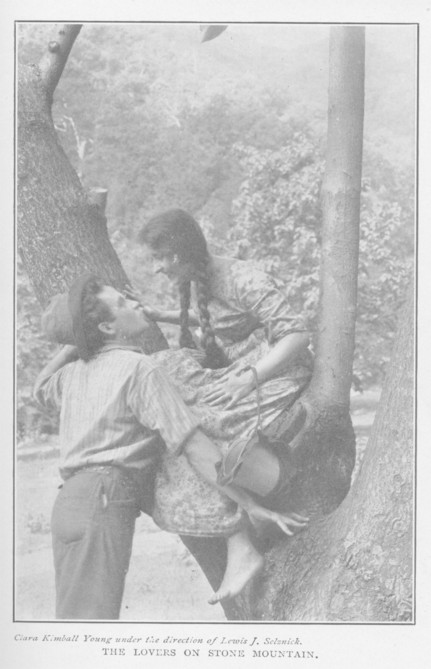
Clara Kimball Young under the direction of Lewis J. Selznick.
THE LOVERS ON STONE MOUNTAIN.
55
Standing there at the port, with the floating
drops of mist drenching his face, Zeke fell into a
waking dream. He was again clambering over the
scarped cliffs of Stone Mountain; beside him Plutina.
His arm was about her waist, and their
hands were clasped, as they crept with cautious, feeling
steps amid the perils of the path. For over
the lofty, barren summit, the mist had shut down
in impenetrable veils. Yet, through that murk of
vapor, the two, though they moved so carefully,
went in pulsing gladness, their hearts singing the
old, old, new, new mating song. A mist not born
of the sea nor of the mountain, but of the heart,
was in the lad’s eyes while he remembered and
lived again those golden moments in the mountain
gloom. It seemed to him for a blessed minute that
Plutina was actually there beside him in the tiny,
rocking space of the fore-peak; that the warmth of
her hand-clasp thrilled into the beating of his
pulses. Though the illusion vanished swiftly, the
radiance of it remained, for he knew that then,
and always, the spirit of the girl dwelt with him.
The mountaineer’s interval of peace was rudely
ended. A wild volley of blasts from The Bonita’s
whistle made alarum. Bells clanged frantically in
the engine-room close at hand. A raucous fog-horn
clamored out of the dark. To Zeke, still dazedly
held to thought of the mountains, the next sound
was like the crashing down of a giant tree, which
56
falls with the tearing, splitting din of branches
beating through underbrush. An evil tremor shook
the boat. Of a sudden, The Bonita heeled over to
starboard, almost on her beams’ ends. Zeke saved
himself from falling only by a quick clutch on the
open port. From the deck above came a contusion
of fierce voices, a strident uproar of shouts and
curses. Then, The Bonita righted herself, tremulously,
languidly, as one sore-stricken might sit up,
very feebly. The sailors in the fore-peak, with a
chorus of startled oaths, leaped from the bunks, and
fled to the deck. Zeke followed.
Clinging to a stanchion, the mountaineer could
distinguish vaguely, in the faint lights of the lanterns,
the bows of a three-masted schooner, which had
sheared through the port-side of The Bonita. The
bowsprit hung far over the smaller ship, a wand
of doom. The beating of the waves against the
boat’s side came gently under the rasping, crunching
complaint of timber against timber in combat.
The schooner’s sails flapped softly in the light
breeze. Zeke, watching and listening alertly,
despite bewilderment, heard the roaring commands
of a man invisible, somewhere above him, and
guessed that this must be the captain of the
schooner. He saw the crew of The Bonita clambering
one after another at speed, up the anchor
chain at the bow of the destroyer. He realized
57
that flight was the only road to safety. But, even
as he was tensed to dart forward, he remembered his
treasure of money under the bunk pillow.
On the instant, he rushed to the fore-peak, seized
the wallet and the black bag, and fled again to the
deck. At the moment when he reappeared, a gust of
quickening breeze filled the schooner’s sails. The
canvas bellied taut. The grinding, clashing clamor
of the timbers swelled suddenly. The schooner
wrenched herself free, and slipped, abruptly silent,
away into the night and the mist. Ere Zeke
reached the rail in his leap, the schooner had vanished.
For a minute, he heard a medley of voices.
Then, while he stood straining his eyes in despair,
these sounds lessened—died. The mountaineer
stood solitary and forsaken on the deck of a sinking
ship.
Finally, Zeke spoke aloud in self-communion.
The words rang a little tremulous, for he realized
that he was at grips with death.
“Hit’s what I gits fer fergittin’,” was his regretful
comment. “I reckon, if so be I’d ever got onto
thet-thar schooner with this-hyar damn’ bag, she’d
’a’ sunk, too. Or, leastways, they’d have chucked
me overboard like Jonah, fer causin’ the hull cussed
trouble with this pesky black bag o’ mine.”
Zeke perceived that the doomed vessel was settling
by the head. He surmised that time was short.
58
Nevertheless, he took leisure for one duty he
deemed of prime importance. With all his strength
in a vicious heave, he cast the black bag from him
into the sea.
“I hain’t superstitious,” he remarked, sullenly;
“thet is, not exzackly. An’ I reckon I’m gittin’ rid o’
that conjure satchel a mite late. I guess hit’s done
hit’s damnedest a’ready.”
Inquiries during the leisurely voyaging through
the canal had given Zeke knowledge concerning the
life-belts. Now, he buckled one of them about his
body hastily, for even his ignorance could not fail
to interpret the steady settling of the vessel into
the water. The strain of fighting forebears in the
lad set him courageous in the face of death. But his
blood was red and all a-tingle with the joy of life,
and he was very loath to die. His heart yearned
for the girl who loved him. His desire for her was
a stabbing agony. The thought of his mother’s
destitution, deprived of him in her old age, was
grievous. But his anguish was over the girl—anguish
for himself; yet more for her. The drizzle
of the fog on his cheeks brought again a poignant
memory of the mist that had enwrapped them on
the stark rocks of the mountain. A savage revolt
welled in him against the monstrous decree of fate.
He cried out roughly a challenge to the elements.
Then, in the next instant, he checked the futile
59
outburst, and bethought him how best to meet the
catastrophe.
The instinct of flight from the rising waters led
Zeke to mount the pilot-house. The lanterns shed
a flickering light here, and the youth uttered a cry
of joy as his eyes fell on the life-raft. The shout
was lost in the hissing of steam as the sea rushed
in on the boilers. All the lights were extinguished
now, save the running lamps with their containers
of oil. Quickly, the noise from the boiler-room
died out, and again there was silence, save for the
occasional bourdoning of the horns or the mocking
caress of the waves that lapped the vessel’s sides—like
a colossal serpent licking the prey it would devour
betimes. In the stillness, Zeke wrought
swiftly. He wasted no time over the fastenings. The
blade of his knife slashed through the hemp lashings,
and the raft lay clear. He made sure that it was
free from the possibility of entanglement. Then,
as the boat lurched sickeningly, like a drunken man
to a fall, Zeke stretched himself face downward
lengthwise of the tiny structure, and clenched his
hands on the tubes. There was a period of dragging
seconds, while The Bonita swayed sluggishly,
in a shuddering rhythm. Came the death spasm.
The stern was tossed high; the bow plunged for
the depths. Down and down—to the oyster rocks
60
of Teach’s Hole, in Pamlico Sound. As the vessel
sank, the raft floated clear for a moment, then the
suction drew it under, buffeted it—spewed it forth.
It rode easily on the swirling waters, at last. As
the commotion from the ship’s sinking ceased, the
raft moved smoothly on the surface, rocking gently
with the pulse of the sea. Zeke, half-strangled,
almost torn from his place by the grip of the water
in the plunge, clung to his refuge with all the
strength that was in him. And that strength prevailed.
Soon, he could breathe fully once again,
and the jaws of the sea gave over their gnawing.
After the mortal peril through which he had won,
Zeke found his case not so evil. The life was still
in him, and he voiced a crude phrase of gratefulness
to Him who is Lord of the deep waters, even
as of the everlasting hills.
Near Teach’s Hole, Ocracoke Inlet offers a shallow
channel between the dunes from Pamlico
Sound to the open sea. Here the varying tides rush
angrily, lashed by the bulk of waves behind. To-night,
the ebb bore with it a cockle-shell on which
a lad clung, shivering. But the soul was still strong
in him for all his plight. He dared believe that he
would yet return safe to the mountains, to the love
that awaited him there.
Once the castaway smiled wryly:
61
“I hain’t superstitious none—leastways, I dunno’s
I be,” he muttered, doubtfully. “But hit’s
plumb lucky I got rid o’ thet-thar dum black bag
jest as I did, or I’d ’a’ been a goner, shore!”
62
CHAPTER VI
The days dragged heavily for Plutina, after
the departure of her lover. She endured
the period of tense waiting as best she
might, since endure she must, but this passive loneliness,
without a word from the man of her heart,
was well-nigh intolerable. She did not weep—after
that single passionate outburst while yet her lips
were warm from his kiss. She was not of the
weak fiber to find assuagement in many tears, nor
had she nerves that needed the chemical soothing
of flooded eyes. She had, indeed, strength sufficient
for the trial. She bore her sorrow bravely
enough, but it pierced her through and through. She
knew her lover, and she knew herself. Because of
that knowledge she was spared the shameful suffering
of a woman who fears, with deadly fear, lest
her lover be untrue. Plutina had never a doubt as
to the faith of the absent one. A natural jealousy
sometimes leaped in her bosom, at thought of him
exposed to the wiles of women whom she suspected
of all wantonness. But she had no cowardly
thought that the fairest and most cunning of them
63
could oust her from the shrine of Zeke’s heart.
Her great grief lay in the failure of any word
from the traveler. The days became weeks; almost
a month had gone since he held her in his
arms, and still no message came. This was, in
truth, strange enough to justify alarm. It was
with difficulty that she drove back a temptation to
imagine evil happenings. She went oftener the six
miles to the Cherry Lane post-office.
When she descended the trail toward Thunder
Branch this morning, she saw Zeke’s mother standing
in the doorway of the cabin on the far side of
the stream. The bent figure of the old woman
rested motionless, with one hand lifted to shade her
eyes from the vivid sunlight, as she watched the
girl’s approach.
“Mornin’, Tiny,” she said tenderly, as the girl
crossed the clearing. “On yer way to the Lane, I
reckon?”
“Mornin’, Mis’ Higgins,” came the cheery
answer. “Yes, I ’lowed as how ye’d love to hear,
an’ I c’d git away. The corn’s laid by; the sorghum
cane’s done hoed. Alviry’s gone to he’p Gran’pap
with a bee-tree. Hit’s a big yaller poplar, up ’twixt
Ted Hutchins’ claim an’ the ole mine-hole. Gran’pap
’lows as how hit ’ll have to be cut an’ split, an’
wuth hit—over a hundred pounds, all sour-wood
honey, ’cept ’bout ten pounds early poplar. Gran’pap’s
64
right-smart tickled. I told Alviry to watch
out he don’t go an’ tote half of it up to thet-thar
Widder Brown. You-all must come over an’ git
what ye kin use o’ the honey, Mis’ Higgins, afore
the widder gits her fingers in the jar.”
“Ye don’t opine thet-thar gran’pap o’ your’n aims
to git hitched ag’in at his age, do ye, Tiny? Hit’d
be plumb scand’lous—an’ him eighty past. At thet
age, he’s bound to have one foot in the grave, fer
all he’s so tarnation spry an’ peart in his carryin’s
on.”
“Lord knows what he’ll do,” the girl replied,
carelessly. “He’s allers been given credit fer havin’
fotchin’ ways with women. I hope he won’t, though.
They say, folks what marry upwards o’ eighty is
mighty short-lived.”
The topic led Zeke’s mother to broach apprehension
of her own:
“Tiny, ye don’t have no idee thet our Zeke’s gone
daffy on some o’ them Evish-lookin’ critters
down below, like ye showed me their picters in the
city paper oncet?”
“Naw, no danger o’ thet,” was the stout assurance.
“Zeke’s got too much sense. Besides, he
hain’t had no time to git rich yit. The paper done
said as how them kind’s arter the coin.”
As she went her way, the girl’s mind reveled in
thoughts of the days to come, when Zeke should be
65
rich in sooth, and his riches for her. She swung
her sun-bonnet in vigorous slaps against her bare
legs, to scatter the ravenous mosquitoes and yellow
flies, swarming from the thickets, and she smiled
contentedly.
“P’r’aps, them women’s got more edication ’n
me,” she mused aloud, complacently, “but I kin fill
them silk stockin’s plumb up.” Her face grew brooding
with a wistful regret in the sudden droop of
the tender red lips. “I ’low I jest orter ’a’ swung
onto thet-thar neck o’ his’n an’ hollered fer Parson,
and got spliced ’fore he went.” She shook
her head disconsolately. “Why, if he don’t come
back, I’ll be worse nor the widders. Humph, I
knows ’em—cats. They’ll say: ‘Tiny Siddon didn’t
never have no chance to git married—her disperzition
an’ her looks wa’n’t compellin’ ’nough to ketch
a man.’”
The great dark eyes were clouded a little with
bitter disappointment, when, two hours later, the
girl came swiftly down the steep slopes from
Cherry Lane, for once again there had been no letter
for her. Despite her courage, Plutina felt a chill
of dismay before the mystery of this silence.
Though faith was unshaken, bewilderment oppressed
her spirit. She could not understand, and
because she could not understand, her grief was
heavy to bear. Then, presently, she chanced upon
66
a new mystery for her distraction—though this
was the easier to her solving.
As she descended into a hollow by Luffman’s
branch, which joins Thunder Branch a little way
above the Higgins’ clearing, Plutina’s alert ears
caught a sound that was not of the tumbling waters.
Through all the noises of the stream where it leaped
and sprayed in miniature falls over cluttering bowlders
and fallen pines, she could distinguish the
splashing of quick footsteps in the shallows. Some
instinct of caution checked the girl’s advance. Instead
of going forward openly, she turned aside and
approached the bank where crowding alders and
ivy formed a screen. Here, she parted the vines
stealthily, and peered up the water-course.
A man was descending the run with hurried
strides, wading with bare feet, or springing from
rock to rock where were the deeper pools. A Winchester
nestled in the crook of his left arm; two
huge bear-traps, the jaws wickedly fanged, were
swung from a rope over his right shoulder; a short-helved
ax was thrust within his belt. He wore only
a cotton shirt open at the neck, dirty throughout,
patched jeans trousers, and a soft hat, green from
long use. Beneath the shading brim showed a
loutish face, the coarse features swollen from dissipation,
the small black eyes bleared, yet alert and
penetrating in their darting, furtive glances. It
67
was Dan Hodges, a man of unsavory repute. The
girl, though unafraid, blessed the instinct that had
guided her to avoid a meeting.
There were two prime factors in Plutina’s detestation
of Hodges. The first was due to his insolence,
as she deemed it, in aspiring for her favor.
With little training in conventional ideas of delicacy,
the girl had, nevertheless, a native refinement
not always characteristic of her more-cultured sister
women. There was to her something unspeakably
repugnant in the fact that this bestial person
should dare to think of her intimately. It was as
if she were polluted by his dreaming of her kisses,
of her yielding to his caresses. That he had so
aspired she knew, for he had told her of his desire
with the coarse candor of his kind. Her spurning
of the uncouth advances had excited his wrath; it
had not destroyed his hopes. He had even ventured
to renew his suit, after the news of an engagement
between Plutina and Zeke had gone abroad. He
had winced under the scourge of the girl’ scorn,
but he had shown neither penitence nor remorse.
Plutina had forborne any account of this trouble to
her lover, lest, by bad blood between the two men,
a worse thing befall.
The second cause of the girl’s feeling was less
direct, though of longer standing, and had to do
with the death of her father. That Siddon, while
68
yet in his prime, had been slain in a raid on a still
by the revenue officers, and that despite the fact
that he was not concerned in the affair, save by the
unfortunate chance of being present. Plutina,
though only a child at the time, could still remember
the horror of that event. There was a singular
personal guiltiness, too, in her feeling, for, on the
occasion of the raid, her grandfather had been looking
out from a balcony, and had seen the revenue
men urging their horses up the trail, the sunlight
glinting on their carbines. He had seized the great
horn, to blow a warning to those at the secret still
on the mountain above. Plutina could remember
yet the grotesque bewilderment on his face, as no
sound issued—then the wrath and despair. The
children, in all innocence, had stuffed the horn with
rags. The prank had thus, in a way, cost two
lives—one, that of “Young” Dick Siddon. The
owner of the raided still had been Dan Hodges, and
him Plutina despised and hated with a virulence
not at all Christian, but very human. She had all
the old-time mountaineer’s antipathy for the extortion,
as it was esteemed, of the Federal Government,
and her father’s death had naturally inflamed
her against those responsible for it. Yet, her loathing
of Hodges caused her to regret that the man
himself had escaped capture thus far, though twice
his still had been destroyed, once within the year.
Claudia Kimball Young under the direction of Louis J. Selznick.
A MOUNTAIN “STILL.”
69
A high, jutting wall of rock hid the stream
where it bent sharply a little way from Plutina’s
shelter. Presently, she became aware that Hodges
had paused thus beyond the range of her vision,
and was busy there. She heard the blows of the
ax. General distrust of the man stirred up in her
a brisk curiosity concerning the nature of his action
in this place. On a previous day, she had observed
that the limpid waters of the brook had been sullied
by the milky refuse from a still somewhere in the
reaches above. Now, the presence of Dan Hodges
was sufficient to prove the hidden still his. But
the fact did not explain his business here. That
it was something evil, she could not doubt, for the
man and his gang were almost outlaws among their
own people. They were known, though unpunished,
thieves, as well as “moonshiners,” and there were
whispers of more dreadful things—of slain men
vanished into the unsounded depths of the Devil’s
Cauldron. The gorge of the community—careless
as it had been of some laws in the past, and too
ready to administer justice according to its own
code—had risen against the vicious living of the
gang that accepted Hodges as chief. It seemed to
Plutina that duty conspired with curiosity to set
her spying on the man.
The espionage, though toilsome enough, was not
otherwise difficult. Toward the bend, the banks
70
rose sharply on both sides of the stream, forming a
tiny cañon for the channel. The steep slope on
the east side, where the girl now ascended, was
closely overgrown with laurel and little thickets
of ground pine, through which she was hard beset
to force her way—the more since she must move
with what noiselessness she might. But her strength
and skill compassed the affair with surprising
quickness. Presently, she came to the brim of the
little cliff, and lying outstretched, cautiously looked
down. Already, a hideous idea had entered her
mind, but she had rejected it with horror. What
she now saw confirmed the thought she had not
dared to harbor.
Within this bend of the brook, the lessening
volume of the channel had left a patch of rich soil,
heavily overgrown with lush grasses and clusters
of flowering weeds. A faint trace of passing steps
ran across the bit of dry ground, the path of those
that followed the stream’s course. Fair in this
dim trail, near the center of the plot, a stake had
been driven deep. At the moment, Hodges was
driving into the ground a similar stake, a yard
further down. It was evident that the stakes had
been previously left here in readiness, since he had
not carried them in his descent, and the iron rings
bound to them must have been attached in a forge.
The two massive traps were lying half-hidden in
71
the luxuriant growth close by. As Plutina watched
with affrighted intentness, the man finished driving
the second stake. He lifted one of the traps,
and carried it to the upper stake. With the aid of
a stone for anvil, he succeeded in clumsily riveting
the trap’s length of chain to the ring on the stake.
The like was done with the other trap at the lower
stake. Then, the man undertook the setting of the
traps. The task was accomplished very quickly for
both, though the strength of the jaws taxed his
muscles to their utmost. Finally, he strewed leaves,
and bent grass, until no least gleam of metal betrayed
the masked peril of the trail. Plutina, sick
with the treacherous deviltry of the device, heard
the grunt of satisfaction with which Hodges contemplated
his finished work. Forthwith, he picked
up his rifle, thrust the ax-helve within his belt, and
set off up the gulch.
72
CHAPTER VII
There could be no doubt. Those massive
traps, with their cruel teeth of steel,
meant by the makers for the holding of
beasts, had been set here by Hodges for the snaring
of men. The contrivance was fiendishly efficient.
From her coign of vantage on the cliff top, Plutina
could see, on a height above, the brush-covered
distillery. A thin, blue column of smoke rose
straight in the calm air, witness that the kettle was
boiling over hickory logs, that a “run” of the liquor
was being made. Plutina recalled that, in a recent
raid against Hodges, the still had been captured
and destroyed though the gang had escaped. Such
loss was disastrous, for the new copper and worm
and fermenters meant a cost of a hundred dollars,
a sum hard to come on in the mountain coves.
Usually, the outfit is packed on the men’s backs to
hiding in the laurel, afterward shifted to another
obscure nook by running water. It was plain that
Hodges had grown more than ever venomous over
the destruction of his still, and had no scruples as
to the means he would employ to prevent a repetition
73
of such catastrophe. No need now to fear
lest sentinels be not alert. The natural path to the
still was along the course of the stream. The unwary
passer over the tiny stretch of greensward on
which the girl looked down, would follow the dim
trail of footsteps, and so inevitably come within the
clutch of the great jaws, which would hurl themselves
together, rending and crunching the flesh between.
The victim’s shrieks of anguish under the
assault would be a warning to the lawless men
above. They would make ready and flee with their
possessions, and be lost in the laurel once again.
Yes, the device was simple, diabolically simple, and
adequate. It required only that its executant should
be without bowels of compassion.
Plutina, strong-nerved as she was, found herself
shuddering as she realized the heinousness of this
thing. The soft bloom of the roses in her cheeks
faded to white; the dark radiance of the eyes was
dimmed with horror; the exquisite lips were compressed
harshly against their own quivering weakness.
For Plutina, despite strength of body and
sane poise of soul, was a gentle and tender woman,
and the brutal project spread before her eyes was
an offense to every sensibility. Then, very soon, the
mood of passive distress yielded to another emotion:
a lust for vengeance on the man who would
insure his own safety thus, reckless of another’s
74
cost. A new idea came to the girl. At its first
advent, she shrank from it, conscience-stricken, for
it outraged the traditions of her people. But the
idea returned, once and again. It seemed to her
that the evil of the man justified her in any measure
for his punishment. She had been bred to
hate and despise a spy, but it was borne in on her
now that duty required of her to turn informer
against Dan Hodges. There was more even than
the inflicting of punishment on the outlaw; there
was the necessity of safeguarding the innocent
from the menace of those hidden man-traps. Any
“furriner” from down below might wander here,
whipping the stream; or any one of the neighborhood
might chance on the spot. The Widow Higgins’
heifers sometimes strayed; the old woman
might come hither, seeking them. Plutina shuddered
again, before the terrible vision of the one
who was like a mother to her, caught and mangled
by the pointed fangs waiting amid the grasses
below.
The question as to her right conduct in the affair
remained with the girl, as she descended from
the cliff, and made her way slowly homeward. She
temporized by a precautionary measure. At the
widow’s cabin, she secured the old woman’s promise
not to go beyond the clearing in quest of the
cattle. But the difficulty as to her course was not
75
abated. Inclination urged her to advise the authorities
concerning the locations of still and traps, and
inclination was reinforced by justice. Yet, over
against this, there were the powerful influence of her
upbringing, the circumstances of her environment,
the tragedy of her father’s death, the savage resentment
of her grandfather, already virulent against
her lover—all forces to inspire enmity against the
representatives of a law regarded as the violation
of inalienable rights. True, there was growing an
insidious change in the sentiment of the community.
Where all had once been of accord, the better element
were now becoming convinced that the illicit
liquor-making cursed the mountains, rather than
blessed. Undoubtedly, some effect of this had
touched the girl herself, without her knowledge,
else she had never thought to betray even such a miscreant
as Hodges. There was, however, an abiding
hate of the informer here, as always among
decent folk, though along with it went reprobation of
the traffic in moonshine. Plutina felt that she could
never justify her action in the sight of her people,
should she bring the revenue men into the mountain.
Her own grandfather would curse her, and
drive her forth. His feeling had been shown clearly
in the case of Zeke. So, in her period of uncertainty
and stress, there was none of whom the
girl could take counsel. But, in the end, she decided
76
that she must give warning to the United
States marshal. The task demanded care. On
absolute secrecy depended, in all likelihood, her very
life.
The trove of honey had come opportunely, since
the sale of a portion afforded Plutina plausible excuse
for her trip to Joines’ store. There, a telephone
had been recently installed, and it was the
girl’s intention to use this means of communication
with the marshal. That the danger of detection
was great, she was unhappily aware, but, she could
devise no plan that seemed less perilous. So, early
in the morning of the day following her discovery,
she made her way along the North Wilkesboro’
road, carrying twenty pounds of the sour-wood
honey. At the store, she did her trading, and
afterward remained loitering, as is the custom of
shoppers in the region. The interval of waiting
seemed to her interminable, for trade was brisk.
There was always someone near enough the telephone
to overhear, for it was unprotected by a booth.
But, finally, the customers lessened. The few remaining
were in the front of the store, at a safe
distance from the instrument which was on a shelf
at the back. Plutina believed that her opportunity
was come. She knew the amount of the toll, and
had the necessary silver in her hand to slip into the
box. Then, just as she was about to take down the
77
receiver, her apprehensive glance, roving the room,
fell on Ben York, who entered briskly, notwithstanding
his seventy years, and came straight toward
her. Plutina’s lifted hand fell to her side, and
dread was heavy on her. For Ben York was the
distiller in Hodges’ gang.
The old man had a reputation almost as notorious
as that of Hodges himself. The girl felt a wave
of disgust, mingled with alarm, as she caught sight
of the face, almost hidden behind a hoary thicket
of whiskers. The fellow was dirty, as always, and
his ragged clothes only emphasized the emaciation
of his dwarfed form. But the rheumy eyes had a
searching quality that disturbed the girl greatly.
She knew that the man was distinguished for his
intelligence as well as for his general worthlessness.
In the experience of years, he had always escaped
the raiders, nor had they been able ever to secure
any evidence against him. He was, in fact, as adroit
of mind as he was tough of body. He had lived hard
all his days, either in drunken carouse or lying out
in the laurel to escape the summons of the courts.
Where, alas! a holier man might have been broken
long ago, the aged reprobate thrived, and threatened
to infest the land for years to come. Now, he
greeted the girl casually enough, made a purchase,
and took his departure. He seemed quite unsuspicious,
but Plutina felt that his coming on her
78
thus was an evil omen, and, for a moment, she
faltered in her purpose.
A hand went to her bosom, and touched the tiny
leather bag that hung from a cord about her neck
inside the gown. Within it was the fairy crystal.
The touch of it strengthened her in some subtle
fashion. It was as if to her weakness there came
miraculously something vital, something occultly
helpful in her need, from the distant lover. The
superstition, begotten and nourished always in the
fastnesses of the heights, stirred deeply within her,
and comforted her. Of a sudden, courage flowed
back into her. She took down the receiver.
After all, nothing was accomplished. The marshal
was not in his office, but absent somewhere in
the mountains. Plutina would not risk giving information
to any other than the officer himself,
whom she knew, and respected. Disconsolate, she
abandoned the attempt for the time being, and set
out to get a bag of wheat flour from the mill close
by, on the other side of Roaring River.
As Plutina, with the bag of flour on shoulder, was
making her way back from the mill, across the
big sycamore trunk that serves as a foot bridge, a
horse splashed into the ford alongside. The girl
looked up, to see the very man she sought. Marshal
Stone called a cheery greeting, the while his
horse dropped its head to drink.
79
“Howdy, Plutina?”
“Howdy, Mr. Stone,” she answered. Her free
hand went again to the talisman in her bosom.
Surely, its charm was potent!
“All’s well as common, at home?” Stone continued.
His critical eyes delighted in the unconscious
grace of the girl, as she stood poised above the
brawling stream, serene in her physical perfection;
and above the delicately modeled symmetry of form
was the loveliness of the face, beautiful as a flower,
yet strong, with the shining eyes and the red lips,
now parted in eagerness. The marshal wondered
a little at that eagerness. He wondered still more
at her hurried speech after one quick glance to make
sure that none could overhear:
“I mustn’t be seed talkin’ to ye, but I got somethin’
to say ’ll he’p ye arn yer pay. Kin ye meet me
in an hour by the sun, at the ole gate on the east
end o’ Wolf Rock?”
The marshal’s answer wasted no words:
“Go on, gal—I’ll be there.”
Wolf Rock, a huge, jutting mass of barren cliff,
though tiny beside the bulk of Stone Mountain,
which overshadows it, lies between Garden Creek
and Thunder Branch, a little to the north of
where these streams flow into Roaring River. Its
situation, nearly midway between the mill and the
Siddon Cabin, made it a convenient point for the
80
meeting between Plutina and the officer. Its loneliness
lessened the element of danger. Both were
prompt to the rendezvous. Well under the hour,
man and girl were standing together within a bower
of newly blossoming rhododendrons. Above them,
the naked rock bent sharply, its granite surface
glistening in the hot noonday sun. They had withdrawn
some score of yards from the old wooden
gate that barred the lane here, lest a chance passer-by
see them together. Plutina opened her mind
without hesitation. The decision once made, she
had no thought of drawing back.
“I ’low I kin trust ye, Mister Stone,” she said
simply, and the sincerity of the lustrous eyes as
they met his confirmed her words. “Afore you-all’s
time in the revenue service, raiders done kilt
my daddy. I kain’t never fergive them men, but
they’s out o’ the service now, er I wouldn’t have
come to ye. Gran’pap says they’s a better lot o’
revenuers now ’n what used to be an’ he says as
how Marshal Stone don’t do no dirt. Thet’s why
I’m a-trusting ye, so’s ye kin kotch the pizen-meanest
white man a-makin’ likker in the hull Stone
Mountain country—him an’ his gang an’ his still.”
The marshal’s eyes sparkled.
“I reckon you’re talking about Dan Hodges,”
he interjected.
Plutina nodded her head in somber acquiescence.
Clara Kimball Young under the direction of Lewis J. Selznick.
JOINES’ MILL.
81
“Then you needn’t have any scruples about giving
information,” Stone continued, urgently. “He
and his gang are a menace to the peace of the settlement.
I’ll keep you out of it, of course, to save you
embarrassment.”
“Ye’d better,” Plutina retorted, “to save my
life. I don’t know’s I mind bein’ embarrassed so
much, but I don’t feel called to die yit.”
“No, no; there won’t be anything like that,” the
marshal exclaimed, much disconcerted. “I’ll see no
trouble comes to you. Nobody’ll know your part.”
“’Cept me!” was the bitter objection. “If ’twas
anybody but that ornery galoot, I wouldn’t say a
word. Ye know that.”
“I know,” Stone admitted, placatingly.
In his desire to change her mood, he blundered
on:
“And there’s the reward for getting the ‘copper’—twenty
dollars for you Plutina. If we get Hodges,
I’ll give you another fifty out of my own pocket.
That’ll buy you a nice new dress or two, and a hat,
and some silk stockings for those pretty legs of
yours.”
Plutina flared. The red glowed hot in her cheeks,
and the big eyes flashed. The mellow voice deepened
to a note of new dignity, despite her anger.
“I hain’t come hyar to gas ’bout rewards, an’
money outten yer pocket, Mister Stone, or ’bout
82
my clothes an’ sech. I’m an engaged woman. When
I wants to cover my legs with stockin’s Zeke Higgins’
money’ll do the payin’, an’ he won’t need no
he’p from no damned revenuer.”
Stone, realizing too late the error in his diplomacy,
made what haste he could to retrieve it. His
smile was genial as he spoke. He seemed quite unabashed,
just heartily sympathetic, and his manner
calmed the girl’s irritation almost at once.
“Oh, you little mountain hornet! Well, you are
telling me news now. And it’s the kind to make any
old bachelor like me weep for envy. Lucky boy,
Zeke! I guess he knows it, too, for he’s got eyes in
his head. About the money—why, you’ve a right
to it. If Dan Hodges and his gang ain’t rounded
up quick, they’ll be killing some good citizen—like
me, perhaps.”
Plutina had recovered her poise, but she spoke
no less firmly:
“No, suh, I won’t tech the money. I kin show
ye how to kotch the hull gang, but not fer pay, an
not fer love o’ no revenuer, neither. Hit’s jest fer
the good o’ this country hyarbout. Dan Hodges
has done sot b’ar-traps to kotch you-all. An’ anybody
might walk plumb into ’em, but not if I kin
he’p hit.”
Forthwith, she made the situation clear to her
eager listener.
83
“Kin you-all meet me, an hour by the sun in
the mornin’, on the trail to Cherry Lane post-office
jest beyond the Widder Higgins’ clearin’? I’ll take
ye to the place, whar ye kin see the still, an’ the
traps.”
“I’ll have to move lively,” the marshal answered,
with a somewhat rueful laugh. “Twenty miles’
ride to North Wilkesboro’, and back. But I’ll do
it, of course. I wouldn’t miss it for a good deal.
I’ll have my men waiting at Trap Hill. If things
shape right, I’ll make the raid to-morrow night.”
84
CHAPTER VIII
Marshal John Stone was a mountaineer
of the better sort, who had the respect and
admiration of the law-abiding citizens in
his district, and the hate of the evil-doers. He
stood full six feet in his socks, and he was broad
and muscled in proportion. His gray eyes were of
the sort to harden to steel against an enemy, to
soften wonderfully for a friend. The mouth, half-hidden
by the thick mustache, was very firm, yet
prone to smiles. To an excellent intelligence had
been added a fair amount of education. Since he
respected both himself and his work, and had developed
a veritable passion for the capture of malefactors,
he was more than usually successful. His
zeal, tempered with discretion, had won the appreciative
attention of official superiors. There could
be no doubt that promotion would shortly remove
him to a higher plane of service. The fact would
have been most agreeable to Stone, but for two
things. He desired beyond all else, before going
from the mountains, to capture Dan Hodges, who
had so persistently flouted the law, and himself, its
85
representative; the second unsatisfied ambition was
to come on the long-lost Burns’ still.
The Scottish poet’s poverty was almost equal to
his genius. On that account, Robert Burns was
glad to secure the stipend of fifty pounds a year to
which he became entitled on his appointment as
exciseman in 1788. It may be that his convivial
habits made his official position particularly acceptable,
since doubtless his perquisites included the
keeping of his own jug filled. And there were
moonshiners among the Scottish hills in those days,
as perhaps there are to-day. On occasion, the poet
made a gift of a captured still to some discreet
friend. One recipient emigrated to America, and
bore into the wilderness that has become North
Carolina the kettle and cap of copper on which
Burns had graven his name, and the date, 1790.
Afterward, as the years passed, the still knew many
owners, mostly unlawful. It won fame, and this
saved it from the junk-heap of its fellows, when
seized by the Federal officers. Three times, it was
even placed on public exhibition. As many, it was
stolen by moonshiners. For years now, it had remained
in secret. Marshal Stone yearned to recapture
the Burns still. There was no reason
whatsoever for believing it to be in the possession
of Hodges, yet it might as easily be with that desperado
as with another. There was at least the
86
possibility. The marshal, as he rode north before
the dawn next morning, felt a new kindling of
hope. It seemed to him almost certain that the
opportunity was at hand to satisfy one ambition at
least by putting Hodges behind the bars. For the
other, it was on the lap of the gods.
The officer was at pains to use every precaution to
avoid being observed while in company with the
girl, whom he duly met at the appointed place while
the sun was yet low on the eastern horizon. The
two made their way with what quiet they could
through devious paths to Luffman’s Branch. The
dew lay heavy on the laurel leaves of the thickets,
and the breeze was perfumed with the penetrant fragrance
of many blossoms. The day was thrilling
with the matins of the birds. The balsamic air was
a wine of life. The rugged mountain peaks
seemed to stand as an impregnable barrier against
the confusions and evils of the larger world. But
the man and the girl recked nought of these things
as they went forward, with cautious steps and
watchful eyes. They knew that the tranquil scene
masked wickedness close by them, which would not
hesitate to destroy. The discovery of the marshal
in that vicinity would mean for him the bullet of
an assassin from out the screen of leaves, and the
same fate—or worse—for his companion. The
corpses would be lost in the Devil’s Cauldron. Men
87
would whisper grim surmises, and whisper low lest
the like come upon them. And that would be all.
They reached the cliff top overlooking the little
cañon, and Plutina pointed out the location of the
traps on the strip of dry ground below, and the huddles
of brush that disguised the buildings of the still.
Then, the girl went her way. She had done her
part. The man remained to study the scene above
for hours through his glasses, and to map out the
night’s campaign into the enemy’s country.
A delicate moonlight fell over the mountains,
when, in the evening, Stone led his men from the
rendezvous at Trap Hill. The six were heavily
armed and well mounted. Their course at the outset
led them along the Elkin road to Joines’ store,
where they swung into the trail over which Zeke
and Plutina had walked the day of their parting.
The cavalcade rode swiftly. There was no conversation;
only the pounding of hoofs and the
jangling of accoutrements. When, at last, they
reached the edge of the Widow Higgins’ clearing,
they turned sharply to the eastward, following the
path toward the Cherry Lane post-office. Presently,
at a low word of command from the leader,
they halted and dismounted. The horses were left
to the care of one man in a near-by thicket, and
the remainder of the party continued the advance
on foot.
88
The marshal, during his watch on the still that
day, had planned his attack in every detail. He
hoped to make his capture of the gang without unnecessary
casualties, for in this particular he had
achieved an enviable record, on which he prided
himself. At first, he had thought of ascending along
the course of Luffman’s Branch, after springing
the traps, but had given over the plan as one offering
more chance of the raiders being discovered
prematurely. Instead, he had decided on taking his
men up the mountainside by a round-about route,
likely to be free from watchers. His men were already
instructed in every point, so now they followed
him rapidly and almost noiselessly, as he
forced his way through the thick growths of the
wooded slopes. The darkness added to the difficulties
of the progress, but the posse were inured to
hardships, and went onward and upward resolutely.
Despite the necessities of the detour, they came surprisingly
soon to a height from which they looked
across a small ravine to the level space where the
still perched by the stream. A few whispered words
from the leader, and the company crept with increased
care across the ravine. From the ridge
beyond, three of the men passed forward to make
ambush—one above, and one below, and one on the
far side of the still. Stone and a single companion
89
remained, hiding behind the clumps of rhododendrons.
It was with huge satisfaction that the marshal
recognized Hodges himself, plainly revealed by the
firelight. The “kettle” was running at full blast.
The seasoned hickory logs, in the rough stone furnace
beneath the kettle, were burning fiercely, and
the blue and gold of their flames lighted all the
scene into vivid relief against the background of
shadows. Stone, even at his distance, could see distinctly
the tiny stream of colorless mountain-corn
whiskey, as it flowed out from the worm into the
keg placed to receive it. The leader of the gang
was seated at ease on a stool just outside the brush
enclosure that masked the buildings. The villain
was evidently in a mood of contentment, untainted
by remorse over the havoc his traps might wreak
on any passing through the gorge below. Rather,
doubtless, the memory of those sinister sentinels
gave him a sense of safety, on which his serenity
was founded. In his lap was a banjo which he
thrummed vigorously, with rhythmic precision, if
no greater musical art, and head and body and
feet, all gave emphasis to the movement. At intervals,
his raucous voice rumbled a snatch of song.
It was evident that the moonshiner was mellow
from draughts of his own potent product.
Others of the gang were busied here and there,
90
bulking grotesquely as they moved about the fire,
seeming disheveled demons of the pit. Like some
master imp torturing a pigmy over the flames, old
Ben York was kneeling close beside the blaze, holding
to the coals a hickory stick, which served as
spit for the roasting of a squirrel. The brilliance
shone full on the frowsy gray whiskers, and, above
them, the blinking, rheumy eyes, so intent on the
proper browning of the game. None of the outlaws
had a weapon in his grasp—a fact noted with
satisfaction by the chief of the raiders, who knew
that these men would not scruple against bloodshed
to escape arrest. There were arms at hand, of
course; Hodges’ rifle was visible, leaning against
a ground pine within his reach. But Stone hoped
that the surprise would be such that the gang
could not avail themselves of their weapons.
Hodges had just completed a strident rendering
of “Cripple Crick,” and had thumped out the opening
bars of “Short’nin’ Bread,” when the marshal
gave the signal for attack—a single flash of his
electric torch. In the same second, the raiders’
rifles crashed out. The big bullets struck true to
aim in the ground of the open place before the fire.
A shower of dirt and pebbles spat back viciously.
Some of the flying fragments struck the men, terrifying
them with the thought of bullet wounds.
Hodges, as the reports sounded, felt the bruise of
91
stones on his bare legs, and shrieked in panic fear.
His instinctive recoil carried him over backward,
from the stool to the ground. The banjo jangled
discordant triumph over his fall. When, dazed by
the suddenness of it all, he would have struggled
up, he found himself fast in the clutches of two raiders,
who locked manacles on his wrists. Stone
grunted joyously as he surveyed the captive. The
others of the gang, except Ben York, had contrived
to slip away into the laurel, whither it would avail
nothing to follow them, save useless risk of being
killed from ambush. But the marshal cared little
for the escape of the lesser malefactors. He had
succeeded in taking prisoner the most notorious
criminal of the mountains.
Ben York had failed to effect his usual flight, because
of being at a disadvantage on his knees. Before
he could scramble up for a plunge into the
thickets the enemy was upon him. Yet, even in
this moment of shock, the old scoundrel’s cunning
sought and found a ruse. He stood swaying for
seconds, and then tumbled limply headlong to the
ground, in a drunkard’s fall, familiar to his muscles
by experience through three-score years. So he lay
inert, seemingly sodden from the kettle’s brew. His
captors, if resolved to hold him prisoner, would be
forced to the arduous task of carrying him through
the dark, down the rough slopes. It would be
92
strange, he mused complacently, if in the course of
the journey, their vigilance did not relax a little.
And a very little would suffice him! Then, though
to all appearance in a drunken stupor, he sighed. He
was unhappily aware that the revenue men would
not be gentle in their efforts to arouse him to consciousness.
Whether they believed him shamming
or not, they would use no doubtful measures. But,
whatever might come, he must endure it for the
sake of escape.
Clara Kimball Young under the direction of Lewis J. Selznick.
AFTER THE RAID.
93
The raiders realized the need of haste, for they
must be done with their work here, and down the
steeps of the mountain into the open road, ere the
fugitives should have time to arm themselves, and
waylay the posse from the thickets. So, with due
watchfulness of the two prisoners, the men set about
that task of destruction which their duty required.
The fermenters, huge tubs holding the mixture
of meal, malt and water making ready for the still,
received first attention. Since York had fallen before
these, the men rolled him roughly to one side,
without arousing him to any sign of consciousness.
Stone knew the man to be shamming, since there
had been no show of even incipient drunkenness
before the moment of the raid. He resolved to try
a test at least, for he was alert to the hindrance the
limp form would prove in the descent of the mountain.
He thrust the body forward with his foot,
close to one of the great “stands” of the mixture,
and bade an appreciative assistant apply the ax to
the slippery-elm hoops that bound the staves. As
the bands fell and the great volume of liquid gushed
forth, the raiders leaped aside from the flood. But
York never stirred. The down-rushing tide fell
fairly on him, engulfed him. He made no movement,
no outcry. Even Stone himself was led to a
half-remorseful wonder whether he had been deceived
concerning the fellow’s state. Then, after
a few seconds, the bald head rose, glistening from
the pool of the “beer.” The thin wisps of gray
hair hung in dank strings; the jungle of beard
seemed strangely thin; there was something curiously
unlike Ben York in the lineaments. The
marshal guessed that the metamorphosis was
wrought by the swirling mess, which had scrubbed
the weazened face almost clean for the first time
in the memory of living man. As the dilapidated
head emerged, it showed the grotesque caricature
of a Neptune, whose element was not the waters
of ocean, but the shattered hogsheads of “beer.”
Even now, however, Ben clung to his rôle. Once
his face was clear, he continued to sit placidly,
though the surface of the viscous pool was at his
neck. For better effect, he blinked vacuously, and
gurgled. Perhaps, memory of a bath in infancy
inspired him. He had had none since. He beat his
94
scrawny hands in the “beer,” and cackled. It was
admirable art, but wasted.
The eight fermenters were broken and emptied,
the whiskey stores, both “singlin’s” and “doublin’s,”
were poured out on the ground, which drank them
as thirstily as did ever law-scorning “boomer.”
Then, the raiders turned to the chief spoils, kettle,
cap and worm. Stone and his men took the copper
worm from the cooling barrel, removed the cap,
drew the fire from the furnace, and finally pulled
down the kettle. In the varied excitement of the
night, the marshal had almost forgotten his second
great ambition, in the accomplishment of his first.
Almost, not quite. Now, the memory of it jumped
within him. He thrust the cap where the glow of
the fire would light it clearly, dropped to his knees,
and peered closely. His stern face relaxed abruptly
to joyousness.
“By the Lord, boys,” he shouted, “it’s the Bobbie
Burns’ still!”
Nevertheless, Stone wasted no time in exultation.
He merely ordered his men to carry the copper utensils
along, instead of destroying them on the spot.
Then, he addressed Ben York, who grinned idiotically
from toothless gums, where he crouched in the
diminishing puddle. The marshal’s voice rasped.
“You’re going with us, Ben. It’s for you to
say how. If we have to, we’ll carry you all the
95
way. We’ll snake you down the mountains without
being too almighty careful of that rum-tanned
hide of yours, and then we’ll sling you across the
roughest-gaited horse we’ve got—face down across
the saddle and roped snug. That’s the way you’ll
do twenty-odd miles, Ben, if we have to tote you
down a single rod. Make up your mind—now!
It’ll be too late to change it, in a minute. You’re
plumb sober, and I know it. Get up, you old fox!”
And Ben York, shivering in his sticky, drenched
rags, recognized the inevitable, and scrambled to
his feet, snarling curses.
“Hit was thet-thar damned gal!” he mumbled
venomously. But none heard.
96
CHAPTER IX
It is a far cry from the savagery of the illicit
mountain still to that consummate luxury of
civilization, an ocean-going steam yacht. Yet,
in actual space, the distance between these two extremes
was not great. The Josephine, all in snowy
white, save for the gleam of polished brass-work,
and flying the pennant of the New York Yacht Club,
glided forth from Norfolk Harbor in serene magnificence
on the same day that The Bonita chugged
fussily over the same course. The yacht was setting
out on the second stage of her leisurely pleasure
voyage to Bermuda. The skipper had been instructed
to follow the coast southward as far as
Frying Pan Shoals, for the sake of rounding Hatteras.
Afterward, since the weather grew menacing,
the craft continued down the coast to Cape Lookout,
where anchor was dropped in the Harbor of Refuge.
The island that lies there is a long, narrow, barren
strip of sand, dotted thickly with dunes. Only
a coarse marsh grass grows, with dwarfed pines and
cedars. In this bleak spot live and thrive droves of
wild ponies, of uncertain ancestry. It was these
97
creatures that just now held the attention of two persons
on the yacht.
Under the awning in the stern, two girls were
chatting as they dawdled over their morning chocolate.
The younger and prettier of these was Josephine
Blaise, the motherless daughter of the yacht-owner;
the other was Florence Marlow, her most
intimate friend.
“Dad told me I could have the runabout ashore,”
Josephine was saying, with a sudden access of animation.
“We’ll go along the beach, as long as the
going’s good, or till we scare up the ponies.”
“I do hope we’ll see them digging holes in the
sand, so as to get fresh water,” Florence exclaimed.
But Josephine was quick to dissent:
“They don’t dig for water,” she explained, with a
superior air. “They dig the holes in the beach
when the tides out, and then the tide comes in and
fills the holes, of course. When it ebbs, the ponies
go around and pick out the fish, and eat them.”
Florence stared disbelievingly.
“Oh, what a whopper!” she cried.
“Captain Hawks told me himself,” Josephine asserted,
with confidence. “He knows all about them—he’s
seen them wild on the island and tame on the
mainland.”
“Same ones, probably!” was the tart retort. “I
98
thought the doctor lied ably, but he’s truth itself
compared with that hairy skipper of yours.”
Josephine tossed her head.
“We’ll run ’em down and observe their habits,
scientifically, and convince you.”
A glance shoreward showed the car awaiting
them. As they descended the ladder to the launch,
a yelp sounded from the deck, and a bull-terrier
came charging after. Florence regarded the dog
without any evidence of pleasure.
“Does the pest go, too?” she asked, resignedly.
Josephine pulled the terrier’s ears fondly, as it
cuddled close against her skirt.
“Chubbie deserves an outing after the bump he
got from that horrid man yesterday,” she said.
The girls exchanged glances, and laughed over
some secret joke. When, presently, they were seated
together in the runaabout, with Josephine at the
wheel, the bull-terrier squatted in dignity on the
small back seat. The level sand formed a perfect
roadway, and the car darted smoothly and swiftly
between the twin barren spaces of land and sea.
As they swept forward, the girls watched alertly
for a glimpse of the ponies among the dunes,
but there was nowhere any sign of a living thing,
save the few hurrying gulls. They had gone perhaps
twenty miles, and were beginning to fear disappointment,
when, without warning, a drove of
99
the horses came galloping over the crest of a little
rise, a half-mile beyond. As the car ran forward,
along the ribbon of sand below the higher ground,
the ponies suddenly perceived it, and halted with
the precision of a troop of cavalry. Near at hand,
now, the girls could note details, and both observed
with interest the leader, which stood a little in advance
of his troop, at the end near the approaching
machine. He was a handsome creature, with lines
as suavely strong as an Arabian’s. He stood with
head held high, tail streaming, a fore-hoof pawing
challengingly at the sand. Only the thick, shaggy
bay coat showed the barbarian, rather than the thoroughbred.
The mares, a score of them in one
orderly rank behind him, were crowding and lashing
out nervously, as they watched the strange
monster racing so fast on the ocean’s edge. Some
of them nickered curiously. But the stallion rested
silent, until the automobile halted, hardly fifty yards
away. Then he tossed his head proudly, and blared
a great trumpet-note of defiance. Josephine instinctively
answered with the horn. The mechanical
cry broke harshly, swelled and wailed. The
eerie response terrified the mares; it perplexed and
alarmed their lord. But he showed no dismay. For
a moment still, he remained motionless. His noisy
challenge rang forth once again. Since the invader
on the sands below kept silence, nor made any
100
movement toward attack, the leader seemed to feel
that his prestige was safe enough; that prudence
were now the better part. He sounded a low call,
and set off at a gallop along the ridge top. The
rank of mares pounded obediently at his heels.
“Oh, after them, Josie!” Florence cried.
In a moment, the car shot forward. The horn
clamored again. The fleeing horses looked back,
then leaped to new speed before the monster that
threatened them with unknown terrors. As the
car increased its pace, the ponies strove the harder.
Their strides lengthened, quickened. The stunted
marsh grass beat on the low bellies. Despite their
desperate striving, the runabout drew closer and
closer, reached abreast of them. The excitement of
the chase was in the sparkling eyes of the girls.
The dog, scrambling up and falling in its seat,
yelped madly. Here, the beach broadened to a
sharper ascent of the ridge. Josephine shifted the
wheel. The car swung in a wide curve and drove
straight toward the panic-stricken troop, as if it
would soar up to them. Fear took pride’s place in
the leader’s heart. He sounded a command. The
flying drove veered, vanished from the ridge top.
The muffled thudding of hoofs came faintly for a
minute against the sea wind. Then, as the car
came to a standstill, the girls listened, but heard no
sound.
101
“It was bully fun!” Josephine said. “I’m sorry
it’s over.”
“After that run, they may be thirsty enough to
dig for water,” Florence suggested, with a laugh.
“Let’s climb up, and take a look round from the
ridge.”
But a glance from this point of advantage made it
clear that the peculiarities of the ponies in drinking
or fishing were not to be explained to-day. They
were visible still, to be sure, but a mile off, and the
rapidity with which the moving mass diminished to
the eye was proof that they were still in panic.
“We might as well get back to the yacht,” was
Josephine’s rueful comment. “There’s not another
single thing to see, now they’re gone.” She ran
her keen gaze over the dreary waste of the island
with a little shiver of distaste. Then her glance
roved the undulant expanse of sea. She uttered a
sharp ejaculation of surprise.
“There is something, after all,” she called out,
excitedly. “See—over there!”
Florence looked in the direction marked by the
pointing finger.
“It’s a canoe,” she hazarded, as her eyes fell on
the object that bobbed lightly in the surf, two hundred
yards from the shore. “I can see the man in
it. He’s lying down. Funny!”
102
But Josephine, wiser from much experience on
shipboard, now saw clearly, and the sight thrilled.
“It’s a life-raft,” she declared, with a tremor in
her voice; “and there’s a man on it. It’s a—real—castaway.
Come!”
With that, she set off running down the steep
slope of the ridge toward the sea. Behind her came
Florence, startled and alarmed. The dog barked
exultantly once, then leaped ahead, only to return
and circle the slower playfellows joyfully. They
came to the water’s edge, and halted, perforce.
Josephine saw the raft, as it rode on a breaking
wave. It was perceptibly nearer. She dared hope
it might be brought within reach. With deft motions,
the flannel skirt was tucked within her belt,
leaving her legs free. Florence, somewhat reluctantly,
made the like adjustment. The bull-terrier,
disheartened by this immobility, sat on its haunches,
and regarded the two doubtfully, perhaps prudishly
disapproving. From time to time the raft showed
for a few seconds; only to vanish again behind the
screen of spume. But it advanced shoreward,
steadily. The body of the man was distinct—prone,
motionless. The girls watched and waited in palpitant
eagerness. The dog, sensing the tension of the
moment, began to hasten to and fro, snuffing and
whining. Suddenly, the two cried out in the same
moment. They saw the raft floating fast and
103
smoothly toward them on the crest of a breaker.
They dashed forward, knee-deep, to meet the charge.
The huge mass of the wave pounded upon them, almost
swept them from their feet. The angry waters
boiled about them. It was up to their waists now.
The flying spray lashed their faces and blinded
them. When, at last, their vision cleared, the raft
had vanished. They caught sight of it again, presently.
It was floating from them, already fifty yards
distant.
Nevertheless, the girls, though discouraged, did
not give over their hope of rescue. Not even when
another wave thrust the raft fairly upon them, so
that their hands clutched the tubes, then tore it ruthlessly
from their puny grasp, and flung it afar. The
dog, accustomed to sporting in the surf with its
mistress, rushed to seize this flotsam, but the powerful
jaws could find no hold. As the dog approached,
swimming, Josephine put her hand to its collar, and
so supported it while they waited anxiously for the
raft’s return.
It came more quickly than before. It was, indeed,
as if fate finally relented, for the raft was borne
this time on a smaller wave, almost with gentleness,
as it seemed. Yet, the gentleness of appearance was
only mockery. When the two girls laid hands on
it with all their strength it swerved violently,
wrested itself from their clutch. Josephine cried out
104
in despair. She saw the dog, released by her effort,
plunging forward. A rope dragged in the raft’s
wake, a remnant of the lashings. The dog lunged
viciously, and its jaws locked on the rope. Immediately,
then, the bull-terrier began swimming toward
the shore. There was no progress. But the going
of the raft was momentarily stayed. Josephine saw
the opportunity and shrieked to Florence. The two
sprang, and caught the raft again. It rested passively
in the grasp of the three. The dog continued
swimming, its face set resolutely shoreward. The
girls, up to their breasts in water, stepped forward,
tugging lustily. The three advanced slowly. The
raft moved with them.
It was a struggle that taxed the strength of each
to the uttermost. Those three puny creatures fighting
against the might of the ocean for the body of a
dead man! Dead the man seemed, at least, to the
girls, who, after one glance into the drawn and
ghastly face of their burden, dared not look again.
The undertow writhed about their legs, jerked at
them wrathfully. Waves crashed upon them with
shattering force. Once, Florence was hurled from
her footing, but her hands held their grip on the
raft. The wrenching shock was sustained by Josephine
and the dog. They gave a little, but with fierce,
stubborn resistance. Florence regained her feet.
The rout was stayed. The pitiful combat between
105
pigmies and Titans was on again. There was good
blood in the three. A fighting ancestry had dowered
them with the courage that does not know defeat
when it is met. Their strength was exhausted.
Yet, they battled on. A great comber smashed
against them. It snatched the raft from the weakened
hold of the girls, threw it far up on the sand.
The dog shot in a wide arc through the air. They
could hear its grunt as it fell. But the jaws were
still locked. In the same instant, the beast was
firmly set, hauling at the rope. The raft was held
for a little by the dog alone, against the waters as
they sucked back. Then, the girls tottered to aid.
They fell to their knees in the shallows, and clung
frantically. The waves hissed away from them.
They feared the coming of a larger breaker to
undo their work. Josephine perceived to her astonishment
that the man was not fastened to the raft,
except by the vise-like gripping of his big hands.
And, too, she saw now that he was living. She
guessed that he was stupefied by exhaustion, yet
not swooning. She shrieked to him to unclench his
fingers. It may be that his dulled brain understood
in a measure; it may be that he was come to the
very end of his strength. Anyhow, as she put her
fingers to his, there was no resistance. The grasp
that had withstood the sea’s fury, yielded at once
to the soft pressure of her touch. The two girls
106
summoned new energy to the task. The dog let go
the rope, and, whining curiously, caught a trouser
leg between its teeth, and aided. Somehow, the
three contrived to roll and push and pull the inert
form to a point of safety. Then, they sank down,
panting.
Josephine stirred first. With a gasping sigh, she
struggled to a sitting position. The dog at once
stood up, and shook itself with great violence. The
drops splashed over the face of Florence, and she,
in turn, opened her eyes, groaned deeply, and sat
up, with a wry smile of discomfort.
“What’ll we do with the corpse?” she inquired,
in an undertaker’s best manner.
The funereal suggestion, so sincerely offered, provoked
Josephine to a weak peal of laughter.
“Better wait to worry over that till he’s dead,”
she answered briskly, if somewhat incoherently.
“And he will be, if we don’t watch out. There
should be a flask in the motor. Run and get it, Flo.
I’ll chafe his hands.”
“Run!” the other exclaimed. “If I can crawl it,
I’ll be proud.” Nevertheless, she got to her feet,
stiffly, but readily enough. “And sprinkle water
on his face,” she called over her shoulder. “It
might cheer him anyhow, after having had it all
over him by the ton.” Both girls in the first reaction
107
from the stress of their war against death were
brimming with joyousness, notwithstanding fatigue.
While Josephine rubbed the rough hands as
strongly as she could between her own tender ones,
the dog drew near. When the girl looked up, she
saw that her pet was licking the man’s face. She
called out in sharp rebuke. At the same moment,
the castaway’s eyes unclosed. For long seconds, he
stared, unblinking. Then, abruptly, his voice
sounded in a low drawl of wonder:
“Hit’s thet-thar damned man-faced dawg!”
108
CHAPTER X
The castaway’s gaze went to the girl kneeling
beside him.
“An’ the furrin woman!” he muttered.
Florence came running with the flask, which was
full of brandy.
“Quick!” Josephine urged. “He’s better, but he’s
raving crazy. Thinks I’m a foreigner.”
But, as Florence could have filled the cup of the
flask, Zeke interposed, with more animation than
he had hitherto shown.
“If so be that’s likker, an’ ye ’lows to give hit
to me, if hit don’t make no p’tic’lar diff’rence to
you-all, I’d like to drink hit right smack outen thet-thar
new-fangled bottle, jest as we be a-used to
doin’ in the State o’ Wilkes.”
“As you wish, of course,” Florence replied, soothingly.
“It will make a new man of you.”
Zeke promptly sat up and put his lips to the
mouth of the flask, and held them there while the
rhythmic movement of his adam’s apple visibly
witnessed thirstiness. The girls regarded him with
astonishment, which quickly merged in dismay, for
109
they could not guess the boomer’s capacity for
fiery drink. As a matter of fact, Zeke, while he
drank, lamented the insipidity of the draught, and
sighed for a swig of moonshine to rout the chill
in his veins with its fluid flames. He, in turn,
was presently to learn, with astonishment, that a
beverage so mild to the taste had all the potency
of his mountain dram, and more. Chilled as he
had been by the long hours of exposure to the
night air of the sea, while drifting the fifteen miles
from Ocracoke Inlet, and worn in body and mind
by the peril of his situation, Zeke found himself almost
at once strengthened and cheered by the generous
spirit. He was, in fact, another man than the
exhausted castaway, as the girl had promised; he
was himself again. He was still weak and shaken;
but his splendid vitality was asserting itself. The
gray, drawn face was colored to golden tan; the
clear eyes were shining with new appreciation of the
joy of life. He had not thought much after the
very first, during those long, racking hours of tossing
on the sea. His brain had become numb. His
fancies had run to tender memories of moments
spent with Plutina. Often, he had felt her presence
there with him, in the dark spaces of the sea.
But the idea that most dominated his mind had
sprung from the lusty instinct of self-preservation;
he must cling to the raft. It had been the one thing
110
that he could do toward safety. His whole will
had centered in the clutch of his hands on the
tubes.
Seeing the man thus recovered, the girls withdrew
toward the runabout to adjust their clothing, and
to find some garment for the man, since he wore
only shirt and trousers. But the bull-terrier, for a
wonder, did not follow its mistress. Instead, it
sat on its haunches close to the mountaineer, and
muzzled his hand. Zeke pulled the dog’s ears gently.
“That thump I gin ye must ’a’ struck plumb
down to yer heart, an’ made a right-smart change
in yer affections. Ye wa’n’t so dummed friendly
when ye tuck thet-thar hunk out o’ my pants.”
The dog whined an answer, and crept fawningly
into the mountaineer’s lap, where it nestled contentedly.
It was thus that the girls, returning with
a rain-coat, found the two, and they stared in surprise,
for the bull-terrier was none too amiable with
strangers.
“I never knew Chubbie make friends like that
before,” Josephine exclaimed. She looked in fresh
curiosity upon the wholesome face with the regular
features, rather stern in repose, but now softened
by a smile. “It must be because he helped us pull
you out. We couldn’t have done it without him.
That makes you belong to him, in a way.”
Zeke stared at the dog, with new respect.
111
“The darned son of a gun!” he ejaculated,
gravely. “I reckon,” he continued after a meditative
pause, “the little cuss felt like he owed me
somethin’ fer sp’ilin’ my jeans. That crack I gin
him put the fear o’ God into his bosom, so to speak.
‘The more ye beat ’em, the better they be.’”
Josephine started at his words. Without a hat,
the dark curls had given a look so different to the
face that, until now, she had not recognized the man
of the ferry-boat.
“Why,” she cried, “you are the one!” She turned
to the bewildered Florence. Her blue eyes were
flashing; her voice was hard. “He’s the creature
that almost killed Chubbie. And to think we
troubled to save him!”
“That hell-fired pup o’ your’n took a holt on me
first,” Zeke protested wrathfully, forgetful of his
reconciliation with the dog. Then, a plaintive whine
recalled him. He smiled whimsically, as he patted
the bull-terrier’s head, which was lifted toward him
fondly. The anger died out of his face, and he
smiled. “I’ve hearn these-hyar dumb critters git
things ’bout right by instinct, somehow. Yer
dawg’s done fergive me. Won’t you-all, mum?”
Josephine hesitated. The ingenuous appeal
touched her. Only pride held her from yielding.
“An’, besides,” Zeke went on, “ye was a-sayin’
as how the dawg kind o’ felt I belonged to him like,
112
bein’ he he’ped pull me out o’ the ocean, an’ so he
had to like me. Thet-thar argyment goes fer you-all,
too, mum. So, I ’low ye gotter fergive me—specially
kase yer dawg begun hit.”
Josephine relaxed with a ripple of laughter. The
mountaineer both interested and pleased her. To
her inevitable interest in one whom she had helped
to save from death, there was now added a personal
attraction. She perceived, with astonishment, that
this was by no means the hulking brute she had
deemed him when her pet had suffered at his hands.
The dog’s attitude toward him impressed her
deeply. Moreover, she saw that he was intelligent,
as well as naïve. She perceived that he had humor
and quickness of feeling. His responsiveness to
the dog’s advances pleased her. She was greedy of
experience and knowledge, easily bored by familiar
things, likely to be vastly interested, for a brief
season, in the new and strange. She realized that
here, ready to her hand, was a type wholly novel.
She felt that it was her prerogative to understand
something of the nature of this singular being thus
cast at her feet by fate. Certainly, it would be absurd
to cherish any rancor. As he had said, the
dog’s action sufficed. Besides, she must be friendly
if she would learn concerning this personality.
Every reason justified inclination. She rebelled no
113
longer. Her blue eyes gleamed with genuine kindliness,
as she spoke:
“I’ll take Chubbie’s word for it.” Her voice became
authoritative. “Now, if you feel equal to
standing up, we’ll have this rain-coat on you, and
then run you down to the yacht. We’ll attend to
landing you somewhere after you’ve rested and had
something to eat.”
Already Josephine’s brain was busy, scheming to
her own ends, but of this she gave no hint.
Zeke pushed away the reluctant dog, and rose
up stiffly. The stimulation of the brandy stood him
in good stead.
“I ’low I’m havin’ a right-smart lot of experience,”
he remarked, chuckling. “What with steam-cars,
an’ boats, an’ wrecks, an’ now one o’ them
ornery devil-wagons. I hain’t a-feared none,” he
added, musingly, “but I hain’t a-pinin’ neither. I
reckon I kin stand anythin’ what gals an’ a dog kin.
I’m plumb nervous or hungry—I don’t know which.
Both, like’s not!”
He rejected the offer of support, and walked firmly
enough to the machine, which he eyed distrustfully.
Florence took the rear seat, and Zeke established
himself beside Josephine, the dog between his feet.
After the first few minutes, he found himself delighting
in this smooth, silent rush over the white
sands. In answer to Josephine’s question, he gave
114
a bare outline of his adventures in the three days of
his absence from the mountains.
“I was a-hankerin’ arter experience,” he concluded,
“an’ aimin’ to make my everlastin’ fortin.
I been doin’ pretty peart, so fer.”
“You’ve certainly had more than your share of
experience in the time,” Josephine agreed; “though
I don’t know about the fortune.”
“Started right-smack off at the rate of more’n
seventy-five thousand dollars a year,” Zeke rejoined,
complacently. He laughed joyously at the
bewildered face the girl turned to him.
“I done figured hit out las’ night, not havin’
much of anythin’ to do on thet-thar raft, ’cept to
stick.” He gave an account of the capture of the
negro outlaw, for which he had received a reward.
“I’m only a-jokin’, of course,” he went on with
new seriousness. “I hain’t pinin’ fer no foolishness.
All I want is enough so’s not to be hog-pore. An’
I got a chance to learn somethin’, an’ to make somethin’,
an’, arter all, go right on livin’ in my own
country. An’ that’s what Plutiny wants, too. An’
I’ll have enough to buy her straighteners, if she
wants ’em, by cracky!”
“Oh—straighteners?” Josephine repeated, mystified.
Vague memories of a visit to a hospital suggested
an explanation. “Then, this person you
speak of, Plutina, is deformed?”
115
“Deformed!” For an instant, Zeke could only
repeat the word, helplessly.
“A curvature of the spine, I suppose,” Josephine
continued, without interest. She had her eyes on the
ribbon of sand now, and guessed nothing as to her
companion’s disturbance, until his voice came in a
burst of protest that made her jump.
“Plutiny—deformed!” he exclaimed, harshly.
Then, his voice softened wonderfully, though it
shook with the tensity of his feeling. “Why, Plutiny’s
better’n anybody else in all the world—she is,
an’ she looks hit. Plutiny—deformed! Why, my
Plutiny’s straight as thet-thar young pine tree atop
Bull Head Mounting. An’ she’s as easy an’ graceful
to bend an’ move as the alders along Thunder
Branch. There hain’t nary other woman in all the
world to ekal my Plutiny. Plutiny—deformed!
Why, mum, you-all talk plumb foolish.”
The girl was too astonished before this outburst
to take offense.
“But you spoke about straighteners for her,” she
protested.
Zeke stared for a moment, then grinned understandingly.
“Thet’s what we-uns call ’em,” he said. “You-all
call ’em corsets.”
Yet, the effect of this conversation reached beyond
the humorous. In some subtle fashion, it
116
provoked the girl to keener interest in the young
man. She was perhaps, though she would have denied
the suggestion hotly, a little piqued by the exaltation
with which he praised his rustic sweetheart.
Josephine was an exceedingly attractive young
woman, and she was accustomed to having men
show their appreciation of the fact. It was new to
her thus essentially to be ignored, and not quite
agreeable. There could be no tender interest between
herself and this handsome barbarian. The
idea even of flirtation was quite inconceivable.
Nevertheless, it was strange that he should be so
imperceptive of her charms. Doubtless, his eyes
were blind to the refinements of beauty. They
should be opened. It would be dreadful if the fellow
should grow away from the girl who was waiting
for him. And yet—Josephine checked her
thoughts, and blushed a little. But a plan matured.
That plan was followed diplomatically when she
secured a private interview with her father, after
the return on board the yacht.
“Daddy, dear,” she said, with a manner as casual
as she could contrive, “let’s keep this Mister Higgins
on board. He’s bound for New York, but in
no particular hurry. We’ll get him there in about
ten days.”
Mr. Blaise, who was a plethoric, fussy little
man, adamant to all the world save his only child,
117
regarded her now in perplexity, his shrewd eyes a
bit mischievous.
“I don’t imagine it’s to be the stereotyped romance,
just because you dragged him out of the sea,” he
said. “The chap has the makings of considerable of
a man in him, and he’s good-looking enough to catch
a girl’s fancy; but he’s not your sort. So, why?”
“Besides,” Josephine retorted, smiling, “Florence
has the same right in him as treasure trove.
That would make the romance too complicated.”
“Why?” Mr. Blaise repeated.
“I’ve never met anyone like him,” the girl explained,
with truth, if not all the truth. “He’s
unique. I want to study him. Such knowledge is
broadening—better than books.”
“Bosh!” was the comment. “You mean, he’s just
a freak to you, and you’d like to look him over a
little longer. There’s no harm in that, if it amuses
you. But don’t be silly about broadening yourself.”
He regarded his daughter critically. “And leave
out the deserts. They’re too broadening, if you like.
You’re getting plump.”
Josephine accepted this meekly, in her satisfaction
over having her way as to the new guest.
“I’ll go and invite him, right away,” she exclaimed.
“He’ll liven us up.”
But her father wrinkled his brows in doubt.
“What about the effect on the young fellow, himself?”
118
he demanded. “It can’t do him any good,
Josie. That sort of thing’s unsettling, you know.”
Josephine attempted no reply, as she went on her
way. Her father could not see the flush that touched
her cheeks.
Through such devious ways did it come to pass
that the mountaineer entered a world of which he
had never even dreamed. His own complete ignorance
of social conditions prevented him from
appreciating the marvel wrought by fate in his behalf.
In the simplicity of his character, he accepted
the change as a perfectly natural event in the world
that he had set out to explore. It was this simplicity,
which kept him from undue self-consciousness,
that carried him safely through what must otherwise
have been an ordeal. He accepted what had
befallen thankfully, and sought to learn what he
best might from the novel environment. His interest
was conspicuously in others, not in himself. He
was greedy of information, lavish in liking. By a
benign miracle, there were no snobs in the yachting
party, which included also two young men, and
two of the owner’s age, besides Josephine’s aunt.
This chaperon was a motherly soul, and, in sheer
kindliness of heart did much to make the situation
easy. The informality of the party, too, was a
tremendous advantage to the young man, though
he never guessed it. On the contrary, he accepted
119
things as they were enthusiastically, with never a
thought of dismay. In flannels loaned him by the
largest guest, which fitted too snugly, he presented
an appearance so excellent that Mr. Blaise was
moved to pinch his daughter’s ear, while reminding
her of the stereotyped romance.
Such was the cause of Plutina’s wearisome waiting
for the letter that did not come. Zeke found, to
his distress, too late that an interval of a week or
more must elapse before a letter posted in Bermuda
could possibly reach the mountains. But, beyond
that, there was nothing to disturb the girl who loved
him. The heart of the lad amid the luxuries of life
on the yacht was unchanged in its devotion. It was,
indeed, as if he saw all things as a frame for her.
He was forever thinking how Plutina would look
here or there, in connection with this or the other.
The gowns of the three women, were viewed critically
in relation to the mountain girl. He would
imagine her loveliness enhanced by the sheen of silk,
by the films of lace, by the lusters of jewels. Josephine
thought once when she appeared in a dainty
evening frock, not too daring, that she had penetrated
his armor of aloofness, for he blushed hotly
as his eyes went to her neck, and his gaze fell. She
was deceived. He remembered in that moment,
how he had once kissed the soft whiteness of Plutina’s
throat, where the homespun gown lay open.
120
Now, memory of the warm bliss of that kiss sent
the blood racing and tingling.
That self-deception was as near as Josephine ever
came to triumph.
Florence understood, to some extent, at least, the
mood that influenced her friend. A feminine intuition
inspired in her a like ambition to pierce this
young savage’s reserve. Through her own feeling,
she readily divined that of Josephine. Thus, the two
became unconfessed allies in the employment of
their wiles against an unsuspecting victim. It was,
indeed, the lack of suspicion on his part that irritated
them to the point of exasperation. He was so
utterly innocent of their manoeuvers against his
peace! Both of the girls were attractive beyond the
average. Josephine, a plump blonde, ingenuous of
manner, sophisticated, capricious, yet not spoiled,
egotistic, but winsome, full of electric vitality;
Florence, taller and darker, with an air more sedate,
yet doubtless capable of deeper and more enduring
emotions. Each possessed excellent features, and
the fascinations of radiant health, sufficient culture,
and the most exquisite refinements of personal detail.
They deserved the humble admiration of any
man. They expected tender adulation from most,
and from most they received it. At the outset a
certain impassivity on the part of this wild mountaineer
excited their astonishment, then, quickly,
121
their dissatisfaction. They were moved to a caprice
against his calm, against this indifference that was
an affront. They had no wish to work him serious
harm, but his disregard was intolerable. Since
the heart of neither was engaged, there was no
jealousy between them in the affair. Since each was
secretly ashamed of her motives, there was no confidence
between them.
Their failure, in the lazy days and evenings of
voyaging and of rambling in the Bermudan islands,
was undeniable. It was the more aggravating since
the young man patently admired them. Even, his
admiration was excessive, almost reverential, at
times. Yet, it was altogether impersonal. They
came eventually to know that this mountaineer regarded
them with warm friendliness, with a lively
gratitude, with a devoted respect, with a certain
veneration. But that was all. No dart from their
quiver of charms touched to the passionate heart of
him—nor ever could. From whichever side the
shafts were thrown, always they were shattered
against a white shield, and fell harmless. That
shield was Plutina.
One night, as the yacht neared New York, Josephine
and Zeke sat together, watching the scud of
clouds across the moon. The mountaineer spoke
softly, after an interval of silence.
122
“The clouds is runnin’ thar jest as I’ve seen ’em
lookin’ out across the valley from Stone Mounting—with
Plutiny.” There was a caress in his
voice.
Josephine checked an ejaculation of impatience.
The savage was incorrigible—quite! Him, and
his everlasting Plutina! Perverse curiosity overcame
discretion. Perhaps, too, after all, he only
needed guidance. She tried to believe, though
vainly, that only shyness prevented him from improving
an opportunity any other man would have
coveted.
“Tell me,” she said softly, with a sympathetic
lure in her tones, “is Plutina so very beautiful?”
The lure was effective. Zeke turned to her with
the hazel eyes darkly luminous in the moonlight.
“Tiny’s beautiful,” he answered tenderly; and
there was music now in the slow drawl. “I ’low
she’s the most beautiful woman in the world.”
“I’m afraid you’re prejudiced,” Josephine objected,
with a disarming laugh. “Of course, you
ought to think so, but, really you know, you
haven’t quite seen all the beautiful women in the
world. Now, have you?”
“All I need to,” was the confident assurance.
“Why,” he continued with an apologetic smile for
his boldness. “I done seen you-all, Miss Blaise, an’
123
I reckon you-all are about as beautiful as a woman
kin be—’ceptin’ Plutina.”
The tribute was potent from its very unexpectedness.
It eased the chagrin from which vanity had
suffered. Evidently, her charms were not disregarded.
It was simply that this lover had given his
heart, and that he was loyal. The girl sighed a
little enviously at the realization. She knew too
well that many, perhaps most, in her world were not
loyal, even when their hearts were given. She
wondered if, in truth, there awaited her the boon
of a like faithfulness. Yet she persevered in her
probing.
“Out in the world,” she said musingly, “where
things are so different from up in your mountains,
you may change. It may be you won’t want to go
back, to the hills—to Plutina.”
A flush of wrath burned in Zeke’s cheeks, visible
in the gloom.
“Hit ain’t fittin’ fer you-all to say no such thing,
Miss Blaise. But I kin fergive ye, kase ye hain’t
seen our mountings. They hain’t no other place
more beautiful. Mister Sutton done told me so,
an’ he’s been all over the hull world. An’, besides,
hit’s home. A man what don’t love his home country
better’n any other—why, mum, he’s jest a plain
skunk.... An’ Plutiny, she’s the best part o’
124
home. There hain’t no land so beautiful, nor no
woman. No, mum, I sha’n’t change—never! I
kain’t!”
And Josephine knew that it was so, and once
again she sighed.
125
CHAPTER XI
Uncle Dick, as he was universally
known in the mountains, had celebrated
his eightieth birthday before his granddaughters,
Plutina and Alvira, by leaping high in
the air, and knocking his heels together three times
before returning to the ground. There was, in fact,
no evidence of decrepitude anywhere about him.
The thatch of coal-black hair was only moderately
streaked with gray, and it streamed in profuse
ringlets to his shoulders. His black eyes were still
keen; the leathery face, with its imperious features,
was ruddy. He carried his six-foot-three of bone
and muscle lightly.
As of the body, so of the heart. The springs of
feeling in him showed no signs of drying up. On the
contrary, they threatened to gush forth in a new
flood over the Widow Brown, on whose plump
prettiness, hardly dimmed by her three-score years,
he looked with appreciative and ardent eyes. Indeed,
his conduct justified the womenfolk of his
household in apprehensions, for witness to the seriousness
of the affair was afforded the morning
126
after the raid on Dan Hodges’ still. He demanded
of Alvira that she burn the grease from an old
skillet with great care.
“If they’s a mite of hit, hit makes a scum, an’
floats off the gold on hit,” he explained.
The sisters regarded each other in consternation,
but forebore questioning. When he had mounted
his mare, and ridden away, Plutina spoke with bitterness:
“I reckon Mis’ Higgins done hit the nail on the
haid ’bout Gran’pap an’ the Widder Brown.”
Alvira nodded.
“Yep. Hit means business, shore, if he’s a-gallavantin’
over to Pleasant Valley to pan gold. Hit
means he’s aimin’ to marry her.” She waxed scornful,
with the intolerance of her sixteen years. “Hit’s
plumb ridic’lous—at his age.”
“Seems like he was ’most ole enough to git sense,”
Plutina agreed.
“Mebby we’re mistook ’bout his intentions,” Alvira
suggested, hopefully. “O’ course, he git’s a heap
of enjoyment settin’ to Widder Brown. But he hain’t
got to be plumb foolish, an’ marry her. I guess as
how hit’s fer you-all he’s arter the gold kase Zeke’ll
be comin’ home by-’n’-bye.”
Plutina shook her head dubiously. It was the
custom of the lover himself to seek, in the gold-bearing
sands of the tiny mountain stream to the
127
west, for the grains from which to fashion a ring for
his sweetheart. Many a wife of the neighborhood
wore such proudly on forefinger or thumb. The old
man was not fond enough of toil to undertake the
slow washing out of gold there unless for a selfish
sentimental reason. And her fears were confirmed
that afternoon by Zeke’s mother whom she visited.
“They hain’t nary chance to save him no more,”
the old woman averred, lugubriously. “Hit’s allus
been said hyarbouts as how a feller allus gits his
gal shore, if he pans her a ring in Pleasant Valley.”
“Huh—girl!” quoth Plutina.
Yet this amorous affair was of small moment just
now to the granddaughter, though she voluntarily
occupied her thoughts with it. She hoped thus to
keep in the background of her mind the many fears
that threatened peace, by reason of her part in the
night’s work. She knew that she could trust the
secrecy of Marshal Stone, but there was the possibility
of discovery in some manner unforeseen.
There was even the chance that suspicion against
her had been aroused in Ben York. She could not
bear to contemplate what must follow should her
betrayal of the still become known. It was a relief
to be certain that the two men she chiefly dreaded
would be in jail, and unable personally to wreak
vengeance. It was improbable, she thought, that
persons so notorious and so detested could secure
128
bail. But, even with them out of the way, the case
would be disastrous on account of her grandfather’s
hatred of the revenue officers, and more especially,
of those among his own people guilty of the baseness
of informing. Should her deed come to his
knowledge, it would mean tragedy. She dreaded
the hour when he should hear of the raid, and was
glad that he had gone away, for in all likelihood he
would have the news before his return and the first
shock of it would have passed.... So it fell out.
Uncle Dick rode briskly toward the little stream
that tumbles down the mountain west of Air Bellows
Gap, where long ago men washed for gold in
feverish desire of wealth. Now, none sought a
fortune in the branch grit, where a day’s labor at
best could yield no more than a dollar or two in
gold. Only devoted swains, like himself, hied them
there to win wherewithal for a bauble with which to
speed their wooing. Uncle Dick chose a favorable
spot, and washed steadily until the blackened old
copper skillet itself shone like the flecks of gold he
sought. When he ceased he had a generous pinch
of the precious dust carefully disposed in a vial.
He hid the skillet to serve another day, and set out
on his return. Before he crossed Garden Greek, a
neighbor, whom he met on the trail, told him of the
raid. Eager for all particulars, Uncle Dick turned
his mount into the high road, and hurried to Joines’
129
store. The single-footing mare carried him quickly
to this place of assembly for neighborhood gossip,
where he found more than the usual number
gathered, drawn by excitement over the raid. The
company was in a mixed mood, in which traditional
enmity against the “revenuers” warred against personal
rejoicing over the fate fallen on Dan Hodges,
whom they hated and feared. From the garrulous
circle of his acquaintance, Uncle Dick speedily
learned the history of the night. The account was
interrupted by the coming of a clerk to the store
door. He waved his hand toward the group on the
steps to command attention.
“You, Uncle Dick!” he called. “No’th Wilkesboro’
wants ye on the telephone.”
Wondering mightily at the unexpected summons,
the old man hurried to the instrument.
“Hello! Hello!” he roared, in a voice to be
heard across the miles.
“Be that you-all, Uncle Dick?” the question came
thinly.
“Yep. Who be you?”
“Hit’s Dan Hodges. I reckon you-all done hearn
’bout last night.”
“Yep. I shore have hearn a heap,” Uncle Dick
acquiesced, sourly. “I tole ye to quit, the officers
air gittin’ so a’mightly peart. They hain’t no more
chance fer a good set o’ men to make a run—to say
130
nothin’ of a wuthless gang like your’n.... What
ye want o’ me?”
The reply was explicit enough.
“The hearin’ ’s to-morrer ’fore the United States
Commissioner. Marshal Stone says the bail’ll be
two thousand dollars, cash or land. They hain’t
nobody kin put hit up, ’cept you-all, Uncle Dick.
An’, if ye don’t, Ben an’ me’ll have to lay in jail
till Fall. If ye’ll he’p me, Uncle Dick, ye know
Dan Hodges won’t never fail ye.”
“That’s what I’m afeared on,” Uncle Dick retorted,
glumly. “I ’most know ’twas you-all an’ yer
gang kilt thet-thar heifer o’ mine in cold blood.
Now, the ole man ye’ve treated dirt is yer las’
chance. Wall, cuss ye! I’ll come down t’-morrer
an’ bail ye out—not kase I love ye any, but kase I’m
again the revenuers. An’ listen ’ere! I’m some old,
but I’m some spry yit, ye bet! You-all stop round
these parts whar I kin keep an eye on ye till Fall
Cote. If ye don’t, damn ye!—wall, my ole rifle’s
bright an’ ’iled, an’ I’ll git ye! Jest remember thet,
Dan Hodges: I’ll git ye!” And with this grim
warning, Uncle Dick slammed the receiver on its
hook, and stalked out of the store.
On the following day, he journeyed duly to North
Wilkesboro’, where, despite the protest of his lawyer,
he put up his land as security for the appearance
of the two malefactors. Uncle Dick was a
131
consistent conservative. Had the accident of birth
made him an English squire, he would have been
a stanch Tory, would have held the King’s commission
on the bench of justices, and would have administered
the penalties of the law with exceeding
severity against poachers. Having been born in the
Blue Ridge Mountains, he staked his property in
behalf of two scoundrels, for the sake of an inherited
feud against the Federal authority.
Nevertheless, his personal distrust of the men
he had thus relieved was made manifest when, immediately
after the commitment of the two before
the Commissioner, he betook himself to a hardware
store, where he bought a forty-one caliber Colt’s
revolver, with a holster and a box of cartridges.
He had given up the habitual carrying of weapons
on his seventy-fifth birthday, as unseemly and unnecessary
for one of his patriarchal years. Now, he
reverted to the use as a measure of prudence.
“The damned dawg’s done me dirt, an’ he hain’t
above doin’ hit ag’in,” he muttered, as he strapped
the holster beneath his left arm.
To his womankind, Uncle Dick spoke of the
affair casually, concealing his apprehensions.
Neither of the granddaughters ventured remonstrance,
though Alvira’s pretty face was mutinous,
and Plutina felt a sickening sense of calamity rushing
upon her. It seemed to her the irony of fate that
132
her own relation should thus interfere to render
abortive the effect she had risked so much to secure.
She realized, with a shrinking misery, that the sufferers
from her act were now at liberty to inflict
vengeance upon her, should suspicion be born in
them. For the first time in her life, Plutina experienced
a feminine cowardice, bewailing her helplessness.
There was none to whom she might turn
for counsel; none, even, in whom she might confide.
It was no mere chimera of fear that beset her. She
was far too sensible and too strong for hysterical
imaginings. But she knew that her peril was real
and grave. In the face of it, she felt suddenly a
new longing for the absent lover. Hitherto, her
fondness had been tender and passionate, touched
with the maternal protectiveness that is instinctive
in every woman. Now, a new desire of him leaped
in her. She yearned for rest on his bosom, secure
within the shelter of his arms, there to pour forth
all the story of her trouble, there to hear his voice
of consolation, there to be at peace. She touched
the fairy crystal that lay between her breasts, and
she smiled, very sadly, and very wistfully.
“Zeke will shorely come,” she whispered, “if I
need him—bad enough.”
There was a tremor in her voice, but it was not of
doubt.
133
CHAPTER XII
Early in the morning following his trip to
North Wilkesboro’ Uncle Dick Siddon rode
off to Pleasant Valley, there to prosecute his
sentimental labors for the pleasuring of the Widow
Brown. Alvira fared abroad on some errand to a
neighboring cabin. Plutina, her usual richness of
coloring dimmed by a troubled night, was left
alone. In the mid-forenoon she was sitting on the
porch, busy over a pan of beans, which she was
stringing for dinner. As she chanced to raise her
eyes, she saw Dan Hodges coming up the path. At
sight of the evil lowering face, repulsion flared hot
in the girl. The instinct of flight was strong, but
her good sense forbade it. She felt a stirring of
unfamiliar terror in the presence of the man. She
scorned herself for the weakness, but it persisted.
Her very fear dictated the counsels of prudence. She
believed that in dissimulation lay her only possibility
of safety. The thought of any intercourse with
the moonshiner was unspeakably repugnant, yet she
dared not risk needless offense. Nevertheless, the
first effect of her resolve was a self-contempt that
134
moved her to wrath, and made her opening speech
more venomous even than it had been otherwise.
“Howdy, my little honey?” Hodges called out as
he shambled to a halt before her. His coarse features
writhed in a simper that intensified their ugliness.
His coveting of this woman was suddenly
magnified by sight of her loveliness, flawless in the
brilliant light. The blood-shot eyes darted luxuriously
over the curving graces beneath the scant
homespun garment.
The girl sensed the insult of the man’s regard. It,
rather than the insolent familiarity of address, provoked
her outburst.
“Shet yer mouth, Dan Hodges,” she snapped.
“I’ve done told ye afore, ye kain’t ‘honey’ me. If
ye wants to pass the time o’ day, jest don’t fergit
as how hit’s Miss Plutiny fer you-all.”
Hodges gaped bewilderedly under the rebuke.
Then he growled defiantly.
Clara Kimball Young under the direction of Lewis J. Selznick.
BAD BLOOD BETWEEN RIVALS.
135
“Wall, I’ll be dogged! Quite some spit-fire,
hain’t ye? Reckon I know what’s a-bitin on ye.
Ye’re mad kase Uncle Dick tuk the mounting land
ye gals look to heir to, to bail me and Ben.” He
stared at the girl ominously, with drawn brows. His
voice was guttural with threatening. “So be ye
mout hev to eat them words o’ your’n. Mebby,
when I’ve done tole ye a thing er two, ye’ll be a-askin’
of me to call ye ‘honey.’ Mebby, ye’ll want to
hover yer ole ‘hon,’ arter I let’s ye know a thing
or two ’bout the doin’s o’ you-all an’ thet damned
little runt, thet reportin’ dawg sweetheart o’ your’n—Zeke
Higgins.”
The girl was stricken. She understood the outlaw’s
reference. Somehow he had gained certain
knowledge of Zeke’s part in saving the Quaker-school-teacher
spy. She realized that the criminal
gang would not hesitate at the murder of one who
had thus foiled them. For the moment, she gave no
heed to the danger that menaced herself as well.
Her whole concern was for her lover. The single
comfort came from the fact of his absence. Much
as she had been longing for his coming, her prayer
now was that he should not return until these men
were imprisoned.
With a fierce effort toward bravery in the face of
catastrophe, Plutina stood up, and drew herself
proudly erect. Her dark eyes flashed wrathfully.
She spoke with disdain:
“Ye wouldn’t dast say that to Zeke Higgins’
teeth. Mebby, he hain’t so thick through as you-all,
and he hain’t so thick-headed, nuther. An’ he hain’t
no runt, as ye’d find quick ’nuf, if so be’s ye dast
stand up to him, man to man, ’stid o’ with a gun
from the laurel. He’s a man—what you-all hain’t.
He hain’t the kind to layway from the bushes, ner
to be a-stealin’ his neighbor’s cattle an’ hawgs. An’
136
what’s more Dan Hodges, ef ye say as how Zeke
ever reported ary still, ye’re a hell-bustin’ liar!”
Her jibes were powerless against the coarse-fibered
brute. He grinned malevolently as he jeered
at her.
“Thar, now! Hain’t it a pity to have a sweetheart
what hain’t brave ’nuf to stand ’is ground,
an’ runs off, an’ leaves ’is gal to fit fer ’im.” Then,
abruptly, the moonshiner’s expression changed to
one meant to be ingratiating. “Wall, now, Miss
Plutiny, I shore likes the way ye stan’s up fer the
pore cuss. But, arter all, hes’ done up and left ye.
An’ he hain’t comin’ back. Hit wouldn’t be healthy
fer him to come back,” he added, savagely. “An’
what’s more, ye hain’t a-gwine to jine ’im whar he’s
at. The Hodges’ crowd won’t stan’ fer no sech!
He’s been writ, Zeke Higgins has, with the sign
o’ the skull an’ the cross—the hull thing. Ye know
what thet means, I reckon.”
Plutina blenched, and seated herself again, weakly.
It was true, she knew the fantastic rigmarole,
which made absurd the secret dictates of these illiterate
desperadoes. But that absurdity meant
death, none the less—death for the one she loved.
In her misery, she listened almost apathetically as
Hodges went on talking in his heavy, grating
voice.
“Zeke Higgins knows as how the Allens give us
137
the word ’bout ’is crossin’ Bull Head with the spy.
He knows thet, if ’e shows up in this-hyar kentry
ag’in, the Devil’s Pot’ll have ’im fer a b’ilin’. An’
thet’s ’nuf fer Zeke’s case. Now, we’ll jest chin a
mite ’bout your’n.”
There was a little interval of silence, in which
the girl stared unseeingly toward the splendors of the
blossoming rhododendrons that fringed the clearing.
The apathy had passed now, and she listened intently,
with self-control to mask the despair that welled
in her heart. It seemed to her that here was the need
for that dissimulation she had promised herself—need
of it for life’s sake, however hateful it might
be, however revolting to her every instinct. So she
listened in a seeming of white calm, while the flames
shriveled her soul.
The man straightened his great bulk a little, and
regarded the girl with new earnestness. Into his
speech crept a rude eloquence, for he voiced a sincere
passion, though debased by his inherent
bestiality.
“Plutiny Siddon, I’ve knowed ye, an’ I’ve craved
ye, this many year. Some way, hit just seemed as
how I couldn’t he’p hit. The more ye mistreated
me, the more I wanted ye. Hit shames me, but
hit’s true as preachin’. An’ hit’s true yit—even
arter seein’ yer bare futprint tracks thar on the
Branch, alongside them of a man with shoes—the
138
damned revenuer what got us. Ye showed ’im the
place, Plutiny Siddon—cuss ye, fer a spy!...
An’ I craves ye jest the same.... An’ I’ll have
ye—right soon!”
At this saying, terror mounted high in the girl.
The thing she so dreaded was come to pass. She
forgot, for a few moments, the threats against her
lover. Despair crushed her in the realization of
discovery. Her treachery was known to the man she
feared. The peril she had voluntarily risked was
fallen upon her. She was helpless, at the mercy of
the criminal she had betrayed—and she knew that
there was no mercy in him. She shrank physically,
as under a blow, and sat huddled a little, in a sudden
weakness of body under the soul’s torment. Yet
she listened with desperate intentness, as Hodges
went on speaking. She cast one timid glance toward
him, then dropped her gaze, revolted at the grotesque
grimaces writhen by the man’s emotions.
“Harkin to me, Miss Plutiny!” he pleaded, huskily.
“Harkin to me! I knows what I’m a-doin’ of.
They hain’t nothin’ ye kin do to stop me. Kase
why? Wall, if ye love yer gran’pap, ye’ll hold yer
tongue ’bout all my talk. Yep! He’s done pledged
his land to keep me an’ Ben out o’ the jail-house till
cote. If ye tells ’im I’m a-misusin’ o’ ye, he’d cancel
the bond, an’ try to deliver me up. I knows all
thet. But he wouldn’t cancel no bond, an’ no more
139
he wouldn’t do any deliverin’ o’ me up. Kase why?
Kase he’d jest nacherly die fust. Thet’s why. The
land’d be good fer the bond jest the same till Fall.
Thet’d give me an’ Ben a heap o’ time to git ready to
light out o’ this-hyar kentry. They hain’t nary
pusson a-goin’ to bother us none. They knows hit’s
healthier a-mindin’ their own business. I been
dodgin’ revenuers fifteen year, an’ I’ll dodge ag’in,
an’ take my savin’s along, too. An’ they’s quite
some savin’s, Plutiny.”
Hodges paused, as if to give greater impressiveness
to the conclusion of his harangue. His voice as
he continued held a note of savage finality.
“So, ye understand, Plutiny, I hain’t afeared
none arter what I done told ye’ll happen, if so be ye
talk. I knows ye love yer gran’pap, an’ hain’t a
hankerin’ fer ’im to be murdered. Now, I’m gwine
to leave ye till t’-morrer, to git kind o’ used to the
idee as how ye’re gwine to leave this-hyar kentry
with me arter I pays yer gran’pap the money fer
the bail. If you-all is so plumb foolish as to say
no, hit ’ll jest leave yerself an’ yer kin in the hands
o’ we boys to reckon with. Do as I’m a-sayin’ on,
an’ I’ll shore fergit ’bout yer reportin’ the still.
I’ll jest ’low to myself as how ye was only a gal,
an’ used damn’ poor jedgment. I hold hit were
powerful unkind o’ you-all, seein’ as how we-uns
hain’t never wronged ye none. I suspicion ye had
140
hit figgered out as how Zeke could come back ’ere
a’gin if ye had me kotched. Wall, little missy, Dan
Hodges air jest a mite too cunnin’ fer ye.” The
boaster gloated over his cowering victim, malice
sparkling in his lustful eyes.
It seemed to the girl that she was in truth hopelessly
ensnared by fate. Her harried thoughts ran
in a circle, dizzily. She could find no loophole for
escape from the net. The mesh of the outlaw’s deviltry
was strong; her flutterings were feeble, futile.
She found one ray of comfort in Zeke’s absence.
She forgot it in distress for the danger to her
grandfather. Then, horror for herself beat upon
her spirit. But a memory of her first resolve came
to her. From stark necessity, she put her whole
reliance on an effort to temporize. She felt that
her only recourse in this emergency must lie in
deceiving the ruffian who thus beset her. Much as
she abhorred him, she had no choice. There was
none to whom she could appeal for succor. She
must depend absolutely upon her ability to beguile
him. She must hide the revulsion inspired by his
mere presence. She must arm herself with the
world-old weapons of her sex, and by wiles blind
him to the truth of her feeling, gain time for—something,
anything! At least here was room for
hope, uncertain, absurd even, yet hope. A little
141
color crept to her pallid cheeks. If she could but
manage the deceit to secure delay until the Fall.
She raised her eyes furtively toward the adversary,
an appraising glance, as if to judge his gullibility.
The brutish passion of the man showed in
the pendulous lower lip, thrust forward a little, in
the swinish lifting of the wide-flaring nostrils, in
the humid glowing of the inflamed eyes. A nausea
of disgust swept over her. She fought it down.
Then, with hypocrisy that amazed herself, she met
his ardent stare boldly, though with a pretense of
timidity. She spoke with a hesitant, remonstrant
voice, as if in half-hearted protest,
“Hit’s dangerous to talk hyar, Dan,” she said.
She assumed a pose of coquetry. “If I agrees to
save Gran’pap an’ ’is land, an’ takes ye, have ye got
money ’nough fer us to git along among the furriners
down below?” A pleased smile showed. “An’
could ye buy me purty clo’s an’ sech-like? Don’t
ye dast lie to me, Dan Hodges, fer a woman wants
plenty o’ nice fixin’s. An’ if ye means hit all, like
ye says, I’ll meet ye at Holloman Gate t’-morrer at
twelve, an’ give ye yes er no.”
The moonshiner received with complacence this
evidence of yielding on the girl’s part. He had, indeed,
the vanity that usually characterizes the criminal.
It was inconceivable to his egotism that he
142
must be odious to any decent woman. Plutina’s
avaricious stipulation concerning money pleased
him as a display of feminine shrewdness. He was
in nowise offended. The women of his more intimate
acquaintance did not scruple to bargain their
charms. From such trollops, he gained his estimate
of the sex. The sordid pretense by Plutina completed
his delusion. The truckling of familiars had
inflated conceit. He swelled visibly. The finest
girl in the mountains was ready to drop into his
arms! Passion drove him toward her.
Plutina raised her hand in an authoritative gesture.
She could feign much, but to endure a caress
from the creature was impossible. Somehow, by
some secret force in the gesture, his advance was
checked, he knew not why.
“Not now, Dan,” she exclaimed, sharply. She
added a lie, in extenuation of the refusal: “Alviry’s
in the house. Besides, I got to have time to think,
like ye said. But I’ll be at the gate t’-morrer.”
Hodges accepted her decree amiably enough. He
was still flattered by her complaisant attitude toward
his wooing.
“Ye’re talkin’ sense, Plutiny—the kind I likes to
hear. I’ll be thar, waitin’ fer ye, ye kin bet on thet.”
Then his natural truculence showed again in a parting
admonition: “An’ don’t you-all try fer to play
143
Dan Hodges fer a fool. If so be ye does, ye’ll wish
to God ye hadn’t.”
With the threat, he turned and went lumbering
down the path, to vanish quickly within the shadows
of the wood.
144
CHAPTER XIII
After his day of toil in Pleasant Valley,
Uncle Dick Siddon sprawled at ease on the
porch, smoking his pipe, and watching with
mildly sentimental eyes the rosy hues of the cloud
masses that crowned Stone Mountain. His mood
was tranquilly amorous. The vial in his pocket was
full of golden grains. Presently, he would fashion
a ring. Then, heigh-ho for the parson! He smiled
contentedly over his vision of the buxom Widow
Brown. Her placid charms would soothe his declining
years. A tempestuous passion would be
unbecoming at his age. But the companionship of
this gentle and agreeable woman would be both fitting
and pleasant. Really, Uncle Dick mused, it
was time he settled down. One should be sedate at
eighty. But he sighed.
A horseman appeared over the brow of the hill.
The horse traveled slowly, as if wearied by many
miles. A single glance at the erect, soldierly figure
made known to Uncle Dick that this was a stranger,
and he watched intently. As the rider came nearer,
he hesitated, then guided his mount toward the
145
clearing. Uncle Dick perceived, of a sudden, that
the left sleeve of the stranger’s coat, which was
pinned across the breast, was empty. At the sight, a
great sadness fell on him. He guessed the identity
of the horseman. His soul was filled with mourning
over a shattered romance. He fairly winced as
the rider drew rein before him, with a cheery,
“Howdy?”
There was a curious constraint in Uncle Dick’s
voice, as he made hospitable answer.
“Howdy, yerse’f, Stranger? ’Light, an’ come
in.”
“I hain’t time to ’light,” the traveler declared.
“Jones is my name. What mout your’n be?”
Uncle Dick descended the steps, regarding the
visitor intently. There was a perceptible aloofness in
his manner, though no lack of courtesy.
“My name passes fer Siddon. I ’low ye hain’t
familiar round these-hyar parts?”
“I’m right-smart strange, I reckon,” was the admission.
“But I was borned forty-mile south o’
here, on the Yadkin. My father owned the place
Daniel Boone lived when he sickened o’ this-hyar
kentry, kase it wa’n’t wild ’nough. I’m kin ter
Boone’s woman—Bryant strain—raised ’twixt this-hyar
creek an’ Air Bellows.”
“Wall, say ye so!” Uncle Dick exclaimed, heartily.
“Why, I knowed ye when ye was a boy. You-all’s
146
pap used to buy wool, an’ my pap tuk me with
’im to the Boone place with ’is Spring shearin’.
Thet makes we-uns some sort o’ kin. Ye’d better
’light an’ take a leetle breathin’ spell. A drink o’
my ole brandy might cheer ye. An’ ye know,” he
concluded, with a quick hardening of his tones,
“hit’s customary to know a stranger’s business up
in these-hyar mountings.”
The horseman took no offense.
“I rid up to the balcony jest to make inquiry ’bout
a friend what I hain’t seed in a right-smart bit, an’
who I learnt was a-livin’ a lonely widder’s life on
Guarding Creek. Could you-all direct me to the
abode o’ one Widder Brown? I hev some private
an’ pussonal business with the widder. Hit’s a
kind what don’t consarn nary human critter but
me an’ her.”
Uncle Dick sought no further for information,
but issued the requested direction, and moodily
watched the horseman out of sight. Then, with a
sigh that was very like a groan, he moved away
toward a small outbuilding, in which was a forge.
Here when he had set the forge glowing, he took
from his pocket the vial of gold dust, and emptied
the contents into a ladle. When the metal was
melted, he poured off the dross, and proceeded to
hammer the ingot into a broad band. Eventually,
he succeeded in forming a massive ring of the virgin
147
gold. But, throughout the prosecution of the
task, there was none of that fond elation which
had upborne him during the hours while he gathered
the material. On the contrary, his shaggy
brows were drawn in a frown of disappointment.
He cursed below his breath from time to time, with
pointed references to one-armed veterans, who dast
come back when they hadn’t orter. He was still in
a saddened and rebellious mood, when he returned
to the porch, where he found his granddaughters
seated at some sewing. His face lightened a little
at sight of them.
“Guess I got my han’s full ’nough o’ women-folks,
anyhow,” he muttered. “Fine gals they be,
too!” He regarded them attentively, with a new
pride of possession. “I ’low I hain’t a-kickin’ much
of any. I reckon like ’nough I be settled down
right now, only I didn’t know ’nough to know it.”
He chuckled over this conceit, as he seated himself,
and became uncommonly sociable, somewhat
to the distress of Plutina, who found it difficult to
conceal her anxiety.
Dusk was falling when the horseman reappeared.
This time there was no hesitation, as he turned from
the road into the clearing. Uncle Dick rose, and
shouted greeting, with labored facetiousness.
“Wall, Mister Jones, I ’lowed as how ye mout
be the tax-collector, arter the widder’s mite, seein’
148
how long ye was a-hangin’ on up thar. Me an’ the
gals’d feel a right-smart consarn to lose Fanny
Brown fer a neighbor, if she was pushed too hard
fer her debts.”
“Mister Siddon, suh,” the stranger answered
promptly. “I opine you-all hain’t half-bad at a guess.
I be a tax-collector, so to speak, a debt-collector.
Hit’s a debt contracted fifty-year agone. Fanny
Brown done tole me as how you-all been good
neighbors o’ her’n, so I don’t mind tellin’ ye she’s
willin’ fer me to collect thet-thar debt o’ mine.”
There was an expression of vast complacency on the
veteran’s face, as he stroked the tuft of whisker on
his chin, and he smiled on his three auditors half-triumphantly,
half-shamefacedly. “I got cheated
o’ her oncet by being too slow. I hain’t goin’ to
do no sech foolishness ag’in. T’-morrer, if the
clerk’s office is open, I’ll git the satisfaction piece
an’ Preacher Roberts’ll tie the knot good and proper—amen!”
Uncle Dick sighed audibly at the announcement,
but his chagrin was given no further expression
as he invited the victorious rival to dismount and
partake of his hospitality. Alvira received the news
with bubbling delight, which showed gaily in her
sparkling black eyes and dimpling cheeks. Even
Plutina was heartened by the discovery that her
grandfather’s folly, as she deemed it, must end,
149
though there could be no gladness in her by reason
of the fear.
It was after the supper was done, when the visitor’s
horse stood at the door, that Uncle Dick took
a sudden resolve.
“Alviry,” he ordered, “you-all come hold this-hyar
hoss, a leetle minute, whilst me an’ ’im has a
confab.”
He led the puzzled veteran to a bench beneath a
locust, out of earshot of his granddaughters, who regarded
the proceeding curiously, and not without
apprehension since they knew the violent temper of
the old man when thwarted. They were relieved to
perceive that his demeanor remained altogether
peaceable.
“Hit’s jest this-away, Seth Jones,” Uncle Dick
began at once, after the two were seated side by
side on the bench. “Ye see, I knew you-all, an’ yer
name an’ yer business, soon’s I sot eyes on ye. Hit
were thet-thar danglin’ sleeve o’ your’n as ye rid up
the path what done hit. I knowed then as how my
fate was sealed, s’ fur’s the Widder Brown’s consarned.
Fanny done told me about you-all an’ yer
disapp’intment. She allers said, arter her man died,
as how ye’d be a-comin’ ’long, though I was hopin’
ye wouldn’t—cuss ye! Excuse me—no offense intended.
The widder an’ me has been clost friends,
an’ I told her from the first as how I respected the
150
claims of this-hyar Jones galoot, if so be he turned
up afore we got hitched. An’ now hyar ye be—dang
hit!”
The veteran cleared his throat apologetically. His
own happiness made him exaggerate the injury thus
wrought by his reappearance. He ventured no remark,
however. He could not say that the woman
in the case was hardly worth troubling over, and,
for the life of him, he could think of nothing else
in the way of consolation. He discreetly cleared
his throat a second time, and maintained a masterly
silence. But the garrulous old man at his
side needed no encouragement. He quickly resumed
his discourse, with a certain unctuous enjoyment,
distinctly inconsistent with his love-lorn
pose.
“Seth Jones,” he announced solemnly, “if you-all
an’ me was young ag’in, an’ fired by the passion
o’ youth, thar wouldn’t be no love-feast hyar jest
now like this un. No, sirree! Hit’d shore be war
a-twixt we-uns—with hell a-poppin’ at the end on’t
fer one, mebby both. But my blood don’t git het
up now the way hit use’ to did. I’m thinkin’ fer
the widder’s sake hit’s good ye’re younger ner me,
an’ got more years to give ’er. So, Mr. Jones,
when all’s said an’ done, I’m glad ye come to Guarding
Creek.”
Then, Uncle Dick, in his turn, displayed some
151
slight symptoms of embarrassment, and cleared his
throat in a manner to shock a drawing-room.
“An’ now I got jest one leetle favor to ax o’ ye,
Seth Jones. You-all knows as how the gals in this-hyar
kentry air partic’lar proud to have a weddin’
ring made from the gold washed out o’ the soil in
Pleasant Valley by their sweetheart. Wall, I talked
a heap ’bout hit to Fanny, an’, when she showed
signs like she’d give in to me, I went an’ panned the
gold fer the ring. Fanny’d be right-smart disapp’inted
not to have a lover-made ring, I reckon.
So, bein’ as you-all only got one arm, I wants ye
to take this-hyar ring, an’ wed her proper with the
blessin’ an’ best wishes o’ Uncle Dick Siddon.”
He offered the ring, which was gratefully accepted,
and the two old men parted on excellent
terms.
At eleven o’clock the next morning, Uncle Dick
was sitting on the porch, when he saw a horse passing
over the trail toward the south. In the saddle
was the erect, spruce figure of the one-armed veteran,
Seth Jones. And, on a blanket strapped behind
the saddle to serve as pillion, rode a woman,
with her arms clasped around the man’s waist. It
was the Widow Brown, dressed all in gala white.
It was, indeed, heigh-ho for the parson!
Uncle Dick stared fixedly until the two had vanished
152
beyond the brow of the hill. Then, at last,
he stirred, and his eyes roved over his home and its
surroundings wistfully. He sighed heavily. But
he himself would have been hard put to it to tell
whether that sigh held more of regret, or of relief.
153
CHAPTER XIV
While her grandfather was still on the
porch, and her sister was out of the
house, Plutina possessed herself of the
new revolver, with its holster, which, after slipping
down her gown from the shoulder, she attached
under the left arm-pit. The looseness of the ill-fitting
garment concealed the weapon effectually
enough. For ready access, the upper buttons to the
throat were left unfastened, in seeming relief
against the heat of midday. Thus equipped, the
girl stole out through the back way, unobserved by
her relations, to keep tryst with the desperado.
As she followed a blind trail that shortened the
distance between the Siddon cabin and the Holloman
Gate to a short two miles, Plutina was torturing
a brain already overtaxed in the effort to devise
some means whereby she might wreck the projects
of the villain, without at the same time bringing
ruin on herself, or those she loved. Always, however,
her thoughts went spinning toward the same
vortex of destruction. She could, indeed, contrive
nothing better than the policy of cajolery on which
154
she had first determined, and to this course, as it
seemed to her, she must cling, though her good
sense was well advised of its futility. She knew
that a scoundrel of Hodges unrestrained passions
could not long be held from his infamous purposes
by any art of hers. At the best, she might hope
perhaps to delay the catastrophe only by hours. In
her discouraged state, she admitted that it would
be quite impossible to restrain him until the law
should come to her aid. She was determined none
the less to employ every resource at her command,
in order to postpone decisive action. One thing
was at once her chief reliance and her chief source
of fear: the outlaw’s passion for her. In his brutal
fashion, the man loved her. That fact gave her
power over him, even while it exposed her to the
worst peril at his hands.
The presence of the revolver comforted her
mightily. From time to time, she moved her right
hand stealthily across her bosom, to reassure a failing
courage by feeling the stiff leather of the holster
under the gown. She was experienced in the use of
weapons. Her rifle had often contributed to the
cabin larder. Muscles that knew no tremor and a
just eye had given her a skill in marksmanship
much beyond the average, even in this region where
firearms were forever in the hands of the men,
and familiar to the women. Once, her moving fingers
155
felt the little bag hanging from its leathern
thong about her neck, in which was the fairy crystal.
The hardness of her expression vanished on
the instant, and in its stead was a wonderful tenderness.
A world of yearning shone in the dark
lustres of the eyes, and the curving lips drooped in
pathetic wistfulness. Her soul went out toward the
distant lover in a very frenzy of desire. She felt
the longing well in her, a craving so agonized that
nothing else mattered, neither life nor death. Had
the power been hers then, she would have summoned
him across the void. The loneliness was a
visible, tangible monster, beating in upon her,
crushing her with hideous, remorseless strength.
Her man must come back!
It was the mood of a moment, no more. Even as
she thrilled with the anguished longing she lifted
her eyes, and halted, aghast at the scene before
her. There, close at hand to the southeast, Stone
Mountain upreared its huge and rugged bulk. It
loomed implacable, with the naked cliffs staring
grotesquely. It overhung her like immutable fate,
silent, pitiless. There was sinister significance in
its aspect, for just before her lay the cavernous
shadows of the Devil’s Cauldron. The girl’s gaze
went to the verge of the precipice far above. It
followed down the wild tumblings of the little
stream, fed from lofty springs. It descended in
156
the last long leap of the waters into the churning
pool. And she had a vision of the man she loved,
bound, and helpless—dead perhaps, shot from behind—and
now thrust out from the verge into the
abyss, to go hurtling into the mist-wreathed
depths.... No, Zeke must not come back.
The hardness crept again into her face, as she went
forward. She held her eyes averted from that
gruesome cavern high in the mountain’s face.
The girl came soon to the Holloman Gate, which
swung across the trail near the west end of the
mountain. Tall poplars and spruce made an ample
shade, but a glance toward the sun showed it at the
zenith. She was prompt to the rendezvous; it was
the lover who was laggard. She wondered a little
at that, but with no lightening of her mood. She
was sure that he would come all too speedily. She
stood waiting in misery, leaning listlessly against
the fence, her gaze downcast. The geranium blossoms
touched the sward richly with color; the
rhododendrons flaunted the loveliness of their
flowering round about the spot. A delicate medley
of birds’ songs throbbed from out the thickets; a
tiny stream purled over its pebbled bed in the ravine
that entrenched the trail. Plutina gave no heed.
She saw and she heard, but, in this hour, she was
without response to any charm of sight or of sound.
Yet, that she was alert was proven presently, for
157
her ear caught the faint crackle of a twig snapping.
It was a little way off—somewhere along the line
of the brush-grown fence, on the same side of the
trail. She peered steadily in the direction of the
noise. When her eyes became accustomed to the
shadows, she made out the figure of a man,
crouched in a corner of the fence, behind the screen
of a bush. He was no more than three or four
rods from her. She was sure even that she recognized
him—Gary Hawks, one of the most vicious
of the Hodges gang, but notorious for cowardice.
She was puzzled for only a moment by the presence
of the fellow. Then, she realized that he
doubtless was acting under his leader’s orders. It
was another menace against her own safety. The
fingers of her hand went once again for encouragement
to the holster beneath her arm.
Plutina gave no sign that she had discovered the
lurking man’s presence. But, after a minute, she
retraced her steps a little way along the trail, until
she came to a point where there was a clear space
on either side, which was out of hearing from the
fence line. She had scarcely reached the place,
when Hodges appeared, his bare feet trudging
swiftly. His head, too, was bare. In the hollow of
his left arm lay the long rifle. He was approaching
from the east, and halted at the gate, without
having observed the girl beyond it. He whistled a
158
soft note as a signal if she should be anywhere
about.
Plutina called out softly in answer.
“Hyar, Dan!” As he looked toward her, she
beckoned him to approach.
Hodges shook his head in dissent, and, by a gesture,
bade her come to him. But, when she showed
no sign of obeying, he moved forward, scowling,
ferociously. The girl seemed undaunted. She
spoke curtly in rebuke:
“’Pears to me, Dan Hodges, like ye hain’t very
prompt, seein’ as how I’ve been a-waiting hyar a
quarter-hour fer ye. When a man loves a gal, he
gen’rally gits to the place sot ahead o’ her. Ye
hain’t a-startin’ right to win me, Dan, an’ so I’m
a-tellin’ ye fair.”
“You-all orter have more sense than hang out
hyar in the sun. Come back to the gate, under the
shade o’ the sarvis bushes.” He turned away, but
paused as the girl made no movement to follow.
“What in hell’s the matter on ye?” he demanded,
angrily. “This place in the rud hain’t fitten fer
talk, nohow.”
“Hit’s fitten ’nough fer me,” Plutina retorted,
quietly. A mellow laugh sounded. “Seems to me
this-hyar bright sunshine orter warm yer love up
some, Dan. We’ll stay hyar, I reckon. I’m afeared
159
o’ snakes an’ eavesdroppers an’ sech critters thar
in the shade.”
The man was racked by many emotions. He had
come swiftly under the hot sun, and the haste and
the heat had irritated him. The sight of the girl
moved him to fierce passion of desire. He was
aflame with eagerness to take her within his arms,
there where were the cool shadows. Her indifference
to his command exasperated him; her final
refusal infuriated him. In the rush of feeling he
lost what little judgment he might otherwise have
had. He had meant to placate her by a temporary
gentleness, to be offset by future brutalities. Now,
in his rage, he forgot discretion under the pricking
of lawless impulse. He reached out and dropped a
huge hand on Plutina’s shoulder, and twisted her
about with a strength she was powerless to resist.
The clutch of his fingers cut cruelly into her flesh,
firm though it was, and she winced. He grinned
malevolently.
“Git back thar as I done tol’ ye,” he rasped;
“afore ye git wuss.”
With a deft twist of the body, Plutina stood free.
The face, which had paled, flushed darkly. The eyes
blazed. The head was uplifted in scorn. Her aspect
awed the man, and he hesitated, gaping at her.
Yet her voice was very soft when she spoke. The
160
tone surprised her listener, rendered him strangely
uneasy, for some reason he could not understand.
“Thet ten minutes ye was late was more’n I had
need fer, Dan Hodges,” she said. “I promised ye
yer answer hyar, an’ I’m a-goin’ to give hit to ye
right now.”
She lifted an arm, and pointed to where the
Devil’s Cauldron blotched the cliffs of the mountainside
... It was her left arm that she lifted.
“Look, Dan! See thet-thar big hole in the wall.
I been a-lookin’ at hit, Dan. I ’low you-all don’t
dast look at hit. Mebby ye’re afeared o’ seein’ the
bones o’ them hit holds—bones o’ dead men—what
you-all an’ yer gang hev kilt an’ slid into the pot,
to lie hid till Jedgment. Hit’s thar ye’re aimin’
to put my Zeke. Why, a haar o’ his head’s wuth
more’n the hull caboodle of sech murderers as yew
be.”
She stepped closer to the outlaw, and spoke with
unleashed hate. He flinched at the change.
“I was skeered o’ ye back thar on the piazzy yist’-day,
an’ I lied to ye, kase I was skeered. I wasn’t
a-likin’ the look in them pig eyes o’ your’n. An’ I
was a-feared o’ Gran’pap’s hearin’ how I reported the
still. Wall, now I hain’t skeered no more. I promised
ye yer answer at the gate. We’ll move over
thar, an’ I’ll keep my promise.”
Before he could guess her purpose, before he
161
could shift the rifle from the hollow of his arm, the
fingers of Plutina’s right hand had slipped within
the open bodice. The Colt’s flashed in the sunlight.
The level barrel lay motionless, in deadly
readiness. For the girl, though not yet quite sure,
was almost sure that she would kill Dan Hodges.
The idea had not come to her until this meeting.
In all the racking hours of thought, this simple solution
of the difficulty had never entered her mind.
Now, at its coming, she welcomed it with infinite
relief. It offered a means of escape so simple and
so sure—escape for herself and for those she loved.
It was the touch of the man that had wrought the
miracle of revolt. She had felt herself polluted by
the contact. On the instant, the hypocrisy of cajoling
was no longer possible. But there was more in
the effect than that. The savagery of the outlaw
aroused the savagery in her. She became, in the
twinkling of an eye, the primitive woman. There
was little in the sentiment of her people to dam the
outburst. Her kin had followed the lex talionis.
They had killed their fellows for the sake of their
proper pride. The blood-feud was familiar to her,
and she knew no shame in it. Why should she not
slay this creature who outraged her self-respect,
who threatened her every hope? Her finger on the
trigger of the revolver tensed ever so slightly.
The man felt the vibration of her impulse and
162
cringed. He was in a daze before this violence of
attack, where he had expected only supine yielding.
In his creed, the beating of women marked
manliness. The drabs he had caressed crept and
fawned under his blows, like whipped curs. He
could not realize this challenge by the girl with his
own method of might. But he saw clearly enough
through the haze of fear that the blue barrel was
trained exactly upon him, that the slim hand held
it rigid, and he knew that, in this instant, he was
very, very close to death. The red of his face
changed to a mottled purple. He felt himself
trembling.
Plutina perceived the abject terror of the man.
It mitigated her wrath with scorn, and so saved
him for the moment. She cried out to him fiercely,
her voice rough with abhorrence.
“To the gate fer yer answer, ye cowardly houn’.
Move quick, er I’ll drap ye in yer tracks, ye murderin’
wolf. Do as I say!”
She moved another step toward him. Her voice
rose shrill:
“Drap thet rifle-gun!”
The weapon slipped from Hodges’ nerveless fingers,
and fell on the turf with a soft thud.
“Put up yer han’s!”
Cowed, the man thrust his long arms to their
length above his head.
163
“Now, turn round, an’ march to the gate!”
There was no faltering in the obedience.
The hulking bully knew that he was in mortal
peril. For his life’s sake, he dared neither word
nor gesture of resistance to the girl’s will. His
only hope was that the hidden ally might somehow
come to his aid. But the hope was feeble. He
knew the other’s craven spirit.
Plutina, too, knew it. As she drove her captive
to the gate, she peered, and saw the crouching figure
still in the shadows behind the bush. The Colt’s
cracked. Even as Hodges shuddered, imagining
the tearing of the bullet through his own flesh, there
came a shriek of pain from beyond him. The hidden
man leaped forth, his right arm dangling
clumsily. He scrambled into the cover of the
spruces and vanished. The noises of his flight lessened,
died.
“I’ve scotched a snake,” Plutina said, malignantly.
“Hit’s about time to kill the dawg, I reckon.
Turn round.” Then, when he had obeyed, she
went on speaking. “Now, hyar at the gate, I’ll
tell ye somethin’. You-all ’lowed ye could git me
with money. If ye had all they is in the world, hit
wouldn’t be enough. An’ ye thought I tuk money
fer reportin’ the still. Wall, I didn’t. I reported
thet-thar still o’ your’n kase I seed ye a-settin’
164
b’ar-traps fer humans, an’ hit made me hate ye
even wuss ’n I done hated ye afore.”
Somehow, the flame of her fury was dying. The
girl felt this, and bitterly resented it, yet she was
powerless. It seemed to her that with all the
strength of her nature she was desirous of killing
this enemy. He stood cowering before her in
dread. Her finger on the trigger needed only the
slightest flexing to speed the death he merited. And,
for some occult reason, the will to slay failed her.
She was enraged against her own weakness of resolve.
Nevertheless, she was helpless. Her mood
had reached its climax in the impulsive wounding of
the other man. Now, her blood was losing its
fever. With the slowing pulse, the softer instincts
prevailed to thwart her purpose. Despite an
anguished eagerness, she could not kill this trembling
wretch. She loathed her frailty, even as she
yielded to it. She must let him go unscathed, a foe
the more dangerous after this humiliation. Of no
use to threaten him, to extort promises. There was
no truth in him. He must be left free to work what
evil he would. Oh, if only the wrath in her had not
died too soon!
“Put yer han’s down, an’ march up the trail,”
she commanded, presently. Her voice was lifeless.
The man drew new hope from the quality of it.
He ventured no resistance to the command, but
165
went padding softly through the dust. Behind him,
Plutina followed, her bare feet padding an echo.
Her right hand hung at her side, but it retained the
revolver, ready for instant use. As she came to
Hodges’ rifle, she picked it up, and threw it far
down into the ravine. At the clattering noise of
its fall, the outlaw started, but he did not pause in
his stride, or turn. The girl’s whole soul was convulsed
with longing that he should make some effort
of revolt—anything. Then, she would shoot
and kill—oh, so gladly!
But the instinct to live guided the man. He
trudged meekly. There was no excuse against
him. So, they came at last near to the Siddon clearing,
where a little path ran through the wood toward
the house. Here, Plutina paused, without a
word. She was ashamed of herself, grievously
ashamed of this softness of fiber that had spared a
life. Without a word, she watched him pass along
the trail, up the slope, and out of sight beyond. Her
face was drawn and white, and the great eyes were
brooding with bitterness, when, finally, she stirred,
and moved forward in the path. She slipped the
revolver into its holster. Then, her fingers went to
the bag that held the fairy cross to her breast. She
fondled it tenderly. She was longing as never before
for the giver of the talisman.
166
CHAPTER XV
Plutina had no sleep the night following her
encounter with Dan Hodges. Throughout
the dragging hours, she was tortured by
sinister imaginings. She exhausted her brain in
futile strivings for some means of escape from the
mesh of circumstance. It was not until the gray
twilight of dawn shone through the curtains that a
possibility of relief stirred in her mind. It was out
of desperation that the idea sprang. She felt herself
so utterly forlorn and helpless in her loneliness
that the despair was overpowering. It was then,
at last, that the inspiration came to her: She
would confess everything to her grandfather!
Though she quailed before the prospect, she rejoiced
as well. The old man was strong and resourceful.
He would know how to meet and overcome
the outlaw’s villainy. Moreover, now that her
decision had been made, Plutina was surprised to
find her alarm over such confession greatly lessened
from what she had supposed possible. She began to
realize that some intangible change in her grandfather
himself was responsible for this. She became
167
convinced that the new gentleness had had
its origin in the unselfish abandonment of his marital
hopes. It was as if that renunciation had vitally
softened him. Perhaps, in this strange mood, he
would be less intolerant of her fault in turning informer.
His prejudice could find no excuse for her
treachery, she knew, yet the peril in which she had
involved herself, and him, might arouse his pity.
Assuredly, he would be moved to instant action for
both their sakes. For that reason alone, if for no
other, she must tell him her story without a moment
of unnecessary delay.
In the course of the morning, Plutina took advantage
of an opportunity, whilst her sister was
busy in the garden, and went to her grandfather,
who was taking his ease on the porch. She was
encouraged by the mild and benignant expression
on the old man’s face, which had been more often
fierce, as she remembered it through the years. She
seated herself quietly, and then proceeded immediately
to confession. There was no attempt at palliation
of her offense, if offense it were. She gave the
narrative of events starkly, from the moment when
she had first seen Hodges descending Luffman’s
Branch to the time of her separation from him at
the clearing, on the yesterday.
Throughout the account, the listener sat sprawled
in the big willow rocker, his slippered feet resting
168
on the porch rail. The huge body was crumpled into
an awkward posture, which was never changed,
once the history was begun. The curved wooden
pipe hung from his lips, black against the iron gray
cascade of beard, but he did not draw at it again,
after the opening-sentences from his granddaughter’s
lips. Plutina, looking down, perceived that
the folded hands, lying in his lap, were clenched so
strongly that the knuckles showed bloodless. Yet,
he made no movement, nor offered any word of
comment or of question. When the girl had made
an end, and sat waiting distressedly for his verdict,
he still rested mute, until the silence became more
than she could endure, and she cried out in pleading:
“Kain’t ye fergive me, Gran’pap?”
Uncle Dick turned, and looked reproachfully at
the distraught girl. A great tenderness shone from
the black eyes, in which age had not dimmed the
brilliance. As she saw the emotion there, a gasp
of rapturous relief broke from Plutina’s lips. The
stern restraints of her training were broken down in
that moment. She dropped to her knees by the old
man’s side, and seized his hands, and kissed them,
and pressed them to her bosom. He released one
of them presently, and laid it gently on the dusk
masses of his grandchild’s hair in silent blessing.
169
His voice, when at last he spoke, was softer than she
had heard it ever before.
“Why, Tiny, ye mustn’t be afeared o’ yer ole
gran’pap. I thinks a heap o’ my kin, an’ ye’re the
clusest. I loves ye gal—more’n anythin’ er anybody
else in the world, though I wouldn’t want Alviry to
hear thet. I hain’t mindin’ what ye done none. I’d
stan’ by ye, Tiny, if he had the hull cussed Gov’ment
at yer back. I hain’t got no likin’ fer revenuers,
but I got a heap less for Dan Hodges.”
He paused for a moment and lifted his hand
from the girl’s head to stroke the gray beard
thoughtfully, before he continued:
“I been thinkin’ a right-smart lot o’ things jest
lately. I ’low I’m a-gittin’ old, mebby. An’ I opine
as ’tween the revenuers and Dan Hodges, I hain’t
so much agin the Gov’ment as I was.”
Again, he fell silent, as if in embarrassment over
an admission so at variance with the tenets of a
lifetime. Then he spoke with sudden briskness:
“But ye’d orter a-killed the critter then an’ thar,
Tiny!”
“I jest somehow couldn’t, Gran’pap. I’m shore
sorry.” The girl felt poignant shame for the weakness
thus rebuked.
“I ’low I hain’t likely to have no sech feelin’s
a-holdin’ o’ me back,” Uncle Dick remarked, drily.
“Hit’s my foolishness bailin’ ’im out got us in the
170
pizen mess. I ’low I’ll cancel the bond. But, fust,
I’d have to take the skunk to the jail-house, dead er
alive. He’ll stan’ some urgin’, I reckon.”
“Ye’ll be keerful, Gran’pap,” Plutina exclaimed
anxiously, as she stood up.
“Now, don’t ye worrit none,” Uncle Dick ordered,
tartly. His usual rather dictatorial manner in the
household returned to him. “You-all run along. I
want to think.”
The girl went obediently. The reaction from
despair brought joyousness. Of a sudden, she became
aware of the blending perfumes of the wild
flowers and the lilting of an amorous thrush in the
wood. Her lids narrowed to dreamy contemplation
of the green-and-gold traceries on the ground,
where the sunlight fell dappled through screening
foliage. Fear was fled from her. Her thought flew
to Zeke, in longing as always, but now in a longing
made happy with hopes. There might be a letter
awaiting her from New York—perhaps even with
a word of promise for his return. She smiled, radiant
with fond anticipations. Then, after a word
of explanation to Alvira, she set off at a brisk pace
over the trail toward Cherry Lane.
The girl went blithely on her way, day-dreaming
of the time when Zeke should be come home to her
again. She stopped at the Widow Higgins’ cabin,
to receive felicitations over the escape of Uncle
Clara Kimball Young under the direction of Lewis J. Selznick.
“WHEN ZEKE COMES HOME AGAIN.”
171
Dick from Fanny Brown. Plutina was not minded
to harass the older woman with the tale of Dan
Hodges. The outlaw’s threats against Zeke would
only fill the mother’s heart with fears, against which
she could make no defense. Otherwise, however,
the tongues of the two ran busily concerning the
absent one. And then, soon, Plutina was again
hurrying over the trail, which the bordering wild
flowers made dainty as a garden walk. Once, her
eyes turned southward, to the gloomy grandeur of
Stone Mountain, looming vast and portentous. The
blur of shadow that marked the Devil’s Cauldron
touched her to an instant of foreboding, but the
elation of mood persisted. She raised her hand,
and the fingers caressed the bag in which was the
fairy crystal, and she went gaily forward, smiling.
Uncle Dick, meantime, was busy with sterner
thoughts, and his task was harmonious to his musings,
for he was cleaning and oiling his rifle with
punctilious care. He did not hasten over-much
at either the thinking or the work. The shades of
night were drawing down when, finally, he hung
the immaculate weapon on its hooks. He ate in
solitary silence, served by Alvira, who ventured no
intrusion on this mood of remoteness with which
she was familiar from experience. The old man
had determined to go forth and seize, and deliver
172
to the custody of the law, the person of Dan
Hodges. At the best, he would surprise the outlaw,
and the achievement would be simple enough;
at the worst, there would be a duel. Uncle Dick
had no fear over the outcome. He believed himself
quicker and surer with the rifle than this scoundrel
of half his years. At grips, of course he would
have no chance. But the affair would not come to
grips. He would see to that. He went to bed contentedly,
and slept the peaceful sleep of wholesome
age, undisturbed by any bickerings of conscience.
It was while he was dressing, next morning, that
a measure of prudence occurred to Uncle Dick.
During the period of his absence, it would be well
for Plutina to avoid risk by keeping in the cabin,
with her rifle at hand. There was no telling how
audacious the moonshiner might become in his rage
over the ignominy to which the girl had subjected
him.
At the breakfast-table, he spoke sharply to Alvira,
as she placed the plate of fried ham and eggs before
him.
“Tell Tiny, I’m a-wantin’ her.”
“Tiny hain’t hyar yit,” was the answer. “Hit’s
time she was.”
“Whar’s she gone!” Uncle Dick demanded,
gruffly. He detested any interruption of his plans.
“Tiny stayed over to the Widder Higgins’s las’
173
night,” Alvira explained. “Hit’s time she come
back.”
Uncle Dick snorted with indignation.
“She didn’t say nothin’ to me ’bout stayin’ over
thar,” he said crossly.
“Nor to me, nuther,” Alvira declared. “She
never does beforehand. When the Widder Higgins
kind o’ hangs on, Tiny jest stays, an’ comes back in
the mornin’. She orter been ’ere afore now.”
Uncle Dick pushed away the plate of food, half-eaten.
Dread had fallen on him suddenly. He
tried to thrust it off, but the weight was too heavy
for his strength of will. Perforce he yielded to
alarm for the girl’s safety. A great fear was upon
him lest it be too late for the warning he had meant
to give. He growled a curse on his own folly in
not guarding against immediate attack by the outlaw.
It was with small hope of finding his apprehensions
groundless that he set forth at once, rifle
in hand, for the cabin of the Widow Higgins. There,
his fears were confirmed. The old woman had
seen nothing of Plutina, since the short pause on
the way to the post-office. Uncle Dick groaned
aloud over the fate that might have come on the
girl. He told enough to give the Widow Higgins
some understanding of the situation, and bade her
go to his own house, there to remain and to comfort
Alvira. For himself, he would first search over the
174
Cherry Lane trail for any trace of his vanished
granddaughter, and thereafter raise the hue-and-cry
to a general hunt through the mountains for the
capture or killing of the villain, and the recovery
of the girl, dead or alive. Not for an instant did the
old man doubt that Hodges had done the deed.
Uncle Dick had no more than passed Luffman’s
Branch on his way over the Cherry Lane Trail,
when a joyous hail caused him to lift his eyes from
their close scrutiny of the beaten earth. Descending
the trail, a little way in front of him, appeared
the slender, erect form of the one-armed veteran.
The bridegroom moved with a jaunty step, and his
wrinkled features radiated gladness. But, as he
came near, his face sobered at sight of the other’s
expression. His voice was solicitous.
“I ’low somethin’ air wrong,” he ventured.
Uncle Dick in his distress welcomed the note
of sympathy. Somehow, he felt curiously drawn
to this successful rival, and he was sure that his
feeling was returned. Between the two men there
was a curious mutual respect, as if each relied on
the entire good sense of one who had loved Fanny
Brown. The older man craved a confidant; he was
avid for counsel and every possible assistance in
this emergency. He told the facts as concisely as
possible, while Seth Jones, wedded raptures forgot,
175
listened in growing sorrow and dismay. At the
end, he spoke simply:
“I’ll take a look ’long with ye, Mister Siddon. I
done a heap o’ trackin’ in my time, out West. Perhaps,
I kin he’p ye some.”
Uncle Dick put out his hand, and the two palms
met in a warm clasp, witness of friendship’s pact.
Forthwith, they gave themselves to minute examination
of the trail for any sign of the missing girl.
For a time, their patient search went unrewarded.
But, about a half-mile beyond Luffman’s Branch,
they came on an area still affected by one of the
small showers so frequent in the mountains. Here,
the veteran’s alert eyes distinguished a footprint
outlined in the damp dust.
“Yer gal was barefut, I reckon,” he said. He
pointed to the imprint just before where he was
standing.
“Yep,” Uncle Dick answered. There was a little
mist over his eyes, as he glanced down. “Yep; hit’s
her’n.”
The veteran went forward confidently now.
“She was a-steppin’ plumb brisk,” he declared;
“feelin’ pretty peart, I ’low; feet kind o’ springy-like.”
Uncle Dick shivered at the words. He had a
ghastly vision of Plutina moving at this moment
with painfully dragging steps somewhere afar in
176
the fastnesses of the mountains. But he said nothing
of the worst fears to his companion. He only followed
on, watching closely lest something escape
the other’s survey. Almost, he found himself hoping
they might come on the girl’s dead body. Death
is not the worst of evils.
After a mile, or a little less, the area of the
shower was passed. Uncle Dick could hardly distinguish
any sign of the footprints in the heavy dust
of the trail, but he accepted without question the
veteran’s assertion that they were easily perceptible
to the trained sight. Suddenly, Seth Jones halted,
and peered intently, stooping low. Uncle Dick, too,
bent to look, but the faint markings in the dirt were
without significance to him. The veteran moved to
the roadside and searched on hands and knees over
the yard of grass between the trail and a thicket.
When he stood erect again, he regarded his companion
inquiringly.
“They seem to be the tracks o’ some mighty-big,
hefty cuss, what come out o’ these-hyar bushes, an’
tuk along arter her. Kin ye make a guess who hit
mout be, Mister Siddon?”
Uncle Dick’s face grew black with a rage that
was the more frightful because it had no object on
which to vent itself.
“Hit’s him!” he mumbled thickly, choking over
the effort for self-control. Abruptly, he abandoned
177
the attempt. His big voice boomed forth in a torrent
of blasphemous imprecations. When, finally, he
rumbled into silence, and stood panting for breath,
the veteran, who had appeared to listen with great
interest and perhaps some pleasure, spoke soothingly:
“You-all was shore some eloquent, an’ I ’low the
ornery critter deserves every mite on hit. An’, anyhow,
I reckon ye done saved yerse’f a stroke. Ye
was a-lookin’ like ye’d bust, but ye let off the steam
a-cussin’ ’im out. Now, let’s see.” He went back
to the trail, and advanced very slowly, for the
markings were faint even to his skilled eyes. Uncle
Dick, trembling a little from the violence of his
outburst, followed faithfully, but he could no longer
detect traces of the passing of either man or
girl.
Thus, in slow progress, they came at last to the
fork of the trail. This is at the extreme easterly
slope of Bull Head Mountain, which rises from the
north side of the valley as if in sullen rivalry of
Stone Mountain below. In the division of the trail
here, one branch ascends toward Glade Creek,
across the mountain, while the other keeps on
straight to Cherry Lane. Within the fork of the
trails lies a fallen giant of the coves, a huge yellow
poplar, almost hidden along its length by the embowering
thickets. Toward this, in an advance
178
tediously slow, the veteran made his way. When,
finally, he was come up to the great bole, he stood
quietly for minutes, gazing everywhere round
about. Uncle Dick, emulating his companion,
peered earnestly, and soon he, too, perceived the evidences
that something out of the ordinary had occurred
just here. Over a considerable space next
the trunk there were signs of a struggle. Broken
branches showed on some of the bushes; leaves
from the poplar shoots were lying on the grass; the
turf was freshly torn here and there. The veteran
bent over, and picked up an object from the ground,
which he held out. Uncle Dick gave one glance,
and uttered a cry of despair. He recognized it as
a button from the dress Plutina had been wearing
the day before.
The further search of the veteran achieved little.
He was able only to make sure that the footprints
led off through the forest toward the south. But,
now, the impressions were no longer of one following
the other. Instead, it was revealed that the
two walked side by side. Uncle Dick groaned as
his companion told him of this. Plutina had been
attacked; she had fought; she had been overcome—and
she was still alive!
179
CHAPTER XVI
With the news of the event, a flame of
wrath swept through the coves. Everywhere,
the men gathered in parties, to
hunt, rifle in hand, for some trace of the outlaw.
There was none to give him favor, save the outcasts
numbered among his dependants. The usual
sympathy for the illicit distiller ceased utterly, destroyed
by hatred for the criminal’s final offense.
For the first time in the history of the mountains,
there was no voice raised to protest—nor any rifle
pointed in the laurel—against the Federal officers,
who wandered at will in the wild places. In execration
of Dan Hodges for his sin against the peace
and dignity of the community, the people forgot
for the nonce their ancient enmity against the Government.
With one accord, the folk of the mountains
joined in abhorrence of Hodges, sullenly
anxious to bring about his punishment, to avenge
his victim at least, if too late to save her.
Seth Jones turned from the joys of the belated
honeymoon to give every aid in his power. His
counsel and the comfort of his presence were boons
180
to Uncle Dick. The veteran had learned from his
bride concerning the disfavor in which Zeke was
held, and the reason for it. It seemed to him the
part of wisdom, in this crisis, to feign ignorance,
and he blandly suggested, on the return of the two
from the fallen poplar, that they should ride to
Joines’ store in the evening, there, over the telephone,
to dispatch a telegram to Zeke in New York. It
was the psychological moment for success. There
was not even a flicker of resentment aroused. Uncle
Dick remembered that the Quaker school-teacher
spy had been saved by Zeke from Dan Hodges. In
his new mood, that fact was enough to overcome
all rancor against the lad. Moreover, he realized
the tragedy of Plutina’s fate to her lover, and he
was moved to compassion. He accepted the veteran’s
suggestion without a word of remonstrance.
It was Seth Jones, too, who broke down the old
man’s last prejudice by persuading him to summon
Marshal Stone. Uncle Dick yielded with an odd
mingling of emotions—shame and relief: shame
over such trafficking with the “revenuers,” whom he
had consistently fought and despised through three
generations; relief that he had gained the strong
arm of the law to his side. He had been greatly
heartened when Stone answered over the wire that
he would set out with a posse at midnight for the
Siddon cabin, so that, after a conference there, the
181
active work of searching could be begun promptly
at dawn.
Thus, it came about that, for the first time in
history, Uncle Dick Siddon welcomed the sound of
hoofbeats pounding up the trail through the darkness.
Where, aforetime, he would have leaped to
wind a blast of warning to the moonshiners above
against the coming of the “revenuers,” the old man
now hastened to the cabin door, and flung it wide,
and went forth on the porch to give grateful
greeting.
When a council had been held, three parties set
forth. Seth Jones was the guide for one, which went
to the northeast, through the Bull Head Mountain
region, whither, in all likelihood, the outlaw would
make his way, if he meant to escape out of the
country. The marshal, with one companion, skirted
Stone Mountain. Uncle Dick led two of the posse
to the yellow poplar where the struggle had occurred,
after which they would follow the general
direction of the tracks. The marshal expected to
make a circuit of the mountain rapidly enough to
effect a junction with Uncle Dick’s party by noon,
at the Woodruff Gate. The veteran and his two
men, who would have by far the roughest going,
were not to report until sundown at the Siddon
cabin.
From the poplar, Uncle Dick and the deputies
182
were able, with great difficulty, to follow the tracks
of the outlaw and his prisoner toward the south
for a full mile. But at this point, an expanse of
outcropping rock baffled them completely. Search
as they would, there was no least sign of footsteps
anywhere. After an hour of futile questing, they
gave up in despair, and hurried to the rendezvous
at the Woodruff Gate.
The marshal and his men had already reached
the gate, and Stone had wherewith to give the distraught
grandfather new hope.
“I came on their tracks a mile below where you
lost them,” he explained. “They still keep to the
south. We followed as far as the sand bar below
Sandy Creek Falls.”
“Come on!” Uncle Dick cried, fiercely. “Let’s
arter ’im this-yer minute.”
The marshal shook his head at the old man’s
enthusiasm.
“We’re not much better off yet,” he declared. “We
found the place where he camped last night.
’Twasn’t far. I reckon the girl made his going
as slow as she could. She naturally would.” Uncle
Dick nodded somberly. “But the trouble is, the trail
ends at the sand bar—ends absolutely.”
“We’ll find hit ag’in,” Uncle Dick exclaimed,
stoutly. “We jest got to find hit. Come on!”
The marshal urged the other to rest in preparation
183
for the hard climb—down the ridge, and then
up the sharp slopes and ledges of the mountainside.
But the old man would have none of it. So,
straightway, the two moved off, leaving the others,
less hardy, to repose, and in due time they came to
the bar below Sandy Creek Falls.
High among the embattled cliffs of Stone Mountain’s
eastern end, Sandy Creek races in tumultuous
course. The limpid stream cascades in vertical
sheen of silver from ledge to ledge. It writhes with
ceaseless noisy complainings through the twisting
ways of bowlder-strewn gorges. Here and there,
in some placid pool, it seems to pause, languid, resting
from its revels of flight. Such a pool lay at the
foot of the longest fall. A barrier of sand circled
from the cliff as the brim for this bowl of the
waters. To this point, Marshal Stone and Uncle
Dick were now come. The tracks were plainly discernible
in the sand, along the edge of the pool.
There were the huge misshapen outlines of the outlaw’s
bare feet, deep-sunken from the heavy weight
of the man. Beside them showed the slender prints
made by the captive, lightly pressed. These tracks
followed the curving bar, along the water’s edge.
They reached to the foot of the cliff, close to where
was the outer edge of the cataract. There they
ceased.
The marshal, already familiar with the mystery,
184
and baffled by it, searched again perfunctorily.
Uncle Dick hunted hither and yon with feverish
activity, at first confidently, then doubtfully, finally
in despair. He, in his turn, could find no further
clue. He gave over his efforts eventually, and stood
silent beside the marshal, staring bewilderedly.
About the amphitheatre formed by the pool, pines
grew in a half-circle, save where the narrow channel
of the stream descended. But between the barricade
of the trees and the basin of water lay the
smooth stretch of sand, slightly moist from out-flung
spray of the falls. Upon that level surface,
the tracks showed forth—undeniable, inexplicable.
They marched without deviation straight to the
base of the great cliff. There, within a little space,
they grew confused, as from much trampling. But
they did not return; they did not go elsewhere.
There was a clear distance of a rod over the sand to
the rocky ground where the trees grew. On the
other side lay the deeps of the pool. Before them
reared the impassible wall of the precipice. And
there the tracks ended.
Uncle Dick knew the place well, and on that account
the mystery was the greater. He could find
no possible explanation, however wildly improbable,
of that disappearance. The broad sheet of
the falls fell close to the cliff’s face. The rock was
unworn by the torrent, without recess or cavern.
185
And that precipice, twice the pool’s width, mounted
sheer a hundred feet, the height of the cascade. The
front was unbroken save by tiny rifts and narrow
ledges, where dwarfed ground pines clung precariously.
With a muttered curse, the old man turned
from his vain contemplation of the cliff, and let his
troubled eyes rest on the pool. Suddenly, he
started. He remained motionless for a moment,
then, with nervous haste threw off his shirt, and
trousers. Marshal Stone, chancing to look that way,
was astonished to see his companion naked, poised
at the water’s edge. He had time to note with admiration
the splendid figure, still supple and strongly
muscled despite the four-score years. Then Uncle
Dick leaped, and dived. It was long seconds before
he reappeared, only to dive again. He paid no
attention to the marshal’s remonstrances. Only
when he was convinced of the uselessness of further
search in the pool’s depths, did he give over the task,
and cast himself down on the sand to rest, panting
and trembling a little from fatigue.
“They hain’t thar,” he said, with grim conviction.
Then he voiced the question that hammered in his
brain: “Whar be they?”
But the marshal had no answer.
As they made their way drearily back toward the
Woodruff Gate, the officer broke a long silence:
186
“Only a blood-hound can trail them!”
The gloom of Uncle Dick’s expression did not
lighten.
“They hain’t nary one in the mountings,” he
answered, heavily.
“None nearer than Suffolk, Virginia,” the marshal
said. “Cyclone Brant has a couple of good
ones. But it would cost a lot.”
The old man flared.
“Fer God’s sake, git thet-thar feller an’ his
dawgs. I hain’t axin’ what hit ’ll cost. Hit was
my money got thet-thar damned cuss out o’ the
jail-house. I hain’t likely to begrudge anythin’ hit ’ll
cost to git him kotched. An’ Plutiny!—why,
money don’t matter none, if I can save Plutiny!”
“I’ll send for Brant to-night,” the marshal promised,
with new cheerfulness. “Let’s hope he’s not
off somewhere. They send for him all over the
country. If the dogs start day after to-morrow,
they’ll still find the scent.”
Uncle Dick groaned.
“An’ her a-lyin’ out with thet-thar wolf all thet
while,” he mumbled, in despair. “Mebby, this very
minute, she’s a-screamin’—callin’ to her ole gran’pap
to save her. My Plutiny!” He walked with
lagging steps; the tall form, usually so erect, was
bowed under the burden of tormenting fears. The
187
marshal, understanding, ventured no word of comfort.
It was late afternoon when the dispirited searchers
reached the Siddon clearing on their return
from the fruitless day’s work. There, they were astonished
to see the Widow Higgins come down the
path toward them, at a pace ordinarily forbidden by
her rheumatic joints. She waved a paper in her
hand.
“Hit’s a telegraph,” she called shrilly. Her voice
held something of the awe with which remoter
regions still regard that method of communication.
But there was a stronger emotion still that thus sent
the old woman dancing in forgetfulness of her
chronic pains. It was explained in her next sentence,
cried out with a mother’s exultation in the homecoming
of her beloved. Almost, in joy over seeing
her son again, she forgot the misery that was bringing
him.
“Hit’s from Zekie! Zekie’s comin’ home!”
Uncle Dick could not share the mother’s delight.
The lover’s coming could hardly avail anything
toward saving the girl. Nevertheless, he took the
sheet of paper, which carried the message sent on
by telephone from North Wilkesboro’ to Joines’
store. He read it aloud, that the marshal might
hear:
188
Suffolk, Va.
Richard Siddon, Joines’ Mill, N. C., Via Telephone from North Wilkesboro’. Arrive to-night with bloodhound.
Ezekiel.
Uncle Dick’s voice faltered a little in the reading.
The black eyes were glowing with new hope
beneath the beetling white brows, as he lifted his
gaze to the mountain peaks. For the first time, he
felt a thrill of jubilation over the young man whom
he had rejected, whom now he accepted—jubilation
for the fresh, virile, strength of the lad, for
the resourcefulness that this message so plainly declared.
The old man’s lips moved in vague, mute
phrases, which were the clumsy expressions of
emotions, of gratitude to Providence for the blessing
of another’s energy, on which to lean in this
time of trial. There had been desperate need of
haste in getting the hounds on the trail. Now, they
were coming—to-night. Zeke was bringing them.
Perhaps, after all, an old man’s declining years
would know the fond tenderness of a daughter’s
care—and a son’s. Thank God that Zeke was coming!
189
CHAPTER XVII
Zeke, in his new life, found little leisure for
loneliness, though nightly he fell asleep
with an ache of nostalgia in his heart, longing
for the mountains of home and the girl who
dwelt among them. But his days were filled with
various activities that held his whole attention.
With a mind keen and apt to receive impressions,
and hungry for knowledge, he gave himself joyously
to learning the details of Sutton’s tree-nail manufacture.
The processes were, in fact, simple, and
he mastered them with ease. Then, he was instructed
more broadly in business methods, with the
purpose of making him competent when he should
become a manager of the projected factory in the
Blue Ridge region. His time was thus so fully occupied
that he had neither opportunity nor inclination
for social pleasures.
He spent a week-end in his employer’s Long
Island home, and surprised that gentleman mightily
by the propriety of his manners, which he had acquired
on the yacht. On this occasion, Sutton spoke
definitely of his plans. The railroad branch north
190
from the main line was now a certainty, and the
construction would soon start. At that time, Zeke
would return to North Carolina, and set about securing
options on the best available timber. A mill
would be built, and the manufacture of tree-nails
carried on. Zeke, in addition to an adequate salary,
would receive a certain share of the profits. The
prospect was one to delight any ambitious young
man, and Zeke appreciated it to the full. But most
of all he rejoiced that his success should come to
him in the place he loved, where the girl waited.
Zeke had a companion, who shared with him
the tiny hall-room, and kept at his side in long evening
rambles through the city streets. It came about
in this wise:
It was one afternoon when he had been in New
York for a week, that a visitor entered, unannounced,
the office where he was listening intently
to Sutton’s crisp explanations of business
routine. Zeke looked up at the sound of the opening
door. Then, his jaw dropped, his eyes widened.
Next moment, he sprang to his feet, his face radiant
with welcome. His phrases, in the excitement
of this meeting, were the mountaineer’s idioms,
which new associations were beginning to modify
in his ordinary speech.
“Why, hit’s shorely Miss Josephine!” he cried,
as he advanced upon her, with outstretched hand.
191
He saw the dog, straining toward him on the leash.
“An’ thet-thar man-faced dawg!”
There was a little interval of confusion, while
greetings were exchanged amid the demonstrative
antics of the bull-terrier. Sutton was called away
presently, and then the girl explained the object of
her visit.
“You never noticed it,” she said somewhat pettishly;
“but one time on the yacht, I came up on
deck with Chubbie. You were over by the rail.
You snapped your fingers to him. I ordered him
to stay with me. He wouldn’t mind. He went to
you. Well, I decided right then what I’d do.”
“Why, shucks, Miss Josephine!” Zeke exclaimed,
in much distress. “He jest nacherly didn’t mean
nothin’ by thet.”
“He showed something by it, though,” was the
retort. “He showed that he belonged to you, and
not to me. So, here he is.” She held out the leash
to Zeke, who took it doubtfully, only half-comprehending.
As he was about to speak, a gesture
checked him.
“I’m not really a bit generous in giving him to
you. My dog must like me better than anyone
else in the world. That’s why I really don’t want
Chubbie any longer. You’re first in his heart, and
I’m second. And, though I’m quite selfish about
192
it, I know I’m doing him the greatest favor in the
world—that is, if you’re willing to take him.”
“I’d shore be tickled to death to have him,” Zeke
admitted. “But it don’t seem right.”
“Providence seems to have arranged it that way,
anyhow,” Josephine declared, airily. “Perhaps, if
a surgeon operated on him for the dent you put in
his skull, he might cease loving you. But nothing
else seems likely to stop him.”
The dog, thrusting its cold muzzle against Zeke’s
palm, whined assent. Josephine regarded her disloyal
pet a little regretfully.
“He’s a good dog,” she said, softly. “He deserves
to be happy.”
“Plutiny’ll be plumb tickled to see the critter I’ve
wrote sech a heap about,” Zeke remarked. His
eyes were suddenly grown dreamy.
“You and your Plutina!” she railed. But her
voice was very kindly. When she had learned of
the young man’s prospects and the nearness of his
return home, she uttered a remark that puzzled
Zeke.
“You don’t need to envy anyone.” There was a
light almost of jealousy in the blue eyes.
“Why, I never thought o’ sech a thing!” he
answered indignantly. “Why should I?”
“Why, indeed?” Josephine repeated, and she
sighed. She sighed again on taking leave, when she
193
observed that the bull-terrier made no movement to
accompany her, but stood steadfastly by Zeke’s side.
Into the happy, busy routine of Zeke’s life in
New York, Uncle Dick’s telegram came with the
crash of catastrophe. It was merely with innocent
wondering that he opened the yellow envelope,
which a messenger delivered in Sutton’s office on a
pleasant summer afternoon. It was the first missive
of the sort in Zeke’s experience, yet he felt no
slightest chill of apprehension. His mood was too
firmly joyous to be easily shaken. He merely wondered,
and felt no fear whatever, as he pulled out
the sheet of flimsy paper, and unfolded it, while
his employer sat looking on curiously, himself already
suspicious of trouble. Zeke read the typewritten
words through stupidly, under the first
shock uncomprehending. Then, he repeated the
message aloud, as if challenging its meaning.
“Plutina been stolen,” ran the summons. “Dan
Hodges done it. Need help.”
The name of Richard Siddon as the sender in
itself told how desperate must be the situation, else
Uncle Dick would not have summoned the suitor
he had rejected. Zeke stared pitifully at Sutton. His
eyes had the pathos of a stricken animal’s. For a
little, he seemed dazed by the unexpectedness of
this evil. Then, very soon, rage mounted blackly.
194
Sutton, listening, could not repress a shudder before
the deadly hate in Zeke’s voice.
“I’ll kill Dan Hodges!” was the promise. The
voice was low and even, but it roared in the ears
of the listener. There was something terrifying in
the stark savagery that showed in the mountaineer’s
tones and in the drawn, pallid face.
But, after the one outburst, Zeke maintained an
appearance of hypocritical calm. Only in the tremulousness
of his voice when he thanked Sutton did
he betray the depth of his feeling.
In truth, he had new reason for gratitude in this
emergency to the man who already had so befriended
him.
“You’ll want to start at once, of course,” Sutton
said.
Zeke nodded assent.
“Well, I think I’ll go with you. Perhaps, I might
help. It’ll be better for you with somebody along.”
Zeke offered a protest, but it was disregarded.
“I know Plutina,” Sutton said, earnestly, “and I
know you, Zeke. I want to help. Now, I wonder—”
He fell silent for a space, thinking deeply. When
he spoke again it was with curt decisiveness:
“It’s hurrying things a bit, but not too much. I’ll
have you stay down there, Zeke, and get after the
timber as soon as you have Plutina back.”
195
Then, as the young man regarded him in bewilderment,
he explained fully:
“I’ve just heard a rumor that Grearson and
Company are going to send a man down there. I’ll
beat them to it. I meant to start you off in a month
or so. But you’ve learned all you need to here,
and it’s better to hurry, so as not to run any risk
of my competitors getting in ahead. We’ll get
away on the train to-night.”
So it came about that the two reached Norfolk
late in the afternoon of the following day, after
what had seemed to the tortured lover an eternity
of listless crawling toward the mountains. Now
Zeke felt no longer dismay over the rapid flight
of the train, as in his first journeying, but only a
fierce longing to cover the miles more swiftly. For
he appreciated how great was the crisis. Plutina
had written him of her part in the raid on
Hodges’ still, and she had expressed in some degree
the apprehensions she felt. Zeke was sure that,
somehow, Plutina’s betrayal of the still had become
known to the outlaw, and on this account the man
had sought vengeance. The lover sickened at the
thought of the form that brutal vengeance might
take. Often, Sutton, covertly watchful, averted his
glance that he might not see the despair on the
mountaineer’s face.
The two travelers were on their way to the ferry
196
in Norfolk, when inspiration came to Zeke: He
bethought him of Cyclone Brant, and the stag-hound,
Jack. A few words sufficed for explanation
of the matter to Sutton, who welcomed the idea of
securing such assistance for the search.
“I kin git ’im, if he’s home,” Zeke declared, eagerly.
“He lives in Suffolk, ’bout twenty miles toward
Wilkes. I’ll try an’ git ’im on the ’phone.”
In this, he was successful, and he was greatly
cheered by the anxiety displayed by Brant to be of
assistance. But the detective was distressed over
the delay of twelve hours that must ensue before
they could get a train to North Wilkesboro’. Sutton
removed this difficulty by ordering a special,
which should be made up at once, and should stop
at Suffolk to take on Brant and his dog. So, within
the hour, the three men and the hound were rushing
at rocking speed along the tortuous river course
that led into the mountains. Instructions had been
sent ahead, by Brant’s suggestion, to have an automobile
and driver in readiness for the arrival of
the party at the North Wilkesboro’ station.
The three men talked but little during the trip.
The tenseness of suspense held them in thrall, and,
for the most part, they sat in grim silence, staring
out of the windows at the swiftly flitting panorama
of moonlit landscape, wherein the fertile level areas
changed to narrowing valleys, and these, in turn,
197
to wild gorges, where the river ran in bellowing riot
beneath lofty ramparts of stone. Sutton’s thoughts
veered from pity for his young friend to keen calculation
of profits to come from the locust timber of
the slopes. Cyclone Brant mused on his past adventurings
in these wilds. From time to time, he
pulled at the ears of the stag-hound, which sat on
its haunches in the aisle, balancing its big bulk elastically
against the erratic joltings of the car, and regarding
its master with patient adoration in the
reddened eyes.
Zeke, too, had the single comfort of a dog’s
faithful fondness. The bull-terrier crouched on the
seat beside its master. The squat-featured face was
thrust forward, with the heavy jaw resting on
Zeke’s lap. Often, the dog whined, with a soft,
whimpering note. It was as if the creature knew
its master’s grief, and wished to tell its sympathy.
There was a curious help to the young man’s courage
in the eager, caressing thrusts of the cold nose
against his palm. And he had need of every help,
even the least, for, in this period of inactivity, the
spirit within him was near to fainting. Because he
knew fully the depraved nature of Hodges, he
could not blind himself to the frightful peril of
Plutina in the outlaw’s power. The girl’s plight was
one to inspire horror in any decent breast; to the
lover, worshiping her as something ineffably holy,
198
the possibility of her pollution by the brute who
had stolen her away was a thing too monstrous for
belief, yet not to be denied. He strove to drive the
hideous thought from his mind, but, ever, it crept
again into his consciousness. The sickness of his
soul found its only relief in bursts of fury against
the cause of this wickedness. His manhood asserted
itself in a primitive lust to torture and to destroy.
There were intervals of softer emotion, when he
lived again the sweet raptures of hours alone with
Plutina in the mountain solitude. But the moods of
retrospection were short, perforce. They weakened
him too greatly. The very heart seemed to flow
from him like water, as memories crowded. The
contrast of the present was too hideous for endurance.
Again, the ghastly despair—the black rage,
the whining of the dog, and the thrust of the cold
muzzle to distract for a moment. Then, once more,
the agonizing round.
The grinding of brakes, as the train drew to a
standstill at North Wilkesboro’, came as a poignant
relief to the three travelers. Even the dogs seemed
to relax from strain, and a covert hostility, which
had marked their first meeting, vanished while they
sniffed at each other in inquisitive, friendly fashion.
The automobile was in waiting. Zeke jumped in
beside the driver. The bull-terrier was held firmly
between his legs. Sutton, Brant and the hound established
199
themselves in the tonneau. Within a minute
after the stopping of the train, the car was rolling
rapidly over the highway toward Joines’ mill.
The chauffeur made the best speed possible under
Zeke’s urging, and the run was short.
Beyond the mill, the trail branching off the main
road was rough and narrow, traversed only by
horsemen and the clumsy vehicles of the mountaineers.
No automobile had ever passed over it, and
the party had planned to secure mounts at the mill,
and to continue the journey on horseback. Zeke,
however, realized the advantage in continuing by
machine, were this possible, and he suggested it to
the driver. The man was doubtful, but, too, he was
an enthusiast in his work, and the opportunity of
thus climbing the mountains, where no other car
had been, appealed strongly to his ambition. In
the end, he consented, with a prudent stipulation
concerning possible damages. So, without pause,
the automobile shot forward past mill and store, and
went clambering along the trail toward the northern
coves. The driver ran cautiously enough, despite
Zeke’s impatience, but, at the best, the trip was a
strain on the men and on the mechanism that bore
them, for the car lurched and bounced over the
uneven surface, and more than once was near to
being overturned. Their ultimate safety was due,
in great measure, to Zeke himself. Familiar with
200
every foot of the way, he was able to advise the
chauffeur of the more dangerous points. Neither
Sutton nor Brant had uttered a word of protest
against undertaking the perils of this final stage, but
both breathed a sigh of relief, when, at last, the car
stopped in the clearing before the Siddon cabin, and
the journey was safely done.
The wooden wheels of the poplar clock in the
cabin were whirring for the striking of midnight,
when their noise was overborne by the grotesque,
unfamiliar honkings of an automobile horn. With
the second of the three blasts, the cabin’s door
swung open, and in the light of it was silhouetted
the tall form of Uncle Dick.
“Zeke!” he called; and his voice was a little
broken.
Then, with instinctive delicacy of feeling, he
stepped aside, as the young man sprang up the
steps, and he stood silent, while mother and son
were folded in each other’s arms, murmuring endearments.
But, when Zeke at last turned to face
the old man, Uncle Dick’s hand went out to a powerful
clasp that told how profoundly he was moved.
“I’m glad ye’ve come, boy,” he said, simply. And
Zeke knew that the old distrust and suspicion were
gone forever, and in their stead were come affection
and faith.
201
CHAPTER XVIII
Zeke was astounded when he looked around
the living-room and recognized Marshal
Stone, together with the members of the
posse. He suddenly became aware that the change
in Uncle Dick was even greater than he had supposed.
There had been a radical readjustment of
the old man’s’ attitude toward life, which disposed
him not only to acceptance of Zeke with affection
and confidence, but also to toleration of, and alliance
with, the “revenuers,” whom he had so consistently
hated through a long lifetime. Zeke refrained
however, from any open expression of his
amazement, and at once joined the other men in
devising a plan of operations to be begun at dawn.
It was decided that Uncle Dick should accompany
the marshal and Brant, with the stag-hound, to the
tracks of Hodges and Plutina on the north face of
Stone Mountain, near Sandy Creek, where the dog
could take up the scent, in the hope of solving the
mystery that had baffled the human searchers.
Then Uncle Dick interposed a suggestion that
suited Zeke well.
202
“If so be,” he exclaimed abruptly, “as how Dan
Hodges is atop thet-thar mounting, an’ he gits the
dawg nigh the precipice, he might throw the critter
over. He’s powerful strong, Dan is, an’ desprit.”
“Yes, the fellow’s capable of it,” Stone agreed.
“I’m a-thinkin’ as hit mout be well fer Zeke to
git atop the mounting fust off,” Uncle Dick continued,
“an’ watch out fer Hodges. Hit’s pretty open
up thar, and easy to waylay a body.”
“I’ll go,” Zeke declared, with eagerness.
The marshal directed the men of the posse to
scatter to various points on the railway lines.
“Hodges’ll probably try to get out of the country,
the minute he hears the hound after him,” Stone
explained. “All of my men have seen him, and
they’ll be able to stop him, if he manages somehow to
cover his scent from the dog, and get off.”
Sutton, much against his will, was forced to remain
inactive at the cabin as he was not physically
fitted for the hard tramping over the mountains.
Zeke was the prey of emotions too deep to permit
much interest in a stranger, but he had a friendly,
if wan, smile for the veteran, whom he remembered
from their single meeting. He attempted a
display of attention on hearing of the marriage so
recently achieved, but the effort failed pitifully.
Seth Jones, however, took no offence, since he understood
how great must be the young man’s misery.
203
On the contrary, his sympathies were deeply
stirred, and he essayed a few words meant to comfort.
“An’ I reckon I’ll go ’long with you-all, Zeke, in
the mornin’,” he concluded.
But Zeke shook his head at the offer.
“I got to cross over home fer my rifle-gun,” he
explained, vaguely.
“I clean fergot to tell ye,” Uncle Dick cried. “Yer
rifle-gun’s hyar, Zeke. I done fotched it over fer
ye.”
“Thank ye, Uncle Dick,” was the grave response.
But the young man did not rescind his refusal of
the veteran’s company.
Uncle Dick offered a share of his bed to Brant
and the marshal, but it was refused by both. There
were blankets spread for the men on the floor of
the porch, where the smoke gushed from a smudge
kettle to keep off the mosquitoes. There, presently,
the company stretched themselves for the brief
dreamless sleep won by the day’s fatigues.
Even Zeke fell into a sound slumber, with the
bull-terrier nestled at his breast. He had not thought
to sleep, only to lie quiet for a little rest, and then,
long before the dawn, to issue forth alone. Nevertheless,
his repose was profound for two hours, or
more. Perhaps, the stirring of the dog awoke him;
perhaps, his own determination, subconsciously
204
exerted. Anyhow, he straightened up suddenly, and
stared about him stupidly, reluctant to believe that
he had actually slept thus, while Plutina cried out
for succor. He was relieved when he perceived
that there was not yet even a trace of dawn in the
east. He realized that it was as well, for though he
had lost little time, he felt vitally refreshed, with
new vigors to battle in behalf of the girl he loved. It
was but the work of a minute noiselessly to possess
himself of his rifle, and to descend the steps. The
bull-terrier kept close at his heels. With the dog
still following, Zeke, pressed forward through the
darkness toward Stone Mountain.
The other sleepers were aroused by Uncle Dick
as the first gray light was flushing to the rose of
dawn over the eastern mountains. There was some
astonishment at finding Zeke already gone, but it
subsided quickly, for all understood how great must
be his anxiety. The men of the posse duly took
their departure for the railway points designated by
the marshal. Seth Jones set out in pursuit of Zeke.
Stone, with Uncle Dick and Brant, made ready for
the actual hunting of the outlaw.
“I’ve seen Jack more than once pick up a cold
trail three days old,” the hound’s master declared,
with a manifest pride in the creature’s prowess; “and
run down his man. Can we get hold of something
205
to give him the scent—an old shoe, or cap—anything?”
“Got jest the thing fer ye,” Uncle Dick replied,
leading the way from the cabin toward one of the
out-buildings. “Hit’s an ole coat. Dan left hit one
hot day when he stopped in at my forge, to tinker
the rivets to the cap o’ the still. Hit was dum hot
thet day, an’ he left ’is coat. ’Twa’n’t wuth comin’
back fer. I ’low the smell’s about all thet’s left
to hit.”
Brant showed the tattered garment to the stag-hound,
and bade the animal smell it. The dog sniffed
obediently a few times, sneezed as if in disgust of
the odor, regarded its master understandingly, and
then walked away.
“That’s all that’s necessary,” Cyclone Brant declared.
“The dog and I are ready.”
Forthwith, the three men, with the hound, set
forth toward the southeast, to cut the track of the
outlaw near Sandy creek. They followed the trail
to a point some distance beyond the Woodruff
Gate, and then left it to ascend the precipitous
slopes near the eastern end of Stone Mountain.
They were not far from Sandy Creek Falls, when
the marshal halted, and pointed out the remains of
a camp-fire.
“This is where Hodges stopped to cook his supper
the first night,” he explained. “I followed the
206
tracks on to the creek, and up it to the falls, where
I lost them. Now, it’s up to the dog.”
A growl from the hound caused the three to look
up, startled. There was an exclamation from Uncle
Dick, and the rifle leaped to his shoulder.
“No, no—don’t shoot!” Stone ordered. He, too,
had seen and recognized Garry Hawks, as the fellow,
evidently disconcerted by their presence there,
slipped stealthily into the laurel. “He’ll be more
useful to us alive presently,” he explained to Uncle
Dick, who had obeyed protestingly.
“Thet’s so, likely,” the old man conceded grudgingly.
Then he chuckled harshly, for the first time
since Plutina’s disappearance. “Got his right wing
slung up! Did ye see hit? Tiny done hit—pore
gal! Purty peart at shootin’, Tiny is. Thet-thar—”
“There’s a fresh track here made by Hodges,”
the marshal exclaimed, interrupting. He pointed
to a plain imprint on the dirt covering of a flat
rock.
Brant brought his dog to the spot, pointed to the
footprint, and slipped the leash. The hound lowered
its head, snuffed at the ground, and gave tongue. In
the same second, it was off at speed, running with
muzzle low, with the continuous whining yelps that
told of a warm scent. It did not vanish into the
coverts as all had expected, but followed through
the open place that led to the northward, skirting
207
the wood. As the men hurried after, they caught
a final glimpse of the dog two hundred yards beyond,
just disappearing over a ridge. They followed
the sound of its baying with what haste they might,
yet slowly, by reason of the difficult going. The
dog’s cries guided them, much to the surprise of
Uncle Dick and the marshal, straight toward Sandy
Creek Falls, whither the first tracks of the outlaw
and the girl had led, and where they had been so
mysteriously lost. As the three scrambled up a
steep ascent, scarcely a hundred yards from the
sand-bar, there came to their ears from the hound
a high, melancholy howl.
“It means that Jack is at fault, somehow,” Brant
explained in answer to a grunt of inquiry from
Uncle Dick. “Something puzzling him for a minute.”
The two listeners looked at each other with grave
faces. Was it possible, they wondered, that the
hound would be baffled, even as they had been, there
at the pool? But their expression lightened the next
moment, for two sharp, harsh barks came from the
dog, which was evidently still in the neighborhood
of the falls, and its master interpreted:
“Jack’s treed his game, sure’s you’re born!”
The three topped the ridge, and broke into a
run down the slope, their rifles at the ready. Within
the minute, they leaped from the thicket into the
208
open place below the falls. Then, with one accord,
they stopped short and stood staring bewilderedly.
The hound continued its deep-chested baying.
It stood erect on its hind legs, almost to a man’s
height. It was supported by its fore-paws extended
as far up as they would reach against the wall of
the precipice, a little to the left of the waterfall. As
it barked, the dog held its muzzle pointed straight
upward. There could be no doubt, if the sensitiveness
of the brute were to be relied on, that its quarry
had, in some incomprehensible fashion, contrived
to mount the sheer surface of the cliff. That the
hound was sure, was made plain by the rigidity of its
posture, by the fierce, challenging ululations, which
pealed forth incessantly.
The three men went forward presently, their gaze
wandering aloft from the dog, over the inaccessible
expanse of vertical cliffs. They came down to the
sand-bar, and followed it around the pool, still in
silence, and still with their puzzled eyes roving hither
and yon for some clue to understanding of this
thing. But, of a sudden, Uncle Dick shouted:
“I see how ’tis! I shorely kotch on. Looky
thar!”
The marshal and Brant followed the direction of
his pointing arm, but they saw nothing to make the
matter clear—only a tiny ledge, fifty feet above
them, along which grew a few bushes and clumps
209
of ground pine. It offered no hiding-place for a
child even, hardly footing for the outlaw’s heavy
bulk. But Uncle Dick shook his head to rebuke
their lack of comprehension, then explained:
“Dan’s a keen un, all right,” he said, with grudging
admiration. “But this-hyar time he’s done
left ’is mark fer my ole eyes to see. Now, you-all
jest throw yer eyes o’ vision up the side o’ the cliff
ag’in. If ye looks cluss, ye kin see a streak o’
dampness on the rock. Hit’s jet as if a mounting
rattler mout ’a’ dove down the rock right thar. But
’twa’n’t thet. Thet-thar streak is the mark of a
wet rope—er mebby a grape-vine. Thet’s the way
them devils git up an’ down. I’ll bet every stick o’
my mounting timber them cusses got a cave up
thar, offen the ledge. P’rhaps Garry Hawks jest
got up, since we-uns seen ’im. An’ the rock hain’t
had time to dry from the rope, er vine, a-gittin’ wet
in the falls. Dan Hodges thought he had a mighty
cute place to lay out in. But he’s kotched jest the
same—damn ’im!... Good dawg!” The
change in Uncle Dick’s voice as he spoke the last
two words was startling.
The two listeners accepted the old man’s solution,
but they did not share his enthusiasm. On the
contrary, they were very grave, for the task before
them appeared formidable, if not impossible, of
achievement. As they continued silent, gazing upward
210
with frowning faces, Uncle Dick regarded
them at first in perplexity, then in rapidly-mounting
apprehension.
“What’s a-bitin’ on ye?” he demanded, at last.
The marshal replied.
“There’s no way of getting them out of there.
They’re armed and not particular about murder.
They can hold that fort till kingdom-come. Dan
could alone. There’s nothing for it but to starve
’em out—if they’re there.”
“And the trouble about that is,” Brant added,
“that they’ve got the girl for hostage. It seems to
me that this Dan Hodges has the whip-hand.”
For a little, Uncle Dick, who had paled under the
tan, stood silent, looking helplessly from one to the
other of his companions. Then he groaned aloud.
But in the next instant, he straightened to his full
height. His face grew convulsed with rage, as he
faced the cliff, and his great voice volumed above
the clamor of the cataract:
“God A’mighty damn ye, Dan Hodges! Damn
ye—damn ye!”
And then again:
“Damn ye, Dan Hodges, ferever an’ ferever!”
211
CHAPTER XIX
Plutina’s treatment of Hodges had had a
curious effect on that lawless character.
The humiliation to which he had been subjected
had indeed filled him with vicious rage, but,
too, it had inflamed his passion for the girl. Her
scorn and her fierce mastery of him had made her
more than ever desirable. He was fascinated by the
strength and courage she had displayed. Brutal and
evil as he was, Hodges was strong physically, and,
in his own wicked way, strong of will. Because he
was stronger than his fellows, he ruled them.
Strength was, in fact, the one thing that he could
admire. The revelation of it in Plutina at once
set her apart from all other women, and gave to
his craving for her a clumsy sort of veneration.
But that veneration was strangely modified by resolve
to be avenged for the insult she had put upon
him. Thus, it had come about that he planned to
satisfy his varied feelings toward the girl by the
abduction. He swore to master her, to change her
insolence to fawning submission, to abject fondness.
Hodges wasted no time. His sluggish brain began
its scheming the moment a turn in the trail hid
212
him from view, after the ignominious march from
the Holloman Gate. At sunrise, next morning, he
was lurking on the borders of the Siddon clearing,
spying on the movements of the family. He even
witnessed Plutina’s confession to her grandfather,
of which he guessed the purport, and at which he
cursed vilely beneath his breath. When Plutina
set forth for the Cherry Lane post-office, he followed,
slinking through the forest at a safe distance
from the trail. He was not quite certain as to
where or when he should attack the girl, but he
meant to seize the first favorable opportunity,
whether it came sooner or later. It came, as a
matter of fact, very soon, and it was given by Plutina
herself.
There at the fallen poplar, the girl found a comfortable
nook on the big trunk, where her back was
supported by a limb. The serenity of the scene
soothed her over-wrought nerves. The sense of
relief that had come from confession to her grandfather
was less vivid now. In its stead was a
blessed peacefulness. She watched lazily the visible
details of forest life around about her. Her attention
centered finally on a yellow-hammer, which
was industriously boring the trunk of a dead chestnut.
From the nest near-by, the callow young
thrust naked heads, with bills gaping hungrily.
Then, in a twinkling, birds and forest vanished, and
213
she was standing on the mist-strewn steeps of Stone
Mountain, and Zeke’s arm was about her, and her
hand was clasped in his. So, she slept, and smiled
a little in her dreams, for the touch of the breeze
on her cheek seemed the caress of her lover’s lips.
From his lair in the laurel, Dan Hodges, watching,
knew that his opportunity was come. The outlaw
laid down his rifle, and drew from a pocket a stout
leash of cowhide, a yard long. Glancing from time
to time at his intended victim, to see that she still
slept, he hastily fashioned a slip-noose at either
end of the thong. This done, he began moving
forward with the utmost caution, taking advantage
of the cover, that he might remain invisible should
the girl awake. He held the leash in his two hands
ready for instant action. A slight detour brought
him around the stump of the poplar, just behind
Plutina. Advancing with even increased carefulness
now, he approached until the girl was easily
within his reach. As she reclined on the tree-trunk,
her left hand hung at length on the side next to
him. The right arm was bent along the supporting
branch, and the hand pillowed her cheek. After a
moment of doubt, Hodges decided that he would
attempt to secure the free wrist in a noose of the
leash without awakening her. It would be easy
then to catch and bind the other wrist. In the confusion
of sudden rousing from sleep, she would
214
make no effective resistance. The capture would
be very simple.
It was, in truth, tragically simple, yet not so
simple as the outlaw had anticipated. From dreams
of tenderness, Plutina was suddenly started to hateful
realization by the scarcely perceptible touch of
this being so repugnant to her every instinct. She
was confused, indeed, but not too confused for
frantic resistance. It needed no more than recognition
of the man’s brutal face so close to hers to
inspire her. She fought him with every ounce of
her strength. The left hand was useless, held down
by his on the thong, with the noose drawn taut about
the wrist. But the outlaw, though he contrived to
get the other noose over her right hand, failed somehow
to tighten it at once. She was able to strike
at him again and again. Her blows fell on his
face, and they were sturdy blows. Hodges made
no effort to avoid them, nor struck back—only busied
himself with the effort to tighten the noose. It
was evident that he disdained her attack. A certain
virile pride forbade defense against this onslaught
of a girl. Finally, he brought his left hand
to aid in adjusting the second noose. In the few
seconds of liberty, Plutina abandoned blows, and
resorted to savage clawing at the evil face. Her
ten nails streaked the coarse features with blood. But
still he seemed absolutely indifferent to such wounds
215
as she could inflict. Then, the noose slipped to
tightness. The girl’s hands were brought close together
behind her back, where she stood beside him.
He knotted the slack of the leash, and holding the
loop, grinned triumphantly at his captive. His
bloody face was a mask of malice.
“Ye damned little wildcat,” he growled, yet with
an unmistakable note of admiration in his voice,
“if I sarved ye ’cordin’ to yer earnin’s, I’d shorely
tap ye over thet-thar purty haid o’ your’n, an’ pitch
ye over into the Devil’s Kittle, to wait fer yer runt
lover to come arter ye.” He twisted her about
viciously. Despite her strength, unusual in a
woman, Plutina was powerless in his grip. Holding
her close, face to face, he contemplated the girl’s
pitiable distress with gloating eyes in which there
was no faintest suggestion of pity. The prisoner
met the malignant gaze for an instant. Then, her
eyes fell, and she stood trembling. She was panting,
partly from terror, partly from the violence
with which she had struggled. Hodges chuckled,
well content over the impression he had made. He
would show her how a woman should be tamed!
But the thing must be done in full accord with a
plan he had made. Now that the captive had duly
learned her first lesson in submissiveness, he might
relax a little from his severity for a time. Besides,
too much fright might leave her helpless on his
216
hands, which would be highly inconvenient, since
there was a rough journey on foot before them.
When he next spoke, he tried, without much success,
to make his voice conciliatory.
“Thar hain’t no call fer ye to be so dum skeery—leastways,
not yit. I hain’t a-hurtin’ ye none—not
yit—only jest a-tyin’ yer han’s to keep ’em out
o’ mischief. But I reckon as how ye’ll hev to eat
them words ye spoke to me at the gate yistiddy. I
’low ye done forgot the warnin’ I gin ye ’bout playin’
Dan Hodges fer a fool. Ye’re lookin’ mighty
sorry ye ever tried hit.” He chuckled again, as he
meditated a humorous effort: “Ye know thet pore
feller what ye winged yistiddy?” He shook his
head reprovingly. “You-all shore hadn’t orter
never ’ave done no sech thing. Garry wa’n’t a-bitin’
on ye none. He’s hurt bad, Garry is, an’ he
needs a nuss the worst way, Garry does. An’ so I
come an’ got ye.” He guffawed over his wit. “If
ye’ll behave I’ll let loose o’ ye a mite, an’ we’ll
stroll along a matter of a few mile to whar Garry’s
waitin’ awful impatient.”
Suddenly, unreasoning fear surged up in Plutina,
brimmed over in a torrent of pleading words.
She knew the uselessness of appeal to this callous
wretch. But the instinct of terror in her horrible
situation mastered the girl, so that she forgot pride,
and besought his mercy. She was ghastly pale, and
217
the dilated eyes were almost black, with a stricken
look in their clouded depths. Her voice was shaking.
“Lemme go Dan—lemme go. Ye’ve done got
even with me now fer yistiddy. Lemme go—I ax it
of ye, Dan. I done ye dirt yistiddy, ’cause I was
scared o’ ye. An’ I’m scared o’ ye now, Dan.
Lemme go home, an’ I won’t never tell nobody how
ye kotched me.”
She had raised her eyes beseechingly. Now, as
she saw the smug mockery on her captor’s face, she
fell silent. The futility of any pleading was too
plain. Her eyes shifted to the ground again. But
the first wild fear was past, and she began to think
with some clearness. At once, it occurred to her
that she must guard her strength jealously. She
had already wasted too much in vain physical struggling
and in vainer emotional outbursts. She must
save her energies henceforth both of body and of
mind, that she might have wherewith to contrive,
escape and wherewith to accomplish it, or wherewith
to fight against a lustful brute to the very death.
Hodges spoke approval.
“Ye’re gittin’ sense. Better save yer breath to
cool yer porrich, stid o’ wastin’ hit a-whinin’ to
me. But I shore admire fer to hear ye squawk.
Ye hain’t quite so damned uppitty as ye was yistiddy.”
218
“I ’low I must do what ye says,” Plutina agreed,
listlessly. She felt very weary, now that the reaction
was upon her. At whatever cost, she must
have an interval in which to recover from this
weakness.
“Thet’s the ticket!” Hodges exclaimed, with a
jovialty meant to be winning. He went behind her,
and loosened the knot he had last tied, so that her
wrists, although still fast bound, had a little play.
The length of the loop allowed him to move by her
side with it over his arm. “You-all jest mosey
acrost to thet-thar birch clump,” he directed, pointing.
“I got a rifle-gun yender, what I kain’t noways
do without.”
Plutina walked obediently at his side in the direction
indicated, and stood passively while he
picked up the weapon. Then, in response to his
command, she set off with him through the tortuous
forest paths to the southward.
For the time being, Plutina’s dominant emotion
was a vast depression. It bore down on her like a
physical burden, under which she had hardly the
power to go forward with slouching steps. It was
as if the end of the world were come, with the loss
of everything good and clean and happy. The only
reality was this foul creature to whom she was
bound, from whom there was no escape, who had
but to speak and she must obey, who had the authority
219
to compel obedience. She was sick with horror
of the man’s nearness. She felt defilement from the
avid eyes, which moved over her in wanton lingering
from head to foot, and back again. But she had
no resource against him. She could only endure
for the present, awaiting the return of strength.
She could see no glimmer of hope anywhere. Yet,
she strove numbly against this enveloping despair.
She told herself again and again that, somehow,
relief would come before the dreaded crisis. The
words were spiritless; they brought no conviction.
Nevertheless, she kept repeating them mutely to herself,
as she trudged drearily beside Hodges toward
Stone Mountain.
“I’ll git clar o’ him somehow—I will, I will!
Gran’pap’ll kill ’im! Zeke’ll come! He will!”
It was incredible that her lover could come, that
he could even know of the evil, until too late to
save her. Yet, the thought of his coming subtly
cheered her. It persisted in defiance of all reason.
And the affrighted girl clung to it with desperate
tenacity, as a drowning man to the life line. She
kept repeating to herself, “Zeke’ll come! He will,
he will!” as if the phrases were a spell for the
soothing of terror. She wished that her hands
were free to touch the fairy crystal in her bosom.
The outlaw, after uncouth efforts at conversation,
which met with no response, relapsed into sullen
220
silence, and he mended the pace until the girl was
hard put to it to keep up with his stride. On the
first slopes of Stone Mountain, he halted, evidently
at a spot where he had camped on other occasions,
for presently he produced a skillet and coffee-pot
and materials for a rude meal from their concealment
in the bushes. But his first care was to place
the prisoner on a log, where a sapling at her back
served for attaching the loop of the leash. He
then busied himself with making a fire and preparing
the food, from time to time jeering at the helpless
girl, who watched him with smouldering hate
in her eyes.
“Hit’s you-all orter be a-doin’ these-hyar chores,”
he declared, with a grin. “An’ they’s a good time
a-comin’ when ye’ll be plumb tickled to death to
wait on yer Danny boy. A good time comin’, cuss
ye!”
He devoured his food ravenously, washing it
down with the coffee. Finally, he brought slices of
bread and bacon to Plutina, and laid them in her
lap. He loosened her right hand and so permitted
her to feed herself. It was her impulse to refuse
the offering, but she resisted the folly, knowing
the necessity of food, if she would have energy
for the ordeal before her. So, she gulped down the
bread and meat, and drank from the dipper full
221
of coffee. Then, her bonds were tightened again,
and the two renewed their march.
The going was harder here, up and down the
rock-strewn slopes. Fatigue lay very heavy on
Plutina, after the strains of the two days. Only
her hate of the man at her side bolstered up pride,
so that she compelled herself to keep moving by
sheer force of will. It was already dusk, when,
at last, they issued from the wood and went forward
over the shore of the pool at Sandy Creek
Falls.
“Wall, hyar we be!” Hodges cried loudly. There
was satisfaction in his voice.
That satisfaction aroused Plutina from the
apathy into which she had fallen, during the last
half-mile of difficult scrambling, made more toilsome
by the constraint of her bound wrists. Now,
puzzlement provoked interest in her surroundings.
She had expected that the outlaw would bear her
away to the most convenient or the most inaccessible
of the various secret retreats with which
rumor credited him. But here was neither cave
nor shack—only the level space of sand, the mist-wreathed
pool, the rushing volume of the falls, the
bleak wall of the cliff which towered above them
where they had halted at its base. She knew this
place. There could be no cavern at hand. Her
eyes searched the space of the inclosure wonderingly.
222
Then, they went to the man, whom she
found regarding her bewilderment with a smirk
of gratification.
“Hyar we be, right on the door-step, so to say,”
he bellowed. “If ye kain’t see the door-step yit,
ye will mighty quick, unless thet pore feller ye shot
has gone an’ died a-waitin’ fer you-all to come an’
nuss ’im.... Yep, he was a-watchin’, all right,”
he added briskly. “Hyar hit comes!”
Plutina’s eyes followed her captor’s and, far
above, she made out something that dangled from
the slight break in the cliff. It descended slowly
and jerkily, with haphazard gyrations. As its end
drew closer, she perceived that it was a rudely
constructed rope-ladder, with wooden rungs. She
watched it fascinated, shivering with new fears.
When the flimsy means of ascent hung at its full
length, Hodges bade the girl climb. Unnerved as
she already was, the ordeal of such a progress to
the mysterious height above seemed too terrible.
She refused mutely, shaking her head, and cowering
away from the outlaw as far as the thong permitted.
But the man had no pity for her timorousness.
“You-all kin jest nacherly crawl up thet-thar
ladder,” he announced, “or we’ll sling ye on the
end of a rope, an’ h’ist ye. Thet’ll tumble ye
round an’ bump ye agin the rocks quite some. But
223
ye’re the doctor. If ye’ll climb up, I’ll leave yer
han’s loose, an’ foller cluss behind ye, so ye kain’t
fall. Hit’s shore wobbly, but hit’s safe. Dan
Hodges hain’t aimin’ to git his neck broke—ner
to let the law break it fer him!” he added, in a
lower tone to himself.
But Plutina caught the words. She made nothing
of them at the time; afterward, she realized
their significance, and thanked God for them.
In the end, the prisoner yielded to necessity and
ventured to mount with reluctant slowness. She
found, to her intense relief, that the strength was
returning to her body. She no longer felt the
pervasive lassitude. The physical improvement reacted
on her mind to restore confidence in her
powers. She realized that probably the only danger
lay in her own faltering, and she resolved to
overcome her natural dread, to bend all her
energies to a safe performance of the task. Despite
her hatred of the man, she found unspeakable
comfort in the sight of his great hairy hands
clutching the ropes on either side of her at the
height of her waist. But, as she mounted, the space
beneath grew fearsome to her, and she raised her
eyes and held them steadily on the distance above,
as she had learned to do in clambering with her
lover.
Somehow, now, the thought of Zeke heartened
224
Plutina. Swinging dizzily in the abyss, with the
arms of her jailer about her, there flowed into her
soul a new courage. It was without reason, an
absurdity, a folly, but, oh, what a solace to her
spirit! Under the stimulus of it, she ascended more
rapidly. The pinched, ugly face of Garry Hawks,
glowering down at her from the ledge, did not dismay
her, even though the thought flashed on her
brain that now this man whom she had wounded
could hurl her to destruction by a touch. She had
no fear of him; only pressed upward steadily. In
another moment, her head passed above the level of
the ledge. She took the hand Garry Hawks held
out and climbed upon the narrow support, where
she shrank back against the cliff, after one glance
into the gulf yawning at her feet. The level space
was a scant yard in width here, and lessened on the
side away from the falls, until it ceased entirely.
In the other direction, it ran, broadening a very
little, to where a tiny cleft showed in the precipice.
Plutina guessed that this marked the entrance to
a cavern. Despite the bravery of her changed mood,
the eerie retreat daunted her by its desolate isolation.
Then, Hodges climbed upon the ledge, and
she heard his shout, coming faintly to her ears
above the roar of the cascade which fell just beyond
the cavern’s mouth.
“Welcome, home, Honey!” he bawled, with his
225
detested jocularity. “They hain’t nobody a-goin’
to butt in on our love-makin’ up hyar.”
Tittering and leering, he seized the girl by the
arm, and led her, unresisting, to the cranny that was
the door of the cave. A glance over her shoulder
showed Garry Hawks on his knee, hauling up the
ladder. She knew that with its disappearance there
would remain nought by which the searchers could
guess whither she had vanished, or how. Once
again, courage went out of her. In its place was
despair.
226
CHAPTER XX
The cave into which Plutina now entered
was a small, uneven chamber, some three
yards in width at its highest point. It
extended back for a little way, but the roof sloped
downward so sharply that only in the central space
could the girl stand upright, and even there Hodges
had to stoop. On the far side was a hole in the
rocky wall. It was hardly a yard in height, but
the faint glow that marked it was proof that it
reached to the daylight outside. At the best, it
could serve as a passage-way only to one creeping
on hands and knees. So much Plutina perceived
in the first curious survey of her prison. The inspection
was rendered possible by the murky light
of a tallow candle, fixed in its own grease to a fragment
of stone near the center of the cavern.
As the outlaw released his hold on her arm, the
girl sank down listlessly on a part of the wall that
projected like a bench near the entrance. She leaned
back against the cold stone, and her eyes closed.
She felt a terrifying weakness, against which she
battled with what strength she could summon. She
227
dared not swoon, and so leave herself wholly helpless
within the power of this man. She was white
and trembling, but by force of will she held herself
from falling, though her muscles seemed fluid as
milk, and blackness whirled before her eyes.
Nevertheless, Hodges was not minded to have a
fainting woman on his hands. His prisoner’s appearance
alarmed him, and he hurried to a corner
of the cave, whence he quickly returned with a cup
half-full of whiskey. This he held to Plutina’s lips.
She accepted the service, for she could not lift a
hand, so great was her weakness. She swallowed
a part of the draught, and the strong liquor warmed
and strengthened her. She was so far restored
soon as to understand Hodges’ closing sentence, for
he had been mumbling at her.
“Ye hain’t so damned skittish as ye was yistiddy,”
he jeered.
Plutina had no spirit to reply. She could only
sit in abject lassitude, content to feel the glow of the
stimulant creeping through her veins. For a time,
her thoughts were stilled by the bodily torpor. She
welcomed the respite, glad to rest from the horror
of her plight. She heard the raucous voice of the
outlaw booming in her ears, but she paid no heed.
She saw Garry Hawks come into the cavern, waddling
under the burden of the rope-ladder, which
he carried clumsily by reason of the wound in his
228
arm. She observed that the outlaw said something
to his minion, putting his lips close to the fellow’s
ear, lest he be overheard. But she felt no curiosity
as to the purport of this secret utterance, nor did
she take interest when, immediately afterward, she
beheld the wounded man get down on all fours and
crawl out of sight through the hole in the opposite
side of the cave.
Little by little, the prisoner’s forces came back to
her. Of a sudden, she aroused with a start, as
though she had been asleep, albeit without any consciousness
of having slept. She felt a new alertness
now through all her members, and her brain was
clear. Along with this well-being came again appreciation
of the dreadfulness of her case. She grew
rigid under the shock of dire realization, tensing
her muscles, without volition, as if to repel attack.
Her eyes went fearfully to Hodges, who sprawled
at ease on a heap of spruce boughs across the cavern
from her. The man was puffing lazily at a corncob
pipe. The rank, acrid smell of the tobacco-smoke
came to her nostrils, strangely home-like in
this weird prison cell, aloft within the crags. She
perceived, with infinite relief, that for the moment
he appeared absorbed in his thoughts, disregardful
of her presence. At least, she would have opportunity
to fortify her spirit against the fear that
beset her. She must ape bravery, even though she
229
sickened with terror. Thus only could she hope
to daunt the creature that threatened her. She had
only moral strength with which to resist him.
Physically, she would be as a child in his grasp,
notwithstanding her quick, firm muscles. In a
bodily contest, there could be but the single issue,
her vanquishment. It would be hardly more than
sport to him, the utmost of her frenzied strugglings.
She saw the bloody marks of her fingers on his
face, and remembered his stolid seeming of indifference
to her fury. He had scorned her strength
then. So, he would continue to scorn it—with reason,
since it could by no means avail against him.
No, she must have recourse to strength of will
rather, to awe and intimidate him. She knew the
folly of such means against the brutal desire of the
man. But she clung to it as a meed of hope, because
she had naught else to which to cling. Without
a hope, even the falsest, she must have gone mad.
One thing seemed favoring for the time. The
man was evidently sober. Plutina wondered at that,
for Hodges was not often sober, and excess of
liquor was an accustomed part in all his pleasures.
His abstinence now puzzled her, but it relieved her,
too, since it promised some postponement of his
worst advances. Thus encouraged, she set herself
to review the situation in detail, in forlorn attempt
to come on a way of escape. But a half-hour of
230
effort left her distraught. She could devise nothing
to suit her need. Only one thought remained for
tragical comfort in her wretchedness: In her last
extremity, she might cast herself from the cliff.
Better a thousand times clean death than defilement....
Plutina remembered her grandfather’s regret
over her having spared the outlaw. Now, with
her finger on the trigger, there would have been no
faltering, only joy and thanksgiving.
The defenseless girl watched furtively. When,
at last, Hodges stirred from his indolent sprawl,
knocked the dottle from his pipe, and looked up
at her, she shrank visibly. The blood rushed back
to her heart in a flood, leaving her pallid, and she
was trembling. Even in the feeble light from the
guttering candle, Hodges could perceive her disturbance.
It gratified him, and he laughed, in sinister
glee over her emotion.
“I ’low ye’re gittin’ some tame since yistiddy,”
he exclaimed. He got to his feet slowly, whereat
Plutina looked toward the entrance cleft, ready if
the need came, to fly from him to the more merciful
abyss. But Hodges moved toward the back of the
cave where he brought out a stone jug from its
niche, and returned to the bed of boughs. Seated
again, he filled the tin cup full of spirits, and drank
it down. With the pipe recharged and burning,
he continued to sit in silence, regarding the girl with
231
an unswerving intentness that tortured her. At short
intervals, he replenished the cup and quaffed it
thirstily. He was rapidly compensating for his
earlier abstinence. Plutina, studying him covertly,
noted the beginnings of drunkenness and its various
stages. There was gruesome fascination in her
scrutiny; for she knew that her honor rested on the
hazard of a sot’s whim.
Suddenly, the girl knew that the peril was very
close upon her. Hodges was staring at her from
his reddened eyes with a rampant lustfulness that
was unmistakable. Again, she measured the distances,
to make sure that the last desperate means
of escape from his embraces lay open still. She
meant, in the final crisis, to spring to the crevice,
before he could approach within reach of her.
There, with the verge of the cliff only a step away,
she would make her plea, with death in the gulf as
the alternative of failure, the ultimate safeguard
of honor.
There could be no doubt concerning the imminence
of the danger. The usually red face of
the outlaw was mottled purple, congested by the
stimuli of liquor and passion. The thick under-lip
hung slackly, quivering from time to time in
the convulsive tremors of desire that ran over him.
A high light fell on the man’s neck, where the open
shirt left it bare. Plutina’s gaze was caught by the
232
slight rise and fall of the flesh above the artery.
The movement was made distinguishable across the
cavern by the effects of light and shade. The girl
found herself mechanically counting the throbs.
The rapidity of them amazed her. They witnessed
the fever raging in his blood—the fever that
clamored for assuagement from her. The galloping
pulse enthralled her with horror. It made visible
the vile fires raging in him. So swift the rhythm
grew that a hideous hope sprang up in the watcher—hope
that an apoplexy might stretch the man dead
at her feet.
Hodges reached for the jug, and poured from it
into the cup, and drank. The girl perceived that,
in the few seconds, his mood had changed utterly.
The purple of his face was dingy with gray. He
was trembling now. His eyes moved restlessly, as
if fearful of something to issue from the darkness.
Not once did they rest on her. She remembered
the racing pulse in his throat, and looked for it.
To her astonishment, it was no longer to be seen,
though the light fell on the place as before. She
knew then that the fever had died, and she marveled
mightily. But she recognized more, for she was
unharmed still. The changed mood of her enemy
promised immunity, for a time at least.
Yet once again, the outlaw drank. Then, without
a word to the prisoner, or so much as a look in
233
her direction, he got down on his hands and knees,
and crawled out of sight through the hole in the
wall.
For what seemed to her ages, Plutina waited for
his return, dreading a new, obscene mood. But the
time dragged on, and there was no sign of his
coming. The candle flared and smoked, went out.
The girl huddled in the dark, listening now, for her
eyes could not pierce the blackness. The roar of
the waterfall filled her ears. The noise dismayed
her, for it must inevitably cover all lesser sounds,
even those close at hand. Any evil might leap on
her without warning, out of the darkness. She felt
her helplessness multiplied, intolerable, thus blinded
and deafened. She longed to shriek, pitting shrill
clamor against the bass thunders of the cascade.
She began to fear lest madness seize her if she remained
longer thus supinely crouching amid the
terrors of this place. Obeying a sudden impulse,
she got up, and gropingly, with shuffling, cautious
steps, moved across the cavern. When she reached
the opposite wall, she got down on hands and knees,
and crawled until her searching fingers found the
emptiness of the hole through which the men had
passed. Then, she drew back a little, and sat with
alert ears, sure that none could issue into the cavern
now without her knowledge.
The relief afforded by the action soon waned.
234
Terrors crowded on her again in the second period
of waiting. In desperation, she determined to explore
the hole itself. She tried to examine the
project carefully and found nothing to stay her
purpose. Joy leaped in her at the thought that a
way of escape even might be ready to her hand.
She believed it more likely, however, that the passage
led merely to another chamber in the cliff.
If such should be the case, and either or both of the
men were sleeping there, she could probably ascertain
the fact readily without being herself discovered,
since here the sound of the falls was muffled.
Forthwith, she crept slowly within the opening.
The progress was snail-like. The rough rock of
the floor cut into her knees cruelly, but she disregarded
the pain, and went forward. She tested
each inch of the way by feeling over the stones with
her hands, on either side and along the floor. The
narrowness of the passage, which was hardly more
than its height, rendered thorough examination
easy. She found no lateral openings, nor did the
space grow perceptibly larger. It suddenly occurred
to her, after having advanced steadily, though very
slowly, for five minutes, that she could not turn
around. To return, she must back out. The idea
appalled her, and she meditated retreat. Then, while
she was yet undecided, the hand groping in front of
235
her touched on stone above the floor level. A short
investigation proved that here the passage was
barred. She could feel space between the edges of
the tunnel and the mass of stone that closed it.
Since there was no other point of egress, both men
must have passed through. Afterward, the opening
had been closed by rolling a heavy rock before it.
She put her strength in pressure against the stone,
without avail. It was too heavy for her muscles.
She realized that by this simple means she was shut
within her prison. It was almost with relief that
she began to creep backward—to be astounded by
the shortness of the way. It was scarcely a minute
before she was in the chamber again. To guard
against surprise in the darkness, she pushed the
couch of boughs a little way along the wall, so that
it projected across the mouth of the tunnel. This
done, she seated herself on the branches, assured that
no one could enter the cavern without giving her
warning. Even should she sleep, the thrusting away
of the boughs from the orifice must surely awaken
her.
Nevertheless, Plutina did not expect the boon
of sleep, though she longed for it with aching intensity.
In spite of this temporary respite, she
could see no way of escape from the outlaw’s
power, except by death. The vagaries of a
drunken mood had saved her to-night: they could
236
not save her for long. And, then, even while she
mourned the hopelessness of her case, oblivion fell
on her, and she slept the reposeful, dreamless slumber
of utter exhaustion.
A violent shaking of the bed of boughs startled
the prisoner back to consciousness. For the fraction
of a second, her mind was chaos. Then remembrance
came, and rending fear. But there was
one comfort—day had dawned: she could see.
There was no one with her in the chamber. The
moving branches warned that the intruder was still
in the tunnel. There was time for her to gain the
crevice, where she could forbid any approach, where
if her command failed, she could throw herself
from the cliff. She darted across the width of the
room, and stood in the cleft, strained back against
the rock, her eyes staring affrightedly toward the
opposite wall. All her woman’s terrors were crashing
upon her now. She felt Death clawing at her
over the brow of the ledge, fierce to drag her into
the depths. One of the hands clutching at her
bosom touched the fairy crystal, and she seized it
despairingly, and clung to it, as if the secret spell
of it might hold her back to life.
Abruptly, a broken cry of relief fluttered from
her lips, for she saw the shock head of Garry
Hawks thrust from the tunnel’s mouth. Toward
him, she felt no fear, only contempt. In the reaction,
237
she trembled so that she could hardly stand,
and for a few moments her eyes closed. Only the
rock against which she leaned saved her from
crumbling to the floor. The weakness passed very
quickly, however, and she was again mistress of
herself by the time Hawks had scrambled to his
feet.
The fellow had little to say, answering surlily
the questions put to him by Plutina. He plainly cherished
animosity against the girl who had wounded
him, which was natural enough. As plainly, he
did not dare vent his spite too openly against the
object of his chief’s fondness. He brought with
him a bag containing bread and a liberal allowance
of cooked slices of bacon, and a jug of water. His
information was to the effect that Hodges would
not return until nightfall. He left in the fashion
of his coming, by the tunnel. Plutina immediately
replaced the boughs, and, when she had eaten and
drunk, again seated herself on the rough bed. From
time to time, she went to the crevice, and stared
out over the wild landscape longingly. But the
height gave her a vertigo if she stepped forth upon
the ledge. For that reason, she did not venture outside
the crevice after a single attempt, which set
her brain reeling. She remained instead well within
the cleft, where she was unaffected by the height,
while able to behold the vast reaches of sunlit
238
space before her. The area about the foot of the
precipice was, however, cut off from her vision.
So it came about that, though she went twice to the
crevice and looked out during the intervals while
the marshal, first with his men and afterward with
her grandfather, was searching about the pool, she
knew nothing concerning the nearness of aid. She
could not see the men, and the din of the falls
covered their voices.
Occasionally, the girl lapsed into a quietude that
was half-stupor and half-sleep, the while she reclined
on the boughs. These were blessed periods
of rest for the over-strained nerves, and she strove
to prolong them—always in vain. For the most
part, she hurried about with febrile, aimless movements.
She found herself wondering often if to-day
were to be the last of her life. She could see
no other issue. The night would bring Hodges,
and the crisis of her fate. She could not hope for a
second escape through a drunken vagary. There
would be only the leap from the ledge to-night. As
she stood in the crevice, and looked out on the
smiling sylvan glory of the scene, as the soft summer
breeze caressed her cheeks, and the balsamic
air filled her bosom with its gently penetrant vigors,
she realized as never before the miracle of life, its
goodness and sweet savors. She cried out against
the hideous thing that was come upon her. The
239
every fiber of her being flamed in revolt against
the idea of death. Every atom of her clamored
for life and love. And there were only shame and
death for her choice. She took out the fairy crystal,
and prayed to the sacred sign it bore, beholding
it dimly though scalding tears. But faith flickered
and went out. Her soul sickened.... For her,
there was nothing else—just shame and death. No—only
death.
Plutina would have tried escape by the rope-ladder,
but she found its weight too much for her
strength, so sorely over-tried by racking emotions.
Even had she been able to carry the burden it would
have availed nothing, for the dizziness attacked her
whenever she drew near the verge. In her desperation,
she even crept the length of the tunnel a second
time, on the faint chance that the exit might
now be less secure. She found the rock barrier
immovable as before, though the rim of light
showed that here was, in very truth, the way to
freedom, and she pushed frantically at the obstacle
until utterly exhausted.
It was when evening drew down that, at last,
there sounded the noise of a writhing body within
the tunnel, and, from her point of refuge close to
the crevice, she saw the outlaw crawl out of the
passage, and stand before her like a demon of the
darkness, leering at her fatuously.
240
“You-all is shore makin’ quite a visit,” he remarked,
with heavy sarcasm.
“An’ it kain’t he’p ye none, Dan,” Plutina retorted.
“I hates ye, an’ yer keepin’ me hyar hain’t
goin’ to do ye no good. If ye goes fer to lay a
finger on me, I’ll go over the cliff. I’m worse scairt
o’ yer touchin’ me than I be o’ the rocks down thar,
Dan.” Her voice was colorless, but an undertone
of finality ran in it.
The outlaw regarded her sharply from his inflamed
eyes. It may be that her sincerity impressed
him. Yet, he betrayed no feeling as he answered,
carelessly:
“Hain’t no call fer ye to be so damned ornery.
I hain’t a-goin’ to tech ye—yit. We’ll be together
quite a spell, I reckon—till I gits sick o’ havin’ ye
round. If I wanted ye I could jump ye easy from
hyar. I’m some spry, if I be big. But ye needn’t
be skeered, I’m tellin’ ye. I hain’t a-goin’ to tech ye—yit.”
The final monosyllable was charged with sinister
import, but the man’s assurance of her present
safety was, somehow, convincing, and she accepted
it with the emotional gratitude of one sentenced
to death who receives a reprieve. She sank down
on the stone bench near the crevice, and watched
her jailer with unwavering attention, while he produced
a candle from his pocket, and lighted it, and
241
had recourse again to the stone jug of whiskey,
which had remained by the bed of boughs.
To-night, the fiery drams made him garrulous,
and he discussed his affairs, his hopes, and plans,
with a freedom that showed how complete was his
expectation of retaining the girl in his power.
Thus, Plutina learned of the search being made for
her, which was now the active cause in changing
the outlaw’s purpose in the immediate disposal of
his prisoner.
“I was aimin’ to lay low with ye right hyar,” he
explained, after his fourth sup of the spirits. “But
I reckon hit’s a goin’ to be a heap safer to skedaddle.
I ain’t a-wantin’ no damned dawgs fer
to chaw me up. So I’m goin’ to mosey over Bull
Head t’-morrer. You-all ’ll go ’long, nice an’
peaceable—er ye’ll be drug.” He spoke with a
snarl now. “Ye’ll know hit, when I once git ye
cross the state line—cuss ye! Ye’ll find I hain’t so
damned shy, arter all!”
Plutina cowered before the savage threat in the
words. There was no mistaking the expression in
the lustful eyes burning on her. His regard was
in itself contamination. It was the prophecy of
worse, of the final wickedness, to come. The afflicted
girl thrilled with loathing before the satyr-like
aspect of this man, foul of flesh and soul. But,
along with abhorrence of the creature who held her
242
in his keeping so ruthlessly, there was another emotion—that
recurrent wonder concerning such delay
in the base gratification craved by his passion. She
could not doubt the fierce longing that seethed in
his veins. It was like a visible thing flaming from
him; and tangible, for she felt the impact of those
brutal desires thronging against the white shield
of her own purity, powerless to penetrate, yet nauseating
her by the unclean impact. What, then,
interposed to check him? What hidden force held
him back from working his will against her? She
could make no surmise. Certainly, here was no
physical restraint to stay him. As certainly, no
moral reason would be of effect. The thing was
altogether mysterious. So, she marveled mightily,
and was curious to understand, even while she
thanked God for the further respite. And now,
too, hope began to burn again. Surely, if she were
to accompany him on the trails as he had said, there
would come the opportunity for escape. He could
not be on guard ceaselessly. Vigilance must relax
on occasion. It would not be then as here in this
dreadful cavern, perched ’twixt earth and sky....
She broke off to listen, for the outlaw, having
filled his pipe and drained a deep draught of the
liquor, was become loquacious again. This time,
thanks to the drink, he waxed confidential, intimate
even.
243
“I kin git away from hyar, an’ no damned dawg
kain’t foller my tracks, nuther. Er if he does, he’ll
drap inter the Devil’s Kittle. But I knows my way
’bout in these-hyar mountings. An’ ye needn’t be
afeared o’ losin’ me, Honey. I’ll hang onto ye
good an’ tight. When I git ye over the line, I’ll
have a parson, if ye want. I hain’t a-keerin’ one way,
or t’other. But I got to have ye, willin’ or not willin’,
parson or no parson. I’d hev ye t’-night if
’twan’t fer jest one cussed thing. Hit’s a’mighty
hard to hev yer blood a-b’ilin’, till ye’re like to bust
jest ’cause of a slip of a gal, what ye could smash
in yer two han’s—an’ her so high an’ mighty!”
The querulous voice ceased, while he had recourse
again to the stone jug.
When next he spoke, it was evident that his mood
had changed. He was no longer harshly self-assertive,
vainglorious, or brutally frank concerning the
passion that consumed him. He was, instead,
strangely reminiscent, with involuntary revelation
of the weakness that preyed upon him. The girl
was grateful for the change in him, but her bewilderment
increased.
“I seen a feller hung once,” Hodges said. His
guttural, awed tones were hushed almost to a
whisper. “They pulled a black cap down over ’is
face, so’s he couldn’t see nothin’ ’bout what he was
up ag’inst. An’ his han’s was tied together behind
244
’is neck, with the knot up under his ear—’is left
ear, I ’member hit was. I ’member partic’lar.”
The speaker’s gaze had been downcast; not once
had he looked at Plutina. It was as if he had forgotten
the girl’s presence there with him, and
communed aloud with his own gristly memories
of the death-scene he had witnessed. His huge
bulk seemed somehow shrunken—a physical shriveling
in response to the craven fear in his soul. That
gray, mottled purple of his face showed again.
Plutina wondered, if, indeed, this same memory
had been in his thoughts the night before. But, if
so, it only made the thing the more inexplicable.
Why should a hanging, long-past, thus haunt him?
He was no nervous weakling, to be tortured by
imaginary fears. Yet, now, he displayed unmistakable
signs of terror, in his voice, his eyes, his
whole mien, in the shaking haste that spilled the
half of the drink he poured out.
“I seen ’im hung,” he repeated, abjectly. “They
let the trap drap from under his feet—an’ ’im all
tied, an’ thet-thar black cap pulled down over ’is
face to blind ’im. Hit were plumb awful fer to
see ’im drap. An’ then the rope stopped ’im right
in the air. Hit were a drefful yank he got. They
say, hit broke ’is neck, so’s he didn’t feel nothin’
more. But I dunno. Hit looked like he felt a heap,
fer he kicked an’ squirmed like hell. Hit weren’t
245
purty fer to see. I’ve seen a big bull-frog what I’ve
speared kick an’ squirm jest like ’im. No, hit
weren’t purty. I’d shore hate fer to have my neck
bruk thet-thar way. Damn the law, anyhow! They
hadn’t orter treat no white man thet-thar way. Hit
must feel awful, a-standin’ up thar, with thet-thar
cap down over ye, shuttin’ out everythin’—ferever;
an’ with thet-thar noose round yer neck, an’ the
knot a-ticklin’ yer ear—yer left ear. I ’member
specially. An’ a-knowin’ the noose is a-goin’ to
tighten, an’ cut off yer breath—fer always. An’
a-standin’ on thet-thar trap, an’ a-knowin’ hit’s
goin’ to drap—a-knowin’ the bottom’s a-goin’ to
drap right out o’—everythin’! I don’t never want
my neck bruk no sech way’s thet. Hit hain’t
right.”
Plutina, staring wide-eyed, saw to her stupefaction
that tears trickled from the eyes of the maudlin
man; she heard him whimpering. Once more,
he poured himself a drink. He mumbled unintelligibly
for a little. Then, of a sudden, his voice
rose in a last flare of energy, before he rolled on
the boughs in sodden slumber.
“Damn the law in this-hyar state! Hit hain’t
right, nohow. Jest ’cause a feller loves a gal—to
hang ’im! I hain’t afeared o’ nothin’ else, s’fur’s
I knows, but I’d hate fer to have my neck bruk like
his’n was. I hain’t a-takin’ no chancet o’ thet. I’ll
246
wait till I’m over the line. But hit’s hell to crave
a woman!”
Raucous snores told the girl that the man slept,
that again she had passed through the ordeal in
safety. And now, at last, she knew the cause of her
escape thus far. The mystery that had baffled her
was a mystery no longer. Out of the creature’s
own mouth had come the explanation. Driven on
by gusty passion as he was, a yet stronger emotion
triumphed over lust. Of imagination he had little,
but he had seen a man hanged. His memory of
that death had been her salvation, for such is the
punishment meted to the violator of a woman in
North Carolina. In Dan Hodges, that master emotion,
lust, had met a mightier—fear. Because he was
a coward, he had not ventured even the least caress,
lest passion seize him and make him mad—forgetful
of how that other man died so horribly. She had
been spared because between him and her a scaffold
loomed.
247
CHAPTER XXI
The full-throated baying of a hound. Men,
far in the valleys below Stone Mountain,
looked up, and listened, wondering. But
those on the mountain heard and understood: Dan
Hodges was being run to earth.
The clew offered by the wet place on the cliff had
sufficed for the three men who accompanied the
stag-hound. They had marked the spot carefully
in memory by its distance from a certain stunted
pine growing above it and a rift in the precipice to
one side. Then they had ascended a furlong to
the north, where the ascent was gradual and broken.
When they had made sure that they were at the
proper level, they searched for an approach to the
desired ledge. The dog found the scent by the tunnel,
but Brant did not loose the animal. Stone’s
eyes caught traces of where a bowlder had been
moved. A little more searching revealed the opening
covered by the stone, which they rolled aside.
“But he’s not there, now,” Brant declared, as he
restrained the eager dog. “Jack is wild to be off,
and he wouldn’t take a back track.”
248
Uncle Dick, eager to make sure, would have attempted
the passage, but Stone interposed.
“I’ll go,” he declared. “It’s my right—my prisoner,
you know. Anyhow, it’ll be a snug-enough
fit for me, and I’m smaller than you, Uncle Dick.”
The old man grudgingly admitted the fact, and
made way for the marshal. In five minutes, Stone
was back.
“Nobody there,” he announced.
“Then it’s up to Jack,” Brant exclaimed, and
slipped the leash.
The hound shot forward in full cry. The men
hurried after at top speed. Almost immediately,
the dog vanished among the thickets. There came
a clatter of sliding stones, as the big beast went
galloping up the rise toward the crest of the mountain.
The men followed as best they might, guided
by the baying. Uncle Dick listened with bloodthirsty
hopefulness for the crack of Zeke’s rifle,
which he would recognize.
The fugitive himself heard the hound’s sonorous
summons, and wasted breath in cursing. He cursed
his potations over-night, which had led him to sleep
beyond the sunrise. But for such drunken folly,
he would have had the trailer hopelessly at fault.
Now, at best, it would be a close race—and there
was the girl to hamper and hinder. She was running
at his side, obedient to the pressure of his
249
hands. He had replaced the cowhide thong, with
her hands in front of her, and with play enough for
free movement. So far, she had made no resistance
to his commands. But the barking of the dog would
warn her. If she should turn balky—
What the outlaw feared, came to pass. The
hoarse baying sounded to Plutina’s ears like sweetest
music. The first note told her that friends were
at hand for a rescue from the monster by her side.
Her heart leaped in the joy of it. A new courage
surged in her—courage to defy this creature that
held her in thrall.
They were come already across the most of the
plain of naked rock that is the top of the mountain.
They had rushed without pause through the little
grove of dwarf pines that grows near the Devil’s
Slide, above the Cauldron. They were come, indeed,
to the very edge of the Slide itself before Plutina
acted. After all, it was not the new courage, but a
newer fear, that forced her. She had one swift
glimpse of the valley spread a thousand feet below,
the giant trees like tiniest saplings, so far away—that
dear, adorable valley, where were home and
peace and love. But, between her and it, the precipice
fell; between her and it, the Devil’s Pot boiled;
between her and it was this man, who drove her
with curses. She looked away from the beloved
valley into the loathsome face, and she saw the fear
250
in his eyes—fear, and something else that terrified
her. She realized suddenly that she was on the
very verge of the Slide, where none might venture
and live. There, just beyond, was the darkened surface
of the rock where the shallow stream went
slithering down into the Cauldron. An hysteria
of fear gripped her, as he dragged her forward, out
upon the sloping stone that dipped toward the abyss.
She believed that he meant to hurl her from the
height. Thus, there would be left no evidence of
his crime. His passion for her was nothing now—only
his passion for life.
“Quick, damn ye!” Hodges rasped. “I know the
way in the dark. Ye needn’t be skeered none with
me.”
He meant it; but the girl did not believe. She
thought it a ruse to get her closer to the edge. She
shrieked in despair, and sprang away from him.
His clutch on the thong checked her. He jerked her
back to him, hardly pausing in his stride. She
struck at his face furiously, but he dragged her on
toward the brink, mouthing at her with foul oaths.
She fell to her knees, and hung, screaming, a dead
weight. The baying of the hound sounded closer.
Hodges threw a glance over his shoulder, and saw
the dog charging from the grove. He would have
fired, but the girl was in the way. With a final
blasphemy, he dropped his rifle, and struck at her—full
251
in the face. She sank down limply, unconscious.
Her body slid away slowly, yet with a
quickening movement, toward the gulf.
Hodges gave not even a look to his victim. He
heard the challenge of the hound, now fairly upon
him. There was no time to shoot. He used cunning
instead. A mighty jump carried him over
the moist surface where the stream flowed. He
alighted on the dry rock. His bare feet clutched and
held on the sloping surface.... No instinct
warned the hound. Its leap brought it down in the
wet run-way. Its feet shot from under. The
force of its rush finished the work. The outlaw
turned just in time to see the hound disappear over
the cliff.
Before he had time for exultation over this victory,
before he could look to see how fared the
girl whom he had struck down so ruthlessly, before
he guessed the new peril, another enemy was upon
him.
Zeke, too, had heard the baying of the hound.
Trembling with eagerness, where he lurked behind
a screen of bushes at the south of the grove, he
knew that the dog was hot on the trail. He went
racing toward the sound, with the bull-terrier at
his heels. He had just entered among the trees,
when he saw the hound careen past him. He followed,
and, as he issued into the open, saw the man
252
and the girl struggling on the edge of the precipice.
He sickened at the spectacle, but there was no faltering.
With every atom of energy in speed, he
darted down the slope. He saw the blow that
crumpled Plutina to the rock. He saw it through
a veil of red. What he did not see was the low,
stealthy, yet quickening, slide of her body toward
the brim of the abyss. So, all unconscious of that
peril to the one he loved, he sprang to attack his
enemy. He saw the hound’s fate, and understood
the cause of it. He, in turn, cleared the treacherous
wet surface by a mighty leap. That leap brought
him full on the outlaw’s back. The two men went
down together.
The crash of Hodges’ head on the rock had well
been enough to crack an ordinary skull. But his
was strong, and the unkempt thatch of hair cushioned
it, so that he got no serious hurt. A little
dazed by the blow, and by the unexpectedness of the
onslaught—nothing more. And he had the bravery
of triumphant physical strength. In the instant of
attack, he fought back viciously, with blind thrust
and clutch. A long, powerful arm writhed around
Zeke like a band of steel, and held the assailant immovable.
Lying there on his back, the outlaw
looked up into Zeke’s face, and recognized it, and
cursed this unexpected foe obscenely.
Zeke wasted no energy in words. He was mad
253
with rage against the man he hated. His one desire
was to kill. He twined his fingers in the tangled
hair, and beat the head upon the stone floor again
and again. But the leverage of his arms was cut
down too much. He could not even stun the outlaw,
much less kill. He could not reach his rifle,
which he had dropped when he sprang to the attack.
He could not draw his revolver by reason of the
encircling arms. He could only hammer his enemy’s
head on the rock, with a cruel lust for slaughter
that availed nothing except to madden him by its
futility. His strength, great though it was, was not
enough against the man he fought.
Hodges proved the fact presently, for by a tremendous
effort, he turned, and pinned Zeke underneath.
The force of the impact under the outlaw’s
heavy weight laid the lad unconscious. The
fingers unclenched from his adversary’s hair; he
lay limp. Hodges rose to his feet, with shambling
haste. But, if he meant to kill, fate thwarted him.
One foot was placed on the treacherous dampened
rock. It slid from under him. He was thrown
from his balance, and sprawled at length. He
scrambled on all fours toward the other side of
the run-way with desperate haste. He did not attempt
to rise. A moment later, he slipped slowly
over the brow of the cliff.
Seth Jones, just issuing from the grove, saw the
254
vanishing of the outlaw, but, at the distance, he
could not distinguish the man’s identity or that of
the other, lying motionless on the sloping rock. For
the instant, however, he gave no heed to either for
sheer horror of something else he saw—the unconscious
girl, moving so inexorably to her doom. He
shouted in despair, as he raced toward her. But
he knew he must be too late. He was powerless to
stay her fall—as was the bull-terrier, which had
seized her skirt and still clung, only to be dragged
down with her into the void. Before he was come
to the beginning of the Slide, girl and dog had traversed
it—had shot out into the emptiness of
space.
255
CHAPTER XXII
The veteran gazed down at the sloping expanse
of stone that curved to the sheer
drop of the precipice. He was absolutely
helpless in the face of the catastrophe he had witnessed.
A man, a girl and a dog had gone to their
death in this frightful place within the minute. Already,
the corpses were stewing in the Devil’s Pot
half-a-thousand feet below, he reflected grimly.
There was nothing to be done for them now, or
ever. He felt a whirl of nausea within him, but
fought back the weakness. He shuddered, as he
thought of the man behind him, lying senseless on
the edge of the Slide. Was it Hodges whom he
had seen plunge into the depths, or was it—Zeke?
It was with fearful apprehension that he turned at
last to learn as to which remained.
A little cry of relief escaped him, for at a glance
he recognized Zeke. He sprang forward, and, in
a moment, had assured himself that the young man
was not dead, was not even seriously wounded. He
guessed that a fall on the rocks had merely stunned.
As best he could with one hand, he got out his
256
pocket-flask, and finally managed to force a little
of the liquor between the clenched teeth. Presently,
it took effect. The color came back into Zeke’s
face, and he stirred, and groaned. Then he sat up,
resting against the veteran’s arm.
Before there was time for any interchange of
words between the two, a shout aroused them to
look toward the grove. They saw the marshal
dashing down the slope. Close behind him ran Cyclone
Brant. Uncle Dick lagged a little, the burden
of years pressing too heavily at last. The three
came swiftly and gathered about the two on the edge
of the Slide. Dismay was writ large on their faces.
The silence of the hound, Zeke stricken and alone
with the veteran, aroused their suspicion of disaster.
“Where’s Jack?” Brant demanded. His heart
was in the question. The fate of the others was of
less concern to him than that of the animal he loved.
Zeke answered, strongly enough, for now energy
was flowing back into him.
“The hound went over,” he said, regretfully. “I
saw him. He slipped an’ fell, an’ was gone like a
flash.”
Brant turned away to hide his distress.
But in Zeke recollection welled. He clutched at
the marshal, and drew himself to his feet, where,
after an instant, he stood firmly. His eyes went
257
searchingly over the barren surface of the Slide.
They dilated. Fright lined his face—then, horror.
He stared wildly, his gaze roving over all the mountain-top,
once and again—and again. When words
came, they were broken, surcharged with the horrid
fear that was on him.
“Whar—whar is she—Tiny?”
His look went to the four men in turn, piteously
pleading. Each of the three met the look and answered
it by a shake of the head. But the veteran
could not endure the anguish in the lover’s eyes.
His own dropped. He did not shake his head.
Zeke strove for courage.
“Whar is she?” he demanded, at length. His
voice was more composed now, but his eyes were
flaming.
The veteran answered very softly, but without
any attempt at evasion.
“I saw her go, Zeke—over the cliff. Thet little
dawg o’ your’n had a holt on her skirt. But he
hadn’t the heft to keep her from goin’. The dawg
did the best he knew how. But ’twa’n’t no use, an’
he went, too. I was too fur off to grab her. I
reckon she fainted. She didn’t scream, ner move
none to save herself.”
There was a little period of silence. These men
were schooled to the concealment of deepest emotions.
There was no frantic outburst from the
258
bereaved lover, from the afflicted grandfather.
There was not even comment or further questioning.
Of what avail? The thing was done. The
girl was lost forever, dead. But the other men
looked away, lest they see the agony in Zeke’s
face.
Abruptly, the young man started walking down
the slope. He wore shoes, and they slipped a little
on the smooth stone. Straight down toward the
brink he strode. The curve of the dome made
every step more perilous. It was a natural, an irresistible
impulse to look on the precise place where
the loved one had perished, but it appeared as if
he walked to his death. Indeed, his danger was
grave, for he had forgotten the shoes he wore....
Or, perhaps, he did not care! Uncle Dick
uttered an oath, and leaped in pursuit. It was only
a matter of seconds to overtake the young man,
seize him, turn him about and march him back with
fierce expostulations that were a welcome vent to
emotion.
Zeke obeyed readily, aware of his momentary
folly. Then, as he rejoined the group, hate flared
again. Memory of the fight was confused by the
blow on his head. He questioned Seth Jones harshly,
with a single word:
“Hodges?”
The veteran permitted himself a faint smile. The
259
cruelty of the soldier, accustomed to violent deaths,
was in it. There was, too, a curious smugness, a secret
complacency.
“I ’low yer wits are some shook up yit, bein’ as
how ye disremember,” he remarked easily. “Ye
trun Hodges over the cliff, Zeke, jest as ye went
down. Hit were nip an’ tuck atween ye, an’ ye
bested ’im.” The kindly veteran believed the lie
would be a life-long source of satisfaction to the
lad, who had been so fearfully despoiled. Now, his
belief was justified by the fierce pleasure that showed
for a moment in Zeke’s pain-drawn face.
“I kain’t seem to remember,” he said, perplexedly.
“But I’m shore glad I killed him.”
Then, again, silence fell. There could be no triumph
really over the death of Hodges, because it
had involved the destruction of Plutina as well. The
five men stood about awkwardly. The solemnity
of death lay like a pall over them. In the stress of
suffering, Zeke had moved on from youth to the full
stature of manhood. Uncle Dick had added a score
of years to his apparent age. Brant grieved much,
if less seriously. Only the veteran and the marshal
had escaped personal loss, though they, too,
mourned deeply. None ventured to suggest leaving
the doomed spot. It seemed as if a sinister spell
held them there, vaguely expectant, though wistful
to flee.
260
Rather, perhaps, it was their sadness that made
seem sinister a spell actually benignant. For, of a
sudden, while they still stood mute, Brant raised a
hand to command attention, and pointed toward
the verge of the precipice.
“Hark!” he commanded.
They listened intently. Then, all heard a faint,
tremulous, whimpering note, long drawn-out, querulously
appealing. Zeke started and stared in the direction
of the sound with an incredulous frown.
Brant shook his head sorrowfully: it was not the
voice of Jack. The others were merely bewildered
by this unexpected development.
The whining continued, grew louder. Came a
plaintive yelp. Out of the abyss was thrust a clinging
paw, another. The squat face of the bull-terrier
peered at them from over the top of the cliff.
Next instant, the dog had scrambled safely on the
Slide. It raced to Zeke with shrill cries of delight,
leaped high to its master’s breast, where it was
caught and held closely. The slavering tongue lavished
caresses. Zeke felt a warm glow of comfort
in the creature’s return. Yet, it did but render
more frightful the loss of that being so infinitely
more precious. He hardly heard Uncle Dick speaking.
“Hit’s dum curi’s,” the old man said, lowering
261
on Seth Jones. “I thought as how ye said the pup
was a-hangin’ on to Tiny’s dress.”
“It was so,” the veteran answered. “I ’low the
dawg must ’a’ let loose when hit got in the air.”
“Hit’s dum curi’s,” Uncle Dick repeated, and
turned to regard the bull-terrier with bent brows.
Zeke himself put a term to the mystification that
had gripped him as well as the others. He raised a
hand to the dog’s throat, to restrain the too eager
demonstrations of affection. At the collar he felt
something unaccustomed. He looked, idly enough,
and saw that a leathern thong had been tied firmly
in the ring. To the thong was attached a little
leather bag. The things were strange to him, yet
they moved him profoundly. He found himself
trembling—why, he knew not.
He fumbled at the draw-strings of the pouch,
loosened them. He thrust a finger within the opening,
and touched something smooth and hard. It
seemed to him that he already knew what this thing
must be. He turned the bag upside down over his
hand. In his palm lay a small coffee-colored piece
of stone. It bore in darker shade the clear tracery
of a cross. Zeke, looking down, saw the sacred
symbol subtly effulgent, a holy promise of safety
for her whom he loved. He lifted a radiant face
to the others, who had crowded about with marveling
exclamations.
262
“Hit’s the fairy cross I give Tiny,” Zeke cried.
His voice was joyous now, though throbbing with
anxiety. “She hain’t dead. She’s kotched somehow
thar on the rocks. She kain’t climb up. So,
she sent the cross by Chubbie, to show she was
alive. I’ll go down fer her.”
The listening group readily understood the wonder
that had befallen. Whatever her present peril,
whatever her injuries, Plutina still lived. The
blessed fact stirred them to joy and to orderly action.
“Ye kain’t he’p Tiny none by fallin’ into the
Kittle yerself,” Uncle Dick declared, with the voice
of authority. “Jest hold yer hosses, an’ we’ll he’p ye
git ’er up safe an’ sound. They’s grape-vines
’nough in the grove. I suspicion she hain’t so fer
down. Mebby we could hear ’er if the wind wa’n’t
blowin’ to the no’th.”
They dared not take time for descent into the
valley after rope. Moreover, Uncle Dick was confident
that his knots would hold securely the weight
of a single person. With all speed, strands of vine
were brought and spliced most carefully. In a surprisingly
brief time, there were some seventy-five
feet in readiness. More would be added, if this
length should not suffice. When the rope was completed,
an end was securely fastened about Zeke’s
body with knots that would neither tighten nor slip.
263
The young man had removed shoes and stockings,
and now walked boldly down the sloping surface
toward the brink. Behind him went Uncle
Dick, who was to advance as far as his foothold
should be secure. On the level above the Slide, the
three other men held the rope, ready to pay it out,
or to haul it in. Uncle Dick’s duty was to save it,
so far as might be, from being frayed on the rocks.
It was to be let out to its full length, or until the
lightened weight showed that Zeke had found support.
It was to be pulled in, in the latter case, after
three tugs on it by him. Zeke went boldly, it is
true, but now, since he had appreciated Uncle Dick’s
warning, he went with painstaking carefulness as
well. He realized that on his care might now depend
the life of the girl he loved. So, he moved downward
with increasing slowness, as the curve of the
rock grew more pronounced. At each step, he made
sure that his feet still clung. Then, when still two
yards from the edge, he found the footing too precarious
for further walking, even with the rope.
A glance over his shoulder showed that Uncle Dick
had halted a rod above. He looked closely and saw
that the brim of the cliff was smooth a little to the
right. To save the rope as much as possible, he
moved in this direction, Uncle Dick above making
the like change. Then, he seated himself on the
264
rock and, while the men above paid out the vine, he
went gently sliding downward toward the abyss.
Presently, his feet reached the brow of the cliff,
passed beyond it, hung in space. The men watching
from above, let the rope slide still more slowly.
Now his middle was at the brink. He held to the
rope with his right hand. With his left he fended
himself from the cliff. He looked down. For an
instant, accustomed though he was to the high
places among the mountain crags, his senses reeled
before the impression of unsubstantial vastness. Out
beyond him was nothingness for what seemed endless
distance. Straight below was the sheer wall of
the precipice, with hardly a rift for five hundred
feet. There a ledge showed dimly. Then, again,
a half-thousand feet of vertical rocks to the valley.
But the vertigo passed in that single instant. His
vision cleared. And he saw her. He heard her, too,
in the same moment. Here, the cliff was not quite
perpendicular. She had slid, rather than fallen, to a
resting place. She was not seriously injured. It
was hardly a score of feet from the top of the cliff
to the tiny shelf of rock on which she lay. This
was less than a yard in width. A bit of pine shrub
jutted from it courageously, held by its roots burrowing
in secret fissures of the rock. A log, rolled
down by some amusement-seeker on the crest, had
lodged on the outer edge of the shelf. The miniature
265
pine held one end of it; the other was wedged
in a crack of the precipice. The log lay like a paling
to the narrow shelf. Within that meager shelter,
Plutina crouched. Beyond her the ledge narrowed,
and ascended to where the cliff was broken.
Thus the dog had mounted.
The girl’s face was uplifted, pallid, with burning
eyes fast on the lover who descended to her. Her
expression showed rapture, but no surprise that
this rescuer should be her beloved. The fairy crystal
was competent to work any wonder. Zeke,
spinning slowly with the twisting vine, thus swinging
in the void between heaven and earth, felt,
nevertheless, the thrill of passionate adoration. She
was even more beautiful than he remembered her.
The shelf, though narrowing, ran toward him.
Soon, his feet touched it. At the relief from his
weight, the rope was no longer paid out, though held
taut. With its aid he traversed the ledge, and
reached the shelf where the girl knelt. He knelt
beside her, and, without a word, their lips met and
clung. There, amid the perils of the precipice, they
were in heaven.
For that matter, little speech passed between them
afterward. They needed none. Zeke adjusted the
rope about her, kissed her, and gave the signal to
haul away.
With his heart in his eyes, he watched the swaying
266
form rise, and was inexpressibly relieved when
he saw her clear the brim safely. There was a short
interval. Then the rope came dangling down, and
drew him back to safety. Again the lovers were in
each other’s arms. The terror and the agony were
forgotten. The bliss remained.
267
CHAPTER XXIII.
Marshal Stone and Brant were to return
together to North Wilkesboro’ where the
latter would take the train for home.
Uncle Dick had offered them horses for the ride.
The two men, somewhat in advance of the remainder
of the party after the descent of Stone Mountain,
had come near the Higgins’ cabin, when the
marshal spoke with a display of embarrassment:
“I’ve got to go a little out of our way. It’s a
chore I oughtn’t ever to have put off for a minute,
but I plumb forgot it.”
“What is it?” Brant asked indifferently.
But his interest was aroused as the marshal hesitated
before answering, and exhibited an increasing
confusion.
“I’m right ashamed to tell of it,” Stone said,
finally. “There’s no excuse for such carelessness.
Plutina got into all this mess because she was
afraid something dreadful might happen, and it
might have—on account of my forgetfulness.”
“What’s it all about?” Brant demanded, now
distinctly curious.
268
“It’s bear-traps!” was the morose answer.
“Bear-traps?”
The marshal nodded.
“Those infernal traps Hodges set along Thunder
Branch—that made Plutina turn informer....
Well, I just naturally forgot all about ’em.”
Brant uttered an ejaculation of dismay.
“You mean, they’re still there, and set?”
Stone nodded.
“Just that. I took Hodges and York down another
way. I’ve never thought of the traps since,
till to-day.”
“Risky, of course,” Brant admitted. “But nobody
got caught, or they’d have been missed,” he
added comfortingly. “Nobody in the neighborhood’s
disappeared, has there?”
“Not that I’ve heard of,” Stone replied. “But
it’s luck, not my deserts, if no harm’s been done.”
“I’ll go along with you,” Brant offered. “We’ll
have that trouble off your mind in a jiffy.”
So, the two men turned, and took the trail past
the Higgins’ clearing and on until they came to
Thunder Branch, where Plutina had made her discovery.
They followed the course of the stream
upward, the marshal in the lead. As he came to the
bend, where the rocky cliffs began, Stone turned and
called over his shoulder:
“They’re just beyond.” Then, he went forward,
269
with quick, nervous strides, and disappeared beyond
the bend. A moment later, a great cry
brought Brant running.
It was, in truth, a ghastly scene that showed
there, lighted brilliantly by the noontide sun. In
the midst of the little space of dry ground bordering
the stream, where the lush grass grew thick
and high, the body of a man was lying. It was
contorted grotesquely, sprawling at length on its
face, in absolute stillness—the stillness of death.
Brant, himself horrified, looked pityingly at the
white, stricken face of the marshal, and turned away,
helplessly. He could find no words to lessen the
hideousness of this discovery for the man through
whose fault the tragedy had come.
Then, presently, as Stone seemed paralyzed by
the disaster, Brant went closer to examine the gruesome
thing.
The victim had been caught by both traps. Evidently,
he had stepped fairly into the first. Then,
as the great jaws snapped shut on his leg, he had
lurched forward and fallen. His arms were outspread
wide. But his head was within the second
trap. The jaws of it had clamped on the neck. The
steel fangs were sunk deep into the flesh. Blood
from the wounds was caked black on the skin.
“He didn’t suffer any to speak of,” Brant remarked,
at last. He observed, with some surprise,
270
that his voice was very thin. He was not a squeamish
man, and he had seen many evil sights. But
this—
With repugnance, he set himself to the task of releasing
the trap that held the dead man’s head. He
had the delicacy not to call on his distressed companion
for aid. The task was very difficult, and
very gruesome, for it required harsh handling of
the head, which was in the way. Finally, however,
the thing was accomplished. The savage jaws
were freed from the flesh they had mangled, and
were locked open. Then, Brant turned the body
over, and gazed curiously, with strong repulsion,
into the ugly, distorted dead face.
“Providence picked out somebody who could be
spared,” he mused grimly.
There came another cry from Stone. In it were
wonder, incredulity, relief.
Brant regarded the marshal in amazement. The
man was transformed. The motionless figure of
desolation was become one of wild, quivering excitement.
The face was suffused with blood, the eyes
shining fiercely.
“What the devil!” Brant demanded, aghast.
Stone looked toward his questioner gravely, and
nodded with great emphasis. His voice was low,
tense with emotion.
271
“It is the devil!” he answered solemnly. He
paused, clearing his throat, and stared again at the
dead man. Then, his eyes went back to Brant, as
he added:
“It’s Hodges.”
There was a little silence. Brant could not understand,
could not believe this startling assertion flung
in his face.
“But Hodges was thrown over the precipice,” he
said, at last.
The marshal shook his head. There was defiance
now in his aspect—defiance, and a mighty joy.
“It doesn’t make any difference about that,” he
announced. “This is Hodges!”
Then, his exultation burst in words:
“Hodges caught in his own traps! His neck
broken, as it should have been broken by the rope
for the murders he’s done! It was my carelessness
did it, yes. But I don’t care now, so long as it’s
Hodges who’s got caught. Hodges set those traps,
and—there he is!... I read about something
like that once in a story. They called it ‘poetic
justice.’”
“He don’t look like a poem,” Brant remarked.
He turned from the gory corpse with a shudder of
disgust.
“Thank God, it was Hodges!” the marshal said,
272
reverently. “Anybody else would have haunted me
for life. But Hodges! Why, I’m glad!”
The affair was easily explicable in the light of
what Plutina had to tell. Hodges, undoubtedly,
had knowledge of some secret, hazardous path down
the face of the precipice past the Devil’s Cauldron,
and on to the valley. He had meant to flee by it
with Plutina, thus to escape the hound. By it, he
had fled alone. Perhaps, he had had a hiding-place
for money somewhere about the raided still. Or,
perhaps, he had merely chosen this route along
Thunder Branch on his way to an asylum beyond
Bull Head Mountain. What was certain was that
he had blundered into his own pitiless snares.
Naturally, he would have had no suspicion that the
traps remained. In his mad haste, he had rushed
heedlessly upon destruction. The remorseless engines
of his own devising had taken full toll of
him. By his own act, he paid with his life the penalty
for crime. There was propriety in the marshal’s
reference to poetic justice.
A certain vindictiveness showed in Plutina’s
comment concerning the death of the man at whose
hands she had so suffered.
Clara Kimball Young under the direction of Lewis J. Selznick.
THE COMING OF PEACE.
273
“His bein’ so afeared o’ thet-thar thing kep’ ’im
from hurtin’ me,” she said, reflectively. “He was
shorely sot ag’inst havin’ ’is neck bruk, an’, arter
all, thet’s jest what he got.” She smiled, contentedly.
For Plutina was a primitive woman,
strong in her love, and strong in her hate.
It was a day of early autumn. The timber rights
had been secured to the satisfaction of Sutton. The
tree-nail factory was being built. Zeke was become
a man of importance in the region.
The lover’s wedding-day was less than a month
distant. To-day, Plutina had been for a visit to
the Widow Higgins, and now Zeke was walking
home with her. They paused at the place where
had been their meeting on the morning of the lad’s
first adventuring into the world. Memories flooded
them, as they looked across the valley to the bleak
cliffs of Stone Mountain, which rose in aged, rugged
grandeur, softened in this hour by the veils of haze,
warmed with the lambent hues of sunset.
In answer to Plutina, Zeke shook his head perplexedly.
“I kain’t quite stomach thet-thar yarn o’ Seth
Jones’s,” he said. “As I remember, Dan Hodges
threw me—hard!” He grinned wryly at the recollection.
“I don’t see how I could have thrown him
off the Slide.”
“But of course you did!” Plutina asserted, with
274
great spirit. “Pooh! Ye could lick Dan Hodges
any day in the week. An’ Seth saw ye—that settles
hit!”
“I suppose so,” Zeke conceded. “But Dan Hodges
was a powerful fighter. After all, I didn’t do anything
much for ye, Tiny,” he added, with regret in
his voice.
The girl was all indignation.
“Why, Zeke!” she cried. “The idea! Ye did hit
all. Ye banged the love o’ ye into thet-thar dawg,
what hung on to me an’ brung up the fairy cross
fer a message.” Chubbie, as if understanding,
leaped to lick her hand. “An’ ye give me the
cross, Zeke. Mebby, thet’s what saved me, all the
time—thar on the precipice, an’—an’ back thar—in
the cave—with him. An’ then ye threw Dan
Hodges right offen the mounting. Seth Jones seen
ye do hit!”
It seemed to Zeke that he must perforce accept the
heroism thrust upon him, though a doubt still lingered.
Still, his memory of the fight was confused.
Perhaps, after all, he had—.
Zeke broke off, and drew the girl close. Their
lips met gently, tenderly, with the clinging of passion.
What mattered the history of evil days? They
were past. Before them lay the future, radiant
with rosy promise. In this blessed present, they
were together. Love thrilled exquisitely on their
275
lips; more exquisitely in their souls. That love was,
and it would remain, a noble and precious thing,
great and very beautiful, as mighty and firm as
the mountain looming yonder in immutable serenity
and strength, as loyal, as enduring.... They
walked on together, infinitely content.