BETWEEN Paris and Cologne, Strasbourg and Bruges lies, in little, nearly
the whole history of northern architecture from Charlemagne to the last
Louis of France, when it ceased to be an art and became a fashion. The
greater part of Normandy lies, it is true, across the Seine, and is, for
the time, beyond our field of vision, but, barring Caen, architectural
significance is well concentrated in the triangle, Rouen, Dieppe, le
Havre. The same is true of the old Royaume of France; though Chartres
and Bourges lie to the south, the beginning, and in some sense the
culmination, of Gothic is to be found between Seine and Somme. In the
east, to the Rhine, we have practically all that Germany has
contributed, except in the later days of the Renaissance.
If we like, we may go far beyond the dim and mysterious era of the
Carolings, finding in Trèves old Roman ruins that take us back four or
five centuries earlier, but the real history of this region begins with
Charlemagne and takes us to his favourite city of Aix-la-Chapelle for
the single, but vastly significant, building left us as evidence of his
inspiration and his creative power. With the ending of this day-dream
there comes a great silence, while civilisation and culture disappear
again, to be restored two centuries later, far to the west, and at the
hands of the Normans. Here we find St. Georges de Bocherville, Fécamp,
and the inestimable and forgotten ruins of Jumièges. For transition to
Gothic we have Senlis, Soissons, Noyon, with Laon and Paris as earliest
Gothic of pure and consistent type; Châlons, Amiens, and Reims for
culmination, and Abbeville, Rouen, Beauvais, Troyes, and Strasbourg for
its sumptuous decline.
From the other hand we go on from Aix to Cologne for the fine
eleventh-century work that took up the tale after the second Dark Ages
that followed the ending of the empire of the Carolings, with more
examples at Laach and in Hildesheim, which also are beyond our survey. A
century later we get the consistent Teutonic art of Trèves, Mayence,
Spires, and Worms, while the high Gothic of the noon of mediævalism is
found at Cologne and Strasbourg, with the last rich fantasy of all, in
the fourteenth and fifteenth centuries, in Brussels and Antwerp and
Malines, in Courtrai, Tournai, Namur, Louvain, Ghent, Ypres, and Bruges.
For Renaissance we find all we need, and everywhere; churches, palaces,
guild-halls, châteaux, dwellings, from the fanciful transition at
Dieppe, Rouen, Gisors, to the sophisticated, well-conditioned, and
perfectly artificial restored classic of Nancy.
As there is no other country in the north, of equal area, where history
has been made so plenteously and of such varied quality, so it is with
its art, and its architecture in particular, which marks the beginnings,
the culmination, and the close of the three stylistic periods of
Christian civilisation in the West—Carolingian, Norman, and Gothic—and
through monuments singularly significant and equally notable in their
perfection. It would be impossible to quote a tenth of them; there are a
hundred at least, each of which demands (and many have received) a
volume or more, but at least we can pick the most priceless, either for
history or beauty, in a farewell that may be final for all, as already
it is for such consummate and vanished masterpieces as the Cloth Hall at
Ypres and the Cathedral of Reims.
Let us begin with Aix, just over the Belgian
frontier, the “City of the Great King,” where culture lightened again
after the long night, and where, of all the churches and palaces of the
Emperor, only one remains as evidence of what he did. The royal chapel
has been built onto and over and around, but the original norm remains
in the shape of that polygonal form with surrounding arcades that was a
step in the development of the perfect Gothic chevet. To a great extent
it is a replica of San Vitale in Ravenna, and may very well have been
built by the descendants of those Roman craftsmen who, after the fall of
the one-time capitol of the world, sought refuge either under Byzantine
protection in Ravenna or on Lake Como, where the tradition is they
carefully cherished the traditions and the esoteric mysteries of their
art, perpetuating the slowly fading memory through secret lodges that,
some held, were the progenitors of modern freemasonry.
When the possibilities of a new culture and a restored civilisation
revealed themselves to the conqueror, who was also statesman, patriot,
and (after his dim and flickering light) Christian, two centuries had
left the West a wilderness, and all was to do over again. There were, it
seemed, neither scholars nor artists nor righteous leaders of any sort
in the world, and the task must have appeared hopeless. Charlemagne,
undaunted, sent east and west, from Britain to Spain, searching out
those who, by report, rose above the hopeless level of barbarian
mediocrity. Alcuin of Britain, Peter of Pisa, Theodulphus, Hincmar,
Eriugena, Radbertus Maurus, gathered around him at Aix, forming a
cultural centre, reforming the Church, building up schools, creating an
art almost out of nothing.
There was little enough, though Rome had its basilicas of the time of
Constantine—San Paolo, San Lorenzo, Santa Maria Maggiore; from the
East, it is true, travellers brought back wondering stories of the
splendour of Justinian’s churches, with Hagia Sophia at the head; in
Ravenna were the more modest monuments of the Exarchate—Sant’
Apollinare in Classe, San Vitale—in Istria, at Parenzo and Grado, were
churches showing some new elements probably provided by Lombard
builders, and San Pietro, Toscanella stood like a miracle, novel,
without forebears, a new version of an ancient theme. These are what we
have left, and then there was more, for much has since been destroyed,
but most of it lay far afield, and in the north there was nothing. The
work of co-ordination was well performed, however, and the succession
was re-established; after the chapel at Aix, therefore, architectural
development was continuous, if moderate, though any estimate must be
dubious owing to the almost complete destruction of the monuments. We
still have the apses of Sant’ Ambrogio in Milan; San Donato, Zara, N. D.
de la Couture of Le Mans, and Montier en Der, none of them particularly
inspiring or inspired, and none with any hint of what was suddenly to
happen at Jumièges in the eleventh century. That the latter building may
not have been as amazing an innovation as it appears is indicated by
fragments and foundations of the work that came between it and
Charlemagne, as at St. Martin of Tours, where the Revolution has left us
nothing but foundations indicative of a former superstructure that may
well have been the connecting-link, and might have changed our entire
estimate of the quality of the architecture of the second Dark Ages. As
it is, this chapel at Aix stands not only first in the great recovery of
the eighth century, but almost unique, with no successors for nearly
three centuries.
When the true dawn begins to lighten the hills, it is in the west that
its coming is foreshown, in that Duchy of Normandy, where in a century
the fierce Vikings, who had been driven from the coast of Flanders in
their forays from the Baltic, had become the finely tempered material
out of which was to be forged, by the monks of Cluny, a Catholic
civilisation that was to extend itself over all western Europe and
endure for five centuries. Of the three great abbeys that were the
centres from which radiated the great transforming force, Bec, Fécamp,
and Jumièges, the two latter lie on our side of the Seine, with the
third only ten miles on the other side, while St. Georges de
Bocherville, intact except for its pestilential restoration, is of the
same period, as is Cérisy le Forêt. Caen, with its two abbeys of the
Conqueror, inestimable monuments of architectural history, is well to
the west, with Evreux, Lisieux, Bayeux, and Mont St. Michel, but we have
enough on the right bank to demonstrate the nature and the greatness of
the work accomplished by Cluny and the Normans in a union cemented by a
vital and crescent Christianity.
Jumièges stands first, in its forgotten loop of the Seine, and is
amazing, no less. But for its fine new fourteenth-century chevet, it
was, at the time of the French Revolution, almost in its original state,
but it was destroyed then, with Cluny, Avranches, St. Martin of Tours,
and other priceless monuments, though by no means so completely. To-day
its towering walls, rising above thick trees and greenery, are
startlingly picturesque, but their great value lies in the revelation
they make of what was possible in the earliest days of Christian
recovery. The work was begun in 1040 and finished within twenty-five
years, being followed immediately by the abbeys of Caen, as these were
followed by St. Georges de Bocherville. The original plan was in each
case about the same, the standard type, originally Latin, with Syrian,
and probably Lombard and Carolingian, developments; cruciform, aisled
both in nave and choir, the latter being of two bays only, with an apse,
but no apsidal aisle and chapels as at Tours. The transepts are of two
bays on either side the central tower, the end bays having galleries or
tribunes, with a subordinate apse to the east, so forming, in the lower
stage, small, low chapels. It is in the working upward from this plan
that the significant developments appear, and both here and at Cérisy
le Forêt, we find the order of round-arched arcade, high triforium of
two arches under a containing arch, and a single clerestory window,
Cérisy having as well an open clerestory arcade of three units. The
system is clearly alternating, as in Lombardy and Tuscany, but there is
no evidence that vaulting was ever contemplated; instead, I think it
certain that great transverse arches on every other pier, supporting a
wooden roof, were in mind, after the Syrian fashion, as it was later
modified at San Miniato in Florence, a few years before, though these
were certainly never built at Jumièges. The west front, with its tall,
flanking towers, is of the Como type (query: Is the hand of the Comacine
master visible here?), while all the vertical proportions are more lofty
and aspiring than had ever been known before. As a matter of fact, given
the chevet with its aisle and radiating chapels, which was already being
worked out farther south by the simple process of halving the Syrian,
Byzantine, Ravennesque, and Carolingian polygonal church and attaching
this to the simultaneously developed nave, and you have all the potency
of the Gothic system, the high vault (sexpartite or quadripartite) with
its flying buttresses now to be worked out at Caen, giving the final
structural element, while the expanding Catholic faith and the buoyant
northern blood were woven together to have issue in that essentially
mediæval character which was to transform the whole, infusing it with
that peculiar spiritual quality which gave its distinctive character,
through a new vision of beauty, to the art that had been evolved for the
full expression of a Christian civilisation at last triumphant and
supreme over a dead paganism.
After Cluny and Jumièges, Paris, Bourges, Chartres, and Reims are
inevitable, and the working out of a great destiny is headlong and
almost incredible. Jumièges was finished in 1066, the year of the Norman
conquest of England; Reims was begun in 1212. Within a space of a
century and a half the greatest architectural evolution in history had
taken place, so echoing and voicing an equally unprecedented development
in human character and culture. In 1066, hardly more than fifty years
had passed since Christian society emerged from two centuries of
barbarism; in 1212 it had mounted to the loftiest levels of human
achievement, with a theology, a philosophy, and an art, whatever its
form, with which there had been nothing comparable in the past, with
which the achievements that were to follow, as they now show themselves
in the red light of a revealing war, seem only the insane wanderings of
a disorganised horde.
The sequence of development is well worked out east of the Seine, and at
the hands of the Franks of the “Royaume,” now under the direction of the
Cistercians, as a century before the Normans had been controlled by the
Cluniacs. This constant revivification of monasticism during crescent
periods of human growth is a very interesting phenomenon. Apparently
monasticism, which has accompanied Christianity from its earliest
beginning until to-day, is an essential portion of its working
structure, and if you accept Christianity in fact, you cannot escape
accepting the “religious life” in principle. It seems, however, that it
is always in unstable equilibrium, prone to inevitable decadence, and no
order lasts out three generations without losing its beneficent energy.
When life is on its periodic upward curve, a reformation always occurs
at the critical moment, and there is no loss of impetus; so the original
Benedictinism which had served Charlemagne so well, but had sunk into
worse than inaction, gave place in the eleventh century to the great
Cluniac reform, which in its turn was succeeded by the Cistercian
reform, as this yielded after another hundred years to the reform of St.
Dominic and St. Francis.
Now the Romanesque art of Toulouse, Aquitaine, and Burgundy, the Norman
of Normandy and England, the Rhenish of Germany, were largely
Benedictine of the Cluniac mode, and the style rapidly became
inordinately sumptuous, costly, and magnificent, as at Arles, Toulouse,
Poitiers, Glastonbury, Durham. It has been said of monastic movements:
“First generation pious, second generation learned, third generation
decadent.” Certainly as the Benedictines in France went on to the
twelfth century, their original austerity and fervour were relaxed, and
their art became a thing of splendour as their wealth and learning and
temporal power increased. The Cistercian movement of Robert of Molesme
and Stephen Harding and Bernard of Clairvaux was a revolt against luxury
and laxity, an attempt (as ever) to get back to the supposititious
simplicity of earlier times, and in the success that followed
architecture changed completely, though the ending of the new style, and
even its consummation, were different indeed from what the Cistercian
reforms had desired.
In its beginnings Gothic architecture was an attempt at economy, the
trying for something less massive and ornate than the great Benedictine
piles of inert masonry. By cleverly developing a system of balanced
thrusts, the sheer bulk of masonry was reduced by half, while attention
was drawn away from the fast-increasing ornamentation to the shell
itself, whereby a great gain was effected, and architecture became once
more a study in organism, in composition, and in proportion. Gothic is
primarily the perfection of exquisite organism, almost living in its
consummate integrity and its sensitive interplay of forces. This
perfectly co-ordinated structure is, of course, infused and transfigured
by an intense sense of beauty, quite new in its forms, and given a
spiritual and symbolical content peculiar to itself, the result being
what, for want of a better term, we call Gothic. The two elements cannot
be disassociated, as pedants feign, for, like all great art, it is in a
sense sacramental, and the “outward and visible sign” may never be
separated from the “inward and spiritual grace.”[A]
Both processes may be followed through the great sequence of churches
between the Seine, the Marne, and the Somme—or might have been a year
ago. To-day it is safe to postulate nothing of a dim and ominous future;
we know that much of this galaxy has been destroyed after seven
centuries of careful cherishing through innumerable wars and
revolutions. That all may go is possible, as the power that brought them
into existence has gone, though in this case only for a time. Once,
however, the great and triumphal progress from Jumièges through Noyon,
Senlis, St. Denis, Laon, Paris, Amiens, to its final achievement at
Reims, was a complete and visible record of the greatest and most
headlong advance toward the real things in Christian civilisation by
means of the real things in Christian civilisation history has ever
recorded. Five of these—Senlis, Noyon, Laon, Amiens, and Reims lie
either within the battle lines that have maintained themselves so long,
or at least within sound of the guns; one has been destroyed—Reims; one
thus far preserved—Amiens. The fate of the others is in doubt, together
with that of all the lands that lie to the east, and the danger of
irreparable loss is greater than ever before since the French
Revolution.
There was no better place than this once-lovely region, now hidden from
view in the lurid smoke and the poisoned fumes of a new and demoniac
sort of war, in which to watch the swift growth to a splendid
self-consciousness of Gothic architecture. The elements of Gothic
organism had been developed in the twelfth century by the great
Cluniac-Norman alliance, but this was only a beginning; Gothic quality
was still to be achieved, and this consisted largely in three
elements—cohesion, economy, and character. The first means the
synthetic knitting of everything together, and the giving it dynamic
power to develop from within outward; it means making structure
absolutely central and comprehensive, but also beautiful; ornament,
decoration, remaining something added to it, something of the bene
esse, though not of the esse; deriving from it in every instance, but
not necessary to its perfection. The second is the reducing of mass to
its logical and structural (and also optical) minimum, bringing into
play the forces of accommodation, balance, and active, as opposed to
passive, resistance. The third is the hardest to describe or determine,
and probably can only be perceived through comparison. It is the
differentiation in quality, the
determination of personality, and it is hardly to be defined, though it
is instantly perceived.
In the Abbaye aux Hommes, or Cérisy, or St. Georges de Bocherville, we
find great majesty and beauty, many elements that are distinctive of
true Gothic work and persist through its entire course, but none of
these buildings is actually Gothic. In St. Germer de Fly, however, and
in Sens and Noyon, while there seems at first little differentiation
from the others, the Gothic spirit has found itself and is already
working rapidly toward its consummation.
Of the condition of Noyon at the present time we know little; of what
this may be in a few months’ time we know less. The town itself was of
the oldest, its foundation being Roman, and within its walls Chilperic
was buried in 721, while Charlemagne was crowned King of the Franks
about thirty years before he became Emperor, and Hugh, first of the
Capetian dynasty, was here chosen king in 987. Incidentally, the town
was also the birthplace of John Calvin. The ancient cathedral was burned
in 1131 and the present work begun shortly after, though it is hard to
believe that much of the existing structure antedates the year 1150. The
crossing and transepts date from about 1170, the nave about ten years
later, while the west front and towers are of the early part of the next
century. The certainty and calm assurance of the work is remarkable.
Paris, which is later, is full of tentative experiments, but there is no
halting here, rather a serene certainty of touch that is perfectly
convincing. The plan is curious in that it has transepts with apsidal
ends, after the fashion of Rhenish Romanesque, one of the few instances
in France. The alternating system is used throughout, and the vault was
originally sexpartite; the interior order consists of a low arcade, high
triforium, triforium gallery, and a clerestory comprised wholly within
the vault lines; round and pointed arches are used indiscriminately, and
the flying buttresses are perhaps the earliest that emerged from the
protection of the triforium roofs. In the choir, which is earliest in
date, the ornament is rude, even rudimentary, though distinctly Gothic
in form, but in the nave twenty years has served to change this into
work of the most brilliant and classical beauty. In 1293 the whole town
was destroyed by fire, and the cathedral wrecked; it was immediately
reconstructed, however, and at this time the sexpartite gave place to
quadripartite vaulting, while the west front, with its great towers,
very noble in their proportions and their powerful buttressing, was
completed. This rebuilding and the loss of all the original glass has
left Noyon less perfect than many of the neighbouring churches, but it
still remained a grave and strikingly solemn example of the transition.
Not far away, past the huge and formidable ruins of Coucy, the greatest
castle of the Middle Ages, whose lords haughtily proclaimed, “Roi ne
suys, ne prince, ne duc, ne comte aussi: Je suys le Sire de Coucy,” is
Laon on its sudden hill. How great the loss has been here we do not
know, but the town has been frequently under German bombardment, and the
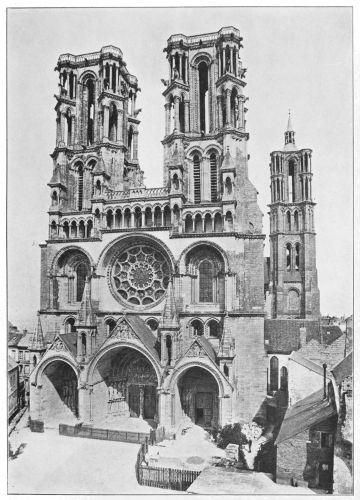
end is not yet. Laon is unique, a masterly work of curious vitality,
original, daring, and even rebellious against a growing tradition. In
the Middle Ages it was vastly admired, but to us of a day more dull and
timorous in architecture, because we have no art of our own and have
found so little in life from which we could draw an inspiration, it is
less safe and satisfying than such coherent and scholastic work as
Amiens or Reims. Begun about 1165, it was finished in 1225, the growth
being from the crossing in all directions, for not only is the amazing
west front of the central period of Gothic perfection, but the choir as
well, for the unique square termination takes the place of a regular
chevet which was part of the original design. This square-ended choir is
the only one in France, and is thoroughly English in effect; moreover,
the transepts have aisles and are the first in France to be so finished,
while they have tribunes at the ends after the Norman fashion, and there
is a central tower or lantern as well. The towers of Laon are its
distinguishing glory, for there are five in all, out of an original
seven, all incomplete, not one retaining its spire, but striking and
immensely individual. The interior organism is not wholly coherent, for
while the vaulting is sexpartite throughout, the system is regular, and
was as manifestly intended for quadripartite vaulting as Noyon for
sexpartite. The west front is vastly picturesque, if somewhat
incoherent, and is clearly a growth from year to year; it lacks both the
sublime calm and grandeur of Paris and the faultless organism of Reims,
but its detail is as brilliantly conceived as any in France, while its
carvings and sculptures are in the same class as the best of Hellas. In
the tops of the towers are the well-known stone effigies of oxen,
placed there by the builders in recognition of the patient service of
the beasts that year after year helped drag the heavy stones from the
plain to the top of the hill where the cathedral stands.
In and around Laon were once innumerable religious houses, but nearly
all their churches were destroyed during the French Revolution, which
annihilated more noble art in five years than had happened in five
centuries. St. Martin remains, and is of the middle of the twelfth
century, but the church of the Abbey of St. Vincent is wholly destroyed.
South of Laon, and about as far away as Noyon, lies Soissons, an ancient
town, famous in history, and containing, until the war, another
masterpiece of mediæval art, the cathedral, which already has been made
the target of German shells, and has suffered seriously. As a city, it
antedated the Roman occupation, was Christianised toward the end of the
third century, became a capital of the Merovings, and a notable city of
the Carolingian dynasty. The south transept is the oldest part, and
dates from about 1175, the choir was finished in 1212, the north
transept and nave about 1250. Porter says of the south transept: “This
portion of Soissons, one of the most ethereal of all twelfth-century
designs, is the highest expression of that fairy-like, Saracenic phase
of Gothic art that had first come into being at Noyon. Like Noyon,
however, this transept lacks the elements of grandeur which are found in
so striking a degree in the nave and choir of this same church of
Soissons.” The nave and choir are indeed amongst the noblest creations
of Catholic art; for justness and delicacy of proportions, refinement of
line, restraint in the placing and determination of ornament, Soissons
ranks with Chartres and Bourges. The richness of its vertical lines is
unusual, the mouldings clear, powerful, and distinguished in contour,
and altogether it has well served for nearly seven centuries as a
perfect exemplar of the Christian art of France as its highest point.
Already it has been appallingly shattered, one shell having struck the
roof of the north aisle, hurling one of the nave shafts into fragments
and obliterating an entire bay. Thus far it has been spared a
conflagration, and if the Prussian lines are promptly forced back, it
may still be preserved as a wonder for still further generations.
So far as the numberless other great churches of Soissons are
concerned, it has for long been too late; they perished, with uncounted
others in this region, at the time of the Revolution. Of the vast abbey
of St. Jean-des-Vignes nothing remains but the sumptuous west front, cut
clear like an architectural “frontispiece” from all the rest, and even
this has been further shattered by German gunfire. The royal abbey of
Our Lady has become a military barracks, St. Crepin, St. Medard with its
famous seven churches, all have vanished, and the loss is irreparable.
Nearer Paris we find Senlis, a further step in architectural
development. The town itself is charming, and full of old art and old
history. Roman walls, with sixteen towers, still remain, together with
fragments of a royal palace of the French kings, from Clovis to Henri
IV, with ancient houses, picturesque streets, desecrated churches, and
monastic ruins, such as those of the Abbey of Victory, founded by Philip
Augustus after the battle of Bouvines, and wrecked, of course, during
the Revolution.
The cathedral is curious and fascinating. Set out in 1155 on enormous
lines, it was curtailed both in height and length through the failure of
adequate funds. It has been rebuilt, extended, supplemented, century
after century, until it has become almost an epitome of French
architecture from the middle of the twelfth to the middle of the
sixteenth century. The southwest tower (its mate is unfinished) is of
the thirteenth-century culmination, and surpassed by no other spire in
France for subtlety of composition and perfection of detail. One of its
crocketed pinnacles has already been shot away, but apparently further
danger is well removed, and will become progressively less threatening
as the Prussian lines are driven back.
It is, of course, quite impossible even to note all the architectural
monuments between the Seine and the frontiers of Belgium. Paris must be
wholly left out, for St. Denis, St. Germain l’Auxerois, Notre Dame, and
the Ste. Chapelle would justly require a volume to themselves. Rouen,
with its cathedral, St. Ouen, St. Maclou, the Palais de Justice, rich
with all the lace and embroidery of the flamboyant period, lies now well
beyond danger, and so does Beauvais, where the nemesis of worldly pride
overtook the lagging spiritual impulse that had made the Middle Ages the
climax of Christian civilisation. Châlons-sur-Marne, once threatened, is
now reprieved, and its
cathedral, its churches of St. Jean and St. Loup, and its noble and
distinguished Church of Our Lady are safe for another period.
Apart from the great architectural monuments are numberless others
invaluable in archæology, and forming links in the great Gothic
development: St. Etienne of Beauvais, St. Leu d’Esserent, Morienval,
Bury, St. Germer, and St. Remi of Reims—the last valuable beyond
estimate, with an apse that was unparalleled as a masterpiece of
transitional work when Gothic was in its first and finest estate, now
wrecked and desecrated by shells that have burst its vaults into
crumbled fragments and hurled its perfect windows in showers of
splintered glass to the pavements heaped high with the wreck of masonry
and of dismembered altars.
And as in the case of the great churches, so in that of the small, from
Braisne to Caudebec, they cannot even be catalogued. The whole region
was, and is, one of wonderful little parish churches, of all periods,
and many of them are now only shapeless ruins. The great abbeys and
smaller religious houses are practically gone, scores having fallen prey
to the insane fury of the Revolution or the sordid secularism of the
Restoration. What we have lost may be seen from countless such lovely
and pathetic fragments as St. Wandrille, near Caudebec, given a new fame
through the name of Maeterlinck, and so linked with the greater
martyrdom of Belgium in these last days. This, like its myriad
companions, was architecture of the most singular beauty, the loss of
which leaves the world poor, so poor, indeed, that it had at first
nothing wherewith to meet the last assault of the enemy. The loss is
being made good, the penalty already is paid, and though one could
not—one would not—restore or rebuild these silent fragments of
exquisitely wrought stone, meshed in tall trees and clambering vines,
the vision is possible of new foundations, equal in number to these that
are gone, each an expiation and a spiritual guard, each making late
reparation for the past, guaranteeing a future immunity from perils of
the same nature as those that now shake the world.


