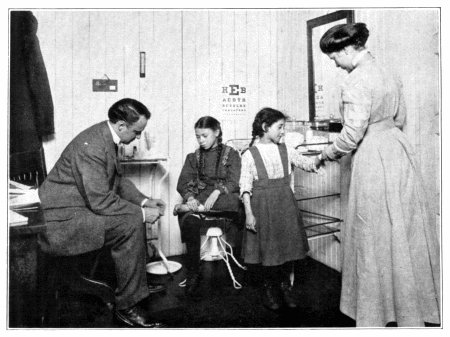
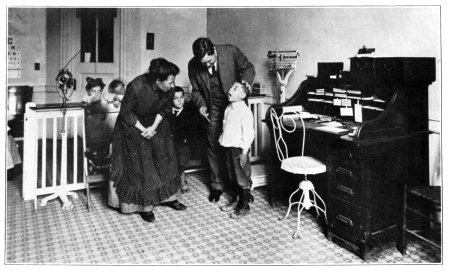
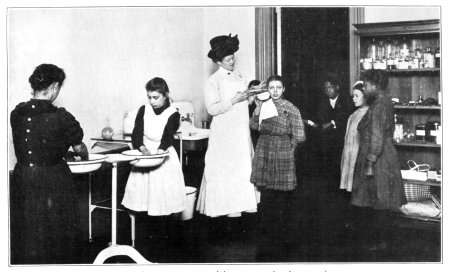
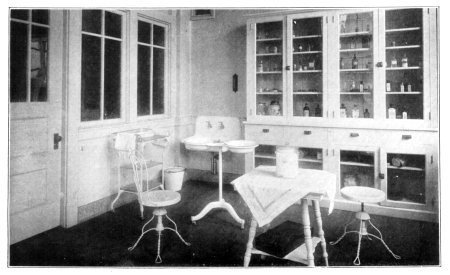
1. Cleveland employs 16 school physicians, one oculist, and 27 nurses.
It spends $36,000 a year on salaries and supplies for these people,
and maintains 86 school dispensaries and clinics.
2. Through medical inspection, the educator and the physician join
hands to insure for each child such conditions of health and vitality
as will best enable him to take full advantage of the free education
offered by the state. It recognizes the intimate relationship between
the physical and mental conditions of children. It realizes that
education is dependent upon health. It betters health conditions among
school children, safeguards them from disease, and renders them
healthier, happier, and more vigorous.
3. The first work of this kind in Cleveland started in 1900 when tests
were made of defective vision. In 1906 the Health Department provided
inspectors for contagious diseases in the schools. In the same year
inspection for physical defects was undertaken; the first dispensary
in the United States was established at the Murray Hill School, and
school nurses were appointed. In 1909 the Division of Health
Supervision and Inspection became part of the regular school system.
4. The Division handles inspection for contagious disease, inspection
for physical and mental defects, follow-up work for the remedying of
defects, health instruction, recommendations of children to special
classes, school lunches, gardens, and playgrounds. Every child is
examined every year.
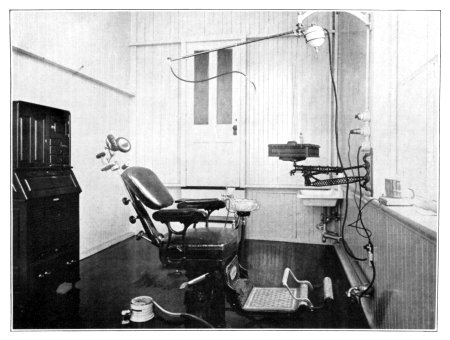
5. Cleveland has 86 dispensaries. In every case lighting, ventilation,
and equipment are good. It is probably true that these dispensaries
are of better grade than those of any other large city in the United
States.
6. Dental clinics are now conducted in four public schools by the
Cleveland Auxiliary of the National Mouth Hygiene Association. This
work has now reached a point where it should be taken over and
administered as a part of the public school system. The function of a
private organization is to experiment and demonstrate. It cannot
eventuate on a large scale, and it should not if it could. The
function of a public organization is to eventuate on a large scale. It
can seldom experiment, and it lacks freedom and flexibility in
demonstration. The Mouth Hygiene Association has experimented and
demonstrated successfully. Its work should now be assumed, continued,
and extended by the Division of Medical Inspection.
7. The eye clinic conducted by the Division at the Brownell School is
doing excellent work. As the system grows, this clinic should be
supplied with more workers. The Cleveland College for Barbers gives an
excellent free service in many of the schools. There are no other
clinics. Mental examinations are made by a special teacher appointed
for that purpose. All surgical cases are referred to family physicians
or local hospitals for treatment.
8. Medical inspectors are mature men, graduates of well-known medical
schools, with a fairly wide private practice. The school nurses are
all registered nurses.
9. The number of school nurses should be increased as rapidly as
possible until one nurse is provided on full time for every 2000
children enrolled in school. This would mean the employment of 11
additional nurses, increasing the staff from 27 to 34. As the
population increases, more nurses should be added.
10. Office consultations between parents and physicians are among the
most important activities of the Division and should be systematically
encouraged. To this end arrangements should be made whereby definite
hours for parent consultations are assigned to each school.
11. The Division of Medical Inspection has so organized its work that
the attention of the staff is concentrated upon a different set of
problems each year. This method is unquestionably effective in
promoting growth and maintaining the interest of the staff. Care
should be taken, however, to provide that within each four-year
period special emphasis be laid upon the discovery and cure of each of
the more important defects. Some plan should be adopted by the staff
whereby effort may be concentrated on discovering and remedying
defects at those ages where such expenditure of time and energy will
secure the largest returns.
12. Adequate provision should be made for the correction of speech
defects. Classes in speech training should be established under the
direction of a teacher specially trained in this work.
13. Standardization of work is an especially noteworthy feature of the
Cleveland system, and should furnish valuable suggestions to medical
inspection departments of other cities. Through this standardization
the same terms have uniform meanings when used by different members of
the staff, and constant standards are employed in detecting and
recording defects.
14. There are probably more than 50,000 unvaccinated children now in
the Cleveland schools. Immediate steps should be taken to see to it
that every child now in school is vaccinated, and that no child is
admitted to school hereafter without similar protection. Principals,
teachers, and parents should be held responsible for violation of the
vaccination ordinance.
15. The Division of Medical Inspection should plan steadily to
enlarge its field of activity in order to provide in constantly
increasing measure better working conditions in the schools and to
train the children into habits of health that shall be life-long. It
is probable that the health work in the Cleveland public schools is
unsurpassed by that of any other city in the country. The city now has
an opportunity to lead the way into vastly important forward
extensions looking toward the provision of health insurance for future
generations.
16. Under the present organization, the official in charge of health
work is responsible to the director of schools in part of his
activities and to the superintendent in the rest of them. He should be
responsible to the city superintendent alone, for health work in the
public schools is education and not business.